Show the 25 learning outcomes from the specification
5.1.3(a)(i) a Brønsted–Lowry acid as a species that donates a proton and a Brønsted–Lowry base as a species that accepts a proton (see also 2.1.4 Acids)
5.1.3(a)(ii) use of the term conjugate acid– base pairs
5.1.3(a)(iii) monobasic, dibasic and tribasic acids
5.1.3(b) the role of H+ in the reactions of acids with metals and bases (including carbonates, metal oxides and alkalis), using ionic equations (see also 2.1.4 c, 2.1.5 e)
5.1.3(c)(i) the acid dissociation constant, Ka, for the extent of acid dissociation (see also 2.1.4 b)
5.1.3(c)(ii) the relationship between Kaand p Ka
5.1.3(d) use of the expression for pH as: pH = – log[H+] [H+] = 10– pH
5.1.3(e) use of the expression for the ionic product of water, Kw
5.1.3(f) calculations of pH, or related quantities, for:
5.1.3(f)(i) strong monobasic acids
5.1.3(f)(ii) strong bases, using Kw
5.1.3(g) calculations of pH, Kaor related quantities, for a weak monobasic acid using approximations
5.1.3(h) limitations of using approximations to Karelated calculations for ‘stronger’ weak acids
5.1.3(i) a buffer solution as a system that minimises pH changes on addition of small amounts of an acid or a base
5.1.3(j) formation of a buffer solution from:
5.1.3(j)(i) a weak acid and a salt of the weak acid, e.g. CH3COOH/CH3COONa
5.1.3(j)(ii) excess of a weak acid and a strong alkali, e.g. excess CH3COOH/NaOH
5.1.3(k) explanation of the role of the conjugate acid– base pair in an acid buffer solution, e.g. CH3COOH/CH3COO–, in the control of pH
5.1.3(l) calculation of the pH of a buffer solution, from the Kavalue of a weak acid and the equilibrium concentrations of the conjugate acid– base pair; calculations of related quantities
5.1.3(m) explanation of the control of blood pH by the carbonic acid– hydrogencarbonate buffer system
5.1.3(n) pH titration curves for combinations of strong and weak acids with strong and weak bases, including:
5.1.3(n)(i) sketch and interpretation of their shapes
5.1.3(n)(ii) explanation of the choice of suitable indicators, given the pH range of the indicator
5.1.3(n)(iii) explanation of indicator colour changes in terms of equilibrium shift between the HA and A– forms of the indicator
5.1.3(o) the techniques and procedures used when measuring pH with a pH meter.
Six-mark level of response questions on this topic
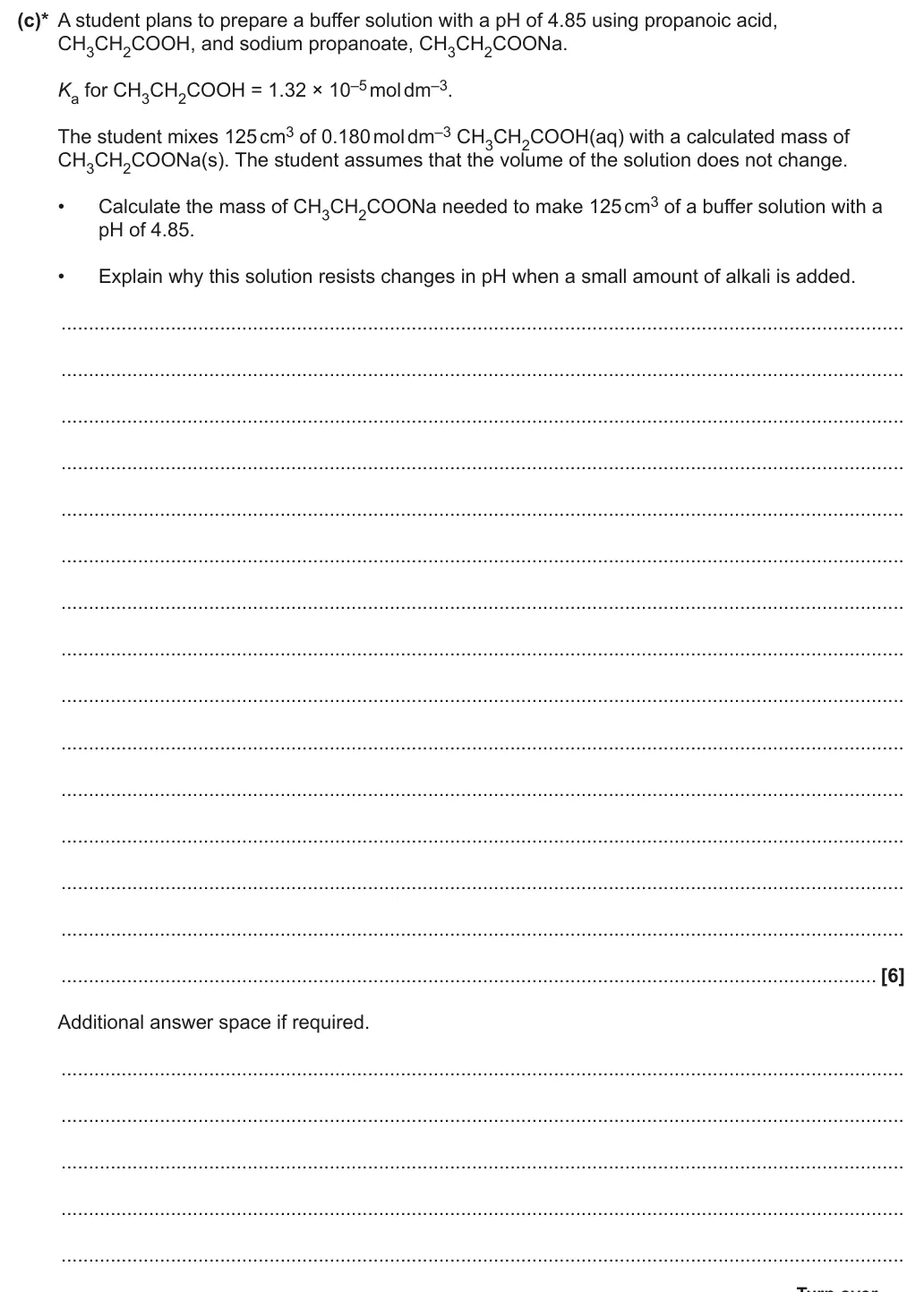
A student plans to prepare a buffer solution with a pH of 4.85 using propanoic acid, • Calculate the mass of CH3CH2COONa needed to make 125 cm3 of a buffer solution with a
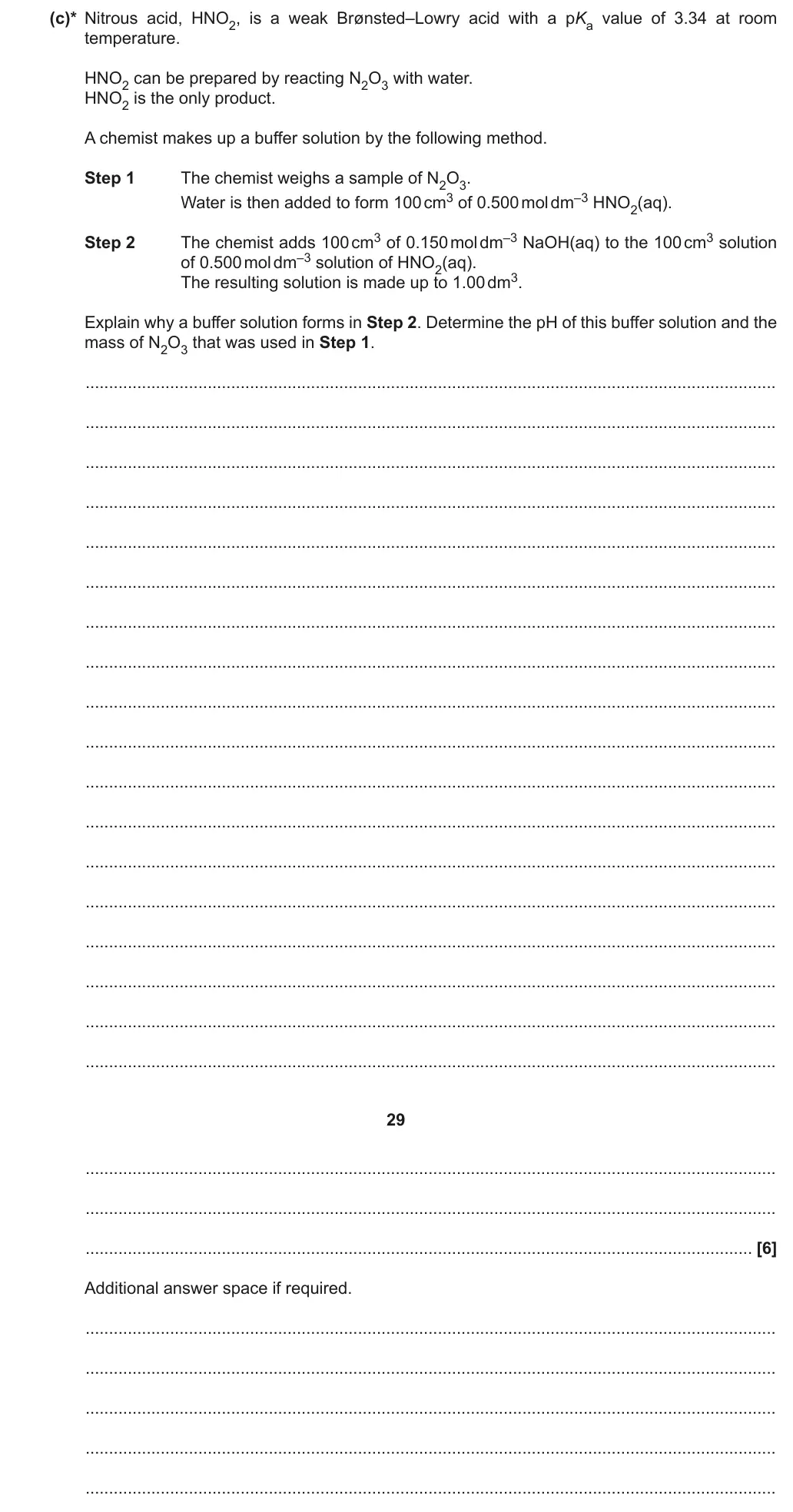
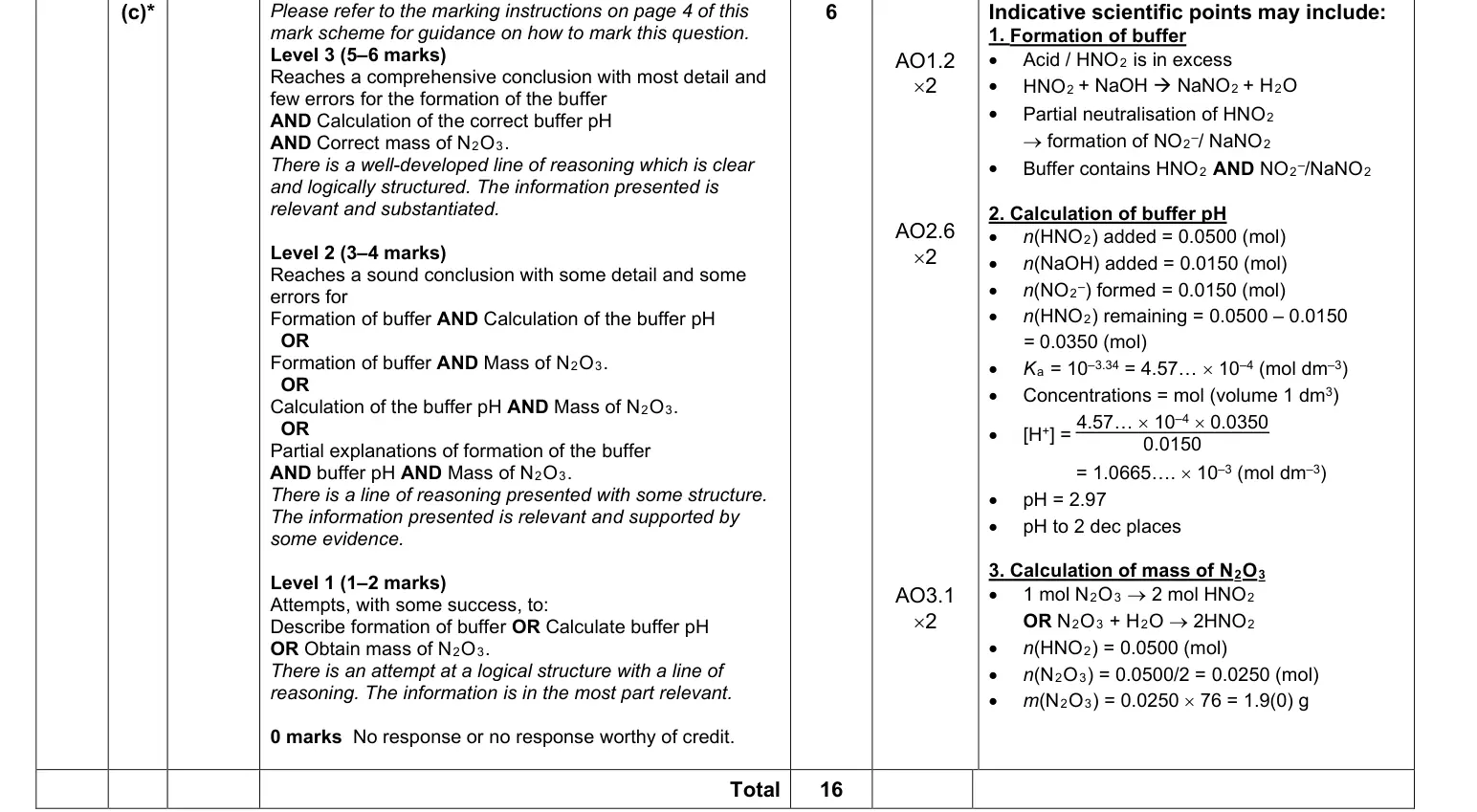
Nitrous acid, HNO2, is a weak Brønsted–Lowry acid with a pKa value of 3.34 at room Explain why a buffer solution forms in Step 2. Determine the pH of this buffer solution and the
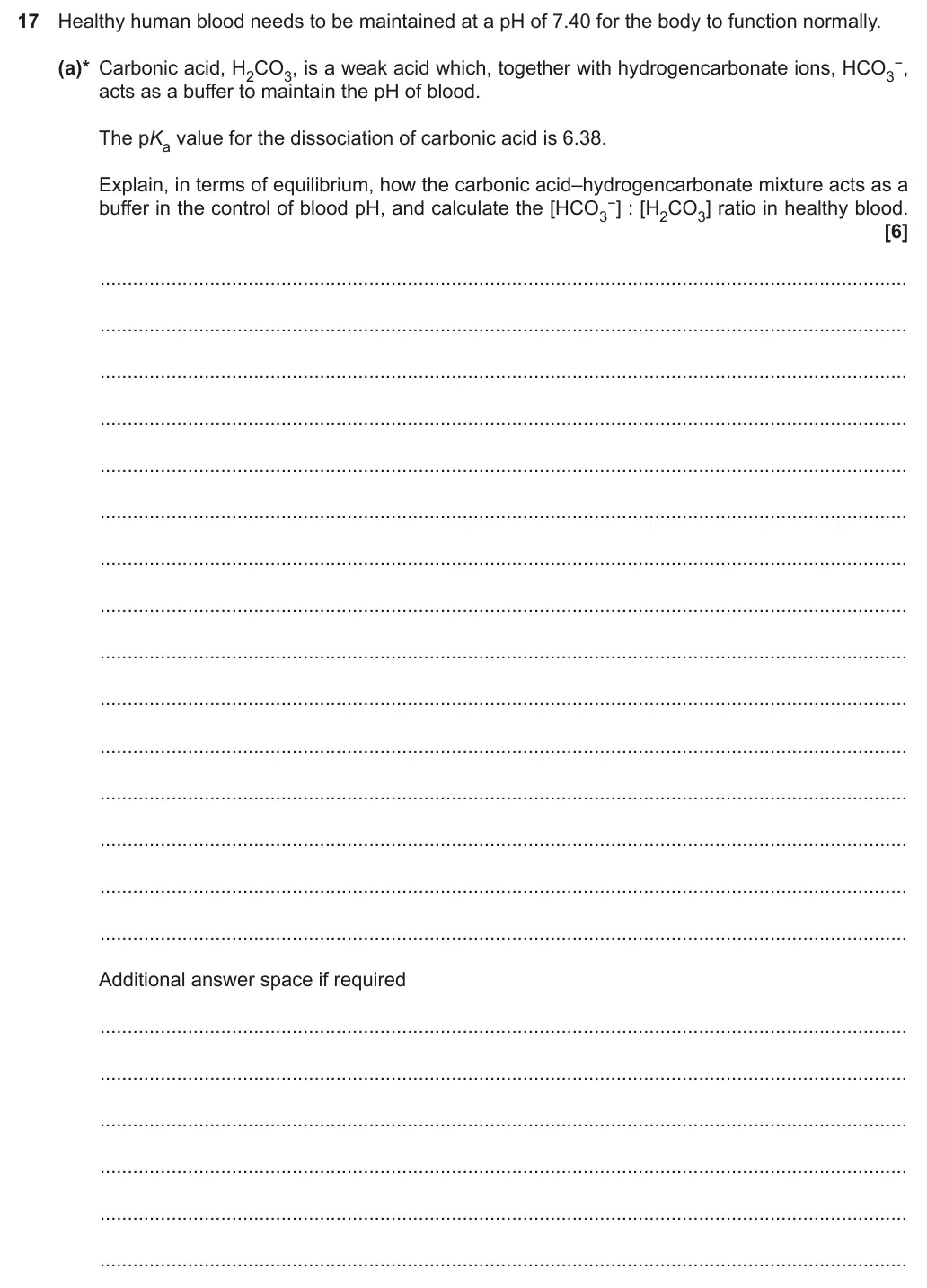
Carbonic acid, H2CO3, is a weak acid which, together with hydrogencarbonate ions, HCO3 −, Explain, in terms of equilibrium, how the carbonic acid–hydrogencarbonate mixture acts as a
Tap a question to zoom it. Where a part needs a table, graph or structure from an earlier part, that part folds out above it; the mark scheme and examiner's comment open underneath. Have the OCR Data Sheet beside you.
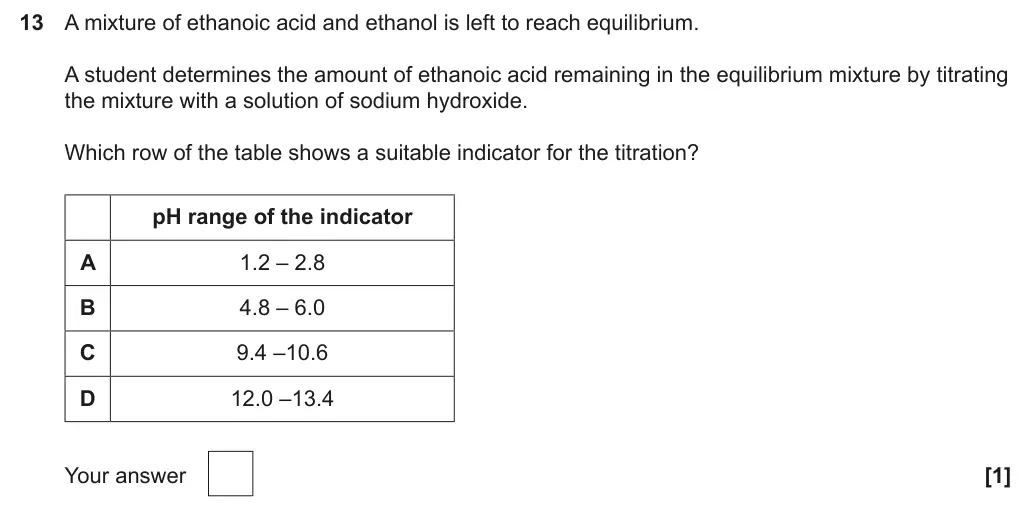
June 2025 · Paper 1 · Q131 markMultiple choiceMedium
Answer
C
Mark scheme
Examiner's comment
The correct answer was C. Only some of the candidates selected this response, showing good knowledge of a choice of indicator from a weak acid – strong base titration. B was the most common incorrect response, presumably due to considering the pH of a weak acid.
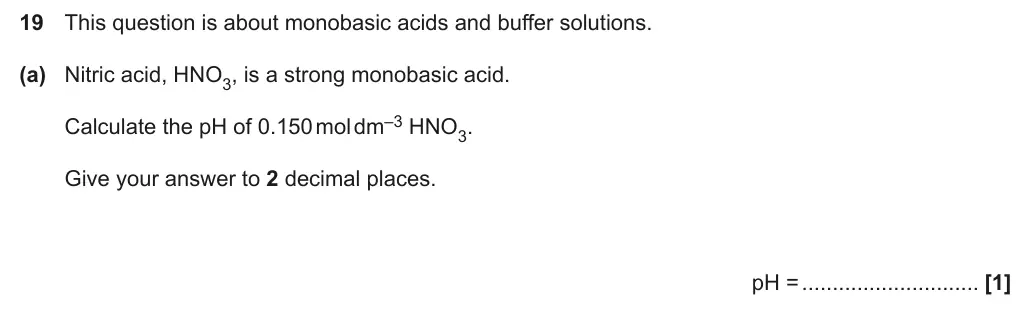
June 2025 · Paper 1 · Q19(a)1 markCalculationHard
Mark scheme
Examiner's comment
Most candidates were successful in calculating pH. A few candidates gave the pH value to 1 or 3 decimal places, and few quoted 13.18 as if HNO3 were an alkali.
Notes from the mark scheme and report
pH = –log(0.150) = 0.82
2 d.p. required
Skills: M0.4 Use calculators to find and use power, exponential and logarithmic functions; M2.5 Use logarithms in relation to quantities that range over several orders of magnitude
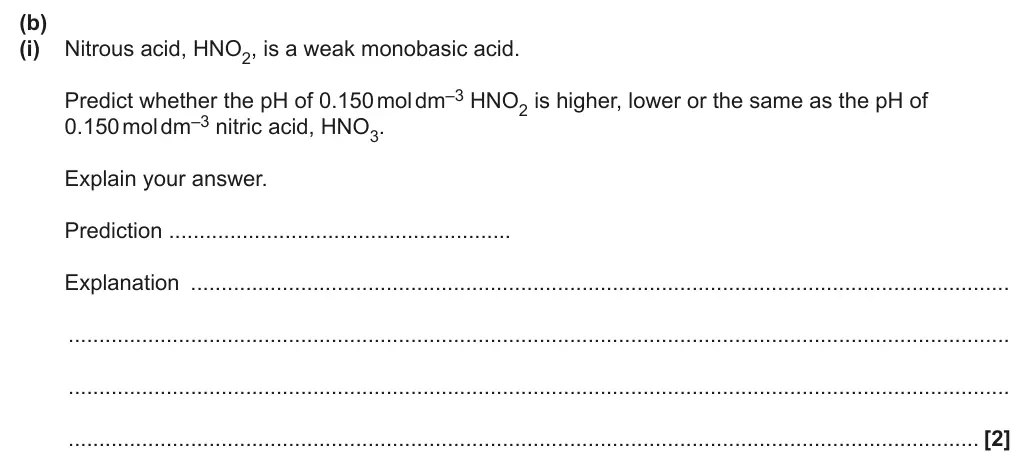
June 2025 · Paper 1 · Q19(b)(i)2 marksShort answerHard
Earlier part of question 19 that this part uses
Mark scheme
Examiner's comment
This question required that the candidate understood that pH was a function of both the dissociation and concentration of H+ for a weak acid. This did prove more challenging and often was not explained well. Less successful candidates often quoted a lower pH, explained that it didn’t fully dissociate (rather than partially dissociate) or didn’t link the number of H+ ions to a concentration.
Notes from the mark scheme and report
higher pH AND nitrous acid partially dissociates
lower concentration of H+
DO NOT ALLOW 'nitric acid is a stronger acid' (given in question)
IGNORE 'does not fully dissociate/dissociates less'
June 2025 · Paper 1 · Q19(c)6 marks6-mark level of responseHard
Mark scheme, with the levels and indicative points
Examiner's comment
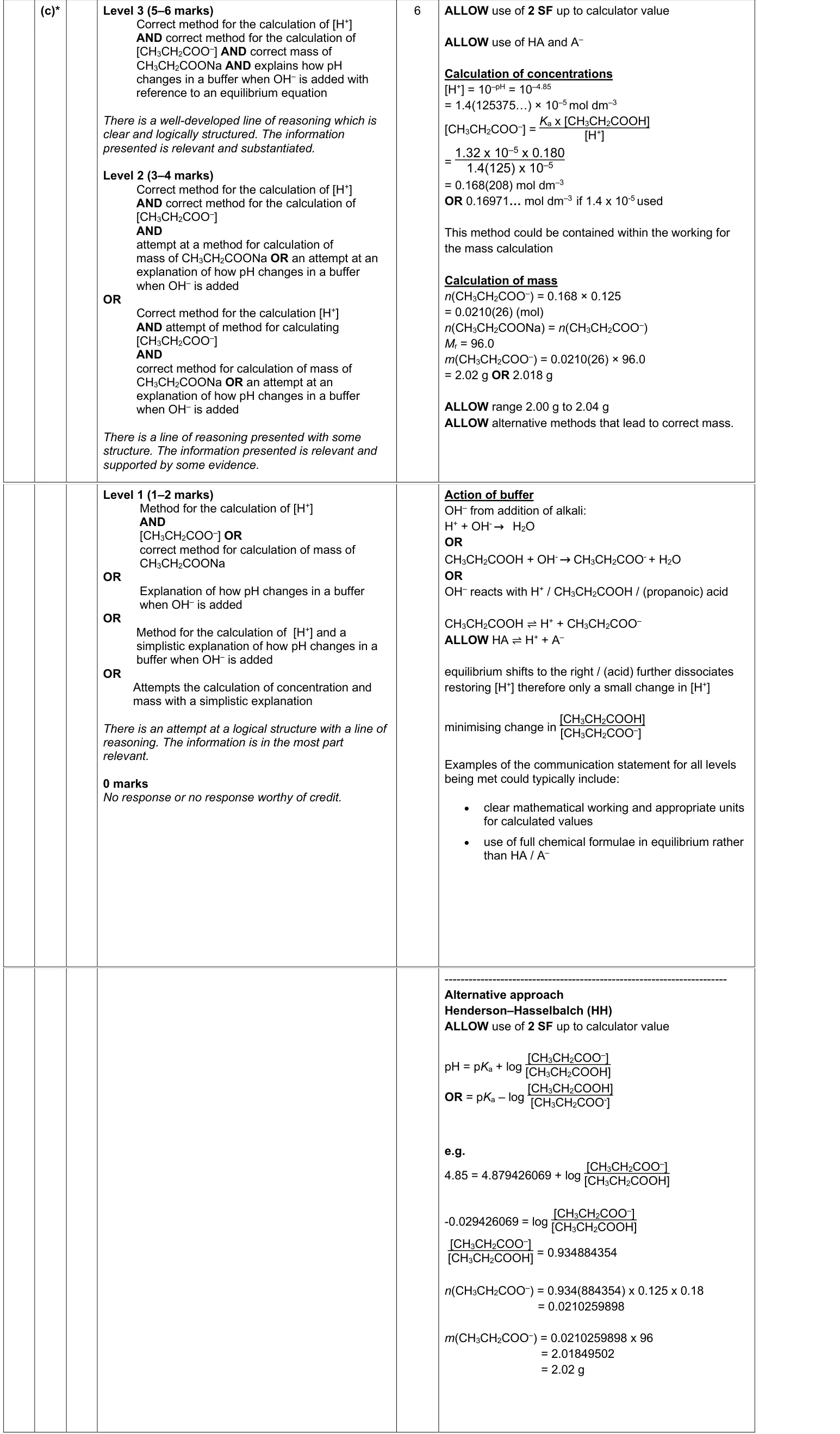
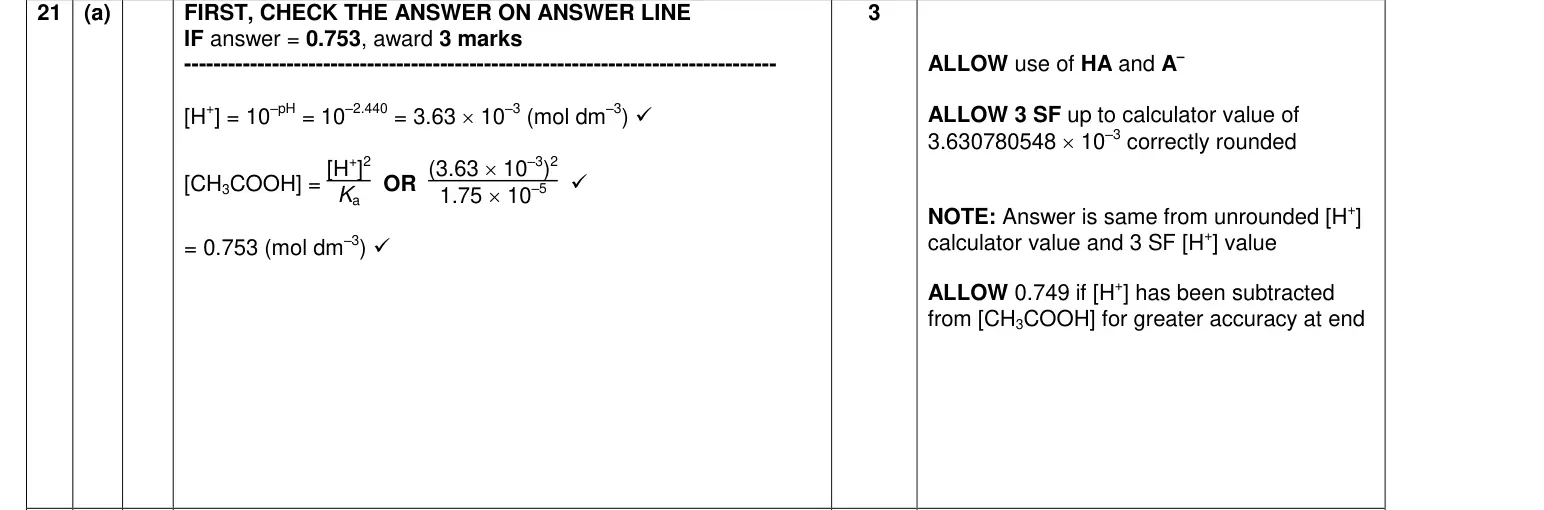
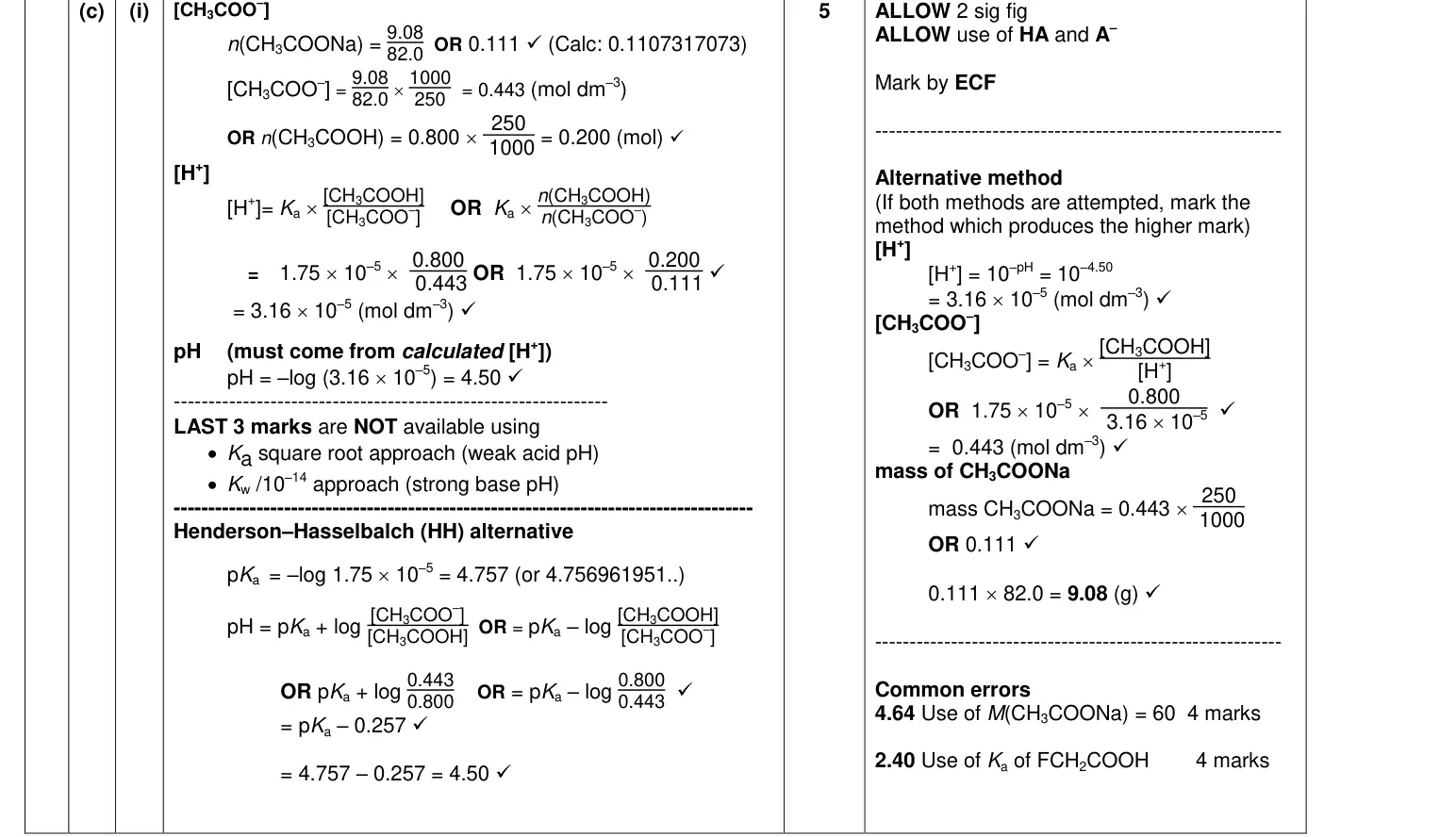
This was our second Level of Response question which proved more challenging for candidates. Only a few candidates scored full marks. Candidates are reminded to structure their answers and make sure they answer all points in the question. Candidates often find pH of buffer solution calculations difficult to process. The most difficult part in this calculation was the concentration of the salt. The majority that calculated salt concentration were able to calculate the mass. We should encourage the candidates to always write the units when calculating any quantity as concentration and moles were often confused within the calculation. Some candidates were given Level 2 for converting what they thought was the salt concentration into a value for the mass of salt needed, using a correct method. Less successful candidates calculated the correct [H+] but then used a weak acid calculation approach. A few responses attempted to use the Henderson-Hasselbalch approach, but most were unsuccessful due to the mathematical inaccuracies. The buffer action description proved to be a more challenging part to the question. Some candidates wrote a clear and concise description, linked to a written equilibrium equation, of the reaction of an alkali and the resulting equilibrium shift. Level 2 candidates often described an equilibrium shift of a non- existent equilibrium equation. Level 1 candidates were often only able to calculate [H+] and tried to explain the action of a buffer.
Notes from the mark scheme and report
n = 0.168 × 0.125 = 0.0210 mol
mass = 0.0210 × 96.0 = 2.02 g (2.00–2.04)
added OH– reacts with H+/CH3CH2COOH and equilibrium CH3CH2COOH ⇌ H+ + CH3CH2COO– shifts right restoring [H+]
use full formulae rather than HA/A–
Skills: M0.4 Use calculators to find and use power, exponential and logarithmic functions; M2.2 Change the subject of an equation; M2.3 Substitute numerical values into algebraic equations using appropriate units for physical quantities; M2.5 Use logarithms in relation to quantities that range over several orders of magnitude
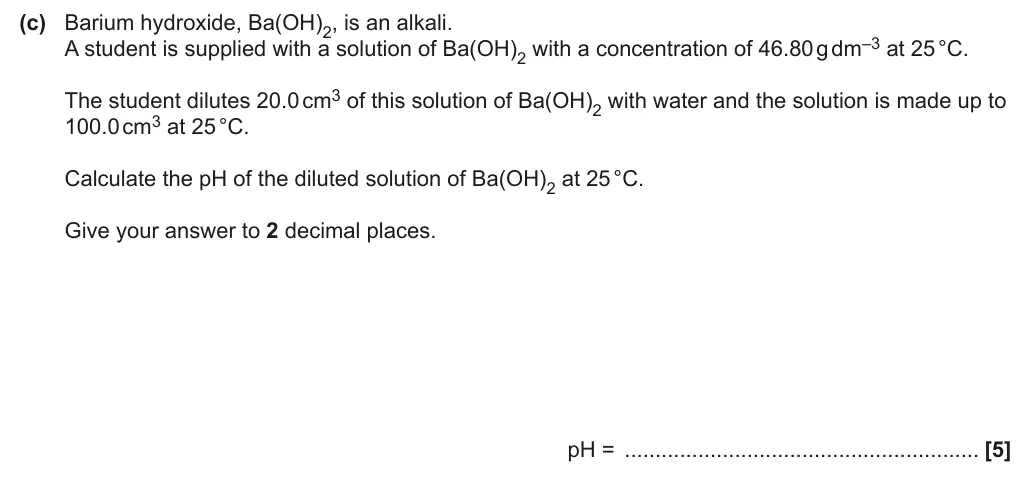
June 2025 · Paper 3 · Q2(c)5 marksCalculationHard
Mark scheme
Examiner's comment
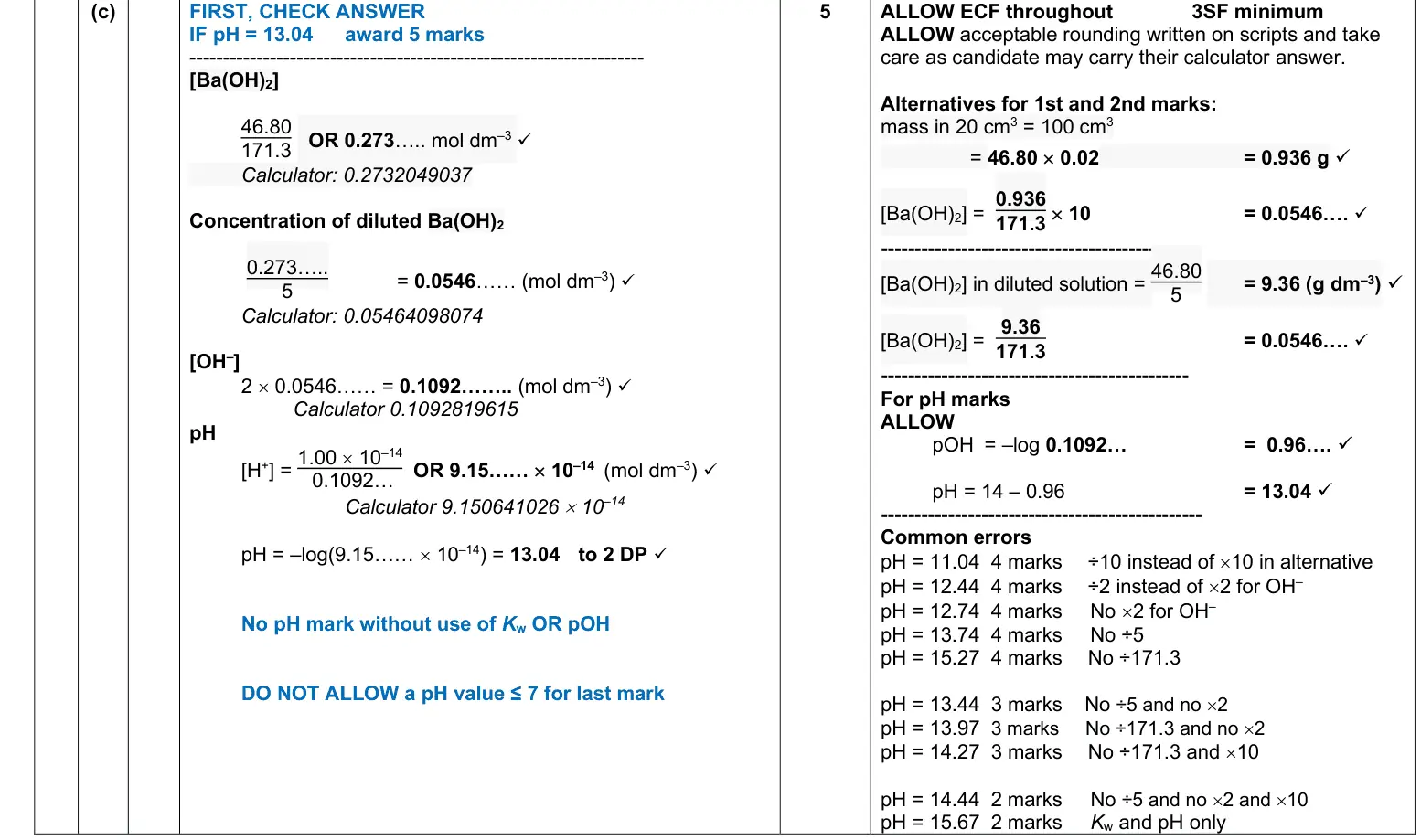
This unstructured calculation required candidates to work out the concentration of Ba(OH)2, to scale the concentration for the 5 times dilution and to determine the concentration of OH– ions by multiplying by 2. Many different methods were seen for working out the moles of Ba (OH)2, but the ÷5 and 2 operations were often omitted. It was common for concentrations to be shown with the wrong number of powers of 10. Many candidates used Kw or pOH confidently to obtain a value for pH. Error carried forwards (ECF) could be applied provided that the numbers used had been generated using the numbers in the question. A good number of candidates determined the pH correctly to 2 decimal places as 13.04. The commonest incorrect answer was 12.74, the result of not using 2 to find [OH–]. As with Q2b(ii), responses were often unclearly laid out and it could be difficult to find answers.
Notes from the mark scheme and report
g dm–3 to mol dm–3 (÷ 171.3)
dilution ÷ 5
no pH mark without Kw or pOH
13.04 to 2 DP
common errors 12.74 (no × 2), 13.74 (no ÷ 5)
Skills: M0.2 Use ratios, fractions and percentages; M0.4 Use calculators to find and use power, exponential and logarithmic functions; M2.3 Substitute numerical values into algebraic equations using appropriate units for physical quantities; M2.5 Use logarithms in relation to quantities that range over several orders of magnitude
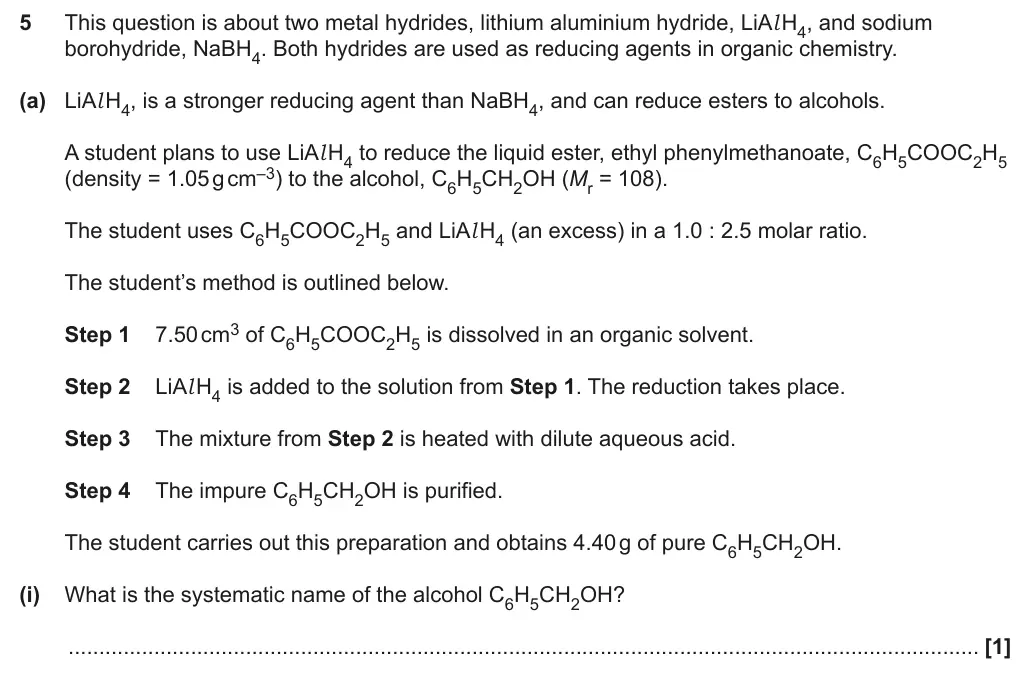
June 2025 · Paper 3 · Q5(a)(v)1 markShort answerHard
Earlier parts of question 5 that this part uses
Mark scheme
Examiner's comment
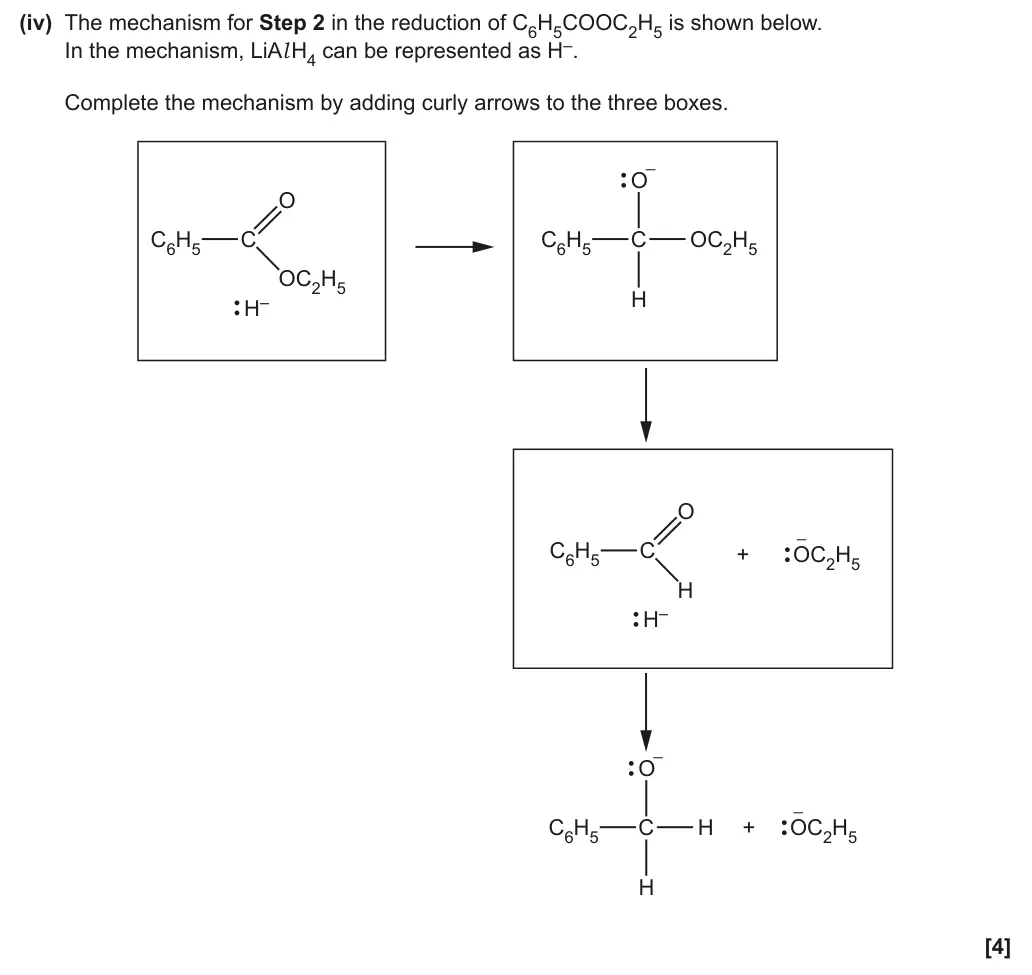
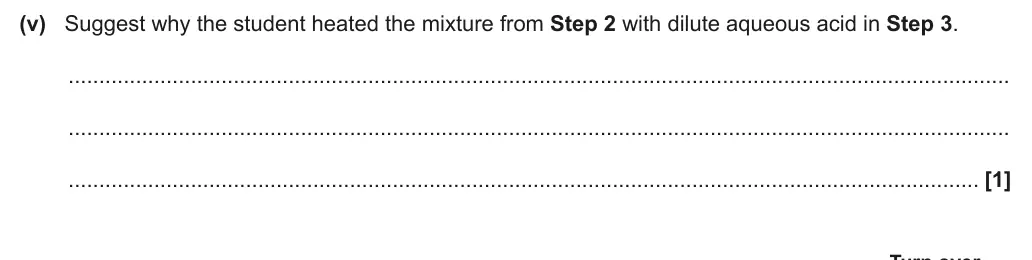
Most candidates found this question difficult with only higher attaining candidates being able to synthesise the information provided in the method and the mechanism. In 5(a)(iv), the last step in the mechanism for Step 2 gave a clue with the two products shown with a negative charge on both O atoms. The mark scheme required an understanding that an H+ ion was involved in Step 3. With the preparation involving H– ions, responses referring to a ‘hydrogen ion’ were ambiguous and imprecise. A common incorrect response referred to hydrolysis of the ester.
Notes from the mark scheme and report
H+ protonates the O– / negative ion to form the alcohol: must include idea of H+ being gained
IGNORE 'to form an OH group/alcohol' alone
June 2024 · Paper 1 · Q121 markMultiple choiceHard
Answer
A
Mark scheme
Examiner's comment
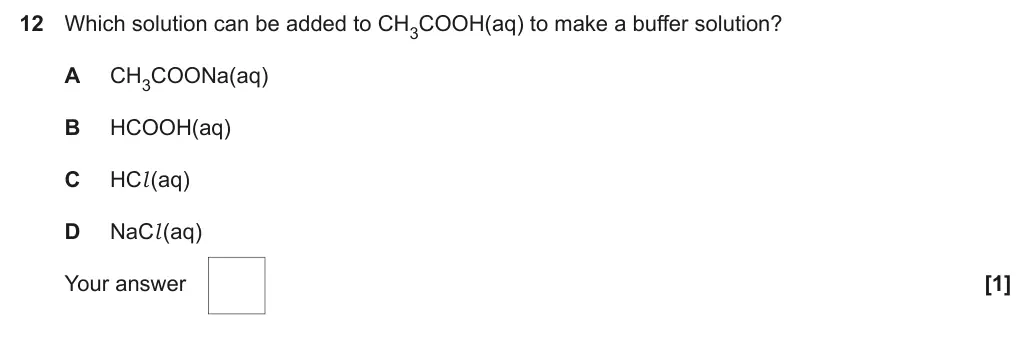
The correct answer was A. Formation of a buffer solution can either be from either: • a weak acid and a salt of the weak acid, e.g. CH3COOH/CH3COONa • an excess of a weak acid and a strong alkali, e.g. excess CH3COOH/NaOH A few candidates suggested the other alternatives in equal measure.
June 2024 · Paper 1 · Q19(a)(i)1 markShort answerEasy
Mark scheme
Examiner's comment
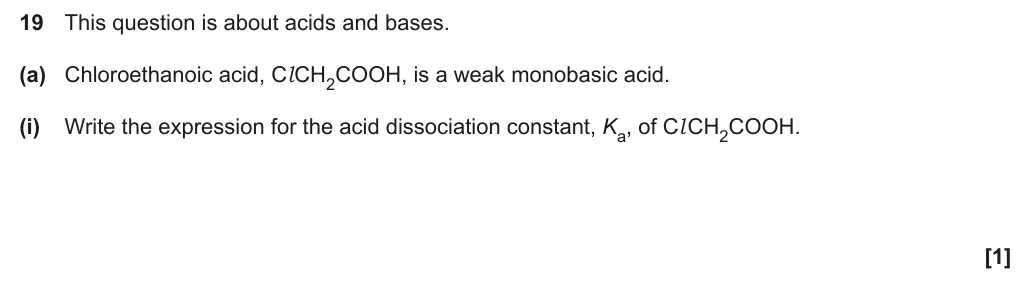
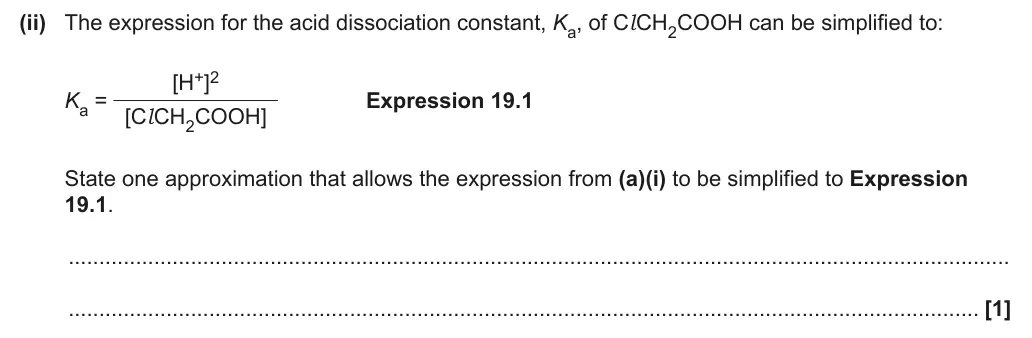
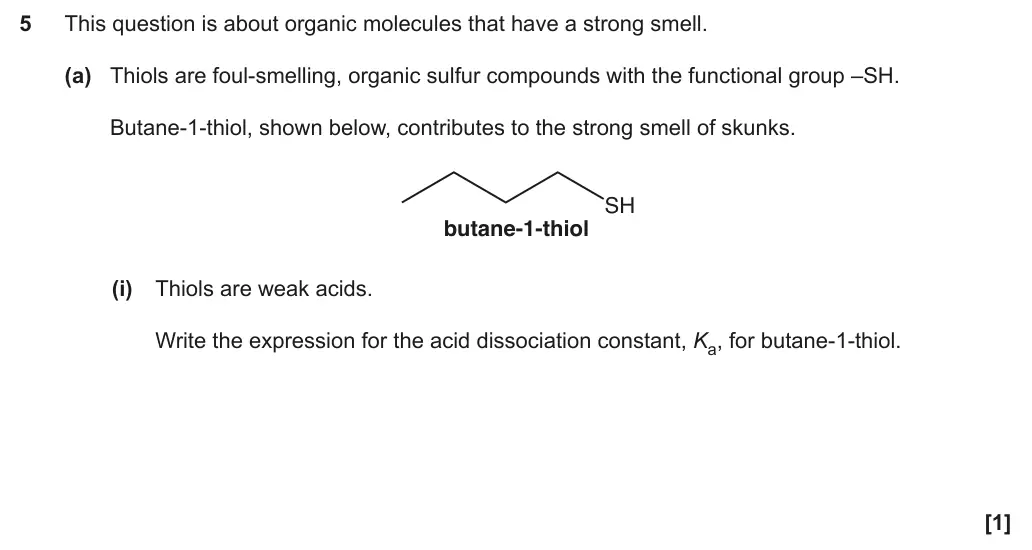
Most candidates scored the marking point. They realised that the full formulae were needed although some candidates left off the square brackets or used HA or [H]2. Care should be taken in checking the correct amount and location of H in the formula. As an acid dissociates to form a H+, it is important to acknowledge only one H+ is dissociated from the correct part of the molecule.
Notes from the mark scheme and report
square brackets required
DO NOT ALLOW [H+]2 in Ka expression here
June 2024 · Paper 1 · Q19(a)(ii)1 markShort answerEasy
Earlier part of question 19 that this part uses
Mark scheme
Examiner's comment
This question required the candidate to understand that the dissociation of water to produce H+ ions had no effect on the overall [H+] of the solution, leading to [H+] = [A-]. This was mostly answered well but some candidates used the idea of [H+] = [OH-].
Notes from the mark scheme and report
must be in terms of concentration
June 2024 · Paper 1 · Q19(a)(iii)3 marksCalculationMedium
Earlier part of question 19 that this part uses
Mark scheme
Examiner's comment
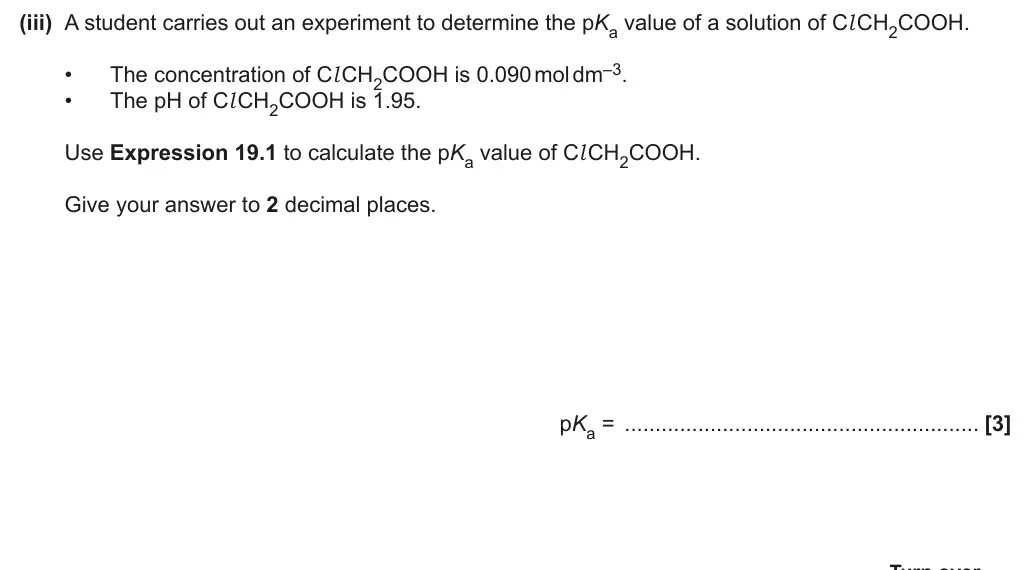
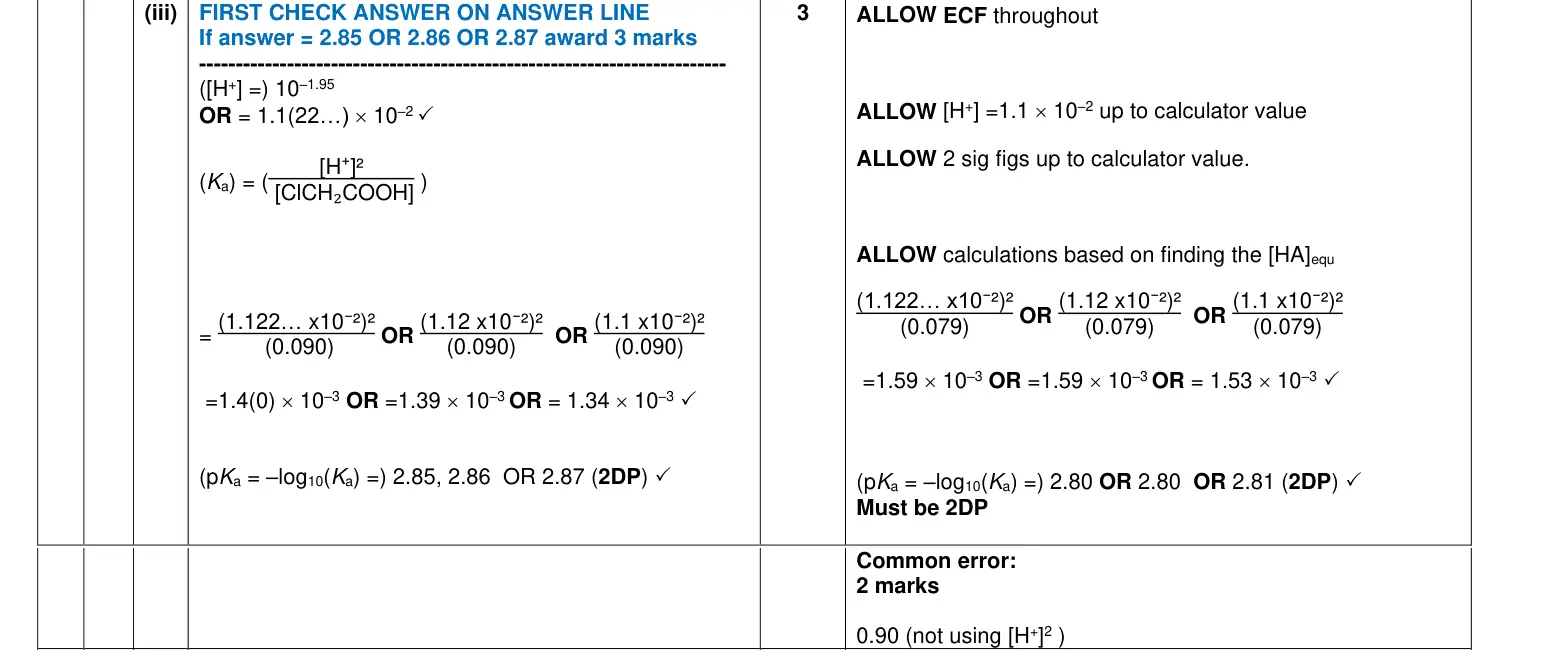
Candidates made good progress with this calculation, many gaining 2 or 3 marks, including error carried forward. Common errors included, in various combinations: using -log[-1.95]; using an incorrect value for the concentration of ClCH2COOH; and using 10-Ka.
Notes from the mark scheme and report
pKa = –log Ka
2 decimal places
Skills: M0.4 Use calculators to find and use power, exponential and logarithmic functions; M2.3 Substitute numerical values into algebraic equations using appropriate units for physical quantities; M2.5 Use logarithms in relation to quantities that range over several orders of magnitude
June 2024 · Paper 1 · Q19(b)(i)5 marksCalculationEasy
Mark scheme
Examiner's comment
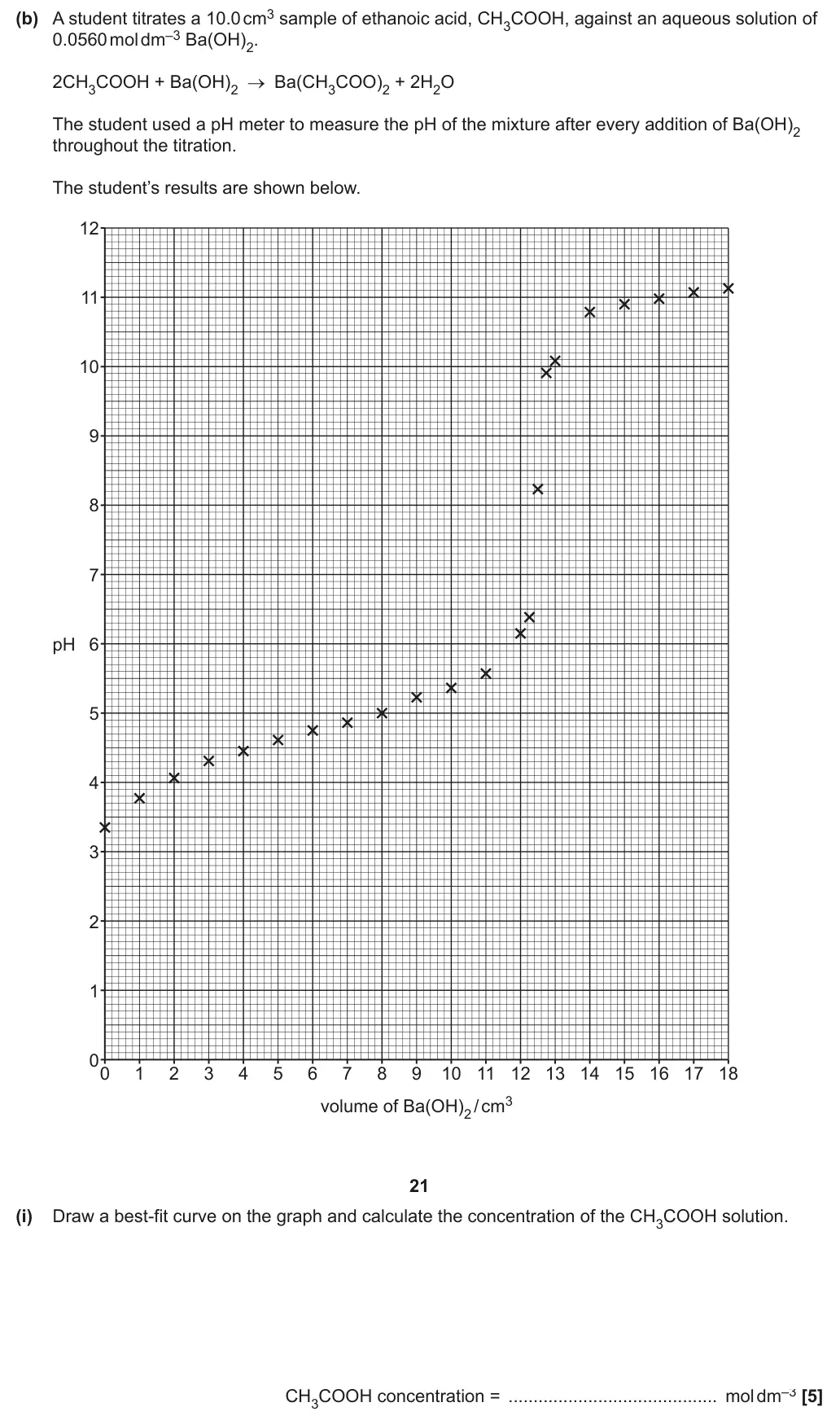
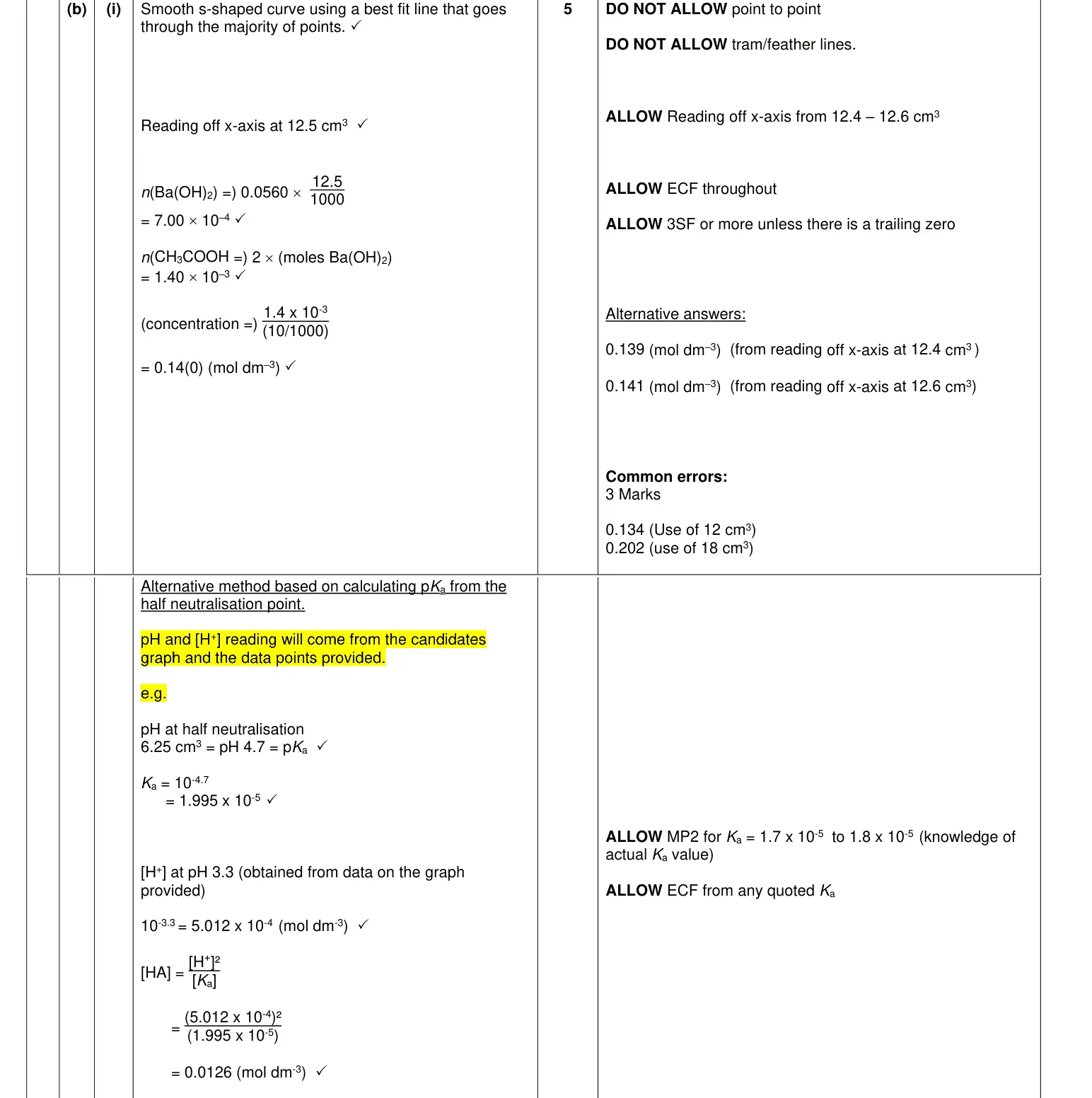
Nearly all candidates were able to draw the line of best fit and linked the sharp vertical section of the graph with the volume of Ba(OH)2 needed to neutralise the ethanoic acid. Candidates should aim to produce a smooth line of best fit and avoid ‘tram’ lines when the pencil is taken off the paper and the curve started again. The line should go through most points. Some candidates misinterpreted the graph and used values of 8, 12, 12.2, 12.25 and 18. However, the remainder of the calculation was accessible, and most candidates scored well with ECF marks from this point. There was occasional division of 2 for the moles of ethanoic acid and dividing by the original volume of Ba(OH)2 rather than the 10cm3 of ethanoic acid. This candidate scored all available marks. This is a very good example of a candidate displaying their working. The response was well communicated indicating the end point, links were made to what was being calculated and how the next number was obtained.
Notes from the mark scheme and report
smooth S-shaped best-fit curve through the majority of points
equivalence at 12.5 cm3
1:2 ratio Ba(OH)2:CH3COOH
Skills: M0.0 Recognise and make use of appropriate units in calculations; M0.2 Use ratios, fractions and percentages; M3.2 Plot two variables from experimental or other data; PAG11 pH measurement; PAG2 Acid–base titration
June 2024 · Paper 1 · Q19(b)(ii)1 markShort answerEasy
Earlier part of question 19 that this part uses
Mark scheme
Examiner's comment
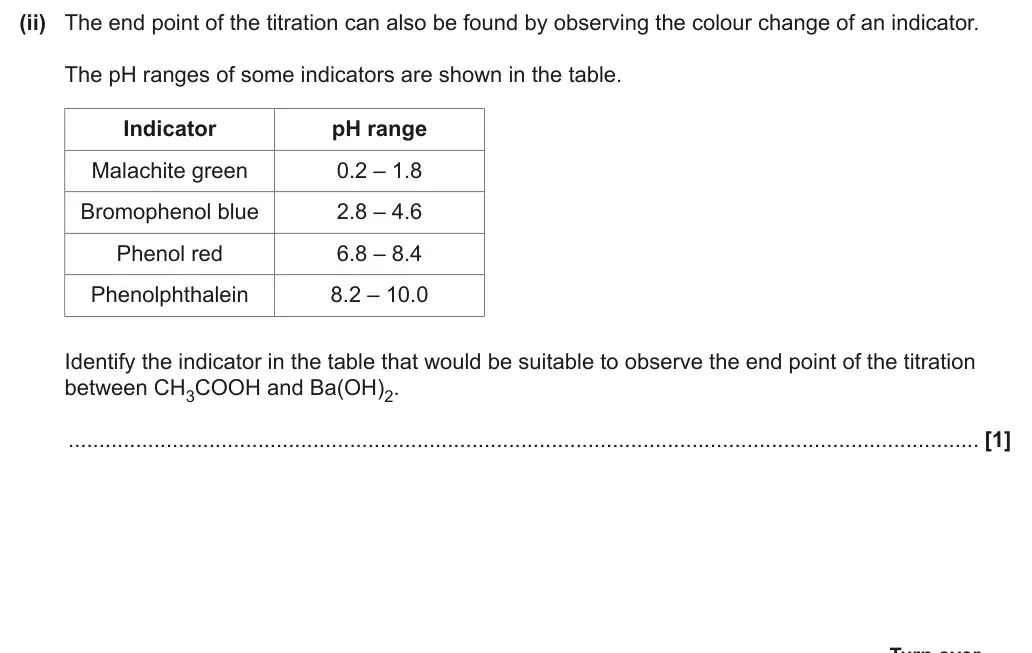
Nearly all candidates scored this marking point. Phenol red and Phenolphthalein were good choices of indicator as their colour changed on the sharp vertical section of the graph, depending on how the top end of the line of best fit was drawn. Occasionally malachite green and bromophenol blue were seen.
Notes from the mark scheme and report
indicator must change on the vertical section of the candidate's own curve
June 2024 · Paper 1 · Q22(c)5 marksExtended responseHard
Mark scheme
Examiner's comment
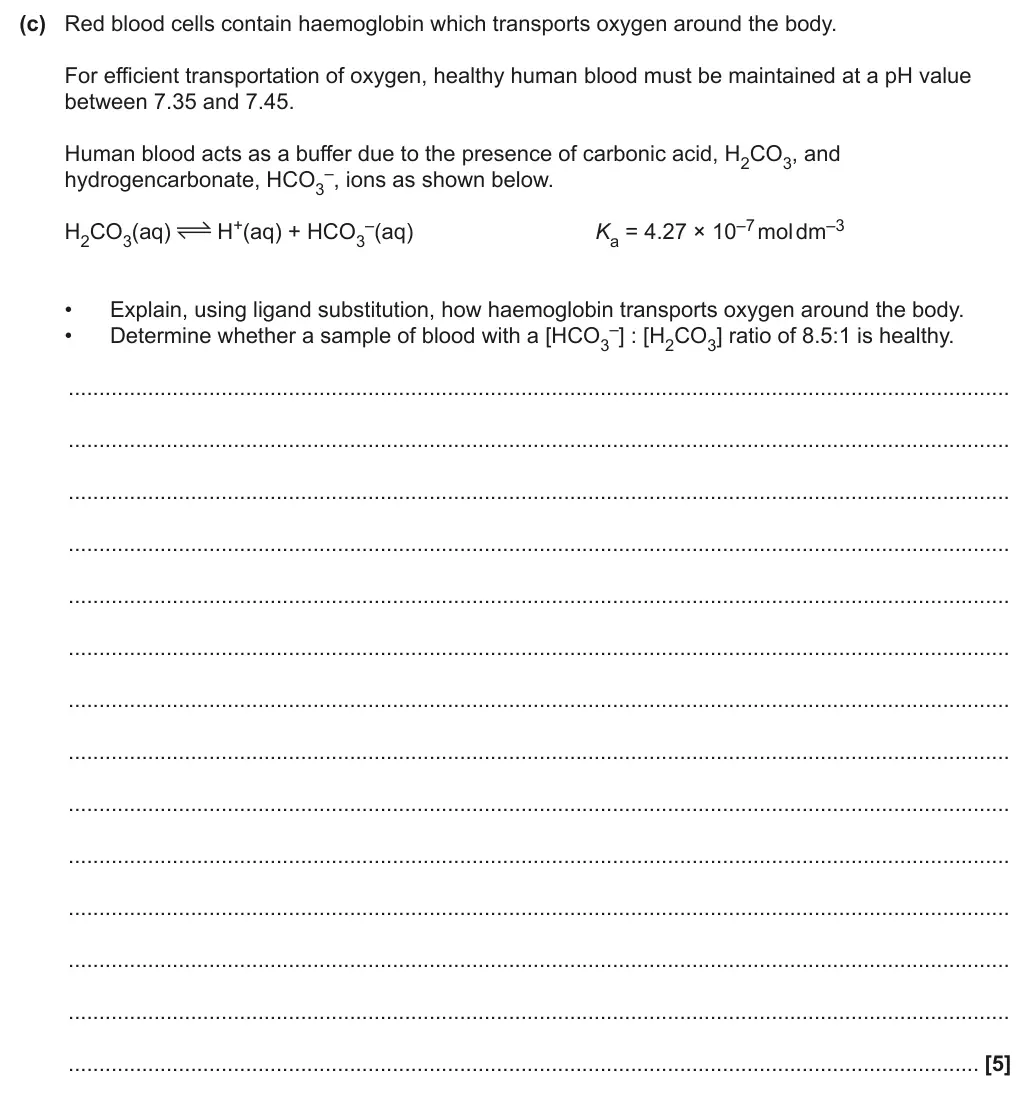
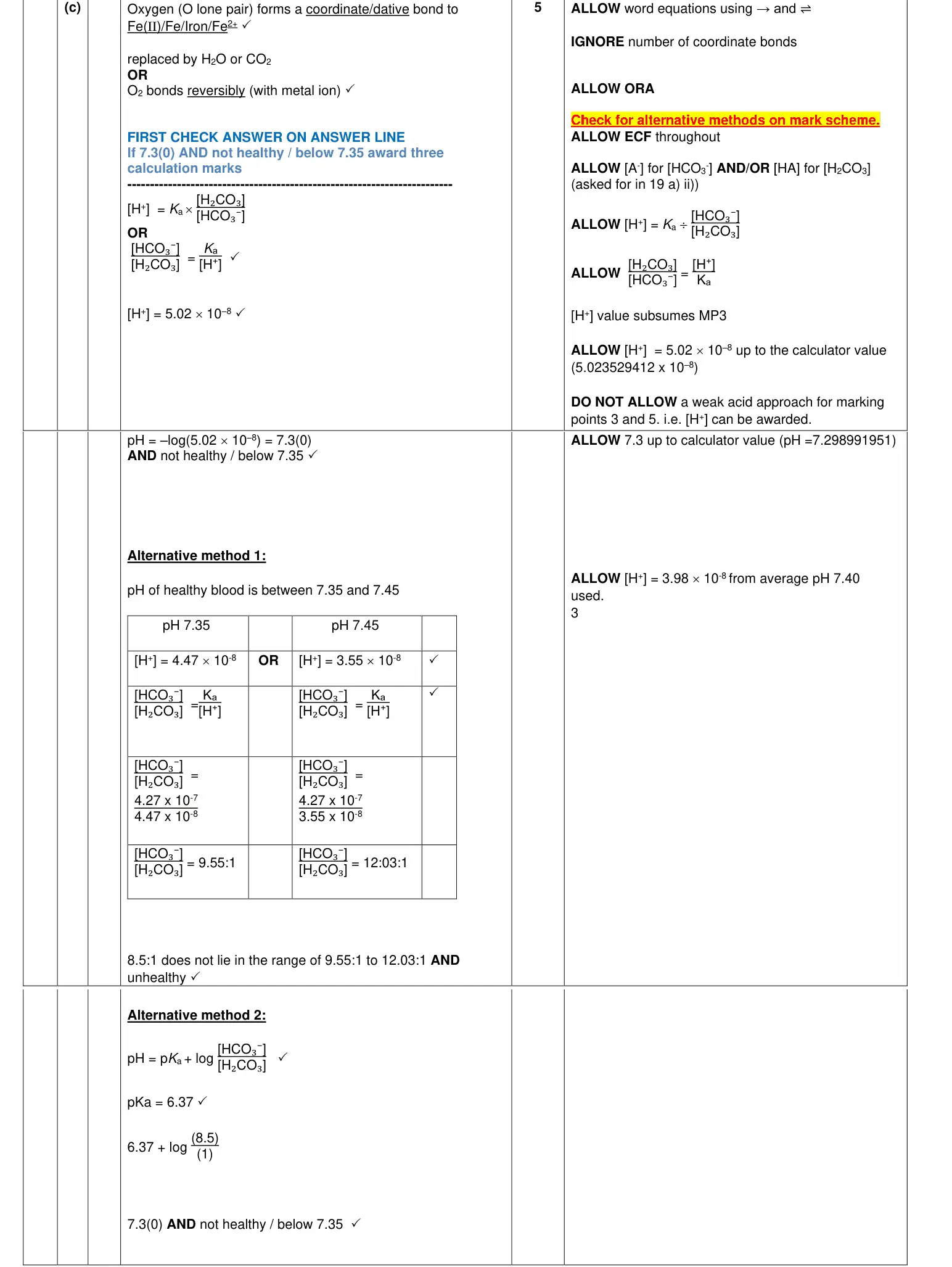
The key chemistry that candidates needed to discuss in their response was as follows: • O2 molecules forming coordinate bonds with and Fe2+ ions in haemoglobin. Often candidates omitted the Fe2+ and just stated it was to haemoglobin • O2 molecules being replaced by another ligand (e.g. H2O or CO2) The calculation using the [HCO3–] : [H2CO3] ratio of 8.5 : 1 was well described, although sometimes the final expression of the ratio left ambiguity as it was hard to tell whether the ratio given referred to the [HCO3–] : [H2CO3] ratio or the [H2CO3] : [HCO3–] ratio. ECF was given for the [H+] and then the pH linked to whether the blood was healthy. A smaller number of candidates approached the question by calculating the ratio of [HCO3–] : [H2CO3] for both pH 7.35 and pH 7.45 and then compared both ratios to the ratio of 8.5 : 1 for healthy blood. A few candidates attempted the calculation by the weak acid approach using [H+]2. In this case only the [H+] was given.
Notes from the mark scheme and report
O2 forms dative bond to Fe(II) reversibly, replaced by H2O/CO2
pH = pKa + log(8.5) = 7.30, below 7.35 so not healthy
Skills: M0.4 Use calculators to find and use power, exponential and logarithmic functions; M2.3 Substitute numerical values into algebraic equations using appropriate units for physical quantities; M2.5 Use logarithms in relation to quantities that range over several orders of magnitude
June 2024 · Paper 3 · Q1(a)2 marksCalculationMedium
Mark scheme
Examiner's comment
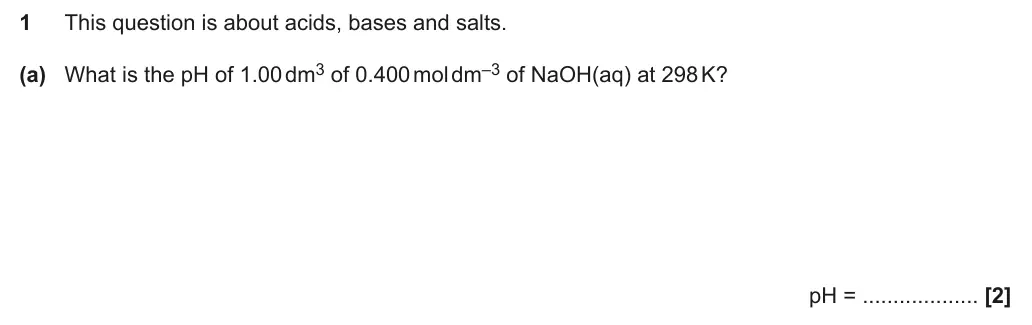
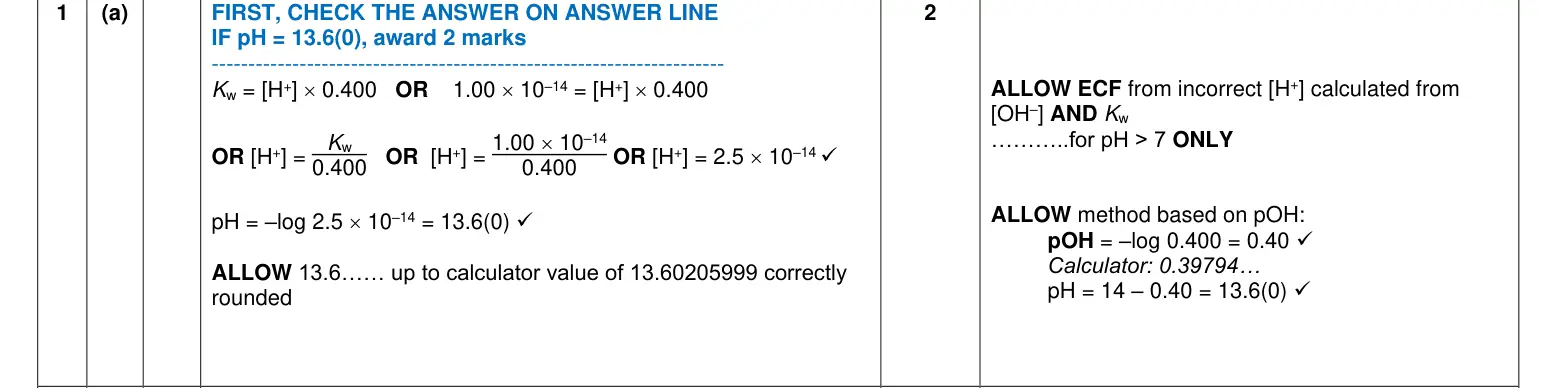
Questions 1 (a), 1 (b) and 1 (c) required candidates to calculate the pH of a base, a diluted strong acid and a buffer solution. These different types of pH calculation form the basis of acid-base chemistry, all requiring the relationship pH = –log[H+] at some stage. Most candidates showed competency in their pH calculations. A number of candidates often did not appreciate the type of pH calculation required. Question 1(a) was a standard pH calculation of a strong base and this was an easy start to the paper. Most candidates used Kw and the concentration of NaOH to determine the H+ concentration of 2.5 × 10– 14 mol dm–3, from which the pH of 13.60 can be calculated using pH = –log[H+]. Some candidates first determined pOH as 0.40, and the pH using 14.00 – 0.40. This approach is based on sound chemistry and is acceptable. Several candidates often calculated the pH as –log 0.4 = 0.4 and gave this as their answer. NaOH is a common alkali and cannot have a pH <7 and this should have triggered that the candidate had made an error.
Notes from the mark scheme and report
ALLOW pOH method
ECF only for pH > 7
Skills: M0.4 Use calculators to find and use power, exponential and logarithmic functions; M2.2 Change the subject of an equation; M2.5 Use logarithms in relation to quantities that range over several orders of magnitude
June 2024 · Paper 3 · Q1(b)1 markCalculationMedium
Mark scheme
Examiner's comment
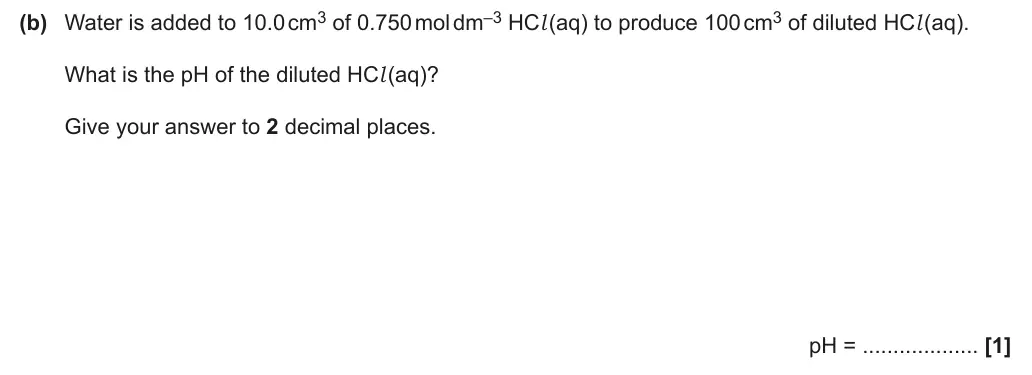
This question was answered well although nearly a half of candidates made errors. The initial solution had been diluted by 10 times and its concentration had been reduced from 0.750 to 0.0750 mol dm–3. From here pH = –log[H+] gives the correct answer of 1.12 to 2 decimal places, required by the question. Candidates found Question 1 (b) more difficult than 1 (a) or 1 (c). There seemed to be little pattern in candidate errors, the dilution being the difficult part of the question. Some did not dilute the initial concentration of 0.750 mol dm–3, giving 2.12. Others divided 0.750 by 2 instead of 10 or introduced 90 into the calculation as 90 cm3 of water would have been added. The most disappointing error was for a correct calculation to be displayed using the wrong number of decimal places. Two decimal places should be the norm for pH, reflecting the accuracy of most pH meters.
Notes from the mark scheme and report
dilution ×10 gives 0.0750 mol dm–3
2 decimal places required (1.12)
Skills: M0.2 Use ratios, fractions and percentages; M0.4 Use calculators to find and use power, exponential and logarithmic functions; M2.5 Use logarithms in relation to quantities that range over several orders of magnitude
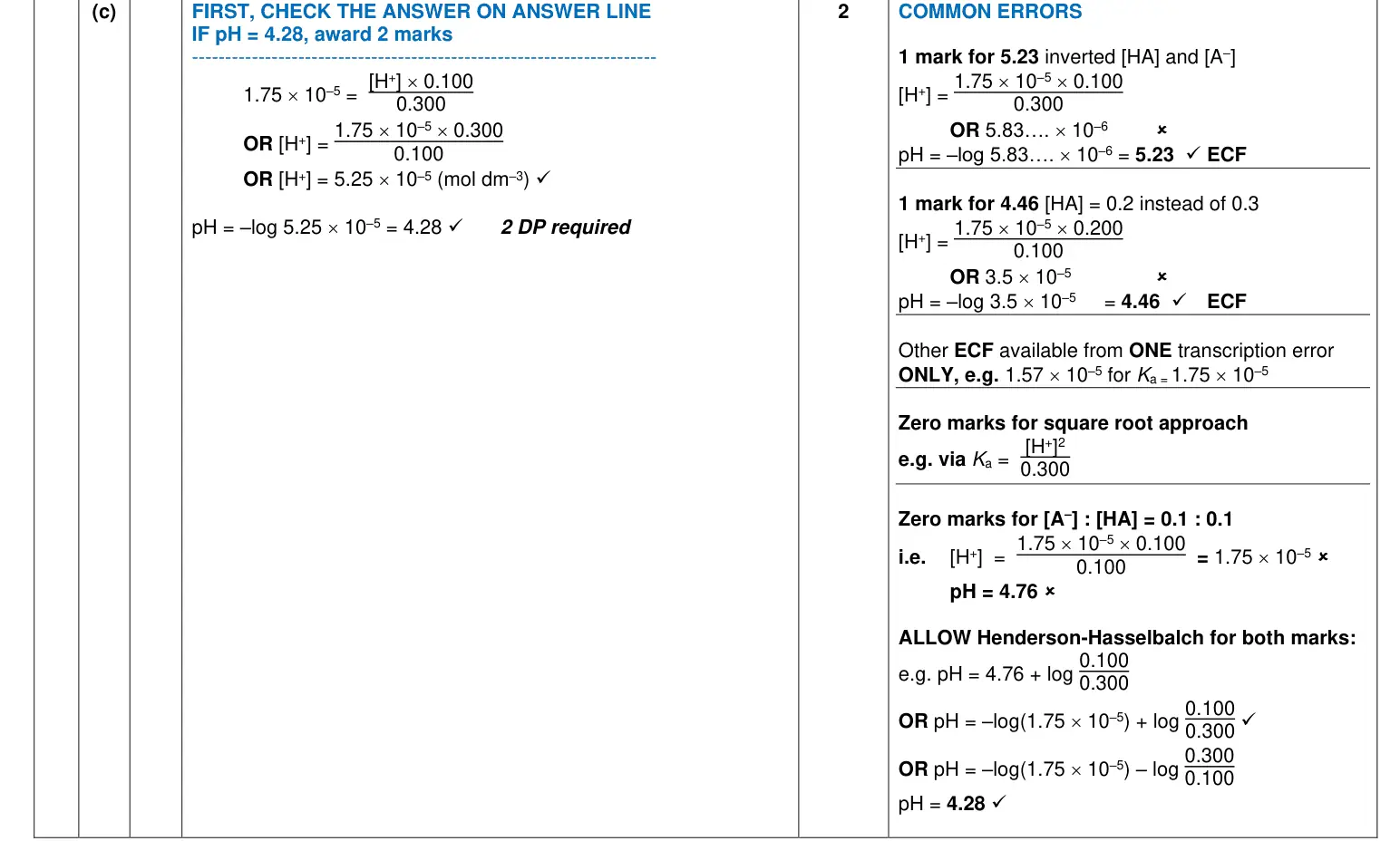
June 2024 · Paper 3 · Q1(c)2 marksCalculationMedium
Mark scheme
Examiner's comment
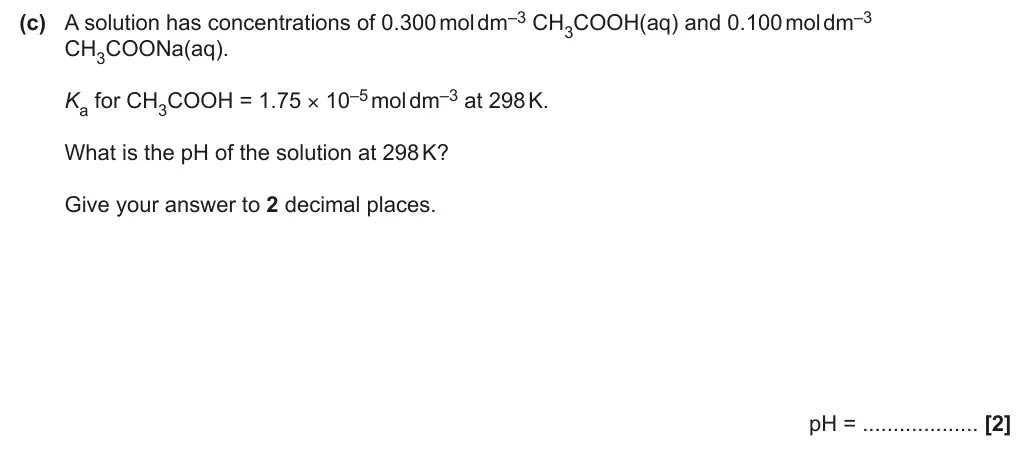
This question was a standard calculation for the pH of a buffer solution and most candidates correctly identified the mixture as being a buffer. Most candidates used the expression for Ka and the concentrations of the weak acid and its salt to determine the H+ concentration of 5.25 × 10⁻⁵ mol dm–3. From here, the pH of 4.28 can easily be calculated. A common error was for the concentrations of the weak acid and its salt to be substituted into the Ka expression the wrong way round, producing an answer of 5.23. As there was only one error, this answer was given 1 mark with error carried forward (ECF). A few candidates first subtracted 0.1 from 0.3, using concentration values of 0.2 and 0.1 instead of 0.3 and 0.1. This gave an answer of 4.46 which was also given 1 mark. The substantial number of less successful responses fell into the trap of using the pH method for calculating the pH of a weak acid rather than a buffer, squaring the H+ concentration. This was the wrong method to apply for a pH buffer calculation and was not given any marks.
Notes from the mark scheme and report
2 decimal places required
common errors: 5.23 from inverted [HA] and [A–] (1 mark)
zero marks for the square-root (weak acid) approach
ALLOW Henderson–Hasselbalch
Skills: M0.4 Use calculators to find and use power, exponential and logarithmic functions; M2.3 Substitute numerical values into algebraic equations using appropriate units for physical quantities; M2.5 Use logarithms in relation to quantities that range over several orders of magnitude
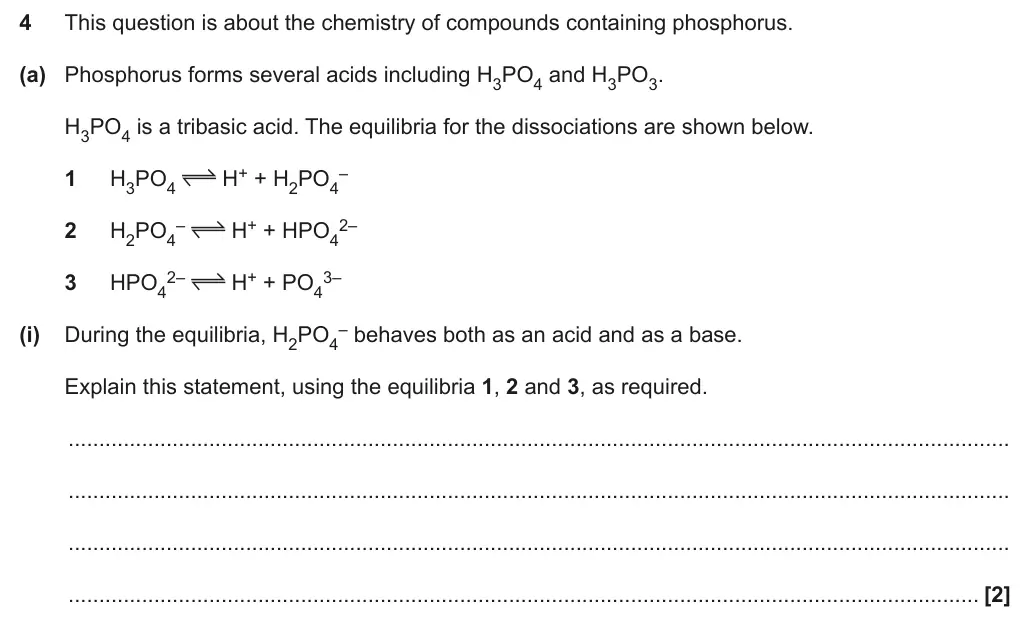
June 2024 · Paper 3 · Q4(a)(i)2 marksShort answerMedium
Mark scheme
Examiner's comment
Candidates were expected to link proton-transfer behaviour in acids and bases to the provided equilibria. The question differentiated between candidates well. Some candidates just stated that an acid is a proton donor and a base a proton acceptor without referring to the provided equilibria. This was the answer to a much simpler question and could not be given marks. The best responses demonstrated excellent understanding within the context of the equilibria. Such candidates clearly explained how H2PO4– behaves as an acid in the forward reaction of Equilibrium 2 and as a base in the reverse reaction of Equilibrium 1.
Notes from the mark scheme and report
equilibrium 1 (reverse): H2PO4– accepts a proton so acts as a base
equilibrium 2: donates a proton so acts as an acid
IGNORE references to HPO4 2– and equilibrium 3
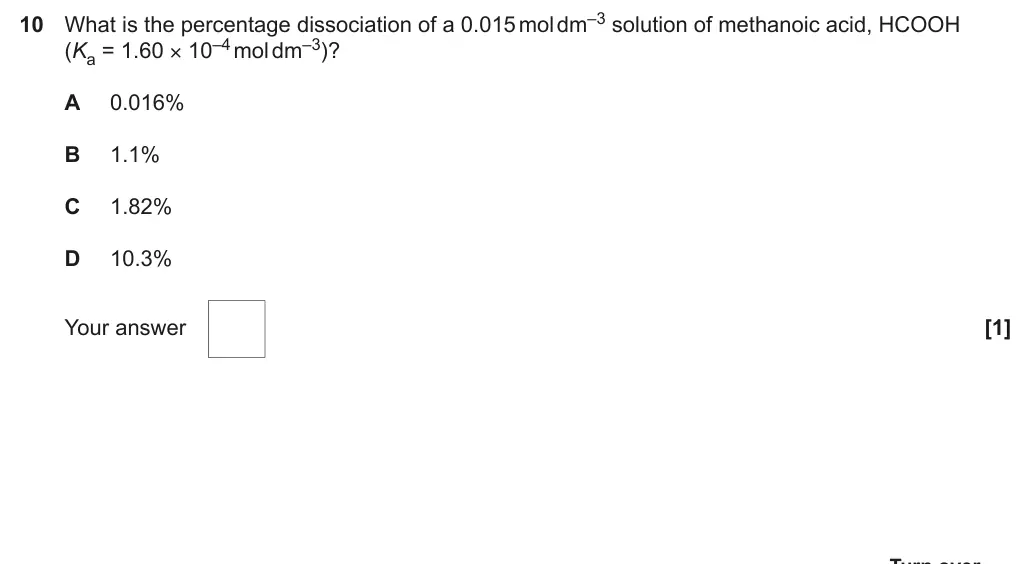
June 2023 · Paper 1 · Q101 markAO2Multiple choiceMedium
Answer
D
Mark scheme
Examiner's comment
The most successful candidates showed their workings for the correct answer of D.
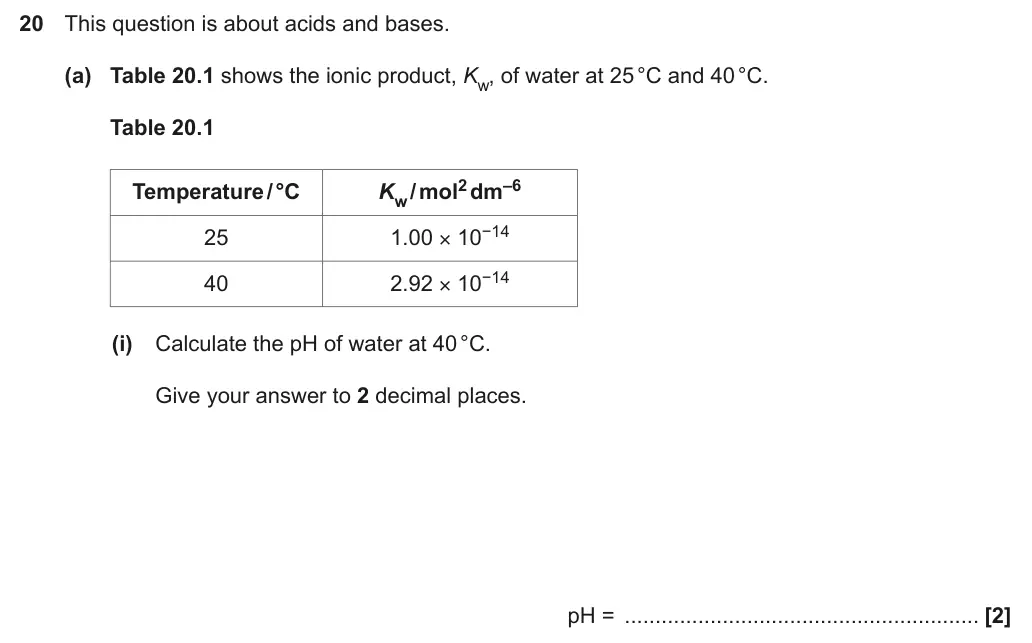
June 2023 · Paper 1 · Q20(a)(i)2 marksAO1, 2CalculationHard
Mark scheme
Examiner's comment
ocr.org.uk/science Oxford Cambridge and RSA CHEMISTRY A H432 For first teaching in 2015 A LEVEL Version 1 H432/01 Summer 2023 series Examiners’ report Contents Introduction .......................................................................................................................................... 4 Paper 1 series overview........................................................................................................................ 5 Section A overview ............................................................................................................................... 6 Question 1 .................................................................................................................................... 6 Question 2 ....................................................................................................................................... 6 Question 3 ....................................................................................................................................... 7 Question 4 ....................................................................................................................................... 7 Question 5 ....................................................................................................................................... 8 Question 6 ....................................................................................................................................... 8 Question 7 ....................................................................................................................................... 9 Question 8 ....................................................................................................................................... 9 Question 9 ..................................................................................................................................... 10 Question 10 ................................................................................................................................... 10 Question 11 ................................................................................................................................... 11 Question 12 ................................................................................................................................... 11 Question 13 ................................................................................................................................... 12 Question 14 ................................................................................................................................... 12 Question 15 ................................................................................................................................... 13 Section B overview ............................................................................................................................. 14 Question 16 (a) (i) ........................................................................................................................... 14 Question 16 (a) (ii) ......................................................................................................................... 15 Question 16 (b) .............................................................................................................................. 16 Question 17* .................................................................................................................................. 17 Question 18 (a) ............................................................................................................................... 18 Question 18 (b) .............................................................................................................................. 19 Question 18 (c) (i) .......................................................................................................................... 20 Question 18 (c) (ii) .......................................................................................................................... 21 Question 19 (a) (i) .......................................................................................................................... 23 Question 19 (a) (ii) ......................................................................................................................... 24 Question 19 (b) .............................................................................................................................. 24 Question 20 .................................................................................................................................... 25 Question 20 (a) (ii) ......................................................................................................................... 26 Question 20 (b) .............................................................................................................................. 26 Question 20 (c) (i) .......................................................................................................................... 27 Question 20 (c) (ii) .......................................................................................................................... 27 Question 20 (d) (i) .......................................................................................................................... 28 Question 20 (d) (ii) ......................................................................................................................... 28 Question 20 (e) (i) .......................................................................................................................... 29 Question 20 (e) (ii) ......................................................................................................................... 29 Question 20 (f) ............................................................................................................................... 30 Question 21 (a) (i) ........................................................................................................................... 31 Question 21 (a) (ii) ......................................................................................................................... 31 Question 21 (iii) .............................................................................................................................. 32 Question 21 (b) .............................................................................................................................. 33 Question 22 (a)* .............................................................................................................................. 34 Question 22 (b) (i) .......................................................................................................................... 36 Question 22 (b) (ii) ......................................................................................................................... 36 Question 22 (c) .............................................................................................................................. 37 Question 22 (d) .............................................................................................................................. 37 Introduction Our examiners’ reports are produced to offer constructive feedback on candidates’ performance in the examinations. Question 20 (a) (ii) This question proved difficult with only a few candidates able to state that in neutral water, [H+] = [OH-].
Notes from the mark scheme and report
pH = 6.77 (2 DP)
DO NOT ALLOW use of A– or X–
Skills: M0.4 Use calculators to find and use power, exponential and logarithmic functions; M2.3 Substitute numerical values into algebraic equations using appropriate units for physical quantities; M2.5 Use logarithms in relation to quantities that range over several orders of magnitude
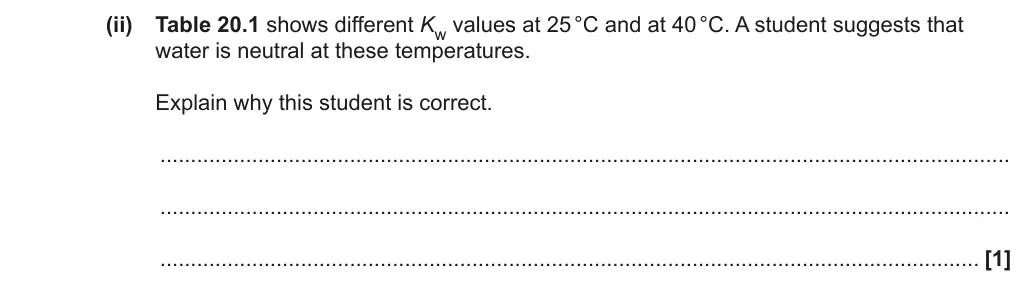
June 2023 · Paper 1 · Q20(a)(ii)1 markAO3Data interpretationHard
Earlier part of question 20 that this part uses
Mark scheme
Examiner's comment
This question proved difficult with only a few candidates able to state that in neutral water, [H+] = [OH-]. Many candidates said that as the pH is close to 7, water is therefore neutral.
Notes from the mark scheme and report
DO NOT ALLOW 'ratio [H+]:[OH–] doesn't change'
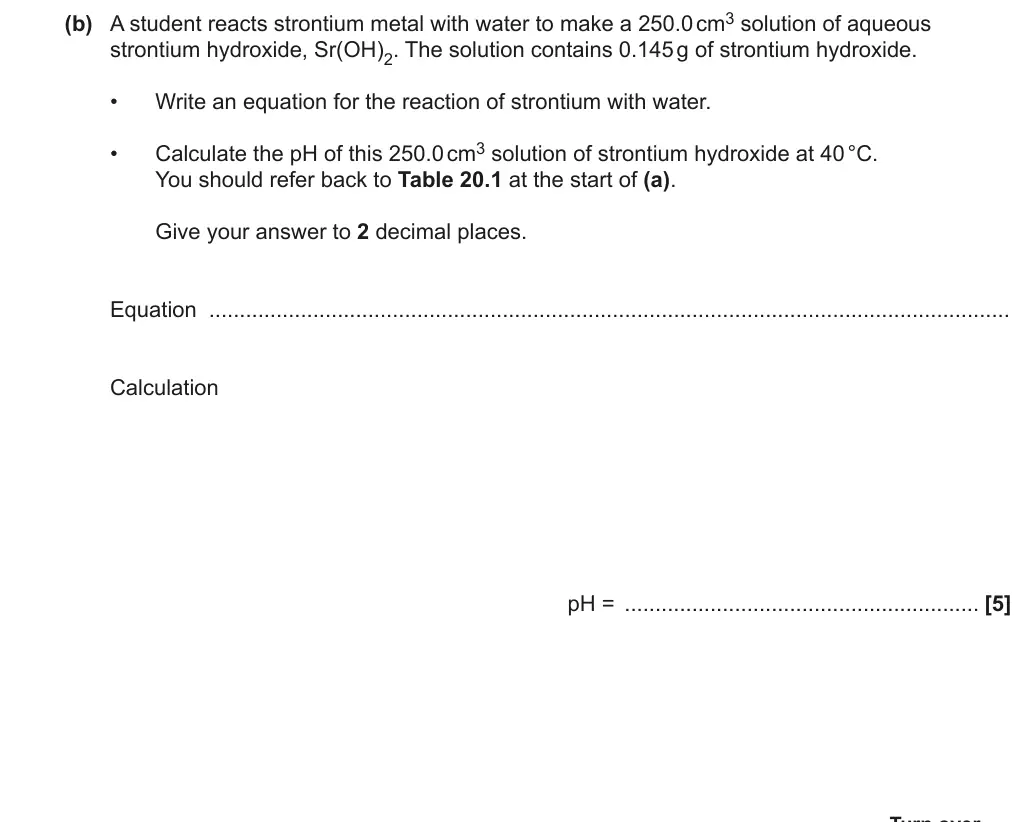
June 2023 · Paper 1 · Q20(b)5 marksAO1, 2CalculationMedium
Earlier part of question 20 that this part uses
Mark scheme
Examiner's comment
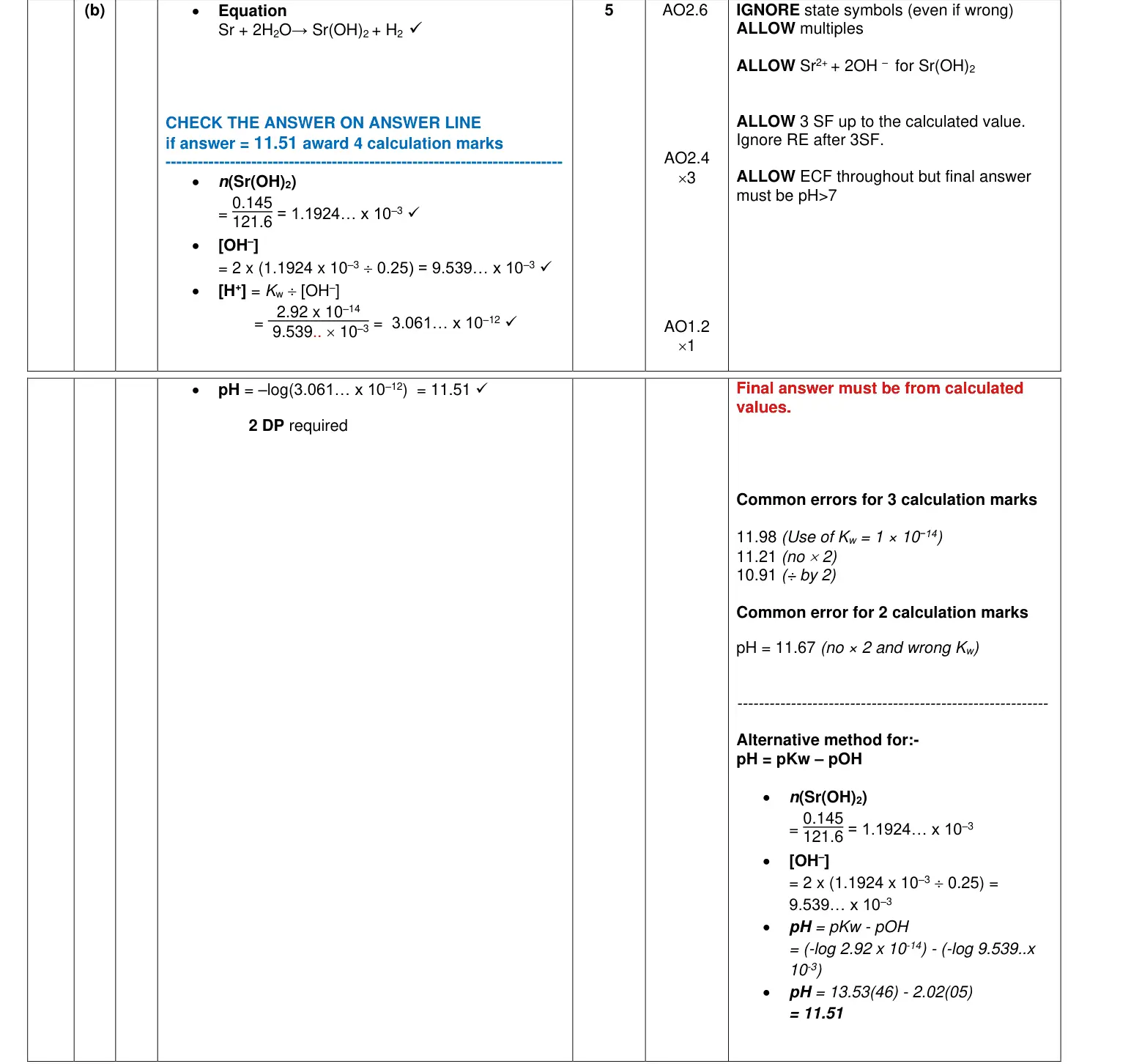
Most candidates wrote the correct equation. Common errors were using Sr2+ as reactant, not balancing the H2O and not having the H2 as second product. Most candidates calculated the moles of Sr(OH)2 correctly but fewer recognised that [OH-] = twice the [Sr(OH)2]. As a result, most candidates scored 3 calculation marks. A few candidates chose the incorrect Kw value.
Notes from the mark scheme and report
Sr + 2H2O → Sr(OH)2 + H2
Kw at 40 °C must be used
common errors for 3 calculation marks: 11.98 (Kw = 1 × 10–14), 11.21 (no × 2), 10.91 (÷2)
2 DP
Skills: M0.2 Use ratios, fractions and percentages; M0.4 Use calculators to find and use power, exponential and logarithmic functions; M2.3 Substitute numerical values into algebraic equations using appropriate units for physical quantities; M2.5 Use logarithms in relation to quantities that range over several orders of magnitude
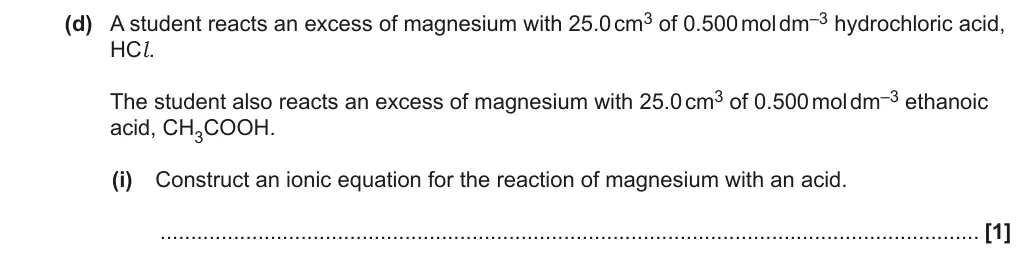
June 2023 · Paper 1 · Q20(d)(i)1 markAO2Equation writingHard
Mark scheme
Examiner's comment
Ionic equations still present candidates with a challenge. A few candidates scored the mark but many candidates gave a full equation or one that contained a mismatch of spectator ions as well as the correct ions.
Notes from the mark scheme and report
Mg + 2H+ → Mg2+ + H2
ALLOW multiples
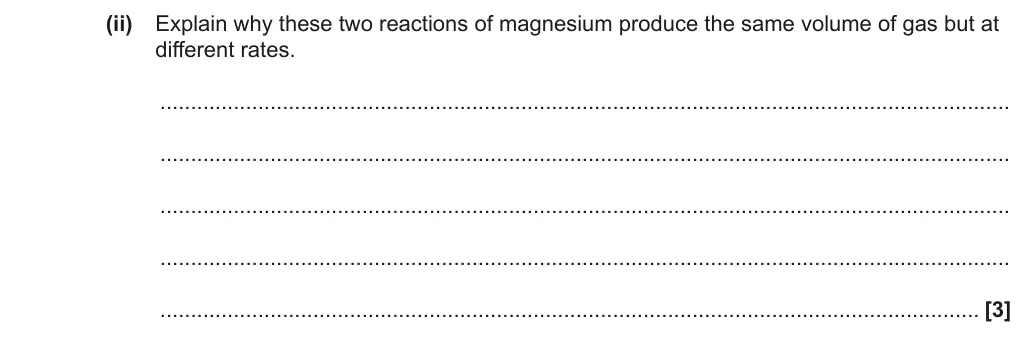
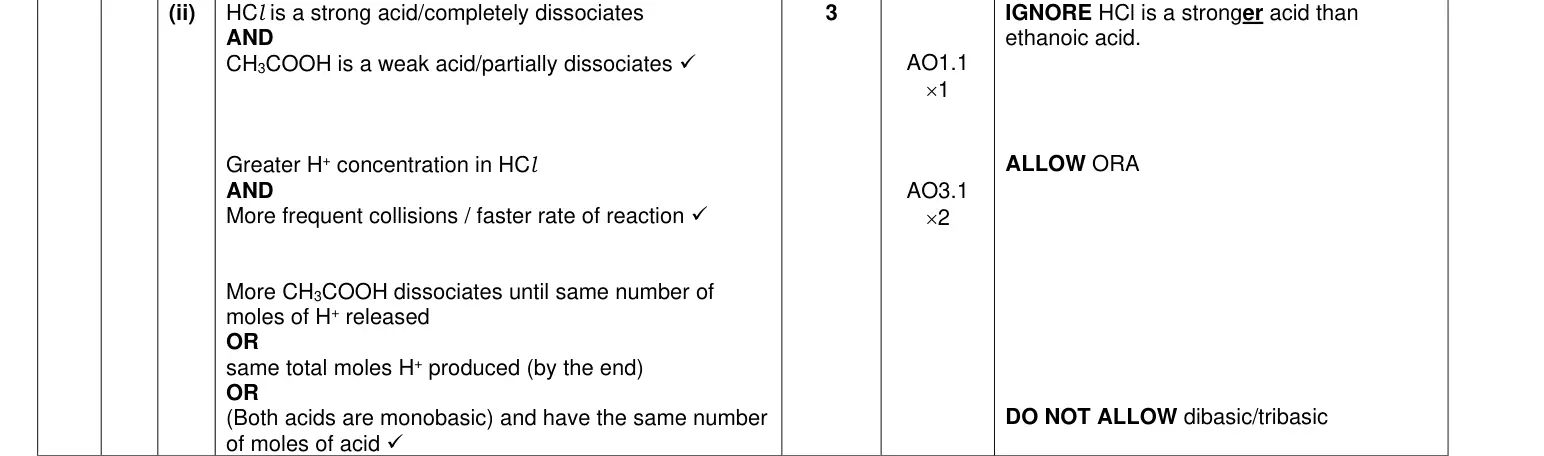
June 2023 · Paper 1 · Q20(d)(ii)3 marksAO1, 3Short answerHard
Earlier part of question 20 that this part uses
Mark scheme
Examiner's comment
This question proved challenging for the candidates to identify the three ideas: Those of comparing acids, comparing moles and comparing rates. Very few candidates were able to score the 3 marks. Most candidates recognised the different strength of the two acids, but some only used comparative language. Some linked the moles of acid used to the volume of gas produced but many simply restated the same volume and concentration which is given within the question. Only a few candidates linked the higher initial [H+] in HCl to the increased rate through more frequent collisions. A common issue was describing the rate of dissociation rather than the [H+] present in determining the rate of the reactions or mentioning that it dissociates more but not linking this to the H+ concentration.
Notes from the mark scheme and report
HCl completely dissociates AND CH3COOH partially
greater [H+] in HCl so more frequent collisions
same total moles of H+ released as CH3COOH continues to dissociate
IGNORE 'HCl is a stronger acid'
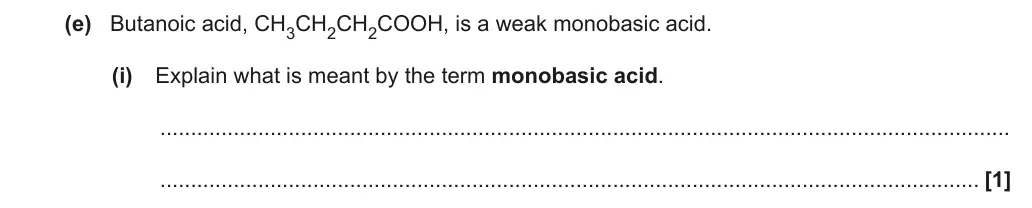
June 2023 · Paper 1 · Q20(e)(i)1 markAO1Short answerHard
Mark scheme
Examiner's comment
Very few candidates wrote the complete definition of a monobasic acid. Most wrote “donates one proton” only, omitting mole or molecule. Some candidates described donating electrons or OH-.
Notes from the mark scheme and report
one mole of acid donates one mole of H+ (or one H+ per molecule)
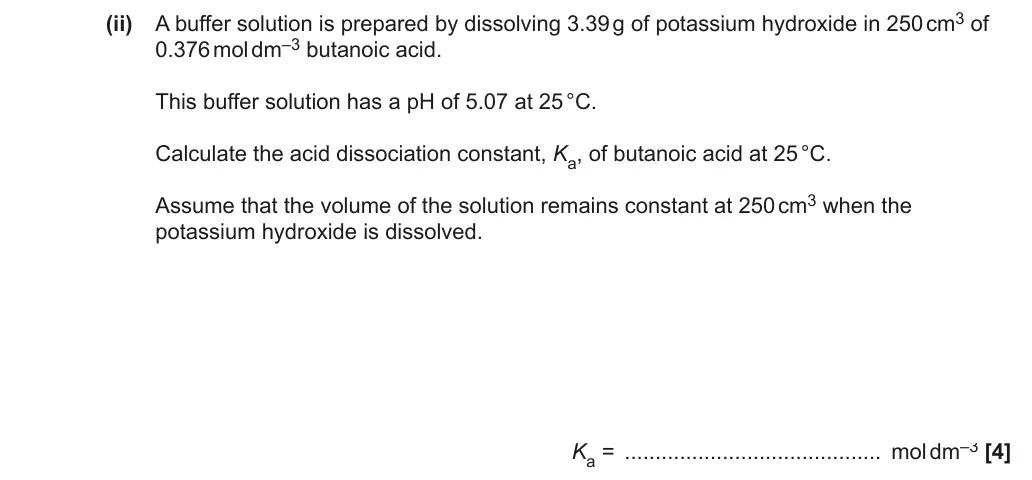
June 2023 · Paper 1 · Q20(e)(ii)4 marksAO1, 2CalculationHard
Earlier part of question 20 that this part uses
Mark scheme
Examiner's comment
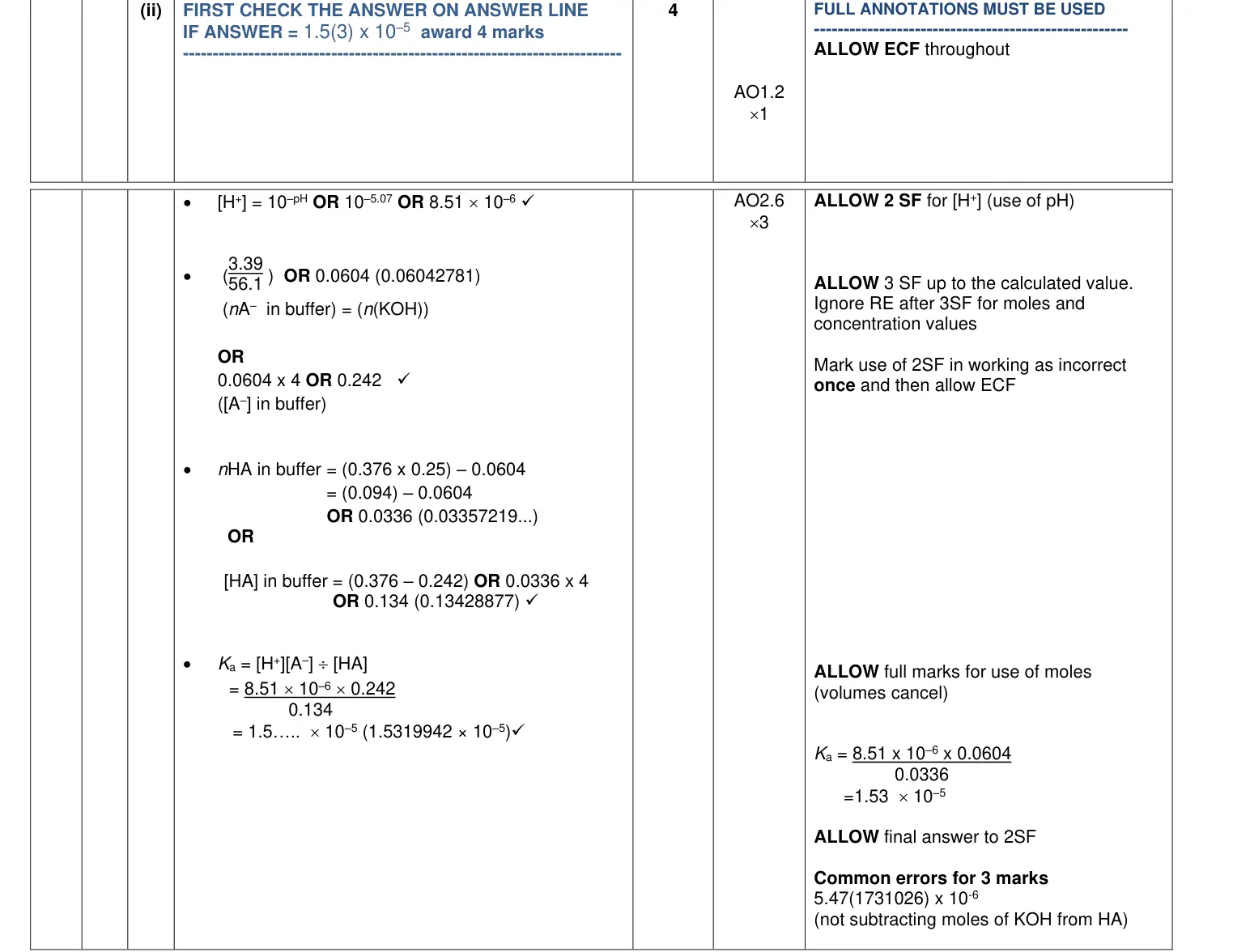
This calculation proved difficult with many figures and sums appearing with little indication as to their relevance. Candidates should remember to provide written indications of what it is they’re working out – presenting the calculations without any annotations can make it harder for error carried forward marks to be given if there is an error in their calculation. Few candidates scored all 4 marks. Most found the concentration of H+ from the pH and the moles of KOH correctly but did not recognise they had to take away the moles of KOH from those of HA to find the remaining concentration of HA. Some candidates then used the [H+] as the [HA]. A few candidates tried a [H+] squared expression of a weak acid. The candidate has clearly set out the calculation so each numerical value can be linked and the steps understood. The only error is not calculating the excess acid (i.e. not subtracting moles OH- from initial moles acid) so 3 marks were given.
Notes from the mark scheme and report
n(A–) = n(KOH) = 0.0604
n(HA) remaining = 0.094 – 0.0604
Ka = [H+][A–]/[HA] = 1.53 × 10⁻⁵
common error 5.47 × 10⁻⁶ (KOH not subtracted from HA) scores 3
Skills: M0.4 Use calculators to find and use power, exponential and logarithmic functions; M2.2 Change the subject of an equation; M2.3 Substitute numerical values into algebraic equations using appropriate units for physical quantities; M2.5 Use logarithms in relation to quantities that range over several orders of magnitude
June 2023 · Paper 1 · Q20(f)1 markAO3Short answerHard
Mark scheme
Examiner's comment
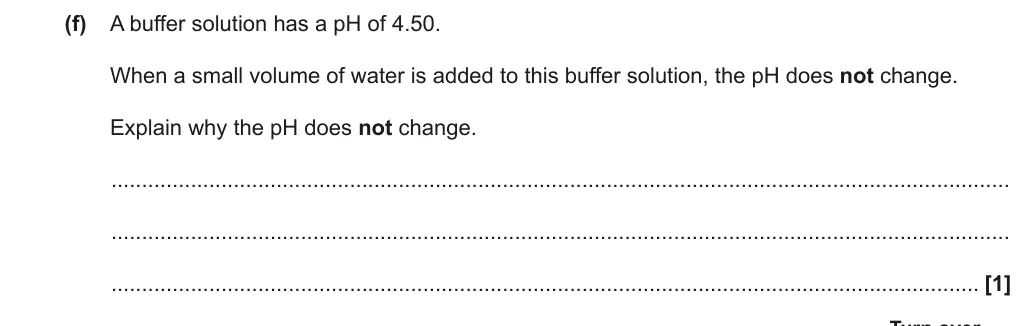
ocr.org.uk/science Oxford Cambridge and RSA CHEMISTRY A H432 For first teaching in 2015 A LEVEL Version 1 H432/01 Summer 2023 series Examiners’ report Contents Introduction .......................................................................................................................................... 4 Paper 1 series overview........................................................................................................................ 5 Section A overview ............................................................................................................................... 6 Question 1 .................................................................................................................................... 6 Question 2 ....................................................................................................................................... 6 Question 3 ....................................................................................................................................... 7 Question 4 ....................................................................................................................................... 7 Question 5 ....................................................................................................................................... 8 Question 6 ....................................................................................................................................... 8 Question 7 ....................................................................................................................................... 9 Question 8 ....................................................................................................................................... 9 Question 9 ..................................................................................................................................... 10 Question 10 ................................................................................................................................... 10 Question 11 ................................................................................................................................... 11 Question 12 ................................................................................................................................... 11 Question 13 ................................................................................................................................... 12 Question 14 ................................................................................................................................... 12 Question 15 ................................................................................................................................... 13 Section B overview ............................................................................................................................. 14 Question 16 (a) (i) ........................................................................................................................... 14 Question 16 (a) (ii) ......................................................................................................................... 15 Question 16 (b) .............................................................................................................................. 16 Question 17* .................................................................................................................................. 17 Question 18 (a) ............................................................................................................................... 18 Question 18 (b) .............................................................................................................................. 19 Question 18 (c) (i) .......................................................................................................................... 20 Question 18 (c) (ii) .......................................................................................................................... 21 Question 19 (a) (i) .......................................................................................................................... 23 Question 19 (a) (ii) ......................................................................................................................... 24 Question 19 (b) .............................................................................................................................. 24 Question 20 .................................................................................................................................... 25 Question 20 (a) (ii) ......................................................................................................................... 26 Question 20 (b) .............................................................................................................................. 26 Question 20 (c) (i) .......................................................................................................................... 27 Question 20 (c) (ii) .......................................................................................................................... 27 Question 20 (d) (i) .......................................................................................................................... 28 Question 20 (d) (ii) ......................................................................................................................... 28 Question 20 (e) (i) .......................................................................................................................... 29 Question 20 (e) (ii) ......................................................................................................................... 29 Question 20 (f) ............................................................................................................................... 30 Question 21 (a) (i) ........................................................................................................................... 31 Question 21 (a) (ii) ......................................................................................................................... 31 Question 21 (iii) .............................................................................................................................. 32 Question 21 (b) .............................................................................................................................. 33 Question 22 (a)* .............................................................................................................................. 34 Question 22 (b) (i) .......................................................................................................................... 36 Question 22 (b) (ii) ......................................................................................................................... 36 Question 22 (c) .............................................................................................................................. 37 Question 22 (d) .............................................................................................................................. 37 Introduction Our examiners’ reports are produced to offer constructive feedback on candidates’ performance in the examinations. Candidates who did well on this paper generally: Candidates who did less well on this paper generally: • produced clearly structured working for calculations – Questions 18 (a),18 (b), 19 (a) (i),19 (b), 20 (b), 20 (e) (ii) and 21 (c) • applied equations to a graphical representation Question 18 (c) (ii)) • produced clear and concise responses for the two Level of Response Questions 17 (a) and 22 (a) • produced clear and concise responses to descriptions in trends of ionisation energy Question 16 (b) • were able to make and justify predictions based on their knowledge Questions 20 (c), (d) • explained equilibrium changes Question 19 (a) (ii) • gave answers to the correct number of significant figures Questions 19 (a) (i), 20 (a) (i) and 20 (b) • converted between units when required Questions 18 (c) (ii) and 19 (b) • correctly explained experimental procedures using electrode potentials Question 21 (b) • wrote a balanced equation for unfamiliar compound Question 22 (d) • understood the effect of addition of chemical substances on the pH of a buffer solution Question 20 (f). • found it difficult to apply what they had learned to unfamiliar situations • produced unstructured responses to Level of Response questions which were lacking in depth or explanation or contained inaccurate definitions Questions 17 (a) and 22 (a) • did not clearly set out calculations, making it difficult for marks to be given for working Questions 18 (a),18 (b), 19 (a) (i), 19 (b), 20 (b), 20 (e) (ii) and 21 (c) • did not give answers to calculations to the specified number of significant figures Questions 19 (a) (i), 20 (a) (i) and 20 (b) • either did not realise the need to convert between units for some calculations or found this difficult Questions 18 (c) (ii) and 19 (b) • did not produced clear and concise responses to descriptions in trends of ionisation energy Question 16 (b) • did not write a balanced equation, and ionic equations, for reactions with group 2 metal and metal compounds Questions 20 (b), 20 (c) (i) and 20 (d). Question 20 (f) Misconception Only the most successful candidates linked the pH not changing to the ratio of [HA] and [A-] not changing on addition of water.
Notes from the mark scheme and report
ratio [HA]/[A–] stays the same on dilution
Only the most successful candidates linked the pH not changing to the ratio of [HA] and [A-] not changing on addition of water. The majority of candidates described the buffer being able to minimise pH change on addition of small amounts of acid or base or that water being neutral would not affect the pH.
June 2023 · Paper 3 · Q2(b)3 marksAO3CalculationHard
Mark scheme
Examiner's comment
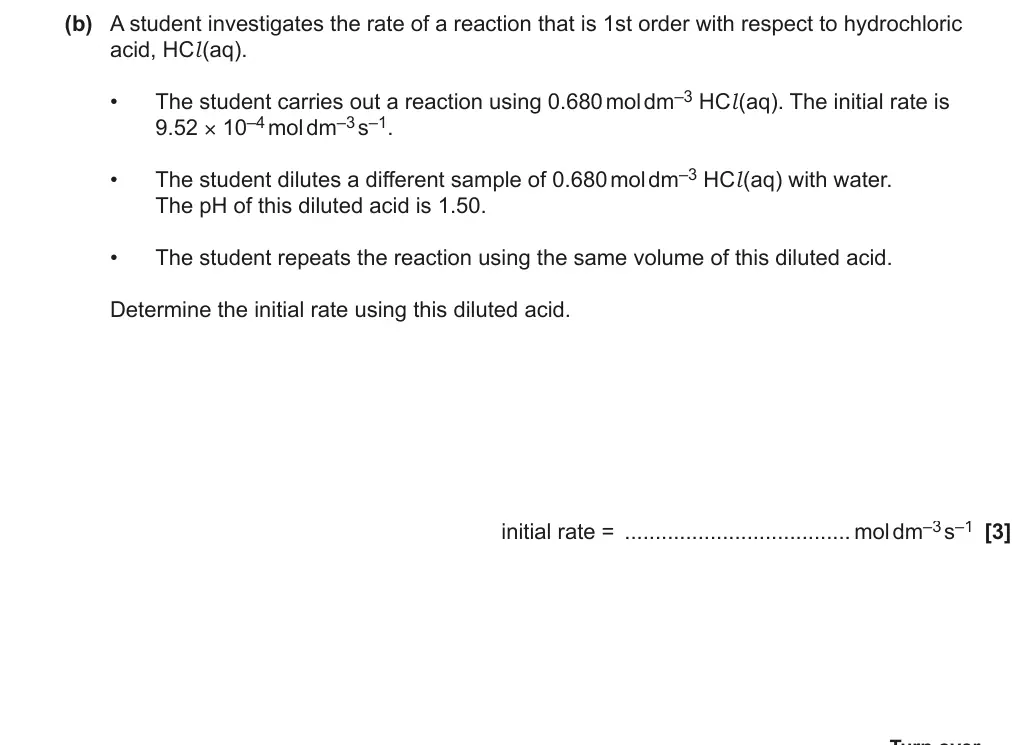
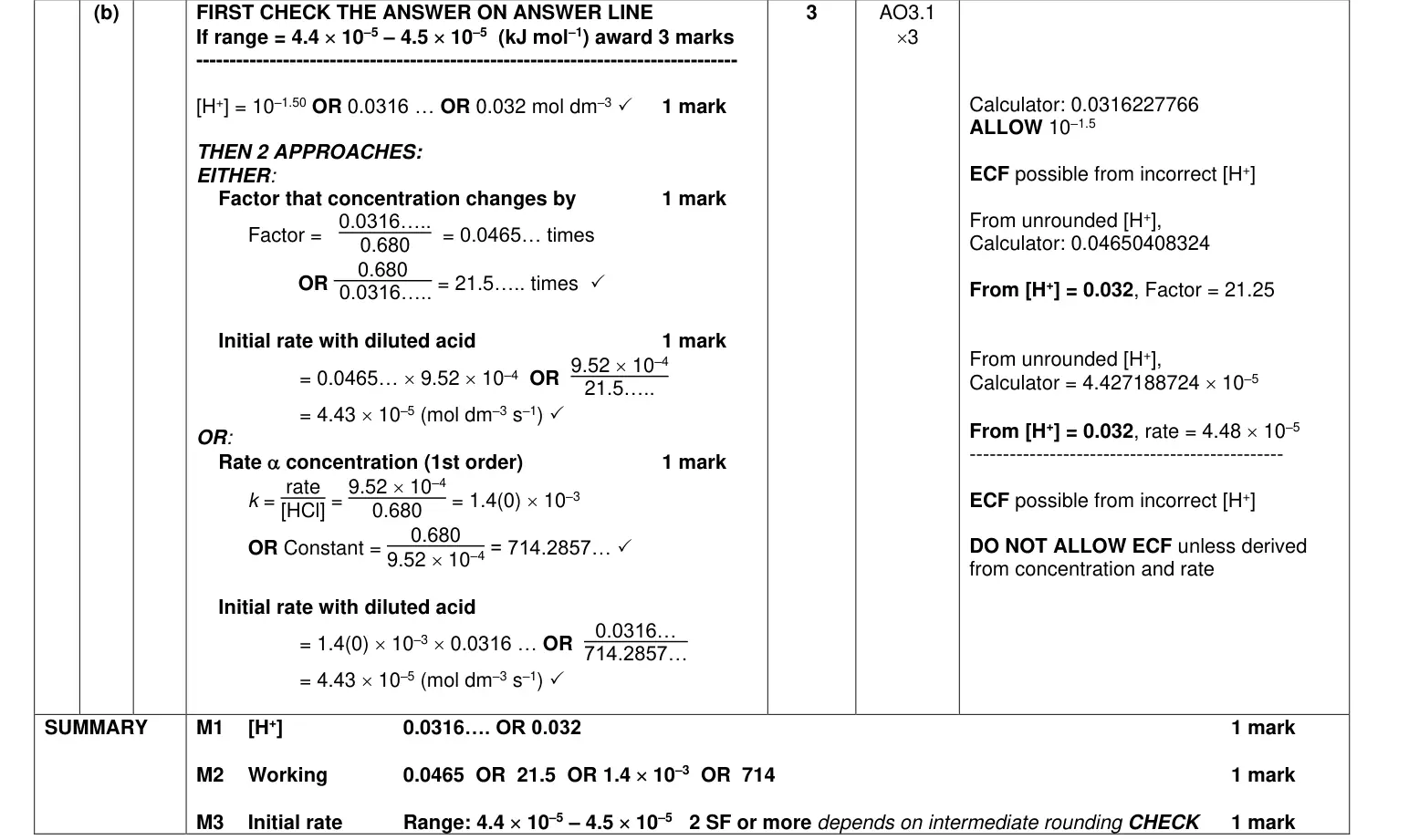
The marks for this calculation were much more polarised than the calculation in Question 2 (a). Many candidates worked through the problem methodically to get an answer for the initial rate between 4.4 10–5 and 4.5 10–5 mol dm–3 s–1. A substantial number of candidates worked out [H+] using 10–pH for 1 mark but were then unable to progress any further. This was a novel calculation, requiring candidates to develop their own strategy for its solution. Candidates who found this question difficult often attempted a solution based on stock weak acid calculation, using [H+]2/[HA].
Notes from the mark scheme and report
factor 0.0316/0.680 or k = rate/[HCl] = 1.40 × 10⁻³
rate 4.4–4.5 × 10⁻⁵
ECF only if derived from concentration and rate
Skills: M0.2 Use ratios, fractions and percentages; M0.4 Use calculators to find and use power, exponential and logarithmic functions; M2.5 Use logarithms in relation to quantities that range over several orders of magnitude
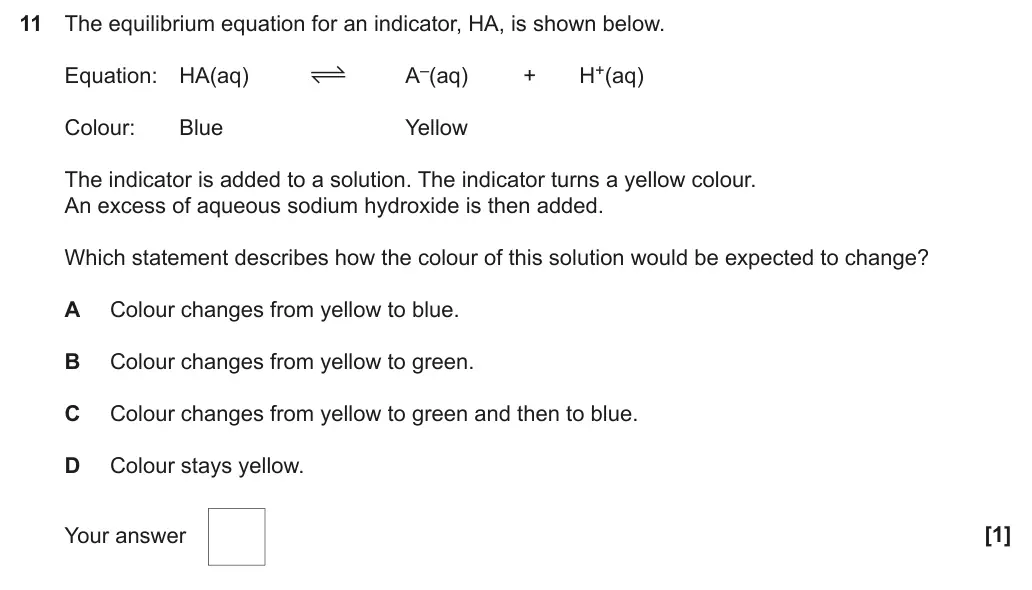
June 2022 · Paper 1 · Q111 markAO2Multiple choiceEasy
Answer
D
Mark scheme
Examiner's comment
This was well answered, with many candidates understanding that the addition of an alkali will react with the H+ ions and will keep the position of equilibrium on the right hand side.
Notes from the mark scheme and report
already yellow (A– form) so adding OH– causes no change
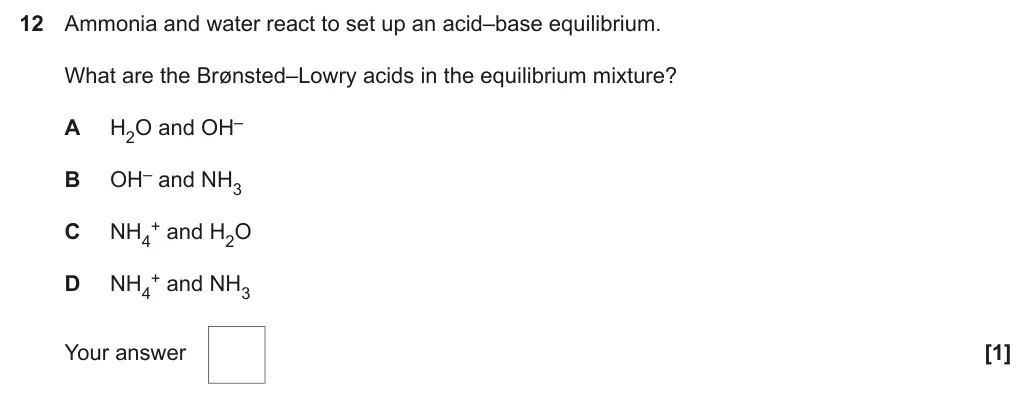
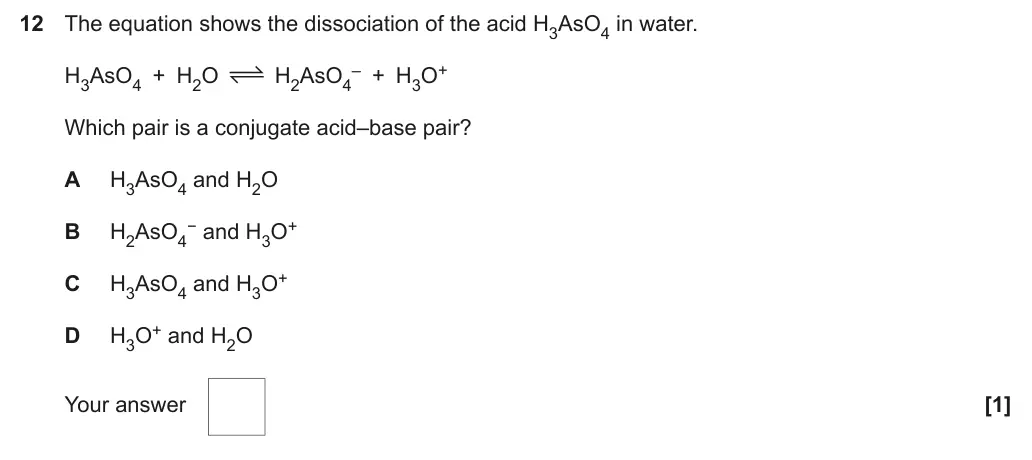
June 2022 · Paper 1 · Q121 markAO1Multiple choiceEasy
Answer
C
Mark scheme
Examiner's comment
This was generally well answered. The key to candidates arriving at the correct answer ,C, was to write out the equation for ammonia reacting with water. The correct identification of the acids can then be made. Option B was chosen as the candidate identified the B-L bases and option D was chosen by candidates who linked up a B-L acid – base pair.
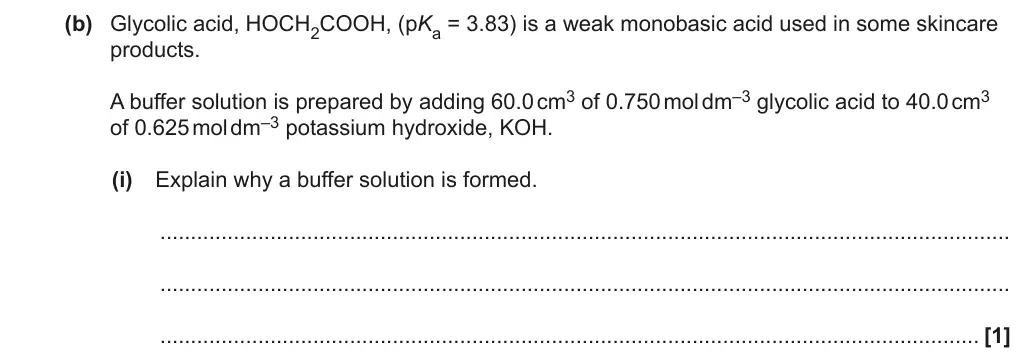
June 2022 · Paper 1 · Q19(b)(i)1 markAO1Short answerHard
Mark scheme
Examiner's comment
Many candidates did not answer the question and instead described what a buffer was. Very few candidates correctly explained that a weak acid was being added to a base, sometimes mentioning the formation of the salt or conjugate base. The majority also did not include the importance of there being excess acid, or some acid remaining, after the partial neutralisation.
Notes from the mark scheme and report
acid in excess/partially neutralised AND glycolate ions (conjugate base/salt) formed
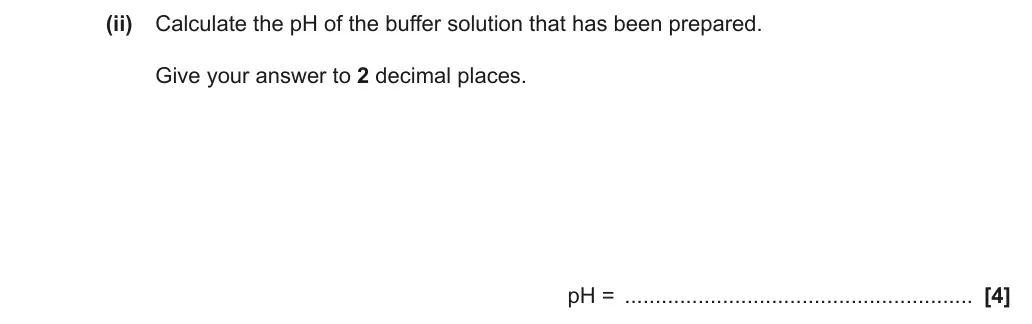
June 2022 · Paper 1 · Q19(b)(ii)4 marksAO1, 2CalculationEasy
Earlier part of question 19 that this part uses
Mark scheme
Examiner's comment
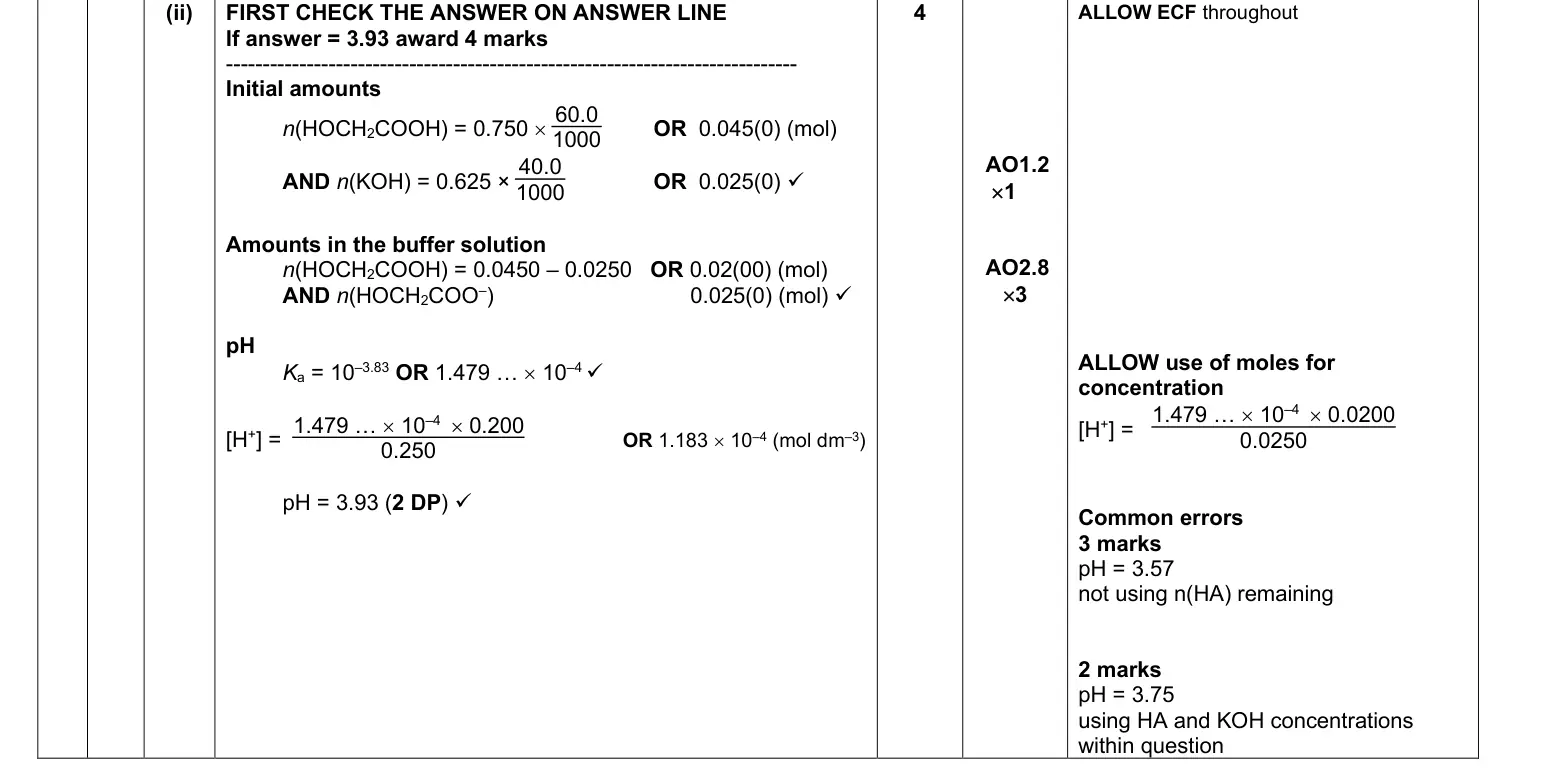
Most candidates were able to derive a value for Ka from pKa and calculate the number of moles of glycolic acid and potassium hydroxide reacting. Less were successful in determining the moles or concentrations present in the buffer solution causing many to get the common error of 3.57. Many candidates tried to calculate pH for the weak acid, without considering changes to concentrations or the buffering effect. Clarity of working is essential and in questions such as this, candidates are advised to include word descriptions of what they are calculating, even if it is abbreviations such as ‘n’ for number of moles.
Notes from the mark scheme and report
n(HA) left = 0.0450 – 0.0250 = 0.0200
n(A–) = 0.0250
Ka = 10^–3.83
pH = 3.93 (2 d.p.)
common errors 3.57 (HA not reduced) scores 3, 3.75 (concentrations from question) scores 2
Skills: M0.4 Use calculators to find and use power, exponential and logarithmic functions; M2.3 Substitute numerical values into algebraic equations using appropriate units for physical quantities; M2.5 Use logarithms in relation to quantities that range over several orders of magnitude
June 2022 · Paper 1 · Q19(b)(iii)2 marksAO1Short answerMedium
Earlier part of question 19 that this part uses
Mark scheme
Examiner's comment
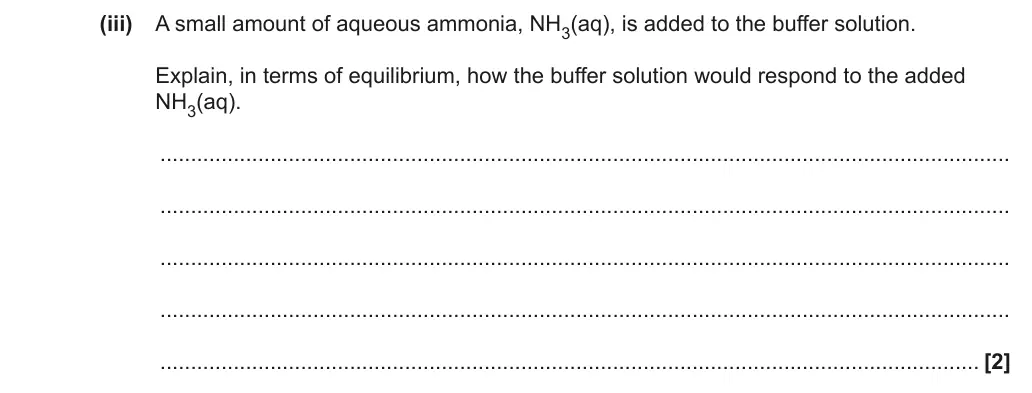
Most candidates correctly described the ammonia reacting with the glycolic acid or with hydrogen ions, although some thought that ammonia was acidic. Many of them then went on to say that “the equilibrium will move to the right” without realising that the equilibrium had not itself appeared within the question, and so they needed to write it out to gain marks. A few candidates thought that ammonia was an acid, due to the 3 x Hs in the molecule.
Notes from the mark scheme and report
NH3/OH– reacts with H+ (or the acid HA)
equilibrium equation HA ⇌ H+ + A– must be shown AND shifts right
June 2022 · Paper 1 · Q21(b)(i)5 marksAO2CalculationMedium
Mark scheme
Examiner's comment
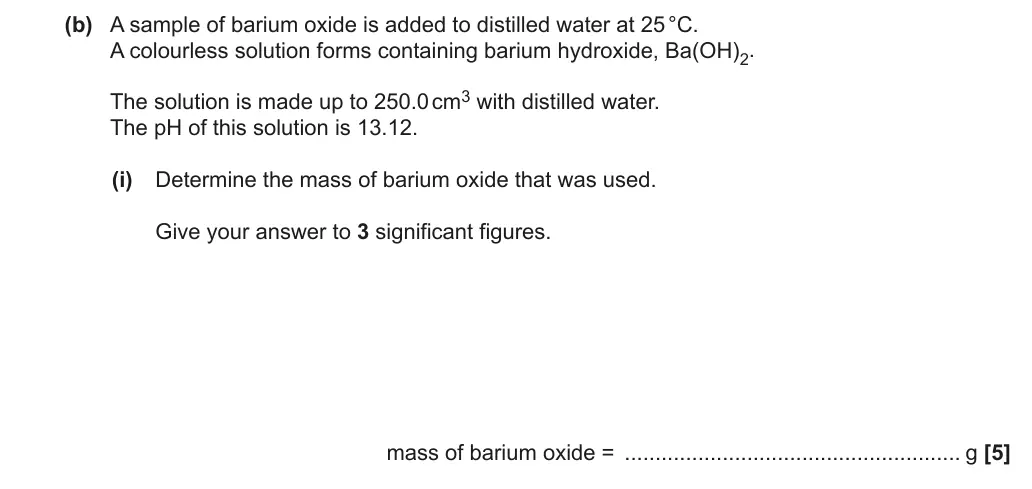
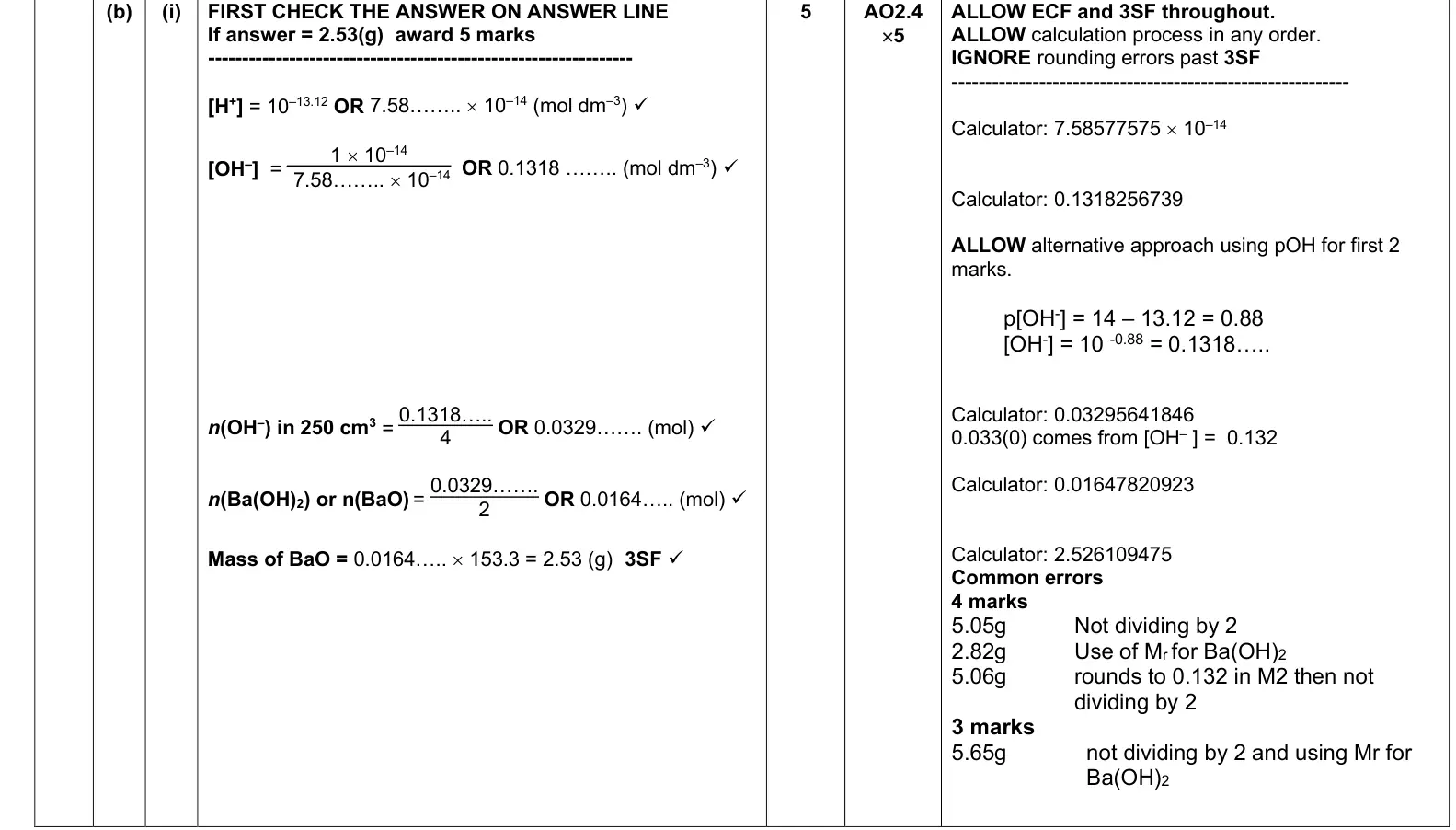
Although few candidates got the correct final answer, however almost all achieved some marks from this calculation through error carried forward, with marks spread across the available range. Almost all candidates were able to find the concentrations of hydrogen and hence hydroxide ions. A few candidates successfully used p[OH-] method. Most were able to calculate the moles of hydroxide ions in 250cm3. Many then did not realise the need to half this number to find the moles of barium, and/or used the Mr for barium hydroxide instead of barium oxide.
Notes from the mark scheme and report
÷4 for 250 cm3
÷2 for Ba(OH)2
× 153.3 (BaO) = 2.53 g
common errors 5.05 (no ÷2) and 2.82 (Mr of Ba(OH)2) score 4, 5.65 scores 3
Skills: M0.2 Use ratios, fractions and percentages; M0.4 Use calculators to find and use power, exponential and logarithmic functions; M1.1 Use an appropriate number of significant figures; M2.5 Use logarithms in relation to quantities that range over several orders of magnitude
June 2022 · Paper 3 · Q6(c)(i)2 marksAO3MechanismHard
Earlier part of question 6 that this part uses
Mark scheme
Examiner's comment
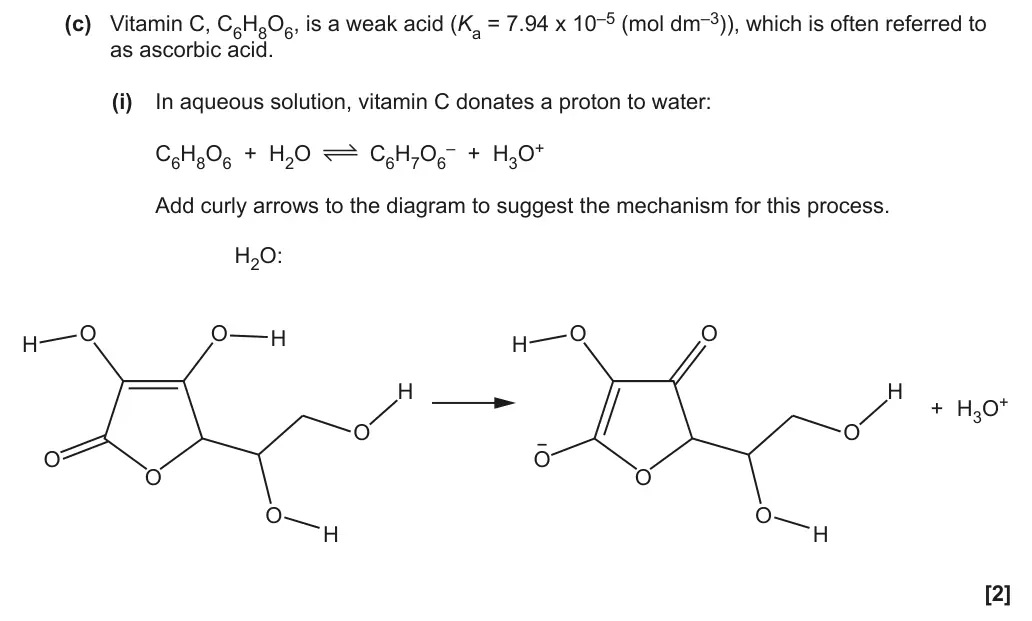
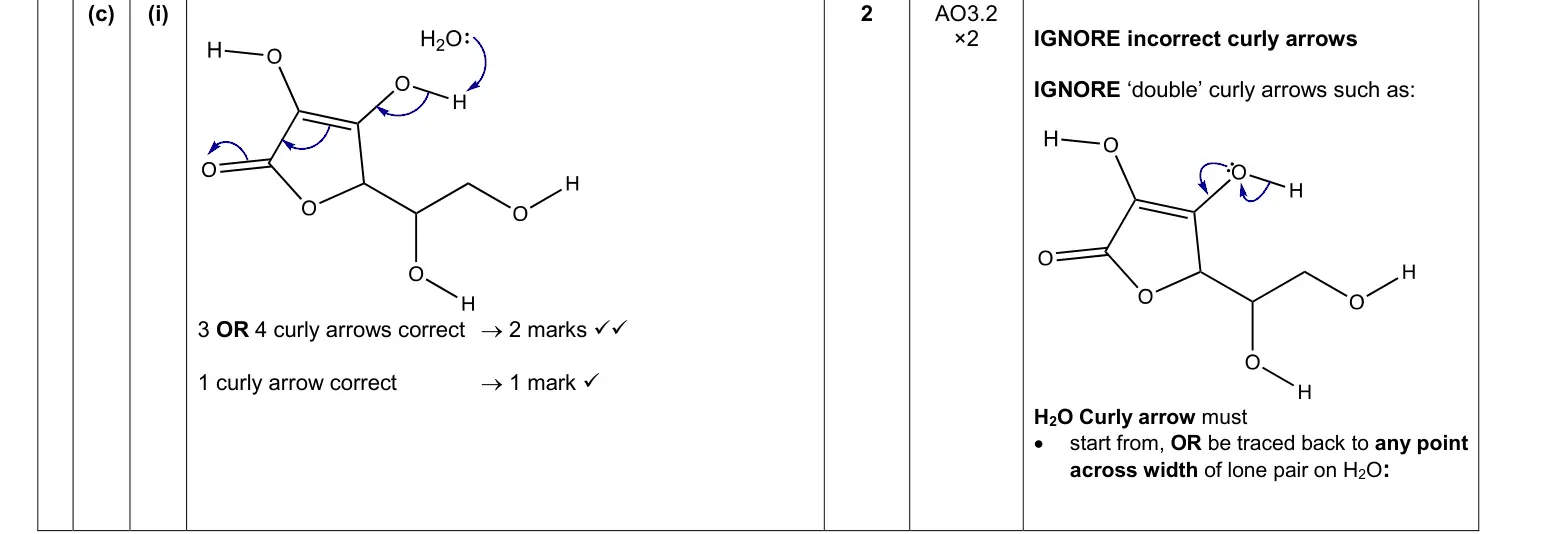
This novel mechanism assessed a candidate’s understanding of curly arrows, and four curly arrows were needed. One mark was available for one correct curly arrow, usually from the H2O: or from the C=O. 2 marks were given for three or four correct curly arrows. The two curly arrows within the ring structure proved to be the most difficult. The question discriminated extremely well: many candidates were able to secure one mark with the most able being given both marks. A candidate showing all four curly arrows correctly demonstrated an excellent understanding of curly arrows.
Notes from the mark scheme and report
arrow from lone pair on H2O to H of enol O–H, O–H bond pair to form C=O, C=C pair moving along, ring C=O pair to O giving O–
3 or 4 correct arrows = 2 marks, 1 correct = 1 mark
IGNORE incorrect/'double' curly arrows
June 2022 · Paper 3 · Q6(c)(ii)3 marksAO1, 2CalculationMedium
Earlier part of question 6 that this part uses
Mark scheme
Examiner's comment
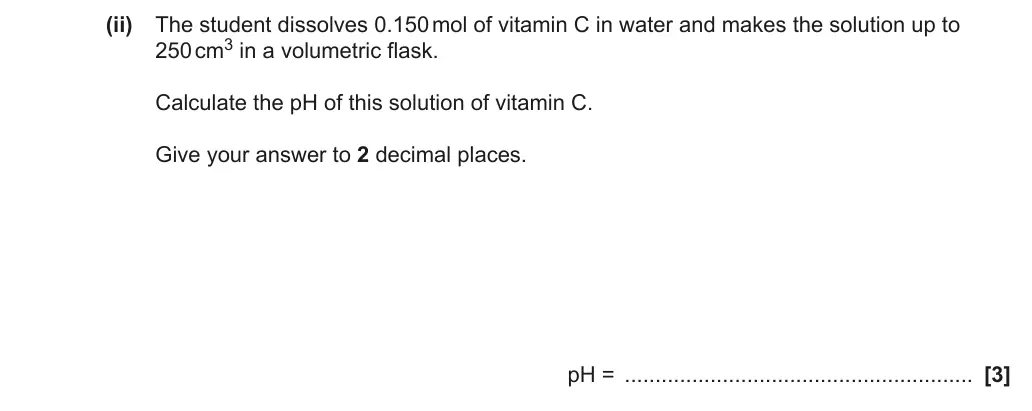
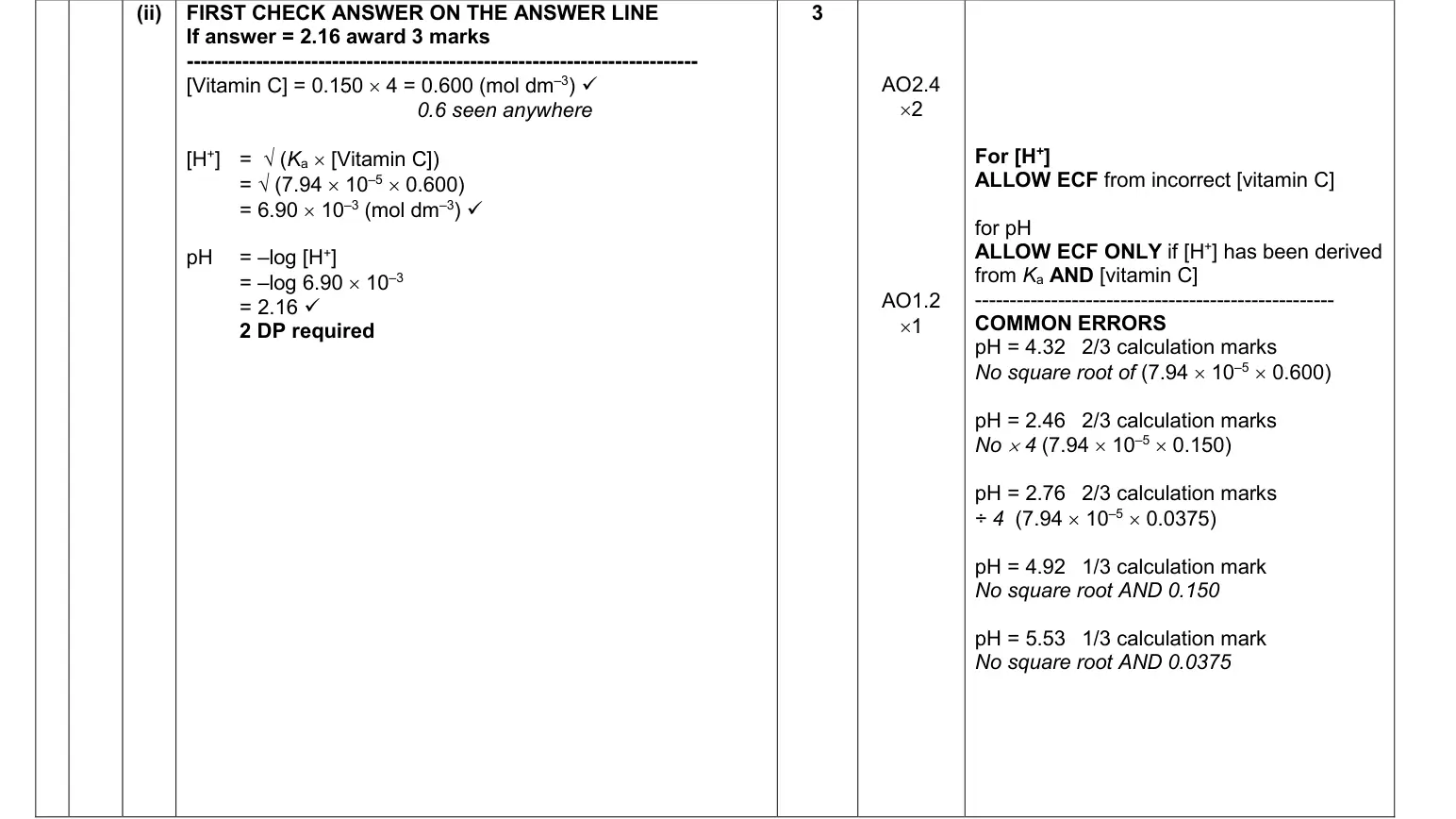
Most candidates had learnt a standard method for calculating the pH of a weak acid. with the correct answer of 2.16 being seen on very many scripts. Success required conversion of 0.150 moles of vitamin C in 250 cm3 to its concentration as 0.600 mol–3, calculation of [H+] using [H+] = (Ka [HA]) and determination of pH using –log[H+]. Common errors usually resulted from one mistake and could still be rewarded with 2 of the available 3 marks. Examples are shown below. • pH = 4.32 No square root of (7.94 10–5 0.600) • pH = 2.46 No conversion of 0.150 mol to 0.600 mol dm–3 (7.94 10–5 0.150) • pH = 2.76 ÷ 4 instead of 4 for concentration (7.94 10–5 0.0375) pH calculations are common in A Level Chemistry There are four different types, and it is essential that the standard methods for determination of [H+] in the calculations are learnt: • pH of strong acids • pH of weak acids, using Ka and [HA] • pH of strong bases, using Kw and [OH–] • pH of buffers, using Ka and [HA]/[A–] It is extremely likely that at least one of these types of pH calculation will feature in at least one of the A Level units. This question was a standard titration calculation, set in a practical context. As with Question 6 (c) (i), this assessed one of the important principles encountered in A Level Chemistry. Success required three main stages: • Calculation of the amount, in mol, of I2 used in the titration of 25.0 cm3 of the diluted orange juice. • Determination of the amount in mol of vitamin C in the 250 cm3 solution (effectively scaling by 10) • Use of this value with the molar mass of vitamin C to determination of the mass of vitamin C, in mg, in the 150 cm3 serving of the orange juice. Most candidates calculated the amount of I2 (and vitamin C) in the titre as 2.16 10–5 mol. The next scaling stage by 10 to 2.16 10–4 mol introduced a problem. Many candidates were distracted by the ‘150 cm3’ serving of orange juice and they scaled further by a factor of 150/250 to give 1.296 10–4 mol. Candidates scaling corrected by 10 usually used the vitamin C molar mass of 176 g mol–1 to determine the correct mass of 38 mg in the orange juice serving. The common incorrect mass of 22.8 mg resulted from the extra scaling by 150/250 described above. This could still be given 3 of the available 4 marks as only one error had been made. Some candidates worked out an incorrect molar mass for vitamin C, with 174 often seen. Provided that this value was used with a correct method, ECF could still be applied for the final mass. If any of your students’ results are not as expected, you may wish to consider one of our post-results services. For full information about the options available visit the OCR website. We send a weekly roundup to tell you about important updates. You can also sign up for your subject specific updates. If you haven’t already, sign up here. Attend one of our popular CPD courses to hear directly from a senior assessor or drop in to a Q&A session. Most of our courses are delivered live via an online platform, so you can attend from any location. Please find details for all our courses on the relevant subject page on our website or visit OCR professional development. ExamBuilder is the question builder platform for a range of our GCSE, A Level, Cambridge Nationals and Cambridge Technicals qualifications. Find out more. ExamBuilder is free for all OCR centres with an Interchange account and gives you unlimited users per centre. We need an Interchange username to validate the identity of your centre's first user account for ExamBuilder. If you do not have an Interchange account please contact your centre administrator (usually the Exams Officer) to request a username, or nominate an existing Interchange user in your department. Review students' exam performance with our free online results analysis tool. It is available for all GCSEs, AS and A Levels and Cambridge Nationals. It allows you to: • review and run analysis reports on exam performance • analyse results at question and/or topic level • compare your centre with OCR national averages • identify trends across the centre • facilitate effective planning and delivery of courses • identify areas of the curriculum where students excel or struggle • help pinpoint strengths and weaknesses of students and teaching departments. Find out more. Post-results services Keep up-to-date OCR Professional Development Signed up for ExamBuilder?
Notes from the mark scheme and report
common errors: 4.32 no square root
2.46 no ×4 (0.150 used)
2.76 ÷4
concentration 0.600 mol dm–3
2 d.p. required (2.16)
pH ECF only if [H+] derived from Ka and concentration
Skills: M0.4 Use calculators to find and use power, exponential and logarithmic functions; M2.3 Substitute numerical values into algebraic equations using appropriate units for physical quantities; M2.5 Use logarithms in relation to quantities that range over several orders of magnitude
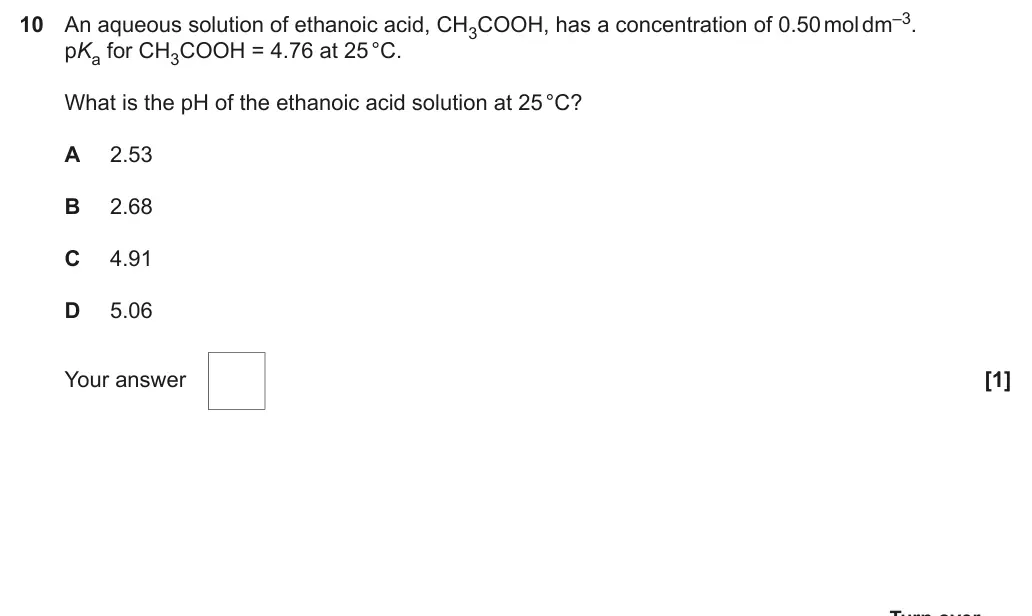
November 2021 · Paper 1 · Q101 markMultiple choice
Answer
A
Mark scheme
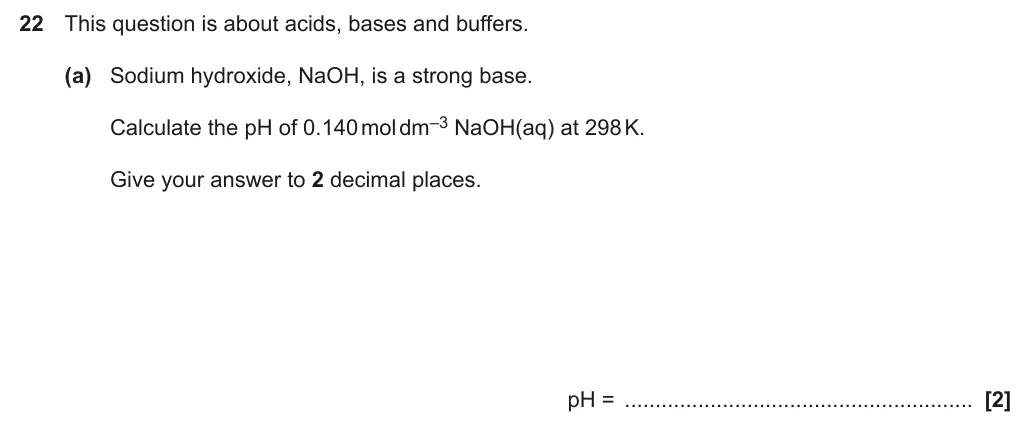
November 2021 · Paper 1 · Q22(a)2 marksAO2Calculation
Mark scheme
Notes from the mark scheme and report
2 DP required (13.15)
ALLOW pOH method
ECF only if pH > 7
Skills: M0.4 Use calculators to find and use power, exponential and logarithmic functions; M2.3 Substitute numerical values into algebraic equations using appropriate units for physical quantities; M2.5 Use logarithms in relation to quantities that range over several orders of magnitude
November 2021 · Paper 1 · Q22(c)6 marksAO1, 2, 36-mark level of response
Mark scheme, with the levels and indicative points
Notes from the mark scheme and report
HNO2 in excess, partial neutralisation gives HNO2/NO2– mixture
n(HNO2) left 0.0350 and n(NO2–) 0.0150
pH = 2.97
N2O3 + H2O → 2HNO2 so 0.0250 mol = 1.90 g
Skills: M0.2 Use ratios, fractions and percentages; M0.4 Use calculators to find and use power, exponential and logarithmic functions; M2.3 Substitute numerical values into algebraic equations using appropriate units for physical quantities; M2.5 Use logarithms in relation to quantities that range over several orders of magnitude
November 2021 · Paper 3 · Q5(b)(i)2 marksAO2CalculationHard
Mark scheme
Examiner's comment
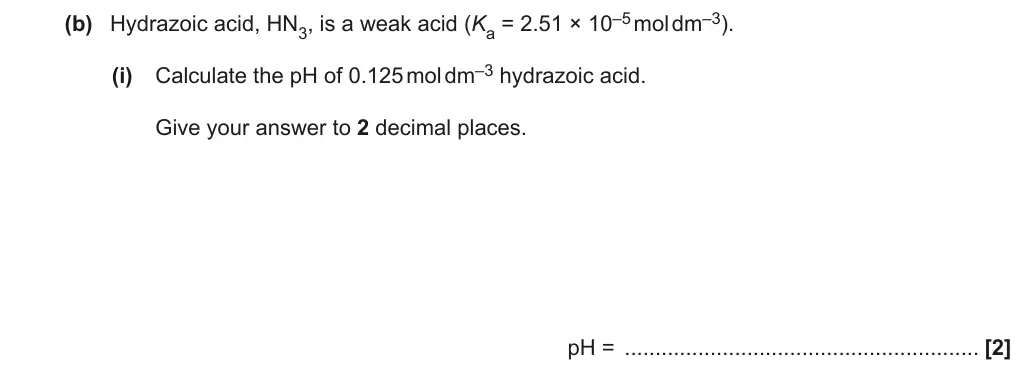
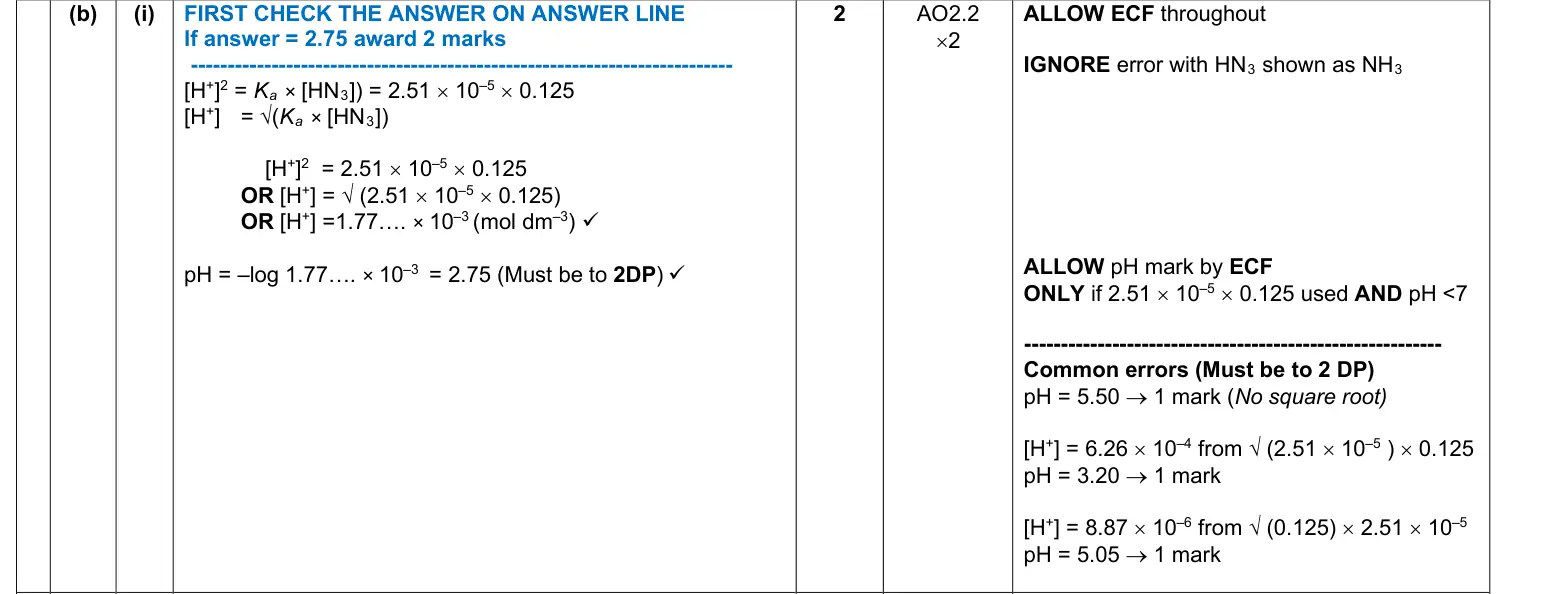
Q1(a) Partial pressure calculation Q1(d) Formula determination from percentage composition by mass Q2(b) Converting mass and volume into moles Q3(b) Unstructured titration calculation Q5(a)(ii) Ideal gas calculation Q5(b)(i) Calculation of the pH of a weak acid • Produced clear and concise responses for a Level of Response question based on a familiar context i.e., Q4(b) rates by continuous monitoring and graphical analysis. • Had difficulty when answering questions requiring application of knowledge and understanding on questions set in novel and unfamiliar contexts, e.g. Q5(b)(i): Most candidates found this pH calculation easy and most obtained a pH of 2.75 for both marks.
Notes from the mark scheme and report
pH = 2.75 to 2 DP
common errors: no square root (pH 5.50) 1 mark, square root of only one term (3.20, 5.05) 1 mark
Skills: M0.4 Use calculators to find and use power, exponential and logarithmic functions; M2.3 Substitute numerical values into algebraic equations using appropriate units for physical quantities; M2.5 Use logarithms in relation to quantities that range over several orders of magnitude
November 2021 · Paper 3 · Q5(b)(ii)2 marksAO1Complete table/diagramMedium
Earlier part of question 5 that this part uses
Mark scheme
Examiner's comment
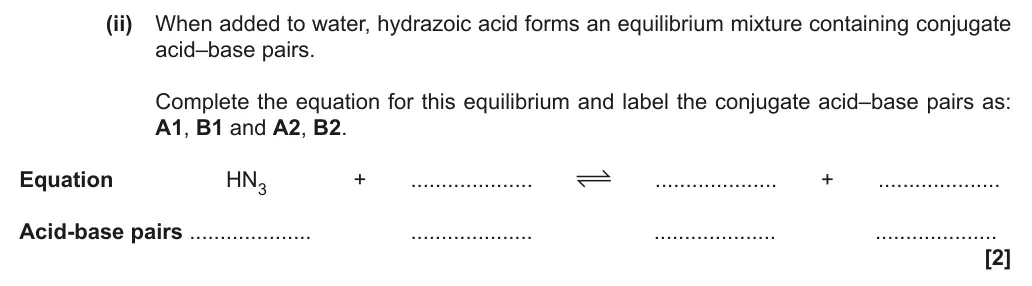
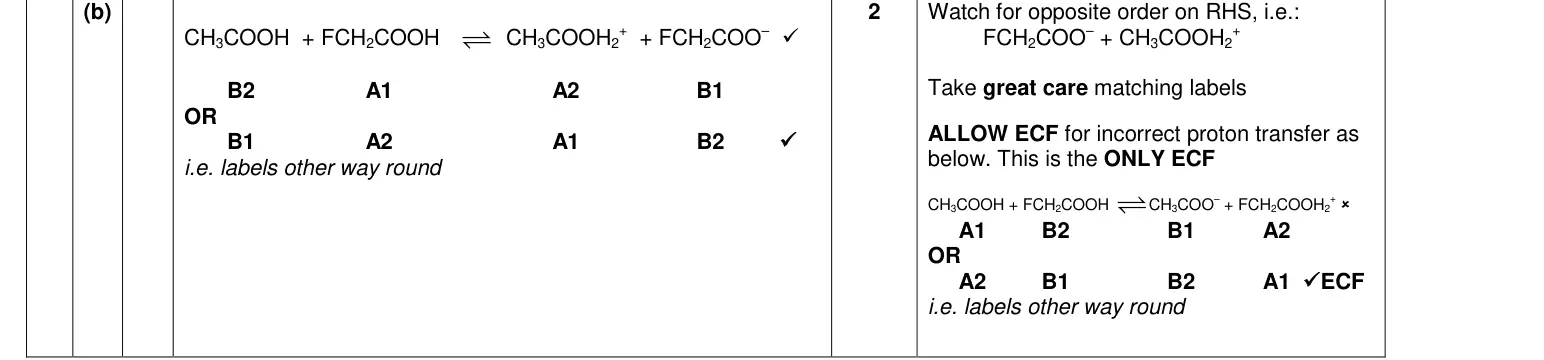
Q5(b)(ii): This unfamiliar acid–base pair question was answered comparatively well.
Notes from the mark scheme and report
HN3 + H2O ⇌ N3– + H3O+
labels A1 B2 B1 A2 (or A2 B1 B2 A1)
1 mark for one correct acid–base pair with correct labels
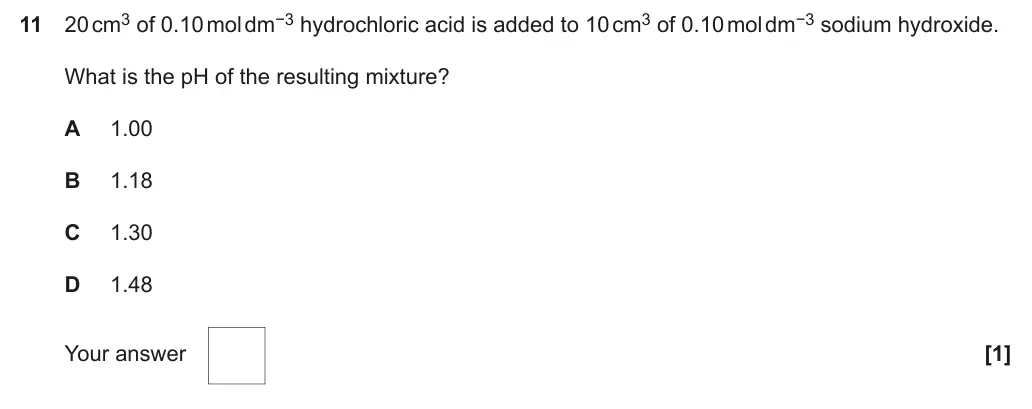
November 2020 · Paper 1 · Q111 markAO2Multiple choice
Answer
D
Mark scheme
Notes from the mark scheme and report
excess H+ in total volume 30 cm3
Skills: M0.2 Use ratios, fractions and percentages; M0.4 Use calculators to find and use power, exponential and logarithmic functions; M2.5 Use logarithms in relation to quantities that range over several orders of magnitude
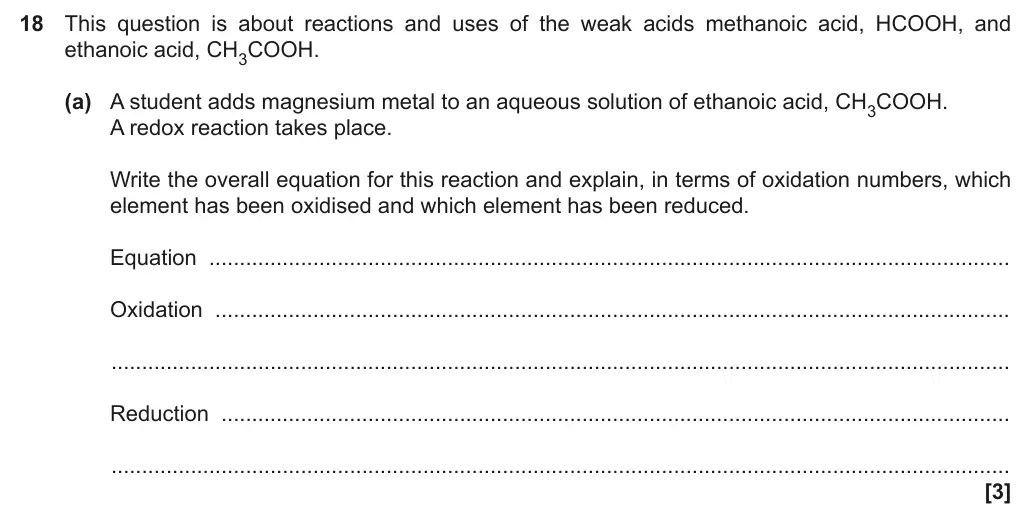
November 2020 · Paper 1 · Q18(a)3 marksAO1, 2Equation writing
Mark scheme
Notes from the mark scheme and report
Mg + 2CH3COOH → (CH3COO)2Mg + H2
Mg 0 to +2 oxidised
H +1 to 0 reduced
1 mark for correct oxidation numbers wrongly linked to redox
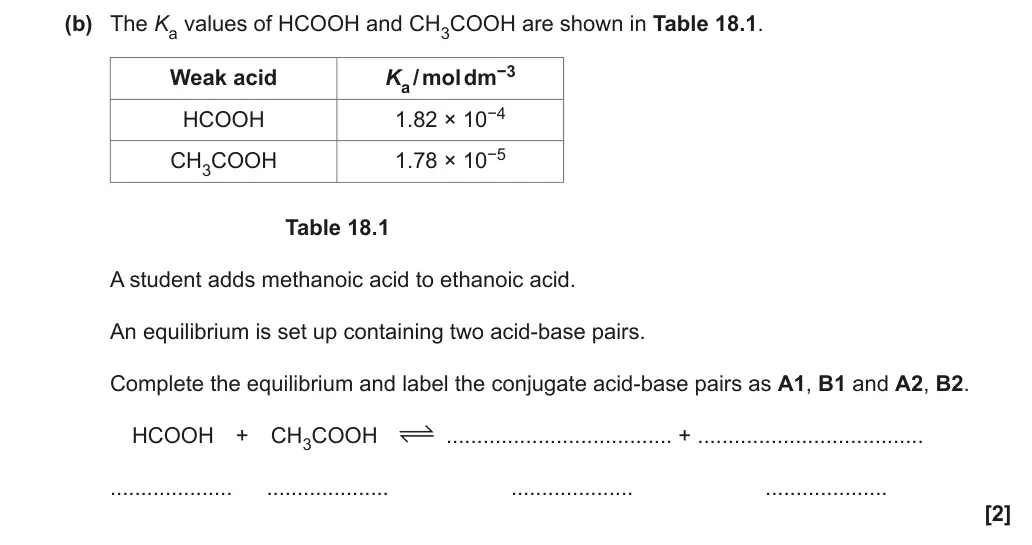
November 2020 · Paper 1 · Q18(b)2 marksAO1Complete table/diagram
Mark scheme
Notes from the mark scheme and report
HCOOH is the stronger acid so donates: HCOO– + CH3COOH2+
both charges required
only ECF is pairs labelled for proton transfer the wrong way round
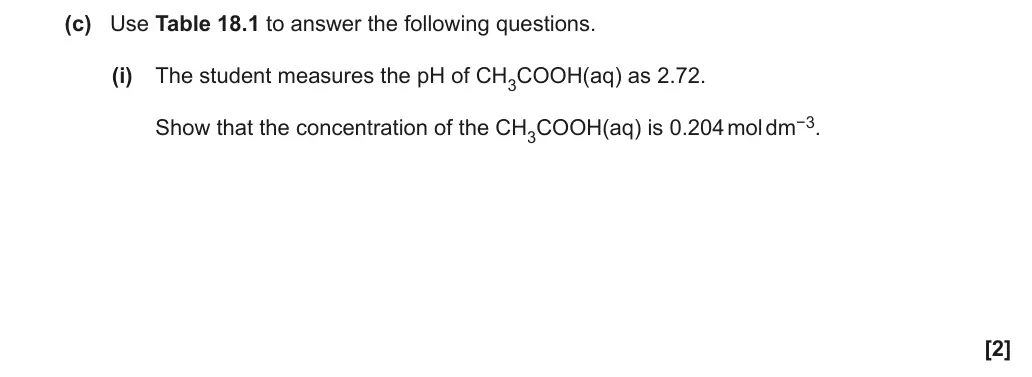
November 2020 · Paper 1 · Q18(c)(i)2 marksAO2Data interpretation
Earlier part of question 18 that this part uses
Mark scheme
Notes from the mark scheme and report
mark is for working
Skills: M0.4 Use calculators to find and use power, exponential and logarithmic functions; M2.2 Change the subject of an equation; M2.5 Use logarithms in relation to quantities that range over several orders of magnitude
November 2020 · Paper 1 · Q18(c)(ii)4 marksAO3CalculationMedium
Earlier parts of question 18 that this part uses
Mark scheme
Examiner's comment
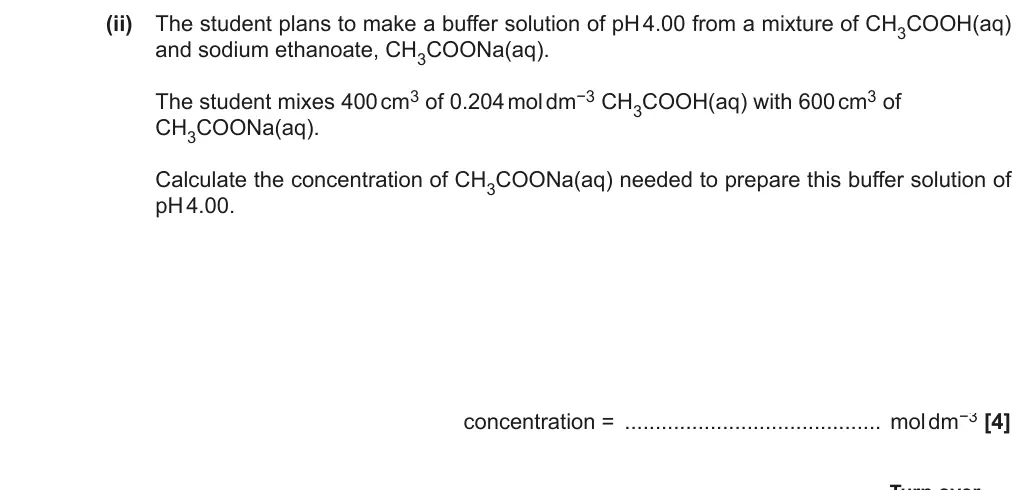
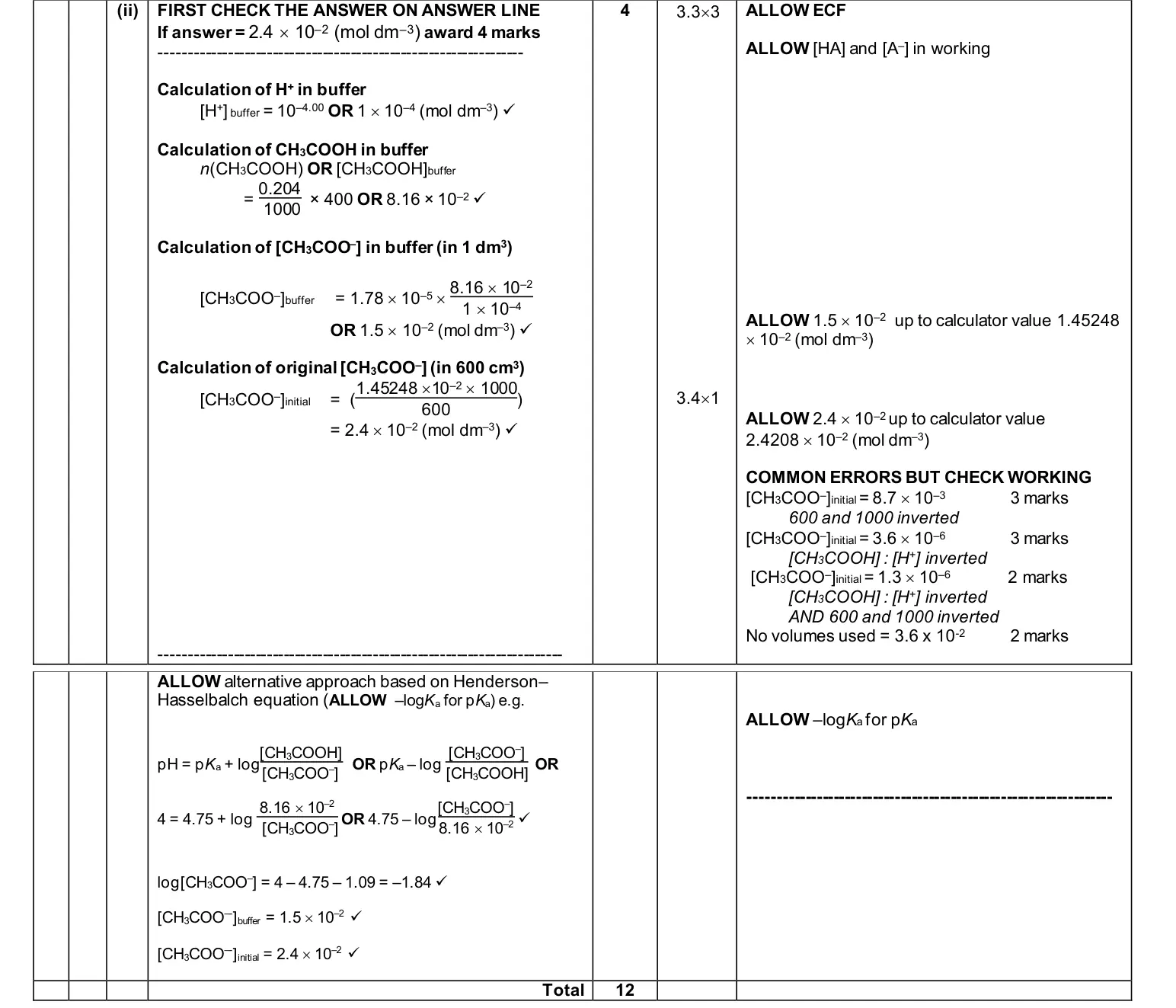
This question required the candidate to calculate the original concentration of ethanoate ions in the buffer. Higher-attaining students gained full credit. Most students calculated the concentration in the buffer solution but did not factor for the original solution. Lower-attaining candidates often scored the first two marking points but did not use the buffer equation.
Notes from the mark scheme and report
n(CH3COOH) = 0.0816 in 1 dm3
× 1000/600 = 2.4 × 10^–2
common errors 8.7 × 10^–3 (600/1000 inverted), 3.6 × 10^–6 (ratio inverted), 3.6 × 10^–2 (no volumes)
ALLOW Henderson–Hasselbalch
Skills: M0.2 Use ratios, fractions and percentages; M0.4 Use calculators to find and use power, exponential and logarithmic functions; M2.2 Change the subject of an equation; M2.3 Substitute numerical values into algebraic equations using appropriate units for physical quantities
November 2020 · Paper 3 · Q6(b)4 marksAO2, 3Equation writingHard
Earlier part of question 6 that this part uses
Mark scheme
Examiner's comment
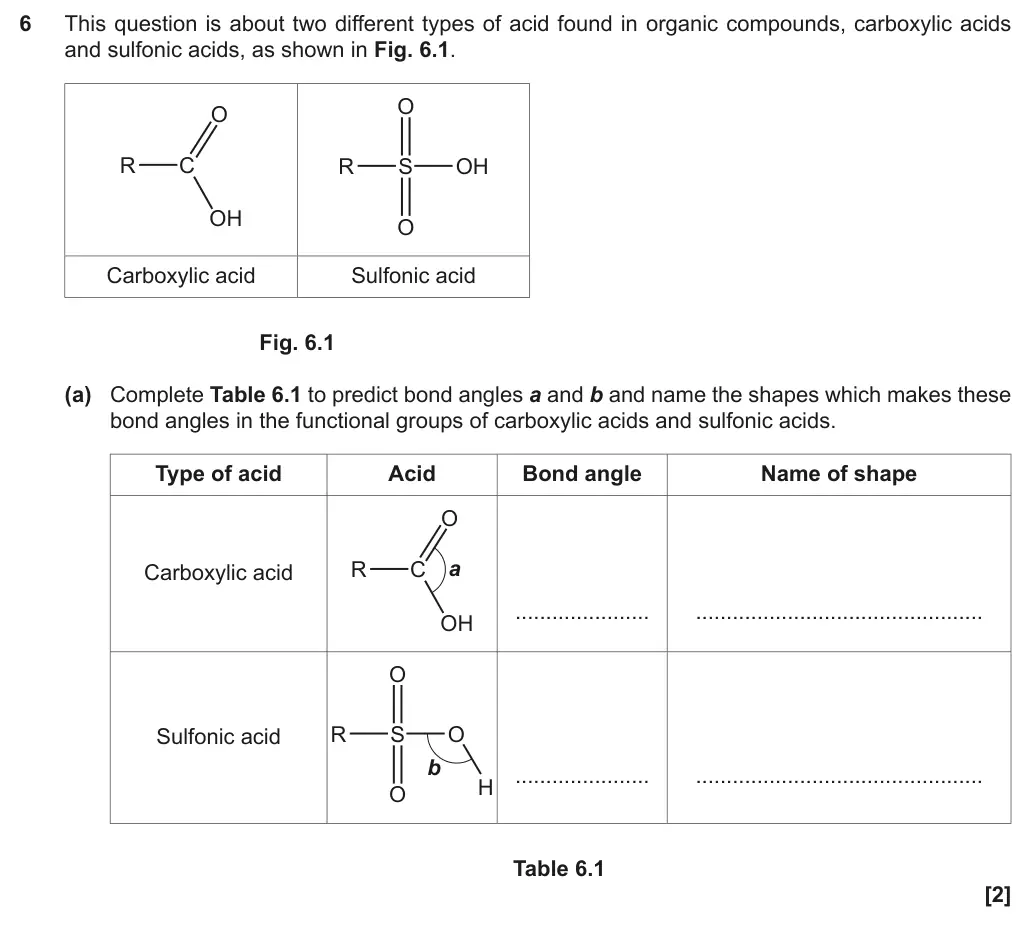
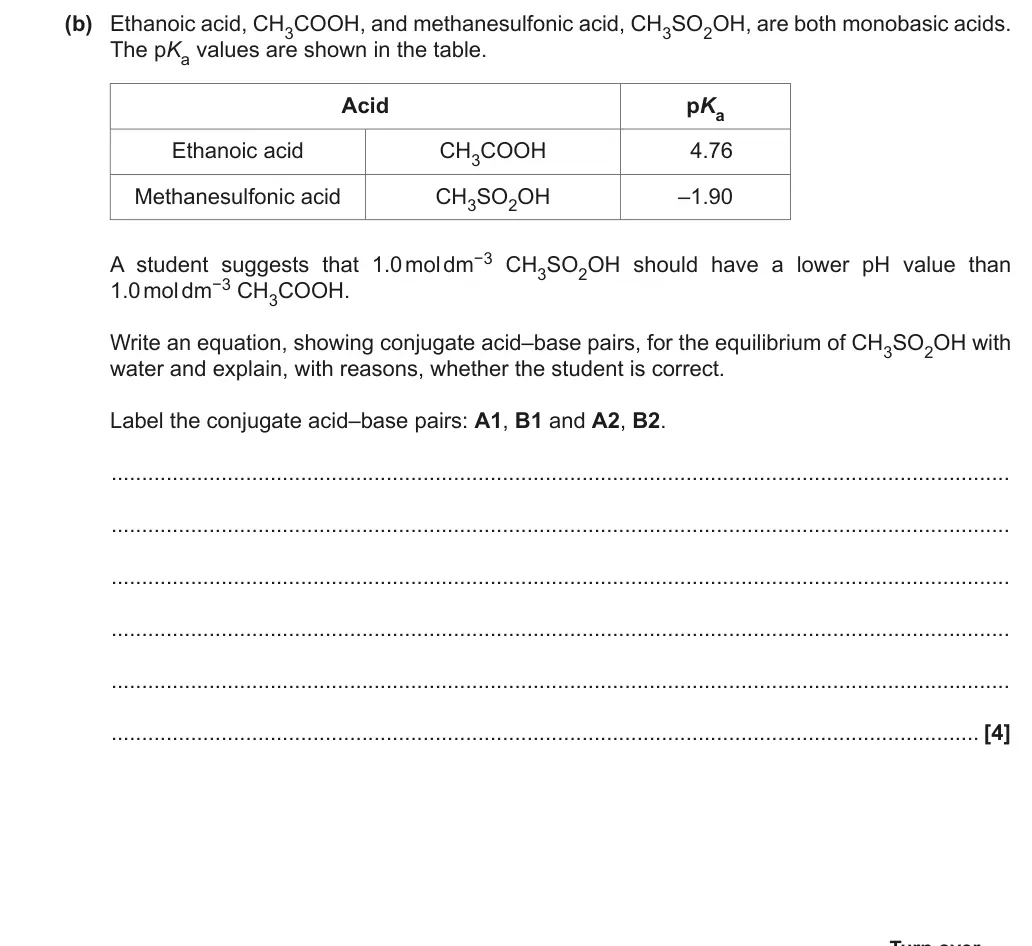
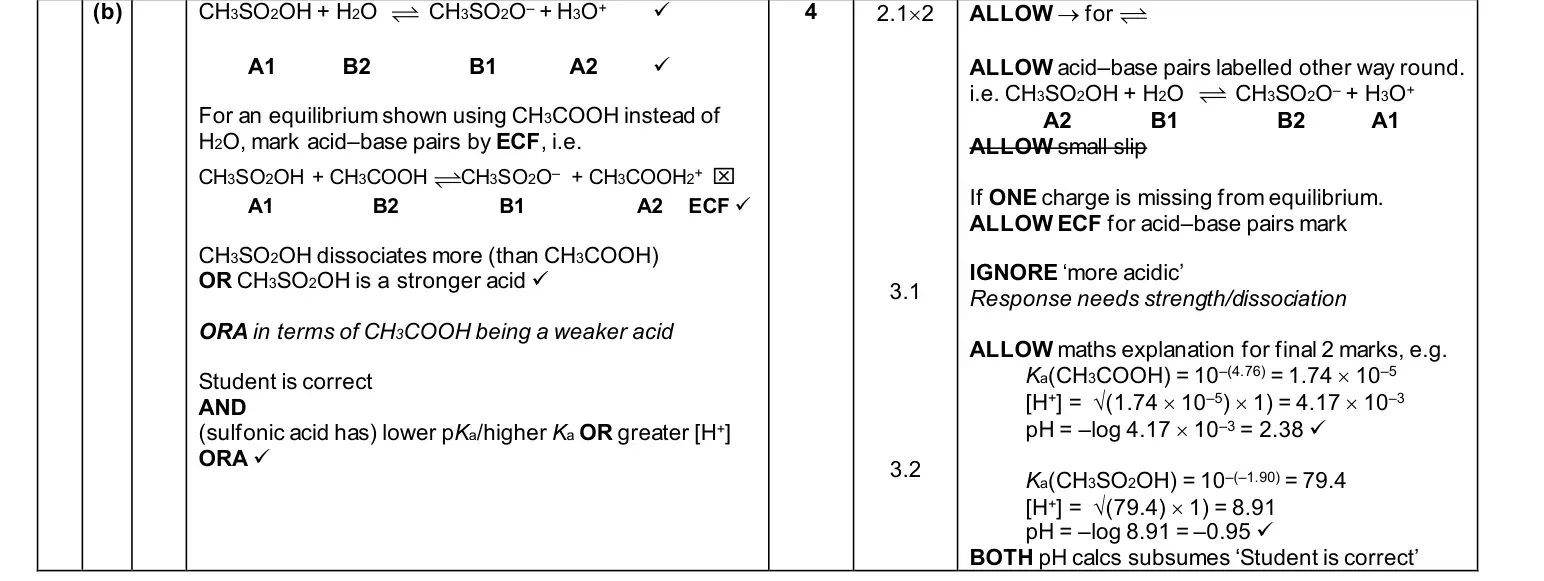
6(a) Candidates were expected to use their knowledge and understanding of bond angles and shapes. Most candidates were given both available marks. A significant number responded with incorrect names of shapes, or chose the wrong shape, such as pyramidal for the O–C–O bond angle in the carboxylic acid. Candidates are recommended to learn this basic area of chemistry. 6(b) Most candidates completed a correct equilibrium equation and assigned the correct acid-base pairs. A significant number of candidates used ethanoic acid instead of water in the equation. The examiners allowed error carried forward in this case for the acid-base pairs. Candidates found it much more difficult to explain whether the sulfonic acid had a lower pH value. The higher-attaining candidates answered concisely. They usually identifying that the sulfonic acid would have a lower pH as the pKa value was lower (or the Ka value greater), leading to more dissociation than ethanoic acid. Lower-attaining candidates often produced unfocussed and lengthy responses, sometimes relating increased dissociation in an acid to a higher, rather than a lower, pH. Some candidates approached their explanation mathematically, calculating pH values for ethanoic acid and sulfonic acid from their concentrations and pKa values. If correct, this approach was fully credited. 6(c) Most candidates showed a good understanding and appreciation of drawing curly arrows. It must be stressed that curly arrows that do not start from a lone pair, negative charge or a bond cannot be credited. Lower-attaining candidates often drew imprecisely positioned curly arrows, curly arrows in the wrong direction or to the wrong atoms. For their response to be credited with marks, candidates should position curly arrows to ensure credit when outlining reaction mechanisms. If any of your students’ results are not as expected, you may wish to consider one of our review of results services. For full information about the options available visit the OCR website. If university places are at stake you may wish to consider priority service 2 reviews of marking which have an earlier deadline to ensure your reviews are processed in time for university applications. Our priority is supporting you and your students this autumn and to support you as you prepare for summer 2021 exams. We’ll update our website information regularly with resources, guidance and key information. • Teachers • Students • Exams officers • Assessment specialists We are sending a weekly roundup to tell you about important updates. You can also sign up for your subject specific updates. If you haven’t already, sign up here. Attend one of our popular CPD courses to hear directly from a senior assessor or drop in to a Q&A session. All our courses for the academic year 2020-2021 are being delivered live via an online platform, so you can attend from any location. Please find details for all our courses on the relevant subject page on our website or visit OCR professional development. ExamBuilder is the question builder platform for a range of our GCSE, A Level, Cambridge Nationals, Cambridge Technicals and Functional Skills qualifications. See the full list of available qualifications in the sign up form. ExamBuilder is free for all OCR centres with an Interchange account and gives you unlimited users per centre. We need an Interchange username to validate the identity of your centre's first user account for ExamBuilder. If you do not have an Interchange account please contact your centre administrator (usually the Exams Officer) to request a username, or nominate an existing Interchange user in your department. Review of results
Notes from the mark scheme and report
CH3SO2OH + H2O ⇌ CH3SO2O– + H3O+ with pairs labelled
student correct AND lower pKa/higher Ka/greater [H+]
ALLOW pH calculations for both acids
Skills: M0.4 Use calculators to find and use power, exponential and logarithmic functions; M2.5 Use logarithms in relation to quantities that range over several orders of magnitude
June 2019 · Paper 1 · Q121 markAO1Multiple choice
Answer
D
Mark scheme
June 2019 · Paper 1 · Q17(a)6 marksAO1, 36-mark level of responseEasy
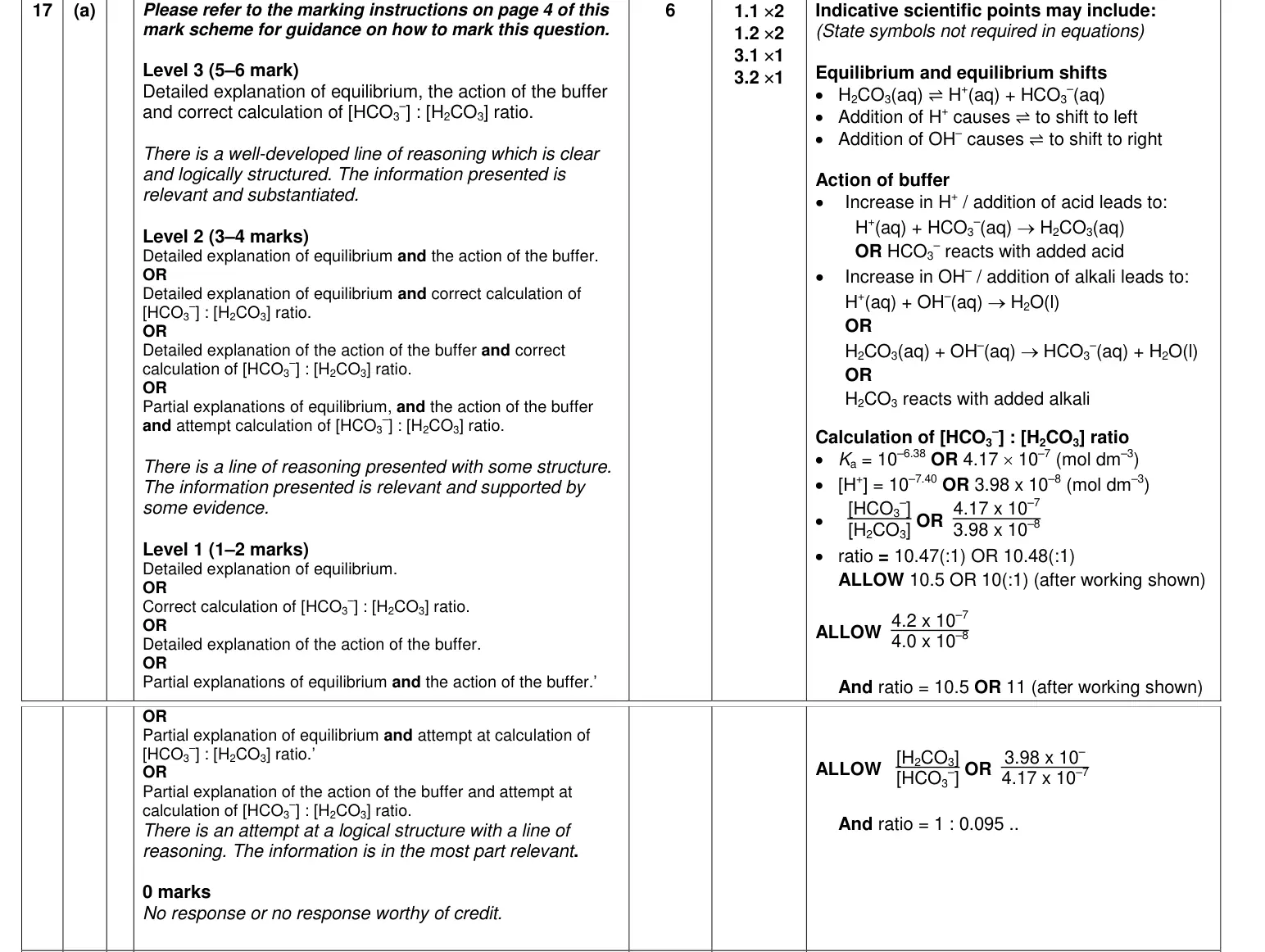
Mark scheme, with the levels and indicative points
Examiner's comment
This Level of Response question was generally well answered with many candidates achieving maximum marks by simply considering what was required in the question. The calculation of the [HCO3 –] : [H2CO3] ratio was well described although sometimes the final expression of the ratio left ambiguity as it was hard to tell whether the ratio given referred to the [HCO3 –] : [H2CO3] ratio or the [H2CO3] : [HCO3 –] ratio The buffer reactions on separate addition of acid (H+ ions) and alkali (OH– ions) were explained and, better still, shown in equation form. The direction of shift on the H2CO3 ⇌ H+ + HCO3 – equilibrium was invariably correct, but many candidates did not achieve credit for responses such as ‘Addition of H+ ions shifts the equilibrium to the left’ because they did not give the equilibrium which was undergoing shift. An example of a complete answer gaining L3 (6 marks) is given. The candidate clearly writes the equilibrium at the top. The first bullet point gives a chemical equation for the reaction occurring when H+ ions are added as well as the shift in equilibrium. The second bullet point gives a chemical equation for the reaction occurring when OH– ions are added as well as the shift in equilibrium. The steps in the calculation are clearly shown and the ratio is clear.
Notes from the mark scheme and report
H2CO3 ⇌ H+ + HCO3–
added H+ removed by HCO3– (shift left), added OH– removed by H+/H2CO3 (shift right)
ratio = Ka/[H+] = 10.5:1
Skills: M0.4 Use calculators to find and use power, exponential and logarithmic functions; M2.3 Substitute numerical values into algebraic equations using appropriate units for physical quantities; M2.5 Use logarithms in relation to quantities that range over several orders of magnitude
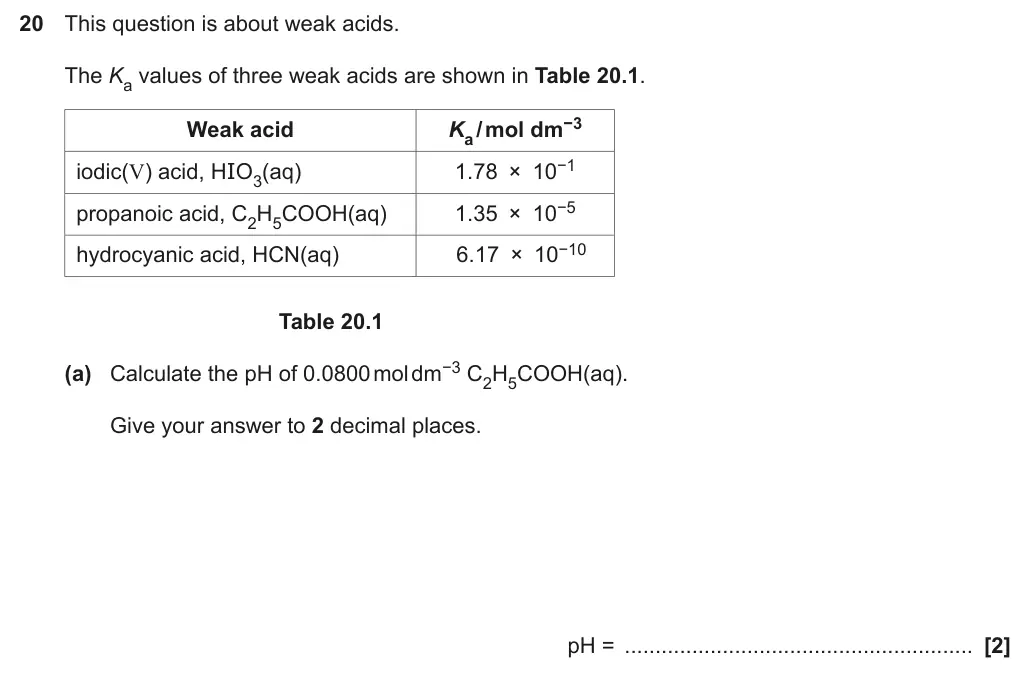
June 2019 · Paper 1 · Q20(a)2 marksAO2CalculationMedium
Mark scheme
Examiner's comment
Most candidates could calculate the pH of a weak acid although a significant number gave the answer as 3.0, presumably confusing the demand for two decimal points with two significant figures.
Notes from the mark scheme and report
2 DP required (2.98)
5.97 (no square root) scores 1
0.92 or 5.15 (wrong Ka) score 1
Skills: M0.4 Use calculators to find and use power, exponential and logarithmic functions; M2.3 Substitute numerical values into algebraic equations using appropriate units for physical quantities; M2.5 Use logarithms in relation to quantities that range over several orders of magnitude
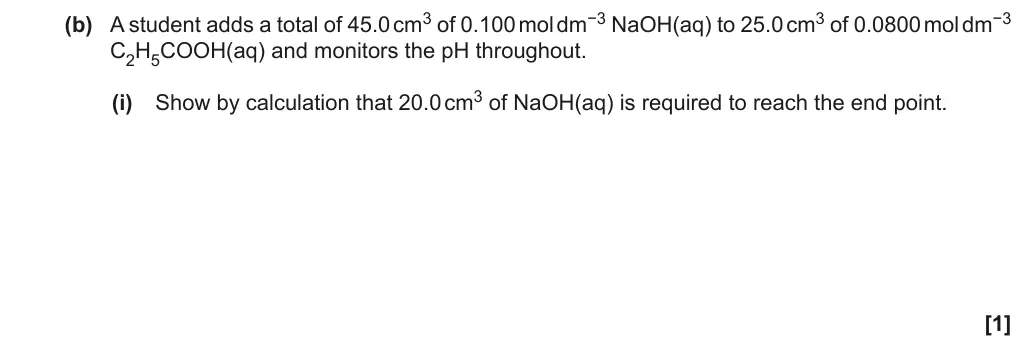
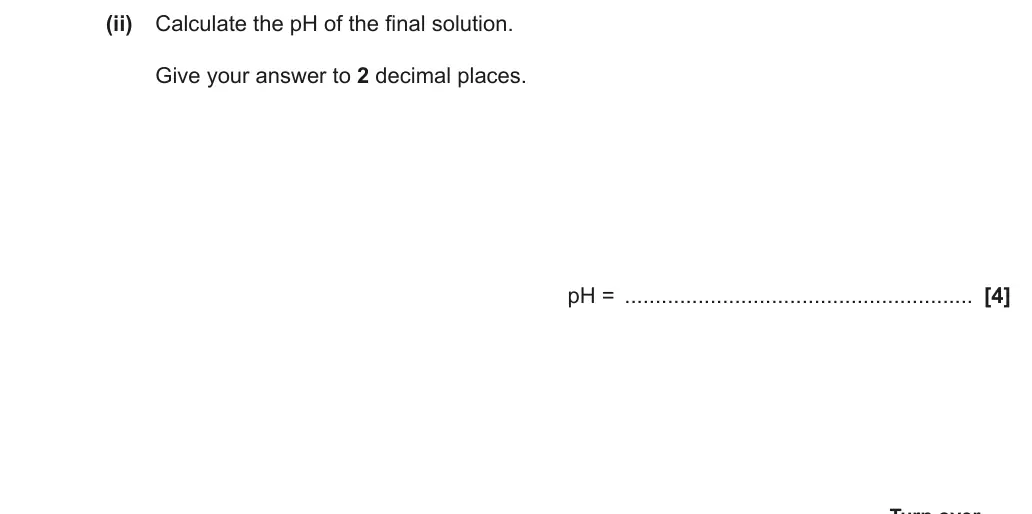
June 2019 · Paper 1 · Q20(b)(ii)4 marksAO1, 2CalculationHard
Earlier parts of question 20 that this part uses
Mark scheme
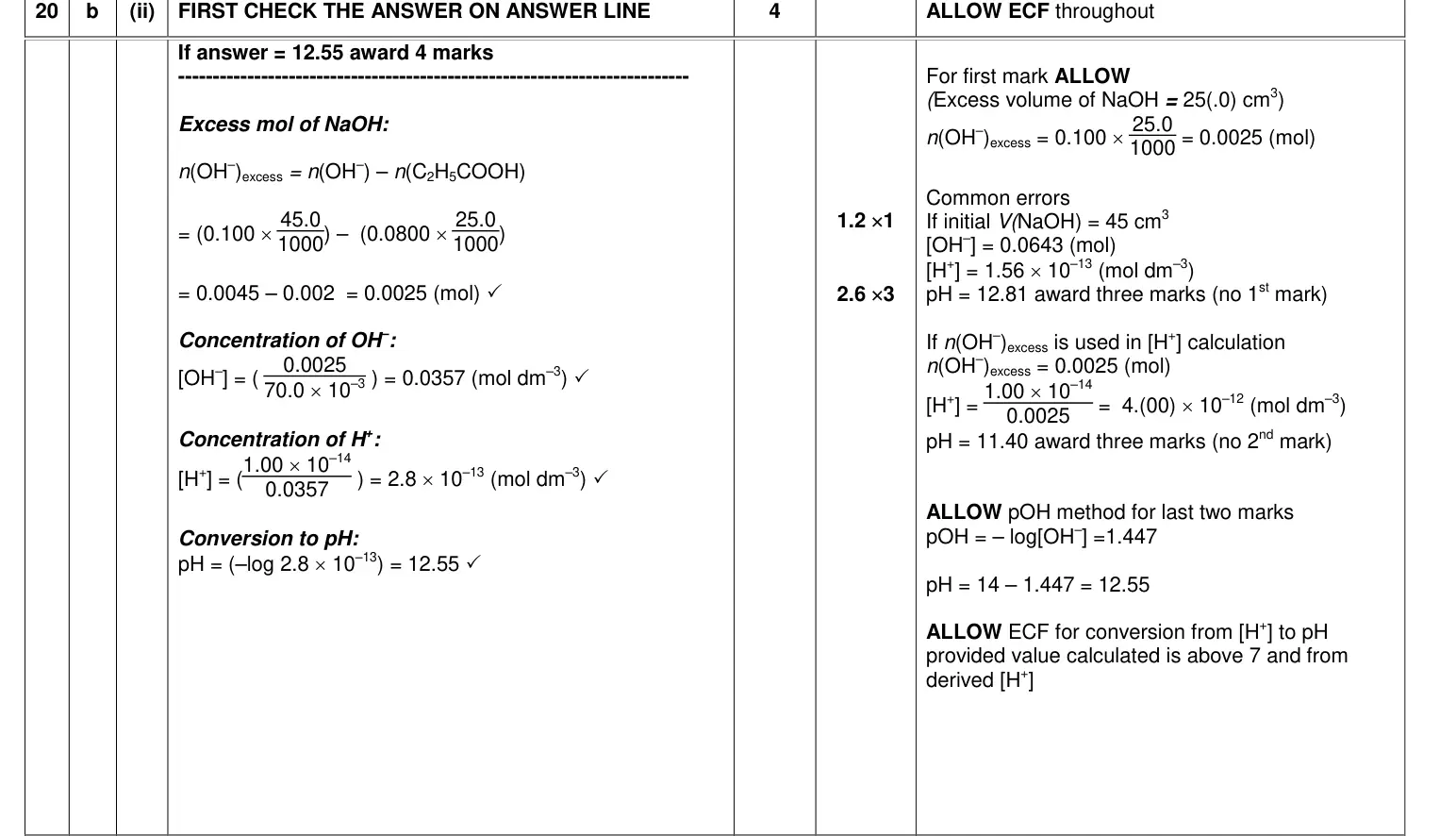
Examiner's comment
This calculation proved difficult with once again, many figures and sums appearing with little indication as to their relevance. Responses to 20bi/ii often featured rows of figures and random sums without a single word about what the figures were or sums were set to calculate. Candidates should remember to provide written indications of what it is they’re working out – presenting the calculations without any annotations can make it harder for error carried forward marks to be given if there is an error in their calculation.
Notes from the mark scheme and report
excess OH– = 0.0025 mol in total volume 70.0 cm3
common errors 12.81 (45 cm3 volume) and 11.40 (moles not concentration) score 3
ALLOW pOH method
Skills: M0.4 Use calculators to find and use power, exponential and logarithmic functions; M2.3 Substitute numerical values into algebraic equations using appropriate units for physical quantities; M2.5 Use logarithms in relation to quantities that range over several orders of magnitude
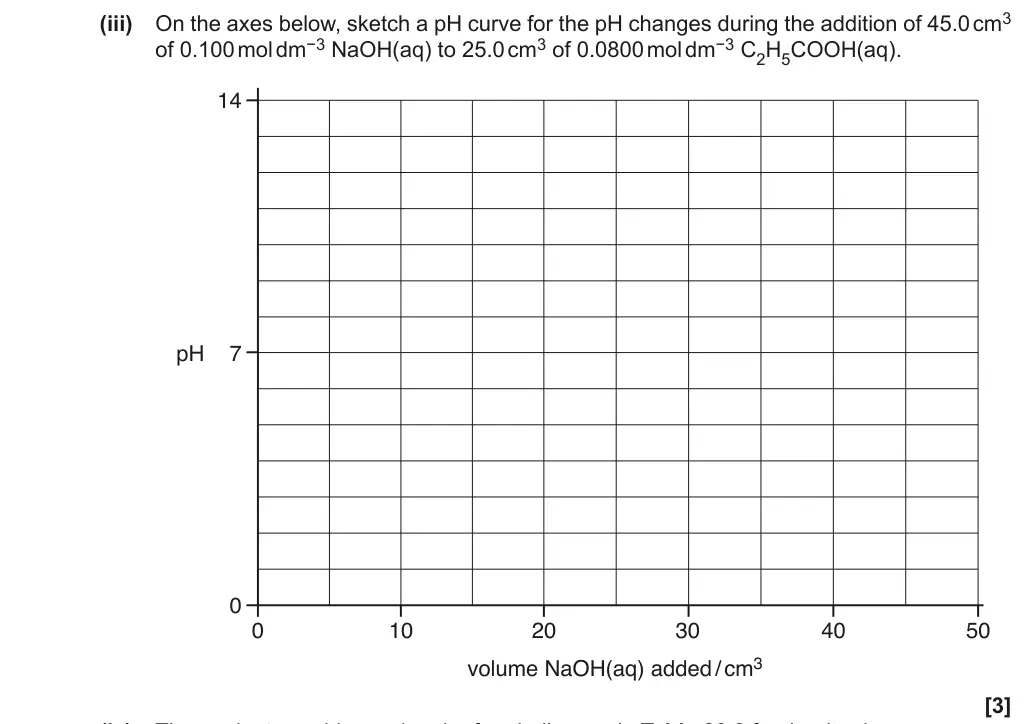
June 2019 · Paper 1 · Q20(b)(iii)3 marksAO2Short answerHard
Earlier parts of question 20 that this part uses
Mark scheme
Examiner's comment
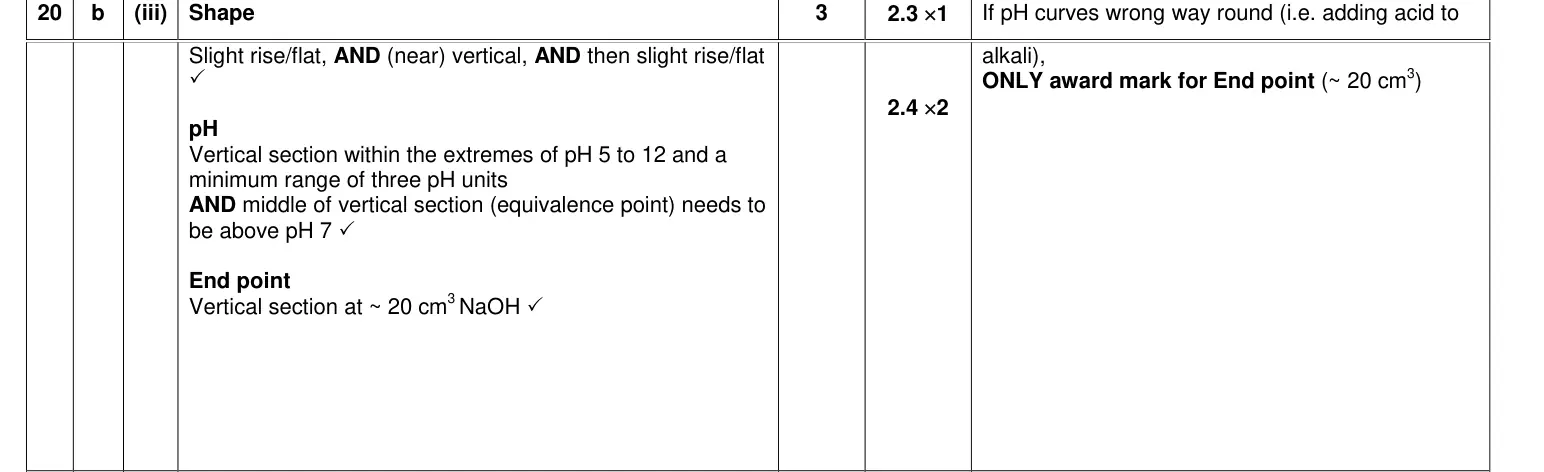
This weak acid / strong alkali titration curve required candidates to apply their knowledge. Some candidates found it difficult to draw an adequate titration curve. The key points to titration curves are: • A ‘vertical’ section at the end point • The vertical section with pH range correct to relative to the strength of acid/alkali • A correct equivalence point relative to pH 7 with respect to the strength of acid/alkali • A ‘shallow curve’ leading from 0 cm3 to vertical section • A ‘shallow curve’ leading from the vertical section to the total volume added For this reaction: • The vertical section was at 20 cm3 (given in 20bi) • As it was a weak acid and strong alkali reacting, the vertical section should start above pH 5 and finish around pH 11 • The equivalence point (half-way up the vertical section) for a weak acid / strong alkali titration should be above pH 7 • The starting pH should be that of the weak acid, C2H5COOH (answer to 20(a)) • The final pH should be that of the final solution (answer to 20(b)(ii))
Notes from the mark scheme and report
vertical section at about 20 cm3, within pH 5–12, at least 3 pH units, midpoint above 7
if curve drawn the wrong way round only the end-point mark is available
Skills: M3.1 Translate information between graphical, numerical and algebraic forms
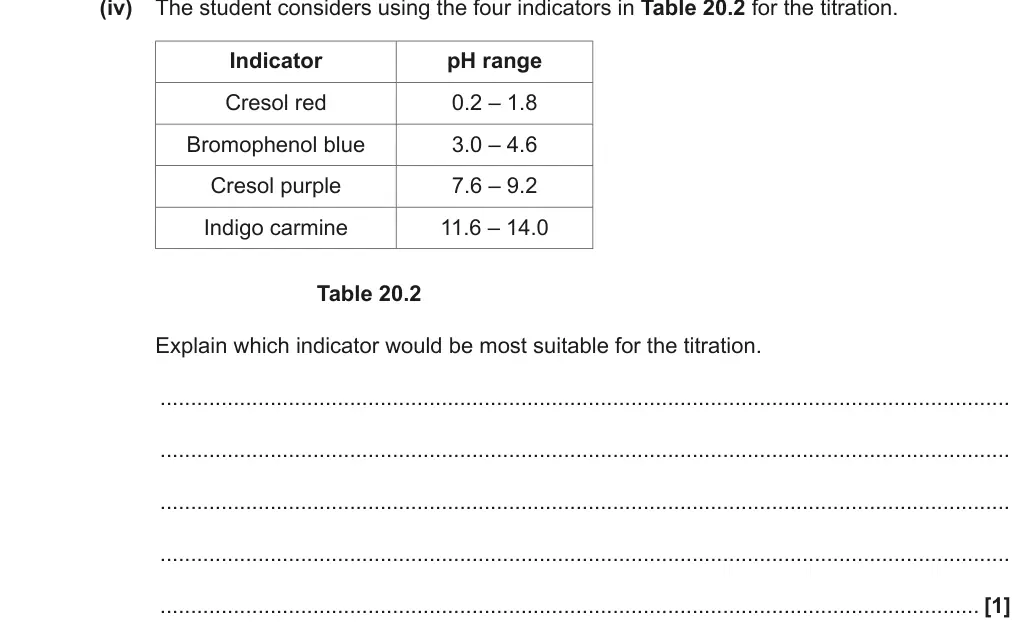
June 2019 · Paper 1 · Q20(b)(iv)1 markAO3Data interpretationMedium
Earlier part of question 20 that this part uses
Mark scheme
Examiner's comment
Some candidates realised that the most suitable indicator for a weak acid / strong alkali titration would be cresol purple. For incorrect responses, other indicators appeared to be selected at random, suggesting that candidates were unclear on the criteria for selected a suitable indicator.
Notes from the mark scheme and report
cresol purple AND pH range matches the vertical section/equivalence point
IGNORE 'colour change matches end point'
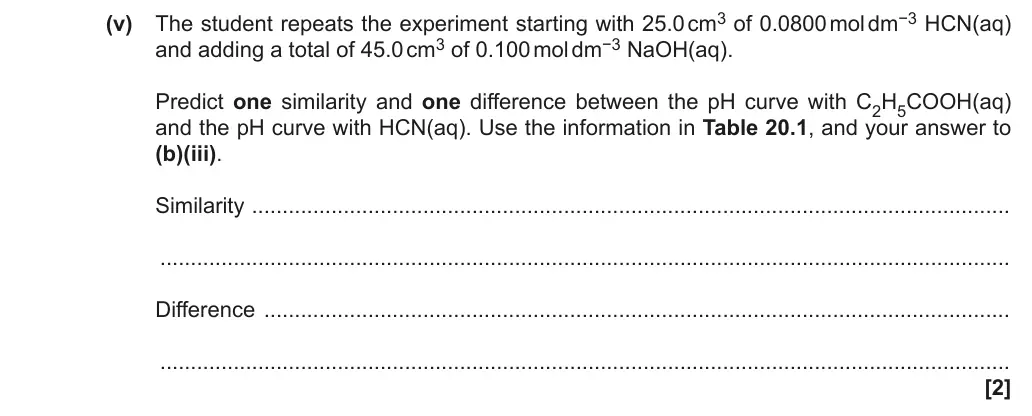
June 2019 · Paper 1 · Q20(b)(v)2 marksAO3Data interpretationMedium
Earlier parts of question 20 that this part uses
Mark scheme
Examiner's comment
When identifying a similarity, many candidates confused the term ‘equivalence point’ with the term ‘end point’. For differences, many candidates realised that HCN had a different Ka to C2H5COOH but often did not appreciate that this would lead to a starting point with a higher pH.
Notes from the mark scheme and report
similarity: same volume of NaOH (20 cm3) to neutralise or same final pH
difference: HCN higher starting pH or shorter vertical section
end point must not refer to same pH
Skills: M3.1 Translate information between graphical, numerical and algebraic forms
June 2019 · Paper 1 · Q20(c)1 markAO3Short answerHard
Earlier part of question 20 that this part uses
Mark scheme
Examiner's comment
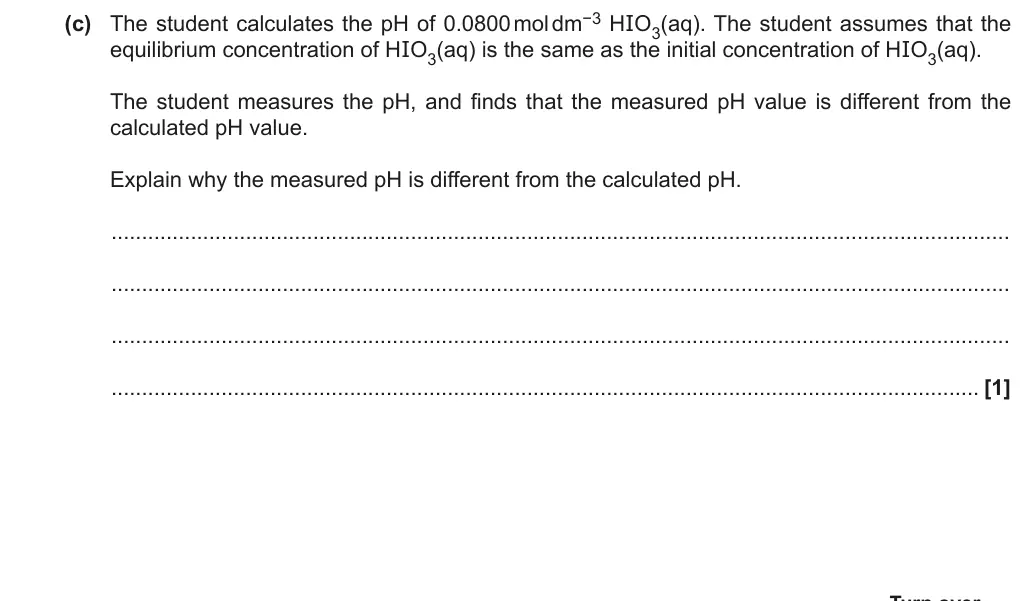
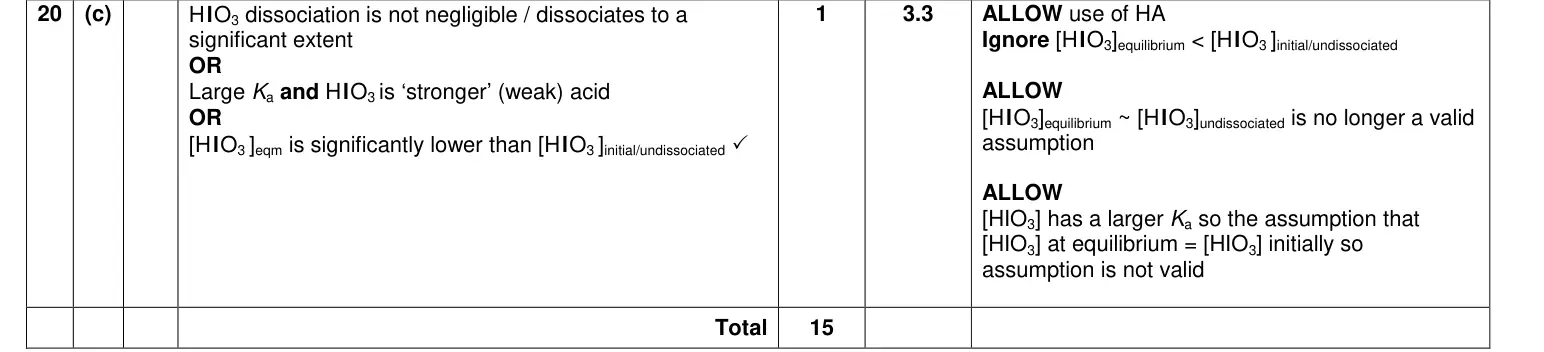
Very few candidates scored the mark for this question. The most common error was to write ‘HIO3 dissociates’. While correct, this is true of all weak acids. The subtlety in this question was to realise that because Ka was relatively high, the resultant acid strength would mean that the degree of dissociating was significant enough so initial [HIO3] was significantly less than [HIO3] at equilibrium. In other words, the assumption [HIO3]initial = [HIO3]equilibrium is not valid in this case.
Notes from the mark scheme and report
HIO3 dissociation not negligible (large Ka, 'stronger' weak acid) so [HIO3]eqm significantly lower than [HIO3]initial
IGNORE [HIO3]eqm < [HIO3]initial alone
June 2019 · Paper 3 · Q1(e)1 markAO2CalculationHard
Mark scheme
Examiner's comment
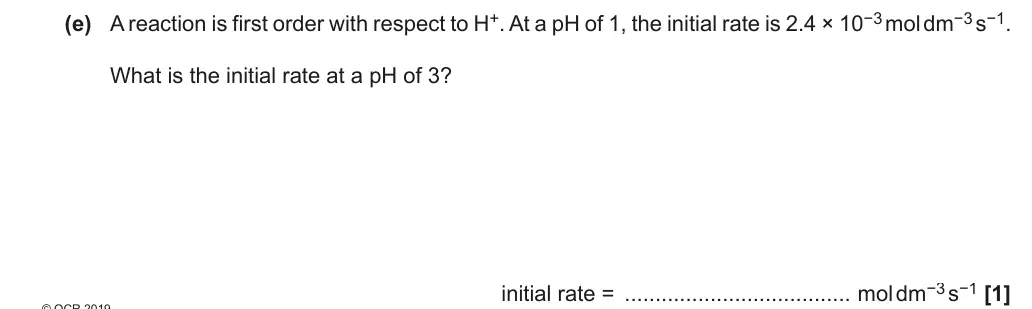
This part tested an understanding of pH as a logarithmic scale and the relationship between rates and order. This part discriminated extremely well. A pH of 3 meant that the H+ concentration would be 100 times less than at a pH of 1. Being a first order reaction with respect to H+, the initial rate is simply 100 times less than at a pH of 1: 2.4 × 10⁻⁵ mol dm–3 s–1. The higher-ability candidates identified the relationships and often wrote the correct answer on the answer line with no visible working (presumably doing the calculation in their head). Others used their well-learnt equations to calculate the same correct answer. Many candidates found the calculation difficult and 7.2 × 10⁻³ (3 × (2.4 × 10–3)) was a very common incorrect answer. If candidates had fully scrutinised this answer, they may have realised that a more dilute solution cannot produce a faster rate.
June 2019 · Paper 3 · Q2(a)1 markAO1Equation writingMedium
Mark scheme
Examiner's comment
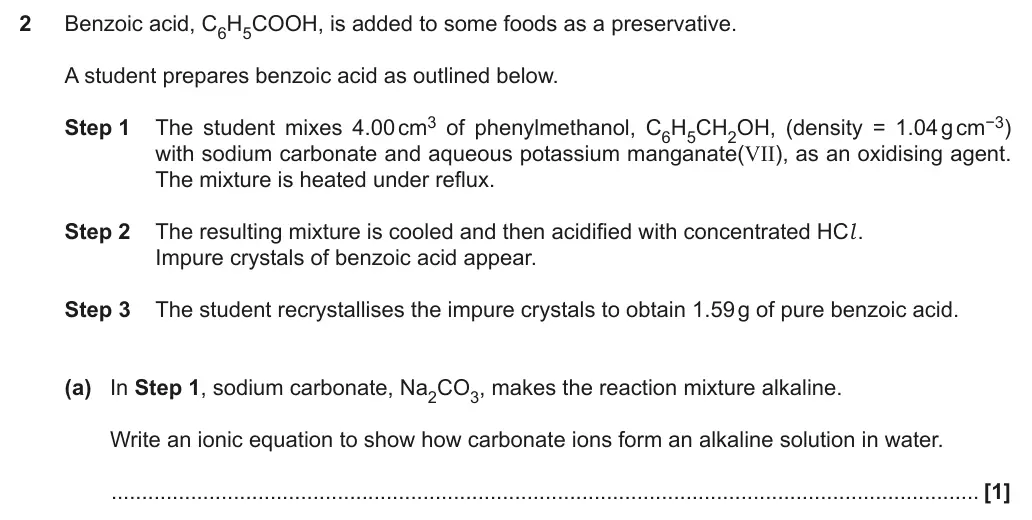
This equation presented problems for many candidates, despite the question asking for an equation between carbonate ions and water. An acceptable equation had to be ionic and needed to produce OH– (for the alkaline solution) and either HCO3– or CO2. Many candidates wrote an equation with H+ instead of H2O, with lower ability candidates showing the carbonate ion with the wrong charge as CO3–. Many candidates wrote full equations despite the question asking for an ionic equation. Candidates do need to read the instructions in the question.
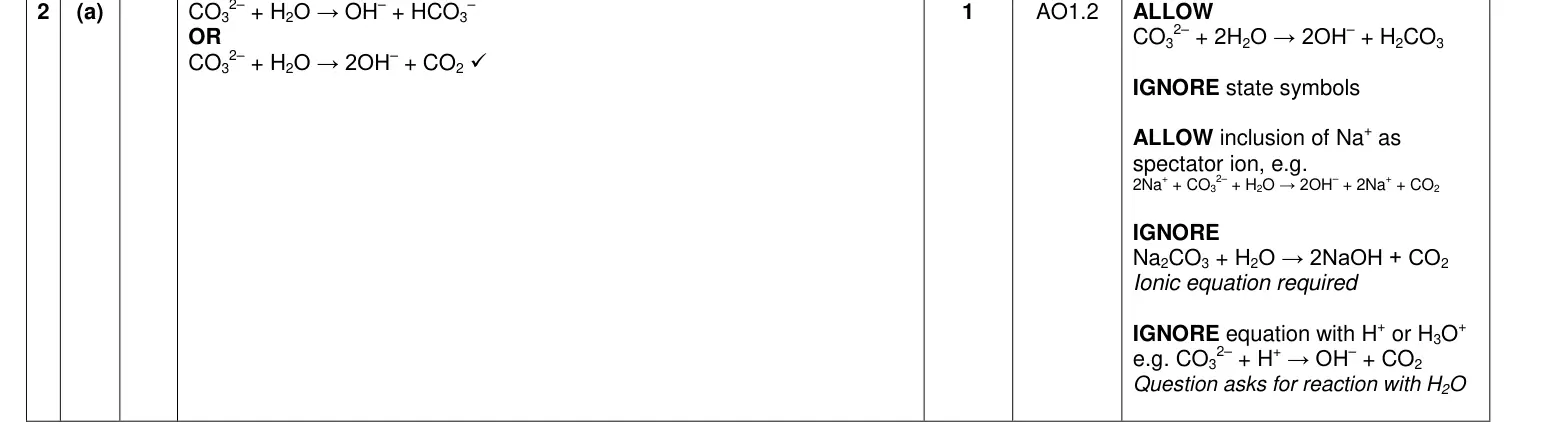
Notes from the mark scheme and report
CO32– + H2O → OH– + HCO3–
ionic equation required
IGNORE equations with H+ or H3O+ (question asks for reaction with H2O)
IGNORE state symbols
June 2019 · Paper 3 · Q2(b)1 markAO2Short answerHard
Earlier part of question 2 that this part uses
Mark scheme
Examiner's comment
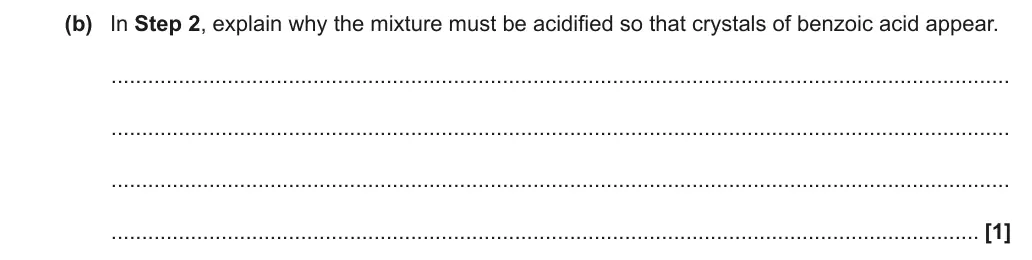
Candidates found this part extremely difficult. The question was aimed to stretch and challenge. Many candidates followed on directly from part (a), stating in simple terms that the alkaline solution needed to be neutralised to remove hydroxide ions. However, candidates were expected to recognise that the alkaline conditions would lead to benzoate ions rather than benzoic acid being present in the mixture. The mixture is acidified to protonate the benzoate. The hint in the question was about making the benzoic acid appearing when acid is added.
Notes from the mark scheme and report
H+ protonates benzoate/carboxylate ion to form benzoic acid
IGNORE responses only about neutralising the alkali/carbonate
Skills: PAG6 Synthesis of an organic solid
June 2019 · Paper 3 · Q4(a)(iv)5 marksAO1, 2CalculationMedium
Earlier part of question 4 that this part uses
Mark scheme
Examiner's comment
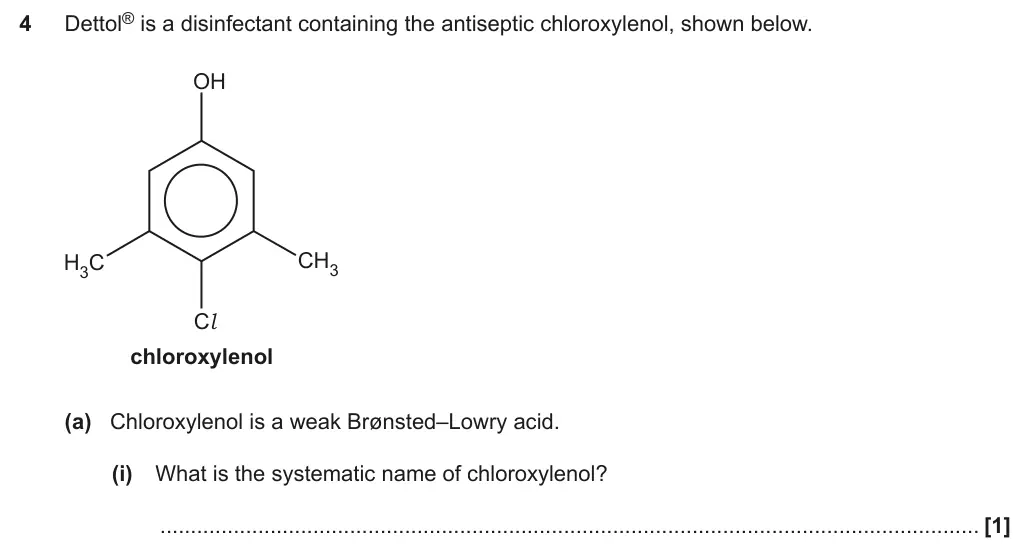
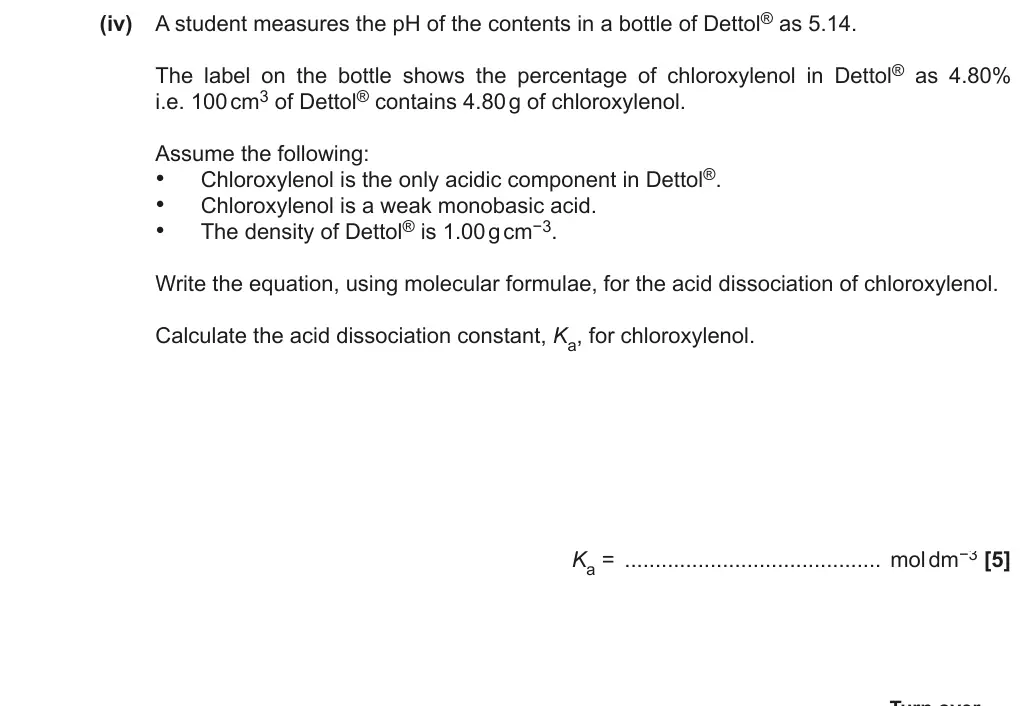
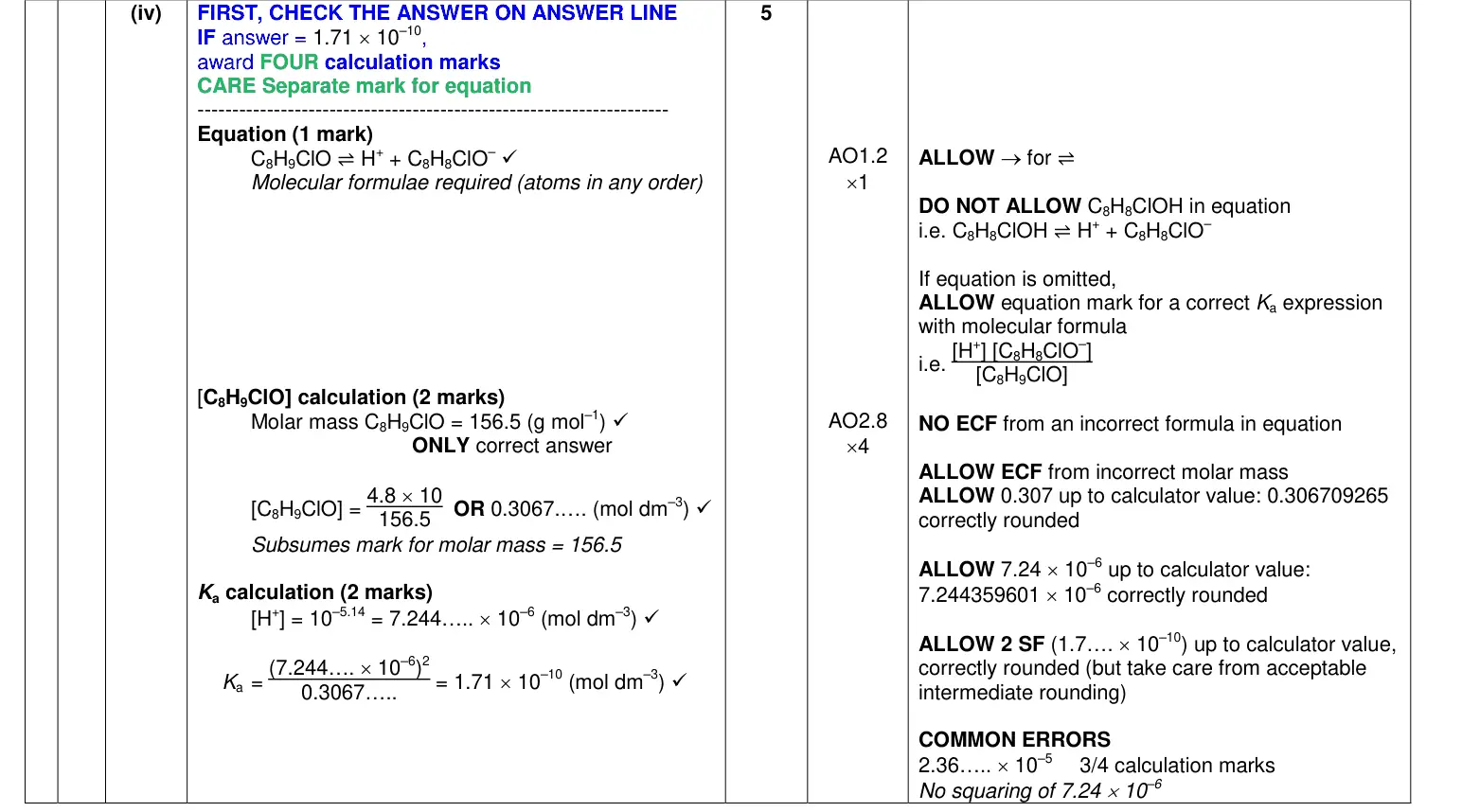
Candidates produced some very good calculations. It was common for candidates to determine the correct Ka value of 1.71 × 10⁻¹⁰ mol dm–3, after first calculating the hydrogen ion and weak acid concentrations. The initial calculation of the hydrogen ion concentration from 10–pH proved to be the easiest mark. The weak acid concentration proved to be more difficult with a significant number unable to determine the correct molar mass of chloroxylenol as 156.5. Most candidates recognised that the molar concentration in mol dm–3 was required from the mass of chloroxylenol in 100 cm3. Almost all candidates divided the mass of 4.80 by their molar mass but the scaling by ×10 was not always successful. Some candidates used the mole equations that they had learnt to obtain the ×10 scaling in a very roundabout way. The final mark was often given by ECF (error carried forward) from an incorrect concentration. The question did also ask for an equation, using molecular formulae, for the acid dissociation. This was sometimes omitted or written using C8H8ClOH as the molecular formula of chloroxylenol, instead of C8H9ClO. Even if the equation had been omitted, the mark could still given from a correct Ka expression using molecular formulae. The usual advice of ‘read and answer the question’ still holds. equation has been written using molecular formulae and all stages of the calculation are clear to see. Most candidates worked out the hydrogen ion concentration as 7.244 × 10⁻⁶ mol dm–3 before carrying out the final Ka calculation. This candidate had combined these stages.
Notes from the mark scheme and report
molecular formulae required in equation (C8H9ClO ⇌ H+ + C8H8ClO–)
common error: no squaring of [H+] (2.36 × 10⁻⁵) 3 of 4 calculation marks
NO ECF from incorrect formula in equation
Skills: M0.0 Recognise and make use of appropriate units in calculations; M0.4 Use calculators to find and use power, exponential and logarithmic functions; M2.3 Substitute numerical values into algebraic equations using appropriate units for physical quantities; M2.5 Use logarithms in relation to quantities that range over several orders of magnitude
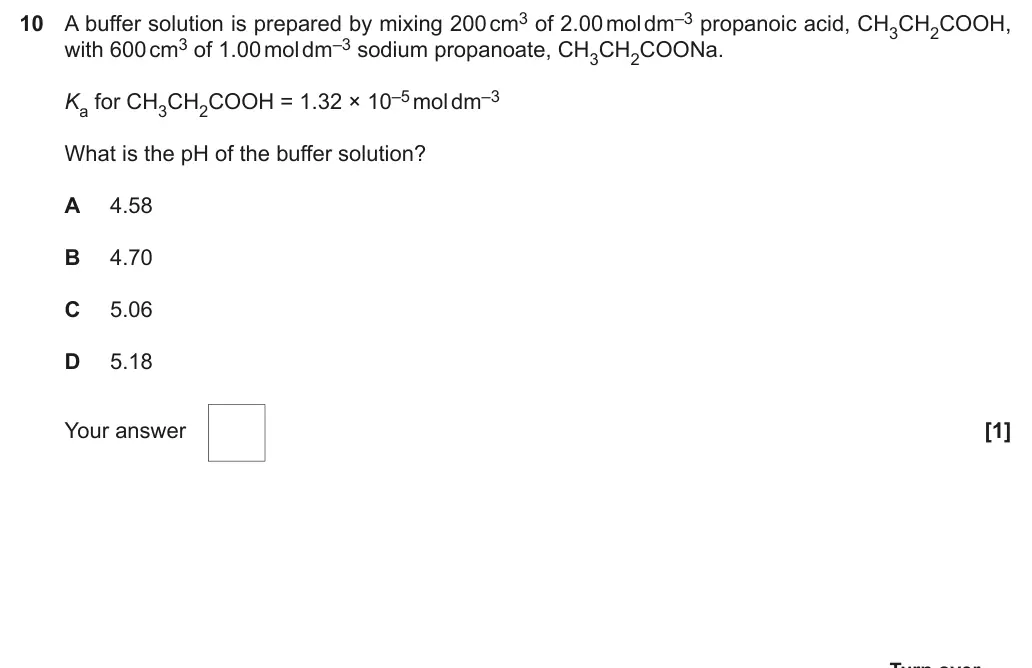
June 2018 · Paper 1 · Q101 markAO2Multiple choiceHard
Answer
C
Mark scheme
Examiner's comment
This relatively difficult pH calculation was readily done successfully by higher ability candidates, but lower ability candidates found it difficult, with answer B proving a popular choice.
June 2018 · Paper 1 · Q19(a)(i)1 markShort answerMedium
Mark scheme
Examiner's comment
Almost universally known. Common errors were the use of [HA], [A–] or [H+]2.
Notes from the mark scheme and report
square brackets required
IGNORE expressions with HA or [H+]2
June 2018 · Paper 1 · Q19(a)(ii)3 marksCalculationEasy
Earlier part of question 19 that this part uses
Mark scheme
Examiner's comment
This three-step calculation was successfully completed by almost all candidates. The common errors were to omit giving the final answer to 2 decimal places or to use [H+] rather than [H+]2 in the calculation, leading to a pKa of 2.35.
Notes from the mark scheme and report
Ka = [H+]2/0.870 = 1.74 × 10^–5
pKa = 4.76
2 decimal places required
Skills: M0.4 Use calculators to find and use power, exponential and logarithmic functions; M2.3 Substitute numerical values into algebraic equations using appropriate units for physical quantities; M2.5 Use logarithms in relation to quantities that range over several orders of magnitude
June 2018 · Paper 1 · Q19(a)(iii)1 markCalculationHard
Earlier parts of question 19 that this part uses
Mark scheme
Examiner's comment
This proved a more difficult calculation than expected, but higher ability candidates realised that [H+] (determined from the pH) divided by the given concentration of CH3COOH was required. Answers had to be expressed to three significant figures in order to receive credit.
Notes from the mark scheme and report
3 sig figs required
Skills: M0.2 Use ratios, fractions and percentages; M1.1 Use an appropriate number of significant figures
June 2018 · Paper 1 · Q19(b)4 marksCalculationEasy
Mark scheme
Examiner's comment
To help candidates, on this occasion early rounding was ignored and consequently most candidates scored full marks in this multi-step calculation. However, candidates should be advised not to round in the early stages of calculations such as this, as this introduces rounding errors into the final answer. Candidates should be encouraged to indicate what they are attempting to calculate in unstructured calculations such as this. The first step was frequently seen as 10–13.48 = 3.31… x 10–14 which most examiners could take to be [H+]. However, it is clearer to write [H+] = 10–13.48 = 3.31… x 10–14 mol dm–3. Even inclusion of units would help some candidates achieve partial credit as this might allow examiners to determine what a candidate is attempting to do.
Notes from the mark scheme and report
mass NaOH = 0.302 × 0.100 × 40.0 = 1.21 g
95.9%
ALLOW pOH method
ALLOW ECF throughout
Skills: M0.2 Use ratios, fractions and percentages; M0.4 Use calculators to find and use power, exponential and logarithmic functions; M1.1 Use an appropriate number of significant figures; M2.5 Use logarithms in relation to quantities that range over several orders of magnitude
June 2018 · Paper 3 · Q6(a)(iii)3 marksComplete table/diagramHard
Earlier part of question 6 that this part uses
Mark scheme
Examiner's comment
This novel question linked together acid–base equilibria with a multi-step process. Many candidates completed an equation to generate acid–base pairs, which were then usually assigned correctly. The final equation was challenging but the highest ability candidates were able to combine together all the information with their earlier responses to arrive at the correct equation. See Exemplar 15.
Notes from the mark scheme and report
step 1 CH3CHO + OH– ⇌ –CH2CHO + H2O with pairs A1/B1 and A2/B2 labelled
Skills: M0.4 Use calculators to find and use power, exponential and logarithmic functions; M1.1 Use an appropriate number of significant figures; M2.2 Change the subject of an equation; M2.3 Substitute numerical values into algebraic equations using appropriate units for physical quantities; M2.5 Use logarithms in relation to quantities that range over several orders of magnitude
June 2017 · Paper 1 · Q21(b)2 marksDrawing / labelling
Mark scheme
Notes from the mark scheme and report
stronger acid FCH2COOH donates H+ to CH3COOH giving CH3COOH2+ and FCH2COO–
ECF for labels only if proton transfer is the wrong way round
June 2017 · Paper 1 · Q21(c)(i)5 marksShort answer
Mark scheme
Notes from the mark scheme and report
last 3 marks not available using √(Ka × c) weak-acid approach or Kw approach
common errors 4.64 (M = 60) and 2.40 (wrong Ka) score 4
ALLOW Henderson–Hasselbalch
Skills: M0.2 Use ratios, fractions and percentages; M0.4 Use calculators to find and use power, exponential and logarithmic functions; M2.3 Substitute numerical values into algebraic equations using appropriate units for physical quantities; M2.5 Use logarithms in relation to quantities that range over several orders of magnitude
June 2017 · Paper 1 · Q21(c)(ii)2 marksShort answer
Earlier part of question 21 that this part uses
Mark scheme
Notes from the mark scheme and report
pH stays the same because the ratio [HA]/[A–] is unchanged
second mark dependent on first
June 2017 · Paper 3 · Q5(a)(i)1 markShort answer
Mark scheme
Notes from the mark scheme and report
Ka = [H+][C4H9S–]/[C4H9SH]
square brackets required
Work with an OCR chemistry tutor
Dropping marks on calculations, mechanisms or the six-markers? Book a trial session with a specialist OCR chemistry tutor.