Notes and key-term cards for this topic are being written by our tutors. The past-paper questions below are ready now.
Learning outcomes
Show the 7 learning outcomes from the specification
4.1.2(a) alkanes as saturated hydrocarbons containing single C–C and C–H bonds as σ-bonds (overlap of orbitals directly between the bonding atoms); free rotation of the σ-bond
4.1.2(b) explanation of the tetrahedral shape and bond angle around each carbon atom in alkanes in terms of electron pair repulsion (see also 2.2.2 g– h)
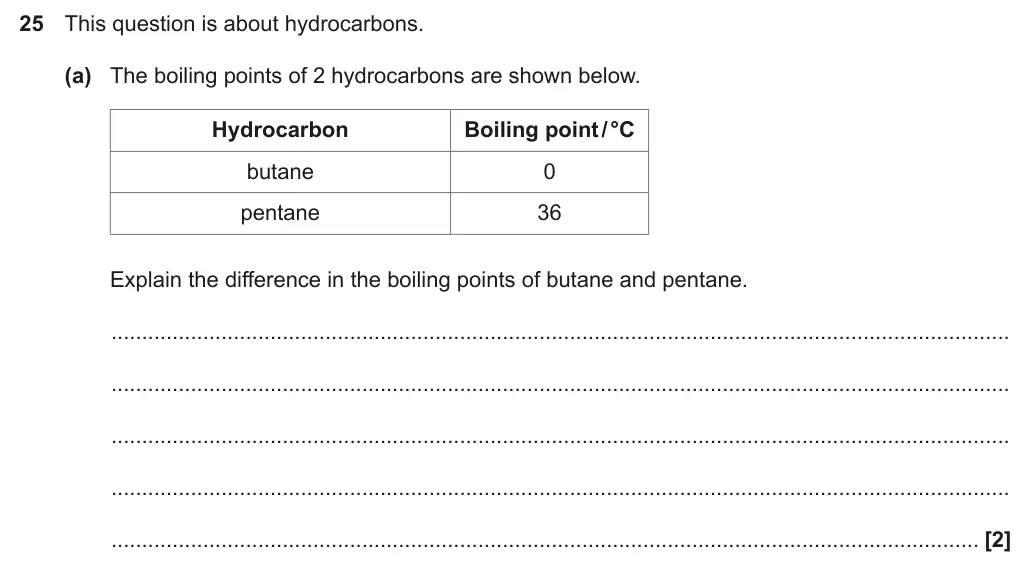
4.1.2(c) explanation of the variations in boiling points of alkanes with different carbon-chain length and branching, in terms of induced dipole– dipole interactions (London forces) (see also 2.2.2 k)
4.1.2(d) the low reactivity of alkanes with many reagents in terms of the high bond enthalpy and very low polarity of the σ-bonds present (see also 2.2.2 j)
4.1.2(e) complete combustion of alkanes, as used in fuels, and the incomplete combustion of alkane fuels in a limited supply of oxygen with the resulting potential dangers from CO
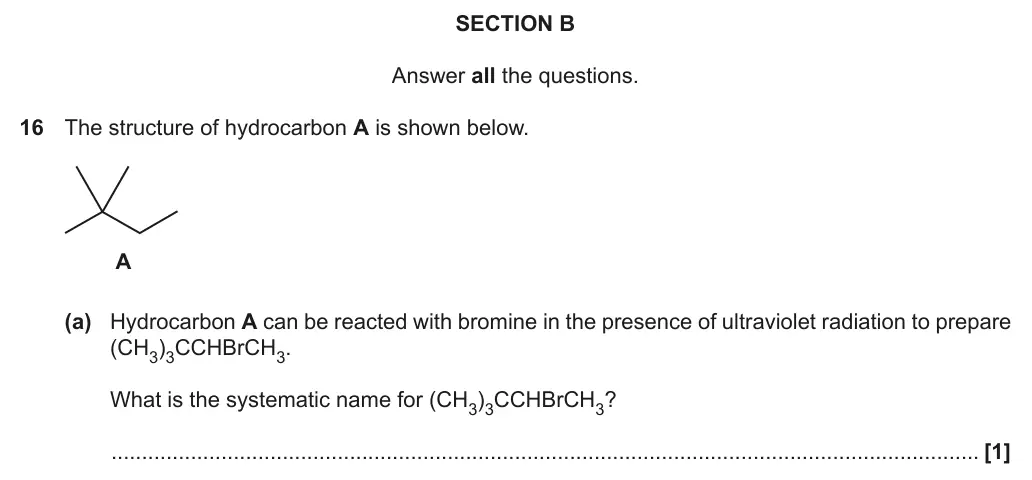
4.1.2(f) the reaction of alkanes with chlorine and bromine by radical substitution using ultraviolet radiation, including a mechanism involving homolytic fission and radical reactions in terms of initiation, propagation and termination (see also 4.1.1 f– g)
4.1.2(g) the limitations of radical substitution in synthesis by the formation of a mixture of organic products, in terms of further substitution and reactions at different positions in a carbon chain.
Tap a question to zoom it. Where a part needs a table, graph or structure from an earlier part, that part folds out above it; the mark scheme and examiner's comment open underneath. Have the OCR Data Sheet beside you.
June 2025 · AS Paper 1 · Q24(b)1 markEquation writingEasy
Mark scheme
Examiner's comment
This was well answered by the majority of candidates. Where the mark was missed, it was either through incorrect products or incorrect balancing of oxygen.
Notes from the mark scheme and report
ALLOW multiples
IGNORE state symbols
Skills: M0.2 Use ratios, fractions and percentages
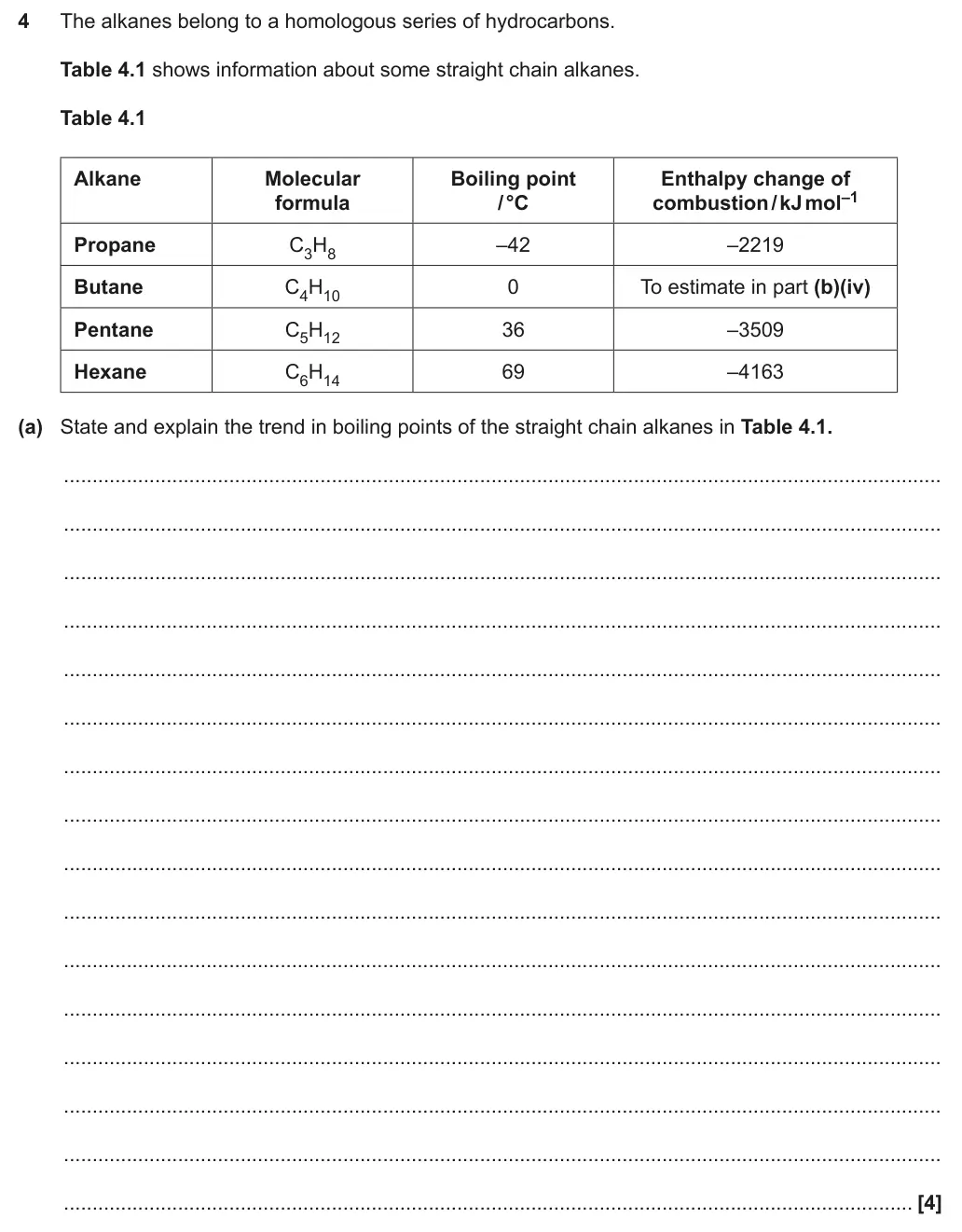
June 2025 · AS Paper 2 · Q4(a)4 marksData interpretationMedium
Mark scheme
Examiner's comment
Many candidates were able to score all 4 marks. More successful responses were clear and concise, covering all the detail required in much less space that provided here (see exemplar). Less successful responses often scored a mark for the correct trend but stated that this was due to more (covalent) bonds needing to be broken. Some were able to give well-rehearsed explanations for the dif- ference in boiling point but lost the trend mark as state change by the position in the table only, e.g. “as you go down the table, the boiling point increases”. A few muddled different types of intermolecular forces, suggesting that H-bonds were present. There was evidence that some held the misconception that a C-H-bond constitutes a H-bond. Explanations were sometimes missing the ‘contact’ between molecules or alternatively an increase in the number of electrons. Some did not gain marks as their responses were not comparative, e.g. “has sur- face contact so can form London forces” or” requires a lot of energy to break London forces”. It was fairly common to see “more energy to break the bonds” which was not given as it needed to be clear that it was the intermolecular/London forces which are broken. Some referred to enthalpy of combustion data which was not asked about in the question. Some re- sponses had lots of repetition i.e. explained why longer chains had a high boiling point, then repeated the same but for the reverse argument for smaller chains. A clear and concise response which scores all 4 marks. The diagrams at the bottom confirm that this candidate has understood the concepts completely.
Notes from the mark scheme and report
comparisons needed throughout
boiling point increases as chain length increases
more surface CONTACT (surface area alone insufficient)
more/stronger London forces
more ENERGY to break them
DO NOT ALLOW branching, permanent dipoles, hydrogen bonding or covalent bonds breaking
IGNORE van der Waals
Skills: M3.1 Translate information between graphical, numerical and algebraic forms
June 2025 · AS Paper 2 · Q4(b)(i)1 markEquation writingHard
Earlier part of question 4 that this part uses
Mark scheme
Examiner's comment
The majority gave a correctly balanced equation here. The most common error was an incorrect number of oxygen molecules. A few candidates gave the equation for propane rather than pentane.
Notes from the mark scheme and report
C5H12 + 8O2 → 5CO2 + 6H2O
DO NOT ALLOW multiples (one mole of pentane)
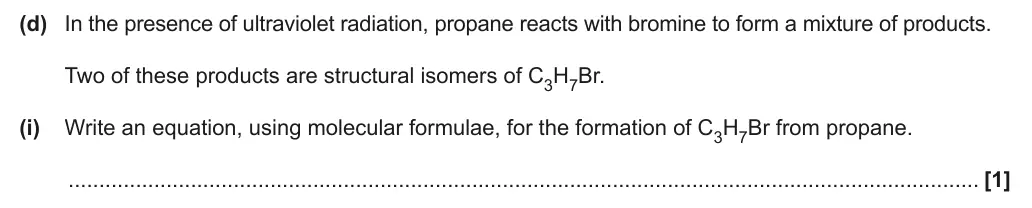
June 2025 · AS Paper 2 · Q4(d)(i)1 markEquation writingMedium
Mark scheme
Examiner's comment
Generally well known, with most recognising that HBr is formed as a product. Incorrect responses sometimes had 2 Br instead of Br2 or included other radicals in their response. Some candidates confused propane and pentane, despite being given them in the table. Some started with a longer C chain, breaking the chain and substituting with Br to give bromopropane as state in the question, e.g. C4H10 + Br2 → C3H7Br + CH3Br. Some used structural formulae rather than the molecular formula which was asked for.
Notes from the mark scheme and report
C3H8 + Br2 → C3H7Br + HBr
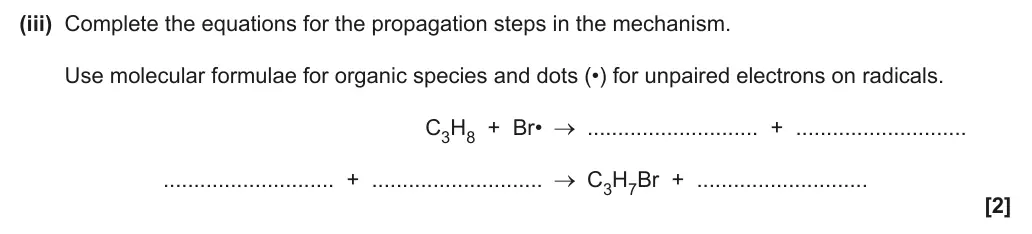
June 2025 · AS Paper 2 · Q4(d)(iii)2 marksMechanismHard
Earlier part of question 4 that this part uses
Mark scheme
Examiner's comment
Most scored both marks here. The most common error involved substituting the Br in the first step – this lost both marks. Very few candidates scored 1 mark; this was usually for a correct first step but then re- acting the C3H7 radical with either 2 Br or HBr in second step. Candidates must check that equations balance in terms of atoms. Candidates should also understand that hydrogen radicals are highly reactive and are therefore unlikely to exist under standard conditions.
June 2025 · AS Paper 2 · Q4(d)(iv)1 markShort answerMedium
Earlier part of question 4 that this part uses
Mark scheme
Examiner's comment
This question was a slightly different way of asking why a number of different products are formed in rad- ical reactions. However here candidates needed to recognise that it would be due to substitution at dif- ferent positions along the chain. Common incorrect response included ”multiple termination products” or “further substitution”. It was also evident in some responses that candidates had muddled this with nucle- ophilic substitution and described the “stability of the carbocation intermediate”. Some just stated the two different structural isomers that would be formed but didn't gain the mark as needed to say how they are formed.
Notes from the mark scheme and report
Br can substitute at different positions on the chain (end or middle C) / two different radicals form
DO NOT ALLOW stability of carbocations
IGNORE major/minor product
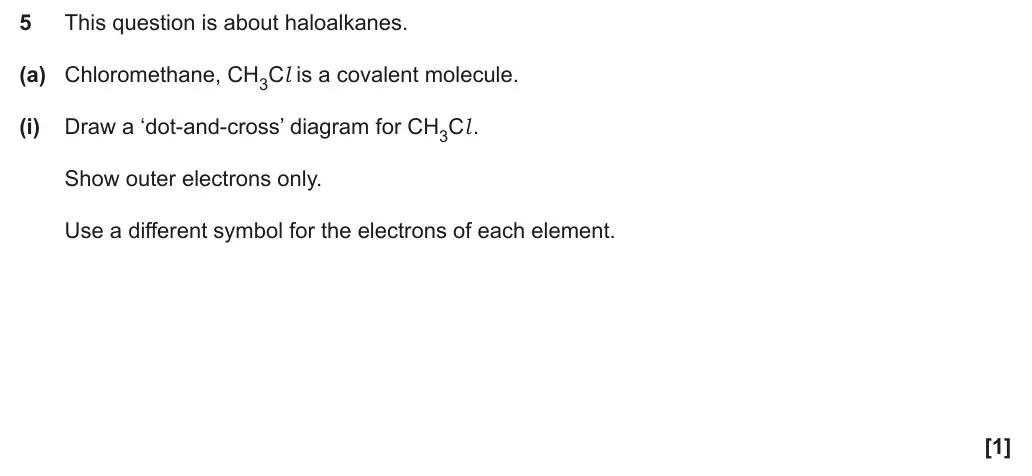
June 2025 · AS Paper 2 · Q5(a)(ii)2 marksShort answerHard
Earlier part of question 5 that this part uses
Mark scheme
Examiner's comment
Most scored both marks here, as they were able to use the ‘dot-and-cross’ diagram drawn in (i). Some struggled with recalling the bond angle. A few “trigonal planar” and “120” responses were seen perhaps confusing themselves with the next part of the question.
Notes from the mark scheme and report
tetrahedral
109.5° (ALLOW 109–110)
Skills: M4.1 Use angles and shapes in regular 2-D and 3-D structures
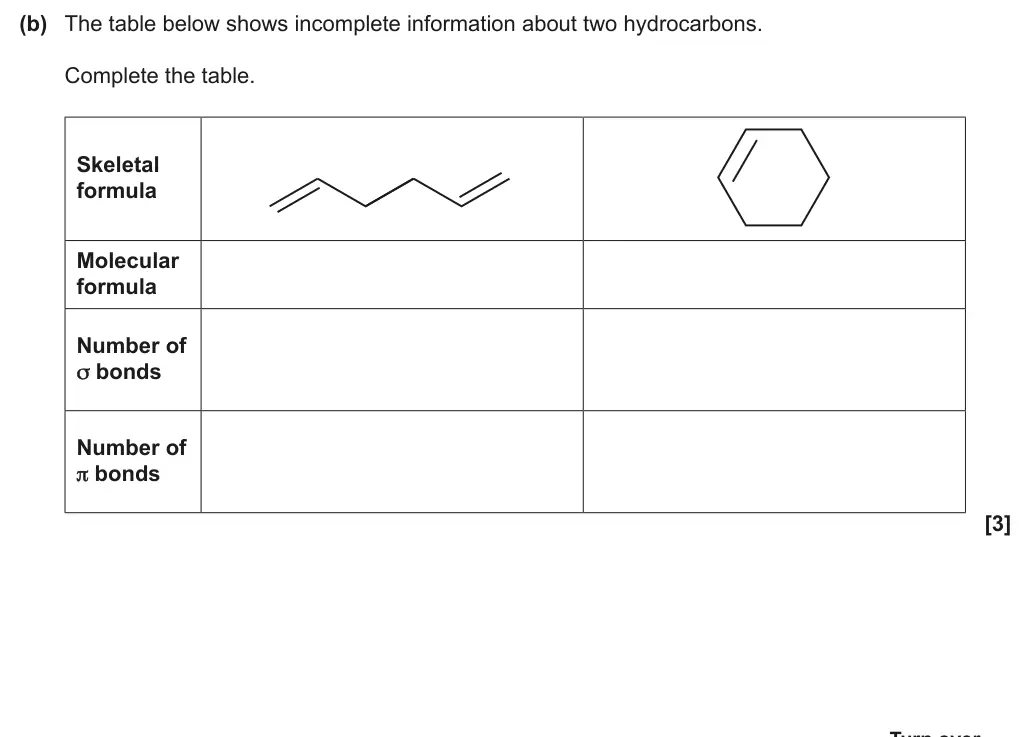
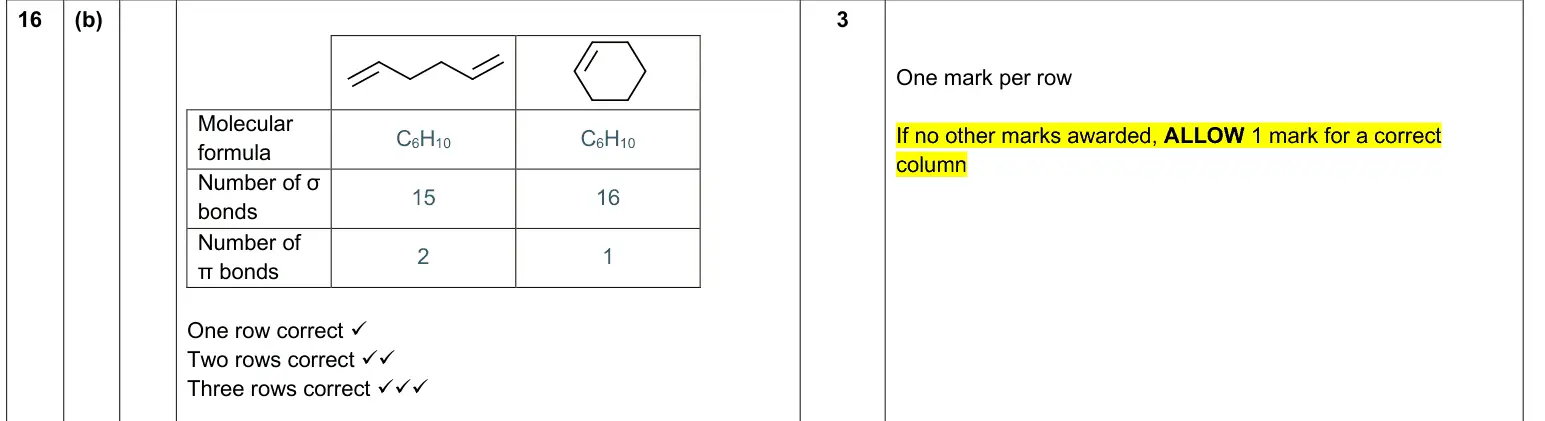
June 2025 · Paper 2 · Q16(b)3 marksComplete table/diagramHard
Mark scheme
Examiner's comment
Very few candidates did not score any marks here. Most gained a mark for the correct molecular formulae in the first row, although some candidates gave structural formulae instead of molecular formulae or gave both. Candidates found counting the different types of bonds quite challenging and we would recommend drawing out displayed formulae to make it easier to label and count each type of bond. Many gave 5 and 6 respectively for the bonds, forgetting to count the C-H bonds that are not shown in the skeletal structure. More were able to correctly count the bonds but some counted the number of atoms involved in bonds instead. A few had and bonds the wrong way round.
Notes from the mark scheme and report
both C6H10
σ bonds 15 and 16
π bonds 2 and 1
one mark per row
1 mark for a correct column if no other marks
Skills: M4.2 Visualise and represent 2-D and 3-D forms including 2-D representations of 3-D objects
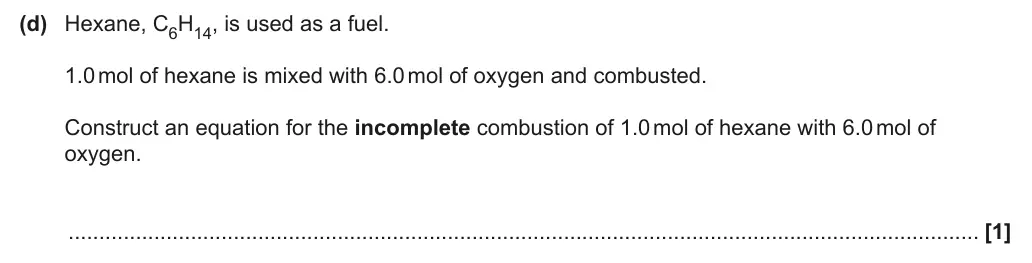
June 2025 · Paper 2 · Q16(d)1 markEquation writingMedium
Mark scheme
Examiner's comment
Most candidates were unable to gain credit here. The most common incorrect response given was C6H14 + 6O2 → 6CO + 7H2O which doesn’t balance in terms of oxygen. A significant number recognised that this was not balanced so gave C6H14 + 6.5O2 → 6CO + 7H2O but this misses the crucial 1:6 ratio of fuel/hexane to oxygen required in the question. Some gave H2 as a product of incomplete combustion, e.g. C6H14 + 6.5O2 → 6CO + 6H2O + H2. Candidates need to be reminded that C or CO will form in a limited supply of O2 but not H2. Candidates seemed unaware that multiple C products of combustion can be formed in one reaction. A few gave O2 as a product as well as a reactant.
Notes from the mark scheme and report
C6H14 + 6O2 → 5CO + C + 7H2O (or other CO/CO2/C combinations in a 1:6 ratio)
DO NOT ALLOW H2 as a product
Skills: M0.2 Use ratios, fractions and percentages
June 2024 · AS Paper 1 · Q161 markMultiple choiceMedium
Answer
C
Mark scheme
Examiner's comment
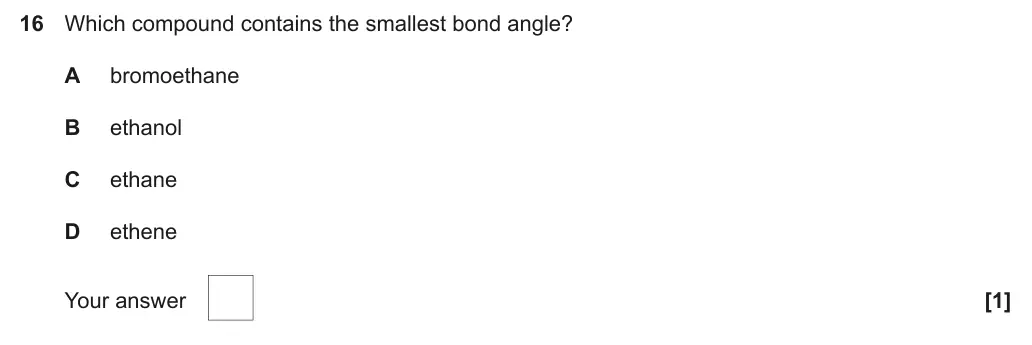
Some candidates chose B as the correct option. The other options were chosen randomly, suggesting that many had not learnt this specification content and had guessed.
June 2024 · AS Paper 1 · Q24(a)4 marksShort answerHard
Mark scheme
Examiner's comment
Most candidates were given 3 or 4 marks. The most common omission was the idea of surface contact. Most candidates identified London forces or induced dipole interactions as the relevant intermolecular force. A few candidates gave a general comment in terms of ‘intermolecular’ forces without specifying the type of intermolecular forces. There has been a general improvement in candidate responses to this type of question with fewer candidates than in previous exams suggesting the breaking of hydrogen bonds or covalent bonds. main factors responsible for the trend in boiling points. This response was given the full 4 marks.
Notes from the mark scheme and report
boiling point decreases with more branching
less surface contact between molecules
weaker London forces
less energy to break intermolecular forces
DO NOT ALLOW different numbers of electrons
IGNORE just 'bonds'
surface area alone not sufficient
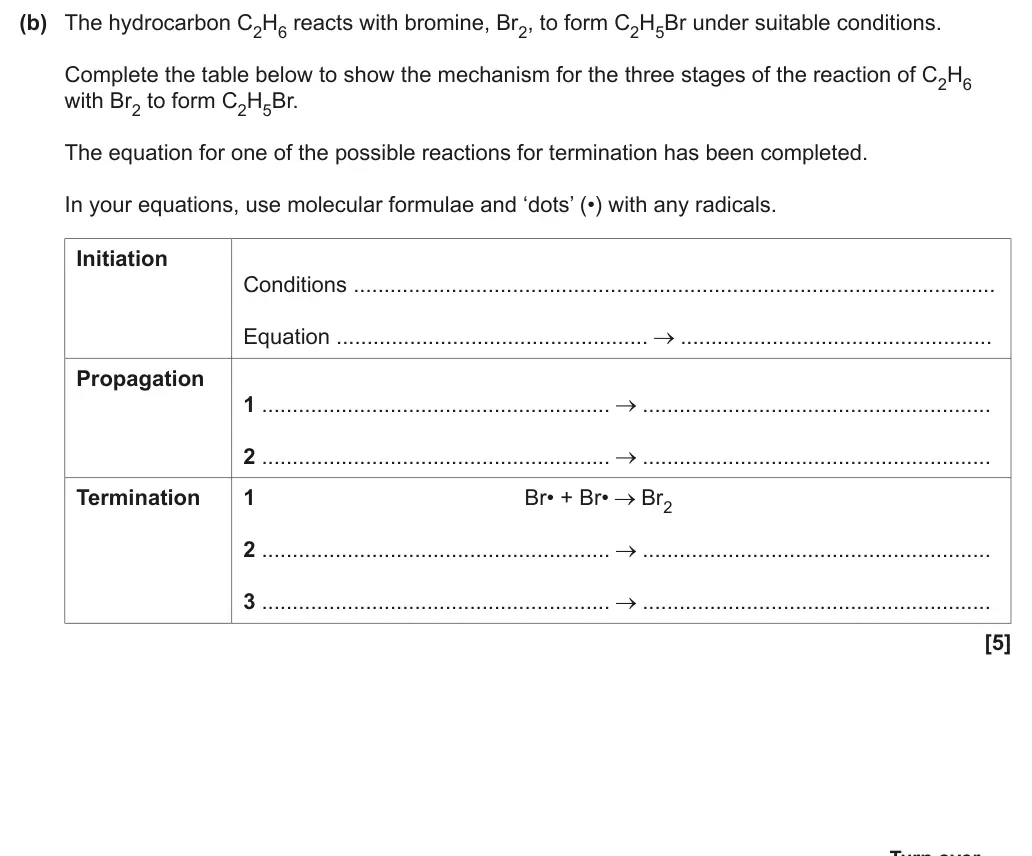
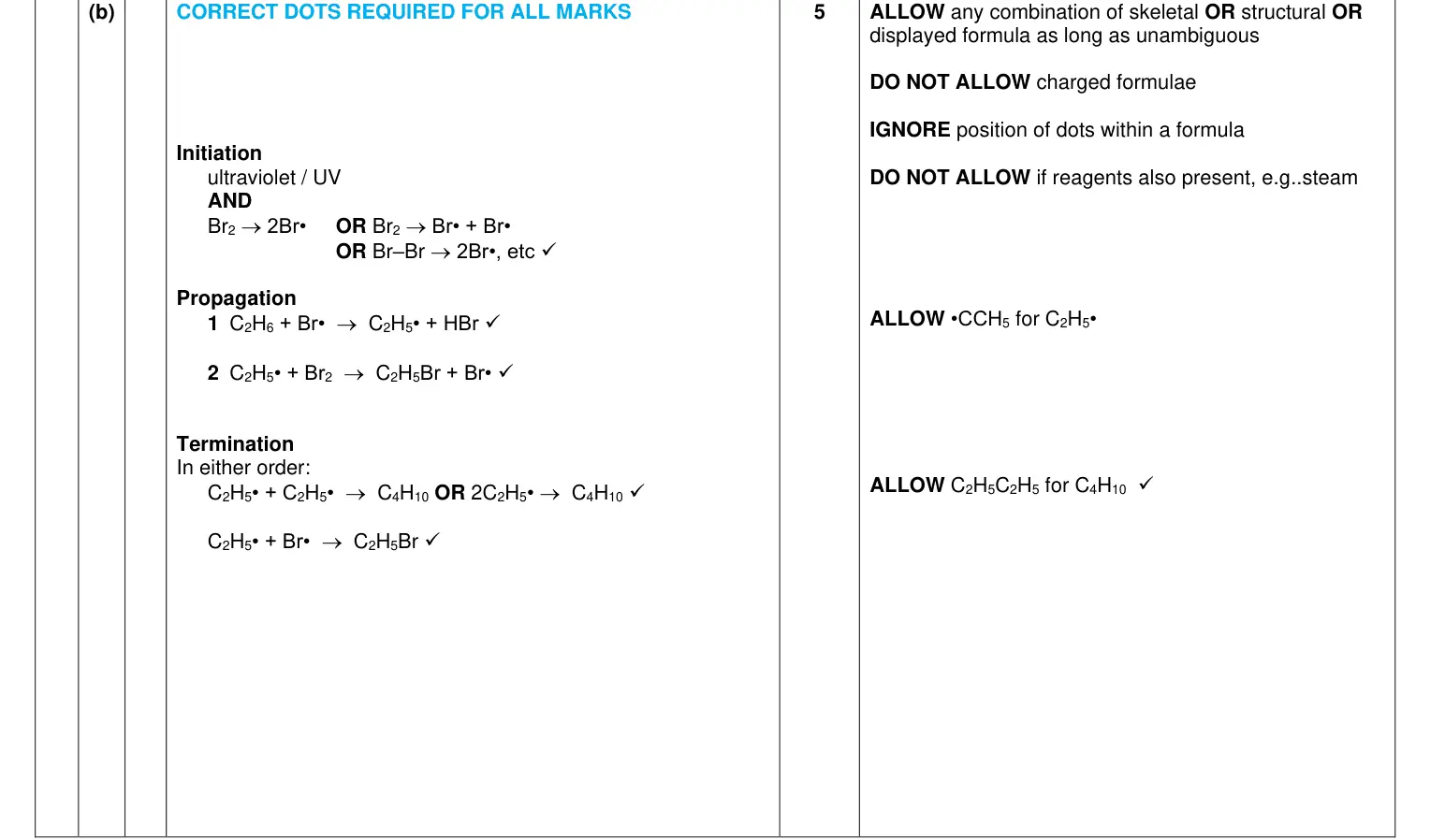
June 2024 · AS Paper 1 · Q24(b)5 marksMechanismMedium
Mark scheme
Examiner's comment
This question was answered extremely well with most candidates obtaining the full 5 marks. It was encouraging to see the widespread correct use of dots to indicate radicals, with relatively few omissions. Of the three steps, initiation and termination were answered better than the equations for propagation.
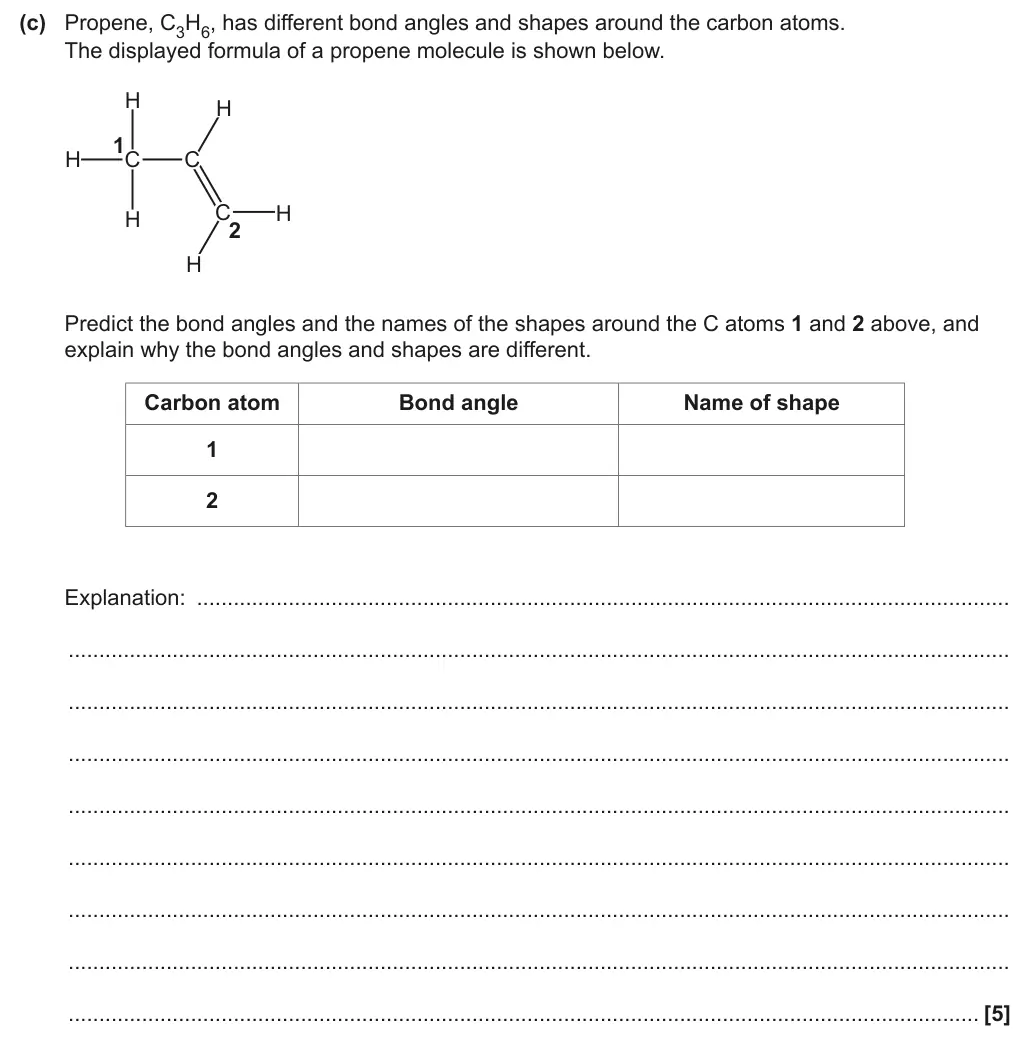
June 2024 · AS Paper 1 · Q24(c)5 marksExtended responseMedium
Mark scheme
Examiner's comment
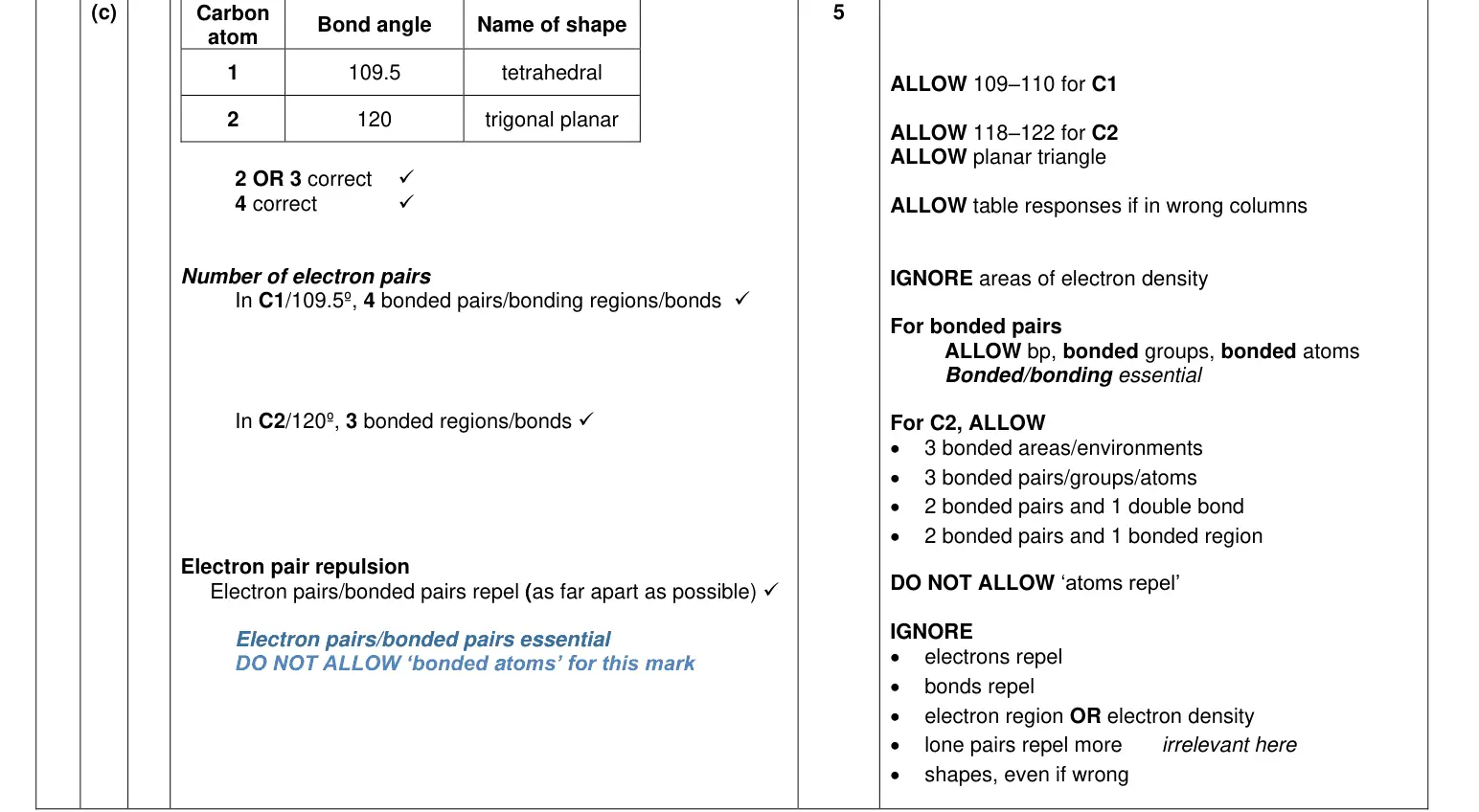
The bond angles and shapes rewarded the well-prepared candidates, with many being given both available marks for this part of the question. This part discriminated very well. For the explanation, most candidates identified 4 and 3 for C1 and C2, but candidates often linked 4 and 3 to atoms, rather than to electron pairs or bonded pairs for C1 and to bonding regions for C2. A mark was available for stating that ‘electron pairs repel’, but this important fact was often omitted despite being the main principle that determines molecular shapes. The question discriminated well, giving a good spread of marks across the five available.
Notes from the mark scheme and report
C1 109.5° tetrahedral with 4 bonded pairs
C2 120° trigonal planar with 3 bonded regions
electron pairs repel
DO NOT ALLOW 'atoms repel'
IGNORE 'electrons repel' and 'bonds repel'
Many students think that molecular shapes are determined solely by lone pairs or by repulsion between bonded atoms. The principle behind molecular shapes is called electron pair repulsion theory because it is based on repulsion between electron pairs, which may be bonded pairs or lone pairs, but not atoms.
Skills: M4.1 Use angles and shapes in regular 2-D and 3-D structures; M4.2 Visualise and represent 2-D and 3-D forms including 2-D representations of 3-D objects
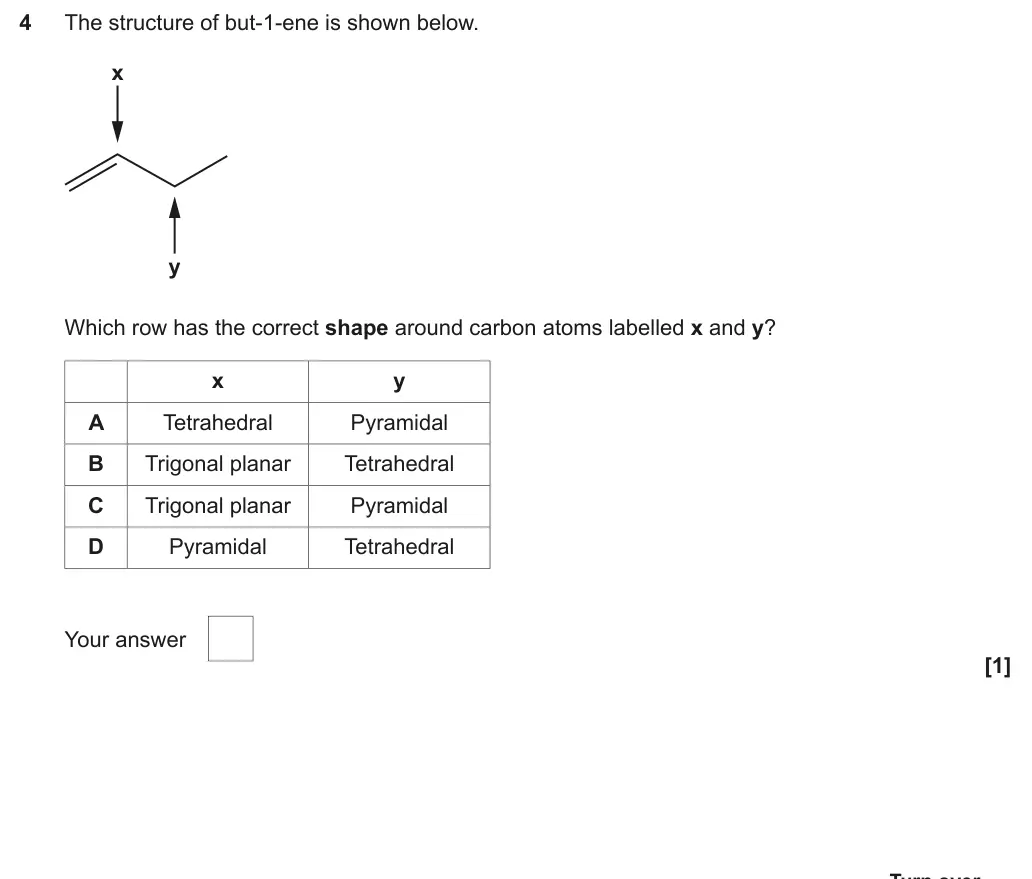
June 2024 · Paper 2 · Q41 markMultiple choiceMedium
Answer
B
Mark scheme
Examiner's comment
A large majority of candidates were able to correctly identify shape at x as being trigonal planar and y as being tetrahedral. The most common incorrect responses seen were for getting one of these incorrect i.e. D incorrect for x or C incorrect for y.
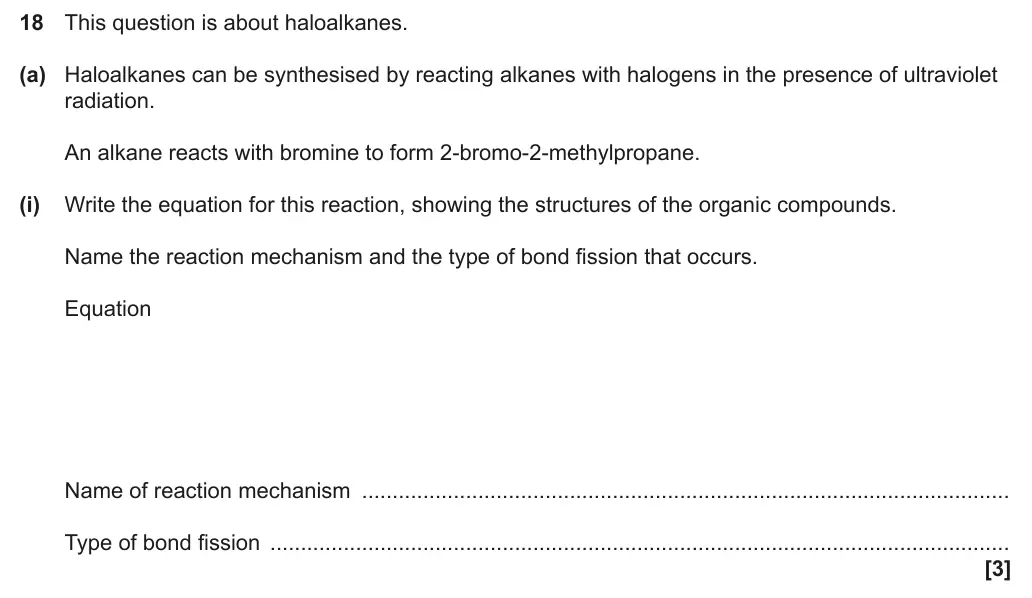
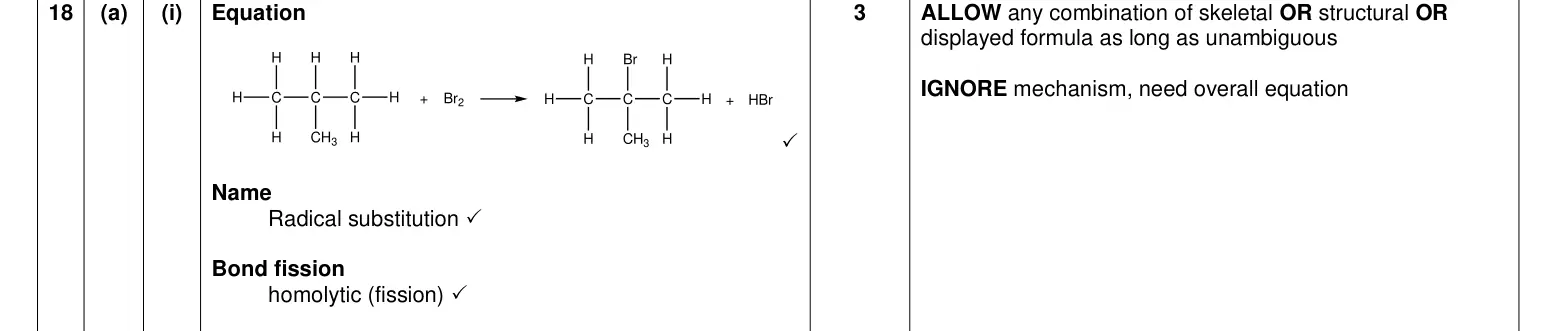
June 2024 · Paper 2 · Q18(a)(i)3 marksEquation writingHard
Mark scheme
Examiner's comment
This question differentiated well, with a wide mix of responses given. Just over 40% scored all 3 marks. Equation: The most common error was to omit HBr as a product. Some gave H2 or just Br as a product. Some misunderstood the question and attempted to give either a partial mechanism, such as the propagation step or a complete mechanism, rather than the overall equation. Some gave molecular formula rather than structures as asked for. Those using structural or displayed formula were more prone to errors, such as missing hydrogens or incorrect chain length, than those that were confident using skeletal formula. Candidate should avoid giving equations in two formats, e.g. skeletal and structural because slips in one will lose marks. Mechanism: Many candidates were able to identify the radical substitution mechanism, but a significant number did not score here. Most common incorrect responses were electrophilic or nucleophilic substitution but there were also those that thought it was an addition reaction. Bond fission: A significant number identified this as heterolytic, even if the recognised mechanism was radical. Some struggled with the spelling or even suggested homogeneous or heterogenous.
Many struggled to identify the mechanism and then to link to bond fission. Try to introduce key terminology early on in teaching organic chemistry so that it can then revisited with each topic. Relevant mechanism terminology: - substitution / addition / elimination - electrophile / nucleophile / radical - homolytic / heterolytic
June 2024 · Paper 2 · Q18(a)(ii)2 marksShort answerEasy
Earlier part of question 18 that this part uses
Mark scheme
Examiner's comment
Most candidates scored one mark here, with approximately a third of candidates scoring both marks. Most recognised that further or multiple substitution would occur or that there would be a variety of termination products. The second mark was harder to achieve as although many responses suggested a different position, it was not always clearly conveyed that a hydrogen on a different carbon along the chain was being substituted, e.g. ‘substitution can occur anywhere in the molecule’. The best responses gave examples to clarify their point, e.g. ‘the bromine radical can be substituted anywhere along the hydrocarbon chain making other products such as 1-bromo-2-methylpropane’. However, many gave vague answers such as poor yield or mixture of products, without explanation of how or what they might be. Some focused on HBr being formed as a product, suggesting it is toxic, or lowers the atom economy. Others highlighted ultraviolet radiation as being a limitation due to it being ‘expensive’, ‘hard to achieve’, ‘lack of sources’ or ‘hazardous’. Others suggested that the reaction needed ‘high temperatures’.
Notes from the mark scheme and report
further substitution (or different termination products)
substitution at different positions along the chain
IGNORE separation of products, atom economy and yield
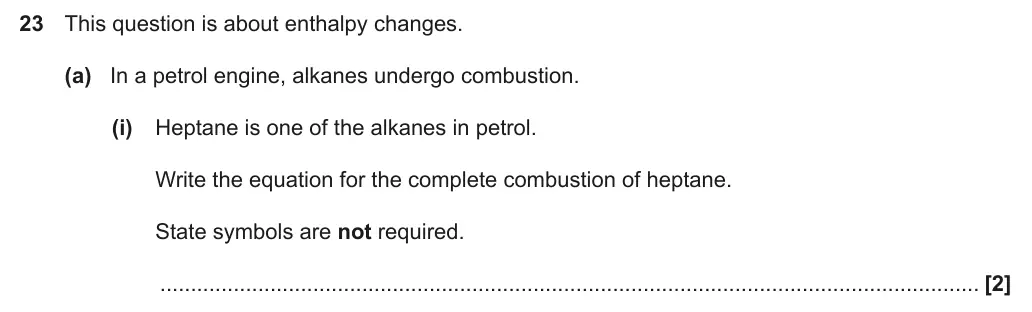
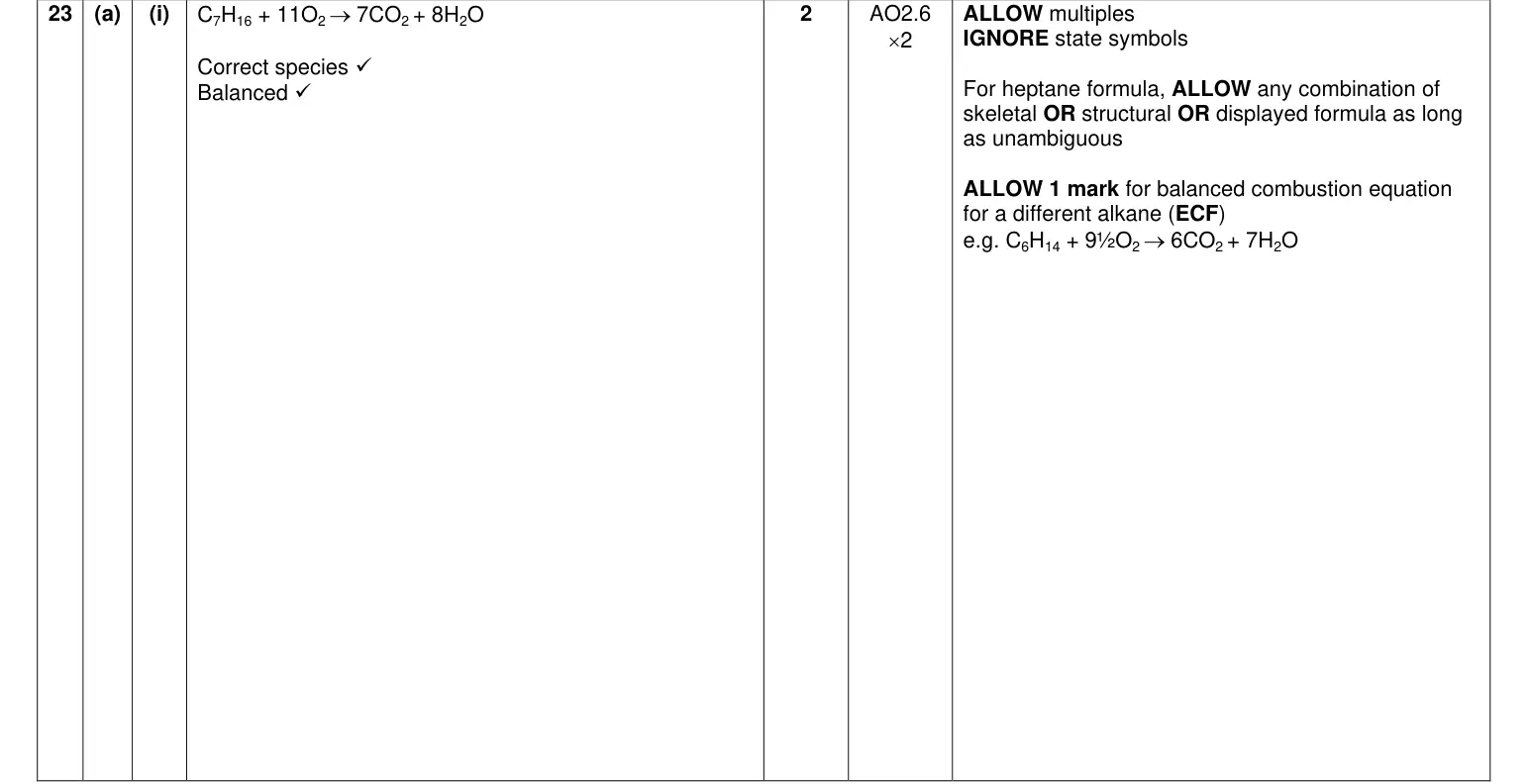
June 2023 · AS Paper 1 · Q23(a)(i)2 marksAO2Equation writingEasy
Mark scheme
Examiner's comment
Most candidates were able to construct a balanced equation for the combustion of heptane. Most were aware that CO2 and H2O would be the products although some generated CO, C6H12 or unusual compounds such as C7H14O. The hardest part was the formula of heptane itself with use of hexane instead being a common error; candidates who made this error were given 1 mark, provided that their equation was balanced.
Notes from the mark scheme and report
11O2
ALLOW multiples
1 mark ECF for a balanced combustion equation of a different alkane
Skills: M0.2 Use ratios, fractions and percentages
June 2023 · AS Paper 1 · Q25(a)2 marksAO1Short answerHard
Mark scheme
Examiner's comment
Most candidates were given 1 or 2 marks, with some omitting the idea of surface area or surface contact. Most candidates identified London forces or induced dipole interactions as the relevant intermolecular force. A few candidates gave a general comment in terms of ‘intermolecular’ forces without specifying the type of intermolecular forces. There has been a general improvement in candidate responses to this type of question with fewer candidates than in previous exams suggesting the breaking of hydrogen bonds or covalent bonds.
Notes from the mark scheme and report
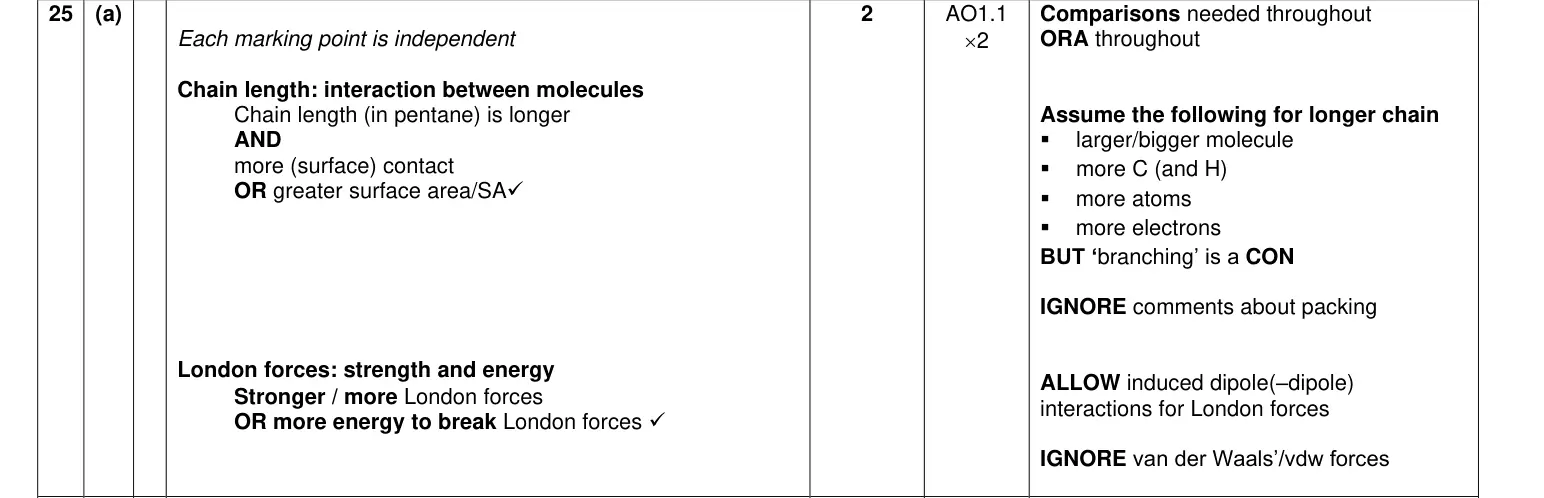
comparisons needed
longer chain so more surface contact
stronger/more London forces need more energy to break
'branching' is a CON
IGNORE van der Waals' forces
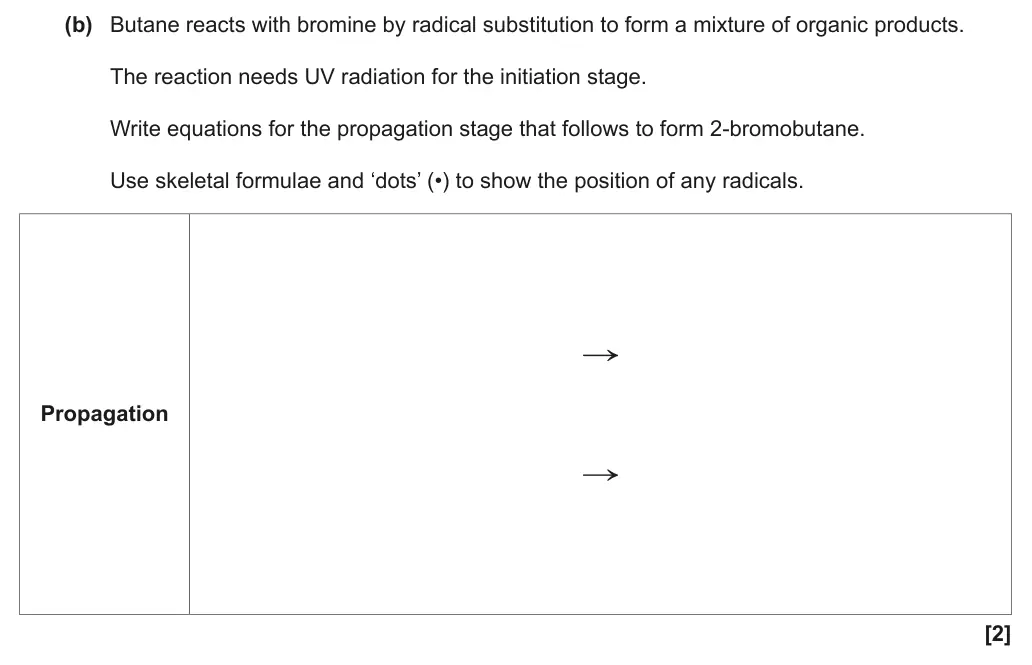
June 2023 · AS Paper 1 · Q25(b)2 marksAO3Equation writingMedium
Mark scheme
Examiner's comment
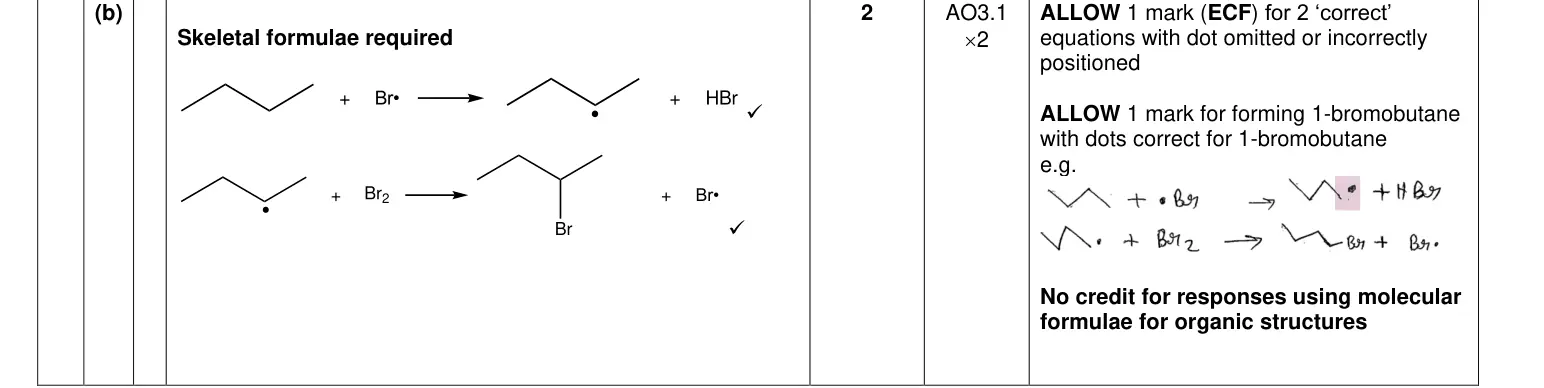
This question discriminated very well at the top end of the ability range, but many ignored the instruction to use skeletal formula and obtained no marks as a result. Of those that did use skeletal formula, many placed the dot on the wrong carbon atom or produced 1- brombutane, rather than 2-bromobutane, stated in the question. A mark was still available by ECF for misplaced or absent dots or formation of 1-brombutane with dots. This question was aimed to be demanding and so it proved to be.
Notes from the mark scheme and report
skeletal formulae required (no credit for molecular formulae)
radical dot on C2
1 mark ECF if dots omitted/misplaced or for forming 1-bromobutane correctly
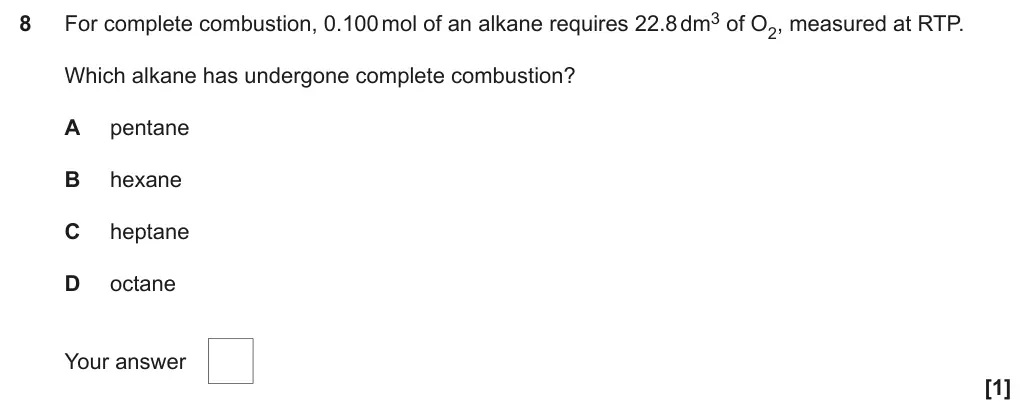
June 2023 · Paper 2 · Q81 markAO2Multiple choiceMedium
Answer
B
Mark scheme
Examiner's comment
This was a demanding question. Candidates needed to calculate the moles of oxygen and then determine the ratio of alkane to oxygen to find the correct response. The majority of successful candidates clearly showed their working to help them to arrive at the correct answer. The most common incorrect answer was C.
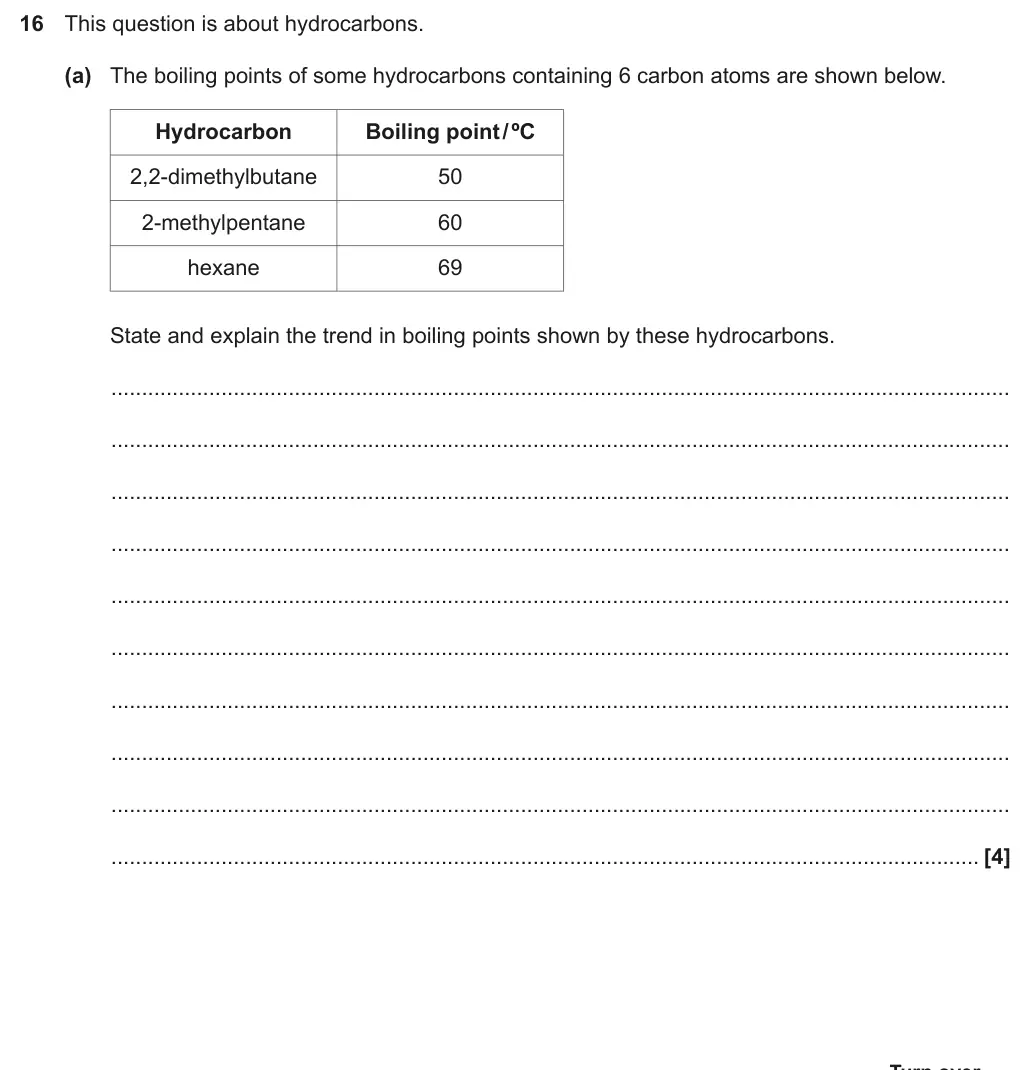
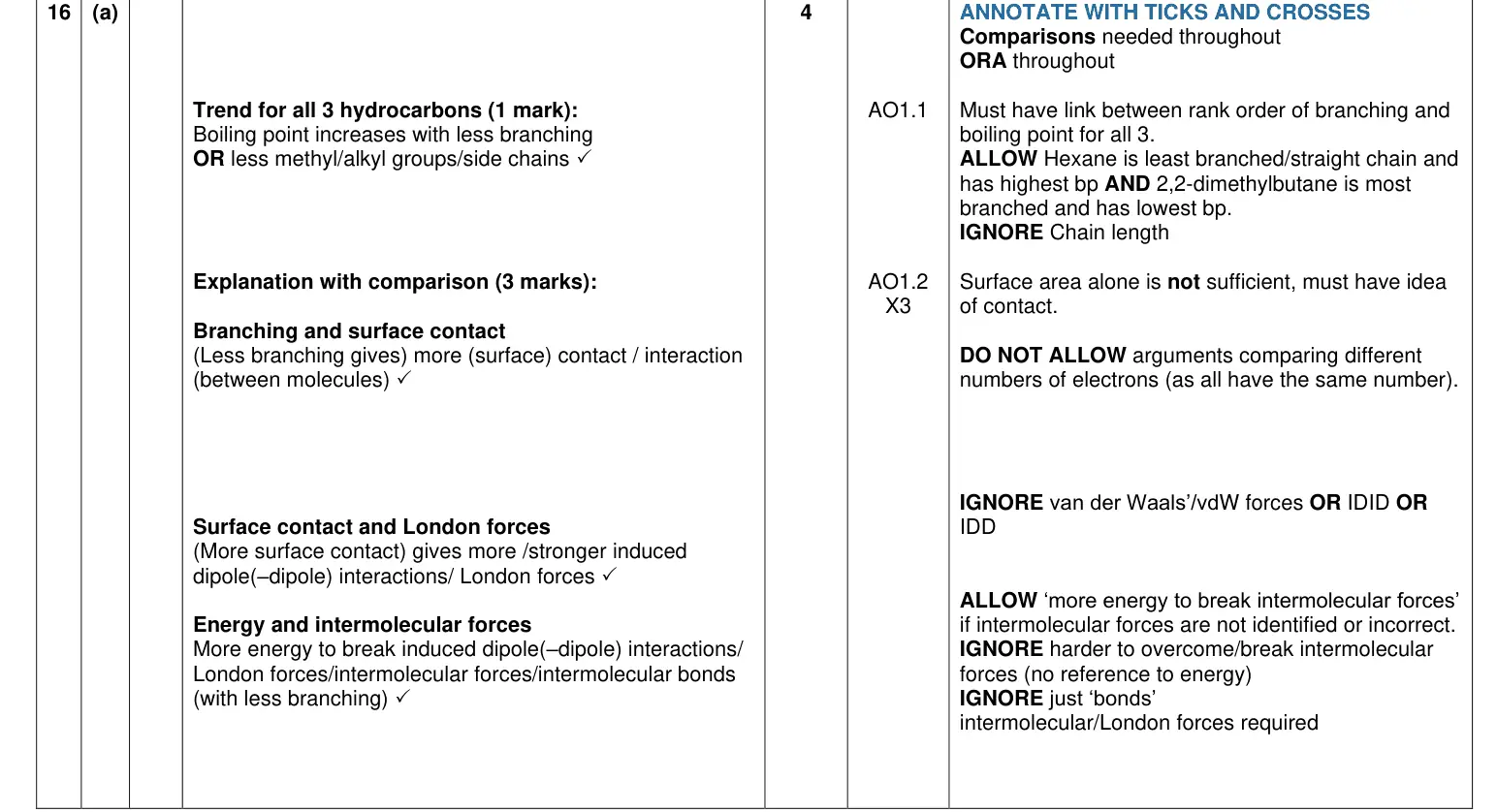
June 2023 · Paper 2 · Q16(a)4 marksAO1Short answerHard
Mark scheme
Examiner's comment
Most candidates attempted this question, gaining at least 1 mark, with over half scoring 3 or more marks. Responses often lacked clarity as many candidates struggled to articulate their ideas. It was common to see lengthy responses often with unnecessary repetition and sometimes even contradictions. A good strategy adopted by some was to draw skeletal formulae for the compounds next to the data provided. This enabled them to focus their response more easily on the extent of branching. Many candidates were unable to give a clear trend for the first marking point, as asked for in the question, but were able gain credit by a lengthier comparison of all three as indicated in the extra guidance. However, this mark was often lost through incomplete explanation, not referring to boiling point at all or an attempt to compare just chain length. The most common error for the second mark was omission of ‘contact’ or ‘interaction’ with reference only to surface area or ‘packing’ of molecules. Some lost this mark for a change in number of electrons. The third marking point was the most frequently awarded. Some candidates lost the mark for not explicitly naming the intermolecular forces as London forces/induced dipole-dipole interactions or for incorrectly using van der Waals. Some lost the mark for not explicitly indicating how increased or decreased contact would affect the strength or magnitude of London forces, e.g. ‘less contact to form London forces’. The final mark was harder to obtain as it needed to be clear that energy was required to break intermolecular forces. For example, ‘less energy to break bonds’ or ‘easier to separate the molecules’ or ‘more energy to boil’ were not sufficient. This exemplar shows a clear, concise response. The candidate has drawn skeletal structures next to the table. The trend is stated first followed by a detailed explanation, presented as a bullet point list, with all 4 marking points awarded.
Notes from the mark scheme and report
comparisons needed throughout
must rank all three by branching
surface contact not just surface area
DO NOT ALLOW different numbers of electrons (all the same)
more energy to break London forces
IGNORE 'bonds' alone and chain length
Responses often highlighted that candidates lacked understanding about what London forces are, e.g. indicating that they form ‘between atoms’ or referring to induced dipole-dipole forces as something else. Intermolecular forces are difficult to fully comprehend as they can’t be visualised making this a challenging topic to teach.
OCR have produced a ‘Bonding’ teaching guide with lots of useful suggestions and resources. This includes a link to this Salters A Level chemistry revision activity on intermolecular bonding
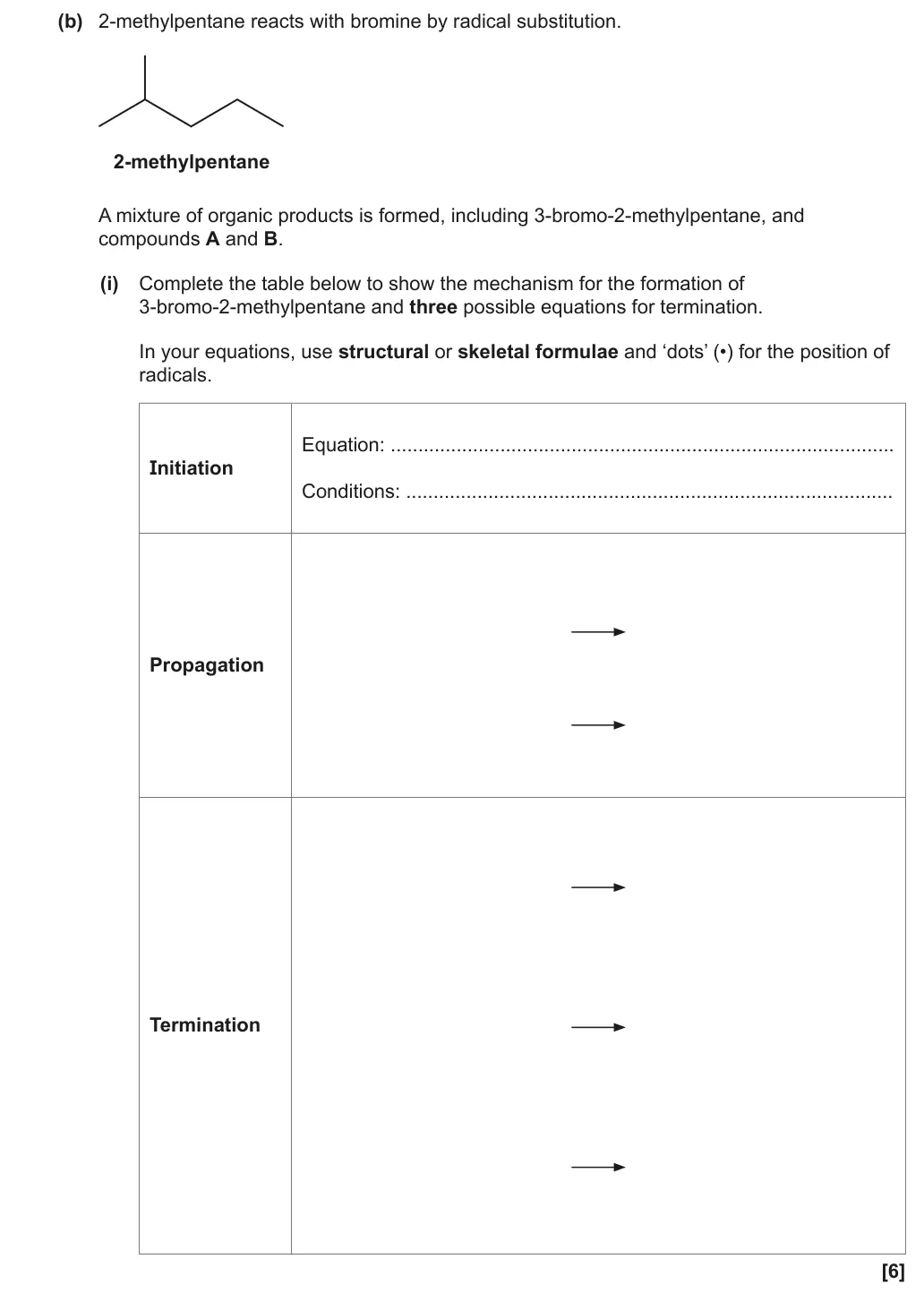
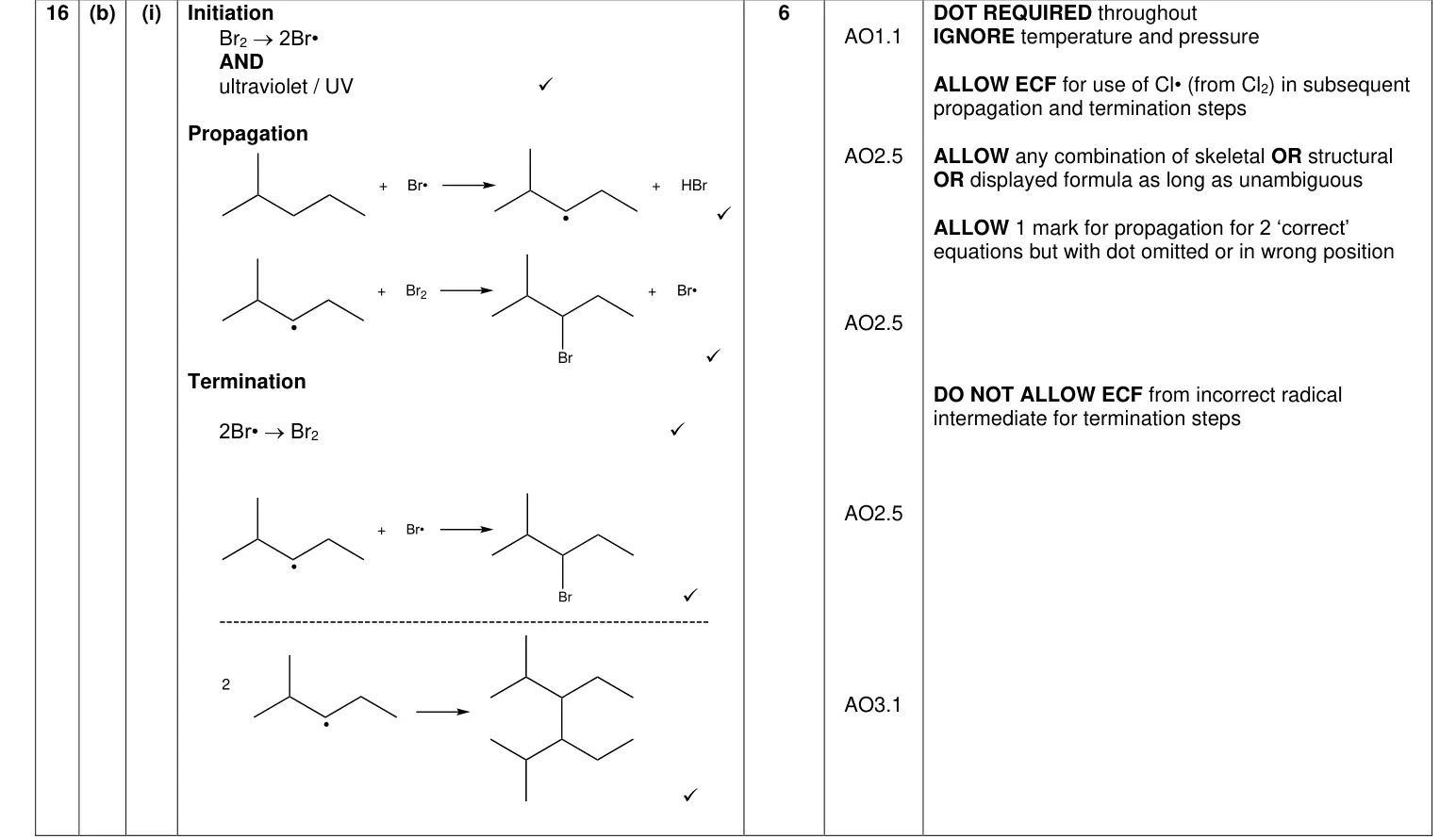
June 2023 · Paper 2 · Q16(b)(i)6 marksAO1, 2, 3MechanismMedium
Mark scheme
Examiner's comment
Many candidates tackled this question confidently, especially when using skeletal formula following the format of the structure given in the question. Over half the candidates scored 5 or 6 marks. Only the highest attaining candidates were able to provide all three correct termination steps. Many lost a mark for the combination of the two alkyl radicals, typically either by simply joining the ends of the chains or by missing the connecting C-C bond. Those that attempted to use structural formula often lost marks due to missing Hs. Other common errors included the incorrect positioning of the radical dot, most typically on the terminal carbon, addition of Br in the first propagation step or use of molecular formula. Lower attaining candidates were often able to score a mark for the initiation step and the termination step involving two Br radicals. However, for some this was not a well-known mechanism, with attempts to break up the chain or form hydrogen radicals or charged species. Errors were also seen with correct balancing of equations such as truncated C chains or extra Br atoms added.
Notes from the mark scheme and report
Br2 → 2Br• AND UV
dot required throughout and on C-3 of the radical
1 mark for propagation if both correct but dot omitted or misplaced
three terminations incl. two alkyl radicals
no ECF from incorrect radical in termination
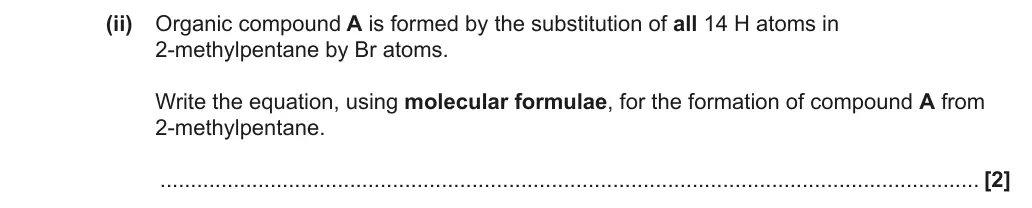
June 2023 · Paper 2 · Q16(b)(ii)2 marksAO2Equation writingMedium
Earlier part of question 16 that this part uses
Mark scheme
Examiner's comment
Most responses gained at least 1 mark for this question giving the correct molecular formula of C6Br14. However many hadn’t assimilated that when a hydrogen atom is substituted in an alkane it requires one mole of a halogen and produces one mole of the hydrogen halide. So many gave this incorrect equation instead: C6H14 + 7Br2 → C6Br14 + 7H2. Some lost marks for C5H14 or for use of structural formulae.
Notes from the mark scheme and report
C6Br14
C6H14 + 14Br2 → C6Br14 + 14HBr (HBr, not H2)
1 mark if balanced but not in molecular formulae
Skills: M0.2 Use ratios, fractions and percentages
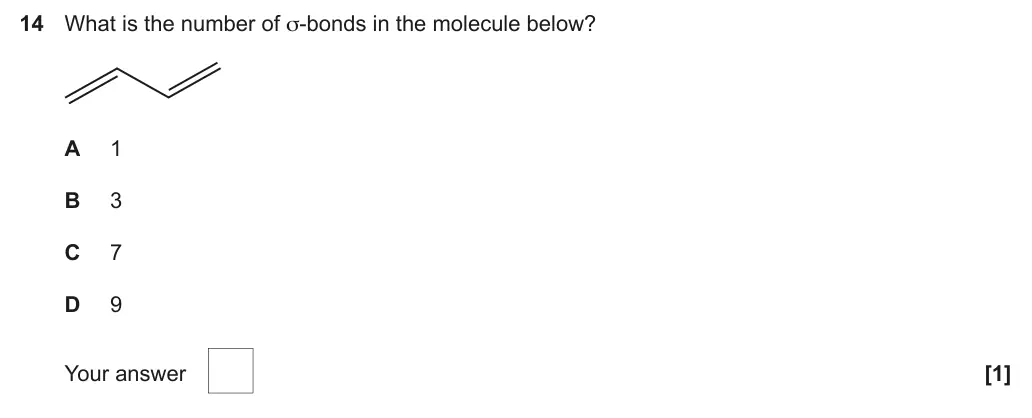
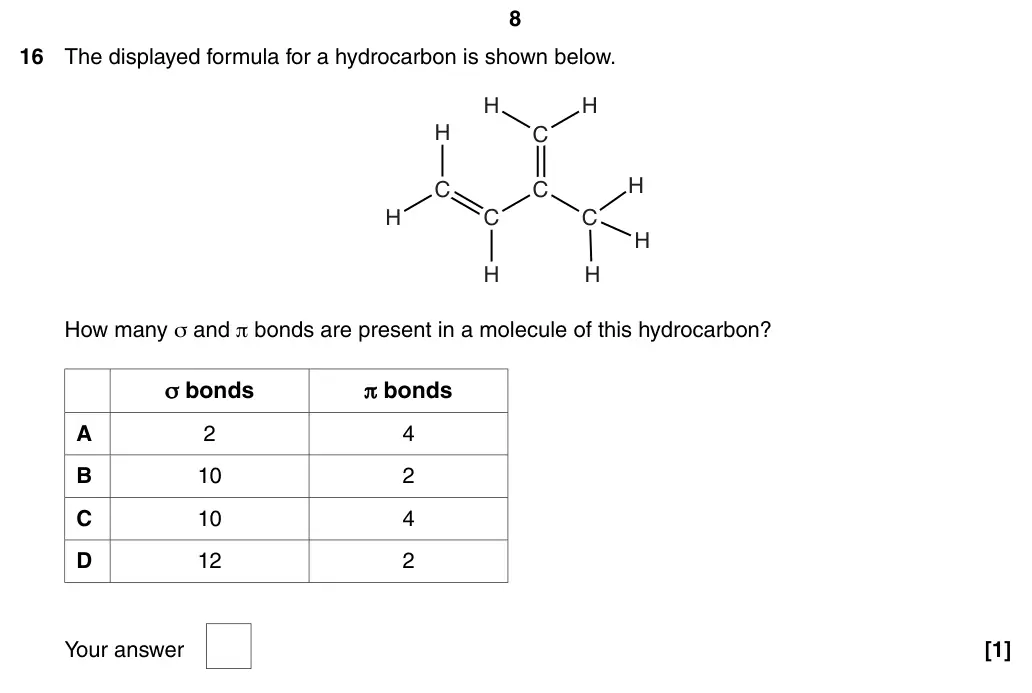
June 2022 · AS Paper 1 · Q141 markAO1Multiple choiceHard
Answer
D
Mark scheme
Examiner's comment
Candidates found this question difficult with very many choosing option B rather than the correct option D. Candidates are advised to draw out all bonds displayed when tackling such as question as the answer of B (3) results from considering just the three bonds shown in the skeletal formula and omitting the other 6 C–H bonds.
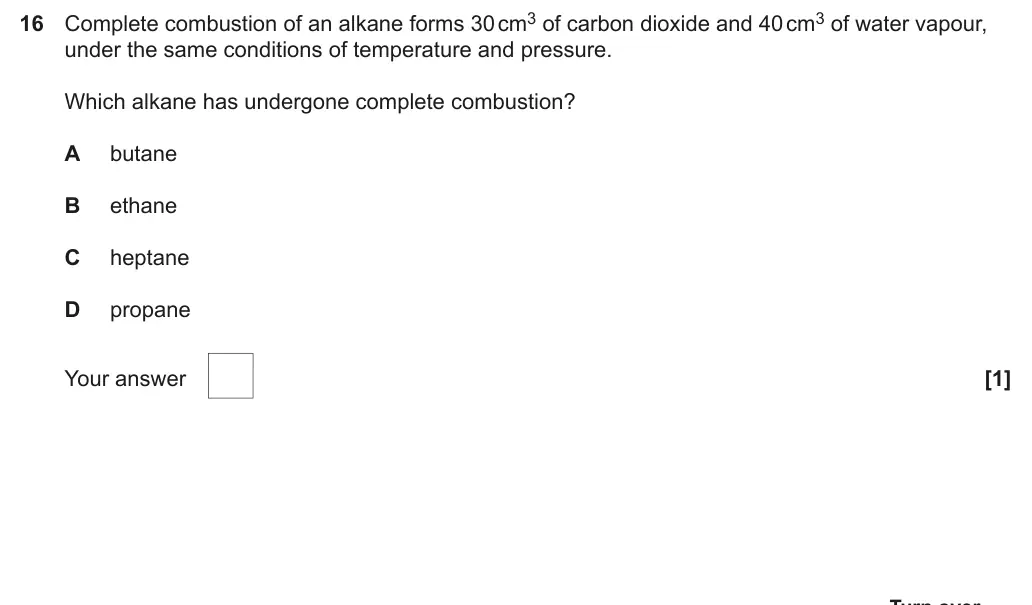
June 2022 · AS Paper 1 · Q161 markAO2Multiple choiceHard
Answer
D
Mark scheme
Examiner's comment
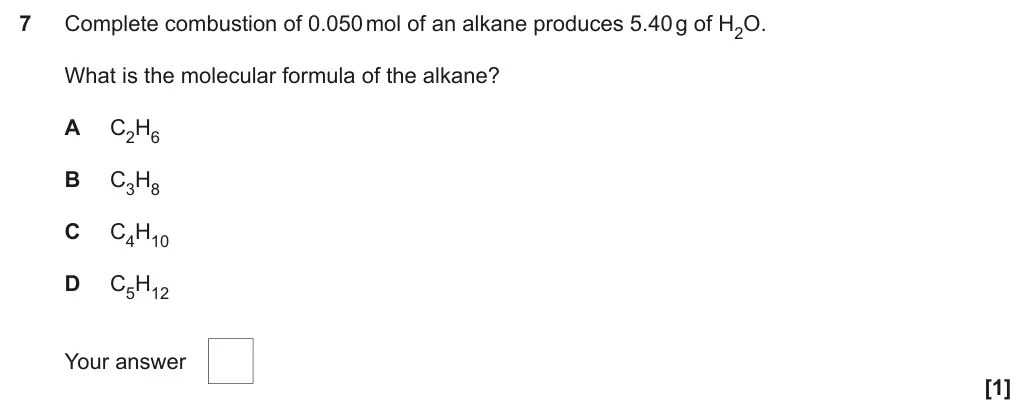
This question discriminated extremely well with most candidates choosing the correct option. Most candidates showed some working. The key to success was to identify the balanced equation that produced CO2 and H2O in a 3 : 4 molar ratio.
June 2022 · Paper 2 · Q31 markAO1Multiple choiceHard
Answer
D
Mark scheme
Examiner's comment
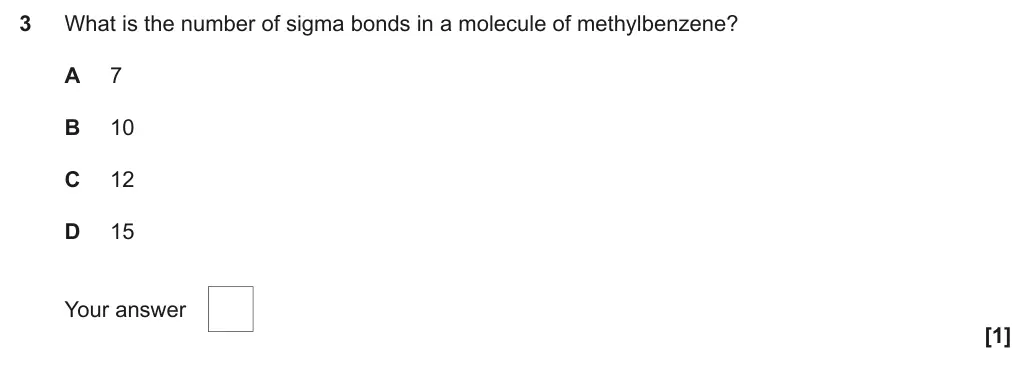
This question discriminated well, with higher ability candidates correctly identifying D. Often students overlooked the sigma bonds in the aromatic ring and selected B.
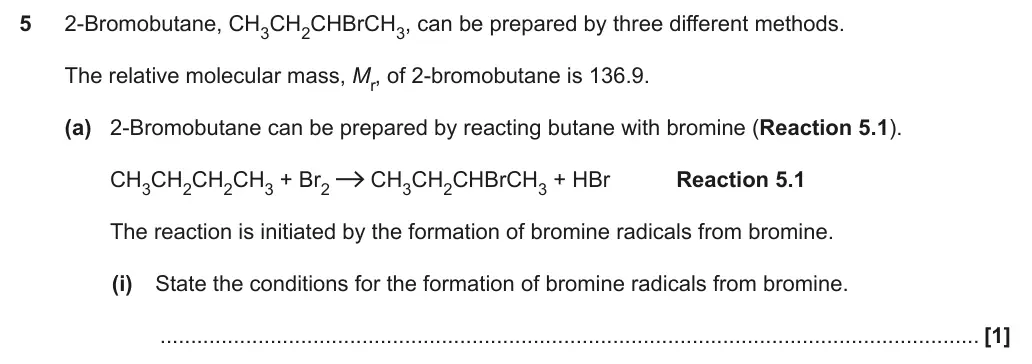
June 2022 · AS Paper 2 · Q5(a)(i)1 markAO1Short answerMedium
Mark scheme
Examiner's comment
Most candidates gave the correct response to this question. Incorrect responses included use of high temperatures and/or catalyst.
Notes from the mark scheme and report
UV
ALLOW sunlight
IGNORE temperature
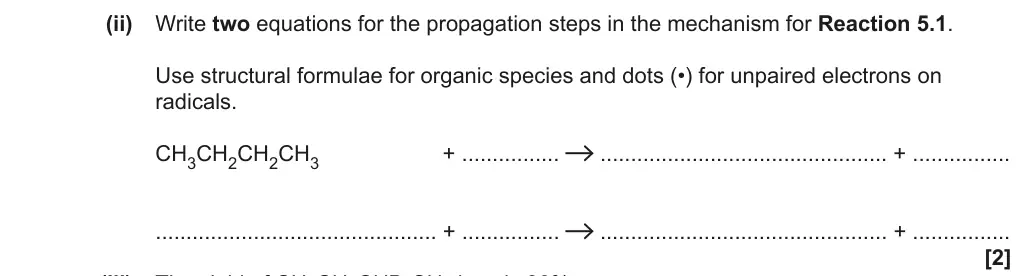
June 2022 · AS Paper 2 · Q5(a)(ii)2 marksAO2Equation writingMedium
Earlier part of question 5 that this part uses
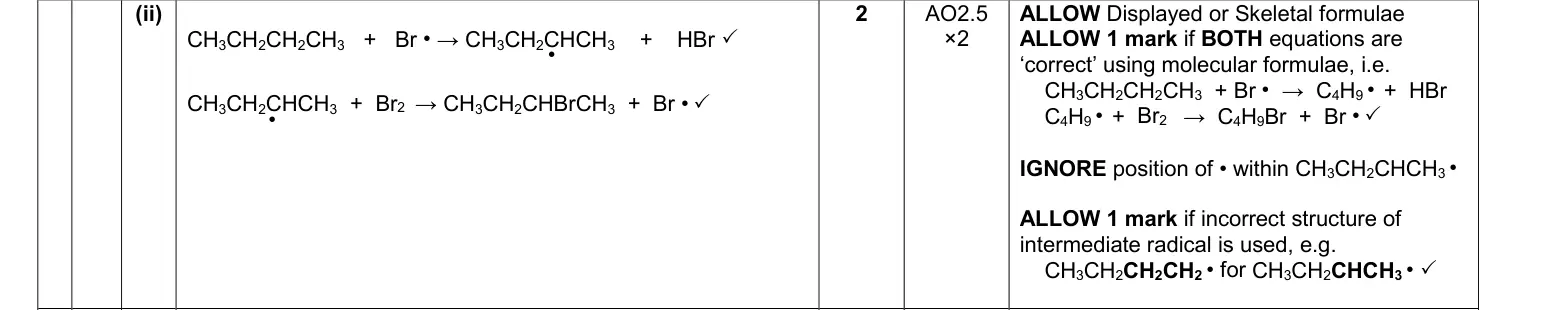
Mark scheme
Examiner's comment
Candidates always find radical mechanisms tricky and this one had the added complexity of forming 2- bromo isomer. However, a majority of students still gained marks. Many candidates formed the incorrect radical removing H from C-1 i.e. CH3CH2CH2CH2• therefore scoring only 1 mark. Some responses were a little messy making it very easy to miss off a dot or H or Br. Many candidates reacted with Br• in the first step but added Br to the radical intermediate (as well as forming HBr). Candidates should always check equations so that they balance in terms of atoms.
Notes from the mark scheme and report
radical must be CH3CH2•CHCH3 (1 mark if CH3CH2CH2CH2• used or both equations correct with molecular formulae)
dots required
June 2022 · AS Paper 2 · Q5(a)(iii)2 marksAO3Short answerHard
Earlier part of question 5 that this part uses
Mark scheme
Examiner's comment
Candidates found this question very challenging and few scored both marks. Many responses considered only the formation of HBr (other product) and/or general statements about other products with no indication of how they were formed. Some described losses due to the purification method or incomplete reaction (due to conditions such as T and P) or low atom economy. Some referred to the stability of the radical intermediate, showing possible confusion with electrophilic addition. Candidates who understood the mechanism were more confident in answering this question, at least recognising that further substitution was possible.
Notes from the mark scheme and report
further substitution/di- and tribromobutanes or other termination products
substitution at a different position (1-bromobutane)
June 2022 · Paper 2 · Q71 markAO1Multiple choiceEasy
Answer
D
Mark scheme
Examiner's comment
Most candidates correctly identified D as the correct response.
June 2022 · Paper 2 · Q131 markAO1Multiple choiceMedium
Answer
D
Mark scheme
Examiner's comment
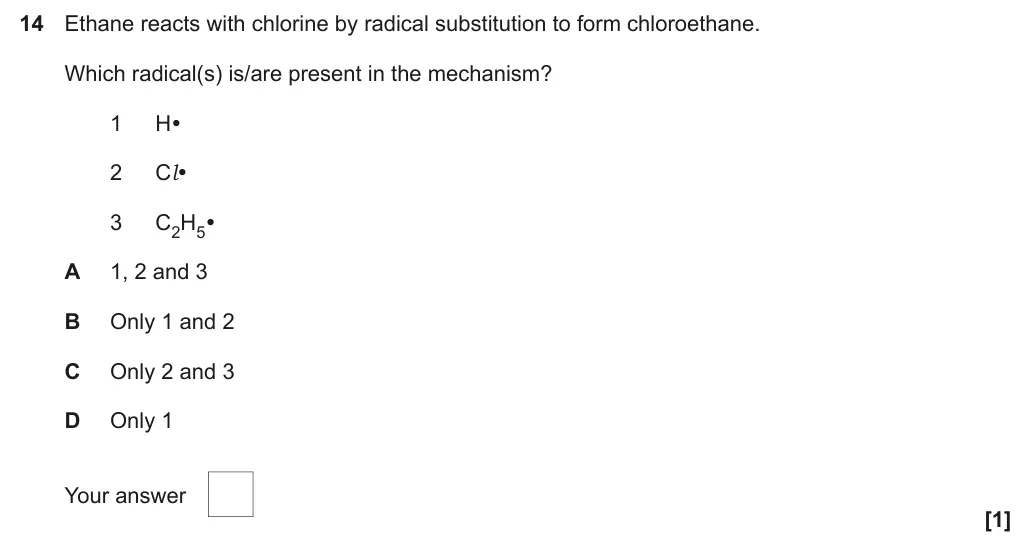
Most candidates identified D (only 1) for an equation that could be part of a propagation step.
June 2022 · Paper 3 · Q5(b)(i)1 markAO2Equation writingEasy
Mark scheme
Examiner's comment
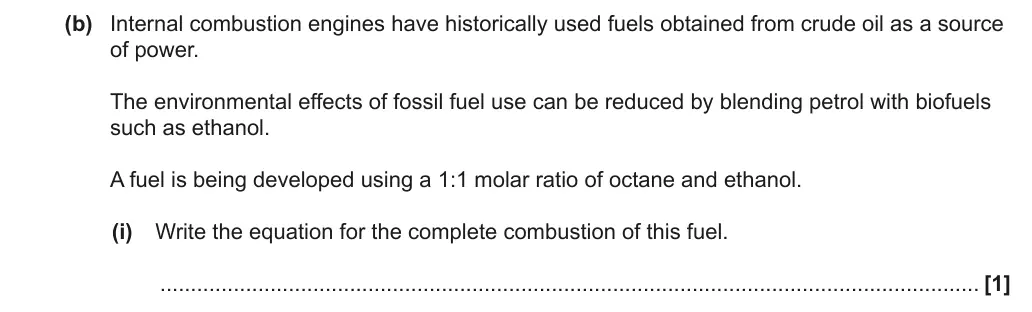
Most candidates attempted to write an equation for the combustion of the 1:1 molar mixture of octane and ethanol. The formulae of C8H18 and C2H5OH were usually seen although some candidates combined these as a ‘mixture formula’ of C10H24O (which was accepted). The balancing of the equation using 15½O2 was the hardest part of the equation and many different balancing numbers for O2 were seen (10CO2 and 12H2O where usually correct). Less successful responses often attempted a combustion equation using octane OR ethanol, but not both. This is not an easy equation to construct, and the context was novel. Overall candidates made a good attempt at this question.
Notes from the mark scheme and report
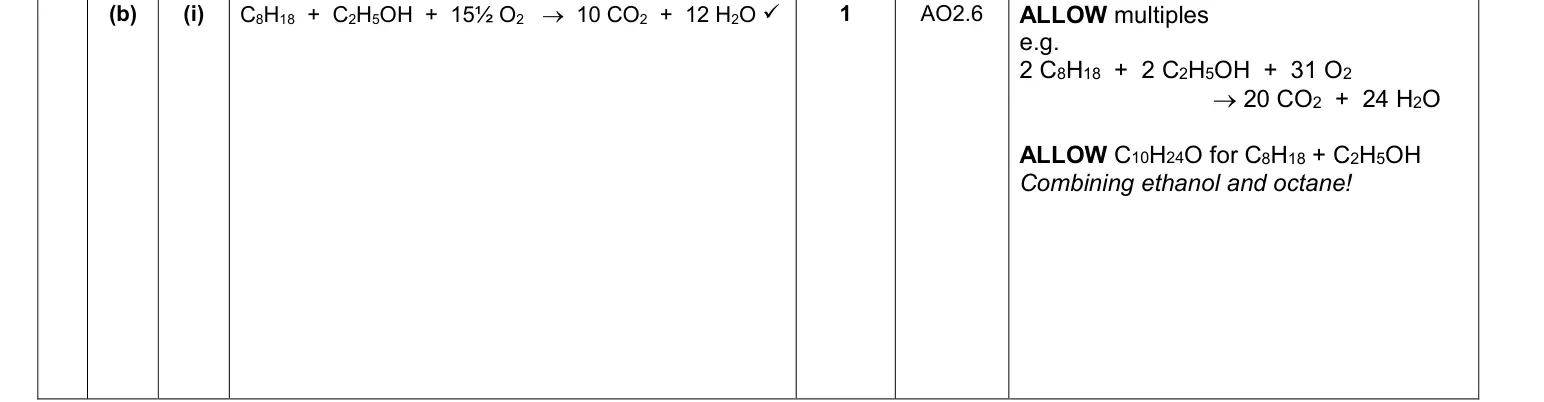
C8H18 + C2H5OH + 15½O2 → 10CO2 + 12H2O
ALLOW multiples
Skills: M0.2 Use ratios, fractions and percentages
November 2021 · AS Paper 1 · Q151 markAO2Multiple choice
Answer
D
Mark scheme
November 2021 · AS Paper 1 · Q161 markAO1Multiple choice
Answer
B
Mark scheme
November 2021 · Paper 2 · Q11 markMultiple choice
Answer
C
Mark scheme
Notes from the mark scheme and report
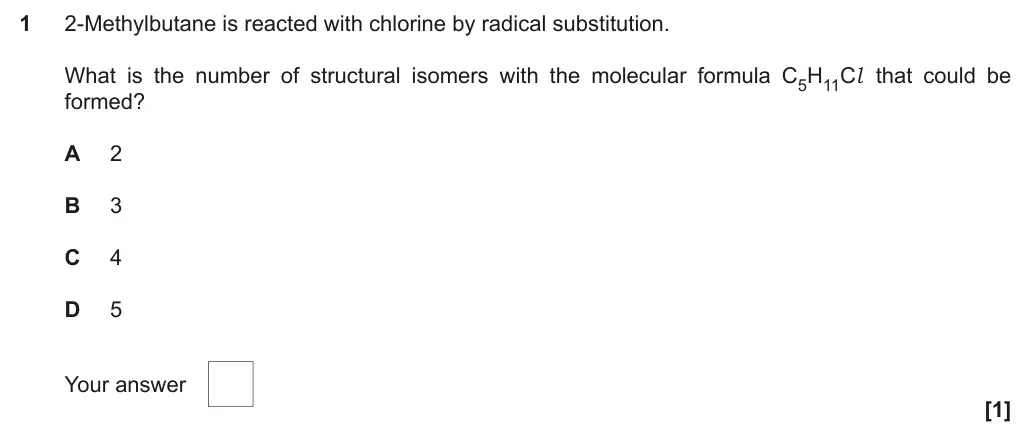
ALLOW 4
November 2021 · AS Paper 2 · Q2(c)2 marksAO2Structure / isomer
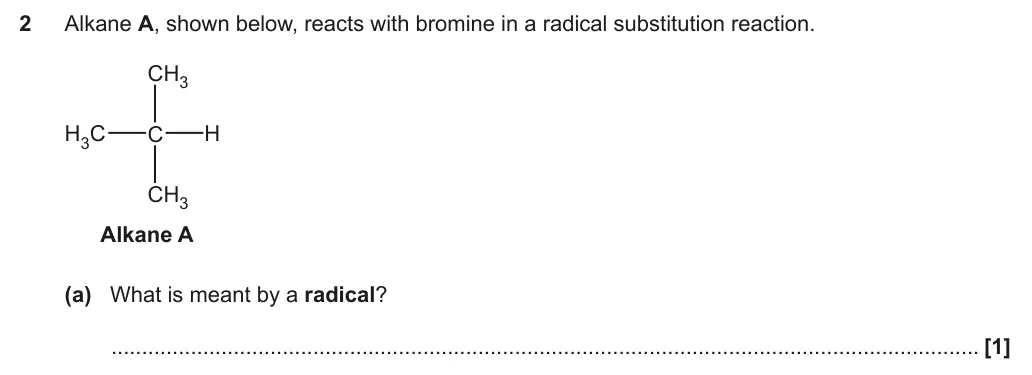
Earlier part of question 2 that this part uses
Mark scheme
Notes from the mark scheme and report
2-bromo-2-methylpropane and 1-bromo-2-methylpropane
ALLOW any unambiguous formula type
November 2021 · AS Paper 2 · Q2(d)2 marksAO2Equation writing
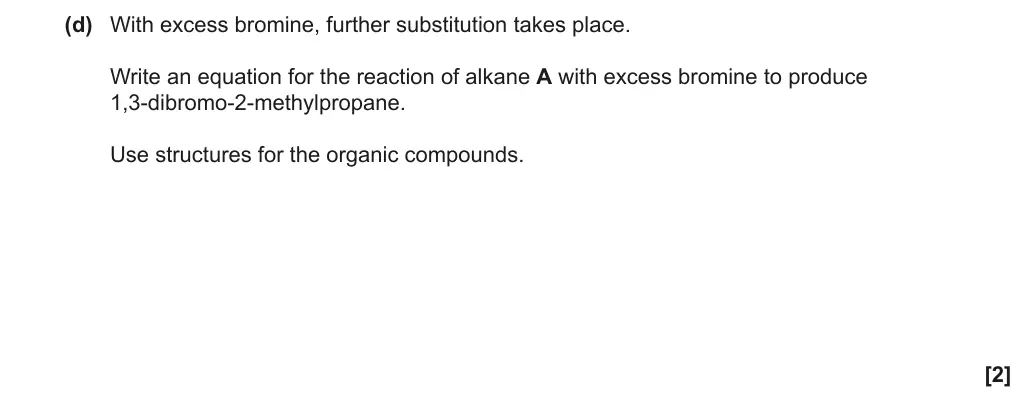
Earlier part of question 2 that this part uses
Mark scheme
Notes from the mark scheme and report
2Br2 and 2HBr needed to balance
correct structure of 1,3-dibromo-2-methylpropane
November 2021 · Paper 2 · Q41 markMultiple choice
Answer
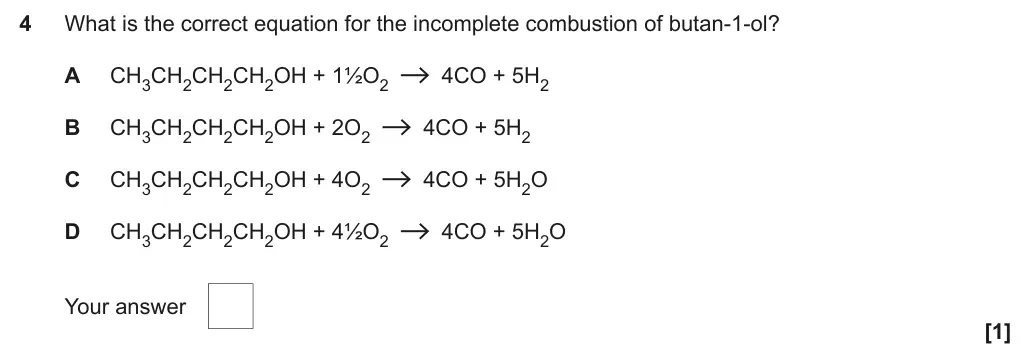
C
Mark scheme
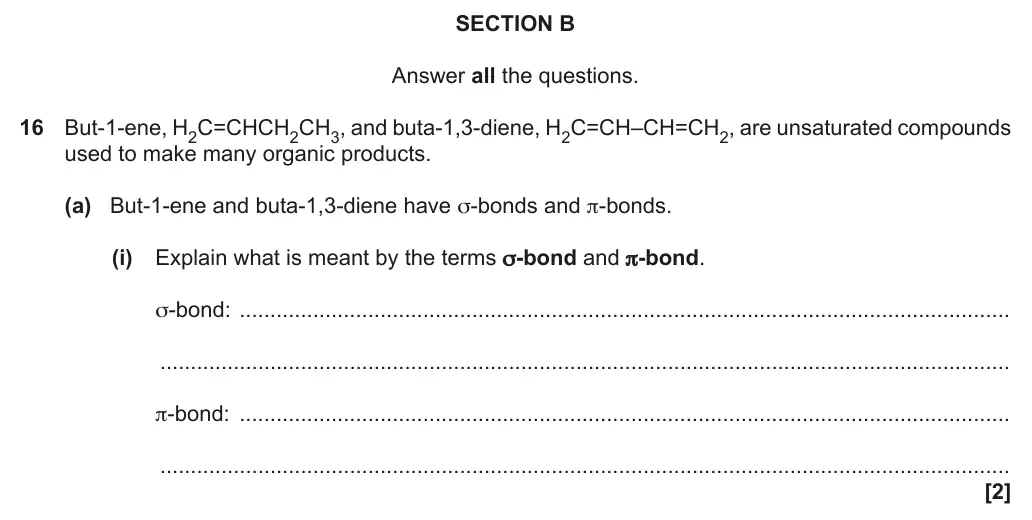
November 2021 · Paper 2 · Q16(a)(i)2 marksAO1Short answerHard
Mark scheme
Examiner's comment
Question 16(a)(i): These definitions were known by few candidates.
Notes from the mark scheme and report
σ: overlap of orbitals directly between the bonding atoms
π: sideways overlap of p-orbitals
DO NOT ALLOW pi-orbital
November 2021 · Paper 2 · Q16(a)(ii)2 marksAO1Short answer
Earlier part of question 16 that this part uses
Mark scheme
Notes from the mark scheme and report
9 σ-bonds and 2 π-bonds
November 2020 · AS Paper 1 · Q151 markAO1Multiple choiceMedium
Answer
C
Mark scheme
Examiner's comment
Less than half the candidates selected the correct response of C for this direct recall question. There was no key distractor, suggesting that many candidates may have guessed.
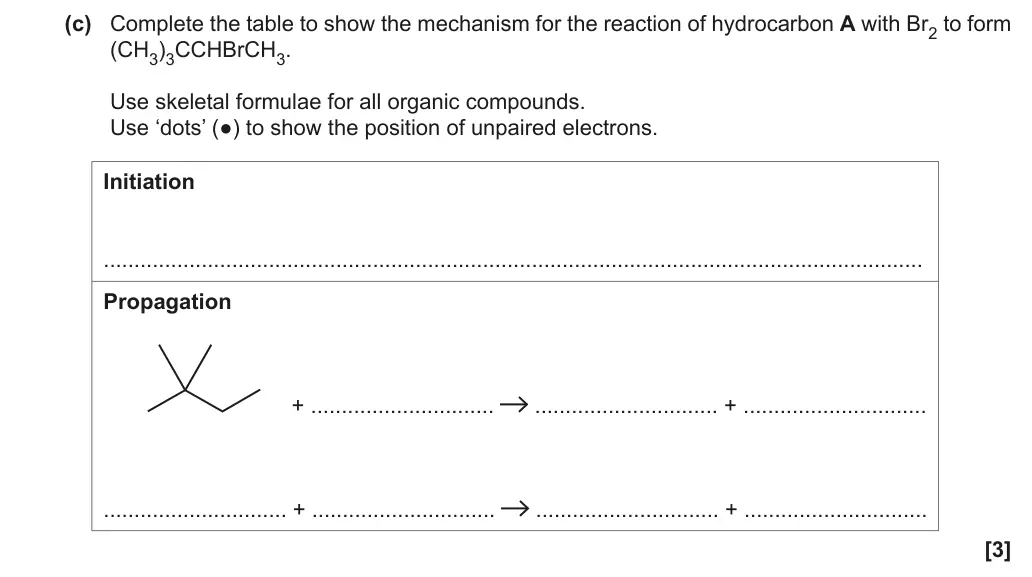
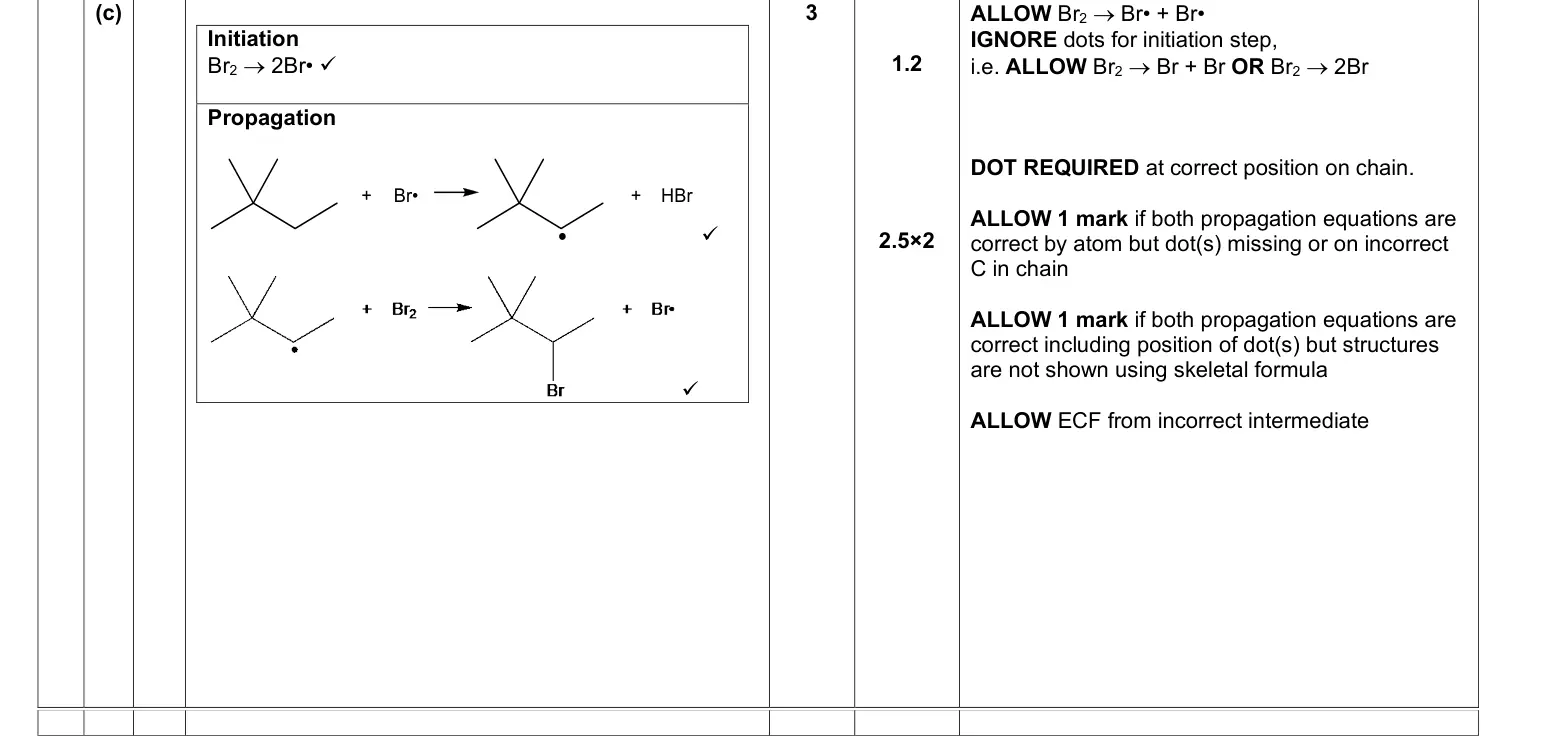
November 2020 · Paper 2 · Q16(c)3 marksAO1, 2MechanismMedium
Earlier part of question 16 that this part uses
Mark scheme
Examiner's comment
Other questions Question 16(c) Often candidates did not use skeletal formula, as required by the question, and did not place the radical dot in the correct position.
Notes from the mark scheme and report
dot REQUIRED at the correct position on the chain
1 mark if both propagation steps correct but dot missing/on wrong C or not skeletal
IGNORE dots in initiation
November 2020 · Paper 2 · Q16(d)2 marksAO1Short answer
Mark scheme
Notes from the mark scheme and report
further substitution
substitution at different positions along the chain
IGNORE separation of products, atom economy and yield
November 2020 · Paper 3 · Q1(b)(i)4 marksAO1, 2Short answerHard
Mark scheme
Examiner's comment
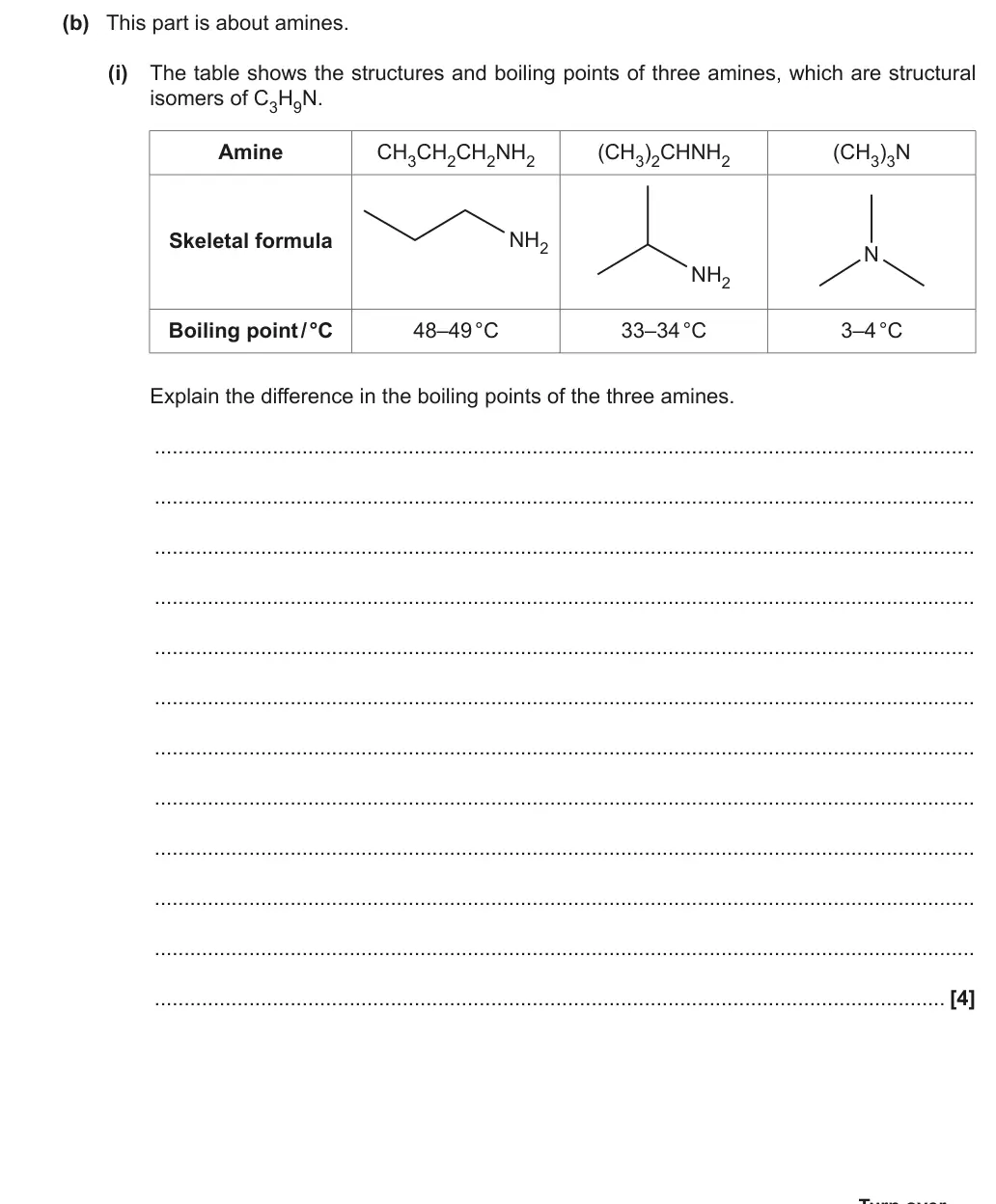
1a(i) Most candidates labelled some of the apparatus correctly and identified the reflux technique. A significant number showed water flowing in the wrong direction and ‘distillation’ was given as the name of the technique. The ‘condenser’ was sometimes labelled incorrectly, e.g. ‘condensation tube, ‘distillation tube’ and ‘water jacket’. Only just over half the candidates were given both marks. 1a(ii) Many diagrams were incomplete and it was comparatively rare for both of the two available marks to be given. Important labels were often missing. Some candidates drew diagrams of other techniques, such as distillation. Many responses were not credited with marks and this question was often omitted. Candidates need practice in recognising practical techniques and in drawing acceptable diagrams. 1b(i) Candidates were expected to explain the different boiling points of three amines. Most candidates linked increased branching with less surface contact between molecules, leading to weaker induced dipole interactions (London forces). Fewer candidates linked the decreasing boiling points to less energy being required to break the intermolecular bonds. The highest performing candidates recognised the large difference between the boiling points of the primary and tertiary amines. They then identified the cause: primary amines form hydrogen bonds but tertiary amines do not. This question was answered reasonably well with fewer candidates than in the past describing relative strengths of covalent bonds, a common misconception. 1(b)(ii) Most candidates rearranged the ideal gas equation correctly to make n the subject. They then substituted correct values for p, V, R and T into the equation, with correct unit conversions. Most candidates then calculated n correctly as 2.32 × 10⁻³ and combined this value with the mass of 0.202 g to derive the molecular formula as 87. Lower-attaining candidates often made an error in their conversion of cm3 into m3, by multiplying by 10–3 rather than 10–6. This error resulted in a value of n as 2.32 and the unrealistic molecular mass of 8.7 × 10⁻³, from which a molecular formula is impossible. Candidates in this position are advised to check back at the unit conversions in the working. Very few candidates did not convert 100ºC into 373 K. Candidates with the correct molecular formula of 87 usually suggested C5H13N as the molecular formula. A significant number quoted C5H11NH2. This response was not credited as it is not a ‘molecular’ formula. There are several possible structures of C5H13N with three 13C NMR peaks and any were credited. Error carried forward was applied from a different molecular mass for both the molecular formula and a structure. This emphasises the importance of working within calculation; credit will always be given for a correct method. Instead of using the ideal gas equation, some candidates used the molar gas constant at room temperature and pressure, 24.0 dm3, which gives a molecular mass of 67. This simplified approach could only gain the final 2 marks for this question: a molecular formula (with an error carried forward value of 67, e.g. C4H5N) and a structure of an amine with this molecular formula and 3 peaks in the 13C NMR spectrum. 1(c) Candidates were supplied with information about an unfamiliar reaction of an amino acid and asked to predict a possible equation. Many candidates suggested H2O as one product, being the difference in the formula of the amino acid and the C3H3NO cyclic organic product. Any cyclic structure of C3H3NO that met the bonding rules for C, H, N and O was credited. Examples included a 4-membered ring lactam and substituted cyclopropenes. A significant number of candidates showed an equation for the reaction of two molecules of the amino acid to form 2 H2O and a cyclic dipeptide. Although chemically feasible, the dipeptide could not be credited because the molecular formula was C3H3NO in the question. This error could have been avoided if the information in the question had been used.
Notes from the mark scheme and report
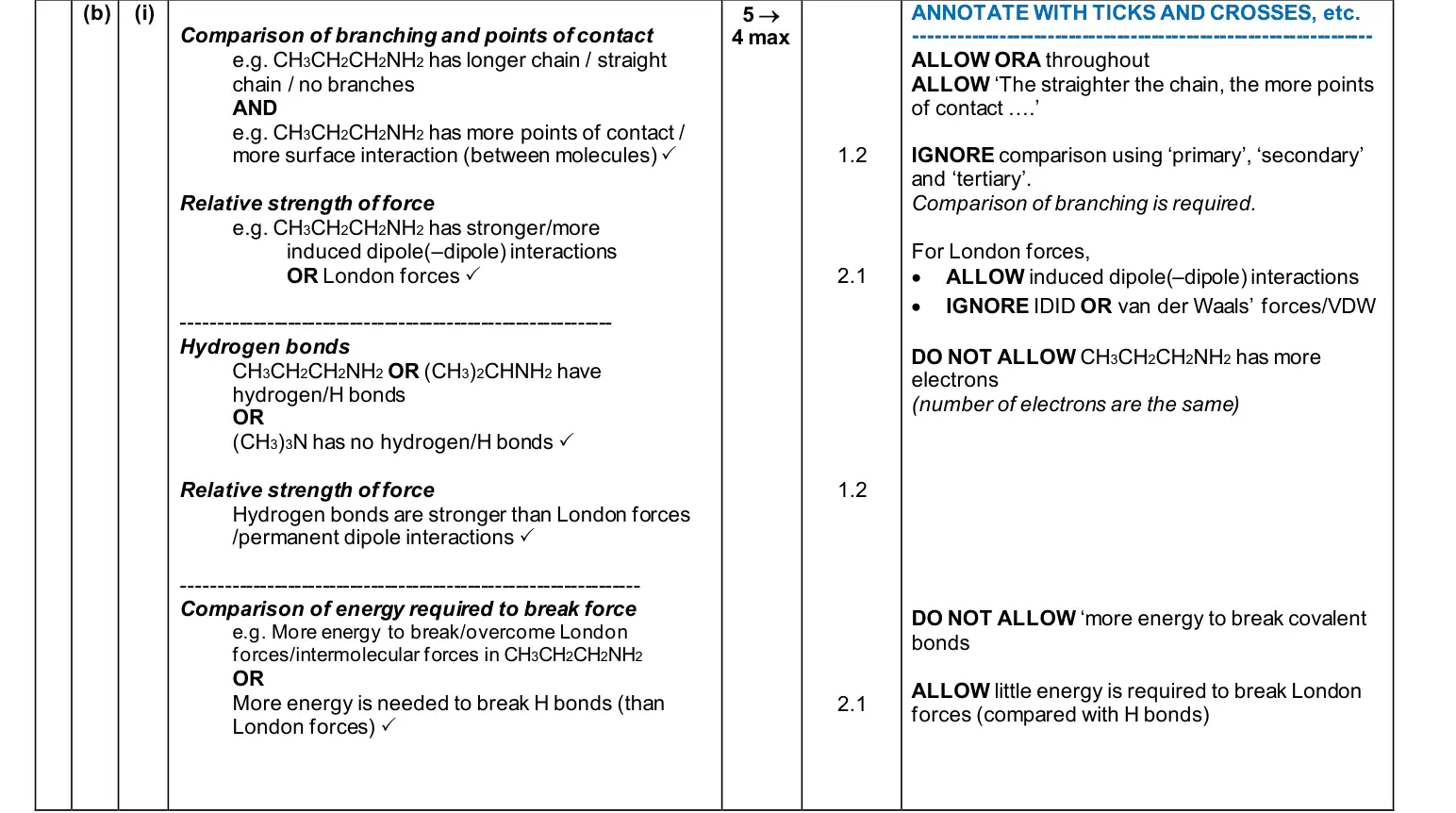
less branching gives more points of contact and stronger London forces
primary amines have hydrogen bonds but (CH3)3N has none
H bonds stronger than London forces
more energy to break
DO NOT ALLOW 'more electrons' (same number)
DO NOT ALLOW breaking covalent bonds
IGNORE primary/secondary/tertiary comparison
Skills: M3.1 Translate information between graphical, numerical and algebraic forms
June 2019 · AS Paper 1 · Q25(b)(i)3 marksAO1, 2MechanismMedium
Mark scheme
Examiner's comment
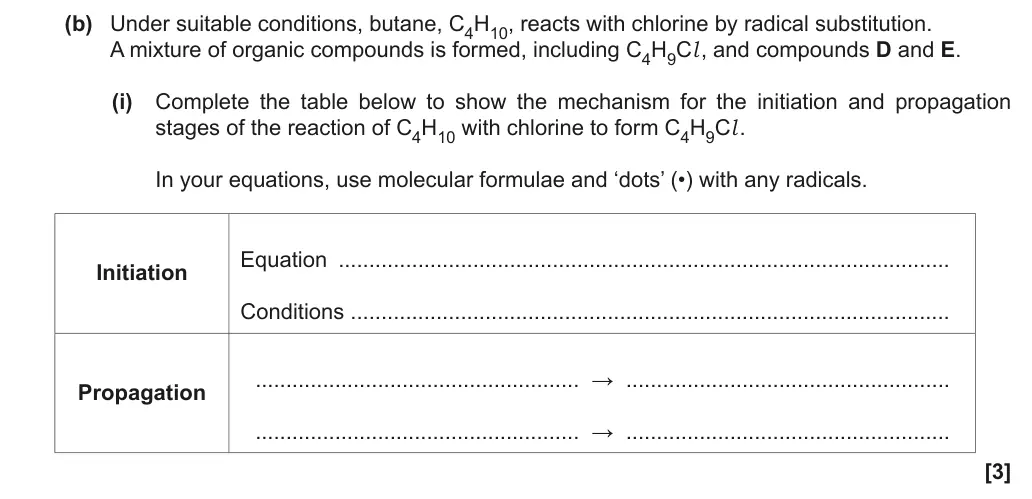
Many candidates scored all 3 marks for this part, showing that most had thoroughly learnt the mechanism for radical substitution. The equation and conditions for the initiation step were well-known but the equations for the propagation steps often included errors. It was common for dots to be omitted for some radicals and C4H9Cl•, rather than C4H9•, was often shown for one of the products in the first propagation stage. H• was then shown as the other product.
Notes from the mark scheme and report
UV needed with initiation
dots required in each propagation equation (1 mark for both propagation equations with dots missing/extra)
DO NOT ALLOW charges
June 2019 · AS Paper 1 · Q25(b)(ii)1 markAO2Equation writingMedium
Earlier part of question 25 that this part uses
Mark scheme
Examiner's comment
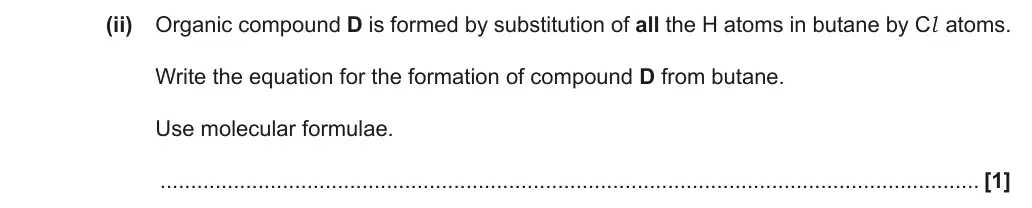
Only the highest attaining candidates were able to write the correct equation. Although most candidates did identify the organic product as C4Cl10, the other product was usually seen as 5H2 rather than 10HCl.
Notes from the mark scheme and report
10 Cl2 and 10 HCl
ALLOW structural formulae
Skills: M0.2 Use ratios, fractions and percentages
June 2019 · Paper 2 · Q11 markAO1Multiple choice
Answer
A
Mark scheme
June 2019 · Paper 2 · Q21 markAO2Multiple choice
Answer
D
Mark scheme
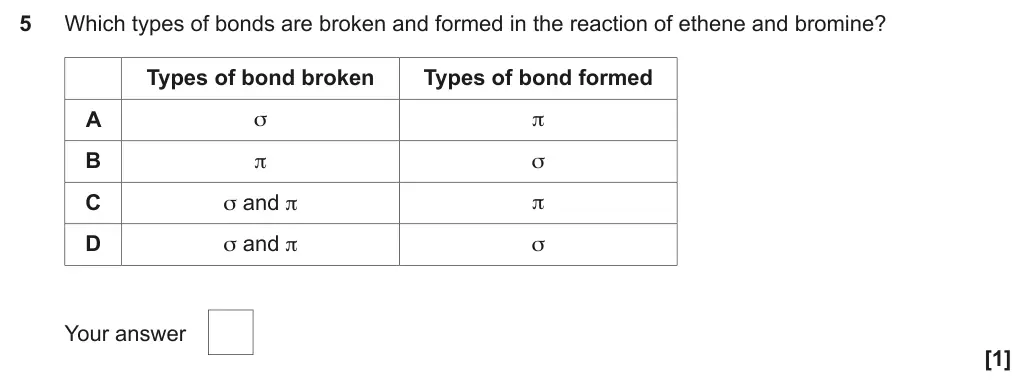
June 2019 · Paper 2 · Q51 markAO2Multiple choiceMedium
Answer
D
Mark scheme
Examiner's comment
This is a demanding question. The best responses drew the first step of the mechanism near the table. This showed both the π bond in ethene and the σ bond in bromine breaking in addition to a σ bond forming between carbon and bromine atoms. Although many candidates correctly selected D, option B was a good distractor and was the most commonly seen incorrect response.
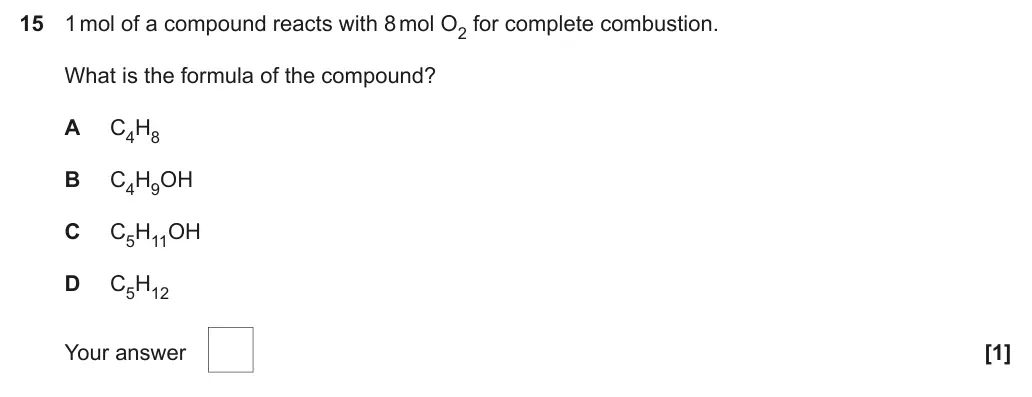
June 2018 · AS Paper 1 · Q151 markMultiple choiceMedium
Answer
D
Mark scheme
Examiner's comment
Most candidates selected A or D, with D being the correct option. Presumably, A was chosen by halving the ‘8’ in C4H8 without considering that each H2O molecule contains two H atoms. The successful answer of D usually resulted from the candidate constructing equations.
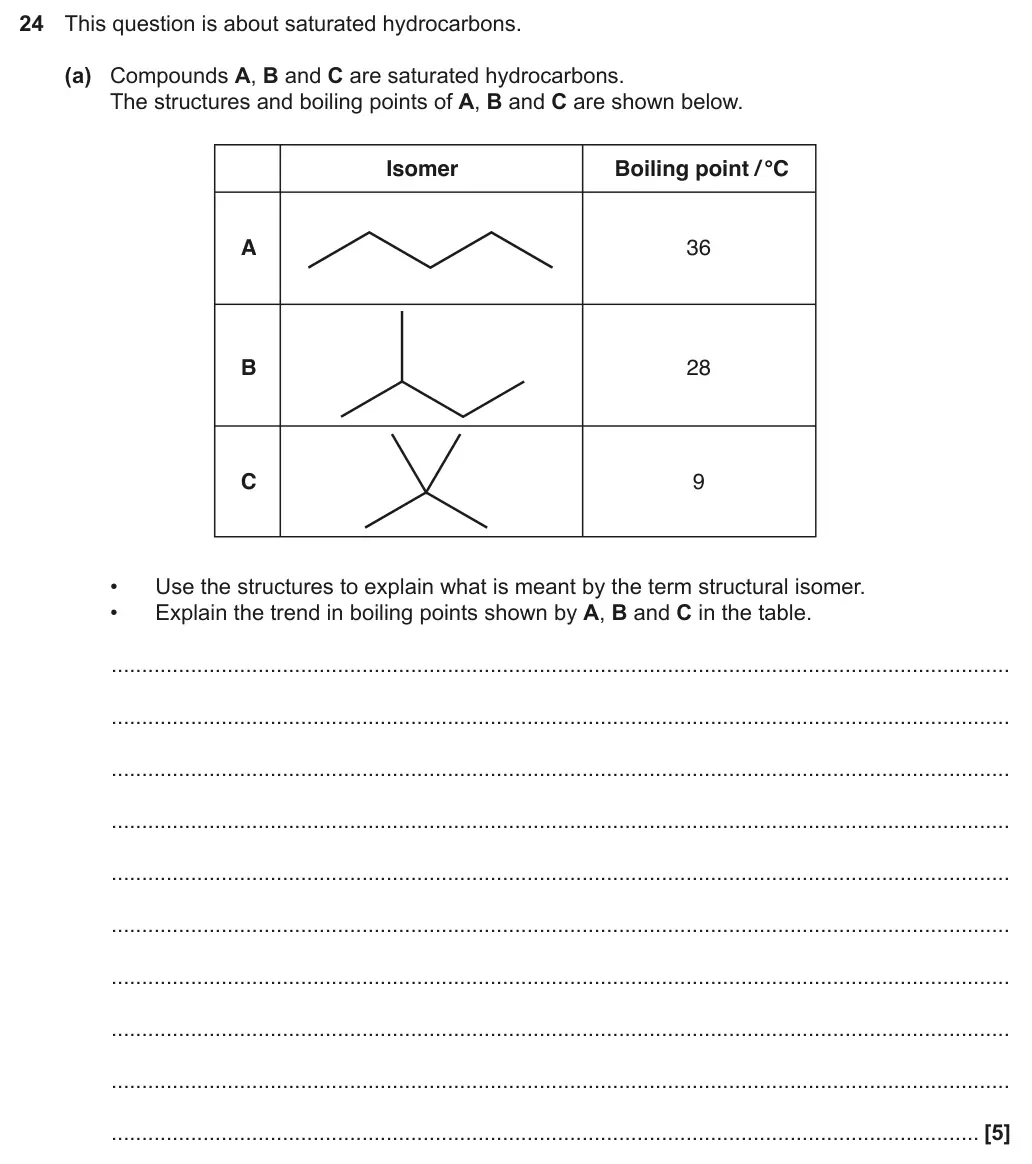
June 2018 · AS Paper 1 · Q24(a)5 marksExtended responseHard
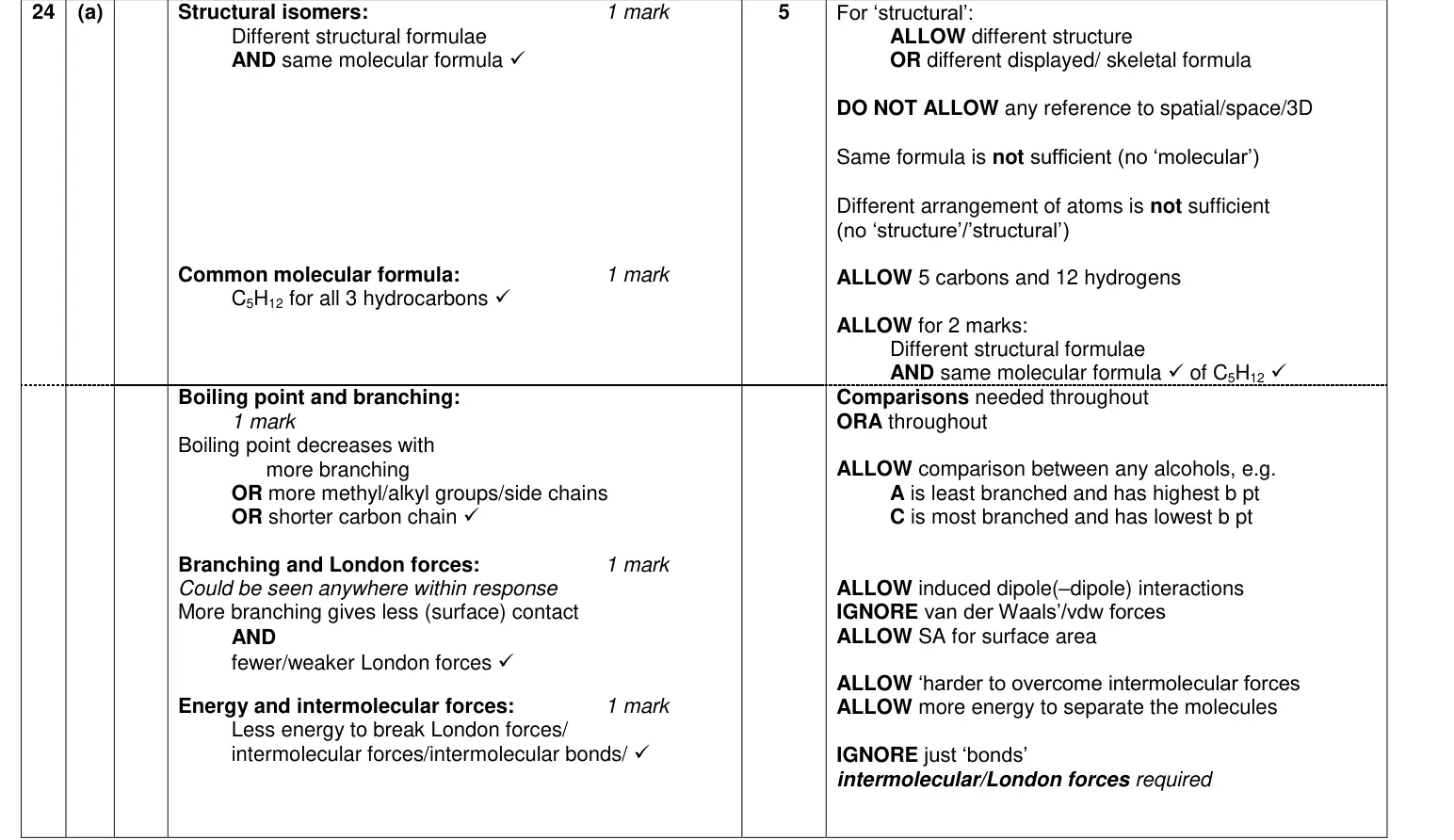
Mark scheme
Examiner's comment
This question discriminated well and resulted in a full range of marks. Most candidates were aware that structural isomers have different structural formulae but the same molecular formulae. It was common though for candidates to refer to different arrangements of atoms in space, clearly confusing with stereoisomerism. The best candidates used the structures (as in the question) to show that the common molecular formula was C5H12. Candidates were expected to link the amount of surface contact between molecules with induced dipole–dipole forces or London forces. ‘Contact’ or the name of the intermolecular forces was often omitted. Finally, candidates were expected to link the amount of branching to the strength of the intermolecular forces and the energy needed to change state. Lower ability candidates often let themselves down by being unable to construct a well-reasoned response. There was often a gulf between the clear responses of able candidates and those of lower ability candidates.
Notes from the mark scheme and report
same molecular formula AND different structural formulae ('same formula' not sufficient)
C5H12 for all three
more branching gives less surface contact and weaker London forces
IGNORE van der Waals
IGNORE just 'bonds'
DO NOT ALLOW reference to spatial arrangement
June 2018 · AS Paper 1 · Q24(b)(i)1 markShort answerMedium
Earlier part of question 24 that this part uses
Mark scheme
Examiner's comment
Most candidates identified this reaction as radical substitution.
Notes from the mark scheme and report
ALLOW free radical substitution
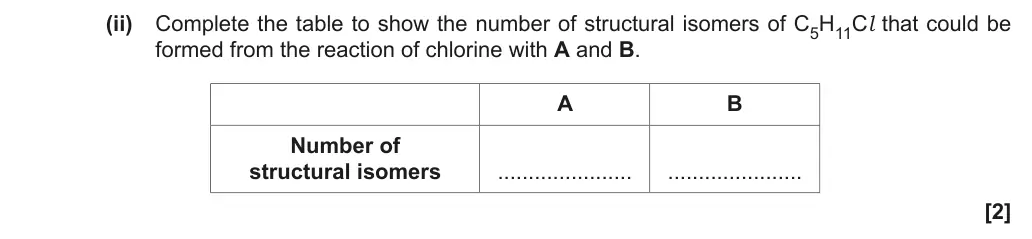
June 2018 · AS Paper 1 · Q24(b)(ii)2 marksComplete table/diagramEasy
Earlier part of question 24 that this part uses
Mark scheme
Examiner's comment
Most candidates achieved at least one mark, particularly for isomer A. Successful candidates often drew structures of the isomers alongside the table to help with their response.
Notes from the mark scheme and report
A gives 3, B gives 4
Skills: M4.2 Visualise and represent 2-D and 3-D forms including 2-D representations of 3-D objects
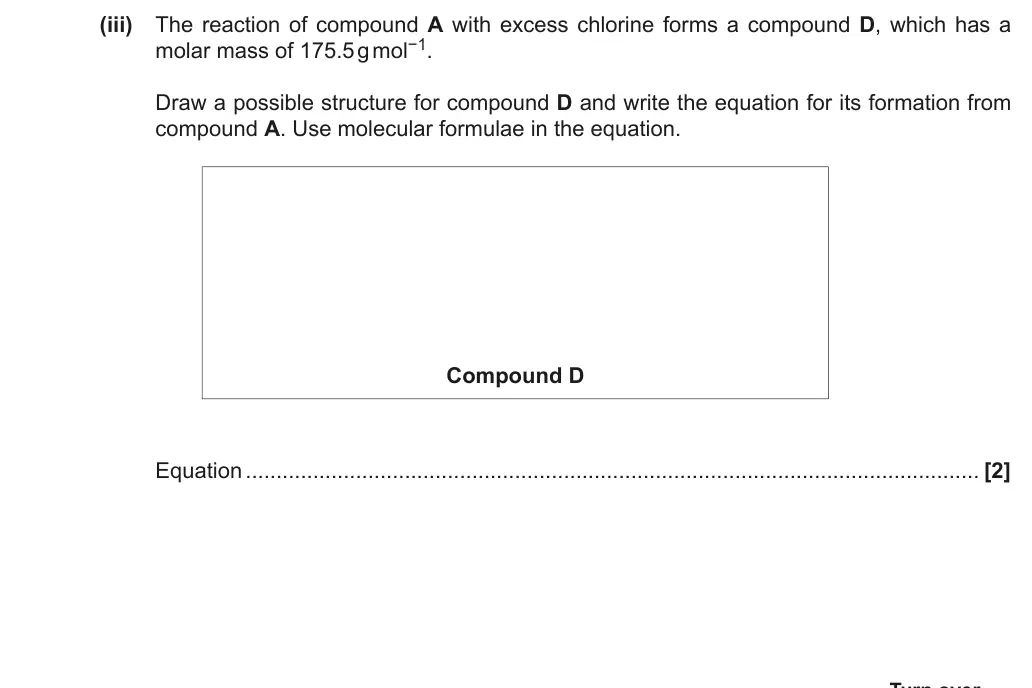
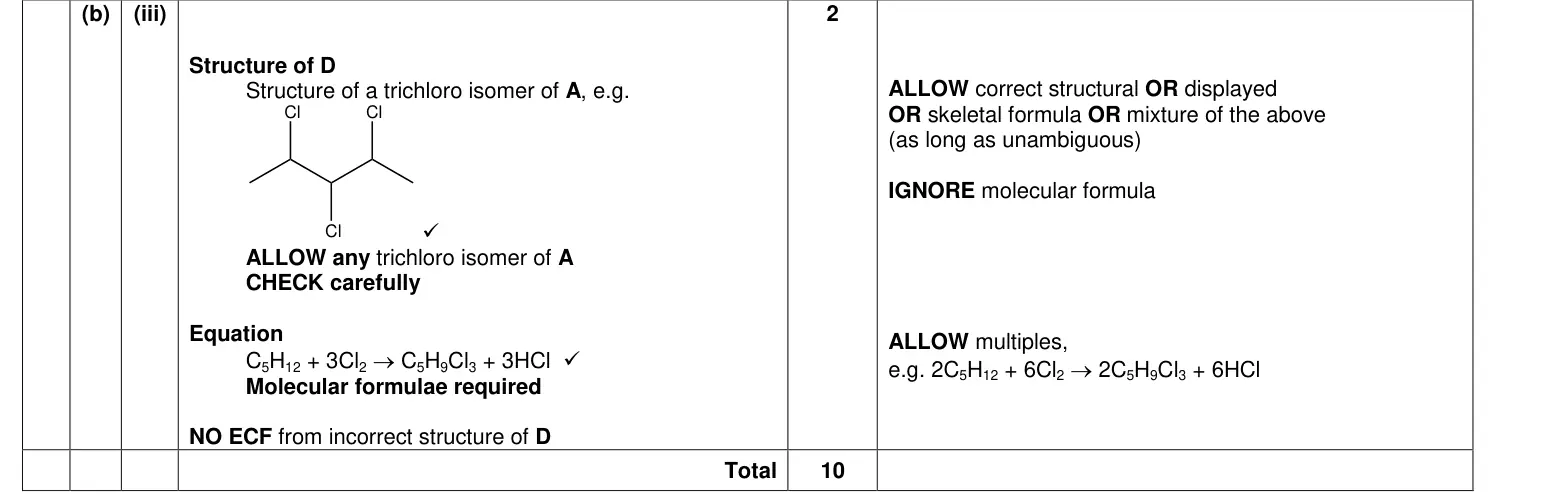
June 2018 · AS Paper 1 · Q24(b)(iii)2 marksEquation writingHard
Earlier part of question 24 that this part uses
Mark scheme
Examiner's comment
Many candidates correctly drew the structure of compound D but comparatively few were able to construct a correct equation. For this equation, candidates needed to apply their knowledge and understanding of monosubstitution of alkanes to substitution of three H atoms by three Cl atoms. This task proved to be one of the most difficult questions on this paper. The exemplar shows an excellent response. The candidate has drawn a trisubstituted structure that fits the molar mass of 175.5 g mol–1 and a correct equation for its formation. Many attempts at this equation showed H2 as the second product rather than HCl.
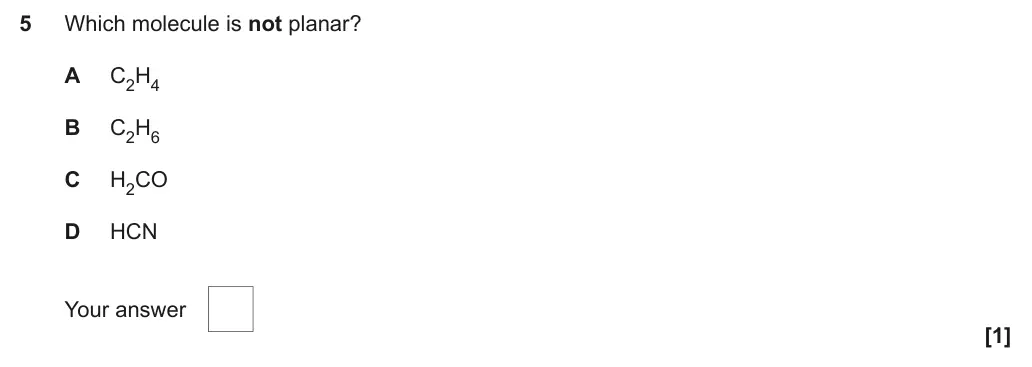
This question discriminated well, with higher ability candidates correctly identifying B as a non-planar molecule. Common incorrect responses included C and D. Some candidates drew structures alongside each option to aid their choice.
June 2018 · Paper 2 · Q22(a)1 markEquation writingMedium
Mark scheme
Examiner's comment
The majority of candidates were able to provide a correct equation for the incomplete combustion of heptane.
Notes from the mark scheme and report
product must be CO and/or C with H2O
ALLOW multiples and mixtures with CO2
Skills: M0.2 Use ratios, fractions and percentages
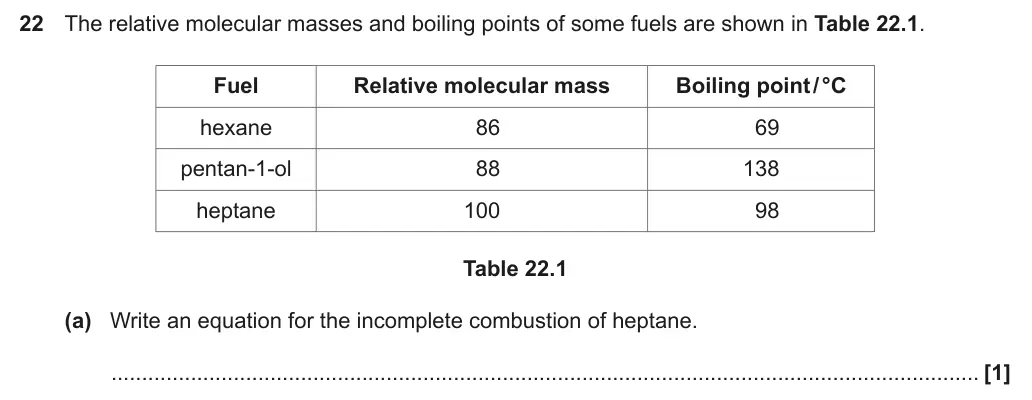
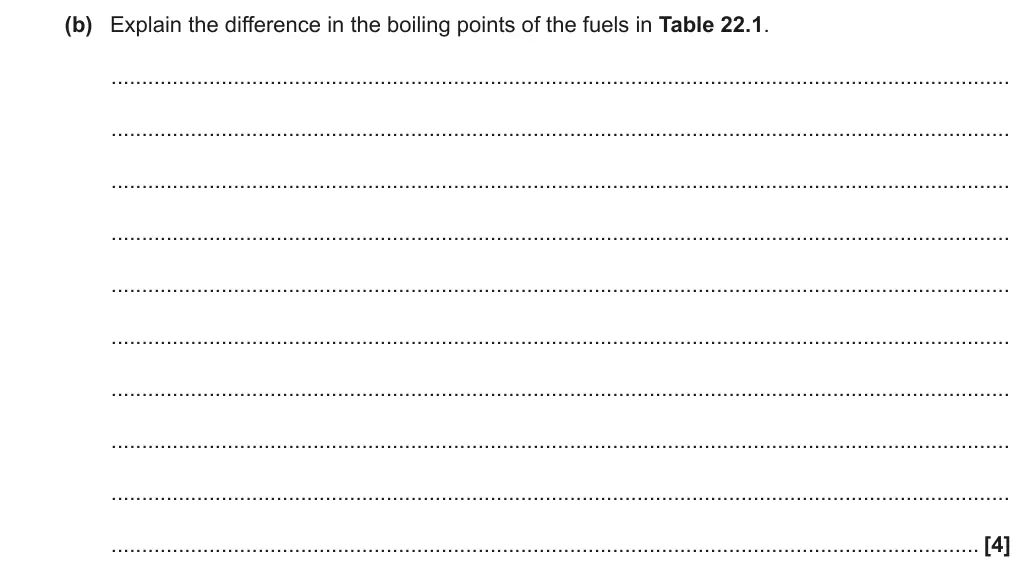
June 2018 · Paper 2 · Q22(b)4 marksData interpretationEasy
Earlier part of question 22 that this part uses
Mark scheme
Examiner's comment
This question was answered well with most candidates scoring three or four marks. Examiners were impressed by the number of responses that accurately referred to induced dipole-dipole interactions or London forces rather than van der Waals’ forces, which is ambiguous. Some responses lacked detail, as demonstrated in Exemplar 10. This response attributes the higher boiling point of pentan-1-ol to the amount energy required to break hydrogen bonds. However, it does not refer the relative strength of this type of interaction. Consequently, the first paragraph only scores marking point four and not marking point three. The higher boiling point of heptane compared to hexane is explained by a correct comparison of the induced dipole-dipole interactions present in these compounds, so marking point two was achieved. However, the justification for the difference in intermolecular forces lacks precision. Candidates should be encouraged to focus on surface contact or surface interaction between molecules rather than referring to surface area alone.
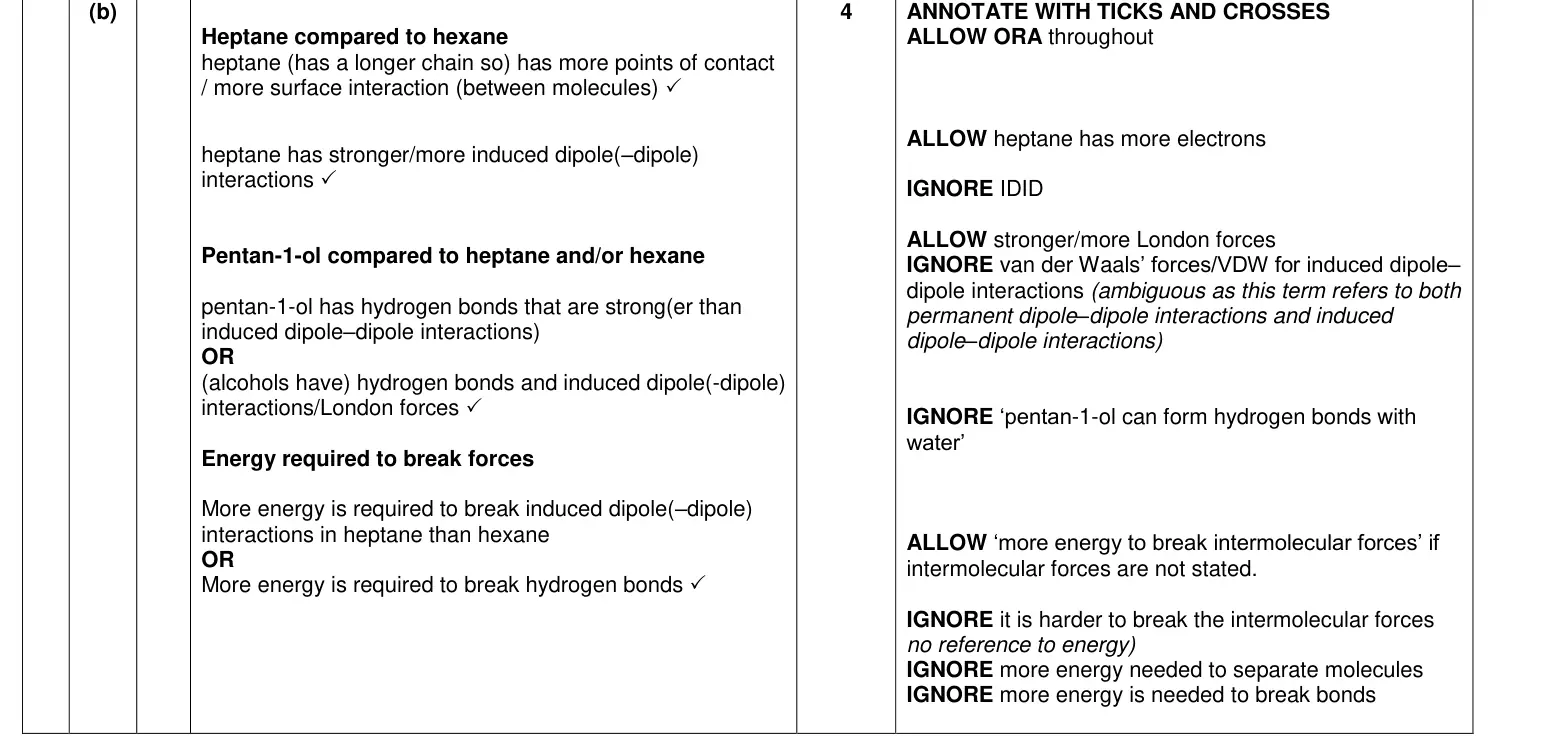
Notes from the mark scheme and report
heptane: more surface contact/more electrons so stronger London forces
pentan-1-ol: hydrogen bonds
more energy to break the forces
IGNORE van der Waals/VDW/IDID
IGNORE 'harder to break' without energy
IGNORE 'more energy to break bonds'
June 2017 · AS Paper 1 · Q171 markMultiple choice
Answer
A
Mark scheme
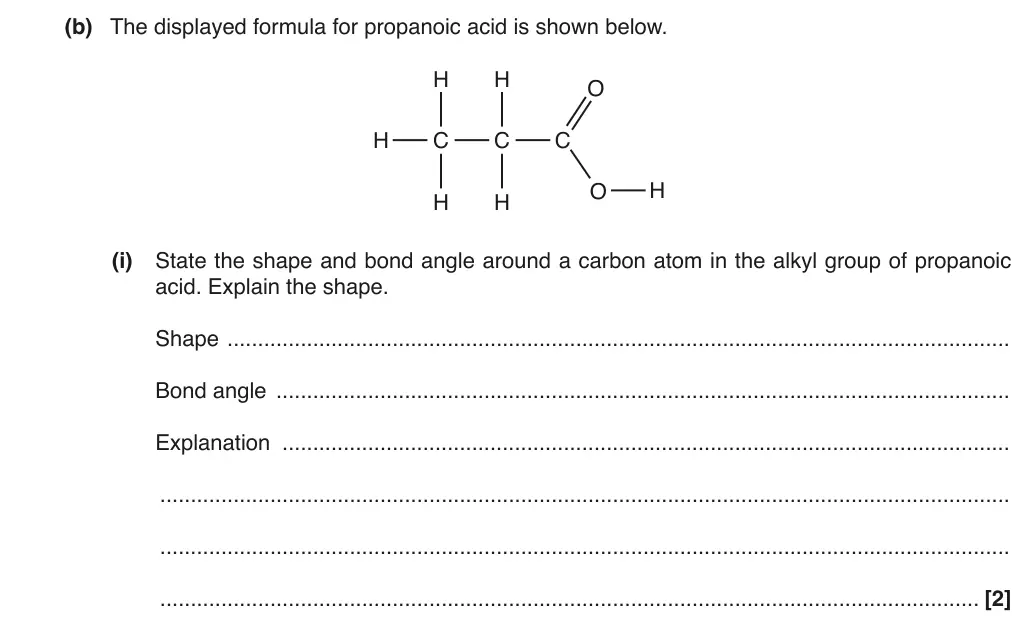
June 2017 · AS Paper 2 · Q5(b)(i)2 marksShort answer
Mark scheme
Notes from the mark scheme and report
tetrahedral AND 109.5
four bonded pairs/bonds repel
IGNORE 'four electron pairs repel'
DO NOT ALLOW atoms repel
Skills: M4.1 Use angles and shapes in regular 2-D and 3-D structures
June 2017 · AS Paper 2 · Q5(d)(i)1 markShort answer
Mark scheme
Notes from the mark scheme and report
UV
ALLOW sunlight
IGNORE temperature
June 2017 · AS Paper 2 · Q5(d)(ii)1 markEquation writing
Earlier part of question 5 that this part uses
Mark scheme
Notes from the mark scheme and report
one Cl substituted and HCl formed
ALLOW molecular formulae
June 2017 · AS Paper 2 · Q5(d)(iv)2 marksEquation writing
Earlier part of question 5 that this part uses
Mark scheme
Notes from the mark scheme and report
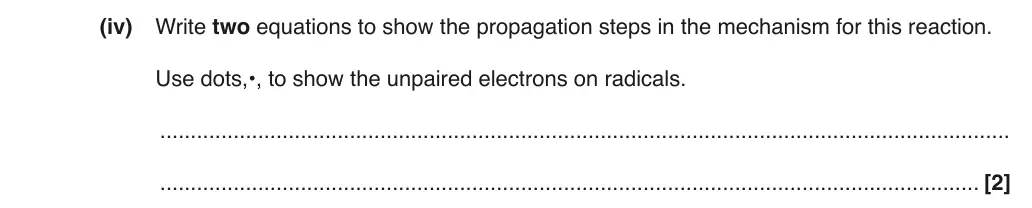
Cl• abstracts H to give HCl
organic radical + Cl2 regenerates Cl•
1 mark if both correct but dots omitted
June 2017 · AS Paper 2 · Q5(d)(vi)1 markStructure / isomer
Earlier part of question 5 that this part uses
Mark scheme
Notes from the mark scheme and report
two or more Cl on the alkyl chain with at least one at C-2
DO NOT ALLOW molecular formula C3H4Cl2O2
June 2017 · Paper 2 · Q141 markMultiple choice
Answer
C
Mark scheme
June 2017 · Paper 2 · Q16(a)2 marksStructure / isomer
Mark scheme
Notes from the mark scheme and report
both points must be comparisons
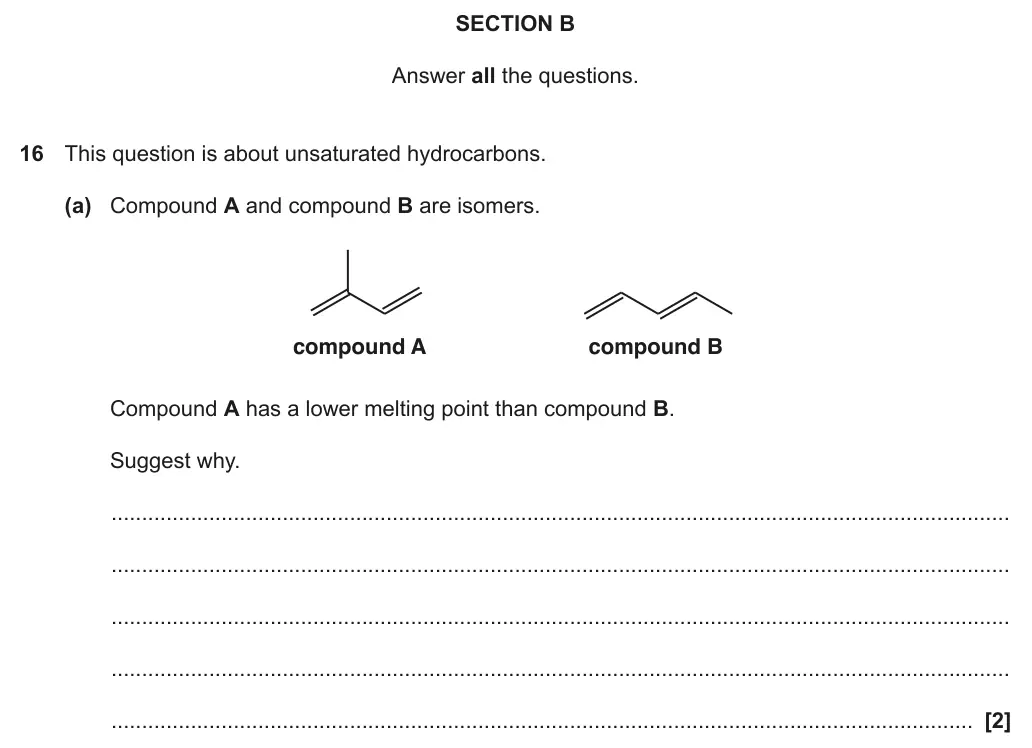
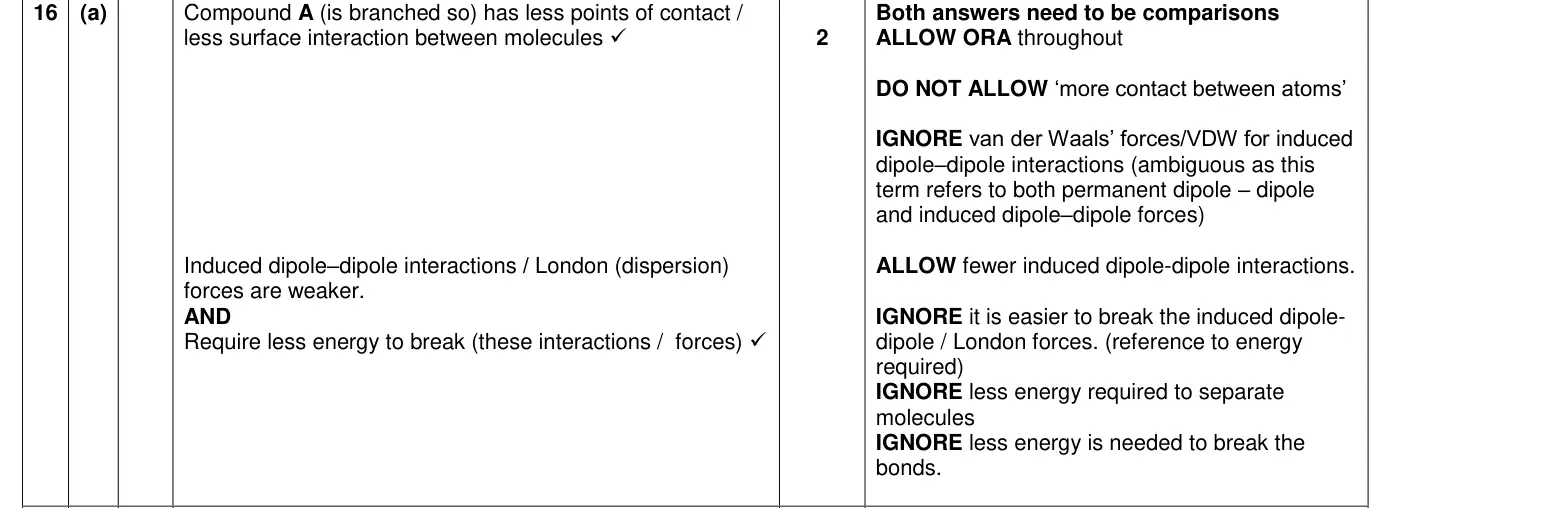
fewer points of contact so weaker London forces needing less energy to break
IGNORE van der Waals
IGNORE 'less energy to break the bonds'
June 2017 · Paper 3 · Q1(e)1 markShort answer
Mark scheme
Notes from the mark scheme and report
for fuel or energy
ALLOW chemical feedstock
IGNORE cooking
June 2016 · AS Paper 1 · Q161 markMultiple choice
Answer
D
Mark scheme
June 2016 · AS Paper 1 · Q171 markMultiple choice
Answer
D
Mark scheme
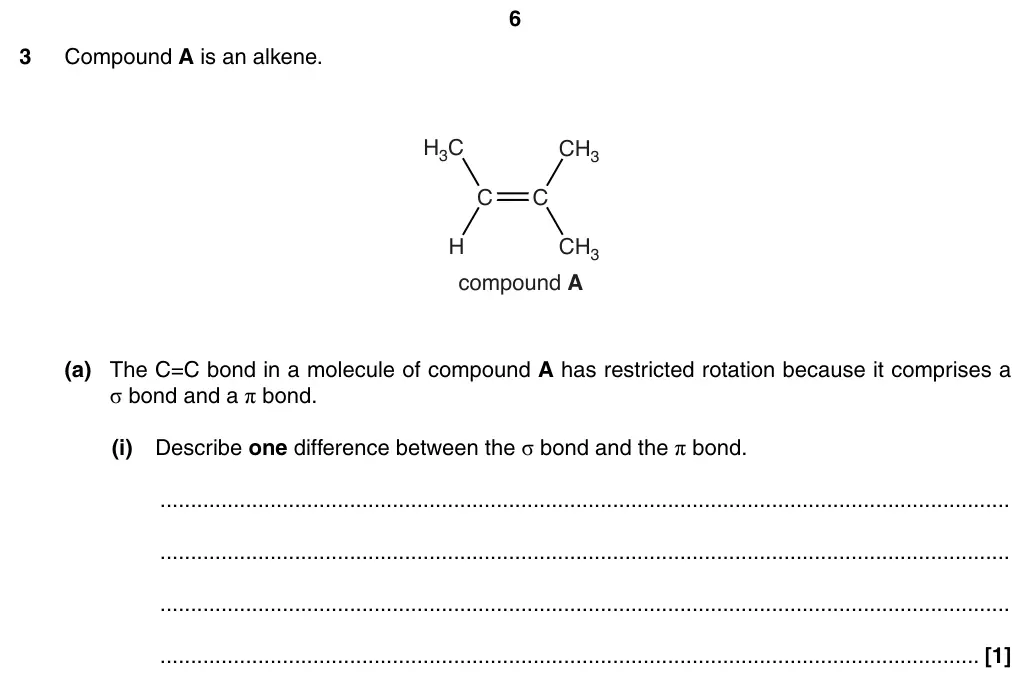
June 2016 · AS Paper 2 · Q3(a)(i)1 markShort answer
Mark scheme
Notes from the mark scheme and report
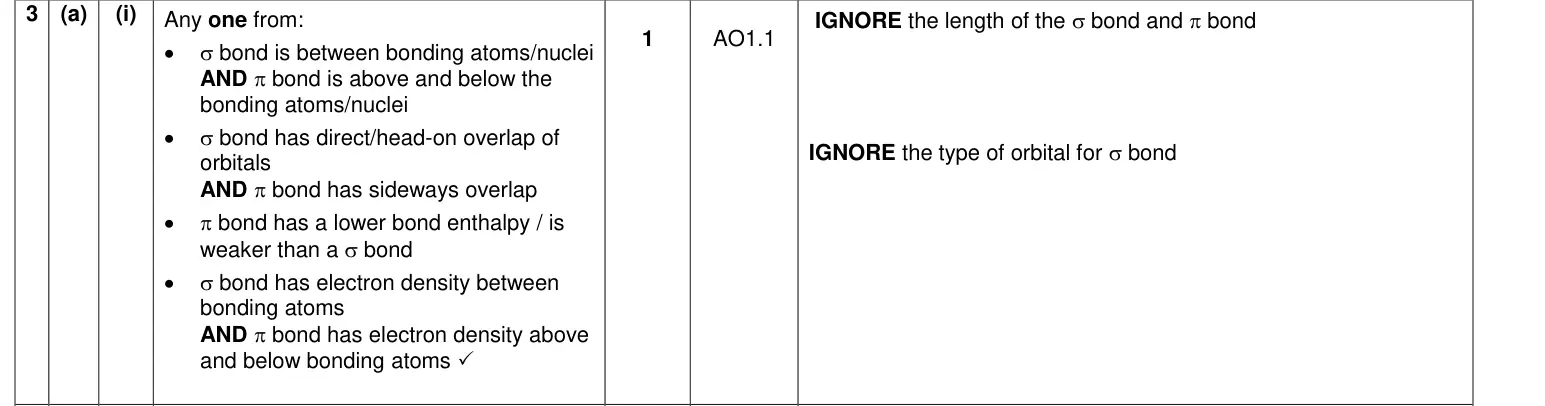
σ direct/head-on overlap between nuclei, π sideways overlap above and below
IGNORE bond length
IGNORE type of orbital for σ bond
Work with an OCR chemistry tutor
Dropping marks on calculations, mechanisms or the six-markers? Book a trial session with a specialist OCR chemistry tutor.