Notes and key-term cards for this topic are being written by our tutors. The past-paper questions below are ready now.
Learning outcomes
Show the 22 learning outcomes from the specification
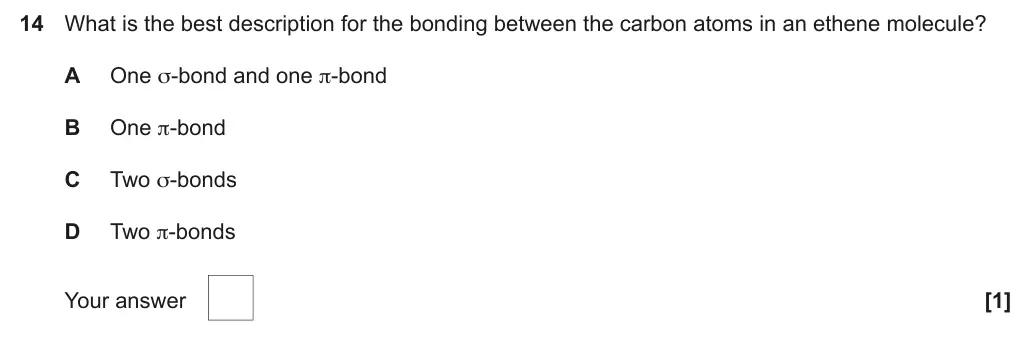
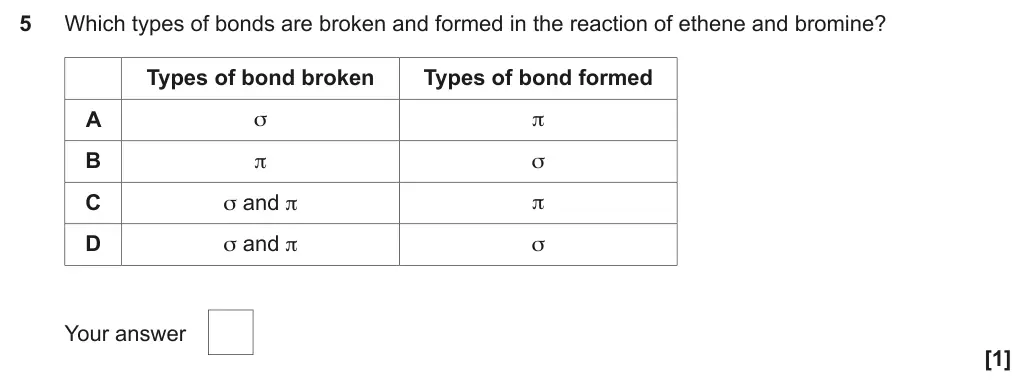
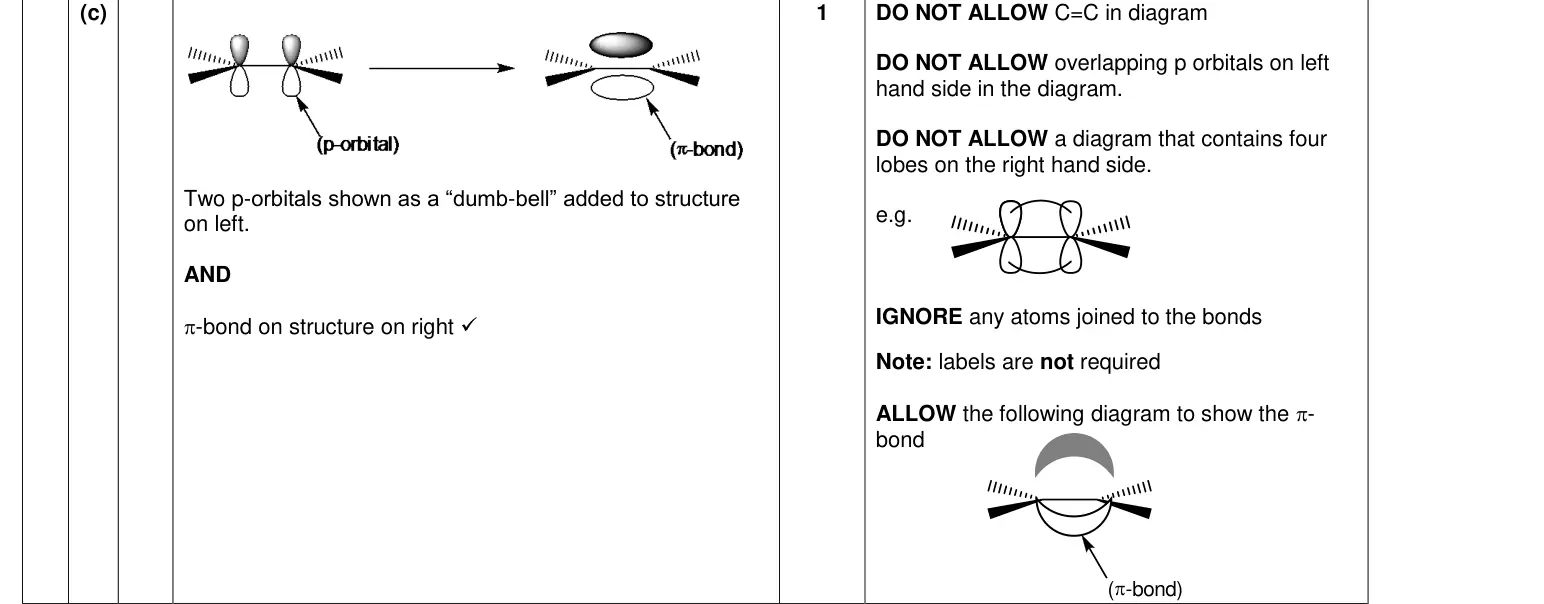
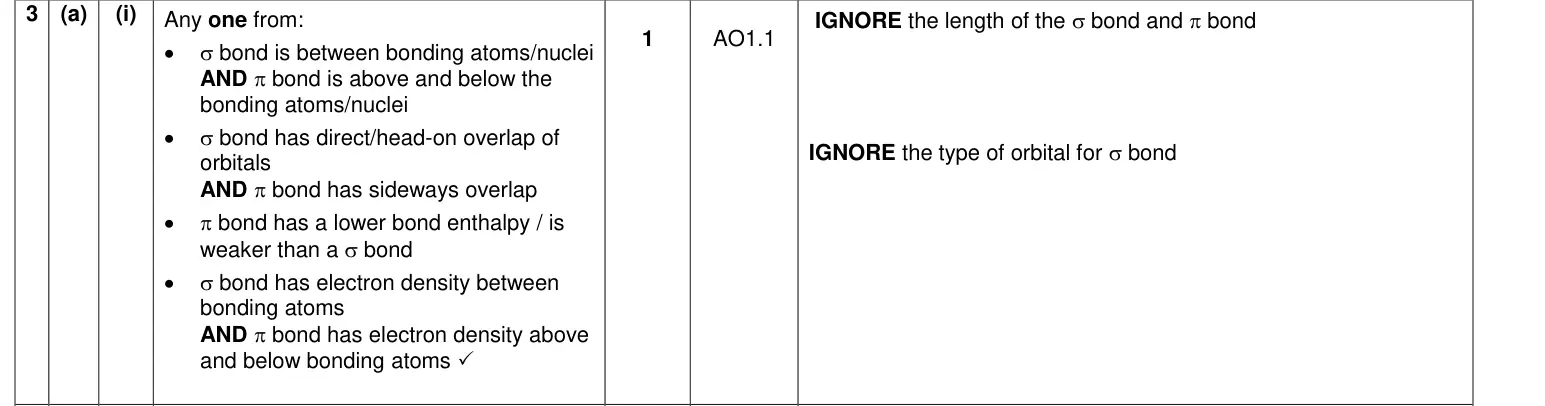
4.1.3(a) alkenes as unsaturated hydrocarbons containing a C=C bond comprising a π-bond (sideways overlap of adjacent p-orbitals above and below the bonding C atoms) and a σ-bond (overlap of orbitals directly between the bonding atoms) (see also 4.1.2 a); restricted rotation of the π-bond
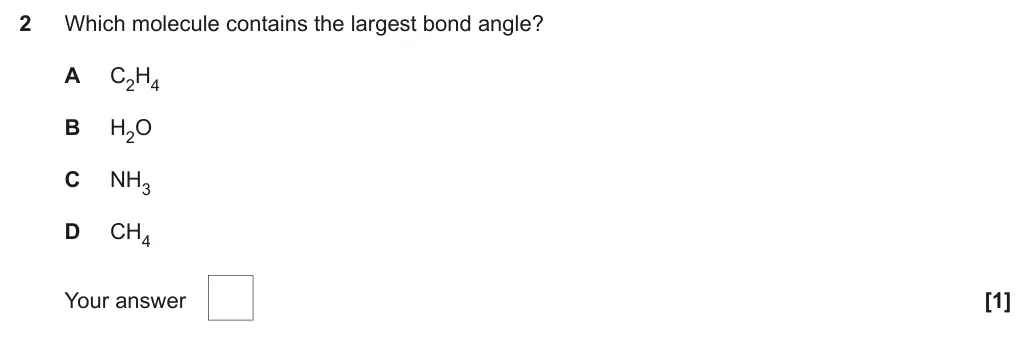
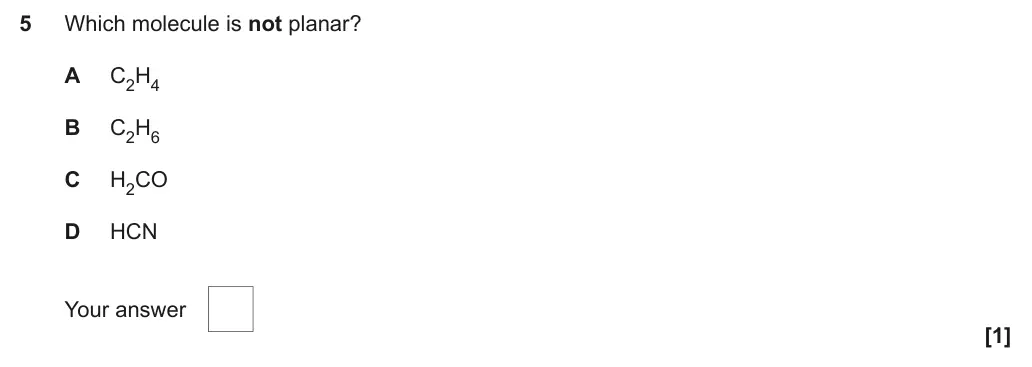
4.1.3(b) explanation of the trigonal planar shape and bond angle around each carbon in the C=C of alkenes in terms of electron pair repulsion (see also 2.2.2 g– h, 4.1.2 b)
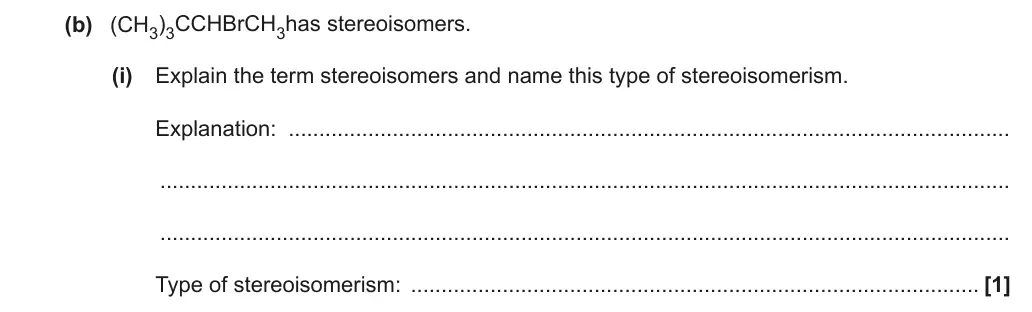
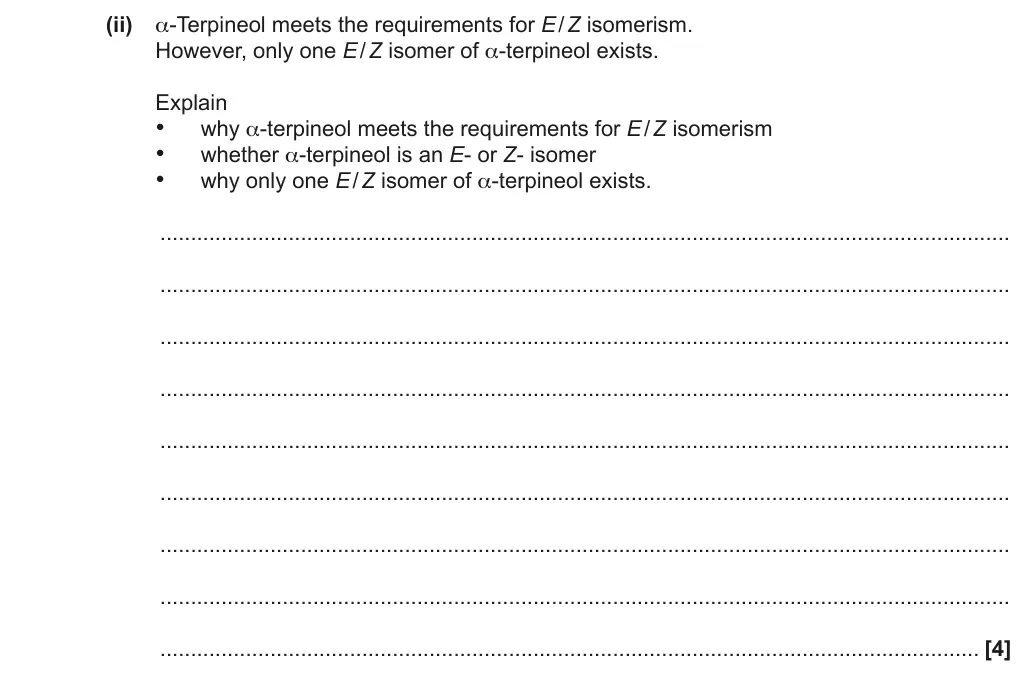
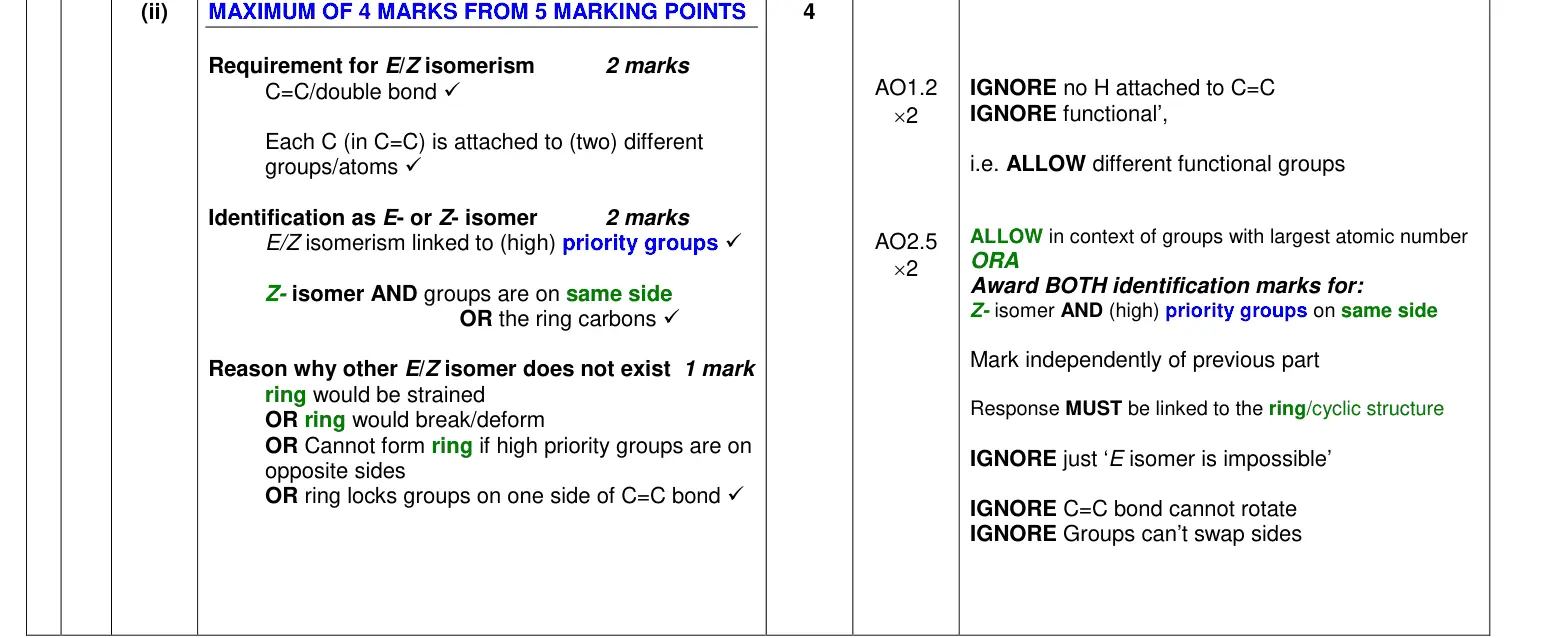
4.1.3(c)(i) explanation of the terms: • stereoisomers (compounds with the same structural formula but with a different arrangement in space) • E/Z isomerism (an example of stereoisomerism, in terms of restricted rotation about a double bond and the requirement for two different groups to be attached to each carbon atom of the C=C group) • cis– trans isomerism (a special case of E/Z isomerism in which two of the substituent groups attached to each carbon atom of the C=C group are the same)
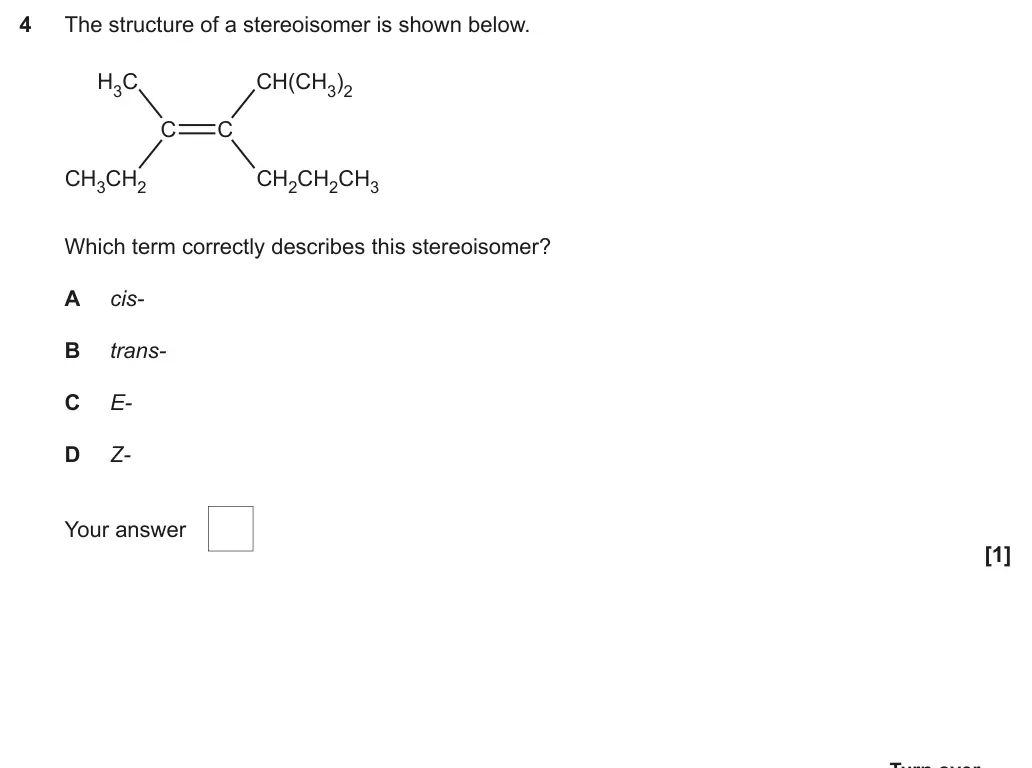
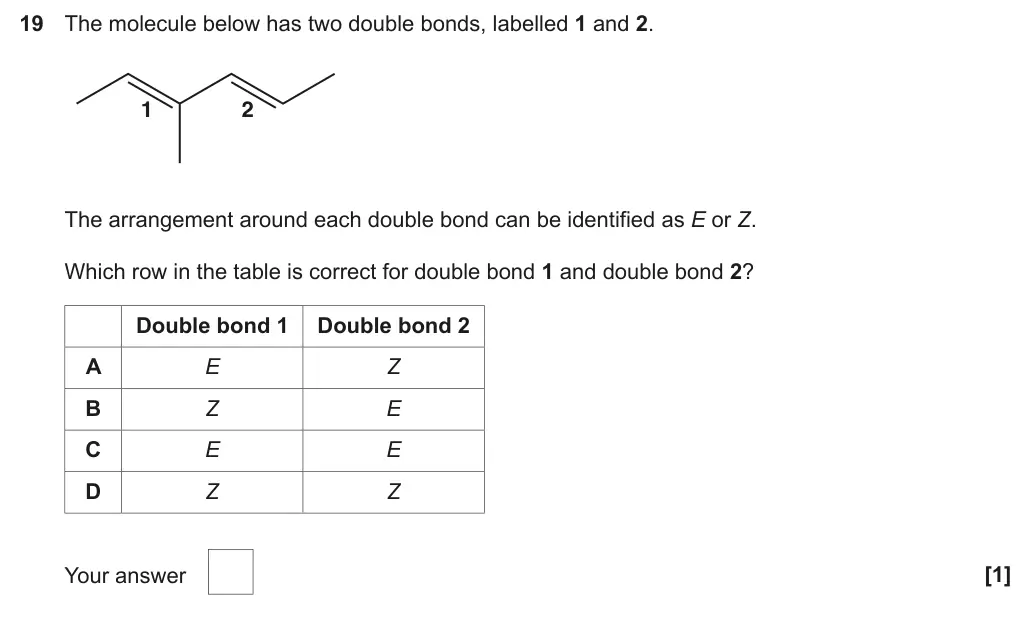
4.1.3(c)(ii) use of Cahn–Ingold–Prelog (CIP) priority rules to identify the E and Z stereoisomers
4.1.3(d) determination of possible E/Z or cis– trans stereoisomers of an organic molecule, given its structural formula
4.1.3(e) the reactivity of alkenes in terms of the relatively low bond enthalpy of the π-bond
4.1.3(f) addition reactions of alkenes with:
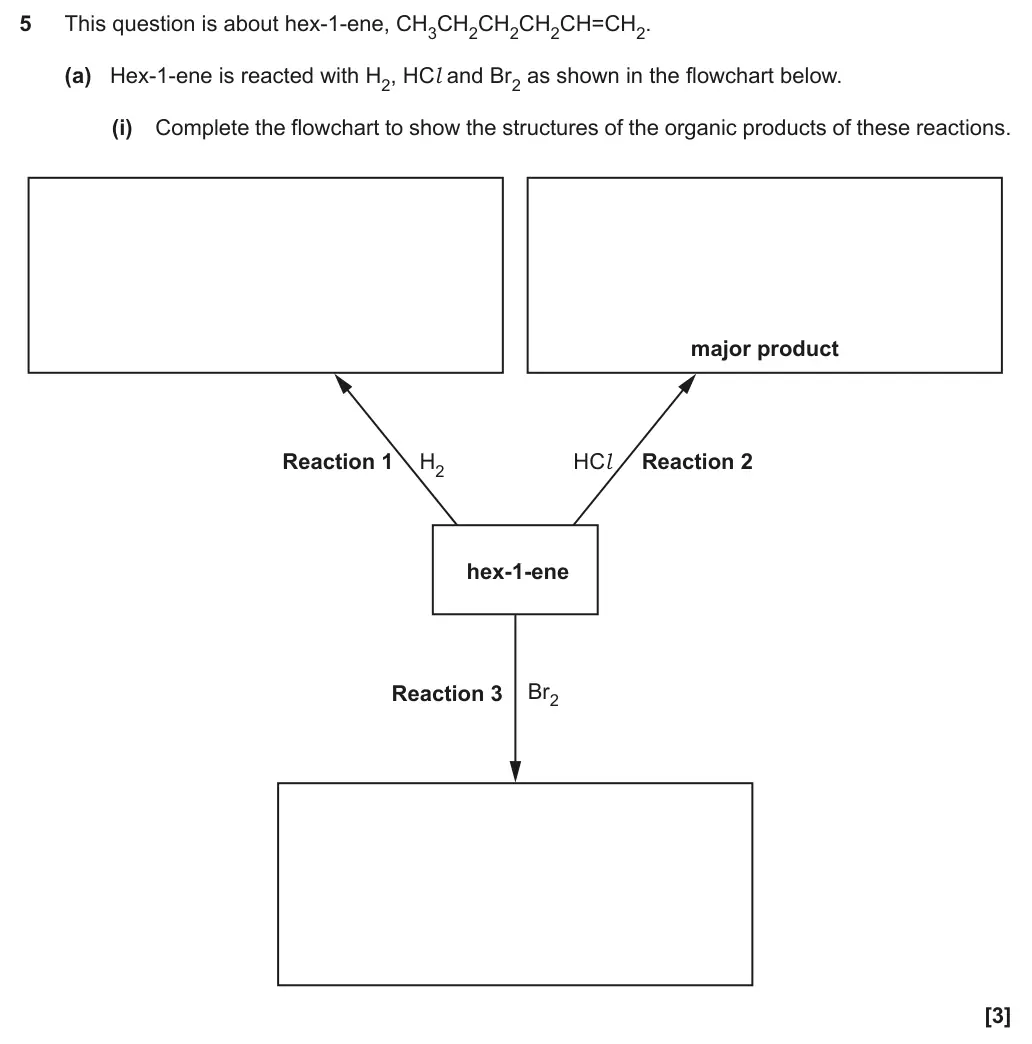
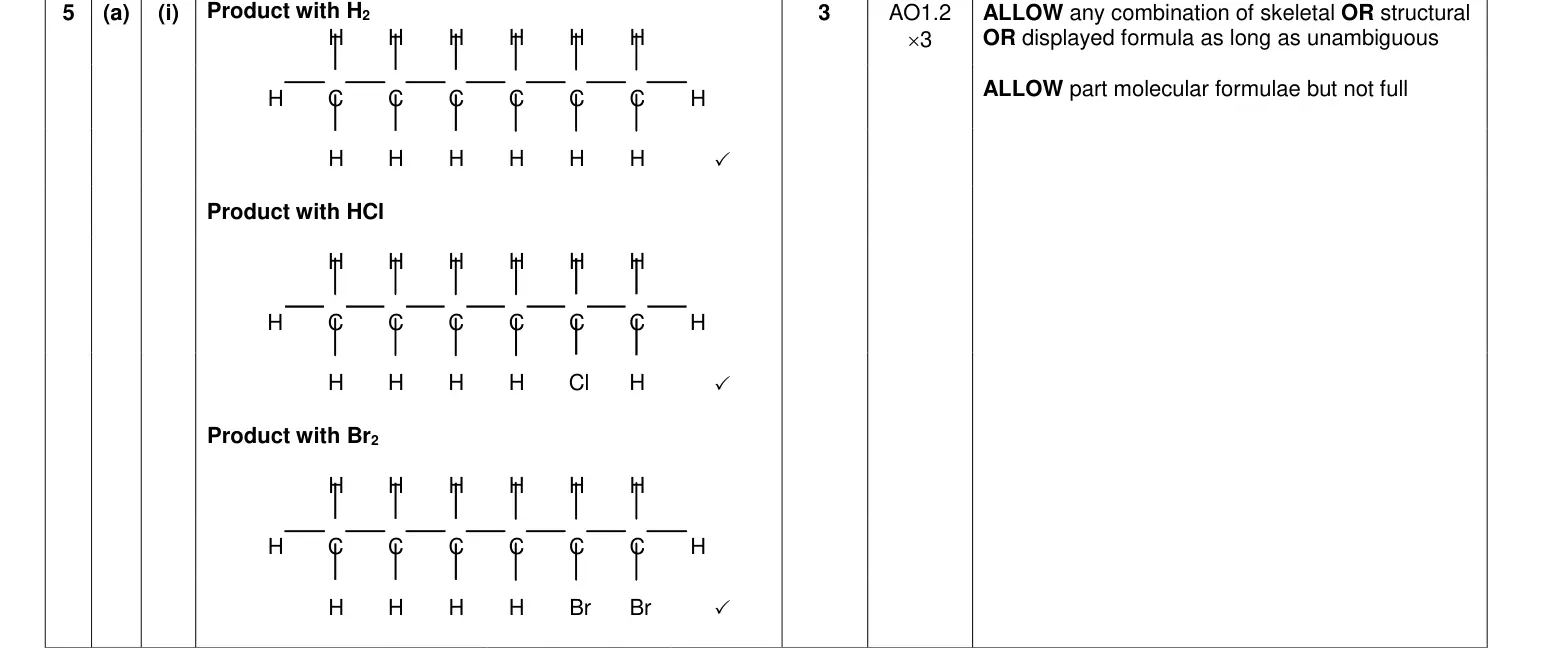
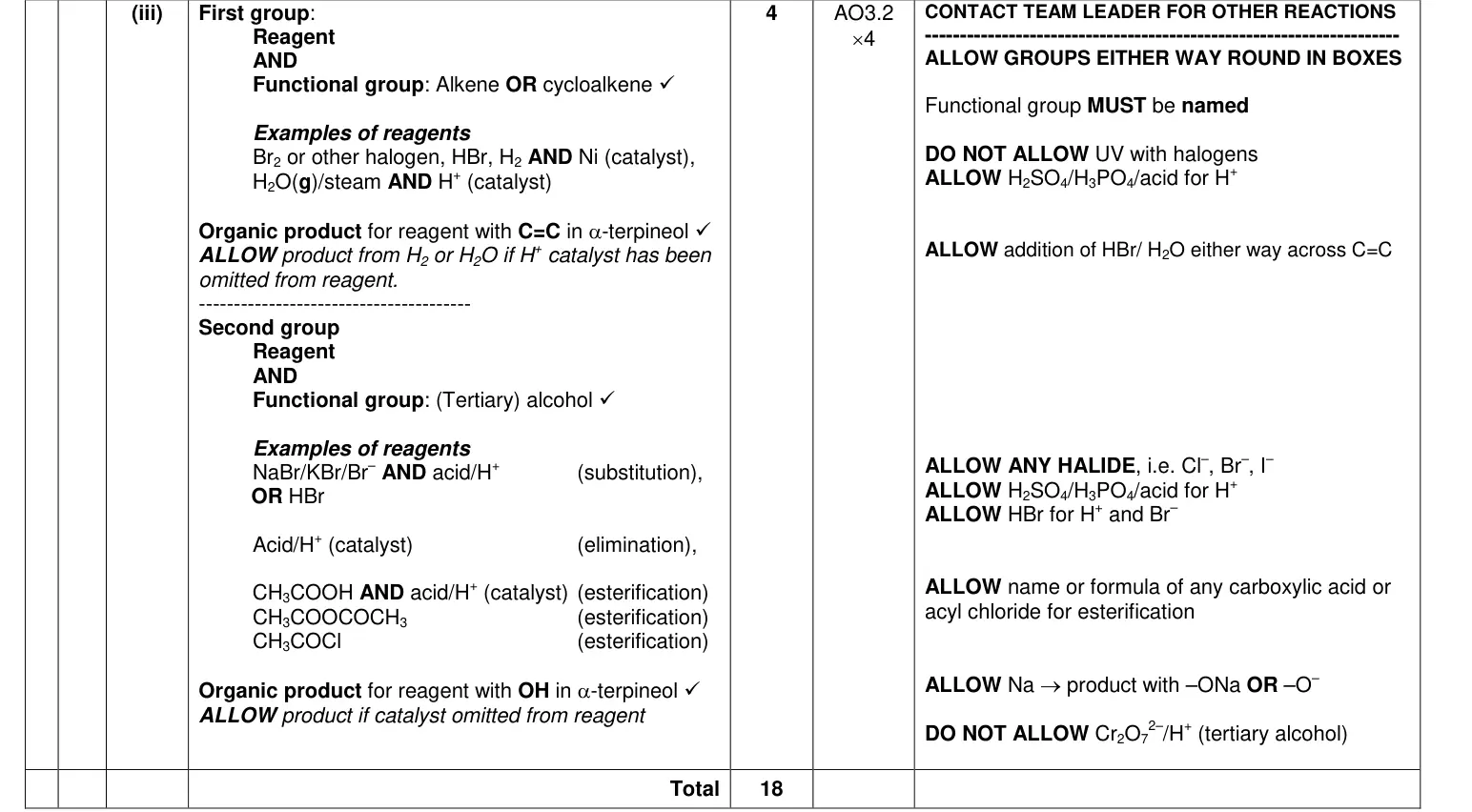
4.1.3(f)(i) hydrogen in the presence of a suitable catalyst, e.g. Ni, to form alkanes
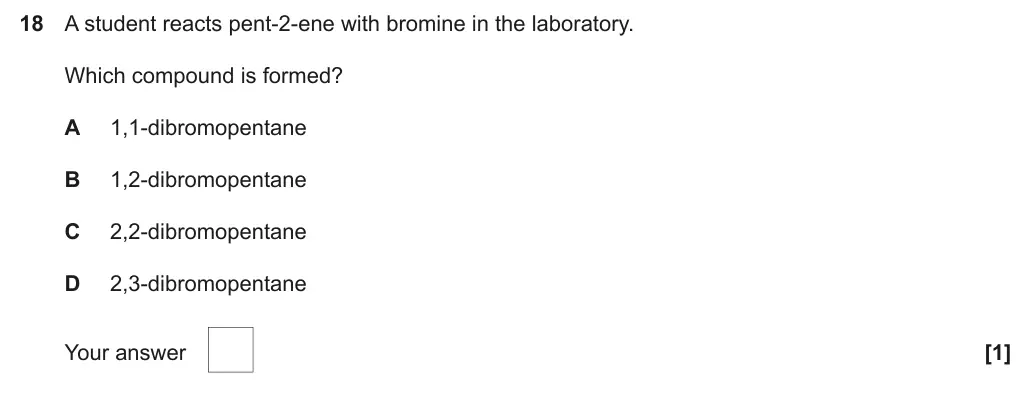
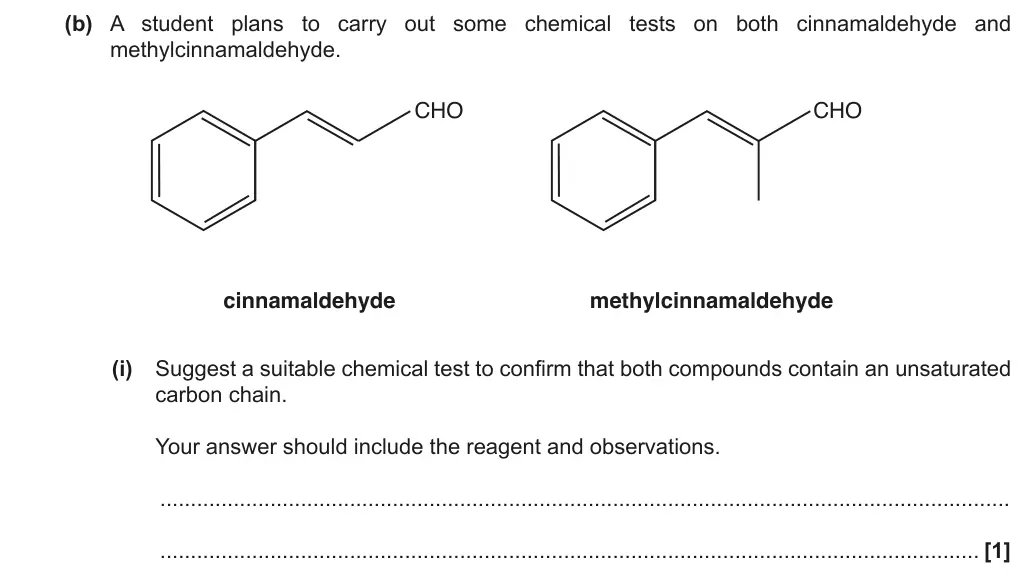
4.1.3(f)(ii) halogens to form dihaloalkanes, including the use of bromine to detect the presence of a double C=C bond as a test for unsaturation in a carbon chain
4.1.3(f)(iii) hydrogen halides to form haloalkanes
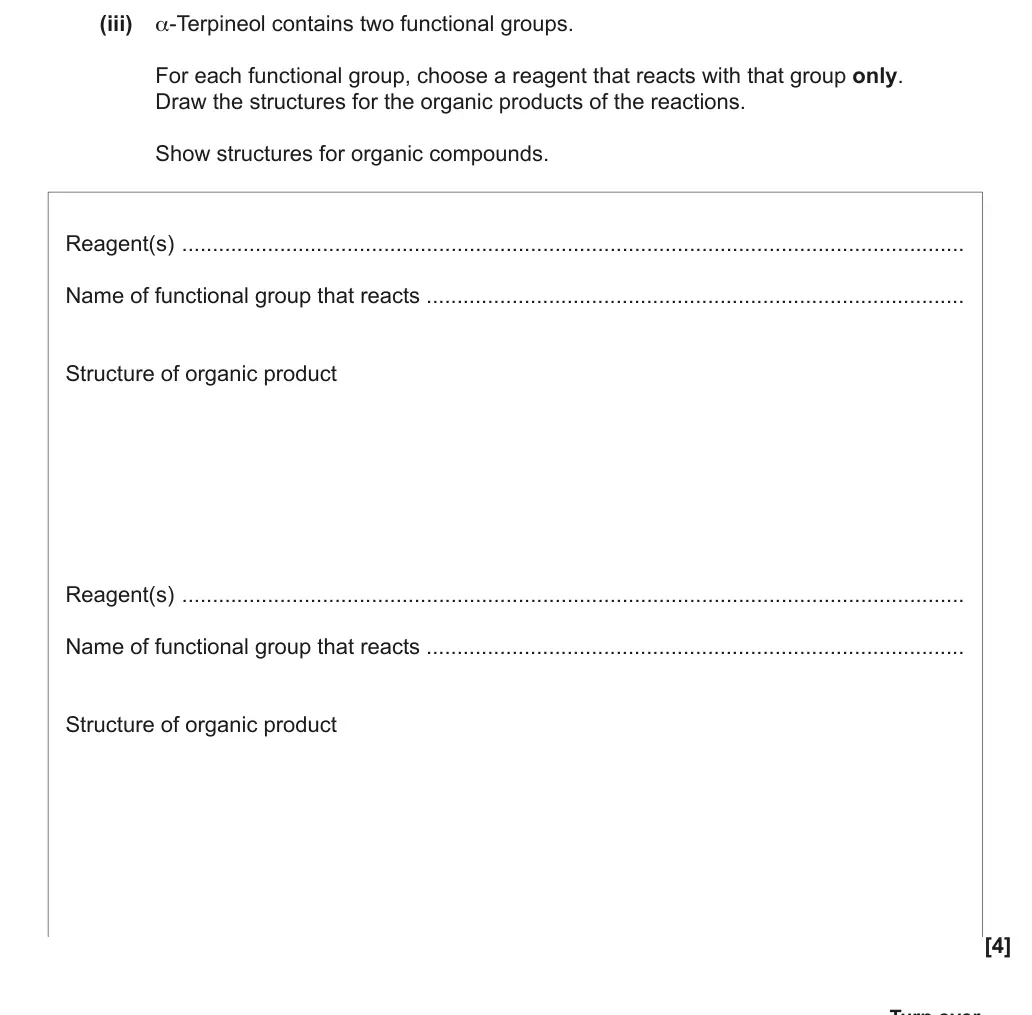
4.1.3(f)(iv) steam in the presence of an acid catalyst, e.g. H3PO4, to form alcohols
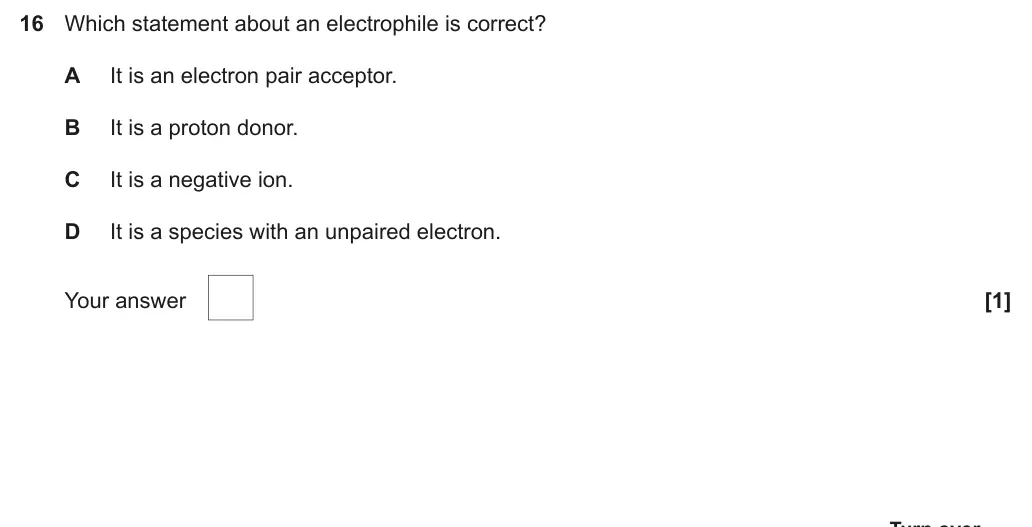
4.1.3(g) definition and use of the term electrophile (an electron pair acceptor)
4.1.3(h) the mechanism of electrophilic addition in alkenes by heterolytic fission (see also 4.1.1 h– i)
4.1.3(i) use of Markownikoff’s rule to predict formation of a major organic product in addition reactions of H–X to unsymmetrical alkenes, e.g. H–Br to propene, in terms of the relative stabilities of carbocation intermediates in the mechanism
4.1.3(j) addition polymerisation of alkenes and substituted alkenes, including:
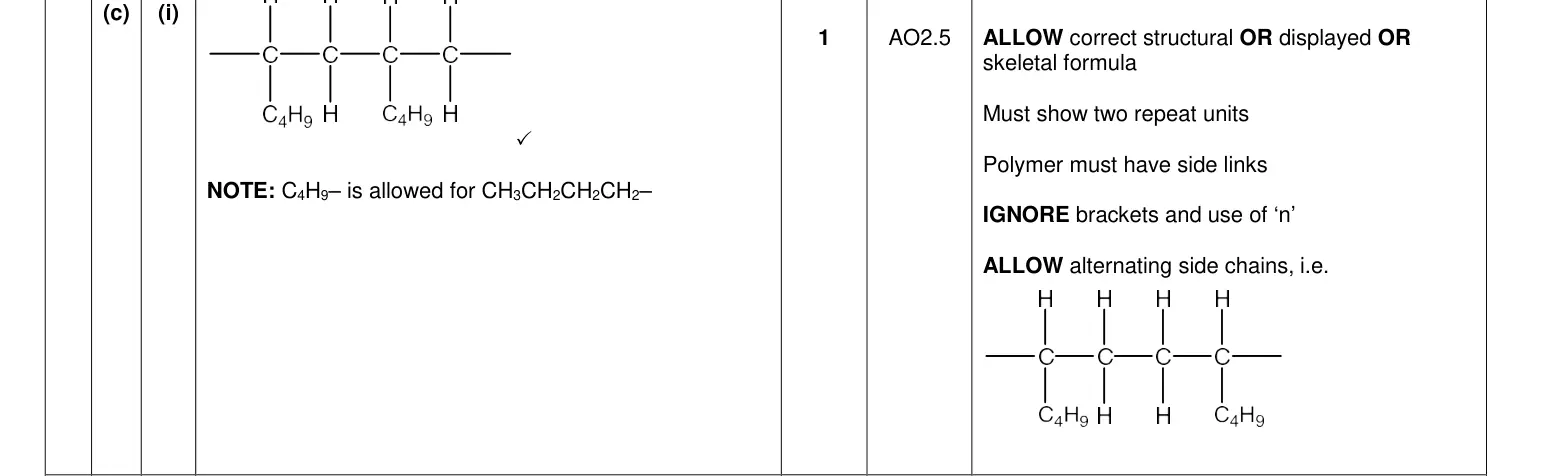
4.1.3(j)(i) the repeat unit of an addition polymer deduced from a given monomer
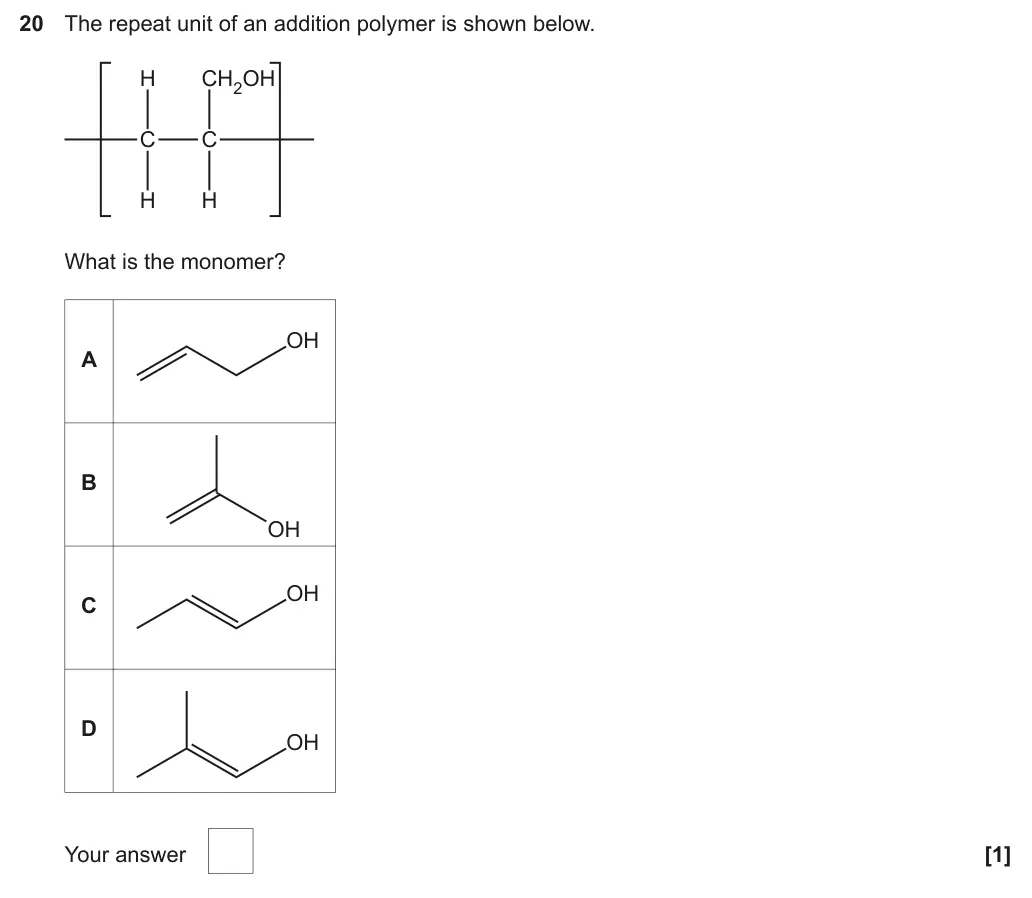
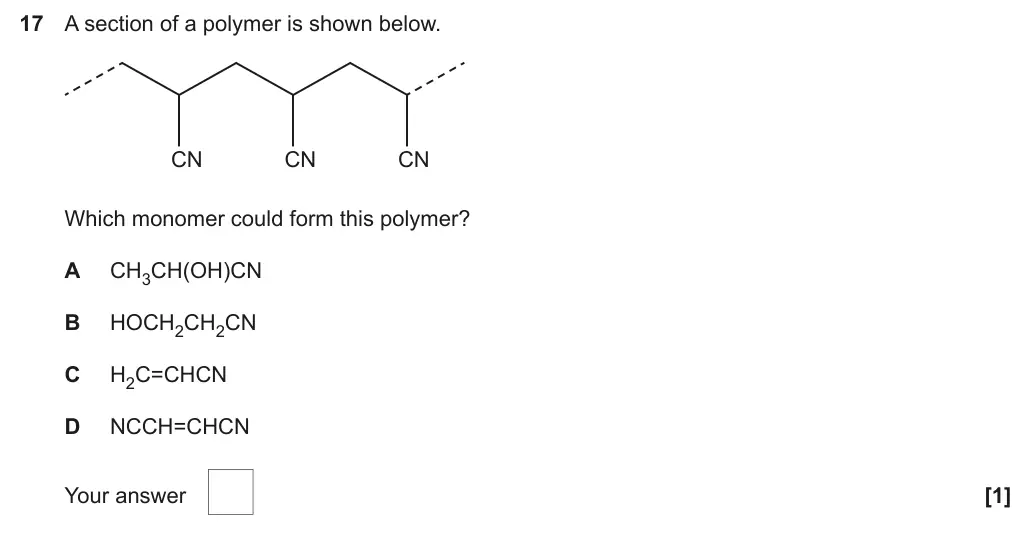
4.1.3(j)(ii) identification of the monomer that would produce a given section of an addition polymer
4.1.3(k) the benefits for sustainability of processing waste polymers by:
4.1.3(k)(i) combustion for energy production
4.1.3(k)(ii) use as an organic feedstock for the production of plastics and other organic chemicals
4.1.3(k)(iii) removal of toxic waste products, e.g. removal of HCl formed during disposal by combustion of halogenated plastics (e.g. PVC)
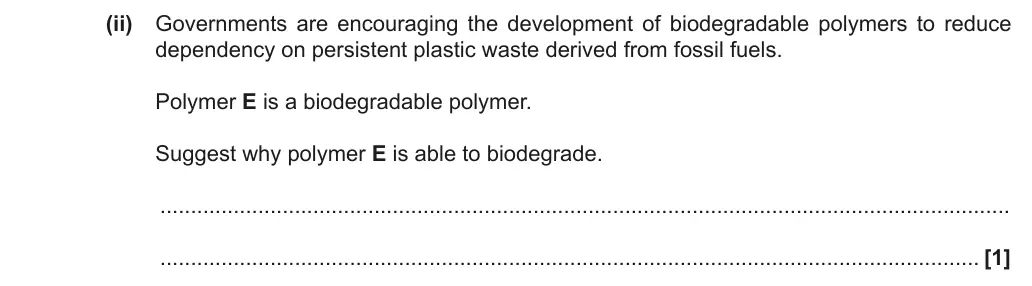
4.1.3(l) the benefits to the environment of development of biodegradable and photodegradable polymers.
Six-mark level of response questions on this topic
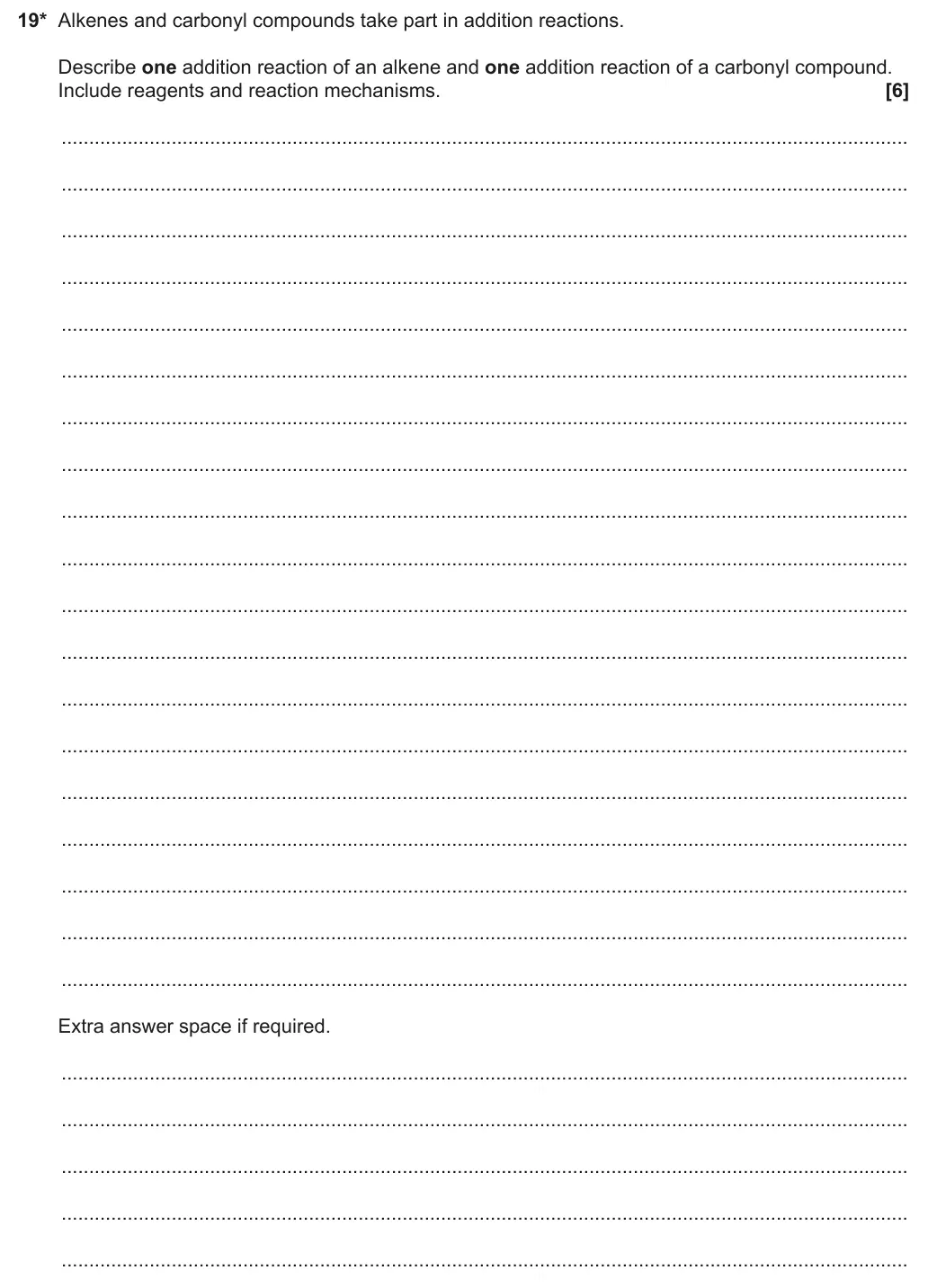
Alkenes and carbonyl compounds take part in addition reactions. Describe one addition reaction of an alkene and one addition reaction of a carbonyl compound.
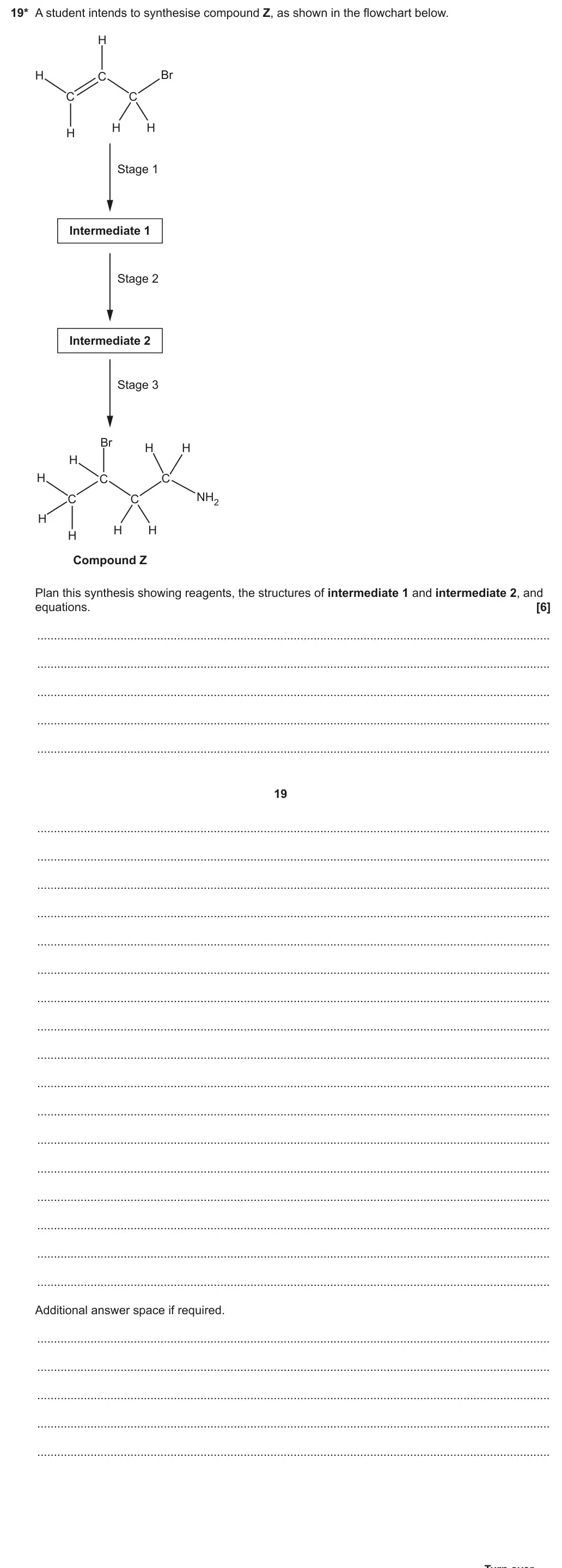
A student intends to synthesise compound Z, as shown in the flowchart below. Plan this synthesis showing reagents, the structures of intermediate 1 and intermediate 2, and
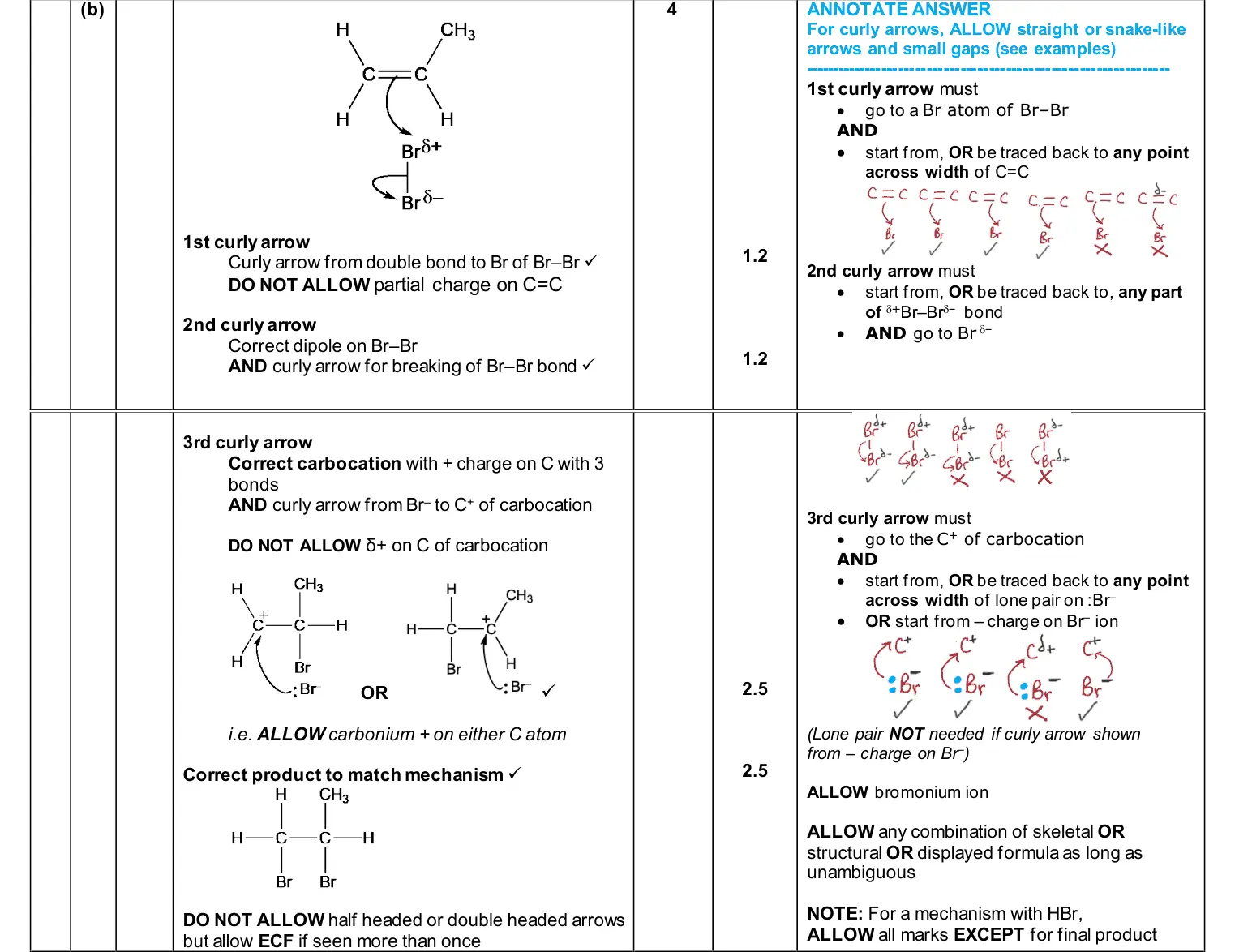
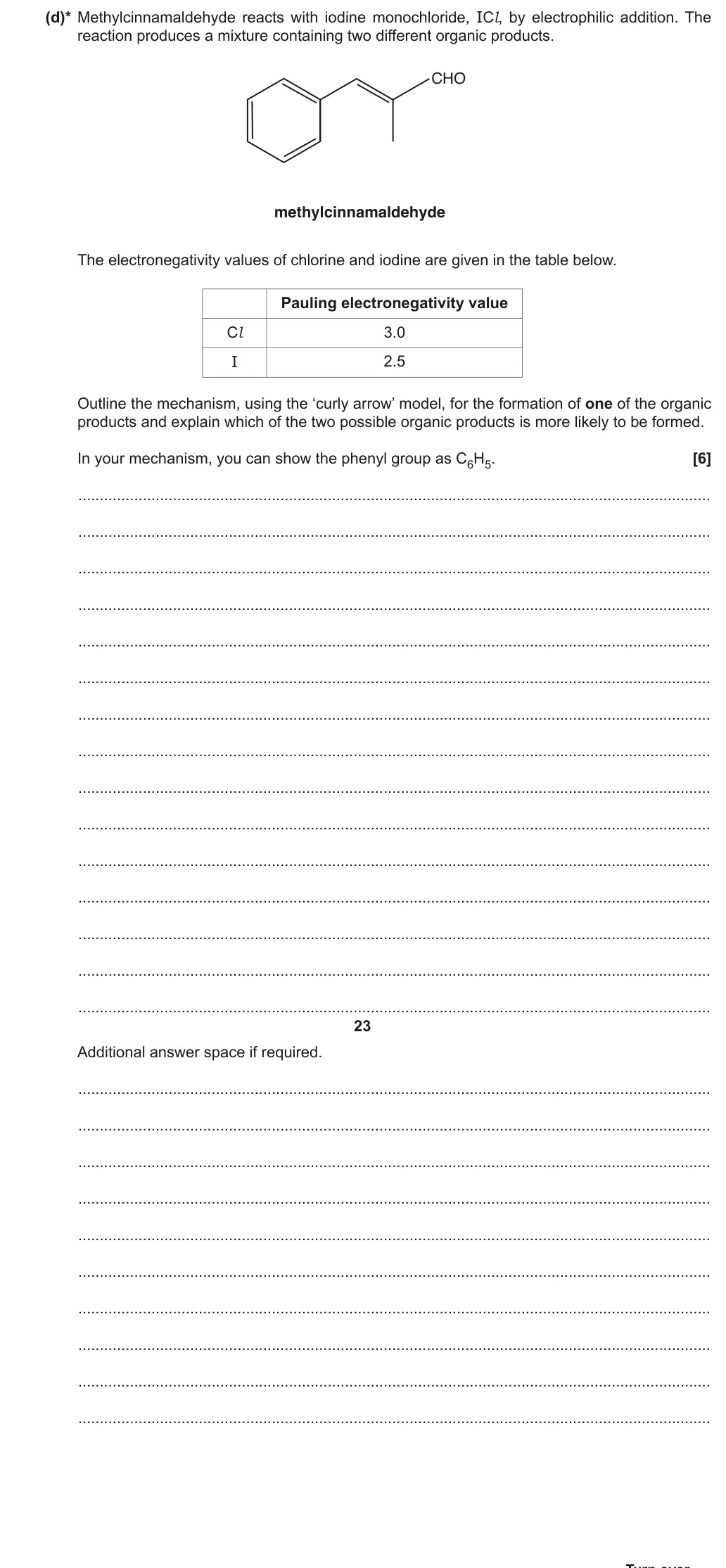
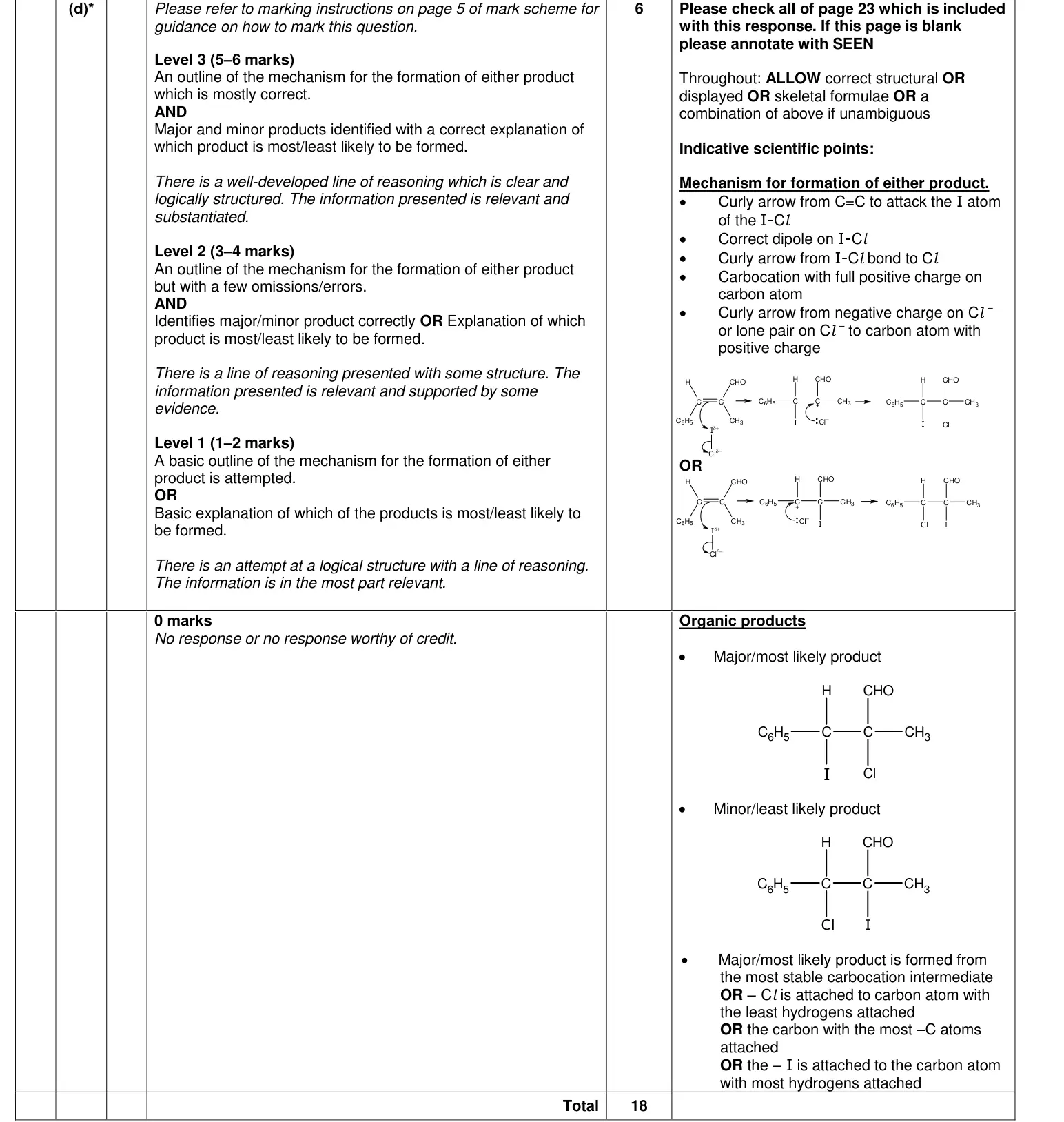
Methylcinnamaldehyde reacts with iodine monochloride, ICl, by electrophilic addition. The Outline the mechanism, using the ‘curly arrow’ model, for the formation of one of the organic
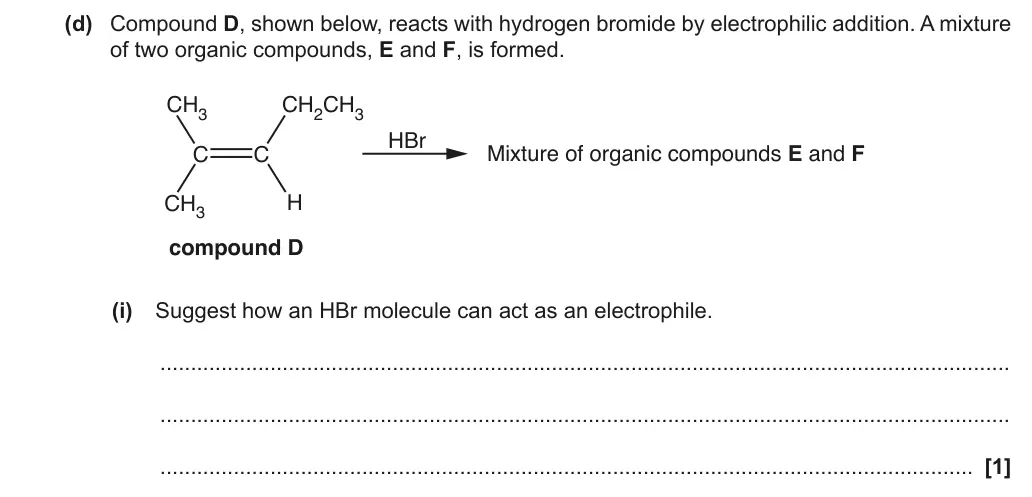
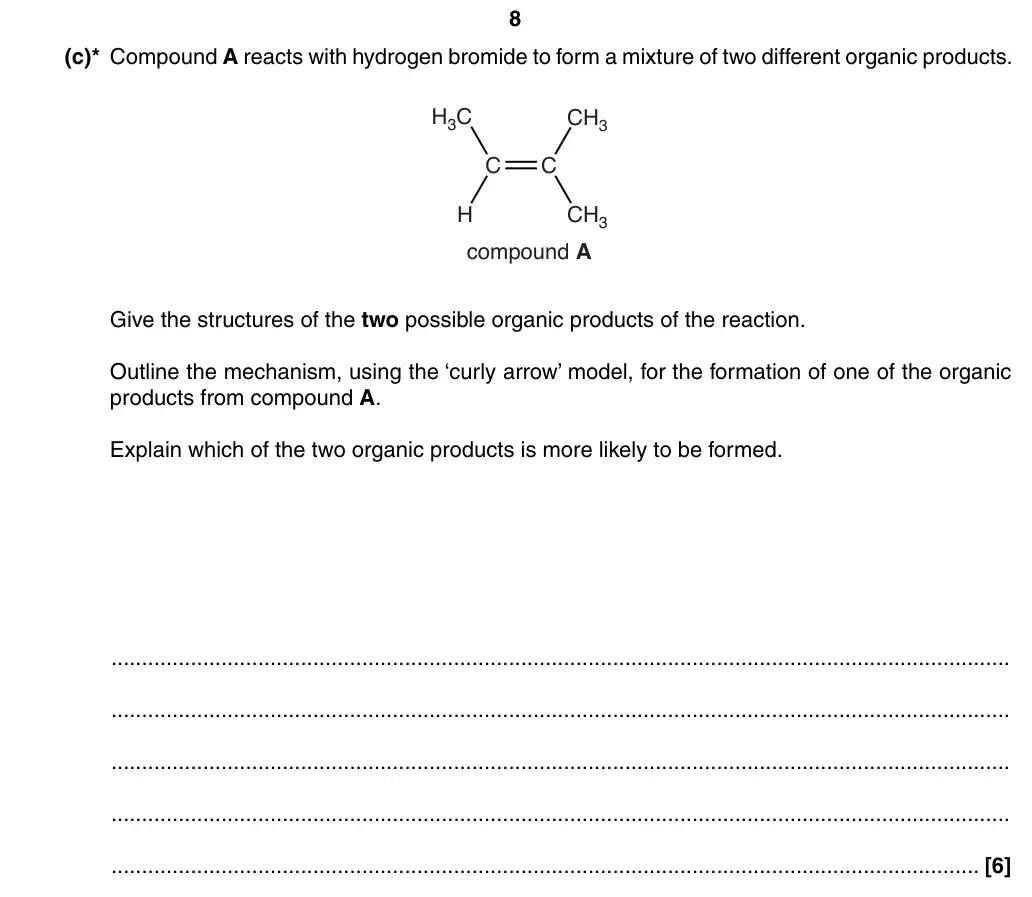
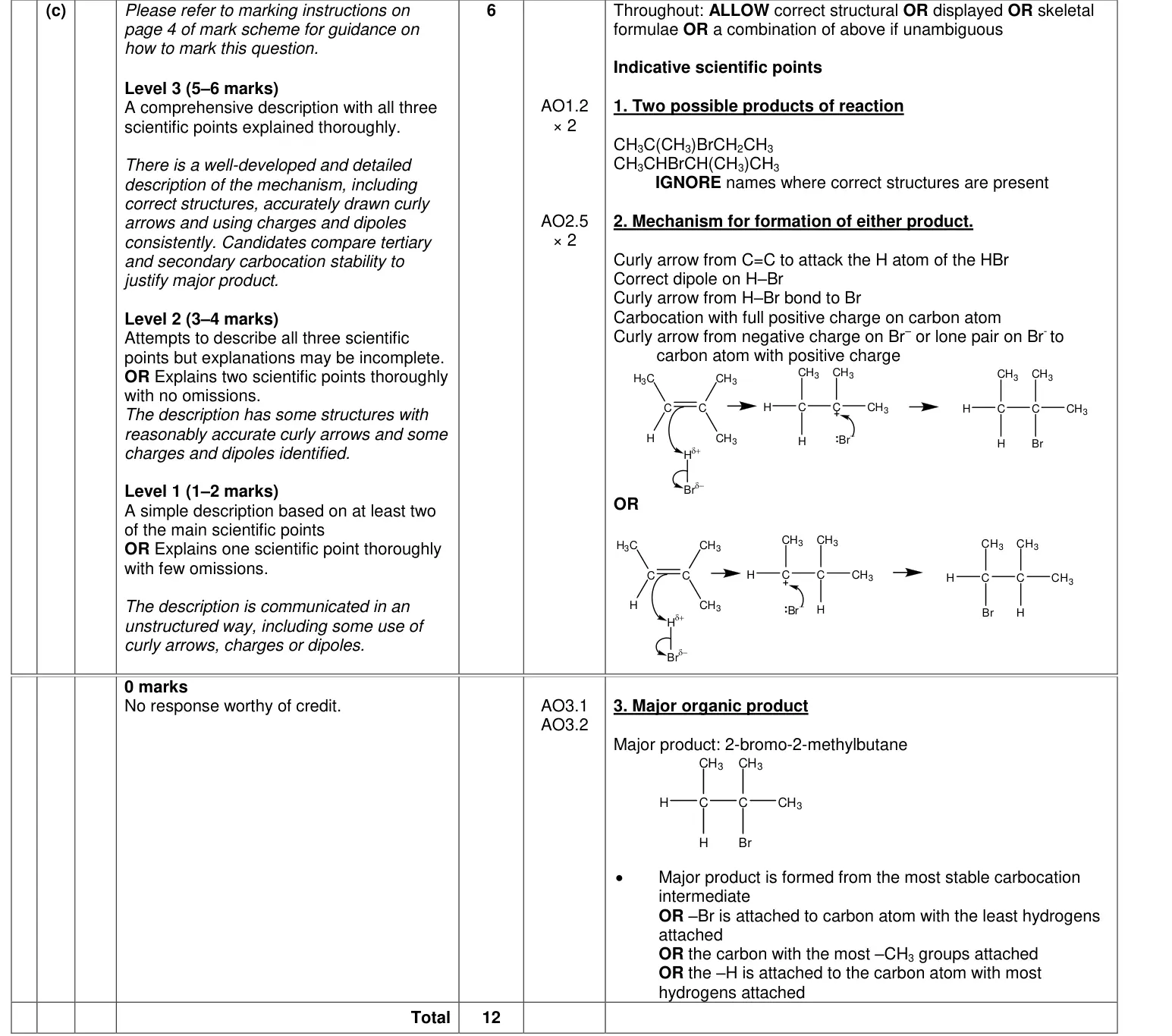
Compound A reacts with hydrogen bromide to form a mixture of two different organic products. Outline the mechanism, using the ‘curly arrow’ model, for the formation of one of the organic
Tap a question to zoom it. Where a part needs a table, graph or structure from an earlier part, that part folds out above it; the mark scheme and examiner's comment open underneath. Have the OCR Data Sheet beside you.
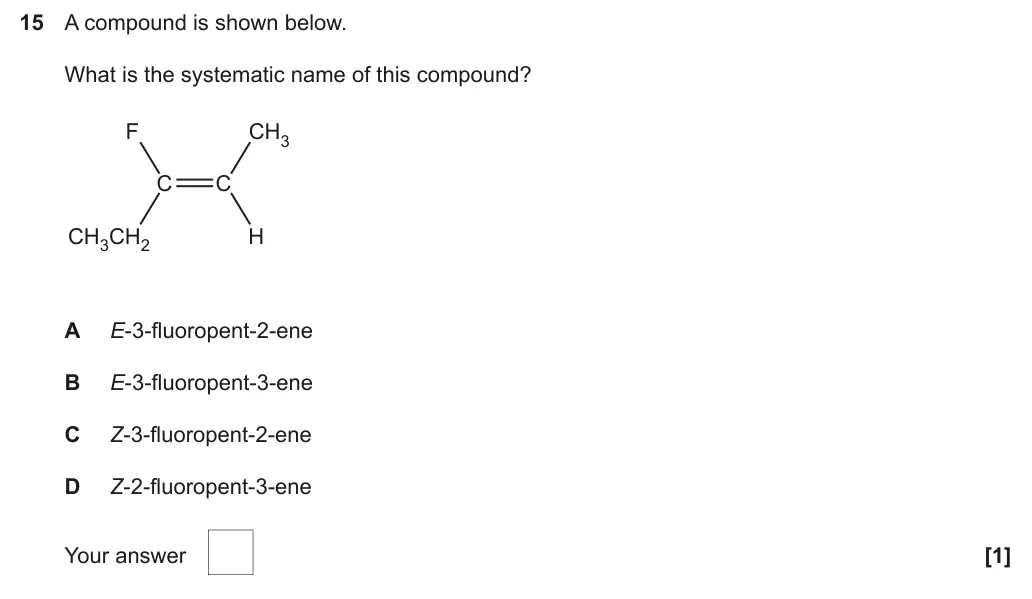
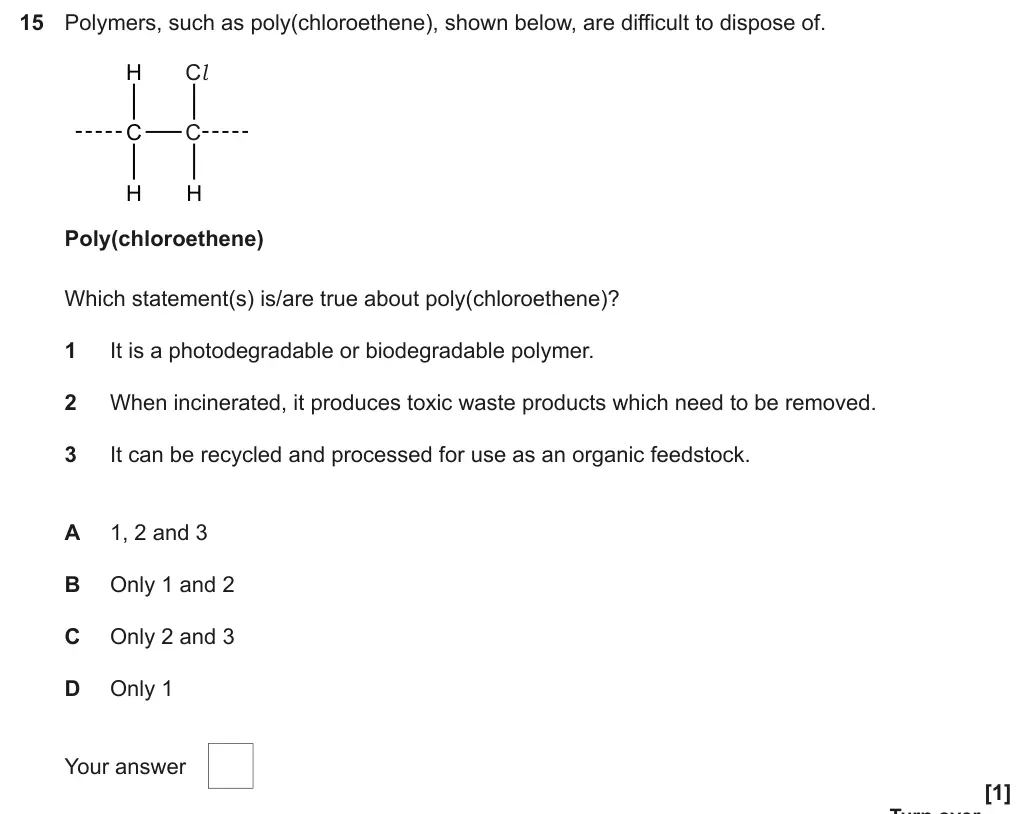
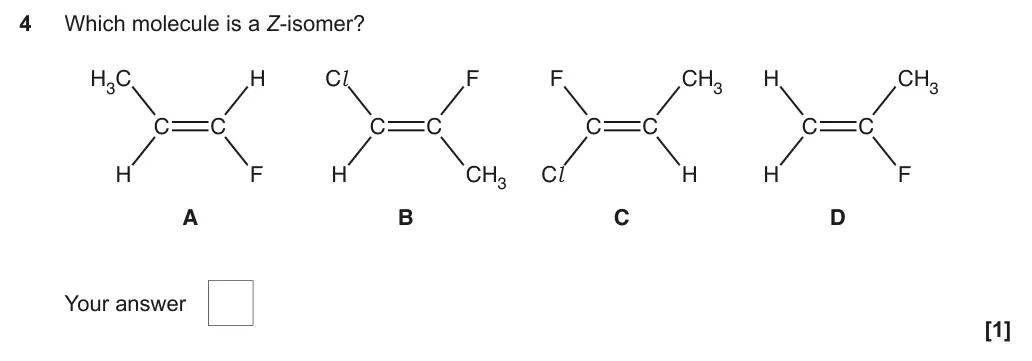
June 2025 · AS Paper 1 · Q151 markMultiple choiceHard
Answer
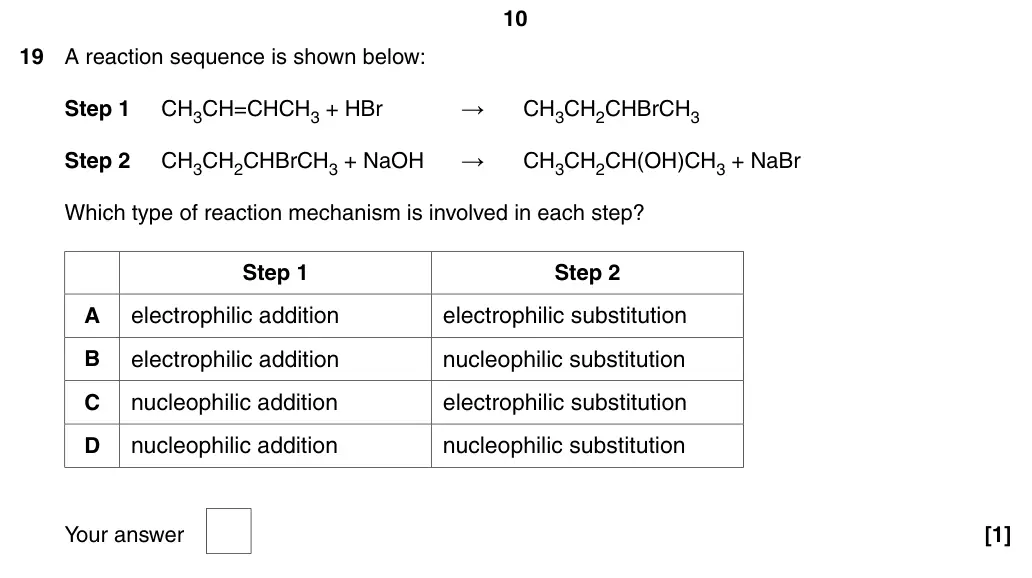
C
Mark scheme
Examiner's comment
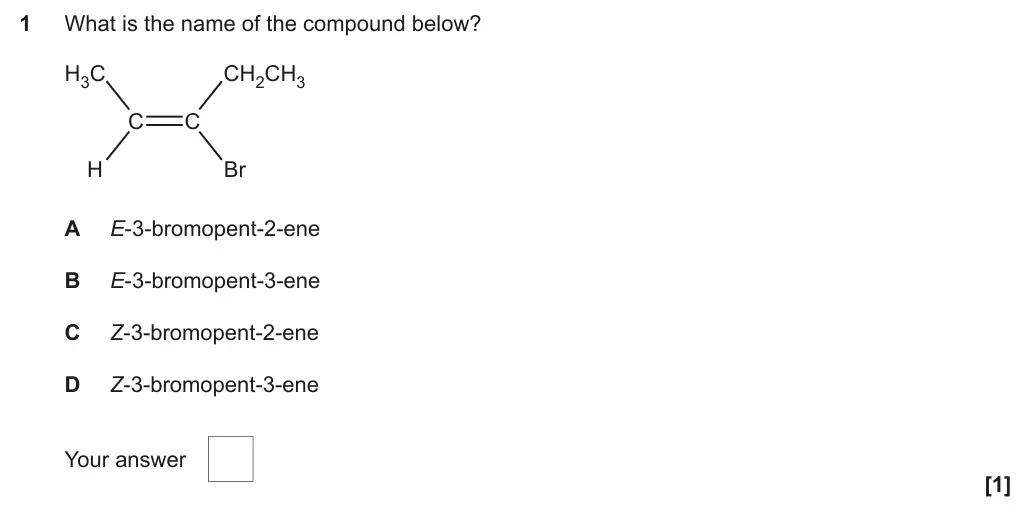
Candidates found this question challenging. A was the most common wrong response given, suggesting students have difficulty applying Cahn-Ingold Prelog rules.
Notes from the mark scheme and report
Many students incorrectly assigned CH3CH2- as higher priority than F (presumably by using the Mr of the entire side chain). To correctly assign priority, use the atomic number of the atoms directly attached to each carbon in the double bond.
Skills: M4.2 Visualise and represent 2-D and 3-D forms including 2-D representations of 3-D objects; M4.3 Understand the symmetry of 2-D and 3-D shapes
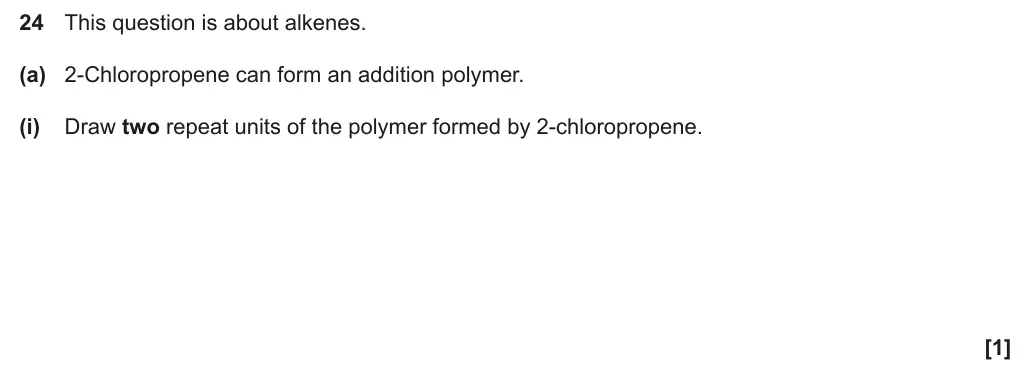
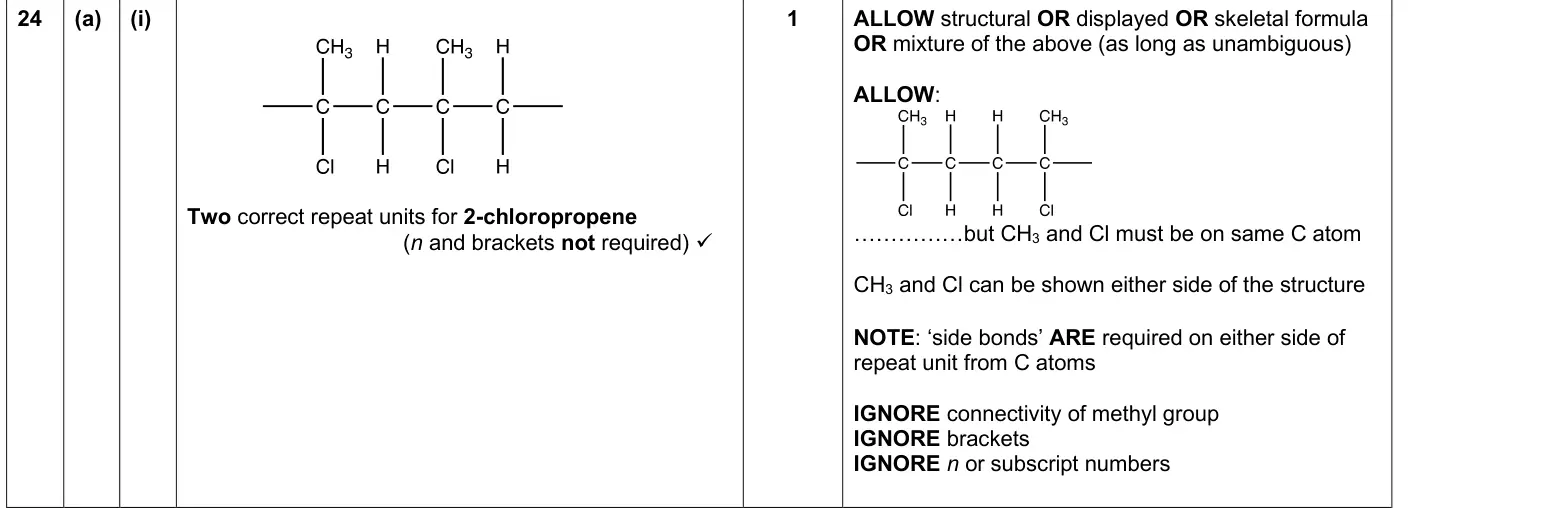
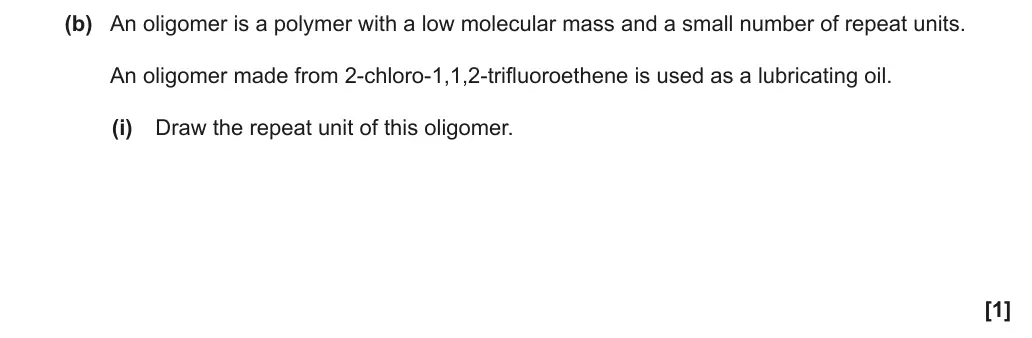
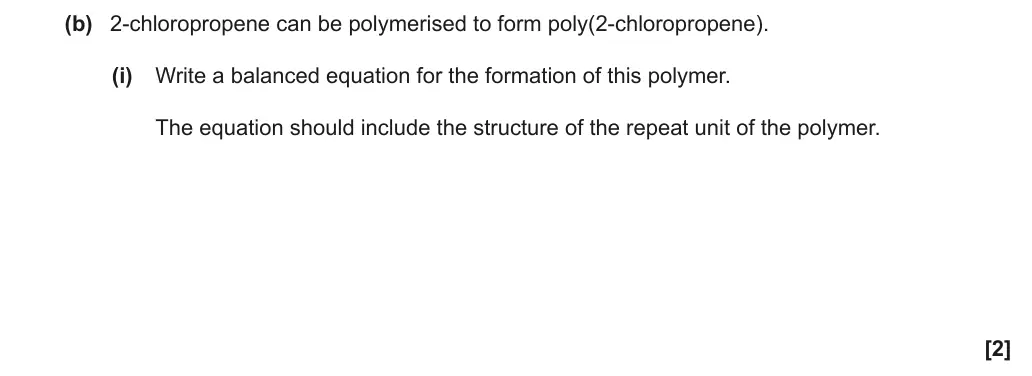
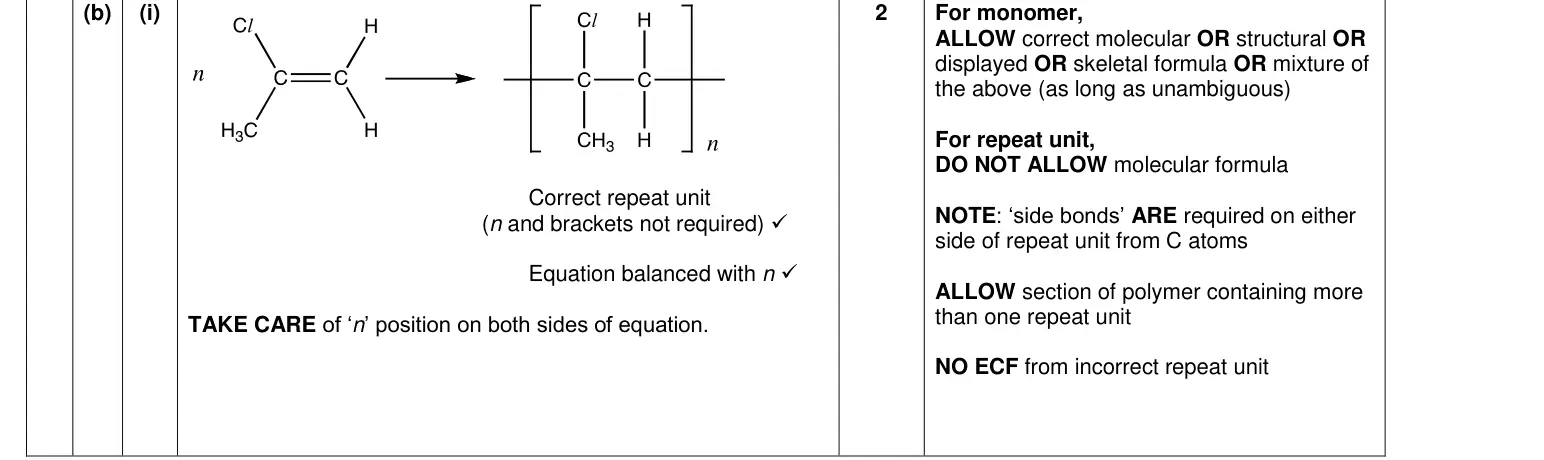
June 2025 · AS Paper 1 · Q24(a)(i)1 markDrawing / labellingMedium
Mark scheme
Examiner's comment
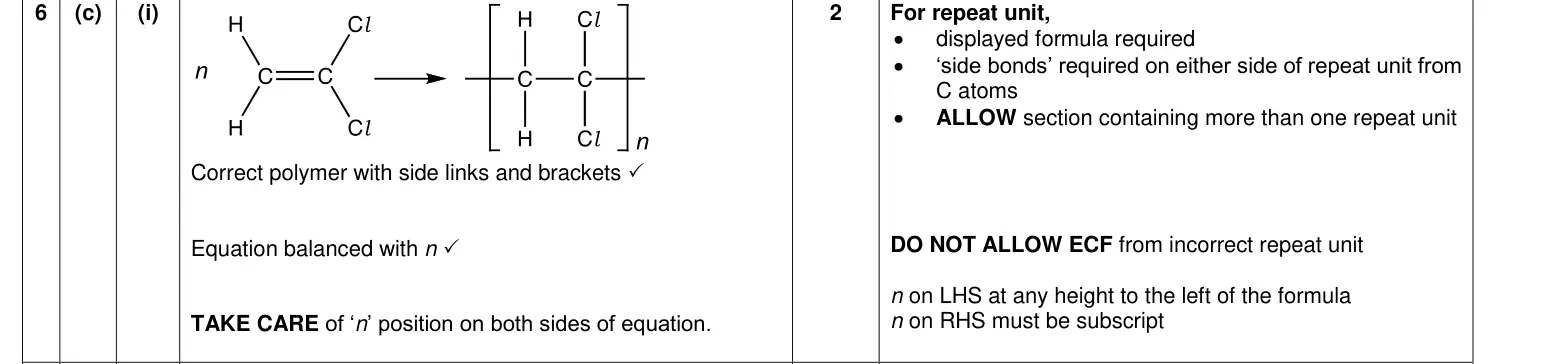
Under half of candidates scored this mark, suggesting students would benefit from practising drawing repeat polymer units. A structure with six carbons in the chain was a common error.
Notes from the mark scheme and report
CH3 and Cl must be on the same C atom
side bonds required
IGNORE brackets and n
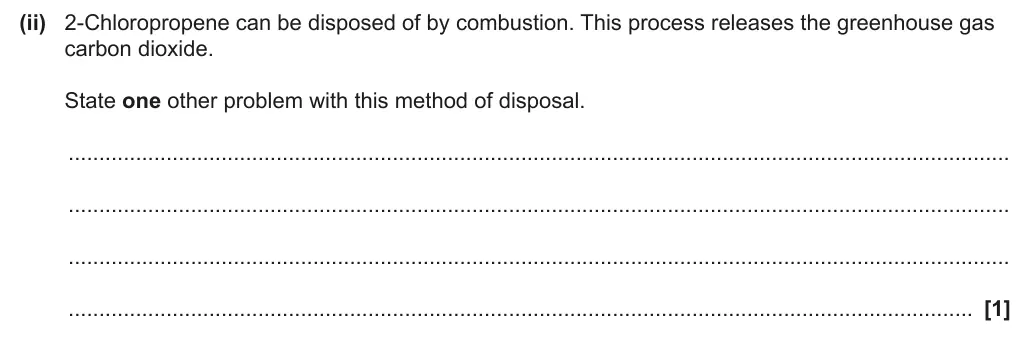
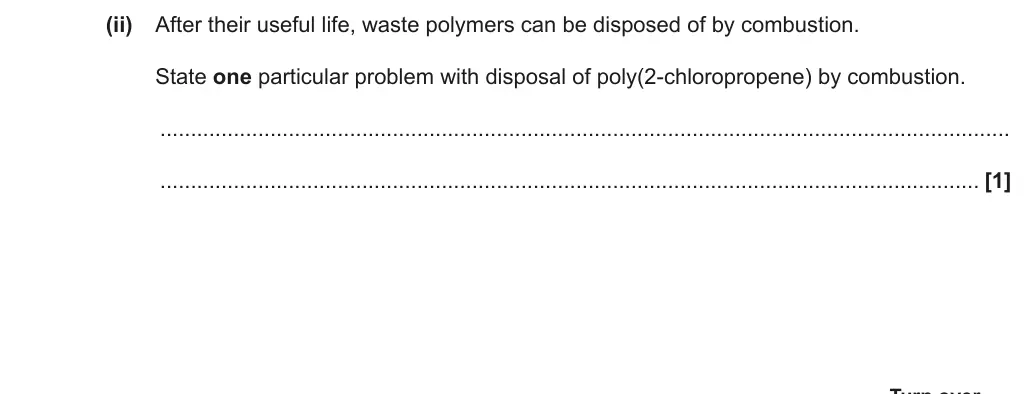
June 2025 · AS Paper 1 · Q24(a)(ii)1 markShort answerHard
Earlier part of question 24 that this part uses
Mark scheme
Examiner's comment
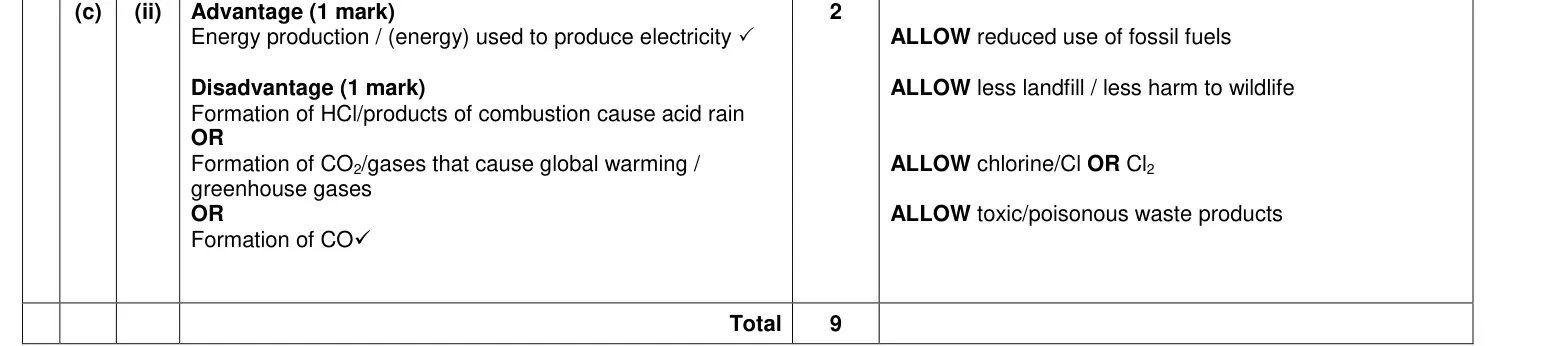
Over half of candidates gained this mark, most often by stating chlorine, HCl or, more rarely, CO was produced. Common responses which didn’t score included ‘takes lots of energy and ‘produces greenhouse gases’ (which is a repetition of the question).
Notes from the mark scheme and report
HCl or chlorine formed (ALLOW CO from incomplete combustion)
IGNORE 'toxic waste products'
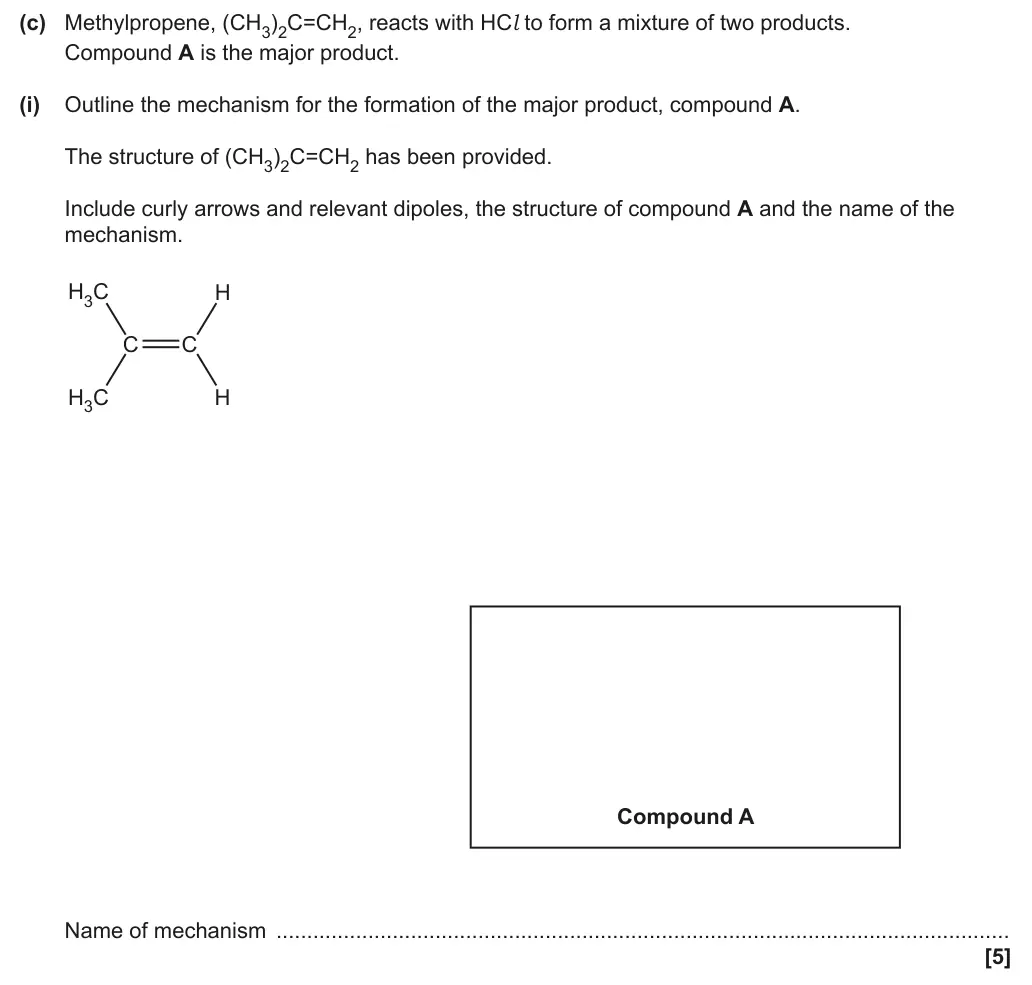
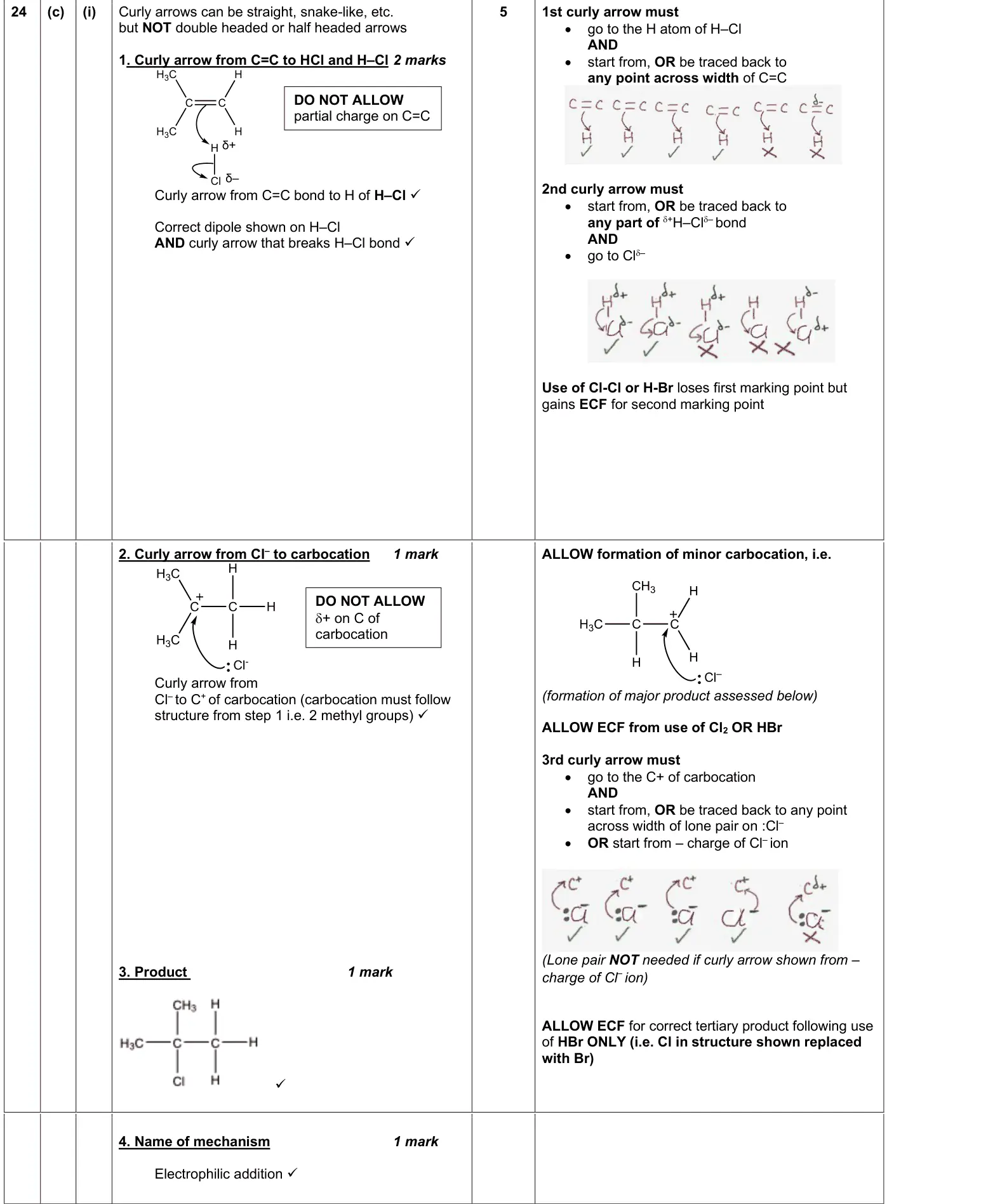
June 2025 · AS Paper 1 · Q24(c)(i)5 marksMechanismHard
Mark scheme
Examiner's comment
Many candidates scored well on this question, drawing a clear mechanism and correctly giving the major product. However, mistakes were often seen with the direction of arrows and a minority of students gave the minor product for Compound A and/or named the mechanism incorrectly. Partial charges on the carbons of the double bond and lack of charge on the chloride ion were also common errors. This question proved to be an excellent discriminator.
Notes from the mark scheme and report
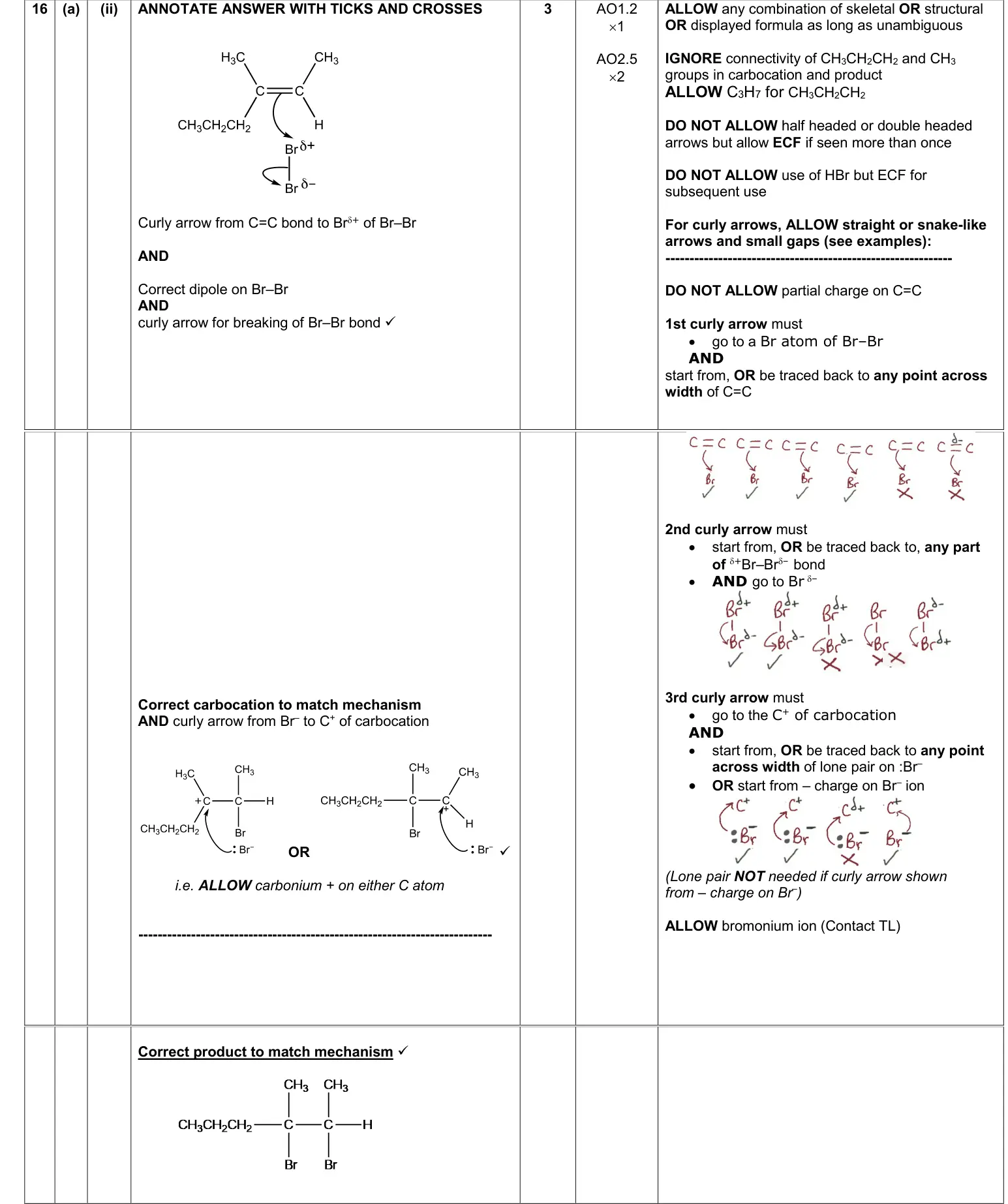
curly arrow from C=C to H of H–Cl
dipole on H–Cl AND arrow breaking H–Cl
carbocation with full + (tertiary for major product) and arrow from lone pair/– charge of Cl–
DO NOT ALLOW partial charge on C=C
DO NOT ALLOW half-headed arrows
name electrophilic addition
June 2025 · AS Paper 1 · Q24(c)(ii)1 markShort answerMedium
Earlier part of question 24 that this part uses
Mark scheme
Examiner's comment
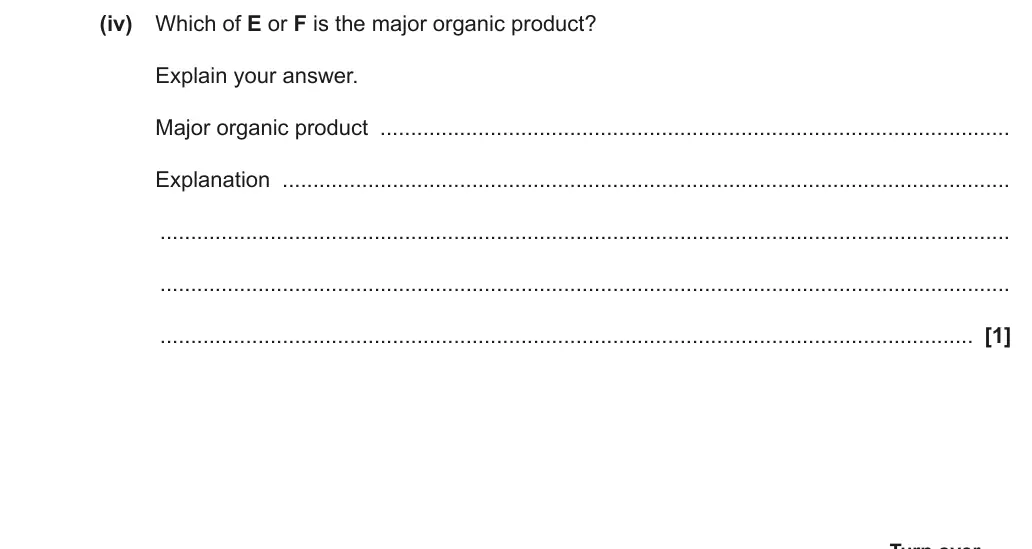
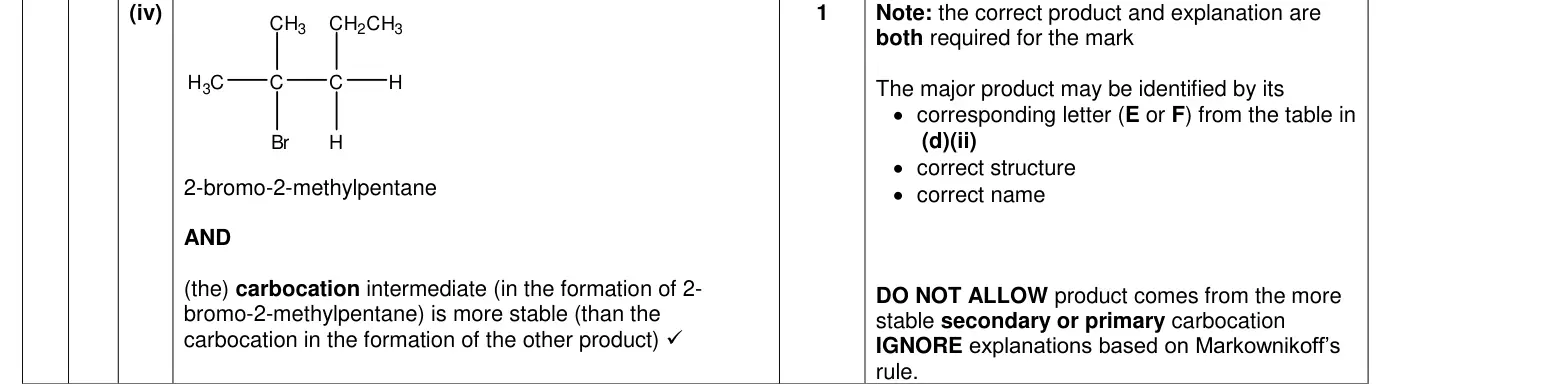
This mark required ‘more stable carbocation’, and just under half of candidates gained it. Some responses were excellent, identifying that the carbocation would be tertiary as opposed to primary. Incorrect identification of the carbocation as secondary was ignored, meaning more candidates were able to score. Common responses which didn’t score discussed Markownikoff’s rule or said that the product was more stable.
Notes from the mark scheme and report
must refer to stability of the (tertiary) carbocation intermediate
IGNORE references to Markownikoff's rule alone
IGNORE secondary
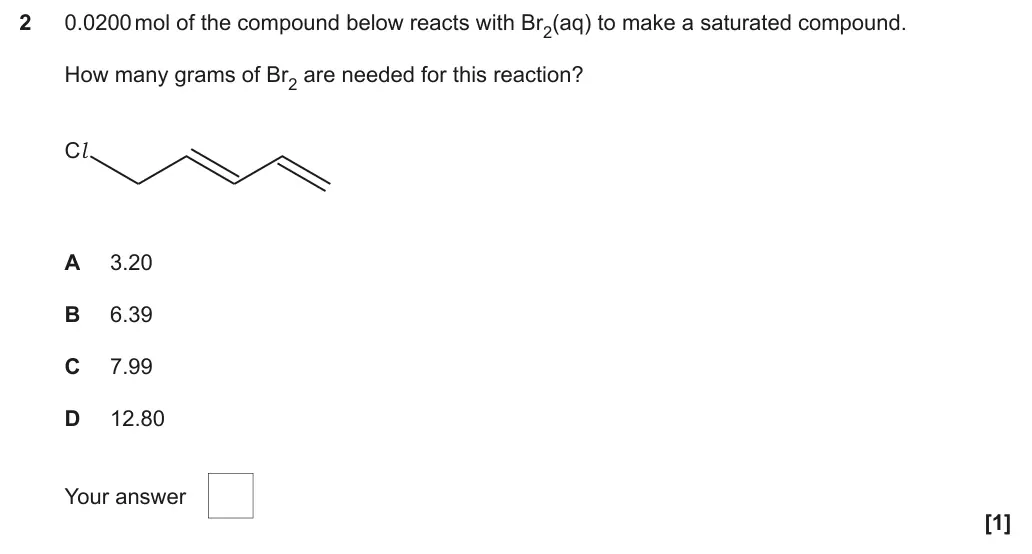
June 2025 · Paper 2 · Q21 markMultiple choiceMedium
Answer
B
Mark scheme
Examiner's comment
Most candidates gave the correct answer B here. Those that got it correct usually showed clear working on how they obtained their answer. However, many chose A, either using correct mole ratio (recognising 2 double bonds) but with the Ar of Br and not the Mr of Br2 (i.e. 0.04 × 79.9) or used the incorrect mole ratio but correct Mr (i.e. 0.02 × 159.8).
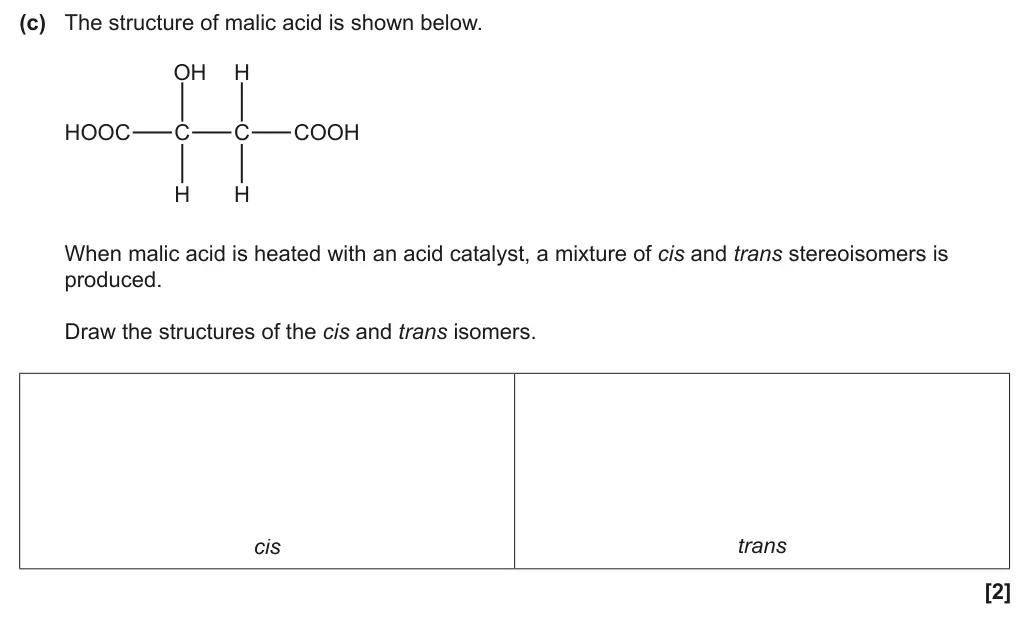
June 2025 · AS Paper 2 · Q3(c)2 marksStructure / isomerMedium
Earlier part of question 3 that this part uses
Mark scheme
Examiner's comment
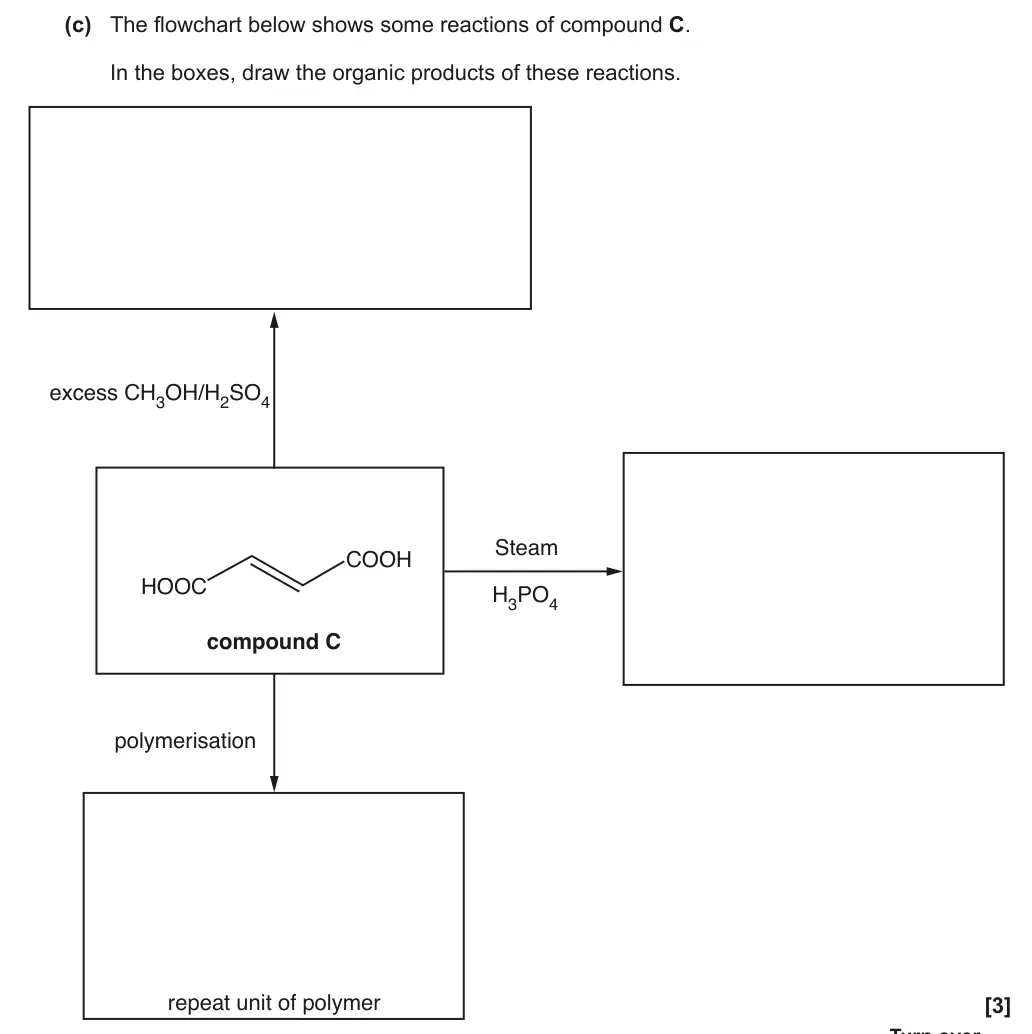
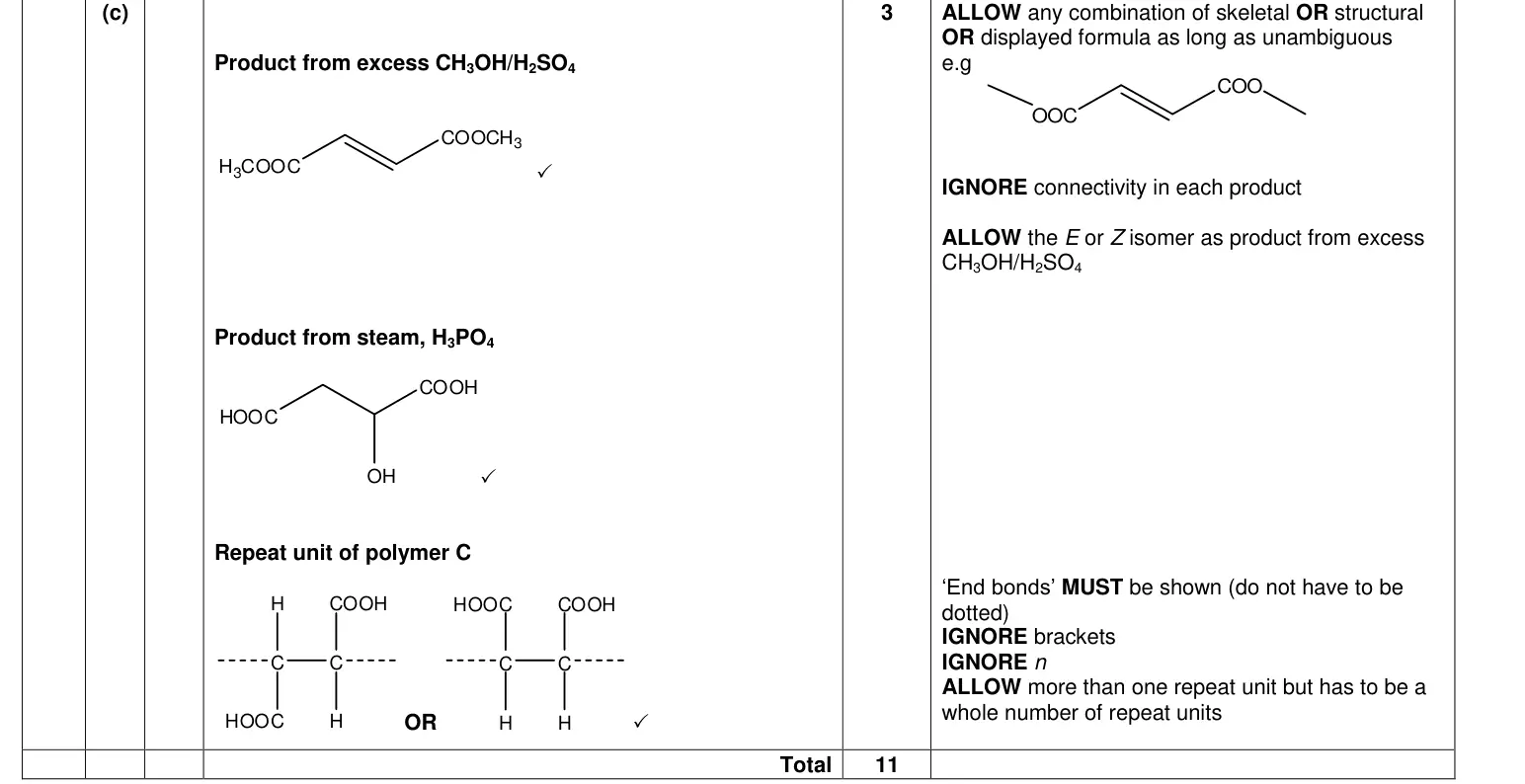
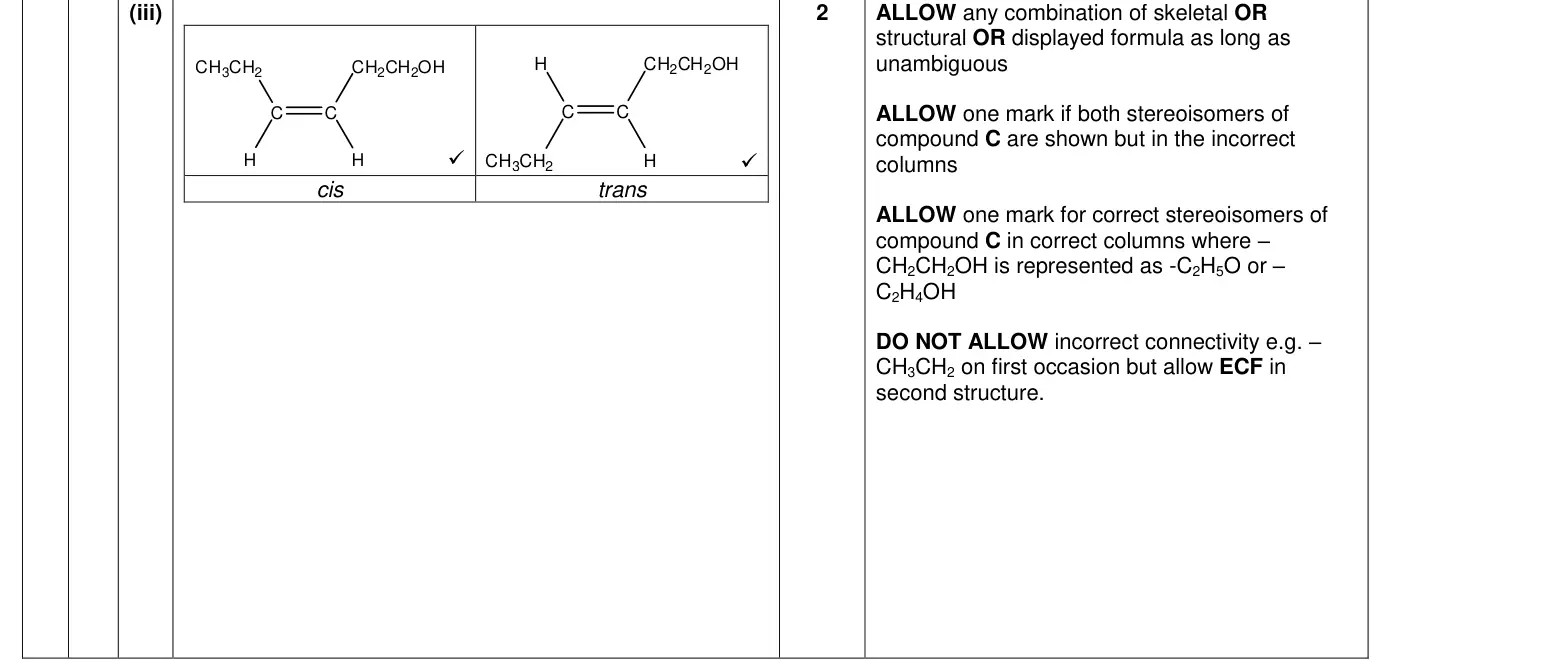
Approximately half of the candidates did not score any marks for this question. Many left the OH group on the alkenes formed i.e. removed H2 rather than H2O. Some attempted to draw cis/trans isomers with structures with no C=C in them. Some drew any alkene, e.g. but-2-ene, to show cis/trans, but this was not given here. Common reasons for scoring 1 mark included the isomers being the wrong way round or poor connectivity to -COOH groups.
Notes from the mark scheme and report
dehydration gives HOOCCH=CHCOOH
one mark if both stereoisomers shown in wrong columns
DO NOT ALLOW incorrect connectivity to COOH (first occasion only)
Skills: M4.2 Visualise and represent 2-D and 3-D forms including 2-D representations of 3-D objects
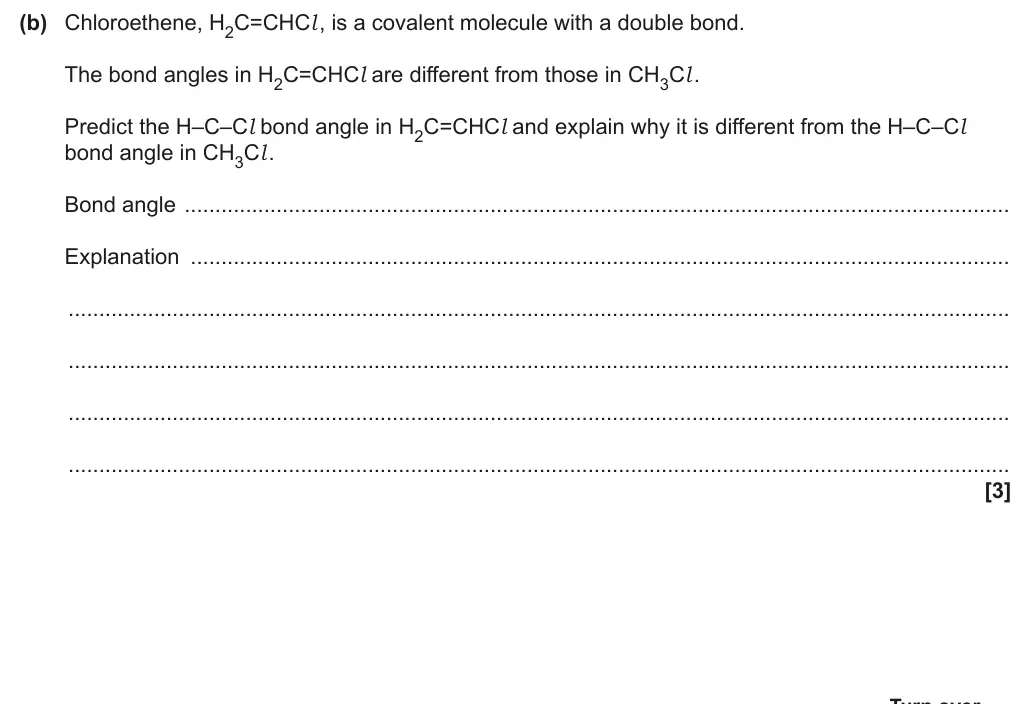
June 2025 · AS Paper 2 · Q5(b)3 marksShort answerHard
Earlier parts of question 5 that this part uses
Mark scheme
Examiner's comment
A range of marks is scored on this question with most scoring at least 1 mark for the correct bond angle. A larger range of bond angles were allowed here to account for the impact of the double bond. Candi- dates were not expected to account for the additional repulsion from the double bond but should be able to use electron pair repulsion theory to predict and explain. Many candidates found the explanation challenging, with a significant number not making any compari- son between chloroethene with chloromethane as required in the question. As seen in previous years, a mark was available for stating that “electron pairs repel” but this was often omitted despite being the main principle that determines molecular shapes. Many candidates felt like they needed to discuss lone pairs – in some cases saying they were present and therefore caused more repulsion. Candidates need to be reminded to focus only on the electron pairs around the central atom. Discussion of regions or areas of electron density or the number of bonded atoms was not enough to gain credit here.
Notes from the mark scheme and report
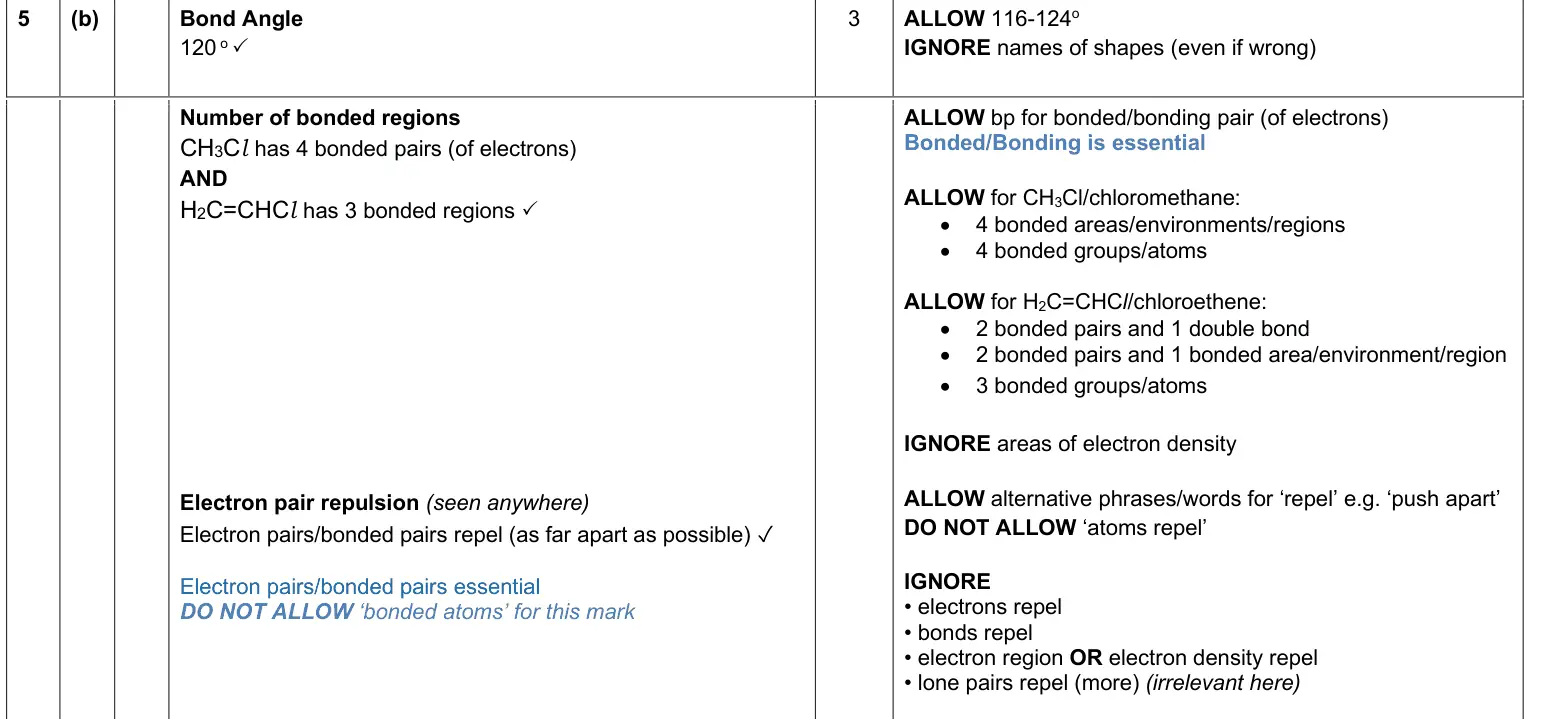
120° (ALLOW 116–124)
CH3Cl has 4 bonded pairs AND H2C=CHCl has 3 bonded regions
electron pairs repel (DO NOT ALLOW atoms repel
IGNORE electrons/bonds repel)
IGNORE names of shapes
Many students think that molecular shapes are determined solely by lone pairs or by repulsion between bonded atoms. The principle behind molecular shapes is called electron pair repulsion theory because it is based on repulsion between electron pairs, which may be bonded pairs or lone pairs, but not atoms.
Skills: M4.1 Use angles and shapes in regular 2-D and 3-D structures
June 2025 · AS Paper 2 · Q5(d)(i)3 marksStructure / isomerMedium
Mark scheme
Examiner's comment
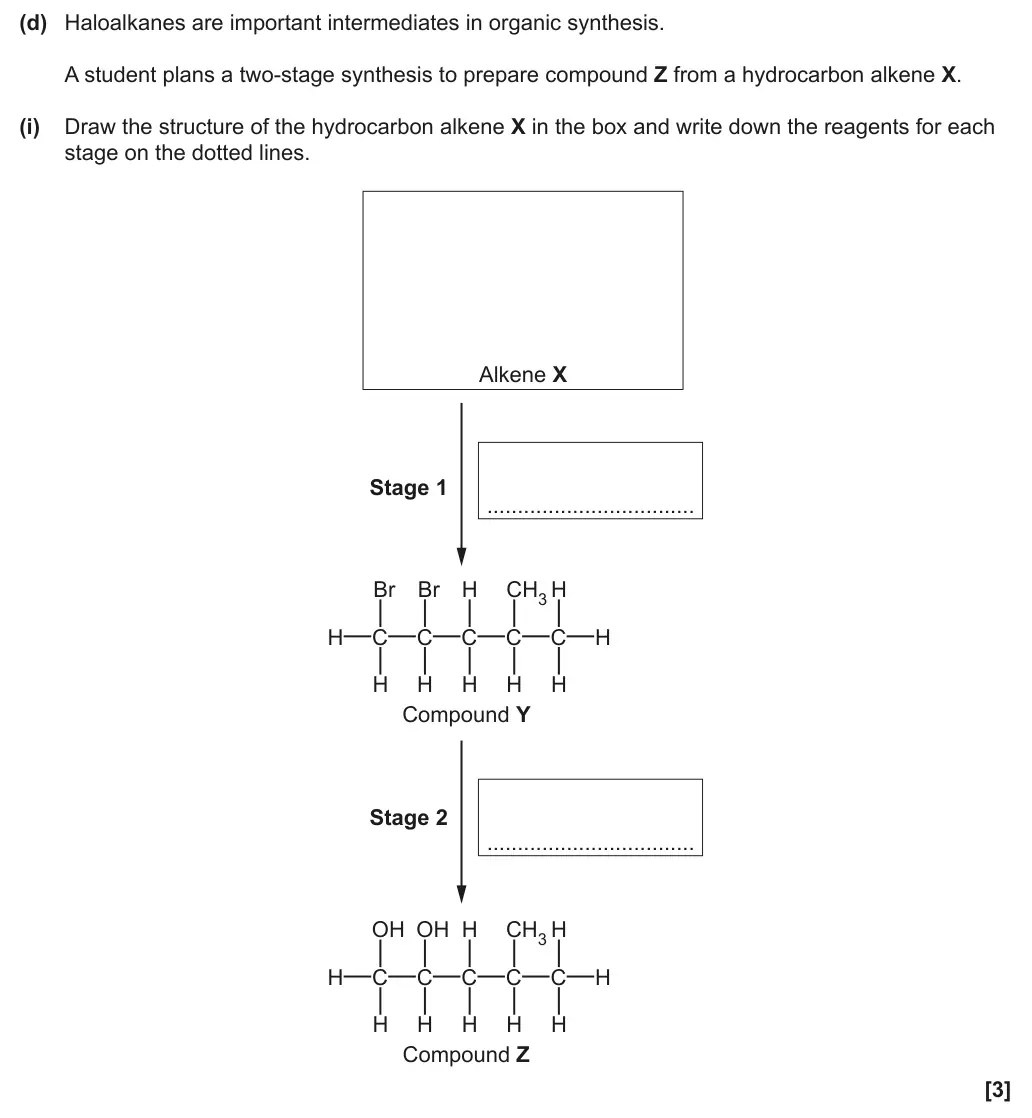
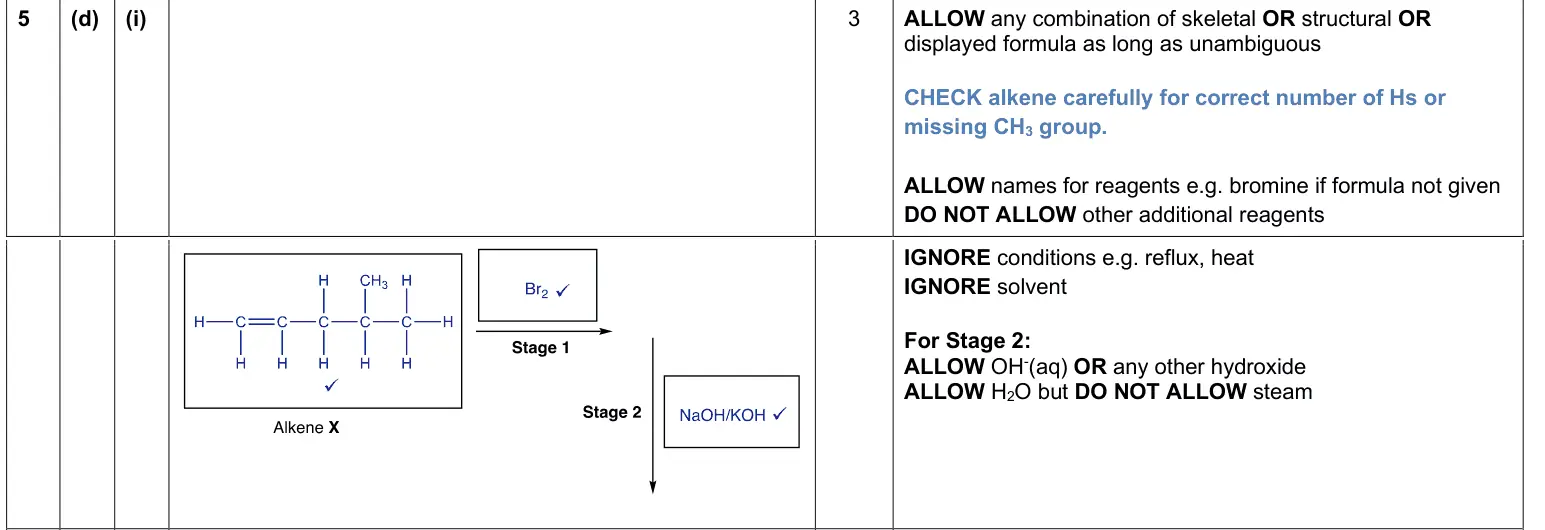
Candidates need to be reminded to check structures carefully – common errors included additional H atoms around C=C or missing the -CH3 group. Some used -C4H9 rather than writing out the complete structure; unfortunately, this is ambiguous so didn’t score the mark. Lower-attaining candidates some- times gave an alkane rather than an alkene, reacting with Br2 in presence of UV. Many had the correct reagents but added additional incorrect reagents resulting in loss of the mark, e.g. the addition of H2SO4 as a catalyst alongside NaOH for stage 2.
Notes from the mark scheme and report
alkene X is 4-methylpent-1-ene (check number of H and CH3 branch)
Stage 1 Br2
Stage 2 NaOH/KOH(aq) (ALLOW H2O but DO NOT ALLOW steam)
DO NOT ALLOW additional reagents
IGNORE conditions and solvent
June 2025 · Paper 2 · Q81 markMultiple choiceHard
Answer
C
Mark scheme
Examiner's comment
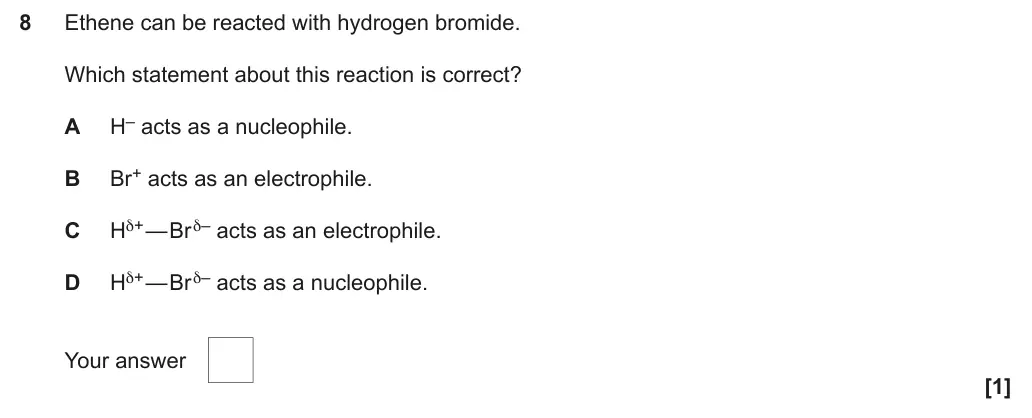
The majority of candidates were able to select C as the correct response here. Some selected B, possibly as Br+ would be the electrophile needed if reacting with benzene. A few candidates selected D which is the correct species reacting, but it is an electrophile not a nucleophile.
June 2025 · Paper 2 · Q101 markMultiple choiceHard
Answer
D
Mark scheme
Examiner's comment
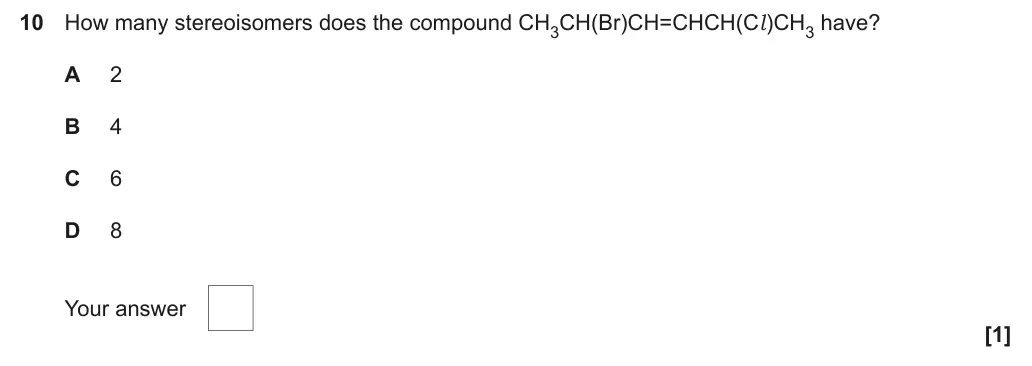
Very few candidates were able to give the correct answer D here, with the majority selecting A. Candidates found it challenging to recognise that with E/Z isomerism and two chiral centres in a non- symmetrical molecule there would be eight possible alternatives. For those with stronger maths skills the use of 2n rule can be encouraged but other students can be encouraged to consider all the possible alternatives.
June 2025 · Paper 2 · Q141 markMultiple choiceMedium
Answer
B
Mark scheme
Examiner's comment
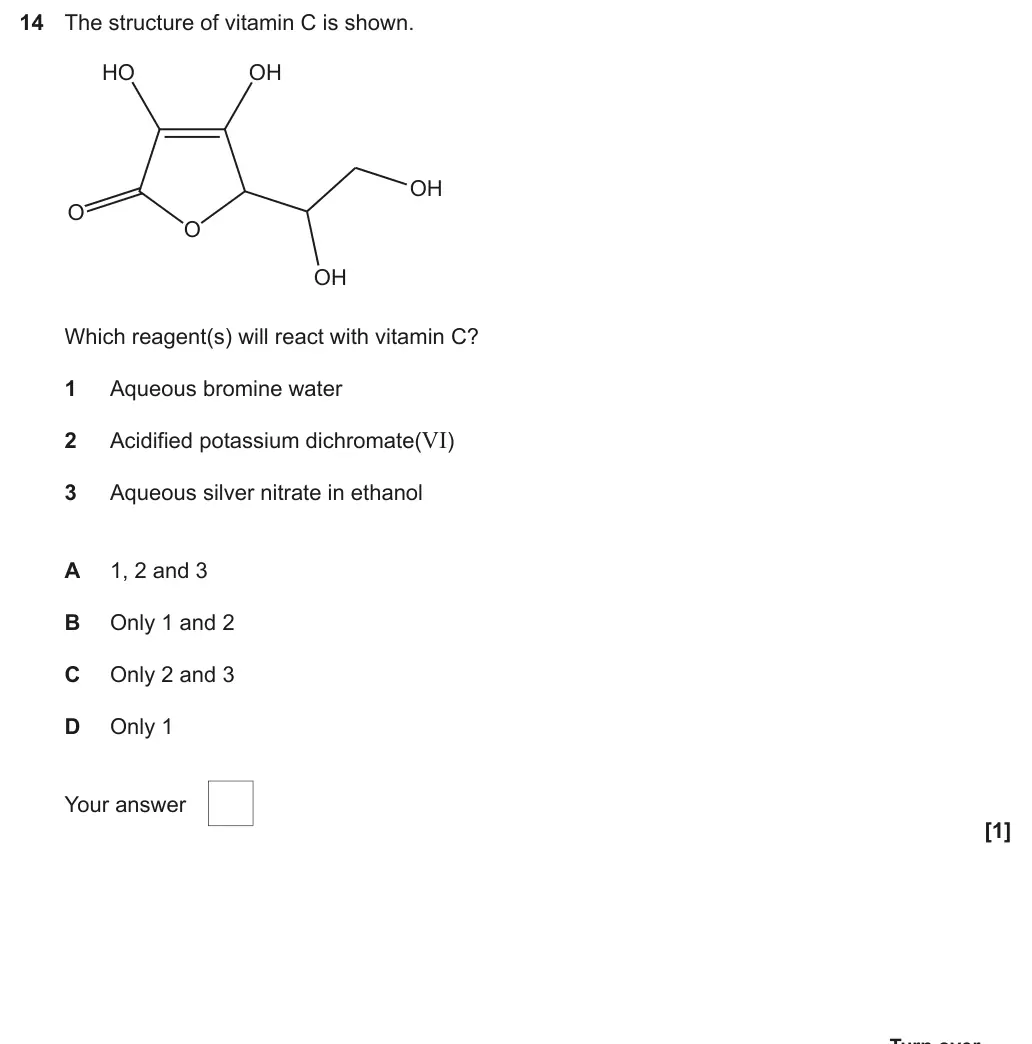
The majority of candidates gave the correct response, B. The most common incorrect answer was A, indicating that silver nitrate would also react with this molecule.
June 2025 · Paper 2 · Q16(b)3 marksComplete table/diagramHard
Mark scheme
Examiner's comment
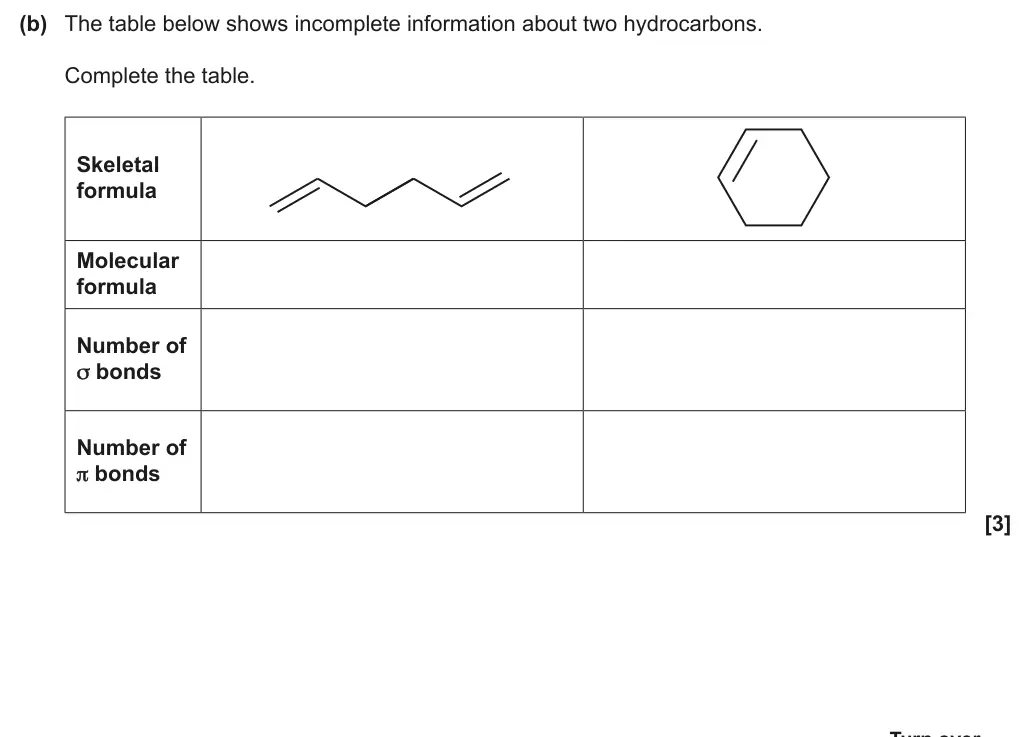
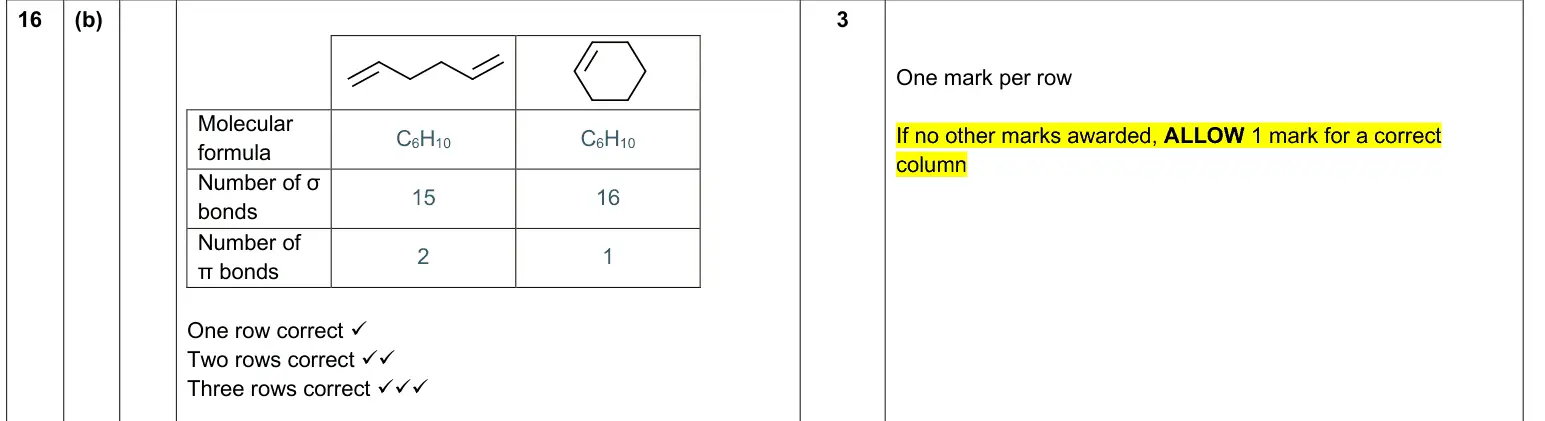
Very few candidates did not score any marks here. Most gained a mark for the correct molecular formulae in the first row, although some candidates gave structural formulae instead of molecular formulae or gave both. Candidates found counting the different types of bonds quite challenging and we would recommend drawing out displayed formulae to make it easier to label and count each type of bond. Many gave 5 and 6 respectively for the bonds, forgetting to count the C-H bonds that are not shown in the skeletal structure. More were able to correctly count the bonds but some counted the number of atoms involved in bonds instead. A few had and bonds the wrong way round.
Notes from the mark scheme and report
both C6H10
σ bonds 15 and 16
π bonds 2 and 1
one mark per row
1 mark for a correct column if no other marks
Skills: M4.2 Visualise and represent 2-D and 3-D forms including 2-D representations of 3-D objects
June 2025 · Paper 2 · Q16(c)(i)2 marksStructure / isomerMedium
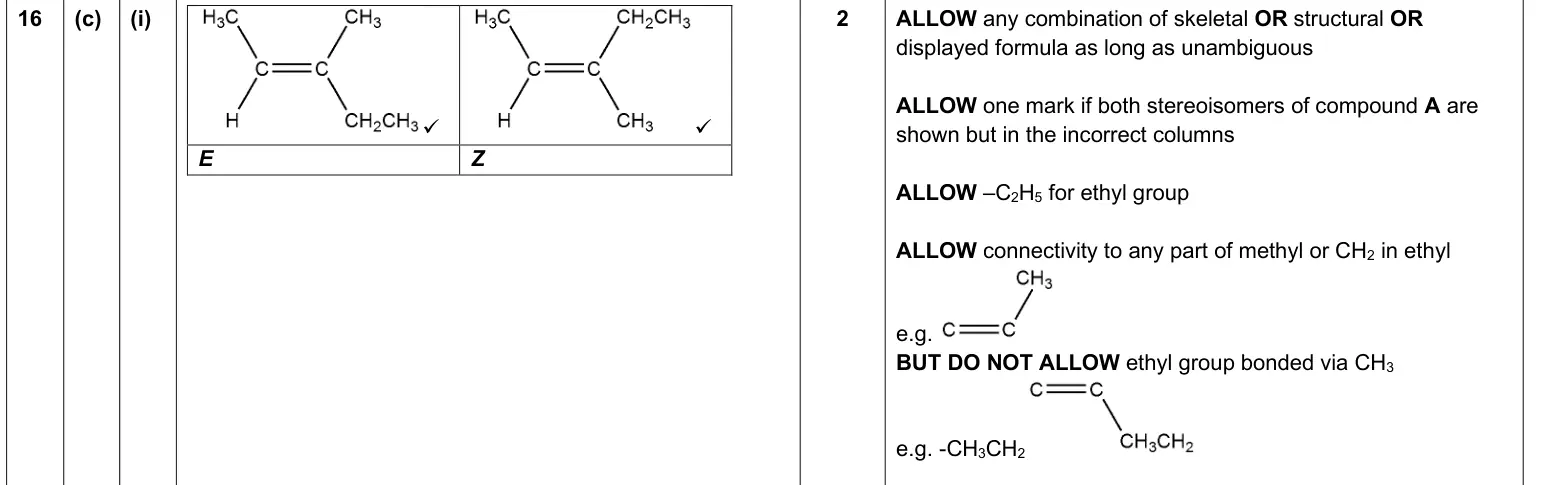
Mark scheme
Examiner's comment
Most candidates were able to score both marks here. However, a common error, which scored only 1 mark, was drawing the E and Z isomers the wrong way round, using the -CH3 groups to assign instead of considering priority. A common reason for losing both marks was by incorrectly copying the formula from the question, e.g. CH3CH- attached to C=C. Very few candidates gained no marks due to poor connectivity on the ethyl -CH2CH3 group connecting via CH3.
Notes from the mark scheme and report
1 mark if both isomers correct but in the wrong columns
DO NOT ALLOW ethyl group bonded via CH3
Skills: M4.2 Visualise and represent 2-D and 3-D forms including 2-D representations of 3-D objects; M4.3 Understand the symmetry of 2-D and 3-D shapes
June 2025 · Paper 2 · Q16(c)(ii)2 marksShort answerHard
Earlier part of question 16 that this part uses
Mark scheme
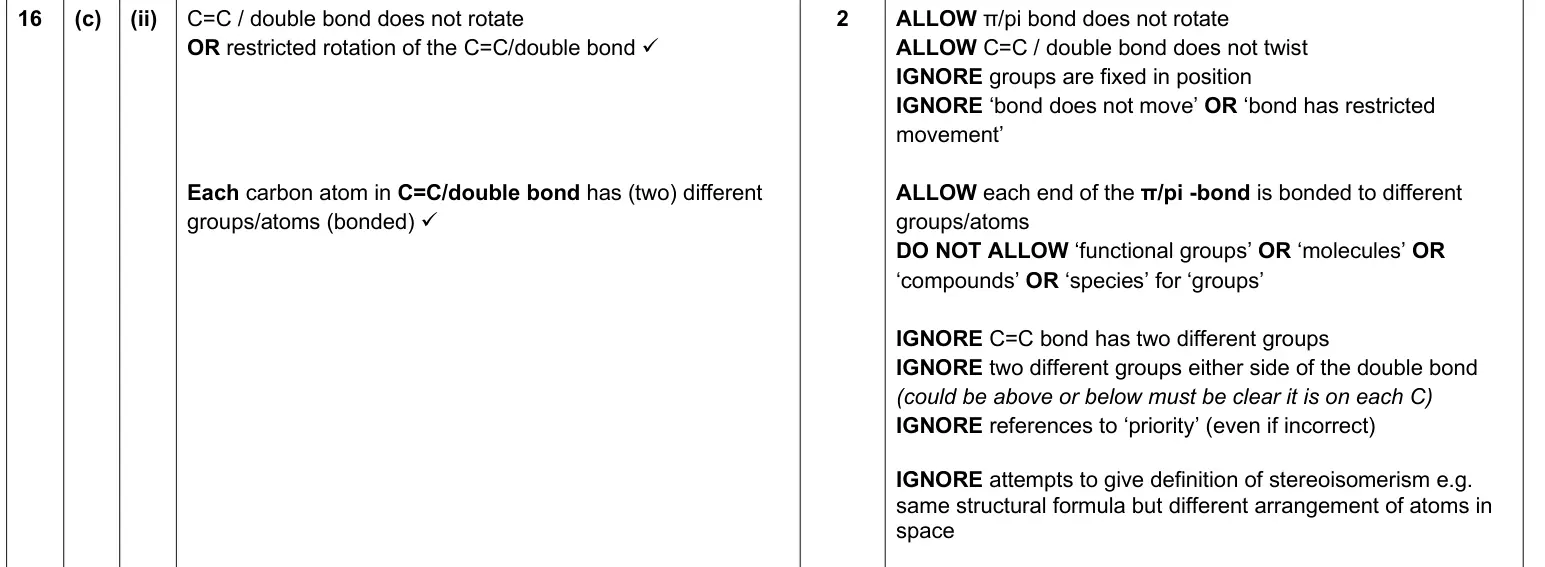
Examiner's comment
Very few candidates scored both marks here. Many appeared not to understand what was being asked so explained how to assign priority groups to be able to identify isomers as either E or Z, but they didn’t say why these isomers occur. Some just gave the definition of a stereoisomer. Many referred to the presence of the C=C or double bond but not the reason why it causes E/Z isomers i.e. the double bond doesn’t rotate. Some said that the molecule couldn’t rotate but it wasn’t clear this was due to the presence of the double bond. Some candidates suggested that the isomers arise ‘due to free rotation’. This highlighted a possible misconception which was evident when candidates justified their responses as to why 2 isomers would form – i.e. with priority groups on the same side or opposite side once the C=C had rotated. Many struggled to explain that there are different groups on each carbon of C=C, and common errors included: • no reference to the C=C so could be any C in structure • 4 different groups around the C=C. Here there are only 3 different groups • 2 different groups on each side of C=C (could be above/top or below/bottom) • use of ‘functional groups’, ‘molecules’, ‘compounds’ or ‘species’ instead of groups • has priority groups (still must be clear that there are 2 on each C of C=C) A very small number mentioned optical isomerism.
Notes from the mark scheme and report
restricted rotation of C=C
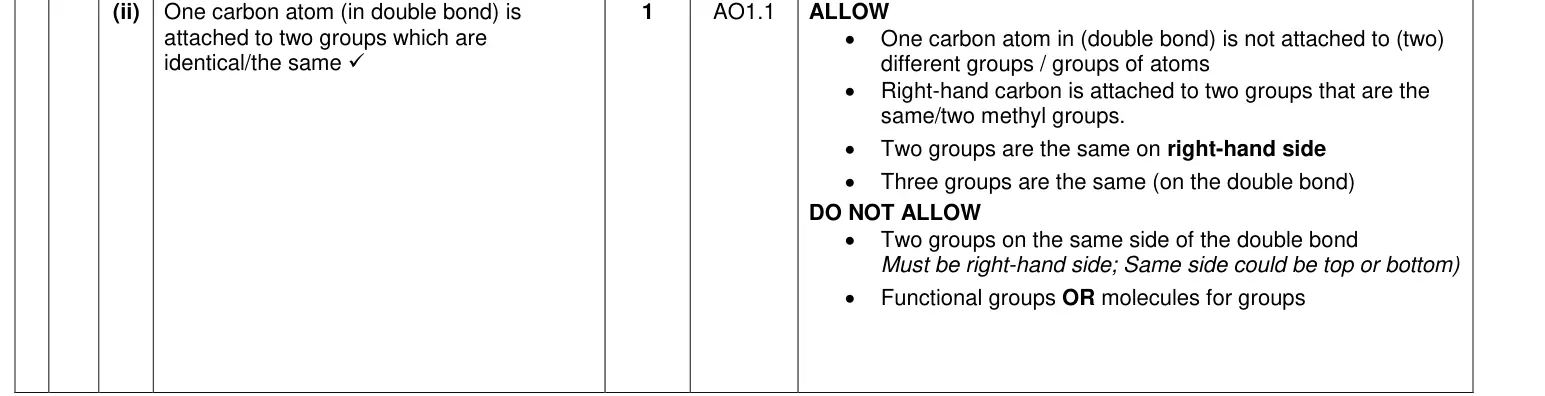
each carbon of the C=C has two different groups
DO NOT ALLOW 'functional groups' or 'molecules' for groups
IGNORE 'C=C bond has two different groups' and references to priority
Many candidates were unclear as to why E/Z isomerism would arise in some alkenes.
Our Delivery Guide for Organic Chemistry offers some useful suggestions on teaching about E/Z isomerism in alkenes.
June 2025 · Paper 2 · Q16(e)3 marksComplete table/diagramHard
Mark scheme
Examiner's comment
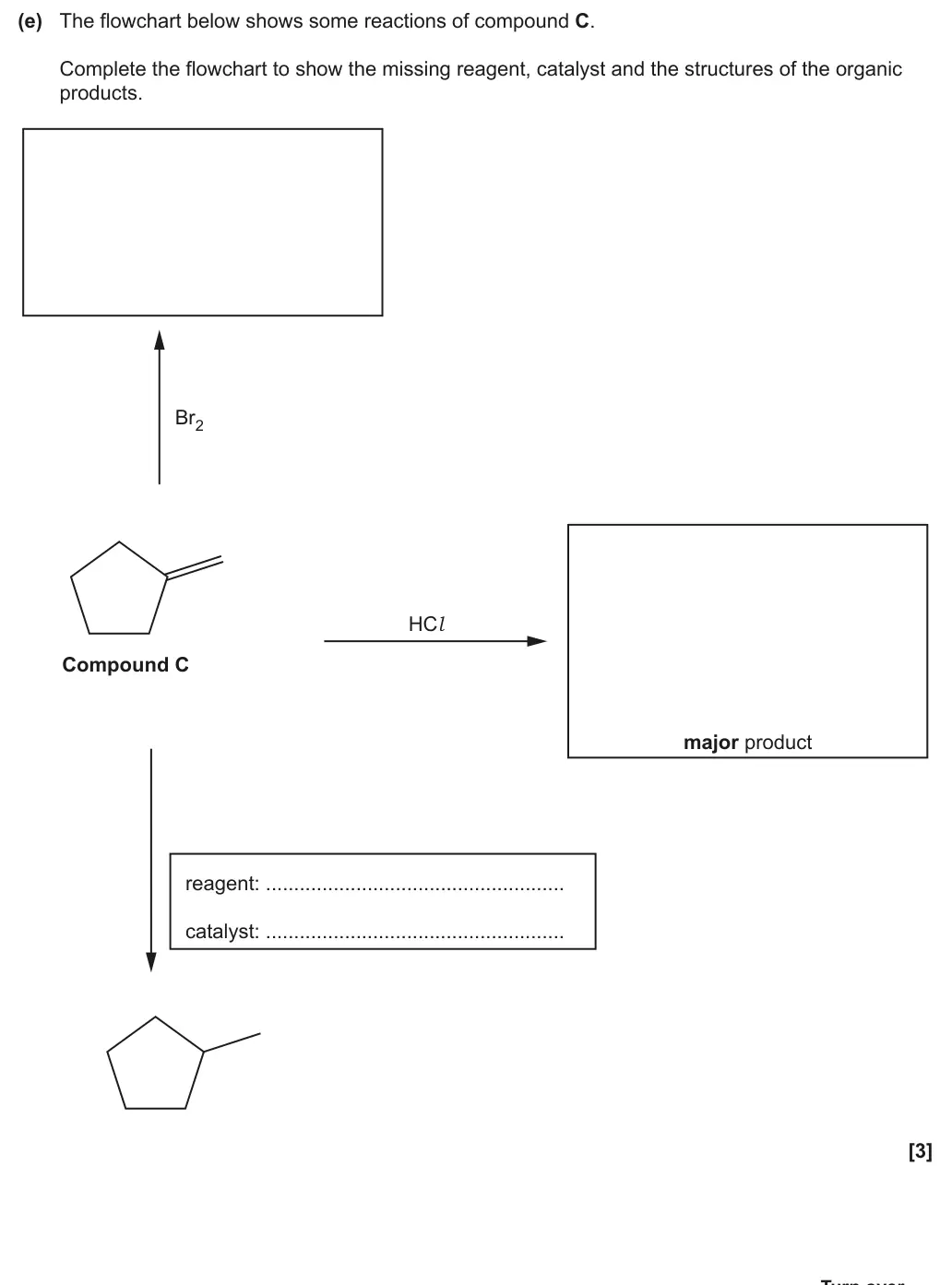
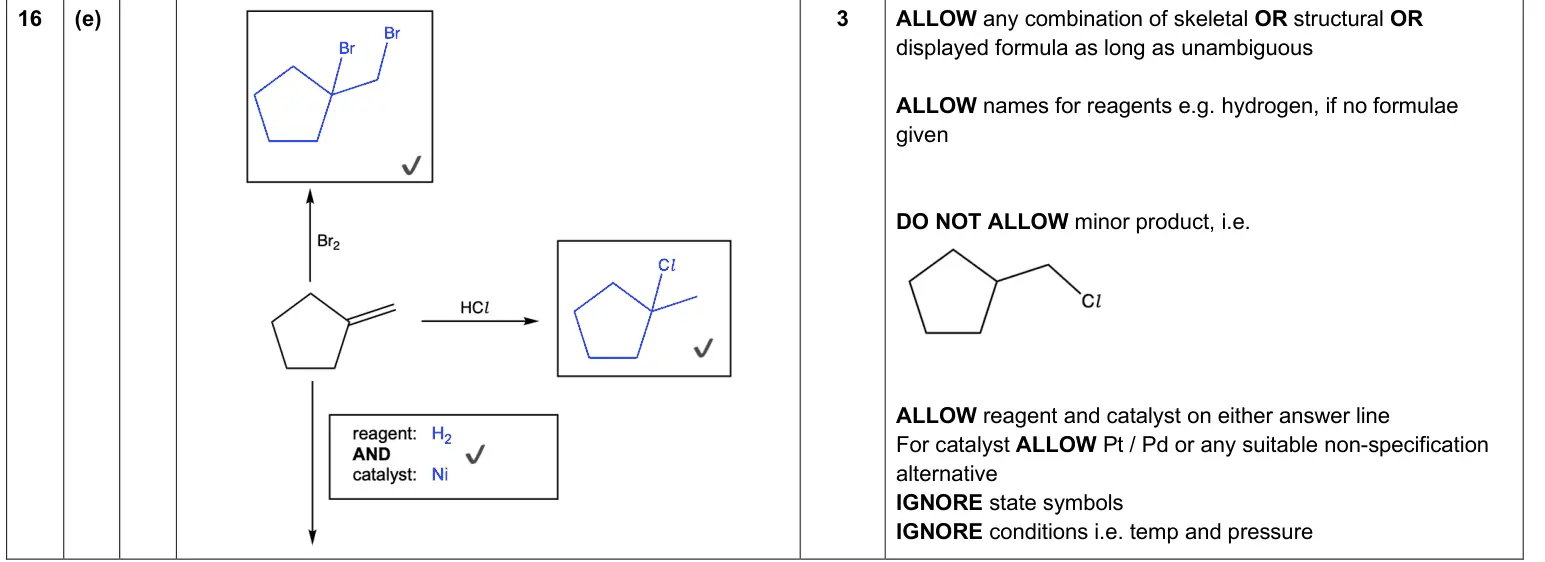
More than half of the candidates scored all 3 marks for this question. Lower attaining candidates were usually able to score at least 1 mark for the H2, and Ni required for the hydrogenation to form an alkane from compound C. The reactions with Br2 and HCl were more challenging due to the presence of a ring in compound C. This question was answered best by the candidates who demonstrated a strong understanding of skeletal formulae. Common incorrect responses seen included the following: • Swapping the C=C for either Br or Cl, e.g. • Adding Br or Cl to different positions around the ring, e.g. • Adding 1 Br atom in reaction with Br2, e.g. • Adding both Br atoms to same C, e.g. • Giving the product from HBr reacting rather than HCl • Giving the minor product from the reaction with HCl
Notes from the mark scheme and report
HCl product must be the major (tertiary chloride) product, DO NOT ALLOW minor product
H2 AND Ni (ALLOW Pt/Pd) on either line
IGNORE conditions
June 2025 · Paper 2 · Q18(a)4 marksStructure / isomerHard
Mark scheme
Examiner's comment
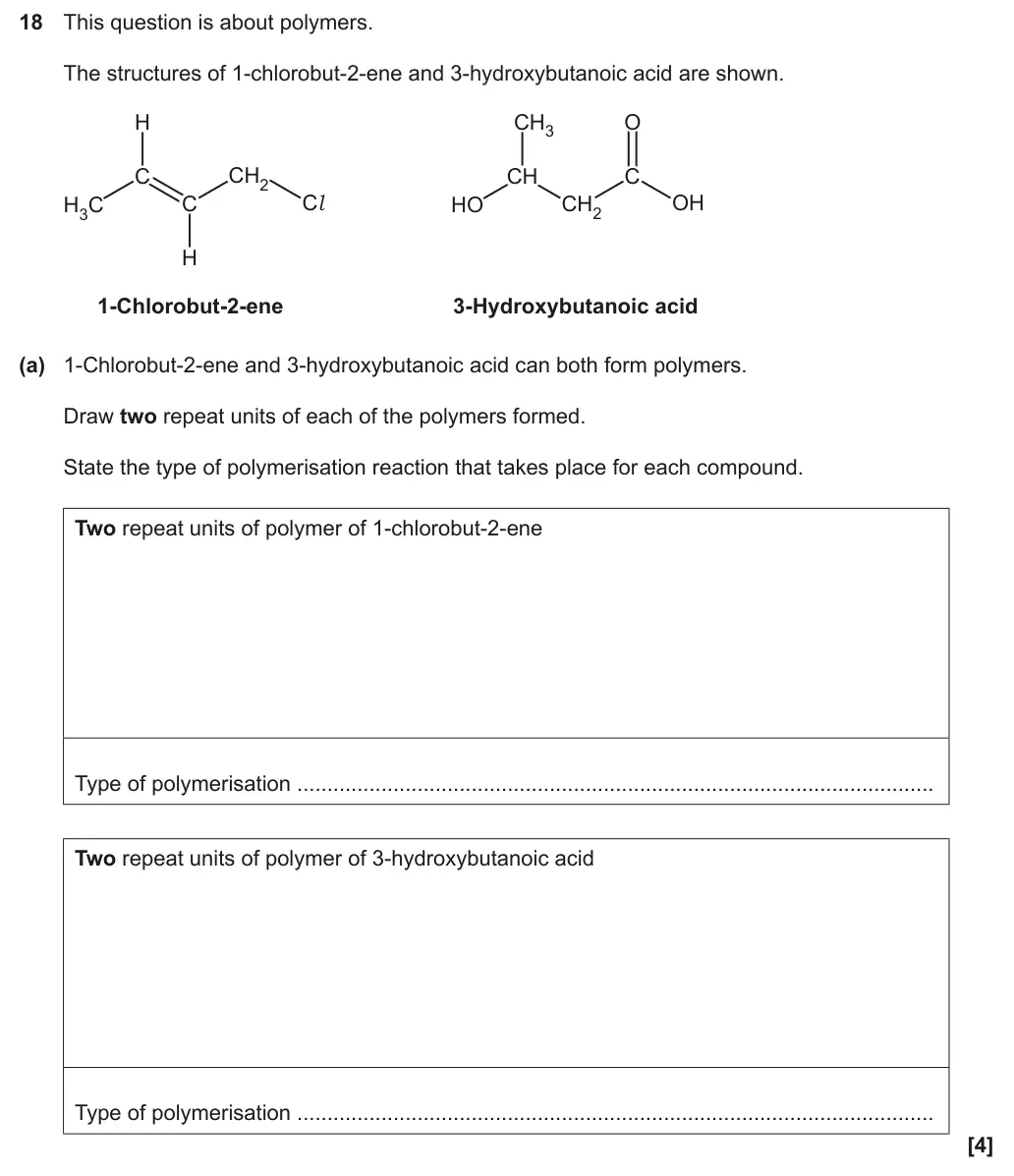
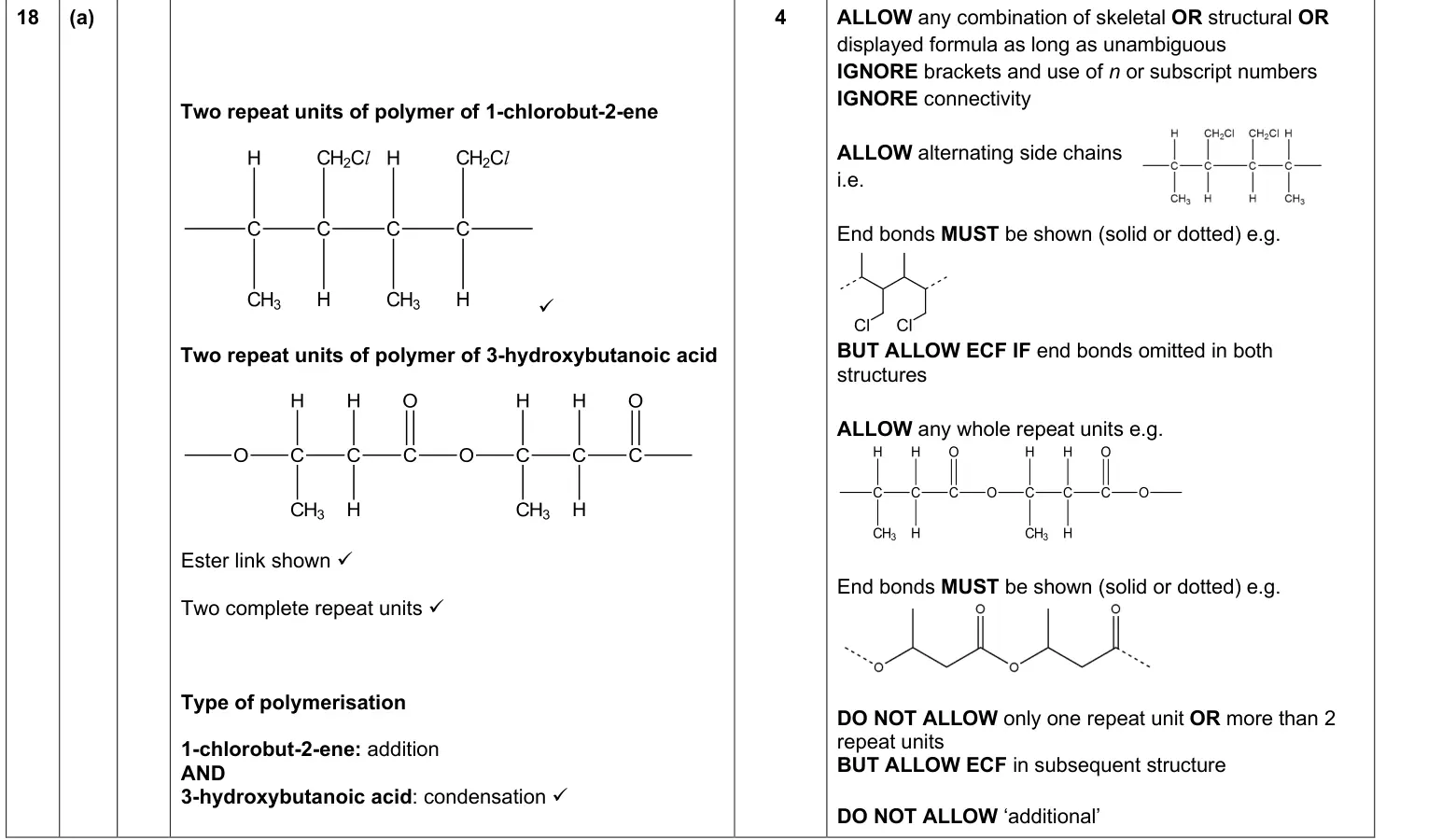
Most candidates managed to score 3 or 4 marks on this question. Some did not gain marks for structures without end bonds or for giving a complete unit of 2 molecules joined together. Some had only one repeat unit for each or gave more than two. Lower attaining candidates were often able to draw one type of polymer repeat unit but couldn’t do both. Polymer of 1-chlorobut-2-ene: Most were able to give the structure of two repeat units. Less successful candidates struggled to open the double bond and gave carbon chains with eight carbons in length connected to each other, sometimes with the C=C still present. In general, less successful candidates found it harder to get the marks for the addition polymer than with the condensation polymer, possibly as condensation polymerisation is taught later in the course. Polymer of 3-hydroxybutanoic acid: Very few didn’t gain a mark for showing the ester link between two monomers. A common error was adding -O- to both ends of the repeat unit. A few missed off Hs, particularly on C with CH3 attached. Most candidates knew the different types of polymerisations shown here. Some gave ‘alkene’ or ‘polyalkene’ rather than ‘addition’. A few gave ‘esterification’ or ‘substitution’ instead of condensation.
Notes from the mark scheme and report
end bonds MUST be shown
DO NOT ALLOW one or more than two repeat units (ECF in second structure)
ester link shown
addition AND condensation (DO NOT ALLOW 'additional')
June 2025 · Paper 2 · Q18(b)(i)1 markShort answerHard
Earlier part of question 18 that this part uses
Mark scheme
Examiner's comment
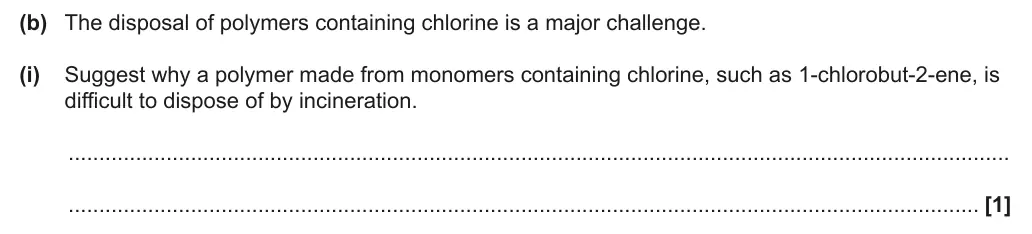
Most gained credit here. Many identified chlorine as the toxic gas instead of HCl. However, a mark was not given if candidates stated ‘chlorine is toxic’ – it was necessary to say chlorine or other toxic products are formed (when polymers are incinerated). A common reason for losing the mark here was for saying that incineration formed ‘harmful’ gases which was insufficient. Some referred to the high bond enthalpy of the C-Cl bond, making it more difficult to dispose of as more energy is needed. Some suggested that polymers with chlorine in had high boiling points. Others thought it would produce chlorine radicals and linked their answers to ozone depletion.
Notes from the mark scheme and report
produces toxic products/HCl
IGNORE harmful, pollutant, dangerous
June 2025 · Paper 2 · Q18(b)(ii)1 markStructure / isomerMedium
Earlier part of question 18 that this part uses
Mark scheme
Examiner's comment
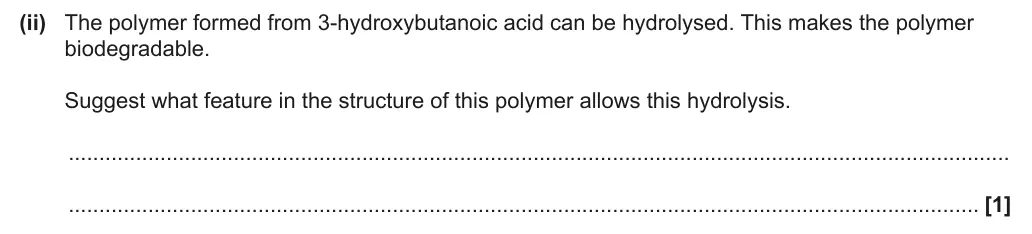
This mark was achieved by most candidates, with wrong answers largely linked to hydrogen bonding leading to hydrolysis rather than identifying the feature of the structure of this polymer that allows hydrolysis. Incorrect answers included: carboxylic acid, alcohol, hydroxyl, C-O bond (but not specific to ester).
Notes from the mark scheme and report
ester link/group
IGNORE reference to hydrogen bonding
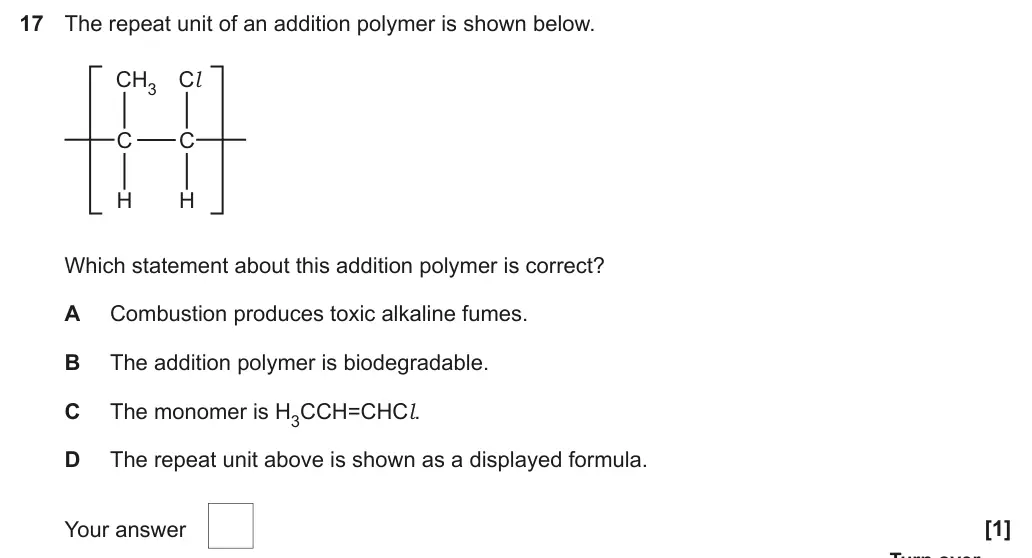
June 2024 · AS Paper 1 · Q171 markMultiple choiceHard
Answer
C
Mark scheme
Examiner's comment
This question proved to be an excellent discriminator with most above average candidates choosing monomer (option C).
June 2024 · AS Paper 1 · Q24(c)5 marksExtended responseMedium
Mark scheme
Examiner's comment
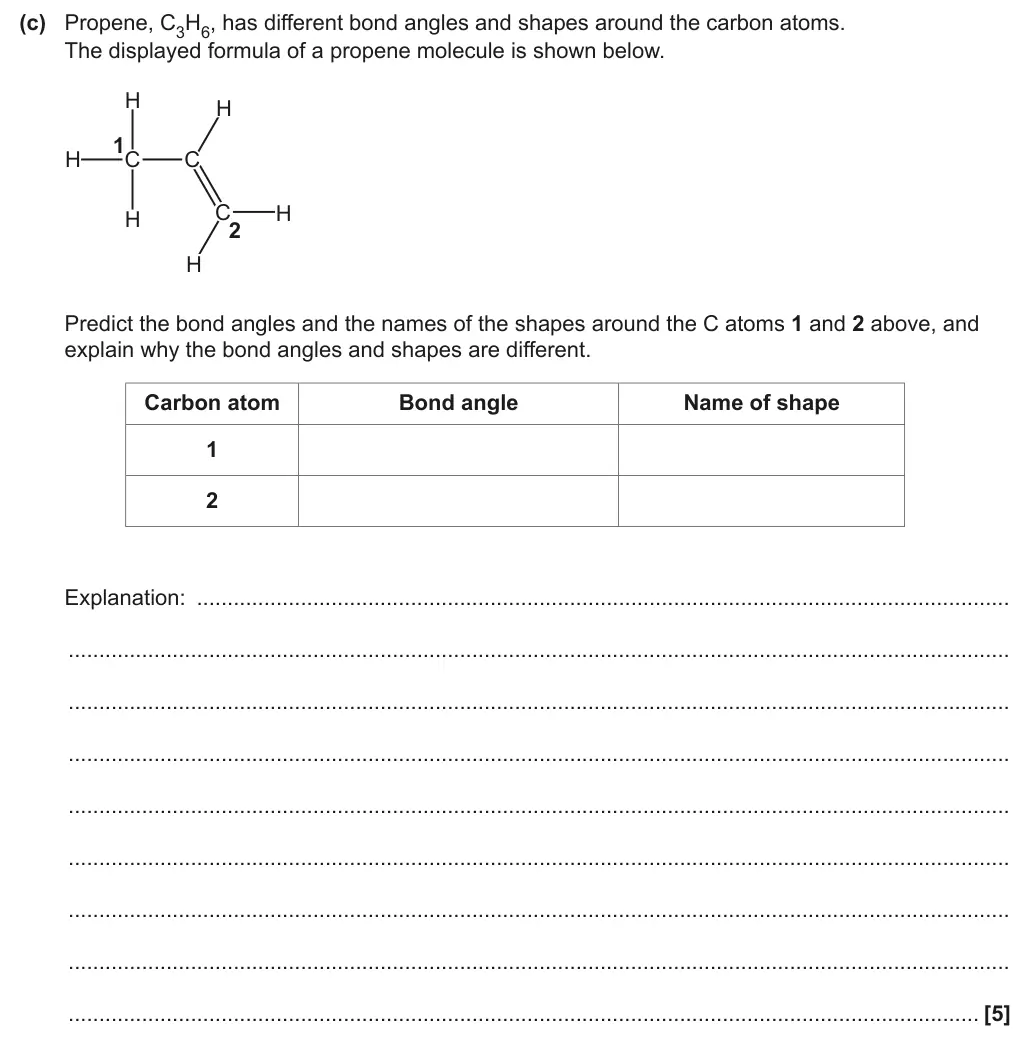
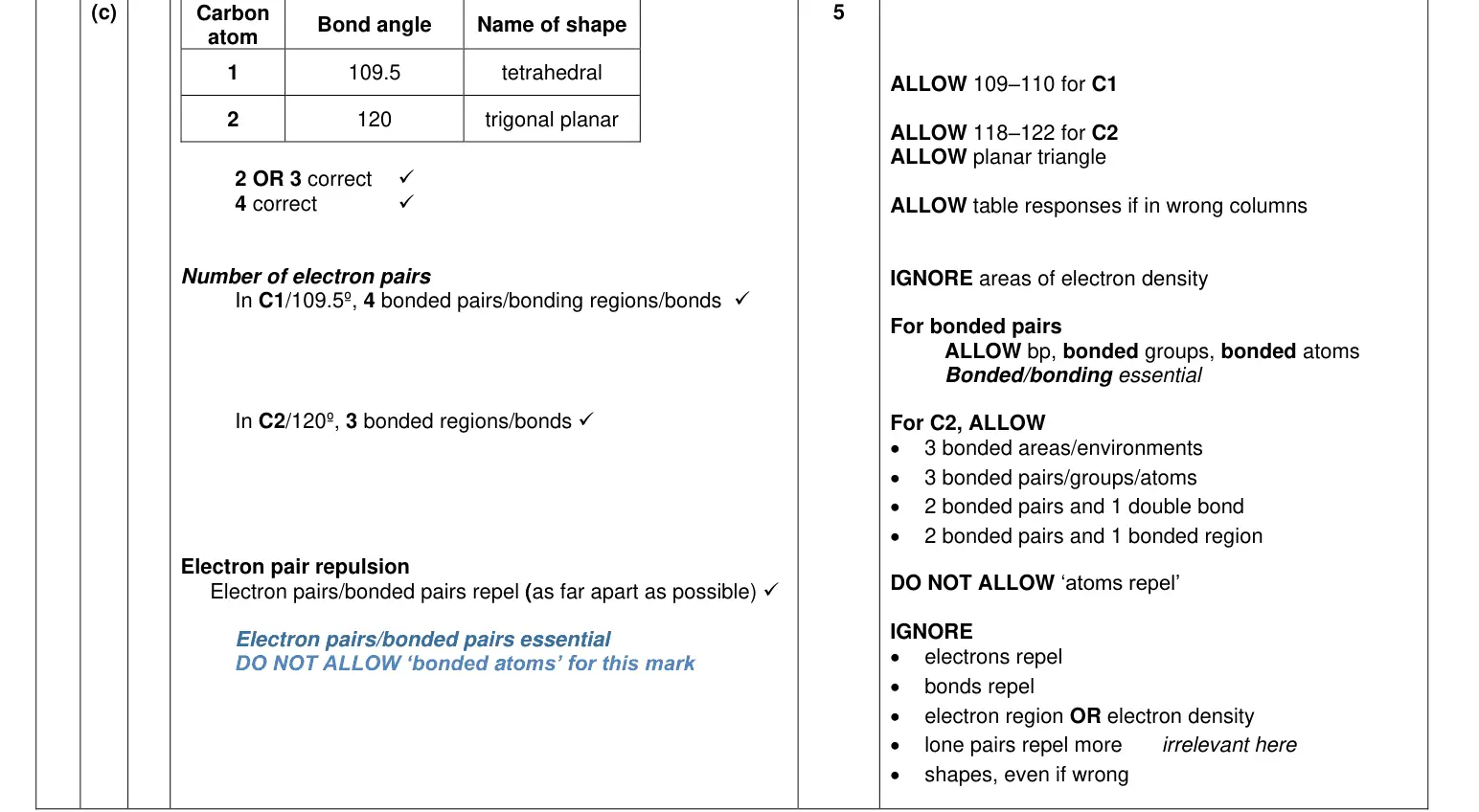
The bond angles and shapes rewarded the well-prepared candidates, with many being given both available marks for this part of the question. This part discriminated very well. For the explanation, most candidates identified 4 and 3 for C1 and C2, but candidates often linked 4 and 3 to atoms, rather than to electron pairs or bonded pairs for C1 and to bonding regions for C2. A mark was available for stating that ‘electron pairs repel’, but this important fact was often omitted despite being the main principle that determines molecular shapes. The question discriminated well, giving a good spread of marks across the five available.
Notes from the mark scheme and report
C1 109.5° tetrahedral with 4 bonded pairs
C2 120° trigonal planar with 3 bonded regions
electron pairs repel
DO NOT ALLOW 'atoms repel'
IGNORE 'electrons repel' and 'bonds repel'
Many students think that molecular shapes are determined solely by lone pairs or by repulsion between bonded atoms. The principle behind molecular shapes is called electron pair repulsion theory because it is based on repulsion between electron pairs, which may be bonded pairs or lone pairs, but not atoms.
Skills: M4.1 Use angles and shapes in regular 2-D and 3-D structures; M4.2 Visualise and represent 2-D and 3-D forms including 2-D representations of 3-D objects
June 2024 · Paper 2 · Q21 markMultiple choiceMedium
Answer
C
Mark scheme
Examiner's comment
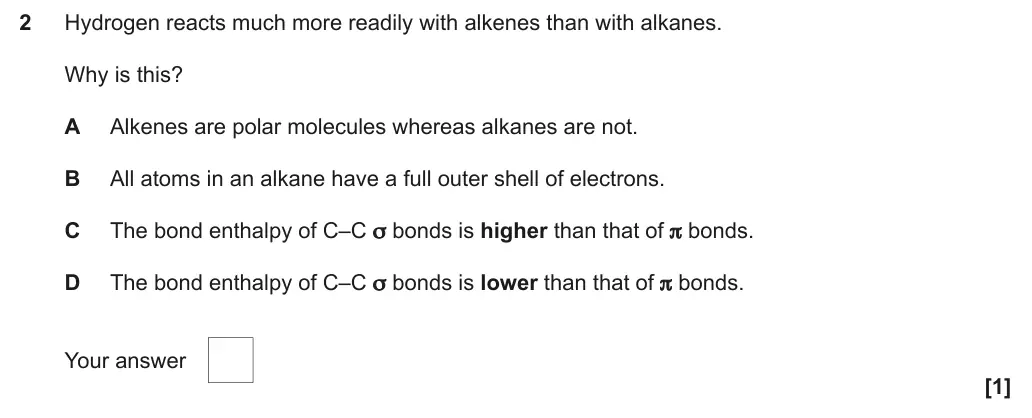
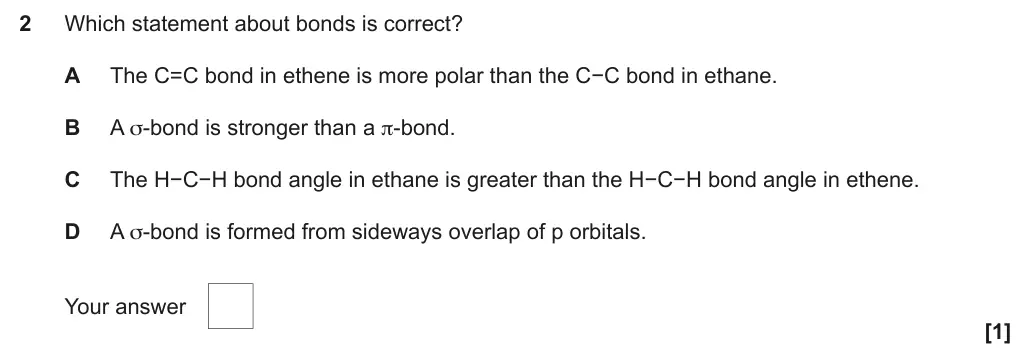
Approximately two thirds of candidates gave the correct answer C. The most common incorrect response seen was D, confusing the strength of the σ and π bonds, possibly as a C=C bond is stronger than C-C. Some gave D assuming alkenes are polar due to their reactivity and showing a misunderstanding of the term ‘polar’.
Notes from the mark scheme and report
π-bond has lower bond enthalpy than the σ-bond
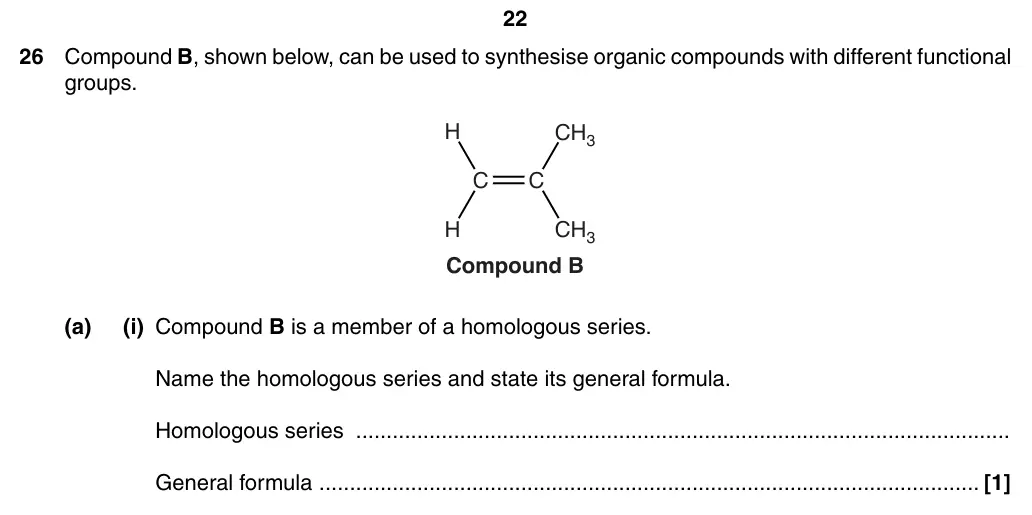
June 2024 · Paper 2 · Q41 markMultiple choiceMedium
Answer
B
Mark scheme
Examiner's comment
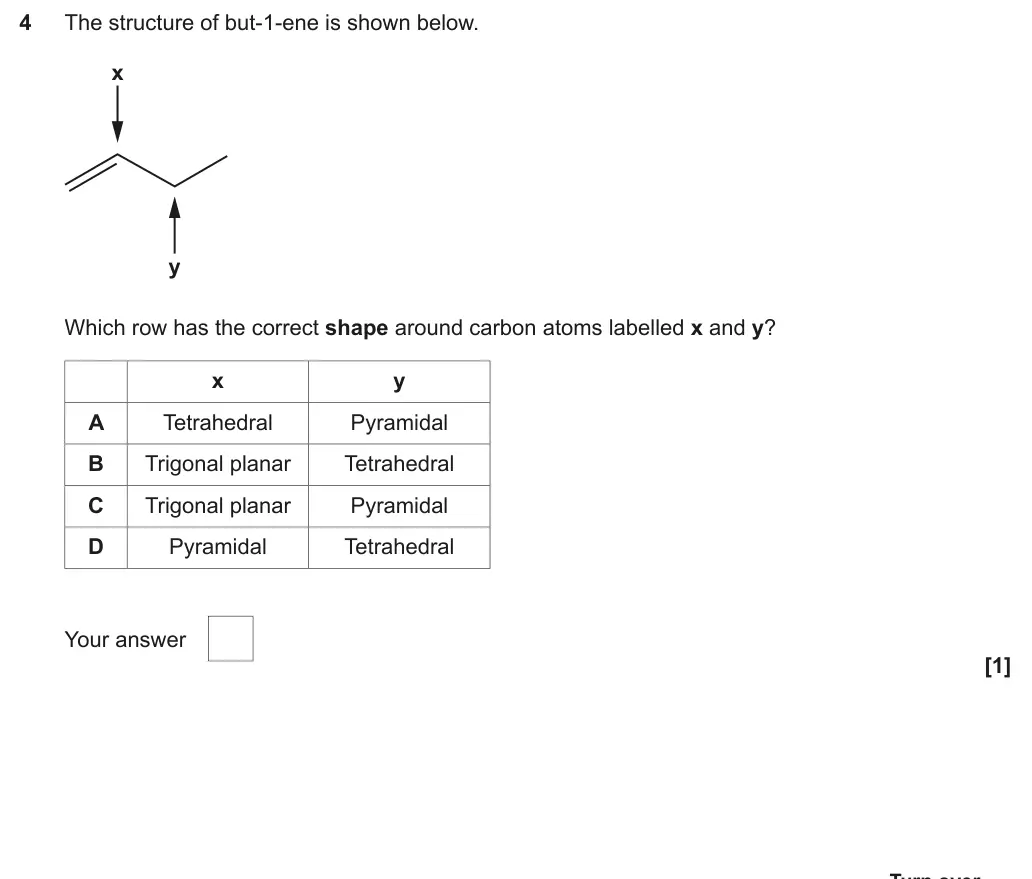
A large majority of candidates were able to correctly identify shape at x as being trigonal planar and y as being tetrahedral. The most common incorrect responses seen were for getting one of these incorrect i.e. D incorrect for x or C incorrect for y.
June 2024 · AS Paper 2 · Q5(a)4 marksComplete table/diagramEasy
Mark scheme
Examiner's comment
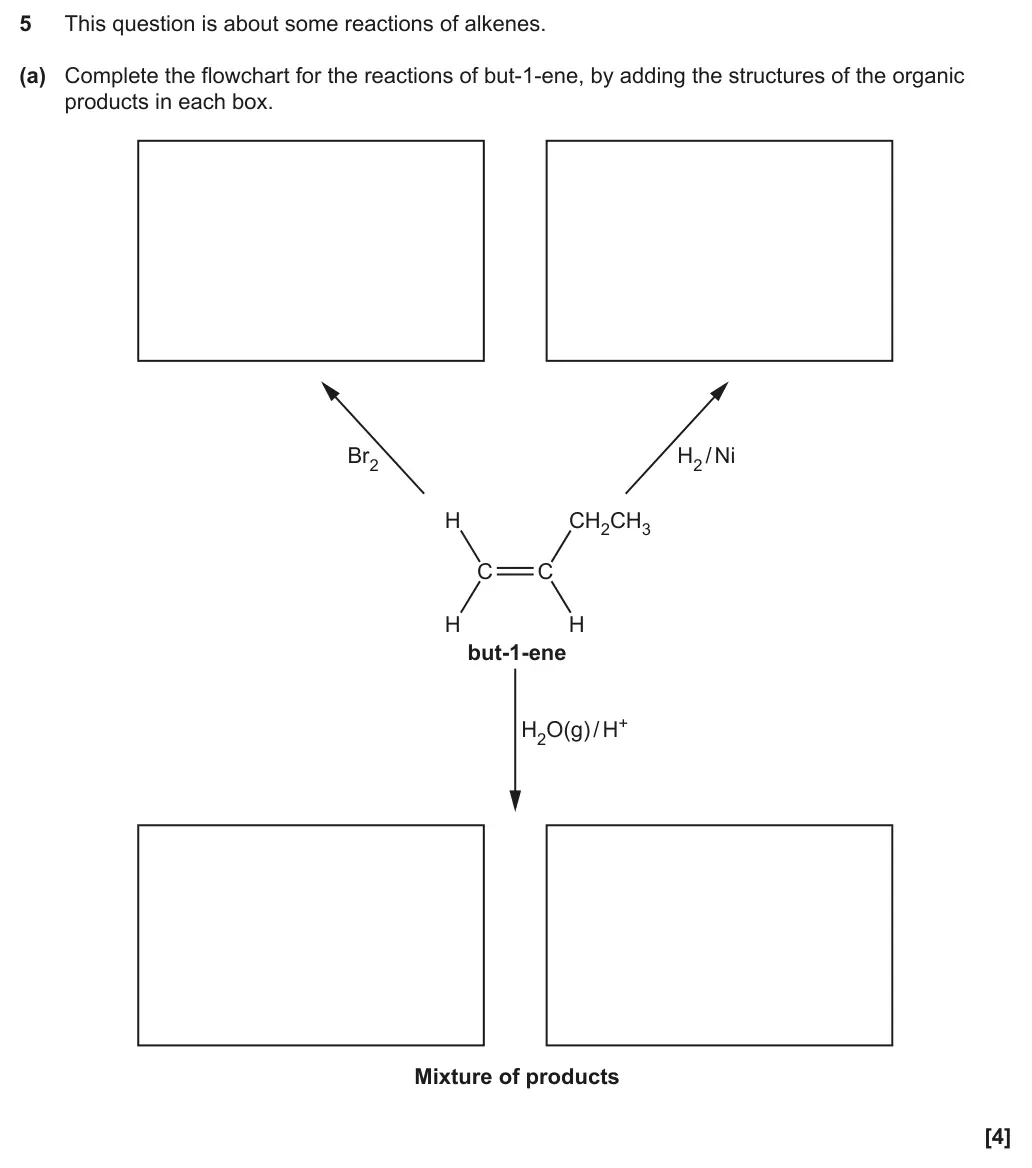
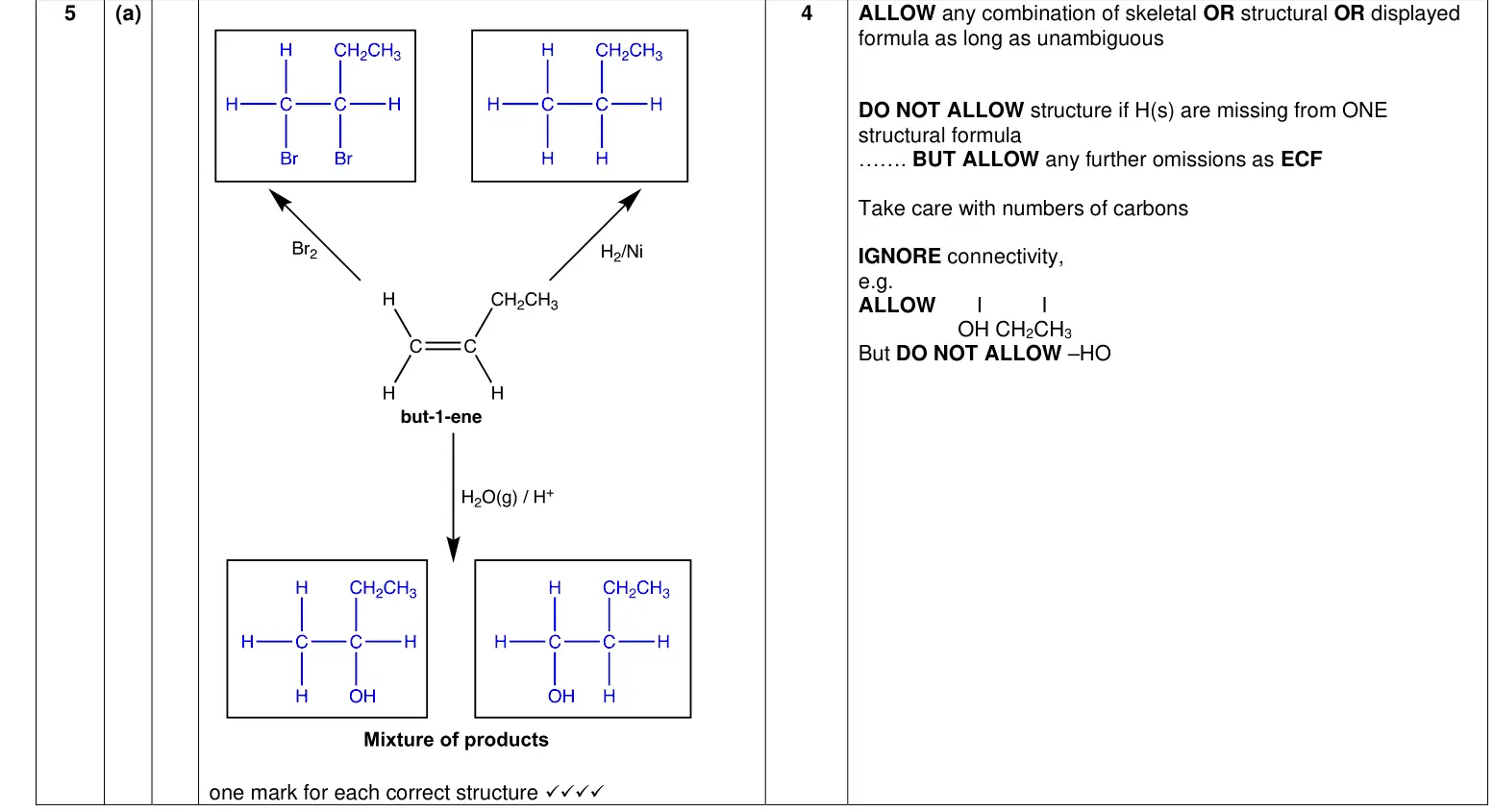
Most candidates scored all 4 marks here. Candidates seemed very knowledgeable about the addition reactions of alkenes. Some of the most common errors seen included: • 2,3-dibromobutane, rather than 1,2-dibromobutane • Repeating the same alcohol in bottom boxes • Missing H atoms from structures • Keeping double bonds • Missing CH2CH3 group (with H instead) • H2 as a second product on reaction with water and some gave oxidation products rather than alcohols e.g. aldehyde, ketone, carboxylic acid here • Ni added to the organic molecule for hydrogenation Incorrect connectivity from vertical bonds to CH2CH3 and OH groups was not penalised in this question but would have had a significant impact on marks if it had. Some lost the mark for incorrect connectivity for OH groups when drawn horizontally i.e. OH-C. Drawing organic structures Ensure students get lots of practice drawing organic structures using different types of formula including displayed, structural and skeletal. It is important to check structures carefully to ensure C has 4 bonds, O 2 bonds and H only 1 bond. Under pressure it is very easy to make slips. For exams, remind candidates not to draw in pencil then rub out – the structure beneath often shows up when the paper is scanned. If corrections are needed, cross out the incorrect structure and redraw clearly.
Notes from the mark scheme and report
1,2-dibromobutane
butane
butan-1-ol and butan-2-ol (mixture)
DO NOT ALLOW structure with H missing
DO NOT ALLOW –HO connectivity
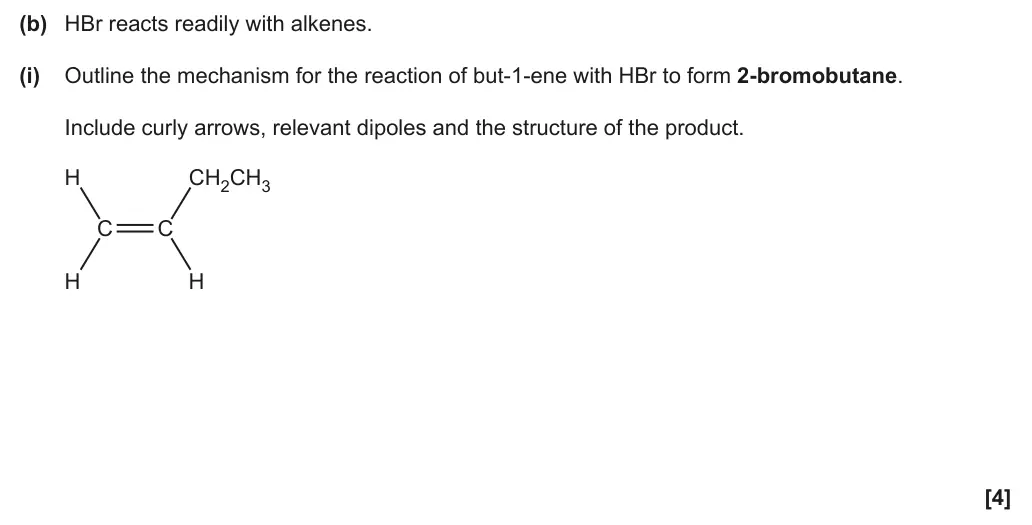
June 2024 · AS Paper 2 · Q5(b)(i)4 marksMechanismHard
Earlier part of question 5 that this part uses
Mark scheme
Examiner's comment
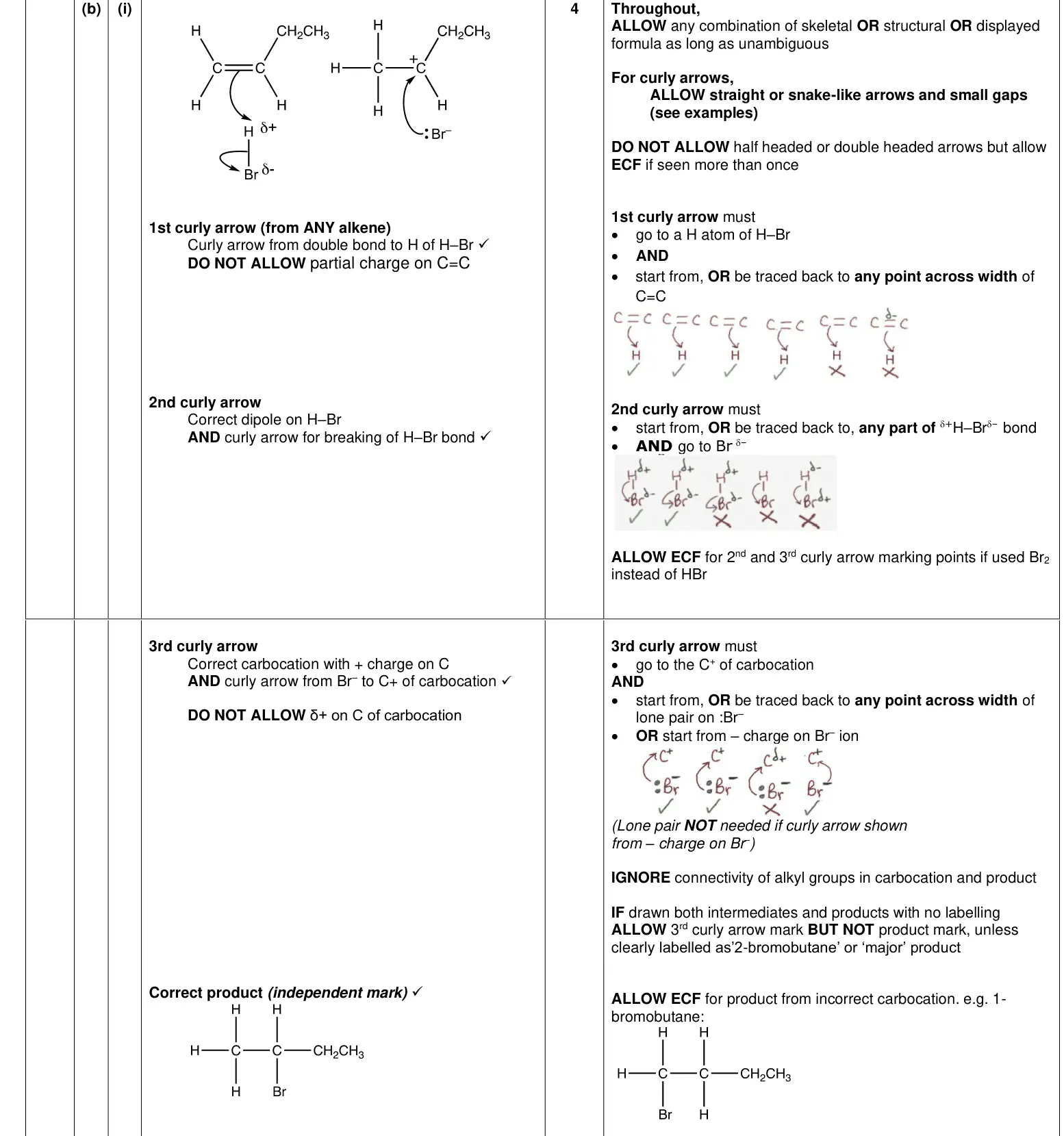
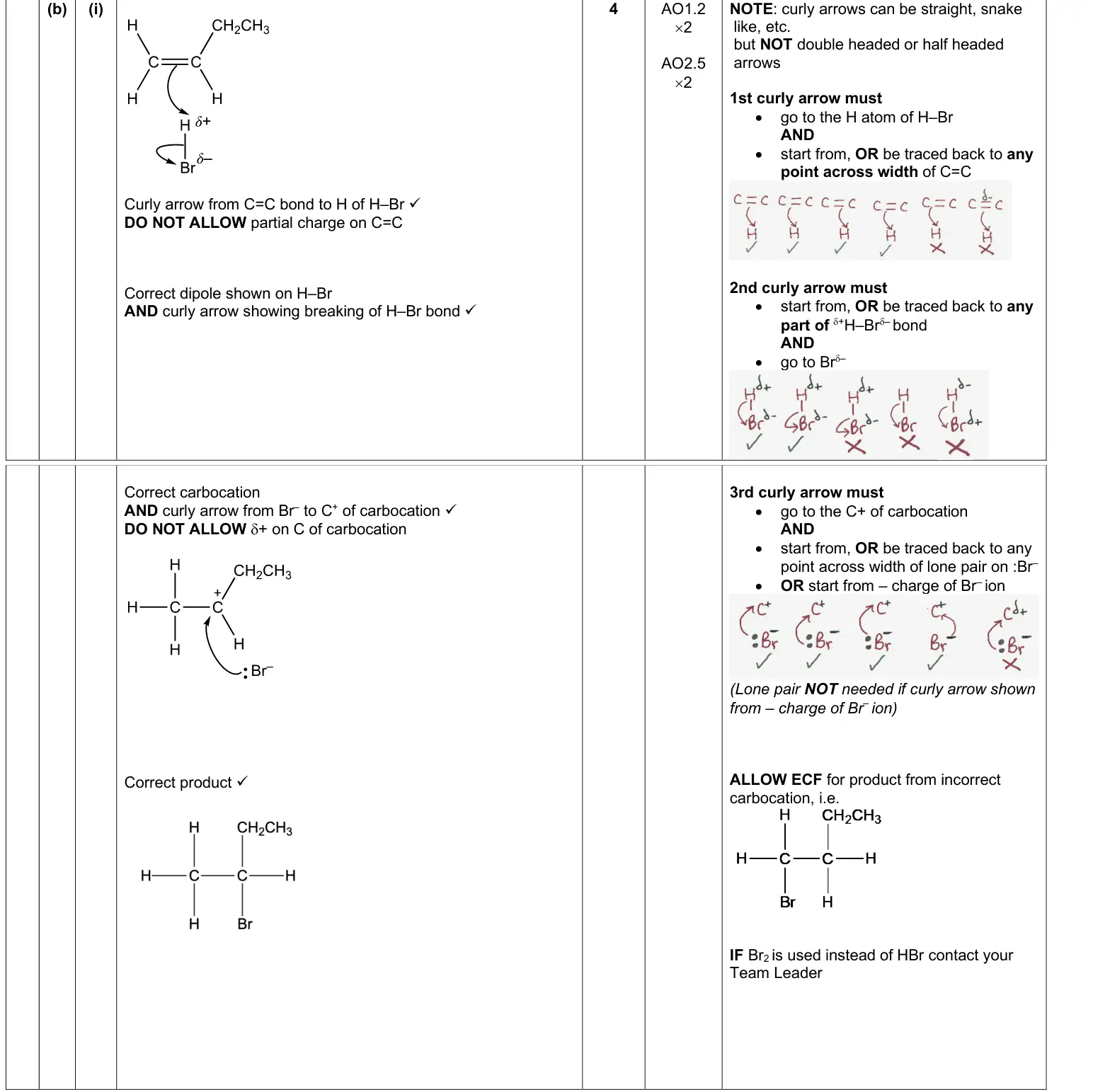
Approximately half of candidates scored all 4 marks. Very few scored no marks as they were able to give the correct structure of the named product (2-bromobutane). The most common reasons for losing marks included: • Adding dipoles to C=C • Missing dipoles on H-Br or reversed dipole on H-Br (i.e. + Br) • Missing charge on bromide ion or adding - • Arrows the wrong way round or not coming from a bond or lone pair (or negative charge for bromide ion) Some attempted a radical mechanism.
Notes from the mark scheme and report
arrow from C=C to H of H–Br
dipole on H–Br and arrow from bond to Br
arrow from Br– (lone pair or charge) to C+ of secondary carbocation
DO NOT ALLOW δ+ on carbocation or partial charge on C=C
product mark independent
ALLOW ECF for product from incorrect carbocation
For ideas on teaching this topic please look at our Topic Exploration Pack: Electrophilic Addition and Markownikoff’s rule: https://teachcambridge.org/item/b4220e86-bc04-492c-b354-8103687ce594
June 2024 · AS Paper 2 · Q5(b)(ii)2 marksShort answerMedium
Earlier part of question 5 that this part uses
Mark scheme
Examiner's comment
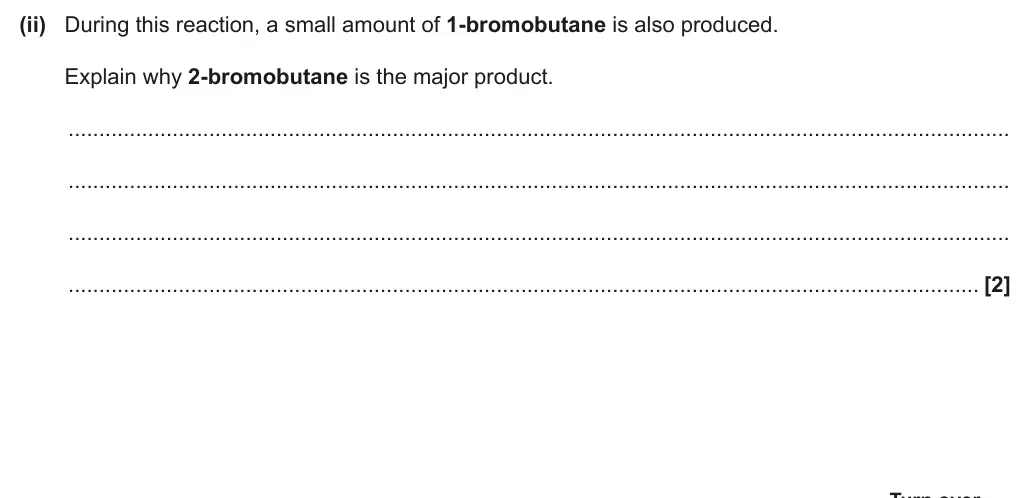
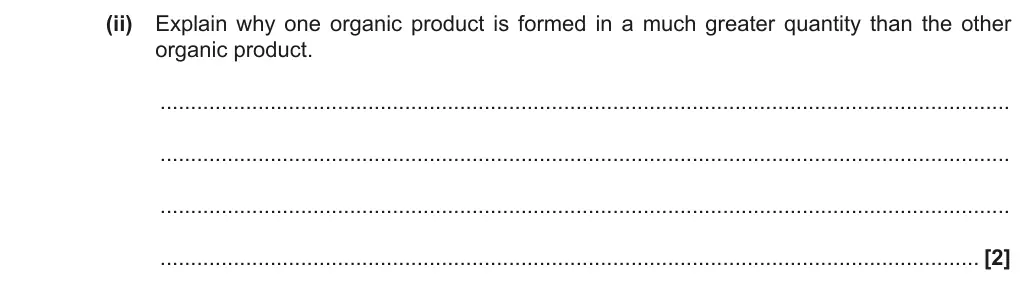
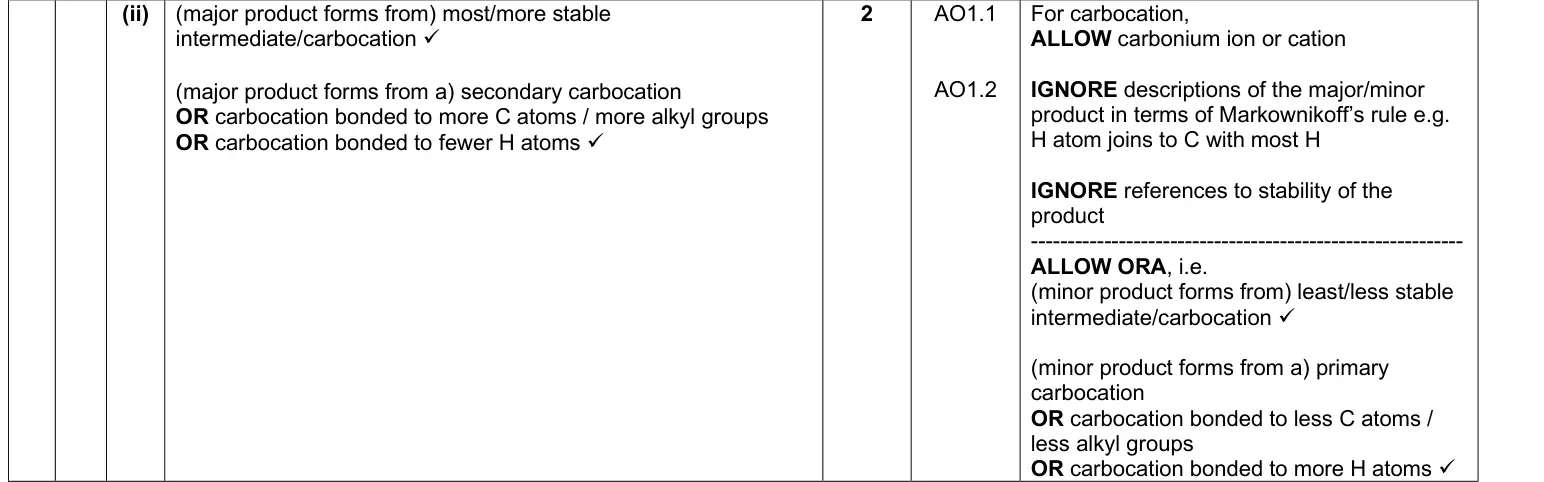
Over half of candidates didn’t gain any credit for their response here. Answers often focused on Markownikoff’s rule, i.e. adding H to C with most H atoms already attached, or described the stability of the product. Students need more support in understanding that the more stable carbocation will be formed in preference and result in forming more product. Many referred to the ‘secondary haloalkane’ being more stable, rather than the ‘secondary carbocation’. Some stated that 2-bromobutane is a ‘secondary carbocation’, showing some misunderstanding about the terminology used here.
Notes from the mark scheme and report
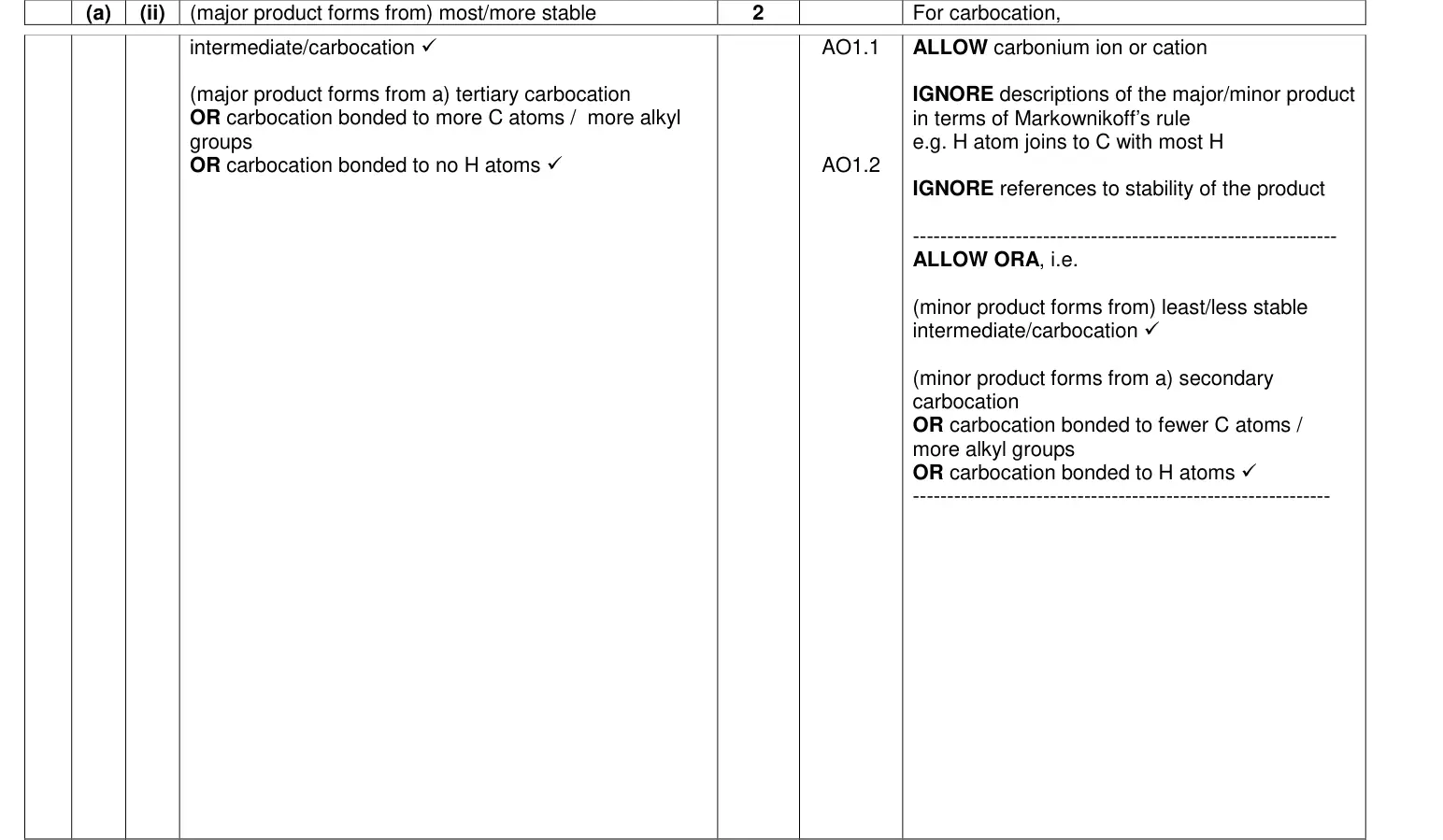
forms via the more stable (secondary) carbocation/intermediate
IGNORE statements of Markownikoff's rule about H joining C with most H
IGNORE stability of the product
We have a useful PowerPoint Presentation for teaching about Markownikoff’s rule and carbocation stability: https://ocr.org.uk/Images/250388-markownikoff-s-rule-presentation.ppt
June 2024 · Paper 2 · Q151 markMultiple choiceMedium
Mark scheme
Examiner's comment
On review of this question, during the standardisation process, it was agreed that aspects of this question were not part of the specification and consequently all candidates were given the mark. We do not expect candidates to have knowledge of specific examples of photodegradable polymers or indeed those that could be processed as feedstock. Section B overview Section B includes a mixture of short answer and extended response questions, including two questions marked using a Level of Response mark scheme (19 and 23). This section of the paper is worth 85 marks.
Notes from the mark scheme and report
mark scheme: issue with this question – mark awarded to all candidates
June 2024 · Paper 2 · Q16(e)2 marksShort answerHard
Earlier part of question 16 that this part uses
Mark scheme
Examiner's comment
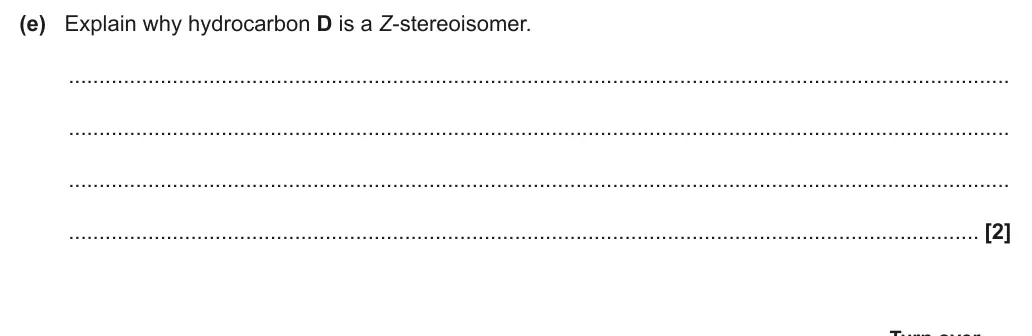
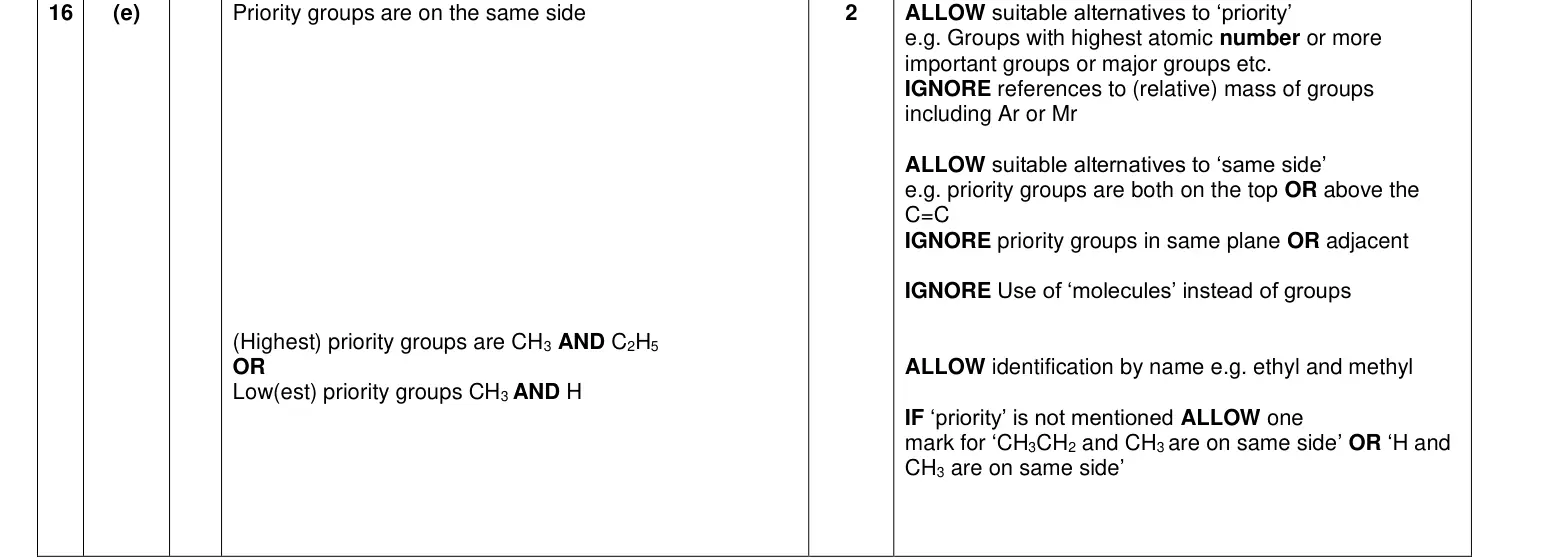
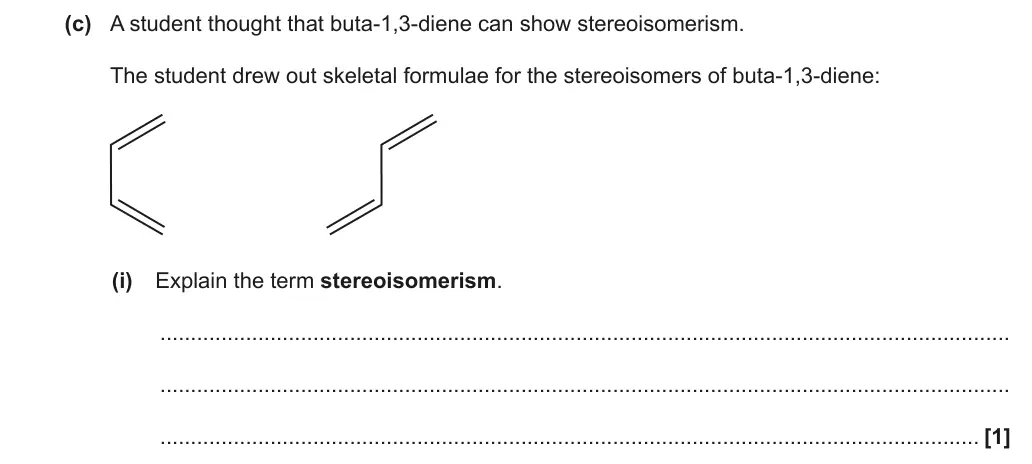
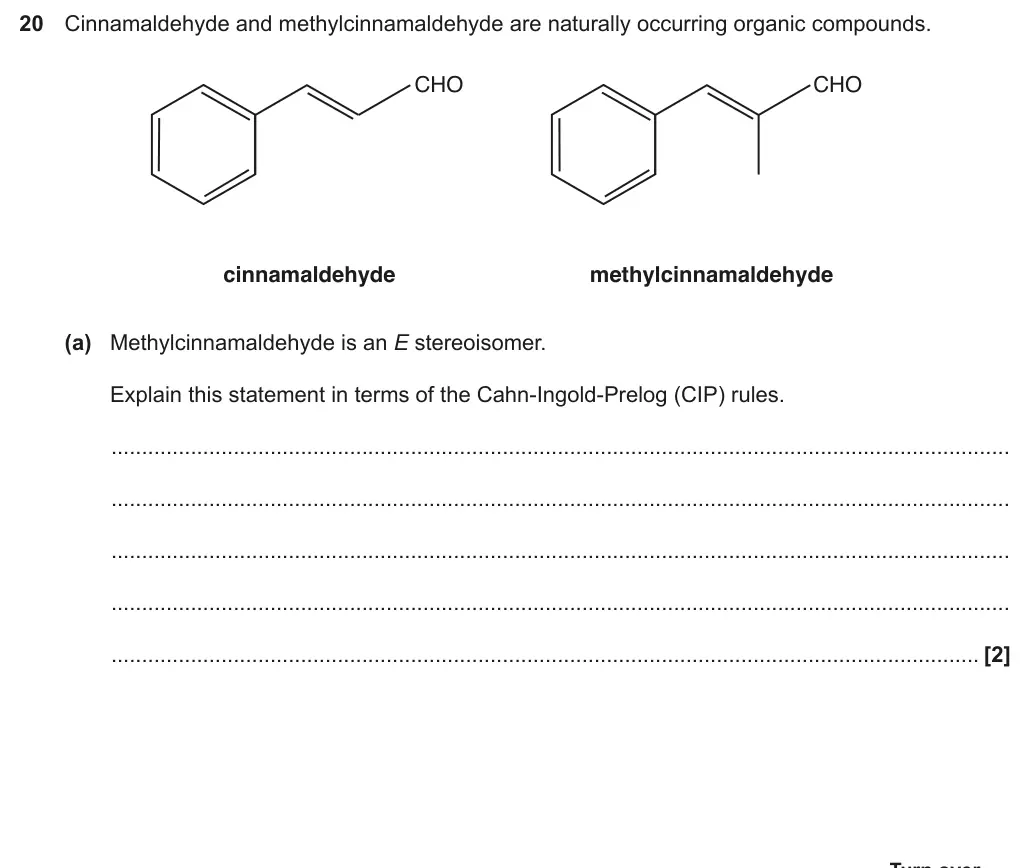
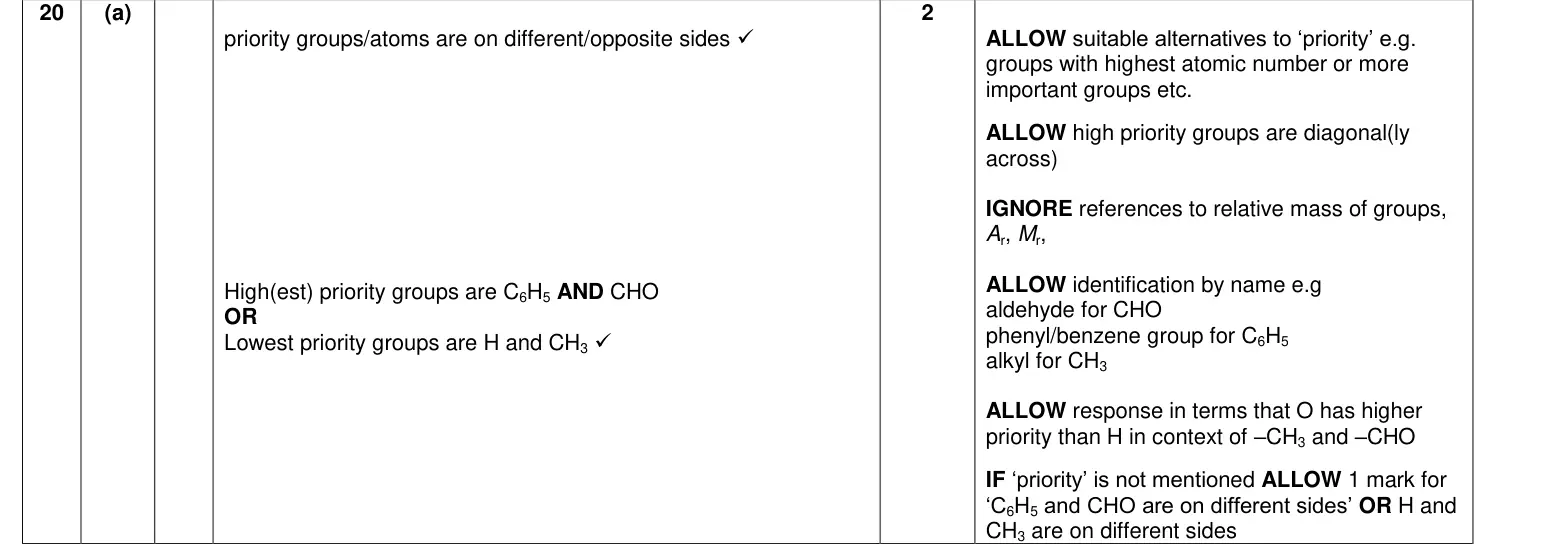
Many candidates misunderstood the question instead explaining how a molecule shows stereoisomerism i.e. same structural arrangement but a different arrangement of atoms in space. Some gave details specific to alkenes i.e. restricted rotation around C=C and each carbon of C=C has 2 different groups attached. Just over a quarter of candidates did not score any marks here. Many that did recognise that the ‘priority groups’ are on the same side’ but did not then go on to score the second mark by identifying which groups they were referring. A significant number of candidates (including those gaining marks) described priority in terms of highest Mr or mass, suggesting that the Cahn-Ingold-Prelog priority rules of using atomic number are not well understood. Many framed their answer in terms of the methyl groups, possibly showing confusion with cis-trans isomerism. Note that same ‘plane’ was not accepted as all the molecule is planar, so all groups are in the same plane. Teachers are recommended to encourage students to stick with conventional terminology i.e. Z: same side E: opposite sides.
Notes from the mark scheme and report
priority groups on the same side
highest priority groups are CH3 and C2H5 (or lowest are CH3 and H)
IGNORE references to mass/Mr of groups
1 mark if 'priority' not mentioned
A useful PowerPoint presentation has been produced by OCR to help with teaching about CIP rules.
Skills: M4.2 Visualise and represent 2-D and 3-D forms including 2-D representations of 3-D objects
June 2024 · Paper 2 · Q196 marks6-mark level of responseHard
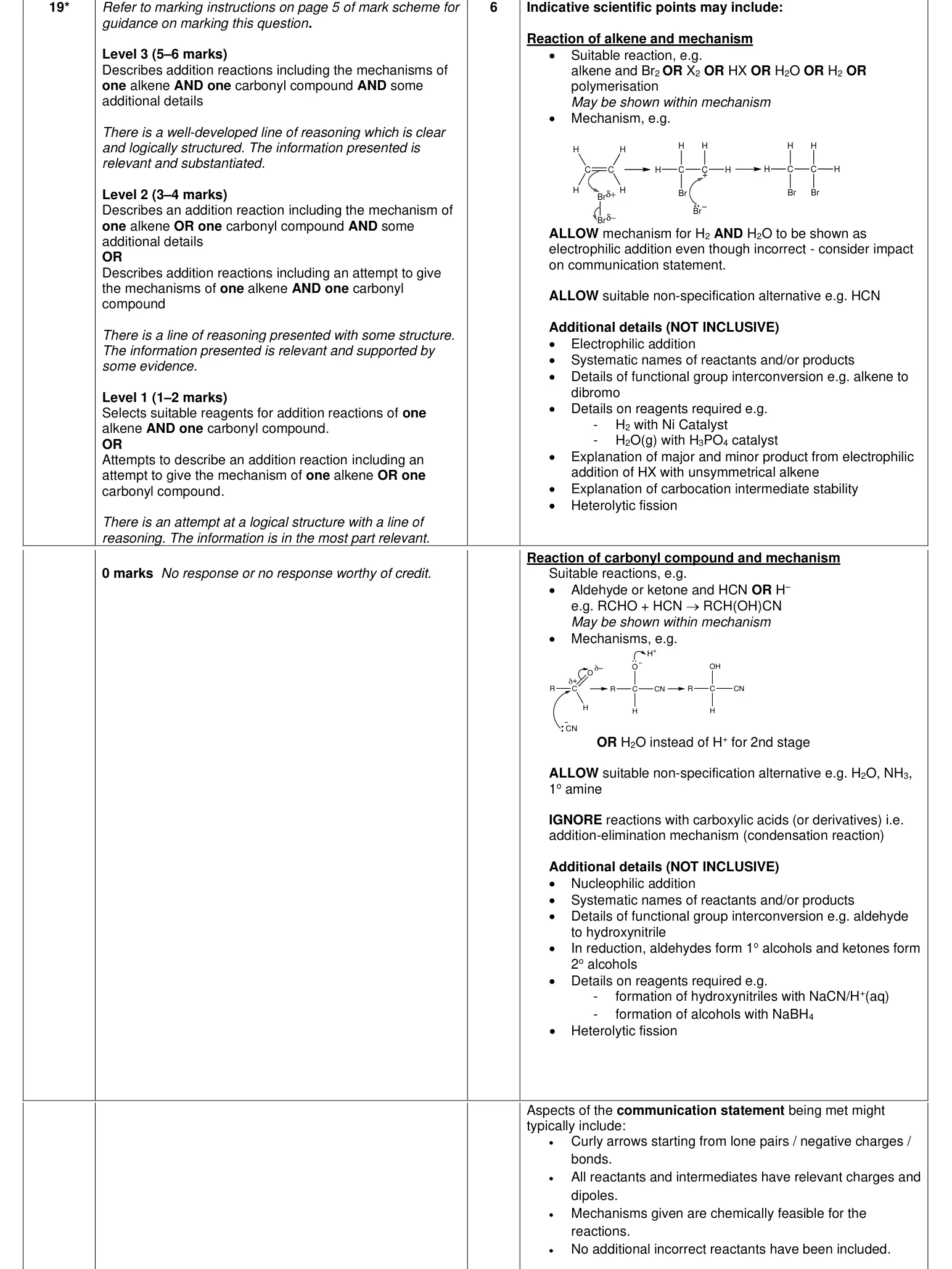
Mark scheme, with the levels and indicative points
Examiner's comment
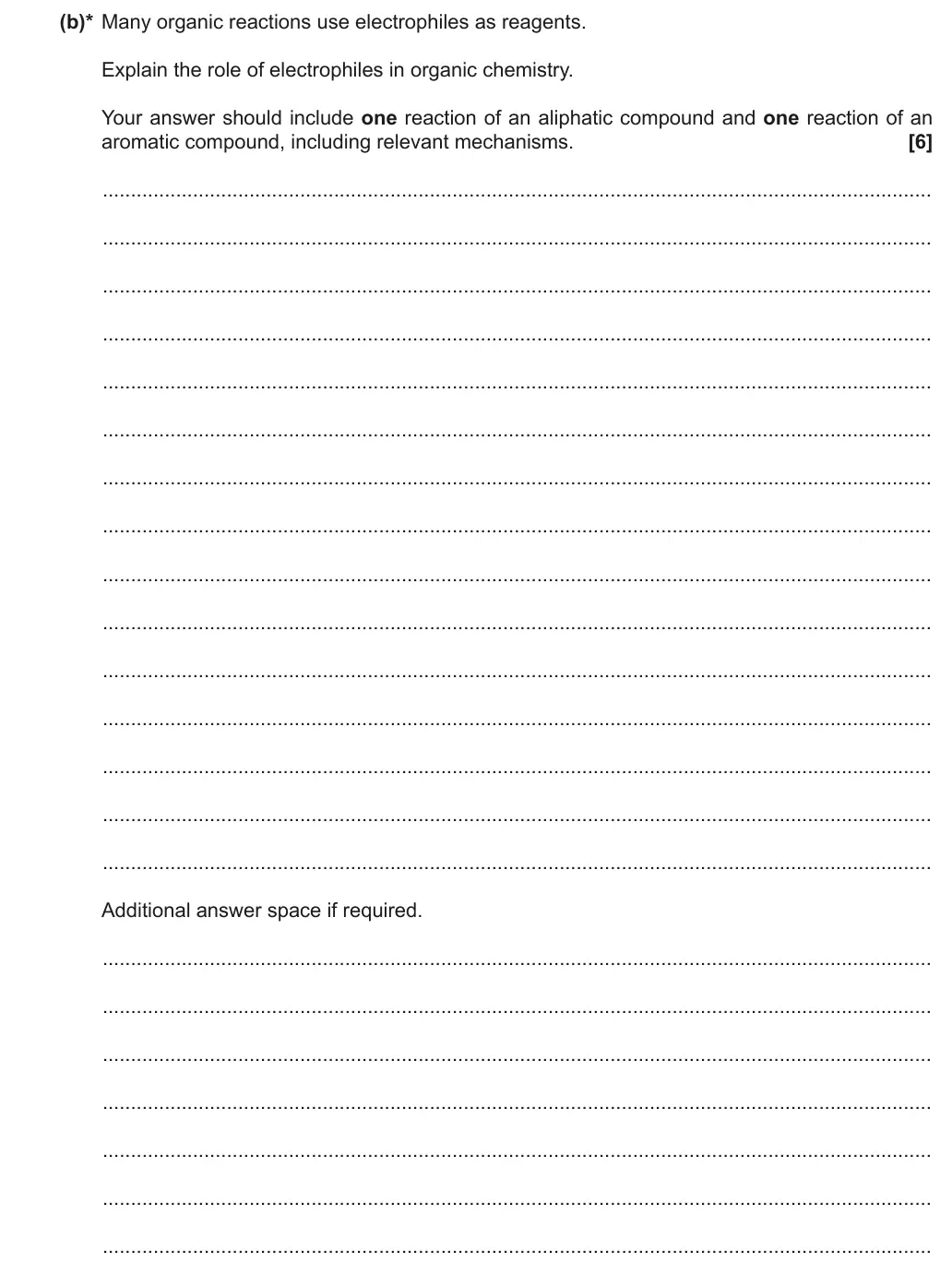
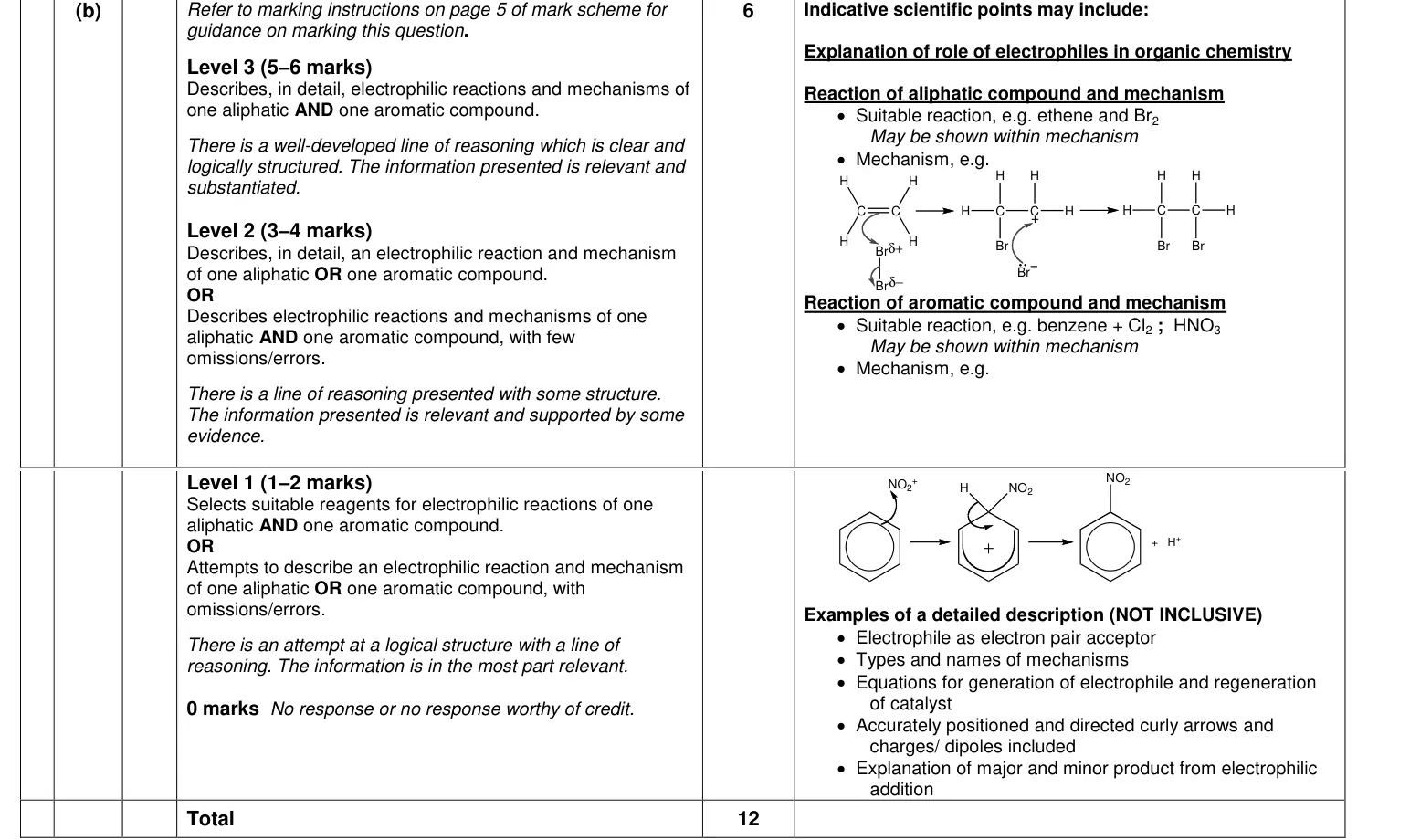
A very good proportion of candidates scored all 6 marks, giving well-drawn mechanisms with some additional details such as mechanism names, functional group interconversions or other additional reaction information. Some attempted to ‘describe’ the mechanism using only words rather than drawing it out with a conventional curly arrow mechanism. Candidates may need more clarity on what ‘describe’ means in an organic chemistry context. Equally, a few gave just the mechanisms with no additional details, limiting themselves to Level 2. Candidates were usually more confident with the addition to alkenes using an electrophilic addition mechanism. Some gave additional details about major and minor products, although not always relevant as for a symmetrical alkene. Some represented the addition of hydrogen or water to alkenes via an electrophilic addition mechanism. While not correct it showed an understanding of mechanisms and a correct addition reaction for alkenes, so credit was given. Some candidates included incorrect reagents for reactions, such as acid catalysts with addition of a hydrogen halide, or incorrect conditions, such as the requirement for ultraviolet light on addition of a halogen. The addition to carbonyl compounds was not always as well-described. Some candidates struggled to identify carbonyl compounds, selecting carboxylic acids or their derivatives, with attempts at addition- elimination mechanism i.e. condensation reactions. Some gave incorrect reagents for carbonyls, including H2 and HBr. However, some used off-specification reactions such as the addition of H2O to form a geminal diol which was given but as the mechanism differs from the nucleophilic addition mechanism taught in this specification, full credit was rarely achieved. Some also considered oxidation of aldehyde or ketone to be an addition reaction. Most who presented a correct mechanism for addition to a carbonyl used the reaction with cyanide rather than reduction with NaBH4. Common errors included arrows coming from the N of CN–, a lack of putting dipoles on carbonyl bonds, missing charges on O in intermediates or showing the wrong direction of arrows. Two correct addition mechanisms have been shown, one for an alkene and one for a carbonyl compound. Additional details include the names of the mechanisms, names of the functional groups in the products, and the fact that a C-C bond is formed in the second mechanism. All curly arrows, charges and dipoles are correctly positioned so this response was also given the communication mark.
Notes from the mark scheme and report
alkene with Br2/HX by electrophilic addition and carbonyl with HCN (NaCN/H+) or NaBH4 by nucleophilic addition
curly arrows from bonds/lone pairs/negative charges, dipoles and charges on intermediates
IGNORE addition–elimination reactions of carboxylic acid derivatives
The OCR Guide to Level of Response questions can be found on Teach Cambridge and can be used to help your students better understand this type of question.
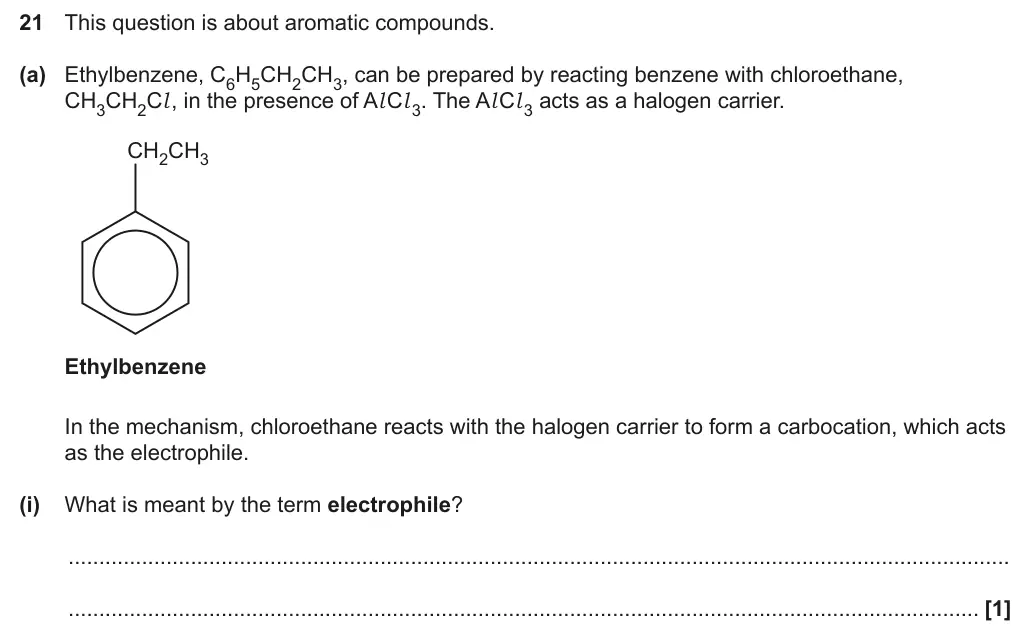
June 2024 · Paper 2 · Q21(a)(i)1 markShort answerEasy
Mark scheme
Examiner's comment
Most candidates were able to give the correct definition here. A common error was omission of ‘pair’ of electrons. Many also described that electrophiles are ‘species attracted to areas of high electron density’ or words to that effect, either alongside the accepted definition gaining credit or as the sole definition not gaining a mark.
Notes from the mark scheme and report
electron pair acceptor
June 2024 · Paper 2 · Q22(b)3 marksDrawing / labellingMedium
Earlier part of question 22 that this part uses
Mark scheme
Examiner's comment
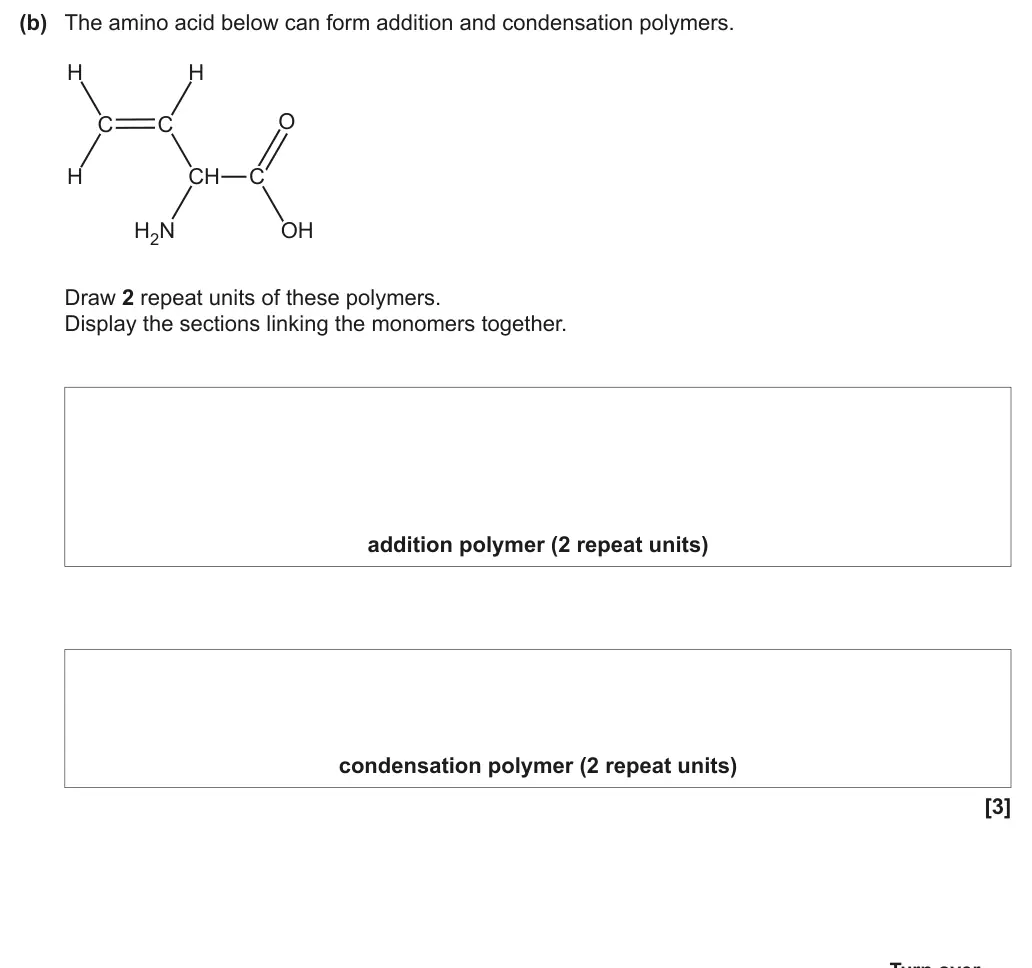
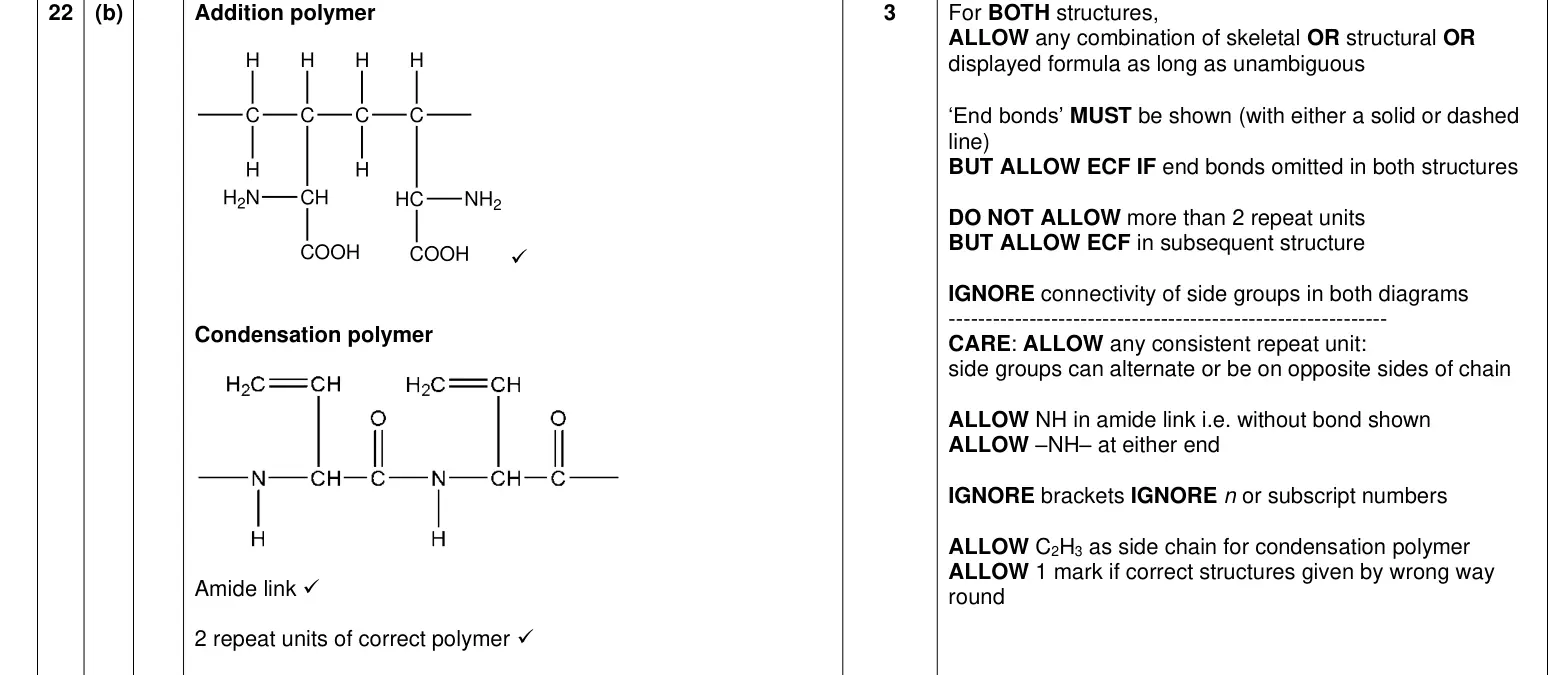
In general, candidates found it easier to give the correct addition polymer rather than the condensation polymer. Some lost the mark for using molecular formula on side chains rather than displaying the section correctly. The condensation polymer was generally less well answered, with candidates often struggling to give a correct amide bond – many had an oxygen atom retained between the carbonyl carbon and the amine group’s nitrogen atom, giving C–O–N. Another common error was the omission of hydrogen atoms from nitrogen or from the carbon attached to C2H3. Just over a quarter of candidates did not score any marks. Some candidates drew ester linkages instead of amide linkages and struggled to include the side chains i.e. trying to incorporate the alkene into the main polymer chain.
Notes from the mark scheme and report
addition polymer through C=C with CH(NH2)COOH side chains
condensation polymer with displayed amide links and CH=CH2 side chains
end bonds must be shown
DO NOT ALLOW more than 2 repeat units
1 mark if correct but the wrong way round
June 2023 · AS Paper 1 · Q181 markAO2Multiple choiceHard
Answer
D
Mark scheme
Examiner's comment
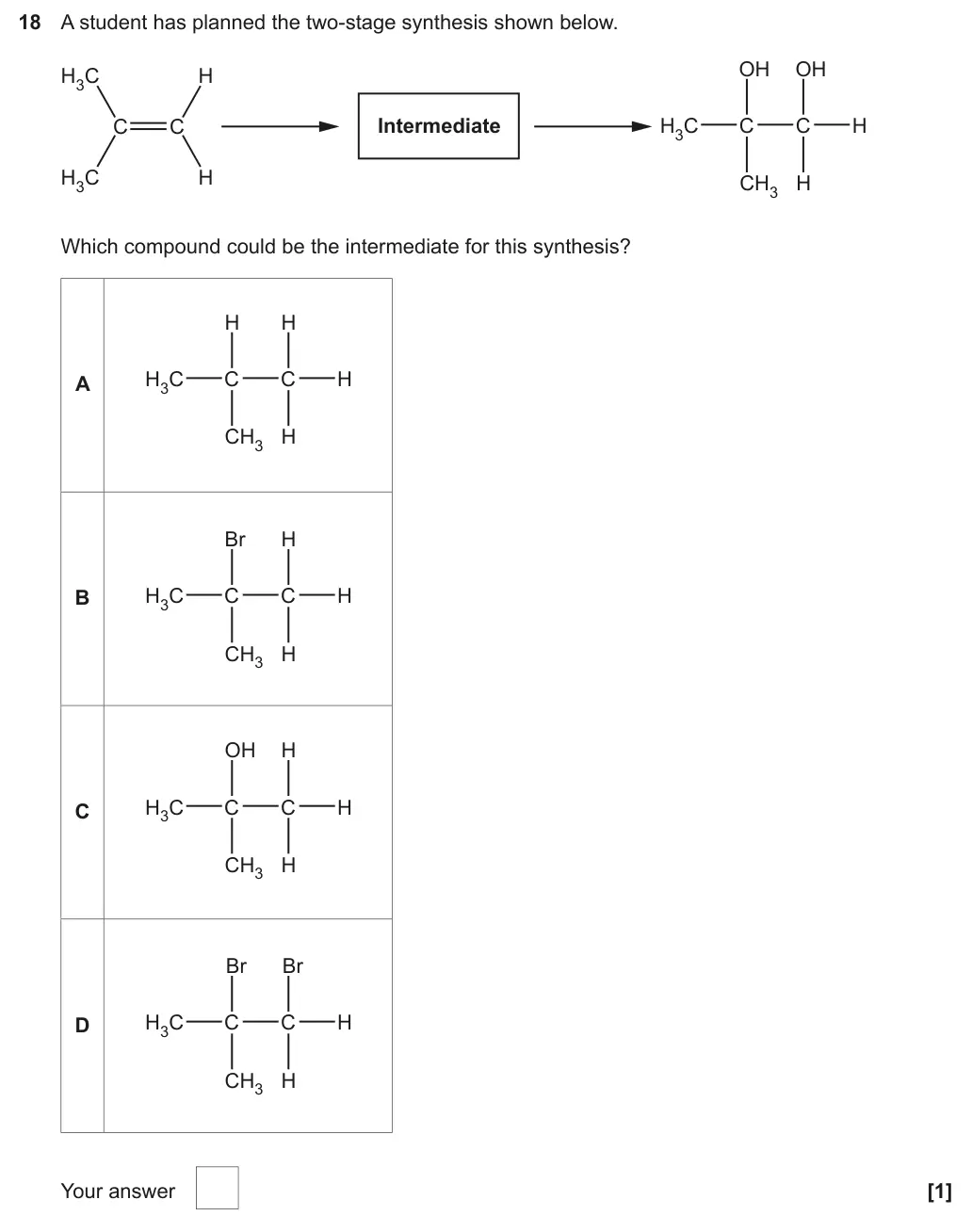
Candidates find it difficult to identify an intermediate within a synthesis and less than half selected the correct option, D.
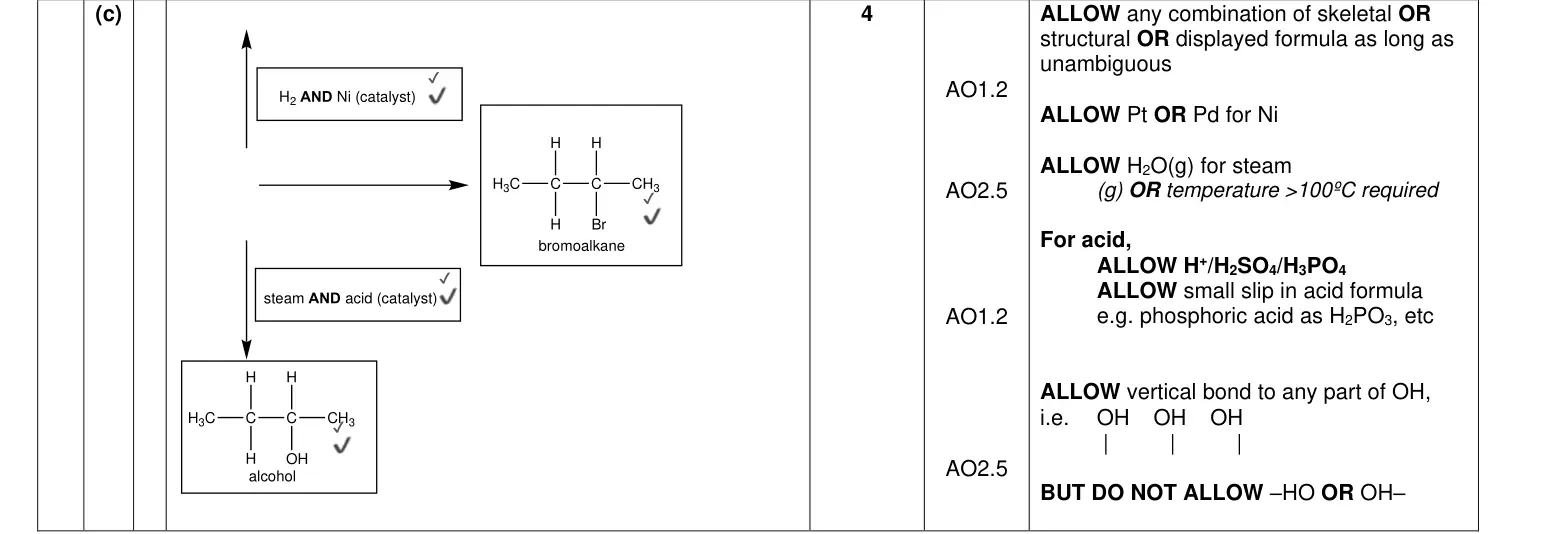
June 2023 · AS Paper 1 · Q25(c)4 marksAO1, 2Complete table/diagramMedium
Mark scheme
Examiner's comment
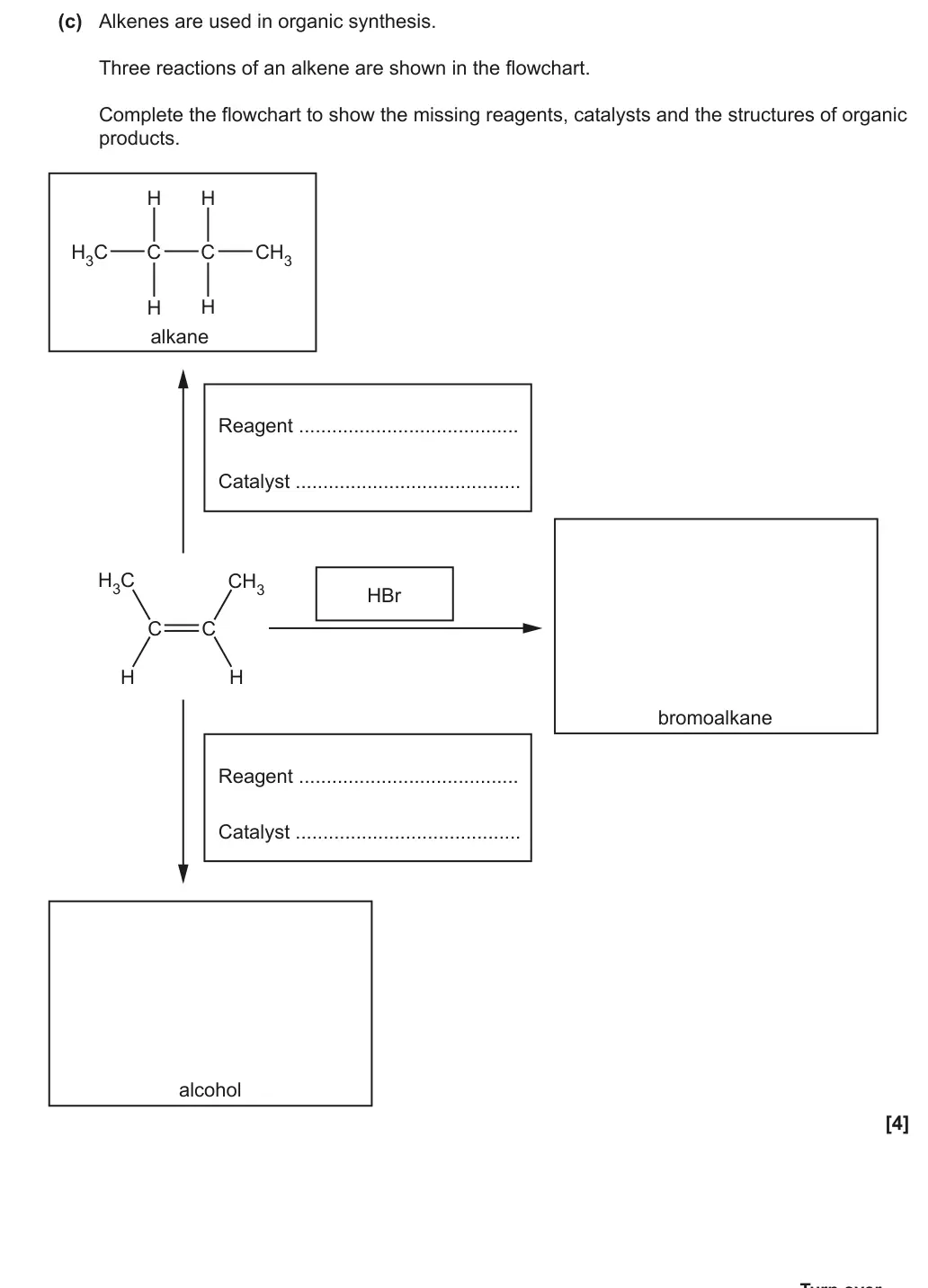
Most candidates drew correct structures for the bromoalkane and alcohol molecules, although some added Br and/or OH groups on the terminal carbon atoms. Some added two Br or OH groups. The reagents and catalysts caused the main problems, with a wide variety of incorrect responses. For the hydrogenation step, nickel was often omitted and H2SO4 or K2Cr2O7 were common incorrect reagents. For the hydration step, water/H2O was often seen as the reagent rather than steam or H2O(g). It was also common to see water stated as the reagent, without a (g) state symbol to infer that it is steam. Overall, this question discriminated very well with most candidates gaining at least 2 of the available 4 marks.
Notes from the mark scheme and report
H2 AND Ni (ALLOW Pt or Pd)
steam AND acid catalyst (H3PO4/H2SO4/H+)
DO NOT ALLOW –HO or OH– connectivity
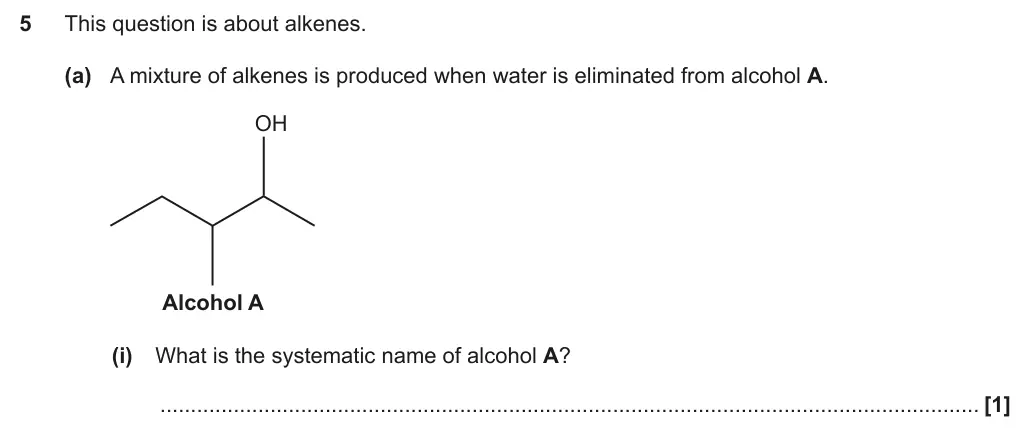
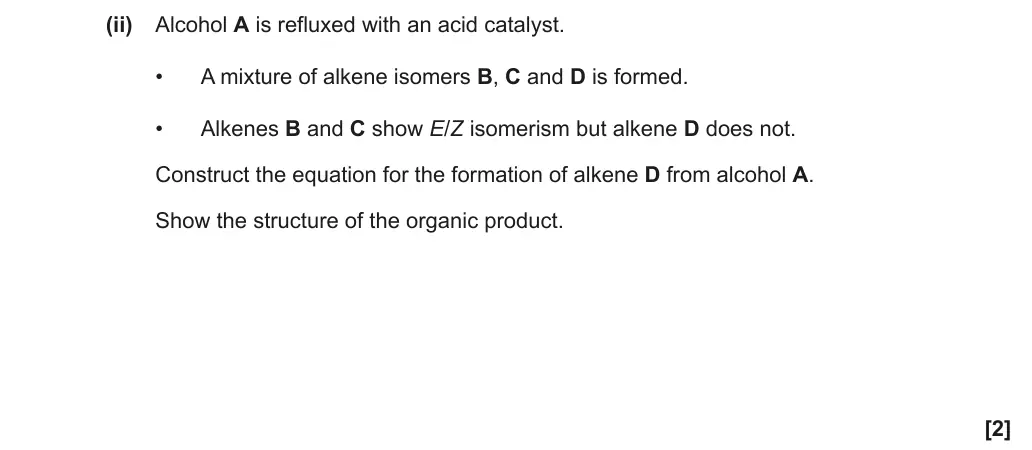
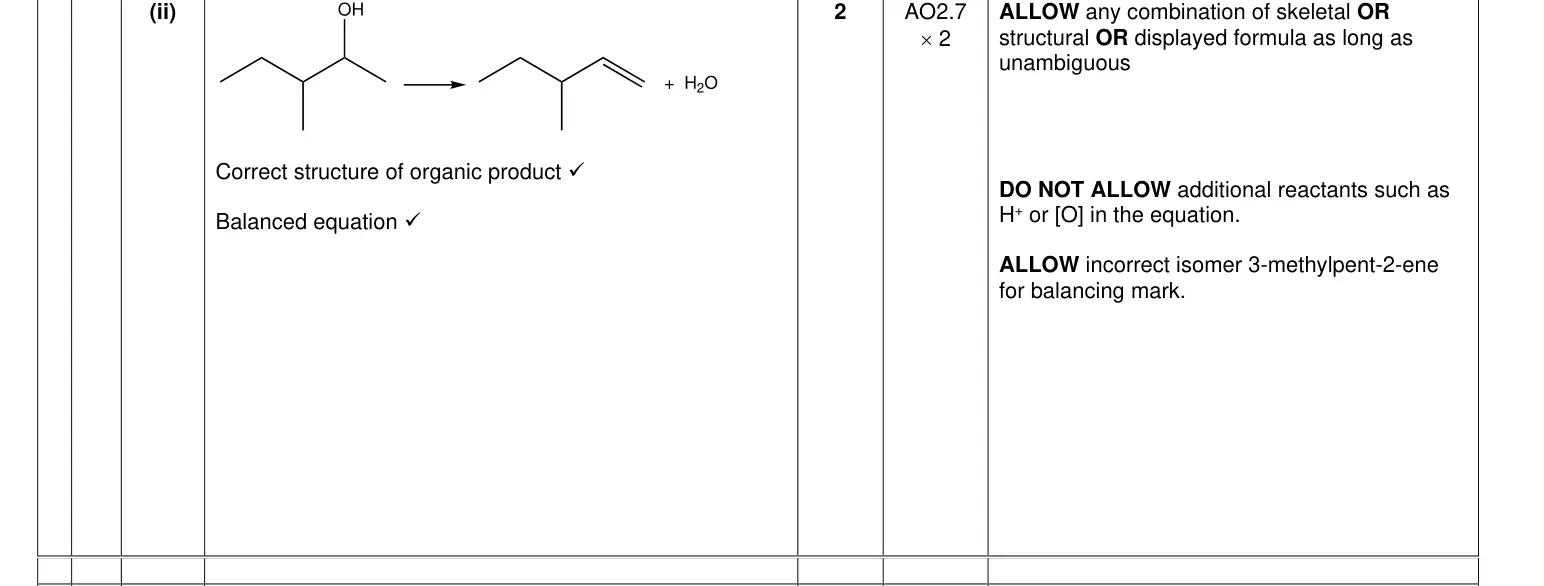
June 2023 · AS Paper 2 · Q5(a)(ii)2 marksAO2Equation writingMedium
Earlier part of question 5 that this part uses
Mark scheme
Examiner's comment
Most candidates did not score either mark here, despite the structures for B and C being given in the table below for (iii). Many thought this was oxidation, showing [O] in equations and giving a carbonyl product. Many had alkenes but still with the -OH present. Some attempted to use structural or displayed formulae but errors were made in giving the correct number of H atoms. For those that did have the correct structure, they often did not give an equation, added the acid as a reactant, or missed off the water as a product.
Notes from the mark scheme and report
D = 3-methylpent-1-ene (no E/Z) + H2O
DO NOT ALLOW H+ or [O] as reactants
ALLOW 3-methylpent-2-ene for the balancing mark only
June 2023 · AS Paper 2 · Q5(a)(iii)2 marksAO3Data interpretationHard
Earlier parts of question 5 that this part uses
Mark scheme
Examiner's comment
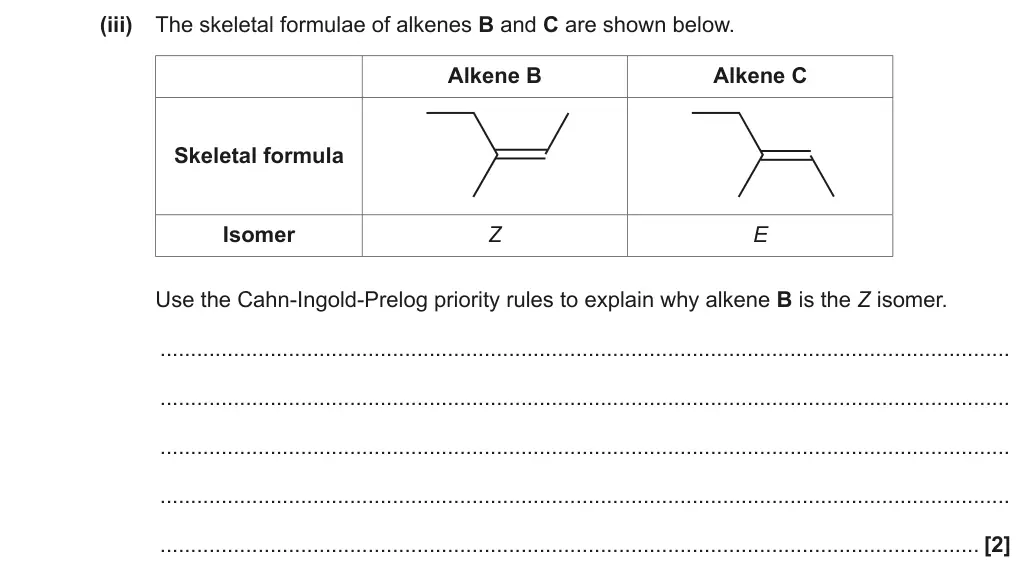
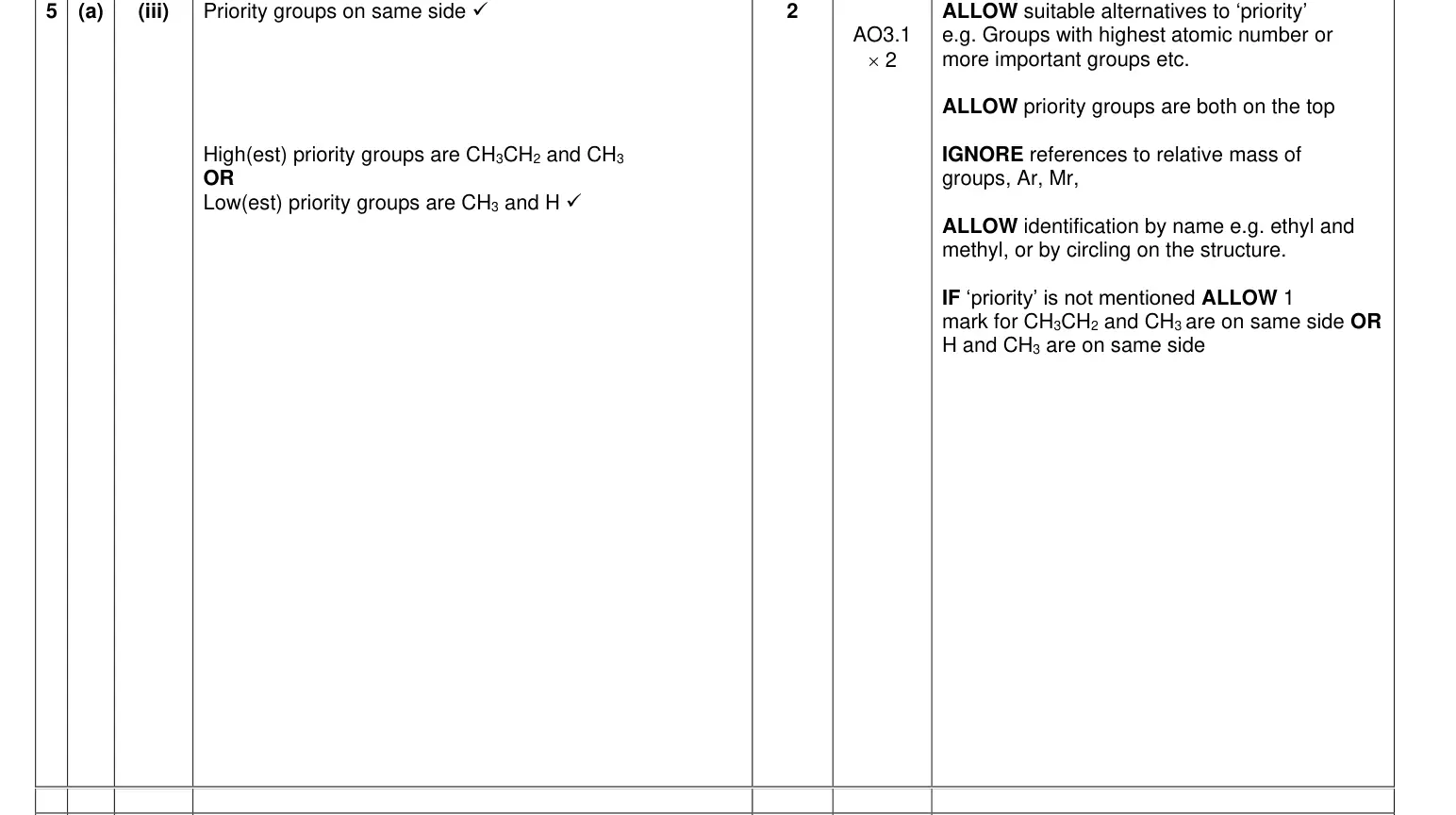
Many responses made no reference to ‘priority’ and/or discussed alkene C, suggesting that they didn’t read the question fully. Candidates often struggled to find the right language to express themselves, such as reference to ‘functional groups’ or ‘molecules’ rather than priority groups. Lots discussed using Mr to assign priority with only a few stating correctly that it is atomic number that is used for CIP rules. Many, despite stating that priority groups are on the same side, didn't identify these groups so didn't get the second mark.
Notes from the mark scheme and report
priority groups (CH3CH2 and CH3) on the same side
IGNORE relative mass/Mr of groups: priority is by atomic number
Skills: M4.2 Visualise and represent 2-D and 3-D forms including 2-D representations of 3-D objects
June 2023 · AS Paper 2 · Q5(b)(i)2 marksAO2, 3Drawing / labellingMedium
Mark scheme
Examiner's comment
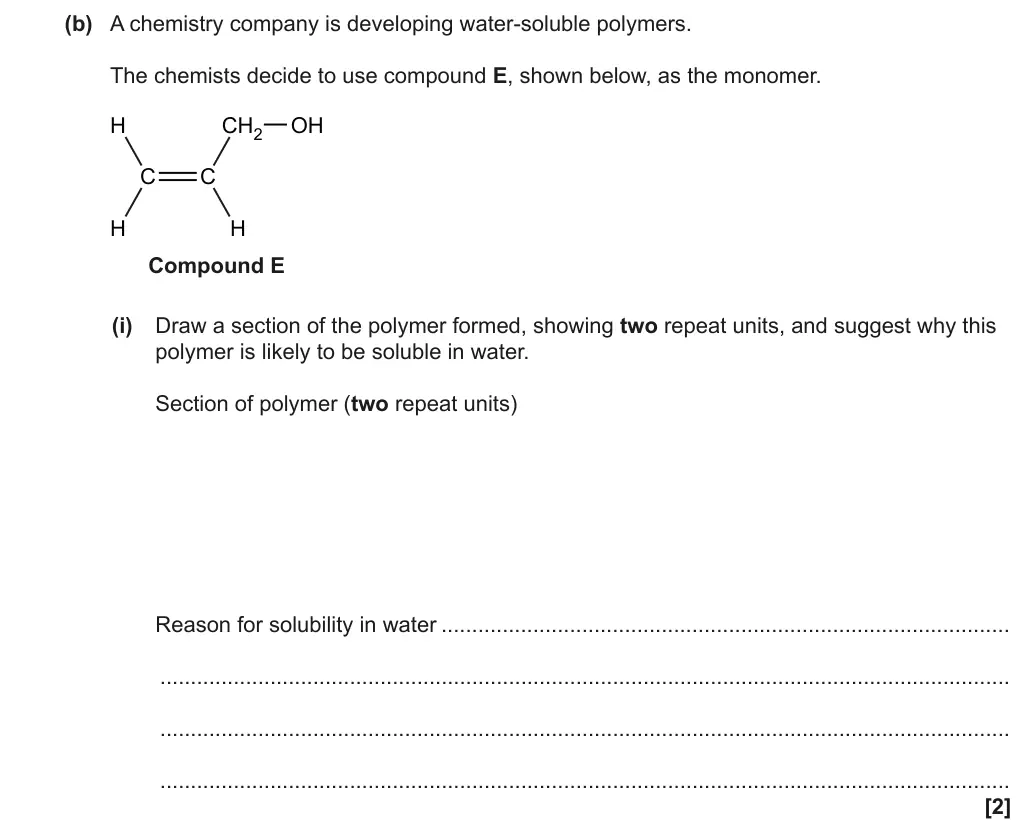
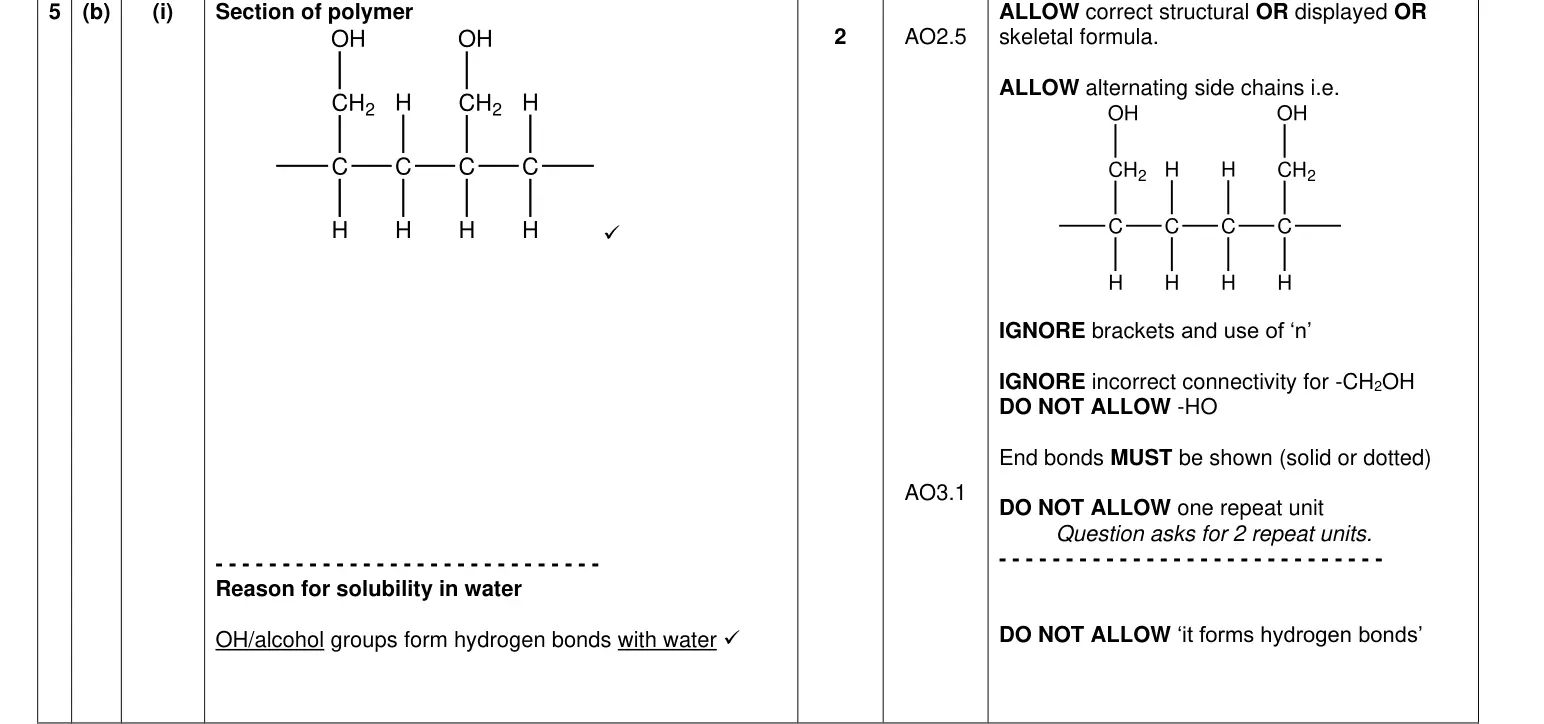
Most candidates were able to gain credit for their structure, with only a few missing out by only drawing one repeat unit, keeping the C=C, having no end bonds or missing/extra Hs. Lots struggled to gain the second mark for the reason for solubility in water as they didn't refer to H-bonding. There were quite a few misconceptions highlighted in the responses to this question. These included the misunderstanding that a H-bond is an an intermolecular force between -OH on alcohol and water, rather than the covalent bond in the molecule. Some thought the -OH would behave as an alkali, even referring to ions, so would ‘fully dissociate’. Some described a reaction with water and breaking apart, perhaps confusing with condensation polymers which can be hydrolysed.
Notes from the mark scheme and report
two repeat units with end bonds shown (DO NOT ALLOW one repeat unit)
OH groups form hydrogen bonds with water (DO NOT ALLOW 'it forms hydrogen bonds')
DO NOT ALLOW –HO connectivity
June 2023 · AS Paper 2 · Q5(b)(ii)2 marksAO1Short answerHard
Earlier part of question 5 that this part uses
Mark scheme
Examiner's comment
About a quarter of candidates didn't gain any credit here as they struggled to identify useful processes. Lots referred to cracking or breaking down into smaller chains, possibly thinking about fractional distillation of crude oil and how we make better use of larger fractions. Some identified possible use as a fuel but didn’t say to generate energy/electricity. We also saw reference made to photodegradable/biodegradable polymers which isn't relevant to hydrocarbon polymers. There was evidence of the misunderstanding of the use as ‘feedstock’ with reference being made to animals (livestock or animal feed) or as food to eat.
Notes from the mark scheme and report
recycling / combustion for energy / organic feedstock
IGNORE reused
June 2023 · Paper 2 · Q196 marksAO36-mark level of responseMedium
Mark scheme, with the levels and indicative points
Examiner's comment
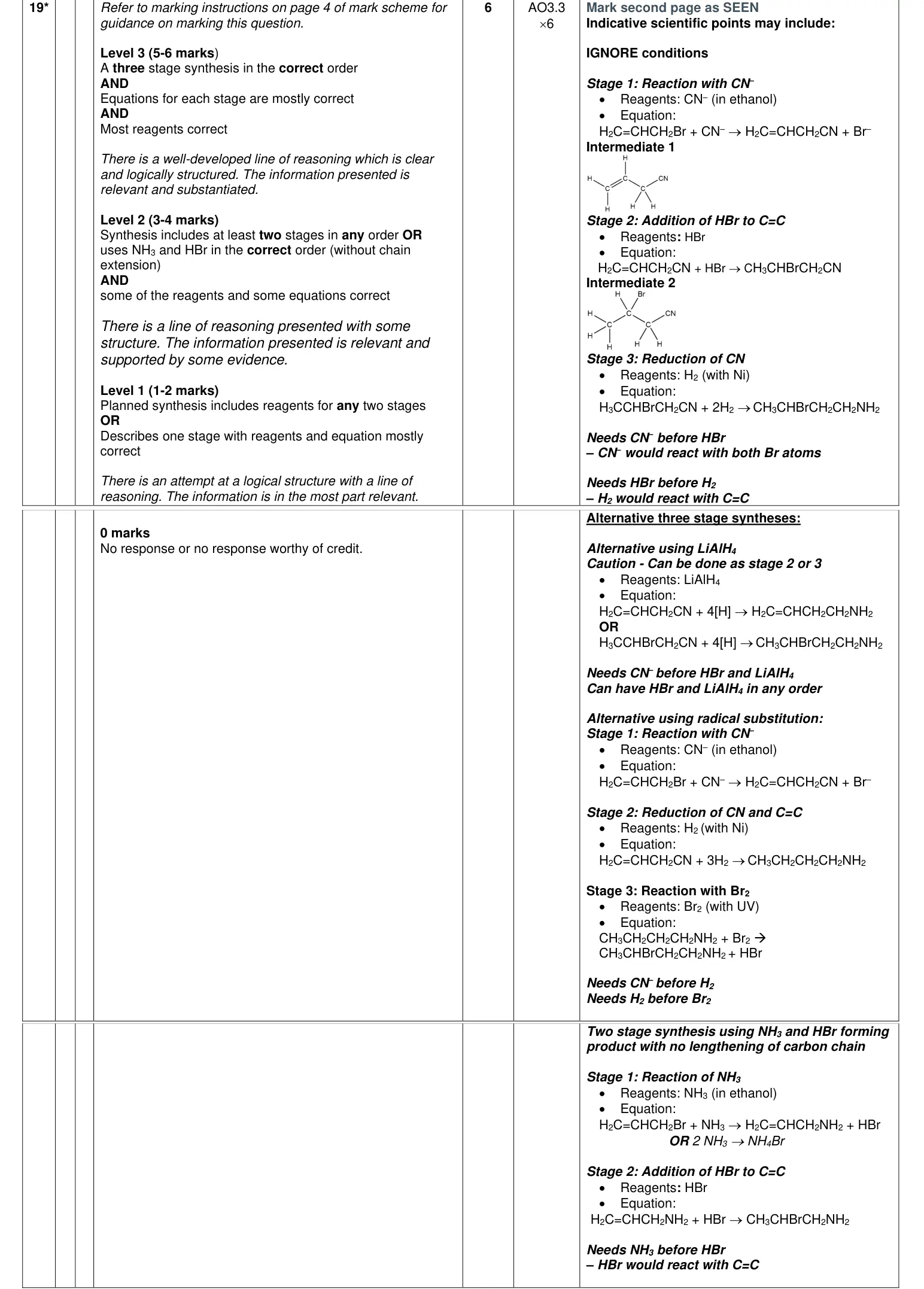
This challenging level of response question was generally well attempted. Many candidates recognised the reagents required in this synthesis but fewer candidates were able to deduce three correct reagents in the right order with equations to achieve Level 3. Most candidates achieved Level 2 4 marks. Many correctly identified suitable reagents but carried out the stages in the wrong order. A common error was to carry out electrophilic addition with HBr first then react with cyanide ion, not realising both Br groups would react and the reaction would not be selective. Alternatively, having introduced the nitrile group then carried out the reduction first, not realising that the C=C would also be reduced. The lowest scoring responses were often incomplete and despite identifying some reagents did not give equations. Candidates are encouraged to read the questions carefully so they can make sure their response covers all the detail required. Many candidates used molecular formula in their equations. It is usually preferrable in organic chemistry to give structures. Some gave surplus information such as the mechanisms and reaction conditions for each reaction. The key to answering this question well was knowing reagents for different functional group interconversions as well as planning each step to make sure of a logical synthesis. Some candidates were seemingly confused by the term ‘intermediate’ and gave an intermediate as in a mechanism, e.g. carbocation.
Notes from the mark scheme and report
order matters: CN– (ethanol) first (it would substitute both Br atoms after HBr), then HBr across C=C (Markownikoff), then H2/Ni (would reduce C=C if before HBr)
ALLOW LiAlH4 as stage 2 or 3
IGNORE conditions
A useful resource for teaching how to identify functional groups and practice at devising synthetic routes is the Topic exploration pack on Organic synthesis.
This should be used in conjunction with the reaction pathways summaries.
June 2023 · Paper 2 · Q22(b)9 marksAO1, 2Short answerMedium
Earlier part of question 22 that this part uses
Mark scheme
Examiner's comment
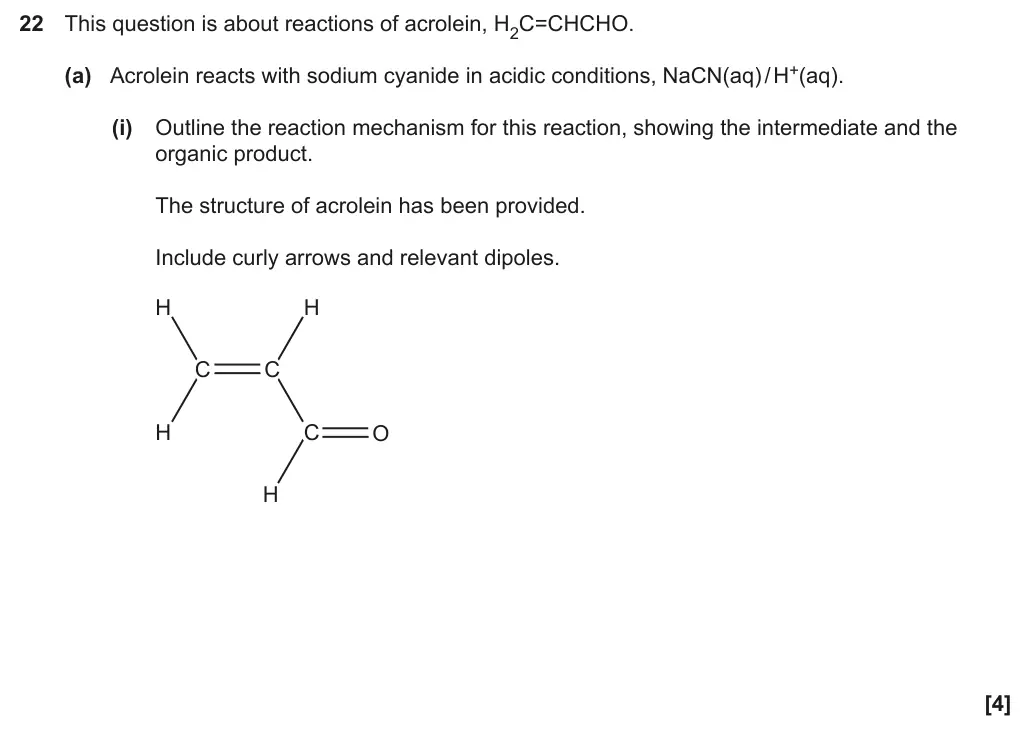
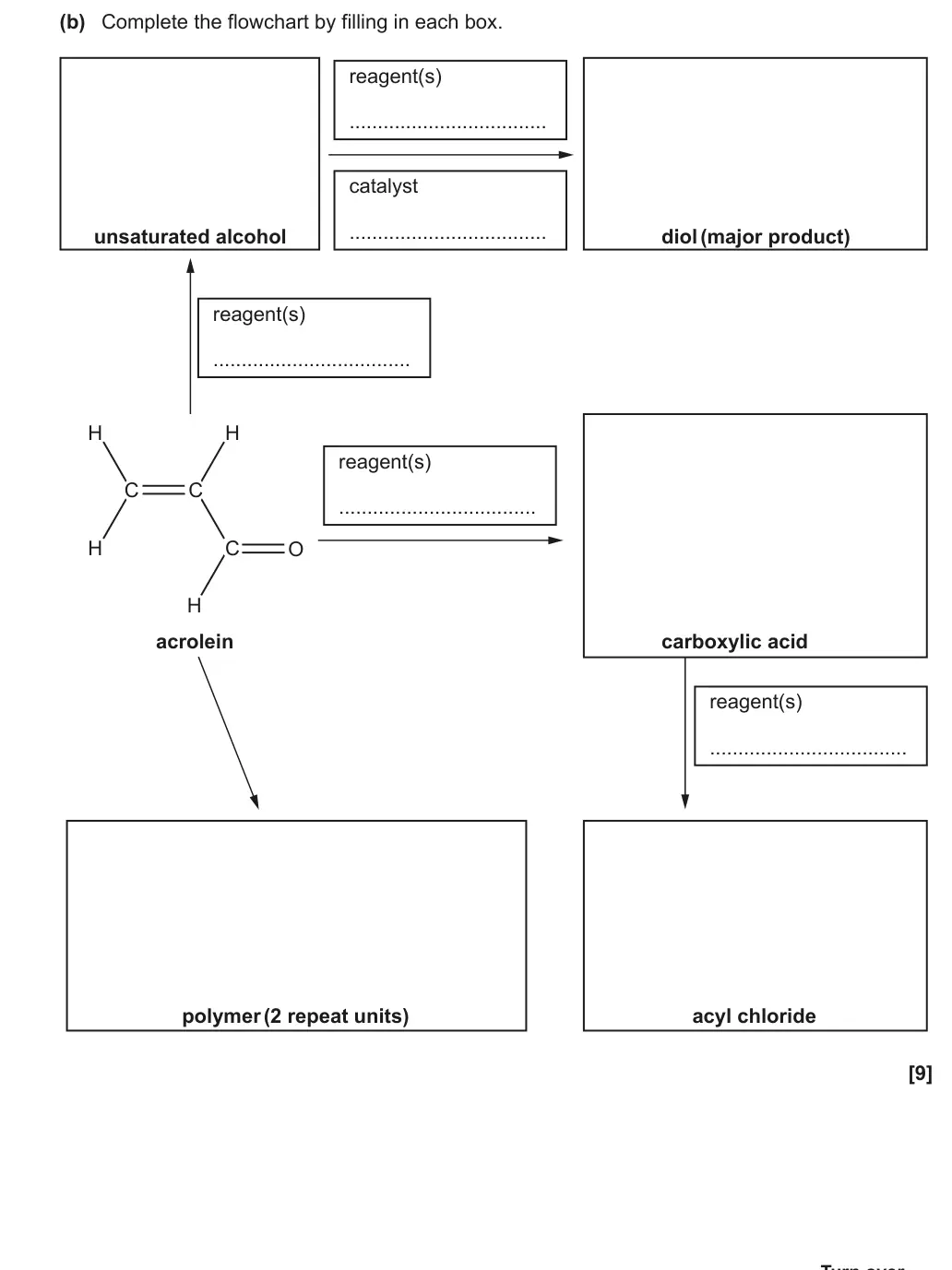
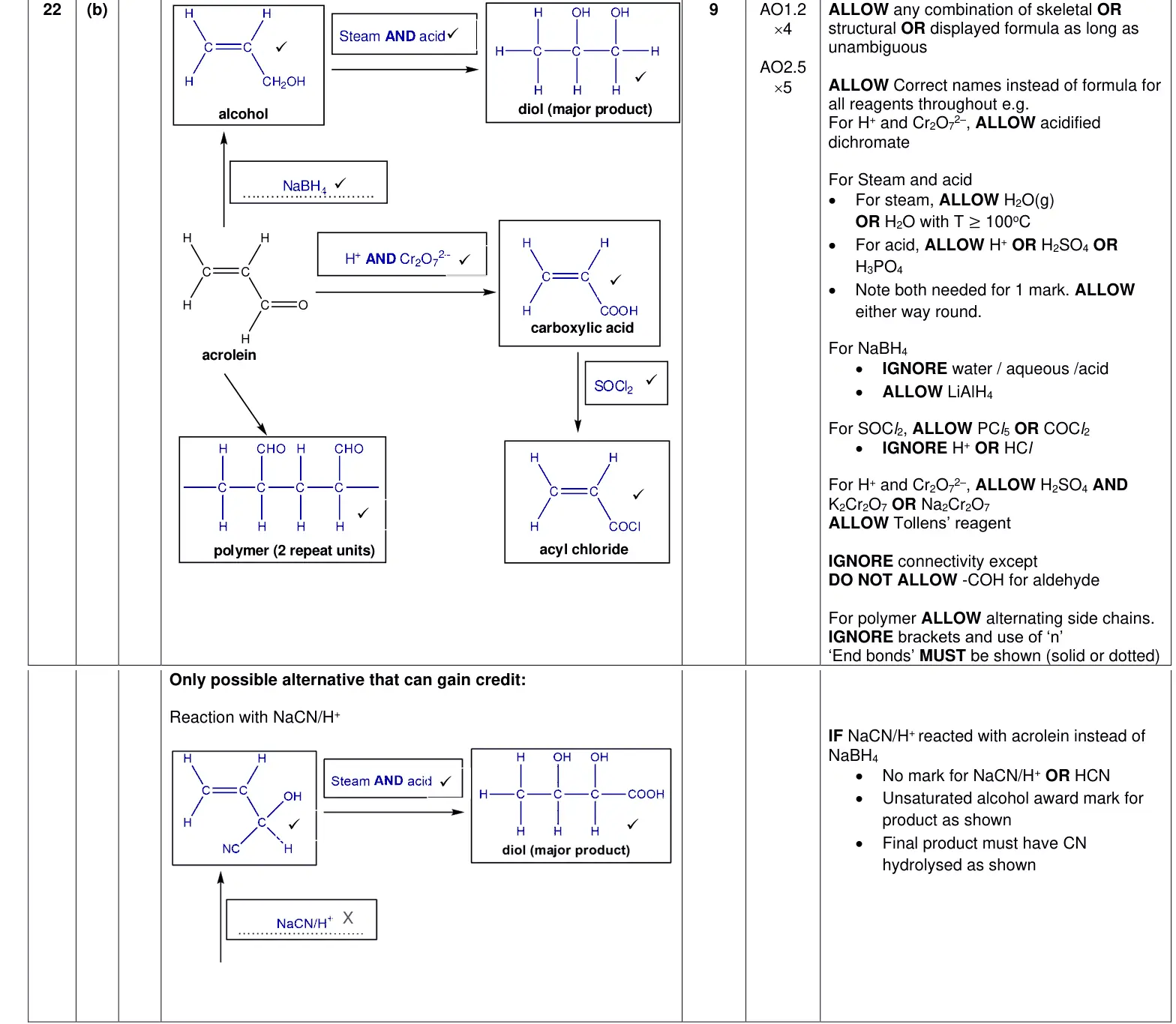
This question discriminated well. Many candidates were able to demonstrate an excellent knowledge of organic reactions and it was not uncommon to see scores of at least 7 marks. This question identified which candidates had learned their synthetic routes including necessary reagents and conditions. Marks were often lost for small details such as missing Hs (check all Cs have four bonds) or not specifying that steam is required for hydration of alkenes or missing the acid needed for oxidation. Many suggested the use of NaOH or just a mixture of acids to product the diol. The minor 1,3-diol or 1,1-diol product was often seen. The sequence leading to an acyl chloride from acrolein was usually the most well answered. However, quite a few tried to use HCl to make the acyl chloride. Many lost marks for the polymer for incorrect connectivity on the aldehyde, e.g. -COH or attempting to make a polymer via connection of the aldehyde group.
Notes from the mark scheme and report
NaBH4 gives H2C=CHCH2OH (C=C not reduced)
steam AND acid catalyst (both needed) gives propane-1,2-diol as major product
H+/Cr2O72– to H2C=CHCOOH
SOCl2 to acyl chloride
polymer with CHO side chains and end bonds
DO NOT ALLOW –COH for aldehyde
This topic guide provides a summary of synthetic routes. Copies of the summary posters without the conditions can be found on Teach Cambridge. This should be used in conjunction with the organic synthesis topic exploration pack.
June 2022 · AS Paper 1 · Q141 markAO1Multiple choiceHard
Answer
D
Mark scheme
Examiner's comment
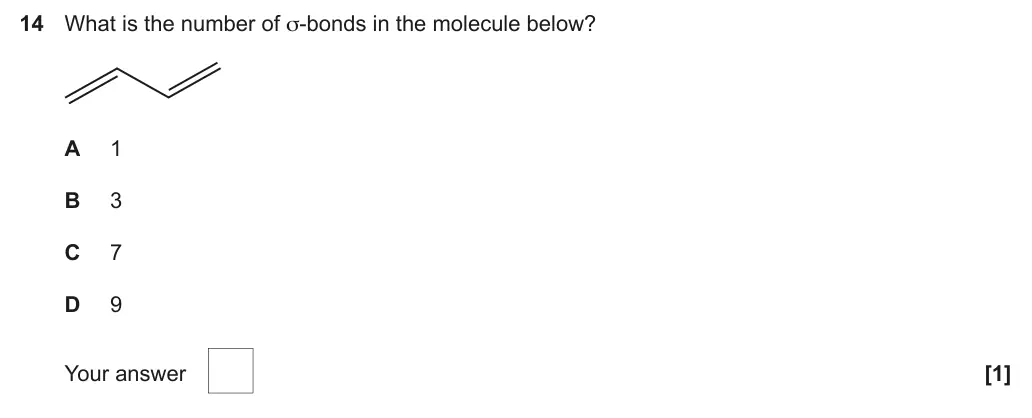
Candidates found this question difficult with very many choosing option B rather than the correct option D. Candidates are advised to draw out all bonds displayed when tackling such as question as the answer of B (3) results from considering just the three bonds shown in the skeletal formula and omitting the other 6 C–H bonds.
June 2022 · AS Paper 1 · Q171 markAO1Multiple choiceHard
Answer
D
Mark scheme
Examiner's comment
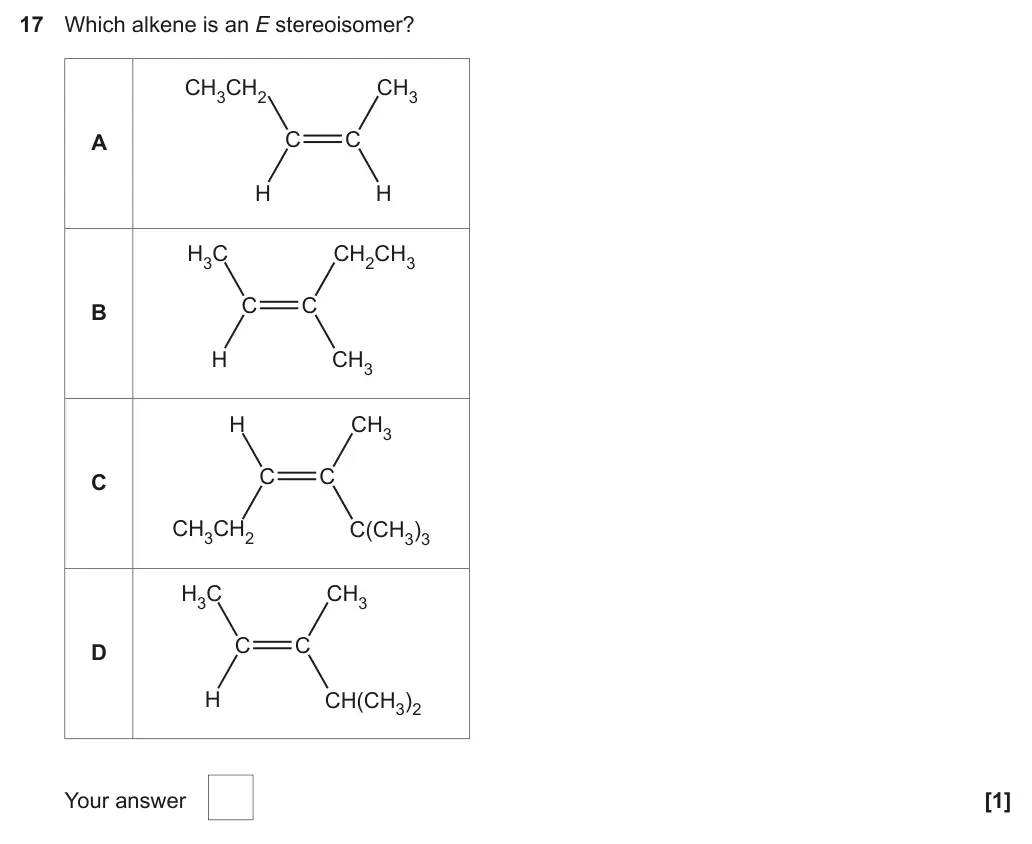
This was a difficult question, requiring candidates to use CIP rules along carbon chains. Higher-attaining candidates rose to the challenge but a variety of responses were seen, suggesting that many candidates guessed.
June 2022 · AS Paper 1 · Q21(a)(ii)5 marksAO1, 2MechanismMedium
Earlier part of question 21 that this part uses
Mark scheme
Examiner's comment
Many candidates answered the mechanism proficiently. However, many mistakes were seen with the direction of arrows, and confusing 𝛿+/ 𝛿– and +/– charges. In the intermediate carbocation, the C=C was often left intact and 𝛿– used on the bromide ion attacking the intermediate. Some less successful responses did not position curly arrows accurately. One common error was showing one or more C atoms missing from the (CH3)C groups. Candidates should take great care when drawing organic structures to make sure that all groups have been drawn accurately. This exemplar has been included to emphasise the importance of accurately placed curly arrows and use of charges. It was only possible to award this response 1 out of 5 marks. With a few improvements, this response could easily have been 5/5. The start of the first curly arrow has been placed accurately starting from the C=C double bond but the arrow should have finished at the Br𝛿+: 0 marks The Br–Br dipole is correct but there is no curly arrow showing it breaking: 0 marks The intermediate carbocation is correct but the curly arrow should have been shown from a lone pair on the Br– ion to the + charge of the carbocation: 0 marks The product is correct: 1 mark The reaction type is addition but the name of the mechanism is electrophilic addition: 0 marks nucleophilic substitution and radical substitution. This paper includes two of these in Questions 21 (a) (i) and 26 (a). It is essential that candidates learn these three mechanism types.
Notes from the mark scheme and report
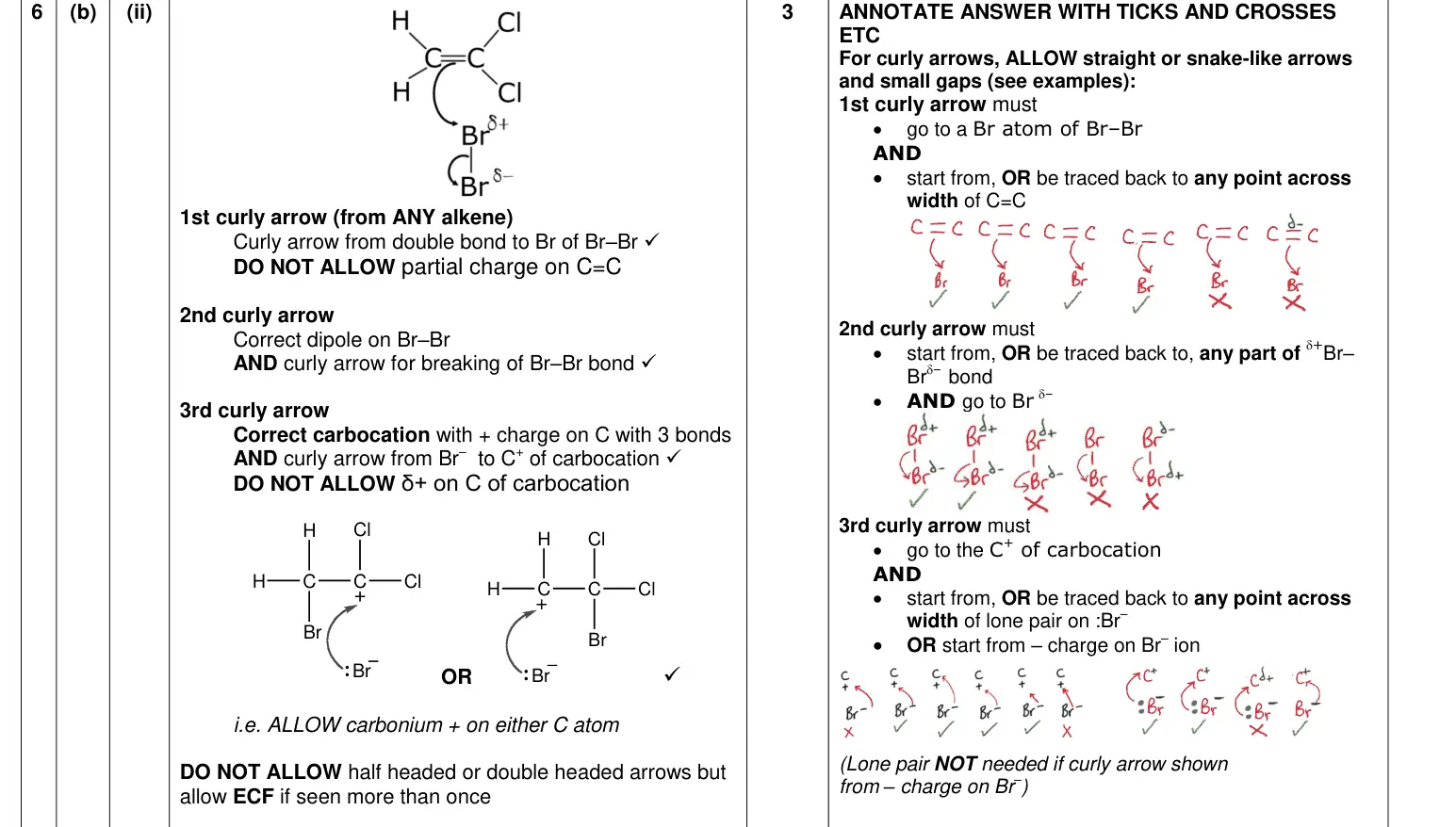
first curly arrow from the C=C bond to Br
dipole on Br–Br AND arrow for breaking Br–Br
carbocation needs full + (DO NOT ALLOW δ+)
arrow from lone pair or – charge of Br–
DO NOT ALLOW half-headed or double-headed arrows
mechanism with HBr loses final product mark
Reactions mechanisms are the organic chemist’s way of communicating electron transfers in organic chemistry. Candidates must use curly arrows, dipoles and charges appropriately and accurately. AS Chemistry includes three important reaction mechanisms: electrophilic addition,
June 2022 · AS Paper 1 · Q21(b)(i)1 markAO2Drawing / labellingHard
Earlier part of question 21 that this part uses
Mark scheme
Examiner's comment
Most candidates drew out the correct repeat unit although some less successful responses showed the molecule instead of the polymer. Missing ‘side’ bonds were very few as were attempts to connect to the CH3 group leaving the C=C intact. Where candidates made an error, it was often from missing out a C or a 3 from the side chain.
Notes from the mark scheme and report
side bonds required on either side of the repeat unit
IGNORE brackets and n
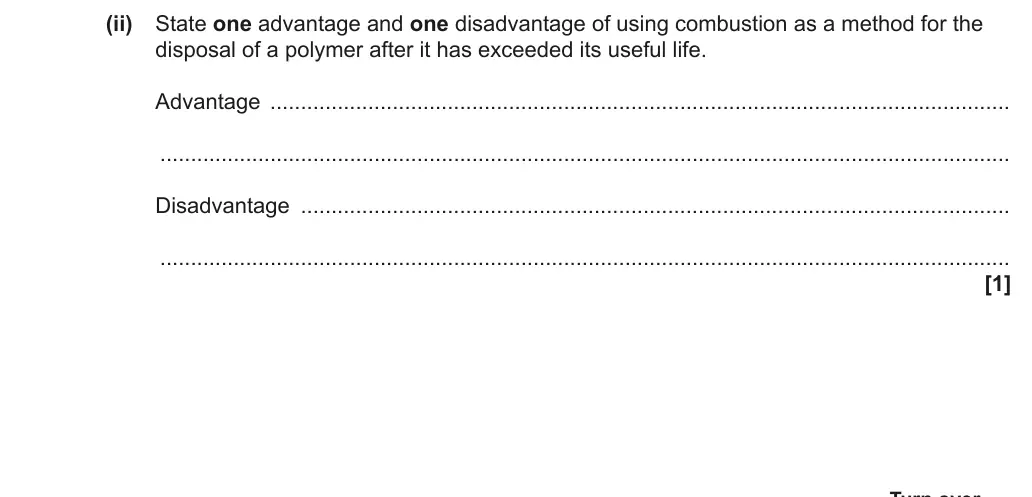
June 2022 · AS Paper 1 · Q21(b)(ii)1 markAO1Short answerMedium
Mark scheme
Examiner's comment
The responses to this question were highly variable. Many candidates correctly identified the disadvantage, usually in terms of CO2 release and global warming, but an advantage was less frequently seen. When it was seen it was almost universally about releasing energy. General hazard comments such as ‘harmless’; and ‘dangerous’ as too general and are never given marks at AS or A Level.
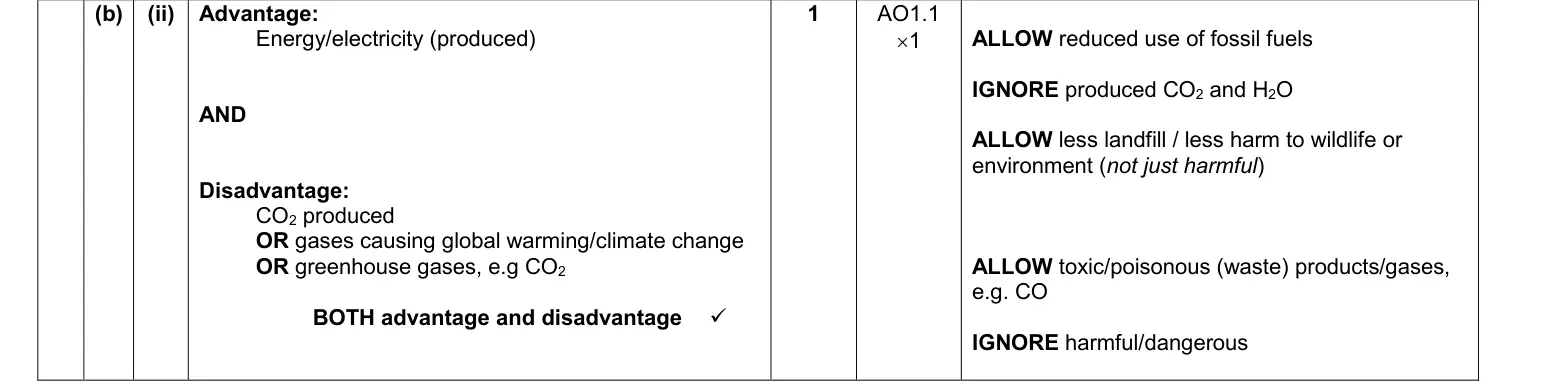
Notes from the mark scheme and report
BOTH advantage and disadvantage needed
IGNORE 'harmful/dangerous'
IGNORE 'produces CO2 and H2O'
June 2022 · Paper 2 · Q21 markAO1Multiple choiceHard
Answer
B
Mark scheme
Examiner's comment
Candidates found this multiple choice question challenging. While some identified B as the correct answer, many candidates selected C.
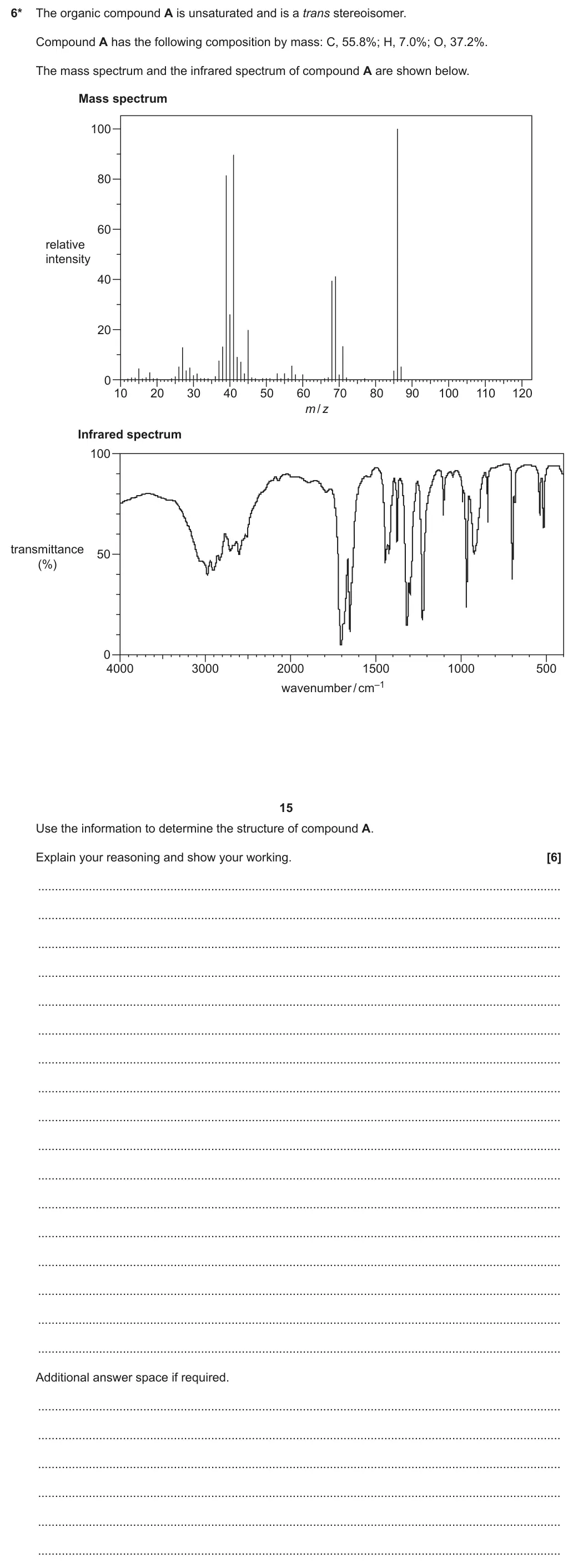
June 2022 · AS Paper 2 · Q66 marksAO36-mark level of responseMedium
Mark scheme, with the levels and indicative points
Examiner's comment
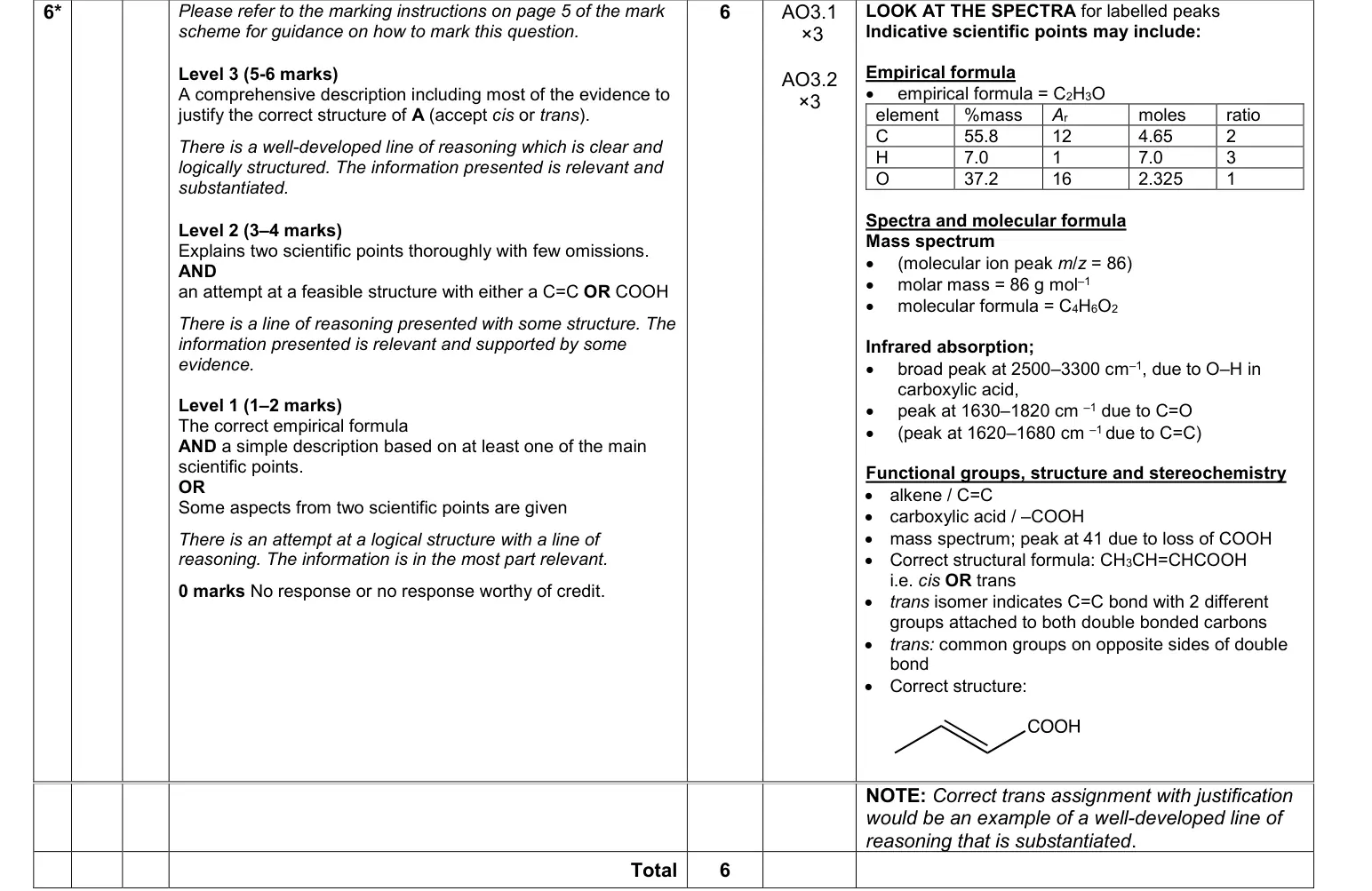
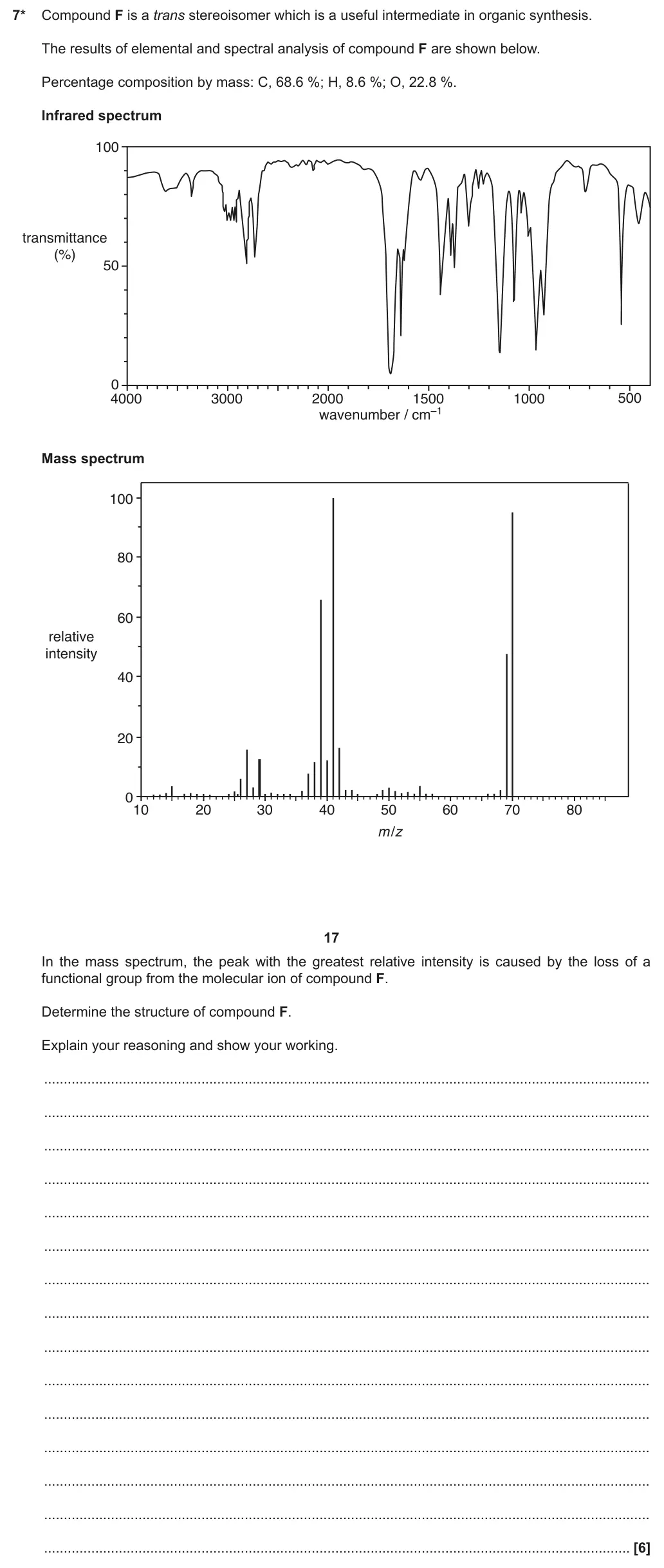
About a third of candidates were given Level 3 for this question. The key to answering this style of question well is to make sure all the information provided is used and to avoid contradictory statements, e.g. “structure contains carboxylic acid from IR” but then not present in final structure drawn, or a structure that doesn’t match the molecular formula given. A significant number of candidates did not include C=C despite being told in the question that it was “unsaturated and is a trans stereoisomer”, plus the C=C bond is shown in the IR and molecular formula needed unsaturation. The M+1 peak did confuse some candidates who then tried to add an extra H to final structure. It is very important that any structure given is feasible in terms of bonding; many candidates gave structures with C with 5 bonds (with both C=C and C=O attached), limiting them to achieving only L1. Some candidates gave a cis structure rather than trans. Other candidates ignored the O-H peak (from the carboxylic acid) in the IR spectrum, attributing this to a C-H bond as it was not as smooth or as prominent as they may have seen in other spectra. Some listed the bonds observed in the IR without linking to their position – this can easily be done by annotating the spectra. Many candidates had messy answers with lots of rough working which was then not crossed out – this made their answer very confusing. Note that no marks were given for just the empirical formula calculation and some attempted to produce a structure from the empirical formula without determining the Mr from the M+ peak in mass spectrum. This is an example of a good response which achieved L3 6 marks. Empirical and molecular formula are determined. Spectra have been annotated to aid their interpretation, but they have also included the key IR peaks as well as a MS fragment in their response. The correct structure for A is clearly drawn out. The response is clear and concise, with all information presented being relevant. If any of your students’ results are not as expected, you may wish to consider one of our post-results services. For full information about the options available visit the OCR website. We send a weekly roundup to tell you about important updates. You can also sign up for your subject specific updates. If you haven’t already, sign up here. Attend one of our popular CPD courses to hear directly from a senior assessor or drop in to a Q&A session. Most of our courses are delivered live via an online platform, so you can attend from any location. Please find details for all our courses on the relevant subject page on our website or visit OCR professional development. ExamBuilder is the question builder platform for a range of our GCSE, A Level, Cambridge Nationals and Cambridge Technicals qualifications. Find out more. ExamBuilder is free for all OCR centres with an Interchange account and gives you unlimited users per centre. We need an Interchange username to validate the identity of your centre's first user account for ExamBuilder. If you do not have an Interchange account please contact your centre administrator (usually the Exams Officer) to request a username, or nominate an existing Interchange user in your department. Review students' exam performance with our free online results analysis tool. It is available for all GCSEs, AS and A Levels and Cambridge Nationals. It allows you to: • review and run analysis reports on exam performance • analyse results at question and/or topic level • compare your centre with OCR national averages • identify trends across the centre • facilitate effective planning and delivery of courses • identify areas of the curriculum where students excel or struggle • help pinpoint strengths and weaknesses of students and teaching departments. Find out more. Post-results services Keep up-to-date OCR Professional Development Signed up for ExamBuilder?
Notes from the mark scheme and report
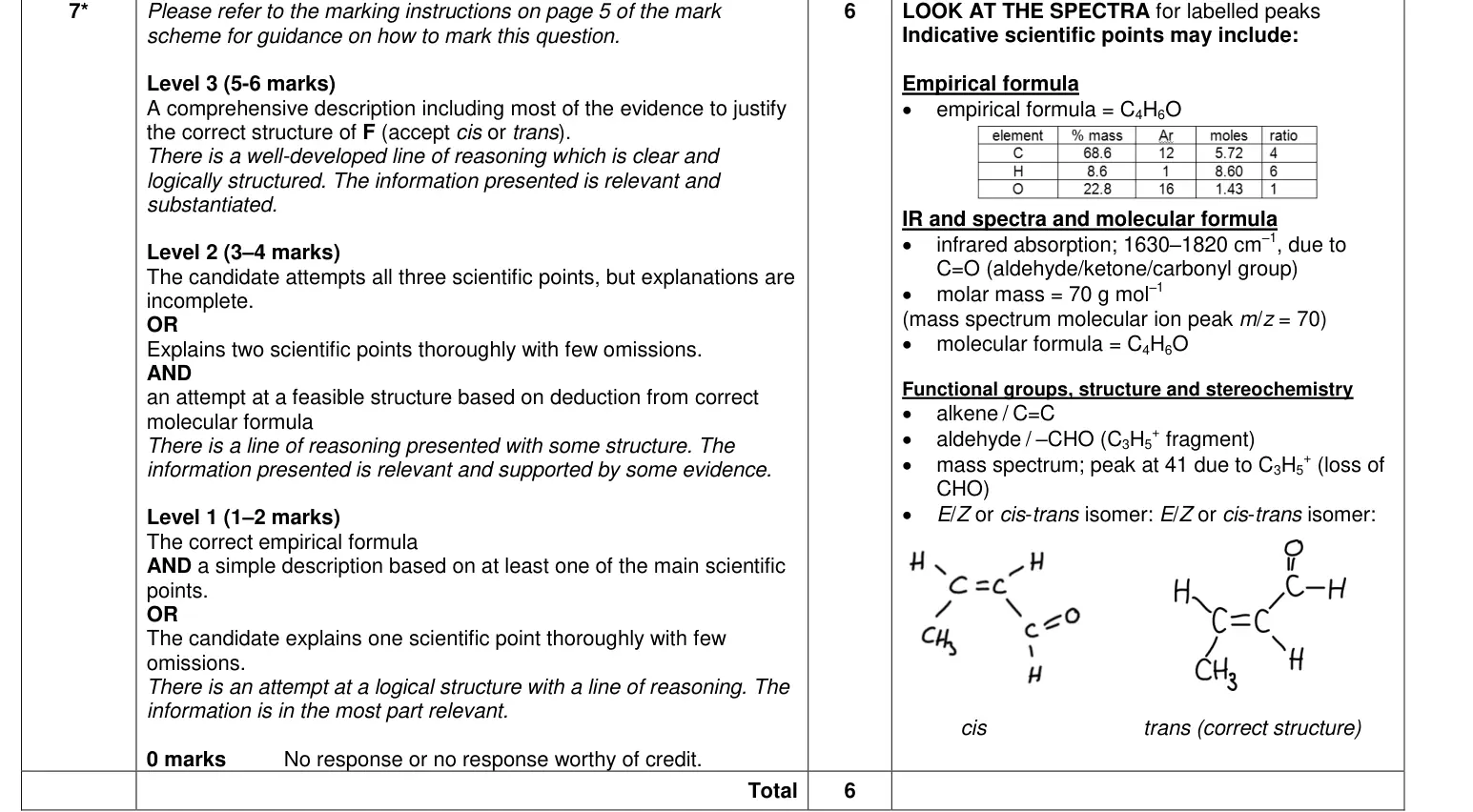
empirical formula C2H3O, M+ 86 so C4H6O2
broad O–H 2500–3300 and C=O 1630–1820 so carboxylic acid
peak at 41 from loss of COOH
CH3CH=CHCOOH drawn as trans isomer with justification (cis or trans accepted for structure)
We have put together a range of online resources to support teaching of organic chemistry: https://www.ocr.org.uk/qualifications/as-a-level-gce-chemistry-a-h032-h432-from-2015/delivery- guide/module-cam04-module-4-core-organic-chemistry/delivery-guide-cadg012-organic- chemistry-as
Skills: M0.2 Use ratios, fractions and percentages; M3.1 Translate information between graphical, numerical and algebraic forms; M4.2 Visualise and represent 2-D and 3-D forms including 2-D representations of 3-D objects
June 2022 · Paper 2 · Q91 markAO2Multiple choiceHard
Answer
C
Mark scheme
Examiner's comment
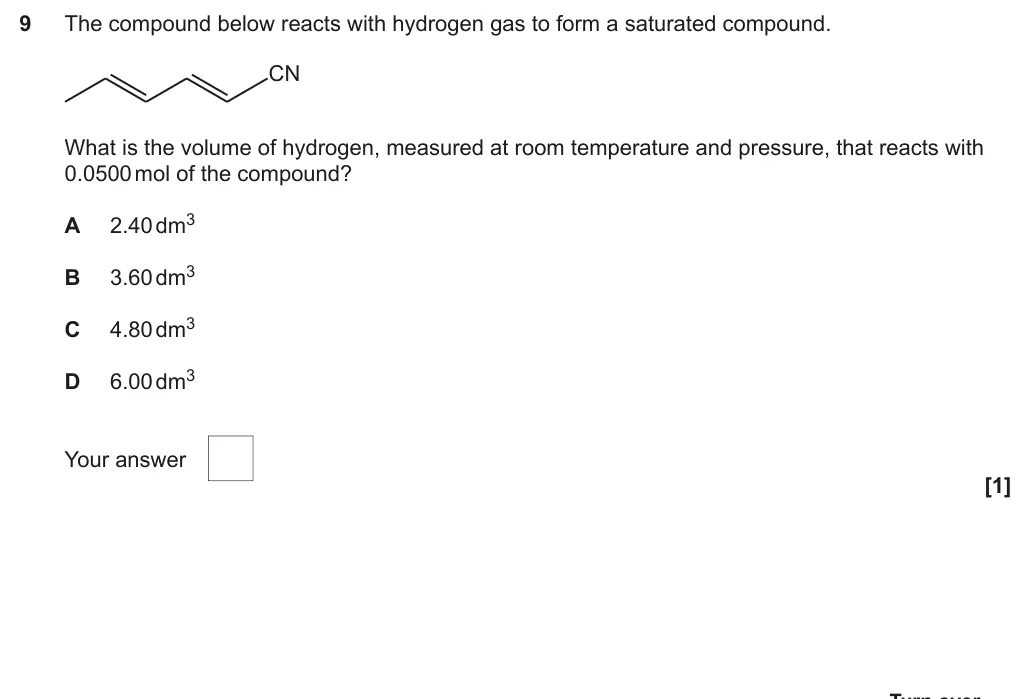
This question discriminated well, with higher ability candidates correctly identifying C as the volume of hydrogen produced. Many candidates overlooked the hydrogenation of the CN group and incorrectly selected option A.
June 2022 · Paper 2 · Q16(a)(ii)3 marksAO1, 2MechanismEasy
Earlier part of question 16 that this part uses
Mark scheme
Examiner's comment
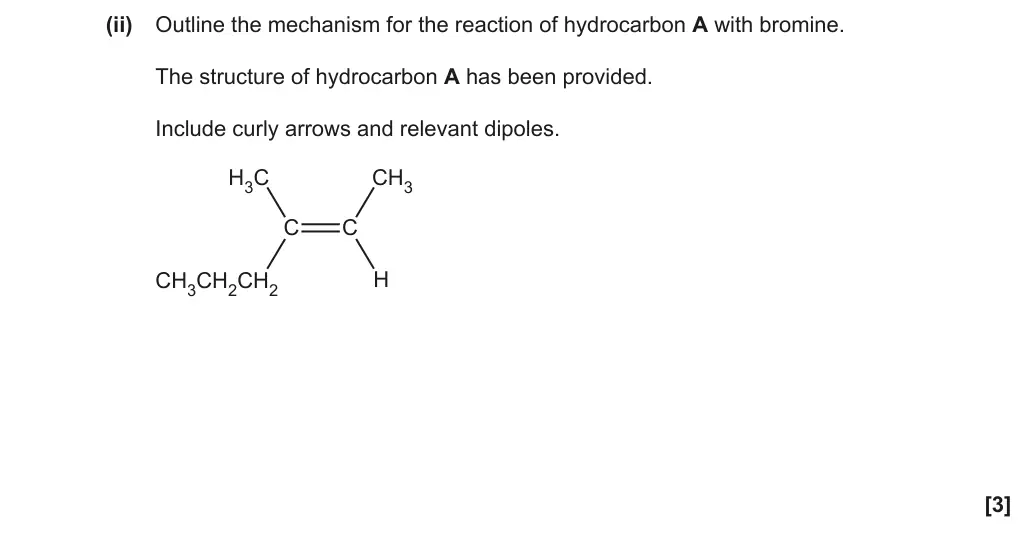
Candidates are familiar with the mechanism for the bromination of hydrocarbons. So, the majority of candidates scored 3 marks. Common errors included the use of HBr rather than Br2 or putting a dipole on the carbon-carbon double bond.
Notes from the mark scheme and report
curly arrow from C=C to Br AND dipole on Br–Br AND arrow breaking Br–Br
carbocation with full + AND arrow from lone pair/– charge of Br–
DO NOT ALLOW partial charge on C=C
DO NOT ALLOW half-headed arrows
DO NOT ALLOW use of HBr
ALLOW bromonium ion
June 2022 · Paper 2 · Q16(b)(ii)1 markAO1Short answerMedium
Earlier part of question 16 that this part uses
Mark scheme
Examiner's comment
This definition was well known by candidates with the majority of responses given the mark. Some candidates omitted the reference to structural formula.
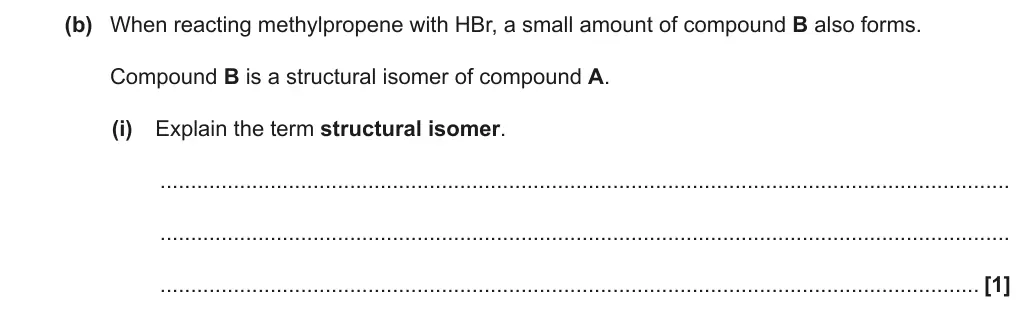
Notes from the mark scheme and report
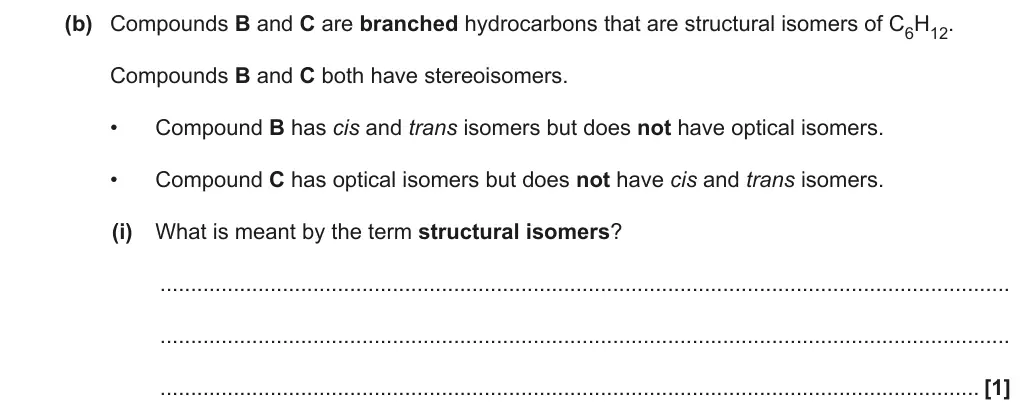
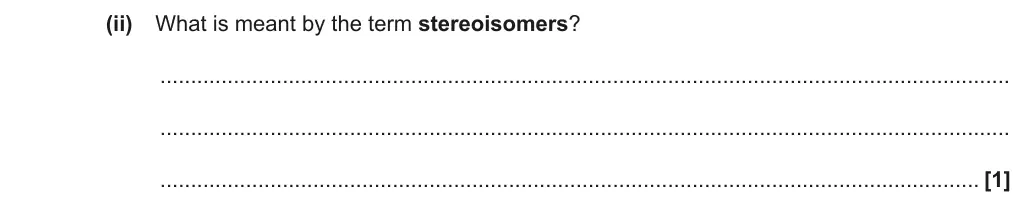
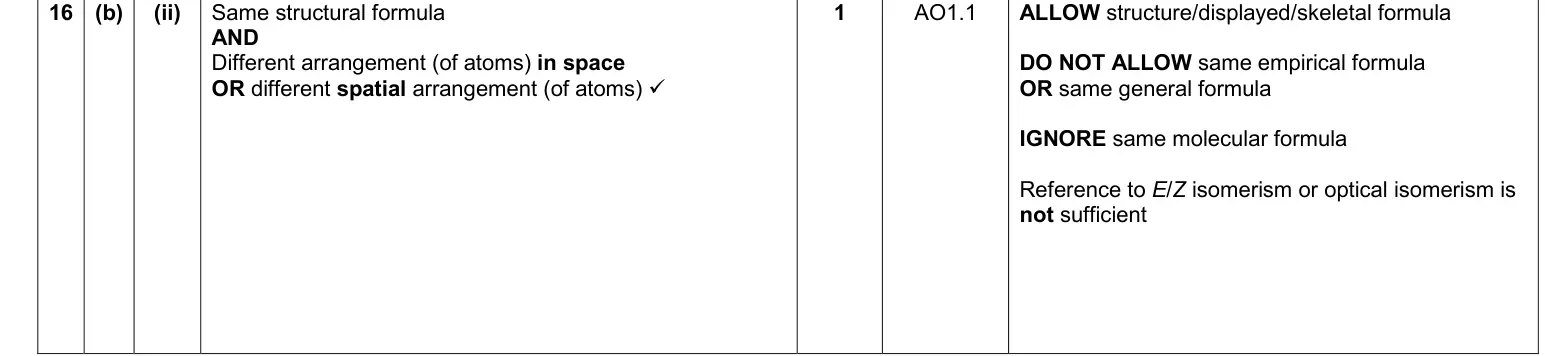
same structural formula AND different arrangement in space
DO NOT ALLOW same empirical/general formula
IGNORE same molecular formula
naming E/Z or optical isomerism is not sufficient
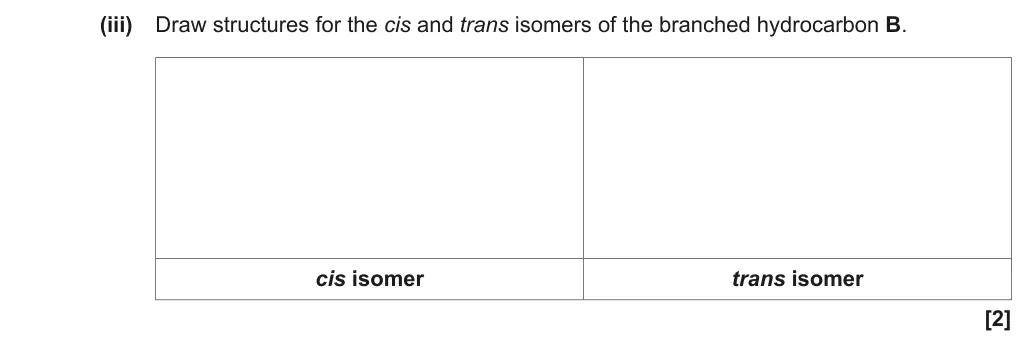
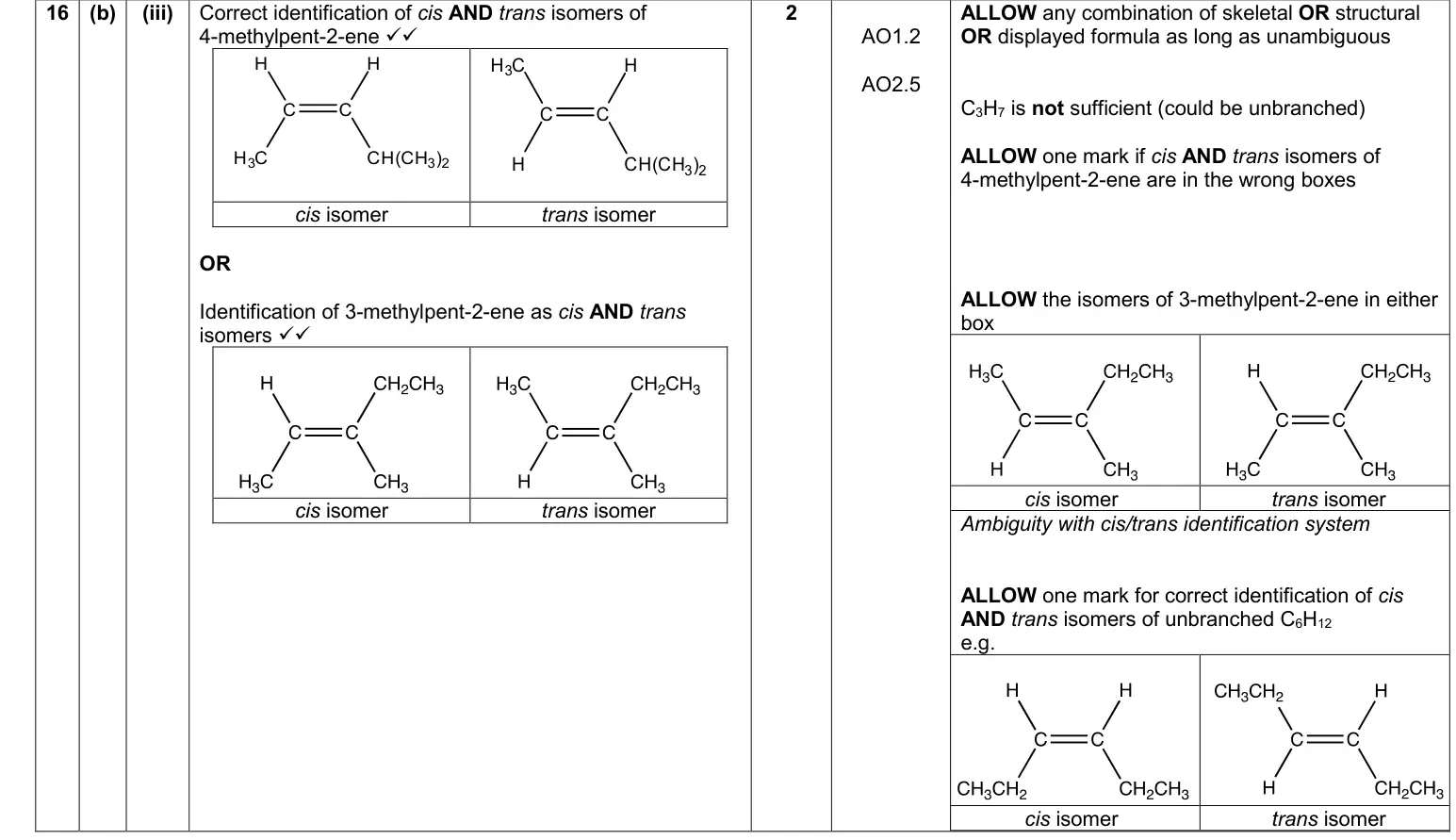
June 2022 · Paper 2 · Q16(b)(iii)2 marksAO1, 2Structure / isomerEasy
Earlier part of question 16 that this part uses
Mark scheme
Examiner's comment
This question required candidates to link their knowledge of cis and trans isomers with branched hydrocarbons. Higher ability candidates were able to do this. The majority of candidates scored 1 mark for correctly drawing cis and trans isomers of an unbranched hydrocarbon.
Notes from the mark scheme and report
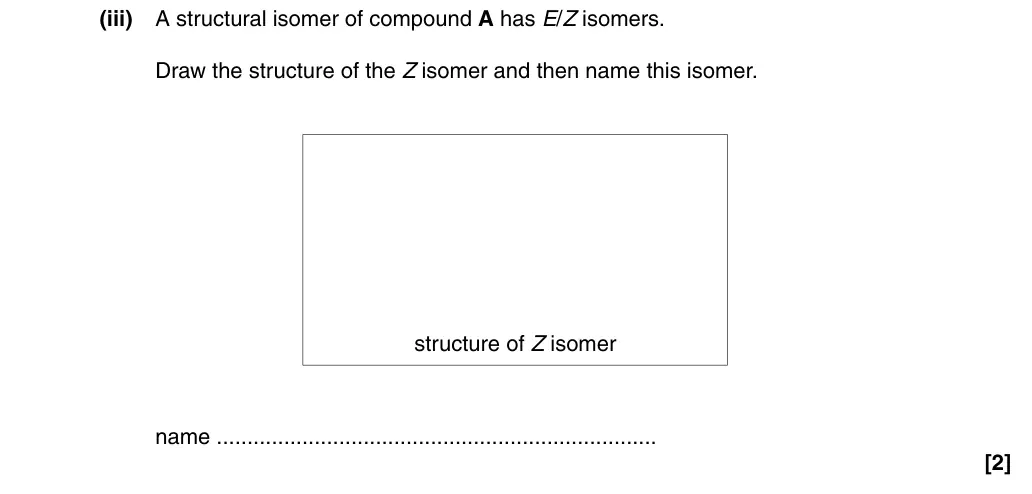
4-methylpent-2-ene cis and trans (ALLOW 3-methylpent-2-ene in either box)
C3H7 not sufficient (could be unbranched)
1 mark if in wrong boxes or for cis/trans of an unbranched C6H12
Skills: M4.2 Visualise and represent 2-D and 3-D forms including 2-D representations of 3-D objects; M4.3 Understand the symmetry of 2-D and 3-D shapes
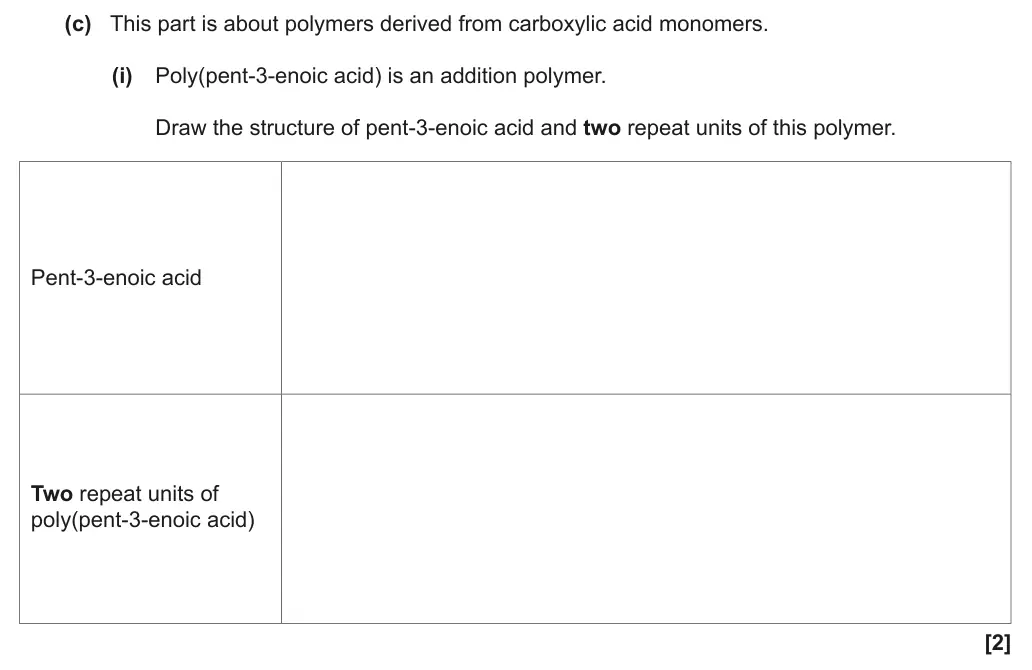
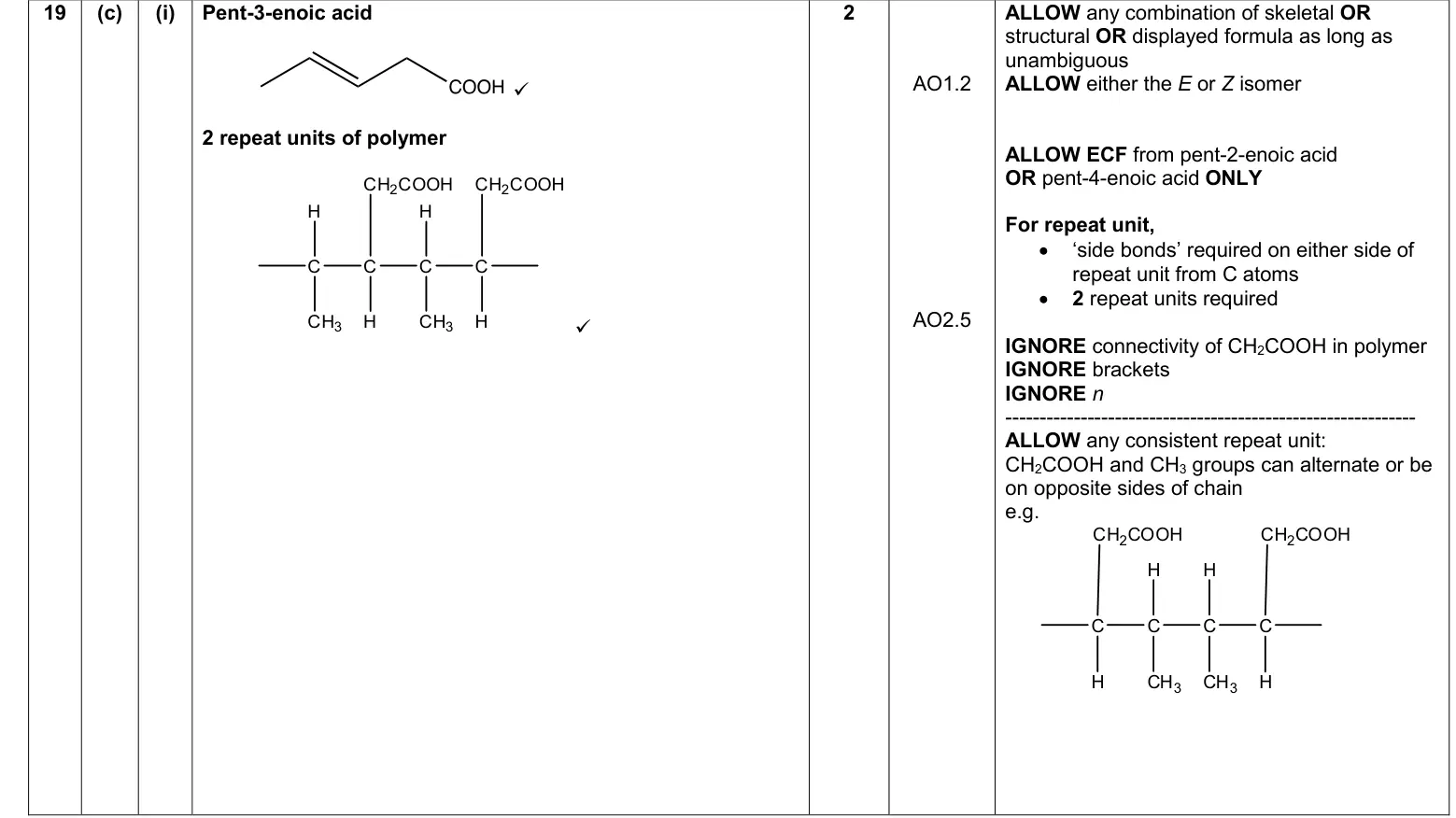
June 2022 · Paper 2 · Q19(c)(i)2 marksAO1, 2Structure / isomerMedium
Mark scheme
Examiner's comment
Most candidates were given at least 1 mark with many correctly drawing the structure of pent-3-enoic acid. Common errors included drawing pent-2-enoic acid or propenoic acid, suggesting a lack of knowledge of prefixes. The second mark required candidates to draw two repeat units, frequently candidates tried to draw repeat units linking the carboxylic acid groups rather than identifying that it is the carbon-carbon double bond that breaks.
Notes from the mark scheme and report
CH3CH=CHCH2COOH (E or Z)
two repeat units with side bonds
ECF only from pent-2-enoic or pent-4-enoic acid
IGNORE brackets and n
June 2022 · Paper 2 · Q20(e)4 marksAO2, 3Short answerHard
Mark scheme
Examiner's comment
This question proved challenging with only the most able being given full marks. The reagents and conditions were not well known and candidates did not include water in their equations to make sure they were balanced.
Notes from the mark scheme and report
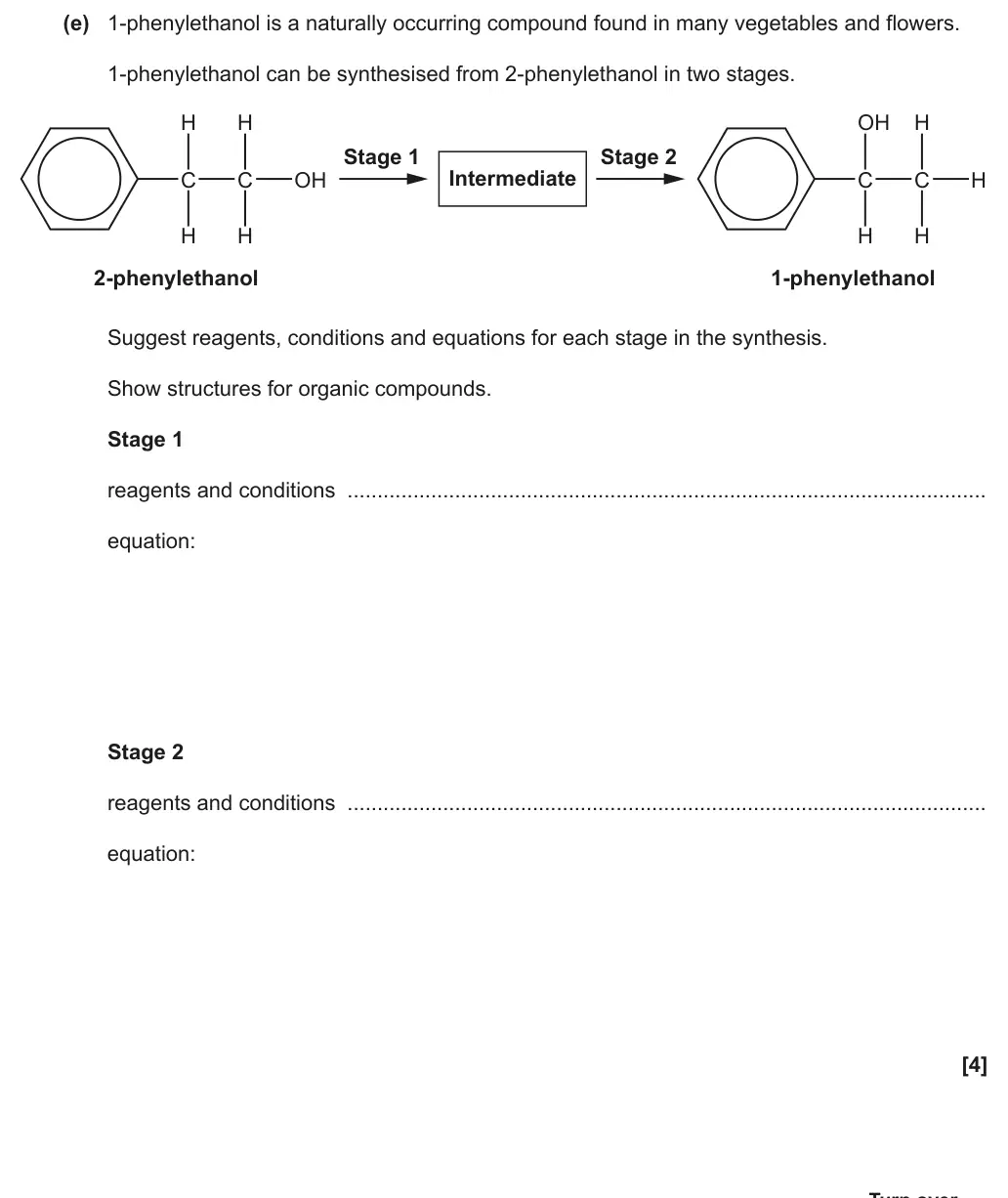
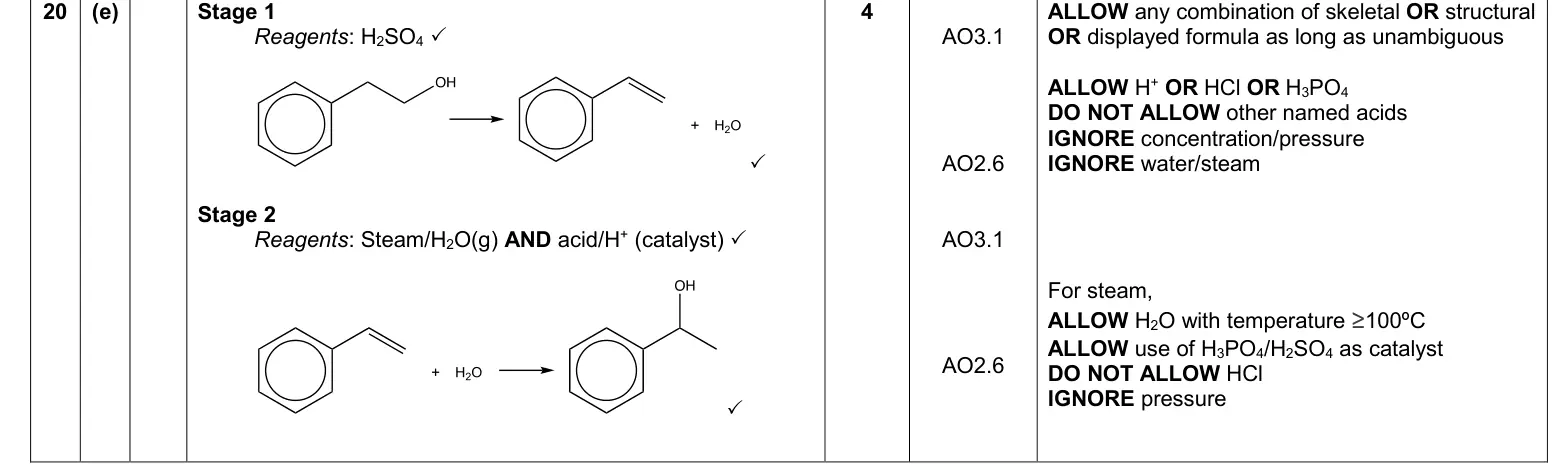
stage 1: acid catalyst H2SO4/H3PO4 (heat) eliminates H2O to give phenylethene (DO NOT ALLOW HCl)
stage 2: steam with acid catalyst gives 1-phenylethanol (Markownikoff)
equations with structures needed
November 2021 · AS Paper 1 · Q131 markAO2Multiple choice
Answer
B
Mark scheme
Notes from the mark scheme and report
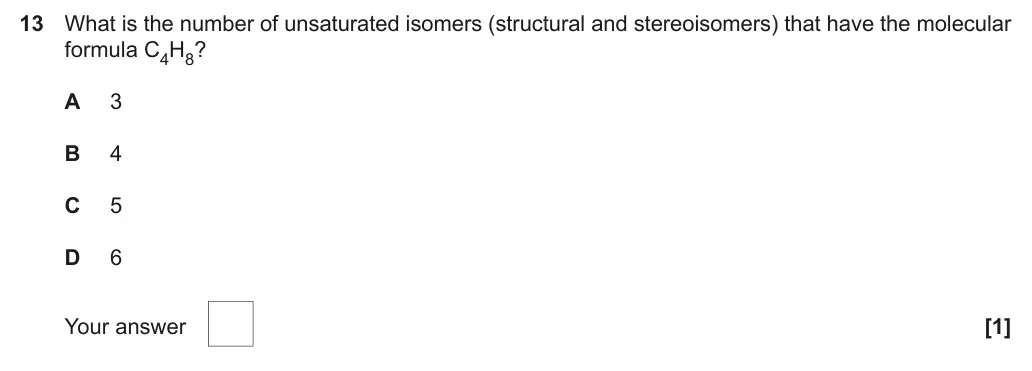
ALLOW 4
Skills: M4.2 Visualise and represent 2-D and 3-D forms including 2-D representations of 3-D objects
November 2021 · AS Paper 1 · Q161 markAO1Multiple choice
Answer
B
Mark scheme
November 2021 · AS Paper 1 · Q201 markAO2Multiple choice
Answer
A
Mark scheme
November 2021 · AS Paper 1 · Q24(a)4 marksAO1, 2Mechanism
Mark scheme
Notes from the mark scheme and report
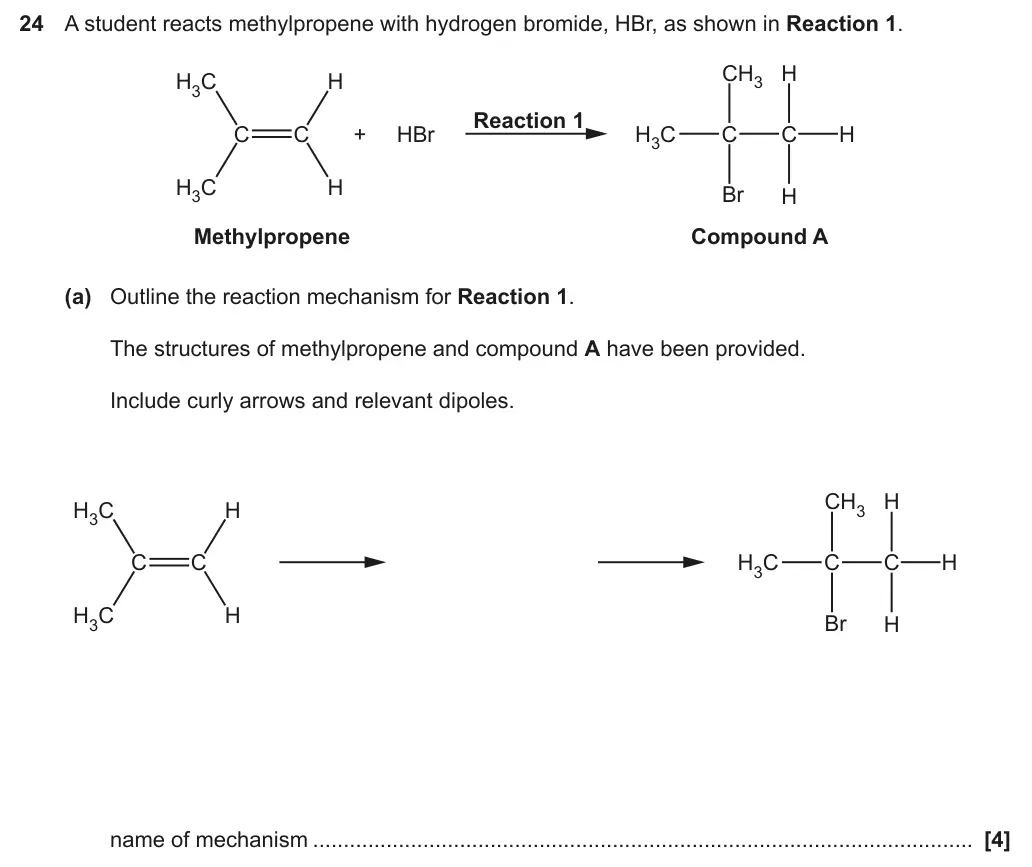
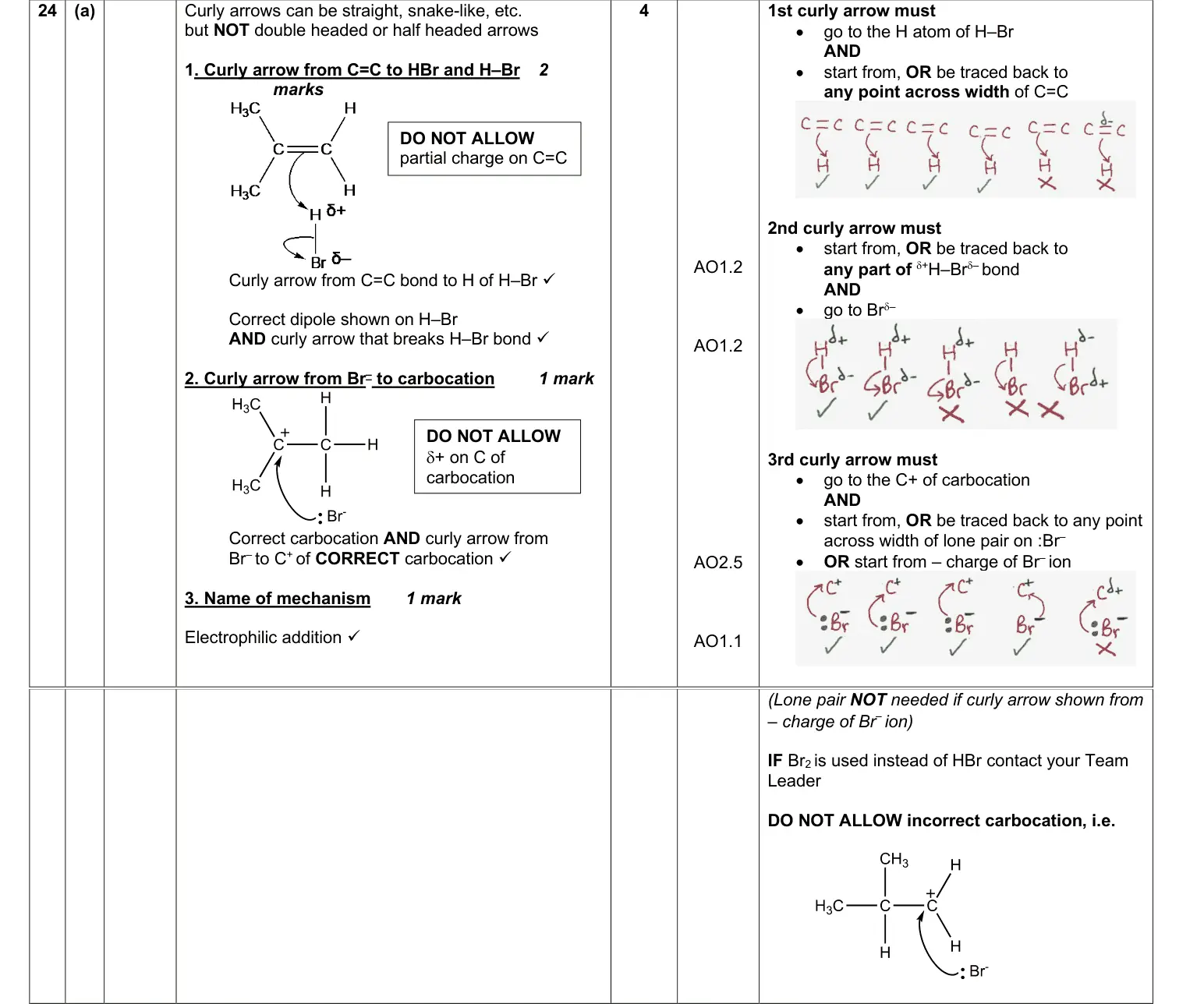
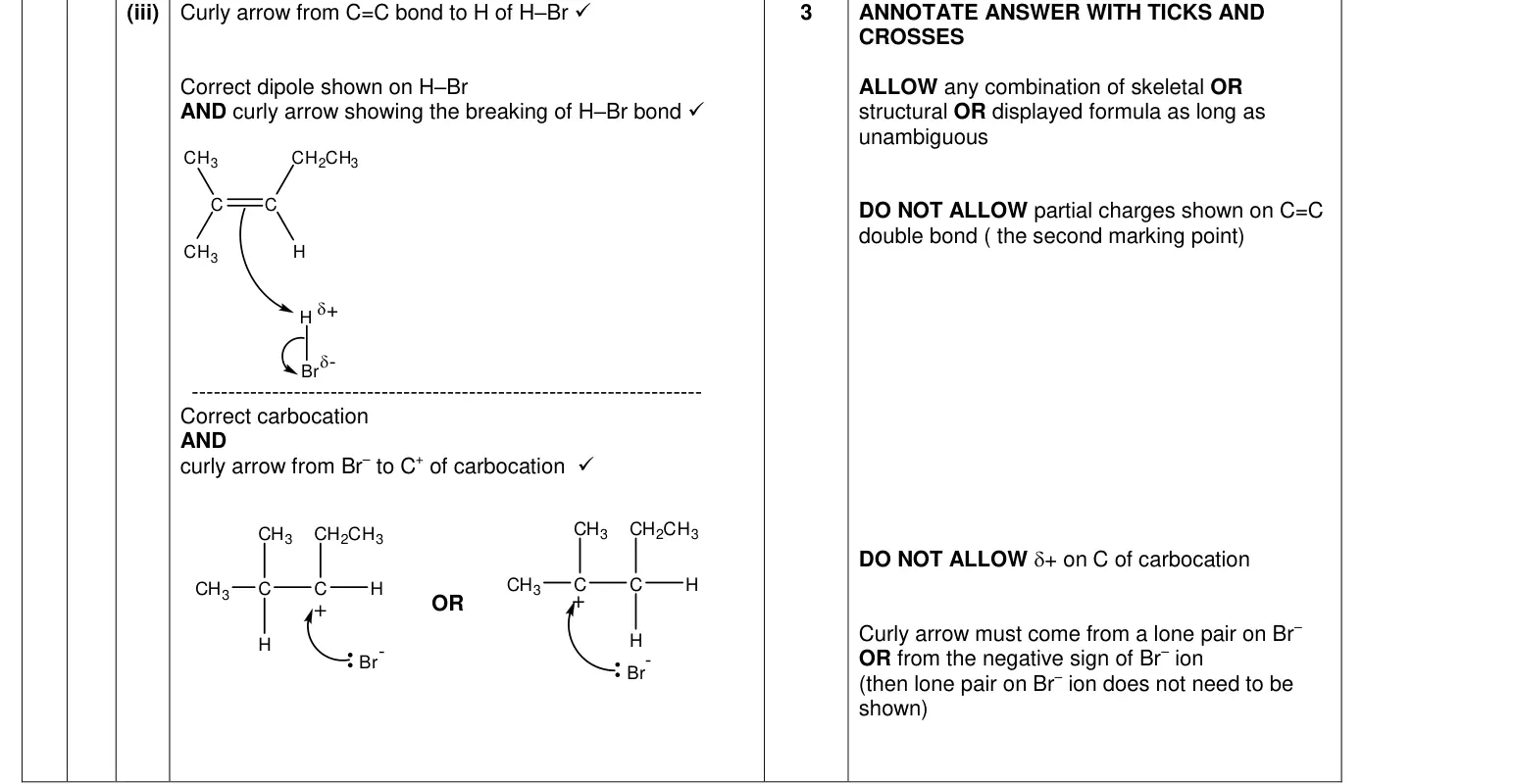
curly arrow from C=C to H of H–Br
dipole on H–Br and arrow breaking H–Br
arrow from Br– lone pair/charge to C+ of the correct (tertiary) carbocation
DO NOT ALLOW partial charge on C=C or δ+ on carbocation
DO NOT ALLOW incorrect carbocation
November 2021 · AS Paper 1 · Q24(b)(ii)1 markAO2Short answer
Earlier parts of question 24 that this part uses
Mark scheme
Notes from the mark scheme and report
1-bromo-2-methylpropane
ALLOW any unambiguous formula
November 2021 · Paper 2 · Q21 markMultiple choice
Answer
B
Mark scheme
November 2021 · Paper 2 · Q16(a)(i)2 marksAO1Short answerHard
Mark scheme
Examiner's comment
Question 16(a)(i): These definitions were known by few candidates.
Notes from the mark scheme and report
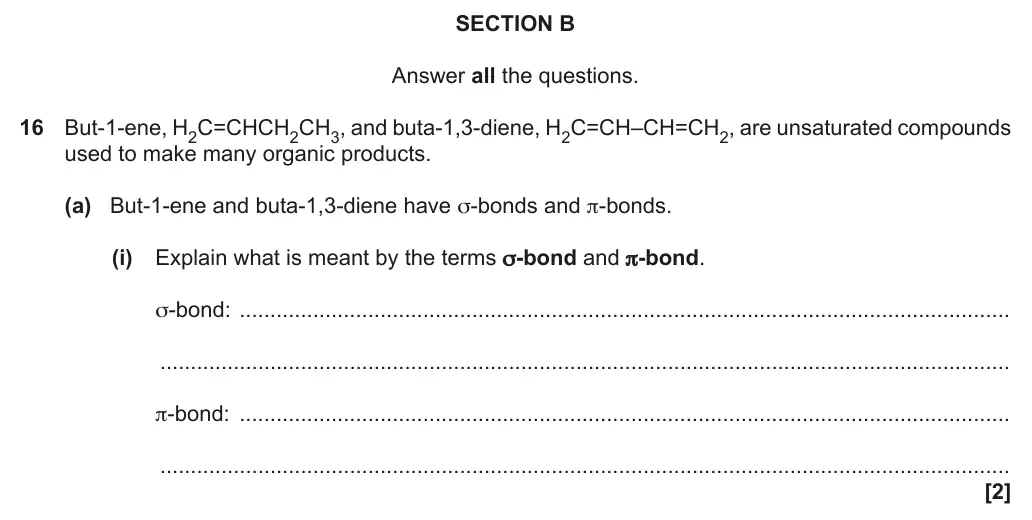
σ: overlap of orbitals directly between the bonding atoms
π: sideways overlap of p-orbitals
DO NOT ALLOW pi-orbital
November 2021 · Paper 2 · Q16(a)(ii)2 marksAO1Short answer
Earlier part of question 16 that this part uses
Mark scheme
Notes from the mark scheme and report
9 σ-bonds and 2 π-bonds
November 2021 · Paper 2 · Q16(b)(i)4 marksAO1, 2MechanismEasy
Mark scheme
Examiner's comment
Question 16(b)(i): This was answered well by students.
Notes from the mark scheme and report
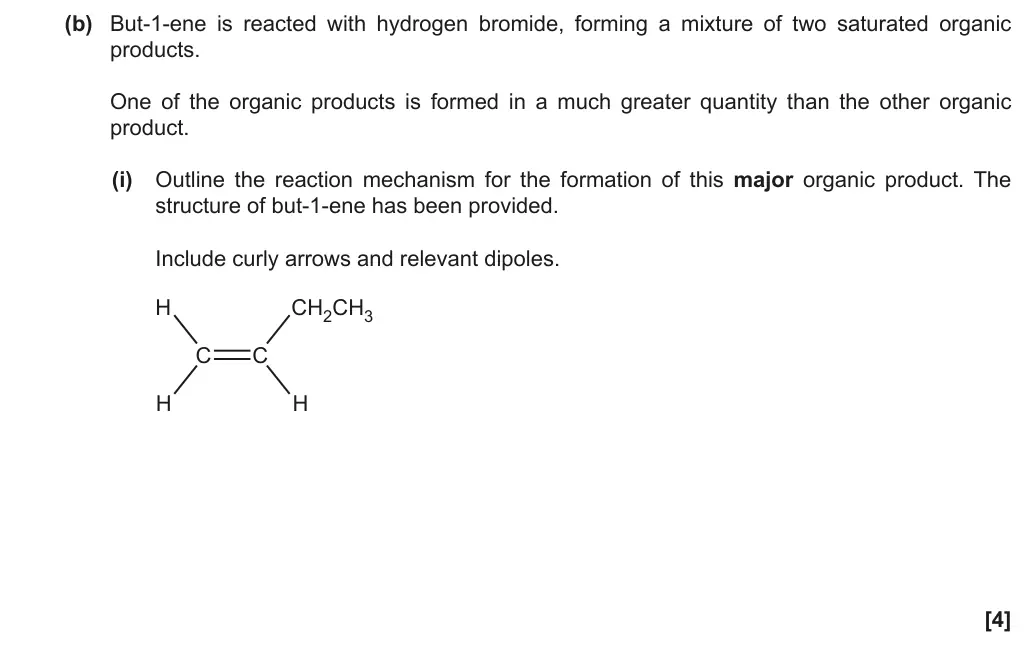
curly arrow from C=C to H of H–Br
dipole on H–Br AND arrow breaking H–Br
secondary carbocation (DO NOT ALLOW δ+ on C) with arrow from lone pair/charge of Br–
DO NOT ALLOW partial charge on C=C
ALLOW ECF product from incorrect carbocation
November 2021 · Paper 2 · Q16(b)(ii)2 marksAO1Short answer
Earlier part of question 16 that this part uses
Mark scheme
Notes from the mark scheme and report
major product via the more stable secondary carbocation
IGNORE Markownikoff descriptions (H joins C with most H) and stability of the product
November 2021 · Paper 2 · Q16(b)(iii)1 markAO1Short answer
Earlier part of question 16 that this part uses
Mark scheme
Notes from the mark scheme and report
3
November 2021 · Paper 2 · Q16(c)(i)1 markAO1Short answer
Mark scheme
Notes from the mark scheme and report
same structural formula AND different arrangement in space
DO NOT ALLOW same empirical/general formula
naming E/Z or optical alone not sufficient
November 2021 · Paper 2 · Q16(c)(ii)1 markAO3Short answer
Earlier part of question 16 that this part uses
Mark scheme
Notes from the mark scheme and report
not correct AND two groups on one carbon of each C=C are the same OR the C–C single bond can rotate
DO NOT ALLOW 'one side of C=C'
Skills: M4.2 Visualise and represent 2-D and 3-D forms including 2-D representations of 3-D objects
November 2021 · Paper 2 · Q17(b)(i)1 markAO2Drawing / labelling
Mark scheme
Notes from the mark scheme and report
end bonds MUST be shown
DO NOT ALLOW more than one repeat unit
IGNORE brackets and n
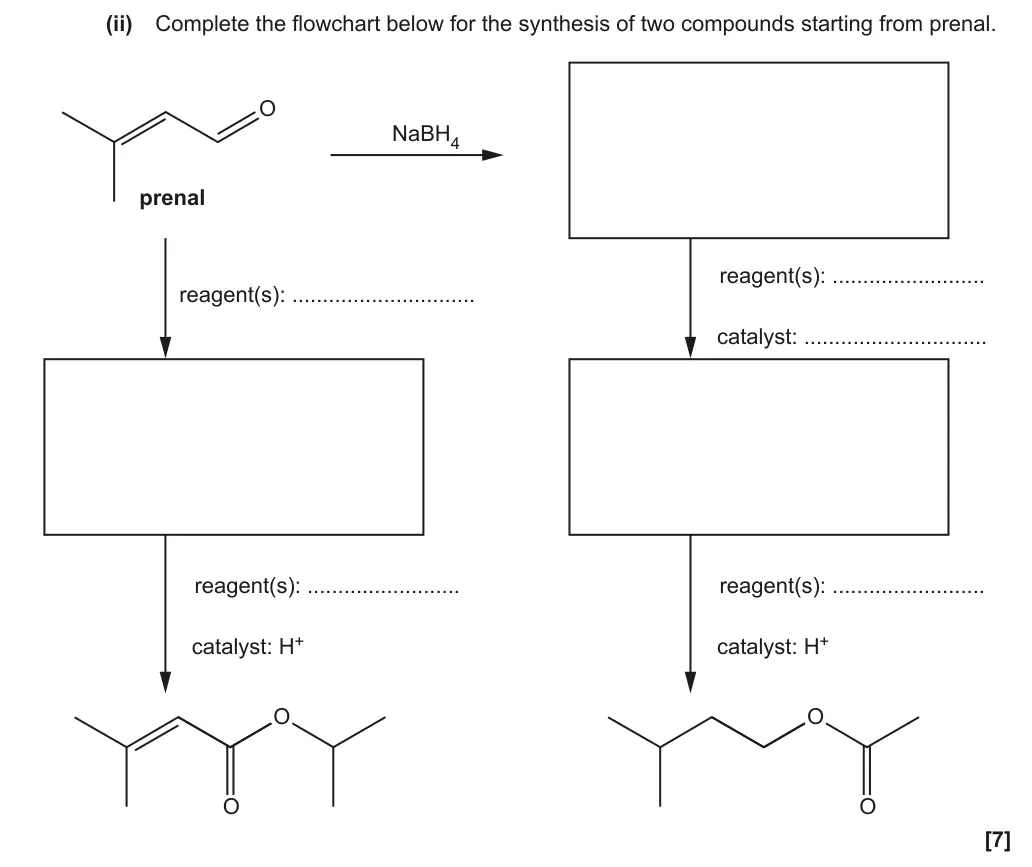
November 2021 · Paper 2 · Q19(a)(ii)7 marksAO1, 2Short answer
Earlier part of question 19 that this part uses
Mark scheme
Notes from the mark scheme and report
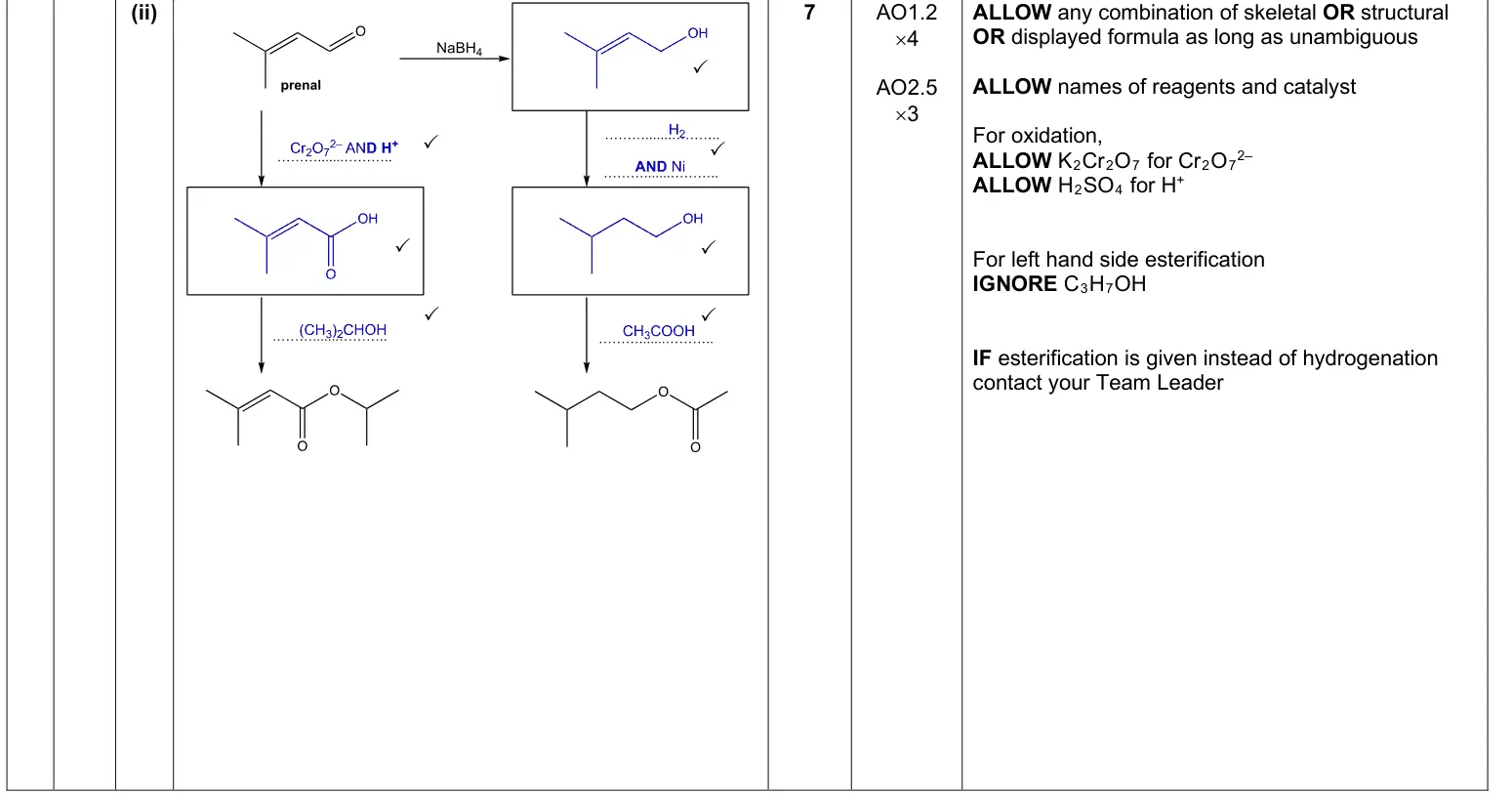
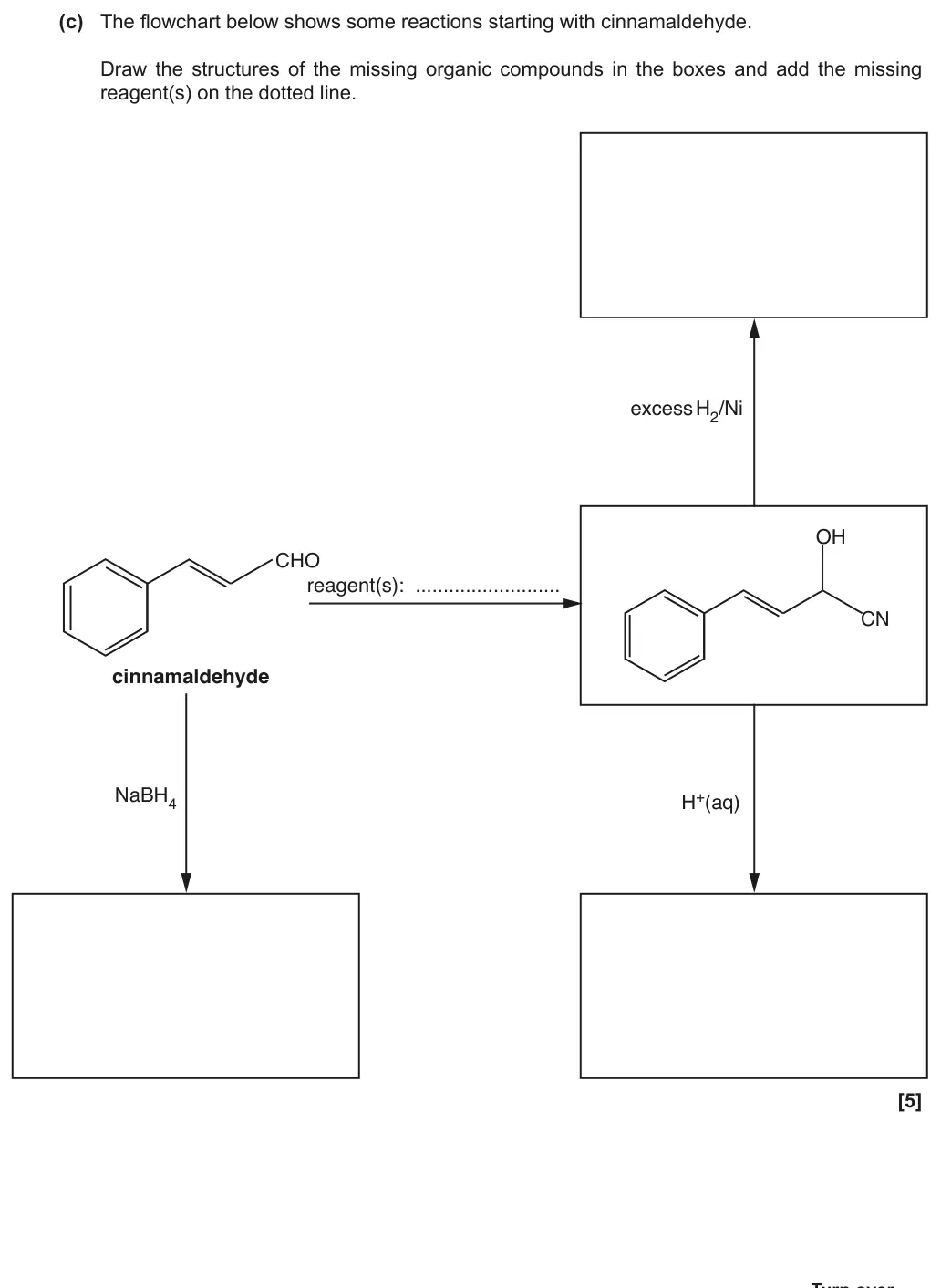
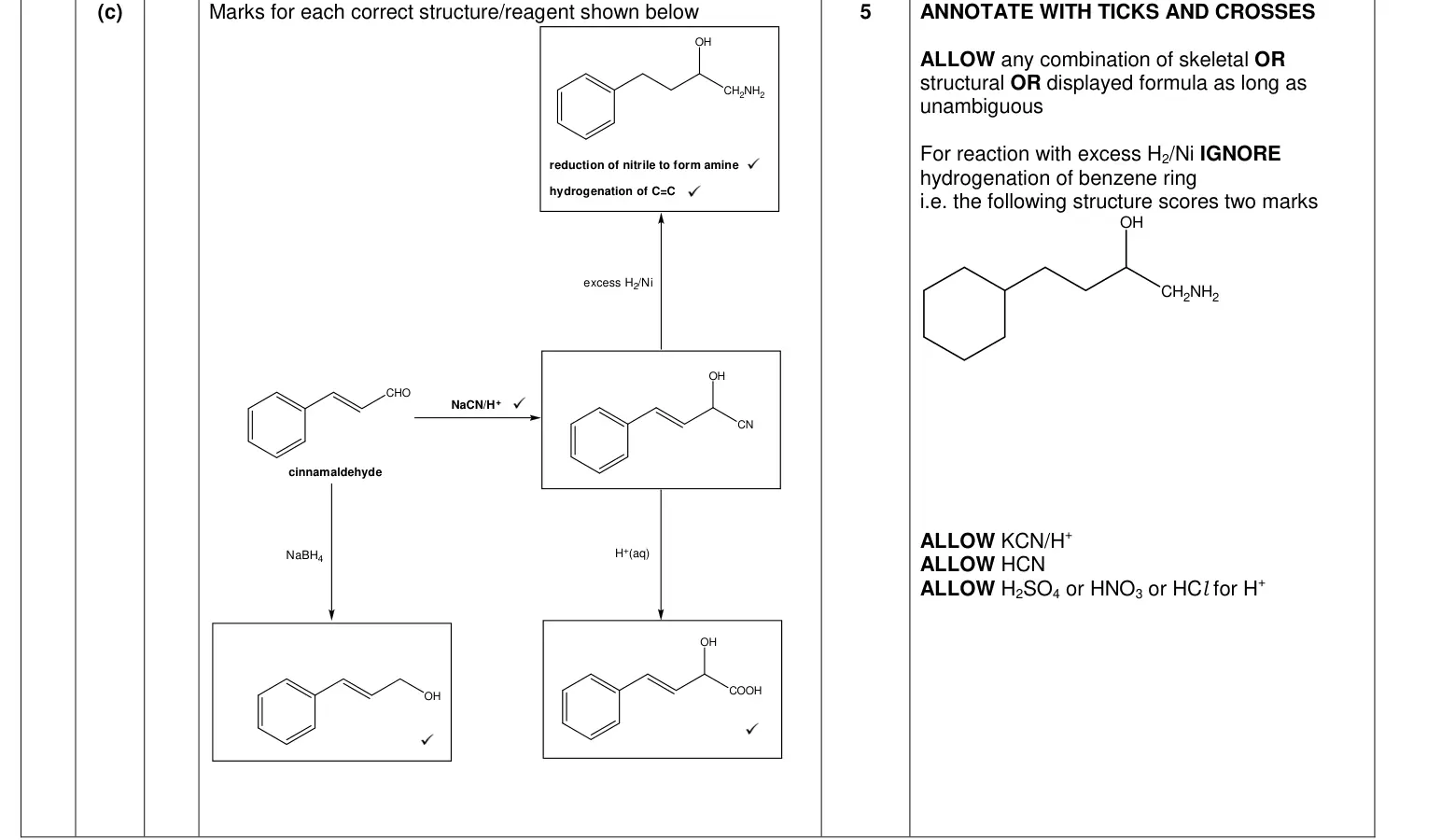
NaBH4 reduces C=O only (unsaturated alcohol)
then H2 AND Ni
then CH3COOH/H+
left route Cr2O72– AND H+ to unsaturated acid then (CH3)2CHOH/H+
ALLOW names of reagents
November 2021 · Paper 2 · Q20(a)(ii)2 marksAO2Short answer
Earlier part of question 20 that this part uses
Mark scheme
Notes from the mark scheme and report
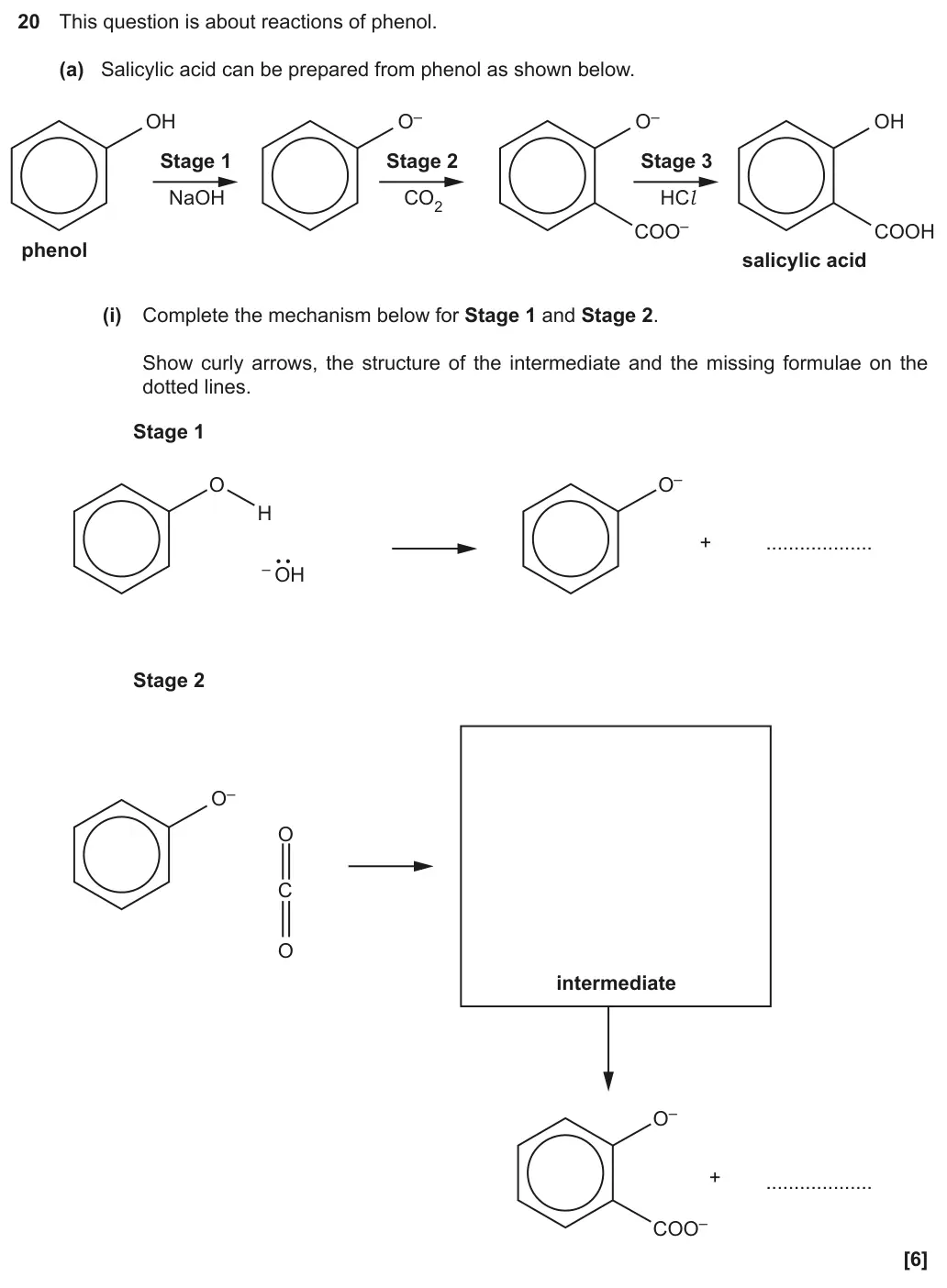
OH–: base (IGNORE nucleophile / donates electron pair)
CO2: electrophile / electron pair acceptor (IGNORE lone pair acceptor)
November 2021 · Paper 3 · Q3(b)7 marksAO2, 3Data interpretationHard
Earlier part of question 3 that this part uses
Mark scheme
Examiner's comment
Q1(a) Partial pressure calculation Q1(d) Formula determination from percentage composition by mass Q2(b) Converting mass and volume into moles Q3(b) Unstructured titration calculation Q5(a)(ii) Ideal gas calculation Q5(b)(i) Calculation of the pH of a weak acid • Produced clear and concise responses for a Level of Response question based on a familiar context i.e., Q4(b) rates by continuous monitoring and graphical analysis. • Had difficulty when answering questions requiring application of knowledge and understanding on questions set in novel and unfamiliar contexts, e.g. Q3(b): As with Question 2, candidates had more success with the mole calculation in Q3(b) than the descriptive response in Q3(a). See also comments made for Q1(e) and Q3(b).
Notes from the mark scheme and report
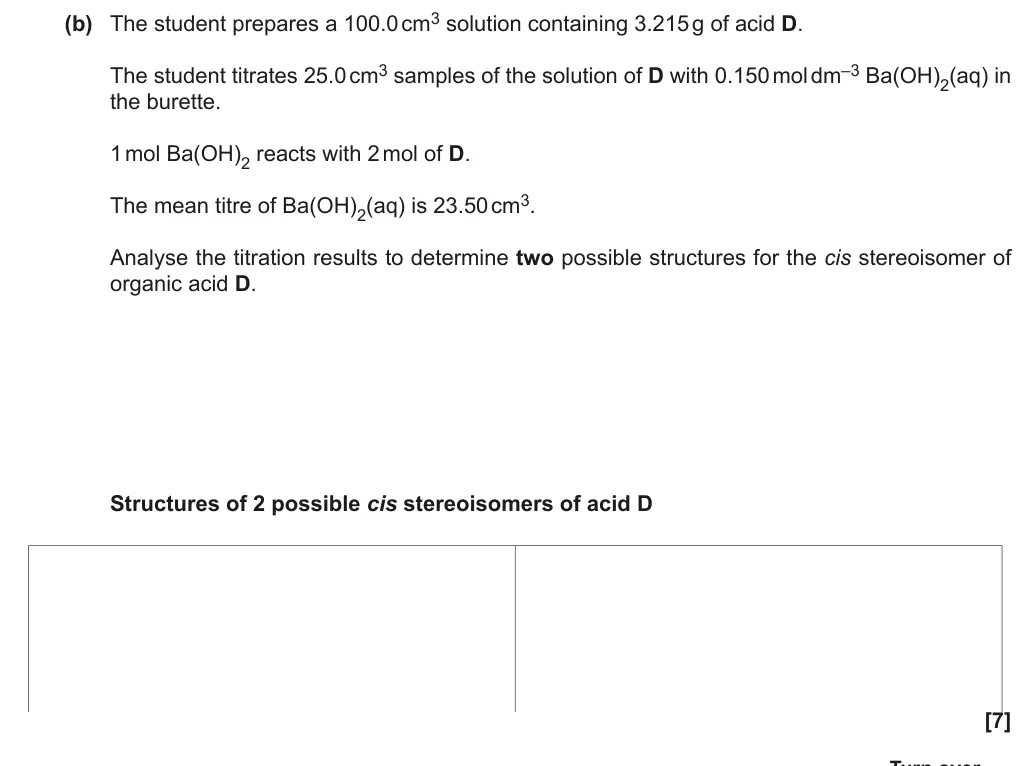
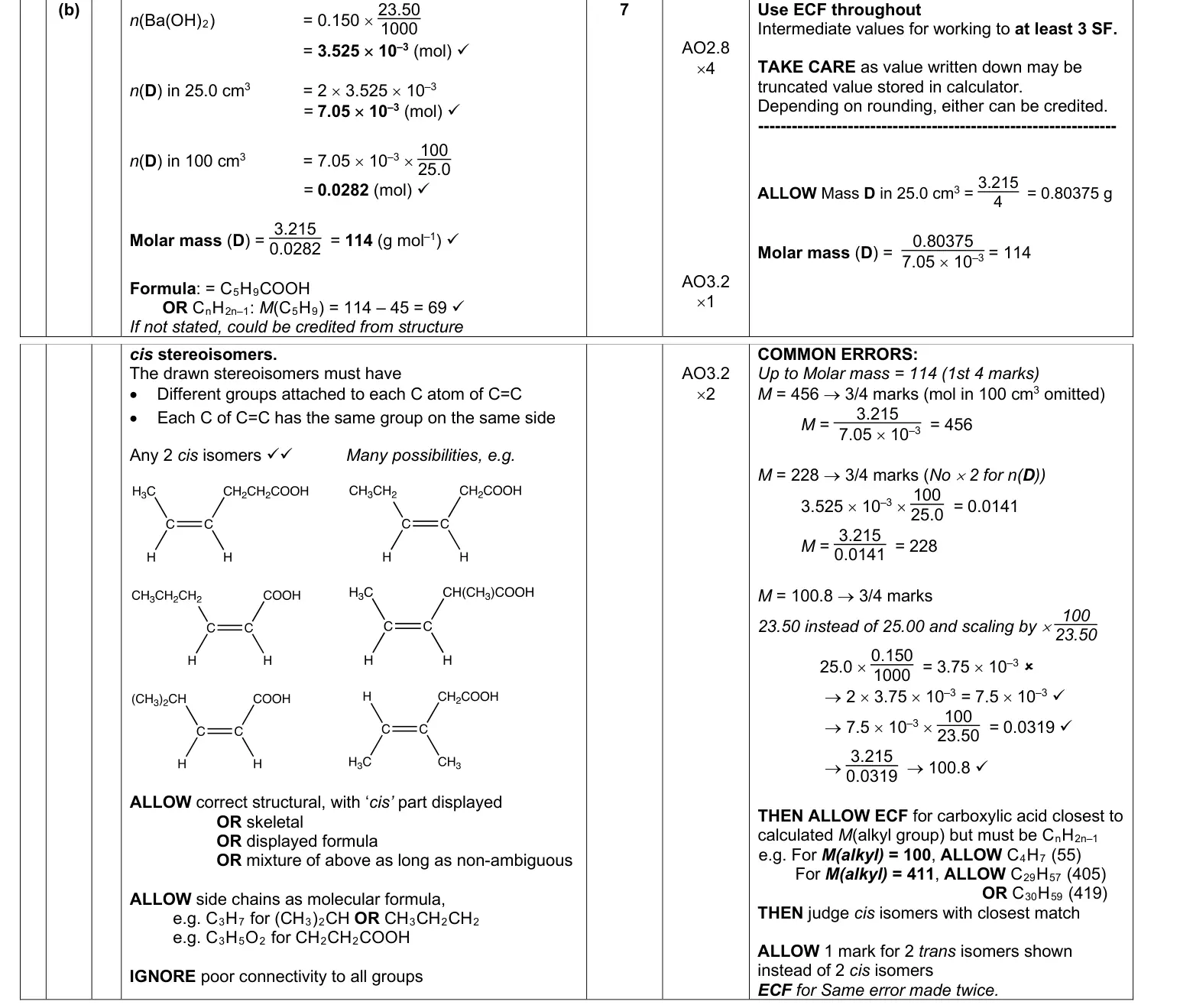
n(D) in 25 cm3 = 2 × 3.525 × 10–3
×4 for 100 cm3
M = 114 so C5H9COOH
any 2 cis isomers with different groups on each C of C=C
common errors: scaling omitted (M = 456), no × 2 (M = 228), 25.00 used as titre (M = 100.8)
1 mark for 2 trans isomers
Skills: M0.2 Use ratios, fractions and percentages; M2.3 Substitute numerical values into algebraic equations using appropriate units for physical quantities; M4.2 Visualise and represent 2-D and 3-D forms including 2-D representations of 3-D objects; PAG2 Acid–base titration
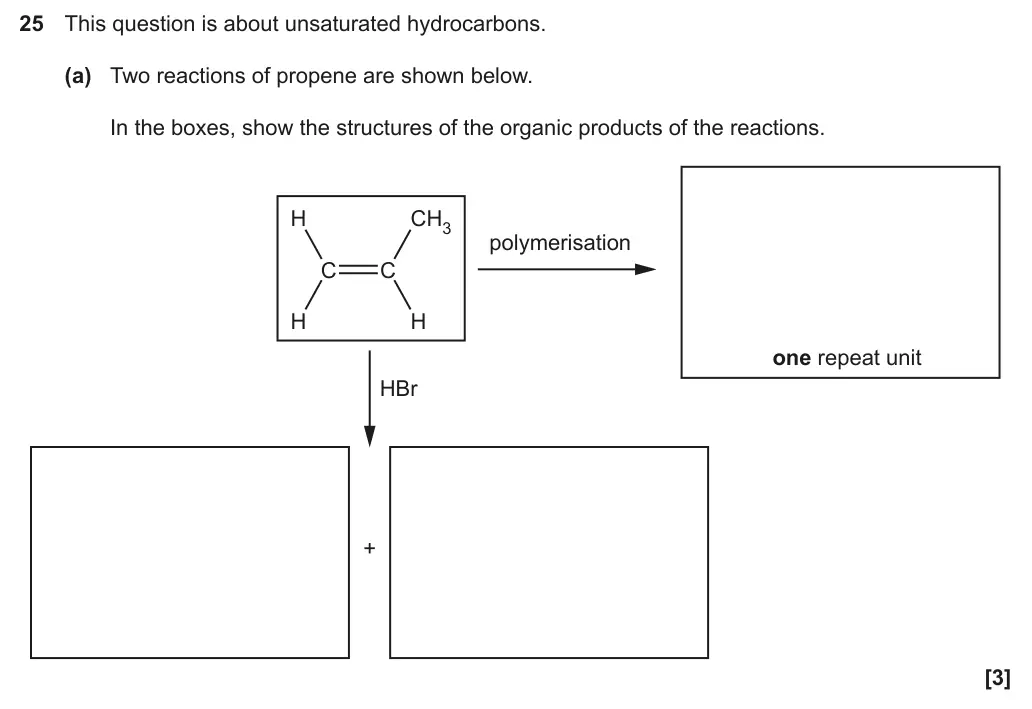
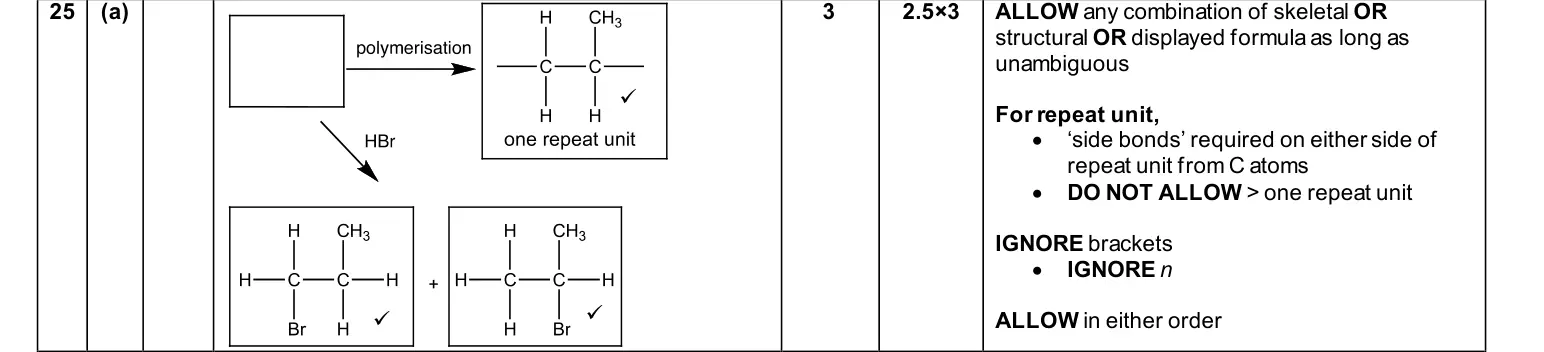
November 2020 · AS Paper 1 · Q25(a)3 marksAO2Structure / isomerMedium
Mark scheme
Examiner's comment
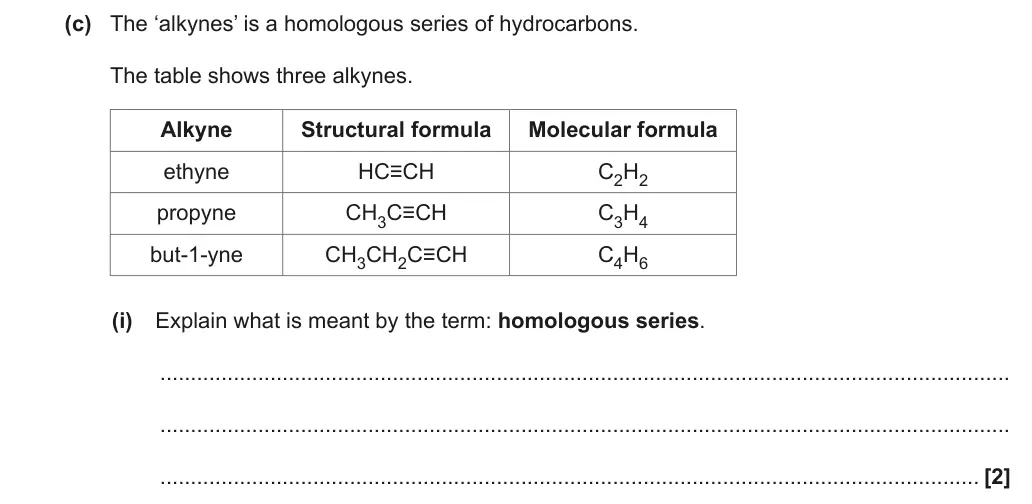
25(a) This part was generally well-answered with well-prepared candidates scoring all three marks. The most common errors resulted from the products of reaction with HBr. The same structure was often drawn, reversed in one of the boxes. Candidates should take care to check that the atoms in a structure have the correct number of bonds. Some candidates added HBr across the C=C double bond but left the C=C bond intact in their final structures, showing carbon atoms with 5 bonds instead of 4. 25(b) As with 25(a), this question rewarded the well-prepared candidate and discriminated well. Conversely, many mechanisms showed little resemblance to the accepted mechanism for electrophilic addition. Mechanisms were often seen showing curly arrows going in the wrong direction and between the wrong bonds and atoms, with incorrect charges and dipoles, and partial charges used where full charges were required. Many candidates were aware that members of a homologous series have the same functional group and react in similar ways. A second mark was available for stating that the formula of successive members increases by CH2. It is important to stress ‘successive’ in communicating this information. 25(c)(ii) This part required candidates to apply their understanding of a ‘general formula’ in a novel context. Many candidates analysed the provided formulae for the alkynes homologous series to derive the correct general formula of CnH2n–2. There was no real pattern in the incorrect responses which usually contained a mixture of numbers for the H atom, e.g. CnH2n, CnHn+1. 25(c)(iii) Although attempted by most candidates, comparatively few responses could be credited. The key to success was again to use the information provided: the formation of a saturated compound. The commonest response seen showed addition of 1 Br2 molecule to form the unsaturated CH3CBr=CHBr instead of the saturated CH3CBr2–CBr2 by addition of 2 Br2. This question was one of the most difficult on the exam paper. 25(c)(iv) Most candidates achieved 1 of the available 2 marks for drawing the structure of but-2-yne, CH3C≡CCH3. The structure of but-1-yne was then usually drawn in the other box despite it being provided already in the table at the start of part (c). A variety of creditworthy structures were seen, including H2C=CH– CH=CH2, cyclobutene and isomers of methylcyclopropane. 25(c)(v) It was encouraging to see the many correct structures drawn from the unfamiliar 2,5-dimethylhept-3-yne. Most candidates positioned the C≡C group and the two substituted CH3 groups correctly. The commonest error was showing a main stem with 6, rather than 7 C atoms. If any of your students’ results are not as expected, you may wish to consider one of our review of results services. For full information about the options available visit the OCR website. If university places are at stake you may wish to consider priority service 2 reviews of marking which have an earlier deadline to ensure your reviews are processed in time for university applications. Our priority is supporting you and your students this autumn and to support you as you prepare for summer 2021 exams. We’ll update our website information regularly with resources, guidance and key information. • Teachers • Students • Exams officers • Assessment specialists We are sending a weekly roundup to tell you about important updates. You can also sign up for your subject specific updates. If you haven’t already, sign up here. Attend one of our popular CPD courses to hear directly from a senior assessor or drop in to a Q&A session. All our courses for the academic year 2020-2021 are being delivered live via an online platform, so you can attend from any location. Please find details for all our courses on the relevant subject page on our website or visit OCR professional development. ExamBuilder is the question builder platform for a range of our GCSE, A Level, Cambridge Nationals, Cambridge Technicals and Functional Skills qualifications. See the full list of available qualifications in the sign up form. ExamBuilder is free for all OCR centres with an Interchange account and gives you unlimited users per centre. We need an Interchange username to validate the identity of your centre's first user account for ExamBuilder. If you do not have an Interchange account please contact your centre administrator (usually the Exams Officer) to request a username, or nominate an existing Interchange user in your department. Review of results
Notes from the mark scheme and report
side bonds required on repeat unit
DO NOT ALLOW more than one repeat unit
IGNORE brackets and n
both 1-bromopropane and 2-bromopropane required, either order
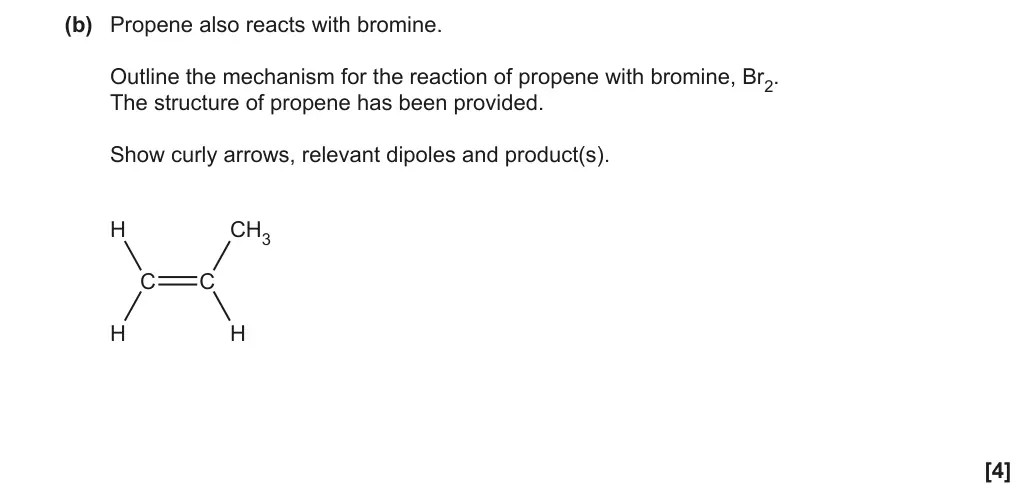
November 2020 · AS Paper 1 · Q25(b)4 marksAO1, 2MechanismMedium
Earlier part of question 25 that this part uses
Mark scheme
Examiner's comment
25(a) This part was generally well-answered with well-prepared candidates scoring all three marks. The most common errors resulted from the products of reaction with HBr. The same structure was often drawn, reversed in one of the boxes. Candidates should take care to check that the atoms in a structure have the correct number of bonds. Some candidates added HBr across the C=C double bond but left the C=C bond intact in their final structures, showing carbon atoms with 5 bonds instead of 4. 25(b) As with 25(a), this question rewarded the well-prepared candidate and discriminated well. Conversely, many mechanisms showed little resemblance to the accepted mechanism for electrophilic addition. Mechanisms were often seen showing curly arrows going in the wrong direction and between the wrong bonds and atoms, with incorrect charges and dipoles, and partial charges used where full charges were required. Many candidates were aware that members of a homologous series have the same functional group and react in similar ways. A second mark was available for stating that the formula of successive members increases by CH2. It is important to stress ‘successive’ in communicating this information. 25(c)(ii) This part required candidates to apply their understanding of a ‘general formula’ in a novel context. Many candidates analysed the provided formulae for the alkynes homologous series to derive the correct general formula of CnH2n–2. There was no real pattern in the incorrect responses which usually contained a mixture of numbers for the H atom, e.g. CnH2n, CnHn+1. 25(c)(iii) Although attempted by most candidates, comparatively few responses could be credited. The key to success was again to use the information provided: the formation of a saturated compound. The commonest response seen showed addition of 1 Br2 molecule to form the unsaturated CH3CBr=CHBr instead of the saturated CH3CBr2–CBr2 by addition of 2 Br2. This question was one of the most difficult on the exam paper. 25(c)(iv) Most candidates achieved 1 of the available 2 marks for drawing the structure of but-2-yne, CH3C≡CCH3. The structure of but-1-yne was then usually drawn in the other box despite it being provided already in the table at the start of part (c). A variety of creditworthy structures were seen, including H2C=CH– CH=CH2, cyclobutene and isomers of methylcyclopropane. 25(c)(v) It was encouraging to see the many correct structures drawn from the unfamiliar 2,5-dimethylhept-3-yne. Most candidates positioned the C≡C group and the two substituted CH3 groups correctly. The commonest error was showing a main stem with 6, rather than 7 C atoms. If any of your students’ results are not as expected, you may wish to consider one of our review of results services. For full information about the options available visit the OCR website. If university places are at stake you may wish to consider priority service 2 reviews of marking which have an earlier deadline to ensure your reviews are processed in time for university applications. Our priority is supporting you and your students this autumn and to support you as you prepare for summer 2021 exams. We’ll update our website information regularly with resources, guidance and key information. • Teachers • Students • Exams officers • Assessment specialists We are sending a weekly roundup to tell you about important updates. You can also sign up for your subject specific updates. If you haven’t already, sign up here. Attend one of our popular CPD courses to hear directly from a senior assessor or drop in to a Q&A session. All our courses for the academic year 2020-2021 are being delivered live via an online platform, so you can attend from any location. Please find details for all our courses on the relevant subject page on our website or visit OCR professional development. ExamBuilder is the question builder platform for a range of our GCSE, A Level, Cambridge Nationals, Cambridge Technicals and Functional Skills qualifications. See the full list of available qualifications in the sign up form. ExamBuilder is free for all OCR centres with an Interchange account and gives you unlimited users per centre. We need an Interchange username to validate the identity of your centre's first user account for ExamBuilder. If you do not have an Interchange account please contact your centre administrator (usually the Exams Officer) to request a username, or nominate an existing Interchange user in your department. Review of results
Notes from the mark scheme and report
first arrow from C=C to Br
dipole on Br–Br and arrow for Br–Br fission
DO NOT ALLOW δ+ on C of carbocation
DO NOT ALLOW half-headed arrows
ALLOW bromonium ion
mechanism with HBr loses final product mark only
November 2020 · AS Paper 1 · Q25(c)(iii)2 marksAO2Equation writingMedium
Earlier part of question 25 that this part uses
Mark scheme
Examiner's comment
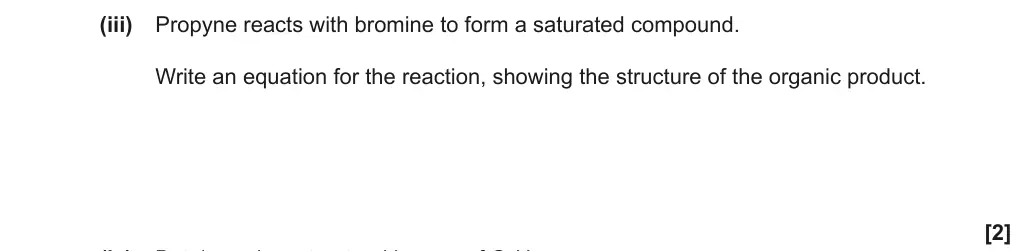
25(a) This part was generally well-answered with well-prepared candidates scoring all three marks. The most common errors resulted from the products of reaction with HBr. The same structure was often drawn, reversed in one of the boxes. Candidates should take care to check that the atoms in a structure have the correct number of bonds. Some candidates added HBr across the C=C double bond but left the C=C bond intact in their final structures, showing carbon atoms with 5 bonds instead of 4. 25(b) As with 25(a), this question rewarded the well-prepared candidate and discriminated well. Conversely, many mechanisms showed little resemblance to the accepted mechanism for electrophilic addition. Mechanisms were often seen showing curly arrows going in the wrong direction and between the wrong bonds and atoms, with incorrect charges and dipoles, and partial charges used where full charges were required. Many candidates were aware that members of a homologous series have the same functional group and react in similar ways. A second mark was available for stating that the formula of successive members increases by CH2. It is important to stress ‘successive’ in communicating this information. 25(c)(ii) This part required candidates to apply their understanding of a ‘general formula’ in a novel context. Many candidates analysed the provided formulae for the alkynes homologous series to derive the correct general formula of CnH2n–2. There was no real pattern in the incorrect responses which usually contained a mixture of numbers for the H atom, e.g. CnH2n, CnHn+1. 25(c)(iii) Although attempted by most candidates, comparatively few responses could be credited. The key to success was again to use the information provided: the formation of a saturated compound. The commonest response seen showed addition of 1 Br2 molecule to form the unsaturated CH3CBr=CHBr instead of the saturated CH3CBr2–CBr2 by addition of 2 Br2. This question was one of the most difficult on the exam paper. 25(c)(iv) Most candidates achieved 1 of the available 2 marks for drawing the structure of but-2-yne, CH3C≡CCH3. The structure of but-1-yne was then usually drawn in the other box despite it being provided already in the table at the start of part (c). A variety of creditworthy structures were seen, including H2C=CH– CH=CH2, cyclobutene and isomers of methylcyclopropane. 25(c)(v) It was encouraging to see the many correct structures drawn from the unfamiliar 2,5-dimethylhept-3-yne. Most candidates positioned the C≡C group and the two substituted CH3 groups correctly. The commonest error was showing a main stem with 6, rather than 7 C atoms. If any of your students’ results are not as expected, you may wish to consider one of our review of results services. For full information about the options available visit the OCR website. If university places are at stake you may wish to consider priority service 2 reviews of marking which have an earlier deadline to ensure your reviews are processed in time for university applications. Our priority is supporting you and your students this autumn and to support you as you prepare for summer 2021 exams. We’ll update our website information regularly with resources, guidance and key information. • Teachers • Students • Exams officers • Assessment specialists We are sending a weekly roundup to tell you about important updates. You can also sign up for your subject specific updates. If you haven’t already, sign up here. Attend one of our popular CPD courses to hear directly from a senior assessor or drop in to a Q&A session. All our courses for the academic year 2020-2021 are being delivered live via an online platform, so you can attend from any location. Please find details for all our courses on the relevant subject page on our website or visit OCR professional development. ExamBuilder is the question builder platform for a range of our GCSE, A Level, Cambridge Nationals, Cambridge Technicals and Functional Skills qualifications. See the full list of available qualifications in the sign up form. ExamBuilder is free for all OCR centres with an Interchange account and gives you unlimited users per centre. We need an Interchange username to validate the identity of your centre's first user account for ExamBuilder. If you do not have an Interchange account please contact your centre administrator (usually the Exams Officer) to request a username, or nominate an existing Interchange user in your department. Review of results
Notes from the mark scheme and report
2Br2 needed to form a saturated product
ALLOW C3H4 for propyne
ALLOW H3CCBr2CHBr2
Skills: M0.2 Use ratios, fractions and percentages
November 2020 · Paper 2 · Q11 markAO1Multiple choice
Answer
A
Mark scheme
November 2020 · Paper 2 · Q21 markAO1Multiple choice
Answer
B
Mark scheme
November 2020 · Paper 2 · Q51 markAO1Multiple choice
Answer
D
Mark scheme
November 2020 · Paper 2 · Q61 markAO2Multiple choice
Answer
D
Mark scheme
November 2020 · Paper 2 · Q16(b)(i)1 markAO1Short answer
Earlier part of question 16 that this part uses
Mark scheme
Notes from the mark scheme and report
same structural formula AND different arrangement in space AND optical all needed
DO NOT ALLOW same empirical/general formula
IGNORE same molecular formula
November 2020 · Paper 2 · Q17(a)(i)2 marksAO2Structure / isomer
Mark scheme
Notes from the mark scheme and report
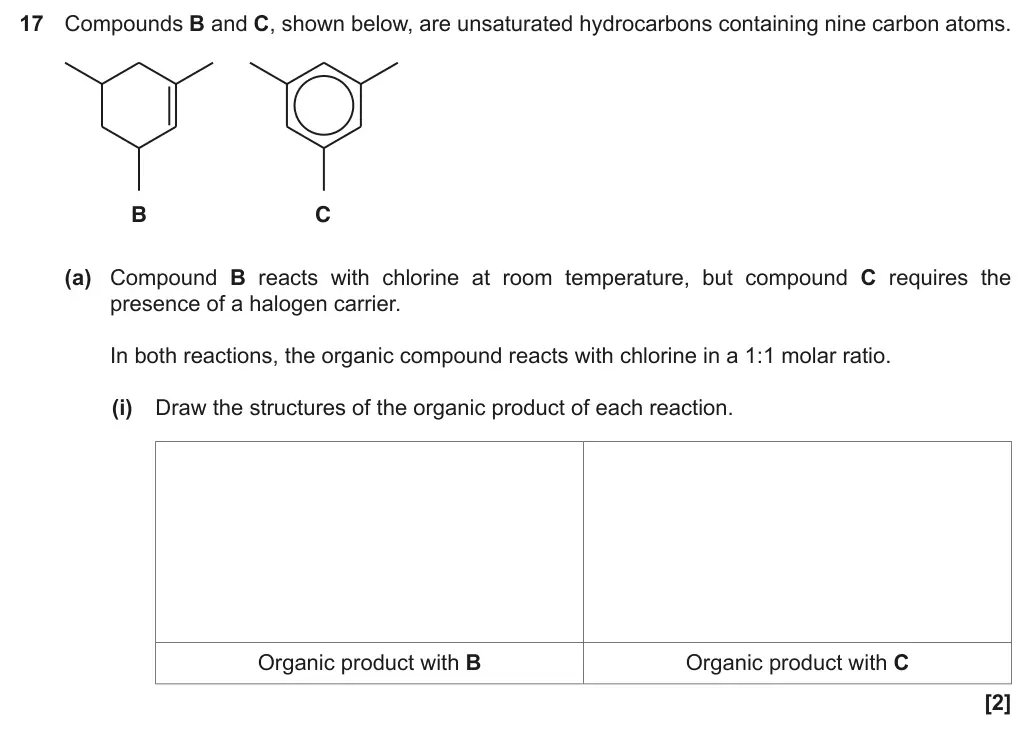
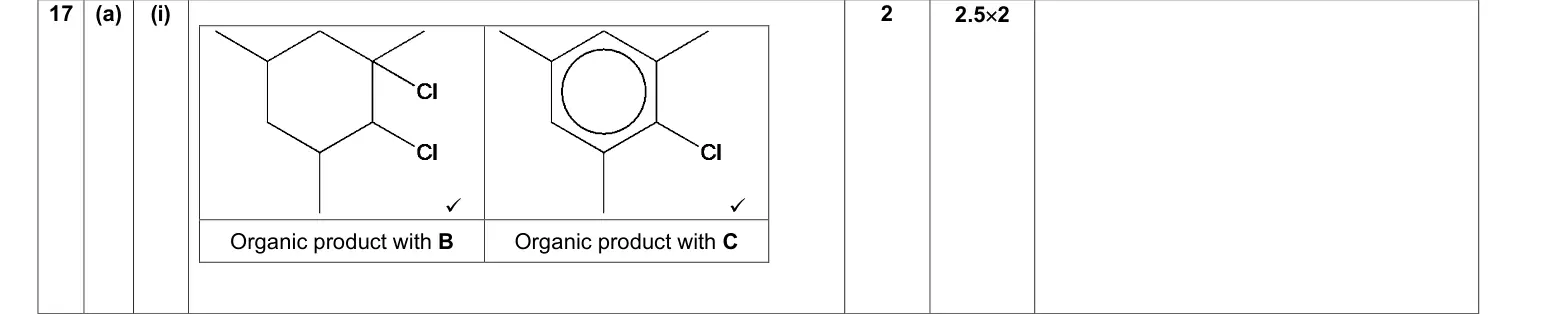
B undergoes addition (dichloro product), C undergoes substitution on the ring
November 2020 · Paper 2 · Q18(b)(ii)1 markAO3Short answer
Earlier part of question 18 that this part uses
Mark scheme
Notes from the mark scheme and report
ester bond/group can be hydrolysed or broken down
'bond breaks' alone insufficient
IGNORE photodegradable
June 2019 · AS Paper 1 · Q21 markAO1Multiple choiceHard
Answer
A
Mark scheme
Examiner's comment
This part discriminated well, with most able candidates selecting the correct answer of A. A sizeable number selected B, accompanied by a diagram of an H2O molecule with a 180º bond angle, presumably by ignoring the lone pairs. C2H4 was often shown with a bond angle of 109.5º, presumably as the C=C bond had not been identified, giving a bond angle of 120º.
June 2019 · AS Paper 1 · Q141 markAO1Multiple choiceMedium
Answer
A
Mark scheme
Examiner's comment
Candidates answered this question well with over two-thirds choosing the correct option A. Option D was the most common incorrect response suggesting that candidates are uncertain about the nature of a C=C double bond.
June 2019 · AS Paper 1 · Q161 markAO1Multiple choice
Answer
A
Mark scheme
June 2019 · AS Paper 1 · Q171 markAO1Multiple choiceHard
Answer
C
Mark scheme
Examiner's comment
This part discriminated well. Although most candidates did select C as the correct structure, many were diverted into selecting option D, the other alternative containing a double C=C bond. In identifying a monomer for an addition polymer, candidates are advised to identify the repeat unit and then to replace the single C–C bond with a double bond to give the monomer.
June 2019 · Paper 2 · Q41 markAO1Multiple choiceHard
Answer
C
Mark scheme
Examiner's comment
This question proved difficult. Many candidates identified that this structure is an E stereoisomer (C) but a significant number of responses selected D. Candidates are encouraged to draw out the groups to determine the first point of difference when applying the Cahn Ingold Prelog (CIP) priority rules.
Notes from the mark scheme and report
ALLOW E
OCR has a worksheet which can help support students’ understanding of Cahn Ingold Prelog priority rules, available here: http://www.ocr.org.uk/Images/208569-cip-rules-activity.doc.
Skills: M4.2 Visualise and represent 2-D and 3-D forms including 2-D representations of 3-D objects
June 2019 · Paper 2 · Q51 markAO2Multiple choiceMedium
Answer
D
Mark scheme
Examiner's comment
This is a demanding question. The best responses drew the first step of the mechanism near the table. This showed both the π bond in ethene and the σ bond in bromine breaking in addition to a σ bond forming between carbon and bromine atoms. Although many candidates correctly selected D, option B was a good distractor and was the most commonly seen incorrect response.
June 2019 · AS Paper 2 · Q5(a)(i)3 marksAO1Complete table/diagramMedium
Mark scheme
Examiner's comment
Most candidates answered this question well and achieved full marks. The most common errors were to put the chlorine on the wrong carbon, or to put both bromines on the same carbon.
Notes from the mark scheme and report
hexane
2-chlorohexane as major product (Markownikoff)
1,2-dibromohexane
ALLOW part molecular formulae but not full
June 2019 · AS Paper 2 · Q5(a)(ii)1 markAO1Short answerEasy
Earlier part of question 5 that this part uses
Mark scheme
Examiner's comment
Most candidates correctly stated nickel, although it was spelled incorrectly a lot of the time, which was ignored. “Acid” was the most common incorrect answer
Notes from the mark scheme and report
Ni
ALLOW Pt, Pd or Rh
June 2019 · AS Paper 2 · Q5(a)(iii)1 markAO1Short answerMedium
Earlier part of question 5 that this part uses
Mark scheme
Examiner's comment
Many candidates wrote the colour change the wrong way around, or thought that a gas would be evolved, or wrote “clear” instead of “colourless”. A large proportion merely stated what type of reaction it was, rather than what they would observe.
Notes from the mark scheme and report
(orange to) colourless/decolourised
IGNORE 'colour change'
Skills: PAG7 Qualitative analysis of organic functional groups
June 2019 · AS Paper 2 · Q5(c)(i)1 markAO2Drawing / labellingHard
Mark scheme
Examiner's comment
Over half of the candidates answered this question incorrectly. Many drew the wrong repeat units or did not show two repeat units. The structural diagrams were very hard to decipher and not well drawn. Although the connectivity is not exact, this was allowed. Many students drew full displayed structures which were very difficult to decipher as they often encroached over the writing in the question.
Notes from the mark scheme and report
two repeat units with C4H9 side chains and side links (end bonds)
IGNORE brackets and n
June 2019 · AS Paper 2 · Q5(c)(ii)2 marksAO1Short answerMedium
Earlier part of question 5 that this part uses
Mark scheme
Examiner's comment
Most students did not gain many marks on this question, with a significant number stating that the plastics could be used to feed livestock or as fertilisers. Those that mentioned combustion, merely stated plastics could be used as a fuel. Some candidates made references to making them biodegradable or recycling, but these answers were not given.
Notes from the mark scheme and report
combustion for energy production
organic feedstock for plastics/other organic chemicals
June 2019 · Paper 2 · Q16(a)(i)4 marksAO1, 2MechanismEasy
Mark scheme
Examiner's comment
Candidates were very familiar with this electrophilic addition mechanism, so the majority of candidates scored three or four marks. Common errors included inaccurate curly arrows from either the carbon- carbon double bond or the bromide ion or the omission of key detail such as the partial charges on HBr or the charge on the bromide ion.
Notes from the mark scheme and report
curly arrow from C=C to H of H–Br
dipole on H–Br AND arrow breaking H–Br
DO NOT ALLOW partial charge on C=C or δ+ on carbocation C
arrow from lone pair or negative charge of Br–
no double-headed or half arrows
IGNORE connectivity of CHO
June 2019 · Paper 2 · Q16(a)(ii)2 marksAO1Short answerMedium
Earlier part of question 16 that this part uses
Mark scheme
Examiner's comment
This question required candidates to apply their knowledge of Markownikoff’s rule to explain the formation of a major product in the reaction in part (a)(i). The majority of candidates recognised that the stability of the intermediate was responsible for one of the products being formed in a greater quantity, and most scored at least one mark. The best responses recognised that, in the context of the reaction in (a)(i), a tertiary carbocation would form the major product. Other response talked more generally about the major product (without identifying that the tertiary carbocation in the mechanism is responsible)). Lower ability candidates focused their response on the stability of the product and did not discuss the intermediate at all.
Notes from the mark scheme and report
major product from the more stable (tertiary) carbocation intermediate
IGNORE Markownikoff descriptions (H joins C with most H) and stability of the product
A topic exploration pack on electrophilic addition and Markownikoff’s rule, including activities to assess student understanding, is available here: http://www.ocr.org.uk/Images/336551-electrophilic-addition-and- markownikoff-s-rule.doc
June 2019 · Paper 2 · Q16(b)(iv)1 markAO1Short answerEasy
Earlier part of question 16 that this part uses
Mark scheme
Examiner's comment
Most candidates were able to explain the term stereoisomerism succinctly. However, a significant number of candidates referred to stereoisomers as having the same molecular formula, rather than being more precise and stating that they are compounds with the same structural formula.
Notes from the mark scheme and report
same structural formula AND different arrangement in space
DO NOT ALLOW same empirical/general formula
naming E/Z or optical alone not sufficient
June 2019 · Paper 2 · Q16(b)(v)4 marksAO1, 2Structure / isomerHard
Earlier part of question 16 that this part uses
Mark scheme
Examiner's comment
This question, which discriminated well, required candidates to apply their knowledge of stereoisomerism to geraniol and citronellal. The majority of responses focused on E/Z isomerism, as shown in Exemplar 2. Many candidates were able to show the structure of the Z isomer of geraniol and scored at least one mark. Stronger responses were able to explain this type of isomerism as the result of the carbon-carbon double bond between carbon atoms 2 and 3. Common errors included attributing E/Z isomerism to the double bond between carbon atoms 6 and7 or use of cis/trans to describe the isomers (the latter of which was ignored by the mark scheme as it does not apply to geraniol). The best responses also identified the chiral carbon atom in citronellal and were able to show the optical isomers appropriately. This response identifies that geraniol has E/Z isomers and provides a correct explanation with reference to the carbon-carbon double bond between carbon atoms 2 and 3. So marking points one and two were given. The candidate recognises that the double bond between carbon atoms 6 and 7 would not cause isomerism in both compounds. Unfortunately this response overlooks the chiral carbon in citronellal and incorrectly states that it has are no stereoisomers. This question highlights the challenge of a linear specification, where content from different modules may be assessed within the same question. Candidates are likely to encounter these two types of stereoisomerism in different years of their course. They should therefore be encouraged to make links between the different modules to help develop their understanding.
Notes from the mark scheme and report
geraniol: E/Z at C=C of carbon-2,3 (DO NOT ALLOW C=C at carbon-6,7
IGNORE cis/trans)
citronellal: chiral carbon-3 with four different groups, optical isomers drawn as 3D mirror images
Skills: M4.2 Visualise and represent 2-D and 3-D forms including 2-D representations of 3-D objects; M4.3 Understand the symmetry of 2-D and 3-D shapes
June 2019 · Paper 2 · Q19(b)(i)3 marksAO1, 2Drawing / labellingMedium
Mark scheme
Examiner's comment
The majority of candidates were able to draw two repeats units of the polymer formed from D and scored at least one mark. While most candidates drew the polymer from E correctly, securing full marks, some candidates were unable to show the amide link correctly. This common error is demonstrated in This response demonstrates a common error seen by examiners. The candidate has included an O atom as part of the amide link. So they have also included an O atom before the ‘end bond’. This is a costly error as the candidate is unable to be given either of the marks available for this polymer.
Notes from the mark scheme and report
D gives addition polymer, E polyamide with amide link
end bonds MUST be shown
DO NOT ALLOW more than 2 repeat units
IGNORE brackets and n
June 2019 · Paper 3 · Q4(b)(ii)4 marksAO1, 2Short answerHard
Earlier part of question 4 that this part uses
Mark scheme
Examiner's comment
Candidates displayed a good knowledge of the requirements for E/Z isomerism in terms of a C=C double bond and different groups on the carbon atoms of the C=C bond. Many assigned terpineol as the Z isomer explained in terms of the priority groups being on the same side of the C=C bond. Candidates found it difficult to explain why terpineol has only one E/Z isomer. Many candidates thought that the C=C bond could not rotate because it was part of the ring. however, a C=C bond cannot rotate whether it is in a ring or not. Few candidates considered the strain put on the ring if the priority groups (being part of the ring) were to be placed in an E conformation.
Notes from the mark scheme and report
max 4 from 5 points
C=C with two different groups on each C
Z isomer as high priority groups (ring carbons) on same side
other isomer impossible as ring would be strained – must be linked to the ring
IGNORE C=C cannot rotate
Skills: M4.2 Visualise and represent 2-D and 3-D forms including 2-D representations of 3-D objects; M4.3 Understand the symmetry of 2-D and 3-D shapes
June 2019 · Paper 3 · Q4(b)(iii)4 marksAO3Structure / isomerMedium
Earlier part of question 4 that this part uses
Mark scheme
Examiner's comment
In this question, candidates were given the opportunity to demonstrate some knowledge of organic reaction in a new context. The choice of reaction was up to the candidate. Most candidates were able to identify the alkene group in terpineol and to suggest a reagent that would react with this functional group. A correct structure for the organic product then usually followed. Although most candidates identified the alcohol group, many struggled with a reagent and resulting product. Although the alcohol –OH group has many reactions, (e.g. elimination, substitution, esterification) many candidates were fixated on oxidation with acidified dichromate despite a tertiary alcohol not being capable of oxidation with this reagent. Some candidates quoted acidified dichromate but then copied the structure of terpineol, stating that there was no reaction, despite the question directing them to select a reagent that would react with their chosen group.
Notes from the mark scheme and report
functional group MUST be named (alkene
tertiary alcohol)
DO NOT ALLOW UV with halogens
DO NOT ALLOW Cr2O72–/H+ (tertiary alcohol)
ALLOW addition of HBr/H2O either way across C=C
reagent must react with that group only
June 2018 · AS Paper 1 · Q181 markMultiple choiceMedium
Answer
D
Mark scheme
Examiner's comment
Most candidates chose the correct option of D but a sizeable number chose B and C, the other options containing a ‘2’ in their names. The best strategy here is to draw out the carbon skeleton of pent-2-ene from which it is clear that bromine atoms must be added at carbon positions 2 and 3.
June 2018 · AS Paper 1 · Q191 markMultiple choiceHard
Answer
C
Mark scheme
Examiner's comment
This was a difficult question but higher ability candidates selected the correct option of C. The main discriminator was B, which identifies the 1 double bond as Z. CIP analysis is required to show that the double bond is E. This is a good ‘hard’ example for illustrating E/Z isomerism.
June 2018 · Paper 2 · Q31 markMultiple choiceMedium
Answer
B
Mark scheme
Examiner's comment
The majority of candidates identified B (an alkene) as the compound that does not react with nucleophiles.
June 2018 · Paper 2 · Q51 markMultiple choiceHard
Answer
B
Mark scheme
Examiner's comment
This question discriminated well, with higher ability candidates correctly identifying B as a non-planar molecule. Common incorrect responses included C and D. Some candidates drew structures alongside each option to aid their choice.
June 2018 · AS Paper 2 · Q6(a)1 markShort answerMedium
Mark scheme
Examiner's comment
Many candidates knew the answer to this question but forgot that water must be in the gaseous state. There were numerous responses stating nickel as the catalyst, but most knew that an acid catalyst was required.
Notes from the mark scheme and report
steam AND acid/H+ catalyst both required
June 2018 · AS Paper 2 · Q6(b)(ii)3 marksMechanismMedium
Earlier part of question 6 that this part uses
Mark scheme
Examiner's comment
Many candidates gained all three marks on this question and the diagrams were clear and easy to read. Lower ability candidates had incorrect dipoles or curly arrows that could not be traced back to the correct origin. Candidates should be encouraged to consider what the arrows mean rather than memorising mechanisms with no understanding.
Notes from the mark scheme and report
arrow from C=C to Br
dipole on Br–Br and arrow from bond to Brδ–
arrow from Br– lone pair/charge to C+
DO NOT ALLOW partial charge on C=C or δ+ on carbocation
DO NOT ALLOW half-headed arrows
June 2018 · AS Paper 2 · Q6(c)(i)2 marksEquation writingEasy
Earlier part of question 6 that this part uses
Mark scheme
Examiner's comment
Most candidates correctly drew the repeat unit and were credited with one mark, but many placed the n position in the wrong place on the left-hand side of the equation or forgot to write it in at all.
Notes from the mark scheme and report
displayed repeat unit with side bonds and brackets
n on both sides (subscript on RHS)
DO NOT ALLOW ECF from incorrect repeat unit
June 2018 · AS Paper 2 · Q6(c)(ii)2 marksShort answerEasy
Earlier parts of question 6 that this part uses
Mark scheme
Examiner's comment
With all the media interest in plastic pollution this question was answered well, although many gave the answer ‘quick and efficient’ as an advantage which was not credited. Candidates should beware of vague statements such as these. Many wrote ‘harmful’ instead of toxic, or ‘bad for the environment’ instead of being specific about the environmental issue.
Notes from the mark scheme and report
advantage: energy production
disadvantage: HCl/acid rain OR CO2/greenhouse gases OR CO
ALLOW less landfill
June 2018 · AS Paper 2 · Q76 marks6-mark level of responseMedium
Mark scheme, with the levels and indicative points
Skills: M0.2 Use ratios, fractions and percentages; M3.1 Translate information between graphical, numerical and algebraic forms
June 2018 · Paper 2 · Q16(c)3 marksDrawing / labellingMedium
Mark scheme
Examiner's comment
The majority of candidates were able to identify at least one product from the reactions of compound C. The polymerisation reaction appeared to be the most familiar, although some candidates attempted to draw a condensation polymer using the carboxylic acid groups rather than the alkene. The reaction of C with excess methanol was also well attempted. However, a significant number of candidates used chemical symbols to show their product. A proportion of these did not show the H atoms of the alkene group, showing only C=C in the centre of the structure. Candidates are advised to use the type of formulae given in a question as this will reduce the potential for error or omissions. The product from the hydration of C appeared to be the hardest to deduce. Many candidates recognised this reaction would produce an alcohol, but often included two OH groups – one on each C from the double bond – in their structure. Other candidates confused this reaction with hydrogenation and formed a saturated product from C.
Notes from the mark scheme and report
excess CH3OH gives the diester
end bonds MUST be shown on repeat unit
IGNORE brackets and n
ALLOW E or Z diester
June 2018 · Paper 2 · Q20(a)2 marksShort answerMedium
Mark scheme
Examiner's comment
Many candidates explained that methylcinnamaldehyde is an E isomer as the highest priority groups are on opposite sides, but only the highest ability candidates applied the CIP rules to identify the highest priority groups as C6H5 and CHO. A common misconception was to refer to the molecular mass of the groups instead of priority as in Exemplar 7. This response uses the mass of the benzene and CHO groups to attempt to justify their priority. This was ignored by the mark scheme as the CIP rules use atomic number to determine the highest priority groups. However, this response does clearly communicate that these two groups are on different sides of the carbon-carbon double bond so scored one mark.
Notes from the mark scheme and report
highest priority groups (C6H5 and CHO) on opposite sides
IGNORE references to relative mass/Mr of groups
1 mark if 'priority' not mentioned
Skills: M4.2 Visualise and represent 2-D and 3-D forms including 2-D representations of 3-D objects; M4.3 Understand the symmetry of 2-D and 3-D shapes
June 2018 · Paper 2 · Q20(b)(i)1 markShort answerEasy
Earlier part of question 20 that this part uses
Mark scheme
Examiner's comment
Almost all candidates were able to correctly describe the use of bromine as a test for an unsaturated chain.
Notes from the mark scheme and report
both reagent and observation required: bromine (water) decolourised
Skills: PAG7 Qualitative analysis of organic functional groups
June 2018 · Paper 2 · Q20(c)5 marksStructure / isomerMedium
Earlier part of question 20 that this part uses
Mark scheme
Examiner's comment
This question proved difficult and although the majority of candidates scored in some parts, only the very best responses secured all five marks. More detailed feedback is discussed with Exemplar 8. Cinnamaldehyde was the starting point for this flowchart of reactions. The most frequently scored mark was correct identification of the reagents required for the formation of the hydroxynitrile. This response uses NaCN/H+. Other candidates used HCN which was also acceptable. The flowchart shows two different reactions of this hydroxynitrile. The first is the reaction with excess hydrogen in the presence of Ni. Most candidates scored one mark for their product. As in this exemplar, the double bond was often reacted to form a saturated chain. Some candidates identified that the CN group would also react but instead of writing CH2NH2 they replaced the CN group with just NH2, effectivity removing a carbon atom from the chain. The second reaction of the hydroxynitrile is acid hydrolysis of the CN group. This response identifies the correct carboxylic acid. However, this reaction seemed unfamiliar to many candidates and a range of incorrect responses were frequently seen. The final reaction is the reduction of cinnamaldehyde with NaBH4. Many candidates recognised this reaction, but as can be seen in this response the alcohol group is shown on the incorrect carbon atom. This was a common error. Candidates are advised to number carbon atoms present if provided with a complex structure, such as cinnamaldehyde. Numbering will ensure that each carbon is considered when drawing reaction products and would minimise errors, such as those demonstrated in the reduction product.
Notes from the mark scheme and report
NaCN/H+ or HCN for reagent
NaBH4 reduces CHO only (C=C unchanged)
excess H2/Ni reduces both C=C and C≡N (1 mark each
IGNORE hydrogenation of benzene ring)
H+(aq) hydrolyses nitrile to COOH
June 2018 · Paper 2 · Q20(d)6 marks6-mark level of responseMedium
Earlier part of question 20 that this part uses
Mark scheme, with the levels and indicative points
Examiner's comment
This question was marked using a level of response mark scheme. Most candidates gave an answer worthy of at least level two (3-4 marks) by providing a suitable mechanism and identifying the major product. The strongest candidates identified both products and were able to describe which was most likely. Such responses received level 3 (5-6 marks) as shown in Exemplar 9. Lower ability candidate responses seemed to ignore the reference to electrophilic addition in the question and tried reacting ICl with either the benzene ring or the aldehyde group. This response starts with a clear outline of the electrophilic addition mechanism showing correct partial charges and accurately drawn curly arrows. The structures of the two possible organic products are shown and the most likely product to be formed is identified correctly. Notice that the candidate has labelled these structures as ‘Product A’ and ‘Product B’ and refers to the labels later in the response. This is a good strategy, which enables the candidate to provide a clear and easy to follow answer. The response concludes with a detailed explanation, referring to carbocation stability to justify why product A is most likely to be formed. This response therefore satisfies the Level 3 criteria. The response is logically structured with a well-developed line of reasoning and was therefore credited the upper mark within the level and achieved six marks.
Notes from the mark scheme and report
dipole Iδ+–Clδ– from electronegativity so I is the electrophile
curly arrow from C=C to I and from I–Cl bond to Cl
carbocation with full + charge
arrow from lone pair/– charge on Cl–
major product via the more stable (tertiary) carbocation
June 2018 · Paper 3 · Q6(b)6 marks6-mark level of responseMedium
Mark scheme, with the levels and indicative points
Examiner's comment
Overall, this part was answered well. Good answers were well organised, showing clear mechanisms with precisely positioned curly arrows. Most candidates included a clear definition of an electrophile and were able to select appropriate reactions. Most candidates were familiar with the mechanisms for electrophilic addition and electrophilic substitution. Mechanisms of an alkene with HBr or Br2 and benzene with NO2 + or Br+ were the most commonly seen. Most candidates showed the role of a catalyst in electrophilic substitution. Common errors/omissions were the direction of the curly arrow from the aromatic ring to the electrophile, the position of the curly arrow when H+ is lost from an aromatic intermediate, and not showing the lone pair when Br- attacks a carbocation. Some answers lacked detail and gave only two mechanisms with minimal supporting words. Lower ability candidates described nucleophilic addition or substitution as one of their mechanisms or had curly arrows going in the wrong direction. A few candidates answered in prose without including equations or diagrams. Candidates are advised that mechanisms must always be communicated in the usual diagrammatic way. and electrophilic substitution, including the role of the FeCl3 catalyst. Curly arrows are precisely positioned, with correct use of lone pairs and charges. The candidate has demonstrated excellent knowledge and understanding. The response in Exemplar 17 is clearly at a different level. The candidate has chosen an alkane rather than an alkene and has used curly arrows and charges incorrectly. This candidate appears to have been poorly prepared.
Notes from the mark scheme and report
electrophile as electron pair acceptor
aliphatic e.g. ethene + Br2 electrophilic addition with dipole, curly arrows and carbocation
aromatic e.g. nitration/halogenation of benzene electrophilic substitution with generation of electrophile and regeneration of catalyst
accurately positioned curly arrows and charges
June 2017 · AS Paper 1 · Q141 markMultiple choice
Answer
A
Mark scheme
June 2017 · AS Paper 1 · Q181 markMultiple choice
Answer
A
Mark scheme
June 2017 · AS Paper 1 · Q21(a)(i)3 marksShort answer
Mark scheme
Notes from the mark scheme and report
ALLOW structural, displayed or skeletal formula if unambiguous
DO NOT ALLOW OH— connectivity
steam product must be the major (Markownikoff) product
June 2017 · AS Paper 1 · Q21(a)(ii)1 markShort answer
Earlier part of question 21 that this part uses
Mark scheme
Notes from the mark scheme and report
ALLOW HCl
IGNORE (aq), dilute or concentrated
June 2017 · AS Paper 1 · Q21(b)(i)2 marksEquation writing
Earlier part of question 21 that this part uses
Mark scheme
Notes from the mark scheme and report
side bonds required on both sides of repeat unit
n needed on both sides of equation
DO NOT ALLOW molecular formula for repeat unit
NO ECF from incorrect repeat unit
June 2017 · AS Paper 1 · Q21(b)(ii)1 markShort answer
Earlier part of question 21 that this part uses
Mark scheme
Notes from the mark scheme and report
response must reflect chlorine (HCl or chlorine formed)
IGNORE toxic waste products
June 2017 · Paper 2 · Q41 markMultiple choice
Answer
B
Mark scheme
June 2017 · AS Paper 2 · Q6(b)4 marksMechanism
Earlier part of question 6 that this part uses
Mark scheme
Notes from the mark scheme and report
curly arrow must start from the double bond and go to Br
dipole on Br–Br
DO NOT ALLOW δ+ on C of carbocation
arrow from lone pair or negative charge of Br–
max 2 if wrong cyclohexene structure
June 2017 · Paper 2 · Q16(b)(ii)1 markShort answer
Earlier part of question 16 that this part uses
Mark scheme
Notes from the mark scheme and report
same structural formula AND different arrangement in space
DO NOT ALLOW same empirical/general formula
IGNORE same molecular formula
June 2017 · Paper 2 · Q16(b)(iii)2 marksStructure / isomer
Earlier part of question 16 that this part uses
Mark scheme
Notes from the mark scheme and report
1 mark if both shown but in the wrong columns
DO NOT ALLOW incorrect connectivity e.g. –CH3CH2
Skills: M4.2 Visualise and represent 2-D and 3-D forms including 2-D representations of 3-D objects
June 2017 · Paper 2 · Q16(c)1 markComplete table/diagram
Mark scheme
Notes from the mark scheme and report
two separate p-orbital dumb-bells on the left AND π-bond above and below on the right
DO NOT ALLOW overlapping p-orbitals on the left, C=C drawn, or four lobes on the right
Skills: M4.2 Visualise and represent 2-D and 3-D forms including 2-D representations of 3-D objects
June 2017 · Paper 2 · Q16(d)(i)1 markShort answer
Mark scheme
Notes from the mark scheme and report
H of HBr accepts a pair of electrons
June 2017 · Paper 2 · Q16(d)(ii)2 marksStructure / isomer
Earlier part of question 16 that this part uses
Mark scheme
Notes from the mark scheme and report
2-bromo-2-methylpentane and 3-bromo-2-methylpentane in either order
June 2017 · Paper 2 · Q16(d)(iii)3 marksMechanism
Earlier parts of question 16 that this part uses
Mark scheme
Notes from the mark scheme and report
curly arrow from C=C to H of H–Br
dipole on H–Br AND arrow breaking H–Br
DO NOT ALLOW partial charges on C=C or δ+ on carbocation C
arrow from lone pair or negative charge of Br–
June 2017 · Paper 2 · Q16(d)(iv)1 markShort answer
Earlier parts of question 16 that this part uses
Mark scheme
Notes from the mark scheme and report
product AND explanation both required
tertiary carbocation intermediate more stable
IGNORE explanations based only on Markownikoff's rule
June 2017 · Paper 2 · Q16(e)(i)2 marksCalculation
Mark scheme
Notes from the mark scheme and report
three C=C so 3 mol H2 per mol
common errors: 108000 (mg not converted), 36 (not × 3), 12 (divided by 3)
IGNORE pV = nRT
Skills: M0.0 Recognise and make use of appropriate units in calculations; M0.2 Use ratios, fractions and percentages; M2.3 Substitute numerical values into algebraic equations using appropriate units for physical quantities
June 2017 · Paper 2 · Q16(e)(ii)4 marksCalculation
Earlier part of question 16 that this part uses
Mark scheme
Notes from the mark scheme and report
n(H2) = 0.220 so 11 C=C
saturated product with two rings is C40H78
C40H56 + 11H2 → C40H78
ECF only from C40H82 or C40H80
Skills: M0.2 Use ratios, fractions and percentages; M2.3 Substitute numerical values into algebraic equations using appropriate units for physical quantities
June 2016 · AS Paper 1 · Q151 markMultiple choice
Answer
B
Mark scheme
June 2016 · AS Paper 1 · Q161 markMultiple choice
Answer
D
Mark scheme
June 2016 · AS Paper 1 · Q191 markMultiple choice
Answer
B
Mark scheme
June 2016 · AS Paper 1 · Q26(a)(ii)1 markAO1Short answer
Earlier part of question 26 that this part uses
Mark scheme
Notes from the mark scheme and report
H2 AND Ni (ALLOW Pt, Pd, Rh)
IGNORE temperature and pressure
June 2016 · AS Paper 1 · Q26(b)2 marksAO2Structure / isomer
Earlier part of question 26 that this part uses
Mark scheme
Notes from the mark scheme and report
C is the tertiary alcohol
DO NOT ALLOW more than one repeat unit
side links required
DO NOT ALLOW OH– connectivity
June 2016 · AS Paper 1 · Q26(c)(ii)3 marksAO3Structure / isomer
Earlier parts of question 26 that this part uses
Mark scheme
Notes from the mark scheme and report
DO NOT ALLOW H2O for stage 2
MAX 2 for a monobrominated intermediate via HBr
ALLOW dichloro/diiodo compound
June 2016 · AS Paper 2 · Q3(a)(i)1 markShort answer
Mark scheme
Notes from the mark scheme and report
σ direct/head-on overlap between nuclei, π sideways overlap above and below
IGNORE bond length
IGNORE type of orbital for σ bond
June 2016 · AS Paper 2 · Q3(a)(ii)1 markShort answer
Earlier part of question 3 that this part uses
Mark scheme
Notes from the mark scheme and report
one C of C=C has two identical (methyl) groups
DO NOT ALLOW 'two groups on the same side'
DO NOT ALLOW functional groups or molecules for groups
June 2016 · AS Paper 2 · Q3(a)(iii)2 marksStructure / isomer
Earlier part of question 3 that this part uses
Mark scheme
Notes from the mark scheme and report
mark independently
DO NOT ALLOW –CH3CH2 connectivity
DO NOT ALLOW trans-pent-2-ene
Skills: M4.2 Visualise and represent 2-D and 3-D forms including 2-D representations of 3-D objects
June 2016 · AS Paper 2 · Q3(c)6 marks6-mark level of response
Earlier part of question 3 that this part uses
Mark scheme, with the levels and indicative points
Notes from the mark scheme and report
two products 2-bromo-2-methylbutane and 2-bromo-3-methylbutane
curly arrow from C=C to H of H–Br, dipole on H–Br, arrow from H–Br bond to Br, carbocation, arrow from Br– lone pair to C+
major product from more stable tertiary carbocation
Work with an OCR chemistry tutor
Dropping marks on calculations, mechanisms or the six-markers? Book a trial session with a specialist OCR chemistry tutor.