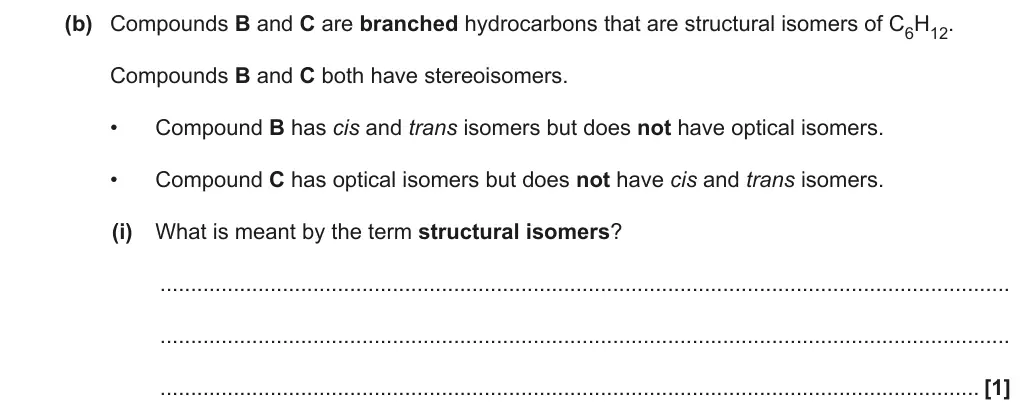
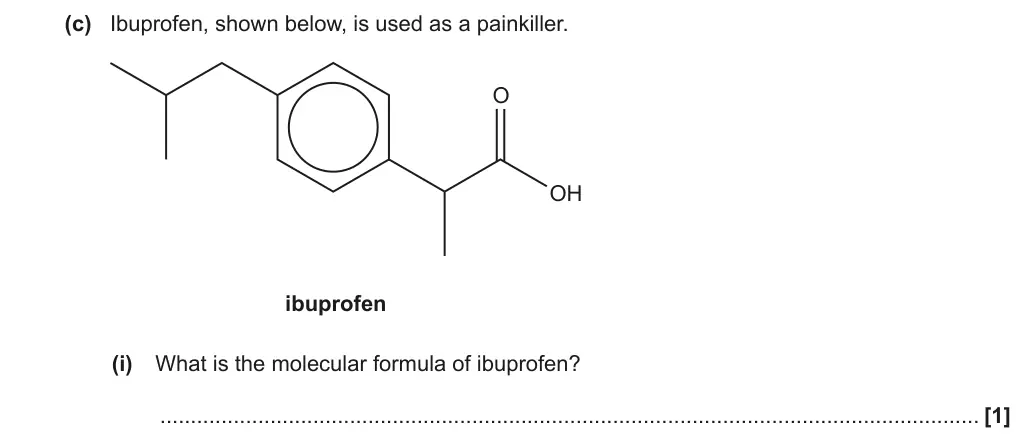
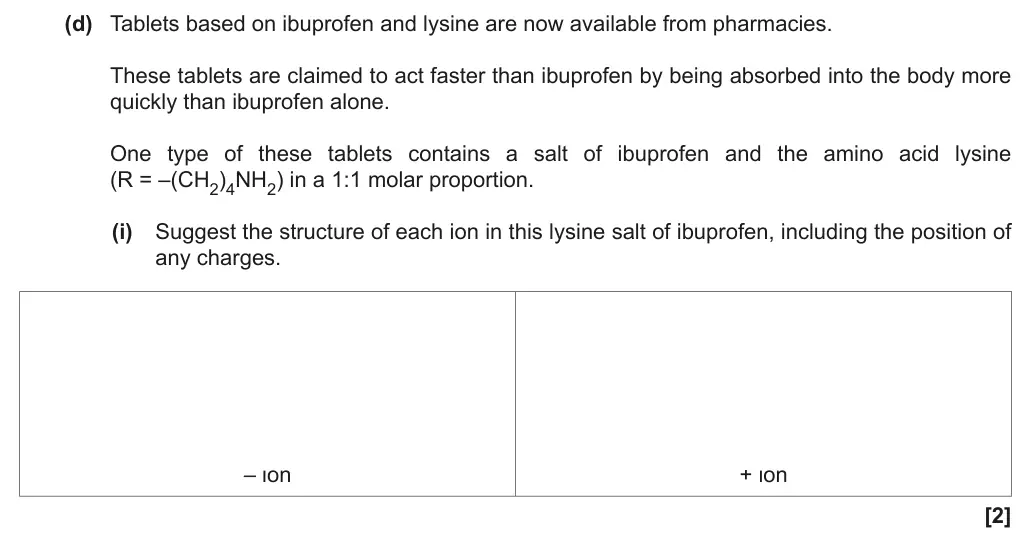
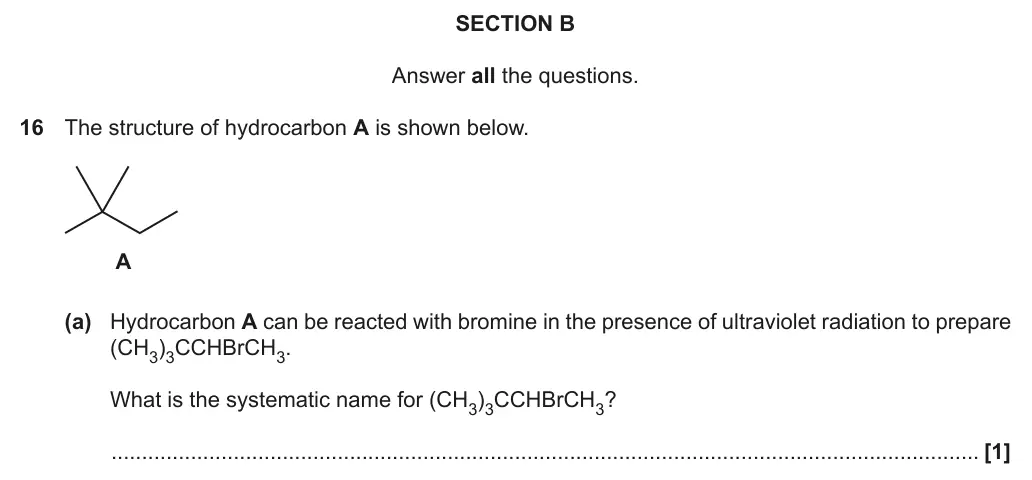
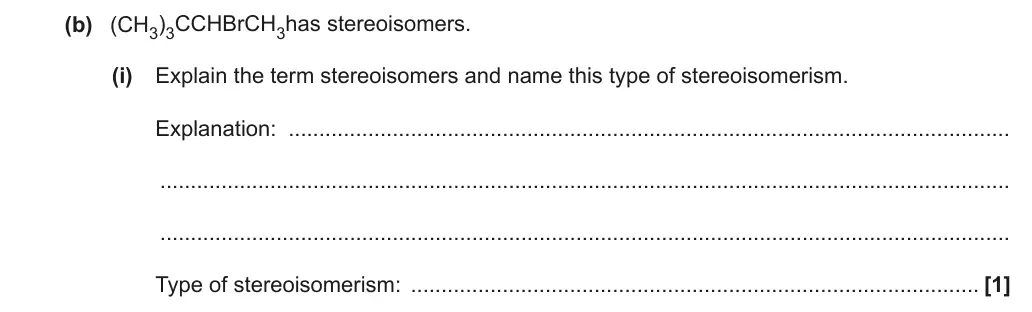
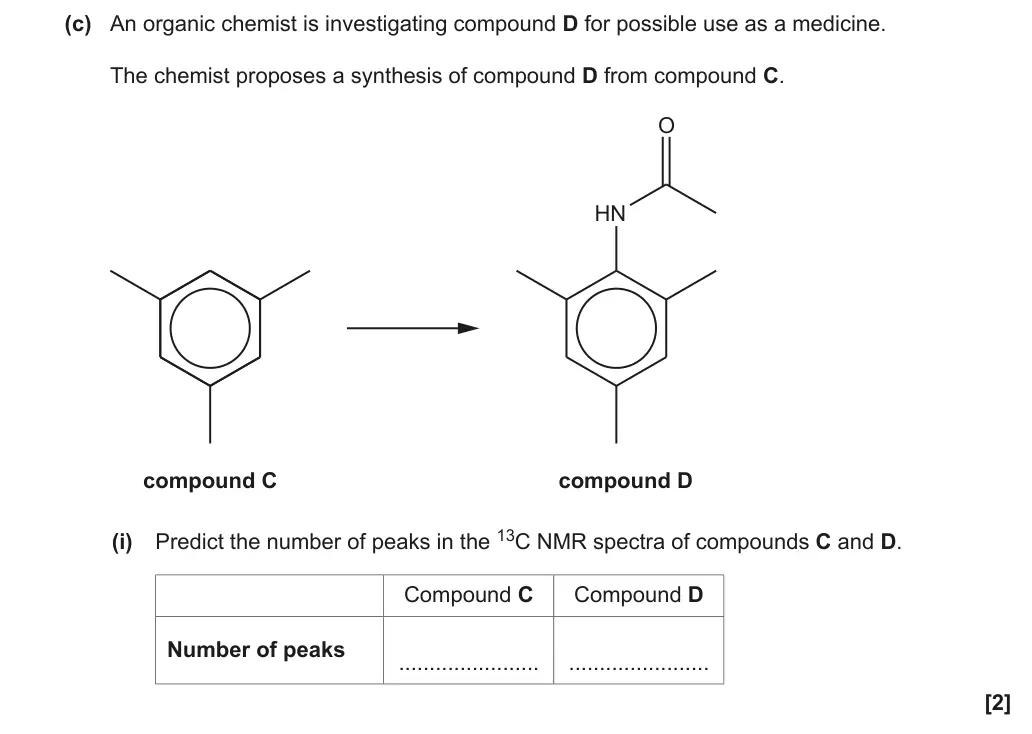
A chemist is investigating compound A, shown below, as a potential organic intermediate. Describe the type of stereoisomerism shown by compound A and suggest three reactions of
Tap a question to zoom it. Where a part needs a table, graph or structure from an earlier part, that part folds out above it; the mark scheme and examiner's comment open underneath. Have the OCR Data Sheet beside you.
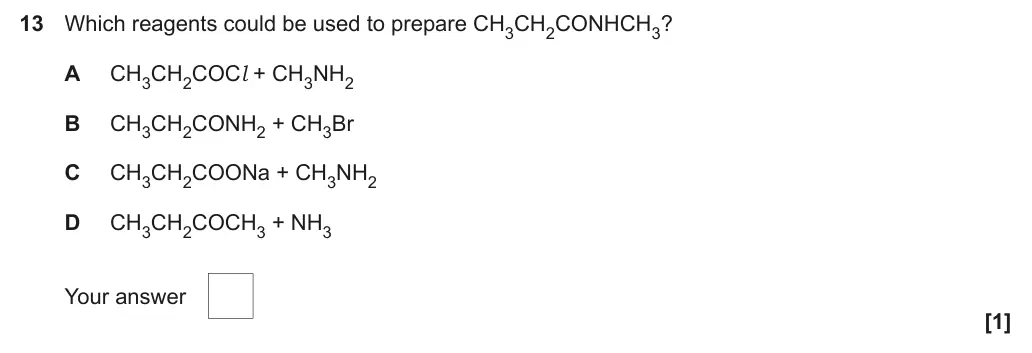
June 2025 · Paper 2 · Q71 markMultiple choiceMedium
Answer
B
Mark scheme
Examiner's comment
Most gave the correct response B. However, some found this tricky, with both A, with the acid group deprotonated and the amine protonated, and C, with no consideration of the acidic conditions, being common incorrect responses.
June 2025 · Paper 2 · Q101 markMultiple choiceHard
Answer
D
Mark scheme
Examiner's comment
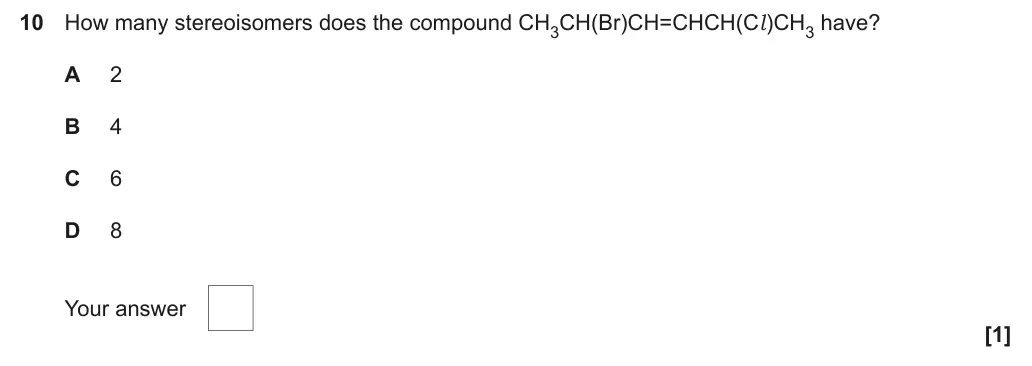
Very few candidates were able to give the correct answer D here, with the majority selecting A. Candidates found it challenging to recognise that with E/Z isomerism and two chiral centres in a non- symmetrical molecule there would be eight possible alternatives. For those with stronger maths skills the use of 2n rule can be encouraged but other students can be encouraged to consider all the possible alternatives.
June 2025 · Paper 2 · Q22(a)(ii)2 marksDrawing / labellingMedium
Earlier part of question 22 that this part uses
Mark scheme
Examiner's comment
Many candidates found this question tricky with only some able to score both marks. The most common correct responses were the dipeptides given as the first two structures on the mark scheme. The acid anhydride structure was less commonly seen and the cyclic peptide structure was rare. Candidates who got this response wrong often gave just the two amino acids identified from their Rf values in part (a)(i), forgetting that the amino acids needed to be joined together to create compound S. Some included an O in their amide bond i.e. -COONH- and lost both marks. Some recognised that the central C in an amino acid is chiral so drew stereoisomers. Some added an extra CH2 in the side chain of CH(CH3)2 but ECF was given for the second structure. Around half of all candidates didn’t score any marks here with some not even attempting this question at all.
Notes from the mark scheme and report
two different dipeptides from the R = CH3 and R = CH(CH3)2 amino acids (either order of amide link)
ALLOW ECF from wrong Rf values in (a)(i)
ALLOW ECF for one small slip e.g. missing H on NH
June 2025 · Paper 2 · Q22(b)(ii)1 markShort answerHard
Earlier part of question 22 that this part uses
Mark scheme
Examiner's comment
A difficult question that few candidates fully understood. Even for those that knew the difference, it was rare to get the mark as they would only describe one of the acids rather than both, e.g. ‘C=O is next to the COOH in an keto acid’ but with no reference to keto acids. Teachers should remind candidates that a comparison question needs to have information about both or all items that are being compared. Many struggled to make the comparison to amino acids (as given to help in the question) to help them explain what keto acids are. Some suggested that keto acids were amino acids and that the difference to keto acids was due to presence of C=O rather than NH2. Some linked keto acids to amino acids saying that the -NH2 group is linked to the next C along. It was also not sufficient to just say ‘in keto acids the C=O is next to COOH but keto acids it is found elsewhere on the molecule’ – it had to be clear where the C=O was relative to the COOH in each. However, we allowed for keto acid that the C=O is on the adjacent C where the C of the C=O is the adjacent C, as candidates used the terminology given for amino acids in the question. The clearest responses usually drew and labelled structures to show the difference in the positioning of C=O relative to COOH. Candidates should be advised that a well labelled diagram can help if they find it difficult to explain a point.
Notes from the mark scheme and report
α: C=O on the carbon adjacent to COOH
β: C=O two carbons away/one carbon in between
IGNORE 'bonded to a different C' (must be specific)
June 2025 · Paper 3 · Q4(b)(ii)3 marksStructure / isomerMedium
Earlier part of question 4 that this part uses
Mark scheme
Examiner's comment
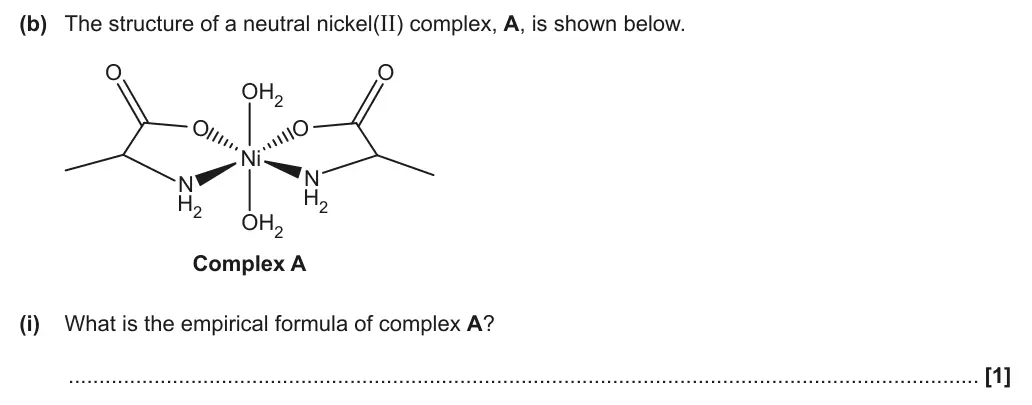
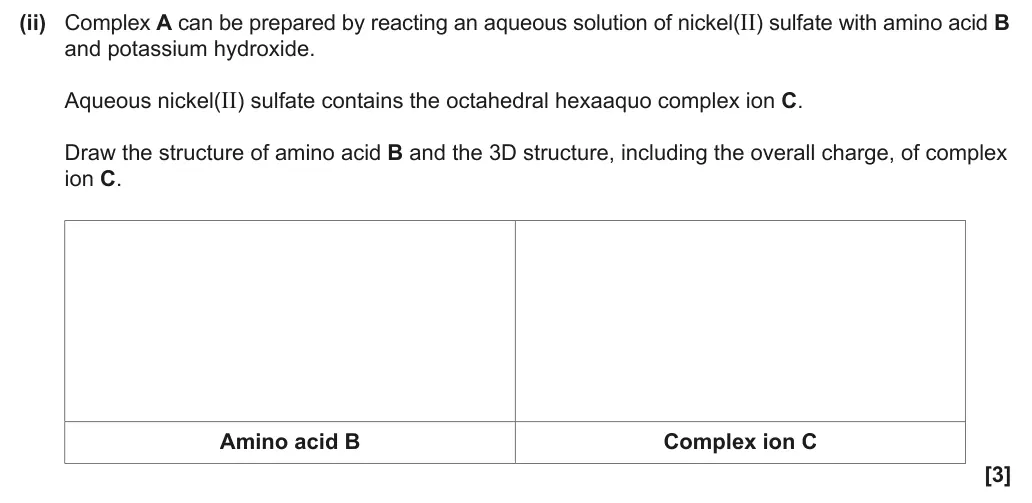
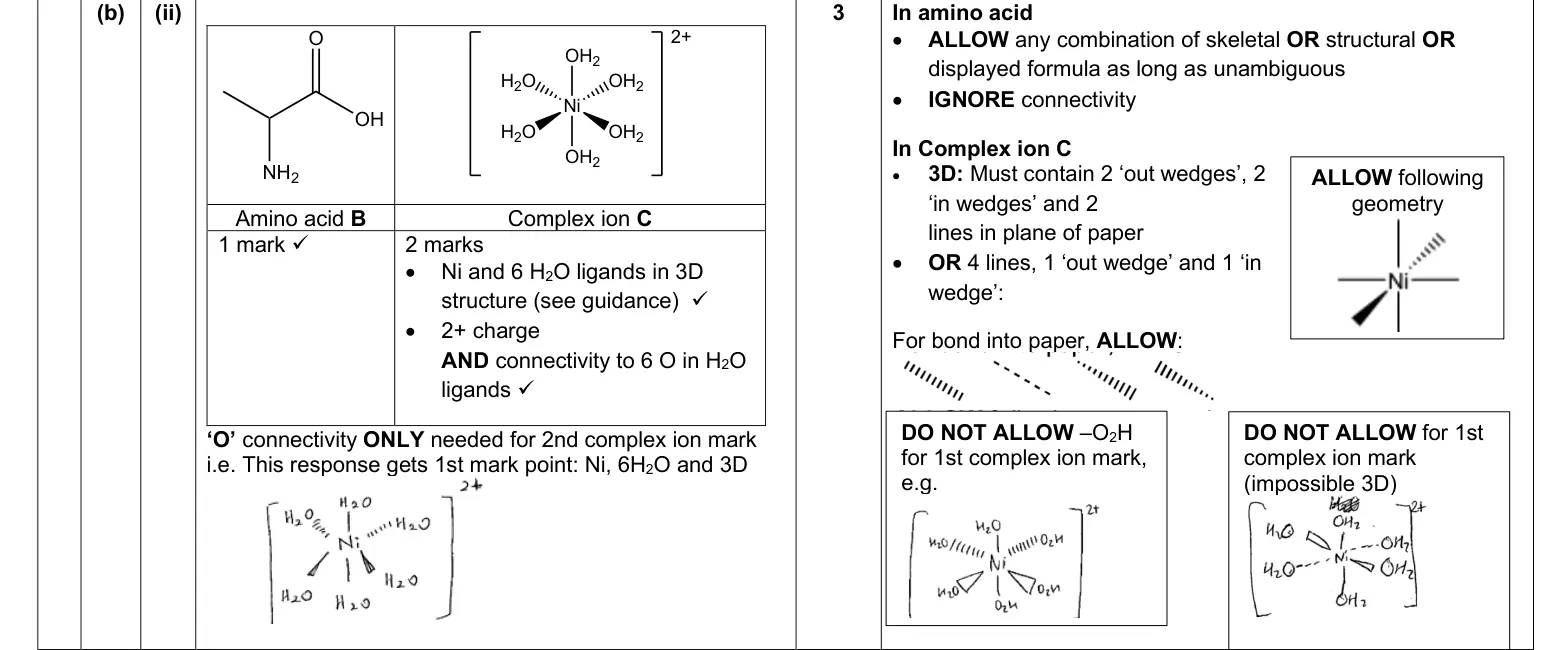
The structure of the amino acid was usually drawn correctly. The nickel complex ion provided problems with H2O connectivity and superfluous use of SO4. It was expected that bonds from Ni would be shown to the O atom, and that H2O was shown correctly in all orientations. So –H2O and –O2H were not allowed. Most candidates understood the importance of showing 3D bonds as wedges and the templates on the page will have helped in this respect. However, some candidates drew impossible 3D structures with bold wedges and dashed wedges shown opposite one another. Despite the overall charge being asked for in the question, a significant number of candidates omitted the charge.
Notes from the mark scheme and report
B = CH3CH(NH2)COOH
2+ charge AND bonds to O of H2O
DO NOT ALLOW –O2H
Skills: M4.2 Visualise and represent 2-D and 3-D forms including 2-D representations of 3-D objects
June 2024 · Paper 2 · Q91 markMultiple choiceMedium
Answer
C
Mark scheme
Examiner's comment
More than three quarters of candidates were able to identify C as being the secondary amide, with many annotating each structure with the correct functional group. Some gave B, i.e. a secondary amine not amide, and a few gave A, i.e. tertiary amide not secondary.
Notes from the mark scheme and report
N–H next to C=O with one C on each side of N
B is an amine plus ketone
June 2024 · Paper 2 · Q22(a)3 marksCalculationHard
Mark scheme
Examiner's comment
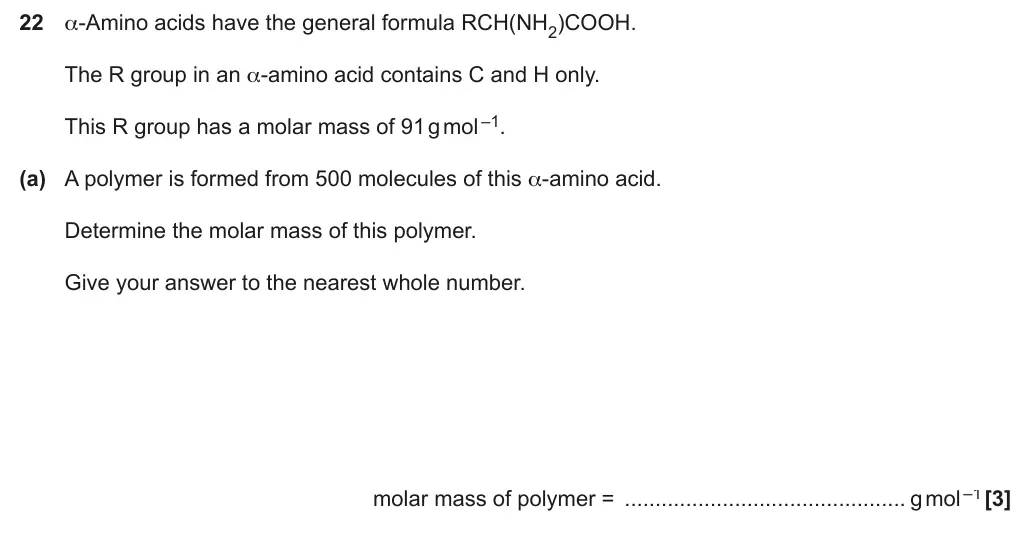
Most candidates managed to score at least one mark here, either for correctly determining the molar mass of the monomer, the repeat unit in the polymer or alternatively they multiplied a molar mass by 500. Many candidates gained 2 marks for either 73500 or 82500 but then struggled to account for the water lost. Some candidates lost marks due to errors in calculating the molar mass of the monomer or some tried to incorporate the use of Avogadro’s constant into the calculation. Many misunderstood what atoms would be lost during polymerisation. For example, a common incorrect response seen was found by subtracting 2 from the correct molar mass giving 163, followed by multiplication by 500 to give 81500 and finally adding of 2 to give 81502. Some struggled to understand what was meant by nearest whole number, e.g. rounding 73518 to 74000 or 82500 to 80000.
Notes from the mark scheme and report
Mr of amino acid 165 (91 + 74)
500 × 165 minus 499 × 18 water = 73518
73500 scores 2
common errors 36518 and 82500 (2 marks), 45500 (1 mark)
Skills: M0.2 Use ratios, fractions and percentages; M2.3 Substitute numerical values into algebraic equations using appropriate units for physical quantities
June 2024 · Paper 3 · Q2(c)(ii)1 markShort answerEasy
Earlier part of question 2 that this part uses
Mark scheme
Examiner's comment
This question was answered well with the correct answer of 4 being seen on most scripts, reflecting good understanding of chiral carbon centres. The commonest incorrect response was 5, presumably by including the C atom on the bottom right of the structure within the –CH(CH3)2 group.
Notes from the mark scheme and report
4 chiral carbons
Skills: M4.2 Visualise and represent 2-D and 3-D forms including 2-D representations of 3-D objects
June 2023 · Paper 2 · Q41 markAO1Multiple choiceMedium
Answer
C
Mark scheme
Examiner's comment
D was the most common incorrect response, separating the amide into a ketone and amine. This was followed by A, not recognising that a phenol OH is distinct from alcohol OH. A common strategy was to circle or label the functional groups on the structure of paracetamol.
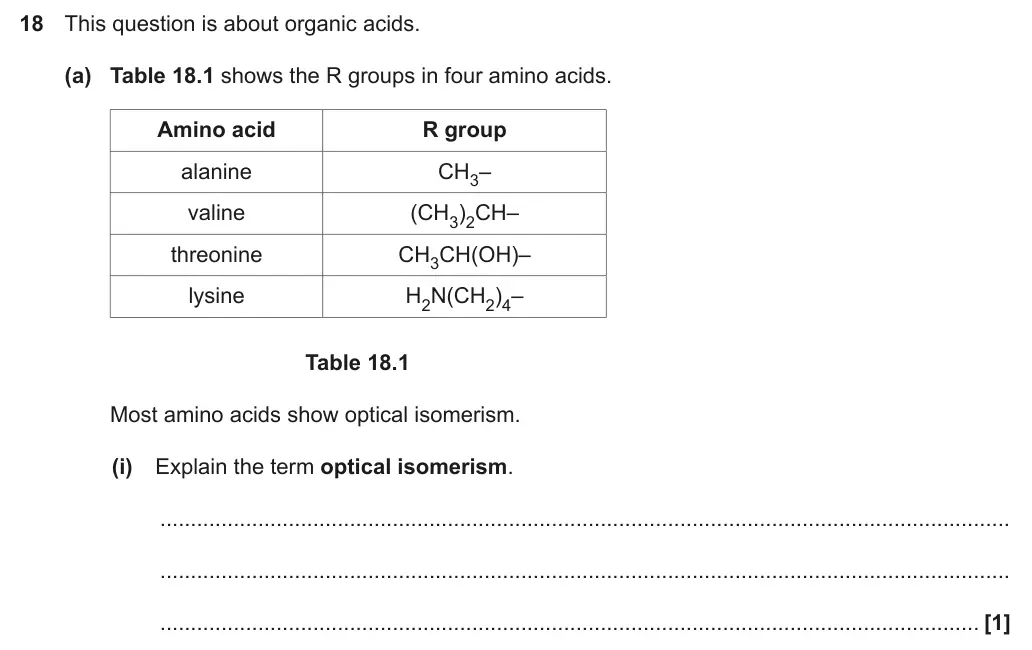
June 2023 · Paper 2 · Q21(a)1 markAO1Short answerMedium
Mark scheme
Examiner's comment
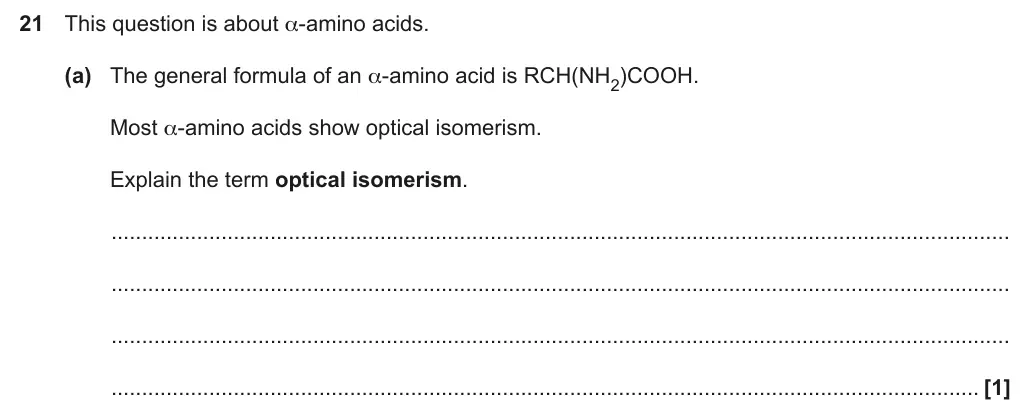
The majority of candidates were able to explain the term optical isomerism. However, it was still common to see incomplete responses such as ‘mirror images’ without reference to ‘non-superimposable’ or ‘non- superimposable images’ with no reference to ‘mirror’. Lots gave the definitions for stereoisomerism or an explanation for how a chiral centre arises.
Notes from the mark scheme and report
non-superimposable mirror images
IGNORE definition of stereoisomers
June 2023 · Paper 2 · Q21(b)(ii)2 marksAO1Structure / isomerMedium
Earlier parts of question 21 that this part uses
Mark scheme
Examiner's comment
Most candidates (more than half) were able to score both marks here, on what was a well-practised question from previous examination series. Most were able to identify the correct chiral carbon, with four different groups attached, and draw a 3-D representation of the two optical isomers with correct connectivity. Some candidates inadvertently drew the same structure (e.g. switched groups and gave a mirror image) so if not drawn in a standard way it needed extra checking. Some lost the second mark due to incorrect connectivity or use of C3H7. Some attempted to write formulae out as literal mirror images, e.g. 2(3HC)C and need to be told that this isn’t necessary as can sometime lead to connectivity errors.
Notes from the mark scheme and report
four central bonds with at least two wedges
mirror images with correct connectivity in both (bond to the CH of CH(CH3)2)
ALLOW R or C3H7 for second mark only
Skills: M4.2 Visualise and represent 2-D and 3-D forms including 2-D representations of 3-D objects; M4.3 Understand the symmetry of 2-D and 3-D shapes
June 2023 · Paper 2 · Q21(c)(i)1 markAO2Short answerHard
Earlier part of question 21 that this part uses
Mark scheme
Examiner's comment
This question was challenging for even the most able candidates with very few obtaining the correct answer of 16. Many identified the four chiral centres in compound E, often labelling these with an asterisk. However, only a small proportion were able to predict that there would be 16 possible optical isomers. Most provided an answer of four corresponding to the number of chiral centres or eight considering that each chiral centre would result in two optical isomers. They struggled to see that they needed 2n in this case where n represents the number of chiral centres. Candidates have probably seen very few, if any, examples of chiral compounds with more than two chiral centres.
Notes from the mark scheme and report
16 (four chiral centres)
Skills: M4.3 Understand the symmetry of 2-D and 3-D shapes
June 2023 · Paper 2 · Q21(c)(ii)4 marksAO2Structure / isomerMedium
Earlier part of question 21 that this part uses
Mark scheme
Examiner's comment
A significant number of candidates did not attempt this question despite similar questions appearing in previous exam series. However, approximately a quarter of candidates scored all 4 marks. Some lost the final mark for not protonating the amine groups as required as under acidic conditions. A very common error was to hydrolyse the amides to give acyl chlorides or even aldehydes rather than carboxylic acids. Lower scoring candidates often had incomplete hydrolysis or no hydrolysis at all with just changes to acid/amine/phenol functional groups, e.g. protonation of amine to form salts or swapping or OH groups for Cl. Candidates need to check their answers carefully for missing or extra Hs as this lost marks. It was much easier to mark candidates’ work presented with structures with a similar arrangement to compound E.
Notes from the mark scheme and report
three amino acids from the two amide links
1 mark each with NH2 or NH3+
fourth mark only if all three shown as NH3+ (acid conditions)
ALLOW salts NH3+Cl–
June 2023 · Paper 3 · Q36 marksAO36-mark level of responseMedium
Mark scheme, with the levels and indicative points
Examiner's comment
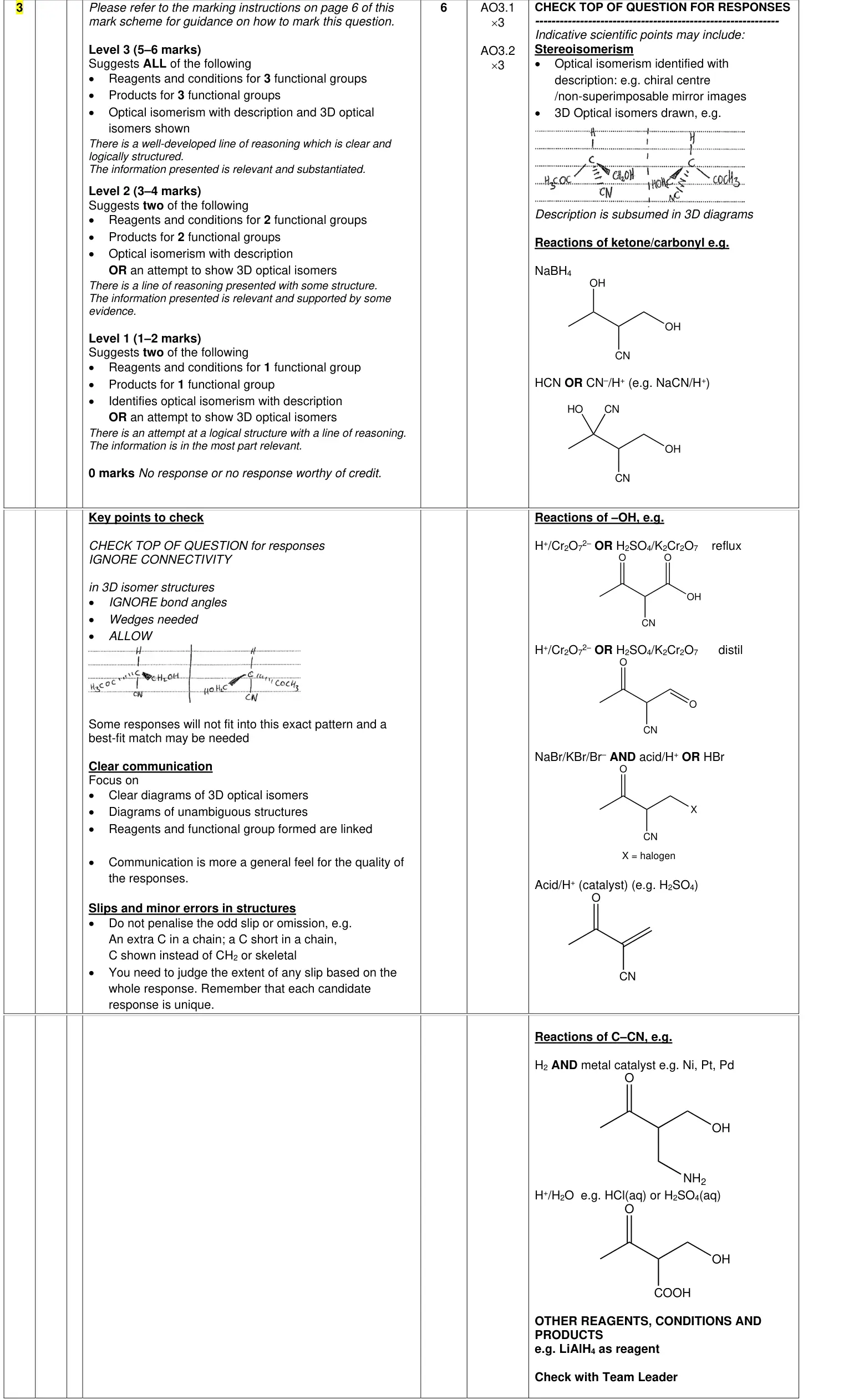
Overall, candidates performed well when answering this question. They were required to identify that compound A shows optical isomerism and to choose a reaction for each of the three functional groups. Candidates were also expected to use structures for the organic products. To achieve the highest level of response, a description of optical isomerism should be accompanied by 3D diagrams of the optical isomers. Optical isomerism was usually identified, with associated diagrams with almost all candidates identifying the chiral centre. Most attempted 3D diagrams but candidates do need to take care that the groups attached to the chiral C atom are those in compound A and that no parts of chains are omitted. Optical isomers do also require use bold and dashed wedges to be used. Most candidates showed good knowledge and understanding of reactions for the three functional groups. • For the primary alcohol, most chose H+/Cr2O72–, with distil (→ aldehyde) or reflux (→ carboxylic acid); a significant number chose a concentrated acid (→ alkene) or Br–-/H+ (→ haloalkane) • For the ketone, most chose NaBH4 (→ secondary alcohol) • For the nitrile, most chose either H2/Ni (→ amine) or H+(aq) (→ carboxylic acid). Clear diagrams of the products were usually seen although many omitted a CH2 from the amine branch for hydrolysis of the nitrile or an extra CH2 in the aldehyde or carboxylic acid branch from oxidation of the primary alcohol. Some candidates chose 2,4-DNP for a reaction of the ketone and treated the question as one requiring tests, and then proving that the compound was a ketone from no reaction with Tollens’ reagent. The question asked for the organic product and the 2,4- DNP product is beyond the demands of this specification (although this was seen very rarely). Candidates adopting this reaction were limiting the extent of their response and candidate should have considered this requirement before selecting 2.4- DNP. This exemplar shows a good response that lacks 3D diagrams for the optical isomers. The candidate has clearly given reagents and conditions and has shown the organic products. In the response, you can see that the candidate initially showed an extra CH2 in the –COOH branch, and a mistake in the amine branch. The absence of 3D structures limits the response to Level 2 and 4 marks have been awarded for choosing correct and relevant reagents and conditions, and for the clear communication of the structures.
Notes from the mark scheme and report
optical isomerism with chiral centre/non-superimposable mirror images and 3D diagrams with wedges
Skills: M4.2 Visualise and represent 2-D and 3-D forms including 2-D representations of 3-D objects
June 2022 · Paper 2 · Q41 markAO1Multiple choiceEasy
Answer
A
Mark scheme
Examiner's comment
Most candidates correctly selected A. The most common incorrect response was option D as candidates had misinterpreted the amide group as a ketone and an amine.
June 2022 · Paper 2 · Q51 markAO1Multiple choiceMedium
Answer
D
Mark scheme
Examiner's comment
Many candidates correctly answered D, with those selecting the correct response showing annotations on the given structure to identify the chiral carbons. C proved a good distractor.
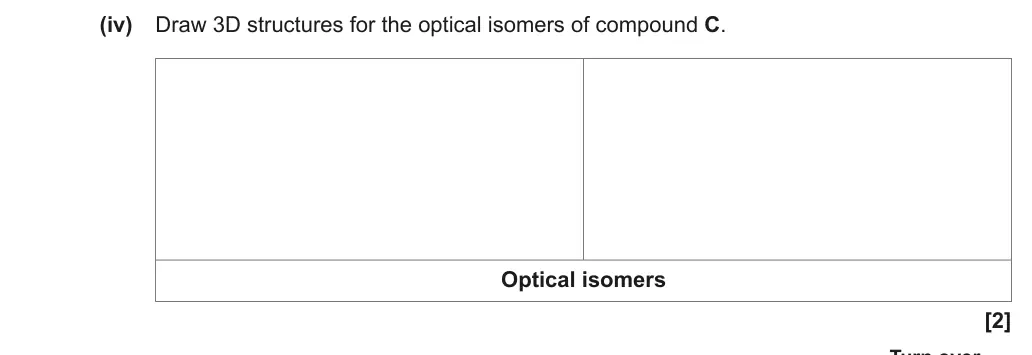
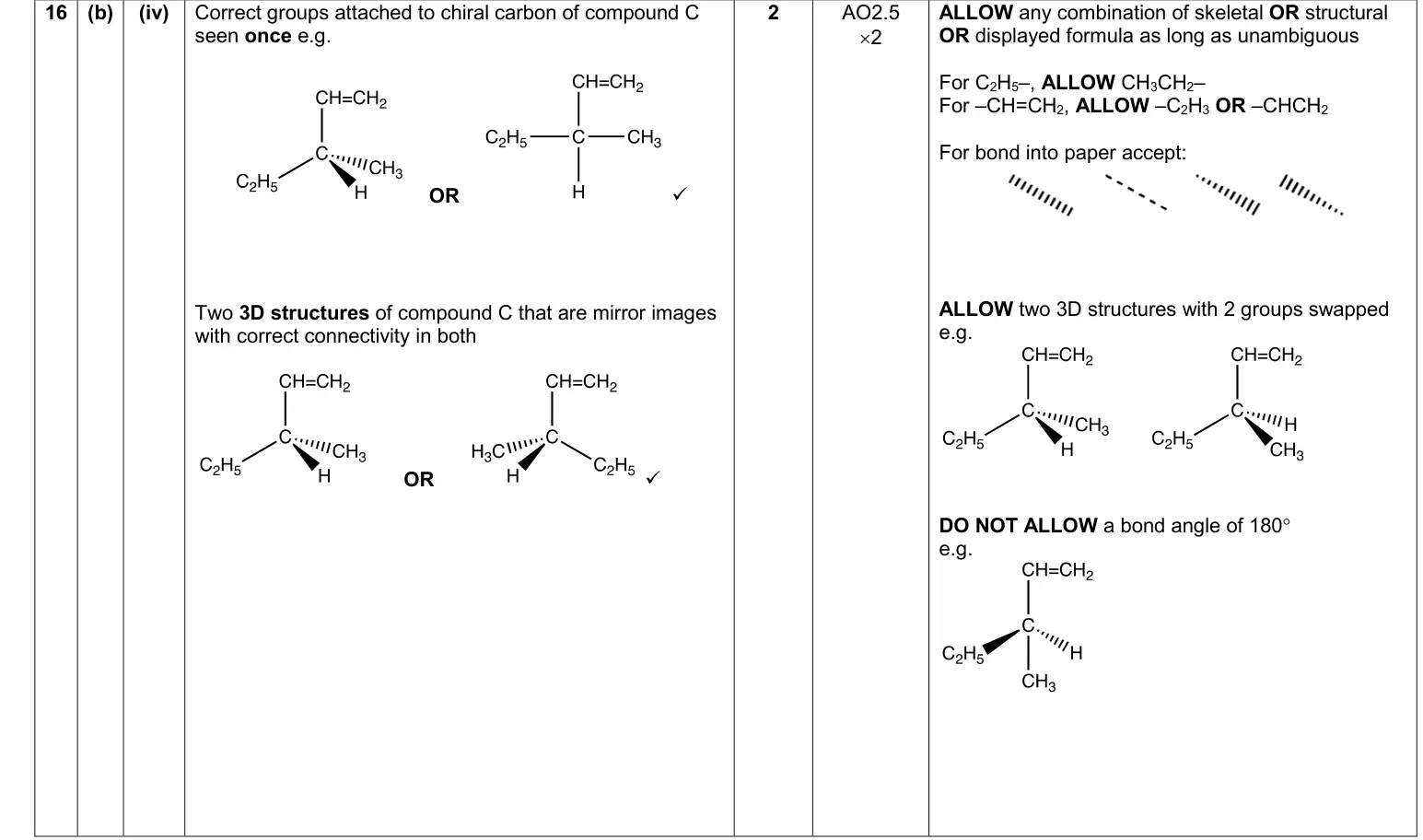
June 2022 · Paper 2 · Q16(b)(iv)2 marksAO2Structure / isomerHard
Earlier part of question 16 that this part uses
Mark scheme
Examiner's comment
This question discriminated well. Candidates were required to identify the groups around a chiral carbon and then draw the two corresponding optical isomers. Incorrect responses frequently had incorrect connectivity around the chiral carbon, bond angles of 180 or 2D structures.
Notes from the mark scheme and report
C is 3-methylpent-1-ene
four bonds to chiral C with wedges
mirror images with correct connectivity
DO NOT ALLOW a bond angle of 180°
Skills: M4.2 Visualise and represent 2-D and 3-D forms including 2-D representations of 3-D objects; M4.3 Understand the symmetry of 2-D and 3-D shapes
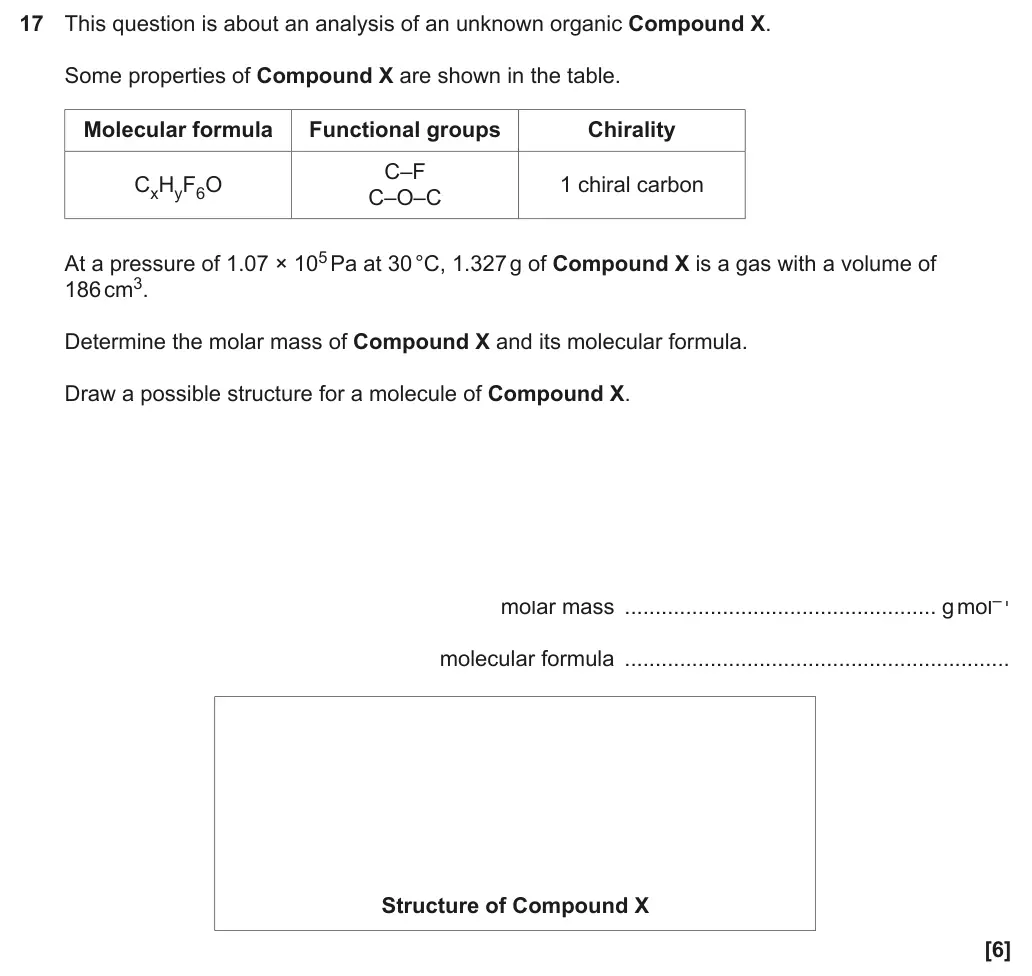
June 2022 · Paper 2 · Q176 marksAO1, 2Structure / isomerHard
Mark scheme
Examiner's comment
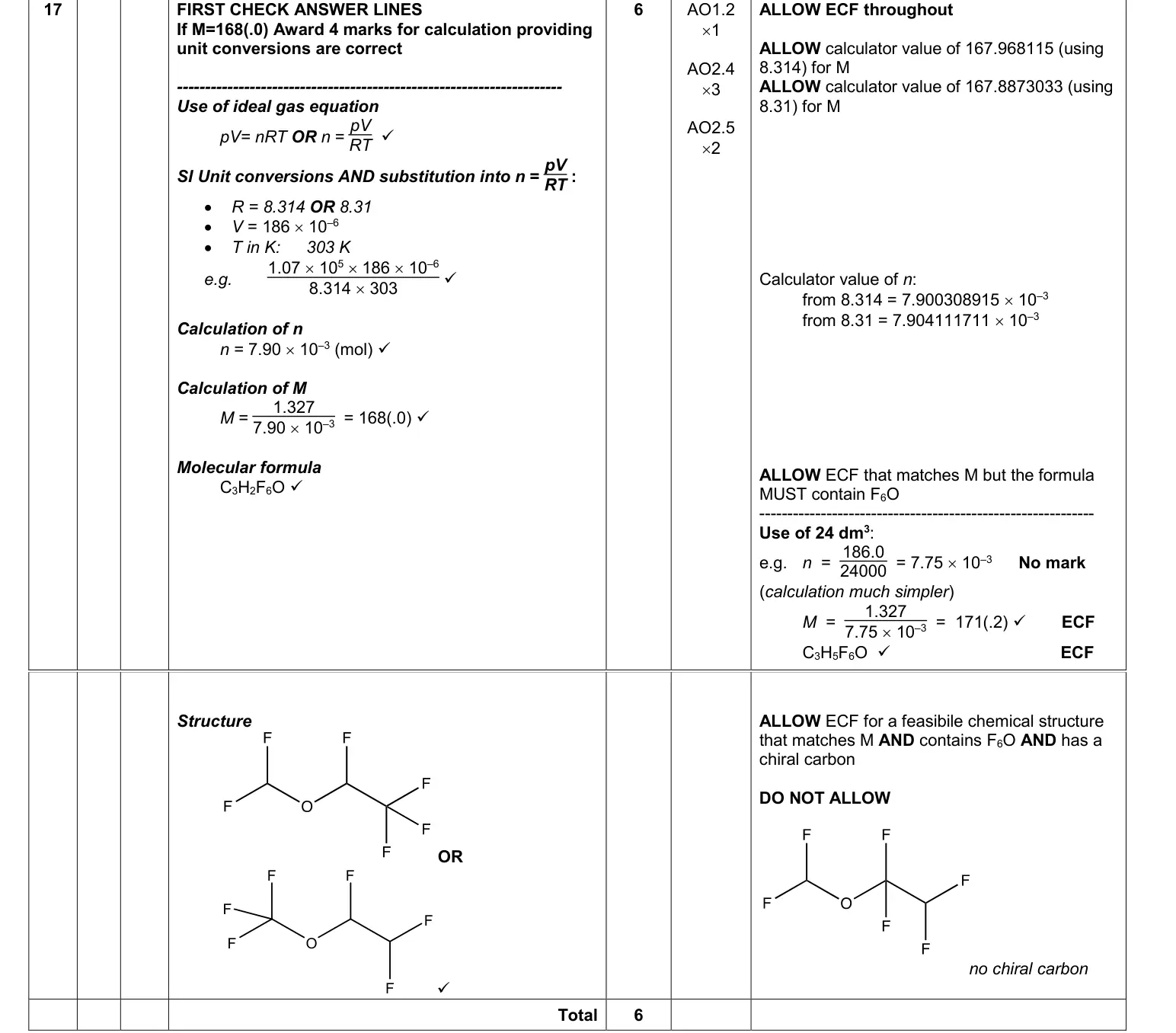
This question proved difficult and discriminated well. Higher ability candidates correctly used SI units and showed each step of their calculation and then using this to correctly identify a structure of compound X. Candidates frequently used the wrong interconversions and gave structures that lacked a chiral centre. A small number of candidates used molar gas volume rather than PV=nRT for their calculation.
Notes from the mark scheme and report
convert cm3 to m3 and °C to K
M = 168 so C3H2F6O
structure must contain F6O, C–O–C and a chiral carbon (DO NOT ALLOW no chiral carbon)
use of 24 dm3 loses the calculation mark but ECF (171, C3H5F6O)
Skills: M0.0 Recognise and make use of appropriate units in calculations; M2.2 Change the subject of an equation; M2.3 Substitute numerical values into algebraic equations using appropriate units for physical quantities
June 2022 · Paper 2 · Q19(a)4 marksAO2Equation writingHard
Mark scheme
Examiner's comment
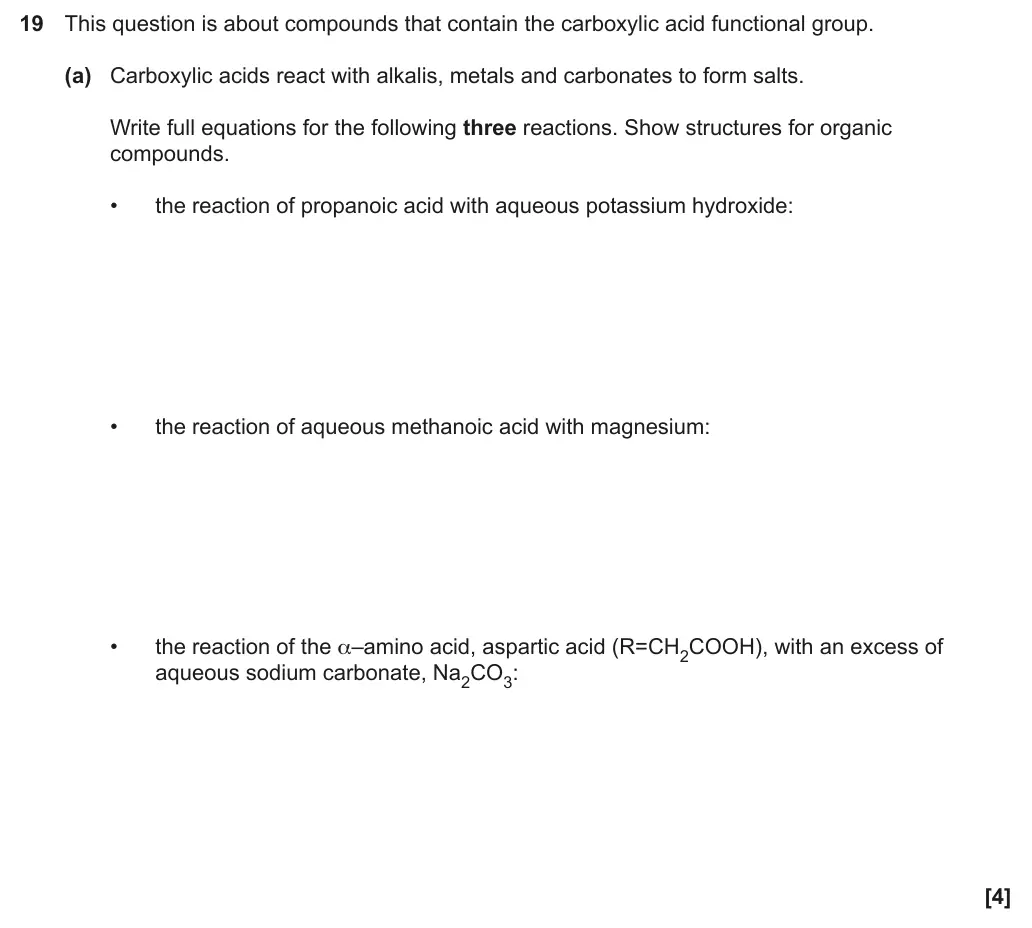
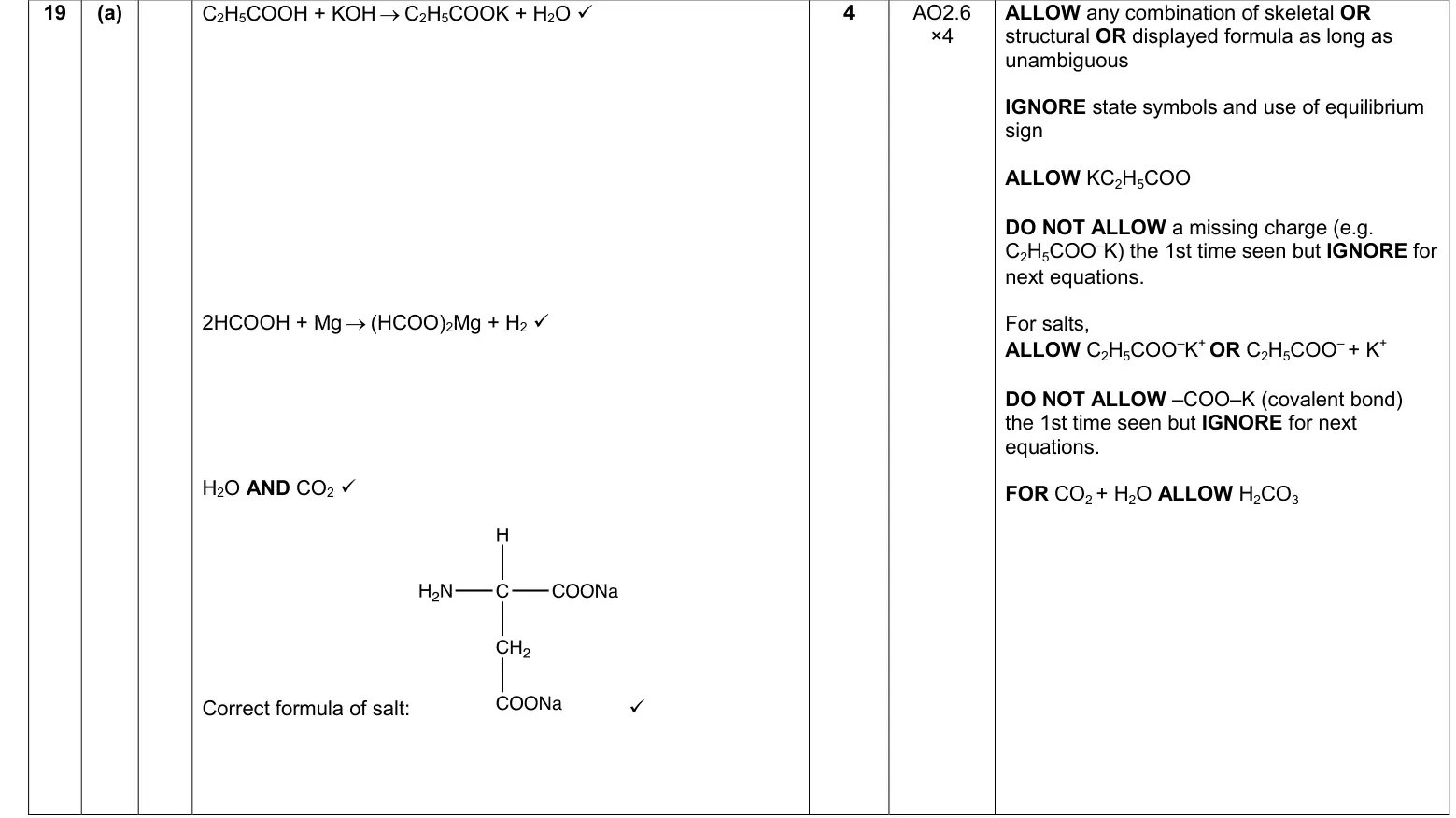
This question proved challenging for candidates. The first equation was often answered correctly, although some candidates used sodium hydroxide rather than potassium hydroxide in their response. The second equation was frequently incorrect. Candidates frequently missed a hydrogen from the structure for methanolic acid or did not recognise that hydrogen was a product. Many candidates did not account for magnesium having a 2+ charge when working out the product. For the third equation, the majority of candidates identified that carbon dioxide and water would be produced but were unable to give the correct formula of the salt as they did not interpret the information given regarding the R group.
Notes from the mark scheme and report
2HCOOH + Mg → (HCOO)2Mg + H2
both COOH groups of aspartic acid react with excess Na2CO3 giving H2O AND CO2 (ALLOW H2CO3)
DO NOT ALLOW –COO–K covalent bond or missing charge (penalise once)
Skills: M0.2 Use ratios, fractions and percentages
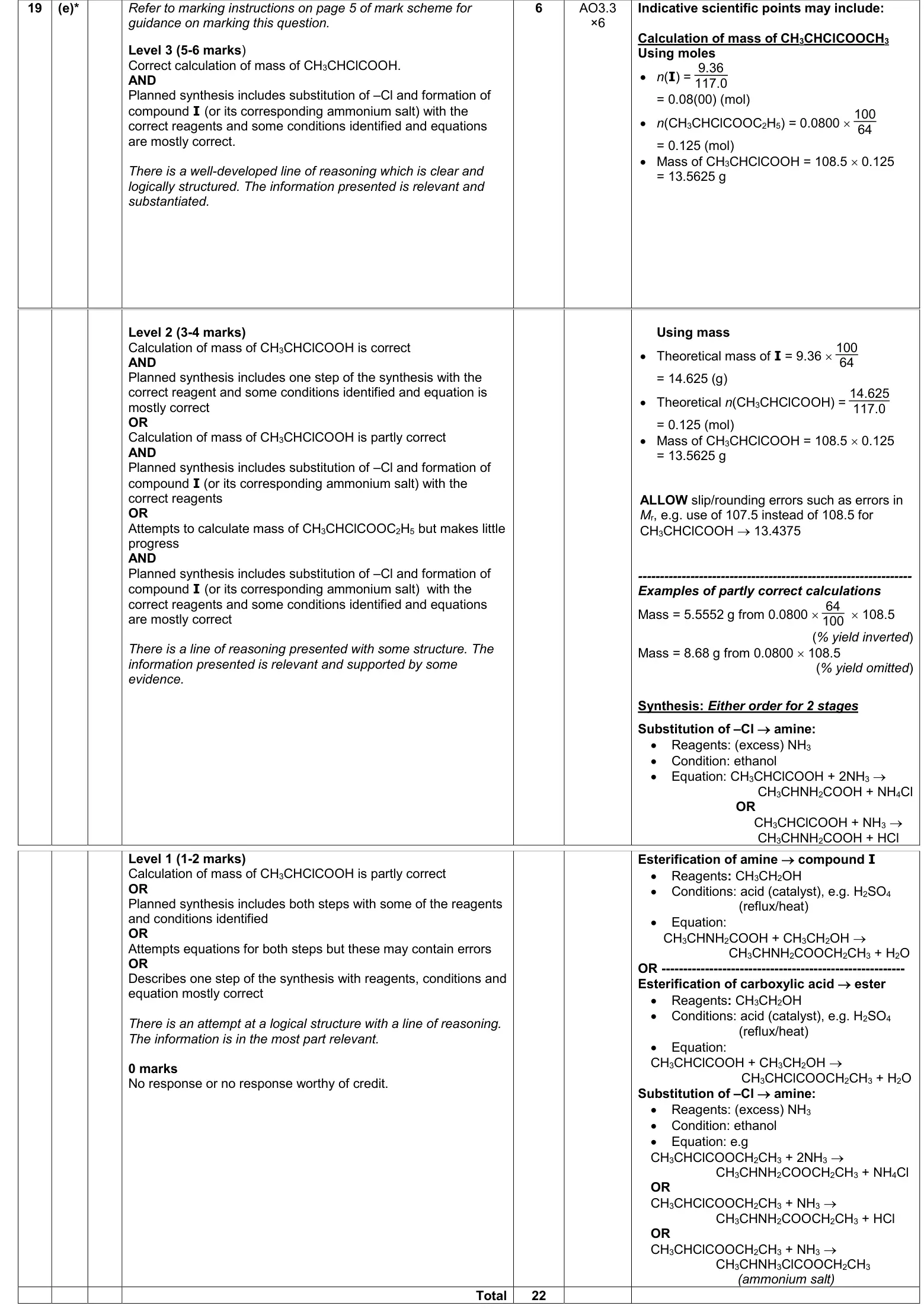
June 2022 · Paper 2 · Q19(e)6 marksAO36-mark level of responseMedium
Mark scheme, with the levels and indicative points
Examiner's comment
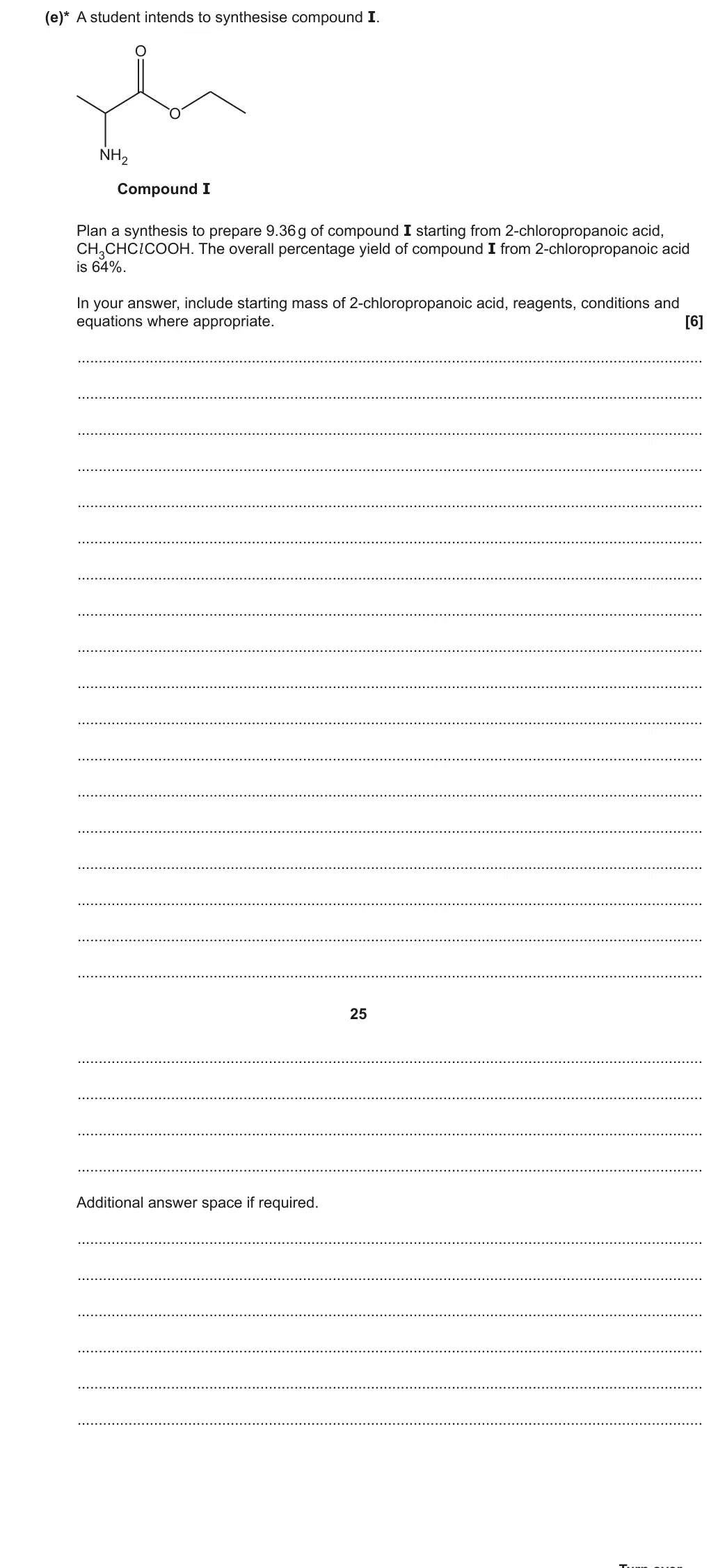
This question was marked using a level of response mark scheme. Most candidates gave an answer worth of at least Level 2 (3-4 marks) by providing the synthetic steps with reagents and equations for the synthesis of compound I. Exemplar 2, below, shows a frequent Level 2 response. The best performing candidates correctly determined the mass attempting to calculate the mass and showed the synthesis efficiently, using equations to communicate the preparation of compound I, with these responses being given Level 3 (5-6 marks). A number of responses omitted the mass calculation, such responses received Level 2 (1-2 marks). In this response the candidate has attempted to calculate the starting mass but has made little progress. Two stages of the synthesis have been covered with the reagents and most of the conditions identified. Both equations are complete. This is a Level 2 response and 4 marks have been given as the repones is logical and well communicated
Notes from the mark scheme and report
mass of CH3CHClCOOH = 13.56 g (0.0800 mol × 100/64 × 108.5)
partly correct e.g. 5.56 g from inverted yield
excess NH3 in ethanol substitutes Cl
ethanol with acid catalyst (H2SO4) to esterify (ALLOW ammonium salt of I)
Skills: M0.2 Use ratios, fractions and percentages; M2.2 Change the subject of an equation
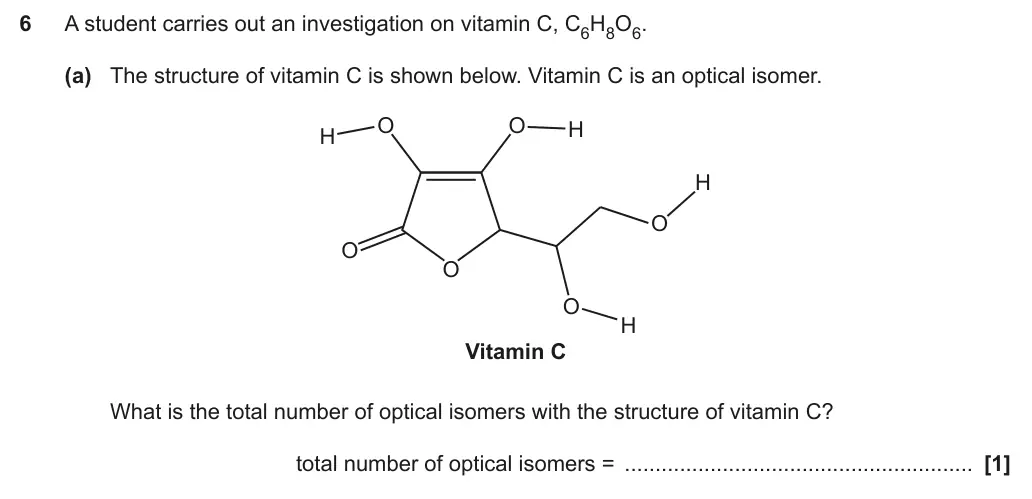
June 2022 · Paper 3 · Q6(a)1 markAO2CalculationMedium
Mark scheme
Examiner's comment
Most candidates added two asterisks to the diagram of vitamin C for the possible chiral centres. More successful responses usually realised that two chiral centres would give rise to 22 = 4 optical isomers, with 2 optical isomers being the commonest error.
Notes from the mark scheme and report
4 (two chiral centres)
Skills: M4.2 Visualise and represent 2-D and 3-D forms including 2-D representations of 3-D objects
November 2021 · Paper 2 · Q21 markMultiple choice
Answer
B
Mark scheme
November 2021 · Paper 2 · Q51 markMultiple choice
Answer
D
Mark scheme
November 2021 · Paper 2 · Q18(a)(i)1 markAO1Data interpretation
Mark scheme
Notes from the mark scheme and report
non-superimposable mirror images
November 2021 · Paper 2 · Q18(a)(ii)2 marksAO2Structure / isomer
Earlier part of question 18 that this part uses
Mark scheme
Notes from the mark scheme and report
four bonds to chiral C with at least two wedges
two structures that are mirror images with correct connectivity
1 mark if CH3 shown as R
Skills: M4.2 Visualise and represent 2-D and 3-D forms including 2-D representations of 3-D objects; M4.3 Understand the symmetry of 2-D and 3-D shapes
November 2021 · Paper 2 · Q18(a)(iii)1 markAO2Short answer
Earlier part of question 18 that this part uses
Mark scheme
Notes from the mark scheme and report
4 (two chiral centres)
Skills: M4.3 Understand the symmetry of 2-D and 3-D shapes
November 2021 · Paper 2 · Q18(d)(i)2 marksAO3Structure / isomer
Earlier parts of question 18 that this part uses
Mark scheme
Notes from the mark scheme and report
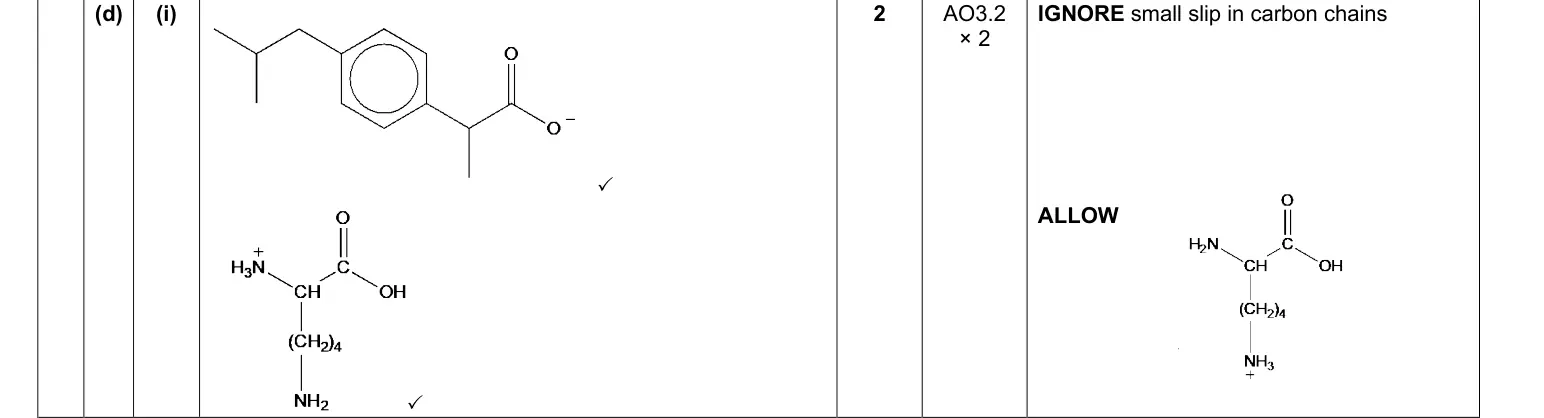
ibuprofen carboxylate COO–
lysine with one NH3+ (either amine group protonated)
IGNORE small slip in carbon chains
November 2020 · Paper 2 · Q16(b)(i)1 markAO1Short answer
Earlier part of question 16 that this part uses
Mark scheme
Notes from the mark scheme and report
same structural formula AND different arrangement in space AND optical all needed
DO NOT ALLOW same empirical/general formula
IGNORE same molecular formula
November 2020 · Paper 2 · Q16(b)(ii)2 marksAO1, 2Structure / isomer
Earlier part of question 16 that this part uses
Mark scheme
Notes from the mark scheme and report
four bonds to the chiral C with at least two wedges
two structures must be mirror images with correct connectivity
Skills: M4.2 Visualise and represent 2-D and 3-D forms including 2-D representations of 3-D objects; M4.3 Understand the symmetry of 2-D and 3-D shapes
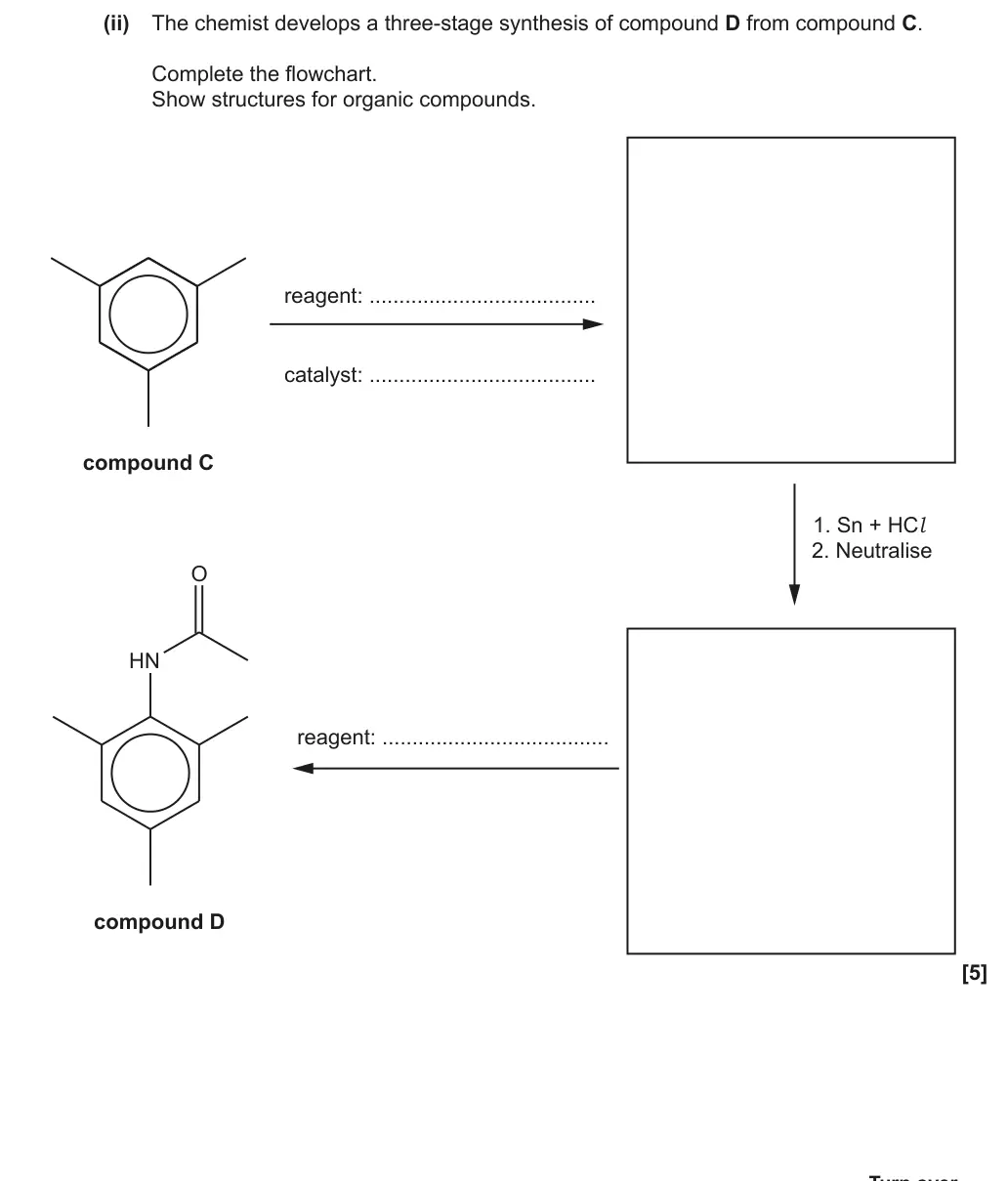
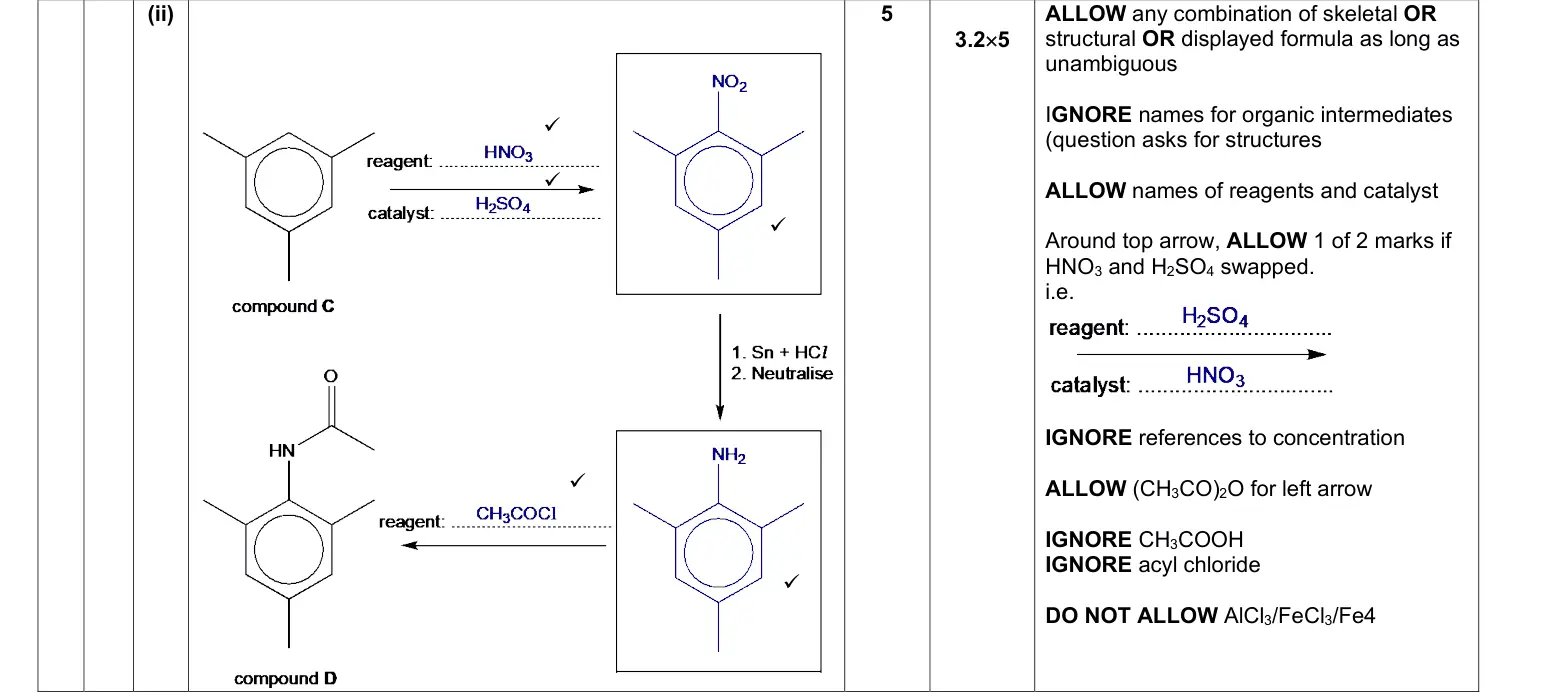
November 2020 · Paper 2 · Q17(c)(ii)5 marksAO3Complete table/diagram
Earlier part of question 17 that this part uses
Mark scheme
Notes from the mark scheme and report
HNO3 with H2SO4 catalyst (1 of 2 if swapped)
nitro compound then amine
CH3COCl or (CH3CO)2O for final stage (IGNORE CH3COOH)
DO NOT ALLOW AlCl3/FeCl3
November 2020 · Paper 2 · Q21(b)(i)3 marksAO1Short answer
Mark scheme
Notes from the mark scheme and report
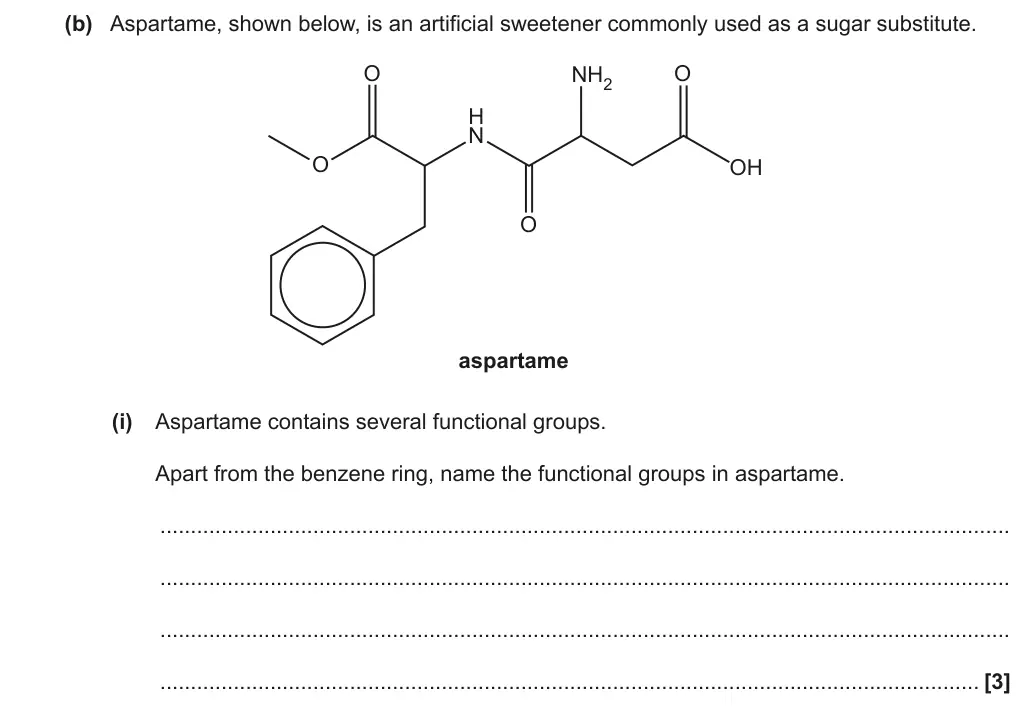
ester, amide, amine, carboxylic acid (4 correct for 3 marks)
IGNORE amino acid
IGNORE formulae
if more than 4 given incorrect groups counted first
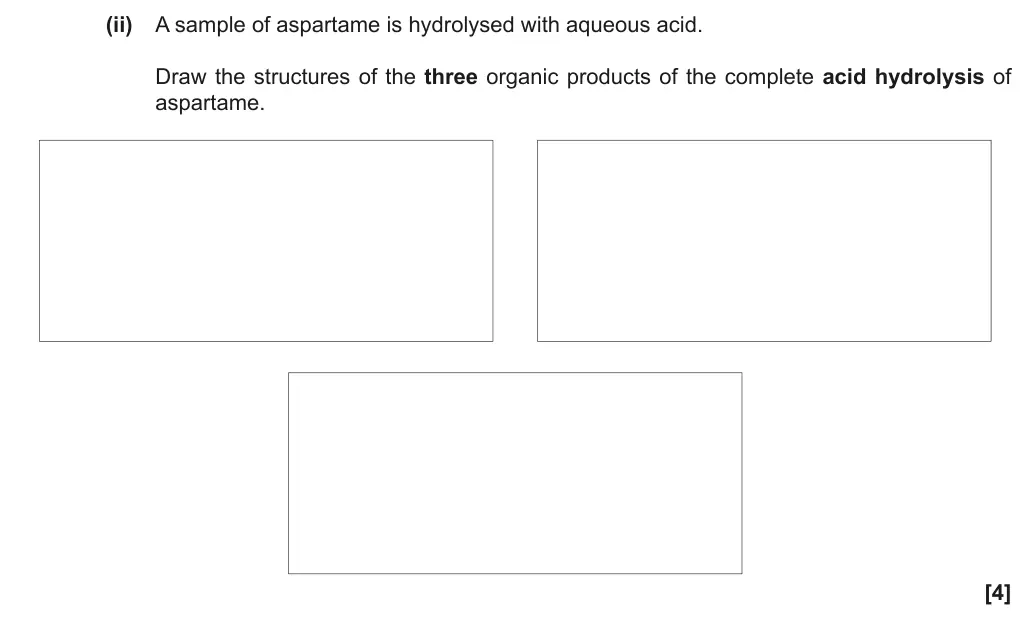
November 2020 · Paper 2 · Q21(b)(ii)4 marksAO2Structure / isomer
Earlier part of question 21 that this part uses
Mark scheme
Notes from the mark scheme and report
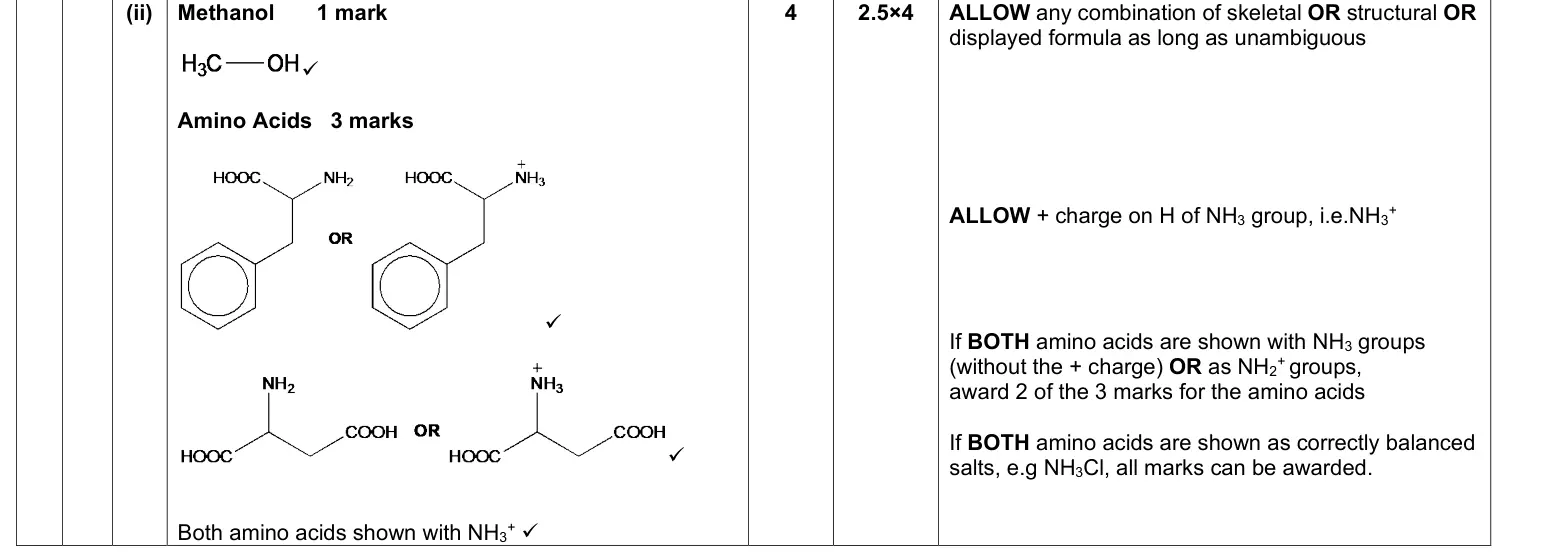
methanol plus two amino acids
both amino acids must show NH3+ for full marks (acid conditions): 2 of 3 if NH2/NH3 without charge
November 2020 · Paper 3 · Q1(c)2 marksAO3Complete table/diagramHard
Mark scheme
Examiner's comment
1a(i) Most candidates labelled some of the apparatus correctly and identified the reflux technique. A significant number showed water flowing in the wrong direction and ‘distillation’ was given as the name of the technique. The ‘condenser’ was sometimes labelled incorrectly, e.g. ‘condensation tube, ‘distillation tube’ and ‘water jacket’. Only just over half the candidates were given both marks. 1a(ii) Many diagrams were incomplete and it was comparatively rare for both of the two available marks to be given. Important labels were often missing. Some candidates drew diagrams of other techniques, such as distillation. Many responses were not credited with marks and this question was often omitted. Candidates need practice in recognising practical techniques and in drawing acceptable diagrams. 1b(i) Candidates were expected to explain the different boiling points of three amines. Most candidates linked increased branching with less surface contact between molecules, leading to weaker induced dipole interactions (London forces). Fewer candidates linked the decreasing boiling points to less energy being required to break the intermolecular bonds. The highest performing candidates recognised the large difference between the boiling points of the primary and tertiary amines. They then identified the cause: primary amines form hydrogen bonds but tertiary amines do not. This question was answered reasonably well with fewer candidates than in the past describing relative strengths of covalent bonds, a common misconception. 1(b)(ii) Most candidates rearranged the ideal gas equation correctly to make n the subject. They then substituted correct values for p, V, R and T into the equation, with correct unit conversions. Most candidates then calculated n correctly as 2.32 × 10⁻³ and combined this value with the mass of 0.202 g to derive the molecular formula as 87. Lower-attaining candidates often made an error in their conversion of cm3 into m3, by multiplying by 10–3 rather than 10–6. This error resulted in a value of n as 2.32 and the unrealistic molecular mass of 8.7 × 10⁻³, from which a molecular formula is impossible. Candidates in this position are advised to check back at the unit conversions in the working. Very few candidates did not convert 100ºC into 373 K. Candidates with the correct molecular formula of 87 usually suggested C5H13N as the molecular formula. A significant number quoted C5H11NH2. This response was not credited as it is not a ‘molecular’ formula. There are several possible structures of C5H13N with three 13C NMR peaks and any were credited. Error carried forward was applied from a different molecular mass for both the molecular formula and a structure. This emphasises the importance of working within calculation; credit will always be given for a correct method. Instead of using the ideal gas equation, some candidates used the molar gas constant at room temperature and pressure, 24.0 dm3, which gives a molecular mass of 67. This simplified approach could only gain the final 2 marks for this question: a molecular formula (with an error carried forward value of 67, e.g. C4H5N) and a structure of an amine with this molecular formula and 3 peaks in the 13C NMR spectrum. 1(c) Candidates were supplied with information about an unfamiliar reaction of an amino acid and asked to predict a possible equation. Many candidates suggested H2O as one product, being the difference in the formula of the amino acid and the C3H3NO cyclic organic product. Any cyclic structure of C3H3NO that met the bonding rules for C, H, N and O was credited. Examples included a 4-membered ring lactam and substituted cyclopropenes. A significant number of candidates showed an equation for the reaction of two molecules of the amino acid to form 2 H2O and a cyclic dipeptide. Although chemically feasible, the dipeptide could not be credited because the molecular formula was C3H3NO in the question. This error could have been avoided if the information in the question had been used.
Notes from the mark scheme and report
cyclic amide (four-membered lactam ring keeping C=C) + H2O
products marked independently then balanced
DO NOT ALLOW dimer
structure must have correct number of bonds to each atom
June 2019 · Paper 2 · Q71 markAO1Multiple choice
Answer
B
Mark scheme
Notes from the mark scheme and report
ALLOW 6
Skills: M4.2 Visualise and represent 2-D and 3-D forms including 2-D representations of 3-D objects
June 2019 · Paper 2 · Q151 markAO1Multiple choiceEasy
Answer
B
Mark scheme
Examiner's comment
Most candidates were able to identify the functional groups correctly and selected B. Some candidates opted for A, presumably assuming the C=O at the top of the structure was a ketone. A small, but significant number of candidates chose option C. Section B overview Section B includes a mixture of short answer and extended response questions, including two questions marked using a level of response mark scheme (18(e)(i) and 21). This section of the paper is worth 85 marks.
June 2019 · Paper 2 · Q16(b)(v)4 marksAO1, 2Structure / isomerHard
Earlier part of question 16 that this part uses
Mark scheme
Examiner's comment
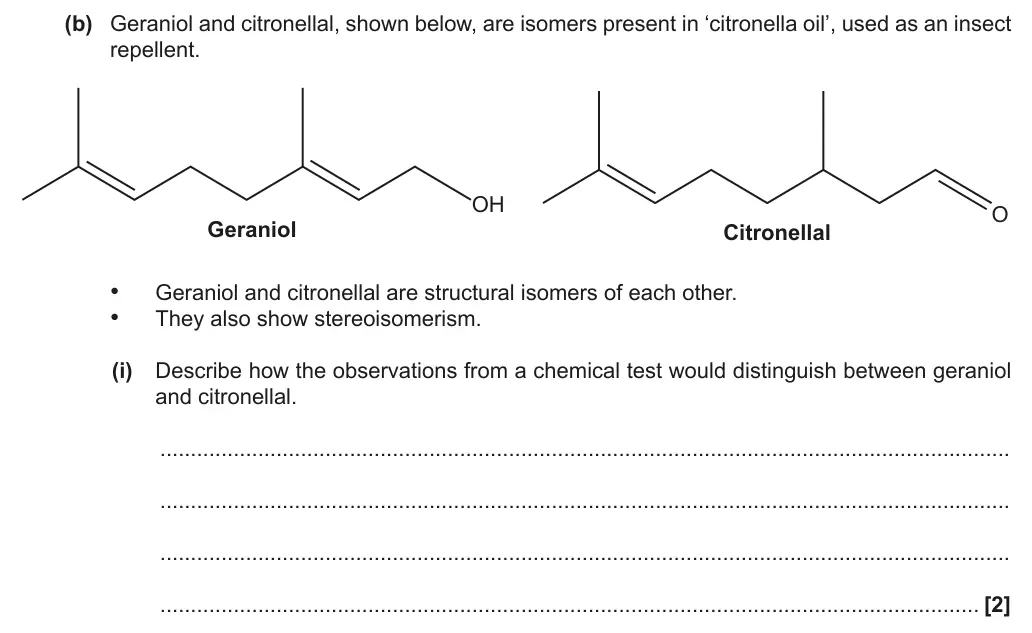
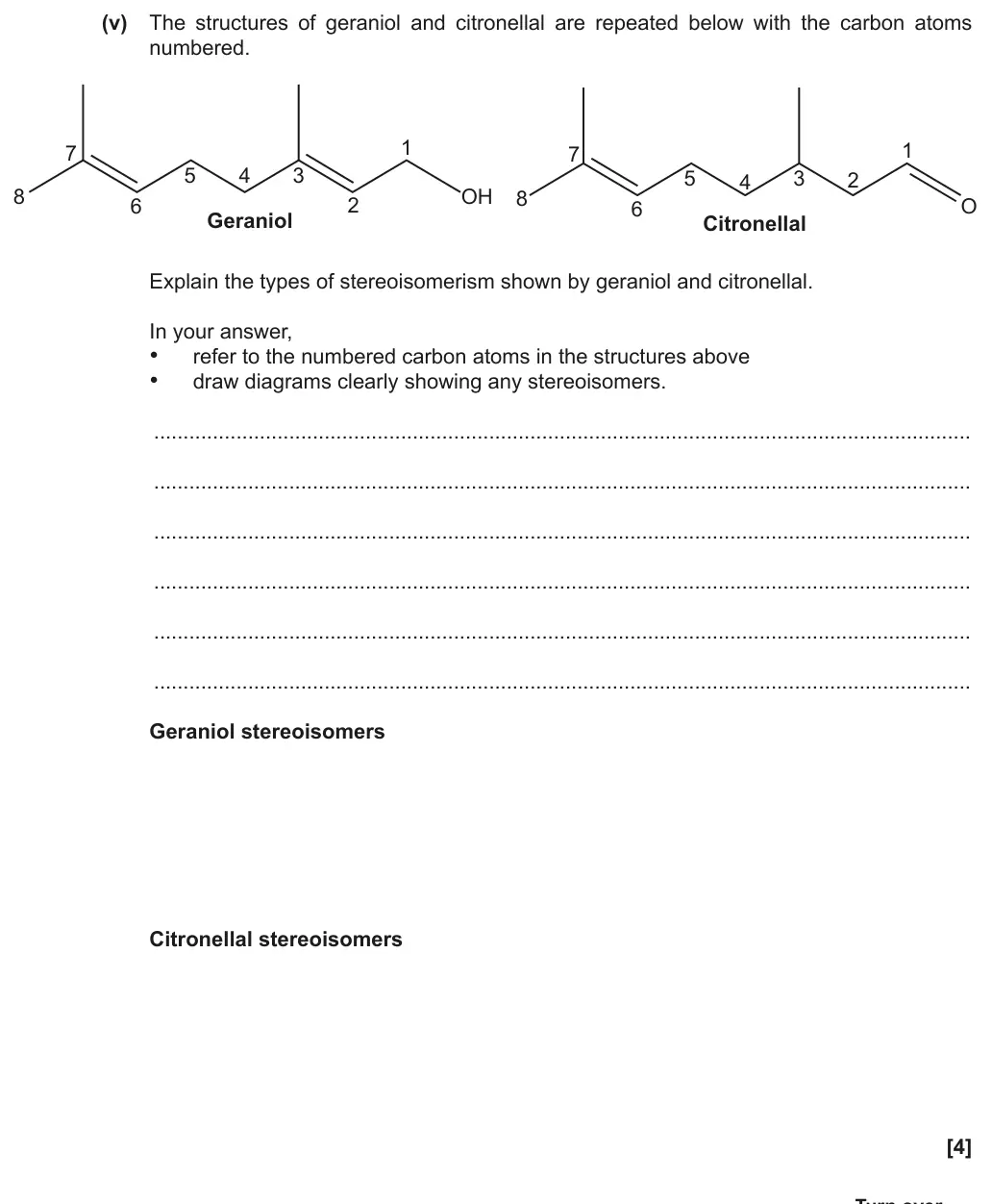
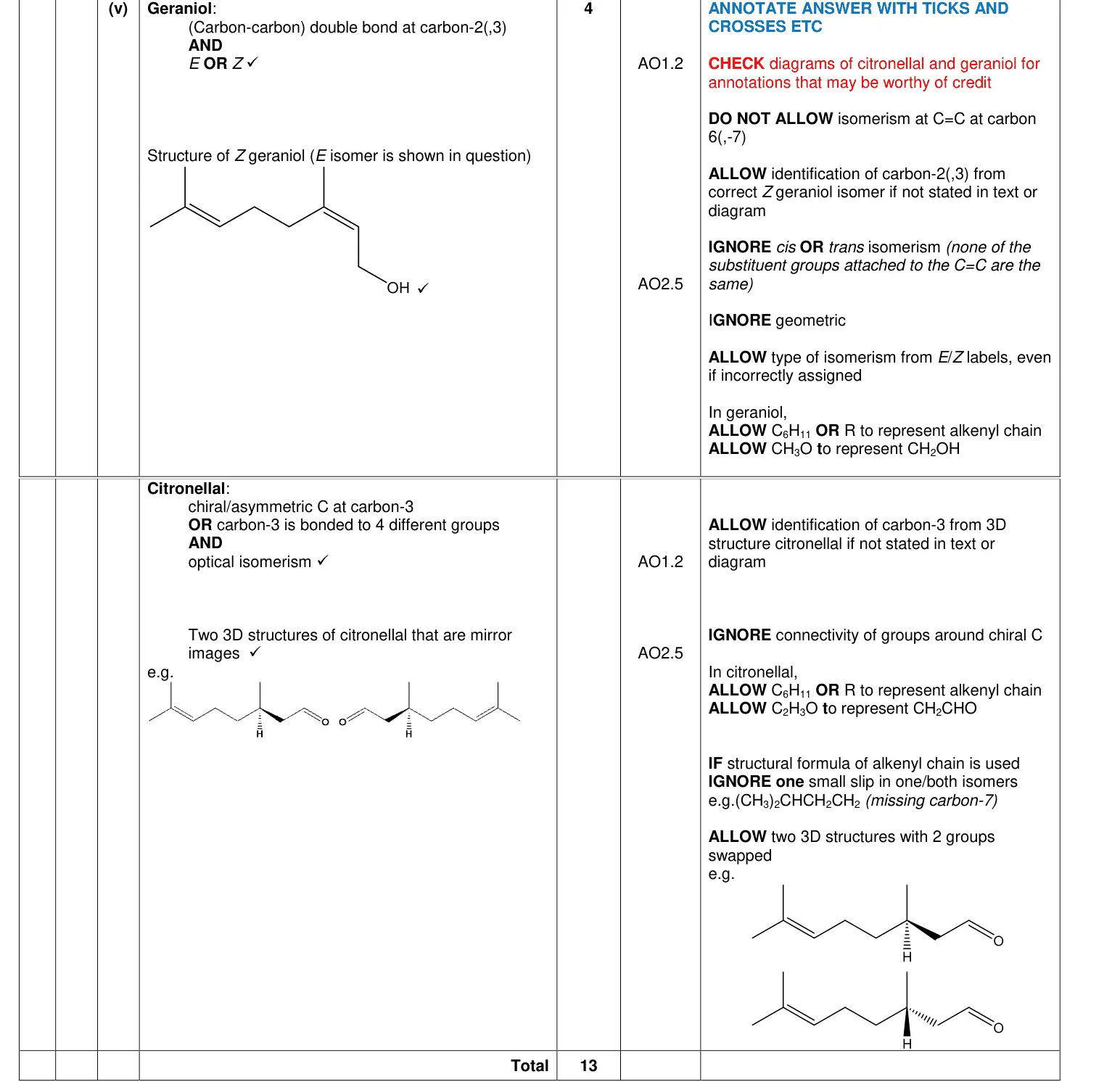
This question, which discriminated well, required candidates to apply their knowledge of stereoisomerism to geraniol and citronellal. The majority of responses focused on E/Z isomerism, as shown in Exemplar 2. Many candidates were able to show the structure of the Z isomer of geraniol and scored at least one mark. Stronger responses were able to explain this type of isomerism as the result of the carbon-carbon double bond between carbon atoms 2 and 3. Common errors included attributing E/Z isomerism to the double bond between carbon atoms 6 and7 or use of cis/trans to describe the isomers (the latter of which was ignored by the mark scheme as it does not apply to geraniol). The best responses also identified the chiral carbon atom in citronellal and were able to show the optical isomers appropriately. This response identifies that geraniol has E/Z isomers and provides a correct explanation with reference to the carbon-carbon double bond between carbon atoms 2 and 3. So marking points one and two were given. The candidate recognises that the double bond between carbon atoms 6 and 7 would not cause isomerism in both compounds. Unfortunately this response overlooks the chiral carbon in citronellal and incorrectly states that it has are no stereoisomers. This question highlights the challenge of a linear specification, where content from different modules may be assessed within the same question. Candidates are likely to encounter these two types of stereoisomerism in different years of their course. They should therefore be encouraged to make links between the different modules to help develop their understanding.
Notes from the mark scheme and report
geraniol: E/Z at C=C of carbon-2,3 (DO NOT ALLOW C=C at carbon-6,7
IGNORE cis/trans)
citronellal: chiral carbon-3 with four different groups, optical isomers drawn as 3D mirror images
Skills: M4.2 Visualise and represent 2-D and 3-D forms including 2-D representations of 3-D objects; M4.3 Understand the symmetry of 2-D and 3-D shapes
June 2019 · Paper 2 · Q17(a)(i)4 marksAO2Drawing / labellingMedium
Mark scheme
Examiner's comment
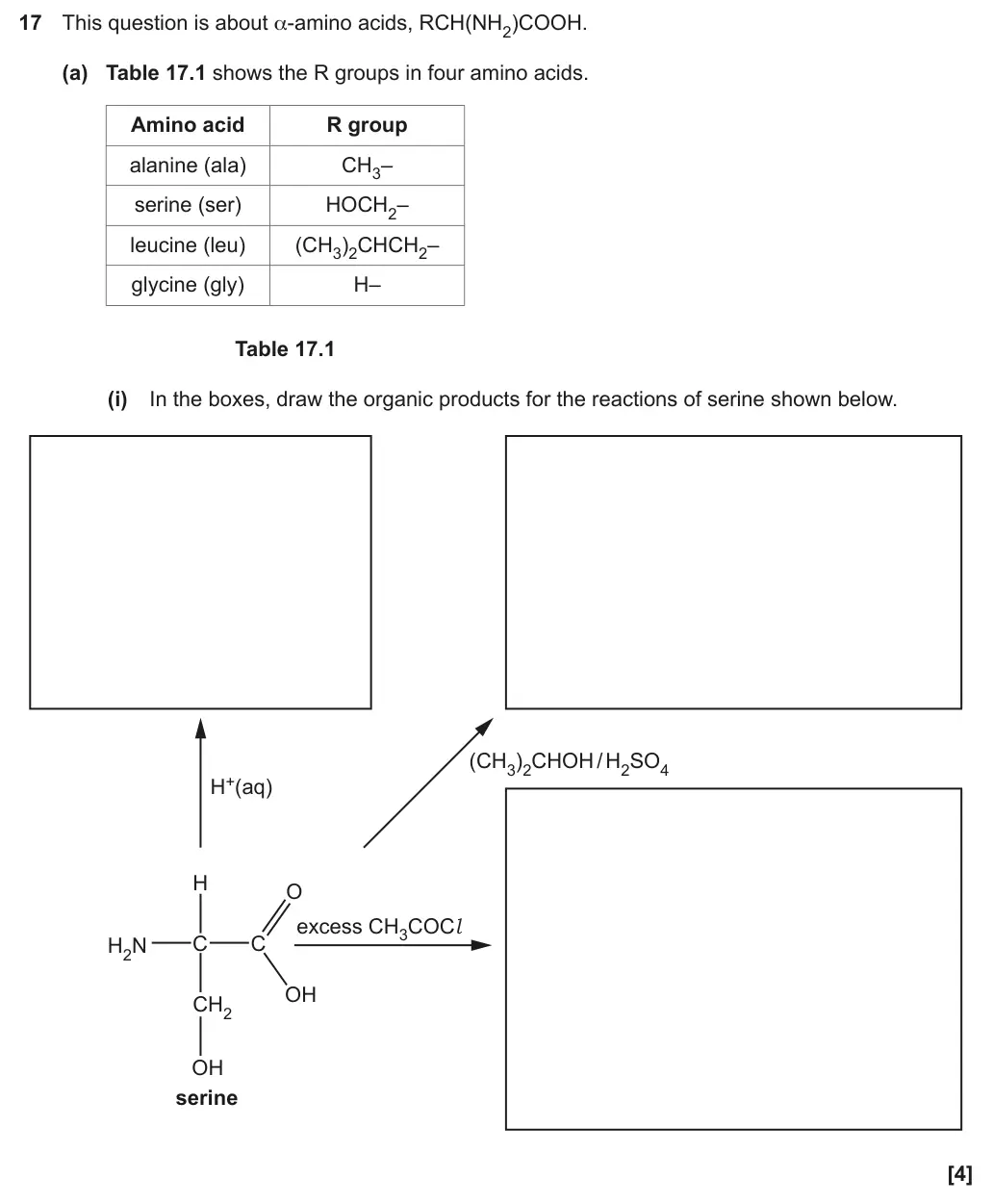
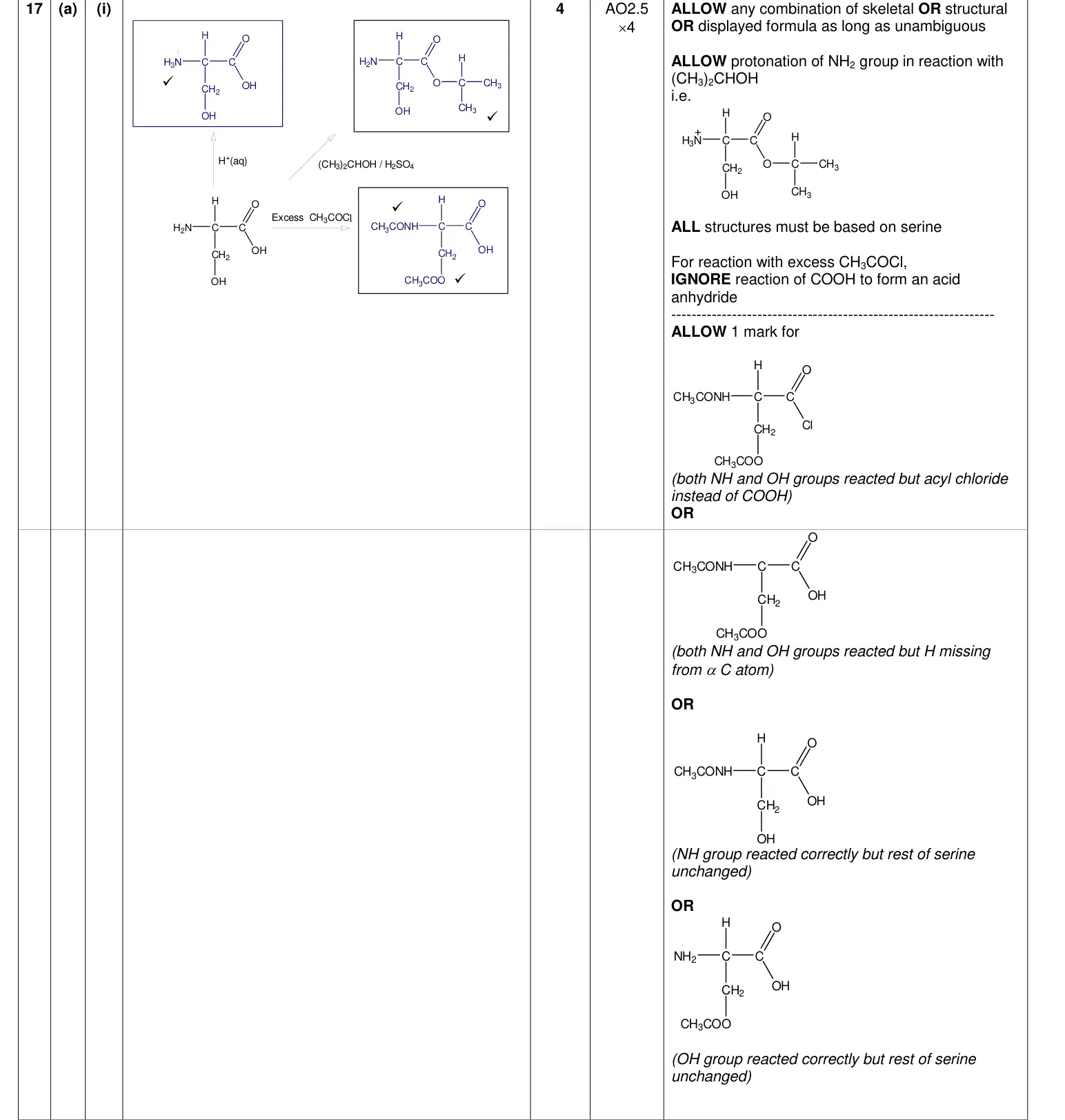
This question focused on the reactions of the different functional groups in serine. Candidates are familiar with these reactions and most candidates scored at least two marks. These were achieved by the formation of the ammonium ion by reaction with H+ and the formation of the ester from (CH3)2CHOH. Determining the organic product from the reaction of serine with excess CH3COCl proved more difficult. Some candidates realised that the OH of serine’s R group would react and others drew the amide formed from the reaction of the NH2 group. The best responses showed both conversions and scored full marks. Lower ability responses often showed organic products containing the Cl atom from the ethanoyl chloride rather than the CH3CO group. This response scored three marks. The candidate has drawn correct organic products for the reaction of serine with H+ and (CH3)2CHOH. The product from the reaction of excess CH3COCl shows the formation of an ester but not the formation of the amide. This product was seen often by examiners and scored one mark. If an amide group had been shown this response would have received full marks. Notice the candidate has presented their organic products clearly with the structures drawn in a similar manner to serine shown in the question. This is a good strategy to avoid errors and omissions when drawing organic structures.
Notes from the mark scheme and report
ester of COOH with propan-2-ol (ALLOW NH3+)
H3N+ with H+(aq)
excess CH3COCl reacts with BOTH NH2 (amide) and OH (ester)
all structures must be based on serine
1 mark if only one group acylated
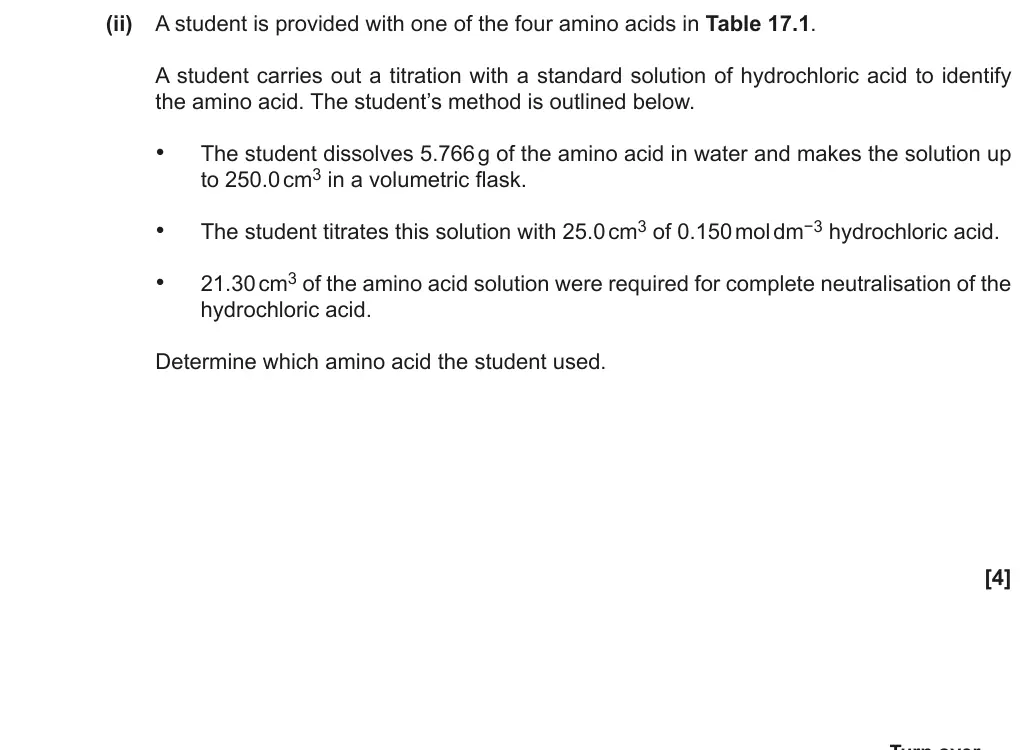
June 2019 · Paper 2 · Q17(a)(ii)4 marksAO2, 3Data interpretationEasy
Earlier part of question 17 that this part uses
Mark scheme
Examiner's comment
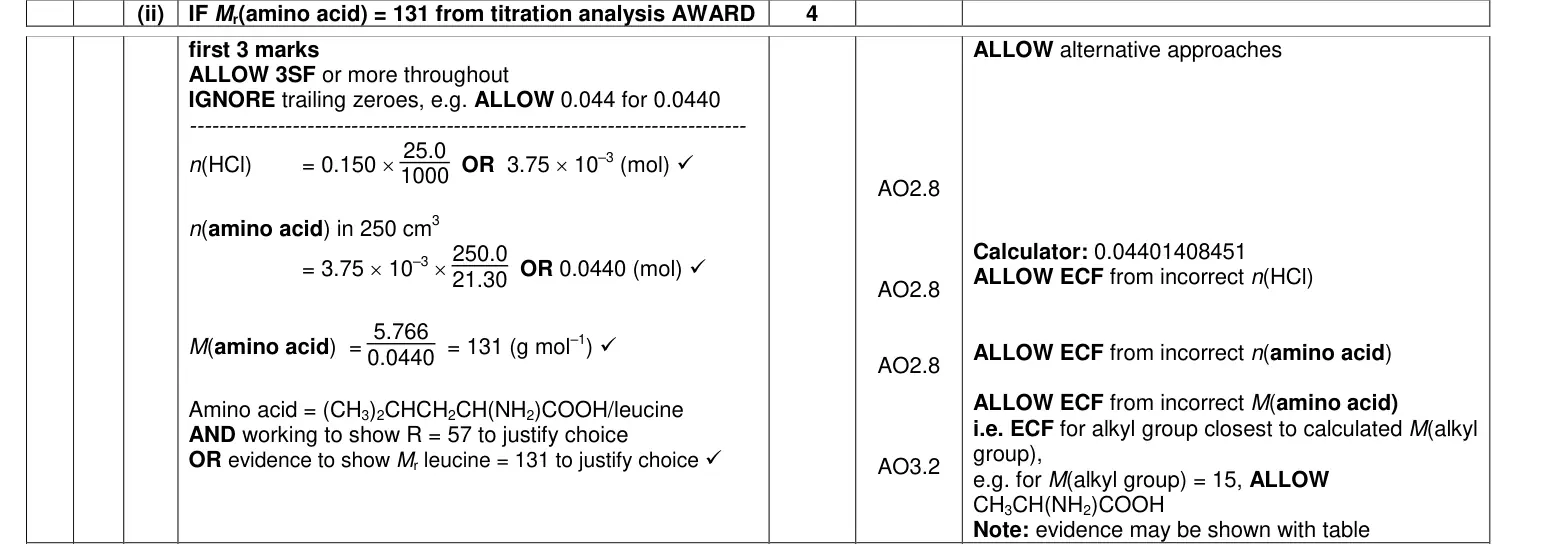
Candidates are confident in tackling titration analysis and the majority of responses were well structured. Most candidates used the results to determine the Mr of the unknown amino acid and hence identify it as leucine. However, other approaches were also seen and these were given full credit if correct. A common error was incorrect scaling to determine the amount of amino acid used to make the 250 cm3 solution. A significant number of responses simply multiplied the number of moles of acid by ten rather than using a factor of 250/21.30. Error carried forward marks were available and so the majority of candidates scored 3 or 4 marks.
Notes from the mark scheme and report
amino acid solution is in the burette: n in 250 cm3 = 3.75 × 10^-3 × 250.0/21.30
M = 131 so leucine, with working (R = 57 or Mr) to justify
ALLOW ECF
Skills: M0.2 Use ratios, fractions and percentages; M1.1 Use an appropriate number of significant figures; M2.3 Substitute numerical values into algebraic equations using appropriate units for physical quantities; PAG2 Acid–base titration
June 2019 · Paper 3 · Q4(b)(i)1 markAO2Drawing / labellingMedium
Mark scheme
Examiner's comment
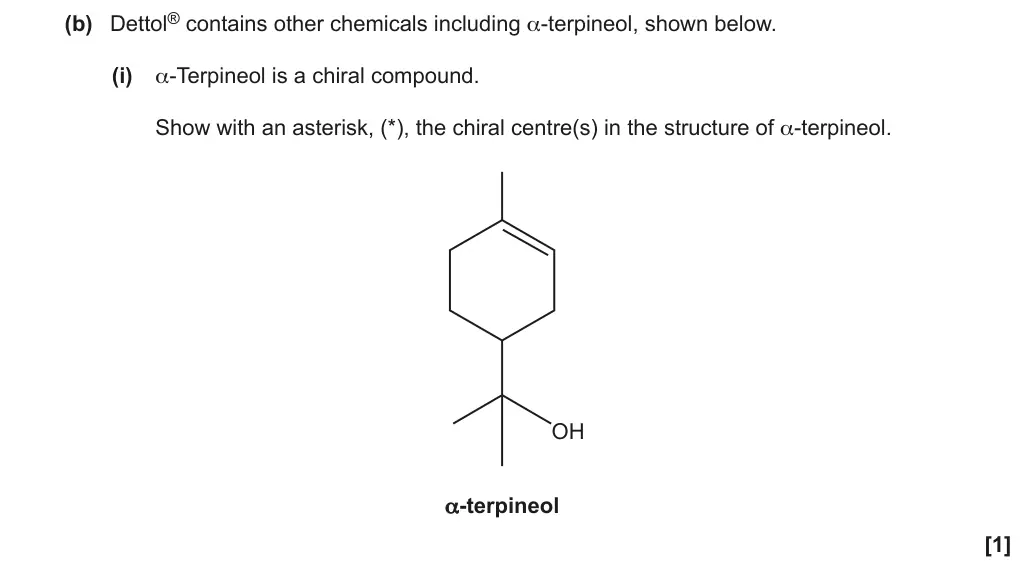
Most candidates showed one asterisk at the base of the cyclic part of the structure. The most common error was to show two asterisks, the second being on *C(CH3)2OH, despite this carbon not being connected to four different groups.
Notes from the mark scheme and report
DO NOT ALLOW more than one *
ALLOW a circle
Skills: M4.2 Visualise and represent 2-D and 3-D forms including 2-D representations of 3-D objects
June 2018 · Paper 2 · Q21 markMultiple choiceMedium
Answer
C
Mark scheme
Examiner's comment
The majority of candidates identified C as the secondary amide.
June 2018 · Paper 2 · Q111 markMultiple choiceHard
Answer
B
Mark scheme
Examiner's comment
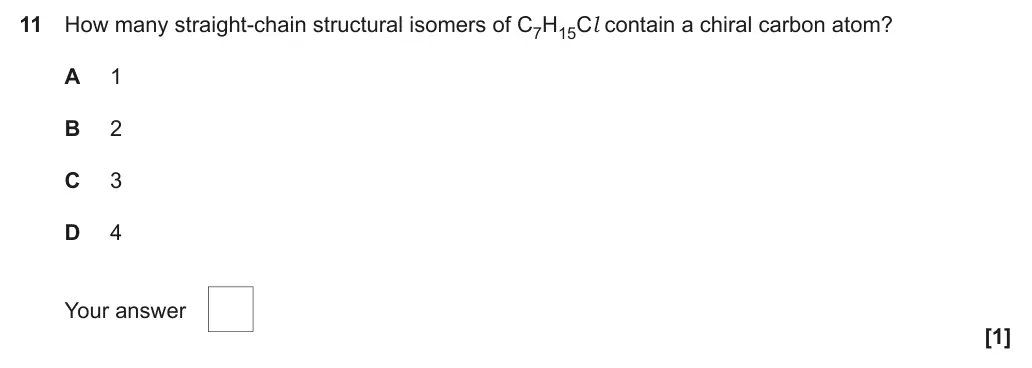
This question proved difficult. Candidates who drew out the different isomers of chloroheptane were able to identify B as the correct response.
June 2018 · Paper 2 · Q17(a)2 marksStructure / isomerEasy
Mark scheme
Examiner's comment
Candidates were well prepared to tackle this question and consequently most candidates scored both marks.
Notes from the mark scheme and report
each structure needs four bonds to the chiral C with at least two wedges
structures must be mirror images with correct connectivity
1 mark max if CH2SH shown as R
Skills: M4.2 Visualise and represent 2-D and 3-D forms including 2-D representations of 3-D objects; M4.3 Understand the symmetry of 2-D and 3-D shapes
June 2018 · Paper 2 · Q17(b)2 marksStructure / isomerHard
Mark scheme
Examiner's comment
In contrast to part (a) this question proved difficult and discriminated well. The higher ability candidates correctly identified the dichloride salt produced by the reaction of lysine with excess acid. Some candidates formed ammonium ions on both nitrogen atoms but omitted the chloride ions. Others only formed a monochloride salt, leaving the R group unchanged. These two approaches scored one mark.
Notes from the mark scheme and report
BOTH amine groups protonated (excess HCl)
Cl– required because question asks for salt
1 mark if only one NH2 protonated or no Cl–
June 2018 · Paper 2 · Q17(c)3 marksStructure / isomerHard
Mark scheme
Examiner's comment
This question required candidates to apply their knowledge of amide hydrolysis to a section of protein. Many candidates correctly recognised that two amino acids would be produced but not all took account of the alkaline conditions and showed COOH groups rather than carboxylates. Candidates found this question difficult and although many gained some credit only the highest ability candidates, who recognised the amide in the side-chain would also react, scored full marks after. Exemplar 3 shows a good response. This response has correctly identified the amino acid on the left hand side of the amide link and also shown this as a carboxylate. Consequently the first mark has been achieved. The right hand amino acid has also been identified correctly. However, the amide in the R group has not been hydrolysed so this response only scores one of the two marks available for this product. Notice the candidate has presented their structures clearly with the atoms drawn in a similar arrangement to the protein shown in the question. This is a good strategy to avoid errors and omissions when drawing organic structures.
Notes from the mark scheme and report
one mark per group hydrolysed (side-chain amide also hydrolysed)
carboxylate –COO–/–COONa required (DO NOT ALLOW COOH)
DO NOT ALLOW –COO–Na covalent bond
DO NOT ALLOW sodium salt of the alcohol group
IGNORE NH3
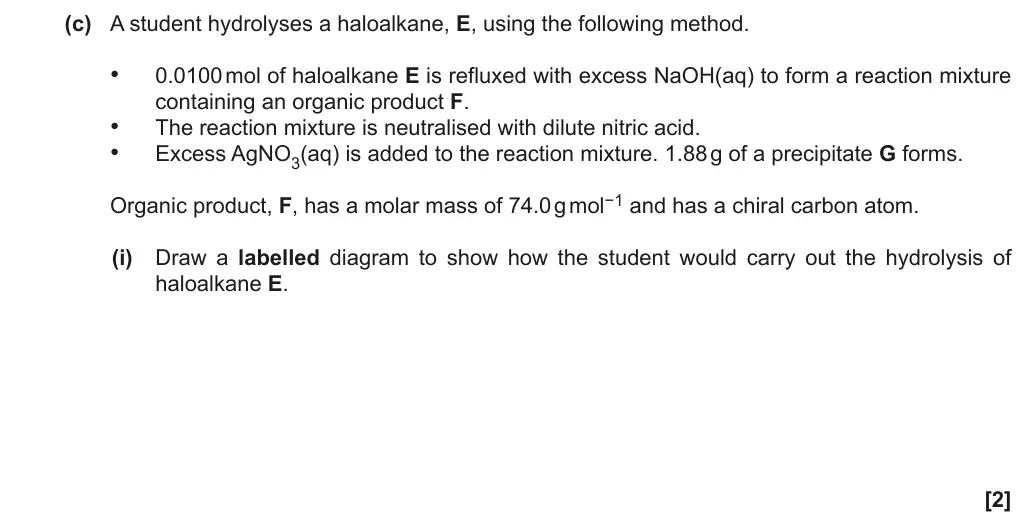
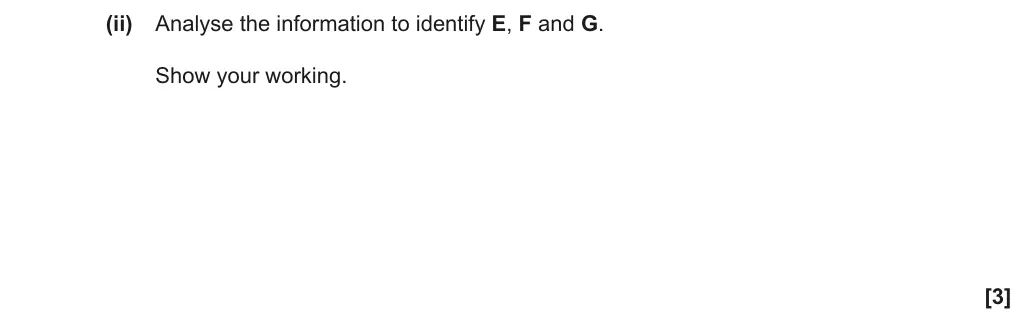
June 2018 · Paper 2 · Q19(c)(ii)3 marksCalculationHard
Earlier part of question 19 that this part uses
Mark scheme
Examiner's comment
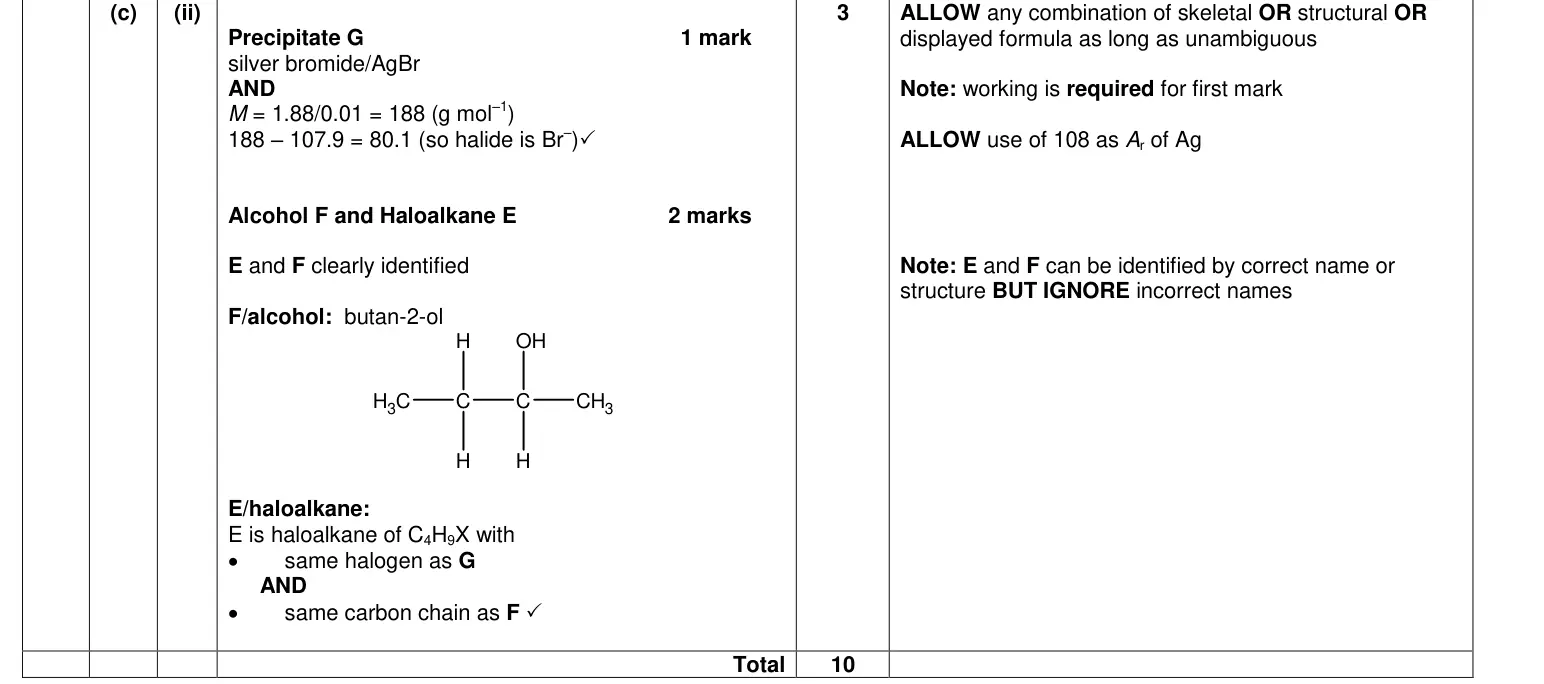
This question, requiring candidates to analyse the information to identify compounds E, F and G, discriminated well. Many candidates deduced that G was a silver halide but not all provided working to back up their choice of AgBr. Some candidates appeared to guess and AgCl was commonly seen. Some candidates used the molar mass of F provided to deduce the molecular formula of C4H10O but lower ability responses did not process this further. Higher ability candidates identified F as butan-2-ol, showing the chiral carbon clearly. Other alcohols were also seen including butan-1-ol and methylpropan- 2-ol. The highest ability candidates linked all the information and provided a structure for E that was consistent with their suggestions for F and G.
Notes from the mark scheme and report
working required: M(G) = 1.88/0.0100 = 188 so AgBr
F = butan-2-ol (chiral, M = 74)
E = 2-bromobutane (same halogen as G and same chain as F)
IGNORE incorrect names if structures given
Skills: M0.2 Use ratios, fractions and percentages; M2.2 Change the subject of an equation
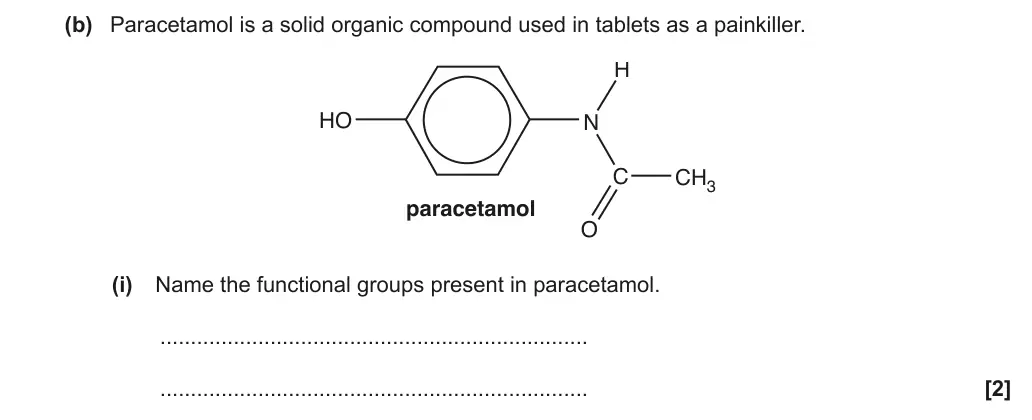
June 2018 · Paper 3 · Q4(b)(i)2 marksShort answerHard
Mark scheme
Examiner's comment
This part assessed knowledge of functional groups and proved to be a very good discriminator. Able candidates usually identified the phenol and amide functional groups, with ‘secondary amide’ also seen. In Exemplar 9, the candidate has identified the correct functional groups. The candidate’s working by circling the functional groups in the structure shows good examination technique, helping the candidate to arrive at the correct conclusion. The phenol group was often incorrectly identified as an alcohol and the amide group as a combination of ‘amine’, ‘ketone’, ‘keytone’ or ‘carbonyl’. Neutral responses such as ‘hydroxyl’ and ‘benzene’ were ignored. Candidates need to be careful that they do not present an extensive list of many functional groups in the hope that the correct groups are amongst them, as shown in Exemplar 10. Incorrect groups are marked first.
Notes from the mark scheme and report
phenol and amide
if more than 2 groups given mark incorrect ones first
IGNORE hydroxyl/hydroxy, aryl, benzene
ketone/carbonyl is incorrect
June 2017 · Paper 2 · Q71 markMultiple choice
Answer
A
Mark scheme
June 2017 · Paper 2 · Q81 markMultiple choice
Answer
C
Mark scheme
Notes from the mark scheme and report
ALLOW 4
Skills: M4.2 Visualise and represent 2-D and 3-D forms including 2-D representations of 3-D objects
June 2017 · Paper 2 · Q131 markMultiple choice
Answer
A
Mark scheme
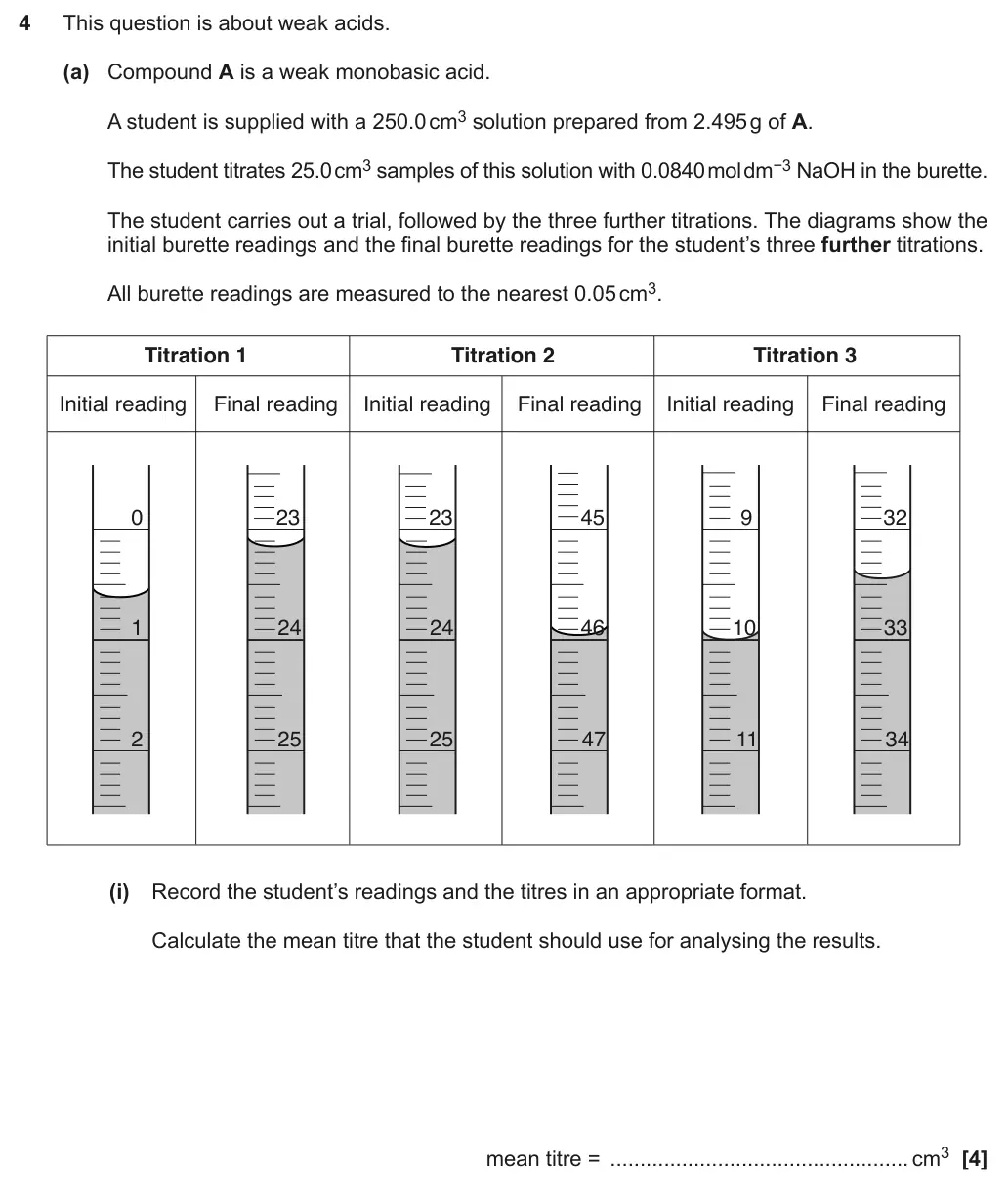
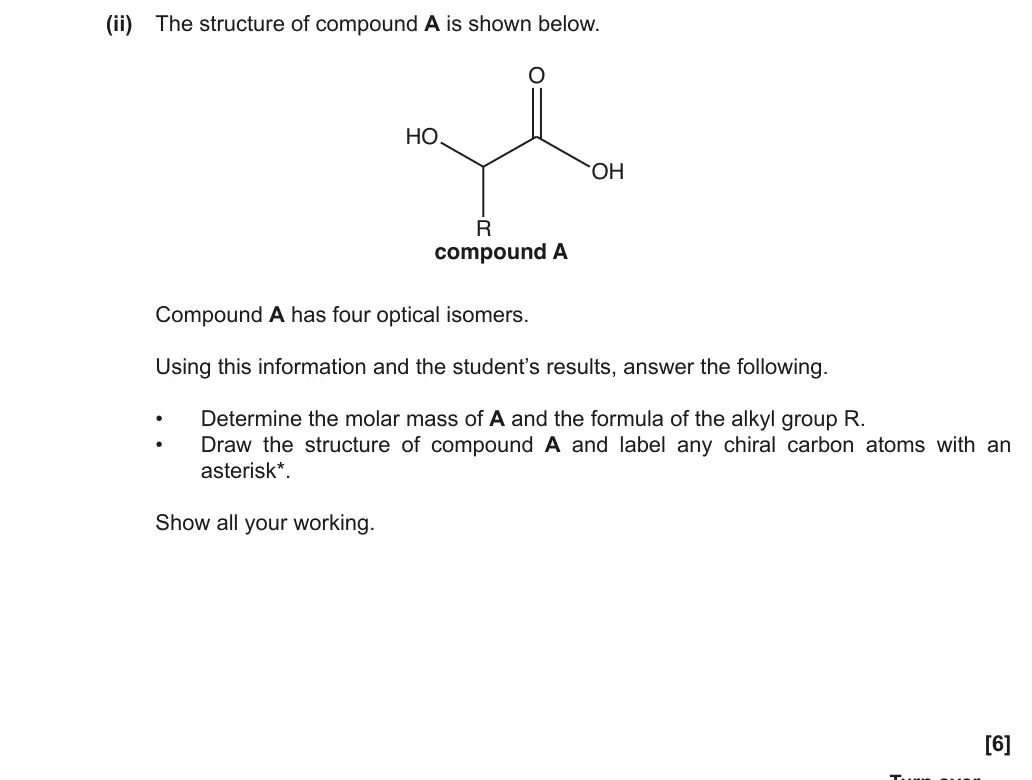
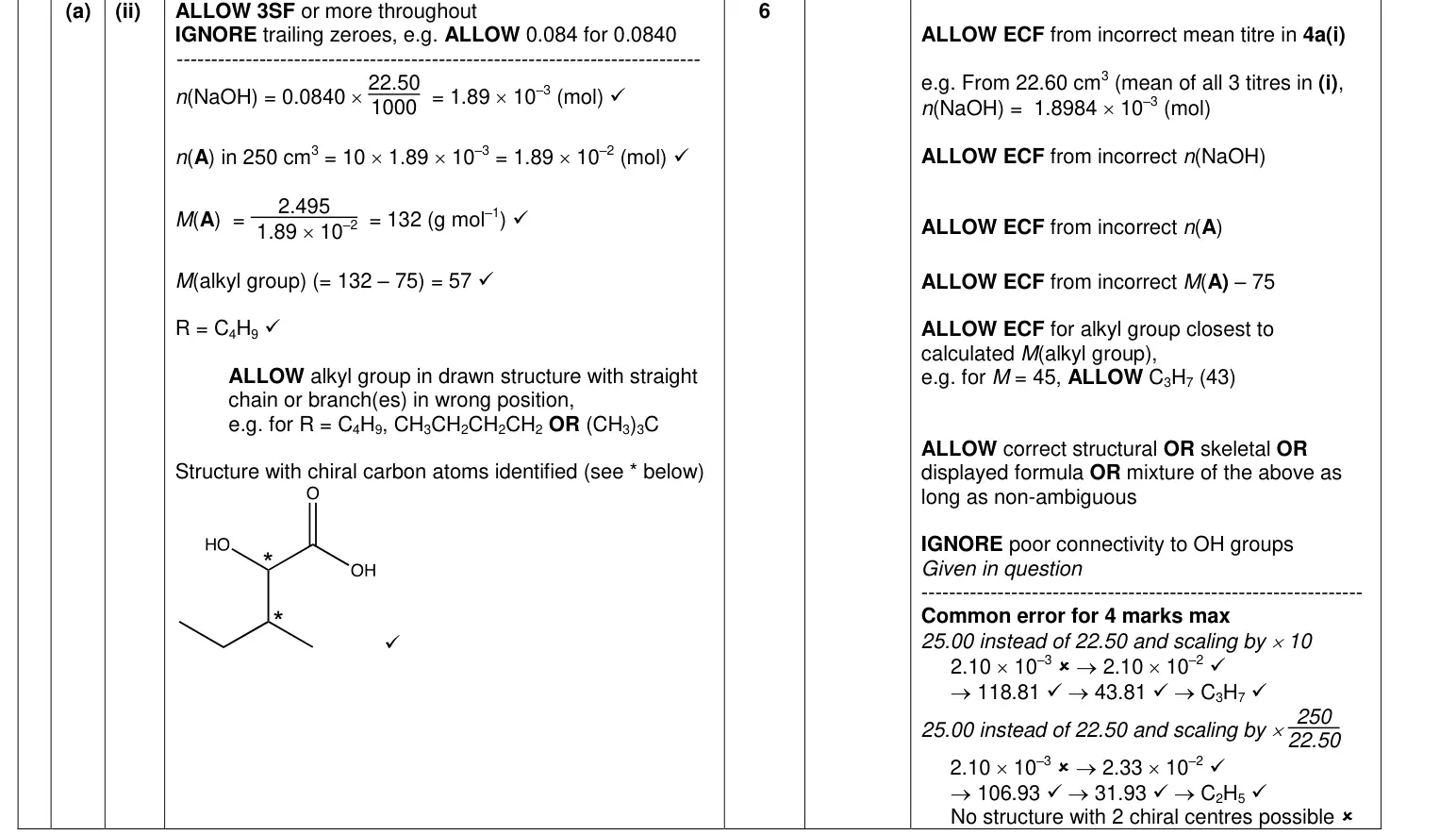
June 2017 · Paper 3 · Q4(a)(ii)6 marksStructure / isomer
Earlier part of question 4 that this part uses
Mark scheme
Notes from the mark scheme and report
n(NaOH) = 1.89 × 10–3
×10 for 250 cm3
M(A) = 132 so R = C4H9 (57)
R must be CH(CH3)CH2CH3 to give a second chiral centre
common error: 25.00 used instead of 22.50 (4 max)
ALLOW ECF from mean titre
Skills: M0.2 Use ratios, fractions and percentages; M2.3 Substitute numerical values into algebraic equations using appropriate units for physical quantities; M4.2 Visualise and represent 2-D and 3-D forms including 2-D representations of 3-D objects; PAG2 Acid–base titration
Work with an OCR chemistry tutor
Dropping marks on calculations, mechanisms or the six-markers? Book a trial session with a specialist OCR chemistry tutor.