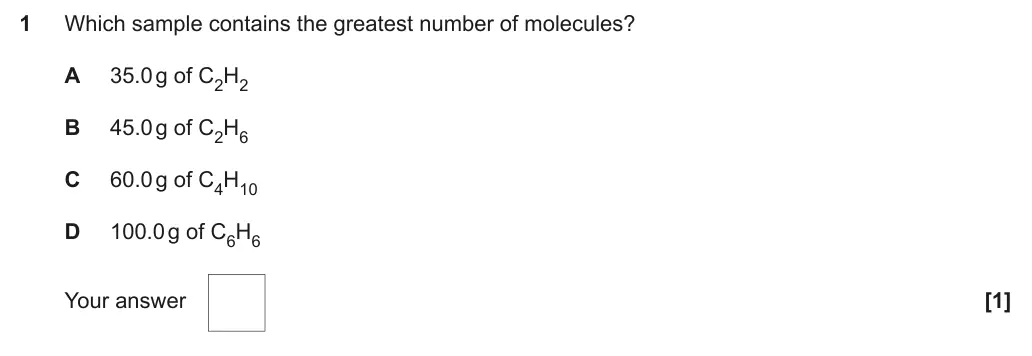
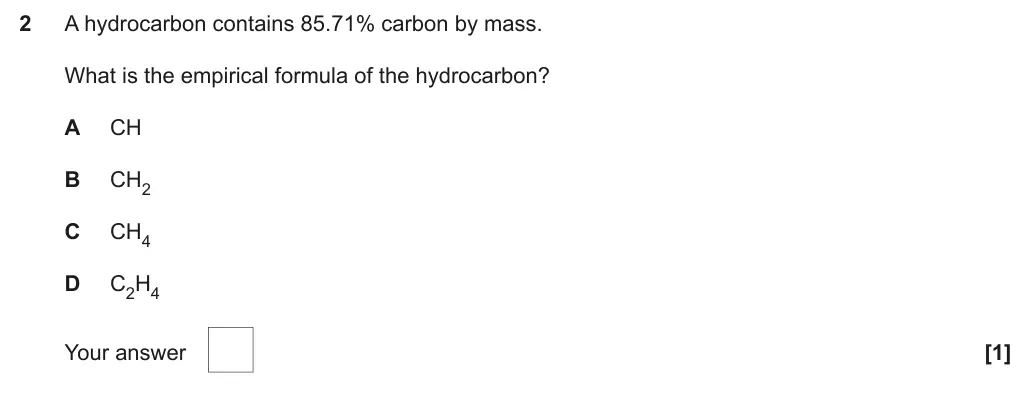
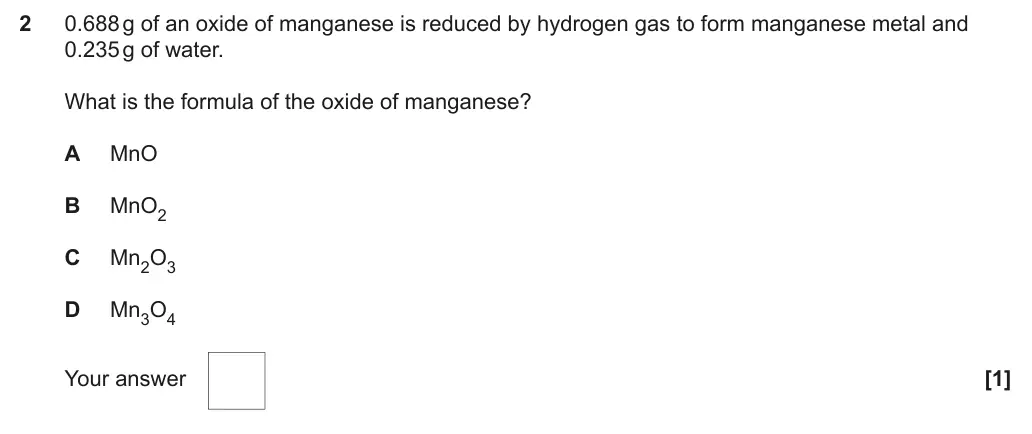
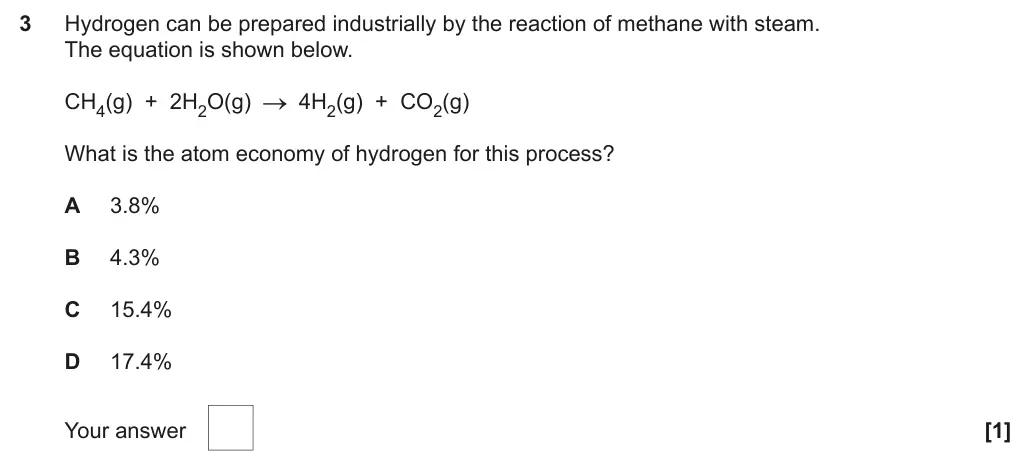
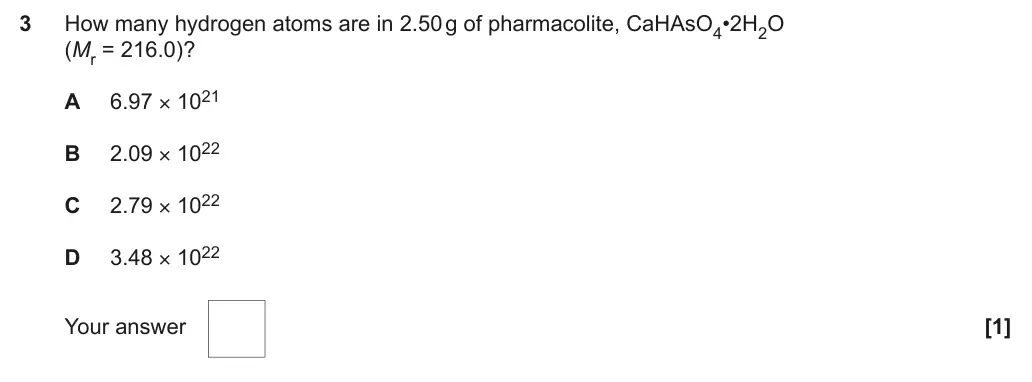
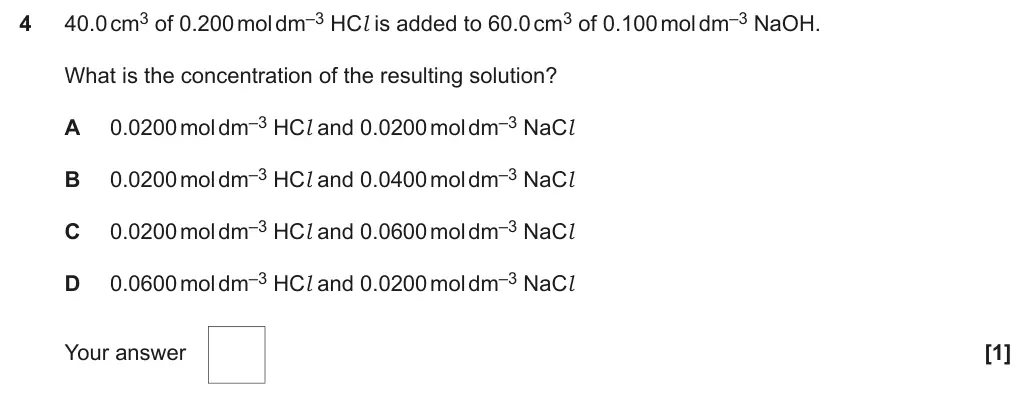
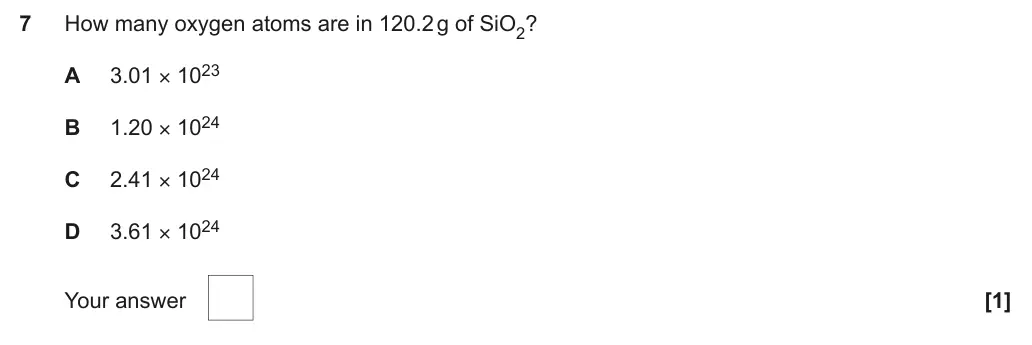
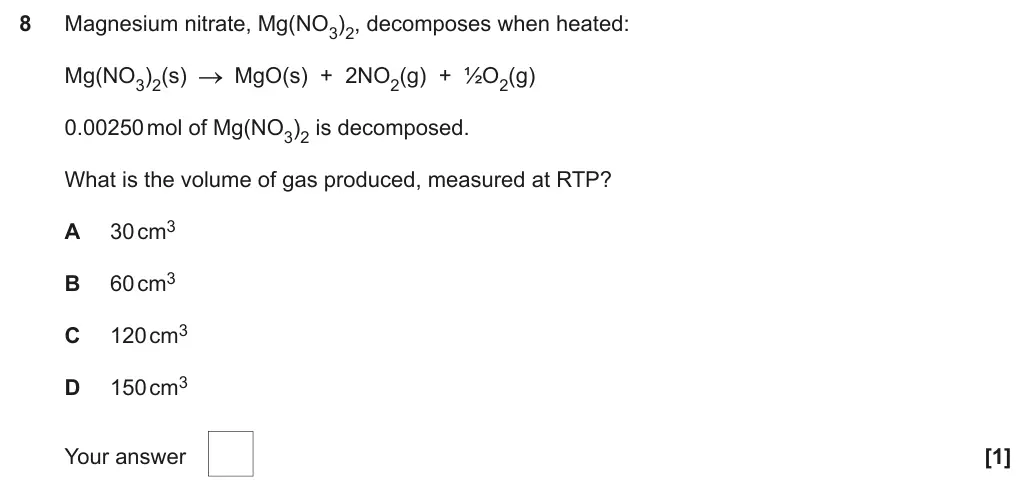
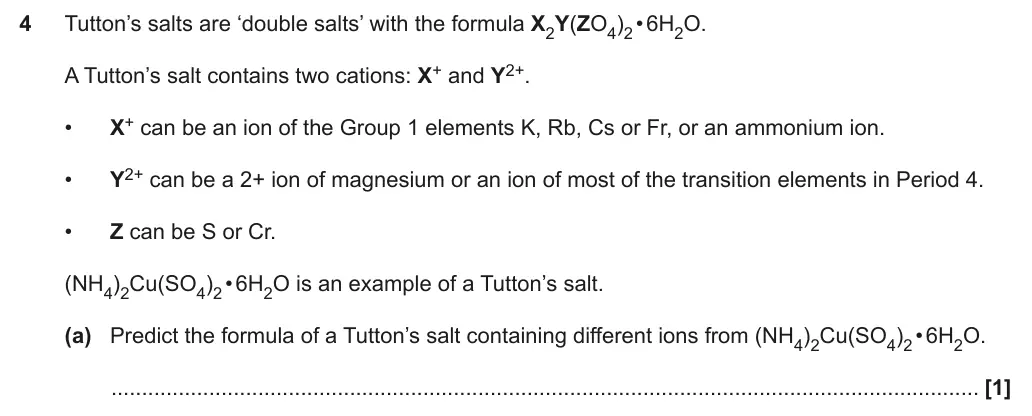
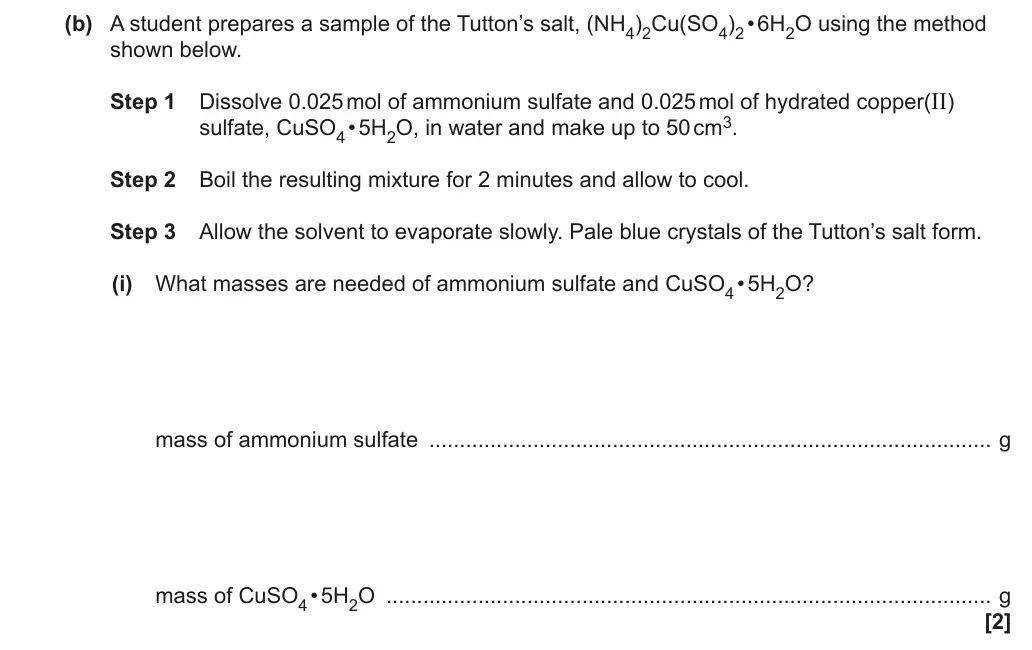
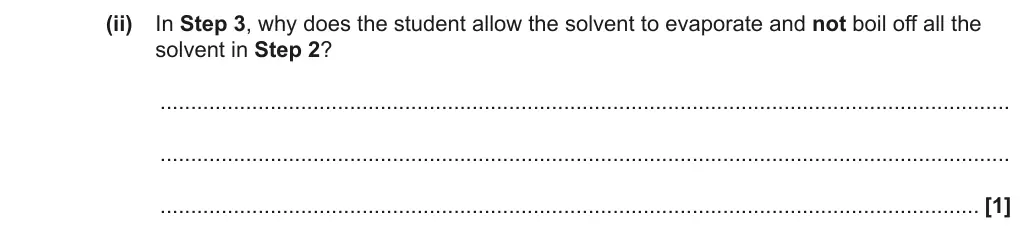
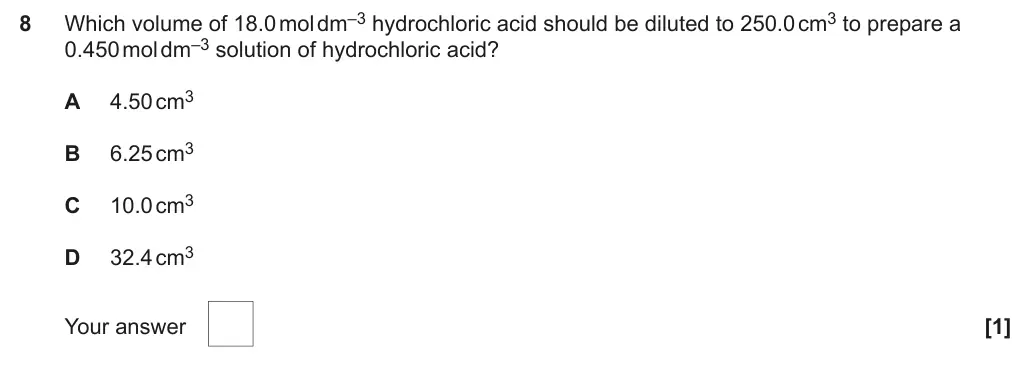
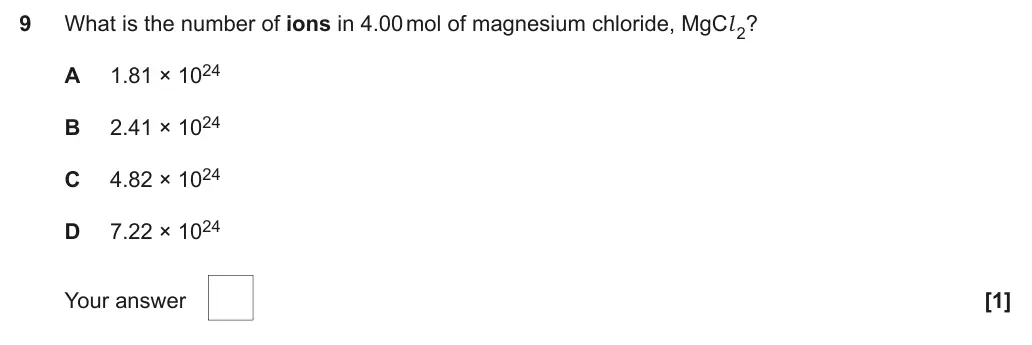
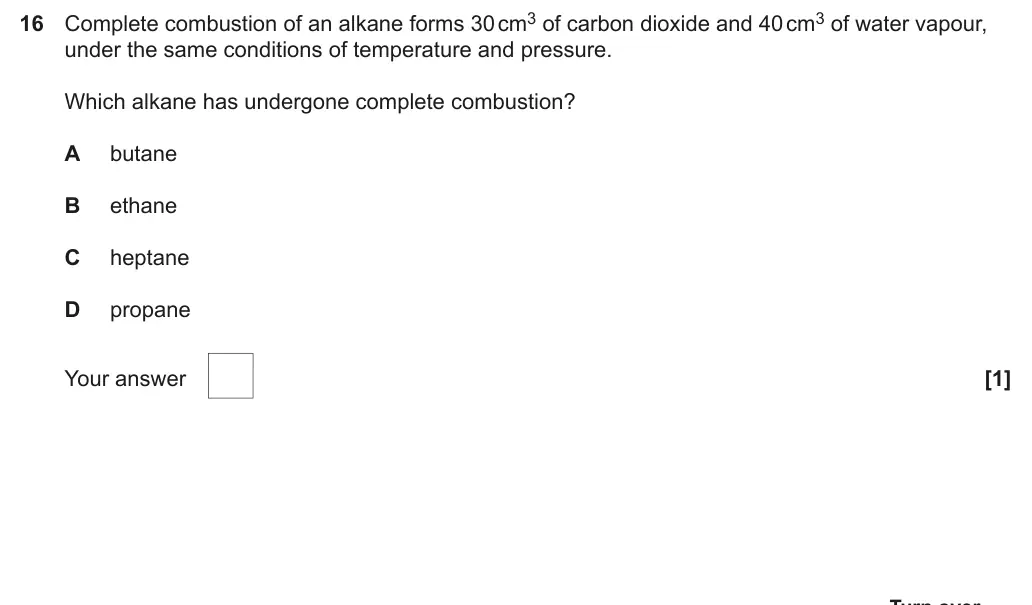
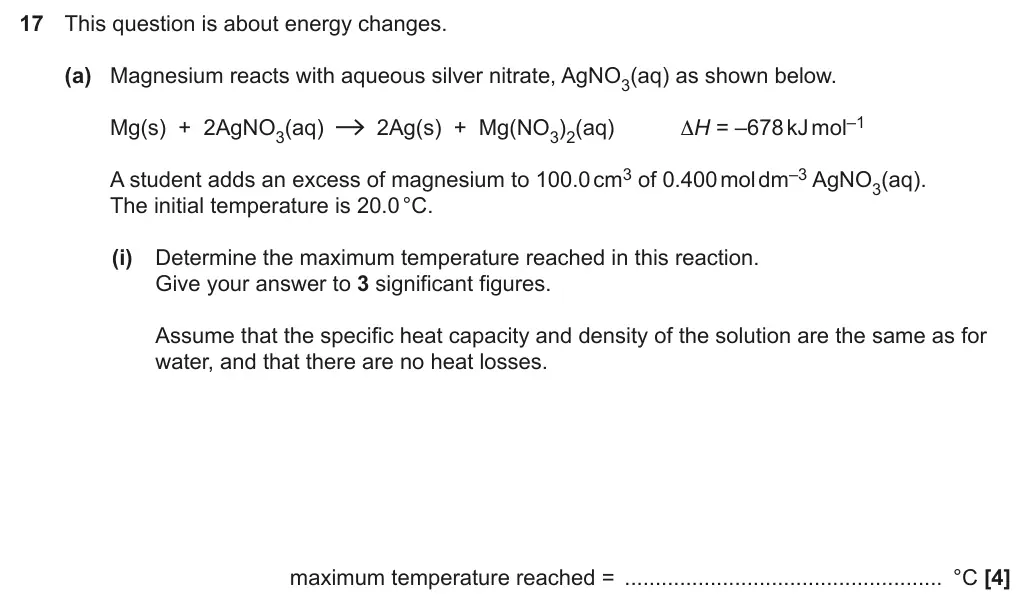
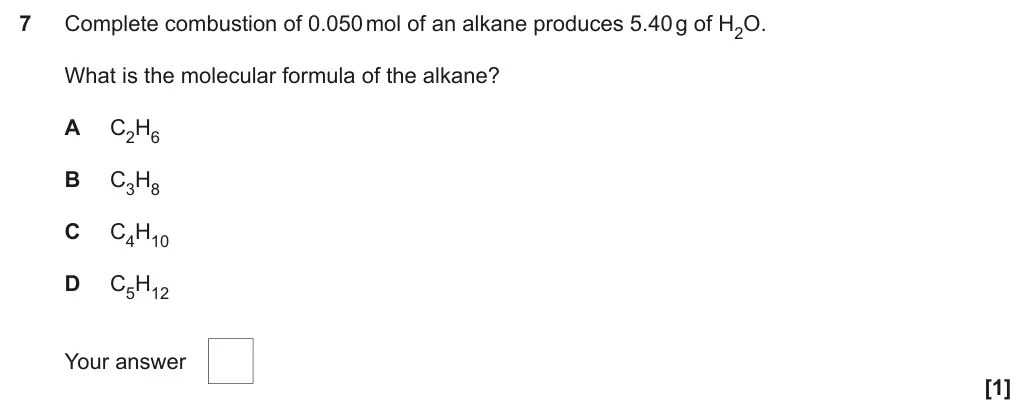
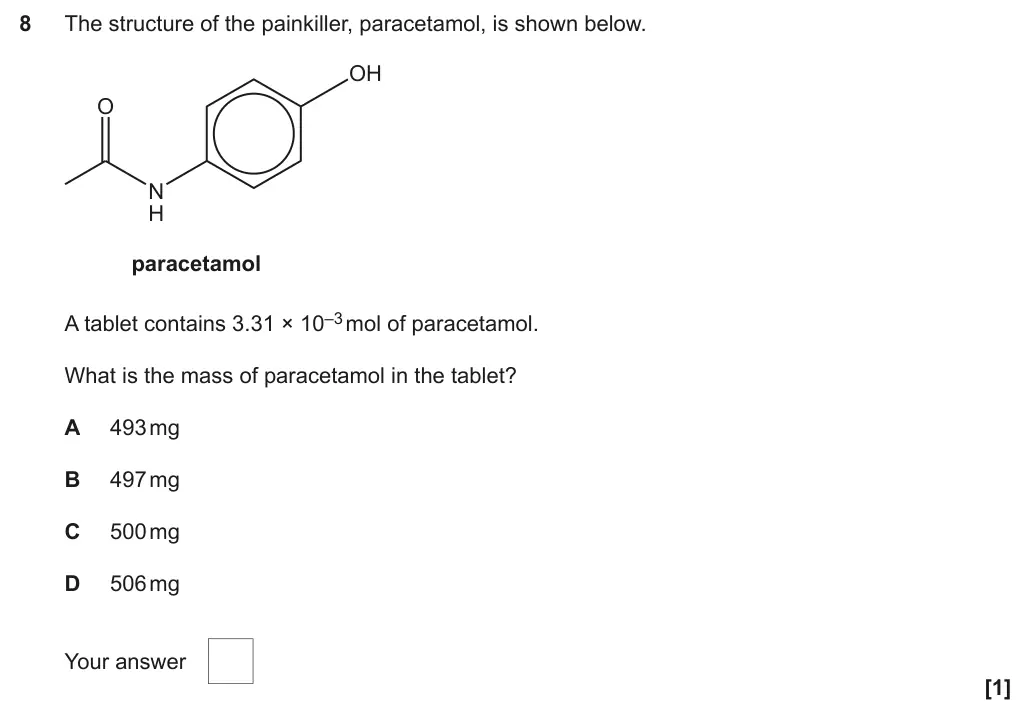
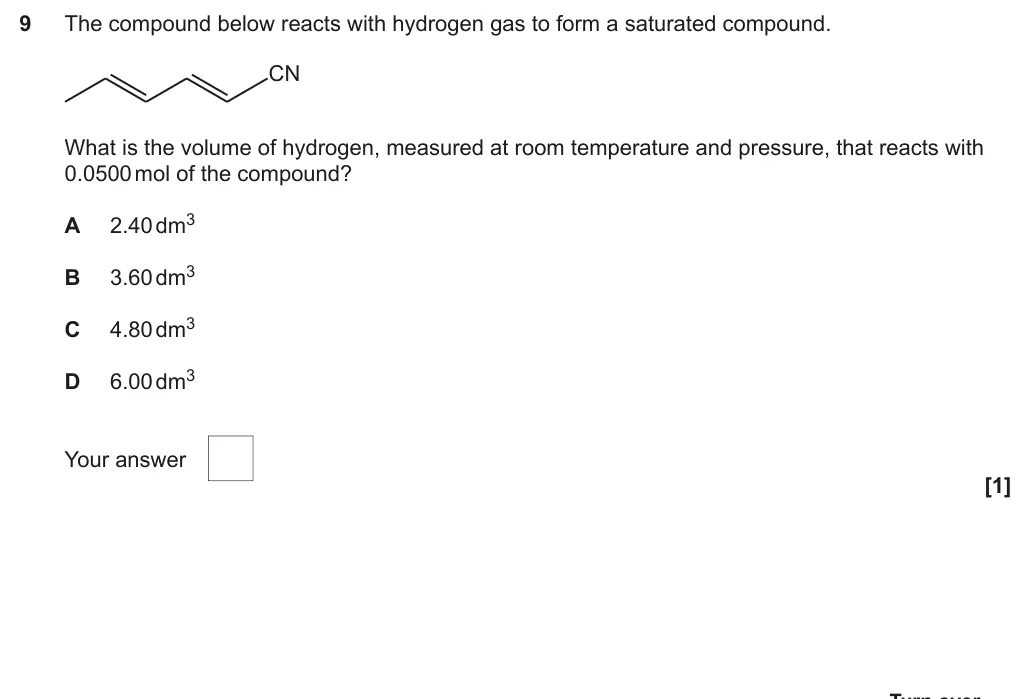
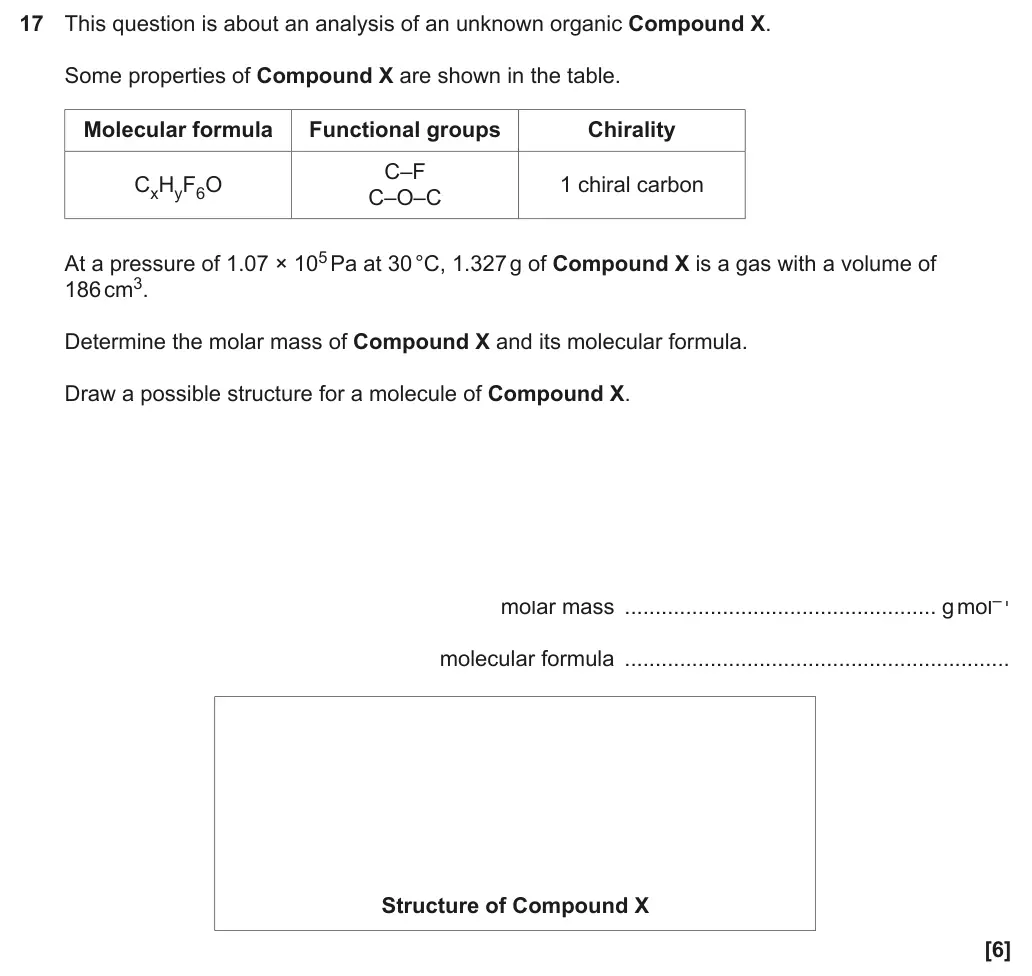
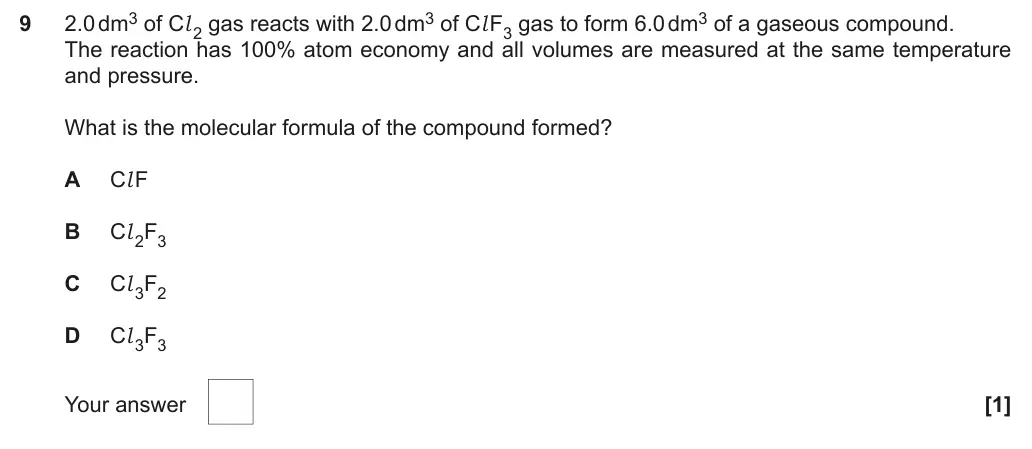
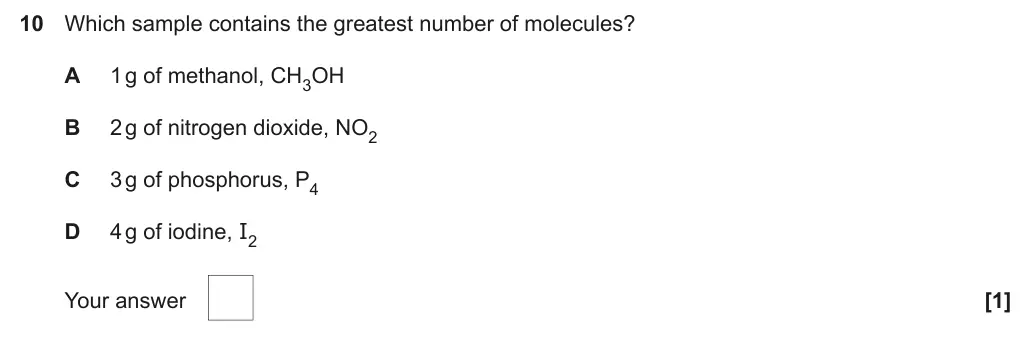
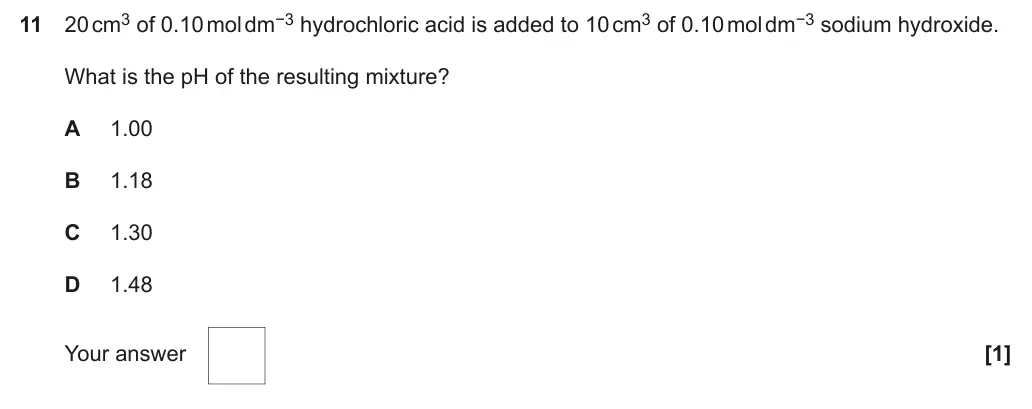
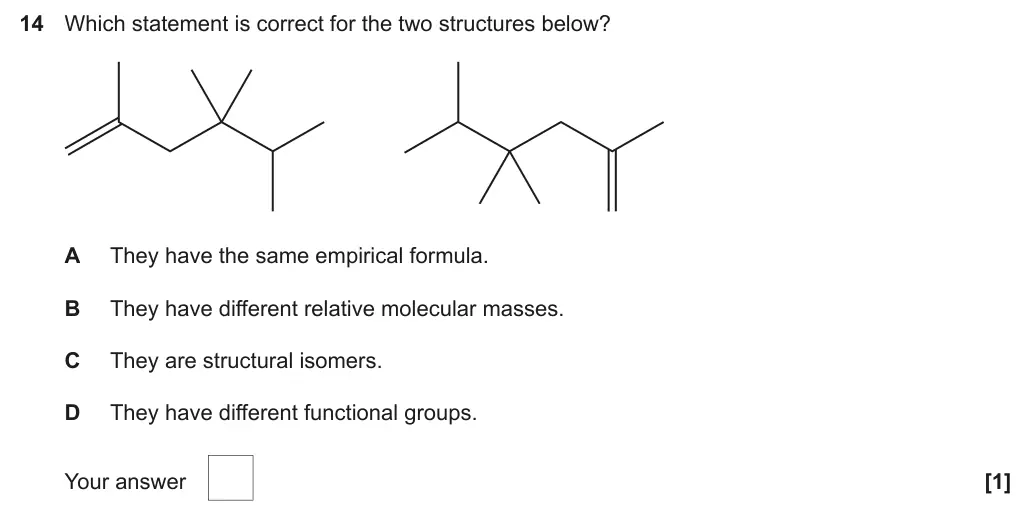
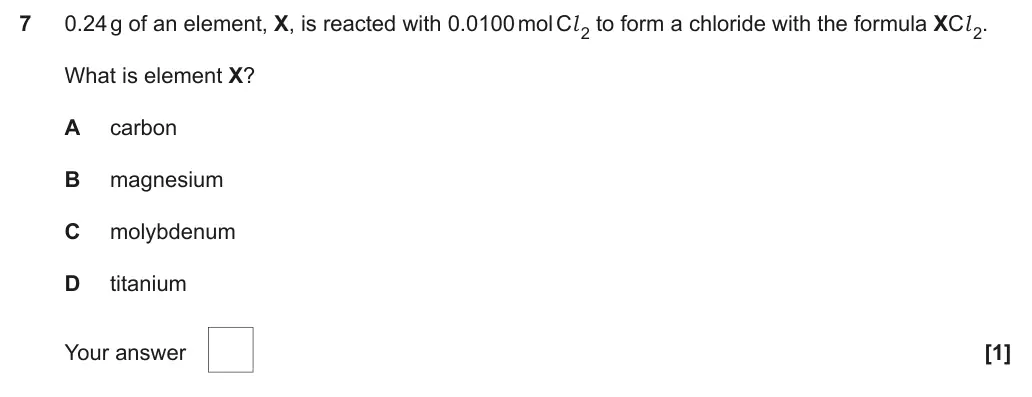
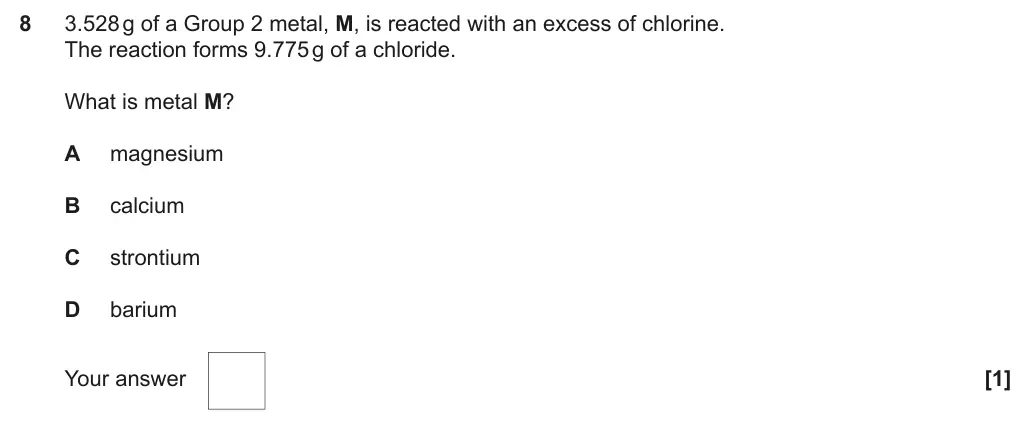
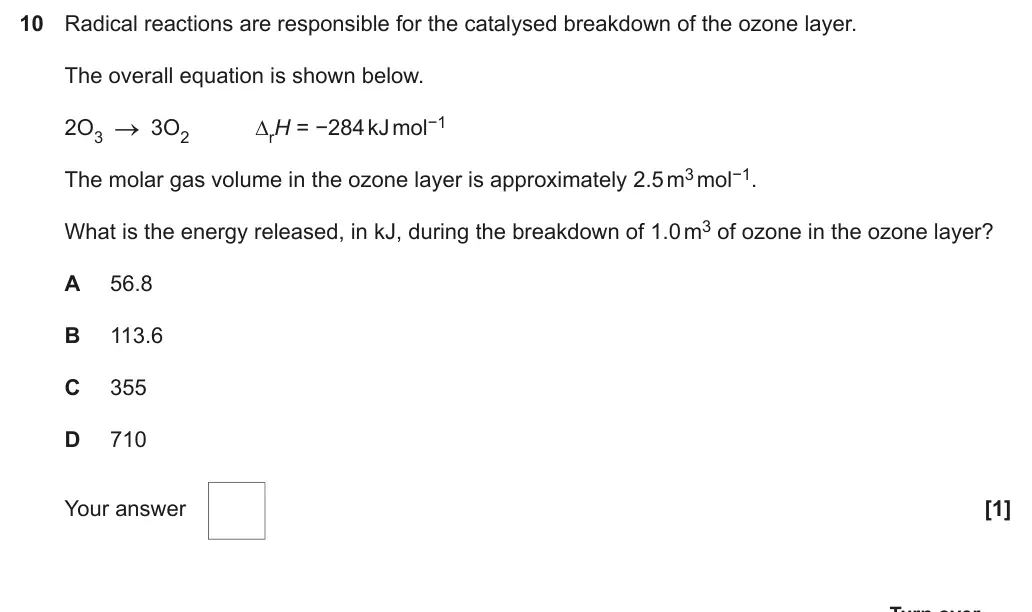
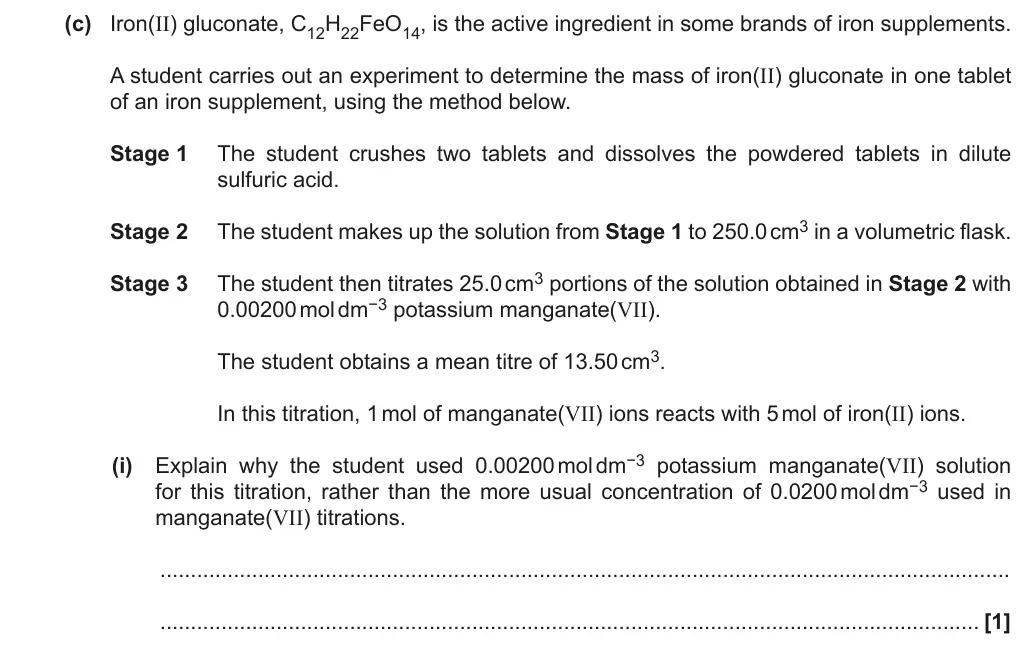
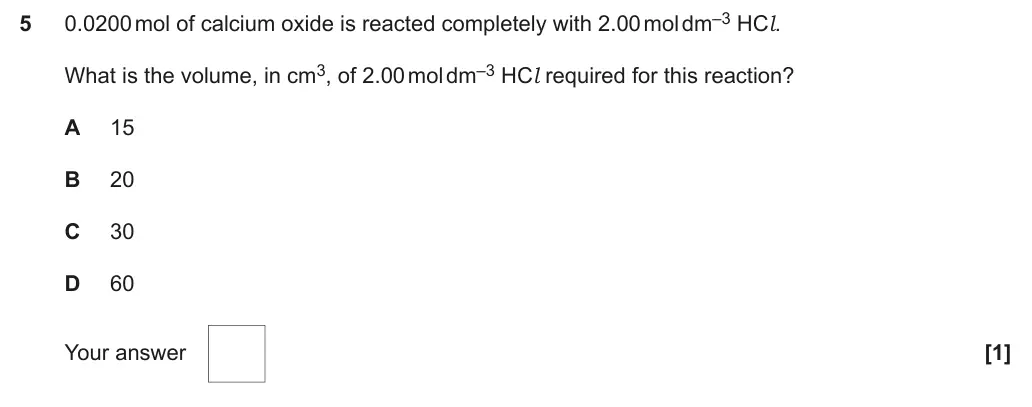
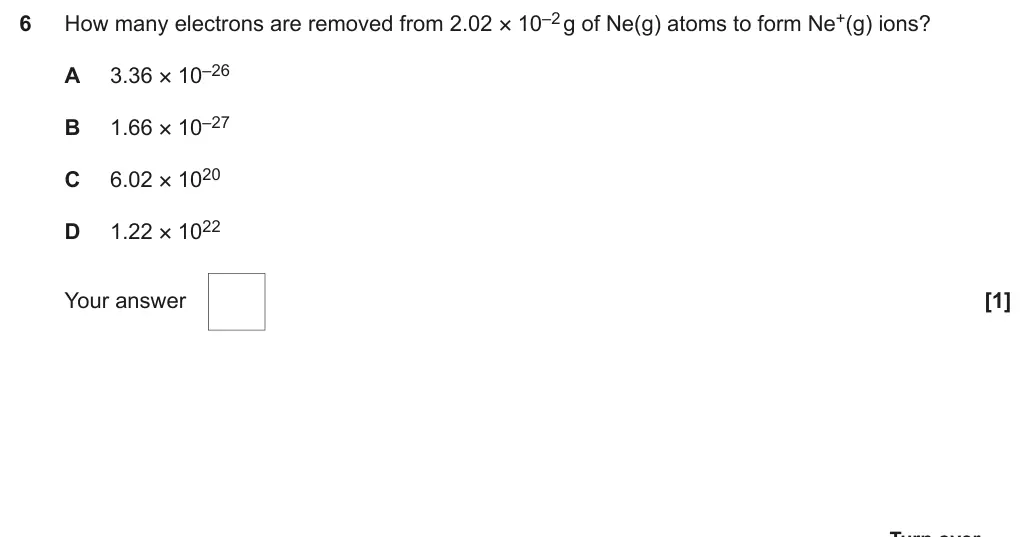
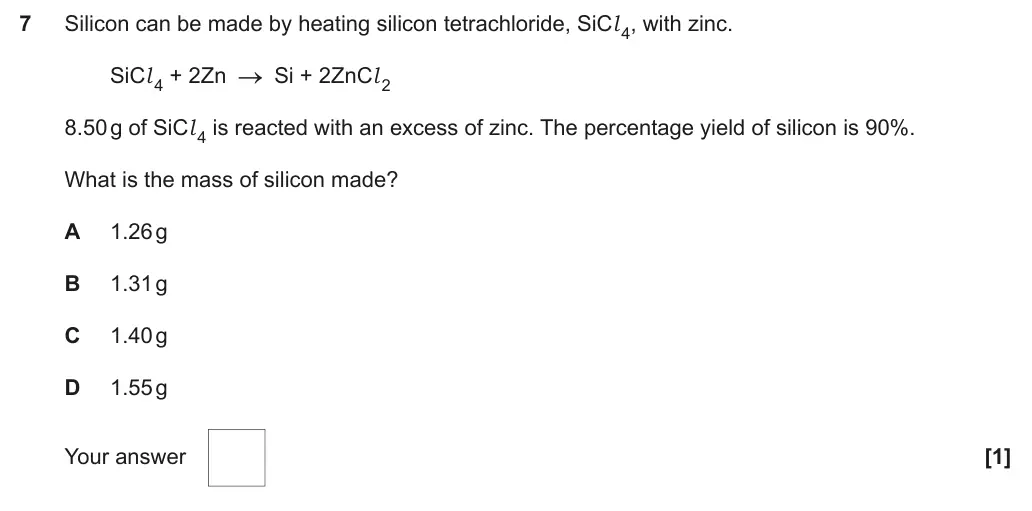
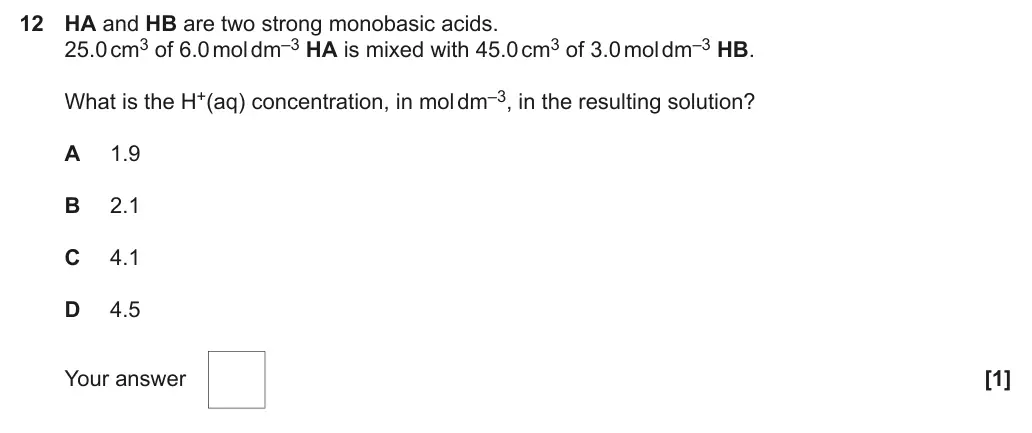
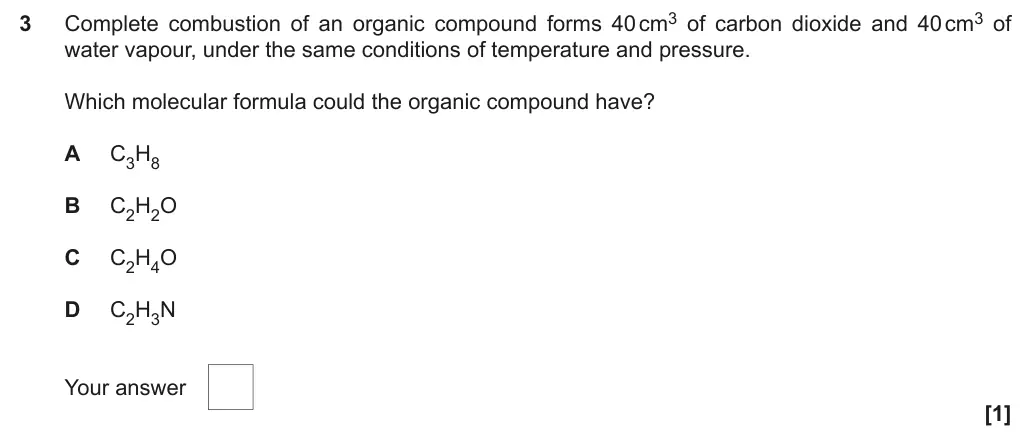
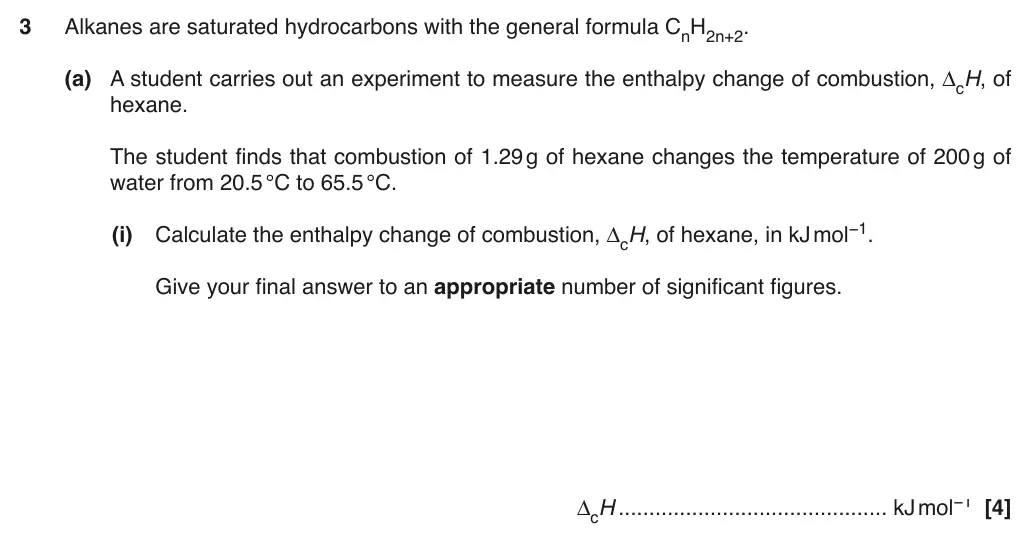
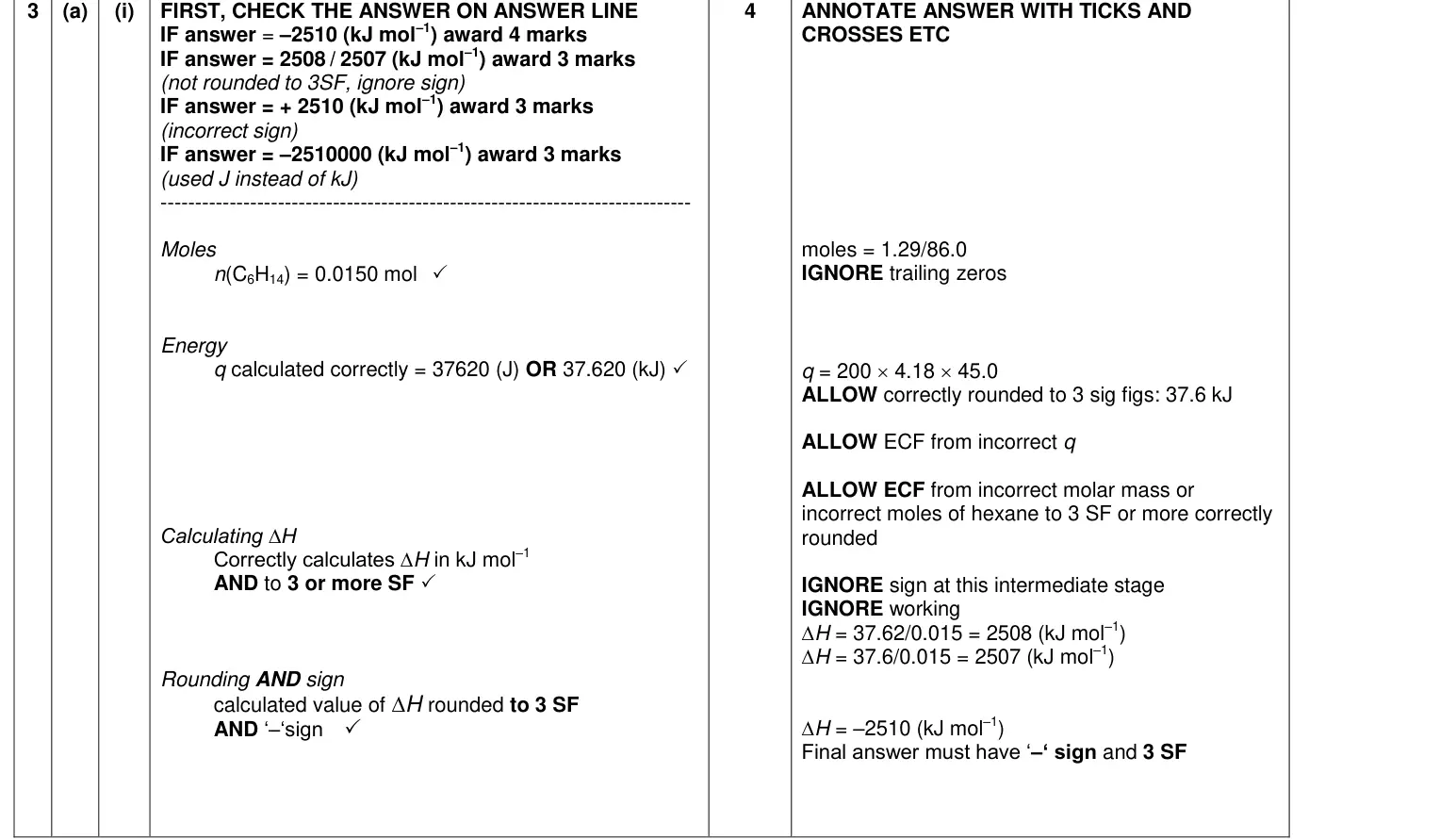
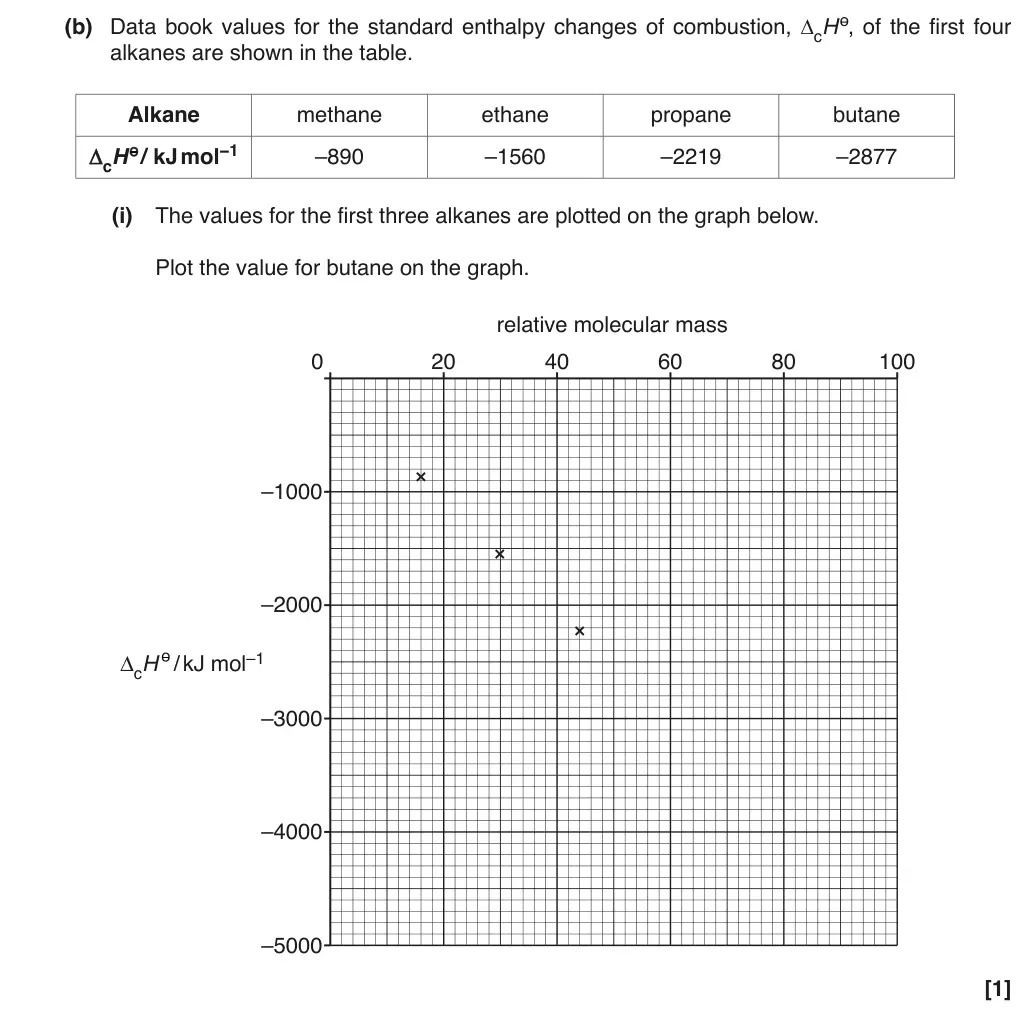
Show the 22 learning outcomes from the specification
2.1.3(a) explanation and use of the terms:
2.1.3(a)(i) amount of substance
2.1.3(a)(ii) mole (symbol ‘mol’), as the unit for amount of substance
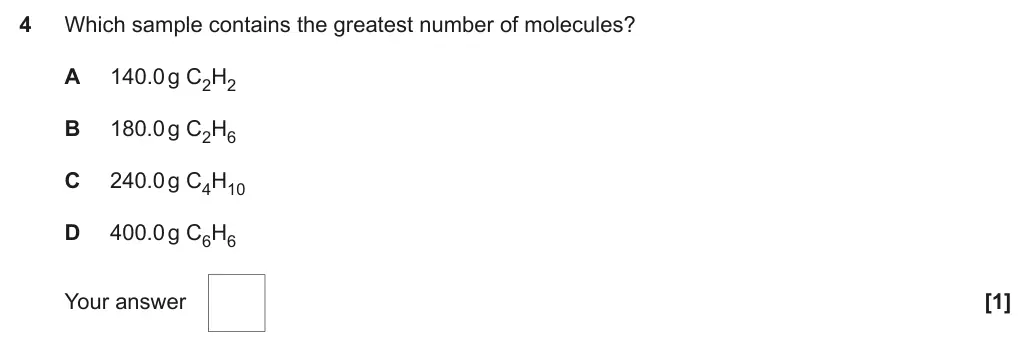
2.1.3(a)(iii) the Avogadro constant, NA(the number of particles per mole, 6.02 × 10²³mol–1)
2.1.3(a)(iv) molar mass (mass per mole, units g mol–1),
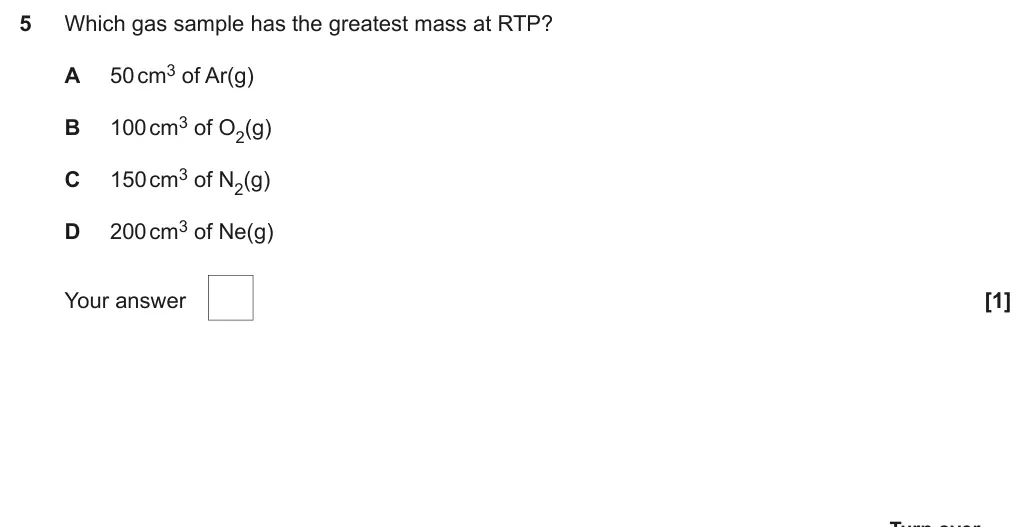
2.1.3(a)(v) molar gas volume (gas volume per mole, units dm3mol–1)
2.1.3(b) use of the terms:
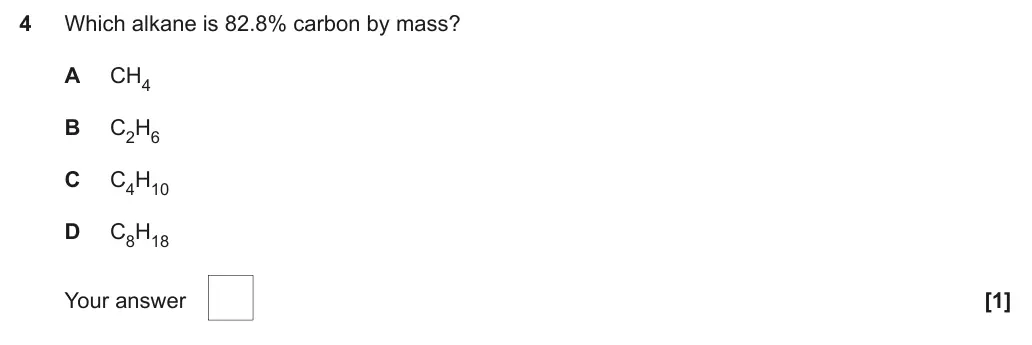
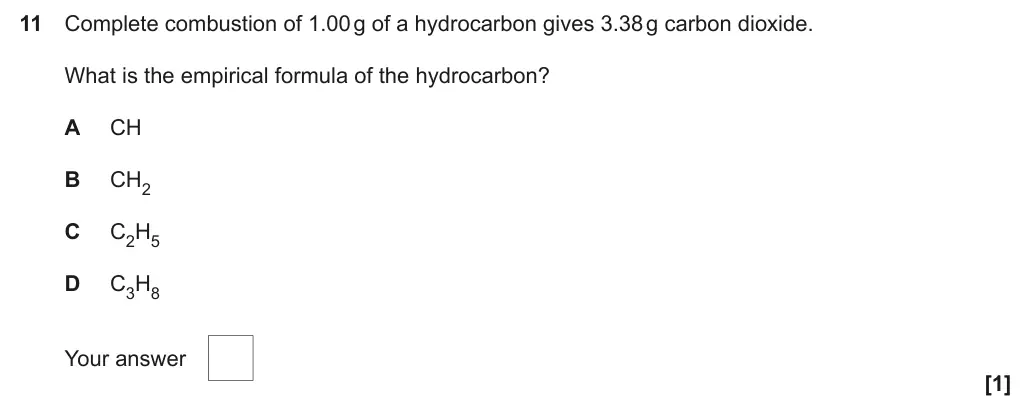
2.1.3(b)(i) empirical formula (the simplest whole number ratio of atoms of each element present in a compound)
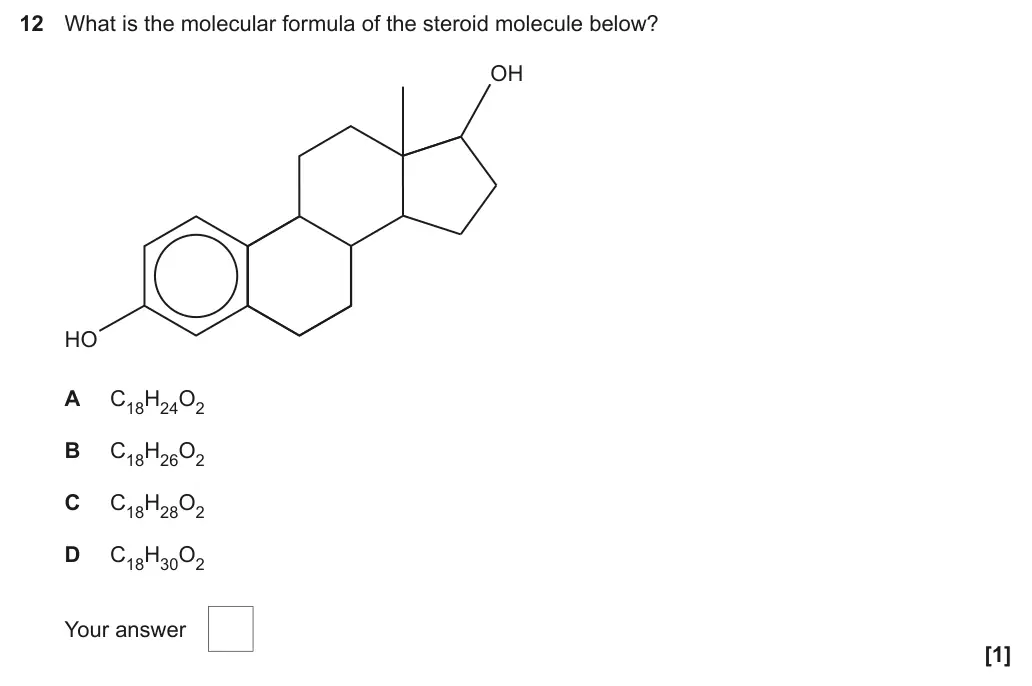
2.1.3(b)(ii) molecular formula (the number and type of atoms of each element in a molecule)
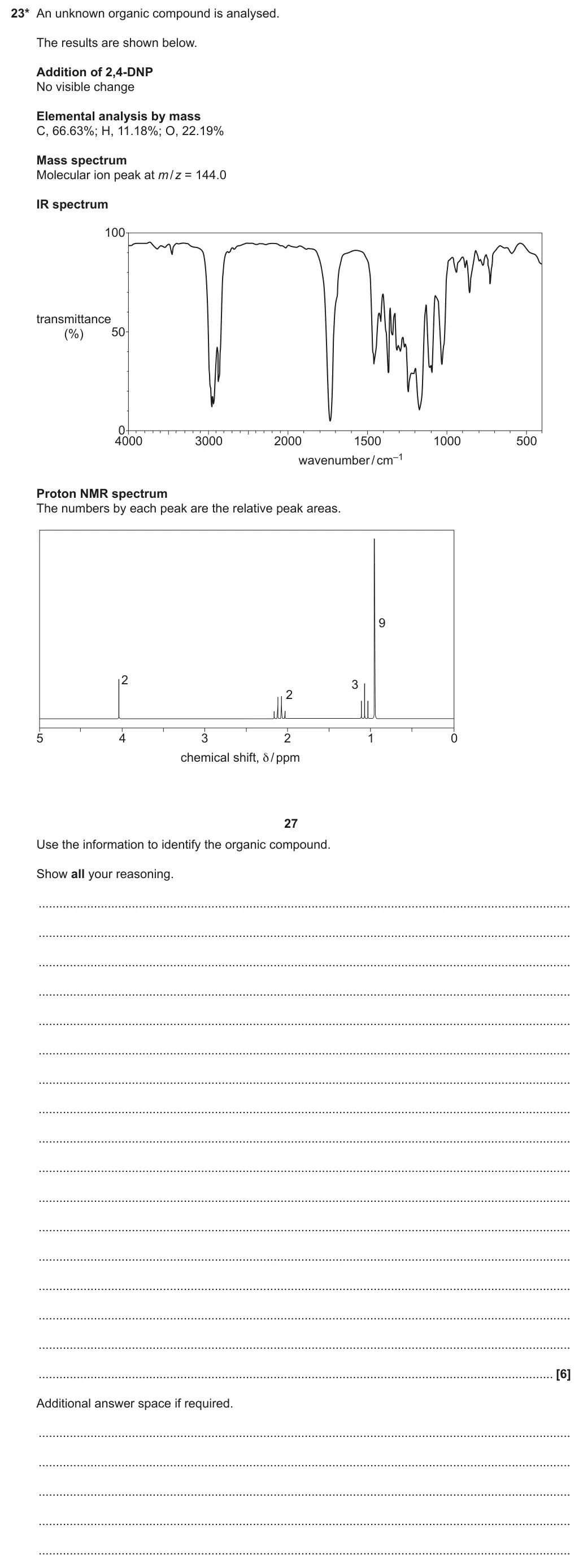
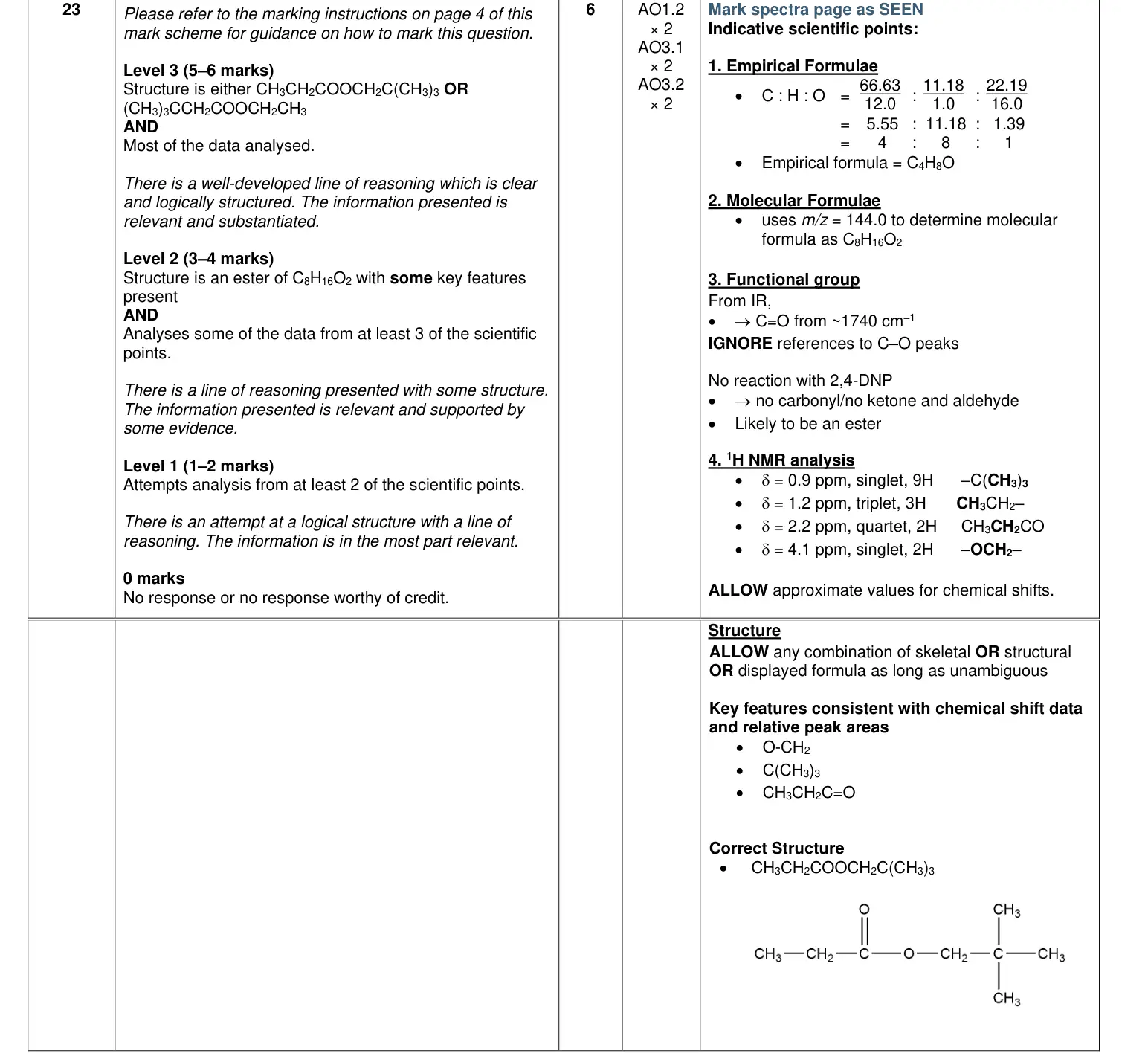
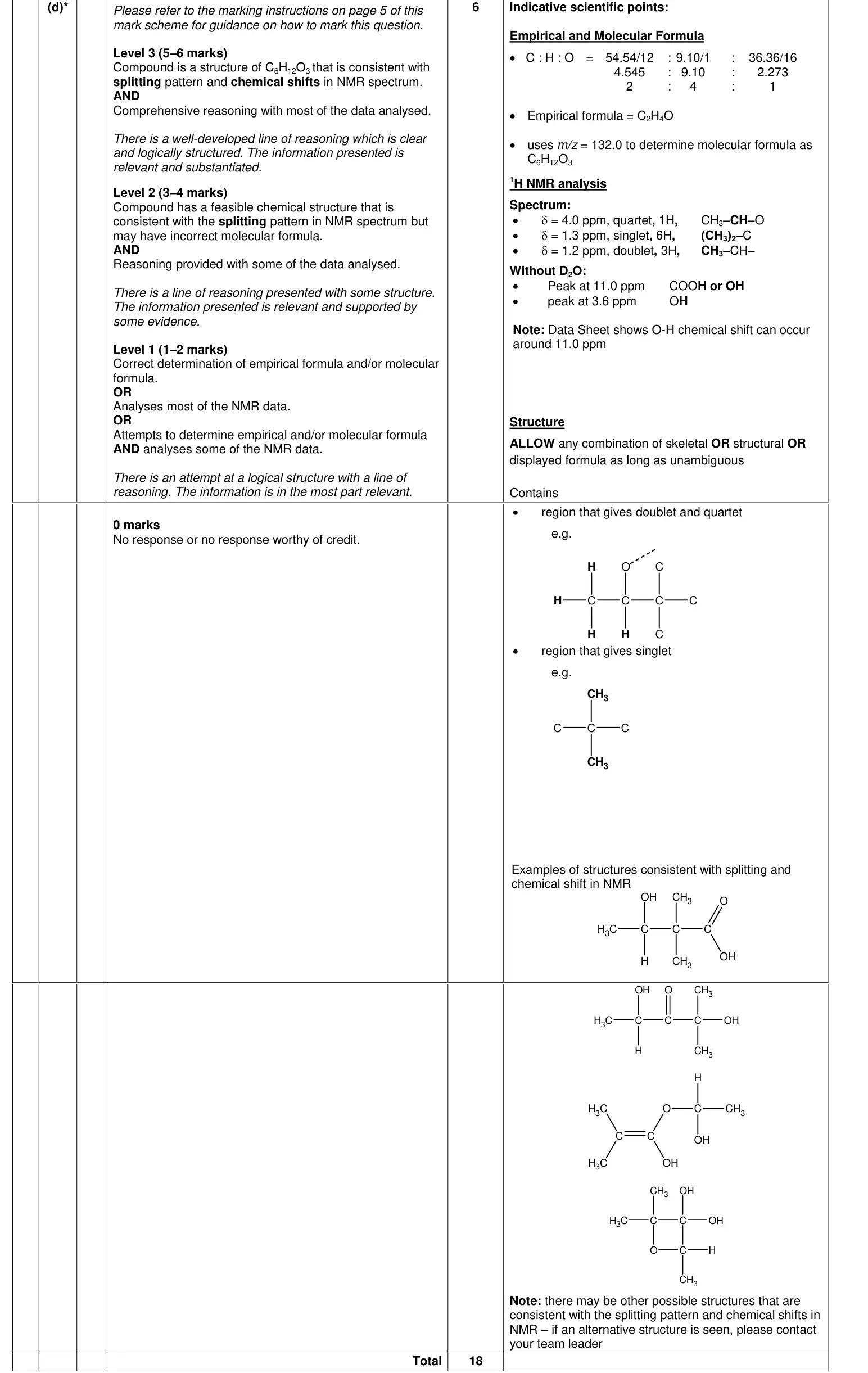
2.1.3(c) calculations of empirical and molecular formulae, from composition by mass or percentage compositions by mass and relative molecular mass
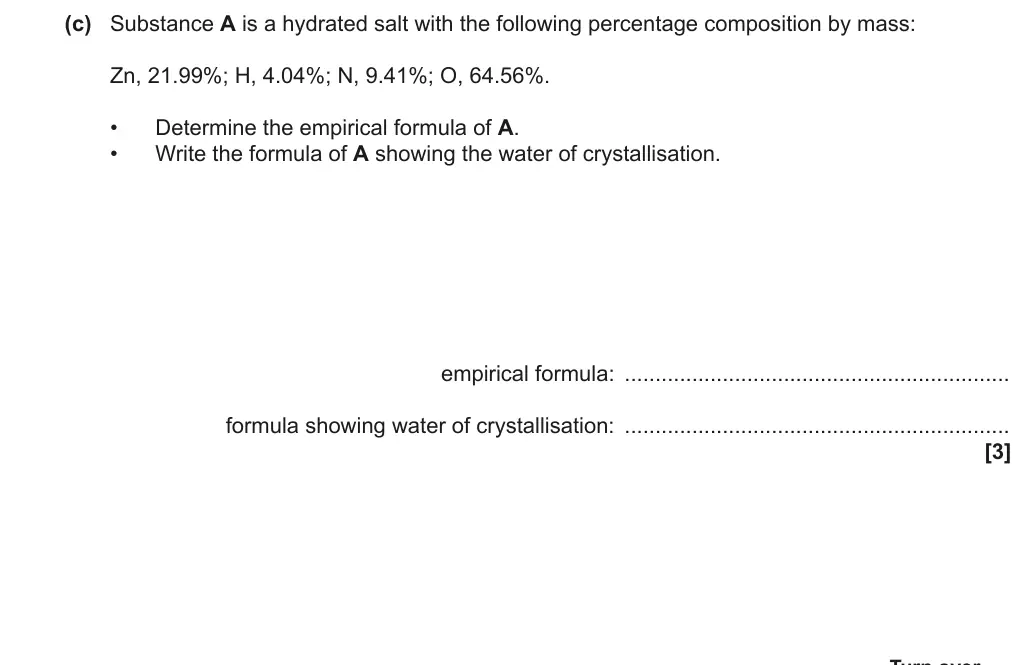
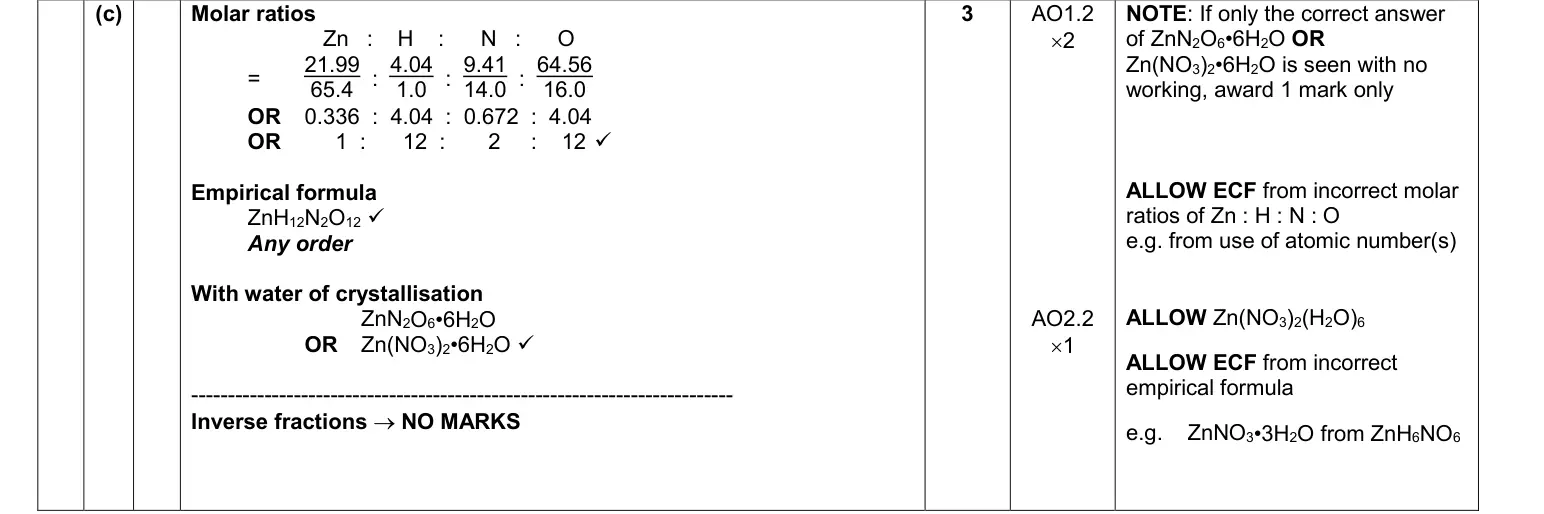
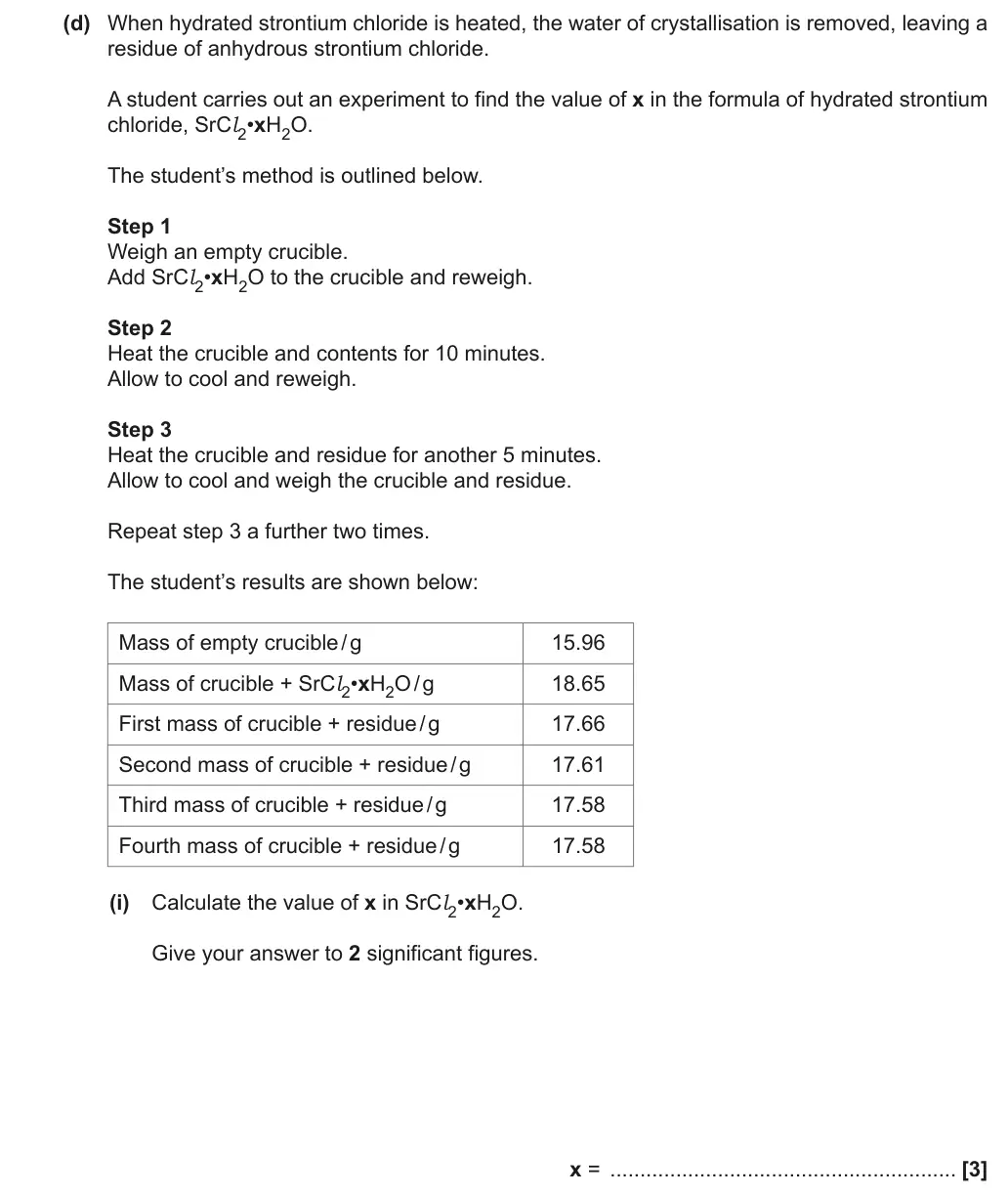
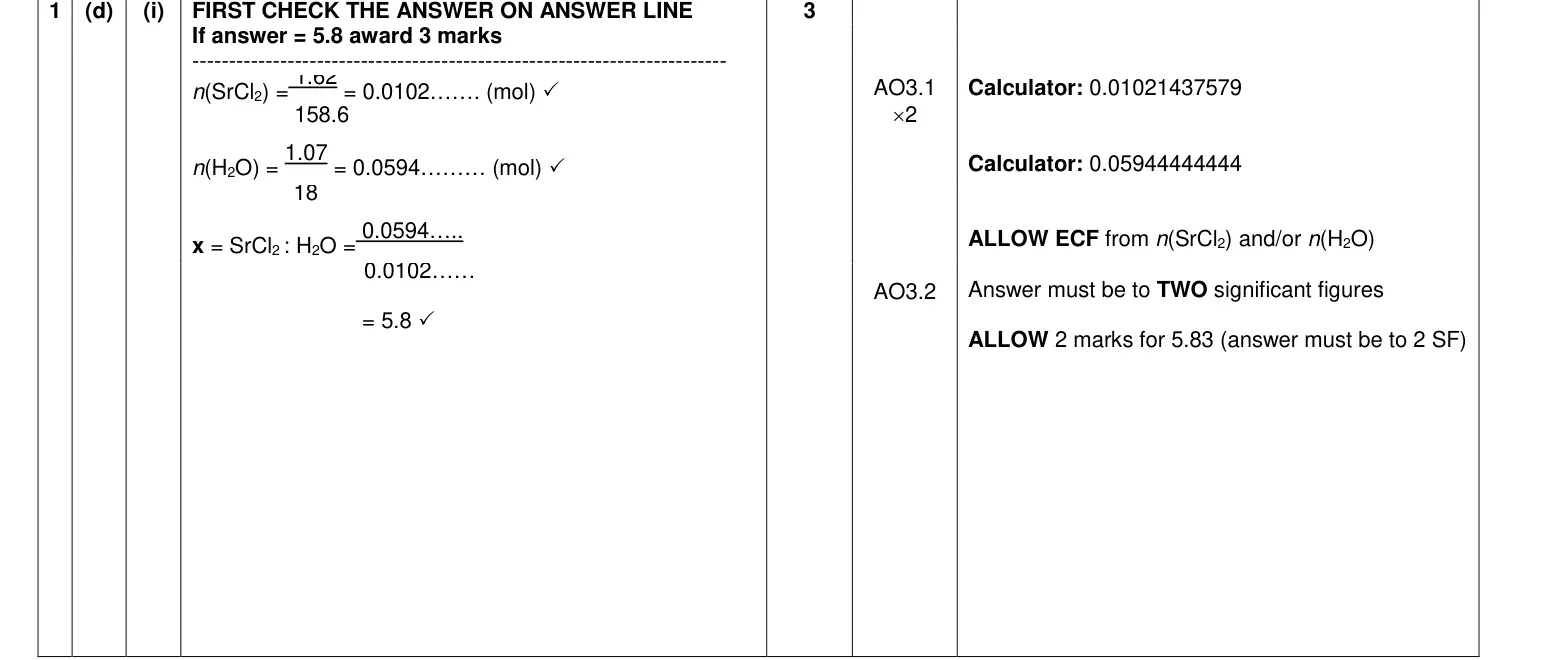
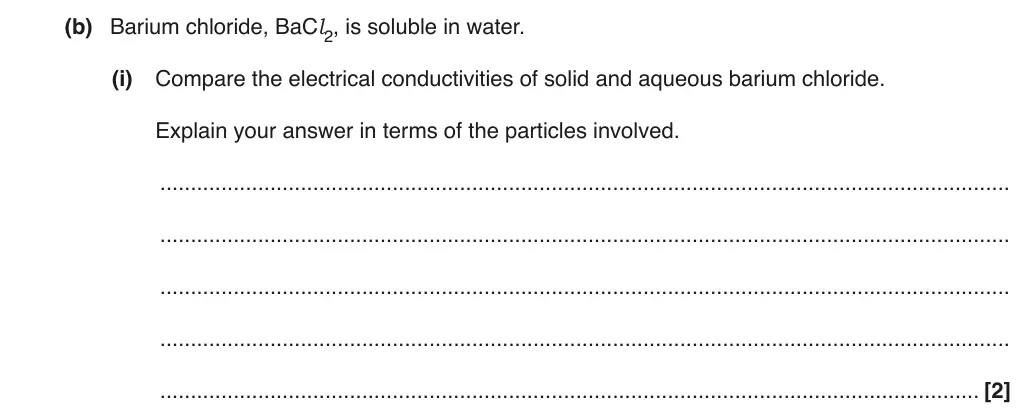
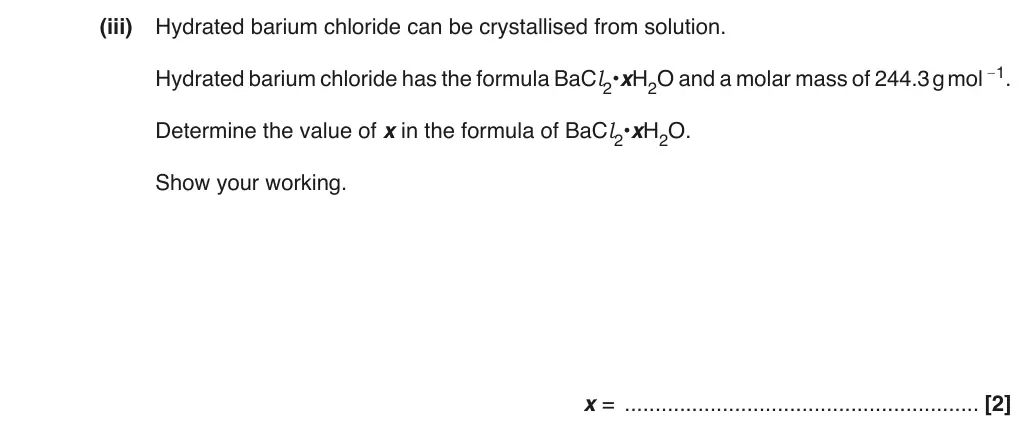
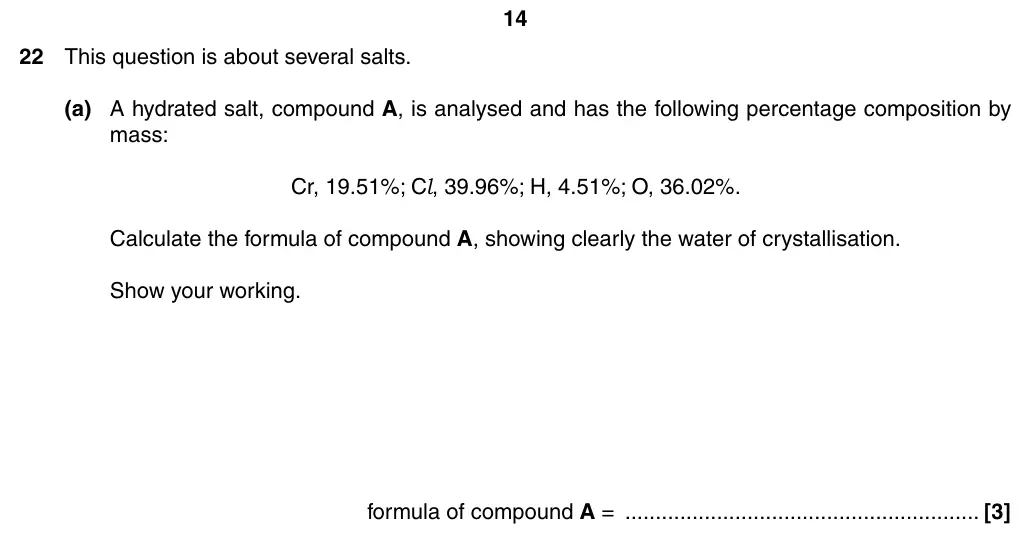
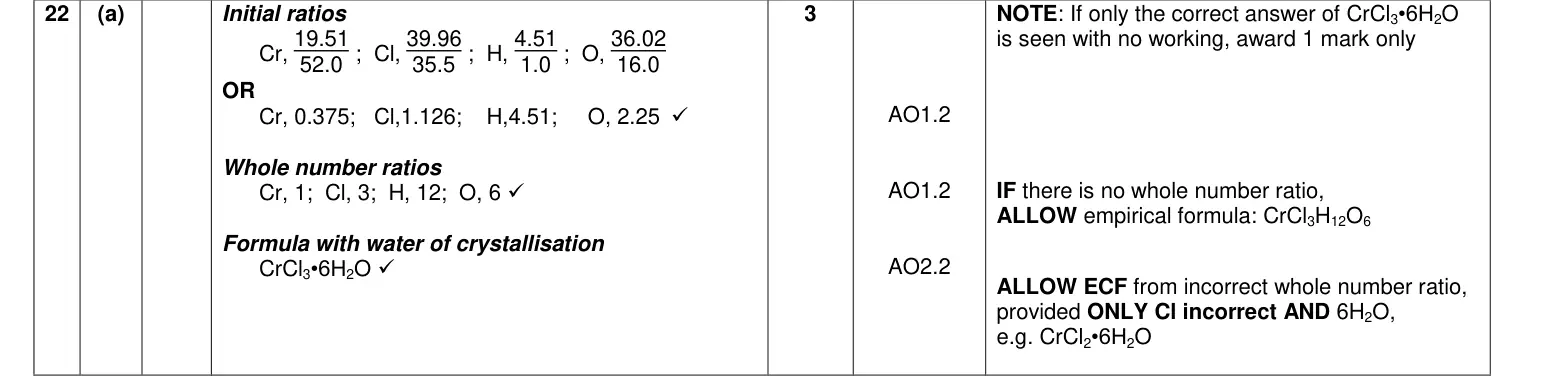
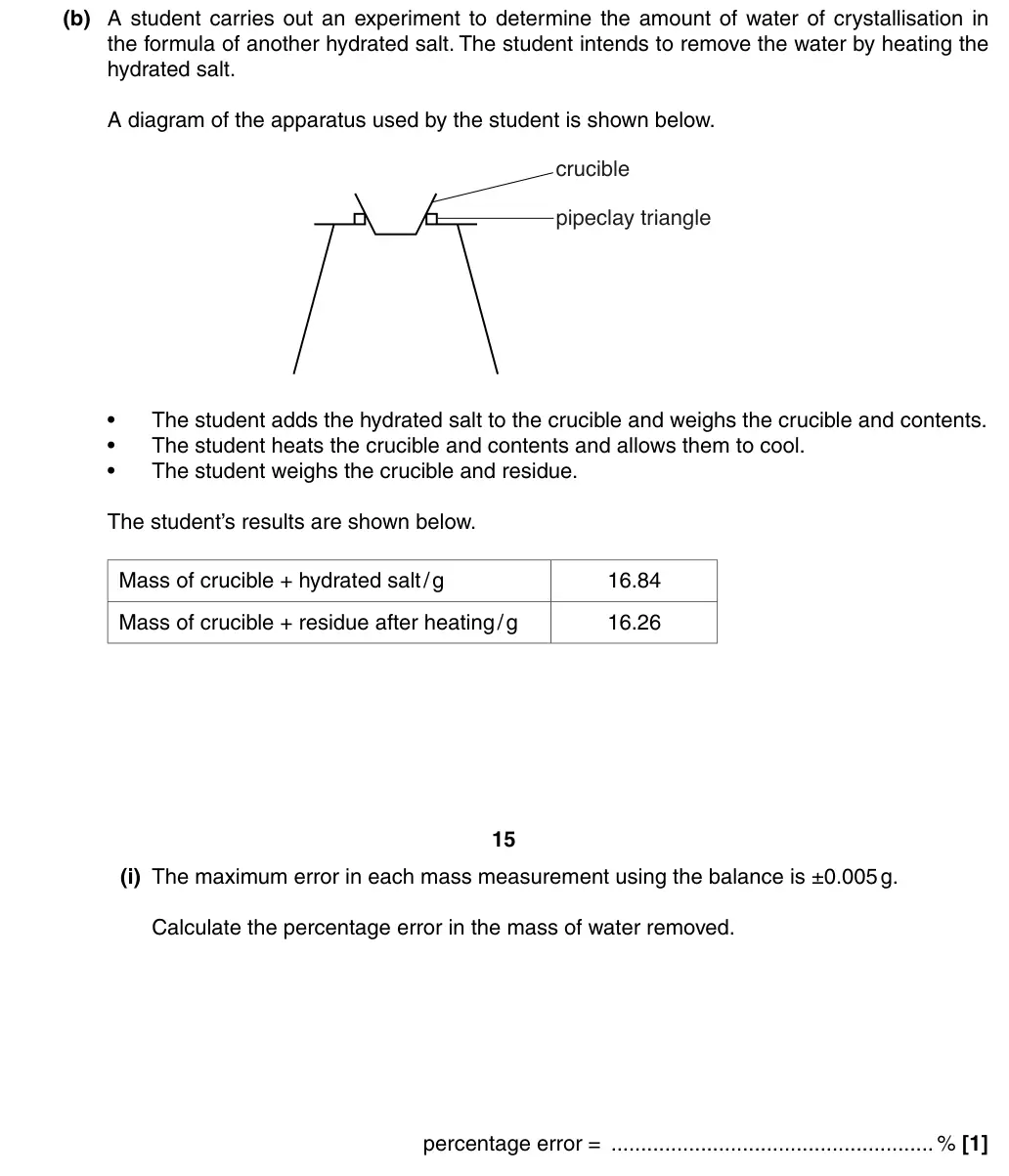
2.1.3(d) the terms anhydrous, hydrated and water of crystallisation and calculation of the formula of a hydrated salt from given percentage composition, mass composition or based on experimental results
2.1.3(e) calculations, using amount of substance in mol, involving:
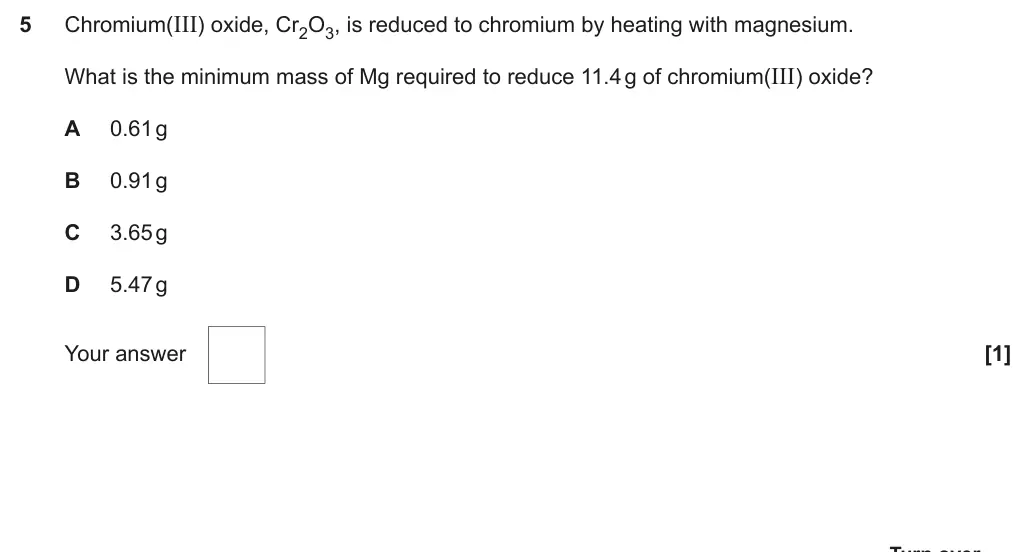
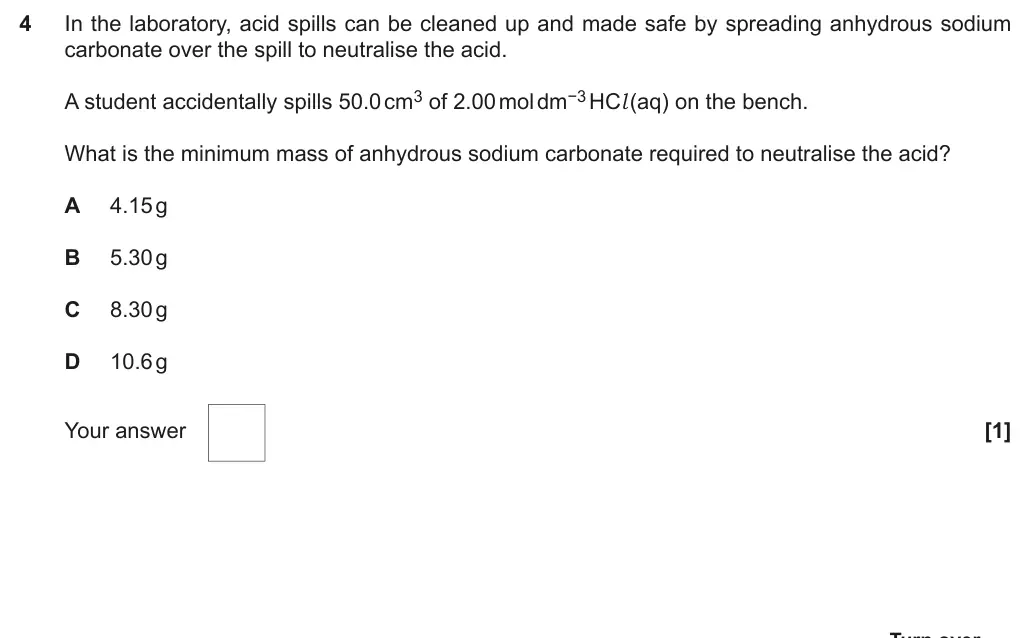
2.1.3(e)(i) mass
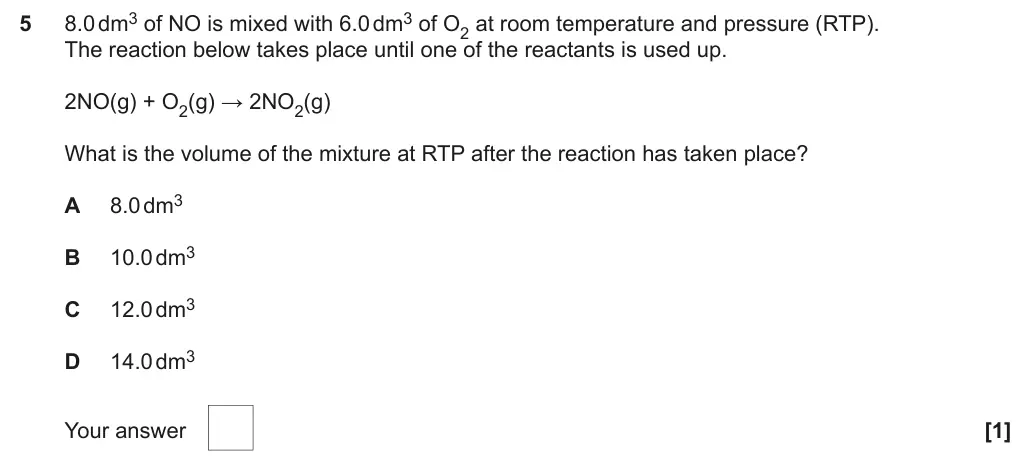
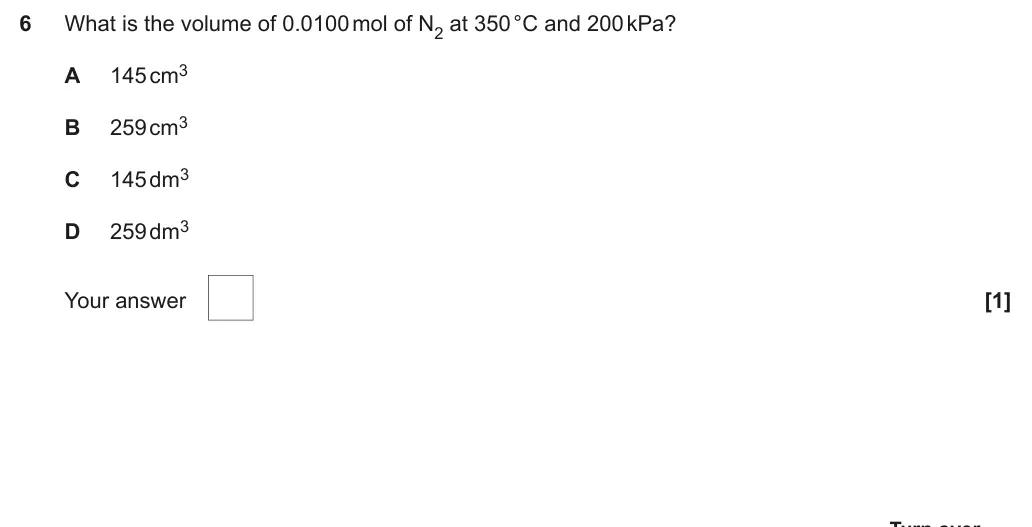
2.1.3(e)(ii) gas volume
2.1.3(e)(iii) solution volume and concentration
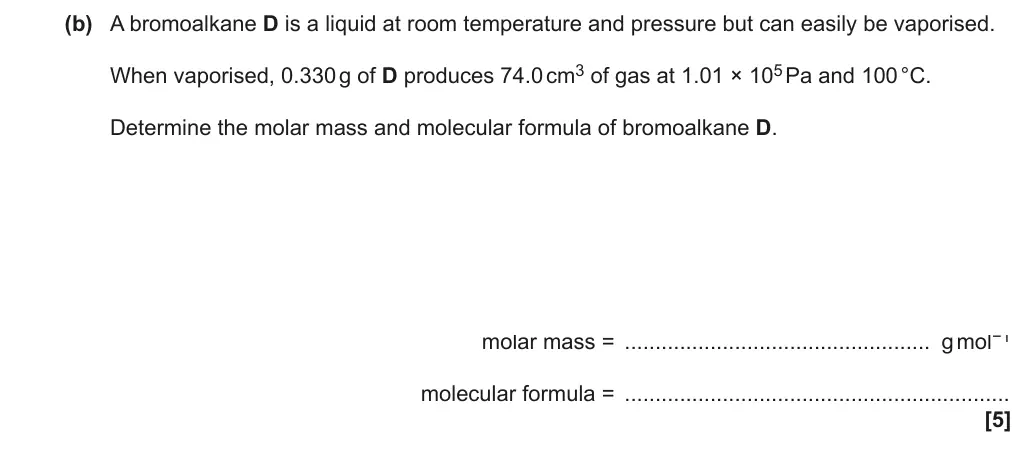
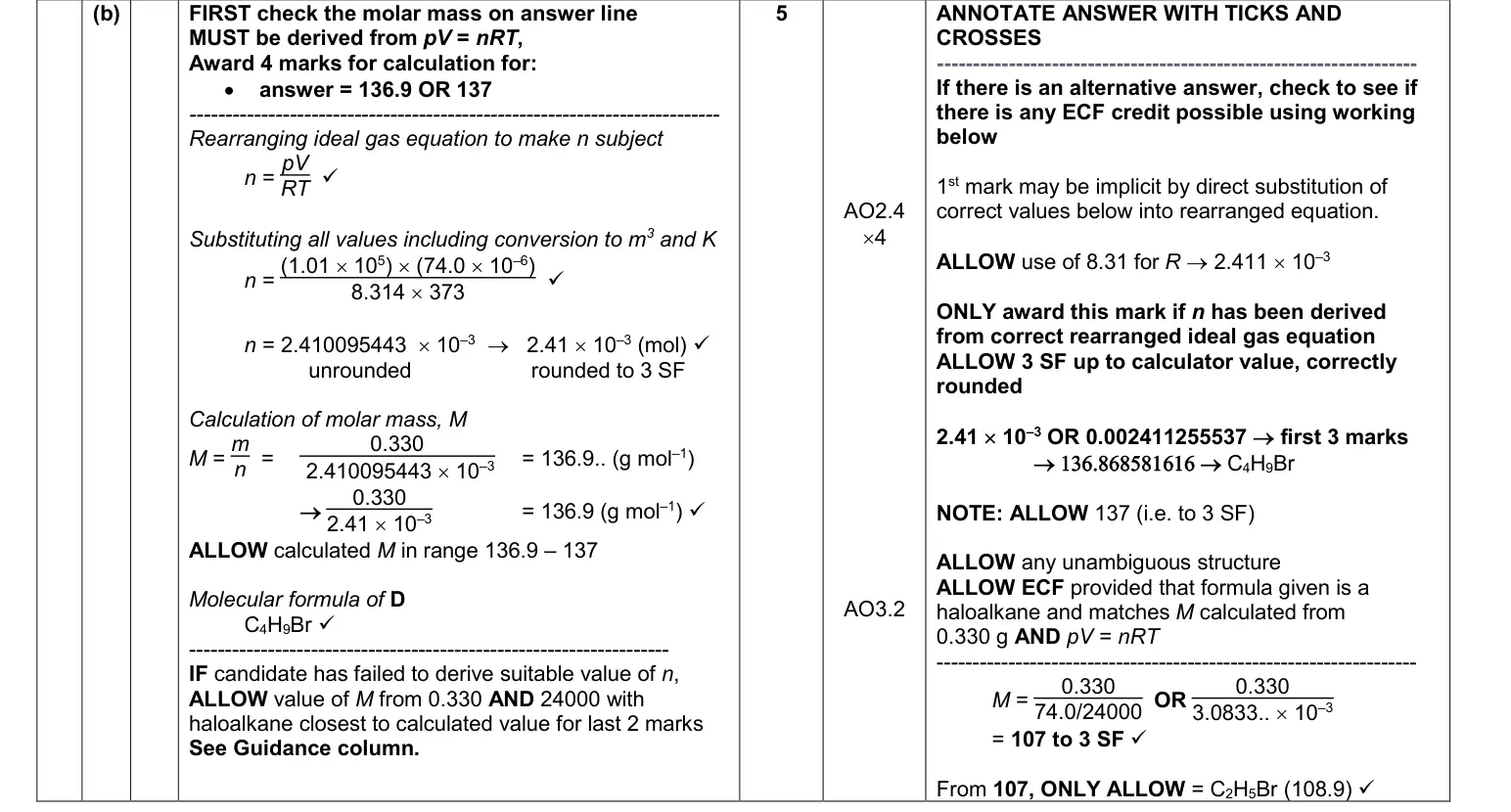
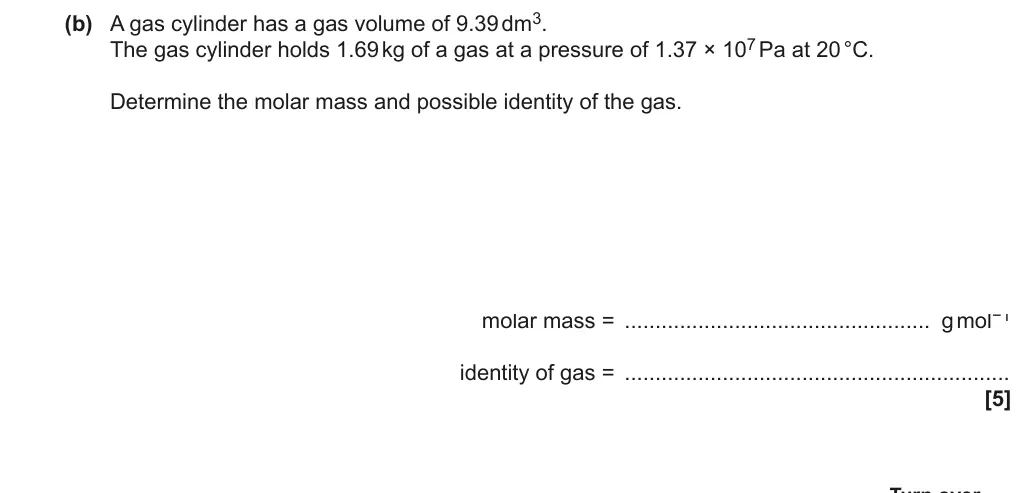
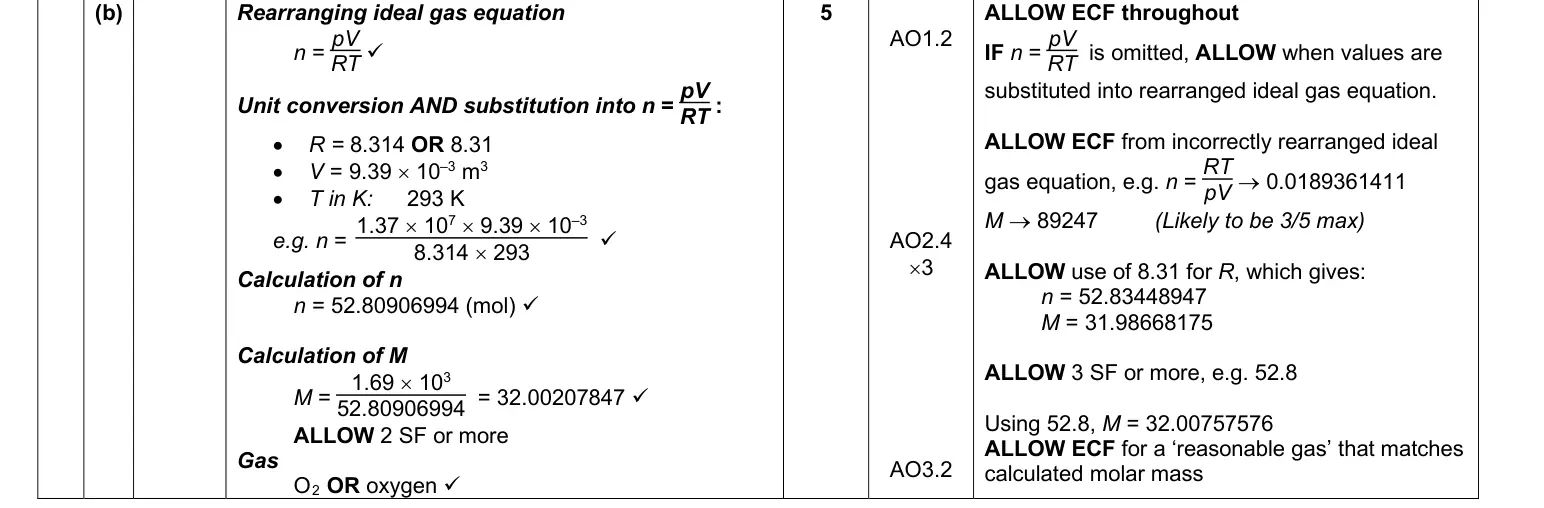
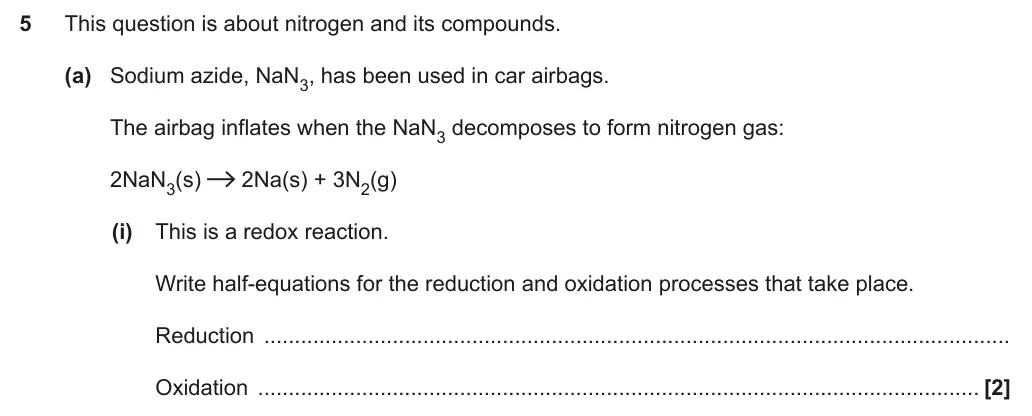
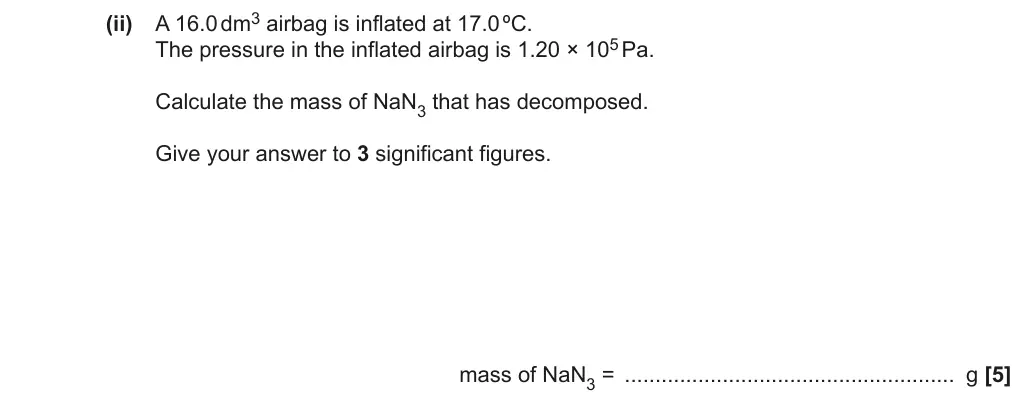
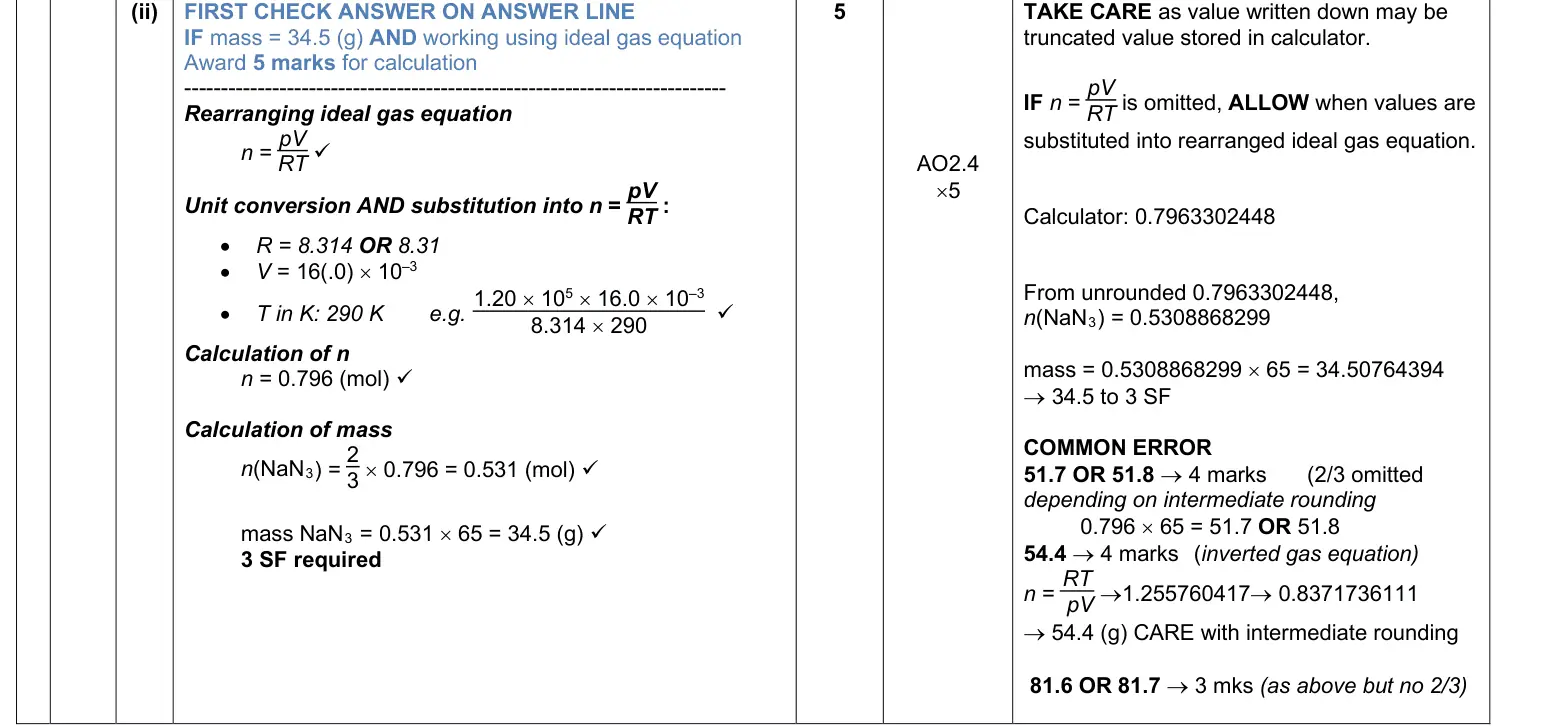
2.1.3(f) the ideal gas equation: pV = nRT
2.1.3(g) use of stoichiometric relationships in calculations
2.1.3(h) calculations to determine:
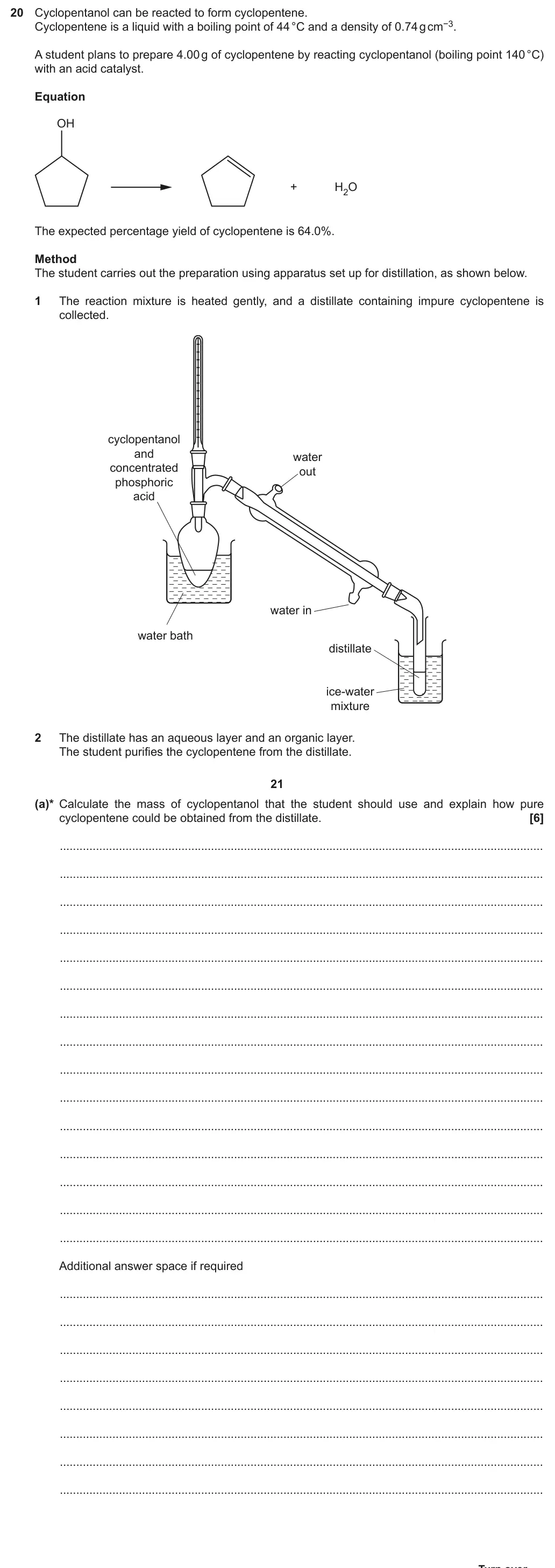
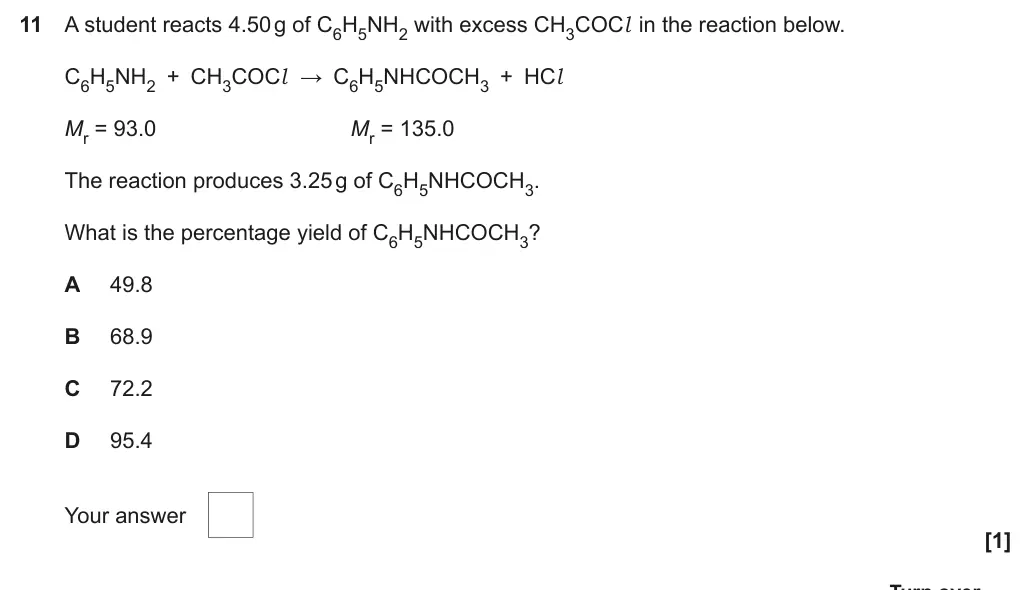
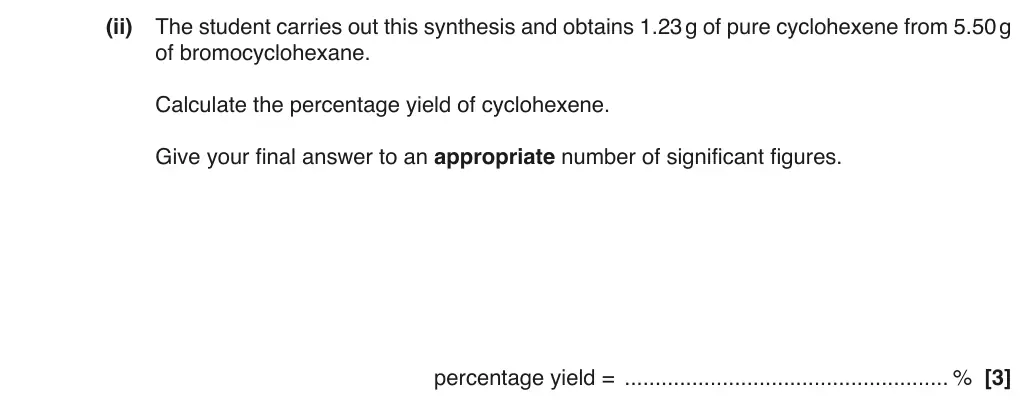
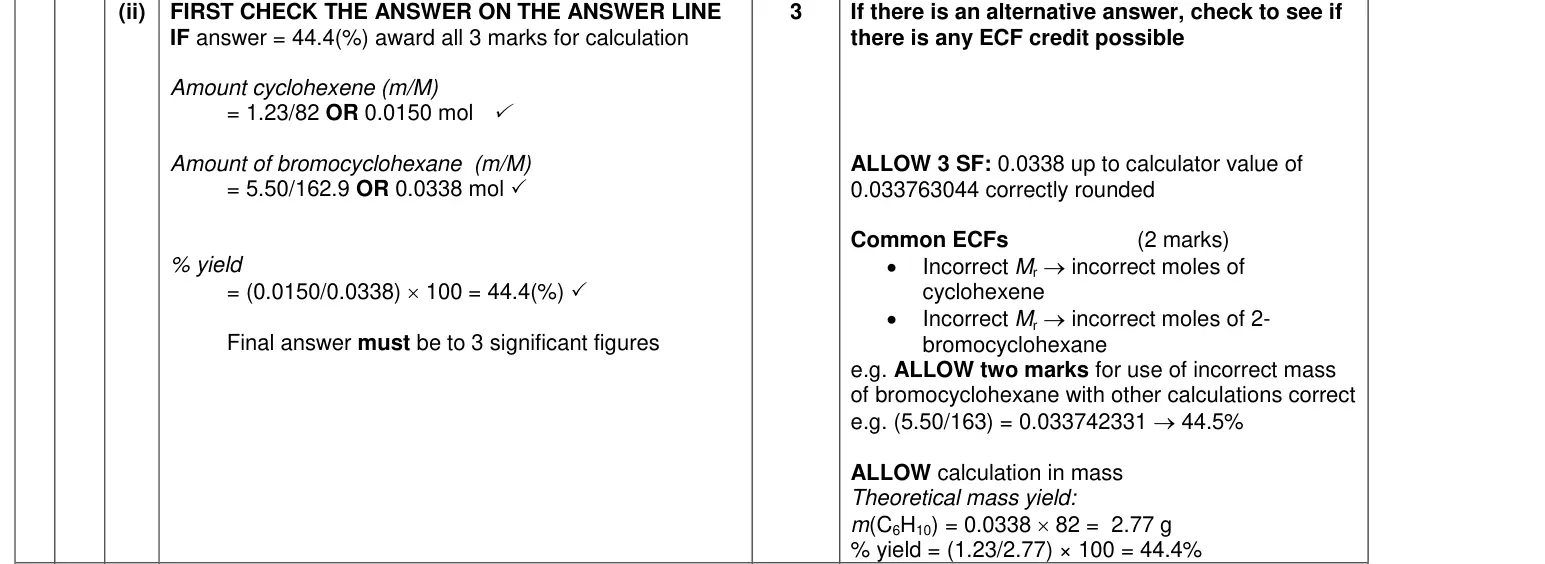
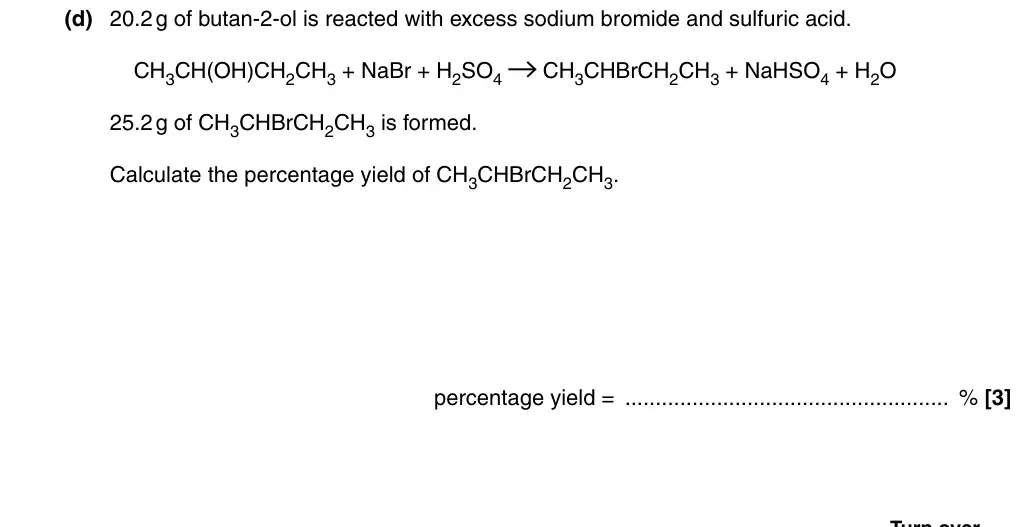
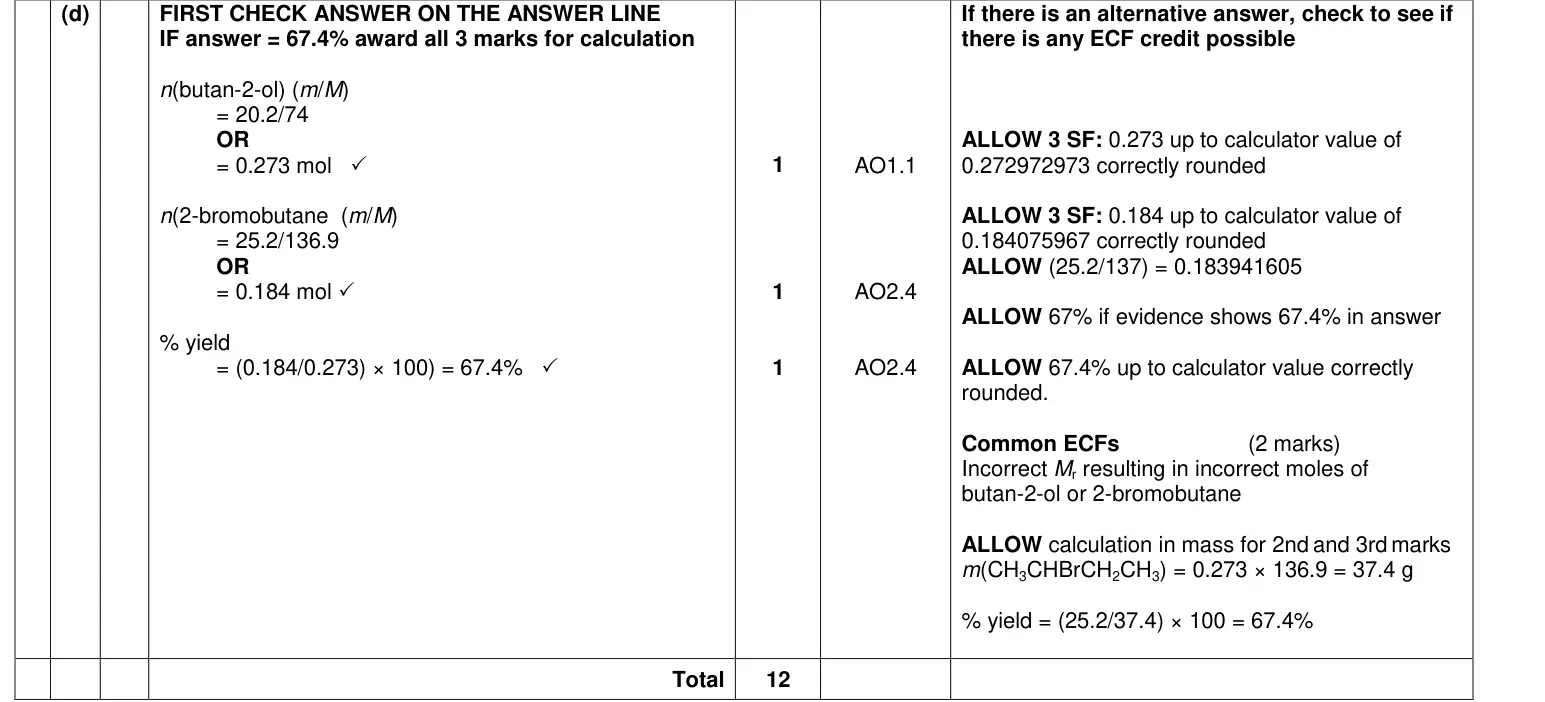
2.1.3(h)(i) the percentage yield of a reaction or related quantities
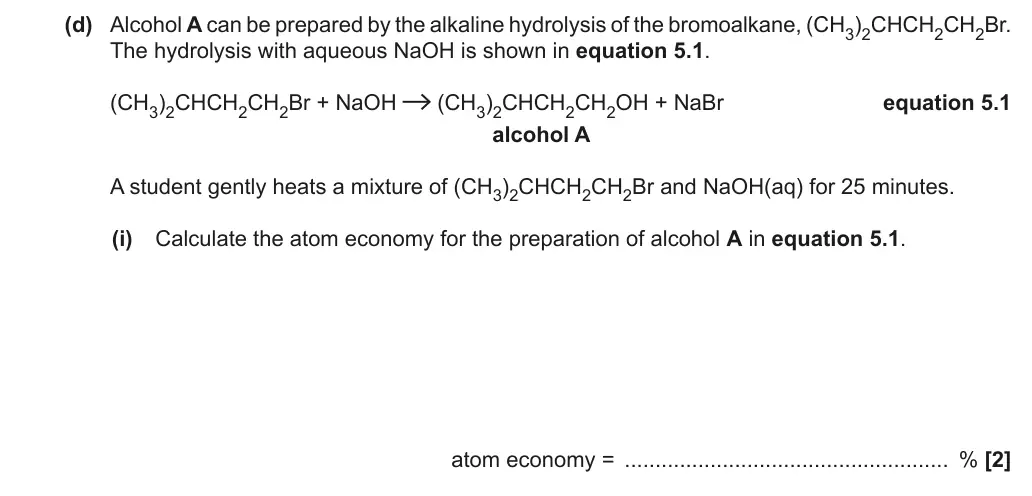
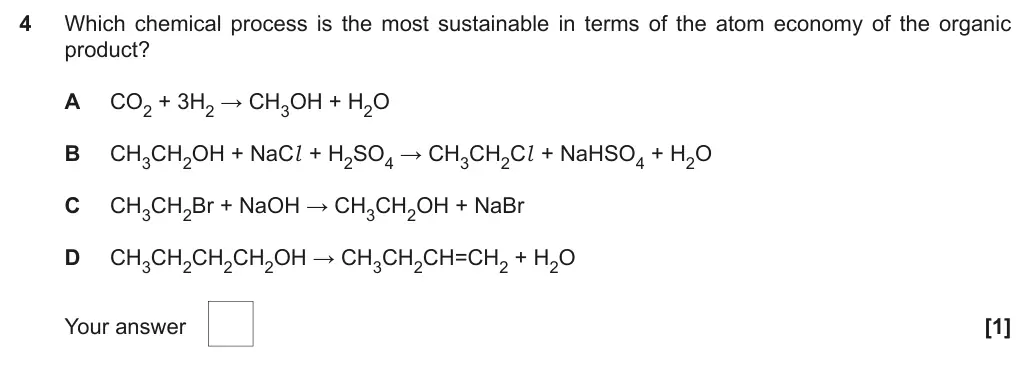
2.1.3(h)(ii) the atom economy of a reaction
2.1.3(i) the techniques and procedures required during experiments requiring the measurement of mass, volumes of solutions and gas volumes
2.1.3(j) the benefits for sustainability of developing chemical processes with a high atom economy.
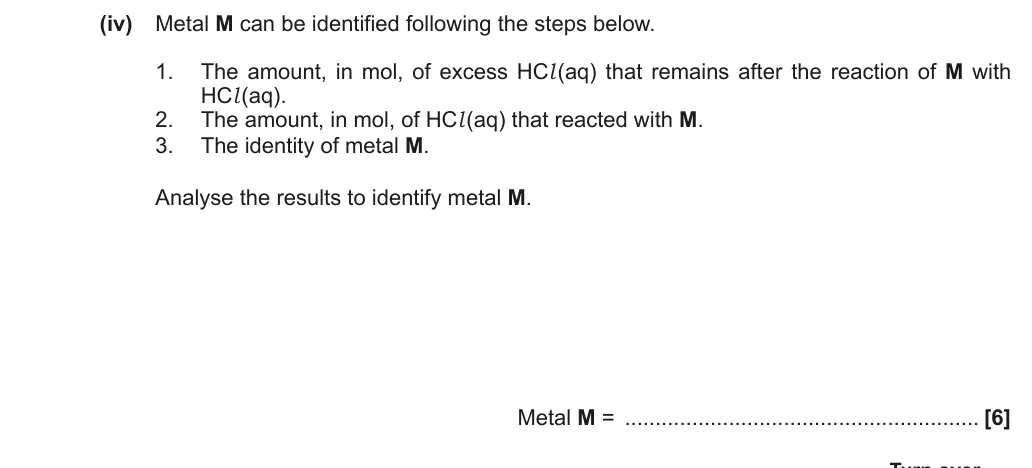
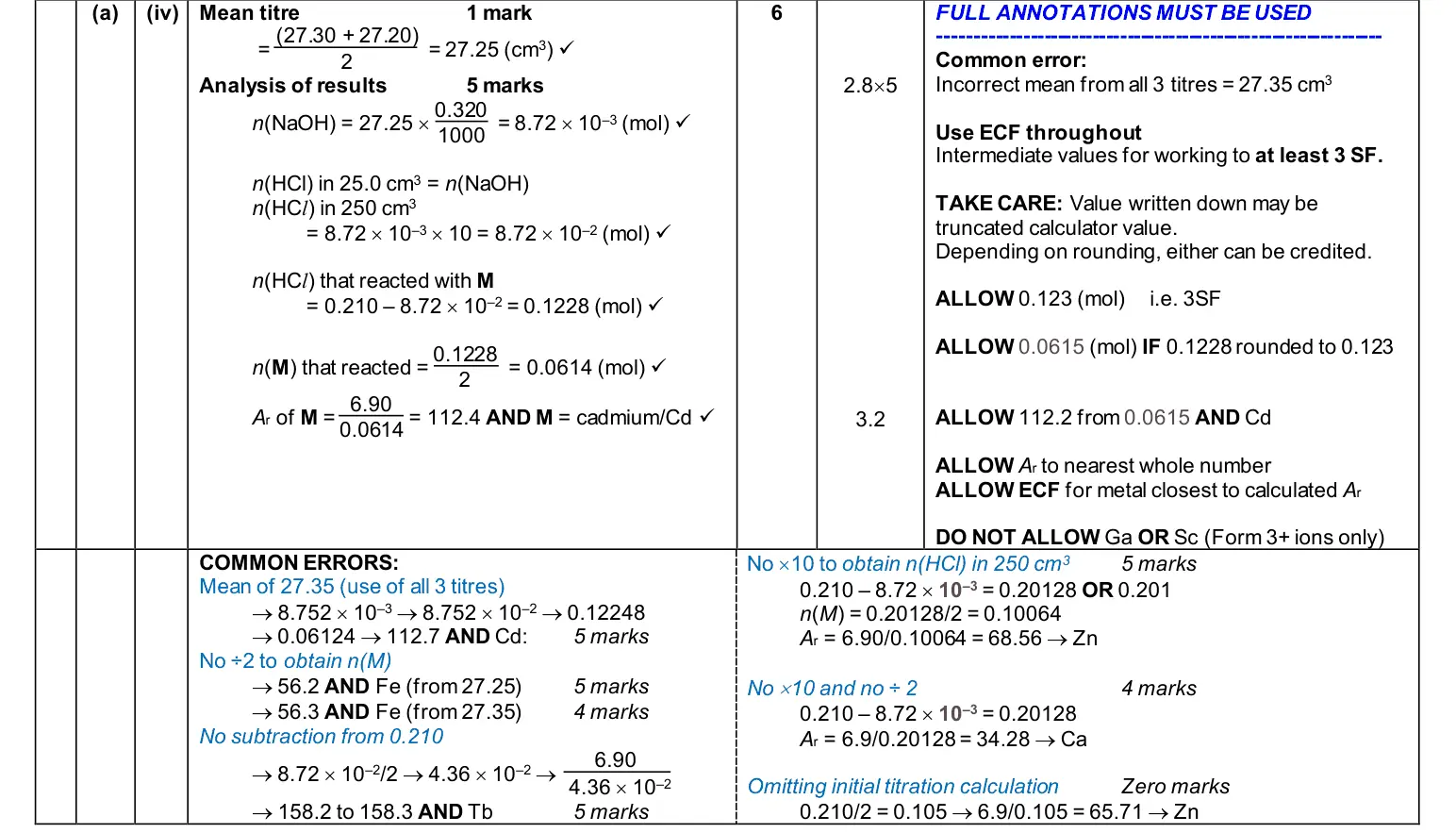
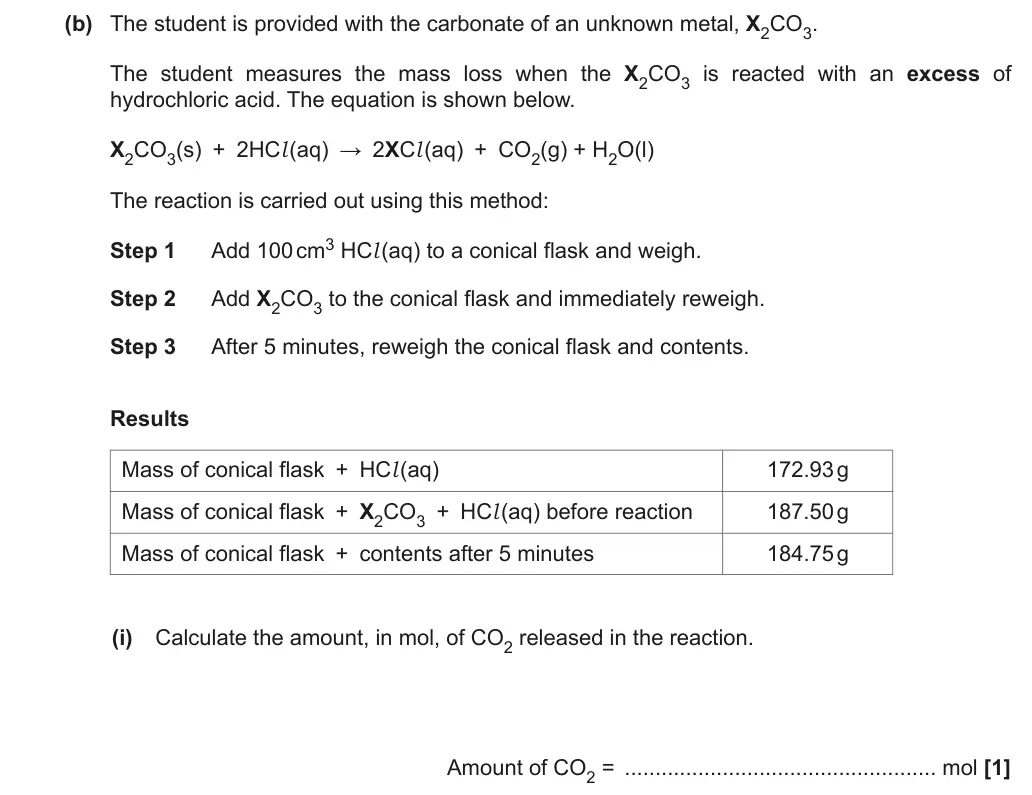
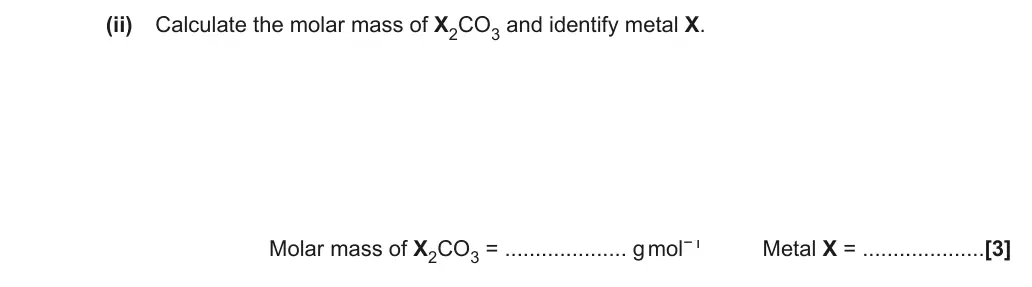
Six-mark level of response questions on this topic
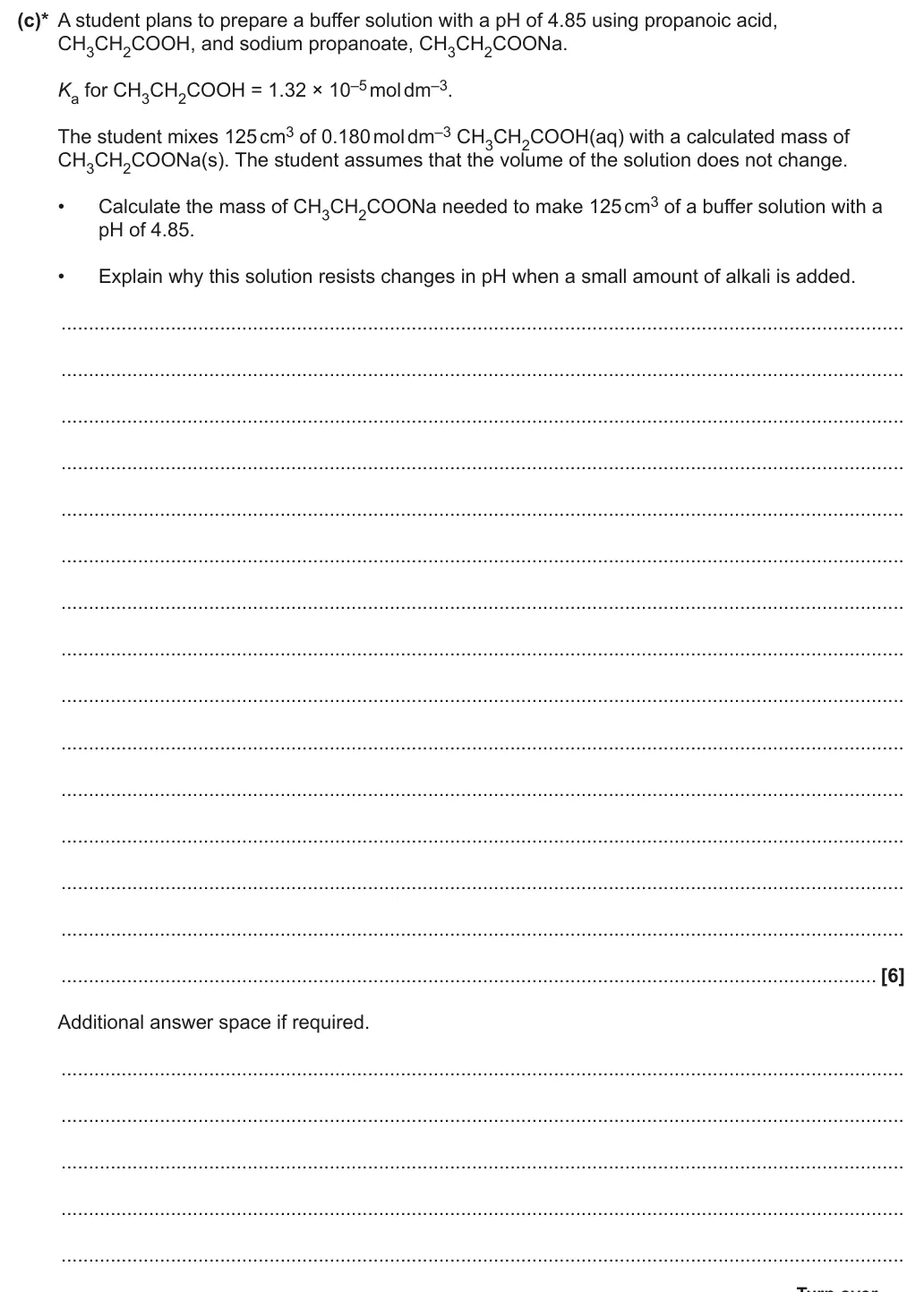
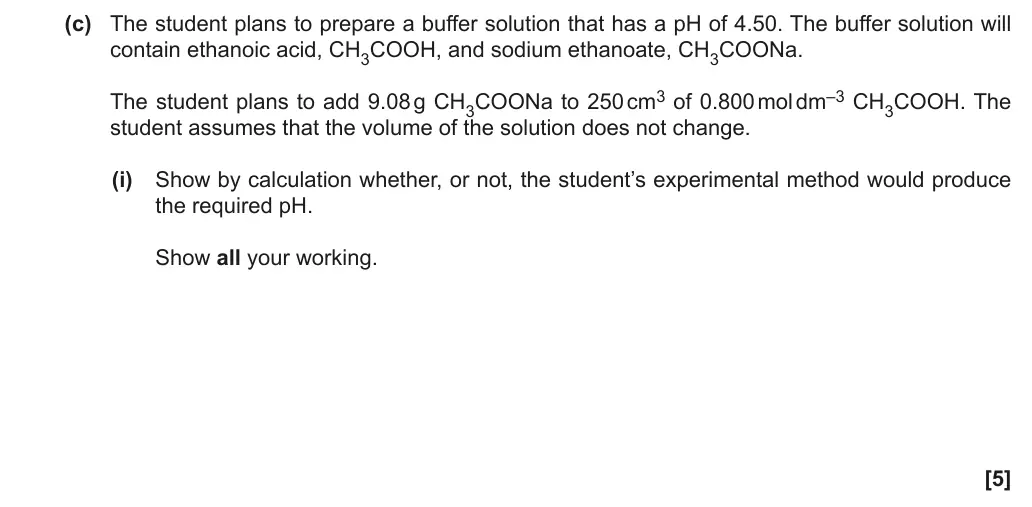
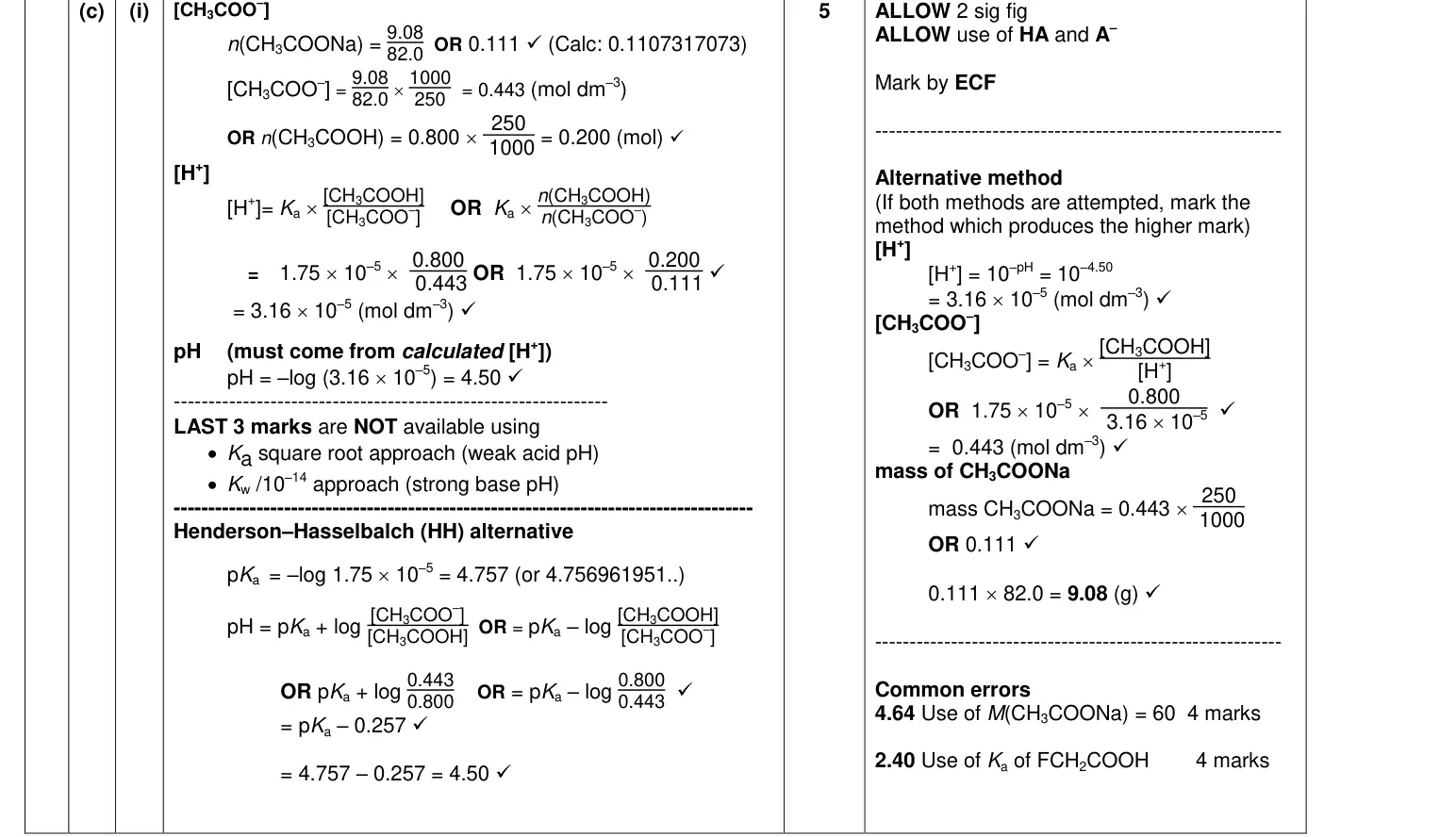
A student plans to prepare a buffer solution with a pH of 4.85 using propanoic acid, • Calculate the mass of CH3CH2COONa needed to make 125 cm3 of a buffer solution with a
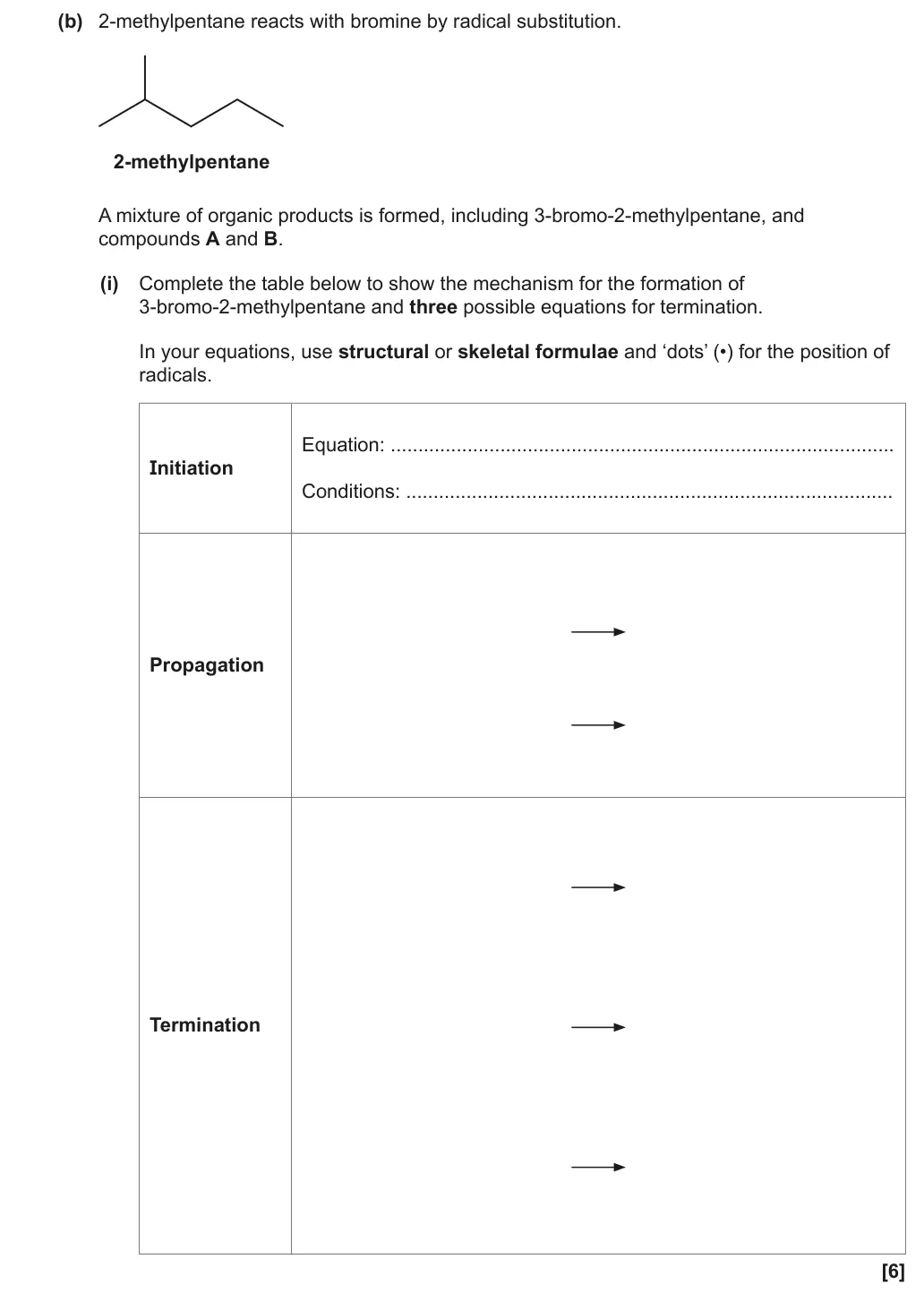
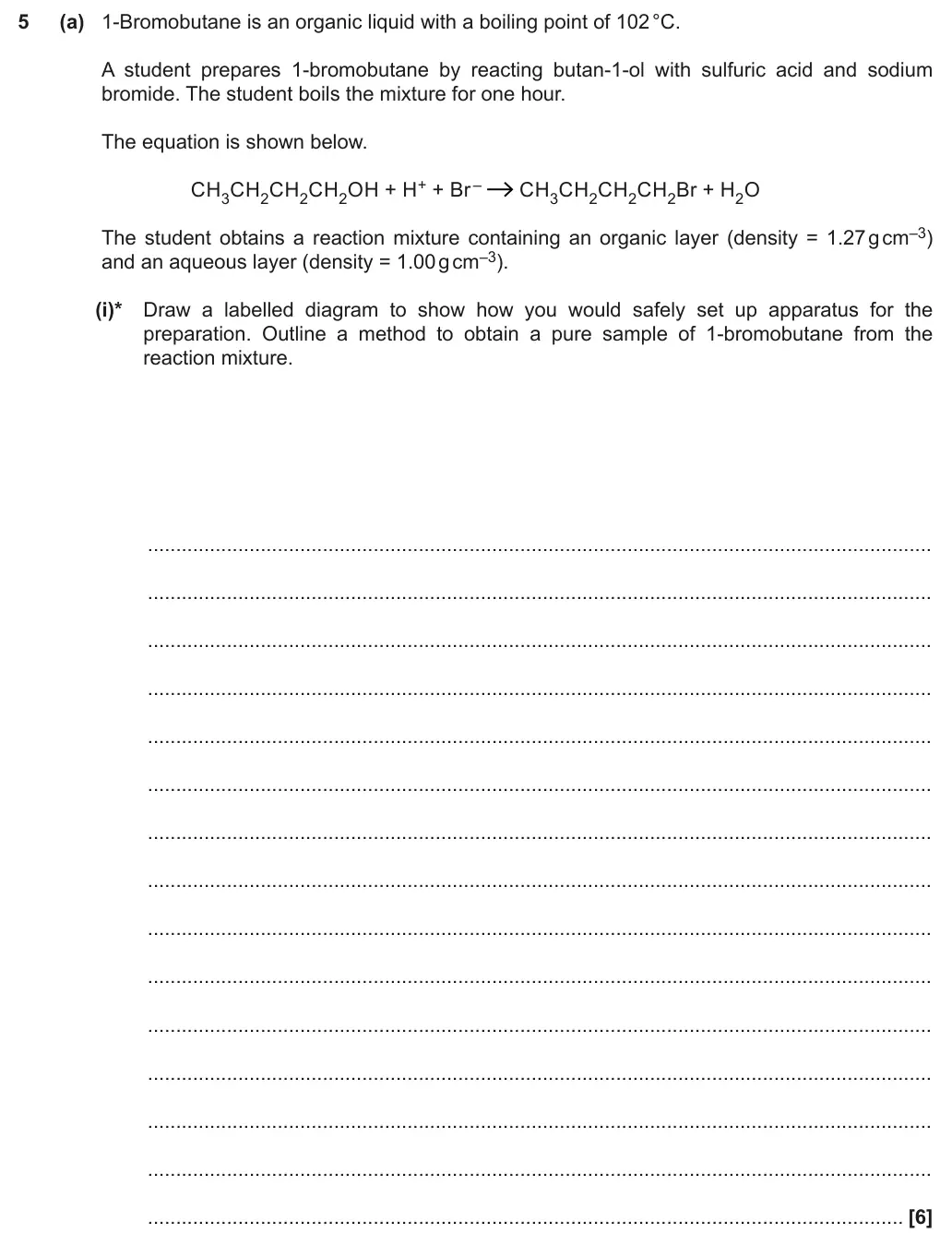
2-Chlorobutane, CH3CH2CHCl CH3, is an organic liquid with a boiling point of 70 °C. Describe how the student could obtain a pure, dry sample of CH3CH2CHCl CH3 from the reaction
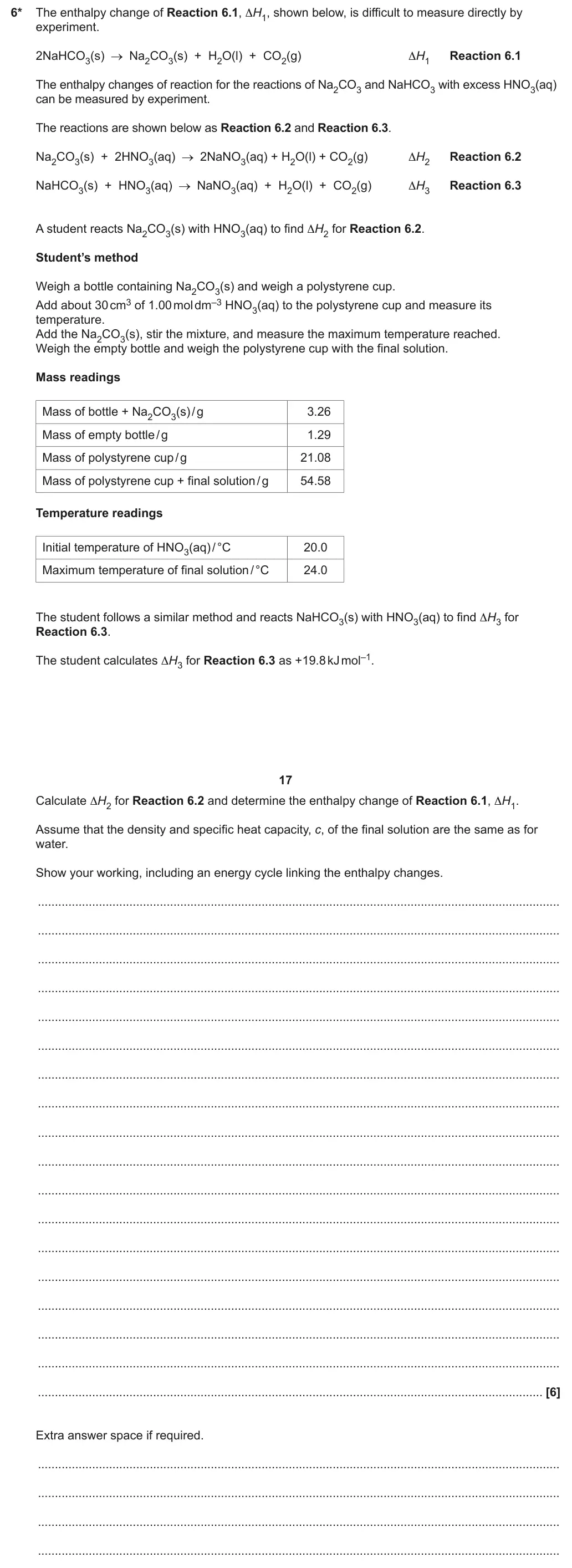
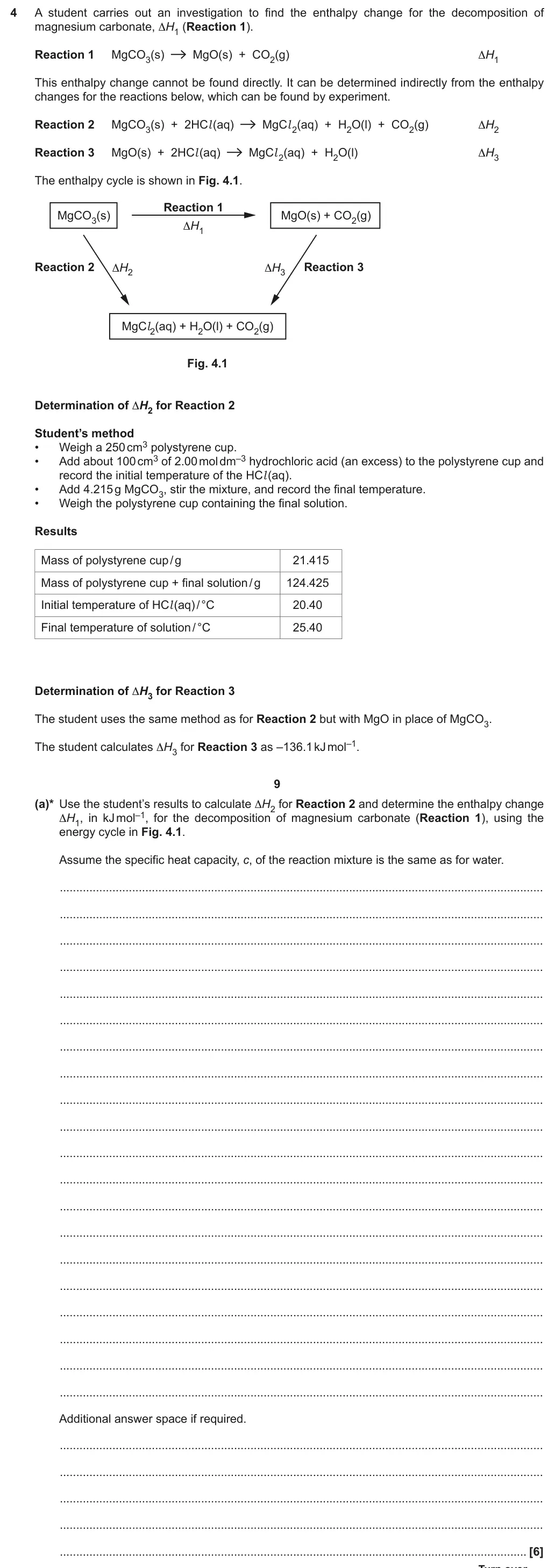
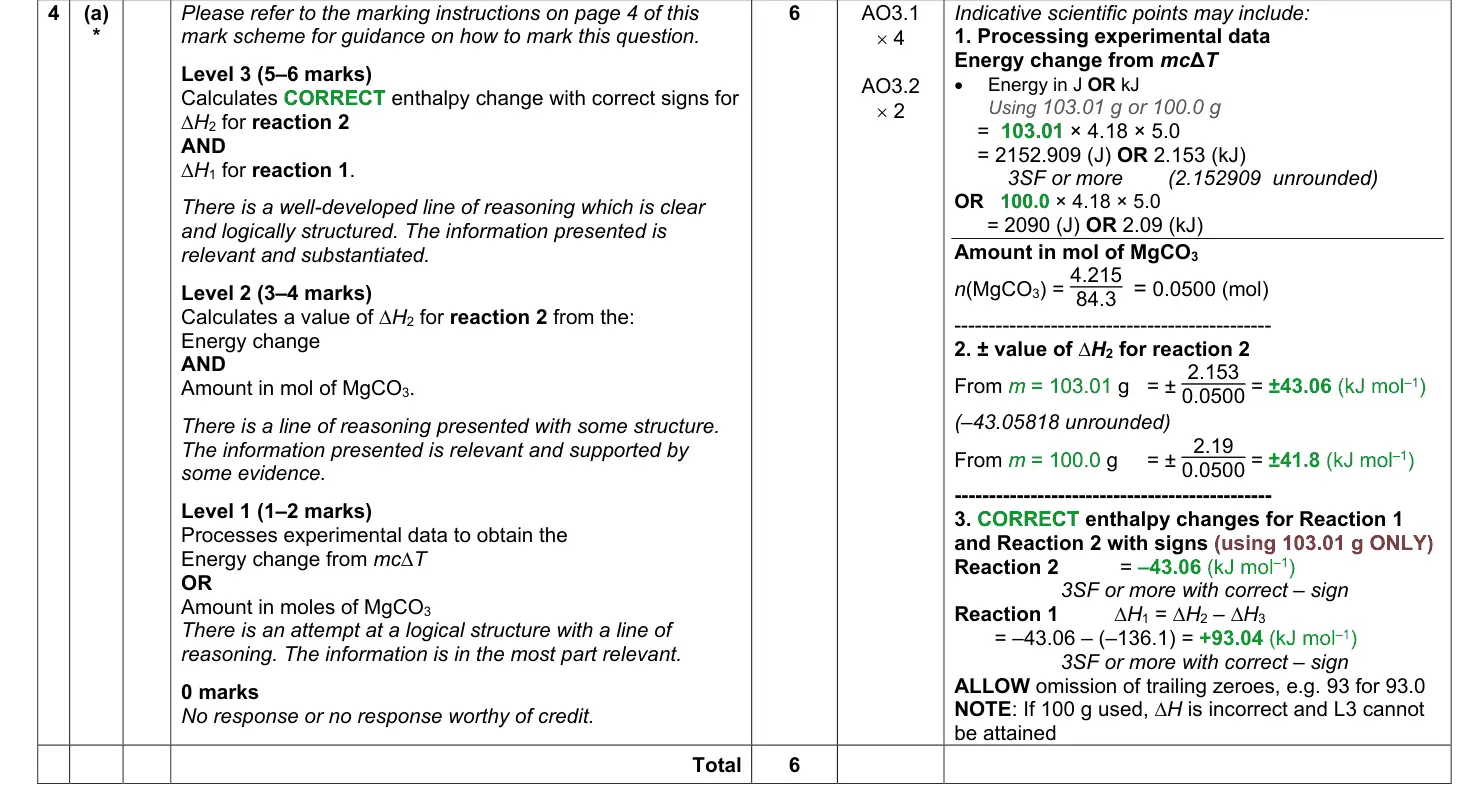
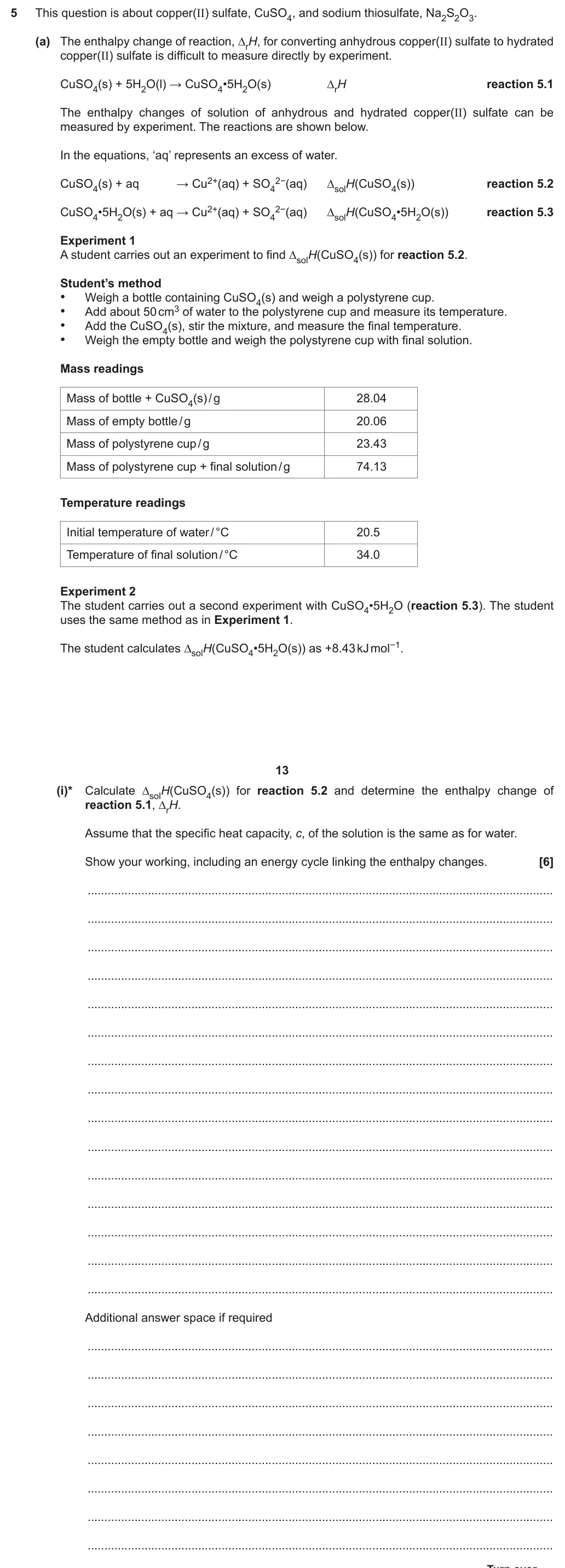
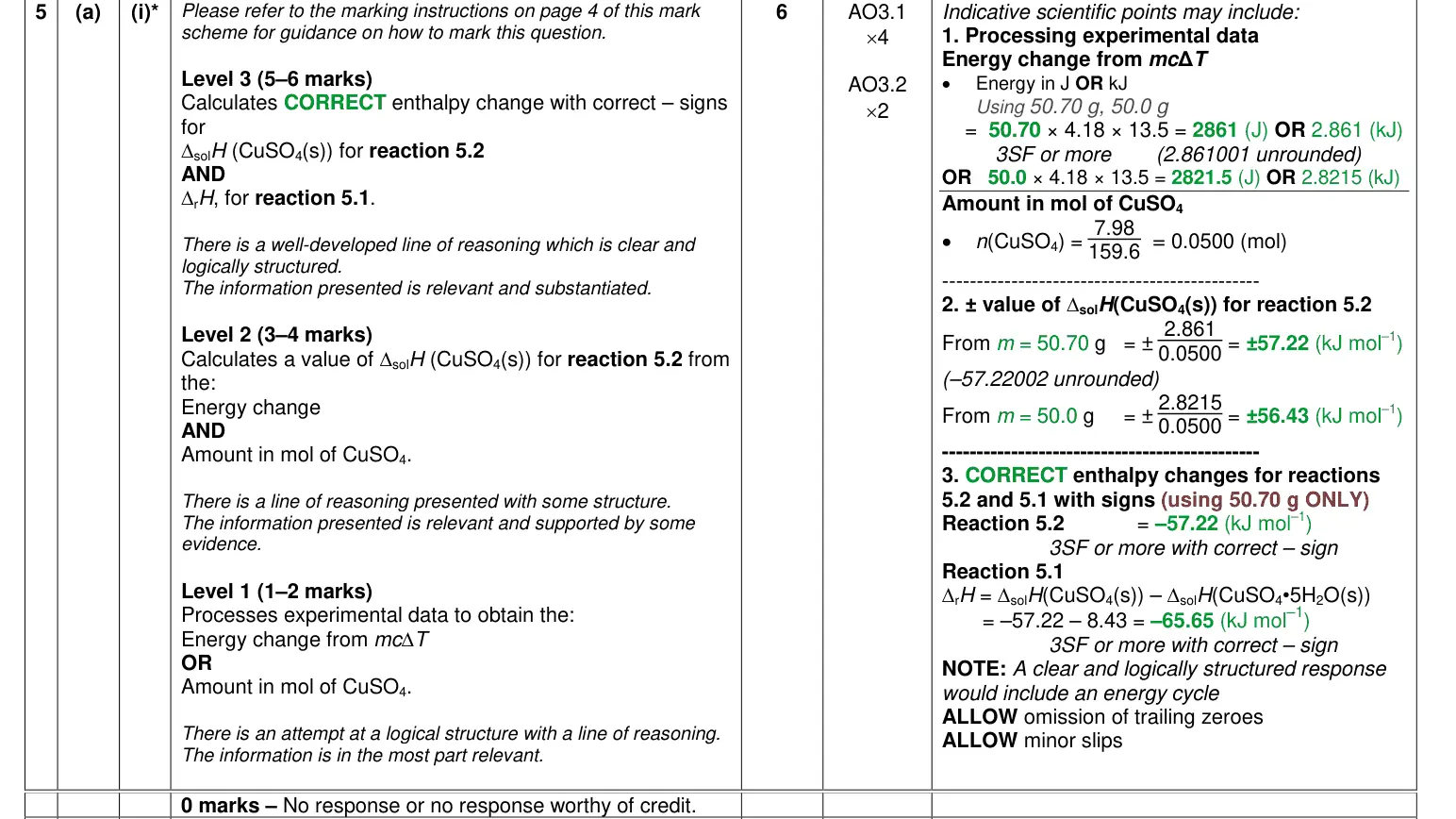
The enthalpy change of Reaction 6.1, ∆H1, shown below, is difficult to measure directly by Calculate ∆H2 for Reaction 6.2 and determine the enthalpy change of Reaction 6.1, ∆H1.
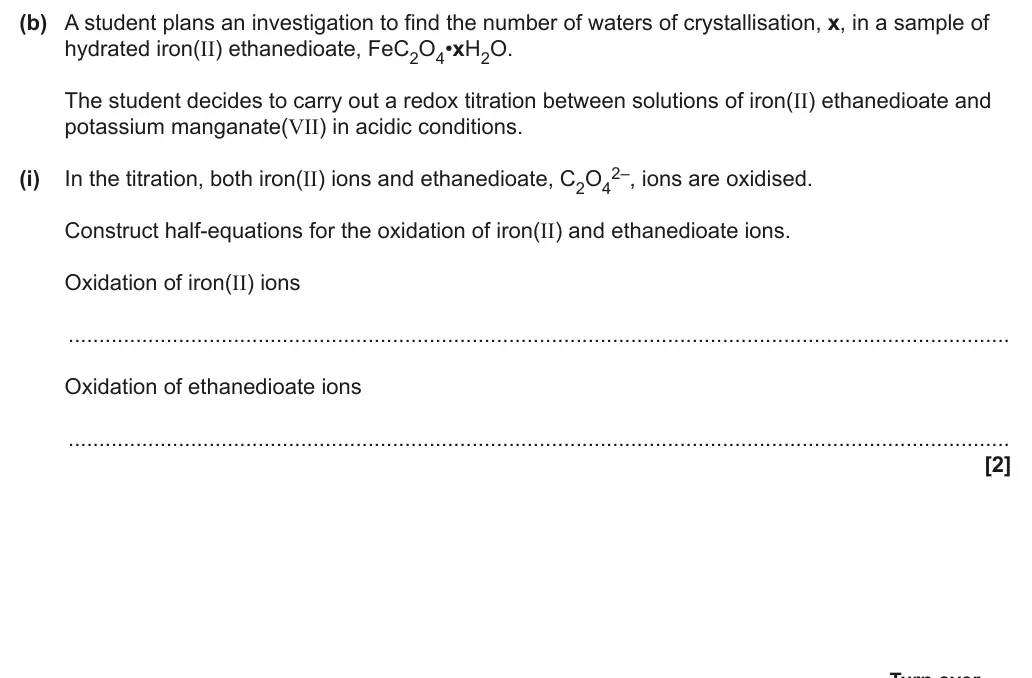
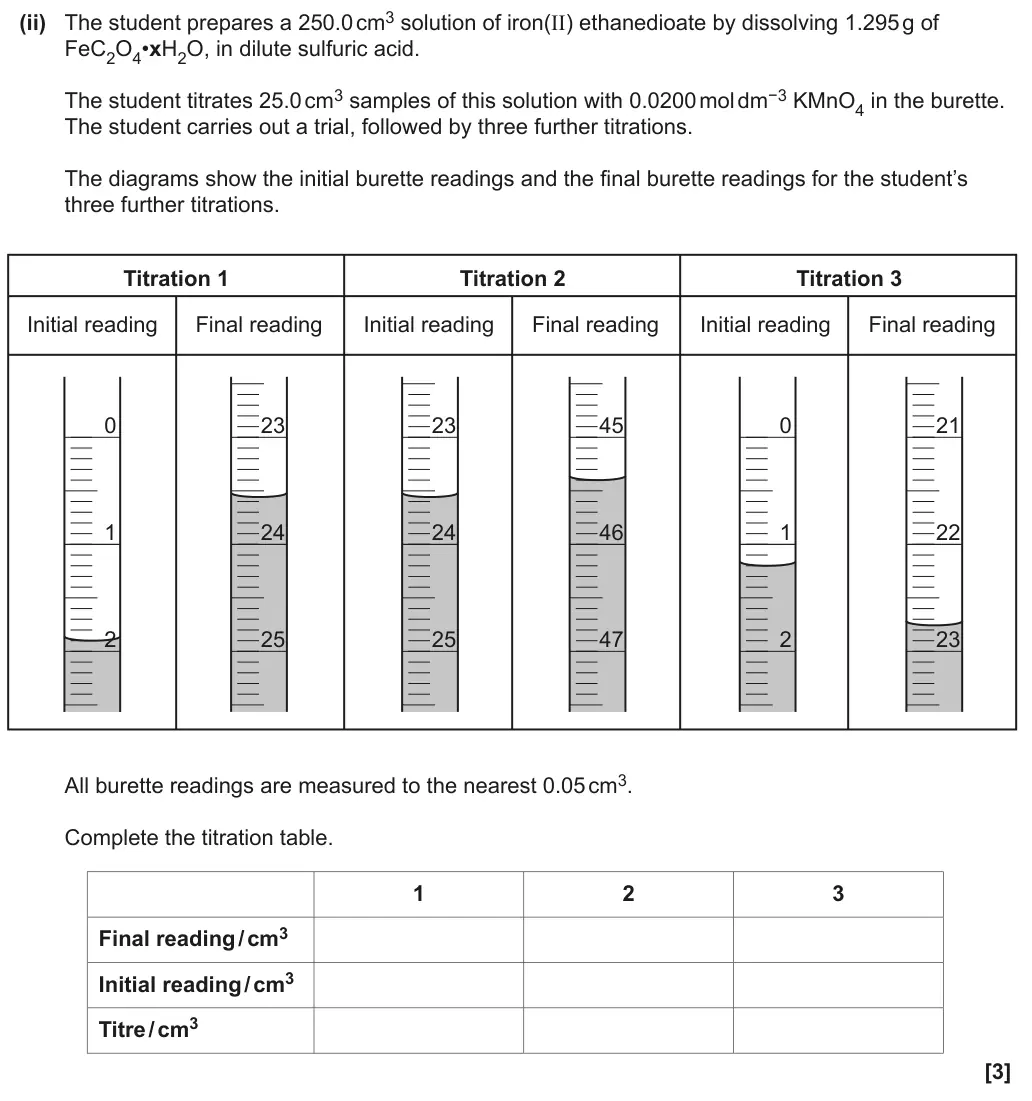
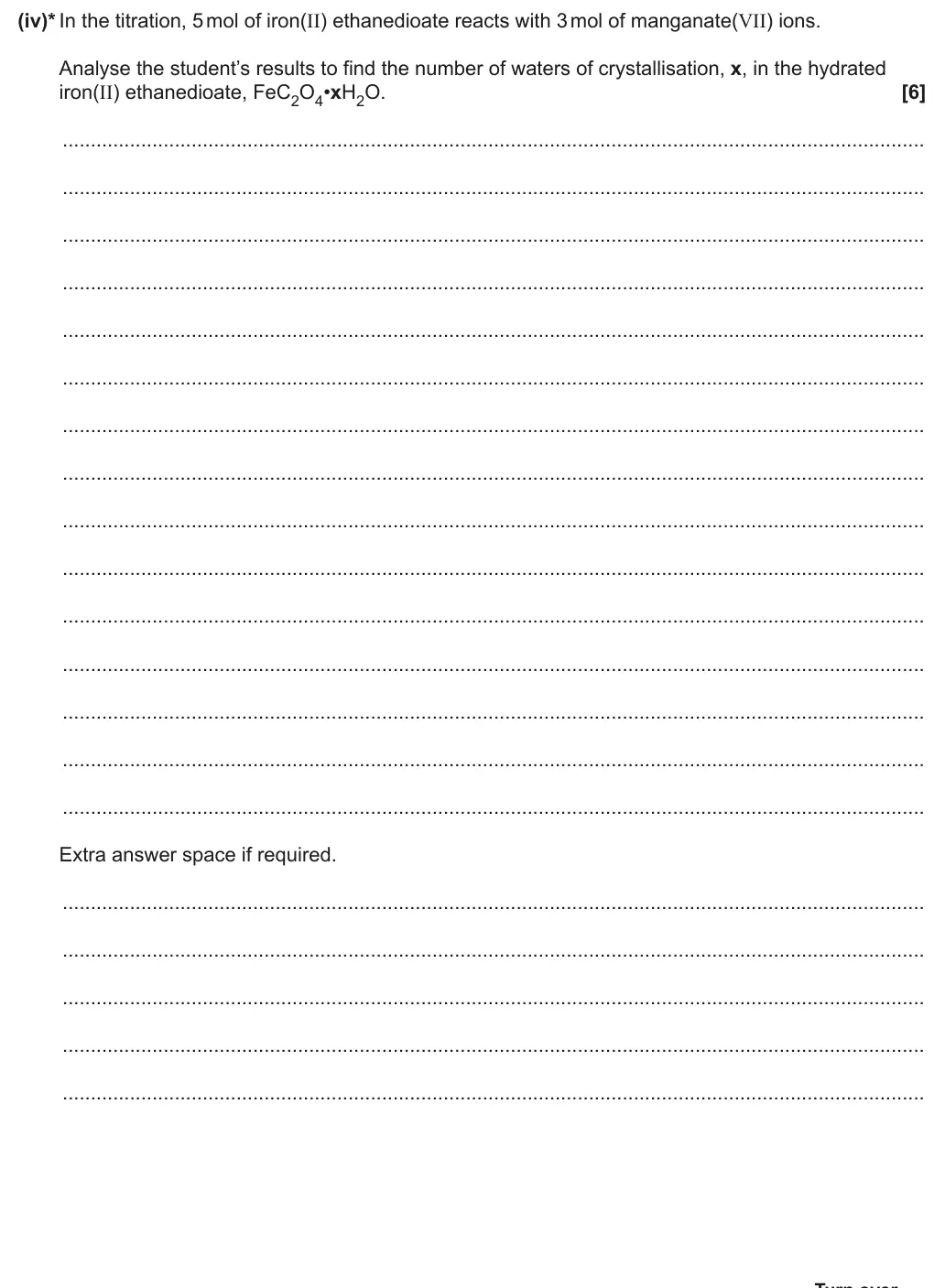
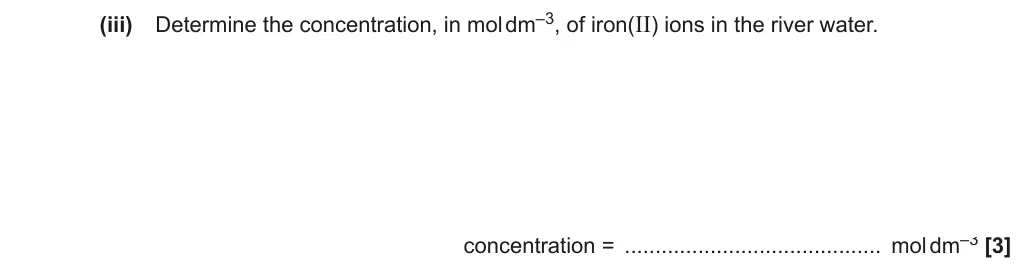
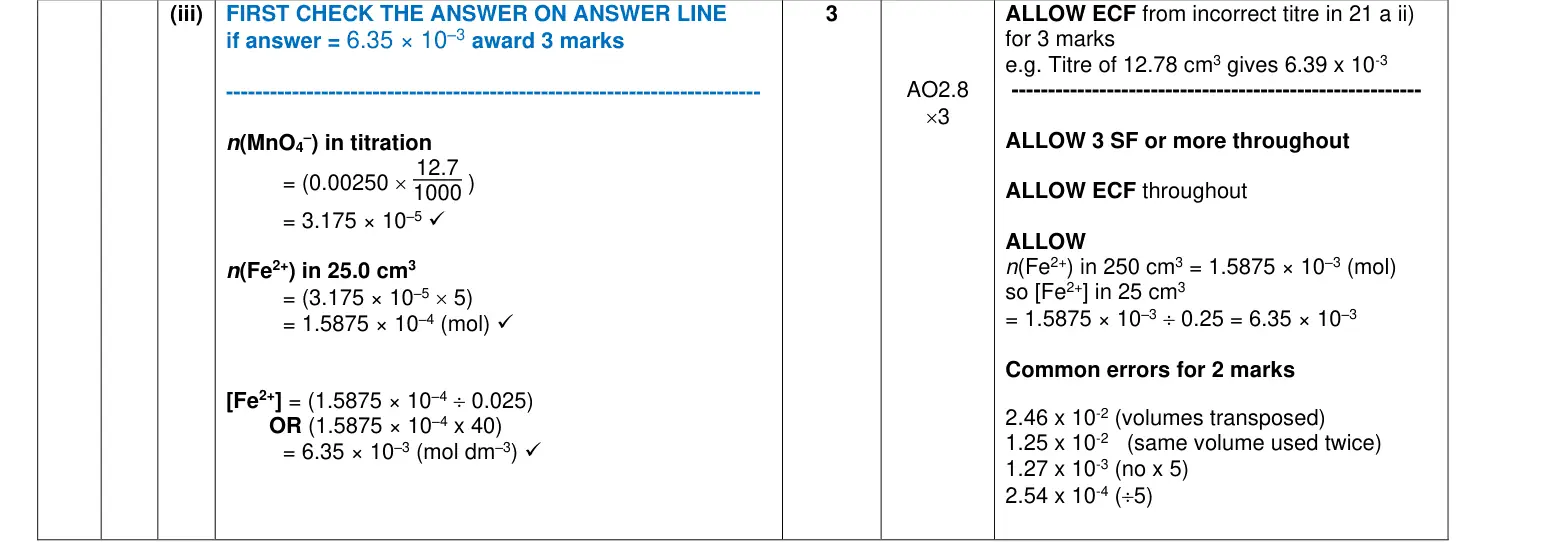
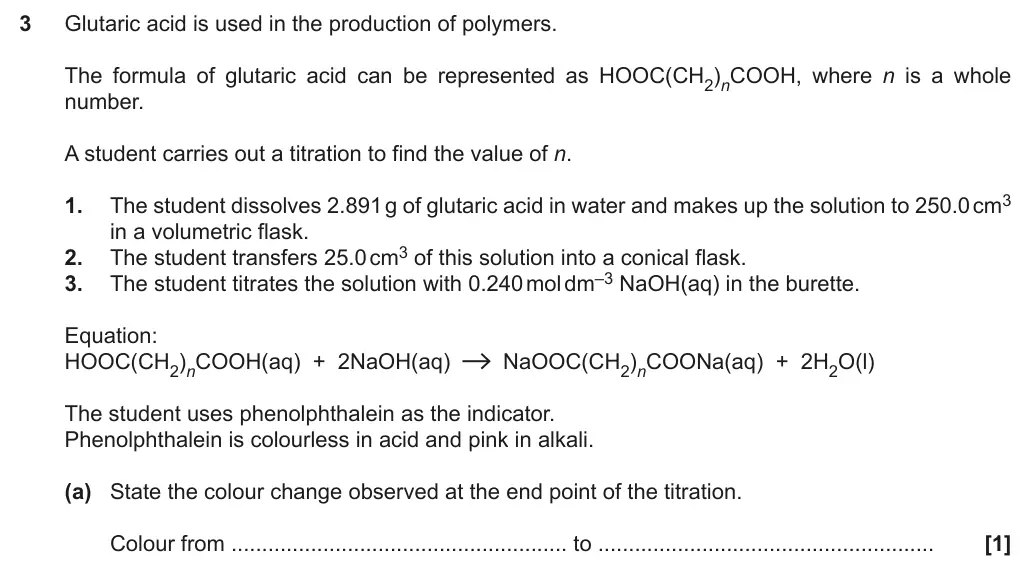
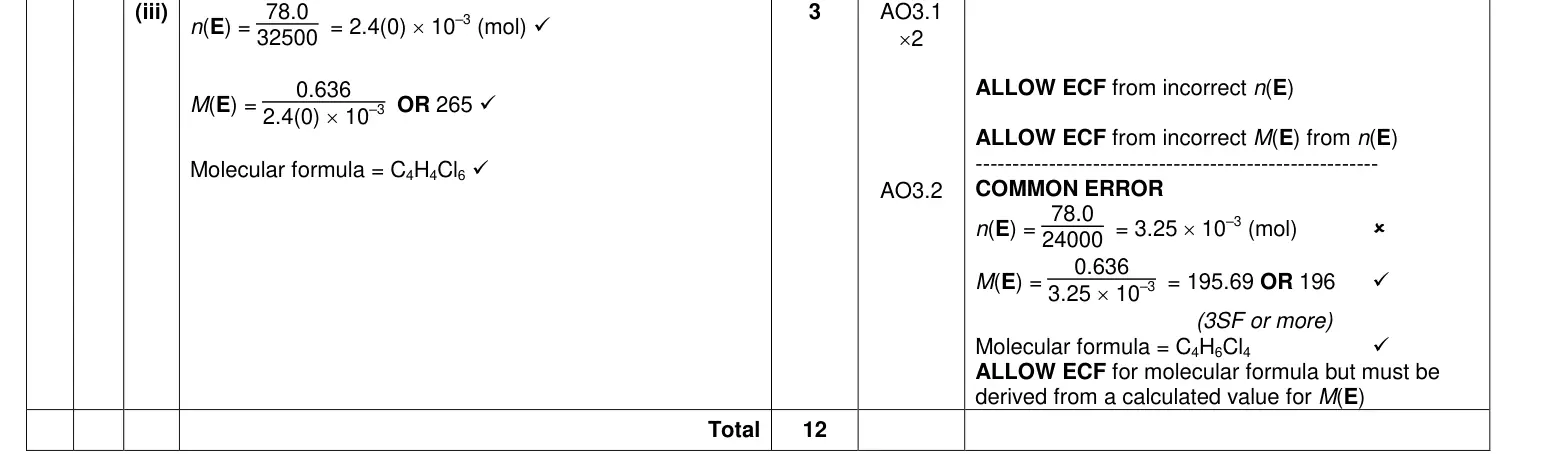
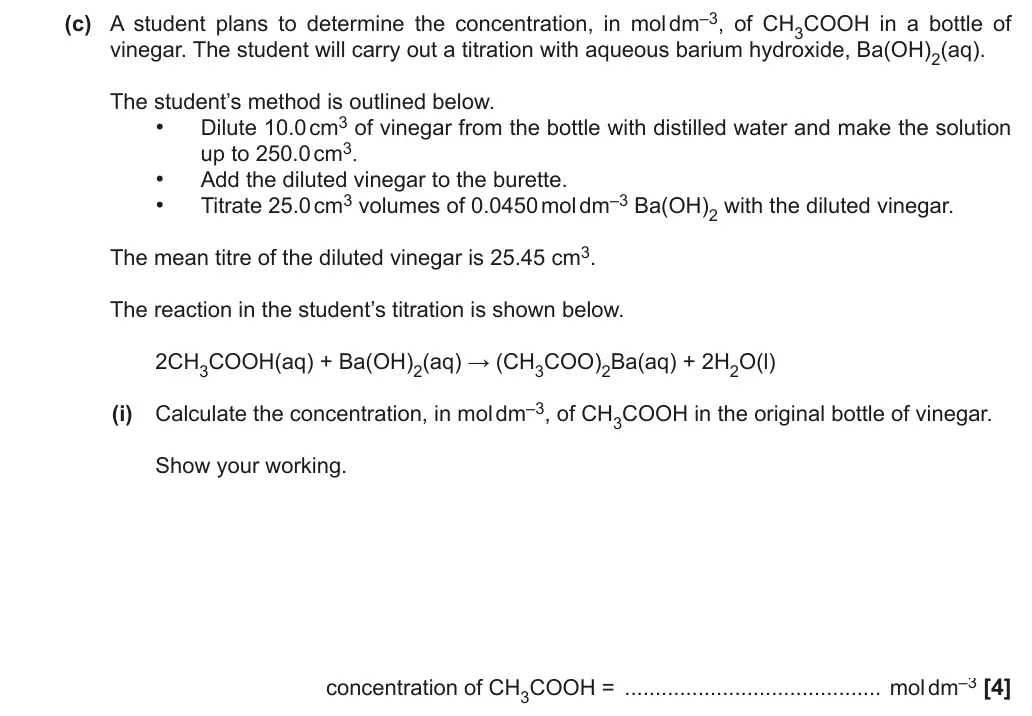
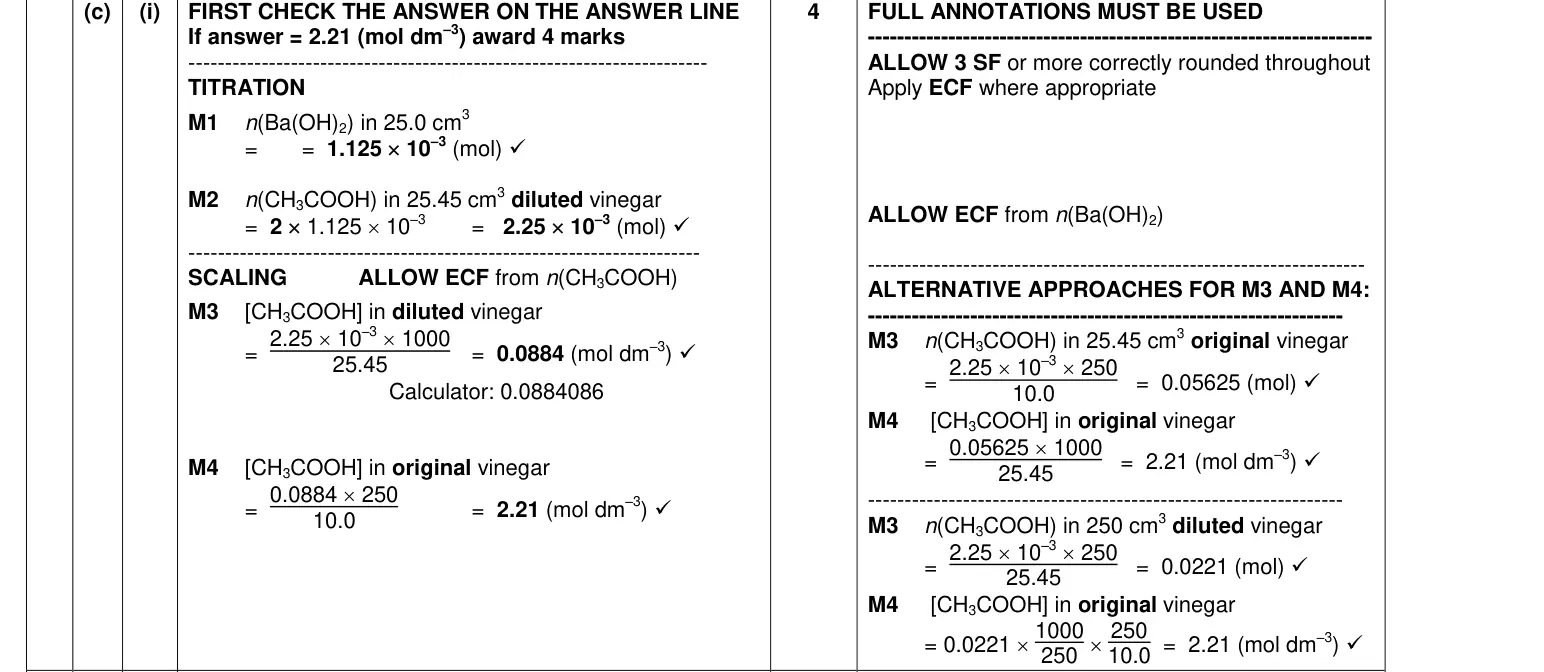
In the titration, 5 mol of iron(II) ethanedioate reacts with 3 mol of manganate(VII) ions. Analyse the student’s results to find the number of waters of crystallisation, x, in the hydrated
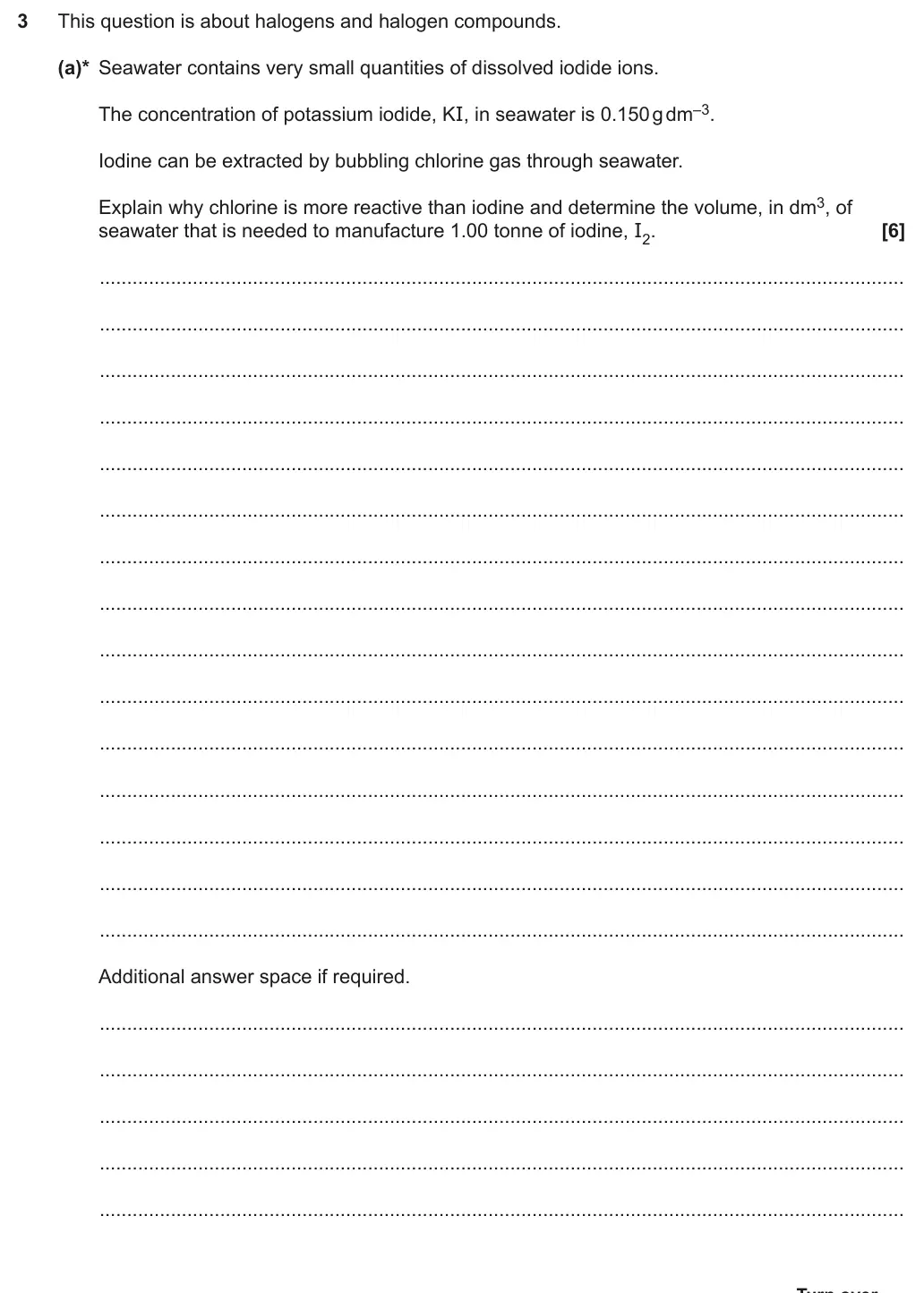
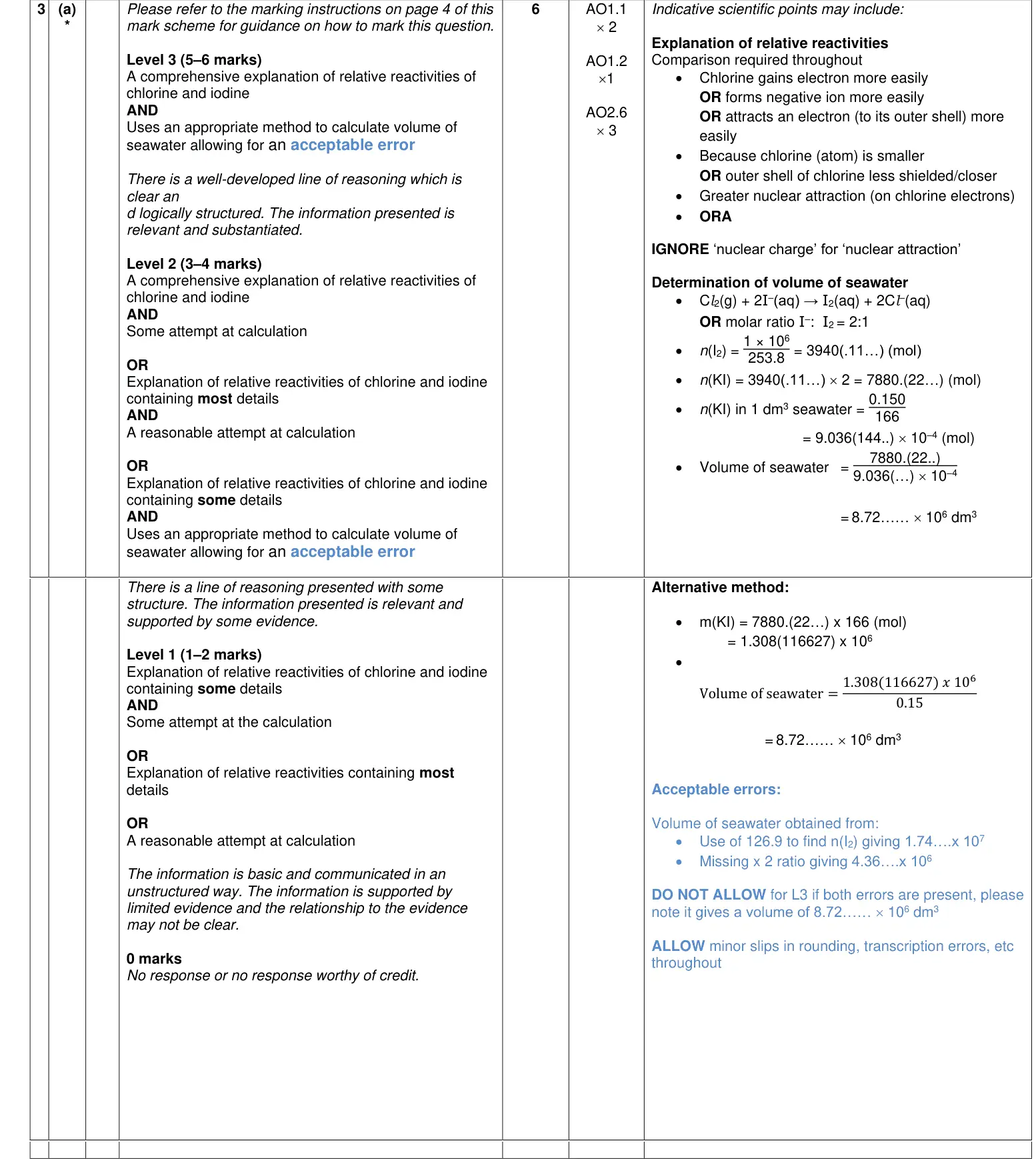
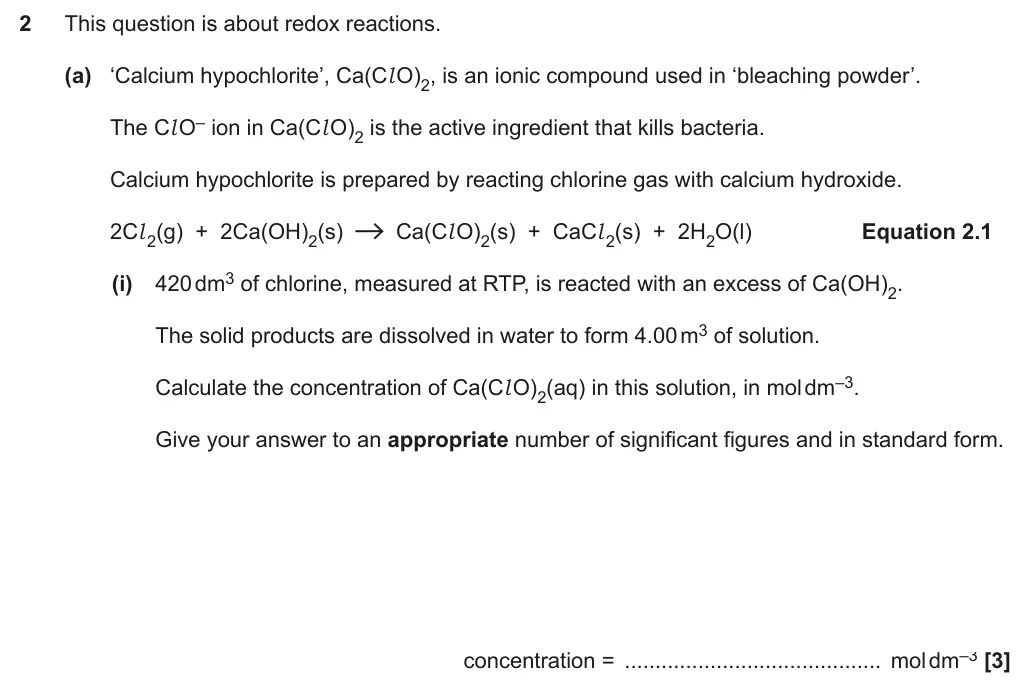
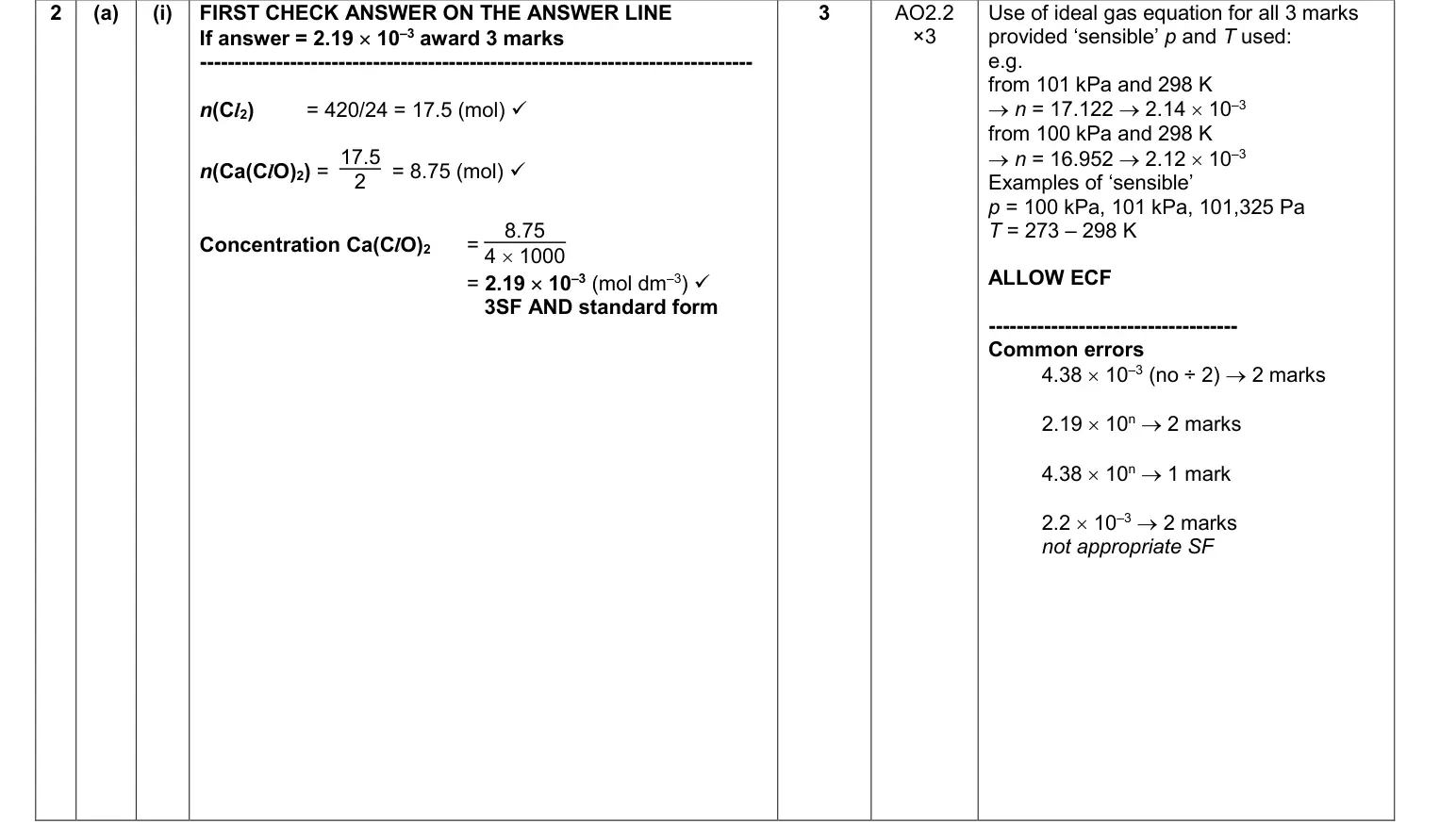
Seawater contains very small quantities of dissolved iodide ions. Explain why chlorine is more reactive than iodine and determine the volume, in dm3, of
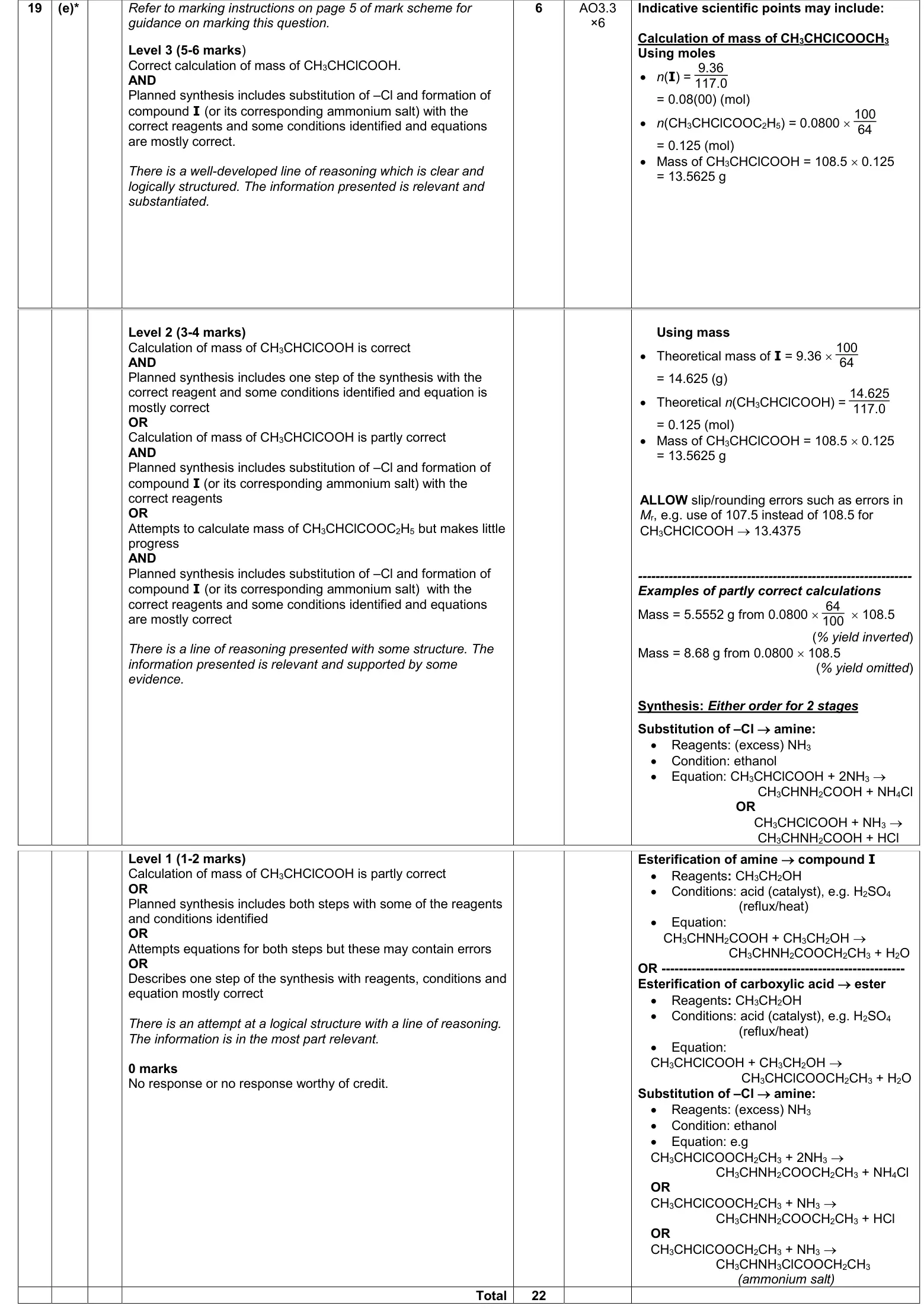
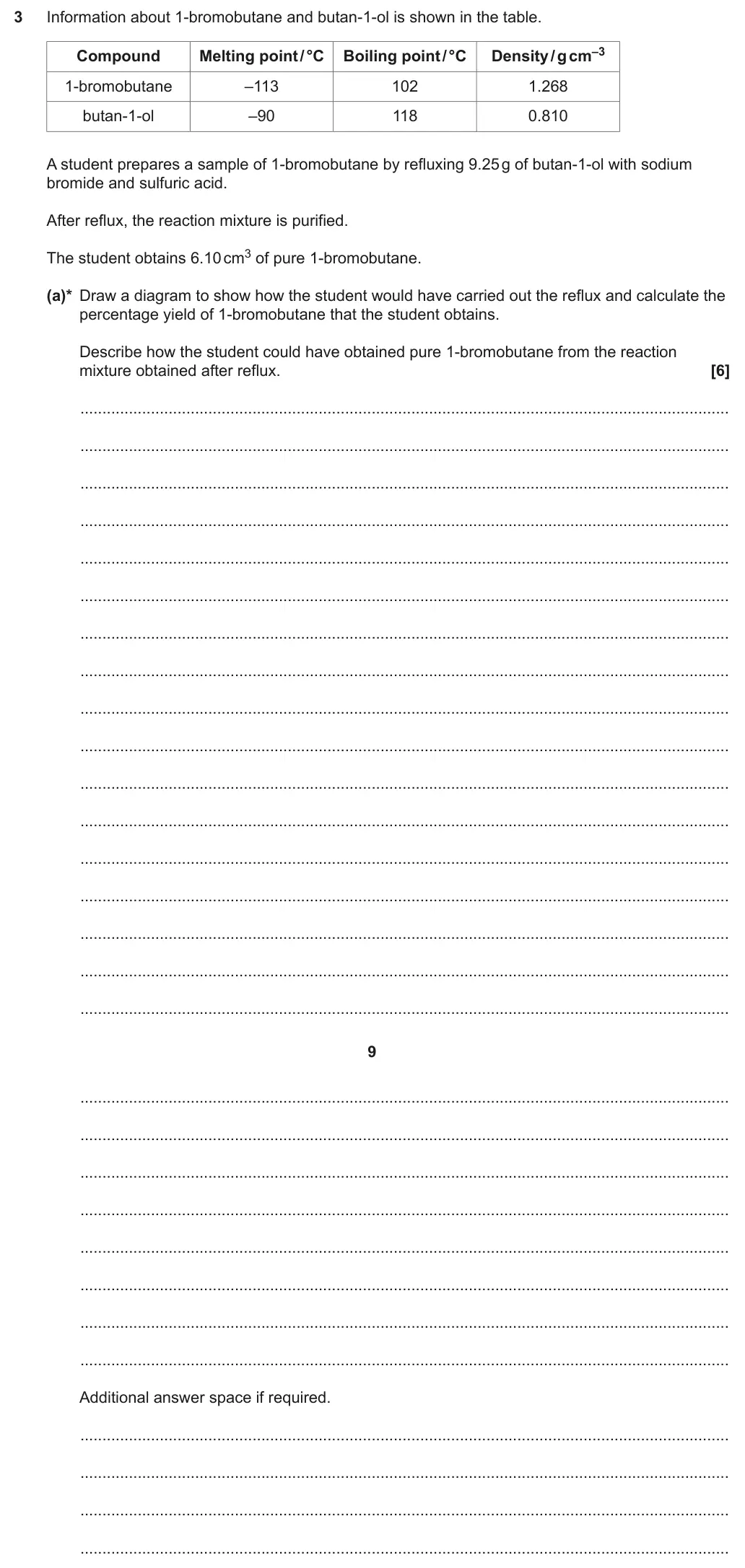
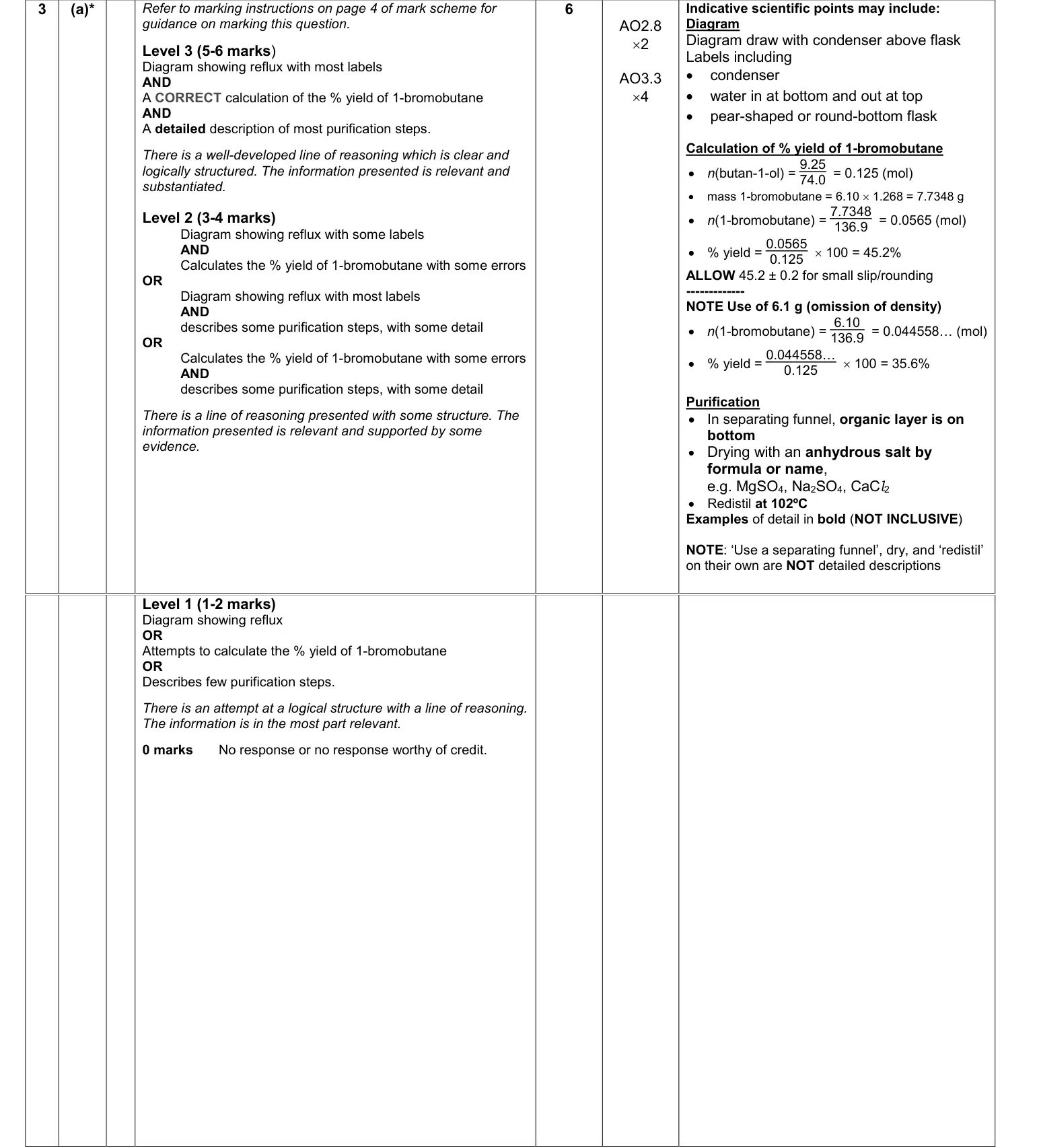
Draw a diagram to show how the student would have carried out the reflux and calculate the Describe how the student could have obtained pure 1-bromobutane from the reaction
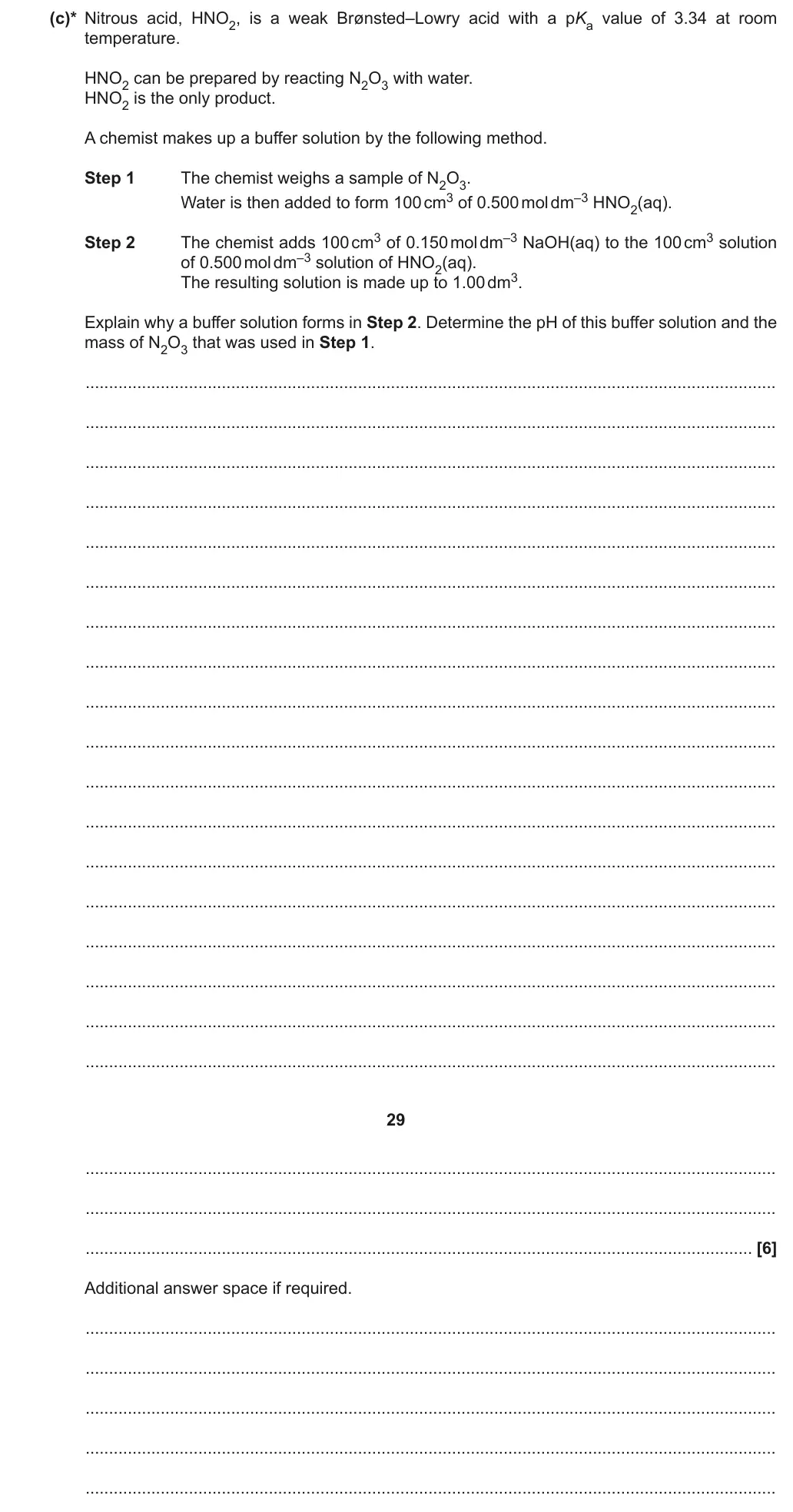
Nitrous acid, HNO2, is a weak Brønsted–Lowry acid with a pKa value of 3.34 at room Explain why a buffer solution forms in Step 2. Determine the pH of this buffer solution and the
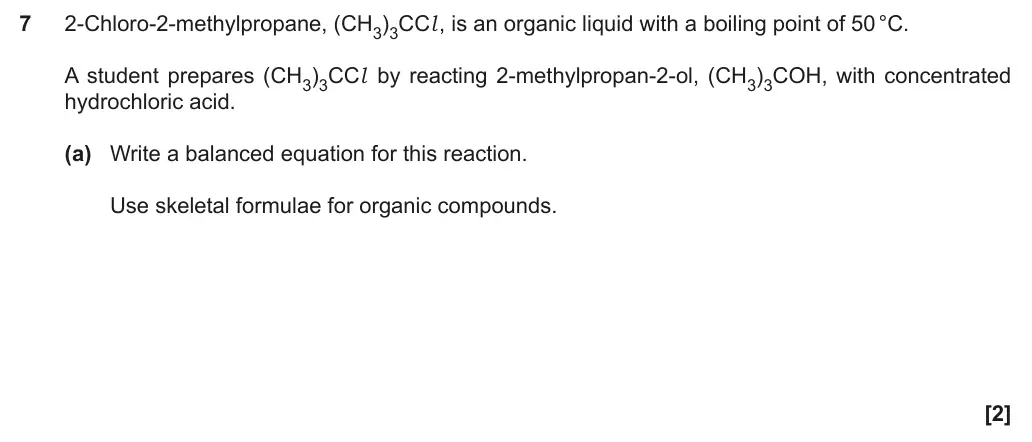
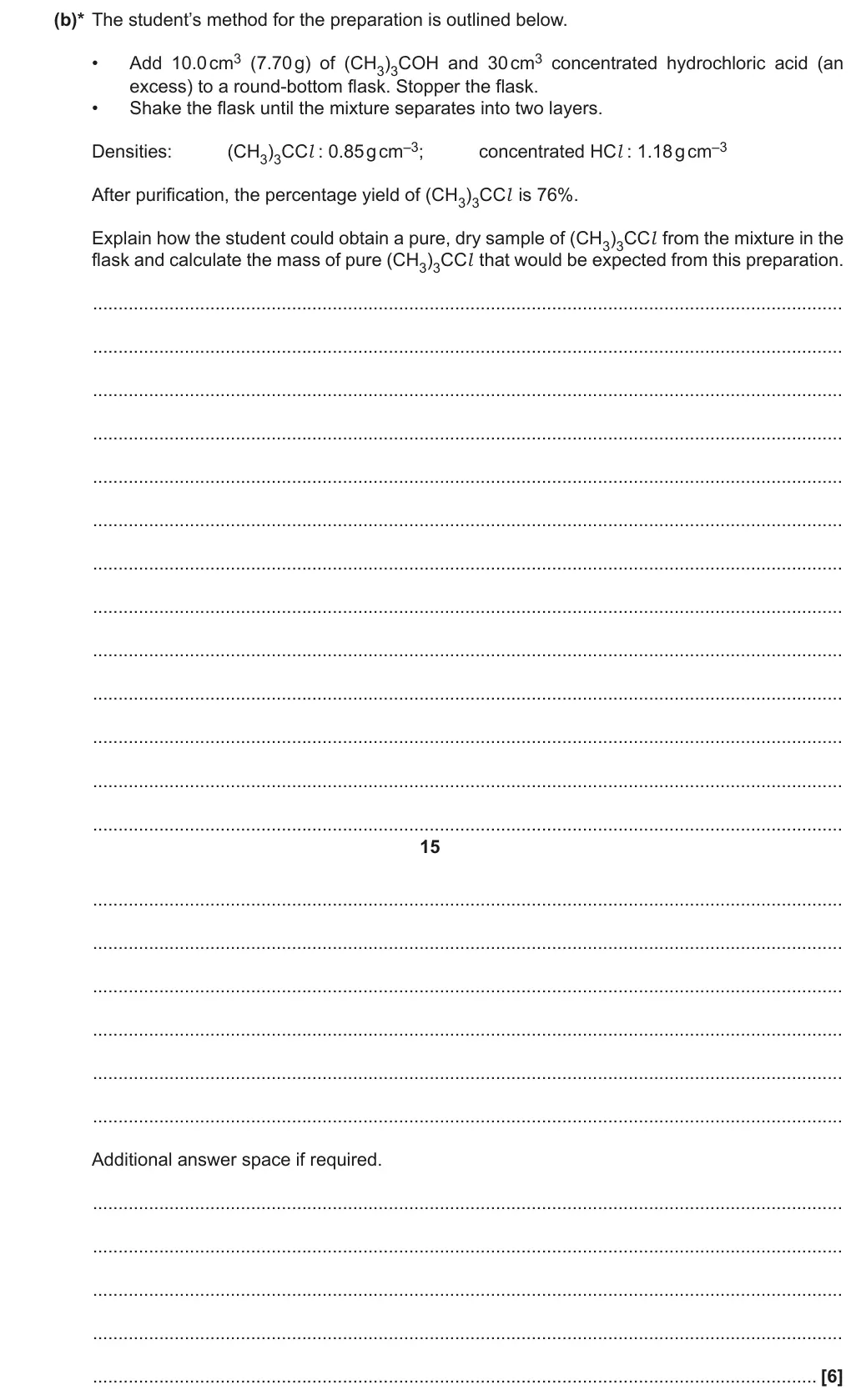
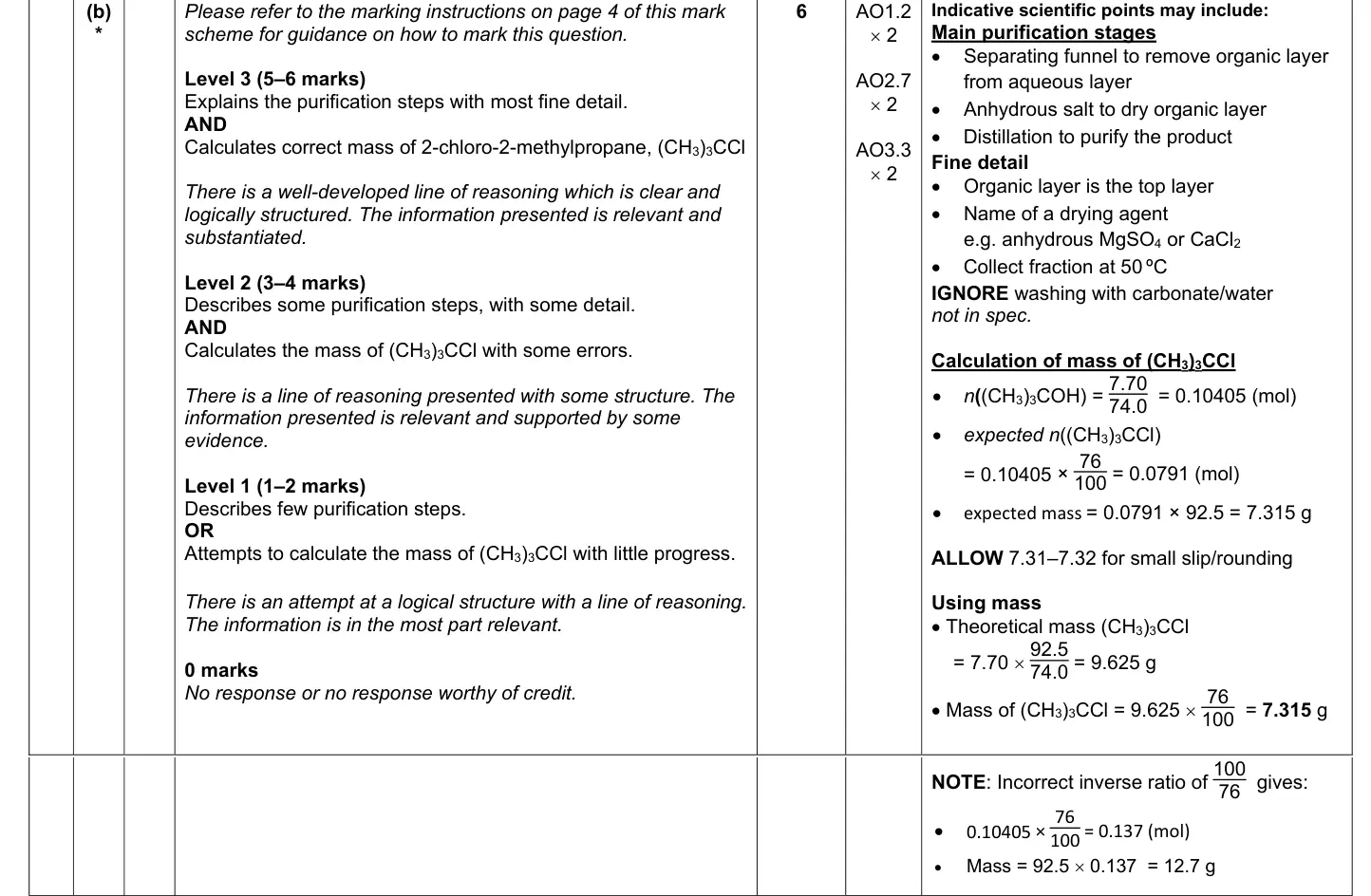
The student’s method for the preparation is outlined below. Explain how the student could obtain a pure, dry sample of (CH3)3CCl from the mixture in the
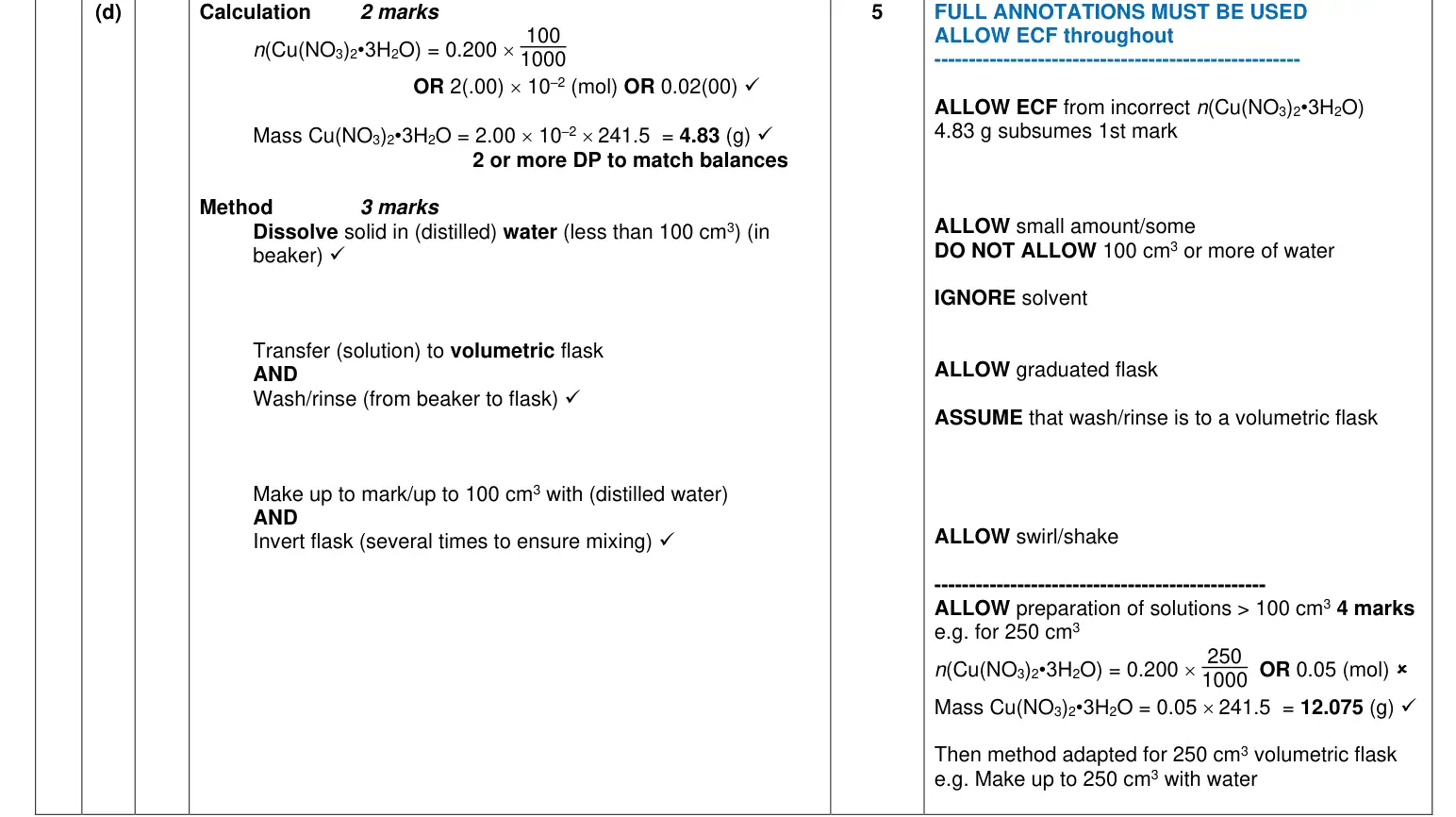
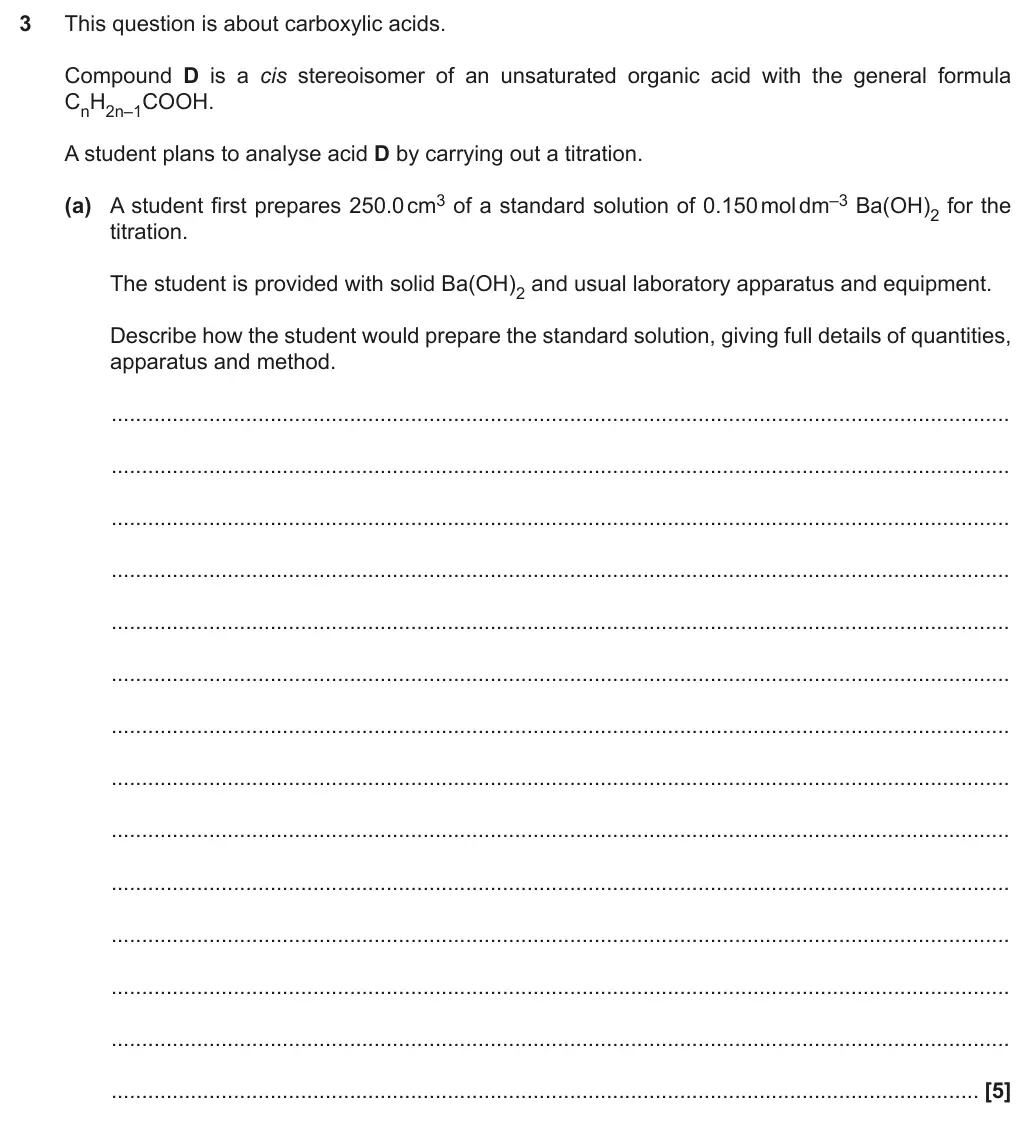
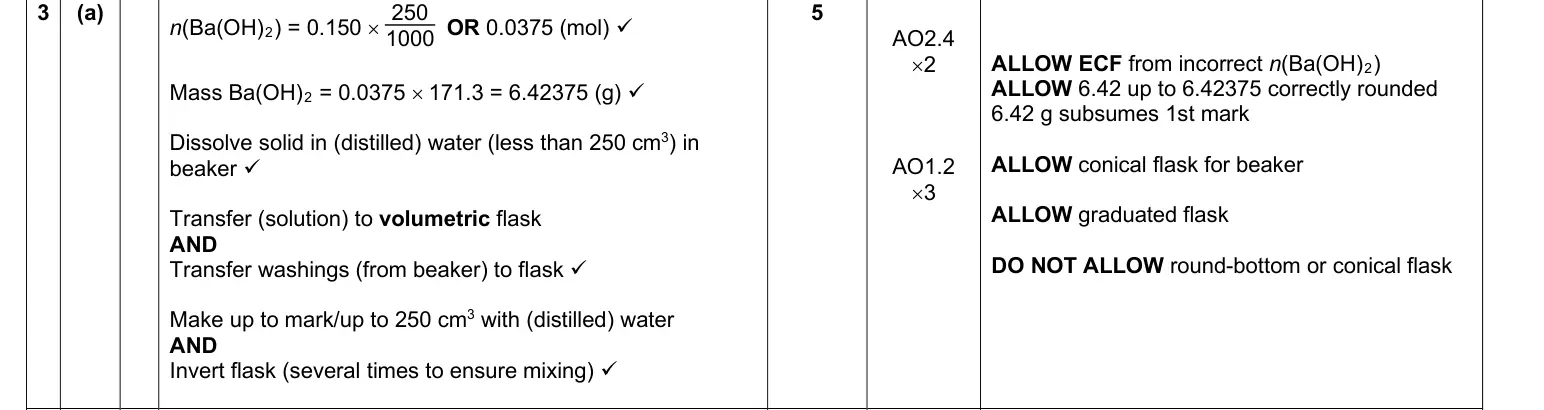
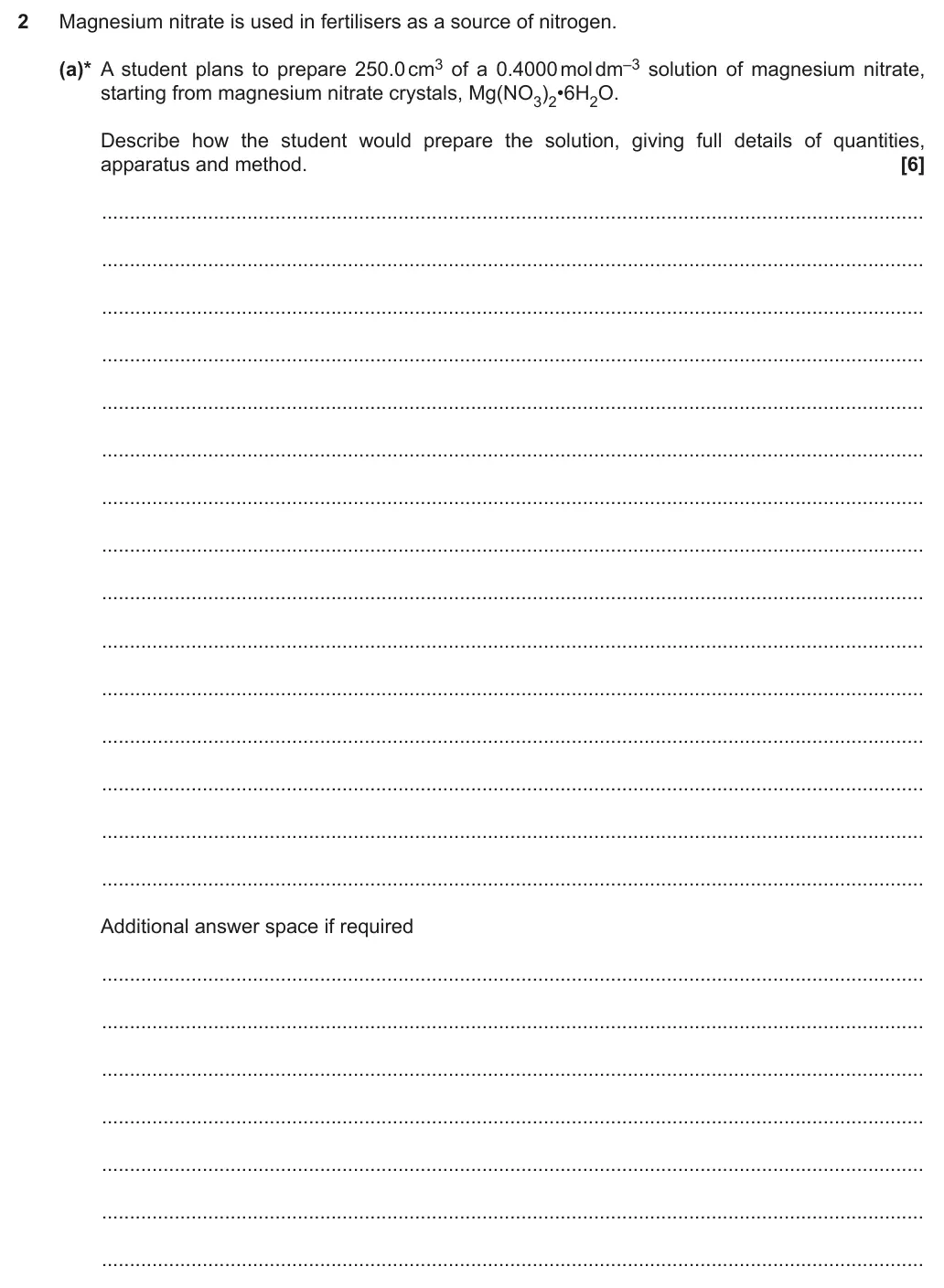
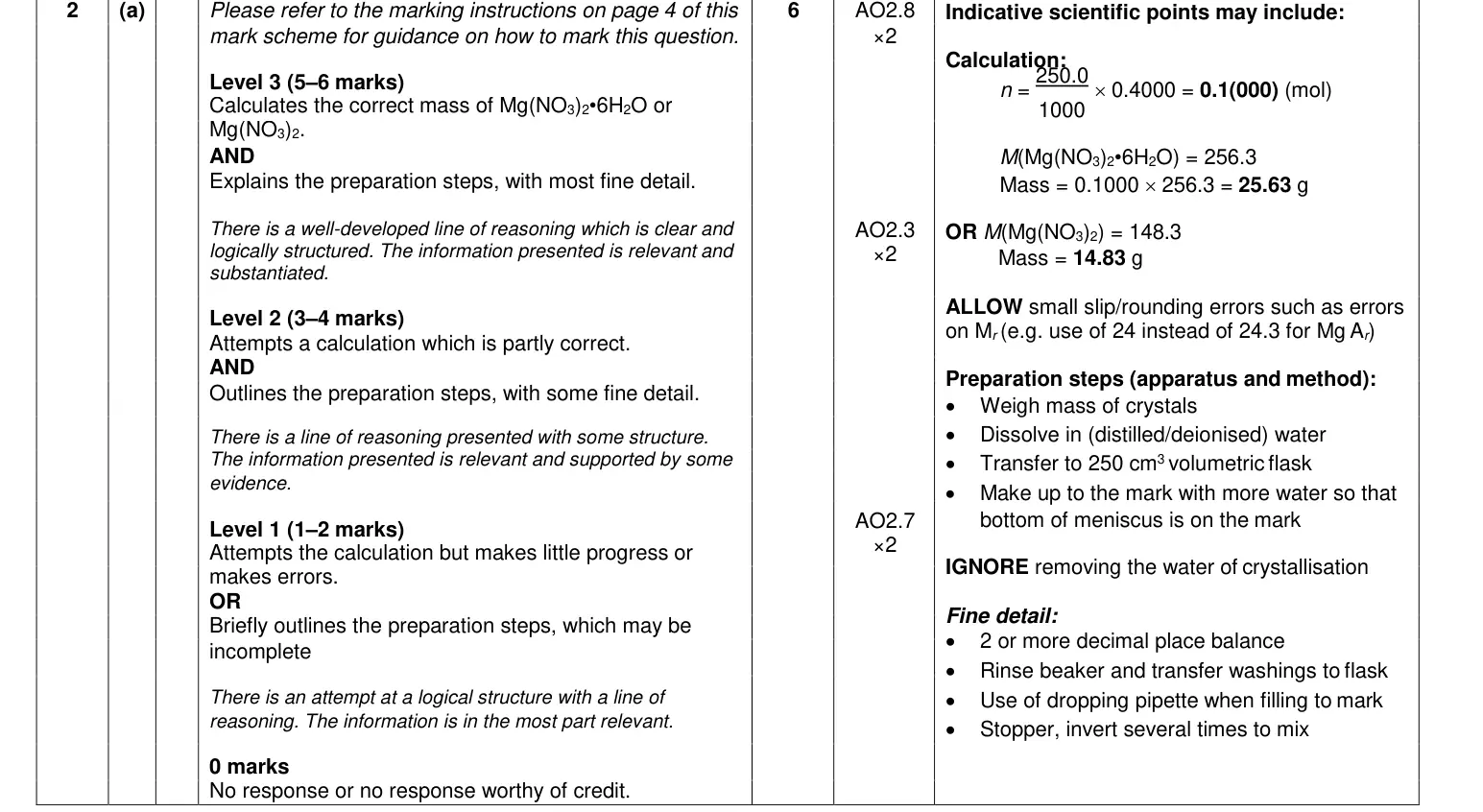
A student plans to prepare 250.0 cm3 of a 0.4000 mol dm–3 solution of magnesium nitrate, Describe how the student would prepare the solution, giving full details of quantities,
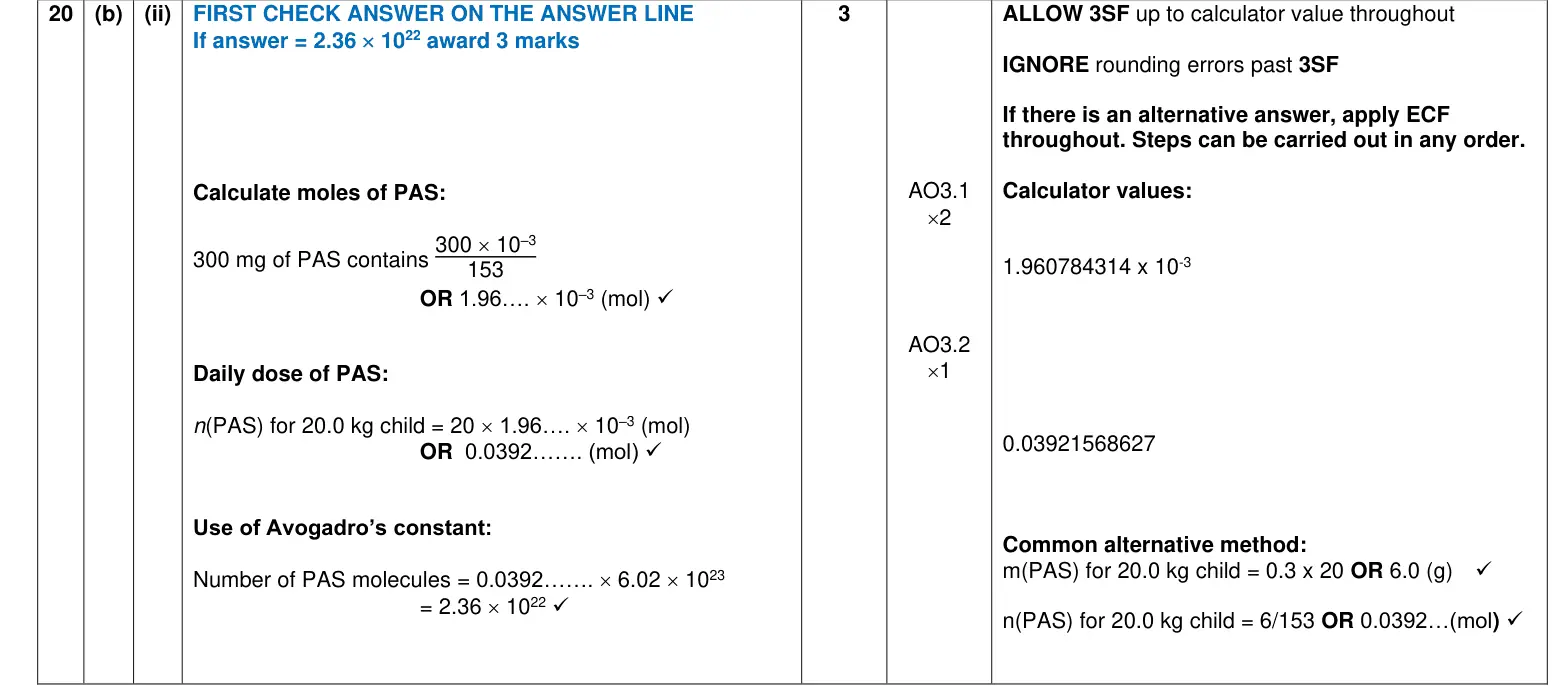
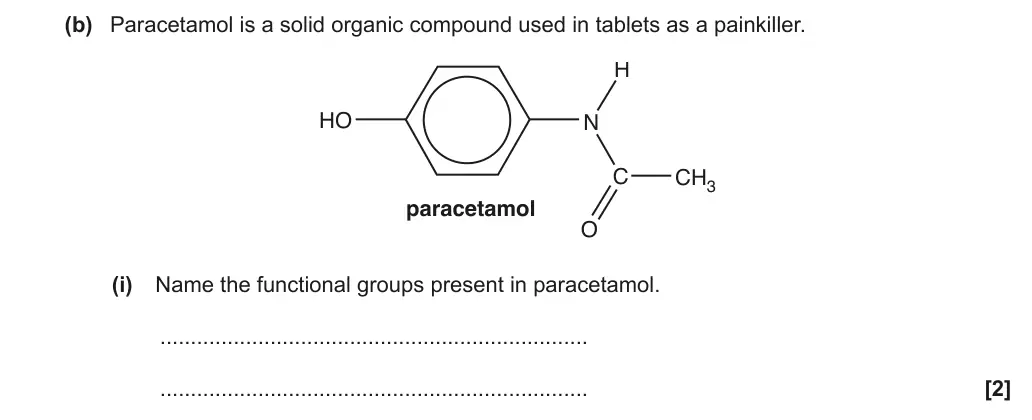
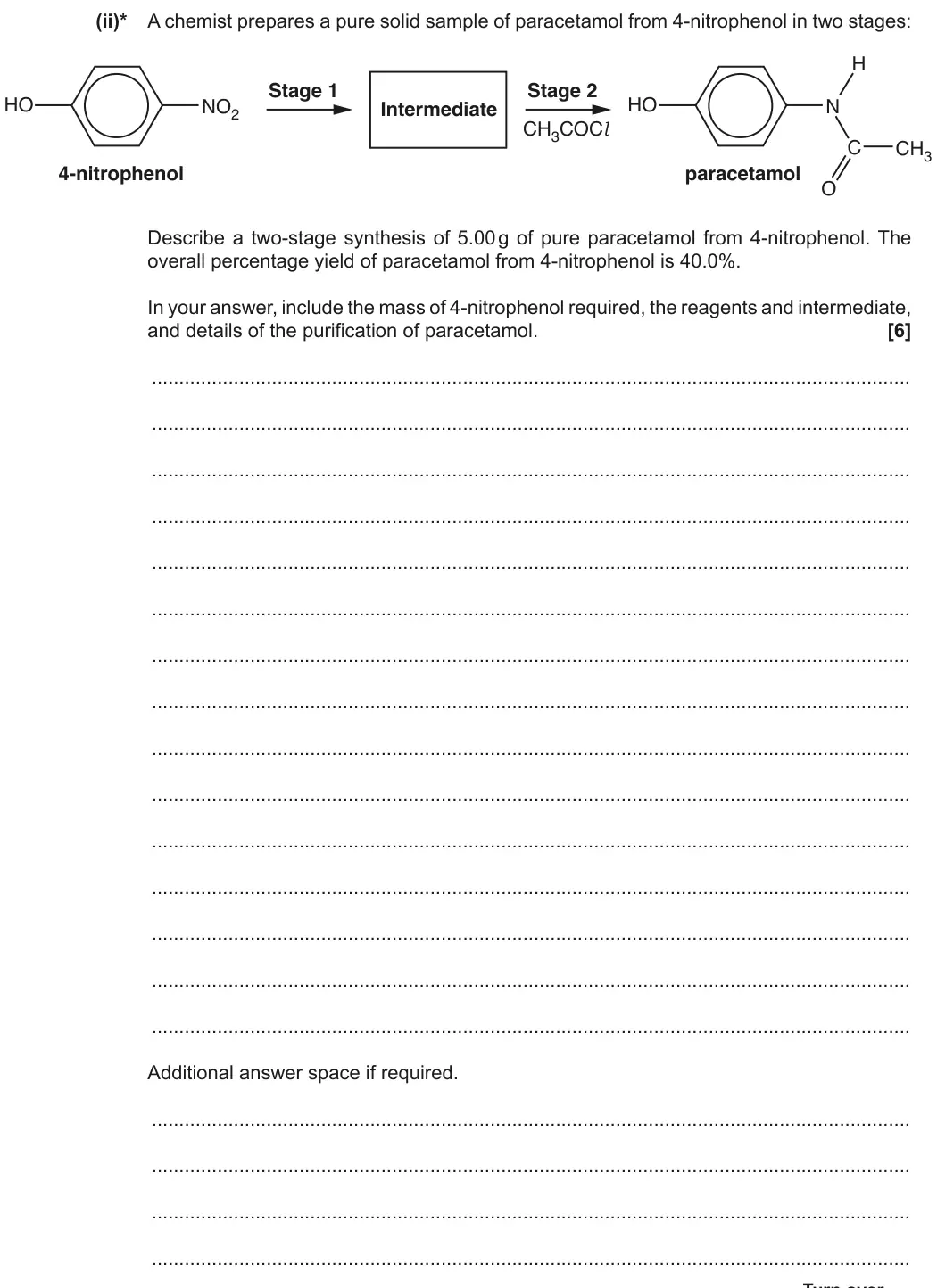
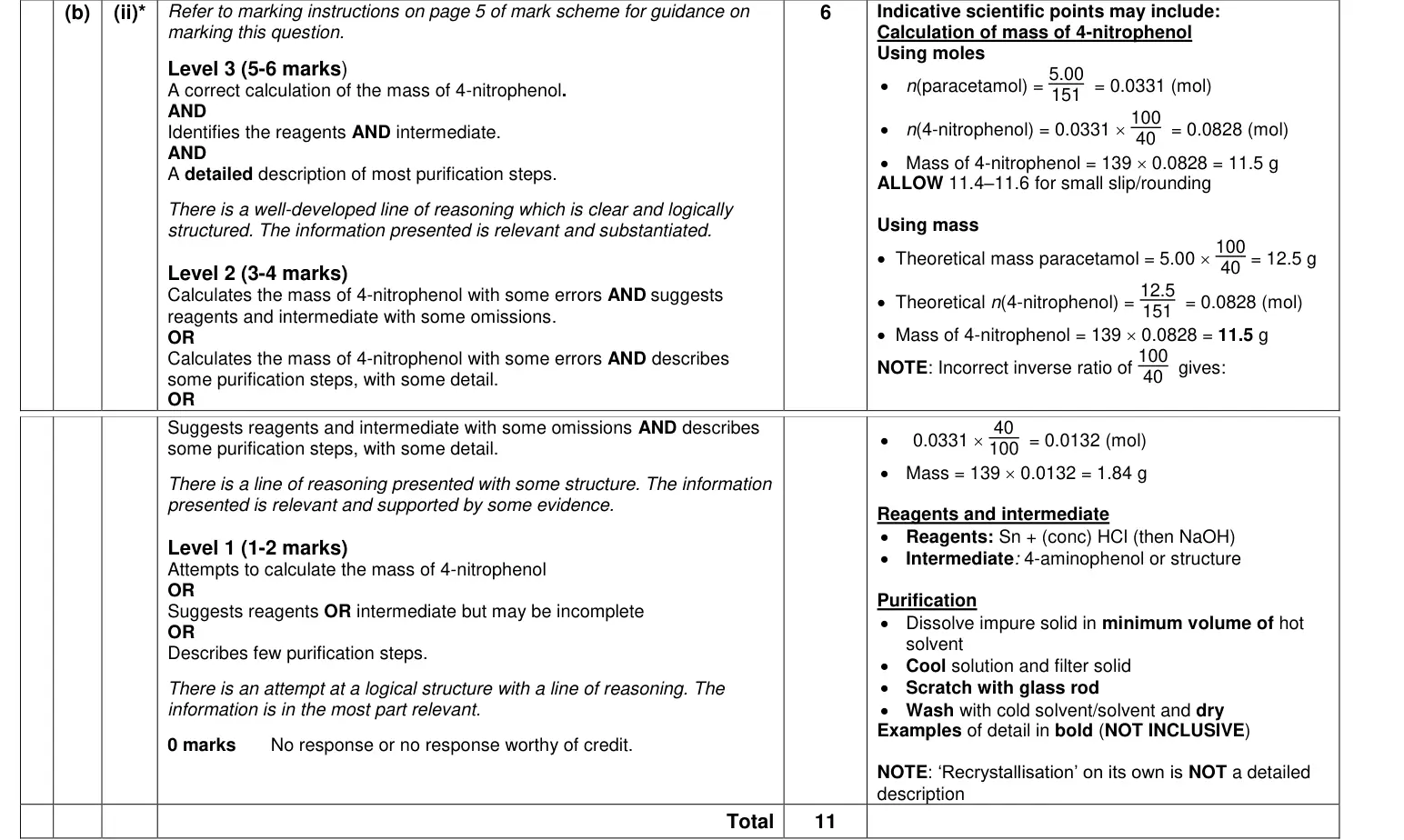
A chemist prepares a pure solid sample of paracetamol from 4-nitrophenol in two stages: Describe a two-stage synthesis of 5.00 g of pure paracetamol from 4-nitrophenol. The
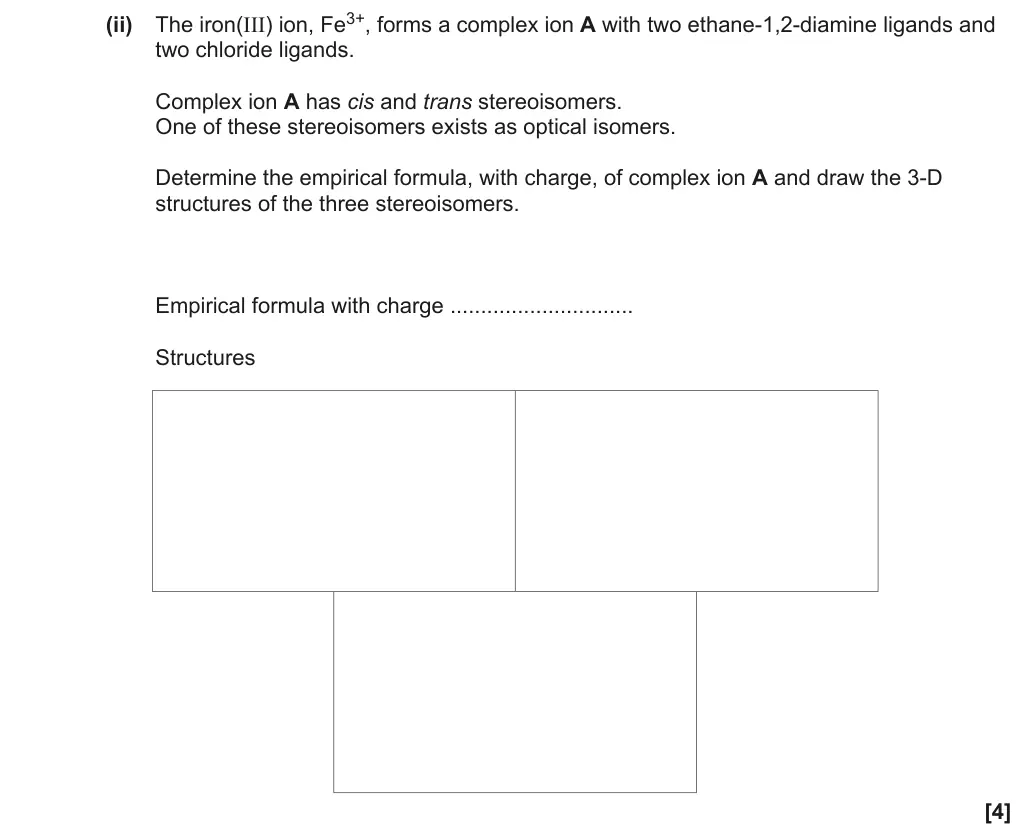
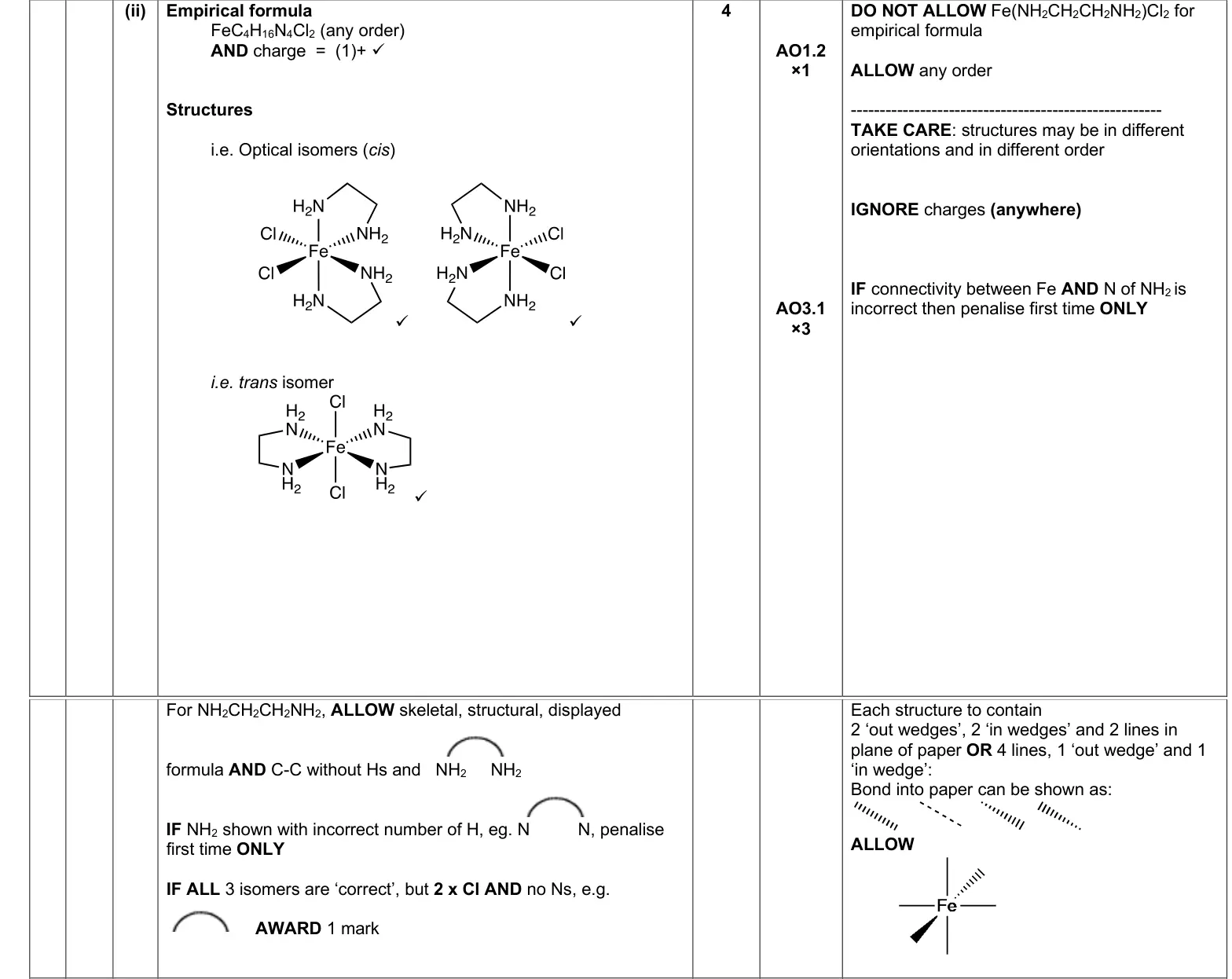
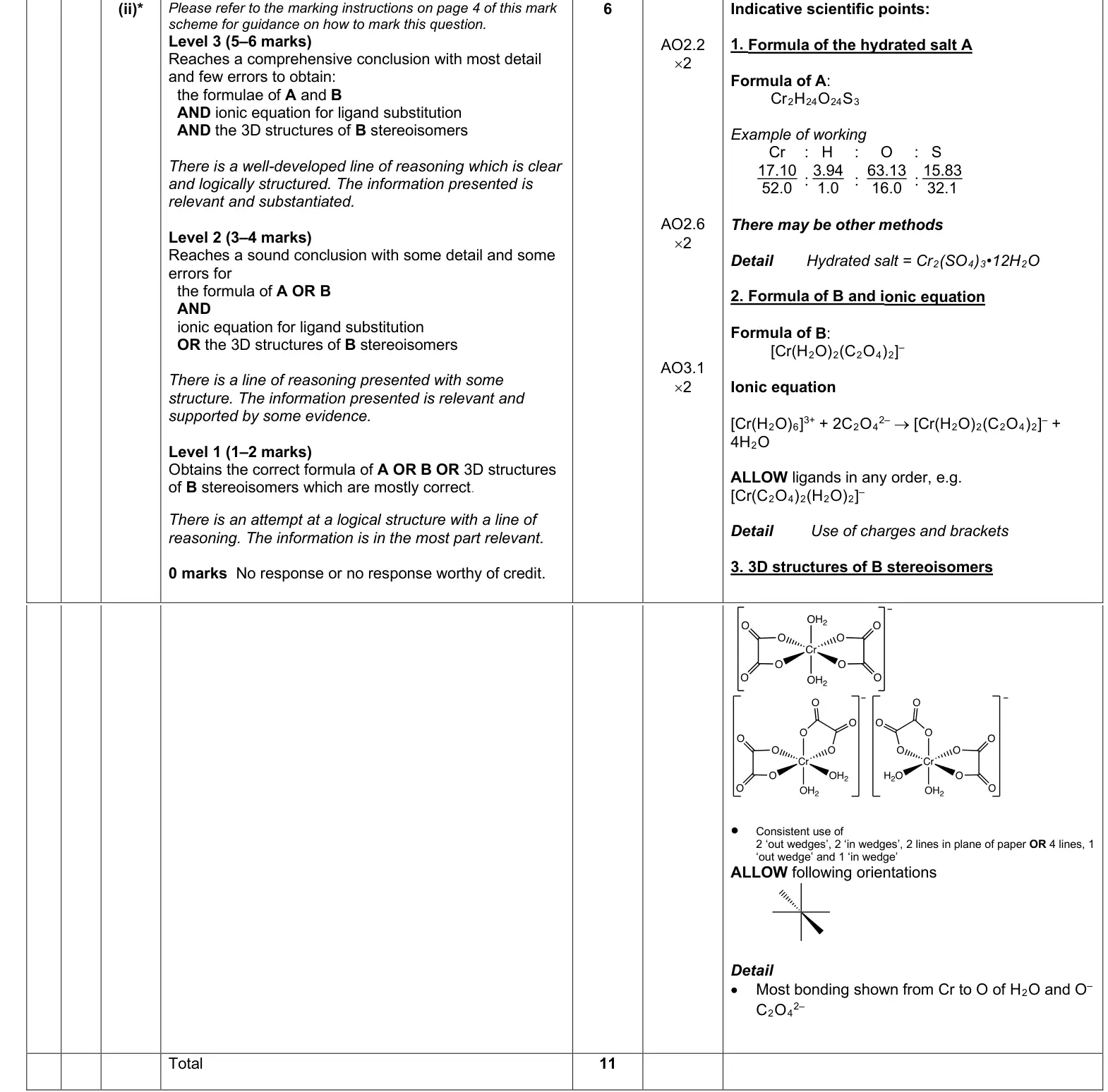
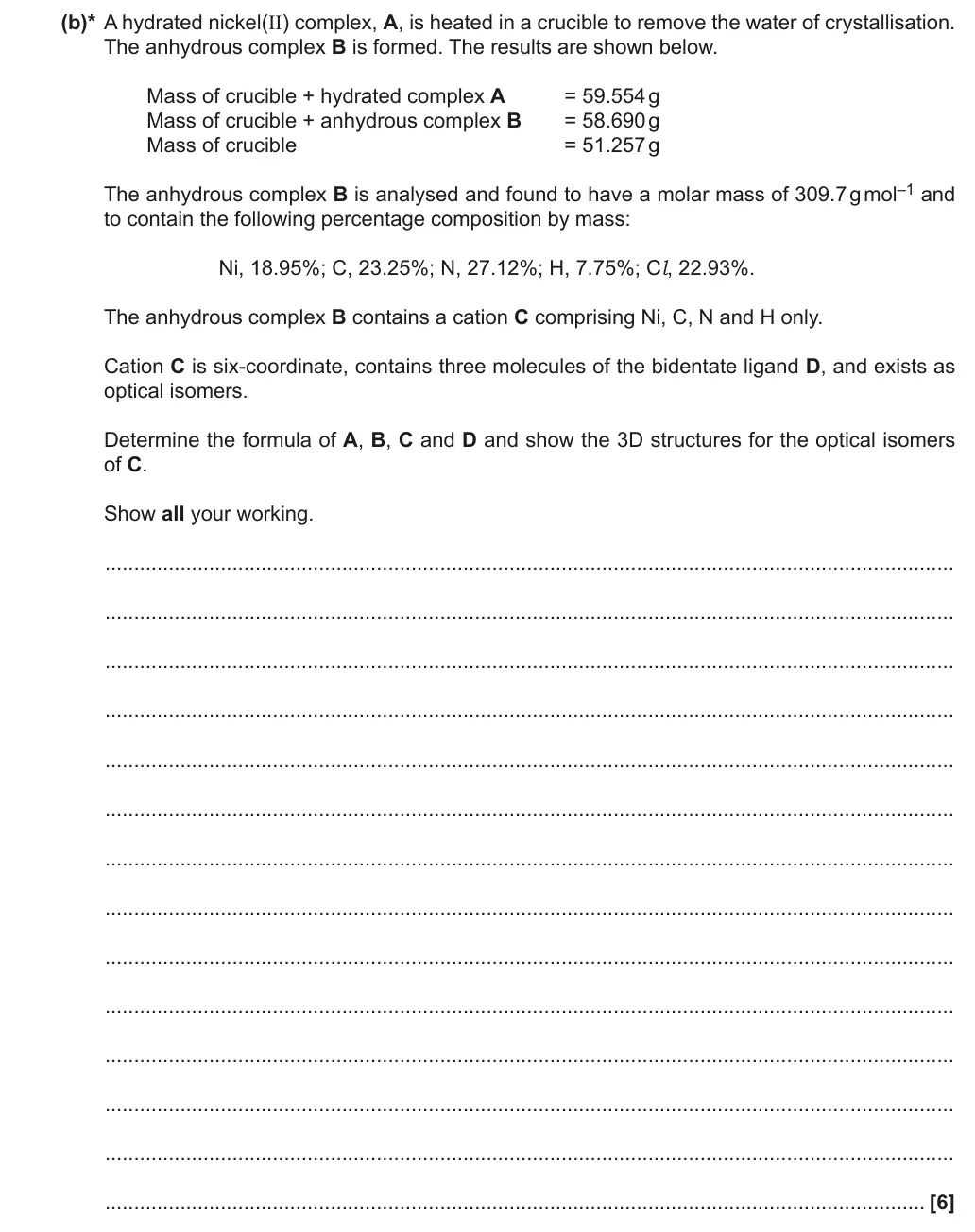
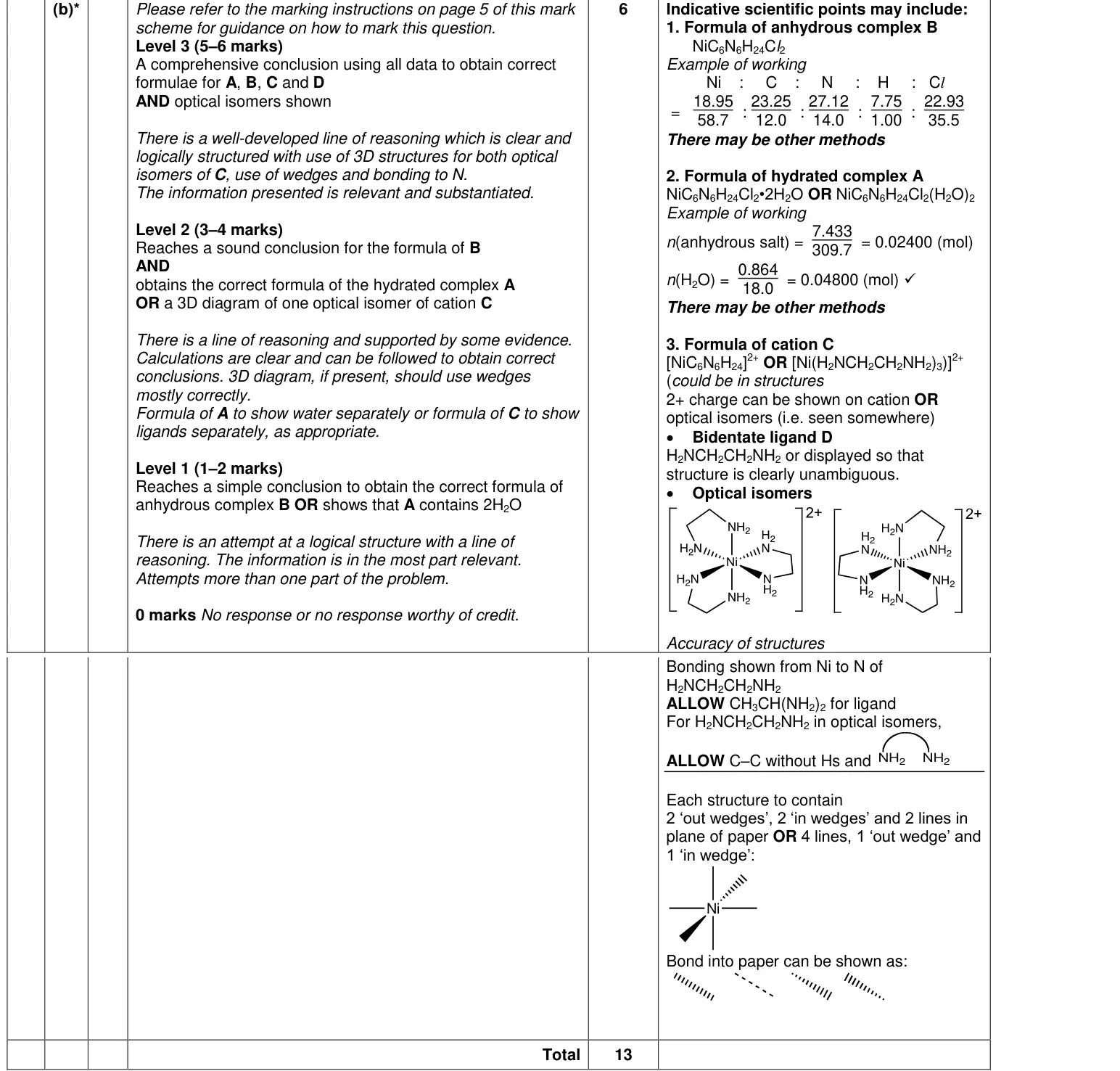
A hydrated nickel(II) complex, A, is heated in a crucible to remove the water of crystallisation. Determine the formula of A, B, C and D and show the 3D structures for the optical isomers
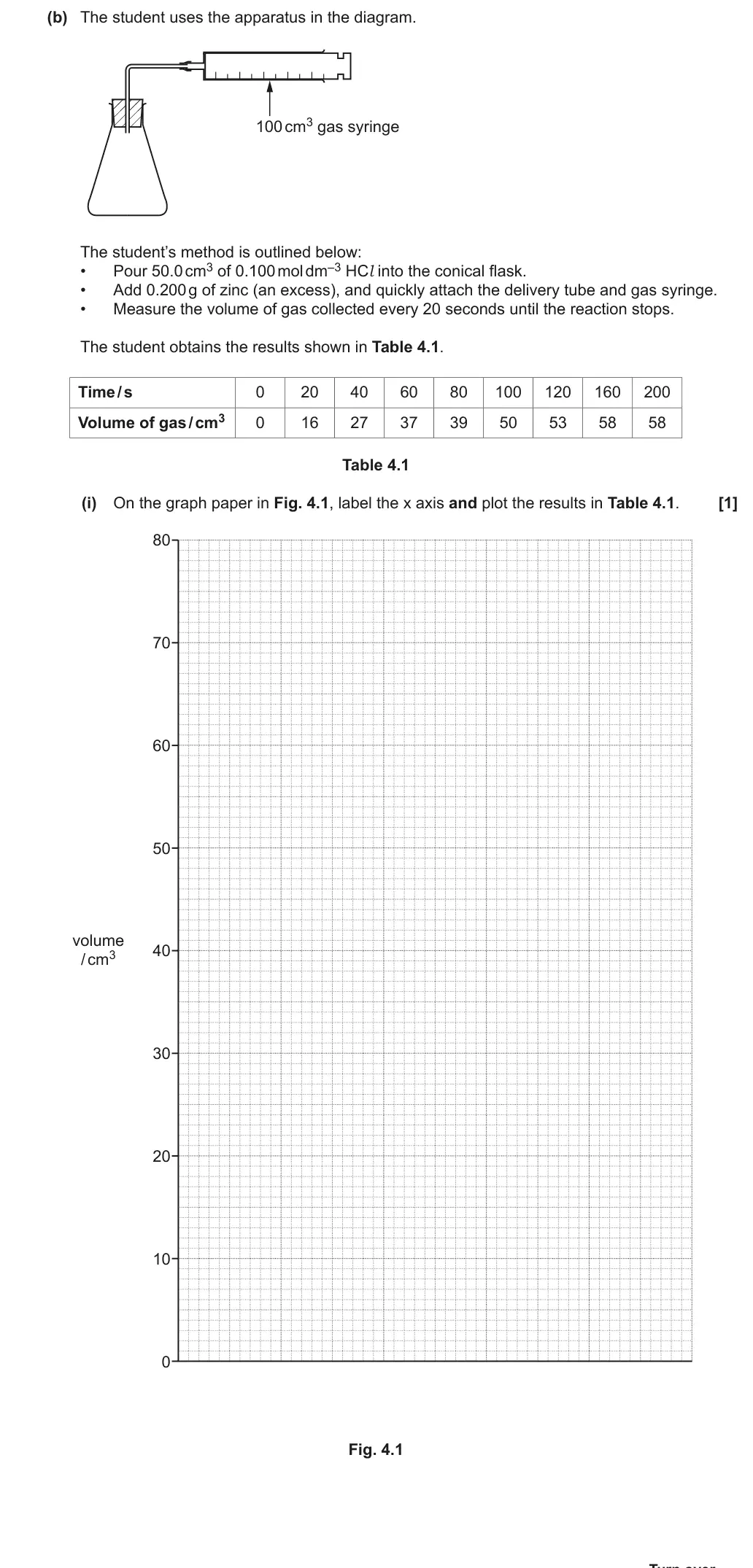
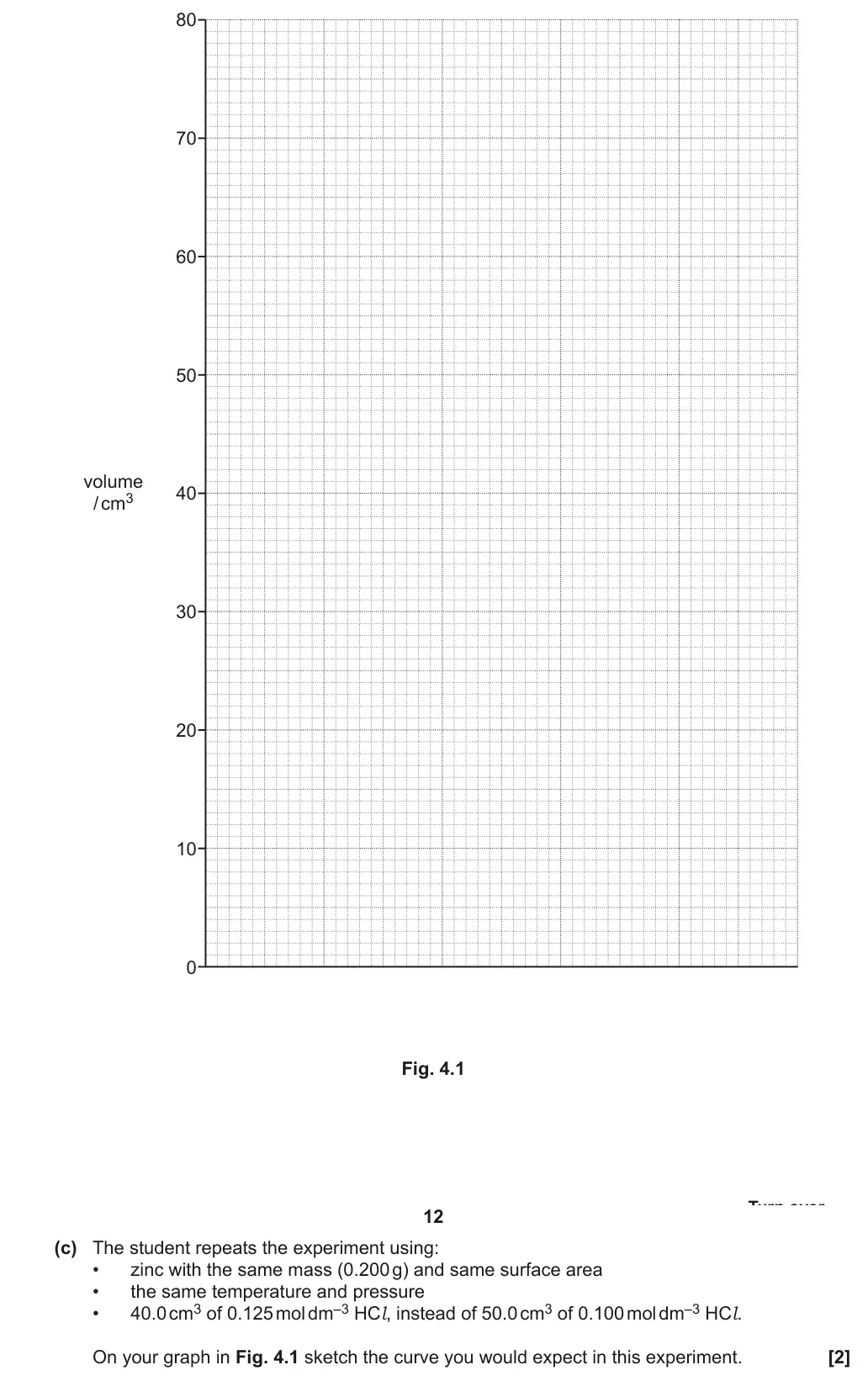
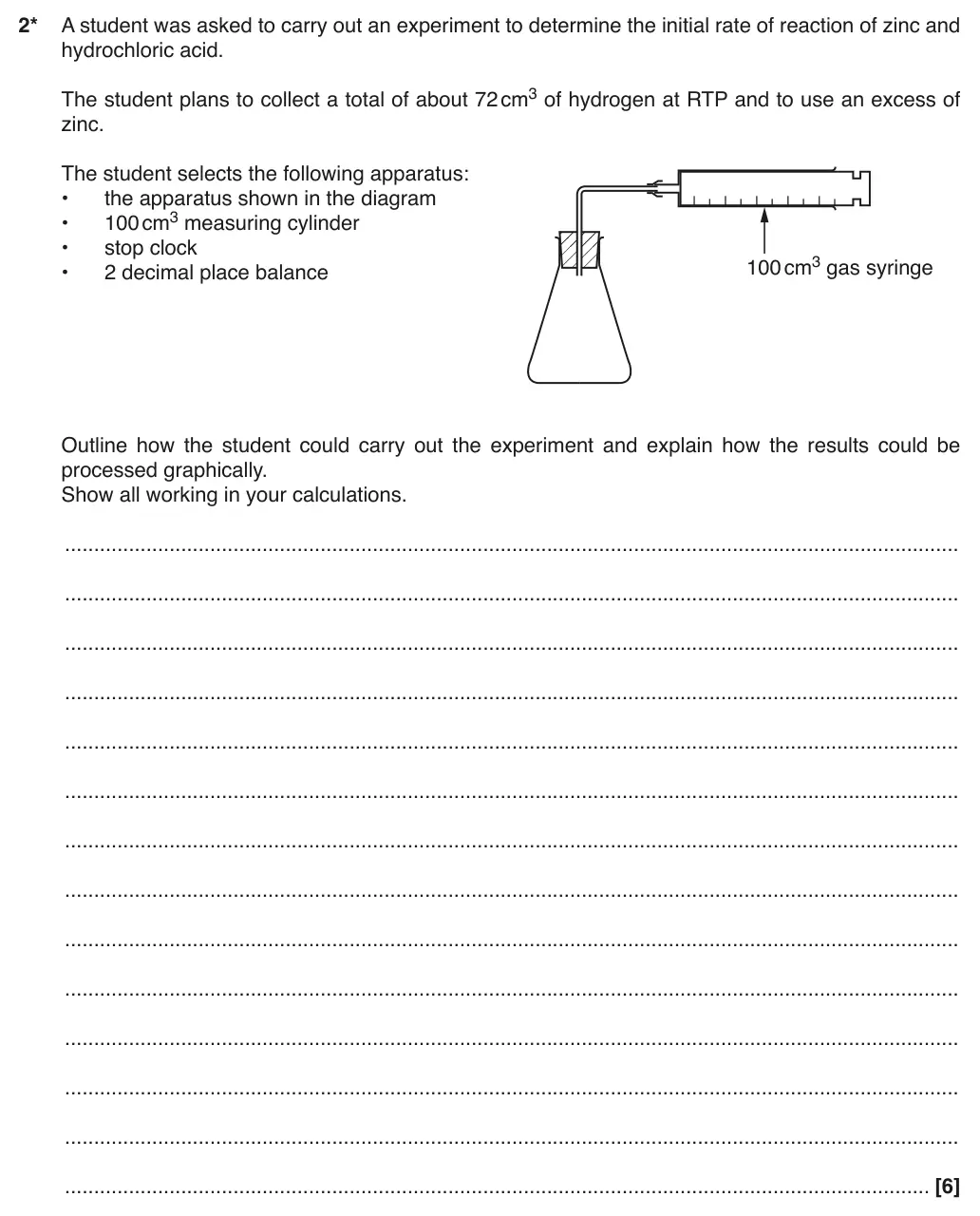
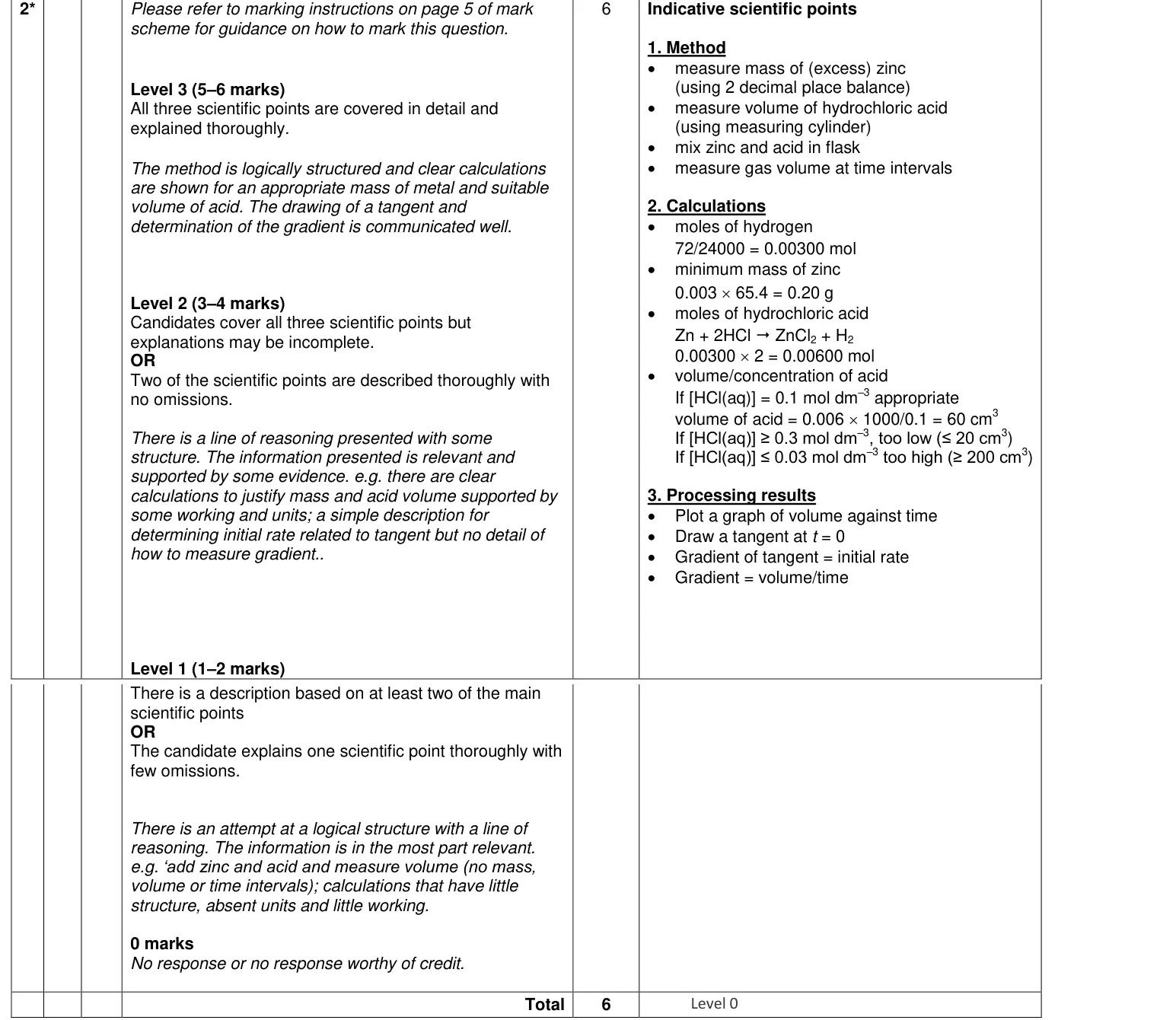
A student was asked to carry out an experiment to determine the initial rate of reaction of zinc and Outline how the student could carry out the experiment and explain how the results could be
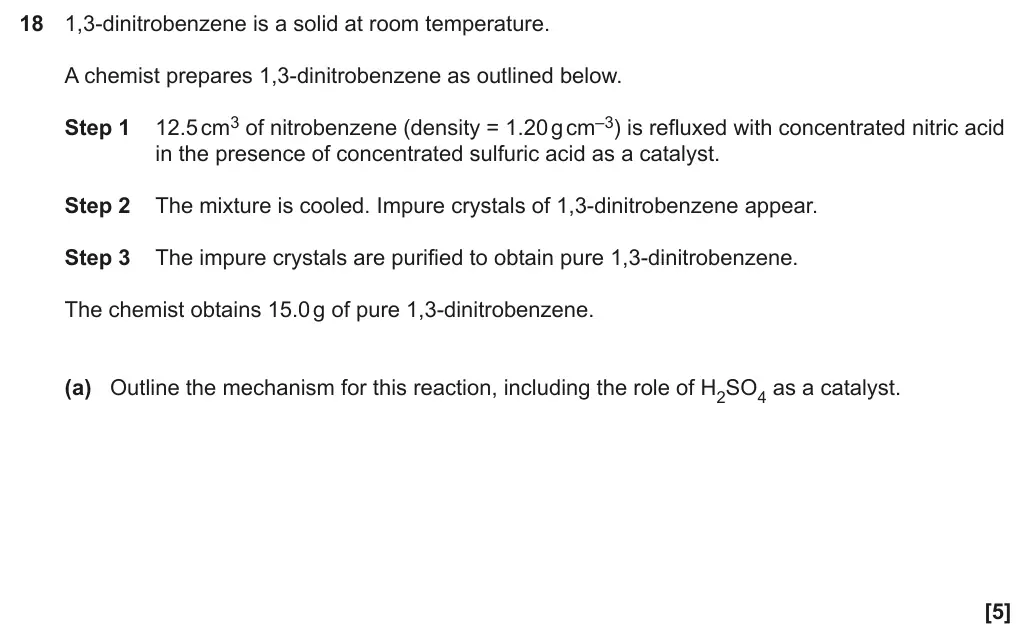
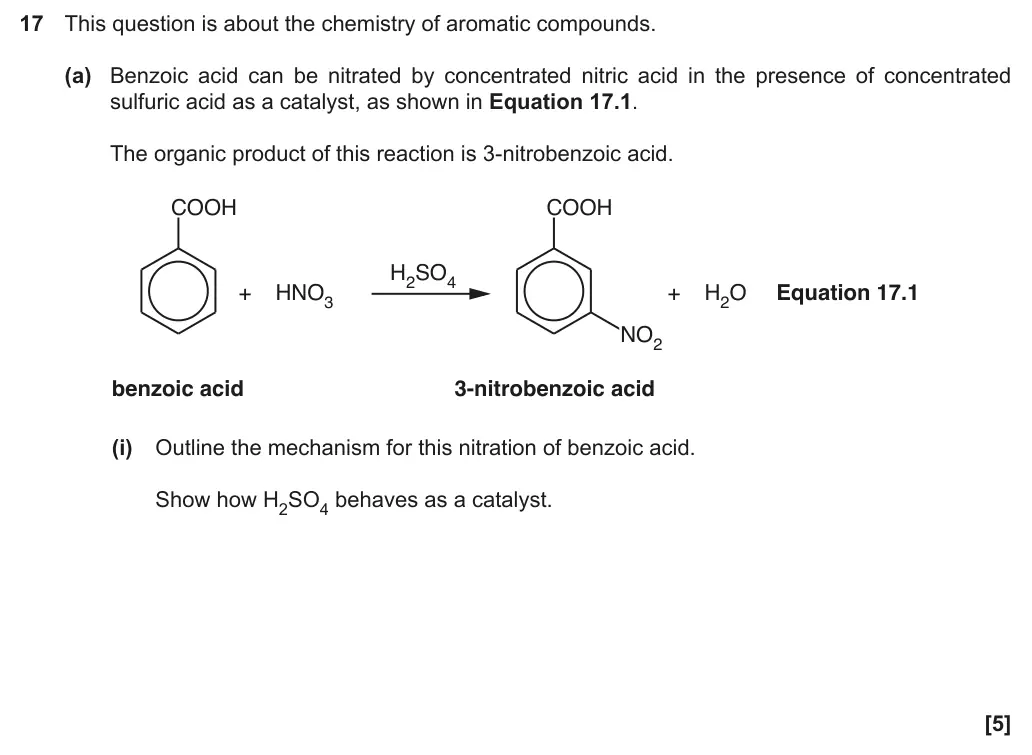
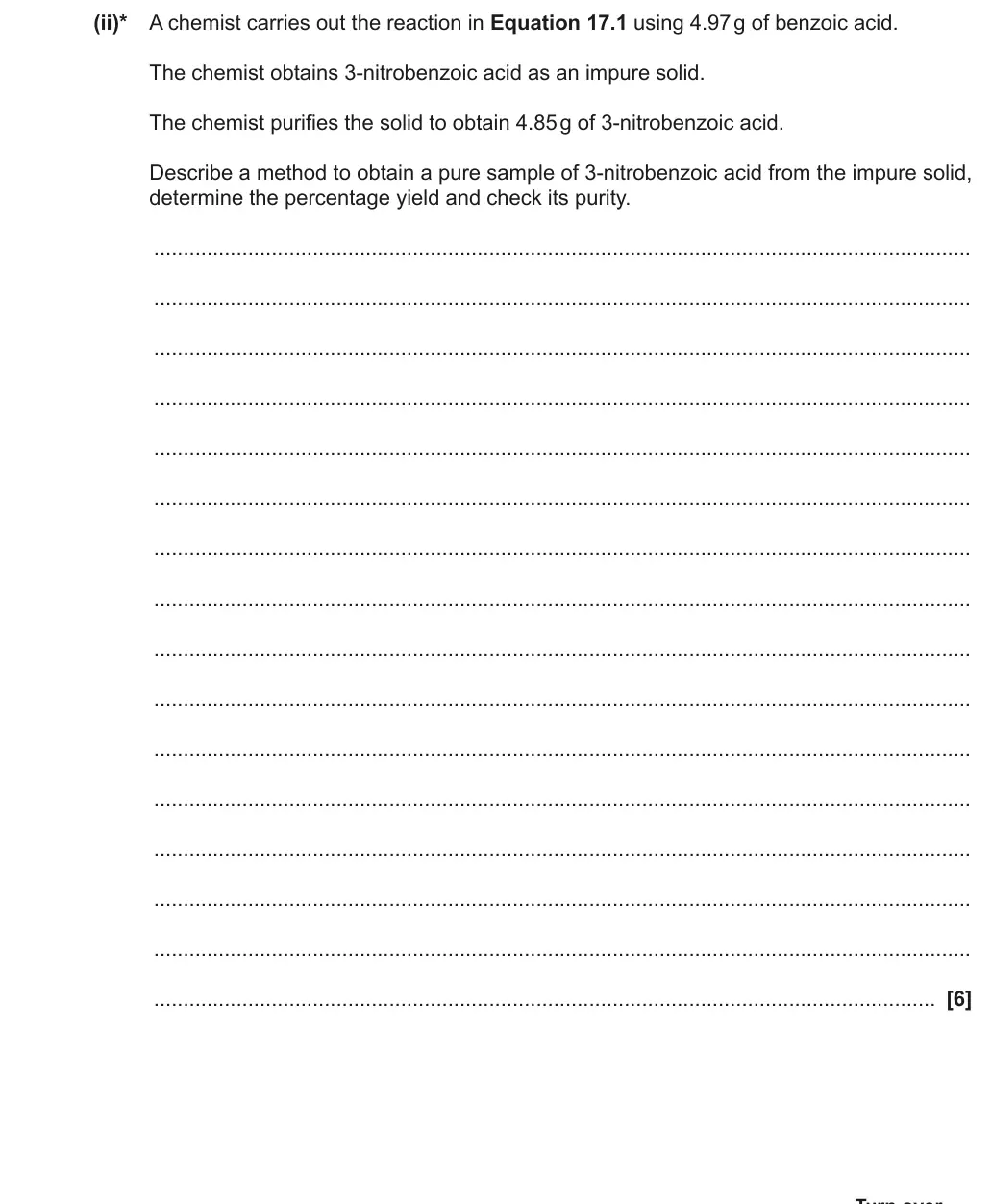
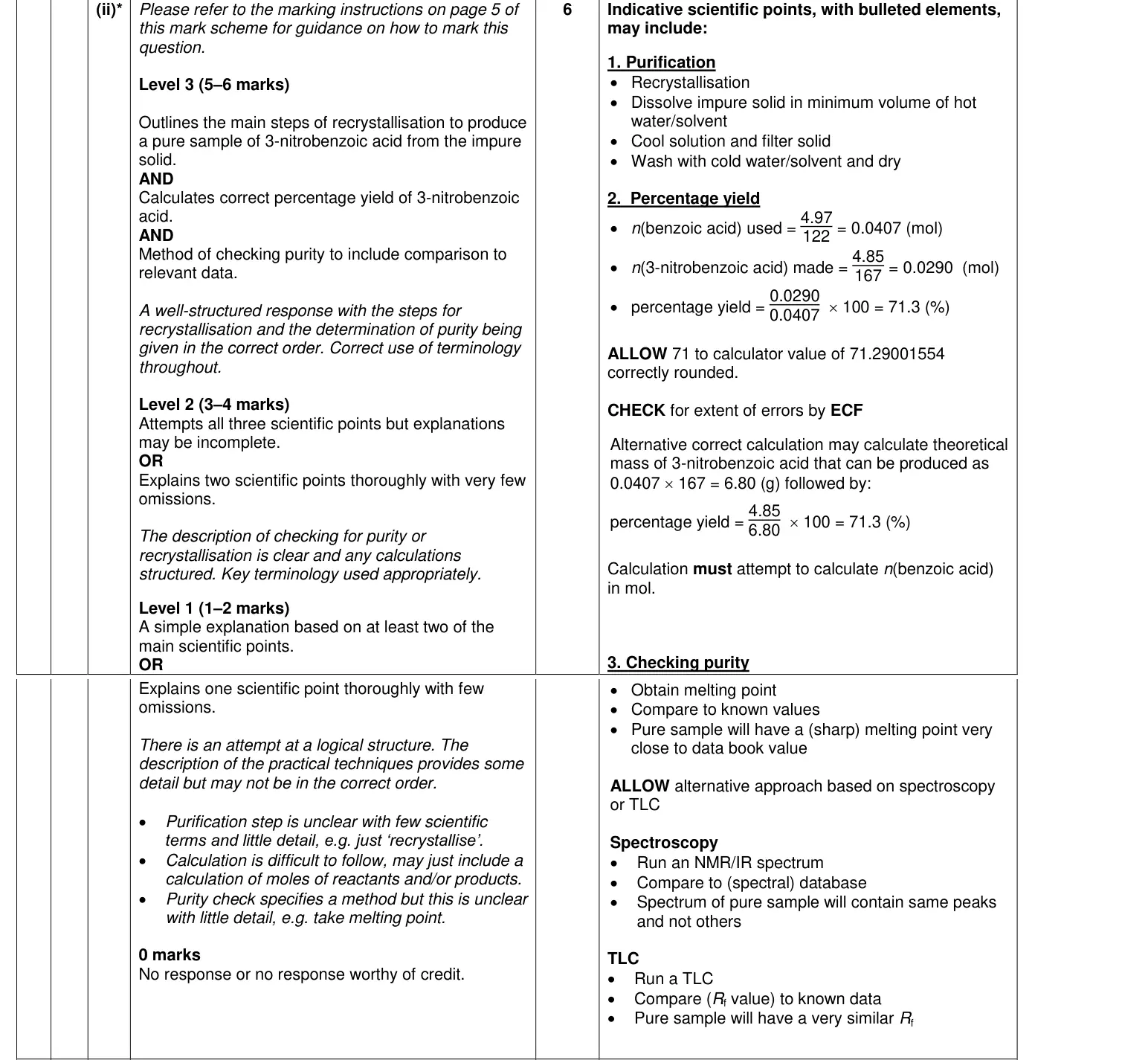
A chemist carries out the reaction in Equation 17.1 using 4.97 g of benzoic acid. Describe a method to obtain a pure sample of 3-nitrobenzoic acid from the impure solid,
Tap a question to zoom it. Where a part needs a table, graph or structure from an earlier part, that part folds out above it; the mark scheme and examiner's comment open underneath. Have the OCR Data Sheet beside you.
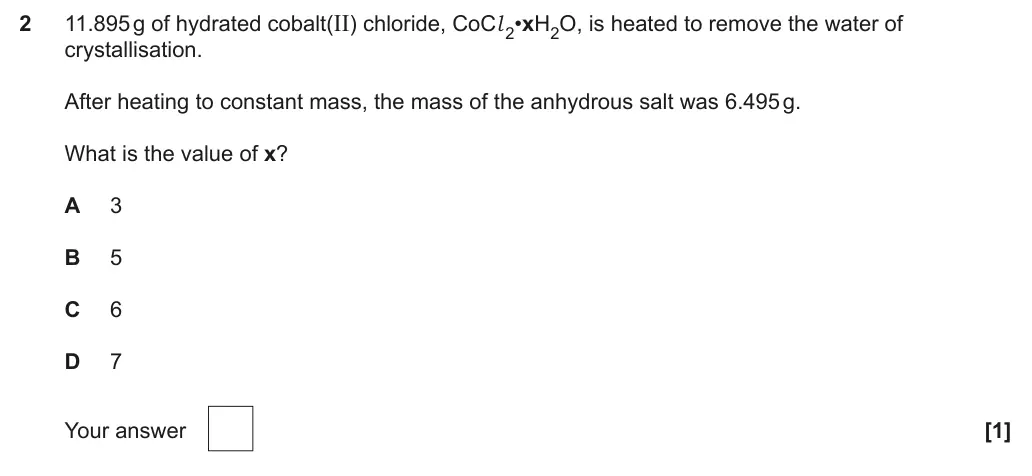
June 2025 · Paper 1 · Q21 markMultiple choiceHard
Answer
C
Mark scheme
Examiner's comment
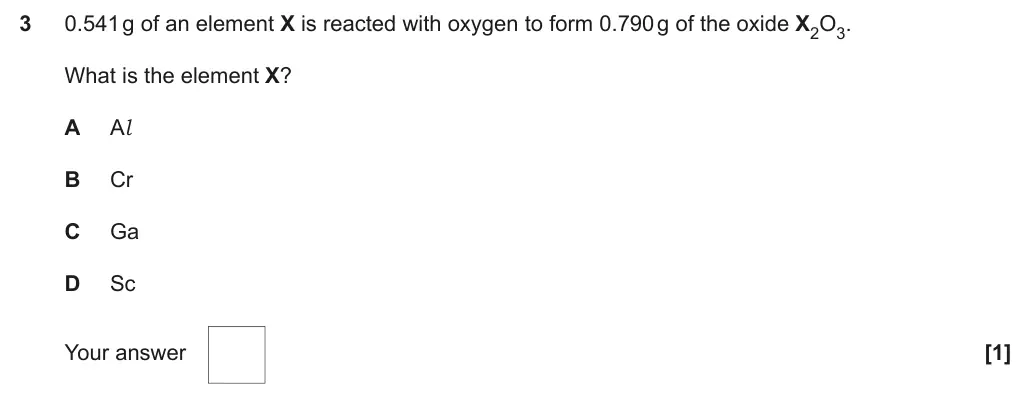
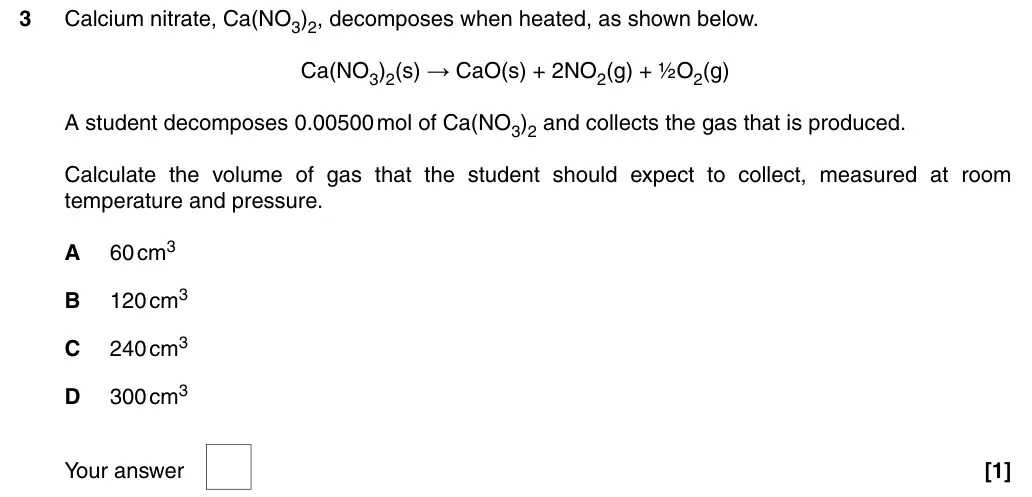
The correct answer was C. Candidates generally were able to complete this calculation to obtain the value for x by finding the molar ratio. A few candidates selected A from an incorrect calculation of the number of moles.
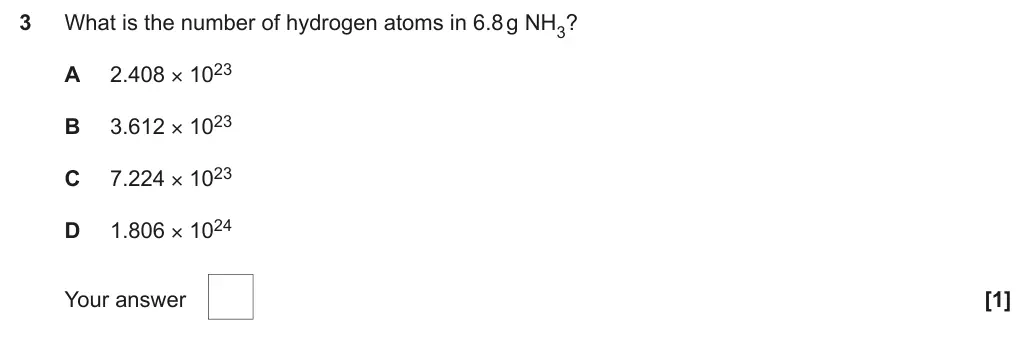
June 2025 · AS Paper 1 · Q31 markMultiple choiceMedium
Answer
C
Mark scheme
Examiner's comment
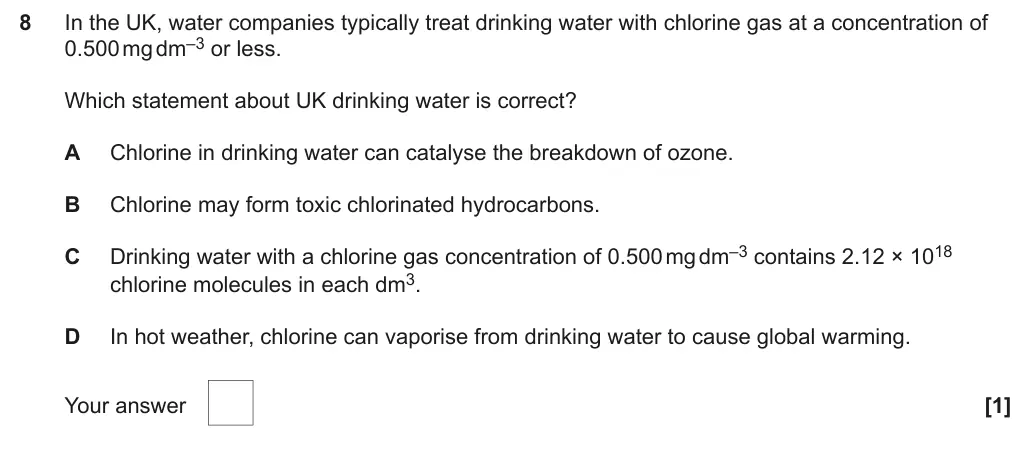
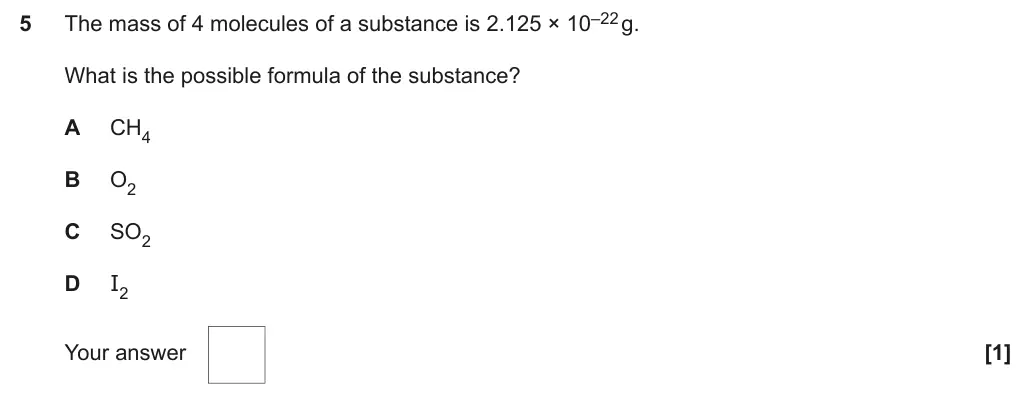
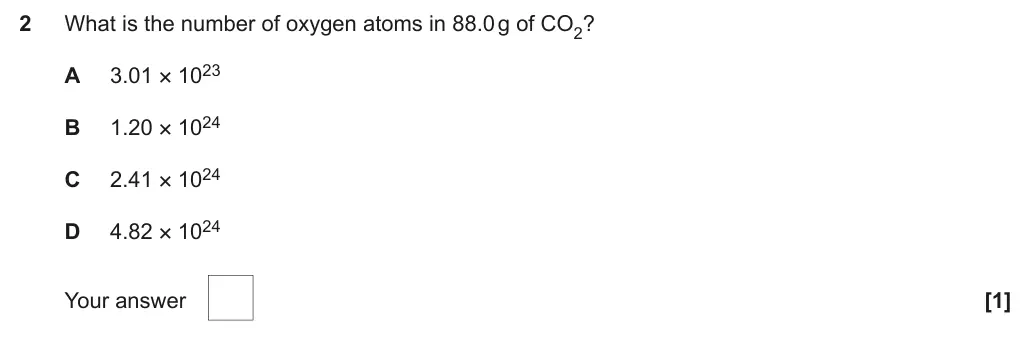
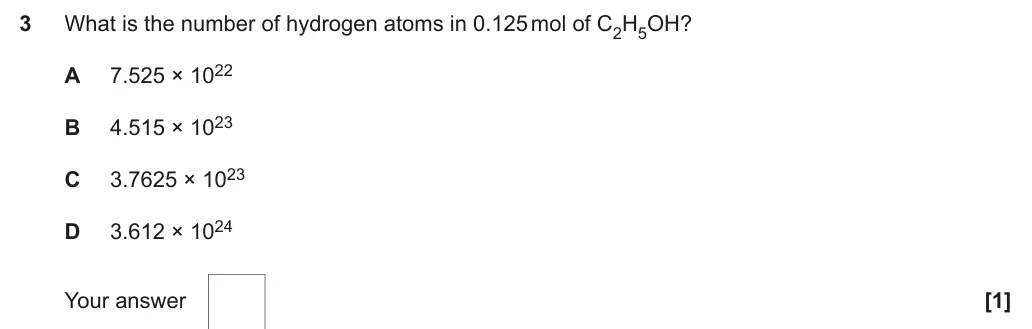
Many candidates gave C as the correct response suggesting they were well-prepared for a calculation involving Avogadro’s constant. A was a very common incorrect response which gives the number of molecules of ammonia instead of hydrogen atoms.
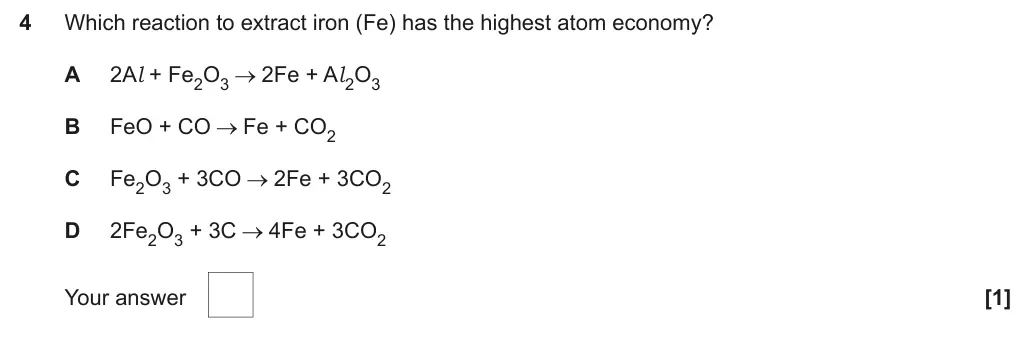
June 2025 · AS Paper 1 · Q41 markMultiple choiceEasy
Answer
D
Mark scheme
Examiner's comment
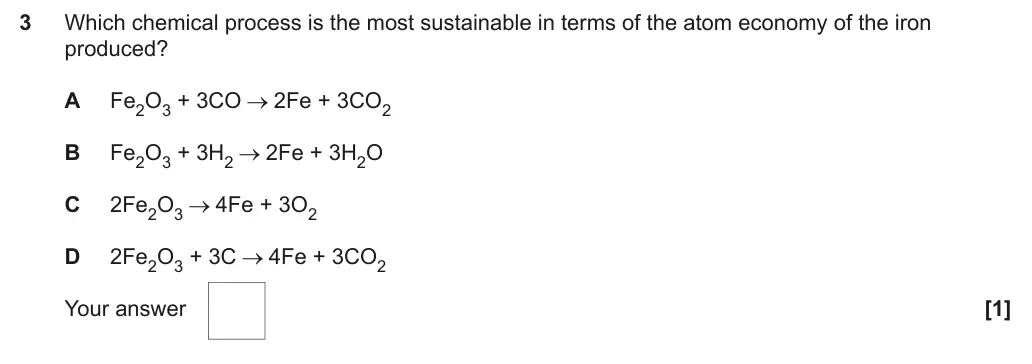
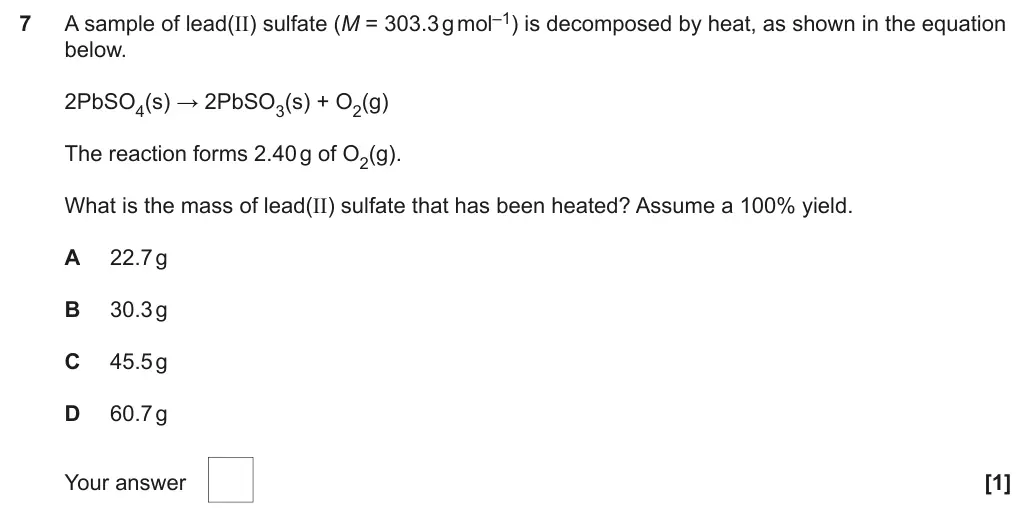
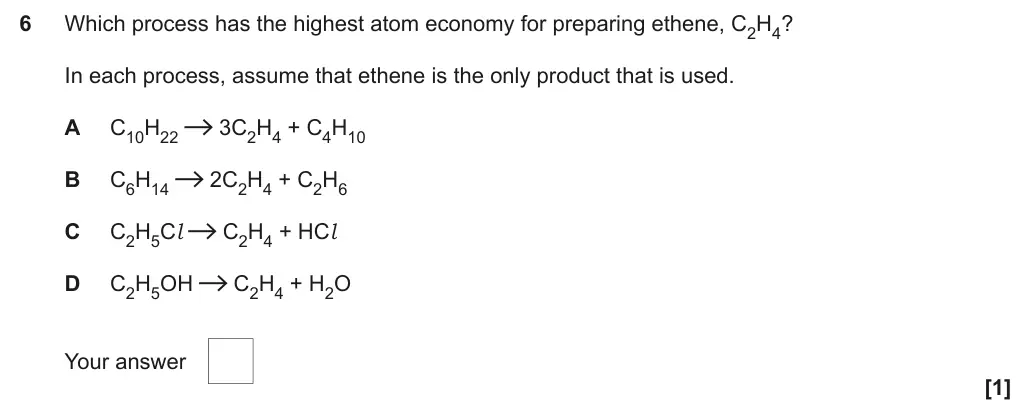
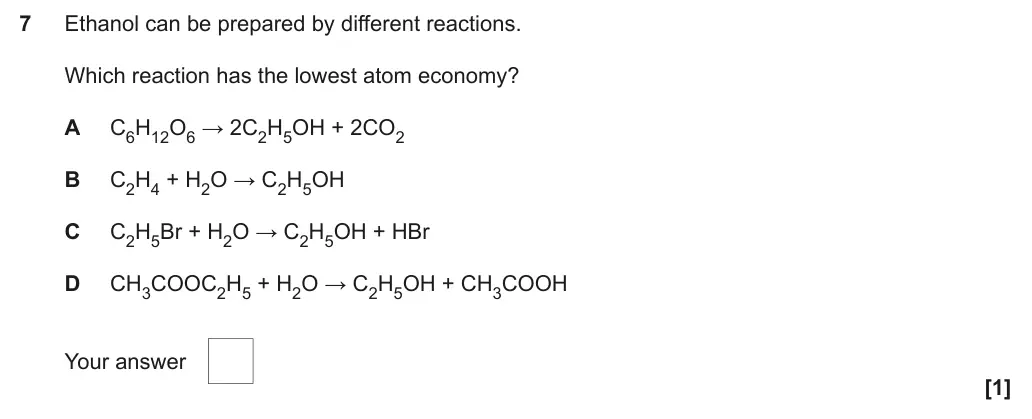
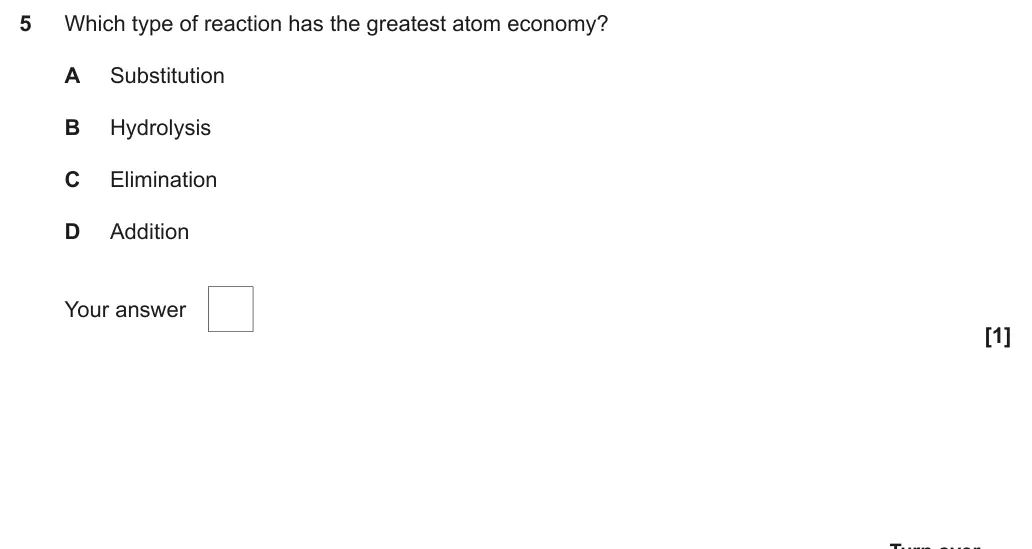
Most candidates correctly calculated atom economy. They usually showed their working alongside the options which is good practice.
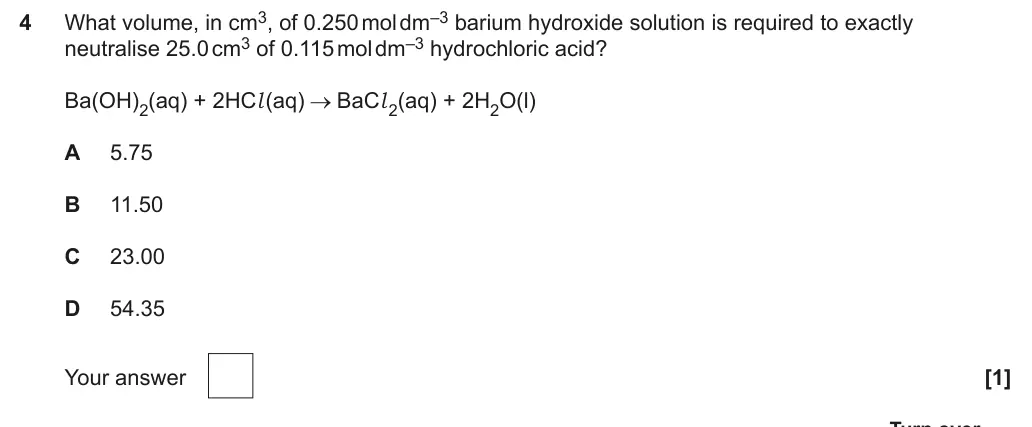
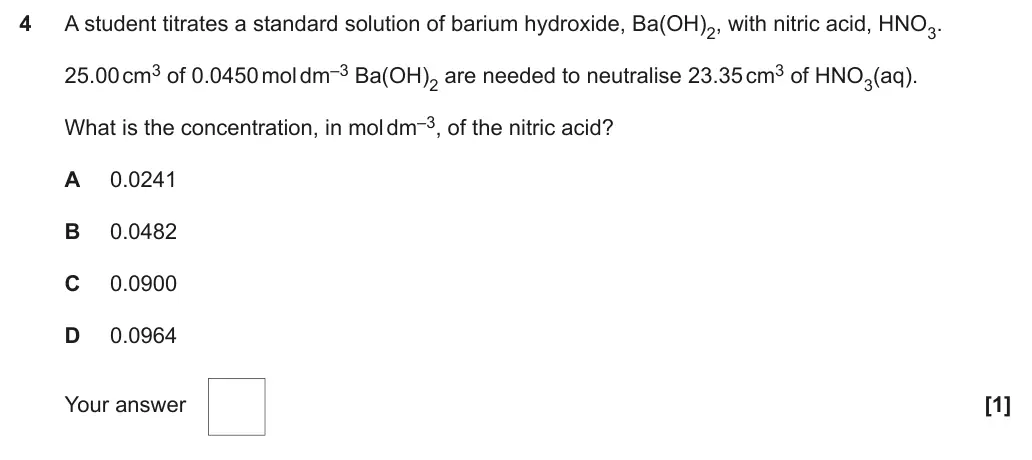
June 2025 · Paper 1 · Q41 markMultiple choiceMedium
Answer
A
Mark scheme
Examiner's comment
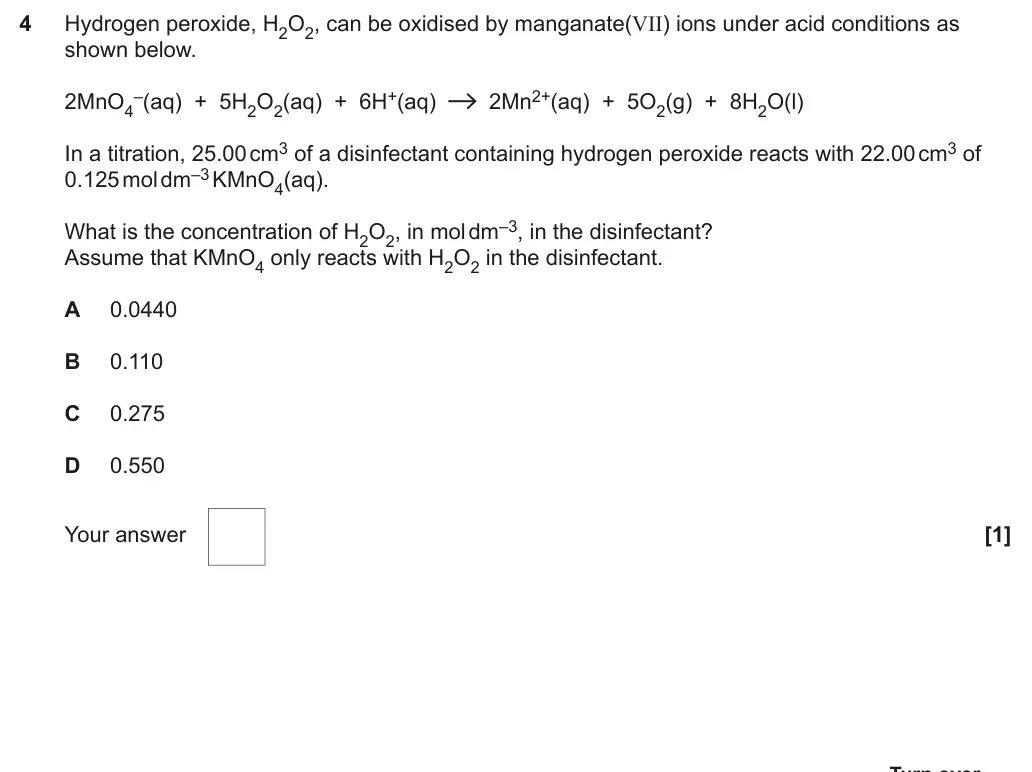
The correct answer was A. Most students were able to complete this titration calculation. B was a common incorrect answer seen as candidates did not consider the stoichiometry in the equation.
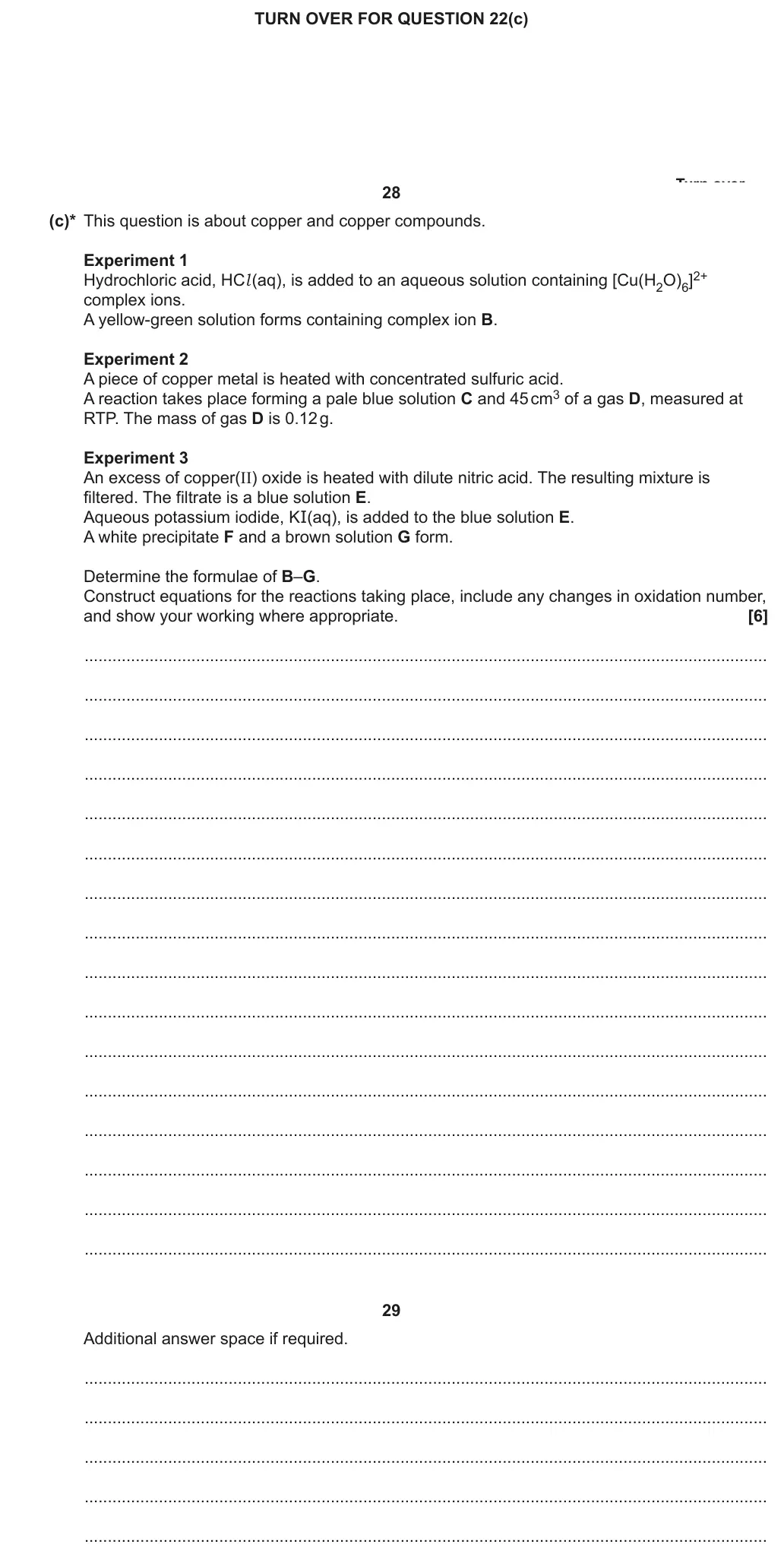
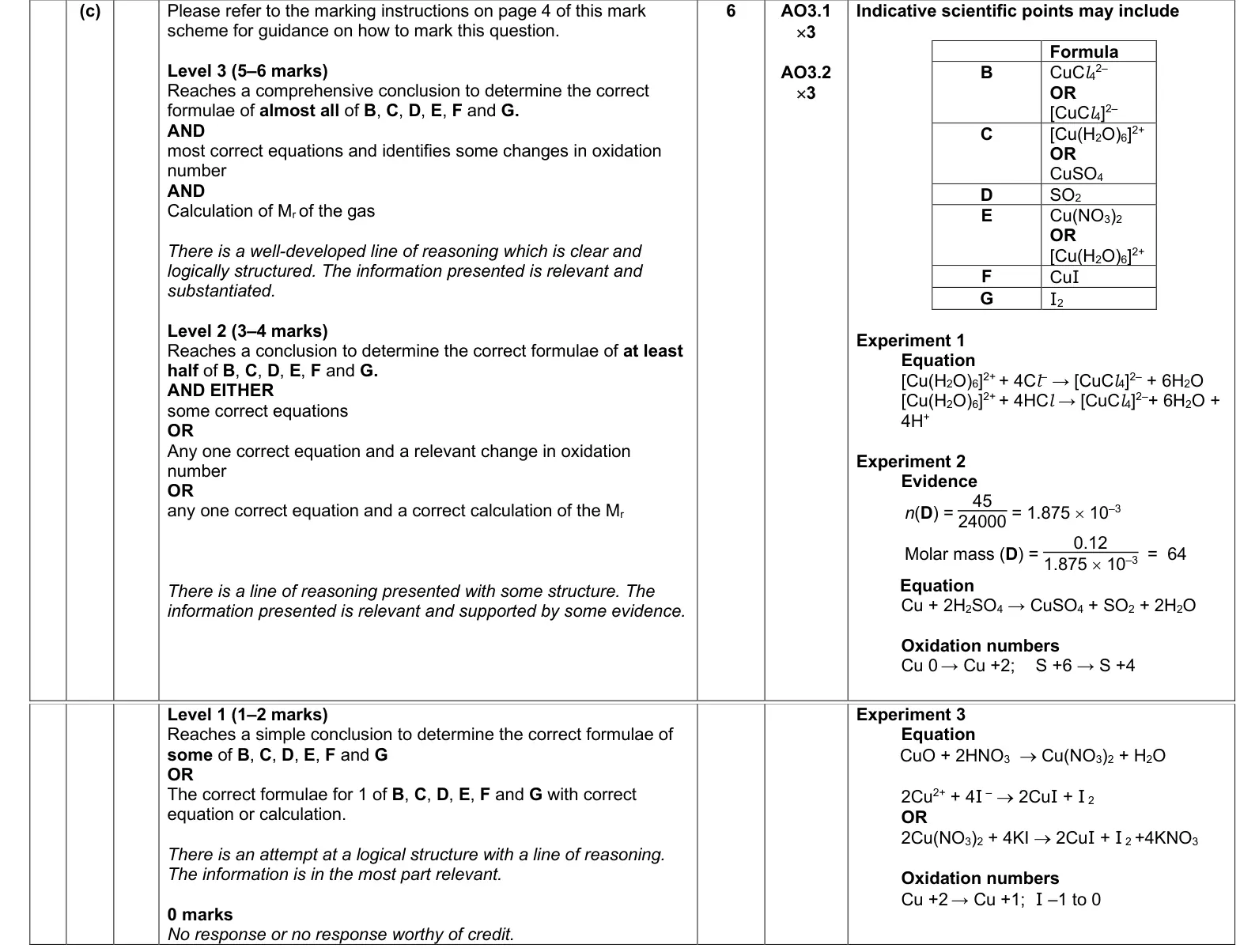
June 2025 · Paper 1 · Q19(c)6 marks6-mark level of responseHard
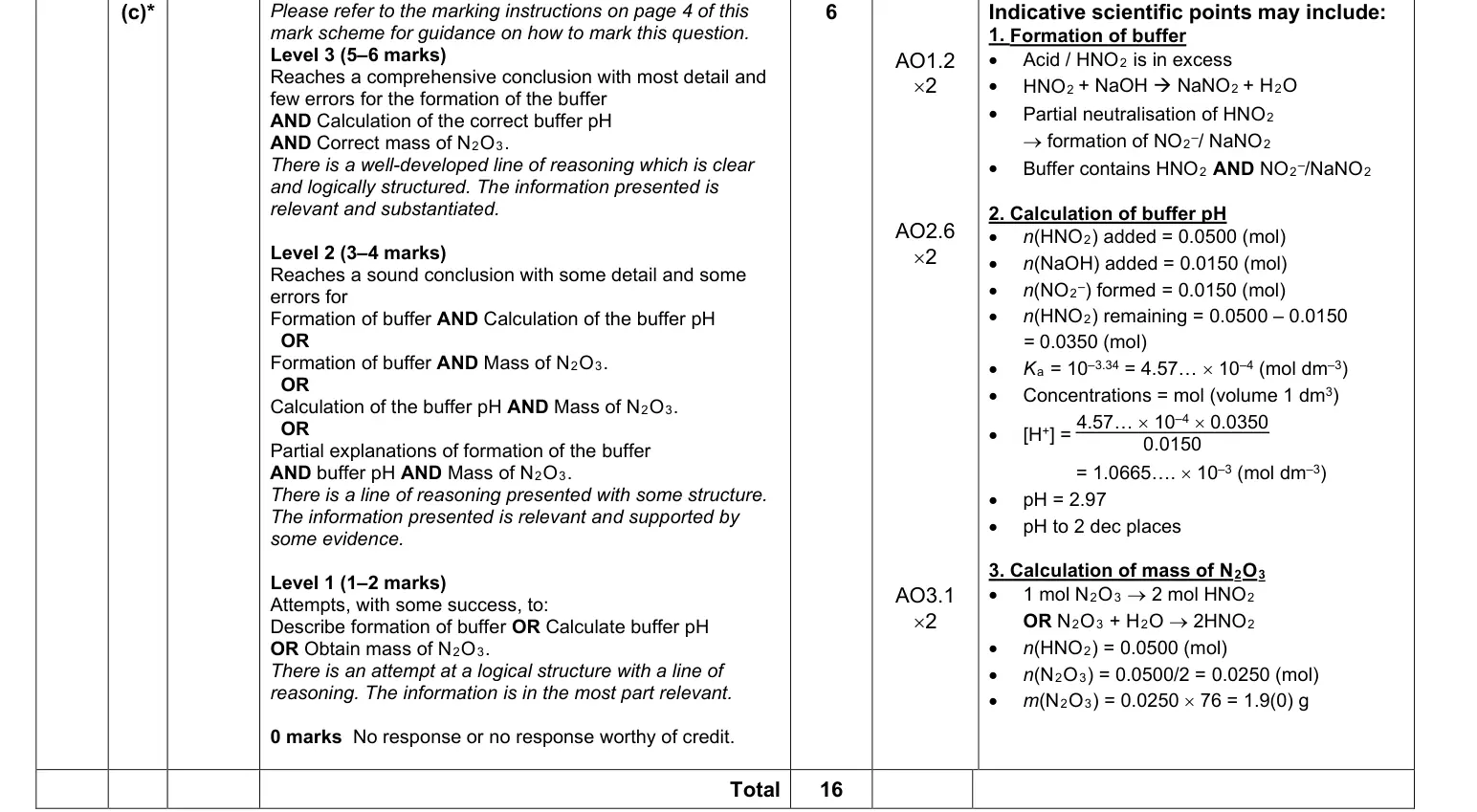
Mark scheme, with the levels and indicative points
Examiner's comment
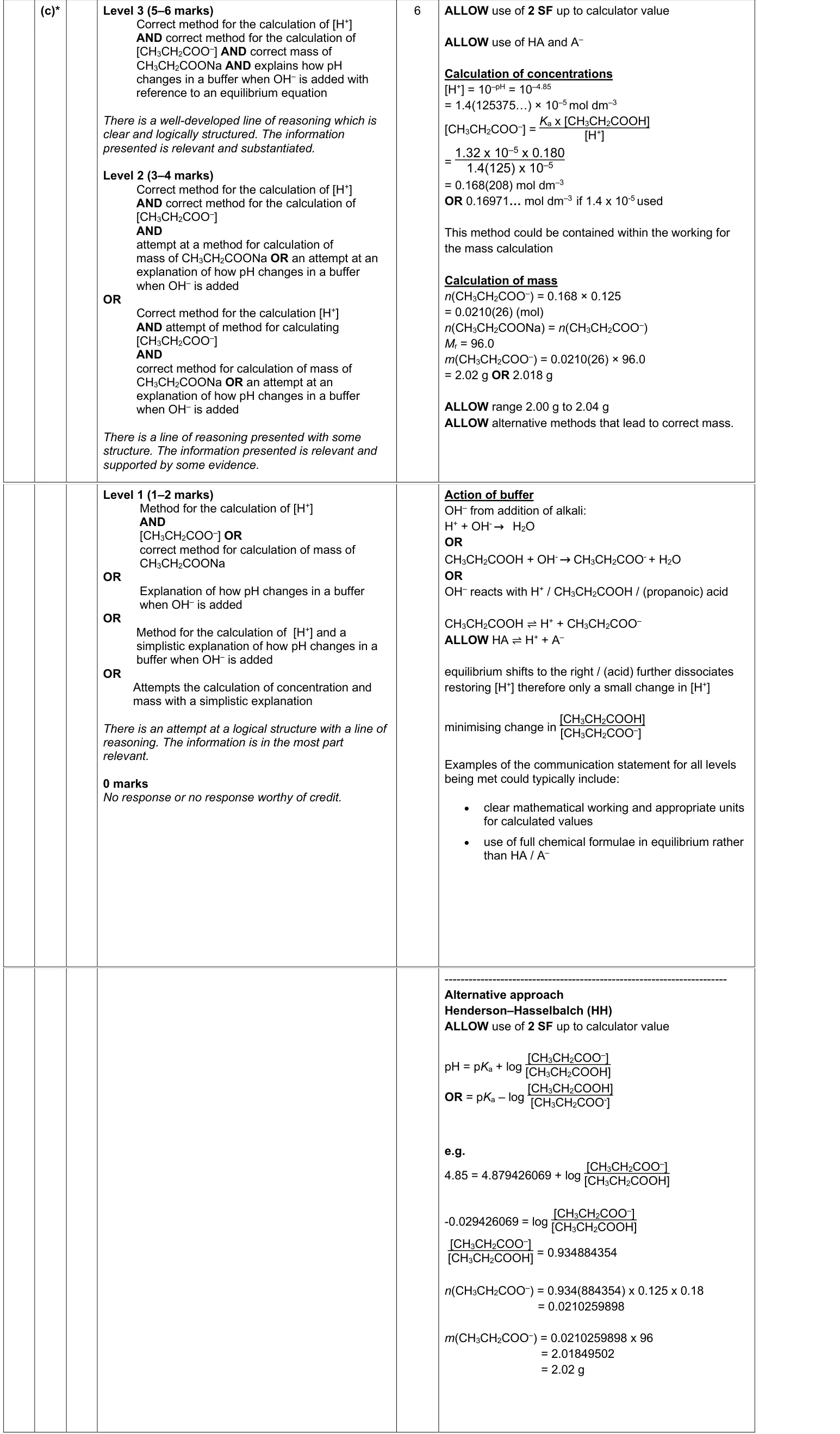
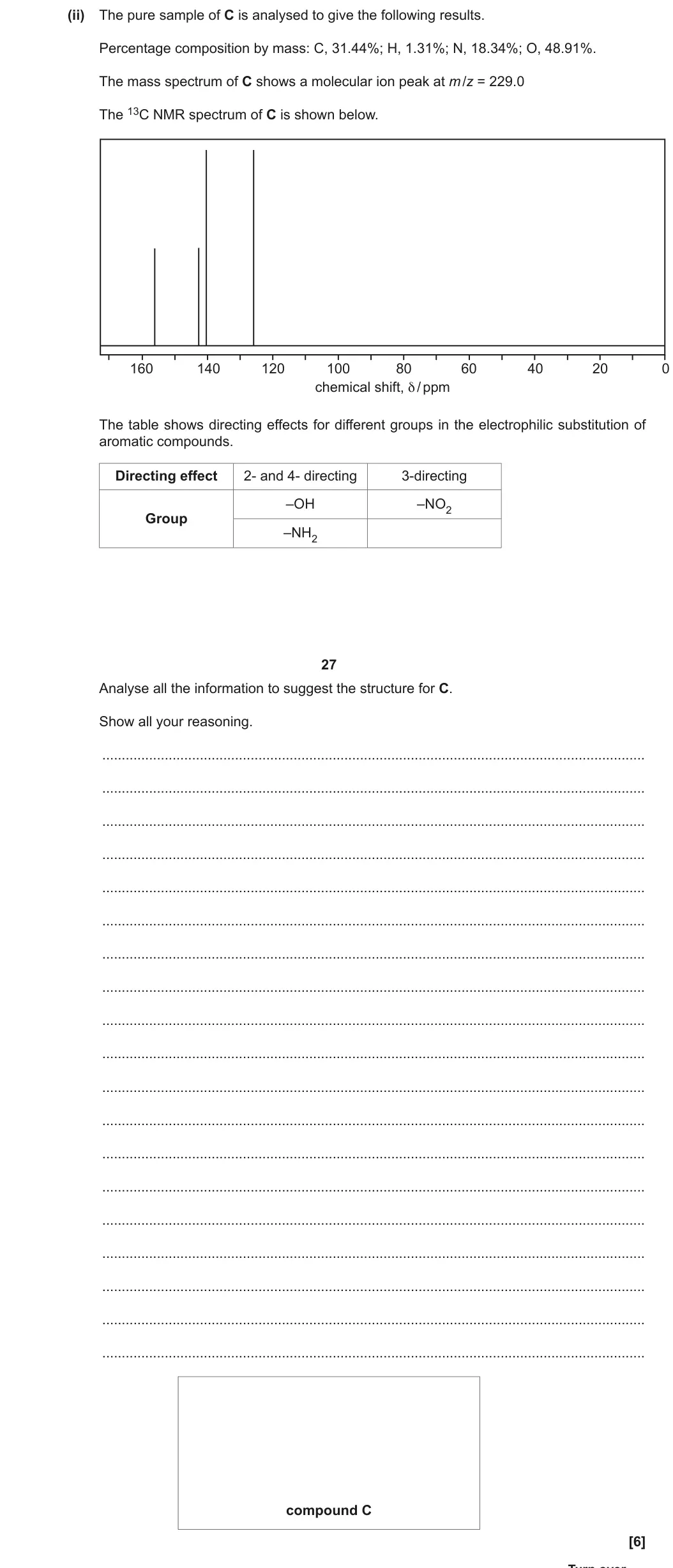
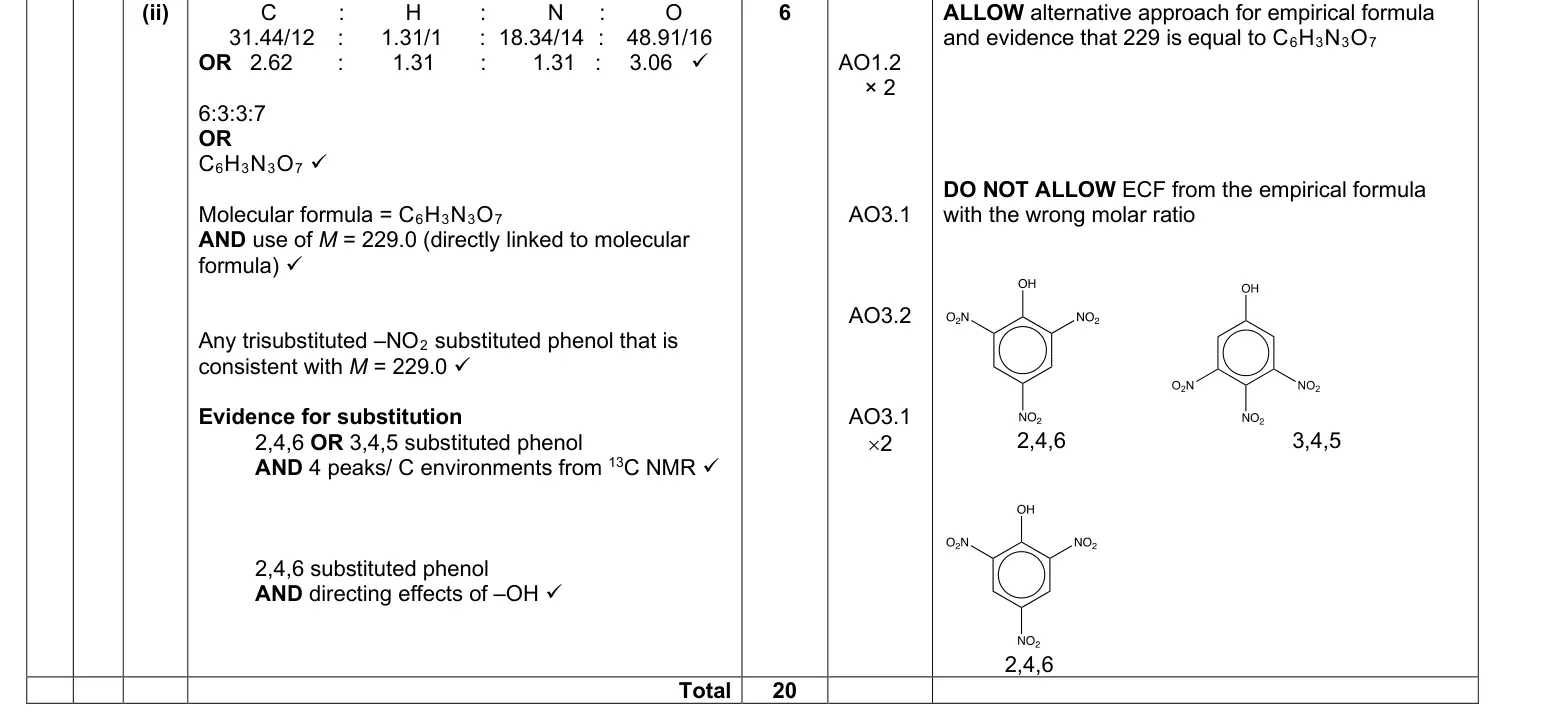
This was our second Level of Response question which proved more challenging for candidates. Only a few candidates scored full marks. Candidates are reminded to structure their answers and make sure they answer all points in the question. Candidates often find pH of buffer solution calculations difficult to process. The most difficult part in this calculation was the concentration of the salt. The majority that calculated salt concentration were able to calculate the mass. We should encourage the candidates to always write the units when calculating any quantity as concentration and moles were often confused within the calculation. Some candidates were given Level 2 for converting what they thought was the salt concentration into a value for the mass of salt needed, using a correct method. Less successful candidates calculated the correct [H+] but then used a weak acid calculation approach. A few responses attempted to use the Henderson-Hasselbalch approach, but most were unsuccessful due to the mathematical inaccuracies. The buffer action description proved to be a more challenging part to the question. Some candidates wrote a clear and concise description, linked to a written equilibrium equation, of the reaction of an alkali and the resulting equilibrium shift. Level 2 candidates often described an equilibrium shift of a non- existent equilibrium equation. Level 1 candidates were often only able to calculate [H+] and tried to explain the action of a buffer.
Notes from the mark scheme and report
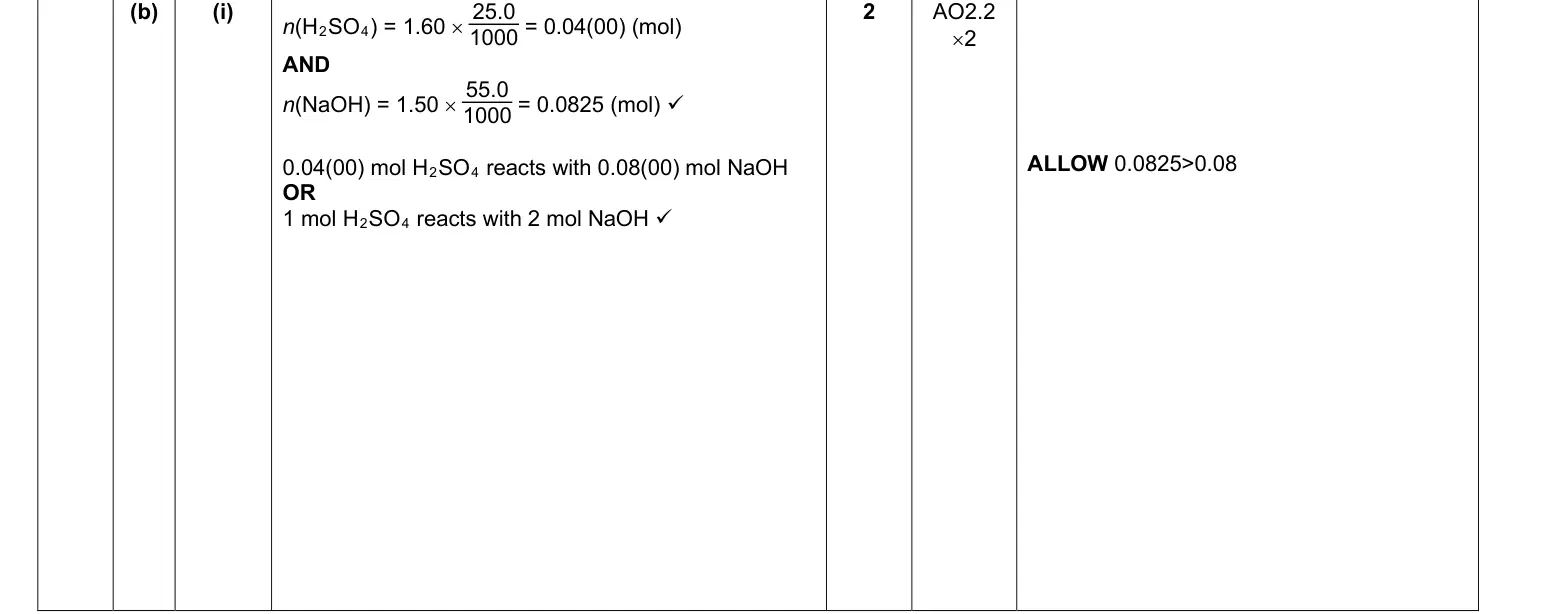
n = 0.168 × 0.125 = 0.0210 mol
mass = 0.0210 × 96.0 = 2.02 g (2.00–2.04)
added OH– reacts with H+/CH3CH2COOH and equilibrium CH3CH2COOH ⇌ H+ + CH3CH2COO– shifts right restoring [H+]
use full formulae rather than HA/A–
Skills: M0.4 Use calculators to find and use power, exponential and logarithmic functions; M2.2 Change the subject of an equation; M2.3 Substitute numerical values into algebraic equations using appropriate units for physical quantities; M2.5 Use logarithms in relation to quantities that range over several orders of magnitude
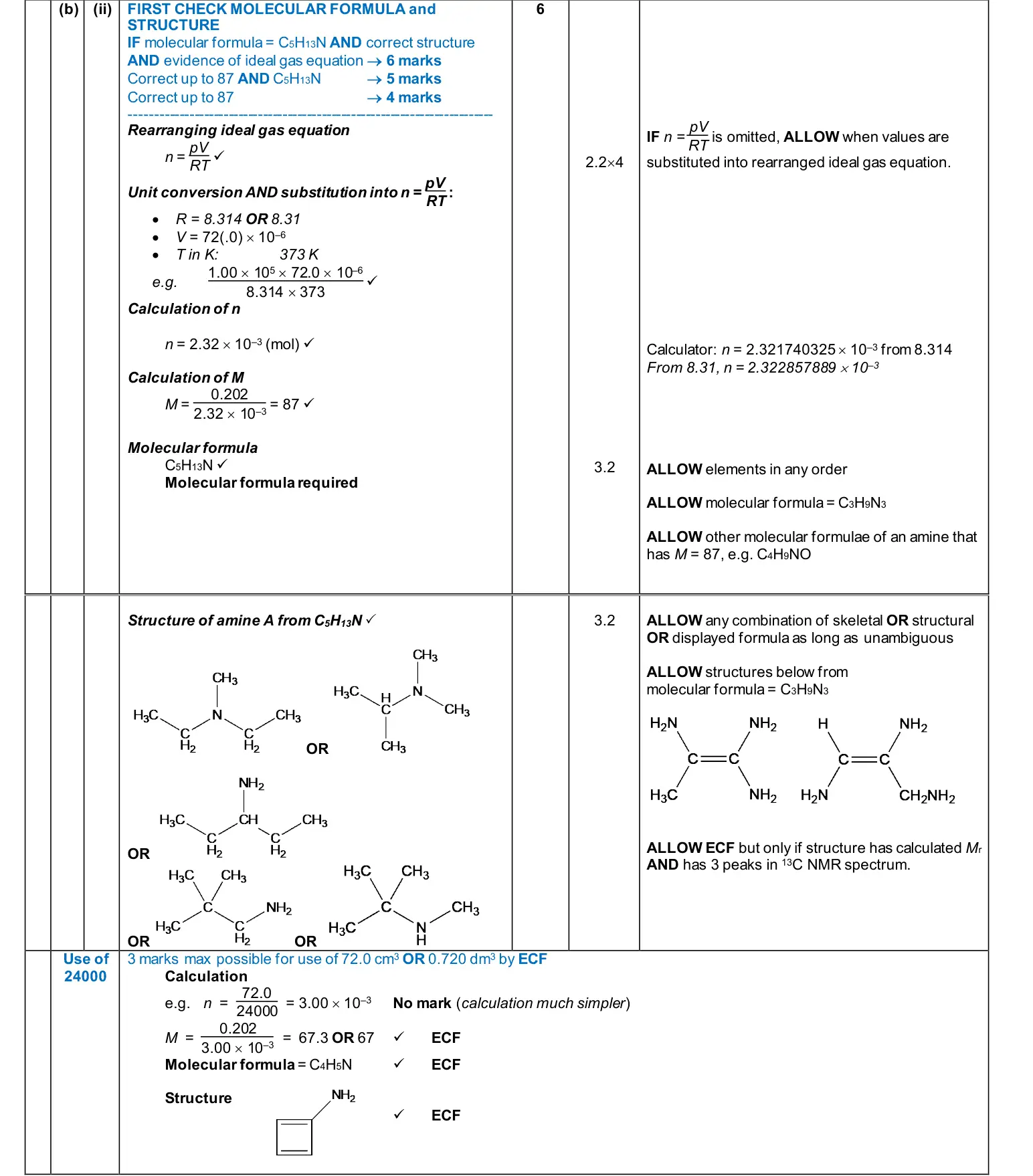
June 2025 · Paper 1 · Q21(b)(ii)4 marksData interpretationMedium
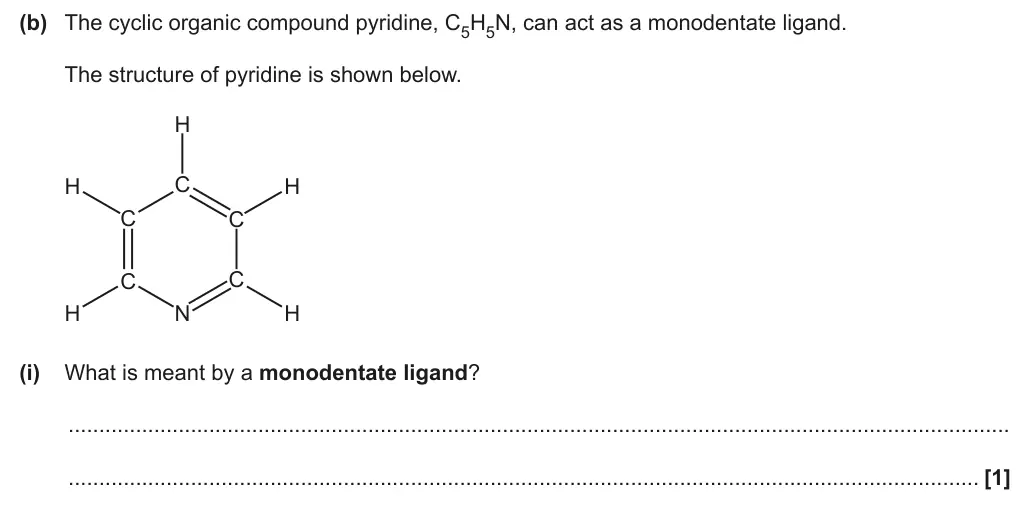
Earlier part of question 21 that this part uses
Mark scheme
Examiner's comment
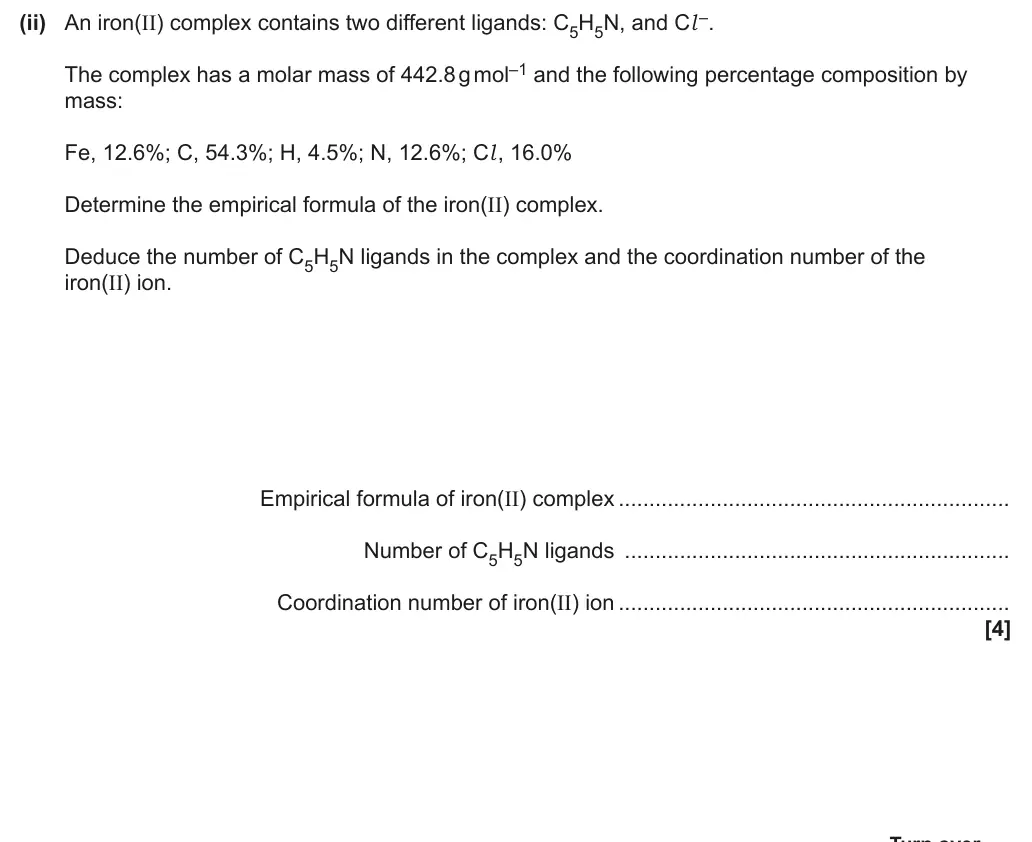
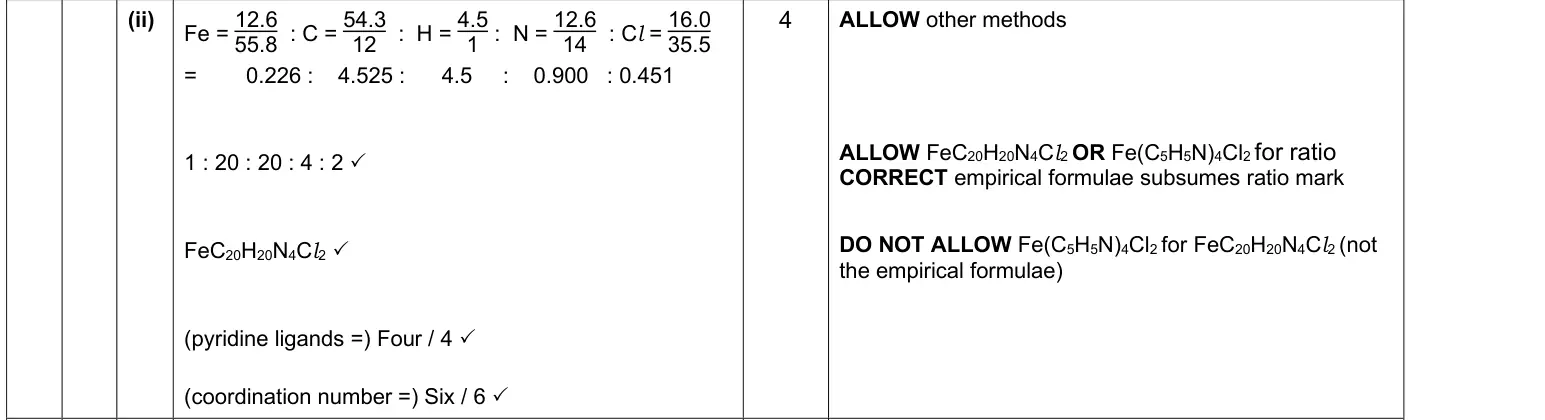
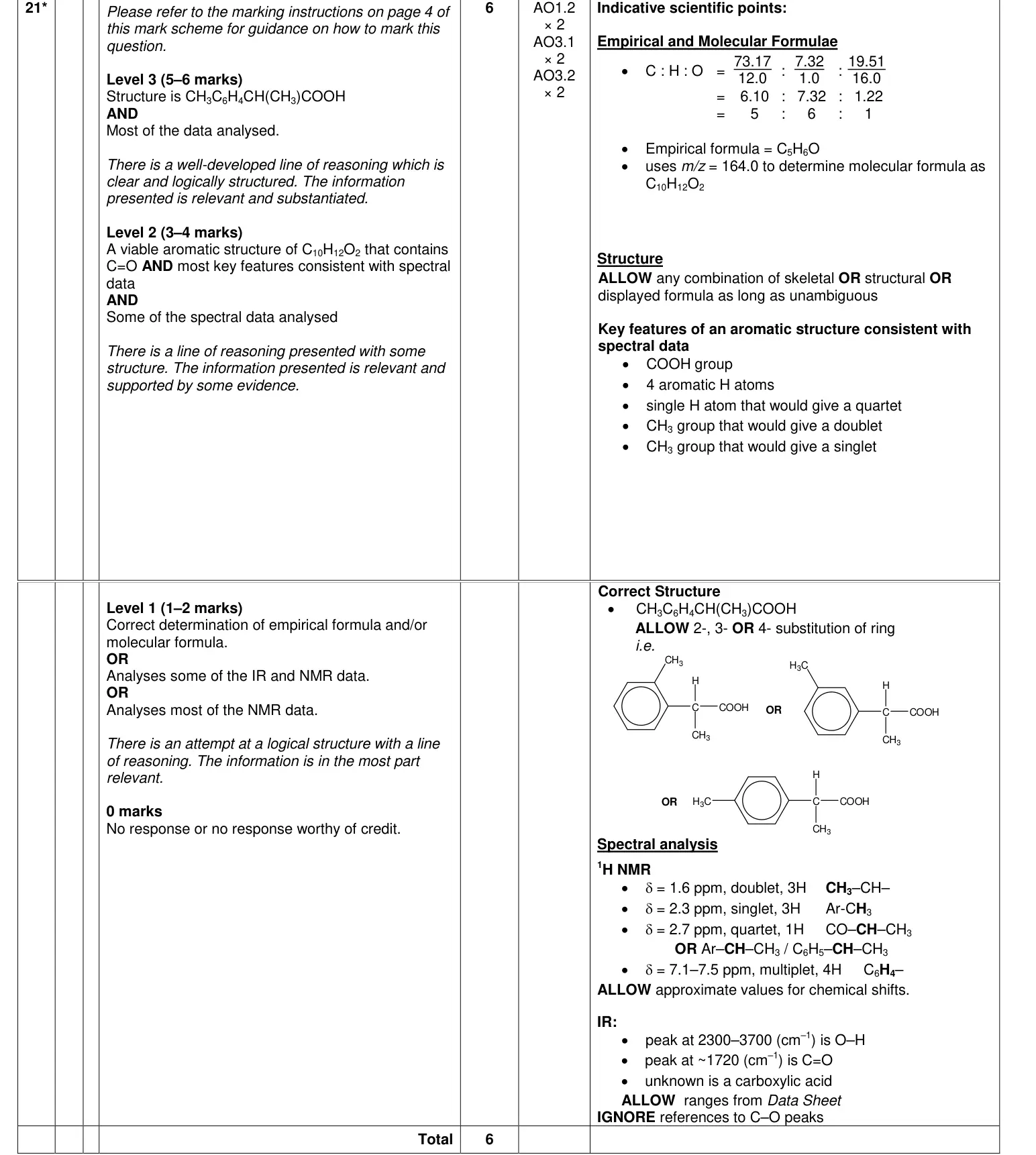
Most candidates were given full marks. They successfully calculated the empirical formula but a few then grouped the ligands together giving a molecular formula, e.g. Fe(C5H5N4)Cl2. Most candidates then continued and found the number of ligands and coordination number. Occasionally coordination number was mixed up with the charge on the ion.
Notes from the mark scheme and report
ratio 1 : 20 : 20 : 4 : 2 gives FeC20H20N4Cl2 (DO NOT ALLOW Fe(C5H5N)4Cl2 as the empirical formula)
four pyridine ligands
coordination number 6
Skills: M0.2 Use ratios, fractions and percentages; M2.3 Substitute numerical values into algebraic equations using appropriate units for physical quantities
June 2025 · AS Paper 1 · Q21(d)(i)3 marksCalculationHard
Mark scheme
Examiner's comment
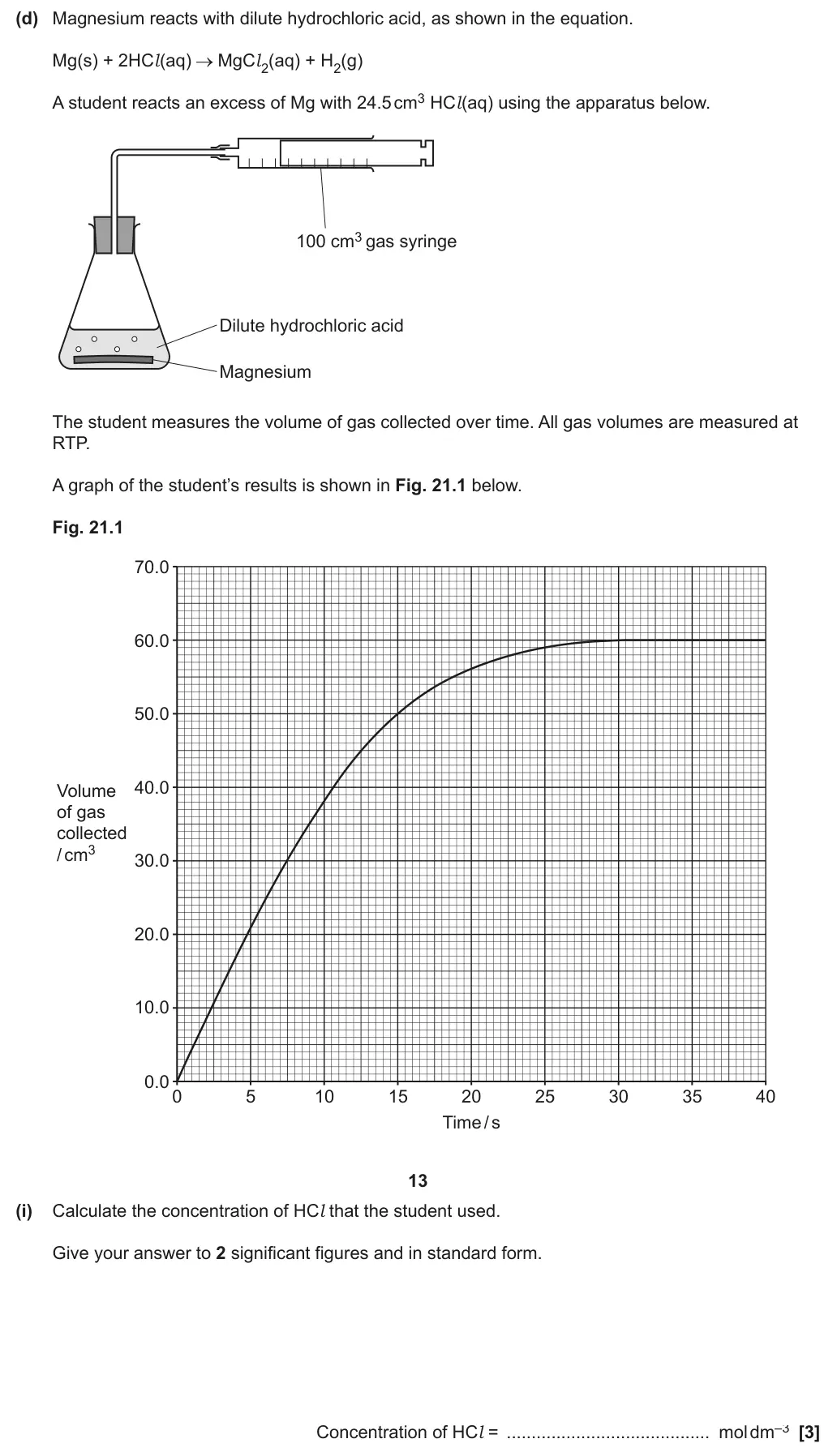
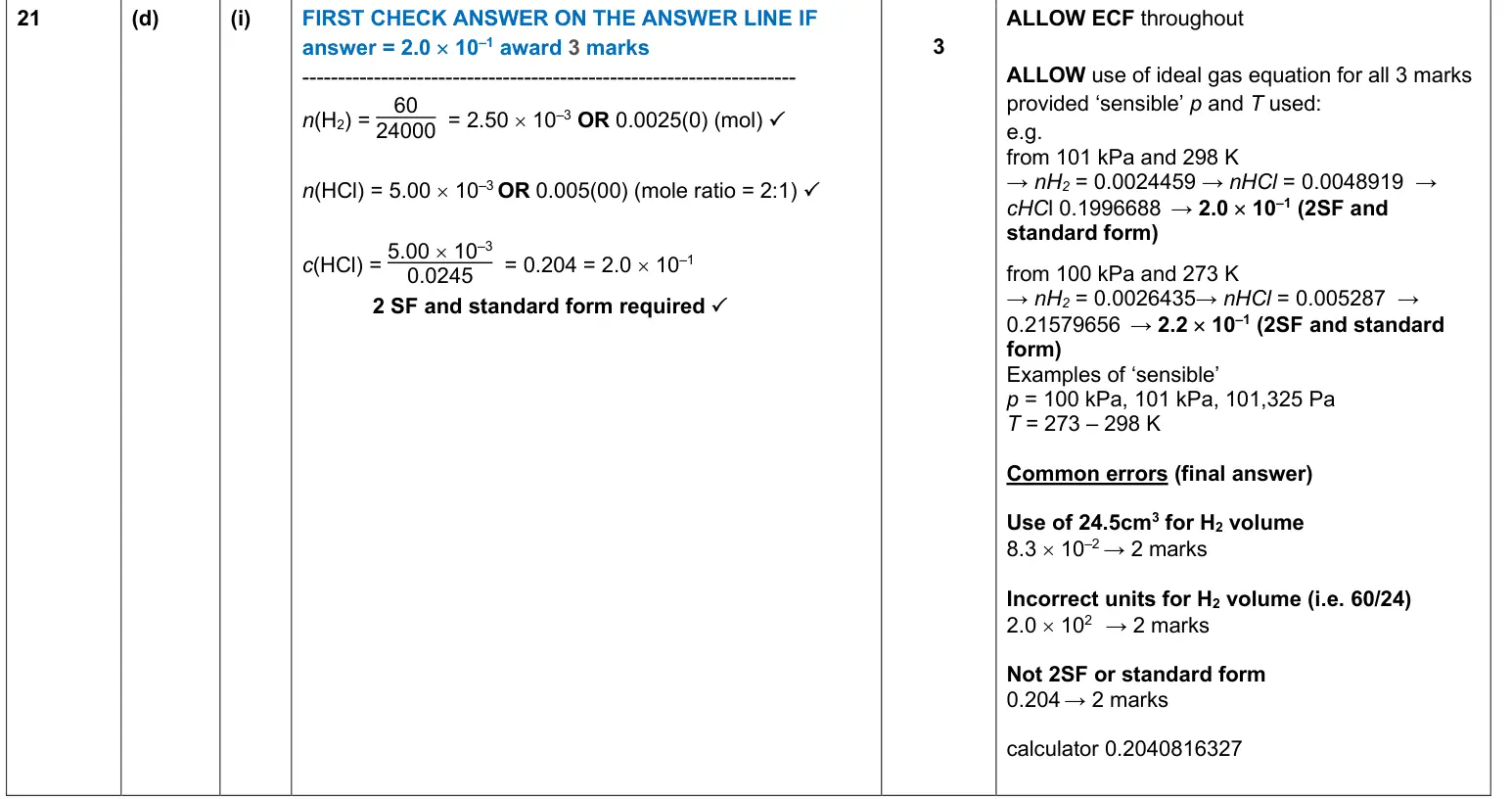
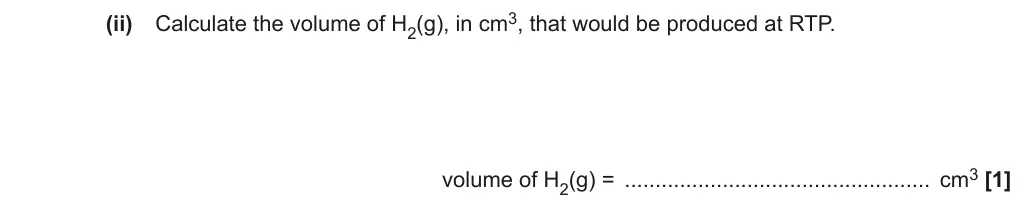
This question discriminated well. It requires the use of the graph to determine that 60 cm3 was the volume of gas evolved and hence calculate moles of H2. Many low scoring candidates did not read the volume of gas from the graph, using 24.5 cm3 instead. ‘Error carried forward’ marks could be given to candidates who subsequently multiplied an incorrectly calculated value by two to reflect stoichiometry and hence calculate moles of HCl reacted. The final mark needed use of moles = concentration x volume to calculate HCl concentration (as well converting to standard form and giving to 2 significant figures). Candidates who scored low on the whole paper tended to struggle to make an attempt on this question.
Notes from the mark scheme and report
2 sig figs AND standard form required
final volume 60 cm3 read from graph
common errors: using 24.5 cm3 as H2 volume, 60/24 (units), 0.204 not in standard form (2 marks each)
2:1 HCl:H2 ratio
Skills: M0.1 Recognise and use expressions in decimal and ordinary form; M0.2 Use ratios, fractions and percentages; M1.1 Use an appropriate number of significant figures; M3.1 Translate information between graphical, numerical and algebraic forms; PAG9 Rates of reaction – continuous monitoring
June 2025 · Paper 1 · Q21(d)(i)5 marksCalculationEasy
Mark scheme
Examiner's comment
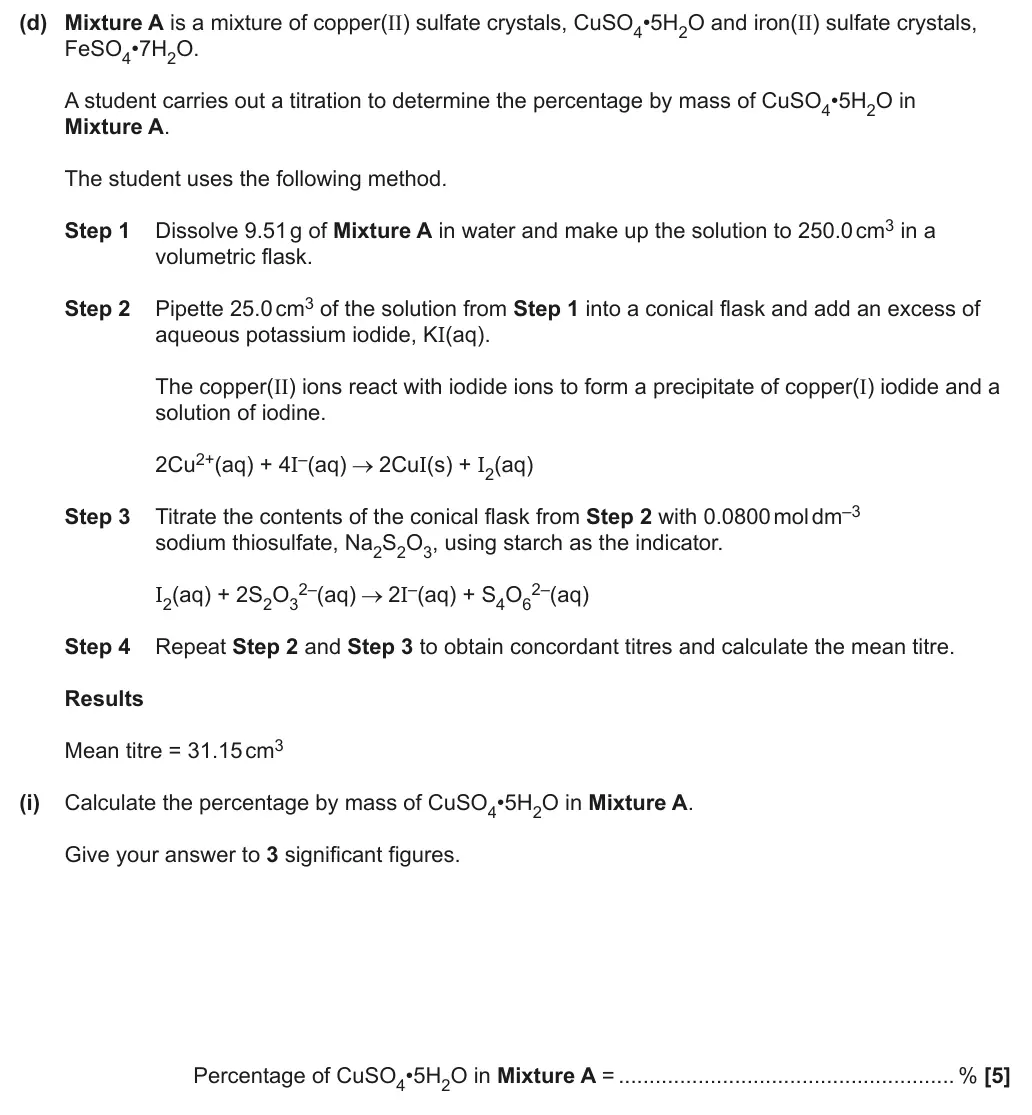
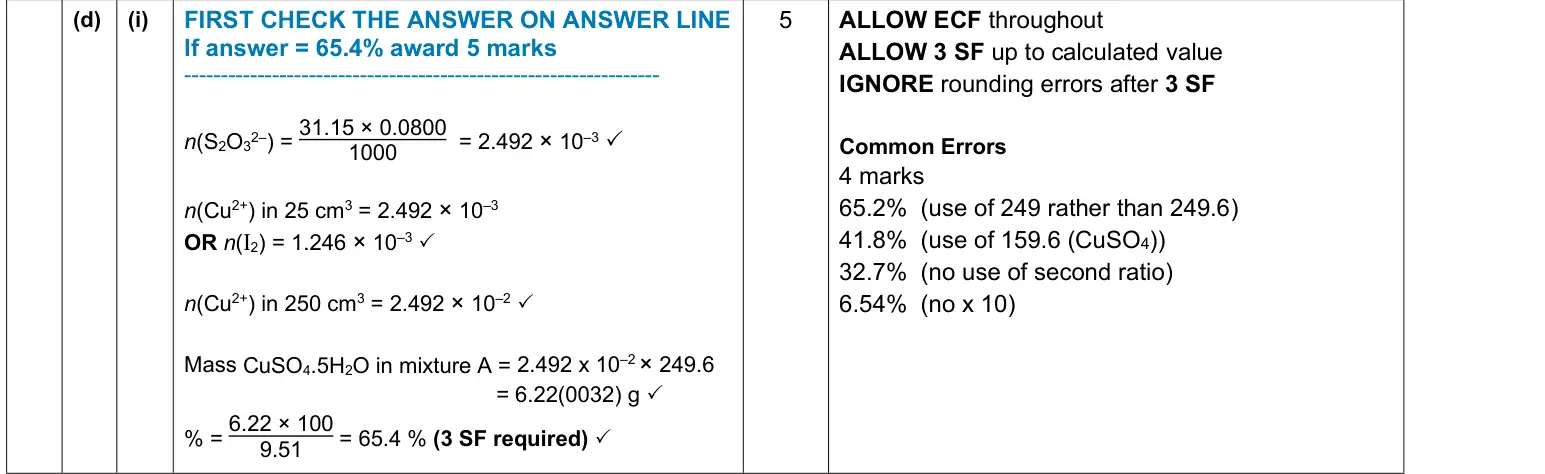
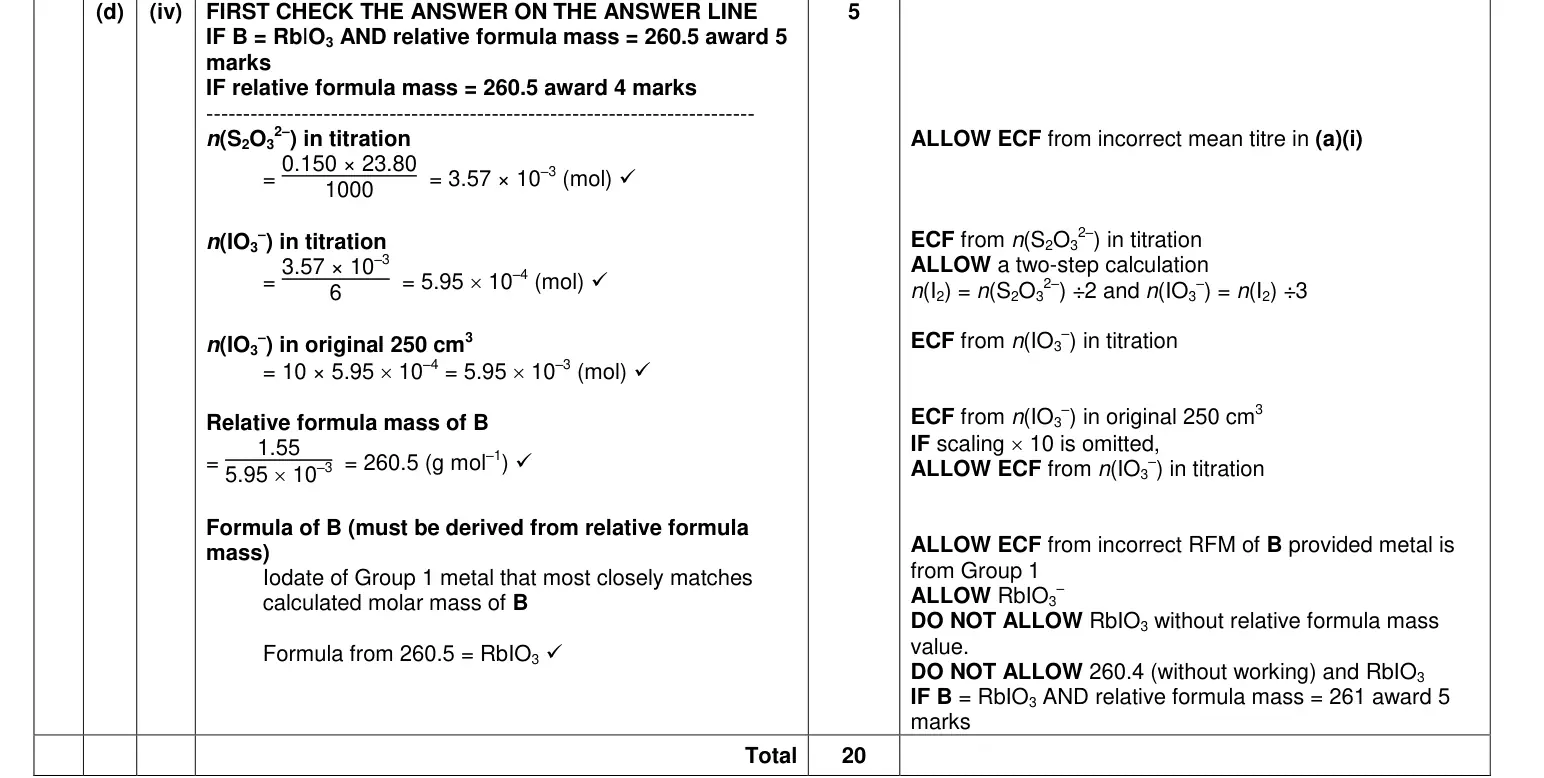
This calculation was answered well by many candidates. It is good to see that the level of communication throughout the multistep calculations is improving compared to previous series, although some candidates are still writing numbers with no indication as to what the number relates to. Annotation allows ECF to be given to a correct method, despite an incorrect value being given during the process. This also, more importantly, allows to candidate to remain focused on what is being calculated. The key steps were: • Calculating the number of moles of S2O32- • Using the molar ratio to link to the number of moles of Cu2+ • Calculating the number of moles in the original volume Calculating the mass by multiplying the moles of Cu2+ by the RFM of the hydrated copper sulfate. • Calculating the percentage in the mixture Common errors were that candidates: • Forgot to use the ratio within the equation. • Forgot to x 10 to calculate the moles in the original sample. • Used the incorrect RFM of copper sulfate or a combined RFM of the two salts CuSO4.5H2O and FeSO4.7H2O. • Divided the total mass of both salts (9.51) by the number of moles of CuSO4 to get a combined Mr. The candidate has produced a correct and fully annotated calculation. This clarity allows the candidate to remain focused on each calculation step. Any miscalculation could then easily gain ECF through a clear method.
Notes from the mark scheme and report
common errors (4 marks): 65.2% (Mr 249), 41.8% (Mr of anhydrous CuSO4 159.6), 32.7% (second ratio not used), 6.54% (no ×10)
2Cu2+ ≡ I2 ≡ 2S2O3 2– so n(Cu2+) = n(S2O3 2–)
3 SF required
Skills: M0.2 Use ratios, fractions and percentages; M1.1 Use an appropriate number of significant figures; M2.3 Substitute numerical values into algebraic equations using appropriate units for physical quantities
June 2025 · AS Paper 1 · Q25(c)5 marksCalculationEasy
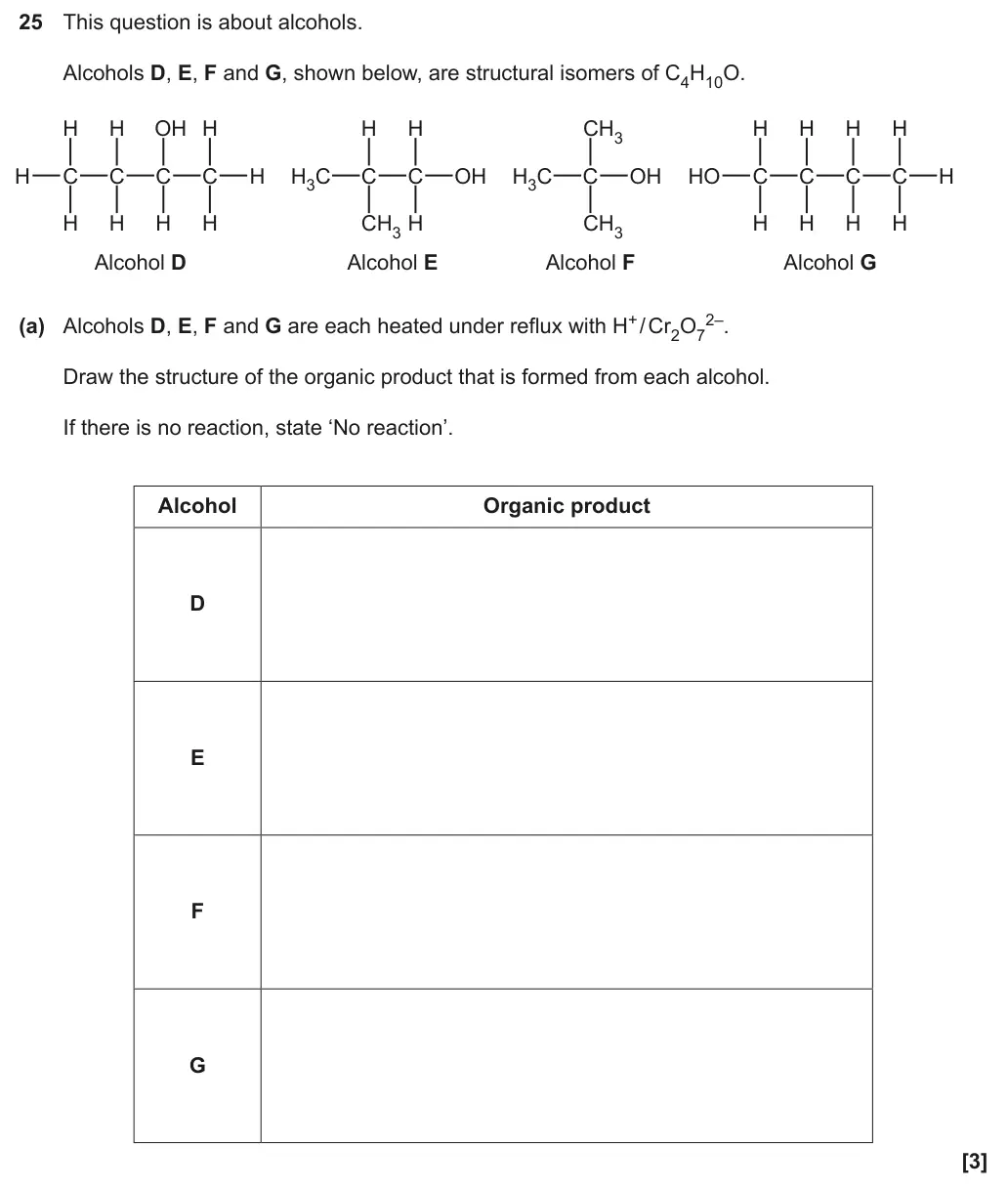
Earlier part of question 25 that this part uses
Mark scheme
Examiner's comment
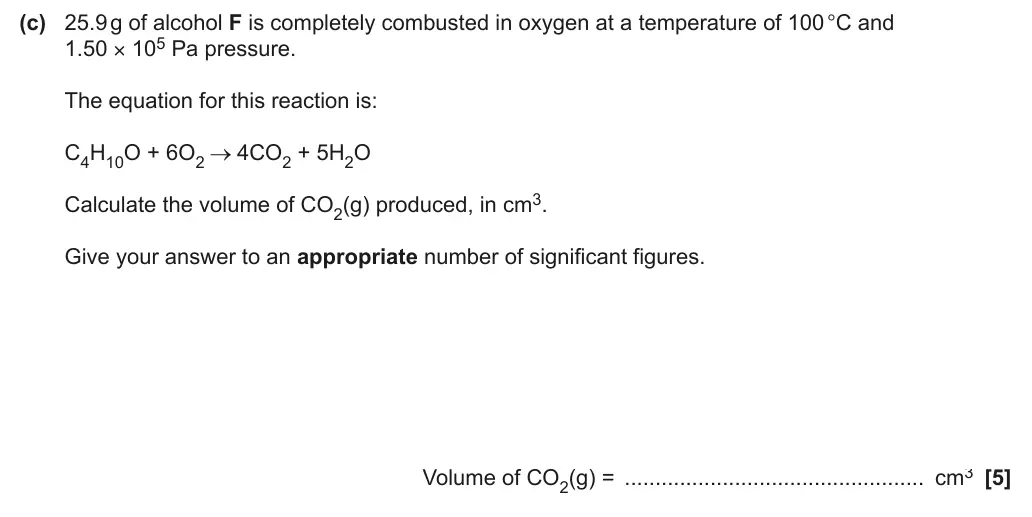
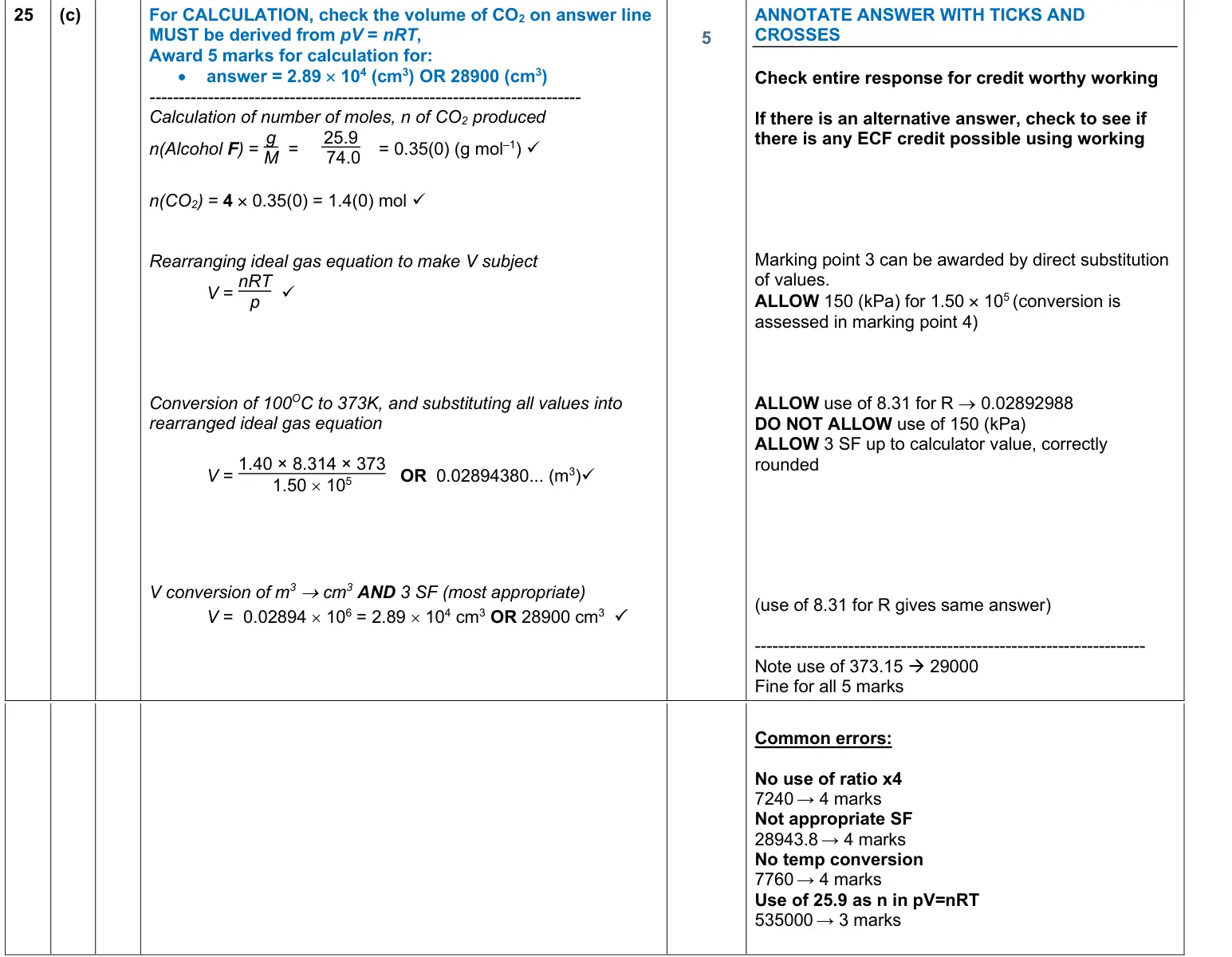
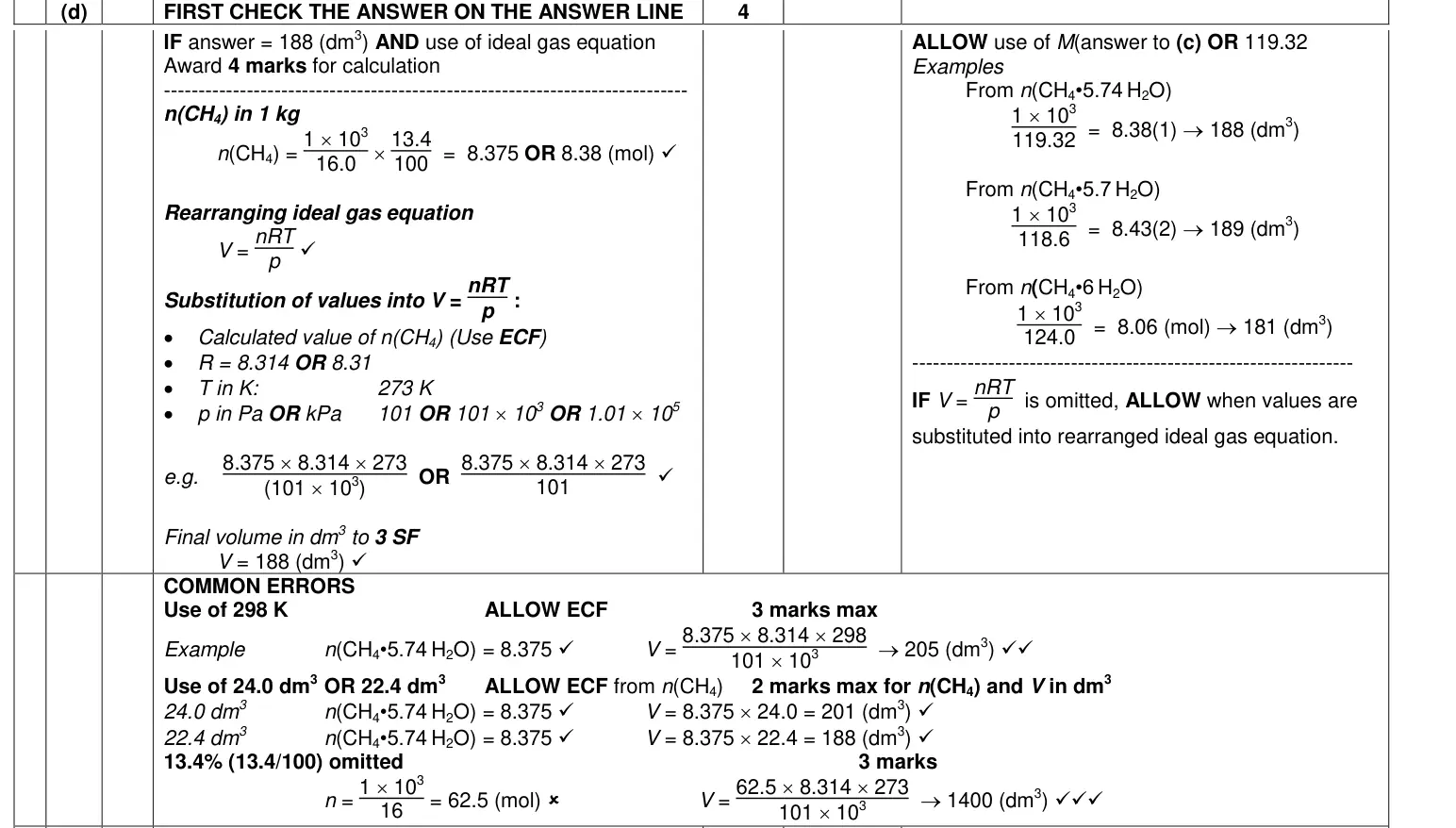
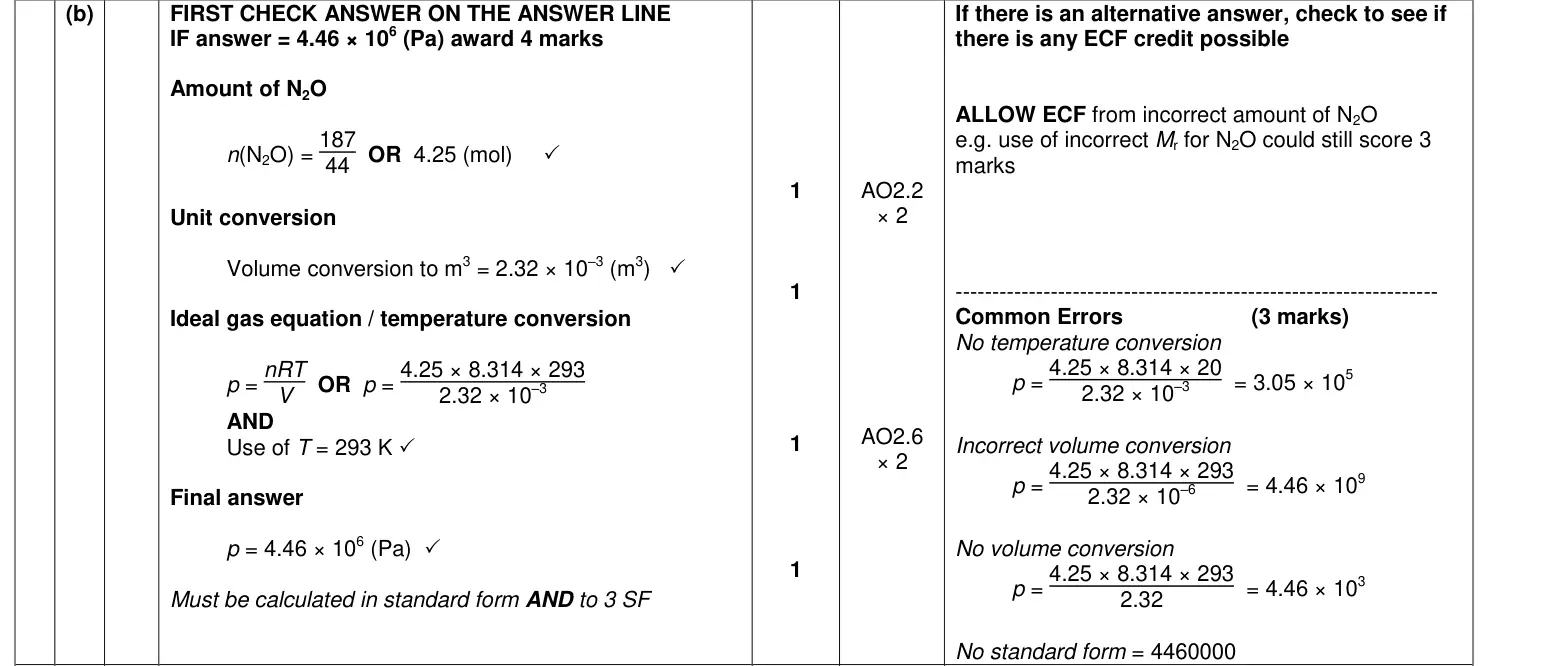
Many candidates followed a well drilled method to apply the ideal gas equation to this calculation (including writing each term down and converting where necessary): • Moles of alcohol F used • Multiplication by 4 to give moles of CO2 • Rearranging the ideal gas equation • Substituting the correct values using the correct conversion to Kelvin for temperature • Converting from m3 to cm3 and giving the response to an appropriate number of significant figures (3 in this case) Most candidates scored at least 3 marks on this question. Common errors were using the number of moles of alcohol instead of the number of moles of carbon dioxide in the rearranged ideal gas equation, converting from m3 to cm3 incorrectly in the final step (usually only multiplying by 1,000 rather than 1,000,000) and not giving the response to an appropriate number of significant figures. Occasionally, candidates did not convert to Kelvin or used the pressure in kPa instead of Pa. This response shows an example of clear working. Values are assigned to each term and moles calculated correctly. Rearrangement and substitution of values is shown and correct. The appropriate number of significant figures is given, but the response only converted to dm3 not cm3. This response was given 4 marks.
Notes from the mark scheme and report
must use pV = nRT
common errors: no ×4 ratio (7240), no conversion to K (7760), not 3 sig figs (28943.8), using 25.9 as n
DO NOT ALLOW 150 kPa unconverted in the final calculation
Candidates should understand that the lowest level of significant figures in the raw data provided for a calculation will determine the number of significant figures that should be given in the final answer. More details can be found in Section M1.1 of the Mathematical Skills Handbook.
Skills: M0.0 Recognise and make use of appropriate units in calculations; M1.1 Use an appropriate number of significant figures; M2.2 Change the subject of an equation; M2.3 Substitute numerical values into algebraic equations using appropriate units for physical quantities
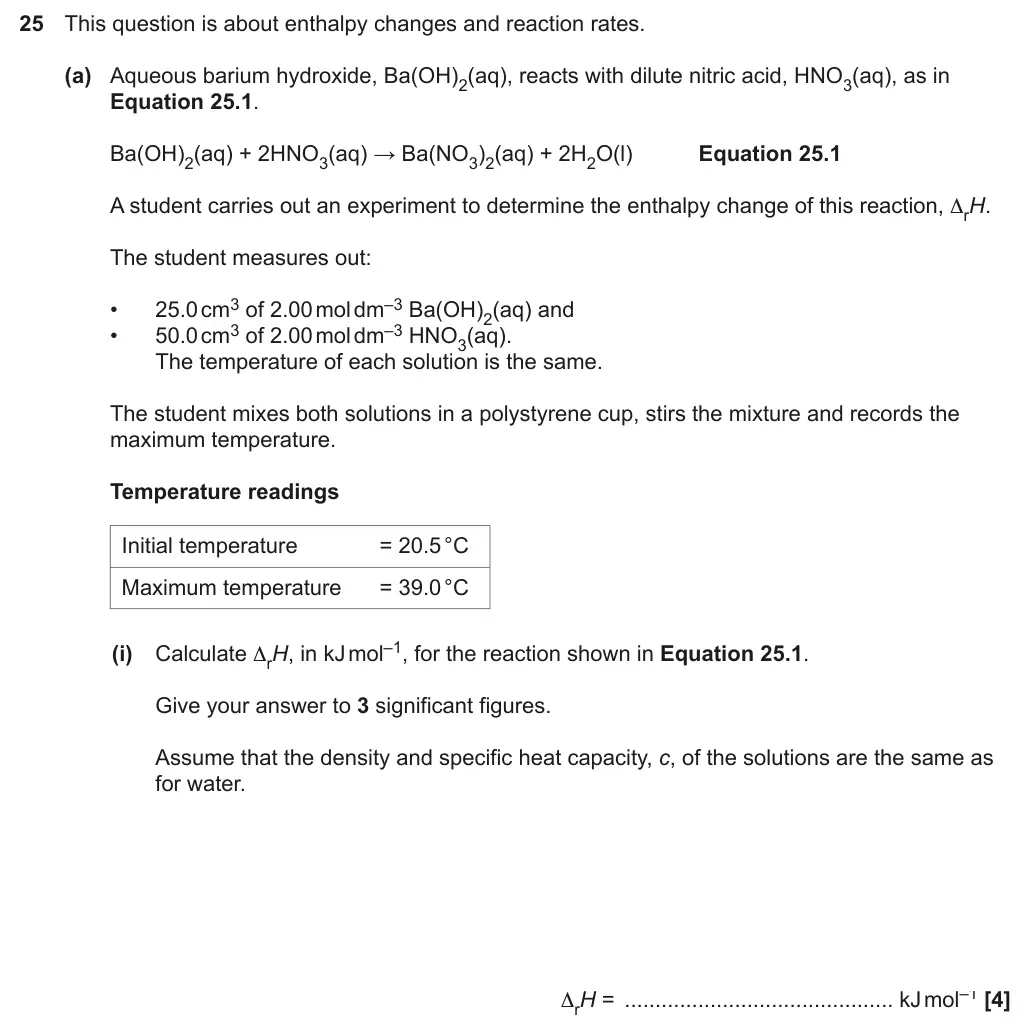
June 2025 · AS Paper 2 · Q1(c)(i)4 marksCalculationEasy
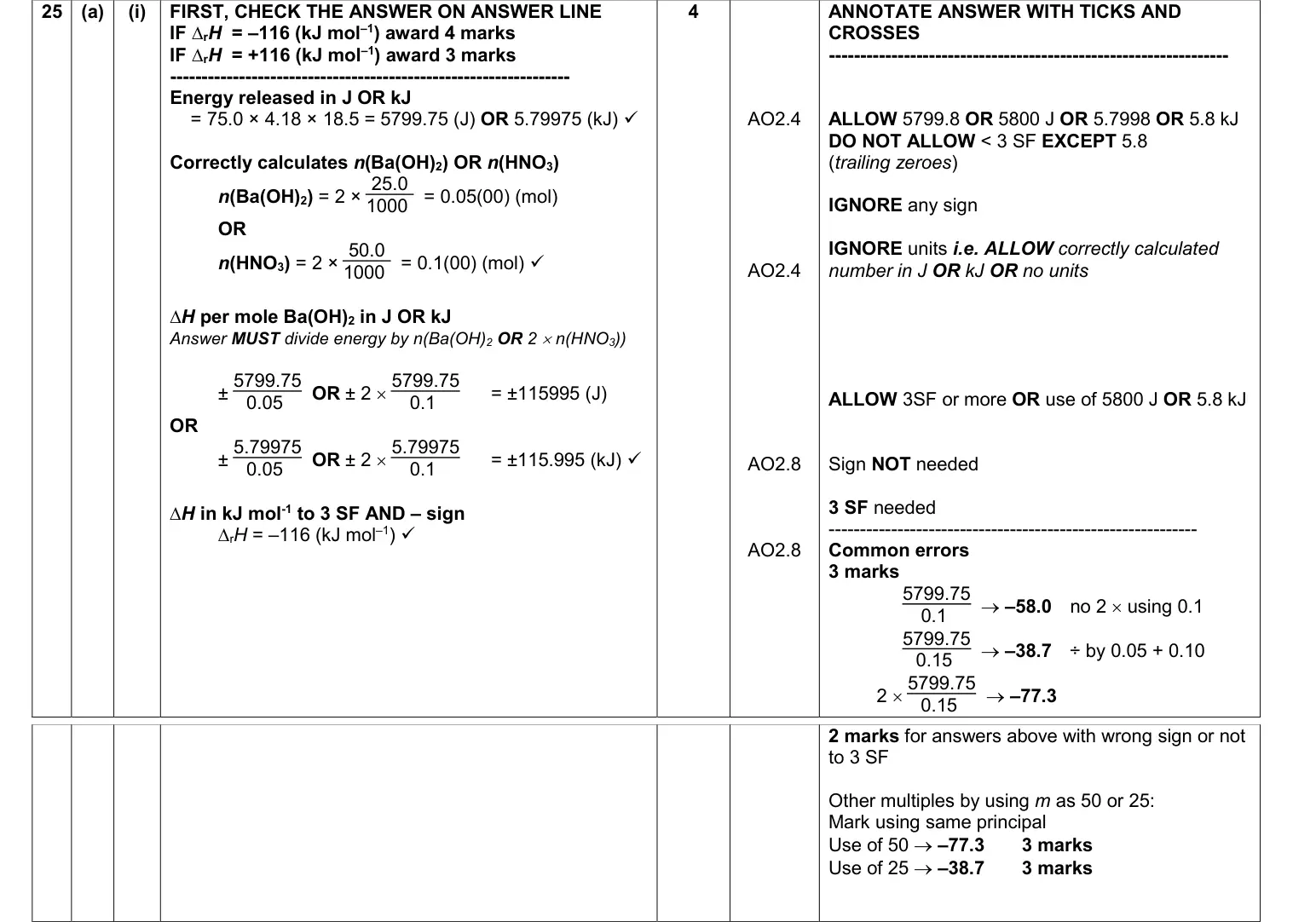
Mark scheme
Examiner's comment
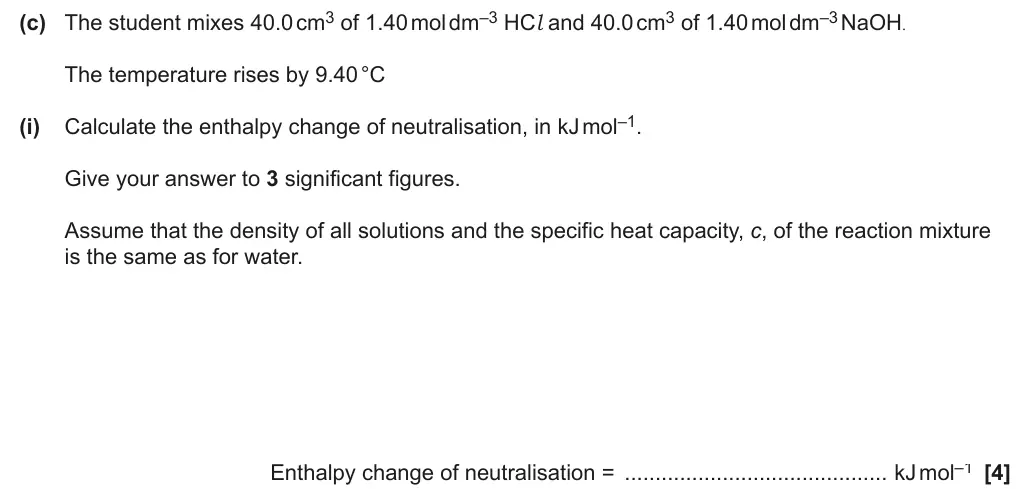
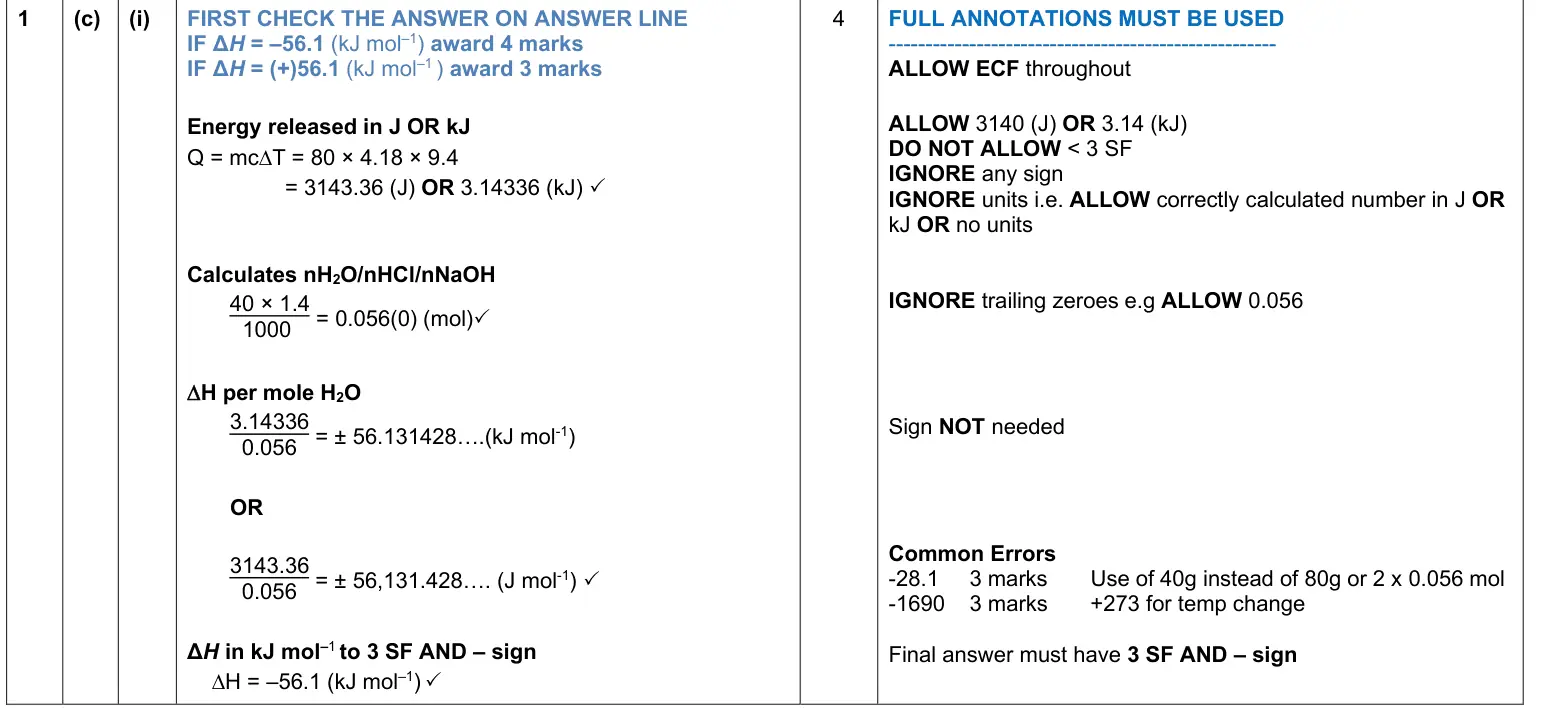
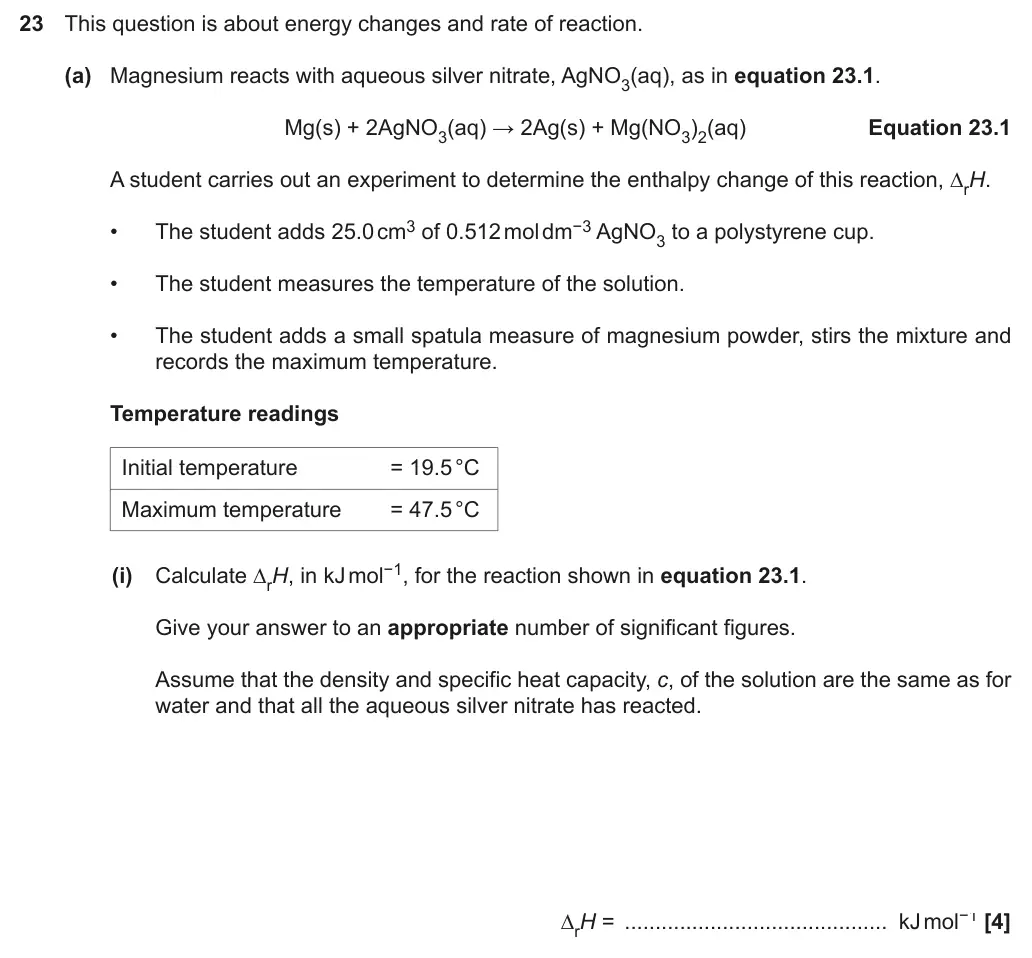
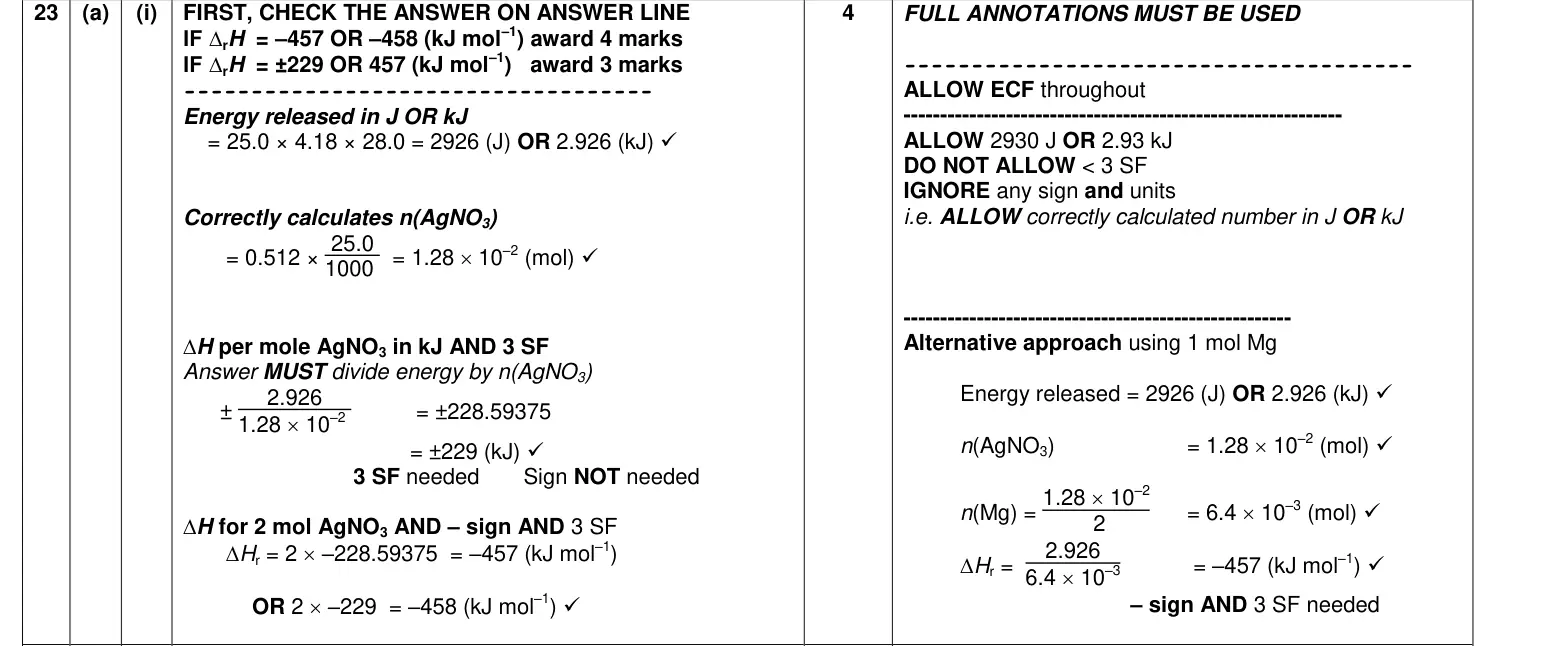
Many well-structured calculations were seen, even if all the marks weren’t achieved. Almost all candi- dates calculated the number of moles involved. For those candidates’ hat didn’t get full marks, it was often caused by using an incorrect mass in Q = mcΔT. Some tried to calculate the mass of NaOH and HCl (from moles and Mr values) while others didn’t add the total volumes together i.e. used 40 g rather than 80 g. Some used moles × 2 i.e. 0.112 rather than per mole of water formed. One of the most common errors was the omission of the negative sign for the final enthalpy change. Some put a positive charge instead. Some lost a mark for the incorrect significant figures.
Notes from the mark scheme and report
common errors (3 marks): –28.1 from using 40 g instead of 80 g or 2 × 0.056 mol, –1690 from adding 273 to the temperature change, +56.1 (no – sign)
3 SF AND – sign required
ALLOW ECF throughout
Skills: M0.0 Recognise and make use of appropriate units in calculations; M1.1 Use an appropriate number of significant figures; M2.3 Substitute numerical values into algebraic equations using appropriate units for physical quantities; PAG3 Enthalpy determination
June 2025 · Paper 2 · Q21 markMultiple choiceMedium
Answer
B
Mark scheme
Examiner's comment
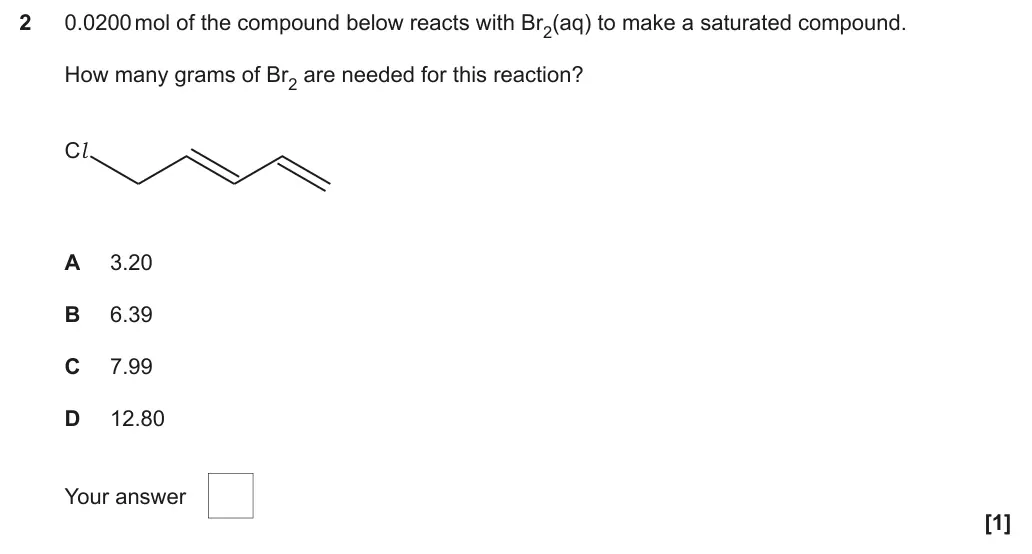
Most candidates gave the correct answer B here. Those that got it correct usually showed clear working on how they obtained their answer. However, many chose A, either using correct mole ratio (recognising 2 double bonds) but with the Ar of Br and not the Mr of Br2 (i.e. 0.04 × 79.9) or used the incorrect mole ratio but correct Mr (i.e. 0.02 × 159.8).
June 2025 · AS Paper 2 · Q2(b)(i)2 marksCalculationHard
Mark scheme
Examiner's comment
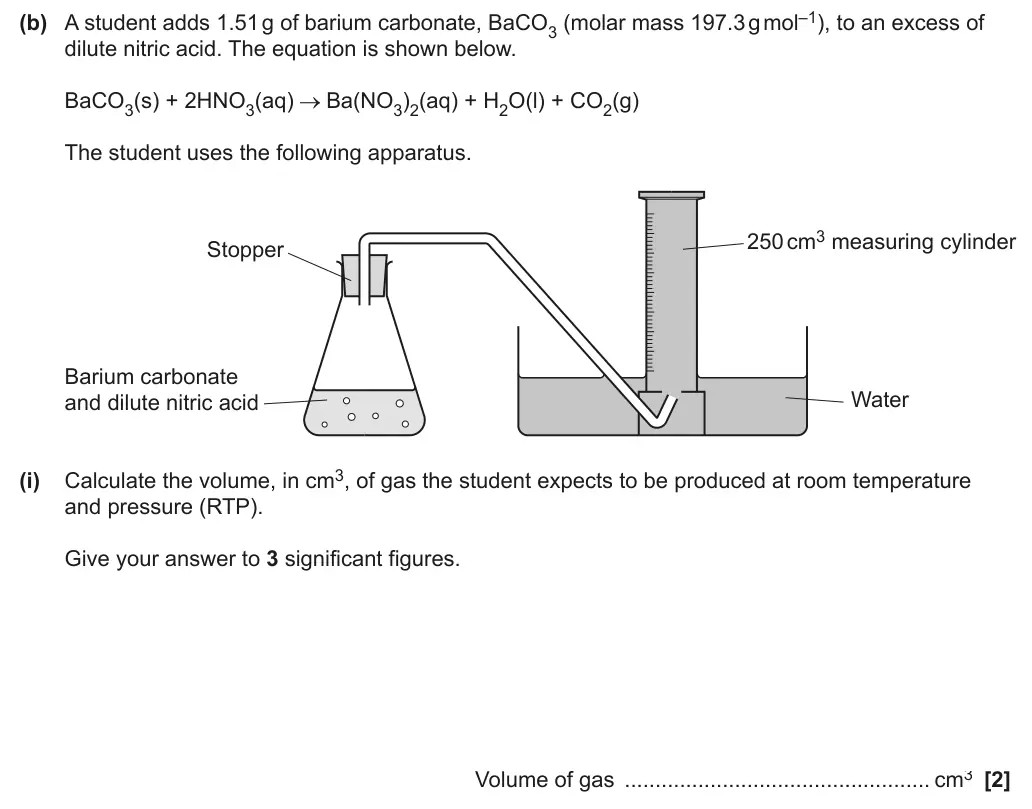
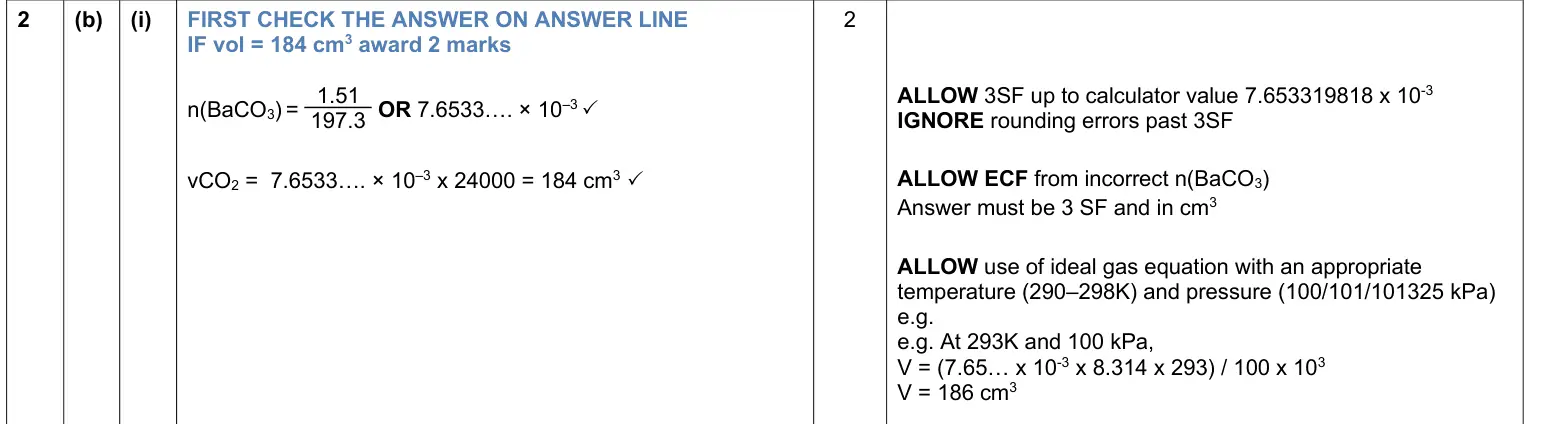
Most were able to correctly calculate the number of moles with the molar mass given in the question. Many were then able to use the molar gas volume at RTP, given on the data sheet, to find the volume of gas. The most common errors seen here were an incorrect number of significant figures, not converting to cm3 but leaving as dm3, and some multiplied by 2. A few candidates attempted to use the ideal gas equation here and if this was done correctly marks were credited.
Notes from the mark scheme and report
answer must be 3 SF and in cm3 (184)
ALLOW ECF from incorrect n(BaCO3)
ALLOW ideal gas equation with appropriate T and p
Skills: M0.0 Recognise and make use of appropriate units in calculations; M1.1 Use an appropriate number of significant figures; M2.3 Substitute numerical values into algebraic equations using appropriate units for physical quantities; PAG1 Moles determination
June 2025 · AS Paper 2 · Q2(b)(ii)2 marksShort answerHard
Earlier part of question 2 that this part uses
Mark scheme
Examiner's comment
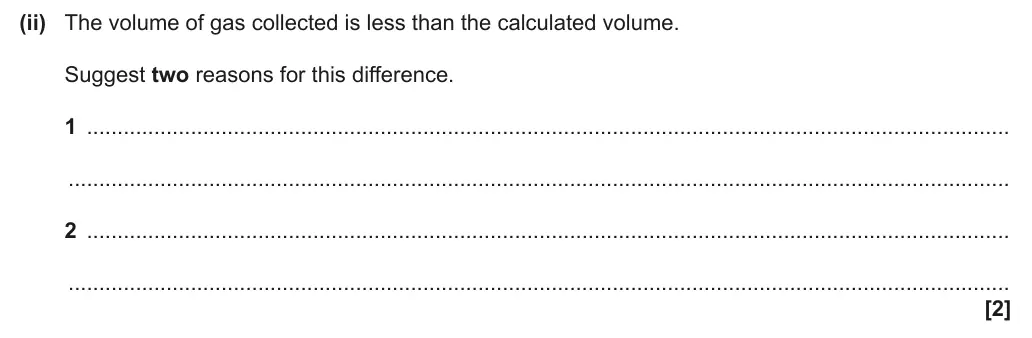
A very challenging question with most candidates failing to score any marks. Only a few correctly sug- gested the gas dissolving in water or the use of non-standard conditions. Most correct responses were for gas lost while replacing the stopper. Most mentioned loss of gas but didn’t link to the procedure to say how it was lost. Lots of candidates suggested that the reaction was incomplete despite being told the acid is in excess in the question. Candidates should consider that if a reagent is in excess, the reaction is expected to go to completion. Many suggested faults with setting up apparatus – possibly from personal experience. We wanted them to consider the limitations should this be set up without ‘human’ errors. A lot of candidates discussed the various leaks in the apparatus as the sources of gas loss. Some made reference to gas present in the tubing already not understanding that it would push through and displace gas to fill the measuring cylin- der, with equivalent amount being left in tubing at the end.
Notes from the mark scheme and report
gas escapes while bung is replaced
some CO2 dissolves in the water
conditions not at RTP
IGNORE incomplete reaction and human errors such as unsealed apparatus
We provide support to help students prepare for questions based on the practical work they have carried out. Each of our suggested practicals has extension questions which can be used to explore practical work in more detail and evaluate different procedures.
This question links well with PAG 1.1: https://teachcambridge.org/item/b9be7815-8c49-4fd6- b0eb-8f476393c653
Skills: PAG1 Moles determination
June 2025 · AS Paper 2 · Q2(b)(iii)1 markShort answerMedium
Earlier parts of question 2 that this part uses
Mark scheme
Examiner's comment
Around half of the candidates gained a mark for this question. Many suggested the use of “gas syringe” but from their response in (i) it was clear that a significant number didn’t understand how this would im- prove the experiment. Lower-attaining candidates sometimes couldn’t give the correct name for a gas syringe suggesting “gas volume measurer” or “gas tube” instead. Some other incorrect responses included: • Improve resolution on measuring cylinder • Use a larger mass of BaCO3 • Leave reaction for longer • Heat to a constant mass • Make sure delivery tube is further in the measuring cylinder • Make sure connections are airtight
Notes from the mark scheme and report
gas syringe in place of upturned measuring cylinder, or carbonate in a small tube released into the acid without removing the stopper
IGNORE gas cylinder
Skills: PAG1 Moles determination
June 2025 · Paper 2 · Q31 markMultiple choiceMedium
Answer
C
Mark scheme
Examiner's comment
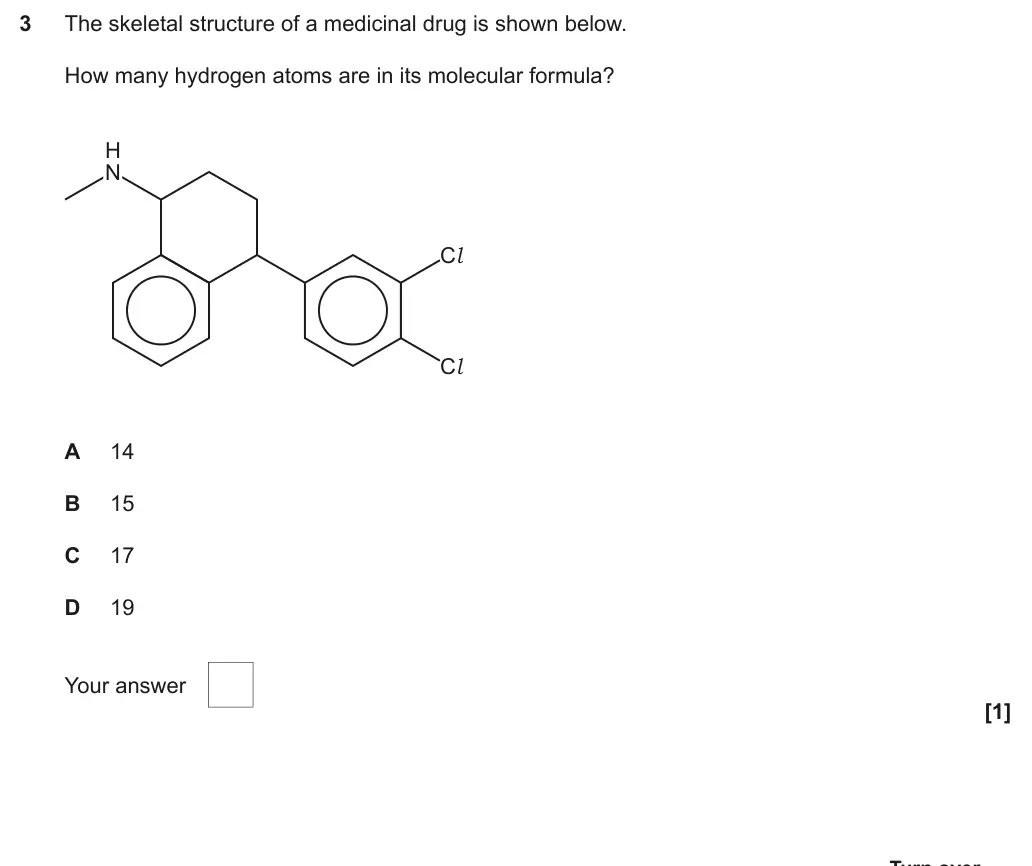
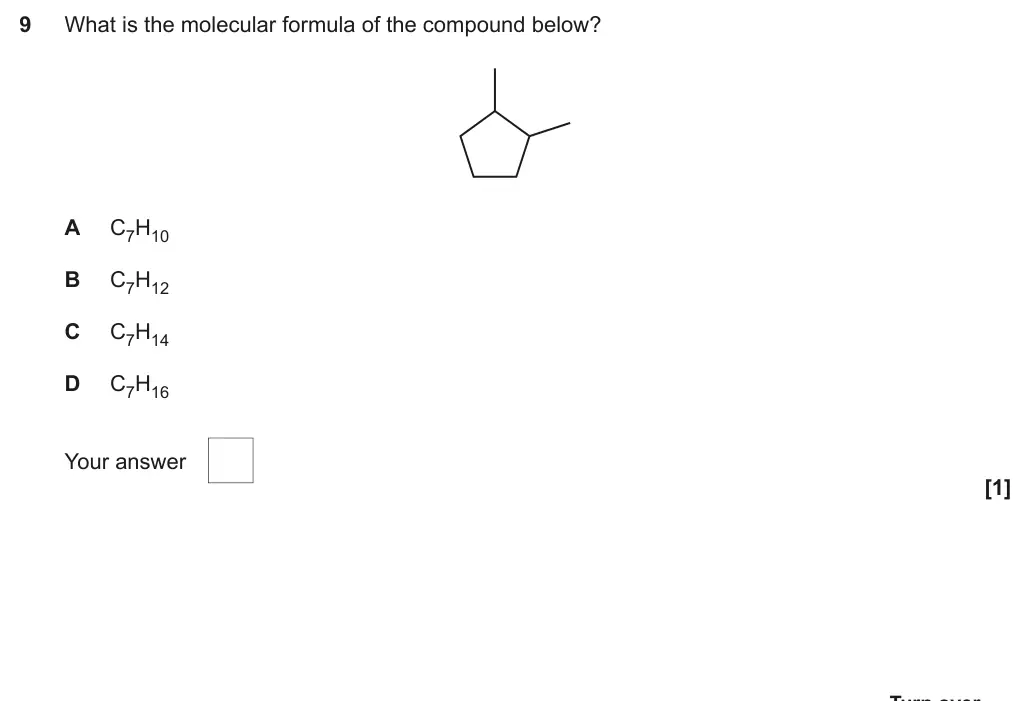
Most gave the correct answer C here. Many candidates added hydrogens onto the structure to aid counting with some even drawing out the displayed structure. The most common incorrect response was D.
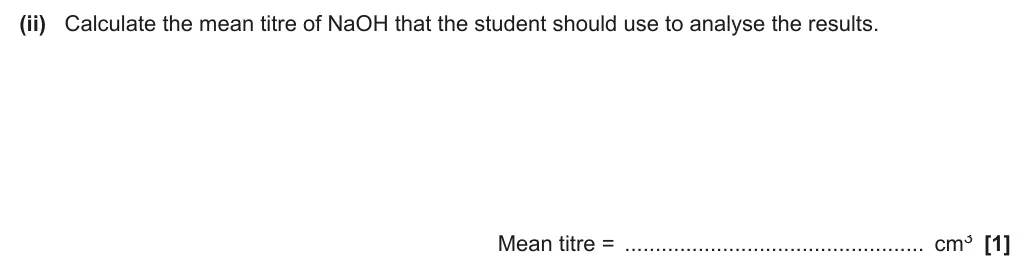
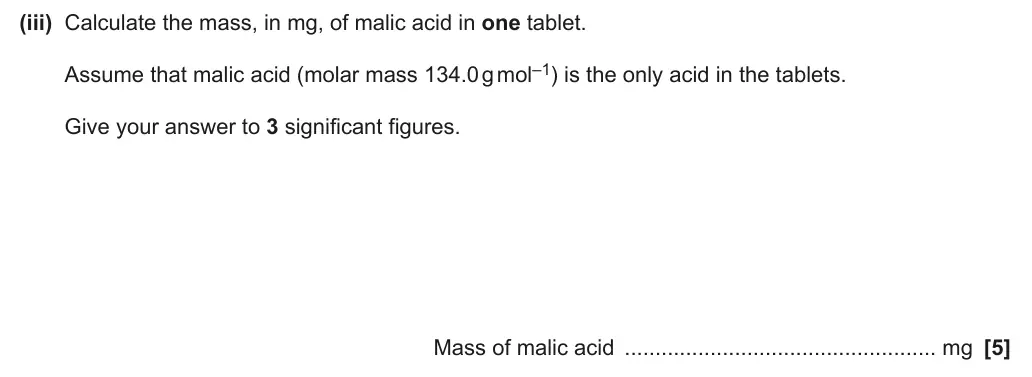
June 2025 · AS Paper 2 · Q3(a)(iii)5 marksCalculationEasy
Earlier parts of question 3 that this part uses
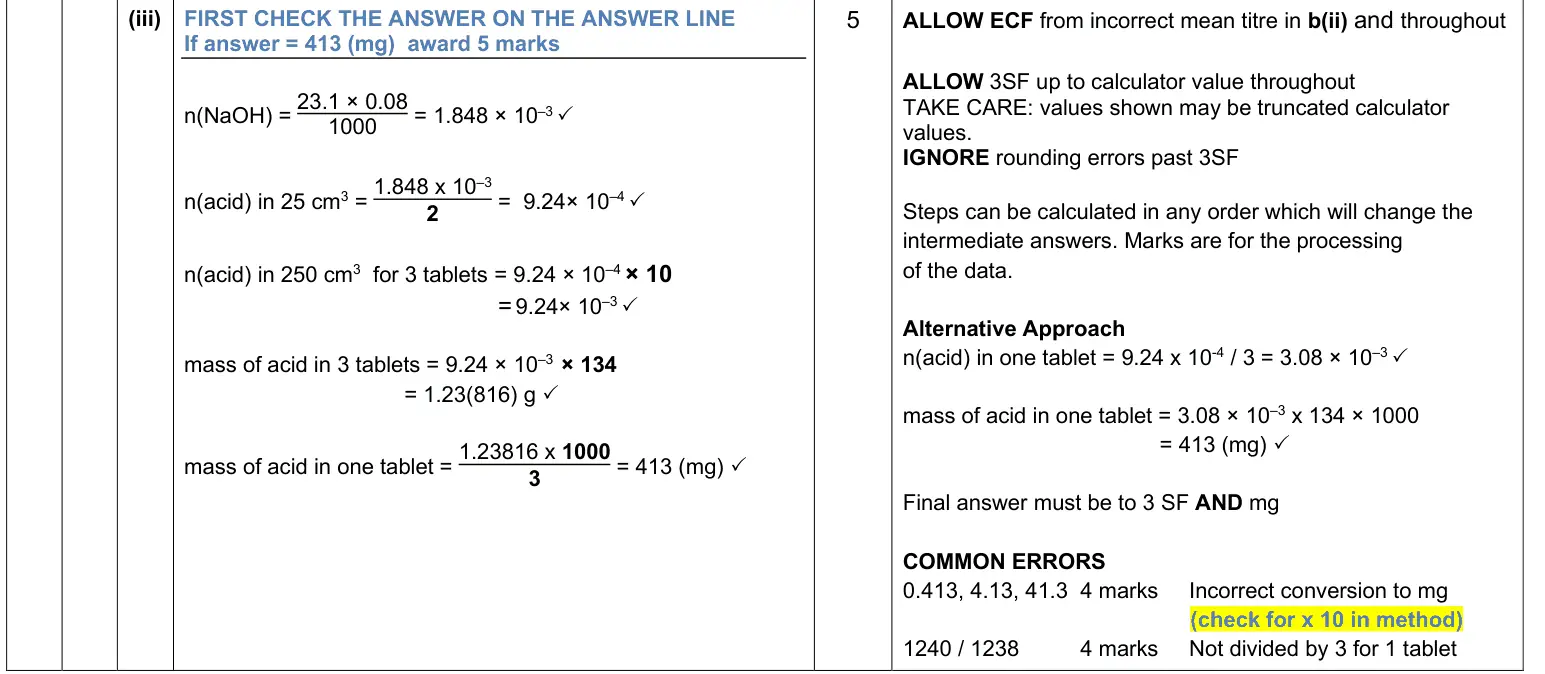
Mark scheme
Examiner's comment
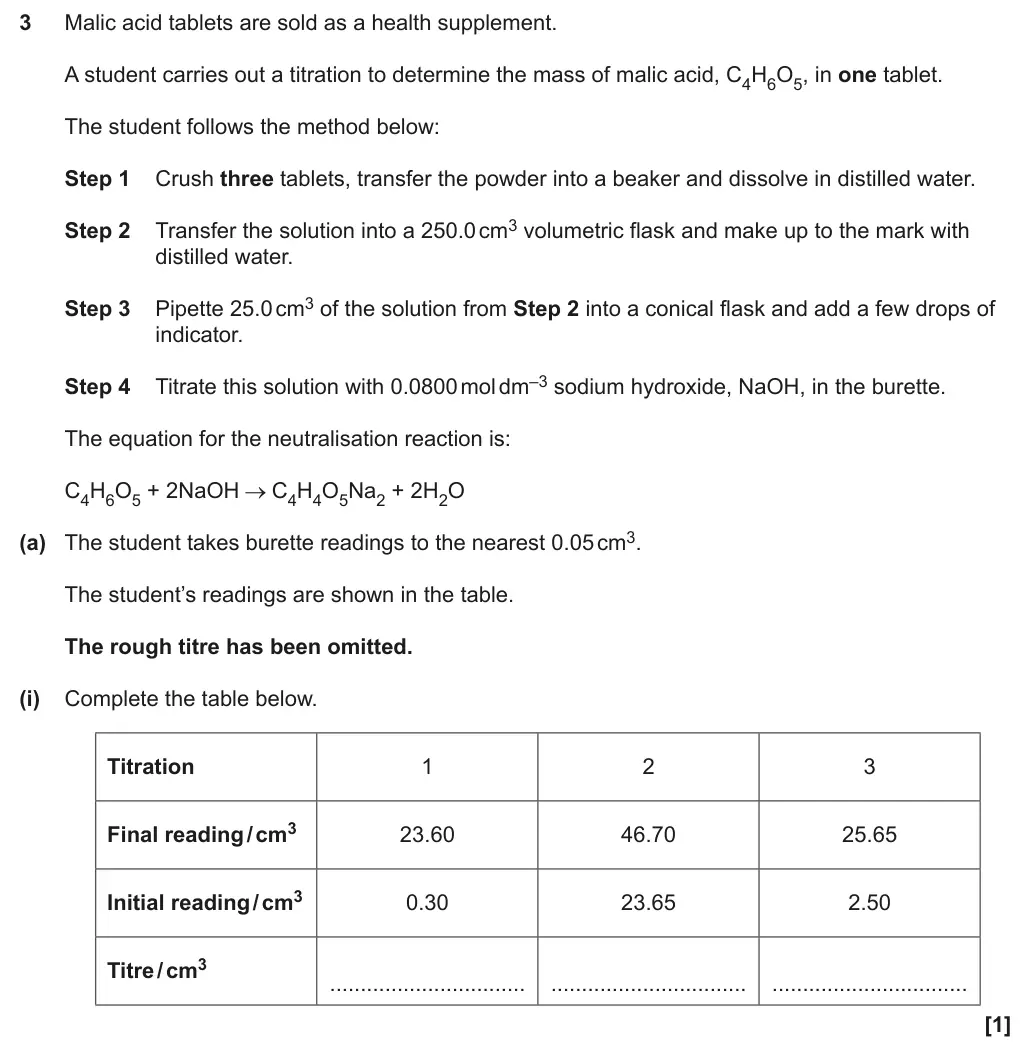
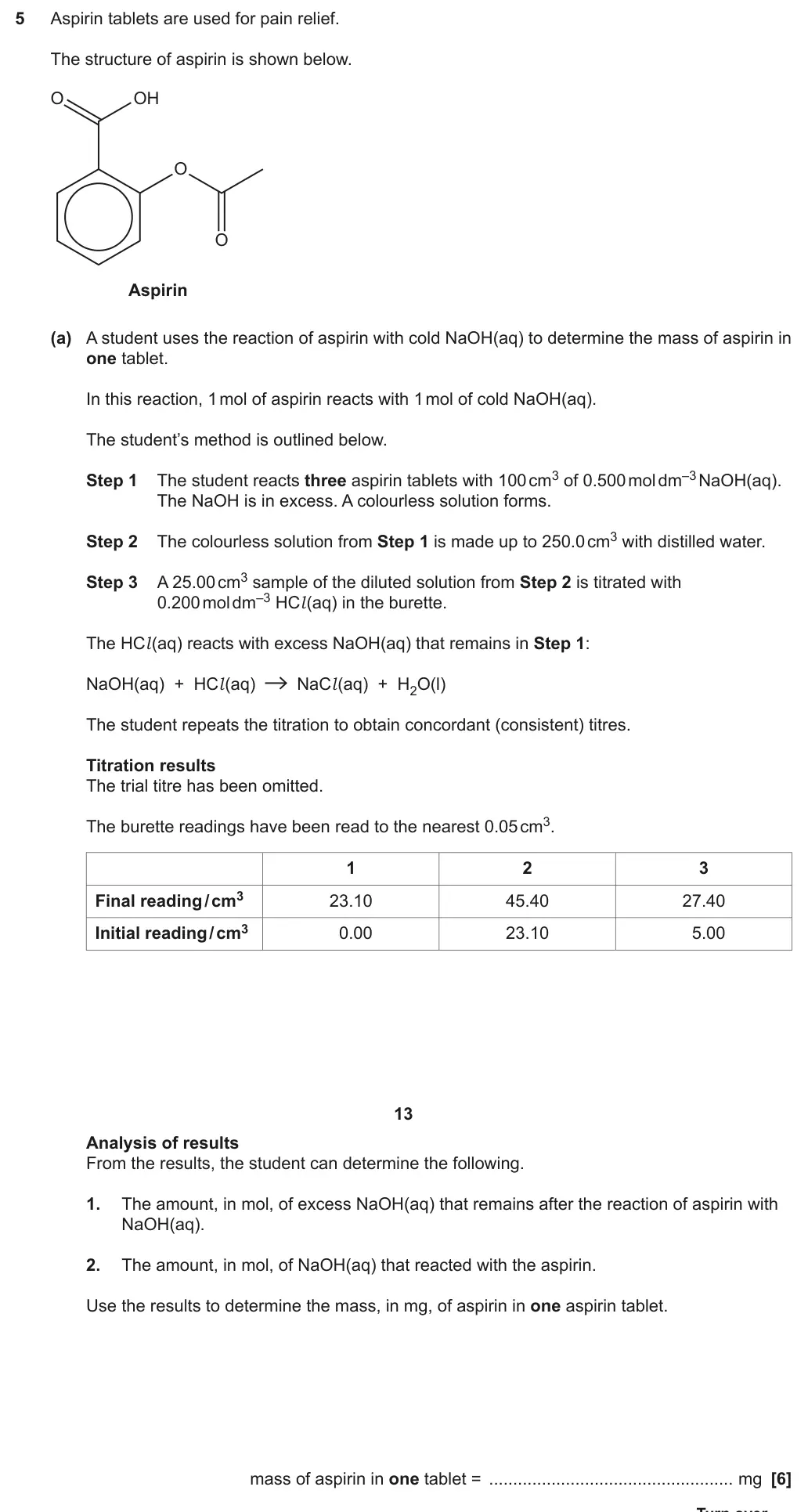
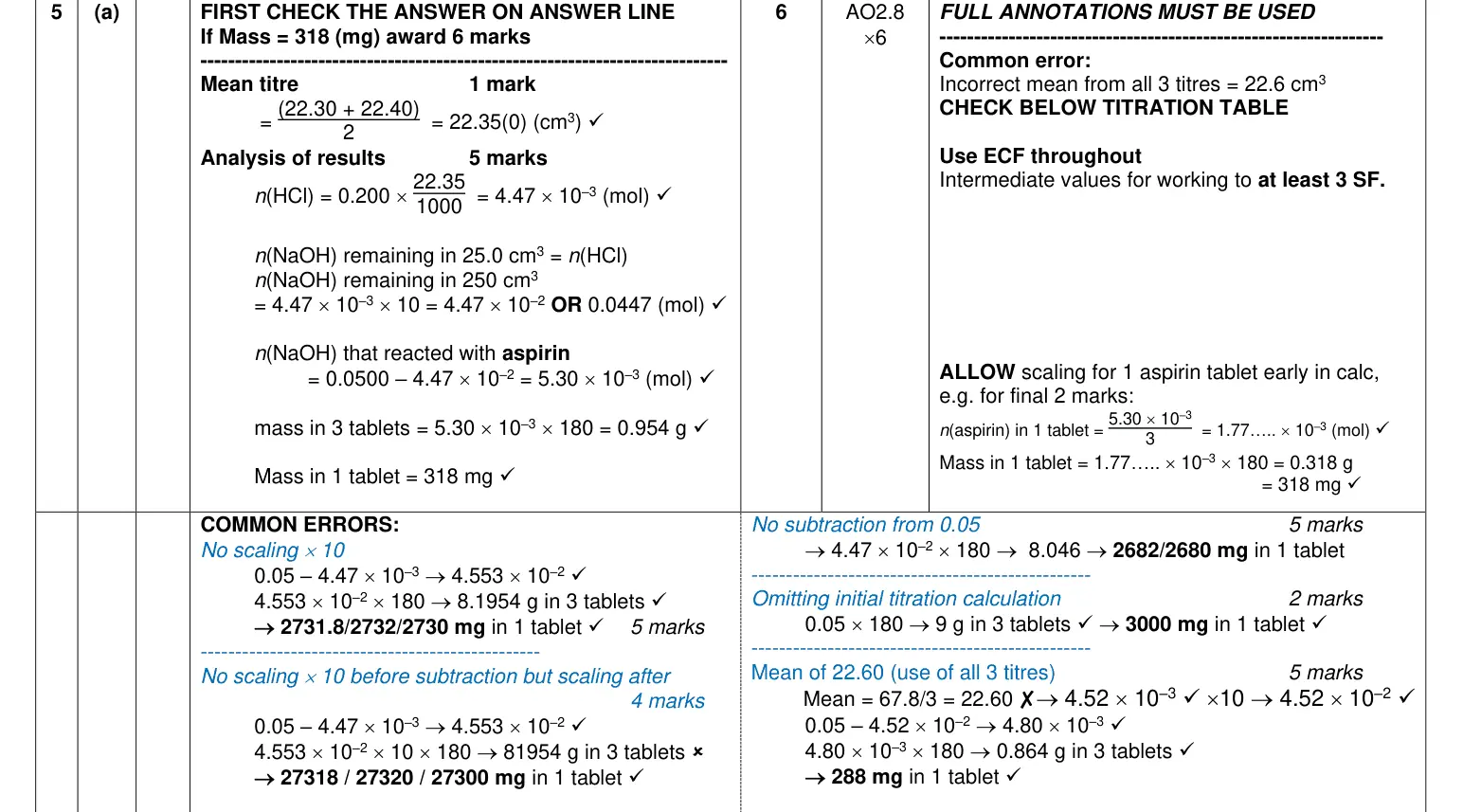
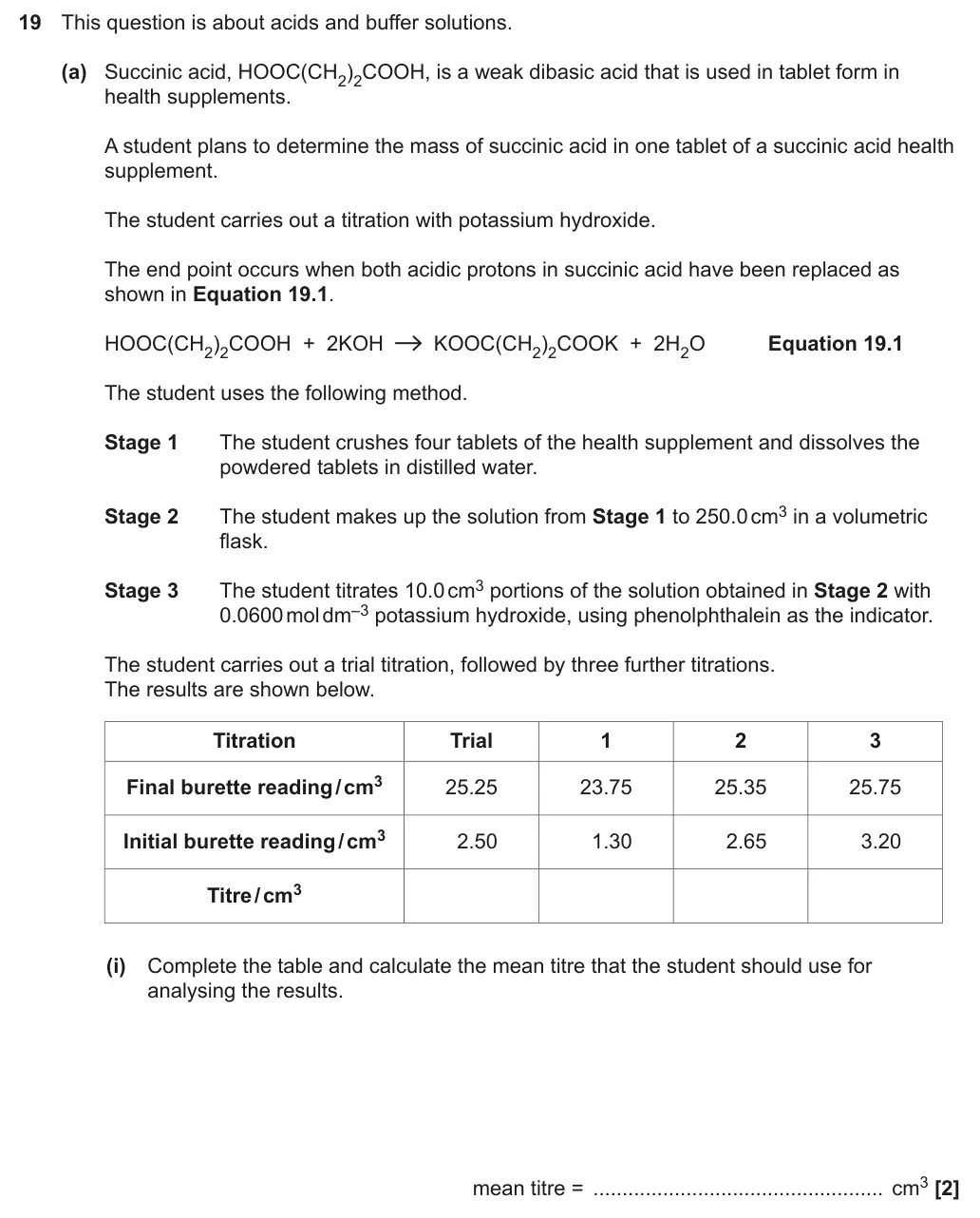
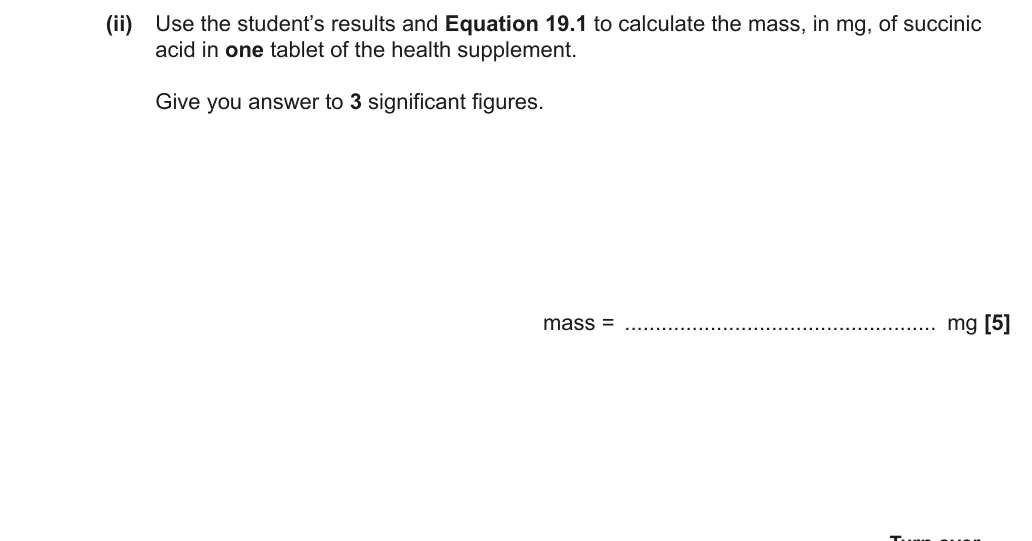
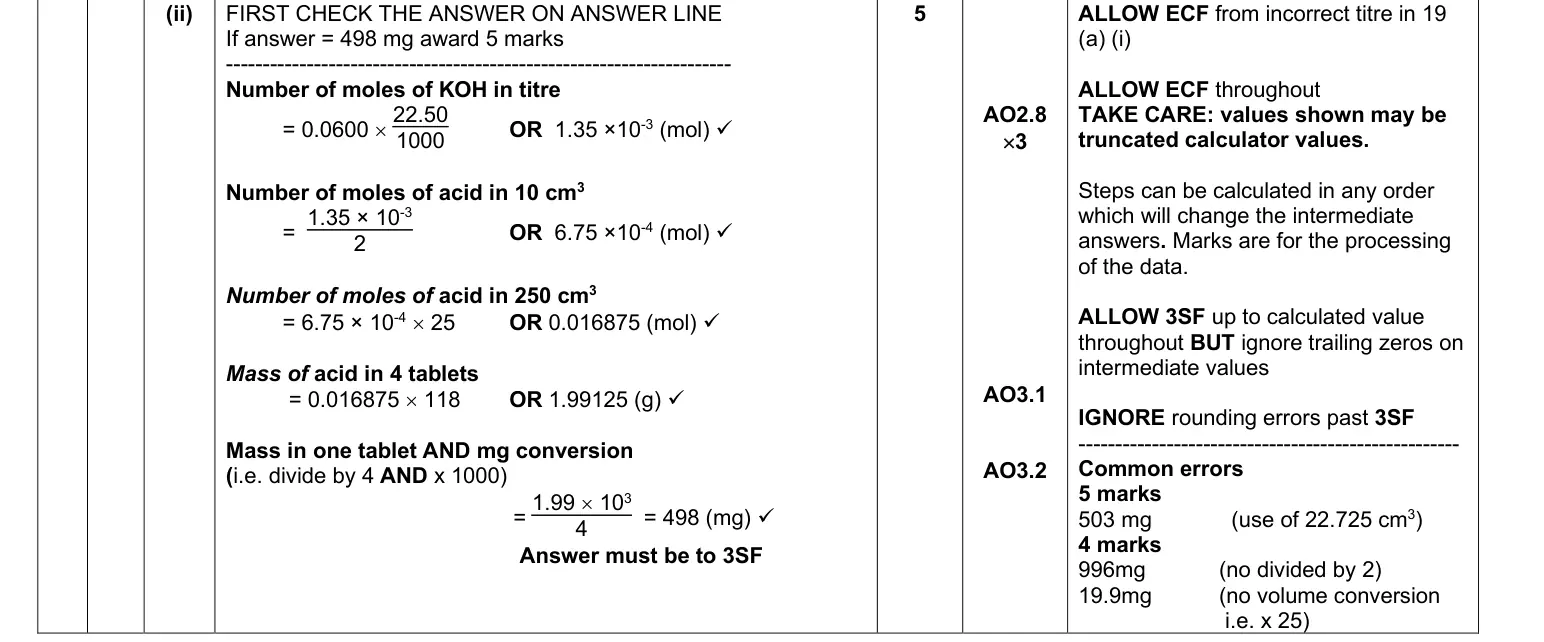
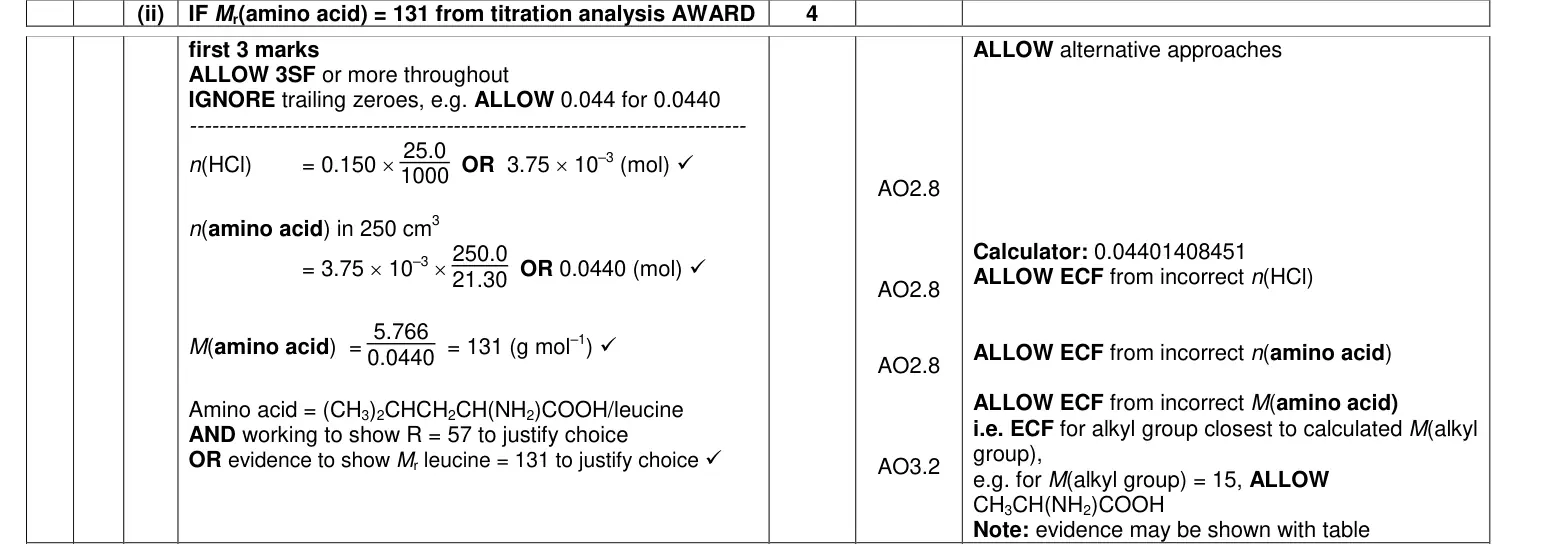
Many responses were well constructed and showed most of the stages. This made it much easier to award error carried forward (ECF) marks if a correct response was not obtained. Around a quarter of candidates were able to score all 5 marks. Almost all candidates scored the first 2 marks. However, it was sometimes hard to follow the steps a candidate had taken to obtaining a final response, due to: • Steps not being labelled • Steps merging into one another (all equalling each other despite different processes) • Competing alternative methods described without crossing through incorrect working. Many candidates did not gain marks for unit conversions i.e. not converting volumes from cm3 to dm3 and incorrectly converting g to mg. Some did not gain marks for missing the × 10 step. Lower-attaining candidates often didn’t use the titre value obtained in (ii) but used 25 cm3 instead, muddling which vol- ume value should be attributed to which reactant. Maths Skills for AS Chemistry It is important for candidates to have the opportunity to develop their maths skills as part of the course. Particular attention should be paid as to how to: • Setting out the working for calculations • Keeping the full value of any step in their calculator to use in the next step • Common unit conversions, e.g. dm3 to cm3 • Giving the final answer to an appropriate number of significant figures or that asked for in the question • Checking their working for any errors Some support can be found in our Maths Skills Handbook: https://www.ocr.org.uk/Images/295468-chemistry-mathematical-skills-handbook.pdf This article from the RSC contains some useful resources: https://edu.rsc.org/resources/maths-skills-for-chemistry/4013899.article
Notes from the mark scheme and report
common errors (4 marks): 0.413/4.13/41.3 incorrect conversion to mg, 1240 not divided by 3 tablets
1:2 acid:NaOH
×10 for 250 cm3
3 SF AND mg
Skills: M0.0 Recognise and make use of appropriate units in calculations; M0.2 Use ratios, fractions and percentages; M1.1 Use an appropriate number of significant figures; M2.3 Substitute numerical values into algebraic equations using appropriate units for physical quantities; PAG2 Acid–base titration
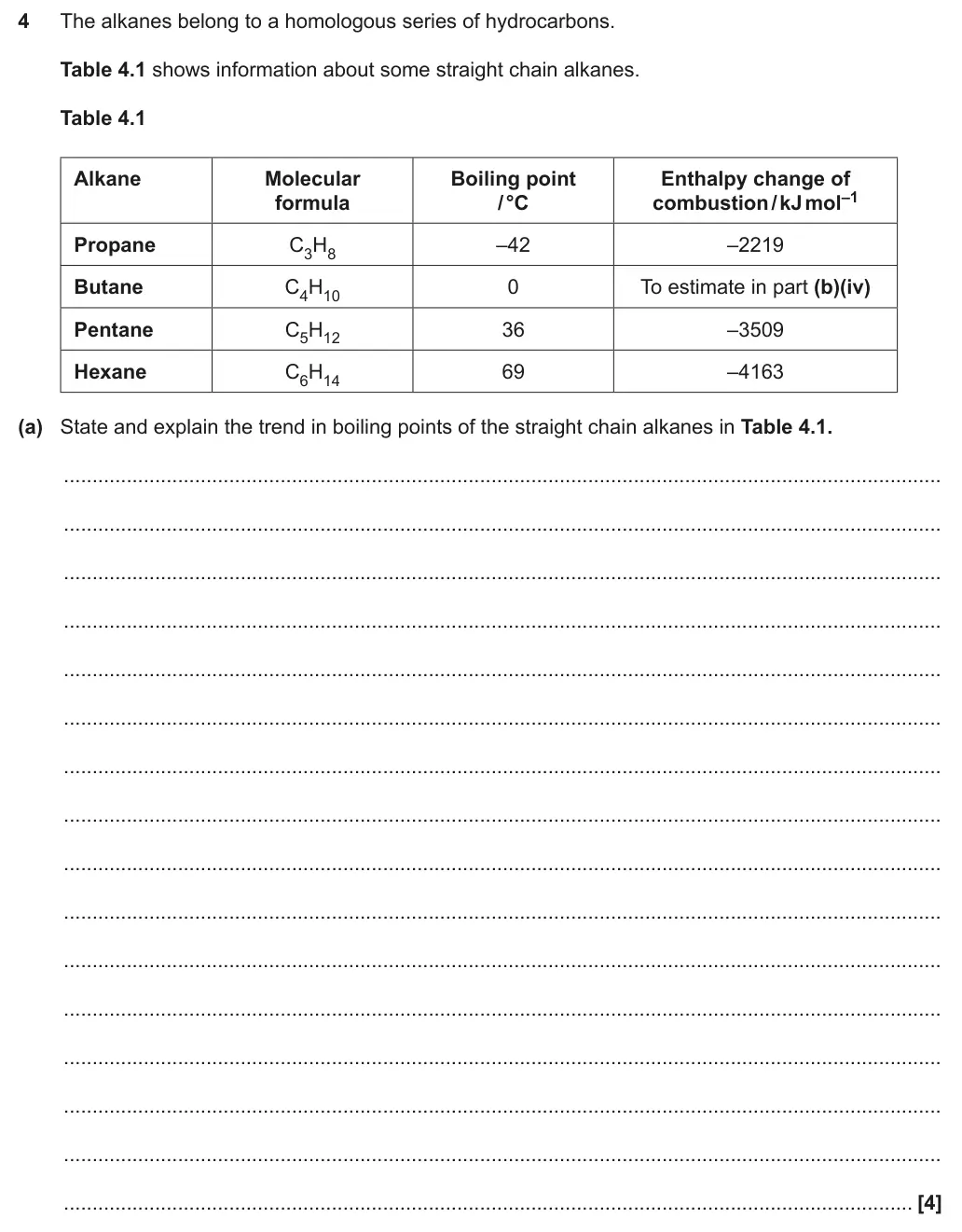
June 2025 · AS Paper 2 · Q4(b)(ii)2 marksCalculationMedium
Earlier parts of question 4 that this part uses
Mark scheme
Examiner's comment
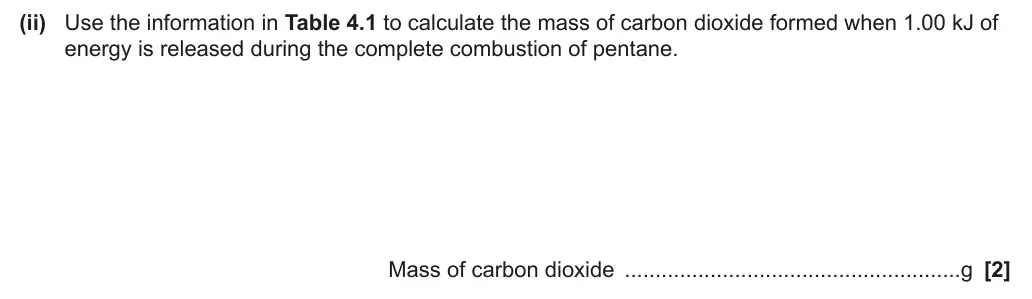
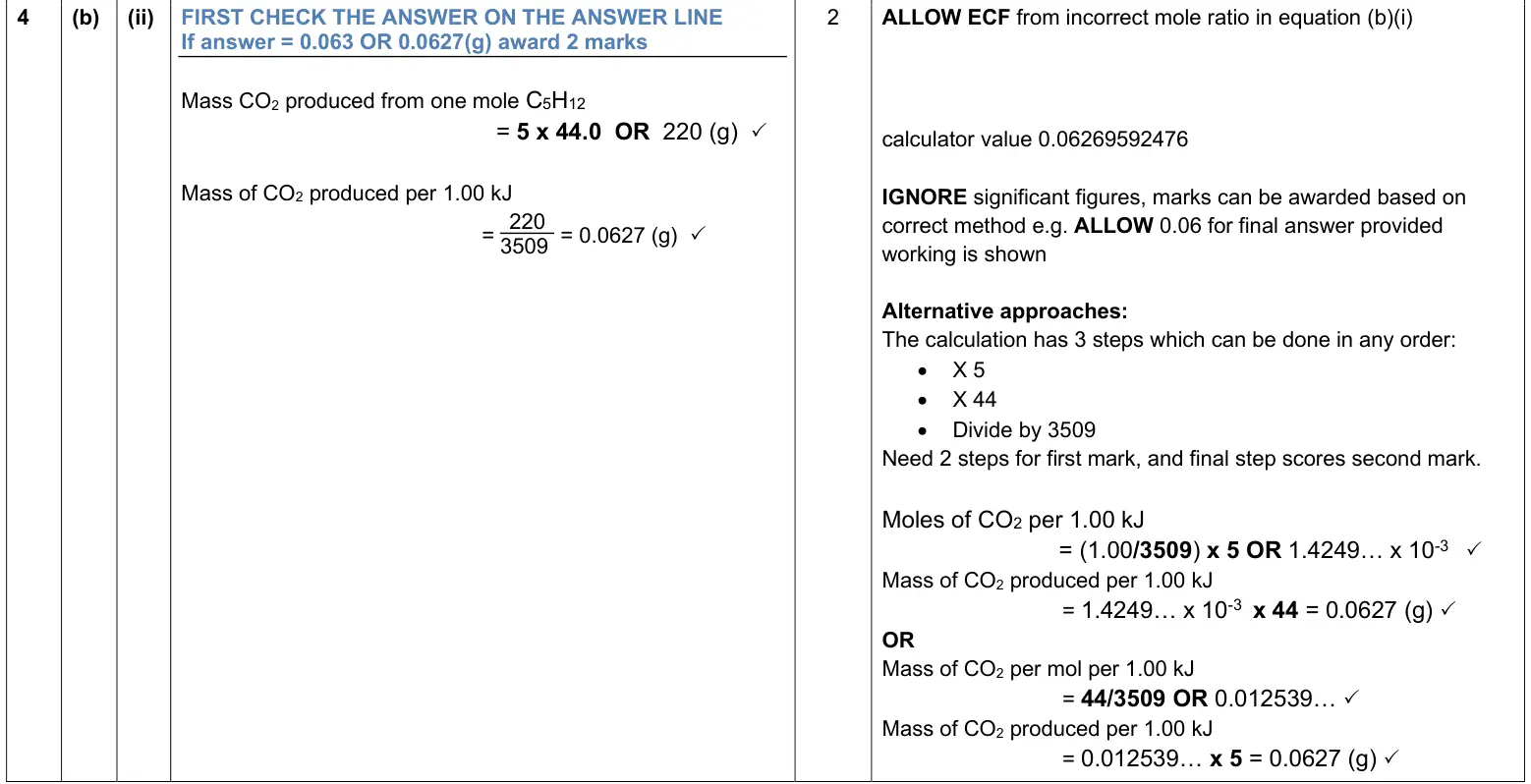
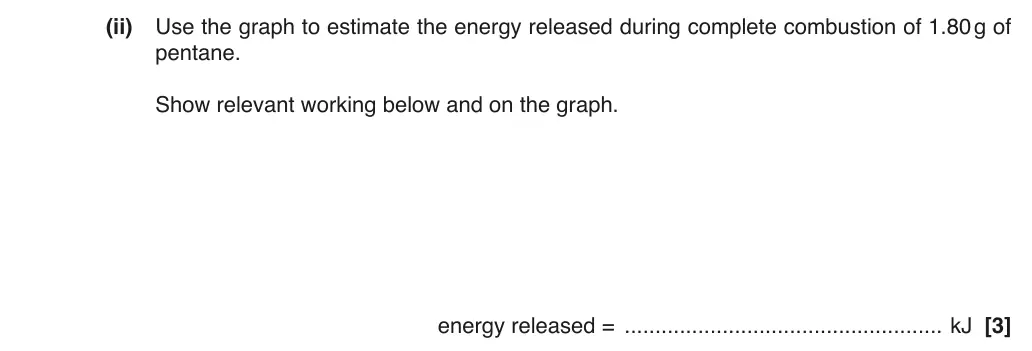
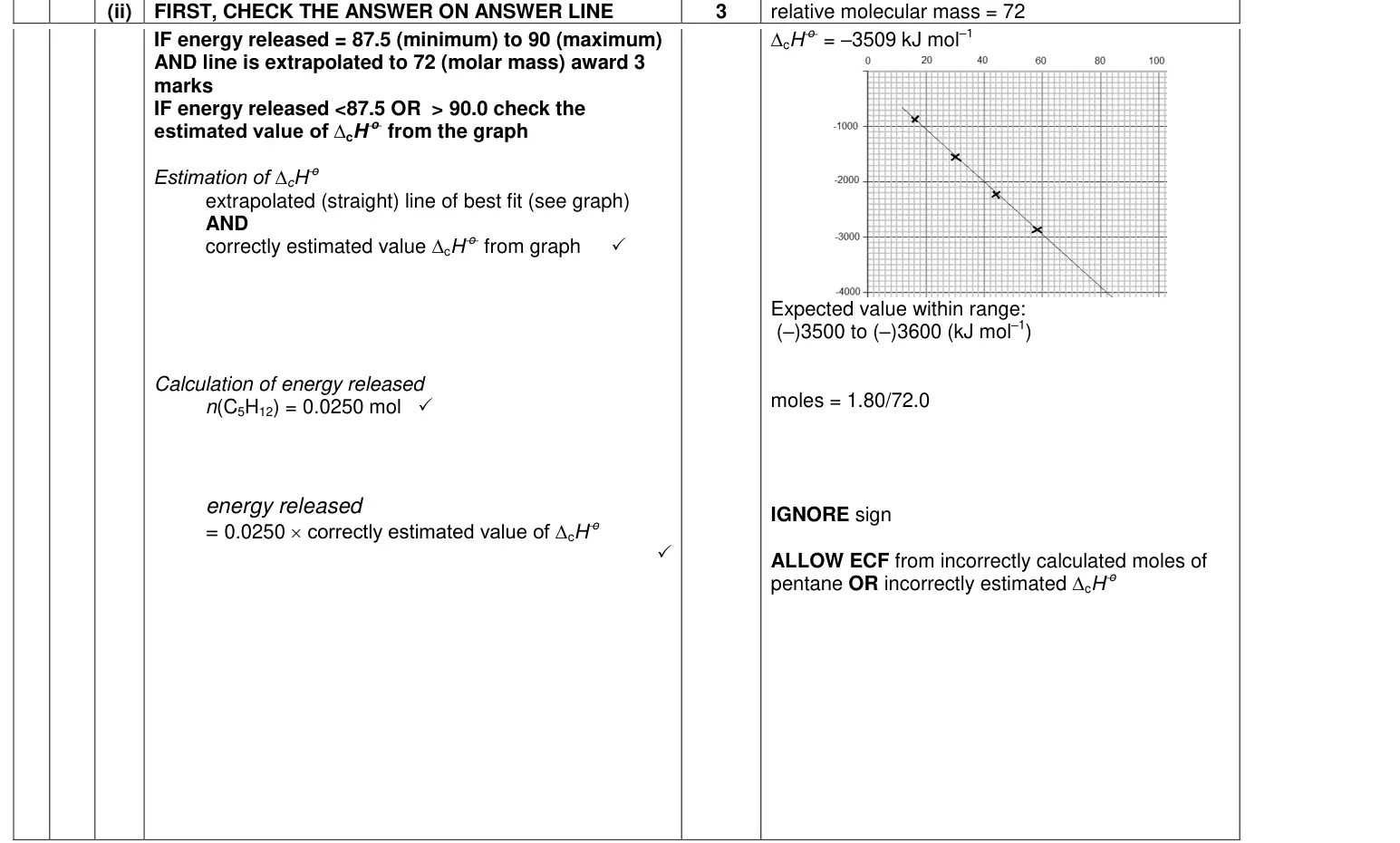
Many found this unfamiliar calculation quite tricky. Some tried to use the equation q = mcT to try to find a mass. Others tried a Hess cycle. Some multiplied by the Mr for pentane rather than carbon dioxide. A common error was to use 1000 J in the calculation, despite the enthalpy change being given in kJ mol-1, giving a final answer of 62.7g.
Notes from the mark scheme and report
5 × 44.0 = 220 g CO2 per 3509 kJ so 0.0627 g
ALLOW ECF from mole ratio in (b)(i)
IGNORE significant figures
Skills: M0.2 Use ratios, fractions and percentages; M2.3 Substitute numerical values into algebraic equations using appropriate units for physical quantities
June 2025 · Paper 2 · Q51 markMultiple choiceHard
Answer
B
Mark scheme
Examiner's comment
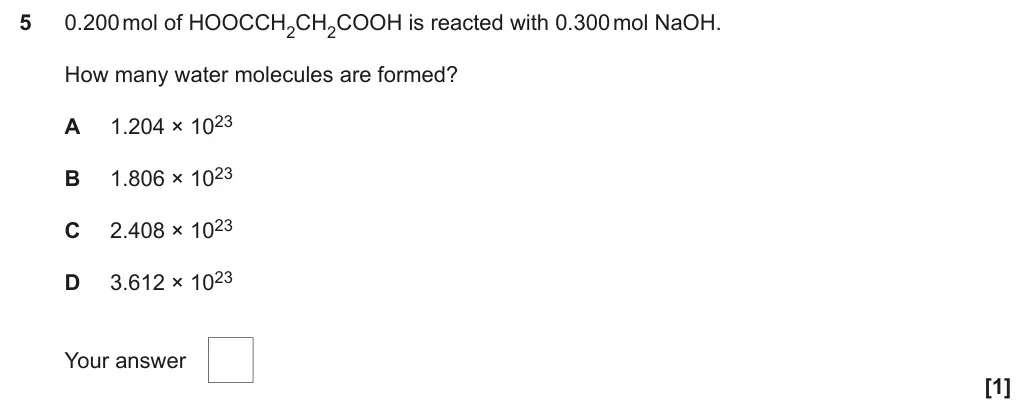
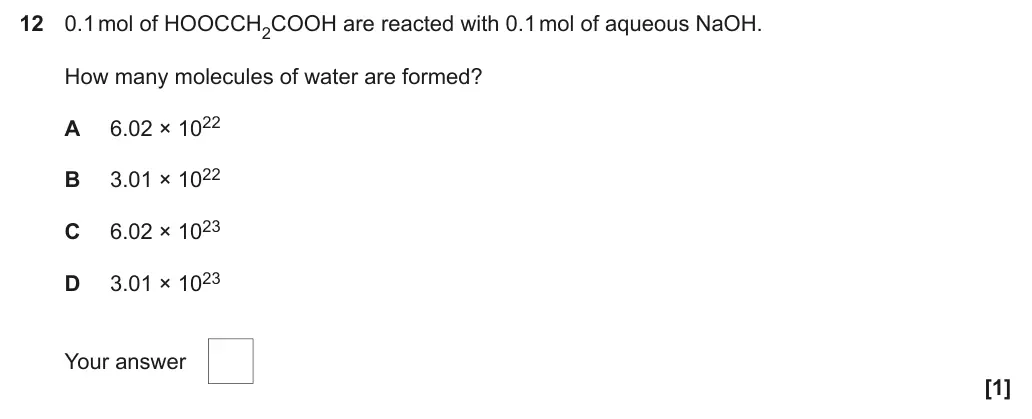
This question required using the idea of a limiting reagent, and candidates found it more challenging with just under half getting the correct answer. Some selected A, using just the moles of acid (i.e. 0.2 × 6.02 × 1023). C was more common, which recognises that 1 mole of acid gives 2 moles of water but does not account for NaOH being the limiting reagent (i.e. 0.4 × 6.02 × 1023). A few gave D as a response using twice the moles of NaOH (i.e. 0.6 × 6.02 × 1023).
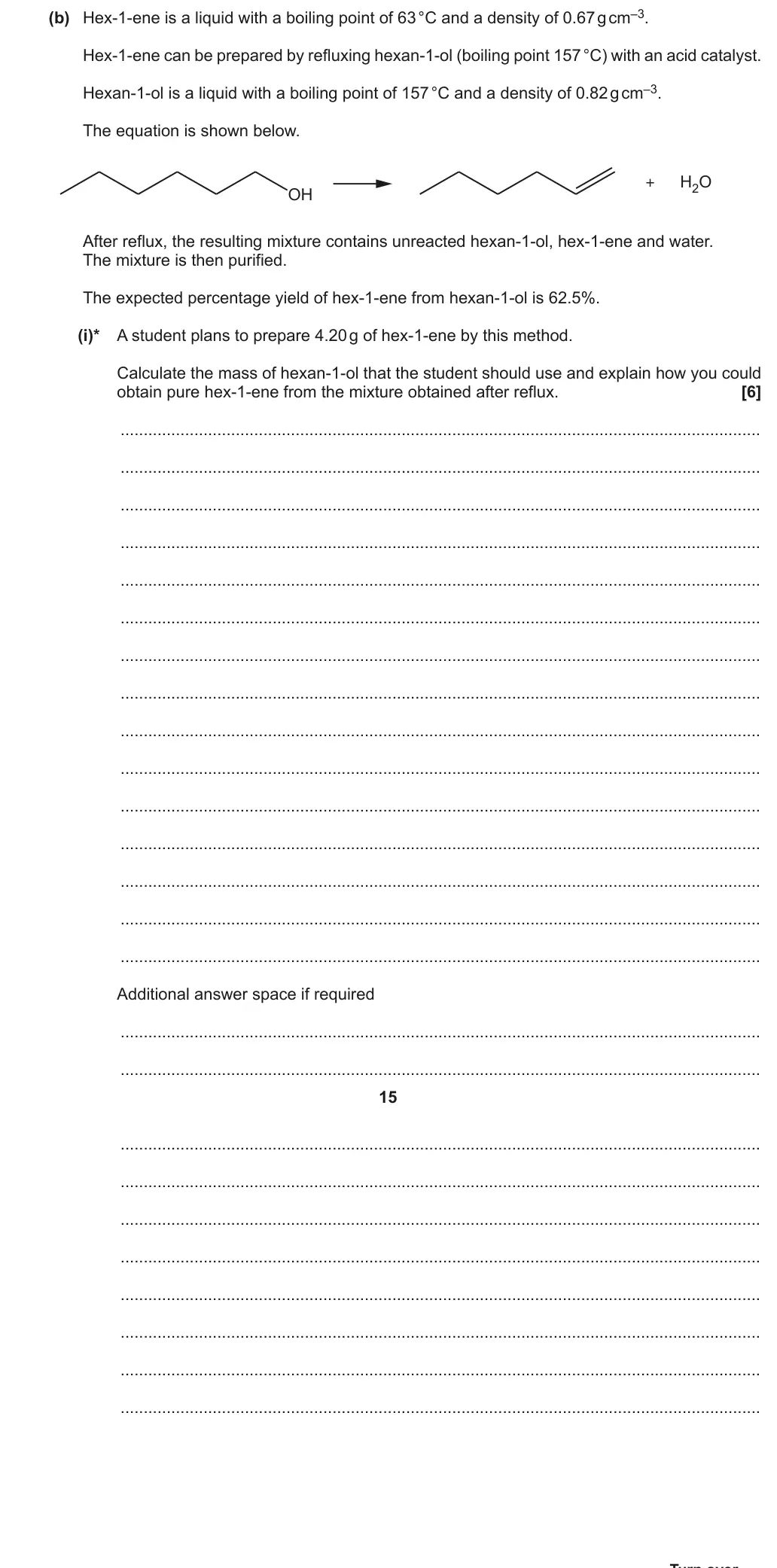
June 2025 · AS Paper 2 · Q5(c)6 marks6-mark level of responseMedium
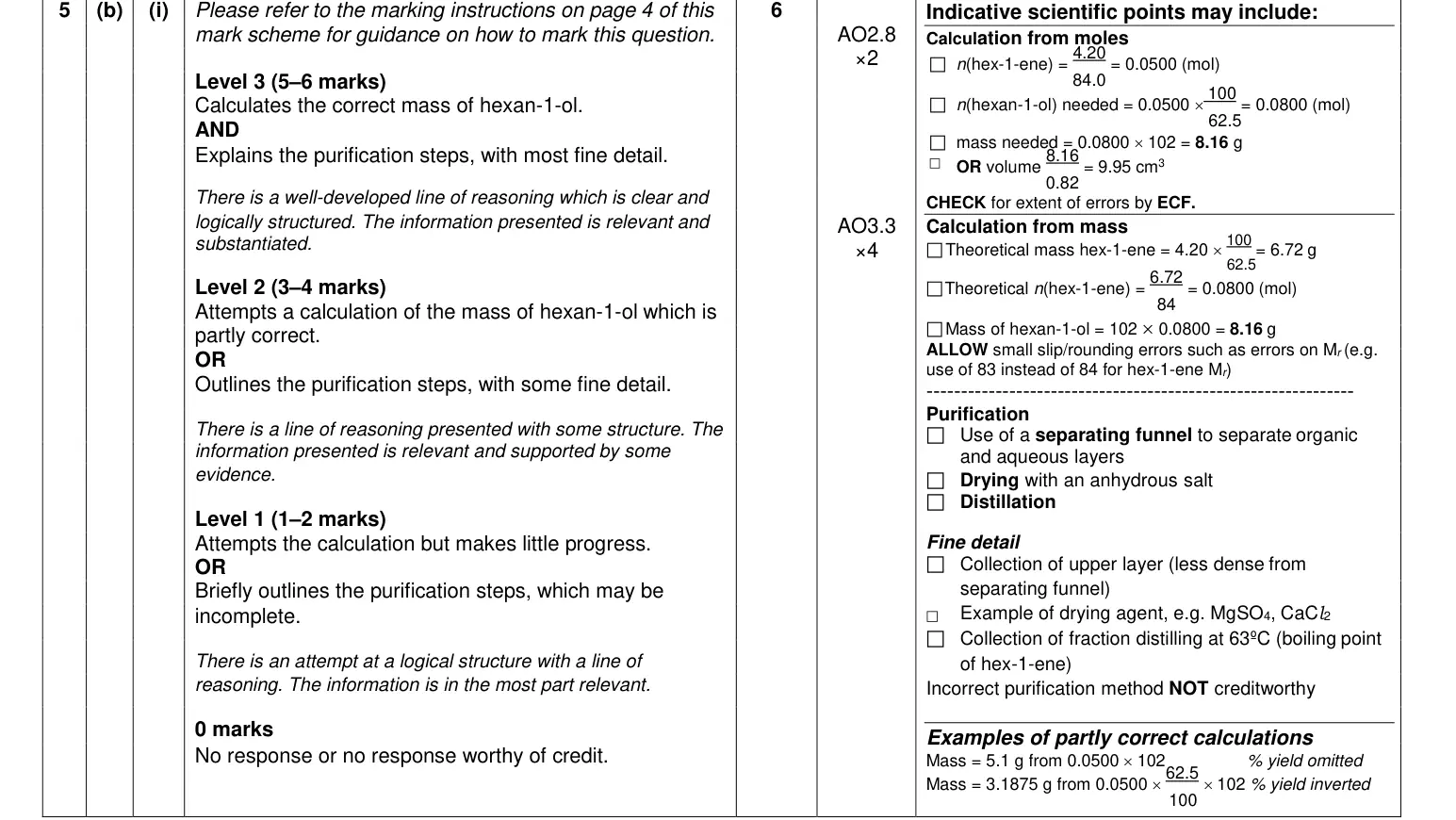
Mark scheme, with the levels and indicative points
Examiner's comment
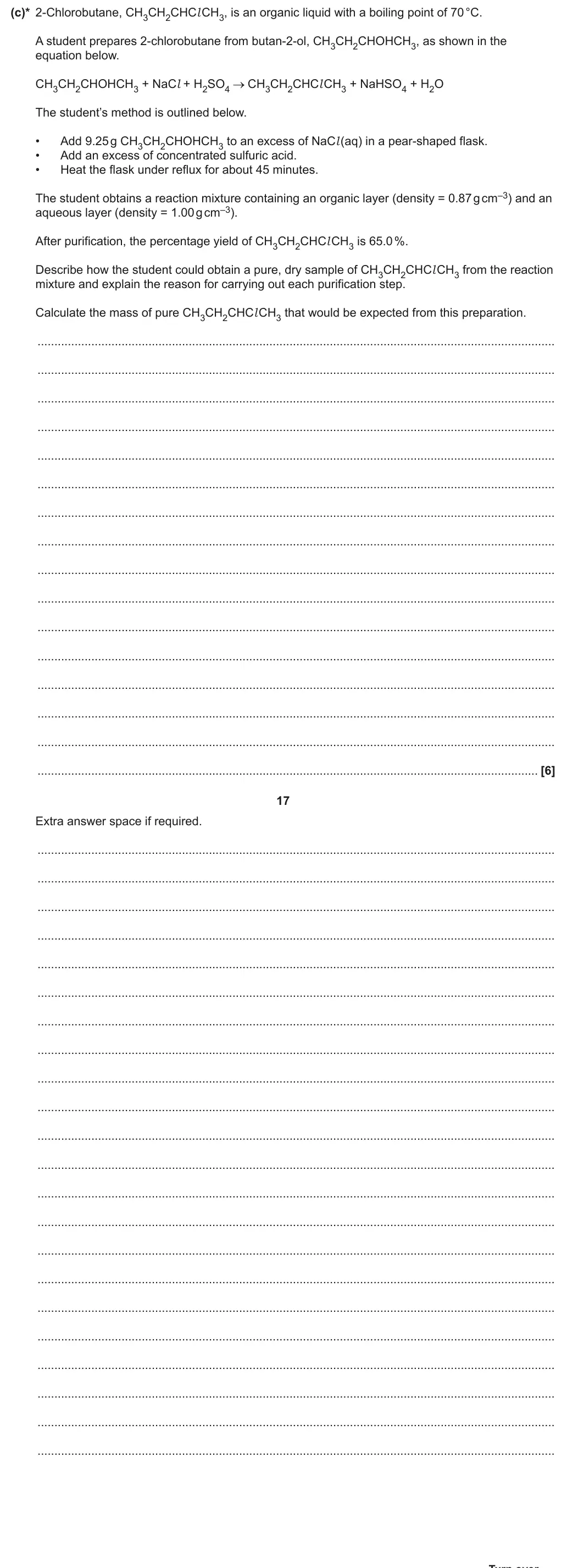
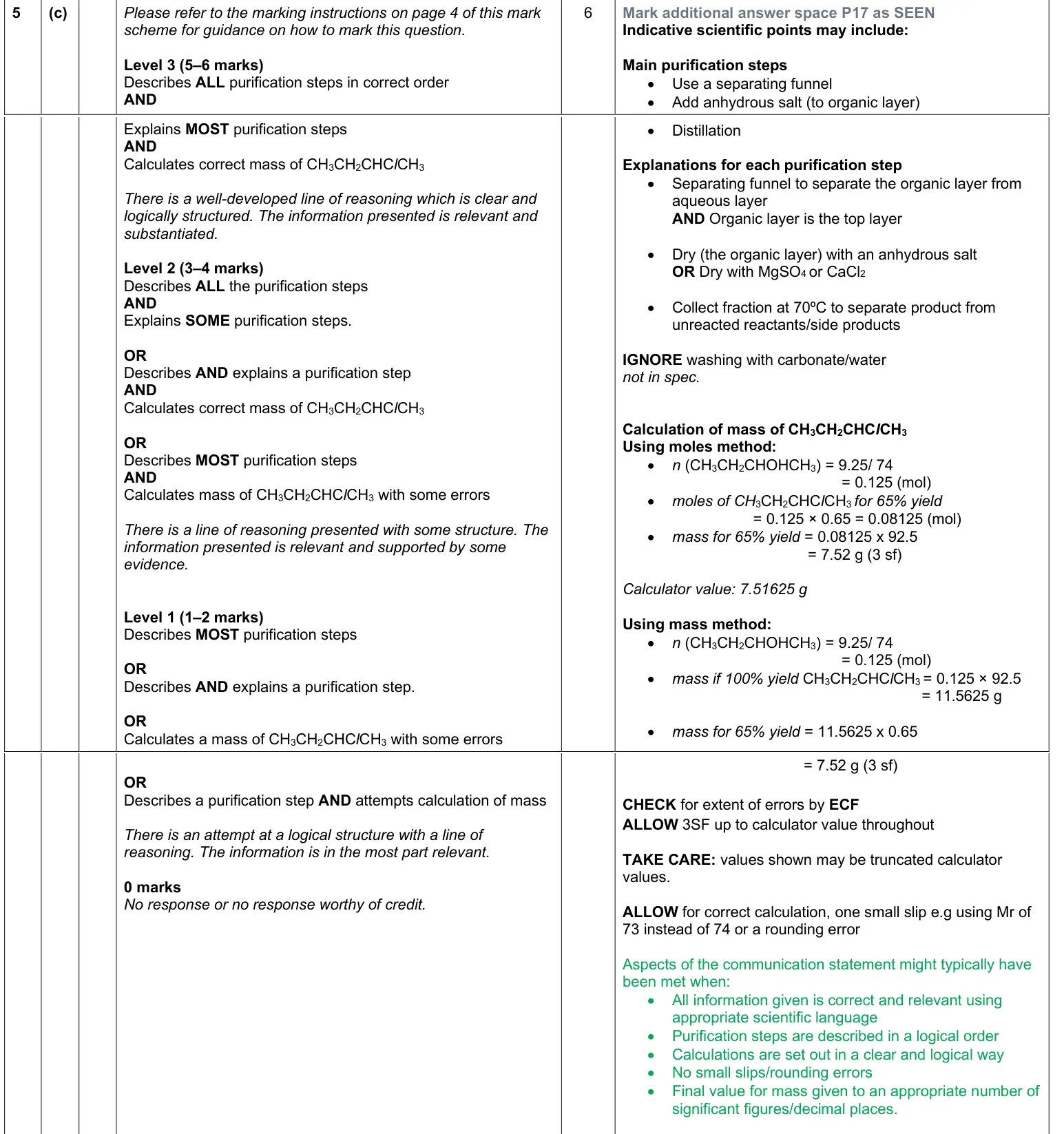
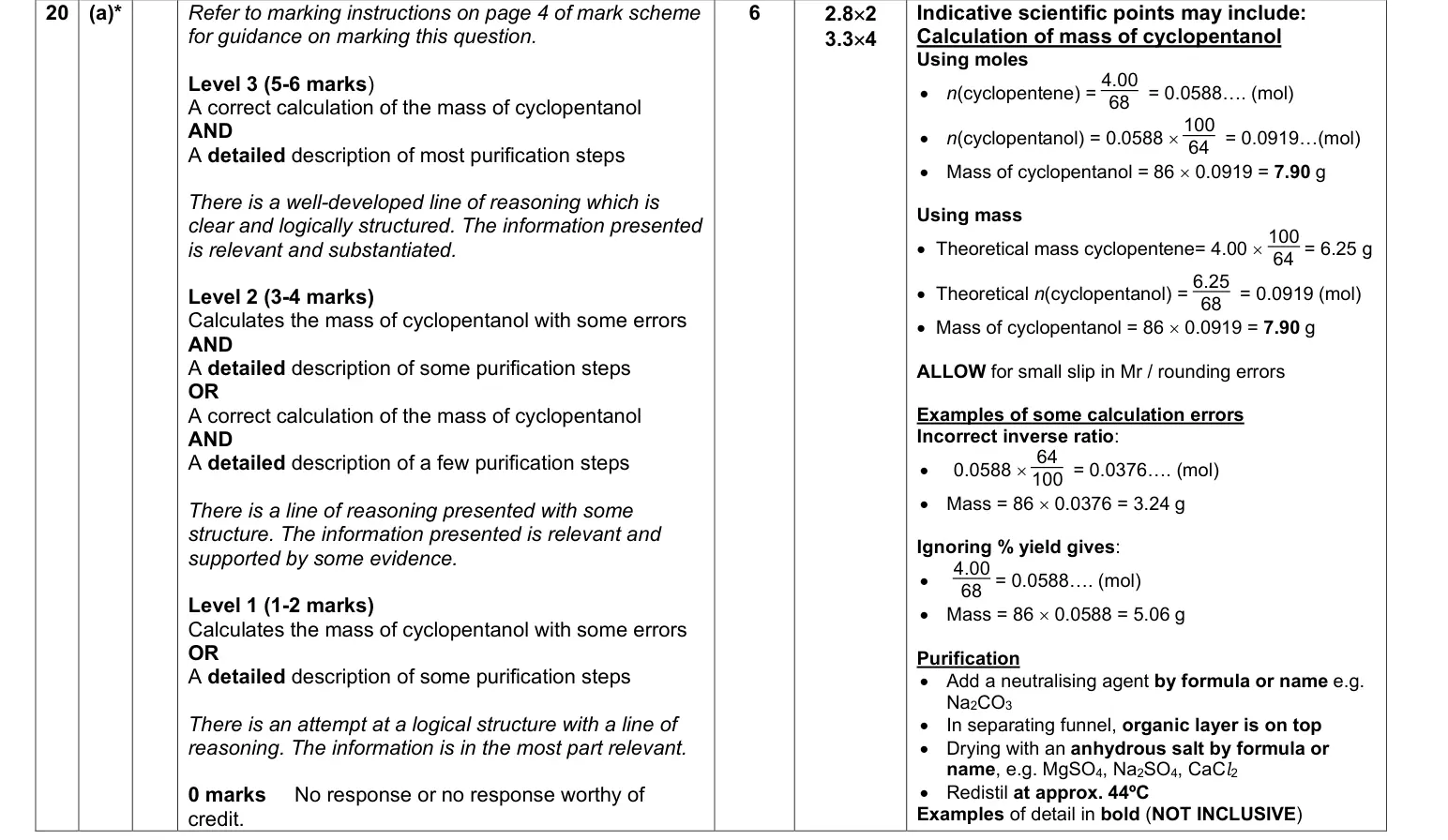
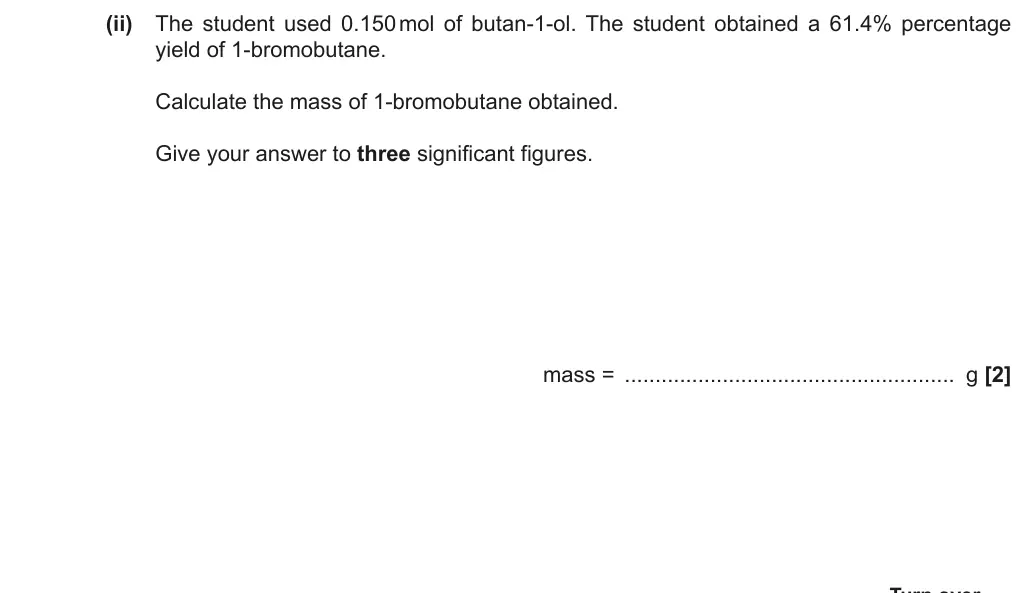
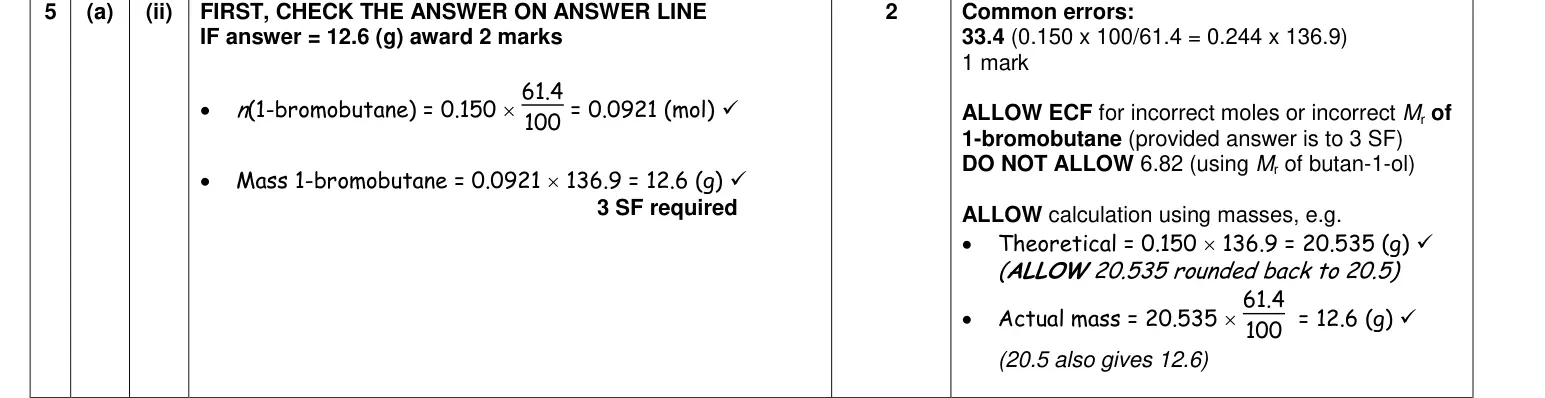
Many understood the necessary steps to purify a liquid and were confident with the calculation. Most knew at least one or two purification steps and could explain their purpose. Reasons marks were lost included: • Not remembering the correct name for equipment i.e. separating funnel • Getting the layers the wrong way round despite being given density information • Unclear which layer an anhydrous salt was added to for drying • Using an inappropriate salt for dry step, e.g. Na2CO3 or MgCO3 • Slips in calculations, e.g. incorrect Mr values, yield inverted or not accounted for • Thinking a solid would be formed • Describing reflux (including drawing apparatus) • Saying to distil at a specific boiling point but not stating the actual value (given in the question) As with all calculations, it is important to set out working clearly as it helps to avoid slips. Remind candi- dates of the importance of checking their Mr values – many made slips here. Candidates should also avoid rounding intermediate values and consider the number of significant figures used for the final re- sponse. Some rounded intermediate values to less than 3 significant figures but gave a final response to 4 or more. The response scored Level 3 and gained all 6 marks. All three purification steps are given in the correct order and explained. The calculation for mass is set out clearly and the final mass is given to 3 signifi- cant figures.
Notes from the mark scheme and report
separating funnel - organic layer is the top (less dense) layer
dry with anhydrous MgSO4/CaCl2
distil collecting fraction at 70 °C
0.125 mol × 0.65 × 92.5 = 7.52 g
IGNORE washing with carbonate/water
ALLOW one small slip e.g. Mr 73
Skills: M0.2 Use ratios, fractions and percentages; M1.1 Use an appropriate number of significant figures; M2.3 Substitute numerical values into algebraic equations using appropriate units for physical quantities; PAG5 Synthesis of an organic liquid
June 2025 · Paper 2 · Q61 markMultiple choiceMedium
Answer
A
Mark scheme
Examiner's comment
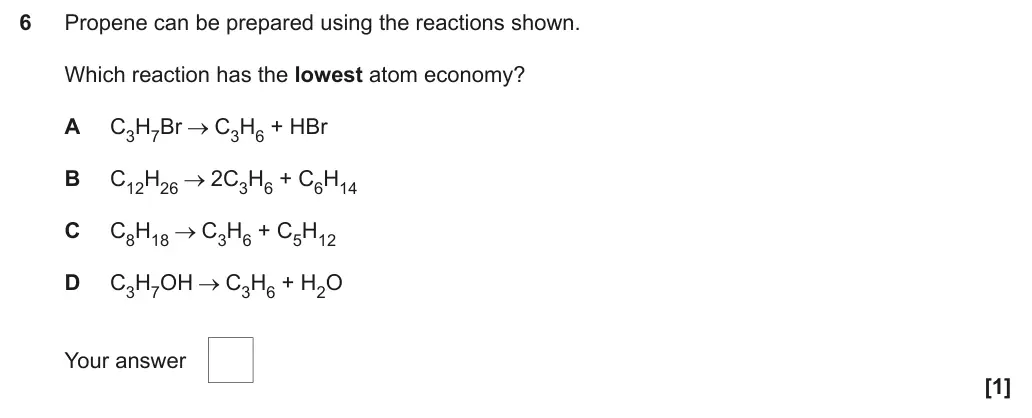
Most were able to give correct answer, A. D was the most common incorrect response, possibly from misreading the question and giving the highest rather than the lowest. B was also a common incorrect response where candidates only used the molar mass of C3H6 rather than 2 × C3H6.
June 2025 · Paper 2 · Q16(b)3 marksComplete table/diagramHard
Mark scheme
Examiner's comment
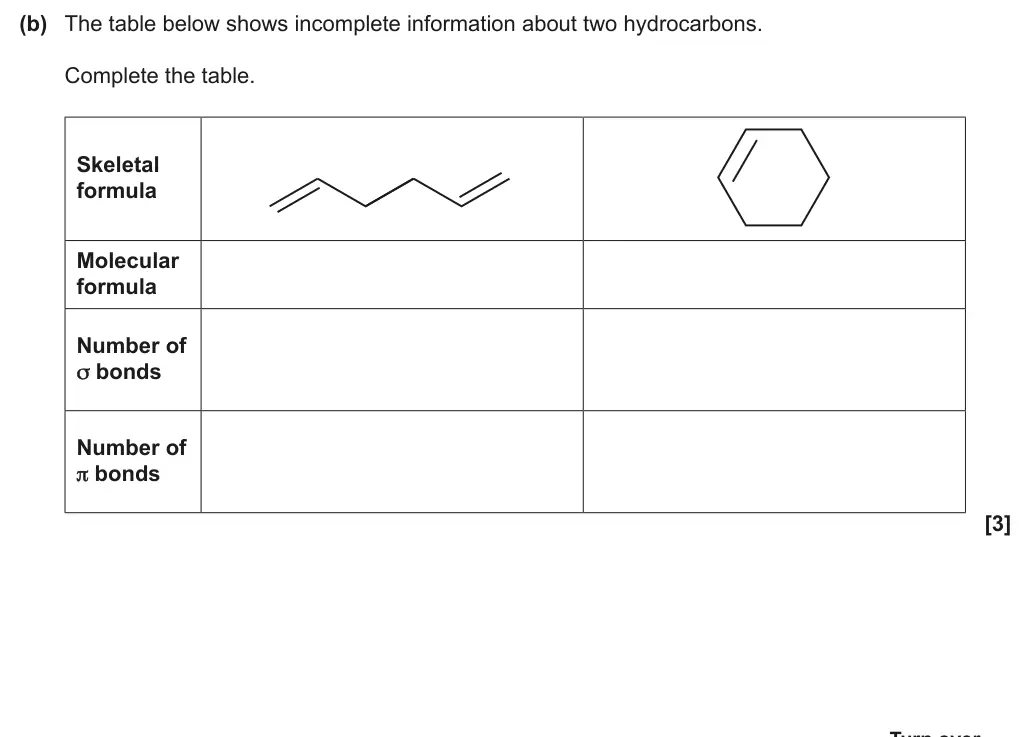
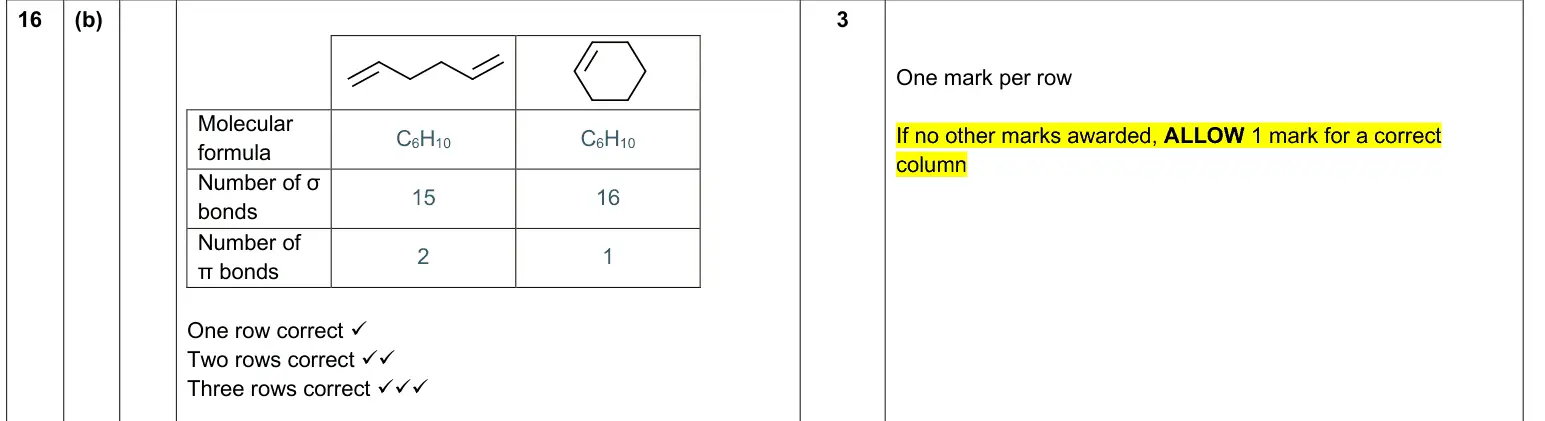
Very few candidates did not score any marks here. Most gained a mark for the correct molecular formulae in the first row, although some candidates gave structural formulae instead of molecular formulae or gave both. Candidates found counting the different types of bonds quite challenging and we would recommend drawing out displayed formulae to make it easier to label and count each type of bond. Many gave 5 and 6 respectively for the bonds, forgetting to count the C-H bonds that are not shown in the skeletal structure. More were able to correctly count the bonds but some counted the number of atoms involved in bonds instead. A few had and bonds the wrong way round.
Notes from the mark scheme and report
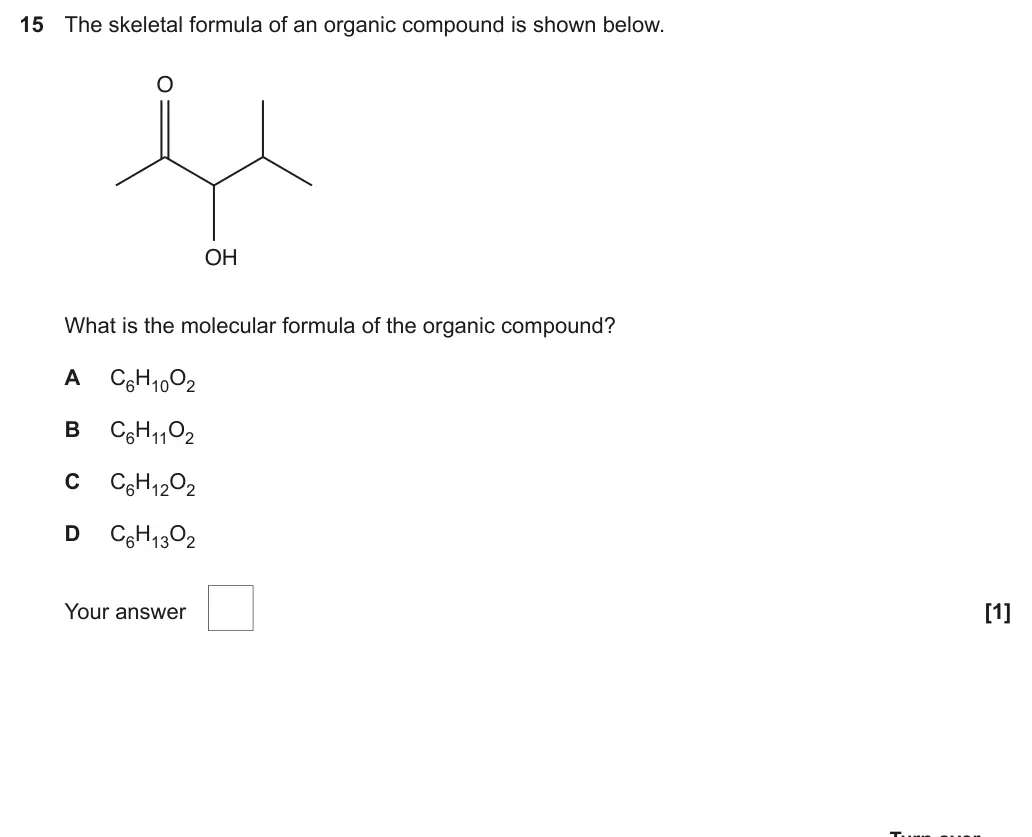
both C6H10
σ bonds 15 and 16
π bonds 2 and 1
one mark per row
1 mark for a correct column if no other marks
Skills: M4.2 Visualise and represent 2-D and 3-D forms including 2-D representations of 3-D objects
June 2025 · Paper 2 · Q176 marks6-mark level of responseMedium
Mark scheme, with the levels and indicative points
Examiner's comment
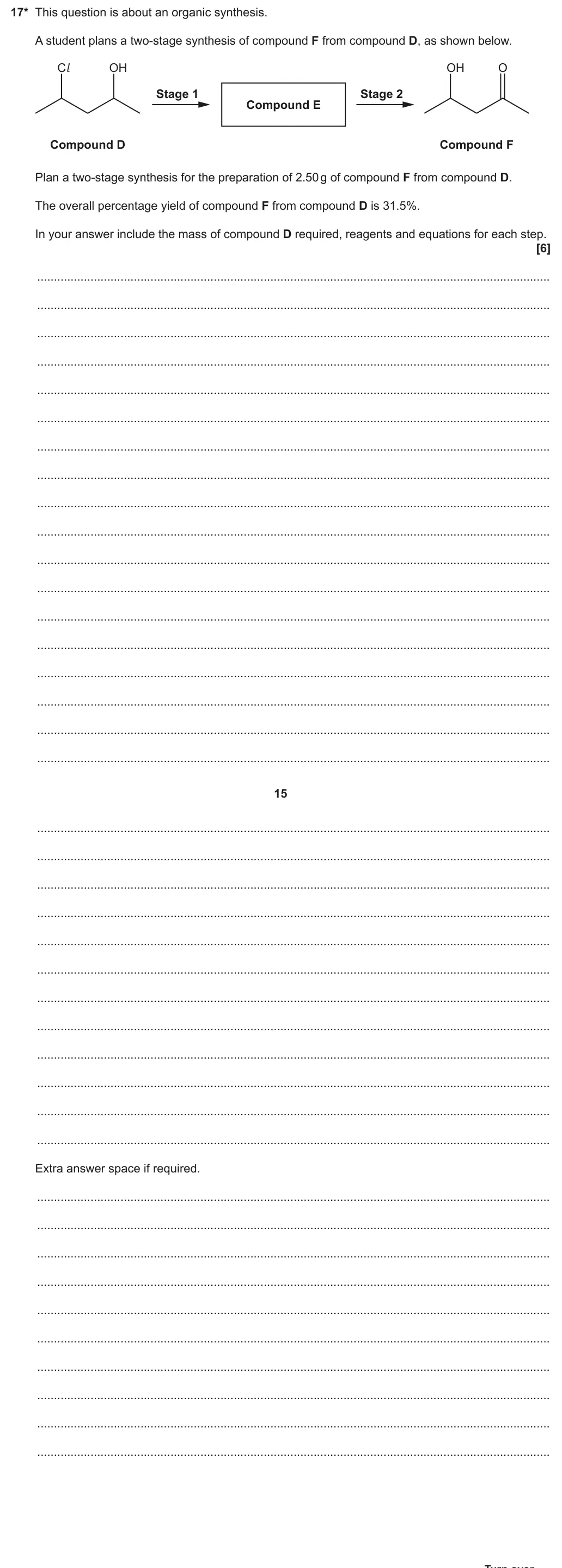
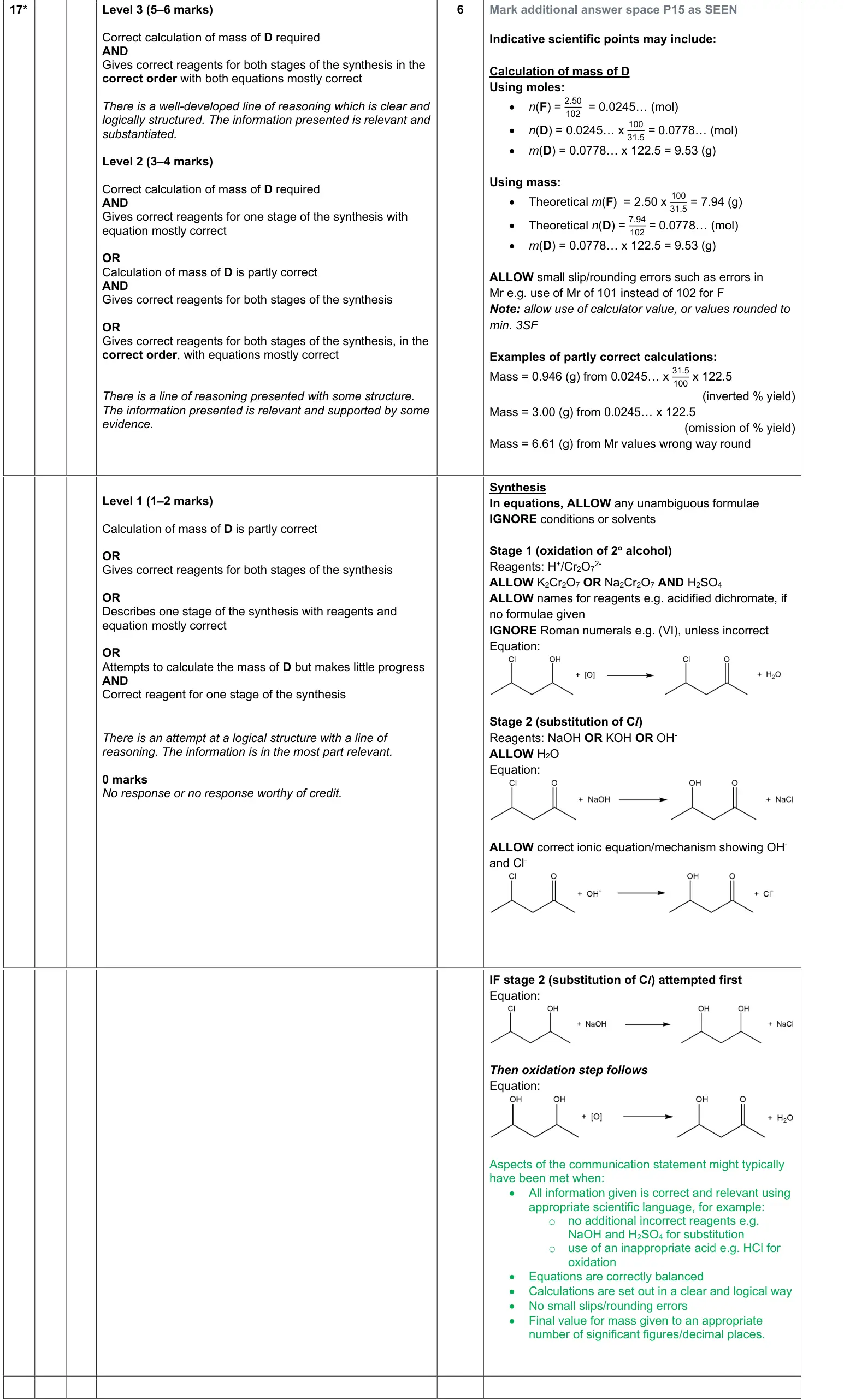
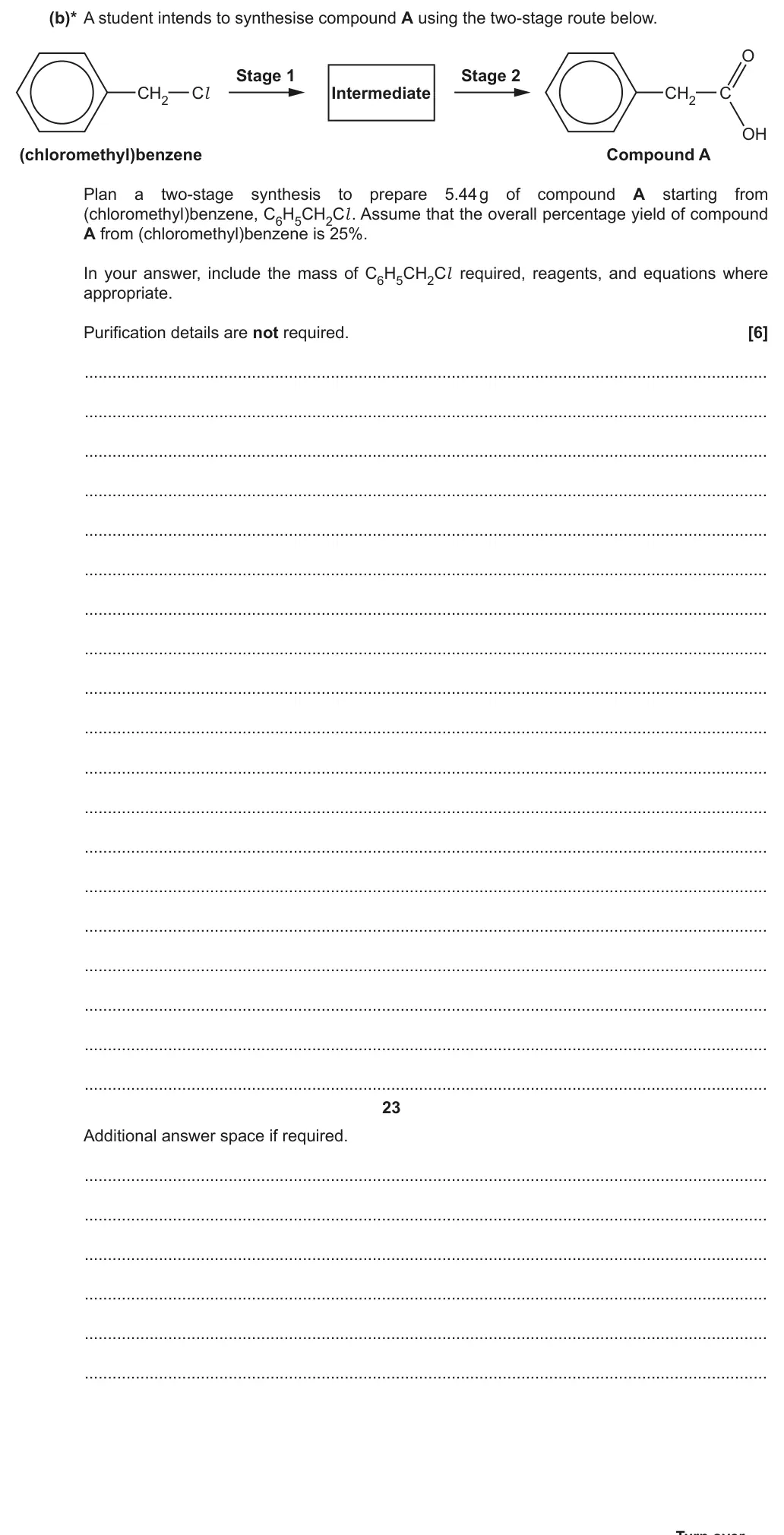
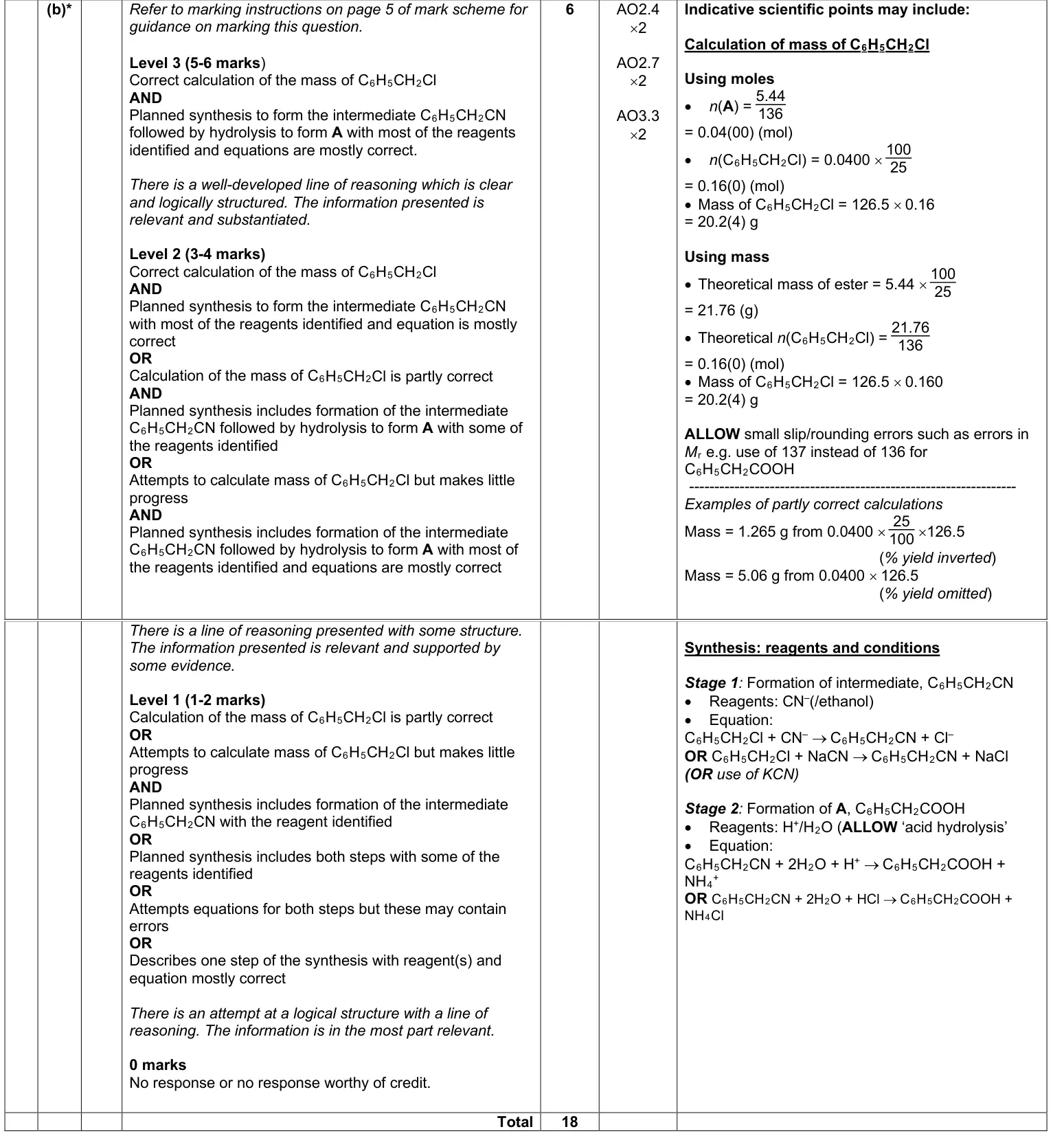
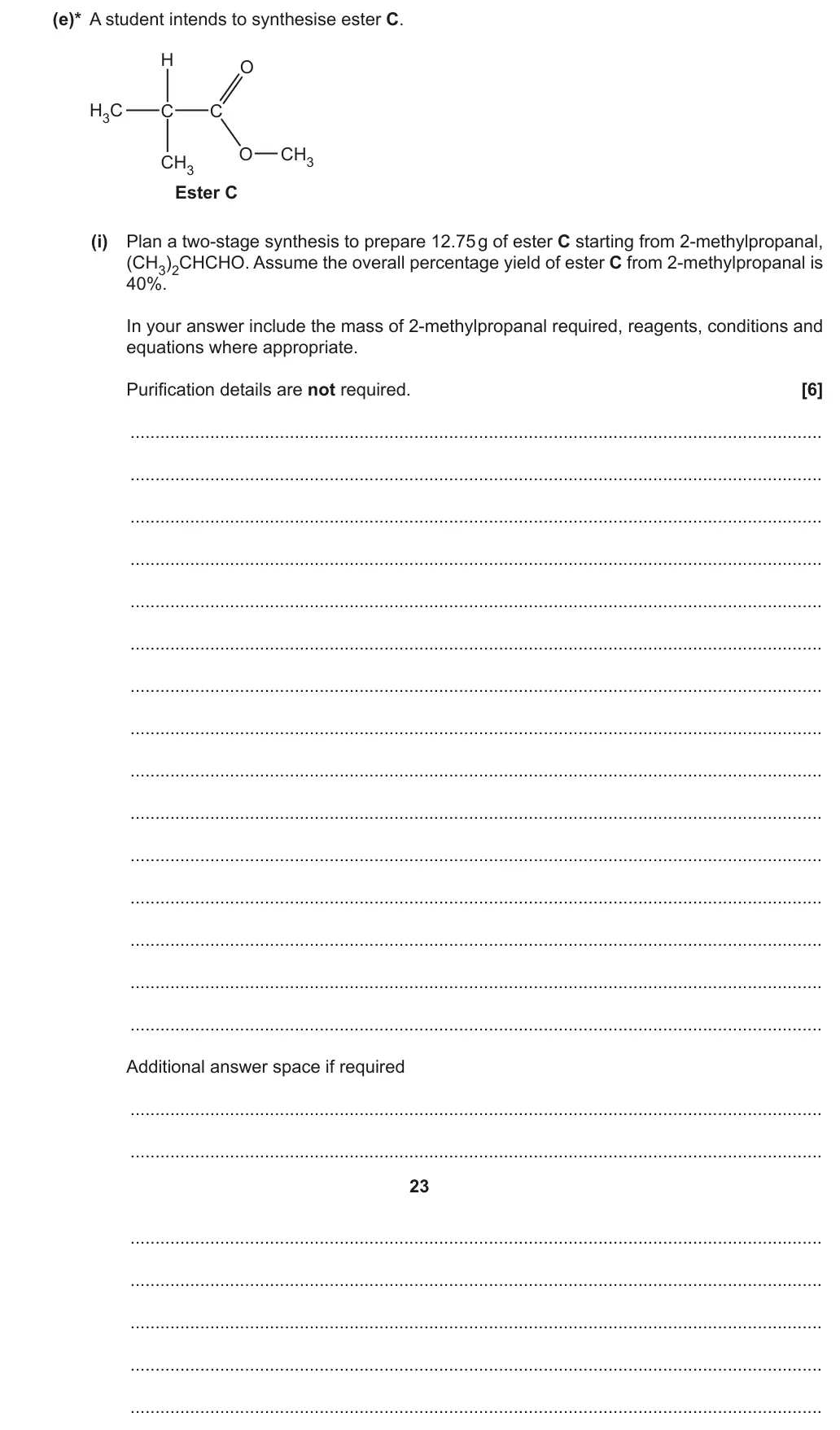
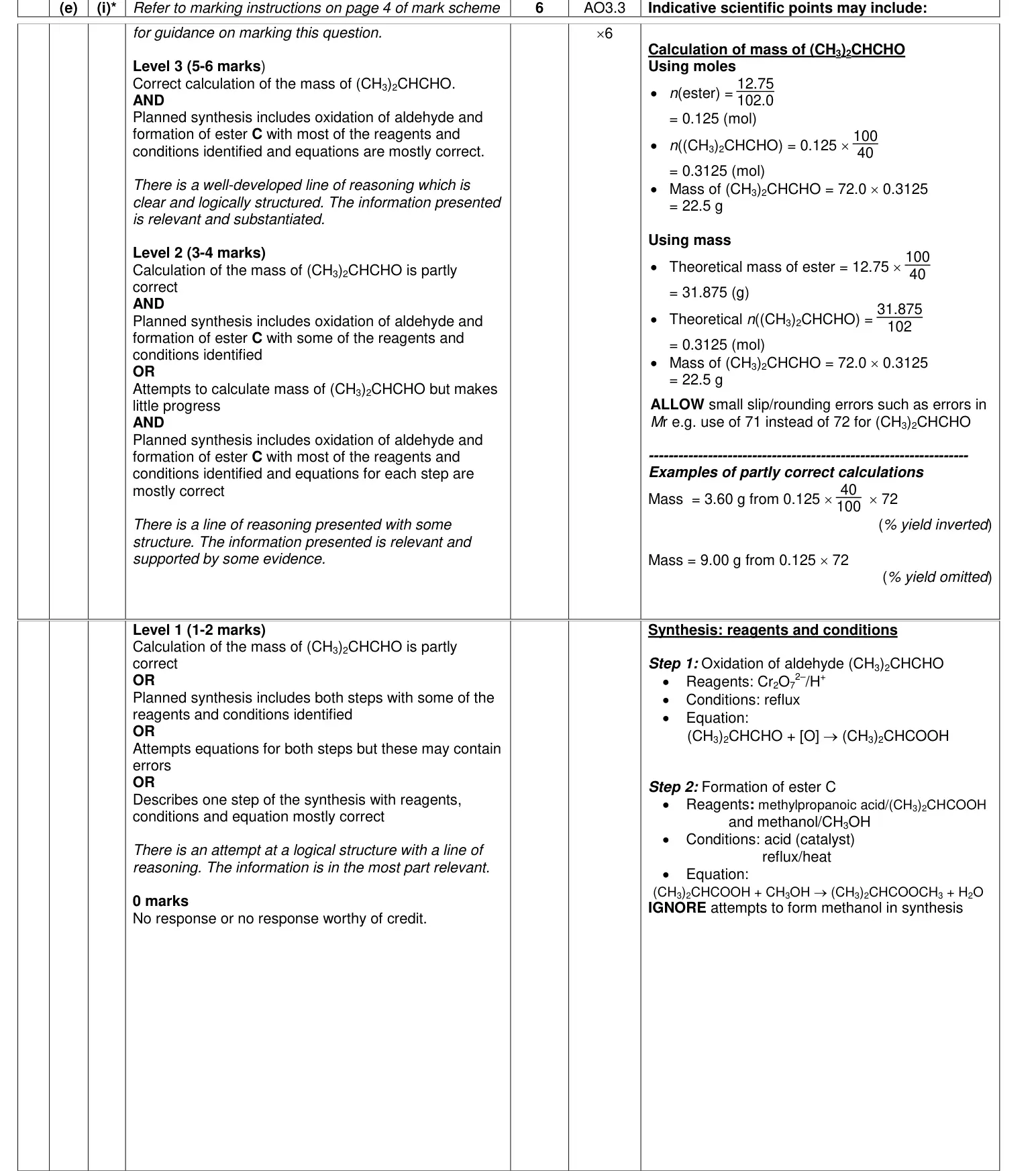
Generally, this question was well answered with most candidates achieving Level 3. Many candidates knew the correct reagents to use to carry out the two-stage synthesis. Some missed out on Level 3 as they had the steps in the wrong order. It was essential to carry out the oxidation prior to substitution otherwise both -OH groups would be oxidised. A significant number struggled with the calculation of the mass of compound D required. Many gave the answer as 7.94g so had only considered the yield, not the difference in molar mass of F compared to D. Other common errors seen in the calculation included errors in Mr values, missing or inverted percentage yield, as well as intermediate rounding of values to two significant figures. Level 2 could still be achieved without the calculation if they had the correct reagents in the correct order with equations mostly correct. To be mostly correct we required them to have at least one of the inorganic reactants or products given. Communication marks were lost if there were errors in reactants or products as well as balancing of equations. Students using skeletal structures generally made fewer mistakes with the balanced equation than those using structural formulae, where additional Hs were inserted alongside the ketone group i.e. CH3CHClCH2CHOCH3. Lower attaining students attempted to write the H+/K2Cr2O7 in the balanced equation and didn’t know to represent this with [O]. Other common errors in balancing the oxidation equation included missing H₂O or using 2[O]. A common error was to see H2SO4 as a ‘catalyst’ added with NaOH in the substitution reaction – this additional and unnecessary reagent lost candidates the communication mark. This response achieved Level 3 and all 6 marks. The calculation is laid out clearly showing both Mr values used in the calculation. Showing the values used in each step makes it much easier to spot where any errors may have been made if the correct value is not obtained. The reagents for each stage are given and the reactions are carried out in the correct order. The equations are given and are correctly balanced. This was an excellent response.
Notes from the mark scheme and report
m(D) = 9.53 g (0.946 g inverted yield, 3.00 g yield omitted are partly correct)
oxidation with H+/Cr2O7 2– using [O] then substitution of Cl with NaOH(aq)
IGNORE conditions
inappropriate acid (HCl) or extra reagents limit communication
Skills: M0.2 Use ratios, fractions and percentages; M1.1 Use an appropriate number of significant figures; M2.2 Change the subject of an equation; M2.3 Substitute numerical values into algebraic equations using appropriate units for physical quantities
June 2025 · Paper 3 · Q2(a)(ii)3 marksCalculationEasy
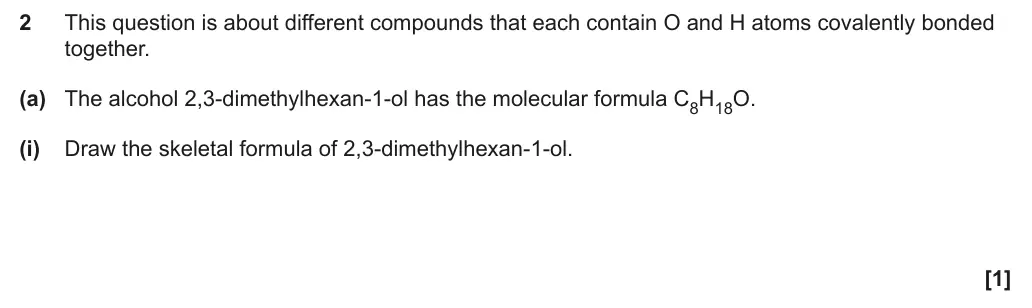
Earlier part of question 2 that this part uses
Mark scheme
Examiner's comment
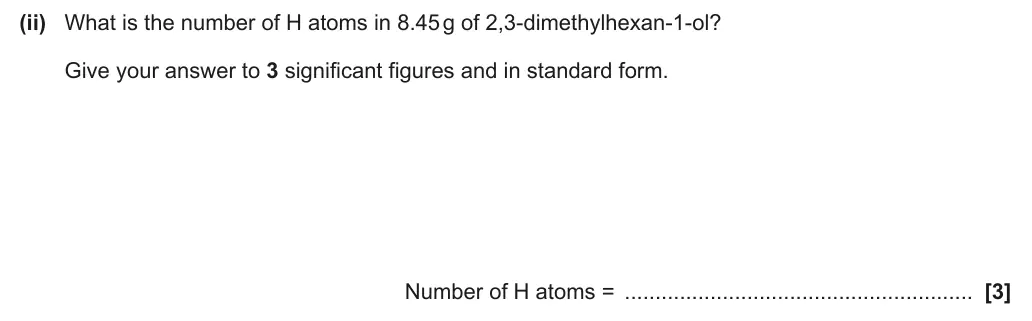
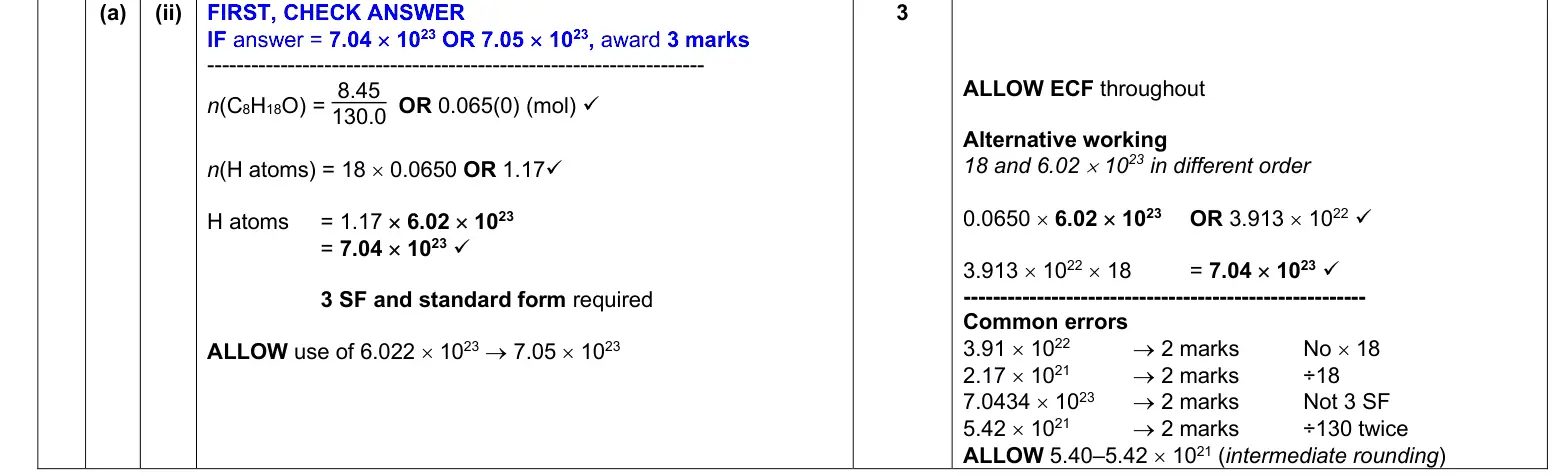
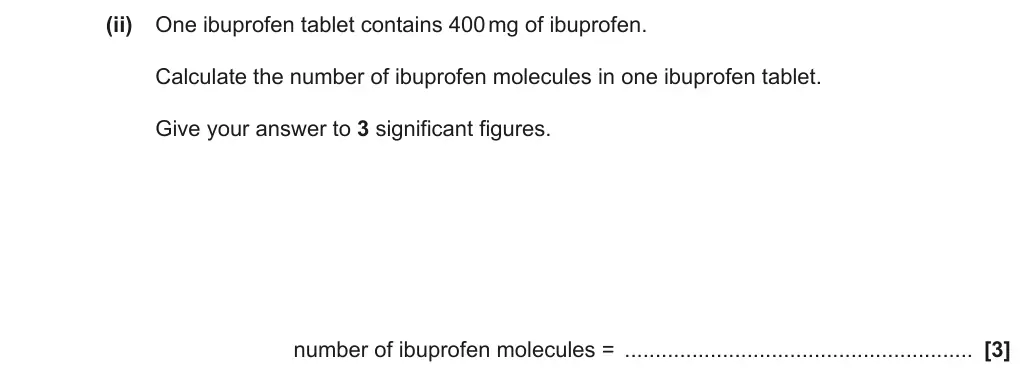
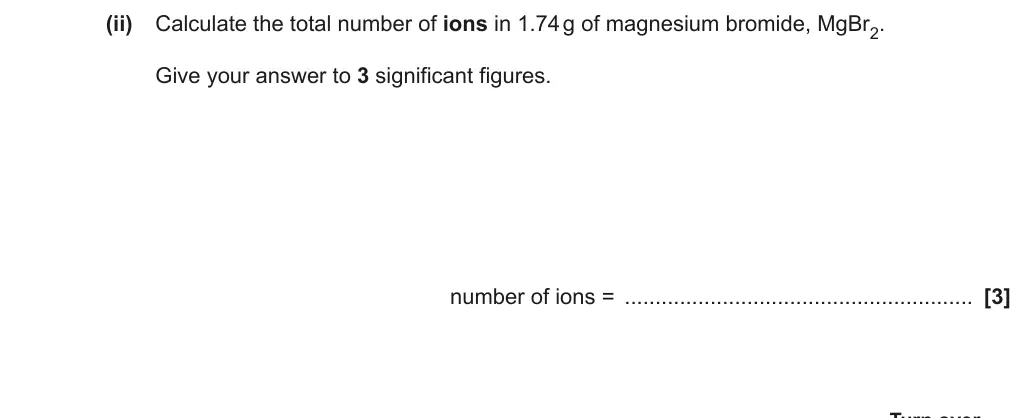
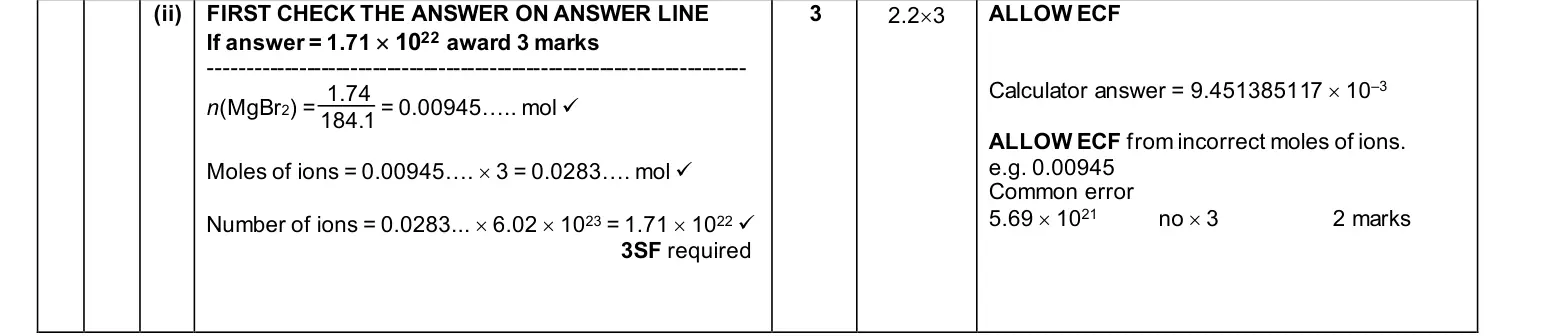
Most candidates correctly calculated the number of H atoms as 7.04 1023. Some omitted to use 18 or 130 but the mark scheme allowed such omissions so that candidates could get partial credit, provided that clear working had been shown. A common error was to show the answer to more than three significant figures despite the requirement in the question. Overall, this was one of the more confidently answered questions on the paper.
Notes from the mark scheme and report
× 18 H per molecule
7.04 × 10^23, 3 SF and standard form required
common errors: 3.91 × 10^22 (no × 18), 2.17 × 10^21 (÷ 18)
Skills: M0.1 Recognise and use expressions in decimal and ordinary form; M1.1 Use an appropriate number of significant figures; M2.3 Substitute numerical values into algebraic equations using appropriate units for physical quantities
June 2025 · Paper 3 · Q2(b)(ii)4 marksCalculationMedium
Earlier part of question 2 that this part uses
Mark scheme
Examiner's comment
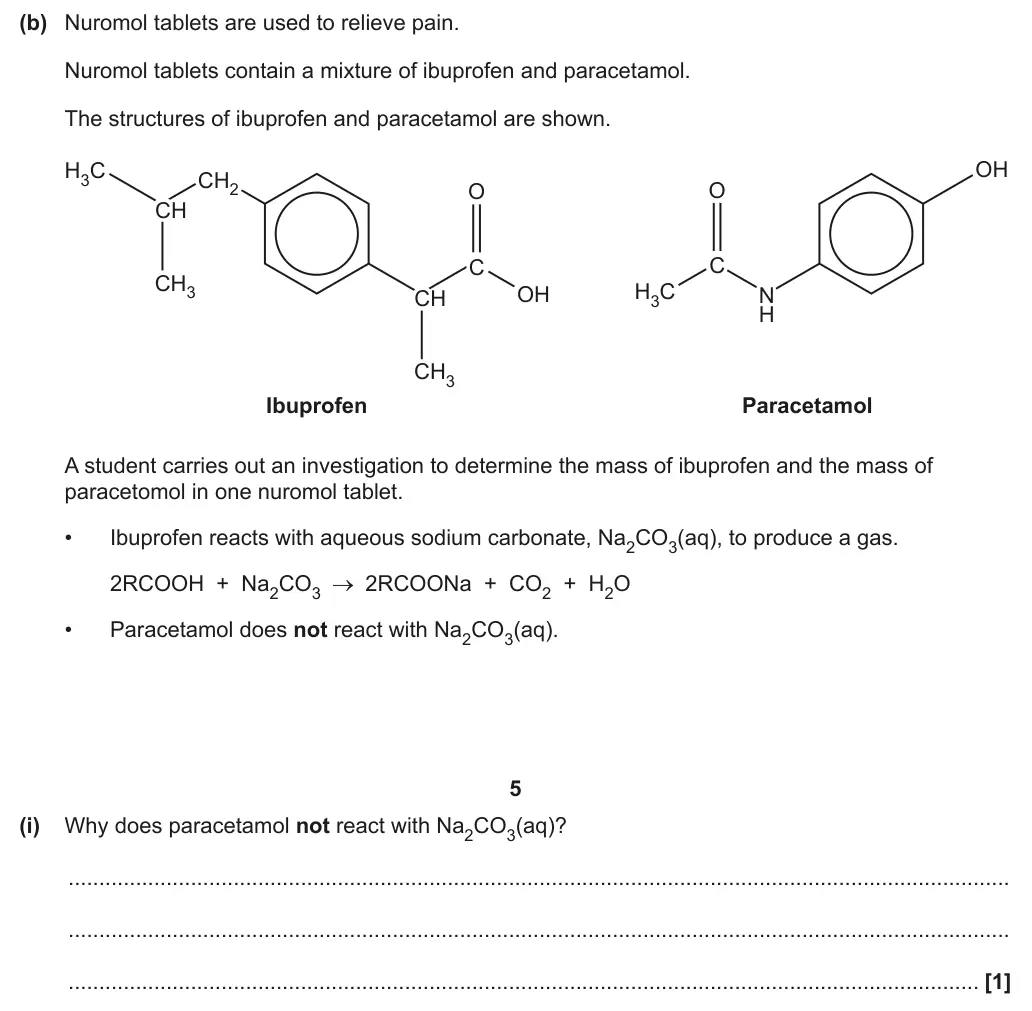
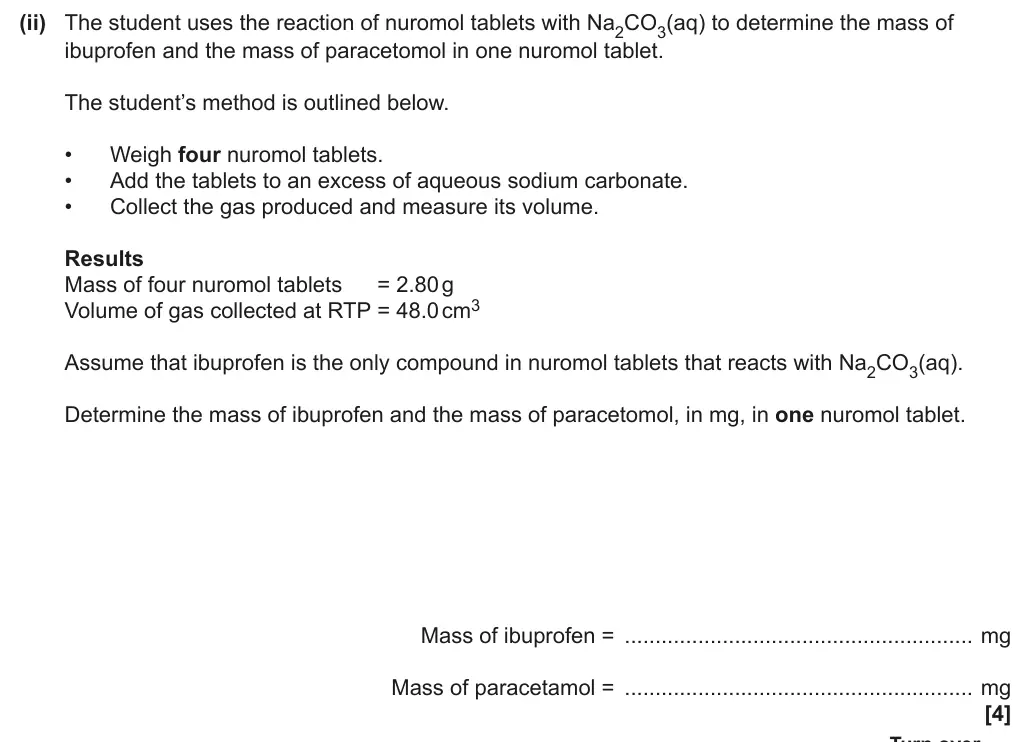
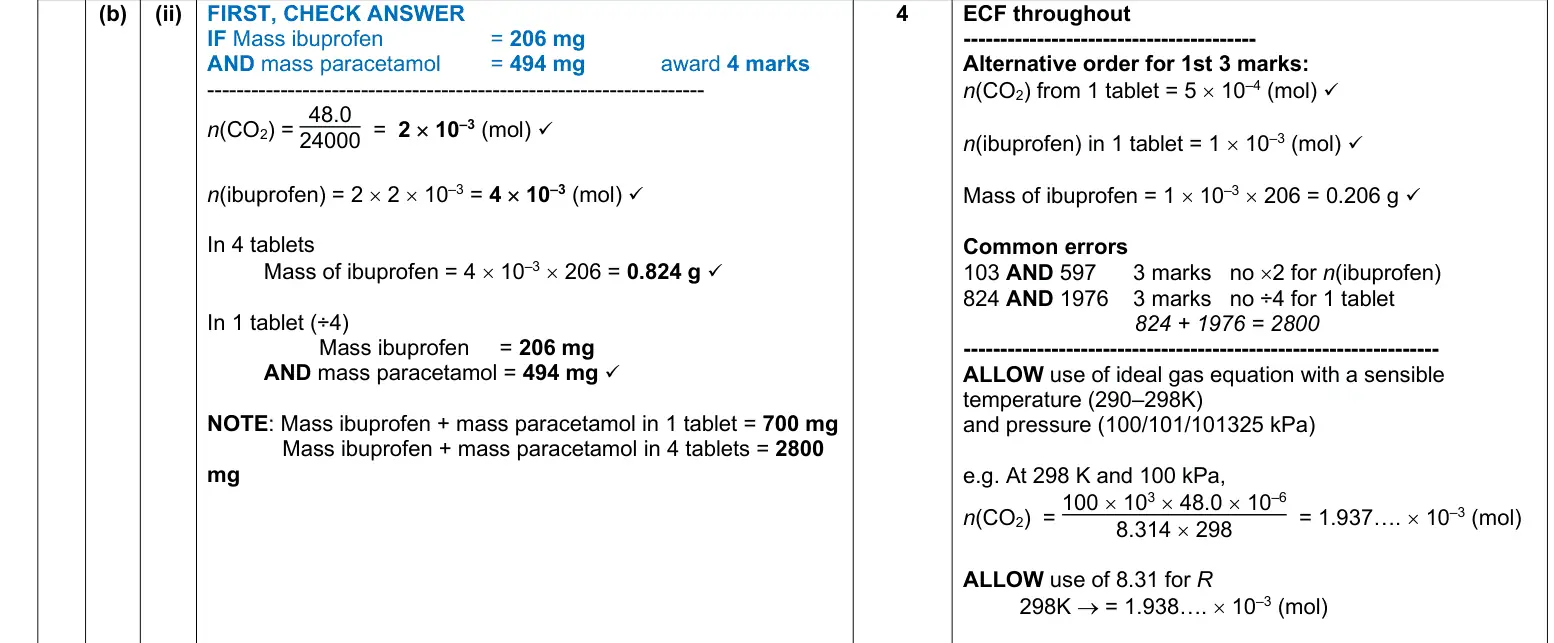
There were a variety of responses to this question, with many obtaining correct answers of 206 mg for ibuprofen and 494 mg for paracetamol. From the 2:1 stoichiometry in the provided equation, the amount of ibuprofen is 4.00 10–3 mol. Candidates then needed to multiply this value by the molar mass of ibuprofen (206 g mol–1). Most candidates obtained 2.00 10–3 mol for CO2. Common subsequent mistakes resulted from candidates ignoring the 2:1 stoichiometry, working out the molar mass incorrectly, not dividing by 4 for 1 tablet and not converting to mg. Some candidates used the ideal gas equation to work out the moles of CO2. The question clearly stated RTP and the molar volume at RTP is stated on the Data Sheet. When RTP is stated, candidates are wasting valuable time by using the ideal gas equation, which is harder and opens up calculation errors, particularly with powers of 10. Overall, the question was answered well. However, many calculations were unclearly displayed, with random numbers often sprayed across the page. This could make it very difficult to find answers, especially those containing errors.
Notes from the mark scheme and report
2 mol ibuprofen per mol CO2
÷ 4 for one tablet
206 mg and 494 mg
common errors 103/597 (no × 2) and 824/1976 (no ÷ 4) score 3
ECF throughout
Skills: M0.0 Recognise and make use of appropriate units in calculations; M0.2 Use ratios, fractions and percentages; M2.3 Substitute numerical values into algebraic equations using appropriate units for physical quantities; PAG1 Moles determination
June 2025 · Paper 3 · Q2(c)5 marksCalculationHard
Mark scheme
Examiner's comment
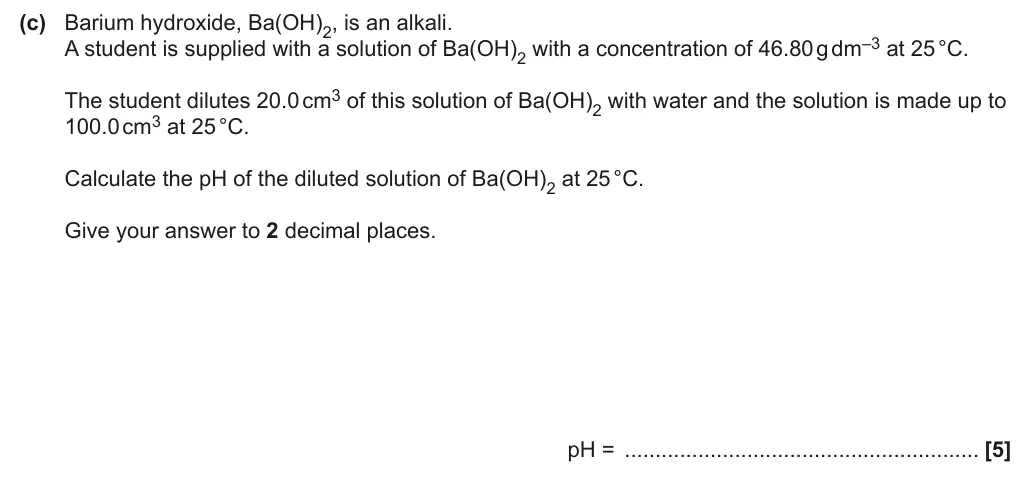
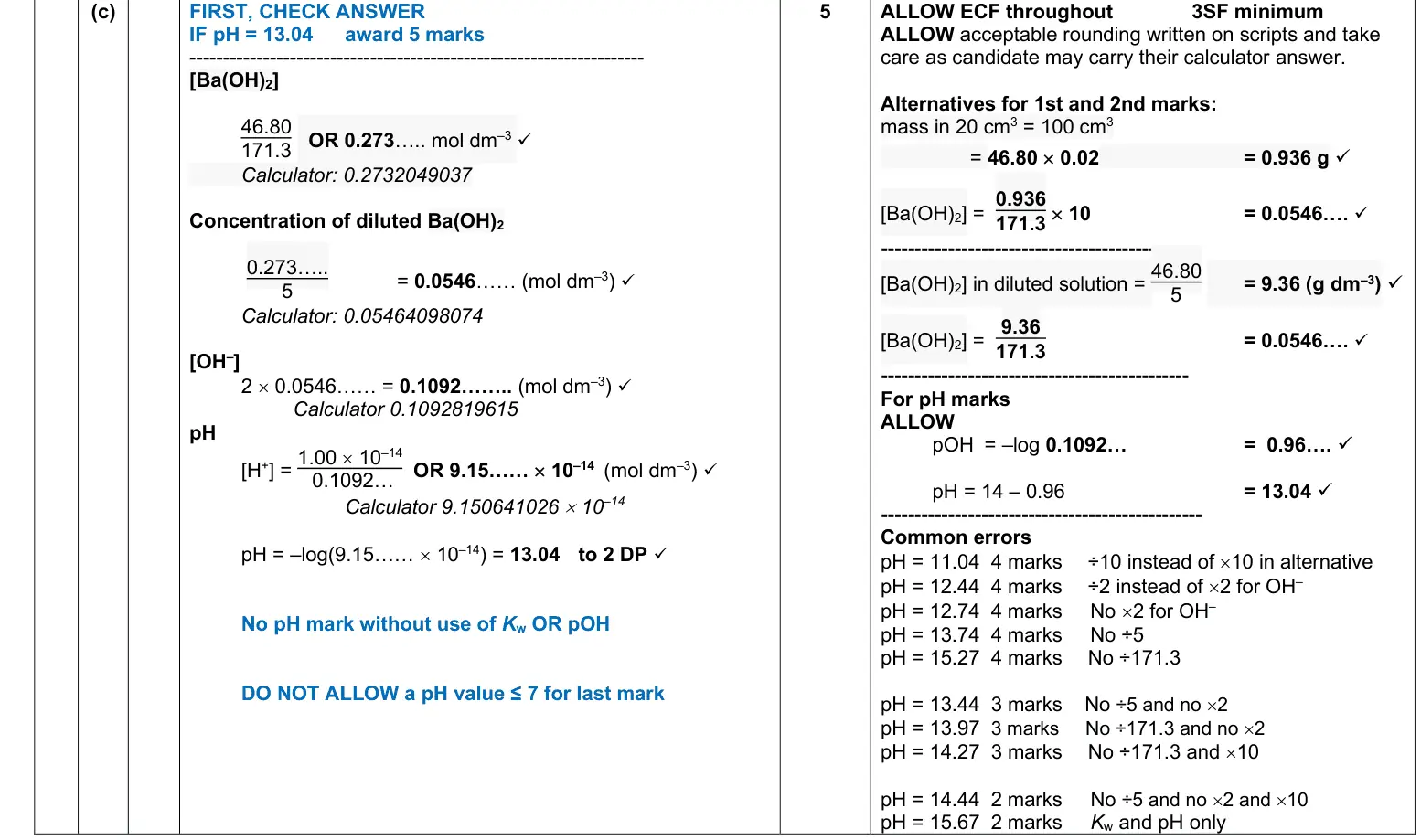
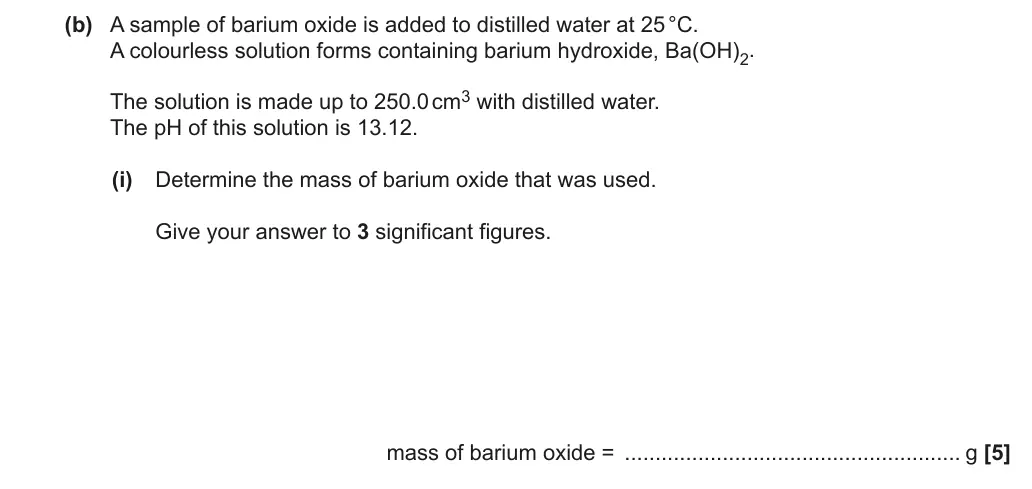
This unstructured calculation required candidates to work out the concentration of Ba(OH)2, to scale the concentration for the 5 times dilution and to determine the concentration of OH– ions by multiplying by 2. Many different methods were seen for working out the moles of Ba (OH)2, but the ÷5 and 2 operations were often omitted. It was common for concentrations to be shown with the wrong number of powers of 10. Many candidates used Kw or pOH confidently to obtain a value for pH. Error carried forwards (ECF) could be applied provided that the numbers used had been generated using the numbers in the question. A good number of candidates determined the pH correctly to 2 decimal places as 13.04. The commonest incorrect answer was 12.74, the result of not using 2 to find [OH–]. As with Q2b(ii), responses were often unclearly laid out and it could be difficult to find answers.
Notes from the mark scheme and report
g dm–3 to mol dm–3 (÷ 171.3)
dilution ÷ 5
no pH mark without Kw or pOH
13.04 to 2 DP
common errors 12.74 (no × 2), 13.74 (no ÷ 5)
Skills: M0.2 Use ratios, fractions and percentages; M0.4 Use calculators to find and use power, exponential and logarithmic functions; M2.3 Substitute numerical values into algebraic equations using appropriate units for physical quantities; M2.5 Use logarithms in relation to quantities that range over several orders of magnitude
June 2025 · Paper 3 · Q4(b)(i)1 markShort answerMedium
Mark scheme
Examiner's comment
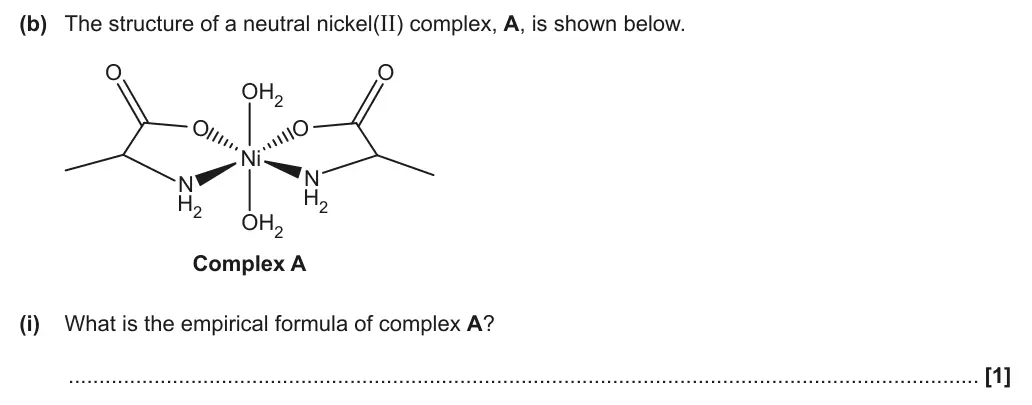
Candidates produced a range of formulae, mainly from not counting H or C properly or omitting one of the elements, often Ni. A significant number of candidates wrote a structural formula rather than the empirical formula asked for in the question.
Notes from the mark scheme and report
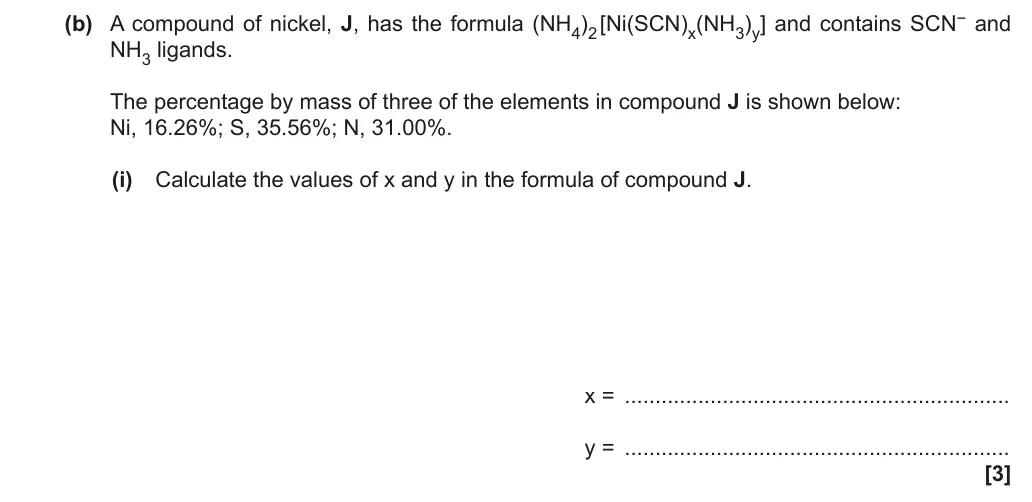
C6H16N2NiO6: must be empirical formula
DO NOT ALLOW Ni(C3H6NO2)2(H2O)2
June 2025 · Paper 3 · Q5(a)(ii)4 marksCalculationHard
Earlier part of question 5 that this part uses
Mark scheme
Examiner's comment
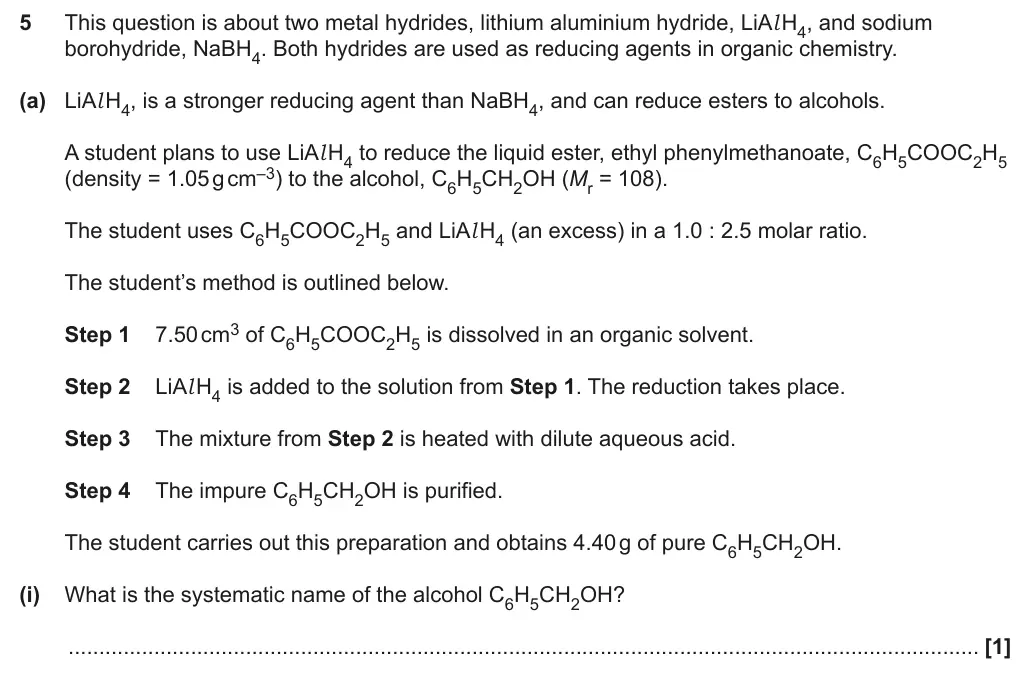
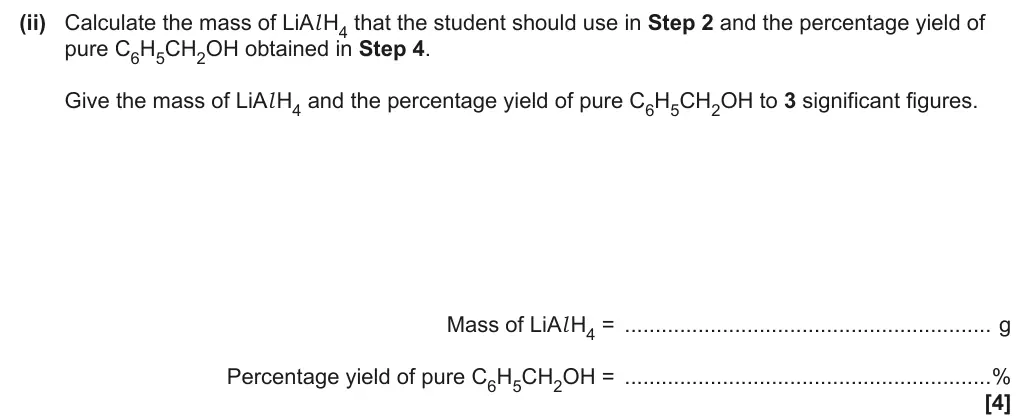
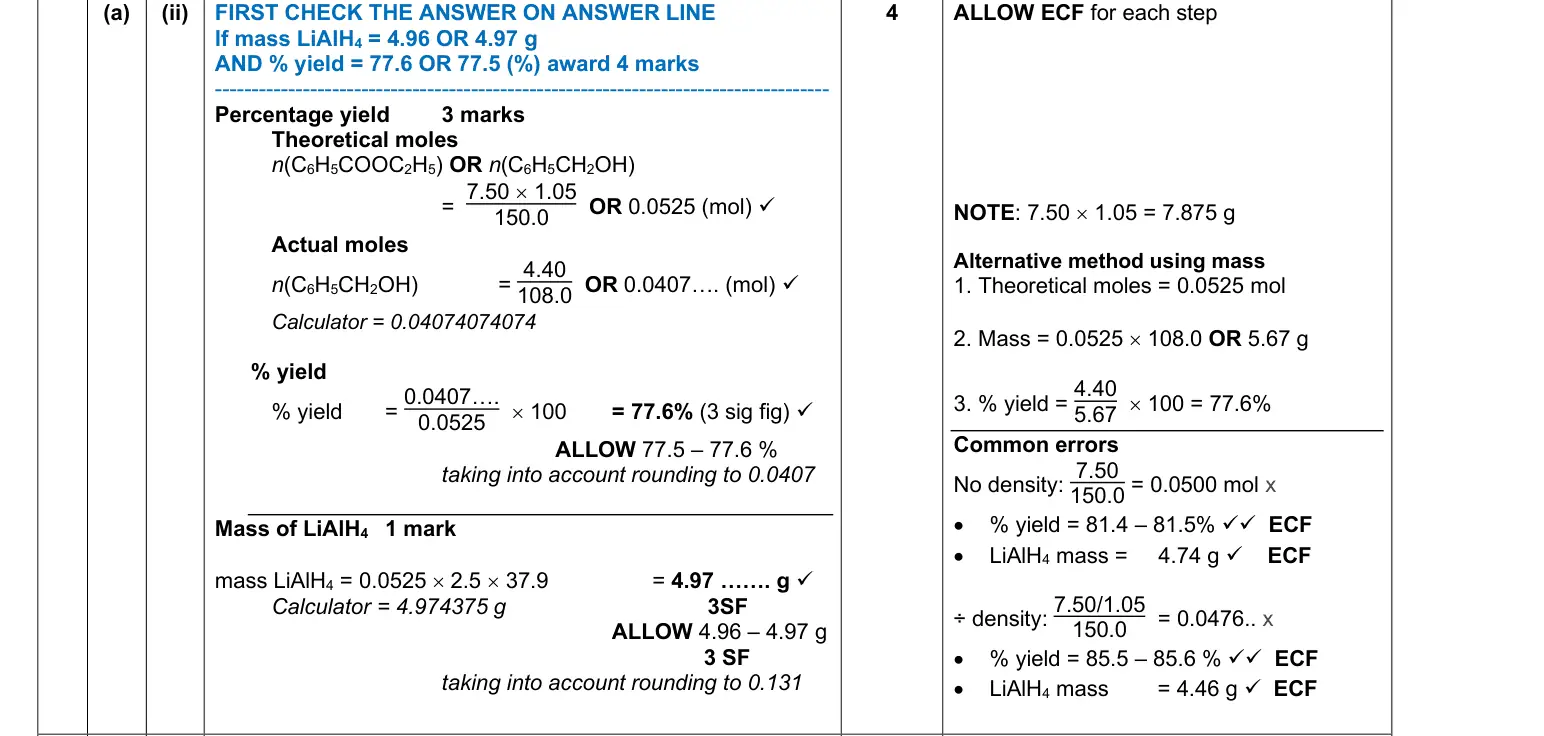
Most candidates gave either the correct mass of LiAlH4 or the correct percentage yield. Provided that working was shown, it was possible to award some marks form a correct method. This allows ECF to be applied where a candidate had produced an incorrect number early in their calculation. Common errors included: omission of the density, dividing instead of multiplying by the density. This question discriminated well and the presence of LiAlH4 in the problem introduced a harder feature to a convention percentage yield calculation. At with the unstructured calculations elsewhere on the paper, often numbers were seen randomly placed in the answer space, making it difficult to see where errors had arisen. Candidates may be penalising themselves if they do not show clear working. It was common to see the moles of LiAlH4 being confused with the moles of the alcohol in the percentage yield calculation with moles of LiAlH4. This error is shown in Exemplar 2. The candidate has calculated the moles of C6H5COOC2H5 and C6H5CH2OH correctly and has the determined the mass of LiAlH4. This has allowed 3 of the 4 marks to be given. For the percentage yield, the candidate has then used the moles of LiAlH4 instead of C6H5CH2OH. Notice that the candidate has also given their percentage yield to 4 significant figures (SF) rather than the 3 SF asked for in the question. If the correct moles of C6H5CH2OH had been used, this error would also have prevented the mark for percentage yield from being given.
Notes from the mark scheme and report
mass of ester = volume × density (7.875 g, 0.0525 mol)
LiAlH4 = 0.0525 × 2.5 × 37.9 = 4.97 g
yield 77.6%
common errors: no density (81.4%, 4.74 g), ÷ density (85.5%, 4.46 g)
ECF each step
In chemistry calculations, calculator values should be carried through all steps in a calculation. This is important to eliminate errors from rounding of intermediate values.
Any rounding should take place at the very end of the calculation.
Skills: M0.0 Recognise and make use of appropriate units in calculations; M0.2 Use ratios, fractions and percentages; M1.1 Use an appropriate number of significant figures; M2.3 Substitute numerical values into algebraic equations using appropriate units for physical quantities
June 2025 · Paper 3 · Q66 marks6-mark level of responseMedium
Mark scheme, with the levels and indicative points
Examiner's comment
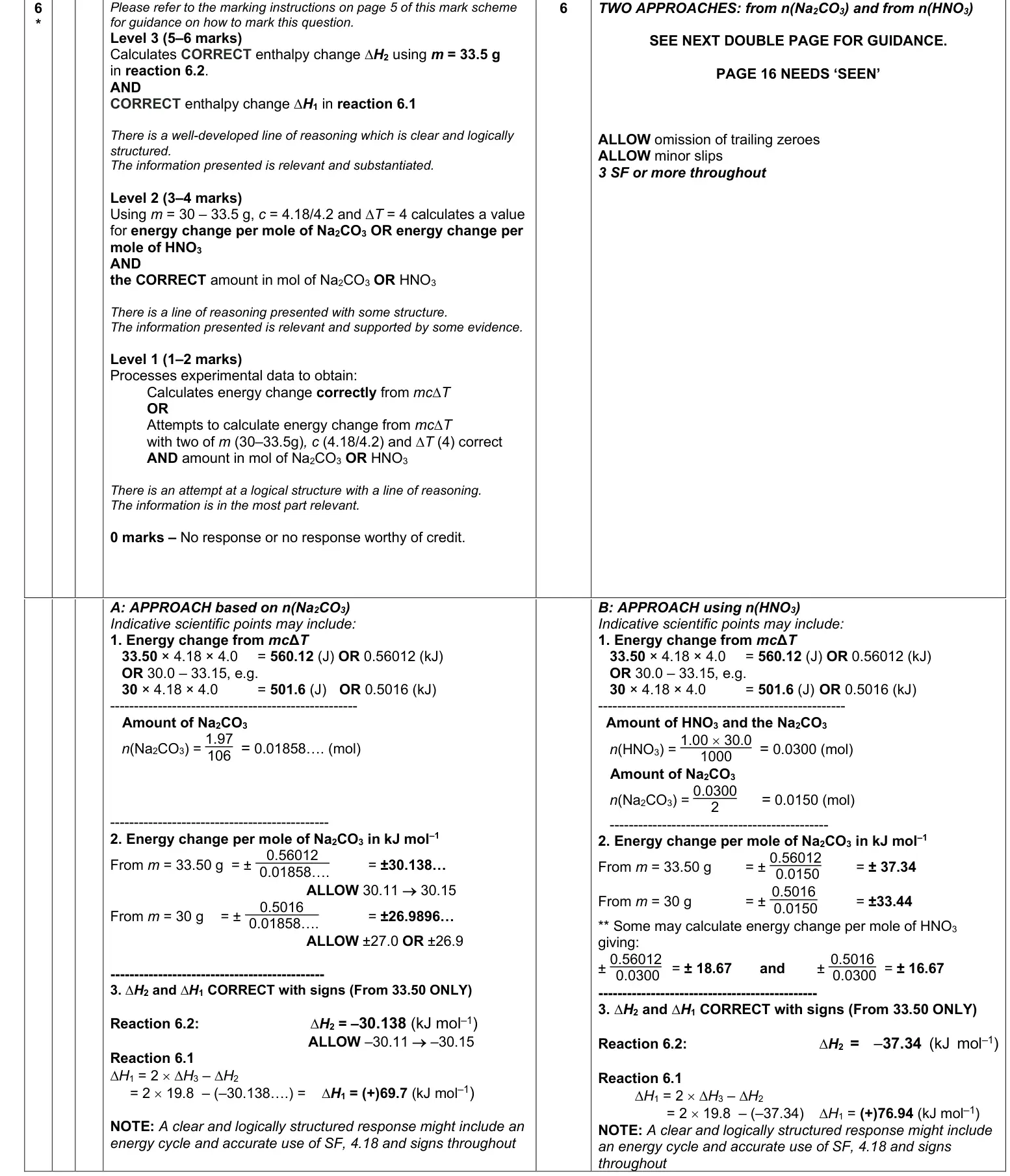
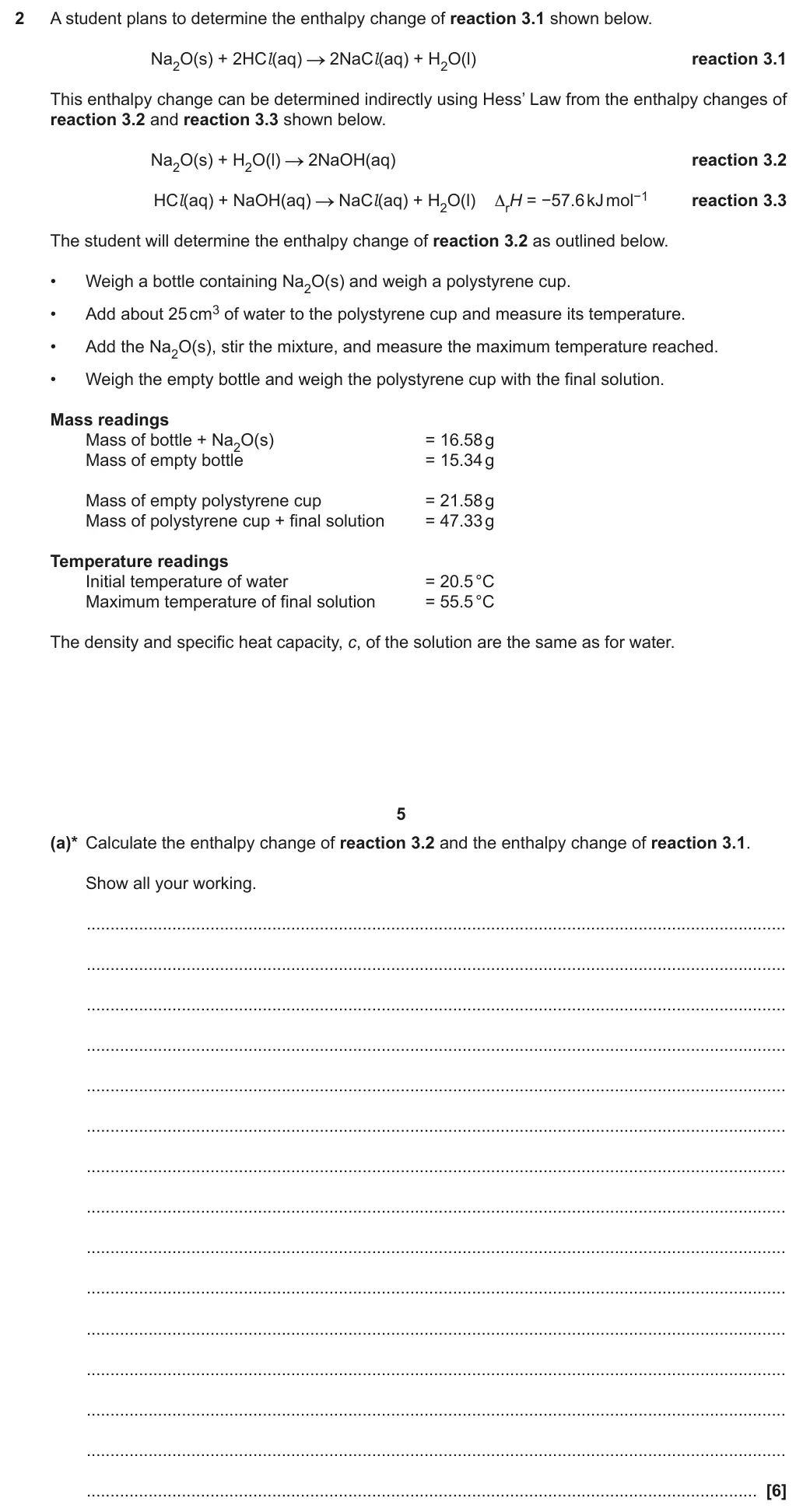
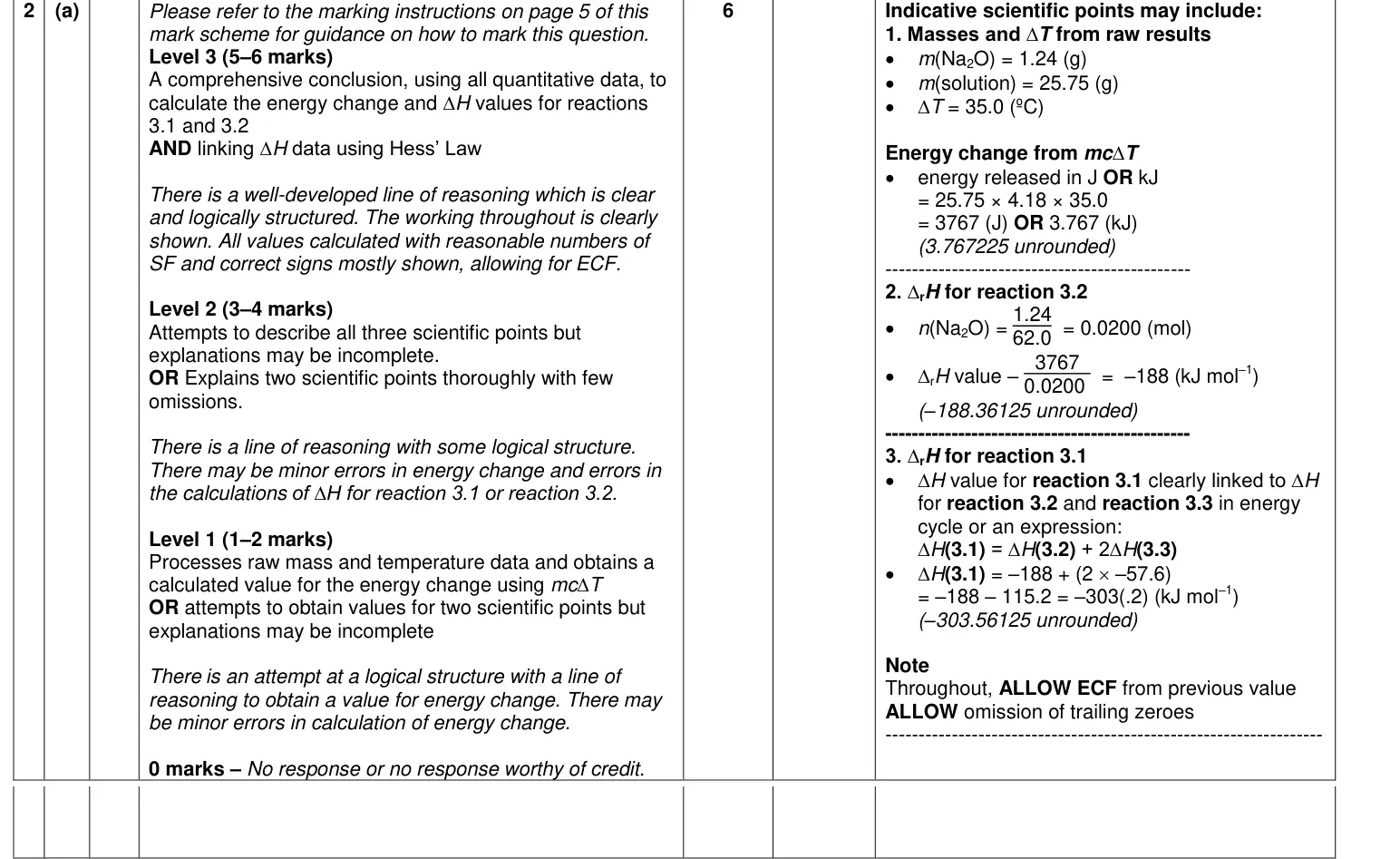
As with the other Level of Response (LoR) question (Question 3(a)), most candidates were able to gain some marks for this question, with very few obtaining no marks. Overall fewer candidates were given Level 3 for Q6 than for Q3(a). To achieve Level 1, candidates needed to calculate a value for the energy change q from mc∆T using at least two of m, c and ∆T. Candidates needed to first process the raw experimental results provided to extract the required values for the calculation. In the mc∆T calculation, the most common incorrect values used were 1.97 (the mass of Na2CO3) for m, 8.314 (the gas constant) for c and 277 (Kelvin) for ∆T. Only the lowest attaining candidates were unable to carry out this task. For Level 2, candidates were expected to determine the energy change per mole using the correct mc∆T value. Most candidates reached Level 2. A Level 3 response proved to be more elusive, requiring candidates to use an energy cycle to determine an enthalpy change. This task was far more testing than the requirements for Level 2. Some leeway was allowed for values used within the response. For m, a value in the range of 30 – 33.5 was allowed to take into account either HNO3(aq) or the mass of solution. Responses calculated per mole of Na2CO3 or HNO3 were allowed. This allowed for the fact that, even though the question described an excess of HNO3 being used in the reaction, the volume and concentration specified (30 cm3 of 1.00 dm3 HNO3) is short of being an excess. The approach taken is fully outlined in the mark scheme for this question and ensured no students were disadvantaged. The communication strand for this LoR question was given for responses that were arranged in a cohesive way. Unfortunately, a significant number of candidates produced responses that were difficult to follow with unlabelled quantities and numbers spread randomly across the page.
Notes from the mark scheme and report
m = 33.50 g (mass of final solution, not 30 cm3)
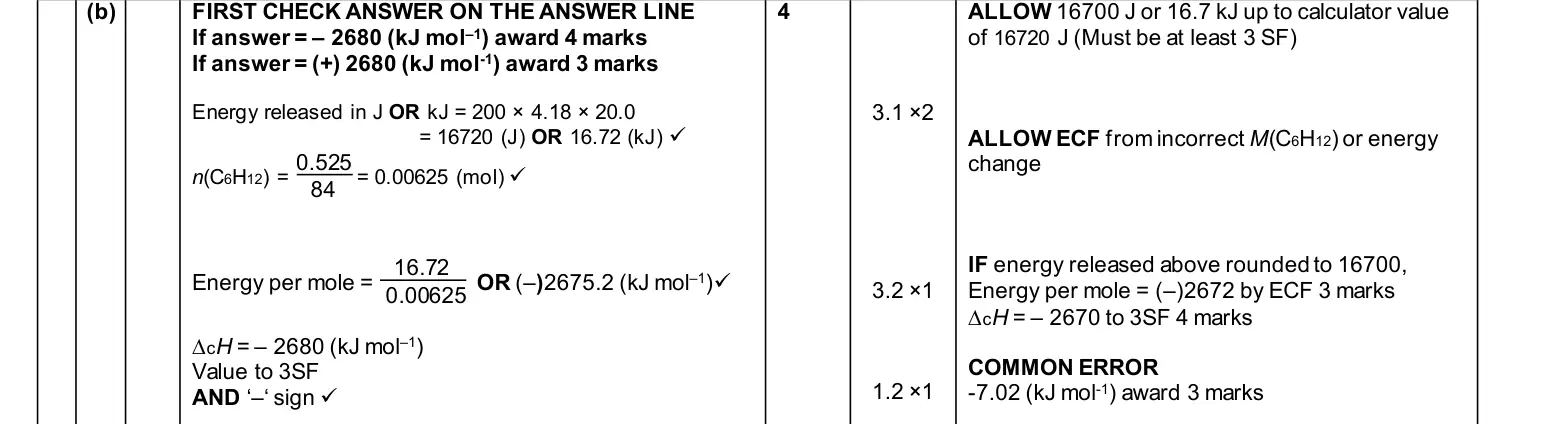
q = 33.50 × 4.18 × 4.0 = 560 J
n(Na2CO3) = 1.97/106 (or via n(HNO3) = 0.0300 if acid limiting)
∆H2 = –30.1 (temperature rise so exothermic)
∆H1 = 2∆H3 – ∆H2 = +69.7 kJ mol–1
energy cycle and signs
Skills: M0.0 Recognise and make use of appropriate units in calculations; M1.1 Use an appropriate number of significant figures; M2.3 Substitute numerical values into algebraic equations using appropriate units for physical quantities; M2.4 Solve algebraic equations; PAG3 Enthalpy determination
June 2024 · AS Paper 1 · Q31 markMultiple choiceMedium
Answer
D
Mark scheme
Examiner's comment
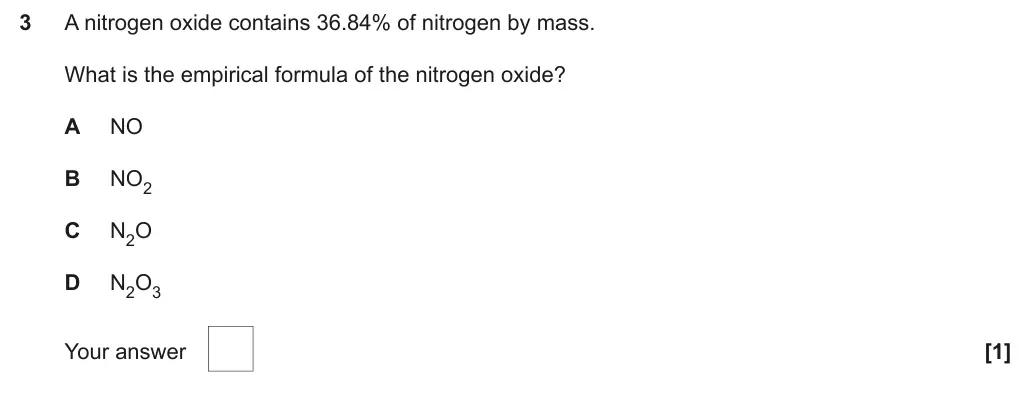
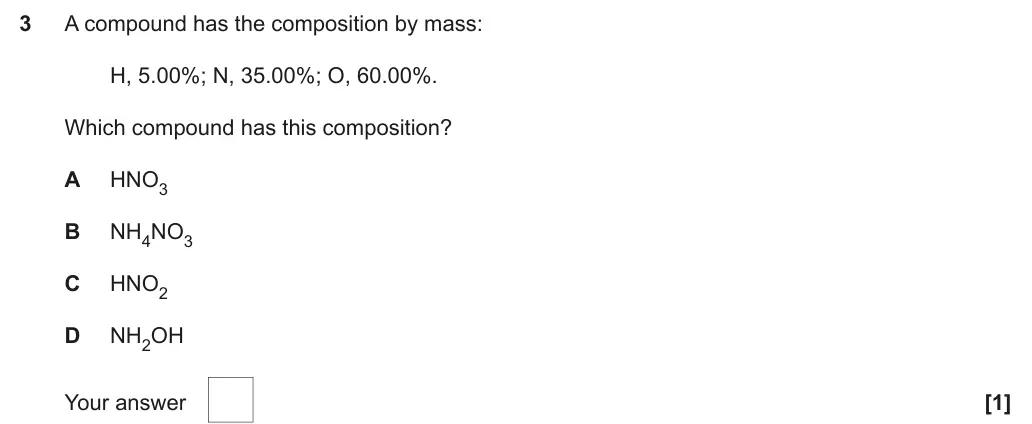
Most candidates selected D as the correct formula. They usually showed their working alongside the options which is good practice. B was the main distractor and working suggested that such candidates had over-rounded their ratio of 1:1.5 to 1:2.
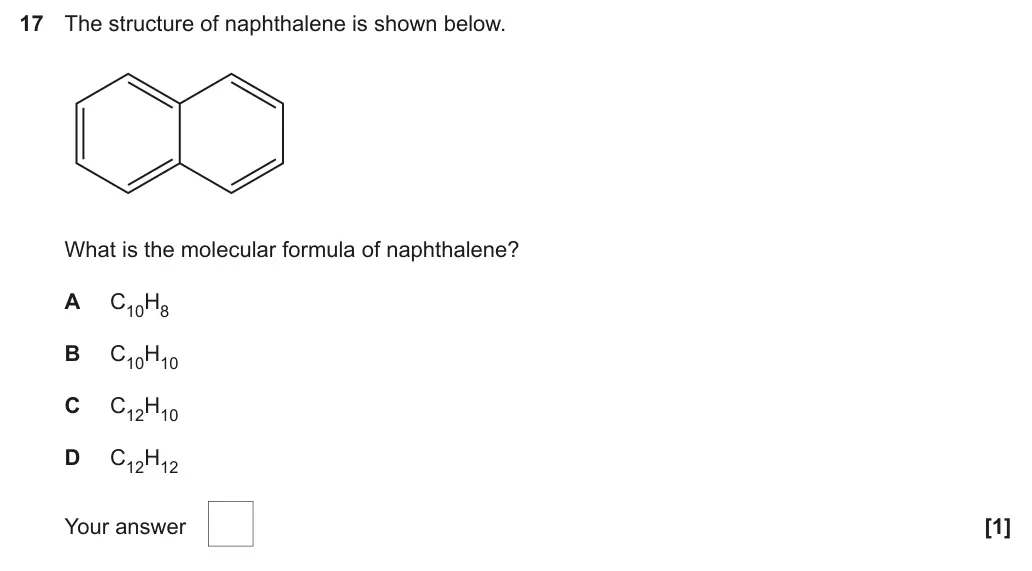
June 2024 · Paper 1 · Q31 markMultiple choiceMedium
Answer
C
Mark scheme
Examiner's comment
The correct answer was C. Candidates should be encouraged to use the space around the question to jot down the equation and perform any calculations. There was evidence of some confusion about atom economy leading to B or D being selected.
June 2024 · AS Paper 1 · Q41 markMultiple choiceMedium
Answer
C
Mark scheme
Examiner's comment
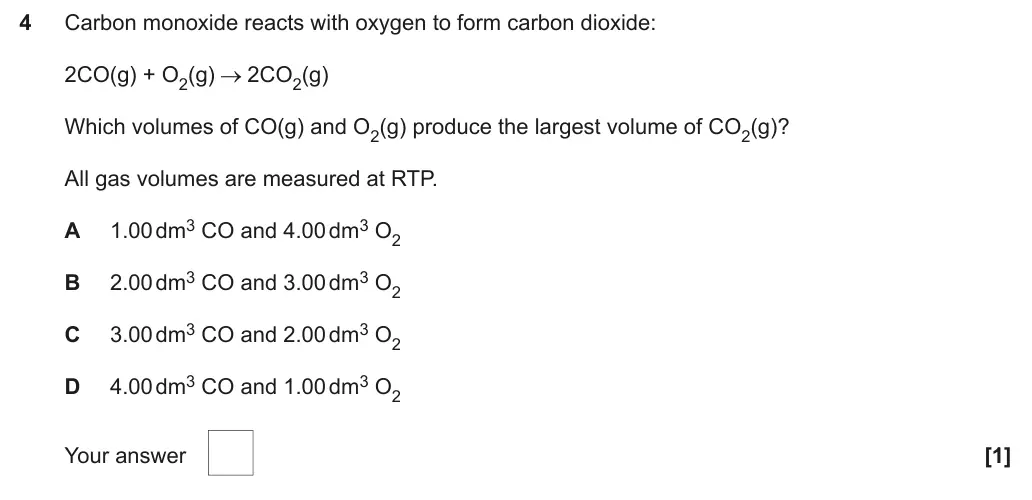
Candidates found this question very difficult. Scripts showed a general lack of working, suggesting that candidates did not know how to approach the problem. Candidates had to first work out which reactant was in excess and to use the limiting reagent to determine the volumes of CO2 formed. The question did not discriminate very well, suggesting that many candidates guessed. C was the correct response with A and D being the main distractors, presumably because these contained the largest volumes of O2 (in A) and of CO (in D). This would be a good question to use with high-attaining candidates.
June 2024 · Paper 1 · Q71 markMultiple choiceMedium
Answer
A
Mark scheme
Examiner's comment
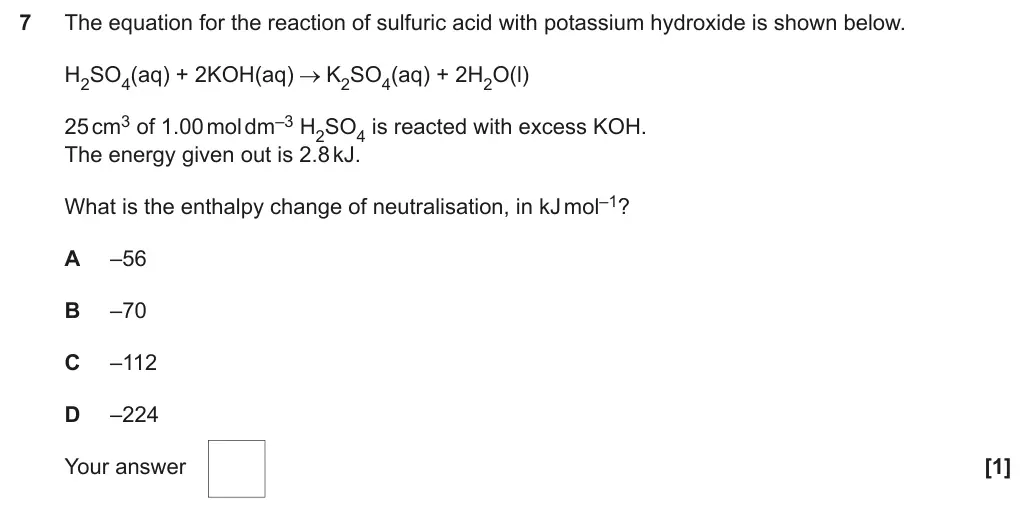
The correct answer was A. Some candidates showed full working in the space provided. B and C were common errors. Those who selected C did not take into account the need to half the reaction’s enthalpy change to meet the definition requirements of one mole of water.
June 2024 · AS Paper 1 · Q81 markMultiple choiceHard
Answer
B
Mark scheme
Examiner's comment
Overall, candidates had little difficulty with this question and most selected B. Options C and D were the main distractors, with few choosing option A. The question did not discriminate well across the ability range, suggesting that many candidates guessed.
June 2024 · Paper 1 · Q19(b)(i)5 marksCalculationEasy
Mark scheme
Examiner's comment
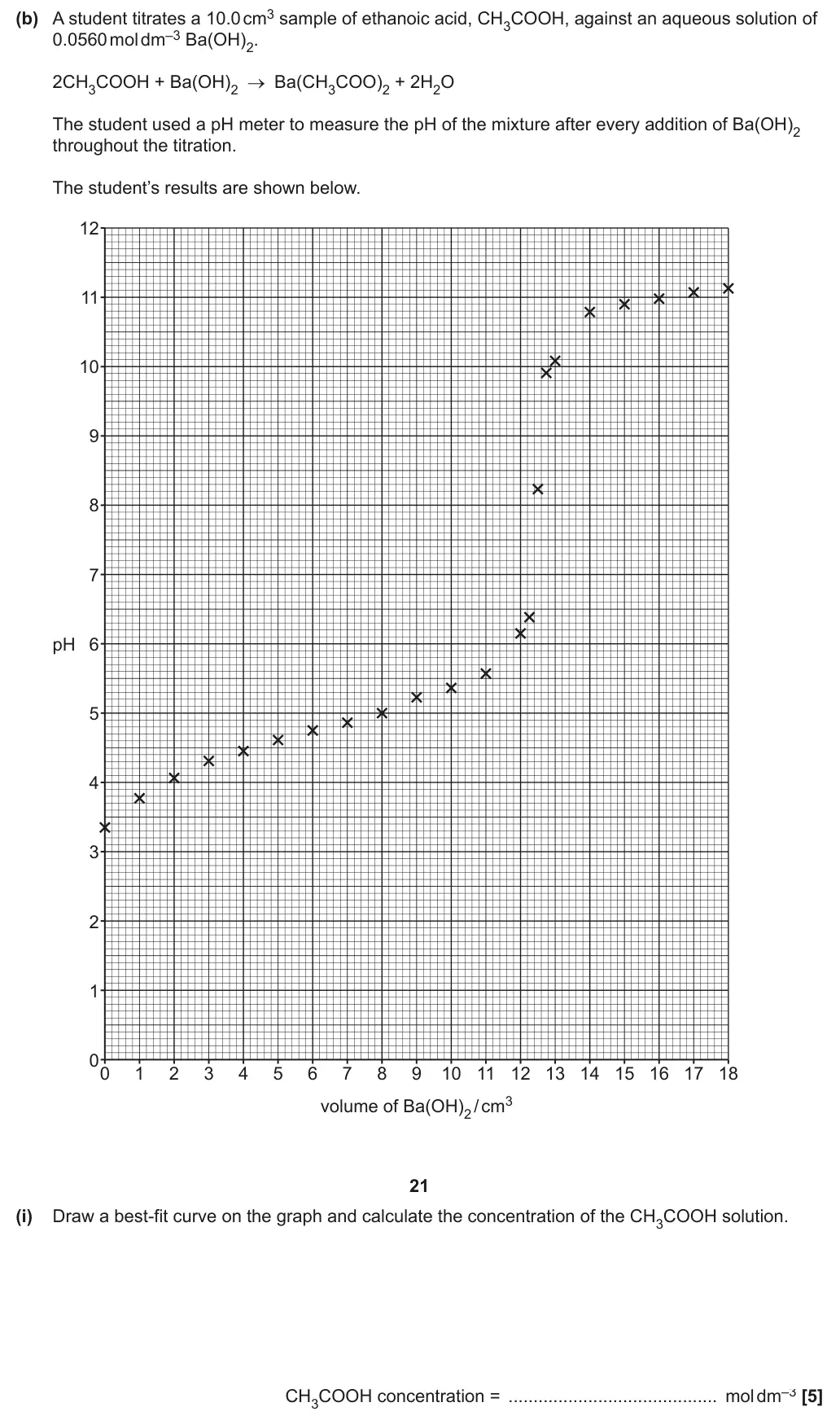
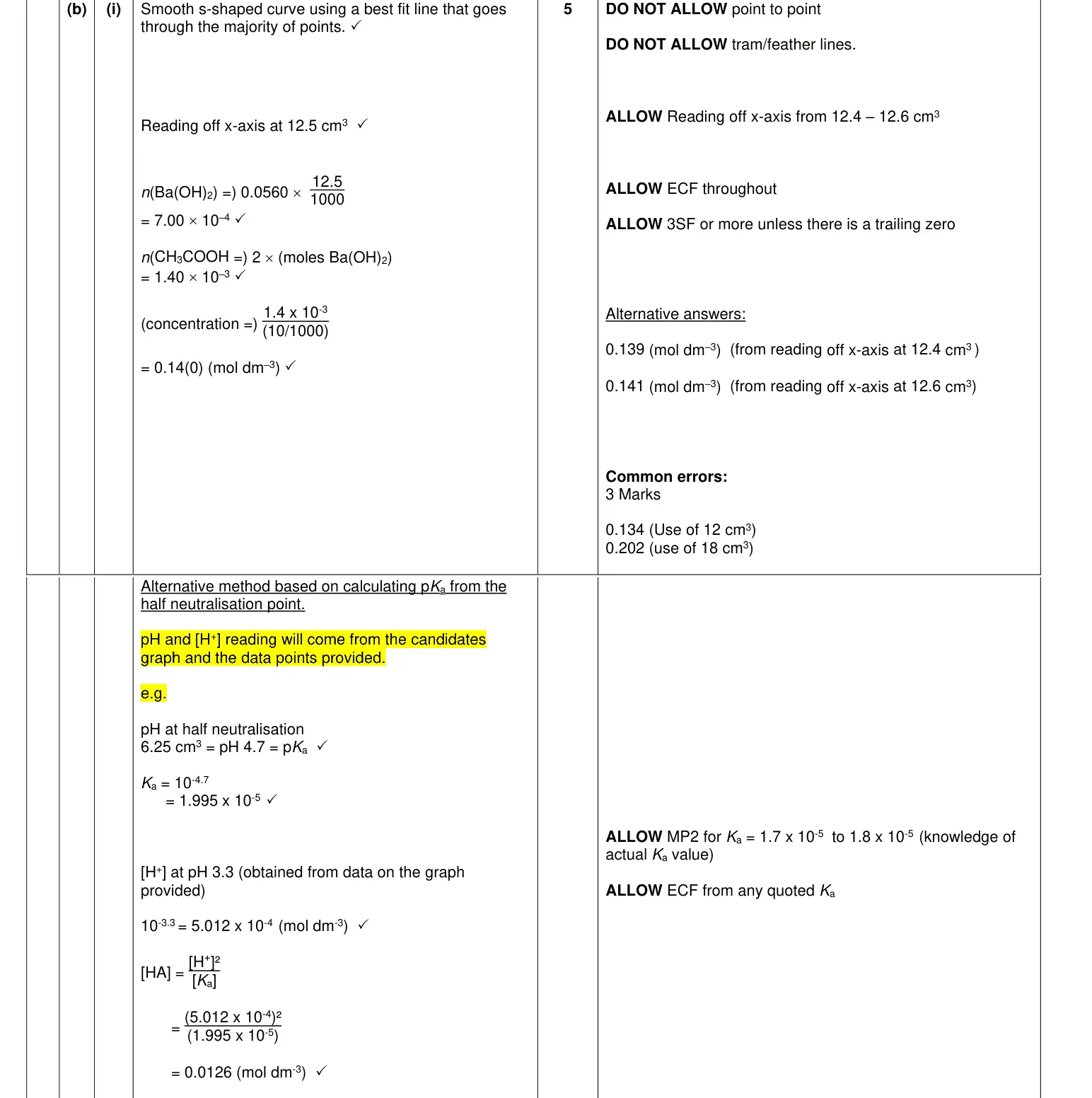
Nearly all candidates were able to draw the line of best fit and linked the sharp vertical section of the graph with the volume of Ba(OH)2 needed to neutralise the ethanoic acid. Candidates should aim to produce a smooth line of best fit and avoid ‘tram’ lines when the pencil is taken off the paper and the curve started again. The line should go through most points. Some candidates misinterpreted the graph and used values of 8, 12, 12.2, 12.25 and 18. However, the remainder of the calculation was accessible, and most candidates scored well with ECF marks from this point. There was occasional division of 2 for the moles of ethanoic acid and dividing by the original volume of Ba(OH)2 rather than the 10cm3 of ethanoic acid. This candidate scored all available marks. This is a very good example of a candidate displaying their working. The response was well communicated indicating the end point, links were made to what was being calculated and how the next number was obtained.
Notes from the mark scheme and report
smooth S-shaped best-fit curve through the majority of points
equivalence at 12.5 cm3
1:2 ratio Ba(OH)2:CH3COOH
Skills: M0.0 Recognise and make use of appropriate units in calculations; M0.2 Use ratios, fractions and percentages; M3.2 Plot two variables from experimental or other data; PAG11 pH measurement; PAG2 Acid–base titration
June 2024 · Paper 1 · Q21(b)4 marksCalculationMedium
Mark scheme
Examiner's comment
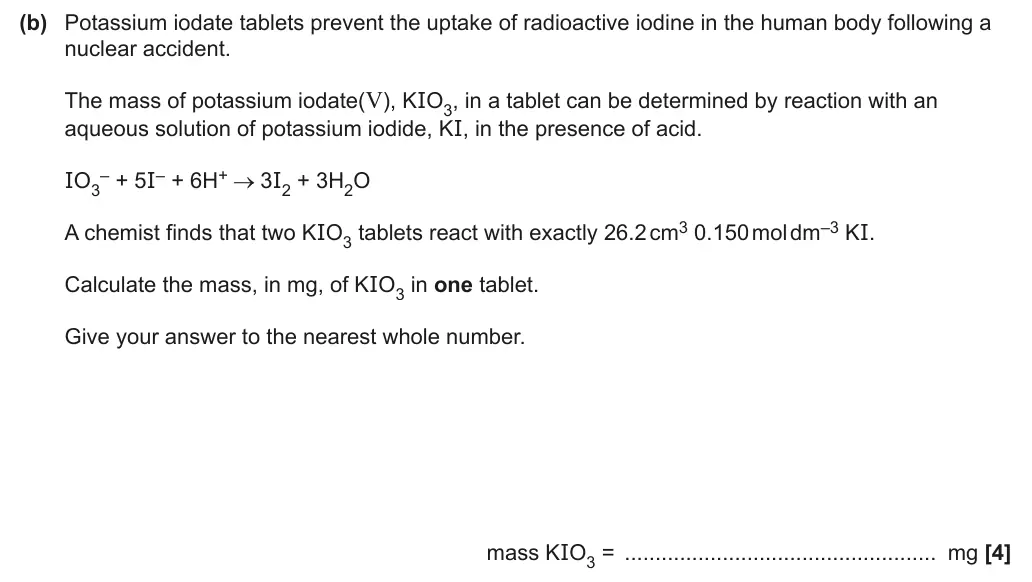
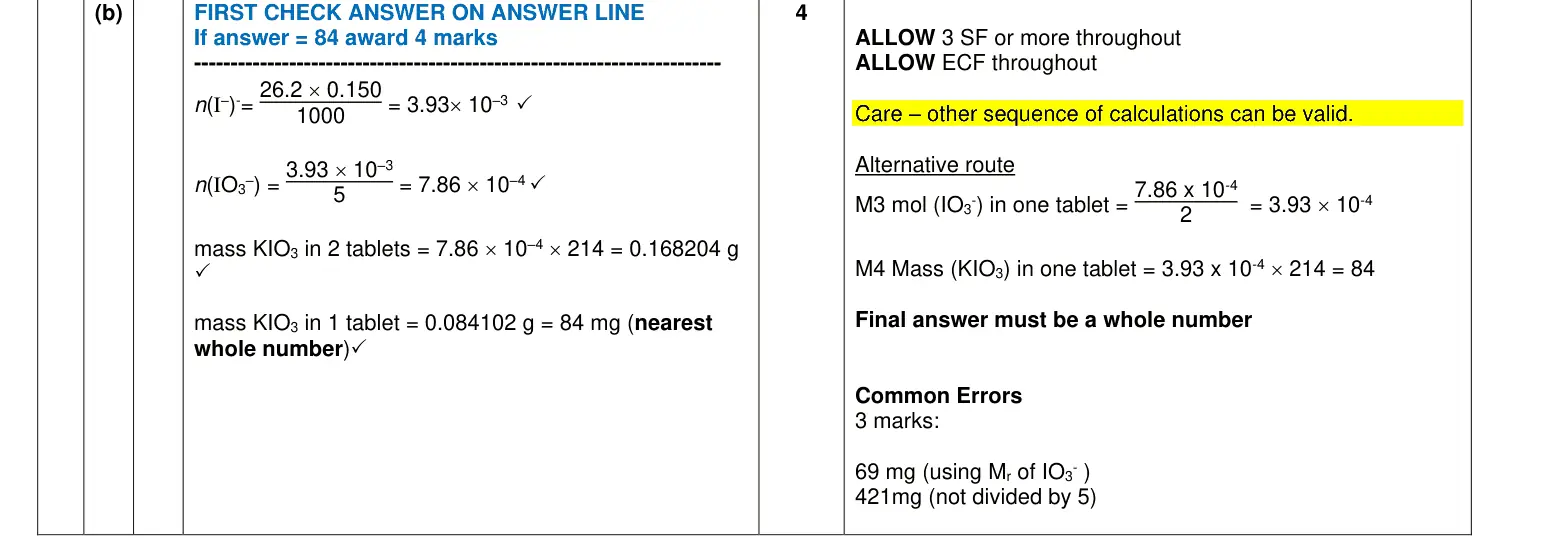
Although lots of candidates got the correct final answer, almost all achieved some credit from this calculation through error carried forward with marks spread across the available range. Almost all candidates were able to find the number of moles of iodide. A few candidates did not get the molar ratio and/or used the mass of just IO3- rather than KIO3. Some then did not realise the need to half this number to find the mass in 1 tablet, and multiplied by either 10 or 100 in order to convert g to mg.
Notes from the mark scheme and report
1:5 ratio IO3–:I–
two tablets so halve
answer in mg to nearest whole number (84)
Candidates need to develop their ability to perform calculations that require them to convert between different units, e.g. mg to g. Each step of a calculation should be shown.
Skills: M0.0 Recognise and make use of appropriate units in calculations; M0.2 Use ratios, fractions and percentages; M2.3 Substitute numerical values into algebraic equations using appropriate units for physical quantities
June 2024 · AS Paper 1 · Q21(c)3 marksCalculationMedium
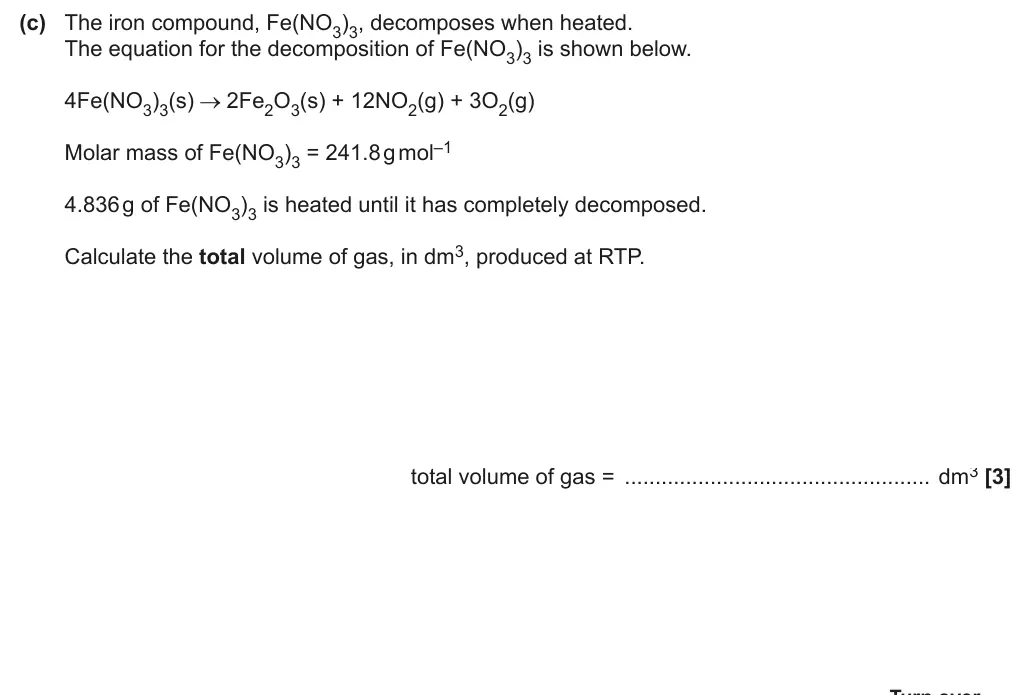
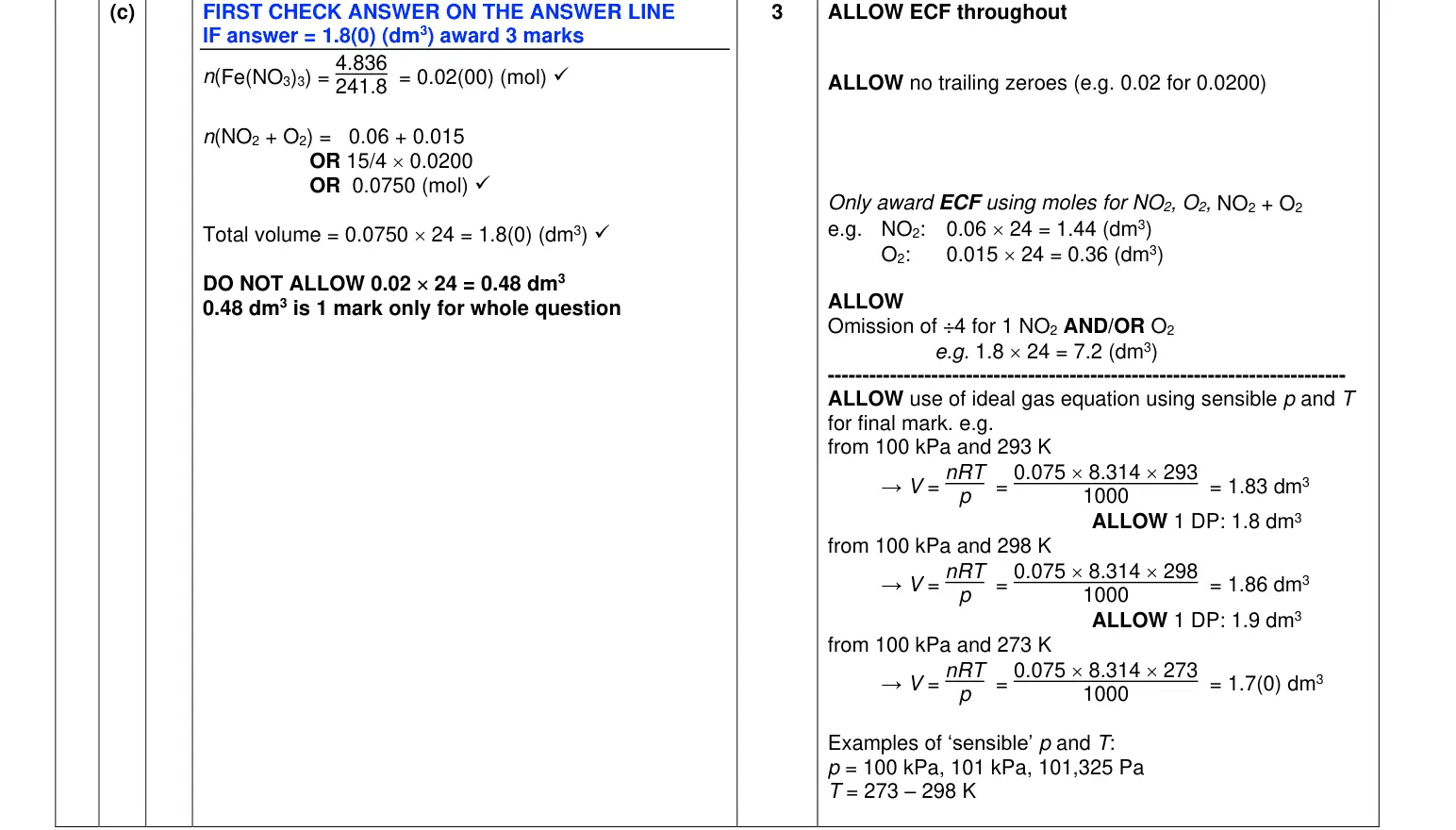
Mark scheme
Examiner's comment
Most candidates were given at least one of the three available marks for calculating the amount of Fe(NO3)2 as 0.0200 mol. Candidates then needed to determine the moles of gas (NO2 + O2) as 0.0750 mol, which has a volume at RTP of 0.0750 24.0 = 1.80 dm3. The most common error was omission of ÷4 from the equation when working out the moles of gas and obtaining a total volume of 1.80 4 = 7.20 dm3. Such a response could still be given 2 marks by error carried forwards.
Notes from the mark scheme and report
total moles of gas = 15/4 × n(Fe(NO3)3)
DO NOT ALLOW 0.02 × 24 = 0.48 dm3 (1 mark only)
ALLOW ECF
ALLOW ideal gas equation with sensible p and T
Skills: M0.0 Recognise and make use of appropriate units in calculations; M0.2 Use ratios, fractions and percentages; M2.3 Substitute numerical values into algebraic equations using appropriate units for physical quantities
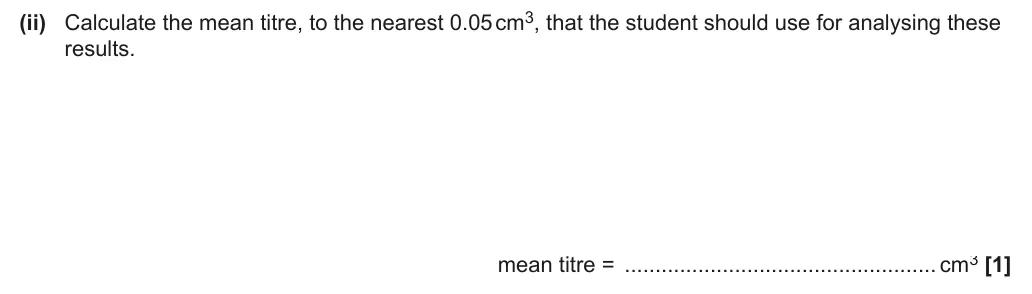
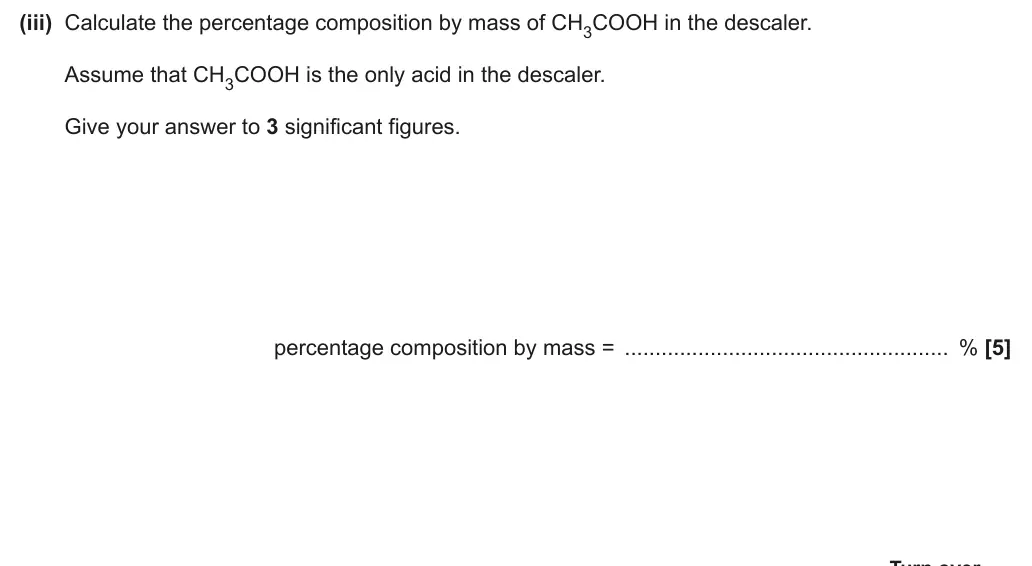
June 2024 · AS Paper 1 · Q22(b)(iii)5 marksCalculationMedium
Earlier parts of question 22 that this part uses
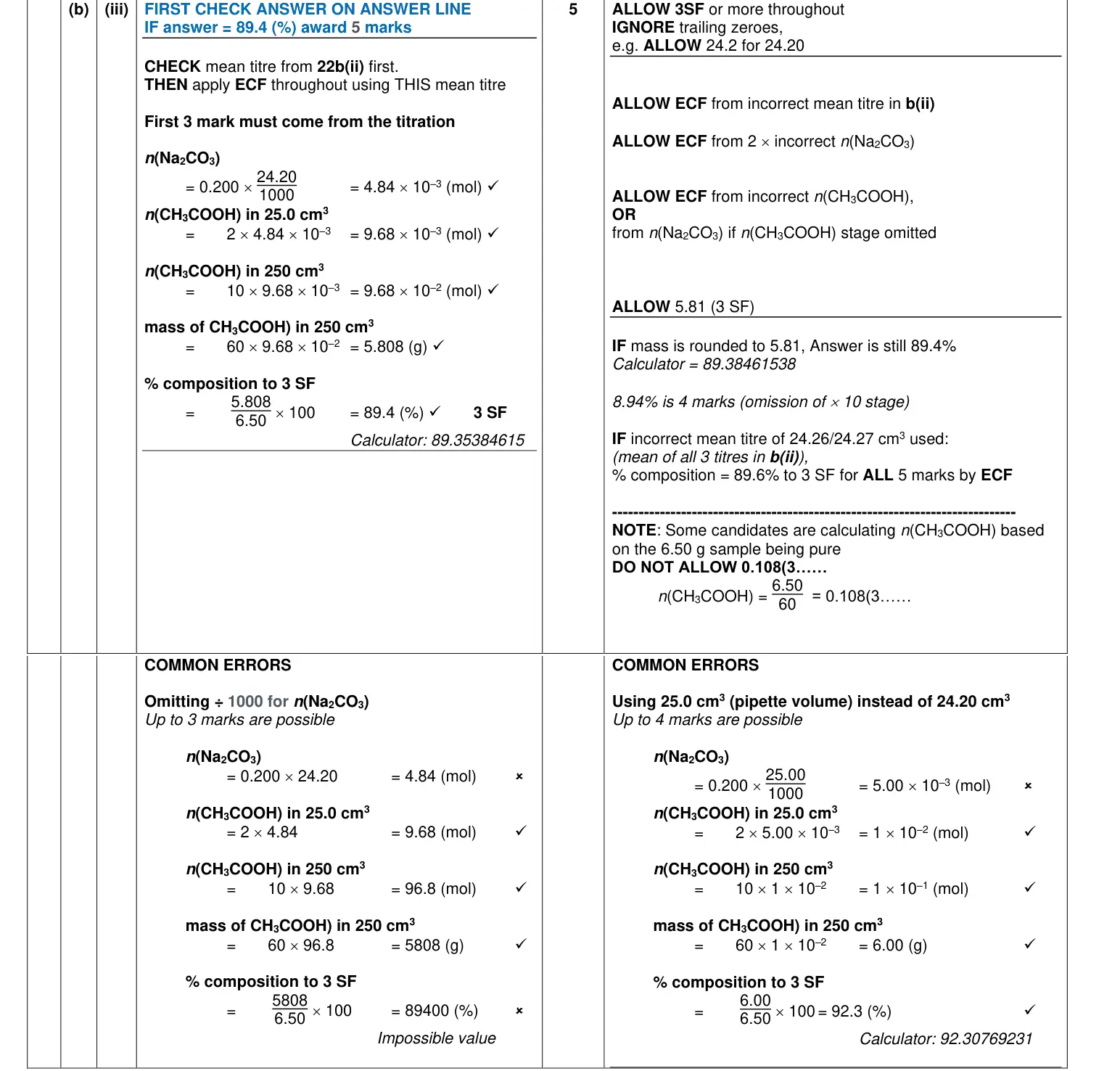
Mark scheme
Examiner's comment
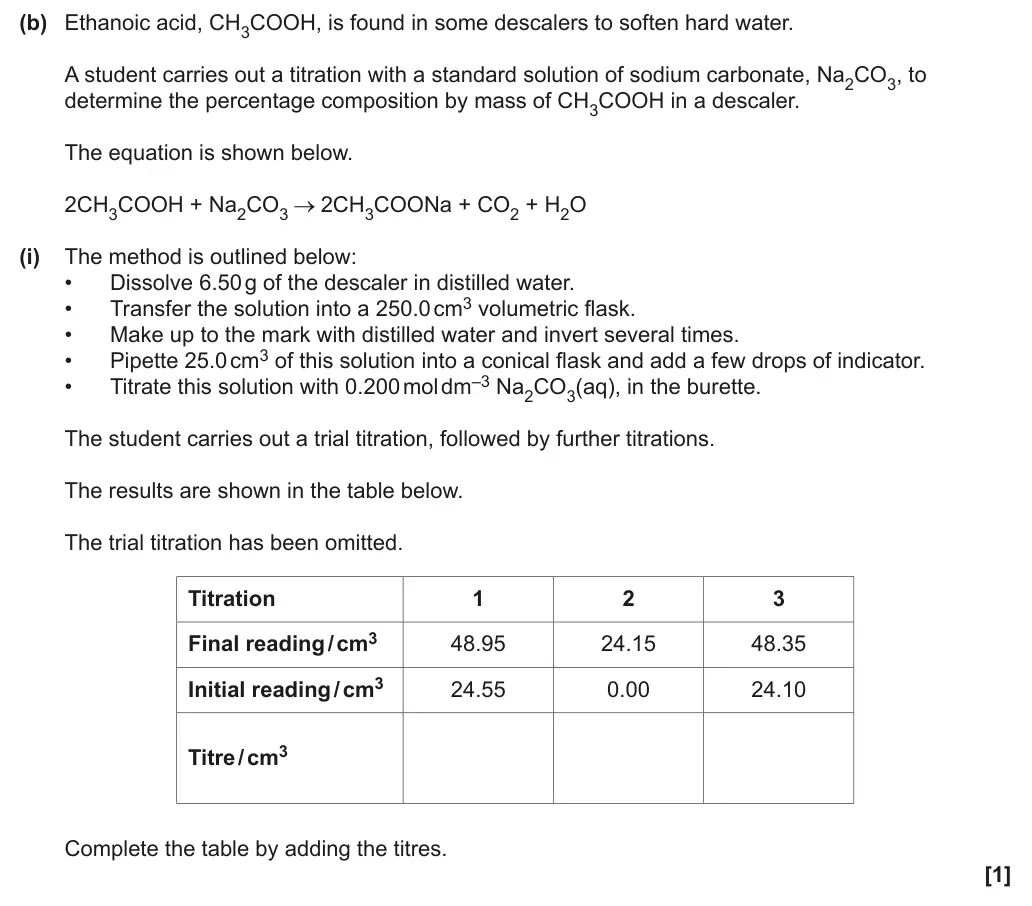
Many candidates followed a well drilled method to analyse their titration results: • Moles of Na2CO3 in the mean titre • Moles of CH3COOH in 25 cm3 • Scaling 10 for moles of CH3COOH in 250 cm3 Candidates then needed to process their titration results further to determine the percentage composition: • Mass of CH3COOH in 250 cm3 • Percentage composition of CH3COOH to 3 significant figures. Most candidates were able to make some progress through the analysis. Common errors included: • Not 2 to obtain the moles of CH3COOH • Omission of the scaling stage. Some candidates ignored the titration results entirely, instead calculating the number of moles of CH3COOH in 6.5 g of the descaler as 0.1083 mol by assuming that all of the descaler was CH3COOH. This approach was flawed and could not be given any marks. A final comment must be made about the presentation of many of the responses. Numbers had often been sprayed across the page and it could be difficult to see how these related to a cohesive solution. It was often impossible to give marks for such responses. The question discriminated extremely well with some candidates given all 5 marks. Less successful responses demonstrated problems with approaching this type of question and some were given no marks at all. CH3COOH from 25 to 250 cm3. The result is a percentage composition of 8.94 % instead of 89.4 %. The clear presentation allowed the examiner to follow how the incorrect response had been obtained. Error carried forward allowed marks can be given for a correct method, giving a total of 4 out of 5 marks.
Notes from the mark scheme and report
2:1 ratio CH3COOH:Na2CO3
×10 scaling to 250 cm3 (8.94% = 4 marks)
3 SF required
common errors: omitting ÷1000, using 25.0 cm3 instead of mean titre
DO NOT ALLOW n(CH3COOH) = 6.50/60
ALLOW ECF from mean titre
Skills: M0.0 Recognise and make use of appropriate units in calculations; M0.2 Use ratios, fractions and percentages; M1.1 Use an appropriate number of significant figures; PAG2 Acid–base titration
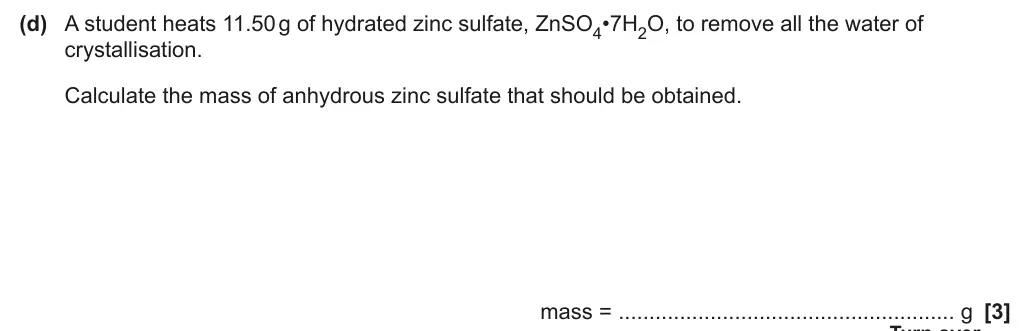
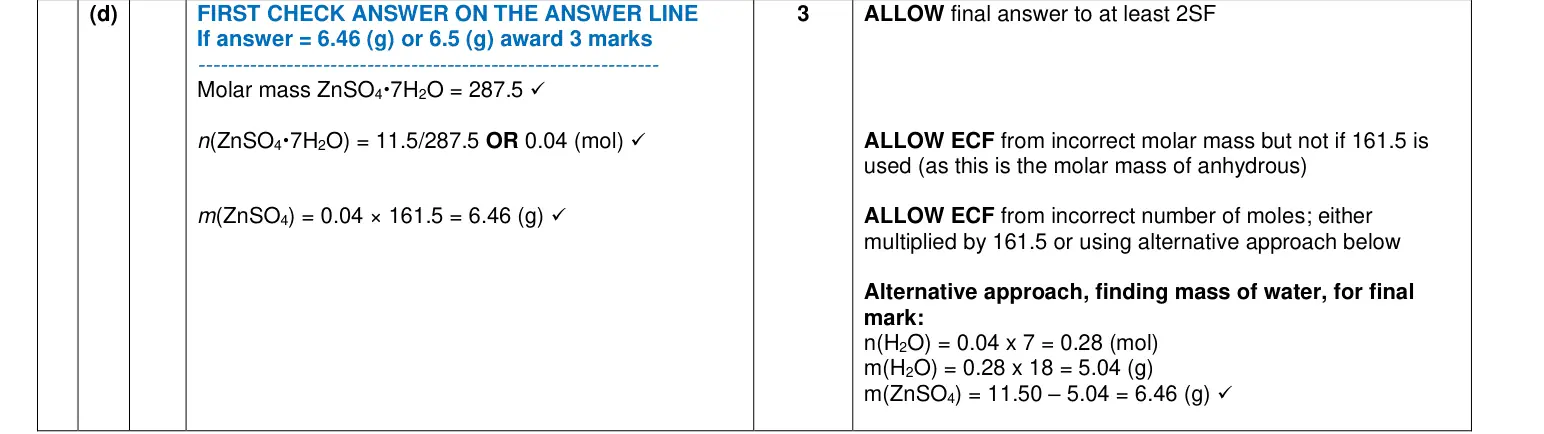
June 2024 · AS Paper 2 · Q1(d)3 marksCalculationHard
Mark scheme
Examiner's comment
Just under half of the candidates scored all 3 marks. A range of responses were seen for this question but the most common error was to use the incorrect Mr for the hydrated which included either using the Mr for the anhydrous salt or the Mr for ZnSO4.H2O (179.5). It was evident that candidates struggle to understand what is meant by water of crystallisation. Some scored 2 marks for the correct Mr and finding moles but then were unsure how to proceed with the calculation. For example, some divided moles by 7 before multiplying by 161.5. Many candidates took the more complicated alternative route to find the mass of water before subtracting from mass of hydrated compound. Low-scoring candidates often struggled to correctly work out Mr values. Their working was set out so that individual steps were unclear, often with contradictory calculations.
Notes from the mark scheme and report
M(ZnSO4•7H2O) = 287.5
n = 0.04
× 161.5 = 6.46 g
no ECF if 161.5 used as molar mass of hydrate
alternative via mass of water lost
Skills: M0.2 Use ratios, fractions and percentages; M2.3 Substitute numerical values into algebraic equations using appropriate units for physical quantities
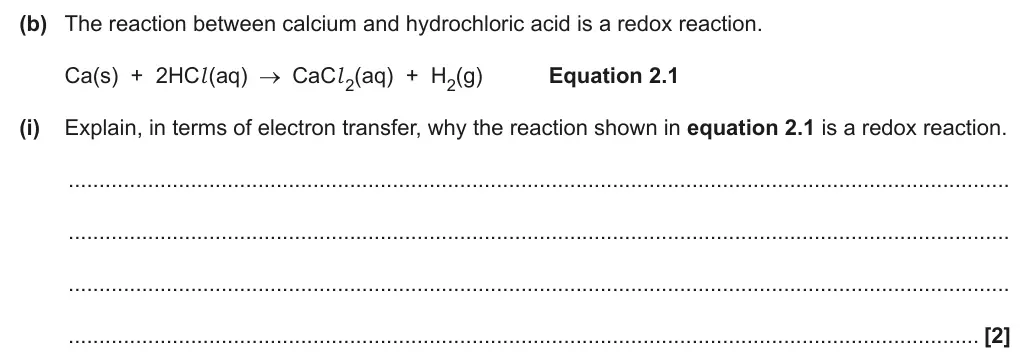
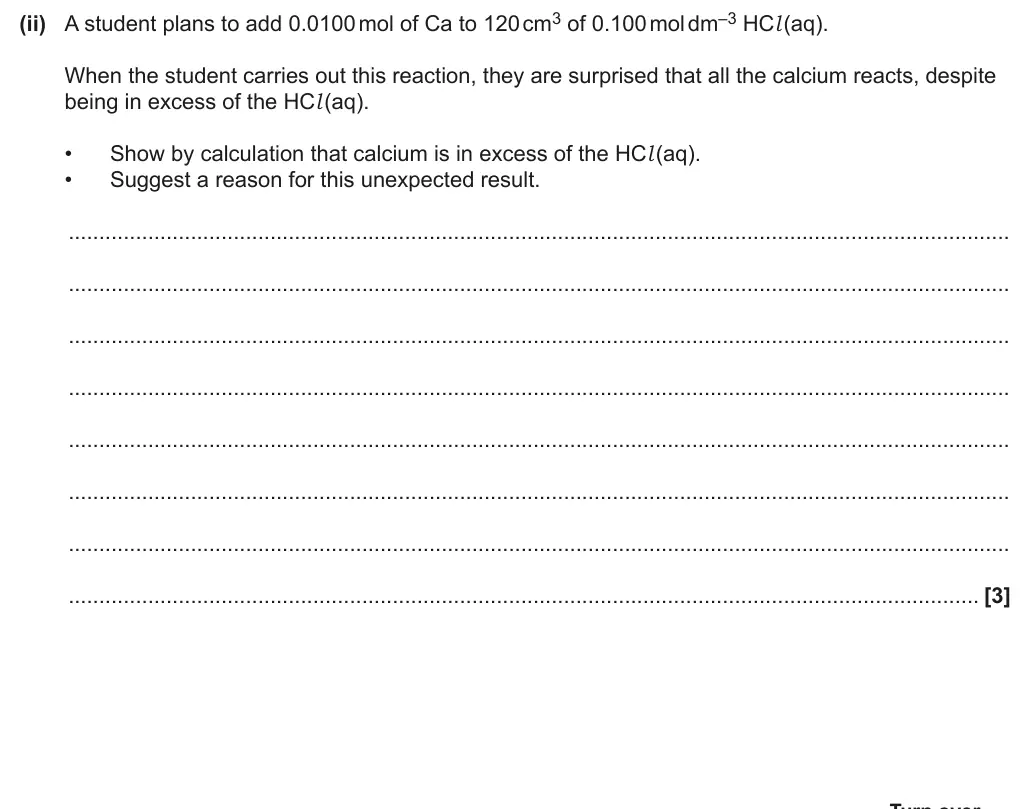
June 2024 · AS Paper 2 · Q2(b)(ii)3 marksShort answerMedium
Earlier part of question 2 that this part uses
Mark scheme
Examiner's comment
Most candidates correctly calculated the amount of HCl as 0.012 mol. However, many struggled with demonstrating that Ca is in excess. Responses often highlighted misconceptions here in terms of candidates’ understanding about excess and limiting reagents. For example, ‘Ca has a lower concentration than HCl so becomes the limiting reagent’ and ‘Not all the HCl had reacted’ Many compared moles of HCl calculated (i.e. 0.012) directly to moles of Ca (i.e. 0.01) saying that HCl was in excess, despite being told otherwise in the question. Some had the 2:1 ratio of HCl to Ca the wrong way around. Some attempted to calculate mass of Ca and HCl to use for comparison. Only a small proportion of candidates were able to access the third mark and correctly suggest that Ca was also reacting with water. Some other suggestions that were seen included: • ‘Ca reacted with oxygen or was impure’. In both cases this would mean that we would expect solid to remain. • ‘Higher concentration of HCl added’, or ‘HCl is a strong acid’, or ‘acid acts as a catalyst’. • ‘H2 evolved’ or ‘Ca reacts with hydrogen formed’. • ‘Human error’, ‘didn’t weigh Ca correctly’, ‘measured volume of HCl incorrectly’.
Notes from the mark scheme and report
n(HCl) = 0.012 mol
must show 2:1 ratio (0.006 mol Ca needed or 0.02 mol HCl needed)
excess Ca reacts with the water
Candidates often struggle to understand the concepts around limiting reagents and those in excess. Using a simple baking analogy can help to relate this to everyday life.
For example: To make 10 pancakes you need 100 g flour, 2 eggs and 300 ml milk How many pancakes can I make if I have only 50 g flour, 2 eggs and 300 ml milk? Which is the limiting ingredient and which are in excess? The number of pancakes we can make is the theoretical yield.
Skills: M0.0 Recognise and make use of appropriate units in calculations; M0.2 Use ratios, fractions and percentages
June 2024 · AS Paper 2 · Q3(b)6 marks6-mark level of responseHard
Earlier part of question 3 that this part uses
Mark scheme, with the levels and indicative points
Examiner's comment
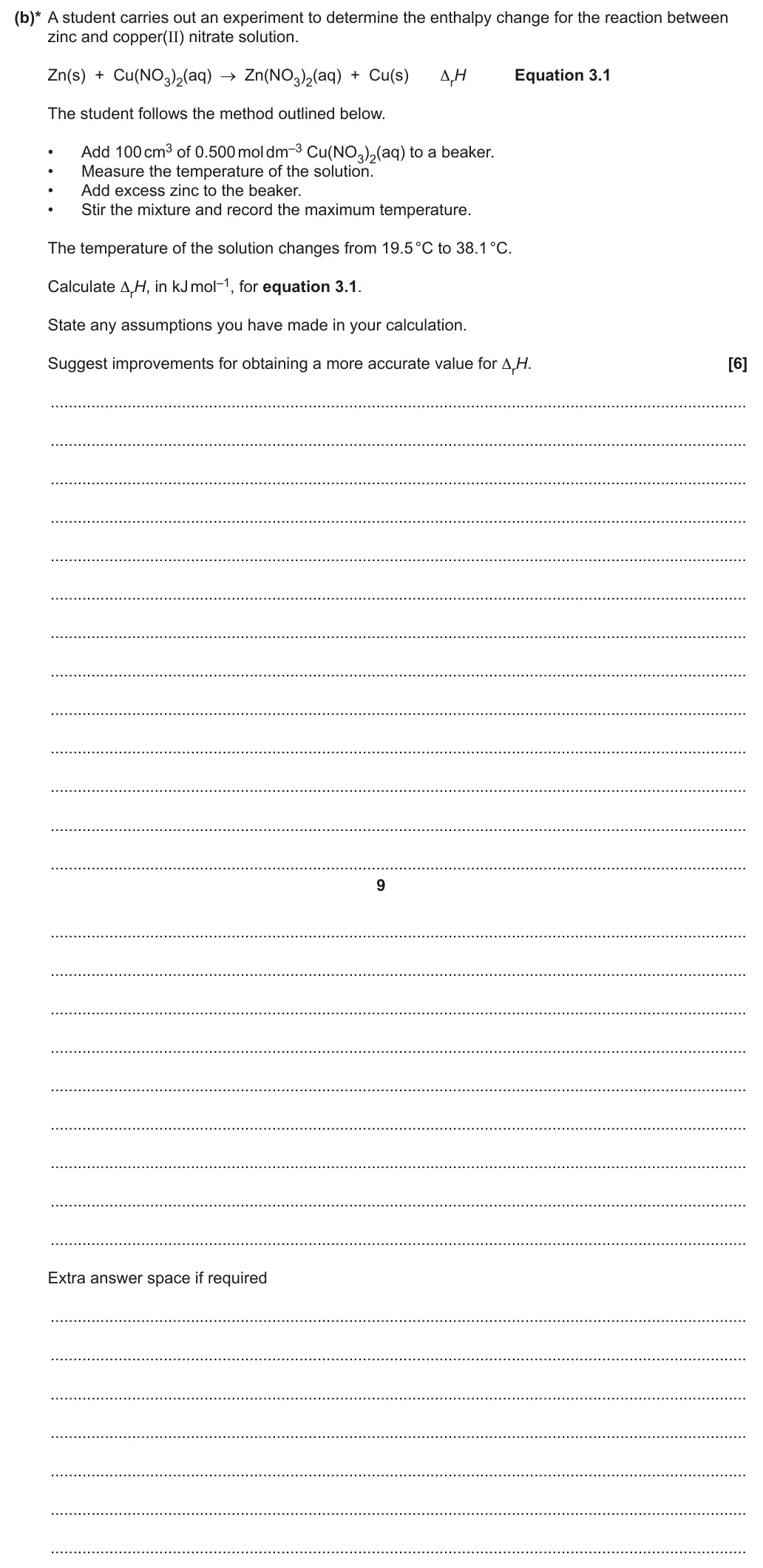
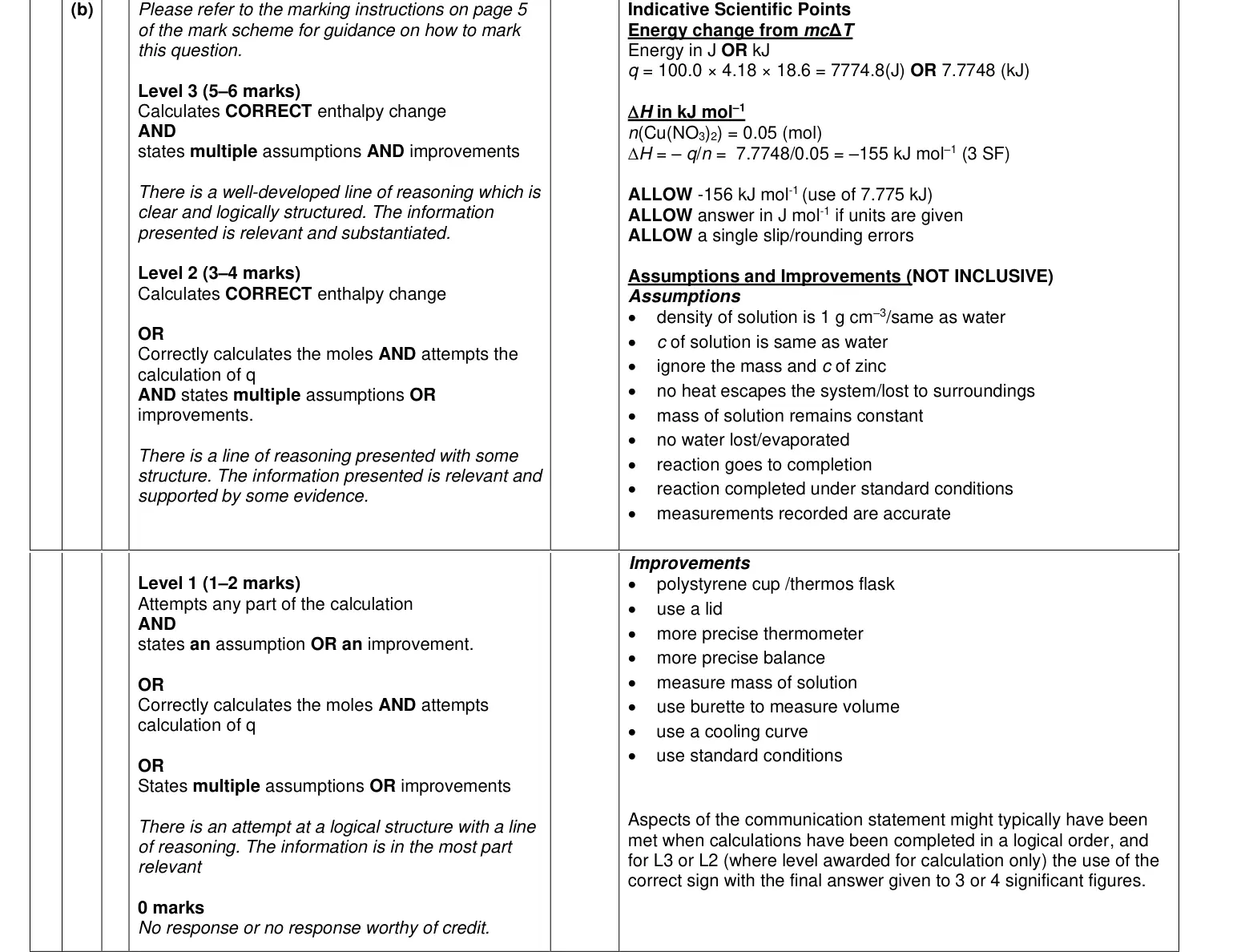
The calculation of enthalpy change was generally well-answered and the majority of candidates were able to recall the equation q = mcT. Many candidates forgot the minus sign or gave a positive sign for final enthalpy change. Errors in calculation were most commonly for using an incorrect mass, usually by finding the mass of copper(II) nitrate (from moles and Mr). Some also used the wrong value for the heat capacity, selecting the value for R from the data sheet instead. Many gave the final answer to an inappropriate six significant figures. Candidates often found it challenging to give appropriate assumptions and improvements, limiting the level achieved to Level 2. However, many candidates did correctly give the assumptions that the specific heat capacity and density of the solution was the same as water. This is usually stated for the candidates with these types of questions. The most common improvements suggested were use of a polystyrene cup, adding a lid or using a thermometer with a higher resolution. Quite a few candidates suggested using a larger volume of solution which would indeed reduce the % uncertainty in the volume measurement. However, it would lead to a smaller temperature change, increasing the % uncertainty in the temperature measurement. Some confused the question with a calculation of enthalpy change of combustion and gave improvements accordingly, e.g. ‘use a copper or bomb calorimeter’, ‘draft shields’, ‘heat for longer’, ‘position of flame and supplies of oxygen’. This response achieved Level 3 - 6 marks. There is a correct calculation for H, the final value has a correct negative sign and is given to 4 significant figures. Lots of valid assumptions and improvements are given.
Notes from the mark scheme and report
q = 100 × 4.18 × 18.6 = 7.77 kJ
n(Cu(NO3)2) = 0.05
∆H = –155 kJ mol–1 with negative sign
assumptions (density/c same as water, no heat loss, ignore zinc)
improvements (polystyrene cup, lid, cooling curve, more precise thermometer)
Skills: M0.0 Recognise and make use of appropriate units in calculations; M1.1 Use an appropriate number of significant figures; M2.3 Substitute numerical values into algebraic equations using appropriate units for physical quantities; PAG3 Enthalpy determination
June 2024 · AS Paper 2 · Q4(b)(iii)3 marksCalculationHard
Earlier part of question 4 that this part uses
Mark scheme
Examiner's comment
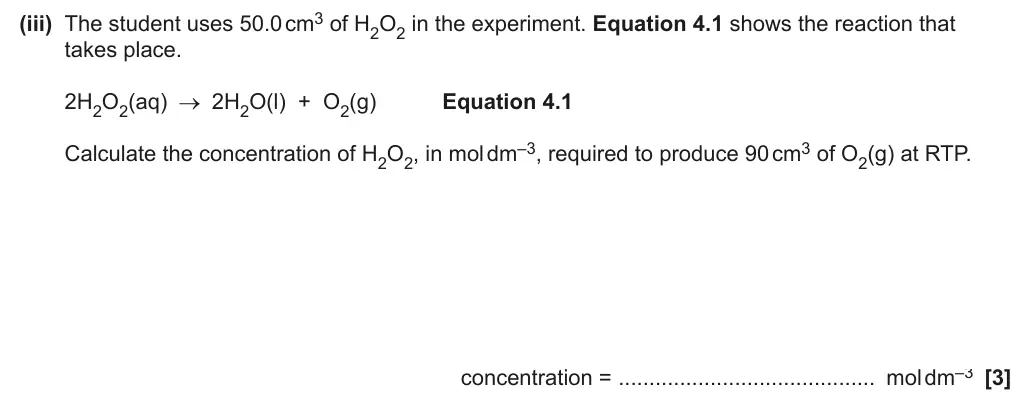
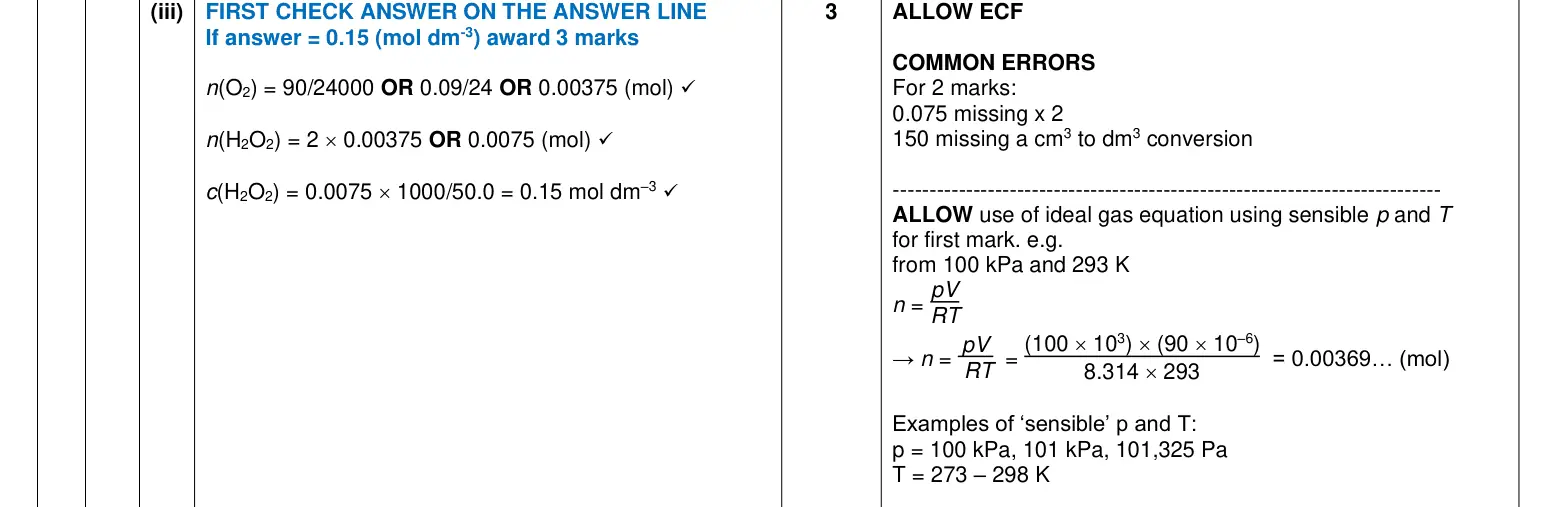
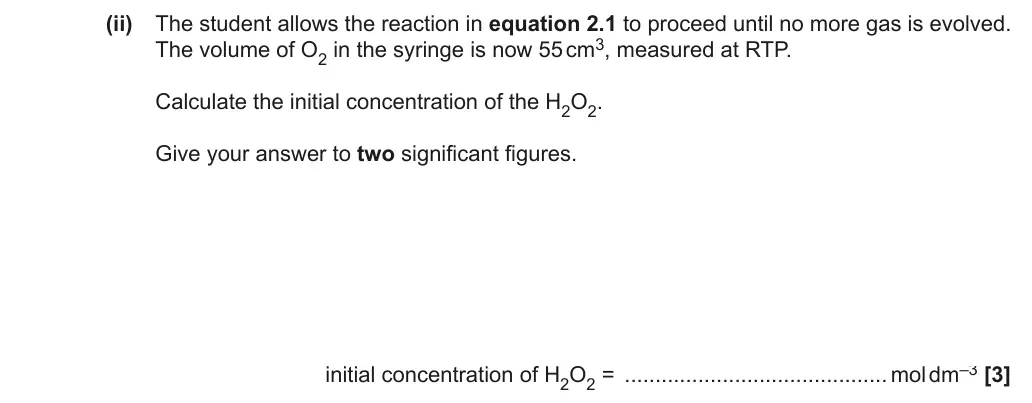
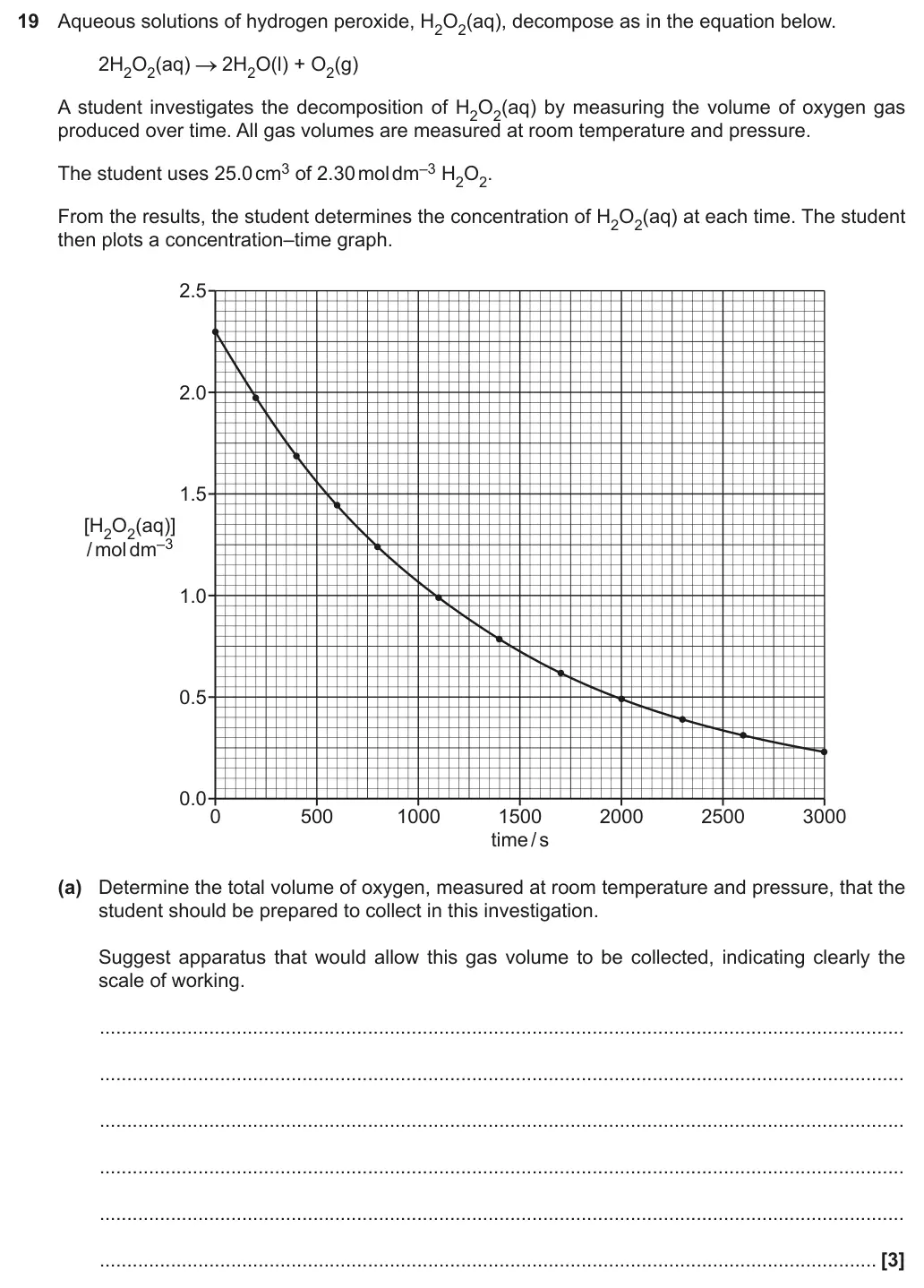
Over half of candidates scored all 3 marks here. However, around a quarter did not gain any credit at all. Some confused the volume of H2O2 for a volume for a gas and attempted to find moles using molar gas volume (i.e. used 50cm3 rather than 90cm3). This often lost all 3 marks as they then divided by 2 and to find concentration divided by 90/1000 instead. A few attempted to use the ideal gas equation but this rarely yielded a correct value. Candidates must be encouraged to set out working clearly, showing logical steps and preferably labelling each step with what is being calculated and giving units. Many wrote the calculation as series of steps which all equalled the previous. e.g. 90 24000 = 3.75 x 10-3 x 2 = 7.5 x 10⁻³ 0.05 = 0.15
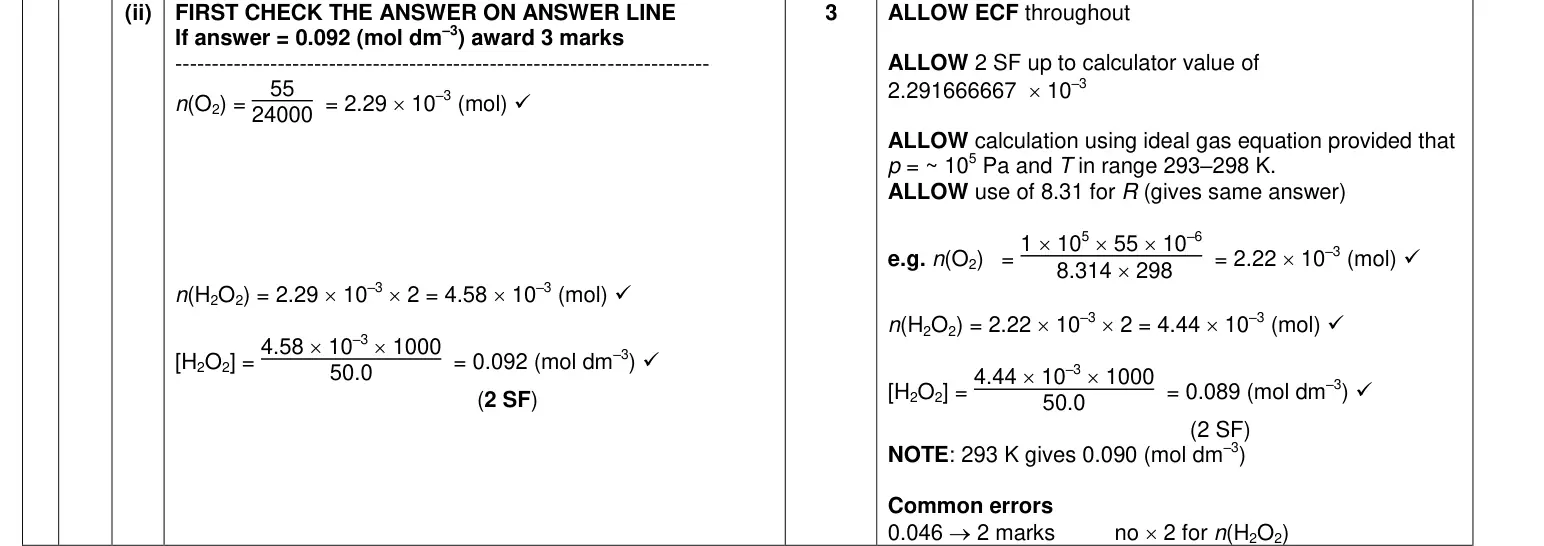
Notes from the mark scheme and report
n(O2) = 90/24000
× 2 for H2O2
÷ 0.0500 dm3 = 0.15
common errors 0.075 (no × 2) and 150 (no cm3 to dm3)
ALLOW ideal gas equation with sensible p and T
Encourage students to assign information in the question to the correct chemical. One way to do this is to write out the equation and then underneath each species put correct volumes as given. It also helps to highlight ratios shown in the equation. It is important here to pay close attention to state symbols as it helps identify correct calculations to use.
For example; 2H2O2 (aq) → 2H2O (l) + O2(g) 50.0cm3 90 cm3 Solution Gas at RTP Conc?
Skills: M0.0 Recognise and make use of appropriate units in calculations; M0.2 Use ratios, fractions and percentages; M2.3 Substitute numerical values into algebraic equations using appropriate units for physical quantities
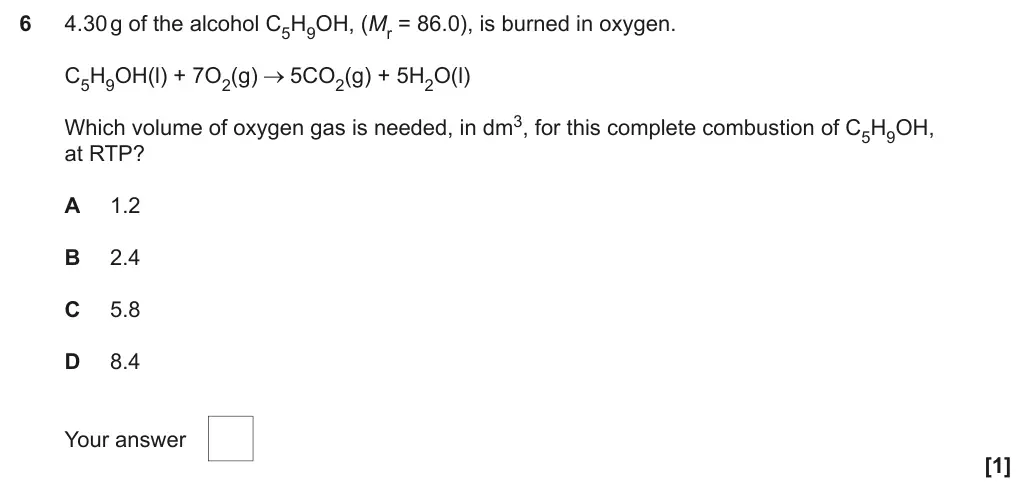
June 2024 · Paper 2 · Q61 markMultiple choiceMedium
Answer
D
Mark scheme
Examiner's comment
Most were able to correctly calculate the moles of alcohol using the mass and Mr provided and then multiply by 24 dm3 mol-1 to give the correct answer D. All other distractors were seen as incorrect responses from calculations involving the incorrect molar ratio.
Notes from the mark scheme and report
0.05 mol × 7 × 24.0 dm3
Skills: M0.2 Use ratios, fractions and percentages; M2.3 Substitute numerical values into algebraic equations using appropriate units for physical quantities
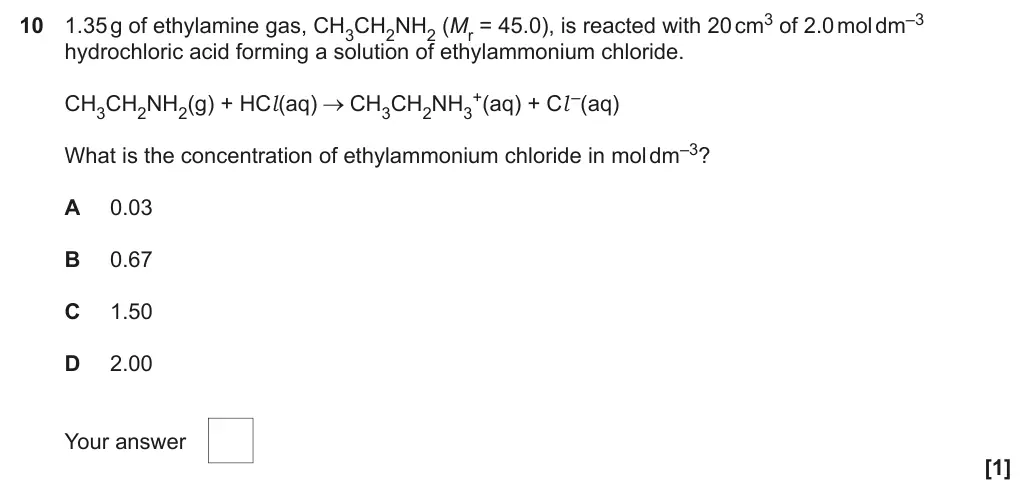
June 2024 · Paper 2 · Q101 markMultiple choiceHard
Answer
C
Mark scheme
Examiner's comment
Around two thirds of candidates gave the correct answer C, 1.50 mol dm-3. Those that showed working were more likely to have the correct answer. Some only found the moles of ethylamine from the mass and Mr give so gave 0.03, A. Some candidates struggled to figure out that HCl was in excess, so used 0.04 moles of HCl to give a concentration of 2.0 mol dm-3, D.
Notes from the mark scheme and report
amine (0.030 mol) is limiting
ALLOW 1.5(0)
Skills: M0.2 Use ratios, fractions and percentages; M2.3 Substitute numerical values into algebraic equations using appropriate units for physical quantities
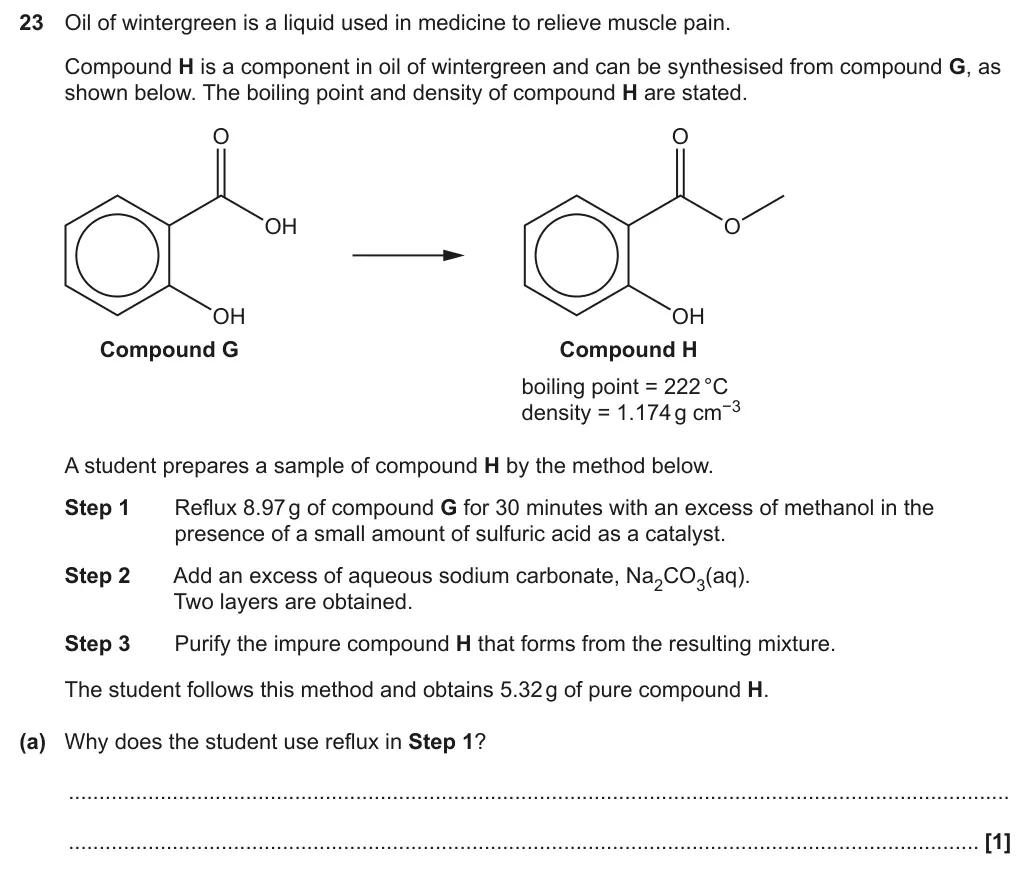
June 2024 · Paper 2 · Q23(c)3 marksCalculationHard
Earlier part of question 23 that this part uses
Mark scheme
Examiner's comment
Many candidates were well prepared for this question and secured all 3 marks. Some however were unable to calculate the correct Mr of either G or H or both. A small proportion gained credit from error carried forward. A significant number of lower attaining candidates used both masses directly or found the mass lost as a percentage. A few tried to use density information, provided earlier in the question, in their calculation. Very few lost marks due to the wrong number of significant figures, however some initially rounded the answer to 4 sf i.e. 53.85 then rounded this value to 3 sf giving 53.9.
Notes from the mark scheme and report
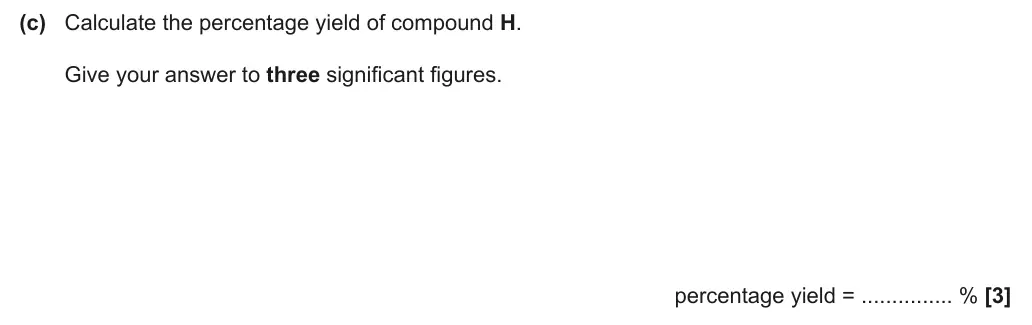
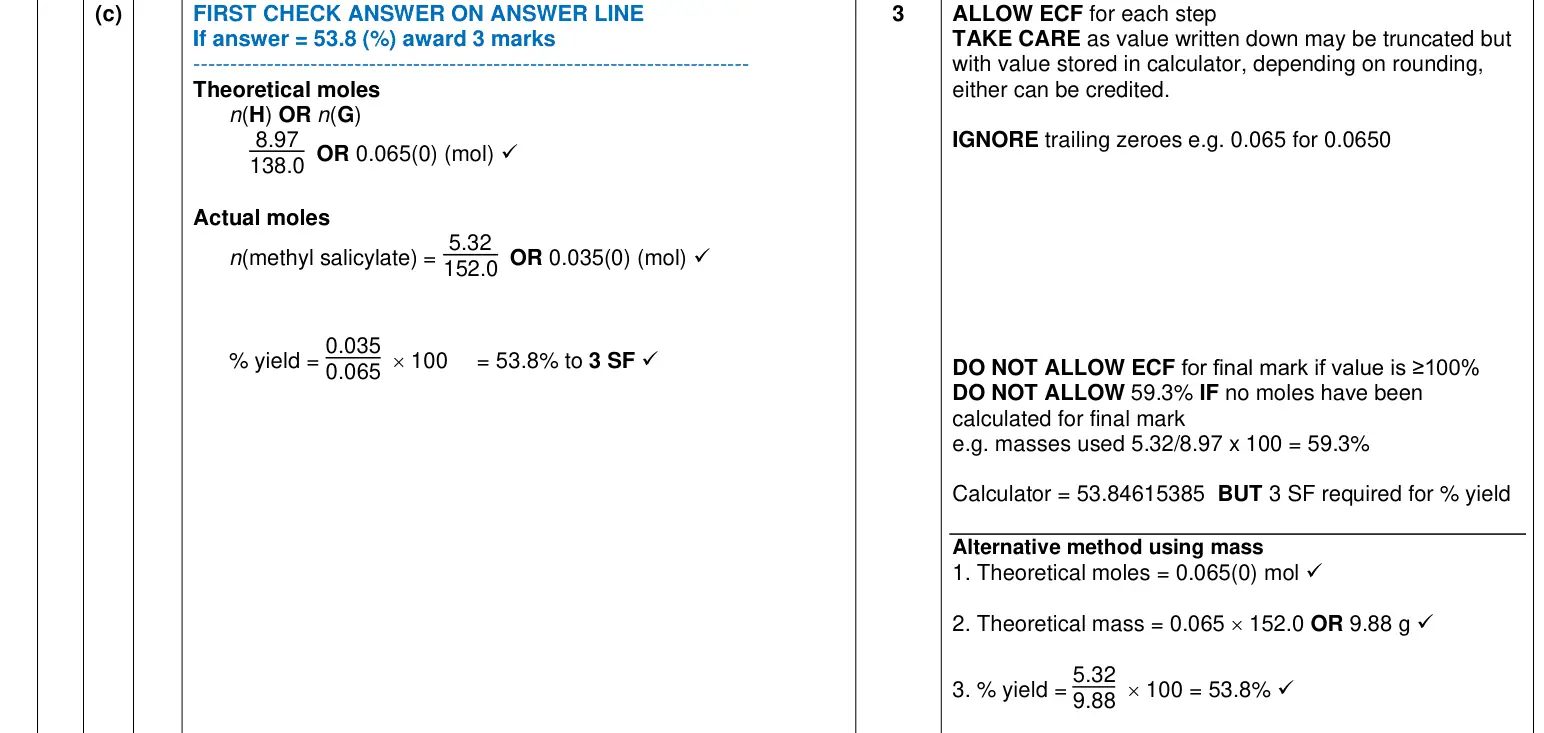
n(G) = 8.97/138.0 = 0.0650
n(H) = 5.32/152.0 = 0.0350
53.8% to 3 sig figs
DO NOT ALLOW 59.3% (ratio of masses)
Skills: M0.2 Use ratios, fractions and percentages; M1.1 Use an appropriate number of significant figures; M2.3 Substitute numerical values into algebraic equations using appropriate units for physical quantities
June 2024 · Paper 3 · Q1(b)1 markCalculationMedium
Mark scheme
Examiner's comment
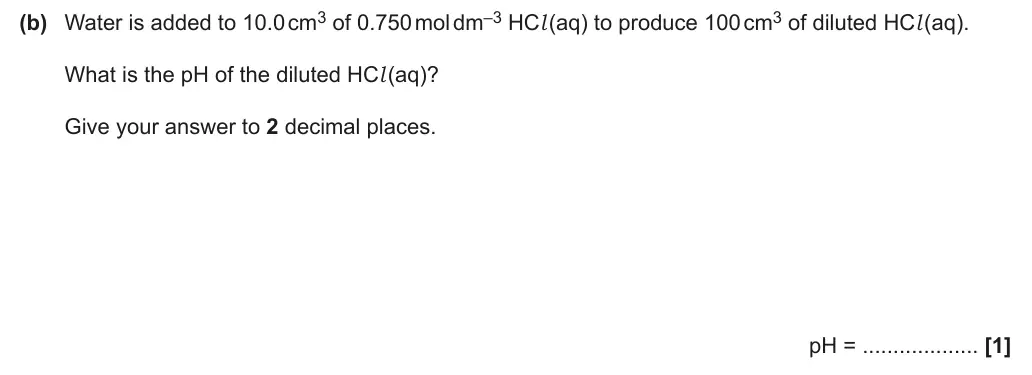
This question was answered well although nearly a half of candidates made errors. The initial solution had been diluted by 10 times and its concentration had been reduced from 0.750 to 0.0750 mol dm–3. From here pH = –log[H+] gives the correct answer of 1.12 to 2 decimal places, required by the question. Candidates found Question 1 (b) more difficult than 1 (a) or 1 (c). There seemed to be little pattern in candidate errors, the dilution being the difficult part of the question. Some did not dilute the initial concentration of 0.750 mol dm–3, giving 2.12. Others divided 0.750 by 2 instead of 10 or introduced 90 into the calculation as 90 cm3 of water would have been added. The most disappointing error was for a correct calculation to be displayed using the wrong number of decimal places. Two decimal places should be the norm for pH, reflecting the accuracy of most pH meters.
Notes from the mark scheme and report
dilution ×10 gives 0.0750 mol dm–3
2 decimal places required (1.12)
Skills: M0.2 Use ratios, fractions and percentages; M0.4 Use calculators to find and use power, exponential and logarithmic functions; M2.5 Use logarithms in relation to quantities that range over several orders of magnitude
June 2024 · Paper 3 · Q1(d)5 marksExtended responseMedium
Mark scheme
Examiner's comment
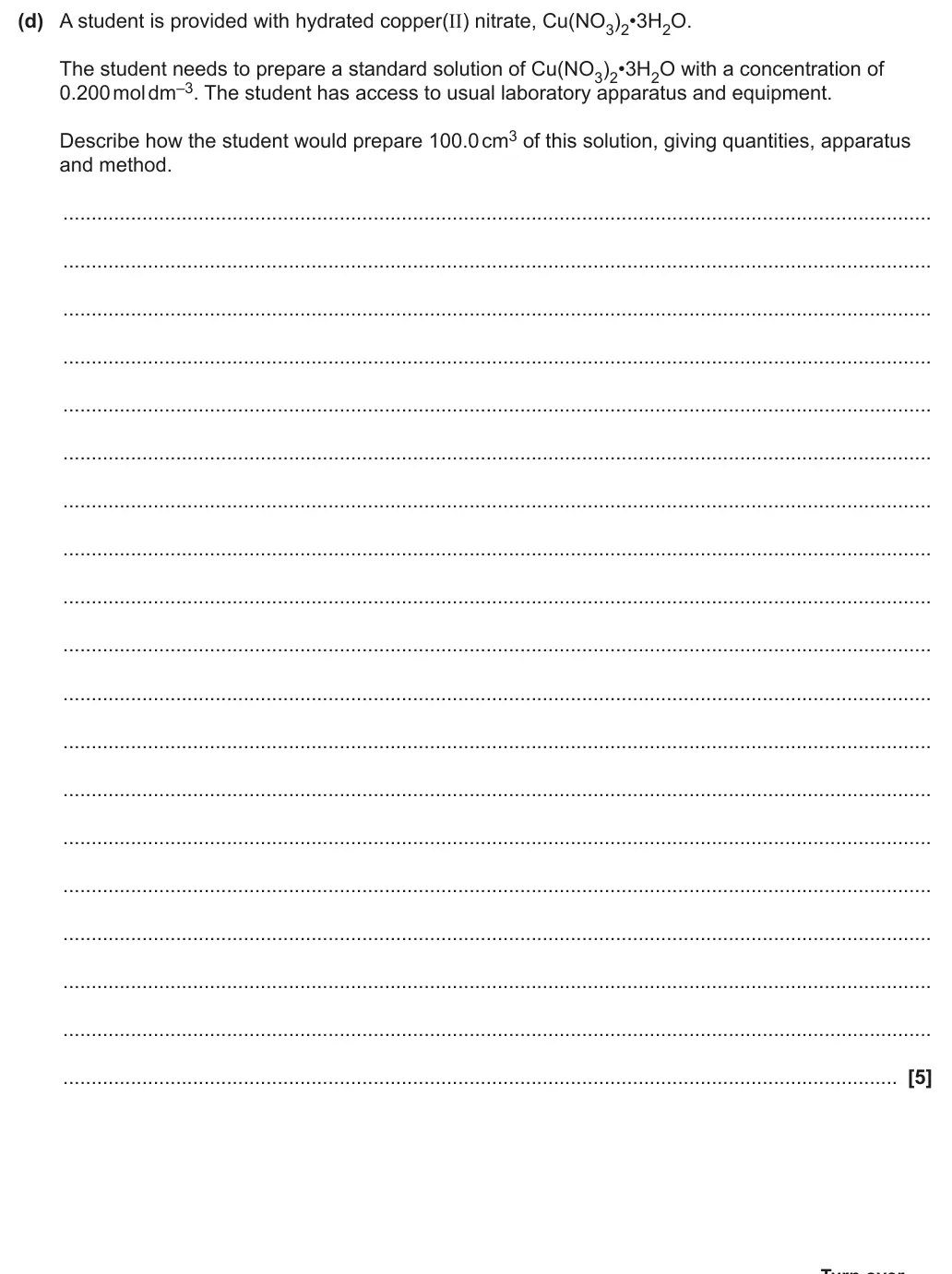
This question differentiated between candidates extremely well. See Exemplar 1 below. some of the issues encountered in the responses. Unfortunately, nearly a quarter of candidates could not be given any marks at all for their responses. To improve, it is worth studying Exemplar 1. The candidate has communicated the key steps required to prepare the standard solution: • Calculation of the mass of hydrated copper(II) nitrate required. • Dissolving the hydrated copper(II) nitrate in water in a suitable container (a beaker). • Transferring the solid to a 100 cm3 volumetric flask, washing the beaker with water and transferring the washings also to the volumetric flask. • Making the solution up to the 100 cm3 mark in the volumetric flask and inverting the flask to mix the contents thoroughly. Issues with responses which arose by not reading the question closely enough: • Omitting to calculate the mass of hydrated copper(II) nitrate required. • Calculating the mass of anhydrous copper(II) nitrate instead of the hydrated salt. • Dissolving in 100 cm3 of water and then adding more water for rinsing. • Not rinsing out the original container at all. • Making the solution up in the volumetric flask. • Using of a 250 cm3 volumetric flask for preparing 100 cm3 of solution. • Omitting the inversion stage. • Answering a different question, e.g. how to carry out a titration, how to determine an enthalpy change, how to work out the number of waters of crystallisation by heating in a crucible.
Notes from the mark scheme and report
mass 4.83 g using M of the hydrated salt (241.5), 2 or more decimal places
dissolve in less than 100 cm3 of distilled water in a beaker (DO NOT ALLOW 100 cm3 or more)
transfer to volumetric flask AND rinse washings in
make up to the mark AND invert
Skills: M0.0 Recognise and make use of appropriate units in calculations; M0.2 Use ratios, fractions and percentages; PAG2 Acid–base titration
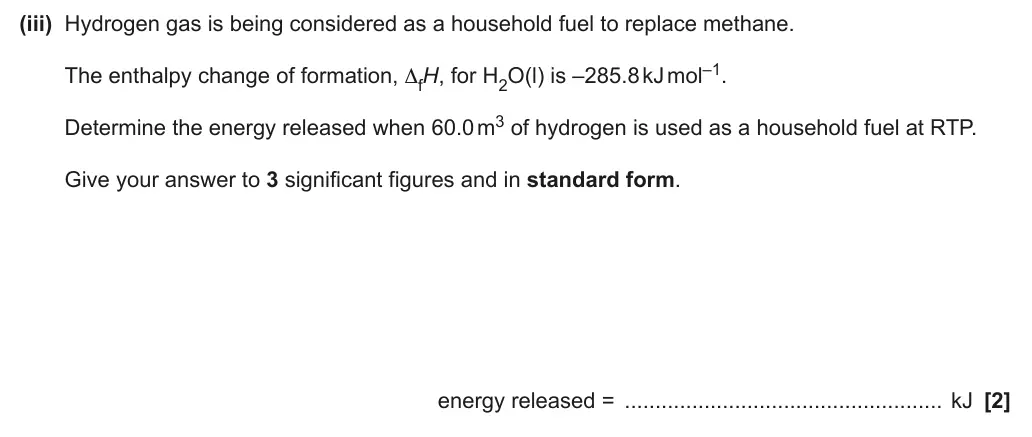
June 2024 · Paper 3 · Q2(a)(iii)2 marksCalculationMedium
Earlier part of question 2 that this part uses
Mark scheme
Examiner's comment
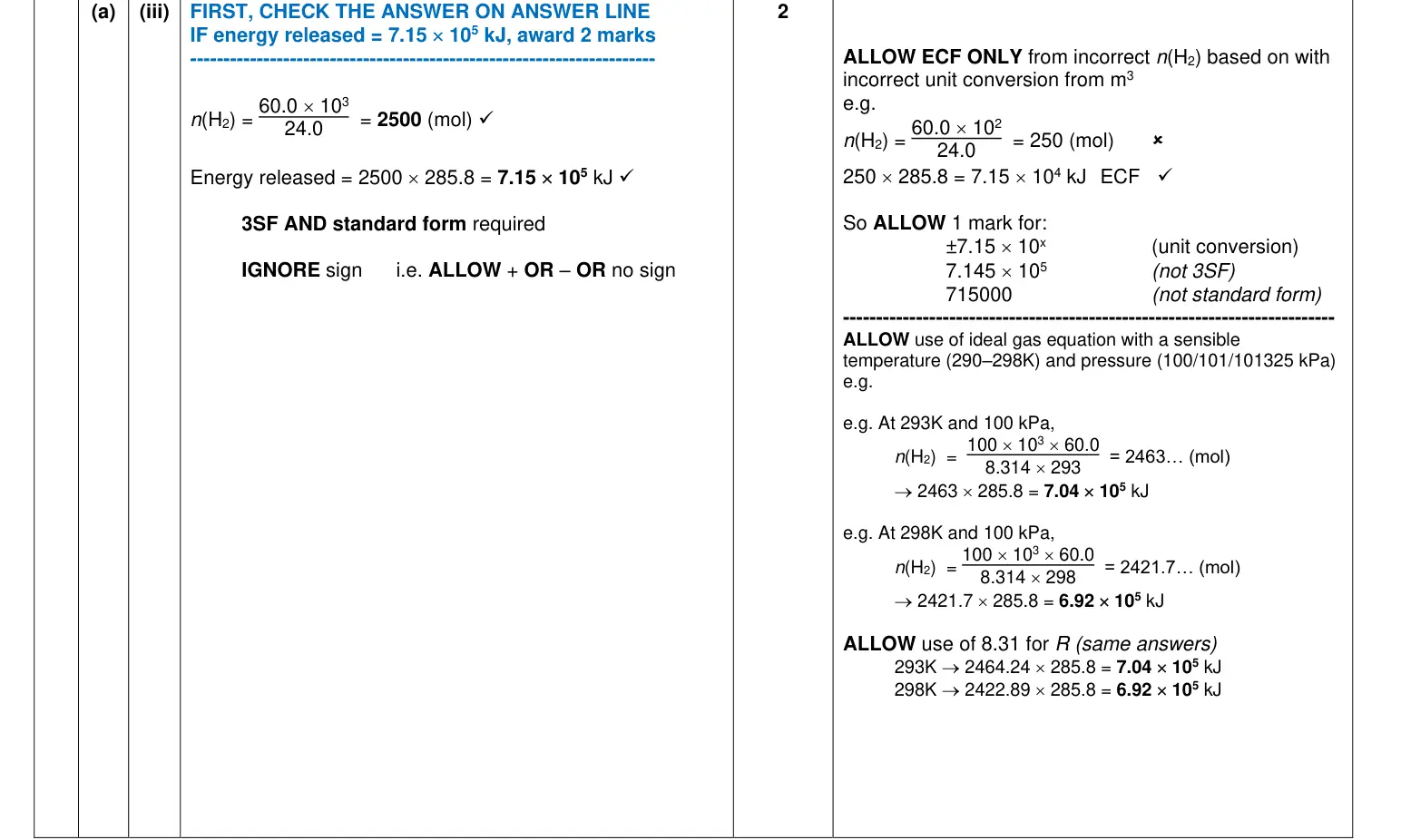
Unlike the standard bond enthalpy calculation in Question 2 (a) (ii), this question required candidates to apply their understanding of enthalpy changes to a new context relevant to energy. Candidates also had to interconvert units and provide an answer to 3 significant figures in standard form. Apart from the chemistry, there were various mathematical skills to use. Candidates found this question much more demanding than Question 2 (a) (ii), with only just over a half gaining marks. The first step involved working out that the number of moles of hydrogen gas in 60 m3 at RTP is 2500 mol. Candidates then had to apply their understanding of ∆fH to calculate the energy as 7.15 × 10⁵ kJ. Common mistakes included: • multiplying 60 m3 by the enthalpy change of 285.8 kJ mol–1 (omitting to calculate the moles of H2 – a lack of understanding) • using more than 3 significant figures, e.g. 7.145 instead of 7.15 • making an error with powers of 10 in the mole calculation (usuallysually by not converting 60 m3 into 60,000 dm3, leading to 2.5 moles). This type of question looks simple but makes for an excellent way of developing application and mathematical skills.
Notes from the mark scheme and report
convert m3 to dm3 (n = 2500 mol)
3 sig figs AND standard form required
1 mark for 7.15 × 10^x, 7.145 × 10^5 or 715000
IGNORE sign
Skills: M0.0 Recognise and make use of appropriate units in calculations; M0.1 Recognise and use expressions in decimal and ordinary form; M1.1 Use an appropriate number of significant figures
June 2024 · Paper 3 · Q2(b)(ii)3 marksCalculationMedium
Earlier part of question 2 that this part uses
Mark scheme
Examiner's comment
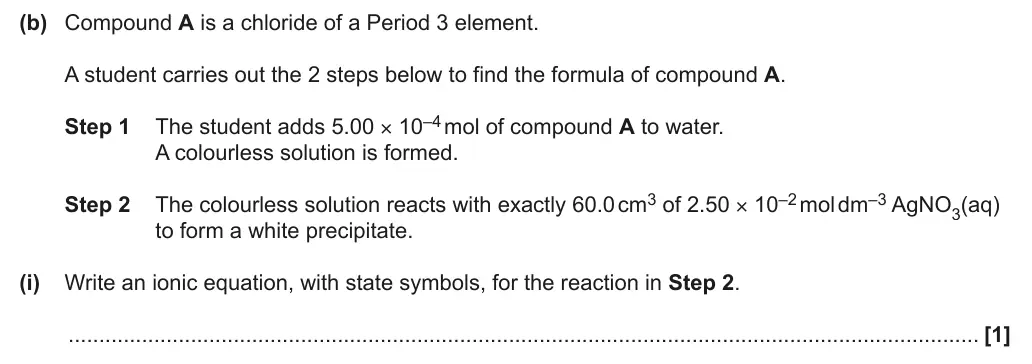
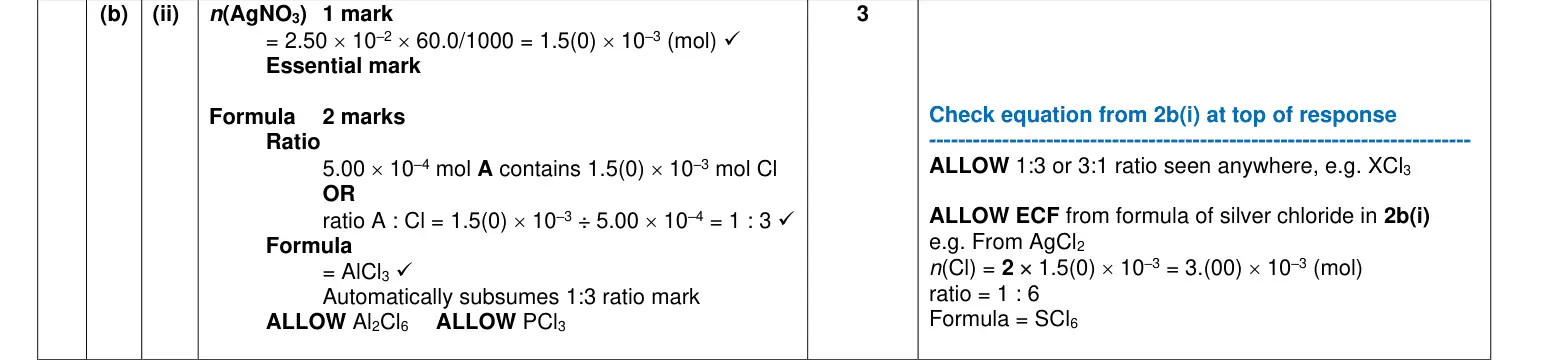
Most candidates determined the moles of AgNO3 and hence Ag+ as 1.50 × 10⁻³ mol. This was given 1 mark, but candidates then needed to use this amount to predict the identity of compound A. Most candidates could not see the way forward and many received only 1 mark. Many candidates had worked out ‘something’ from the supplied data, without knowing where this initial step would take them. Candidates needed to spot that the ratio of the element : Cl in compound A was 5 × 10⁻⁴ : 1.50 × 10⁻³ or 1 : 3. The correct formula of AlCl3 then follows. MgCl2 was a common error obtained by subtracting 5 × 10⁻⁴ from 1.50 × 10⁻³ to obtain a 1 : 2 ratio. This question would be a good exercise for improving the application skills of candidates.
Notes from the mark scheme and report
n(AgNO3) = 1.50 × 10⁻³ is the essential mark
ratio A:Cl = 1:3 so AlCl3 (ALLOW Al2Cl6 or PCl3)
ALLOW ECF from formula of silver chloride in (b)(i)
Skills: M0.2 Use ratios, fractions and percentages
June 2024 · Paper 3 · Q2(c)(i)1 markShort answerEasy
Mark scheme
Examiner's comment
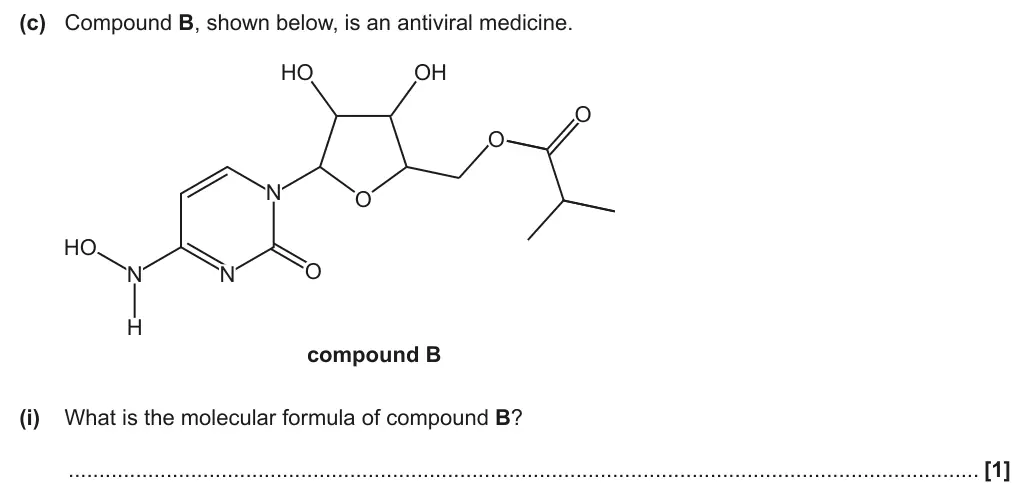
Most candidates made a good attempt at working out the molecular formula of the structure as being C13H19N3O7. N and O were usually correct with mistakes most common with carbon (especially 12) and hydrogen (especially 17–20).
Notes from the mark scheme and report
C13H19N3O7
elements in any order
June 2024 · Paper 3 · Q3(b)(iv)6 marks6-mark level of responseMedium
Earlier parts of question 3 that this part uses
Mark scheme, with the levels and indicative points
Examiner's comment
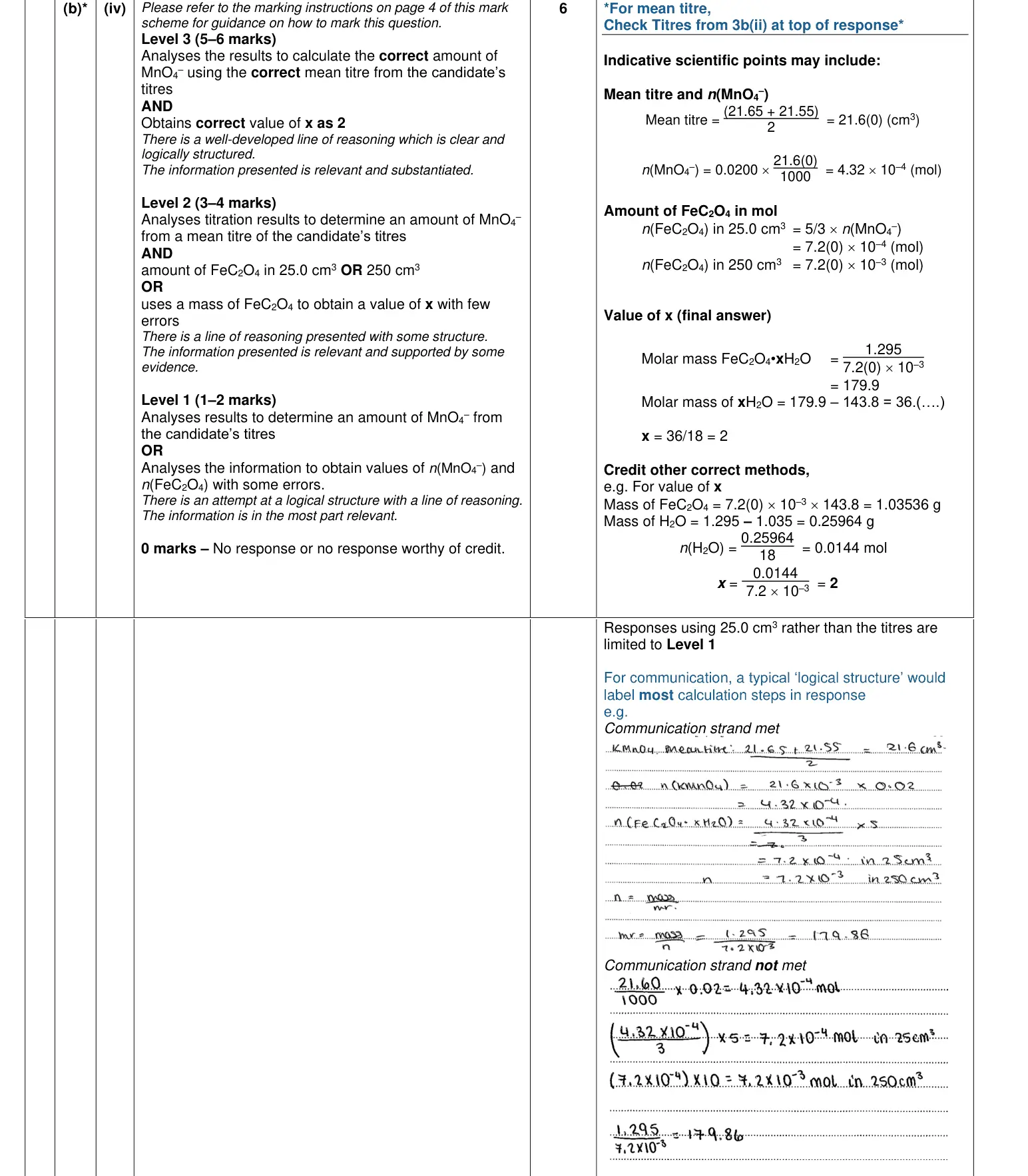
This unstructured titration problem was assessed by Level of Response (LOR). Candidates answered this stock titration calculation well. The key stages are listed below: 1. Determination of the mean titre from the two closest titres in the candidate’s response to Question 3 (b) (ii). If the titres were correct, this would be 21.60 cm3, the mean of 21.55 cm3 and 21.65 cm3. 2. Calculation of the number of moles of MnO4– as 4.32 × 10⁻⁴ mol. 3. Calculation of the number of moles of FeC2O4 in 25 cm3 as 5/3 × 4.32 × 10–4 = 7.20 × 10⁻⁴ mol. Scaling up this number of moles by 10 for the moles in 250 cm3 as 7.20 × 10⁻³ mol. 4. Determination of the number of waters of crystallisation. Most candidates completed Stages 1 and 2 correctly, securing a minimum of a Level 1 response. A significant number of candidates then completed Stage 3, with most including scaling by 10 to secure a minimum of Level 2. Many of these candidates compared the moles of FeC2O4 to the mass of FeC2O4•xH2O used to determine the value of x as 2. Such candidates would have reached Level 3. The communication strand of the LOR mark was determined by the clarity of the response, particularly whether the numbers in the calculation had been labelled. Unfortunately, many ‘correct’ responses had not done this. Over half the candidates were given 5 or 6 marks for this stock calculation. This exemplar demonstrates the hazards of not communicating well. The candidate has followed the four stages described above and the chemistry behind the titration analysis is correct. However, the response is mostly a page of numbers, with no explanation about what the numbers mean. The response is clearly at Level 3 but it is impossible to credit the communication strand, receiving a total of 5 marks.
Notes from the mark scheme and report
mean of concordant titres 21.60 cm3
n(MnO4–) = 4.32 × 10⁻⁴
5:3 ratio then ×10 for 250 cm3
M = 179.9 so x = 2
using 25.0 cm3 instead of titres limited to Level 1
Skills: M0.2 Use ratios, fractions and percentages; M1.2 Find arithmetic means; M2.2 Change the subject of an equation
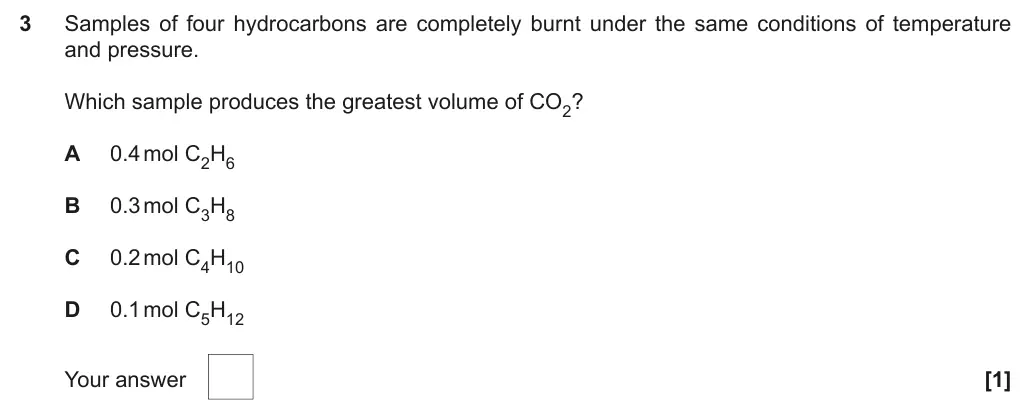
June 2023 · Paper 1 · Q11 markAO1Multiple choiceMedium
Answer
B
Mark scheme
Examiner's comment
Most candidates answered this question correctly with the answer B. D was a common error based on the highest mass.
June 2023 · AS Paper 1 · Q21 markAO1Multiple choiceMedium
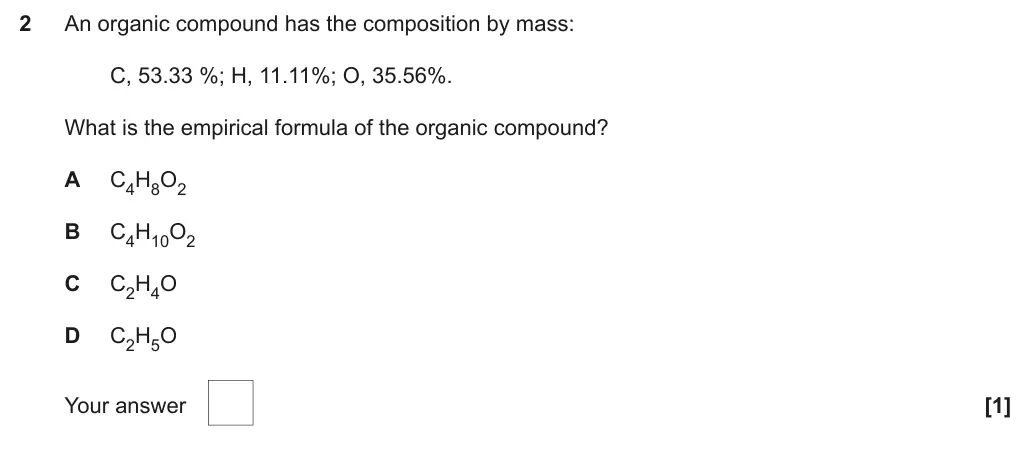
Answer
B
Mark scheme
Examiner's comment
Most candidates are well drilled in the calculation of an empirical formula from percentage compositions and most selected the correct response of B. Option D proved to the main distractor, presumably due to confusion between the terms empirical and molecular formula.
June 2023 · Paper 1 · Q21 markAO2Multiple choiceHard
Answer
C
Mark scheme
Examiner's comment
Candidates found this question challenging with the correct answer being C. A or B were the common errors selected by most candidates.
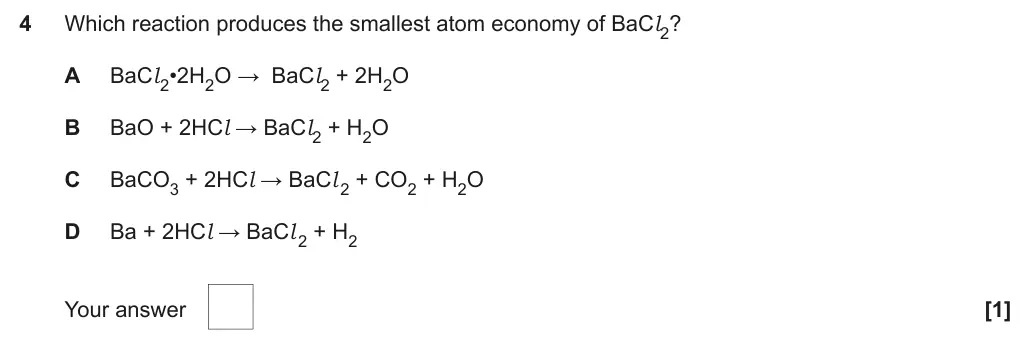
June 2023 · AS Paper 1 · Q31 markAO1Multiple choiceMedium
Answer
C
Mark scheme
Examiner's comment
Most candidates selected the correct response of C but some chose D, the result of dividing 8 (for 4H2) by 44 (for CO2) instead of dividing by their sum (8 + 44 = 52). Overall, candidates showed a good understanding of the term ‘atom economy’.
June 2023 · Paper 1 · Q31 markAO2Multiple choiceMedium
Answer
D
Mark scheme
Examiner's comment
The correct answer was D. Most candidates did not recognise the number of H atoms, 5, in the compound, choosing A as their final answer.
June 2023 · Paper 1 · Q41 markAO2Multiple choiceMedium
Answer
C
Mark scheme
Examiner's comment
This question was answered correctly for the most part with the answer being C.
June 2023 · AS Paper 1 · Q71 markAO2Multiple choiceMedium
Answer
C
Mark scheme
Examiner's comment
Candidates found this question more demanding than Questions 1–6 with only about half the candidates correctly choosing option C. Most candidates showed working on their scripts with B being the common distractor, the result of working out the moles of SiO2 as 120.2/60.1 = 2, and then multiplying the Avogadro Constant by 2, rather than first doubling 2 to take into account the two O atoms in SiO2.
June 2023 · AS Paper 1 · Q81 markAO2Multiple choiceHard
Answer
D
Mark scheme
Examiner's comment
Candidates found this question demanding. It showed very good discrimination between abilities with most able candidates choosing the correct option D. Option C was chosen by many, the result of working out the moles of NO2(g) without adding the moles of O2. Care is needed when reading the question which asked for ‘volume of gas’, rather than ‘volume of NO2(g). Despite the question stating the volume has been measured at RTP, some candidates chose to use the Ideal Gas Equation instead of the simplified molar volume of 24 dm3 mol–1 at RTP. This approach could still lead to success but would have wasted significant time.
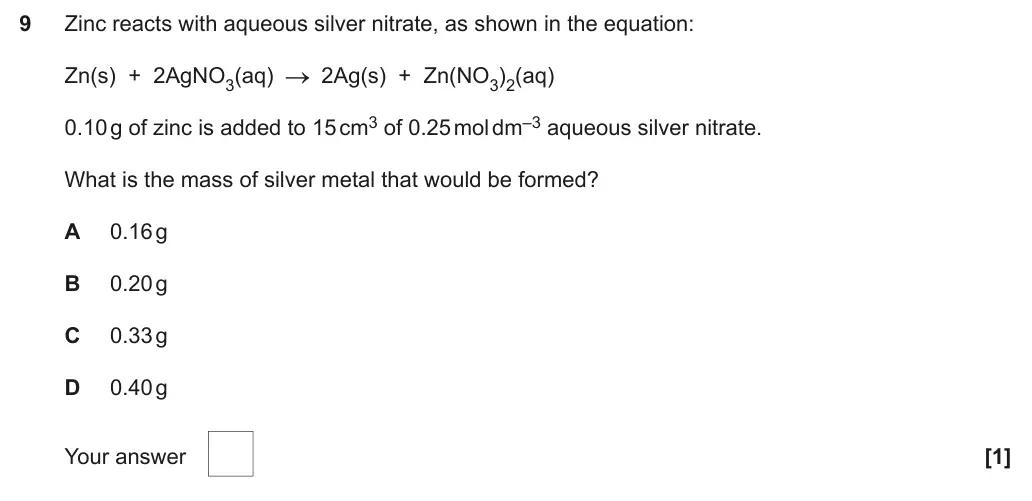
June 2023 · AS Paper 1 · Q91 markAO2Multiple choiceHard
Answer
C
Mark scheme
Examiner's comment
Candidates found this question very difficult with less than half successfully choosing option C. Many candidates chose option D, as shown in Exemplar 1. This candidate’s working is clear and would have been correct had AgNO3 have been the limiting factor. Calculating the moles of Zn shows that this is the limiting factor, producing 0.33 g of Ag for option C.
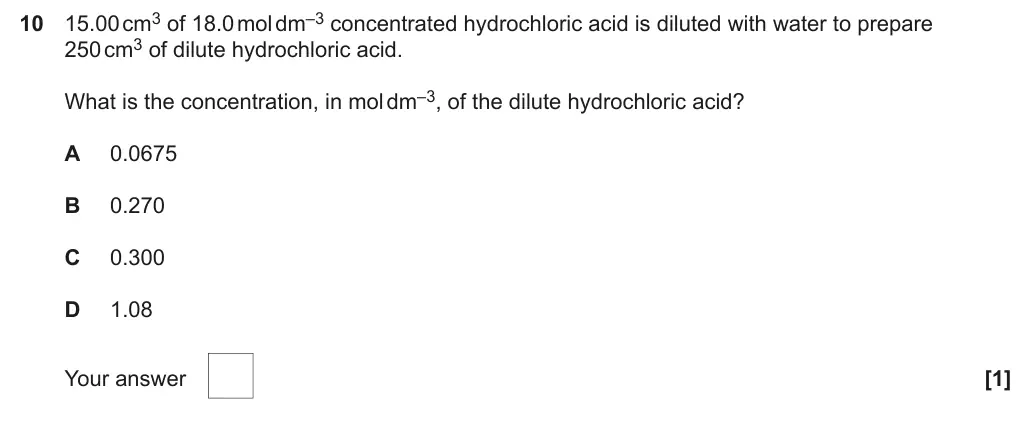
June 2023 · AS Paper 1 · Q101 markAO2Multiple choiceMedium
Answer
D
Mark scheme
Examiner's comment
Most higher attaining candidates chose the correct option of D. From candidate annotations, most calculated the moles of HCl as 0.27 mol. This directly gave the common distractor of B, the result of not taking into account the volume of 250 cm3. Successful candidates multiplied 0.27 by 4 (or divided by 0.250) to get the correct response of 1.08 mol dm–3 (D).
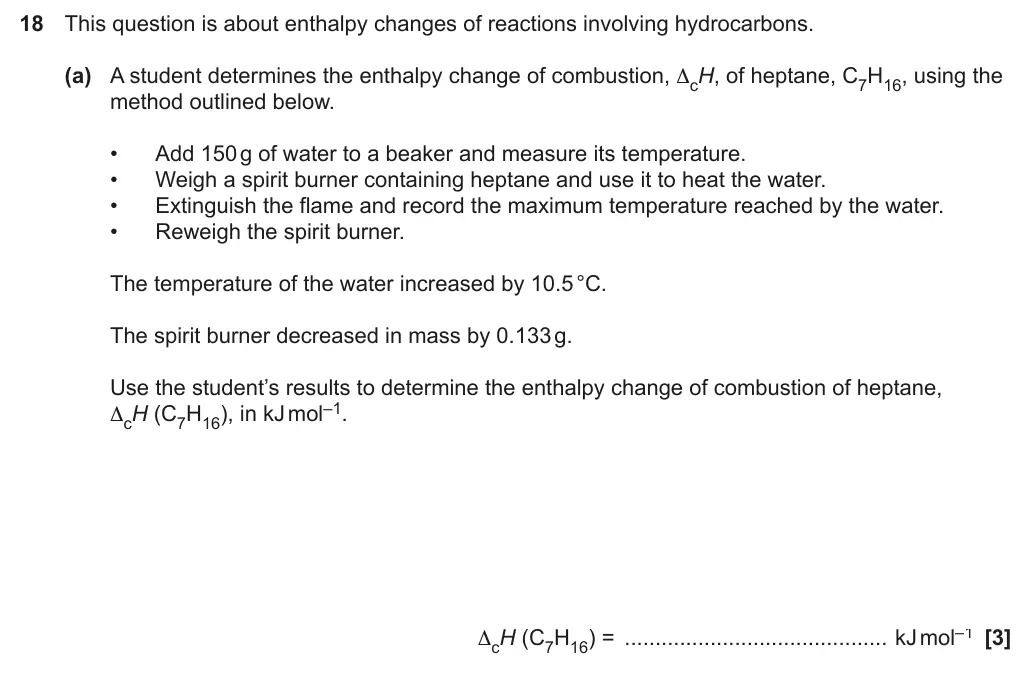
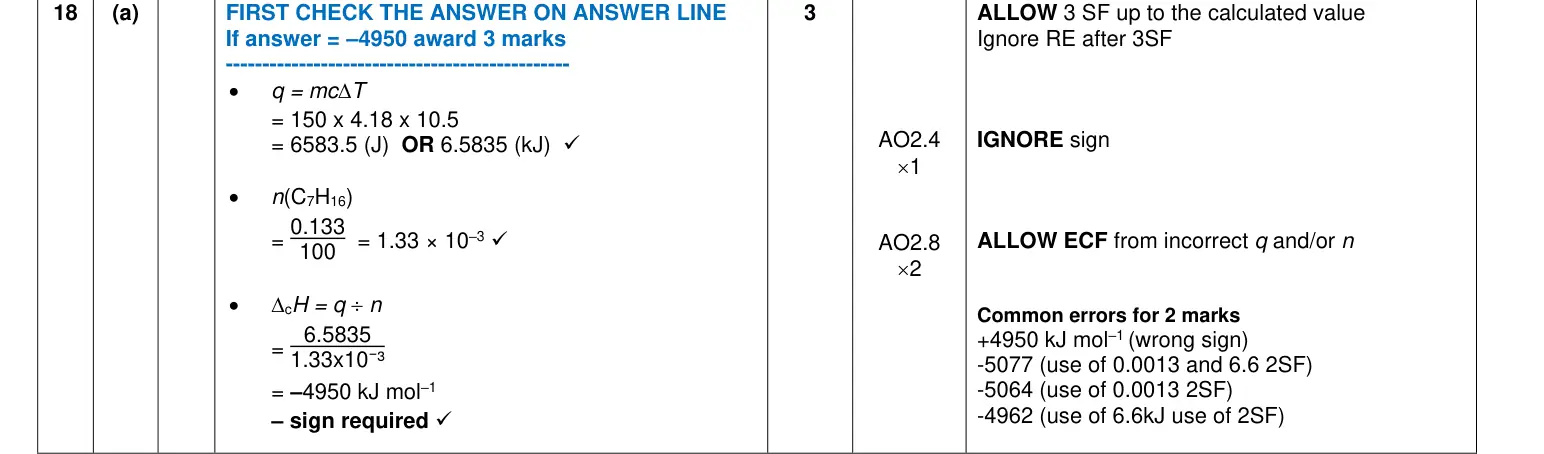
June 2023 · Paper 1 · Q18(a)3 marksAO2CalculationHard
Mark scheme
Examiner's comment
Many candidates calculated the correct value of q and scored all three marks. Common errors saw some candidates using the incorrect mass, of either 0.133 or that added to or subtracted from the 150. The temperature change was given but a few candidates added the 10.5 to 273 in order to, incorrectly, convert to K. The final mark required the candidate to link the temperature increase to an exothermic value and include a minus sign.
Notes from the mark scheme and report
q = 150 × 4.18 × 10.5
n = 0.133/100
– sign required
common errors for 2 marks: +4950, –5077/–5064 (use of 2 SF)
Skills: M0.0 Recognise and make use of appropriate units in calculations; M0.2 Use ratios, fractions and percentages; M2.3 Substitute numerical values into algebraic equations using appropriate units for physical quantities; PAG3 Enthalpy determination
June 2023 · Paper 1 · Q19(b)5 marksAO2, 3CalculationMedium
Mark scheme
Examiner's comment
This question was well answered by nearly all candidates and many scored all 5 marks. A number used the wrong units for the pressure and the volume so used both kPa and dm3. This resulted in the correct number of moles and scored 4 marks as error carried forward. Most candidates were able to find the formula from the molar mass and very few used the incorrect molar volume route.
Notes from the mark scheme and report
V in m3, T = 348 K, p in Pa
M = 108 so N2O5
use of 24 dm3 gives only the last 2 marks by ECF
DO NOT ALLOW N2O4
Skills: M0.0 Recognise and make use of appropriate units in calculations; M2.2 Change the subject of an equation; M2.3 Substitute numerical values into algebraic equations using appropriate units for physical quantities
June 2023 · Paper 1 · Q20(b)5 marksAO1, 2CalculationMedium
Earlier part of question 20 that this part uses
Mark scheme
Examiner's comment
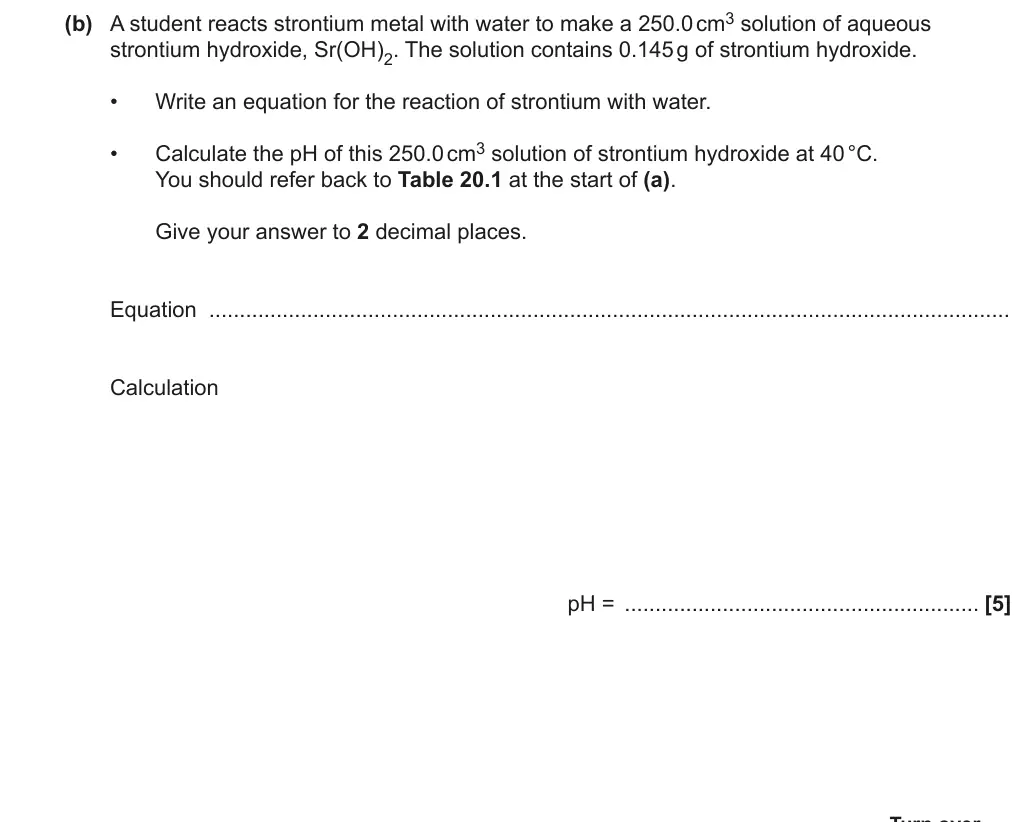
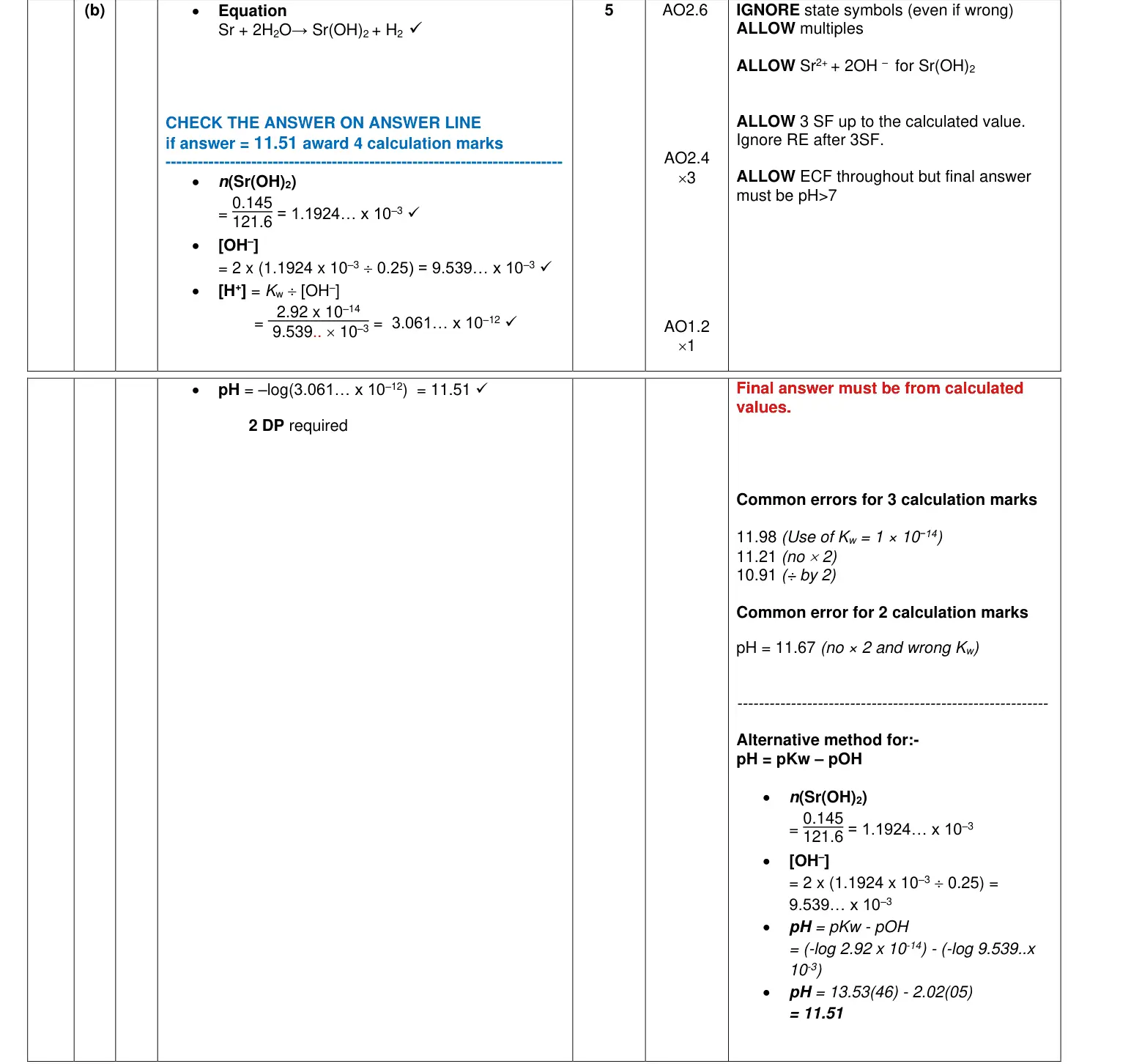
Most candidates wrote the correct equation. Common errors were using Sr2+ as reactant, not balancing the H2O and not having the H2 as second product. Most candidates calculated the moles of Sr(OH)2 correctly but fewer recognised that [OH-] = twice the [Sr(OH)2]. As a result, most candidates scored 3 calculation marks. A few candidates chose the incorrect Kw value.
Notes from the mark scheme and report
Sr + 2H2O → Sr(OH)2 + H2
Kw at 40 °C must be used
common errors for 3 calculation marks: 11.98 (Kw = 1 × 10–14), 11.21 (no × 2), 10.91 (÷2)
2 DP
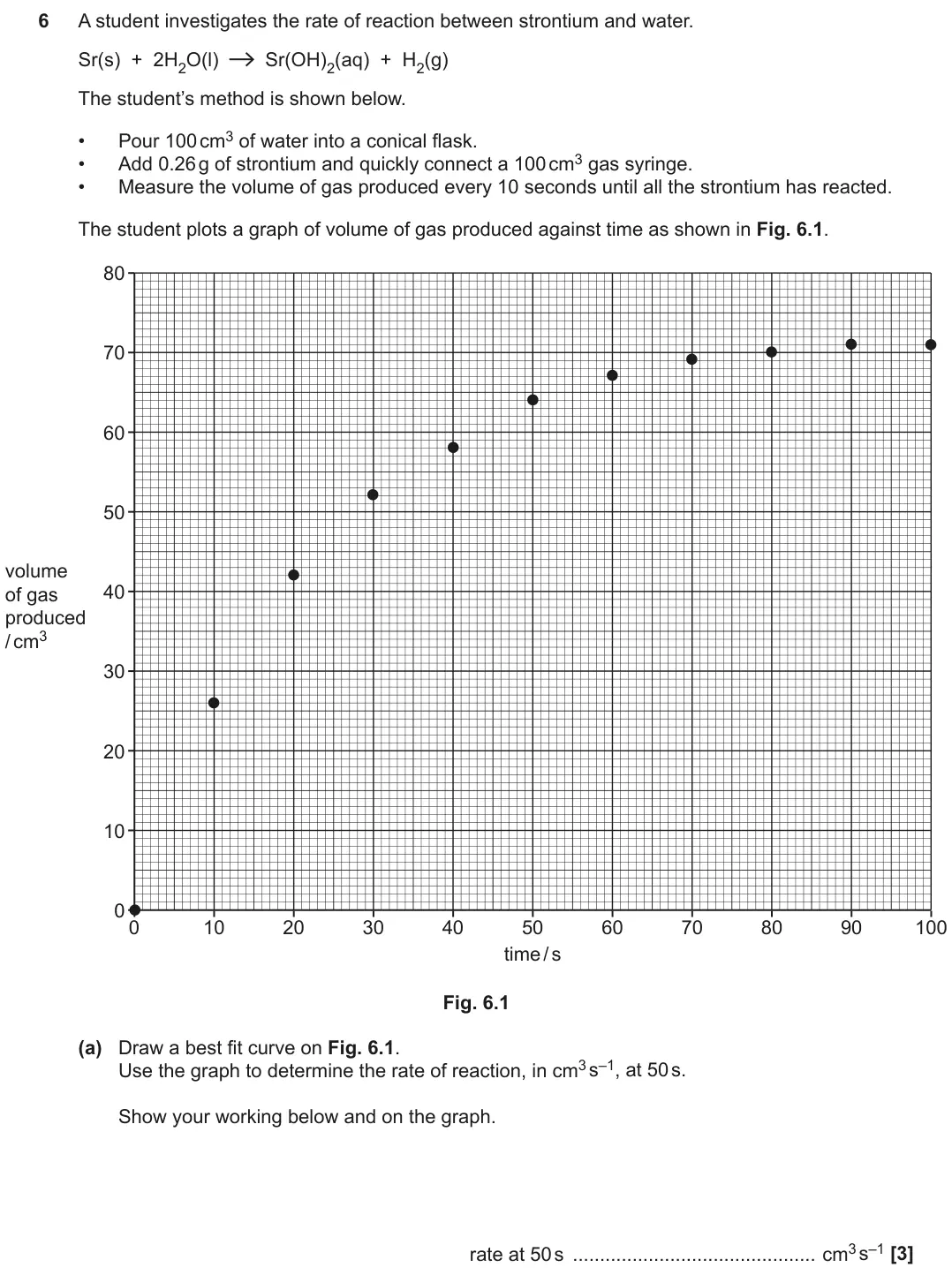
Skills: M0.2 Use ratios, fractions and percentages; M0.4 Use calculators to find and use power, exponential and logarithmic functions; M2.3 Substitute numerical values into algebraic equations using appropriate units for physical quantities; M2.5 Use logarithms in relation to quantities that range over several orders of magnitude
June 2023 · Paper 1 · Q20(c)(ii)2 marksAO3Short answerHard
Earlier part of question 20 that this part uses
Mark scheme
Examiner's comment
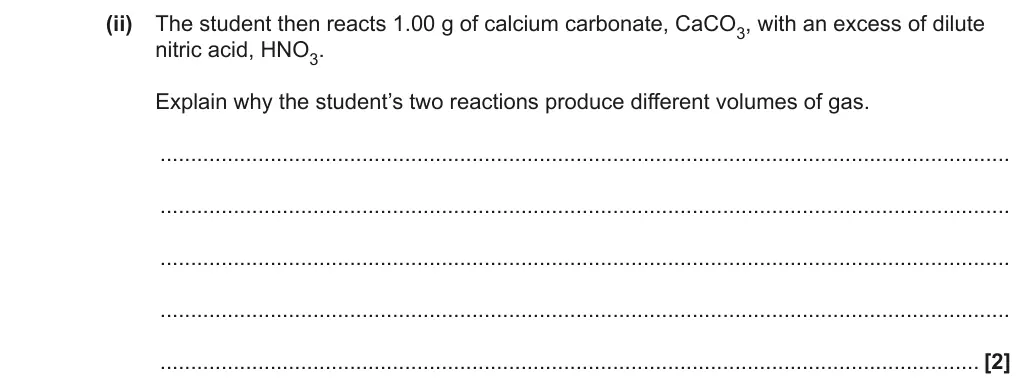
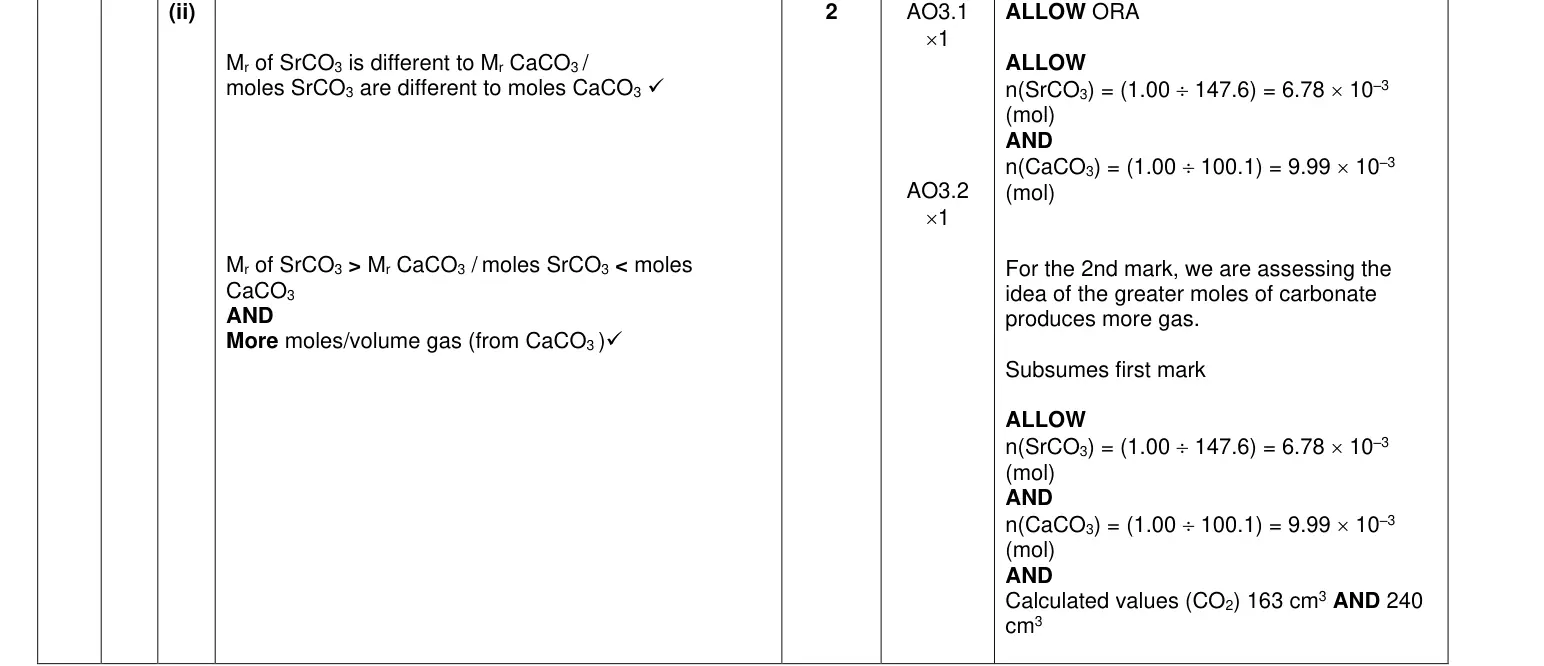
Only a few candidates used the mass value given in the question to link the number of moles of the group 2 metal carbonate and the number of moles, and hence volume, of gas produced.
Notes from the mark scheme and report
Mr of SrCO3 greater so fewer moles in 1.00 g
more moles of CaCO3 gives more gas
Many candidates answered this question in terms of the relative reactivity, or solubility of Ca and Sr and then continuing by explaining their respective ionisation energies.
Skills: M0.2 Use ratios, fractions and percentages
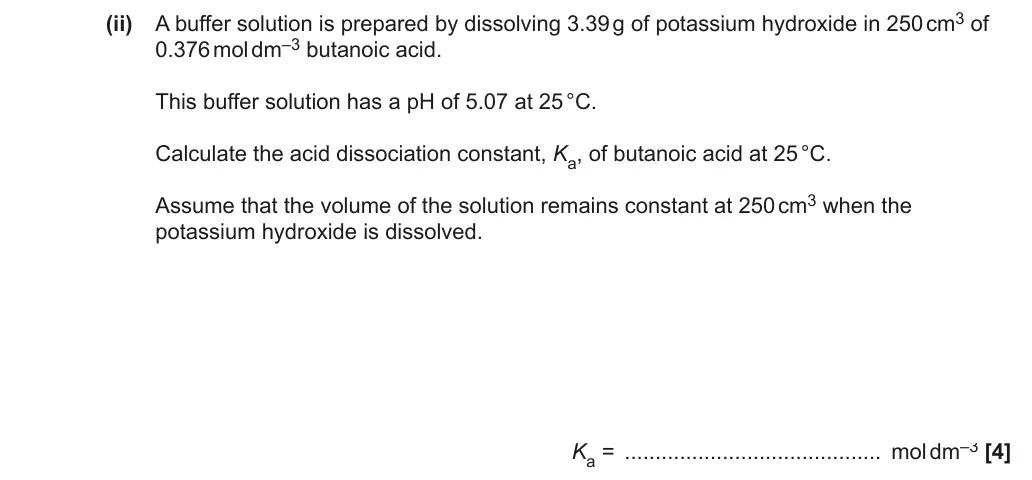
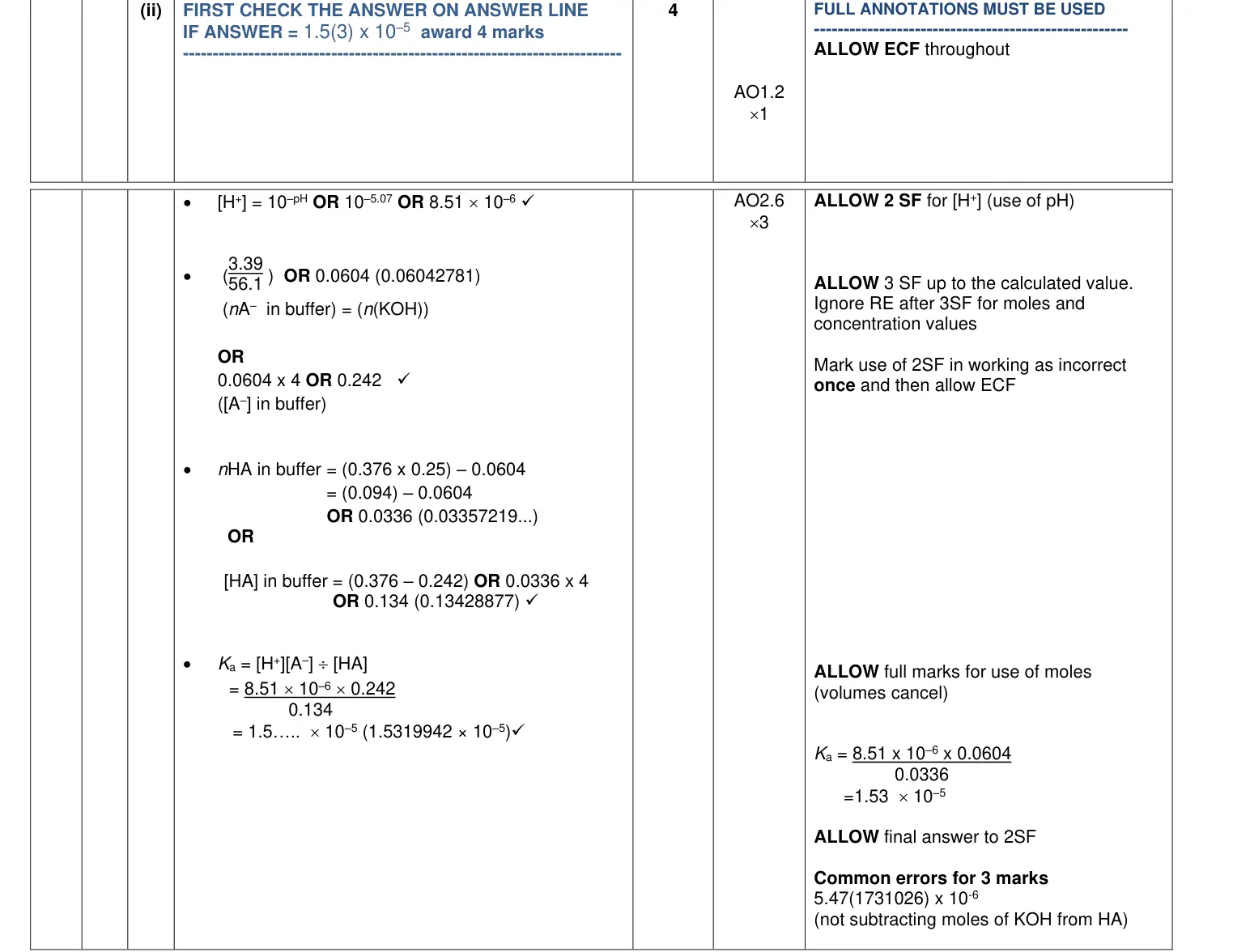
June 2023 · Paper 1 · Q20(e)(ii)4 marksAO1, 2CalculationHard
Earlier part of question 20 that this part uses
Mark scheme
Examiner's comment
This calculation proved difficult with many figures and sums appearing with little indication as to their relevance. Candidates should remember to provide written indications of what it is they’re working out – presenting the calculations without any annotations can make it harder for error carried forward marks to be given if there is an error in their calculation. Few candidates scored all 4 marks. Most found the concentration of H+ from the pH and the moles of KOH correctly but did not recognise they had to take away the moles of KOH from those of HA to find the remaining concentration of HA. Some candidates then used the [H+] as the [HA]. A few candidates tried a [H+] squared expression of a weak acid. The candidate has clearly set out the calculation so each numerical value can be linked and the steps understood. The only error is not calculating the excess acid (i.e. not subtracting moles OH- from initial moles acid) so 3 marks were given.
Notes from the mark scheme and report
n(A–) = n(KOH) = 0.0604
n(HA) remaining = 0.094 – 0.0604
Ka = [H+][A–]/[HA] = 1.53 × 10⁻⁵
common error 5.47 × 10⁻⁶ (KOH not subtracted from HA) scores 3
Skills: M0.4 Use calculators to find and use power, exponential and logarithmic functions; M2.2 Change the subject of an equation; M2.3 Substitute numerical values into algebraic equations using appropriate units for physical quantities; M2.5 Use logarithms in relation to quantities that range over several orders of magnitude
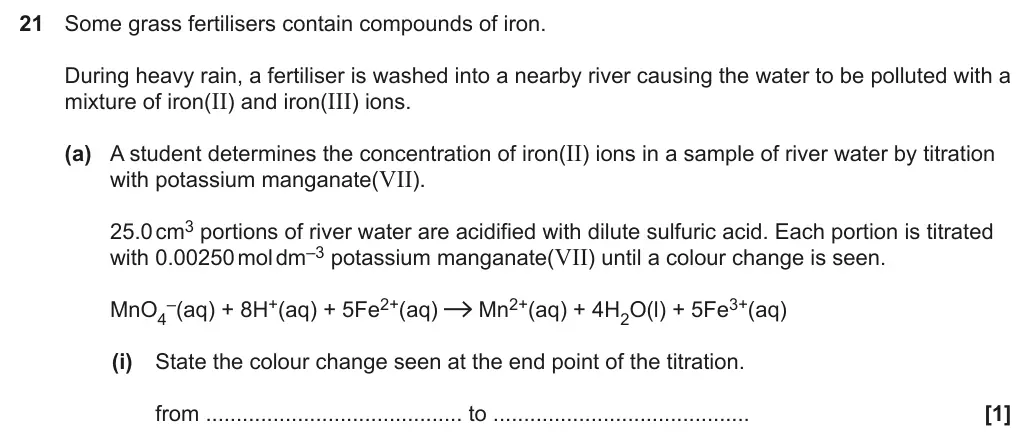
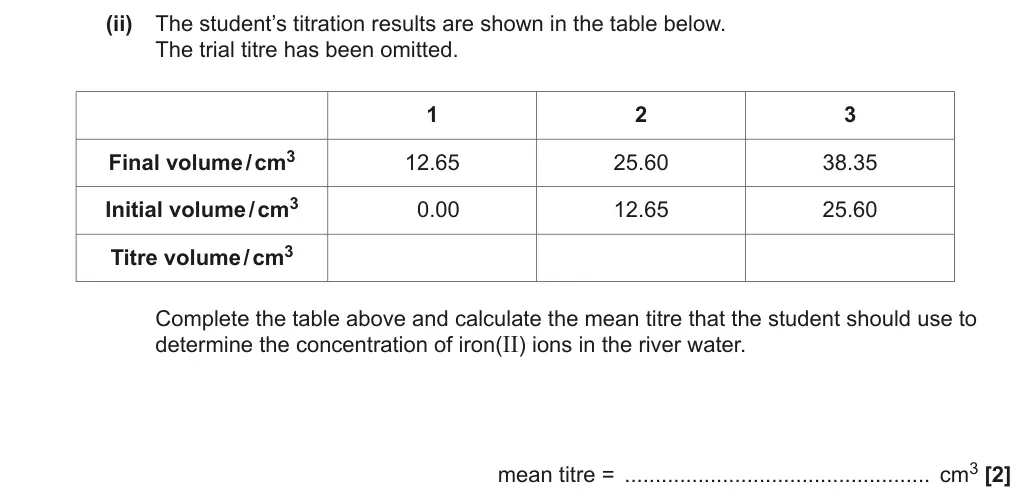
June 2023 · Paper 1 · Q21(a)(iii)3 marksAO2CalculationMedium
Earlier parts of question 21 that this part uses
Mark scheme
Examiner's comment
ocr.org.uk/science Oxford Cambridge and RSA CHEMISTRY A H432 For first teaching in 2015 A LEVEL Version 1 H432/01 Summer 2023 series Examiners’ report Contents Introduction .......................................................................................................................................... 4 Paper 1 series overview........................................................................................................................ 5 Section A overview ............................................................................................................................... 6 Question 1 .................................................................................................................................... 6 Question 2 ....................................................................................................................................... 6 Question 3 ....................................................................................................................................... 7 Question 4 ....................................................................................................................................... 7 Question 5 ....................................................................................................................................... 8 Question 6 ....................................................................................................................................... 8 Question 7 ....................................................................................................................................... 9 Question 8 ....................................................................................................................................... 9 Question 9 ..................................................................................................................................... 10 Question 10 ................................................................................................................................... 10 Question 11 ................................................................................................................................... 11 Question 12 ................................................................................................................................... 11 Question 13 ................................................................................................................................... 12 Question 14 ................................................................................................................................... 12 Question 15 ................................................................................................................................... 13 Section B overview ............................................................................................................................. 14 Question 16 (a) (i) ........................................................................................................................... 14 Question 16 (a) (ii) ......................................................................................................................... 15 Question 16 (b) .............................................................................................................................. 16 Question 17* .................................................................................................................................. 17 Question 18 (a) ............................................................................................................................... 18 Question 18 (b) .............................................................................................................................. 19 Question 18 (c) (i) .......................................................................................................................... 20 Question 18 (c) (ii) .......................................................................................................................... 21 Question 19 (a) (i) .......................................................................................................................... 23 Question 19 (a) (ii) ......................................................................................................................... 24 Question 19 (b) .............................................................................................................................. 24 Question 20 .................................................................................................................................... 25 Question 20 (a) (ii) ......................................................................................................................... 26 Question 20 (b) .............................................................................................................................. 26 Question 20 (c) (i) .......................................................................................................................... 27 Question 20 (c) (ii) .......................................................................................................................... 27 Question 20 (d) (i) .......................................................................................................................... 28 Question 20 (d) (ii) ......................................................................................................................... 28 Question 20 (e) (i) .......................................................................................................................... 29 Question 20 (e) (ii) ......................................................................................................................... 29 Question 20 (f) ............................................................................................................................... 30 Question 21 (a) (i) ........................................................................................................................... 31 Question 21 (a) (ii) ......................................................................................................................... 31 Question 21 (iii) .............................................................................................................................. 32 Question 21 (b) .............................................................................................................................. 33 Question 22 (a)* .............................................................................................................................. 34 Question 22 (b) (i) .......................................................................................................................... 36 Question 22 (b) (ii) ......................................................................................................................... 36 Question 22 (c) .............................................................................................................................. 37 Question 22 (d) .............................................................................................................................. 37 Introduction Our examiners’ reports are produced to offer constructive feedback on candidates’ performance in the examinations. Question 21 (a) (i) Only a few candidates were given this mark. Question 21 (a) (ii) Almost all candidates calculated the titres correctly.
Notes from the mark scheme and report
× 5 for Fe2+
÷ 0.0250
ECF from incorrect titre
common errors for 2 marks: 1.27 × 10⁻³ (no × 5), 2.46 × 10⁻² (volumes transposed)
Skills: M0.2 Use ratios, fractions and percentages; M1.1 Use an appropriate number of significant figures; M2.3 Substitute numerical values into algebraic equations using appropriate units for physical quantities; PAG2 Acid–base titration
June 2023 · AS Paper 1 · Q22(c)(iv)4 marksAO3CalculationMedium
Earlier parts of question 22 that this part uses
Mark scheme
Examiner's comment
Many candidates followed a well drilled method to identify the unknown metal M as potassium: • Moles of H2SO4 in the mean titre • Moles of KOH in 25 cm3 • Scaling 10 for moles of KOH in 250 cm3 • Molar mass of the metal as 39.11 and identified as K. A number of candidates omitted the scaling stage to obtain a molar mass of 391.1. By ECF, the ‘correct’ identity would be caesium or francium. Some candidates then ‘fiddled’ their response, dividing by 10 to ‘identify’ the metal as K. This incorrect approach was not credited. A common error, illustrated in Exemplar 2, was for candidates to calculate 39.11 but to think that this was the mass of MOH and not M. They then subtracted 17 (for OH) from 39.11 to obtain a response of 22.11 and identified M as sodium instead of potassium. This error probably stems from candidates either not reading the question closely enough or confusion about the mole concept.
Notes from the mark scheme and report
×2 for MOH:H2SO4
×10 scaling to 250.0 cm3 (if absent Ar = 389, Cs/Fr)
ALLOW ECF from incorrect mean titre in (c)(iii)
use of 25.0 for acid volume loses first mark only
Skills: M0.2 Use ratios, fractions and percentages; M2.3 Substitute numerical values into algebraic equations using appropriate units for physical quantities; PAG2 Acid–base titration
June 2023 · AS Paper 2 · Q1(b)(ii)4 marksAO2CalculationHard
Earlier part of question 1 that this part uses
Mark scheme
Examiner's comment
Candidates found this calculation quite challenging, with less than a quarter achieving full marks. The most common errors are highlighted on the mark scheme. Many that struggled were often given credit for the x4 ratio mark but only if it was possible to see this in the working. Many gave multiple, often contradictory attempts at the calculation. It was not always clear how the final answer had been obtained. Clear working enables us to follow the logic and give ECF where appropriate. Many divided 1000 g by the molar mass for TiCl4 and then found 72% of this. It was important here to read the question carefully to ensure complete understanding. This candidate achieved 3 out of the 4 possible marks. The steps in their calculation are logical and it is easy to follow their working and therefore spot the error in their calculation. They have divided by 4 rather than multiplying. It also shows the calculation can be performed in a different order to that on the mark scheme. All intermediate values are used in calculations as calculator values without rounding to ensure an accurate answer.
Notes from the mark scheme and report
3 SF AND kg required (2.67)
common errors: 1.92 (yield ignored), 1.38 (yield inverted), 0.673 (Mr of TiCl4 used for Ti)
ALLOW ECF throughout
Skills: M0.0 Recognise and make use of appropriate units in calculations; M0.2 Use ratios, fractions and percentages; M1.1 Use an appropriate number of significant figures; M2.3 Substitute numerical values into algebraic equations using appropriate units for physical quantities
June 2023 · AS Paper 2 · Q2(b)(ii)4 marksAO3CalculationHard
Earlier part of question 2 that this part uses
Mark scheme
Examiner's comment
This was a tricky calculation, made more challenging if candidates hadn’t been able to successfully complete (i). Many were able to calculate the moles of BaSO4 but often rounded their answer to only 2 significant figures at this stage i.e. 0.014. Many assumed a direct ratio between BaSO4 and NaCl so mass was found by multiplying moles by 58.5 (molar mass for NaCl) - if this was done then credit was given for ECF for the final marking point.
Notes from the mark scheme and report
n(BaSO4) → mass Ba(NO3)2 (× 261.3) → mass NaCl by difference → 26.6% to 3 SF
using n × 58.5 gives 16.4 (ECF only)
ALLOW ECF from equation in (b)(i)
The M1 section of the Mathematical Skills handbook contains useful information on handling data, including M1.1 use of significant figures.
Skills: M0.2 Use ratios, fractions and percentages; M1.1 Use an appropriate number of significant figures; M2.3 Substitute numerical values into algebraic equations using appropriate units for physical quantities; PAG1 Moles determination
June 2023 · AS Paper 2 · Q3(a)6 marksAO1, 26-mark level of responseHard
Mark scheme, with the levels and indicative points
Examiner's comment
Very few candidates managed to access the higher level on this question. They found the calculation very challenging. In addition to a typical mole calculation, they needed to use the tonnes conversion (given on the data sheet), look at the ratio of I2 to KI and use a mass concentration. Many used the mass concentration as a molar concentration. Even if a balanced equation was given, it didn’t guarantee the correct ratio in calculations and a common error was to find moles of I2 using the relative atomic mass of iodine (126.9). As with previous calculations on this paper, it was often challenging to follow the logic in the steps of the calculation. It is important to encourage candidates to label each step of their calculation, showing them as independent steps and only using = when terms are equal. Explanations of relative reactivities of chlorine and iodine often lacked detail or had extra irrelevant information, such as reference to electronegativity, ionisation energy, bond enthalpy or intermolecular forces. Some candidates gave responses for the general trend in reactivity in the group rather than comparing Cl and I. Confusion around nuclear charge and nuclear attraction was also often seen. A key skill for longer answer questions is to plan out answers to avoid contradictions. Candidates should also be encouraged to re-read their answers to check that what they have written makes sense. This exemplar demonstrates a L3 6 mark response. A comprehensive explanation of relative reactivities of chlorine and iodine is given. The steps in the calculation are logical with each step labelled, making it easy to follow. A balanced equation is also given.
Notes from the mark scheme and report
comparison required throughout
IGNORE 'nuclear charge' for nuclear attraction
2:1 ratio I–:I2
n(I2) = 1 × 10^6/253.8
acceptable errors: 126.9 used for I2 (1.74 × 10^7) or missing × 2 (4.36 × 10^6), not both for L3
Skills: M0.0 Recognise and make use of appropriate units in calculations; M0.1 Recognise and use expressions in decimal and ordinary form; M0.2 Use ratios, fractions and percentages; M2.3 Substitute numerical values into algebraic equations using appropriate units for physical quantities
June 2023 · Paper 2 · Q51 markAO1Multiple choiceHard
Answer
B
Mark scheme
Examiner's comment
More than a third of candidates answered this question incorrectly. They struggled interpreting the skeletal formula for this more complex substituted benzene. An effective strategy used by many candidates was to label each C with number of H atoms using sticks or dots or numbers.
Notes from the mark scheme and report
ALLOW 24
June 2023 · Paper 2 · Q81 markAO2Multiple choiceMedium
Answer
B
Mark scheme
Examiner's comment
This was a demanding question. Candidates needed to calculate the moles of oxygen and then determine the ratio of alkane to oxygen to find the correct response. The majority of successful candidates clearly showed their working to help them to arrive at the correct answer. The most common incorrect answer was C.
June 2023 · Paper 2 · Q16(b)(iii)3 marksAO2, 3CalculationMedium
Earlier part of question 16 that this part uses
Mark scheme
Examiner's comment
Overall, this question was well answered with over half of candidates gaining all 3 marks. The use of a different molar volume confused some candidates. Some attempted to use PV=nRT or different combinations of the figures given with varying degrees of success. Lower attaining candidates typically struggled with unit conversions and were unable to make use of the units to help them work out the methodology to use.
Notes from the mark scheme and report
use 40.0 dm3 mol–1 not 24: n = 1.80 × 10^-3, M = 480.5, C6H9Br5
common error 24000 gives 288.3 (C6H12Br2) for 2 marks by ECF
cm3 to dm3
Skills: M0.0 Recognise and make use of appropriate units in calculations; M2.3 Substitute numerical values into algebraic equations using appropriate units for physical quantities; M2.4 Solve algebraic equations
June 2023 · Paper 2 · Q18(b)3 marksAO1, 2CalculationHard
Earlier part of question 18 that this part uses
Mark scheme
Examiner's comment
Approximately half of the candidates scored all 3 marks and were confident calculating % yield. However, about a third did not gain any credit. A common response was 100% with both masses as 15 g. Some struggled with conversion of the volume of nitrobenzene to a mass using the density. Many candidates struggled with obtaining the correct molar mass values, especially if they were not sure on the correct structures. As with any calculation work, clear working is vital to gain error carried forward credit here. Three significant figures were required for final answer but many also lost marks as a consequence of incorrect rounding. For example, use of 0.089 moles gave a value of 73.0%. It was not uncommon to see contradictory calculations as candidates appeared to try to find a suitable value.
Notes from the mark scheme and report
mass = volume × density first
73.2 to 3 SF
common error 87.9 (density not used) scores 2
no final mark if yield ≥ 100%
Skills: M0.0 Recognise and make use of appropriate units in calculations; M0.2 Use ratios, fractions and percentages; M1.1 Use an appropriate number of significant figures; M2.3 Substitute numerical values into algebraic equations using appropriate units for physical quantities
June 2023 · Paper 2 · Q20(b)(ii)3 marksAO3CalculationHard
Earlier part of question 20 that this part uses
Mark scheme
Examiner's comment
Nearly half the candidates were able to correctly calculate the number of PAS molecules in the maximum daily dosage. Some struggled with conversion from mg to g. Some made errors calculating the molar masses or did not calculate moles at all. Most were confident to multiply by NA at the end. As with other calculations some lost marks for significant figures and rounding errors.
Notes from the mark scheme and report
300 mg per kg × 20.0 kg = 6.0 g
/153 = 0.0392 mol
× 6.02 × 10^23 = 2.36 × 10^22
ECF throughout
Skills: M0.0 Recognise and make use of appropriate units in calculations; M0.1 Recognise and use expressions in decimal and ordinary form; M0.2 Use ratios, fractions and percentages; M2.3 Substitute numerical values into algebraic equations using appropriate units for physical quantities
June 2023 · Paper 2 · Q236 marksAO1, 36-mark level of responseEasy
Mark scheme, with the levels and indicative points
Examiner's comment
Most candidates were able to deduce the empirical and/or molecular formula of the organic compound. Analysis of the IR spectrum was also well attempted, but some candidates assumed the unknown was a carboxylic acid, attributing the sharp peak just below 3000 cm–1 to an OH group. Others misidentified the C=O peak as a C=C group suggesting alkene or arene structure. They were often led to this conclusion as they believed no precipitate with 2,4-DNP suggested no C=O rather than no aldehyde or ketone. Good analysis of the NMR data was crucial for deducing the correct ester. Some candidates opted to annotate the proton NMR spectrum, some produced tables and others gave written details for each peak. It was vital that they were able to interpret all information for each peak i.e. number of proton environments, the type of environment from chemical shift, the number of protons in each environment from relative peak areas and use of splitting patterns to find information about adjacent protons. Many tried to make the data fit their proposed structure rather than the other way round. Some suggested structures that were only partially consistent with the data such as CH3CH2CH2COOC(CH3)3 and were awarded Level 2. Others did not take full note of all the information provided, for example omitting the 2,4-DNP observations, giving the ketone (CH3)3COCH2COCH2CH3 or not checking it matched the molecular formula CH3CH2COOC(CH3)3 so only achieved Level 1. Candidates need to be encouraged to draw a structure as without they can only achieve a maximum of 2 marks despite some excellent analysis of the data. Conversely, it is not sufficient to just give a structure, candidates must give analysis of the data provided. This is a good Level 3 6 mark response. As well as this clearly laid out analysis they also had details written on the question, e.g. no aldehyde or ketone due to no reaction with 2,4-DNP. This response has been selected due to the detailed analysis of NMR data that has been summarised in a table.
Notes from the mark scheme and report
C4H8O then C8H16O2 from m/z 144
IR C=O about 1740 but no reaction with 2,4-DNP so not aldehyde/ketone: ester
singlet 9H C(CH3)3, triplet 3H + quartet 2H CH3CH2CO, singlet 2H OCH2 at 4.1
CH3CH2COOCH2C(CH3)3
IGNORE C–O peaks
Skills: M0.2 Use ratios, fractions and percentages; M3.1 Translate information between graphical, numerical and algebraic forms; PAG7 Qualitative analysis of organic functional groups
June 2023 · Paper 3 · Q1(h)1 markAO2Short answerHard
Earlier part of question 1 that this part uses
Mark scheme
Examiner's comment
This question was a good discriminator. Candidates who scored the mark usually showed their mathematical working which led to As being chosen as the correct element. Other elements were seen randomly. More candidates omitted this part of Question 1 than other parts. With questions such as this, it is always better to guess as there is no penalty for an incorrect response.
Notes from the mark scheme and report
1.244 × 10–22 × 6.02 × 10^23 = 74.9 so As
Skills: M0.1 Recognise and use expressions in decimal and ordinary form; M0.2 Use ratios, fractions and percentages
June 2023 · Paper 3 · Q2(a)(ii)3 marksAO2CalculationHard
Earlier part of question 2 that this part uses
Mark scheme
Examiner's comment
This question was a good discriminator, producing marks across the whole 3 mark range. More successful candidates correctly calculated the energy change, moles of RbClO3 and enthalpy change of solution. However, there were pitfalls for many including the following: • calculating the energy change using the mass of water rather than the mass of the solution. This was despite the suppled information that the specific heat capacity of the solution is the same as for water. Candidates should understand that m in mc∆T is the mass of the substance that produces ∆T • calculating an incorrect value for the molar mass of RbClO3. Instead of 169, this was often seen as 120.5 (using the atomic number of 37 for Rb, rather than the mass number of 85.5) and 185 (for RbClO4) • using values of m at the wrong stages in the calculation. e.g. 2 g with the energy change and 102 g or 100 g with the moles calculation • calculating the correct numerical value for the enthalpy change of solution, but then placing a ‘–‘ sign in front of the value, despite ∆T being for a decrease in temperature. Finally, as with all multi-step calculations, candidates are advised to use calculator values throughout. Any intermediate rounding introduces rounding errors in the final value. The final value can be rounded either to the significant figures demanded by the question or to the lowest number of significant figures used in the provided data.
Notes from the mark scheme and report
mass of solution 102 g (not 100 or 2.00 g)
∆T = 1.5
n = 2.00/169
+54.0 to 54.2
IGNORE sign
common errors: 100 instead of 102 (53.0) 2 marks, 102 and 2 swapped 1 mark, 8.314 used for c 2 marks
ALLOW ECF
Skills: M0.0 Recognise and make use of appropriate units in calculations; M0.2 Use ratios, fractions and percentages; M2.3 Substitute numerical values into algebraic equations using appropriate units for physical quantities; PAG3 Enthalpy determination
June 2023 · Paper 3 · Q4(b)(i)2 marksAO1CalculationMedium
Earlier part of question 4 that this part uses
Mark scheme
Examiner's comment
This question required candidates to calculate the masses of two reactants that could be used to prepare a sample of the Tutton’s salt. Candidates were supplied with the formula of hydrated copper(II) sulfate but not the formula of ammonium sulfate, so candidates needed to work out its formula from ions that candidates are expected to be able to recall from the specification. Just over half the candidates obtained both correct masses but many obtained just one correct mass, usually that of CuSO4•6H2O. This exemplar shows a typical response with the incorrect formula of ammonium sulfate clear shown by the candidate, resulting in the incorrect mass of 2.8525 g. This incorrect formula and mass were seen in many responses and, from the initial crossings out, this candidate is clearly confused about how to tackle this simple mole calculation. The incorrect answer of 2.85 g was seen on almost as many scripts as the correct answer of 3.30 g. The moral is that candidates need to learn the formula and charges of the common ions encountered in chemistry. The comments here apply also to Question 6 (b) (i), where formulae need to be written using ions listed in the specification.
Notes from the mark scheme and report
(NH4)2SO4 3.30 g
CuSO4•5H2O 6.24 g (must include water of crystallisation)
Skills: M0.2 Use ratios, fractions and percentages; M2.3 Substitute numerical values into algebraic equations using appropriate units for physical quantities
June 2023 · Paper 3 · Q4(b)(ii)1 markAO3Short answerMedium
Earlier parts of question 4 that this part uses
Mark scheme
Examiner's comment
The majority of candidates did not answer this question correctly. Candidates were expected to refer back to the formula of the Tutton’s salt, spot that there was water of crystallisation present, and that this would be lost if all the solvent was boiled off. Many responded vaguely in terms of decomposition or formation of larger crystals but a mark was only awarded if there was a definite link to the water contained within the crystals.
Notes from the mark scheme and report
prevents water of crystallisation being removed / anhydrous salt forming
IGNORE 'all the water would be removed', prevents decomposition, larger crystals
In the specification, Section 2.1.2a states the following: (a) the writing of formulae of ionic compounds from ionic charges, including: (i) prediction of ionic charge from the position of an element in the periodic table (ii) recall of the names and formulae for the following ions: NO3 –, CO3 2–, SO4 2–, OH–, NH4 +, Zn2+ and Ag+u.
This section will be studied at the start of the 2 year course. Candidates need to be confident with using these common formulae. For success in chemistry, these ions must be learnt.
June 2023 · Paper 3 · Q5(a)6 marksAO2CalculationEasy
Mark scheme
Examiner's comment
Compared with the application based Question 4, candidates answered this stock titration calculation well. Almost all candidates determined that the mean titre was 22.35 cm3 and went on to calculate the number of moles of HCl as 4.47 10–3 mol. Most scaled this value by 10 to determine the moles in 250 cm3. Most candidates then used the initial moles of HCl to determine the moles of aspirin in the 3 tablets as 5.30 10–3 moles. A significant number omitted this stage but they were able to be credited for the next stage of calculation using a correct method. Consequently over half the candidates were awarded 5 or 6 marks for this stock calculation.
Notes from the mark scheme and report
mean of concordant titres 22.35 (not all three = 22.60, 5 marks max)
n(NaOH) remaining × 10
subtract from 0.0500 mol
× 180 then ÷ 3 tablets = 318 mg
common errors: no × 10 scaling, no subtraction from 0.05, omitting the titration calculation (3000 mg)
Skills: M0.0 Recognise and make use of appropriate units in calculations; M0.2 Use ratios, fractions and percentages; M1.2 Find arithmetic means; M2.3 Substitute numerical values into algebraic equations using appropriate units for physical quantities; PAG2 Acid–base titration
June 2023 · Paper 3 · Q6(e)6 marksAO36-mark level of responseHard
Mark scheme, with the levels and indicative points
Examiner's comment
This level of response question required candidates to interpret three pieces of information to identify 3 unknown chemicals, linked by three reactions of sulfuric acid. Levels were assigned based on identifying the three unknowns and writing equations for the reactions. The 3 reactions were tiered in difficulty with the cyclic structure for compound F being the most difficult. The question discriminated extremely well, with comparatively few candidates not scoring any marks. This exemplar shows an excellent response which was awarded Level 3 and 6 marks. The crossing out shows how the candidate progressively solved the problem. Despite the crossing out, working is shown throughout, and the presentation of the response is very clear. For reaction 1, the candidate initially made an error in the stock formula determination calculation. Notice that the candidate crossed out their initial values and wrote them afresh. This approach is recommended. as changing incorrect numbers can lead to ambiguous numbers. In reaction 2, the candidate comfortably identified compound E from its molar mass and wrote a balanced equation for this reaction. For reaction 3, you can see how the candidate’s thought developed during the solve. They initially went for a straight chain structure and then worked out that there must be a cyclic structure. They finally show the cyclic diester as a conventional structural (based on glucose?), and with a balanced equation. This was an excellent response of a high-ability candidate and shows what a well-prepared candidate is capable of achieving.
Notes from the mark scheme and report
D = NiSO4•6H2O from mole ratio 1:1:10:12
E = SO2 (2.67 × 24 = 64)
H2SO4 + 2HBr → Br2 + SO2 + 2H2O
F = cyclic diester from 2 CH3CH(OH)COOH + 2H2O (ALLOW unsaturated ester/acid or anhydride isomers)
IGNORE connectivity for F
Skills: M0.2 Use ratios, fractions and percentages; M2.3 Substitute numerical values into algebraic equations using appropriate units for physical quantities
June 2022 · Paper 1 · Q21 markAO1Multiple choiceEasy
Answer
C
Mark scheme
Examiner's comment
This question was quite well answered with many candidates identifying the correct response as C. Candidates had to link the volume of gas with the moles of each gas and then match to the stoichiometry of the equation. Some candidates calculated the moles of gas and then appeared to choose an answer at random.
Notes from the mark scheme and report
gas volume ratio 2:1:2 equals mole ratio
Skills: M0.2 Use ratios, fractions and percentages
June 2022 · Paper 1 · Q31 markAO2Multiple choiceHard
Answer
B
Mark scheme
Examiner's comment
This was a challenging question, the correct answer being B. The candidates would be advised to use the space around the question to perform the calculation. A was a common error as the Al ion was seen as the obvious choice without doing any calculations due to being Al3+.
June 2022 · Paper 1 · Q41 markAO2Multiple choiceMedium
Answer
C
Mark scheme
Examiner's comment
The correct answer C required candidates to calculate the moles of manganate (VII) ions and then to use the stoichiometry of the equation to calculate the moles of H2O2 before calculating the concentration. Option A provided a distractor with the incorrect ratio. Option B was obtained without the reference to the molar ratio.
Notes from the mark scheme and report
2:5 ratio MnO4–:H2O2
Skills: M0.2 Use ratios, fractions and percentages; M2.3 Substitute numerical values into algebraic equations using appropriate units for physical quantities
June 2022 · Paper 1 · Q51 markAO2Multiple choiceMedium
Answer
B
Mark scheme
Examiner's comment
The correct answer B required the candidate to calculate the number of moles of the gas using Avogadro’s number. Then link this numerical value to the Mr of the gas so that the formula could be deduced from calculating the Mr of the molecules suggested. Incorrect answers, often if appeared that option C had been guessed as an answer, rather than being arrived at by mistake.
June 2022 · AS Paper 1 · Q71 markAO2Multiple choiceMedium
Answer
C
Mark scheme
Examiner's comment
Candidates often appear to find quantitative questions such as this one easier than questions involving interpretation of textual information. Most candidates selected the correct response and most scripts contained working including molar proportions alongside the question. This is an excellent strategy.
June 2022 · AS Paper 1 · Q81 markAO2Multiple choiceHard
Answer
B
Mark scheme
Examiner's comment
Candidates found this calculation more difficult than Question 7. From the annotations, most showed working using the relationship between moles, concentration and volume. Options A (18 250/1000) and C (18 250/1000 ÷ 0.450) were the main distractors.
June 2022 · AS Paper 1 · Q91 markAO2Multiple choiceHard
Answer
D
Mark scheme
Examiner's comment
Candidates found this question very difficult. B was the main distractor, obtained by multiplying the number of moles (4) by the Avogadro constant. Only the highest-attaining candidates realised that the question asked for the number of ions and multiplied the answer to B by 3 to obtain option D. The lesson here is to consider carefully any bold text in the question (ions).
June 2022 · AS Paper 1 · Q161 markAO2Multiple choiceHard
Answer
D
Mark scheme
Examiner's comment
This question discriminated extremely well with most candidates choosing the correct option. Most candidates showed some working. The key to success was to identify the balanced equation that produced CO2 and H2O in a 3 : 4 molar ratio.
June 2022 · Paper 1 · Q17(a)(i)4 marksAO1, 2CalculationHard
Mark scheme
Examiner's comment
Many candidates made some attempt at this unusual twist on a Q = mcΔT calculation, but only a minority of candidates produced a fully correct answer. A temperature of 84.9 oC was seen much more often than 52.4 oC. The calculation of n(AgNO3) was performed well. Common errors were not dividing the moles by 2, not recognising the need to calculate the energy released per mole of AgNO3, confusing the mass of water with the mass of the silver nitrate solid or of using an energy in kJ alongside a value of c based on J.
Notes from the mark scheme and report
n(AgNO3) = 0.0400
energy = 678 × 0.0400/2 = 13.56 kJ (2 mol AgNO3 per ∆H)
∆T = 32.4
add 20.0 gives 52.4 °C to 3 sig figs
common errors 32.4 (∆T only) and 84.9 (no ÷2) score 3
Skills: M0.0 Recognise and make use of appropriate units in calculations; M1.1 Use an appropriate number of significant figures; M2.2 Change the subject of an equation; M2.3 Substitute numerical values into algebraic equations using appropriate units for physical quantities; PAG3 Enthalpy determination
June 2022 · Paper 1 · Q18(b)1 markAO2CalculationMedium
Earlier part of question 18 that this part uses
Mark scheme
Examiner's comment
This question proved demanding for candidates, with many simply quoting a molar value taken from the graph and converting into standard form. Of those who recognised the need to use the Avogadro constant, a few tried to multiply it by the molar ionisation enthalpy. For those who worked out the correct answer, several lost marks due to the requirement of 2 significant figures.
Notes from the mark scheme and report
about 500/6.02 × 10^23 = 8.3 × 10^–22 kJ
must be 2 sig figs AND standard form
Skills: M0.1 Recognise and use expressions in decimal and ordinary form; M0.3 Estimate results; M1.1 Use an appropriate number of significant figures
June 2022 · Paper 1 · Q19(a)(ii)5 marksAO2, 3CalculationMedium
Earlier part of question 19 that this part uses
Mark scheme
Examiner's comment
Candidates made good progress with this calculation, many gaining 4 or 5 marks, including error carried forward from incorrect titres. Common errors included, in various combinations: not converting the final answer into mg, not converting volume to dm3, missed ratio, multiplying the moles in 10cm3 acid by 10 instead of 25 and/or wrong Mr. Responses to Question 19 (a) (ii) often featured rows of figures and random sums without a single word about what the figures, or sums, were set to calculate. Candidates should remember to provide written indications of what it is they are working out – presenting the calculations without any annotations can make it harder for error carried forward marks to be given if there is an error in their calculation. The exemplar here shows a good use of annotation. There is a clear indication of the mathematical process so that the error carried forward is easily identified and the candidate gains the method marks.
Notes from the mark scheme and report
÷2 (dibasic)
× 25 to scale 10.0 cm3 to 250.0 cm3
× 118
÷4 tablets and convert to mg = 498
common errors 996 (no ÷2), 19.9 (no × 25)
503 from titre 22.725 scores 5 by ECF
Skills: M0.0 Recognise and make use of appropriate units in calculations; M0.2 Use ratios, fractions and percentages; M1.1 Use an appropriate number of significant figures; M2.3 Substitute numerical values into algebraic equations using appropriate units for physical quantities; PAG2 Acid–base titration
June 2022 · Paper 1 · Q21(b)(i)5 marksAO2CalculationMedium
Mark scheme
Examiner's comment
Although few candidates got the correct final answer, however almost all achieved some marks from this calculation through error carried forward, with marks spread across the available range. Almost all candidates were able to find the concentrations of hydrogen and hence hydroxide ions. A few candidates successfully used p[OH-] method. Most were able to calculate the moles of hydroxide ions in 250cm3. Many then did not realise the need to half this number to find the moles of barium, and/or used the Mr for barium hydroxide instead of barium oxide.
Notes from the mark scheme and report
÷4 for 250 cm3
÷2 for Ba(OH)2
× 153.3 (BaO) = 2.53 g
common errors 5.05 (no ÷2) and 2.82 (Mr of Ba(OH)2) score 4, 5.65 scores 3
Skills: M0.2 Use ratios, fractions and percentages; M0.4 Use calculators to find and use power, exponential and logarithmic functions; M1.1 Use an appropriate number of significant figures; M2.5 Use logarithms in relation to quantities that range over several orders of magnitude
June 2022 · Paper 1 · Q21(c)(i)3 marksAO2CalculationHard
Mark scheme
Examiner's comment
This proved a difficult question for most candidates. Most were able to correctly calculate the moles of fertiliser by converting kg to g. The next step was to deduce that 5 moles of calcium carbonate would be required for each mole of Z and multiply by 5, rather than the common error of dividing by 5. Few candidates were able to multiply by 100/95, to account for the impurities in limestone, with many multiplying by 95/100.
Notes from the mark scheme and report
n(Z) = 1500/1080.5
× 5 for CaCO3
× 100.1 (DO NOT ALLOW 100)
÷ 0.950 = 731 g
common errors 146 (no × 5), 660 (× 0.95), 29.3 (÷5) score 2
Skills: M0.0 Recognise and make use of appropriate units in calculations; M0.2 Use ratios, fractions and percentages; M1.1 Use an appropriate number of significant figures
June 2022 · Paper 1 · Q22(a)(ii)4 marksAO1, 3Structure / isomerEasy
Earlier part of question 22 that this part uses
Mark scheme
Examiner's comment
Most candidates did not seem to understand how to apply their knowledge of what an empirical formula should look like to this situation. Many giving the formula of the complex ion instead. Those candidates who were successful often had the incorrect overall charge on the ion with 3+ as the common error, not considering the 2 Cl- ligands. Conversely, most candidates did very well at representing the isomers of the complex. Most were able to use the wedge and broken line notation to suggest the geometry of what they were drawing. Although a small number drew the trans isomer in three different orientations, most correctly drew the trans and cis forms and managed to show the optical isomers – even when they did not make use of the top pair of answer boxes to assist them with their mirror images. Candidates are advised to focus on the mirror image and avoid subsequent rotations and inversions of the molecule. This can often lead to two of the same isomers being drawn. Candidates showed a good accuracy with their connectivity of the N atom.
Notes from the mark scheme and report
empirical formula FeC4H16N4Cl2 with 1+ charge (DO NOT ALLOW Fe(NH2CH2CH2NH2)2Cl2)
two cis mirror images and one trans
correct wedges (2 out, 2 in, 2 in plane)
Fe–N connectivity errors penalised once
1 mark if all three shown with Cl but no N
Skills: M4.2 Visualise and represent 2-D and 3-D forms including 2-D representations of 3-D objects; M4.3 Understand the symmetry of 2-D and 3-D shapes
June 2022 · AS Paper 1 · Q22(c)3 marksAO1, 2Short answerHard
Mark scheme
Examiner's comment
Candidates processed the empirical formula data well to obtain the correct molar ratio of the elements, with many being able to convert this ratio into an empirical formula. This type of problem is common in chemistry and candidates were clearly well-versed in the method of its solution. The most common error was H:11 rather than H:12. The third mark for water of crystallisation was far harder to obtain. Many candidates identified that 6H2O was present, but the O was often missing in a formula shown as ZnN2•6H2O, or ‘included’ with the water as ZnN2•6H2O2. Many candidates did not seem to know how to proceed here. The mark scheme allowed credit for both the preferred answer of Zn(NO3)2•6H2O and for ZnN2O6•6H2O, as both had extracted the waters of crystallisation from the rest of the empirical formula. A few candidates inverted the moles calculation, a strategy that could not be given marks.
Notes from the mark scheme and report
inverse fractions score no marks
correct hydrated formula with no working scores 1 only
ALLOW ECF from incorrect molar ratios
Skills: M0.2 Use ratios, fractions and percentages
June 2022 · Paper 1 · Q22(c)6 marksAO36-mark level of responseHard
Mark scheme, with the levels and indicative points
Examiner's comment
Answers were distributed across all 3 levels of achievement. Most of the candidates managed to identify at least some of the substances. Of the equations, the reaction of copper (II) oxide with nitric acid was most regularly seen correct, although many students could also represent the ligand replacement in Experiment 1. Many candidates were able to calculate Mr for gas D but some of those suggesting SO2 as a possible formula preferred to have an equation in experiment 2 producing hydrogen. A few candidates used the Mr to suggest that the gas was 2O2 and as such candidates found the equation between copper and sulphuric acid challenging. A good number of candidates identified F and G, recognising what they had learned from their work on redox titrations, and some were able to reproduce the equation. Incorrect formula of copper (I) iodide (CuI2) was a common error. Many candidates made no attempt at identifying changes in oxidation states. Candidates are advised to address all parts of the question in order to access the higher levels and to allow sufficient time to attempt the LoR questions. The candidate has clearly set out the three experiments, written the equation and followed with a clear identification of each of the formulae B-G. The calculation is well laid out and the response clearly indicates how the final value has been calculated. Oxidation numbers have then been commented on where appropriate. The colours of the transition metal ions and complexes can be reviewed at: A Level Chemistry A - Colours of inorganic ions and complexes (ocr.org.uk) If any of your students’ results are not as expected, you may wish to consider one of our post-results services. For full information about the options available visit the OCR website. We send a weekly roundup to tell you about important updates. You can also sign up for your subject specific updates. If you haven’t already, sign up here. Attend one of our popular CPD courses to hear directly from a senior assessor or drop in to a Q&A session. Most of our courses are delivered live via an online platform, so you can attend from any location. Please find details for all our courses on the relevant subject page on our website or visit OCR professional development. ExamBuilder is the question builder platform for a range of our GCSE, A Level, Cambridge Nationals and Cambridge Technicals qualifications. Find out more. ExamBuilder is free for all OCR centres with an Interchange account and gives you unlimited users per centre. We need an Interchange username to validate the identity of your centre's first user account for ExamBuilder. If you do not have an Interchange account please contact your centre administrator (usually the Exams Officer) to request a username, or nominate an existing Interchange user in your department. Review students' exam performance with our free online results analysis tool. It is available for all GCSEs, AS and A Levels and Cambridge Nationals. It allows you to: • review and run analysis reports on exam performance • analyse results at question and/or topic level • compare your centre with OCR national averages • identify trends across the centre • facilitate effective planning and delivery of courses • identify areas of the curriculum where students excel or struggle • help pinpoint strengths and weaknesses of students and teaching departments. Find out more. Post-results services Keep up-to-date OCR Professional Development Signed up for ExamBuilder?
Notes from the mark scheme and report
B = [CuCl4]2–
D: n = 45/24000, M = 64 so SO2, C = CuSO4 with Cu 0 to +2 and S +6 to +4
E = Cu(NO3)2
F = CuI (white) and G = I2 with Cu +2 to +1 and I –1 to 0
Level 3 needs Mr calculation, most equations and some oxidation number changes
The AS delivery guide ‘Theme: Identifying Unknowns’ https://www.ocr.org.uk/Images/208563-identifying-unknowns.pdf ‘Transition elements’: Delivery Guide for OCR AS/A Level Chemistry A
Skills: M0.2 Use ratios, fractions and percentages; M2.3 Substitute numerical values into algebraic equations using appropriate units for physical quantities
June 2022 · AS Paper 1 · Q25(a)(i)4 marksAO2CalculationMedium
Mark scheme
Examiner's comment
More successful candidates followed a well-rehearsed method for processing experimental enthalpy results to arrive at an enthalpy change. The result was usually the correct answer of –116 kJ mol–1. Most candidates combined the 2 volumes (25 cm3 and 50 cm3) to give 75 cm3 with m = 75 g and then calculated the correct energy change of 5799.75 J using mc∆T. Some candidates did not combine the volumes and used m = 25 g or 50 g instead. Most candidates worked out the amount in moles of Ba(OH)2 and HNO3. Unfortunately, these calculations were often scattered across the page with no indication of what the calculated values applied to. Some candidates incorrectly combined the moles (0.10 and 0.05) and divided this value (usually 0.15) into the energy change. The mark scheme accounted for these errors and allowed error carried forward marks to be allocated appropriately. Candidates are strongly advised to organise their calculation in a coherent way and to show what each calculated value applies to so that error carried forward can be applied for mistakes. misunderstanding the meaning of m in the equation q = mc∆T, used for finding the energy change q from experimental results. The information states that the density of the solutions is the same as for water, 1.00 g cm–3. Therefore, the mass m that changes temperature ∆T is 75.0 g and the energy change is 75.0 4.18 18.5 J. This candidate has correctly calculated the moles of one of the reactants, Ba(OH)2, as 0.0500 but has then calculated its mass as 75.0 4.18 18.5 J = 8.565 g and has used this in mc∆T. So the key message is that m in mc∆T is where the thermometer has been placed.
Notes from the mark scheme and report
mass is 75.0 g (both solutions)
divide by n(Ba(OH)2) = 0.0500 not n(HNO3)
common errors –58.0, –38.7, –77.3 (3 marks)
+ sign loses 1 mark
3 sig figs needed
In the equation q = mc∆T, mass m is the mass of the substance that changes temperature by ∆T. This substance has a specific heat capacity, c. Looking at the experimental results, the substance changing temperature is the mixture of the two solutions, which have volumes of 25 cm3 and 50 cm3. This is where the thermometer has been placed.
Skills: M0.0 Recognise and make use of appropriate units in calculations; M1.1 Use an appropriate number of significant figures; M2.3 Substitute numerical values into algebraic equations using appropriate units for physical quantities; PAG3 Enthalpy determination
June 2022 · AS Paper 1 · Q26(b)5 marksAO2, 3CalculationEasy
Mark scheme
Examiner's comment
In contrast with the mechanism in Question 26 (a), this ideal gas calculation was answered well by most candidates. Most had obviously learnt the method for successfully processing this type of calculation. More candidates than in previous series were able to convert ºC into K and cm3 into m3 to obtain n = 0.00241 mol. Many candidates were then able to achieve the correct molar mass of 136.9 g mol–1 and molecular formula of C4H9Br. Candidates with incorrect unit conversions could still collect method marks by error carried forwards. The most common error was to use 10–3 instead of 10–6 for the cm3 conversion to m3, unfortunately this error led to a molar mass of 0.1369 from which a molecular formula is impossible. Notwithstanding the success of obtaining the correct answers, most calculations were unclearly presented, as in Question 25 (a) (i). If any of your students’ results are not as expected, you may wish to consider one of our post-results services. For full information about the options available visit the OCR website. We send a weekly roundup to tell you about important updates. You can also sign up for your subject specific updates. If you haven’t already, sign up here. Attend one of our popular CPD courses to hear directly from a senior assessor or drop in to a Q&A session. Most of our courses are delivered live via an online platform, so you can attend from any location. Please find details for all our courses on the relevant subject page on our website or visit OCR professional development. ExamBuilder is the question builder platform for a range of our GCSE, A Level, Cambridge Nationals and Cambridge Technicals qualifications. Find out more. ExamBuilder is free for all OCR centres with an Interchange account and gives you unlimited users per centre. We need an Interchange username to validate the identity of your centre's first user account for ExamBuilder. If you do not have an Interchange account please contact your centre administrator (usually the Exams Officer) to request a username, or nominate an existing Interchange user in your department. Review students' exam performance with our free online results analysis tool. It is available for all GCSEs, AS and A Levels and Cambridge Nationals. It allows you to: • review and run analysis reports on exam performance • analyse results at question and/or topic level • compare your centre with OCR national averages • identify trends across the centre • facilitate effective planning and delivery of courses • identify areas of the curriculum where students excel or struggle • help pinpoint strengths and weaknesses of students and teaching departments. Find out more. Post-results services Keep up-to-date OCR Professional Development Signed up for ExamBuilder?
Notes from the mark scheme and report
convert cm3 to m3 and °C to K
M = 136.9–137 gives C4H9Br
if 24000 cm3 mol–1 used instead of pV = nRT only last 2 marks available (M = 107, C2H5Br)
Skills: M0.0 Recognise and make use of appropriate units in calculations; M1.1 Use an appropriate number of significant figures; M2.2 Change the subject of an equation; M2.3 Substitute numerical values into algebraic equations using appropriate units for physical quantities
June 2022 · AS Paper 2 · Q1(b)(ii)5 marksAO2CalculationMedium
Earlier part of question 1 that this part uses
Mark scheme
Examiner's comment
Most candidates managed to gain at least 1 mark for this question. The most common mark lost was for not multiplying by 10, having missed that only 25cm3 of 250 cm3 citric acid solution was used in the titration. Another mark that was often lost was for not dividing by 2 to find mass in 1 lime rather than the 2 used in experiment. Some candidates used 25cm3 to calculate their moles of NaOH rather than the titre value from (i). It is vital that candidates are given the opportunity to practice more complex multi-step calculations of this type, with modelling given for lower-attaining candidates. Identifying which information goes with each reactant is vital. All steps in the calculation should be separate and clearly labelled to help avoid confusion. Encourage candidates to keep full values in their calculators to avoid intermediate step rounding. When writing down intermediate values, ideally write down the full calculator value or where this is not possible the value must be given to at least 3 significant figures (correctly rounded). It is helpful to the examiner to know if calculator values are used and this could be indicated by using truncated answers followed by … , for example 0.00729… for n(A). The exemplar shows a response where each step of the calculation is shown clearly. The candidate has also used pictures to aid them, recognising that the NaOH is in the burette and lime juice in the conical flask. All values are identified and there is no intermediate rounding. All 5 marks are given here.
Notes from the mark scheme and report
1:3 ratio citric acid:NaOH
×10 scale-up from 25.0 to 250 cm3
÷2 because two limes used
ALLOW ECF from titre in (b)(i) and through all steps
Skills: M0.0 Recognise and make use of appropriate units in calculations; M0.2 Use ratios, fractions and percentages; M2.3 Substitute numerical values into algebraic equations using appropriate units for physical quantities; PAG2 Acid–base titration
June 2022 · AS Paper 2 · Q1(c)2 marksAO3Short answerHard
Earlier part of question 1 that this part uses
Mark scheme
Examiner's comment
A very challenging question with very few candidates scoring both marks. The response needed a clear indication of how the method would be altered and a justification for why this would work. Lots of candidates recognised the need to dilute the citric acid to obtain the correct titre but were not able to give a method of how to do this or any indication of quantities needed. Some candidates said to use a larger volume of NaOH – not recognising that this would be the titre value, e.g. “in order to keep the same titre but lower concentration of NaOH the student should titre more NaOH”. Some gave the method of how to dilute the NaOH or even just said to add water. A few suggested using a higher concentration of lime juice. Candidates need to be given opportunities to plan practical work to fully appreciate the impact that any changes will have (specification 1.1.1).
Notes from the mark scheme and report
use half a lime or make up juice in 1 dm3 volumetric flask
justified by factor of 4 (NaOH 4 times more dilute)
ALLOW any feasible method giving dilution factor of 4
Further information about practical skills assessed on written exams can be found in section 3 of the practical skills handbook - https://www.ocr.org.uk/Images/208932-chemistry-practical- skills-handbook.pdf. If using our suggested practicals, then encourage candidates to answer the extension opportunity questions to help develop a deeper understanding in preparation for written assessments.
Skills: M0.2 Use ratios, fractions and percentages; PAG2 Acid–base titration
June 2022 · AS Paper 2 · Q5(b)2 marksAO1, 2CalculationMedium
Earlier part of question 5 that this part uses
Mark scheme
Examiner's comment
Despite the question asking for calculations to be included, many candidates didn’t include them and so lost both marks. Some gained one mark as recognised that 5.1 has 100% atom economy but either didn't or incorrectly calculated for 5.2 (30% was seen frequently). Care needs to be taken with rounding of final values.
Notes from the mark scheme and report
Reaction 5.1 atom economy 136.9/217.8 × 100 = 62.9%
Reaction 5.2 is 100% (addition, one product)
Skills: M0.2 Use ratios, fractions and percentages
June 2022 · AS Paper 2 · Q5(c)(i)3 marksAO2CalculationMedium
Earlier part of question 5 that this part uses
Mark scheme
Examiner's comment
The most common errors were omitting the yield or inverting the yield, as given on mark scheme, resulting in 2 marks. Clear working was vital here to help marks to be given even if the final answer was incorrect. Many candidates did not gain the final mark due to incorrect significant figures. As with other multi-step calculations, rounding of intermediate values could also cause marks to be lost.
Notes from the mark scheme and report
common errors for 2 marks: 5.41 g (no % yield), 3.62 g (yield inverted)
3 SF required (8.07
8.06 accepted from intermediate rounding)
Skills: M0.2 Use ratios, fractions and percentages; M1.1 Use an appropriate number of significant figures; M2.2 Change the subject of an equation; M2.3 Substitute numerical values into algebraic equations using appropriate units for physical quantities
June 2022 · Paper 2 · Q61 markAO1Multiple choiceMedium
Answer
B
Mark scheme
Examiner's comment
The majority of candidates identified B as the correct answer, with candidates frequently showing their calculations alongside each option to aid their choice.
June 2022 · Paper 2 · Q71 markAO1Multiple choiceEasy
Answer
D
Mark scheme
Examiner's comment
Most candidates correctly identified D as the correct response.
June 2022 · Paper 2 · Q81 markAO2Multiple choiceEasy
Answer
C
Mark scheme
Examiner's comment
The majority of candidates correctly calculated C as the mass of paracetamol in the tablet.
June 2022 · Paper 2 · Q91 markAO2Multiple choiceHard
Answer
C
Mark scheme
Examiner's comment
This question discriminated well, with higher ability candidates correctly identifying C as the volume of hydrogen produced. Many candidates overlooked the hydrogenation of the CN group and incorrectly selected option A.
June 2022 · Paper 2 · Q176 marksAO1, 2Structure / isomerHard
Mark scheme
Examiner's comment
This question proved difficult and discriminated well. Higher ability candidates correctly used SI units and showed each step of their calculation and then using this to correctly identify a structure of compound X. Candidates frequently used the wrong interconversions and gave structures that lacked a chiral centre. A small number of candidates used molar gas volume rather than PV=nRT for their calculation.
Notes from the mark scheme and report
convert cm3 to m3 and °C to K
M = 168 so C3H2F6O
structure must contain F6O, C–O–C and a chiral carbon (DO NOT ALLOW no chiral carbon)
use of 24 dm3 loses the calculation mark but ECF (171, C3H5F6O)
Skills: M0.0 Recognise and make use of appropriate units in calculations; M2.2 Change the subject of an equation; M2.3 Substitute numerical values into algebraic equations using appropriate units for physical quantities
June 2022 · Paper 2 · Q18(b)4 marksAO1, 2, 3Structure / isomerEasy
Mark scheme
Examiner's comment
Most candidates were able to calculate the initial ratios and then use this to calculate the molecular formula, linking to the m/z peak at 58. The most common error seen was for the structures of F and G to the in the incorrect boxes, suggesting that candidates have not interpreted the fragment ions to work out F was the aldehyde.
Notes from the mark scheme and report
C3H6O with evidence of 58 (molecular ion)
F is propanal from fragment m/z 29 (CH3CH2+ or CHO+)
G is propanone
IGNORE m/z 15 (not unique) and 43
Skills: M0.2 Use ratios, fractions and percentages; M3.1 Translate information between graphical, numerical and algebraic forms
June 2022 · Paper 2 · Q19(e)6 marksAO36-mark level of responseMedium
Mark scheme, with the levels and indicative points
Examiner's comment
This question was marked using a level of response mark scheme. Most candidates gave an answer worth of at least Level 2 (3-4 marks) by providing the synthetic steps with reagents and equations for the synthesis of compound I. Exemplar 2, below, shows a frequent Level 2 response. The best performing candidates correctly determined the mass attempting to calculate the mass and showed the synthesis efficiently, using equations to communicate the preparation of compound I, with these responses being given Level 3 (5-6 marks). A number of responses omitted the mass calculation, such responses received Level 2 (1-2 marks). In this response the candidate has attempted to calculate the starting mass but has made little progress. Two stages of the synthesis have been covered with the reagents and most of the conditions identified. Both equations are complete. This is a Level 2 response and 4 marks have been given as the repones is logical and well communicated
Notes from the mark scheme and report
mass of CH3CHClCOOH = 13.56 g (0.0800 mol × 100/64 × 108.5)
partly correct e.g. 5.56 g from inverted yield
excess NH3 in ethanol substitutes Cl
ethanol with acid catalyst (H2SO4) to esterify (ALLOW ammonium salt of I)
Skills: M0.2 Use ratios, fractions and percentages; M2.2 Change the subject of an equation
June 2022 · Paper 3 · Q2(a)(i)3 marksAO2CalculationMedium
Mark scheme
Examiner's comment
Most candidates calculated the amounts of Cl2 and Ca(ClO)2 correctly as 17.5 mol and 8.75 mol respectively. Only the least successful did not use the equation’s stoichiometry to halve 17.5 to 8.75. For the final step in the calculation, candidates needed to convert 4.00 m3 into 4000 dm3 and to then determine the concentration to an appropriate number of significant figures and standard form. As all the data had been provided to 3 significant figures, the final answer was also required to 3 significant figures, as 2.09 10–3 mol dm–3. Answers such as 2.2 10–3, 2.1875 10–3 and 2.19 10–6 and 0.00219 illustrate errors in these areas.
Notes from the mark scheme and report
common errors: 4.38 × 10^-3 (no ÷2) 2 marks
wrong power of ten 2 marks
2.2 × 10^-3 2 marks (not appropriate SF)
m3 to dm3 conversion
3 SF AND standard form
Skills: M0.0 Recognise and make use of appropriate units in calculations; M0.1 Recognise and use expressions in decimal and ordinary form; M1.1 Use an appropriate number of significant figures; M2.3 Substitute numerical values into algebraic equations using appropriate units for physical quantities
June 2022 · Paper 3 · Q3(a)6 marksAO2, 36-mark level of responseMedium
Mark scheme, with the levels and indicative points
Examiner's comment
Showed limited knowledge and understanding of practical scenarios and drawing labelled diagrams of apparatus, e.g. • Question 3 (a): Diagram of reflux • Question 3 (a): Purification of an organic liquid There was no evidence that any time constraints had led to a candidate underperforming or of scripts where there were no responses to many questions.
Notes from the mark scheme and report
reflux diagram: condenser above flask, water in at bottom and out at top
mass = 6.10 × 1.268 = 7.73 g, yield 45.2% (35.6% if density omitted)
separating funnel - organic layer is the BOTTOM layer (denser), dry with named anhydrous salt, redistil at 102 °C
bare 'separate, dry, redistil' not detailed
Skills: M0.0 Recognise and make use of appropriate units in calculations; M0.2 Use ratios, fractions and percentages; M2.3 Substitute numerical values into algebraic equations using appropriate units for physical quantities; PAG5 Synthesis of an organic liquid
June 2022 · Paper 3 · Q5(b)(ii)3 marksAO2CalculationEasy
Earlier part of question 5 that this part uses
Mark scheme
Examiner's comment
This question took the novel context introduced in 5b a stage further by considering the energy released during the combustion of this fuel. Most candidates were able to obtain some credit, and many obtained the correct energy of 341,850 kJ. The commonest error was for candidates to assume that the 8 kg mixture would contain 4 kg of octane and 4 kg of ethanol, rather than an equal moles of each. Such an approach could still be partly given marks by ECF, provided that the method was sound and clear.
Notes from the mark scheme and report
160 g per mole pair so 50 mol of each
341 850 kJ
common error 310 800 (equal masses 4 kg each rather than equal moles) scores 2
IGNORE sign
Skills: M0.0 Recognise and make use of appropriate units in calculations; M0.2 Use ratios, fractions and percentages; M2.3 Substitute numerical values into algebraic equations using appropriate units for physical quantities
June 2022 · Paper 3 · Q6(b)(ii)2 marksAO3CalculationMedium
Earlier parts of question 6 that this part uses
Mark scheme
Examiner's comment
More successful responses determined that x = 15 and y = 31. The key to success here was to subtract the formula of vitamin C from the formula of the ester and to add the formula of water: C22H38O7 – C6H8O6 + H2O → C16H32O2 → C15H31COOH. A significant number of candidates did obtain one of these values, with 15/16 and 29/30/32 being common incorrect answers. Omitting part(s) of sequence above would result in these incorrect numbers.
Notes from the mark scheme and report
x = 15, y = 31 (C22H38O7 + H2O – C6H8O6 = C16H32O2)
Skills: M2.4 Solve algebraic equations
June 2022 · Paper 3 · Q6(c)(ii)3 marksAO1, 2CalculationMedium
Earlier part of question 6 that this part uses
Mark scheme
Examiner's comment
Most candidates had learnt a standard method for calculating the pH of a weak acid. with the correct answer of 2.16 being seen on very many scripts. Success required conversion of 0.150 moles of vitamin C in 250 cm3 to its concentration as 0.600 mol–3, calculation of [H+] using [H+] = (Ka [HA]) and determination of pH using –log[H+]. Common errors usually resulted from one mistake and could still be rewarded with 2 of the available 3 marks. Examples are shown below. • pH = 4.32 No square root of (7.94 10–5 0.600) • pH = 2.46 No conversion of 0.150 mol to 0.600 mol dm–3 (7.94 10–5 0.150) • pH = 2.76 ÷ 4 instead of 4 for concentration (7.94 10–5 0.0375) pH calculations are common in A Level Chemistry There are four different types, and it is essential that the standard methods for determination of [H+] in the calculations are learnt: • pH of strong acids • pH of weak acids, using Ka and [HA] • pH of strong bases, using Kw and [OH–] • pH of buffers, using Ka and [HA]/[A–] It is extremely likely that at least one of these types of pH calculation will feature in at least one of the A Level units. This question was a standard titration calculation, set in a practical context. As with Question 6 (c) (i), this assessed one of the important principles encountered in A Level Chemistry. Success required three main stages: • Calculation of the amount, in mol, of I2 used in the titration of 25.0 cm3 of the diluted orange juice. • Determination of the amount in mol of vitamin C in the 250 cm3 solution (effectively scaling by 10) • Use of this value with the molar mass of vitamin C to determination of the mass of vitamin C, in mg, in the 150 cm3 serving of the orange juice. Most candidates calculated the amount of I2 (and vitamin C) in the titre as 2.16 10–5 mol. The next scaling stage by 10 to 2.16 10–4 mol introduced a problem. Many candidates were distracted by the ‘150 cm3’ serving of orange juice and they scaled further by a factor of 150/250 to give 1.296 10–4 mol. Candidates scaling corrected by 10 usually used the vitamin C molar mass of 176 g mol–1 to determine the correct mass of 38 mg in the orange juice serving. The common incorrect mass of 22.8 mg resulted from the extra scaling by 150/250 described above. This could still be given 3 of the available 4 marks as only one error had been made. Some candidates worked out an incorrect molar mass for vitamin C, with 174 often seen. Provided that this value was used with a correct method, ECF could still be applied for the final mass. If any of your students’ results are not as expected, you may wish to consider one of our post-results services. For full information about the options available visit the OCR website. We send a weekly roundup to tell you about important updates. You can also sign up for your subject specific updates. If you haven’t already, sign up here. Attend one of our popular CPD courses to hear directly from a senior assessor or drop in to a Q&A session. Most of our courses are delivered live via an online platform, so you can attend from any location. Please find details for all our courses on the relevant subject page on our website or visit OCR professional development. ExamBuilder is the question builder platform for a range of our GCSE, A Level, Cambridge Nationals and Cambridge Technicals qualifications. Find out more. ExamBuilder is free for all OCR centres with an Interchange account and gives you unlimited users per centre. We need an Interchange username to validate the identity of your centre's first user account for ExamBuilder. If you do not have an Interchange account please contact your centre administrator (usually the Exams Officer) to request a username, or nominate an existing Interchange user in your department. Review students' exam performance with our free online results analysis tool. It is available for all GCSEs, AS and A Levels and Cambridge Nationals. It allows you to: • review and run analysis reports on exam performance • analyse results at question and/or topic level • compare your centre with OCR national averages • identify trends across the centre • facilitate effective planning and delivery of courses • identify areas of the curriculum where students excel or struggle • help pinpoint strengths and weaknesses of students and teaching departments. Find out more. Post-results services Keep up-to-date OCR Professional Development Signed up for ExamBuilder?
Notes from the mark scheme and report
common errors: 4.32 no square root
2.46 no ×4 (0.150 used)
2.76 ÷4
concentration 0.600 mol dm–3
2 d.p. required (2.16)
pH ECF only if [H+] derived from Ka and concentration
Skills: M0.4 Use calculators to find and use power, exponential and logarithmic functions; M2.3 Substitute numerical values into algebraic equations using appropriate units for physical quantities; M2.5 Use logarithms in relation to quantities that range over several orders of magnitude
June 2022 · Paper 3 · Q6(d)4 marksAO2Calculation
Earlier part of question 6 that this part uses
Mark scheme
Notes from the mark scheme and report
common errors: 22.81 mg scaling by 150/250 (3 marks)
42.24 mg using 25.0 instead of 22.50 (3 marks)
63.36 mg scaling by 250/150
1:1 ratio, ×10 for 250 cm3 flask which contains the whole 150 cm3 serving
answer 38 mg
Skills: M0.0 Recognise and make use of appropriate units in calculations; M0.2 Use ratios, fractions and percentages; M2.3 Substitute numerical values into algebraic equations using appropriate units for physical quantities
November 2021 · AS Paper 1 · Q41 markAO1Multiple choice
Answer
C
Mark scheme
November 2021 · Paper 1 · Q41 markMultiple choice
Answer
B
Mark scheme
November 2021 · AS Paper 1 · Q51 markAO2Multiple choice
Answer
C
Mark scheme
November 2021 · Paper 1 · Q51 markMultiple choice
Answer
D
Mark scheme
November 2021 · AS Paper 1 · Q61 markAO2Multiple choice
Answer
D
Mark scheme
November 2021 · Paper 1 · Q61 markMultiple choice
Answer
C
Mark scheme
November 2021 · Paper 1 · Q17(b)(ii)6 marksAO2, 36-mark level of response
Earlier part of question 17 that this part uses
Mark scheme, with the levels and indicative points
Notes from the mark scheme and report
A = Cr2(SO4)3•12H2O
B = [Cr(H2O)2(C2O4)2]–
trans isomer plus two cis optical isomers drawn in 3D with wedges
charges and brackets
Skills: M0.2 Use ratios, fractions and percentages; M4.2 Visualise and represent 2-D and 3-D forms including 2-D representations of 3-D objects; M4.3 Understand the symmetry of 2-D and 3-D shapes
November 2021 · Paper 1 · Q18(d)4 marksAO2CalculationMedium
Earlier parts of question 18 that this part uses
Mark scheme
Examiner's comment
Question 18(d): This was a percentage by mass calculation.
Notes from the mark scheme and report
n(Cu2+) = n(S2O3 2–) (2Cu2+ : I2 : 2S2O3 2–)
3 SF (1.35%)
ECF from ratio in (b)
ECF needs a calculated mass of Cu
Skills: M0.2 Use ratios, fractions and percentages; M1.1 Use an appropriate number of significant figures; M2.3 Substitute numerical values into algebraic equations using appropriate units for physical quantities; PAG2 Acid–base titration
November 2021 · AS Paper 1 · Q21(d)(ii)2 marksAO2Calculation
Earlier part of question 21 that this part uses
Mark scheme
Notes from the mark scheme and report
minimum 3 SF
common errors: no ×3 for F atoms (2.408 × 10^22), no n(halothane) (1.806 × 10^24)
ALLOW ECF from incorrect n
Skills: M0.1 Recognise and use expressions in decimal and ordinary form; M0.2 Use ratios, fractions and percentages; M1.1 Use an appropriate number of significant figures
November 2021 · Paper 1 · Q22(b)(i)2 marksAO2Short answer
Mark scheme
Notes from the mark scheme and report
0.0400 mol H2SO4 needs 0.0800 mol NaOH
0.0825 mol NaOH present
Skills: M0.2 Use ratios, fractions and percentages; M2.3 Substitute numerical values into algebraic equations using appropriate units for physical quantities
November 2021 · Paper 1 · Q22(c)6 marksAO1, 2, 36-mark level of response
Mark scheme, with the levels and indicative points
Notes from the mark scheme and report
HNO2 in excess, partial neutralisation gives HNO2/NO2– mixture
n(HNO2) left 0.0350 and n(NO2–) 0.0150
pH = 2.97
N2O3 + H2O → 2HNO2 so 0.0250 mol = 1.90 g
Skills: M0.2 Use ratios, fractions and percentages; M0.4 Use calculators to find and use power, exponential and logarithmic functions; M2.3 Substitute numerical values into algebraic equations using appropriate units for physical quantities; M2.5 Use logarithms in relation to quantities that range over several orders of magnitude
November 2021 · AS Paper 1 · Q25(a)(i)2 marksAO2Calculation
Mark scheme
Notes from the mark scheme and report
n(Sc) = 0.27/45 or n(O) = 0.144/16
Sc2O3
NO ECF
Skills: M0.2 Use ratios, fractions and percentages; PAG1 Moles determination
November 2021 · AS Paper 1 · Q25(a)(ii)1 markAO3Short answer
Earlier part of question 25 that this part uses
Mark scheme
Notes from the mark scheme and report
heat to constant mass
IGNORE 'heat for longer' with no link to constant mass
Skills: PAG1 Moles determination
November 2021 · AS Paper 1 · Q25(b)5 marksAO1, 2, 3Calculation
Mark scheme
Notes from the mark scheme and report
n = pV/RT with V in m3 (9.39 × 10⁻³) and T = 293 K
mass in g (1.69 × 10^3)
M = 32 so O2
ALLOW ECF throughout including a reasonable gas matching calculated M
Skills: M0.0 Recognise and make use of appropriate units in calculations; M2.2 Change the subject of an equation; M2.3 Substitute numerical values into algebraic equations using appropriate units for physical quantities
November 2021 · Paper 2 · Q31 markMultiple choice
Answer
C
Mark scheme
November 2021 · AS Paper 2 · Q3(c)5 marksAO2, 3Calculation
Earlier parts of question 3 that this part uses
Mark scheme
Notes from the mark scheme and report
1:2 ratio acid:NaOH
scale × 10 to 250 cm3
M = 132 then subtract 90 for two COOH and divide by 14
whole number required
ALLOW ECF throughout and from (b)(iii)
Skills: M0.2 Use ratios, fractions and percentages; M2.3 Substitute numerical values into algebraic equations using appropriate units for physical quantities; M2.4 Solve algebraic equations; PAG2 Acid–base titration
November 2021 · AS Paper 2 · Q4(a)6 marksAO36-mark level of response
Mark scheme, with the levels and indicative points
Notes from the mark scheme and report
mass of solution 103.01 g from weighings (using 100 g cannot reach Level 3)
q = mc∆T = 2153 J
n(MgCO3) = 0.0500
∆H2 = –43.06 with sign
∆H1 = ∆H2 – ∆H3 = +93.04 kJ mol–1
Skills: M0.0 Recognise and make use of appropriate units in calculations; M1.1 Use an appropriate number of significant figures; M2.3 Substitute numerical values into algebraic equations using appropriate units for physical quantities; M2.4 Solve algebraic equations; PAG3 Enthalpy determination
November 2021 · AS Paper 2 · Q6(c)(i)2 marksAO3Calculation
Earlier part of question 6 that this part uses
Mark scheme
Notes from the mark scheme and report
n = 0.26/87.6 then × 137.3 = 0.41 g
2 decimal places required
Skills: M0.2 Use ratios, fractions and percentages; M2.3 Substitute numerical values into algebraic equations using appropriate units for physical quantities
November 2021 · AS Paper 2 · Q7(b)6 marksAO1, 2, 36-mark level of response
Earlier part of question 7 that this part uses
Mark scheme, with the levels and indicative points
Notes from the mark scheme and report
separating funnel – organic layer is the TOP layer (lower density)
dry with anhydrous MgSO4/CaCl2
distil collecting at 50 °C
mass = 7.70/74.0 × 0.76 × 92.5 = 7.3 g
inverse ratio 100/76 gives 12.7 g
IGNORE washing with carbonate/water
Skills: M0.2 Use ratios, fractions and percentages; M2.3 Substitute numerical values into algebraic equations using appropriate units for physical quantities; PAG5 Synthesis of an organic liquid
November 2021 · Paper 2 · Q18(c)(i)1 markAO2Short answer
Mark scheme
Notes from the mark scheme and report
C13H18O2
November 2021 · Paper 2 · Q18(c)(ii)3 marksAO2Calculation
Earlier part of question 18 that this part uses
Mark scheme
Notes from the mark scheme and report
mg to g
1.17 × 10^21, 3 SF essential
ALLOW ECF from formula in (c)(i)
Skills: M0.0 Recognise and make use of appropriate units in calculations; M0.1 Recognise and use expressions in decimal and ordinary form; M1.1 Use an appropriate number of significant figures; M2.3 Substitute numerical values into algebraic equations using appropriate units for physical quantities
November 2021 · Paper 2 · Q19(b)6 marksAO2, 36-mark level of responseMedium
Mark scheme, with the levels and indicative points
Examiner's comment
Question 19(b): This question differentiated well.
Notes from the mark scheme and report
20.2 g (n = 0.0400 × 100/25 = 0.160)
partly correct: 1.265 g (yield inverted), 5.06 g (yield omitted)
stage 1 CN– in ethanol to C6H5CH2CN
stage 2 H+/H2O acid hydrolysis giving NH4+
Skills: M0.2 Use ratios, fractions and percentages; M2.3 Substitute numerical values into algebraic equations using appropriate units for physical quantities
November 2021 · Paper 2 · Q20(b)(ii)6 marksAO1, 3Structure / isomer
Earlier part of question 20 that this part uses
Mark scheme
Notes from the mark scheme and report
2.62 : 1.31 : 1.31 : 3.06 gives C6H3N3O7, linked to M = 229.0
trinitrophenol
4 peaks = 4 carbon environments fits 2,4,6 or 3,4,5
–OH 2,4-directing so 2,4,6-trinitrophenol
no ECF from wrong molar ratio
Skills: M0.2 Use ratios, fractions and percentages; M3.1 Translate information between graphical, numerical and algebraic forms
November 2021 · Paper 3 · Q1(a)2 marksAO1CalculationHard
Mark scheme
Examiner's comment
Q1(a) Partial pressure calculation Q1(d) Formula determination from percentage composition by mass Q2(b) Converting mass and volume into moles Q3(b) Unstructured titration calculation Q5(a)(ii) Ideal gas calculation Q5(b)(i) Calculation of the pH of a weak acid • Produced clear and concise responses for a Level of Response question based on a familiar context i.e., Q4(b) rates by continuous monitoring and graphical analysis. • Had difficulty when answering questions requiring application of knowledge and understanding on questions set in novel and unfamiliar contexts, e.g. Q1(a): Candidates were assessed on their understanding of partial pressure.
Notes from the mark scheme and report
n(CO2) = 2.5 and n(O2) = 3.75
mole fraction 0.4 × 50.0 = 20 atm
ALLOW ECF from incorrect total moles only
Skills: M0.2 Use ratios, fractions and percentages; M2.3 Substitute numerical values into algebraic equations using appropriate units for physical quantities
November 2021 · Paper 3 · Q1(d)4 marksAO1, 2Equation writingHard
Mark scheme
Examiner's comment
Q1(a) Partial pressure calculation Q1(d) Formula determination from percentage composition by mass Q2(b) Converting mass and volume into moles Q3(b) Unstructured titration calculation Q5(a)(ii) Ideal gas calculation Q5(b)(i) Calculation of the pH of a weak acid • Produced clear and concise responses for a Level of Response question based on a familiar context i.e., Q4(b) rates by continuous monitoring and graphical analysis. • Had difficulty when answering questions requiring application of knowledge and understanding on questions set in novel and unfamiliar contexts, e.g. Q1(d), Q1(e), Q5(a)(i) • Unclear drawing of diagrams and labelling of laboratory apparatus: Q2(a) • Had difficulty explaining chemical ideas, often repeating the same points several times, e.g. Q1(d) Candidates were required to analyse provided information to identify three unknown compounds and to write an equation.
Notes from the mark scheme and report
A = Ca3N2 (formula required), B = NH3, C = Ca(OH)2
Ca3N2 + 6H2O → 2NH3 + 3Ca(OH)2
1 of 2 if B and C labels wrong way round
ECF for CaO as C
Skills: M0.2 Use ratios, fractions and percentages
November 2021 · Paper 3 · Q2(a)2 marksAO3Drawing / labellingHard
Mark scheme
Examiner's comment
Q1(d), Q1(e), Q5(a)(i) • Unclear drawing of diagrams and labelling of laboratory apparatus: Q2(a) • Had difficulty explaining chemical ideas, often repeating the same points several times, e.g. Q2(a): Candidates were asked to draw a labelled diagram for a familiar practical set up.
Notes from the mark scheme and report
closed system with reaction vessel and gas syringe or collection over water in a measuring cylinder
DO NOT ALLOW delivery tube below reaction mixture
DO NOT ALLOW beaker, volumetric flask or measuring cylinder as reaction vessel
Skills: PAG1 Moles determination
November 2021 · Paper 3 · Q2(b)3 marksAO2, 3CalculationHard
Earlier part of question 2 that this part uses
Mark scheme
Examiner's comment
Q1(a) Partial pressure calculation Q1(d) Formula determination from percentage composition by mass Q2(b) Converting mass and volume into moles Q3(b) Unstructured titration calculation Q5(a)(ii) Ideal gas calculation Q5(b)(i) Calculation of the pH of a weak acid • Produced clear and concise responses for a Level of Response question based on a familiar context i.e., Q4(b) rates by continuous monitoring and graphical analysis. • Had difficulty when answering questions requiring application of knowledge and understanding on questions set in novel and unfamiliar contexts, e.g. Q2(b): Candidates were required to analyse the experimental results to obtain a conclusion. Q2(d): Candidates found it much more difficult to evaluate the unfamiliar scenarios in Q2(c) and Q2(d) than the stock mole calculation in Q2(b).
Notes from the mark scheme and report
n(H2) = 152/24000 = 6.33 × 10⁻³
n(Eu) = 0.988/152 = 6.50 × 10⁻³
ratio 1:1 so Equation 2
conclusion only if the two amounts are approximately equal
ALLOW ECF
Skills: M0.0 Recognise and make use of appropriate units in calculations; M0.2 Use ratios, fractions and percentages; PAG1 Moles determination
November 2021 · Paper 3 · Q2(d)2 marksAO3Short answerHard
Earlier part of question 2 that this part uses
Mark scheme
Examiner's comment
Q2(c), Q2(d): Predicting the effect of modifications to an experiment Q5(c): Interpreting information in a Level of Response question provided in an unfamiliar contexts • Had difficulty when writing equations for unfamiliar reactions, e.g. Q2(d): Candidates found it much more difficult to evaluate the unfamiliar scenarios in Q2(c) and Q2(d) than the stock mole calculation in Q2(b).
Notes from the mark scheme and report
precipitates EuOH, Eu(OH)2, Eu(OH)3 have different molar masses/formulae
Equation 2 gives Eu(OH)2, M = 186, i.e. 1.86 g
or M = mass of precipitate/0.01
Skills: M0.2 Use ratios, fractions and percentages
November 2021 · Paper 3 · Q3(a)5 marksAO1, 2Extended responseMedium
Mark scheme
Examiner's comment
Q3(a): Candidates were required to describe how they would prepare 250 cm3 of a 0.150 mol dm–3 standard solution. Q3(b): As with Question 2, candidates had more success with the mole calculation in Q3(b) than the descriptive response in Q3(a).
Notes from the mark scheme and report
mass Ba(OH)2 = 0.0375 × 171.3 = 6.42 g
dissolve in distilled water in a beaker
transfer solution AND washings to 250 cm3 volumetric flask
make up to the mark AND invert
DO NOT ALLOW round-bottom or conical flask as the volumetric flask
Skills: M0.0 Recognise and make use of appropriate units in calculations; M2.3 Substitute numerical values into algebraic equations using appropriate units for physical quantities; PAG2 Acid–base titration
November 2021 · Paper 3 · Q3(b)7 marksAO2, 3Data interpretationHard
Earlier part of question 3 that this part uses
Mark scheme
Examiner's comment
Q1(a) Partial pressure calculation Q1(d) Formula determination from percentage composition by mass Q2(b) Converting mass and volume into moles Q3(b) Unstructured titration calculation Q5(a)(ii) Ideal gas calculation Q5(b)(i) Calculation of the pH of a weak acid • Produced clear and concise responses for a Level of Response question based on a familiar context i.e., Q4(b) rates by continuous monitoring and graphical analysis. • Had difficulty when answering questions requiring application of knowledge and understanding on questions set in novel and unfamiliar contexts, e.g. Q3(b): As with Question 2, candidates had more success with the mole calculation in Q3(b) than the descriptive response in Q3(a). See also comments made for Q1(e) and Q3(b).
Notes from the mark scheme and report
n(D) in 25 cm3 = 2 × 3.525 × 10–3
×4 for 100 cm3
M = 114 so C5H9COOH
any 2 cis isomers with different groups on each C of C=C
common errors: scaling omitted (M = 456), no × 2 (M = 228), 25.00 used as titre (M = 100.8)
1 mark for 2 trans isomers
Skills: M0.2 Use ratios, fractions and percentages; M2.3 Substitute numerical values into algebraic equations using appropriate units for physical quantities; M4.2 Visualise and represent 2-D and 3-D forms including 2-D representations of 3-D objects; PAG2 Acid–base titration
November 2021 · Paper 3 · Q5(a)(ii)5 marksAO2CalculationHard
Earlier part of question 5 that this part uses
Mark scheme
Examiner's comment
Q1(a) Partial pressure calculation Q1(d) Formula determination from percentage composition by mass Q2(b) Converting mass and volume into moles Q3(b) Unstructured titration calculation Q5(a)(ii) Ideal gas calculation Q5(b)(i) Calculation of the pH of a weak acid • Produced clear and concise responses for a Level of Response question based on a familiar context i.e., Q4(b) rates by continuous monitoring and graphical analysis. • Had difficulty when answering questions requiring application of knowledge and understanding on questions set in novel and unfamiliar contexts, e.g. Q5(a)(ii): As with earlier quantitative questions, candidates are very comfortable in tackling stock mole- based calculations, here involving the ideal gas equation.
Notes from the mark scheme and report
V = 16.0 × 10⁻³ m3 and T = 290 K
n(N2) = 0.796
× 2/3 for n(NaN3)
34.5 g to 3 SF
common errors: 2/3 omitted (51.7/51.8) 4 marks, inverted gas equation (54.4) 4 marks
Skills: M0.0 Recognise and make use of appropriate units in calculations; M1.1 Use an appropriate number of significant figures; M2.2 Change the subject of an equation; M2.3 Substitute numerical values into algebraic equations using appropriate units for physical quantities
November 2021 · Paper 3 · Q5(c)6 marksAO36-mark level of responseHard
Mark scheme, with the levels and indicative points
Examiner's comment
Q2(c), Q2(d): Predicting the effect of modifications to an experiment Q5(c): Interpreting information in a Level of Response question provided in an unfamiliar contexts • Had difficulty when writing equations for unfamiliar reactions, e.g. Q5(c) is a Level of Response question which is commented on after this section Level of response questions Q4(b): Candidates were required to analyse the graphical results of a rates investigation to determine the reaction order, rate and rate constant. Q5(c): Candidates were supplied with information about two reactions, supported by numerical data and an IR spectrum.
Notes from the mark scheme and report
E = Cu (M = 3.81/0.06 = 63.5), F = H2O, G = N2 (M = 0.560/0.02 = 28)
3CuO + 2NH3 → 3Cu + 3H2O + N2
I has C=O (~1700) and N–H (3200–3400) so CH3CONH2
H = CH3COCl, J = NH4Cl
CH3COCl + 2NH3 → CH3CONH2 + NH4Cl
Skills: M0.2 Use ratios, fractions and percentages; M3.1 Translate information between graphical, numerical and algebraic forms
November 2020 · Paper 1 · Q21 markAO1Multiple choice
Answer
B
Mark scheme
Notes from the mark scheme and report
0.5 mol Ca loses 1 mol of electrons
Skills: M0.2 Use ratios, fractions and percentages
November 2020 · Paper 1 · Q31 markAO2Multiple choice
Answer
B
Mark scheme
November 2020 · Paper 1 · Q41 markAO2Multiple choice
Answer
C
Mark scheme
Notes from the mark scheme and report
2H3PO4 : 3Ca(OH)2
Skills: M0.2 Use ratios, fractions and percentages; M2.3 Substitute numerical values into algebraic equations using appropriate units for physical quantities
November 2020 · AS Paper 1 · Q91 markAO2Multiple choiceHard
Answer
A
Mark scheme
Examiner's comment
Few candidates selected the correct response of A. There was no clear distractor.
November 2020 · AS Paper 1 · Q101 markAO2Multiple choiceMedium
Answer
B
Mark scheme
Examiner's comment
The key strategy for success was to calculate the moles of each sample and the working was seen on the scripts of the highest-attaining candidates. D proved to be the main distractor from B, presumably because the 4 g sample of I2 contains both the greatest mass and the highest molecular mass.
November 2020 · Paper 1 · Q111 markAO2Multiple choice
Answer
D
Mark scheme
Notes from the mark scheme and report
excess H+ in total volume 30 cm3
Skills: M0.2 Use ratios, fractions and percentages; M0.4 Use calculators to find and use power, exponential and logarithmic functions; M2.5 Use logarithms in relation to quantities that range over several orders of magnitude
November 2020 · AS Paper 1 · Q141 markAO1Multiple choiceMedium
Answer
A
Mark scheme
Examiner's comment
Although the two structures were the same molecule drawn in two different configurations, many candidates identified the structures as being structural isomers (C), rather than A.
November 2020 · Paper 1 · Q16(b)(ii)3 marksAO2Calculation
Mark scheme
Notes from the mark scheme and report
3 ions per formula unit
3 sig figs required (1.71 × 10^22)
common error 5.69 × 10^21 (no × 3) scores 2
Skills: M0.1 Recognise and use expressions in decimal and ordinary form; M0.2 Use ratios, fractions and percentages; M1.1 Use an appropriate number of significant figures
November 2020 · AS Paper 1 · Q181 markAO2Multiple choice
Answer
C
Mark scheme
November 2020 · Paper 1 · Q20(b)4 marksAO1, 2CalculationMedium
Earlier part of question 20 that this part uses
Mark scheme
Examiner's comment
This question asked the candidate to calculate Kc. Higher-attaining students tended to gain full marks. Some candidates made full use of tables (e.g. RICE: Reaction, Initial concentration, Change in concentration, Equilibrium concentration) which allowed for credit to be given through error carried forward. Some candidates did not use 0.03 as the change, and lower-attaining candidates did not use water in the Kc expression. Candidates should remember to provide written indications of what it is they are working out – presenting the calculations without any annotations can make it harder for error carried forward marks to be given if there is an error in their calculation.
Notes from the mark scheme and report
initial moles 0.3 and 0.2
0.17 mol reacted so 0.13, 0.03, 0.17, 0.17 at equilibrium
Kc = 7.4
V cancels but expression must be correct
Skills: M0.2 Use ratios, fractions and percentages; M2.3 Substitute numerical values into algebraic equations using appropriate units for physical quantities
November 2020 · Paper 1 · Q21(c)3 marksAO2, 3Calculation
Mark scheme
Notes from the mark scheme and report
n = 0.209/29.0 (given molar volume, not 24.0)
Mr = 174.8
BrF5
formula dependent on Mr
Skills: M0.2 Use ratios, fractions and percentages; M2.3 Substitute numerical values into algebraic equations using appropriate units for physical quantities
November 2020 · Paper 1 · Q22(b)(i)3 marksAO3Calculation
Mark scheme
Notes from the mark scheme and report
Ni : S : N = 1 : 4 : 8 so x = 4
N count 2 + x + y = 8 so y = 2
ALLOW ECF for y from incorrect x
Skills: M0.2 Use ratios, fractions and percentages; M2.4 Solve algebraic equations
November 2020 · AS Paper 1 · Q22(c)5 marksAO2, 3CalculationMedium
Mark scheme
Examiner's comment
22(a)(i) Candidates answered this part well, showing good knowledge and understanding of electron configuration. When incorrect, it was usually errors with the number of electrons in the 3d and 4p subshells. 22a(ii) Most candidates were able to construct a correct balanced equation for this unfamiliar equation. The commonest error was use of Br instead of Br2 in the equation. 22(b) Structure and bonding continues to be a difficult concept for many candidates. This part did discriminate extremely well, with high-attaining candidates identifying that the compound would have a giant ionic lattice with fixed ions in the solid state which become mobile in the liquid state to conduct electricity. It was common for ‘ionic’ or ‘giant’ to be omitted in the name of the lattice. Most candidates used the ideal gas equation, which was usually rearranged correctly, with substituted values for p, V, R and T being added. A common mistake was for the volume in cm3 to be multiplied by 10–3 rather than 10–6 for the necessary conversion into m3. Low-attaining candidates often did not convert 100 ºC into 373 K. Unfortunately, candidates making an error in unit conversions then obtained an unrealistic molar mass for A and were then unable to derive a possible molecular formula. Well-prepared candidates carried out the calculation well with clear working. It was very encouraging to see the number of candidates able to predict the molecular formula of A as BrF5 from the calculated molar mass of 174.6 g mol–1. There were, however a significant number of incorrect responses, suggesting that some candidates found this type of question challenging. Some candidates used the molar gas volume at room temperature and pressure of 24.0 dm3 mol–1. Two of the five marks were still available for this response.
Notes from the mark scheme and report
V converted to m3 and T to 373 K
use of 24 dm3 gives only the final 2 marks by ECF (135, BrF3)
ALLOW ECF throughout
Skills: M0.0 Recognise and make use of appropriate units in calculations; M0.1 Recognise and use expressions in decimal and ordinary form; M2.2 Change the subject of an equation; M2.3 Substitute numerical values into algebraic equations using appropriate units for physical quantities
November 2020 · Paper 1 · Q22(c)5 marksAO1, 2, 3Data interpretationMedium
Mark scheme
Examiner's comment
This question asked the candidate to determine the amount of sodium sulfite in food. Many candidates gained full marks. Most candidates calculated the number of moles of MnO4- and SO32-. Some candidates calculated the mass in 525 g of meat, although some used the wrong Mr, e.g. 80, for the sulfite ion. The lower ability candidates did not process the scaling to 1 Kg. Rates of reaction
Notes from the mark scheme and report
n(MnO4–) × 2.5 for SO3 2–
× 10 for 250 cm3
× 126.1 = 0.397 g in 525 g
scale to 1 kg = 757 mg which is below 850 mg so complies
ALLOW ECF throughout
Skills: M0.0 Recognise and make use of appropriate units in calculations; M0.2 Use ratios, fractions and percentages; M2.3 Substitute numerical values into algebraic equations using appropriate units for physical quantities
November 2020 · AS Paper 1 · Q23(a)3 marksAO3CalculationHard
Mark scheme
Examiner's comment
Unlike Q23(a), all intermediate calculations gave values to 3 significant figures. As with Q23(a), many candidates produced largely unreferenced numbers. 23(d) Candidates often find questions linked to practical work challenging.
Notes from the mark scheme and report
common error 0.227 (no ×2 for OH–) scores 2
3 SF required
ALLOW use of 171
Skills: M0.0 Recognise and make use of appropriate units in calculations; M0.2 Use ratios, fractions and percentages; M1.1 Use an appropriate number of significant figures
November 2020 · AS Paper 1 · Q23(b)(ii)3 marksAO2CalculationHard
Earlier part of question 23 that this part uses
Mark scheme
Examiner's comment
23(a) This question required candidates to calculate the moles of Ba(OH)2 in 100 cm3, to scale this value up to 1 dm3 for the concentration of Ba(OH)2 and finally to multiply this value by 2 to obtain the concentration of OH– ions of 0.454 mol dm–3. This part discriminated extremely well. Lower-attaining candidates would often calculate an incorrect molar mass of Ba(OH)2 and scale up by either 10 or 2. The commonest incorrect answer seen was 0.227, half of the correct answer by omitting the ×2 stage. Most candidates did supply their final answer to the required 3 significant figures. As with all calculations, candidates should round once, at the end of the calculation. Rounding of intermediate values can lead to significant rounding errors. Sometimes, intermediate values were rounded to 2 significant figures when the final value required 3. This use of maths will almost certainly lead to a rounding error in the final answer. Candidates should show clear working so that credit can be given for such responses by applying error carried forward. Many candidates produced largely unreferenced numbers. 23(b) Many candidates seemed to be unfamiliar with the term ‘concordant titres’. Acceptable responses were ‘within 0.1 cm3 and within 0.05 cm3. Common incorrect answers for this important term included ‘the closest titres’, ‘similar titres’, ‘repeated titres’ and ‘within 0.5 cm3’. 23(c) Many candidates were able to calculate the amount of HNO3 in the titration as 4.28 × 10⁻³ mol. Most candidates were credited for the amount of Ba(OH)2 as 2.14 × 10⁻³ mol, half the calculated amount of HNO3. Candidates then need to scale up this value by 1000/25 to obtain the concentration as 0.0856 mol dm–3. Unlike Q23(a), all intermediate calculations gave values to 3 significant figures. Candidates found this stock titration calculation easier than the more unfamiliar 23(a), with many scoring all 3 marks. Discrimination was extremely good, but about a third of candidates did not receive any marks. Candidates should be encouraged to practise stock titration calculations as part of their preparation for the examinations. Candidates should show clear working so that credit can be given for such responses by applying error carried forward. As with Q23(a), many candidates produced largely unreferenced numbers. 23(d) Candidates often find questions linked to practical work challenging. The two reaction routes involving Group 2 reactions are drawn directly from the specification: the reaction of barium with water, and the reaction of barium with oxygen, followed by water. Most candidates found this difficult, and the one-step route using barium and water was seen far more often than the two-step oxygen then water approach. Only the highest-attaining candidates were able to suggest two routes, with scores of 3/4 or 4/4 marks being comparatively rare. As with 21(c)(ii) and 25c(iii), candidates had difficulty in interpreting provided information. OCR support Our new practical question packs, split up by PAG, provide additional opportunities for students to practise questions relating to practical work. They are available on Interchange: https://interchange.ocr.org.uk/Downloads/H432_H433_Chemistry_PAG_ Practice_Question_Sets.zip
Notes from the mark scheme and report
DO NOT ALLOW 4.3 × 10⁻³ for n(HNO3) but ECF for remaining marks
1:2 ratio Ba(OH)2:HNO3
Skills: M0.2 Use ratios, fractions and percentages; M1.1 Use an appropriate number of significant figures; M2.3 Substitute numerical values into algebraic equations using appropriate units for physical quantities; PAG2 Acid–base titration
November 2020 · AS Paper 2 · Q1(b)(i)3 marksAO1, 2CalculationMedium
Earlier part of question 1 that this part uses
Mark scheme
Examiner's comment
1(a) A considerable number of candidates did not score the mark here despite knowing that it was an oxidation reaction. They either omitted to give the number of electrons lost or gave their justification using oxidation numbers. This question highlights the importance of reading the question carefully and answering the question asked, not one that may have been seen previously. 1(b)(i) Most candidates were able to make some progress with this calculation. Common errors included omitting to multiply by two to find the number of moles of HCl or not multiplying their volume in dm3 by 1000 to give an answer in cm3. 1(b)(ii) More candidates struggled with this part of calculation. A significant number of candidates used the number of moles rounded to 3 SF but then gave a final answer to 4 SF, giving an answer of 78.48 cm3. This was given credit as correct calculation had been carried out for one mark. A couple of candidates correctly used the ideal gas equation and were given credit for this, but made it more complicated than necessary for one mark. 1(b)(iii) Very few candidates managed to gain marks here. Most did not recognise that HCl was the limiting reagent in the reaction and suggested that a greater volume of H2 would be produced, as same mass of Mg would give a greater number of moles. 1(c)* Very few candidates managed to score full marks for this question. Even the highest-attaining candidates struggled with writing balanced chemical equations. The most successful candidates used ionic equations with state symbols in their responses. A large proportion of candidates gave unnecessary details such as testing for CO2 using limewater or the colours of other silver halide precipitates. The best responses broken down their response to cover each test in turn, giving clear and concise details for each.
Notes from the mark scheme and report
1:2 ratio Ni:HCl
3 SF required (43.6)
Skills: M0.0 Recognise and make use of appropriate units in calculations; M0.2 Use ratios, fractions and percentages; M1.1 Use an appropriate number of significant figures; M2.3 Substitute numerical values into algebraic equations using appropriate units for physical quantities
November 2020 · AS Paper 2 · Q1(b)(ii)1 markAO2CalculationMedium
Earlier parts of question 1 that this part uses
Mark scheme
Examiner's comment
1(a) A considerable number of candidates did not score the mark here despite knowing that it was an oxidation reaction. They either omitted to give the number of electrons lost or gave their justification using oxidation numbers. This question highlights the importance of reading the question carefully and answering the question asked, not one that may have been seen previously. 1(b)(i) Most candidates were able to make some progress with this calculation. Common errors included omitting to multiply by two to find the number of moles of HCl or not multiplying their volume in dm3 by 1000 to give an answer in cm3. 1(b)(ii) More candidates struggled with this part of calculation. A significant number of candidates used the number of moles rounded to 3 SF but then gave a final answer to 4 SF, giving an answer of 78.48 cm3. This was given credit as correct calculation had been carried out for one mark. A couple of candidates correctly used the ideal gas equation and were given credit for this, but made it more complicated than necessary for one mark. 1(b)(iii) Very few candidates managed to gain marks here. Most did not recognise that HCl was the limiting reagent in the reaction and suggested that a greater volume of H2 would be produced, as same mass of Mg would give a greater number of moles. 1(c)* Very few candidates managed to score full marks for this question. Even the highest-attaining candidates struggled with writing balanced chemical equations. The most successful candidates used ionic equations with state symbols in their responses. A large proportion of candidates gave unnecessary details such as testing for CO2 using limewater or the colours of other silver halide precipitates. The best responses broken down their response to cover each test in turn, giving clear and concise details for each.
Notes from the mark scheme and report
n(Ni) × 24000
ALLOW ECF from incorrect n(Ni) in (b)(i)
Skills: M0.0 Recognise and make use of appropriate units in calculations; M2.3 Substitute numerical values into algebraic equations using appropriate units for physical quantities
November 2020 · AS Paper 2 · Q1(b)(iii)2 marksAO3Short answerMedium
Earlier parts of question 1 that this part uses
Mark scheme
Examiner's comment
1(a) A considerable number of candidates did not score the mark here despite knowing that it was an oxidation reaction. They either omitted to give the number of electrons lost or gave their justification using oxidation numbers. This question highlights the importance of reading the question carefully and answering the question asked, not one that may have been seen previously. 1(b)(i) Most candidates were able to make some progress with this calculation. Common errors included omitting to multiply by two to find the number of moles of HCl or not multiplying their volume in dm3 by 1000 to give an answer in cm3. 1(b)(ii) More candidates struggled with this part of calculation. A significant number of candidates used the number of moles rounded to 3 SF but then gave a final answer to 4 SF, giving an answer of 78.48 cm3. This was given credit as correct calculation had been carried out for one mark. A couple of candidates correctly used the ideal gas equation and were given credit for this, but made it more complicated than necessary for one mark. 1(b)(iii) Very few candidates managed to gain marks here. Most did not recognise that HCl was the limiting reagent in the reaction and suggested that a greater volume of H2 would be produced, as same mass of Mg would give a greater number of moles. 1(c)* Very few candidates managed to score full marks for this question. Even the highest-attaining candidates struggled with writing balanced chemical equations. The most successful candidates used ionic equations with state symbols in their responses. A large proportion of candidates gave unnecessary details such as testing for CO2 using limewater or the colours of other silver halide precipitates. The best responses broken down their response to cover each test in turn, giving clear and concise details for each.
Notes from the mark scheme and report
volume the same because Mg is in excess / HCl is the limiting reagent
Skills: M0.2 Use ratios, fractions and percentages
November 2020 · AS Paper 2 · Q2(b)4 marksAO1, 3CalculationMedium
Earlier part of question 2 that this part uses
Mark scheme
Examiner's comment
2 (a) Most candidates managed to gain at least one mark for this question having learnt the definition. Some lost a mark for stating one mole of substance gives one mole of product, clearly confusing their definitions. 2(b) Nearly all candidates managed to gain at least one mark for correctly calculating the moles of cyclohexane burnt and the majority also used q = mc∆T. However, very few candidates managed to gain all 4 marks, most frequently losing the final mark for SF and sign. Other common errors included using the mass of cyclohexane in calculation of q, using Gas Constant R rather than specific heat capacity of water, or not using ∆T but using 293 K instead. 2(c)(i) A significant number of candidates struggled to correctly calculate the % uncertainties for the apparatus given or did not back up their claims with any calculations. Even the highest-attaining candidates often did not account for two measurements for temperature, or tried to calculate the % uncertainty for each temperature measurement taken. 2(c)(ii) Most candidates gained at least one mark here from one of the three acceptable responses. There was some evidence of candidates being confused here by the use of average bond enthalpies to find values of enthalpy of combustion. Others discussed human errors, need for repeat measurements or precision of equipment, demonstrating a lack of understanding with regard to the language used in scientific measurement. 2(c)(iii) This was a challenging question. Some candidates gained one mark for reduced accuracy due to increased heat loss or water evaporation. The responses given demonstrated that candidates often do not understand the factors that influence the accuracy in scientific experiments. Some indicated that repeating results would improve accuracy. Another common response was that a longer time would allow for complete combustion, failing to understand that degree of combustion is due to the availability of oxygen, not the time taken.
Notes from the mark scheme and report
–2680: 3 SF AND negative sign (+2680 scores 3)
mass of water 200 g not mass of fuel in q = mc∆T
common error –7.02 scores 3
ALLOW ECF
Skills: M0.0 Recognise and make use of appropriate units in calculations; M1.1 Use an appropriate number of significant figures; M2.3 Substitute numerical values into algebraic equations using appropriate units for physical quantities; PAG3 Enthalpy determination
November 2020 · AS Paper 2 · Q4(b)(ii)1 markAO3Short answerMedium
Earlier part of question 4 that this part uses
Mark scheme
Examiner's comment
4(a) This was a challenging example of predicting bond angles. Candidates often counted four pairs of electrons around the central atom, so based their bond angles on a tetrahedral arrangement (deducting 2.5 from 109.5o), losing this mark. Explanations were not always clear, but most candidates gained credit for describing electron pairs repelling. Many candidates state that they subtracted 2.5o rather than explaining why this is done in terms of electron pairs repelling. 4(b)(i) A wide range of responses, including addition signs, 2x, curved brackets, inverse. Candidates must take care to write the formulae correctly: Cl rather than Cl2 was seen a number of times. 4(b)(ii) Most recognised that the value for NO was 2 x Cl2 but some struggled to explain why. Answers needed to show clear evidence that they had taken into account the stoichiometry of the equation. Some gave responses such as using moles and volume to calculate or to put values into the Kc expression. 4(b)(iii) Those candidates that were able to give the correct expression in 4(b)(i) were often able to obtain the correct value here, demonstrating a good understanding of this topic. Some forgot to take the square root so only obtained one mark. 4(b)(iv) Candidates need to be well versed in how to tackle this type of question. Some, despite explaining what would happen, forgot to then state what would happen to the concentration of NO. Some said that the reaction would shift to the right but did not state that the reaction was endothermic. A small number of candidates thought that the reaction was exothermic, despite the + sign by the reaction, and some discussed other factors such as rate or changing pressure.
Notes from the mark scheme and report
must refer to the stoichiometry of the equation and the 2:1 NO:Cl2 molar ratio
Skills: M0.2 Use ratios, fractions and percentages
November 2020 · AS Paper 2 · Q5(d)(i)2 marksAO1, 2CalculationMedium
Earlier part of question 5 that this part uses
Mark scheme
Examiner's comment
A number of arithmetic errors were seen for calculations, particularly Question 5(d)(i) where Mr values were added up incorrectly or final % did not equal the values given.
Notes from the mark scheme and report
88/190.9 × 100 = 46.1
ALLOW ECF from incorrect Mr values
Skills: M0.2 Use ratios, fractions and percentages; M2.3 Substitute numerical values into algebraic equations using appropriate units for physical quantities
November 2020 · Paper 2 · Q111 markAO2Multiple choice
Answer
A
Mark scheme
November 2020 · Paper 2 · Q121 markAO2Multiple choice
Answer
A
Mark scheme
November 2020 · Paper 2 · Q20(a)6 marksAO2, 36-mark level of responseMedium
Mark scheme, with the levels and indicative points
Examiner's comment
Level of response questions Question 20(a) This question differentiated well.
Notes from the mark scheme and report
mass of cyclopentanol 7.90 g (errors: inverse ratio 3.24 g, ignoring yield 5.06 g)
neutralise e.g. Na2CO3
separating funnel with organic layer on top
dry with anhydrous salt e.g. MgSO4
redistil at about 44 °C
Skills: M0.2 Use ratios, fractions and percentages; M2.2 Change the subject of an equation; PAG5 Synthesis of an organic liquid
November 2020 · Paper 2 · Q21(b)(iii)3 marksAO2Calculation
Earlier part of question 21 that this part uses
Mark scheme
Notes from the mark scheme and report
convert 167 mg to g
M = 294
22.4, 22 or 23 all score 3
ALLOW ECF and alternative methods
Skills: M0.0 Recognise and make use of appropriate units in calculations; M0.1 Recognise and use expressions in decimal and ordinary form; M0.2 Use ratios, fractions and percentages
November 2020 · Paper 2 · Q22(b)6 marksAO36-mark level of responseMedium
Earlier part of question 22 that this part uses
Mark scheme, with the levels and indicative points
Examiner's comment
Question 22(b) Candidates achieving Level 2 had most of the key features, e.g.
Notes from the mark scheme and report
C6H9NO2 from composition and m/z 127
IR: C=O at 1750 and C≡N at 2280 cm–1
NMR: quartet 2H at 4.2 (CH3CH2O), quartet 1H at 2.9, doublet 3H at 1.7, triplet 3H at 1.3
Skills: M0.2 Use ratios, fractions and percentages; M3.1 Translate information between graphical, numerical and algebraic forms
November 2020 · Paper 3 · Q1(b)(ii)6 marksAO2, 3Structure / isomerHard
Mark scheme
Examiner's comment
1a(i) Most candidates labelled some of the apparatus correctly and identified the reflux technique. A significant number showed water flowing in the wrong direction and ‘distillation’ was given as the name of the technique. The ‘condenser’ was sometimes labelled incorrectly, e.g. ‘condensation tube, ‘distillation tube’ and ‘water jacket’. Only just over half the candidates were given both marks. 1a(ii) Many diagrams were incomplete and it was comparatively rare for both of the two available marks to be given. Important labels were often missing. Some candidates drew diagrams of other techniques, such as distillation. Many responses were not credited with marks and this question was often omitted. Candidates need practice in recognising practical techniques and in drawing acceptable diagrams. 1b(i) Candidates were expected to explain the different boiling points of three amines. Most candidates linked increased branching with less surface contact between molecules, leading to weaker induced dipole interactions (London forces). Fewer candidates linked the decreasing boiling points to less energy being required to break the intermolecular bonds. The highest performing candidates recognised the large difference between the boiling points of the primary and tertiary amines. They then identified the cause: primary amines form hydrogen bonds but tertiary amines do not. This question was answered reasonably well with fewer candidates than in the past describing relative strengths of covalent bonds, a common misconception. 1(b)(ii) Most candidates rearranged the ideal gas equation correctly to make n the subject. They then substituted correct values for p, V, R and T into the equation, with correct unit conversions. Most candidates then calculated n correctly as 2.32 × 10⁻³ and combined this value with the mass of 0.202 g to derive the molecular formula as 87. Lower-attaining candidates often made an error in their conversion of cm3 into m3, by multiplying by 10–3 rather than 10–6. This error resulted in a value of n as 2.32 and the unrealistic molecular mass of 8.7 × 10⁻³, from which a molecular formula is impossible. Candidates in this position are advised to check back at the unit conversions in the working. Very few candidates did not convert 100ºC into 373 K. Candidates with the correct molecular formula of 87 usually suggested C5H13N as the molecular formula. A significant number quoted C5H11NH2. This response was not credited as it is not a ‘molecular’ formula. There are several possible structures of C5H13N with three 13C NMR peaks and any were credited. Error carried forward was applied from a different molecular mass for both the molecular formula and a structure. This emphasises the importance of working within calculation; credit will always be given for a correct method. Instead of using the ideal gas equation, some candidates used the molar gas constant at room temperature and pressure, 24.0 dm3, which gives a molecular mass of 67. This simplified approach could only gain the final 2 marks for this question: a molecular formula (with an error carried forward value of 67, e.g. C4H5N) and a structure of an amine with this molecular formula and 3 peaks in the 13C NMR spectrum. 1(c) Candidates were supplied with information about an unfamiliar reaction of an amino acid and asked to predict a possible equation. Many candidates suggested H2O as one product, being the difference in the formula of the amino acid and the C3H3NO cyclic organic product. Any cyclic structure of C3H3NO that met the bonding rules for C, H, N and O was credited. Examples included a 4-membered ring lactam and substituted cyclopropenes. A significant number of candidates showed an equation for the reaction of two molecules of the amino acid to form 2 H2O and a cyclic dipeptide. Although chemically feasible, the dipeptide could not be credited because the molecular formula was C3H3NO in the question. This error could have been avoided if the information in the question had been used.
Notes from the mark scheme and report
n = pV/RT with V = 72.0 × 10^-6 m3 and T = 373 K gives M = 87 so C5H13N
structure must have 3 carbon environments
use of 24 000 (not RTP) limits to 3 marks by ECF (M = 67.3, C4H5N)
Skills: M0.0 Recognise and make use of appropriate units in calculations; M2.2 Change the subject of an equation; M2.3 Substitute numerical values into algebraic equations using appropriate units for physical quantities; M3.1 Translate information between graphical, numerical and algebraic forms
November 2020 · Paper 3 · Q3(a)(i)3 marksAO2CalculationHard
Mark scheme
Examiner's comment
3(a)(i) Most candidates analysed the raw practical results supplied to correctly calculate the energy change as 10,241 J using q = mc∆T, and the amount of propane burnt as 0.0550 mol. Candidates usually determined the energy change per mole of propane as 1862 kJ. The question asked for the enthalpy change of combustion to 3 significant figures, which gives –1860 kJ mol–1. The mark for this final value was often not given because either the – sign was omitted or the answer was not quoted to the required 3 significant figures. Candidates are advised to read the requirements of each question more closely to eliminate such errors. A double-check on significant figure requirements is recommended before moving on to the next question. Lower-attaining candidates often extracted the wrong data from the results table. Instead of the mass of water (100 cm3), the mass of propane burnt (0.242 g) was often used in the q = mc∆T calculation. Candidates are advised that the thermometer measures the temperature change of the material in which it is placed (the water). 3(a)(ii) One mark was available for identifying two reasons for the difference in enthalpy change. It was expected that candidates would respond with ‘heat loss’ and ‘incomplete combustion’. Most candidates suggested heat loss but the other reason often suggested was equipment error, e.g. the thermometer did not reading correctly’, ‘the balance gave incorrect readings’. Candidates are advised that responses of faulty apparatus are unlikely to be creditworthy. 3(b) This question was assessed by LoR. Level 3 candidates calculated the enthalpy change for Equation 3.1 correctly as –2054 kJ mol–1. They linked 4 × ∆vapH with the enthalpy change for Equation 3.1 in an energy cycle and calculated the enthalpy change of combustion as –2054 – (4 × 40.65) = –2216.6 kJ mol–1. Most Level 3 candidates drew out bonds in the molecules involved in Equation 3.1, which allowed them to visually count the bonds broken and bonds made. This strategy is recommended to all candidates for any calculation based on bond enthalpies and is much more likely to generate the correct enthalpy change than visualising the relevant bonds solely from the equation. Level 2 candidates often derived the correct enthalpy change for Equation 3.1 but then tried to link this value with ∆vapH instead of 4 × ∆vapH. Other Level 2 candidates calculated ∆H correctly for either the bonds broken or bonds made and combine this value with 4 × ∆vapH. A common error was the omission of the 2 C–C bonds in propane, use of 3 C–C, instead of 2 C–C, bonds, or use of 4, rather than 8 O–H bonds. These errors could have been avoided by drawing out the bonds as described above. Level 1 candidates typically attempted to use the bond enthalpies to calculate energies for bonds broken and bonds made but made several errors. They then combined this value with ∆vapH. This question discriminated extremely well across different abilities.
Notes from the mark scheme and report
common errors (2 marks by ECF): m = 0.242 g (mass of propane) used in mc∆T, ∆T taken as 297.5 K
–1862 scores 2 (not 3 SF)
DO NOT ALLOW c = 4.2
– sign AND 3 SF required
Skills: M0.0 Recognise and make use of appropriate units in calculations; M1.1 Use an appropriate number of significant figures; M2.3 Substitute numerical values into algebraic equations using appropriate units for physical quantities; PAG3 Enthalpy determination
November 2020 · Paper 3 · Q4(a)(iv)6 marksAO2, 3CalculationMedium
Earlier part of question 4 that this part uses
Mark scheme
Examiner's comment
4(a)(i) This question required candidates to write an overall equation and half equations for oxidation and reduction. Many candidates made errors within one or more equations. The overall equation was often written without state symbols, despite the question instruction ‘with state symbols’. The oxidation half equation was more likely to be correct than the reduction half equation, which often used Cl instead of H+. When H+ was used, the half equation was often unbalanced or electrons had been omitted. It is recommended that candidates carefully use the chemical information in the question. 4(a)(ii) Most candidates identified that all the metal would have reacted when it had all disappeared and that gas bubbles from the reaction would have stopped. Some responses did not emphasise that these observations would have stopped and this prevented credit being given. 4(a)(iii) The ionic equation for neutralisation of an acid with an alkali was well known and this question was answered correctly by most candidates. 4(a)(iv) Candidates were presented with information about a back titration, a technique that they would be unlikely to have encountered during their course. The question stem to 4a(iv) suggested a three-step strategy. Many candidates followed this guidance and were credited with many of the available marks. Marks were given for a correct method (by error carried forward) even if there was an error or omission in the multi-step calculation. This emphasises the importance of clear working. Most candidates determined the correct mean titre of 27.25 cm3. A few candidates did take the mean of all three titres rather than the closest. Most calculated that 8.72 × 10⁻³ mol of NaOH reacted with the same number of moles of HCl in the titration and then scaled up the HCl by a factor of 10 to 8.72 × 10⁻² mol in the 250 cm3 volumetric flask. These steps are standard for many titration calculations and gave a route to three of the six available marks. The more difficult back titration steps then followed and the higher-attaining candidates recognised the need to subtract this amount of HCl from the original amount of HCl used to react with metal M. These candidates then divide this value by two to find the moles of M that reacted (from the 1 : 2 stoichiometry of M : HCl). The correct calculation then gave a relative atomic mass of M as 112 and its identity as cadmium. It was common for candidates to omit the division by two and to arrive at a relative atomic mass of 56 for iron. The mark scheme shows the variety of metals that candidates identified from their calculations, the errors made, and the error carried forward marks that resulted. Many lower-attaining candidates did not follow the 3 steps in the stem, using only the original amount of HCl and ignoring the titration. This approach was not credited with marks. A large range of marks was seen, and the question discriminated extremely well. 4(b)(i) This straightforward mole calculation required candidates to determine the mass of CO2 as 2.75 g from the table of results and to divide this value by the molar mass of CO2 to arrive at 0.0625 mol. Most candidates were successful. As with other questions providing raw experimental results, lower-attaining candidates often chose the wrong data from the supplied results. 4(b)(ii) Many candidates used their value from 4b(i) with the mass of X2CO3 from the results table to obtain a value for the molar mass (233.13 from 14.57 ÷ 0.0625). Higher-attaining candidates obtained a value for the atomic mass of X (86.56 from 233.13) and identified X as the Group 1 metal rubidium. Some candidates did not recognise the significance of the formula of X2CO3 and identified X instead as strontium (Ar = 87.6). Lower-attaining candidates often used incorrect data from the supplied information and made little progress with this calculation. 4(c)(i) Most candidates suggested that the mass of the flask and contents could be reweighed until the mass no longer changed. An alternative creditworthy suggestion was to attach a gas syringe and to measure the gas volume until it no longer changed. Vague suggestions such as ‘leave for longer’ were not credited with marks. 4(c)(ii) Candidates found this question challenging. Success required candidates to appreciate that some CO2 dissolving would result in less mass of CO2 being recorded as lost, meaning that less moles of CO2 had apparently been formed and so less moles of X2CO3 had reacted. Using n = m/M, this would show that the calculated molar mass of X2CO3 appears to be greater. Only the highest-attaining candidates successfully navigated this question.
Notes from the mark scheme and report
common errors: mean of all 3 titres 27.35 (5 marks)
no ÷2 for n(M) gives Fe
no subtraction from 0.210 gives Tb
no ×10 scale-up gives Zn
omitting titration calculation scores zero
DO NOT ALLOW Ga or Sc (3+ ions only)
mean from concordant 27.30 and 27.20
Skills: M0.2 Use ratios, fractions and percentages; M1.2 Find arithmetic means; M2.3 Substitute numerical values into algebraic equations using appropriate units for physical quantities; PAG2 Acid–base titration
November 2020 · Paper 3 · Q4(b)(i)1 markAO2CalculationMedium
Mark scheme
Examiner's comment
4(a)(i) This question required candidates to write an overall equation and half equations for oxidation and reduction. Many candidates made errors within one or more equations. The overall equation was often written without state symbols, despite the question instruction ‘with state symbols’. The oxidation half equation was more likely to be correct than the reduction half equation, which often used Cl instead of H+. When H+ was used, the half equation was often unbalanced or electrons had been omitted. It is recommended that candidates carefully use the chemical information in the question. 4(a)(ii) Most candidates identified that all the metal would have reacted when it had all disappeared and that gas bubbles from the reaction would have stopped. Some responses did not emphasise that these observations would have stopped and this prevented credit being given. 4(a)(iii) The ionic equation for neutralisation of an acid with an alkali was well known and this question was answered correctly by most candidates. 4(a)(iv) Candidates were presented with information about a back titration, a technique that they would be unlikely to have encountered during their course. The question stem to 4a(iv) suggested a three-step strategy. Many candidates followed this guidance and were credited with many of the available marks. Marks were given for a correct method (by error carried forward) even if there was an error or omission in the multi-step calculation. This emphasises the importance of clear working. Most candidates determined the correct mean titre of 27.25 cm3. A few candidates did take the mean of all three titres rather than the closest. Most calculated that 8.72 × 10⁻³ mol of NaOH reacted with the same number of moles of HCl in the titration and then scaled up the HCl by a factor of 10 to 8.72 × 10⁻² mol in the 250 cm3 volumetric flask. These steps are standard for many titration calculations and gave a route to three of the six available marks. The more difficult back titration steps then followed and the higher-attaining candidates recognised the need to subtract this amount of HCl from the original amount of HCl used to react with metal M. These candidates then divide this value by two to find the moles of M that reacted (from the 1 : 2 stoichiometry of M : HCl). The correct calculation then gave a relative atomic mass of M as 112 and its identity as cadmium. It was common for candidates to omit the division by two and to arrive at a relative atomic mass of 56 for iron. The mark scheme shows the variety of metals that candidates identified from their calculations, the errors made, and the error carried forward marks that resulted. Many lower-attaining candidates did not follow the 3 steps in the stem, using only the original amount of HCl and ignoring the titration. This approach was not credited with marks. A large range of marks was seen, and the question discriminated extremely well. 4(b)(i) This straightforward mole calculation required candidates to determine the mass of CO2 as 2.75 g from the table of results and to divide this value by the molar mass of CO2 to arrive at 0.0625 mol. Most candidates were successful. As with other questions providing raw experimental results, lower-attaining candidates often chose the wrong data from the supplied results. 4(b)(ii) Many candidates used their value from 4b(i) with the mass of X2CO3 from the results table to obtain a value for the molar mass (233.13 from 14.57 ÷ 0.0625). Higher-attaining candidates obtained a value for the atomic mass of X (86.56 from 233.13) and identified X as the Group 1 metal rubidium. Some candidates did not recognise the significance of the formula of X2CO3 and identified X instead as strontium (Ar = 87.6). Lower-attaining candidates often used incorrect data from the supplied information and made little progress with this calculation. 4(c)(i) Most candidates suggested that the mass of the flask and contents could be reweighed until the mass no longer changed. An alternative creditworthy suggestion was to attach a gas syringe and to measure the gas volume until it no longer changed. Vague suggestions such as ‘leave for longer’ were not credited with marks. 4(c)(ii) Candidates found this question challenging. Success required candidates to appreciate that some CO2 dissolving would result in less mass of CO2 being recorded as lost, meaning that less moles of CO2 had apparently been formed and so less moles of X2CO3 had reacted. Using n = m/M, this would show that the calculated molar mass of X2CO3 appears to be greater. Only the highest-attaining candidates successfully navigated this question.
Notes from the mark scheme and report
mass loss 2.75 g ÷ 44 = 0.0625 mol
Skills: M0.0 Recognise and make use of appropriate units in calculations; PAG1 Moles determination
November 2020 · Paper 3 · Q4(b)(ii)3 marksAO1, 2, 3CalculationMedium
Earlier part of question 4 that this part uses
Mark scheme
Examiner's comment
4(a)(i) This question required candidates to write an overall equation and half equations for oxidation and reduction. Many candidates made errors within one or more equations. The overall equation was often written without state symbols, despite the question instruction ‘with state symbols’. The oxidation half equation was more likely to be correct than the reduction half equation, which often used Cl instead of H+. When H+ was used, the half equation was often unbalanced or electrons had been omitted. It is recommended that candidates carefully use the chemical information in the question. 4(a)(ii) Most candidates identified that all the metal would have reacted when it had all disappeared and that gas bubbles from the reaction would have stopped. Some responses did not emphasise that these observations would have stopped and this prevented credit being given. 4(a)(iii) The ionic equation for neutralisation of an acid with an alkali was well known and this question was answered correctly by most candidates. 4(a)(iv) Candidates were presented with information about a back titration, a technique that they would be unlikely to have encountered during their course. The question stem to 4a(iv) suggested a three-step strategy. Many candidates followed this guidance and were credited with many of the available marks. Marks were given for a correct method (by error carried forward) even if there was an error or omission in the multi-step calculation. This emphasises the importance of clear working. Most candidates determined the correct mean titre of 27.25 cm3. A few candidates did take the mean of all three titres rather than the closest. Most calculated that 8.72 × 10⁻³ mol of NaOH reacted with the same number of moles of HCl in the titration and then scaled up the HCl by a factor of 10 to 8.72 × 10⁻² mol in the 250 cm3 volumetric flask. These steps are standard for many titration calculations and gave a route to three of the six available marks. The more difficult back titration steps then followed and the higher-attaining candidates recognised the need to subtract this amount of HCl from the original amount of HCl used to react with metal M. These candidates then divide this value by two to find the moles of M that reacted (from the 1 : 2 stoichiometry of M : HCl). The correct calculation then gave a relative atomic mass of M as 112 and its identity as cadmium. It was common for candidates to omit the division by two and to arrive at a relative atomic mass of 56 for iron. The mark scheme shows the variety of metals that candidates identified from their calculations, the errors made, and the error carried forward marks that resulted. Many lower-attaining candidates did not follow the 3 steps in the stem, using only the original amount of HCl and ignoring the titration. This approach was not credited with marks. A large range of marks was seen, and the question discriminated extremely well. 4(b)(i) This straightforward mole calculation required candidates to determine the mass of CO2 as 2.75 g from the table of results and to divide this value by the molar mass of CO2 to arrive at 0.0625 mol. Most candidates were successful. As with other questions providing raw experimental results, lower-attaining candidates often chose the wrong data from the supplied results. 4(b)(ii) Many candidates used their value from 4b(i) with the mass of X2CO3 from the results table to obtain a value for the molar mass (233.13 from 14.57 ÷ 0.0625). Higher-attaining candidates obtained a value for the atomic mass of X (86.56 from 233.13) and identified X as the Group 1 metal rubidium. Some candidates did not recognise the significance of the formula of X2CO3 and identified X instead as strontium (Ar = 87.6). Lower-attaining candidates often used incorrect data from the supplied information and made little progress with this calculation. 4(c)(i) Most candidates suggested that the mass of the flask and contents could be reweighed until the mass no longer changed. An alternative creditworthy suggestion was to attach a gas syringe and to measure the gas volume until it no longer changed. Vague suggestions such as ‘leave for longer’ were not credited with marks. 4(c)(ii) Candidates found this question challenging. Success required candidates to appreciate that some CO2 dissolving would result in less mass of CO2 being recorded as lost, meaning that less moles of CO2 had apparently been formed and so less moles of X2CO3 had reacted. Using n = m/M, this would show that the calculated molar mass of X2CO3 appears to be greater. Only the highest-attaining candidates successfully navigated this question.
Notes from the mark scheme and report
mass of X2CO3 = 14.57 g
M = 233.12
subtract 60 and halve gives 86.6 so Rb
DO NOT ALLOW Sr (wrong carbonate formula)
ECF for X only if Group 1 metal or Ag
Skills: M0.2 Use ratios, fractions and percentages; M2.2 Change the subject of an equation; PAG1 Moles determination
November 2020 · Paper 3 · Q4(c)(i)1 markAO3Short answerMedium
Earlier part of question 4 that this part uses
Mark scheme
Examiner's comment
4(a)(i) This question required candidates to write an overall equation and half equations for oxidation and reduction. Many candidates made errors within one or more equations. The overall equation was often written without state symbols, despite the question instruction ‘with state symbols’. The oxidation half equation was more likely to be correct than the reduction half equation, which often used Cl instead of H+. When H+ was used, the half equation was often unbalanced or electrons had been omitted. It is recommended that candidates carefully use the chemical information in the question. 4(a)(ii) Most candidates identified that all the metal would have reacted when it had all disappeared and that gas bubbles from the reaction would have stopped. Some responses did not emphasise that these observations would have stopped and this prevented credit being given. 4(a)(iii) The ionic equation for neutralisation of an acid with an alkali was well known and this question was answered correctly by most candidates. 4(a)(iv) Candidates were presented with information about a back titration, a technique that they would be unlikely to have encountered during their course. The question stem to 4a(iv) suggested a three-step strategy. Many candidates followed this guidance and were credited with many of the available marks. Marks were given for a correct method (by error carried forward) even if there was an error or omission in the multi-step calculation. This emphasises the importance of clear working. Most candidates determined the correct mean titre of 27.25 cm3. A few candidates did take the mean of all three titres rather than the closest. Most calculated that 8.72 × 10⁻³ mol of NaOH reacted with the same number of moles of HCl in the titration and then scaled up the HCl by a factor of 10 to 8.72 × 10⁻² mol in the 250 cm3 volumetric flask. These steps are standard for many titration calculations and gave a route to three of the six available marks. The more difficult back titration steps then followed and the higher-attaining candidates recognised the need to subtract this amount of HCl from the original amount of HCl used to react with metal M. These candidates then divide this value by two to find the moles of M that reacted (from the 1 : 2 stoichiometry of M : HCl). The correct calculation then gave a relative atomic mass of M as 112 and its identity as cadmium. It was common for candidates to omit the division by two and to arrive at a relative atomic mass of 56 for iron. The mark scheme shows the variety of metals that candidates identified from their calculations, the errors made, and the error carried forward marks that resulted. Many lower-attaining candidates did not follow the 3 steps in the stem, using only the original amount of HCl and ignoring the titration. This approach was not credited with marks. A large range of marks was seen, and the question discriminated extremely well. 4(b)(i) This straightforward mole calculation required candidates to determine the mass of CO2 as 2.75 g from the table of results and to divide this value by the molar mass of CO2 to arrive at 0.0625 mol. Most candidates were successful. As with other questions providing raw experimental results, lower-attaining candidates often chose the wrong data from the supplied results. 4(b)(ii) Many candidates used their value from 4b(i) with the mass of X2CO3 from the results table to obtain a value for the molar mass (233.13 from 14.57 ÷ 0.0625). Higher-attaining candidates obtained a value for the atomic mass of X (86.56 from 233.13) and identified X as the Group 1 metal rubidium. Some candidates did not recognise the significance of the formula of X2CO3 and identified X instead as strontium (Ar = 87.6). Lower-attaining candidates often used incorrect data from the supplied information and made little progress with this calculation. 4(c)(i) Most candidates suggested that the mass of the flask and contents could be reweighed until the mass no longer changed. An alternative creditworthy suggestion was to attach a gas syringe and to measure the gas volume until it no longer changed. Vague suggestions such as ‘leave for longer’ were not credited with marks. 4(c)(ii) Candidates found this question challenging. Success required candidates to appreciate that some CO2 dissolving would result in less mass of CO2 being recorded as lost, meaning that less moles of CO2 had apparently been formed and so less moles of X2CO3 had reacted. Using n = m/M, this would show that the calculated molar mass of X2CO3 appears to be greater. Only the highest-attaining candidates successfully navigated this question.
Notes from the mark scheme and report
reweigh to constant mass
IGNORE 'leave for longer' or 'wait until fizzing stops' without link to constant mass
Skills: PAG1 Moles determination
November 2020 · Paper 3 · Q4(c)(ii)2 marksAO3Short answerMedium
Earlier parts of question 4 that this part uses
Mark scheme
Examiner's comment
4(a)(i) This question required candidates to write an overall equation and half equations for oxidation and reduction. Many candidates made errors within one or more equations. The overall equation was often written without state symbols, despite the question instruction ‘with state symbols’. The oxidation half equation was more likely to be correct than the reduction half equation, which often used Cl instead of H+. When H+ was used, the half equation was often unbalanced or electrons had been omitted. It is recommended that candidates carefully use the chemical information in the question. 4(a)(ii) Most candidates identified that all the metal would have reacted when it had all disappeared and that gas bubbles from the reaction would have stopped. Some responses did not emphasise that these observations would have stopped and this prevented credit being given. 4(a)(iii) The ionic equation for neutralisation of an acid with an alkali was well known and this question was answered correctly by most candidates. 4(a)(iv) Candidates were presented with information about a back titration, a technique that they would be unlikely to have encountered during their course. The question stem to 4a(iv) suggested a three-step strategy. Many candidates followed this guidance and were credited with many of the available marks. Marks were given for a correct method (by error carried forward) even if there was an error or omission in the multi-step calculation. This emphasises the importance of clear working. Most candidates determined the correct mean titre of 27.25 cm3. A few candidates did take the mean of all three titres rather than the closest. Most calculated that 8.72 × 10⁻³ mol of NaOH reacted with the same number of moles of HCl in the titration and then scaled up the HCl by a factor of 10 to 8.72 × 10⁻² mol in the 250 cm3 volumetric flask. These steps are standard for many titration calculations and gave a route to three of the six available marks. The more difficult back titration steps then followed and the higher-attaining candidates recognised the need to subtract this amount of HCl from the original amount of HCl used to react with metal M. These candidates then divide this value by two to find the moles of M that reacted (from the 1 : 2 stoichiometry of M : HCl). The correct calculation then gave a relative atomic mass of M as 112 and its identity as cadmium. It was common for candidates to omit the division by two and to arrive at a relative atomic mass of 56 for iron. The mark scheme shows the variety of metals that candidates identified from their calculations, the errors made, and the error carried forward marks that resulted. Many lower-attaining candidates did not follow the 3 steps in the stem, using only the original amount of HCl and ignoring the titration. This approach was not credited with marks. A large range of marks was seen, and the question discriminated extremely well. 4(b)(i) This straightforward mole calculation required candidates to determine the mass of CO2 as 2.75 g from the table of results and to divide this value by the molar mass of CO2 to arrive at 0.0625 mol. Most candidates were successful. As with other questions providing raw experimental results, lower-attaining candidates often chose the wrong data from the supplied results. 4(b)(ii) Many candidates used their value from 4b(i) with the mass of X2CO3 from the results table to obtain a value for the molar mass (233.13 from 14.57 ÷ 0.0625). Higher-attaining candidates obtained a value for the atomic mass of X (86.56 from 233.13) and identified X as the Group 1 metal rubidium. Some candidates did not recognise the significance of the formula of X2CO3 and identified X instead as strontium (Ar = 87.6). Lower-attaining candidates often used incorrect data from the supplied information and made little progress with this calculation. 4(c)(i) Most candidates suggested that the mass of the flask and contents could be reweighed until the mass no longer changed. An alternative creditworthy suggestion was to attach a gas syringe and to measure the gas volume until it no longer changed. Vague suggestions such as ‘leave for longer’ were not credited with marks. 4(c)(ii) Candidates found this question challenging. Success required candidates to appreciate that some CO2 dissolving would result in less mass of CO2 being recorded as lost, meaning that less moles of CO2 had apparently been formed and so less moles of X2CO3 had reacted. Using n = m/M, this would show that the calculated molar mass of X2CO3 appears to be greater. Only the highest-attaining candidates successfully navigated this question.
Notes from the mark scheme and report
mass/moles of CO2 lost would be smaller so n(X2CO3) appears smaller
calculated molar mass would be greater
Skills: PAG1 Moles determination
June 2019 · Paper 1 · Q31 markAO2Multiple choiceEasy
Answer
A
Mark scheme
Examiner's comment
This question was quite well answered with many candidates calculating the Mr by multiplying the mass by Avogadro’s number. This gave the answer as 16, which matches the Mr of CH4, giving A as the correct answer. Option B provided a distractor as oxygen atoms have a relative mass of 16 whereas option B relates to O2 molecules with a relative mass of 32. Some candidates got part way through the calculation and then appeared to choose an answer at random.
June 2019 · AS Paper 1 · Q41 markAO1Multiple choiceHard
Answer
D
Mark scheme
Examiner's comment
This part discriminated extremely well. Many scripts showed clear working of the atom economy of each process, the usual result being the correct response of D. Candidates choosing an incorrect process (usually A), often showed no working suggesting the response was a guess. The advice here is obviously to work through calculations before choosing the answer.
June 2019 · Paper 1 · Q41 markAO2Multiple choiceHard
Answer
B
Mark scheme
Examiner's comment
This was a challenging question, the correct answer being B. Candidates had to know the correct formula for sodium carbonate in order to deduce the 2:1 molar ratio of HCl to Na2CO3 and to calculate its Mr (106). Option D was arrived at by assuming the molar ratio was 1:1, option A by incorrectly thinking the formula was NaCO3 , and option C by making both of these mistakes.
June 2019 · AS Paper 1 · Q51 markAO2Multiple choiceHard
Answer
B
Mark scheme
Examiner's comment
This question proved to be the most difficult of the multiple-choice questions. Candidates clearly did not use the clue in the question: ‘until one of the reactants is used up’. Many then responded with C, the volume of NO2 formed from complete reaction of 6 dm3 of O2. D was another common error, which is simply the sum of the volumes of NO and O2 provided in the question. The correct answer of B required candidate to identify that NO is in excess, reacting with 4 dm3 of the O2 to form 8 dm3 NO2 and leaving behind 2 dm3 of O2, and contributing to a total volume of 10 dm3 of gas.
June 2019 · AS Paper 1 · Q61 markAO2Multiple choiceMedium
Answer
B
Mark scheme
Examiner's comment
After the difficulties with Question 6, most candidates were able to use the ideal gas equation (annotated on many scripts) to obtain either 259 cm3 or 259 dm3. The correct value of B (259 cm3) revealed the difficulties of unit conversions experienced by many candidates.
June 2019 · AS Paper 1 · Q71 markAO2Multiple choice
Answer
B
Mark scheme
June 2019 · Paper 1 · Q81 markAO2Multiple choiceEasy
Answer
B
Mark scheme
Examiner's comment
This question was quite well answered with many candidates realising that the formula of the metal chloride was MCl2. The most reliable way of tackling the calculation was to calculate the mass of chlorine which reacted (the difference between the two given masses), working out the number of moles of chlorine and then calculating the Ar of the metal. This led them to identify the metal as calcium (option B). Some candidates took the long route by taking each option in turn, working out the number of moles and seeing which value matched the moles of chlorine. Candidates who chose incorrect answers could not complete all the calculation steps and appeared to choose one at random.
June 2019 · Paper 1 · Q101 markAO2Multiple choiceHard
Answer
A
Mark scheme
Examiner's comment
This was another challenging question, with only the most able candidates choosing the correct answer of A. Candidates had to calculate the number of moles of O3 (by dividing 1.0 by 2.5) and then had to use the information in the equation (that 2 moles of O3 releases 284 kJ). The most common error was option B, presumably because candidates thought that 1 mole of O3 releases 284 kJ (rather than 2 moles). Candidates should be aware that a given enthalpy change relates to the molar quantities as shown in the equation.
June 2019 · Paper 1 · Q18(c)(ii)5 marksAO2CalculationMedium
Earlier part of question 18 that this part uses
Mark scheme
Examiner's comment
Many candidates coped well with this multi-step calculation. The common errors were: • determining the mass of C12H22FeO14 in two tablets instead of just one tablet as required in the question • determining the mass of Fe in a tablet instead of the mass of C12H22FeO14 • failing to convert from grams to milligrams
Notes from the mark scheme and report
×5 for Fe2+
×10 scaling to 250 cm3
÷2 for one tablet and convert g to mg
common errors 602 mg (not halved) and 37.7 mg (55.8 used instead of 445.8) score 4
3 SF
Skills: M0.0 Recognise and make use of appropriate units in calculations; M0.2 Use ratios, fractions and percentages; M1.1 Use an appropriate number of significant figures; M2.3 Substitute numerical values into algebraic equations using appropriate units for physical quantities; PAG2 Acid–base titration
June 2019 · Paper 1 · Q18(c)(iii)1 markAO3Data interpretationHard
Earlier part of question 18 that this part uses
Mark scheme
Examiner's comment
A LEVEL CHEMISTRY A Examiners’ report H432/01 Summer 2019 series Version 1 H432 For first teaching in 2015 www.ocr.org.uk/science Contents Introduction .............................................................................................................................................. 4 Paper 1 series overview ........................................................................................................................... 5 Section A overview ................................................................................................................................... 6 Question 2 ............................................................................................................................................ 6 Question 3 ............................................................................................................................................ 6 Question 4 ............................................................................................................................................ 7 Question 5 ............................................................................................................................................ 7 Question 6 ............................................................................................................................................ 8 Question 8 ............................................................................................................................................ 8 Question 9 ............................................................................................................................................ 9 Question 10 .......................................................................................................................................... 9 Question 11 ........................................................................................................................................ 10 Question 13 ........................................................................................................................................ 10 Question 14 ........................................................................................................................................ 11 Question 15 ........................................................................................................................................ 11 Section B overview ................................................................................................................................. 12 Question 16 (a) ................................................................................................................................... 12 Question 16 (b) ................................................................................................................................... 12 Question 16 (c) (i) ............................................................................................................................... 12 Question 16 (c) (ii) .............................................................................................................................. 13 Question 16 (d) (i) ............................................................................................................................... 14 Question 16 (d) (ii) .............................................................................................................................. 15 Question 16 (e) (i) ............................................................................................................................... 16 Question 16 (e) (ii) .............................................................................................................................. 16 Question 17 (a) ................................................................................................................................... 17 Question 17 (b) ................................................................................................................................... 19 Question 18 (a) (i) ............................................................................................................................... 20 Question 18 (a) (ii) .............................................................................................................................. 20 Question 18 (a) (iii) ............................................................................................................................. 21 Question 18 (a) (iv) ............................................................................................................................. 22 Question 18 (a) (v) .............................................................................................................................. 22 Question 18 (b) (i) ............................................................................................................................... 22 Question 18 (b) (ii) .............................................................................................................................. 23 Question 18 (c) (i) ............................................................................................................................... 24 Question 18 (c) (ii) .............................................................................................................................. 24 Question 19 (a) (i) ............................................................................................................................... 25 Question 19 (a) (ii) .............................................................................................................................. 25 Question 19 (a) (iii) ............................................................................................................................. 26 Question 19 (b) (i) ............................................................................................................................... 26 Question 19 (b) (ii) .............................................................................................................................. 27 Question 19 (b) (iii) ............................................................................................................................. 27 Question 19 (b) (iv) ............................................................................................................................. 28 Question 19 (c) (i) ............................................................................................................................... 28 Question 19 (c) (ii) .............................................................................................................................. 29 Question 20 (a) ................................................................................................................................... 29 Question 20 (b) (i) ............................................................................................................................... 30 Question 20 (b) (ii) .............................................................................................................................. 30 Question 20 (b) (iii) ............................................................................................................................. 31 Question 20 (b) (iv) ............................................................................................................................. 32 Question 20 (b) (v) .............................................................................................................................. 32 Question 20 (c) ................................................................................................................................... 33 Question 21 ........................................................................................................................................ 34 Introduction Our examiners’ reports are produced to offer constructive feedback on candidates’ performance in the examinations. Question 18 (c) (i) Only a very small minority of candidates appreciated that a larger titre reduces percentage error in titre values. Question 18 (c) (ii) Many candidates coped well with this multi-step calculation.
Notes from the mark scheme and report
A gives 66 mg Fe and B gives 69 mg Fe so B
working needed
Skills: M0.2 Use ratios, fractions and percentages
June 2019 · Paper 1 · Q19(b)(ii)5 marksAO2CalculationHard
Earlier part of question 19 that this part uses
Mark scheme
Examiner's comment
Candidates tend to find Kp calculations difficult and so may need guidance in developing a strategy to work their way through them. A typical approach is: • Calculation of initial moles present • Calculation of the change in moles present • Deduction of the number of moles present at equilibrium • Determination of total moles present at equilibrium • Calculation of mole fractions at equilibrium • Calculation of partial pressures at equilibrium • Inserting partial pressure vales into the Kp expression • Writing an answer to the required number of significant figures.
Notes from the mark scheme and report
initial SO2 from 10.2/24.0 and O2 from 12.0/32.0
O2 used = 0.350/2
total moles 0.625
common errors 1.45 (n(SO2) = 2 × n(O2)) and 15.1 (12/16 for O2) score 4
3 SF
Skills: M0.2 Use ratios, fractions and percentages; M1.1 Use an appropriate number of significant figures; M2.3 Substitute numerical values into algebraic equations using appropriate units for physical quantities
June 2019 · Paper 1 · Q20(b)(i)1 markAO2Short answerHard
Earlier part of question 20 that this part uses
Mark scheme
Examiner's comment
Showing by calculation something already known is a skill that some candidates find challenging. Many responses included rows of figures with ‘20 cm3’ appearing at the end. Clarity of working is essential and in questions such as this, candidates are advised to include word descriptions of what they are calculating, even if it is abbreviations such as ‘n’ for number of moles.
Notes from the mark scheme and report
mark is for working: n(acid) = 0.002 mol and V(NaOH) = 0.002/0.100
Skills: M0.2 Use ratios, fractions and percentages; M2.3 Substitute numerical values into algebraic equations using appropriate units for physical quantities
June 2019 · Paper 1 · Q20(b)(ii)4 marksAO1, 2CalculationHard
Earlier parts of question 20 that this part uses
Mark scheme
Examiner's comment
This calculation proved difficult with once again, many figures and sums appearing with little indication as to their relevance. Responses to 20bi/ii often featured rows of figures and random sums without a single word about what the figures were or sums were set to calculate. Candidates should remember to provide written indications of what it is they’re working out – presenting the calculations without any annotations can make it harder for error carried forward marks to be given if there is an error in their calculation.
Notes from the mark scheme and report
excess OH– = 0.0025 mol in total volume 70.0 cm3
common errors 12.81 (45 cm3 volume) and 11.40 (moles not concentration) score 3
ALLOW pOH method
Skills: M0.4 Use calculators to find and use power, exponential and logarithmic functions; M2.3 Substitute numerical values into algebraic equations using appropriate units for physical quantities; M2.5 Use logarithms in relation to quantities that range over several orders of magnitude
June 2019 · AS Paper 1 · Q22(b)3 marksAO2CalculationMedium
Earlier parts of question 22 that this part uses
Mark scheme
Examiner's comment
Many candidates were able to calculate the amount of Na2CO3 in the titration as 0.00375 mol although a common error was to calculate the amount of Na2CO3 in the 250 cm3 volumetric flask as 0.0375 mol. Most candidates were credited for the amount of HCl: twice their calculated amount of Na2CO3. Candidates then need to scale up this value by 1000/mean titre to obtain the concentration as 0.309 mol dm–3, and to quote the answer to 3 significant figures. Many candidates scaled up using 50.0, the burette volume, rather than their mean titre, resulting in a concentration 0.15 or 1.5 mol dm–3. A significant number also rounded their value to 2 rather than 3 significant figures. Candidates are advised to show clear working so that credit can be given for such responses by applying error carried forward. The working shown in this response is clear. Many candidates working was more jumbled, with unreferenced numbers common.
Notes from the mark scheme and report
3 sig figs required
1:2 ratio Na2CO3:HCl
ALLOW ECF from mean titre (0.311 from mean of all three titres)
Skills: M0.2 Use ratios, fractions and percentages; M1.1 Use an appropriate number of significant figures; M2.2 Change the subject of an equation; PAG2 Acid–base titration
June 2019 · AS Paper 1 · Q25(b)(iii)3 marksAO3CalculationMedium
Earlier part of question 25 that this part uses
Mark scheme
Examiner's comment
This question discriminated very well. It was encouraging to see the number of candidates who used 32.5 dm3 mol–1 as the molar gas volume under the experimental conditions to obtain 2.40 × 10⁻³ mol of gas. Many though used 24.0 dm3 mol–1 for RTP and obtained 3.25 × 10⁻³ mol. Error carried forward allowed such candidates to still secure the final 2 of the 3 marks available. Lower attaining candidates were unsure where to start and tried to do anything with the number provided. The result was often n unusable number.
Notes from the mark scheme and report
common error: using 24000 instead of 32500 cm3 mol–1 gives M = 196 and C4H6Cl4 (ECF)
molecular formula must be derived from a calculated M
Skills: M0.0 Recognise and make use of appropriate units in calculations; M2.2 Change the subject of an equation; M2.4 Solve algebraic equations
June 2019 · AS Paper 2 · Q1(d)(i)3 marksAO3CalculationMedium
Mark scheme
Examiner's comment
Most students managed to gain some marks on this question. The most common error was rounding to 6, something they have been taught to do for water of crystallisation. This caused them to lose a mark as the question asked for two significant figures. Many rounded too early so a variety of responses were seen.
Notes from the mark scheme and report
use final constant mass 17.58 g
answer must be to 2 SF (5.8)
5.83 scores 2
ALLOW ECF from n(SrCl2) and n(H2O)
Skills: M0.2 Use ratios, fractions and percentages; M1.1 Use an appropriate number of significant figures; M2.3 Substitute numerical values into algebraic equations using appropriate units for physical quantities; PAG1 Moles determination
June 2019 · AS Paper 2 · Q1(d)(ii)1 markAO3Short answerMedium
Earlier part of question 1 that this part uses
Mark scheme
Examiner's comment
The majority of candidates answered this correctly, the main incorrect answer was “to achieve constant mass”.
Notes from the mark scheme and report
to make sure ALL the water has been removed
IGNORE just 'to weigh to constant mass'
Skills: PAG1 Moles determination
June 2019 · AS Paper 2 · Q2(a)6 marksAO26-mark level of responseMedium
Mark scheme, with the levels and indicative points
Examiner's comment
Most candidates focused on removing the water of crystallisation, often going to great depths of explanation, with apparatus diagrams, of how to remove it. Some candidates then went on to explain how to make a standard solution and could be given marks. Calculations for the mass required were often correct or could be given some marks. This in a response of a common approach to this question, it was given 4 marks. Despite calculating the mass properly, the candidate then put all their efforts into describing removing the water of crystallisation and left out the valuable fine detail required for a Level 3 response.
Notes from the mark scheme and report
mass 25.63 g of Mg(NO3)2•6H2O (14.83 g if water of crystallisation omitted)
dissolve in distilled water, transfer with washings to 250 cm3 volumetric flask, make up to mark with bottom of meniscus on mark, invert to mix
IGNORE removing water of crystallisation
Skills: M0.0 Recognise and make use of appropriate units in calculations; M2.3 Substitute numerical values into algebraic equations using appropriate units for physical quantities; PAG2 Acid–base titration
June 2019 · AS Paper 2 · Q2(b)3 marksAO2CalculationEasy
Mark scheme
Examiner's comment
This question was answered well, with the majority of the candidates obtaining 3 marks.
Notes from the mark scheme and report
2:1 ratio HNO3:Mg(NO3)2
3 SF required (38.5)
ALLOW ECF
Skills: M0.0 Recognise and make use of appropriate units in calculations; M0.2 Use ratios, fractions and percentages; M1.1 Use an appropriate number of significant figures; M2.2 Change the subject of an equation
June 2019 · AS Paper 2 · Q4(a)3 marksAO2CalculationEasy
Mark scheme
Examiner's comment
This was a well answered question, with the majority of candidates obtaining all 3 marks
Notes from the mark scheme and report
HCl is limiting
120 cm3 (no ÷2) or 240 cm3 (×2) score 2
ALLOW ECF
Skills: M0.0 Recognise and make use of appropriate units in calculations; M0.2 Use ratios, fractions and percentages; M2.3 Substitute numerical values into algebraic equations using appropriate units for physical quantities
June 2019 · AS Paper 2 · Q4(c)2 marksAO2Data interpretationMedium
Earlier parts of question 4 that this part uses
Mark scheme
Examiner's comment
Many students did not sketch this curve or sketched a curved that was less steep and did not finish at 58cm3.
Notes from the mark scheme and report
steeper initial slope AND levels off earlier
same final volume (58 cm3) because same moles of HCl
Skills: M0.2 Use ratios, fractions and percentages; M3.1 Translate information between graphical, numerical and algebraic forms
June 2019 · AS Paper 2 · Q5(b)(i)6 marksAO2, 36-mark level of responseHard
Mark scheme, with the levels and indicative points
Examiner's comment
This question discriminated well and most were able to attempt to calculate a mass and explain the purification steps with some fine detail. It was evident that most candidates were aware of the apparatus required but the logic in the order was sometimes out of sequence. Drying agents were mentioned, some of the examples used were incorrect and errors were made with the boiling points if candidates mentioned distillation. This in a response of an excellent approach to this question, it was given 6 marks. The correct mass has been calculated and all of the fine detail, except distilling at 63°C
Notes from the mark scheme and report
0.0500 mol hex-1-ene needs 0.0800 mol hexan-1-ol = 8.16 g
partly correct: 5.1 g (% yield omitted), 3.19 g (% yield inverted)
separating funnel (upper organic layer), dry with anhydrous MgSO4/CaCl2, distil collecting fraction at 63 °C
incorrect purification method not creditworthy
Skills: M0.2 Use ratios, fractions and percentages; M2.2 Change the subject of an equation; M2.3 Substitute numerical values into algebraic equations using appropriate units for physical quantities; PAG5 Synthesis of an organic liquid
June 2019 · Paper 2 · Q111 markAO2Multiple choice
Answer
A
Mark scheme
June 2019 · Paper 2 · Q16(b)(ii)1 markAO1Short answerMedium
Earlier part of question 16 that this part uses
Mark scheme
Examiner's comment
Many candidates were able to determine the correct molecular formula of geraniol as C10H18O. A small but significant proportion of the candidates gave a structural formula, showing each C atom in turn, rather than grouping atoms of the same element together. Candidates are encouraged to practice giving different types of formulae for a range of organic compounds to make sure that each type is understood, and to check to ensure they are providing the type of formula that the question is asking for.
Notes from the mark scheme and report
C10H18O
DO NOT ALLOW C10H17OH
June 2019 · Paper 2 · Q17(a)(ii)4 marksAO2, 3Data interpretationEasy
Earlier part of question 17 that this part uses
Mark scheme
Examiner's comment
Candidates are confident in tackling titration analysis and the majority of responses were well structured. Most candidates used the results to determine the Mr of the unknown amino acid and hence identify it as leucine. However, other approaches were also seen and these were given full credit if correct. A common error was incorrect scaling to determine the amount of amino acid used to make the 250 cm3 solution. A significant number of responses simply multiplied the number of moles of acid by ten rather than using a factor of 250/21.30. Error carried forward marks were available and so the majority of candidates scored 3 or 4 marks.
Notes from the mark scheme and report
amino acid solution is in the burette: n in 250 cm3 = 3.75 × 10^-3 × 250.0/21.30
M = 131 so leucine, with working (R = 57 or Mr) to justify
ALLOW ECF
Skills: M0.2 Use ratios, fractions and percentages; M1.1 Use an appropriate number of significant figures; M2.3 Substitute numerical values into algebraic equations using appropriate units for physical quantities; PAG2 Acid–base titration
June 2019 · Paper 2 · Q18(e)(i)6 marksAO36-mark level of responseMedium
Mark scheme, with the levels and indicative points
Examiner's comment
This question was marked using a level of response mark scheme. Most candidates gave a response worthy of at least Level 2 (3-4 marks) by either providing the synthetic steps with reagents and/or equations for the synthesis of ester C as well as calculating the mass of 2-methylpropanal required. determined the mass correctly and showed the synthesis efficiently, using equations to communicate the preparation of ester C and received Level 3 (5-6 marks). Some responses focused solely on the 2- methylpropanal and suggested it would be both oxidised and reduced with each of the products being used to form an ester. Others omitted the mass calculation or gave only a partial synthesis. Such responses received Level 1 (1-2 marks). A variety of responses was seen in this demanding question. In general candidates adopted one of two approaches. The most common was to multiply the Mr of 2-hydroxybenzoic acid by 200 and then subtract the mass of the 199 water molecules removed during polymerisation. The other approach used the Mr of the repeat unit. This was multiplied by 200 and the mass of H and OH at each end of the polymer was added to give the final answer. Many candidates were successful with the first step of their approach, but the best responses included the second step taking into account the Mr of water. A significant number of candidates used an incorrect value for the Mr in their first step. Candidates are advised to draw out the structure of a compound before determining the Mr. This is particularly important when only a name is given in the question. This response includes an excellent description of the synthesis of ester C. Each step is labelled clearly with the most of the reagents and conditions stated and correct equations. The candidate makes little progress with the calculation of the mass of 2-methylpropanal required, completing only the first step. This response satisfies the Level 2 criteria. The information is provided is relevant and presented with a clear logical structure and was therefore given the upper mark within the level and achieved four marks. The presentation of the synthesis by equations rather than words is an excellent strategy. Candidates are advised to adopt such an approach in questions like this as it allows them develop and clear line of reasoning without the need to write lots of unnecessary text.
Notes from the mark scheme and report
22.5 g (n = 0.125 × 100/40)
partly correct: 3.60 g (yield inverted), 9.00 g (yield omitted)
step 1 Cr2O72–/H+ reflux with [O] equation
step 2 methanol with acid catalyst, heat/reflux
IGNORE attempts to make methanol
Skills: M0.2 Use ratios, fractions and percentages; M2.3 Substitute numerical values into algebraic equations using appropriate units for physical quantities
June 2019 · Paper 2 · Q216 marks6-mark level of responseMedium
Mark scheme, with the levels and indicative points
Examiner's comment
Candidates are confident in tackling questions requiring spectral analysis. Most candidates were able to determine the empirical and molecular formula of the unknown compound and analyse the IR and NMR data. A number of excellent responses were seen which included interpretation of the peak splitting in the NMR spectrum. However, many candidates were unable to suggest a structure that matched their spectral analysis. The majority of structures seen were aromatic but not all contained the carboxylic acid group. Some candidates focused on the NMR data and suggested a structure that was consistent with some of these peaks and included a two substituents of the ring or a degree of chain branching. Lower ability responses often showed a simpler structure of a monosubstituted ring with a straight chain. Stronger responses were able to use all the data to suggest a correct structure as demonstrated in significant proportion of responses were given six marks. This candidate starts their analysis by determining the empirical and molecular formula of the unknown compound. Next the IR and NMR data is analysed in a clear, logical fashion. Although not shown in this report, the candidate had annotated the spectra, a good strategy. At the end of the response the candidate has determined a possible structure. Notice how the candidate has crossed out the first attempt at a structure. This is much better than rubbing out a pencil diagram and re-drawing over the space as this often leads to unclear images that are difficult for examiners to read. This candidate received full marks in this question.
Skills: M0.2 Use ratios, fractions and percentages; M3.1 Translate information between graphical, numerical and algebraic forms
June 2019 · Paper 3 · Q1(d)2 marksAO2CalculationHard
Mark scheme
Examiner's comment
This part required candidates to work out the amount in moles of propane that combusted, followed by a calculation of the volume of CO2. The initial mole calculation required candidates to first convert the volume of 42.0 m3 into dm3 or cm3. A correct calculation shows that 1750 mol of propane was combusted. Many struggled with the unit conversion, with 0.175 and 1.75 × 10⁻³ often being seen. This value then needed to be multiplied by 3 (from the stoichiometry of the equation) and 44 to produce 231,000 g. Here, ×3 was sometimes omitted. Some candidates ignored RTP in the question and used the ideal gas equation to calculate the moles of propane. This approach was acceptable provided that sensible values had been chosen for the conditions at room temperature and pressure (e.g. 298K, 293K, 100 kPa,101 kPa). Candidates are advised to practice volume unit conversions – important for any calculation involving gases.
Notes from the mark scheme and report
common errors (1 mark): no conversion of m3 to dm3 (231), cm3/dm3 confusion (0.231), no 3 × for CO2 (77 000)
ALLOW ideal gas equation with sensible T and p
Skills: M0.0 Recognise and make use of appropriate units in calculations; M0.2 Use ratios, fractions and percentages; M2.3 Substitute numerical values into algebraic equations using appropriate units for physical quantities
June 2019 · Paper 3 · Q1(f)2 marksAO2CalculationHard
Mark scheme
Examiner's comment
This part required candidates to initially work out the amount in moles of P2O5 in 4.26 g of P2O5, followed by multiplication by 5 (for O) and the Avogadro constant to produce 9.03 × 10²² atoms. The initial moles calculation proved to be a relatively easy mark which most candidates were awarded. Many then struggled, sometimes omitting the ×5 factor to account for the O atoms, producing the common incorrect answer of 1.806 × 10²².
Notes from the mark scheme and report
minimum 3 SF
common error: no × 5 (1.806 × 10^22) 1 mark
ALLOW ECF from incorrect n(P2O5)
Skills: M0.1 Recognise and use expressions in decimal and ordinary form; M0.2 Use ratios, fractions and percentages; M1.1 Use an appropriate number of significant figures
June 2019 · Paper 3 · Q2(d)3 marksAO1, 2CalculationMedium
Earlier part of question 2 that this part uses
Mark scheme
Examiner's comment
Candidates are well practised with percentage yield calculations with about half obtaining the correct percentage yield of 33.8 or 33.9% to secure all 3 marks. Many were able to secure partial credit for incorrect answers, provided that the working was laid out clearly. Some responses showed a simple percentage of the two masses with no consideration of moles or molar masses. Such a response received no credit.
Notes from the mark scheme and report
mass from volume × density
3 SF
common errors (2 marks): no use of density (35.2%), ÷ density instead of × density (36.5%)
ALLOW ECF for each step
Skills: M0.2 Use ratios, fractions and percentages; M1.1 Use an appropriate number of significant figures; M2.3 Substitute numerical values into algebraic equations using appropriate units for physical quantities
June 2019 · Paper 3 · Q3(a)(iv)2 marksAO2CalculationEasy
Earlier part of question 3 that this part uses
Mark scheme
Examiner's comment
Most candidates were able to work out the masses of Pb and O atoms in the lead oxide from the supplied experimental results, and to then attempt to find the molar ratio of Pb : O. The 1 : 1.33 ratio was not always identified and a significant number of candidates approximated this to PbO or Pb2O3 instead of scaling up the ratio to 3 : 4 to show that the formula is Pb3O4 .
Notes from the mark scheme and report
masses Pb 3.132 g and O 0.322 g
Pb3O4 must come from masses
NO ECF from incorrect masses
Skills: M0.2 Use ratios, fractions and percentages; PAG1 Moles determination
June 2019 · Paper 3 · Q4(a)(iv)5 marksAO1, 2CalculationMedium
Earlier part of question 4 that this part uses
Mark scheme
Examiner's comment
Candidates produced some very good calculations. It was common for candidates to determine the correct Ka value of 1.71 × 10⁻¹⁰ mol dm–3, after first calculating the hydrogen ion and weak acid concentrations. The initial calculation of the hydrogen ion concentration from 10–pH proved to be the easiest mark. The weak acid concentration proved to be more difficult with a significant number unable to determine the correct molar mass of chloroxylenol as 156.5. Most candidates recognised that the molar concentration in mol dm–3 was required from the mass of chloroxylenol in 100 cm3. Almost all candidates divided the mass of 4.80 by their molar mass but the scaling by ×10 was not always successful. Some candidates used the mole equations that they had learnt to obtain the ×10 scaling in a very roundabout way. The final mark was often given by ECF (error carried forward) from an incorrect concentration. The question did also ask for an equation, using molecular formulae, for the acid dissociation. This was sometimes omitted or written using C8H8ClOH as the molecular formula of chloroxylenol, instead of C8H9ClO. Even if the equation had been omitted, the mark could still given from a correct Ka expression using molecular formulae. The usual advice of ‘read and answer the question’ still holds. equation has been written using molecular formulae and all stages of the calculation are clear to see. Most candidates worked out the hydrogen ion concentration as 7.244 × 10⁻⁶ mol dm–3 before carrying out the final Ka calculation. This candidate had combined these stages.
Notes from the mark scheme and report
molecular formulae required in equation (C8H9ClO ⇌ H+ + C8H8ClO–)
common error: no squaring of [H+] (2.36 × 10⁻⁵) 3 of 4 calculation marks
NO ECF from incorrect formula in equation
Skills: M0.0 Recognise and make use of appropriate units in calculations; M0.4 Use calculators to find and use power, exponential and logarithmic functions; M2.3 Substitute numerical values into algebraic equations using appropriate units for physical quantities; M2.5 Use logarithms in relation to quantities that range over several orders of magnitude
June 2019 · Paper 3 · Q5(a)(i)6 marksAO36-mark level of responseHard
Mark scheme, with the levels and indicative points
Examiner's comment
This question was assessed by level of response (LoR). Candidates were required to process raw experimental results to determine one enthalpy change, and then to determine a second enthalpy change by constructing and using an energy cycle. Levels were determined by the accuracy of the candidates’ processing, calculations and use of the energy cycle. This question discriminated extremely well. Level 3 candidates used the mass of solution as 50.7 g with mc∆T to obtain an energy change of 2861 J. They then divided this value by the moles of CuSO4 that reacted (0.05 mol) to obtain the enthalpy change of –57.22 kJ mol–1. Finally, they constructed an energy cycle which they then used to obtain the second enthalpy change of –65.65 kJ mol–1. Level 2 candidates determined the first enthalpy change but may have used the approximate mass of 50 g for the mass of solution from the experimental method. Their energy cycle was often incorrect or absent, with the second enthalpy change calculated incorrectly. Level 1 candidates often calculated the initial energy change using mc∆T but made little further correct progress. A significant number of lower ability candidates used the solid mass of copper sulfate in their calculation. Overall, mathematical skills were displayed well but some basic errors were made, particularly with subtractions. This may have been the result of mis-keying values into a calculator and believing the answer displayed. An example was the mass of the solution (74.13 – 23.43) being seen as 49.7 rather than 50.7. A significant number of candidates added or subtracted the mass of copper sulfate from 50.7 or 50 for their value of m in mc∆T, using for example 57.98 and 42.72. This limited the level that they could reach. initial energy change using mc∆T, the first enthalpy change using the energy change with the moles of copper sulfate, and the second enthalpy change including a clear energy cycle. Numbers are clearly shown and unrounded until the final values. This is an excellent response.
Notes from the mark scheme and report
mass of solution 50.70 g (not 50.0) and ∆T 13.5 °C
n(CuSO4) = 7.98/159.6 = 0.0500 mol
∆solH = –57.22 kJ mol–1 with – sign
∆rH = ∆solH(CuSO4) – ∆solH(CuSO4•5H2O) = –65.65
energy cycle expected
Skills: M0.0 Recognise and make use of appropriate units in calculations; M1.1 Use an appropriate number of significant figures; M2.3 Substitute numerical values into algebraic equations using appropriate units for physical quantities; M3.1 Translate information between graphical, numerical and algebraic forms; PAG3 Enthalpy determination
June 2019 · Paper 3 · Q6(b)6 marksAO1, 36-mark level of responseHard
Mark scheme, with the levels and indicative points
Examiner's comment
This question presented a practical scenario in which candidates were asked to identify 5 unknown chemicals. There are many routes that lead to correct identifications of the unknowns. Most candidates identified G as oxygen and made some headway towards identifying C and D by determining that 9 waters of crystallisation were present in C. The formulae of C and D sometimes followed but many candidates found it difficult to link 9H2O to their formulae. The best responses showed the nitrate ion separately in the formula, e.g. Fe(NO3)3, but many showed the empirical formula instead, e.g. FeN3O9. Gas G (NO2) proved to be the most difficult unknown to identify as it required two pieces of data for its determination. There were some very competent attempts at writing equations, with the decomposition of compound D in Stage 2 to form E, F and G being the most difficult. 1:9 molar ratio of C: H2O. The candidate then writes the correct equation for Stage 1, using NO3 for the nitrate ion. The candidate then identifies E, F and G using a methodical approach with clear working throughout. Finally, the candidate writes the correct equation for the reaction in Stage 2. This is an excellent Level 3 response, given 6/6 marks.
Notes from the mark scheme and report
n(H2O) = 0.027 so 9H2O
C = Fe(NO3)3•9H2O, D = Fe(NO3)3, E = Fe2O3 (M 159.6), F = NO2 (0.414/0.00900 = 46), G = O2 (relights glowing splint)
2Fe(NO3)3 → Fe2O3 + 6NO2 + 1½O2
Skills: M0.2 Use ratios, fractions and percentages; M2.3 Substitute numerical values into algebraic equations using appropriate units for physical quantities
June 2018 · AS Paper 1 · Q21 markMultiple choiceHard
Answer
C
Mark scheme
Examiner's comment
Candidates found this question difficult with comparatively few obtaining the correct response of C. Many candidates selected B instead, the number of CO2 or O2 molecules, and not the number of O atoms. Good advice is to read the question carefully and to underline any key features.
June 2018 · AS Paper 1 · Q31 markMultiple choiceEasy
Answer
B
Mark scheme
Examiner's comment
Nearly all candidates responded with the correct response of B.
June 2018 · Paper 1 · Q31 markAO2Multiple choiceMedium
Answer
B
Mark scheme
Examiner's comment
This proved problematical for many candidates with A being a common distractor.
Notes from the mark scheme and report
6 H atoms per molecule
Skills: M0.1 Recognise and use expressions in decimal and ordinary form; M0.2 Use ratios, fractions and percentages
June 2018 · AS Paper 1 · Q41 markMultiple choiceHard
Answer
C
Mark scheme
Examiner's comment
This part discriminated well, with most able candidates selecting the correct answer of C. A sizeable number selected B, presumably by not considering the 2:1 stoichiometric ratio in the equation.
June 2018 · Paper 1 · Q41 markAO2Multiple choiceMedium
Answer
D
Mark scheme
Examiner's comment
The majority of candidates were able to calculate the correct answer.
Notes from the mark scheme and report
1:2 ratio Ba(OH)2:HNO3
Skills: M0.2 Use ratios, fractions and percentages; M2.3 Substitute numerical values into algebraic equations using appropriate units for physical quantities; PAG2 Acid–base titration
June 2018 · AS Paper 1 · Q171 markMultiple choiceMedium
Answer
A
Mark scheme
Examiner's comment
Many candidates added H atoms to the structure to aid their choice. Most candidates selected the correct response of A, with a sizeable number selecting B (by adding two H atoms where the two rings join).
June 2018 · Paper 1 · Q19(b)4 marksCalculationEasy
Mark scheme
Examiner's comment
To help candidates, on this occasion early rounding was ignored and consequently most candidates scored full marks in this multi-step calculation. However, candidates should be advised not to round in the early stages of calculations such as this, as this introduces rounding errors into the final answer. Candidates should be encouraged to indicate what they are attempting to calculate in unstructured calculations such as this. The first step was frequently seen as 10–13.48 = 3.31… x 10–14 which most examiners could take to be [H+]. However, it is clearer to write [H+] = 10–13.48 = 3.31… x 10–14 mol dm–3. Even inclusion of units would help some candidates achieve partial credit as this might allow examiners to determine what a candidate is attempting to do.
Notes from the mark scheme and report
mass NaOH = 0.302 × 0.100 × 40.0 = 1.21 g
95.9%
ALLOW pOH method
ALLOW ECF throughout
Skills: M0.2 Use ratios, fractions and percentages; M0.4 Use calculators to find and use power, exponential and logarithmic functions; M1.1 Use an appropriate number of significant figures; M2.5 Use logarithms in relation to quantities that range over several orders of magnitude
June 2018 · Paper 1 · Q20(c)4 marksCalculationHard
Mark scheme
Examiner's comment
Candidates found the unit conversion into the pV = nRT equation difficult but were able to rearrange the equation to arrive at a value of n. They were then able to determine a molar mass by dividing n into 0.4485 g. Having arrived at 183.0 g mol–1, it was expected that candidates would realise that there must be an even number of Cl atoms. The next step would be to subtract 71.0 from 183.0. This gives 112.0, which divides by 16.0 to give 7, thus leading to Cl2O7. The most common errors were seen in the unit conversions. Pressure is measured in Pa (not kPa), volume is measured in m3 (not dm3) and temperature is measured in K (in this case 373 K). Another source of error was to attempt to determine n by dividing the volume by 24,000 cm3.
Notes from the mark scheme and report
T = 373 K and V = 76.0 × 10^–6 m3
n = 2.45 × 10^–3
M = 183
Cl2O7
use of 24 000 cm3 scores max 2 by ECF (M = 141.5)
Skills: M0.0 Recognise and make use of appropriate units in calculations; M2.2 Change the subject of an equation; M2.3 Substitute numerical values into algebraic equations using appropriate units for physical quantities
June 2018 · Paper 1 · Q20(d)(iv)5 marksCalculationHard
Earlier part of question 20 that this part uses
Mark scheme
Examiner's comment
This unstructured calculation was done well by the higher ability candidates. Lower ability candidates struggled to show what they were attempting to calculate and in particular did not appreciate the 1 : 6 ratio of S2O3 2–(aq) to IO3 –(aq). Candidates might be advised to start n(formula) = … at the start of each line of calculation eg n(S2O3 2–) = … mol No credit was given to candidates who grasped the identity of the Group 1 iodate from nowhere and calculated the theoretical relative formula mass.
Notes from the mark scheme and report
n(S2O3 2–) ÷ 6 for IO3–
× 10 scaling to 250 cm3
relative formula mass 260.5 so RbIO3
formula must be derived from the calculated mass (DO NOT ALLOW RbIO3 without it)
ALLOW ECF for another Group 1 metal
Skills: M0.2 Use ratios, fractions and percentages; M2.3 Substitute numerical values into algebraic equations using appropriate units for physical quantities; M2.4 Solve algebraic equations
June 2018 · Paper 1 · Q21(d)6 marks6-mark level of responseHard
Mark scheme, with the levels and indicative points
Examiner's comment
Many candidates had a stab at identifying C–F but neglected to include equations for the three reactions described or to show relevant working. Most candidates recognised C as the ammoniacal copper(II) ion but the formula was frequently incorrect and correct attempts at a ligand substitution equation from [Cu(H2O)6]2+ was rarely seen. Diagrams showing the trans isomer were attempted but often of poor quality due to incorrect linking. Candidates recognised D as being CuSO4 but often did not identify E as Cu due to a lack of familiarity with this common disproportionation reaction. Cu(OH)2(s) was a common incorrect identification of E. Only the best responses described the oxidation number changes which made this a disproportionation reaction. F was identified by a percentage by mass calculation to determine an empirical formula and then by deduction to produce Cu(NO3)2.3H2O. Having done this, many candidates did not give the relatively simple equation for reaction 3 between copper(II) oxide and dilute nitric acid. This exemplifies how considered structuring of candidate responses can enhance their clarity. The clear labelling of C-F in the response, along with numbering which corresponds to the reactions in the question stem, make the candidate’s line of reasoning easy to follow. The underlining and annotations in the question stem show good practice in picking out and interpreting key information.
Notes from the mark scheme and report
C = [Cu(NH3)4(H2O)2]2+ drawn as trans isomer with correct wedges and connectivity
D = CuSO4, E = Cu with Cu(+1) → Cu(+2) + Cu(0)
F = Cu(NO3)2•3H2O from mole ratio CuH6N2O9
formulae with missing brackets or numbers limit the level
Skills: M0.2 Use ratios, fractions and percentages; M4.2 Visualise and represent 2-D and 3-D forms including 2-D representations of 3-D objects
June 2018 · AS Paper 1 · Q22(a)(ii)3 marksCalculationEasy
Earlier part of question 22 that this part uses
Mark scheme
Examiner's comment
Most candidates are competent at answering questions based on the mole. Almost all candidates were able to calculate the amount of H3PO4 as 0.062 mol. Candidates then needed to use the 2:3 mole stoichiometric ratio to show that 0.093 mol of Mg reacts, which has a mass of 2.26 g to the required 3 significant figures. The commonest errors were use of the inverse 3:2 ratio to obtain 1.00 g Mg, or to omit the ratio to obtain 1.51 g Mg, as shown in the exemplar. Candidates are advised to show clear working so that credit can be awarded for such responses by applying error carried forward.
Notes from the mark scheme and report
3 SF required
ALLOW ECF
common errors: 3:2 ratio omitted (1.51 g) or inverted (1.00 g)
Skills: M0.0 Recognise and make use of appropriate units in calculations; M0.2 Use ratios, fractions and percentages; M1.1 Use an appropriate number of significant figures
June 2018 · AS Paper 1 · Q22(b)(i)4 marksCalculationEasy
Mark scheme
Examiner's comment
Almost all candidates realised that the calculation required the ideal gas equation. Most candidates correctly rearranged the equation and used the data from the question to obtain a value for the volume of phosphine. The most common errors were with conversion of units into Pa and m3. It is recommended that candidates learn how to carry out these conversions. In their calculations, many candidates used the amount of phosphoric acid, 3.20 × 10⁻³ mol, rather than 8.00 × 10⁻³ mol of phosphine, obtaining a volume of 1258 cm3. Error carried forward ensured that 3 of the available 4 marks could be credited, provided that the working was clear. The exemplar shows such a response. Answer = 315 cm3
Notes from the mark scheme and report
common errors: using n(H3PO3) without dividing by 4 (1260 cm3)
no °C to K conversion (133)
no kPa to Pa conversion
no m3 to cm3 conversion
IGNORE use of 24000 molar volume
Skills: M0.0 Recognise and make use of appropriate units in calculations; M1.1 Use an appropriate number of significant figures; M2.2 Change the subject of an equation; M2.3 Substitute numerical values into algebraic equations using appropriate units for physical quantities
June 2018 · AS Paper 1 · Q23(a)(i)4 marksCalculationHard
Mark scheme
Examiner's comment
Candidates are well-versed with the relationship q = mc∆T and most were able to calculate that 2.926 kJ of energy was released in this reaction. It was also common to see the amount of AgNO3 correctly calculated as 1.28 × 10⁻³ mol. Candidates were expected to determine the amount of energy released from 1 mol AgNO3 as 229 kJ and finally to multiply this value by 2 for the molar quantities in the equation to match the ‘enthalpy change of reaction’. It was common to see –229 given as the final answer but this was rarely multiplied by 2. The question also required the final answer to be given to an appropriate number of significant figures. Many candidates seemed to be unaware that this reflects the least significant figure provided in the data, in this case 3 significant figures. The exemplar shows a typical response for 3 of the available 4 marks. Many omitted the negative sign in their ∆H value to consider the exothermicity of the reaction. Candidates are also advised to only round at the end of a multi-step calculation. Rounding of intermediate values introduces rounding errors in the final answer. Answer = –457 kJ mol–1
Notes from the mark scheme and report
3 SF and – sign needed
±229 scores 3 (not doubled for 2 mol AgNO3)
mass used in q is 25.0 g of solution
ALLOW ECF throughout
Skills: M0.0 Recognise and make use of appropriate units in calculations; M0.2 Use ratios, fractions and percentages; M1.1 Use an appropriate number of significant figures; M2.3 Substitute numerical values into algebraic equations using appropriate units for physical quantities; PAG3 Enthalpy determination
June 2018 · AS Paper 2 · Q1(d)(i)4 marksCalculationHard
Earlier part of question 1 that this part uses
Mark scheme
Examiner's comment
This was a good discriminator. Many candidates were credited the first two marks, and higher ability candidates went on to obtain 3 or 4 marks. Common errors were not rounding to a whole number at the end and not scaling up by 250/27.30. Many candidates did not scale up at all, obtaining an answer of 1081, or merely multiplied by 250/25 and obtained a molar mass of 108.
Notes from the mark scheme and report
acid A is in the burette so scale by 250.0/27.30
1:2 ratio A:NaOH
common ECF answers 108, 1081, 59, 114, 99 (3 marks)
Skills: M0.2 Use ratios, fractions and percentages; M1.1 Use an appropriate number of significant figures; M2.3 Substitute numerical values into algebraic equations using appropriate units for physical quantities; PAG2 Acid–base titration
June 2018 · AS Paper 2 · Q4(a)(ii)4 marksCalculationEasy
Earlier part of question 4 that this part uses
Mark scheme
Examiner's comment
Most candidates were able to convert from tonnes to moles and then went on to complete the majority of the calculation steps. Many omitted to divide by 4 and were credited 3 marks. Some candidates lost marks by not stating the answer to standard form or quoted their answer to more than 3 significant figures. A number of candidates attempted to use Q = mc∆T and did not get very far in the calculation.
Notes from the mark scheme and report
tonnes to g
÷4 for per mole NH3
3 sig figs AND standard form (6.79 × 10^7)
common errors 2.72 × 10^8 (no ÷4), 1.09 × 10^9 (×4), 6.79 × 10^1 (no tonnes to g)
Skills: M0.0 Recognise and make use of appropriate units in calculations; M0.1 Recognise and use expressions in decimal and ordinary form; M0.2 Use ratios, fractions and percentages; M1.1 Use an appropriate number of significant figures
June 2018 · AS Paper 2 · Q5(a)(ii)2 marksCalculationEasy
Earlier part of question 5 that this part uses
Mark scheme
Examiner's comment
This question was well answered, but a significant number of candidates incorrectly used the Mr of butan-1-ol when calculating the mass of 1-bromobutane.
Notes from the mark scheme and report
3 sig figs required (12.6)
common error 33.4 (dividing by yield)
DO NOT ALLOW 6.82 (Mr of butan-1-ol)
Skills: M0.2 Use ratios, fractions and percentages; M1.1 Use an appropriate number of significant figures; M2.3 Substitute numerical values into algebraic equations using appropriate units for physical quantities
June 2018 · Paper 2 · Q71 markMultiple choiceMedium
Answer
C
Mark scheme
Examiner's comment
A lot of work was required to determine the equation with the lowest atom economy. Some candidates selected C after calculating a value for each equation, while stronger candidates appeared to focus on HBr as a by-product with a relatively high molar mass. Many incorrect responses were seen and candidates appeared to pick A, B and D in roughly equal proportions.
June 2018 · Paper 2 · Q19(c)(ii)3 marksCalculationHard
Earlier part of question 19 that this part uses
Mark scheme
Examiner's comment
This question, requiring candidates to analyse the information to identify compounds E, F and G, discriminated well. Many candidates deduced that G was a silver halide but not all provided working to back up their choice of AgBr. Some candidates appeared to guess and AgCl was commonly seen. Some candidates used the molar mass of F provided to deduce the molecular formula of C4H10O but lower ability responses did not process this further. Higher ability candidates identified F as butan-2-ol, showing the chiral carbon clearly. Other alcohols were also seen including butan-1-ol and methylpropan- 2-ol. The highest ability candidates linked all the information and provided a structure for E that was consistent with their suggestions for F and G.
Notes from the mark scheme and report
working required: M(G) = 1.88/0.0100 = 188 so AgBr
F = butan-2-ol (chiral, M = 74)
E = 2-bromobutane (same halogen as G and same chain as F)
IGNORE incorrect names if structures given
Skills: M0.2 Use ratios, fractions and percentages; M2.2 Change the subject of an equation
June 2018 · Paper 2 · Q21(c)(i)2 marksCalculationMedium
Mark scheme
Examiner's comment
This question required candidates to apply their knowledge of gas chromatography and the mole to solve this problem. Most candidates recognised the need to use the relative peak areas to determine the relative proportion of M. Many also realised that division by the molar mass was required to ensure the final answer was given in mol dm–3. However, some used molar mass of M rather than K in this step, leading to an answer of 7.0 × 10⁻⁴ mol dm–3. Answer = 7.5 × 10⁻⁴ mol dm–3
Notes from the mark scheme and report
2 sig figs required (7.5 × 10⁻⁴)
convert K to mol dm–3 using 166 then scale by 5.9/4.3
common errors (1 mark): dividing by 180 (6.9 × 10⁻⁴), 0.099
Skills: M0.2 Use ratios, fractions and percentages; M1.1 Use an appropriate number of significant figures; M3.1 Translate information between graphical, numerical and algebraic forms
June 2018 · Paper 2 · Q22(c)(i)5 marksCalculationMedium
Mark scheme
Examiner's comment
The majority of candidates approached this problem by initially calculating the number of moles of CO2 and H2O produced. Many candidates were able to process these amounts to deduce the molecular formula for N, as shown in Exemplar 11. Alternate approaches were seen, but with much less frequency. This response is logically presented with clear working demonstrating the candidate’s approach. In the first part the candidate determines the amount, in moles, of carbon dioxide and water produced. This response uses the number of moles of N to deuce the molar ratio of CO2 to H2O. Other candidates obtained this by dividing the moles of carbon dioxide by the moles of water. The candidate uses a balanced equation to deduce the molar ratio of C to H in N; this is an excellent strategy that is worth highlighting to future candidates. The working on the right hand side shows how the amount of O in compound N is determined. It is a shame that the structure suggested has one H atom missing, as this omission has prevented full marks from being credited. Candidates are encouraged to check structures carefully to ensure that all atoms are drawn with the correct number of bonds.
Notes from the mark scheme and report
n(CO2) = 0.0675 and n(H2O) = 0.0900 so C:H = 3:8
C3H8O2
structure marked independently but MUST contain 3C, 8H and 2O
DO NOT ALLOW OH– connectivity
Skills: M0.2 Use ratios, fractions and percentages; M2.2 Change the subject of an equation
June 2018 · Paper 2 · Q22(d)6 marks6-mark level of responseEasy
Mark scheme, with the levels and indicative points
quartet (1H) at 4.0 CH–O coupled to doublet (3H) at 1.2
singlet (6H) at 1.3 (CH3)2C
peaks at 11.0 (COOH) and 3.6 (OH) disappear in D2O
Skills: M0.2 Use ratios, fractions and percentages; M3.1 Translate information between graphical, numerical and algebraic forms
June 2018 · Paper 3 · Q1(a)(viii)1 markShort answerMedium
Earlier part of question 1 that this part uses
Mark scheme
Examiner's comment
This proved to be the hardest part of 1(a) with only the higher ability candidates selecting oxygen. Sulfur proved to be the key distractor, having the same molar mass as O2. Most candidates did not consider that the element was gaseous and could not be sulfur.
Notes from the mark scheme and report
oxygen: 1.33 × 10^-3 × 24 000 = 32 g mol–1 so O2
Skills: M0.0 Recognise and make use of appropriate units in calculations; M2.2 Change the subject of an equation
June 2018 · Paper 3 · Q2(a)(ii)3 marksCalculationEasy
Earlier part of question 2 that this part uses
Mark scheme
Examiner's comment
Most candidates calculated the initial concentration of 0.092 mol dm–3, although many ignored the two significant figures requirement with 0.0916 and 0.09 being seen commonly. Almost all candidates corrected calculated that 55 cm3 O2 contains 2.29 × 10⁻³ mol O2(g) and multiplied this value by 2 to obtain 4.58 × 10⁻³ mol H2O2 in 50 cm3 of solution. Fewer candidates scaled up this value to 1 dm3 with many dividing by 20 (instead of × 20) or using 55 cm3, the initial volume of O2(g) rather than the volume of the H2O2 solution. possible though to see that the scaling up by 2 for H2O2 has been omitted and the final answer (0.046) is half of the correct answer (0.092). It is then possible to award the final mark by error carried forward.
Notes from the mark scheme and report
common error 0.046 (no ×2 for n(H2O2)) scores 2
2 SF required (0.092)
ALLOW ideal gas equation at 293–298 K
Skills: M0.0 Recognise and make use of appropriate units in calculations; M0.2 Use ratios, fractions and percentages; M1.1 Use an appropriate number of significant figures; M2.3 Substitute numerical values into algebraic equations using appropriate units for physical quantities
June 2018 · Paper 3 · Q3(b)(ii)6 marksCalculationEasy
Earlier part of question 3 that this part uses
Mark scheme
Examiner's comment
Most candidates answered this unstructured titration calculation well, with almost all responses gaining some credit. Most coped well with the 1:2 reaction stoichiometry and the need to scale up to 250 cm3. Common errors included the following. • Taking the mean of all three titres (23.30 cm3) instead of the closest titres (23.20 cm3). • Not considering the 1:2 stoichiometry. • Not scaling up to 250 cm3. • Giving the final answer to two rather than three significant figures; this was the most common error. The question required the final answer to be given to an appropriate number of significant figures. Many candidates seemed to be unaware that this reflects the least significant figures provided in the data, in this case three significant figures. Candidates are also advised to only round at the end of a multi-step calculation. Rounding of intermediate values introduces rounding errors in the final answer. The example shows a perfect response with each step clearly described, leading to the correct concentration of ethanedioic acid. Candidates should present their calculations clearly. If there is a mistake at any stage, this can be easily identified, allowing for error carried forward to be applied for any subsequent good method.
Notes from the mark scheme and report
common errors: mean of all three titres 23.30 gives 0.634% (5 marks)
no ÷2 gives 1.26% (5 marks)
0.63 loses final mark (must be 3 SF)
mean from concordant titres 23.15 and 23.25 only
×10 scale-up
Skills: M0.2 Use ratios, fractions and percentages; M1.1 Use an appropriate number of significant figures; M1.2 Find arithmetic means; M2.3 Substitute numerical values into algebraic equations using appropriate units for physical quantities
June 2018 · Paper 3 · Q4(b)(ii)6 marks6-mark level of responseHard
Earlier part of question 4 that this part uses
Mark scheme, with the levels and indicative points
Examiner's comment
This part assessed practical aspects of a two-stage organic synthesis. Overall, candidates responded well, and this part was discriminating. Many candidates produced well-structured responses although lower ability candidates do have problems with constructing a cohesive response. Most candidates identified the correct reagents (Sn and concentrated HCl) and the intermediate (4- aminophenol), which was usually shown as its structure. Able candidates usually showed that 11.5 g of 4-nitrophenol is needed for the synthesis. A common error used the ‘inverse percentage’ ratio of 40/100, resulting in an incorrect mass of 1.84 g. Candidates are recommended to check whether a calculated answer looks sensible. Looking at the structures and with a percentage yield of 40%, 1.84 g does not look to be enough of the starting chemical. Some lower ability candidate responses assumed that 5.00 g was 40% of the required mass and responded with 5.00 × 100/40 = 12.5 g. There were some good descriptions of purification, although finer details such as using a minimum volume of hot solvent, washing with cold solvent, and drying) were often omitted. Candidates needed to respond with more than just ‘recrystallisation’. In the purification, common errors were showing the correct steps but in the wrong order and use of a drying agent such as CaCl2 (confusion with part of the purification of an organic liquid). These candidates seemed unaware that adding a solid drying agent to an organic solid would result in impure paracetamol rather than purifying. In comparison, Exemplar 12 is much less detailed: concentrated HCl has not been shown as a reagent for step 1, the candidate has not shown that they know how to carry out a percentage yield calculation, and the purification is confused, and lacks detail.
Notes from the mark scheme and report
5.00/151 = 0.0331 mol, ×100/40 = 0.0828 mol, × 139 = 11.5 g (inverted ratio gives 1.84 g)
Sn + conc HCl then NaOH
intermediate 4-aminophenol
recrystallise: dissolve in MINIMUM volume of HOT solvent, cool, filter, wash with cold solvent, dry
'recrystallisation' alone is not a detailed description
Skills: M0.2 Use ratios, fractions and percentages; M2.2 Change the subject of an equation; PAG6 Synthesis of an organic solid
June 2018 · Paper 3 · Q5(a)4 marksCalculationMedium
Mark scheme
Examiner's comment
The direct determination of an enthalpy change is a common practical procedure. Most candidates were able to calculate the energy change in the reaction as 2.09 kJ, with comparatively few not adding the two 50 cm3 volumes in their calculation. Common errors were using the mass or moles of succinic acid in the mc∆T calculation or to use 278 K, rather than 5ºC for ∆T. Most candidates calculated that 0.02 mol of succinic acid had reacted. The best responses recognised that the enthalpy change of neutralisation (i.e. formation of 1 mol of H2O) was required and that 0.02 mol succinic acid produced 2 × 0.02 = 0.04 mol H2O. 2.09 kJ was then scaled up to give the correct ∆H value of –52.25 kJ mol–1. Example 1 follows this approach and each stage in the working can be followed easily. Most candidates scaled up using 0.02 mol to obtain –104.6 kJ mol–1 and then thought that this was the final answer. Lower ability candidates often calculated the moles of succinic acid as 0.02 but also calculated the moles of NaOH as 0.05 mol. They often then went on to scale up their energy change by 0.05 or 0.07. Many responses were disorganised and poorly presented with unsubstantiated numbers across the answer space. Imperfect calculations may be partially credited by applying error carried forward but this is only possible if sense can be made of the response. Compare the responses in Exemplar 13 and Exemplar 14. In Exemplar 14, there is no labelling to show what each stage refers to. It looks as if the candidate has calculated the moles of NaOH rather than succinic acid and has used this in the subsequent stage. Error carried forward has been applied generously on this assumption. Answer = –52.25 kJ mol–1.
Notes from the mark scheme and report
–52.3 from two cancelling errors (50 g instead of 100 g AND no ÷2) scores only 2
succinic acid limiting, 2 mol H2O per mol acid
DO NOT ALLOW fewer than 3 SF
– sign required
Skills: M0.0 Recognise and make use of appropriate units in calculations; M1.1 Use an appropriate number of significant figures; M2.3 Substitute numerical values into algebraic equations using appropriate units for physical quantities; PAG3 Enthalpy determination
June 2017 · AS Paper 1 · Q21 markMultiple choice
Answer
D
Mark scheme
June 2017 · AS Paper 1 · Q31 markMultiple choice
Answer
B
Mark scheme
June 2017 · AS Paper 1 · Q41 markMultiple choice
Answer
C
Mark scheme
June 2017 · Paper 1 · Q51 markMultiple choice
Answer
B
Mark scheme
June 2017 · Paper 1 · Q61 markMultiple choice
Answer
C
Mark scheme
June 2017 · Paper 1 · Q71 markMultiple choice
Answer
A
Mark scheme
June 2017 · Paper 1 · Q121 markMultiple choice
Answer
C
Mark scheme
June 2017 · AS Paper 1 · Q151 markMultiple choice
Answer
C
Mark scheme
June 2017 · Paper 1 · Q19(a)3 marksShort answer
Mark scheme
Notes from the mark scheme and report
690 cm3
apparatus must be named with a realistic volume (700–1000 cm3 measuring cylinder or syringe)
'measuring cylinder' without volume insufficient
DO NOT ALLOW burette
Skills: M0.2 Use ratios, fractions and percentages; M2.3 Substitute numerical values into algebraic equations using appropriate units for physical quantities; PAG1 Moles determination; PAG9 Rates of reaction – continuous monitoring
June 2017 · Paper 1 · Q21(c)(i)5 marksShort answer
Mark scheme
Notes from the mark scheme and report
last 3 marks not available using √(Ka × c) weak-acid approach or Kw approach
common errors 4.64 (M = 60) and 2.40 (wrong Ka) score 4
ALLOW Henderson–Hasselbalch
Skills: M0.2 Use ratios, fractions and percentages; M0.4 Use calculators to find and use power, exponential and logarithmic functions; M2.3 Substitute numerical values into algebraic equations using appropriate units for physical quantities; M2.5 Use logarithms in relation to quantities that range over several orders of magnitude
June 2017 · AS Paper 1 · Q22(c)(ii)1 markCalculation
Earlier part of question 22 that this part uses
Mark scheme
Notes from the mark scheme and report
must be 2 SF AND standard form
ALLOW 8.0–8.6 × 10⁻²² from IE read close to 500
Skills: M0.1 Recognise and use expressions in decimal and ordinary form; M0.3 Estimate results; M1.1 Use an appropriate number of significant figures; M3.1 Translate information between graphical, numerical and algebraic forms
June 2017 · Paper 1 · Q23(b)6 marks6-mark level of response
Mark scheme, with the levels and indicative points
Notes from the mark scheme and report
B = NiC6N6H24Cl2
A = B•2H2O from mass loss
C = [Ni(H2NCH2CH2NH2)3]2+
D = H2NCH2CH2NH2
both optical isomers in 3D with wedges and bonding from N
Skills: M0.2 Use ratios, fractions and percentages; M4.2 Visualise and represent 2-D and 3-D forms including 2-D representations of 3-D objects; M4.3 Understand the symmetry of 2-D and 3-D shapes; PAG1 Moles determination
June 2017 · AS Paper 1 · Q24(c)(i)4 marksCalculation
Mark scheme
Notes from the mark scheme and report
vinegar is in the burette (25.45 cm3 titre)
2:1 ratio CH3COOH:Ba(OH)2
scale by 250/10.0 for dilution
ALLOW ECF throughout
Skills: M0.0 Recognise and make use of appropriate units in calculations; M0.2 Use ratios, fractions and percentages; M1.1 Use an appropriate number of significant figures; M2.3 Substitute numerical values into algebraic equations using appropriate units for physical quantities; PAG2 Acid–base titration
June 2017 · AS Paper 1 · Q25(b)5 marksCalculation
Mark scheme
Notes from the mark scheme and report
must use pV = nRT with conversion to Pa and m3
M from 24000 route (54.7, C4H8) scores last 2 marks only
formula must be an alkene matching the calculated M (C5H10)
Skills: M0.0 Recognise and make use of appropriate units in calculations; M1.1 Use an appropriate number of significant figures; M2.2 Change the subject of an equation; M2.3 Substitute numerical values into algebraic equations using appropriate units for physical quantities
June 2017 · AS Paper 2 · Q1(a)(iii)2 marksCalculation
Earlier part of question 1 that this part uses
Mark scheme
Notes from the mark scheme and report
3 SF AND standard form required
using 137.3 (Ba only) or 153 for molar mass scores 1
ALLOW ECF from incorrect moles
Skills: M0.1 Recognise and use expressions in decimal and ordinary form; M1.1 Use an appropriate number of significant figures; M2.3 Substitute numerical values into algebraic equations using appropriate units for physical quantities
June 2017 · AS Paper 2 · Q1(b)(iii)2 marksCalculation
Earlier part of question 1 that this part uses
Mark scheme
Notes from the mark scheme and report
M(BaCl2) = 208.3 then 36/18
ALLOW ECF from incorrect molar mass if rounded to whole number
Skills: M0.2 Use ratios, fractions and percentages; M2.4 Solve algebraic equations
June 2017 · AS Paper 2 · Q26 marks6-mark level of response
Mark scheme, with the levels and indicative points
Notes from the mark scheme and report
72/24000 = 0.00300 mol H2 so minimum 0.20 g Zn and 0.00600 mol HCl
acid volume must suit the apparatus (e.g. 60 cm3 of 0.1 mol dm–3)
plot volume against time, tangent at t = 0, gradient = initial rate
Skills: M0.2 Use ratios, fractions and percentages; M2.3 Substitute numerical values into algebraic equations using appropriate units for physical quantities; M3.2 Plot two variables from experimental or other data; M3.5 Draw and use the slope of a tangent to a curve as a measure of rate of change; PAG1 Moles determination; PAG9 Rates of reaction – continuous monitoring
June 2017 · Paper 2 · Q31 markMultiple choice
Answer
C
Mark scheme
June 2017 · AS Paper 2 · Q3(a)(i)4 marksCalculation
Mark scheme
Notes from the mark scheme and report
–2510 required: 3 SF AND negative sign
+2510 or 2508/2507 or –2510000 (J not kJ) score 3
ALLOW ECF from incorrect q or moles
Skills: M0.0 Recognise and make use of appropriate units in calculations; M1.1 Use an appropriate number of significant figures; M2.3 Substitute numerical values into algebraic equations using appropriate units for physical quantities; PAG3 Enthalpy determination
June 2017 · AS Paper 2 · Q3(b)(ii)3 marksCalculation
Earlier part of question 3 that this part uses
Mark scheme
Notes from the mark scheme and report
line of best fit must be extrapolated to Mr = 72
∆cH estimate (–)3500 to (–)3600
n = 0.0250 mol
IGNORE sign
ALLOW ECF from incorrect moles or estimate
Skills: M0.3 Estimate results; M2.3 Substitute numerical values into algebraic equations using appropriate units for physical quantities; M3.1 Translate information between graphical, numerical and algebraic forms; M3.2 Plot two variables from experimental or other data
June 2017 · Paper 2 · Q51 markMultiple choice
Answer
D
Mark scheme
June 2017 · AS Paper 2 · Q6(a)(ii)3 marksCalculation
Earlier part of question 6 that this part uses
Mark scheme
Notes from the mark scheme and report
44.4 to 3 SF
incorrect Mr gives 2 marks by ECF
ALLOW calculation via theoretical mass
Skills: M0.2 Use ratios, fractions and percentages; M1.1 Use an appropriate number of significant figures; M2.3 Substitute numerical values into algebraic equations using appropriate units for physical quantities
June 2017 · Paper 2 · Q91 markMultiple choice
Answer
C
Mark scheme
June 2017 · Paper 2 · Q121 markMultiple choice
Answer
A
Mark scheme
June 2017 · Paper 2 · Q16(e)(i)2 marksCalculation
Mark scheme
Notes from the mark scheme and report
three C=C so 3 mol H2 per mol
common errors: 108000 (mg not converted), 36 (not × 3), 12 (divided by 3)
IGNORE pV = nRT
Skills: M0.0 Recognise and make use of appropriate units in calculations; M0.2 Use ratios, fractions and percentages; M2.3 Substitute numerical values into algebraic equations using appropriate units for physical quantities
June 2017 · Paper 2 · Q16(e)(ii)4 marksCalculation
Earlier part of question 16 that this part uses
Mark scheme
Notes from the mark scheme and report
n(H2) = 0.220 so 11 C=C
saturated product with two rings is C40H78
C40H56 + 11H2 → C40H78
ECF only from C40H82 or C40H80
Skills: M0.2 Use ratios, fractions and percentages; M2.3 Substitute numerical values into algebraic equations using appropriate units for physical quantities
June 2017 · Paper 2 · Q17(a)(ii)6 marks6-mark level of response
Earlier part of question 17 that this part uses
Mark scheme, with the levels and indicative points
Notes from the mark scheme and report
recrystallise: dissolve in minimum volume of hot solvent, cool, filter, wash with cold solvent, dry
yield 71.3% must go via moles of benzoic acid
purity: melting point compared with data book value (sharp), ALLOW TLC or spectroscopy
Skills: M0.2 Use ratios, fractions and percentages; M2.3 Substitute numerical values into algebraic equations using appropriate units for physical quantities; PAG6 Synthesis of an organic solid
June 2017 · Paper 2 · Q20(a)3 marksAO1Calculation
Mark scheme
Notes from the mark scheme and report
mole ratio 5.88 : 5.92 : 1.47 gives C4H4O
C8H8O2 needs evidence of 136 from M+ peak
Skills: M0.2 Use ratios, fractions and percentages; M3.1 Translate information between graphical, numerical and algebraic forms
June 2017 · Paper 3 · Q1(c)2 marksCalculation
Mark scheme
Notes from the mark scheme and report
mole ratio 13.4/16.0 : 86.6/18.0
x = 5.74 to 2 DP
1 mark for x with fewer than 2 DP or from over-rounded working (5.73, 5.71)
Skills: M0.2 Use ratios, fractions and percentages; M2.4 Solve algebraic equations
June 2017 · Paper 3 · Q1(d)4 marksCalculation
Earlier part of question 1 that this part uses
Mark scheme
Notes from the mark scheme and report
n(CH4) from 13.4% of 1 kg
T = 273 K and p in Pa
3 SF
common errors: use of 298 K (3 max), use of 24.0 or 22.4 dm3 (2 max), 13.4% omitted
ALLOW ECF from (c)
Skills: M0.0 Recognise and make use of appropriate units in calculations; M1.1 Use an appropriate number of significant figures; M2.2 Change the subject of an equation; M2.3 Substitute numerical values into algebraic equations using appropriate units for physical quantities
June 2017 · Paper 3 · Q2(a)6 marks6-mark level of response
Mark scheme, with the levels and indicative points
Notes from the mark scheme and report
mass of solution 25.75 g and ∆T 35.0 °C from raw data
q = mc∆T = 3767 J
n(Na2O) = 0.0200 mol so ∆H(3.2) = –188 kJ mol–1
∆H(3.1) = ∆H(3.2) + 2∆H(3.3) = –303.6
signs and SF
Skills: M0.0 Recognise and make use of appropriate units in calculations; M1.1 Use an appropriate number of significant figures; M2.3 Substitute numerical values into algebraic equations using appropriate units for physical quantities; PAG3 Enthalpy determination
June 2017 · Paper 3 · Q3(c)(ii)3 marksCalculation
Earlier part of question 3 that this part uses
Mark scheme
Notes from the mark scheme and report
H2O(l) omitted from Kc
common errors: [CH3COOOH]2 (0.076), 0.5 used for [H2O] (0.675), inverted Kc (0.169)
Skills: M0.2 Use ratios, fractions and percentages; M2.2 Change the subject of an equation; M2.3 Substitute numerical values into algebraic equations using appropriate units for physical quantities
June 2017 · Paper 3 · Q4(a)(ii)6 marksStructure / isomer
Earlier part of question 4 that this part uses
Mark scheme
Notes from the mark scheme and report
n(NaOH) = 1.89 × 10–3
×10 for 250 cm3
M(A) = 132 so R = C4H9 (57)
R must be CH(CH3)CH2CH3 to give a second chiral centre
common error: 25.00 used instead of 22.50 (4 max)
ALLOW ECF from mean titre
Skills: M0.2 Use ratios, fractions and percentages; M2.3 Substitute numerical values into algebraic equations using appropriate units for physical quantities; M4.2 Visualise and represent 2-D and 3-D forms including 2-D representations of 3-D objects; PAG2 Acid–base titration
June 2017 · Paper 3 · Q4(c)(ii)2 marksCalculation
Earlier part of question 4 that this part uses
Mark scheme
Notes from the mark scheme and report
M = 418.0
n(Cr) = 200 × 10–6/52.0 = 3.85 × 10⁻⁶ mol
1.61 × 10⁻³ g
ALLOW ECF from incorrect M or n(Cr)
Skills: M0.0 Recognise and make use of appropriate units in calculations; M0.1 Recognise and use expressions in decimal and ordinary form; M1.1 Use an appropriate number of significant figures
June 2016 · AS Paper 1 · Q31 markMultiple choice
Answer
D
Mark scheme
June 2016 · AS Paper 1 · Q21(b)(ii)2 marksAO2Calculation
Earlier part of question 21 that this part uses
Mark scheme
Notes from the mark scheme and report
must be in standard form AND 3 sig figs
common error: omitting the 84.0% (4.73 × 10^22)
ALLOW ECF from Ar in (b)(i)
Skills: M0.1 Recognise and use expressions in decimal and ordinary form; M0.2 Use ratios, fractions and percentages; M1.1 Use an appropriate number of significant figures
June 2016 · AS Paper 1 · Q22(a)3 marksAO1, 2Calculation
Mark scheme
Notes from the mark scheme and report
correct formula with no working scores 1 only
ALLOW empirical formula CrCl3H12O6 if no whole number ratio
water of crystallisation must be shown as •6H2O
Skills: M0.2 Use ratios, fractions and percentages
June 2016 · AS Paper 1 · Q22(b)(iii)1 markAO3Short answer
Earlier part of question 22 that this part uses
Mark scheme
Notes from the mark scheme and report
heat to constant mass
IGNORE 'heat for longer' without link to constant mass
Skills: PAG1 Moles determination
June 2016 · AS Paper 1 · Q22(c)3 marksAO2Calculation
Mark scheme
Notes from the mark scheme and report
2:1 NaOH:H2SO4 ratio
ALLOW ECF from n(NaOH) and n(H2SO4)
Skills: M0.0 Recognise and make use of appropriate units in calculations; M0.2 Use ratios, fractions and percentages; M2.2 Change the subject of an equation; PAG2 Acid–base titration
June 2016 · AS Paper 1 · Q24(a)4 marksAO2Calculation
Mark scheme
Notes from the mark scheme and report
common error: 50 g instead of 100 g in mc∆T (–29.3, 3 marks)
final mark needs – sign, kJ AND 3 sig figs
DO NOT ALLOW fewer than 3 sig figs for energy
Skills: M0.0 Recognise and make use of appropriate units in calculations; M1.1 Use an appropriate number of significant figures; M2.3 Substitute numerical values into algebraic equations using appropriate units for physical quantities; PAG3 Enthalpy determination
June 2016 · AS Paper 1 · Q24(c)2 marksAO2Calculation
Earlier part of question 24 that this part uses
Mark scheme
Notes from the mark scheme and report
common errors: 3 (no extra 10%), 1.65 (no factor of 2), 2.7 (10% less)
ALLOW ECF from n(Pb(NO3)2) in (a)
Skills: M0.2 Use ratios, fractions and percentages; M2.3 Substitute numerical values into algebraic equations using appropriate units for physical quantities
June 2016 · AS Paper 1 · Q26(c)(i)1 markAO1Short answer
Mark scheme
Notes from the mark scheme and report
C2H5O only
June 2016 · AS Paper 2 · Q1(c)(i)2 marksAO3Drawing / labelling
Mark scheme
Notes from the mark scheme and report
DO NOT ALLOW volumetric flask, beaker or measuring cylinder as reaction vessel
DO NOT ALLOW delivery tube below reacting solution
closed system with labelled gas syringe or collection over water
Skills: PAG1 Moles determination
June 2016 · AS Paper 2 · Q1(c)(ii)3 marksAO2, 3Calculation
Earlier part of question 1 that this part uses
Mark scheme
Notes from the mark scheme and report
DO NOT ALLOW pV = nRT for moles (RTP so 24 000 cm3)
DO NOT ALLOW calcium with no working
ALLOW ECF as Group 2 element closest to calculated value
Skills: M0.0 Recognise and make use of appropriate units in calculations; M0.2 Use ratios, fractions and percentages; M2.3 Substitute numerical values into algebraic equations using appropriate units for physical quantities; PAG1 Moles determination
June 2016 · AS Paper 2 · Q1(d)1 markAO3Short answer
Earlier part of question 1 that this part uses
Mark scheme
Notes from the mark scheme and report
less volume AND fewer moles of metal
IGNORE higher relative atomic mass alone
Skills: M0.2 Use ratios, fractions and percentages
June 2016 · AS Paper 2 · Q4(b)4 marksAO2Calculation
Mark scheme
Notes from the mark scheme and report
common errors: no temperature conversion to K (3.05 × 10^5), dm3 not converted to m3 (4.46 × 10^3 or 10^9), no standard form
must be standard form AND 3 SF
ALLOW ECF from incorrect n(N2O)
Skills: M0.0 Recognise and make use of appropriate units in calculations; M0.1 Recognise and use expressions in decimal and ordinary form; M1.1 Use an appropriate number of significant figures; M2.2 Change the subject of an equation; M2.3 Substitute numerical values into algebraic equations using appropriate units for physical quantities
June 2016 · AS Paper 2 · Q5(a)(ii)3 marksAO2Calculation
Earlier part of question 5 that this part uses
Mark scheme
Notes from the mark scheme and report
2:1 ratio HNO3:SrCO3
ALLOW ECF from incorrect n(HNO3) and n(SrCO3)
Skills: M0.0 Recognise and make use of appropriate units in calculations; M0.2 Use ratios, fractions and percentages; M2.3 Substitute numerical values into algebraic equations using appropriate units for physical quantities
June 2016 · AS Paper 2 · Q6(d)3 marksAO1, 2Calculation
Earlier part of question 6 that this part uses
Mark scheme
Notes from the mark scheme and report
common ECF: incorrect Mr of butan-2-ol (74) or 2-bromobutane (136.9)
ALLOW 67% only if 67.4 shown in working
Skills: M0.2 Use ratios, fractions and percentages; M1.1 Use an appropriate number of significant figures; M2.3 Substitute numerical values into algebraic equations using appropriate units for physical quantities
Work with an OCR chemistry tutor
Dropping marks on calculations, mechanisms or the six-markers? Book a trial session with a specialist OCR chemistry tutor.