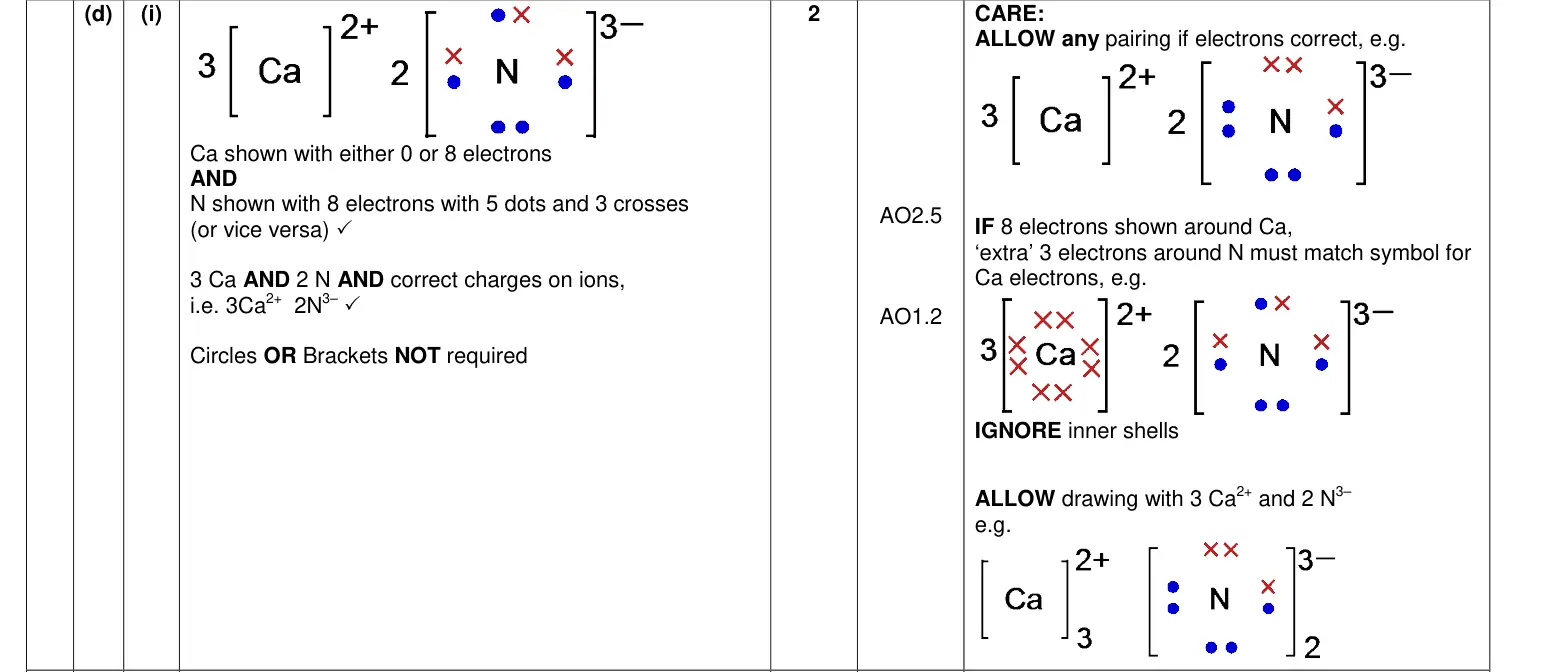
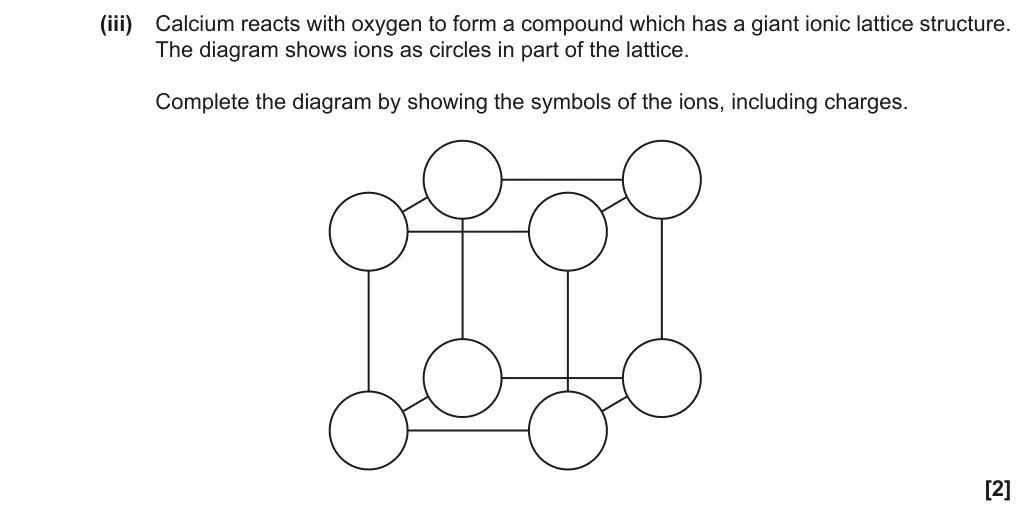
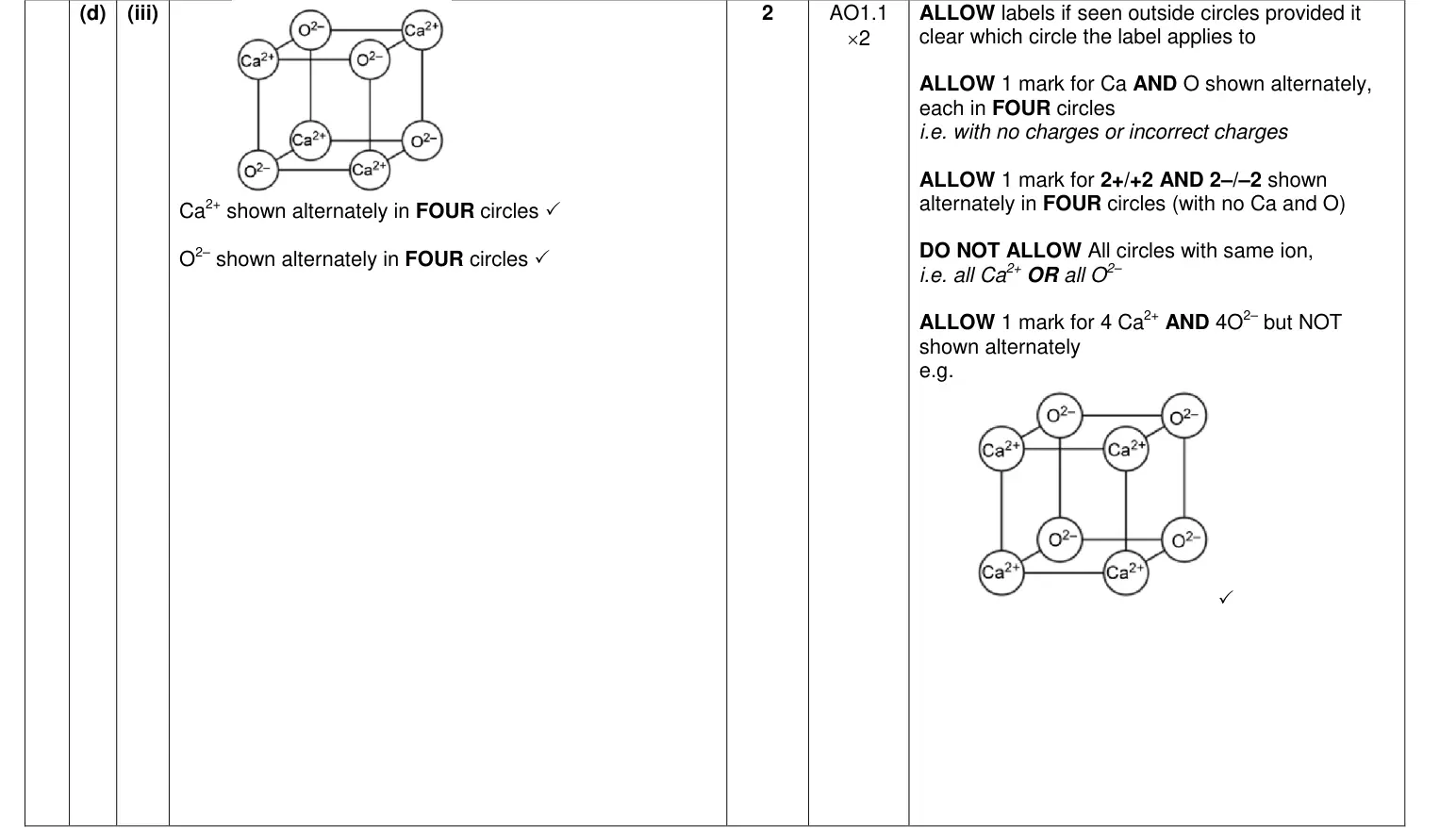
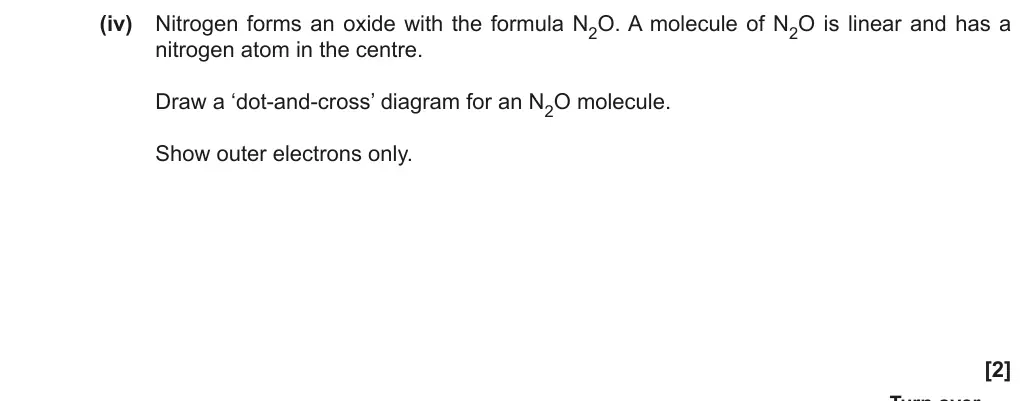
Show the 22 learning outcomes from the specification
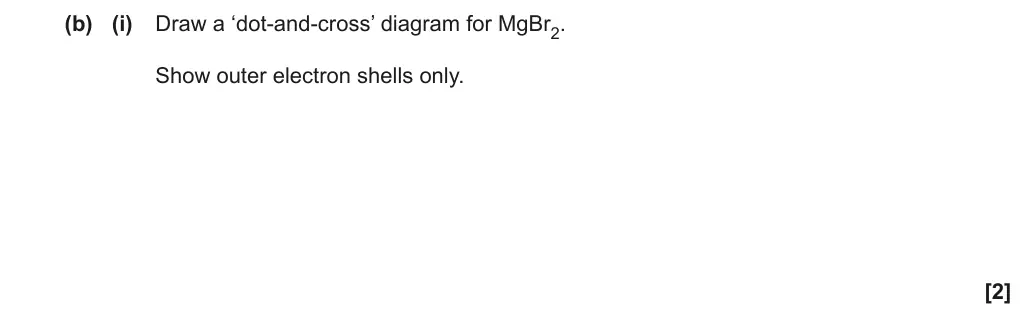
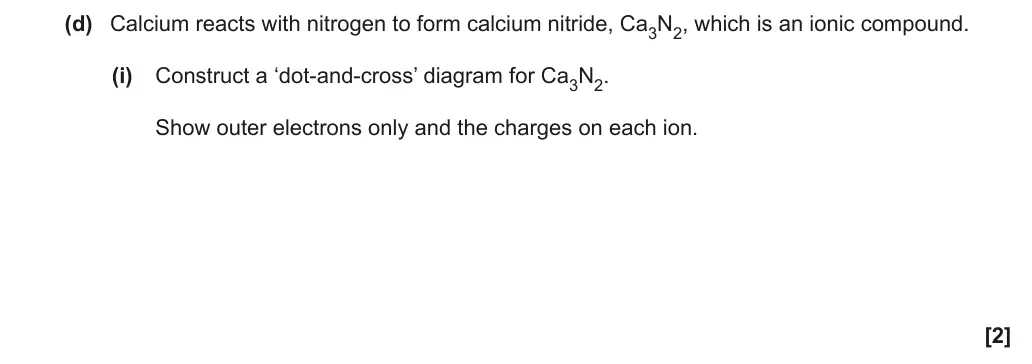
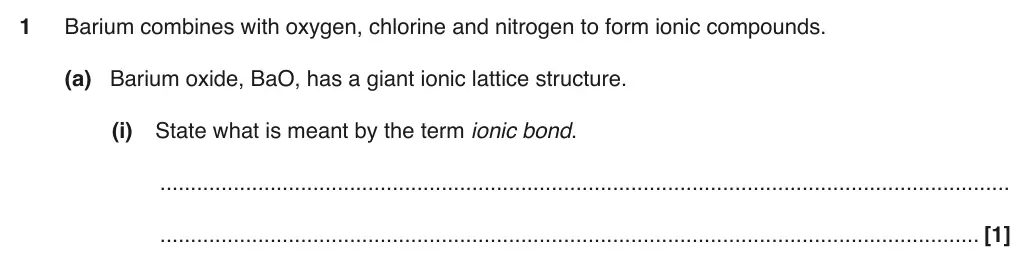
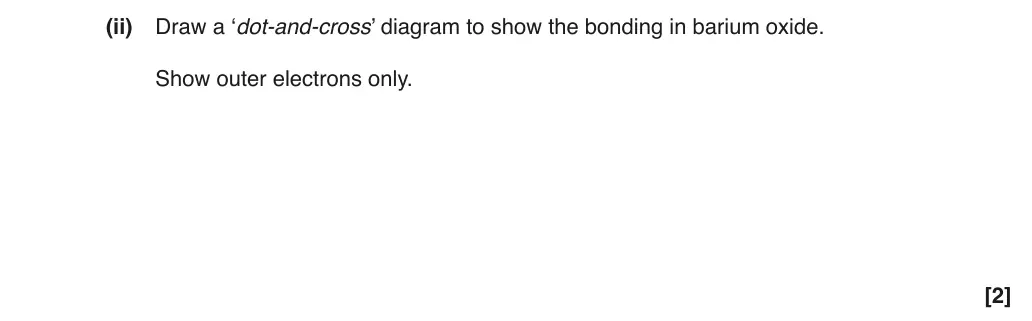
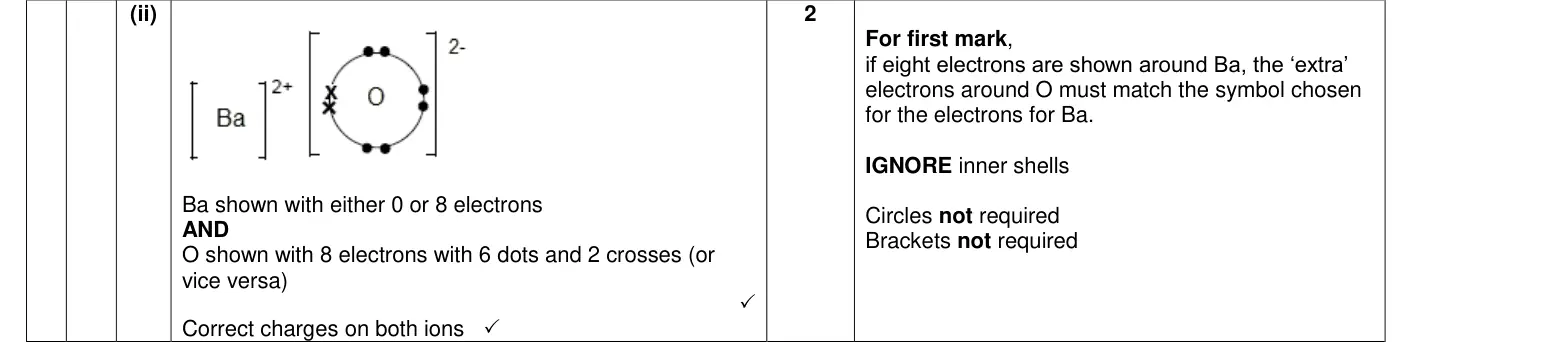
2.2.2(a) ionic bonding as electrostatic attraction between positive and negative ions, and the construction of 'dot-and-cross' diagrams
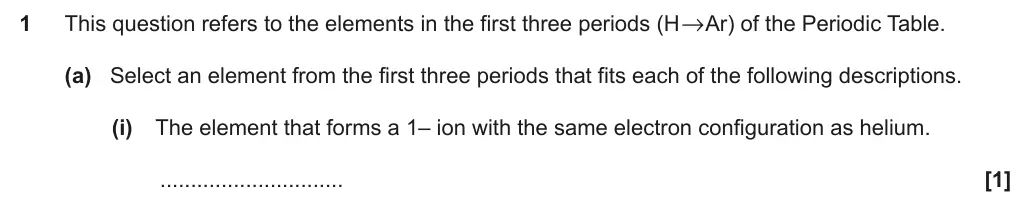
2.2.2(b) explanation of the solid structures of giant ionic lattices, resulting from oppositely charged ions strongly attracted in all directions e.g. NaCl
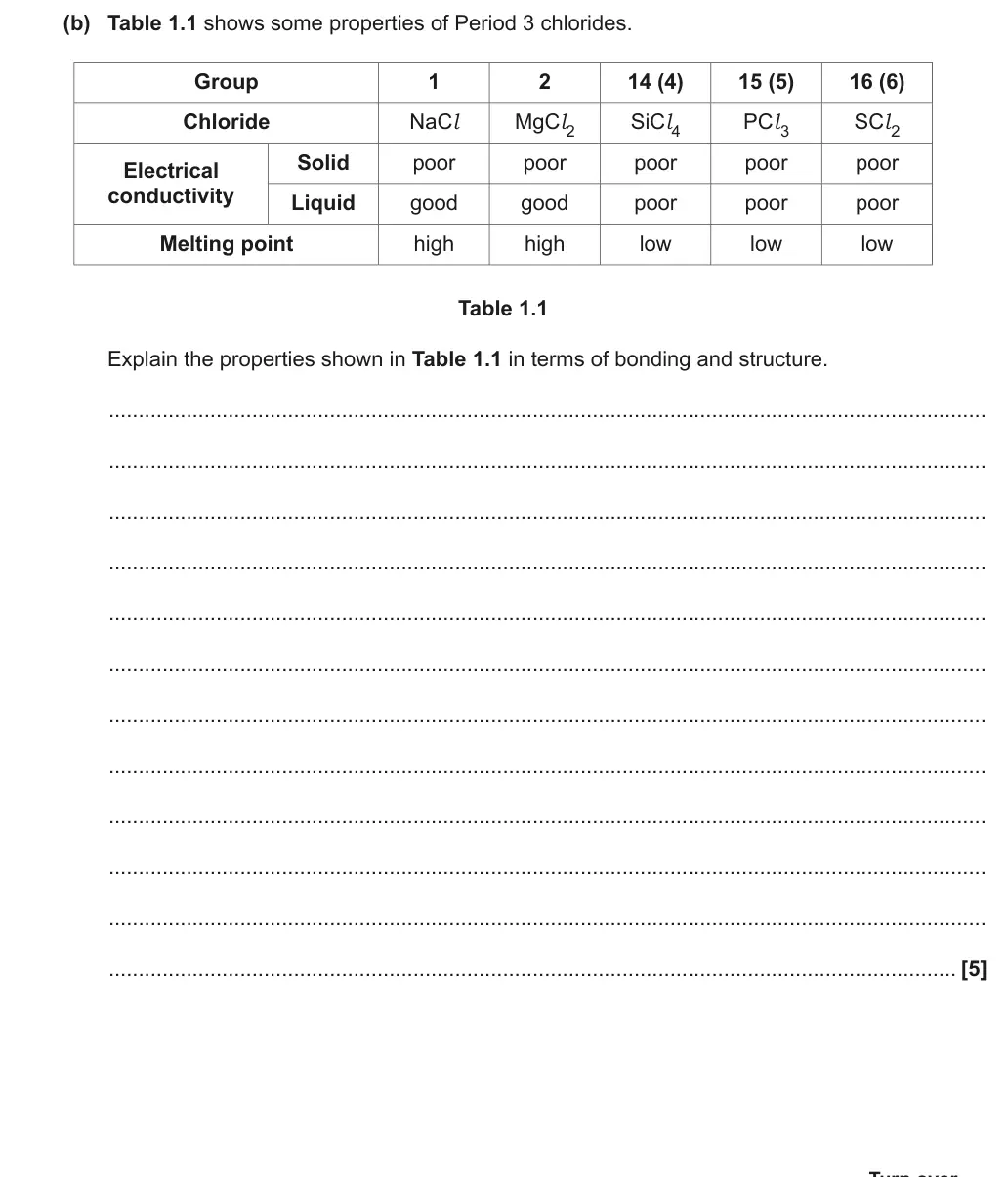
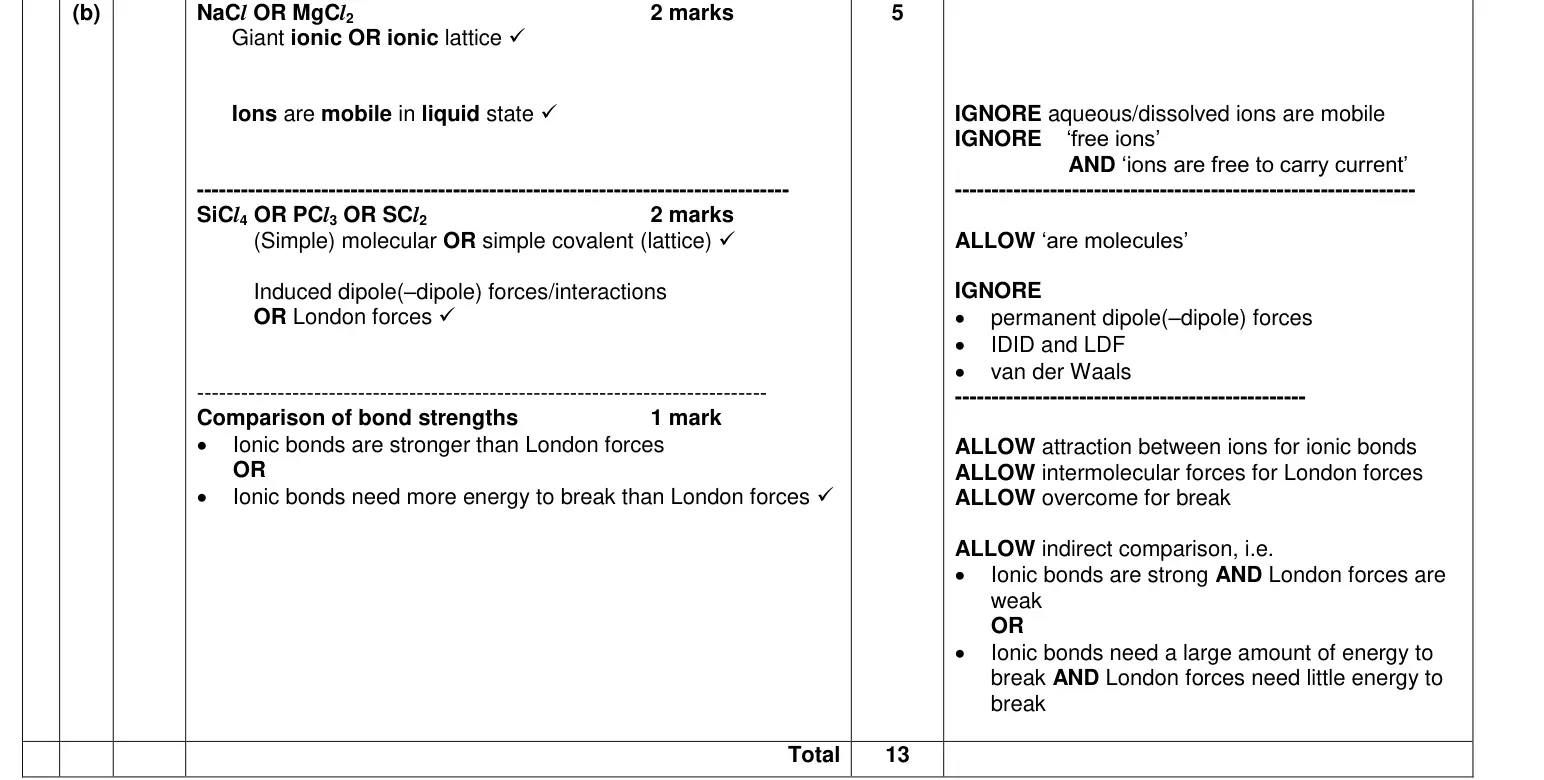
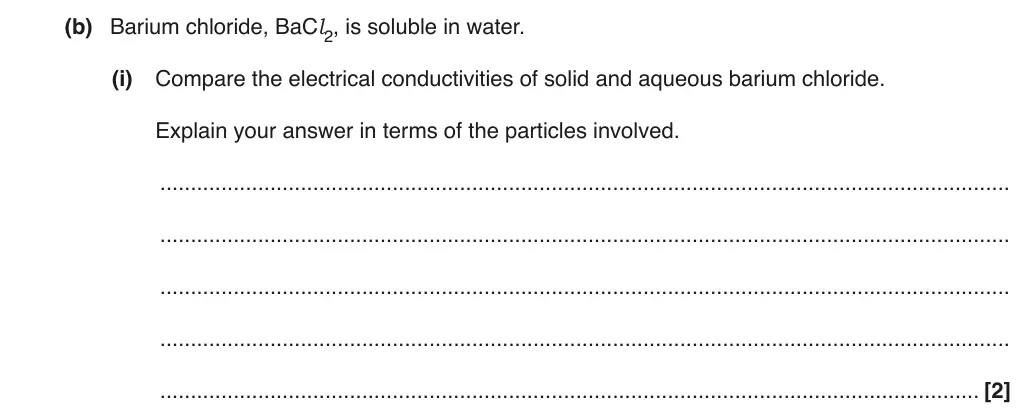
2.2.2(c) explanation of the effect of structure and bonding on the physical properties of ionic compounds, including melting and boiling points, solubility and electrical conductivity in solid, liquid and aqueous states
2.2.2(d) covalent bond as the strong electrostatic attraction between a shared pair of electrons and the nuclei of the bonded atoms
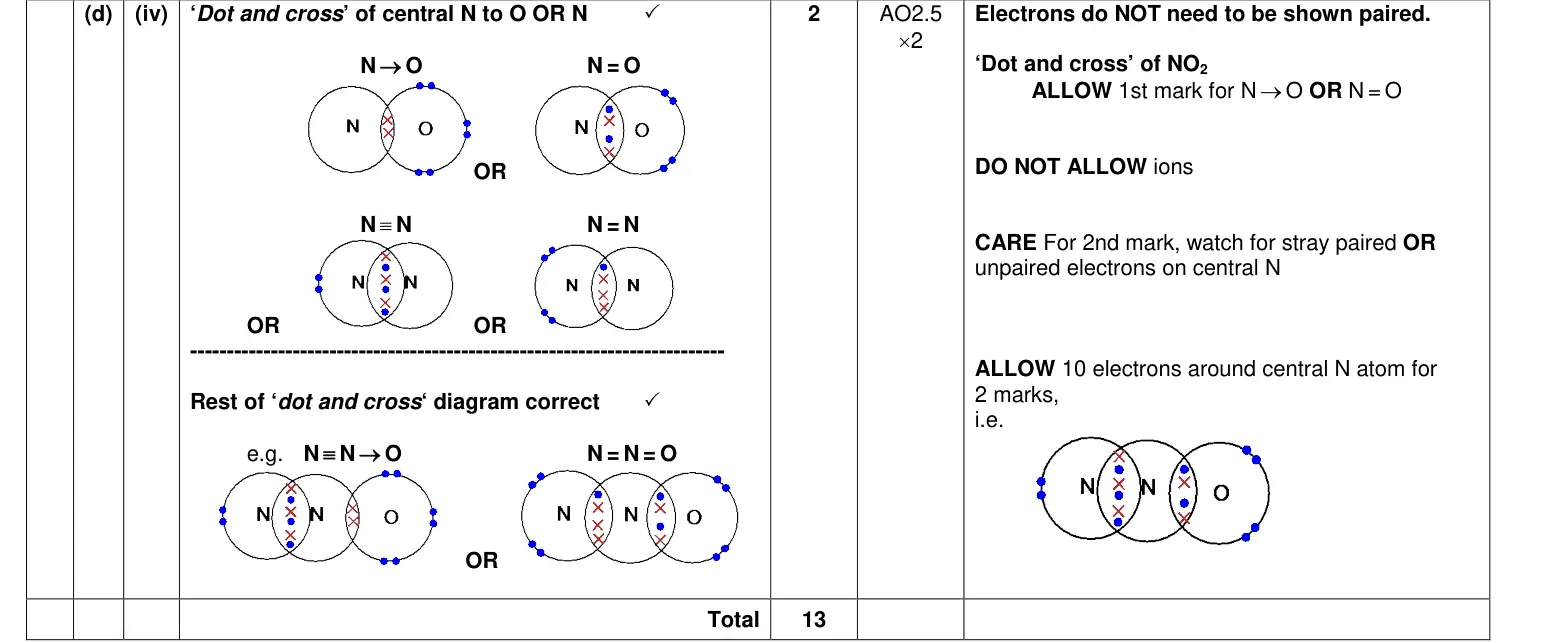
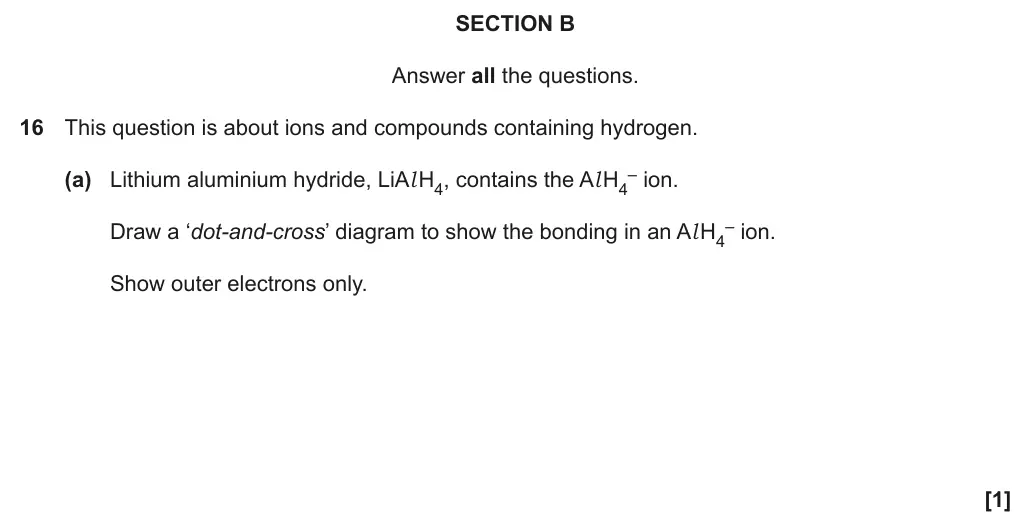
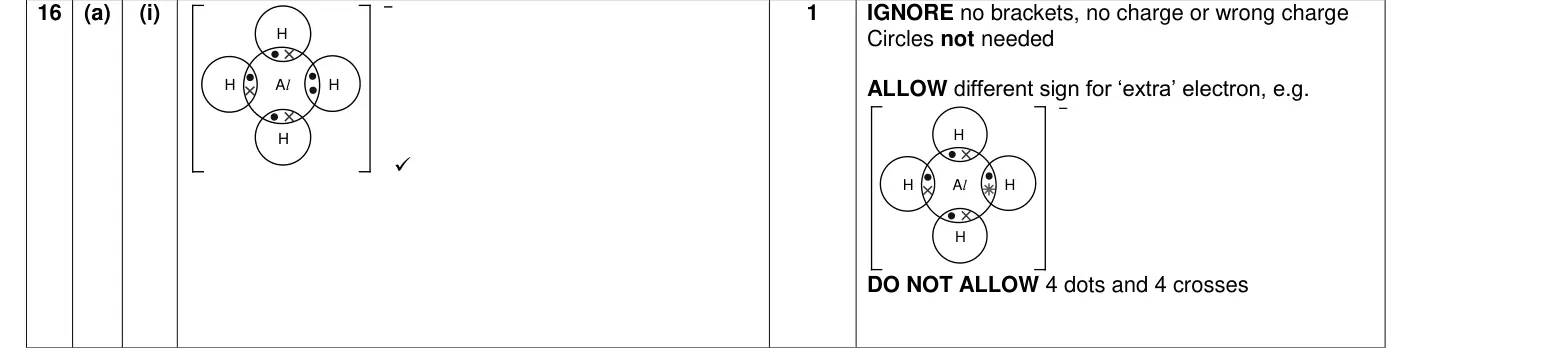
2.2.2(e) construction of ‘dot-and-cross ’ diagrams of molecules and ions to describe:
2.2.2(f) use of the term average bond enthalpy as a measurement of covalent bond strength
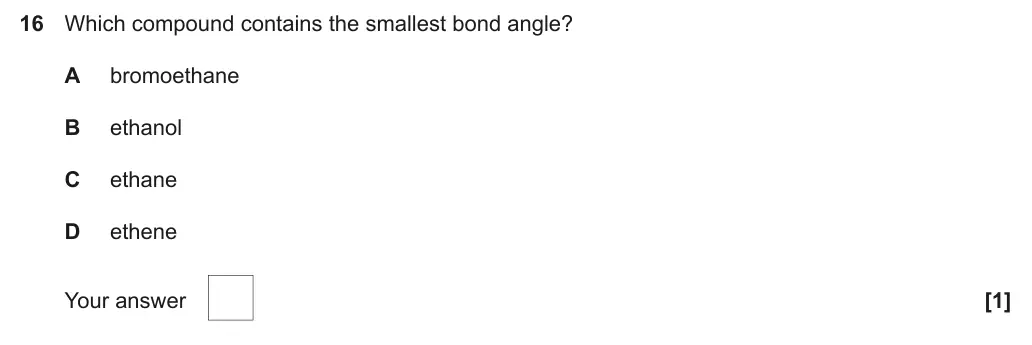
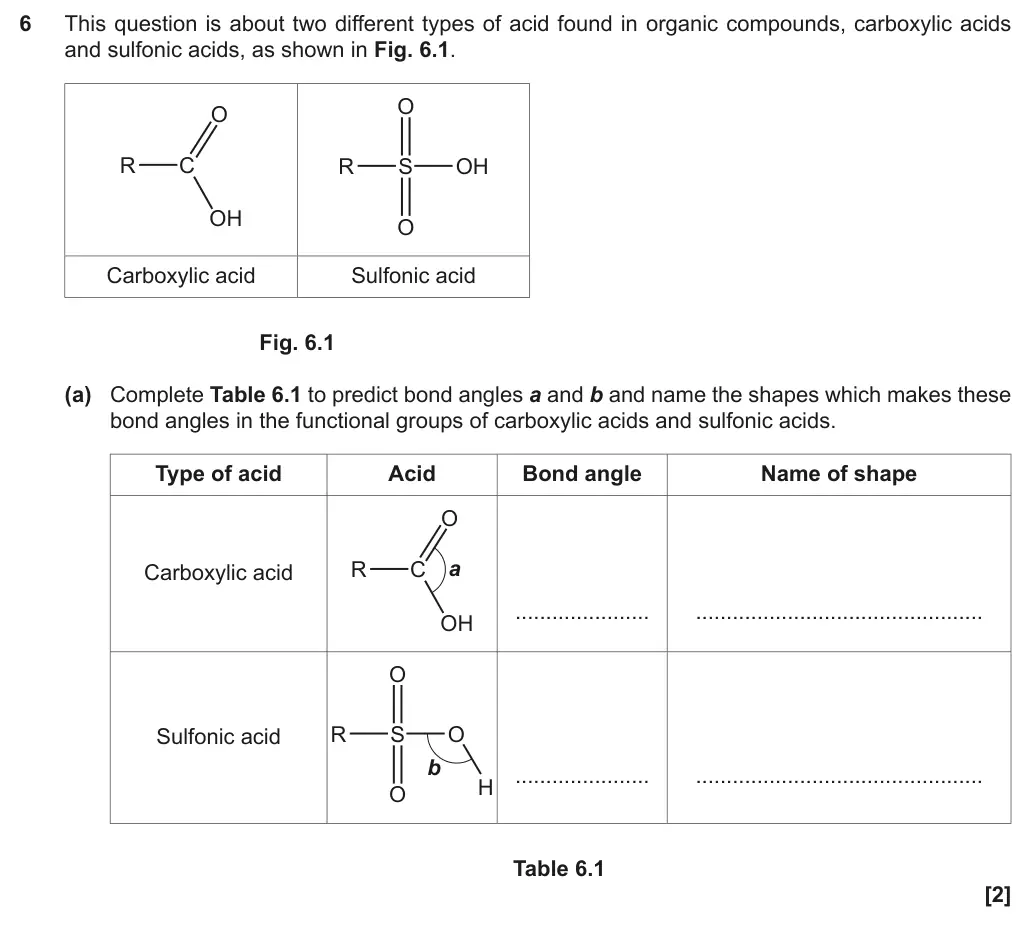
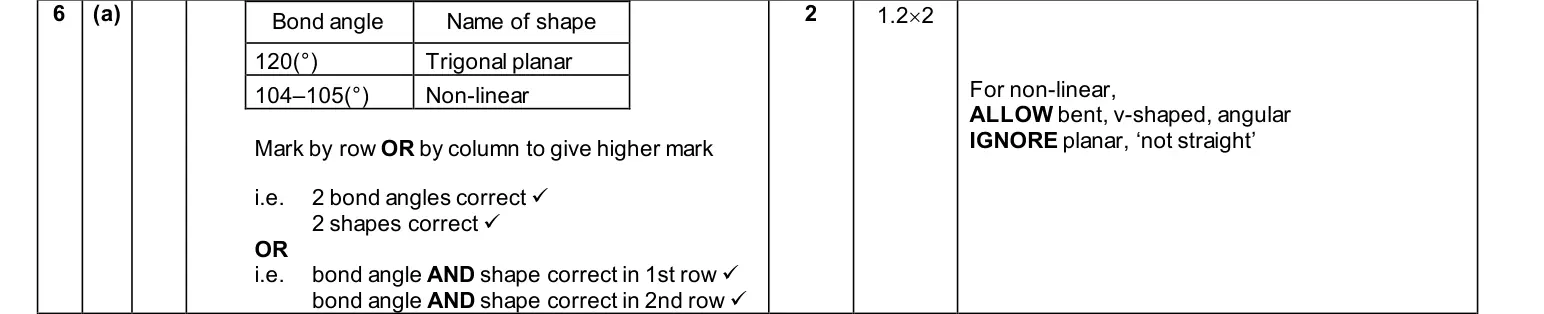
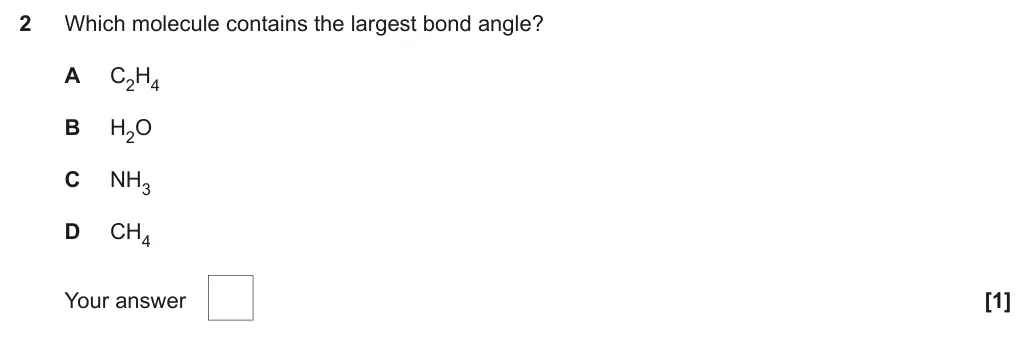
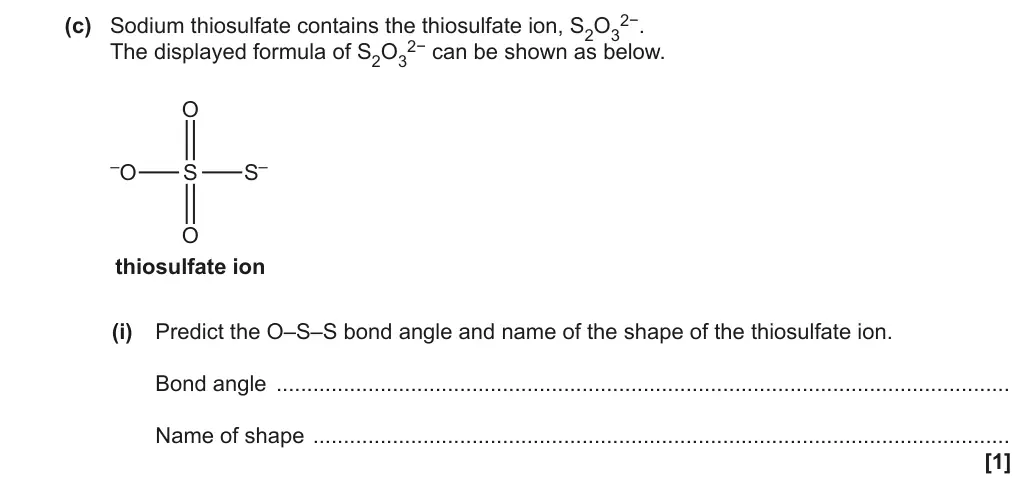
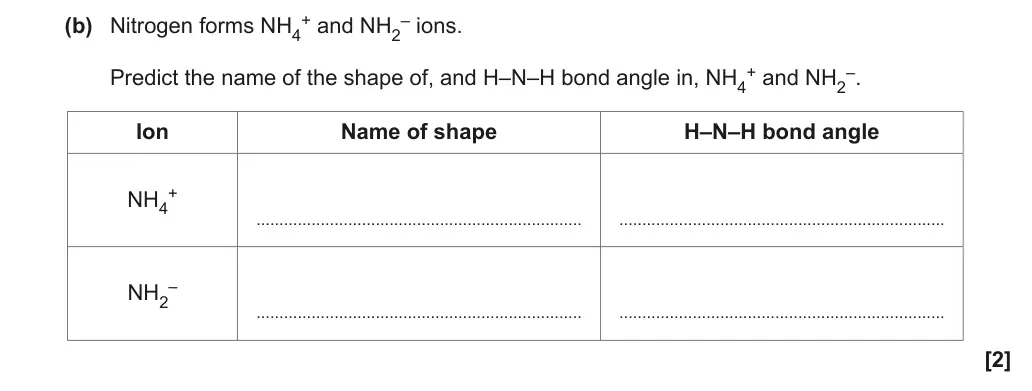
2.2.2(g) the shapes of, and bond angles in, molecules and ions with up to six electron pairs (including lone pairs) surrounding the central atom as predicted by electron pair repulsion, including the relative repulsive strengths of bonded pairs and lone pairs of electrons
2.2.2(h) electron pair repulsion to explain the following shapes of molecules and ions: linear, non-linear, trigonal planar, pyramidal, tetrahedral and octahedral
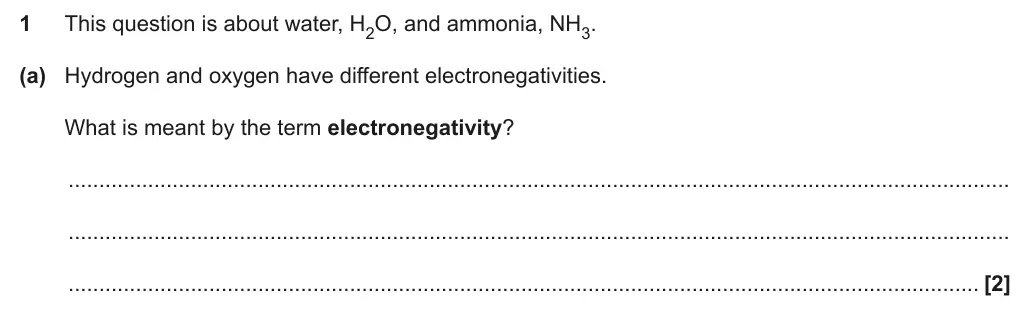
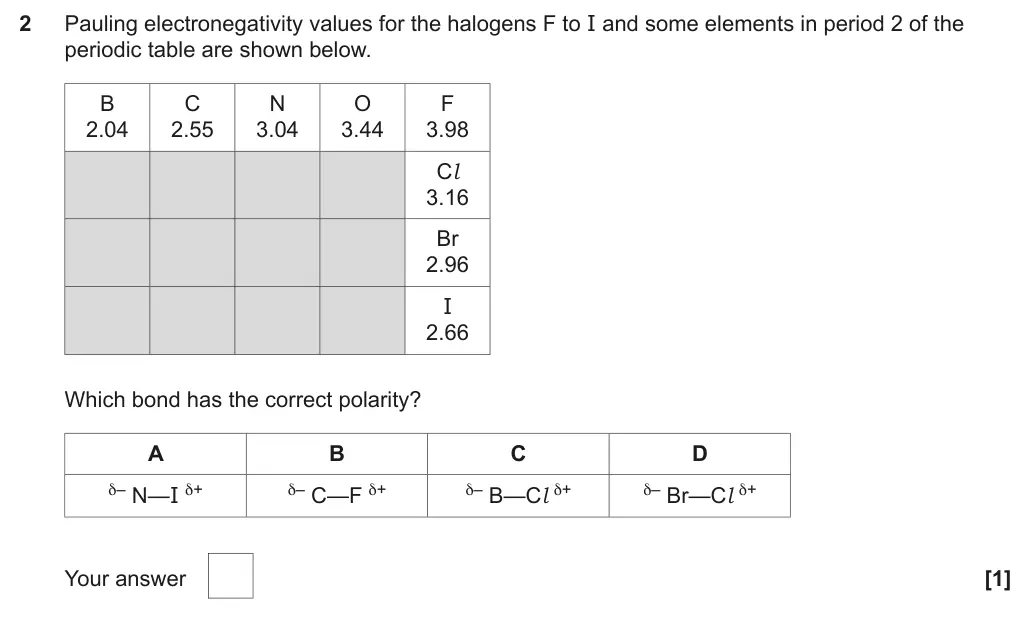
2.2.2(i) electronegativity as the ability of an atom to attract the bonding electrons in a covalent bond; interpretation of Pauling electronegativity values
2.2.2(j) explanation of:
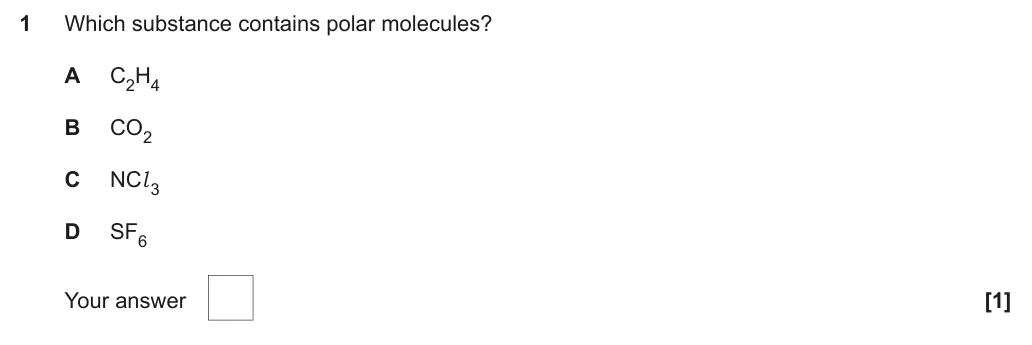
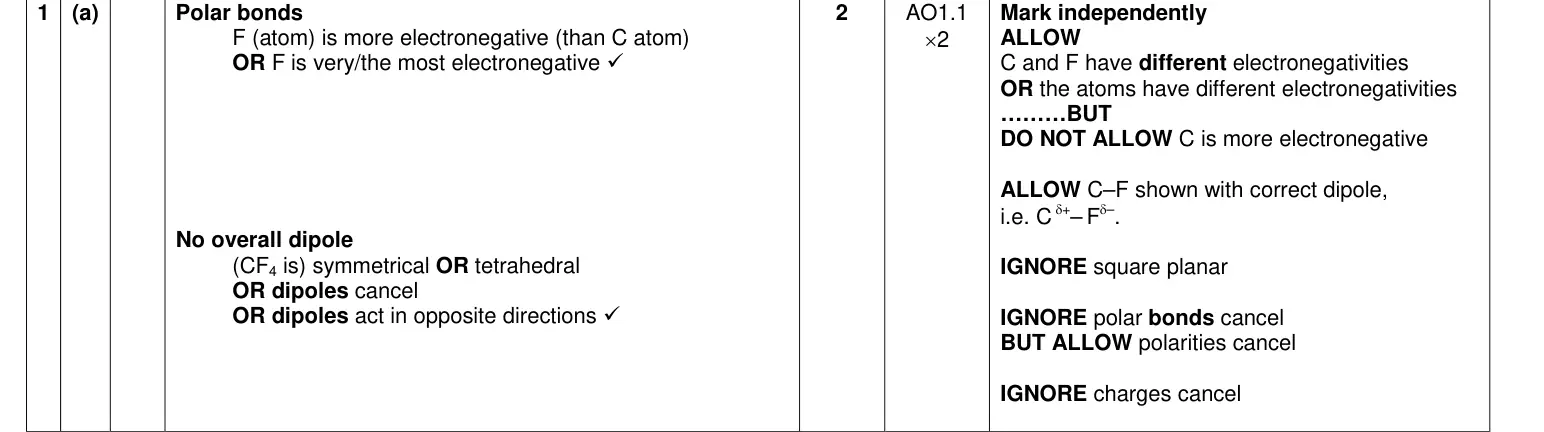
2.2.2(j)(i) a polar bond and permanent dipole within molecules containing covalently-bonded atoms with different electronegativities
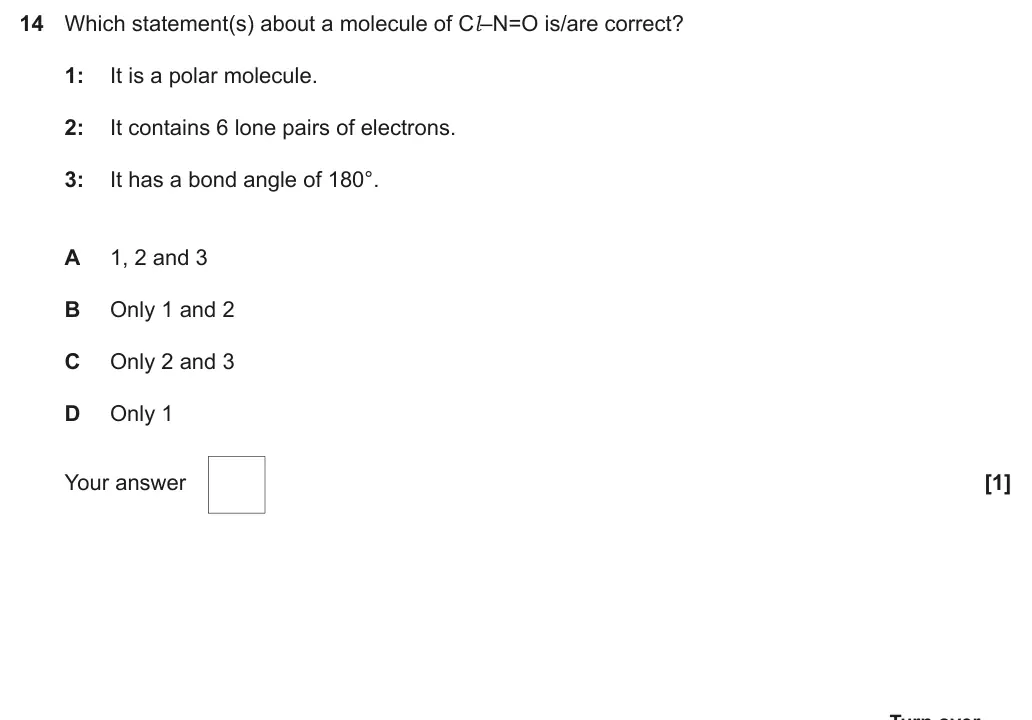
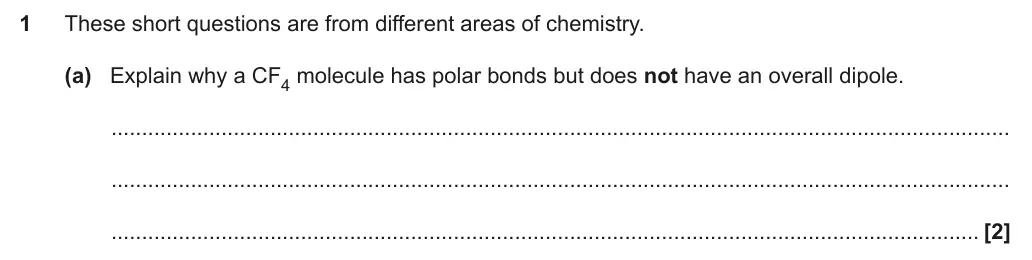
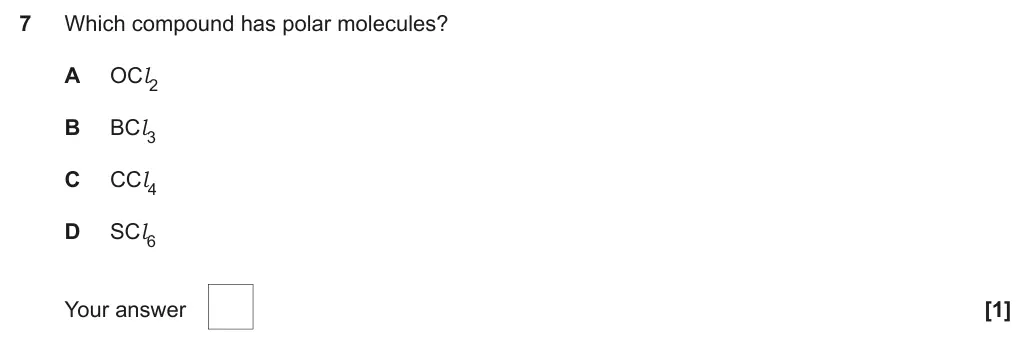
2.2.2(j)(ii) a polar molecule and overall dipole in terms of permanent dipole(s) and molecular shape
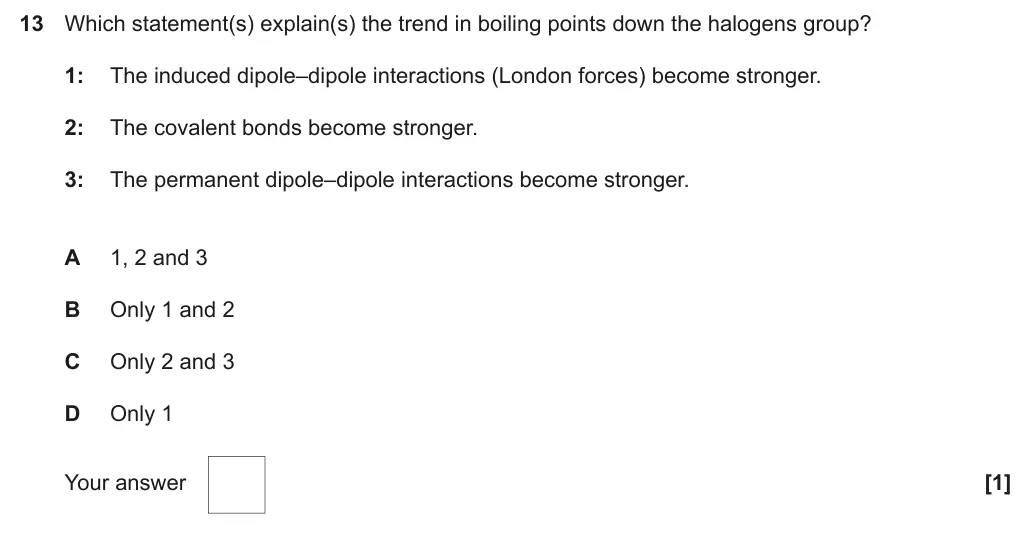
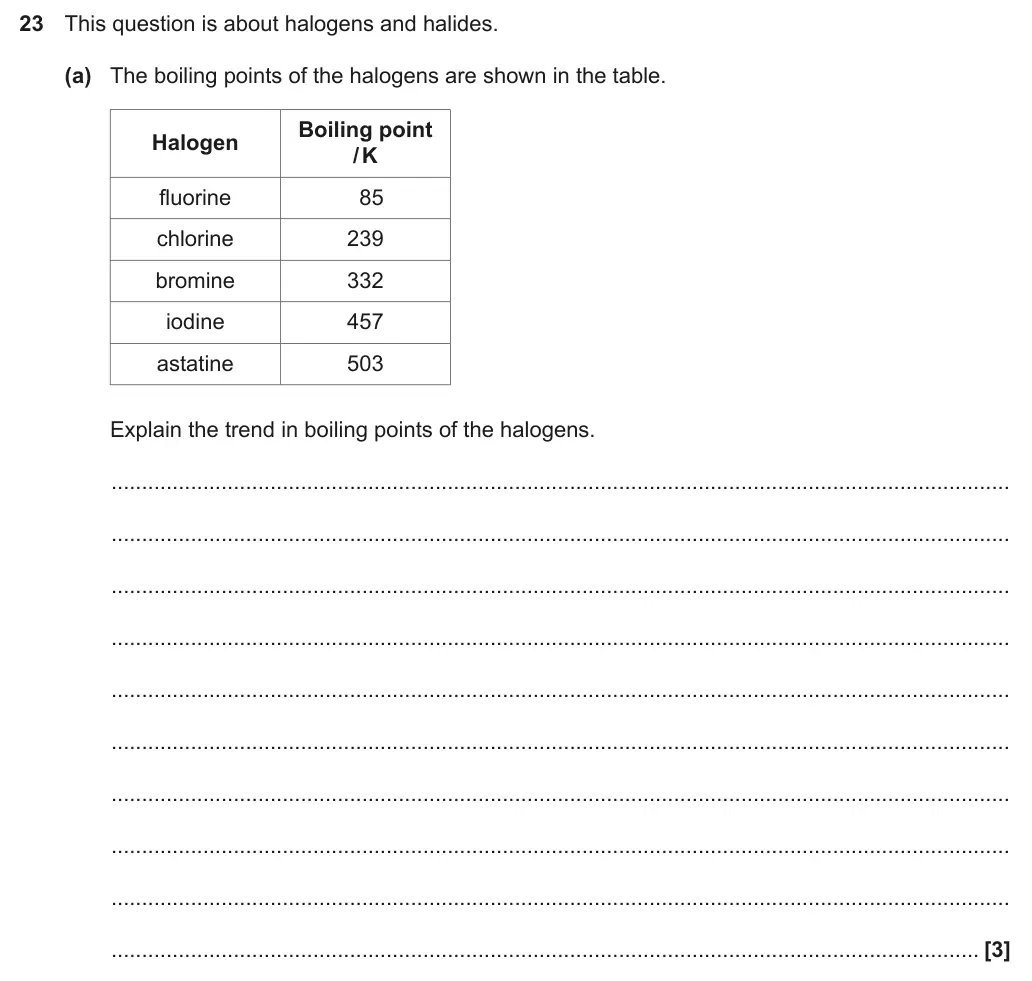
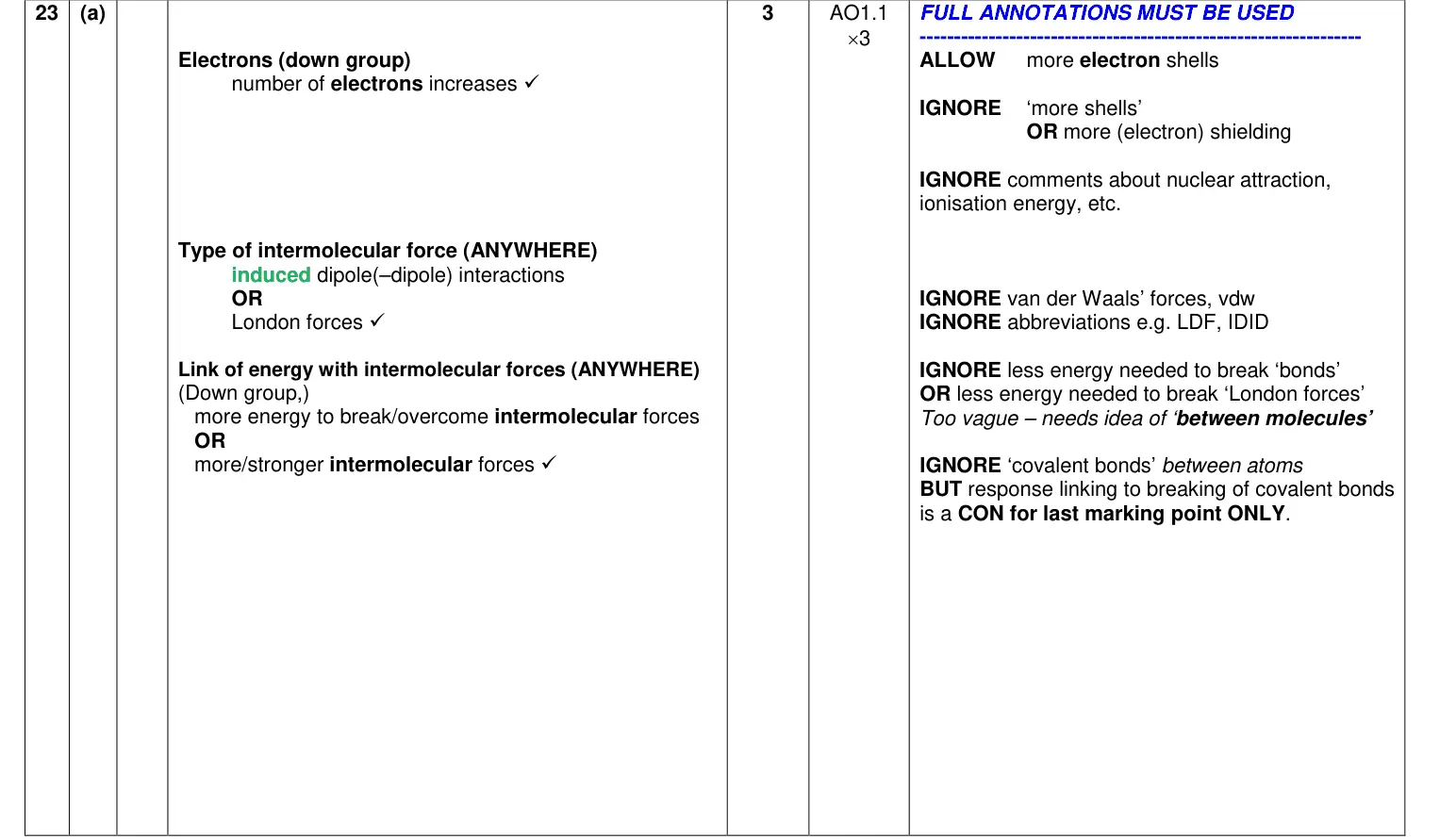
2.2.2(k) intermolecular forces based on permanent dipole– dipole interactions and induced dipole– dipole interactions
2.2.2(l) hydrogen bonding as intermolecular bonding between molecules containing N, O or F and the H atom of –NH, –OH or HF
2.2.2(m) explanation of anomalous properties of H2O resulting from hydrogen bonding, e.g.:
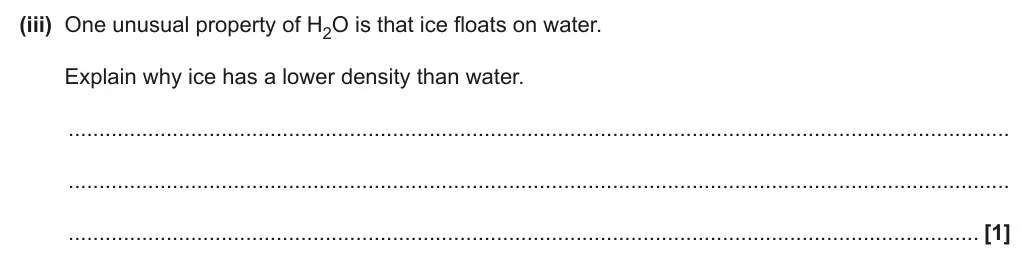
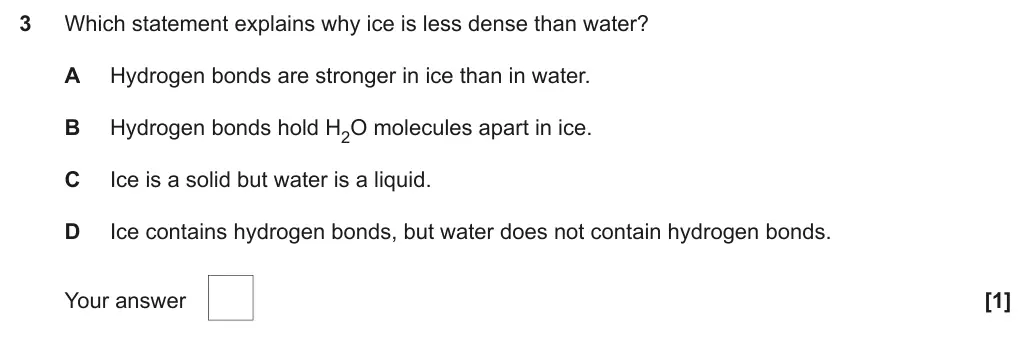
2.2.2(m)(i) the density of ice compared with water
2.2.2(m)(ii) its relatively high melting and boiling points
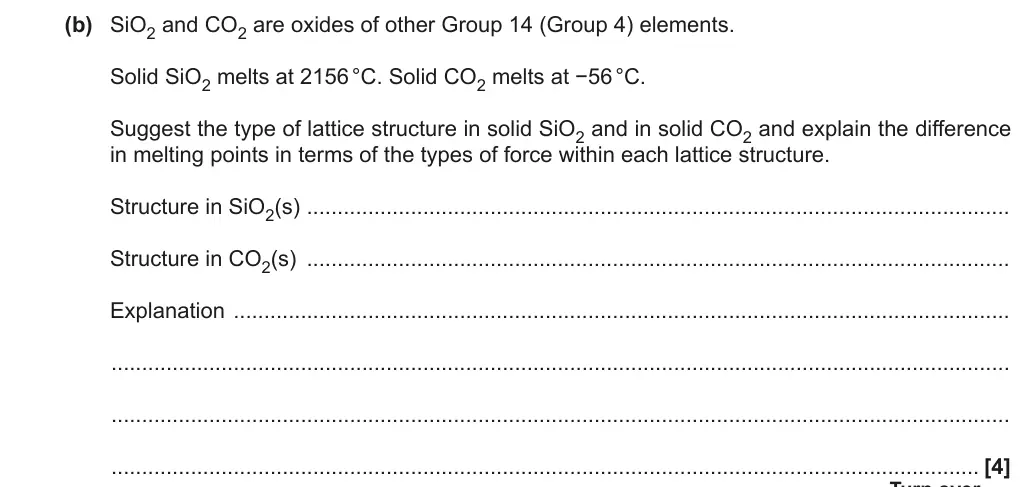
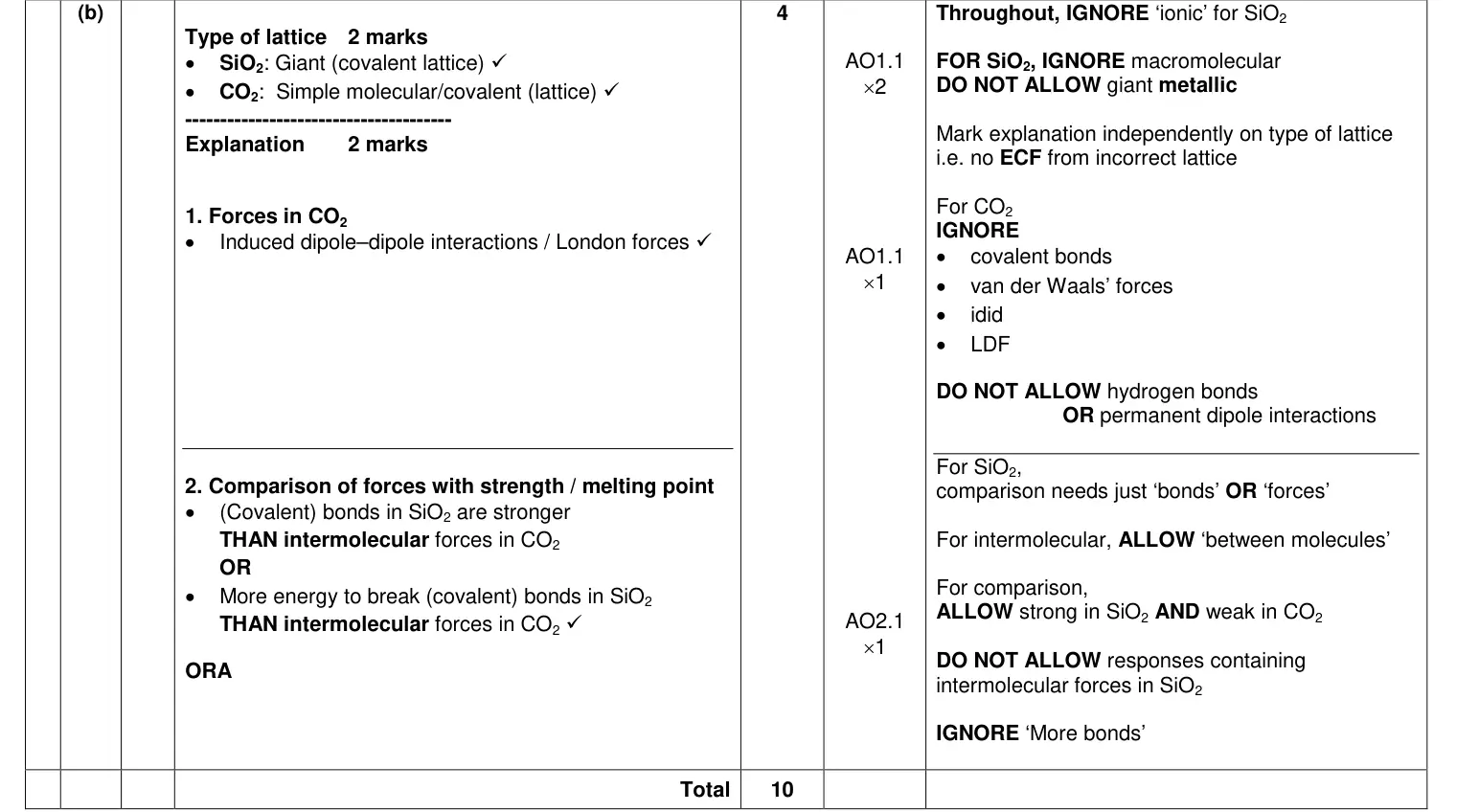
2.2.2(n) explanation of the solid structures of simple molecular lattices, as covalently bonded molecules attracted by intermolecular forces, e.g. I2, ice
2.2.2(o) explanation of the effect of structure and bonding on the physical properties of covalent compounds with simple molecular lattice structures including melting and boiling points, solubility and electrical conductivity.
Six-mark level of response questions on this topic
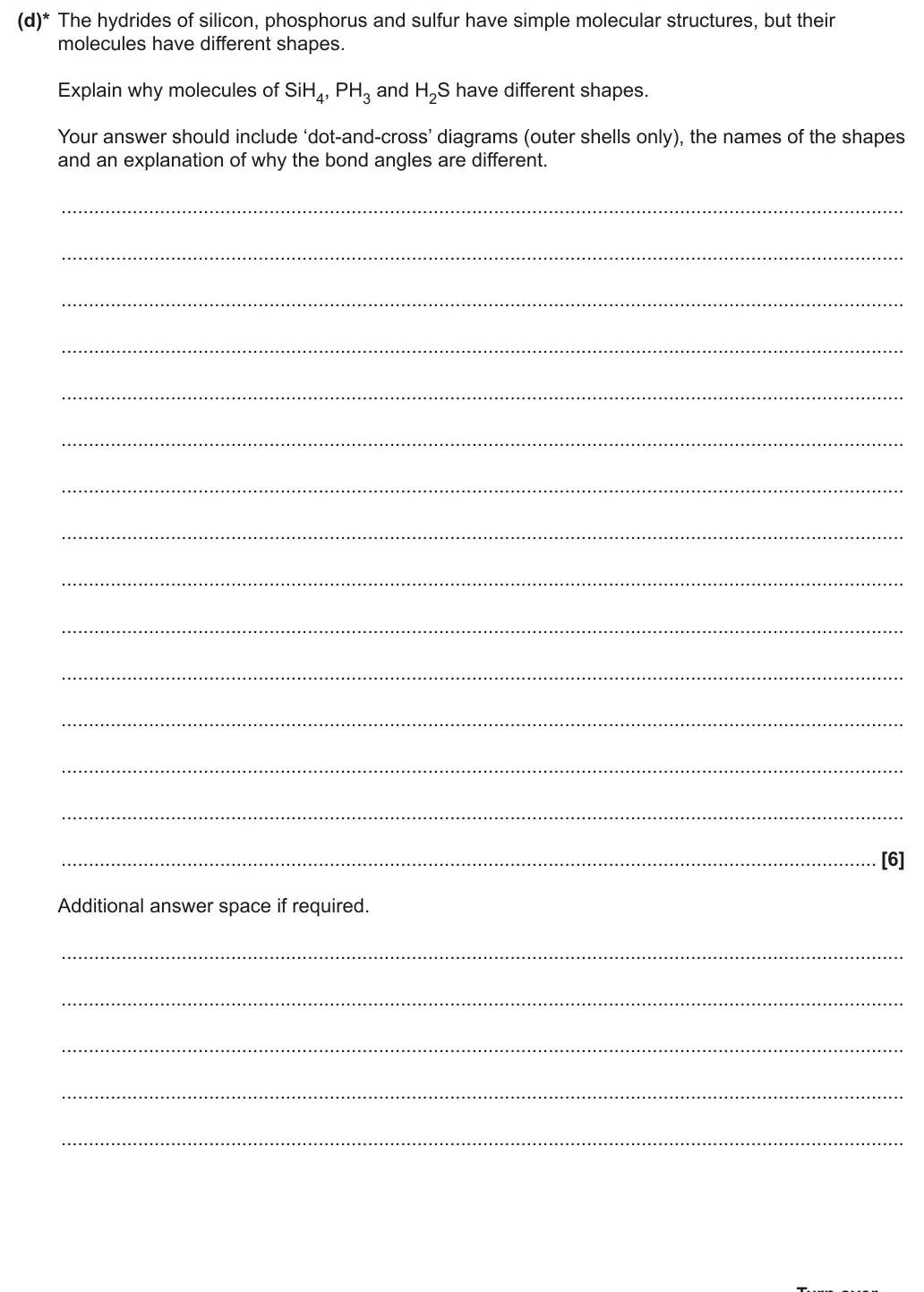
The hydrides of silicon, phosphorus and sulfur have simple molecular structures, but their Explain why molecules of SiH4, PH3 and H2S have different shapes.
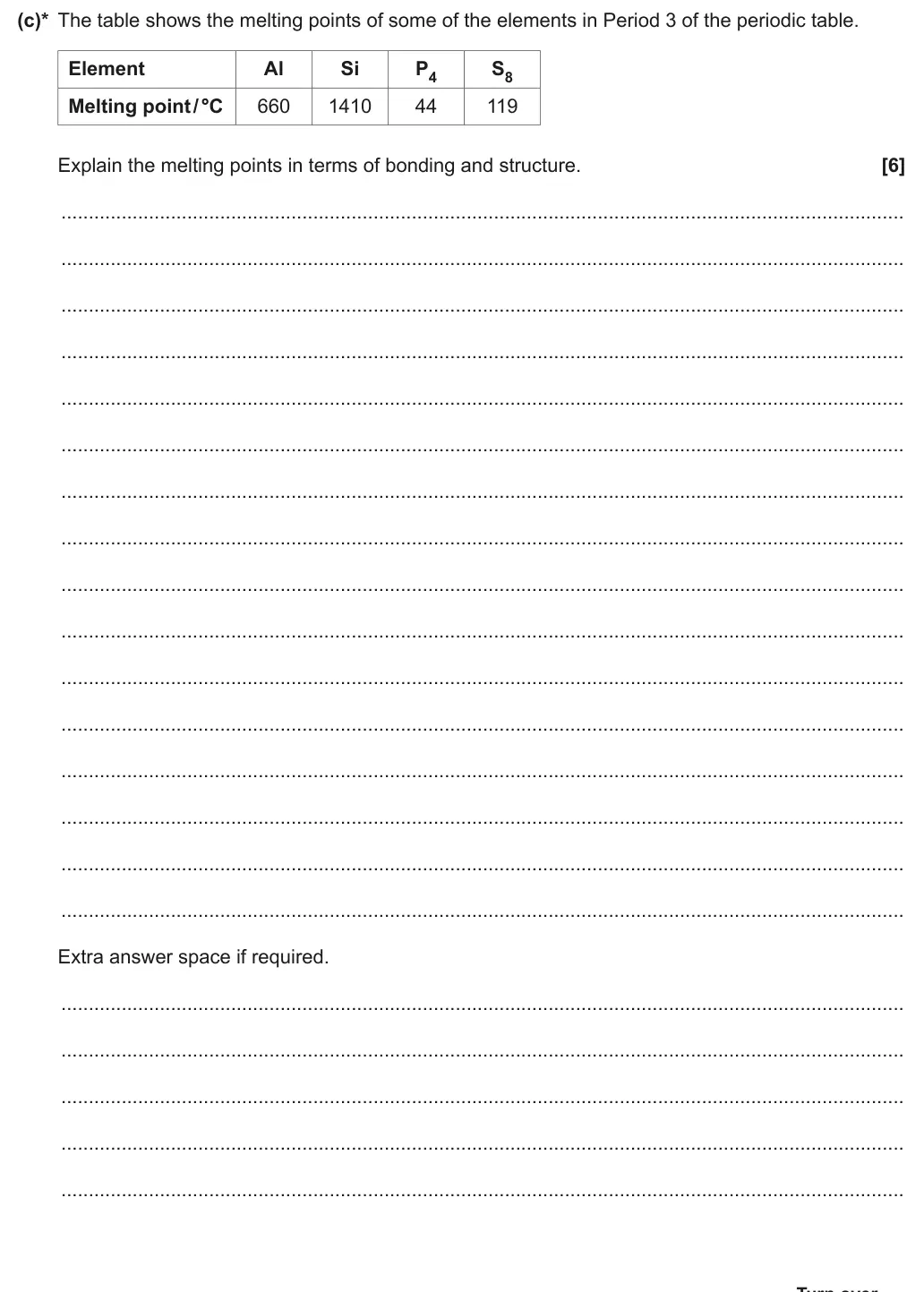
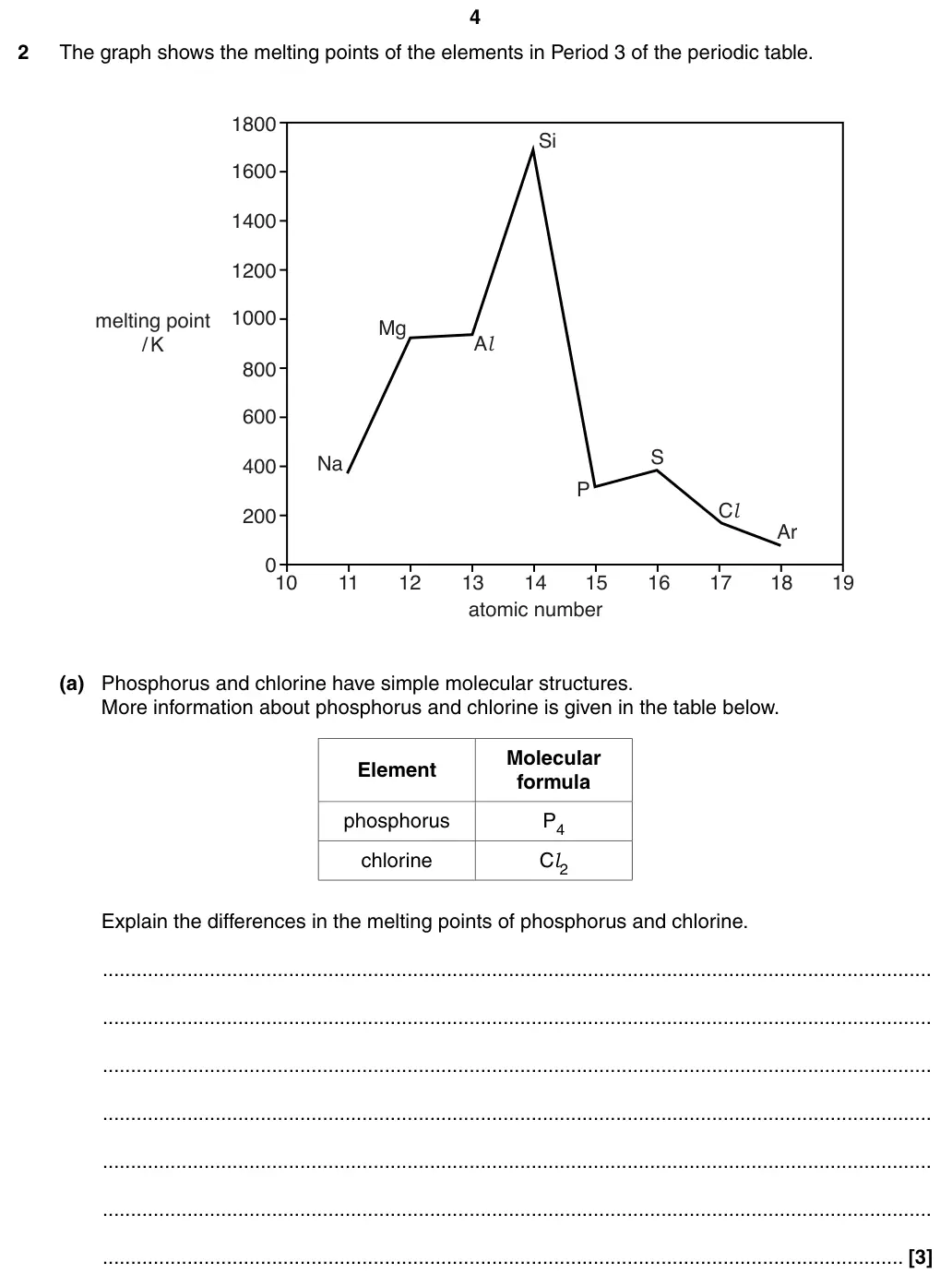
The table shows the melting points of some of the elements in Period 3 of the periodic table. Explain the melting points in terms of bonding and structure. [6]
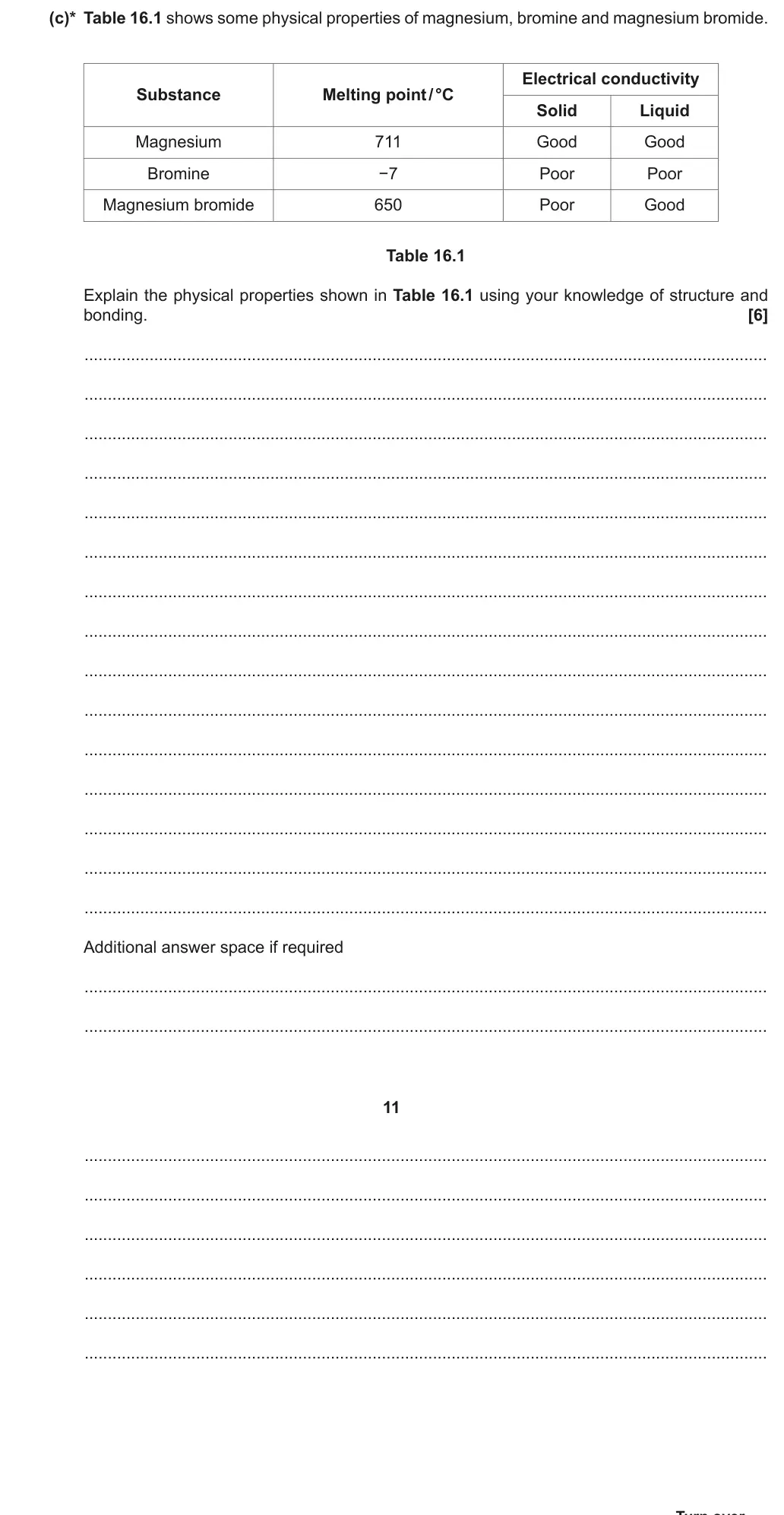
Table 16.1 shows some physical properties of magnesium, bromine and magnesium bromide. Explain the physical properties shown in Table 16.1 using your knowledge of structure and
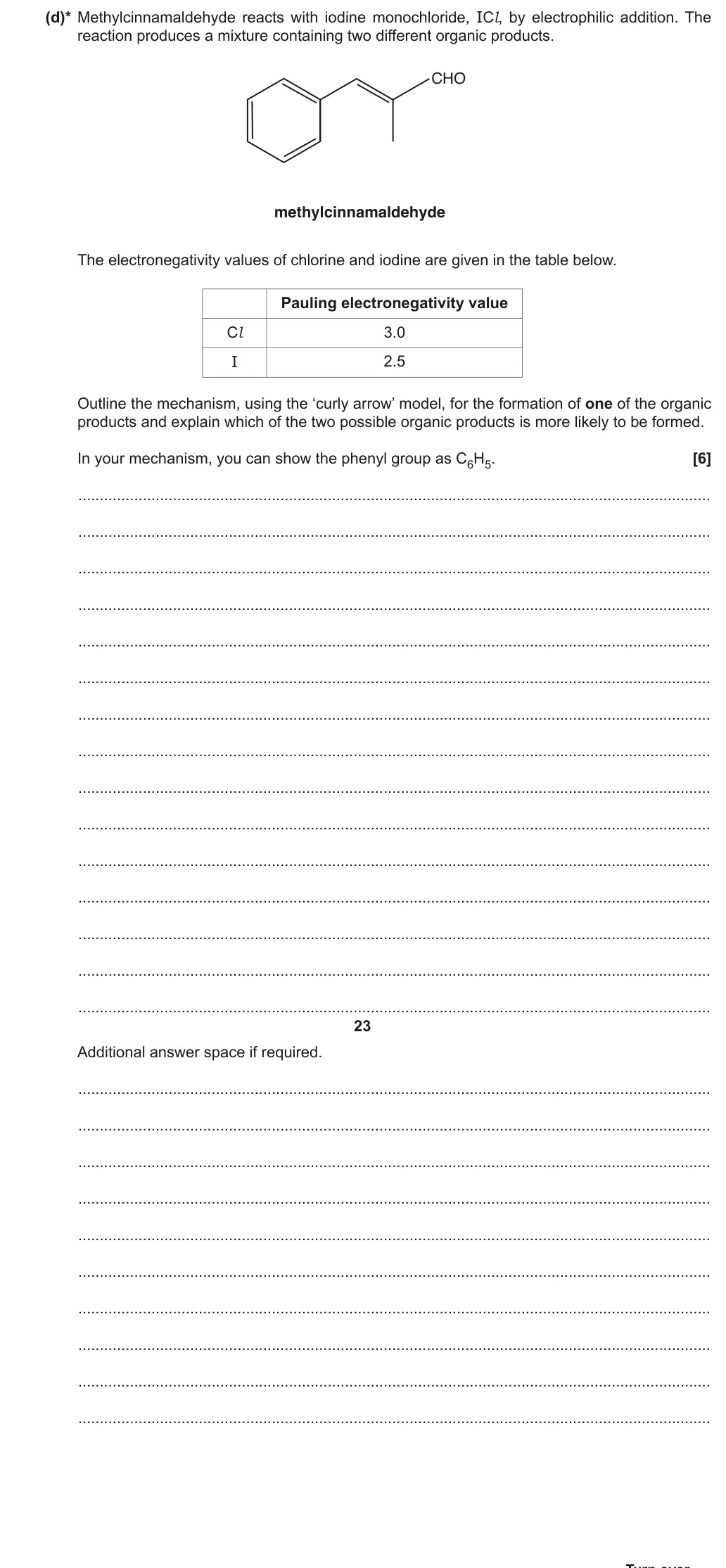
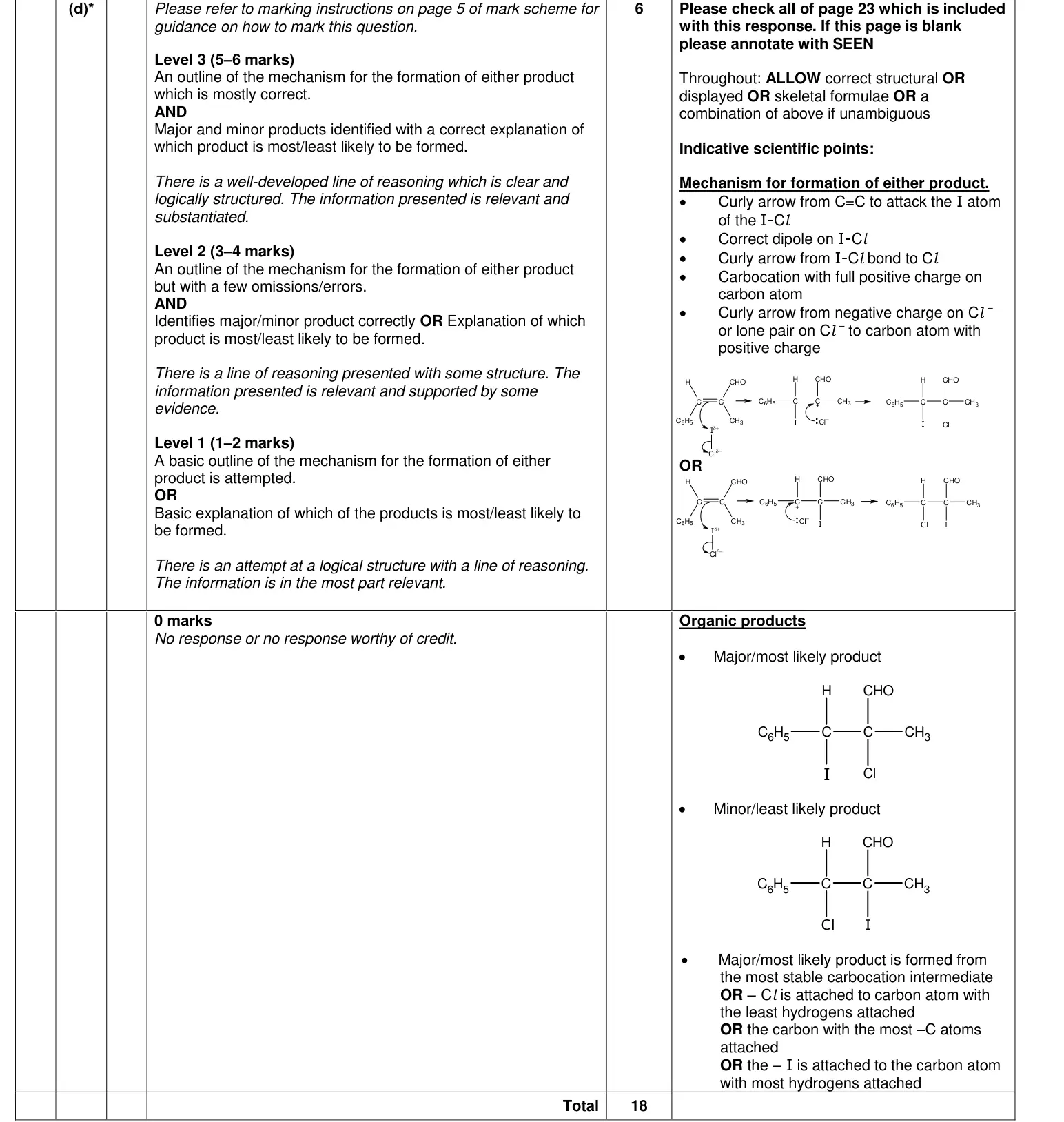
Methylcinnamaldehyde reacts with iodine monochloride, ICl, by electrophilic addition. The Outline the mechanism, using the ‘curly arrow’ model, for the formation of one of the organic
Tap a question to zoom it. Where a part needs a table, graph or structure from an earlier part, that part folds out above it; the mark scheme and examiner's comment open underneath. Have the OCR Data Sheet beside you.
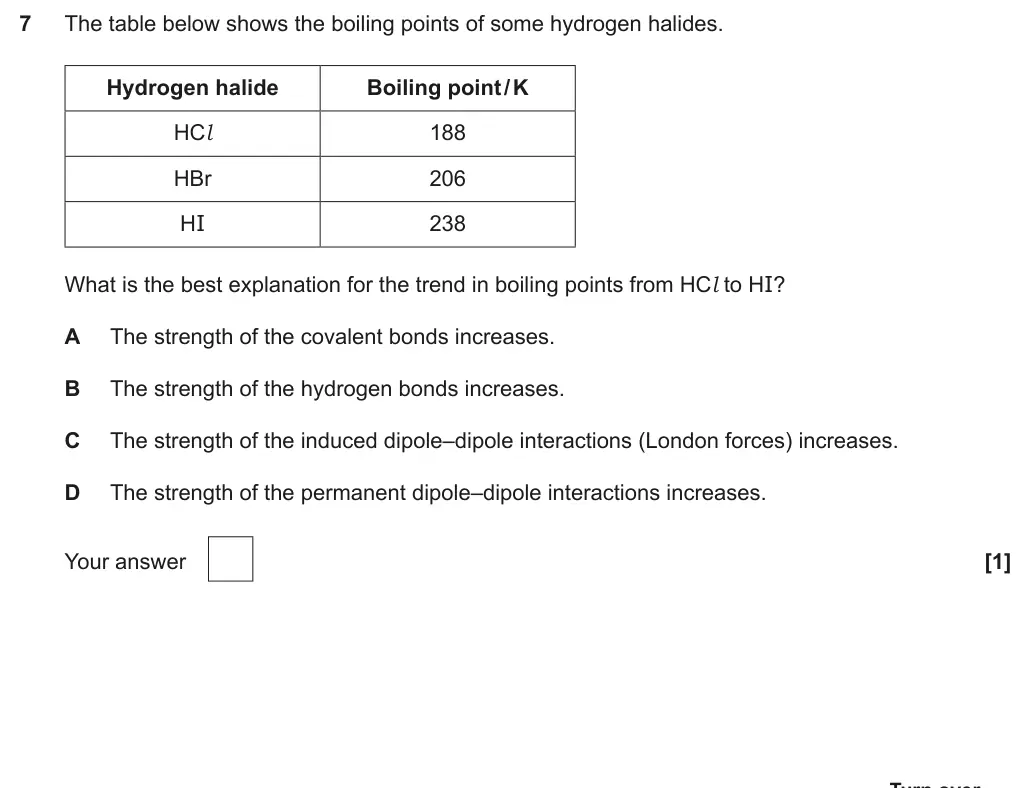
June 2025 · Paper 1 · Q71 markMultiple choiceMedium
Answer
C
Mark scheme
Examiner's comment
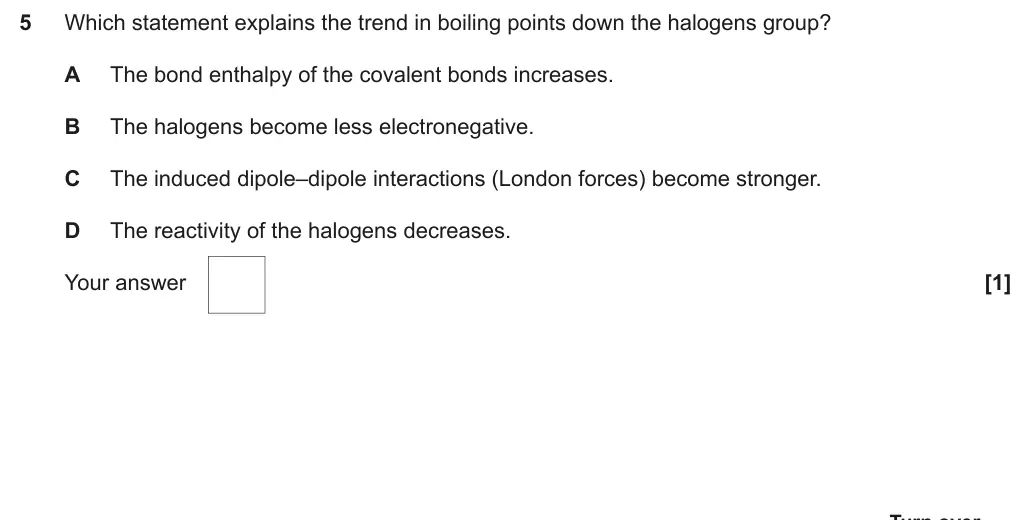
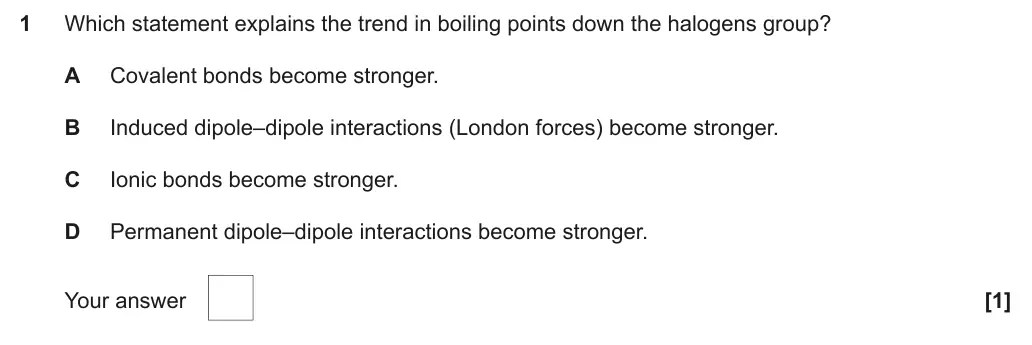
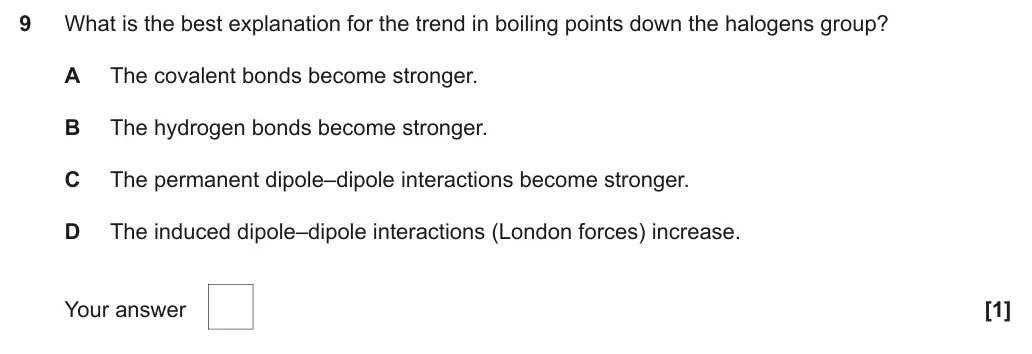
The correct answer was C. Candidates generally understood the intermolecular nature of this trend was due to London forces. The most common incorrect answer was D. It is important to make sure that candidates can appreciate that London forces can be more significant/stronger, as the molecule increases in size, compared to other intermolecular forces.
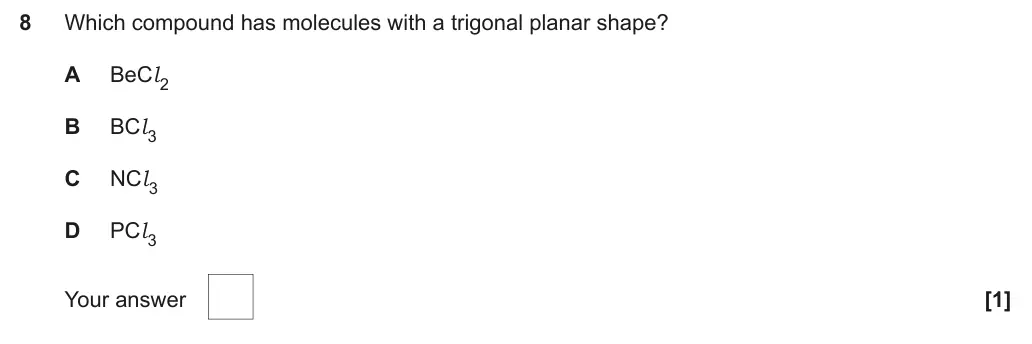
June 2025 · AS Paper 1 · Q81 markMultiple choiceMedium
Answer
B
Mark scheme
Examiner's comment
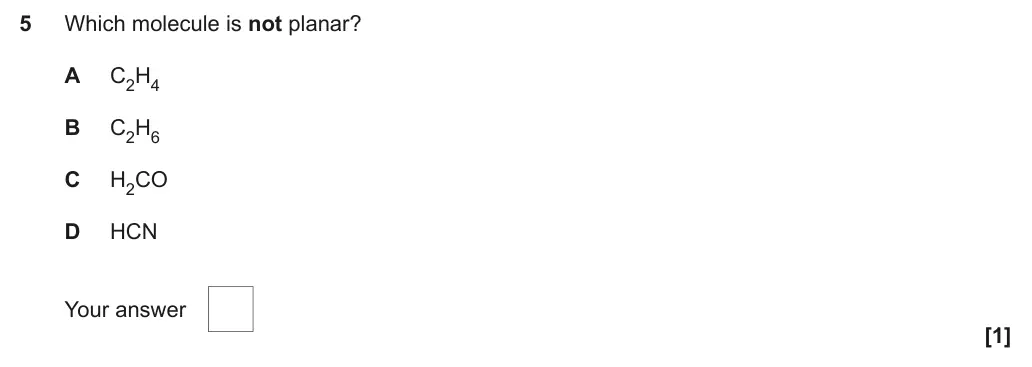
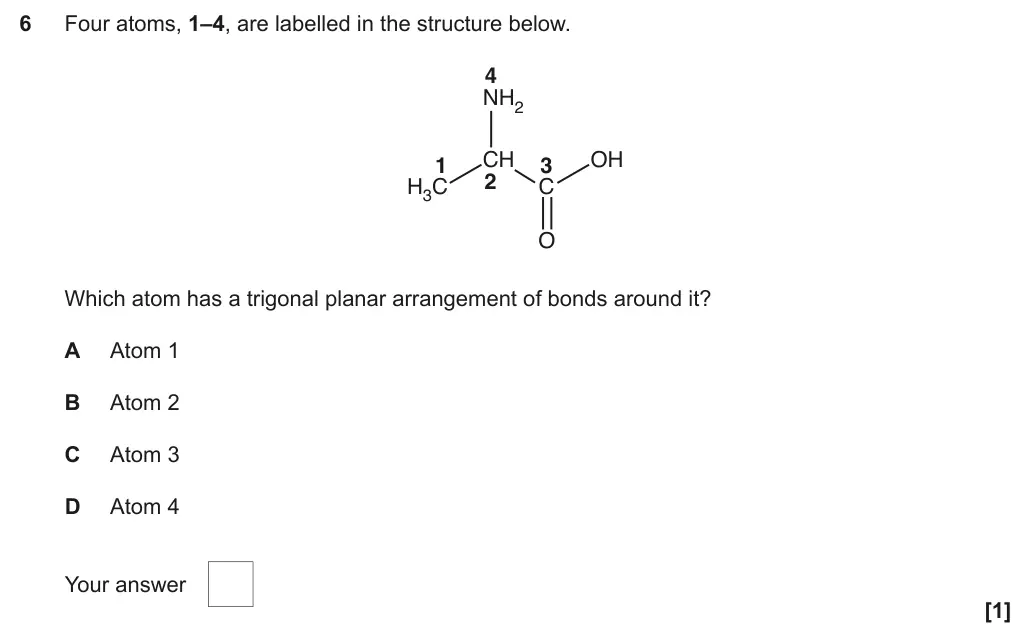
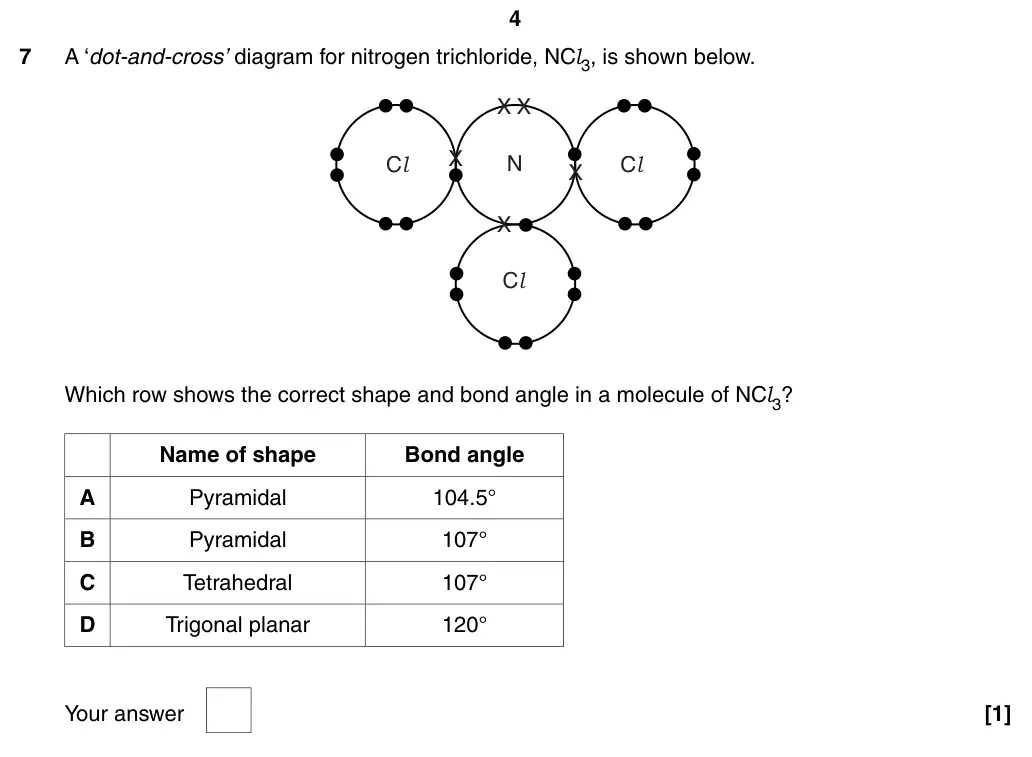
Most candidates identified BCl3 as the trigonal planar molecule, suggesting that knowledge of bond shape examples is good.
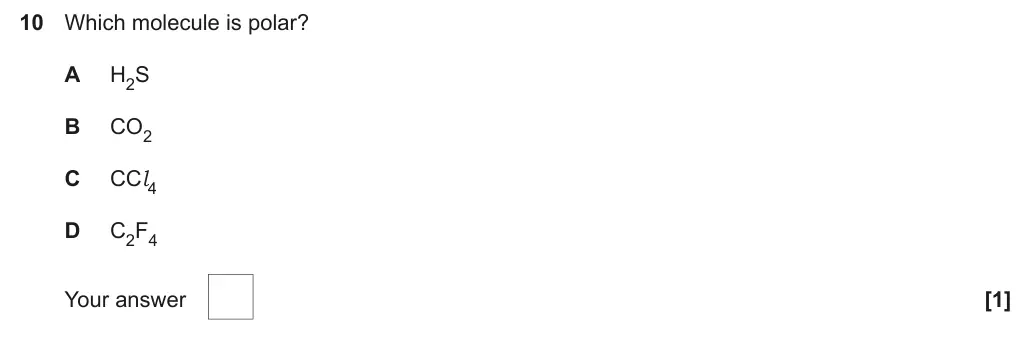
June 2025 · AS Paper 1 · Q101 markMultiple choiceMedium
Answer
A
Mark scheme
Examiner's comment
Just under half of candidates did not spot that H2S would be polar. There was no clear distractor, suggesting that many responses may have been guesses.
June 2025 · Paper 1 · Q16(d)6 marks6-mark level of responseEasy
Mark scheme, with the levels and indicative points
Examiner's comment
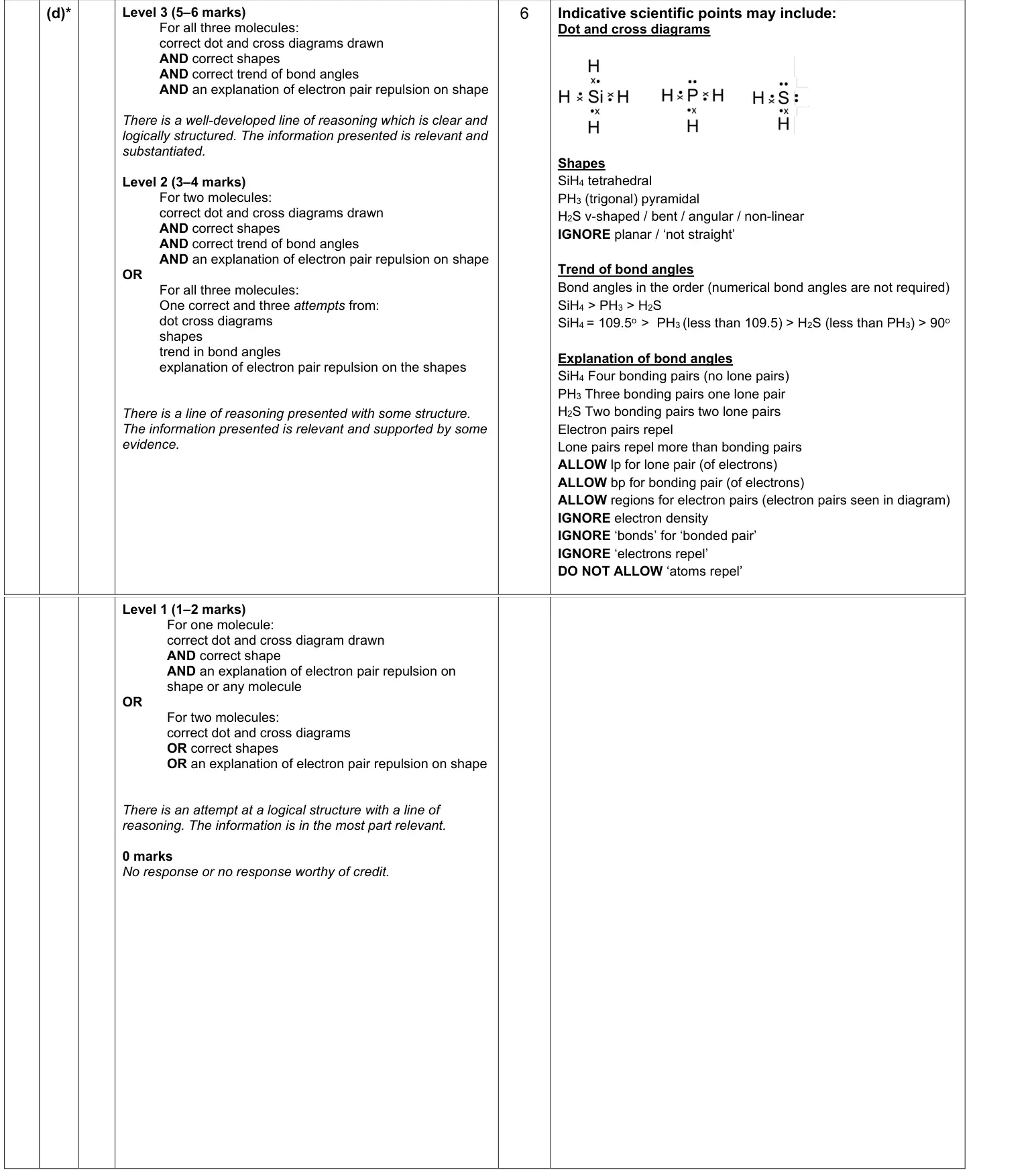
The first level of response question in the paper was answered well. Almost all candidates were able to draw correct dot cross diagrams. Many candidates scored Level 3 with correct shapes, bond angles and gave good explanations of the electron pair repulsion. The mark scheme allowed for the taught bond angle values and the true bond angle values of these molecules which followed the same trend. Level 2 candidates often had an incorrect shape of either PH3 or H2S. The tetrahedral shape for SiH4 was almost always correct but less successful candidates suggested trigonal planar or bipyramidal for PH3 and linear for H2S. Bond angles were often correct with some candidates linking the incorrect angle to their incorrect shape. Explanations were well described but some candidates were not clear about electron pairs repelling but described atoms or bonds repelling. Some candidates explained the bond angle in terms of being reduced by 2.5o without referencing electron pair repulsion Most candidates were able to access Level 1 often by having the correct dot cross diagrams.
Notes from the mark scheme and report
SiH4 tetrahedral 109.5° with 4 bonding pairs
PH3 pyramidal with 3 bonding pairs and 1 lone pair
H2S non-linear with 2 bonding pairs and 2 lone pairs
bond angle SiH4 > PH3 > H2S
lone pairs repel more than bonding pairs
DO NOT ALLOW atoms repel
IGNORE 'electrons repel' and 'bonds' for bonded pairs
Skills: M4.1 Use angles and shapes in regular 2-D and 3-D structures; M4.2 Visualise and represent 2-D and 3-D forms including 2-D representations of 3-D objects
June 2025 · AS Paper 2 · Q5(a)(i)1 markDrawing / labellingMedium
Mark scheme
Examiner's comment
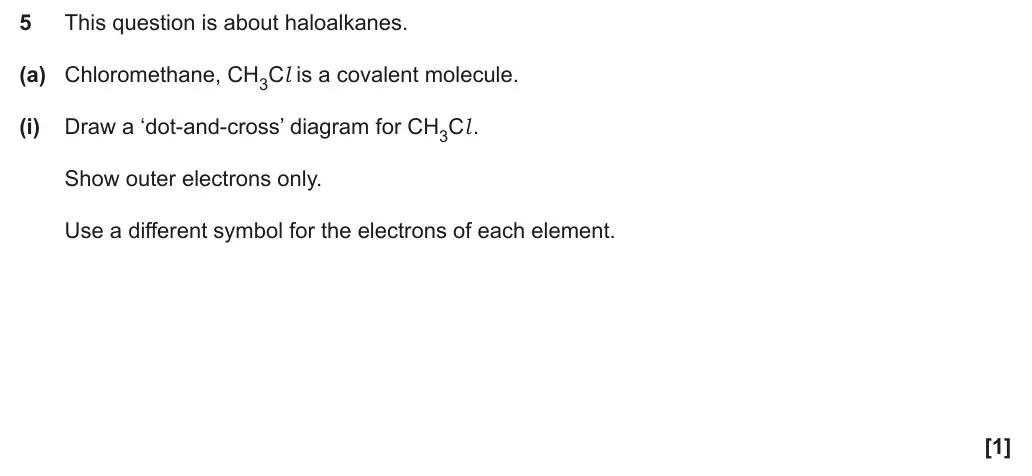
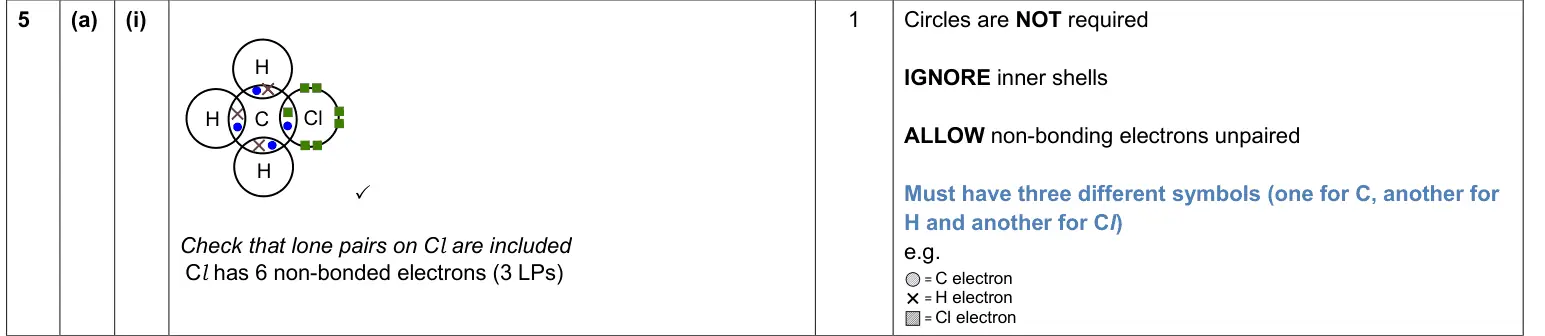
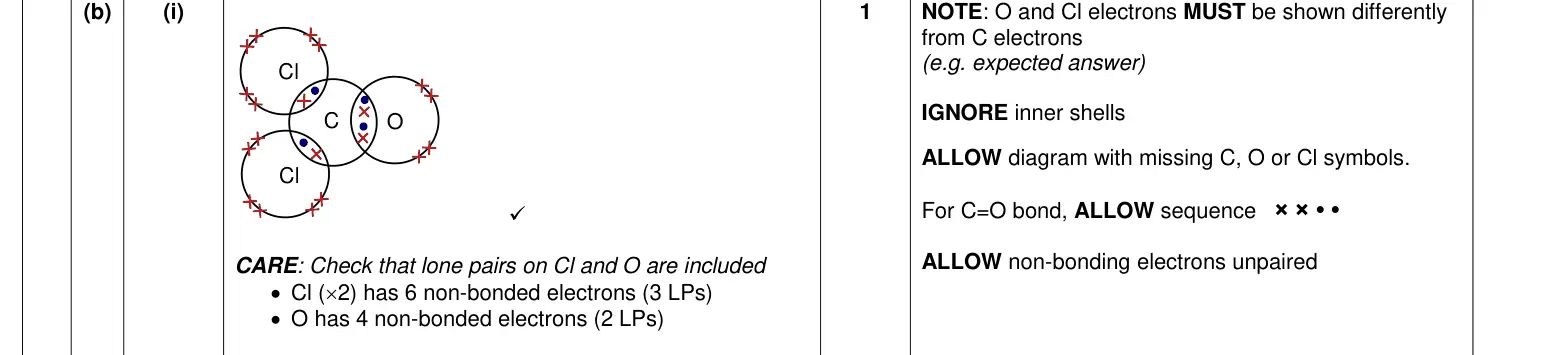
Many candidates lost the mark here for omitting to add lone pairs on chlorine. Some lost the mark as they didn’t use three different symbols for electrons on each of the elements, making it unclear which electrons were associated with each element.
Notes from the mark scheme and report
three lone pairs on Cl must be shown
three different symbols for C, H and Cl electrons
IGNORE inner shells
circles not required
June 2025 · AS Paper 2 · Q5(a)(ii)2 marksShort answerHard
Earlier part of question 5 that this part uses
Mark scheme
Examiner's comment
Most scored both marks here, as they were able to use the ‘dot-and-cross’ diagram drawn in (i). Some struggled with recalling the bond angle. A few “trigonal planar” and “120” responses were seen perhaps confusing themselves with the next part of the question.
Notes from the mark scheme and report
tetrahedral
109.5° (ALLOW 109–110)
Skills: M4.1 Use angles and shapes in regular 2-D and 3-D structures
June 2025 · AS Paper 2 · Q5(b)3 marksShort answerHard
Earlier parts of question 5 that this part uses
Mark scheme
Examiner's comment
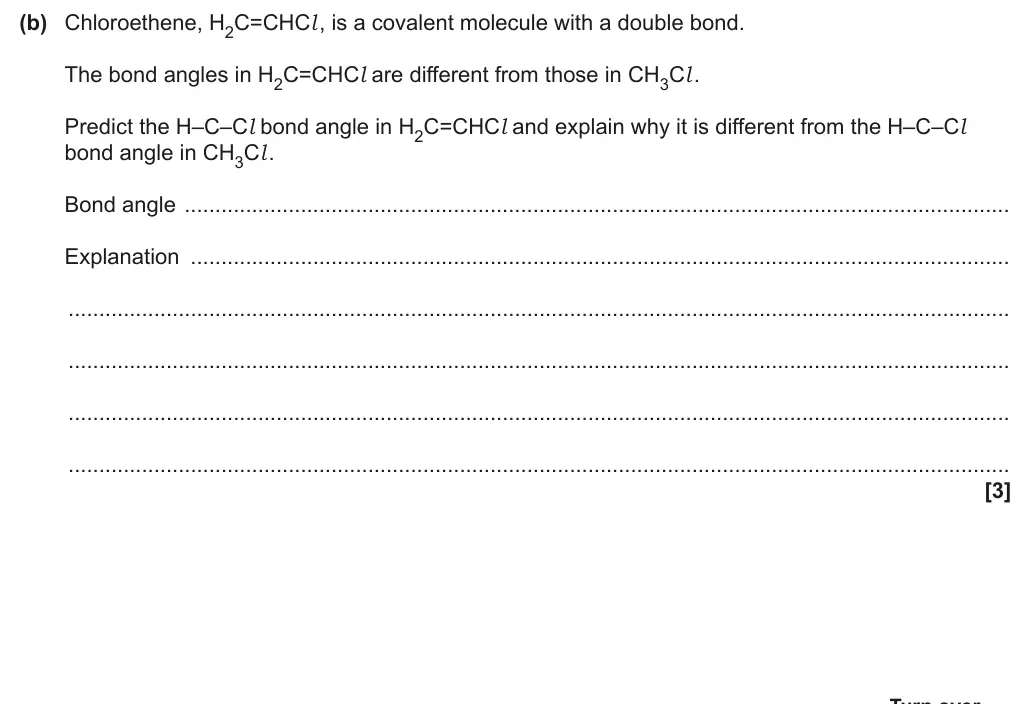
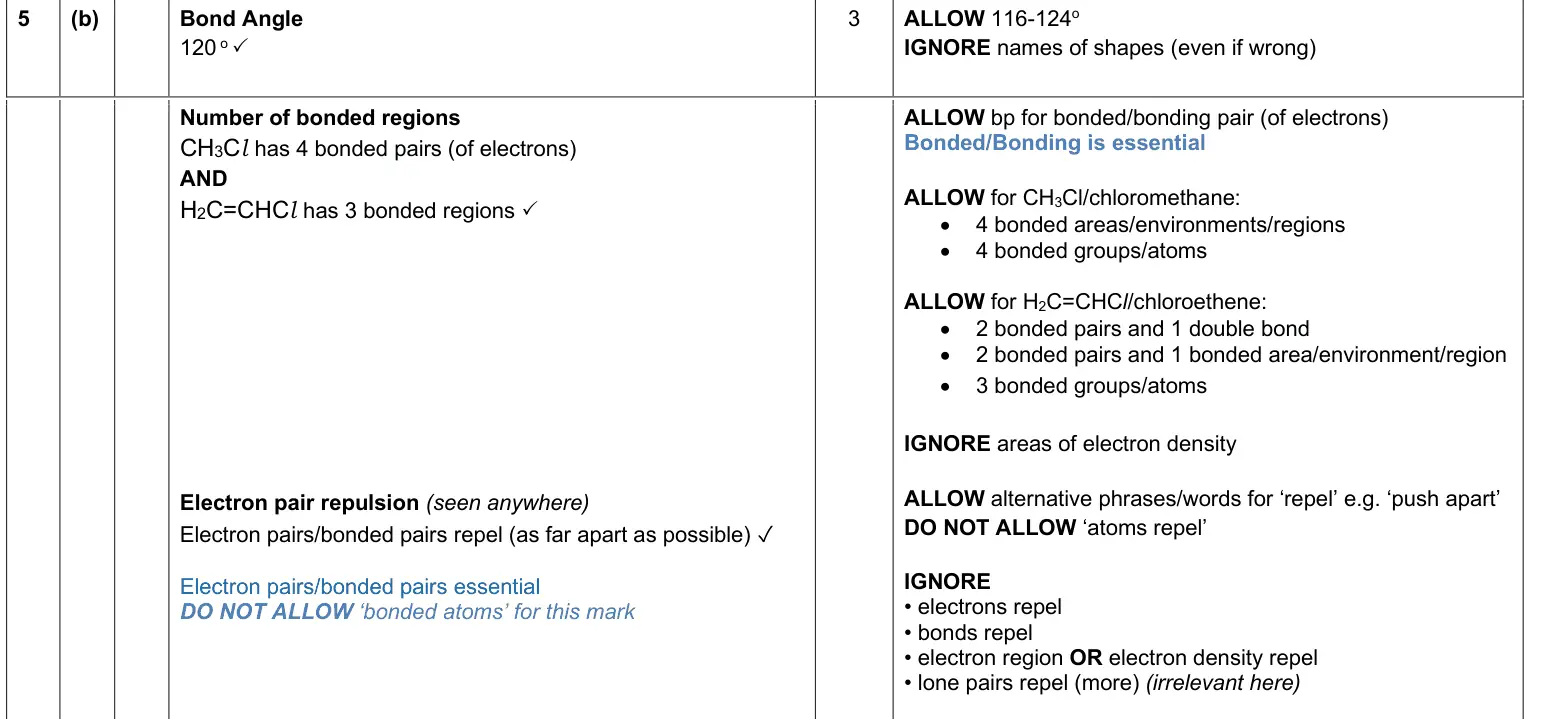
A range of marks is scored on this question with most scoring at least 1 mark for the correct bond angle. A larger range of bond angles were allowed here to account for the impact of the double bond. Candi- dates were not expected to account for the additional repulsion from the double bond but should be able to use electron pair repulsion theory to predict and explain. Many candidates found the explanation challenging, with a significant number not making any compari- son between chloroethene with chloromethane as required in the question. As seen in previous years, a mark was available for stating that “electron pairs repel” but this was often omitted despite being the main principle that determines molecular shapes. Many candidates felt like they needed to discuss lone pairs – in some cases saying they were present and therefore caused more repulsion. Candidates need to be reminded to focus only on the electron pairs around the central atom. Discussion of regions or areas of electron density or the number of bonded atoms was not enough to gain credit here.
Notes from the mark scheme and report
120° (ALLOW 116–124)
CH3Cl has 4 bonded pairs AND H2C=CHCl has 3 bonded regions
electron pairs repel (DO NOT ALLOW atoms repel
IGNORE electrons/bonds repel)
IGNORE names of shapes
Many students think that molecular shapes are determined solely by lone pairs or by repulsion between bonded atoms. The principle behind molecular shapes is called electron pair repulsion theory because it is based on repulsion between electron pairs, which may be bonded pairs or lone pairs, but not atoms.
Skills: M4.1 Use angles and shapes in regular 2-D and 3-D structures
June 2025 · Paper 3 · Q5(b)2 marksDrawing / labellingMedium
Mark scheme
Examiner's comment
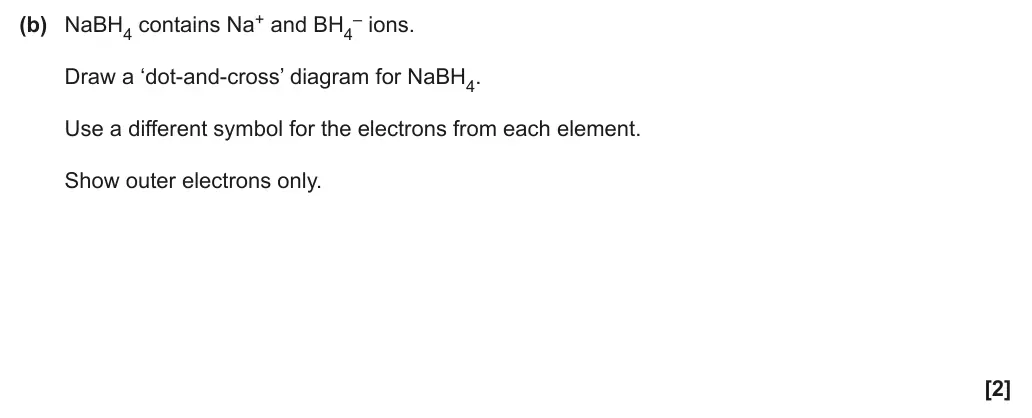
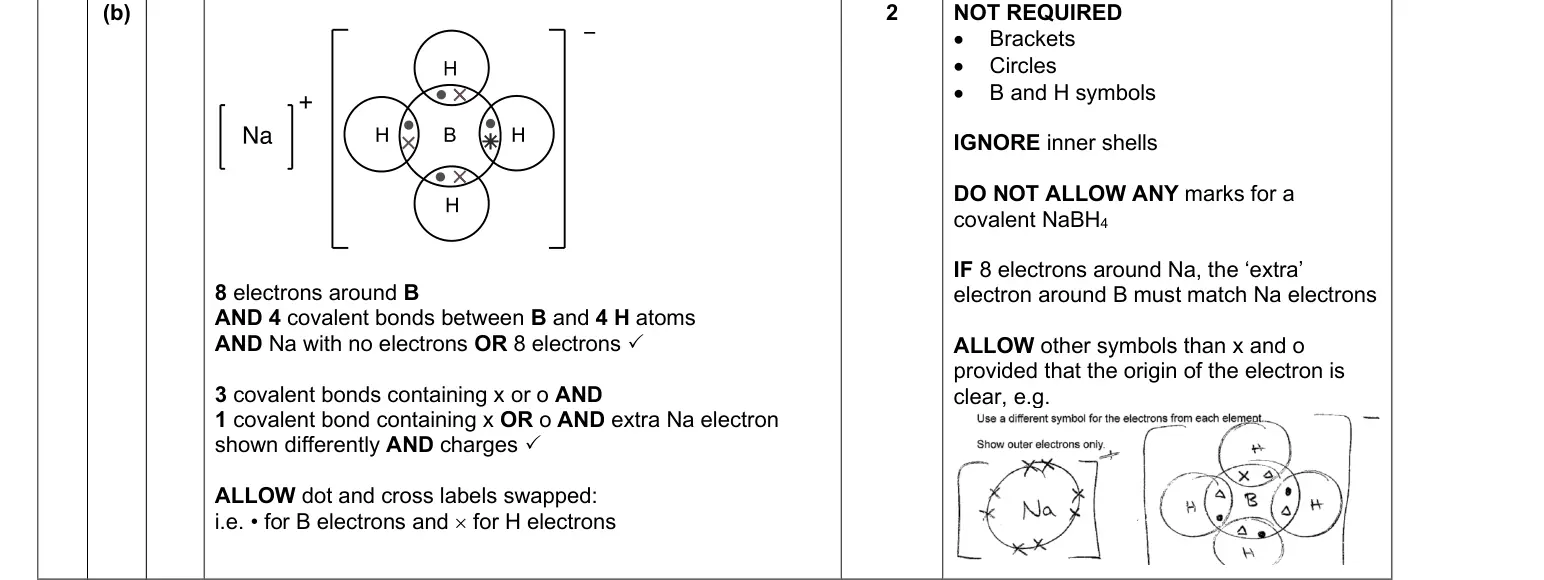
This question looked straightforward but produced a large range of responses. The best answers were clearly communicated with different symbols being used for B, H and Na electrons in the two ions, Na+ and BH4–, from the information provided in the question. Most candidates showed BH4– with 4 covalent bonds. The expectation was that candidates would draw 3 B–H bonds using x• and a one B–H bond using a different symbol to represent a Na electron, following the requirement in the question. A dative covalent bond was often shown as the fourth B–H bond, usually as ••. The charges were often omitted and there were a number of attempts to covalently bond the Na in a single covalent molecule. Many candidates drew very small diagrams, and it was often difficult to decipher the symbols being used to represent electrons. Candidates are well-advised to adhere to the requirements and information given in the question. clearly. The candidate has used dots for B electrons, triangles for H electrons and a cross for Na electrons. Notice that this candidate has shown the full second shell of Na electrons using the same cross symbol of in the BH4– ion. Na+ was allowed showing either the full inner shell or an empty outer shell.
Notes from the mark scheme and report
ionic Na+ and BH4–: no marks for covalent NaBH4
8 electrons around B in 4 B–H bonds, one bond containing the extra electron shown as Na's symbol
charges required
brackets and circles not required
June 2024 · Paper 1 · Q21 markMultiple choiceMedium
Answer
B
Mark scheme
Examiner's comment
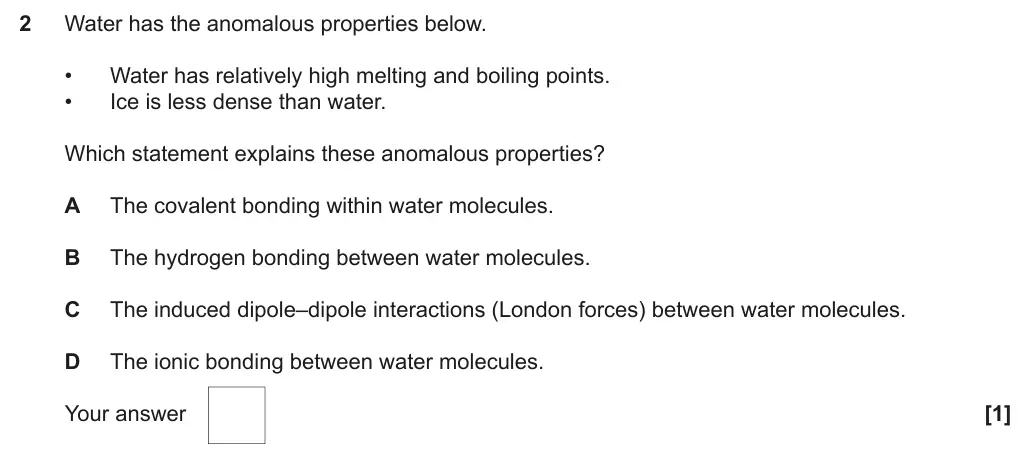
The correct answer was B. Candidates generally understood that these anomalous properties were due to hydrogen bonding. A few selected C, associating the incorrect type of intermolecular force.
June 2024 · AS Paper 1 · Q51 markMultiple choiceMedium
Answer
B
Mark scheme
Examiner's comment
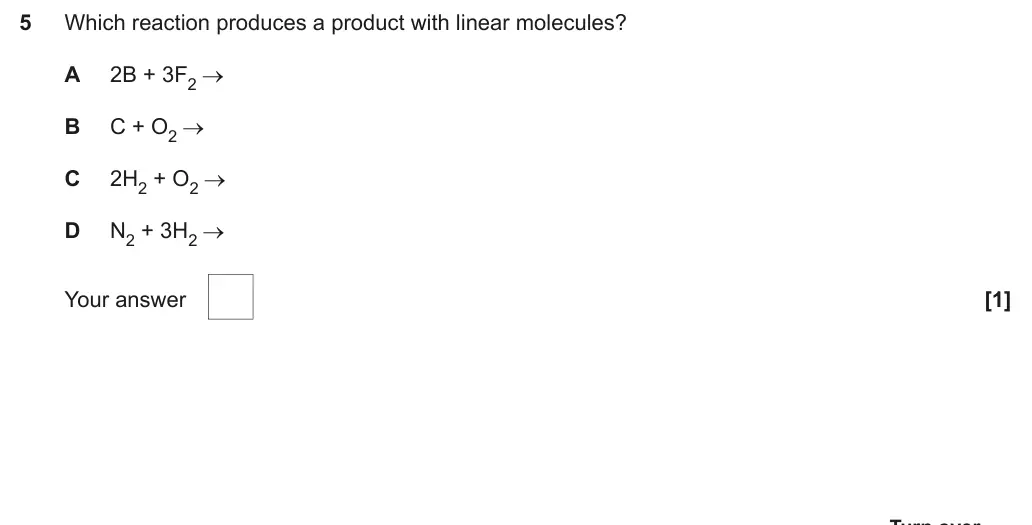
Most candidates identified CO2 as the product with linear molecules, suggesting that knowledge of bond shapes is good.
June 2024 · Paper 1 · Q51 markMultiple choiceMedium
Answer
C
Mark scheme
Examiner's comment
The correct answer was C. This question was answered well, alongside Q2. Candidates should aim to separate explanations regarding chemical and physical properties. B was a common wrong answer and a few candidates suggested that the covalent bonds need to be broken, selecting A.
June 2024 · Paper 1 · Q18(b)(i)1 markShort answerHard
Mark scheme
Examiner's comment
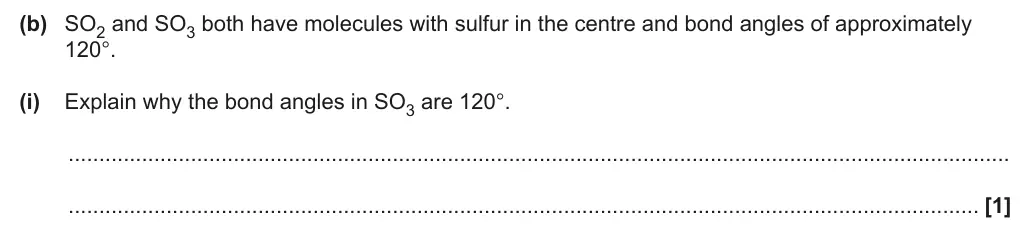
Another challenging question, requiring the identification of 3 double bonds (and no lone pair). The most common error was stating that SO2 has 3 bonding pairs – it doesn’t, it has 6 bonding pairs which are arranged as 3 double bonds. They could also state that it has 3 bonding regions.
Notes from the mark scheme and report
3 bonding regions/areas of electron density
DO NOT ALLOW 'bonding pairs'
June 2024 · Paper 1 · Q18(b)(ii)2 marksShort answerHard
Mark scheme
Examiner's comment
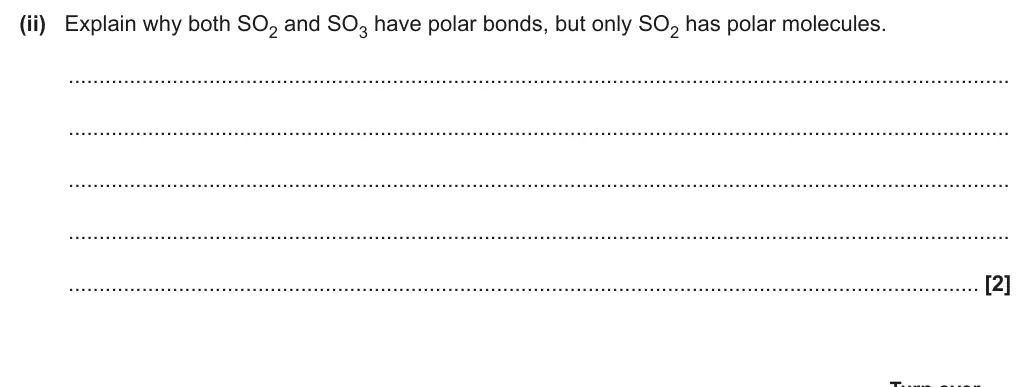
ocr.org.uk/science Oxford Cambridge and RSA CHEMISTRY A H432 For first teaching in 2015 A LEVEL Version 1 H432/01 Summer 2024 series Examiners’ report Contents Introduction .............................................................................................................................................. 4 Paper 1 series overview ........................................................................................................................... 5 Section A overview ................................................................................................................................... 6 Question 1 ............................................................................................................................................ 6 Question 2 ............................................................................................................................................ 7 Question 3 ............................................................................................................................................ 7 Question 4 ............................................................................................................................................ 8 Question 5 ............................................................................................................................................ 8 Question 6 ............................................................................................................................................ 9 Question 7 ............................................................................................................................................ 9 Question 8 .......................................................................................................................................... 10 Question 9 .......................................................................................................................................... 10 Question 10 ........................................................................................................................................ 11 Question 11 ........................................................................................................................................ 12 Question 12 ........................................................................................................................................ 13 Question 13 ........................................................................................................................................ 13 Question 14 ........................................................................................................................................ 14 Question 15 ........................................................................................................................................ 15 Section B overview ................................................................................................................................. 16 Question 16 (a) (i) ............................................................................................................................... 16 Question 16 (a) (ii) .............................................................................................................................. 17 Question 16 (b) (i) ............................................................................................................................... 18 Question 16 (b) (ii) .............................................................................................................................. 19 Question 16 (b) (iii) ............................................................................................................................. 20 Question 16 (c) (i) ............................................................................................................................... 20 Question 16 (c) (ii) .............................................................................................................................. 21 Question 16 (c) (iii) .............................................................................................................................. 22 Question 17 (a) ................................................................................................................................... 23 Question 17 (b)* .................................................................................................................................. 24 Question 18 (a) (i) ............................................................................................................................... 26 Question 18 (a) (ii) .............................................................................................................................. 27 Question 18 (a) (iii) ............................................................................................................................. 27 Question 18 (b) (i) ............................................................................................................................... 28 Question 18 (a) (ii) .............................................................................................................................. 28 Question 19 (a) (i) ............................................................................................................................... 29 Question 19 (a) (ii) .............................................................................................................................. 29 Question 19 (a) (iii) ............................................................................................................................. 30 Question 19 (b) (i) ............................................................................................................................... 31 Question 19 (b) (ii) .............................................................................................................................. 34 Question 20 (a) (i) ............................................................................................................................... 35 Question 20 (a) (ii) .............................................................................................................................. 35 Question 20 (b) ................................................................................................................................... 36 Question 20 (c)* .................................................................................................................................. 37 Question 21 (a) ................................................................................................................................... 38 Question 21 (b) ................................................................................................................................... 40 Question 21 (c) ................................................................................................................................... 41 Question 21 (d) (i) ............................................................................................................................... 42 Question 21 (d) (ii) .............................................................................................................................. 43 Question 22 (a) ................................................................................................................................... 44 Question 22 (b) (i) ............................................................................................................................... 45 Question 22 (b) (ii) .............................................................................................................................. 45 Question 22 (c) ................................................................................................................................... 46 Introduction Our examiners’ reports are produced to offer constructive feedback on candidates’ performance in the examinations. Candidates who did well on this paper generally: Candidates who did less well on this paper generally: • produced clearly structured working for calculations – Questions 16 (a),16 (c) (ii), 18 (a), 19 (a) (iii), 19 (b) (i), 21 (b), 22 (c) • produced clear and concise responses for the two Level of Response questions – Questions 17 (b) and 20 (c) • produced clear and concise responses to describe a polar molecule – Question 18 (b) (ii) • deduced the rate determining step and rate equation – Question 20 (b) • correctly used electrode potentials – Question 21 (d) (ii) • wrote a formula for an unfamiliar complex ion – Question 22 (b) (ii) • deduced the oxidation numbers of an unfamiliar compound • drew an enthalpy profile for an exothermic or endothermic reaction – Question 16 (b) (i) • drew a labelled diagram to measure a standard electrode potential. • found it difficult to apply what they had learned to unfamiliar situations • produced unstructured responses to Level of Response questions which were lacking in depth or used incorrect terminology – Questions 17 (b) and 20 (c) • did not clearly set out calculations, making it difficult for marks to be given for working – Questions 16 (a), 16 (c) (ii), 18 (a), 19 (a) (iii), 19 (b) (i), 21 (b), 22 (c) • did not give answers to calculations to the specified number of significant figures – Questions 18 (a) (i), 19 (a) (iii), 21 (b) • did not appropriately convert between units for calculations – Question 21 (b) • found it difficult to write a balanced equation, or ionic equations, for reactions with group 2 metal and metal compounds or group 7 redox reactions – Questions 20 (a) (ii), 21 (a) • drew an inaccurate enthalpy profile for an exothermic or endothermic reaction – Question 16 (b) (i) • drew an inaccurate or incomplete labelled diagram to measure a standard electrode potential. Question 18 (b) (i) Another challenging question, requiring the identification of 3 double bonds (and no lone pair).
Notes from the mark scheme and report
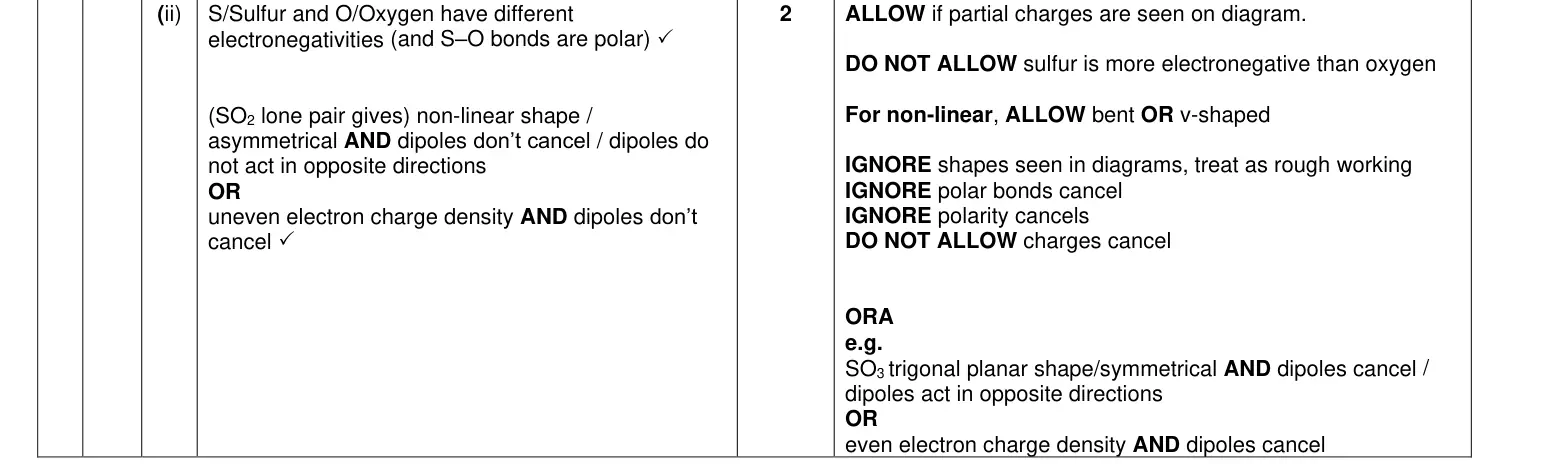
electronegativity difference S/O
SO2 non-linear so dipoles do not cancel, SO3 symmetrical
June 2024 · Paper 1 · Q20(c)6 marks6-mark level of responseHard
Mark scheme, with the levels and indicative points
Examiner's comment
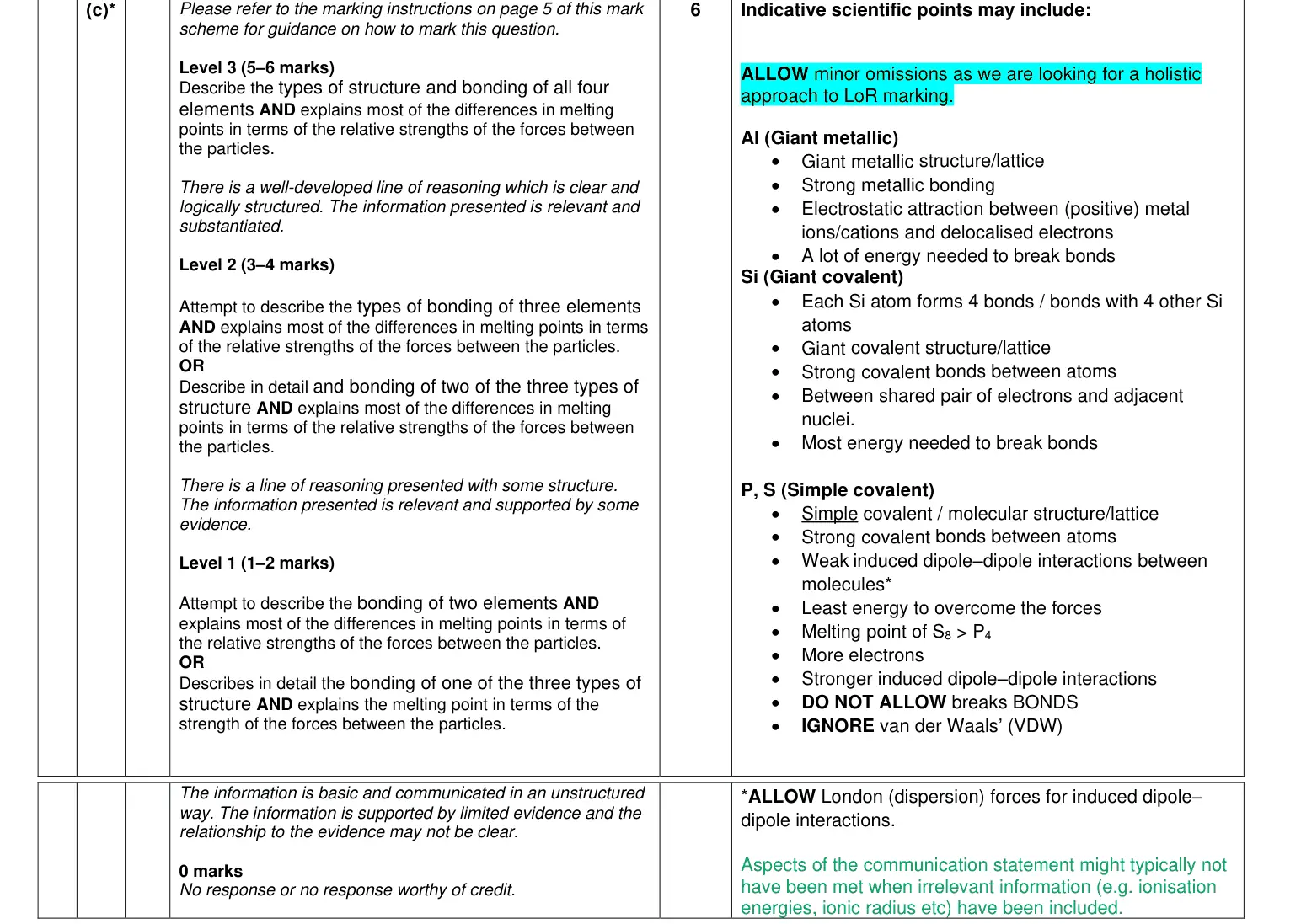
Structure and bonding continue to be a difficult concept for many candidates. High-attaining candidates were able to identify why the element had a certain magnitude of melting point. They clearly linked the structure type with the type of bonding. They then described, in detail, the nature of the bond. The strength of force required to break/overcome the bond/London Force was linked to the melting point. It was very common for ‘giant’ to be omitted in the name of the lattice, especially in Al. Candidates find it particularly challenging to associate the correct terminology with the correct structure, often describing intermolecular forces in giant covalent explanations or use of molecules in giant metallic explanations. London forces were mentioned widely but sometimes not described as being forces between molecules and not linked to the increased number of electrons. A holistic, rather than a point based, approach is used in marking these responses. This allowed Level 2 to be given when the candidate did not use all of the correct terminology throughout the three structure types. Several candidates described the varying melting point going across the period as being due to atoms having more electrons in the outer shell and a greater nuclear charge.
Notes from the mark scheme and report
giant metallic (Al), giant covalent (Si), simple molecular P4/S8 with London forces
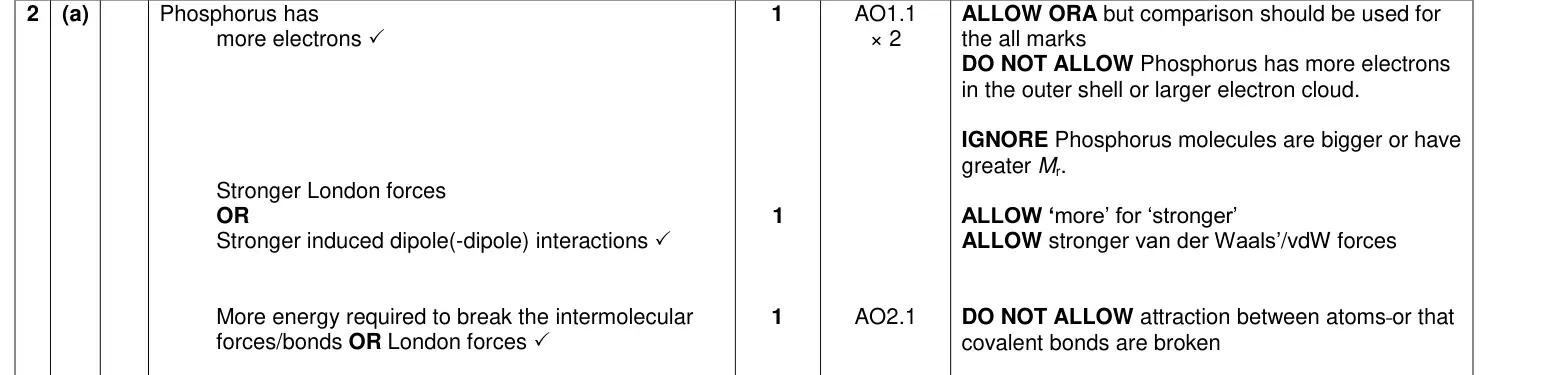
S8 > P4 because more electrons
Our bonding delivery guide provides details of common misconceptions students hold relating to this topic, and also includes resources and guidance that can help overcome them: Teach Cambridge (ocr.org.uk)
June 2024 · AS Paper 1 · Q23(c)2 marksDrawing / labellingEasy
Mark scheme
Examiner's comment
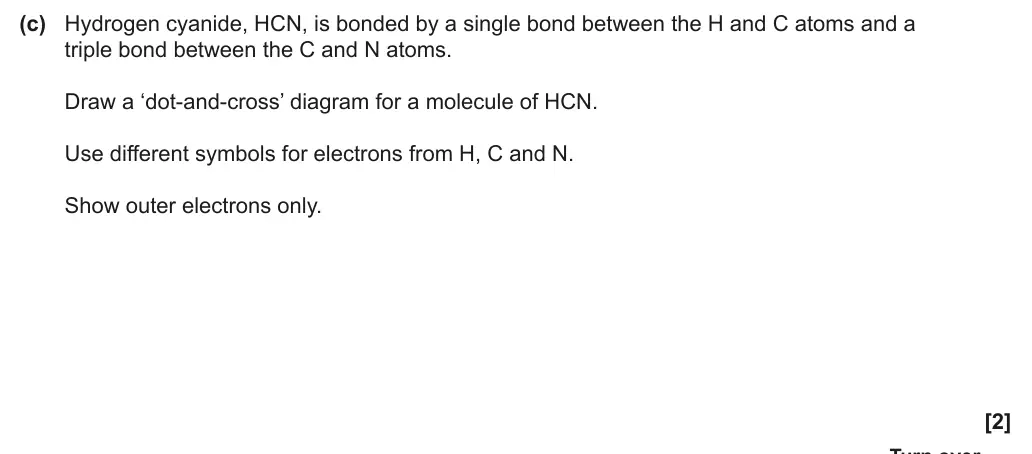
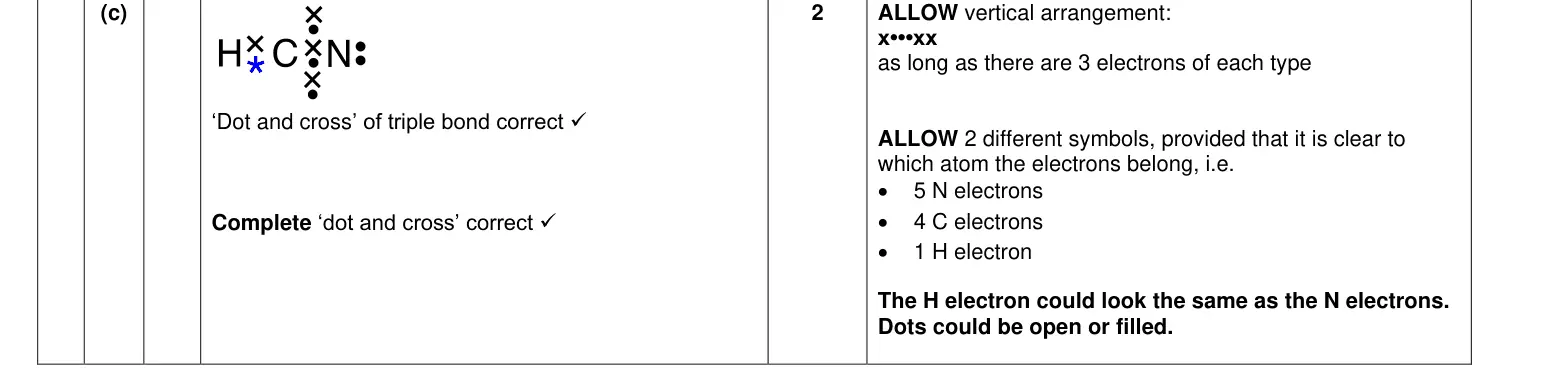
This question was well answered with ‘dot-and-cross’ diagrams usually correct. Most candidates obtained both marks. The most common error was omission of the nitrogen lone pair.
Notes from the mark scheme and report
triple bond with 3 electrons of each type
lone pair on N
ALLOW 2 different symbols if clear which atom the electrons belong to
June 2024 · AS Paper 1 · Q24(c)5 marksExtended responseMedium
Mark scheme
Examiner's comment
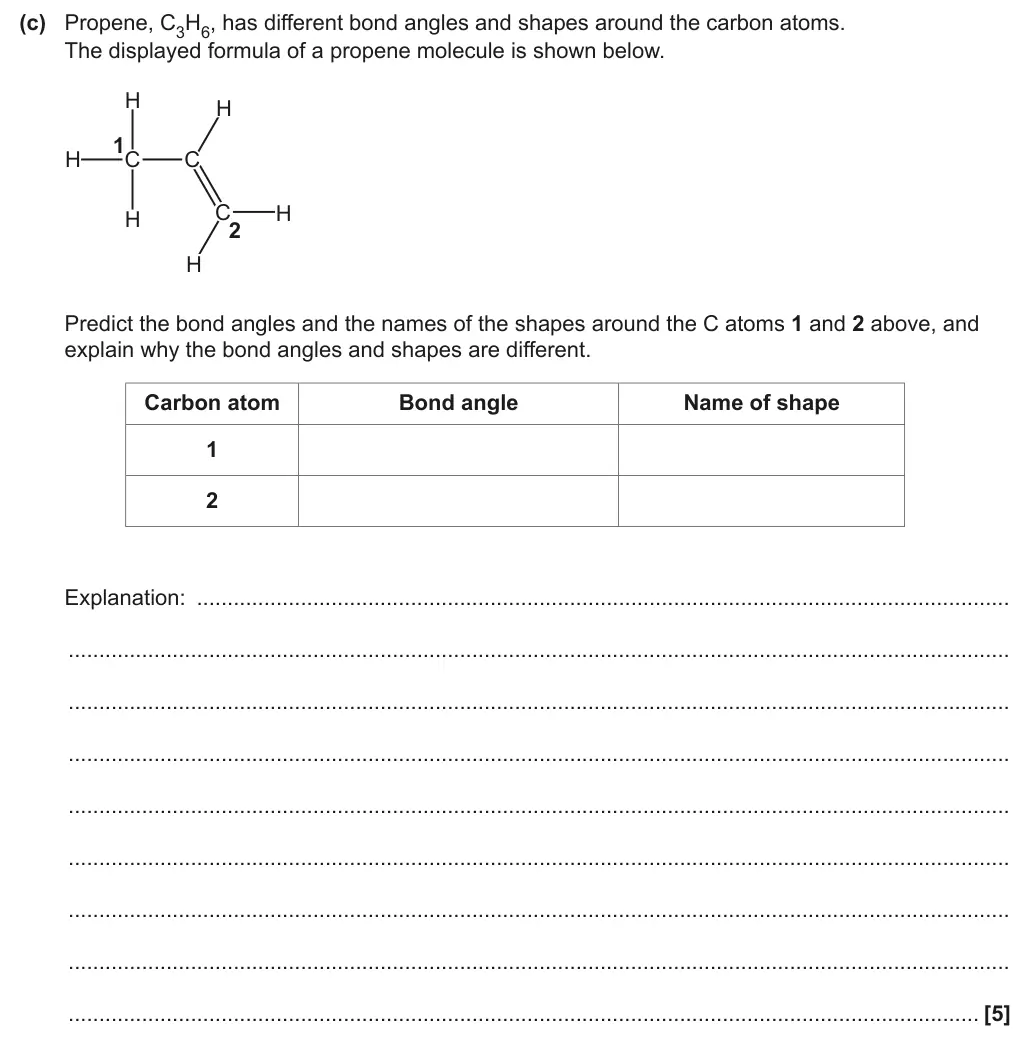
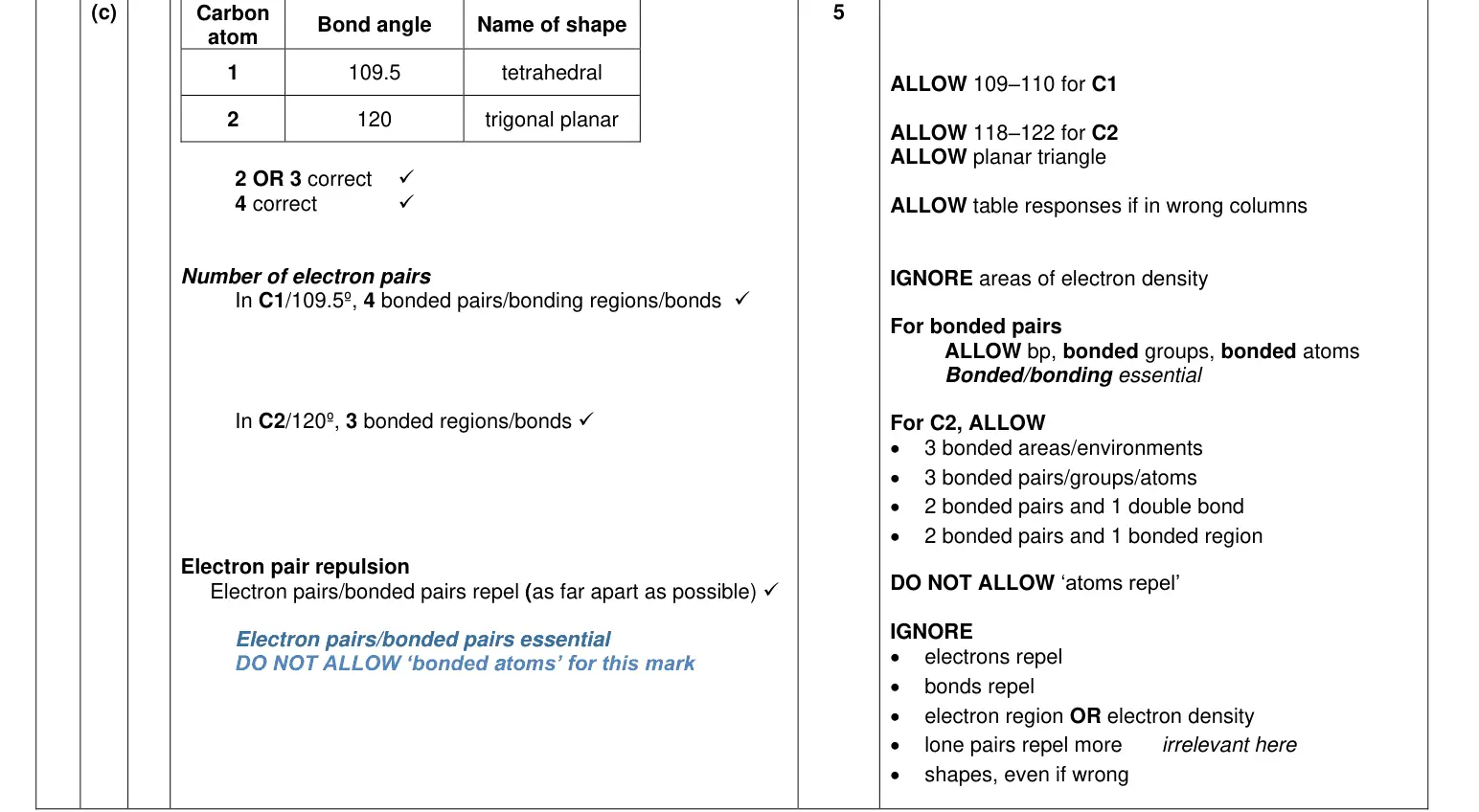
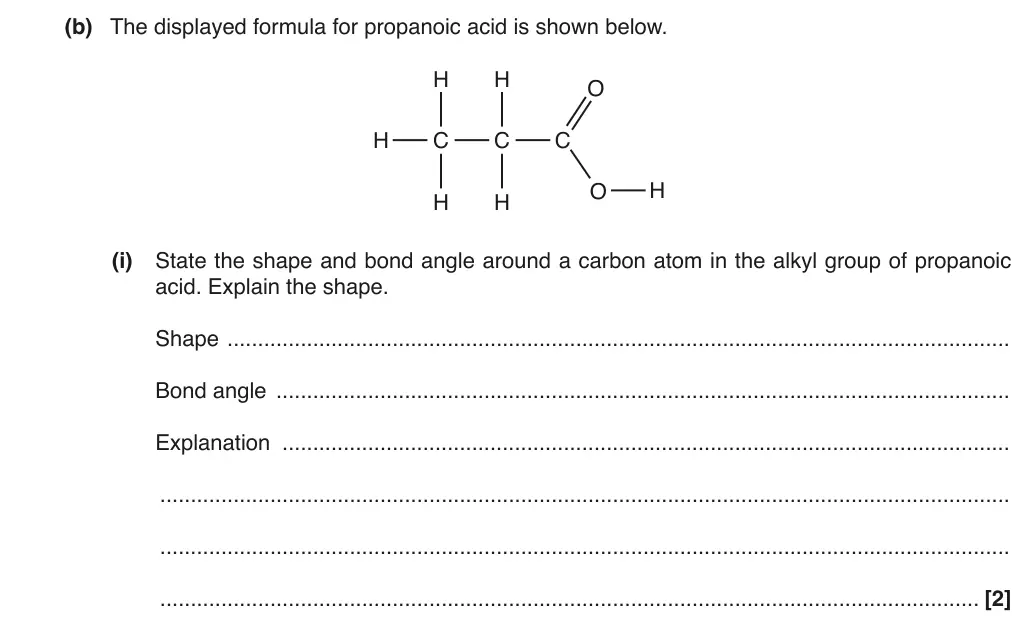
The bond angles and shapes rewarded the well-prepared candidates, with many being given both available marks for this part of the question. This part discriminated very well. For the explanation, most candidates identified 4 and 3 for C1 and C2, but candidates often linked 4 and 3 to atoms, rather than to electron pairs or bonded pairs for C1 and to bonding regions for C2. A mark was available for stating that ‘electron pairs repel’, but this important fact was often omitted despite being the main principle that determines molecular shapes. The question discriminated well, giving a good spread of marks across the five available.
Notes from the mark scheme and report
C1 109.5° tetrahedral with 4 bonded pairs
C2 120° trigonal planar with 3 bonded regions
electron pairs repel
DO NOT ALLOW 'atoms repel'
IGNORE 'electrons repel' and 'bonds repel'
Many students think that molecular shapes are determined solely by lone pairs or by repulsion between bonded atoms. The principle behind molecular shapes is called electron pair repulsion theory because it is based on repulsion between electron pairs, which may be bonded pairs or lone pairs, but not atoms.
Skills: M4.1 Use angles and shapes in regular 2-D and 3-D structures; M4.2 Visualise and represent 2-D and 3-D forms including 2-D representations of 3-D objects
June 2024 · Paper 2 · Q11 markMultiple choiceEasy
Answer
A
Mark scheme
Examiner's comment
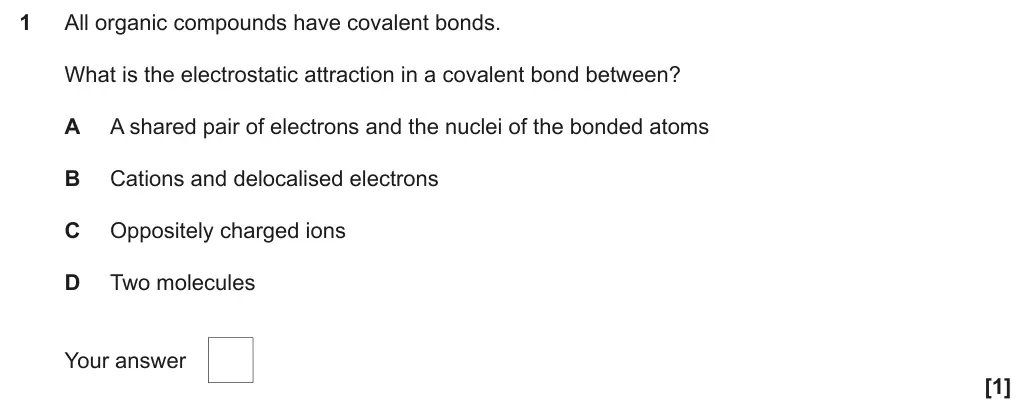
Nearly all candidates were able to correctly recognise that covalent bonding is the electrostatic attraction between a shared pair of electrons and the nuclei of the bonded atoms. The most common incorrect response was C, confusing it with ionic bonding.
June 2024 · AS Paper 2 · Q1(a)2 marksShort answerHard
Mark scheme
Examiner's comment
Many managed to score at least one mark here but most struggled to give a comprehensive definition. A mark was often lost mark for omission of ‘atom’, i.e. not saying what was attracting electrons, or for saying ‘element’ instead. The ability to attract an electron was not accepted as this is describing electron affinity rather than electronegativity. Many described the formation of dipoles or partial charges across the bond due to the difference in electronegativity but didn’t demonstrate a clear understanding of what electronegativity is. Lower-scoring candidates often referred to the formation of ions and/or loss of electrons.
Notes from the mark scheme and report
ability of an atom to attract electrons
in a covalent bond
DO NOT ALLOW 'element' for 'atom'
DO NOT ALLOW attract 'an electron' (single electron)
Learning key words and terminology is an important part of understanding Chemistry.
Encourage students to make their own flash cards for each topic – this can be done on card or electronically using websites such as Quizlet.
June 2024 · AS Paper 2 · Q1(b)(i)2 marksComplete table/diagramHard
Earlier part of question 1 that this part uses
Mark scheme
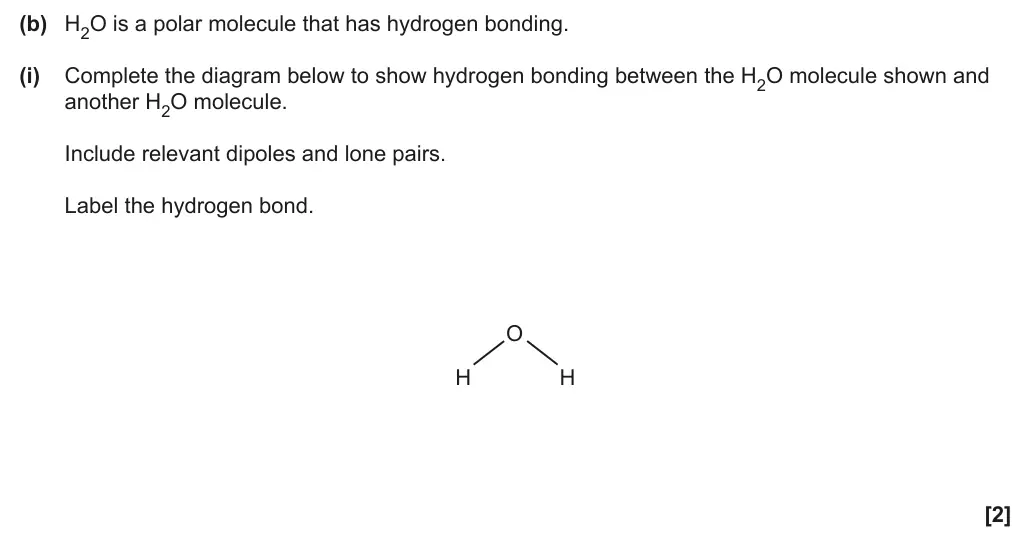
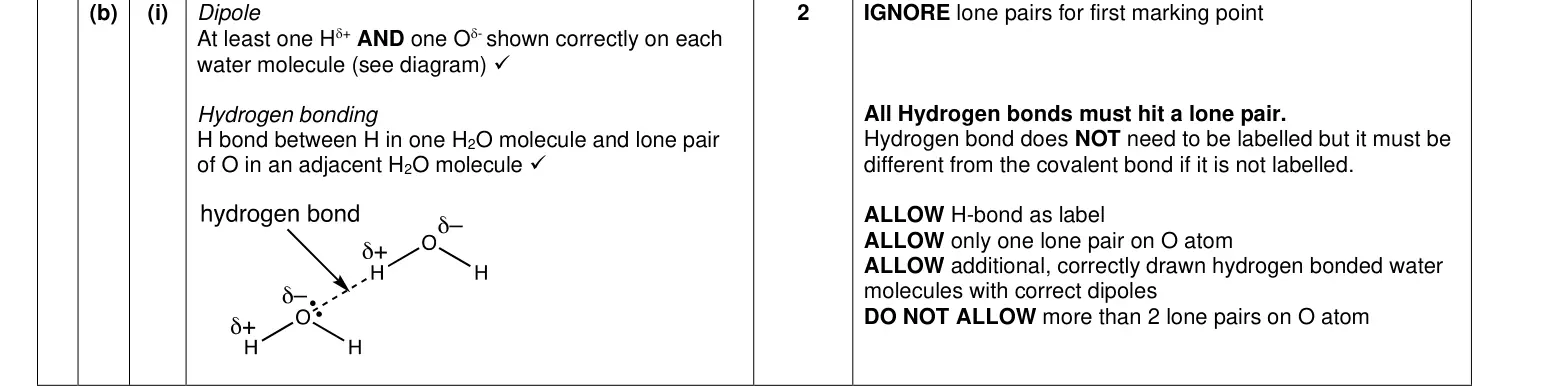
Examiner's comment
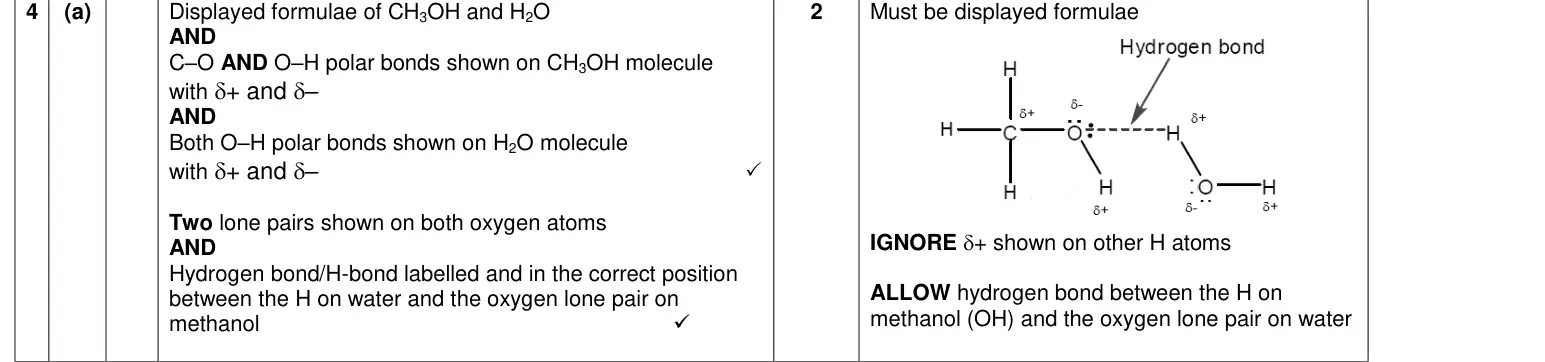
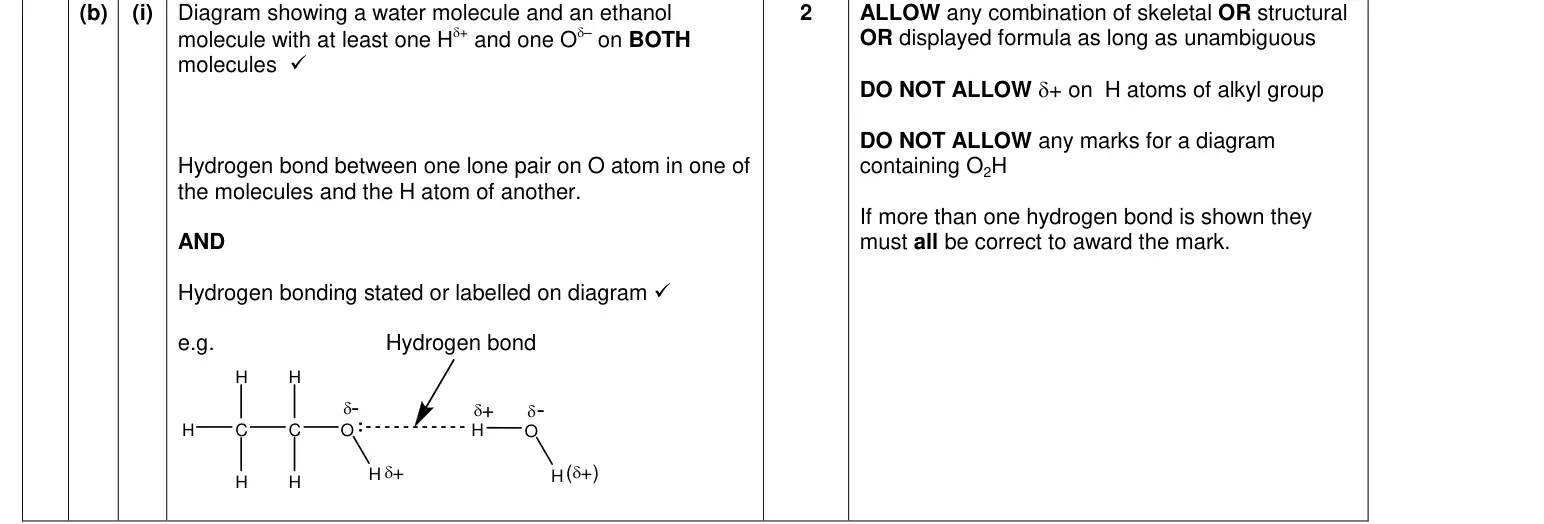
Around half of candidates scored both marks with a well-drawn diagram (such as that shown in the exemplar below). Practising drawing hydrogen bonds between different molecules is a really good way of exploring students’ understanding of what they are. The most common errors were missing the lone pair or showing a hydrogen bond that didn’t originate from those drawn. Lower-scoring candidates often didn’t draw a second water molecule, labelling the covalent bond between O and H as a hydrogen bond. Quite a few diagrams were seen with δ+ and δ- only on one molecule or with δ+ on one structure and δ- on the other. It was essential here to show that the O-H bond in both molecules is polar. Diagrams were often unclear so sometimes difficult to interpret. This is an example of a good diagram for hydrogen bonding.
Notes from the mark scheme and report
δ+ on H and δ– on O on each molecule
hydrogen bond must go from H to a lone pair on O of the other molecule
DO NOT ALLOW more than 2 lone pairs on O
June 2024 · AS Paper 2 · Q1(b)(ii)1 markShort answerMedium
Earlier part of question 1 that this part uses
Mark scheme
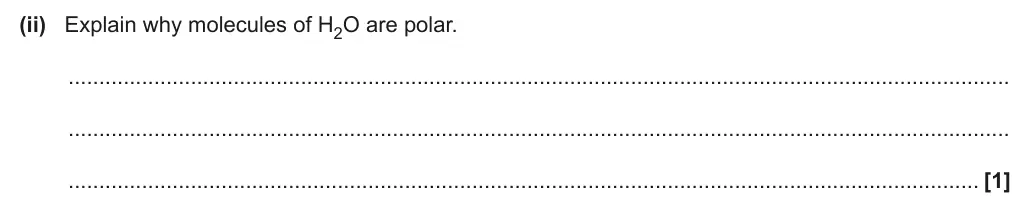
Examiner's comment
Some appropriate answers were seen, mostly discussing the asymmetrical shape of water. More than half didn’t score the mark. However, many were able to describe O-H being a polar bond due to the difference in electronegativity but didn’t realise that this doesn’t always mean that the molecule itself is polar. The relationship between the words electronegative, dipole and polar need more attention and how this all relates to the shapes of molecules. Some candidates said symmetrical when they meant asymmetrical.
Notes from the mark scheme and report
dipoles do not cancel/overall dipole/unsymmetrical
IGNORE 'polar bonds do not cancel'
IGNORE charges uneven
June 2024 · AS Paper 2 · Q1(b)(iii)1 markShort answerHard
Earlier part of question 1 that this part uses
Mark scheme
Examiner's comment
Some good answers were seen referring to hydrogen bonds holding/keeping water molecules further apart or creating an open lattice. However, a number did not score for not mentioning hydrogen bonds or for referring to alternative intermolecular forces. For example, ‘In solid state, the London forces are weaker’ and ‘Ice has less induced dipole-dipole forces’. Some also indicated that ‘air’ was in the structure and this wasn’t accepted as air molecules are too large to fit in the gaps between water molecules in the ice crystal structure. Responses often demonstrated some significant misconceptions in candidate understanding. Many felt that the length of the hydrogen bond changed, for example ‘when ice freezes hydrogen bonds expand’ ‘Atoms are further apart so longer hydrogen bonds’. Some suggested that the strength of the hydrogen bond changed (for example, ‘ice has weaker H-bonds than water’). Some recognised that ice has a crystalline structure but didn’t explain how this is different from other solid structures, which would be denser than their liquid counterparts. Lower-scoring candidates struggled to understand density (for example, ‘ice is more compact’ or ‘molecules closer together in ice’). Terminology was also a problem with candidates often referring to ‘ice’ or ‘particles’ rather than ‘molecules’.
Notes from the mark scheme and report
must refer to hydrogen bonds holding molecules apart/open lattice
DO NOT ALLOW 'atoms' for 'molecules'
DO NOT ALLOW gaps containing air
June 2024 · AS Paper 2 · Q1(c)(i)2 marksShort answerHard
Earlier part of question 1 that this part uses
Mark scheme
Examiner's comment
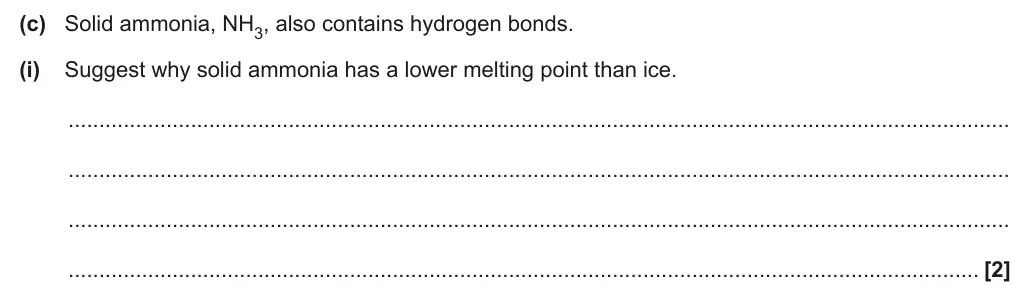
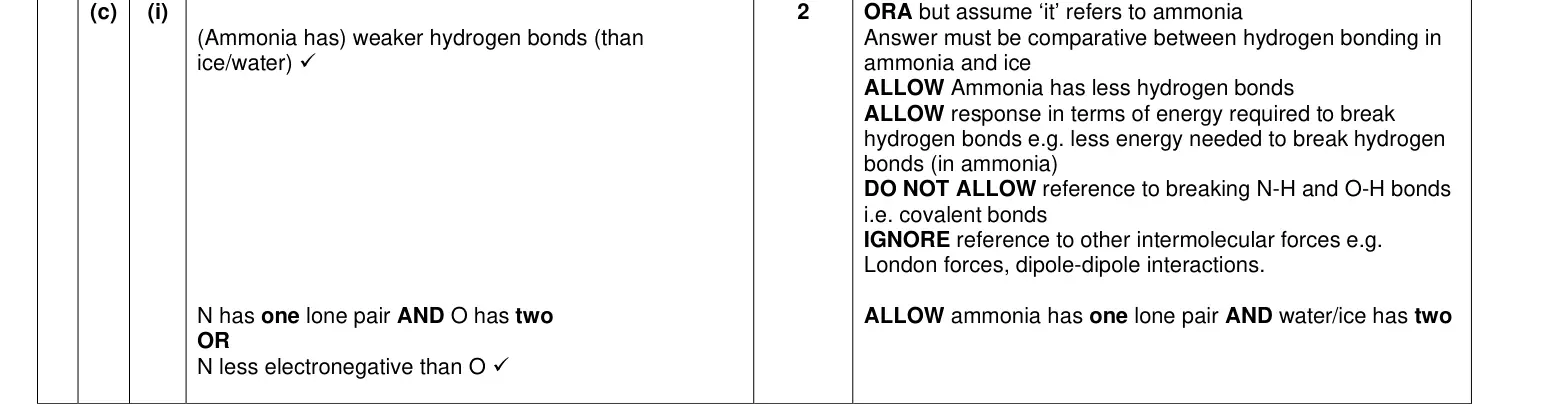
Despite being told in the question that ammonia contains hydrogen bonds, many gave responses in terms of ammonia having either London forces and permanent dipole-dipole forces which are weaker than hydrogen bonds. For example, ‘ammonia consists of permanent dipole-dipole interactions which are weaker than hydrogen bonding in ice’ and ‘NH3 has 17 electrons and H2O has 18 electrons. Due to NH3 having fewer electrons, there are fewer London forces’. Lower-scoring candidates often confused hydrogen bonds and covalent bonds, consistent with what was seen in 1(b)(i). For example, ‘O-H bond is stronger than N-H bond’ and ‘more energy needed to break O- H bonds rather than N-H bonds’. Some of these candidates did score a mark for recognising that N is less electronegative than O. For others they understood that ammonia has weaker hydrogen bonds but then struggled to give a reason either in terms of lone pairs or electronegativity.
Notes from the mark scheme and report
comparative: weaker/fewer hydrogen bonds in ammonia
N has one lone pair, O has two OR N less electronegative
DO NOT ALLOW breaking N–H/O–H covalent bonds
IGNORE other intermolecular forces
June 2024 · AS Paper 2 · Q1(c)(ii)2 marksDrawing / labellingMedium
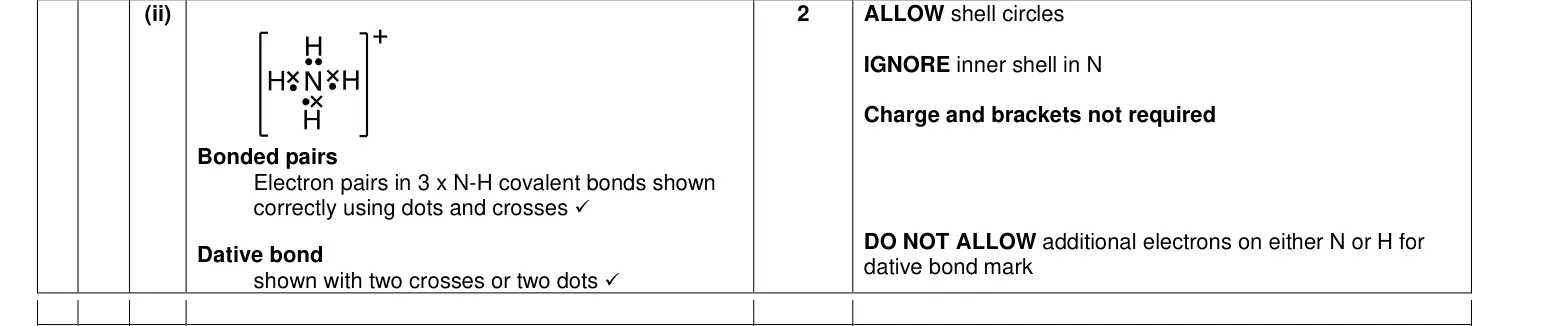
Mark scheme
Examiner's comment
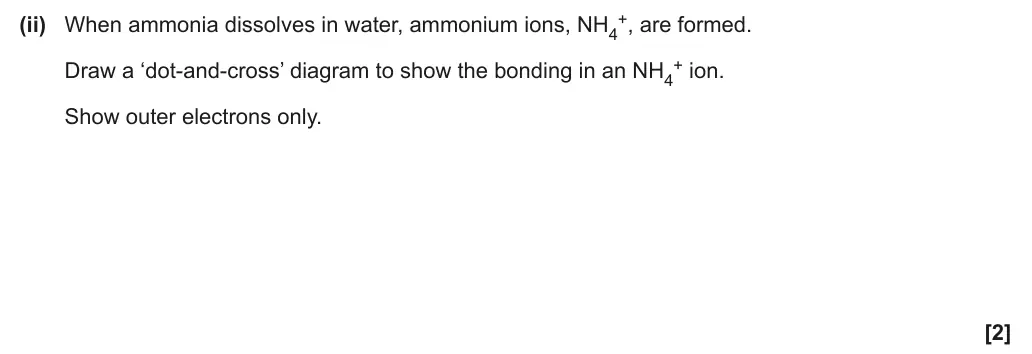
Less than half of the candidates scored both marks. Most candidates drew 4 x N-H shared covalent bonds and therefore lost the dative bond mark. Some added an additional electron to either N or H. Some drew an additional shaped electron (e.g. using a triangle) on one of the bonding pairs, obviously not realising that both electrons in dative bond originate from N, so have the same symbol. Many diagrams were unclear making it hard distinguish between dots and crosses especially if adding circles for electron shells. A few lower-attaining candidates attempted to draw an ionic dot-cross diagrams.
Notes from the mark scheme and report
three N–H bonds as dot-and-cross pairs
dative bond as two dots or two crosses
charge and brackets not required
DO NOT ALLOW additional electrons on N or H
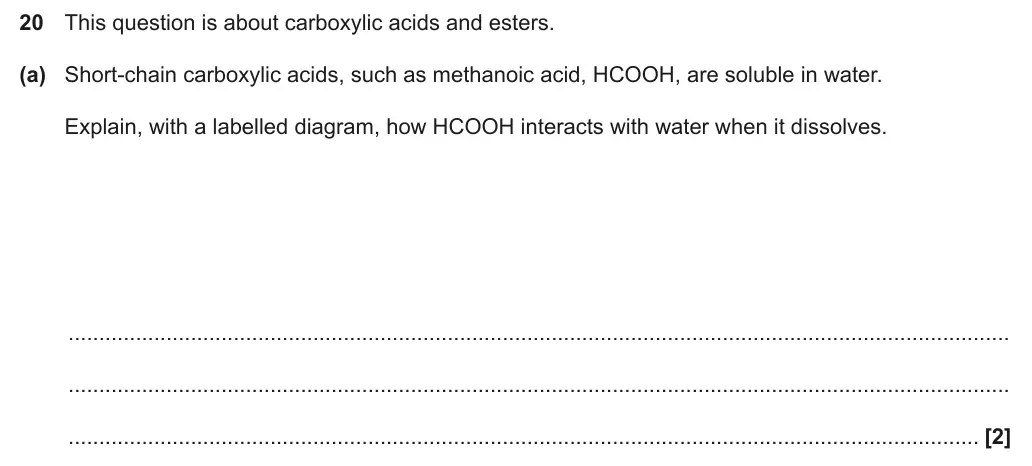
June 2024 · Paper 2 · Q20(a)2 marksDrawing / labellingMedium
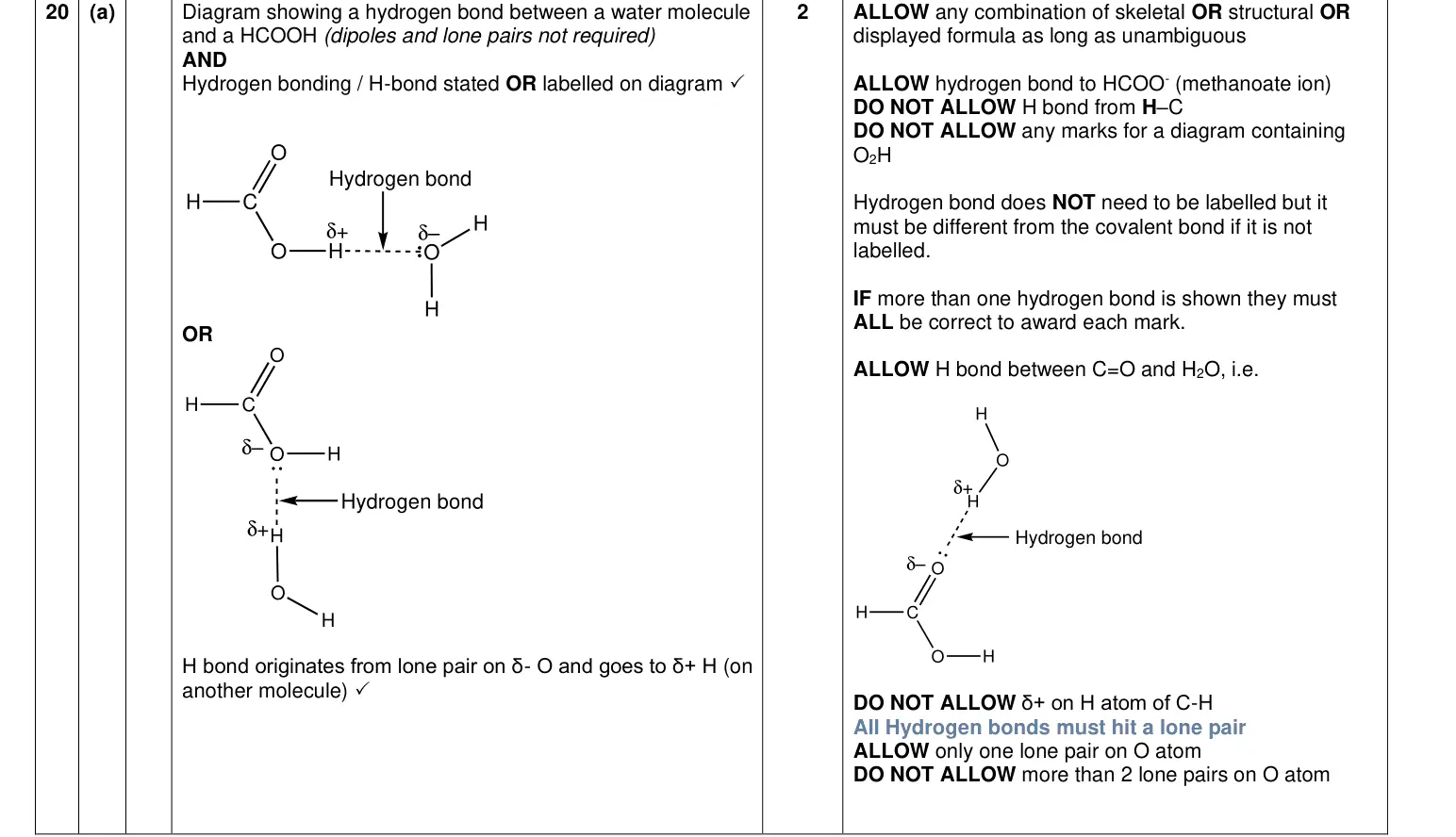
Mark scheme
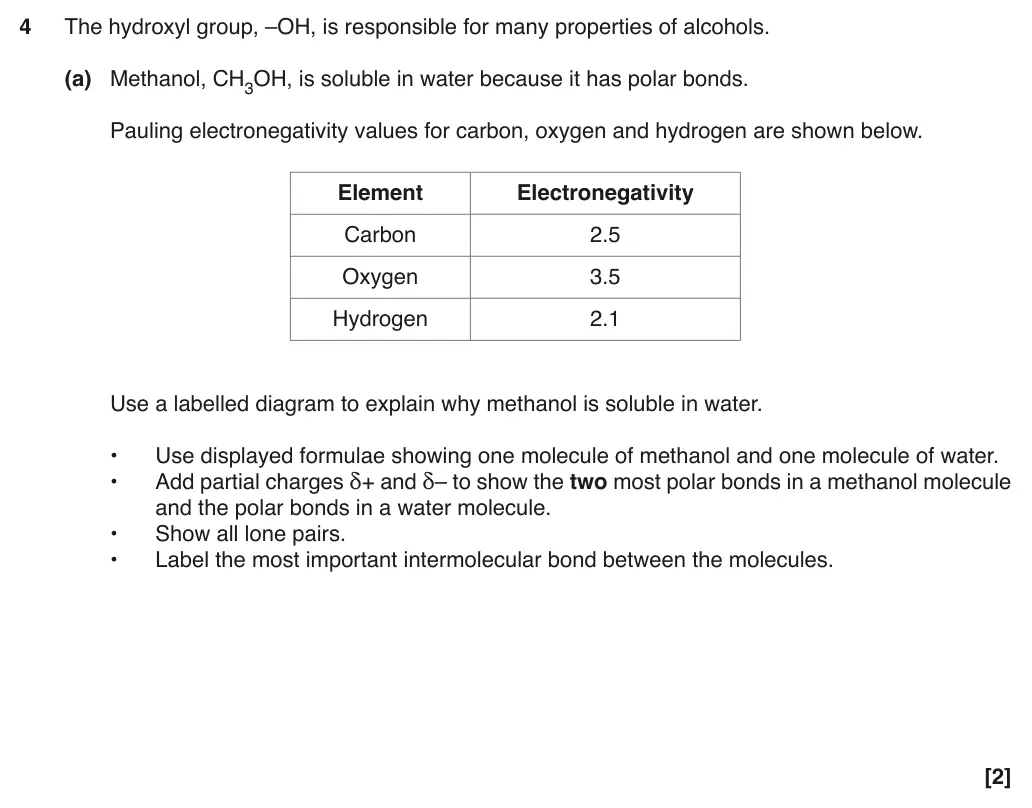
Examiner's comment
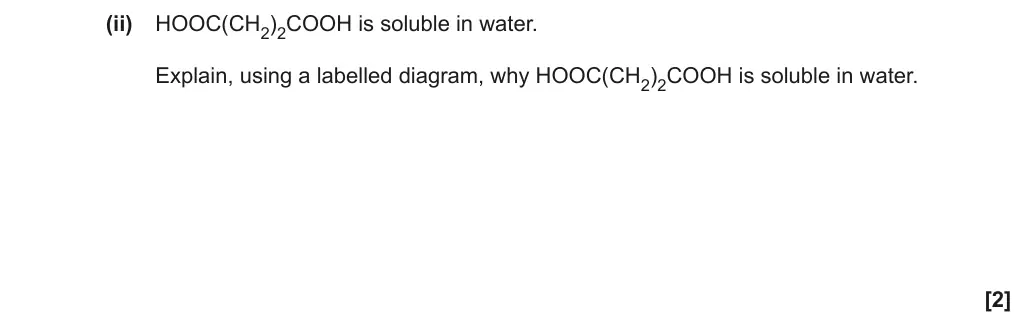
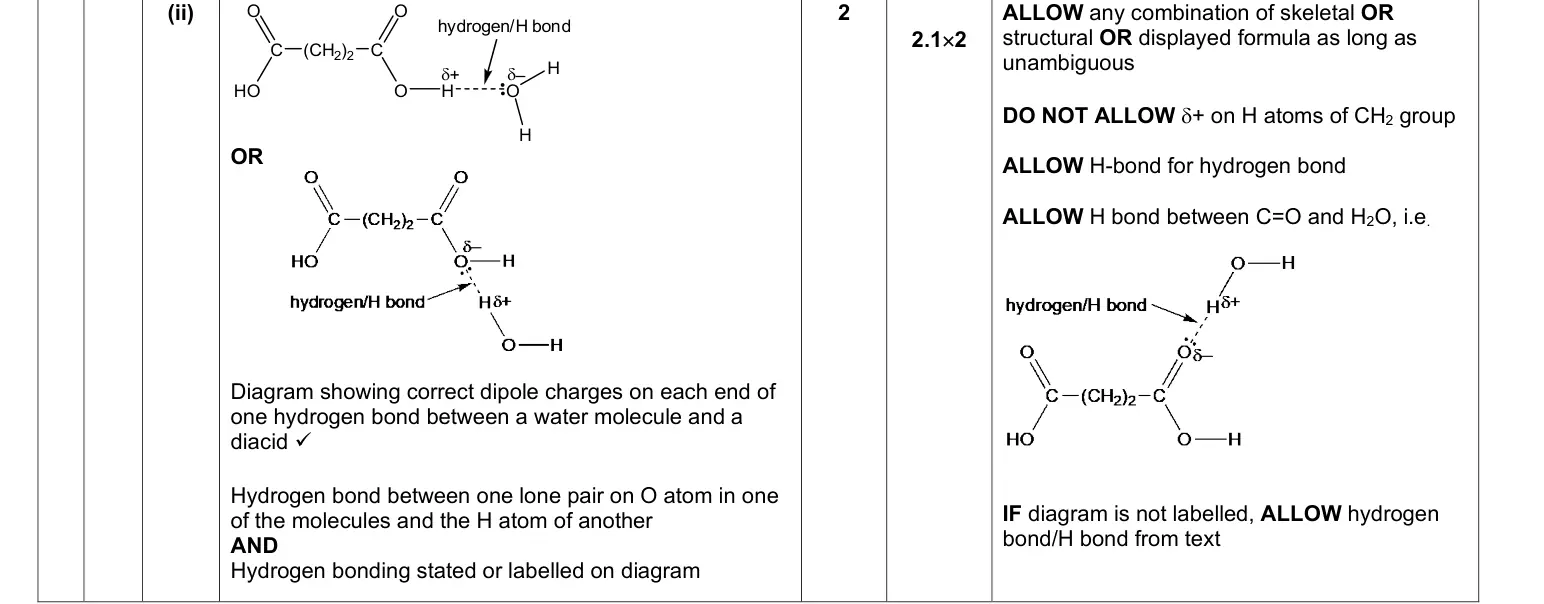
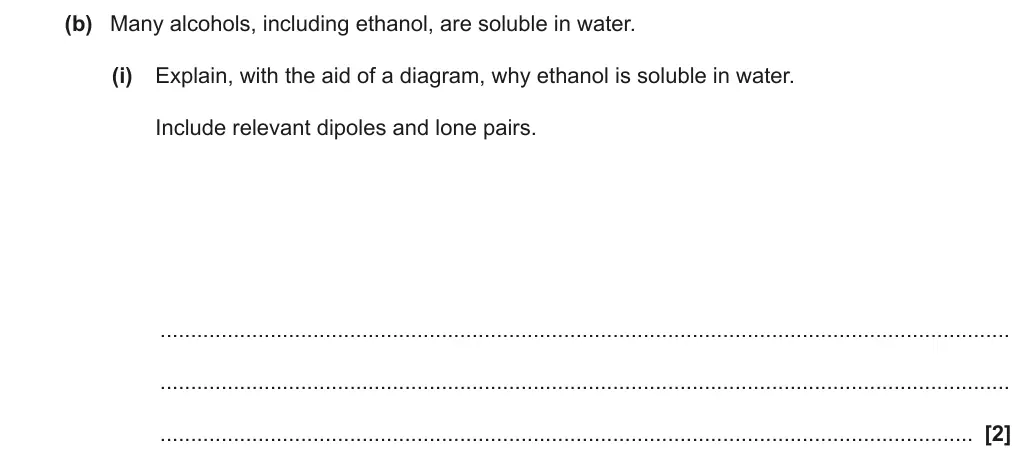
Most candidates were able to identify hydrogen bonding as being responsible for the solubility of methanoic acid. A minority of candidates did not gain any marks for this question. Some described the dissociation of methanoic acid into ions in water. Weaker candidates suggested this dissociation was sufficient to explain solubility. Some showed hydrogen bonds from H in the C-H bond in methanoic acid. Some drew hydrogen bonds from H to H or O to O. Most scored the first mark but lost the second mark usually for missing dipoles and/or lone pairs. Candidates often overcomplicated diagrams with multiple hydrogen bonds shown, increasing the likelihood of losing a mark for errors.
Notes from the mark scheme and report
hydrogen bond between HCOOH and H2O drawn and labelled
from lone pair on δ– O to δ+ H
DO NOT ALLOW H bond from H–C
DO NOT ALLOW diagram containing O2H
all hydrogen bonds shown must be correct
June 2024 · Paper 3 · Q4(a)(ii)3 marksStructure / isomerHard
Earlier part of question 4 that this part uses
Mark scheme
Examiner's comment
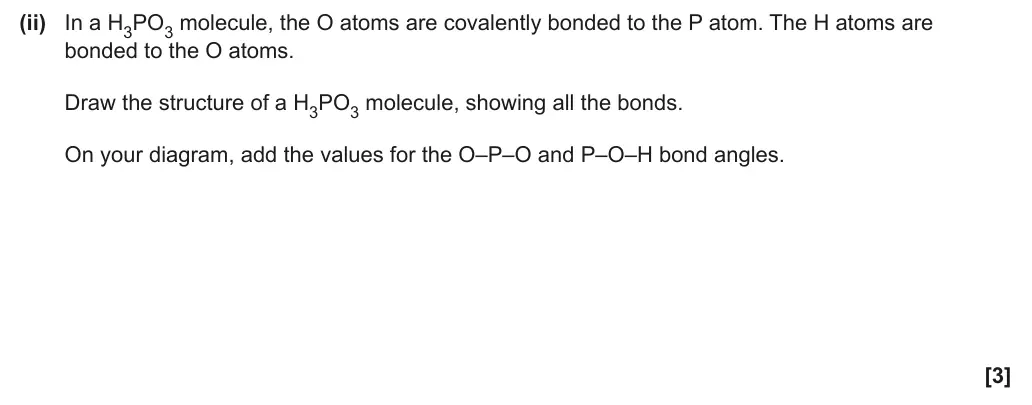
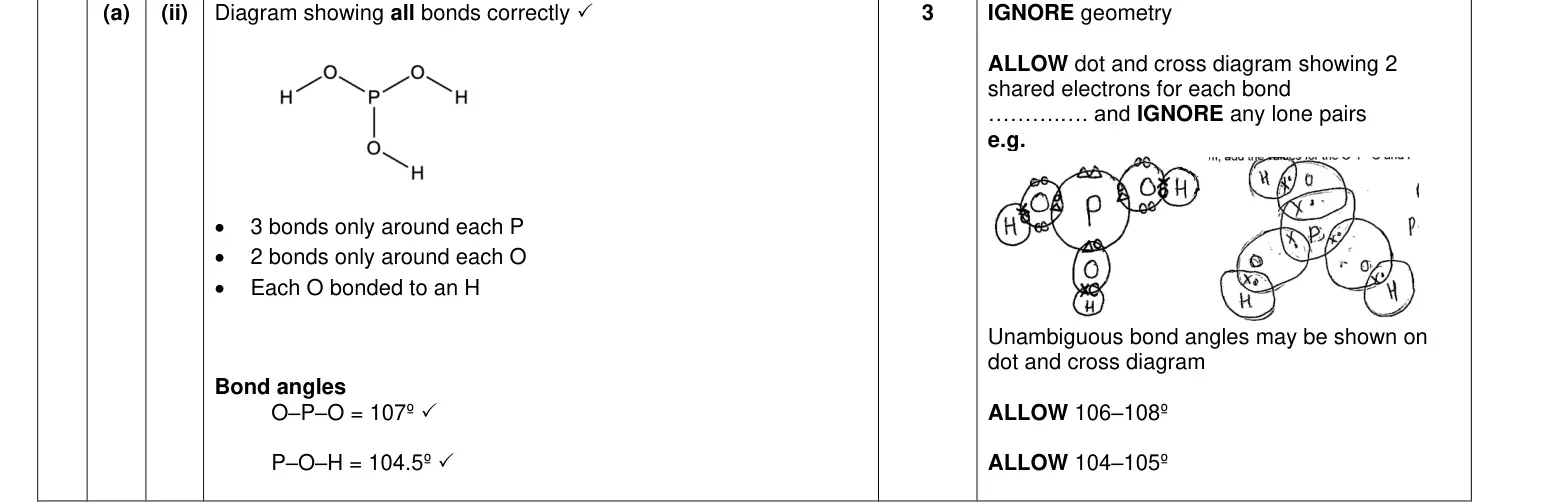
Most candidates used the information in the question to draw a correct displayed formula of H3PO3. Another acceptable approach was to show a ‘dot-and-cross’ diagram. Candidates usually chose 104.5º for the P–O–H bond angles although a significant number suggested 180º. The O–P–O bond angle proved to be more difficult. Many suggested 120º by ignoring the lone pair of electrons on the P atom. The shape was analogous with NH3 giving a bond angle of 107º. Overall, candidates answered this question well. Candidates are advised to assess the number of bonded pairs and lone pairs around each atom when suggesting bond angles. This would have reduced the number of incorrect bond angles such as 180º for P–O–H and 120º for O–P–O.
Notes from the mark scheme and report
P with 3 bonds only, each O bonded to P and H
O–P–O = 107° (ALLOW 106–108)
P–O–H = 104.5° (ALLOW 104–105)
IGNORE geometry drawn
Skills: M4.1 Use angles and shapes in regular 2-D and 3-D structures; M4.2 Visualise and represent 2-D and 3-D forms including 2-D representations of 3-D objects
June 2024 · Paper 3 · Q4(c)(iv)2 marksShort answerHard
Earlier part of question 4 that this part uses
Mark scheme
Examiner's comment
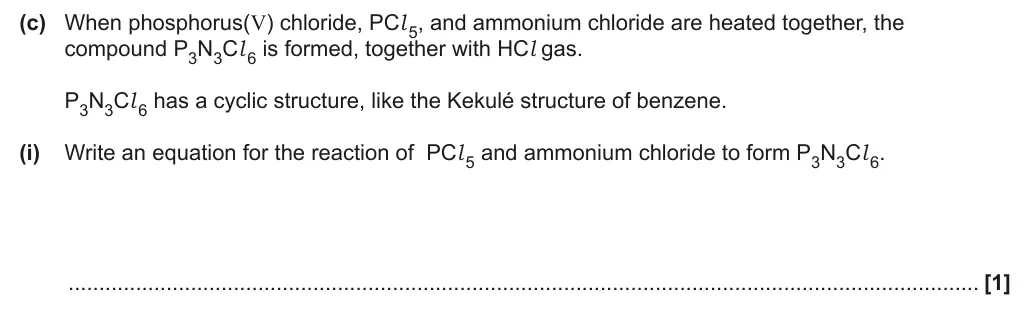
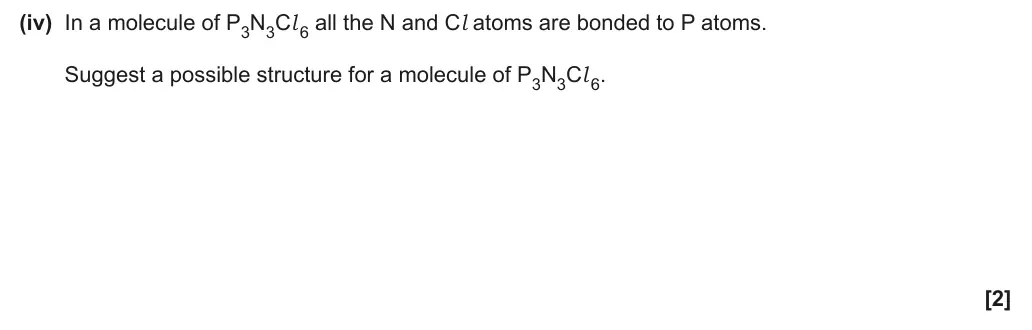
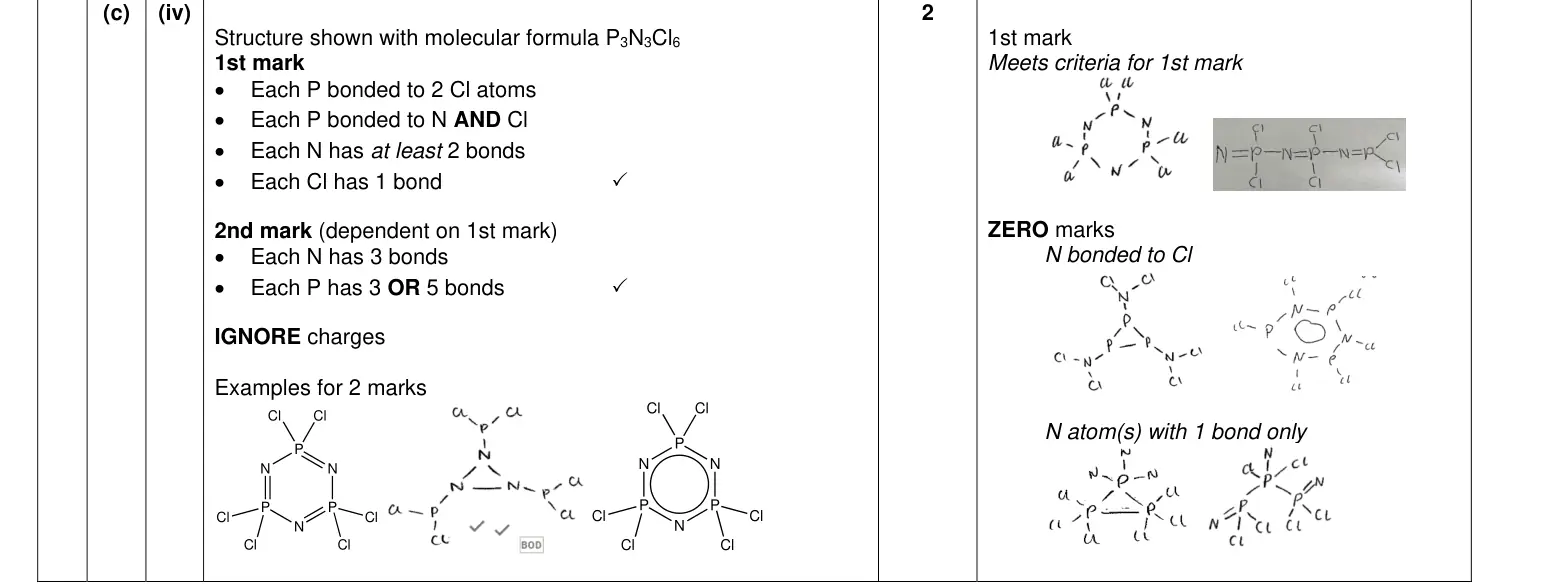
This was another question where valuable information: ’all N and Cl atoms are bonded to P atoms’ had been provided. Many of the structures seen ignored this information with chlorine often been shown bonded to a nitrogen atom. Nitrogen atoms were often shown with 1 bond only and chlorine atoms in the ring structure with 2 or more bonds. Most structures contained 6 or 3-membered rings. This was a difficult question, requiring candidates to use the supplied information to come up with realistic structures that met chemical bonding rules. Only about a quarter of candidates could be given any mark. The Kekulé theme in Questions 4 (c) (i) - (iv) should have prompted candidates that a Kekulé structure was likely here. Several other structures were allowed providing that they met normal chemistry bonding rules.
Notes from the mark scheme and report
six-membered alternating P–N ring
each P bonded to 2 Cl
each N with 3 bonds and each P with 5 (or 3) bonds for second mark
zero marks if N bonded to Cl or N with only 1 bond
Skills: M4.2 Visualise and represent 2-D and 3-D forms including 2-D representations of 3-D objects
June 2023 · AS Paper 1 · Q11 markAO1Multiple choiceEasy
Answer
B
Mark scheme
Examiner's comment
Almost all candidates selected the correct response of B. The main distractor proved to be D, the other type of dipole–dipole interaction.
June 2023 · Paper 1 · Q51 markAO1Multiple choiceMedium
Answer
A
Mark scheme
Examiner's comment
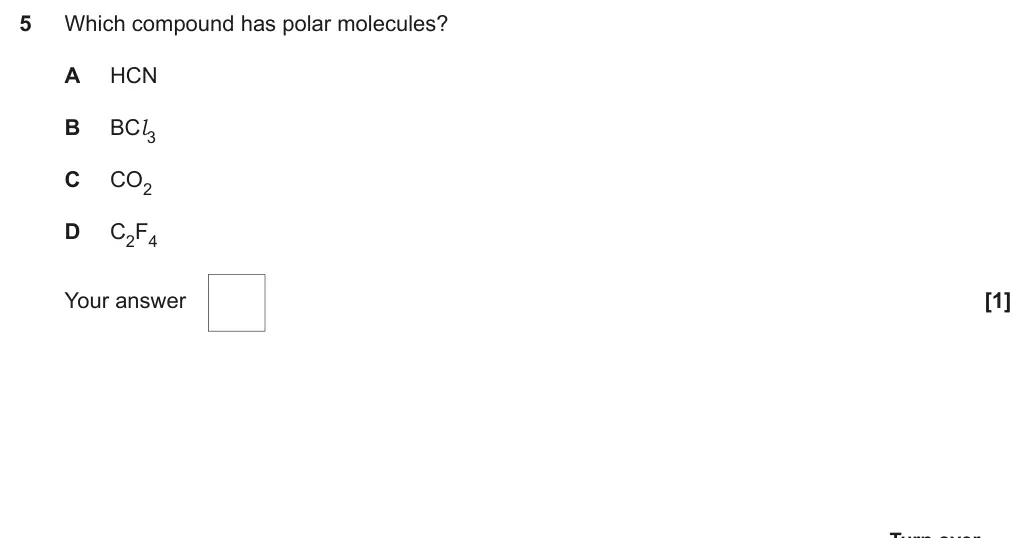
Most candidates recognised HCN to be linear and therefore polar due to lack of symmetry – answer A. The most common error was D.
June 2023 · Paper 1 · Q131 markAO1Multiple choiceMedium
Answer
B
Mark scheme
Examiner's comment
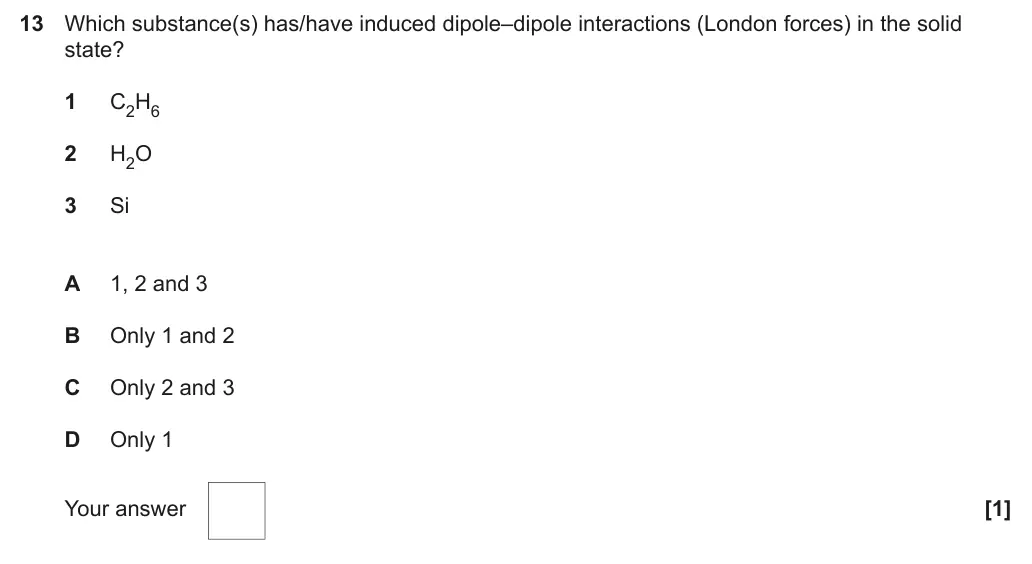
The correct answer was B. Most candidates did not recognise that Si has covalent bonds between atoms so included it or did not recognise that water forms London forces as well as hydrogen bonds and therefore excluded it.
June 2023 · AS Paper 1 · Q21(a)(i)1 markAO1Short answerEasy
Mark scheme
Examiner's comment
Most candidates correctly described a covalent bond as a shared pair of electrons. Where this mark was dropped, it was usually because of the omission of ‘pair’ or ‘shared’, e.g. ‘shared electrons’.
Notes from the mark scheme and report
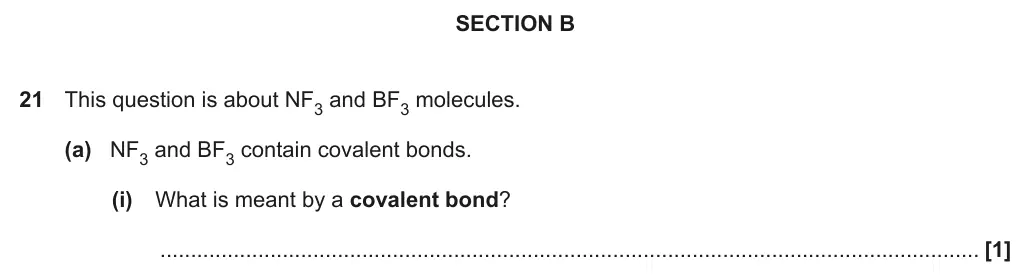
shared pair of electrons
IGNORE comments about attraction between nuclei and the shared pair
June 2023 · AS Paper 1 · Q21(a)(ii)2 marksAO2Drawing / labellingHard
Earlier part of question 21 that this part uses
Mark scheme
Examiner's comment
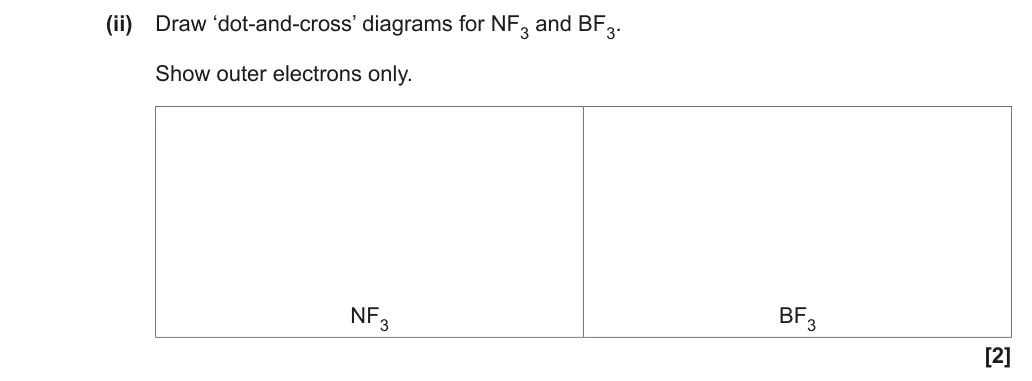
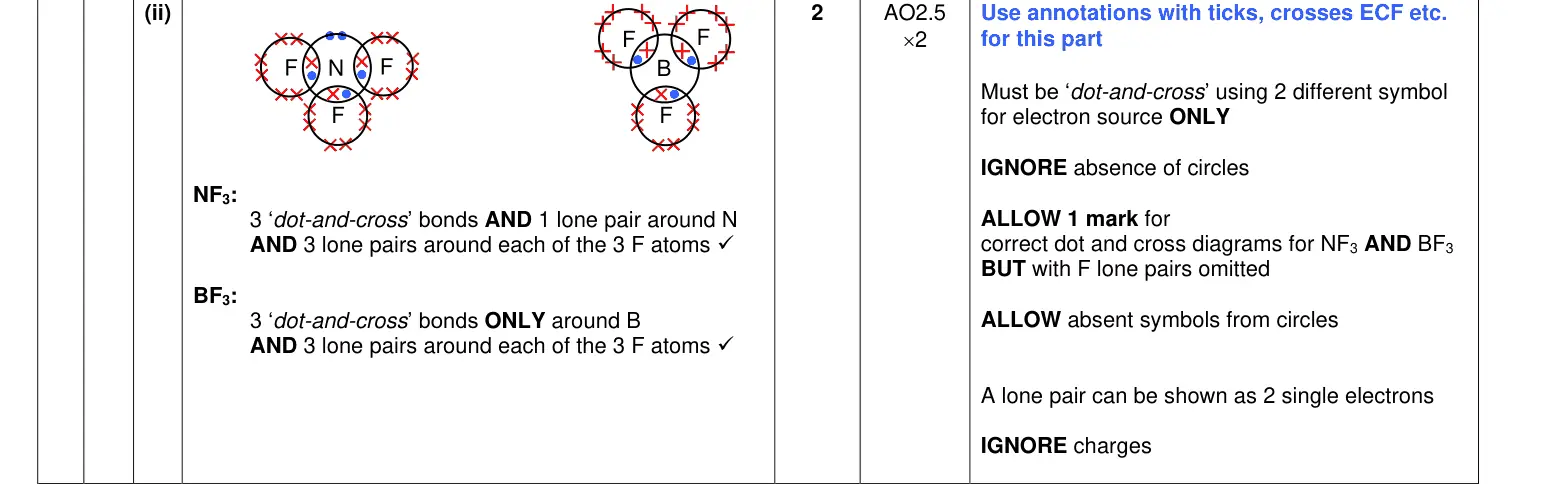
The ‘dot-and-cross’ diagrams were usually correct. Errors were commonly the result of missing a lone pair of electrons from one or more fluorine atoms. BF3 was the more challenging diagram suggesting that some candidates were unfamiliar with molecules with less than an octet in their outer shell. Some candidates used two electrons from one of the fluorine atoms to show a double bond around the central B atom to complete the octet.
Notes from the mark scheme and report
two different symbols needed
N has one lone pair, B has none
1 mark if both correct but F lone pairs omitted
IGNORE absence of circles
June 2023 · AS Paper 1 · Q21(b)(i)2 marksAO1Short answerMedium
Earlier part of question 21 that this part uses
Mark scheme
Examiner's comment
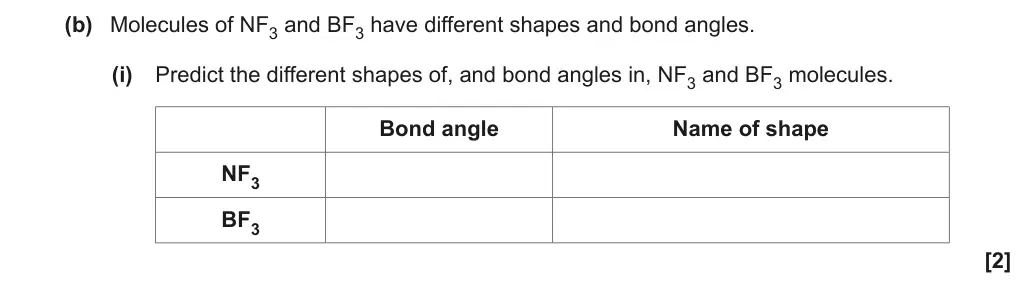
This bond angles and shapes rewarded the well-prepared candidates, with many being given both available marks. The commonest error was NH3 shown with a tetrahedral shape and a bond angle of 109.5º. This part discriminated very well.
Skills: M4.1 Use angles and shapes in regular 2-D and 3-D structures
June 2023 · AS Paper 1 · Q21(b)(ii)2 marksAO1Short answerMedium
Earlier part of question 21 that this part uses
Mark scheme
Examiner's comment
Most students had the right idea here, but some lacked the detail for the marks. Some discussed repulsion in general terms, without referring the number of electron pairs. This question discriminated very well.
Notes from the mark scheme and report
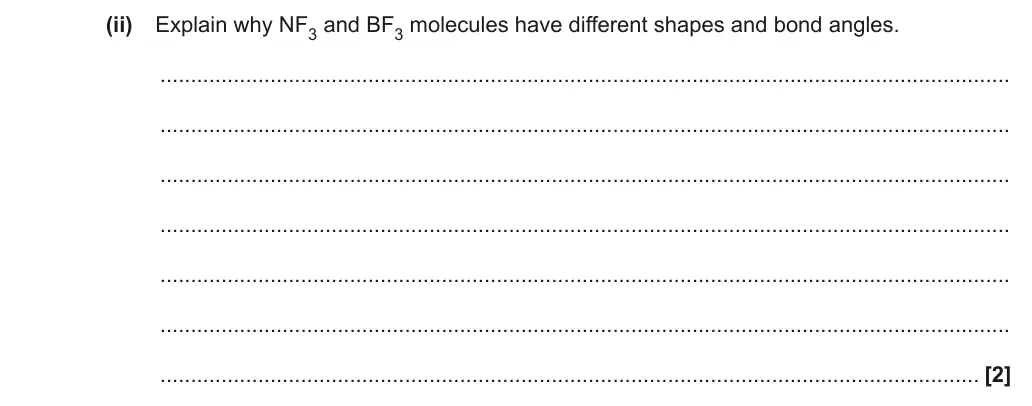
NF3 has 3 bonded pairs AND 1 lone pair AND lone pairs repel more
BF3 has 3 bonded pairs
IGNORE 'electrons repel'
DO NOT ALLOW 'atoms repel'
Many students can describe electron pair repulsion theory but many think that molecular shapes are determined by lone pairs, with bonded pairs often being ignored. Others seem to believe that lone pairs repel atoms. In this question, explanations sometimes claimed that NF3 and BF3 molecules have different shapes because a NF3 molecule has a lone pair, resulting in no credit.
June 2023 · AS Paper 1 · Q25(a)2 marksAO1Short answerHard
Mark scheme
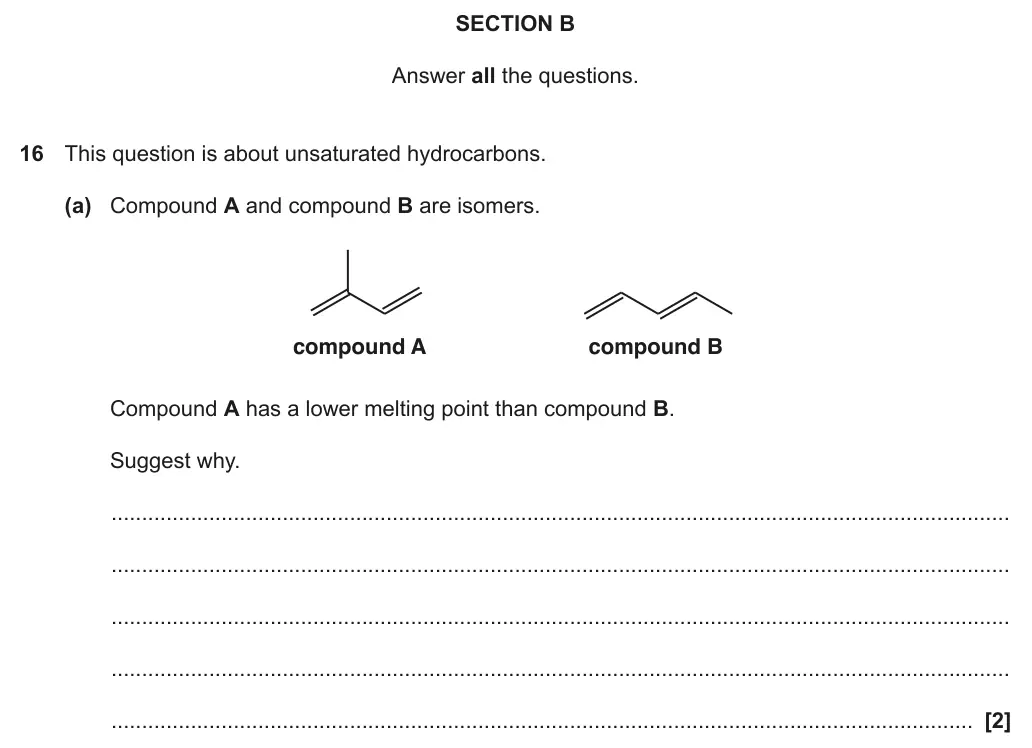
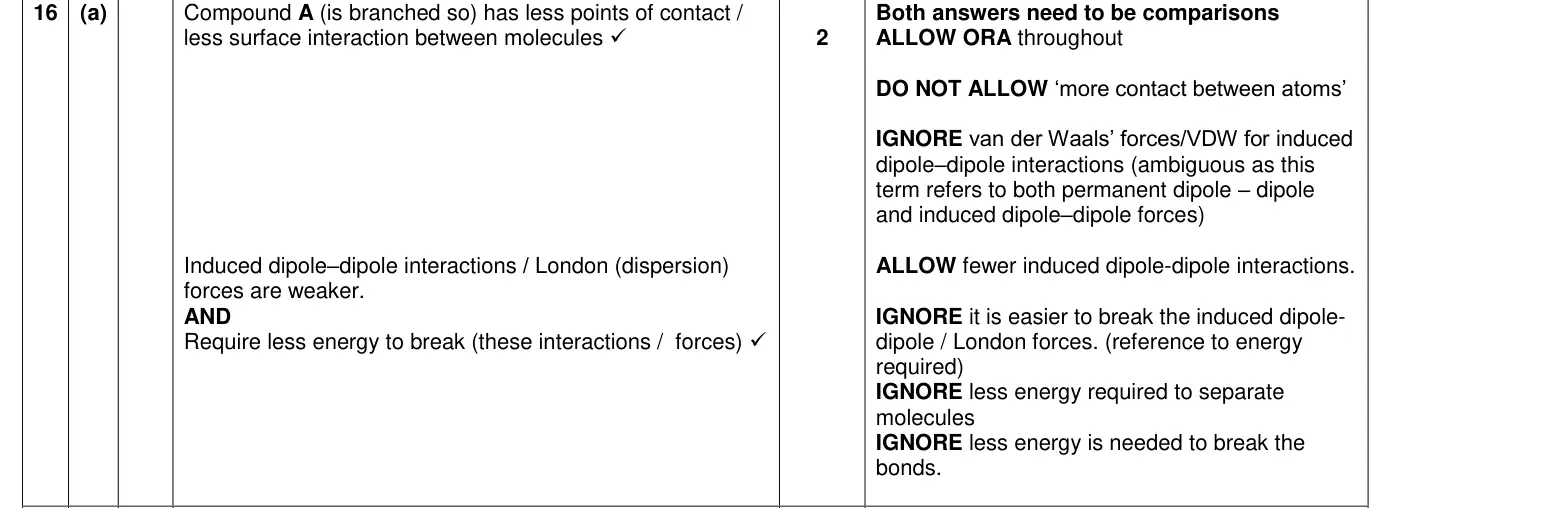
Examiner's comment
Most candidates were given 1 or 2 marks, with some omitting the idea of surface area or surface contact. Most candidates identified London forces or induced dipole interactions as the relevant intermolecular force. A few candidates gave a general comment in terms of ‘intermolecular’ forces without specifying the type of intermolecular forces. There has been a general improvement in candidate responses to this type of question with fewer candidates than in previous exams suggesting the breaking of hydrogen bonds or covalent bonds.
Notes from the mark scheme and report
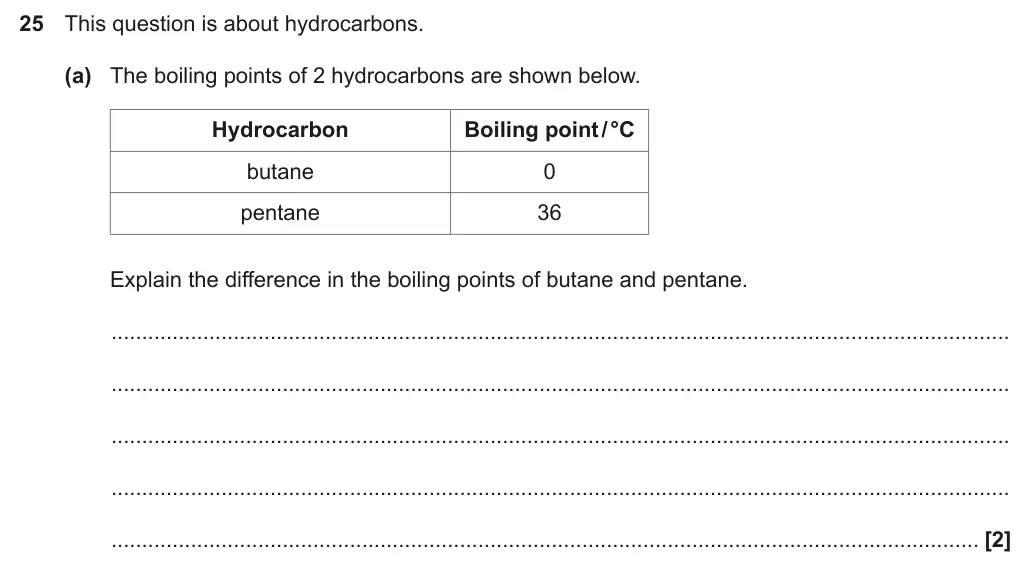
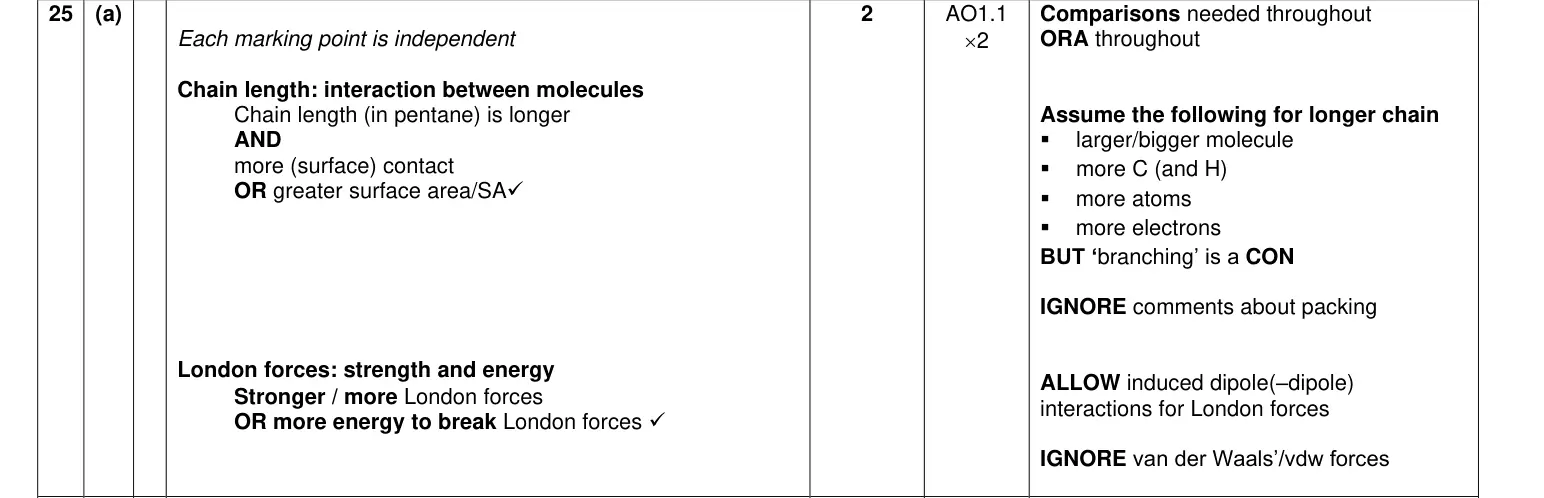
comparisons needed
longer chain so more surface contact
stronger/more London forces need more energy to break
'branching' is a CON
IGNORE van der Waals' forces
June 2023 · AS Paper 2 · Q1(b)(iii)2 marksAO3Short answerMedium
Earlier part of question 1 that this part uses
Mark scheme
Examiner's comment
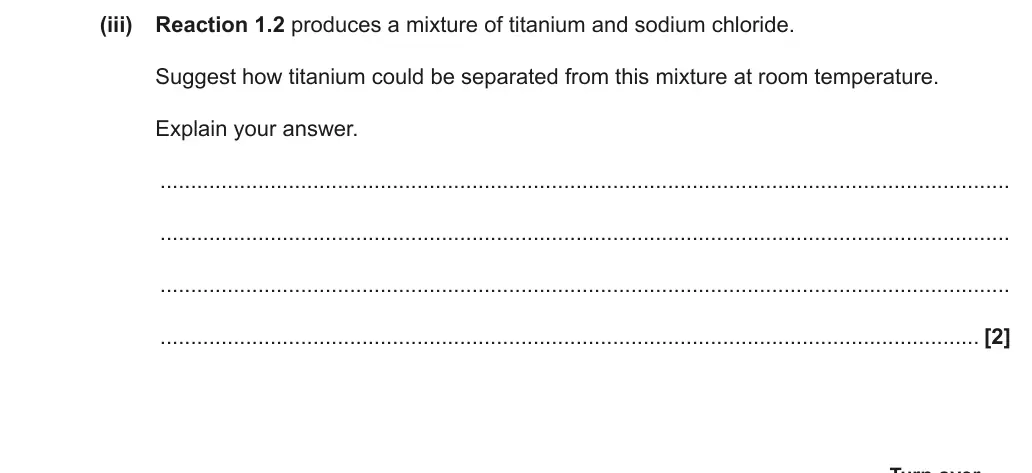
Most candidates did not gain any credit here. However, the range of responses seen highlighted some misconceptions in their understanding of how different mixtures can be separated. Many assumed that sodium chloride was in solution/aqueous, not recognising that water was not present in this reaction. Responses such as “sodium chloride will evaporate” or “remove the water” were seen. Some gave a description of the purification method for an organic liquid - the use of a separating funnel and/or distillation were common. Some suggested the use of a magnet to remove Ti despite it being a non- magnetic metal.
Notes from the mark scheme and report
add water AND filter
NaCl dissolves / Ti insoluble (Ti is the residue)
Understanding how to separate mixtures is covered in both KS3 and KS4 but it is important that these concepts can be applied during further study. Asking this type of problem solving question would make a good starter activity.
Some useful activities for separating mixtures can be found in the GCSE Chemistry B (Twenty First Century Science) Chemical analysis transition guide
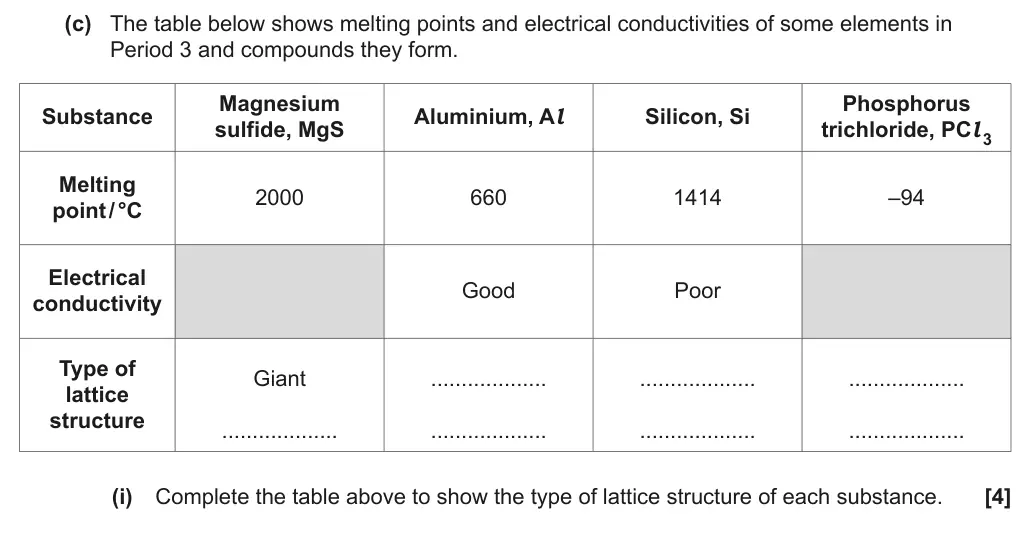
June 2023 · AS Paper 2 · Q2(c)(i)4 marksAO1, 2Complete table/diagramMedium
Mark scheme
Examiner's comment
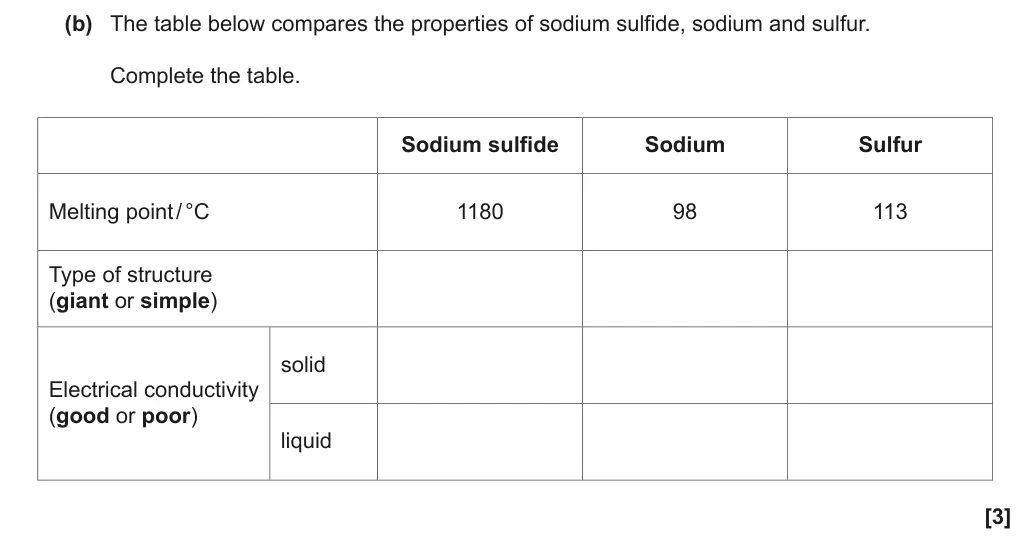
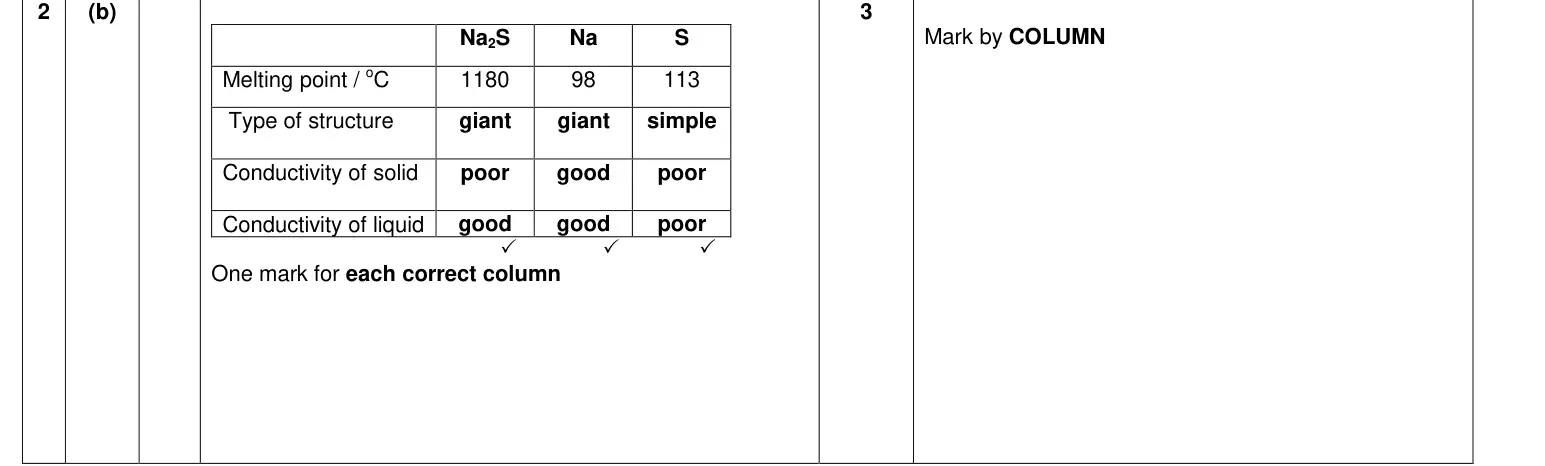
About half the candidates gained all 4 marks. Candidates often find it tricky to recognise the type of structure even when given some details about physical properties. Often giant was omitted especially for Al as metallic bonding. Some used ‘small’ in place of ‘simple’. Common errors included MgS as metallic and Si as simple covalent with PCl3 as giant covalent. Many added unnecessary detail such as filling in the greyed-out boxes for conductivity or adding lattice to each box.
June 2023 · AS Paper 2 · Q2(c)(ii)4 marksAO1, 2, 3Short answerMedium
Earlier part of question 2 that this part uses
Mark scheme
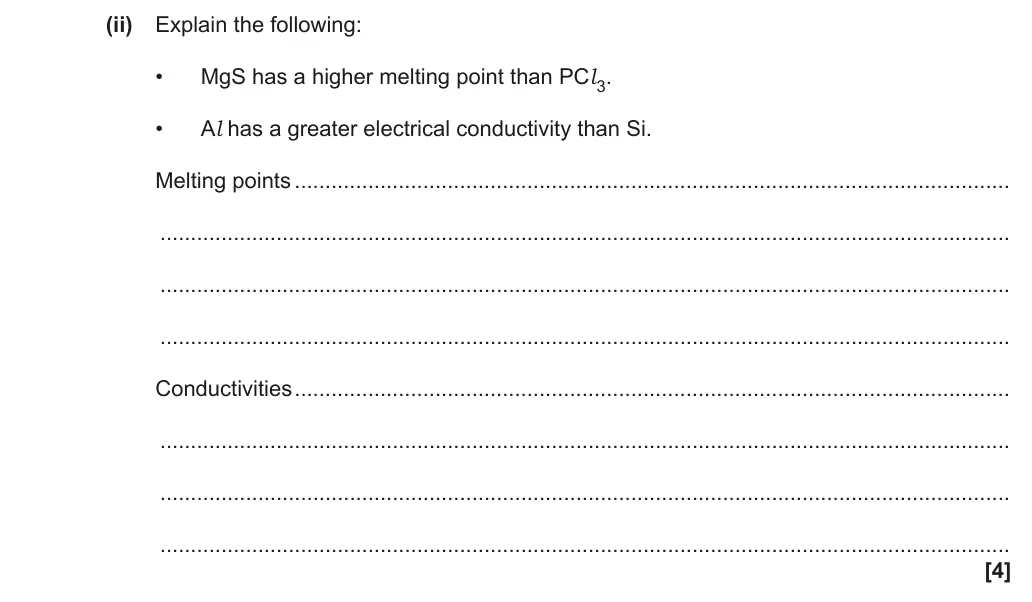
Examiner's comment
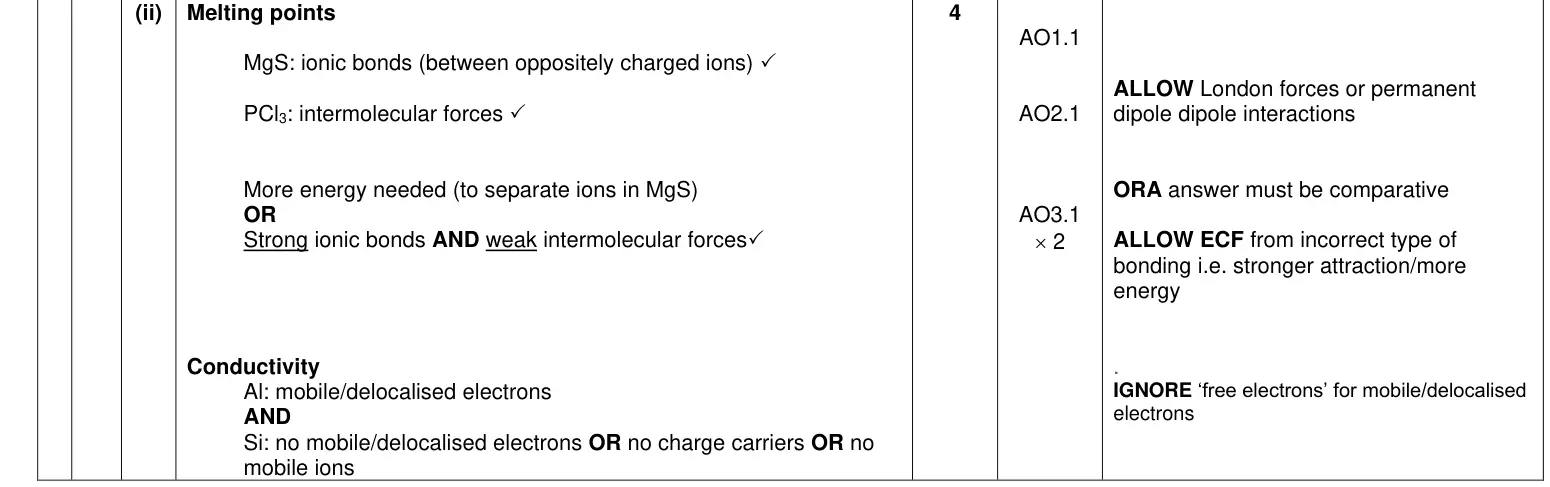
Candidate explanations often lacked clarity even if the correct structure had been identified in (i). Most gained at least 1 mark, usually for recognising that for MgS to have a higher melting point that it must contain stronger bonds than in PCl3. Responses highlighted a range of misconceptions including the presence of intermolecular forces in ionic/metallic substances, oppositely charged atoms in ionic compounds, and thinking London forces are between atoms. Most were able to gain the conductivity mark, but some compared to PCl3 rather than Si as asked in the question. Some described ‘mobile ions’ in Al or that Si has ‘no electrons’. The use of ‘free electrons’ was seen in many responses, and we would encourage the use of ‘delocalised electrons’ for a more accurate description of metallic bonding.
Notes from the mark scheme and report
answer must be comparative
MgS ionic bonds vs PCl3 intermolecular forces
Al delocalised/mobile electrons, Si none
IGNORE 'free electrons'
OCR have produced a KS4-KS5 transition guide for bonding and structure to support teaching of these tricky concepts.
A bonding delivery guide is also available.
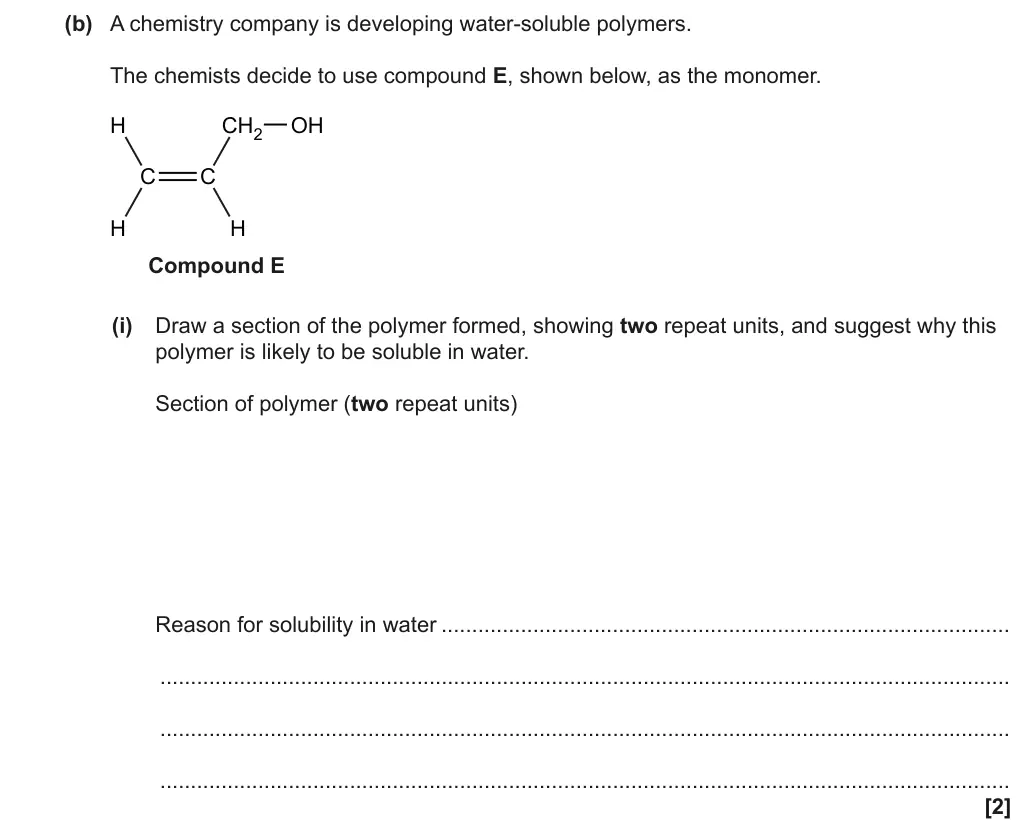
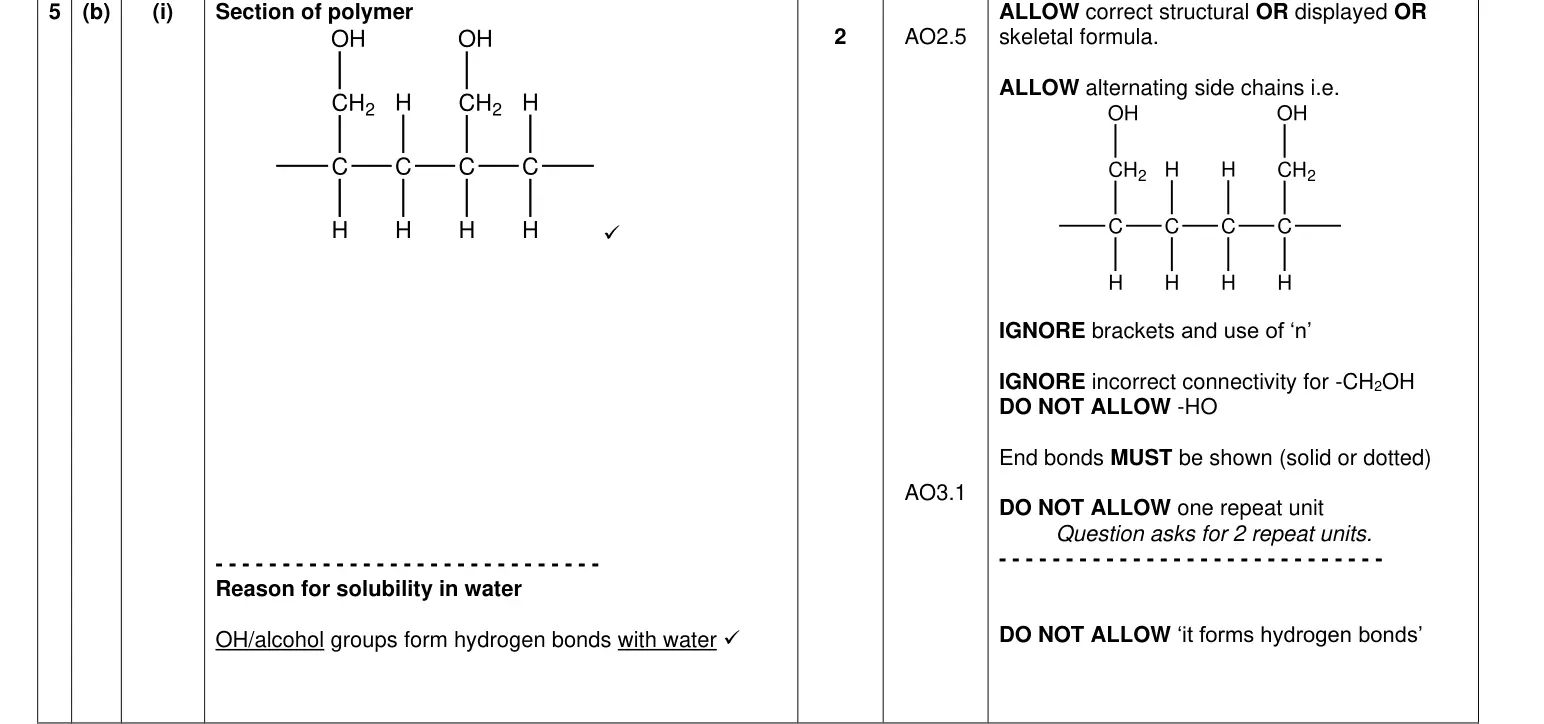
June 2023 · AS Paper 2 · Q5(b)(i)2 marksAO2, 3Drawing / labellingMedium
Mark scheme
Examiner's comment
Most candidates were able to gain credit for their structure, with only a few missing out by only drawing one repeat unit, keeping the C=C, having no end bonds or missing/extra Hs. Lots struggled to gain the second mark for the reason for solubility in water as they didn't refer to H-bonding. There were quite a few misconceptions highlighted in the responses to this question. These included the misunderstanding that a H-bond is an an intermolecular force between -OH on alcohol and water, rather than the covalent bond in the molecule. Some thought the -OH would behave as an alkali, even referring to ions, so would ‘fully dissociate’. Some described a reaction with water and breaking apart, perhaps confusing with condensation polymers which can be hydrolysed.
Notes from the mark scheme and report
two repeat units with end bonds shown (DO NOT ALLOW one repeat unit)
OH groups form hydrogen bonds with water (DO NOT ALLOW 'it forms hydrogen bonds')
DO NOT ALLOW –HO connectivity
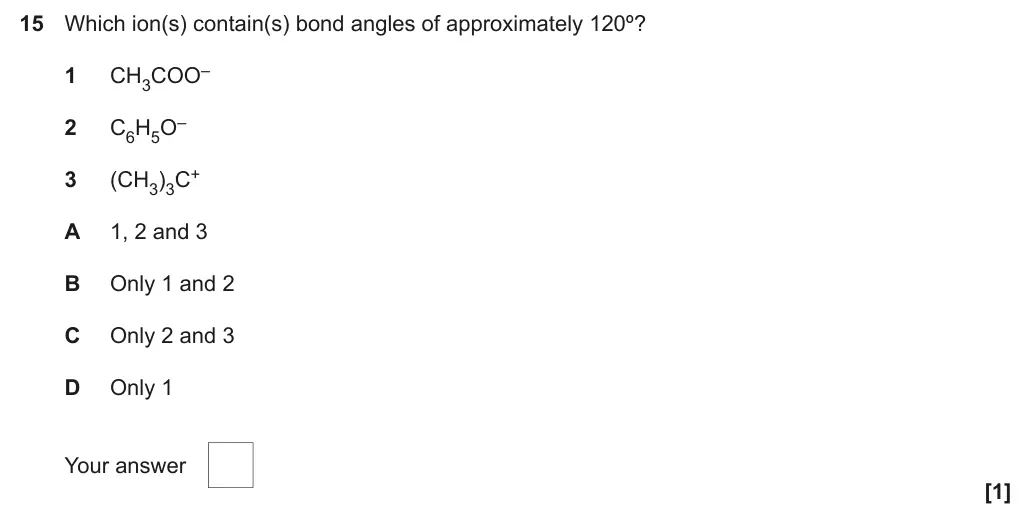
June 2023 · Paper 2 · Q151 markAO1Multiple choiceMedium
Answer
A
Mark scheme
Examiner's comment
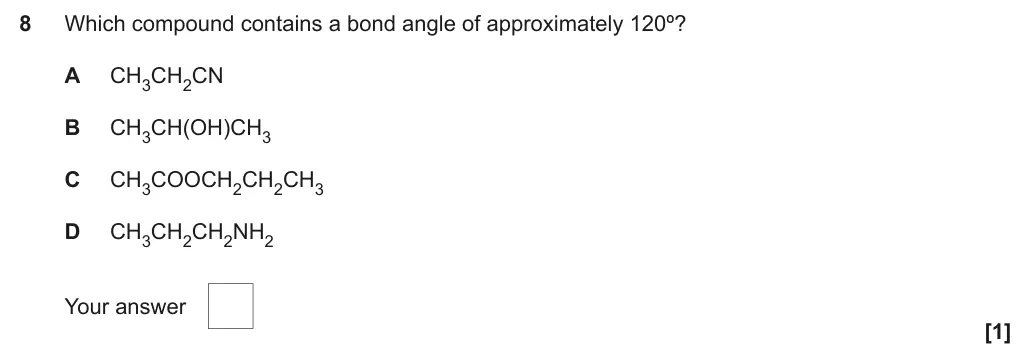
Fewer than a third of candidates gave the correct response, A. Most identified that compounds 1 and 2 contain a bond angle of approximately 120° and consequentially selected option B. Only the most able candidates were able to apply their understanding of shapes to deduce that the carbocation would also exhibit trigonal planar geometry. Section B overview Section B includes a mixture of short answer and extended response questions, including two questions marked using a level of response mark scheme (Questions 19 and 23). This section of the paper is worth 85 marks.
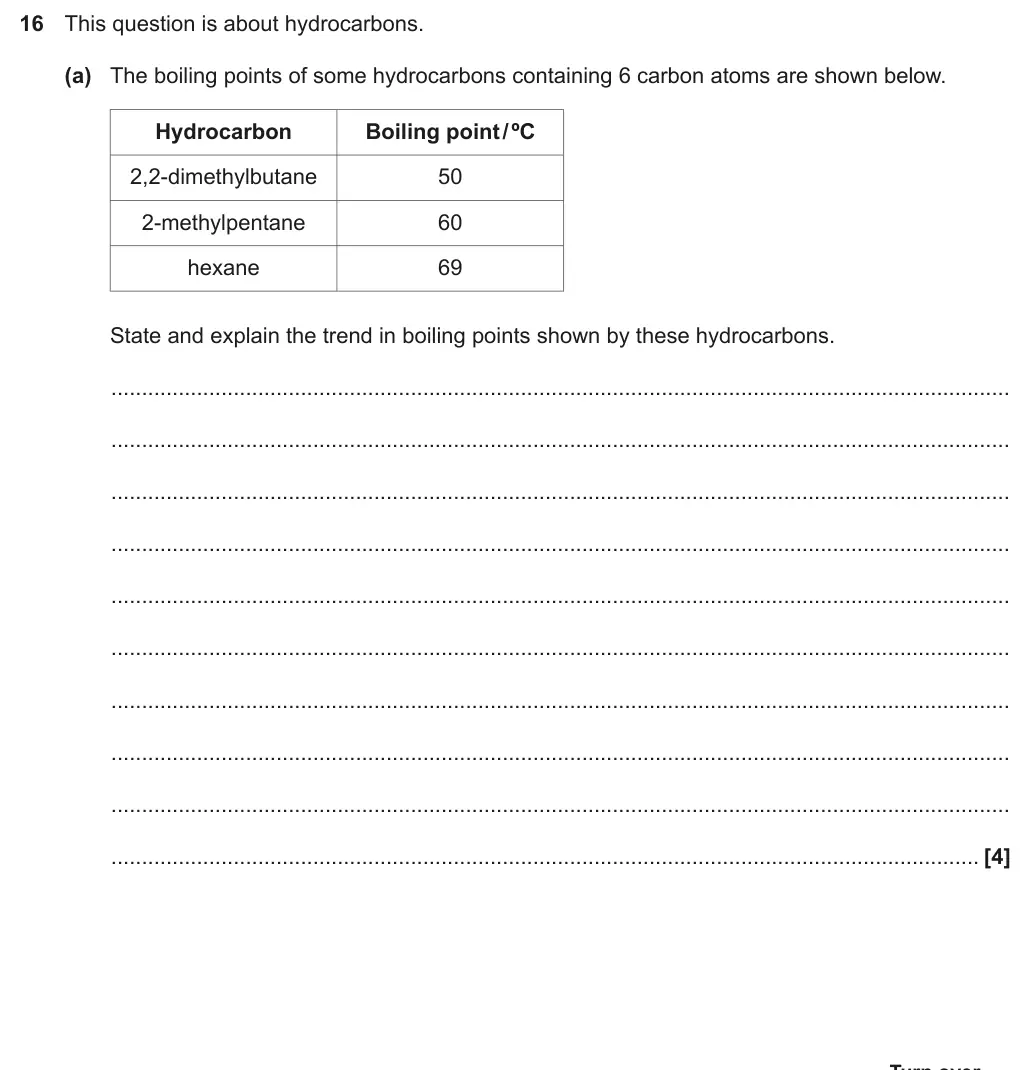
June 2023 · Paper 2 · Q16(a)4 marksAO1Short answerHard
Mark scheme
Examiner's comment
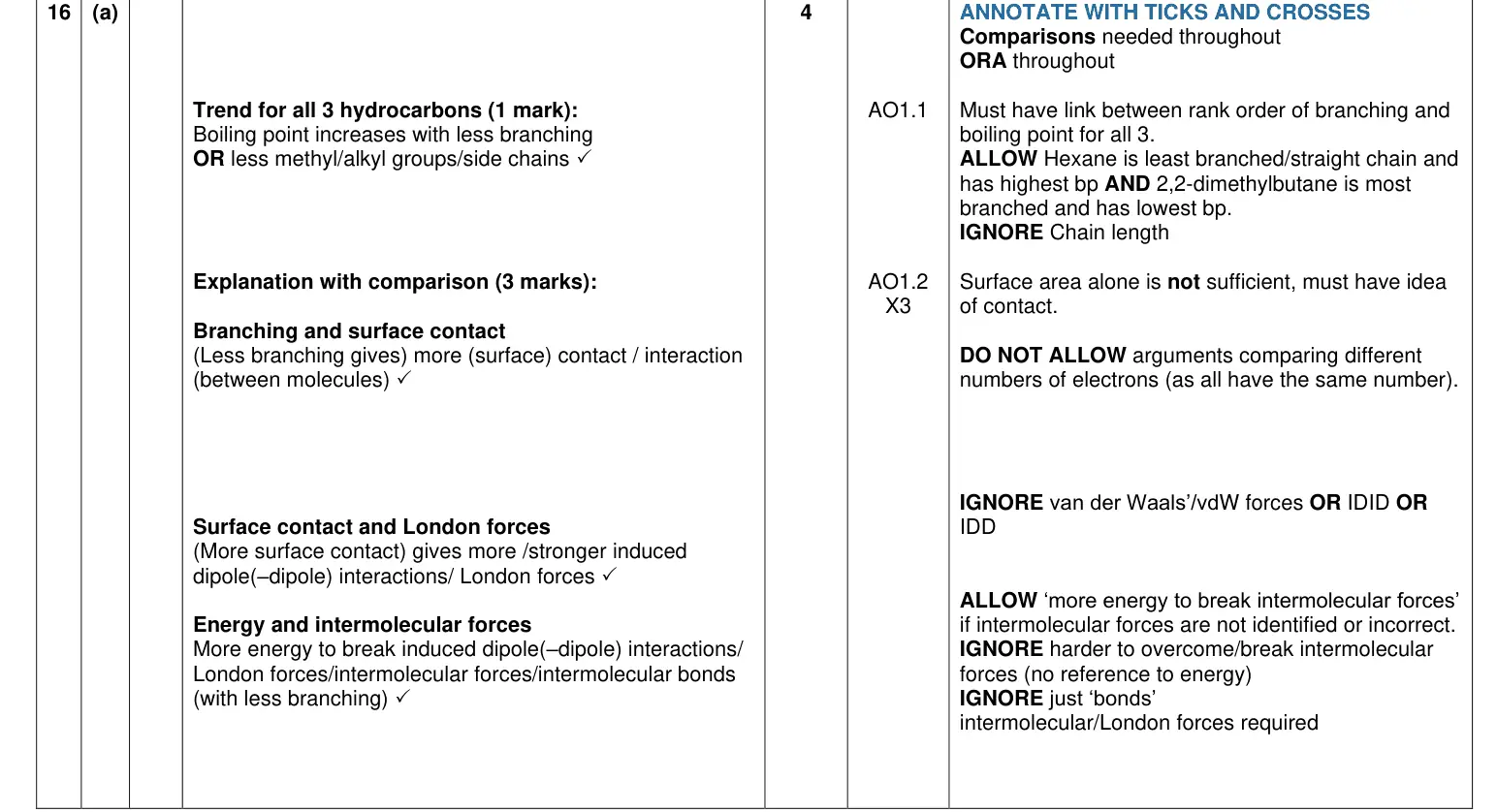
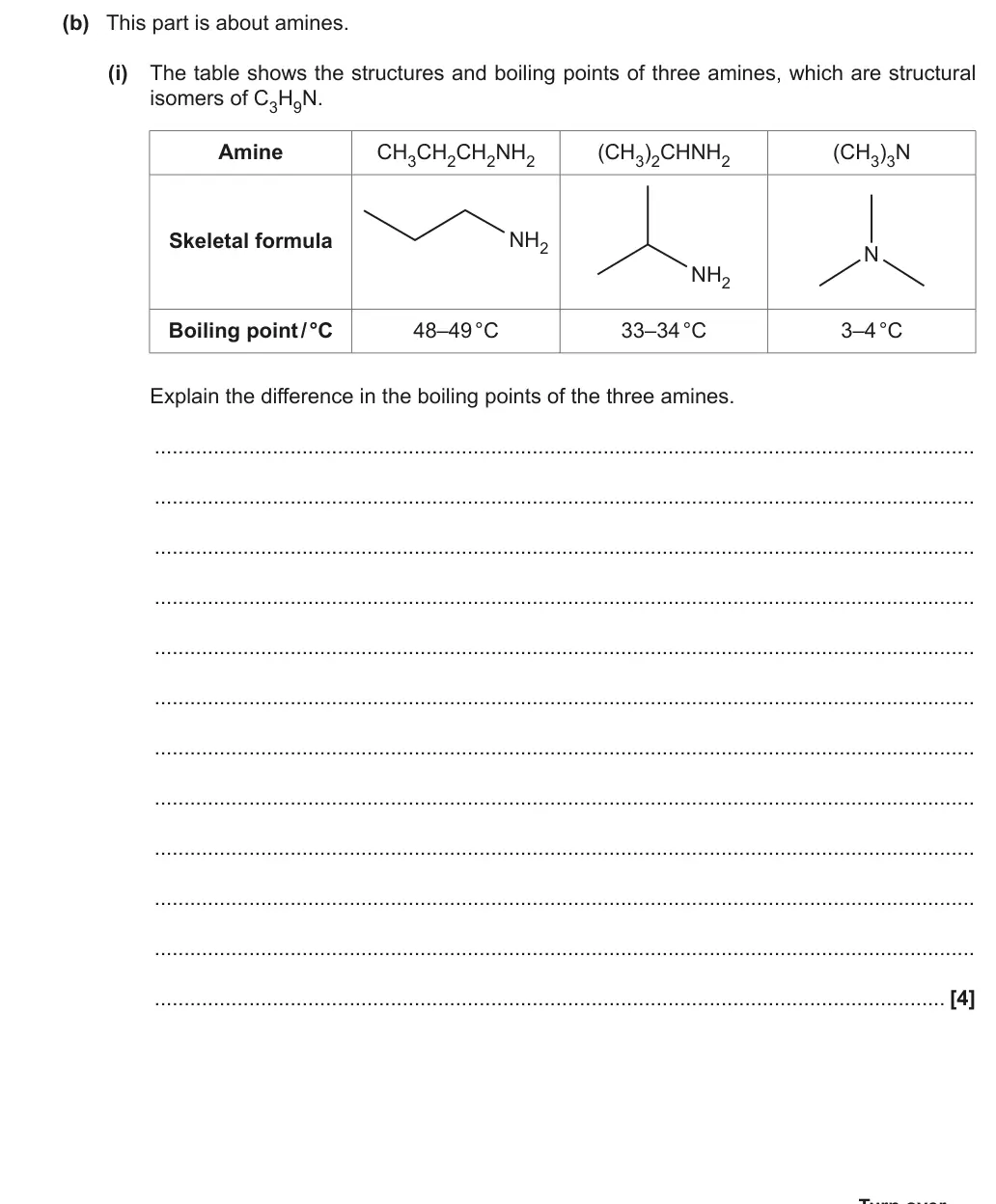
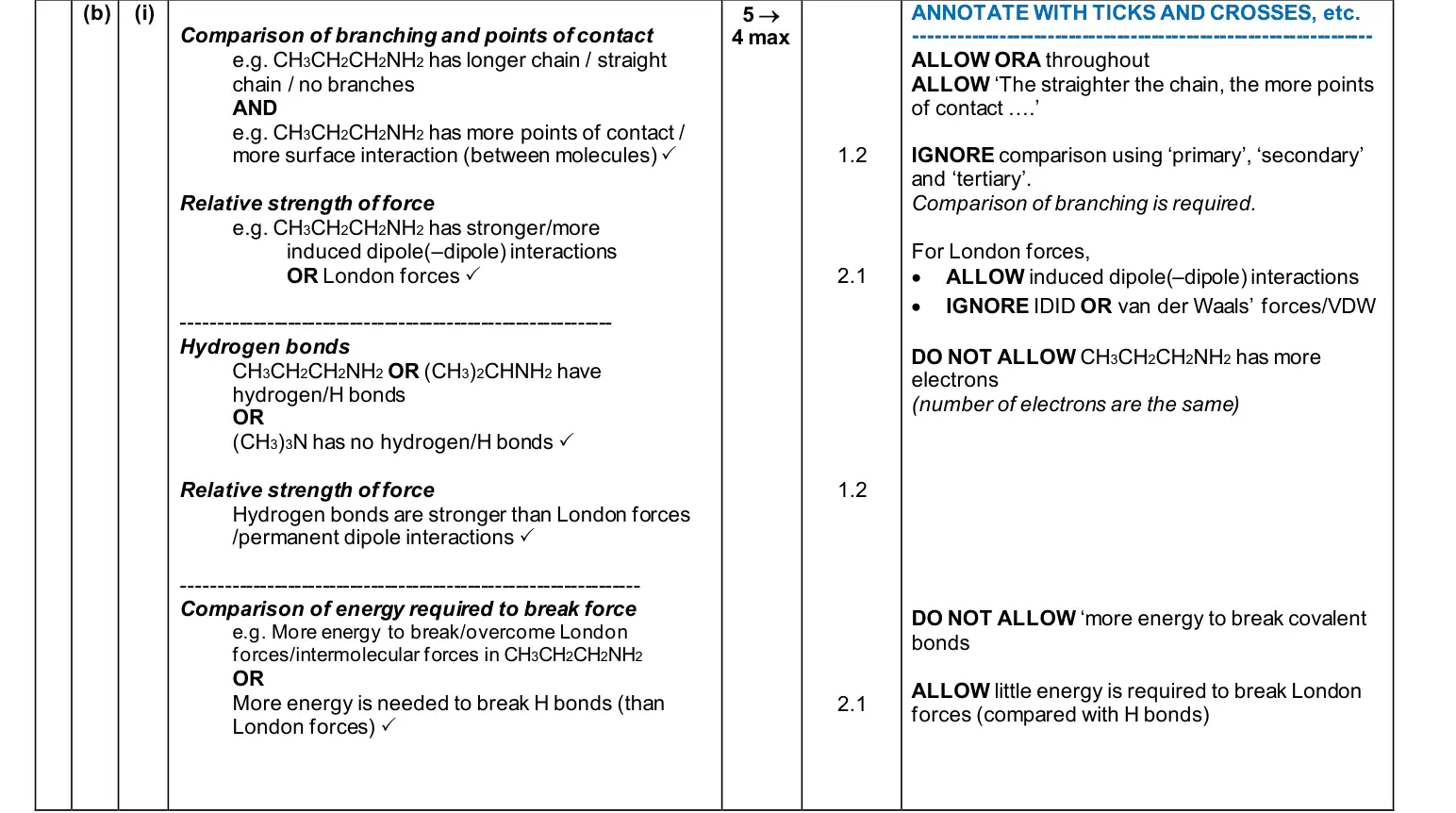
Most candidates attempted this question, gaining at least 1 mark, with over half scoring 3 or more marks. Responses often lacked clarity as many candidates struggled to articulate their ideas. It was common to see lengthy responses often with unnecessary repetition and sometimes even contradictions. A good strategy adopted by some was to draw skeletal formulae for the compounds next to the data provided. This enabled them to focus their response more easily on the extent of branching. Many candidates were unable to give a clear trend for the first marking point, as asked for in the question, but were able gain credit by a lengthier comparison of all three as indicated in the extra guidance. However, this mark was often lost through incomplete explanation, not referring to boiling point at all or an attempt to compare just chain length. The most common error for the second mark was omission of ‘contact’ or ‘interaction’ with reference only to surface area or ‘packing’ of molecules. Some lost this mark for a change in number of electrons. The third marking point was the most frequently awarded. Some candidates lost the mark for not explicitly naming the intermolecular forces as London forces/induced dipole-dipole interactions or for incorrectly using van der Waals. Some lost the mark for not explicitly indicating how increased or decreased contact would affect the strength or magnitude of London forces, e.g. ‘less contact to form London forces’. The final mark was harder to obtain as it needed to be clear that energy was required to break intermolecular forces. For example, ‘less energy to break bonds’ or ‘easier to separate the molecules’ or ‘more energy to boil’ were not sufficient. This exemplar shows a clear, concise response. The candidate has drawn skeletal structures next to the table. The trend is stated first followed by a detailed explanation, presented as a bullet point list, with all 4 marking points awarded.
Notes from the mark scheme and report
comparisons needed throughout
must rank all three by branching
surface contact not just surface area
DO NOT ALLOW different numbers of electrons (all the same)
more energy to break London forces
IGNORE 'bonds' alone and chain length
Responses often highlighted that candidates lacked understanding about what London forces are, e.g. indicating that they form ‘between atoms’ or referring to induced dipole-dipole forces as something else. Intermolecular forces are difficult to fully comprehend as they can’t be visualised making this a challenging topic to teach.
OCR have produced a ‘Bonding’ teaching guide with lots of useful suggestions and resources. This includes a link to this Salters A Level chemistry revision activity on intermolecular bonding
June 2023 · Paper 3 · Q1(a)1 markAO1Short answerMedium
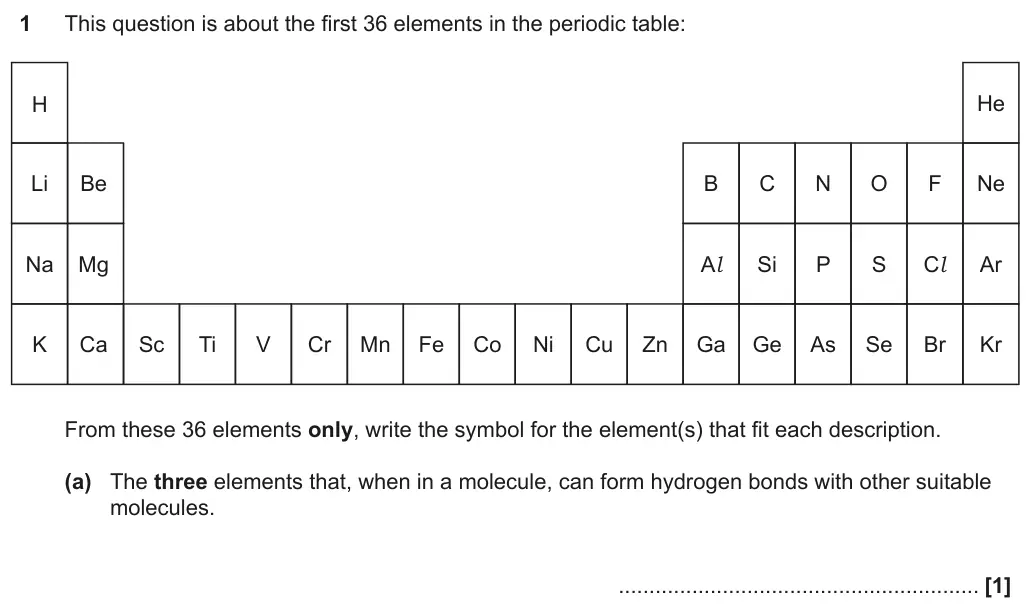
Mark scheme
Examiner's comment
Most candidates selected N, O and F, with other responses choosing other elements seemingly at random.
Notes from the mark scheme and report
three from N, O, F, H
DO NOT ALLOW any other elements (CON)
June 2023 · Paper 3 · Q1(c)1 markAO1Short answerMedium
Earlier part of question 1 that this part uses
Mark scheme
Examiner's comment
Candidates found this question harder than Questions 1 (a) and (b) with S and P being the most common correct elements seen. As and Se were also allowed. Si was a common incorrect response.
Notes from the mark scheme and report
P or S
ALLOW S8, P4, As, Se
June 2023 · Paper 3 · Q1(f)1 markAO2Short answerMedium
Earlier part of question 1 that this part uses
Mark scheme
Examiner's comment
The answer S was well known, with SF6 being the specification example of a compound with octahedral molecules.
Notes from the mark scheme and report
S
ALLOW SF6
Skills: M4.1 Use angles and shapes in regular 2-D and 3-D structures
June 2023 · Paper 3 · Q6(a)4 marksAO1, 2Short answerHard
Mark scheme
Examiner's comment
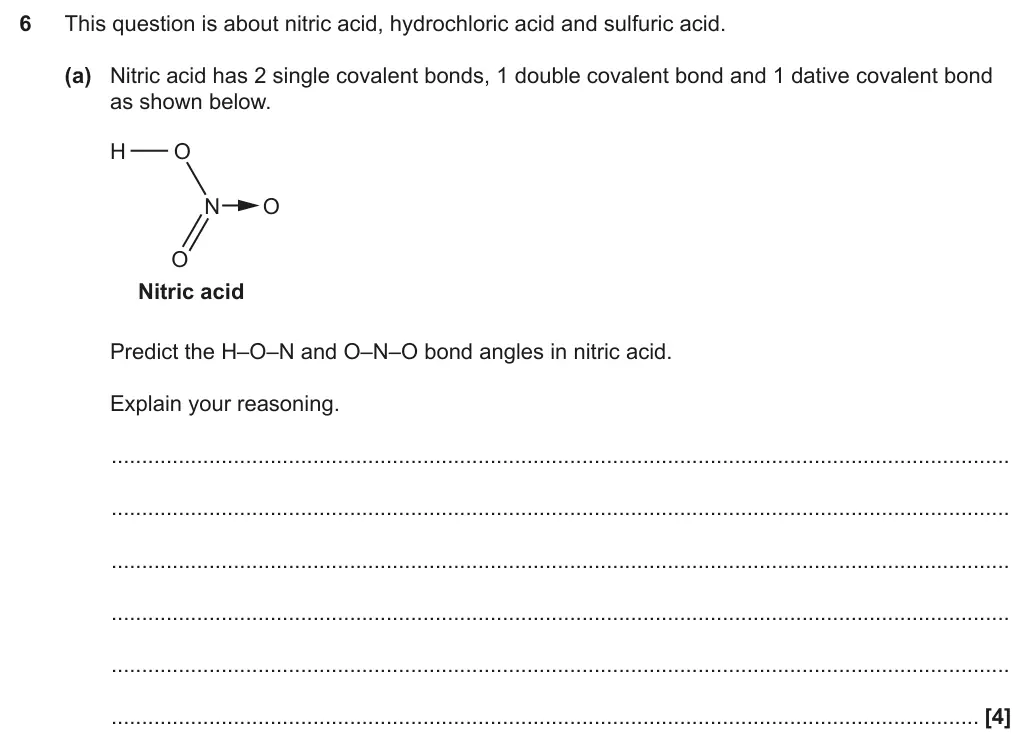
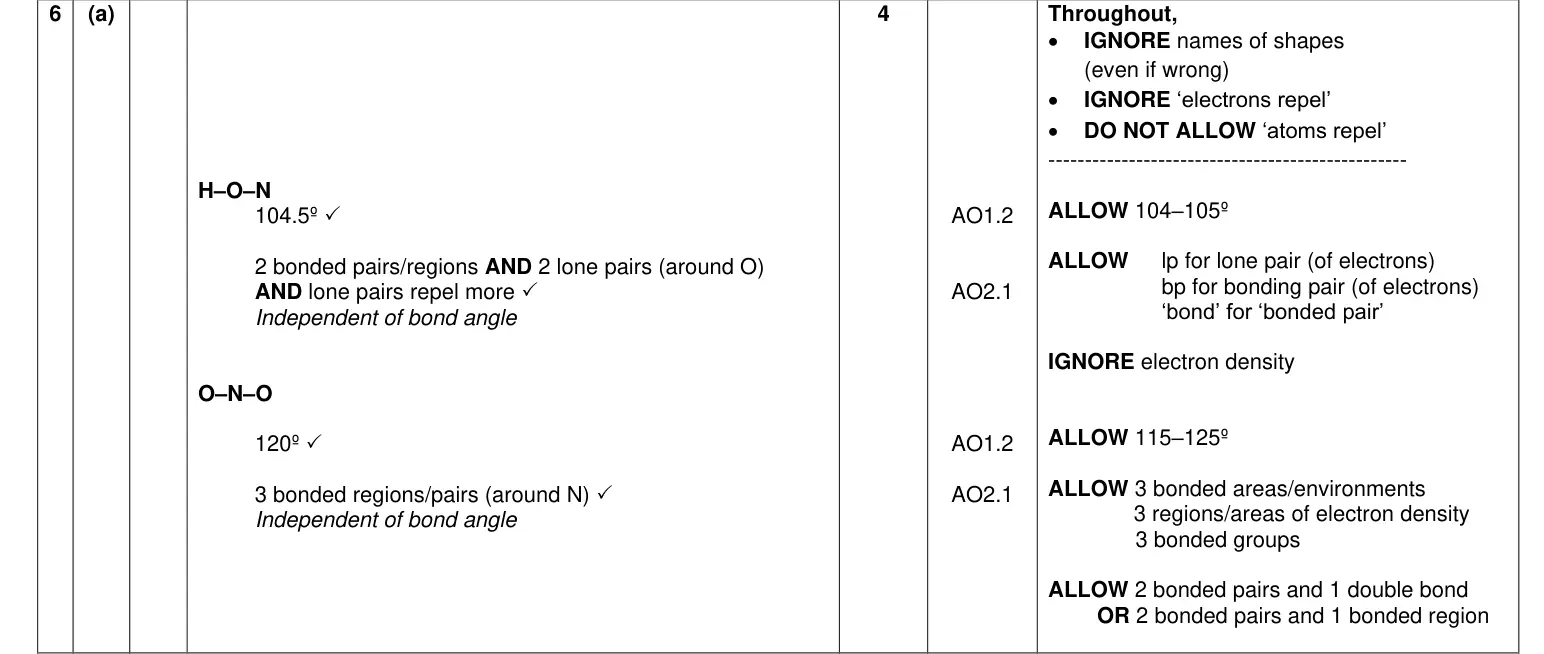
This question required candidates to apply their knowledge and understanding of bond angles and electron pair repulsion in a novel context. The best candidates rose to this challenge, securing all four marks for correct bond angles and explanations in terms of the numbers of bonded and lone pairs. The 104.5º and 120º were commonly seen and high scoring candidates provided excellent reasoning. The best explanation for 120º was in terms of three bonding regions and no lone pairs. Lower scoring responses often reasoned that bond angles are determined by lone pairs repelling the atoms, with the role of bonding pairs often being ignored.
Skills: M4.1 Use angles and shapes in regular 2-D and 3-D structures
June 2023 · Paper 3 · Q6(b)(ii)2 marksAO2Drawing / labellingHard
Earlier parts of question 6 that this part uses
Mark scheme
Examiner's comment
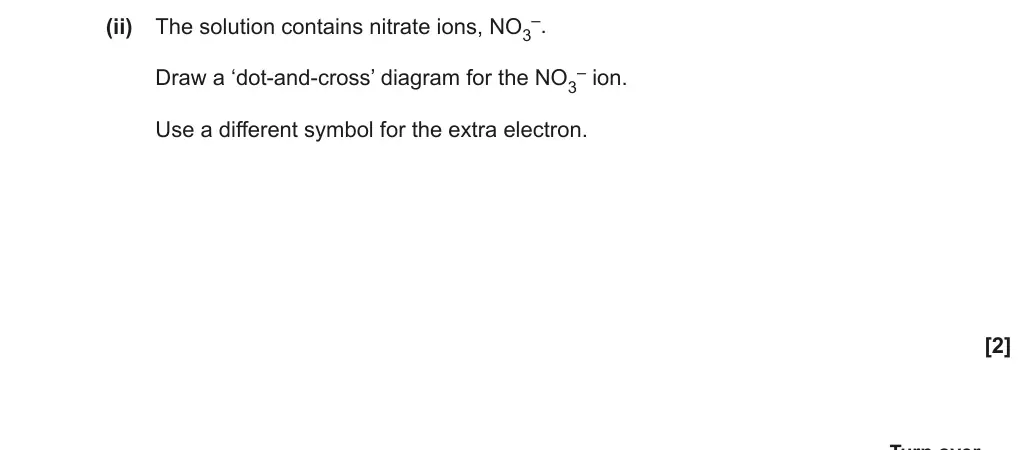
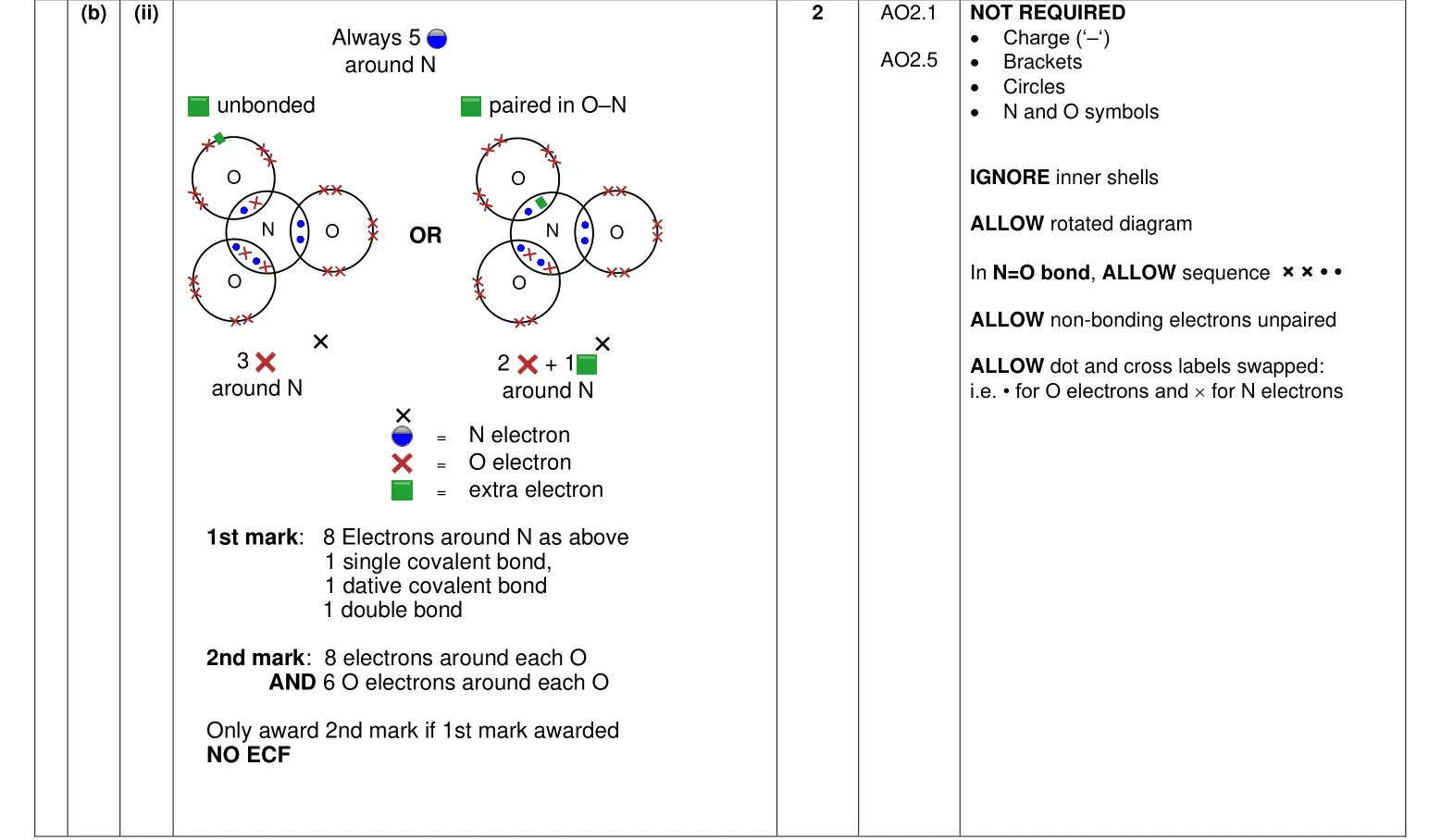
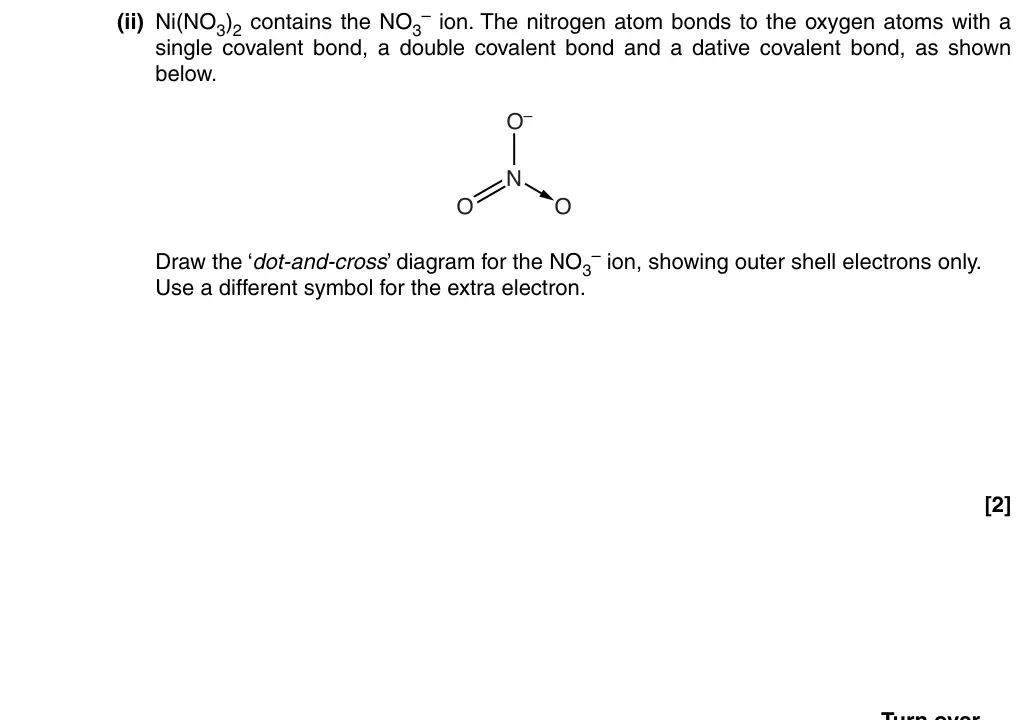
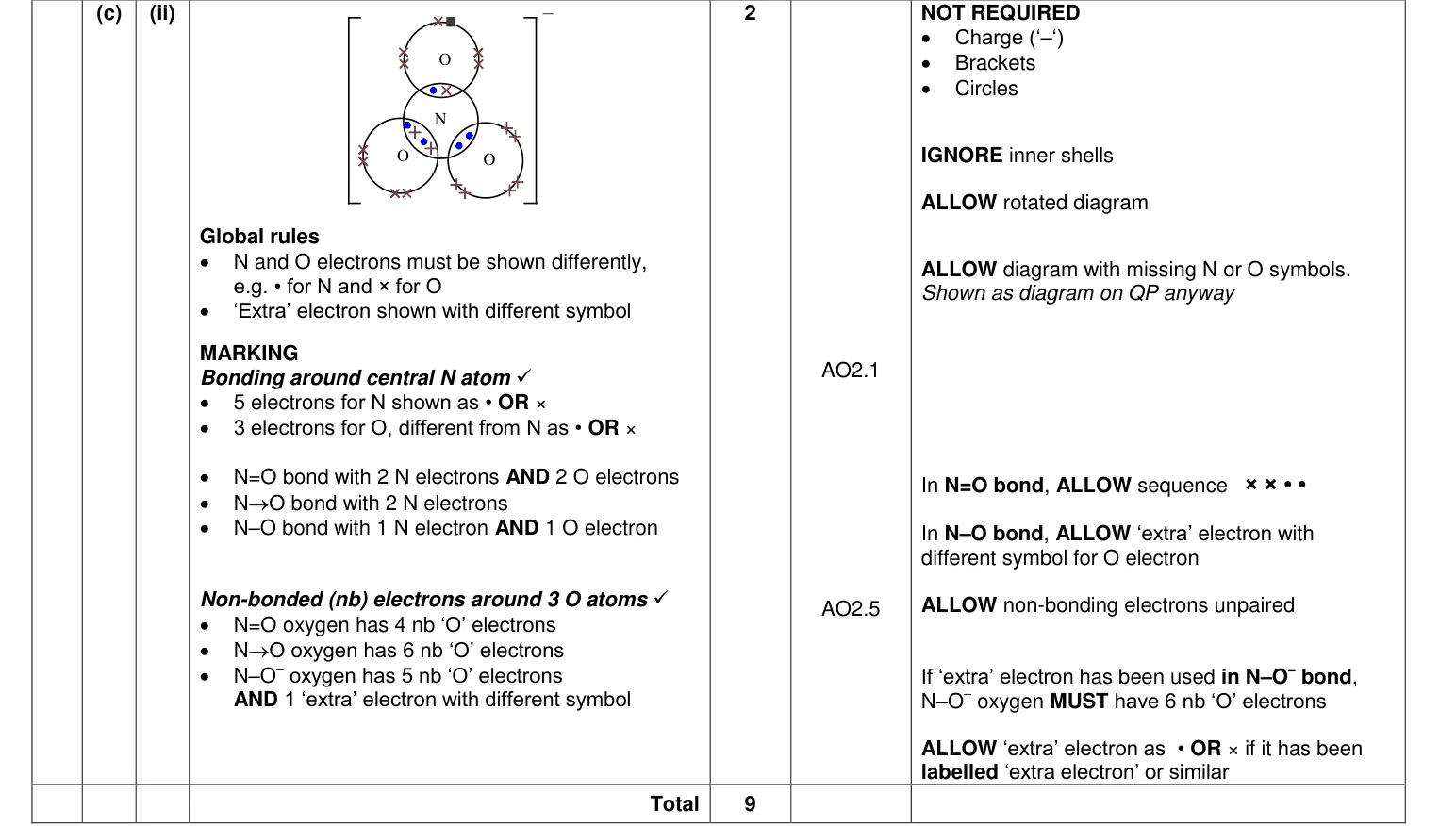
Candidates were expected to use the displayed formula of nitric acid to identify that the central N atom had one double bond, one covalent bond and one dative covalent bond. This information then gave the strategy for the dot and cross diagram. Although virtually all candidates attempted the dot and cross diagram, only about a quarter of candidates could be credited with a meaningful response. The key was to use nitrogen’s 5 outer shell electrons and to combine these with 3 oxygen electrons or 2 oxygen electrons and the extra electron. Then the remaining oxygen electrons could be added, taking care that there were 6 around out O atom. Finally the extra electron would need to be placed in an octet gap. Many candidates showed just 4 nitrogen electrons and this approach resulted in no marks. Other common errors included 3 double bonds around the N atom, and a lone pair on the N atom. This dot and cross diagram discriminated between higher scoring candidates extremely well.
Notes from the mark scheme and report
8 electrons around N with 1 single, 1 dative and 1 double bond
8 electrons around each O
extra electron shown with a different symbol
2nd mark only if 1st awarded
NO ECF
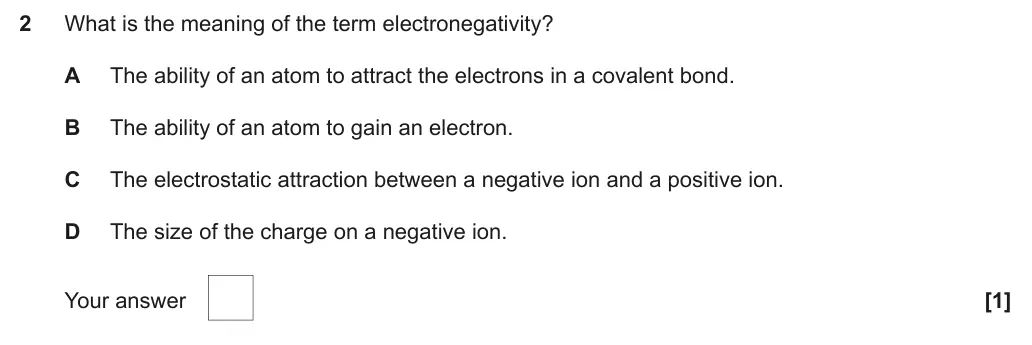
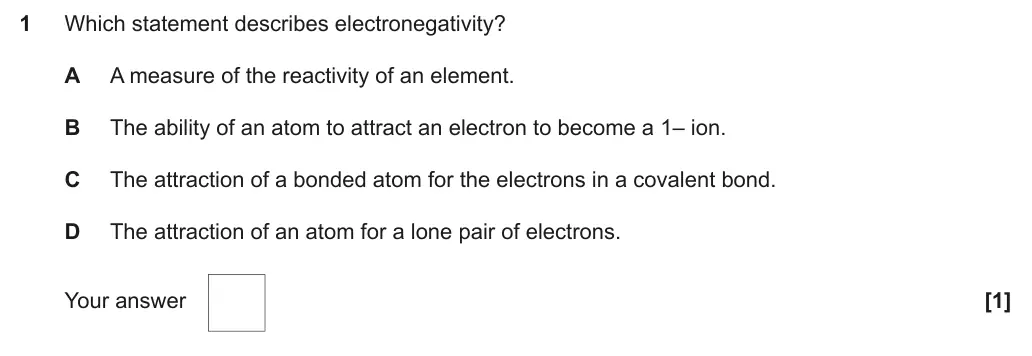
June 2022 · AS Paper 1 · Q21 markAO1Multiple choiceMedium
Answer
A
Mark scheme
Examiner's comment
Most candidates knew the concept of electronegativity well and selected A as the correct response.
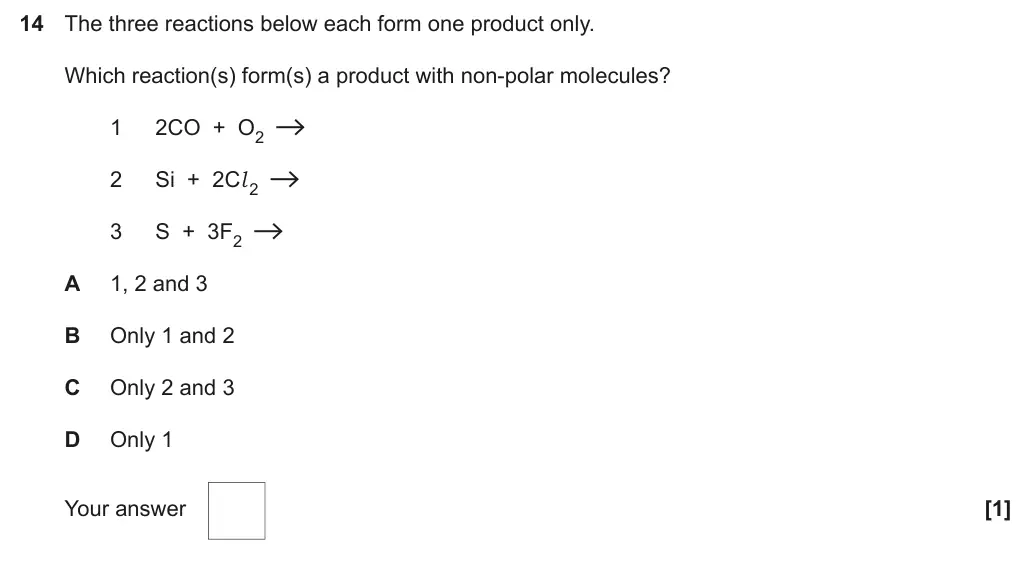
June 2022 · Paper 1 · Q141 markAO1Multiple choiceMedium
Answer
A
Mark scheme
Examiner's comment
This question was not well answered, with many candidates giving the other options rather than the correct answer of A. The candidates who were successful tended to draw out the shape of the molecules.
Notes from the mark scheme and report
CO2, SiCl4 and SF6 are all symmetrical so non-polar
June 2022 · AS Paper 1 · Q23(a)(i)1 markAO1Short answerMedium
Mark scheme
Examiner's comment
Candidates answered this question well. Where candidates had not been given marks, it was usually because they omitted the term ‘ions’ or did not state that an ionic bond is between metals and non- metals.
Notes from the mark scheme and report
'attraction' essential
IGNORE references to metal and non-metal
June 2022 · AS Paper 1 · Q23(a)(ii)2 marksAO1Complete table/diagramEasy
Earlier part of question 23 that this part uses
Mark scheme
Examiner's comment
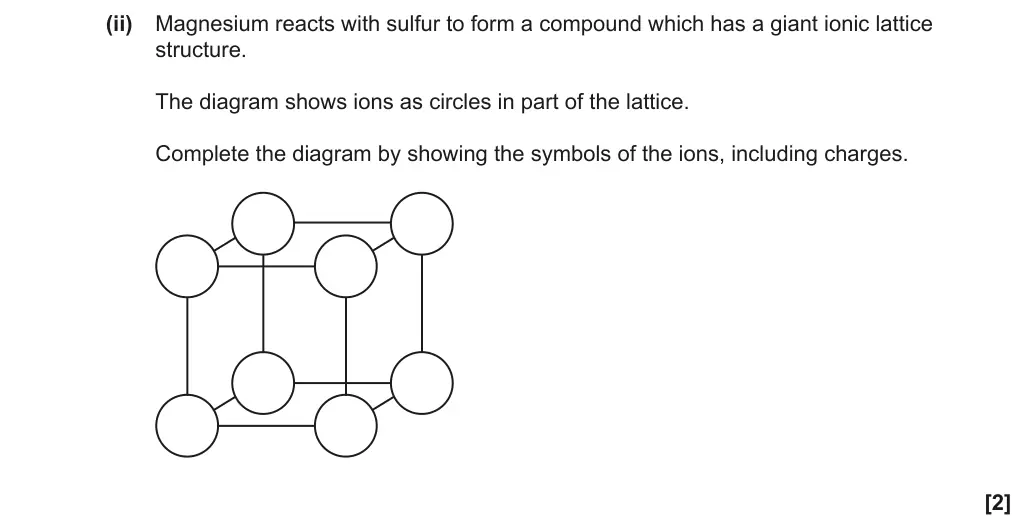
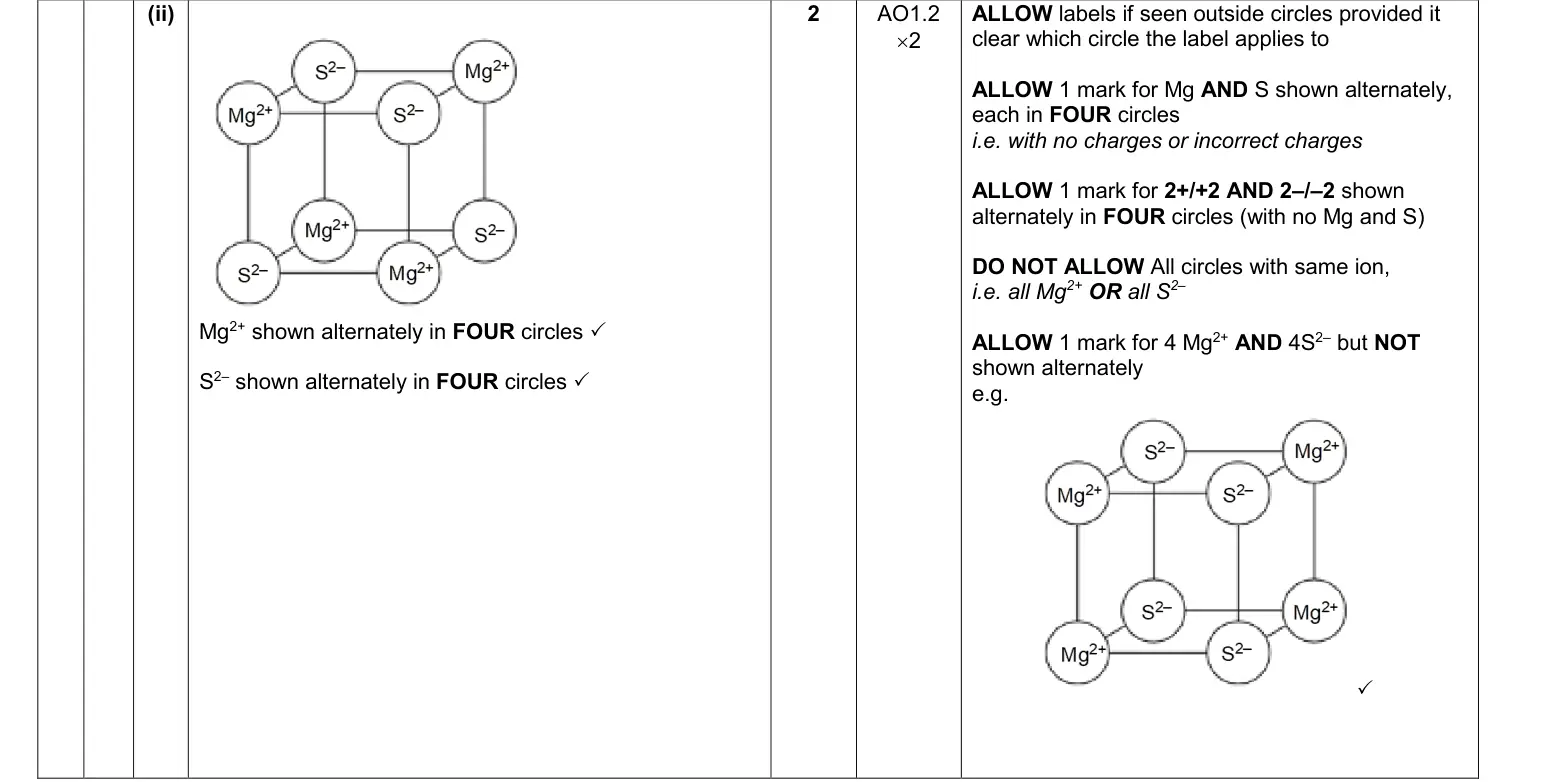
Most candidates correctly drew alternating Mg2+ and S2– labels in the circles. Some candidates made errors, however, including 2+ and 2– without Mg and S, incorrect or omitted charges, and placing the ions in layers rather than alternating.
Notes from the mark scheme and report
Mg2+ and S2– must alternate, FOUR circles each
1 mark if alternating but charges missing/incorrect
DO NOT ALLOW all circles the same ion
June 2022 · AS Paper 2 · Q4(c)4 marksAO1, 2Short answerHard
Mark scheme
Examiner's comment
Candidates continue to find understanding of shapes of molecules a very challenging topic to grasp. Very few were able to gain all 4 marks, with most gaining little or no marks. The most common mark given was for lone pairs repelling more than bonding pairs. Many only stated a lone pair decreases bond angle by 2.5o but did not explain that this was caused by increased repulsion. The most common error was stating that CO2 has 2 bonding pairs – it doesn’t, as it has 4 bonding pairs which are arranged as 2 double bonds. They could also state that it has 2 bonding regions. Lots stated CO2 has no lone pairs and H2O has 2 lone pairs but without reference to bonding pairs of electrons so lost out on 2 marks. In fact, it was fairly common that candidates indicated that only lone pairs cause repulsion, e.g. stating no repulsion in CO2 “no lone pairs so there will be no repulsion”. Though these two molecules are ones candidates will have prior knowledge of before A Level, a range of bond angles were suggested. The most successful candidates drew out dot cross diagrams and/or displayed formula to be able to count pairs of electrons around the central atom.
Notes from the mark scheme and report
180° and 104.5° (ALLOW 104–105)
CO2 two bonding regions/double bonds
H2O two bonded pairs AND two lone pairs
lone pairs repel more
IGNORE names of shapes
DO NOT ALLOW atoms repel
Skills: M4.1 Use angles and shapes in regular 2-D and 3-D structures
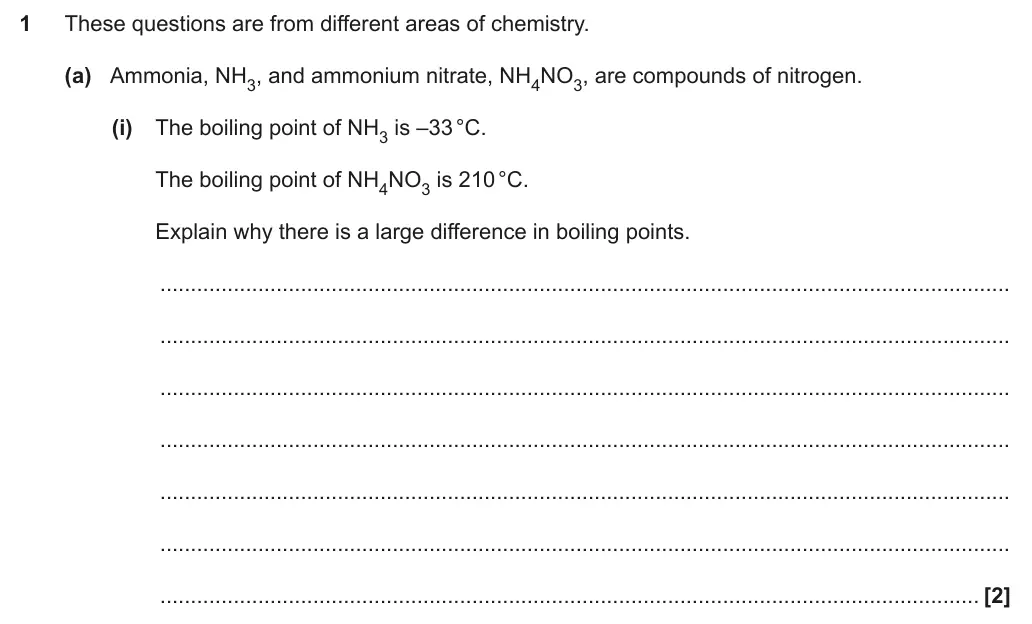
June 2022 · Paper 3 · Q1(a)(i)2 marksAO1Short answerHard
Mark scheme
Examiner's comment
Candidates found the explanation difficult, and the responses showed some misconceptions. For example, many suggested that NH3 and NH4NO3 both have hydrogen bonds. Those identifying that NH4NO3 has ionic bonding usually compared the greater strength of ionic bonding over intermolecular forces in NH3. Unfortunately, many candidates described the ionic bonds as acting between molecules. This question proved to be one of the most difficult on the paper. Understanding could be improved by first considering the following. • What is the type of bonding? • What are particles in the structure? Candidates need to be very careful when describing the two types of structure containing covalent bonds: • Simple molecular with strong covalent bonds within the molecules and weaker intermolecular bonds between the molecules in the structure Giant covalent with strong covalent bonds between the atoms in the structure. than in NH3, or that NH4NO3 has more hydrogen bonds. This response was given 0 marks.
Notes from the mark scheme and report
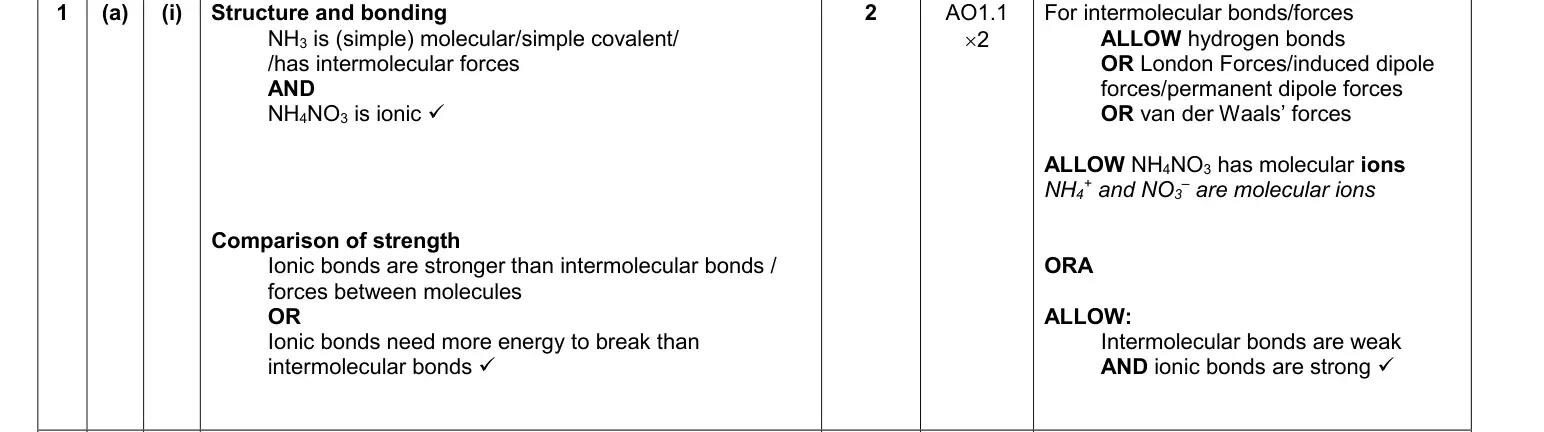
NH3 simple molecular with intermolecular forces AND NH4NO3 ionic
ionic bonds stronger/need more energy to break than intermolecular forces
A good understanding of structure and bonding continues to be difficult for candidates, demonstrated by many incorrect explanations for the different boiling points. This is a key misconception.
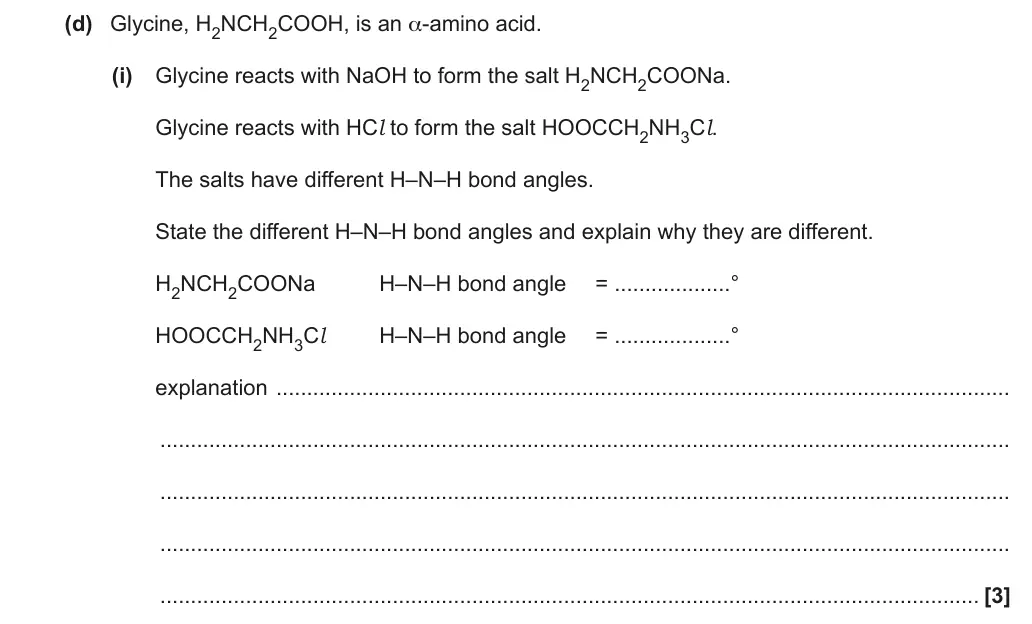
June 2022 · Paper 3 · Q1(d)(i)3 marksAO1CalculationHard
Mark scheme
Examiner's comment
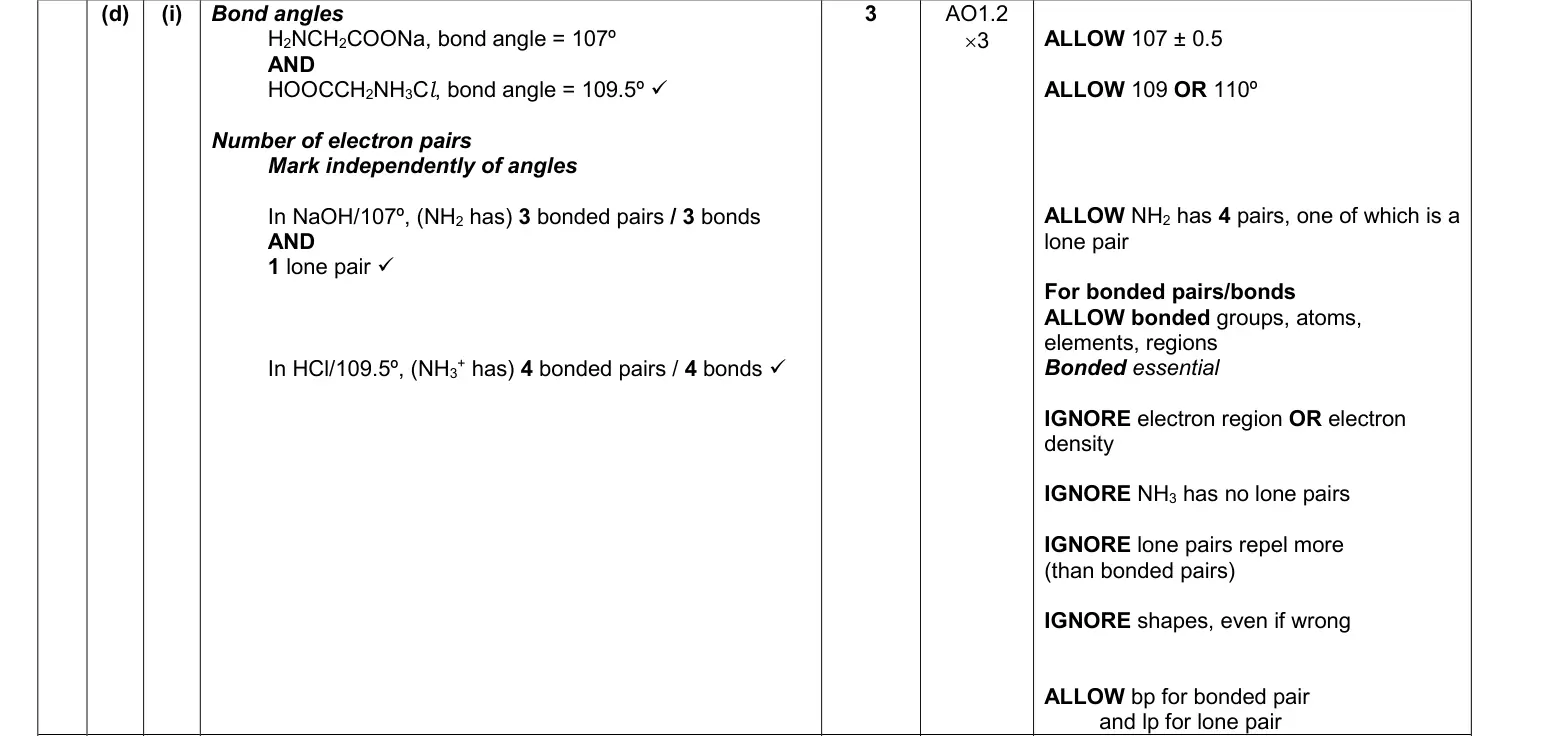
This question required candidates to apply their knowledge and understanding of bond angles and electron pair repulsion of NH3 and NH4+ to amino acid salts. The best candidates rose to this challenge and secured all 3 marks for correct bond angles and explanations in terms of the numbers of bonded and lone pairs around the N atoms. Overall, candidates found this question quite difficult. Many different bond angles were predicted, with 120º being the commonest incorrect H–N–H bond angle in H2NCH2COONa. The explanation for 120º was in terms of three bonding pairs and no lone pairs. 104.5º was also seen, presumably relating H2N to H2O. The 109.5º bond angle was correct more often, as was its explanation in terms of 4 bonding pairs. Many successful responses showed working on diagrams in which bonded and lone pairs had been included. This strategy will have helped candidates in their conclusions.
Notes from the mark scheme and report
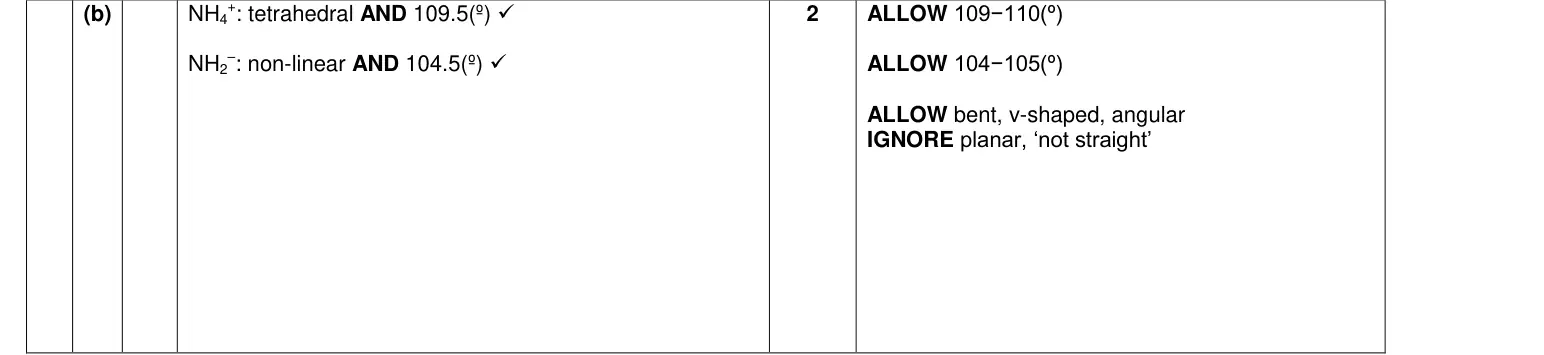
107° for NH2 (3 bonded pairs AND 1 lone pair) and 109.5° for NH3+ (4 bonded pairs)
'bonded' essential
IGNORE electron regions/density
IGNORE shapes
Skills: M4.1 Use angles and shapes in regular 2-D and 3-D structures
June 2022 · Paper 3 · Q6(b)(i)1 markAO2Short answerMedium
Earlier part of question 6 that this part uses
Mark scheme
Examiner's comment
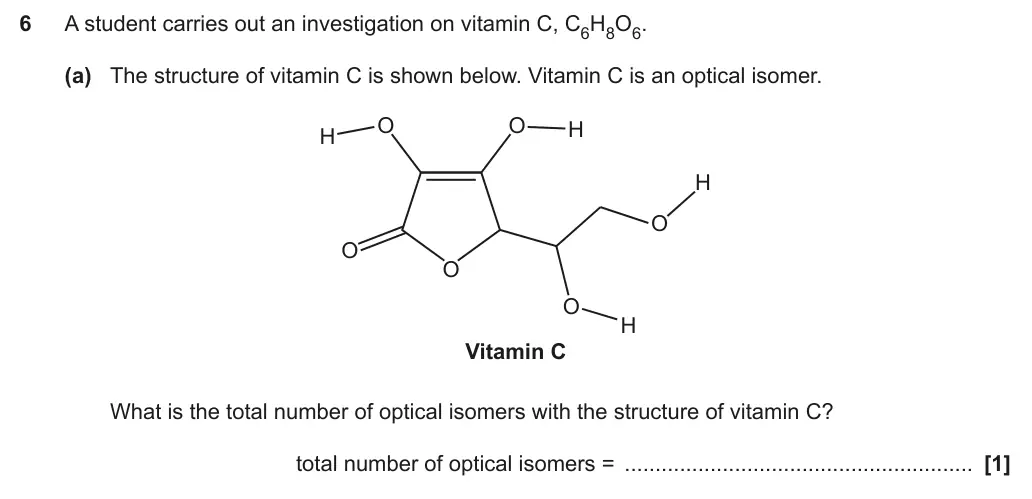
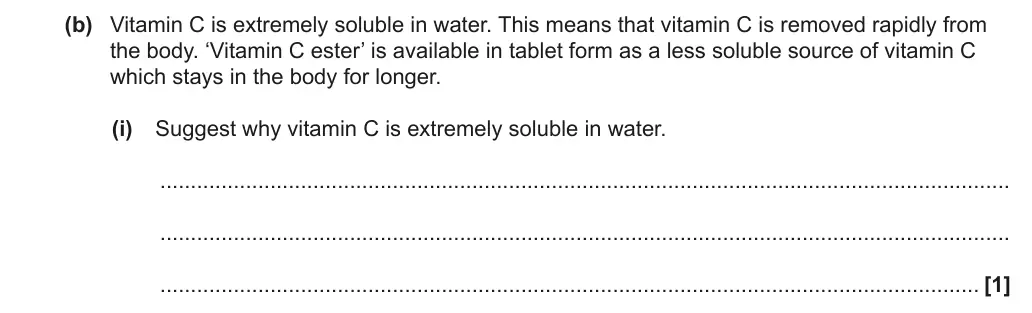
Most candidates realise that hydrogen bonds would be formed from the OH groups in vitamin C to water. Candidates are advised to read the question carefully as the word ‘extremely’ was a hint that ‘many’ OH groups would be needed in the explanation. The most successful responses quoted that hydrogen bonds would form between the 4 OH groups in vitamin C and water. Some candidates stated that O atoms in vitamin C would be involved. This was not given marks as not all O atoms in vitamin C are a part of OH groups and capable of hydrogen bonding.
Notes from the mark scheme and report
hydrogen bonding (with water) AND many/four OH groups
DO NOT ALLOW OH–
November 2021 · AS Paper 1 · Q11 markAO1Multiple choice
Answer
C
Mark scheme
November 2021 · Paper 1 · Q11 markMultiple choice
Answer
C
Mark scheme
November 2021 · AS Paper 1 · Q21 markAO2Multiple choice
Answer
A
Mark scheme
November 2021 · Paper 1 · Q131 markMultiple choice
Answer
D
Mark scheme
November 2021 · Paper 1 · Q141 markMultiple choice
Answer
B
Mark scheme
November 2021 · AS Paper 1 · Q161 markAO1Multiple choice
Answer
B
Mark scheme
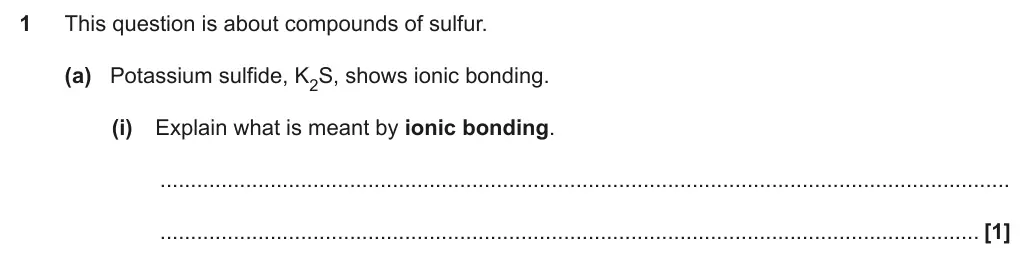
November 2021 · AS Paper 2 · Q1(a)(i)1 markAO1Short answer
Mark scheme
Notes from the mark scheme and report
electrostatic attraction between oppositely charged ions
IGNORE force
IGNORE references to transfer of electrons
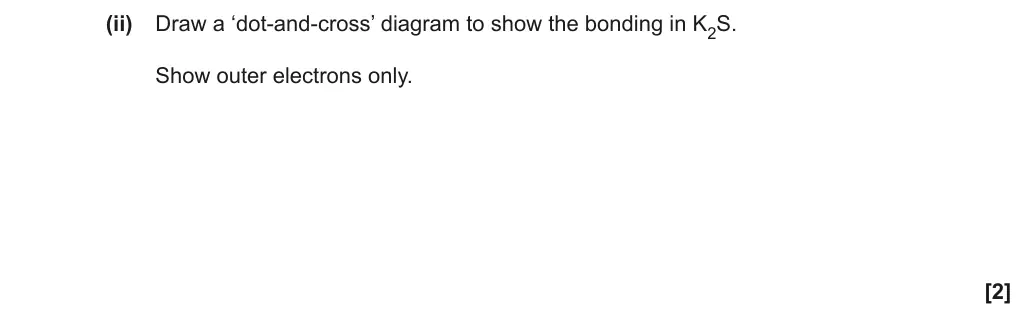
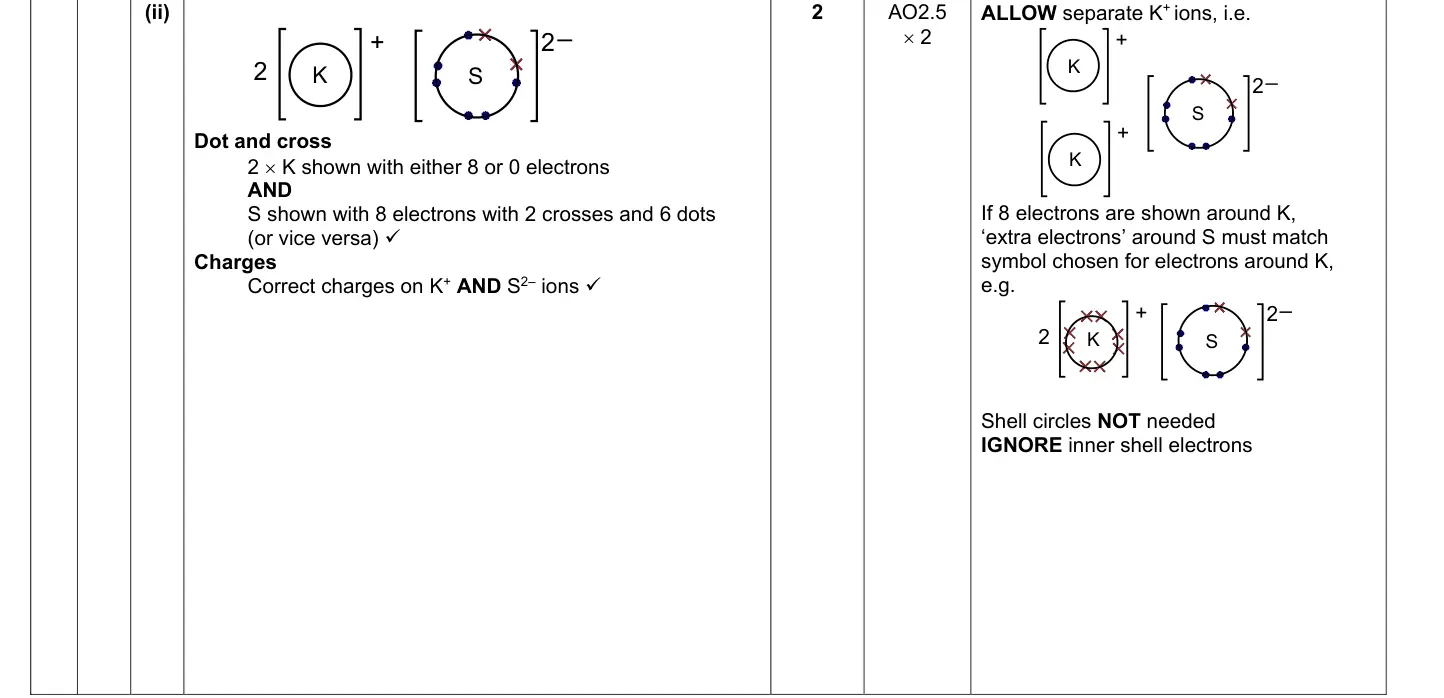
November 2021 · AS Paper 2 · Q1(a)(ii)2 marksAO2Drawing / labelling
Earlier part of question 1 that this part uses
Mark scheme
Notes from the mark scheme and report
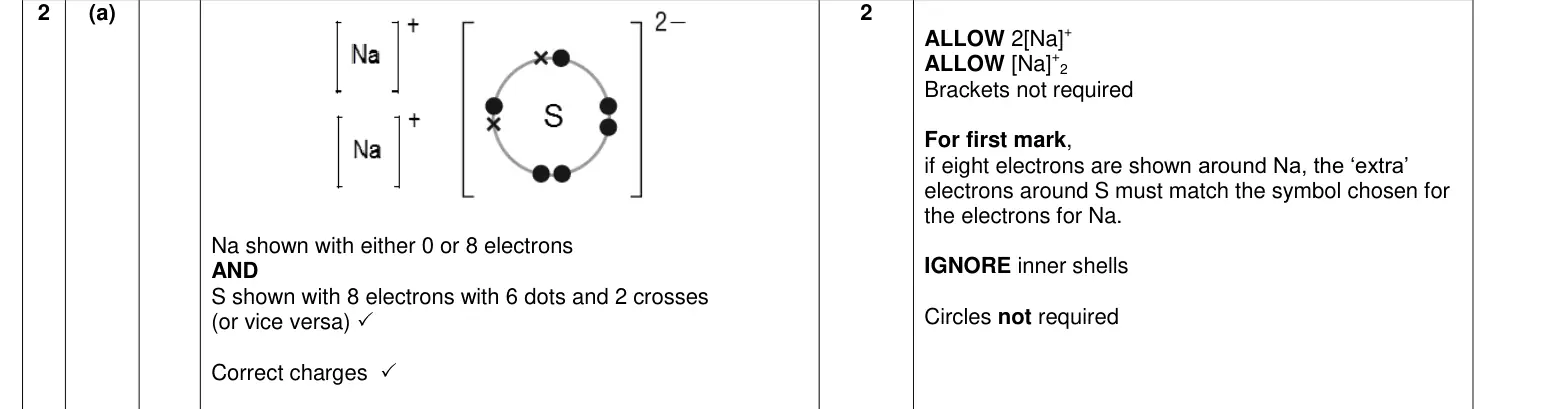
S with 8 electrons (2 crosses + 6 dots or vice versa)
K with 8 or 0 electrons
correct charges on K+ and S2–
IGNORE inner shells
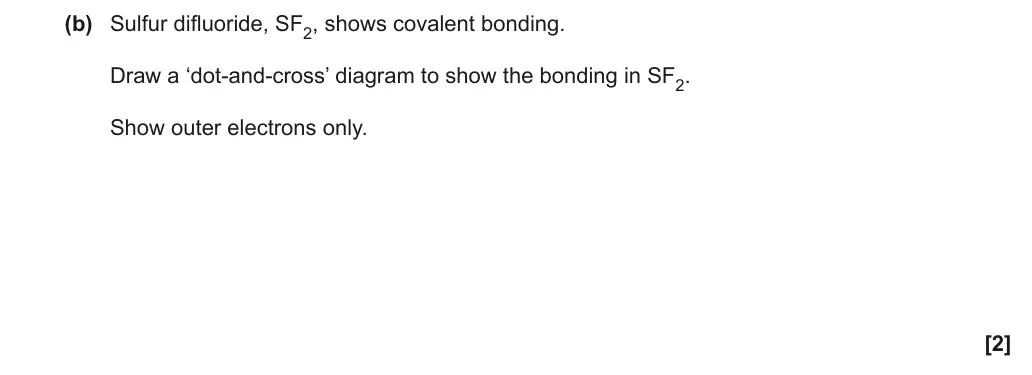
November 2021 · AS Paper 2 · Q1(b)2 marksAO2Drawing / labelling
Mark scheme
Notes from the mark scheme and report
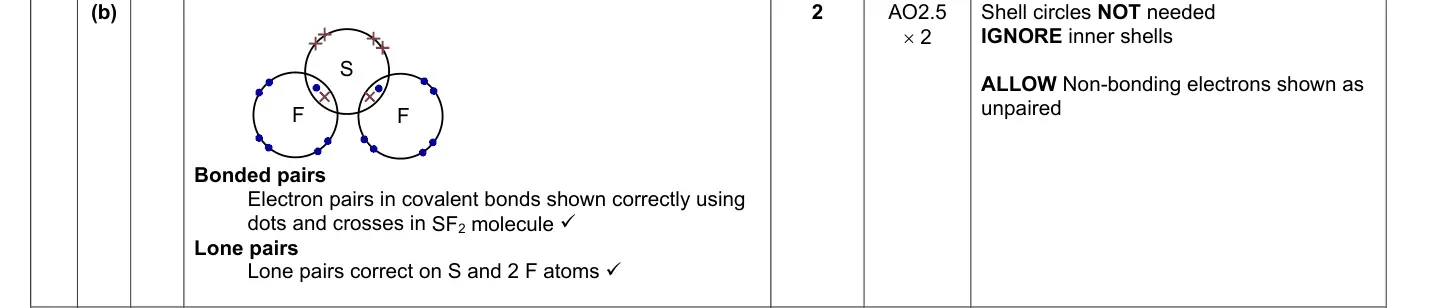
two bonded pairs as dot and cross
lone pairs correct on S (2) and each F (3)
ALLOW non-bonding electrons shown unpaired
November 2021 · AS Paper 2 · Q1(c)3 marksAO1Data interpretation
Earlier parts of question 1 that this part uses
Mark scheme
Notes from the mark scheme and report
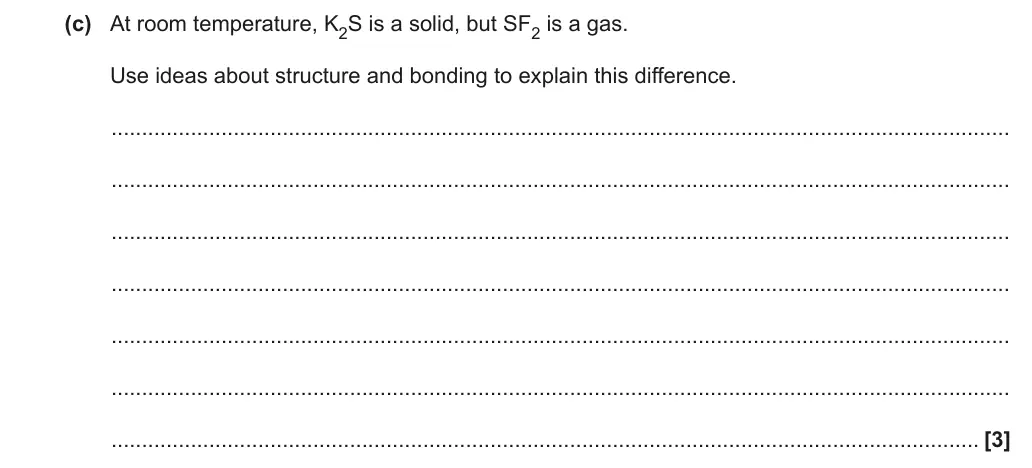
K2S strong ionic bonds/giant ionic lattice
SF2 weak London/dipole–dipole forces between molecules
IGNORE van der Waals forces
November 2021 · AS Paper 2 · Q1(d)(i)2 marksAO1Short answer
Mark scheme
Notes from the mark scheme and report
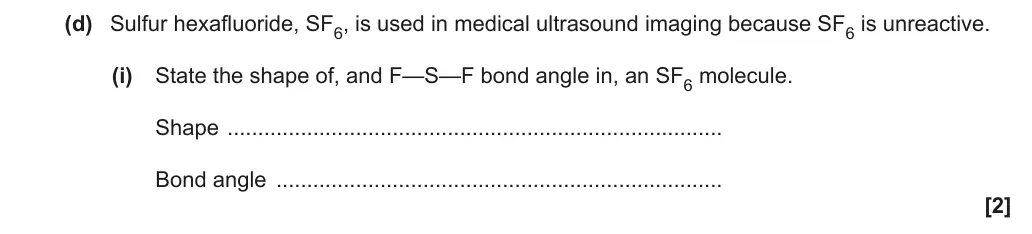
octahedral
90°
Skills: M4.1 Use angles and shapes in regular 2-D and 3-D structures
November 2021 · AS Paper 2 · Q1(d)(ii)1 markAO2Short answer
Earlier part of question 1 that this part uses
Mark scheme
Notes from the mark scheme and report
no overall dipole/non-polar OR strong S–F bonds OR no lone pairs
November 2021 · Paper 2 · Q81 markMultiple choice
Answer
C
Mark scheme
November 2021 · Paper 2 · Q17(b)(ii)2 marksAO2Short answer
Earlier part of question 17 that this part uses
Mark scheme
Notes from the mark scheme and report
both answers must be comparisons
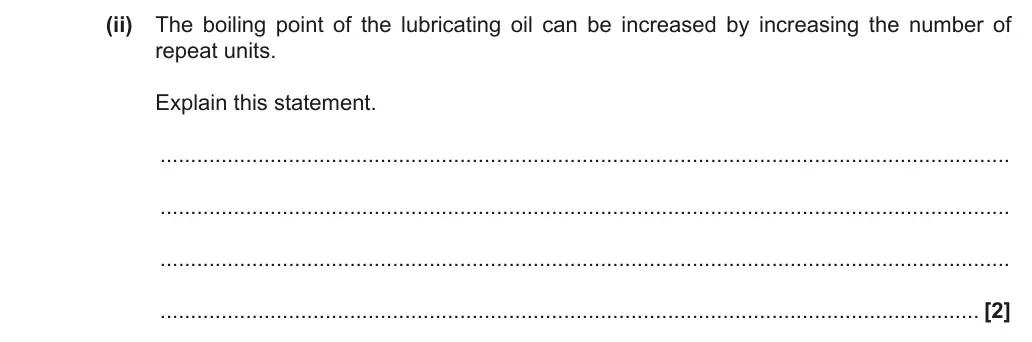
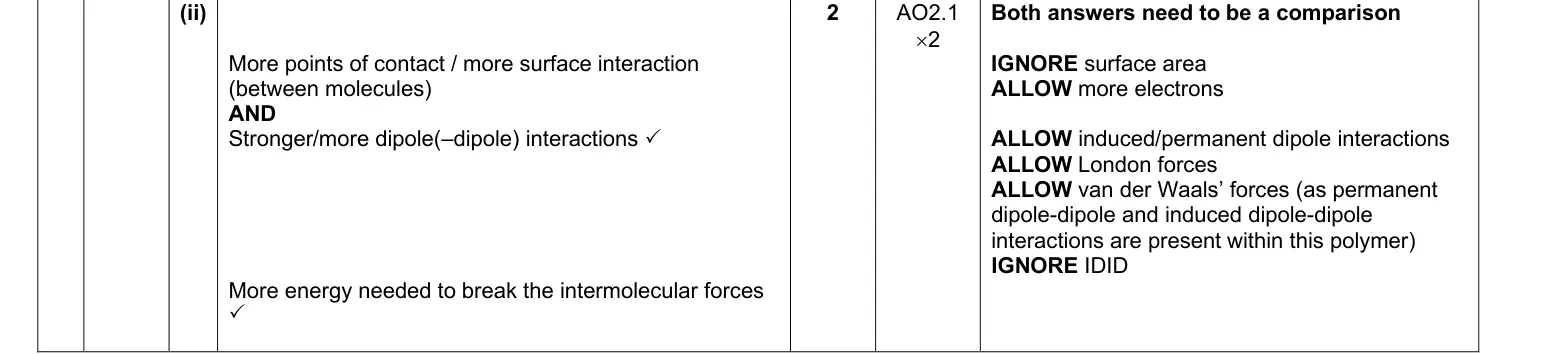
more points of contact/more electrons so stronger dipole or London forces
more energy needed to break intermolecular forces
IGNORE surface area
November 2021 · Paper 2 · Q18(d)(ii)1 markAO3Short answer
Earlier part of question 18 that this part uses
Mark scheme
Notes from the mark scheme and report
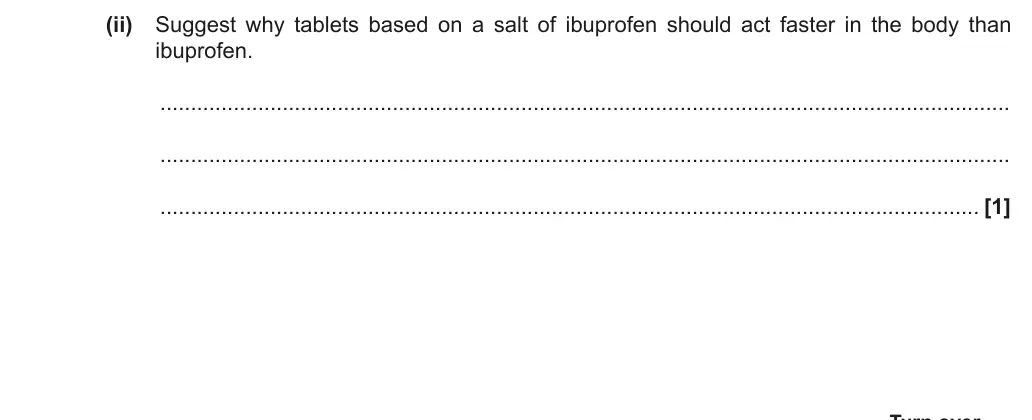
comparison required: salt more soluble in water / dissolves faster
IGNORE 'absorbed more quickly' (given in question)
November 2021 · Paper 3 · Q1(c)3 marksAO1, 2Short answerMedium
Mark scheme
Examiner's comment
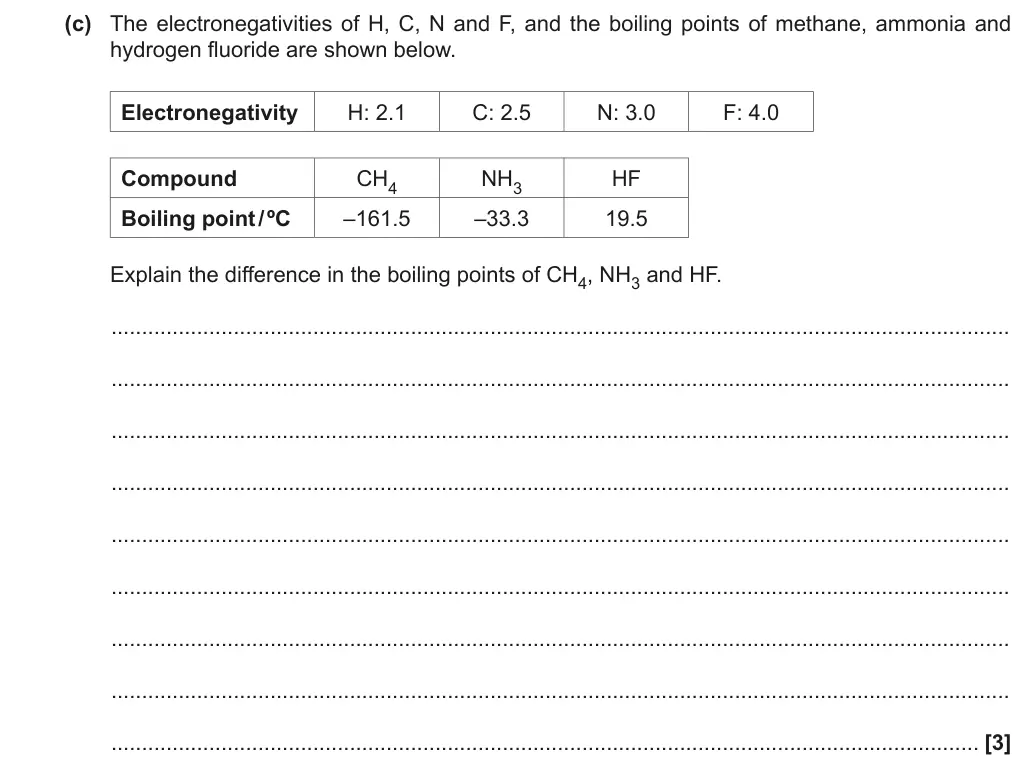
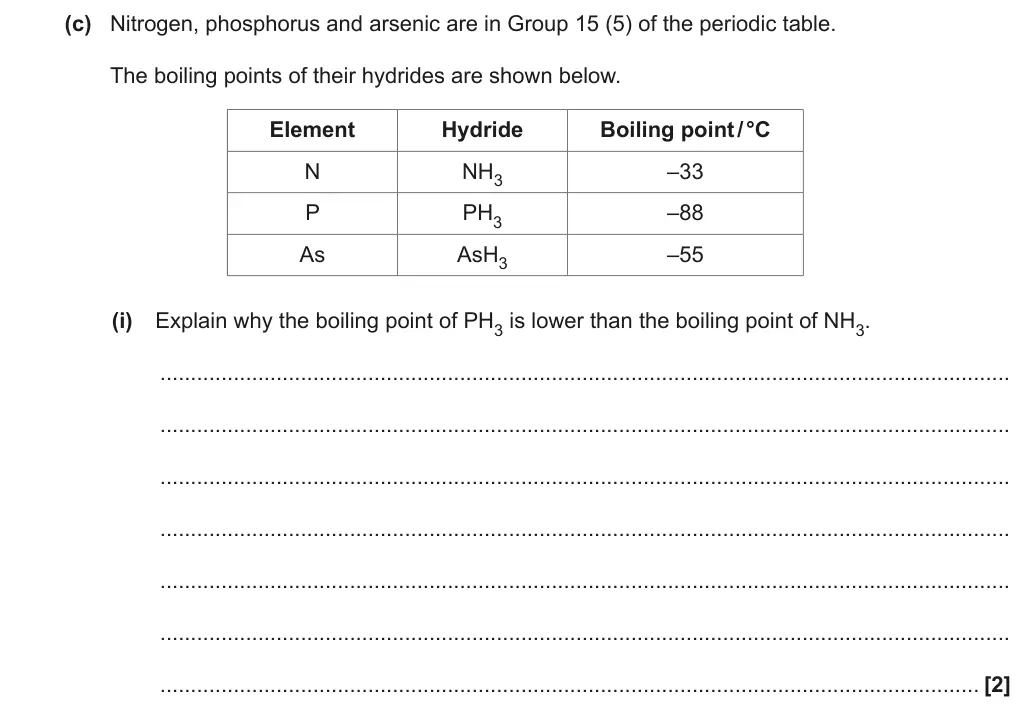
Q1(c) Intermolecular forces and electronegativity. Q1(c): Candidates were required to use electronegativity and boiling point data to explain the difference in boiling points of CH4, NH3 and HF. In Q1(c), candidates were expected to use data on electronegativity to help explain differences in boiling points of three simple molecular compounds, CH4, NH3 and HF.
Notes from the mark scheme and report
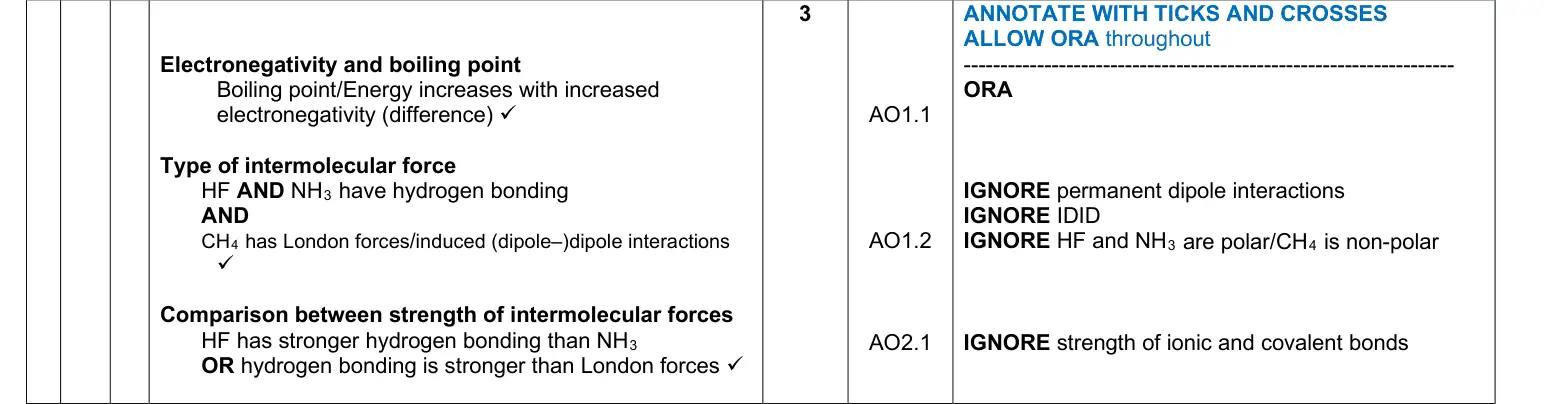
boiling point increases with electronegativity difference
HF and NH3 hydrogen bonding, CH4 London forces
HF has stronger hydrogen bonding than NH3
IGNORE permanent dipole interactions
IGNORE strength of covalent bonds
November 2020 · AS Paper 1 · Q11 markAO1Multiple choice
Answer
C
Mark scheme
November 2020 · AS Paper 1 · Q31 markAO1Multiple choiceMedium
Answer
B
Mark scheme
Examiner's comment
Questions 3, 4, 5, 6 and 13 generally scored well.
November 2020 · Paper 1 · Q16(b)(i)2 marksAO1, 2Drawing / labelling
Mark scheme
Notes from the mark scheme and report
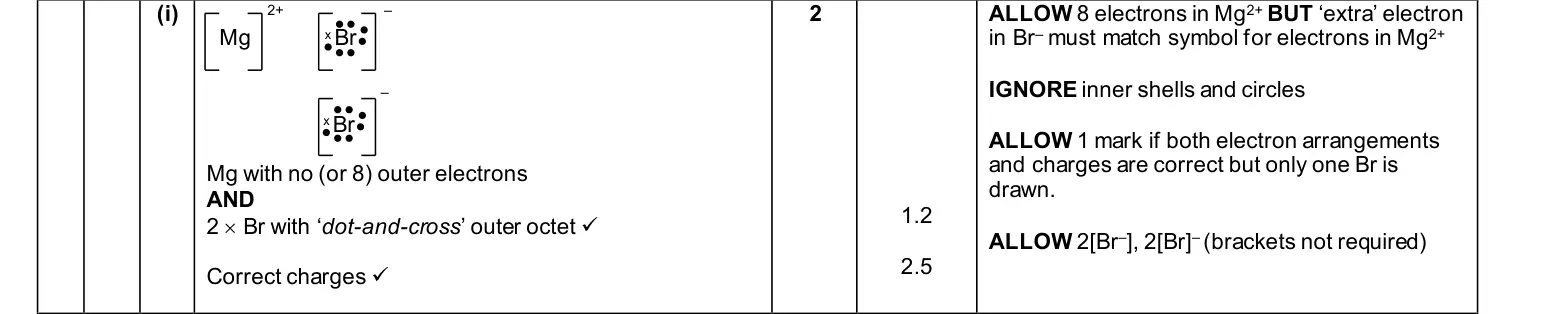
Mg2+ with no (or 8) outer electrons and two Br– each with dot-and-cross octet
correct charges
1 mark if only one Br– drawn
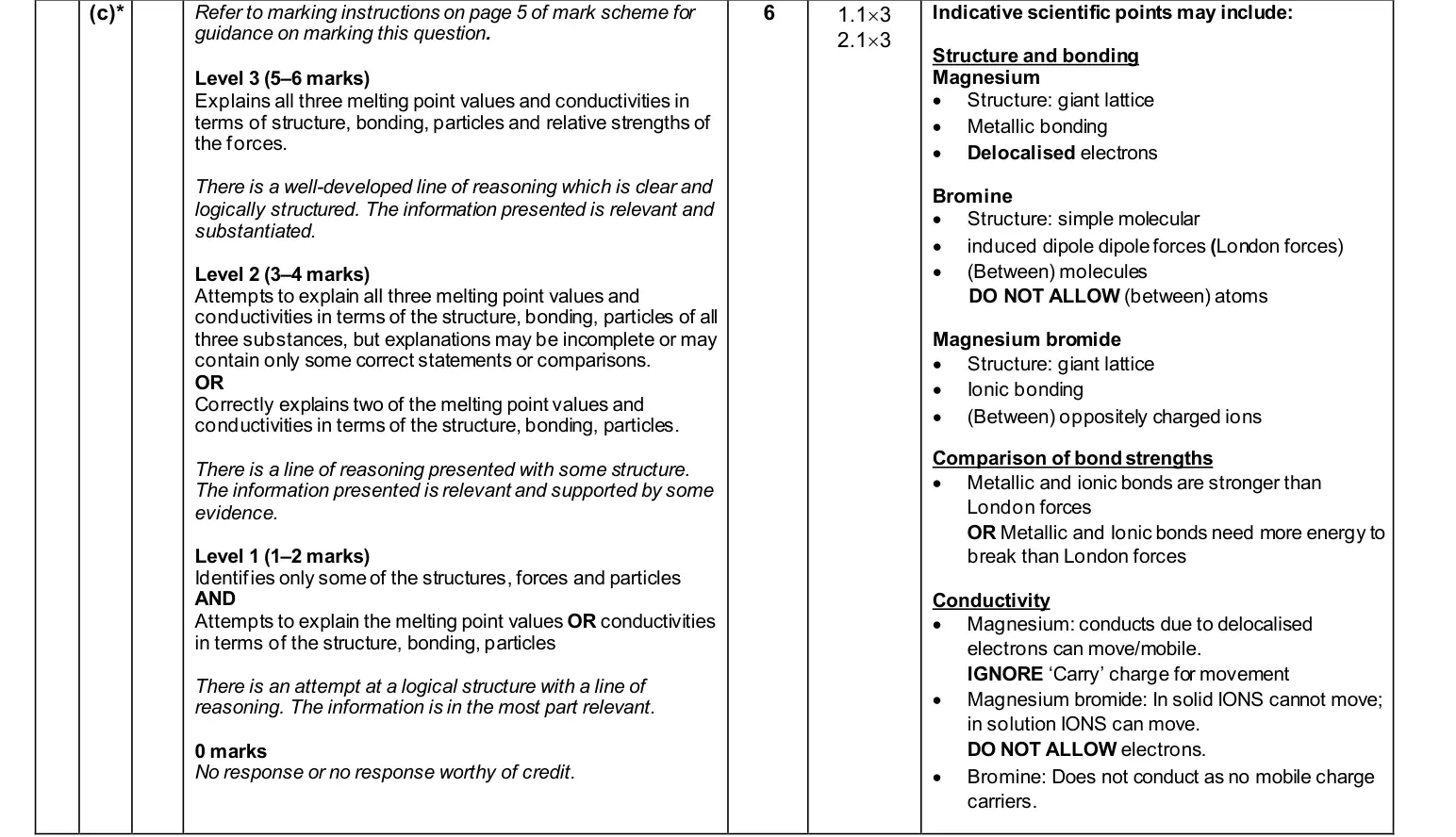
November 2020 · Paper 1 · Q16(c)6 marksAO1, 26-mark level of response
Mark scheme, with the levels and indicative points
Notes from the mark scheme and report
Mg giant metallic with mobile delocalised electrons
Br2 simple molecular with London forces between molecules (DO NOT ALLOW between atoms)
MgBr2 giant ionic – ions fixed in solid, mobile when liquid (DO NOT ALLOW electrons)
metallic and ionic bonds stronger than London forces
IGNORE 'carry' charge
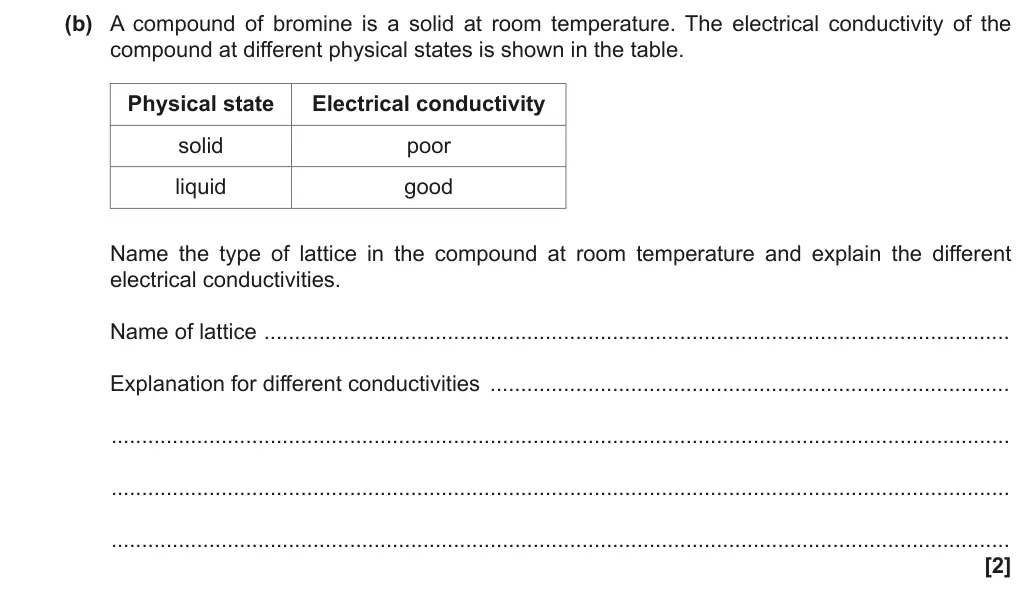
November 2020 · AS Paper 1 · Q22(b)2 marksAO1Short answerMedium
Mark scheme
Examiner's comment
22(a)(i) Candidates answered this part well, showing good knowledge and understanding of electron configuration. When incorrect, it was usually errors with the number of electrons in the 3d and 4p subshells. 22a(ii) Most candidates were able to construct a correct balanced equation for this unfamiliar equation. The commonest error was use of Br instead of Br2 in the equation. 22(b) Structure and bonding continues to be a difficult concept for many candidates. This part did discriminate extremely well, with high-attaining candidates identifying that the compound would have a giant ionic lattice with fixed ions in the solid state which become mobile in the liquid state to conduct electricity. It was common for ‘ionic’ or ‘giant’ to be omitted in the name of the lattice. Most candidates used the ideal gas equation, which was usually rearranged correctly, with substituted values for p, V, R and T being added. A common mistake was for the volume in cm3 to be multiplied by 10–3 rather than 10–6 for the necessary conversion into m3. Low-attaining candidates often did not convert 100 ºC into 373 K. Unfortunately, candidates making an error in unit conversions then obtained an unrealistic molar mass for A and were then unable to derive a possible molecular formula. Well-prepared candidates carried out the calculation well with clear working. It was very encouraging to see the number of candidates able to predict the molecular formula of A as BrF5 from the calculated molar mass of 174.6 g mol–1. There were, however a significant number of incorrect responses, suggesting that some candidates found this type of question challenging. Some candidates used the molar gas volume at room temperature and pressure of 24.0 dm3 mol–1. Two of the five marks were still available for this response.
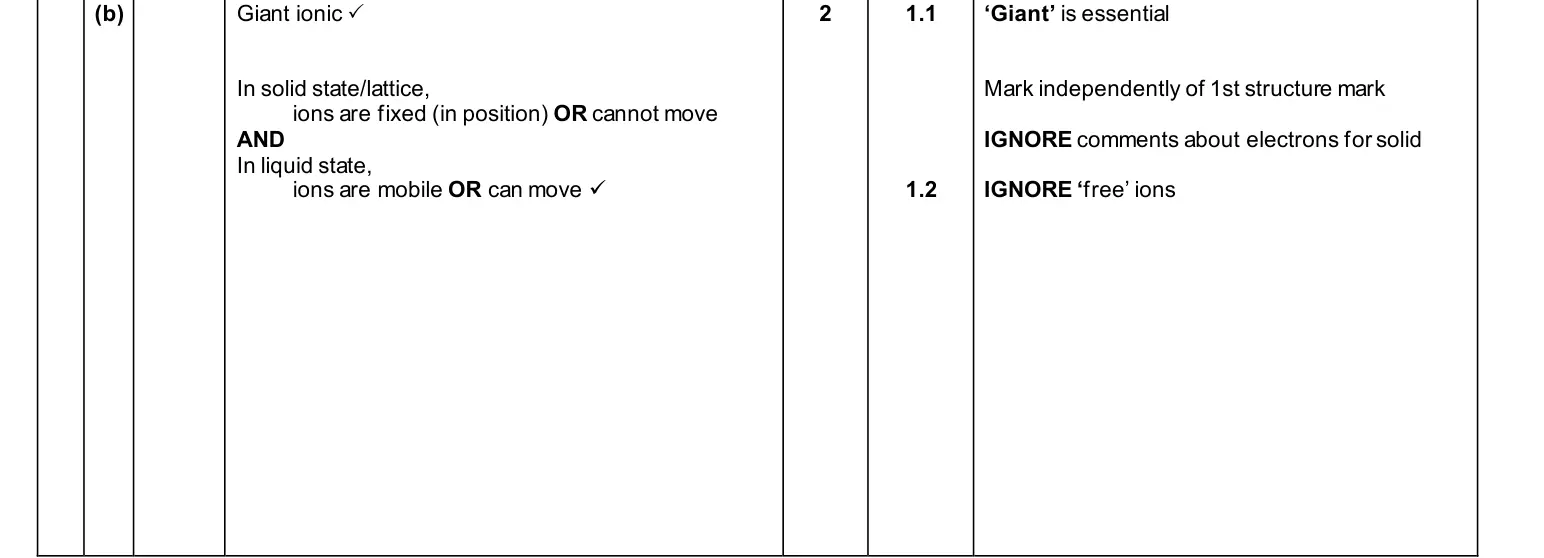
Notes from the mark scheme and report
'Giant' is essential
ions fixed in solid AND mobile in liquid
IGNORE comments about electrons for solid
IGNORE 'free' ions
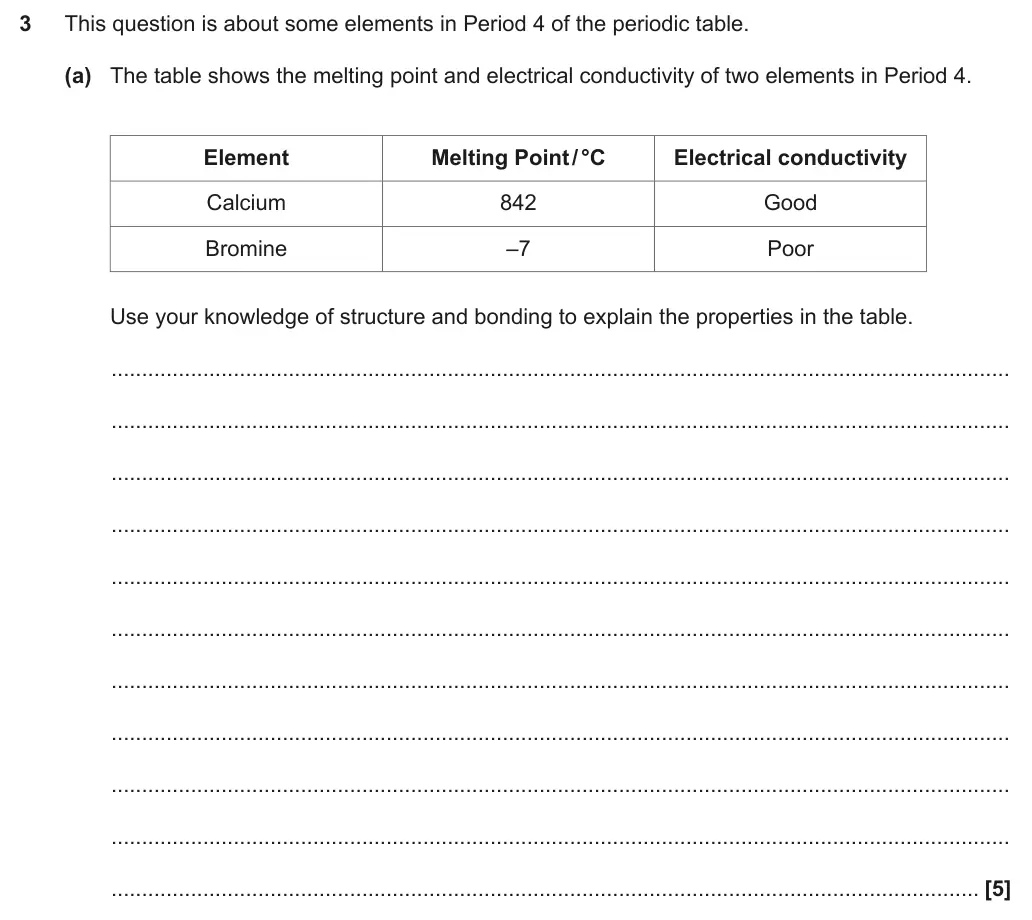
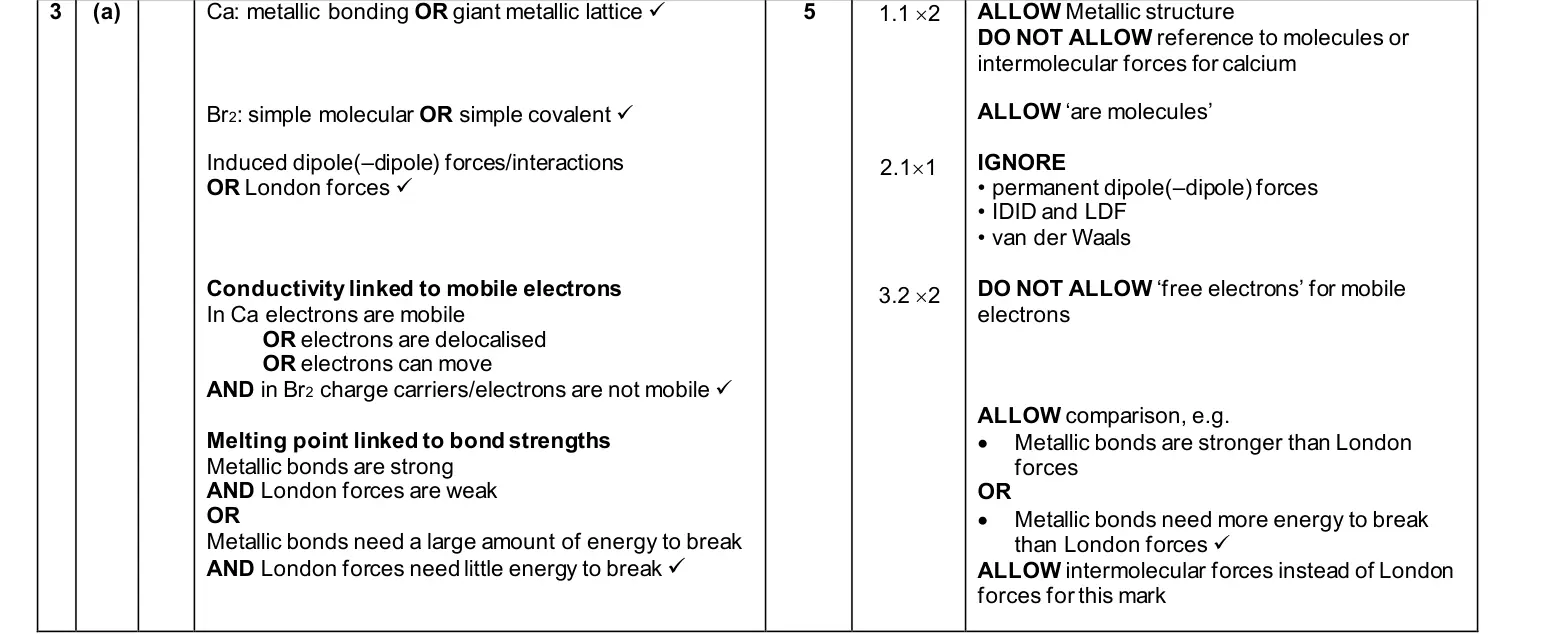
November 2020 · AS Paper 2 · Q3(a)5 marksAO1, 2, 3Extended responseMedium
Mark scheme
Examiner's comment
3(a) More able candidates scored well in this question, setting out their answers in a logical order. They often first discussed Ca and its bonding and structure, linking this to the physical properties and then doing the same for Br. A number of candidates discussed the chemical properties of Ca and Br, such as their ability to bond with other elements, ionisation energy and their reactivity based on their position in the periodic table. Some candidates gave a good description of metallic bonding but then went on to discuss melting point in terms of intermolecular forces. 3(b)(i) Most candidates were able to give the correct diagrams for ionic bonding, although care needs to be taken that diagrams are well drawn with both charges given. Some gave diagrams for covalent bonding. 3(b)(ii) It was important to answer the question asked. A number of responses lost marks for describing the general trend down group 2 without making reference at all to calcium and barium. Most candidates managed to score at least one mark here but a considerable proportion missed the second marking point explaining that nuclear attraction was less in Ba. 3(c)(i) This was dependent on candidates’ ability to give correct formula of aluminium hydroxide, Al(OH)3. Writing correct formulae is an important skill in chemistry, which should be practised regularly in different topics to help candidates master the skill. 3(c)(ii) Most candidates were able to recognise that water had the higher boiling point due to hydrogen bonding. However, it was evident in a number of responses that they were unclear that this is an example of an intermolecular force and doesn’t just refer to the covalent bond formed between O and H. Most avoided discussing the intermolecular forces present in H2Se even although both London forces and permanent dipole-dipole interactions were accepted as they may not have come across this specific example and had not been given electronegativity data. 3(d)(i) Very few candidates scored this mark. Although a number of candidates did give sodium bromate as the answer (with the omission of the oxidation state), many other answers were seen suggesting candidates are not aware of naming conventions for inorganic compounds. 3(d)(ii) This is the first time in a reformed chemistry AS paper that the question space has been left unstructured for oxidation number changes. The highest-attaining candidates set out their responses clearly, dealing with changes for oxidation and reduction separately, and giving the correct oxidation numbers. Some struggled to obtain an oxidation state of Br in NaBrO3 as +5, suggesting +1 instead.
Notes from the mark scheme and report
DO NOT ALLOW molecules or intermolecular forces for calcium
DO NOT ALLOW 'free electrons' for mobile/delocalised electrons
melting point linked to strong metallic bonds vs weak London forces
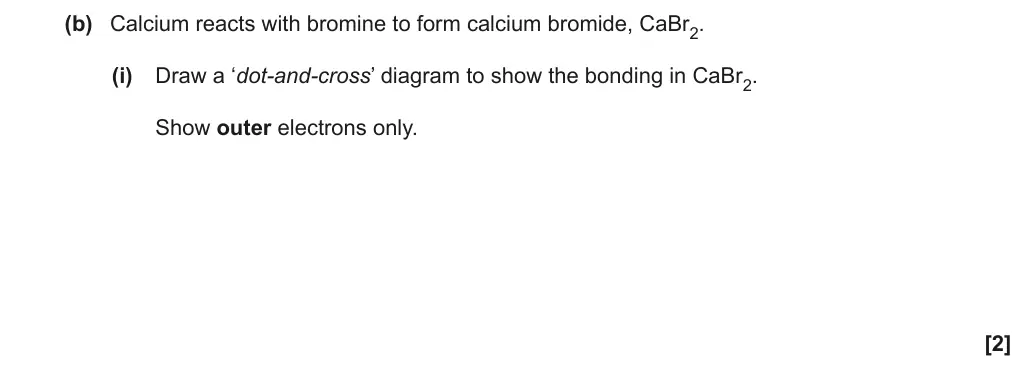
November 2020 · AS Paper 2 · Q3(b)(i)2 marksAO1, 2Drawing / labellingMedium
Mark scheme
Examiner's comment
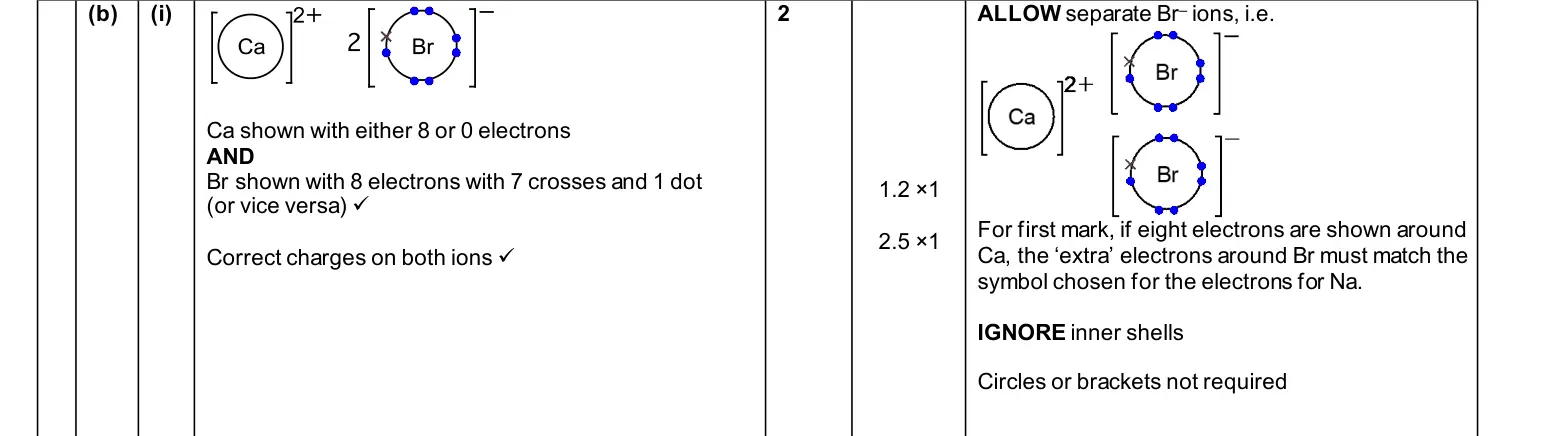
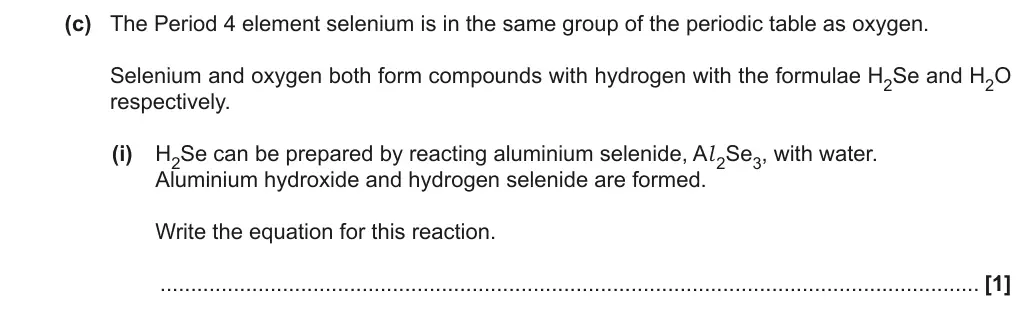
3(a) More able candidates scored well in this question, setting out their answers in a logical order. They often first discussed Ca and its bonding and structure, linking this to the physical properties and then doing the same for Br. A number of candidates discussed the chemical properties of Ca and Br, such as their ability to bond with other elements, ionisation energy and their reactivity based on their position in the periodic table. Some candidates gave a good description of metallic bonding but then went on to discuss melting point in terms of intermolecular forces. 3(b)(i) Most candidates were able to give the correct diagrams for ionic bonding, although care needs to be taken that diagrams are well drawn with both charges given. Some gave diagrams for covalent bonding. 3(b)(ii) It was important to answer the question asked. A number of responses lost marks for describing the general trend down group 2 without making reference at all to calcium and barium. Most candidates managed to score at least one mark here but a considerable proportion missed the second marking point explaining that nuclear attraction was less in Ba. 3(c)(i) This was dependent on candidates’ ability to give correct formula of aluminium hydroxide, Al(OH)3. Writing correct formulae is an important skill in chemistry, which should be practised regularly in different topics to help candidates master the skill. 3(c)(ii) Most candidates were able to recognise that water had the higher boiling point due to hydrogen bonding. However, it was evident in a number of responses that they were unclear that this is an example of an intermolecular force and doesn’t just refer to the covalent bond formed between O and H. Most avoided discussing the intermolecular forces present in H2Se even although both London forces and permanent dipole-dipole interactions were accepted as they may not have come across this specific example and had not been given electronegativity data. 3(d)(i) Very few candidates scored this mark. Although a number of candidates did give sodium bromate as the answer (with the omission of the oxidation state), many other answers were seen suggesting candidates are not aware of naming conventions for inorganic compounds. 3(d)(ii) This is the first time in a reformed chemistry AS paper that the question space has been left unstructured for oxidation number changes. The highest-attaining candidates set out their responses clearly, dealing with changes for oxidation and reduction separately, and giving the correct oxidation numbers. Some struggled to obtain an oxidation state of Br in NaBrO3 as +5, suggesting +1 instead.
Notes from the mark scheme and report
Ca with 8 or 0 outer electrons, Br with 7 + 1
correct charges on both ions
ALLOW separate Br– ions
November 2020 · AS Paper 2 · Q3(c)(ii)3 marksAO1, 2Short answerMedium
Earlier part of question 3 that this part uses
Mark scheme
Examiner's comment
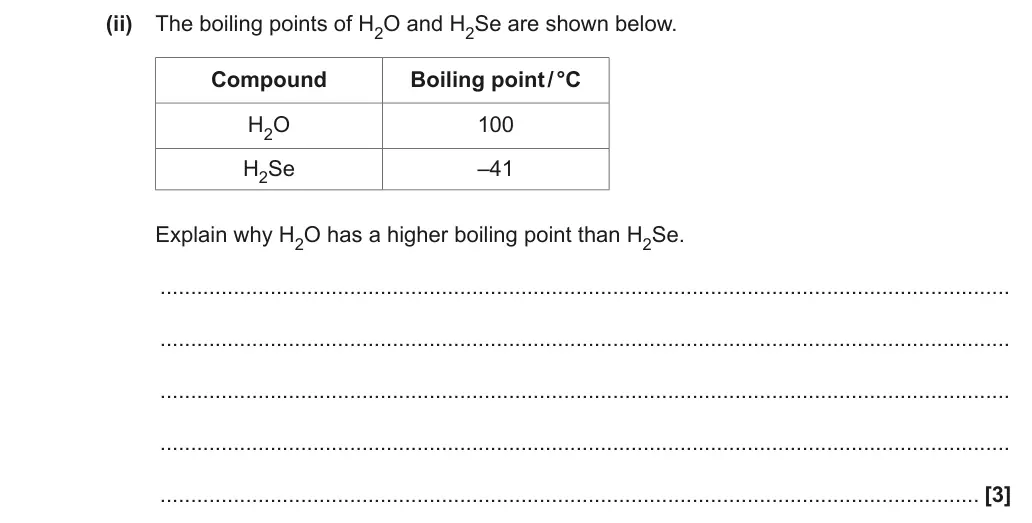
3(a) More able candidates scored well in this question, setting out their answers in a logical order. They often first discussed Ca and its bonding and structure, linking this to the physical properties and then doing the same for Br. A number of candidates discussed the chemical properties of Ca and Br, such as their ability to bond with other elements, ionisation energy and their reactivity based on their position in the periodic table. Some candidates gave a good description of metallic bonding but then went on to discuss melting point in terms of intermolecular forces. 3(b)(i) Most candidates were able to give the correct diagrams for ionic bonding, although care needs to be taken that diagrams are well drawn with both charges given. Some gave diagrams for covalent bonding. 3(b)(ii) It was important to answer the question asked. A number of responses lost marks for describing the general trend down group 2 without making reference at all to calcium and barium. Most candidates managed to score at least one mark here but a considerable proportion missed the second marking point explaining that nuclear attraction was less in Ba. 3(c)(i) This was dependent on candidates’ ability to give correct formula of aluminium hydroxide, Al(OH)3. Writing correct formulae is an important skill in chemistry, which should be practised regularly in different topics to help candidates master the skill. 3(c)(ii) Most candidates were able to recognise that water had the higher boiling point due to hydrogen bonding. However, it was evident in a number of responses that they were unclear that this is an example of an intermolecular force and doesn’t just refer to the covalent bond formed between O and H. Most avoided discussing the intermolecular forces present in H2Se even although both London forces and permanent dipole-dipole interactions were accepted as they may not have come across this specific example and had not been given electronegativity data. 3(d)(i) Very few candidates scored this mark. Although a number of candidates did give sodium bromate as the answer (with the omission of the oxidation state), many other answers were seen suggesting candidates are not aware of naming conventions for inorganic compounds. 3(d)(ii) This is the first time in a reformed chemistry AS paper that the question space has been left unstructured for oxidation number changes. The highest-attaining candidates set out their responses clearly, dealing with changes for oxidation and reduction separately, and giving the correct oxidation numbers. Some struggled to obtain an oxidation state of Br in NaBrO3 as +5, suggesting +1 instead.
Notes from the mark scheme and report
H2O hydrogen bonds
H2Se London forces (ALLOW permanent dipole–dipole)
H-bonds stronger / need more energy to overcome
November 2020 · AS Paper 2 · Q4(a)3 marksAO1, 2Short answerMedium
Mark scheme
Examiner's comment
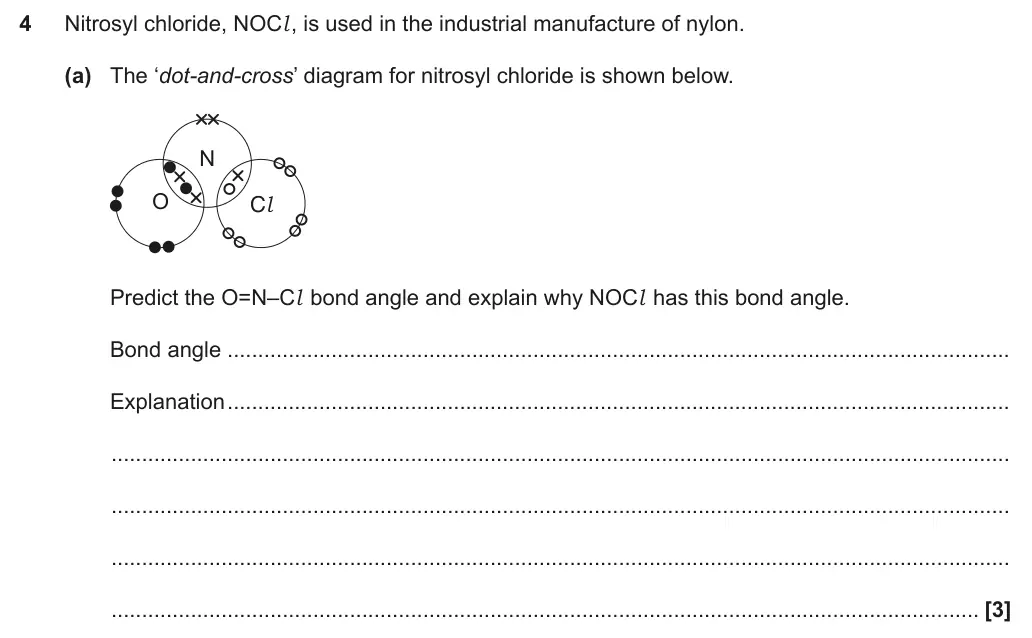
4(a) This was a challenging example of predicting bond angles. Candidates often counted four pairs of electrons around the central atom, so based their bond angles on a tetrahedral arrangement (deducting 2.5 from 109.5o), losing this mark. Explanations were not always clear, but most candidates gained credit for describing electron pairs repelling. Many candidates state that they subtracted 2.5o rather than explaining why this is done in terms of electron pairs repelling. 4(b)(i) A wide range of responses, including addition signs, 2x, curved brackets, inverse. Candidates must take care to write the formulae correctly: Cl rather than Cl2 was seen a number of times. 4(b)(ii) Most recognised that the value for NO was 2 x Cl2 but some struggled to explain why. Answers needed to show clear evidence that they had taken into account the stoichiometry of the equation. Some gave responses such as using moles and volume to calculate or to put values into the Kc expression. 4(b)(iii) Those candidates that were able to give the correct expression in 4(b)(i) were often able to obtain the correct value here, demonstrating a good understanding of this topic. Some forgot to take the square root so only obtained one mark. 4(b)(iv) Candidates need to be well versed in how to tackle this type of question. Some, despite explaining what would happen, forgot to then state what would happen to the concentration of NO. Some said that the reaction would shift to the right but did not state that the reaction was endothermic. A small number of candidates thought that the reaction was exothermic, despite the + sign by the reaction, and some discussed other factors such as rate or changing pressure.
Notes from the mark scheme and report
112–120
around N a double bond, a single bond and a lone pair
electron pairs repel
Skills: M4.1 Use angles and shapes in regular 2-D and 3-D structures
November 2020 · Paper 2 · Q18(a)(ii)2 marksAO2Short answerMedium
Earlier part of question 18 that this part uses
Mark scheme
Examiner's comment
Question 18(a)(ii) Candidates who answered this question well had clear, labelled diagrams.
Notes from the mark scheme and report
dipoles δ+/δ– on each end of one hydrogen bond
H bond from lone pair on O to H
hydrogen bond labelled
DO NOT ALLOW δ+ on H atoms of CH2
November 2020 · Paper 3 · Q1(b)(i)4 marksAO1, 2Short answerHard
Mark scheme
Examiner's comment
1a(i) Most candidates labelled some of the apparatus correctly and identified the reflux technique. A significant number showed water flowing in the wrong direction and ‘distillation’ was given as the name of the technique. The ‘condenser’ was sometimes labelled incorrectly, e.g. ‘condensation tube, ‘distillation tube’ and ‘water jacket’. Only just over half the candidates were given both marks. 1a(ii) Many diagrams were incomplete and it was comparatively rare for both of the two available marks to be given. Important labels were often missing. Some candidates drew diagrams of other techniques, such as distillation. Many responses were not credited with marks and this question was often omitted. Candidates need practice in recognising practical techniques and in drawing acceptable diagrams. 1b(i) Candidates were expected to explain the different boiling points of three amines. Most candidates linked increased branching with less surface contact between molecules, leading to weaker induced dipole interactions (London forces). Fewer candidates linked the decreasing boiling points to less energy being required to break the intermolecular bonds. The highest performing candidates recognised the large difference between the boiling points of the primary and tertiary amines. They then identified the cause: primary amines form hydrogen bonds but tertiary amines do not. This question was answered reasonably well with fewer candidates than in the past describing relative strengths of covalent bonds, a common misconception. 1(b)(ii) Most candidates rearranged the ideal gas equation correctly to make n the subject. They then substituted correct values for p, V, R and T into the equation, with correct unit conversions. Most candidates then calculated n correctly as 2.32 × 10⁻³ and combined this value with the mass of 0.202 g to derive the molecular formula as 87. Lower-attaining candidates often made an error in their conversion of cm3 into m3, by multiplying by 10–3 rather than 10–6. This error resulted in a value of n as 2.32 and the unrealistic molecular mass of 8.7 × 10⁻³, from which a molecular formula is impossible. Candidates in this position are advised to check back at the unit conversions in the working. Very few candidates did not convert 100ºC into 373 K. Candidates with the correct molecular formula of 87 usually suggested C5H13N as the molecular formula. A significant number quoted C5H11NH2. This response was not credited as it is not a ‘molecular’ formula. There are several possible structures of C5H13N with three 13C NMR peaks and any were credited. Error carried forward was applied from a different molecular mass for both the molecular formula and a structure. This emphasises the importance of working within calculation; credit will always be given for a correct method. Instead of using the ideal gas equation, some candidates used the molar gas constant at room temperature and pressure, 24.0 dm3, which gives a molecular mass of 67. This simplified approach could only gain the final 2 marks for this question: a molecular formula (with an error carried forward value of 67, e.g. C4H5N) and a structure of an amine with this molecular formula and 3 peaks in the 13C NMR spectrum. 1(c) Candidates were supplied with information about an unfamiliar reaction of an amino acid and asked to predict a possible equation. Many candidates suggested H2O as one product, being the difference in the formula of the amino acid and the C3H3NO cyclic organic product. Any cyclic structure of C3H3NO that met the bonding rules for C, H, N and O was credited. Examples included a 4-membered ring lactam and substituted cyclopropenes. A significant number of candidates showed an equation for the reaction of two molecules of the amino acid to form 2 H2O and a cyclic dipeptide. Although chemically feasible, the dipeptide could not be credited because the molecular formula was C3H3NO in the question. This error could have been avoided if the information in the question had been used.
Notes from the mark scheme and report
less branching gives more points of contact and stronger London forces
primary amines have hydrogen bonds but (CH3)3N has none
H bonds stronger than London forces
more energy to break
DO NOT ALLOW 'more electrons' (same number)
DO NOT ALLOW breaking covalent bonds
IGNORE primary/secondary/tertiary comparison
Skills: M3.1 Translate information between graphical, numerical and algebraic forms
November 2020 · Paper 3 · Q6(a)2 marksAO1Complete table/diagramHard
Mark scheme
Examiner's comment
6(a) Candidates were expected to use their knowledge and understanding of bond angles and shapes. Most candidates were given both available marks. A significant number responded with incorrect names of shapes, or chose the wrong shape, such as pyramidal for the O–C–O bond angle in the carboxylic acid. Candidates are recommended to learn this basic area of chemistry. 6(b) Most candidates completed a correct equilibrium equation and assigned the correct acid-base pairs. A significant number of candidates used ethanoic acid instead of water in the equation. The examiners allowed error carried forward in this case for the acid-base pairs. Candidates found it much more difficult to explain whether the sulfonic acid had a lower pH value. The higher-attaining candidates answered concisely. They usually identifying that the sulfonic acid would have a lower pH as the pKa value was lower (or the Ka value greater), leading to more dissociation than ethanoic acid. Lower-attaining candidates often produced unfocussed and lengthy responses, sometimes relating increased dissociation in an acid to a higher, rather than a lower, pH. Some candidates approached their explanation mathematically, calculating pH values for ethanoic acid and sulfonic acid from their concentrations and pKa values. If correct, this approach was fully credited. 6(c) Most candidates showed a good understanding and appreciation of drawing curly arrows. It must be stressed that curly arrows that do not start from a lone pair, negative charge or a bond cannot be credited. Lower-attaining candidates often drew imprecisely positioned curly arrows, curly arrows in the wrong direction or to the wrong atoms. For their response to be credited with marks, candidates should position curly arrows to ensure credit when outlining reaction mechanisms. If any of your students’ results are not as expected, you may wish to consider one of our review of results services. For full information about the options available visit the OCR website. If university places are at stake you may wish to consider priority service 2 reviews of marking which have an earlier deadline to ensure your reviews are processed in time for university applications. Our priority is supporting you and your students this autumn and to support you as you prepare for summer 2021 exams. We’ll update our website information regularly with resources, guidance and key information. • Teachers • Students • Exams officers • Assessment specialists We are sending a weekly roundup to tell you about important updates. You can also sign up for your subject specific updates. If you haven’t already, sign up here. Attend one of our popular CPD courses to hear directly from a senior assessor or drop in to a Q&A session. All our courses for the academic year 2020-2021 are being delivered live via an online platform, so you can attend from any location. Please find details for all our courses on the relevant subject page on our website or visit OCR professional development. ExamBuilder is the question builder platform for a range of our GCSE, A Level, Cambridge Nationals, Cambridge Technicals and Functional Skills qualifications. See the full list of available qualifications in the sign up form. ExamBuilder is free for all OCR centres with an Interchange account and gives you unlimited users per centre. We need an Interchange username to validate the identity of your centre's first user account for ExamBuilder. If you do not have an Interchange account please contact your centre administrator (usually the Exams Officer) to request a username, or nominate an existing Interchange user in your department. Review of results
Skills: M4.1 Use angles and shapes in regular 2-D and 3-D structures
June 2019 · AS Paper 1 · Q21 markAO1Multiple choiceHard
Answer
A
Mark scheme
Examiner's comment
This part discriminated well, with most able candidates selecting the correct answer of A. A sizeable number selected B, accompanied by a diagram of an H2O molecule with a 180º bond angle, presumably by ignoring the lone pairs. C2H4 was often shown with a bond angle of 109.5º, presumably as the C=C bond had not been identified, giving a bond angle of 120º.
June 2019 · AS Paper 1 · Q21(d)(i)2 marksAO1, 2Short answerHard
Mark scheme
Examiner's comment
Most candidates showed a correct, clear ‘dot and cross’ diagram. Lower attaining candidates sometimes used wrong charges, not enough ions or an incorrect number of electrons on N. Covalently-bonded molecules were seen, but rarely.
Notes from the mark scheme and report
3 Ca2+ AND 2 N3– with correct charges
N with 8 electrons (5 of one symbol and 3 of the other)
circles/brackets not required
June 2019 · AS Paper 1 · Q21(d)(iii)2 marksAO1Complete table/diagramMedium
Mark scheme
Examiner's comment
Most candidates completed the diagram with correct Ca2+ and O2– ions, shown alternately. Many different errors were seen for which 1 of the 2 marks could sometimes be given, e.g. 2+ and 2–, or Ca and O shown alternately. Some candidates used incorrect ions, with N3– the most common as a carry- over from 21d(i) and (ii). Some candidates completed each face of the structure with the same ion, rather than different ions alternately.
Notes from the mark scheme and report
Ca2+ and O2– must alternate, FOUR circles each
1 mark for alternating Ca and O with missing/incorrect charges
DO NOT ALLOW all circles the same ion
June 2019 · AS Paper 1 · Q21(d)(iv)2 marksAO2Drawing / labellingHard
Mark scheme
Examiner's comment
N2O is a very unfamiliar molecule for candidates and they found this ‘dot and cross’ diagram far more difficult than diagram for Ca3N2 in 21(d)(i). Information in the question clearly stated that a nitrogen atom is in the centre but many diagrams were drawn with the O atom at the centre. It was also fairly common to see NO2 rather than N2O. Candidates found the bonding of the O atom to the central N atom easier than the double or dative covalent bond between the two N atoms. Many candidates included lone pairs on the central N atom despite this resulting in a non-linear molecule. (The question states that the molecule is non-linear). It was common to see an expanded octet with 10 electrons being involved with the central N atom (a triple and double bond). If correct, this was given, reflecting a candidate’s knowledge at this stage of the course. Candidates are advised to take great care in showing clear symbols for electrons (dots and crosses or other symbols). Parts of the diagram where a dot and a cross cannot be distinguished cannot be credited. This part discriminated extremely well.
Notes from the mark scheme and report
DO NOT ALLOW ions
watch for stray electrons on central N
ALLOW 10 electrons around central N (N=N=O)
June 2019 · AS Paper 1 · Q23(a)3 marksAO1Short answerHard
Mark scheme
Examiner's comment
This question discriminated well. Candidates were expected to link increasing boiling point down the group with the increasing number of electrons and stronger induced dipole–dipole forces or London forces between molecules that must be broken. To be given all 3 marks, candidates needed to show that intermolecular forces (or forces between molecules) are broken during boiling. This mark proved to be the most difficult. The response shows a typical response that did not include intermolecular forces. Lower attaining candidates often let themselves down by being unable to construct a well-reasoned, relevant response. Many discussed nuclear charge, shielding, atomic radius and the ease of losing or gaining an electron to produce a valid explanation for ionisation energy or electron gain trend but not for different boiling points. The contrast in the clarity of low- and high-attaining candidate responses was particularly pronounced for this question.
Notes from the mark scheme and report
IGNORE van der Waals/vdW and abbreviations (LDF, IDID)
IGNORE 'more shells'/shielding
breaking covalent bonds is a CON for the last mark
needs idea of forces between molecules
June 2019 · Paper 3 · Q1(a)2 marksAO1Short answerEasy
Mark scheme
Examiner's comment
The best candidates explained that bond polarity results from fluorine being more electron negative than carbon. Most candidates were able to explain why a CF4 molecule has no overall dipole in terms of the symmetry of the molecule or dipoles cancelling. Some candidates confused dipoles cancelling with polar bonds cancelling. A significant number of candidates did not attempt to explain bond polarity at all. Candidates are recommended to look closely at the requirements of the question set and to look at the total marks for a short answer question to gauge how many points they need to make.
Notes from the mark scheme and report
F more electronegative than C
symmetrical/tetrahedral so dipoles cancel
DO NOT ALLOW C is more electronegative
IGNORE 'polar bonds cancel' and 'charges cancel'
June 2019 · Paper 3 · Q3(b)4 marksAO1, 2Short answerHard
Mark scheme
Examiner's comment
A good understanding of structure and bonding continues to be difficult for candidates, demonstrated by many explanations seen for the different melting points. Most candidates obtained two relatively easy marks for identifying the giant and simple molecular/covalent structures of SiO2 and CO2 respectively. The explanation proved to be much more difficult as candidates showed some misconceptions. Many identified that CO2 had London forces but their action between molecules was often omitted. Many candidates realised that the forces broken on melting are much stronger in SiO2 than in CO2, but then went on to erroneously compare the strength of London forces or intermolecular forces in both SiO2 and CO2.
Notes from the mark scheme and report
SiO2 giant covalent, CO2 simple molecular
London forces in CO2
covalent bonds in SiO2 stronger than intermolecular forces in CO2
DO NOT ALLOW intermolecular forces in SiO2, hydrogen bonds or permanent dipoles for CO2
IGNORE 'more bonds'
June 2019 · Paper 3 · Q5(c)(i)1 markAO1Short answerMedium
Mark scheme
Examiner's comment
In this part, candidates were expected to use their knowledge and understanding of bond angles and shapes to predict a bond angle of 109.5º and a tetrahedral shape for the thiosulfate ion. About half the candidates answered correctly but an array of other answers were obtained with bond angles ranging from 90º to 180º, and shapes from linear to octahedral.
Notes from the mark scheme and report
109.5° AND tetrahedral
ALLOW 109–110°
Skills: M4.1 Use angles and shapes in regular 2-D and 3-D structures
June 2019 · Paper 3 · Q5(c)(ii)1 markAO3Structure / isomerMedium
Earlier part of question 5 that this part uses
Mark scheme
Examiner's comment
Candidates were required to combine two thiosulfate ions into a feasible dimer. Many acceptable shapes were allowed with different combinations of O and S atoms and several rings. A significant number of candidates did not seem to know where to start and less than half the candidates were able to draw an acceptable structure.
Notes from the mark scheme and report
must be 2 atoms in the centre between the 6-bonded S atoms (S–S, O–O or S–O link)
IGNORE charges
ALLOW cyclic structures
Skills: M4.2 Visualise and represent 2-D and 3-D forms including 2-D representations of 3-D objects
June 2018 · AS Paper 1 · Q101 markMultiple choiceHard
Answer
D
Mark scheme
Examiner's comment
As is often the case, candidates find structure and bonding difficult. Many candidates selected silicon (C) instead of the correct response of sulfur (D).
June 2018 · Paper 1 · Q19(c)2 marksDrawing / labellingMedium
Mark scheme
Examiner's comment
Most candidates could draw the three lots of C–O bonds including the double C=O bond as dot and cross arrangements but relatively few were able to score the second mark. Common errors included 6 non-bonding electrons on the double bonded O atom; 5 non-bonding electrons on each single bonded O atom; not showing a clear enough difference for the ‘extra’ electrons for this difference to be recognised. A small triangle or square would have been better symbols to have chosen.
Notes from the mark scheme and report
C=O with 2 C and 2 O electrons, two C–O with 1 + 1
double-bond O has 4 non-bonding electrons
each single-bond O has 5 non-bonding O electrons plus 1 'extra' electron shown with a different symbol
charge and brackets not required
June 2018 · Paper 1 · Q20(a)3 marksShort answerMedium
Mark scheme
Examiner's comment
Most candidates realised that as the group is descended, each molecule has more electrons, resulting in stronger London forces (or greater induced dipole-dipole interactions), which require greater energy to overcome. Common errors included describing the intermolecular forces as van der Waals’ forces or permanent dipoles; stating that more energy is needed to overcome bonds (there are covalent bonds in these molecules) having previously used the term forces or interactions; and relating boiling point to reactivity based upon ease of electron loss due to differences in nuclear attraction.
Notes from the mark scheme and report
London forces increase down the group
more electrons
more energy to break the intermolecular forces
DO NOT ALLOW covalent bonds break
DO NOT ALLOW hydrogen bonds or permanent dipole interactions
IGNORE van der Waals'
June 2018 · AS Paper 1 · Q21(b)(i)1 markStructure / isomerMedium
Mark scheme
Examiner's comment
Most candidates attempted a dot-and-cross diagram of a COCl2 molecule, with ionic representations being rare. Candidates should take care to include any lone pairs in their diagrams. Omission of the O and Cl lone pairs was the most common error.
Notes from the mark scheme and report
lone pairs on Cl (3 LPs) and O (2 LPs) must be included
O and Cl electrons must be shown differently from C electrons
IGNORE inner shells
June 2018 · AS Paper 1 · Q21(b)(ii)3 marksShort answerHard
Earlier part of question 21 that this part uses
Mark scheme
Examiner's comment
This question discriminated well. Most candidates recognised that a COCl2 molecule has a trigonal planar shape. The best answers explained this shape in terms of the three electron regions around the central C atom and their repulsion.
Notes from the mark scheme and report
3 electron regions/bonding regions around C
IGNORE 'electrons repel' (pairs needed)
DO NOT ALLOW atoms repel
IGNORE just '3 bonds'
Skills: M4.1 Use angles and shapes in regular 2-D and 3-D structures
June 2018 · AS Paper 2 · Q2(a)2 marksDrawing / labellingMedium
Mark scheme
Examiner's comment
The majority of candidates obtained full marks on this question. The most common errors were incorrect charges or covalent structures.
Notes from the mark scheme and report
S with 8 electrons (6 dots + 2 crosses or vice versa)
correct charges
Na with 0 or 8 electrons
brackets not required
June 2018 · AS Paper 2 · Q2(b)3 marksComplete table/diagramMedium
Earlier part of question 2 that this part uses
Mark scheme
Examiner's comment
The majority of candidates obtained 2 or 3 marks on this question. Many candidates seemed unaware that sodium was a metal.
Notes from the mark scheme and report
marked by column
Na2S giant, poor solid, good liquid
Na giant, good, good
S simple, poor, poor
June 2018 · AS Paper 2 · Q3(d)(ii)1 markShort answerMedium
Earlier part of question 3 that this part uses
Mark scheme
Examiner's comment
The majority of candidates answered this question incorrectly. Only 10% of candidates mentioned intermolecular/London forces. Most stated ‘exothermic’ or described breaking covalent bonds.
Notes from the mark scheme and report
endothermic AND energy needed to overcome London forces/intermolecular forces
DO NOT ALLOW van der Waals' forces
June 2018 · Paper 2 · Q51 markMultiple choiceHard
Answer
B
Mark scheme
Examiner's comment
This question discriminated well, with higher ability candidates correctly identifying B as a non-planar molecule. Common incorrect responses included C and D. Some candidates drew structures alongside each option to aid their choice.
June 2018 · Paper 2 · Q20(d)6 marks6-mark level of responseMedium
Earlier part of question 20 that this part uses
Mark scheme, with the levels and indicative points
Examiner's comment
This question was marked using a level of response mark scheme. Most candidates gave an answer worthy of at least level two (3-4 marks) by providing a suitable mechanism and identifying the major product. The strongest candidates identified both products and were able to describe which was most likely. Such responses received level 3 (5-6 marks) as shown in Exemplar 9. Lower ability candidate responses seemed to ignore the reference to electrophilic addition in the question and tried reacting ICl with either the benzene ring or the aldehyde group. This response starts with a clear outline of the electrophilic addition mechanism showing correct partial charges and accurately drawn curly arrows. The structures of the two possible organic products are shown and the most likely product to be formed is identified correctly. Notice that the candidate has labelled these structures as ‘Product A’ and ‘Product B’ and refers to the labels later in the response. This is a good strategy, which enables the candidate to provide a clear and easy to follow answer. The response concludes with a detailed explanation, referring to carbocation stability to justify why product A is most likely to be formed. This response therefore satisfies the Level 3 criteria. The response is logically structured with a well-developed line of reasoning and was therefore credited the upper mark within the level and achieved six marks.
Notes from the mark scheme and report
dipole Iδ+–Clδ– from electronegativity so I is the electrophile
curly arrow from C=C to I and from I–Cl bond to Cl
carbocation with full + charge
arrow from lone pair/– charge on Cl–
major product via the more stable (tertiary) carbocation
June 2018 · Paper 2 · Q22(b)4 marksData interpretationEasy
Earlier part of question 22 that this part uses
Mark scheme
Examiner's comment
This question was answered well with most candidates scoring three or four marks. Examiners were impressed by the number of responses that accurately referred to induced dipole-dipole interactions or London forces rather than van der Waals’ forces, which is ambiguous. Some responses lacked detail, as demonstrated in Exemplar 10. This response attributes the higher boiling point of pentan-1-ol to the amount energy required to break hydrogen bonds. However, it does not refer the relative strength of this type of interaction. Consequently, the first paragraph only scores marking point four and not marking point three. The higher boiling point of heptane compared to hexane is explained by a correct comparison of the induced dipole-dipole interactions present in these compounds, so marking point two was achieved. However, the justification for the difference in intermolecular forces lacks precision. Candidates should be encouraged to focus on surface contact or surface interaction between molecules rather than referring to surface area alone.
Notes from the mark scheme and report
heptane: more surface contact/more electrons so stronger London forces
pentan-1-ol: hydrogen bonds
more energy to break the forces
IGNORE van der Waals/VDW/IDID
IGNORE 'harder to break' without energy
IGNORE 'more energy to break bonds'
June 2018 · Paper 3 · Q1(a)(iv)1 markShort answerMedium
Earlier part of question 1 that this part uses
Mark scheme
Examiner's comment
Most candidates selected sulfur as the correct response, recalling their knowledge of molecular shapes encountered early in the course. There was no real pattern for incorrect responses, suggesting that they were guesses.
Notes from the mark scheme and report
sulfur (SF6)
ALLOW S8
Skills: M4.1 Use angles and shapes in regular 2-D and 3-D structures
June 2018 · Paper 3 · Q1(b)5 marksExtended responseMedium
Mark scheme
Examiner's comment
This part required candidates to determine the structure and bonding of unfamiliar compounds from their melting points and electrical conductivities. This part discriminated very well. Candidates with a good knowledge and understanding of structure and bonding, often produced concise, clear responses which were credited with a high mark, as shown in the Poor understanding often showed up with contradictions and it was common to see ionic lattices with strong intermolecular forces and able to release mobile electrons (rather than mobile ions) in the liquid state. Weaker candidates often wrote extensive answers, although the extra length did not lead to more marks as correct responses were then often contradicted. Exemplar 2 shows part of a very muddled and rambling response in which NaCl is described as having both ionic bonding and London forces. The best responses identified NaCl and MgCl2 as having giant ionic lattices with strong forces between their ions. This structure was then compared with the simple molecular structures of SiCl4, PCl3 and SCl2 with weak London forces between their molecules. A common error was for SiCl4 to have a giant covalent lattice, presumably linking with the structure of elemental silicon and not using the low boiling point in the supplied data.
Notes from the mark scheme and report
NaCl/MgCl2 giant ionic with ions mobile in LIQUID (IGNORE 'free ions' and aqueous)
SiCl4/PCl3/SCl2 simple molecular with London forces (IGNORE permanent dipole and van der Waals)
ionic bonds stronger than London forces
June 2017 · AS Paper 1 · Q71 markMultiple choice
Answer
A
Mark scheme
June 2017 · AS Paper 1 · Q91 markMultiple choice
Answer
D
Mark scheme
June 2017 · Paper 1 · Q16(a)1 markDrawing / labelling
Mark scheme
Notes from the mark scheme and report
extra electron may be shown with a different symbol
DO NOT ALLOW 4 dots and 4 crosses
IGNORE missing brackets or charge
June 2017 · Paper 1 · Q16(b)2 marksShort answer
Mark scheme
Notes from the mark scheme and report
NH4+ tetrahedral AND 109.5°
NH2– non-linear AND 104.5° (ALLOW 104–105, bent, V-shaped)
IGNORE planar
Skills: M4.1 Use angles and shapes in regular 2-D and 3-D structures
June 2017 · Paper 1 · Q16(c)(i)2 marksShort answer
Mark scheme
Notes from the mark scheme and report
NH3 has hydrogen bonding, which is stronger/needs more energy to overcome
DO NOT ALLOW responses implying covalent or ionic bonds break
June 2017 · Paper 1 · Q16(c)(ii)2 marksShort answer
Earlier part of question 16 that this part uses
Mark scheme
Notes from the mark scheme and report
AsH3 has more electrons so stronger London forces
IGNORE van der Waals and permanent dipole–dipole
DO NOT ALLOW covalent bonds breaking
June 2017 · AS Paper 2 · Q1(a)(i)1 markShort answer
Mark scheme
Notes from the mark scheme and report
electrostatic attraction between oppositely charged ions
IGNORE references to transfer of electrons and to metal/non-metal
June 2017 · AS Paper 2 · Q1(a)(ii)2 marksDrawing / labelling
Earlier part of question 1 that this part uses
Mark scheme
Notes from the mark scheme and report
Ba with 0 or 8 outer electrons and O with 8 (6 of one symbol + 2 of the other)
correct charges on both ions
June 2017 · AS Paper 2 · Q1(b)(i)2 marksShort answer
Mark scheme
Notes from the mark scheme and report
ions fixed in lattice (solid) vs mobile ions (aqueous)
DO NOT ALLOW electrons moving
IGNORE 'free' for mobile and 'charge carriers'
June 2017 · AS Paper 2 · Q4(a)2 marksDrawing / labelling
Mark scheme
Notes from the mark scheme and report
must be displayed formulae
two lone pairs on both O atoms
H-bond labelled between H(δ+) and an O lone pair
IGNORE δ+ shown on other H atoms
June 2017 · AS Paper 2 · Q5(b)(i)2 marksShort answer
Mark scheme
Notes from the mark scheme and report
tetrahedral AND 109.5
four bonded pairs/bonds repel
IGNORE 'four electron pairs repel'
DO NOT ALLOW atoms repel
Skills: M4.1 Use angles and shapes in regular 2-D and 3-D structures
June 2017 · AS Paper 2 · Q5(b)(ii)1 markShort answer
Earlier part of question 5 that this part uses
Mark scheme
Notes from the mark scheme and report
104.5 (ALLOW 104–105)
Skills: M4.1 Use angles and shapes in regular 2-D and 3-D structures
June 2017 · Paper 2 · Q61 markMultiple choice
Answer
C
Mark scheme
Notes from the mark scheme and report
ALLOW 3
Skills: M4.1 Use angles and shapes in regular 2-D and 3-D structures
June 2017 · Paper 2 · Q16(a)2 marksStructure / isomer
Mark scheme
Notes from the mark scheme and report
both points must be comparisons
fewer points of contact so weaker London forces needing less energy to break
IGNORE van der Waals
IGNORE 'less energy to break the bonds'
June 2017 · Paper 2 · Q19(b)(i)2 marksDrawing / labelling
Mark scheme
Notes from the mark scheme and report
δ+ on H and δ– on O on BOTH molecules
H-bond from a lone pair on O to H, labelled
DO NOT ALLOW δ+ on alkyl H atoms
no marks for a diagram containing O2H
June 2017 · Paper 3 · Q1(a)3 marksShort answer
Mark scheme
Notes from the mark scheme and report
ice has hydrogen bonds
H2O(g) has 2 bonded pairs and 2 lone pairs
lone pairs repel more than bonded pairs
IGNORE open lattice/tetrahedral structure of ice
Skills: M4.1 Use angles and shapes in regular 2-D and 3-D structures
June 2016 · AS Paper 1 · Q71 markMultiple choice
Answer
B
Mark scheme
June 2016 · AS Paper 1 · Q81 markMultiple choice
Answer
D
Mark scheme
June 2016 · AS Paper 1 · Q151 markMultiple choice
Answer
B
Mark scheme
June 2016 · AS Paper 1 · Q21(c)(ii)2 marksAO2Drawing / labelling
Earlier part of question 21 that this part uses
Mark scheme
Notes from the mark scheme and report
N and O electrons must be shown differently
extra electron with a different symbol
dative N→O bond uses 2 N electrons
charge and brackets not required
June 2016 · AS Paper 2 · Q2(a)3 marksAO1, 2Short answer
Mark scheme
Notes from the mark scheme and report
P4 has more electrons (DO NOT ALLOW more outer-shell electrons or larger electron cloud)
IGNORE bigger molecules/greater Mr
DO NOT ALLOW covalent bonds broken or attraction between atoms
Skills: M3.1 Translate information between graphical, numerical and algebraic forms
June 2016 · AS Paper 2 · Q6(b)4 marksAO1, 2Short answer
Earlier part of question 6 that this part uses
Mark scheme
Notes from the mark scheme and report
104.5° (ALLOW 104–105)
two bonded pairs and two lone pairs
lone pairs repel more than bonding pairs
IGNORE 'bonds/electrons repel'
DO NOT ALLOW atoms repel
Skills: M4.1 Use angles and shapes in regular 2-D and 3-D structures
Work with an OCR chemistry tutor
Dropping marks on calculations, mechanisms or the six-markers? Book a trial session with a specialist OCR chemistry tutor.