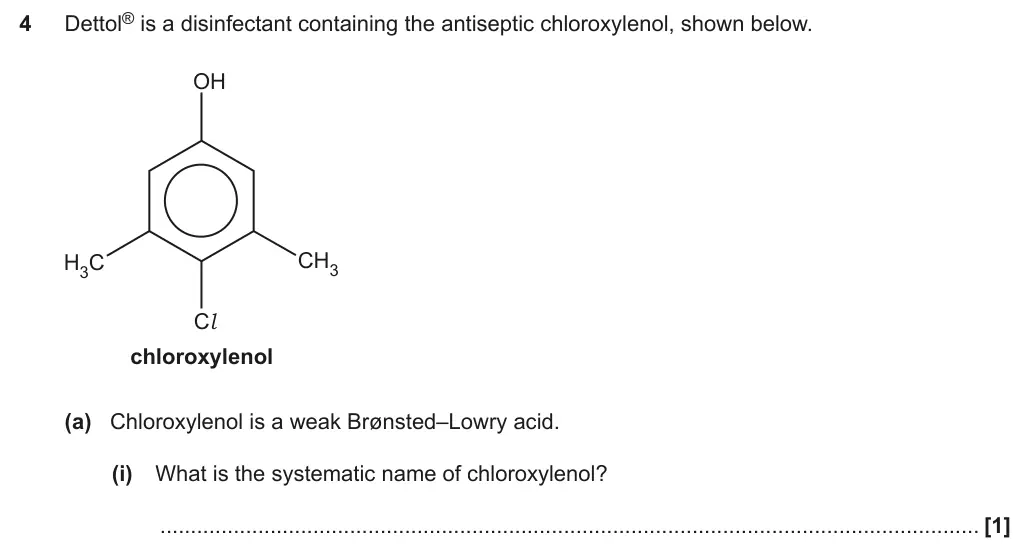
Notes and key-term cards for this topic are being written by our tutors. The past-paper questions below are ready now.
Learning outcomes
Show the 12 learning outcomes from the specification
6.3.1(a) interpretation of one-way TLC chromatograms in terms of Rfvalues
6.3.1(b) interpretation of gas chromatograms in terms of:
6.3.1(b)(i) retention times
6.3.1(b)(ii) the amounts and proportions of the components in a mixture.
6.3.1(c) qualitative analysis of organic functional groups on a test-tube scale; processes and techniques needed to identify the following functional groups in an unknown compound:
6.3.1(c)(i) alkenes by reaction with bromine (see also 4.1.3 f)
6.3.1(c)(ii) haloalkanes by reaction with aqueous silver nitrate in ethanol (see also 4.2.2 a)
6.3.1(c)(iii) phenols by weak acidity but no reaction with CO32– (see also 6.1.1 h)
6.3.1(c)(iv) carbonyl compounds by reaction with 2,4- DNP (see also 6.1.2 d)
6.3.1(c)(v) aldehydes by reaction with Tollens’ reagent (see also 6.1.2 e)
6.3.1(c)(vi) primary and secondary alcohols and aldehydes by reaction with acidified dichromate (see also 4.2.1 c, 6.1.2a)
6.3.1(c)(vii) carboxylic acids by reaction with CO32– (see also 6.1.3 b).
Six-mark level of response questions on this topic
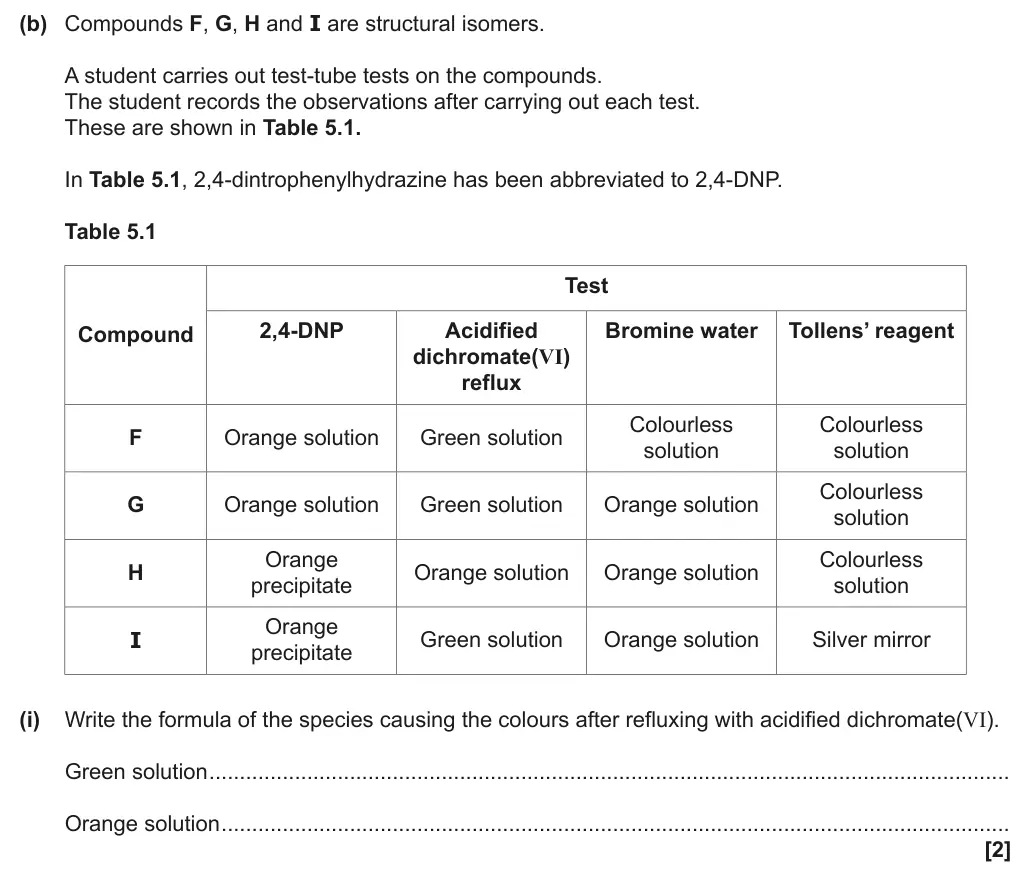
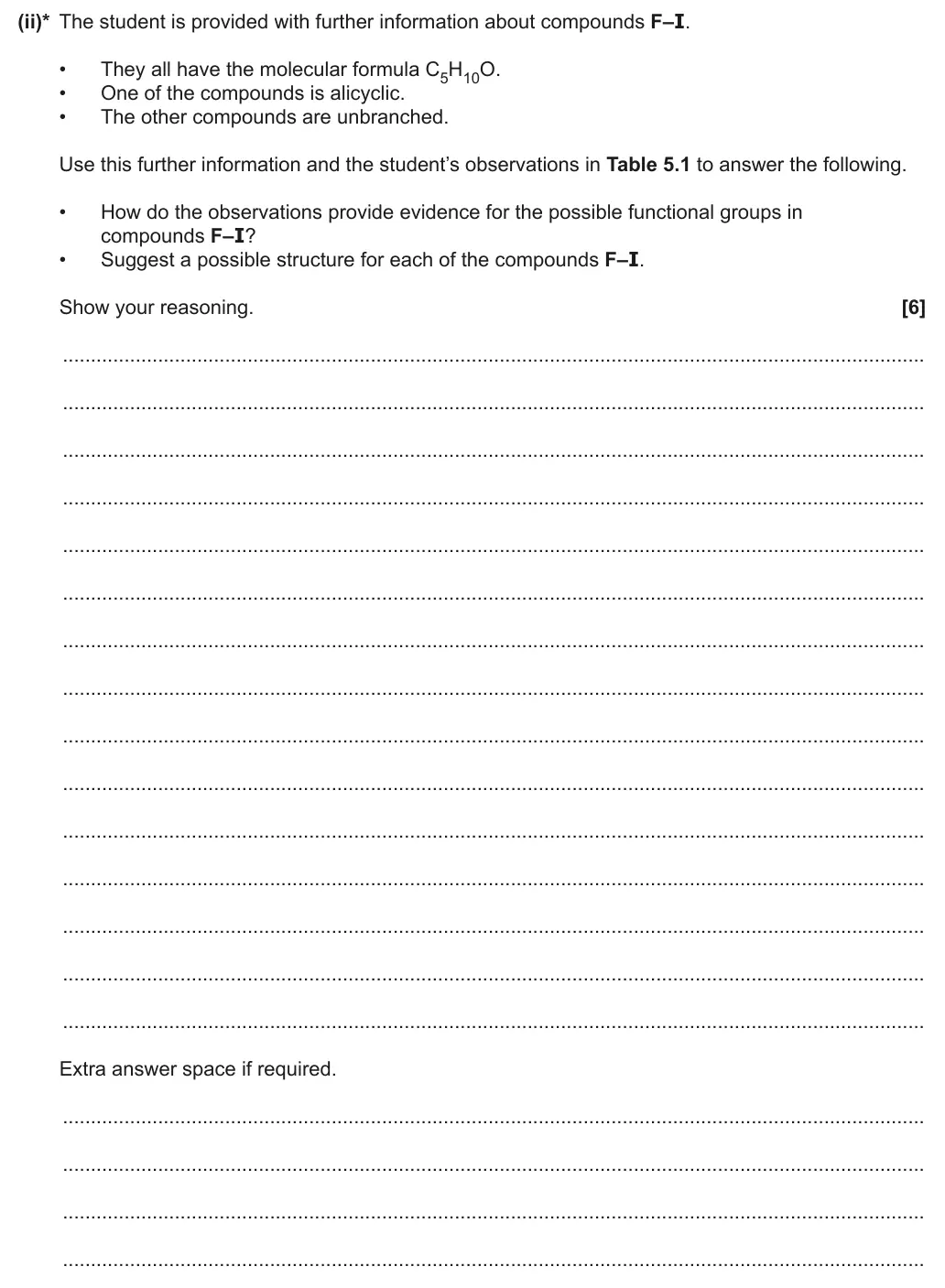
The student is provided with further information about compounds F–I. Use this further information and the student’s observations in Table 5.1 to answer the following.
The structures for six naturally occurring organic compounds with pleasant smells, B–G, are Explain how chemical tests would allow each compound to be distinguished from the other
Tap a question to zoom it. Where a part needs a table, graph or structure from an earlier part, that part folds out above it; the mark scheme and examiner's comment open underneath. Have the OCR Data Sheet beside you.
June 2025 · Paper 2 · Q21(b)2 marksShort answerEasy
Earlier part of question 21 that this part uses
Mark scheme
Examiner's comment
The majority of candidates scored both marks here. A few lost the second mark for just saying ‘turned orange’ without ppt. Some gave tests in (c) here as well but were usually consistent showing all three reacting in the table.
Skills: PAG7 Qualitative analysis of organic functional groups
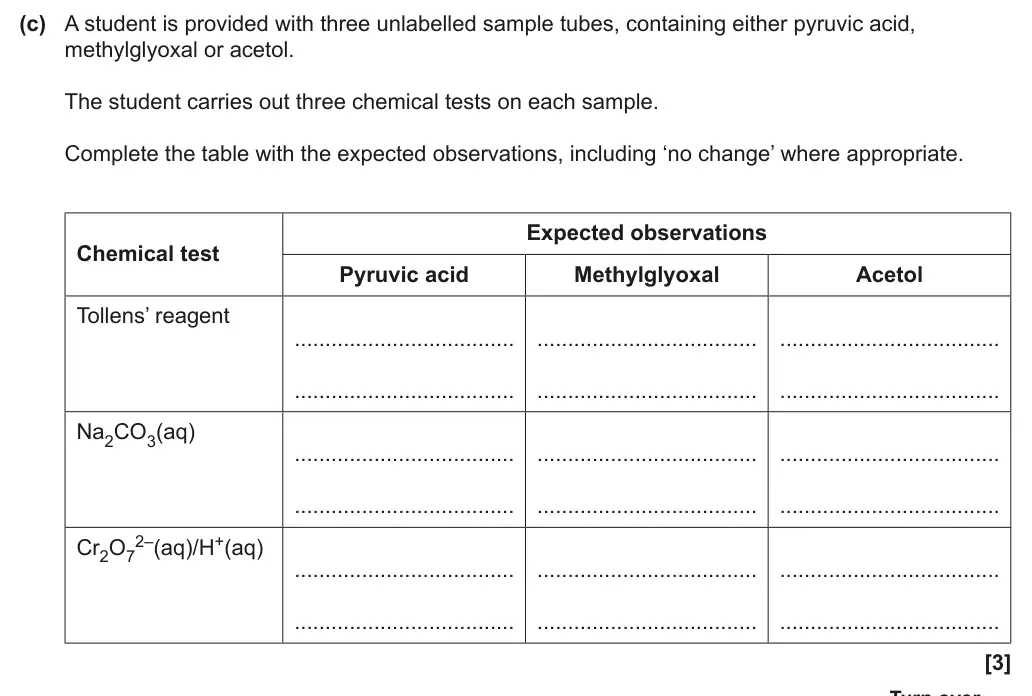
June 2025 · Paper 2 · Q21(c)3 marksComplete table/diagramHard
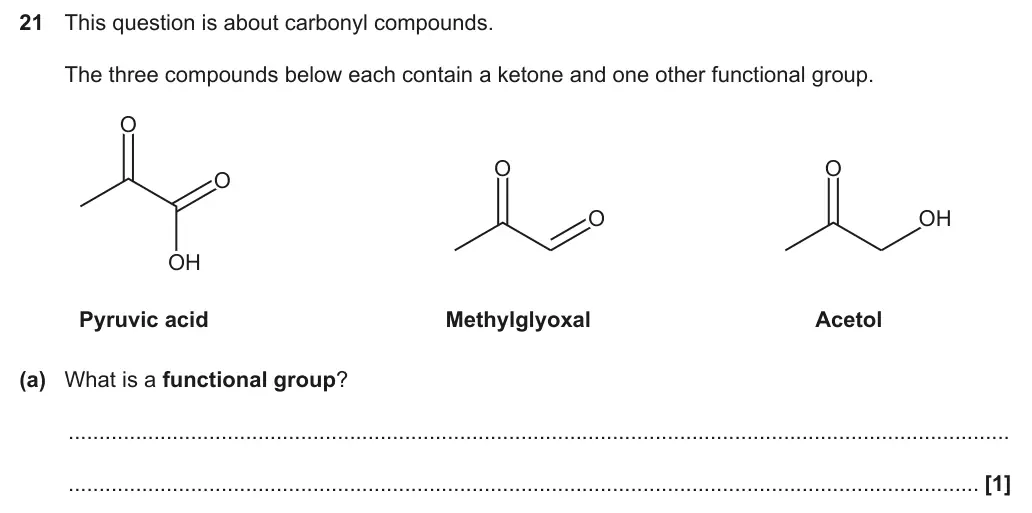
Earlier part of question 21 that this part uses
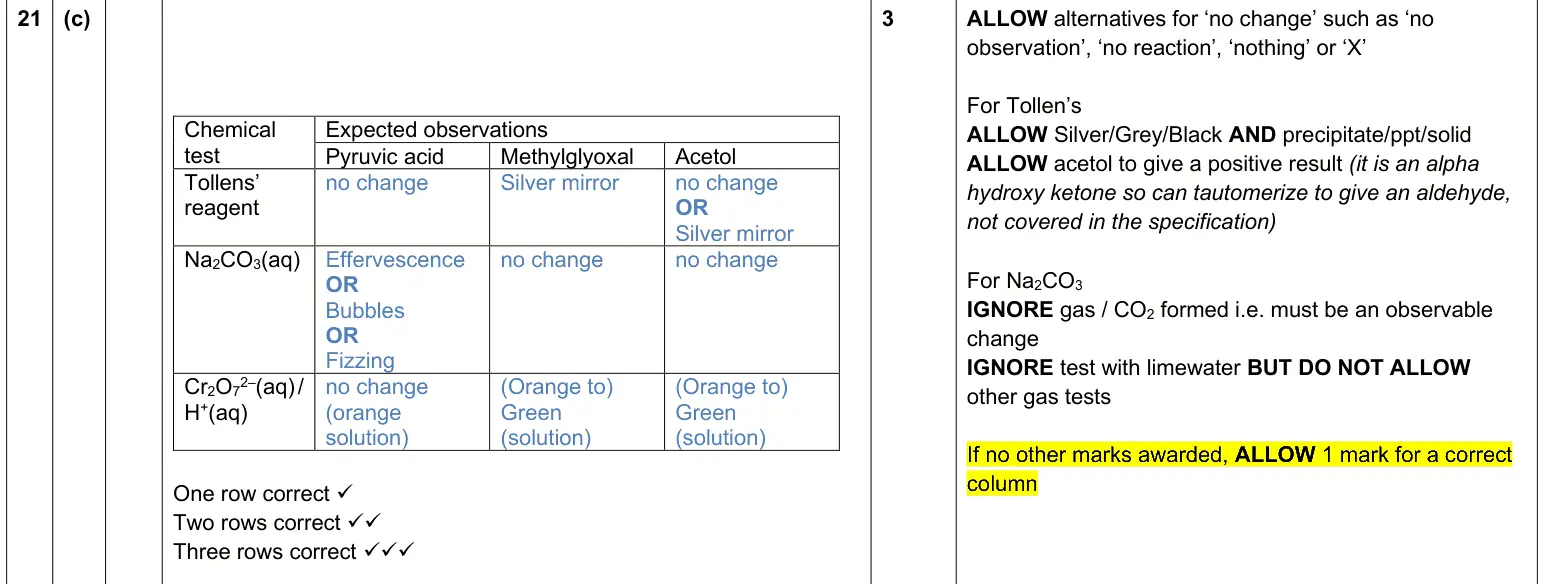
Mark scheme
Examiner's comment
Very few candidates did not score any marks for this observation question. Common errors included: • gas/CO2 formed for the reaction with carbonate. The observation was needed • no reaction for methylglyoxal with dichromate, as they had not realised aldehydes will react as well as primary and secondary alcohols • positive test for all three with dichromate − often linked with incorrect answer in Question 9 • white precipitate with the reaction with carbonate • bubbles with acetol with carbonate (presence of C=O and O-H leading to possible confusion with an acid?). Candidates gave a range of responses for the reactions with no change, e.g. ‘no silver mirror formed’, ‘stays orange or ‘nothing’, these were still accepted but for clarity candidates should respond as the question asks.
Notes from the mark scheme and report
one mark per row
Tollens': silver mirror only for methylglyoxal (ALLOW acetol positive)
Na2CO3: effervescence only for pyruvic acid (IGNORE 'gas/CO2 formed', must be an observation)
dichromate: orange to green for methylglyoxal and acetol
Skills: PAG7 Qualitative analysis of organic functional groups
June 2025 · Paper 2 · Q22(a)(i)1 markShort answerMedium
Mark scheme
Examiner's comment
The majority were able to correctly calculate Rf values and gain a mark here. A few did not gain marks for calculator errors (they had corrected measurements but gave the wrong answer) or for incorrect measurements, e.g. from the bottom of the TLC rather than the start line.
Notes from the mark scheme and report
Rf = 0.75 (0.71–0.79) AND 0.25 (0.22–0.28)
±1 mm on each measurement
working not required
Skills: M0.2 Use ratios, fractions and percentages; M3.1 Translate information between graphical, numerical and algebraic forms; PAG6 Synthesis of an organic solid
June 2025 · Paper 2 · Q22(a)(ii)2 marksDrawing / labellingMedium
Earlier part of question 22 that this part uses
Mark scheme
Examiner's comment
Many candidates found this question tricky with only some able to score both marks. The most common correct responses were the dipeptides given as the first two structures on the mark scheme. The acid anhydride structure was less commonly seen and the cyclic peptide structure was rare. Candidates who got this response wrong often gave just the two amino acids identified from their Rf values in part (a)(i), forgetting that the amino acids needed to be joined together to create compound S. Some included an O in their amide bond i.e. -COONH- and lost both marks. Some recognised that the central C in an amino acid is chiral so drew stereoisomers. Some added an extra CH2 in the side chain of CH(CH3)2 but ECF was given for the second structure. Around half of all candidates didn’t score any marks here with some not even attempting this question at all.
Notes from the mark scheme and report
two different dipeptides from the R = CH3 and R = CH(CH3)2 amino acids (either order of amide link)
ALLOW ECF from wrong Rf values in (a)(i)
ALLOW ECF for one small slip e.g. missing H on NH
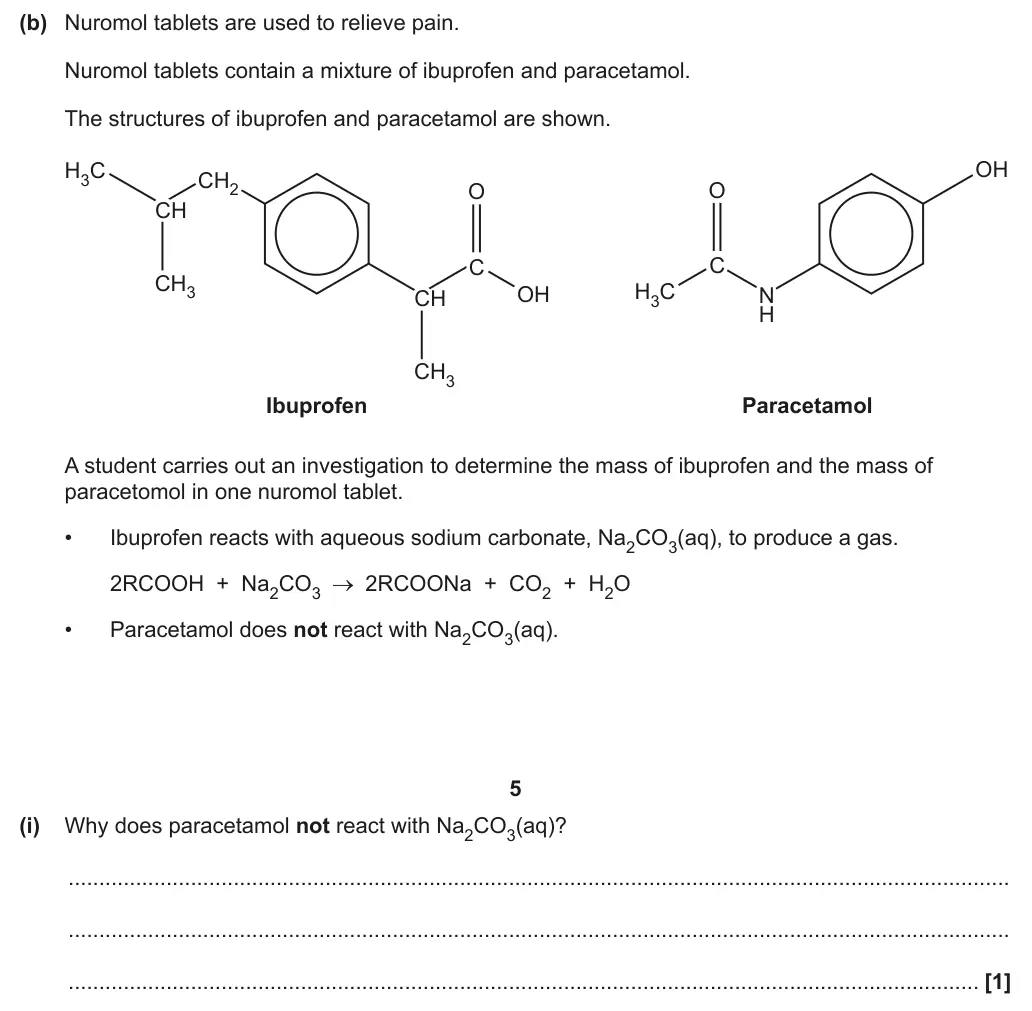
June 2025 · Paper 3 · Q2(b)(i)1 markShort answerEasy
Mark scheme
Examiner's comment
This question was answered well, with most candidates identifying that ibuprofen contains a phenol group or that it does not contain a carboxylic acid. A named functional group was required in the answer. Some described phenol incorrectly as not being an acid and this was not credited. It was rare for incorrect functional groups to be seen in candidate responses.
Notes from the mark scheme and report
it is a phenol / has no COOH: a correct functional group must be named
IGNORE 'too weak an acid'
DO NOT ALLOW 'not acidic', ketone or amine
June 2024 · Paper 2 · Q31 markMultiple choiceMedium
Answer
D
Mark scheme
Examiner's comment
Most correctly identified the colour of the precipitate as yellow, D. The most common incorrect response was brown, A, possibly linking to the colour of iodine.
Notes from the mark scheme and report
iodoalkane gives yellow AgI
Skills: PAG7 Qualitative analysis of organic functional groups
June 2024 · Paper 2 · Q51 markMultiple choiceMedium
Answer
C
Mark scheme
Examiner's comment
The majority of candidates were able to correctly identify the two functional groups and the correct corresponding test i.e. alkene using bromine water and primary alcohol using 2,4-dinitrophenylhydrazine. The most common incorrect response was B.
Notes from the mark scheme and report
alkene (bromine water) and primary alcohol (acidified dichromate)
Skills: PAG7 Qualitative analysis of organic functional groups
June 2024 · Paper 2 · Q131 markMultiple choiceMedium
Answer
C
Mark scheme
Examiner's comment
More than half of candidates were able to give C as the correct answer recognising that Statements 2 and 3 are correct. Some felt that Statement 1 was also correct giving A or B as the answer – relative peak area is not the same as the mass of 1 mole. Some were not able to relate the peak area to amount of compound present, so did not pick Statement 3 as one of the true statements, giving B or D.
Notes from the mark scheme and report
Z = 5.5/10.0 of the sample
Skills: M0.2 Use ratios, fractions and percentages; M3.1 Translate information between graphical, numerical and algebraic forms
June 2024 · Paper 3 · Q5(a)(i)1 markCalculationEasy
Mark scheme
Examiner's comment
Candidates are well versed with calculating an Rf value, with nearly all candidates obtaining a value in the acceptable range of 0.12–0.18.
Notes from the mark scheme and report
working required
measure from origin line to solvent front (about 9.1 cm), not from the bottom of the plate
ALLOW 0.12–0.18
Skills: M0.2 Use ratios, fractions and percentages; M3.1 Translate information between graphical, numerical and algebraic forms; PAG6 Synthesis of an organic solid
June 2024 · Paper 3 · Q5(a)(iii)3 marksShort answerEasy
Earlier part of question 5 that this part uses
Mark scheme
Examiner's comment
This novel question assessed whether candidates realised why chemists used TLC when carrying out organic reactions. A good response would identify the following key features after 20 minutes: • The C–Cl bond energy is greater than C–Br and so the reaction would be slower. • The haloalkane spot would be larger and the propan-1-ol spot smaller. • The propan-1-ol is spotted on the chromatogram to monitor the progress of the reaction. The question differentiated very well between candidates, but many did not seem to know where to start with many candidates not scoring any marks. This suggested that candidates recognised chromatography as a technique but did not appreciate its relevance in organic chemistry. Some candidates referred to pigments, recalling their early chromatography experiments in finding the colours in ink.
C–Cl bond stronger than C–Br so reacts slower (C–Cl bond required
DO NOT ALLOW chloride/bromide
IGNORE halogen reactivity)
propan-1-ol run to show product formation/monitor progress
IGNORE 'as a control/comparison' alone
Skills: PAG6 Synthesis of an organic solid
June 2024 · Paper 3 · Q5(b)(ii)6 marks6-mark level of responseEasy
Earlier part of question 5 that this part uses
Mark scheme, with the levels and indicative points
Examiner's comment
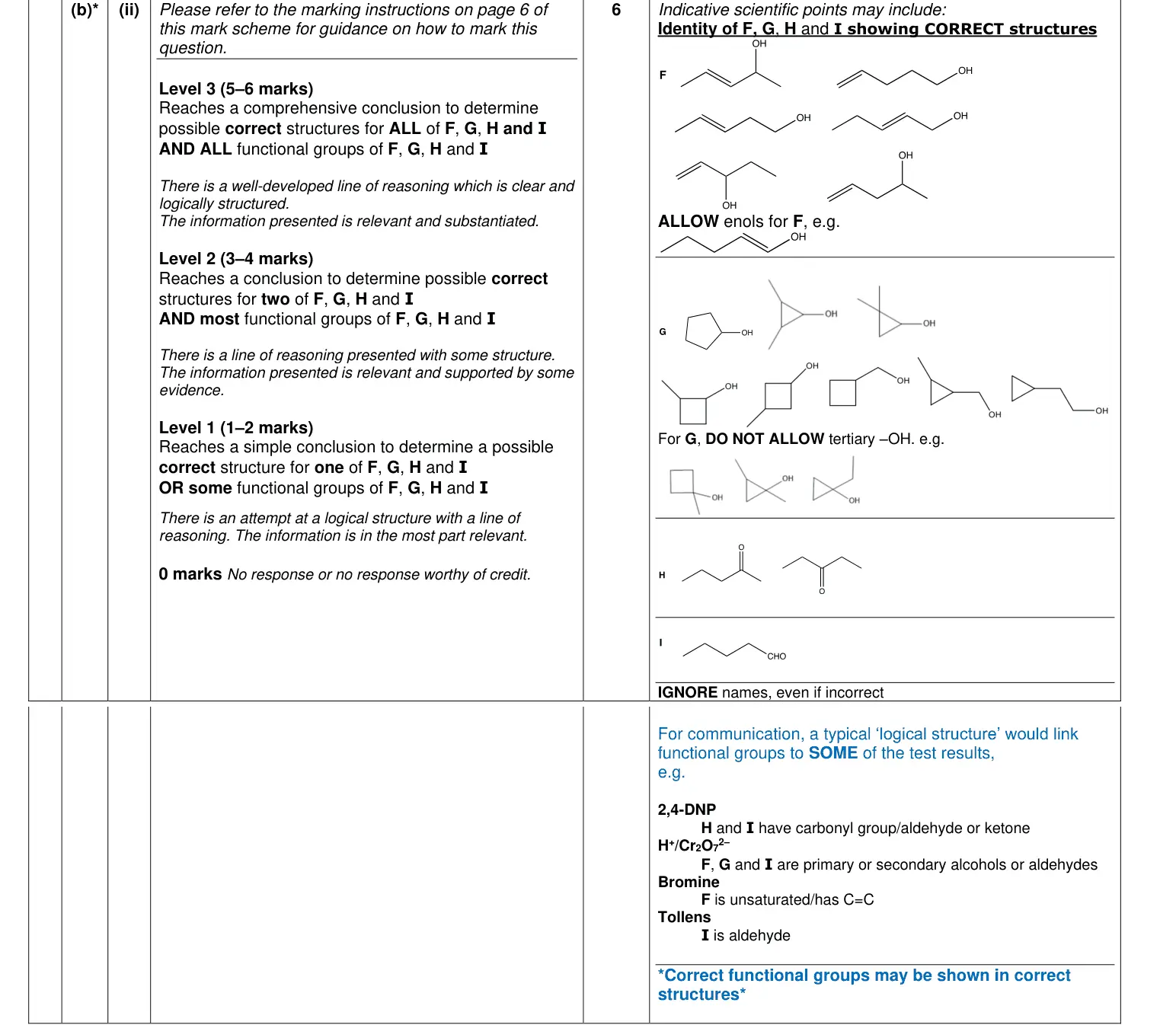
This Level of Response question was answered well with many candidates identifying compounds F–I correctly to reach Level 3. Structures were usually shown skeletally and this practice is to be recommended. Not only is it far quicker and clearer, it eliminates writing every atom in a displayed or structural formula. Some candidates were not given marks for missing hydrogen atoms or for ‘sticks’ being shown. In these structures, the chemical meaning of a stick is a terminal CH3 group. Candidates were also asked to show how the results of the chemical tests helped the identification of the unknown compounds and this formed the basis of the communication strand of the LOR mark. Candidates answered this part of the analysis extremely well and most were given marks for their good communication skills. This question differentiated very well between well-prepared and less confident candidates. The latter often did not know how the results of these organic tests can be used to identify the functional groups present. It was common for such candidates to identify only one of the four compounds, scoring within Level 1 only. This exemplar is concise and very clear. The candidate has clearly linked the result of each test to the functional groups that must be present. The candidate has drawn skeletal formulae and clearly has experimented with many possible structures before deciding on which must be correct. Notice that the candidate has crossed out the structures that they have rejected. This is an important exam technique – if two structures are drawn, with one correct and the other incorrect, the correct structure cannot be given marks. The response is clearly at Level 3 for the four correct structures and the good communication ensures that the communication strand can be given. This response received all 6 marks.
Notes from the mark scheme and report
H and I carbonyl (2,4-DNP)
I aldehyde (Tollens')
F, G, I oxidised by dichromate
F has C=C (bromine): F unbranched unsaturated primary/secondary alcohol, G alicyclic alcohol (DO NOT ALLOW tertiary OH), H pentan-2-one or pentan-3-one, I pentanal
To better prepare candidates, we recommend using either the digital multiple choice quizzes on Teach Cambridge or creating targeted practise materials using ExamBuilder. If you are unsure of how to access these or ways to make the most of them, get in touch via science@ocr.org.uk.
Skills: PAG7 Qualitative analysis of organic functional groups
June 2023 · Paper 2 · Q21 markAO1Multiple choiceMedium
Answer
A
Mark scheme
Examiner's comment
Drawing out the structures often helped candidates to identify each functional group and therefore spot the ketone which is key to correctly answering this question.
June 2022 · Paper 2 · Q18(a)(i)3 marksAO1Short answerMedium
Mark scheme
Examiner's comment
The use of 2,4-dinitrophenylhydrazine as a test for the carbonyl group is well known by candidates at this level. The majority of the cohort correctly identified this test and the subsequent analysis of the melting point of the products as a method of identifying each compound. Lower ability candidate responses made reference to analysis of the boiling points or omitted the reference to analysis of the melting points.
Notes from the mark scheme and report
2,4-DNP(H) AND orange/yellow/red precipitate
take melting point of the derivative
compare with known values
DO NOT ALLOW boiling points or chromatograms
Skills: PAG6 Synthesis of an organic solid; PAG7 Qualitative analysis of organic functional groups
June 2022 · Paper 2 · Q18(a)(ii)1 markAO1Short answerEasy
Earlier part of question 18 that this part uses
Mark scheme
Examiner's comment
Almost all candidates were able to correctly describe the use of Tollens’ reagent as a test for an aldehyde fictional group
Notes from the mark scheme and report
Tollens' reagent AND silver mirror
ALLOW acidified dichromate turning green
Skills: PAG7 Qualitative analysis of organic functional groups
June 2022 · Paper 2 · Q20(a)(i)1 markAO1Short answerHard
Mark scheme
Examiner's comment
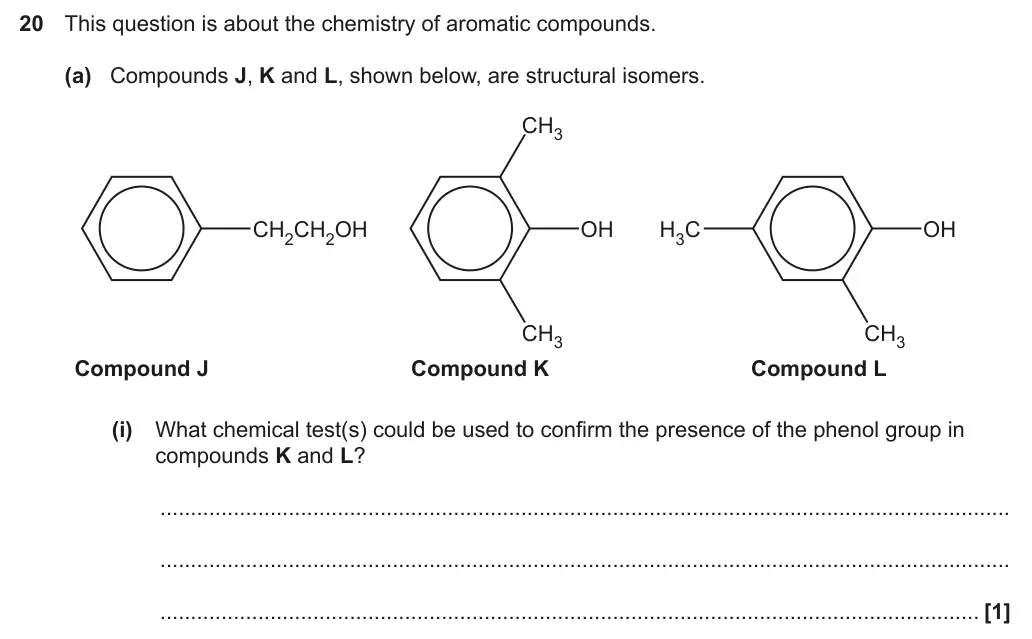
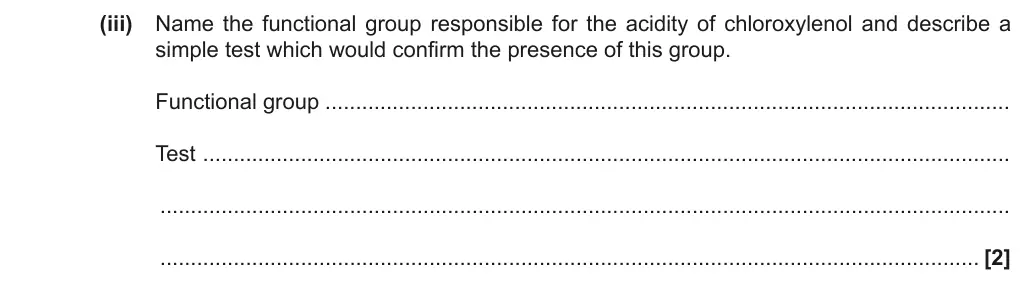
Few candidates knew the test for a phenol group. Frequent incorrect responses involved the production of a gas with a carbonate or stating that bromine water is decolourised but failing to state that a white precipitate is also formed. A significant number of candidates also stated that the reaction with sodium hydroxide confirms the presence of the phenol group.
Notes from the mark scheme and report
indicator shows acidity AND no reaction with carbonate
ALLOW bromine giving white precipitate
ALLOW FeCl3 giving violet/purple colour
Skills: PAG7 Qualitative analysis of organic functional groups
November 2021 · Paper 2 · Q101 markMultiple choice
Answer
A
Mark scheme
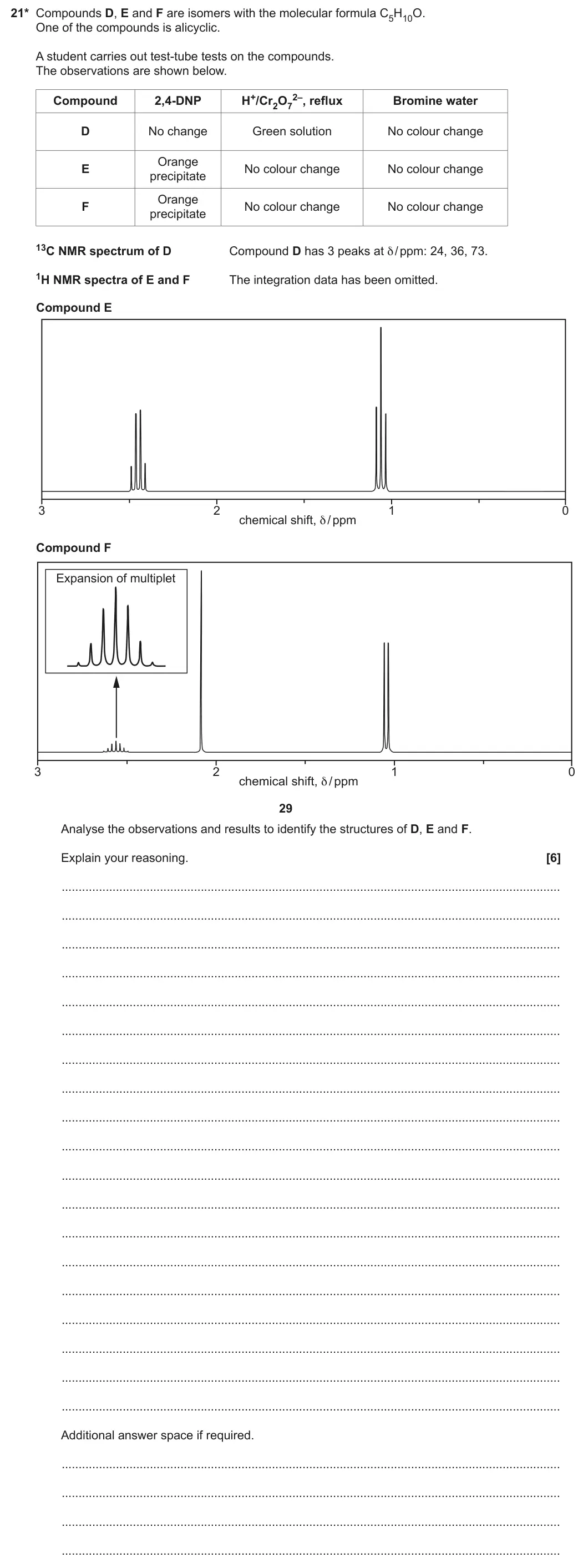
November 2021 · Paper 2 · Q216 marksAO36-mark level of response
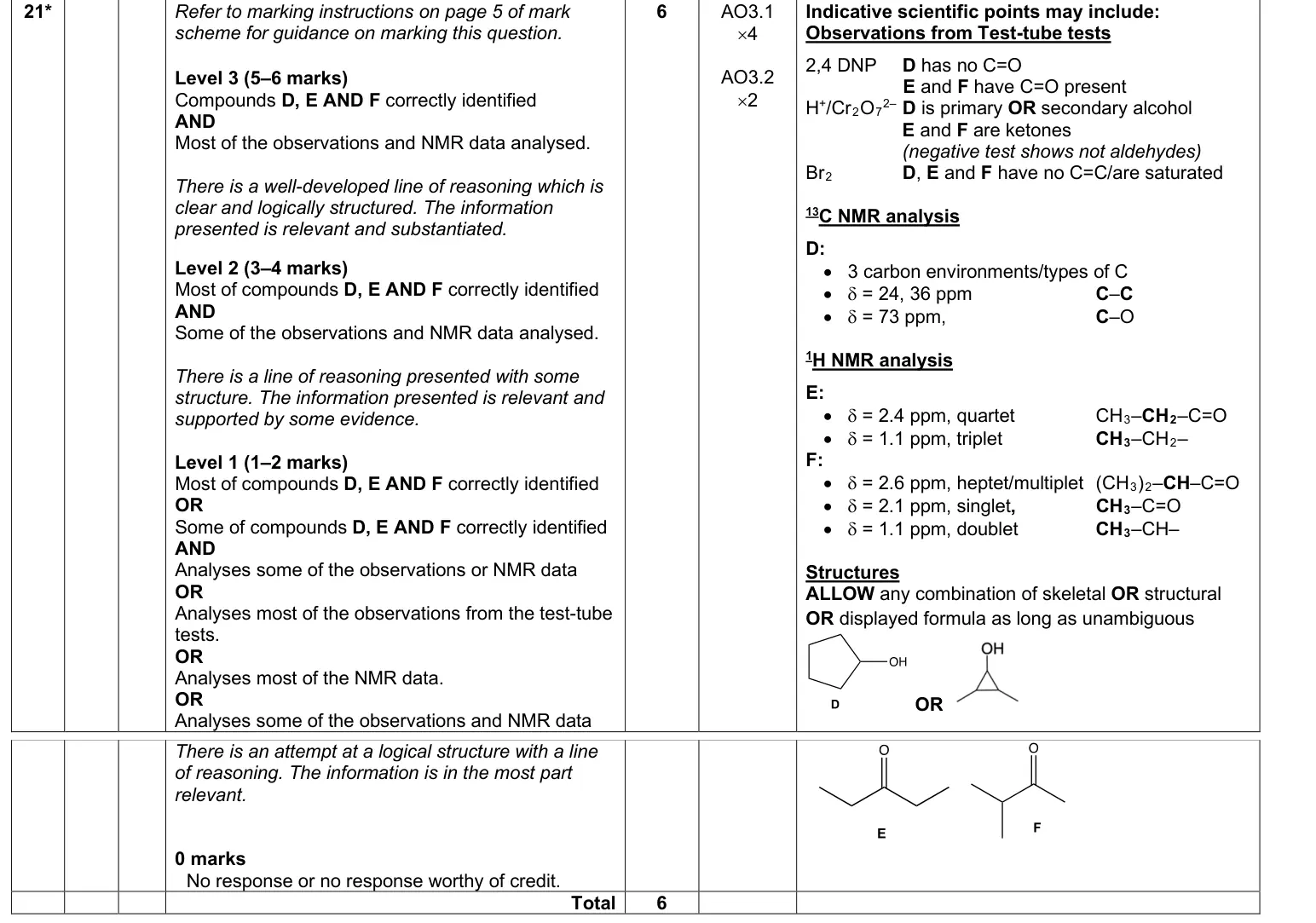
Mark scheme, with the levels and indicative points
Notes from the mark scheme and report
D no C=O, oxidised so primary/secondary alcohol, saturated, 3 carbon environments with C–O at 73 (alicyclic alcohol)
E and F ketones (not oxidised so not aldehydes)
E quartet 2.4 + triplet 1.1 (CH3CH2CO)
F heptet 2.6, singlet 2.1 (CH3CO), doublet 1.1
Skills: M3.1 Translate information between graphical, numerical and algebraic forms; PAG7 Qualitative analysis of organic functional groups
November 2020 · Paper 2 · Q131 markAO1Multiple choice
Answer
A
Mark scheme
November 2020 · Paper 2 · Q19(b)4 marksAO2, 3Short answerHard
Earlier part of question 19 that this part uses
Mark scheme
Examiner's comment
Question 19(b) Candidates who found this question difficult often did not give a response that would identify all three of the functional groups (aldehyde, ketone and alkene).
Notes from the mark scheme and report
each mark needs compound/group, reagent AND observation
F: Tollens' gives silver mirror
G: bromine decolourised, 2,4-DNP gives orange precipitate, no change with Tollens'
IGNORE 2,4-DNP with F
Skills: PAG7 Qualitative analysis of organic functional groups
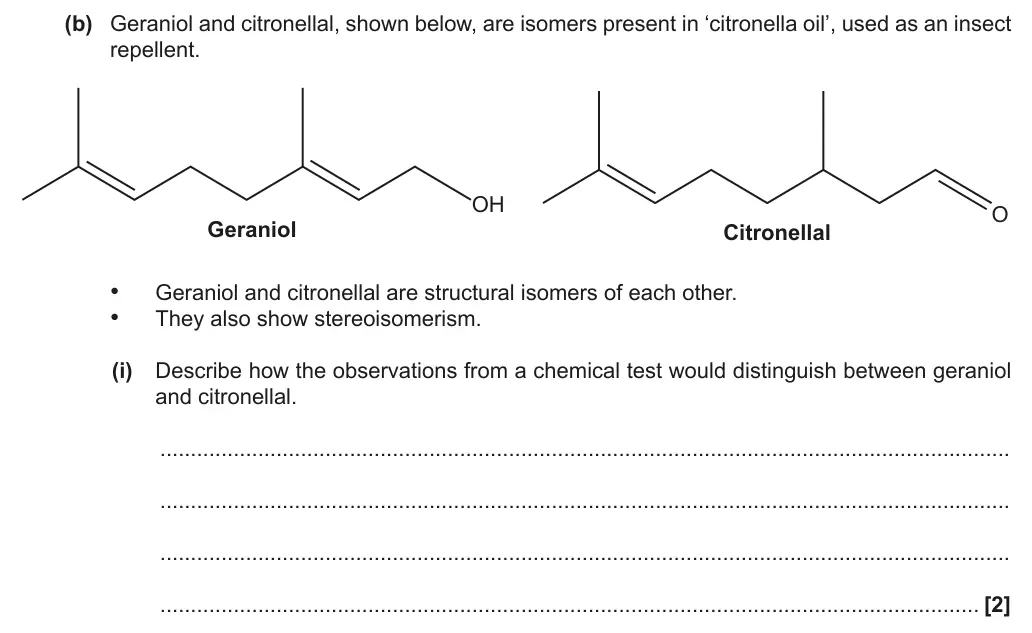
June 2019 · Paper 2 · Q16(b)(i)2 marksAO1Short answerEasy
Mark scheme
Examiner's comment
Almost all candidates were able to describe a suitable test to distinguish between geraniol and citronellal and most scored both marks. The most common choice was to use Tollens’ reagent to identify the aldehyde group in citronellal by the formation of a silver mirror. Other candidates opted for 2,4- dinitrophenylhdrazine to differentiate the carbonyl compound from the alcohol.
Notes from the mark scheme and report
Tollens' reagent: silver mirror with citronellal
ALLOW 2,4-DNP orange precipitate with citronellal
IGNORE acidified dichromate (reacts with both)
Skills: PAG7 Qualitative analysis of organic functional groups
June 2019 · Paper 2 · Q17(b)(i)1 markAO1CalculationEasy
Earlier part of question 17 that this part uses
Mark scheme
Examiner's comment
Candidates are familiar with the calculation of Rf values and this question was answered very well. Although almost all candidates showed appropriate working as part of their response some candidates gave the final answer to only one significant figure and did not receive credit. Candidates were expected to give their answer to a number of significant figures appropriate to the measurements they had made, so a minimum of two significant figures was expected. The mark scheme allowed a response within a range, rather than a specific value, and most candidates scored in this part.
Notes from the mark scheme and report
0.33–0.35
ALLOW 0.3
Skills: M3.1 Translate information between graphical, numerical and algebraic forms; PAG6 Synthesis of an organic solid
June 2019 · Paper 2 · Q17(b)(ii)2 marksAO2Data interpretationEasy
Earlier parts of question 17 that this part uses
Mark scheme
Examiner's comment
A LEVEL CHEMISTRY A Examiners’ report H432/02 Summer 2019 series Version 1 H432 For first teaching in 2015 www.ocr.org.uk/science Contents Introduction .............................................................................................................................................. 4 Paper 2 series overview ........................................................................................................................... 5 Section A overview ................................................................................................................................... 6 Question 3 ............................................................................................................................................ 6 Question 4 ............................................................................................................................................ 6 Question 5 ............................................................................................................................................ 7 Question 10 .......................................................................................................................................... 8 Question 12 .......................................................................................................................................... 9 Question 13 ........................................................................................................................................ 10 Question 14 ........................................................................................................................................ 10 Question 15 ........................................................................................................................................ 11 Section B overview ................................................................................................................................. 12 Question 16 (a) (i) ............................................................................................................................... 12 Question 16 (a) (ii) .............................................................................................................................. 12 Question 16 (b) (i) ............................................................................................................................... 13 Question 16 (b) (ii) .............................................................................................................................. 14 Question 16 (b) (iv) ............................................................................................................................. 14 Question 16 (b) (v) .............................................................................................................................. 15 Question 17 (a) (i) ............................................................................................................................... 17 Question 17 (a) (ii) .............................................................................................................................. 19 Question 17 (b) (i) ............................................................................................................................... 20 Question 18 (a) (i) ............................................................................................................................... 21 Question 18 (a) (ii) .............................................................................................................................. 22 Question 18 (b) ................................................................................................................................... 23 Question 18 (c) ................................................................................................................................... 23 Question 18 (d) ................................................................................................................................... 24 Question 18 (e) (i) ............................................................................................................................... 24 Question 18 (e) (ii) .............................................................................................................................. 26 Question 19 (a) (i) ............................................................................................................................... 27 Question 19 (a) (ii) .............................................................................................................................. 29 Question 19 (b) (i) ............................................................................................................................... 30 Question 19 (b) (iii) ............................................................................................................................. 32 Question 19 (b) (iv) ............................................................................................................................. 34 Question 20 (a) (i) ............................................................................................................................... 36 Question 20 (a) (ii) .............................................................................................................................. 37 Question 20 (a) (iii) ............................................................................................................................. 37 Question 20 (b) (i) ............................................................................................................................... 38 Question 21 ........................................................................................................................................ 39 Introduction Our examiners’ reports are produced to offer constructive feedback on candidates’ performance in the examinations. Question 17 (b) (i) Candidates are familiar with the calculation of Rf values and this question was answered very well.
Notes from the mark scheme and report
glycine: matches leu and gly in solvent W AND ala and gly in solvent X, so same Rf in both solvents
Skills: M3.1 Translate information between graphical, numerical and algebraic forms; PAG6 Synthesis of an organic solid
June 2019 · Paper 2 · Q18(c)1 markAO3Structure / isomerMedium
Earlier part of question 18 that this part uses
Mark scheme
Examiner's comment
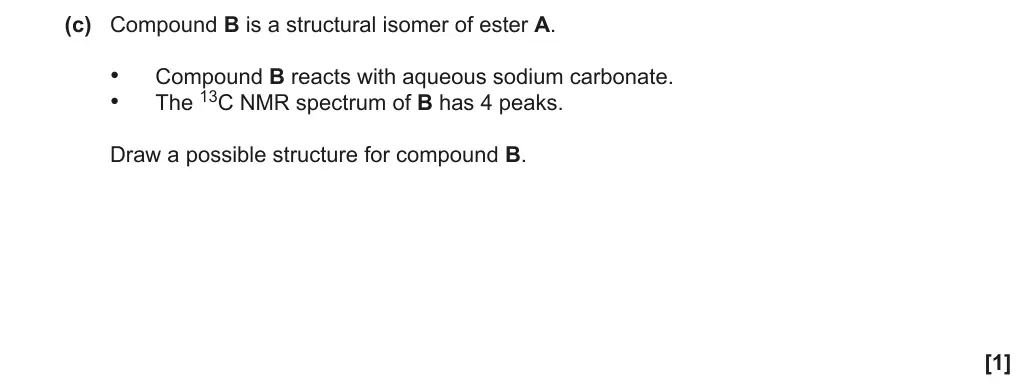
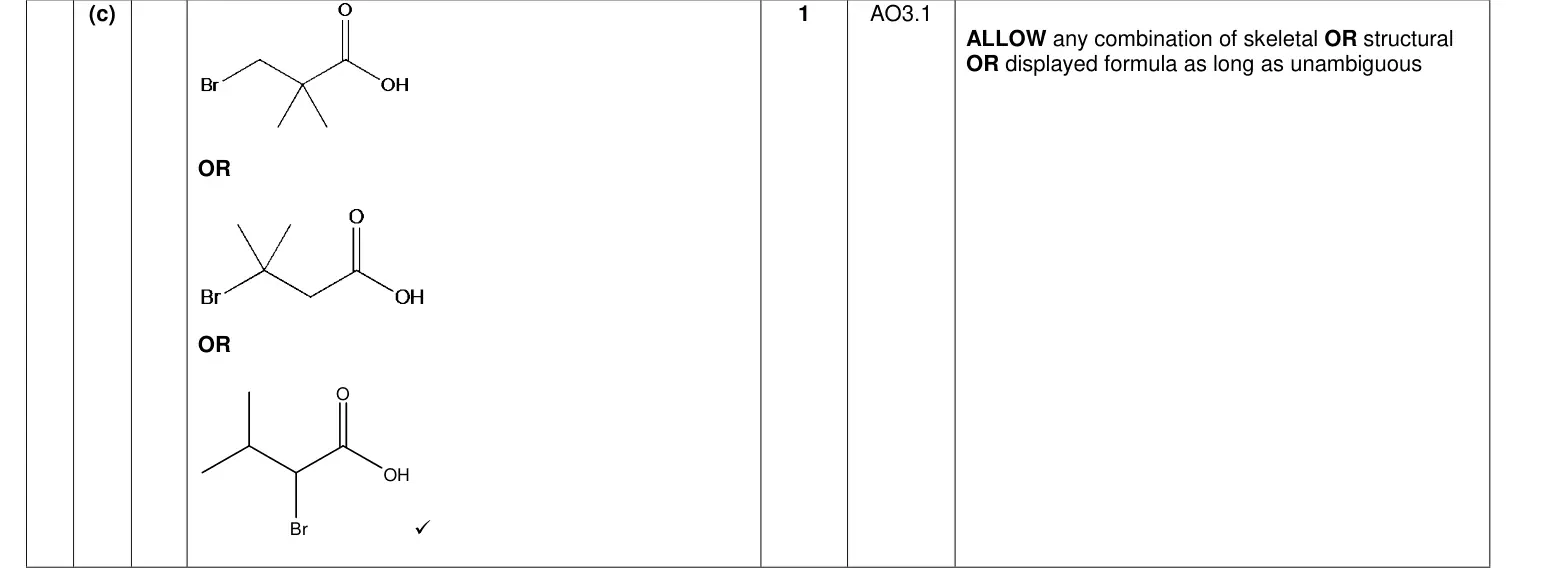
This question required candidates to use both pieces of information to deduce that B was a carboxylic acid with two equivalent carbon atoms. Many candidates were able to suggest a suitable structure. However some candidates did not use all the information and it was common to see responses that showed an ester or a straight chain carboxylic acid.
Notes from the mark scheme and report
bromo-substituted C5 carboxylic acid with 4 carbon environments
June 2019 · Paper 3 · Q4(a)(iii)2 marksAO1, 2Short answerHard
Earlier part of question 4 that this part uses
Mark scheme
Examiner's comment
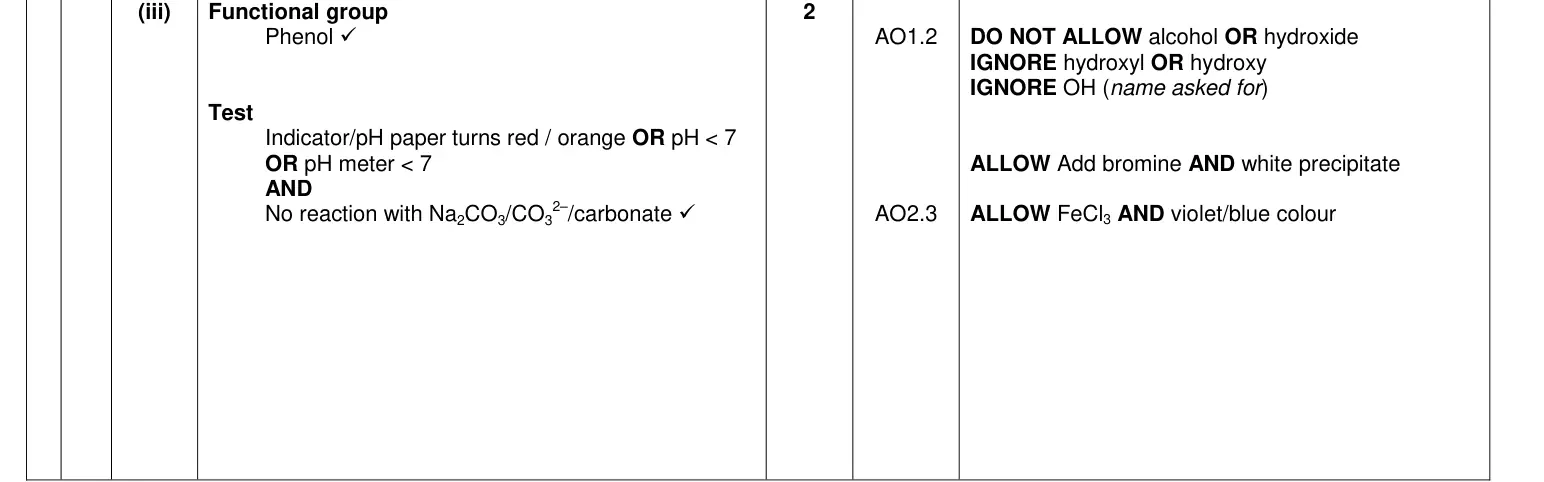
Most candidates identified the phenol functional group but a satisfactory test proved to be far more difficult. Many candidates identified that there would be no effervescence with sodium carbonate but it was common that the pH being less than 7 was often not seen. Neutralisation with sodium hydroxide was often seen but with no observation. Although not in the specification, the reaction with bromine to produce a white precipitate was often seen as an acceptable alternative test for the phenol group.
Notes from the mark scheme and report
phenol (DO NOT ALLOW alcohol or hydroxide
IGNORE hydroxyl/OH)
acidic to indicator/pH < 7 AND no reaction with carbonate
ALLOW bromine giving white precipitate
Skills: PAG7 Qualitative analysis of organic functional groups
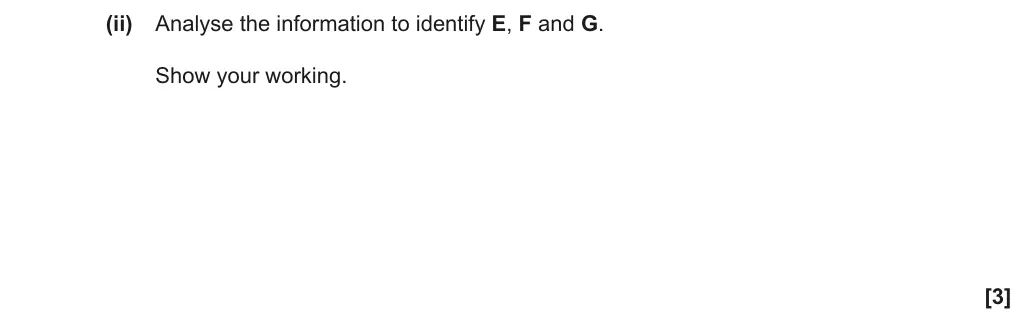
June 2018 · Paper 2 · Q19(c)(ii)3 marksCalculationHard
Earlier part of question 19 that this part uses
Mark scheme
Examiner's comment
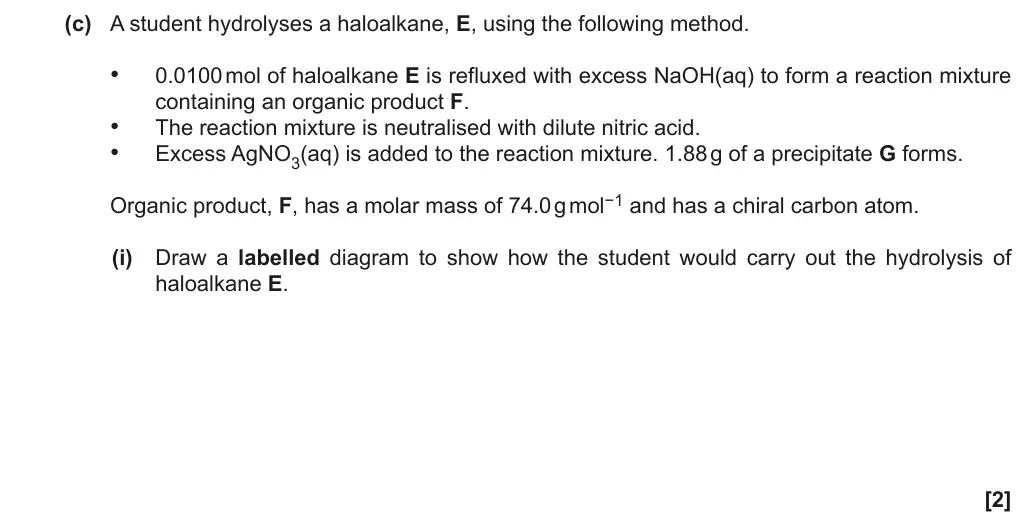
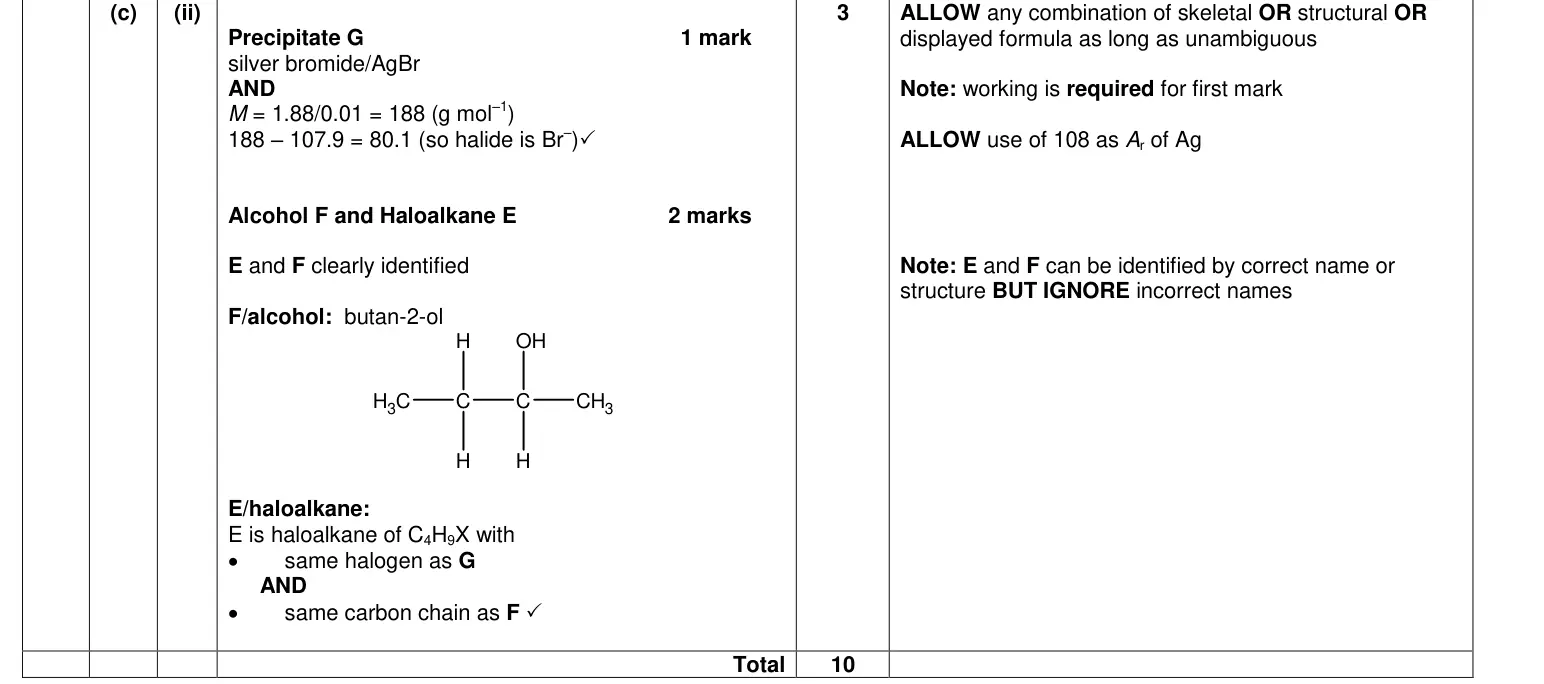
This question, requiring candidates to analyse the information to identify compounds E, F and G, discriminated well. Many candidates deduced that G was a silver halide but not all provided working to back up their choice of AgBr. Some candidates appeared to guess and AgCl was commonly seen. Some candidates used the molar mass of F provided to deduce the molecular formula of C4H10O but lower ability responses did not process this further. Higher ability candidates identified F as butan-2-ol, showing the chiral carbon clearly. Other alcohols were also seen including butan-1-ol and methylpropan- 2-ol. The highest ability candidates linked all the information and provided a structure for E that was consistent with their suggestions for F and G.
Notes from the mark scheme and report
working required: M(G) = 1.88/0.0100 = 188 so AgBr
F = butan-2-ol (chiral, M = 74)
E = 2-bromobutane (same halogen as G and same chain as F)
IGNORE incorrect names if structures given
Skills: M0.2 Use ratios, fractions and percentages; M2.2 Change the subject of an equation
June 2018 · Paper 2 · Q20(b)(i)1 markShort answerEasy
Earlier part of question 20 that this part uses
Mark scheme
Examiner's comment
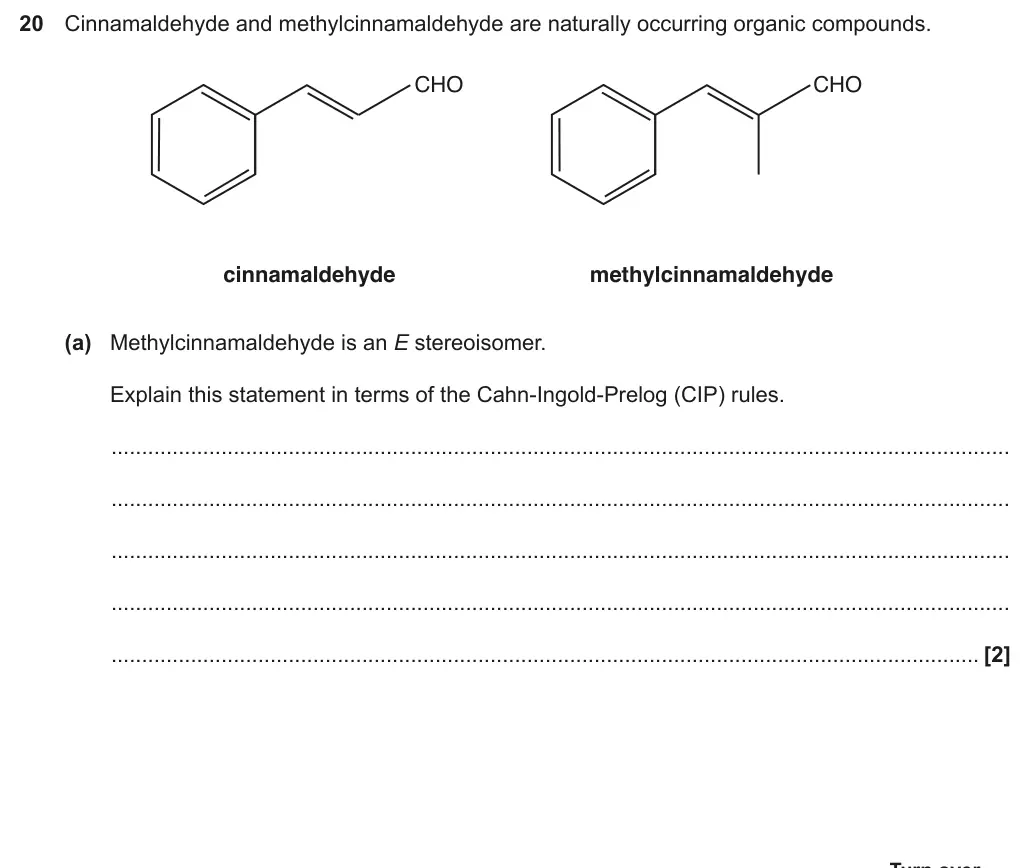
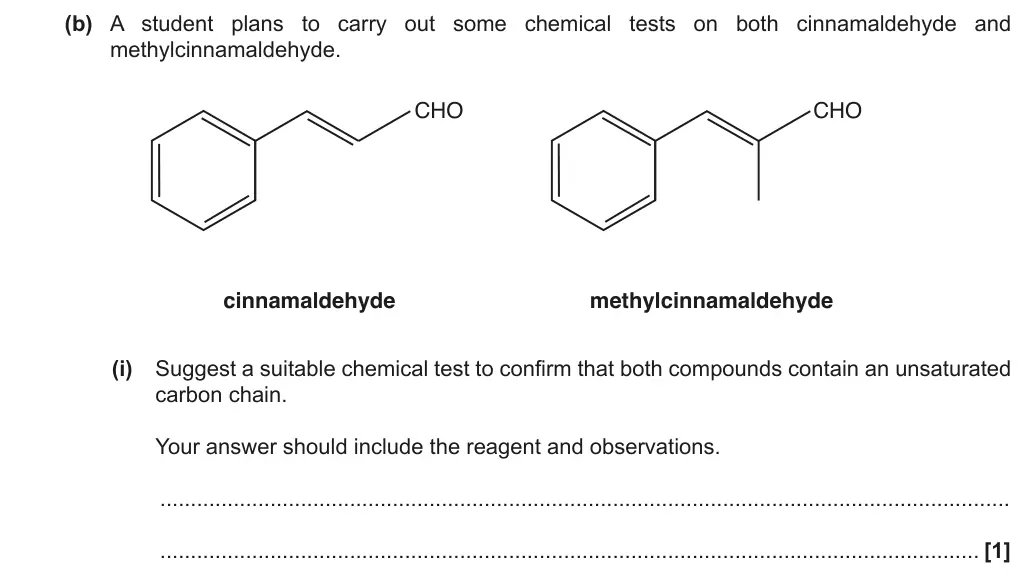
Almost all candidates were able to correctly describe the use of bromine as a test for an unsaturated chain.
Notes from the mark scheme and report
both reagent and observation required: bromine (water) decolourised
Skills: PAG7 Qualitative analysis of organic functional groups
June 2018 · Paper 2 · Q20(b)(ii)1 markShort answerEasy
Earlier part of question 20 that this part uses
Mark scheme
Examiner's comment
Almost all candidates were able to correctly describe the use of Tollens’ reagent as a test for an aldehyde functional group.
Notes from the mark scheme and report
both reagent and observation required: Tollens' reagent and silver mirror (ALLOW black/grey ppt)
Skills: PAG7 Qualitative analysis of organic functional groups
June 2018 · Paper 2 · Q20(b)(iii)3 marksShort answerMedium
Earlier part of question 20 that this part uses
Mark scheme
Examiner's comment
The use of 2,4-dinitrophenylhydrazine as a test for the carbonyl group is well known by candidates at this level. The majority of the cohort correctly identified this test and the subsequent analysis of the melting point of the products as a method of identifying each compound. Lower ability candidate responses made reference to analysis of the boiling points of the cinnamaldehyde and methylcinnamaldehyde as a means of identification.
Notes from the mark scheme and report
2,4-DNP(H) gives orange/yellow/red precipitate
take melting point of the derivative
compare with known values
DO NOT ALLOW boiling points or chromatograms
Skills: PAG6 Synthesis of an organic solid; PAG7 Qualitative analysis of organic functional groups
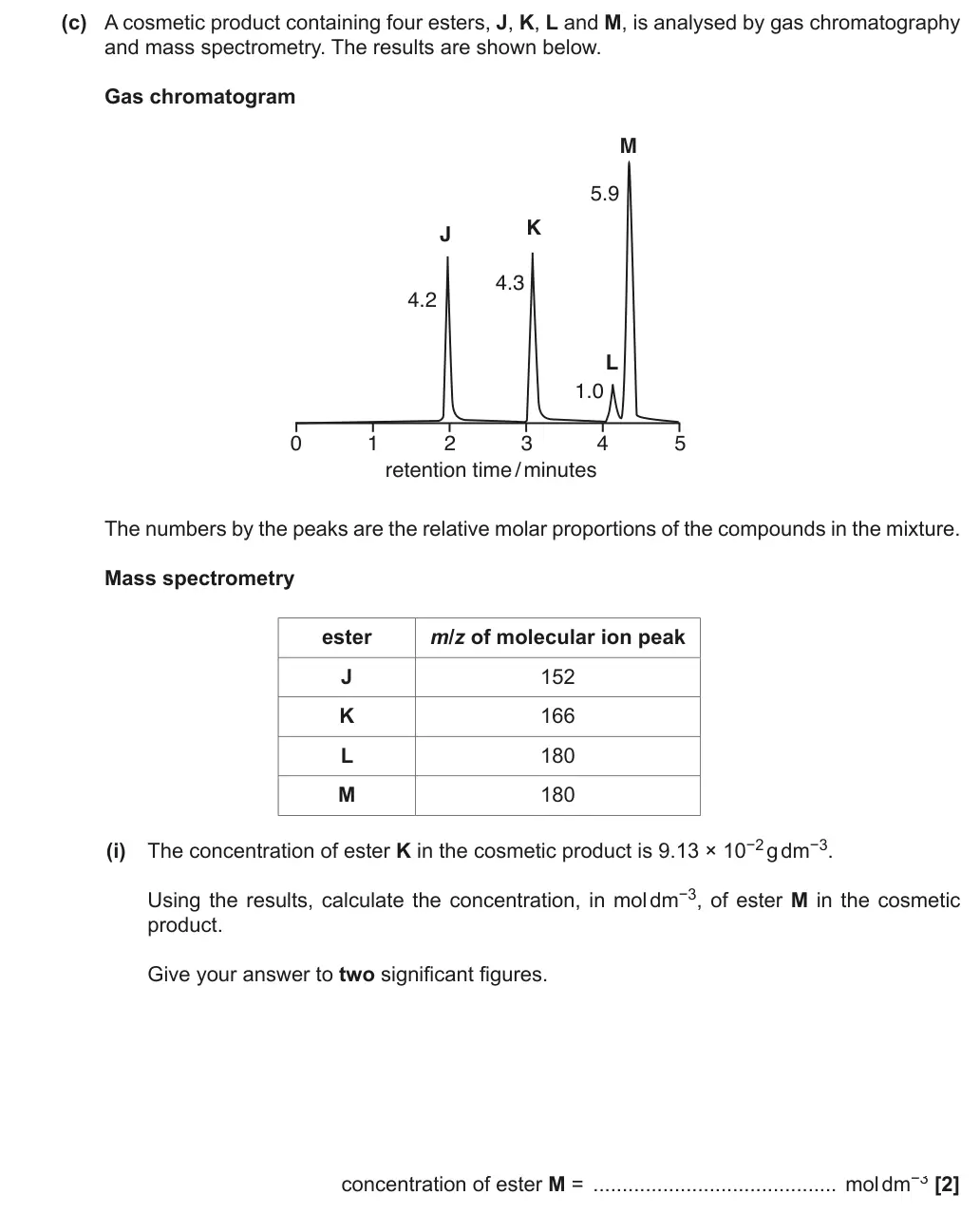
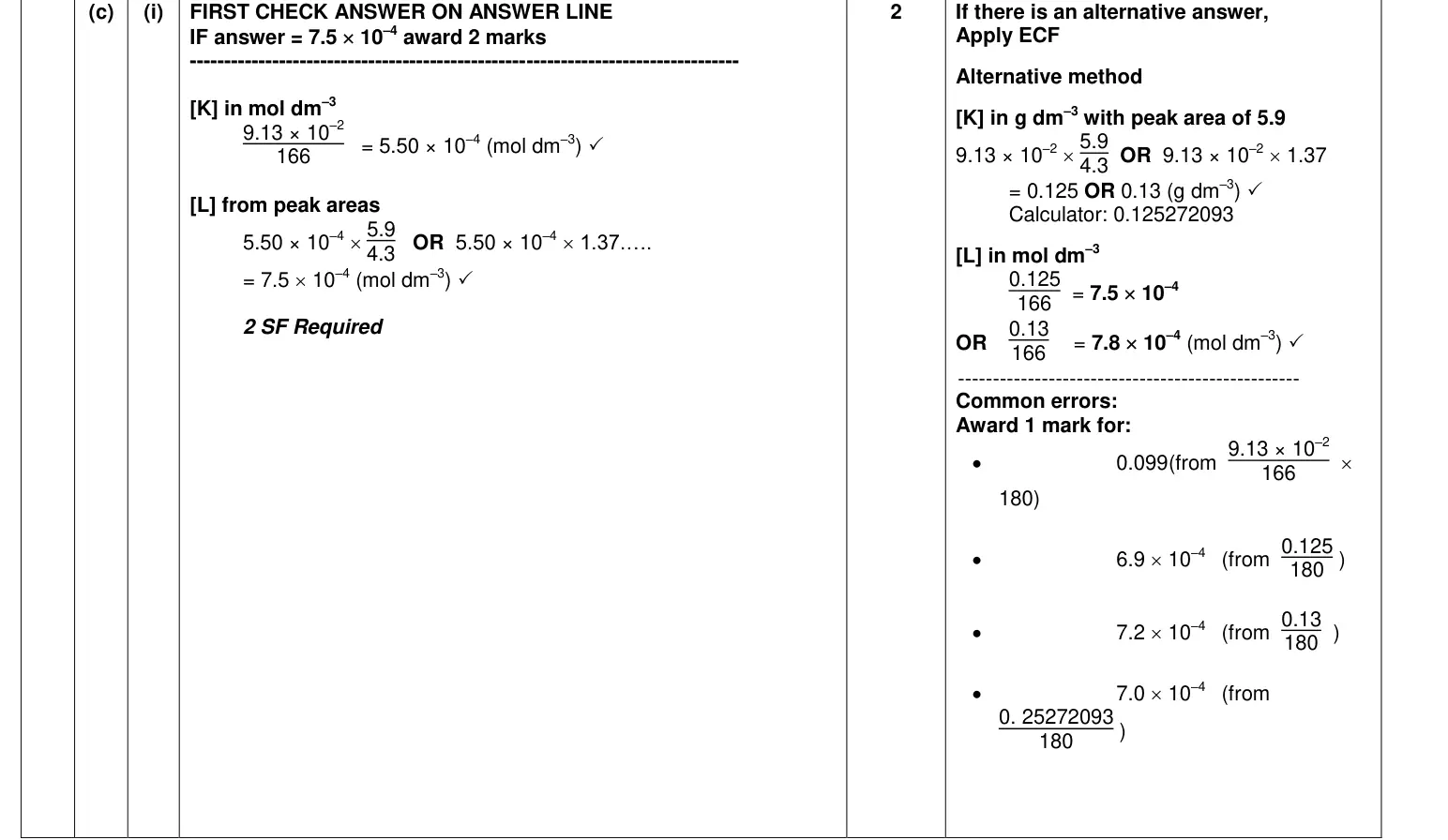
June 2018 · Paper 2 · Q21(c)(i)2 marksCalculationMedium
Mark scheme
Examiner's comment
This question required candidates to apply their knowledge of gas chromatography and the mole to solve this problem. Most candidates recognised the need to use the relative peak areas to determine the relative proportion of M. Many also realised that division by the molar mass was required to ensure the final answer was given in mol dm–3. However, some used molar mass of M rather than K in this step, leading to an answer of 7.0 × 10⁻⁴ mol dm–3. Answer = 7.5 × 10⁻⁴ mol dm–3
Notes from the mark scheme and report
2 sig figs required (7.5 × 10⁻⁴)
convert K to mol dm–3 using 166 then scale by 5.9/4.3
common errors (1 mark): dividing by 180 (6.9 × 10⁻⁴), 0.099
Skills: M0.2 Use ratios, fractions and percentages; M1.1 Use an appropriate number of significant figures; M3.1 Translate information between graphical, numerical and algebraic forms
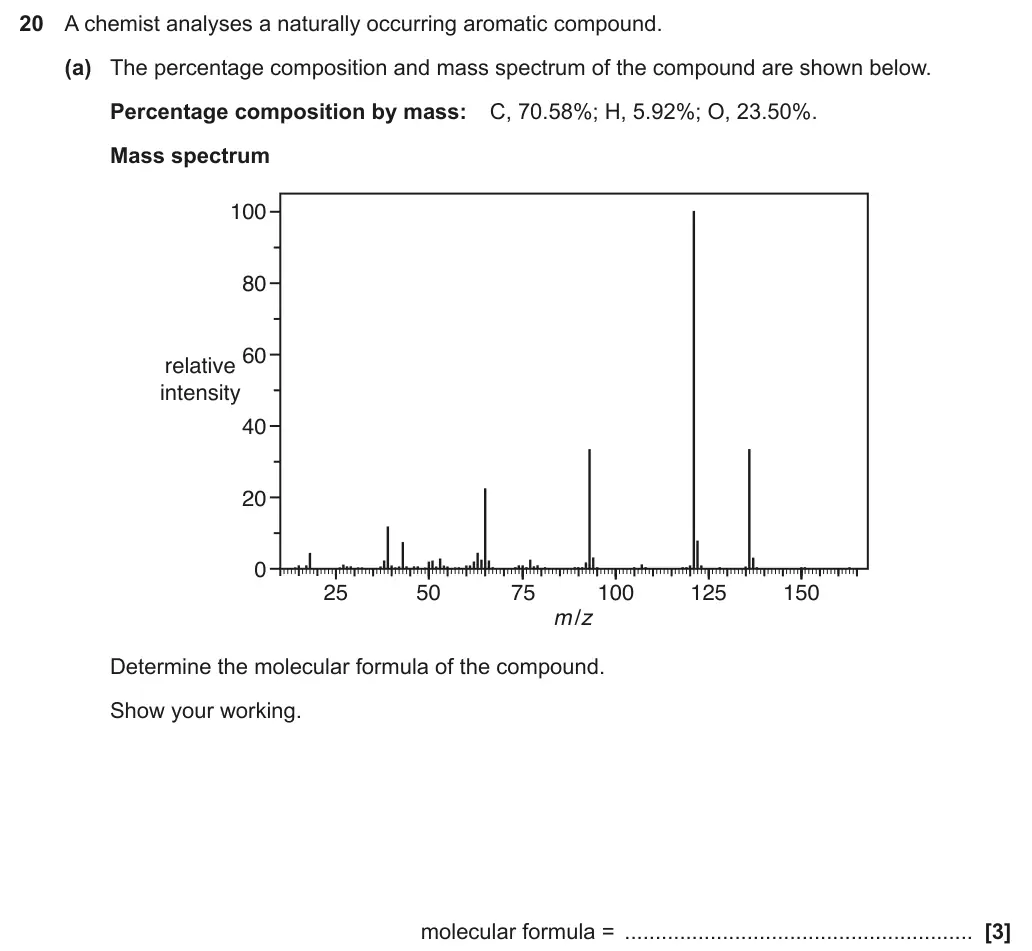
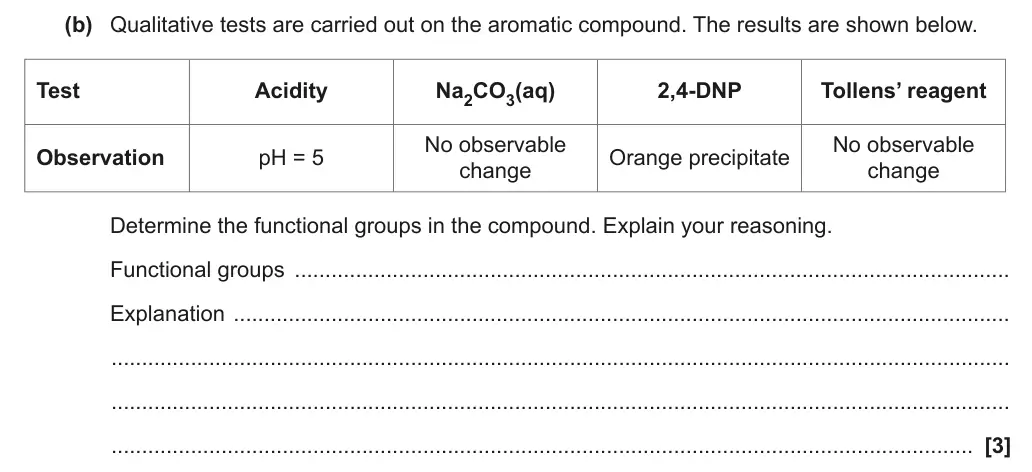
June 2017 · Paper 2 · Q20(b)3 marksShort answer
Earlier part of question 20 that this part uses
Mark scheme
Notes from the mark scheme and report
phenol AND ketone only
weak acidity with no reaction with Na2CO3 so not carboxylic acid
2,4-DNP positive but Tollens' negative so not aldehyde
Skills: PAG7 Qualitative analysis of organic functional groups
June 2017 · Paper 3 · Q5(b)6 marks6-mark level of response
Mark scheme, with the levels and indicative points
Notes from the mark scheme and report
bromine decolourised by B, C, D, G
acidified dichromate turns green with C, D, F
2,4-DNP orange precipitate with C, E, G
Tollens' silver mirror with C only
no credit for tests on products, melting points or spectra
Skills: PAG7 Qualitative analysis of organic functional groups
Work with an OCR chemistry tutor
Dropping marks on calculations, mechanisms or the six-markers? Book a trial session with a specialist OCR chemistry tutor.