Tap a question to zoom it. Where a part needs a table, graph or structure from an earlier part, that part folds out above it; the mark scheme and examiner's comment open underneath. Have the OCR Data Sheet beside you.
June 2025 · Paper 2 · Q71 markMultiple choiceMedium
Answer
B
Mark scheme
Examiner's comment
Most gave the correct response B. However, some found this tricky, with both A, with the acid group deprotonated and the amine protonated, and C, with no consideration of the acidic conditions, being common incorrect responses.
June 2025 · Paper 2 · Q18(a)4 marksStructure / isomerHard
Mark scheme
Examiner's comment
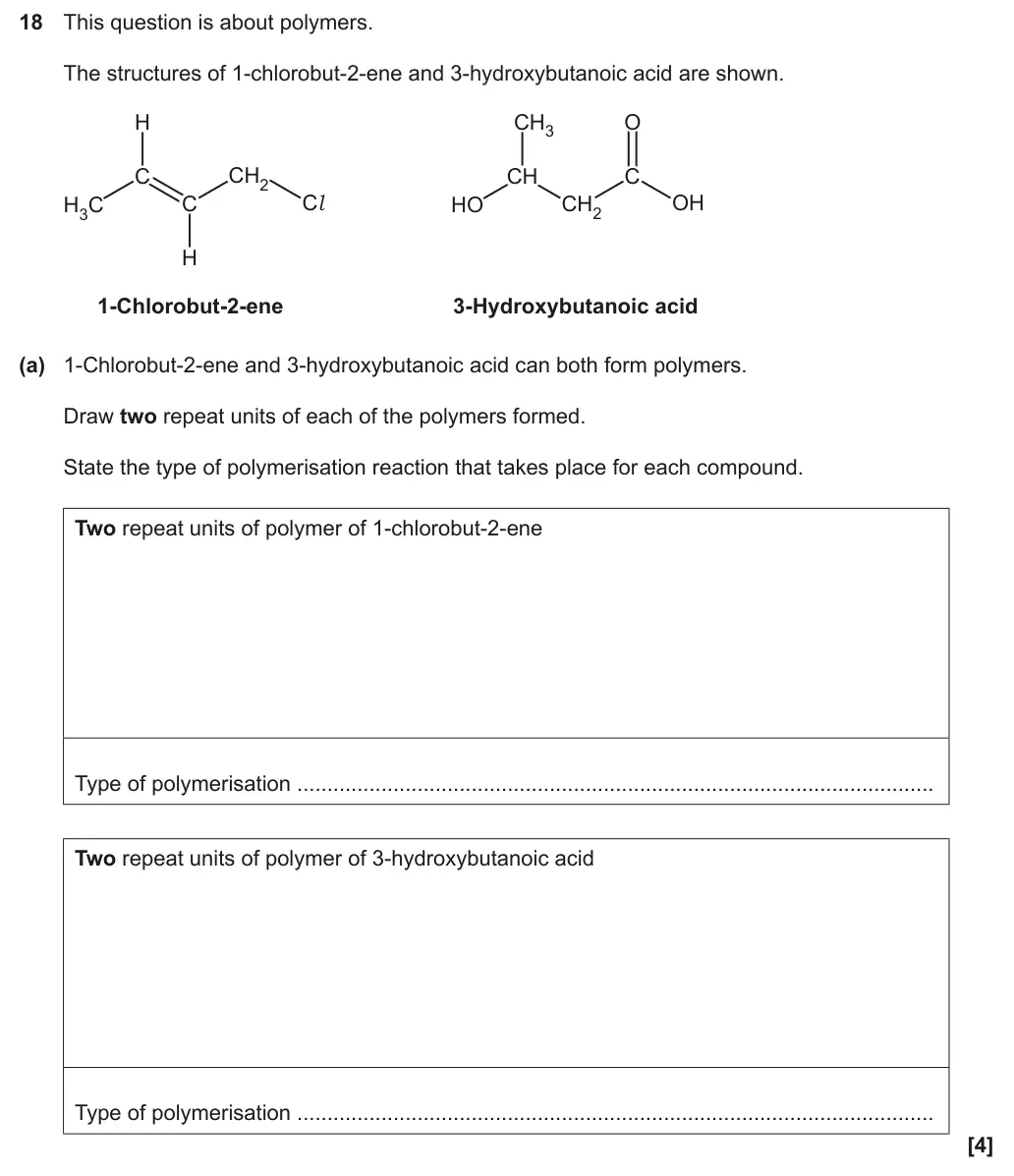
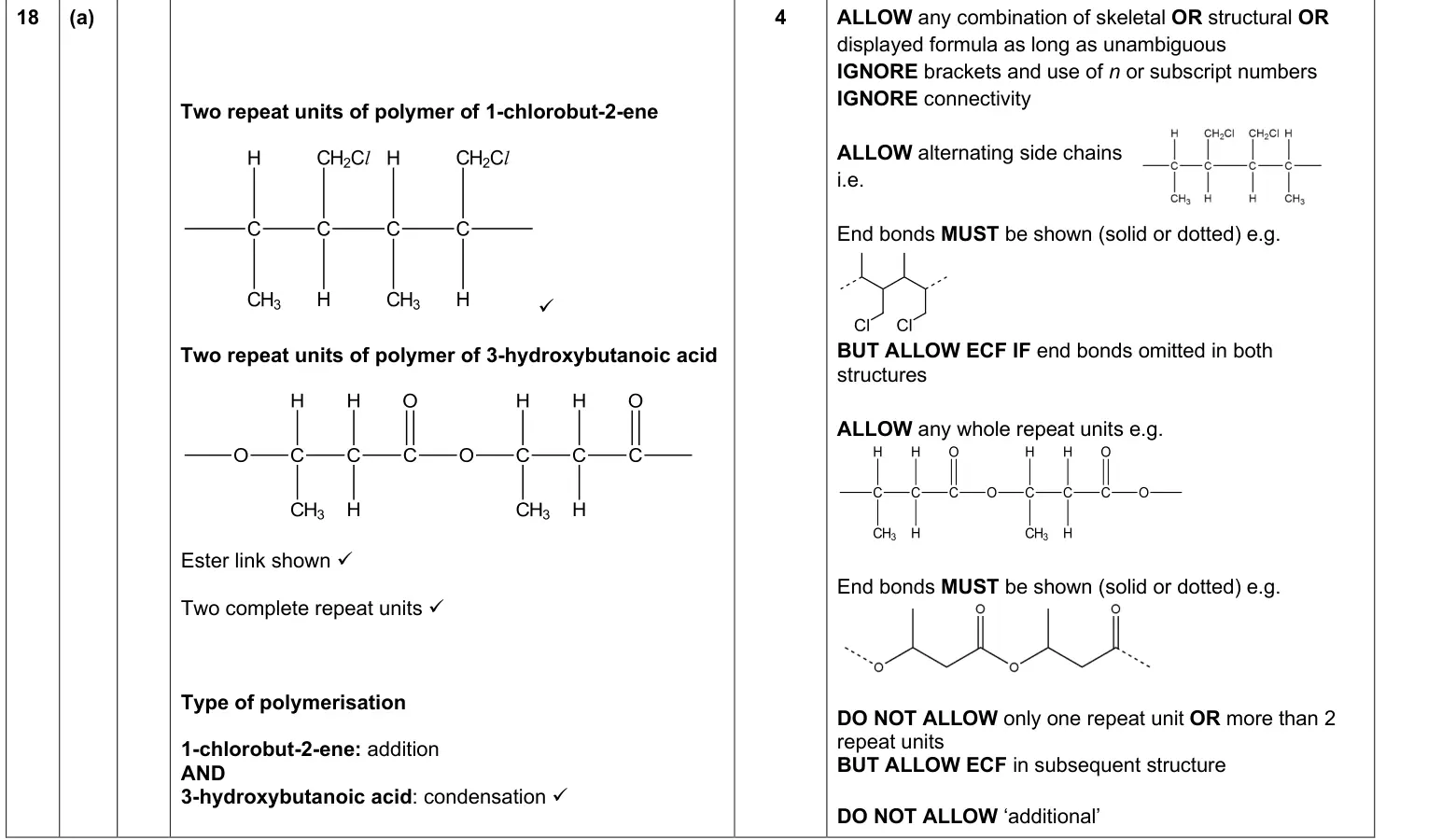
Most candidates managed to score 3 or 4 marks on this question. Some did not gain marks for structures without end bonds or for giving a complete unit of 2 molecules joined together. Some had only one repeat unit for each or gave more than two. Lower attaining candidates were often able to draw one type of polymer repeat unit but couldn’t do both. Polymer of 1-chlorobut-2-ene: Most were able to give the structure of two repeat units. Less successful candidates struggled to open the double bond and gave carbon chains with eight carbons in length connected to each other, sometimes with the C=C still present. In general, less successful candidates found it harder to get the marks for the addition polymer than with the condensation polymer, possibly as condensation polymerisation is taught later in the course. Polymer of 3-hydroxybutanoic acid: Very few didn’t gain a mark for showing the ester link between two monomers. A common error was adding -O- to both ends of the repeat unit. A few missed off Hs, particularly on C with CH3 attached. Most candidates knew the different types of polymerisations shown here. Some gave ‘alkene’ or ‘polyalkene’ rather than ‘addition’. A few gave ‘esterification’ or ‘substitution’ instead of condensation.
Notes from the mark scheme and report
end bonds MUST be shown
DO NOT ALLOW one or more than two repeat units (ECF in second structure)
ester link shown
addition AND condensation (DO NOT ALLOW 'additional')
June 2025 · Paper 2 · Q18(b)(ii)1 markStructure / isomerMedium
Earlier part of question 18 that this part uses
Mark scheme
Examiner's comment
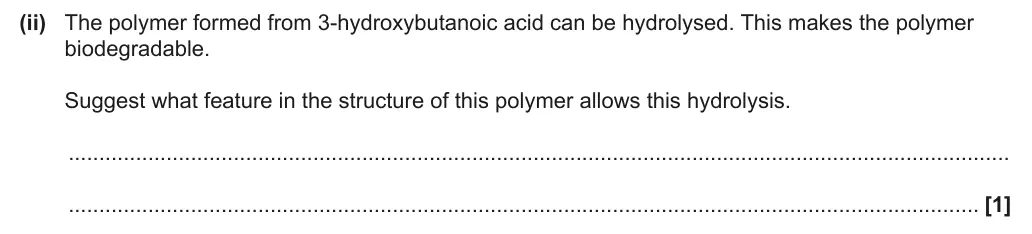
This mark was achieved by most candidates, with wrong answers largely linked to hydrogen bonding leading to hydrolysis rather than identifying the feature of the structure of this polymer that allows hydrolysis. Incorrect answers included: carboxylic acid, alcohol, hydroxyl, C-O bond (but not specific to ester).
Notes from the mark scheme and report
ester link/group
IGNORE reference to hydrogen bonding
June 2024 · Paper 2 · Q121 markMultiple choiceEasy
Answer
A
Mark scheme
Examiner's comment
The vast majority of candidates gave the correct option A, HCl. The most common incorrect response was B i.e. H2O.
Notes from the mark scheme and report
acyl chloride + amine eliminates HCl
June 2024 · Paper 2 · Q20(c)2 marksStructure / isomerMedium
Mark scheme
Examiner's comment
The majority scored both marks here. A few drew the diacyl dichloride, but these were in the minority. A small minority only lost one mark, usually for incorrect connectivity on -OH groups. Some other errors seen included missing a carbon from alcohol, missing hydrogens on carbon if not drawn skeletally, carboxylic acid groups added directly on to the benzene ring with a pentavalent carbon atom or omitting the circle in the benzene ring.
Notes from the mark scheme and report
benzene-1,4-dicarboxylic acid (or diacyl chloride) and butane-1,4-diol
DO NOT ALLOW incorrect connectivity on OH
June 2024 · Paper 2 · Q20(d)4 marksStructure / isomerMedium
Mark scheme
Examiner's comment
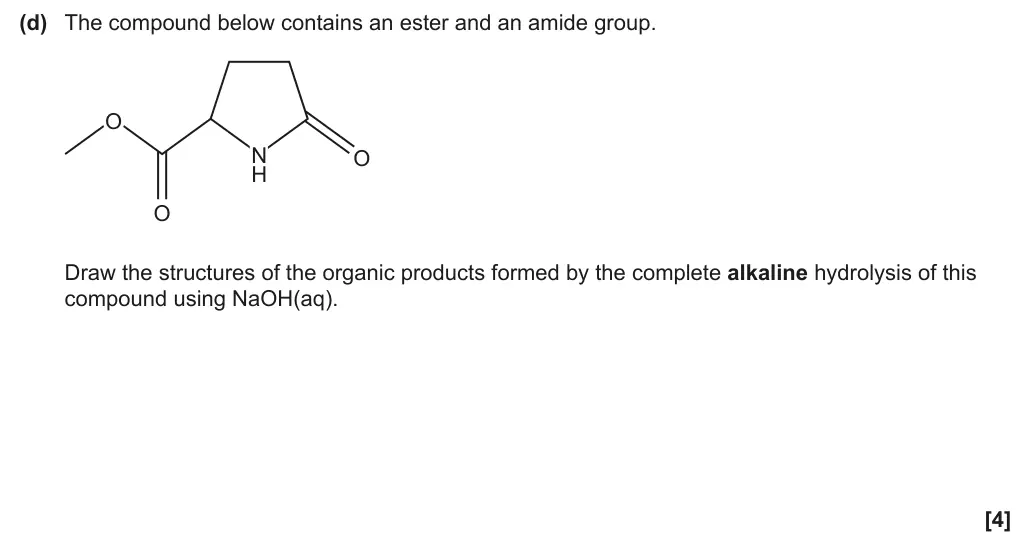
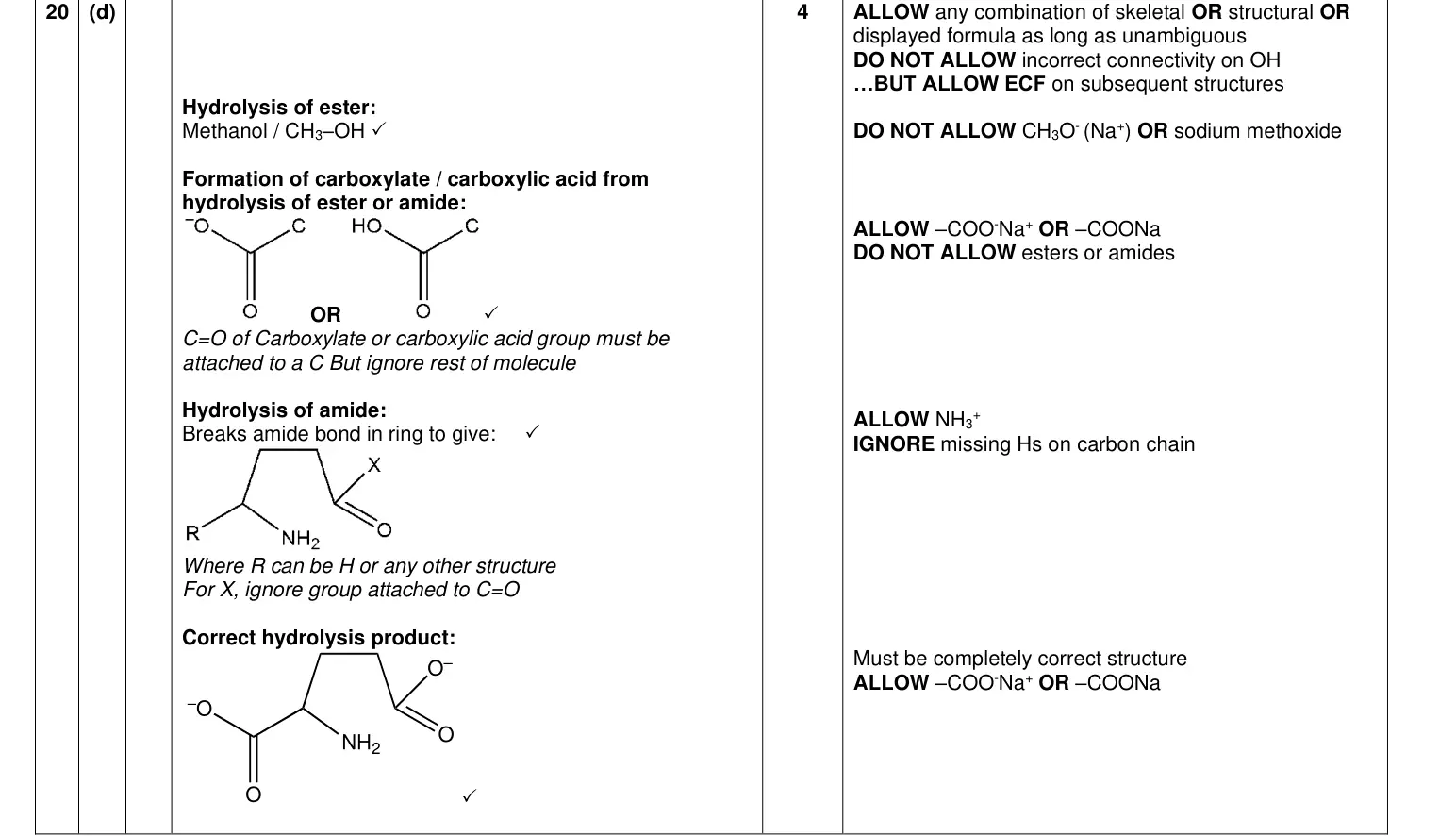
Just over a quarter of candidates were able to gain all 4 marks. The successful candidates clearly identified where the ester and amide would be hydrolysed on the structure provided, helping them draw out the correct products. This question differentiated well. Most were able to gain some credit for hydrolysing the ester to give methanol and a carboxylate or carboxylic acid, leaving the amide bond and ring intact. However, some lost the first mark for giving the methoxide ion, assuming that the alkaline conditions are capable of deprotonating the alcohol group. Lower attaining candidates often broke other C-C bonds in the ring forming a range of products. A few displayed the structure as C=O-Na+ and some also protonated the amine group either with the ring intact or broken.
Notes from the mark scheme and report
methanol (DO NOT ALLOW CH3O–Na+)
carboxylate from ester/amide hydrolysis
ring amide bond broken to give NH2
final product is the dicarboxylate with NH2 (–COO–Na+ allowed)
DO NOT ALLOW esters or amides remaining
June 2024 · Paper 2 · Q22(a)3 marksCalculationHard
Mark scheme
Examiner's comment
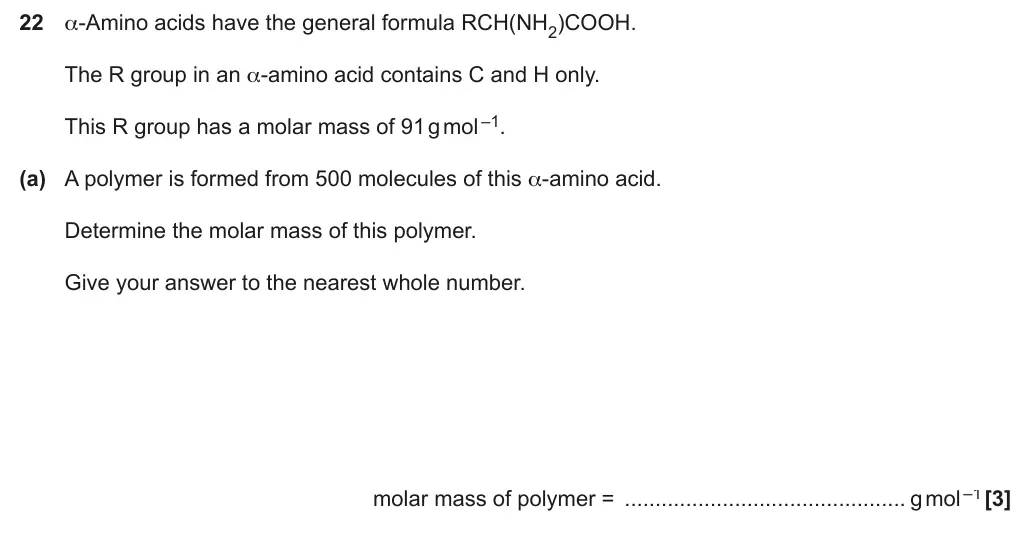
Most candidates managed to score at least one mark here, either for correctly determining the molar mass of the monomer, the repeat unit in the polymer or alternatively they multiplied a molar mass by 500. Many candidates gained 2 marks for either 73500 or 82500 but then struggled to account for the water lost. Some candidates lost marks due to errors in calculating the molar mass of the monomer or some tried to incorporate the use of Avogadro’s constant into the calculation. Many misunderstood what atoms would be lost during polymerisation. For example, a common incorrect response seen was found by subtracting 2 from the correct molar mass giving 163, followed by multiplication by 500 to give 81500 and finally adding of 2 to give 81502. Some struggled to understand what was meant by nearest whole number, e.g. rounding 73518 to 74000 or 82500 to 80000.
Notes from the mark scheme and report
Mr of amino acid 165 (91 + 74)
500 × 165 minus 499 × 18 water = 73518
73500 scores 2
common errors 36518 and 82500 (2 marks), 45500 (1 mark)
Skills: M0.2 Use ratios, fractions and percentages; M2.3 Substitute numerical values into algebraic equations using appropriate units for physical quantities
June 2024 · Paper 2 · Q22(b)3 marksDrawing / labellingMedium
Earlier part of question 22 that this part uses
Mark scheme
Examiner's comment
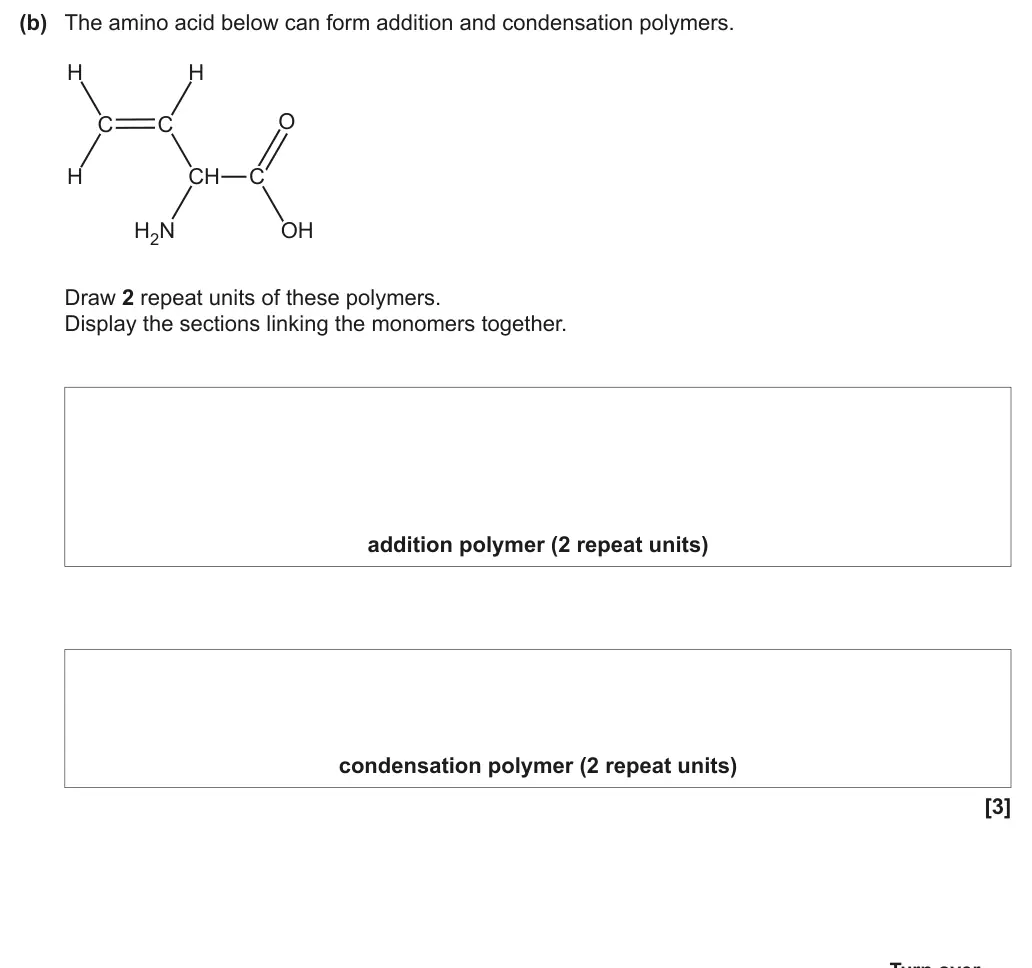
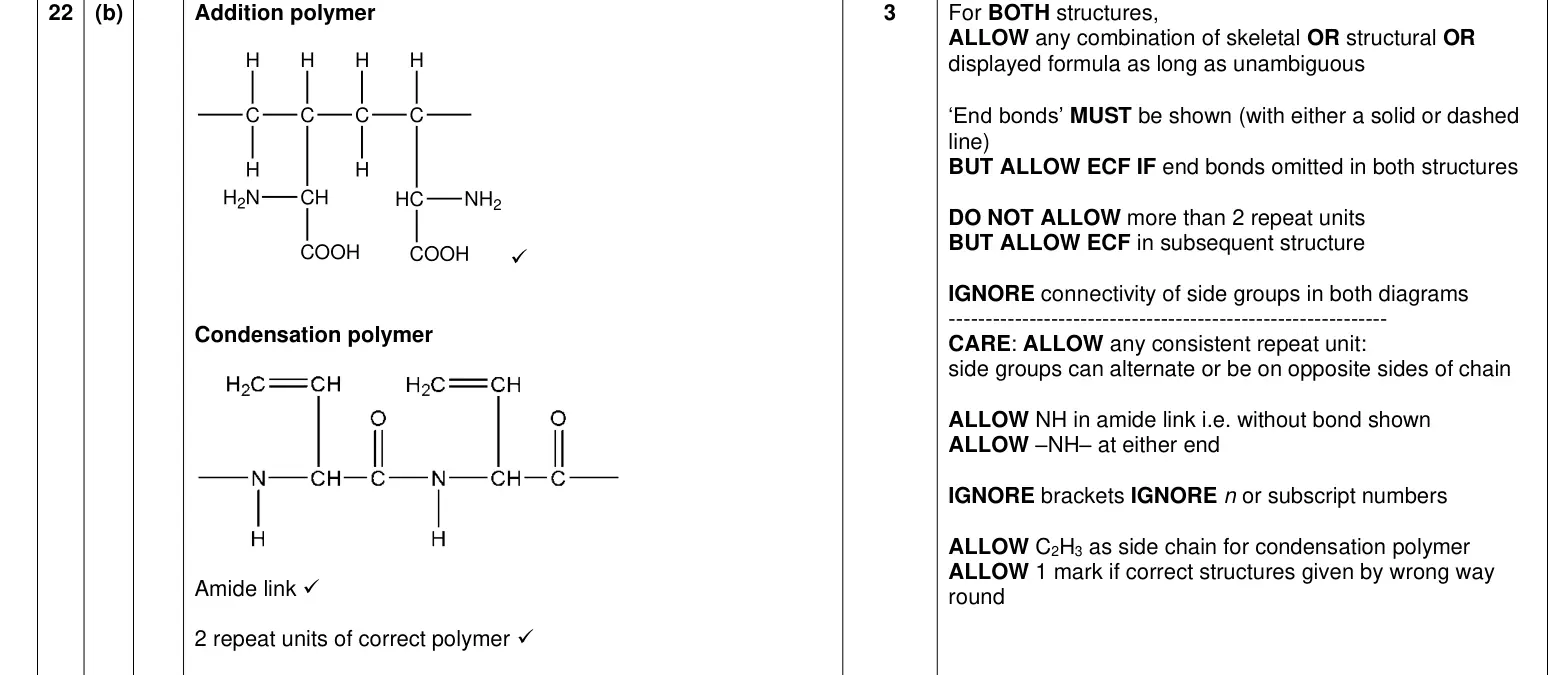
In general, candidates found it easier to give the correct addition polymer rather than the condensation polymer. Some lost the mark for using molecular formula on side chains rather than displaying the section correctly. The condensation polymer was generally less well answered, with candidates often struggling to give a correct amide bond – many had an oxygen atom retained between the carbonyl carbon and the amine group’s nitrogen atom, giving C–O–N. Another common error was the omission of hydrogen atoms from nitrogen or from the carbon attached to C2H3. Just over a quarter of candidates did not score any marks. Some candidates drew ester linkages instead of amide linkages and struggled to include the side chains i.e. trying to incorporate the alkene into the main polymer chain.
Notes from the mark scheme and report
addition polymer through C=C with CH(NH2)COOH side chains
condensation polymer with displayed amide links and CH=CH2 side chains
end bonds must be shown
DO NOT ALLOW more than 2 repeat units
1 mark if correct but the wrong way round
June 2023 · Paper 2 · Q20(b)(i)3 marksAO1, 3Structure / isomerHard
Mark scheme
Examiner's comment
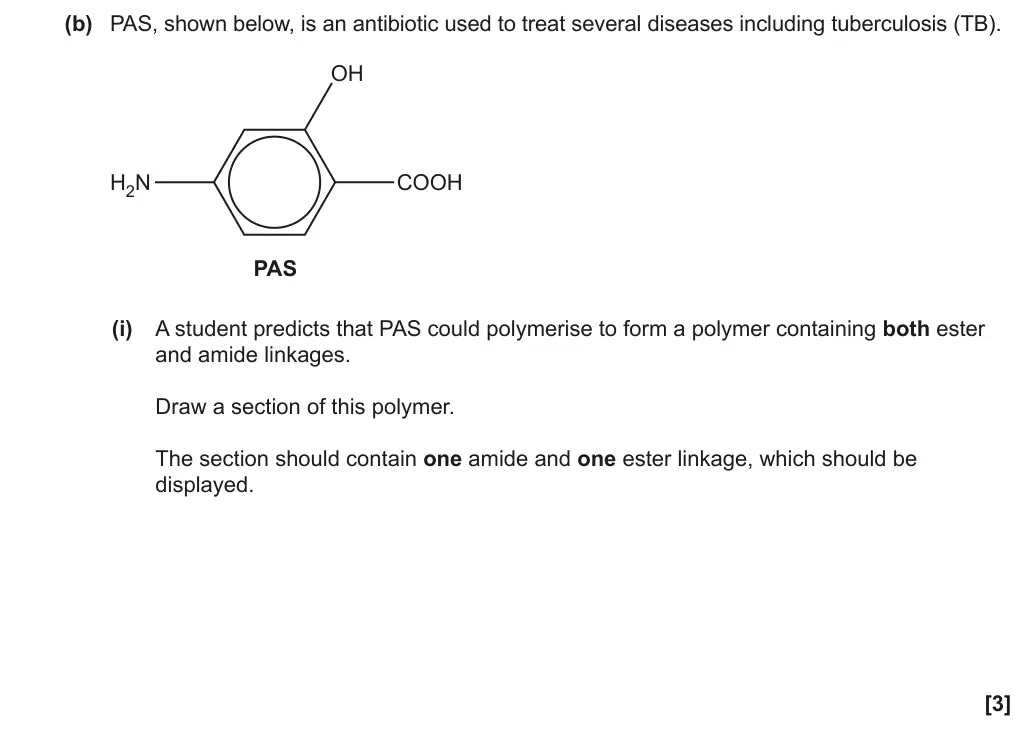
This was a demanding question with just over a third of candidates not scoring marks. However, many candidates were able to gain a mark for either showing the displayed ester or amide link between two benzene rings. Some candidates recognised that at least 3 PAS units would be needed to show both the amide and ester links appropriately. Few responses were able to show a section of polymer that contained correct amide and ester linkages, the correct substituent groups and at least one end bond. The most common reason why candidates did not secure all 3 marks was omission of the OH group on one or more benzene rings of PAS. This question was more challenging as candidates needed to show a polymer section. Many gave 2 ‘end bonds’ as they would for a repeat unit but this was not sufficient here due to the many different possible combinations, we could not make assumptions about what would be next. A common incorrect response was: Furthermore, many candidates just gave 1 benzene ring, like this:
Notes from the mark scheme and report
displayed amide link and displayed ester link each between two benzene rings
third mark dependent on both: at least one end bond and correct ring positions (C=O at 1, C–O at 2, C–NH at 4)
June 2023 · Paper 2 · Q21(c)(ii)4 marksAO2Structure / isomerMedium
Earlier part of question 21 that this part uses
Mark scheme
Examiner's comment
A significant number of candidates did not attempt this question despite similar questions appearing in previous exam series. However, approximately a quarter of candidates scored all 4 marks. Some lost the final mark for not protonating the amine groups as required as under acidic conditions. A very common error was to hydrolyse the amides to give acyl chlorides or even aldehydes rather than carboxylic acids. Lower scoring candidates often had incomplete hydrolysis or no hydrolysis at all with just changes to acid/amine/phenol functional groups, e.g. protonation of amine to form salts or swapping or OH groups for Cl. Candidates need to check their answers carefully for missing or extra Hs as this lost marks. It was much easier to mark candidates’ work presented with structures with a similar arrangement to compound E.
Notes from the mark scheme and report
three amino acids from the two amide links
1 mark each with NH2 or NH3+
fourth mark only if all three shown as NH3+ (acid conditions)
ALLOW salts NH3+Cl–
June 2022 · Paper 2 · Q19(c)(ii)2 marksAO1, 2Drawing / labellingMedium
Mark scheme
Examiner's comment
This question differentiated well. Candidates who scored 1 mark had often shown an ester link but their structure was missing hydrogen atoms from the carbon chain (as shown in exemplar 1) or the methyl group was missing from the ring. This type of response was seen frequently by examiners. The candidate has correctly drawn the ester link but has omitted the hydrogen atoms from the carbon chain.
Notes from the mark scheme and report
ester link shown
ONE repeat unit only
end bonds MUST be shown
CH3 may be on position 2 or 3 of the ring
June 2022 · Paper 2 · Q19(c)(iii)1 markAO3Structure / isomerHard
Mark scheme
Examiner's comment
This question proved difficult for candidates with the majority of candidates not scoring the mark. A significant proportion of candidate had identified the monomer but drew structures that combined skeletal and displayed formulae. This resulted in ambiguous structures being given that had missing hydrogen atoms on the carbons. Drawing of organic structures Candidates need practice at drawing structures that are not ambiguous. They should check the number of bonds on each atom and make sure the appropriate number of hydrogen atoms are drawn.
Notes from the mark scheme and report
single hydroxy-acid monomer containing both OH and COOH
June 2022 · Paper 2 · Q19(d)(i)1 markAO2Drawing / labellingHard
Mark scheme
Examiner's comment
Few candidates were given the mark for this question. Frequently candidates drew structures with two repeat units or the did not remove the oxygen atom from the OH group.
Notes from the mark scheme and report
ONE repeat unit only with amide link
end bonds MUST be shown
June 2022 · Paper 2 · Q19(d)(ii)2 marksAO2CalculationMedium
Earlier part of question 19 that this part uses
Mark scheme
Examiner's comment
A variety of responses were seen in this demanding question. In general candidates adopted one of two approaches. The most common was to multiply the Mr of the repeat unit by 200 and then add the mass of H and OH at each end of the polymer. The other approach used the Mr of the monomer by 200 and then subtract the mass of the 199 water molecules removed in the polymerisation. Many candidates were successful with the first step of their approach, but the best responses included the second step taking into account the Mr of water. A significant number of candidates used an incorrect value for the Mr.
Notes from the mark scheme and report
28418: 400 × 89 minus 399 × 18 (water lost)
28400 scores 1 mark (end groups ignored)
Skills: M0.2 Use ratios, fractions and percentages
November 2021 · Paper 2 · Q17(c)4 marksAO1, 2Structure / isomer
Mark scheme
Notes from the mark scheme and report
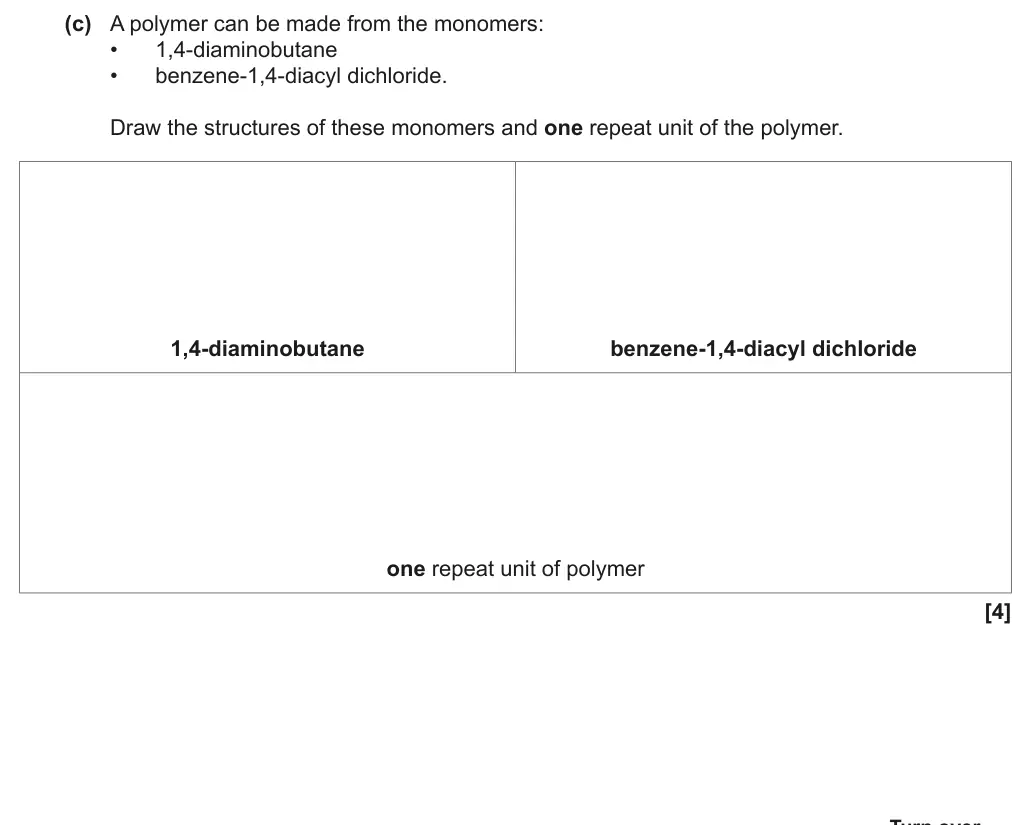
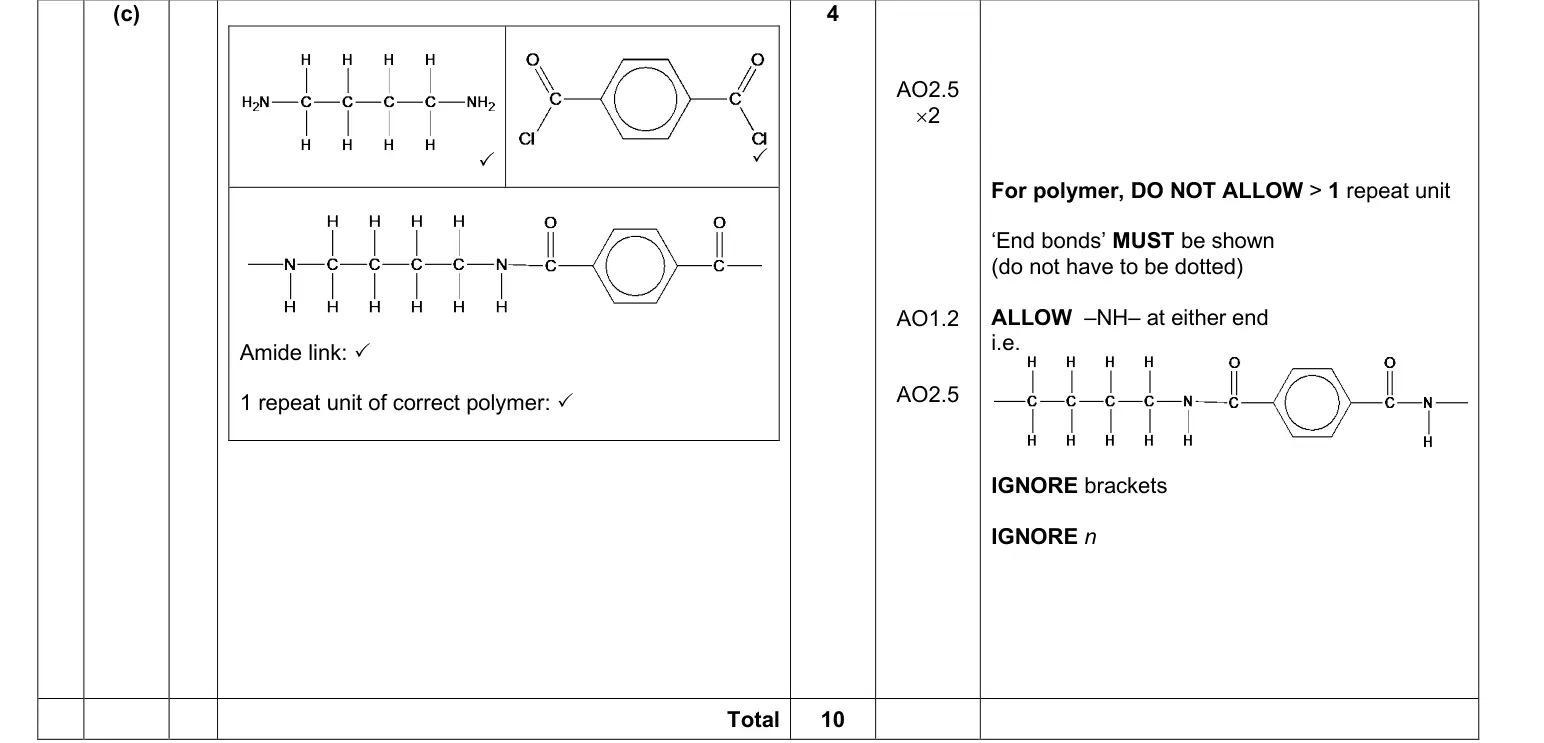
H2N(CH2)4NH2 and ClOC–C6H4–COCl
amide link
one repeat unit only with end bonds shown
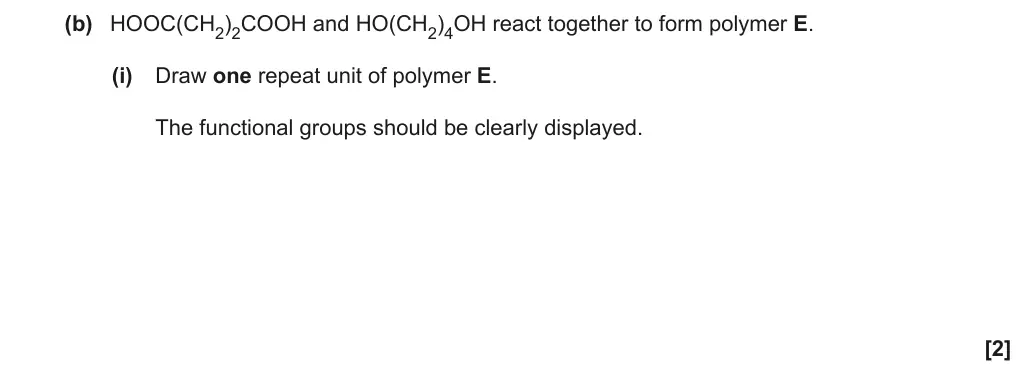
November 2020 · Paper 2 · Q18(b)(i)2 marksAO1, 2Structure / isomer
Earlier part of question 18 that this part uses
Mark scheme
Notes from the mark scheme and report
ester link must be displayed
end bonds MUST be shown
DO NOT ALLOW more than one repeat unit
IGNORE brackets and n
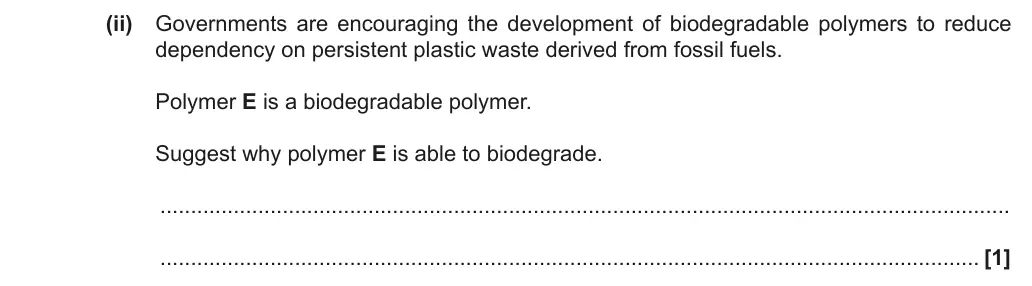
November 2020 · Paper 2 · Q18(b)(ii)1 markAO3Short answer
Earlier part of question 18 that this part uses
Mark scheme
Notes from the mark scheme and report
ester bond/group can be hydrolysed or broken down
'bond breaks' alone insufficient
IGNORE photodegradable
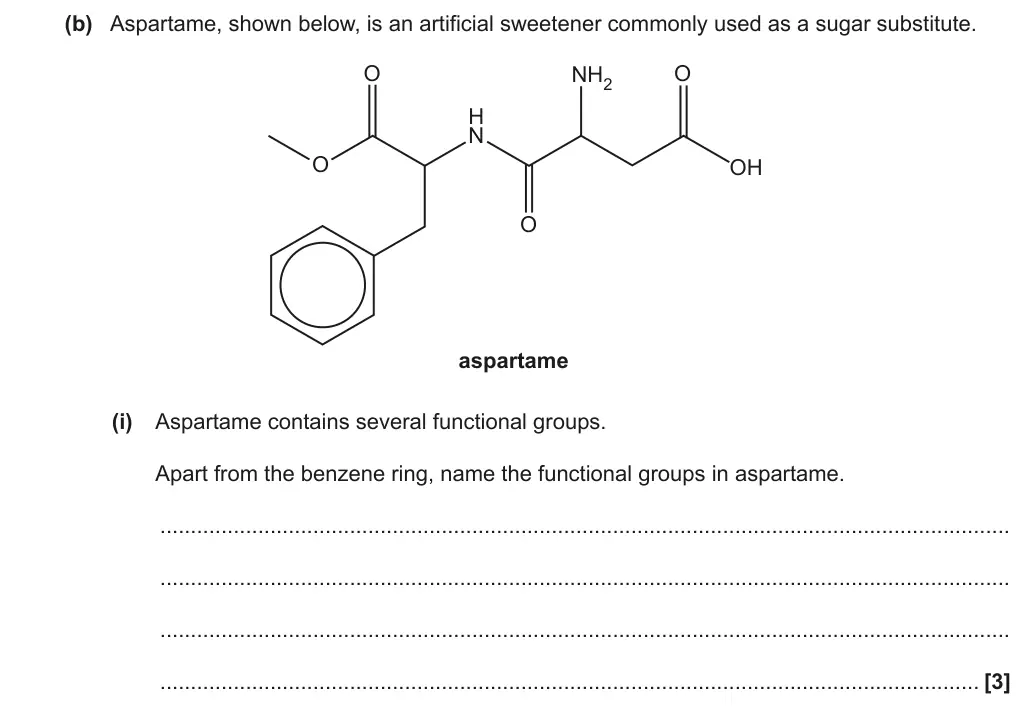
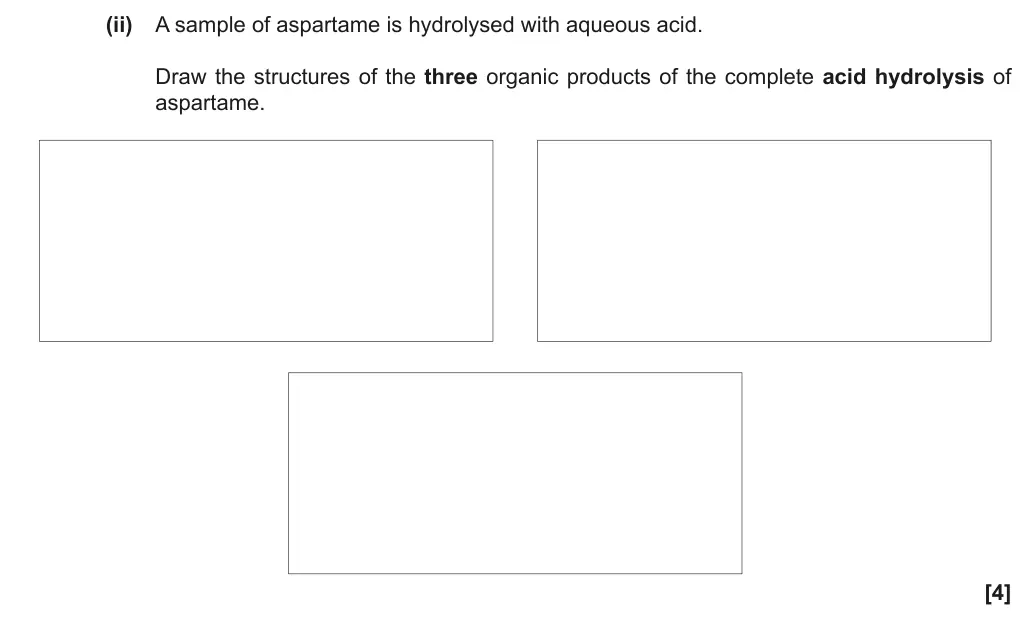
November 2020 · Paper 2 · Q21(b)(ii)4 marksAO2Structure / isomer
Earlier part of question 21 that this part uses
Mark scheme
Notes from the mark scheme and report
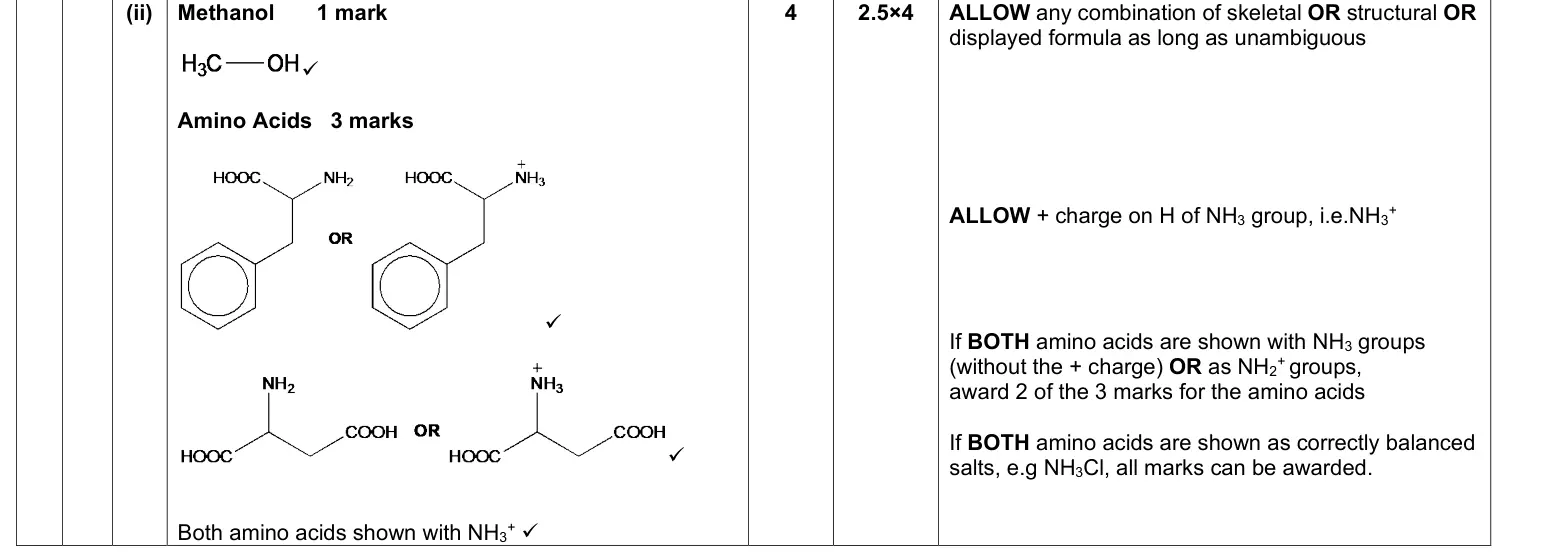
methanol plus two amino acids
both amino acids must show NH3+ for full marks (acid conditions): 2 of 3 if NH2/NH3 without charge
June 2019 · Paper 2 · Q91 markAO2Multiple choice
Answer
A
Mark scheme
June 2019 · Paper 2 · Q18(d)2 marksAO2CalculationMedium
Mark scheme
Examiner's comment
A LEVEL CHEMISTRY A Examiners’ report H432/02 Summer 2019 series Version 1 H432 For first teaching in 2015 www.ocr.org.uk/science Contents Introduction .............................................................................................................................................. 4 Paper 2 series overview ........................................................................................................................... 5 Section A overview ................................................................................................................................... 6 Question 3 ............................................................................................................................................ 6 Question 4 ............................................................................................................................................ 6 Question 5 ............................................................................................................................................ 7 Question 10 .......................................................................................................................................... 8 Question 12 .......................................................................................................................................... 9 Question 13 ........................................................................................................................................ 10 Question 14 ........................................................................................................................................ 10 Question 15 ........................................................................................................................................ 11 Section B overview ................................................................................................................................. 12 Question 16 (a) (i) ............................................................................................................................... 12 Question 16 (a) (ii) .............................................................................................................................. 12 Question 16 (b) (i) ............................................................................................................................... 13 Question 16 (b) (ii) .............................................................................................................................. 14 Question 16 (b) (iv) ............................................................................................................................. 14 Question 16 (b) (v) .............................................................................................................................. 15 Question 17 (a) (i) ............................................................................................................................... 17 Question 17 (a) (ii) .............................................................................................................................. 19 Question 17 (b) (i) ............................................................................................................................... 20 Question 18 (a) (i) ............................................................................................................................... 21 Question 18 (a) (ii) .............................................................................................................................. 22 Question 18 (b) ................................................................................................................................... 23 Question 18 (c) ................................................................................................................................... 23 Question 18 (d) ................................................................................................................................... 24 Question 18 (e) (i) ............................................................................................................................... 24 Question 18 (e) (ii) .............................................................................................................................. 26 Question 19 (a) (i) ............................................................................................................................... 27 Question 19 (a) (ii) .............................................................................................................................. 29 Question 19 (b) (i) ............................................................................................................................... 30 Question 19 (b) (iii) ............................................................................................................................. 32 Question 19 (b) (iv) ............................................................................................................................. 34 Question 20 (a) (i) ............................................................................................................................... 36 Question 20 (a) (ii) .............................................................................................................................. 37 Question 20 (a) (iii) ............................................................................................................................. 37 Question 20 (b) (i) ............................................................................................................................... 38 Question 21 ........................................................................................................................................ 39 Introduction Our examiners’ reports are produced to offer constructive feedback on candidates’ performance in the examinations. Question 18 (d) Question 18 (e) (i) This question was marked using a level of response mark scheme.
Notes from the mark scheme and report
200 × 138 – 199 × 18 = 24018
27600 (no water removed) scores 1
ALLOW ECF from incorrect Mr
Skills: M0.2 Use ratios, fractions and percentages
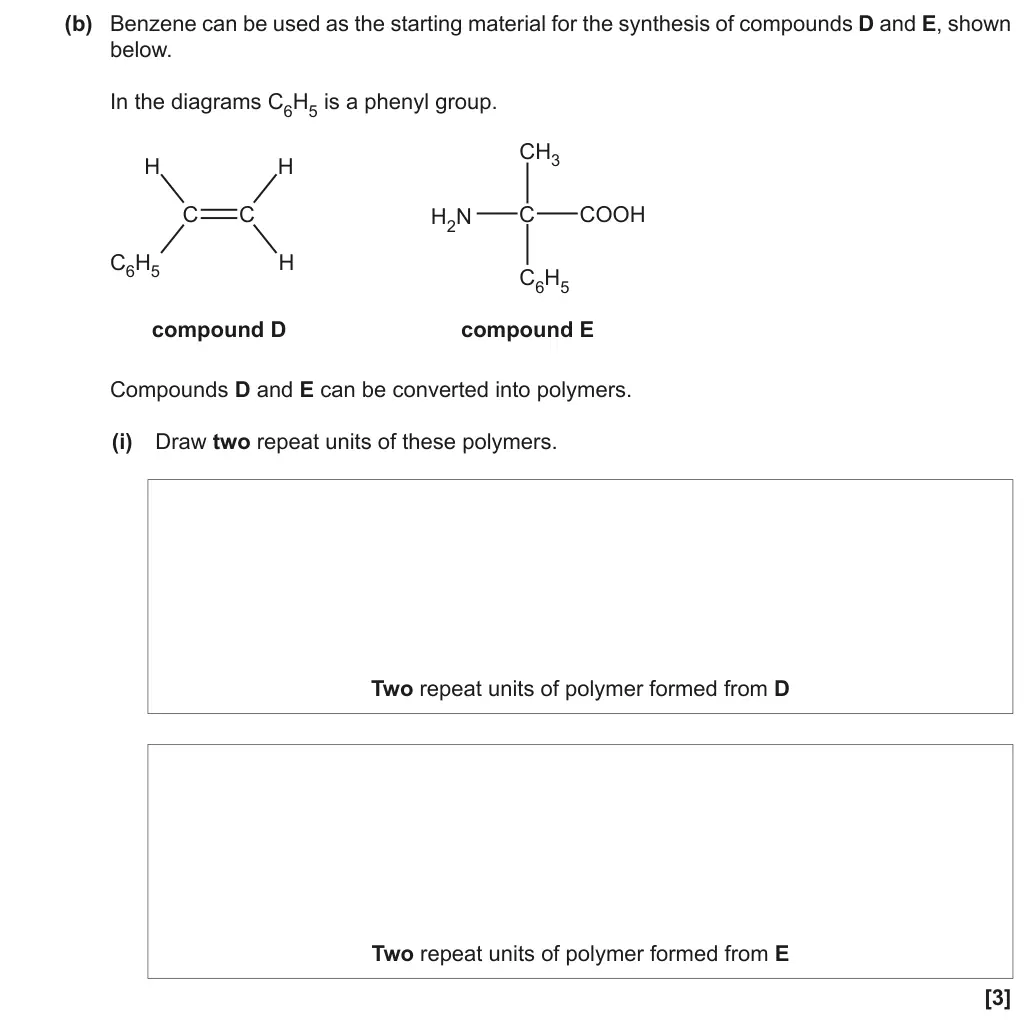
June 2019 · Paper 2 · Q19(b)(i)3 marksAO1, 2Drawing / labellingMedium
Mark scheme
Examiner's comment
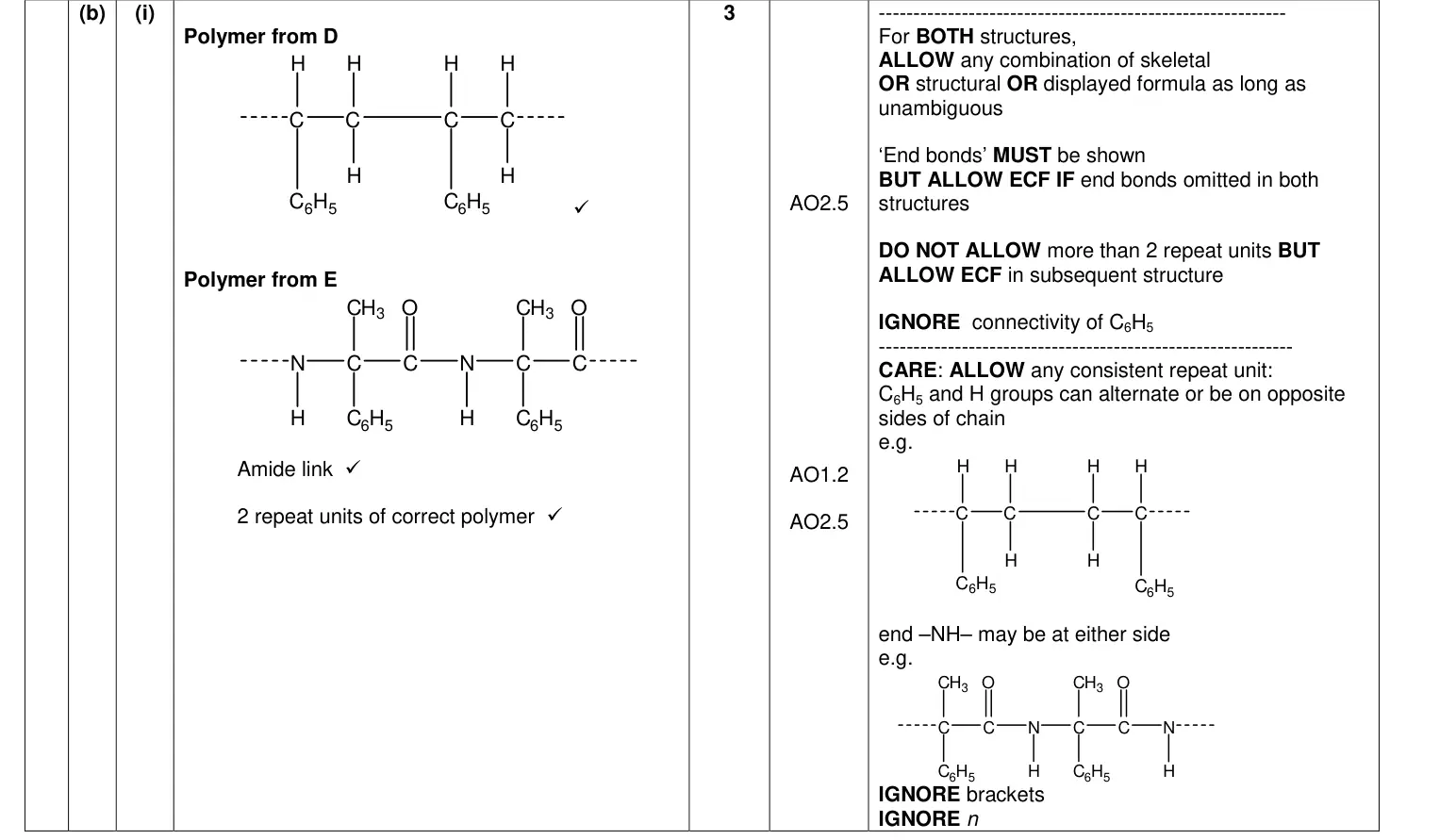
The majority of candidates were able to draw two repeats units of the polymer formed from D and scored at least one mark. While most candidates drew the polymer from E correctly, securing full marks, some candidates were unable to show the amide link correctly. This common error is demonstrated in This response demonstrates a common error seen by examiners. The candidate has included an O atom as part of the amide link. So they have also included an O atom before the ‘end bond’. This is a costly error as the candidate is unable to be given either of the marks available for this polymer.
Notes from the mark scheme and report
D gives addition polymer, E polyamide with amide link
end bonds MUST be shown
DO NOT ALLOW more than 2 repeat units
IGNORE brackets and n
June 2019 · Paper 2 · Q19(b)(ii)1 markAO1Short answerHard
Earlier part of question 19 that this part uses
Mark scheme
Examiner's comment
A LEVEL CHEMISTRY A Examiners’ report H432/02 Summer 2019 series Version 1 H432 For first teaching in 2015 www.ocr.org.uk/science Contents Introduction .............................................................................................................................................. 4 Paper 2 series overview ........................................................................................................................... 5 Section A overview ................................................................................................................................... 6 Question 3 ............................................................................................................................................ 6 Question 4 ............................................................................................................................................ 6 Question 5 ............................................................................................................................................ 7 Question 10 .......................................................................................................................................... 8 Question 12 .......................................................................................................................................... 9 Question 13 ........................................................................................................................................ 10 Question 14 ........................................................................................................................................ 10 Question 15 ........................................................................................................................................ 11 Section B overview ................................................................................................................................. 12 Question 16 (a) (i) ............................................................................................................................... 12 Question 16 (a) (ii) .............................................................................................................................. 12 Question 16 (b) (i) ............................................................................................................................... 13 Question 16 (b) (ii) .............................................................................................................................. 14 Question 16 (b) (iv) ............................................................................................................................. 14 Question 16 (b) (v) .............................................................................................................................. 15 Question 17 (a) (i) ............................................................................................................................... 17 Question 17 (a) (ii) .............................................................................................................................. 19 Question 17 (b) (i) ............................................................................................................................... 20 Question 18 (a) (i) ............................................................................................................................... 21 Question 18 (a) (ii) .............................................................................................................................. 22 Question 18 (b) ................................................................................................................................... 23 Question 18 (c) ................................................................................................................................... 23 Question 18 (d) ................................................................................................................................... 24 Question 18 (e) (i) ............................................................................................................................... 24 Question 18 (e) (ii) .............................................................................................................................. 26 Question 19 (a) (i) ............................................................................................................................... 27 Question 19 (a) (ii) .............................................................................................................................. 29 Question 19 (b) (i) ............................................................................................................................... 30 Question 19 (b) (iii) ............................................................................................................................. 32 Question 19 (b) (iv) ............................................................................................................................. 34 Question 20 (a) (i) ............................................................................................................................... 36 Question 20 (a) (ii) .............................................................................................................................. 37 Question 20 (a) (iii) ............................................................................................................................. 37 Question 20 (b) (i) ............................................................................................................................... 38 Question 21 ........................................................................................................................................ 39 Introduction Our examiners’ reports are produced to offer constructive feedback on candidates’ performance in the examinations. Question 19 (b) (i) The majority of candidates were able to draw two repeats units of the polymer formed from D and scored at least one mark. Question 19 (b) (iii) This question required candidates to apply their knowledge of the mechanism of electrophilic substitution to the formation of phenylethanone from benzene. Question 19 (b) (iv) This question required candidates to apply knowledge of organic reactions from across the specification and discriminated well.
Notes from the mark scheme and report
D addition AND E condensation
DO NOT ALLOW 'additional'
June 2018 · Paper 2 · Q17(c)3 marksStructure / isomerHard
Mark scheme
Examiner's comment
This question required candidates to apply their knowledge of amide hydrolysis to a section of protein. Many candidates correctly recognised that two amino acids would be produced but not all took account of the alkaline conditions and showed COOH groups rather than carboxylates. Candidates found this question difficult and although many gained some credit only the highest ability candidates, who recognised the amide in the side-chain would also react, scored full marks after. Exemplar 3 shows a good response. This response has correctly identified the amino acid on the left hand side of the amide link and also shown this as a carboxylate. Consequently the first mark has been achieved. The right hand amino acid has also been identified correctly. However, the amide in the R group has not been hydrolysed so this response only scores one of the two marks available for this product. Notice the candidate has presented their structures clearly with the atoms drawn in a similar arrangement to the protein shown in the question. This is a good strategy to avoid errors and omissions when drawing organic structures.
Notes from the mark scheme and report
one mark per group hydrolysed (side-chain amide also hydrolysed)
carboxylate –COO–/–COONa required (DO NOT ALLOW COOH)
DO NOT ALLOW –COO–Na covalent bond
DO NOT ALLOW sodium salt of the alcohol group
IGNORE NH3
June 2018 · Paper 2 · Q21(b)4 marksStructure / isomerEasy
Earlier part of question 21 that this part uses
Mark scheme
Examiner's comment
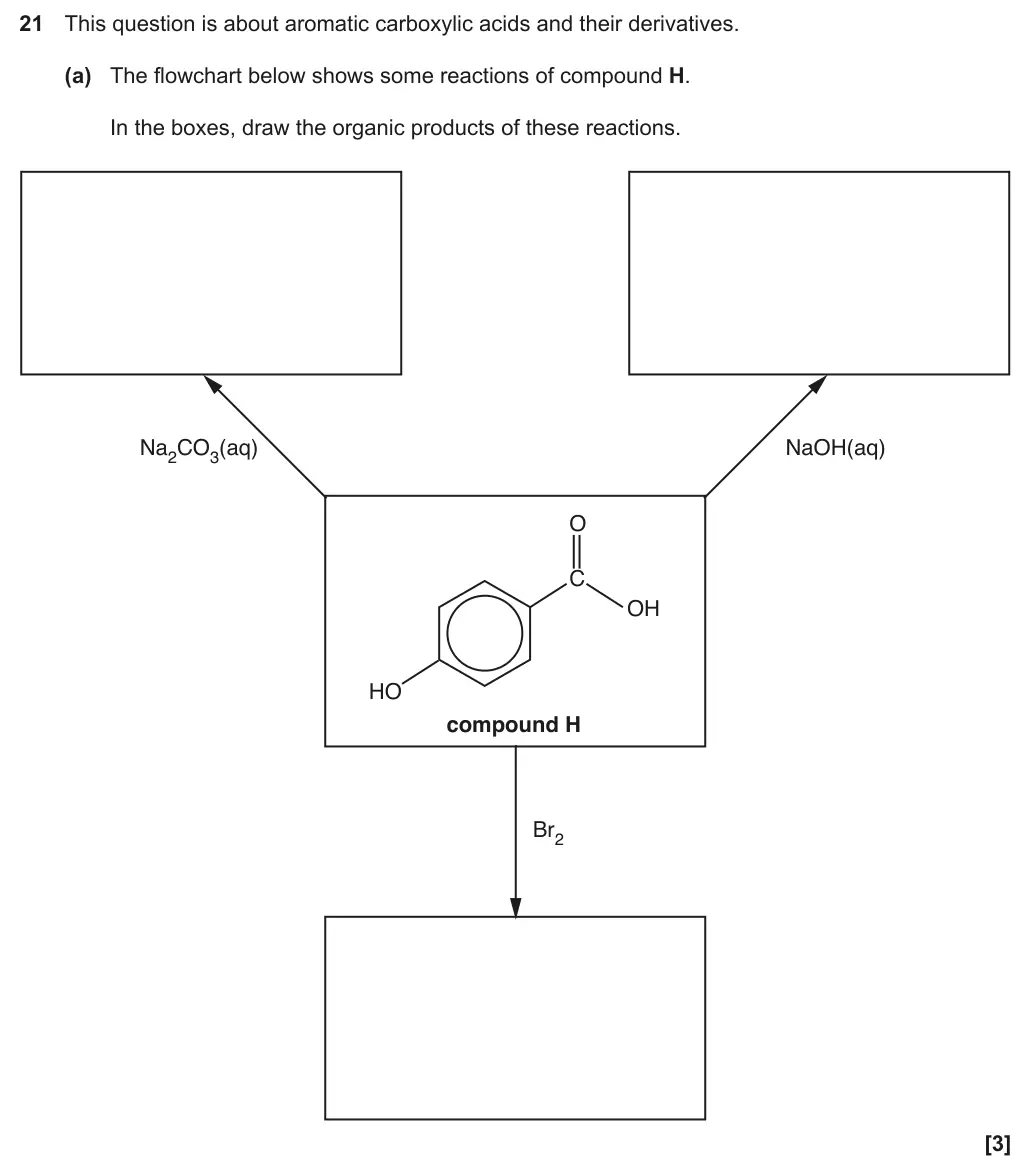
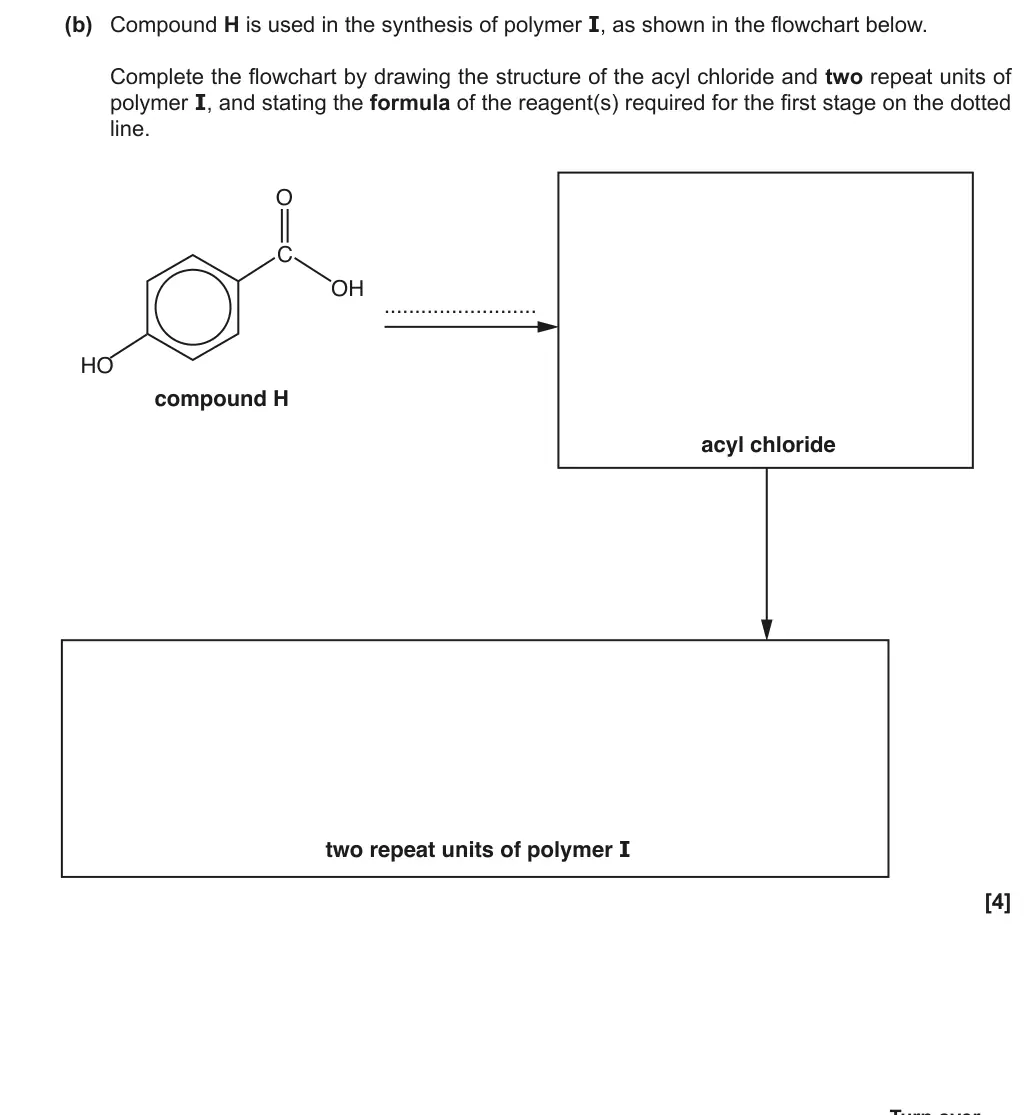
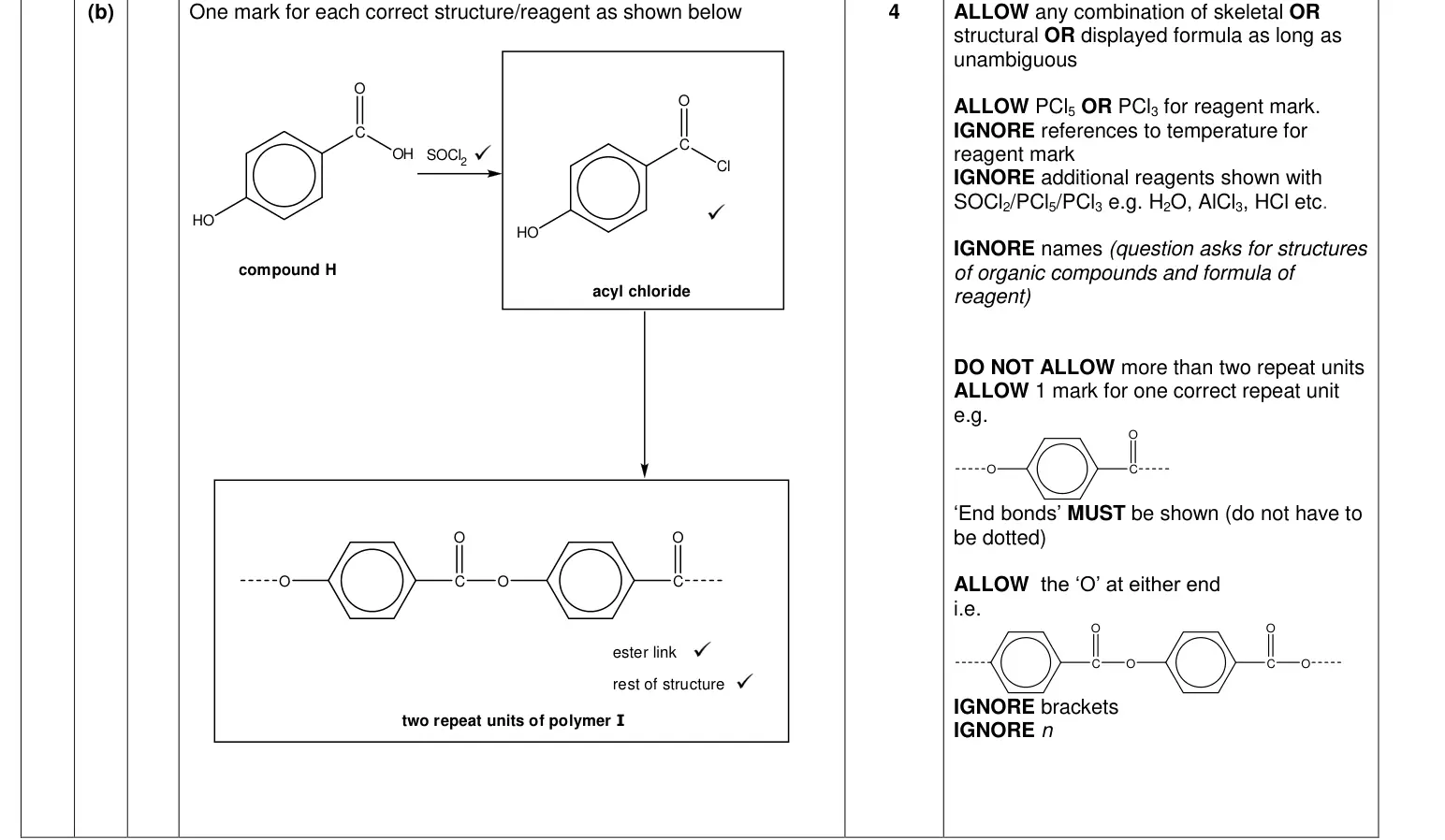
Compound H was also the focus for this question. Most candidates were able to provide the structure of the acyl chloride obtained from H but only some identified SOCl2 as the correct reagent. Common incorrect reagents included HCl and AlCl3. Most candidates recognised that polymer I was a polyester but only some were able to draw two repeat units correctly. Candidates are advised to practice drawing different polymers, taking care to ensure the correct number of repeat units are present when a specific number is required.
Notes from the mark scheme and report
SOCl2 (ALLOW PCl5 or PCl3)
acyl chloride with phenol OH kept
two repeat units with ester link and end bonds shown
DO NOT ALLOW more than two repeat units
1 mark for one correct repeat unit
June 2017 · Paper 2 · Q18(a)(iv)3 marksDrawing / labelling
Earlier part of question 18 that this part uses
Mark scheme
Notes from the mark scheme and report
ester link shown
exactly two repeat units with end bonds
ester/polyester can be hydrolysed ('broken down by water' not sufficient)
IGNORE photodegradable
June 2017 · Paper 2 · Q18(b)(i)2 marksStructure / isomer
Mark scheme
Notes from the mark scheme and report
H2N(CH2)6NH2 and HOOC(CH2)4COOH
ALLOW diacyl chloride
Work with an OCR chemistry tutor
Dropping marks on calculations, mechanisms or the six-markers? Book a trial session with a specialist OCR chemistry tutor.