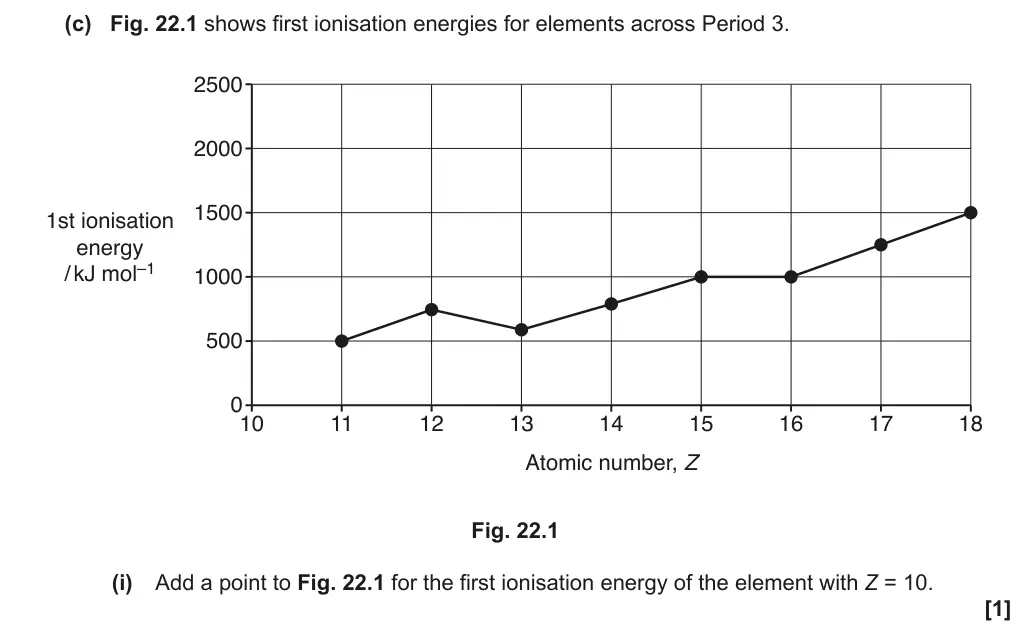
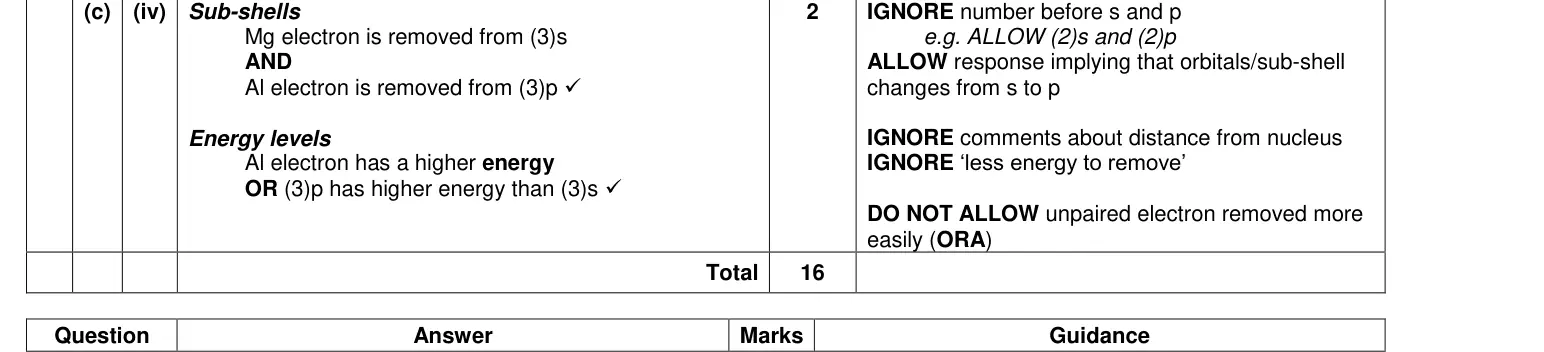
Answer
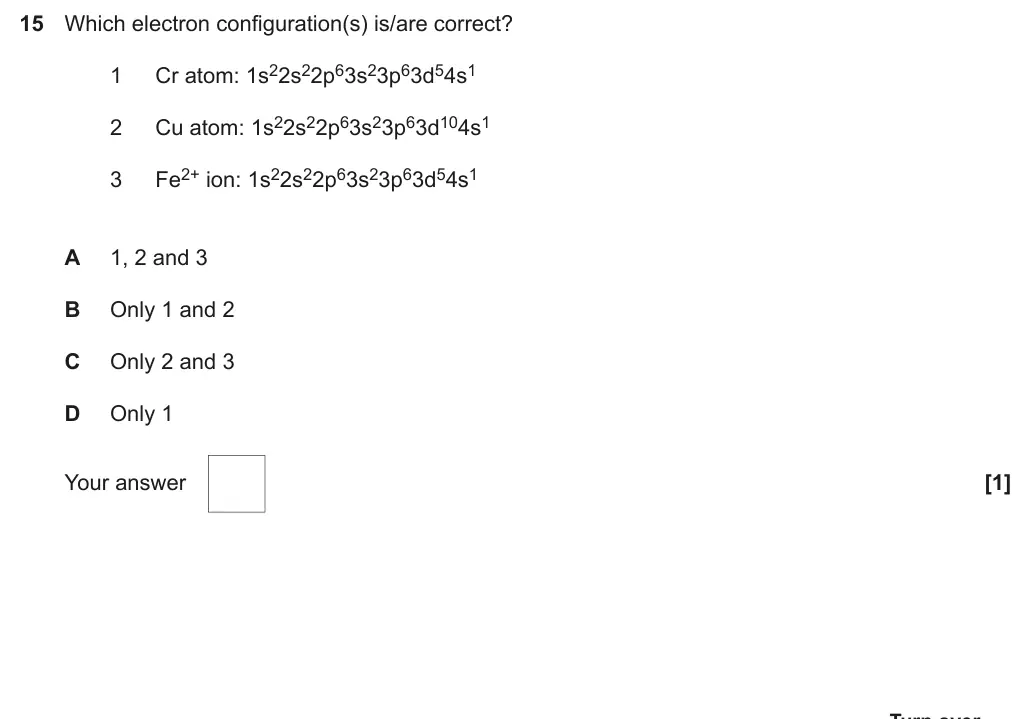
C
Mark scheme

Examiner's comment
Most candidates answered this correctly, showing good knowledge of electron configuration.
Notes and key-term cards for this topic are being written by our tutors. The past-paper questions below are ready now.
| Series | Paper | Q | What it asks |
|---|---|---|---|
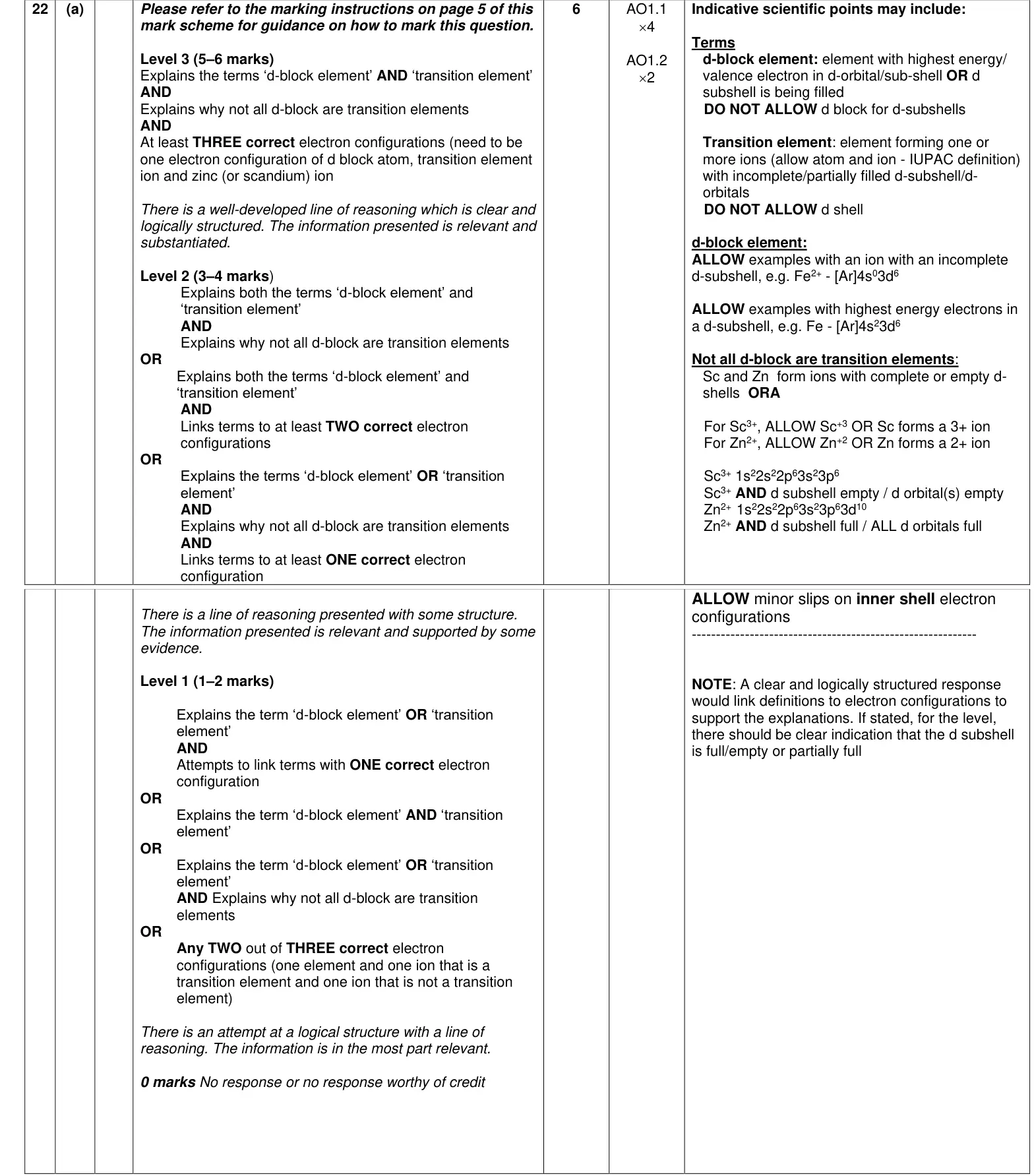
| June 2023 | Paper 1 | 22(a) | Explain, with examples from Period 4, what is meant by the terms d-block element and Explain why some d-block elements are not transition elements. |
C
Most candidates answered this correctly, showing good knowledge of electron configuration.

C
Most candidates recognised C as a diagram for a p orbital.

D
The correct answer was D. Wrong answers were very rarely seen as candidates had secure knowledge of filling orbitals individually before pairing.
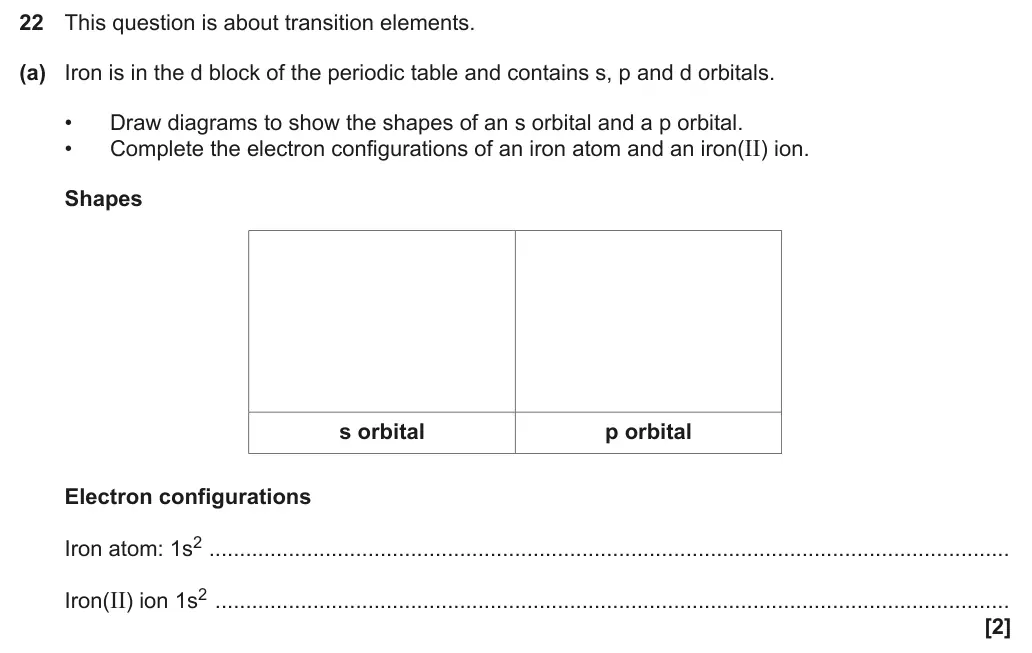
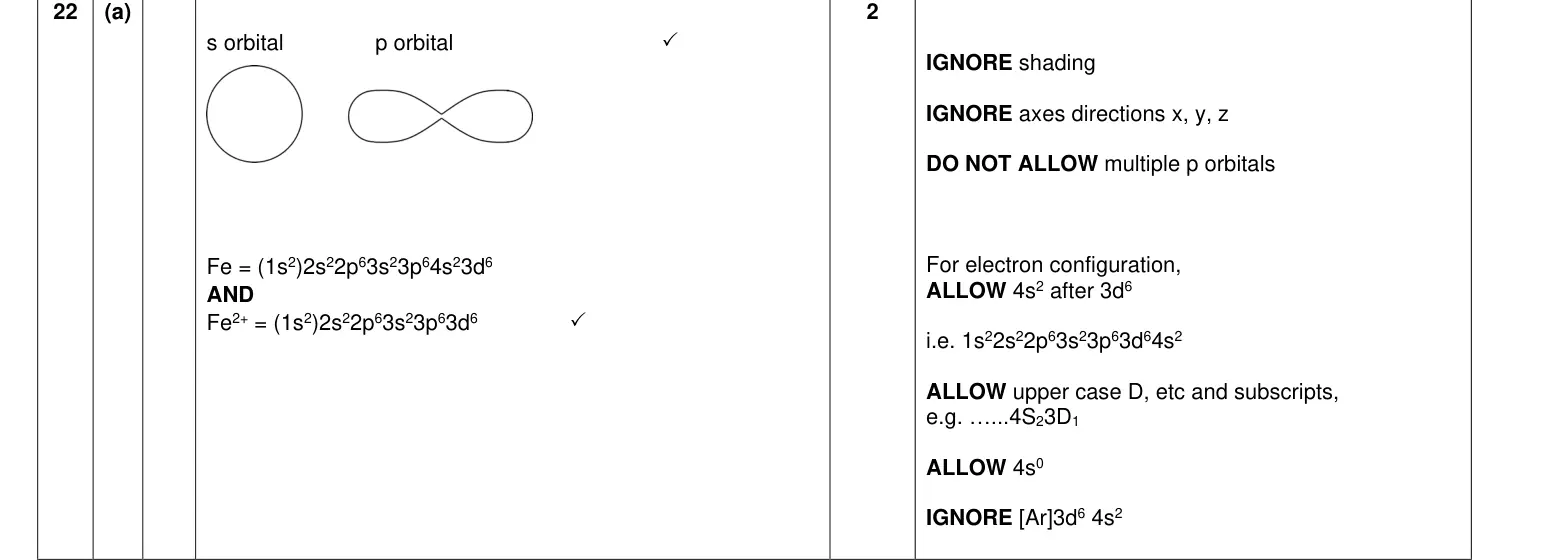
Many candidates were successful in drawing the orbital shapes. Occasionally candidates linked the question to the formation of a π bond or drew two arrows in a box to represent the electrons. Many candidates did not realise that when transition metal ions are formed, the first electrons removed from atoms are the 4s electrons and so wrote 2s2 2p6 3s2 3p6 3d4 4s2.
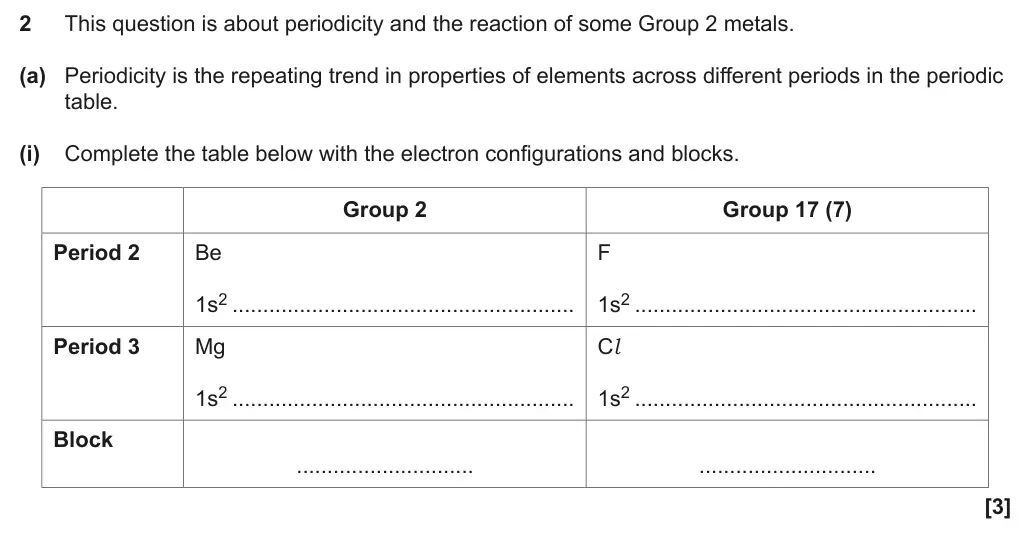
A very well answered question with most candidates very confident in giving the correct electron configurations and blocks. Errors were rare but included: 2p5 or 3p6 ending for Cl; using mass number for number of electrons; and assigning group 17 as d block and giving orbital box diagrams rather than block.

C
Candidates found this question more difficult than Questions 1–3. The question discriminated well. Most candidates showed the electron configuration in their working. A and D were the main distractors. Rather than the number of p-orbitals occupied, option A (2) is the number of p sub-shells (2p and 3p) and D (10) is the total number of p electrons (6 + 4). The errors may be the result of candidates not understanding the meaning of orbital and sub-shell or perhaps not reading the question closely enough. Underlining ‘p-orbitals’ may have helped candidates.
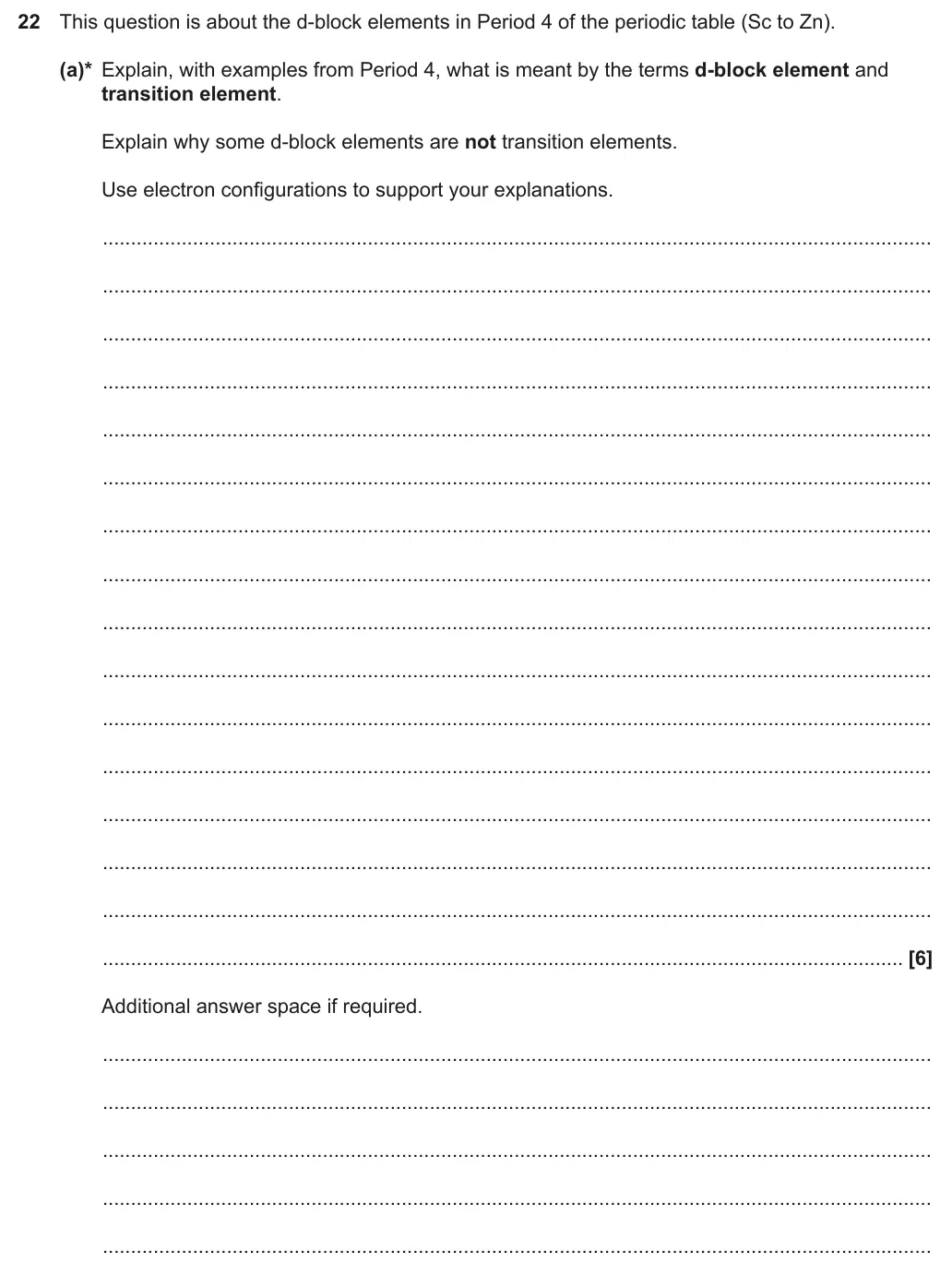
Only the higher-attaining candidates scored full marks. Very few candidates were able to define d-block element correctly without the minor slip of saying outermost electron instead of highest energy or valence electron. Many candidates often did not mention ions for the transition metal definition. Many did not include any of the electron arrangements for d-block elements and transition elements. The majority of candidates who were able to recognise zinc and scandium as d-block elements, but not transition elements, gave their electronic configurations correctly. Common errors included the presence of the 4s electrons in the electron configurations of the ions and incorrect electron configurations of copper and chromium atoms. A few candidates thought chromium and copper were not transition elements due to the 4s1 electron configuration. This candidate has mentioned outer electrons rather than highest energy but was this is a minor slip and they were still given a Level 3 response as everything else is correct. A holistic approach for LoRs is used and not a point-based marking system.

Again, most scored this mark. Common errors included using the mass number for number of electrons, no 4s but 3d4 instead, 4d rather than 3d, 4p2 instead of 3d2 or filling up d orbital 3d10.

Most candidates chose at least one of the two elements Cr and Mn, with Mn being the most common. Incorrect elements were usually other d block elements. Erratum

C
This question was answered reasonably well. From the annotations on scripts many candidates wrote out the electron configuration of a sulfur atom. The successful candidates used electrons in a box notation so that they could visually see, and count, the paired orbitals. This is an excellent strategy to use in any similar questions.
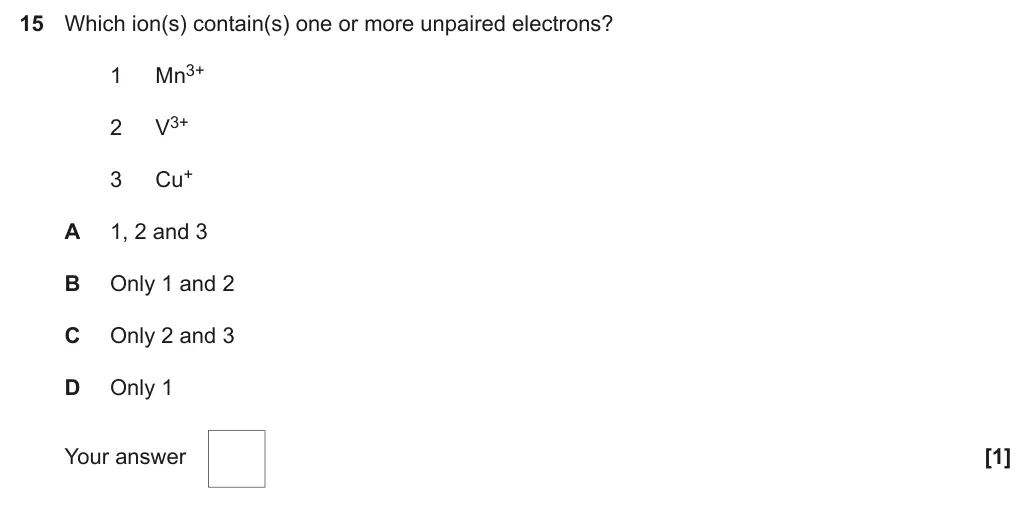
B
This was another challenging question, with fewer candidates choosing the correct answer of B. Successful candidates often had the electronic configuration written down and focused on the higher energy electrons as to whether they were paired or not. Missing the 4s1 in Cu was the main omission to identify the correct answer. Section B overview

This question produced many mixed responses. Most candidates correctly identified nickel. However, its electron configuration was frequently shown as 3d10 instead of 3d8 and some less successful responses gave nickel’s relative atomic mass of 58.7 from the periodic table, instead of the mass number of the isotope provided. Many candidates selected the incorrect element for phosphorus, with argon being a key distractor from the extra 3 electrons in the P3– ion. The numbers of protons and neutrons were largely correct, although the wrong way round for many less successful responses.

D


A
Most candidates chose the correct response of A: Al. The best approach seen on many scripts was to write out the electron configuration beside the options and to count off the paired electrons.

D

21(a) Most candidates could recall the number of electrons in the first four shells as being 2, 8, 18 and 32. However, many made errors for the third and fourth shell. Common incorrect responses included 2,8,18,18 and 2,8,8,8, perhaps linking back to GCSE coverage. 2,6,10,14 was also seen, confusing shells with subshells. 21(b) Almost all candidates were aware that different isotopes had different numbers of neutrons. For the similarities, ‘the same number of protons’ was usually identified, but the same number electrons was omitted by many candidates. This suggested that candidates were concentrating on the nucleus and did not read the question closely enough which asked for ‘atomic’ structures. 21(c)(ii) This was a high demand question and only the highest scoring answers identified that the peak at 72 was caused by a chlorine molecule containing the chlorine-35 and chlorine-37 isotopes shown in the supplied mass spectrum. Very few candidates went on to predict further peaks with m/z values of 70 (from 35Cl35Cl) and 74 (from 37Cl37Cl). There was little pattern in the incorrect responses, suggestion that many were guesses.
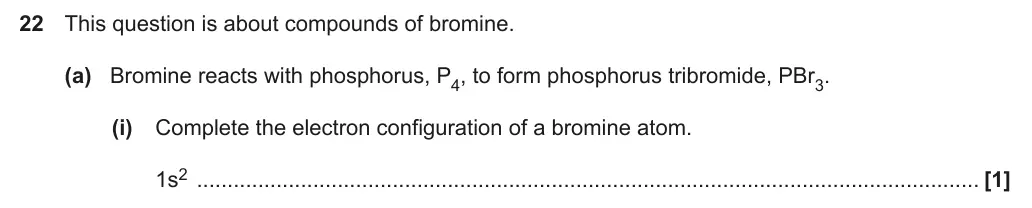
22(a)(i) Candidates answered this part well, showing good knowledge and understanding of electron configuration. When incorrect, it was usually errors with the number of electrons in the 3d and 4p subshells. 22a(ii) Most candidates were able to construct a correct balanced equation for this unfamiliar equation. The commonest error was use of Br instead of Br2 in the equation. 22(b) Structure and bonding continues to be a difficult concept for many candidates. This part did discriminate extremely well, with high-attaining candidates identifying that the compound would have a giant ionic lattice with fixed ions in the solid state which become mobile in the liquid state to conduct electricity. It was common for ‘ionic’ or ‘giant’ to be omitted in the name of the lattice. Most candidates used the ideal gas equation, which was usually rearranged correctly, with substituted values for p, V, R and T being added. A common mistake was for the volume in cm3 to be multiplied by 10–3 rather than 10–6 for the necessary conversion into m3. Low-attaining candidates often did not convert 100 ºC into 373 K. Unfortunately, candidates making an error in unit conversions then obtained an unrealistic molar mass for A and were then unable to derive a possible molecular formula. Well-prepared candidates carried out the calculation well with clear working. It was very encouraging to see the number of candidates able to predict the molecular formula of A as BrF5 from the calculated molar mass of 174.6 g mol–1. There were, however a significant number of incorrect responses, suggesting that some candidates found this type of question challenging. Some candidates used the molar gas volume at room temperature and pressure of 24.0 dm3 mol–1. Two of the five marks were still available for this response.

D

Most candidates added arrows correctly to the boxes but the sub-shell labels were sometimes omitted. Lower attaining candidates sometimes paired electrons, rather than showing them singly or showed six electrons in the 2p sub-shell. This suggested either a lack of understanding or failure to read the question.
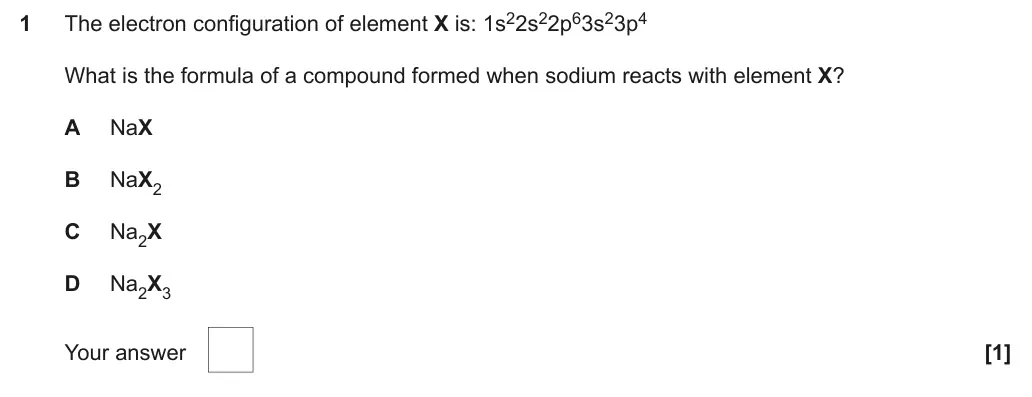
C
Nearly all candidates responded with the correct response of C.

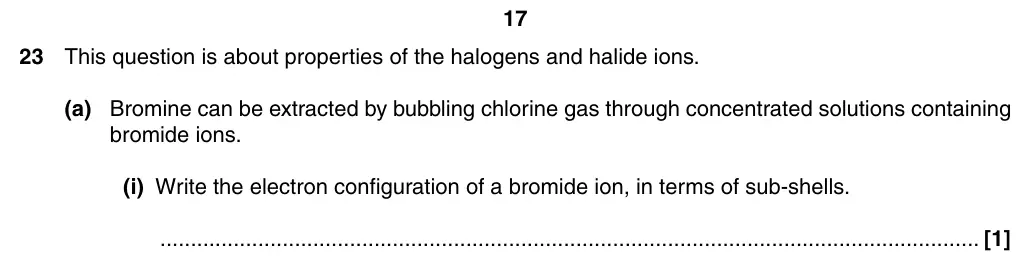
Most candidates answered this correctly. The most common error seen was 4p6 instead of 4p4
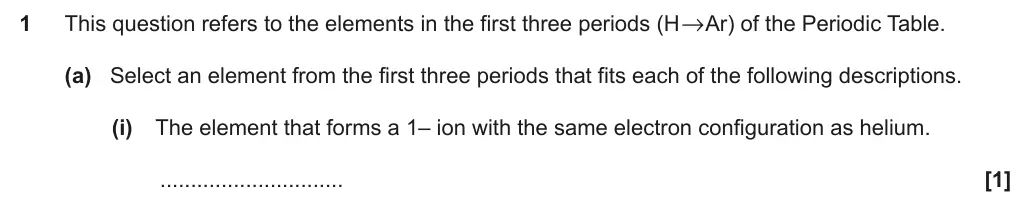
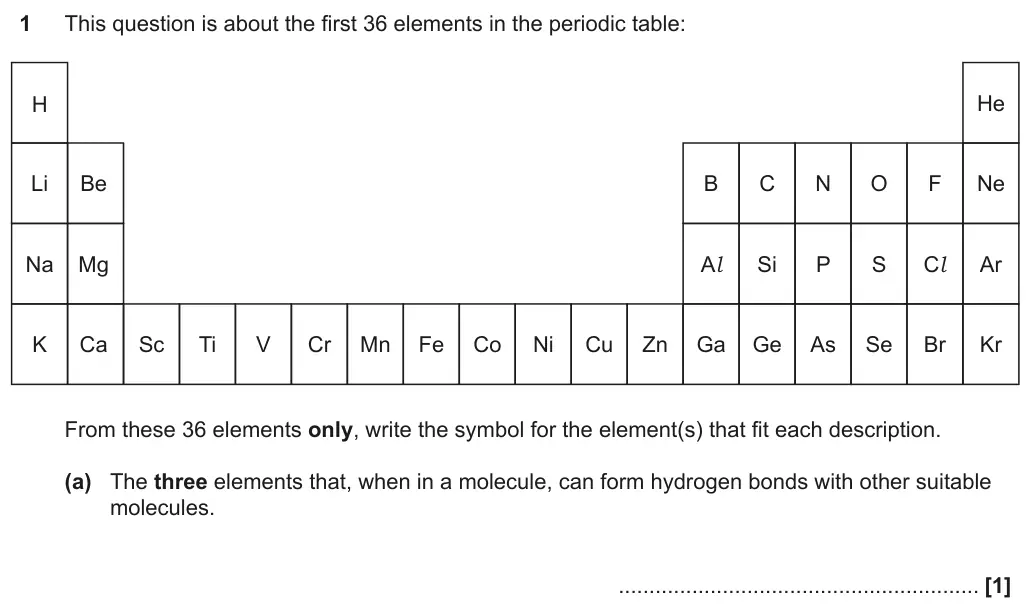
Most candidates were credited this straightforward mark and identified that hydrogen would gain an electron to form a 1– ion. Some candidates opted for lithium, able to form an ion with the same electron configuration as helium, but with a 1+ rather than a 1– charge. Candidates are recommended to look closely at the requirements of the question set.

A
B
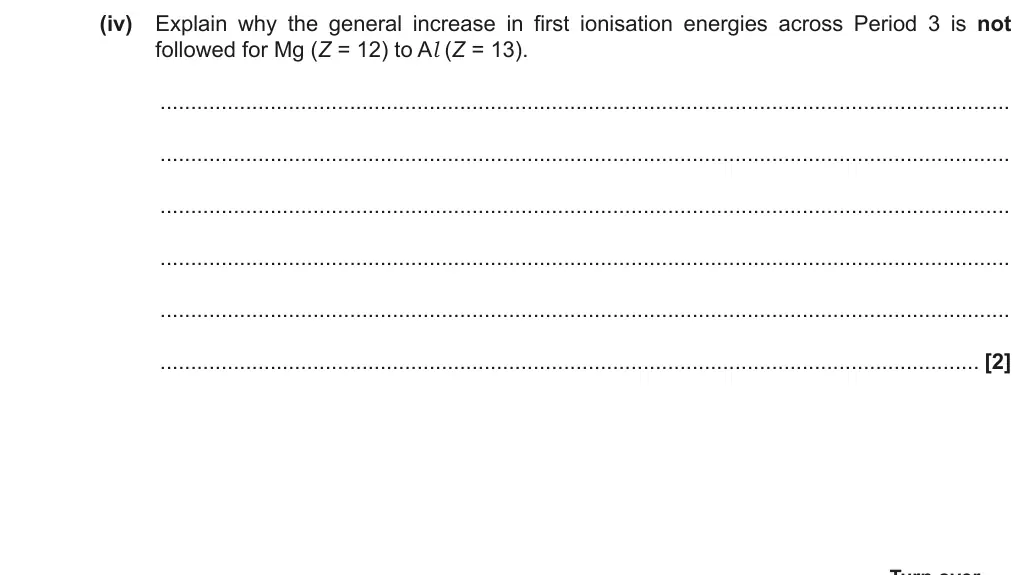


C

Dropping marks on calculations, mechanisms or the six-markers? Book a trial session with a specialist OCR chemistry tutor.