Notes and key-term cards for this topic are being written by our tutors. The past-paper questions below are ready now.
Learning outcomes
Show the 8 learning outcomes from the specification
5.2.2(a) explanation that entropy is a measure of the dispersal of energy in a system which is greater, the more disordered a system
5.2.2(b) explanation of the difference in magnitude of the entropy of a system:
5.2.2(b)(i) of solids, liquids and gases
5.2.2(b)(ii) for a reaction in which there is a change in the number of gaseous molecules
5.2.2(c) calculation of the entropy change of a system, ∆S, and related quantities for a reaction given the entropies of the reactants and products
5.2.2(d) explanation that the feasibility of a process depends upon the entropy change and temperature in the system, T∆S, and the enthalpy change of the system, ∆H
5.2.2(e) explanation, and related calculations, of the free energy change, ∆G, as: ∆ G = ∆H – T∆ S (the Gibbs’ equation) and that a process is feasible when ∆ G has a negative value
5.2.2(f) the limitations of predictions made by ∆G about feasibility, in terms of kinetics.
Tap a question to zoom it. Where a part needs a table, graph or structure from an earlier part, that part folds out above it; the mark scheme and examiner's comment open underneath. Have the OCR Data Sheet beside you.
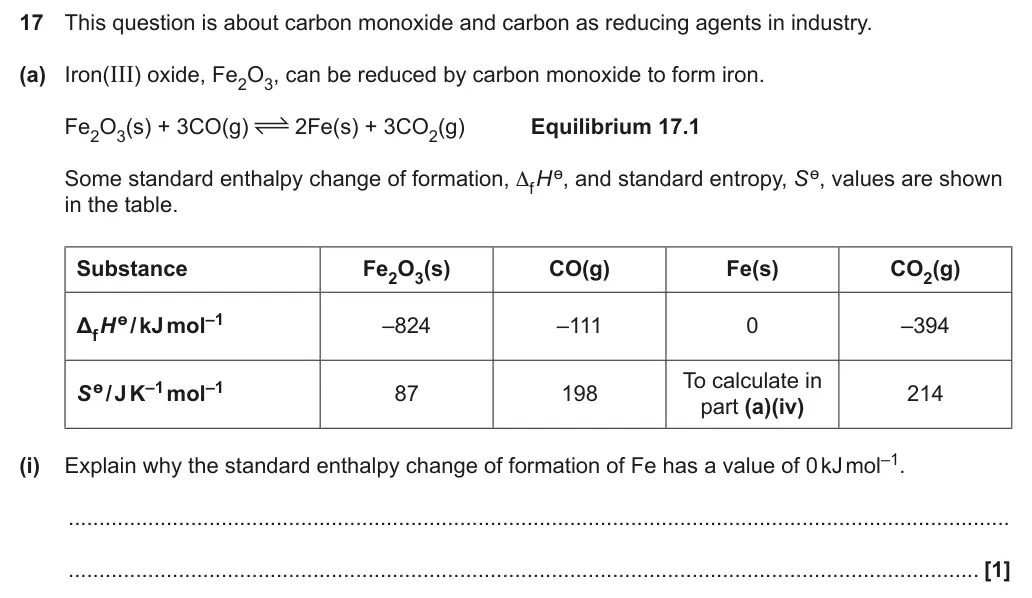
June 2025 · Paper 1 · Q17(a)(iii)2 marksShort answerHard
Earlier part of question 17 that this part uses
Mark scheme
Examiner's comment
Many candidates were given both marks with a clear description of the difference in states and a good explanation describing the increase in disorder within a gaseous system. A few candidates linked the standard entropy to the increase in moles (from one mole of Fe2O3 to three moles of CO2), showing a misunderstanding between ‘entropy change of reaction’ and ‘standard entropy’. Occasionally the candidate did not state that Fe was a solid.
Notes from the mark scheme and report
Fe2O3 is a solid and CO2 is a gas
gas more disordered/energy more dispersed/more ways of arranging
June 2025 · Paper 1 · Q17(a)(iv)2 marksCalculationMedium
Earlier part of question 17 that this part uses
Mark scheme
Examiner's comment
Many candidates were given both marks with the correct answer of 27 J K-1 mol-1. Common errors saw some candidates quoting +12 from reversing the subtraction and 54 through not dividing by 2.
Notes from the mark scheme and report
15 = 3(214) + 2x – 87 – 3(198) so S = 27
common errors (1 mark): 241 (no 3 × 214), 12 (subtraction reversed), –171 (no 3 × 198)
divide by 2 for 2Fe
Skills: M2.2 Change the subject of an equation; M2.3 Substitute numerical values into algebraic equations using appropriate units for physical quantities; M2.4 Solve algebraic equations
June 2025 · Paper 1 · Q17(b)3 marksCalculationMedium
Mark scheme
Examiner's comment
Many candidates scored all three marks. They correctly calculated ΔG, made a feasibility statement and calculated the minimum temperature or 904K or 905K. The alternative methods found in the MS guidance were rarely seen. Nearly all candidates remembered to convert the units which is typically a common error. Less successful candidates missed the unit conversion (i.e. J K-1 mol-1 to kJ K-1 mol-1 for entropy or kJ mol-1 to J mol-1 for enthalpy) or incorrect temperature used (e.g. 298 K). Sometimes there was a lack of a clear feasibility statement.
Notes from the mark scheme and report
∆G = 491 – 373 × 0.543 = +288 kJ mol–1 (convert ∆S to kJ and °C to K)
not feasible as ∆G > 0
T = ∆H/∆S = 904 or 905 K, whole number required
ALLOW ∆H > T∆S or ∆S(total) approach
Skills: M0.0 Recognise and make use of appropriate units in calculations; M2.2 Change the subject of an equation; M2.3 Substitute numerical values into algebraic equations using appropriate units for physical quantities
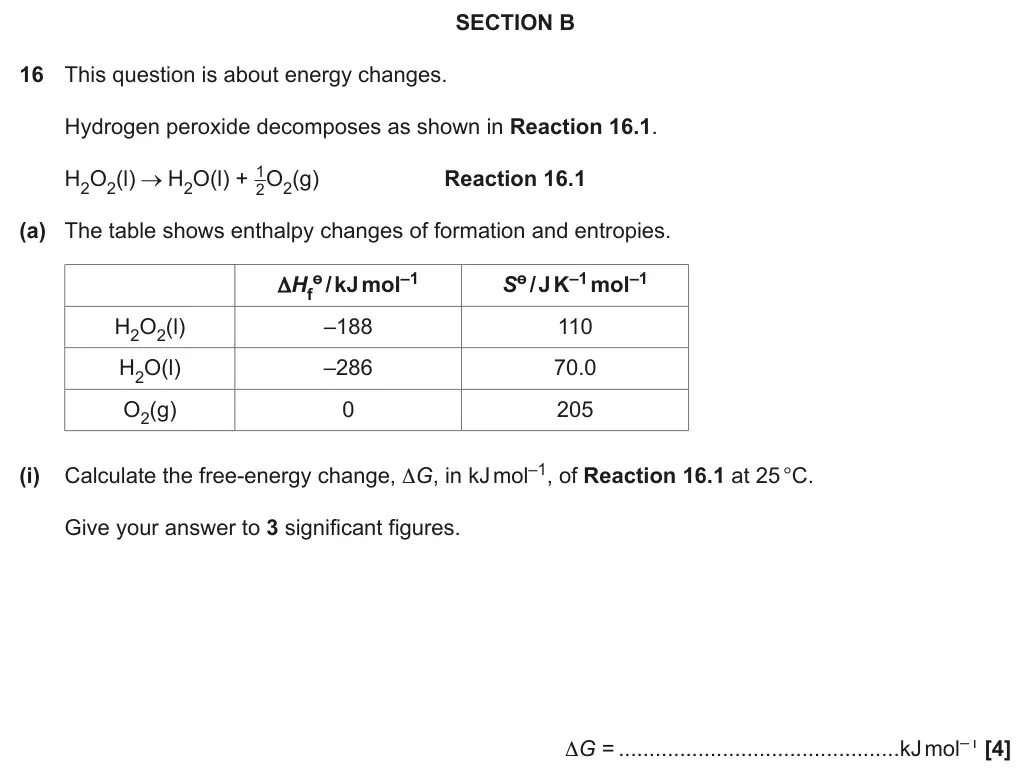
June 2024 · Paper 1 · Q16(a)(i)4 marksCalculationMedium
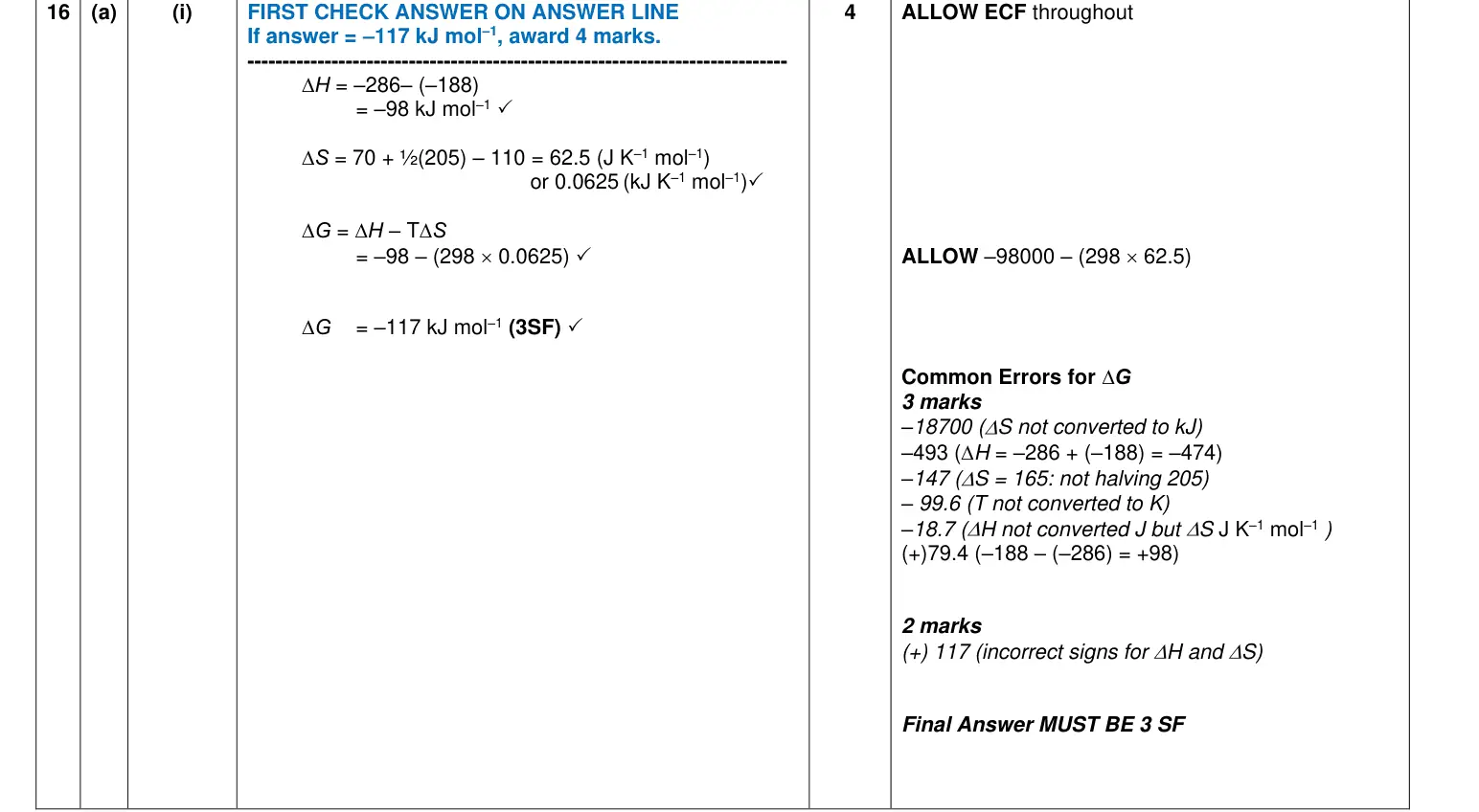
Mark scheme
Examiner's comment
Almost all candidates had a good attempt at this calculation, with many gaining full marks. Most were able to calculate the entropy change. Almost all could reproduce the equation for free energy. Of those who did not get the correct final answer, the most common error was not converting the entropy value into kJ and / or the temperature to K. There were a few candidates who did not manipulate the equation correctly. A few candidates incorrectly calculated ΔS, obtaining the value of 165 J K-1 mol-1 or ΔH, obtaining -474 kJ mol-1. Candidates were given ECF in these cases.
Notes from the mark scheme and report
∆S in J K–1 mol–1 must be converted to kJ
½ mol O2 in ∆S
3 sig figs required
Skills: M0.0 Recognise and make use of appropriate units in calculations; M1.1 Use an appropriate number of significant figures; M2.3 Substitute numerical values into algebraic equations using appropriate units for physical quantities
June 2024 · Paper 1 · Q16(a)(ii)1 markShort answerMedium
Earlier part of question 16 that this part uses
Mark scheme
Examiner's comment
Lots of good answers from candidates were seen for this question. A few candidates attempted the explanation via a ΔG / ΔS argument and misinterpreted the comment within the question.
Notes from the mark scheme and report
DO NOT ALLOW 'not enough activation energy'
IGNORE 'not enough energy to react'
June 2023 · Paper 1 · Q91 markAO2Multiple choiceEasy
Answer
B
Mark scheme
Examiner's comment
Most candidates were able to use the data correctly. The correct answer was B. The main error was from not recognising the need to make 1 mole of SO3, so the use of ½ mole of O2, and therefore using the wrong molar ratio.
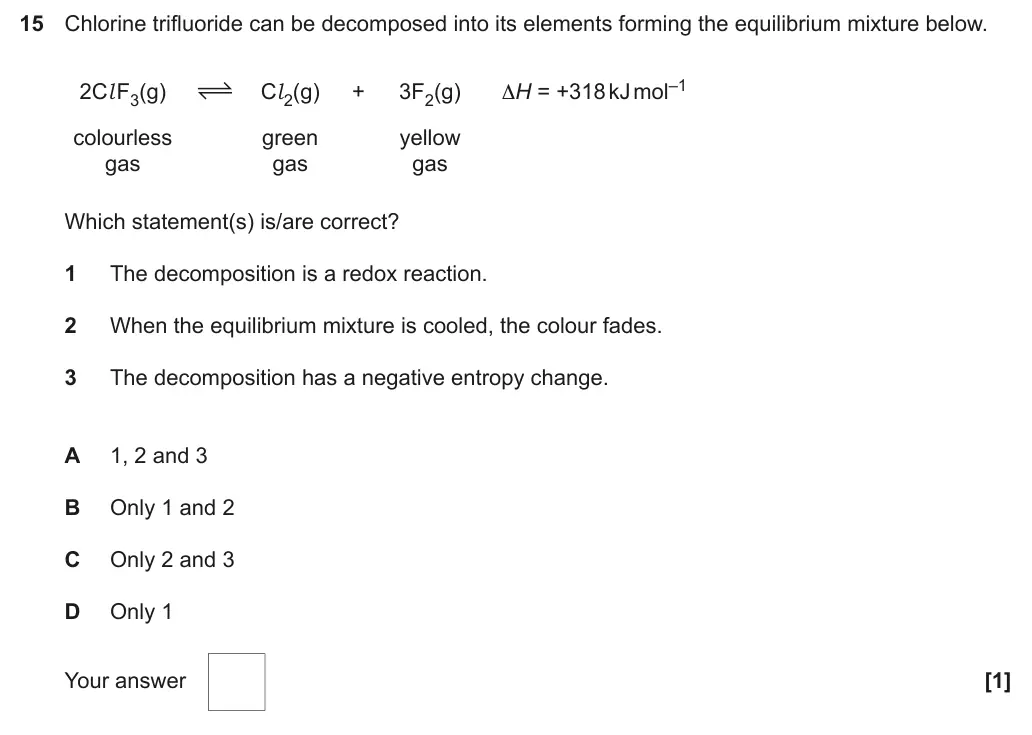
June 2023 · Paper 1 · Q151 markAO2Multiple choiceEasy
Answer
B
Mark scheme
Examiner's comment
This question was for the most part answered correctly with B. Errors came from not recognising the reaction is endothermic and therefore its equilibrium would shift to the left when the temperature decreases, ruling out option 2. Section B overview The section contained questions from all aspects of the specification. Candidates found many of the questions, including those with an extended response nature, straightforward and the majority managed to cope with the mathematical content. Candidates should use calculator values in their intermediate calculations to avoid rounding errors in their final answer. Well set out calculations which clearly indicate what each numerical value represents allow error carried forward marks to be awarded in the event of an incorrect answer. Some candidates were less confident and knowledgeable with the less demanding aspects of some questions. These were specifically: ionic equations, equations involving group 2 metals and their compounds, equilibria shifts and enthalpy changes. There was evidence that candidates wrote far more than necessary in some responses. For example, Question16 (b) was allotted a very generous 9 lines for an answer but many candidates provided repetitive responses and requoted the question. Many more effective responses provided 4 or 5 line answers but gained full marks. With the exception of questions marked using a level of response mark scheme, candidates should look to the marks available to give insight to the amount of detail, and discrete points, that needed to be made.
Notes from the mark scheme and report
Practice multiple choice questions can improve the skill in solving and identifying the distractors. Exposure to this type of question style will decrease the time taken over each question. These can often form the basis of end of topic tests.
Multiple choice question quizzes can be found via the resource-finder on Teach Cambridge and there are instructions on how to use the online versions of the multiple choice quizzes.
June 2023 · Paper 1 · Q18(c)(i)1 markAO2Short answerMedium
Mark scheme
Examiner's comment
Candidates needed to explain the correct sign and understand that entropy is a measure of the dispersal of energy in a system. Most candidates linked the increase in disorder with the number of moles increasing and therefore the + sign for ∆S. Some candidates were not given the mark as they stated that entropy increases without giving the sign. Some candidates tried to answer using ∆G statements by suggesting ∆H and T values.
Notes from the mark scheme and report
positive AND more (gaseous) moles of products
IGNORE explanations based on ∆G
June 2023 · Paper 1 · Q18(c)(ii)5 marksAO3CalculationEasy
Earlier part of question 18 that this part uses
Mark scheme
Examiner's comment
Nearly all candidates were able to draw the line of best fit and linked the equation of a straight line to the equation for delta G. Some hadn’t used a ruler to draw a straight line and candidates should be reminded of this requirement. Candidates were able to recognise that the gradient corresponded to (-) delta S but some did not to use the scale correctly. Some candidates tried to use very small triangles to get the gradient and candidates would be advised to use the largest scale possible to minimise errors in the line of best fit. Most candidates recognised that the minimum temperature was the x-intercept (when delta G = 0) and that delta H was the y-intercept. Some did not use this approach and instead used the ∆G=∆H-T∆S equation, using previously obtained value(s), to calculate the minimum temperature, ∆S or ∆H. Some candidates used ∆H = -186 from a previous question or attempted to solve both ∆S and ∆H by simultaneous equations.
Notes from the mark scheme and report
best-fit line extrapolating to y-axis 43–47 and x-axis 820–840
∆S = –gradient × 1000 (122–131)
minimum T where ∆G = 0 (340–370 K)
∆H = y-intercept (43–47)
ECF throughout
Skills: M0.0 Recognise and make use of appropriate units in calculations; M3.1 Translate information between graphical, numerical and algebraic forms; M3.2 Plot two variables from experimental or other data; M3.3 Determine the slope and intercept of a linear graph
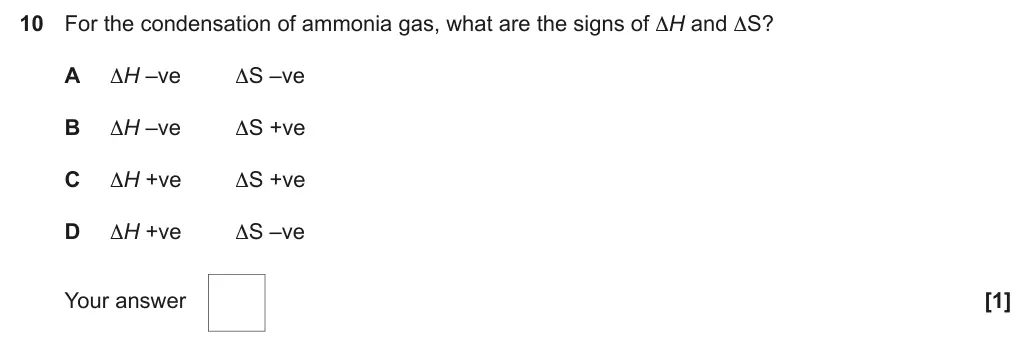
June 2022 · Paper 1 · Q101 markAO2Multiple choiceMedium
Answer
A
Mark scheme
Examiner's comment
Only some candidates chose the correct answer of A. Option D was a common incorrect answer through not recognising that the enthalpy change for condensation is negative.
June 2022 · Paper 1 · Q17(c)(i)1 markAO1Short answerMedium
Mark scheme
Examiner's comment
Candidates needed to explain that entropy is a measure of the dispersal of energy in a system which is greater, the more disordered a system. A good number of correct answers but quite a few did not get across the required idea of ‘a measure of’.
Notes from the mark scheme and report
measure of dispersal of energy/disorder
June 2022 · Paper 1 · Q17(c)(ii)3 marksAO2CalculationMedium
Earlier part of question 17 that this part uses
Mark scheme
Examiner's comment
Almost all candidates had a good attempt at this calculation, with many gaining full marks. Most were able to calculate the entropy change. Almost all could reproduce the equation for free energy. Of those who did not get the correct final answer, the most common error was not converting the entropy value into kJ and/or the temperature to K There were also a few candidates who did not manipulate the equation correctly.
Notes from the mark scheme and report
∆S = +284 J K–1 mol–1 converted to 0.284 kJ
T = 298 K
∆H = ∆G + T∆S = –2587
common errors –2664.9 (25 °C), 81960 (∆S in J), –2756.6 (wrong sign of ∆S) score 2
Skills: M0.0 Recognise and make use of appropriate units in calculations; M2.2 Change the subject of an equation; M2.3 Substitute numerical values into algebraic equations using appropriate units for physical quantities
June 2022 · Paper 1 · Q17(c)(iii)2 marksAO3Short answerMedium
Earlier parts of question 17 that this part uses
Mark scheme
Examiner's comment
Many candidates realised the significance of a negative free energy change, but they seemed to struggle to link this to the previous question, giving a more general answer about feasibility, rather than using their values of entropy change and enthalpy change to determine feasibility. If temperature of feasibility was calculated as -9110K many still thought that meant a temperature existed below this which was feasible.
Notes from the mark scheme and report
∆S positive AND ∆H negative
so ∆G negative at all temperatures
ALLOW ECF from signs in (c)(ii)
November 2021 · Paper 1 · Q111 markMultiple choice
Answer
A
Mark scheme
November 2021 · Paper 1 · Q20(b)(i)2 marksAO2Short answer
Earlier part of question 20 that this part uses
Mark scheme
Notes from the mark scheme and report
∆S converted to kJ (–0.147)
∆G = –70.2 AND statement that ∆G is negative
Skills: M0.0 Recognise and make use of appropriate units in calculations; M2.3 Substitute numerical values into algebraic equations using appropriate units for physical quantities
November 2021 · Paper 1 · Q20(b)(ii)1 markAO2Calculation
Earlier parts of question 20 that this part uses
Mark scheme
Notes from the mark scheme and report
T = ∆H/∆S = 776 K
3 SF required
Skills: M1.1 Use an appropriate number of significant figures; M2.2 Change the subject of an equation
November 2020 · Paper 1 · Q17(c)5 marksAO2, 3Calculation
Earlier part of question 17 that this part uses
Mark scheme
Notes from the mark scheme and report
∆S = –222 J K–1 mol–1 (2 × H2)
convert to kJ or ∆H to J
∆G = +25.55 kJ mol–1 with units
not feasible because ∆G > 0
Skills: M0.0 Recognise and make use of appropriate units in calculations; M2.3 Substitute numerical values into algebraic equations using appropriate units for physical quantities
November 2020 · Paper 1 · Q17(d)3 marksAO1, 3CalculationMedium
Earlier part of question 17 that this part uses
Mark scheme
Examiner's comment
This was an unfamiliar expression linking ∆G and Kp. Many candidates correctly calculated this number. Some candidates calculated ln Kp as 10.0 but then put a – in front for the e calculation. The question required the answer to 3 significant figures. Higher-attaining candidates were able to work out the units as any pressure unit -2 .
Notes from the mark scheme and report
ln Kp = –∆G/RT = 10.01
Kp = 2.22 × 10^4 (3 sig figs)
units atm–2 (or Pa–2 etc.)
common errors 22400 (R = 8.31) and 4.50 × 10^–5 (sign) score 1
Skills: M0.0 Recognise and make use of appropriate units in calculations; M0.4 Use calculators to find and use power, exponential and logarithmic functions; M1.1 Use an appropriate number of significant figures; M2.2 Change the subject of an equation; M2.5 Use logarithms in relation to quantities that range over several orders of magnitude
June 2019 · Paper 1 · Q19(a)(ii)4 marksAO2, 3CalculationHard
Earlier part of question 19 that this part uses
Mark scheme
Examiner's comment
The calculation was done well. Some candidates found it difficult to convert ΔS values from J to kJ or temperature values from °C to K, and this was frequently seen in responses. The final mark was often lost through vague phrasing. ‘Yes’ was an insufficient answer, as it does not identify the reaction as feasible or non-feasible. ‘Gibbs free energy is negative’ was also insufficient, as it should be identified that ΔG is negative.
Notes from the mark scheme and report
∆S = –391 J K–1 mol–1 converted to kJ
T = 293 K
common errors –1117 (T = 20), +113438 (J/kJ mix), –1008 (298 K) score 2 calculation marks
feasible as ∆G < 0 (ECF)
Skills: M0.0 Recognise and make use of appropriate units in calculations; M2.3 Substitute numerical values into algebraic equations using appropriate units for physical quantities
June 2019 · Paper 3 · Q5(b)4 marksAO2CalculationMedium
Mark scheme
Examiner's comment
This was a testing question. This question discriminated very well but lower ability candidates struggled to score marks. This unfamiliar scenario required candidates to first decide on a strategy for solving the problem. Candidates needed to use the Gibbs’ equation and supplied data to determine the entropy change. They then needed to combine this value with other supplied data to determine the unknown standard entropy. The data provided were all standard, signified by the standard sign. Candidates were expected to use 298 K as the standard temperature to first determine the entropy change. Although many candidates chose 298 K, many different temperatures were seen, with 273 K and 286.5 K (the temperature change in 5a(i)) being common. Some candidates were obviously thrown by the absence of a stated temperature and many omitted T from their Gibbs’ equation, using ∆G = ∆H – ∆S instead. This calculated value for ∆S (correct: –0.133 kJ) then needed to be combined with the supplied entropy data to determine the unknown standard entropy (correct: 156 J) to three significant figures. ECF could be applied during marking but this second calculation first required a unit conversion from kJ to J. Many candidates did not make this conversion. Some candidates made errors combining this information, e.g. incorrect signs, adding rather than subtracting and no unit conversions. Finally, some candidates, successful in their calculation, did not follow the instruction to quote their answer to three significant figures. first in kJ and then, in preparation for the second part of the determination, in J. The ∆S value is combined with the supplied entropy data to obtain the unknown entropy change, shown by ‘x’ in the response. This calculated value is then rounded to the required three significant figures.
Skills: M0.0 Recognise and make use of appropriate units in calculations; M1.1 Use an appropriate number of significant figures; M2.2 Change the subject of an equation; M2.3 Substitute numerical values into algebraic equations using appropriate units for physical quantities
June 2018 · Paper 1 · Q111 markAO1Multiple choiceHard
Answer
A
Mark scheme
Examiner's comment
The correct answer to this was known by the more able candidates. Lower ability candidates struggled.
Notes from the mark scheme and report
2 mol H2
Skills: M2.3 Substitute numerical values into algebraic equations using appropriate units for physical quantities
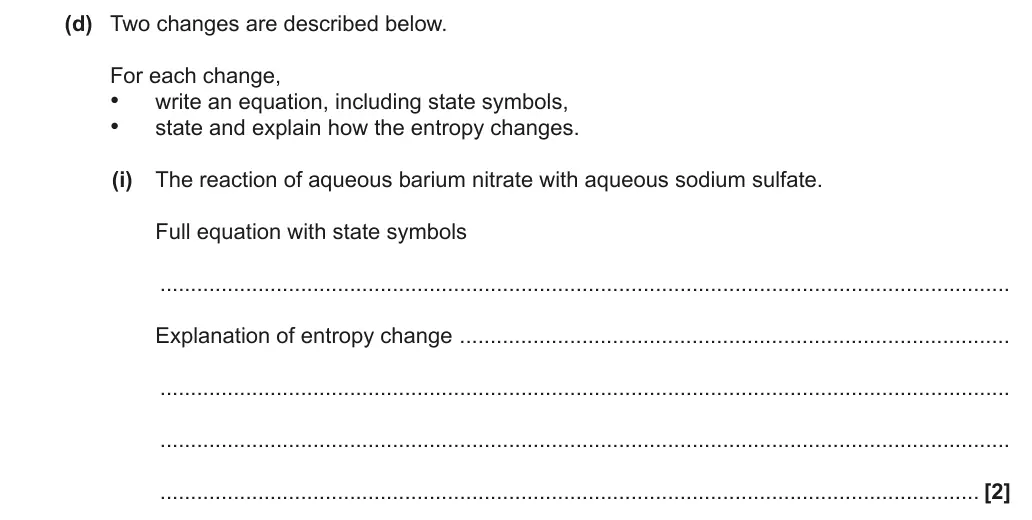
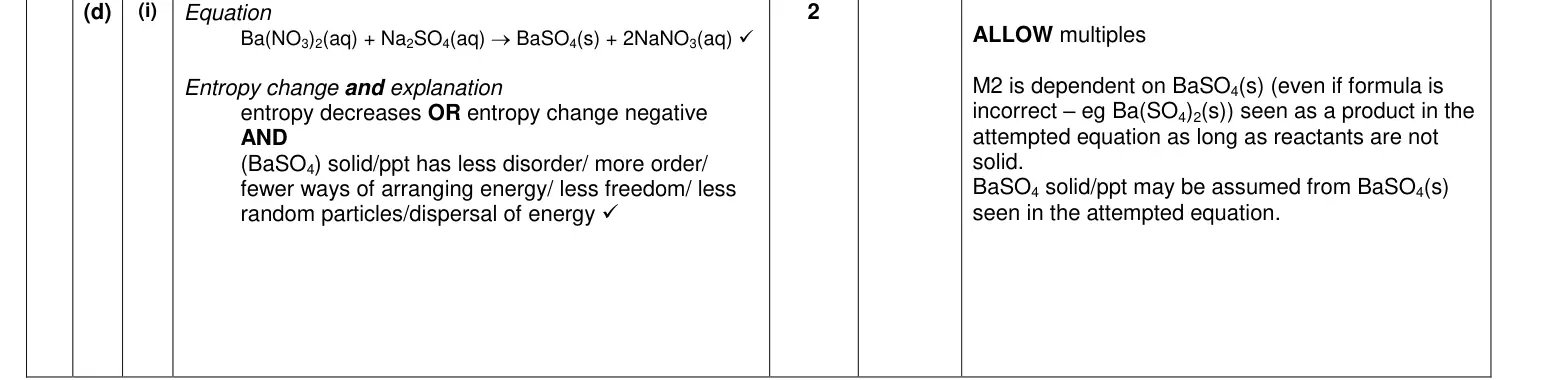
June 2017 · Paper 1 · Q17(d)(i)2 marksEquation writing
Mark scheme
Notes from the mark scheme and report
state symbols needed
entropy decreases because solid BaSO4 formed
entropy mark dependent on BaSO4(s) as product
June 2017 · Paper 1 · Q17(d)(ii)2 marksEquation writing
Earlier part of question 17 that this part uses
Mark scheme
Notes from the mark scheme and report
½I2(s) → I(g) with state symbols
DO NOT ALLOW I2(s) → 2I(g) for equation mark
entropy increases as gas more disordered
June 2017 · Paper 1 · Q18(a)4 marksData interpretation
Mark scheme
Notes from the mark scheme and report
link ∆G = ∆H – T∆S to y = mx + c
gradient = –∆S (– sign required)
P = ∆H
Q = temperature at which feasibility changes
IGNORE 'minimum/maximum temperature'
Skills: M3.1 Translate information between graphical, numerical and algebraic forms; M3.3 Determine the slope and intercept of a linear graph
June 2017 · Paper 1 · Q18(b)(iii)3 marksCalculation
Earlier part of question 18 that this part uses
Mark scheme
Notes from the mark scheme and report
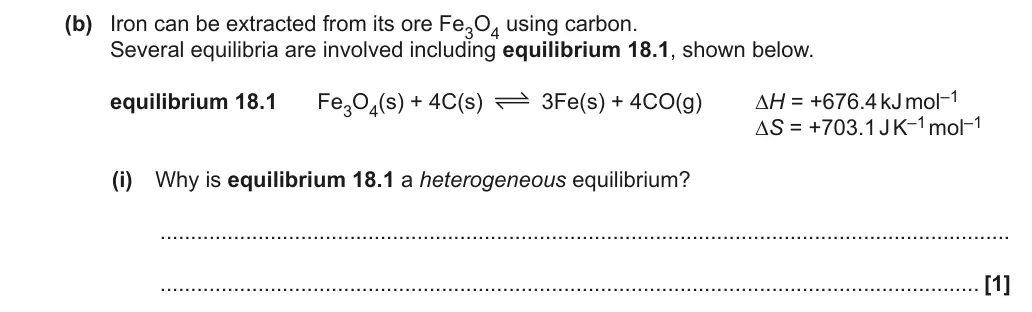
∆S converted to kJ (0.7031)
∆G = +467 so not feasible as ∆G > 0
minimum T = ∆H/∆S = 962 K
ECF for any positive ∆G
Skills: M0.0 Recognise and make use of appropriate units in calculations; M2.2 Change the subject of an equation; M2.3 Substitute numerical values into algebraic equations using appropriate units for physical quantities
Work with an OCR chemistry tutor
Dropping marks on calculations, mechanisms or the six-markers? Book a trial session with a specialist OCR chemistry tutor.