Answer
D
Mark scheme

Examiner's comment
This was well-answered with most candidates identifying D as a propagation step.
Notes and key-term cards for this topic are being written by our tutors. The past-paper questions below are ready now.
| Series | Paper | Q | What it asks |
|---|---|---|---|
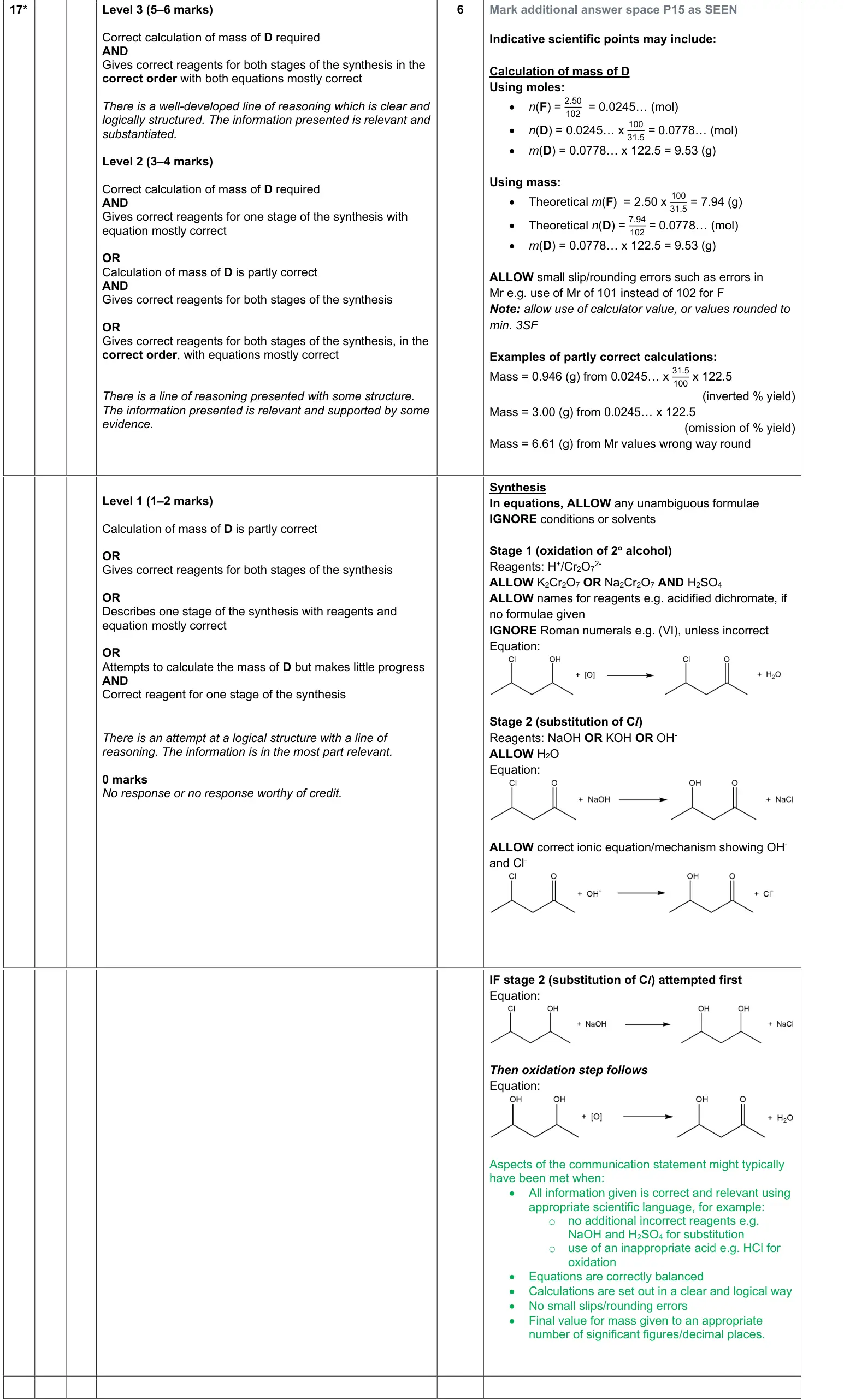
| June 2025 | Paper 2 | 17 | This question is about an organic synthesis. Plan a two-stage synthesis for the preparation of 2.50 g of compound F from compound D. |
D
This was well-answered with most candidates identifying D as a propagation step.

B
This question was generally well-answered.
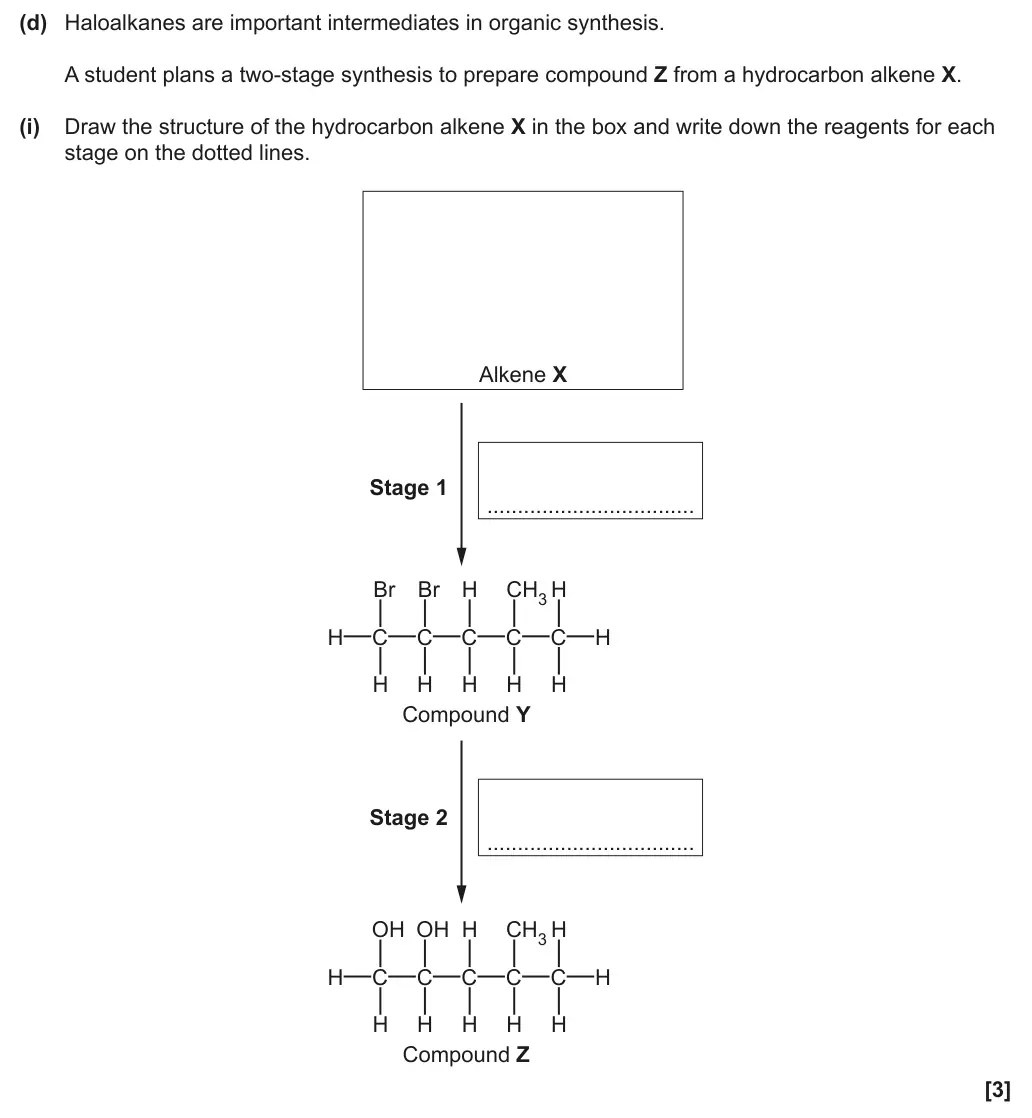
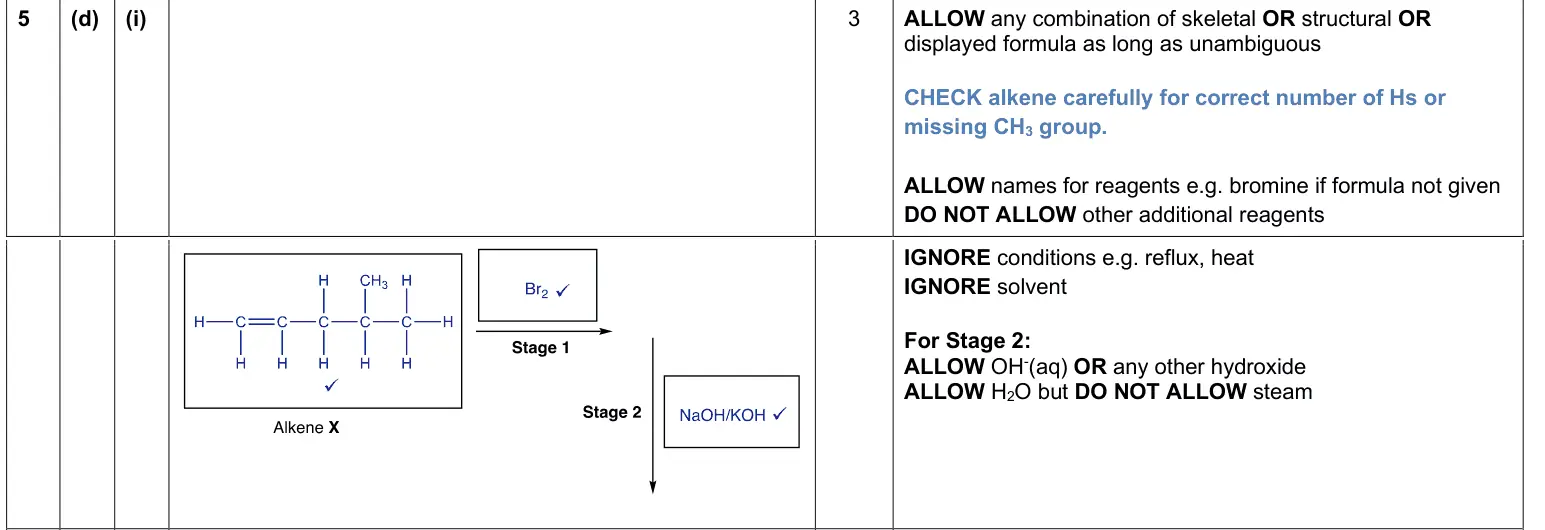
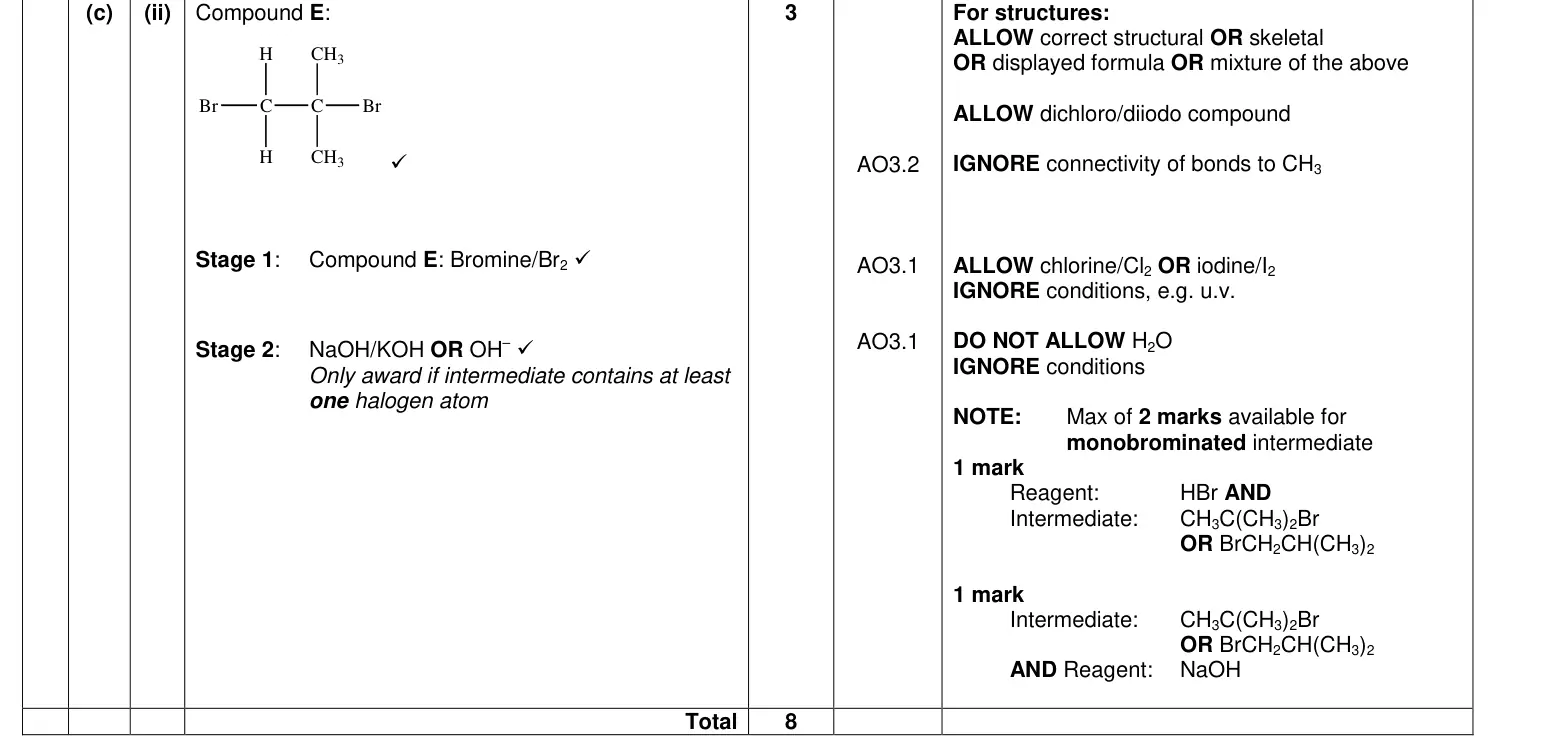
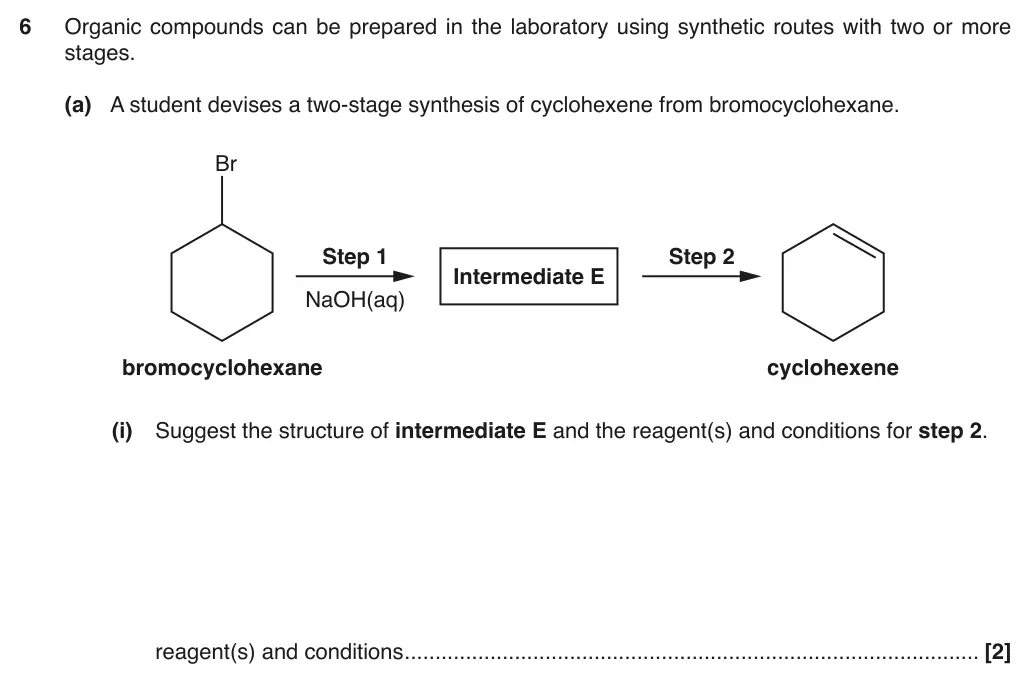
Candidates need to be reminded to check structures carefully – common errors included additional H atoms around C=C or missing the -CH3 group. Some used -C4H9 rather than writing out the complete structure; unfortunately, this is ambiguous so didn’t score the mark. Lower-attaining candidates some- times gave an alkane rather than an alkene, reacting with Br2 in presence of UV. Many had the correct reagents but added additional incorrect reagents resulting in loss of the mark, e.g. the addition of H2SO4 as a catalyst alongside NaOH for stage 2.

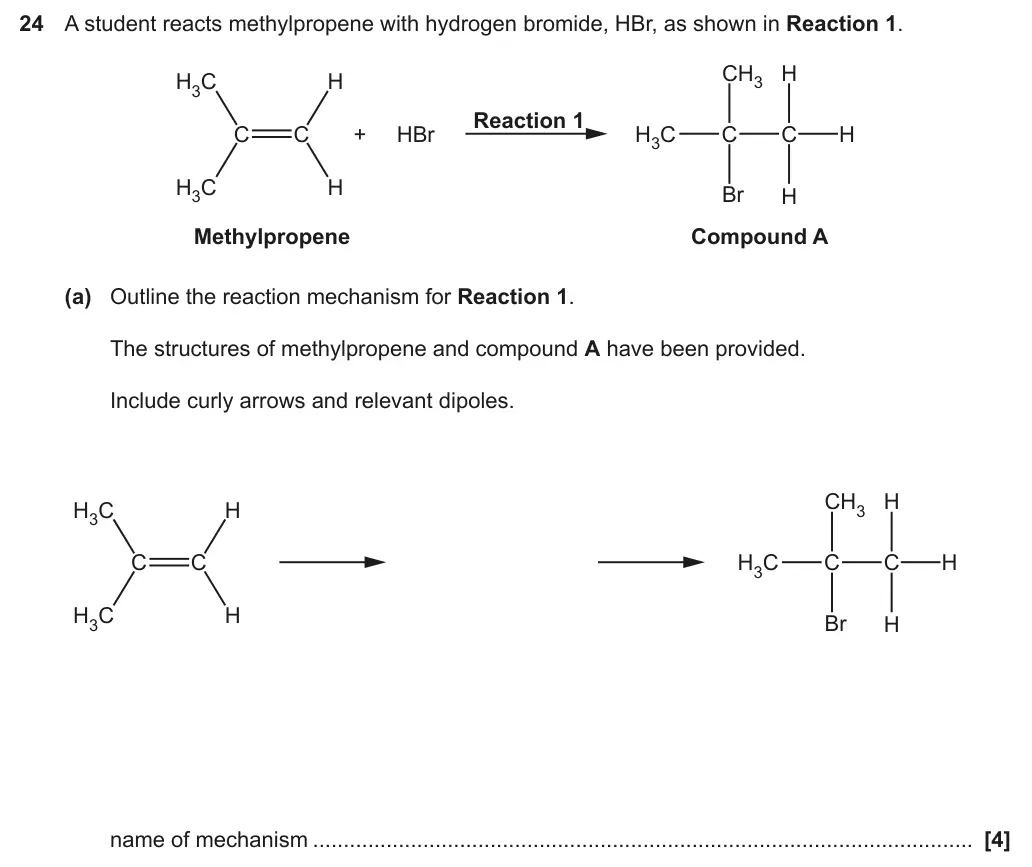
Most candidates were able to correctly state the mechanism. Most common incorrect responses in- cluded hydrolysis, hydration or electrophilic substitution.

A
Most gave the correct response A here. However, a significant proportion gave an incorrect response. Many gave B or C not knowing these common examples of IR use. Some also gave D not seeing the link to global warming.
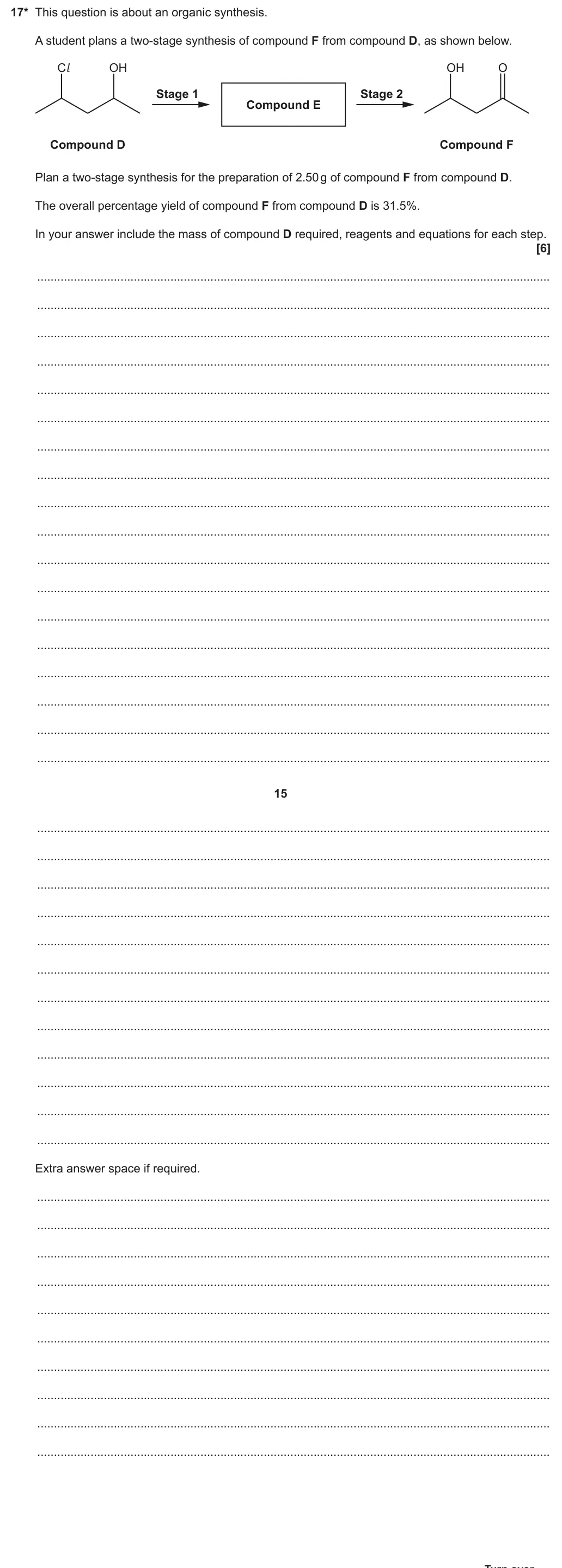
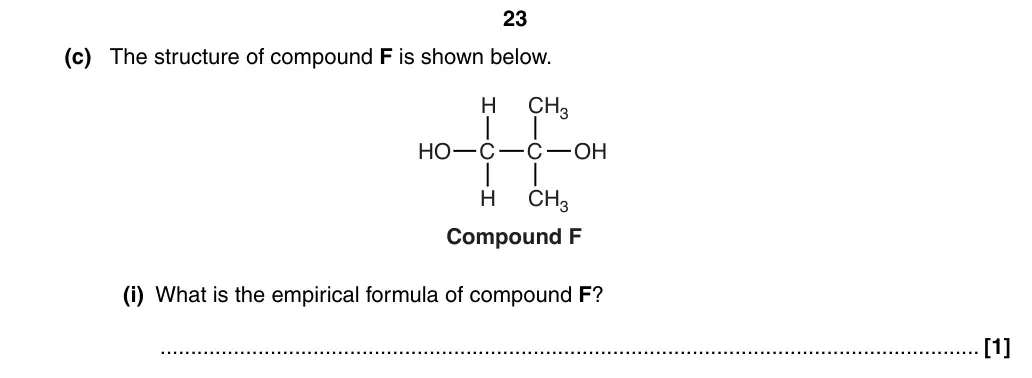
Generally, this question was well answered with most candidates achieving Level 3. Many candidates knew the correct reagents to use to carry out the two-stage synthesis. Some missed out on Level 3 as they had the steps in the wrong order. It was essential to carry out the oxidation prior to substitution otherwise both -OH groups would be oxidised. A significant number struggled with the calculation of the mass of compound D required. Many gave the answer as 7.94g so had only considered the yield, not the difference in molar mass of F compared to D. Other common errors seen in the calculation included errors in Mr values, missing or inverted percentage yield, as well as intermediate rounding of values to two significant figures. Level 2 could still be achieved without the calculation if they had the correct reagents in the correct order with equations mostly correct. To be mostly correct we required them to have at least one of the inorganic reactants or products given. Communication marks were lost if there were errors in reactants or products as well as balancing of equations. Students using skeletal structures generally made fewer mistakes with the balanced equation than those using structural formulae, where additional Hs were inserted alongside the ketone group i.e. CH3CHClCH2CHOCH3. Lower attaining students attempted to write the H+/K2Cr2O7 in the balanced equation and didn’t know to represent this with [O]. Other common errors in balancing the oxidation equation included missing H₂O or using 2[O]. A common error was to see H2SO4 as a ‘catalyst’ added with NaOH in the substitution reaction – this additional and unnecessary reagent lost candidates the communication mark. This response achieved Level 3 and all 6 marks. The calculation is laid out clearly showing both Mr values used in the calculation. Showing the values used in each step makes it much easier to spot where any errors may have been made if the correct value is not obtained. The reagents for each stage are given and the reactions are carried out in the correct order. The equations are given and are correctly balanced. This was an excellent response.
Skills: M0.2 Use ratios, fractions and percentages; M1.1 Use an appropriate number of significant figures; M2.2 Change the subject of an equation; M2.3 Substitute numerical values into algebraic equations using appropriate units for physical quantities
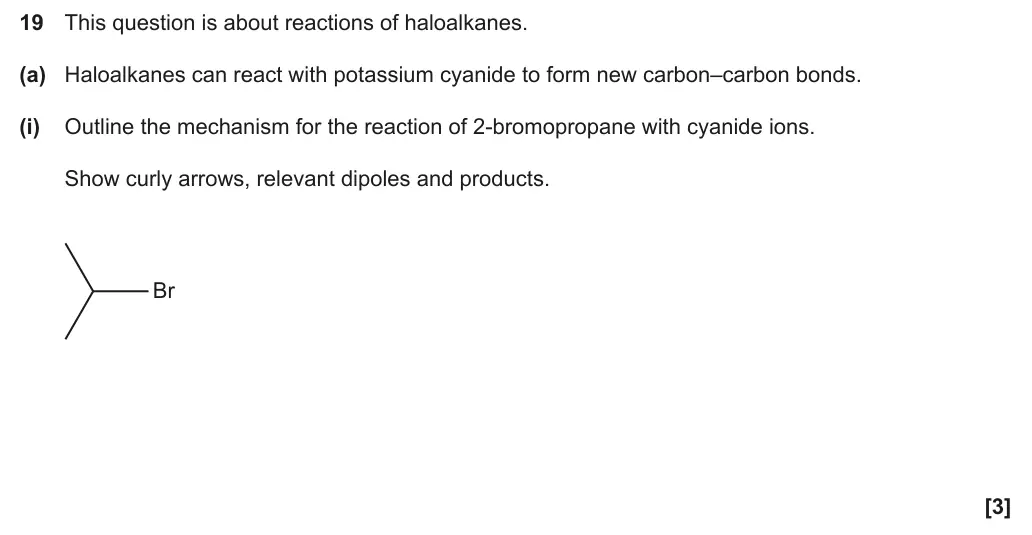
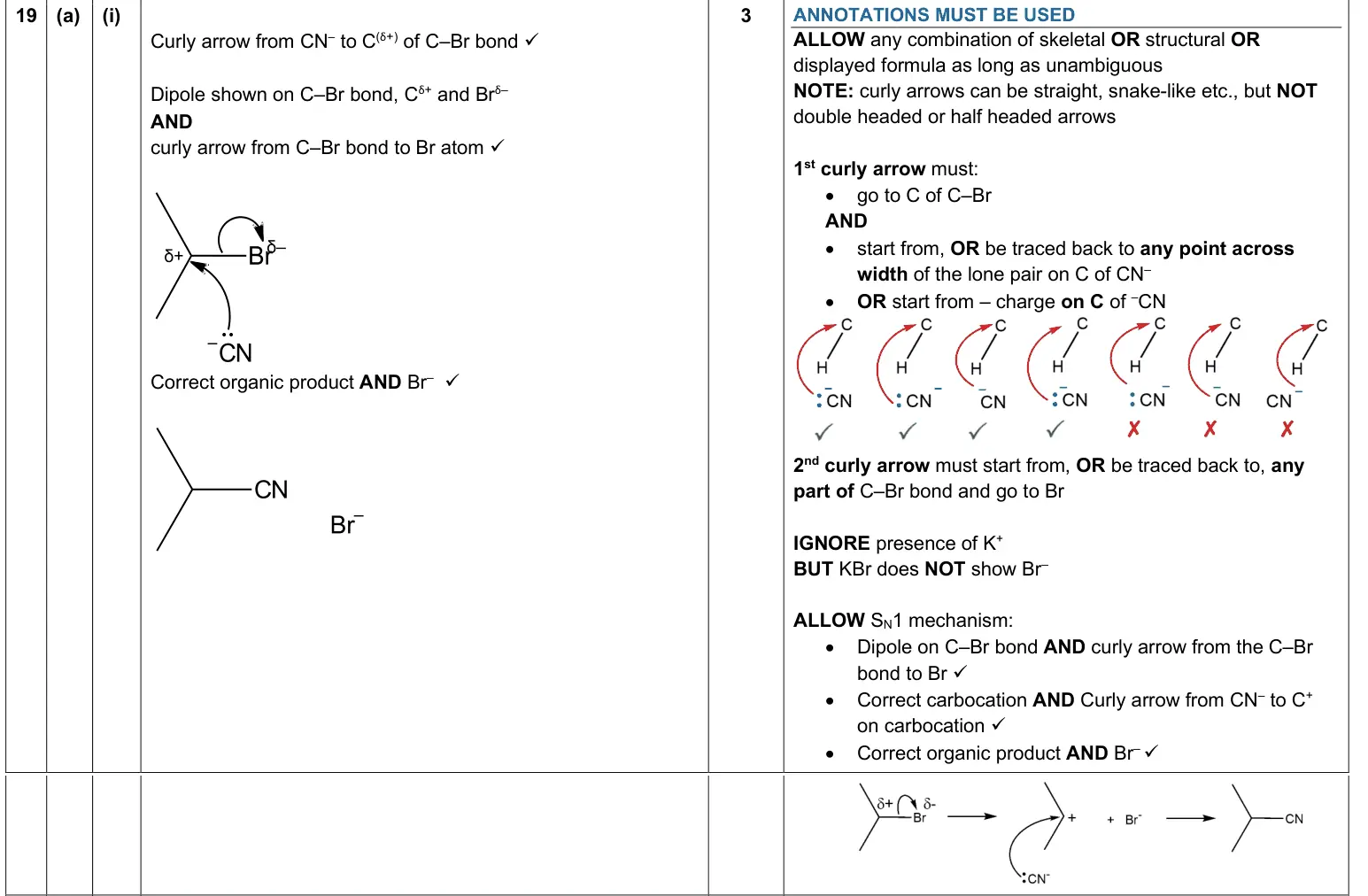
Many candidates scored all 3 marks here showing that the mechanism is well known. Some struggled with the skeletal formula given but were given credit for drawing out structural or displayed formula, provided that the central C showed correct number of bonds. Most common reasons for losing marks: • KCN and KBr shown in the mechanism rather than ions • arrow from lone pair or negative charge on N of CN • dipole on C-Br the wrong way round • missing the negative charge on CN- • curly arrows shown in the wrong direction Remind candidates that curly arrows should only be used to show the movement of a pair of electrons and not the formation/breaking of an ionic bond. A significant number of candidates chose to write more than one version of the mechanism without crossing out the one they did not wish to be marked. This led to marks being lost through contradictions. Teachers should remind candidates of the importance of submitting only one response to each question.

The majority of candidates recognised this to be nucleophilic substitution. The most common incorrect response seen was nucleophilic addition.
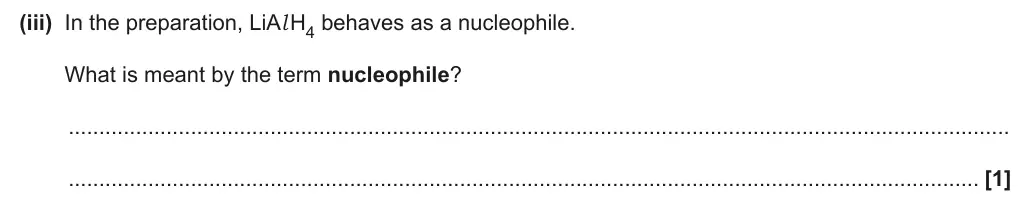
This question was answered correctly by most candidates, the most common error being the omission of ‘pair' in the term. Lower attaining candidates often used incorrect terms such as ‘proton donor’ and ‘electron acceptor’.

B
Some candidates correctly chose option B, with the other options being chosen randomly. From the importance placed on the causes of global warming, it was interesting to see that many incorrectly chose option A. Note also the points made in Question 6 about underlining the word ‘not’.
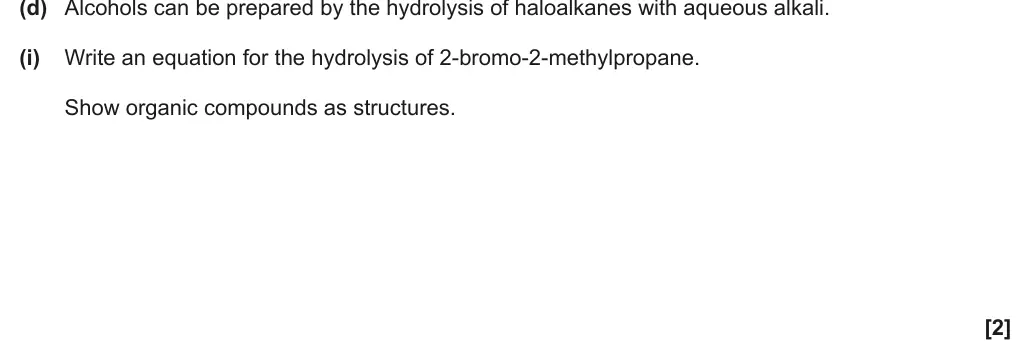
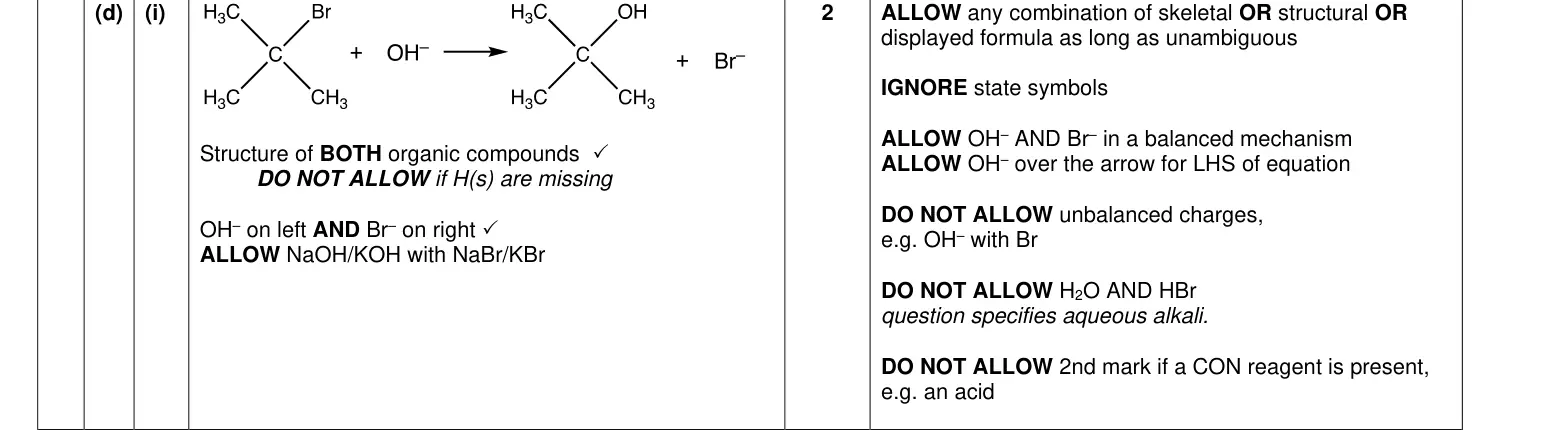
This question discriminated very well. Most candidates were given a first mark by showing correct structures for the organic reactant and its product, 2-methylpropan-2-ol. The question asked for an equation for alkaline hydrolysis and candidates were expected to use an alkali. Acceptable responses would include NaOH/KOH and NaBr/KBr, or OH– and Br–. Equations including H2O and HBr were not given marks, a common error for alkaline hydrolysis. Candidates are advised to carefully read the requirements in the question. For the most successful responses, candidates often underline these to draw their attention.

Candidates found this question difficult. Many fell into a trap of their own making by comparing the relative reactivities of the halogens chlorine, bromine and iodine and it was common to see responses claiming that a chloroalkane has the fastest rate and that an iodoalkane has the slowest rate. Only the most successful candidates related a correct order of reactivity to the different strengths of the carbon– halogen bond.

D
Most correctly identified the colour of the precipitate as yellow, D. The most common incorrect response was brown, A, possibly linking to the colour of iodine.
Skills: PAG7 Qualitative analysis of organic functional groups

C
Most candidates correctly identified C as the correct initiation step forming a chlorine radical. A few gave B which forms an •F radical instead. It is always good to discuss the reason why the C-Cl bond will break but C-F won’t in the presence of ultraviolet light.

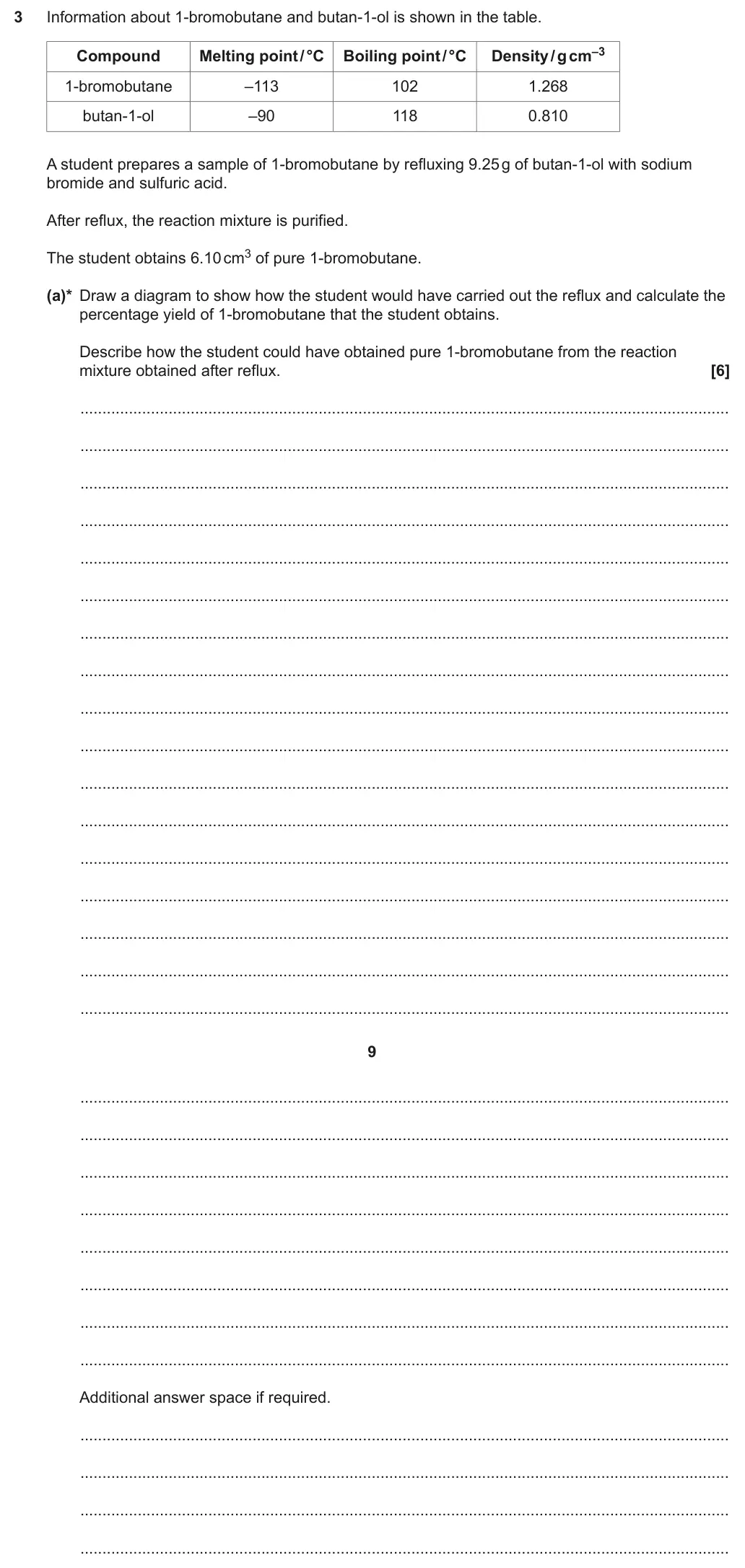
This question was well-answered with around a half of candidates scoring 8 or 9 marks. The full range of marks was seen across the whole cohort. The most common reasons for losing marks were for the addition of extra, contradictory reagents or for missing hydrogens from structures. Bromoethane to amine: The amine structure was mostly correct with a few adding an extra hydrogen to the amine i.e. CH3CH2NH3. Most gave the correct reagent as NH3 but some omitted either ethanol or excess, so did not score here. Bromoethane to alcohol: The alcohol structure was usually correct. However, many lost the reagent mark here for the addition of acid/ H+/H2SO4 alongside the hydroxide. Bromoethane to nitrile: A suitable cyanide was often used, but again many included an acid catalyst or aqueous conditions (aq) so lost the mark here. Ideally candidates would react in ethanol to prevent hydrolysis of the haloalkane. Nitrile to carboxylic acid: Most gave the correct carboxylic acid structure, while occasionally ethanoic acid was given instead of propanoic acid. Most identified the need for acid as a reagent but some omitted water or (aq). Nitrile to amine: H2 was often seen as the reagent but sometimes without a catalyst. Many gave an incorrect structure here either with a missing C (i.e. ethylamine) or missing hydrogens on the first carbon i.e.

This question was answered well by candidates, with most showing correct structures for the organic reactant and its product, propan-1-ol, and skeletal formulae mostly used. The question asked for an equation for alkaline hydrolysis and candidates were expected to use an alkali. Acceptable answers would include NaOH/KOH and NaBr/KBr, or OH– and Br–. Equations including H2O and HBr were not given a mark, a common error for alkaline hydrolysis.

This novel question assessed whether candidates realised why chemists used TLC when carrying out organic reactions. A good response would identify the following key features after 20 minutes: • The C–Cl bond energy is greater than C–Br and so the reaction would be slower. • The haloalkane spot would be larger and the propan-1-ol spot smaller. • The propan-1-ol is spotted on the chromatogram to monitor the progress of the reaction. The question differentiated very well between candidates, but many did not seem to know where to start with many candidates not scoring any marks. This suggested that candidates recognised chromatography as a technique but did not appreciate its relevance in organic chemistry. Some candidates referred to pigments, recalling their early chromatography experiments in finding the colours in ink.
Skills: PAG6 Synthesis of an organic solid
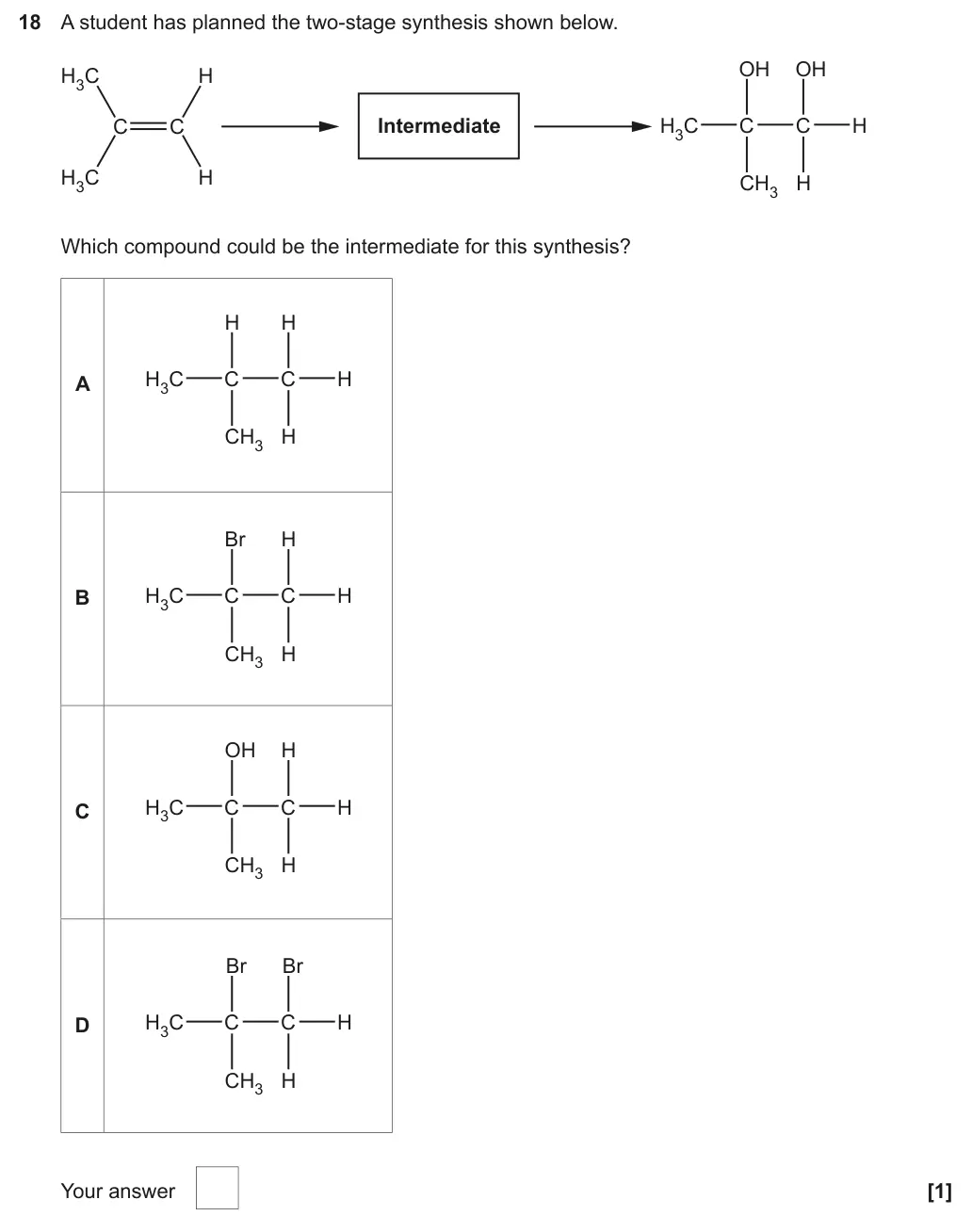
D
Candidates find it difficult to identify an intermediate within a synthesis and less than half selected the correct option, D.
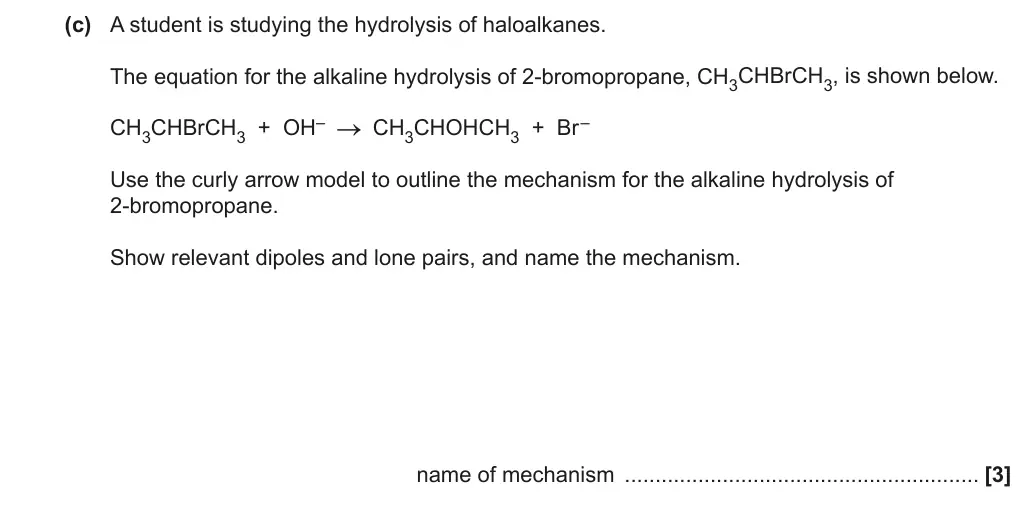
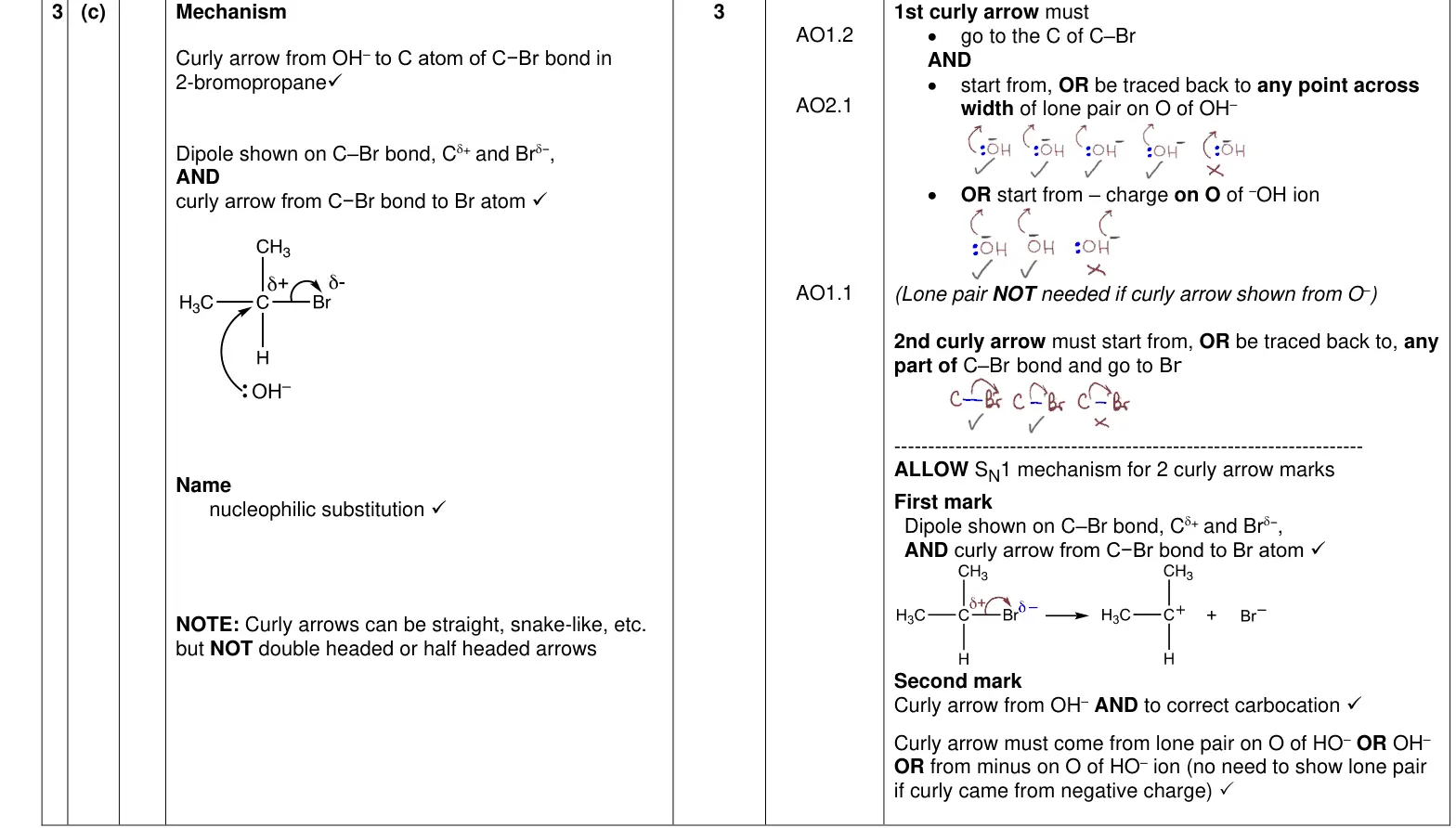
Just under half the candidates gained all 3 marks for this mechanism. Marks were often lost for incorrect positioning or a missing arrow for the breaking of the C-Br bond. Dipoles were often added to the hydroxide ions. Some also showed the lone pair for OH- going to the C-Br bond and not to the C+. A range of spellings of nucleophilic were seen, including: nucleophilic, nucleophilic, nucleophilic, and nucleophilic. It is important to promote good literacy in science, including meanings and spellings of technical language.

The majority of candidates scored both marks. Some scored 1 mark only mainly for correct colours of the precipitates but with incorrect formulae. Common errors included AgBr2 and AgI2, giving the formula of the haloalkane or formulae involving a halogen and a nitrate ion.
Skills: PAG7 Qualitative analysis of organic functional groups

Most responses did not gain credit here. Some recognised that AgI would form first but then gave an incorrect reason (such as ‘held by weaker London forces’) or their answers lacked detail (e.g., ‘weaker bonds’ without specifying which bonds). Many said AgBr because Br is more reactive or more electronegative.
Skills: PAG7 Qualitative analysis of organic functional groups
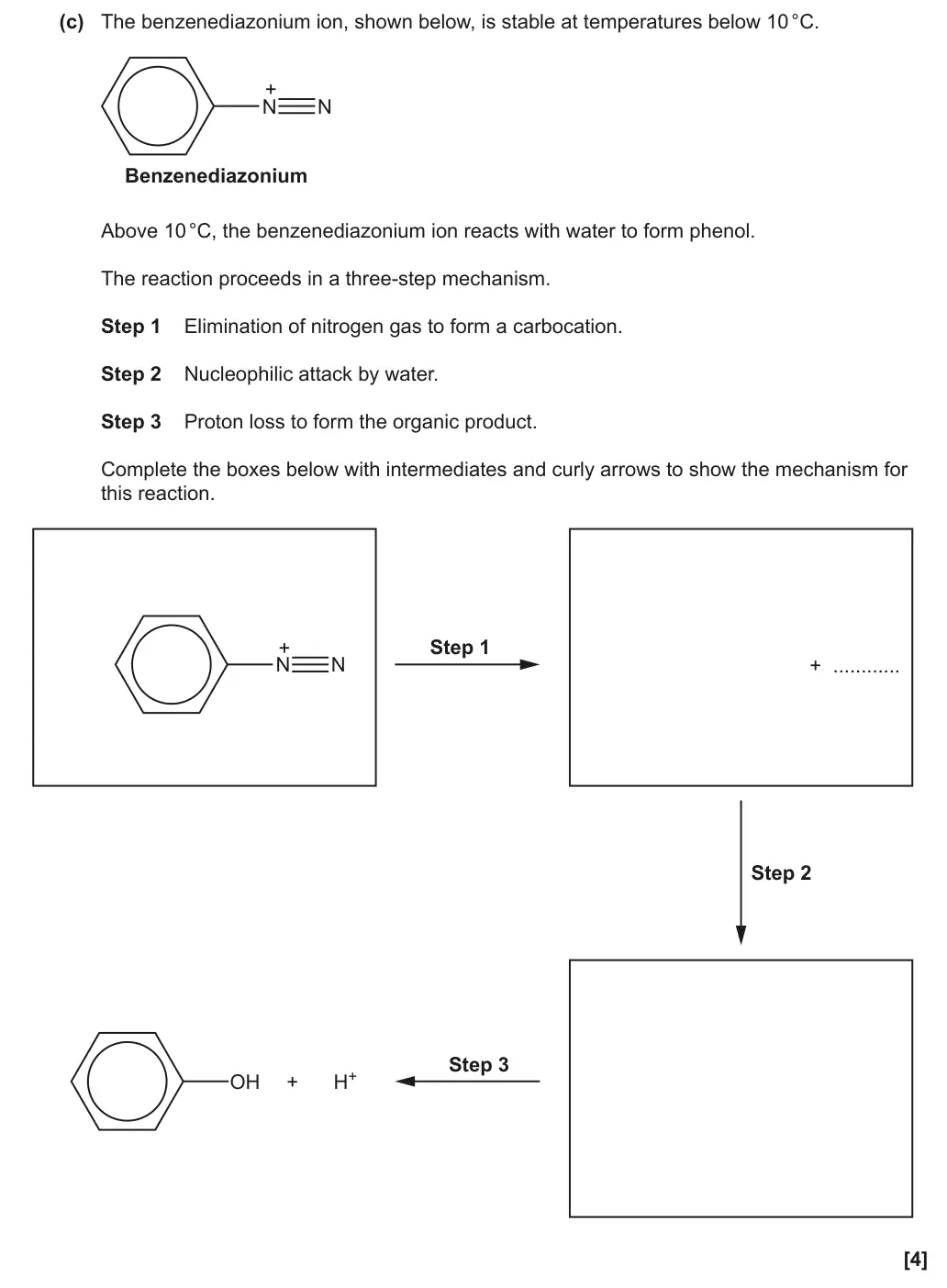
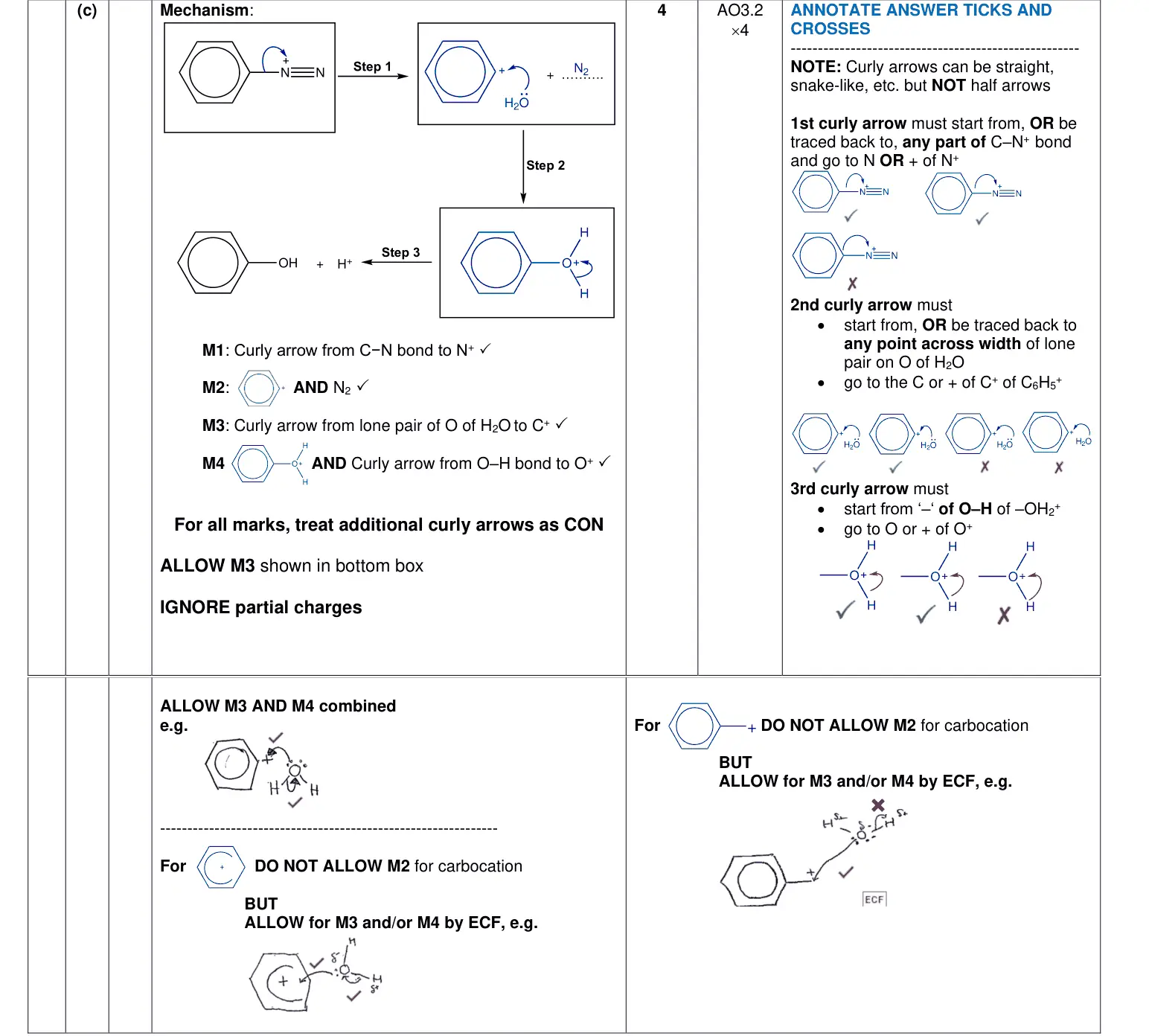
This question required candidates to apply their understanding of organic mechanisms to an unfamiliar reaction. The stem to the question includes important information and clues that should have guided candidates towards this unfamiliar mechanism, with the prompts for the three steps being critical. Many responses fell back to the familiar mechanism for electrophilic substitution, an approach that could not be credited. This question discriminated very well but many candidates scored few marks. This response has been included to show a candidate with an excellent understanding of the meaning of curly arrows and the importance of charges and dipoles. The prompts in the question are followed and the candidate has been given all four marks. Notice how the curly arrows start either from a bond or from a lone pair. The candidate has also realised that the addition of H2O produces a positively charged oxonium ion. Many candidates omitted the ‘+’ charge or showed the curly arrow for loss of a proton going to a H atom rather than the O atom of water.

B
Most candidates selected the correct option, B. The main distractors were A (confusing which C–X bond is stronger) and C (confusing which effect of bond strength and polarity is dominant for this reaction).
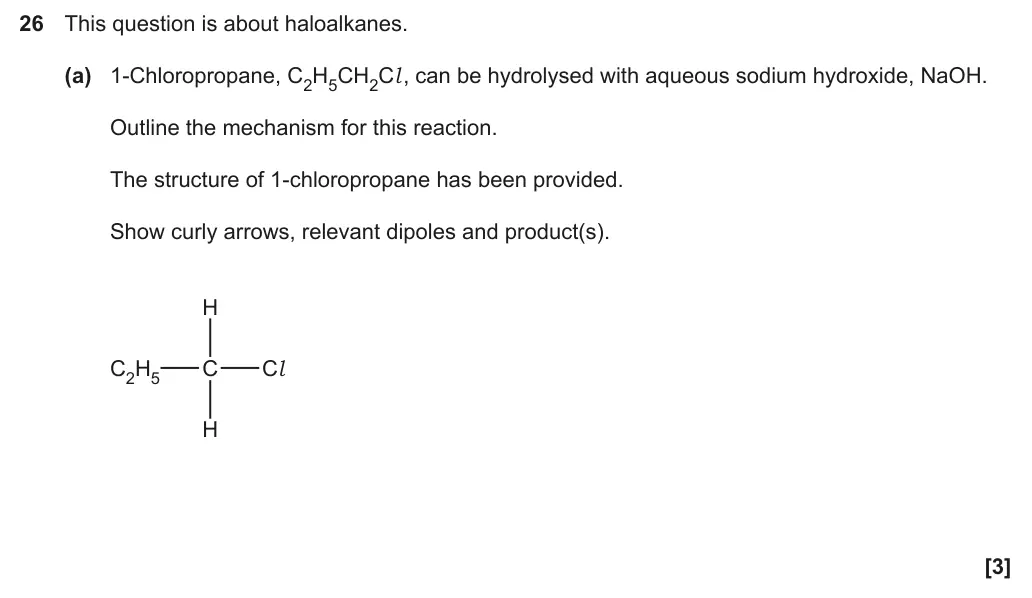
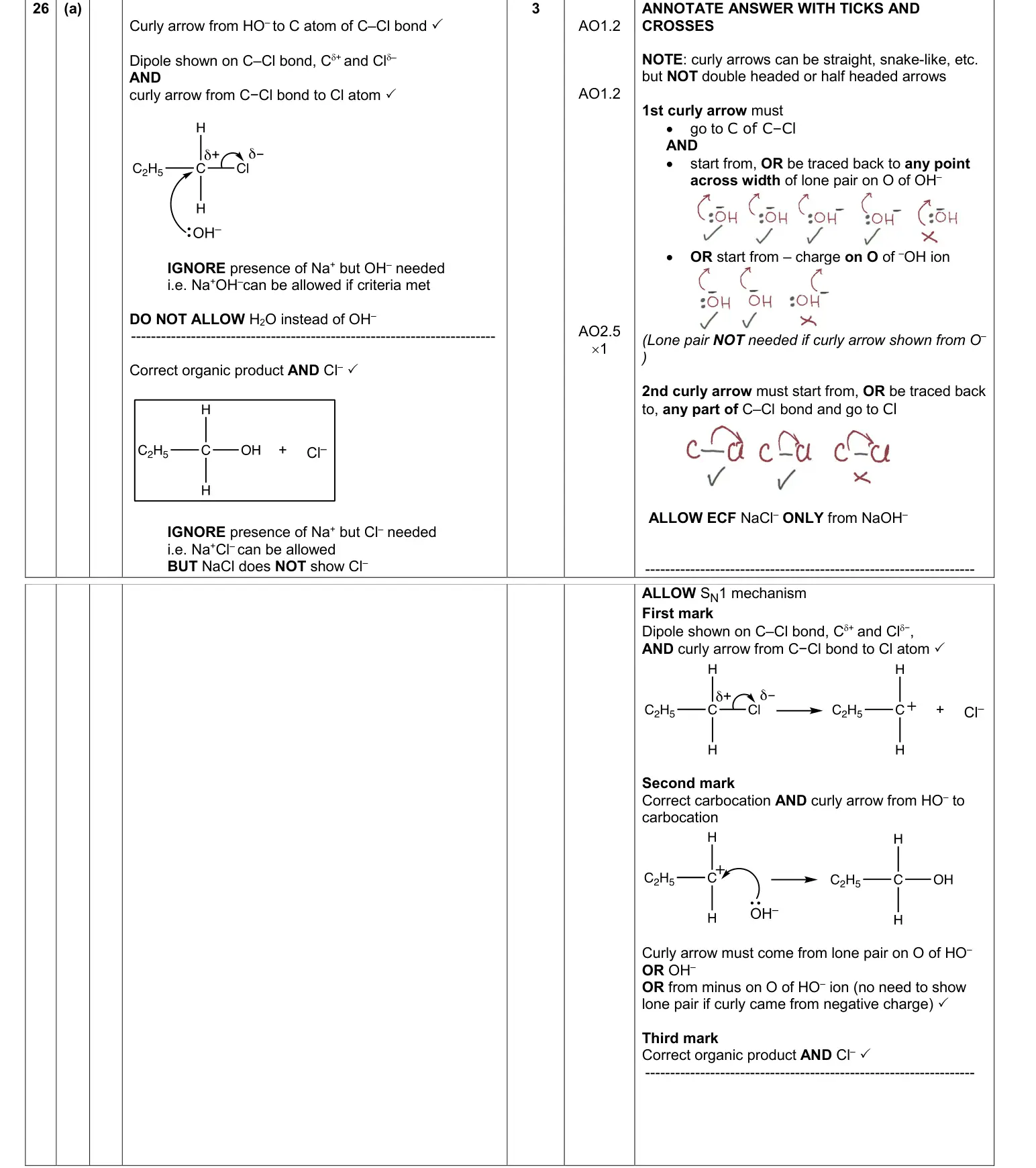
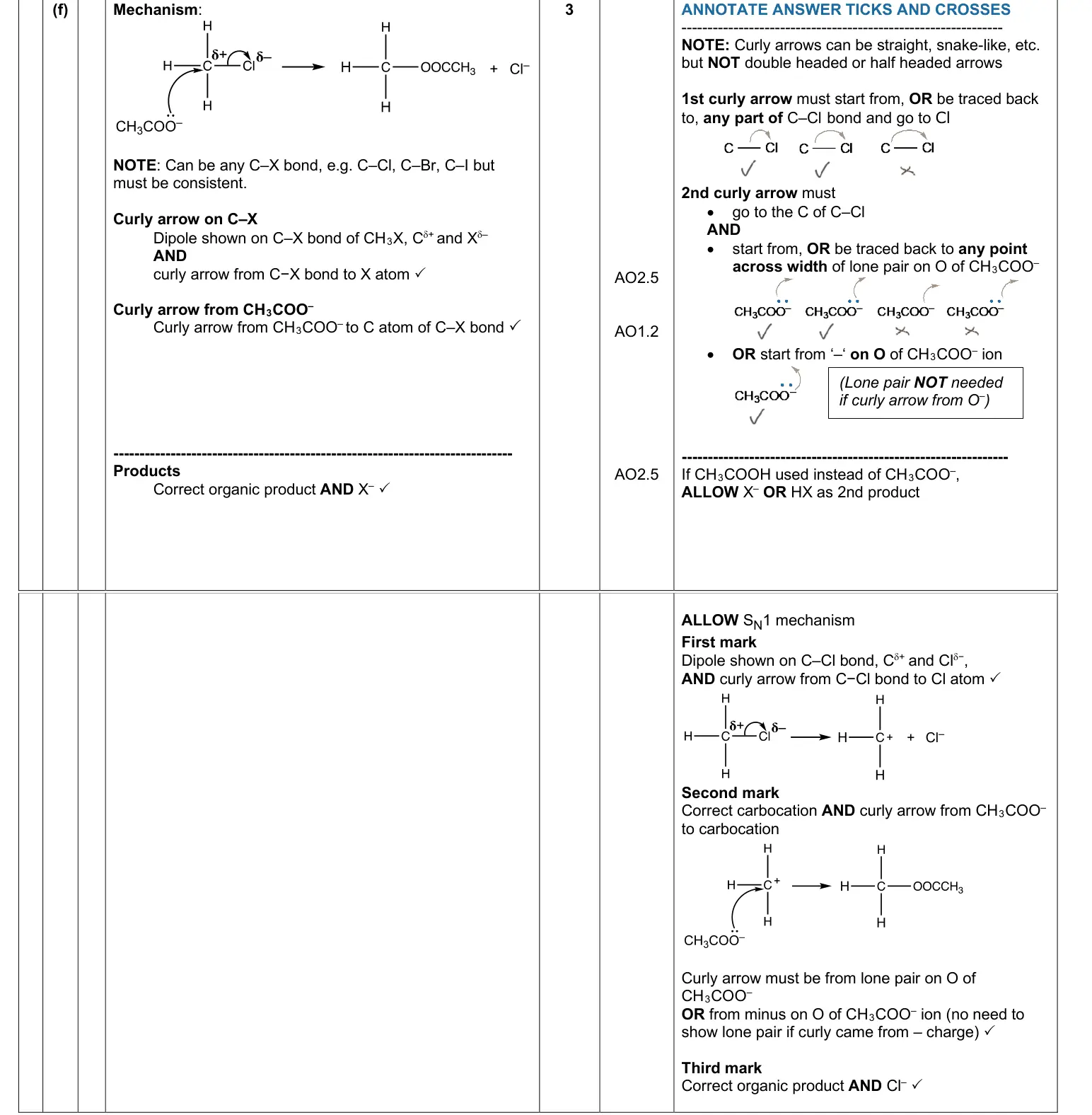
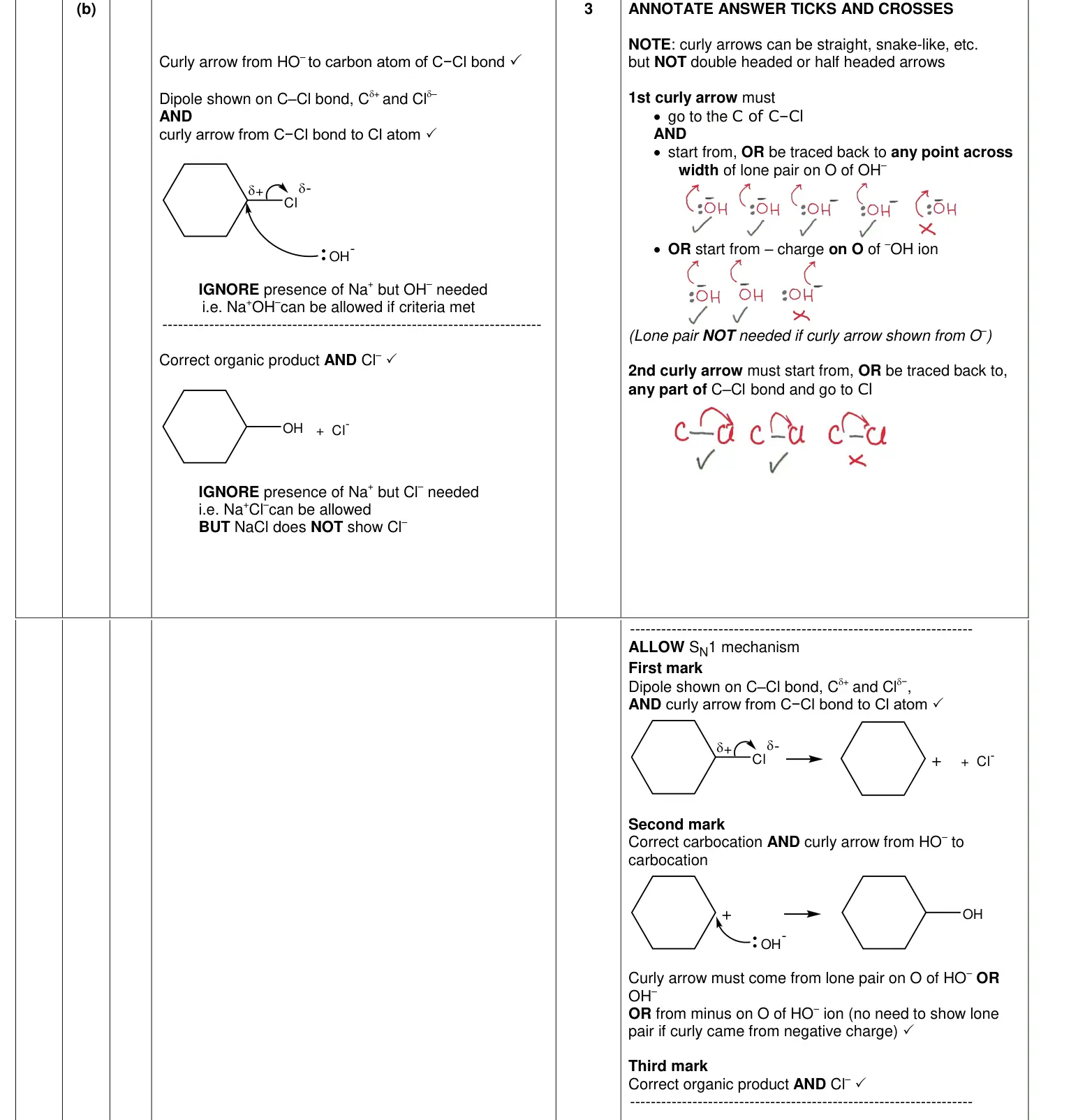
Although a simpler mechanism than electrophilic addition in Question 21 (a) (ii), candidate responses here were less successful. Many candidates weren’t able to identify the OH– ion attacking the carbon atom and the curly arrow often did not originate from an O lone pair or the negative charge. Candidates often omitted the dipole on the C–Cl bond or did not include a curly arrow. Candidates were expected to show both the resulting alcohol and Cl– as products. Many tried to incorporate Na into their organic structure. Organic mechanisms are a key concept in organic chemistry and it is essential for candidates to learn all the mechanisms in preparation for examinations. addition, nucleophilic substitution and radical substitution. This paper includes two of these in Questions 21 (a) (i) and 26 (a). It is essential that candidates learn these three mechanism types.

B
The majority of candidates identified B as the correct answer.
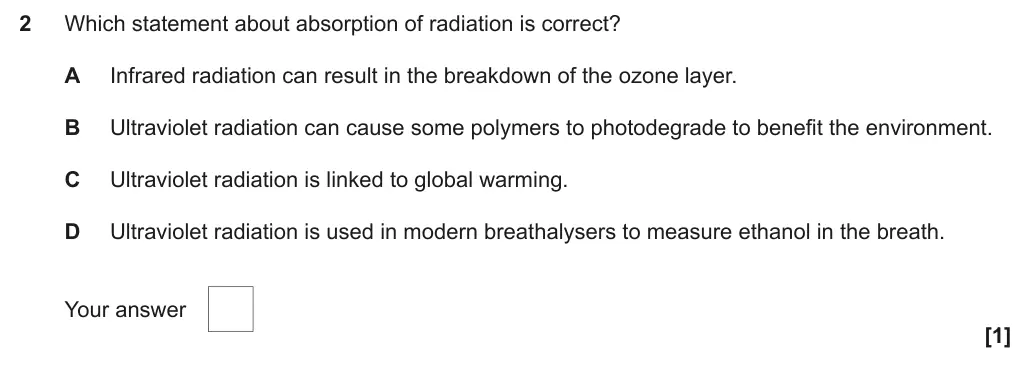
B
Candidates found this multiple choice question challenging. While some identified B as the correct answer, many candidates selected C.

A
Many candidates did not identify CH3NH2 as a nucleophile and selected option B.
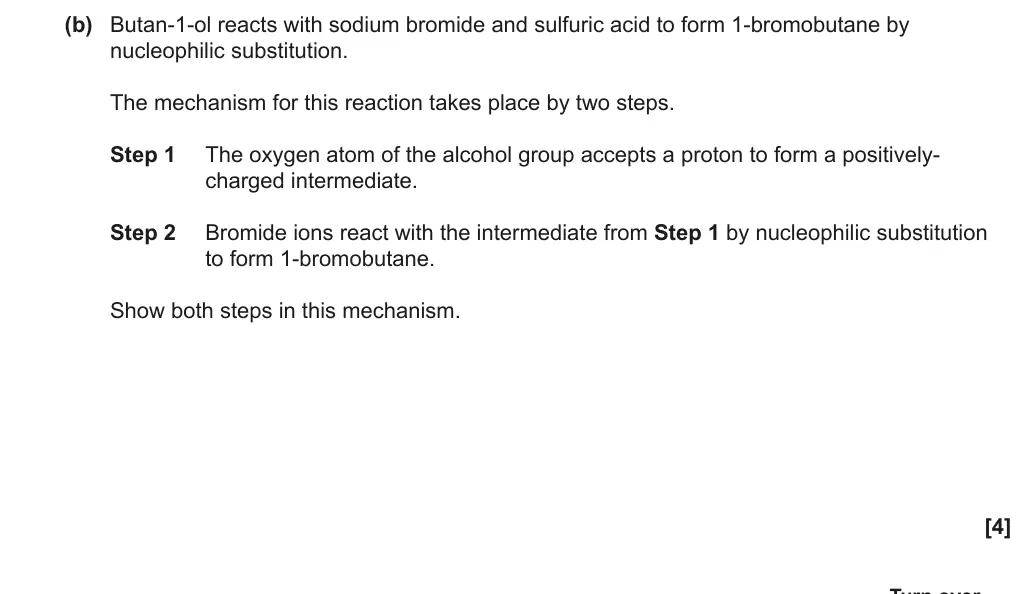
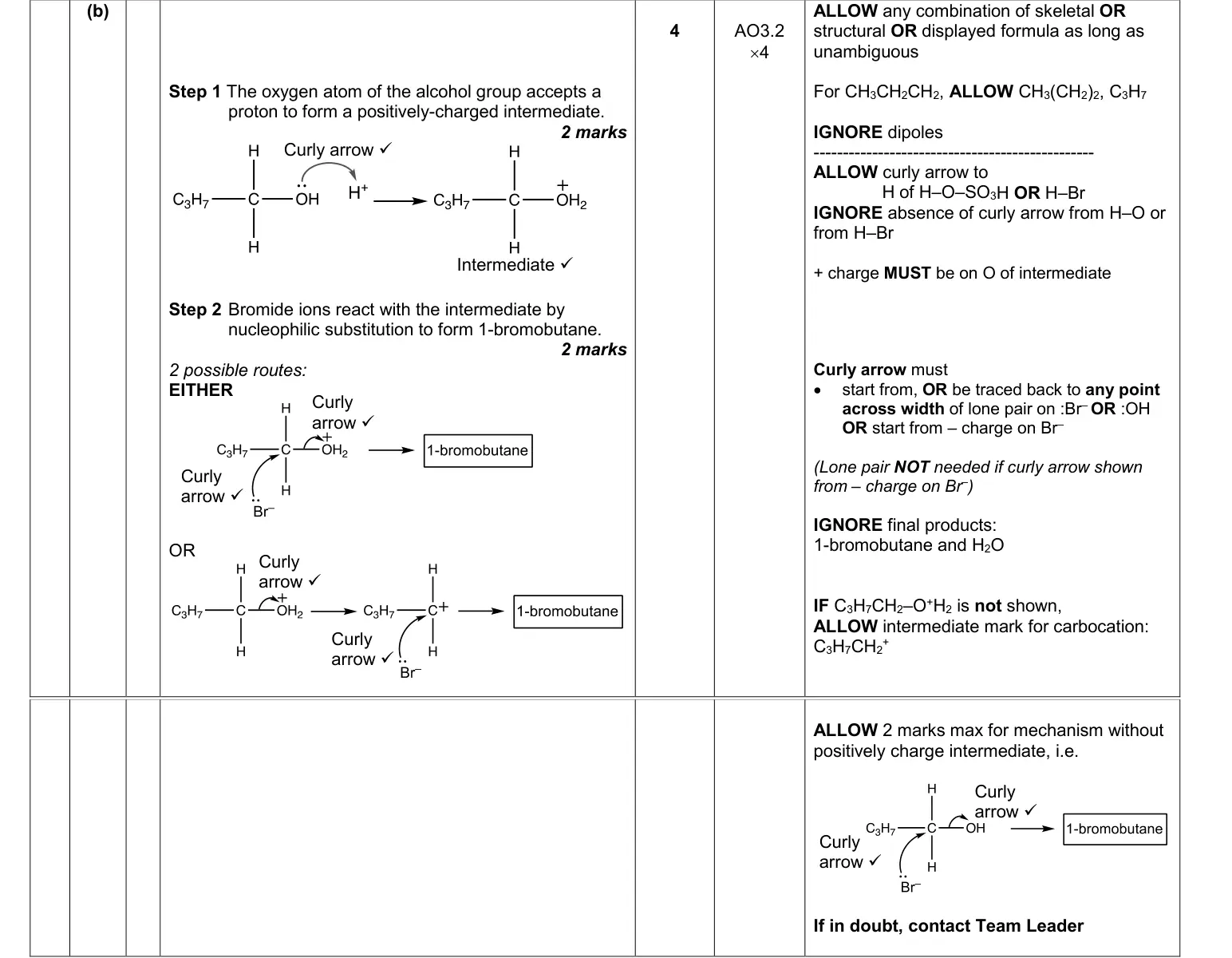
This question is one of two on this paper assessing understanding of unfamiliar organic reaction mechanisms. The stem to the question includes important information and clues that should have then guided candidates towards this unfamiliar mechanism (which is related to the familiar nucleophilic substitution of haloalkanes). The two prompts for Step 1 and Step 2 are critical but many candidates did not use these, instead inventing their own mechanisms. However, there were many successful responses seen that gained the full 4 marks. and dipoles. Step 1 is an attempt to show the alcohol OH group accepting a proton, but a curly arrow shows the movement of an electron pair. It cannot travel from a + charge to a lone pair. The intermediate shown does contain the correct atoms but the + charge has been omitted from the O atom. Marks were given for the curly arrow from the Br– lone pair and from the C–O bond. However, the candidate has drawn the bonds with very short lines making it all too easy for a curly arrow to be shown imprecisely. This response was given 2/4 marks.

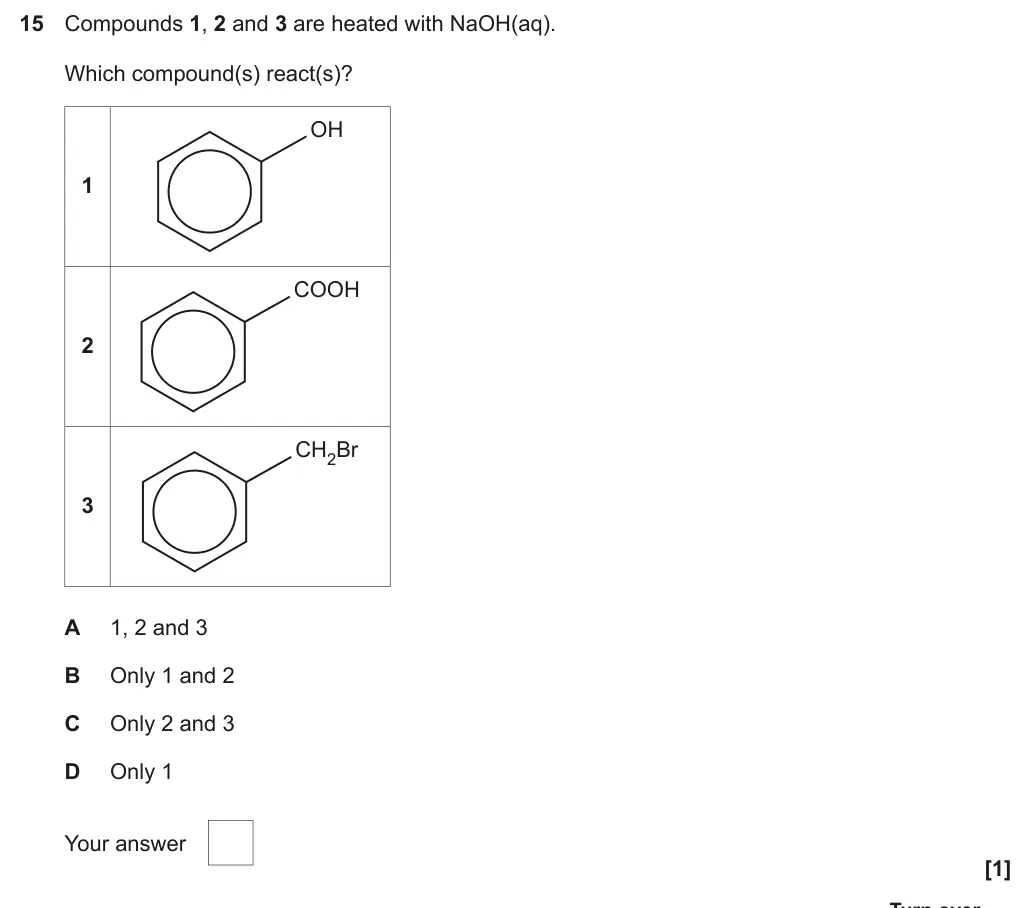
A

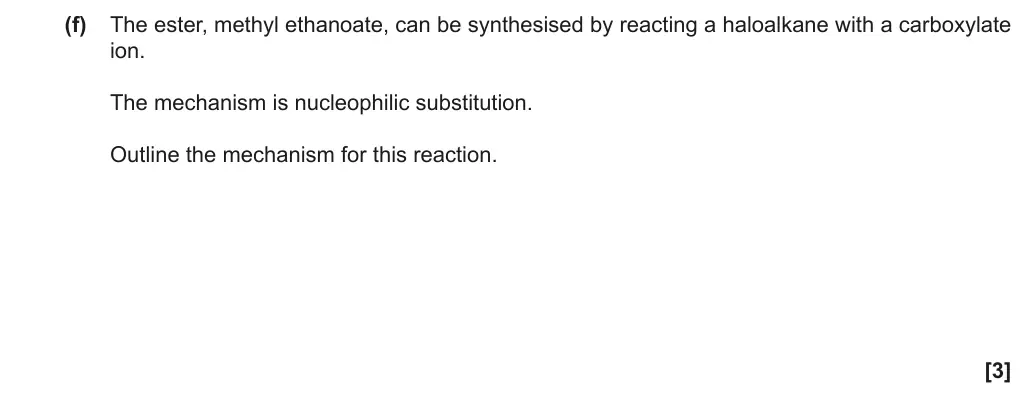
Q1(f) Outlining a mechanism for an unfamiliar reaction Q5(b)(iii) Predicting the equation for an unfamiliar organic reaction • Did not consider what a question is asking or read the information, e.g. Q1(f): Candidates were required to apply their knowledge of nucleophilic substitution of haloalkanes to outline a similar mechanism for an unfamiliar nucleophile.

B
Many candidates correctly chose B, with A being seen as the expected main distractor. Fewer than half the candidates scored this mark.
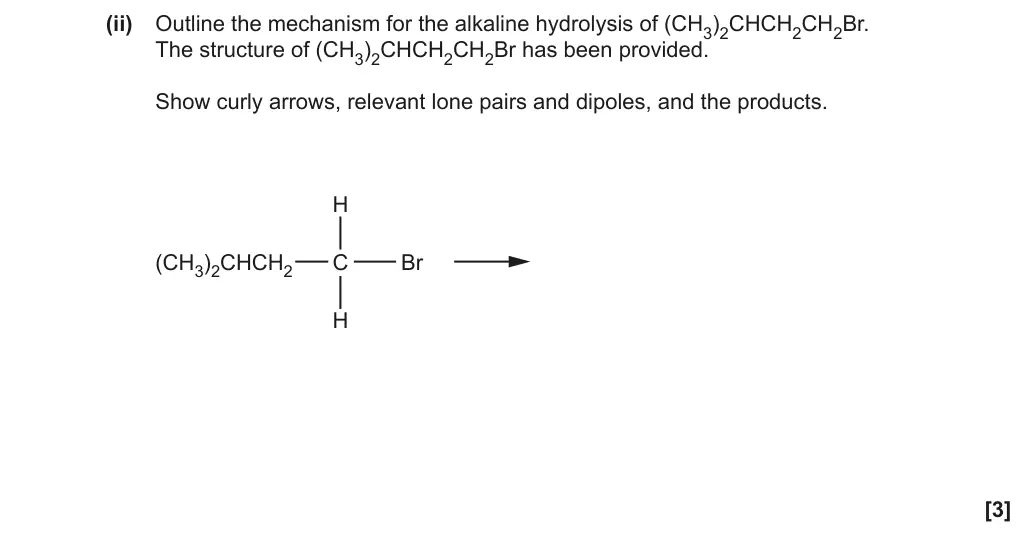
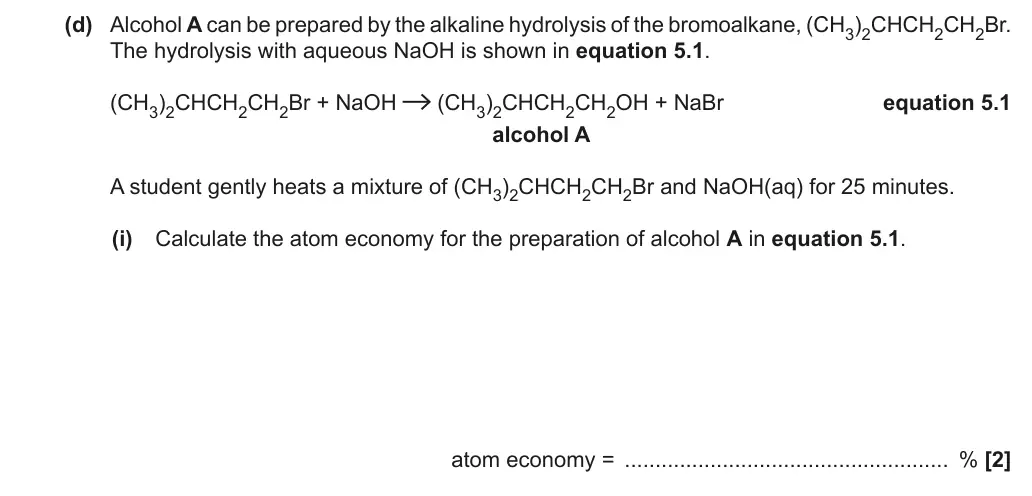
5(a) Generally this was well answered. However, some candidates only gave two responses where three were required, presumably because it was worth two marks. 5(b) A significant number of candidates did not gain the mark here as they incorrectly balanced the number of oxygens, forgetting that the alcohol contains an O atom i.e. 6.5 O2 given rather than 6. 5(c) Nomenclature in organic chemistry takes lots of practice. Approximately half of the candidates did not score this mark. It was more challenging as they needed to work with skeletal structures but evidence of drawing out displayed formula was often seen. 5(d)(i) Most candidates were able to recall the formula to calculate atom economy, however a number made errors in working out Mr values. However, some left this blank or just gave an answer without any working. 5(d)(ii) Mechanisms were often seen showing curly arrows going in the wrong direction and between the wrong bonds and atoms, charges and dipoles were often incorrect, and partial changes used where full charges were required. Writing mechanisms is an important skill in organic chemistry so it is vital that time is spent practising writing them out and fully understanding the significance of the curly arrow. 5(d)(iii) Many candidates gave the correct mechanism here, with common incorrect responses being other types of mechanism, substitution only, or isomerism. 5(e) Very few candidates gained both marks here. It was not enough here to just state faster/slower without specifying which haloalkane they were referring to. It was also important to specify the C-X bond not just vague reference to the chlorine or bromine bond. Many described the difference in bond polarity so had the wrong order. Some were more general and discussed the reactivity of bromine and chlorine themselves. 5(f)* This was a challenging problem-solving question, relying on candidates to make use of all of the information provided to determine the structure. Very few candidates made no attempt at all at this question. The most common error was incorrectly identifying the peak at 3000 cm-1 as O-H from a carboxylic acid, despite it being indicated on the data sheet that this would be a broad peak. It suggested that candidates were not familiar with looking at spectra and understanding what data it gave. Candidates should also be reminded when answering these types of question that they should give the structures, not just molecular formulae, where possible. If any of your students’ results are not as expected, you may wish to consider one of our review of results services. For full information about the options available visit the OCR website. If university places are at stake you may wish to consider priority service 2 reviews of marking which have an earlier deadline to ensure your reviews are processed in time for university applications. Our priority is supporting you and your students this autumn and to support you as you prepare for summer 2021 exams. We’ll update our website information regularly with resources, guidance and key information. • Teachers • Students • Exams officers • Assessment specialists We are sending a weekly roundup to tell you about important updates. You can also sign up for your subject specific updates. If you haven’t already, sign up here. Attend one of our popular CPD courses to hear directly from a senior assessor or drop in to a Q&A session. All our courses for the academic year 2020-2021 are being delivered live via an online platform, so you can attend from any location. Please find details for all our courses on the relevant subject page on our website or visit OCR professional development. ExamBuilder is the question builder platform for a range of our GCSE, A Level, Cambridge Nationals, Cambridge Technicals and Functional Skills qualifications. See the full list of available qualifications in the sign up form. ExamBuilder is free for all OCR centres with an Interchange account and gives you unlimited users per centre. We need an Interchange username to validate the identity of your centre's first user account for ExamBuilder. If you do not have an Interchange account please contact your centre administrator (usually the Exams Officer) to request a username, or nominate an existing Interchange user in your department. Review of results

5(a) Generally this was well answered. However, some candidates only gave two responses where three were required, presumably because it was worth two marks. 5(b) A significant number of candidates did not gain the mark here as they incorrectly balanced the number of oxygens, forgetting that the alcohol contains an O atom i.e. 6.5 O2 given rather than 6. 5(c) Nomenclature in organic chemistry takes lots of practice. Approximately half of the candidates did not score this mark. It was more challenging as they needed to work with skeletal structures but evidence of drawing out displayed formula was often seen. 5(d)(i) Most candidates were able to recall the formula to calculate atom economy, however a number made errors in working out Mr values. However, some left this blank or just gave an answer without any working. 5(d)(ii) Mechanisms were often seen showing curly arrows going in the wrong direction and between the wrong bonds and atoms, charges and dipoles were often incorrect, and partial changes used where full charges were required. Writing mechanisms is an important skill in organic chemistry so it is vital that time is spent practising writing them out and fully understanding the significance of the curly arrow. 5(d)(iii) Many candidates gave the correct mechanism here, with common incorrect responses being other types of mechanism, substitution only, or isomerism. 5(e) Very few candidates gained both marks here. It was not enough here to just state faster/slower without specifying which haloalkane they were referring to. It was also important to specify the C-X bond not just vague reference to the chlorine or bromine bond. Many described the difference in bond polarity so had the wrong order. Some were more general and discussed the reactivity of bromine and chlorine themselves. 5(f)* This was a challenging problem-solving question, relying on candidates to make use of all of the information provided to determine the structure. Very few candidates made no attempt at all at this question. The most common error was incorrectly identifying the peak at 3000 cm-1 as O-H from a carboxylic acid, despite it being indicated on the data sheet that this would be a broad peak. It suggested that candidates were not familiar with looking at spectra and understanding what data it gave. Candidates should also be reminded when answering these types of question that they should give the structures, not just molecular formulae, where possible. If any of your students’ results are not as expected, you may wish to consider one of our review of results services. For full information about the options available visit the OCR website. If university places are at stake you may wish to consider priority service 2 reviews of marking which have an earlier deadline to ensure your reviews are processed in time for university applications. Our priority is supporting you and your students this autumn and to support you as you prepare for summer 2021 exams. We’ll update our website information regularly with resources, guidance and key information. • Teachers • Students • Exams officers • Assessment specialists We are sending a weekly roundup to tell you about important updates. You can also sign up for your subject specific updates. If you haven’t already, sign up here. Attend one of our popular CPD courses to hear directly from a senior assessor or drop in to a Q&A session. All our courses for the academic year 2020-2021 are being delivered live via an online platform, so you can attend from any location. Please find details for all our courses on the relevant subject page on our website or visit OCR professional development. ExamBuilder is the question builder platform for a range of our GCSE, A Level, Cambridge Nationals, Cambridge Technicals and Functional Skills qualifications. See the full list of available qualifications in the sign up form. ExamBuilder is free for all OCR centres with an Interchange account and gives you unlimited users per centre. We need an Interchange username to validate the identity of your centre's first user account for ExamBuilder. If you do not have an Interchange account please contact your centre administrator (usually the Exams Officer) to request a username, or nominate an existing Interchange user in your department. Review of results

5(a) Generally this was well answered. However, some candidates only gave two responses where three were required, presumably because it was worth two marks. 5(b) A significant number of candidates did not gain the mark here as they incorrectly balanced the number of oxygens, forgetting that the alcohol contains an O atom i.e. 6.5 O2 given rather than 6. 5(c) Nomenclature in organic chemistry takes lots of practice. Approximately half of the candidates did not score this mark. It was more challenging as they needed to work with skeletal structures but evidence of drawing out displayed formula was often seen. 5(d)(i) Most candidates were able to recall the formula to calculate atom economy, however a number made errors in working out Mr values. However, some left this blank or just gave an answer without any working. 5(d)(ii) Mechanisms were often seen showing curly arrows going in the wrong direction and between the wrong bonds and atoms, charges and dipoles were often incorrect, and partial changes used where full charges were required. Writing mechanisms is an important skill in organic chemistry so it is vital that time is spent practising writing them out and fully understanding the significance of the curly arrow. 5(d)(iii) Many candidates gave the correct mechanism here, with common incorrect responses being other types of mechanism, substitution only, or isomerism. 5(e) Very few candidates gained both marks here. It was not enough here to just state faster/slower without specifying which haloalkane they were referring to. It was also important to specify the C-X bond not just vague reference to the chlorine or bromine bond. Many described the difference in bond polarity so had the wrong order. Some were more general and discussed the reactivity of bromine and chlorine themselves. 5(f)* This was a challenging problem-solving question, relying on candidates to make use of all of the information provided to determine the structure. Very few candidates made no attempt at all at this question. The most common error was incorrectly identifying the peak at 3000 cm-1 as O-H from a carboxylic acid, despite it being indicated on the data sheet that this would be a broad peak. It suggested that candidates were not familiar with looking at spectra and understanding what data it gave. Candidates should also be reminded when answering these types of question that they should give the structures, not just molecular formulae, where possible. If any of your students’ results are not as expected, you may wish to consider one of our review of results services. For full information about the options available visit the OCR website. If university places are at stake you may wish to consider priority service 2 reviews of marking which have an earlier deadline to ensure your reviews are processed in time for university applications. Our priority is supporting you and your students this autumn and to support you as you prepare for summer 2021 exams. We’ll update our website information regularly with resources, guidance and key information. • Teachers • Students • Exams officers • Assessment specialists We are sending a weekly roundup to tell you about important updates. You can also sign up for your subject specific updates. If you haven’t already, sign up here. Attend one of our popular CPD courses to hear directly from a senior assessor or drop in to a Q&A session. All our courses for the academic year 2020-2021 are being delivered live via an online platform, so you can attend from any location. Please find details for all our courses on the relevant subject page on our website or visit OCR professional development. ExamBuilder is the question builder platform for a range of our GCSE, A Level, Cambridge Nationals, Cambridge Technicals and Functional Skills qualifications. See the full list of available qualifications in the sign up form. ExamBuilder is free for all OCR centres with an Interchange account and gives you unlimited users per centre. We need an Interchange username to validate the identity of your centre's first user account for ExamBuilder. If you do not have an Interchange account please contact your centre administrator (usually the Exams Officer) to request a username, or nominate an existing Interchange user in your department. Review of results
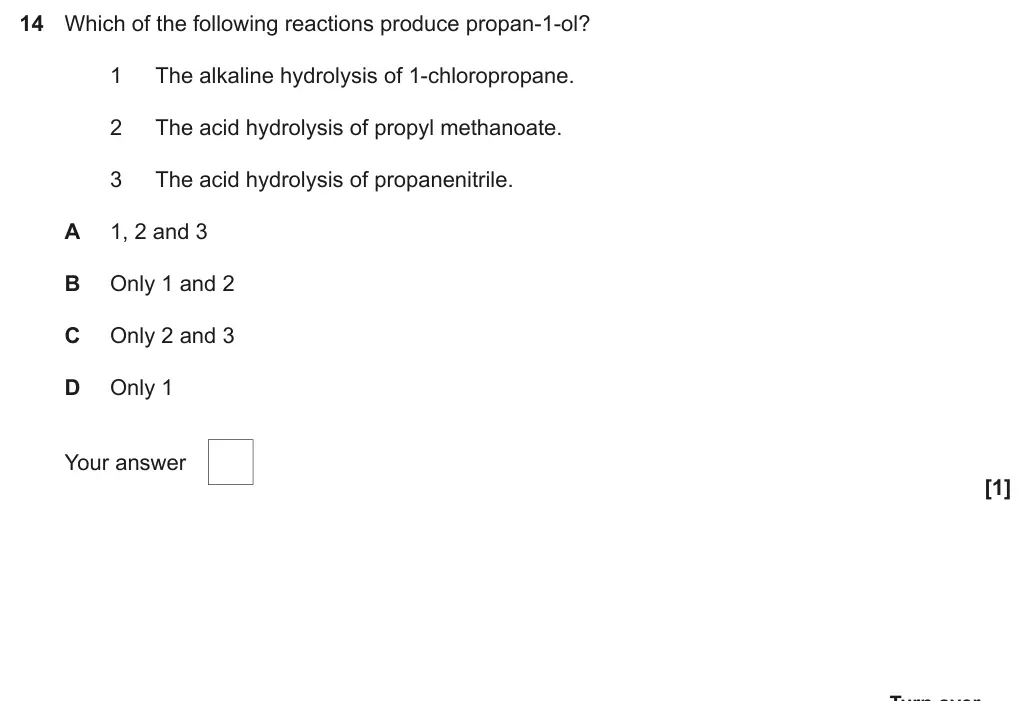
B

D
Less than half the candidates correctly chose option D. This part discriminated well, with less able candidates selecting the incorrect A and C in similar amounts. A small number of candidates selected B.
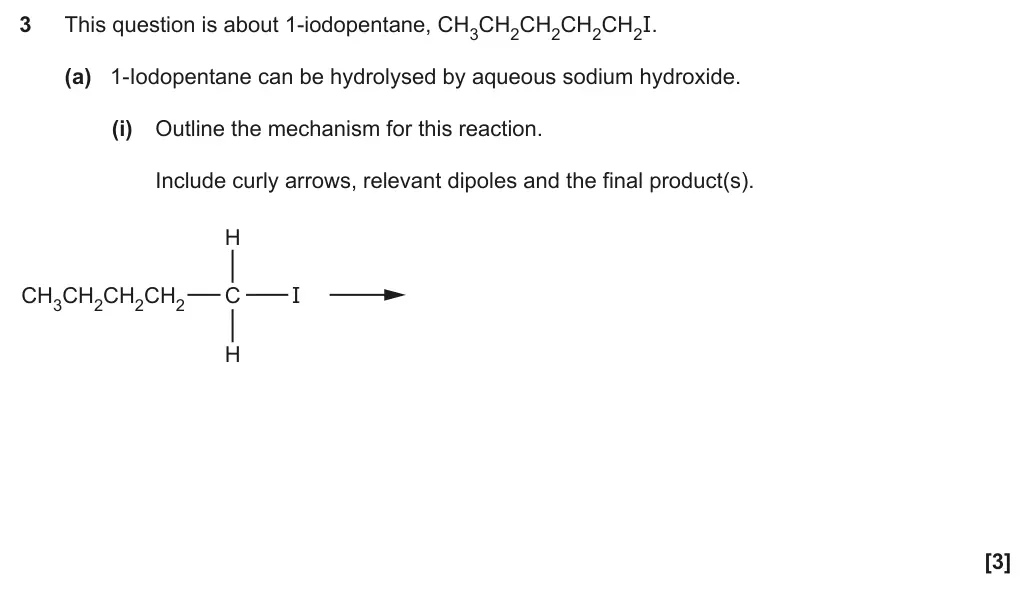
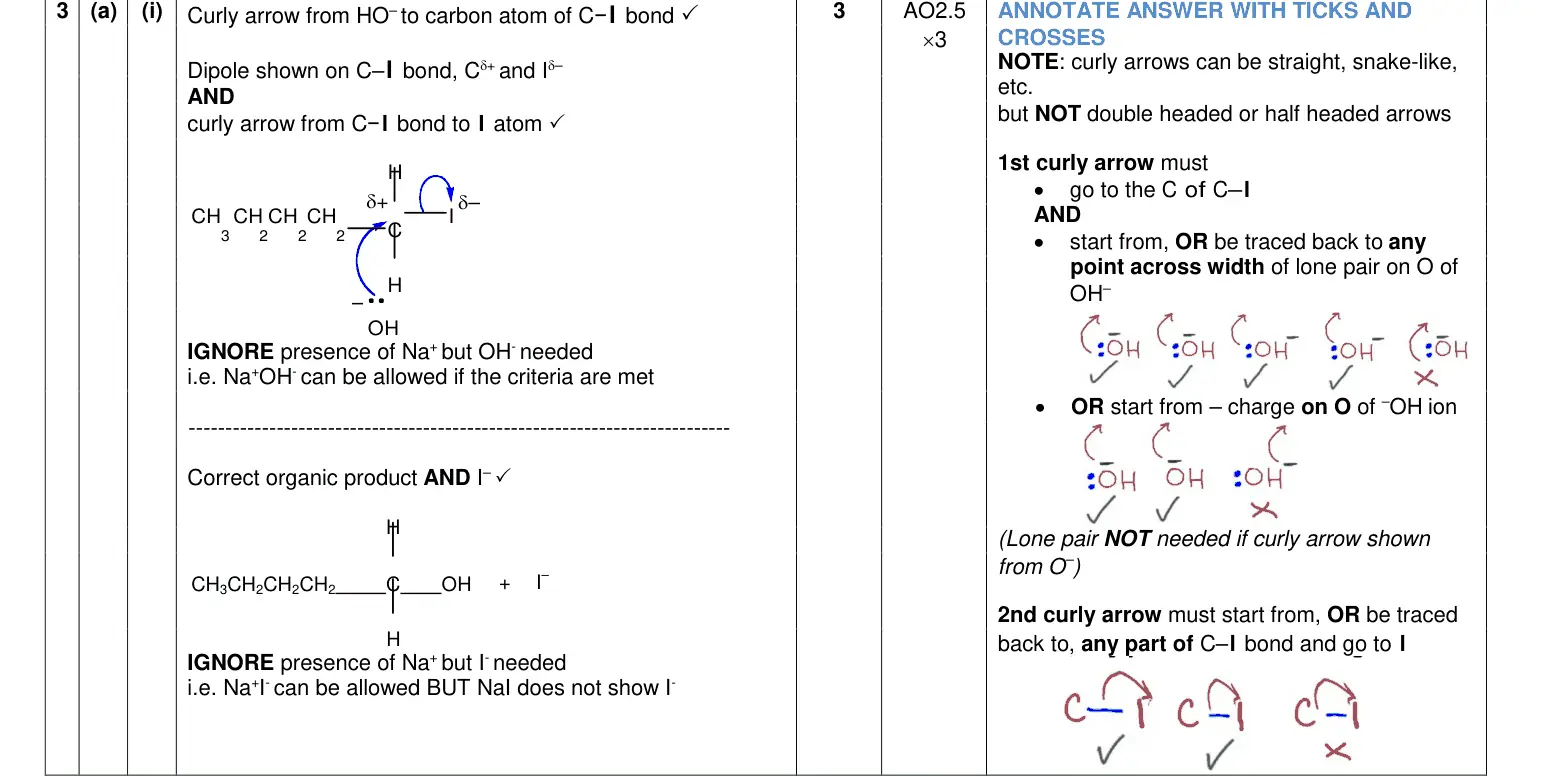
Those that had learnt this important mechanism scored all 3 marks with very precisely drawn arrows and partial charges. Although many candidates wrote out the correct organic product, many wrote NaI instead of I- which lost them the final mark. This candidate scored all 3 marks. The lone pair of electrons on the oxygen and partial charges on the C-I bond are clearly marked on the diagram and the arrows are precisely drawn. Connectivity is good on the organic product and I- identified as the additional product.

The question asked for the measurement AND observation, many students did not answer both parts and therefore did not gain any marks. “How fast” and “how long” were not given as they did not detail the measurement.
Skills: PAG7 Qualitative analysis of organic functional groups

Answers were too vague to be given in most cases. Candidates referred to bonds being broken or overcome, but did not specify C-I bonds breaking, or discussed iodine and bromine in terms of reactivities.

A
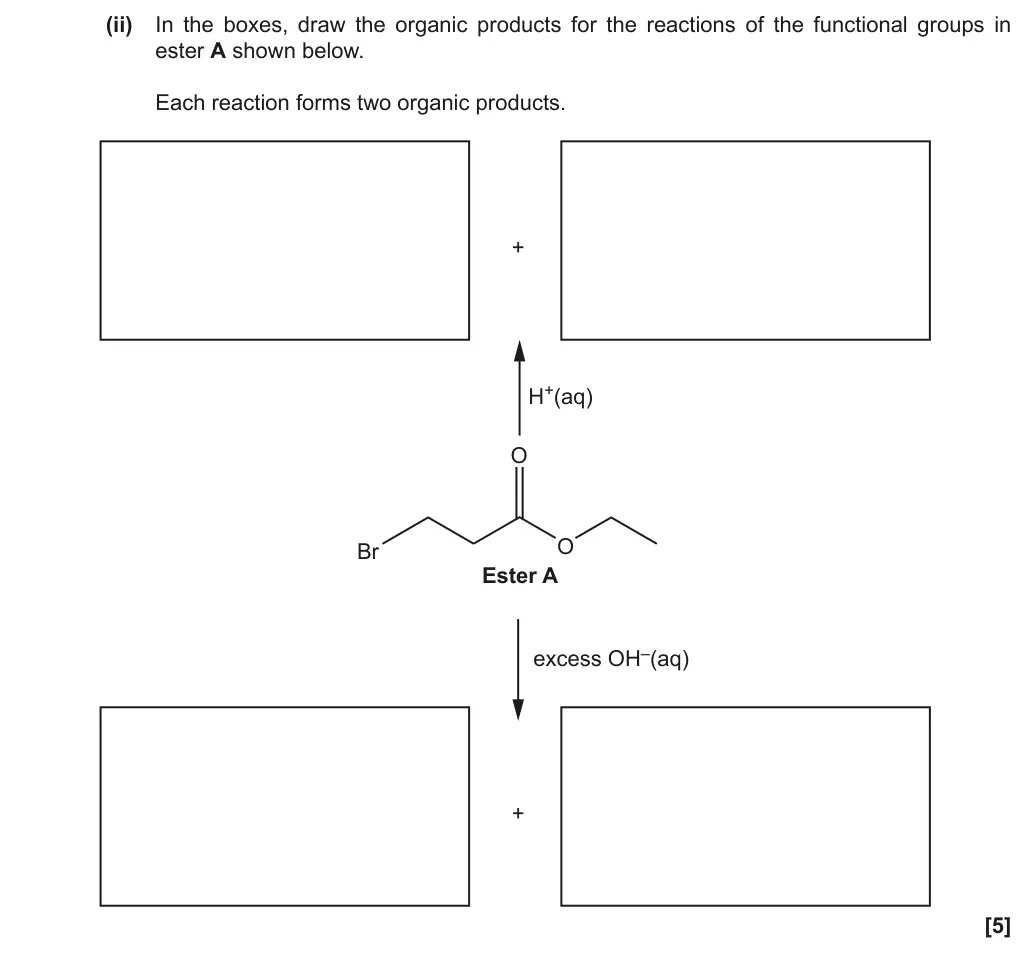
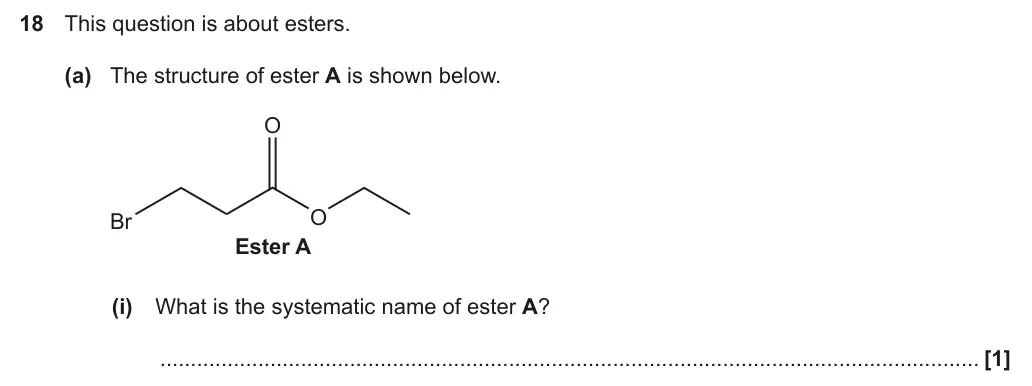
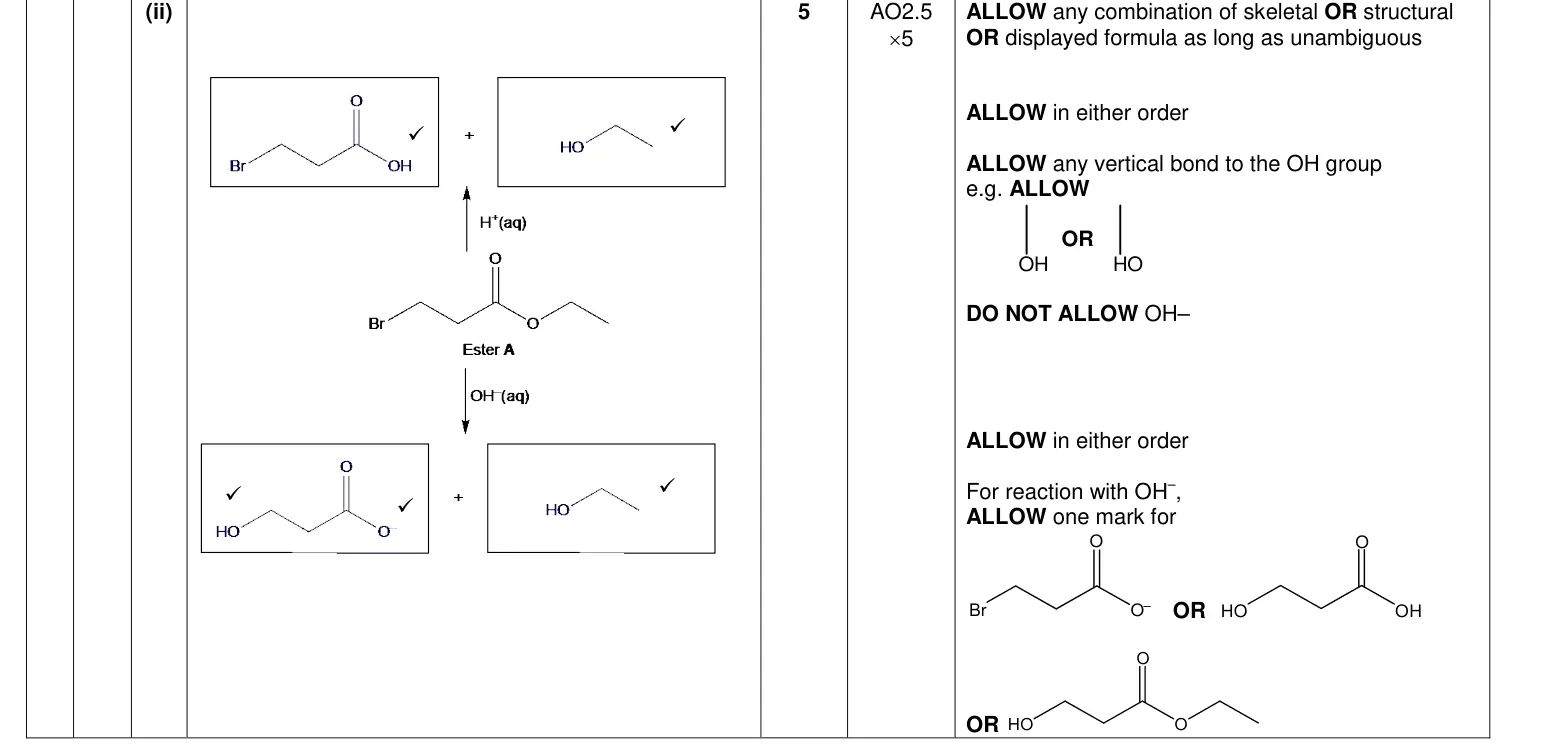
This question required candidates to apply their knowledge of hydrolysis reactions to ester A. The majority of candidates were able to show 3-bromopropanoic acid and ethanol in the top two boxes to secure two marks. The organic products from the alkaline hydrolysis proved more difficult. Many candidates identified ethanol as a product in one of the lower boxes but lower ability responses showed the ethoxide ion. Some candidates drew the 3-bromopropanoate ion as the other product. Higher ability candidates realised that the Br atom would be replaced by an OH group and the best responses showed the correct carboxylate ion. Examiners were encouraged by the number of excellent responses seen and the majority of candidates scored 4 or 5 marks.

A LEVEL CHEMISTRY A Examiners’ report H432/02 Summer 2019 series Version 1 H432 For first teaching in 2015 www.ocr.org.uk/science Contents Introduction .............................................................................................................................................. 4 Paper 2 series overview ........................................................................................................................... 5 Section A overview ................................................................................................................................... 6 Question 3 ............................................................................................................................................ 6 Question 4 ............................................................................................................................................ 6 Question 5 ............................................................................................................................................ 7 Question 10 .......................................................................................................................................... 8 Question 12 .......................................................................................................................................... 9 Question 13 ........................................................................................................................................ 10 Question 14 ........................................................................................................................................ 10 Question 15 ........................................................................................................................................ 11 Section B overview ................................................................................................................................. 12 Question 16 (a) (i) ............................................................................................................................... 12 Question 16 (a) (ii) .............................................................................................................................. 12 Question 16 (b) (i) ............................................................................................................................... 13 Question 16 (b) (ii) .............................................................................................................................. 14 Question 16 (b) (iv) ............................................................................................................................. 14 Question 16 (b) (v) .............................................................................................................................. 15 Question 17 (a) (i) ............................................................................................................................... 17 Question 17 (a) (ii) .............................................................................................................................. 19 Question 17 (b) (i) ............................................................................................................................... 20 Question 18 (a) (i) ............................................................................................................................... 21 Question 18 (a) (ii) .............................................................................................................................. 22 Question 18 (b) ................................................................................................................................... 23 Question 18 (c) ................................................................................................................................... 23 Question 18 (d) ................................................................................................................................... 24 Question 18 (e) (i) ............................................................................................................................... 24 Question 18 (e) (ii) .............................................................................................................................. 26 Question 19 (a) (i) ............................................................................................................................... 27 Question 19 (a) (ii) .............................................................................................................................. 29 Question 19 (b) (i) ............................................................................................................................... 30 Question 19 (b) (iii) ............................................................................................................................. 32 Question 19 (b) (iv) ............................................................................................................................. 34 Question 20 (a) (i) ............................................................................................................................... 36 Question 20 (a) (ii) .............................................................................................................................. 37 Question 20 (a) (iii) ............................................................................................................................. 37 Question 20 (b) (i) ............................................................................................................................... 38 Question 21 ........................................................................................................................................ 39 Introduction Our examiners’ reports are produced to offer constructive feedback on candidates’ performance in the examinations. Question 20 (b) (i) Examiners were encouraged by the number of excellent responses to this question.
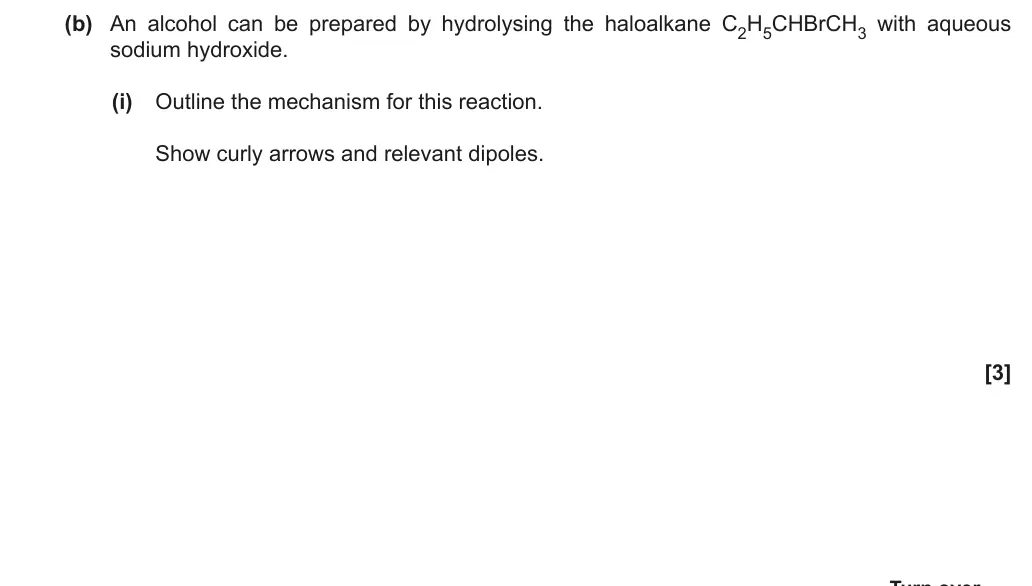
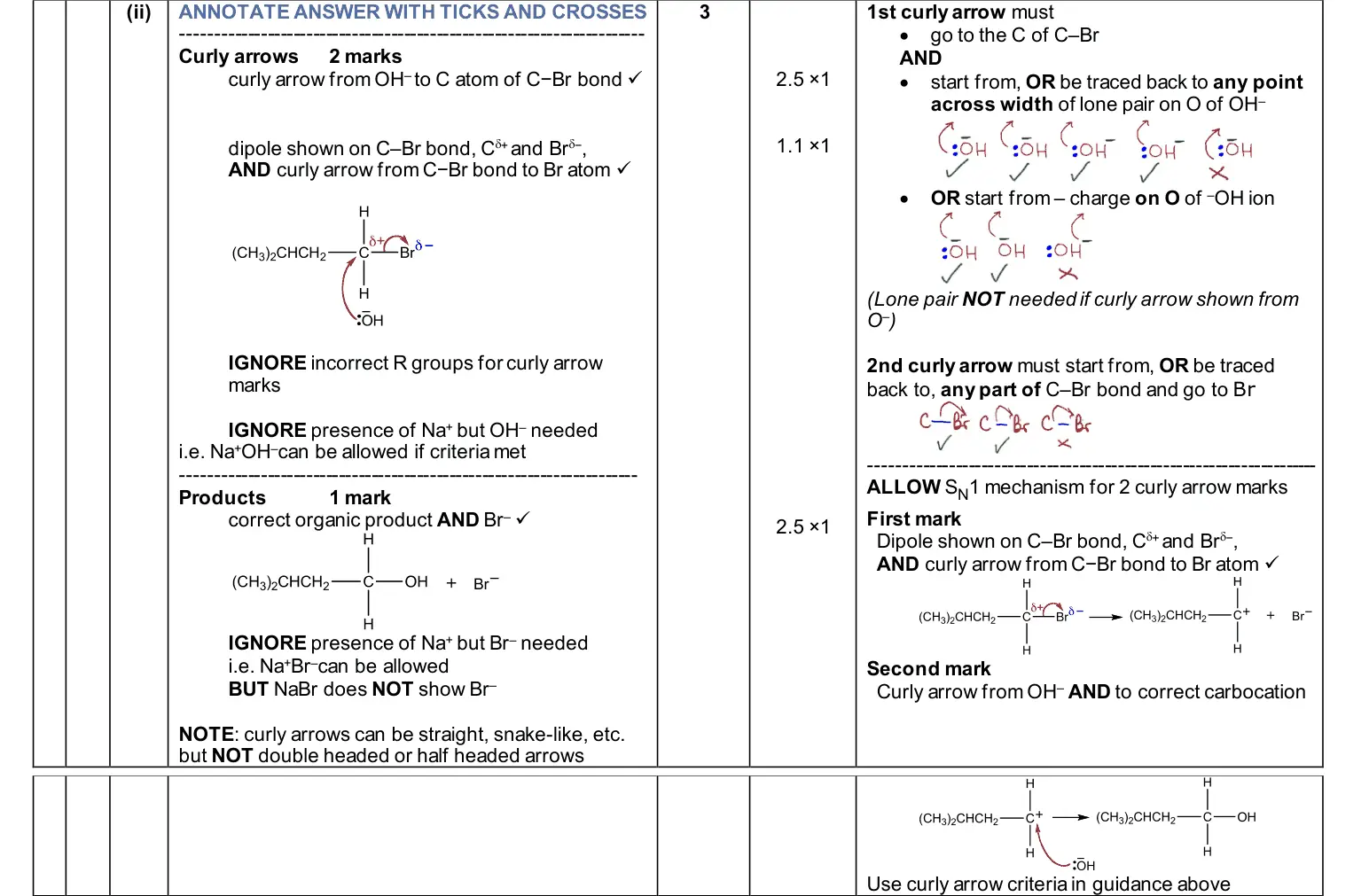
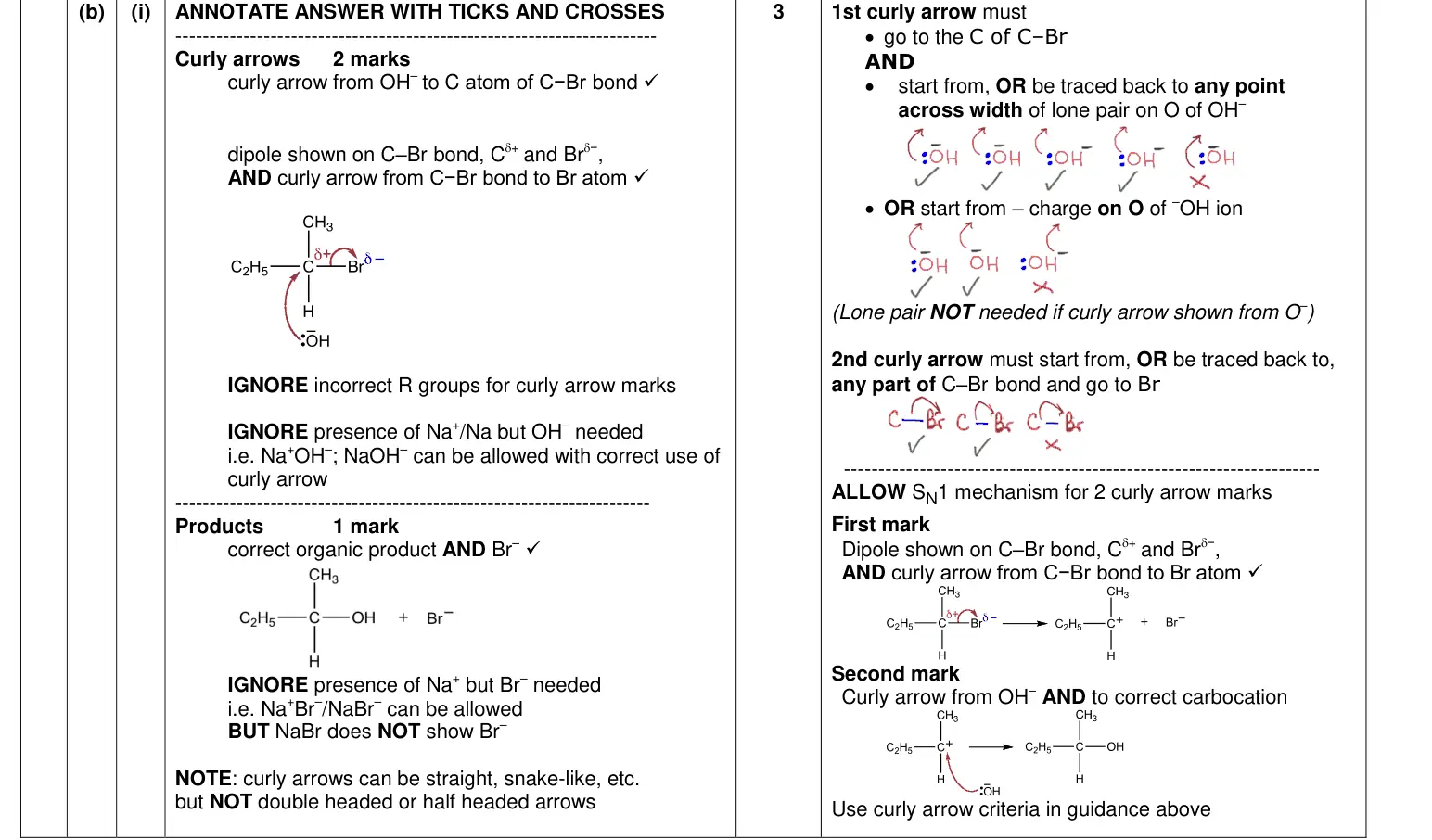
As with 25(a)(i), this question rewarded the well-prepared candidate. The large number of proposed mechanisms showed little resemblance to the accepted mechanism for nucleophilic substitution. Mechanisms were often seen showing curly arrows going in the wrong direction and between the wrong bonds and atoms, charges and dipoles were often incorrect, and partial changes used where full charges were required. Two exemplars are shown. The first exemplar shows clear curly arrows, the role of the lone pair and all charges correct. The second exemplar shows a typical muddled response. Although the curly arrow from the hydroxide ion has been accurately drawn, the hydroxide ion has a partial charge rather than a – charge. There is also no curly arrow showing breaking of the C–Br bond. The only mark available is for the correct organic product and a Br– ion. Some mechanisms were so poor that it was impossible to credit many candidates with any marks. Writing mechanisms is an important skill in organic chemistry and it is recommended that candidates learn and practice their writing.
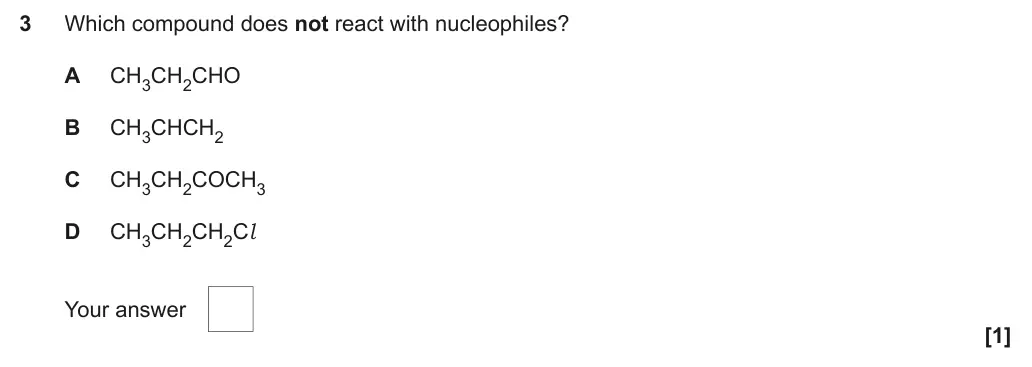
B
The majority of candidates identified B (an alkene) as the compound that does not react with nucleophiles.

D
Candidates found this multiple choice question difficult. While some correctly selected D, many candidates chose B.
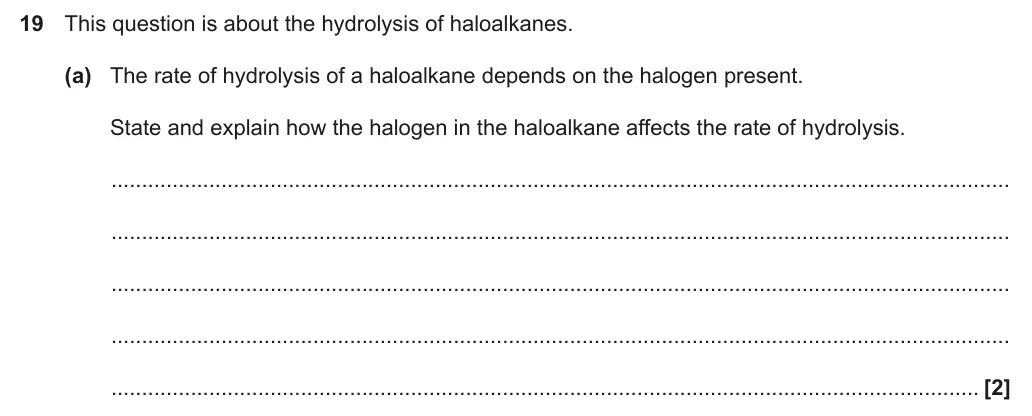
This question required candidates to link the rate of hydrolysis with the strength of the carbon-halogen bond present in different haloalkanes. Higher ability candidates were able to do this succinctly, making clear comparisons between different C-X bonds. Exemplar 5 shows a commonly seen one mark response. This response correctly describes the effect of bond strength on the rate of hydrolysis and receives one mark. To score the second mark a comparison of two different carbon-halogen bonds is required.
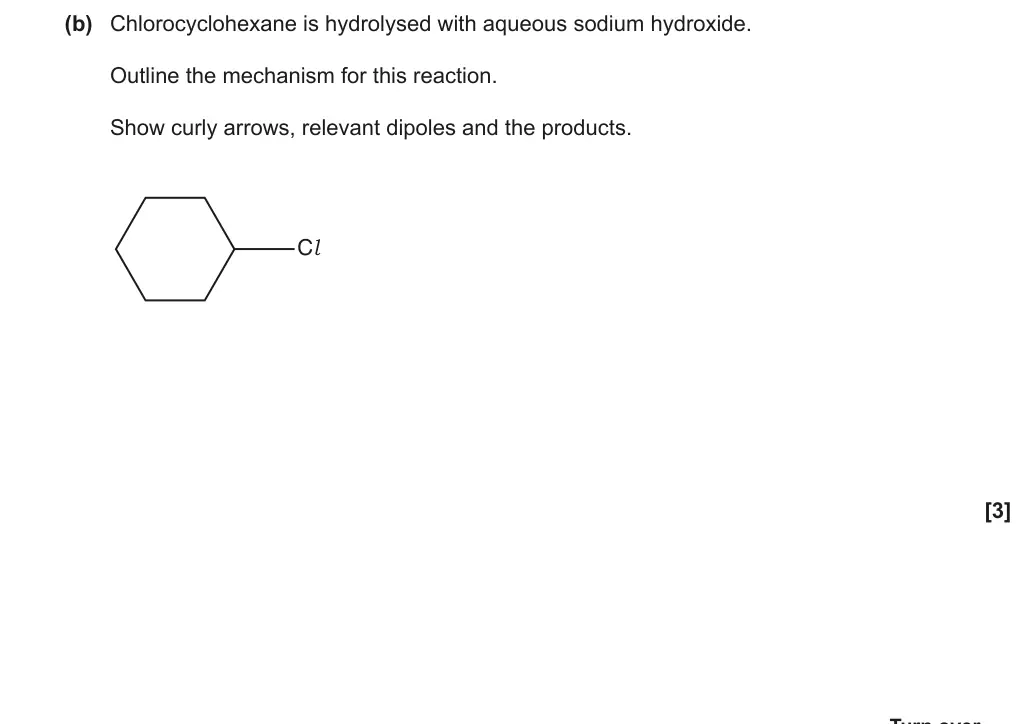
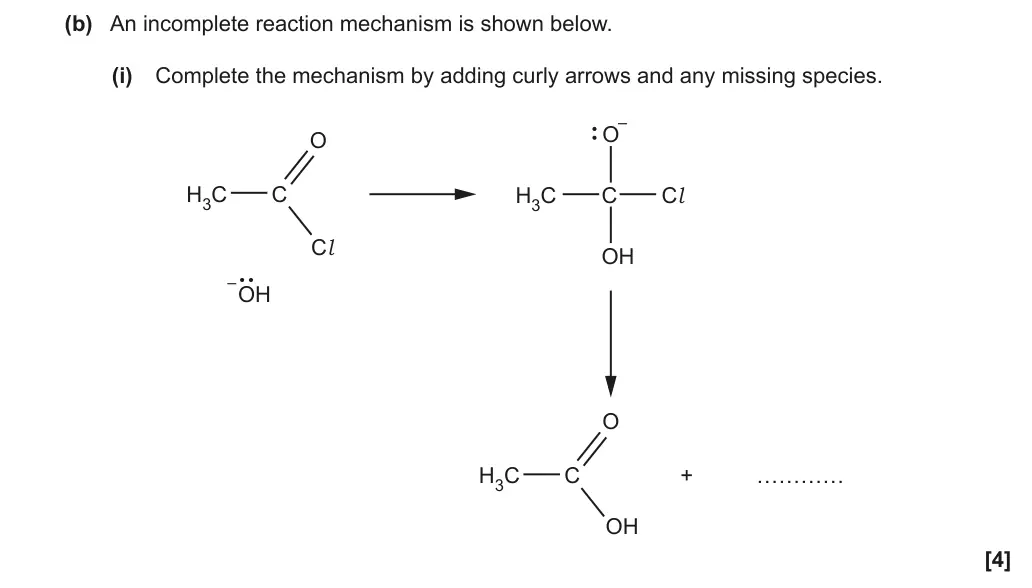
Candidates were very familiar with this nucleophilic substitution mechanism. Consequently the majority of candidates scored two or three marks. Common errors included inaccurate curly arrows from the hydroxide ion and failure to show the chloride ion as a product. Exemplar 6 highlights both of these. This response demonstrates the two most common errors seen in this part. The first marking point cannot be credited as the curly arrow from the hydroxide ion does not involve either the lone pair or minus sign on the O atom. The organic product is correct but the chloride ion produced by the heterolytic fission of the C-Cl bond is not shown so marking point three cannot be credited. This response only scores one mark for the correct partial charges and curly arrow on the C-Cl bond. Candidates are encouraged to practice drawing mechanisms so as to avoid costly errors during examinations.
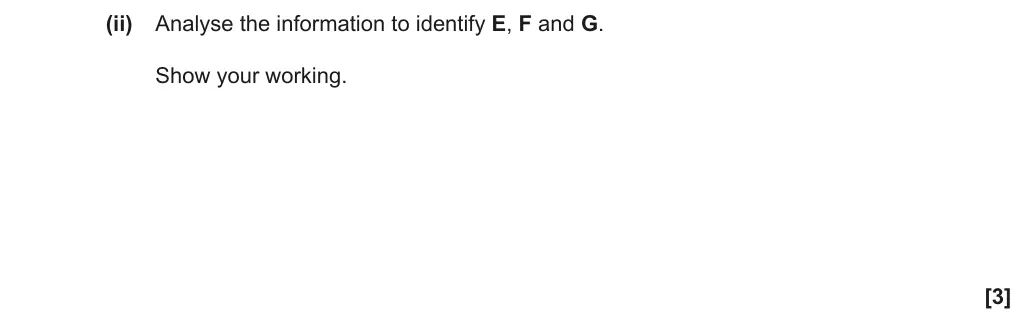
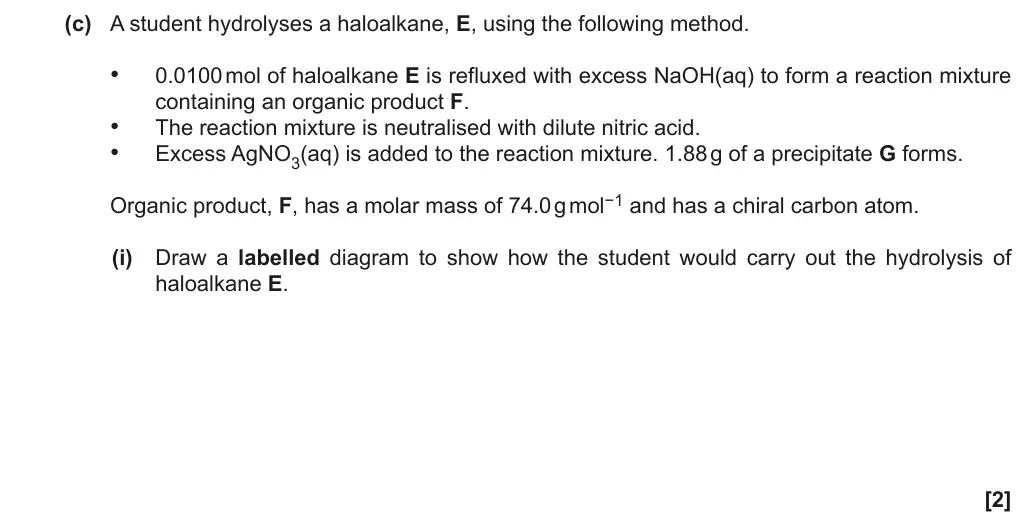
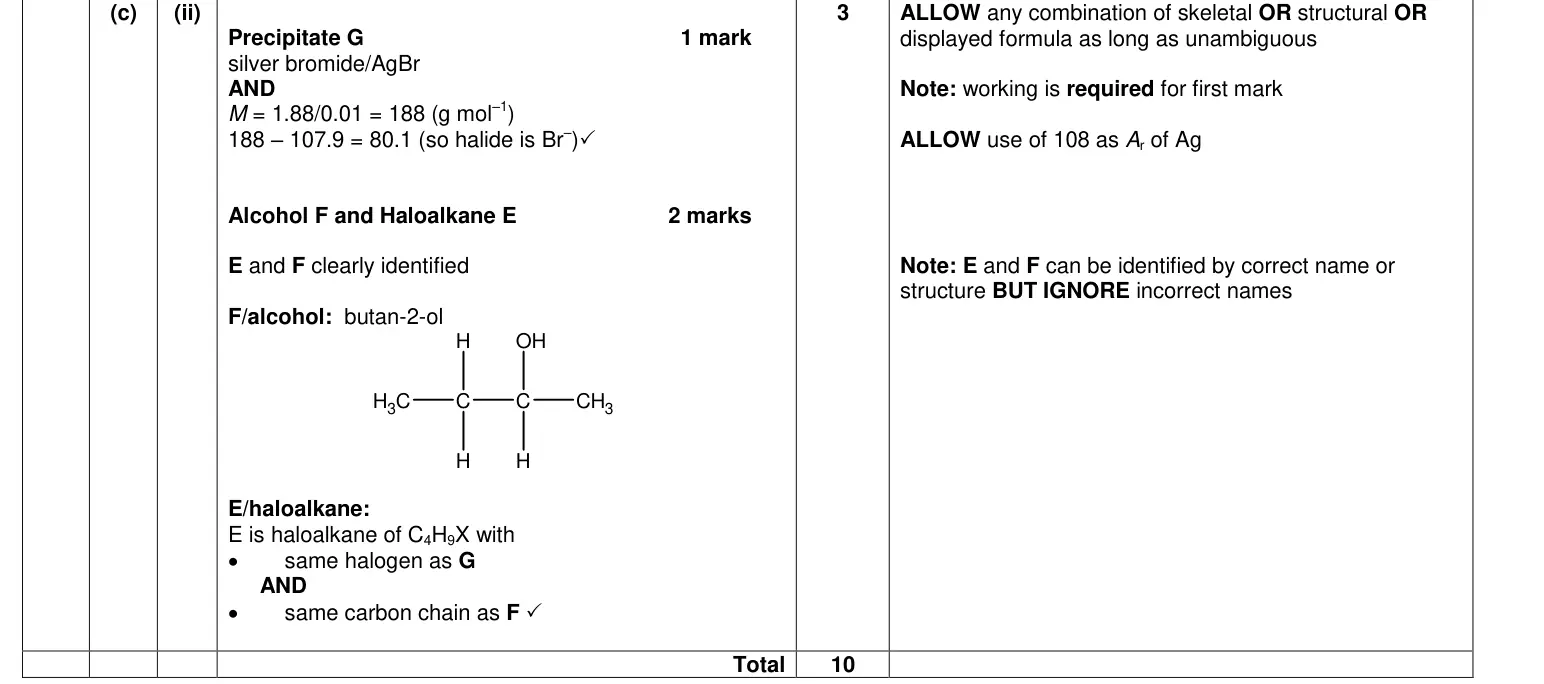
This question, requiring candidates to analyse the information to identify compounds E, F and G, discriminated well. Many candidates deduced that G was a silver halide but not all provided working to back up their choice of AgBr. Some candidates appeared to guess and AgCl was commonly seen. Some candidates used the molar mass of F provided to deduce the molecular formula of C4H10O but lower ability responses did not process this further. Higher ability candidates identified F as butan-2-ol, showing the chiral carbon clearly. Other alcohols were also seen including butan-1-ol and methylpropan- 2-ol. The highest ability candidates linked all the information and provided a structure for E that was consistent with their suggestions for F and G.
Skills: M0.2 Use ratios, fractions and percentages; M2.2 Change the subject of an equation

B
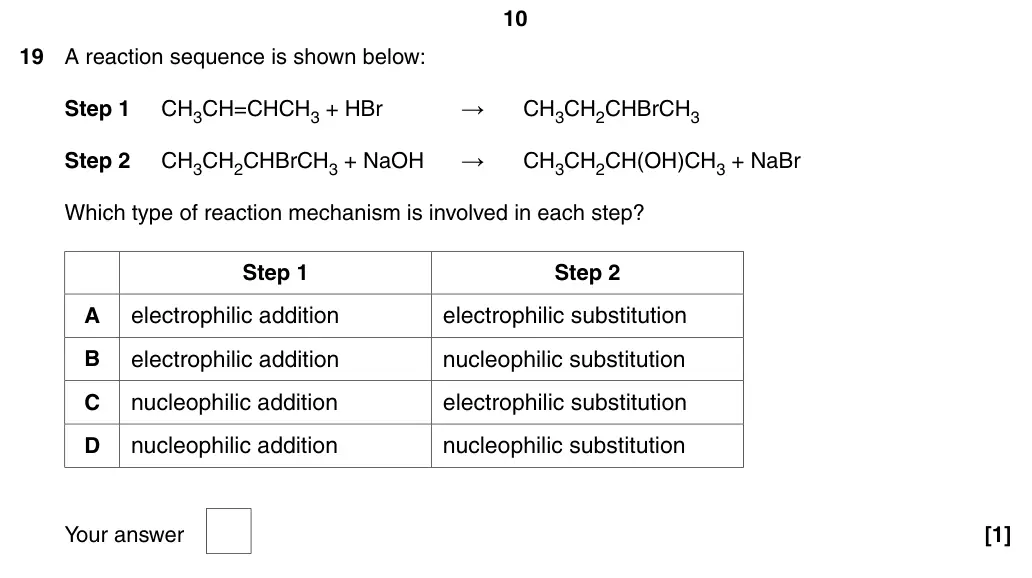
B

D
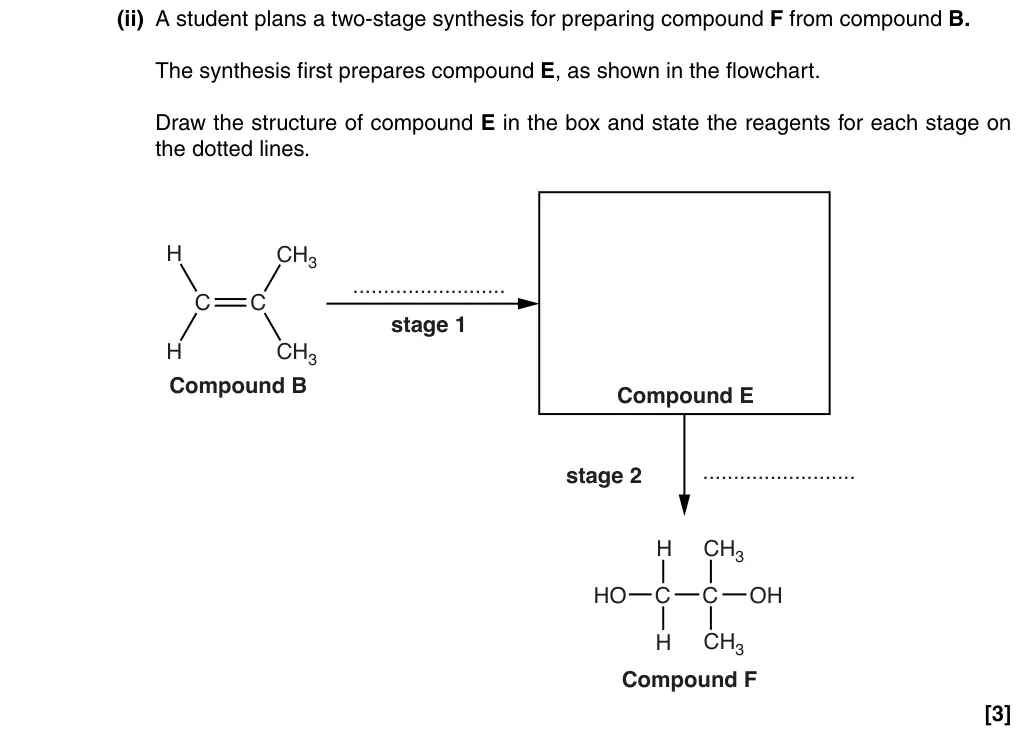

Dropping marks on calculations, mechanisms or the six-markers? Book a trial session with a specialist OCR chemistry tutor.