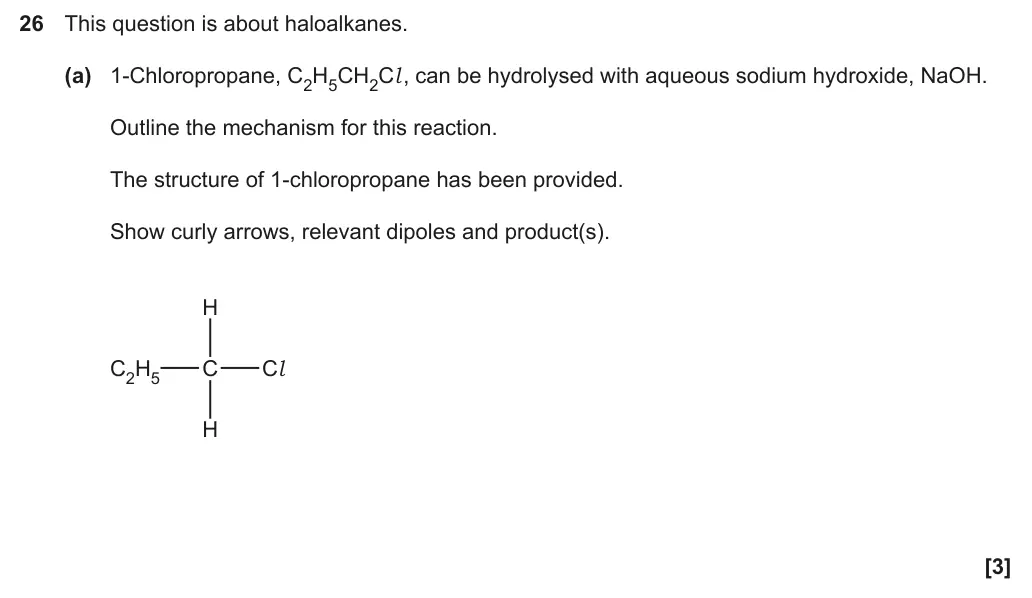
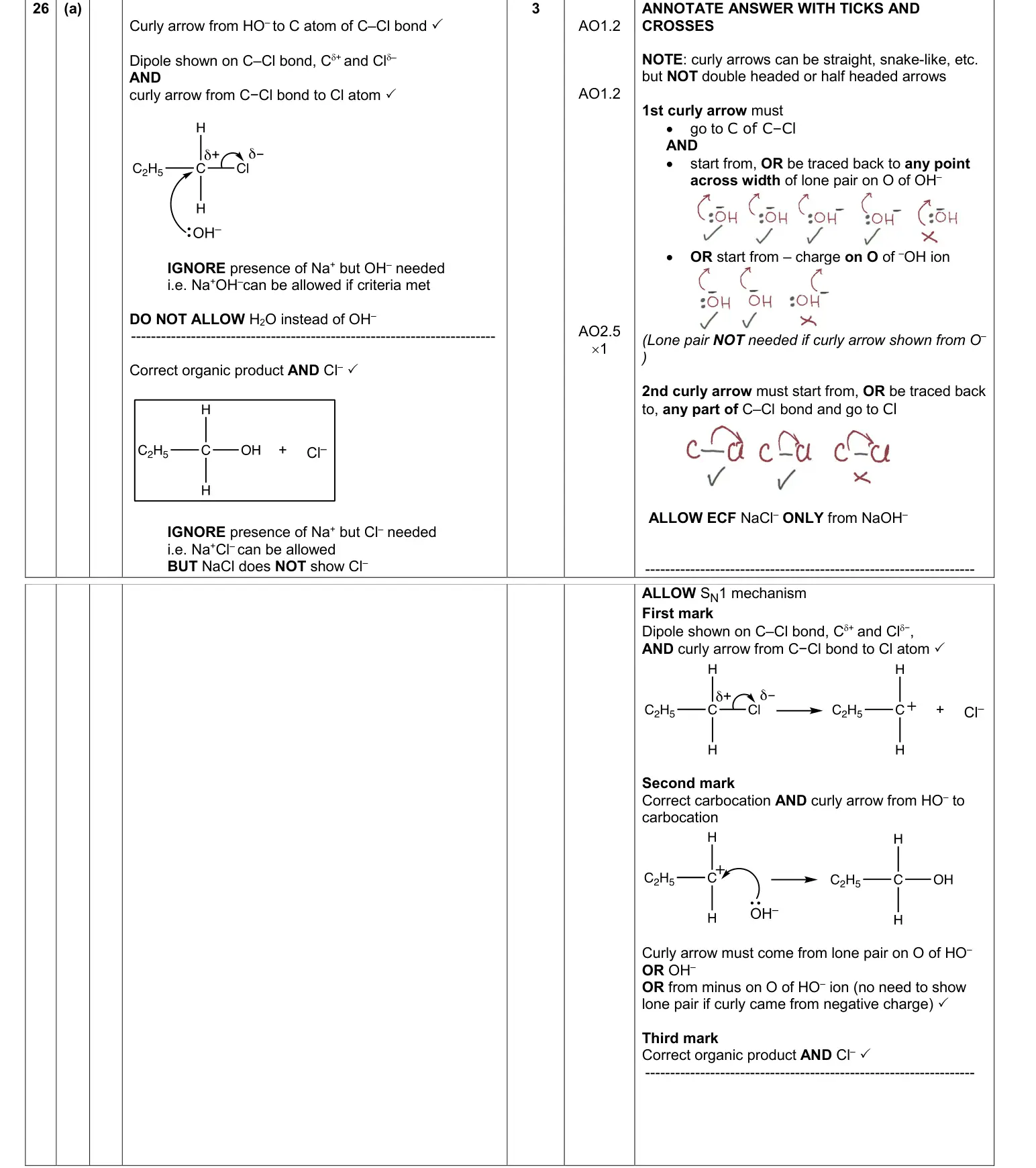
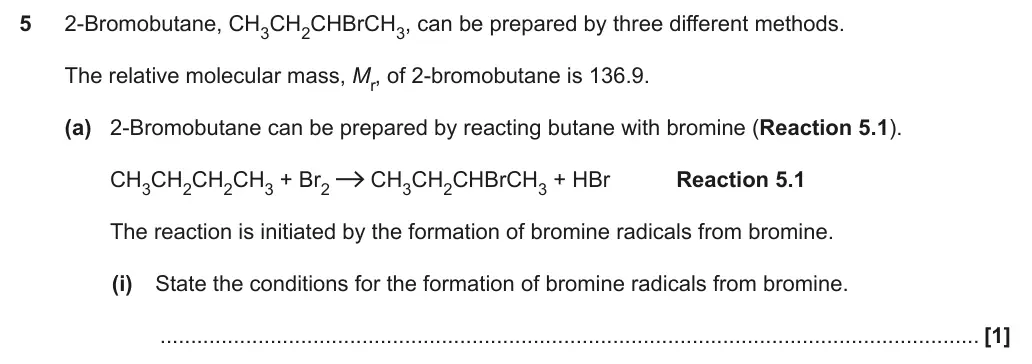
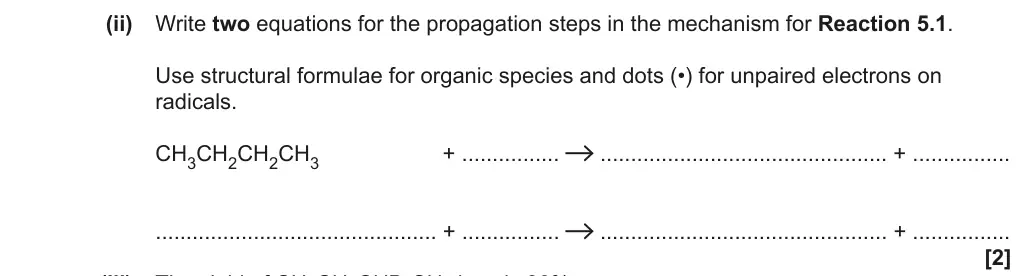
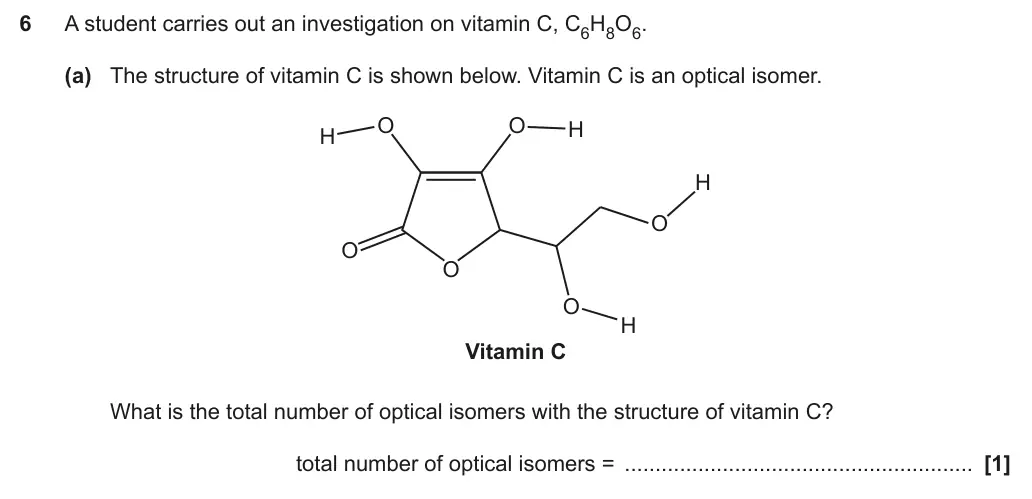
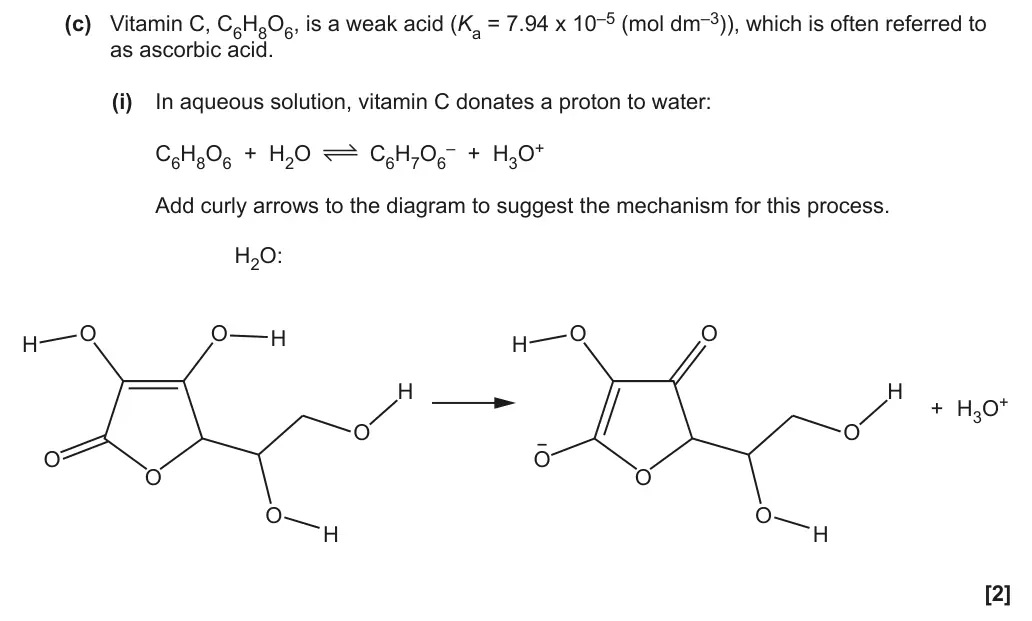
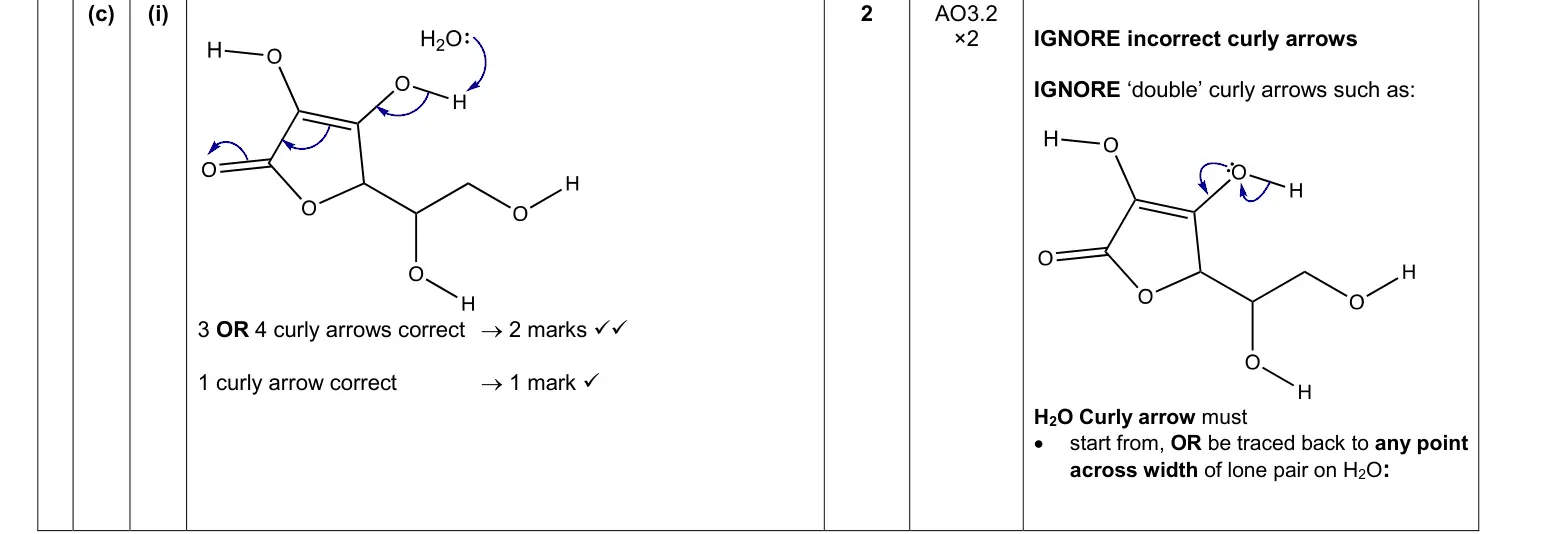
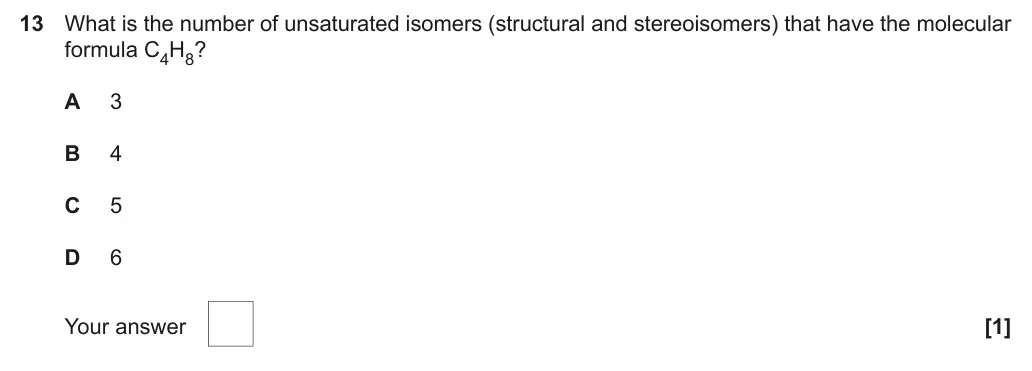
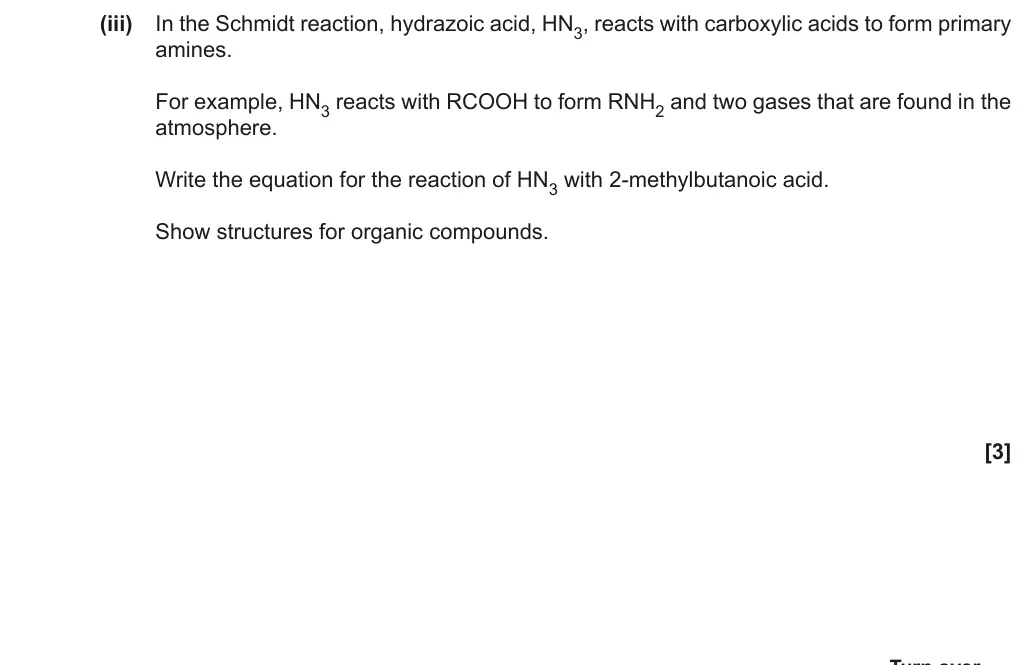
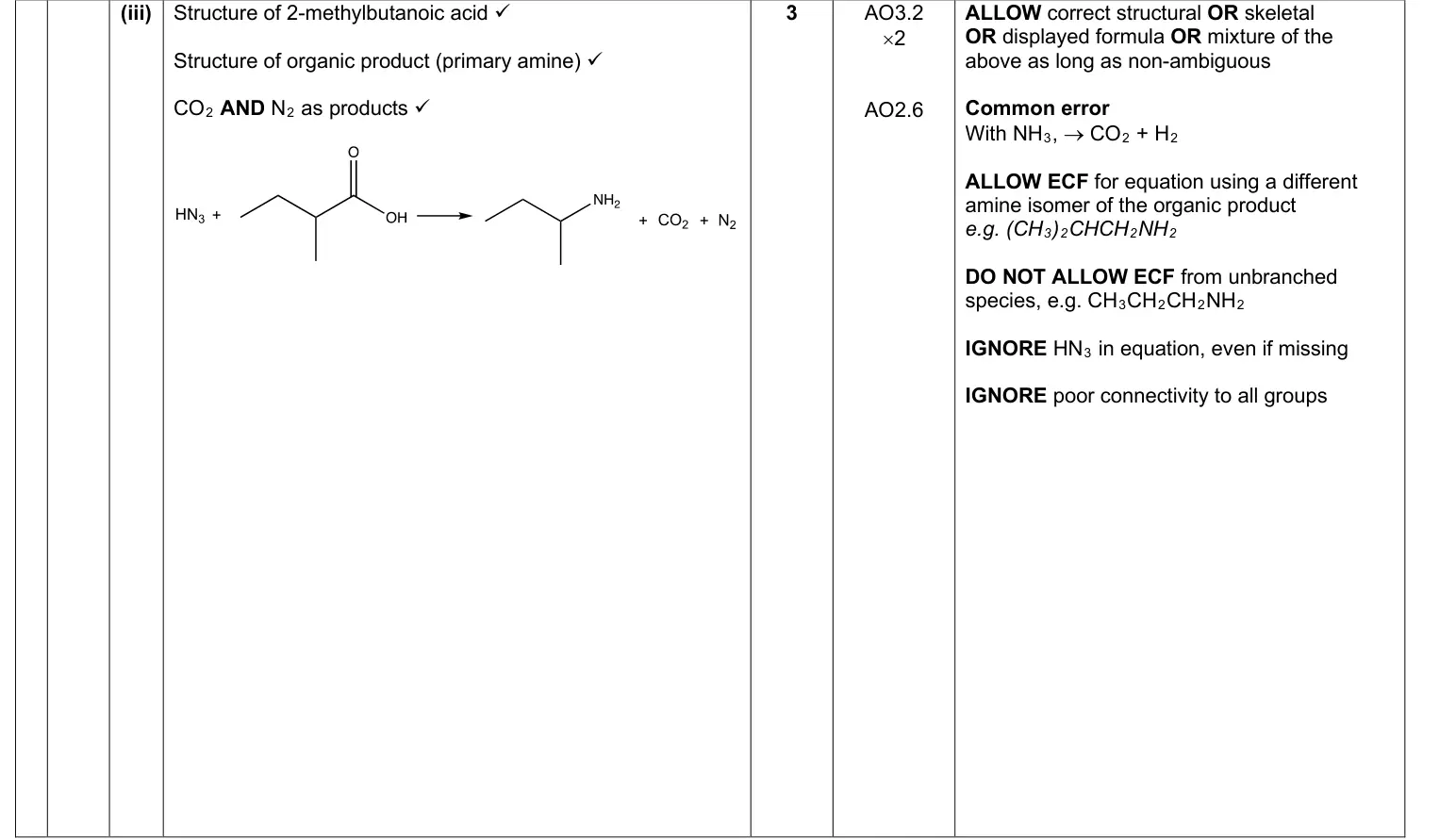
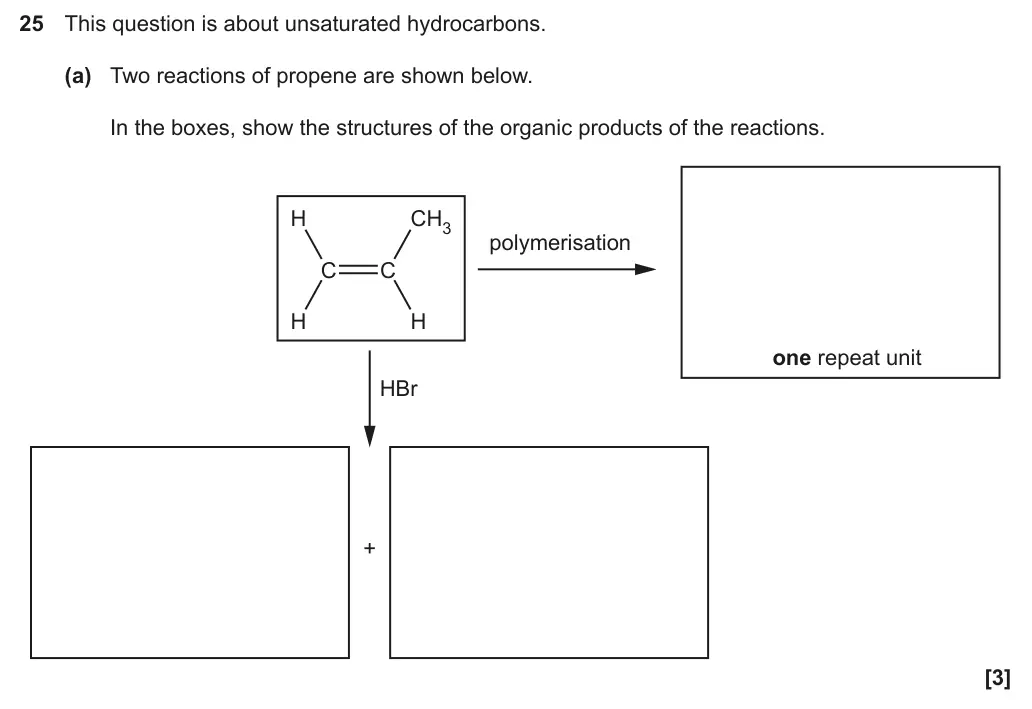
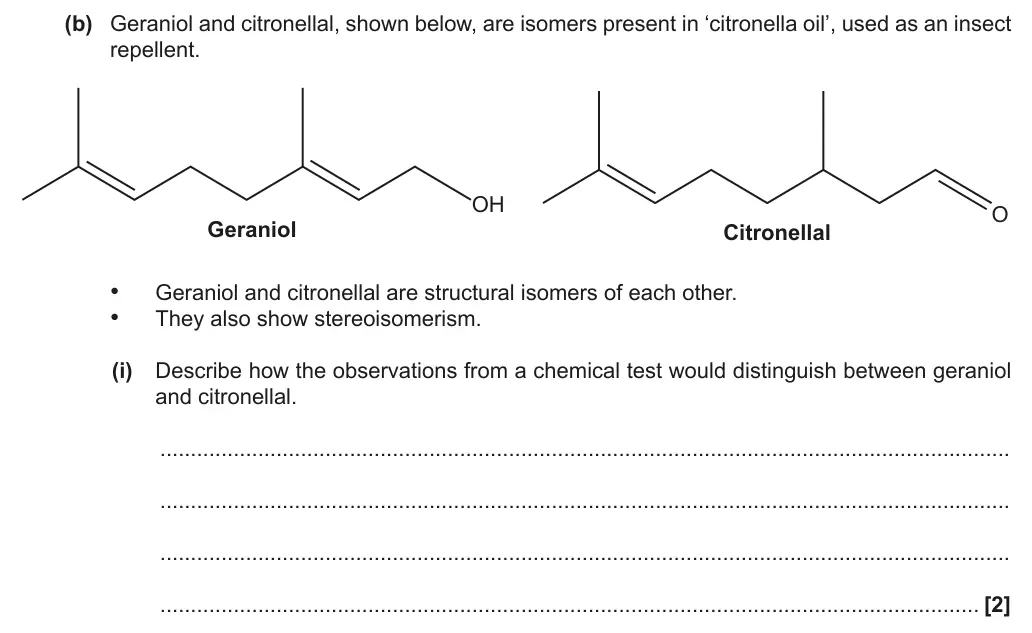
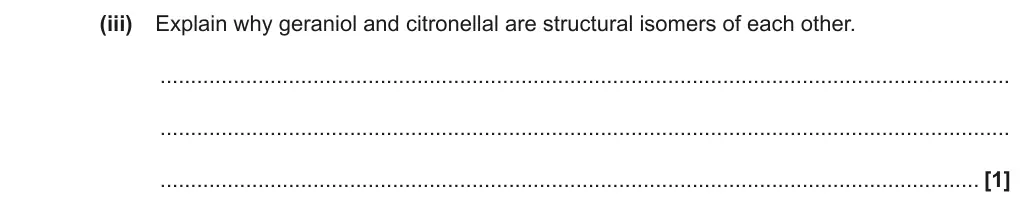
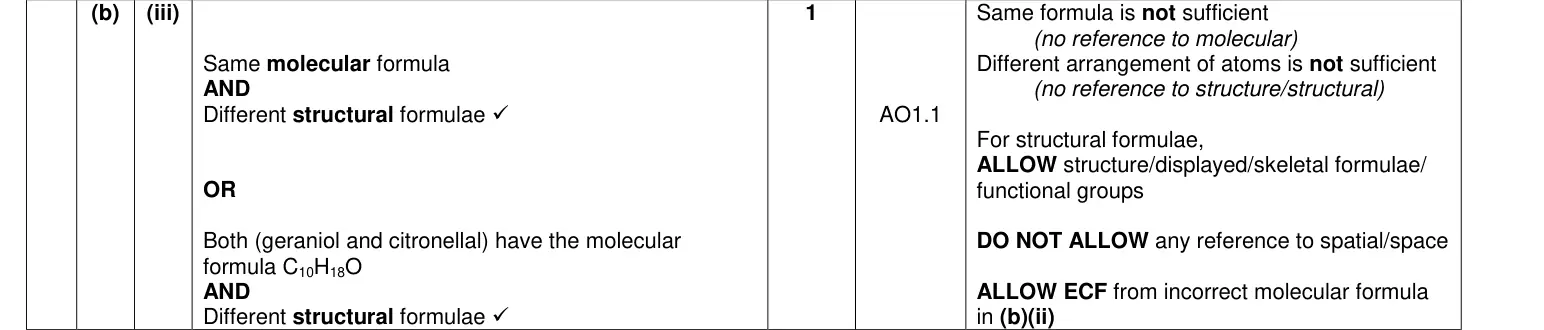
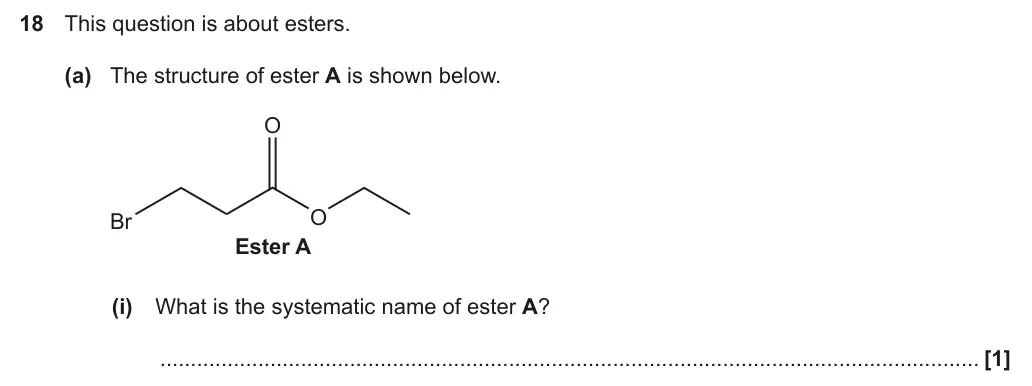
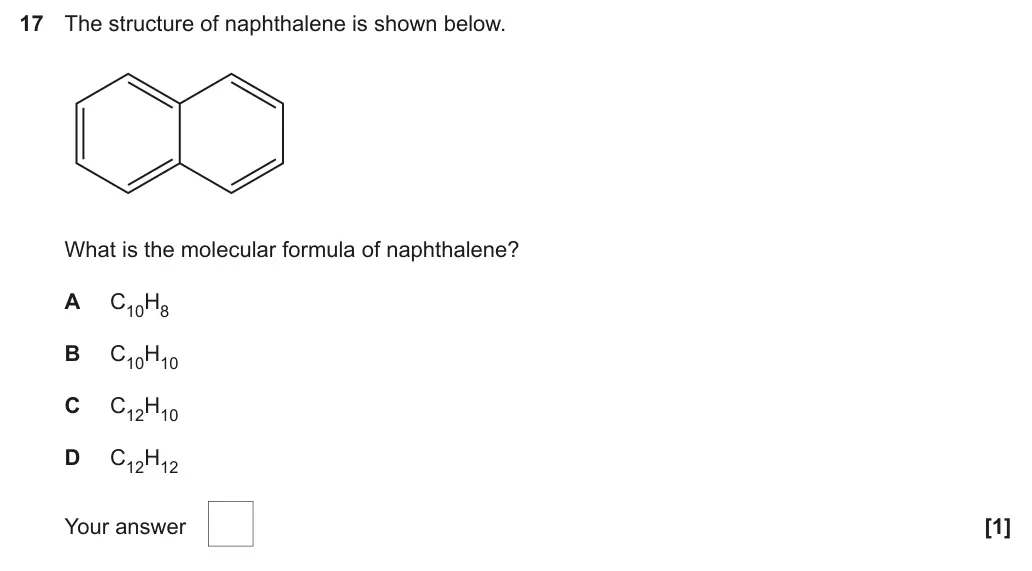
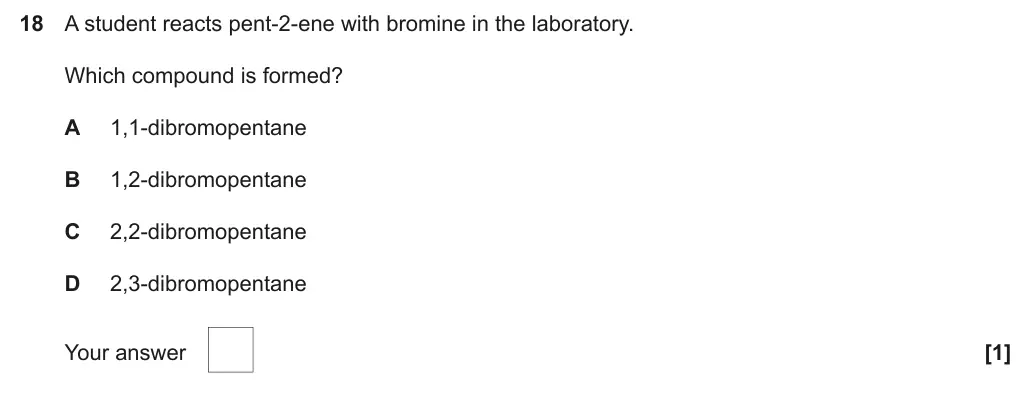
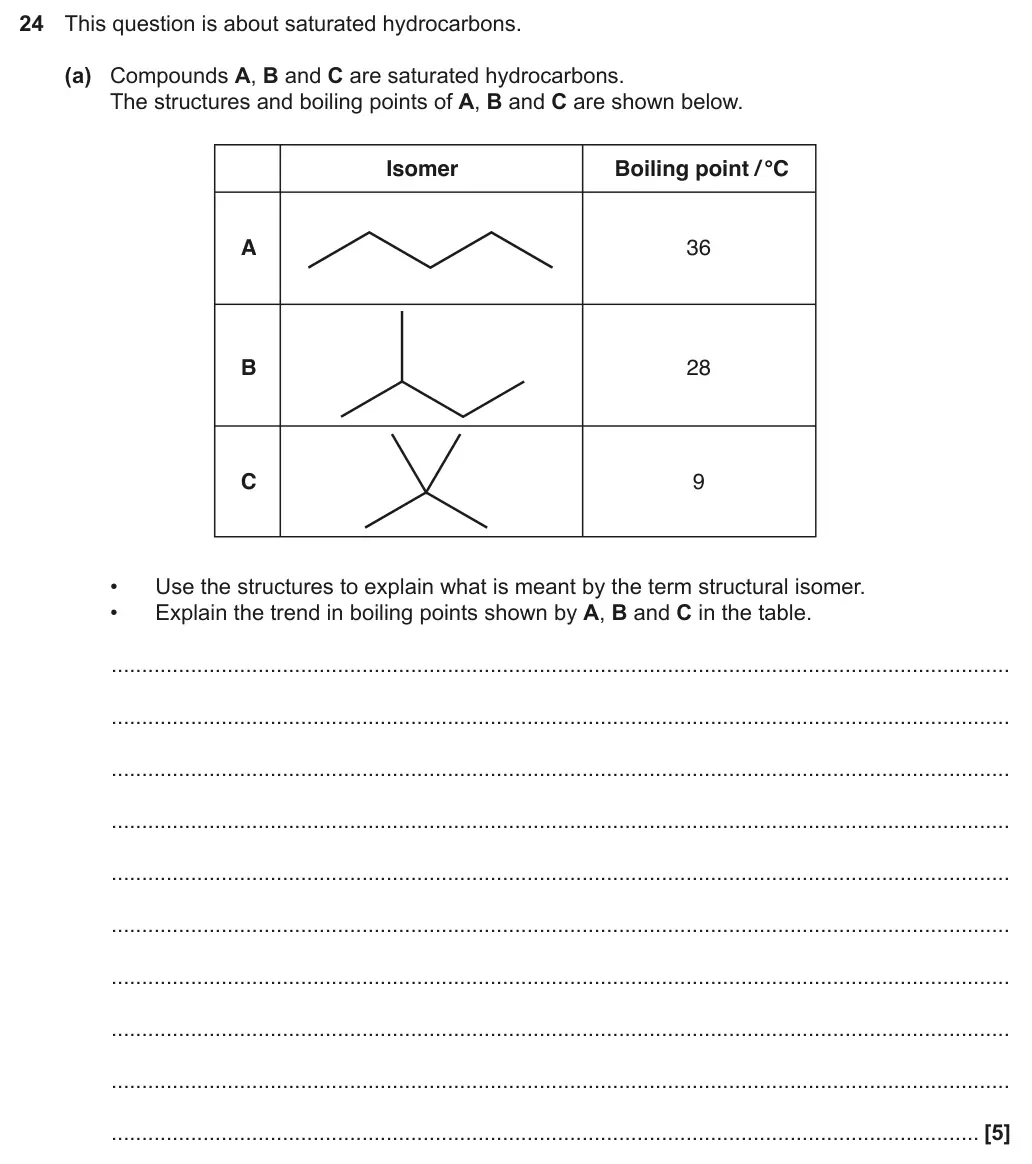
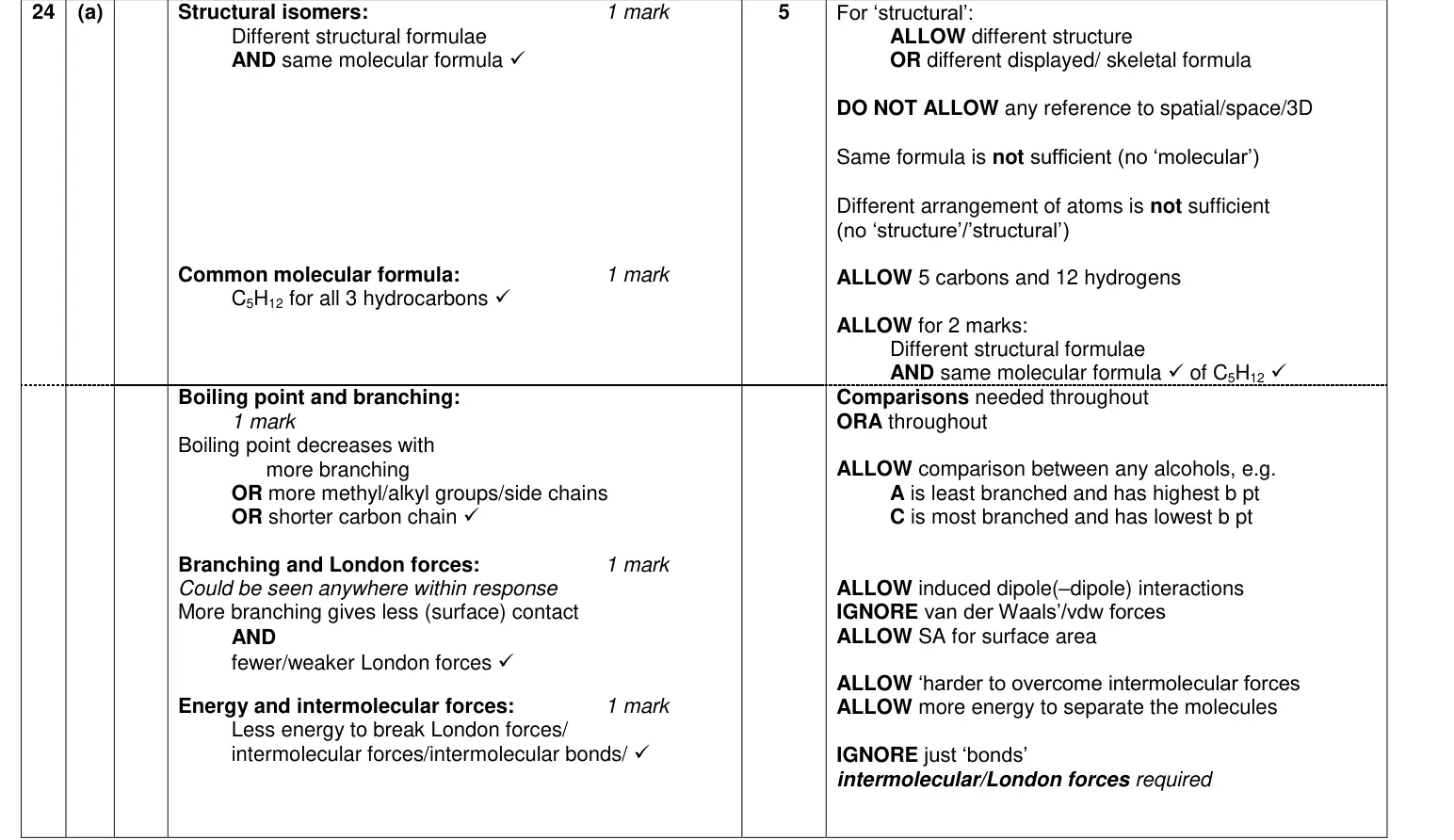
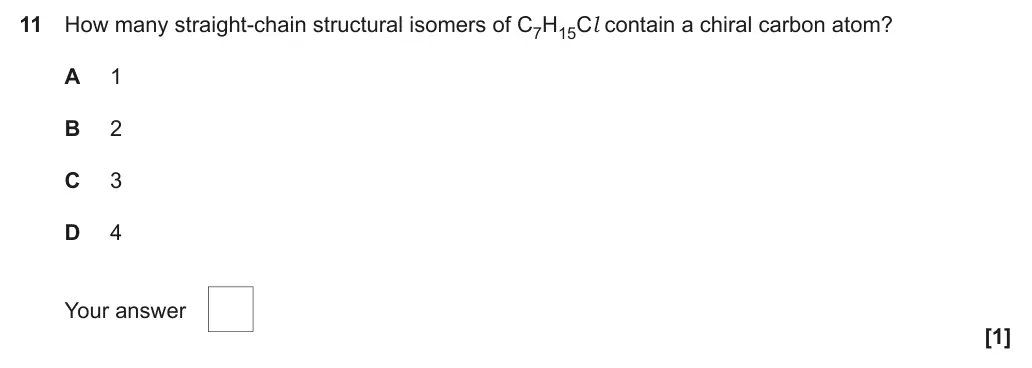
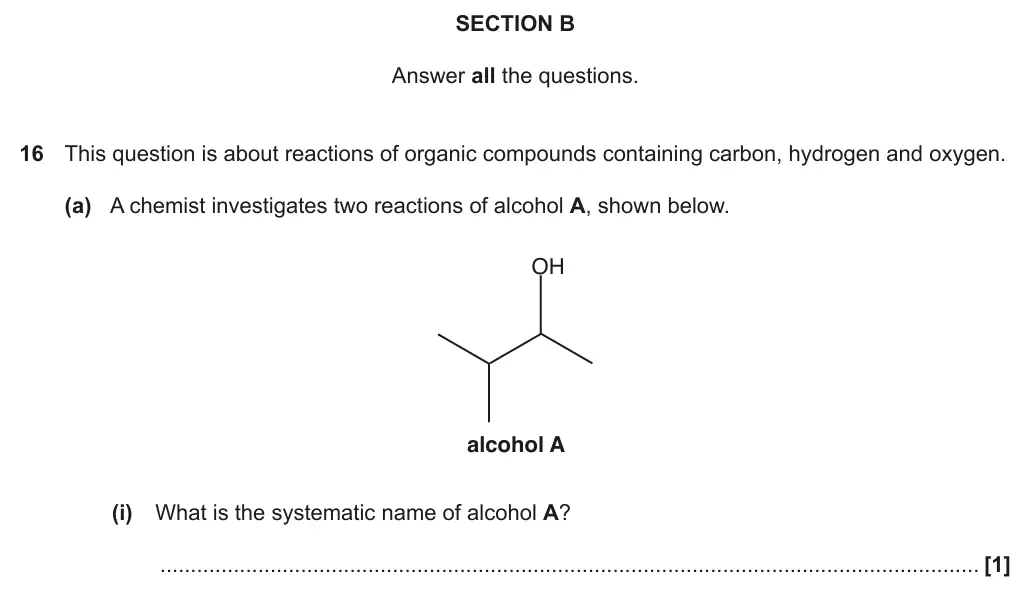
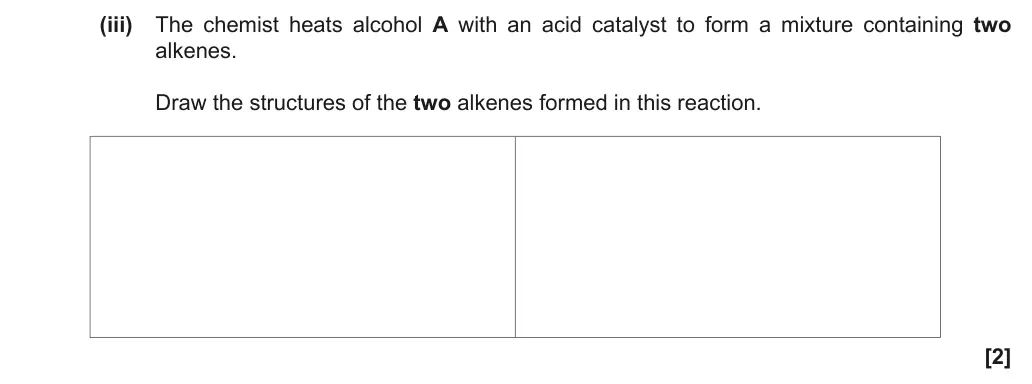
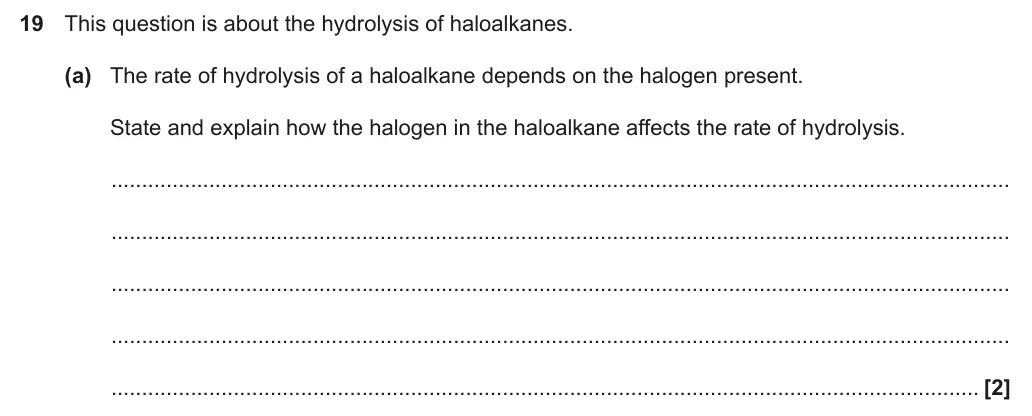
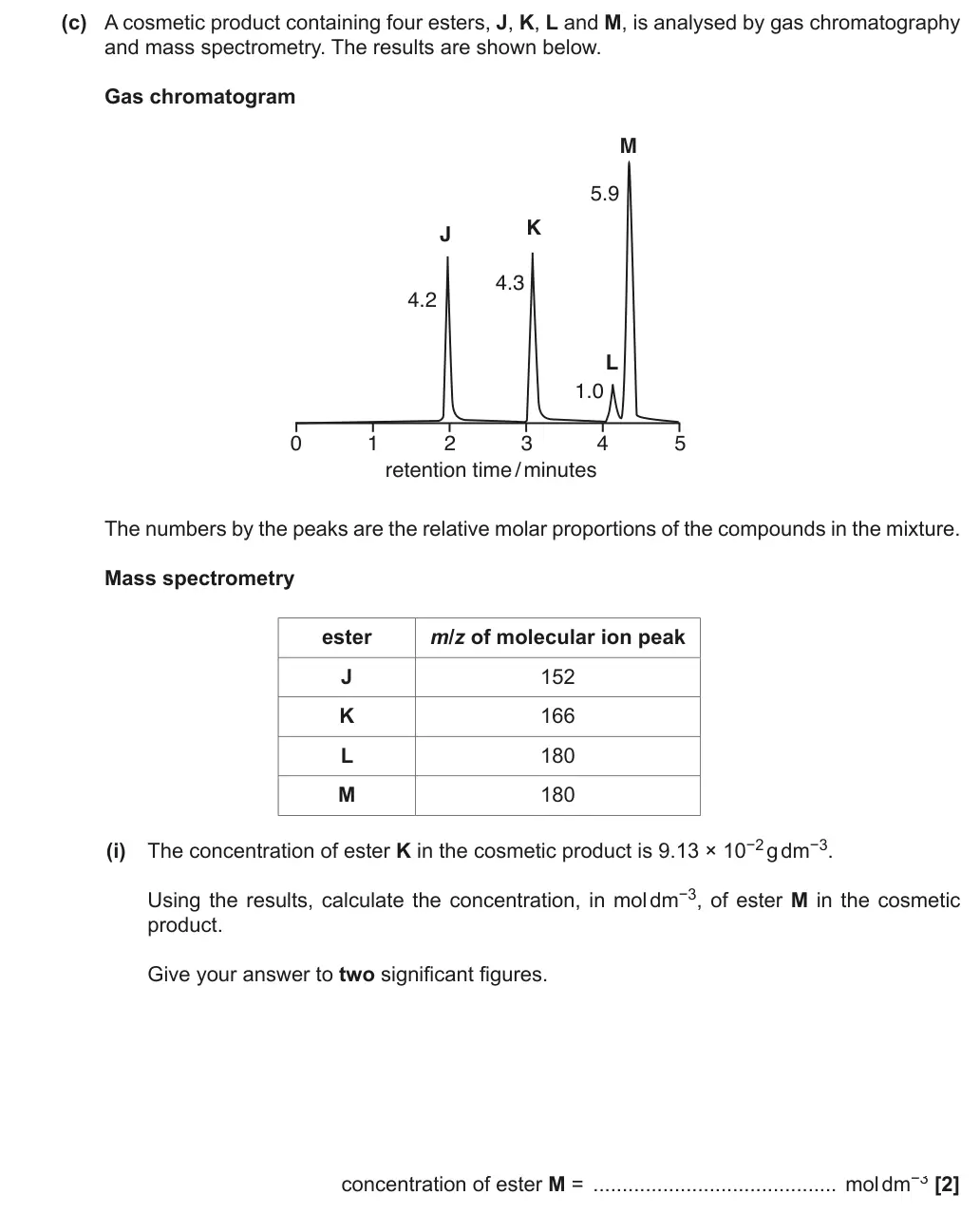
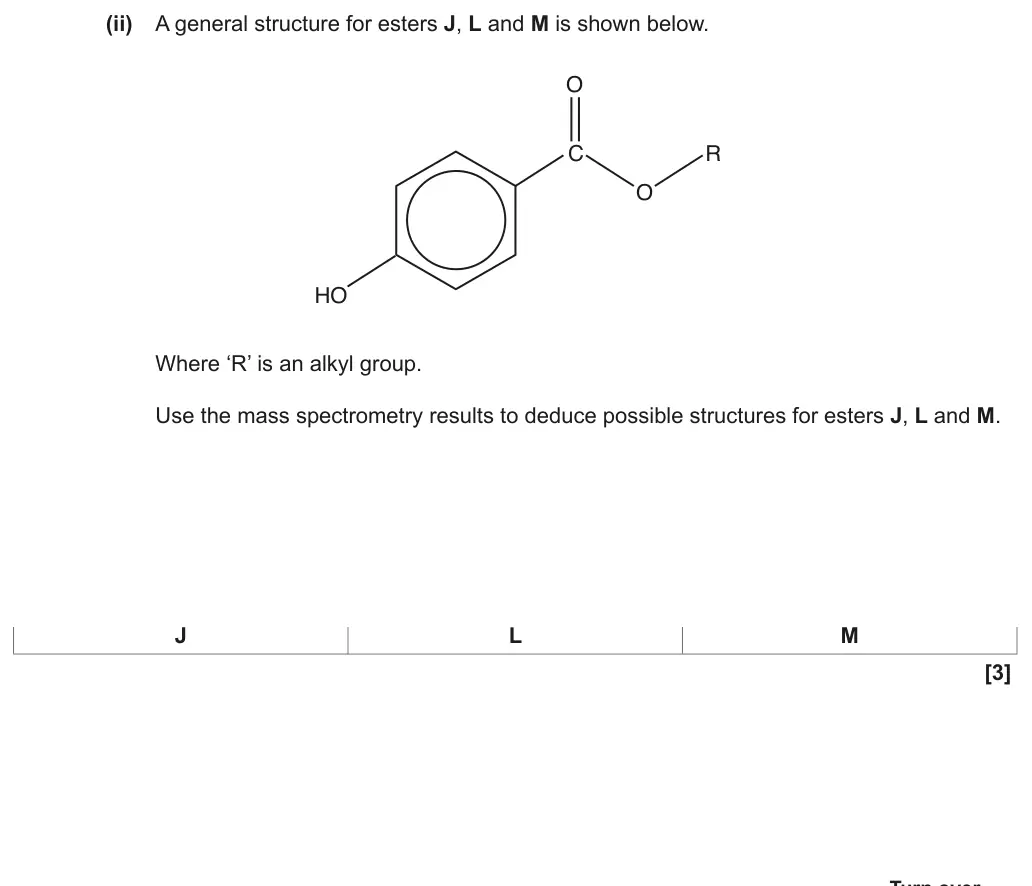
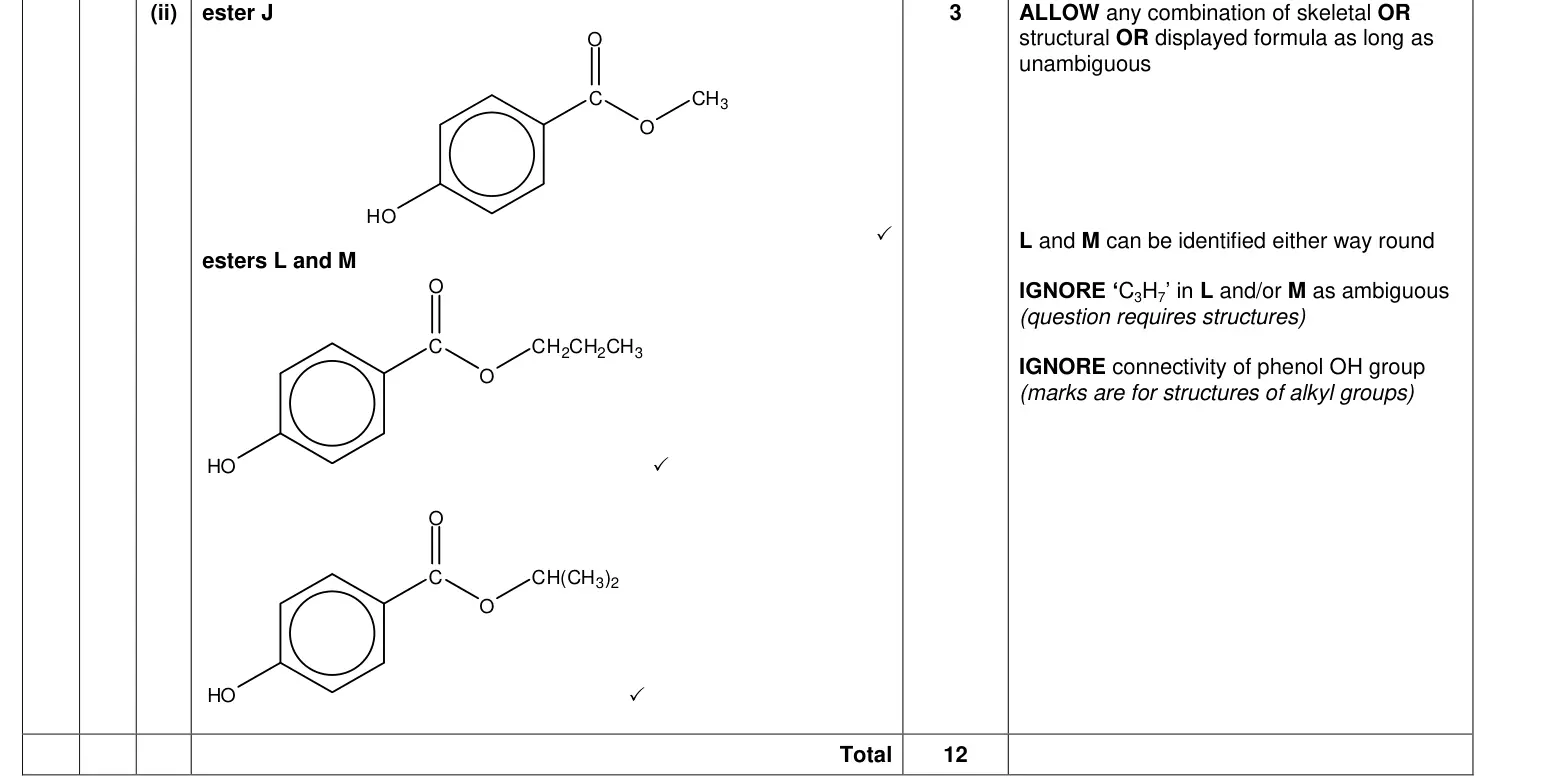
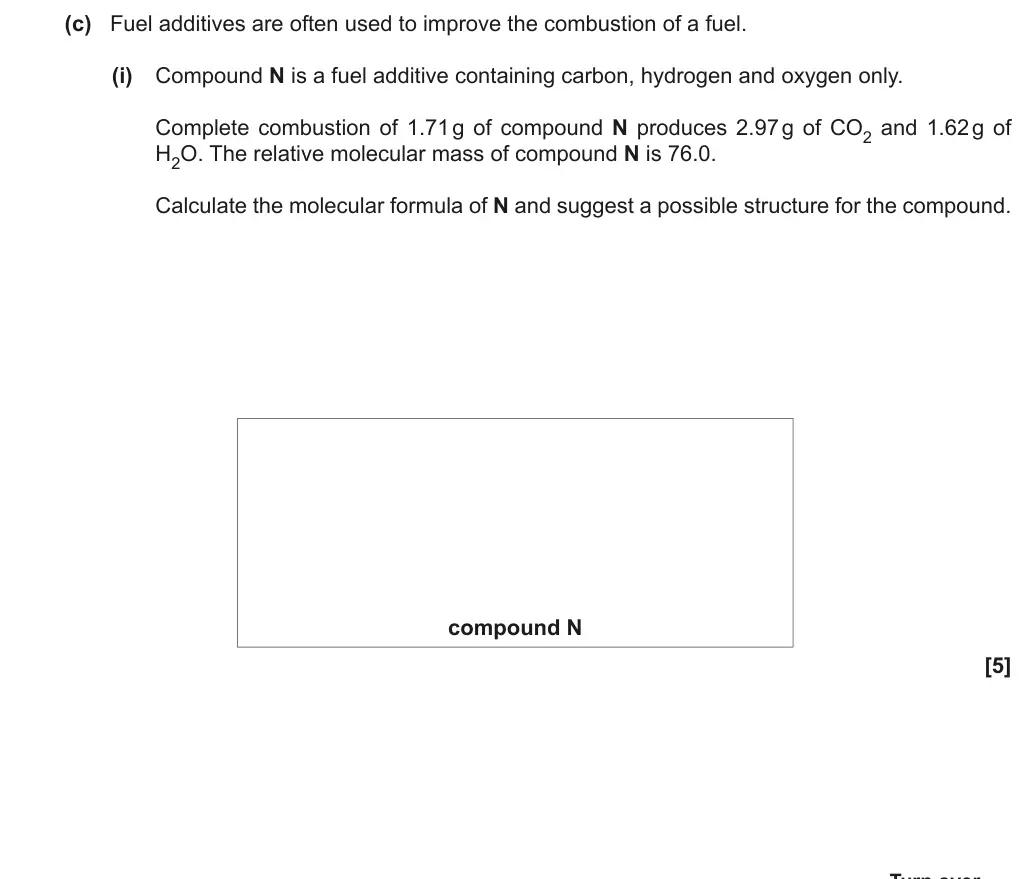
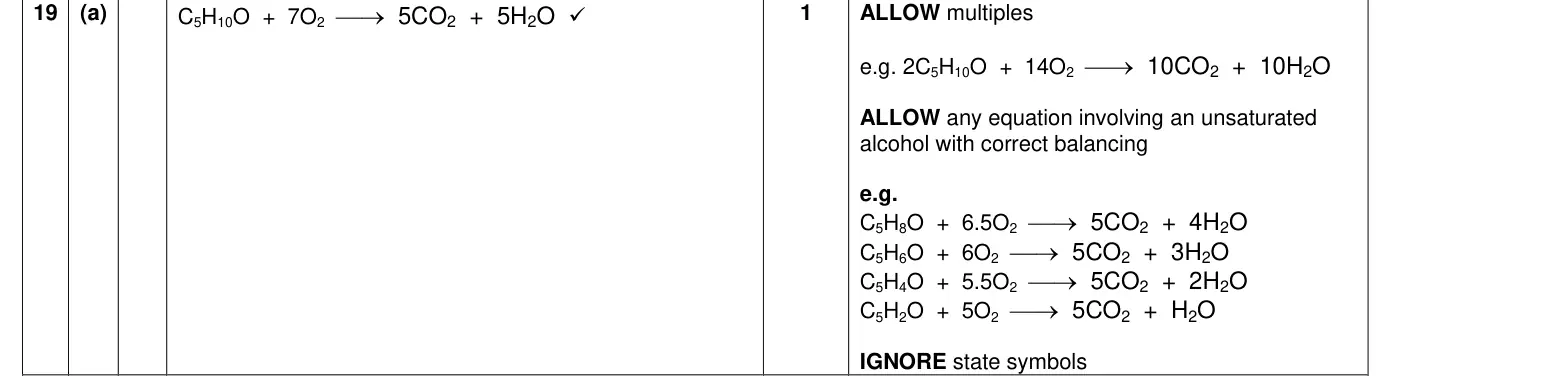
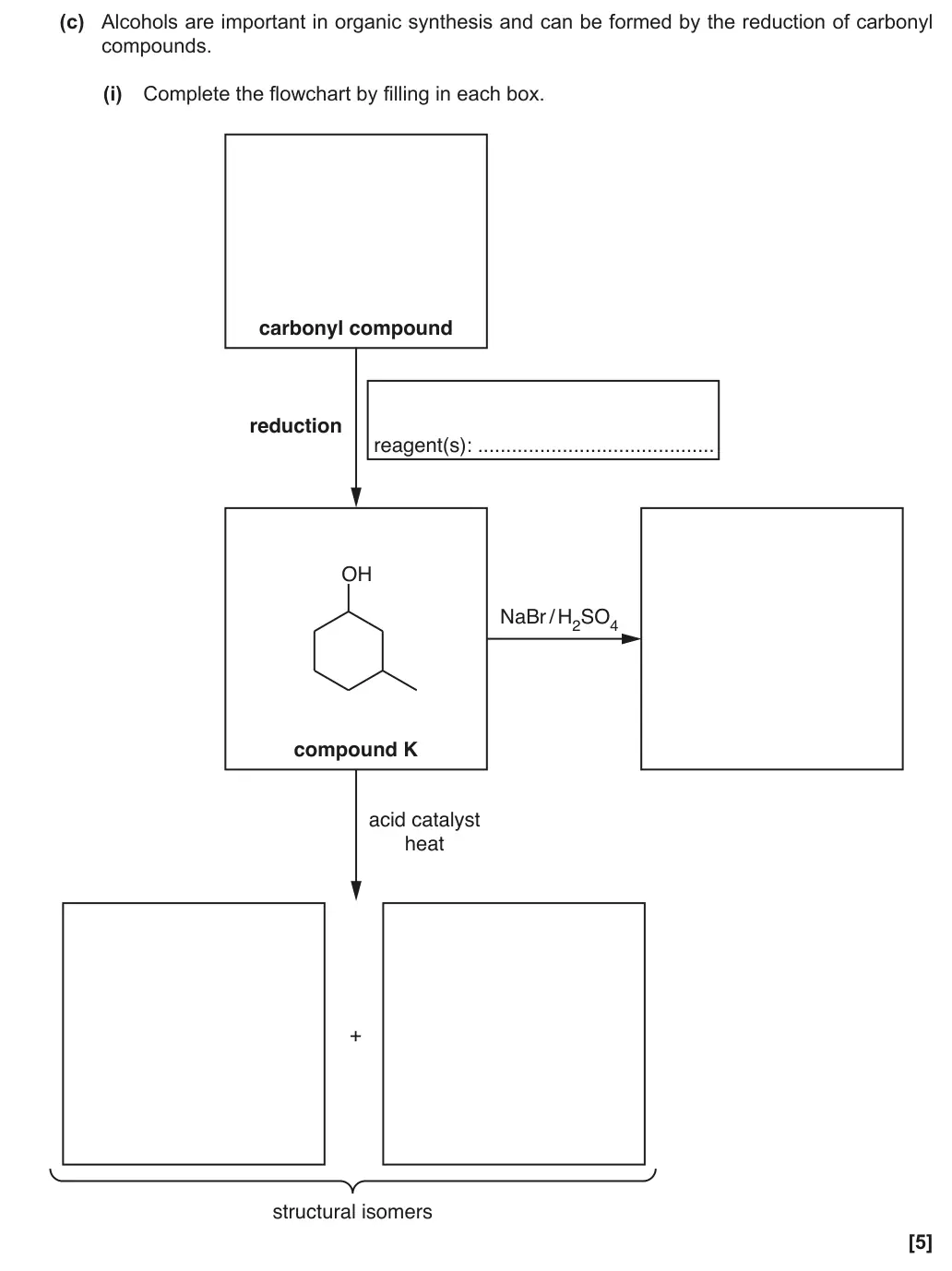
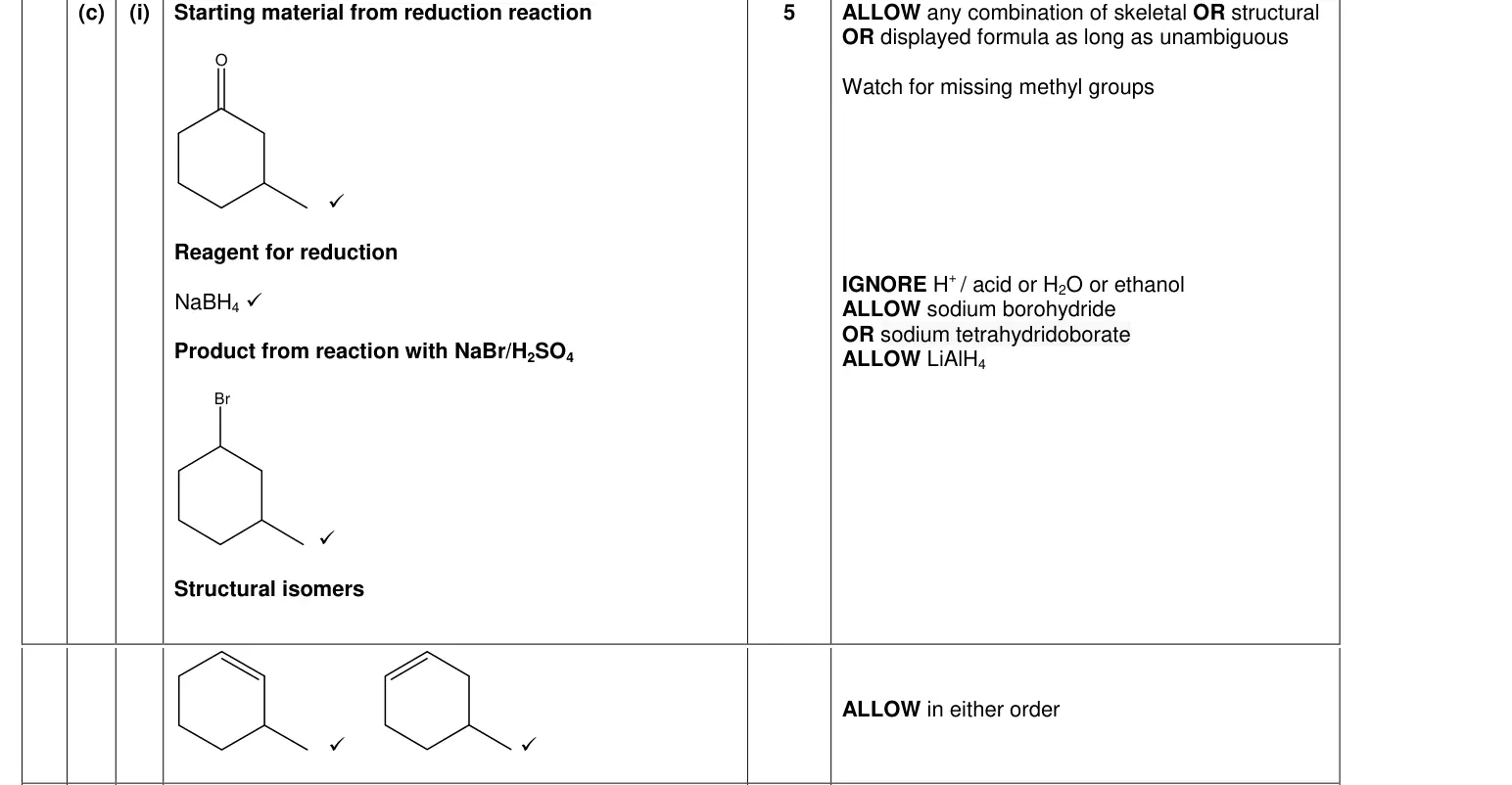
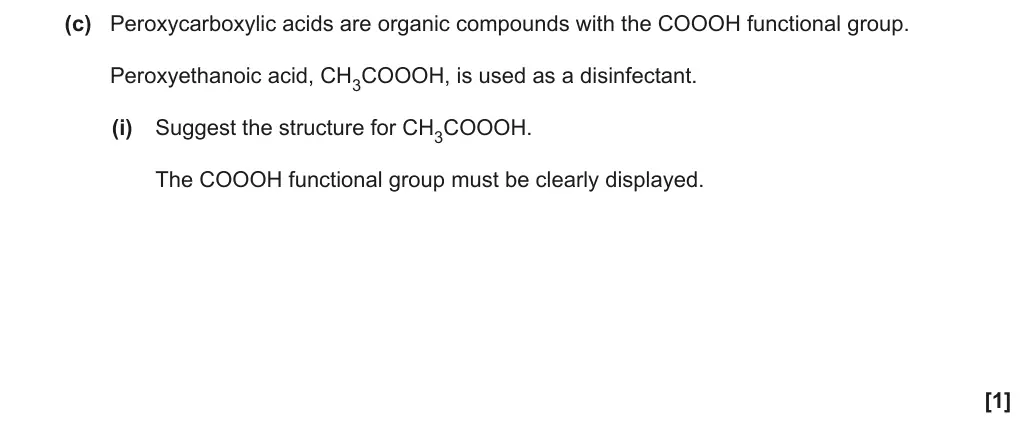
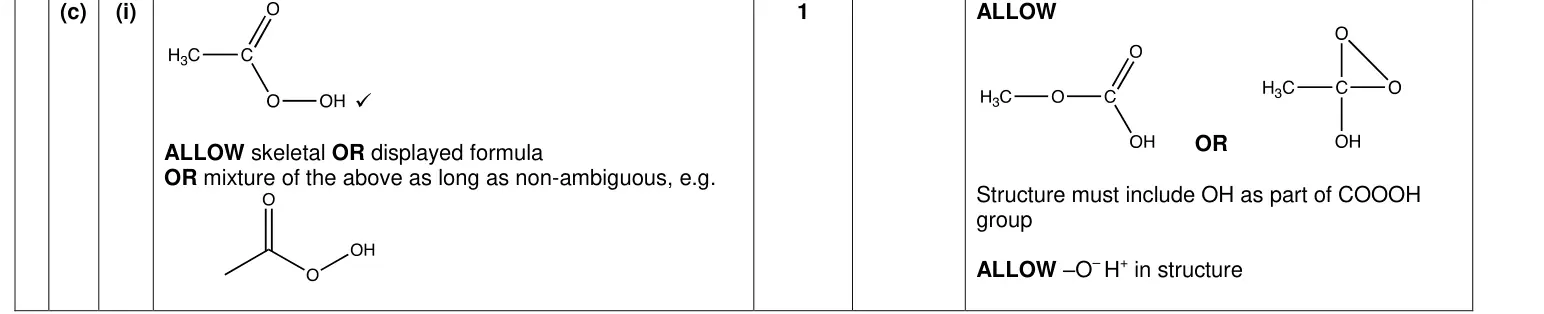
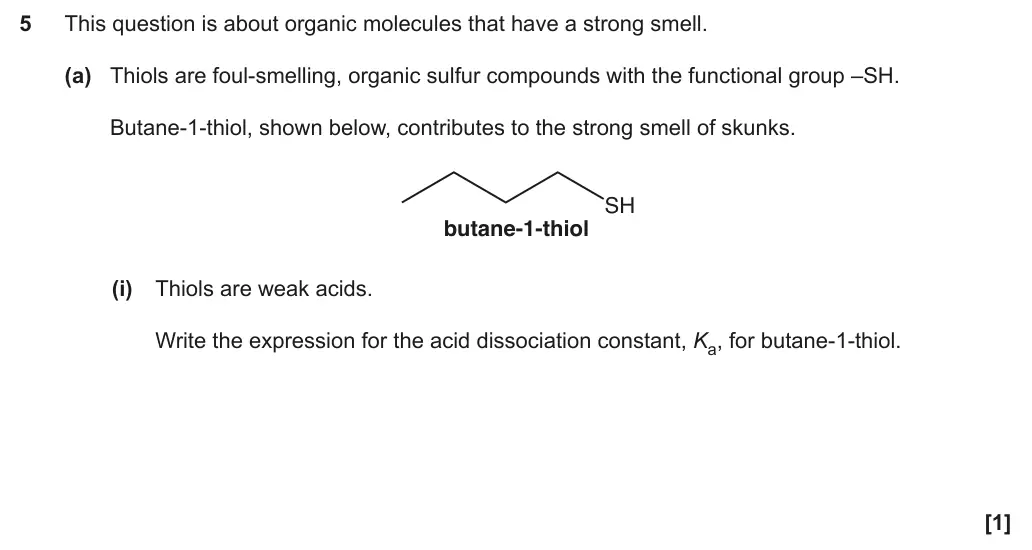
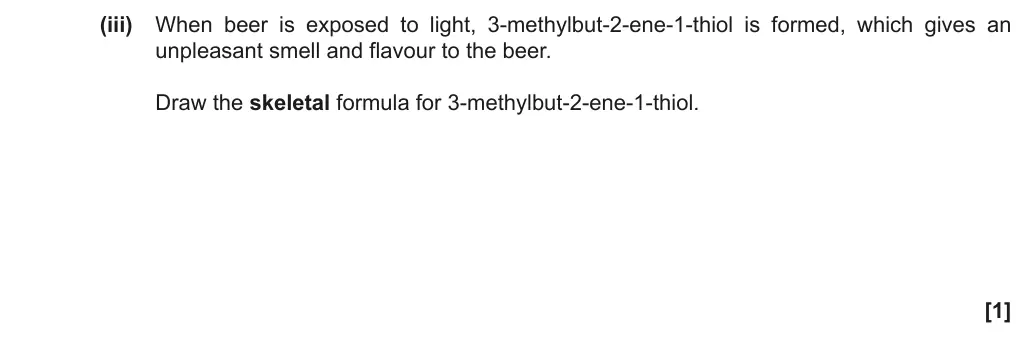
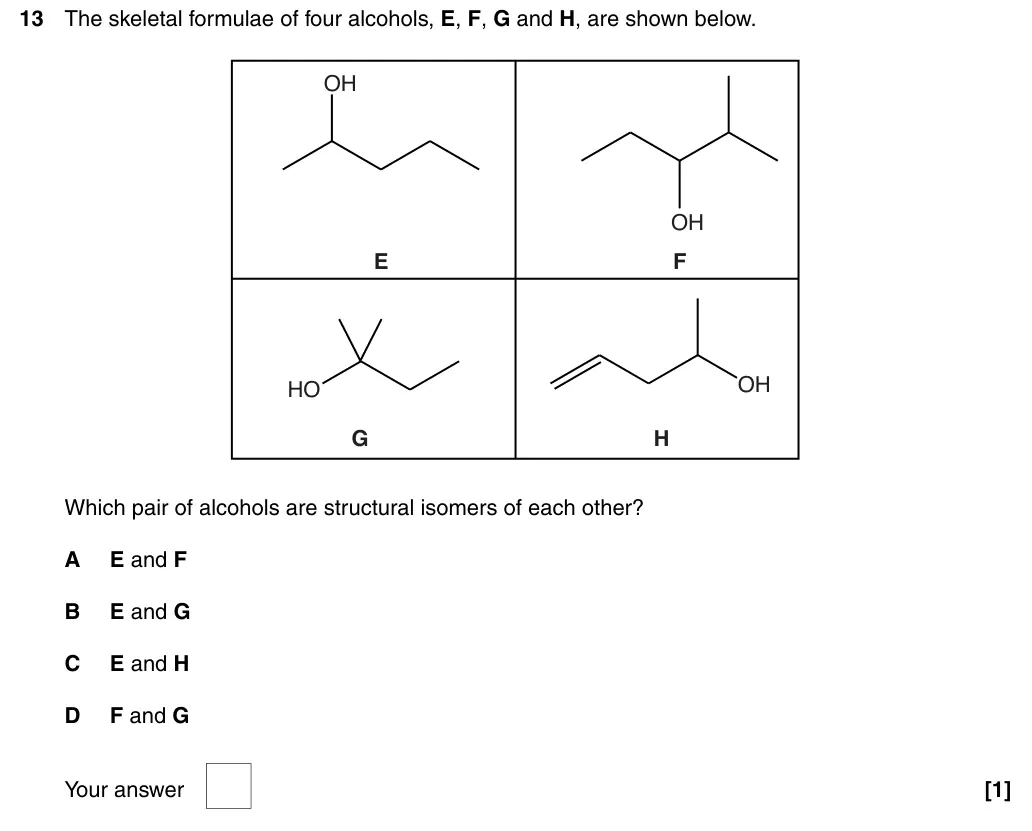
Notes and key-term cards for this topic are being written by our tutors. The past-paper questions below are ready now.
Learning outcomes
Show the 22 learning outcomes from the specification
4.1.1(a) application of IUPAC rules of nomenclature for systematically naming organic compounds
4.1.1(b) interpretation and use of the terms:
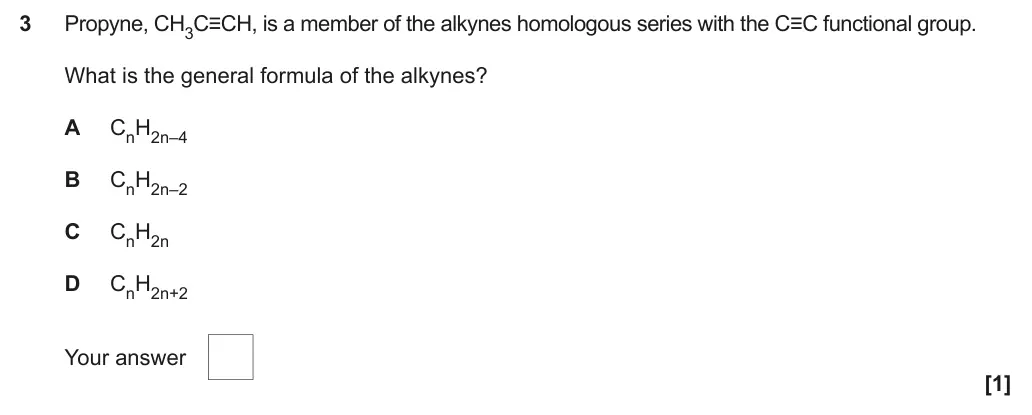
4.1.1(b)(i) general formula (the simplest algebraic formula of a member of a homologous series) e.g. for an alkane: CnH2n+2
4.1.1(b)(ii) structural formula (the minimal detail that shows the arrangement of atoms in a molecule) e.g. for butane: CH3CH2CH2CH3or CH3(CH2)2CH3
4.1.1(b)(iii) displayed formula (the relative positioning of atoms and the bonds between them) e.g. for ethanol: H H H C C O H H H
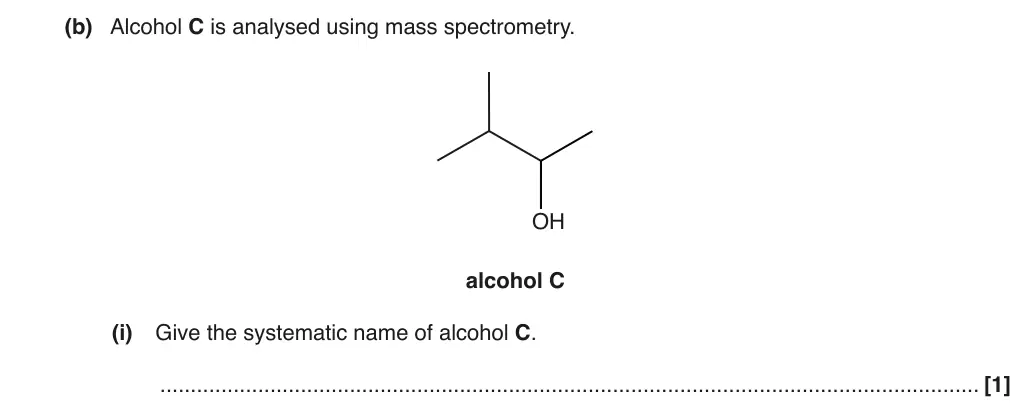
4.1.1(b)(iv) skeletal formula (the simplified organic formula, shown by removing hydrogen atoms from alkyl chains, leaving just a carbon skeleton and associated functional groups) e.g. for butan-2-ol: OH
4.1.1(c) interpretation and use of the terms:
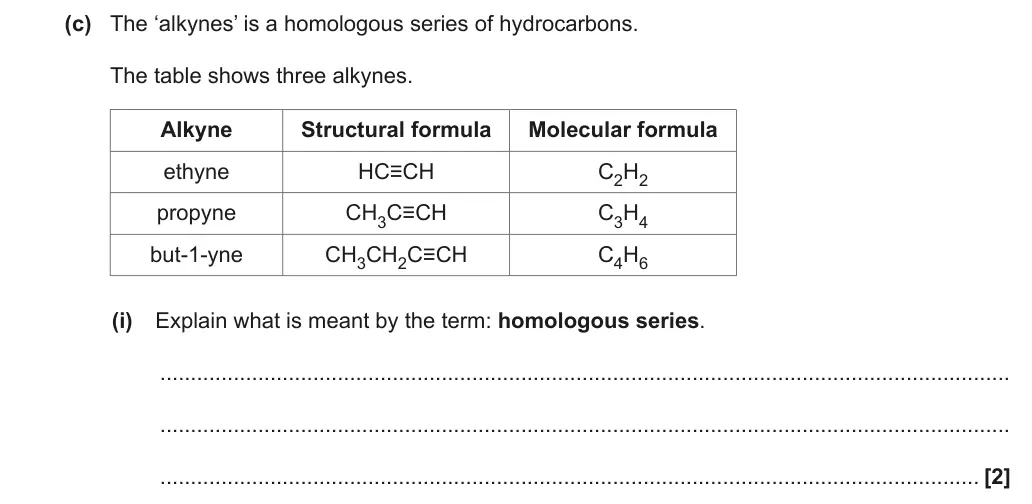
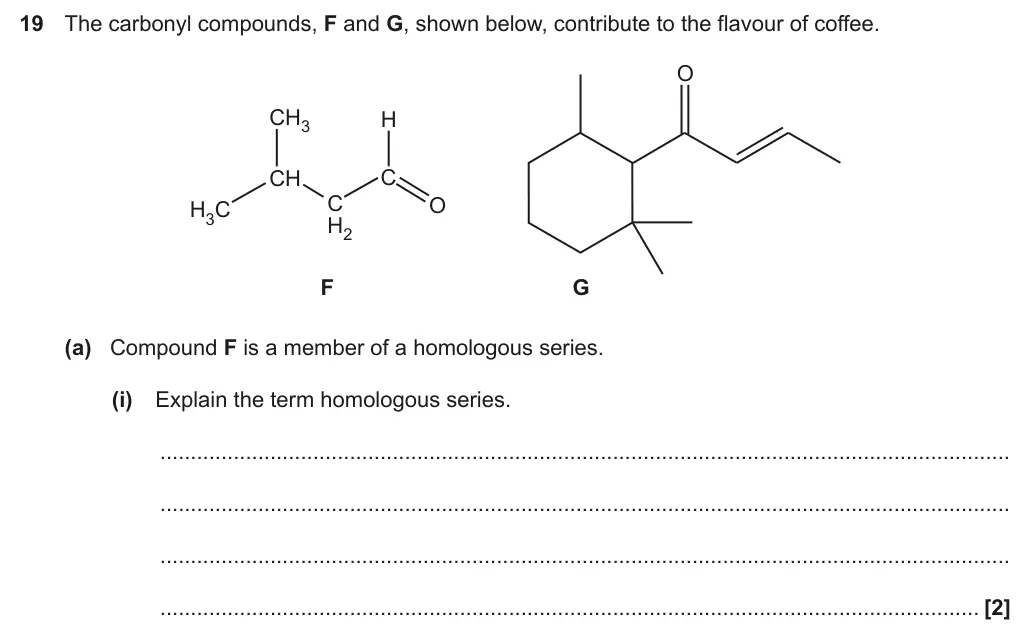
4.1.1(c)(i) homologous series (a series of organic compounds having the same functional group but with each successive member differing by CH2)
4.1.1(c)(ii) functional group (a group of atoms responsible for the characteristic reactions of a compound)
4.1.1(c)(iii) alkyl group (of formula CnH2n+1)
4.1.1(c)(iv) aliphatic (a compound containing carbon and hydrogen joined together in straight chains, branched chains or non-aromatic rings)
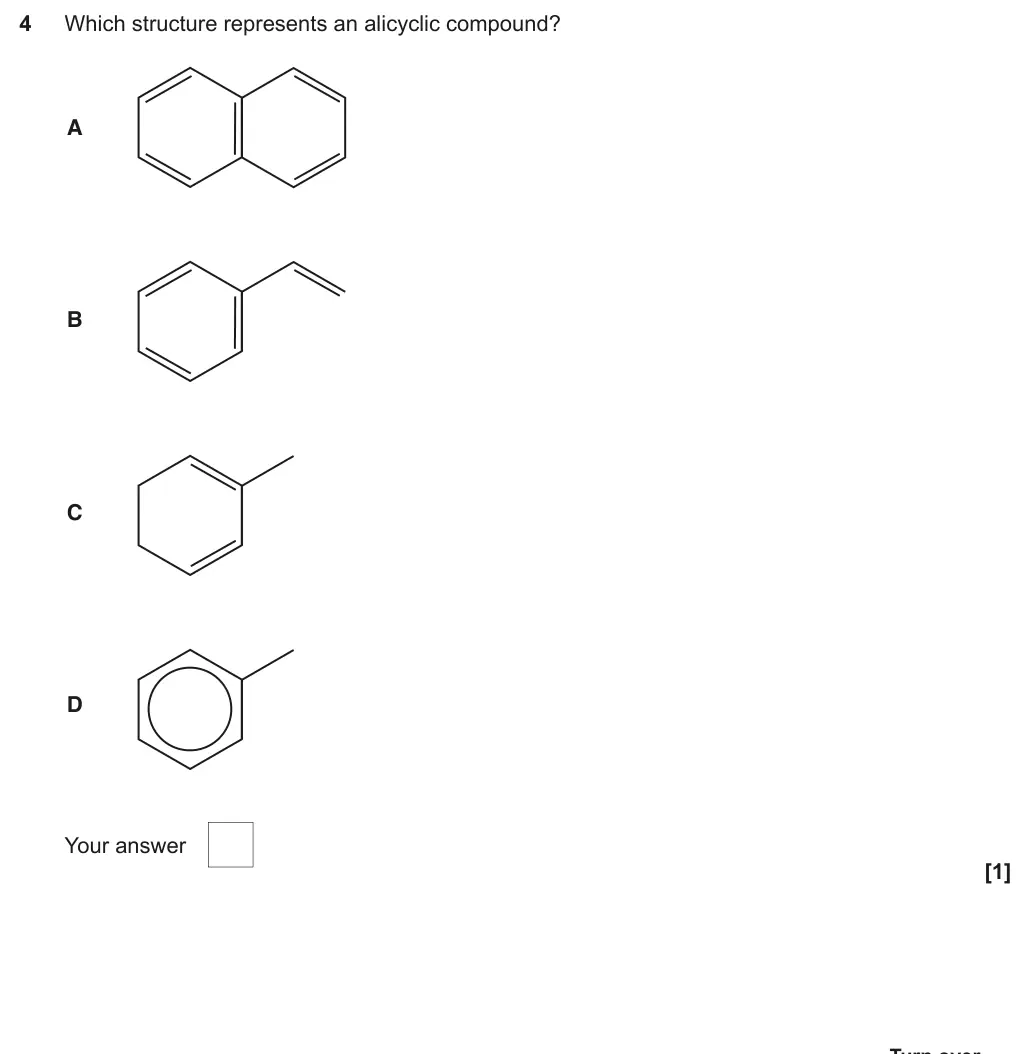
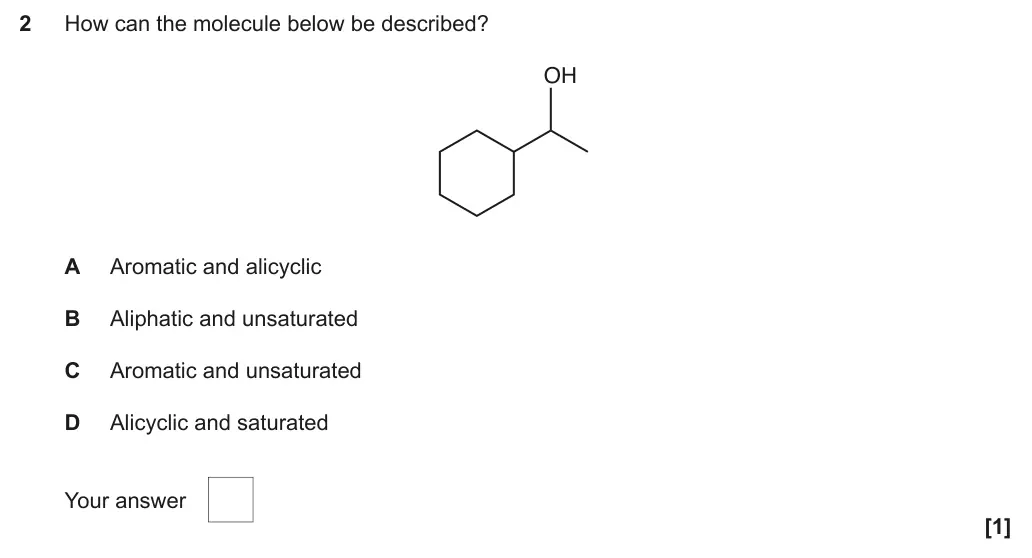
4.1.1(c)(v) alicyclic (an aliphatic compound arranged in non-aromatic rings with or without side chains)
4.1.1(c)(vi) aromatic (a compound containing a benzene ring)
4.1.1(c)(vii) saturated (single carbon– carbon bonds only) and unsaturated (the presence of multiple carbon– carbon bonds, including C=C, C/C and aromatic rings)
4.1.1(d) use of the general formula of a homologous series to predict the formula of any member of the series
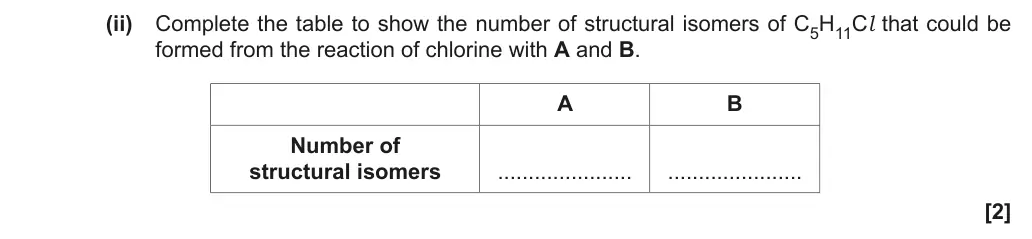
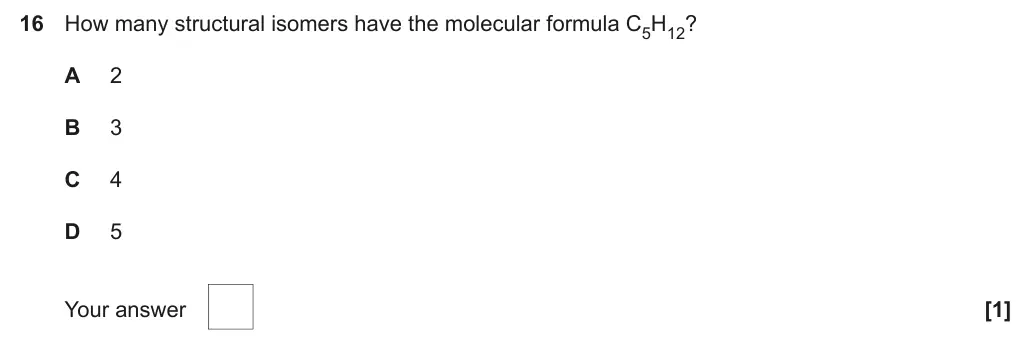
4.1.1(e) explanation of the term structural isomers (compounds with the same molecular formula but different structural formulae) and determination of possible structural formulae of an organic molecule, given its molecular formula
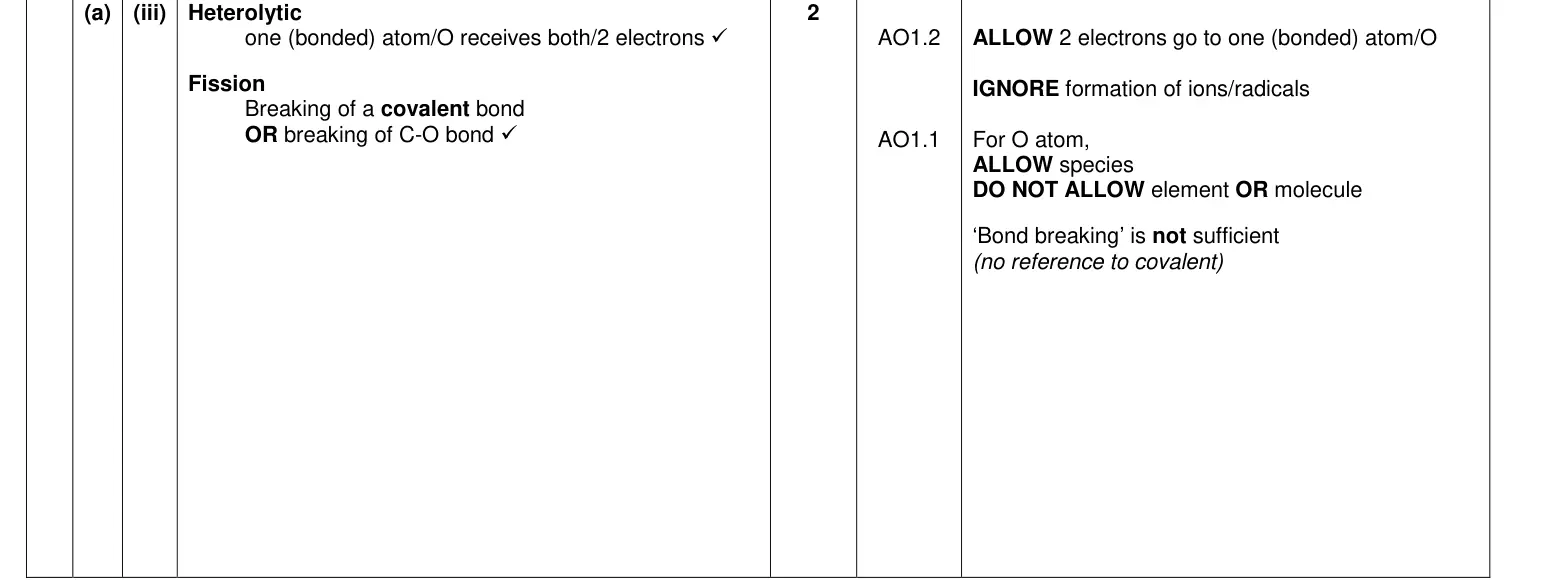
4.1.1(f) the different types of covalent bond fission:
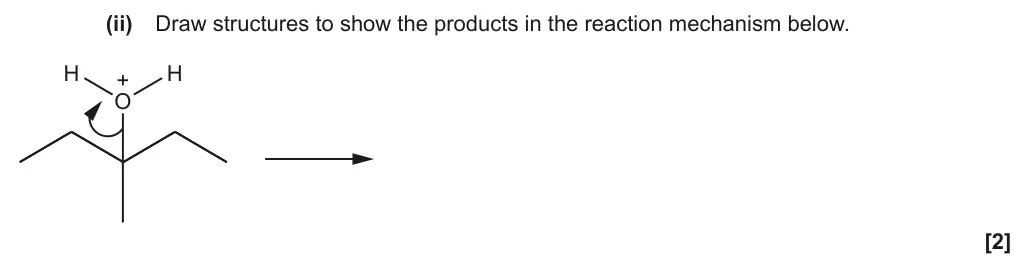
4.1.1(f)(i) homolytic fission (in terms of each bonding atom receiving one electron from the bonded pair, forming two radicals)
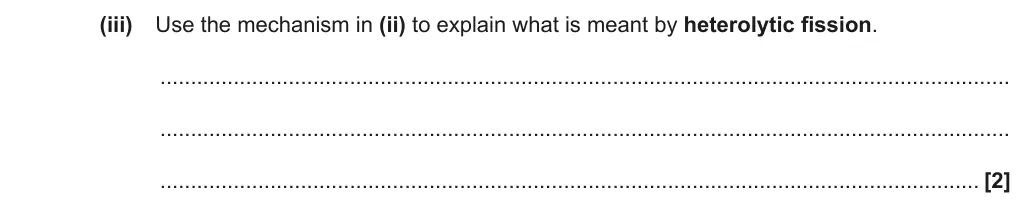
4.1.1(f)(ii) heterolytic fission (in terms of one bonding atom receiving both electrons from the bonded pair)
4.1.1(g) the term radical (a species with an unpaired electron) and use of ‘dots’ to represent species that are radicals in mechanisms
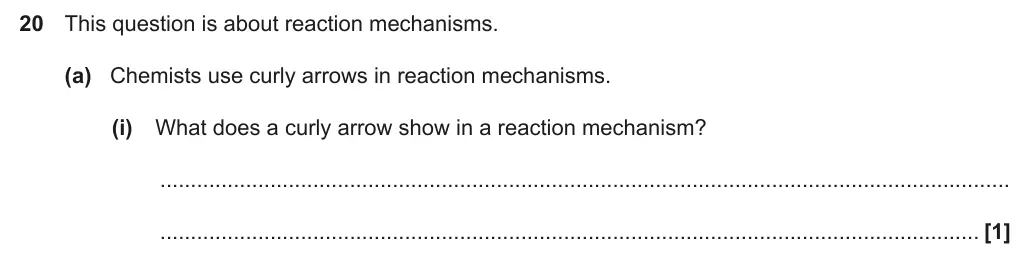
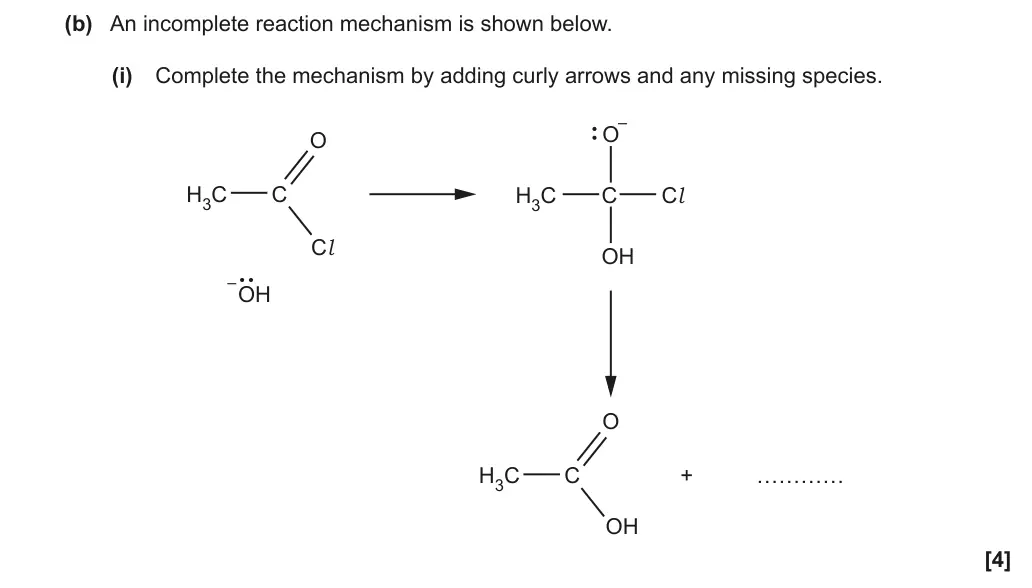
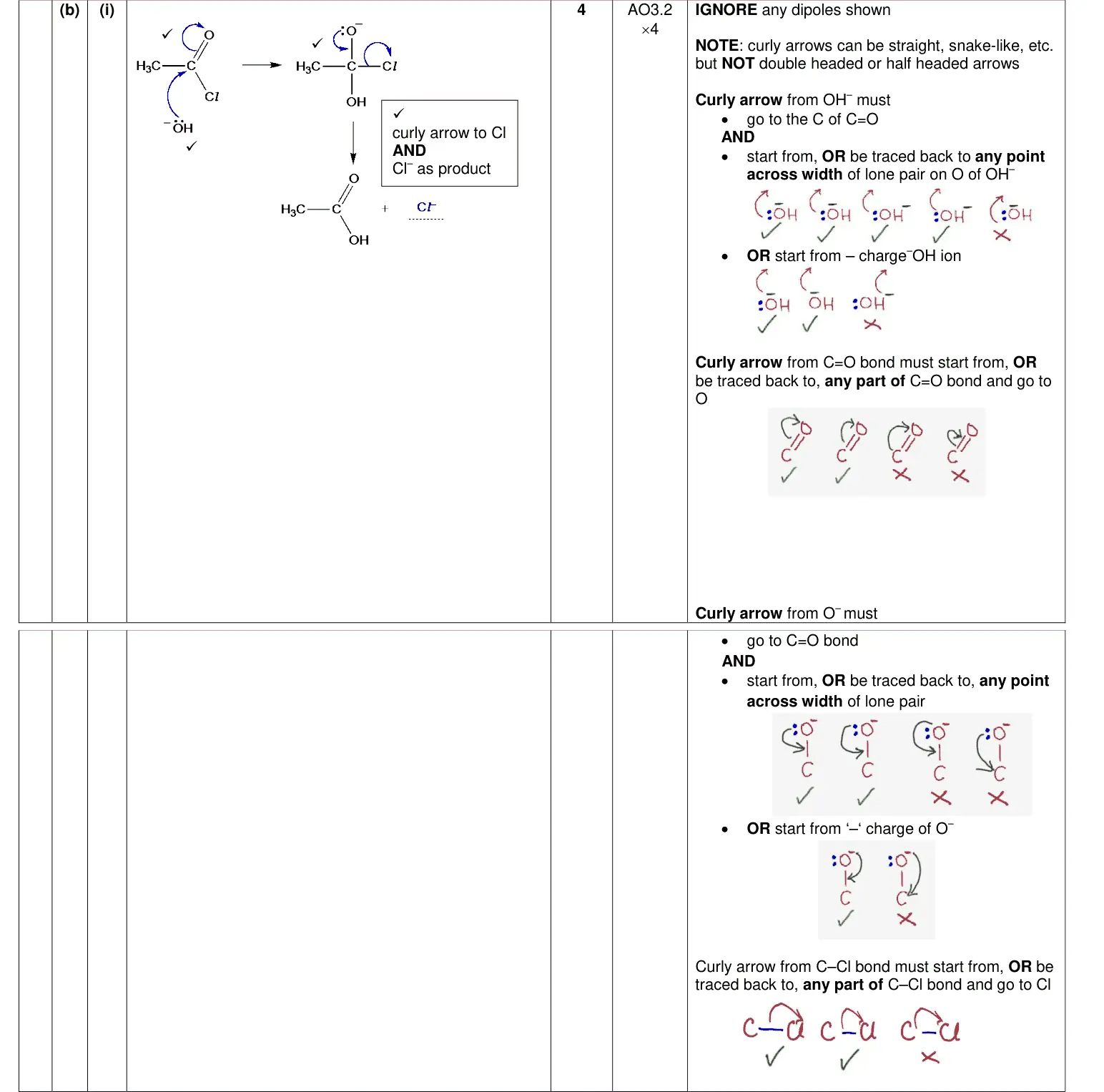
4.1.1(h) a ‘curly arrow’ described as the movement of an electron pair, showing either heterolytic fission or formation of a covalent bond
4.1.1(i) reaction mechanisms, using diagrams, to show clearly the movement of an electron pair with ‘curly arrows’ and relevant dipoles.
Six-mark level of response questions on this topic
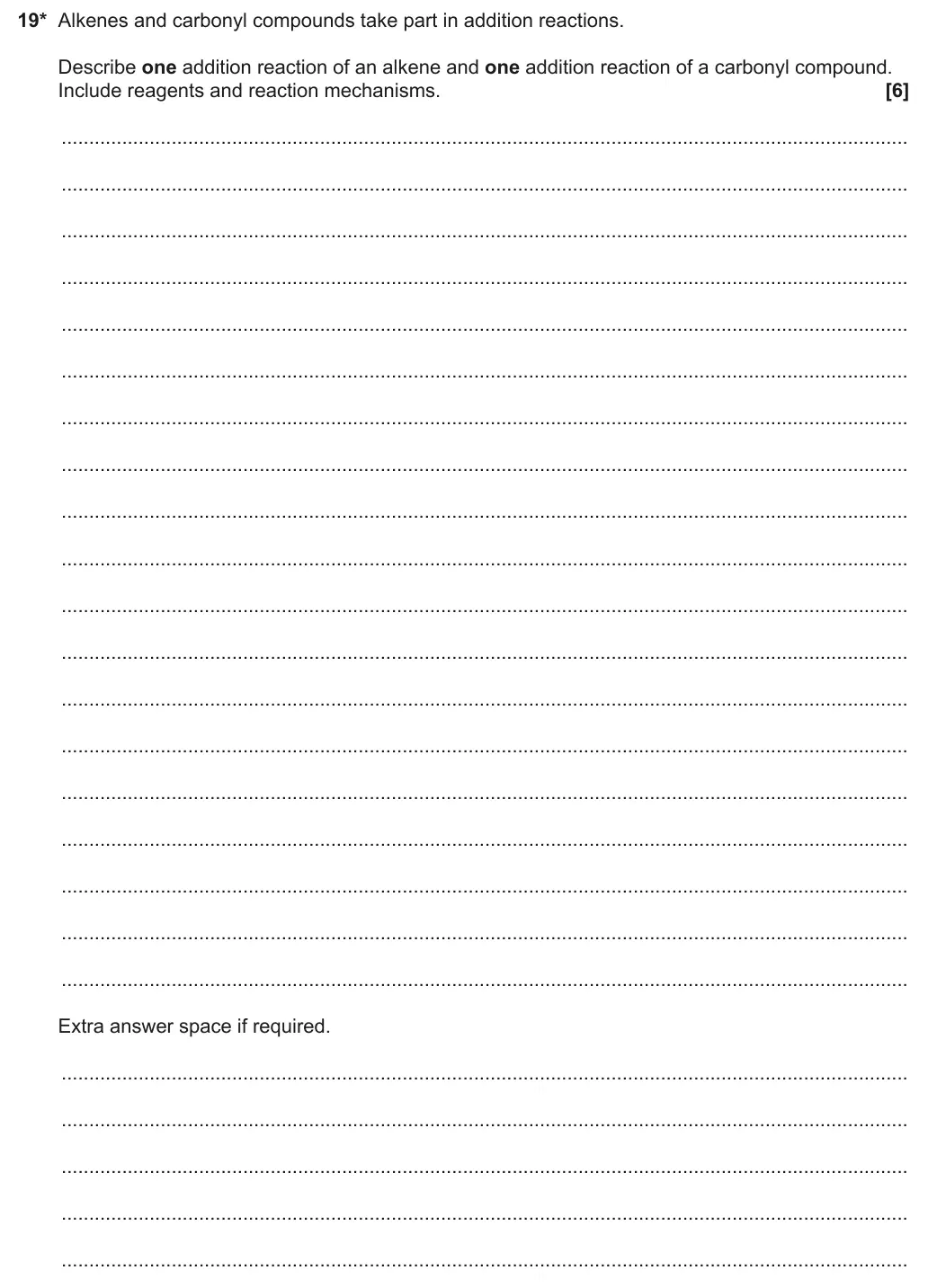
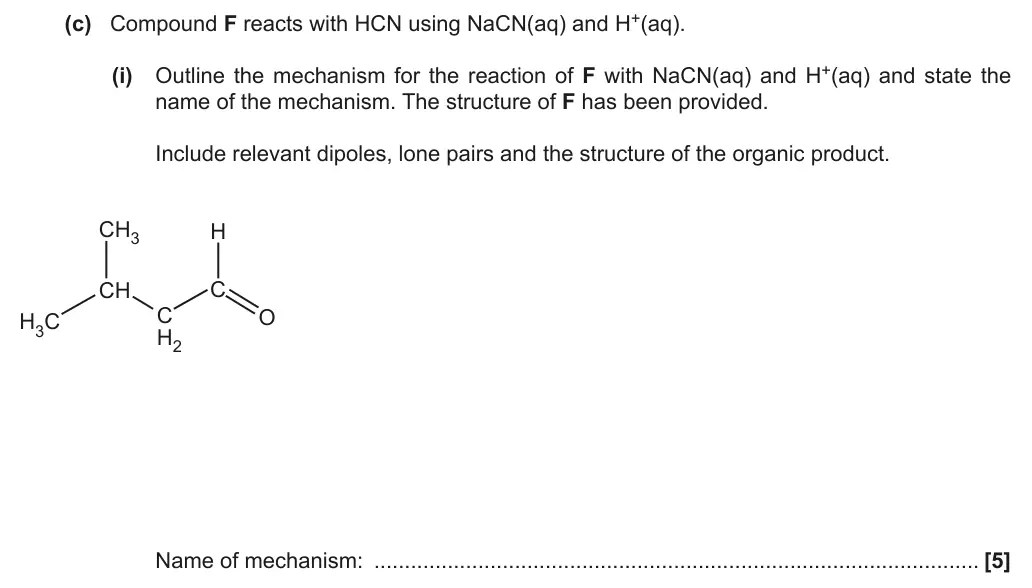
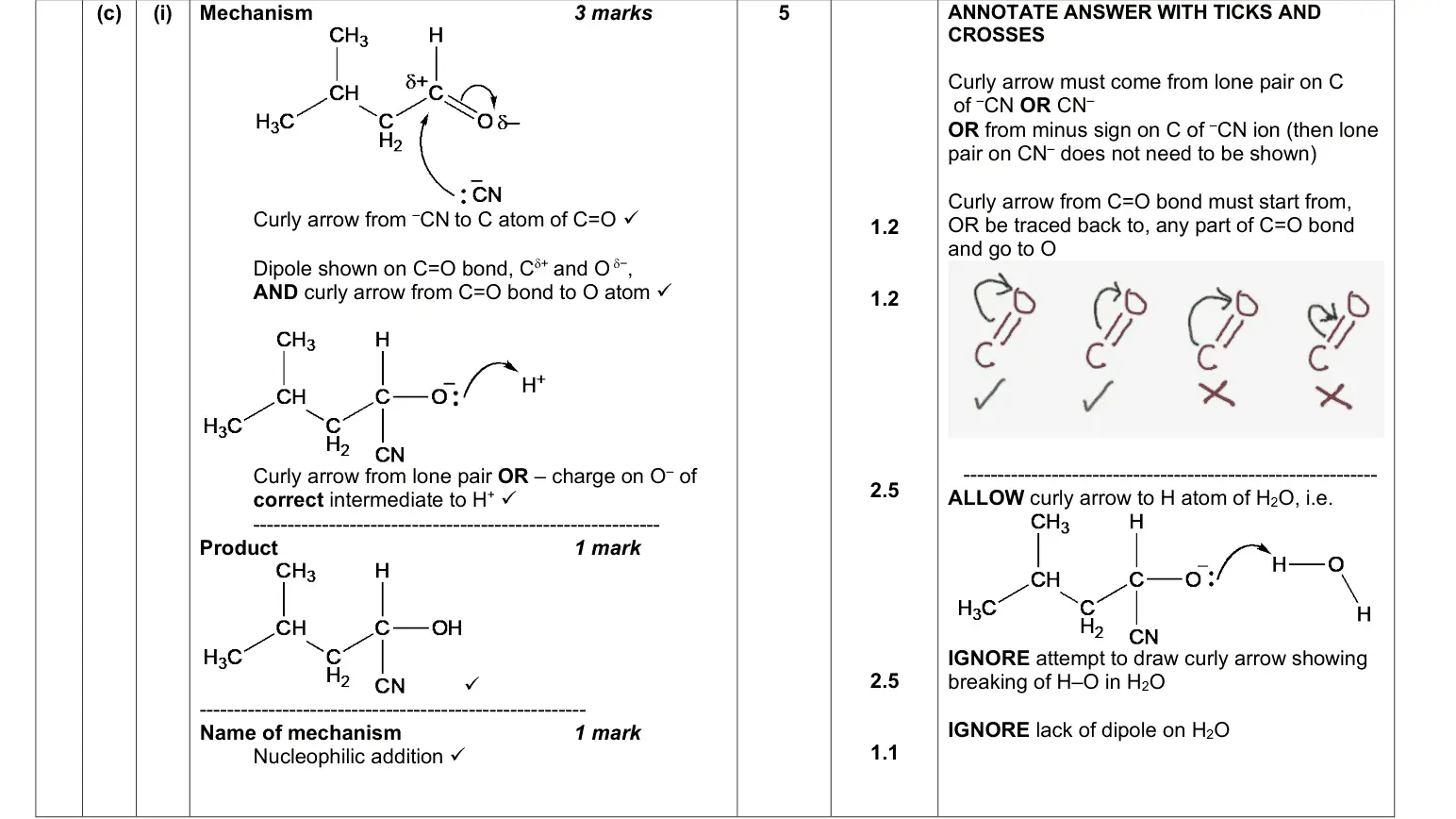
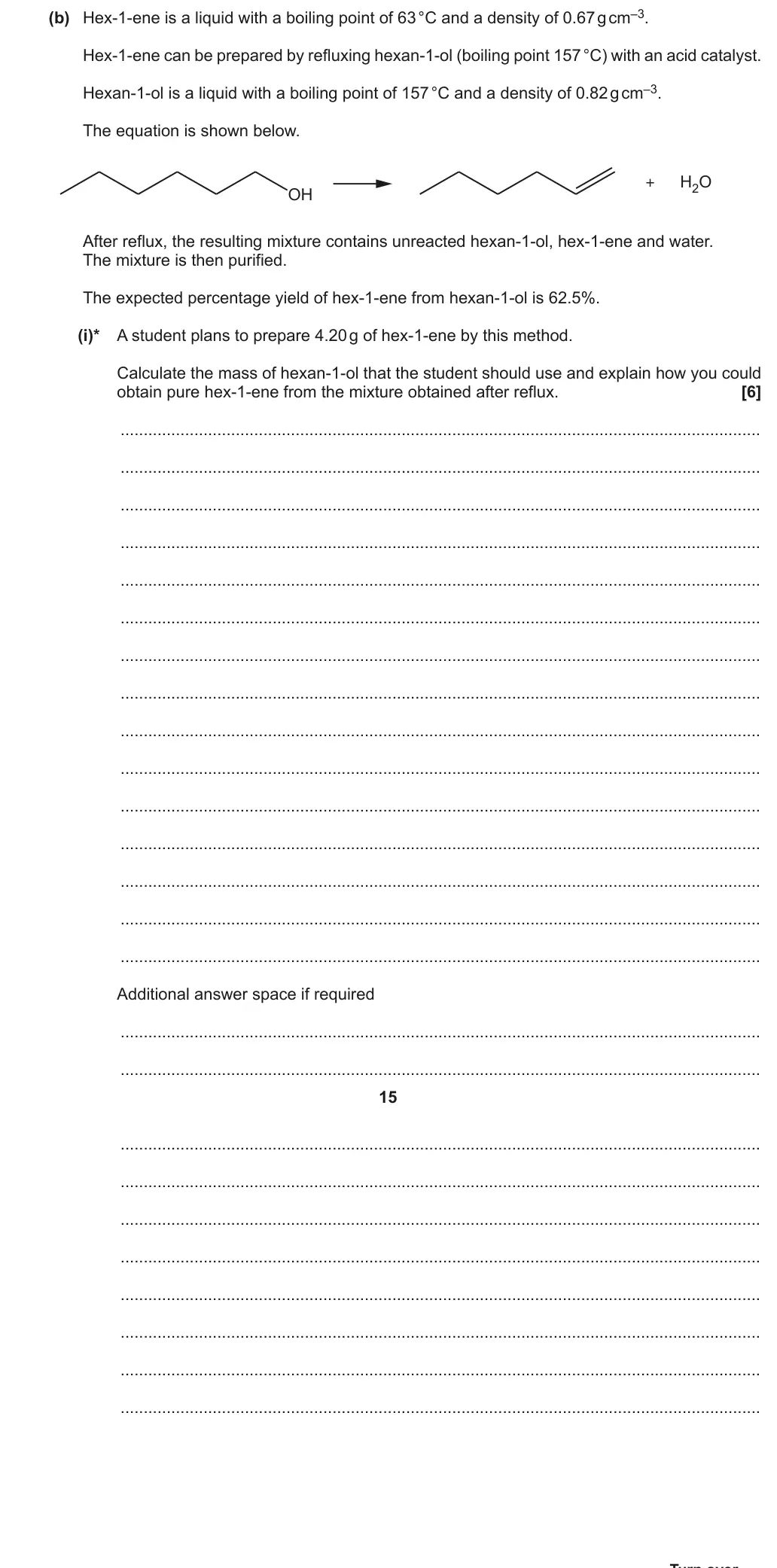
Alkenes and carbonyl compounds take part in addition reactions. Describe one addition reaction of an alkene and one addition reaction of a carbonyl compound.
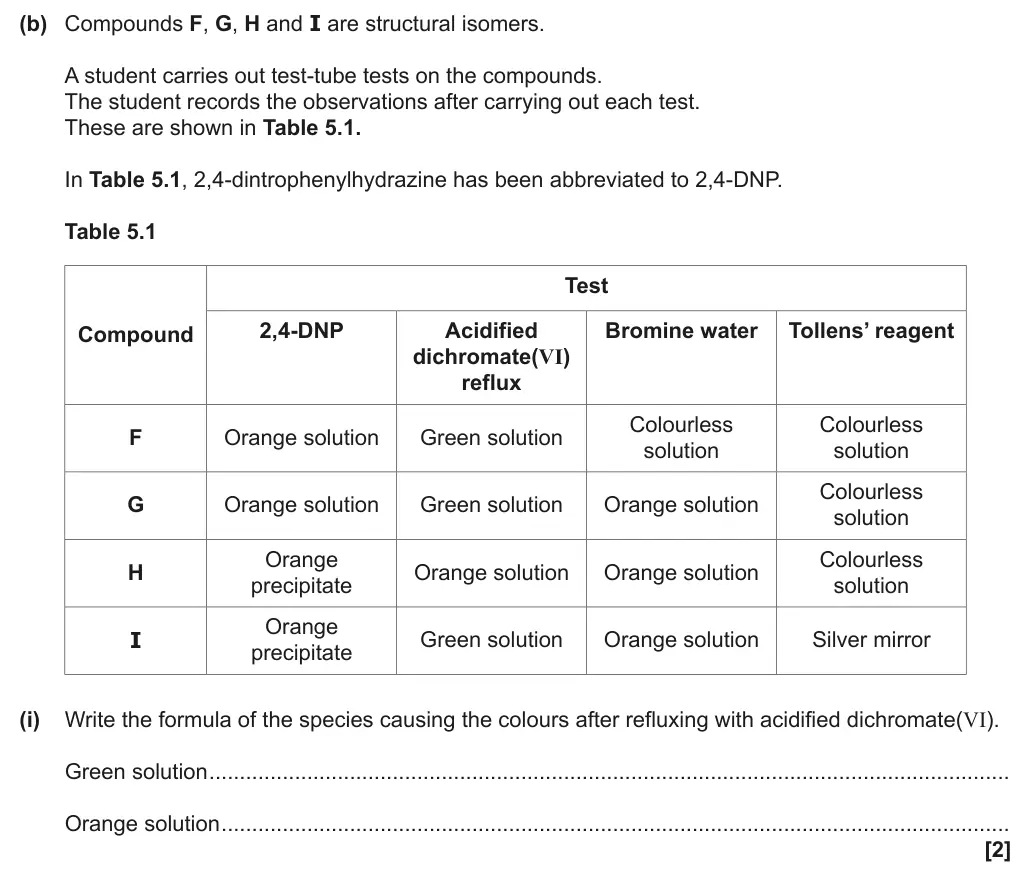
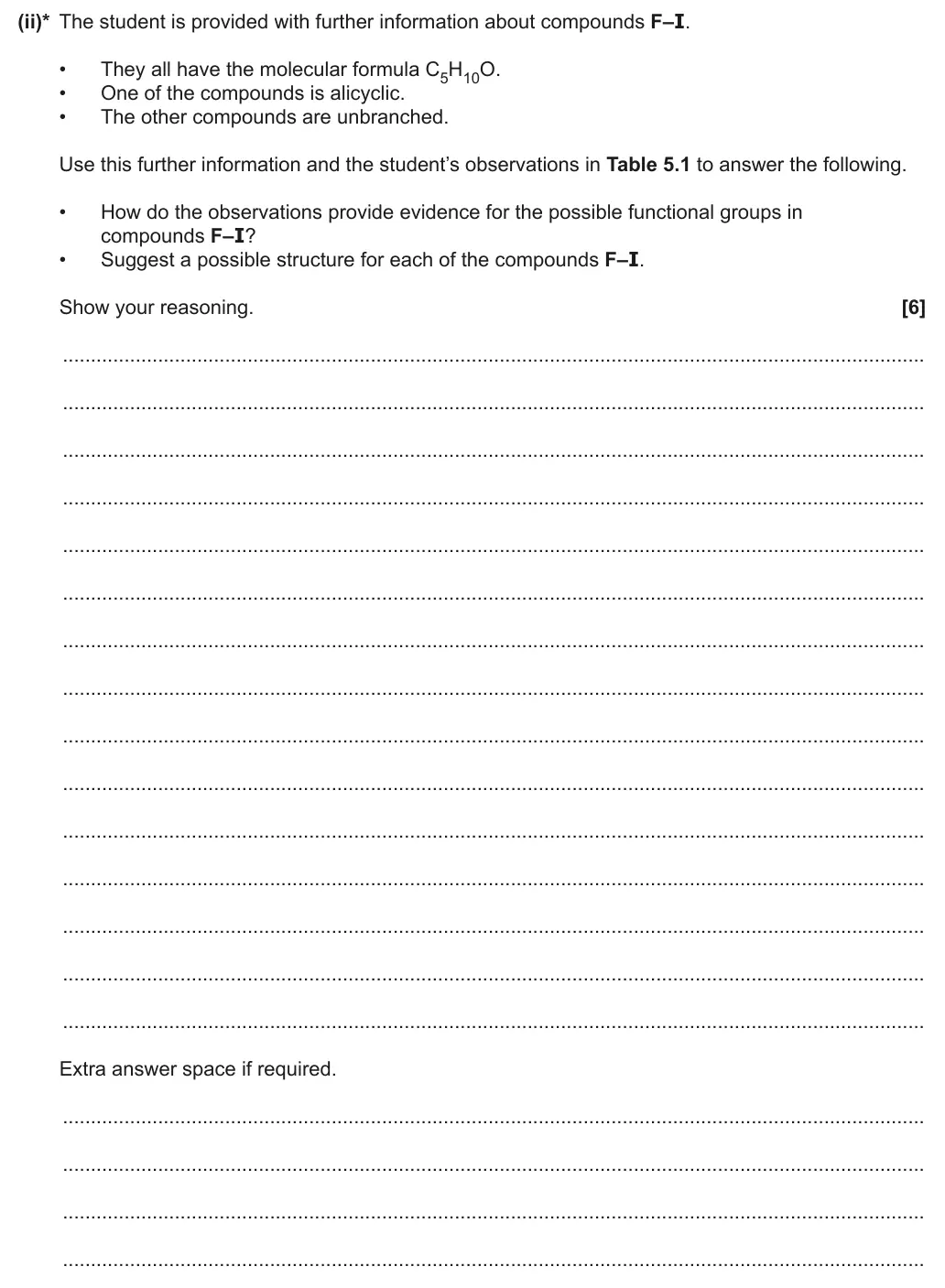
The student is provided with further information about compounds F–I. Use this further information and the student’s observations in Table 5.1 to answer the following.
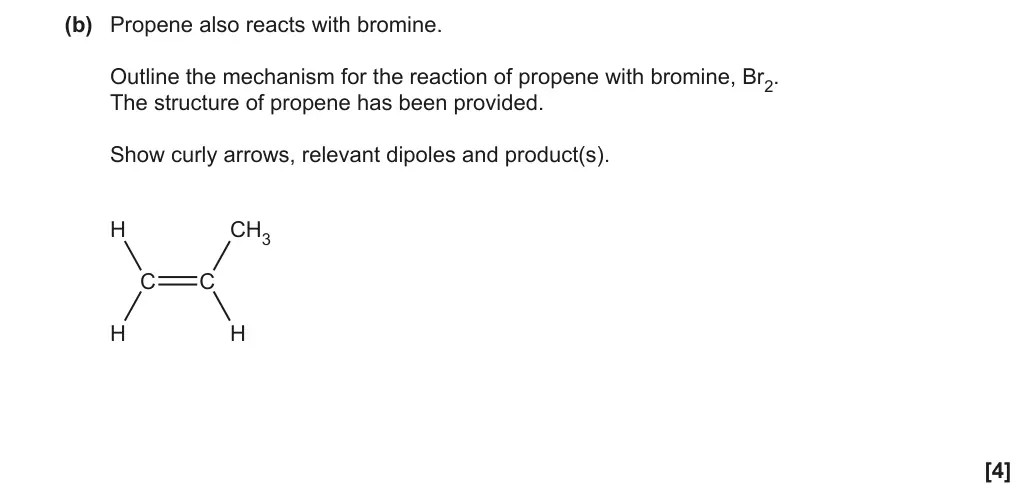
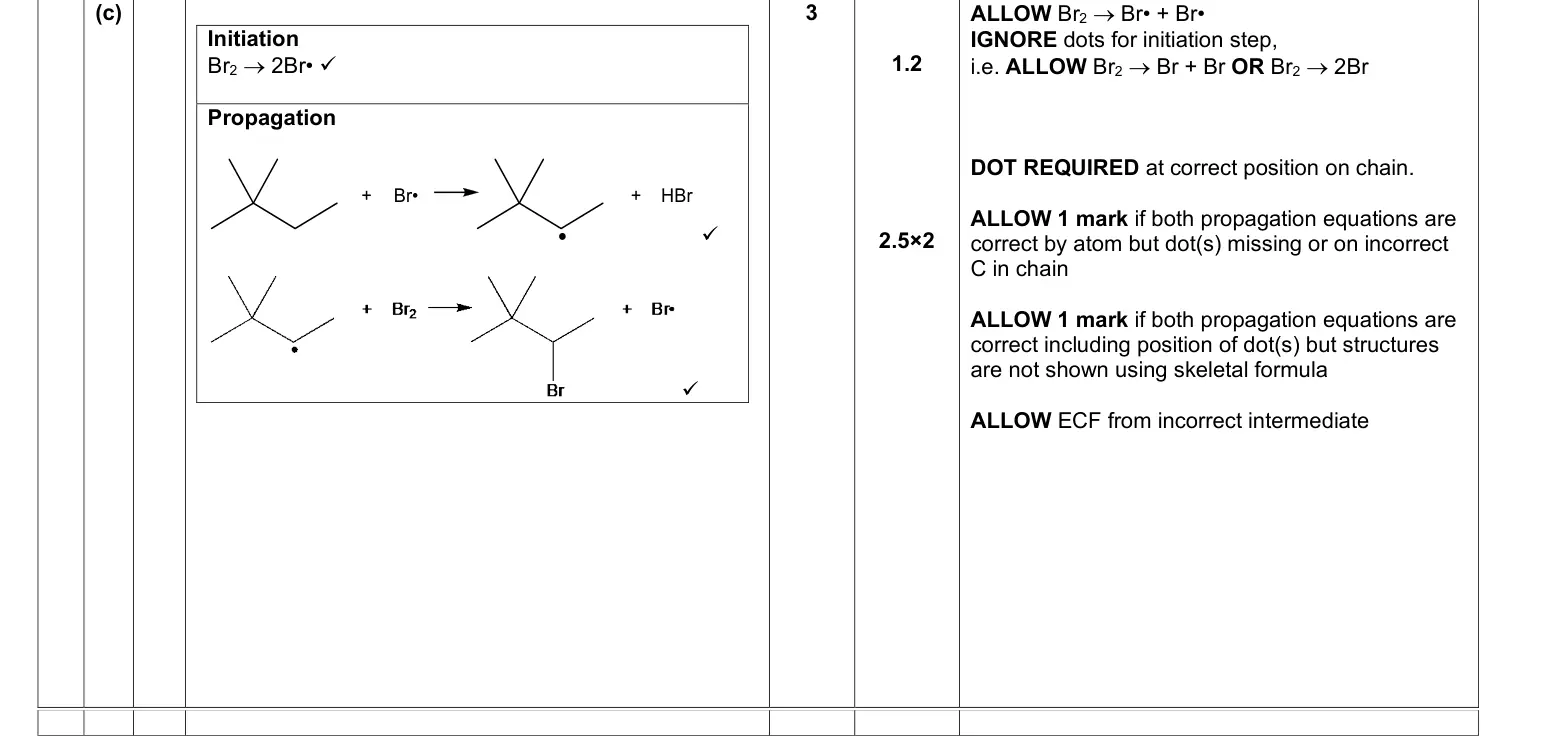
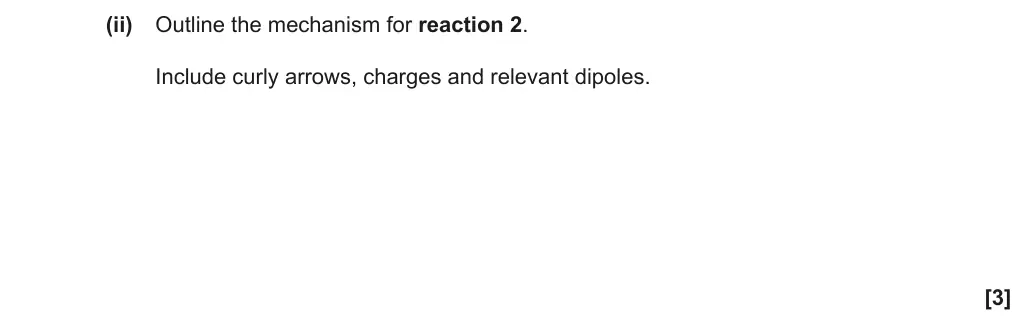
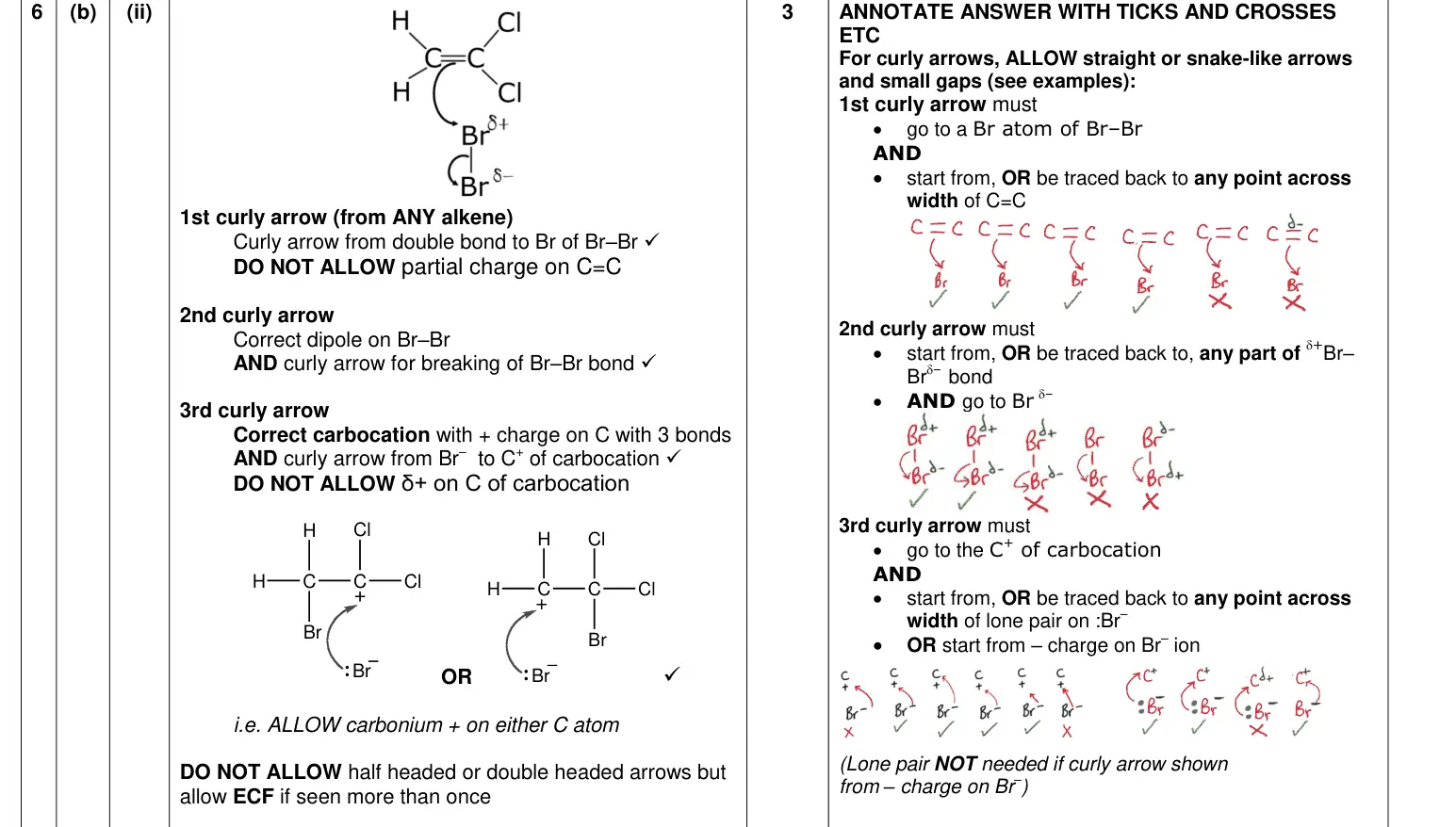
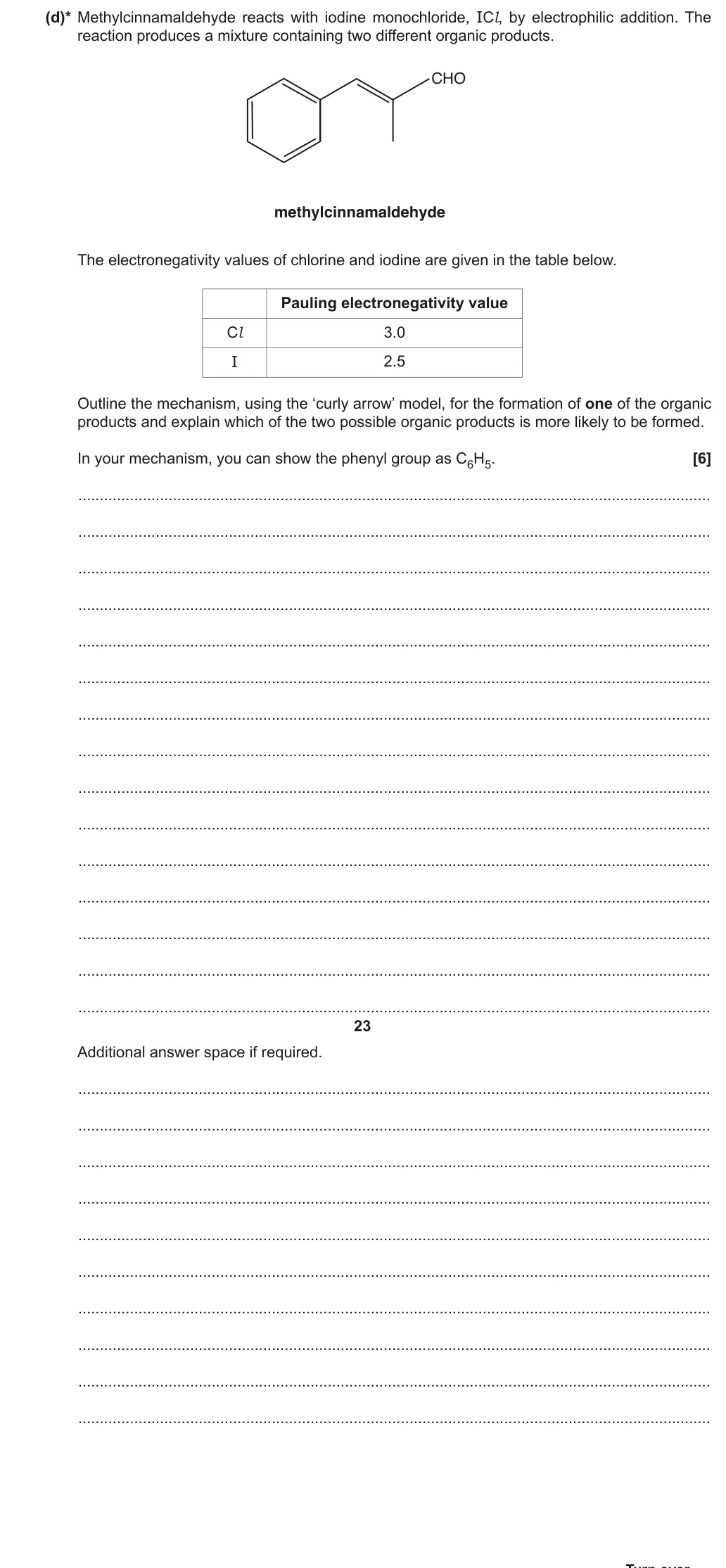
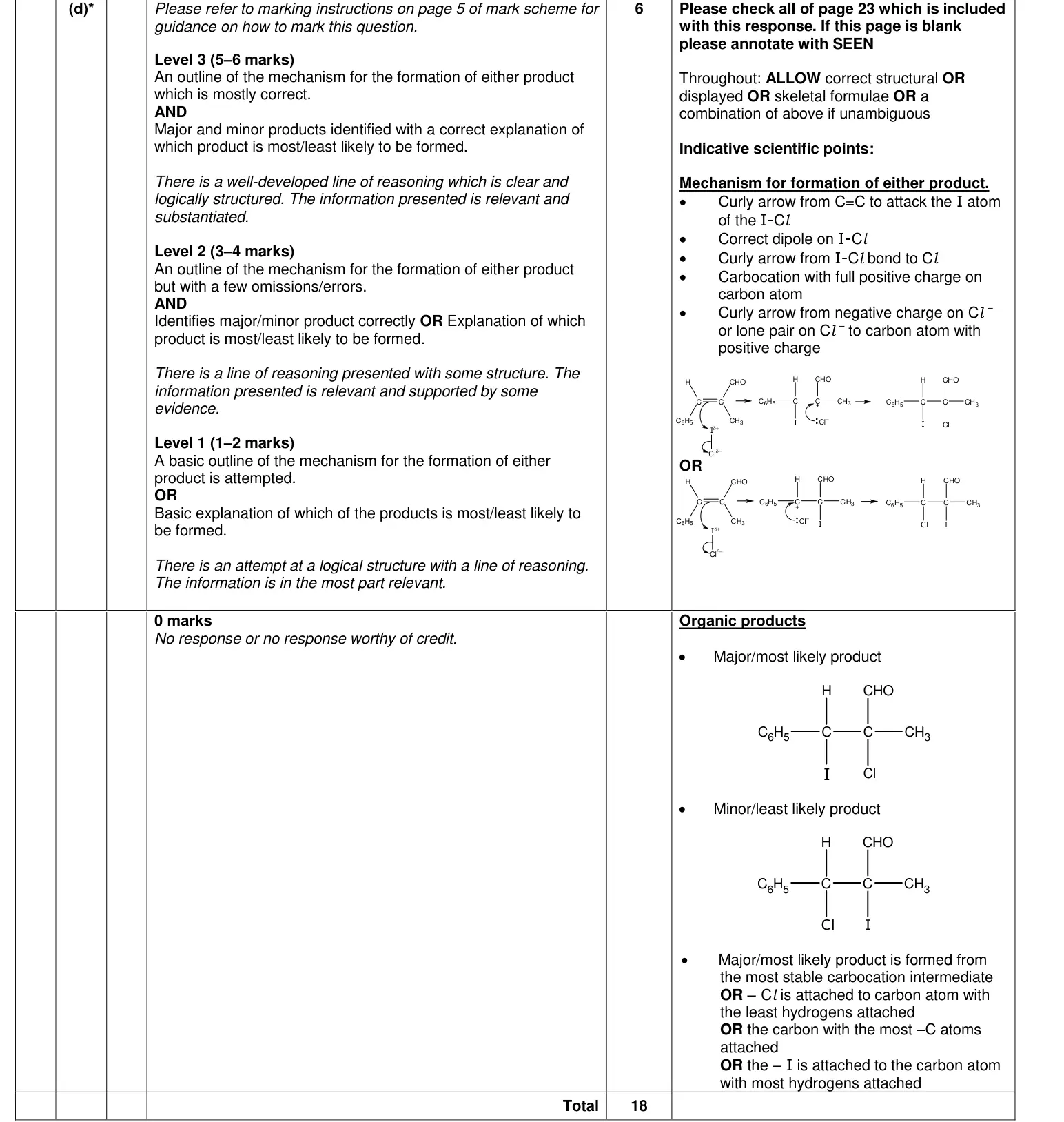
Methylcinnamaldehyde reacts with iodine monochloride, ICl, by electrophilic addition. The Outline the mechanism, using the ‘curly arrow’ model, for the formation of one of the organic
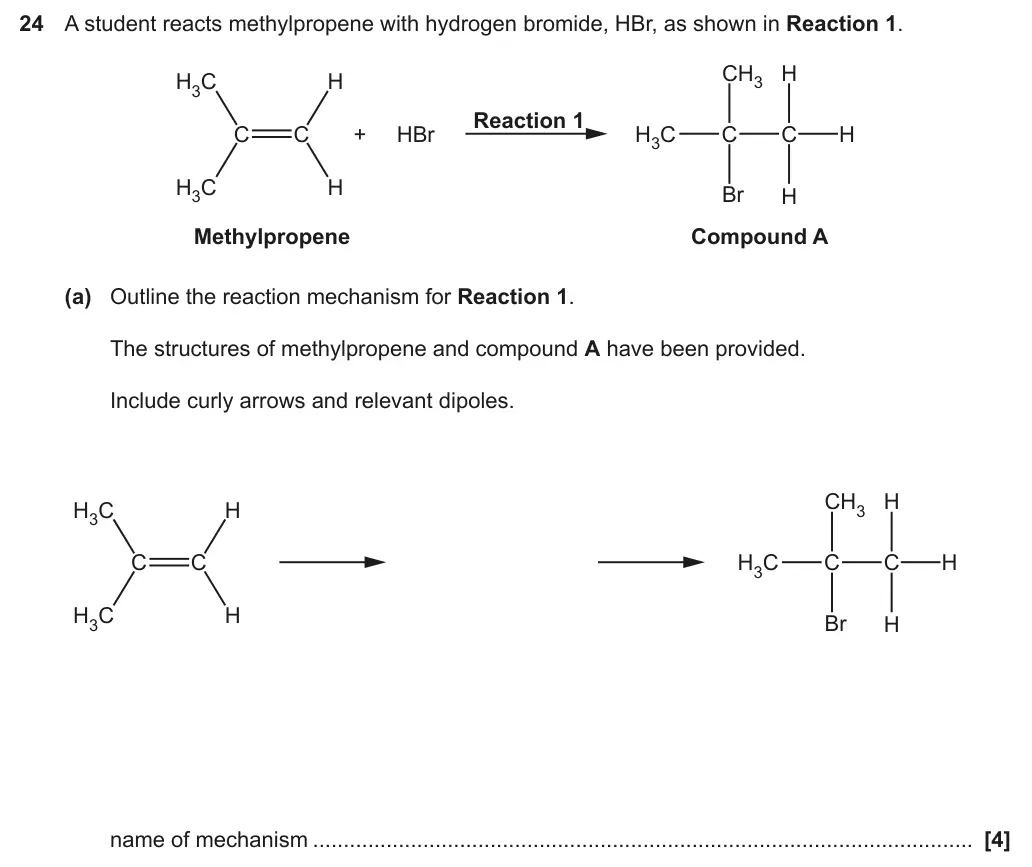
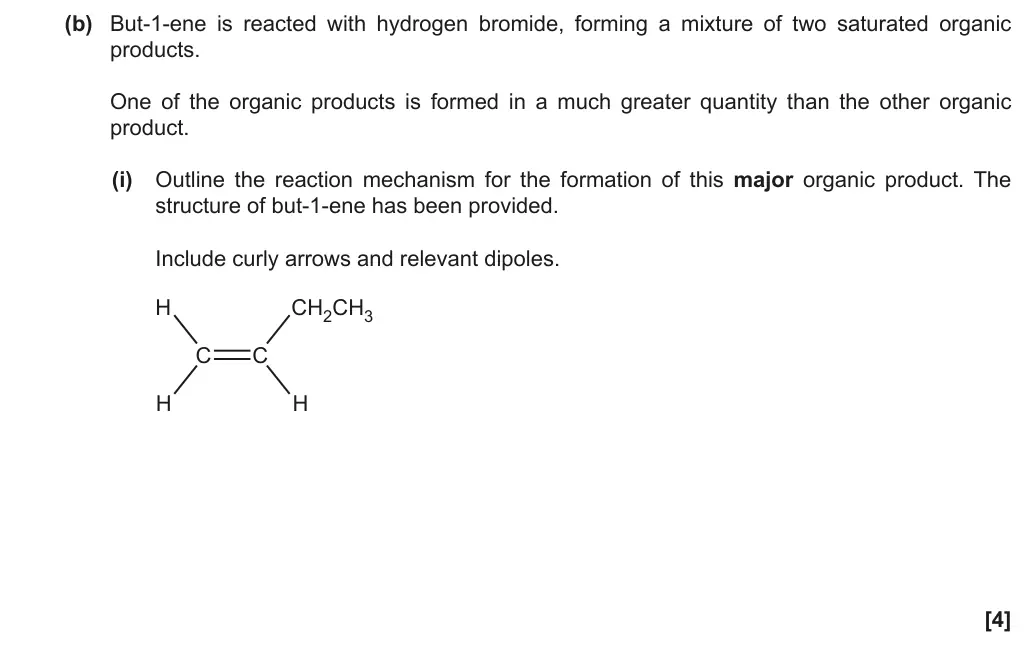
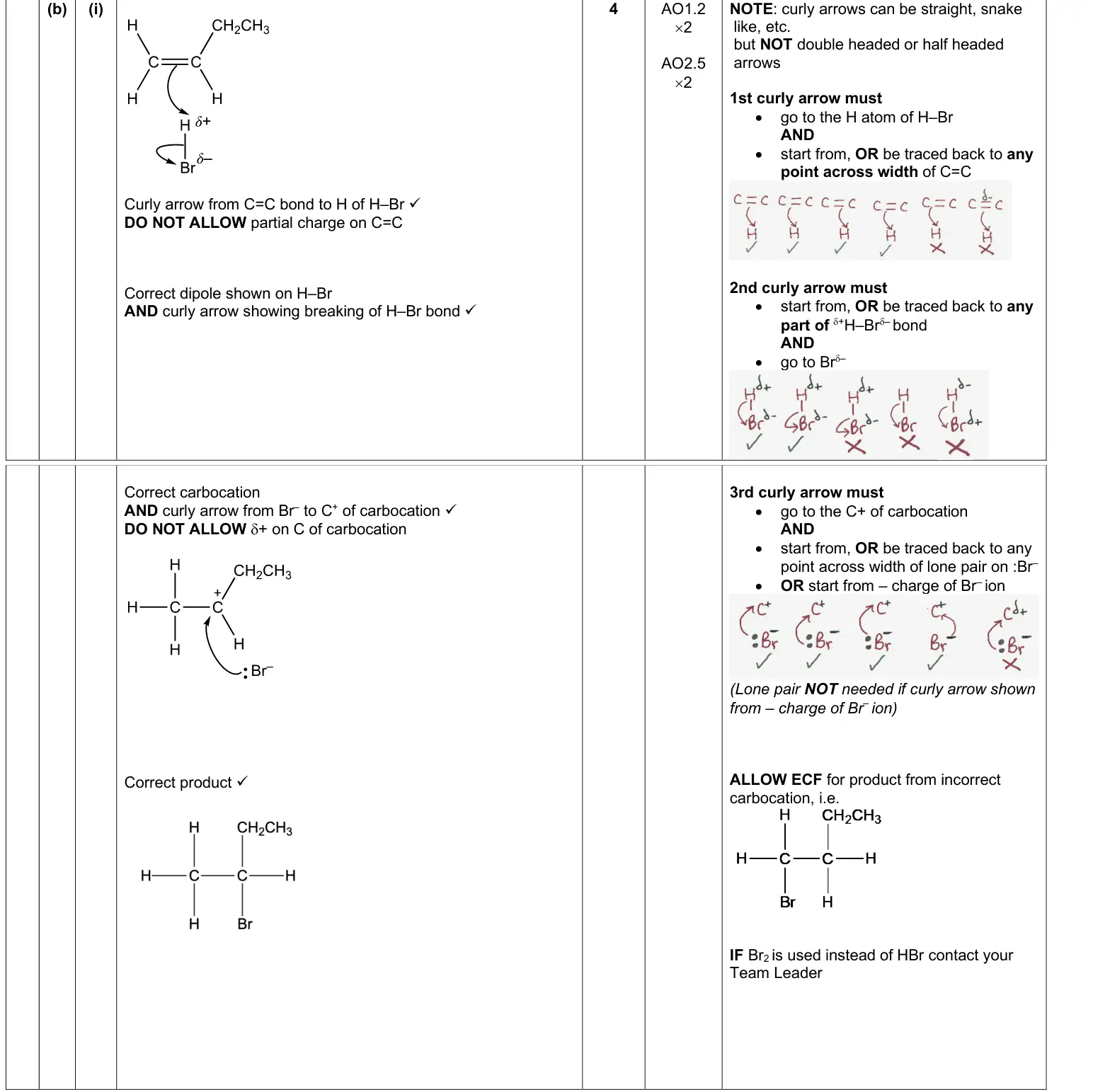
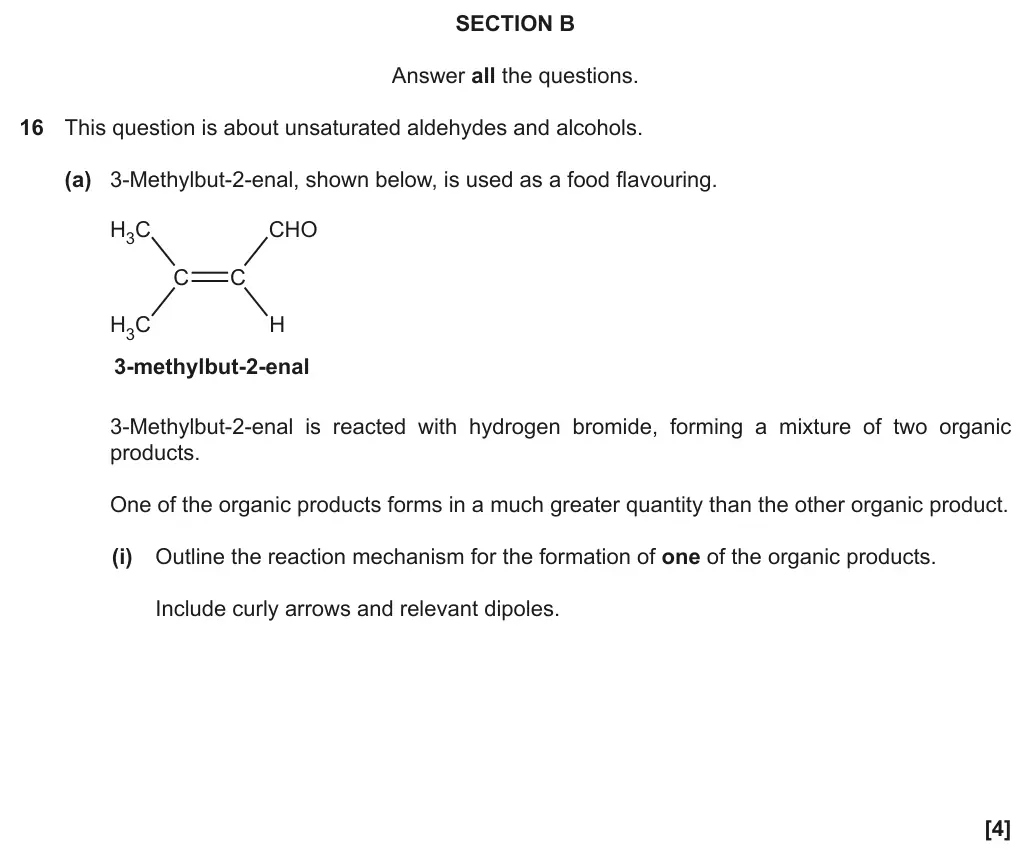
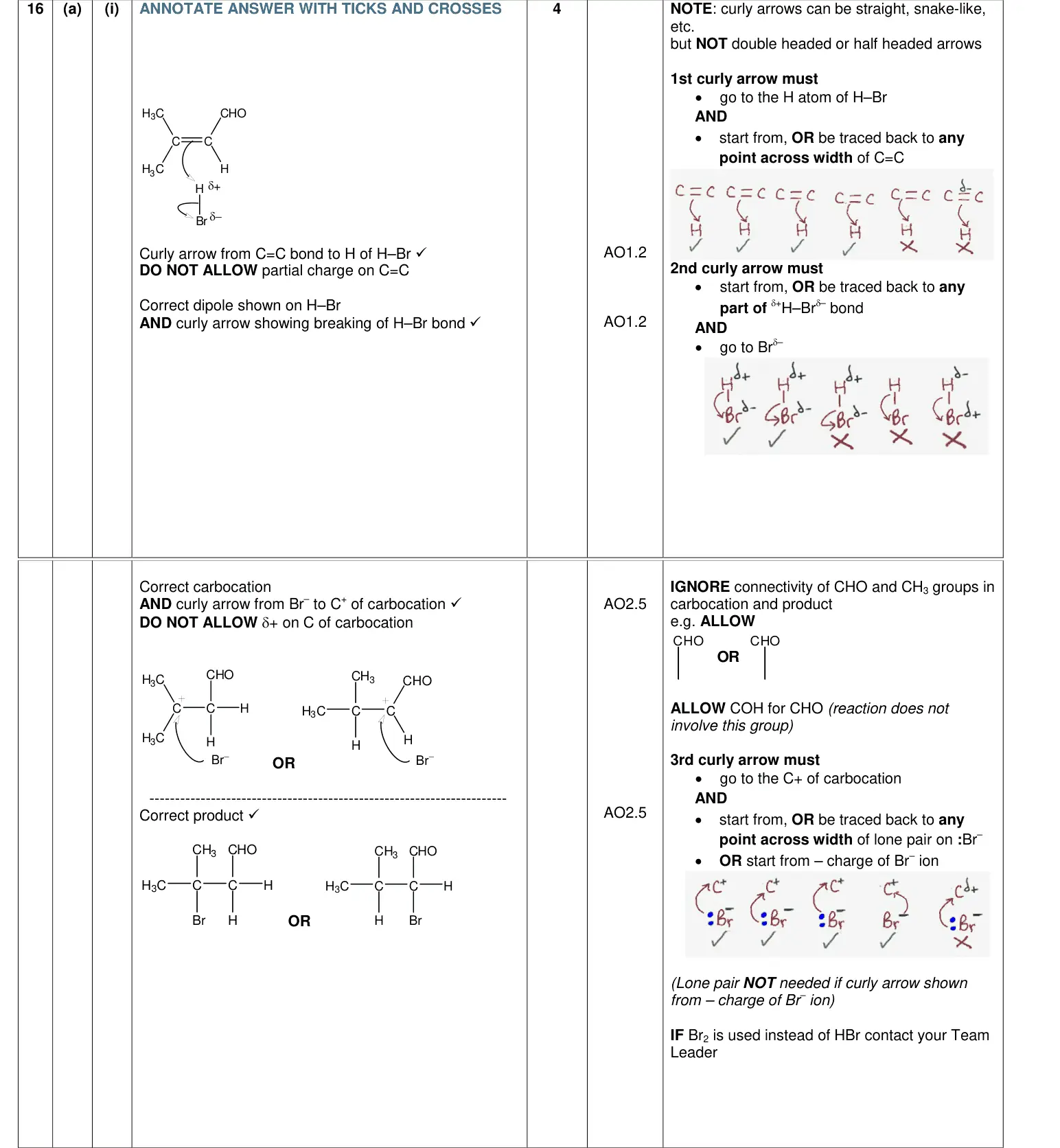
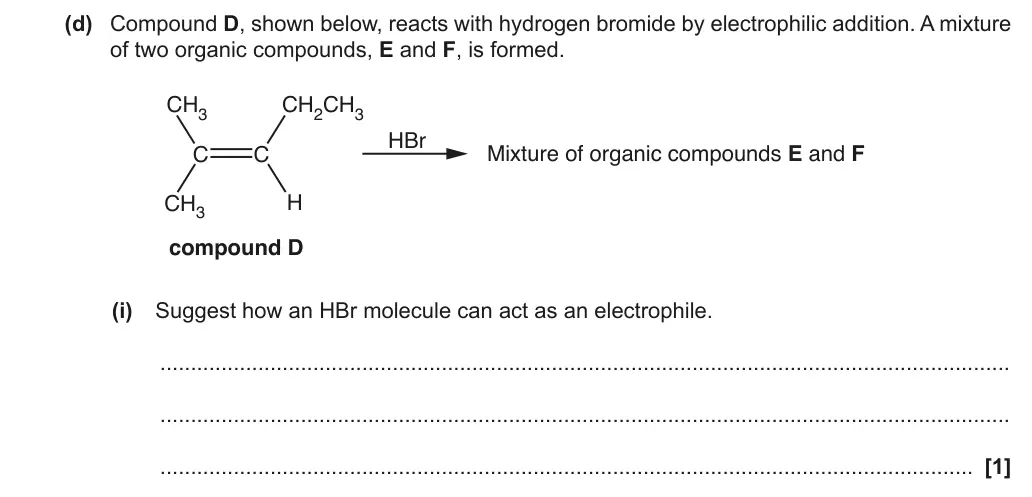
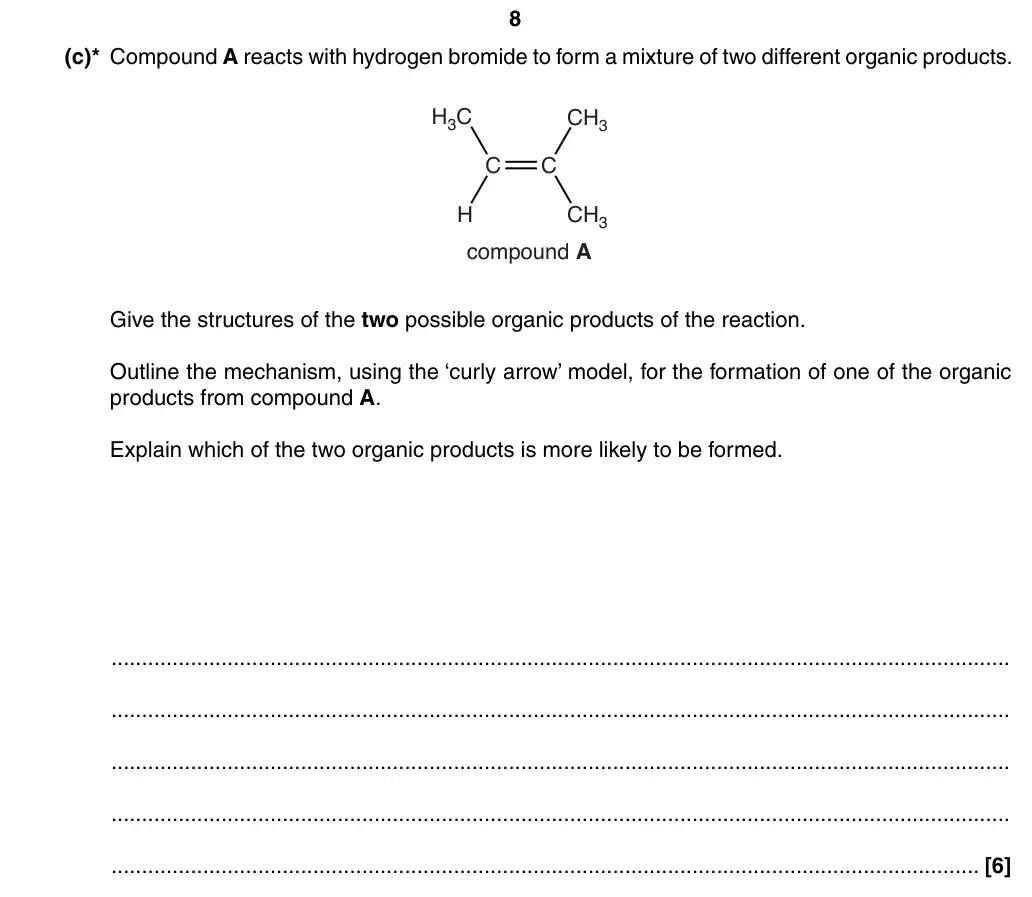
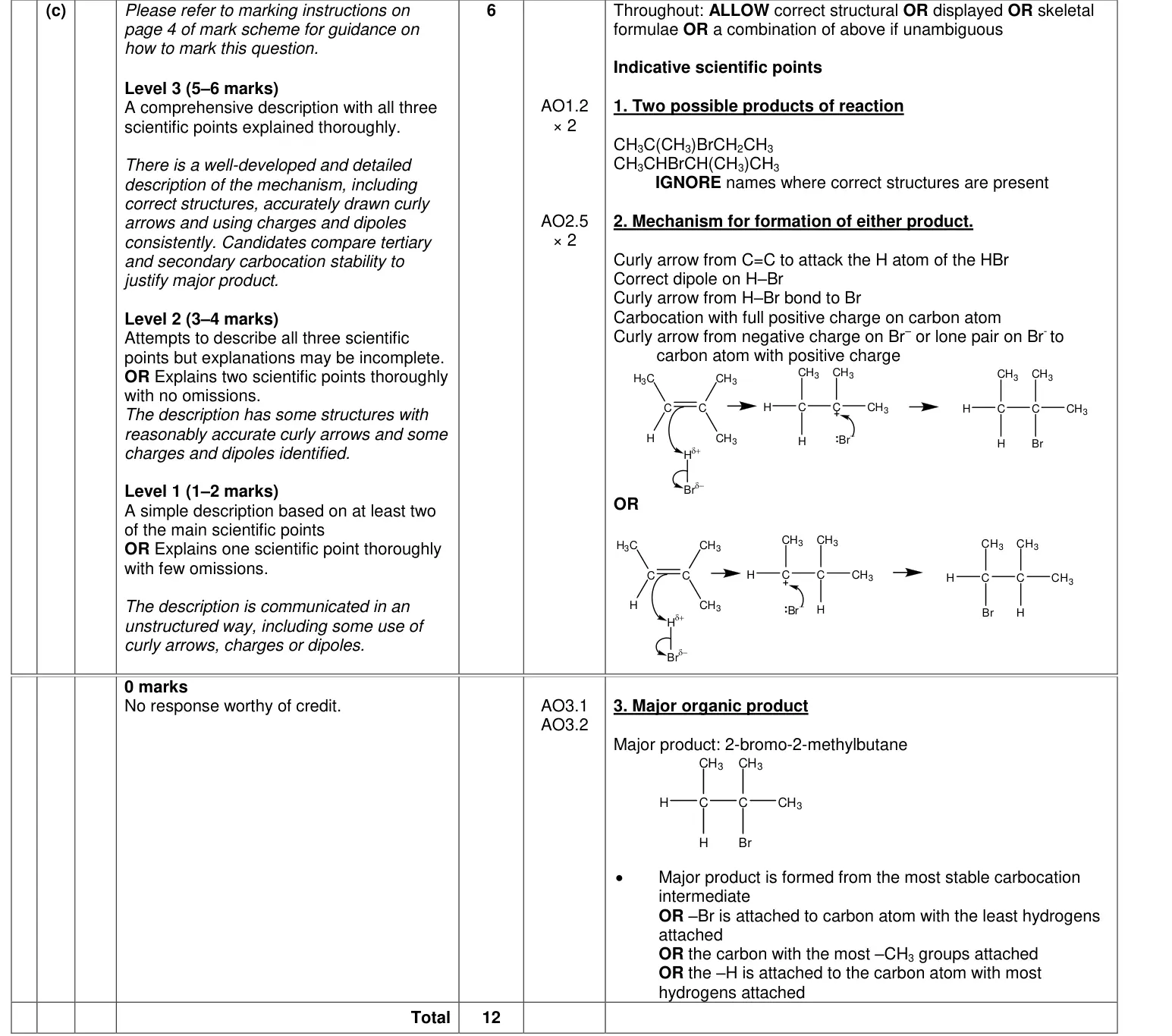
Compound A reacts with hydrogen bromide to form a mixture of two different organic products. Outline the mechanism, using the ‘curly arrow’ model, for the formation of one of the organic
Tap a question to zoom it. Where a part needs a table, graph or structure from an earlier part, that part folds out above it; the mark scheme and examiner's comment open underneath. Have the OCR Data Sheet beside you.
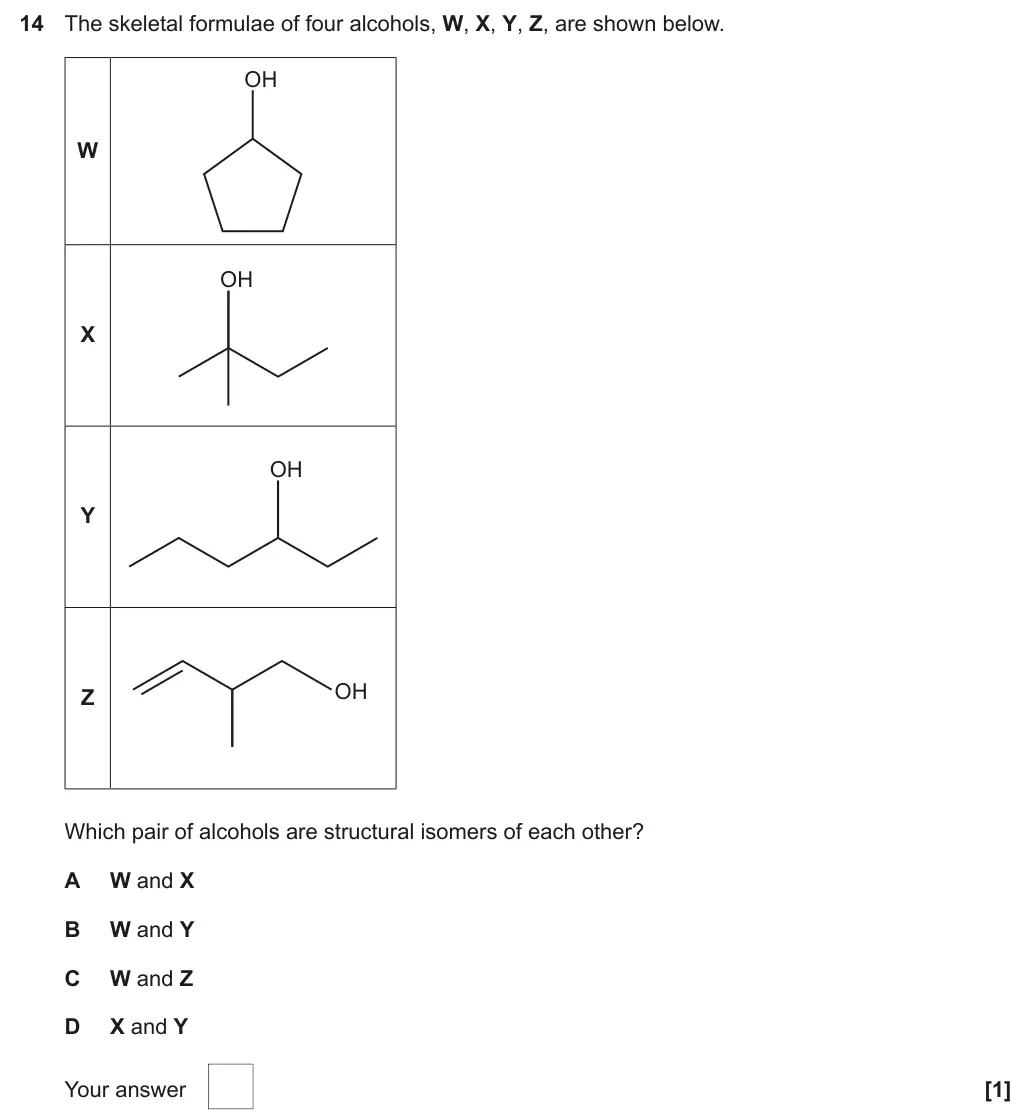
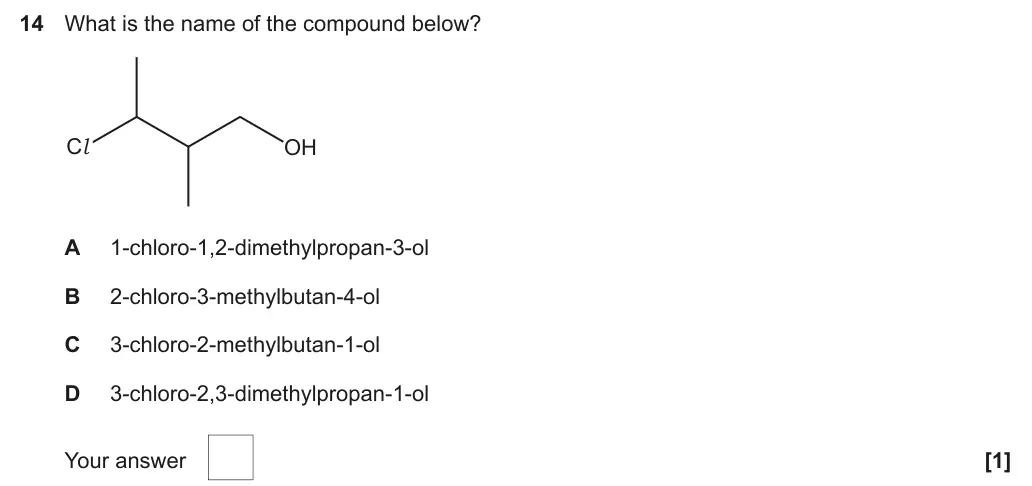
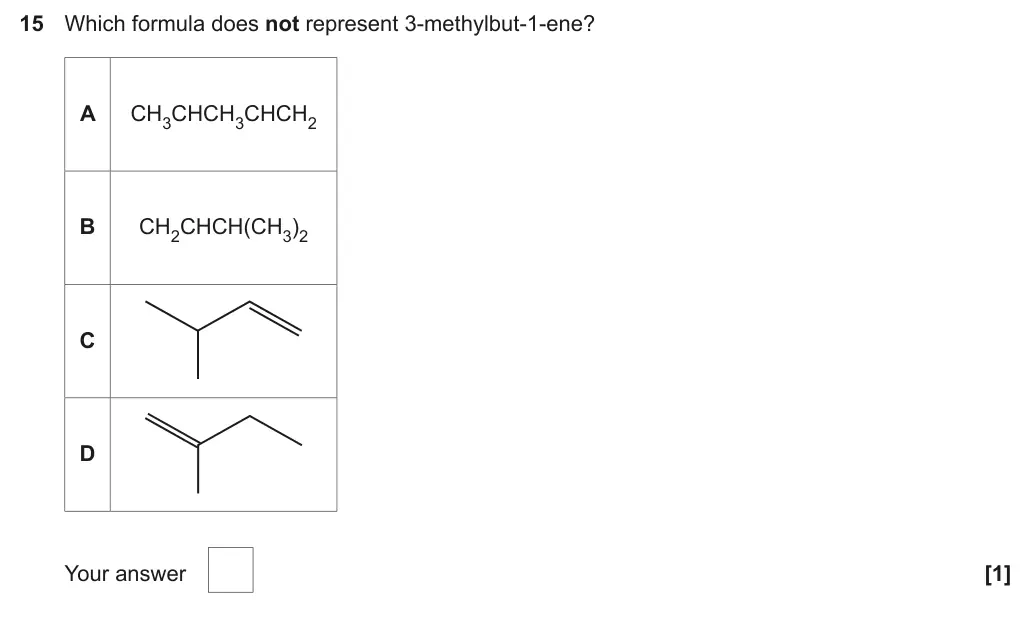
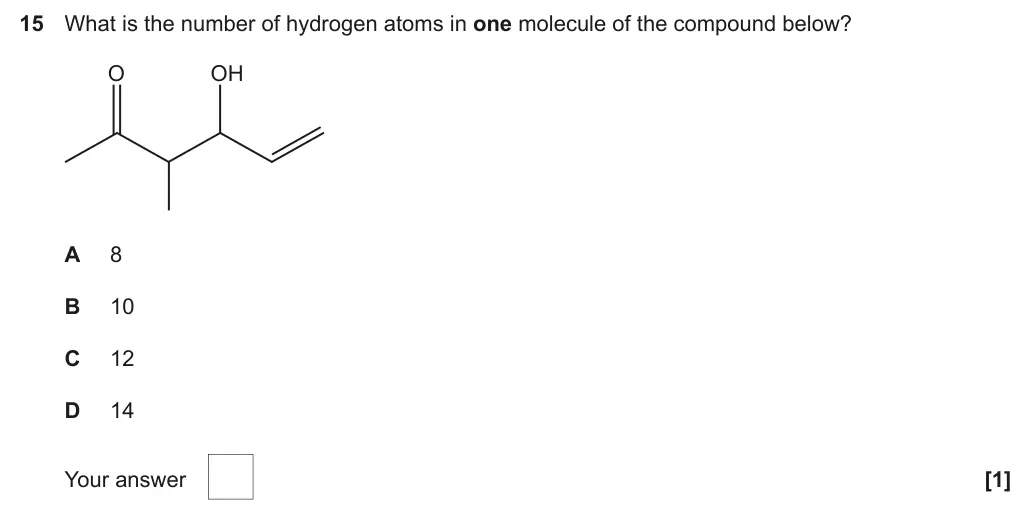
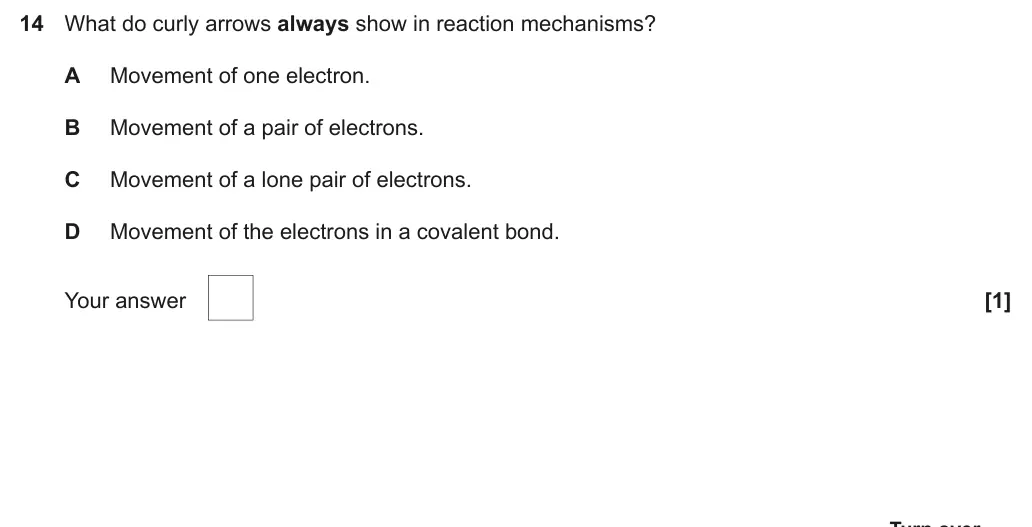
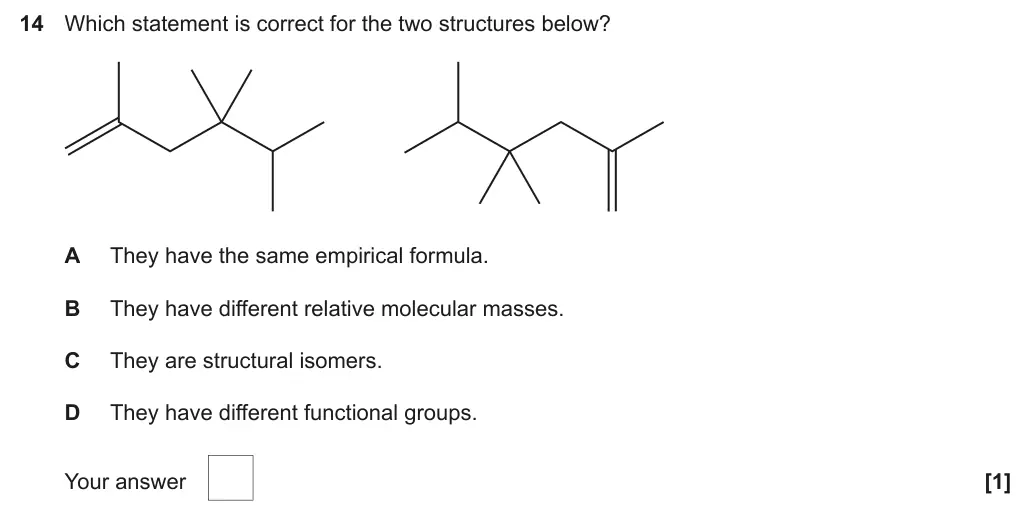
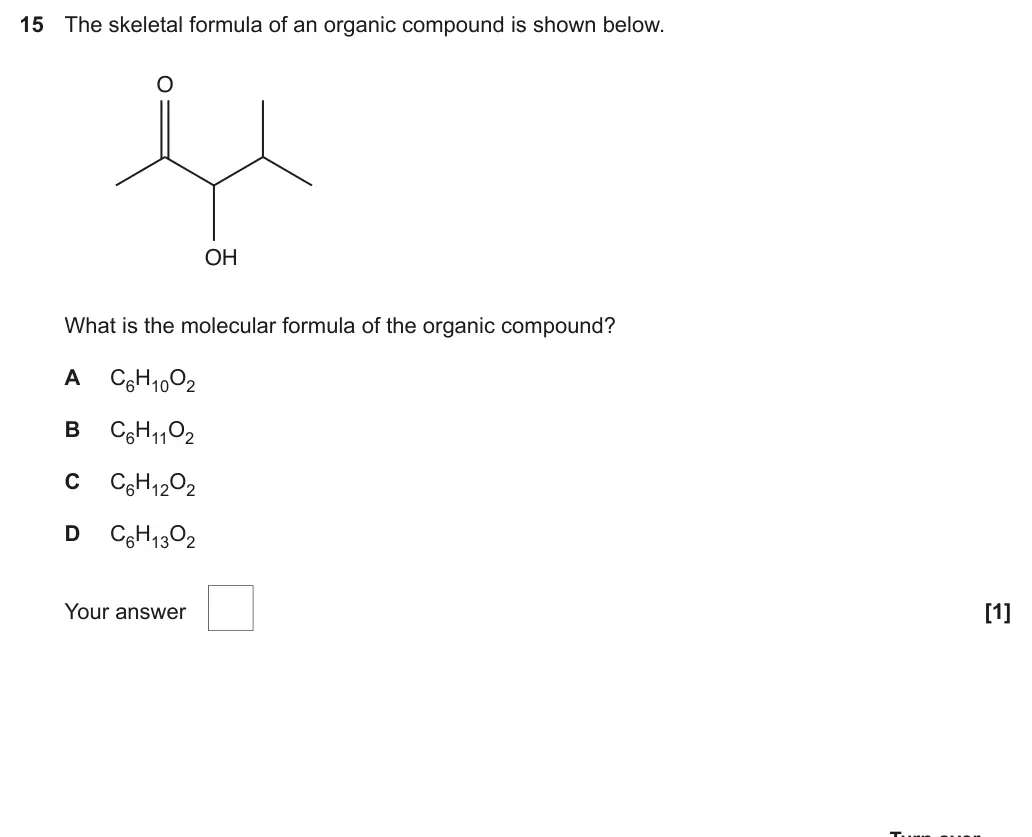
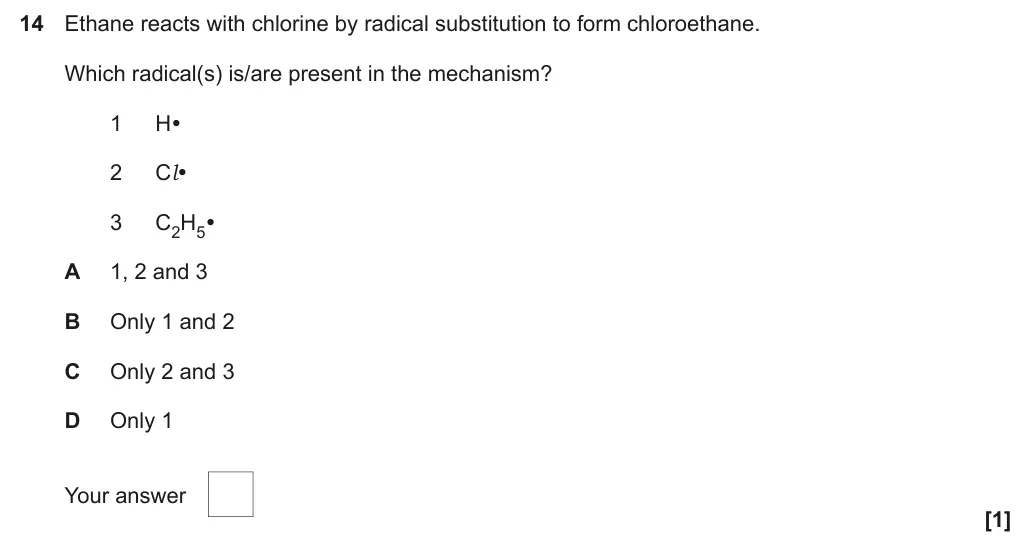
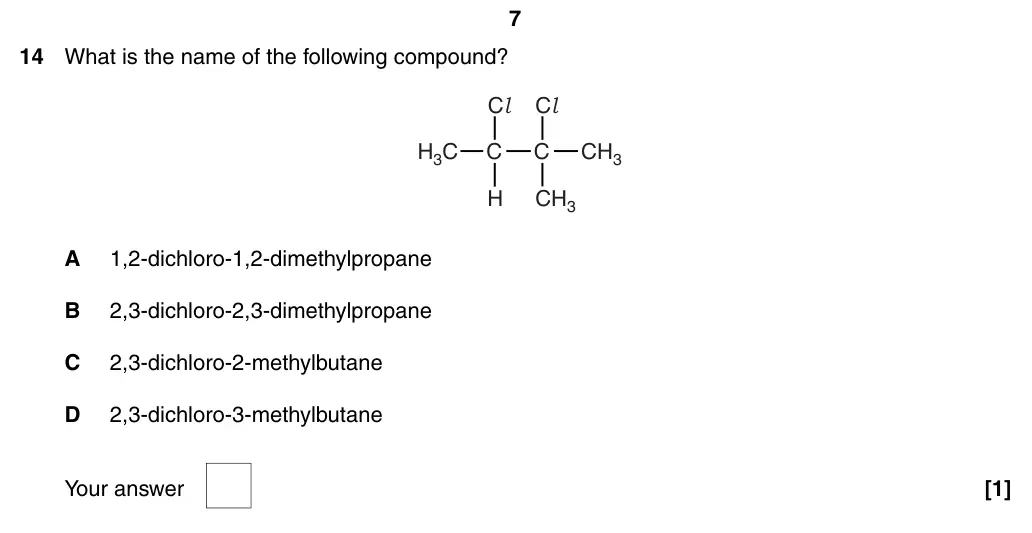
June 2025 · AS Paper 1 · Q141 markMultiple choiceHard
Answer
C
Mark scheme
Examiner's comment
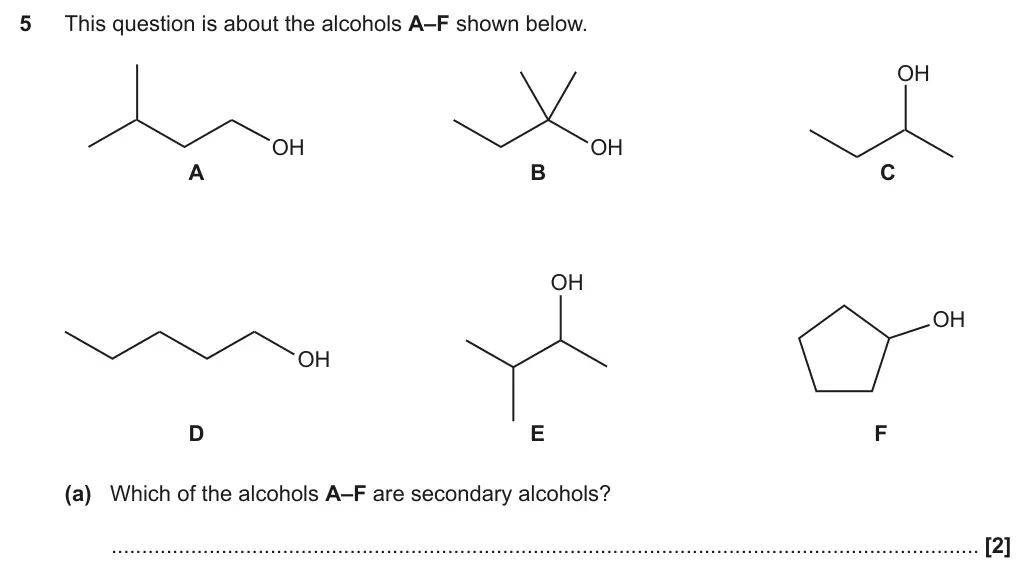
Just under half of candidates did not gain this mark, with A being a common wrong response. This reflects the general difficulty that students have interpreting skeletal formula and would be a good area on which to focus practice.
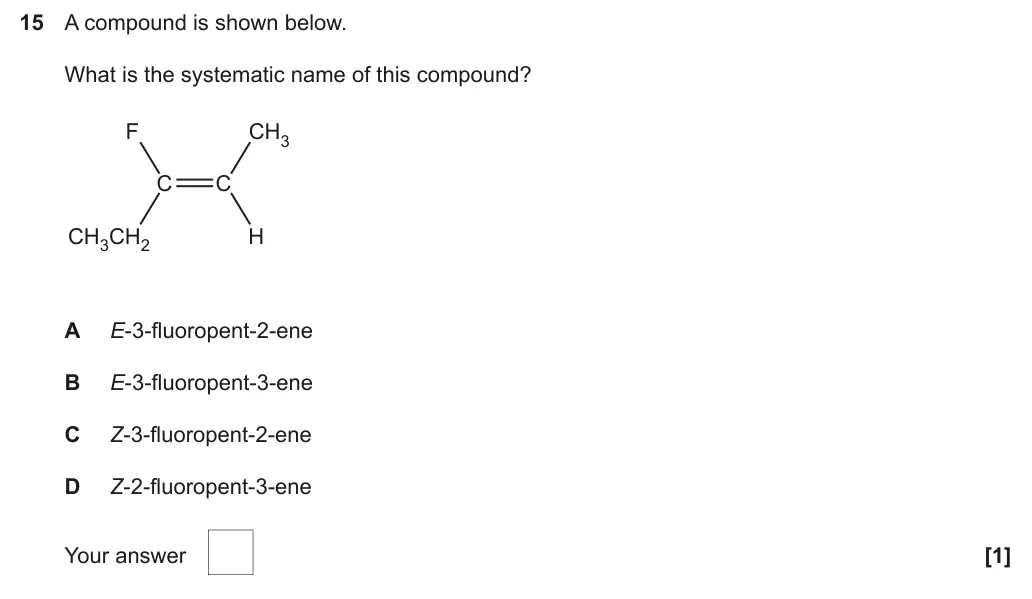
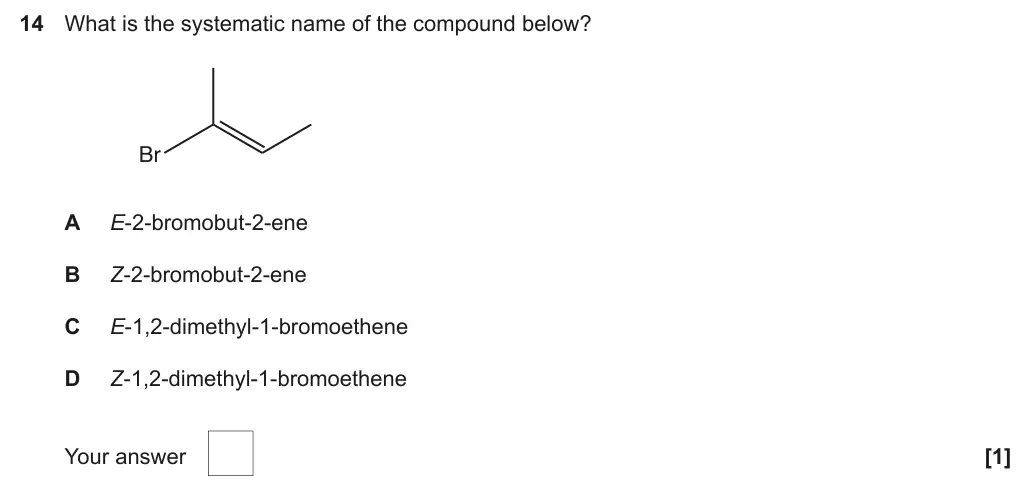
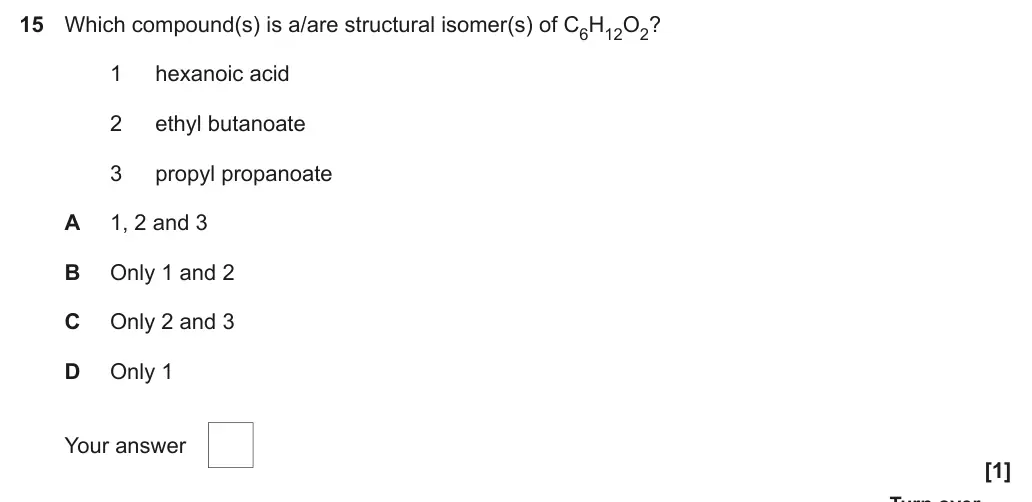
June 2025 · AS Paper 1 · Q151 markMultiple choiceHard
Answer
C
Mark scheme
Examiner's comment
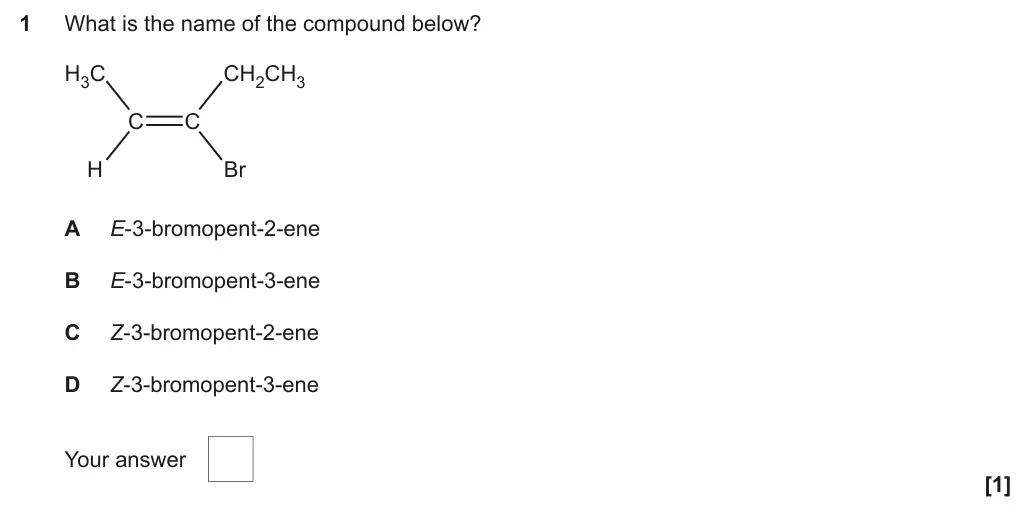
Candidates found this question challenging. A was the most common wrong response given, suggesting students have difficulty applying Cahn-Ingold Prelog rules.
Notes from the mark scheme and report
Many students incorrectly assigned CH3CH2- as higher priority than F (presumably by using the Mr of the entire side chain). To correctly assign priority, use the atomic number of the atoms directly attached to each carbon in the double bond.
Skills: M4.2 Visualise and represent 2-D and 3-D forms including 2-D representations of 3-D objects; M4.3 Understand the symmetry of 2-D and 3-D shapes
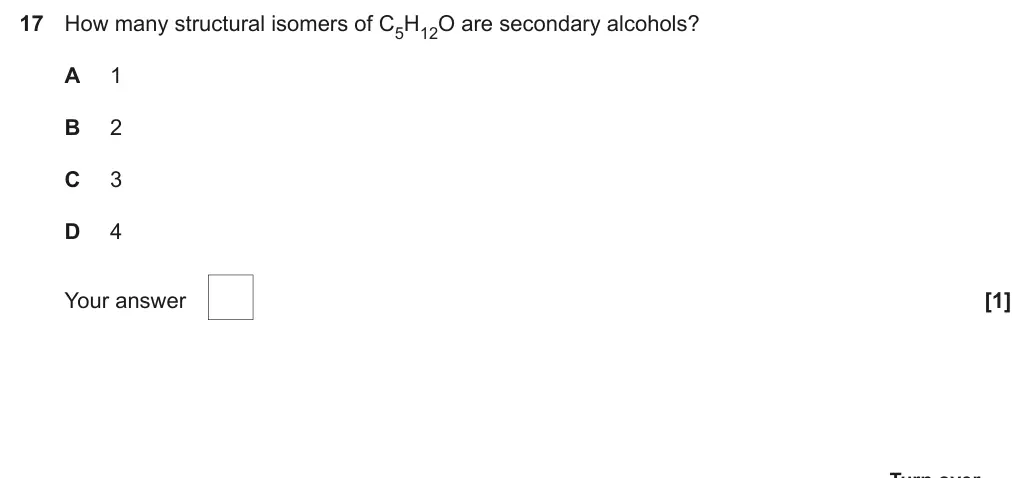
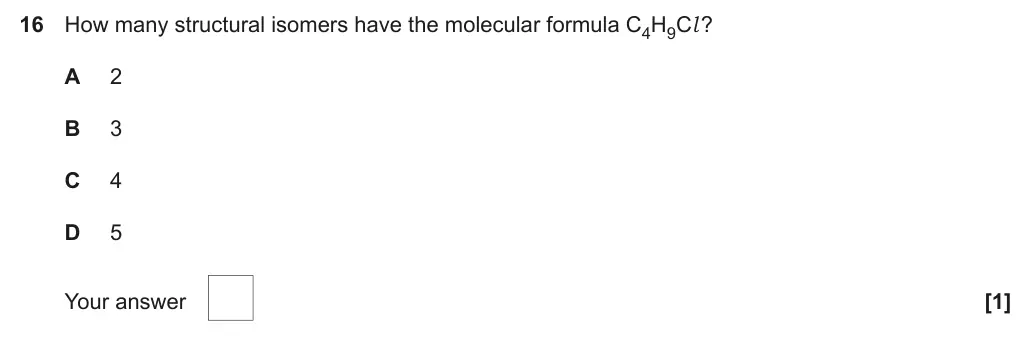
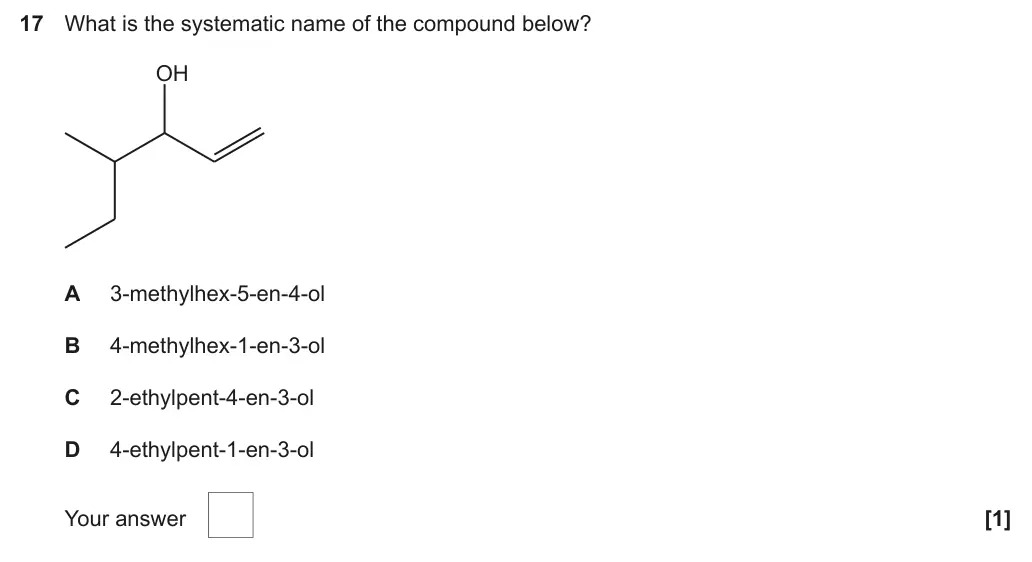
June 2025 · AS Paper 1 · Q171 markMultiple choiceMedium
Answer
C
Mark scheme
Examiner's comment
More than half of candidates gained this mark. However, the question did not discriminate very well, suggesting that some candidates may have guessed. Students should be encouraged to draw structures out as working – those who did often gave the correct response.
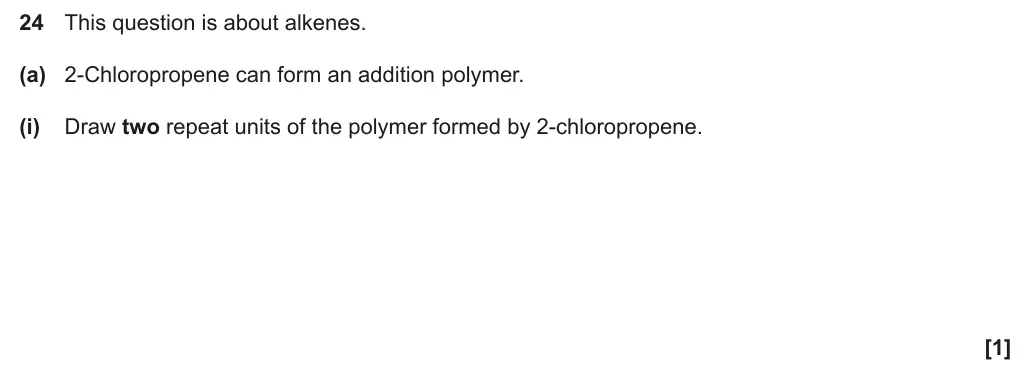
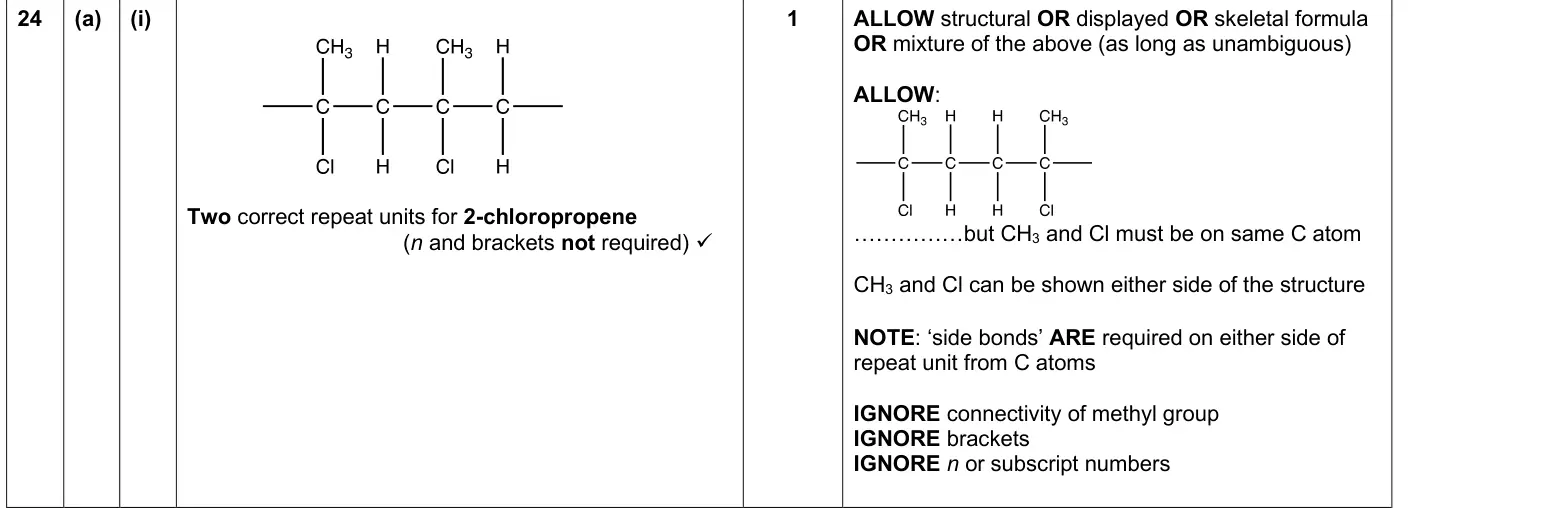
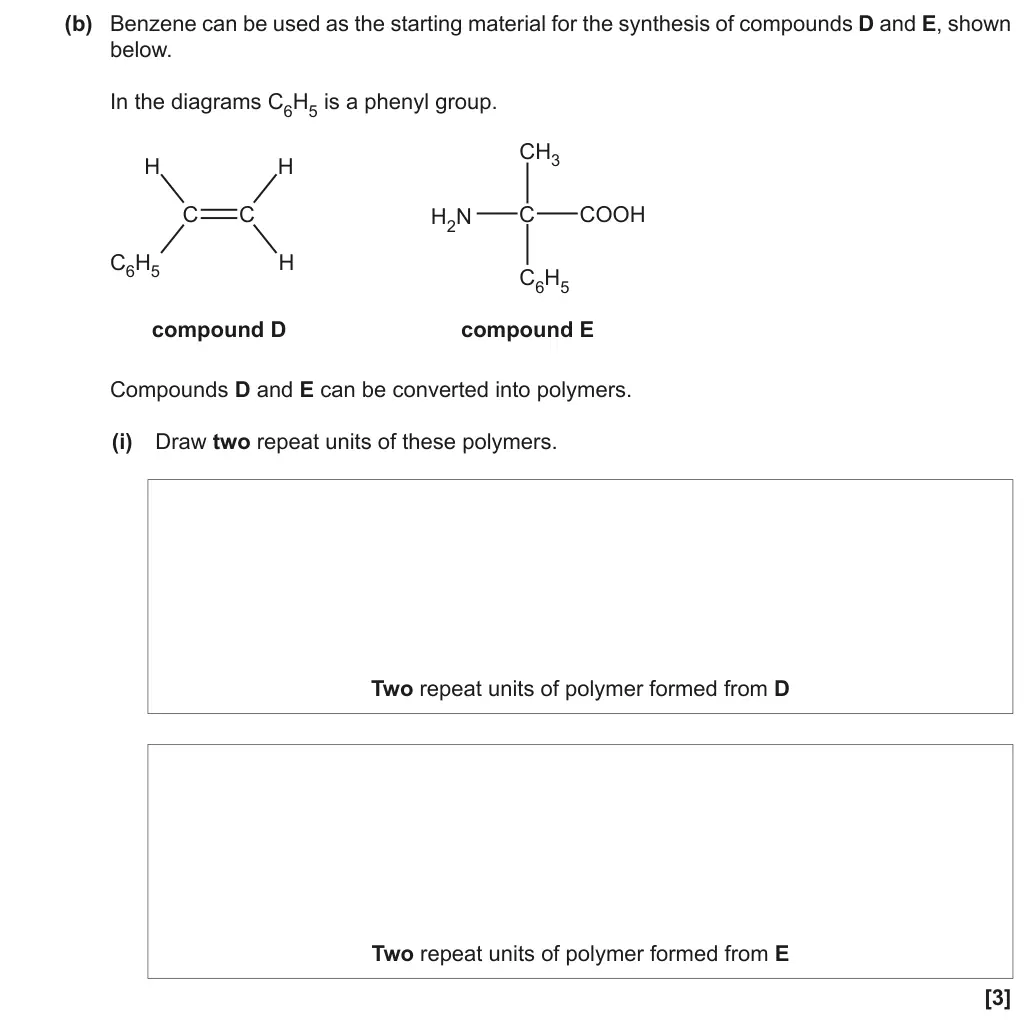
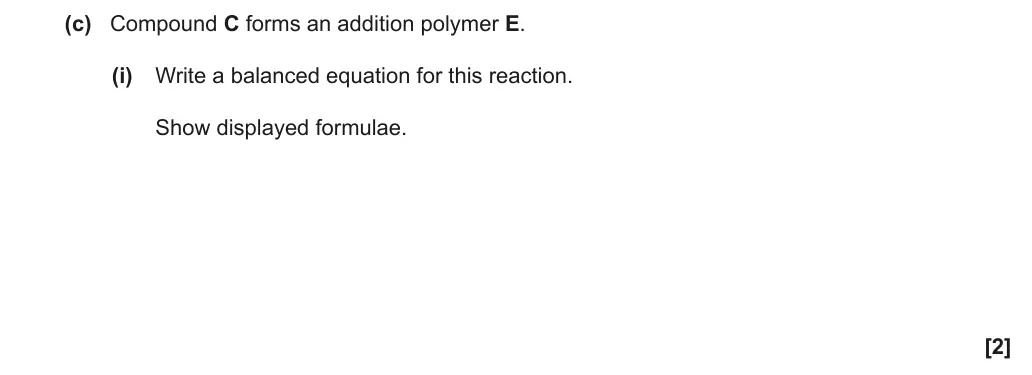
June 2025 · AS Paper 1 · Q24(a)(i)1 markDrawing / labellingMedium
Mark scheme
Examiner's comment
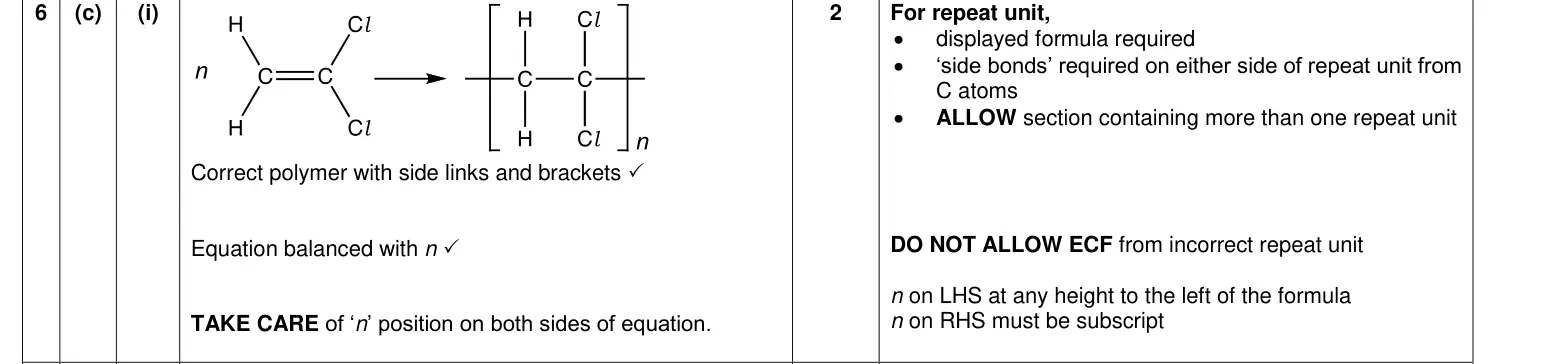
Under half of candidates scored this mark, suggesting students would benefit from practising drawing repeat polymer units. A structure with six carbons in the chain was a common error.
Notes from the mark scheme and report
CH3 and Cl must be on the same C atom
side bonds required
IGNORE brackets and n
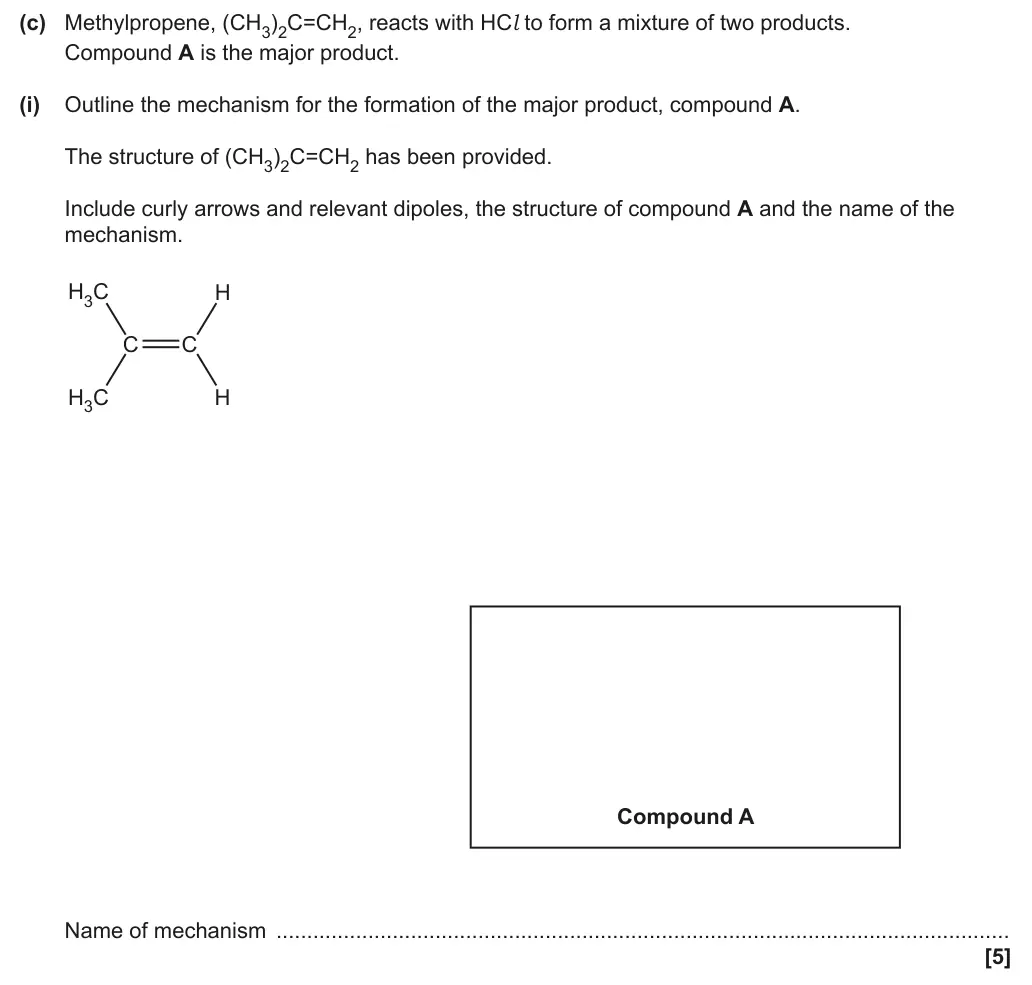
June 2025 · AS Paper 1 · Q24(c)(i)5 marksMechanismHard
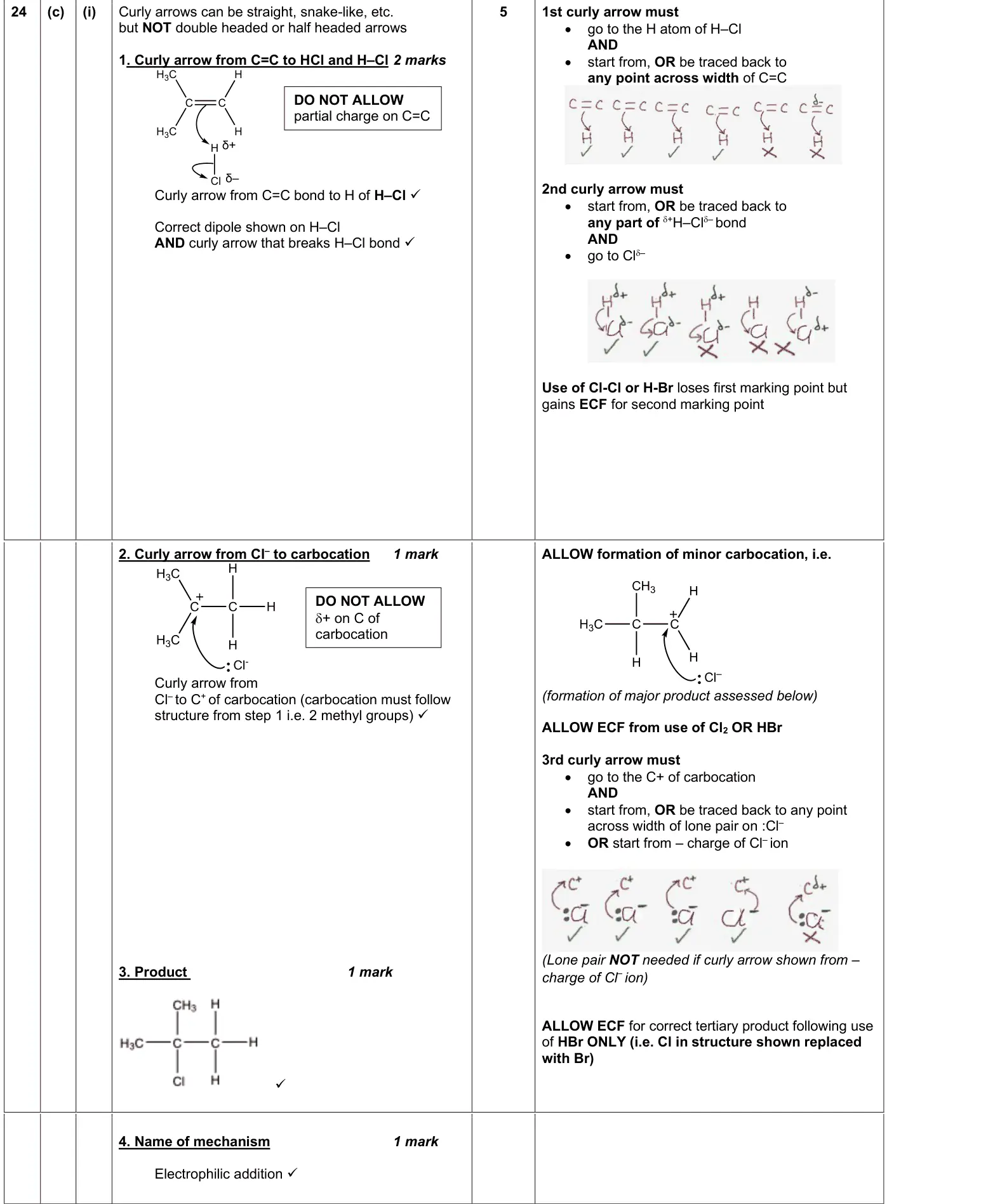
Mark scheme
Examiner's comment
Many candidates scored well on this question, drawing a clear mechanism and correctly giving the major product. However, mistakes were often seen with the direction of arrows and a minority of students gave the minor product for Compound A and/or named the mechanism incorrectly. Partial charges on the carbons of the double bond and lack of charge on the chloride ion were also common errors. This question proved to be an excellent discriminator.
Notes from the mark scheme and report
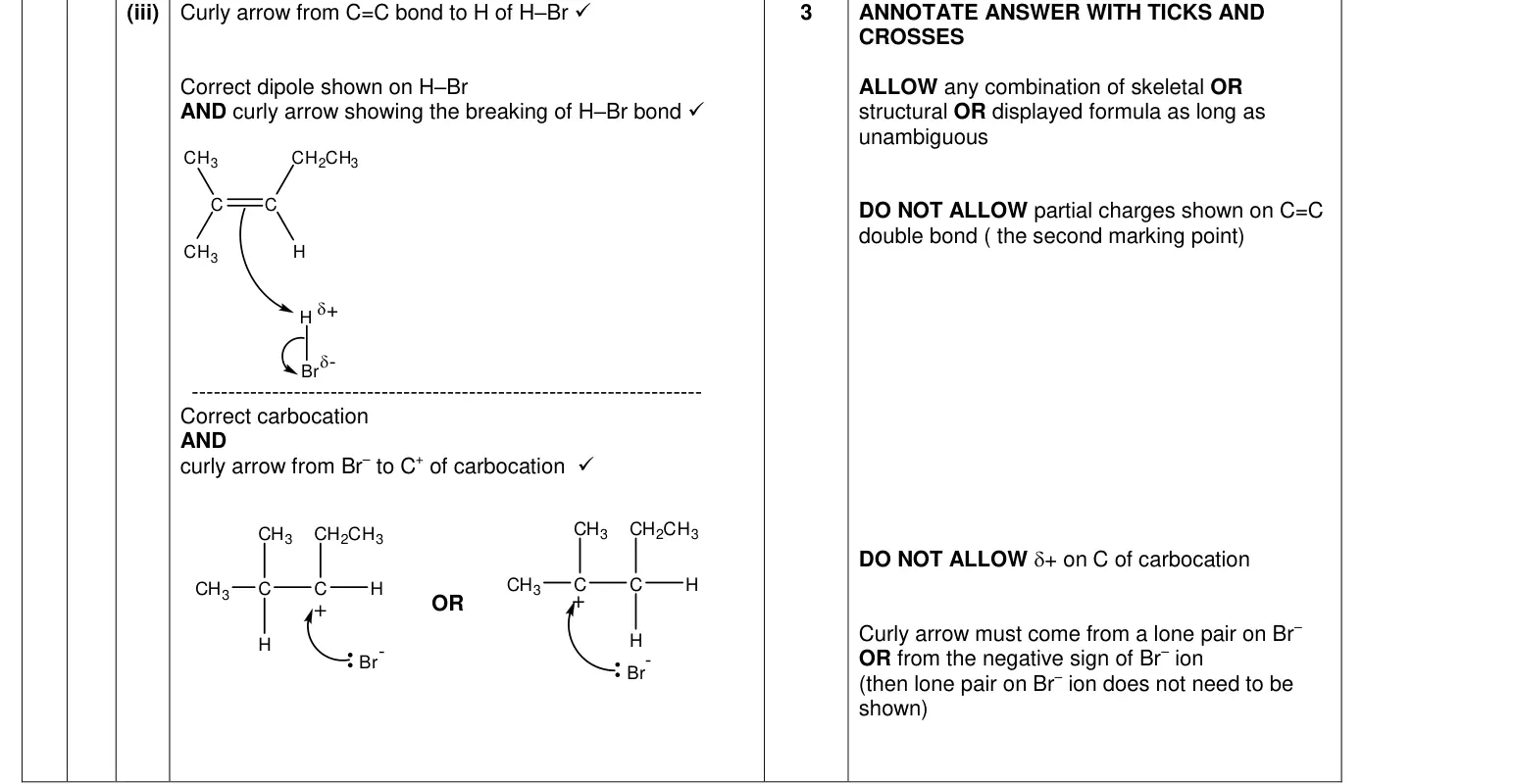
curly arrow from C=C to H of H–Cl
dipole on H–Cl AND arrow breaking H–Cl
carbocation with full + (tertiary for major product) and arrow from lone pair/– charge of Cl–
DO NOT ALLOW partial charge on C=C
DO NOT ALLOW half-headed arrows
name electrophilic addition
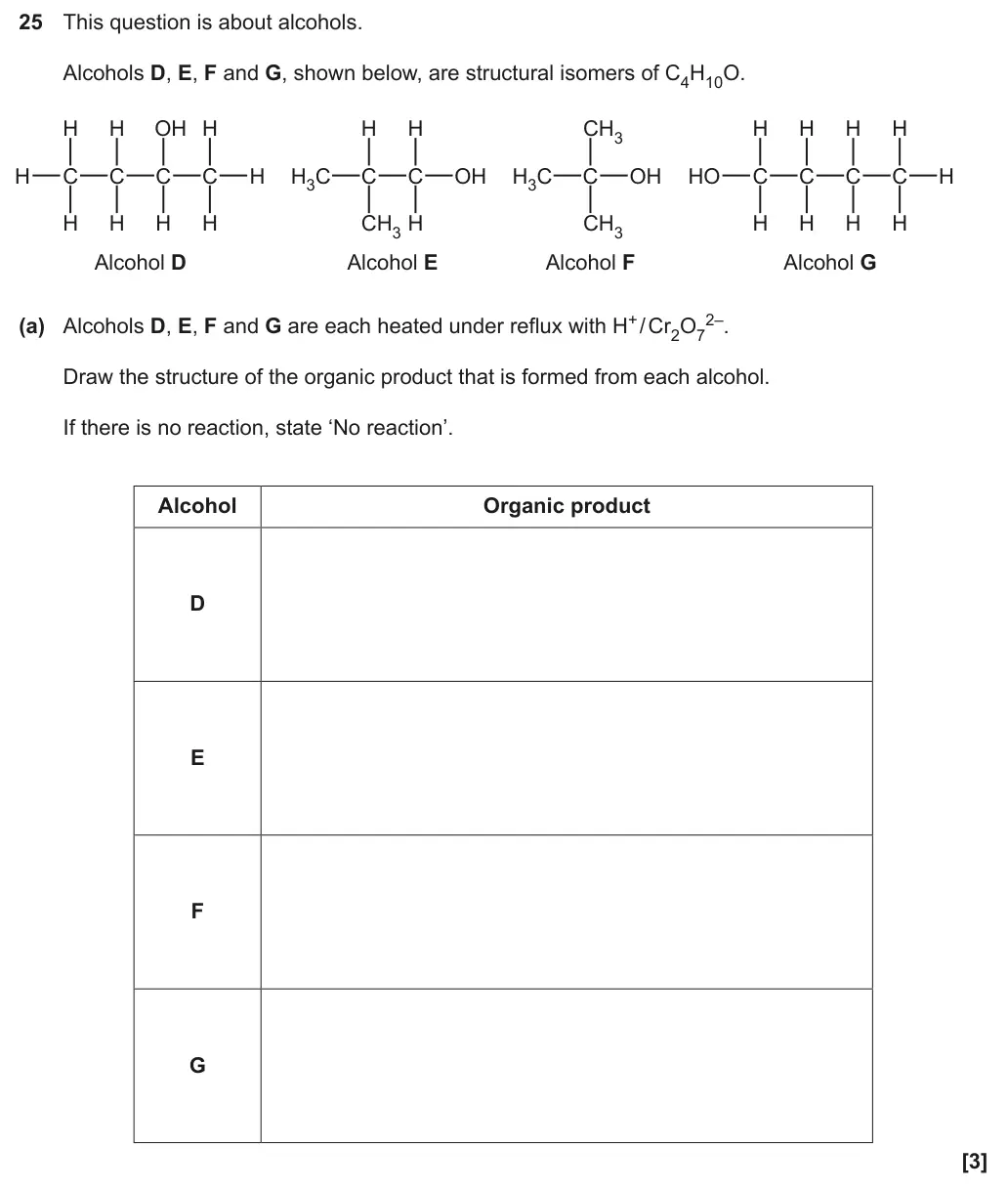
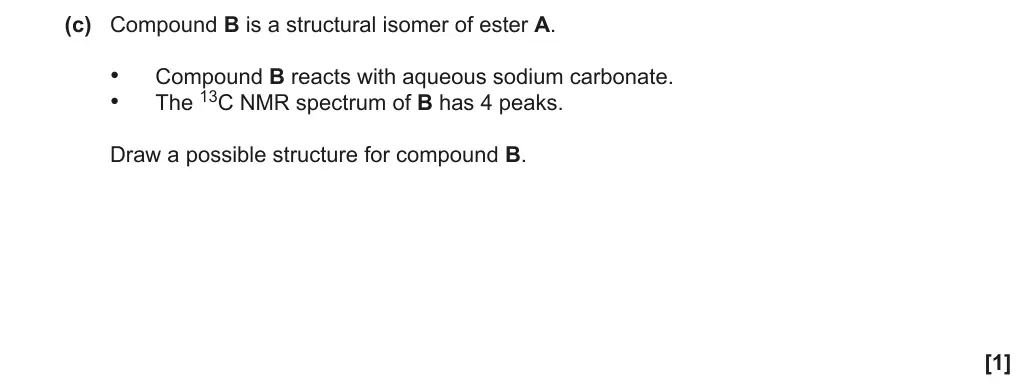
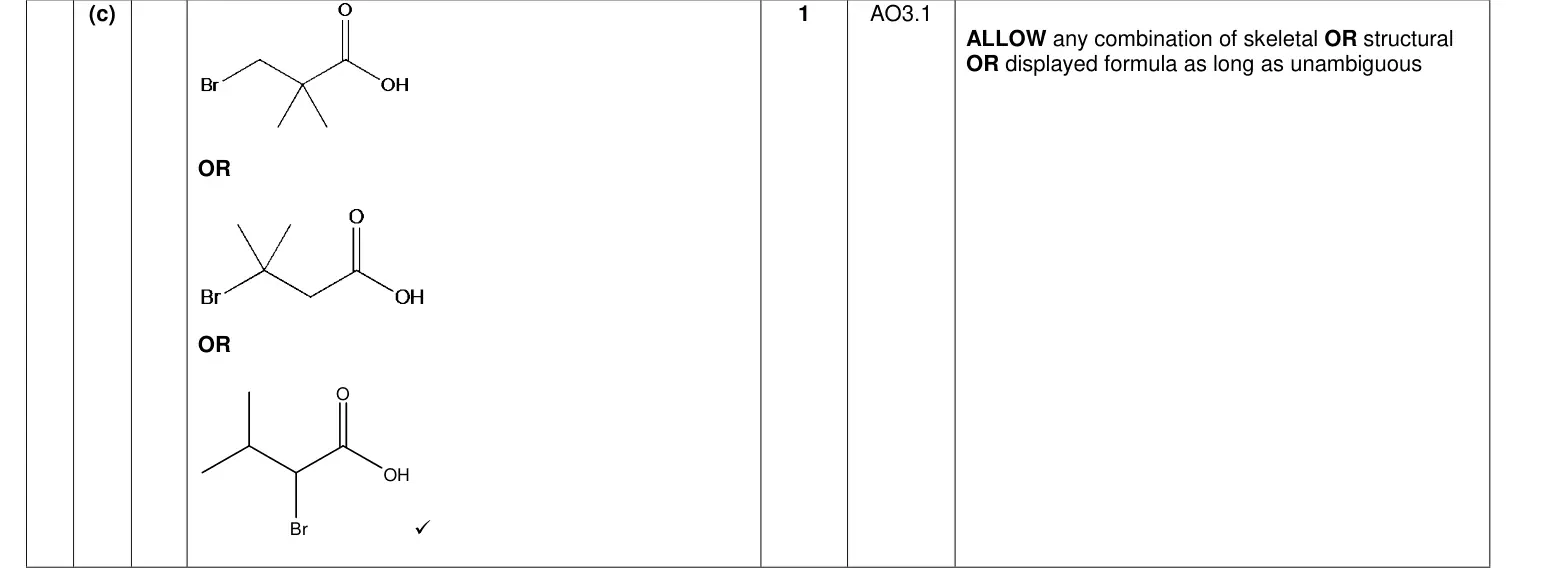
June 2025 · AS Paper 1 · Q25(b)1 markStructure / isomerMedium
Earlier part of question 25 that this part uses
Mark scheme
Examiner's comment
ocr.org.uk/science Oxford Cambridge and RSA CHEMISTRY A OCR Level 3 Advanced Subsidiary GCE in Chemistry A H032 For first teaching in 2015 Examiners’ report Version 1 H032/01 Summer 2025 series AS LEVEL Contents Contents ................................................................................................................................................... 2 Introduction .............................................................................................................................................. 4 Paper 1 series overview ........................................................................................................................... 5 Section A overview ................................................................................................................................... 6 Question 1 ............................................................................................................................................ 6 Question 2 ............................................................................................................................................ 7 Question 3 ............................................................................................................................................ 7 Question 4 ............................................................................................................................................ 8 Question 5 ............................................................................................................................................ 8 Question 6 ............................................................................................................................................ 9 Question 7 ............................................................................................................................................ 9 Question 8 .......................................................................................................................................... 10 Question 9 .......................................................................................................................................... 10 Question 10 ........................................................................................................................................ 11 Question 11 ........................................................................................................................................ 11 Question 12 ........................................................................................................................................ 12 Question 13 ........................................................................................................................................ 12 Question 14 ........................................................................................................................................ 13 Question 15 ........................................................................................................................................ 14 Question 16 ........................................................................................................................................ 15 Question 17 ........................................................................................................................................ 15 Question 18 ........................................................................................................................................ 16 Question 19 ........................................................................................................................................ 16 Question 20 ........................................................................................................................................ 17 Section B overview ................................................................................................................................. 18 Question 21 (a) ................................................................................................................................... 18 Question 21 (b) ................................................................................................................................... 19 Question 21 (c) ................................................................................................................................... 20 Question 21 (d) (i) ............................................................................................................................... 21 Question 21 (d) (ii) .............................................................................................................................. 23 Question 22 (a) .................................................................................................................................. 24 Question 22 (b) (i) .............................................................................................................................. 25 Question 22 (b) (ii) ............................................................................................................................. 25 Question 22 (c) ................................................................................................................................... 26 Question 23 (a) .................................................................................................................................. 27 Question 23 (b) ................................................................................................................................... 28 Question 23 (c) .................................................................................................................................. 29 Question 24 (a) (i) ............................................................................................................................... 30 Question 24 (a) (ii) .............................................................................................................................. 30 Question 24 (b) .................................................................................................................................. 31 Question 24 (c) (i) ............................................................................................................................... 32 Question 24 (c) (ii) .............................................................................................................................. 33 Question 25 (a) .................................................................................................................................. 34 Question 25 (b .................................................................................................................................... 35 Question 25 (c) ................................................................................................................................... 36 Introduction Our examiners’ reports are produced to offer constructive feedback on candidates’ performance in the examinations. Question 25 (b Just under half of candidates scored this with a wide range of incorrect responses.
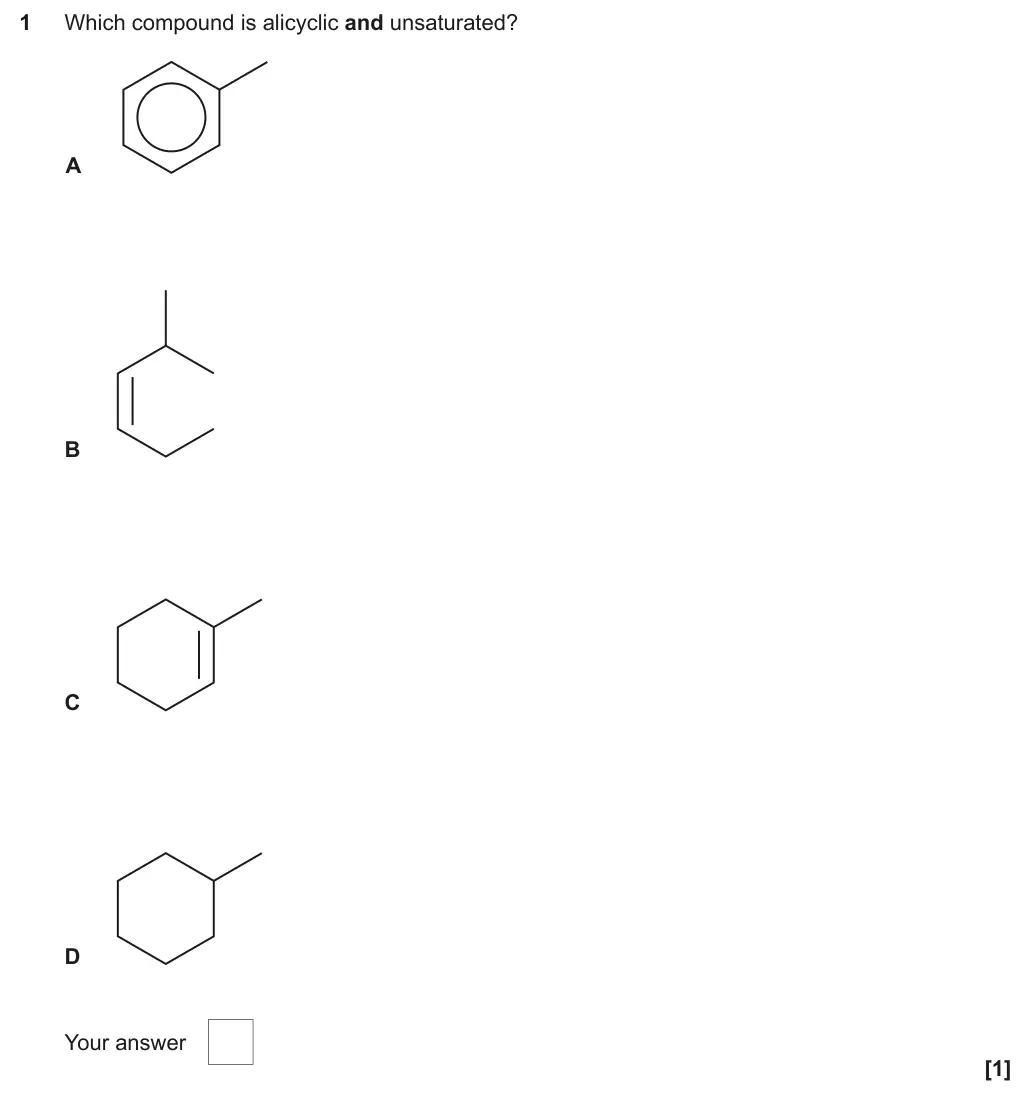
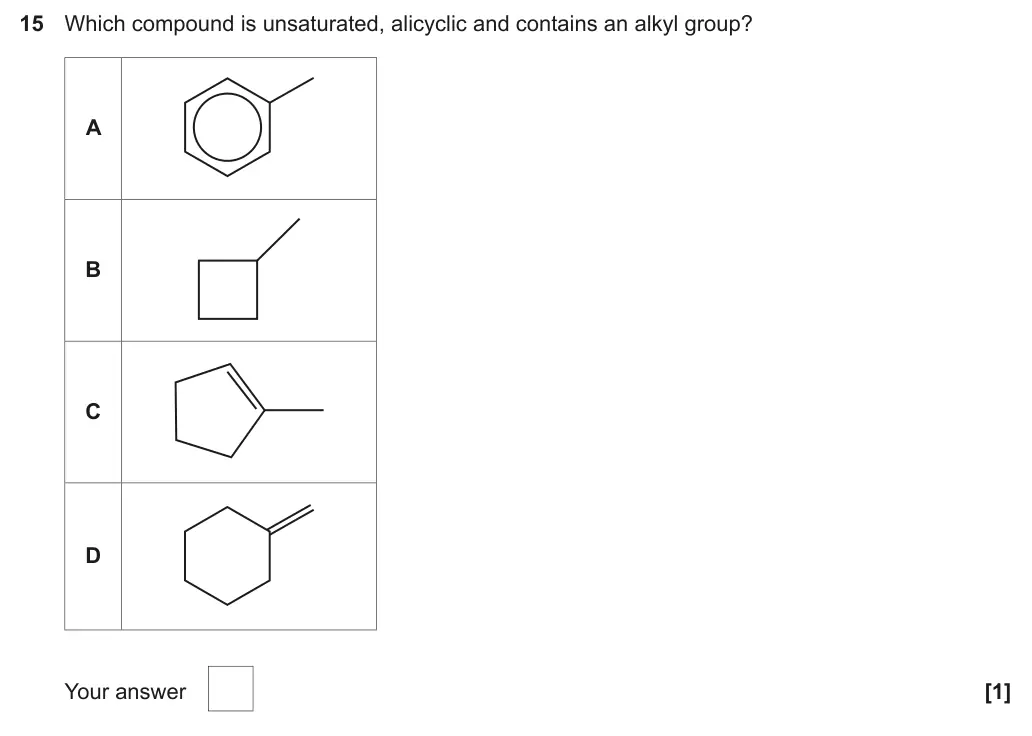
June 2025 · Paper 2 · Q11 markMultiple choiceMedium
Answer
C
Mark scheme
Examiner's comment
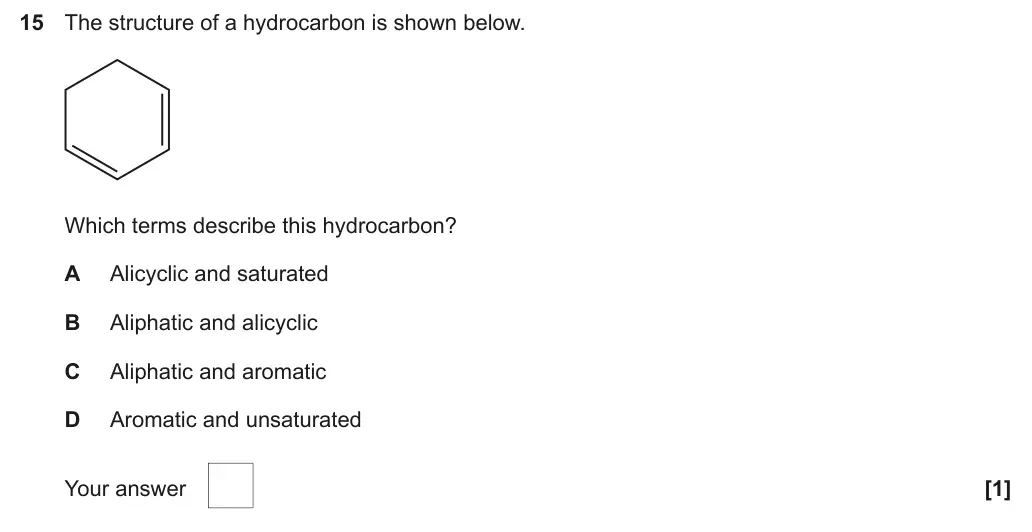
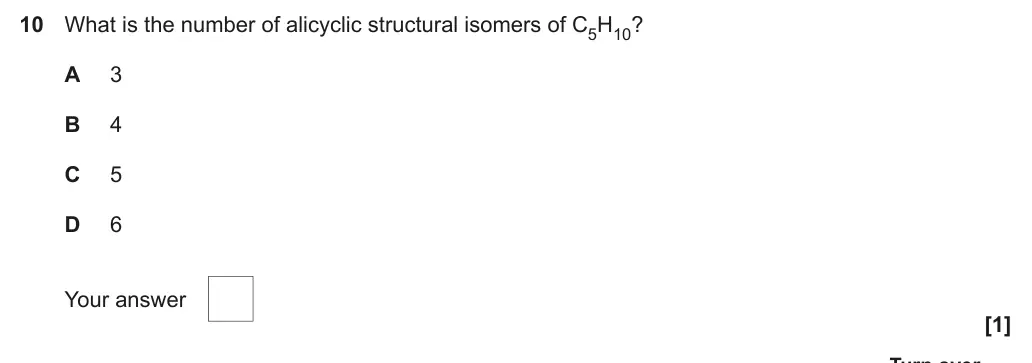
The majority of candidates gave the correct answer, C. The most common incorrect response was D which is alicyclic but not unsaturated.
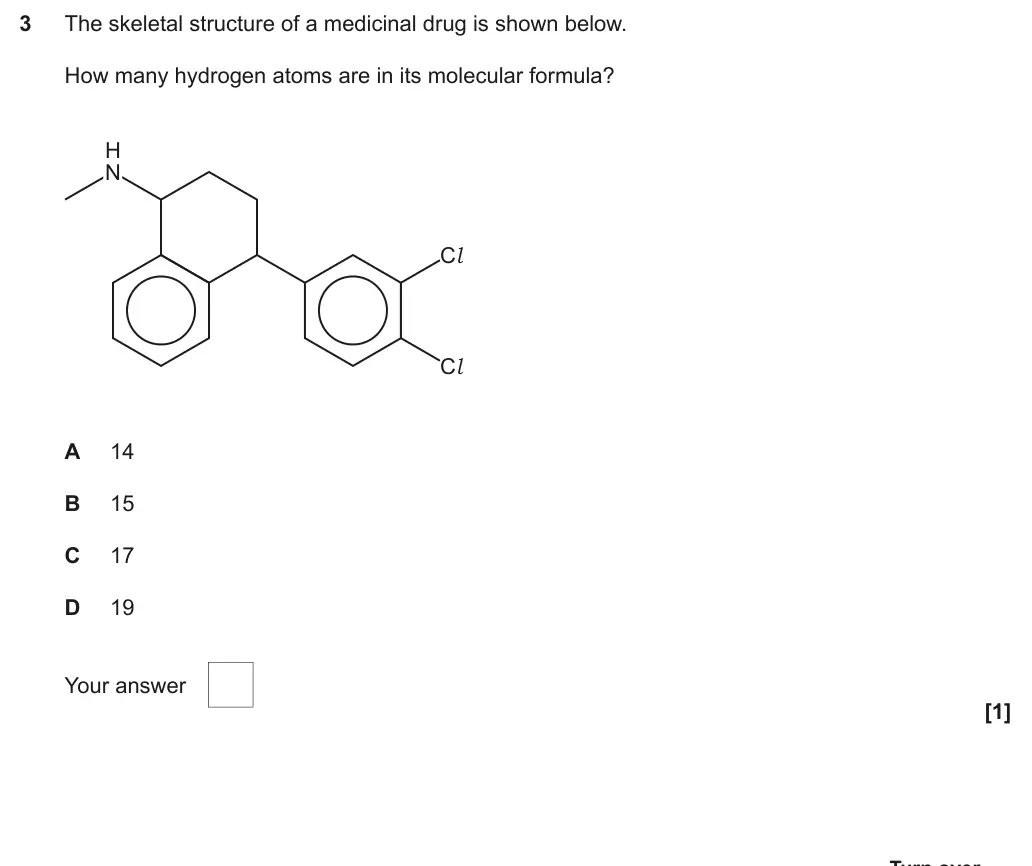
June 2025 · Paper 2 · Q31 markMultiple choiceMedium
Answer
C
Mark scheme
Examiner's comment
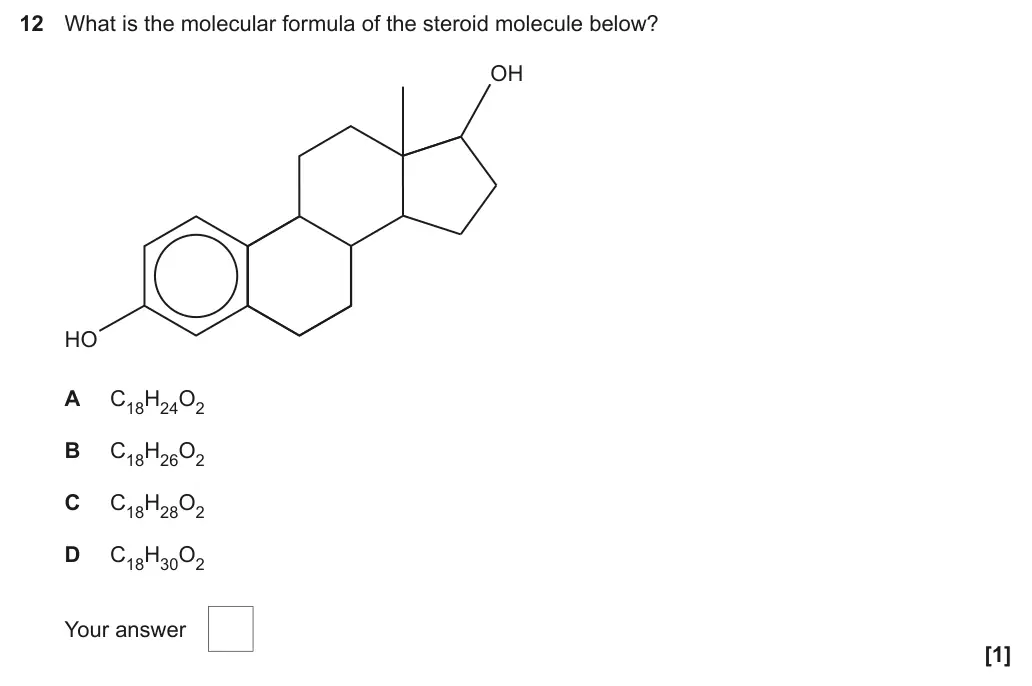
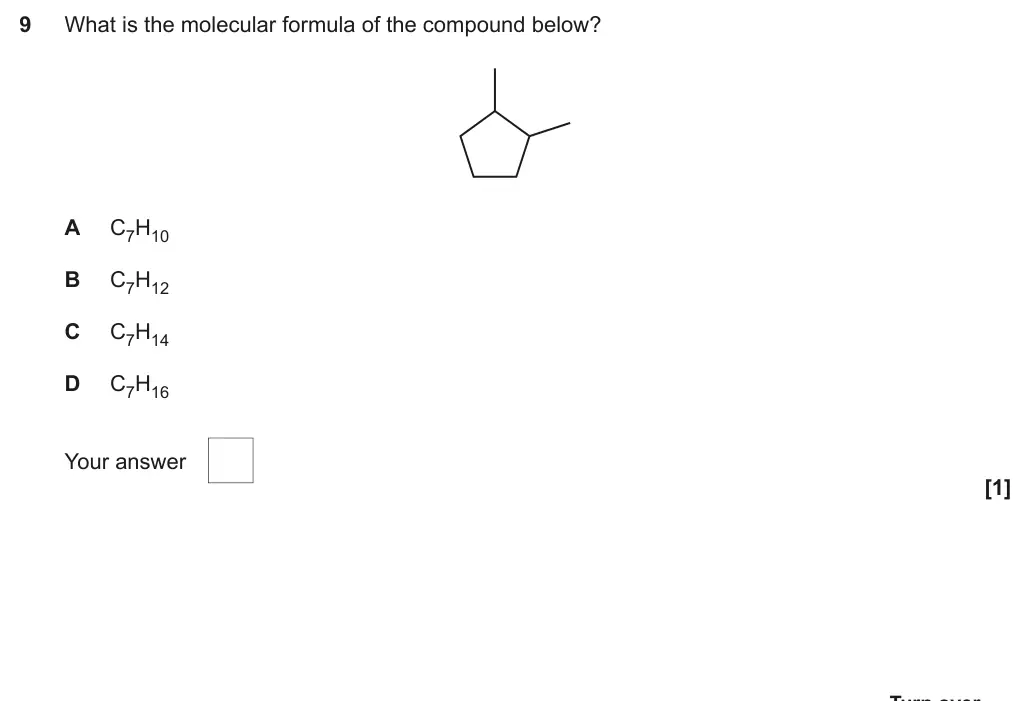
Most gave the correct answer C here. Many candidates added hydrogens onto the structure to aid counting with some even drawing out the displayed structure. The most common incorrect response was D.
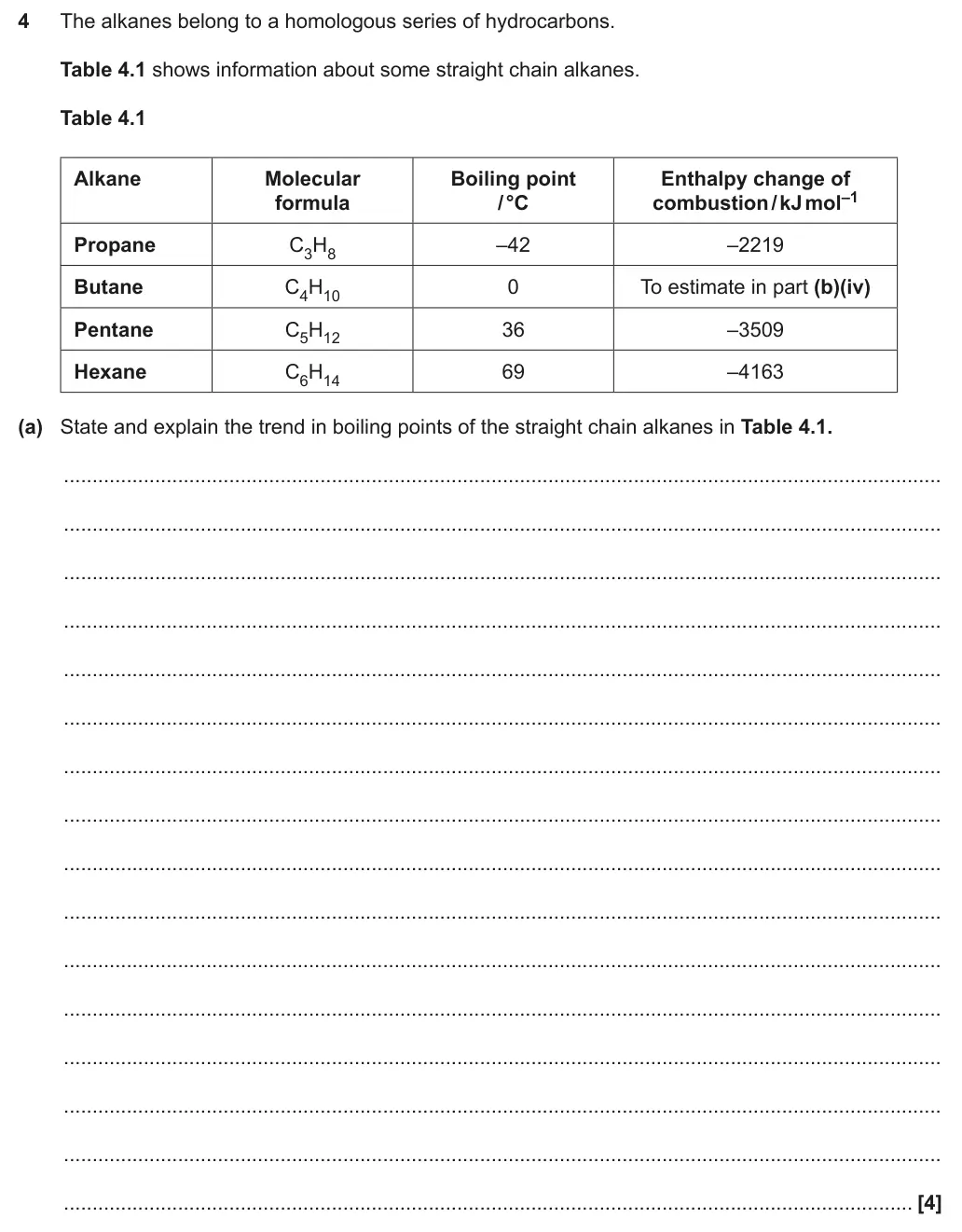
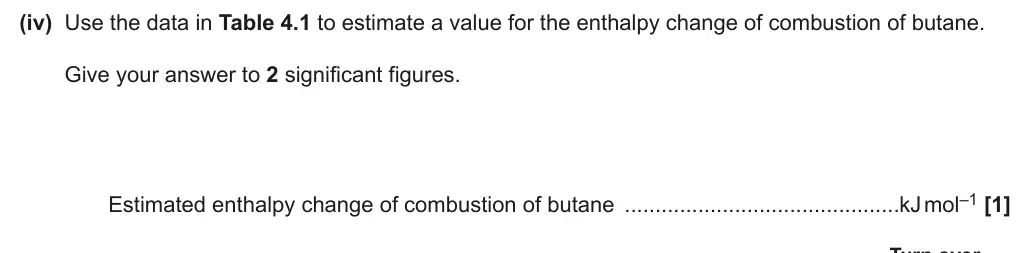
June 2025 · AS Paper 2 · Q4(b)(iv)1 markData interpretationHard
Earlier part of question 4 that this part uses
Mark scheme
Examiner's comment
Many struggled to give the correct response here. They were expected to find the mid-point between the values given for propane and pentane. (The difference between pentane and hexane could also be used.) They then needed to give the value to 2 significant figures. Candidates were generally confident at giving final answers to 3 significant figures but struggled here when asked for only 2. A significant number also forgot to include the – sign.
Notes from the mark scheme and report
–2900
must be 2 SF with negative sign
Skills: M0.3 Estimate results; M1.1 Use an appropriate number of significant figures
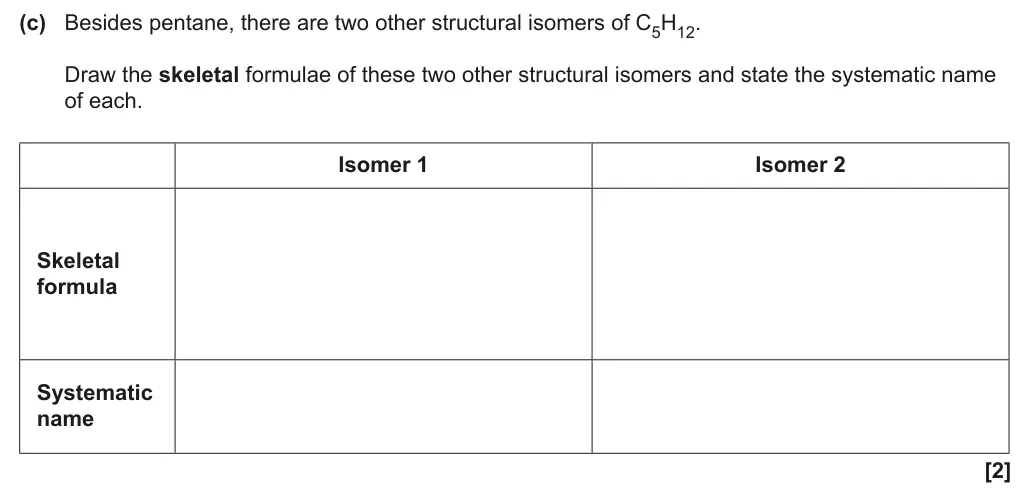
June 2025 · AS Paper 2 · Q4(c)2 marksStructure / isomerEasy
Mark scheme
Examiner's comment
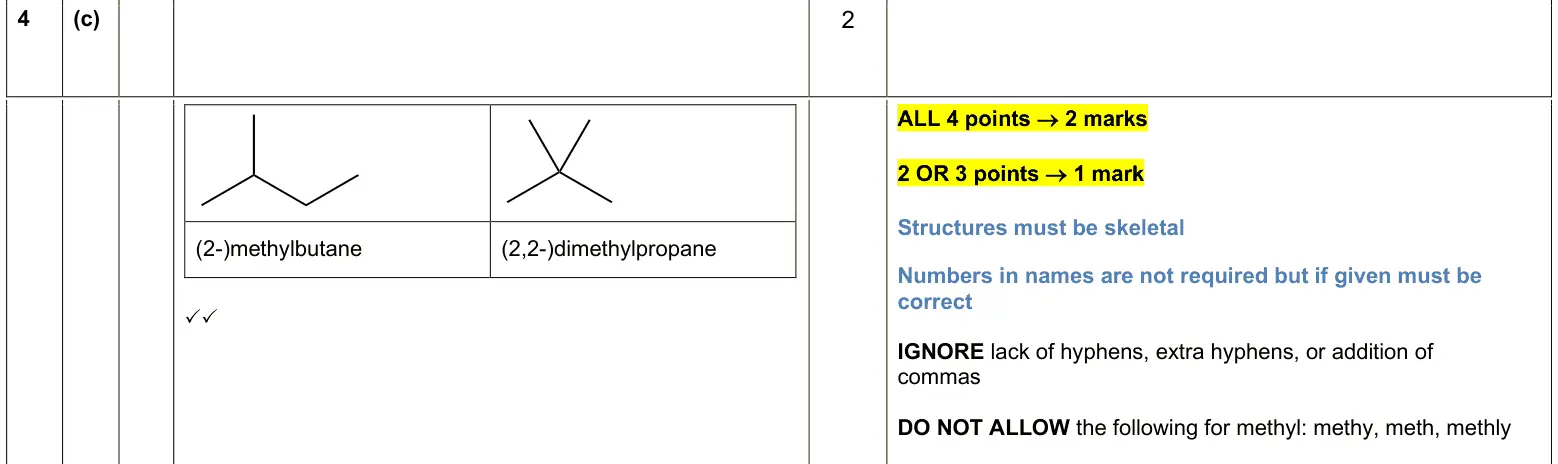
Most candidates scored both marks here. Some lost a mark due to slips in naming, e.g. missing ‘di’ from dimethylpropane or incorrect numbering, e.g. 2-dimethylpropane, 2,3-dimethylpropane. Some used structural formula rather than skeletal. Common incorrect structures included cyclopentane, 1- or 2- ethylpropane or 1,2-dimethylpropane (not realising that these are 2-methylbutane) or 6 C structures with addition of a methyl group to pentane.
Notes from the mark scheme and report
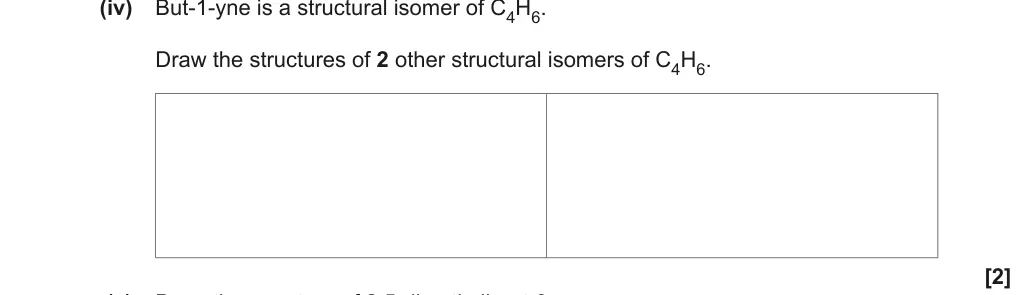
(2-)methylbutane and (2,2-)dimethylpropane
structures must be skeletal
all 4 points for 2 marks
numbers if given must be correct
DO NOT ALLOW methy/meth/methly
Skills: M4.2 Visualise and represent 2-D and 3-D forms including 2-D representations of 3-D objects
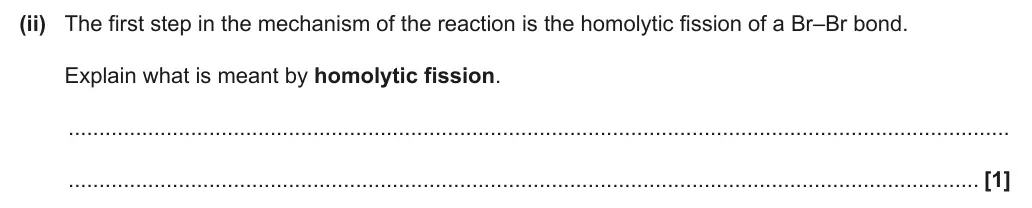
June 2025 · AS Paper 2 · Q4(d)(ii)1 markShort answerHard
Earlier part of question 4 that this part uses
Mark scheme
Examiner's comment
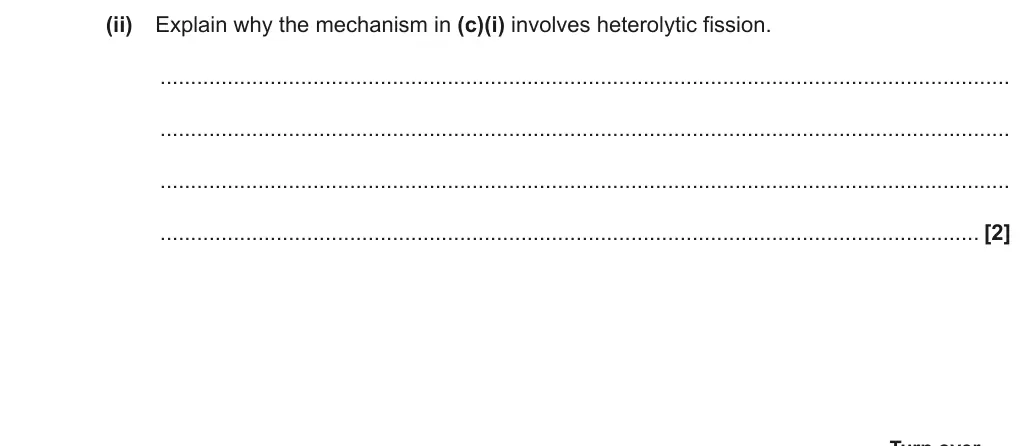
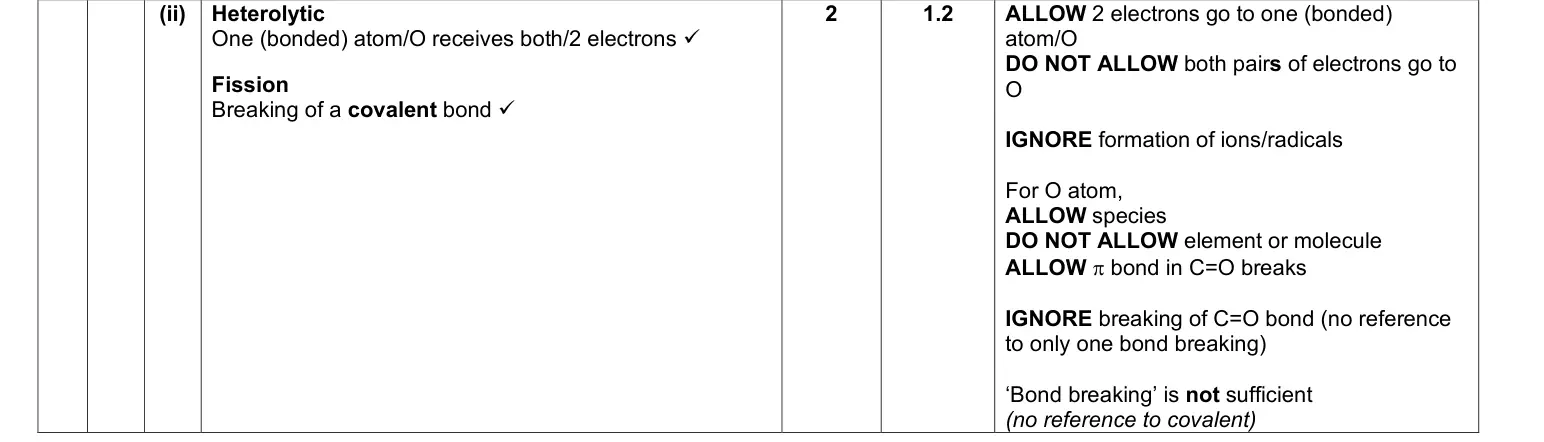
Candidates struggled to give a full explanation here. They needed to say what fission is and explain ho- molytic. Many said “bond breaking to form radicals” without explaining what radicals are or what happens to electrons from the bond. Many referred to elements rather than atoms in their response, e.g. “covalent bond is broken so that each element gets 1 electron”. It was evident that some had attempted to learn a definition but didn’t really understand what it meant, e.g. “each of the bonding atoms takes one of the electron pairs.” The description of what happened to electrons from the bond was often too vague, e.g.” electrons are shared evenly between atoms.”
Notes from the mark scheme and report
bond breaks AND each bonded atom receives one electron from the shared pair
DO NOT ALLOW molecule/compound/particle/element for atom
IGNORE equations
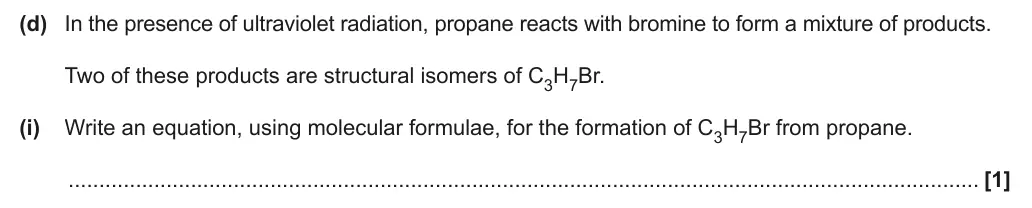
June 2025 · AS Paper 2 · Q4(d)(iii)2 marksMechanismHard
Earlier part of question 4 that this part uses
Mark scheme
Examiner's comment
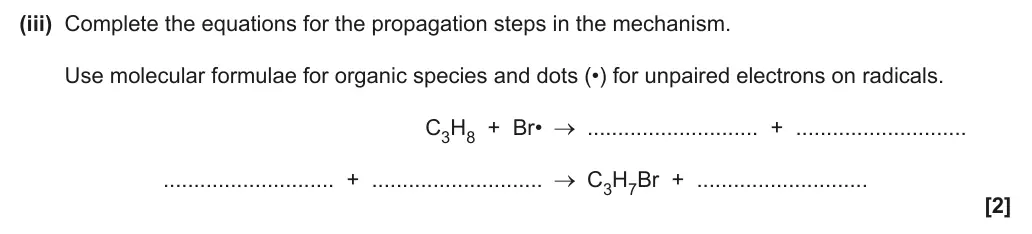
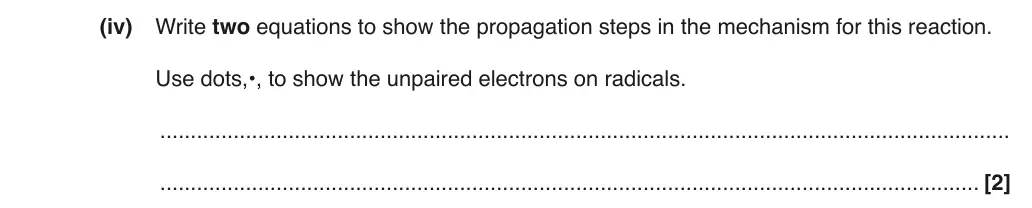
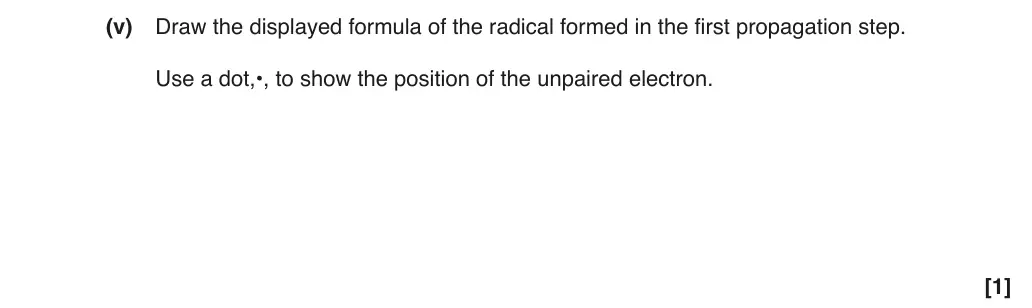
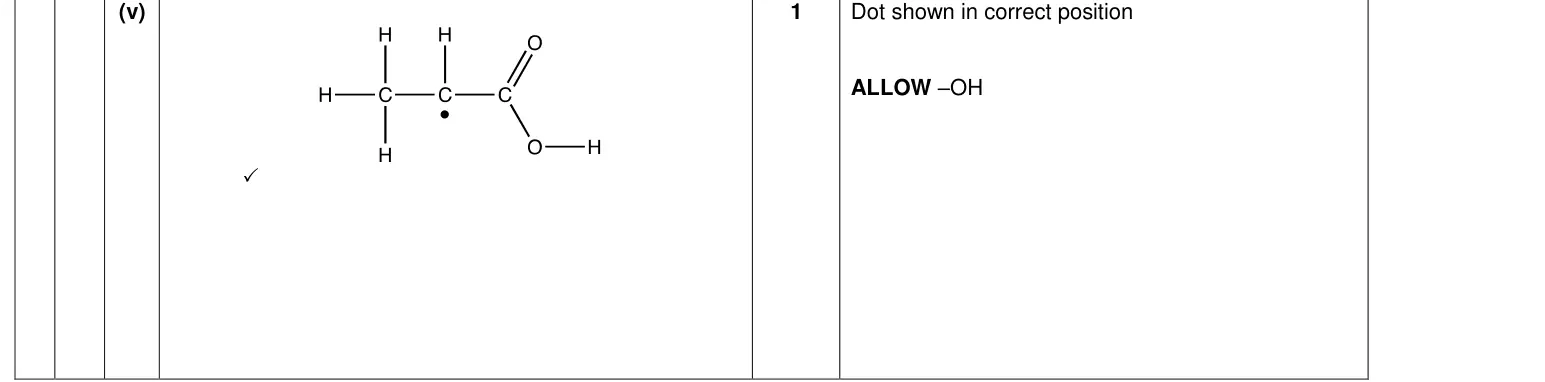
Most scored both marks here. The most common error involved substituting the Br in the first step – this lost both marks. Very few candidates scored 1 mark; this was usually for a correct first step but then re- acting the C3H7 radical with either 2 Br or HBr in second step. Candidates must check that equations balance in terms of atoms. Candidates should also understand that hydrogen radicals are highly reactive and are therefore unlikely to exist under standard conditions.
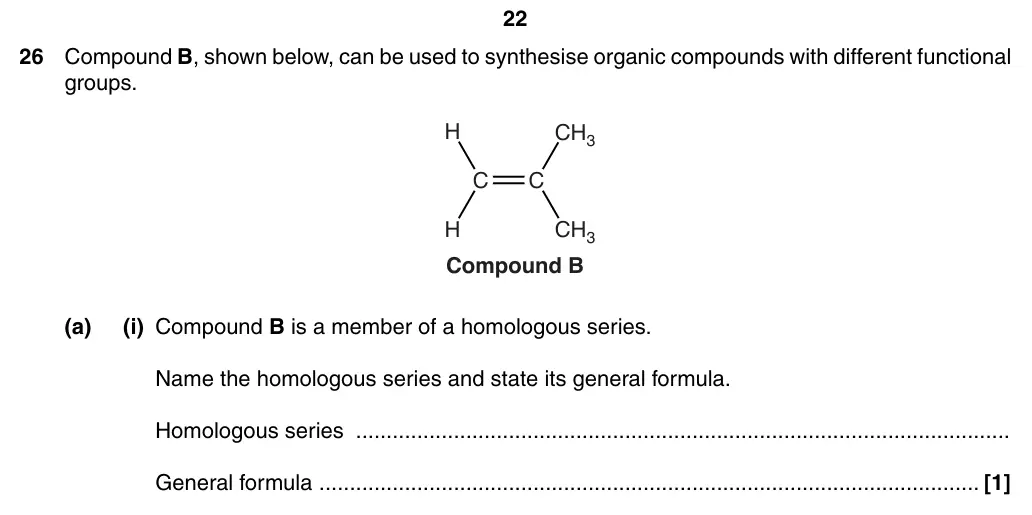
June 2025 · Paper 2 · Q16(a)1 markShort answerEasy
Mark scheme
Examiner's comment
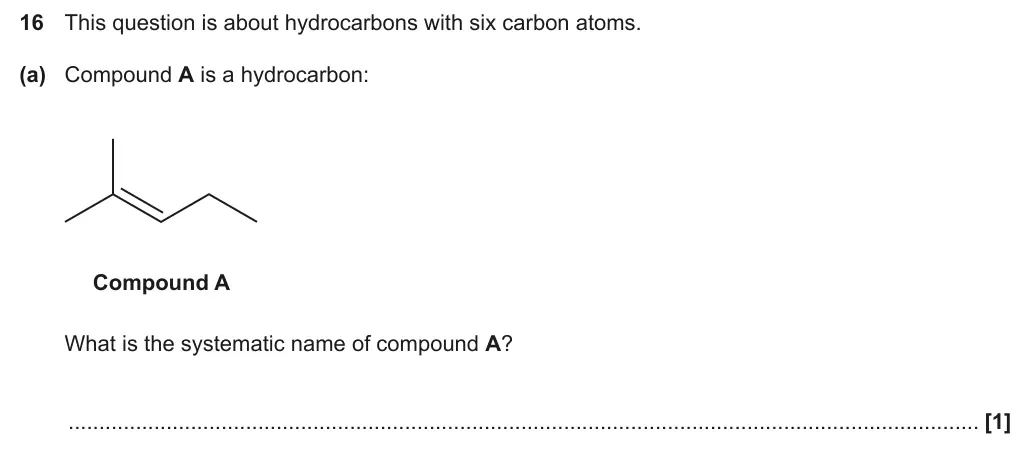
The majority of candidates scored the mark here. The most common incorrect responses included: • Incorrect spelling of ‘methyl’ (although less common than in previous series) • Missing or incorrect locant number for C=C: 2-methylpentene or 2-methyl pent-3-ene • Inclusion of ‘an’ in the name: 2-methylpentan-2-ene • Miscounting the number of carbons: 2-methylhex-2-ene or 2-methylbut-2-ene
Notes from the mark scheme and report
2-methylpent-2-ene
DO NOT ALLOW 2-methylpentan-2-ene or misspellings of methyl
IGNORE missing hyphens
June 2025 · Paper 2 · Q16(b)3 marksComplete table/diagramHard
Mark scheme
Examiner's comment
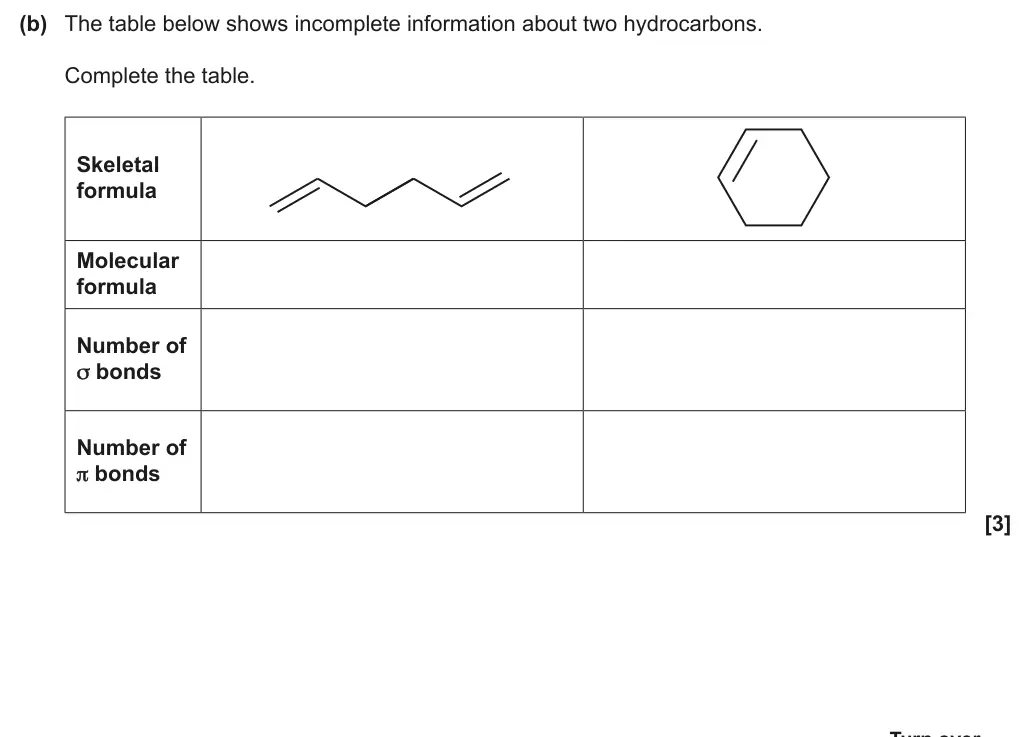
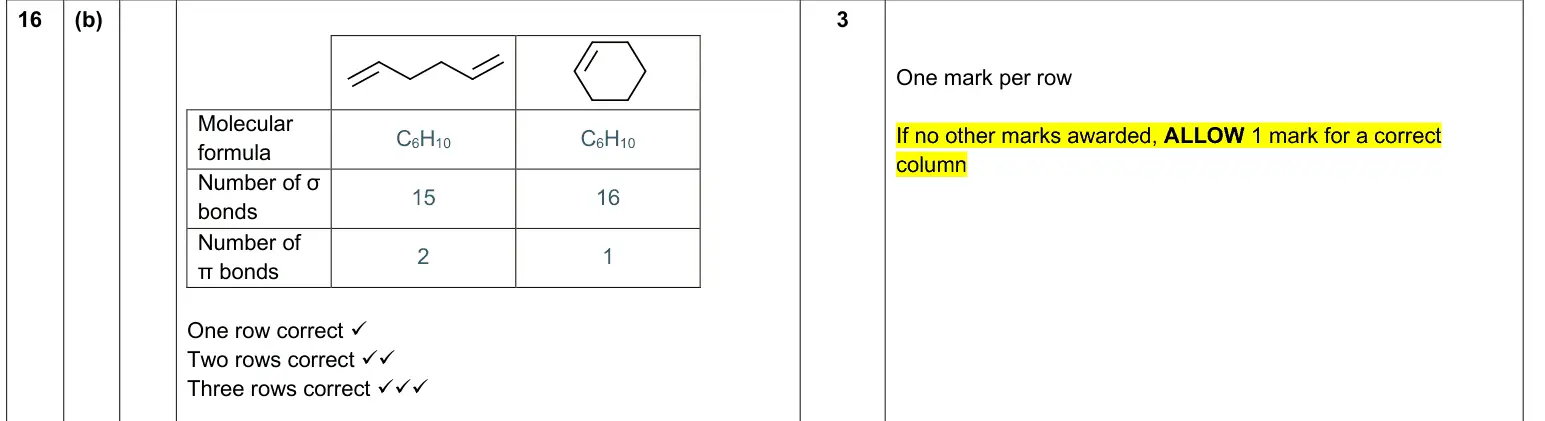
Very few candidates did not score any marks here. Most gained a mark for the correct molecular formulae in the first row, although some candidates gave structural formulae instead of molecular formulae or gave both. Candidates found counting the different types of bonds quite challenging and we would recommend drawing out displayed formulae to make it easier to label and count each type of bond. Many gave 5 and 6 respectively for the bonds, forgetting to count the C-H bonds that are not shown in the skeletal structure. More were able to correctly count the bonds but some counted the number of atoms involved in bonds instead. A few had and bonds the wrong way round.
Notes from the mark scheme and report
both C6H10
σ bonds 15 and 16
π bonds 2 and 1
one mark per row
1 mark for a correct column if no other marks
Skills: M4.2 Visualise and represent 2-D and 3-D forms including 2-D representations of 3-D objects
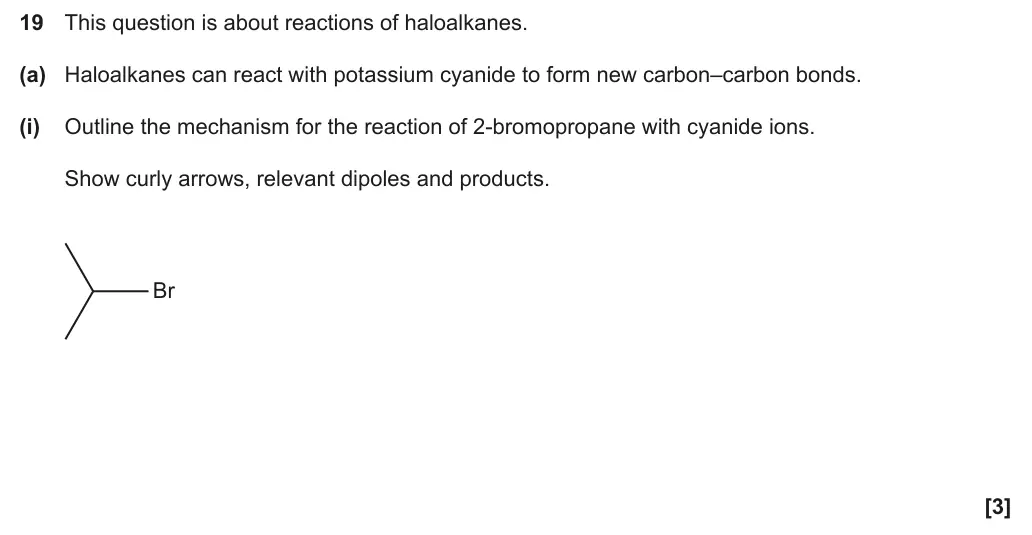
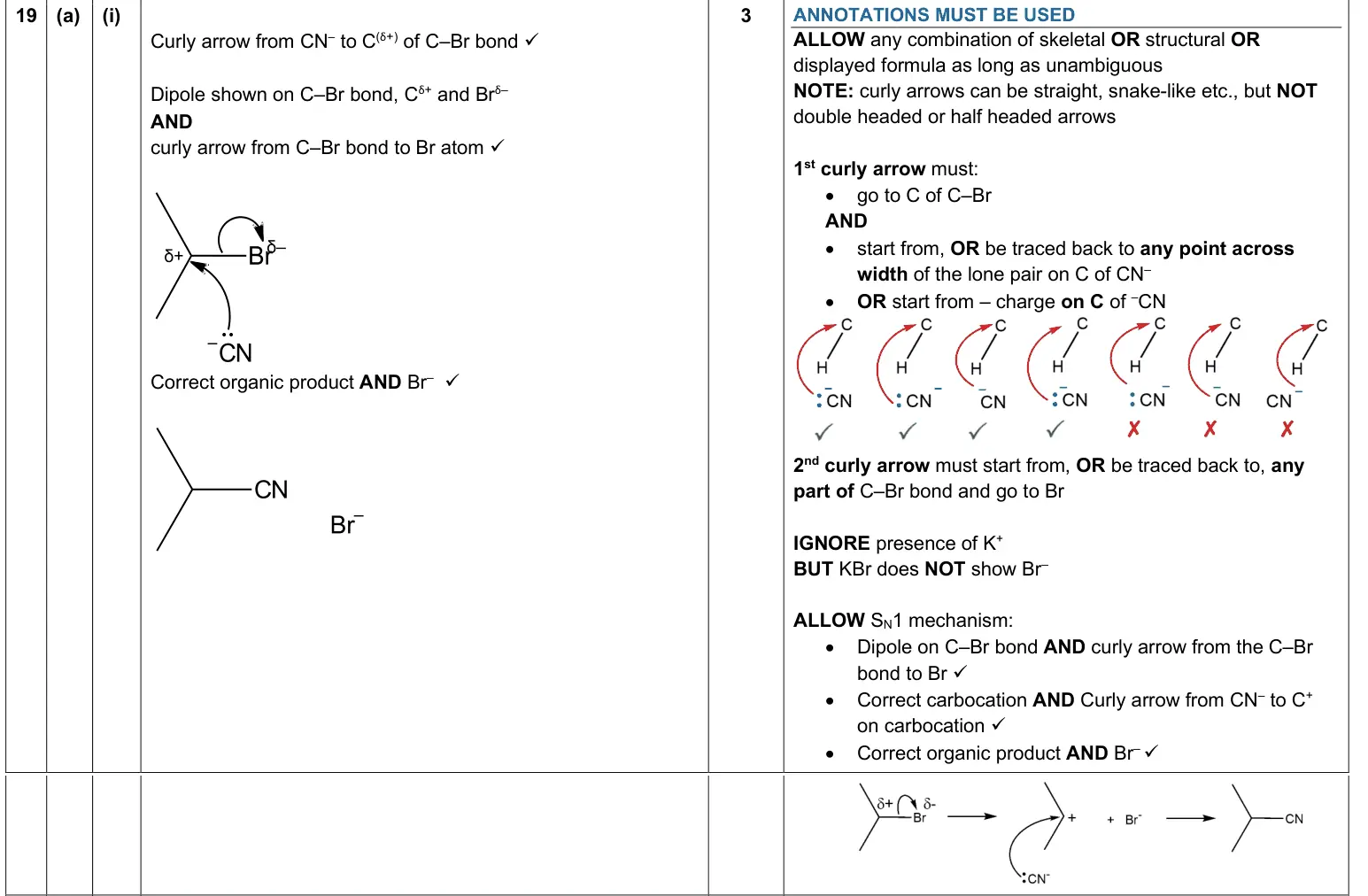
June 2025 · Paper 2 · Q19(a)(i)3 marksMechanismHard
Mark scheme
Examiner's comment
Many candidates scored all 3 marks here showing that the mechanism is well known. Some struggled with the skeletal formula given but were given credit for drawing out structural or displayed formula, provided that the central C showed correct number of bonds. Most common reasons for losing marks: • KCN and KBr shown in the mechanism rather than ions • arrow from lone pair or negative charge on N of CN • dipole on C-Br the wrong way round • missing the negative charge on CN- • curly arrows shown in the wrong direction Remind candidates that curly arrows should only be used to show the movement of a pair of electrons and not the formation/breaking of an ionic bond. A significant number of candidates chose to write more than one version of the mechanism without crossing out the one they did not wish to be marked. This led to marks being lost through contradictions. Teachers should remind candidates of the importance of submitting only one response to each question.
Notes from the mark scheme and report
arrow from lone pair or – charge on C of CN– to C of C–Br
dipole AND arrow from C–Br bond to Br
product AND Br– (KBr does NOT show Br–)
no double- or half-headed arrows
ALLOW SN1
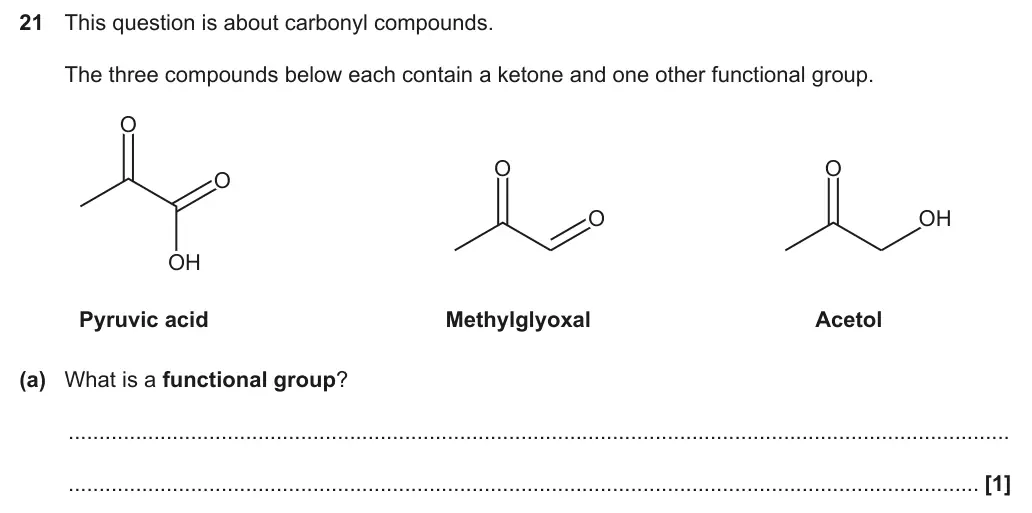
June 2025 · Paper 2 · Q21(a)1 markShort answerMedium
Mark scheme
Examiner's comment
To gain credit here candidates needed to explain what is meant by both ‘group’ and ‘functional’. Consequently, many didn’t gain credit here. Many responses began ‘A group…’ which didn’t gain the mark, as they needed to explain what a group is i.e. ‘atoms’ or ‘part of a molecule’. We allowed ‘part of an organic compound’ but not just ‘part of a compound’ as this term doesn’t apply to inorganic compounds. Some found it hard to explain what they meant. It was common to see the use of incorrect terminology here such ‘molecule’ or ‘elements’ or ‘species’ or ‘bonds. Most recognised that a functional group is responsible for the reactions of the molecules. Some were not specific enough, e.g. ‘properties’ or ‘characteristics’ but without chemical wasn’t enough. Some related a ‘functional group’ to belonging to a particular homologous series, but this wasn’t sufficient. For example, ‘group which determines the homologous series’ or ‘homologous series shares the same functional group.
Notes from the mark scheme and report
atom/group of atoms responsible for the characteristic reactions
IGNORE physical properties
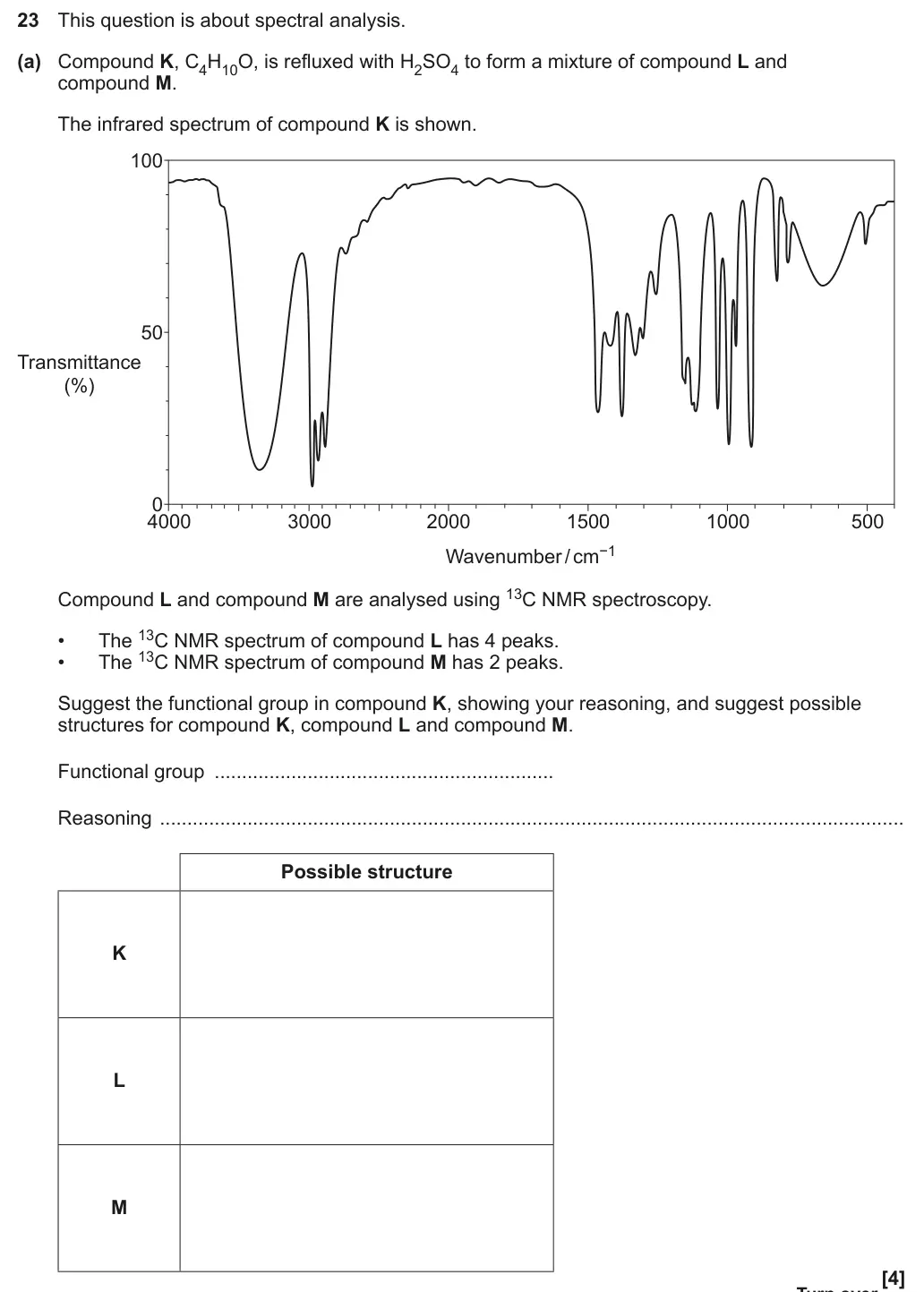
June 2025 · Paper 2 · Q23(a)4 marksShort answerHard
Mark scheme
Examiner's comment
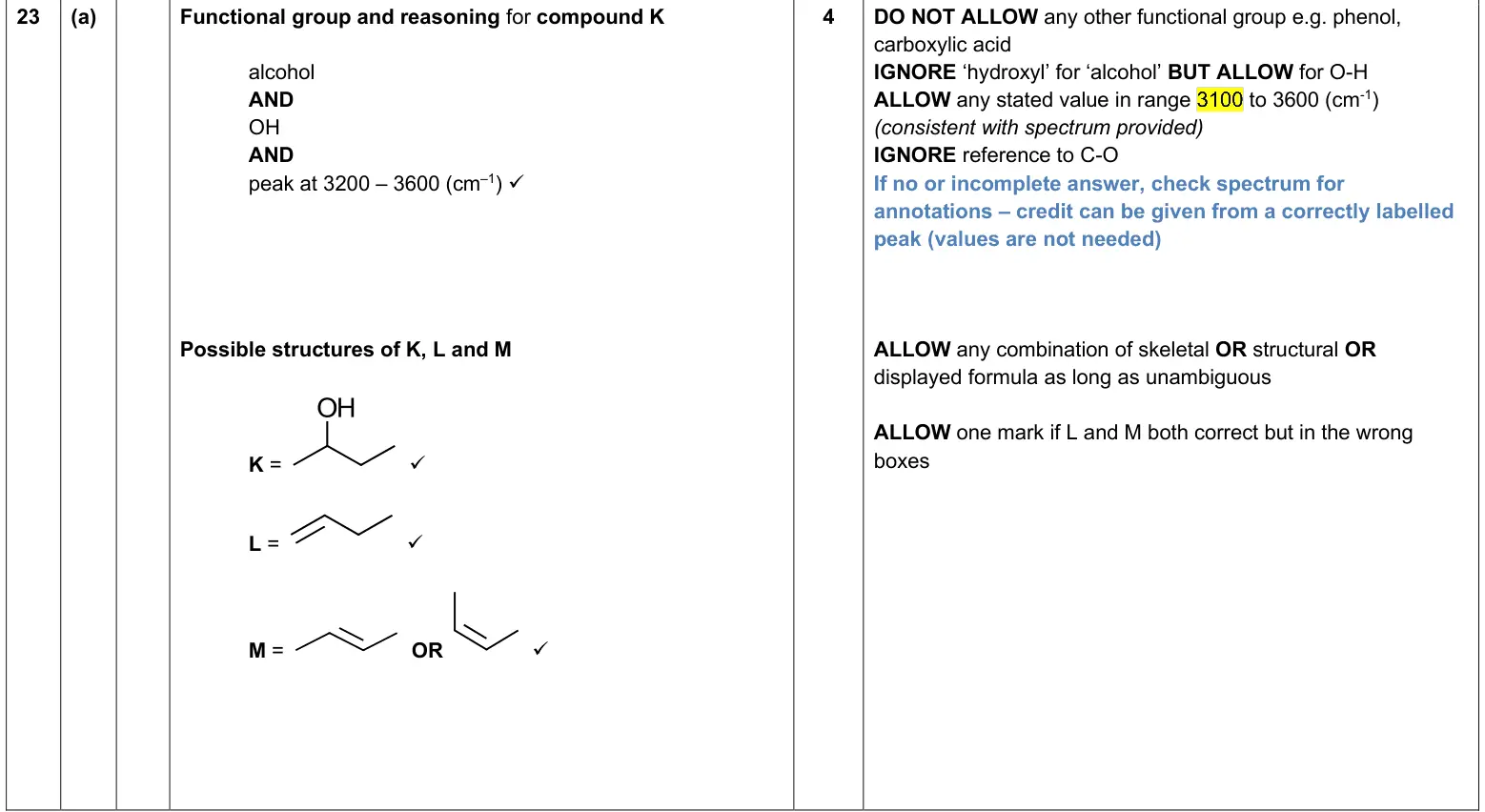
Very few candidates scored all 4 marks. The mark for identifying the alcohol functional group due to the presence of O-H bond in IR between 3200-3600 cm-1 was often lost for missing information. O-H or OH or hydroxy alone was not accepted as OH groups can be found within other functional groups i.e. phenol and carboxylic acid. Equally, it was important to identify the correct bond from the IR spectrum; in this case, O-H gives the most definitive answer. Other bonds are present, e.g. C-H and C-O but do not tell us that it is an alcohol. A few misinterpreted the ‘reasoning’ question stem and said alcohols would have the correct general formula to fit C4H10O or that alcohols could be dehydrated to make different alkenes, which is correct, but confirmation needed to come from the IR provided in the question. Many candidates gave a primary alcohol, butan-1-ol, as K. It appears many candidates focused on the fact that K was refluxed with H2SO4 and assumed this was oxidation, despite there being no K2Cr2O7, giving L and M as aldehydes, ketones or carboxylic acids. Some just gave alcohols with different structural formula for the alcohol for L and M, attempting to use the 13C NMR data. A significant proportion of candidates did not gain any marks on this question.
Notes from the mark scheme and report
alcohol AND O–H AND peak at 3200–3600 cm–1 (DO NOT ALLOW phenol/carboxylic acid
IGNORE C–O)
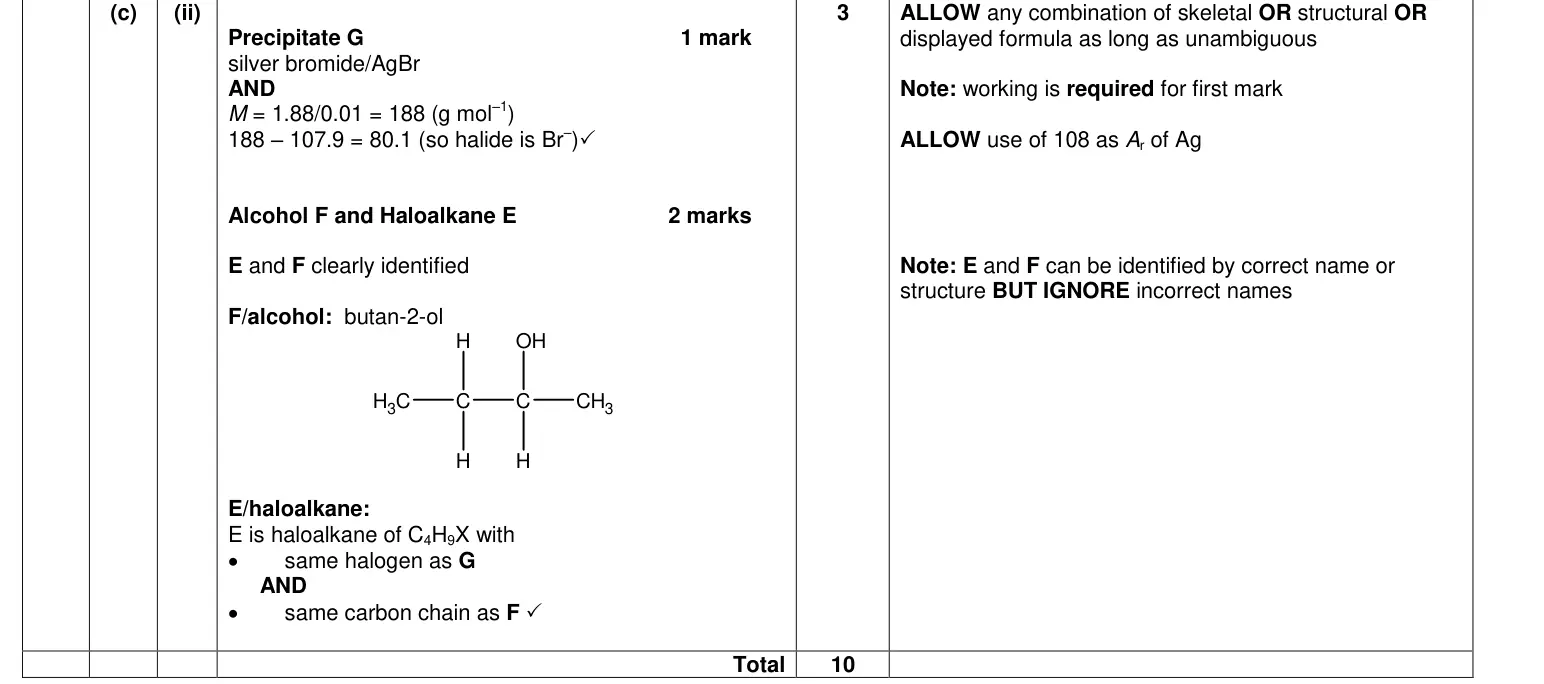
K = butan-2-ol, L = but-1-ene, M = but-2-ene (E or Z)
1 mark if L and M correct but in wrong boxes
Skills: M3.1 Translate information between graphical, numerical and algebraic forms
June 2025 · Paper 3 · Q2(a)(i)1 markStructure / isomerEasy
Mark scheme
Examiner's comment
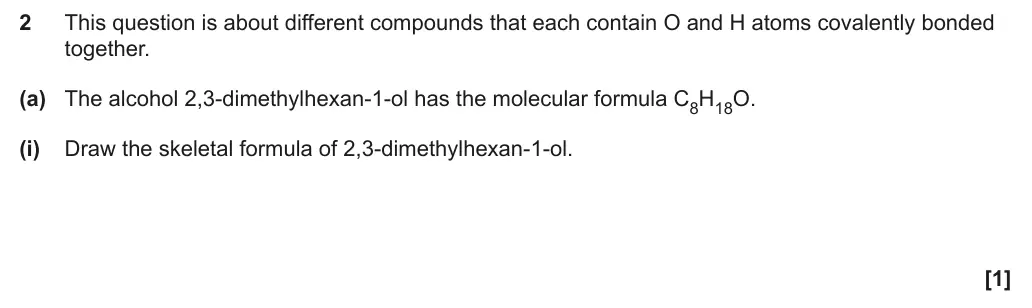
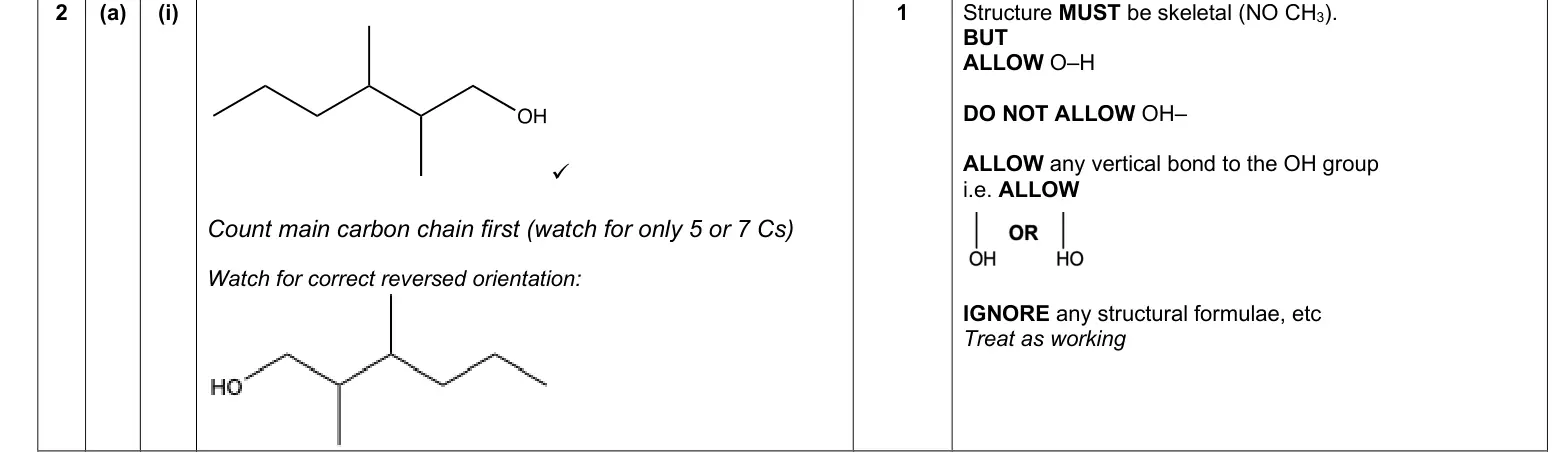
Most candidates were able to correctly draw the skeletal formula. Some candidates labelled the CH3 groups and OH connectivity was sometimes shown incorrectly as –HO or OH–. Other incorrect responses showed a main carbon chain with more, or less, than 6 carbon atoms or the CH3 side chains connected to the wrong carbon atoms. Good advice is to count the number of carbon atoms, with ‘hexan’ signifying 6 for this name.
Notes from the mark scheme and report
must be skeletal (no CH3)
check chain is 6 C
DO NOT ALLOW OH–
June 2025 · Paper 3 · Q5(a)(i)1 markShort answerMedium
Mark scheme
Examiner's comment
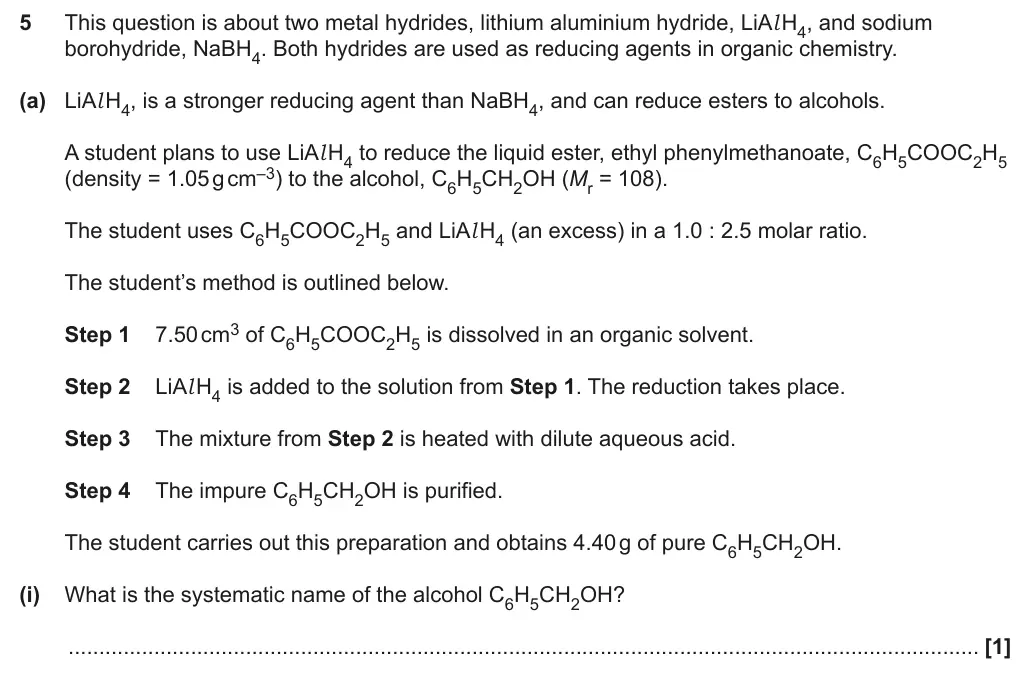
This name caused problems for most candidates. Phenyl methanol was expected, and unambiguous representations were allowed including 1- phenylmethanol, phenylmethan-1-ol and 1-phenylmethan-1-ol Many candidates incorrectly based the name on methylphenol or hydroxymethylbenzene.
Notes from the mark scheme and report
phenylmethanol
DO NOT ALLOW hydroxymethylbenzene or methylphenol
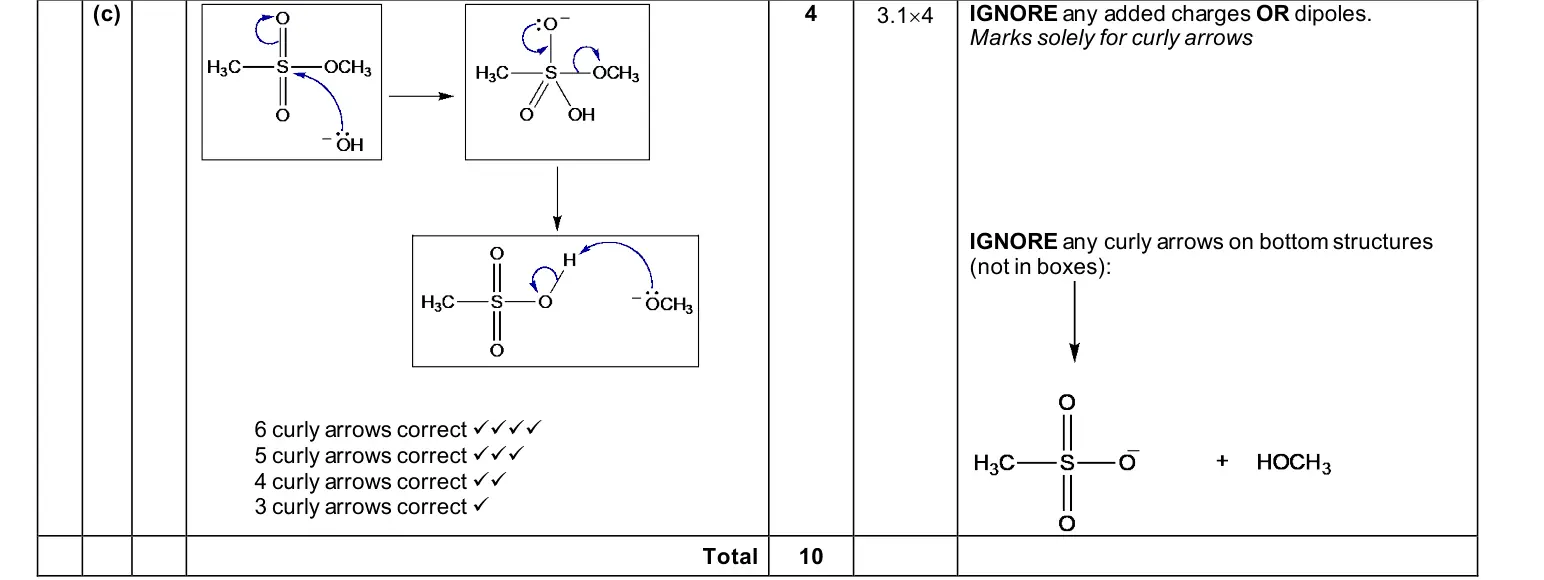
June 2025 · Paper 3 · Q5(a)(iv)4 marksMechanismMedium
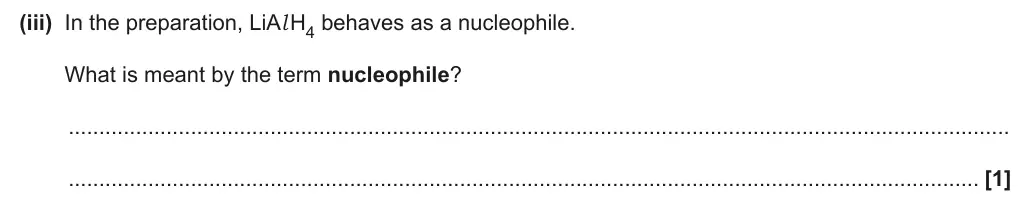
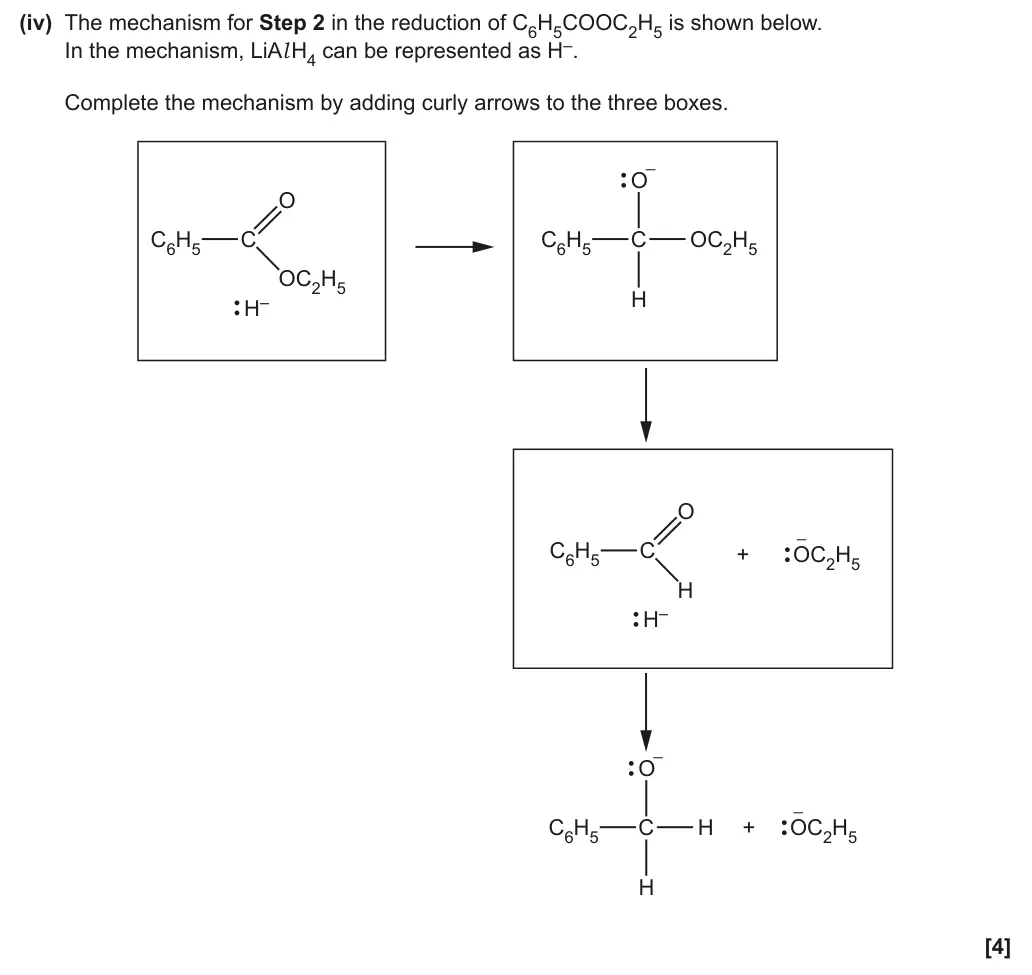
Earlier parts of question 5 that this part uses
Mark scheme
Examiner's comment
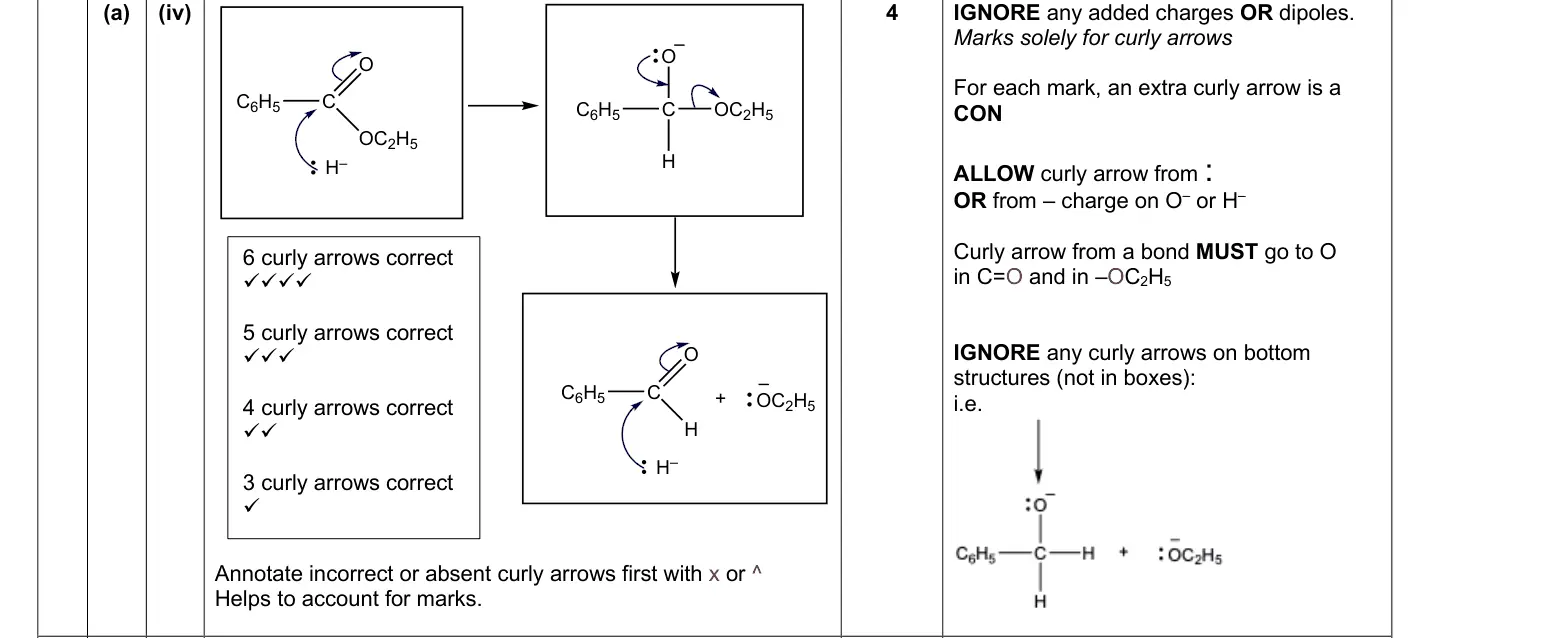
Candidates showed a good understanding of how to position curly arrows within an unknown mechanism. Incorrect responses were mainly in the second box. Some arrows were shown from O– to C atom instead of to the bond. It was rare for additional arrows to be added. From the responses, there was clear evidence that most candidates are becoming more confident in the accurate use of curly arrows in a mechanism and the role of lone pairs. The positioning of both ends of a curly arrow were often accurate.
Notes from the mark scheme and report
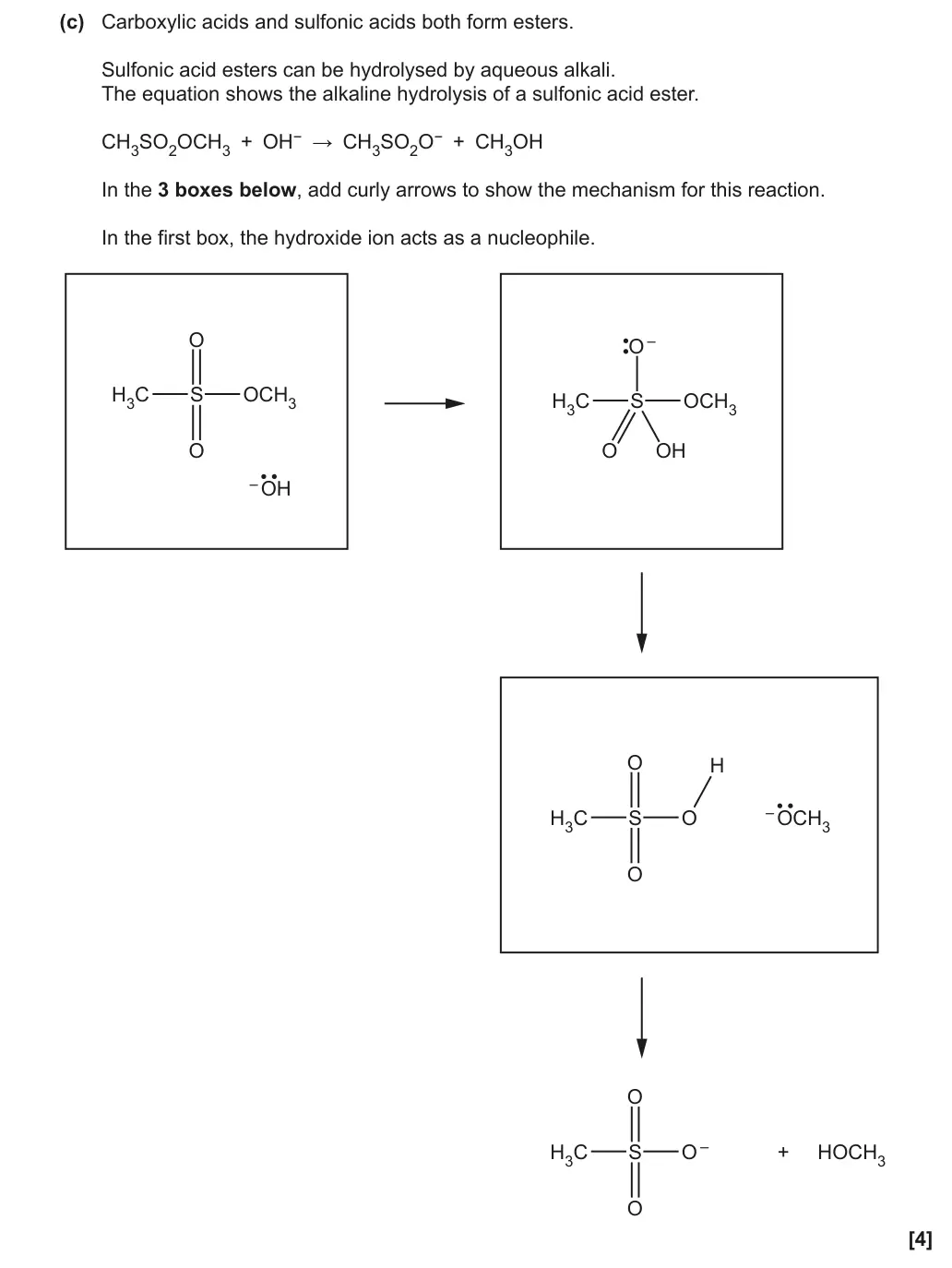
marks solely for six curly arrows (6 = 4 marks, 5 = 3, 4 = 2, 3 = 1)
arrow from lone pair or charge of H– / O–
arrow from a bond must go to O in C=O and in –OC2H5
an extra arrow is a CON
IGNORE charges and dipoles
June 2024 · AS Paper 1 · Q141 markMultiple choiceHard
Answer
C
Mark scheme
Examiner's comment
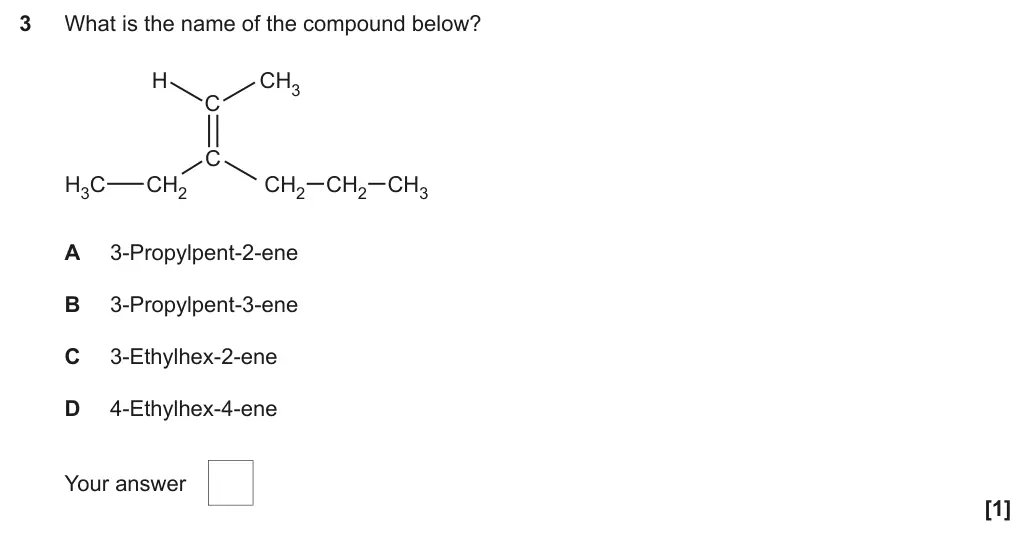
About half the candidates correctly chose C. Options A and B were incorrectly chosen by many candidates, presumably by counting from the left or not first identifying the longest carbon chain. This question proved to be an excellent discriminator.
June 2024 · AS Paper 1 · Q151 markMultiple choiceHard
Answer
B
Mark scheme
Examiner's comment
This question assessed understanding of important terms used in organic chemistry, with some candidates correctly choosing B as the correct option. The question discriminated well with less successful responses choosing D, presumably thinking that the two double bonds in a cyclic structure makes the compound aromatic.
Notes from the mark scheme and report
A cyclic organic molecule containing single and/or double bonds is aliphatic. The molecule is described as aromatic if it contains a benzene ring.
June 2024 · AS Paper 1 · Q24(b)5 marksMechanismMedium
Mark scheme
Examiner's comment
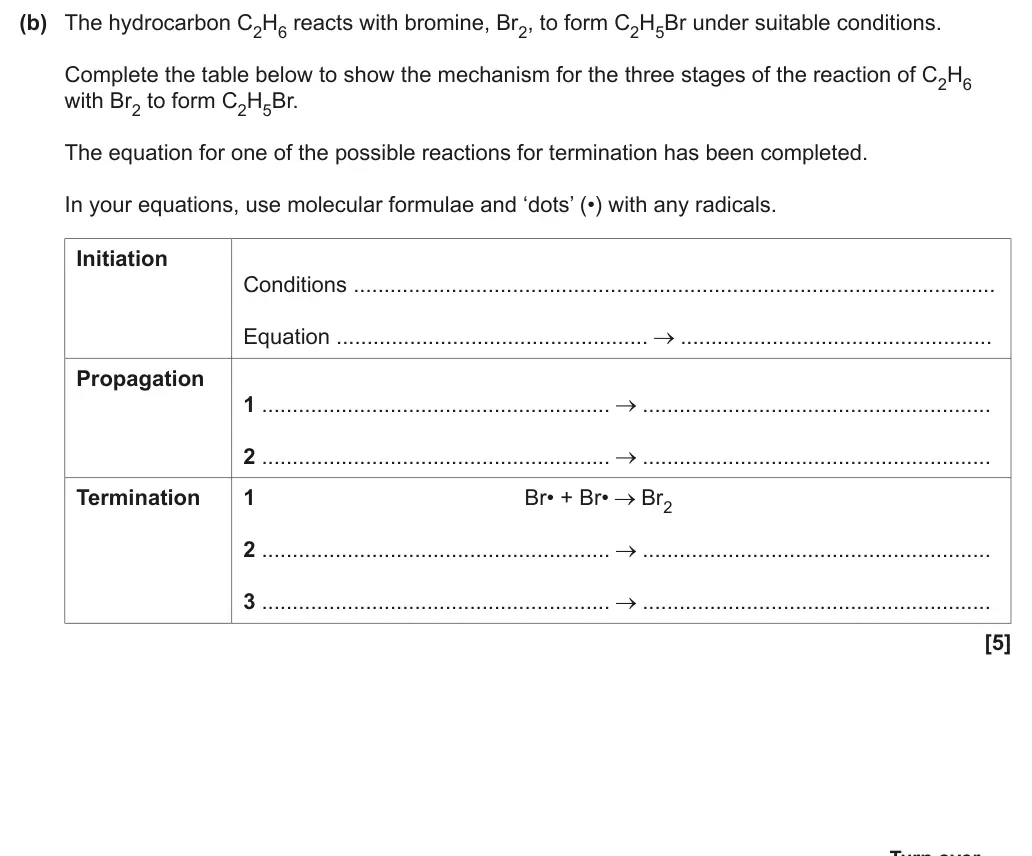
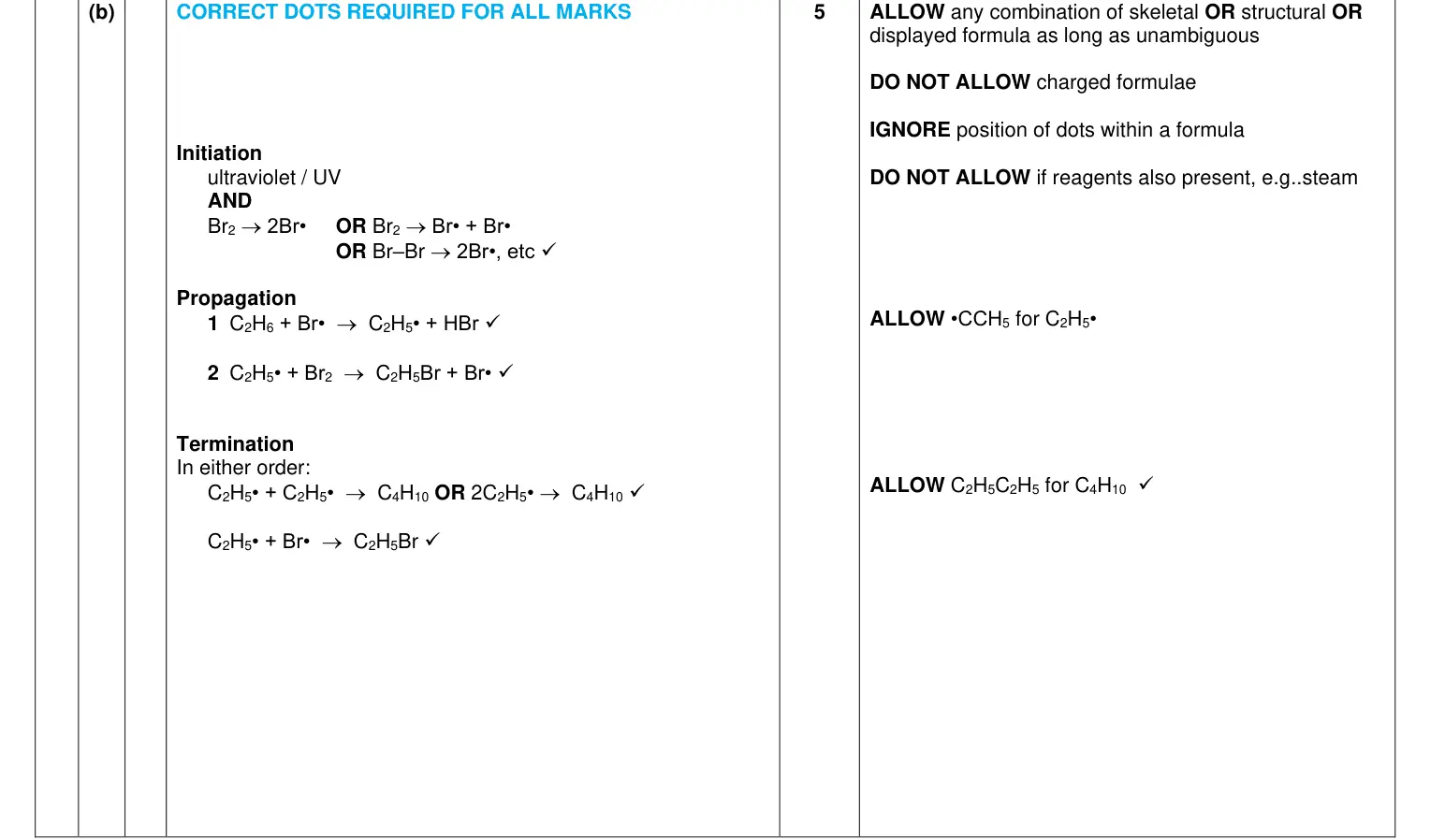
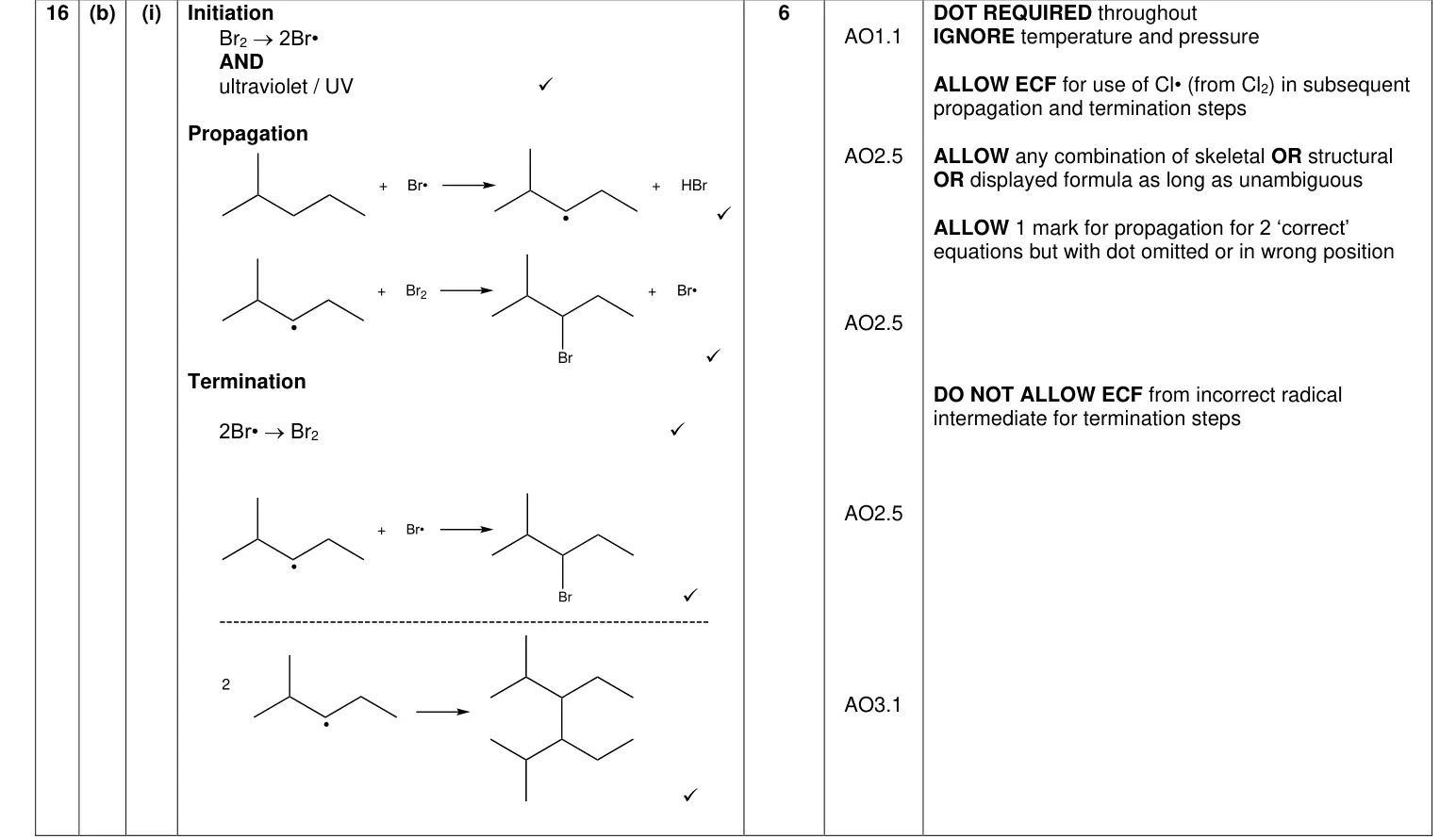
This question was answered extremely well with most candidates obtaining the full 5 marks. It was encouraging to see the widespread correct use of dots to indicate radicals, with relatively few omissions. Of the three steps, initiation and termination were answered better than the equations for propagation.
June 2024 · AS Paper 1 · Q25(b)3 marksComplete table/diagramEasy
Mark scheme
Examiner's comment
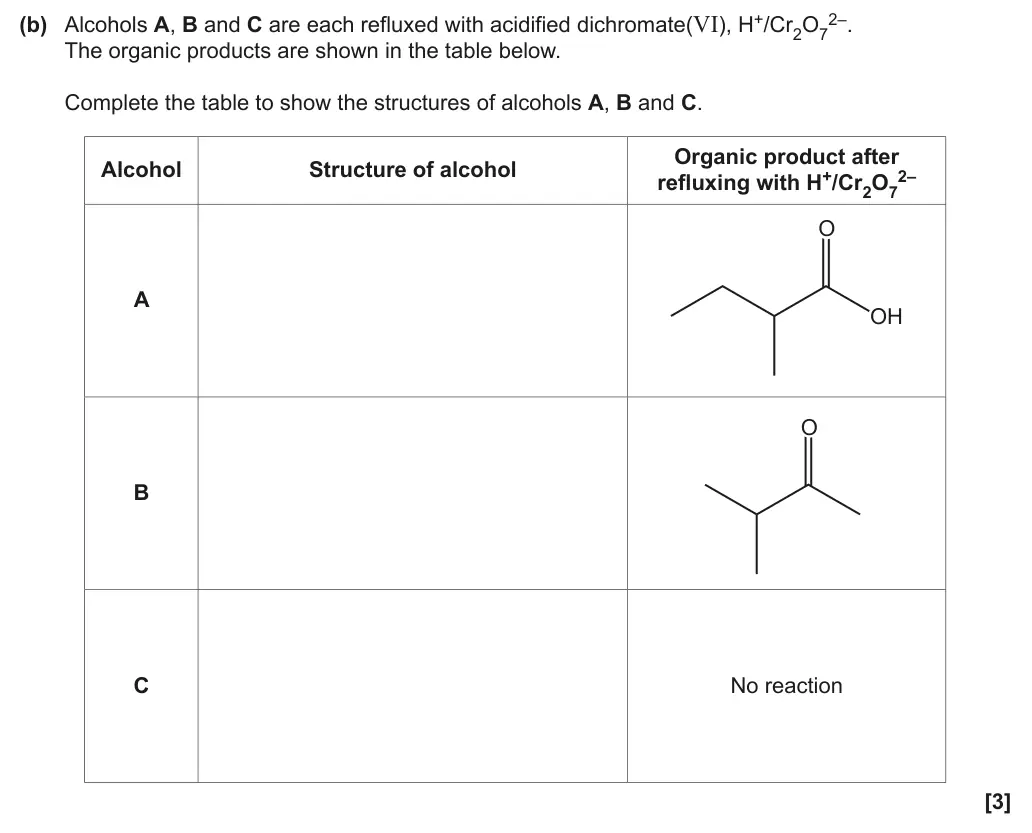
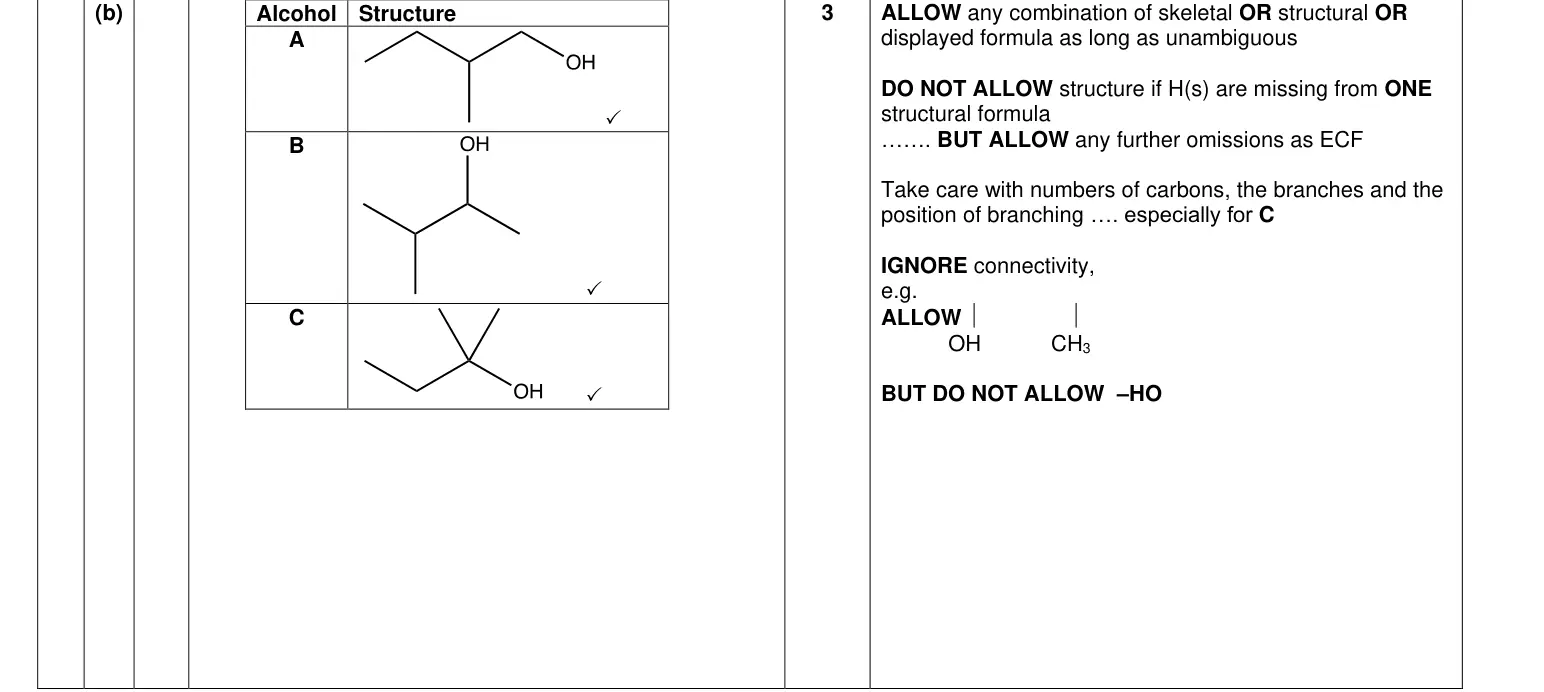
This question appeared to be straightforward, but many candidates got into a muddle when drawing the alcohol structures. The best tactic is to copy the carbon skeletal and to then add the functional group. Many candidates drew displayed formulae and these often contained too many carbon atoms or missing H atoms. Great care is needed in drawing organic structures. Structure C must be a tertiary alcohol, but the candidate has drawn the structure of a secondary alcohol. It should be noted that, even with a correct carbon skeleton, structure A would be rejected. Incorrect connectivity of the OH group is always penalised.
Notes from the mark scheme and report
A = 2-methylbutan-1-ol, B = 3-methylbutan-2-ol, C = 2-methylbutan-2-ol
DO NOT ALLOW structure with missing H(s)
DO NOT ALLOW –HO connectivity
Skills: M4.2 Visualise and represent 2-D and 3-D forms including 2-D representations of 3-D objects
June 2024 · AS Paper 1 · Q25(d)(i)2 marksEquation writingMedium
Mark scheme
Examiner's comment
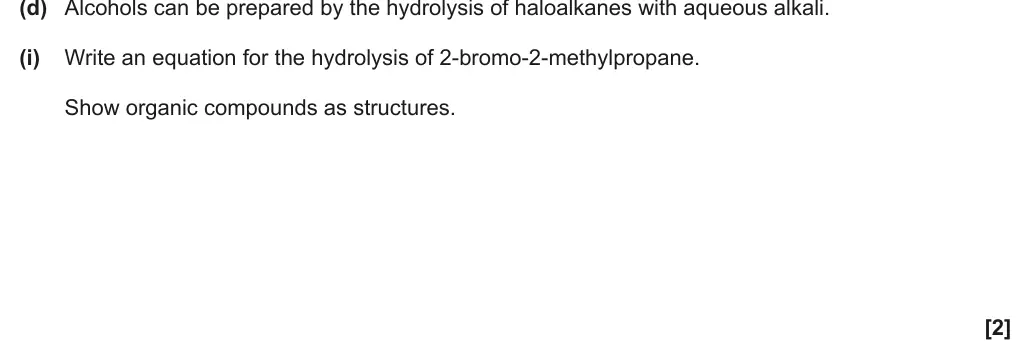
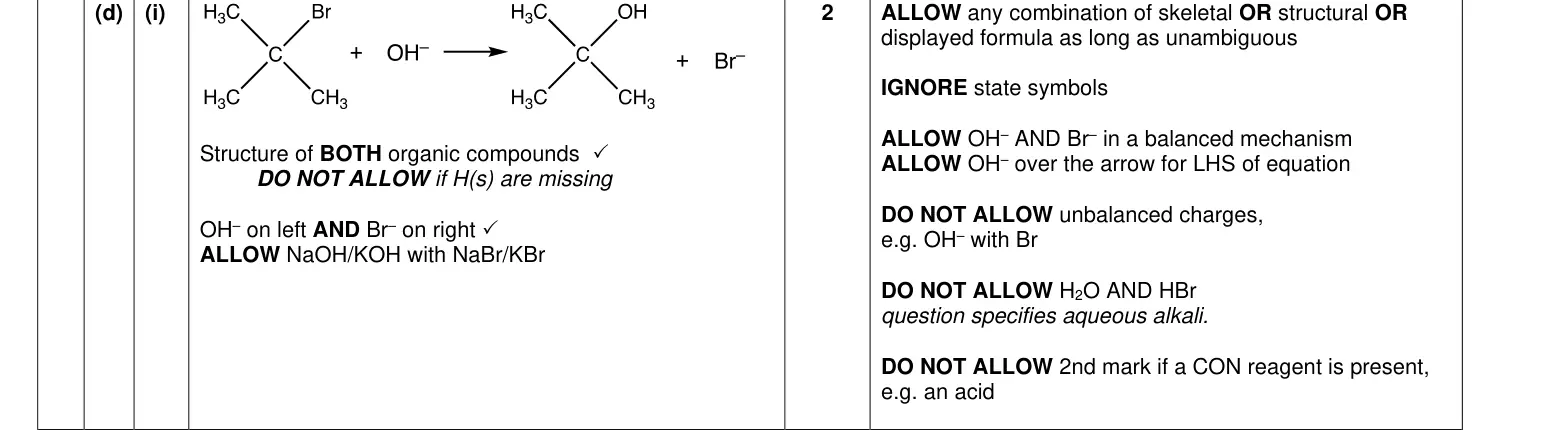
This question discriminated very well. Most candidates were given a first mark by showing correct structures for the organic reactant and its product, 2-methylpropan-2-ol. The question asked for an equation for alkaline hydrolysis and candidates were expected to use an alkali. Acceptable responses would include NaOH/KOH and NaBr/KBr, or OH– and Br–. Equations including H2O and HBr were not given marks, a common error for alkaline hydrolysis. Candidates are advised to carefully read the requirements in the question. For the most successful responses, candidates often underline these to draw their attention.
Notes from the mark scheme and report
structures of both organic compounds with OH– on left and Br– on right
DO NOT ALLOW H2O and HBr (question specifies aqueous alkali)
DO NOT ALLOW unbalanced charges
June 2024 · AS Paper 2 · Q5(b)(i)4 marksMechanismHard
Earlier part of question 5 that this part uses
Mark scheme
Examiner's comment
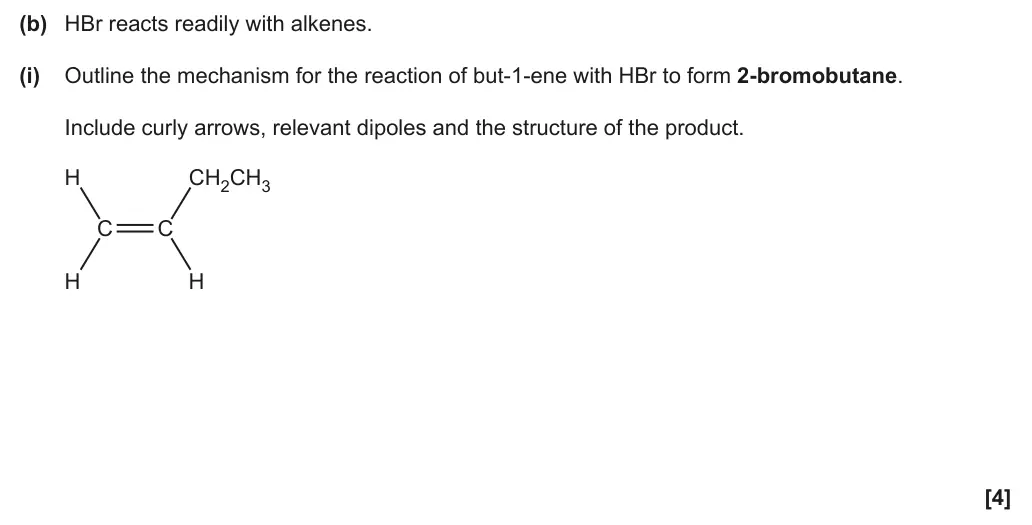
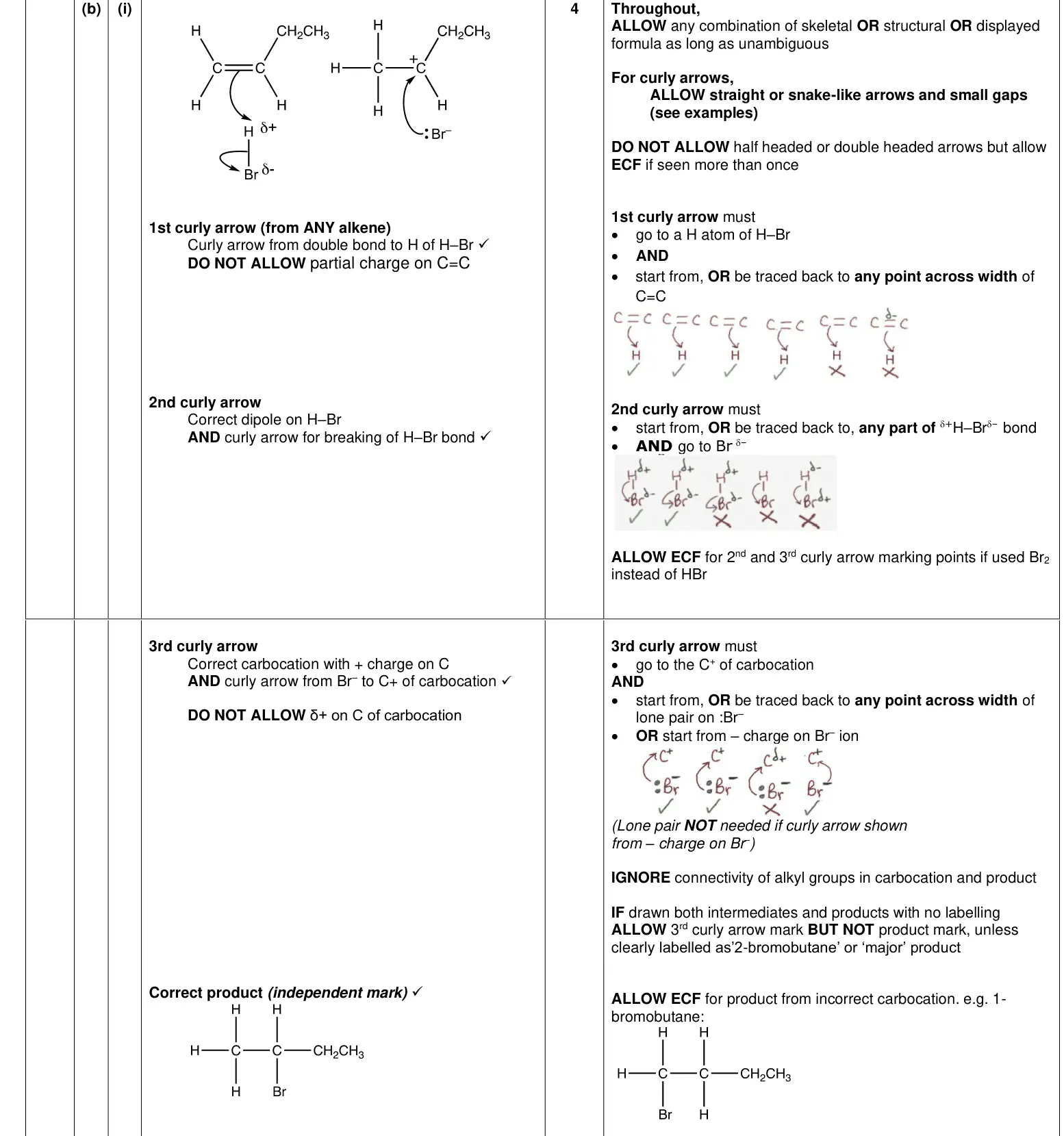
Approximately half of candidates scored all 4 marks. Very few scored no marks as they were able to give the correct structure of the named product (2-bromobutane). The most common reasons for losing marks included: • Adding dipoles to C=C • Missing dipoles on H-Br or reversed dipole on H-Br (i.e. + Br) • Missing charge on bromide ion or adding - • Arrows the wrong way round or not coming from a bond or lone pair (or negative charge for bromide ion) Some attempted a radical mechanism.
Notes from the mark scheme and report
arrow from C=C to H of H–Br
dipole on H–Br and arrow from bond to Br
arrow from Br– (lone pair or charge) to C+ of secondary carbocation
DO NOT ALLOW δ+ on carbocation or partial charge on C=C
product mark independent
ALLOW ECF for product from incorrect carbocation
For ideas on teaching this topic please look at our Topic Exploration Pack: Electrophilic Addition and Markownikoff’s rule: https://teachcambridge.org/item/b4220e86-bc04-492c-b354-8103687ce594
June 2024 · Paper 2 · Q16(a)1 markStructure / isomerHard
Mark scheme
Examiner's comment
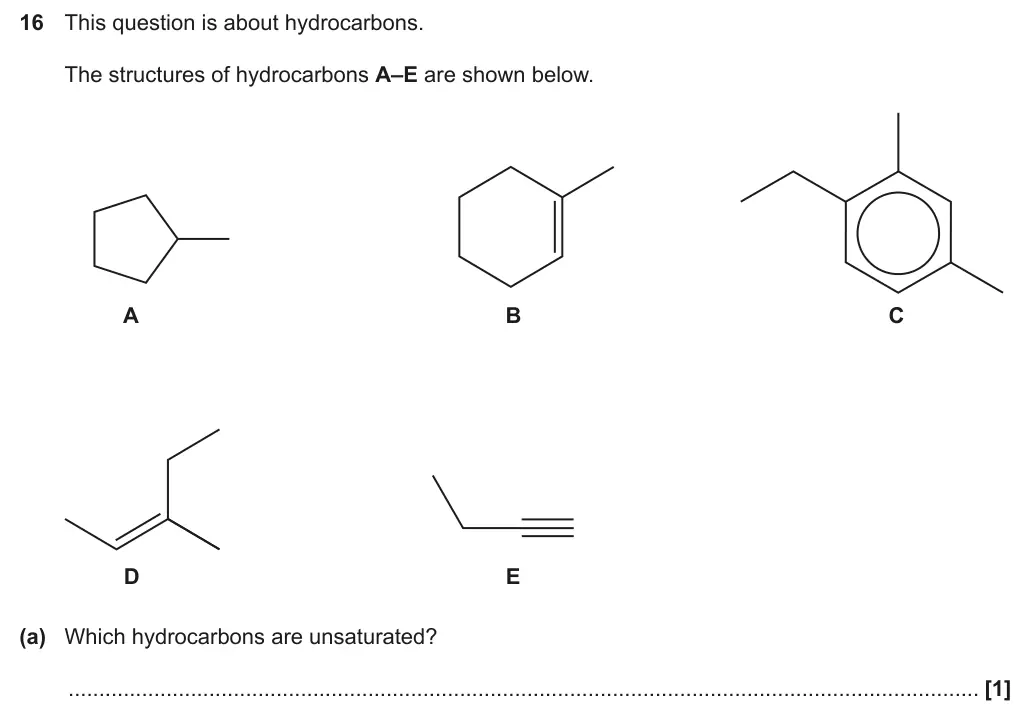
Over half the candidates found this question challenging an did not score the mark here. The most common error was to omit Structure C, but some also omitted Structure E. This suggested that many candidates may only apply the term ‘unsaturated’ to alkenes. It also highlights a potential lack of understanding of the delocalised ring in benzene and the relationship to the Kekulé structure.
Notes from the mark scheme and report
B, C, D and E only (aromatic ring and C≡C count as unsaturated)
June 2024 · Paper 2 · Q16(b)1 markShort answerEasy
Earlier part of question 16 that this part uses
Mark scheme
Examiner's comment
Most candidates were able to correctly identify the alicyclic compounds. Some candidates also included Structure C showing some confusion between terms alicyclic and aromatic. This was also noted in last year’s paper on Question 13.
Notes from the mark scheme and report
A and B only
A molecule is either aromatic, if it contains a benzene ring, or aliphatic. Aliphatic molecules which contain a ring can also be described as alicyclic. OCR have previously offered clarification for classification of organic compounds.
June 2024 · Paper 2 · Q16(c)1 markShort answerHard
Earlier part of question 16 that this part uses
Mark scheme
Examiner's comment
This question was also challenging and just under half of candidates gave the correct response. Many wrote molecular formulae underneath each structure, but less successful responses often struggled to convert from the skeletal formulae correctly. Common errors included: • just giving Structure D, and omitting Structure A • including Structure E as they miscounted the number of hydrogens in the presence of a triple C-C bond • including Structure B, on the basis that it had a double C-C bond • some less successful responses just wrote “alkene” and did not apply their responses to the hydrocarbon structures given.
Notes from the mark scheme and report
A and D only (cycloalkane and alkene)
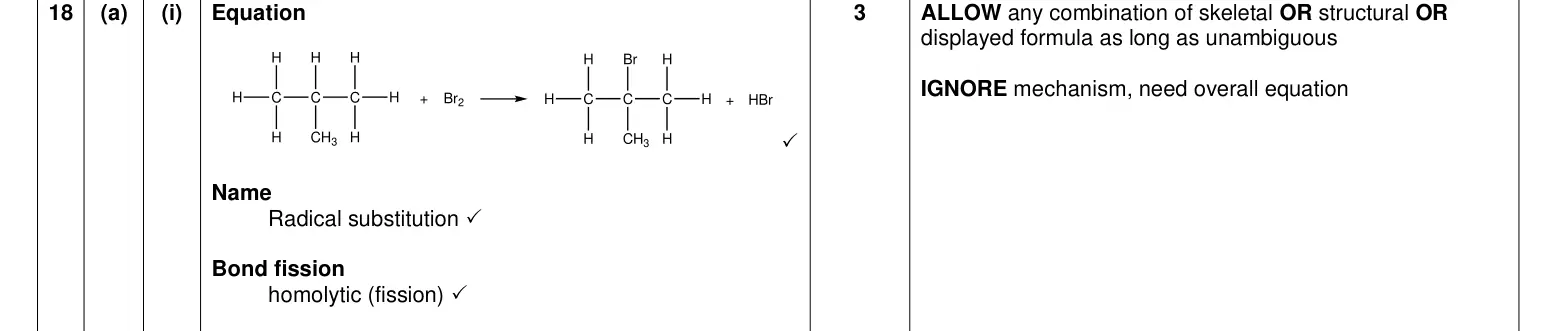
June 2024 · Paper 2 · Q18(a)(i)3 marksEquation writingHard
Mark scheme
Examiner's comment
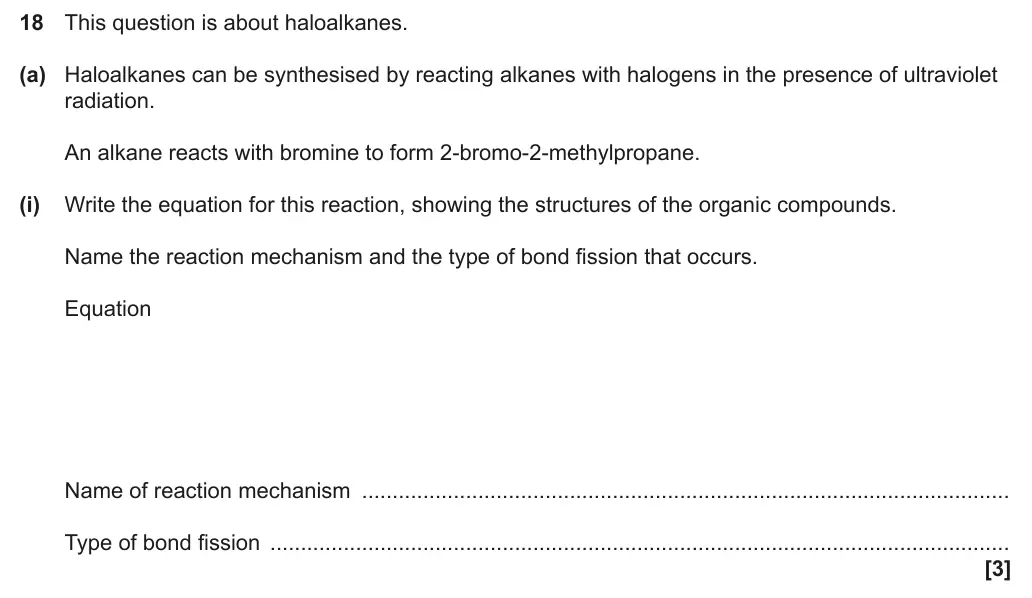
This question differentiated well, with a wide mix of responses given. Just over 40% scored all 3 marks. Equation: The most common error was to omit HBr as a product. Some gave H2 or just Br as a product. Some misunderstood the question and attempted to give either a partial mechanism, such as the propagation step or a complete mechanism, rather than the overall equation. Some gave molecular formula rather than structures as asked for. Those using structural or displayed formula were more prone to errors, such as missing hydrogens or incorrect chain length, than those that were confident using skeletal formula. Candidate should avoid giving equations in two formats, e.g. skeletal and structural because slips in one will lose marks. Mechanism: Many candidates were able to identify the radical substitution mechanism, but a significant number did not score here. Most common incorrect responses were electrophilic or nucleophilic substitution but there were also those that thought it was an addition reaction. Bond fission: A significant number identified this as heterolytic, even if the recognised mechanism was radical. Some struggled with the spelling or even suggested homogeneous or heterogenous.
Many struggled to identify the mechanism and then to link to bond fission. Try to introduce key terminology early on in teaching organic chemistry so that it can then revisited with each topic. Relevant mechanism terminology: - substitution / addition / elimination - electrophile / nucleophile / radical - homolytic / heterolytic
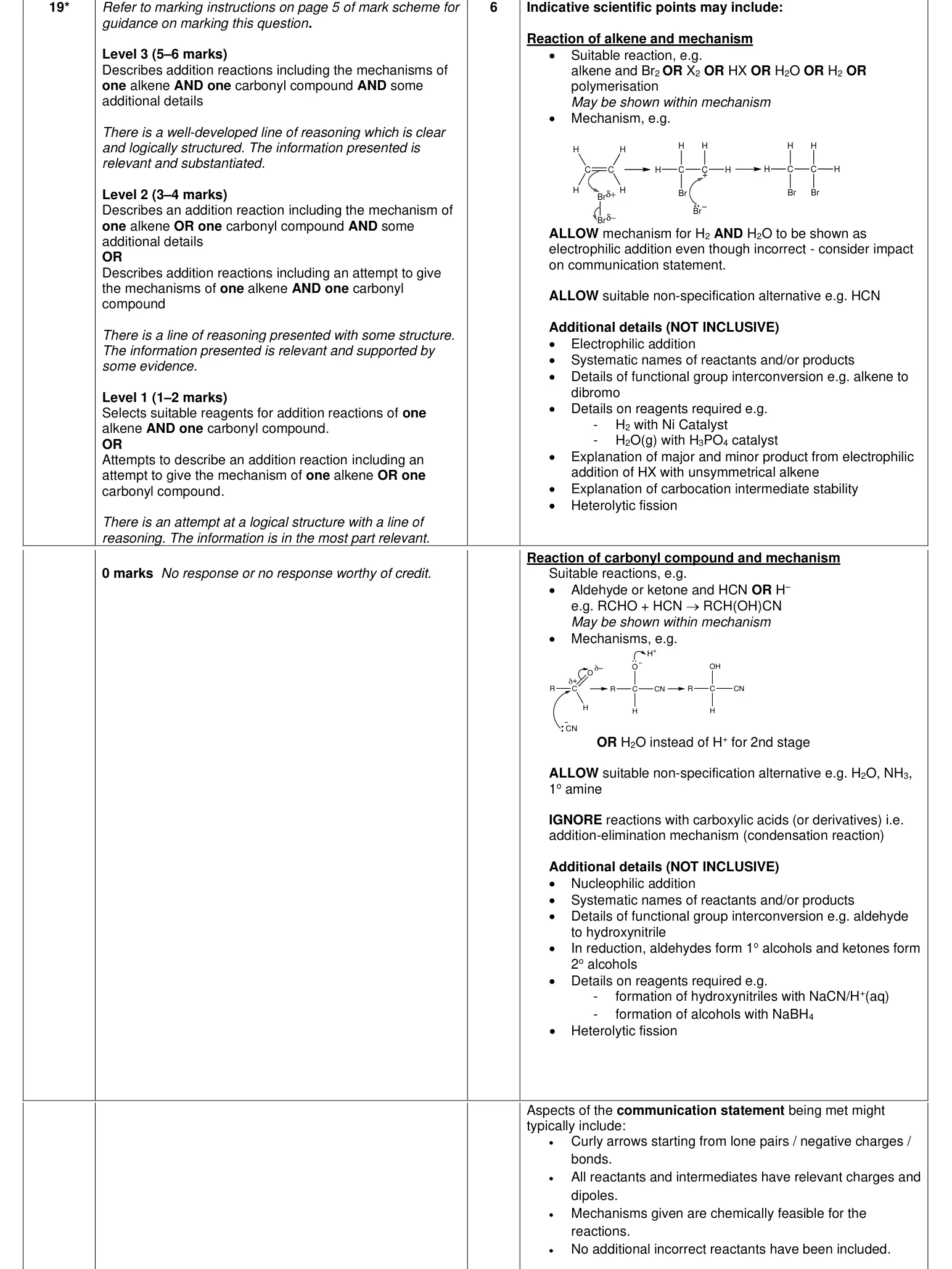
June 2024 · Paper 2 · Q196 marks6-mark level of responseHard
Mark scheme, with the levels and indicative points
Examiner's comment
A very good proportion of candidates scored all 6 marks, giving well-drawn mechanisms with some additional details such as mechanism names, functional group interconversions or other additional reaction information. Some attempted to ‘describe’ the mechanism using only words rather than drawing it out with a conventional curly arrow mechanism. Candidates may need more clarity on what ‘describe’ means in an organic chemistry context. Equally, a few gave just the mechanisms with no additional details, limiting themselves to Level 2. Candidates were usually more confident with the addition to alkenes using an electrophilic addition mechanism. Some gave additional details about major and minor products, although not always relevant as for a symmetrical alkene. Some represented the addition of hydrogen or water to alkenes via an electrophilic addition mechanism. While not correct it showed an understanding of mechanisms and a correct addition reaction for alkenes, so credit was given. Some candidates included incorrect reagents for reactions, such as acid catalysts with addition of a hydrogen halide, or incorrect conditions, such as the requirement for ultraviolet light on addition of a halogen. The addition to carbonyl compounds was not always as well-described. Some candidates struggled to identify carbonyl compounds, selecting carboxylic acids or their derivatives, with attempts at addition- elimination mechanism i.e. condensation reactions. Some gave incorrect reagents for carbonyls, including H2 and HBr. However, some used off-specification reactions such as the addition of H2O to form a geminal diol which was given but as the mechanism differs from the nucleophilic addition mechanism taught in this specification, full credit was rarely achieved. Some also considered oxidation of aldehyde or ketone to be an addition reaction. Most who presented a correct mechanism for addition to a carbonyl used the reaction with cyanide rather than reduction with NaBH4. Common errors included arrows coming from the N of CN–, a lack of putting dipoles on carbonyl bonds, missing charges on O in intermediates or showing the wrong direction of arrows. Two correct addition mechanisms have been shown, one for an alkene and one for a carbonyl compound. Additional details include the names of the mechanisms, names of the functional groups in the products, and the fact that a C-C bond is formed in the second mechanism. All curly arrows, charges and dipoles are correctly positioned so this response was also given the communication mark.
Notes from the mark scheme and report
alkene with Br2/HX by electrophilic addition and carbonyl with HCN (NaCN/H+) or NaBH4 by nucleophilic addition
curly arrows from bonds/lone pairs/negative charges, dipoles and charges on intermediates
IGNORE addition–elimination reactions of carboxylic acid derivatives
The OCR Guide to Level of Response questions can be found on Teach Cambridge and can be used to help your students better understand this type of question.
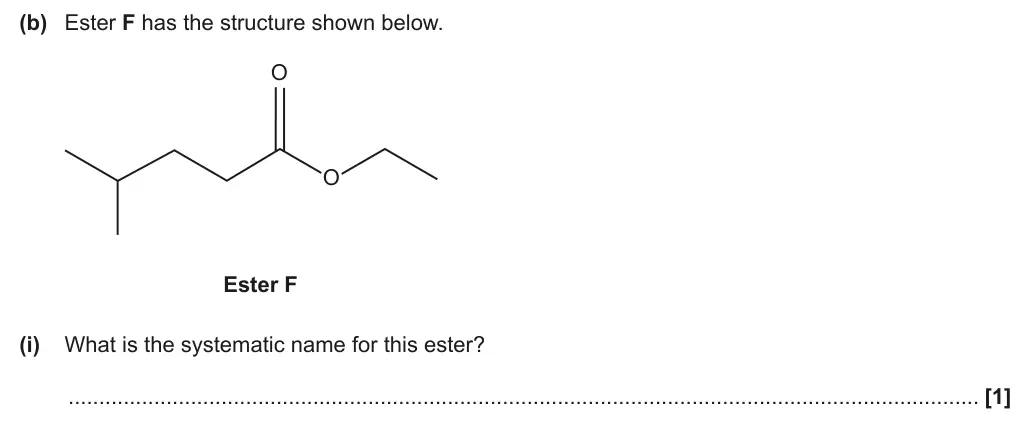
June 2024 · Paper 2 · Q20(b)(i)1 markShort answerHard
Mark scheme
Examiner's comment
Candidates found this difficult, with less than half gaining the mark. The most common error was incorrectly numbering the methyl group due to counting from the wrong end, giving ethyl-2- methylpentanoate.
Notes from the mark scheme and report
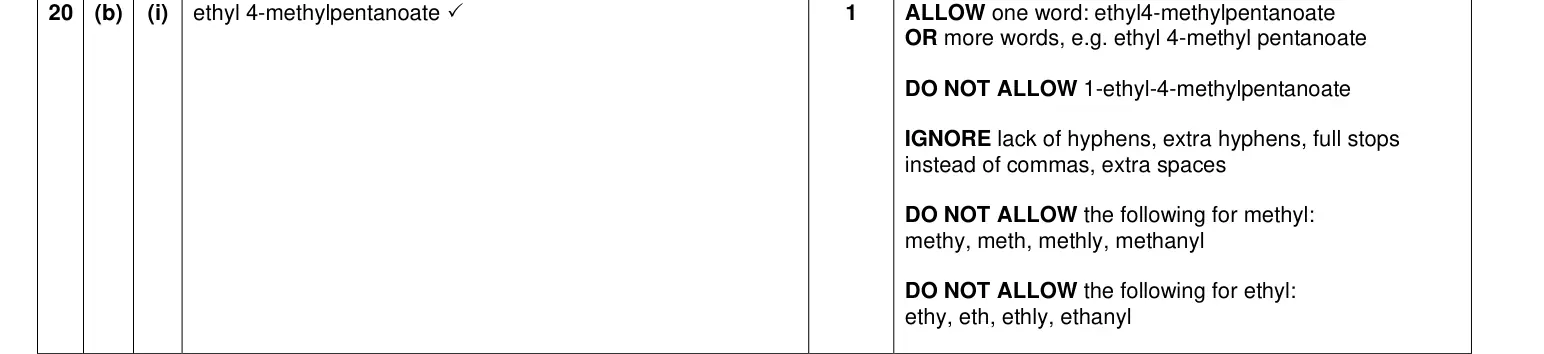
ethyl 4-methylpentanoate
DO NOT ALLOW 1-ethyl-4-methylpentanoate
DO NOT ALLOW misspellings (methy, ethly)
June 2024 · Paper 2 · Q21(a)(ii)5 marksMechanismMedium
Earlier part of question 21 that this part uses
Mark scheme
Examiner's comment
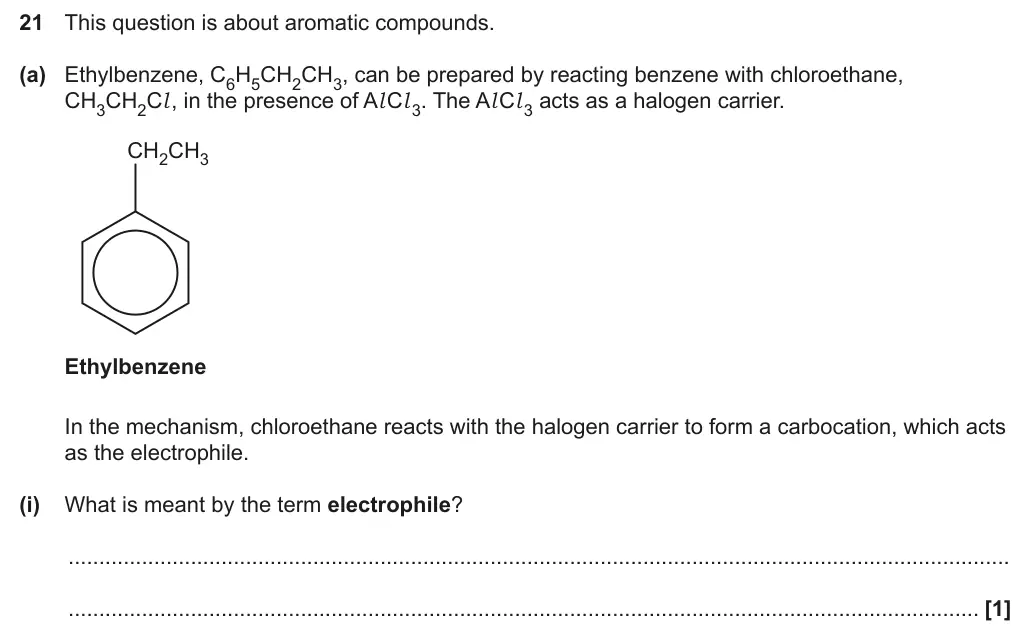
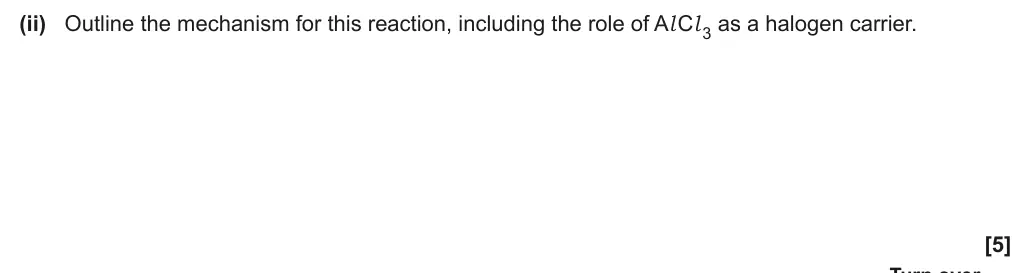
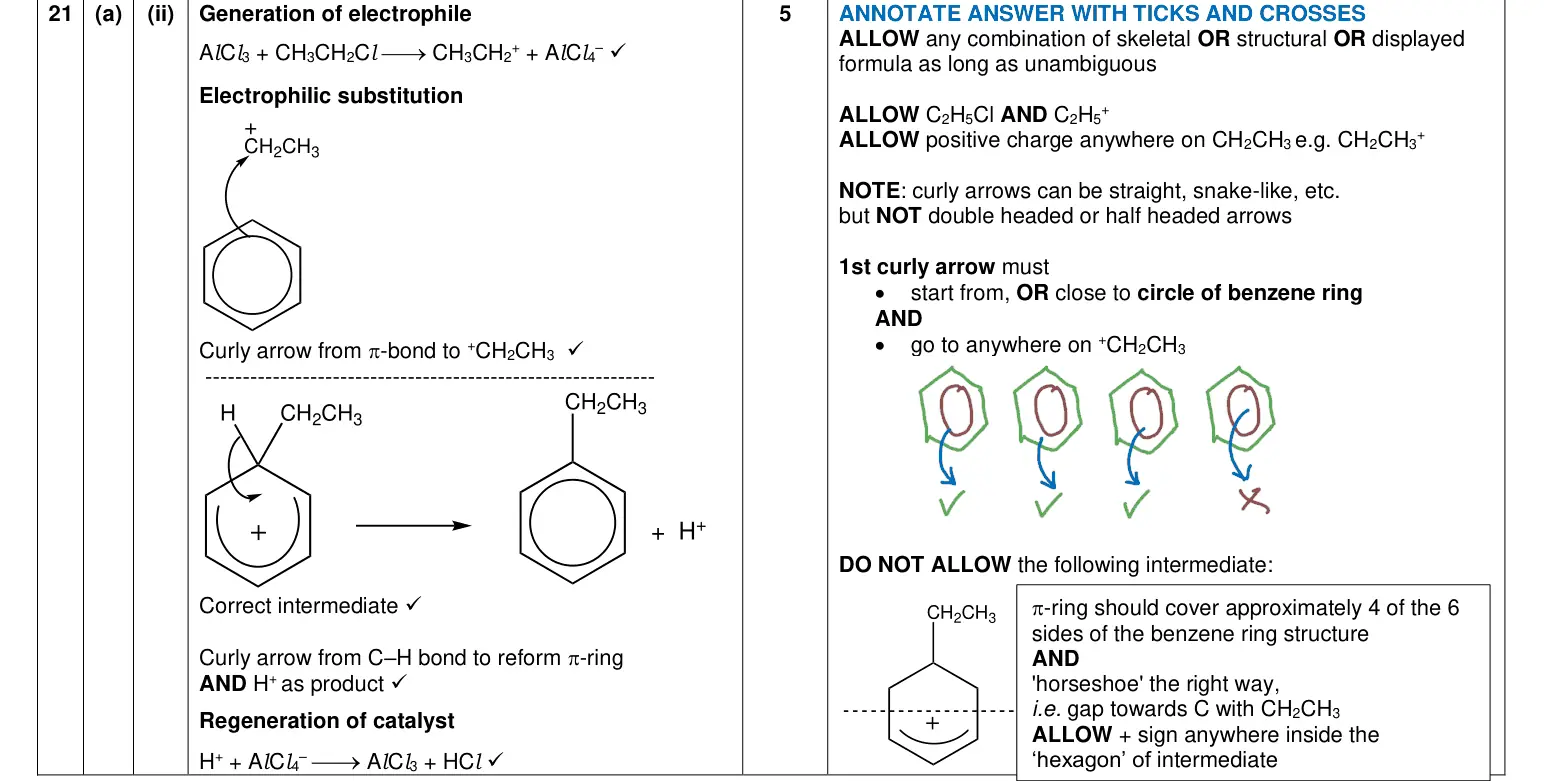
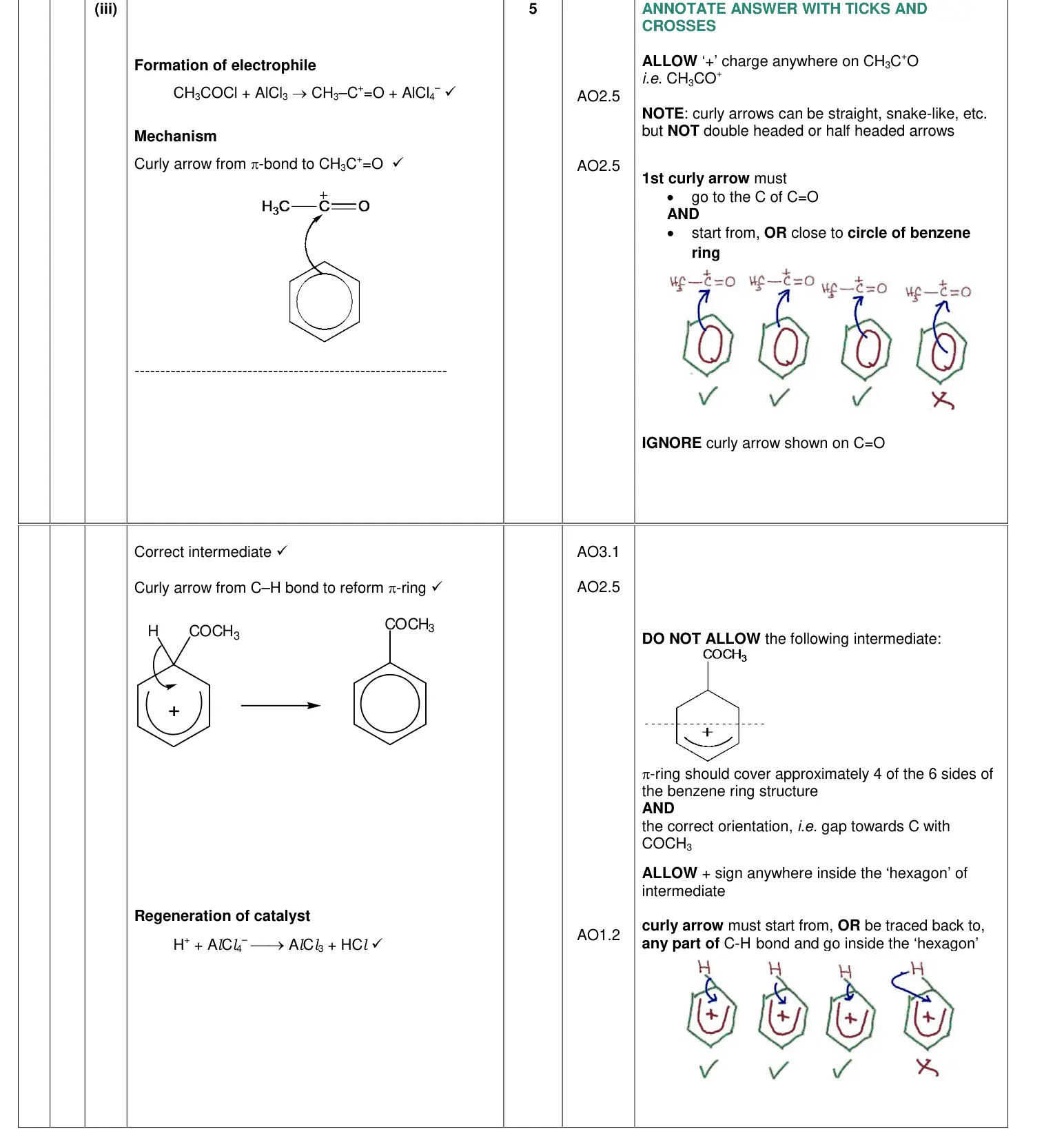
Most candidates were well prepared for this question, with over half of candidates gaining all 5 marks. A significant number of candidates showed halogenation, generating Cl+ as an electrophile, instead of alkylation. Others attempted to substitute the ethylbenzene ring rather than benzene. Further common errors included incorrect connectivity in the ethyl group on the intermediate, curly arrows coming from hydrogen atoms rather than C–H bond to reform the -ring and omission of an H+ ion at the end of mechanism.
Notes from the mark scheme and report
AlCl3 + CH3CH2Cl → CH3CH2+ + AlCl4–
arrow from π-ring to the carbocation
intermediate with horseshoe covering about 4 sides and gap towards the substituted C
arrow from C–H bond back to ring with H+ lost
H+ + AlCl4– → AlCl3 + HCl
no half-headed arrows
June 2024 · Paper 3 · Q2(c)(i)1 markShort answerEasy
Mark scheme
Examiner's comment
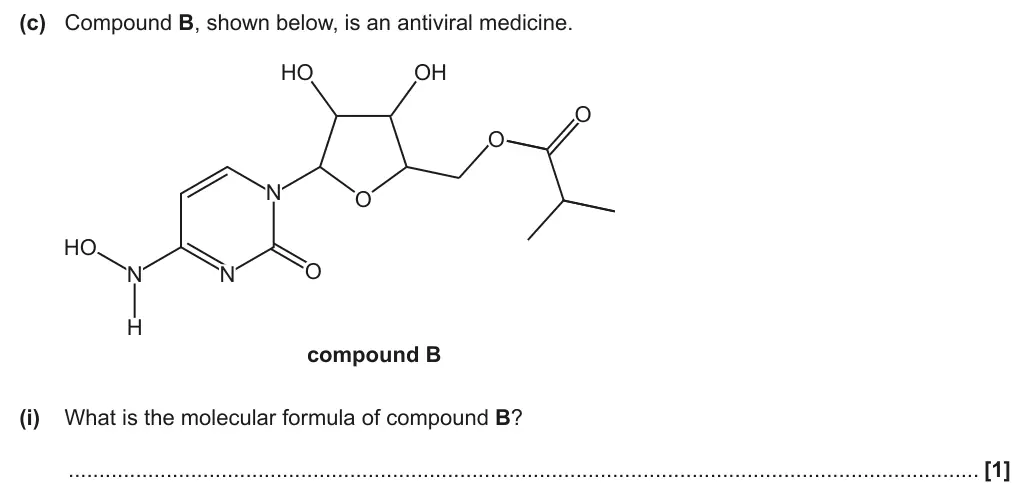
Most candidates made a good attempt at working out the molecular formula of the structure as being C13H19N3O7. N and O were usually correct with mistakes most common with carbon (especially 12) and hydrogen (especially 17–20).
Notes from the mark scheme and report
C13H19N3O7
elements in any order
June 2024 · Paper 3 · Q5(b)(ii)6 marks6-mark level of responseEasy
Earlier part of question 5 that this part uses
Mark scheme, with the levels and indicative points
Examiner's comment
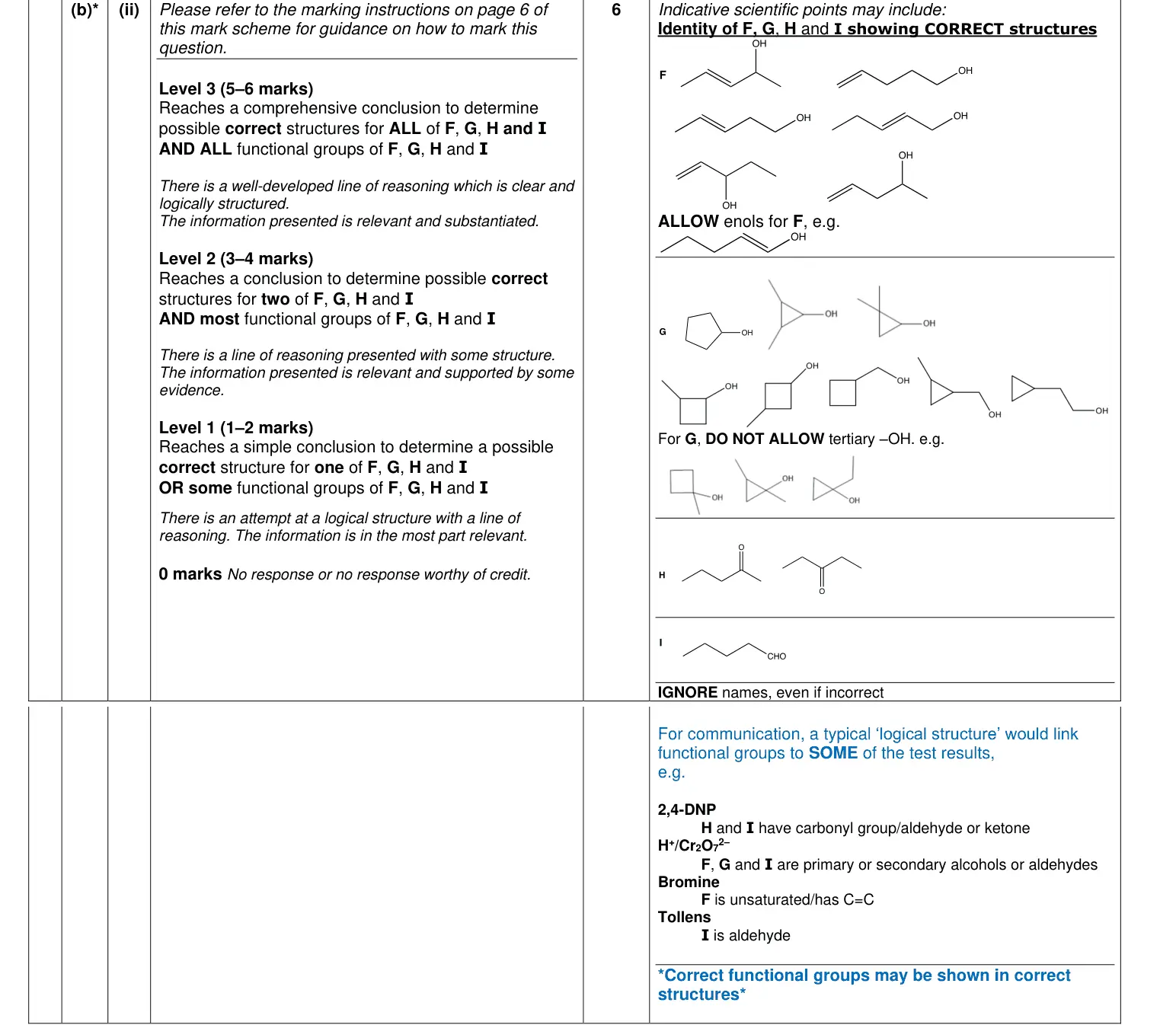
This Level of Response question was answered well with many candidates identifying compounds F–I correctly to reach Level 3. Structures were usually shown skeletally and this practice is to be recommended. Not only is it far quicker and clearer, it eliminates writing every atom in a displayed or structural formula. Some candidates were not given marks for missing hydrogen atoms or for ‘sticks’ being shown. In these structures, the chemical meaning of a stick is a terminal CH3 group. Candidates were also asked to show how the results of the chemical tests helped the identification of the unknown compounds and this formed the basis of the communication strand of the LOR mark. Candidates answered this part of the analysis extremely well and most were given marks for their good communication skills. This question differentiated very well between well-prepared and less confident candidates. The latter often did not know how the results of these organic tests can be used to identify the functional groups present. It was common for such candidates to identify only one of the four compounds, scoring within Level 1 only. This exemplar is concise and very clear. The candidate has clearly linked the result of each test to the functional groups that must be present. The candidate has drawn skeletal formulae and clearly has experimented with many possible structures before deciding on which must be correct. Notice that the candidate has crossed out the structures that they have rejected. This is an important exam technique – if two structures are drawn, with one correct and the other incorrect, the correct structure cannot be given marks. The response is clearly at Level 3 for the four correct structures and the good communication ensures that the communication strand can be given. This response received all 6 marks.
Notes from the mark scheme and report
H and I carbonyl (2,4-DNP)
I aldehyde (Tollens')
F, G, I oxidised by dichromate
F has C=C (bromine): F unbranched unsaturated primary/secondary alcohol, G alicyclic alcohol (DO NOT ALLOW tertiary OH), H pentan-2-one or pentan-3-one, I pentanal
To better prepare candidates, we recommend using either the digital multiple choice quizzes on Teach Cambridge or creating targeted practise materials using ExamBuilder. If you are unsure of how to access these or ways to make the most of them, get in touch via science@ocr.org.uk.
Skills: PAG7 Qualitative analysis of organic functional groups
June 2023 · AS Paper 1 · Q151 markAO1Multiple choiceMedium
Answer
D
Mark scheme
Examiner's comment
Most candidates showed a good understanding of organic nomenclature to obtain the correct option of D. Candidates who drew out the structures for options A and B were able to easily eliminate them. Those trying to interpret the A and B options without drawing out the structures were often less successful.
June 2023 · AS Paper 1 · Q161 markAO2Multiple choiceMedium
Answer
C
Mark scheme
Examiner's comment
As with Question 15, the strategy of drawing out structures was more likely to lead to success with the correct option of C. Despite this, less than half of candidates obtained the correct response with many missing one of the isomers and opting for option B.
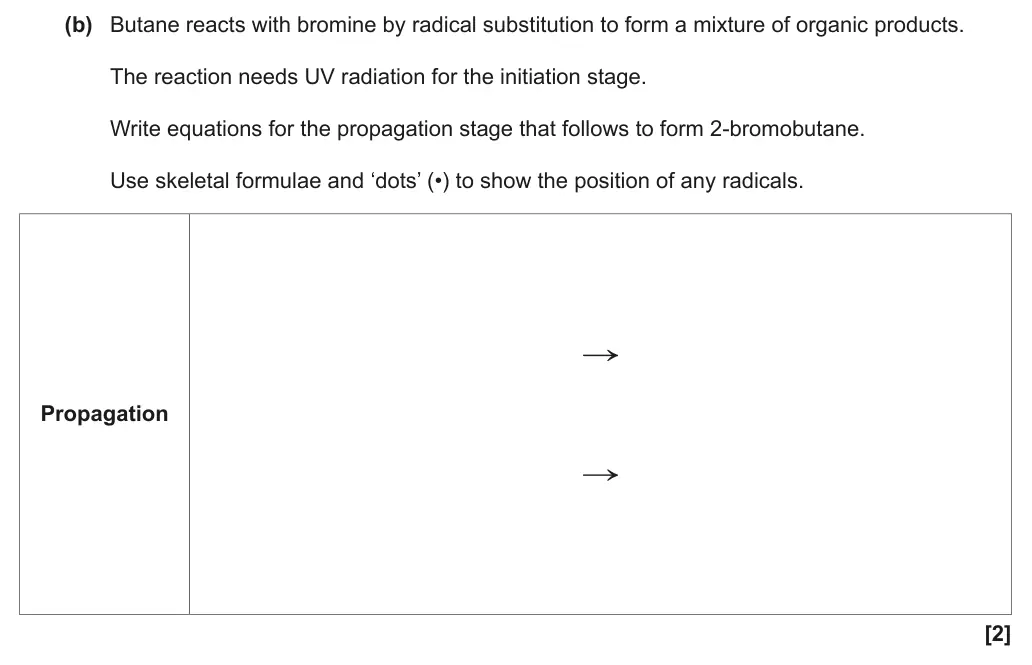
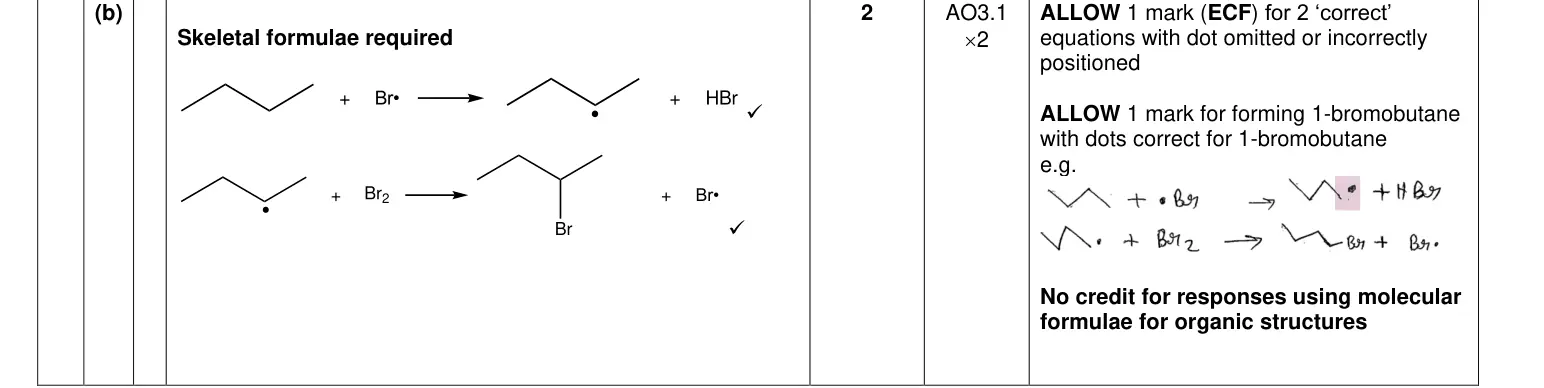
June 2023 · AS Paper 1 · Q25(b)2 marksAO3Equation writingMedium
Mark scheme
Examiner's comment
This question discriminated very well at the top end of the ability range, but many ignored the instruction to use skeletal formula and obtained no marks as a result. Of those that did use skeletal formula, many placed the dot on the wrong carbon atom or produced 1- brombutane, rather than 2-bromobutane, stated in the question. A mark was still available by ECF for misplaced or absent dots or formation of 1-brombutane with dots. This question was aimed to be demanding and so it proved to be.
Notes from the mark scheme and report
skeletal formulae required (no credit for molecular formulae)
radical dot on C2
1 mark ECF if dots omitted/misplaced or for forming 1-bromobutane correctly
June 2023 · AS Paper 1 · Q265 marksShort answerHard
Mark scheme
Examiner's comment
There were some excellent responses to this question which discriminated extremely well. Unfortunately, there were a significant number of incorrect responses and some less successful candidates had clearly struggled to recall and apply this important material. The identification of the isomers was usually correct, as was the identification of the oxidation products from the primary and secondary alcohols, and the conditions required to produce the organic products. The equation proved to be the hardest requirement with the H2O by-product often being omitted or H2 shown instead. A general point applies to organic structures. Some candidates did not show the structures of the isomers and attempted this question using the molecular formula of C3H8O supplied in the question for both alcohol isomers and no structural formulae. It was then impossible to know which isomer was being reacted and this could cost the candidate a significant number of marks. It is essential in organic chemistry to use unambiguous formulae which can be any combination of skeletal, structural or displayed. Unless a question specifies that a molecular formula is required, candidates should assume that an unambiguous formula is required.
Notes from the mark scheme and report
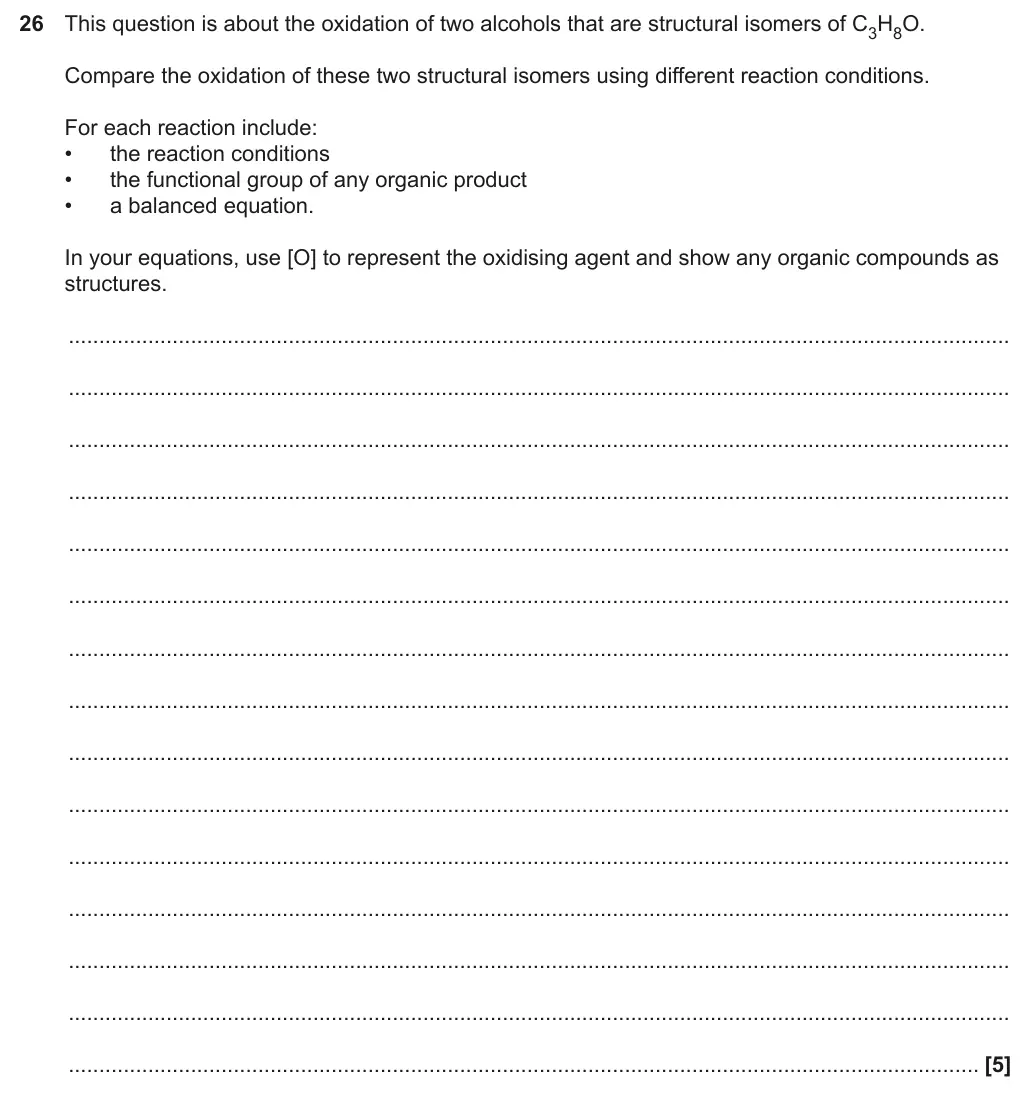
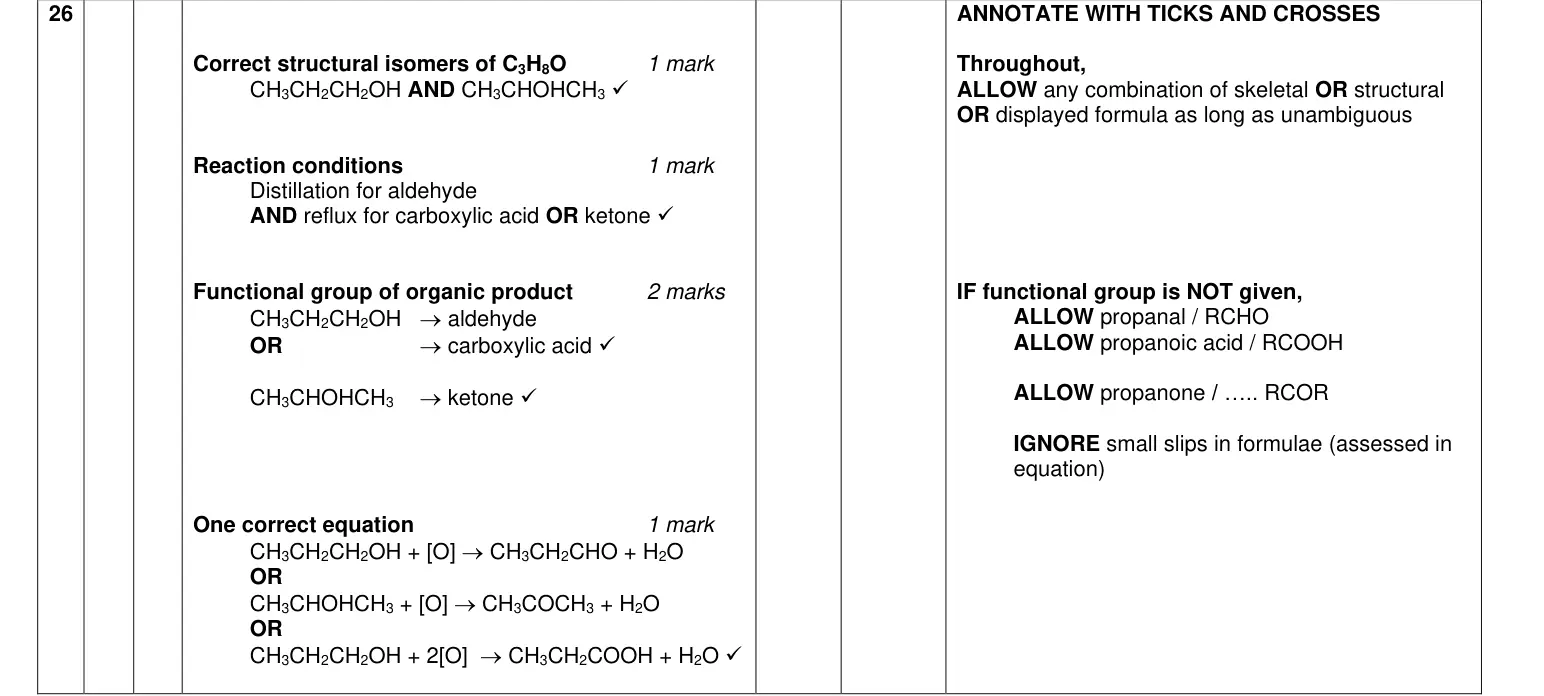
propan-1-ol AND propan-2-ol
distillation for aldehyde AND reflux for carboxylic acid or ketone
one correct [O] equation (2[O] for the acid)
ALLOW named products if functional group not given
Skills: PAG5 Synthesis of an organic liquid; PAG7 Qualitative analysis of organic functional groups
June 2023 · Paper 2 · Q31 markAO2Multiple choice
Answer
B
Mark scheme
June 2023 · AS Paper 2 · Q3(c)3 marksAO1, 2MechanismMedium
Mark scheme
Examiner's comment
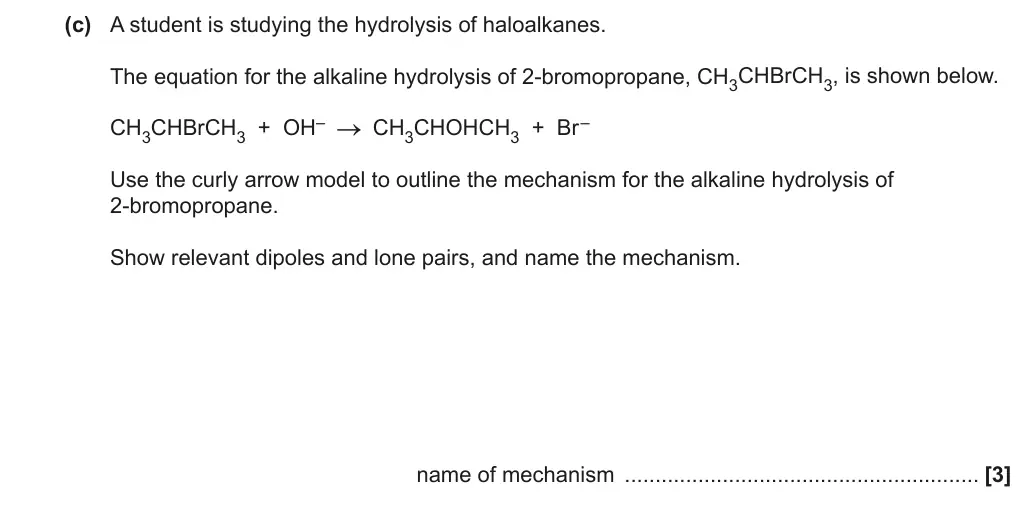
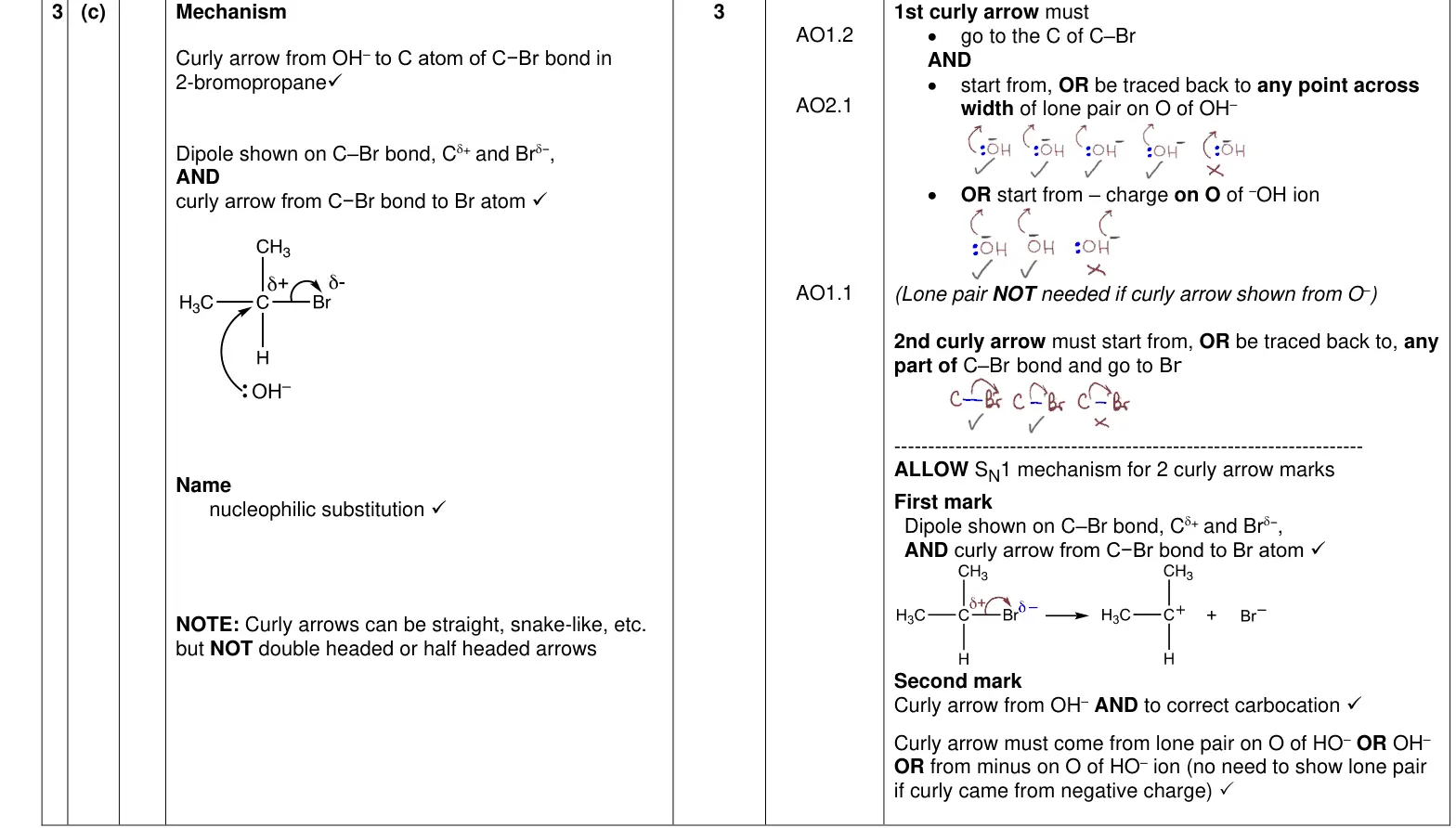
Just under half the candidates gained all 3 marks for this mechanism. Marks were often lost for incorrect positioning or a missing arrow for the breaking of the C-Br bond. Dipoles were often added to the hydroxide ions. Some also showed the lone pair for OH- going to the C-Br bond and not to the C+. A range of spellings of nucleophilic were seen, including: nucleophilic, nucleophilic, nucleophilic, and nucleophilic. It is important to promote good literacy in science, including meanings and spellings of technical language.
Notes from the mark scheme and report
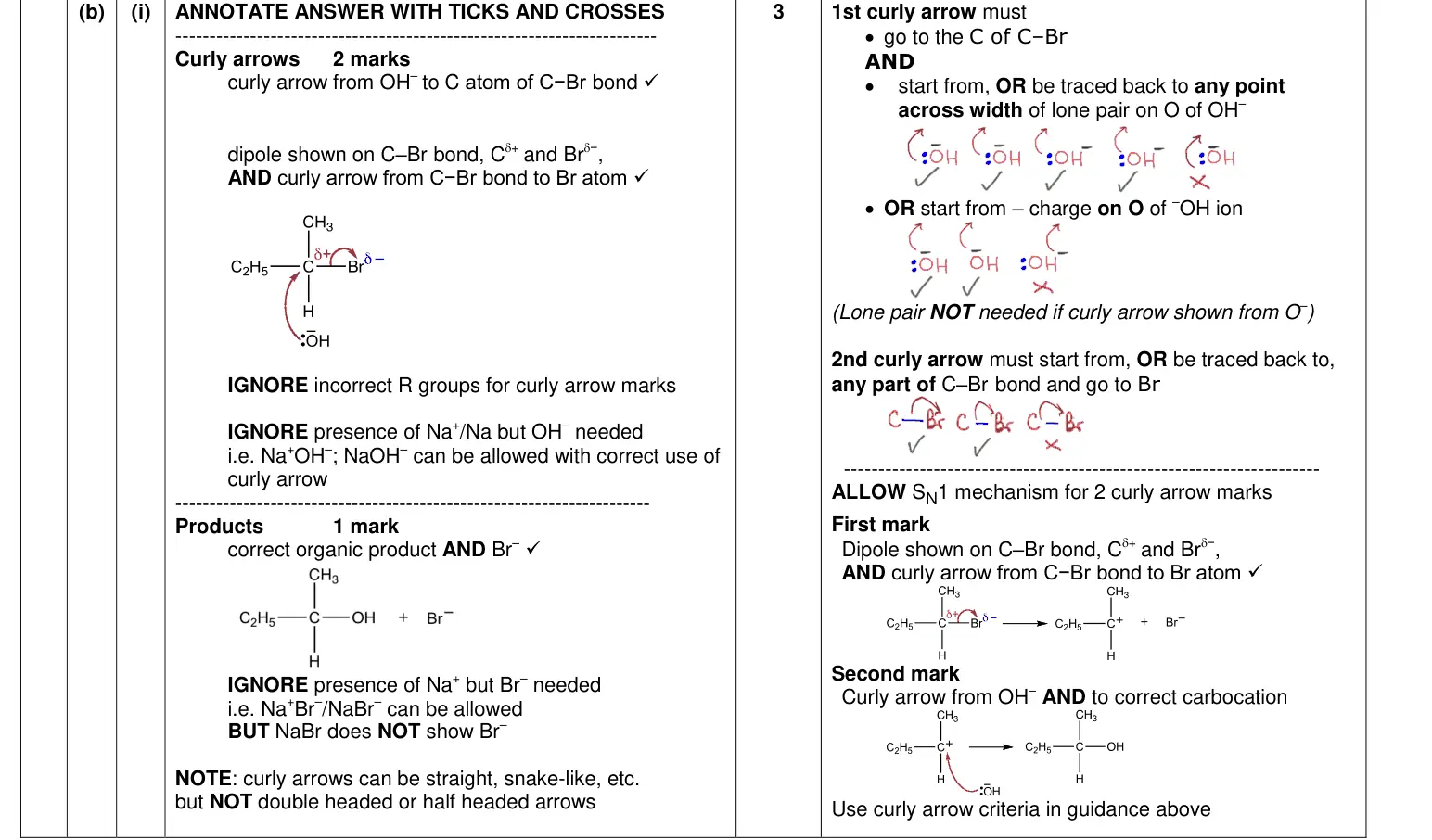
arrow from lone pair or negative charge on O of OH– to C of C–Br
dipole on C–Br AND arrow from bond to Br
no double-headed or half arrows
ALLOW SN1
name nucleophilic substitution
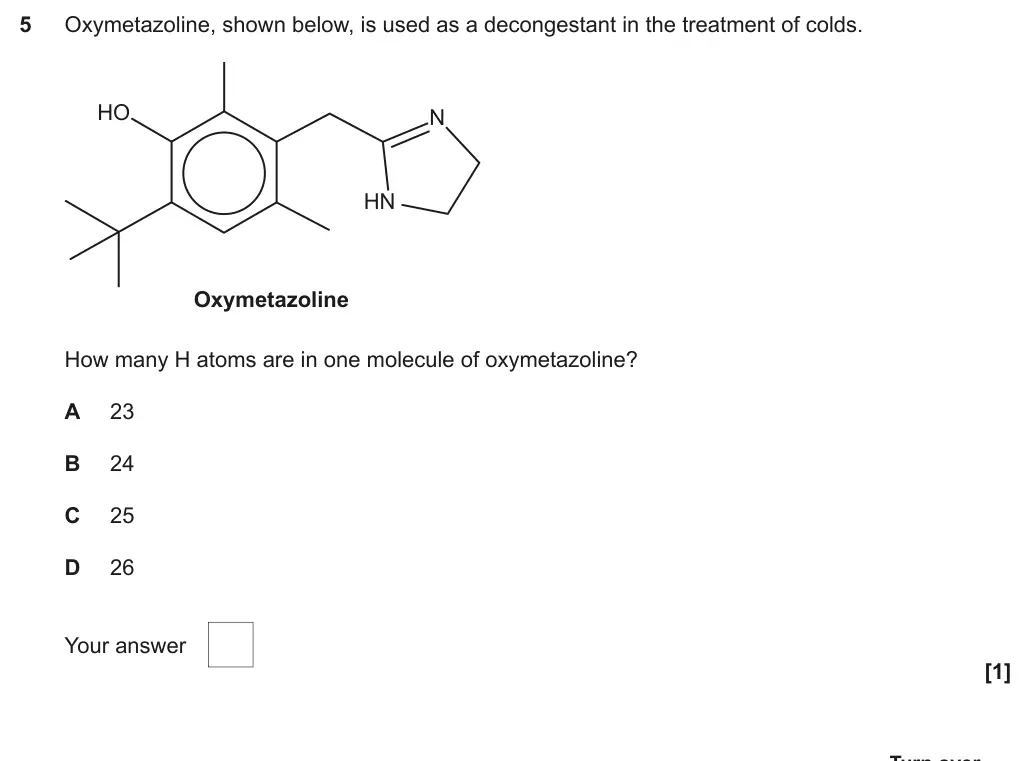
June 2023 · Paper 2 · Q51 markAO1Multiple choiceHard
Answer
B
Mark scheme
Examiner's comment
More than a third of candidates answered this question incorrectly. They struggled interpreting the skeletal formula for this more complex substituted benzene. An effective strategy used by many candidates was to label each C with number of H atoms using sticks or dots or numbers.
Notes from the mark scheme and report
ALLOW 24
June 2023 · AS Paper 2 · Q5(a)(i)1 markAO2Short answerMedium
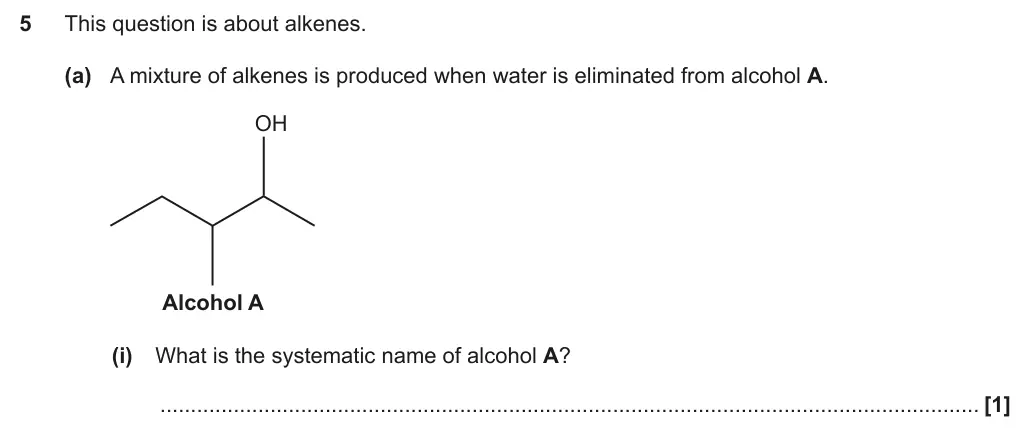
Mark scheme
Examiner's comment
A significant number of candidates lost the mark for missing -an- in their answer i.e. 3-methylpent-2-ol. Others lost the mark for incorrect spelling of methyl.
Notes from the mark scheme and report
3-methylpentan-2-ol
DO NOT ALLOW 2-methylpentan-3-ol or misspellings such as 3-methylpent-2-ol
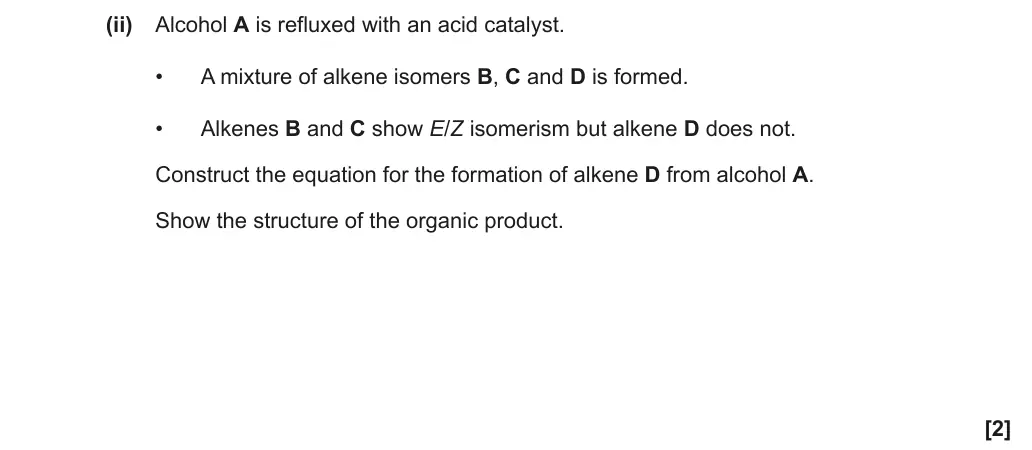
June 2023 · AS Paper 2 · Q5(a)(ii)2 marksAO2Equation writingMedium
Earlier part of question 5 that this part uses
Mark scheme
Examiner's comment
Most candidates did not score either mark here, despite the structures for B and C being given in the table below for (iii). Many thought this was oxidation, showing [O] in equations and giving a carbonyl product. Many had alkenes but still with the -OH present. Some attempted to use structural or displayed formulae but errors were made in giving the correct number of H atoms. For those that did have the correct structure, they often did not give an equation, added the acid as a reactant, or missed off the water as a product.
Notes from the mark scheme and report
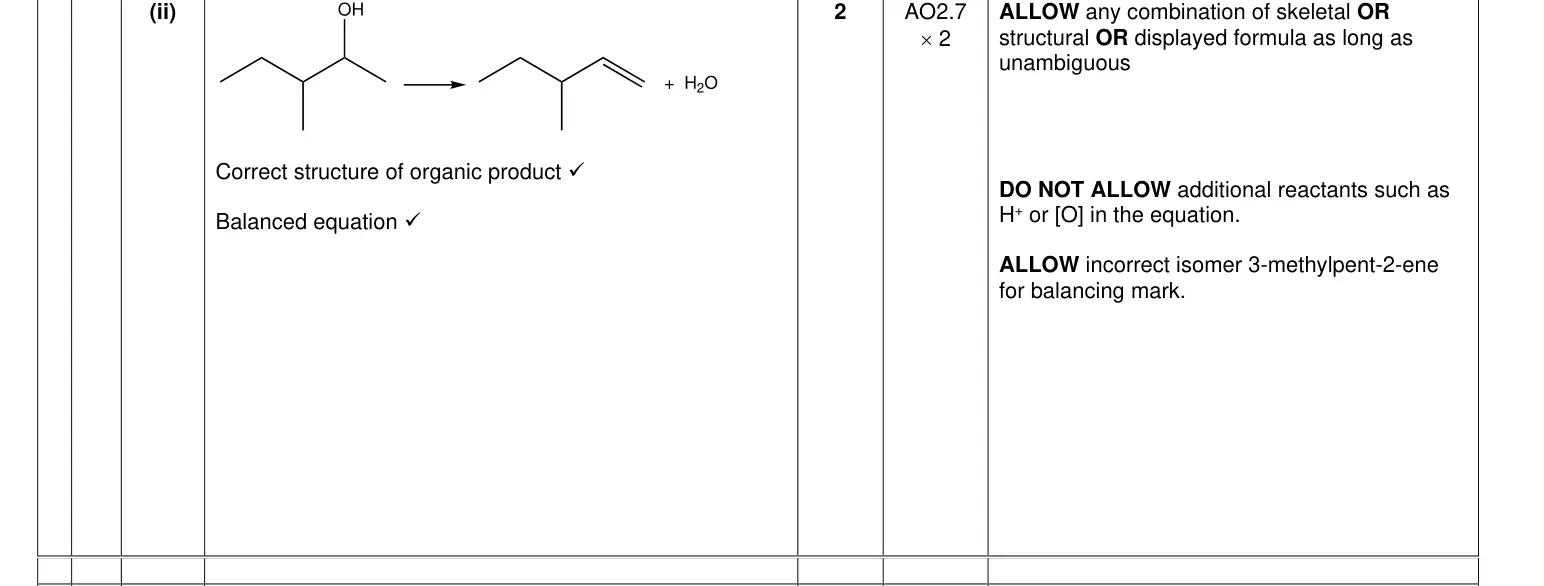
D = 3-methylpent-1-ene (no E/Z) + H2O
DO NOT ALLOW H+ or [O] as reactants
ALLOW 3-methylpent-2-ene for the balancing mark only
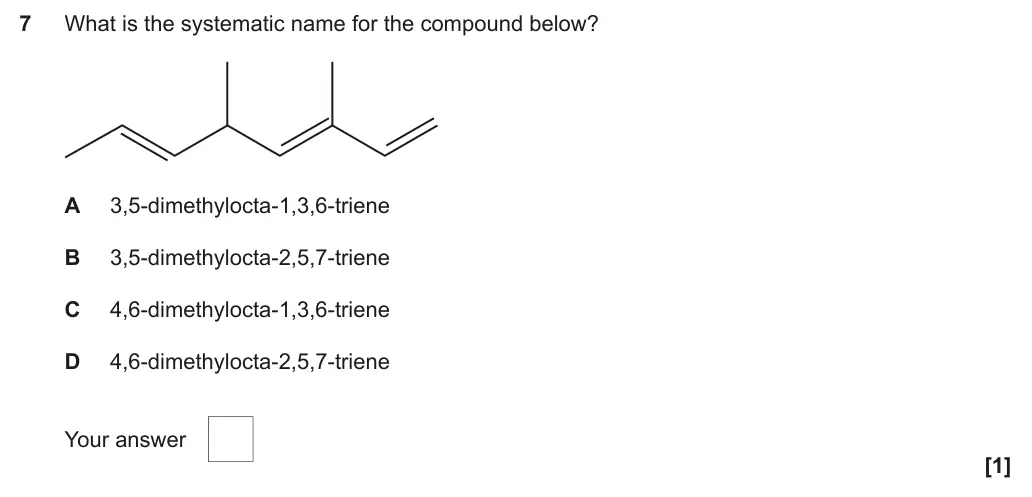
June 2023 · Paper 2 · Q71 markAO1Multiple choiceEasy
Answer
A
Mark scheme
Examiner's comment
This question was well answered. Some candidates used the strategy of numbering the C atoms in the structure to aid the deduction of the correct systematic name. D was the most common incorrect response by numbering from left to right.
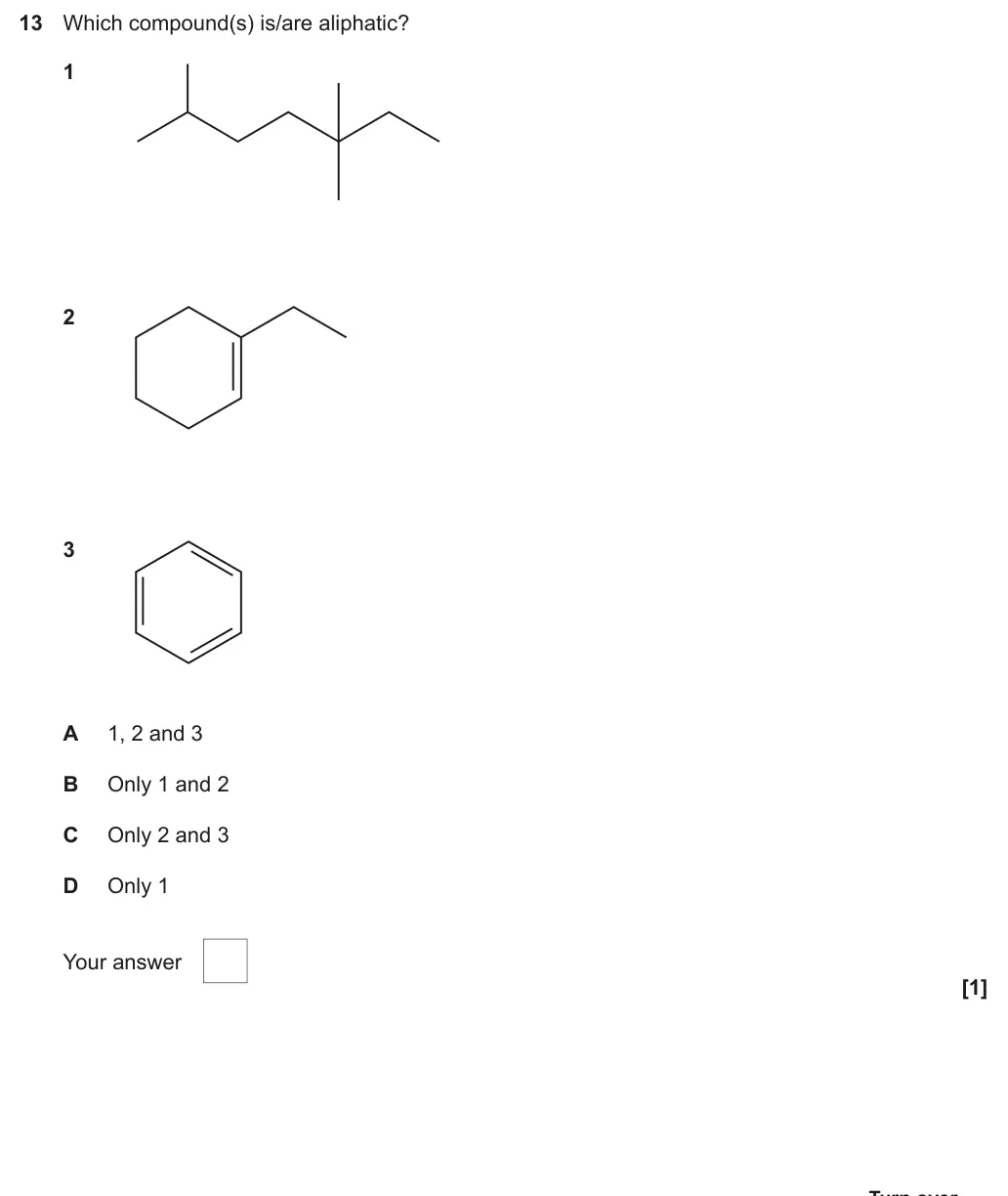
June 2023 · Paper 2 · Q131 markAO1Multiple choiceHard
Answer
B
Mark scheme
Examiner's comment
Few students gained marks on this question. The distinction between aliphatic and aromatic compounds was not well understood with many candidates giving D as their response. It is evident that there is confusion that a molecule can be both alicyclic and aliphatic. Alternatively, candidates may have believed that a cyclic compound with a double bond is aromatic.
Notes from the mark scheme and report
A molecule is either aromatic, if it contains a benzene ring, or aliphatic. Aliphatic molecules which contain a ring can also be described as alicyclic. This OCR article offers clarification for classification of organic compounds.
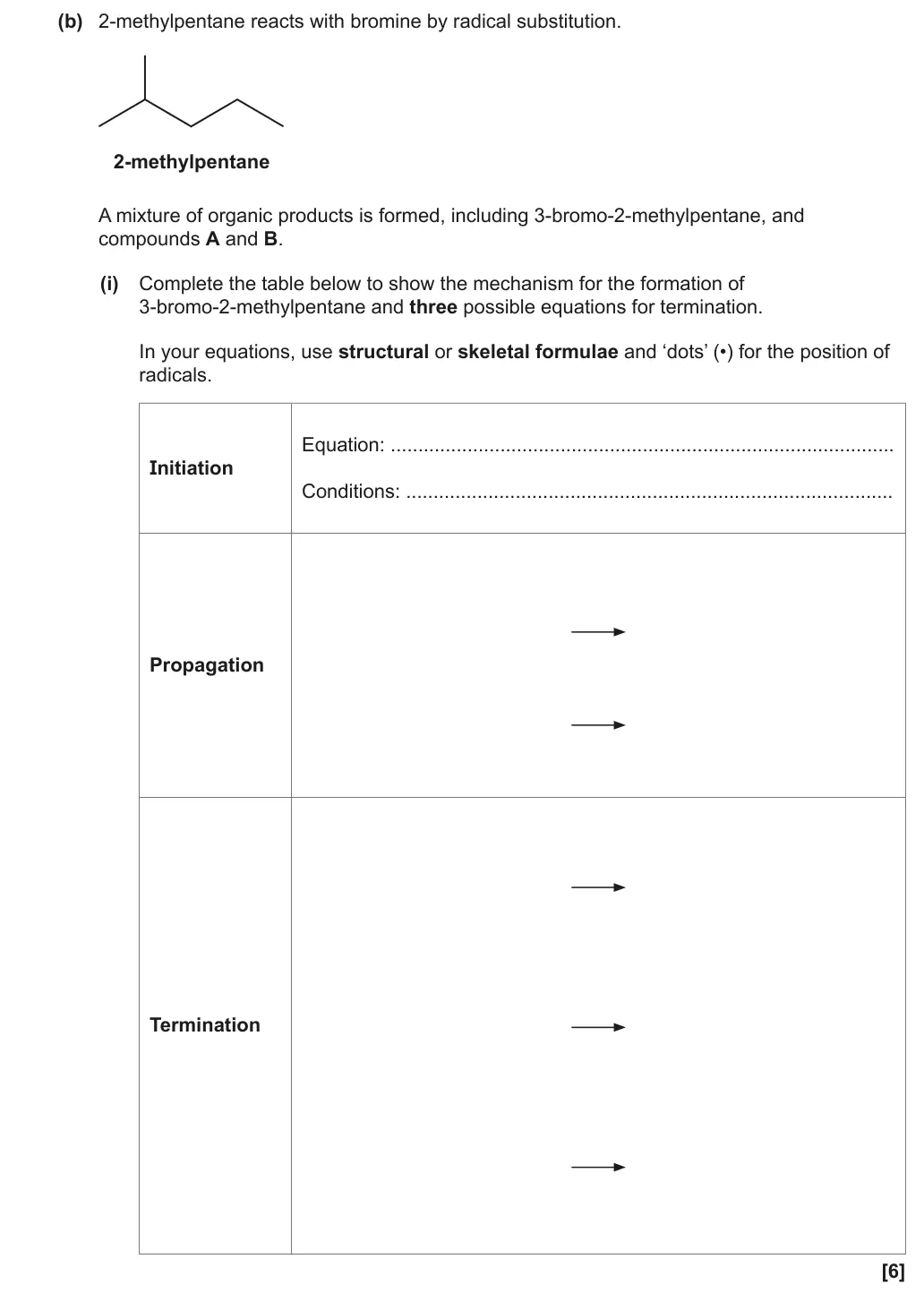
June 2023 · Paper 2 · Q16(b)(i)6 marksAO1, 2, 3MechanismMedium
Mark scheme
Examiner's comment
Many candidates tackled this question confidently, especially when using skeletal formula following the format of the structure given in the question. Over half the candidates scored 5 or 6 marks. Only the highest attaining candidates were able to provide all three correct termination steps. Many lost a mark for the combination of the two alkyl radicals, typically either by simply joining the ends of the chains or by missing the connecting C-C bond. Those that attempted to use structural formula often lost marks due to missing Hs. Other common errors included the incorrect positioning of the radical dot, most typically on the terminal carbon, addition of Br in the first propagation step or use of molecular formula. Lower attaining candidates were often able to score a mark for the initiation step and the termination step involving two Br radicals. However, for some this was not a well-known mechanism, with attempts to break up the chain or form hydrogen radicals or charged species. Errors were also seen with correct balancing of equations such as truncated C chains or extra Br atoms added.
Notes from the mark scheme and report
Br2 → 2Br• AND UV
dot required throughout and on C-3 of the radical
1 mark for propagation if both correct but dot omitted or misplaced
three terminations incl. two alkyl radicals
no ECF from incorrect radical in termination
June 2023 · Paper 2 · Q17(a)2 marksAO2Equation writingHard
Mark scheme
Examiner's comment
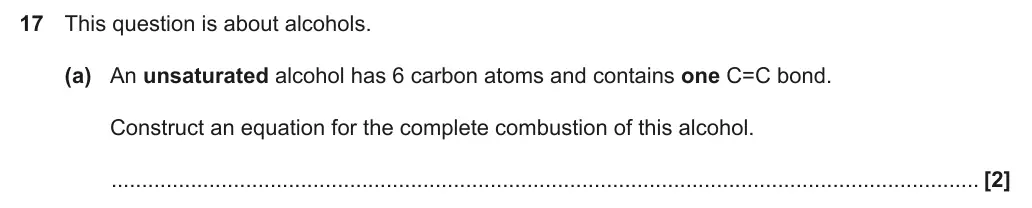
Approximately half the candidates gained both marks here but just over a third gained no credit. A very common error was C6H12 + 9O2 → 6CO2 + 6H2O missing the need for an alcohol group. Another common error was balancing with 9O2 i.e. not deducting O from alcohol from their count of O atoms. Some struggled to determine the correct number of Hs when a single C=C bond is introduced so gave C6H12OH or C6H13OH instead. Lower attaining candidates did not understand what happens during complete combustion. For example, they used [O] instead of molecular oxygen or didn’t have CO2 and water as the products. Some used structural formula which made it easier to get the correct formula of the reactant but often made it trickier to balance the equation.
Notes from the mark scheme and report
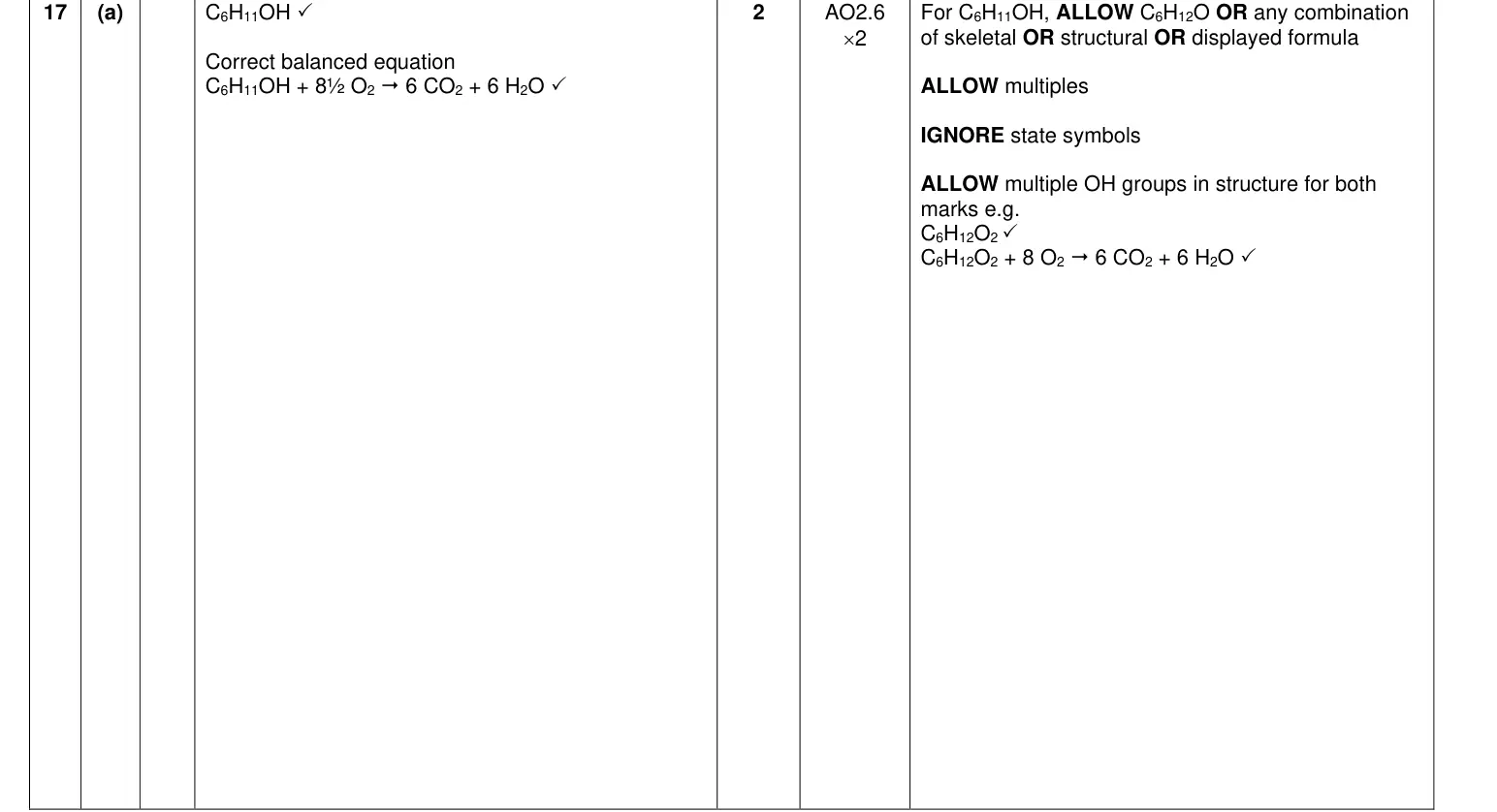
C6H11OH (C6H12O) + 8½O2 → 6CO2 + 6H2O
ALLOW multiples
IGNORE state symbols
Skills: M0.2 Use ratios, fractions and percentages
June 2023 · Paper 2 · Q17(c)(i)3 marksAO2Structure / isomerHard
Mark scheme
Examiner's comment
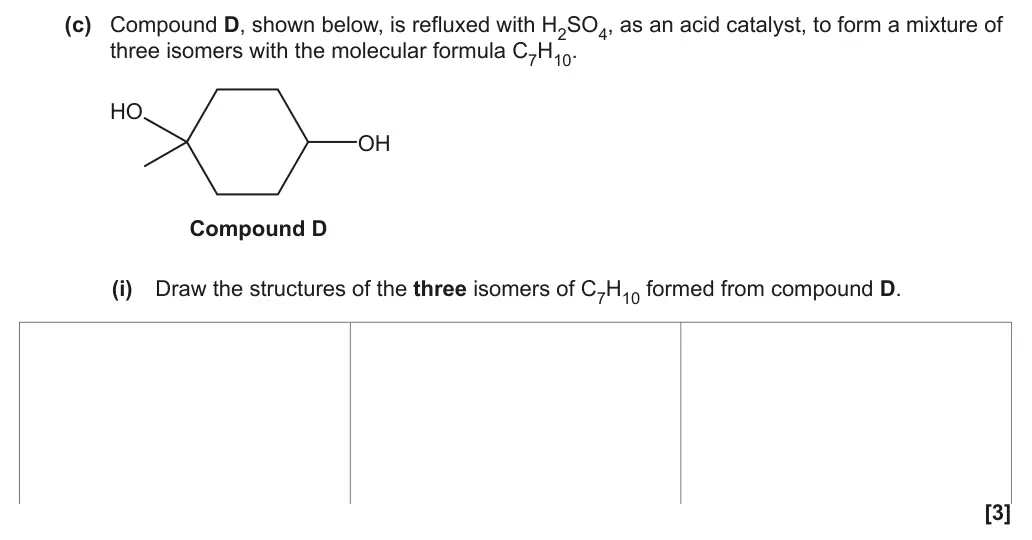
Lots struggled here with just under half of candidates gaining no credit. Only the strongest responses recognised that a carbon-carbon double bond could be formed external to the ring from the methyl branch. A common error was repeating one of the first two isomers as a mirror or rotated image and so lost a mark - candidates need to be able to recognise same structures (especially using skeletal formula) Lower scoring candidates didn’t recognise this reaction would result in the elimination of water. So, it was common to see responses with three structures still containing the OH group or ketones (possible oxidation products), despite the molecular formula C7H10 being provided twice in the question. Some candidates attempted to give structural isomers of C7H10 that would not form from this reaction (see below) including those with smaller rings and even unsaturated straight chain compounds. Some even gave benzene structures. This question was particularly problematic to mark if previous structures drawn were then rubbed out. Drawing structures in exams Please remind candidates to draw structures clearly in black ink. If incorrect cross them out and redraw them. Drawing in pencil then rubbing out often leads to extra lines showing when exam papers are scanned making it appear that structures are incorrect.
Notes from the mark scheme and report
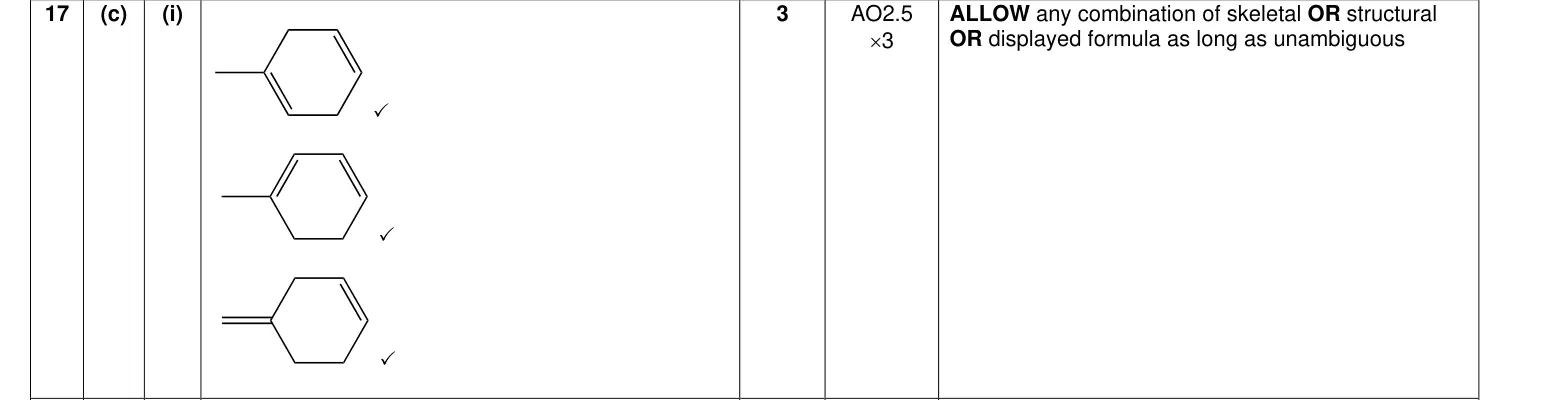
both OH groups eliminated: two ring dienes and one with exocyclic C=CH2
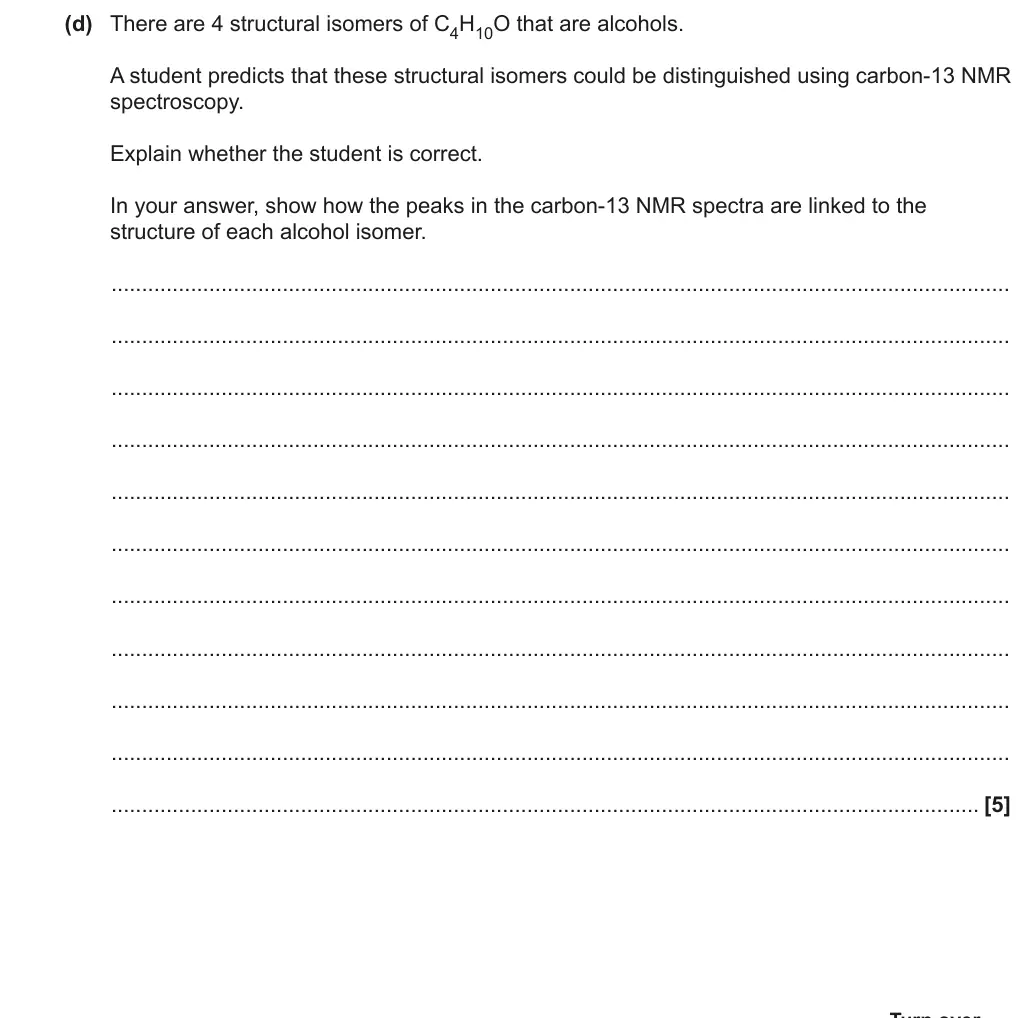
June 2023 · Paper 2 · Q17(d)5 marksAO2, 3Extended responseHard
Mark scheme
Examiner's comment
This question discriminated well with a variety of responses seen. The lower scoring candidates gave vague answers suggesting they did not fully grasp what the question was asking. They often filled the lines with generic responses in terms of what C NMR can do, e.g. chemical shift data/shows positions of Cs relative to OH group or number of peaks gives number of environment but made no reference to the isomers mentioned in the question. For some there was obvious confusion with proton NMR due to discussion of splitting patterns or relative peak areas/heights. Lots struggled to find all four isomers, often repeating one they already had, but drawing them with a different layout, or by giving cyclic structures. Some struggled to count the correct number of peaks for each. It was common to see false equivalency between CH2 groups, e.g. butan-2-ol with three peaks. Many struggled to give a concluding statement, often focusing more on slight differences in chemical shift due to proximity to OH group. The highest scoring responses were well structured and started by identifying the four isomers. After stating the number of carbon environments for each isomer these responses often concluded with a statement detailing whether the isomers could be distinguished. This candidate has clearly drawn out all four isomer structures and next to each has identified the number of carbon environments. They have then made a concluding statement using this information. This response scored all 5 marks.
Notes from the mark scheme and report
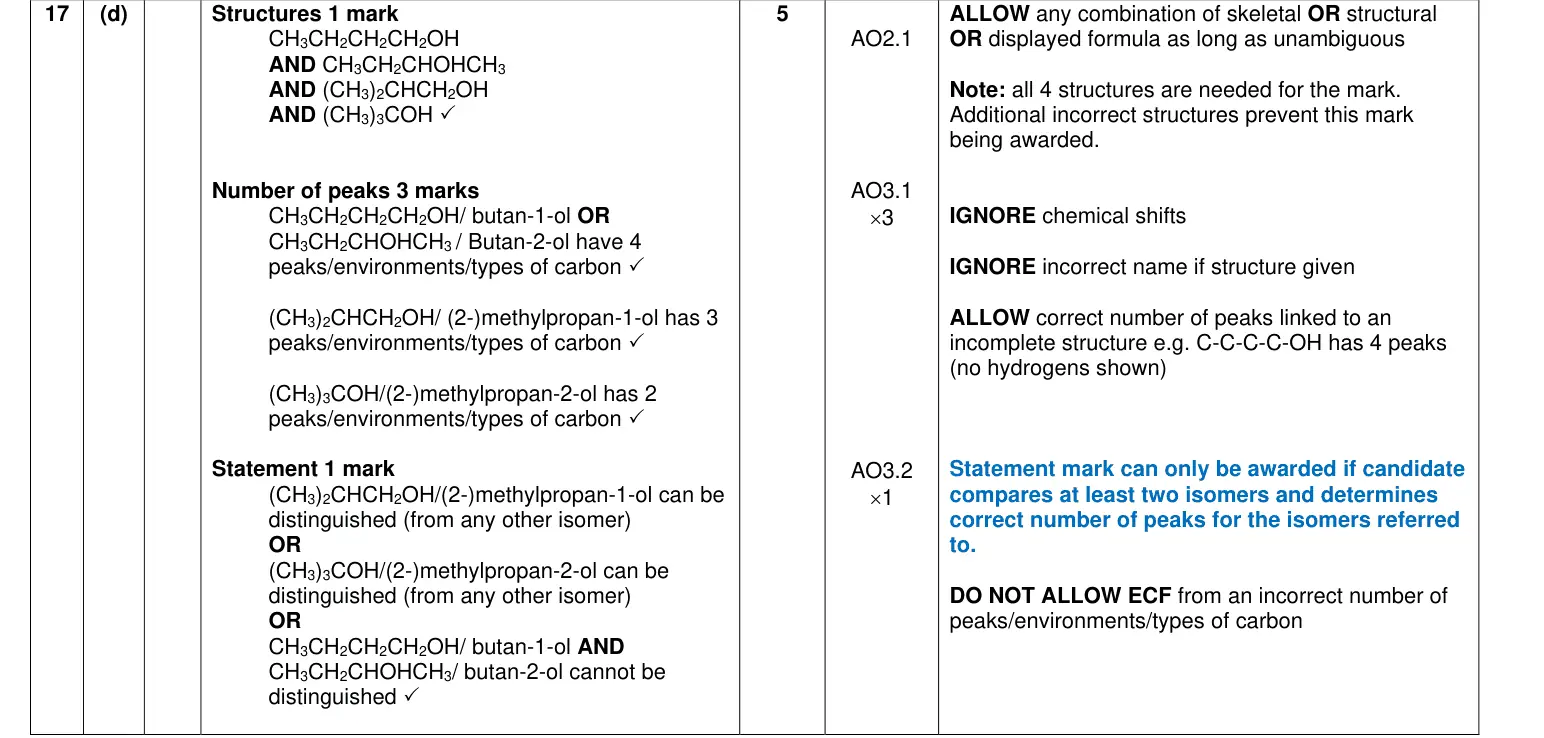
all four structures needed (extra incorrect structures lose the mark)
butan-1-ol and butan-2-ol both 4 peaks, 2-methylpropan-1-ol 3, 2-methylpropan-2-ol 2, so not all distinguishable
IGNORE chemical shifts
no ECF from incorrect number of peaks
Candidates often struggle with drawing out the different structural isomers. As a starter activity or plenary give candidates a molecular formula and challenge them to draw out all the different possible isomers. Using molymod can help candidates realise equivalent molecules.
As candidates become more confident encourage them to draw structures using skeletal formula and to give the systematic names.
Skills: M4.3 Understand the symmetry of 2-D and 3-D shapes
June 2023 · Paper 2 · Q21(b)(i)1 markAO1Short answerHard
Earlier part of question 21 that this part uses
Mark scheme
Examiner's comment
Over half of candidates were unable to give the systematic name of valine, despite many being able to draw out a structure in the following question. A minority of candidates did not attempt the question. The best strategy was to use displayed formula, find the longest chain which included the COOH and label this as C number 1 to make sure of correct numbering. Common errors included 2-amino-3,3- dimethylpropanoic acid or 3-amino-2-methylbutanoic acid. Many candidates did not know how to name the amine functional group with errors including, amine, N-, nitro-, nitrile, etc. Some simply attempted to name the R group alone, e.g. ‘2-methylethyl- or ‘dimethyl’.
Notes from the mark scheme and report
2-amino-3-methylbutanoic acid
DO NOT ALLOW amine/amin for amino or misspelt methyl
June 2023 · Paper 2 · Q22(a)(i)4 marksAO1, 2MechanismEasy
Mark scheme
Examiner's comment
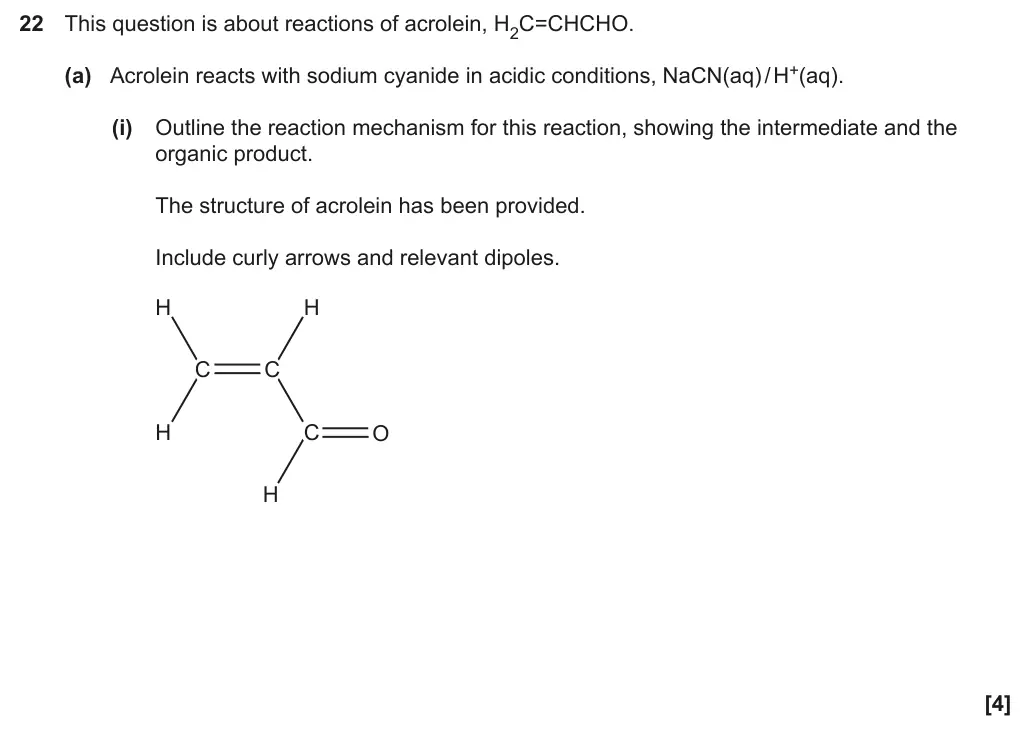
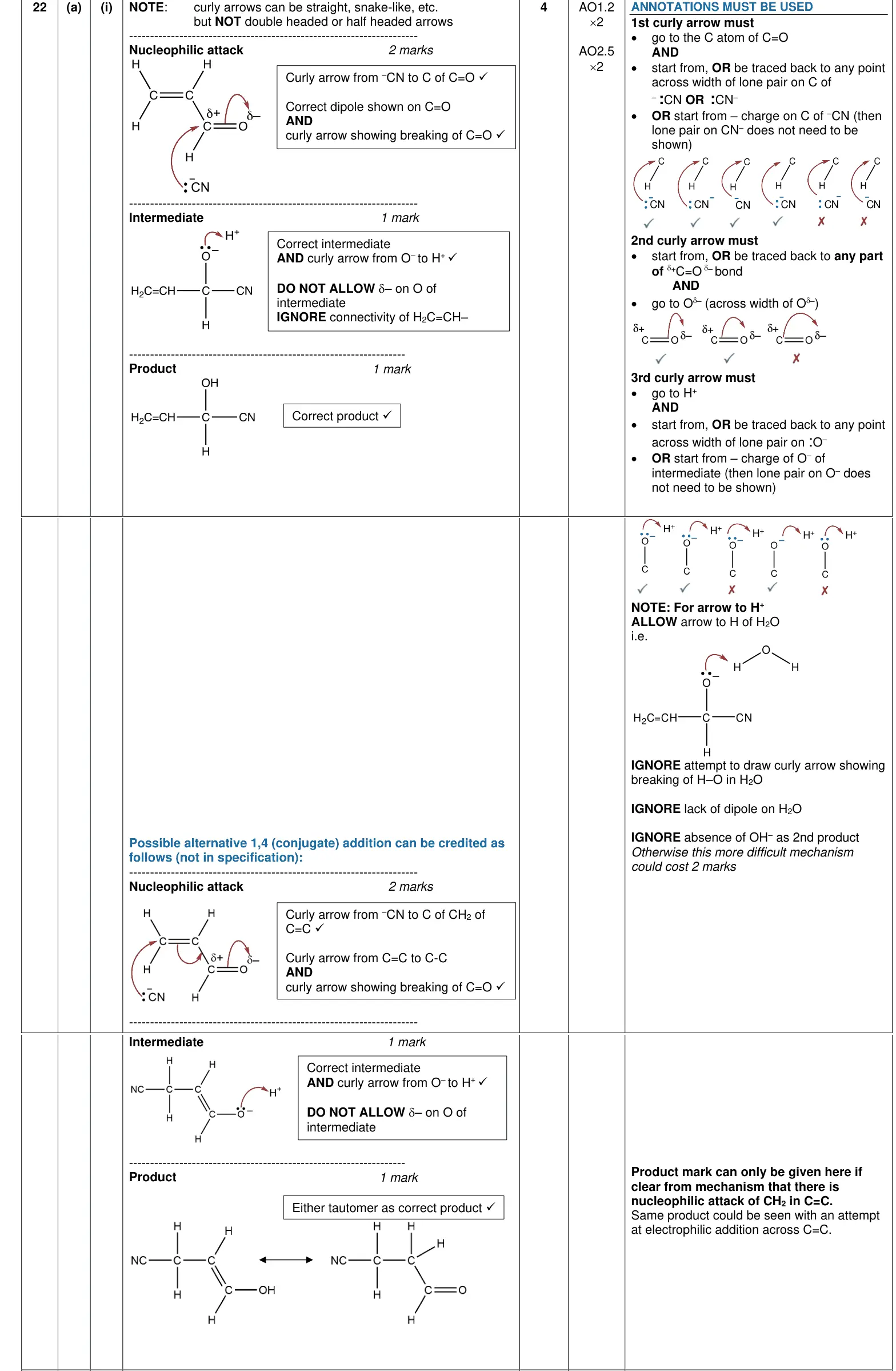
There were many excellent examples of precisely drawn mechanisms for the reaction of acrolein with sodium cyanide in acidic conditions and so most candidates gained at least 3 marks. The importance of accuracy when drawing curly arrows needs to be emphasised when teaching mechanisms - arrows must start at lone pairs or negative charges or come from bonds. Many candidates lost marks due to incorrect arrows. Common errors included the use of NaCN or HCN rather than the cyanide ion, the first curly arrow coming from the N of CN-, omission of partial charge across the C=O double bond and addition of partially charges to hydrogen or oxygen. Lower scoring responses often included an intermediate and/or product containing sodium. Some attempted electrophilic addition using HCN across the double bond. A few gained some credit for the mechanism for a competing reaction with nucleophilic addition on CH2 of C=C. This is not covered in the A Level specification and no candidates scored full marks for this alternative.
Notes from the mark scheme and report
arrow from lone pair/charge on C of CN– to C of C=O
dipole on C=O AND arrow from C=O bond to O
intermediate with O– (DO NOT ALLOW δ– on O) and arrow to H+ (ALLOW H of H2O)
product hydroxynitrile
1,4-conjugate addition credited as alternative
June 2023 · Paper 3 · Q2(c)4 marksAO3MechanismMedium
Mark scheme
Examiner's comment
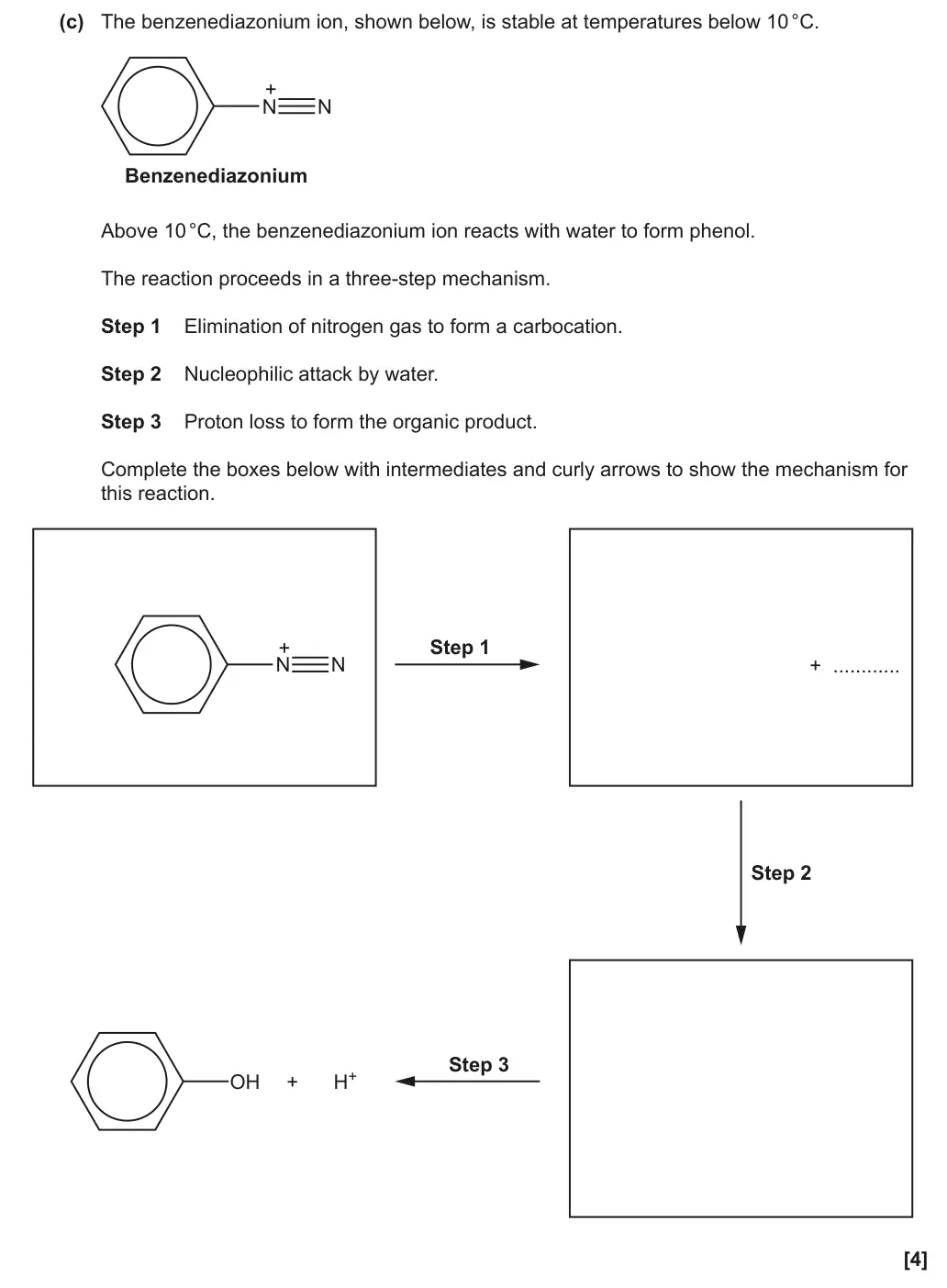
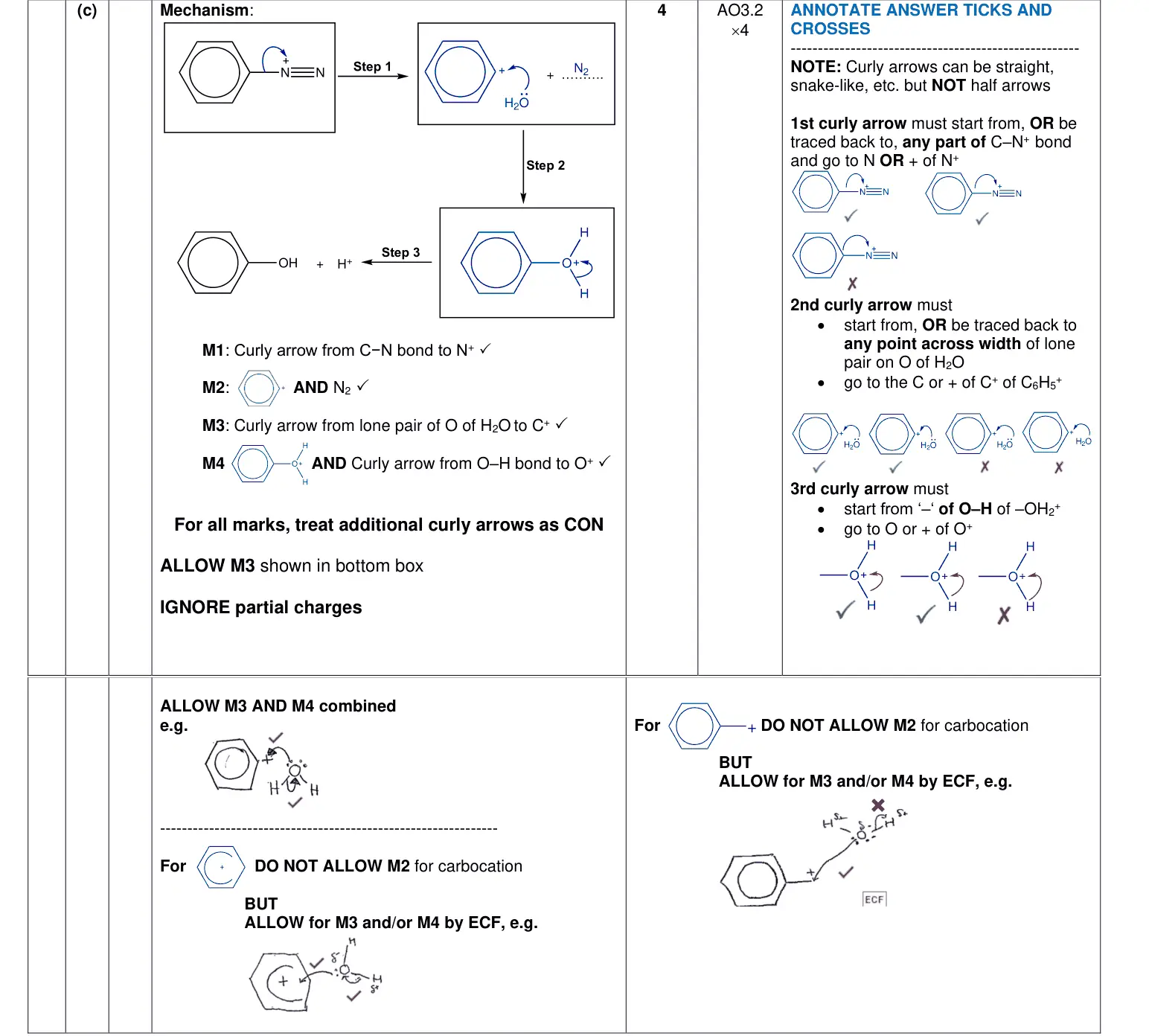
This question required candidates to apply their understanding of organic mechanisms to an unfamiliar reaction. The stem to the question includes important information and clues that should have guided candidates towards this unfamiliar mechanism, with the prompts for the three steps being critical. Many responses fell back to the familiar mechanism for electrophilic substitution, an approach that could not be credited. This question discriminated very well but many candidates scored few marks. This response has been included to show a candidate with an excellent understanding of the meaning of curly arrows and the importance of charges and dipoles. The prompts in the question are followed and the candidate has been given all four marks. Notice how the curly arrows start either from a bond or from a lone pair. The candidate has also realised that the addition of H2O produces a positively charged oxonium ion. Many candidates omitted the ‘+’ charge or showed the curly arrow for loss of a proton going to a H atom rather than the O atom of water.
Notes from the mark scheme and report
curly arrow from C–N bond to N+
phenyl carbocation AND N2
curly arrow from lone pair on O of H2O to C+
curly arrow from O–H bond to O+
additional curly arrows CON
NOT half arrows
DO NOT ALLOW delocalised ring-charge carbocation for M2
In organic chemistry mechanisms, a curly arrow shows the movement of an electron pair and demonstrates the direction of electron flow in organic reactions.
A curly arrow must start from: • A lone pair or negative charge and go to an atom to show where a bond forms • A bond to show where a bond breaks.
June 2022 · AS Paper 1 · Q151 markAO1Multiple choiceMedium
Answer
C
Mark scheme
Examiner's comment
Most candidates selected the correct response. Where an error had been made, it was usually option B, the result of ignoring the two tertiary H atoms.
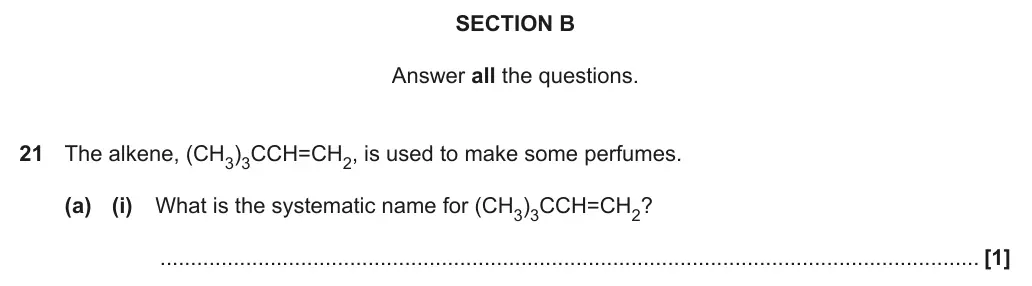
June 2022 · AS Paper 1 · Q21(a)(i)1 markAO1Short answerHard
Mark scheme
Examiner's comment
Candidates had difficulty in naming this compound correctly as 3,3-dimethylbut-1-ene. Many counted an incorrect number of carbons in the chain, numbered substituents from the wrong end (e.g. 1,1,1-) or used insufficient numbering (e.g. 3-dimethyl). Hex-1-ene was a common incorrect answer, presumably as there are six carbon atoms and one C=C double bond in the alkene.
Notes from the mark scheme and report
DO NOT ALLOW meth or methy for dimethyl
IGNORE lack of hyphens or added commas
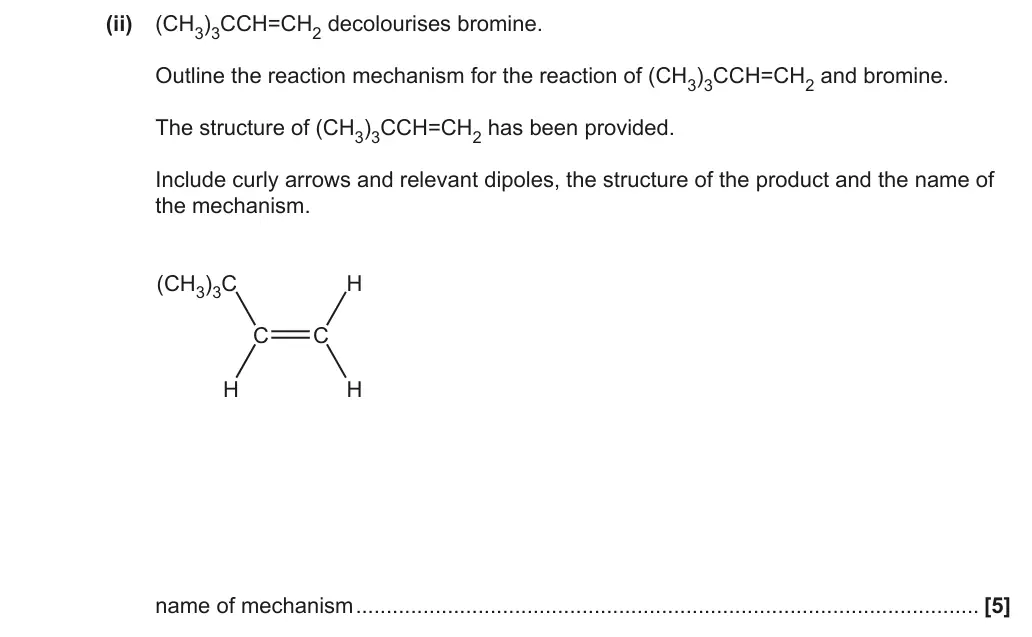
June 2022 · AS Paper 1 · Q21(a)(ii)5 marksAO1, 2MechanismMedium
Earlier part of question 21 that this part uses
Mark scheme
Examiner's comment
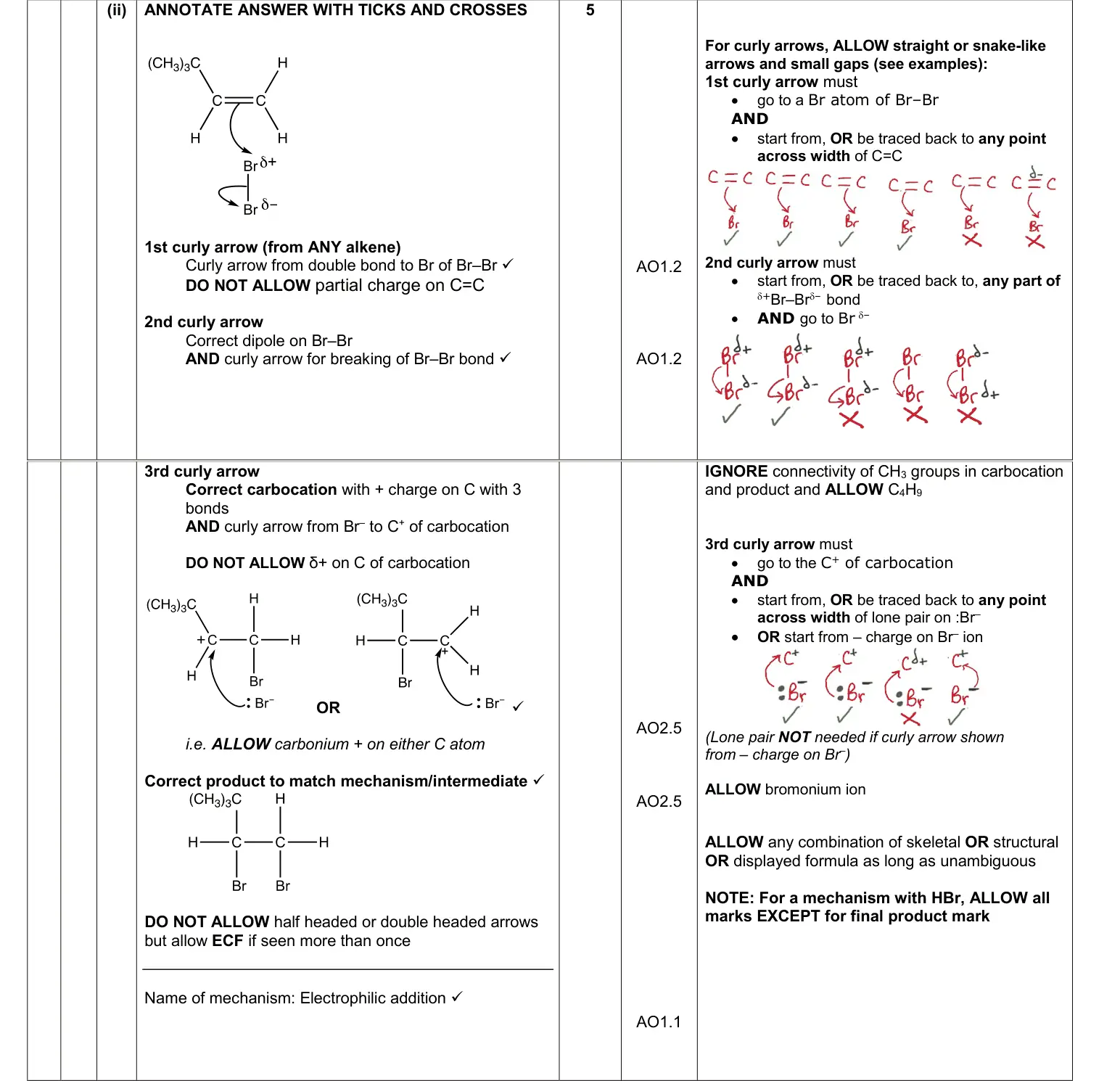
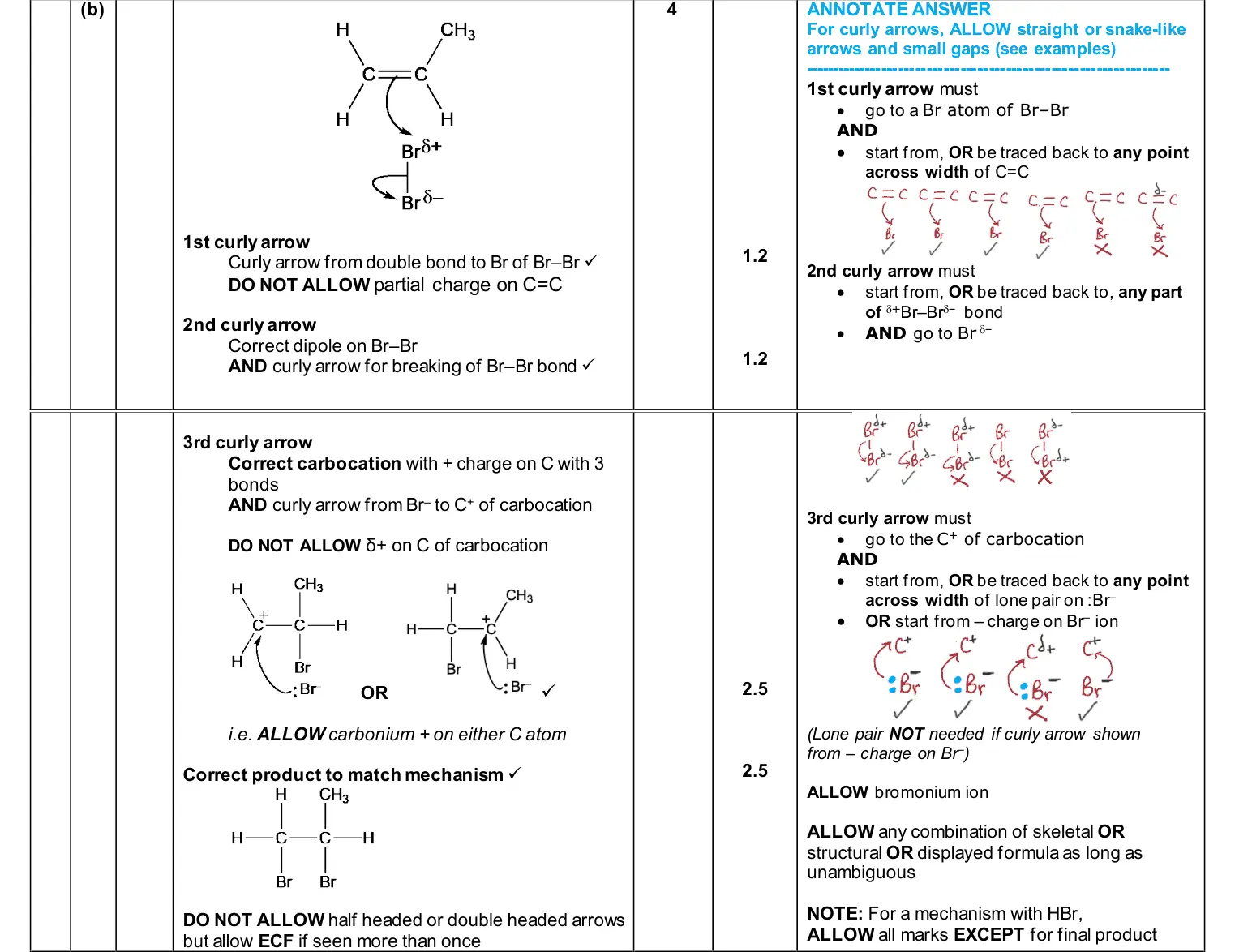
Many candidates answered the mechanism proficiently. However, many mistakes were seen with the direction of arrows, and confusing 𝛿+/ 𝛿– and +/– charges. In the intermediate carbocation, the C=C was often left intact and 𝛿– used on the bromide ion attacking the intermediate. Some less successful responses did not position curly arrows accurately. One common error was showing one or more C atoms missing from the (CH3)C groups. Candidates should take great care when drawing organic structures to make sure that all groups have been drawn accurately. This exemplar has been included to emphasise the importance of accurately placed curly arrows and use of charges. It was only possible to award this response 1 out of 5 marks. With a few improvements, this response could easily have been 5/5. The start of the first curly arrow has been placed accurately starting from the C=C double bond but the arrow should have finished at the Br𝛿+: 0 marks The Br–Br dipole is correct but there is no curly arrow showing it breaking: 0 marks The intermediate carbocation is correct but the curly arrow should have been shown from a lone pair on the Br– ion to the + charge of the carbocation: 0 marks The product is correct: 1 mark The reaction type is addition but the name of the mechanism is electrophilic addition: 0 marks nucleophilic substitution and radical substitution. This paper includes two of these in Questions 21 (a) (i) and 26 (a). It is essential that candidates learn these three mechanism types.
Notes from the mark scheme and report
first curly arrow from the C=C bond to Br
dipole on Br–Br AND arrow for breaking Br–Br
carbocation needs full + (DO NOT ALLOW δ+)
arrow from lone pair or – charge of Br–
DO NOT ALLOW half-headed or double-headed arrows
mechanism with HBr loses final product mark
Reactions mechanisms are the organic chemist’s way of communicating electron transfers in organic chemistry. Candidates must use curly arrows, dipoles and charges appropriately and accurately. AS Chemistry includes three important reaction mechanisms: electrophilic addition,
June 2022 · AS Paper 1 · Q26(a)3 marksAO1, 2MechanismMedium
Mark scheme
Examiner's comment
Although a simpler mechanism than electrophilic addition in Question 21 (a) (ii), candidate responses here were less successful. Many candidates weren’t able to identify the OH– ion attacking the carbon atom and the curly arrow often did not originate from an O lone pair or the negative charge. Candidates often omitted the dipole on the C–Cl bond or did not include a curly arrow. Candidates were expected to show both the resulting alcohol and Cl– as products. Many tried to incorporate Na into their organic structure. Organic mechanisms are a key concept in organic chemistry and it is essential for candidates to learn all the mechanisms in preparation for examinations. addition, nucleophilic substitution and radical substitution. This paper includes two of these in Questions 21 (a) (i) and 26 (a). It is essential that candidates learn these three mechanism types.
Notes from the mark scheme and report
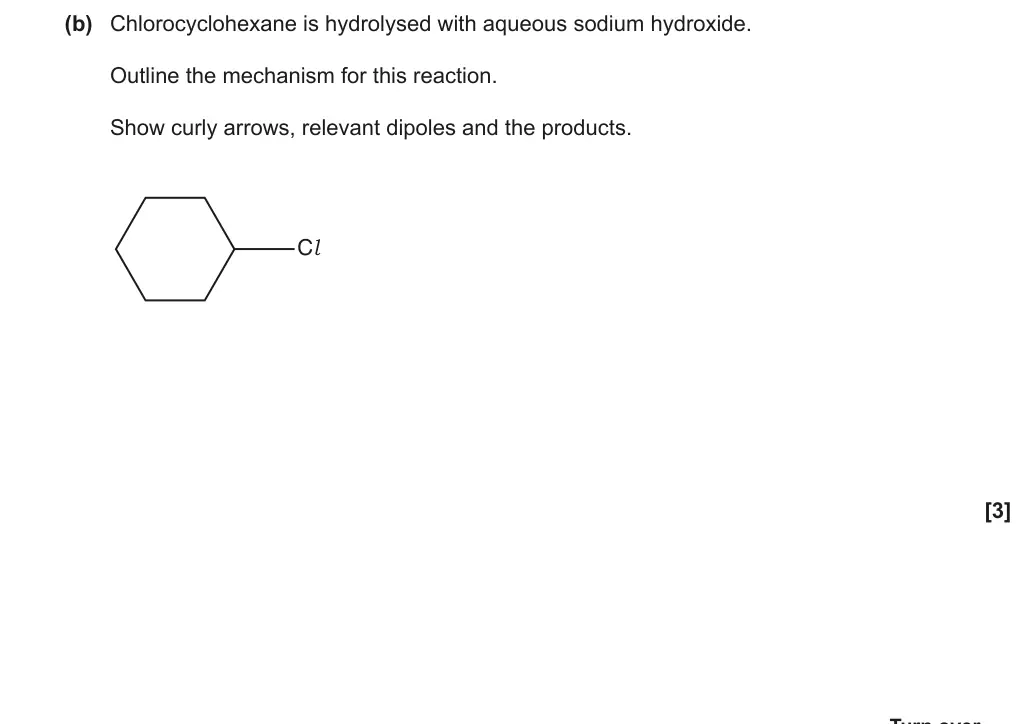
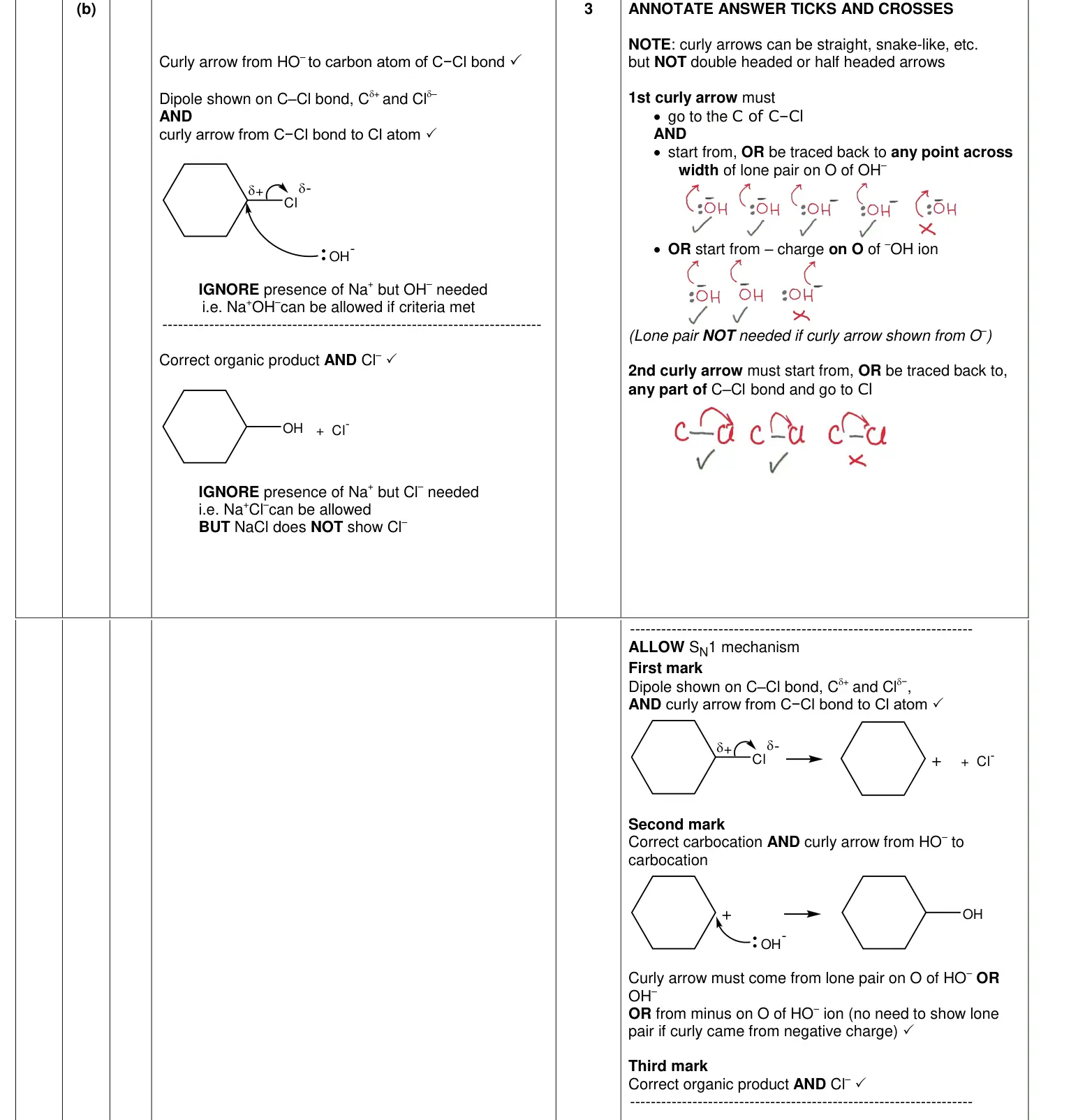
curly arrow from lone pair or – charge on O of OH– to C
dipole on C–Cl AND arrow from C–Cl bond to Cl
DO NOT ALLOW H2O instead of OH–
Cl– needed as product (NaCl does not show Cl–)
ALLOW SN1 route
Reactions mechanisms are the organic chemist’s way of communicating electron transfers in organic chemistry. It is essential that curly arrows, dipoles and charges are used appropriately and accurately. AS Chemistry includes three important reaction mechanisms: electrophilic
June 2022 · AS Paper 2 · Q5(a)(ii)2 marksAO2Equation writingMedium
Earlier part of question 5 that this part uses
Mark scheme
Examiner's comment
Candidates always find radical mechanisms tricky and this one had the added complexity of forming 2- bromo isomer. However, a majority of students still gained marks. Many candidates formed the incorrect radical removing H from C-1 i.e. CH3CH2CH2CH2• therefore scoring only 1 mark. Some responses were a little messy making it very easy to miss off a dot or H or Br. Many candidates reacted with Br• in the first step but added Br to the radical intermediate (as well as forming HBr). Candidates should always check equations so that they balance in terms of atoms.
Notes from the mark scheme and report
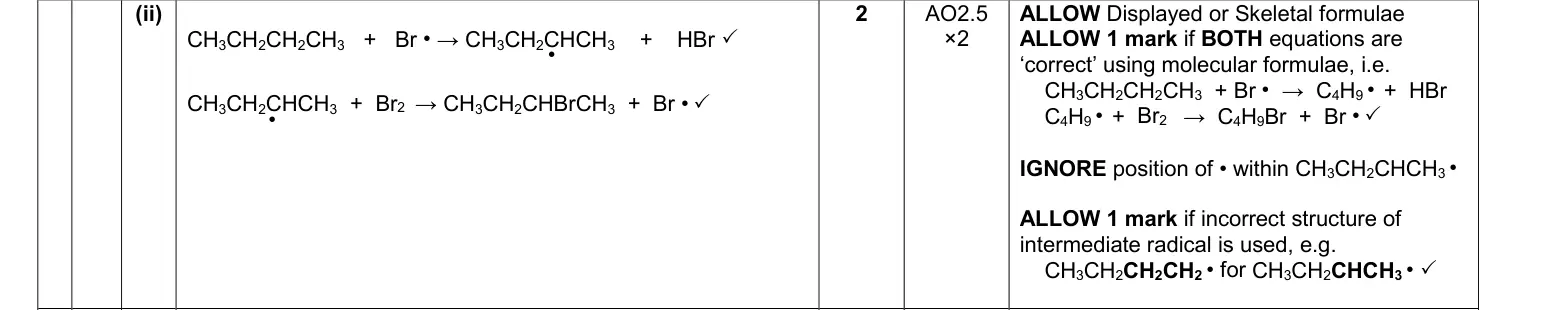
radical must be CH3CH2•CHCH3 (1 mark if CH3CH2CH2CH2• used or both equations correct with molecular formulae)
dots required
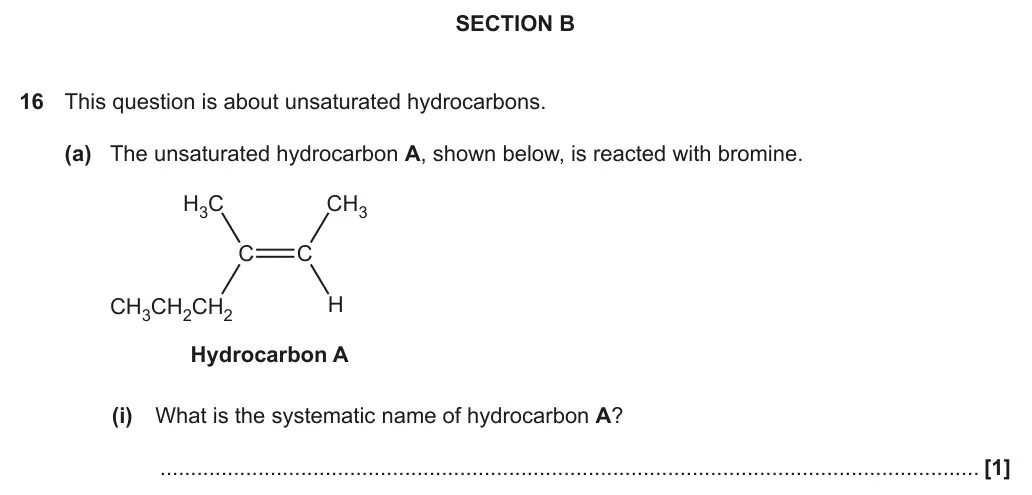
June 2022 · Paper 2 · Q16(a)(i)1 markAO1Short answerMedium
Mark scheme
Examiner's comment
The majority of candidates were able to correct name hydrocarbon A as 3-methylhex-2-ene. A number of responses used incorrect numbering or suggested 3-methylhexan-2-ene as the name.
Notes from the mark scheme and report
DO NOT ALLOW 3-methyhex-2-ene, 3-methhex-2-ene or 3-methylhexan-2-ene
IGNORE E/Z or cis/trans
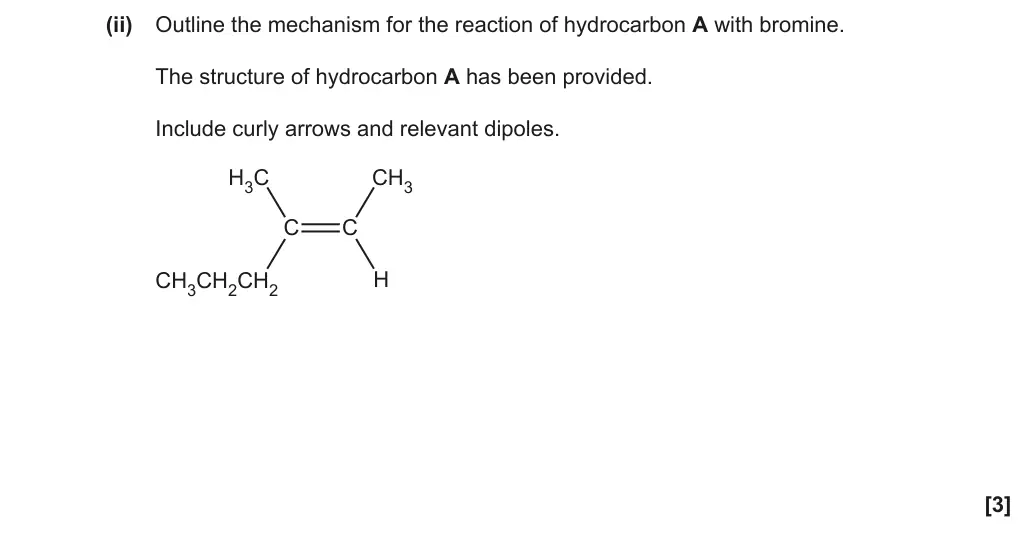
June 2022 · Paper 2 · Q16(a)(ii)3 marksAO1, 2MechanismEasy
Earlier part of question 16 that this part uses
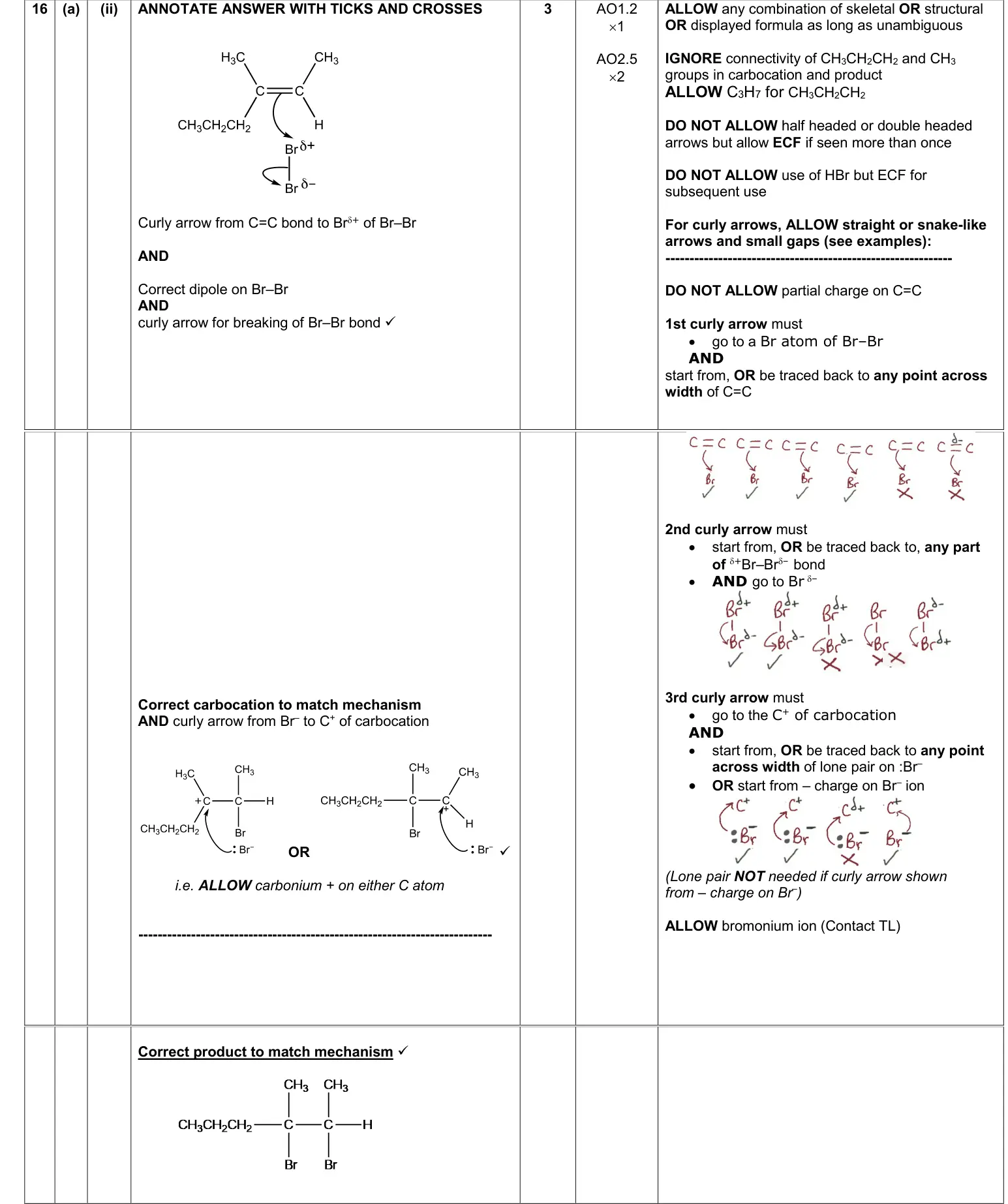
Mark scheme
Examiner's comment
Candidates are familiar with the mechanism for the bromination of hydrocarbons. So, the majority of candidates scored 3 marks. Common errors included the use of HBr rather than Br2 or putting a dipole on the carbon-carbon double bond.
Notes from the mark scheme and report
curly arrow from C=C to Br AND dipole on Br–Br AND arrow breaking Br–Br
carbocation with full + AND arrow from lone pair/– charge of Br–
DO NOT ALLOW partial charge on C=C
DO NOT ALLOW half-headed arrows
DO NOT ALLOW use of HBr
ALLOW bromonium ion
June 2022 · Paper 2 · Q16(b)(i)1 markAO1Short answerMedium
Mark scheme
Examiner's comment
The majority of candidates were able to correctly define a structural isomer.
Notes from the mark scheme and report
'same formula' insufficient (must be molecular)
'different arrangement of atoms' insufficient (must be structural)
DO NOT ALLOW any reference to spatial/space
June 2022 · Paper 2 · Q16(b)(iii)2 marksAO1, 2Structure / isomerEasy
Earlier part of question 16 that this part uses
Mark scheme
Examiner's comment
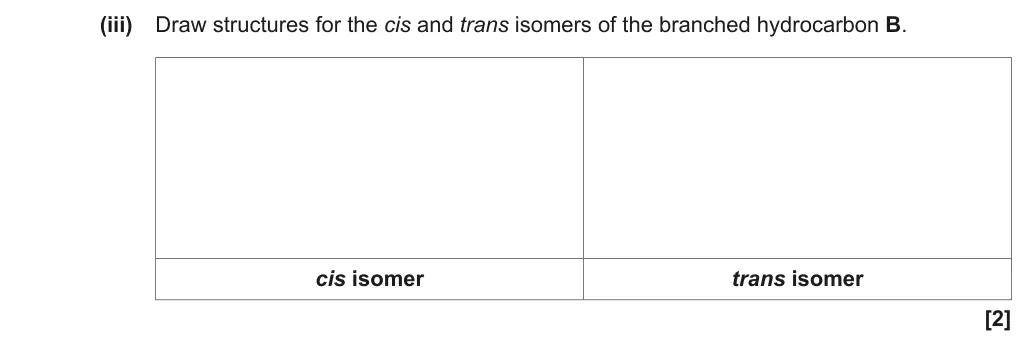
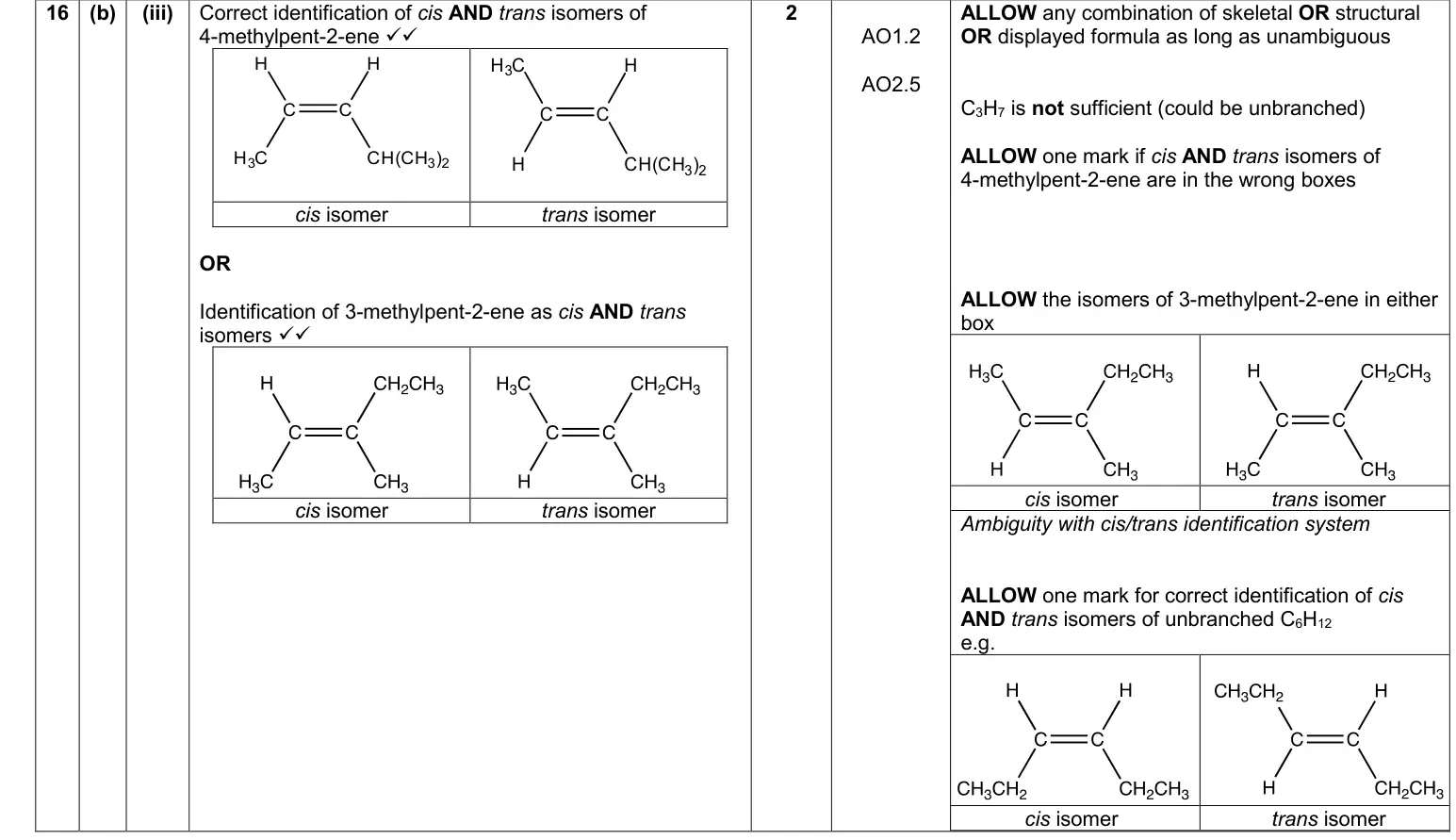
This question required candidates to link their knowledge of cis and trans isomers with branched hydrocarbons. Higher ability candidates were able to do this. The majority of candidates scored 1 mark for correctly drawing cis and trans isomers of an unbranched hydrocarbon.
Notes from the mark scheme and report
4-methylpent-2-ene cis and trans (ALLOW 3-methylpent-2-ene in either box)
C3H7 not sufficient (could be unbranched)
1 mark if in wrong boxes or for cis/trans of an unbranched C6H12
Skills: M4.2 Visualise and represent 2-D and 3-D forms including 2-D representations of 3-D objects; M4.3 Understand the symmetry of 2-D and 3-D shapes
June 2022 · Paper 2 · Q16(b)(iv)2 marksAO2Structure / isomerHard
Earlier part of question 16 that this part uses
Mark scheme
Examiner's comment
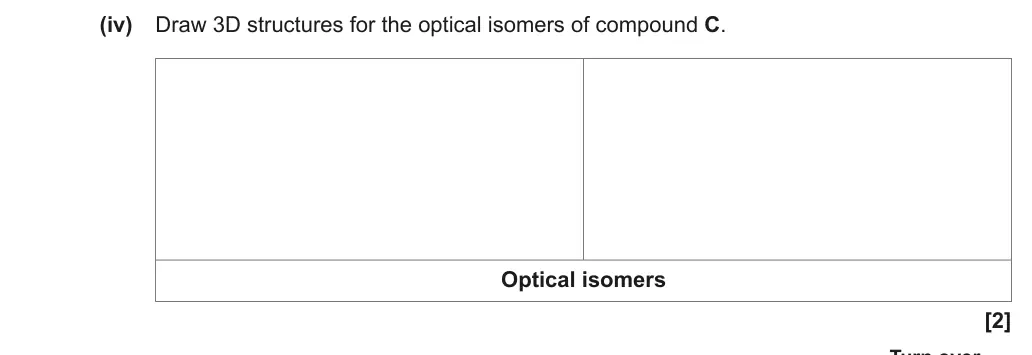
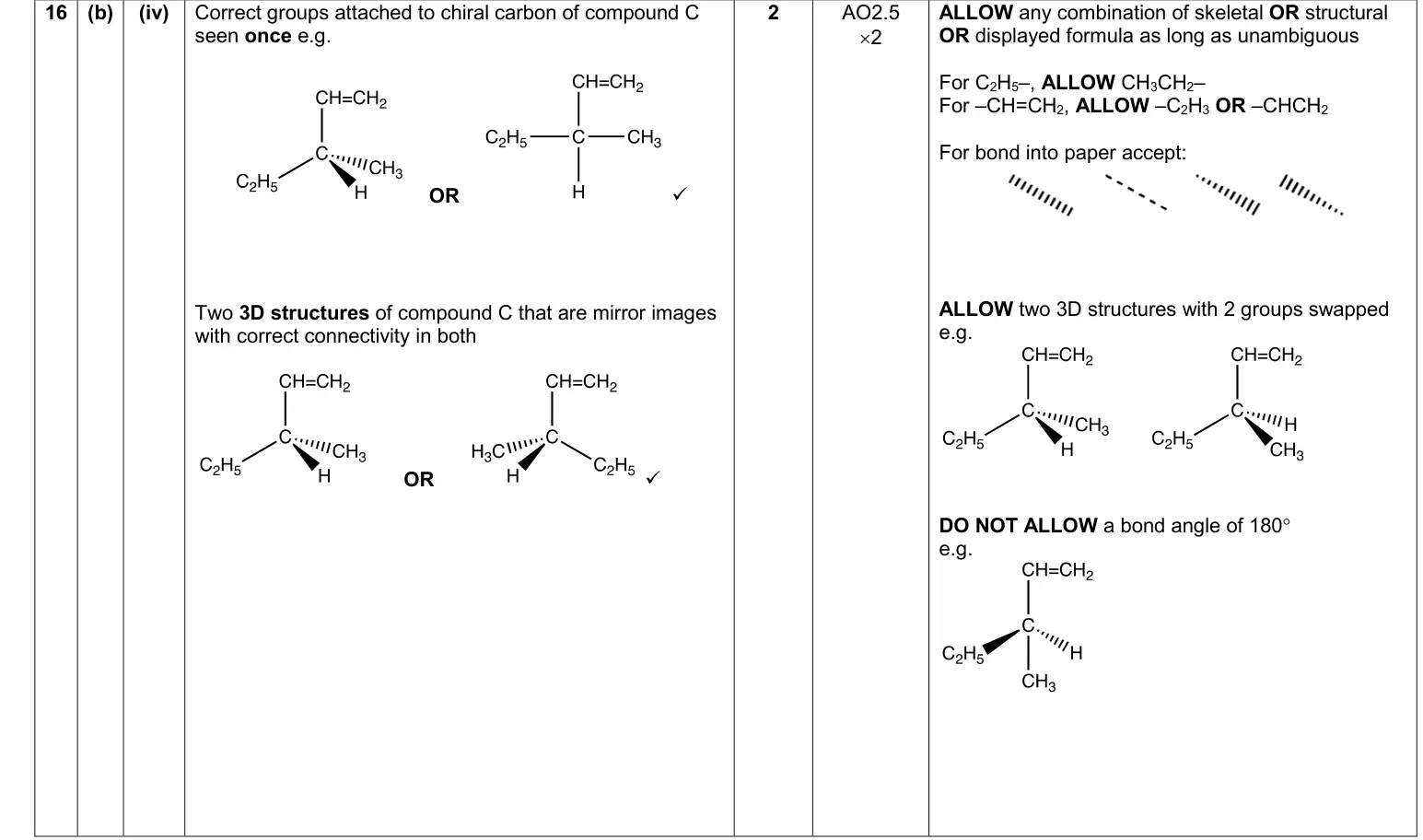
This question discriminated well. Candidates were required to identify the groups around a chiral carbon and then draw the two corresponding optical isomers. Incorrect responses frequently had incorrect connectivity around the chiral carbon, bond angles of 180 or 2D structures.
Notes from the mark scheme and report
C is 3-methylpent-1-ene
four bonds to chiral C with wedges
mirror images with correct connectivity
DO NOT ALLOW a bond angle of 180°
Skills: M4.2 Visualise and represent 2-D and 3-D forms including 2-D representations of 3-D objects; M4.3 Understand the symmetry of 2-D and 3-D shapes
June 2022 · Paper 2 · Q16(c)(ii)1 markAO3MechanismHard
Earlier part of question 16 that this part uses
Mark scheme
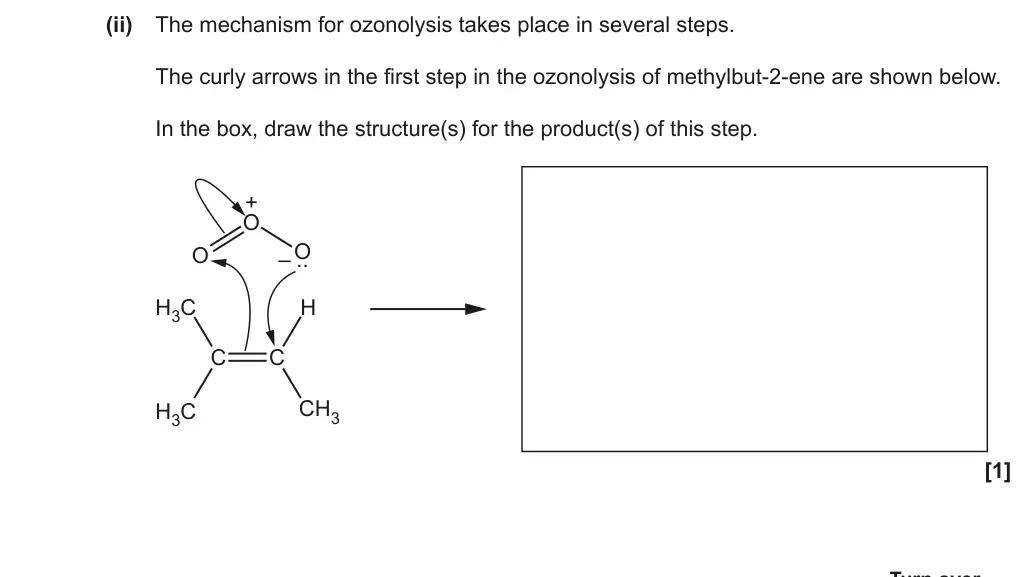
Examiner's comment
Few candidates were given this mark. A common error was to produce multiple products (rather than a ring structure) or to put positive/negative charges on the oxygen atoms within the ring structure.
Notes from the mark scheme and report
product must follow the curly arrows given (five-membered ring intermediate)
June 2022 · Paper 2 · Q19(c)(i)2 marksAO1, 2Structure / isomerMedium
Mark scheme
Examiner's comment
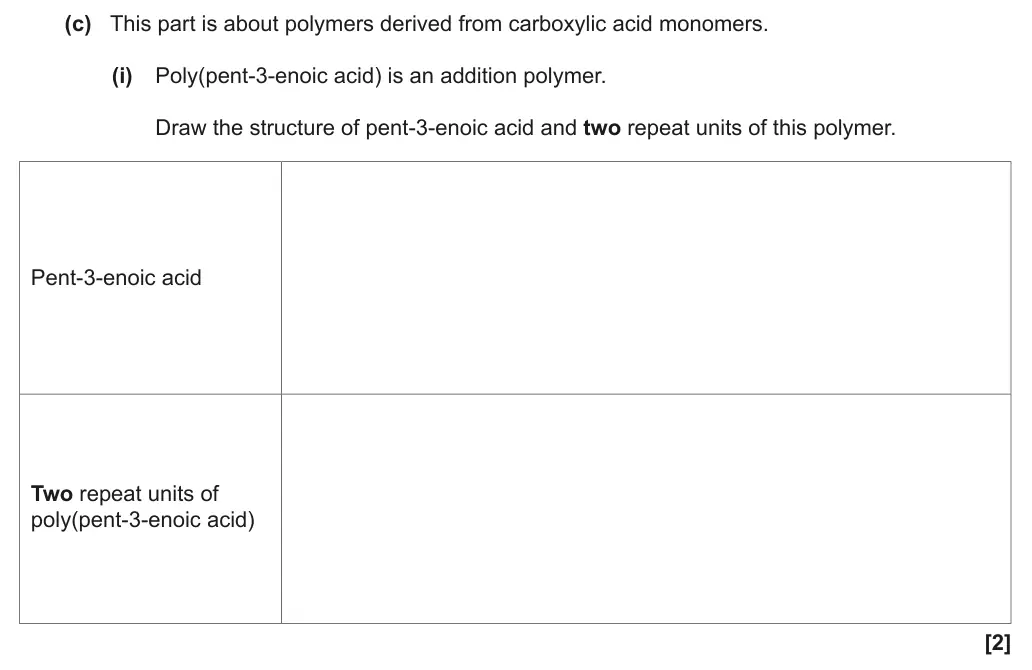
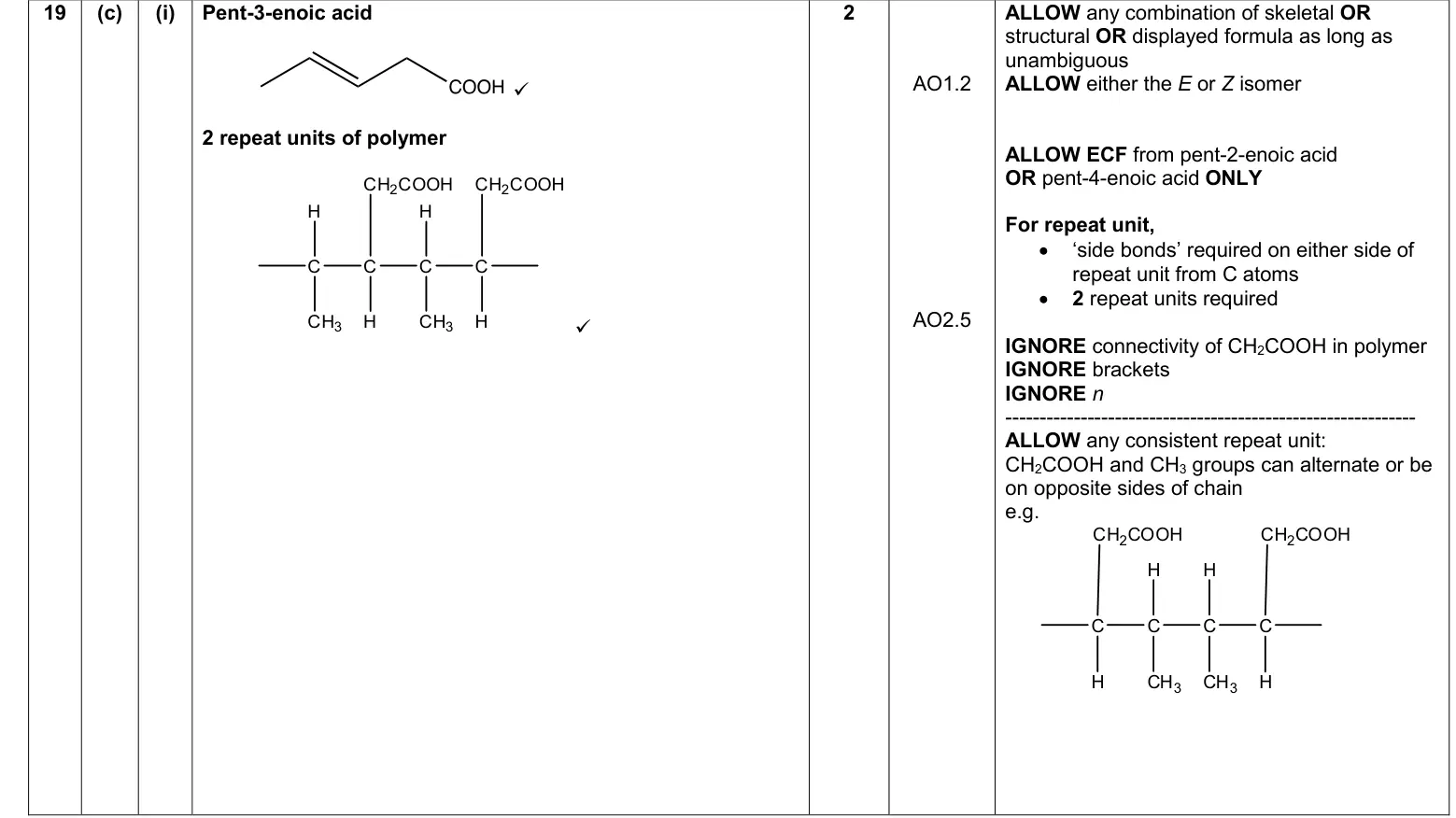
Most candidates were given at least 1 mark with many correctly drawing the structure of pent-3-enoic acid. Common errors included drawing pent-2-enoic acid or propenoic acid, suggesting a lack of knowledge of prefixes. The second mark required candidates to draw two repeat units, frequently candidates tried to draw repeat units linking the carboxylic acid groups rather than identifying that it is the carbon-carbon double bond that breaks.
Notes from the mark scheme and report
CH3CH=CHCH2COOH (E or Z)
two repeat units with side bonds
ECF only from pent-2-enoic or pent-4-enoic acid
IGNORE brackets and n
June 2022 · Paper 3 · Q3(b)4 marksAO3MechanismMedium
Earlier part of question 3 that this part uses
Mark scheme
Examiner's comment
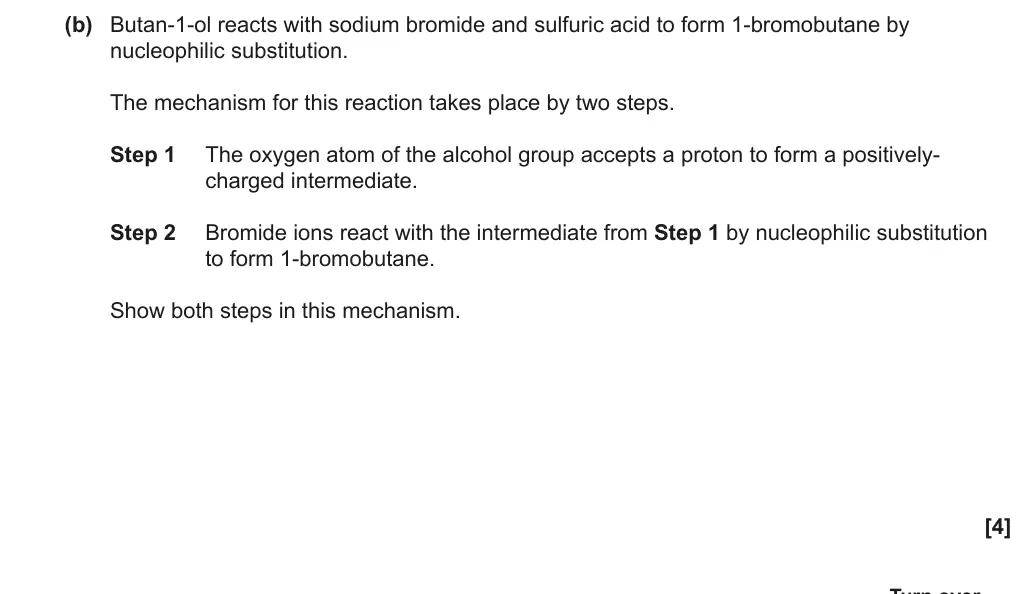
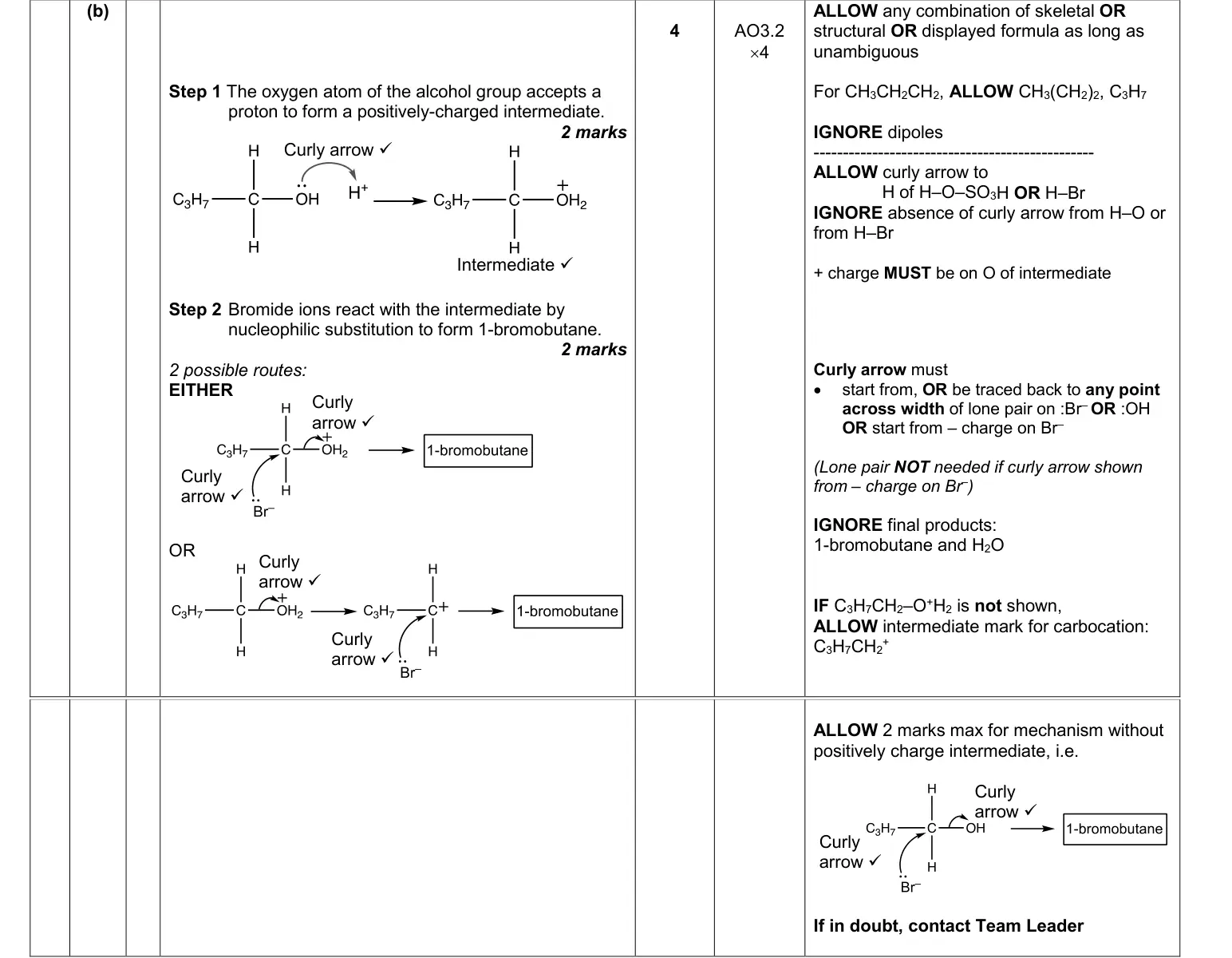
This question is one of two on this paper assessing understanding of unfamiliar organic reaction mechanisms. The stem to the question includes important information and clues that should have then guided candidates towards this unfamiliar mechanism (which is related to the familiar nucleophilic substitution of haloalkanes). The two prompts for Step 1 and Step 2 are critical but many candidates did not use these, instead inventing their own mechanisms. However, there were many successful responses seen that gained the full 4 marks. and dipoles. Step 1 is an attempt to show the alcohol OH group accepting a proton, but a curly arrow shows the movement of an electron pair. It cannot travel from a + charge to a lone pair. The intermediate shown does contain the correct atoms but the + charge has been omitted from the O atom. Marks were given for the curly arrow from the Br– lone pair and from the C–O bond. However, the candidate has drawn the bonds with very short lines making it all too easy for a curly arrow to be shown imprecisely. This response was given 2/4 marks.
Notes from the mark scheme and report
step 1 curly arrow from lone pair on O to H+ giving intermediate with + charge on O (–OH2+)
step 2 curly arrow from Br– lone pair/charge to C and from C–O bond to O (or via carbocation)
max 2 for mechanism without positively charged intermediate
IGNORE dipoles
In organic chemistry mechanisms, a curly arrow shows the movement of an electron pair and demonstrates the direction of electron flow in organic reactions.
A curly arrow must start from: • A lone pair or negative charge and go to an atom to show where a bond forms • A bond to show where a bond breaks.
June 2022 · Paper 3 · Q6(c)(i)2 marksAO3MechanismHard
Earlier part of question 6 that this part uses
Mark scheme
Examiner's comment
This novel mechanism assessed a candidate’s understanding of curly arrows, and four curly arrows were needed. One mark was available for one correct curly arrow, usually from the H2O: or from the C=O. 2 marks were given for three or four correct curly arrows. The two curly arrows within the ring structure proved to be the most difficult. The question discriminated extremely well: many candidates were able to secure one mark with the most able being given both marks. A candidate showing all four curly arrows correctly demonstrated an excellent understanding of curly arrows.
Notes from the mark scheme and report
arrow from lone pair on H2O to H of enol O–H, O–H bond pair to form C=O, C=C pair moving along, ring C=O pair to O giving O–
3 or 4 correct arrows = 2 marks, 1 correct = 1 mark
IGNORE incorrect/'double' curly arrows
November 2021 · AS Paper 1 · Q131 markAO2Multiple choice
Answer
B
Mark scheme
Notes from the mark scheme and report
ALLOW 4
Skills: M4.2 Visualise and represent 2-D and 3-D forms including 2-D representations of 3-D objects
November 2021 · AS Paper 1 · Q141 markAO1Multiple choice
Answer
B
Mark scheme
November 2021 · AS Paper 1 · Q171 markAO1Multiple choice
Answer
B
Mark scheme
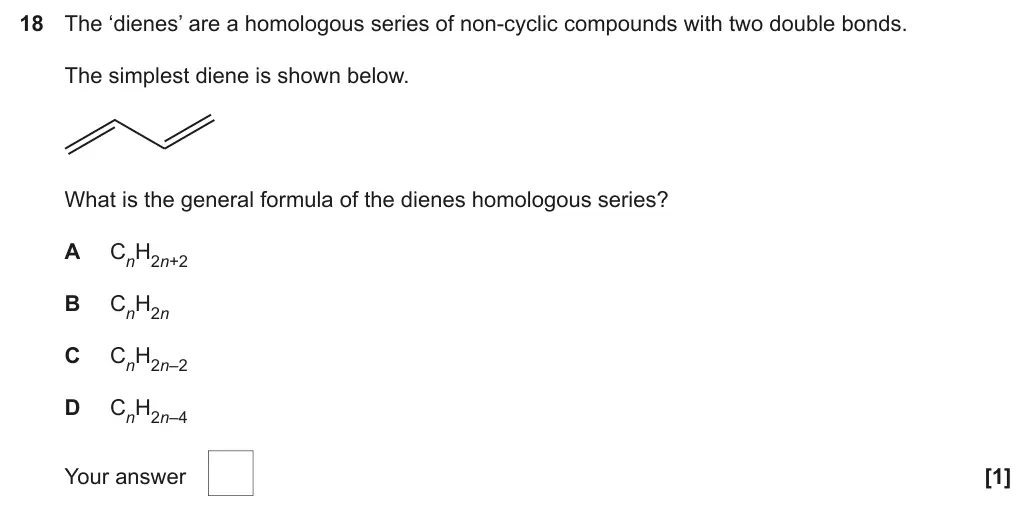
November 2021 · AS Paper 1 · Q181 markAO2Multiple choice
Answer
C
Mark scheme
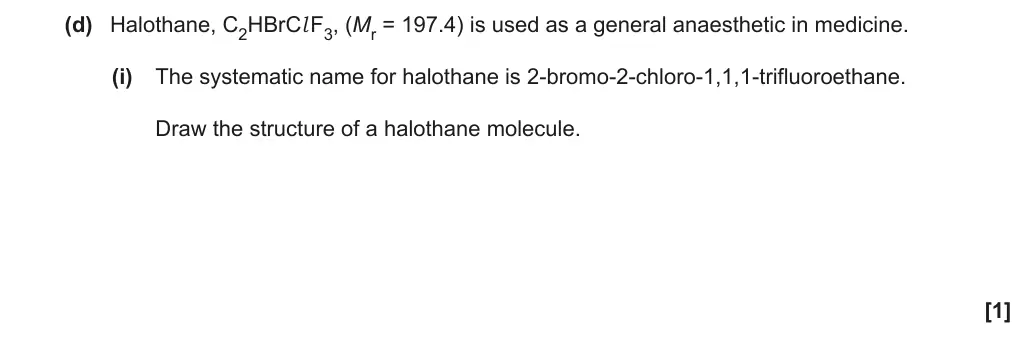
November 2021 · AS Paper 1 · Q21(d)(i)1 markAO2Structure / isomer
Mark scheme
Notes from the mark scheme and report
ALLOW any unambiguous skeletal, structural or displayed formula e.g. CF3CHClBr
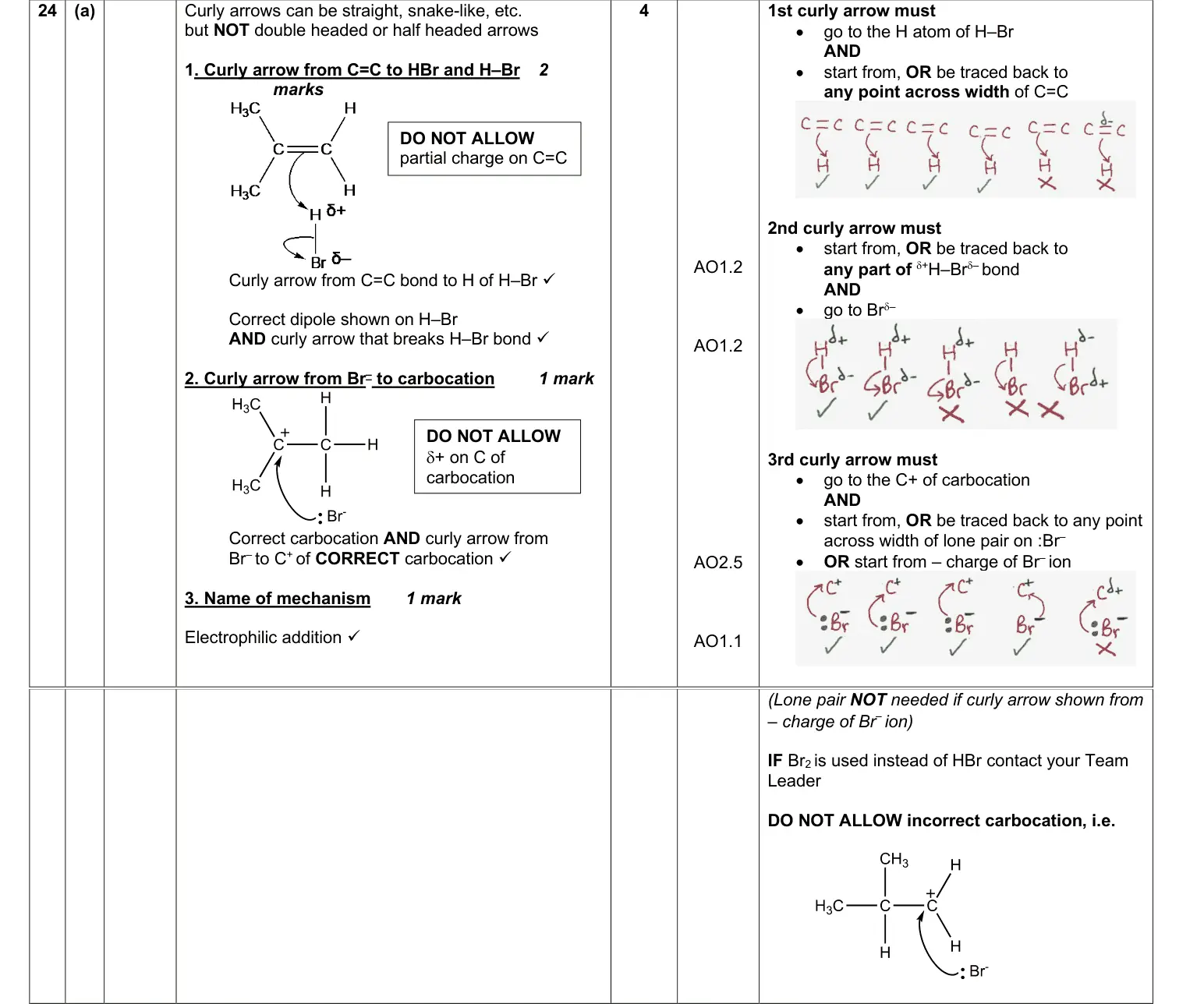
November 2021 · AS Paper 1 · Q24(a)4 marksAO1, 2Mechanism
Mark scheme
Notes from the mark scheme and report
curly arrow from C=C to H of H–Br
dipole on H–Br and arrow breaking H–Br
arrow from Br– lone pair/charge to C+ of the correct (tertiary) carbocation
DO NOT ALLOW partial charge on C=C or δ+ on carbocation
DO NOT ALLOW incorrect carbocation
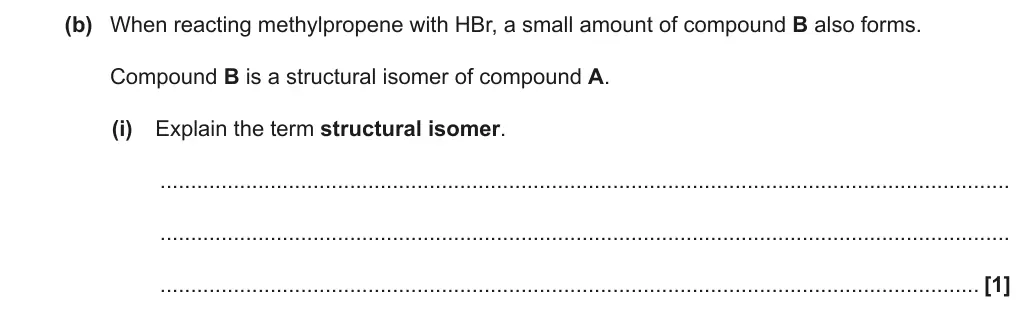
November 2021 · AS Paper 1 · Q24(b)(i)1 markAO1Short answer
Earlier part of question 24 that this part uses
Mark scheme
Notes from the mark scheme and report
same molecular formula AND different structural formulae
'same formula' not sufficient
'different arrangement of atoms' not sufficient
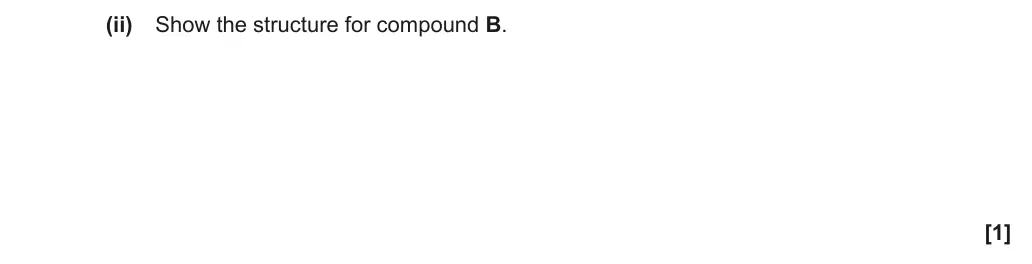
November 2021 · AS Paper 1 · Q24(b)(ii)1 markAO2Short answer
Earlier parts of question 24 that this part uses
Mark scheme
Notes from the mark scheme and report
1-bromo-2-methylpropane
ALLOW any unambiguous formula
November 2021 · AS Paper 1 · Q265 marksAO3Extended response
Mark scheme
Notes from the mark scheme and report
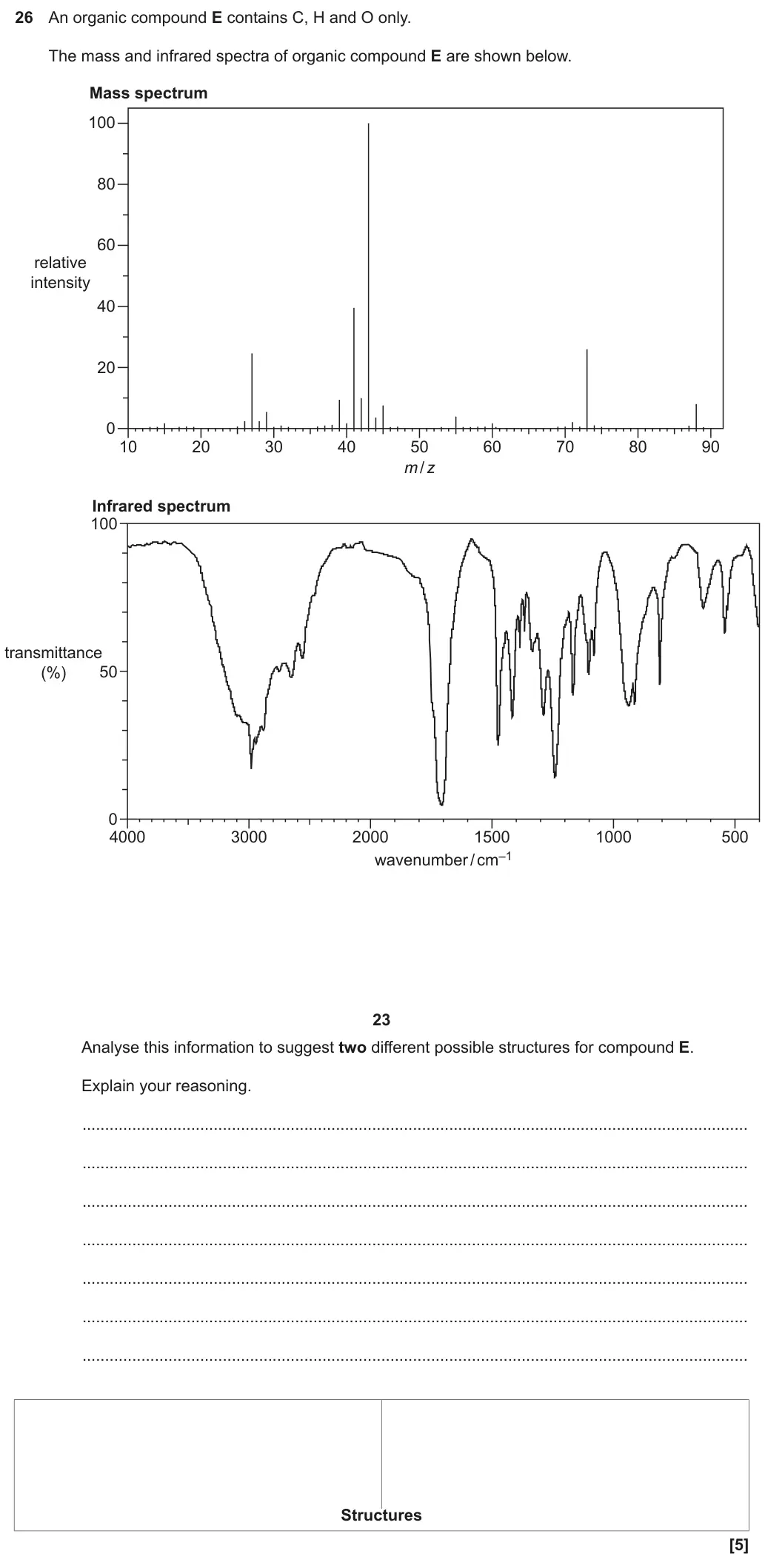
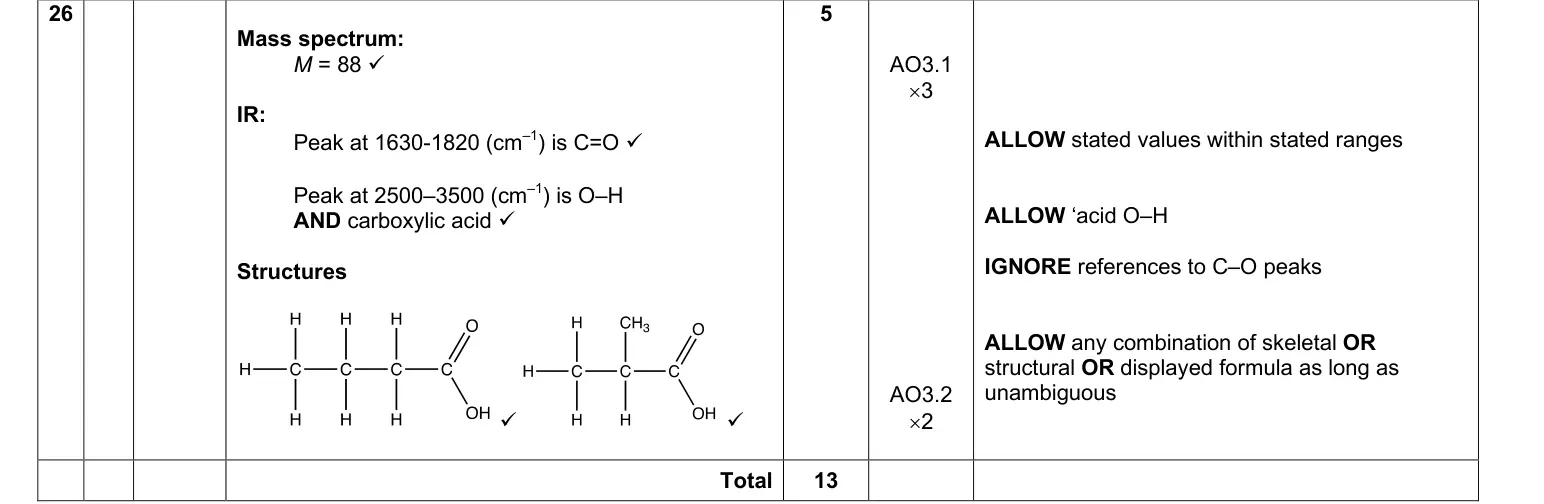
M = 88 from molecular ion
C=O peak 1630–1820 cm–1
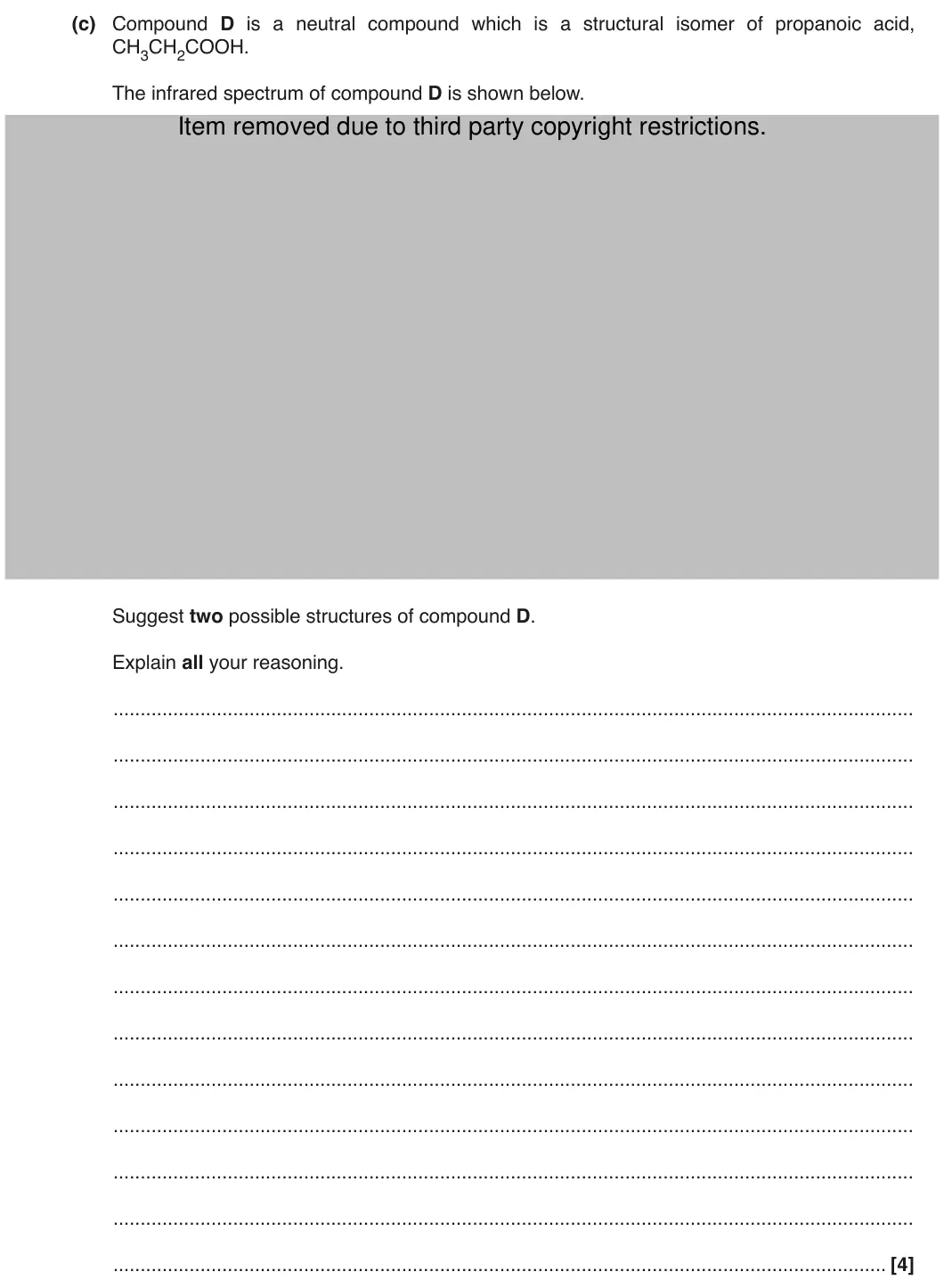
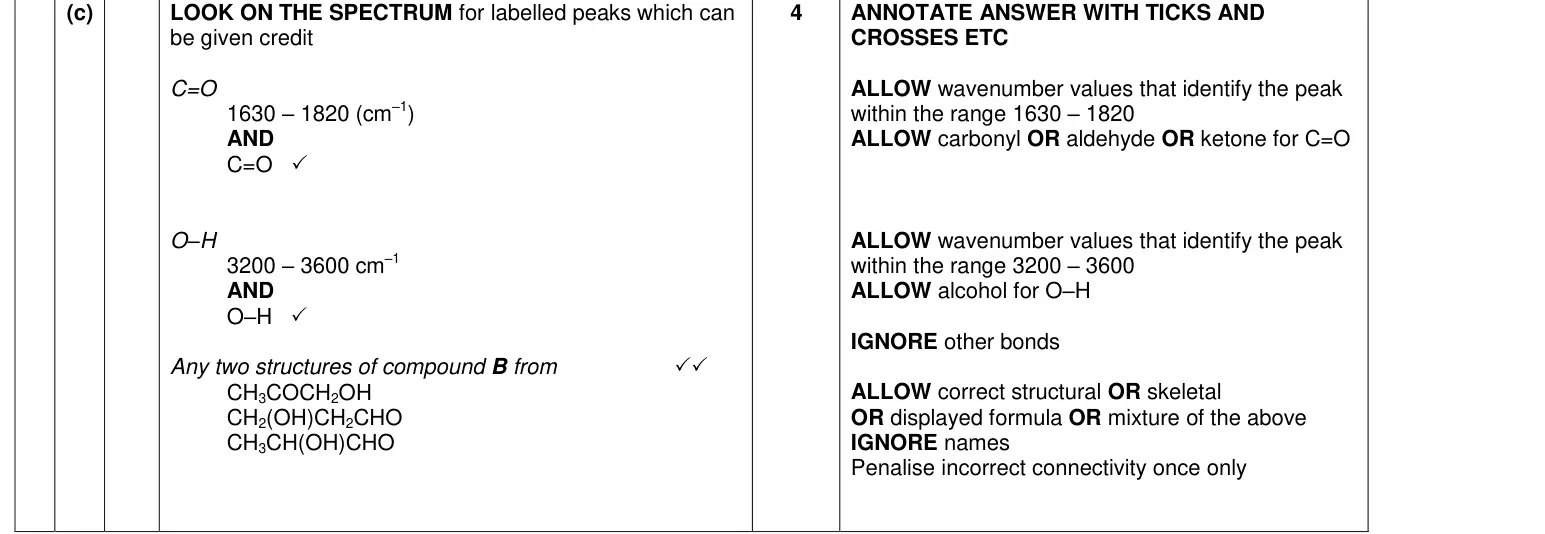
broad O–H 2500–3500 cm–1 so carboxylic acid
butanoic acid and methylpropanoic acid
IGNORE references to C–O peaks
Skills: M3.1 Translate information between graphical, numerical and algebraic forms
November 2021 · Paper 2 · Q11 markMultiple choice
Answer
C
Mark scheme
Notes from the mark scheme and report
ALLOW 4
November 2021 · AS Paper 2 · Q2(a)1 markAO1Short answer
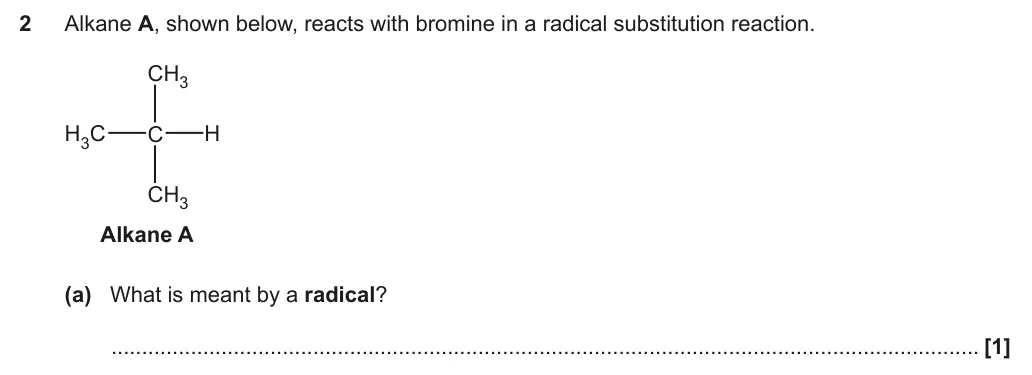
Mark scheme
Notes from the mark scheme and report
species with an unpaired electron
DO NOT ALLOW species with one electron
November 2021 · AS Paper 2 · Q2(b)1 markAO1Short answer
Earlier part of question 2 that this part uses
Mark scheme
Notes from the mark scheme and report
homolytic (fission)
November 2021 · AS Paper 2 · Q7(a)2 marksAO2Equation writing
Mark scheme
Notes from the mark scheme and report
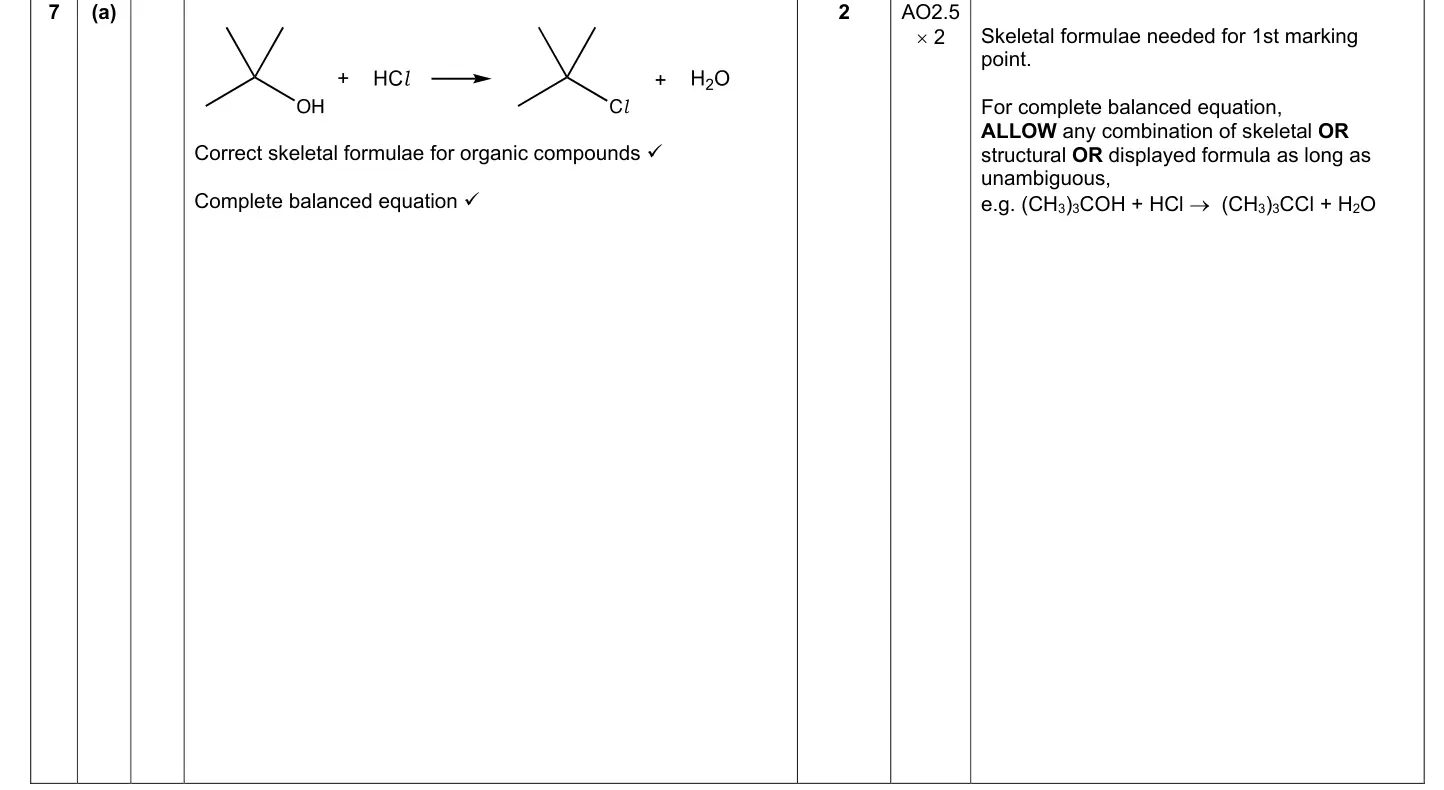
skeletal formulae required for the first mark
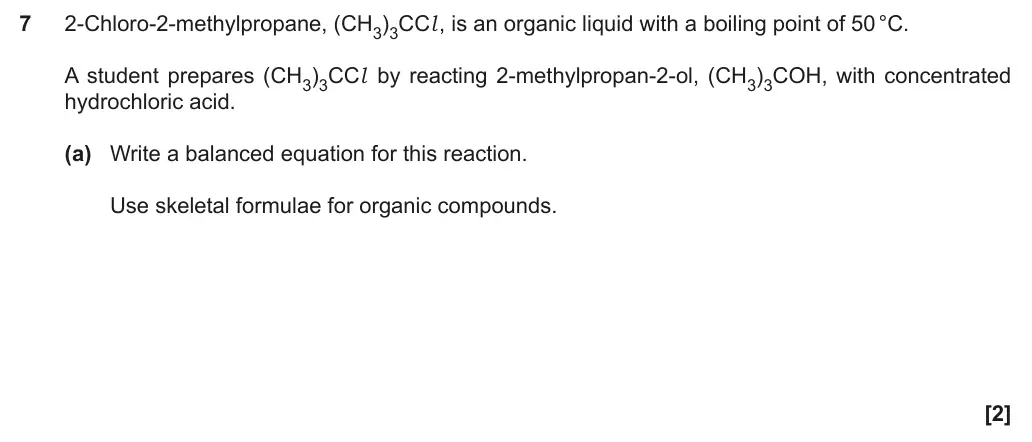
(CH3)3COH + HCl → (CH3)3CCl + H2O
November 2021 · AS Paper 2 · Q7(c)(i)1 markAO1Short answer
Earlier part of question 7 that this part uses
Mark scheme
Notes from the mark scheme and report
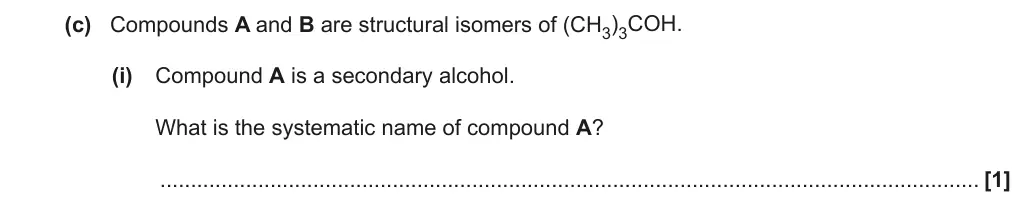
butan-2-ol
November 2021 · AS Paper 2 · Q7(c)(ii)3 marksAO2Equation writing
Earlier part of question 7 that this part uses
Mark scheme
Notes from the mark scheme and report
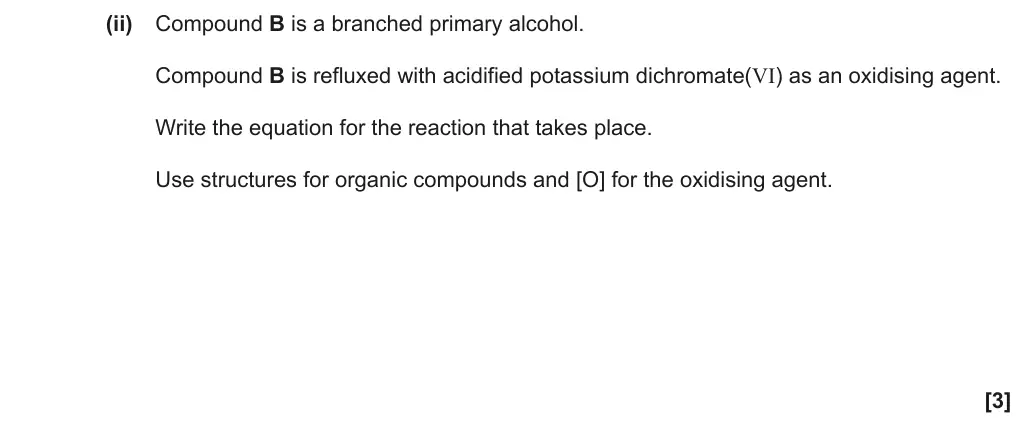
B = (CH3)2CHCH2OH
reflux gives carboxylic acid so 2[O] and H2O
ALLOW ECF for product and equation if B is a different primary or secondary alcohol
November 2021 · Paper 2 · Q16(b)(i)4 marksAO1, 2MechanismEasy
Mark scheme
Examiner's comment
Question 16(b)(i): This was answered well by students.
Notes from the mark scheme and report
curly arrow from C=C to H of H–Br
dipole on H–Br AND arrow breaking H–Br
secondary carbocation (DO NOT ALLOW δ+ on C) with arrow from lone pair/charge of Br–
DO NOT ALLOW partial charge on C=C
ALLOW ECF product from incorrect carbocation
November 2021 · Paper 2 · Q16(b)(iii)1 markAO1Short answer
Earlier part of question 16 that this part uses
Mark scheme
Notes from the mark scheme and report
3
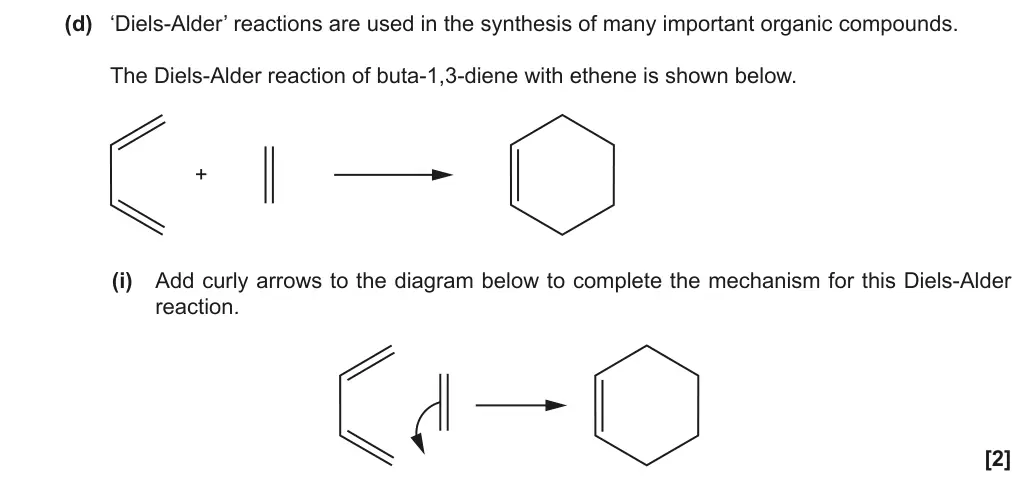
November 2021 · Paper 2 · Q16(d)(i)2 marksAO2MechanismMedium
Mark scheme
Examiner's comment
Question 16(d)(i): Many candidates did not apply their knowledge of curly arrows to this unfamiliar context.
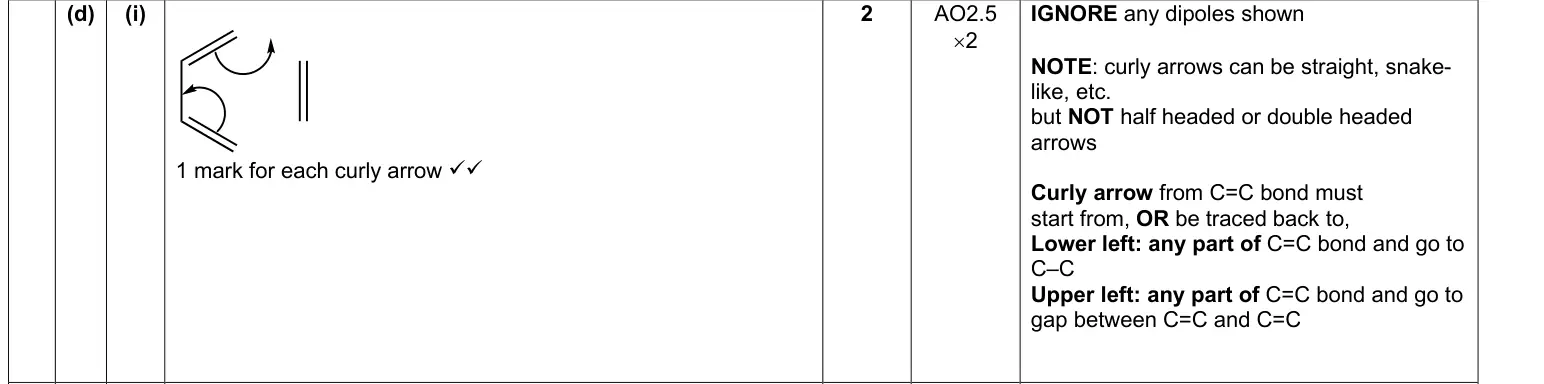
Notes from the mark scheme and report
one mark per curly arrow, each starting from a C=C bond and going to where the new bond forms
IGNORE dipoles
no half-headed or double-headed arrows
November 2021 · Paper 2 · Q17(c)4 marksAO1, 2Structure / isomer
Mark scheme
Notes from the mark scheme and report
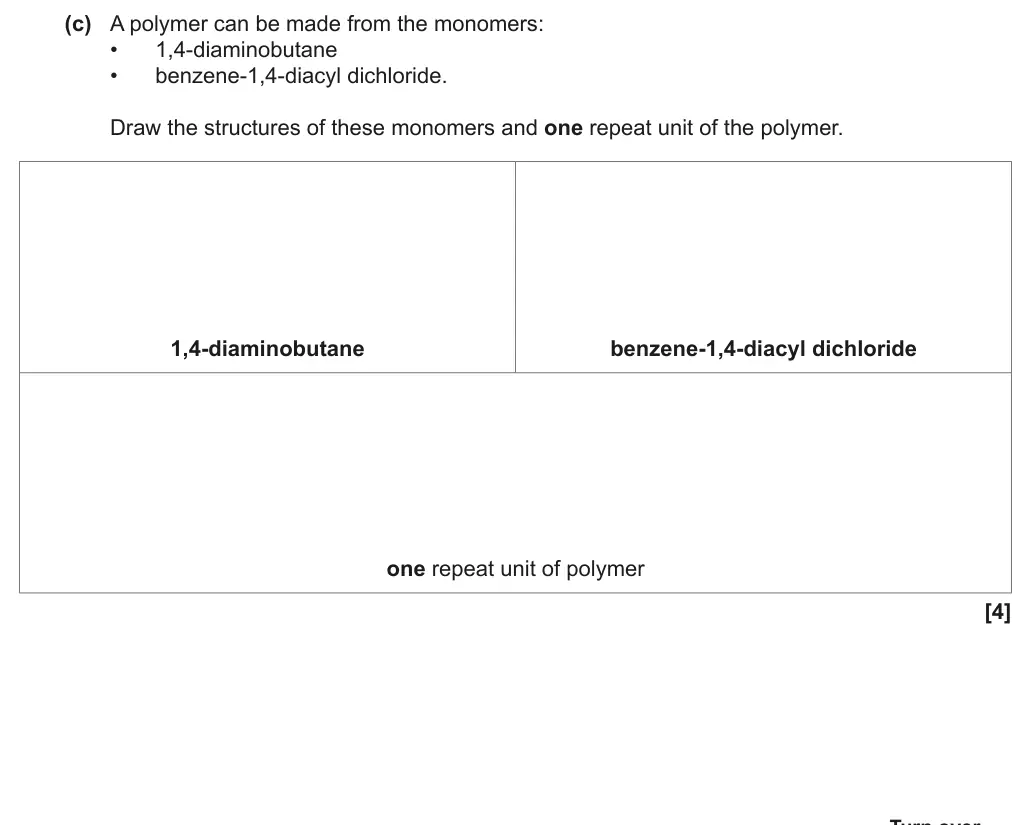
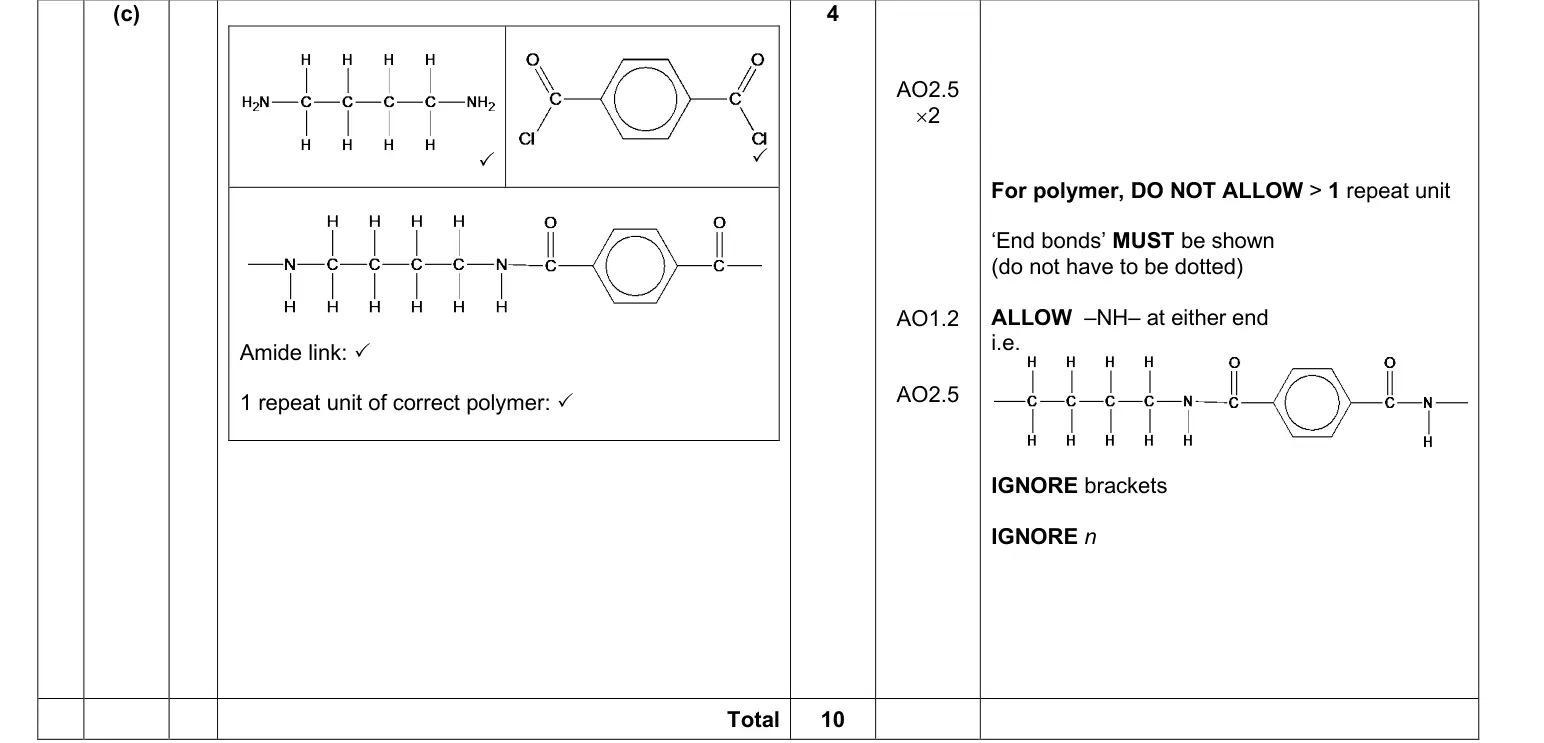
H2N(CH2)4NH2 and ClOC–C6H4–COCl
amide link
one repeat unit only with end bonds shown
November 2021 · Paper 2 · Q18(c)(i)1 markAO2Short answer
Mark scheme
Notes from the mark scheme and report
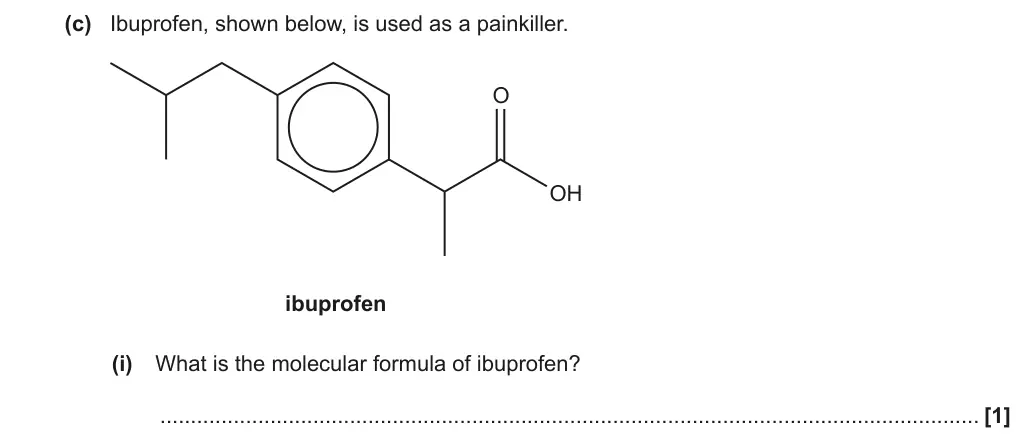
C13H18O2
November 2021 · Paper 2 · Q19(a)(i)1 markAO1Short answer
Mark scheme
Notes from the mark scheme and report
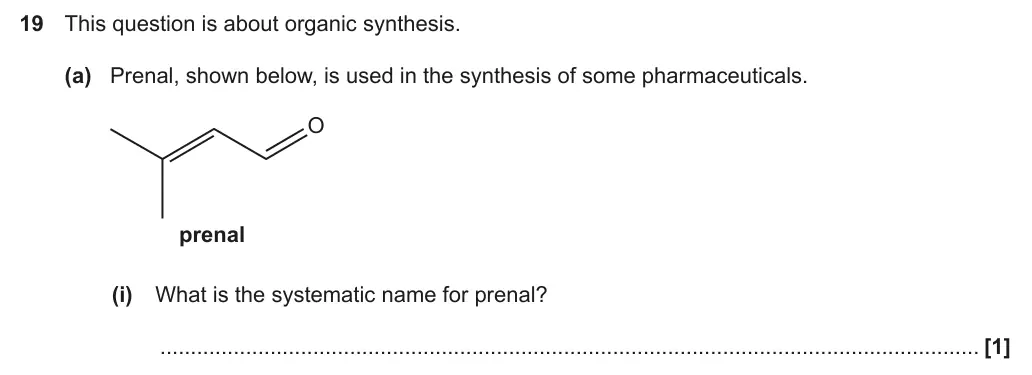
3-methylbut-2-enal
IGNORE lack of hyphens
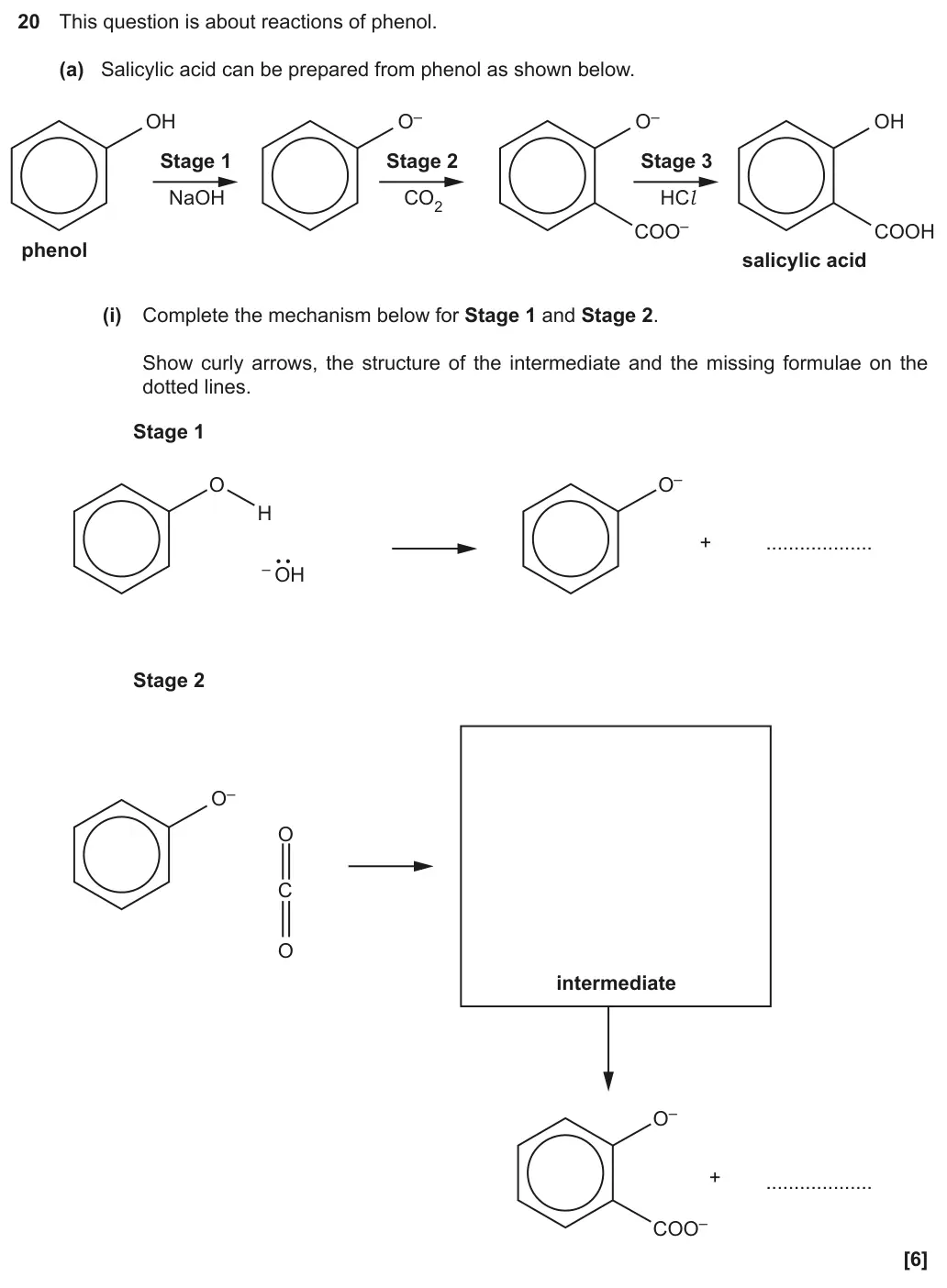
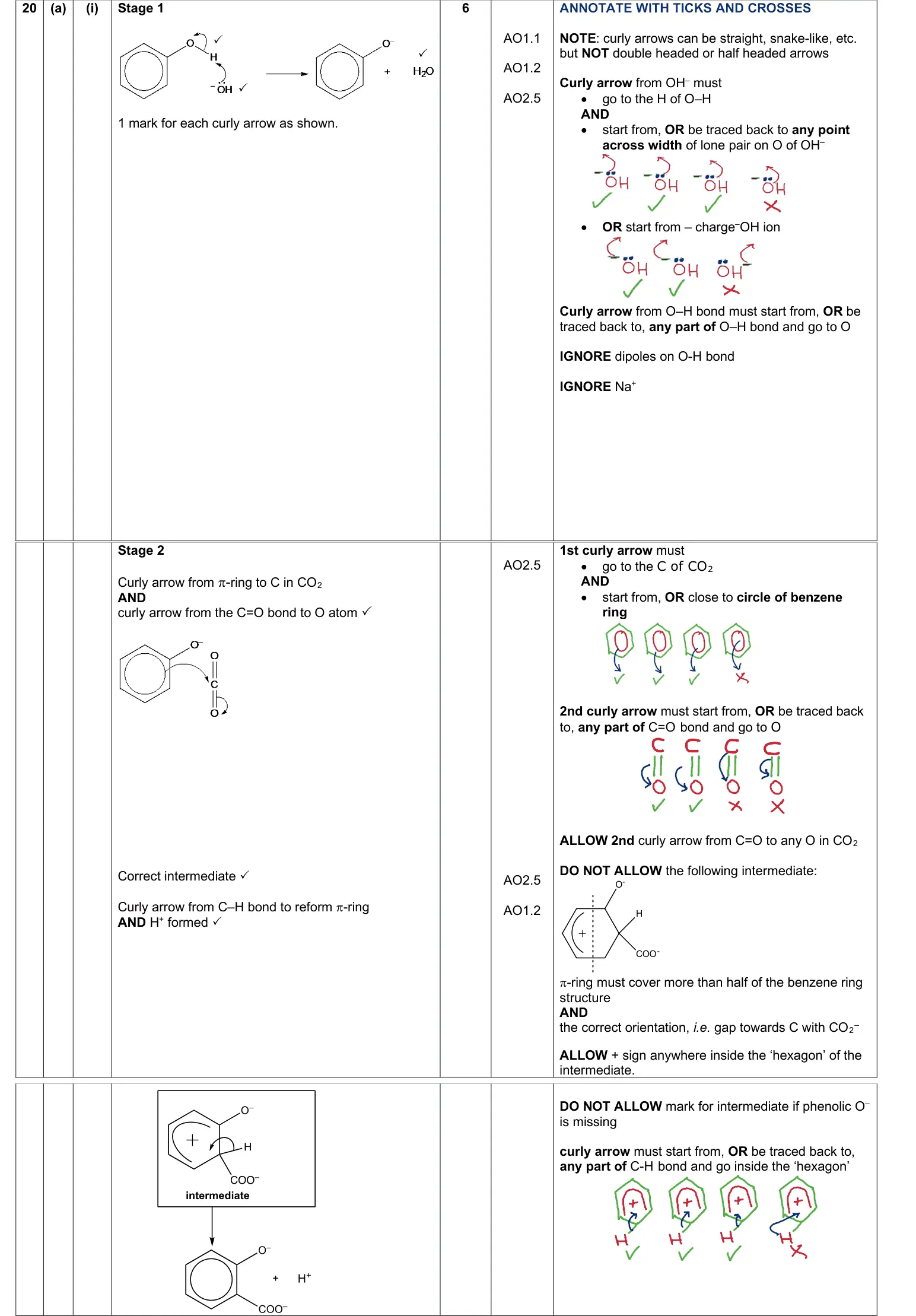
November 2021 · Paper 2 · Q20(a)(i)6 marksAO1, 2MechanismMedium
Mark scheme
Examiner's comment
Question 20(a)(i): Candidates who answered this question well had clear mechanisms.
Notes from the mark scheme and report
stage 1: arrow from lone pair/charge of OH– to H of O–H and arrow from O–H bond to O, H2O formed
stage 2: arrow from ring to C of CO2 AND arrow from C=O to O
intermediate horseshoe with gap at C bearing CO2– and phenolic O– present
arrow from C–H bond into ring AND H+
November 2021 · Paper 3 · Q1(f)3 marksAO1, 2MechanismMedium
Mark scheme
Examiner's comment
Q1(f) Outlining a mechanism for an unfamiliar reaction Q5(b)(iii) Predicting the equation for an unfamiliar organic reaction • Did not consider what a question is asking or read the information, e.g. Q1(f): Candidates were required to apply their knowledge of nucleophilic substitution of haloalkanes to outline a similar mechanism for an unfamiliar nucleophile.
Notes from the mark scheme and report
dipole on C–X and curly arrow from C–X bond to X
curly arrow from lone pair or – charge on O of CH3COO– to C
products methyl ethanoate AND X–
halogen must be consistent
ALLOW SN1 mechanism
November 2021 · Paper 3 · Q3(b)7 marksAO2, 3Data interpretationHard
Earlier part of question 3 that this part uses
Mark scheme
Examiner's comment
Q1(a) Partial pressure calculation Q1(d) Formula determination from percentage composition by mass Q2(b) Converting mass and volume into moles Q3(b) Unstructured titration calculation Q5(a)(ii) Ideal gas calculation Q5(b)(i) Calculation of the pH of a weak acid • Produced clear and concise responses for a Level of Response question based on a familiar context i.e., Q4(b) rates by continuous monitoring and graphical analysis. • Had difficulty when answering questions requiring application of knowledge and understanding on questions set in novel and unfamiliar contexts, e.g. Q3(b): As with Question 2, candidates had more success with the mole calculation in Q3(b) than the descriptive response in Q3(a). See also comments made for Q1(e) and Q3(b).
Notes from the mark scheme and report
n(D) in 25 cm3 = 2 × 3.525 × 10–3
×4 for 100 cm3
M = 114 so C5H9COOH
any 2 cis isomers with different groups on each C of C=C
common errors: scaling omitted (M = 456), no × 2 (M = 228), 25.00 used as titre (M = 100.8)
1 mark for 2 trans isomers
Skills: M0.2 Use ratios, fractions and percentages; M2.3 Substitute numerical values into algebraic equations using appropriate units for physical quantities; M4.2 Visualise and represent 2-D and 3-D forms including 2-D representations of 3-D objects; PAG2 Acid–base titration
November 2021 · Paper 3 · Q5(b)(iii)3 marksAO2, 3Equation writingMedium
Earlier part of question 5 that this part uses
Mark scheme
Examiner's comment
Q1(f) Outlining a mechanism for an unfamiliar reaction Q5(b)(iii) Predicting the equation for an unfamiliar organic reaction • Did not consider what a question is asking or read the information, e.g. Q5(b)(iii) Candidates were expected to interpret information for an unfamiliar organic reaction and to write a balanced question. In Q5(b)(iii), 2-methylbutanoic acid is CH3CH(CH3)CH2COOH.
Notes from the mark scheme and report
structure of 2-methylbutanoic acid
amine is CH3CH2CH(CH3)NH2 (butan-2-amine)
CO2 AND N2 as products
DO NOT ALLOW ECF from unbranched species
common error: CO2 + H2 from using NH3
November 2020 · AS Paper 1 · Q141 markAO1Multiple choiceMedium
Answer
A
Mark scheme
Examiner's comment
Although the two structures were the same molecule drawn in two different configurations, many candidates identified the structures as being structural isomers (C), rather than A.
November 2020 · AS Paper 1 · Q25(b)4 marksAO1, 2MechanismMedium
Earlier part of question 25 that this part uses
Mark scheme
Examiner's comment
25(a) This part was generally well-answered with well-prepared candidates scoring all three marks. The most common errors resulted from the products of reaction with HBr. The same structure was often drawn, reversed in one of the boxes. Candidates should take care to check that the atoms in a structure have the correct number of bonds. Some candidates added HBr across the C=C double bond but left the C=C bond intact in their final structures, showing carbon atoms with 5 bonds instead of 4. 25(b) As with 25(a), this question rewarded the well-prepared candidate and discriminated well. Conversely, many mechanisms showed little resemblance to the accepted mechanism for electrophilic addition. Mechanisms were often seen showing curly arrows going in the wrong direction and between the wrong bonds and atoms, with incorrect charges and dipoles, and partial charges used where full charges were required. Many candidates were aware that members of a homologous series have the same functional group and react in similar ways. A second mark was available for stating that the formula of successive members increases by CH2. It is important to stress ‘successive’ in communicating this information. 25(c)(ii) This part required candidates to apply their understanding of a ‘general formula’ in a novel context. Many candidates analysed the provided formulae for the alkynes homologous series to derive the correct general formula of CnH2n–2. There was no real pattern in the incorrect responses which usually contained a mixture of numbers for the H atom, e.g. CnH2n, CnHn+1. 25(c)(iii) Although attempted by most candidates, comparatively few responses could be credited. The key to success was again to use the information provided: the formation of a saturated compound. The commonest response seen showed addition of 1 Br2 molecule to form the unsaturated CH3CBr=CHBr instead of the saturated CH3CBr2–CBr2 by addition of 2 Br2. This question was one of the most difficult on the exam paper. 25(c)(iv) Most candidates achieved 1 of the available 2 marks for drawing the structure of but-2-yne, CH3C≡CCH3. The structure of but-1-yne was then usually drawn in the other box despite it being provided already in the table at the start of part (c). A variety of creditworthy structures were seen, including H2C=CH– CH=CH2, cyclobutene and isomers of methylcyclopropane. 25(c)(v) It was encouraging to see the many correct structures drawn from the unfamiliar 2,5-dimethylhept-3-yne. Most candidates positioned the C≡C group and the two substituted CH3 groups correctly. The commonest error was showing a main stem with 6, rather than 7 C atoms. If any of your students’ results are not as expected, you may wish to consider one of our review of results services. For full information about the options available visit the OCR website. If university places are at stake you may wish to consider priority service 2 reviews of marking which have an earlier deadline to ensure your reviews are processed in time for university applications. Our priority is supporting you and your students this autumn and to support you as you prepare for summer 2021 exams. We’ll update our website information regularly with resources, guidance and key information. • Teachers • Students • Exams officers • Assessment specialists We are sending a weekly roundup to tell you about important updates. You can also sign up for your subject specific updates. If you haven’t already, sign up here. Attend one of our popular CPD courses to hear directly from a senior assessor or drop in to a Q&A session. All our courses for the academic year 2020-2021 are being delivered live via an online platform, so you can attend from any location. Please find details for all our courses on the relevant subject page on our website or visit OCR professional development. ExamBuilder is the question builder platform for a range of our GCSE, A Level, Cambridge Nationals, Cambridge Technicals and Functional Skills qualifications. See the full list of available qualifications in the sign up form. ExamBuilder is free for all OCR centres with an Interchange account and gives you unlimited users per centre. We need an Interchange username to validate the identity of your centre's first user account for ExamBuilder. If you do not have an Interchange account please contact your centre administrator (usually the Exams Officer) to request a username, or nominate an existing Interchange user in your department. Review of results
Notes from the mark scheme and report
first arrow from C=C to Br
dipole on Br–Br and arrow for Br–Br fission
DO NOT ALLOW δ+ on C of carbocation
DO NOT ALLOW half-headed arrows
ALLOW bromonium ion
mechanism with HBr loses final product mark only
November 2020 · AS Paper 1 · Q25(c)(i)2 marksAO1Short answerMedium
Mark scheme
Examiner's comment
25(a) This part was generally well-answered with well-prepared candidates scoring all three marks. The most common errors resulted from the products of reaction with HBr. The same structure was often drawn, reversed in one of the boxes. Candidates should take care to check that the atoms in a structure have the correct number of bonds. Some candidates added HBr across the C=C double bond but left the C=C bond intact in their final structures, showing carbon atoms with 5 bonds instead of 4. 25(b) As with 25(a), this question rewarded the well-prepared candidate and discriminated well. Conversely, many mechanisms showed little resemblance to the accepted mechanism for electrophilic addition. Mechanisms were often seen showing curly arrows going in the wrong direction and between the wrong bonds and atoms, with incorrect charges and dipoles, and partial charges used where full charges were required. Many candidates were aware that members of a homologous series have the same functional group and react in similar ways. A second mark was available for stating that the formula of successive members increases by CH2. It is important to stress ‘successive’ in communicating this information. 25(c)(ii) This part required candidates to apply their understanding of a ‘general formula’ in a novel context. Many candidates analysed the provided formulae for the alkynes homologous series to derive the correct general formula of CnH2n–2. There was no real pattern in the incorrect responses which usually contained a mixture of numbers for the H atom, e.g. CnH2n, CnHn+1. 25(c)(iii) Although attempted by most candidates, comparatively few responses could be credited. The key to success was again to use the information provided: the formation of a saturated compound. The commonest response seen showed addition of 1 Br2 molecule to form the unsaturated CH3CBr=CHBr instead of the saturated CH3CBr2–CBr2 by addition of 2 Br2. This question was one of the most difficult on the exam paper. 25(c)(iv) Most candidates achieved 1 of the available 2 marks for drawing the structure of but-2-yne, CH3C≡CCH3. The structure of but-1-yne was then usually drawn in the other box despite it being provided already in the table at the start of part (c). A variety of creditworthy structures were seen, including H2C=CH– CH=CH2, cyclobutene and isomers of methylcyclopropane. 25(c)(v) It was encouraging to see the many correct structures drawn from the unfamiliar 2,5-dimethylhept-3-yne. Most candidates positioned the C≡C group and the two substituted CH3 groups correctly. The commonest error was showing a main stem with 6, rather than 7 C atoms. If any of your students’ results are not as expected, you may wish to consider one of our review of results services. For full information about the options available visit the OCR website. If university places are at stake you may wish to consider priority service 2 reviews of marking which have an earlier deadline to ensure your reviews are processed in time for university applications. Our priority is supporting you and your students this autumn and to support you as you prepare for summer 2021 exams. We’ll update our website information regularly with resources, guidance and key information. • Teachers • Students • Exams officers • Assessment specialists We are sending a weekly roundup to tell you about important updates. You can also sign up for your subject specific updates. If you haven’t already, sign up here. Attend one of our popular CPD courses to hear directly from a senior assessor or drop in to a Q&A session. All our courses for the academic year 2020-2021 are being delivered live via an online platform, so you can attend from any location. Please find details for all our courses on the relevant subject page on our website or visit OCR professional development. ExamBuilder is the question builder platform for a range of our GCSE, A Level, Cambridge Nationals, Cambridge Technicals and Functional Skills qualifications. See the full list of available qualifications in the sign up form. ExamBuilder is free for all OCR centres with an Interchange account and gives you unlimited users per centre. We need an Interchange username to validate the identity of your centre's first user account for ExamBuilder. If you do not have an Interchange account please contact your centre administrator (usually the Exams Officer) to request a username, or nominate an existing Interchange user in your department. Review of results
Notes from the mark scheme and report
each successive member differs by CH2 ('differs by CH2' alone insufficient)
IGNORE same general formula and physical properties
DO NOT ALLOW same empirical or molecular formula
November 2020 · AS Paper 1 · Q25(c)(ii)1 markAO3Short answerMedium
Earlier part of question 25 that this part uses
Mark scheme
Examiner's comment
25(a) This part was generally well-answered with well-prepared candidates scoring all three marks. The most common errors resulted from the products of reaction with HBr. The same structure was often drawn, reversed in one of the boxes. Candidates should take care to check that the atoms in a structure have the correct number of bonds. Some candidates added HBr across the C=C double bond but left the C=C bond intact in their final structures, showing carbon atoms with 5 bonds instead of 4. 25(b) As with 25(a), this question rewarded the well-prepared candidate and discriminated well. Conversely, many mechanisms showed little resemblance to the accepted mechanism for electrophilic addition. Mechanisms were often seen showing curly arrows going in the wrong direction and between the wrong bonds and atoms, with incorrect charges and dipoles, and partial charges used where full charges were required. Many candidates were aware that members of a homologous series have the same functional group and react in similar ways. A second mark was available for stating that the formula of successive members increases by CH2. It is important to stress ‘successive’ in communicating this information. 25(c)(ii) This part required candidates to apply their understanding of a ‘general formula’ in a novel context. Many candidates analysed the provided formulae for the alkynes homologous series to derive the correct general formula of CnH2n–2. There was no real pattern in the incorrect responses which usually contained a mixture of numbers for the H atom, e.g. CnH2n, CnHn+1. 25(c)(iii) Although attempted by most candidates, comparatively few responses could be credited. The key to success was again to use the information provided: the formation of a saturated compound. The commonest response seen showed addition of 1 Br2 molecule to form the unsaturated CH3CBr=CHBr instead of the saturated CH3CBr2–CBr2 by addition of 2 Br2. This question was one of the most difficult on the exam paper. 25(c)(iv) Most candidates achieved 1 of the available 2 marks for drawing the structure of but-2-yne, CH3C≡CCH3. The structure of but-1-yne was then usually drawn in the other box despite it being provided already in the table at the start of part (c). A variety of creditworthy structures were seen, including H2C=CH– CH=CH2, cyclobutene and isomers of methylcyclopropane. 25(c)(v) It was encouraging to see the many correct structures drawn from the unfamiliar 2,5-dimethylhept-3-yne. Most candidates positioned the C≡C group and the two substituted CH3 groups correctly. The commonest error was showing a main stem with 6, rather than 7 C atoms. If any of your students’ results are not as expected, you may wish to consider one of our review of results services. For full information about the options available visit the OCR website. If university places are at stake you may wish to consider priority service 2 reviews of marking which have an earlier deadline to ensure your reviews are processed in time for university applications. Our priority is supporting you and your students this autumn and to support you as you prepare for summer 2021 exams. We’ll update our website information regularly with resources, guidance and key information. • Teachers • Students • Exams officers • Assessment specialists We are sending a weekly roundup to tell you about important updates. You can also sign up for your subject specific updates. If you haven’t already, sign up here. Attend one of our popular CPD courses to hear directly from a senior assessor or drop in to a Q&A session. All our courses for the academic year 2020-2021 are being delivered live via an online platform, so you can attend from any location. Please find details for all our courses on the relevant subject page on our website or visit OCR professional development. ExamBuilder is the question builder platform for a range of our GCSE, A Level, Cambridge Nationals, Cambridge Technicals and Functional Skills qualifications. See the full list of available qualifications in the sign up form. ExamBuilder is free for all OCR centres with an Interchange account and gives you unlimited users per centre. We need an Interchange username to validate the identity of your centre's first user account for ExamBuilder. If you do not have an Interchange account please contact your centre administrator (usually the Exams Officer) to request a username, or nominate an existing Interchange user in your department. Review of results
Notes from the mark scheme and report
ALLOW CnH2(n–1)
November 2020 · AS Paper 1 · Q25(c)(iii)2 marksAO2Equation writingMedium
Earlier part of question 25 that this part uses
Mark scheme
Examiner's comment
25(a) This part was generally well-answered with well-prepared candidates scoring all three marks. The most common errors resulted from the products of reaction with HBr. The same structure was often drawn, reversed in one of the boxes. Candidates should take care to check that the atoms in a structure have the correct number of bonds. Some candidates added HBr across the C=C double bond but left the C=C bond intact in their final structures, showing carbon atoms with 5 bonds instead of 4. 25(b) As with 25(a), this question rewarded the well-prepared candidate and discriminated well. Conversely, many mechanisms showed little resemblance to the accepted mechanism for electrophilic addition. Mechanisms were often seen showing curly arrows going in the wrong direction and between the wrong bonds and atoms, with incorrect charges and dipoles, and partial charges used where full charges were required. Many candidates were aware that members of a homologous series have the same functional group and react in similar ways. A second mark was available for stating that the formula of successive members increases by CH2. It is important to stress ‘successive’ in communicating this information. 25(c)(ii) This part required candidates to apply their understanding of a ‘general formula’ in a novel context. Many candidates analysed the provided formulae for the alkynes homologous series to derive the correct general formula of CnH2n–2. There was no real pattern in the incorrect responses which usually contained a mixture of numbers for the H atom, e.g. CnH2n, CnHn+1. 25(c)(iii) Although attempted by most candidates, comparatively few responses could be credited. The key to success was again to use the information provided: the formation of a saturated compound. The commonest response seen showed addition of 1 Br2 molecule to form the unsaturated CH3CBr=CHBr instead of the saturated CH3CBr2–CBr2 by addition of 2 Br2. This question was one of the most difficult on the exam paper. 25(c)(iv) Most candidates achieved 1 of the available 2 marks for drawing the structure of but-2-yne, CH3C≡CCH3. The structure of but-1-yne was then usually drawn in the other box despite it being provided already in the table at the start of part (c). A variety of creditworthy structures were seen, including H2C=CH– CH=CH2, cyclobutene and isomers of methylcyclopropane. 25(c)(v) It was encouraging to see the many correct structures drawn from the unfamiliar 2,5-dimethylhept-3-yne. Most candidates positioned the C≡C group and the two substituted CH3 groups correctly. The commonest error was showing a main stem with 6, rather than 7 C atoms. If any of your students’ results are not as expected, you may wish to consider one of our review of results services. For full information about the options available visit the OCR website. If university places are at stake you may wish to consider priority service 2 reviews of marking which have an earlier deadline to ensure your reviews are processed in time for university applications. Our priority is supporting you and your students this autumn and to support you as you prepare for summer 2021 exams. We’ll update our website information regularly with resources, guidance and key information. • Teachers • Students • Exams officers • Assessment specialists We are sending a weekly roundup to tell you about important updates. You can also sign up for your subject specific updates. If you haven’t already, sign up here. Attend one of our popular CPD courses to hear directly from a senior assessor or drop in to a Q&A session. All our courses for the academic year 2020-2021 are being delivered live via an online platform, so you can attend from any location. Please find details for all our courses on the relevant subject page on our website or visit OCR professional development. ExamBuilder is the question builder platform for a range of our GCSE, A Level, Cambridge Nationals, Cambridge Technicals and Functional Skills qualifications. See the full list of available qualifications in the sign up form. ExamBuilder is free for all OCR centres with an Interchange account and gives you unlimited users per centre. We need an Interchange username to validate the identity of your centre's first user account for ExamBuilder. If you do not have an Interchange account please contact your centre administrator (usually the Exams Officer) to request a username, or nominate an existing Interchange user in your department. Review of results
Notes from the mark scheme and report
2Br2 needed to form a saturated product
ALLOW C3H4 for propyne
ALLOW H3CCBr2CHBr2
Skills: M0.2 Use ratios, fractions and percentages
November 2020 · AS Paper 1 · Q25(c)(iv)2 marksAO3Structure / isomerMedium
Earlier part of question 25 that this part uses
Mark scheme
Examiner's comment
25(a) This part was generally well-answered with well-prepared candidates scoring all three marks. The most common errors resulted from the products of reaction with HBr. The same structure was often drawn, reversed in one of the boxes. Candidates should take care to check that the atoms in a structure have the correct number of bonds. Some candidates added HBr across the C=C double bond but left the C=C bond intact in their final structures, showing carbon atoms with 5 bonds instead of 4. 25(b) As with 25(a), this question rewarded the well-prepared candidate and discriminated well. Conversely, many mechanisms showed little resemblance to the accepted mechanism for electrophilic addition. Mechanisms were often seen showing curly arrows going in the wrong direction and between the wrong bonds and atoms, with incorrect charges and dipoles, and partial charges used where full charges were required. Many candidates were aware that members of a homologous series have the same functional group and react in similar ways. A second mark was available for stating that the formula of successive members increases by CH2. It is important to stress ‘successive’ in communicating this information. 25(c)(ii) This part required candidates to apply their understanding of a ‘general formula’ in a novel context. Many candidates analysed the provided formulae for the alkynes homologous series to derive the correct general formula of CnH2n–2. There was no real pattern in the incorrect responses which usually contained a mixture of numbers for the H atom, e.g. CnH2n, CnHn+1. 25(c)(iii) Although attempted by most candidates, comparatively few responses could be credited. The key to success was again to use the information provided: the formation of a saturated compound. The commonest response seen showed addition of 1 Br2 molecule to form the unsaturated CH3CBr=CHBr instead of the saturated CH3CBr2–CBr2 by addition of 2 Br2. This question was one of the most difficult on the exam paper. 25(c)(iv) Most candidates achieved 1 of the available 2 marks for drawing the structure of but-2-yne, CH3C≡CCH3. The structure of but-1-yne was then usually drawn in the other box despite it being provided already in the table at the start of part (c). A variety of creditworthy structures were seen, including H2C=CH– CH=CH2, cyclobutene and isomers of methylcyclopropane. 25(c)(v) It was encouraging to see the many correct structures drawn from the unfamiliar 2,5-dimethylhept-3-yne. Most candidates positioned the C≡C group and the two substituted CH3 groups correctly. The commonest error was showing a main stem with 6, rather than 7 C atoms. If any of your students’ results are not as expected, you may wish to consider one of our review of results services. For full information about the options available visit the OCR website. If university places are at stake you may wish to consider priority service 2 reviews of marking which have an earlier deadline to ensure your reviews are processed in time for university applications. Our priority is supporting you and your students this autumn and to support you as you prepare for summer 2021 exams. We’ll update our website information regularly with resources, guidance and key information. • Teachers • Students • Exams officers • Assessment specialists We are sending a weekly roundup to tell you about important updates. You can also sign up for your subject specific updates. If you haven’t already, sign up here. Attend one of our popular CPD courses to hear directly from a senior assessor or drop in to a Q&A session. All our courses for the academic year 2020-2021 are being delivered live via an online platform, so you can attend from any location. Please find details for all our courses on the relevant subject page on our website or visit OCR professional development. ExamBuilder is the question builder platform for a range of our GCSE, A Level, Cambridge Nationals, Cambridge Technicals and Functional Skills qualifications. See the full list of available qualifications in the sign up form. ExamBuilder is free for all OCR centres with an Interchange account and gives you unlimited users per centre. We need an Interchange username to validate the identity of your centre's first user account for ExamBuilder. If you do not have an Interchange account please contact your centre administrator (usually the Exams Officer) to request a username, or nominate an existing Interchange user in your department. Review of results
Notes from the mark scheme and report
any two of but-2-yne, buta-1,3-diene, buta-1,2-diene or cyclic C4H6 isomers
ALLOW any unambiguous formula
Skills: M4.2 Visualise and represent 2-D and 3-D forms including 2-D representations of 3-D objects
November 2020 · AS Paper 1 · Q25(c)(v)1 markAO2Structure / isomerMedium
Earlier part of question 25 that this part uses
Mark scheme
Examiner's comment
25(a) This part was generally well-answered with well-prepared candidates scoring all three marks. The most common errors resulted from the products of reaction with HBr. The same structure was often drawn, reversed in one of the boxes. Candidates should take care to check that the atoms in a structure have the correct number of bonds. Some candidates added HBr across the C=C double bond but left the C=C bond intact in their final structures, showing carbon atoms with 5 bonds instead of 4. 25(b) As with 25(a), this question rewarded the well-prepared candidate and discriminated well. Conversely, many mechanisms showed little resemblance to the accepted mechanism for electrophilic addition. Mechanisms were often seen showing curly arrows going in the wrong direction and between the wrong bonds and atoms, with incorrect charges and dipoles, and partial charges used where full charges were required. Many candidates were aware that members of a homologous series have the same functional group and react in similar ways. A second mark was available for stating that the formula of successive members increases by CH2. It is important to stress ‘successive’ in communicating this information. 25(c)(ii) This part required candidates to apply their understanding of a ‘general formula’ in a novel context. Many candidates analysed the provided formulae for the alkynes homologous series to derive the correct general formula of CnH2n–2. There was no real pattern in the incorrect responses which usually contained a mixture of numbers for the H atom, e.g. CnH2n, CnHn+1. 25(c)(iii) Although attempted by most candidates, comparatively few responses could be credited. The key to success was again to use the information provided: the formation of a saturated compound. The commonest response seen showed addition of 1 Br2 molecule to form the unsaturated CH3CBr=CHBr instead of the saturated CH3CBr2–CBr2 by addition of 2 Br2. This question was one of the most difficult on the exam paper. 25(c)(iv) Most candidates achieved 1 of the available 2 marks for drawing the structure of but-2-yne, CH3C≡CCH3. The structure of but-1-yne was then usually drawn in the other box despite it being provided already in the table at the start of part (c). A variety of creditworthy structures were seen, including H2C=CH– CH=CH2, cyclobutene and isomers of methylcyclopropane. 25(c)(v) It was encouraging to see the many correct structures drawn from the unfamiliar 2,5-dimethylhept-3-yne. Most candidates positioned the C≡C group and the two substituted CH3 groups correctly. The commonest error was showing a main stem with 6, rather than 7 C atoms. If any of your students’ results are not as expected, you may wish to consider one of our review of results services. For full information about the options available visit the OCR website. If university places are at stake you may wish to consider priority service 2 reviews of marking which have an earlier deadline to ensure your reviews are processed in time for university applications. Our priority is supporting you and your students this autumn and to support you as you prepare for summer 2021 exams. We’ll update our website information regularly with resources, guidance and key information. • Teachers • Students • Exams officers • Assessment specialists We are sending a weekly roundup to tell you about important updates. You can also sign up for your subject specific updates. If you haven’t already, sign up here. Attend one of our popular CPD courses to hear directly from a senior assessor or drop in to a Q&A session. All our courses for the academic year 2020-2021 are being delivered live via an online platform, so you can attend from any location. Please find details for all our courses on the relevant subject page on our website or visit OCR professional development. ExamBuilder is the question builder platform for a range of our GCSE, A Level, Cambridge Nationals, Cambridge Technicals and Functional Skills qualifications. See the full list of available qualifications in the sign up form. ExamBuilder is free for all OCR centres with an Interchange account and gives you unlimited users per centre. We need an Interchange username to validate the identity of your centre's first user account for ExamBuilder. If you do not have an Interchange account please contact your centre administrator (usually the Exams Officer) to request a username, or nominate an existing Interchange user in your department. Review of results
Notes from the mark scheme and report
ALLOW any unambiguous combination of skeletal, structural or displayed formula
Skills: M4.2 Visualise and represent 2-D and 3-D forms including 2-D representations of 3-D objects
November 2020 · Paper 2 · Q11 markAO1Multiple choice
Answer
A
Mark scheme
November 2020 · AS Paper 2 · Q5(c)1 markAO1Short answerMedium
Earlier part of question 5 that this part uses
Mark scheme
Examiner's comment
5(a) Generally this was well answered. However, some candidates only gave two responses where three were required, presumably because it was worth two marks. 5(b) A significant number of candidates did not gain the mark here as they incorrectly balanced the number of oxygens, forgetting that the alcohol contains an O atom i.e. 6.5 O2 given rather than 6. 5(c) Nomenclature in organic chemistry takes lots of practice. Approximately half of the candidates did not score this mark. It was more challenging as they needed to work with skeletal structures but evidence of drawing out displayed formula was often seen. 5(d)(i) Most candidates were able to recall the formula to calculate atom economy, however a number made errors in working out Mr values. However, some left this blank or just gave an answer without any working. 5(d)(ii) Mechanisms were often seen showing curly arrows going in the wrong direction and between the wrong bonds and atoms, charges and dipoles were often incorrect, and partial changes used where full charges were required. Writing mechanisms is an important skill in organic chemistry so it is vital that time is spent practising writing them out and fully understanding the significance of the curly arrow. 5(d)(iii) Many candidates gave the correct mechanism here, with common incorrect responses being other types of mechanism, substitution only, or isomerism. 5(e) Very few candidates gained both marks here. It was not enough here to just state faster/slower without specifying which haloalkane they were referring to. It was also important to specify the C-X bond not just vague reference to the chlorine or bromine bond. Many described the difference in bond polarity so had the wrong order. Some were more general and discussed the reactivity of bromine and chlorine themselves. 5(f)* This was a challenging problem-solving question, relying on candidates to make use of all of the information provided to determine the structure. Very few candidates made no attempt at all at this question. The most common error was incorrectly identifying the peak at 3000 cm-1 as O-H from a carboxylic acid, despite it being indicated on the data sheet that this would be a broad peak. It suggested that candidates were not familiar with looking at spectra and understanding what data it gave. Candidates should also be reminded when answering these types of question that they should give the structures, not just molecular formulae, where possible. If any of your students’ results are not as expected, you may wish to consider one of our review of results services. For full information about the options available visit the OCR website. If university places are at stake you may wish to consider priority service 2 reviews of marking which have an earlier deadline to ensure your reviews are processed in time for university applications. Our priority is supporting you and your students this autumn and to support you as you prepare for summer 2021 exams. We’ll update our website information regularly with resources, guidance and key information. • Teachers • Students • Exams officers • Assessment specialists We are sending a weekly roundup to tell you about important updates. You can also sign up for your subject specific updates. If you haven’t already, sign up here. Attend one of our popular CPD courses to hear directly from a senior assessor or drop in to a Q&A session. All our courses for the academic year 2020-2021 are being delivered live via an online platform, so you can attend from any location. Please find details for all our courses on the relevant subject page on our website or visit OCR professional development. ExamBuilder is the question builder platform for a range of our GCSE, A Level, Cambridge Nationals, Cambridge Technicals and Functional Skills qualifications. See the full list of available qualifications in the sign up form. ExamBuilder is free for all OCR centres with an Interchange account and gives you unlimited users per centre. We need an Interchange username to validate the identity of your centre's first user account for ExamBuilder. If you do not have an Interchange account please contact your centre administrator (usually the Exams Officer) to request a username, or nominate an existing Interchange user in your department. Review of results
Notes from the mark scheme and report
2-methylbutan-2-ol
November 2020 · AS Paper 2 · Q5(d)(ii)3 marksAO1, 2MechanismMedium
Earlier part of question 5 that this part uses
Mark scheme
Examiner's comment
5(a) Generally this was well answered. However, some candidates only gave two responses where three were required, presumably because it was worth two marks. 5(b) A significant number of candidates did not gain the mark here as they incorrectly balanced the number of oxygens, forgetting that the alcohol contains an O atom i.e. 6.5 O2 given rather than 6. 5(c) Nomenclature in organic chemistry takes lots of practice. Approximately half of the candidates did not score this mark. It was more challenging as they needed to work with skeletal structures but evidence of drawing out displayed formula was often seen. 5(d)(i) Most candidates were able to recall the formula to calculate atom economy, however a number made errors in working out Mr values. However, some left this blank or just gave an answer without any working. 5(d)(ii) Mechanisms were often seen showing curly arrows going in the wrong direction and between the wrong bonds and atoms, charges and dipoles were often incorrect, and partial changes used where full charges were required. Writing mechanisms is an important skill in organic chemistry so it is vital that time is spent practising writing them out and fully understanding the significance of the curly arrow. 5(d)(iii) Many candidates gave the correct mechanism here, with common incorrect responses being other types of mechanism, substitution only, or isomerism. 5(e) Very few candidates gained both marks here. It was not enough here to just state faster/slower without specifying which haloalkane they were referring to. It was also important to specify the C-X bond not just vague reference to the chlorine or bromine bond. Many described the difference in bond polarity so had the wrong order. Some were more general and discussed the reactivity of bromine and chlorine themselves. 5(f)* This was a challenging problem-solving question, relying on candidates to make use of all of the information provided to determine the structure. Very few candidates made no attempt at all at this question. The most common error was incorrectly identifying the peak at 3000 cm-1 as O-H from a carboxylic acid, despite it being indicated on the data sheet that this would be a broad peak. It suggested that candidates were not familiar with looking at spectra and understanding what data it gave. Candidates should also be reminded when answering these types of question that they should give the structures, not just molecular formulae, where possible. If any of your students’ results are not as expected, you may wish to consider one of our review of results services. For full information about the options available visit the OCR website. If university places are at stake you may wish to consider priority service 2 reviews of marking which have an earlier deadline to ensure your reviews are processed in time for university applications. Our priority is supporting you and your students this autumn and to support you as you prepare for summer 2021 exams. We’ll update our website information regularly with resources, guidance and key information. • Teachers • Students • Exams officers • Assessment specialists We are sending a weekly roundup to tell you about important updates. You can also sign up for your subject specific updates. If you haven’t already, sign up here. Attend one of our popular CPD courses to hear directly from a senior assessor or drop in to a Q&A session. All our courses for the academic year 2020-2021 are being delivered live via an online platform, so you can attend from any location. Please find details for all our courses on the relevant subject page on our website or visit OCR professional development. ExamBuilder is the question builder platform for a range of our GCSE, A Level, Cambridge Nationals, Cambridge Technicals and Functional Skills qualifications. See the full list of available qualifications in the sign up form. ExamBuilder is free for all OCR centres with an Interchange account and gives you unlimited users per centre. We need an Interchange username to validate the identity of your centre's first user account for ExamBuilder. If you do not have an Interchange account please contact your centre administrator (usually the Exams Officer) to request a username, or nominate an existing Interchange user in your department. Review of results
Notes from the mark scheme and report
arrow from lone pair or negative charge on O of OH– to C of C–Br
dipole on C–Br AND arrow from the bond to Br
products must show Br– (NaBr does not show Br–)
no double-headed or half arrows
ALLOW SN1
November 2020 · Paper 2 · Q91 markAO1Multiple choice
Answer
D
Mark scheme
November 2020 · Paper 2 · Q101 markAO2Multiple choiceHard
Answer
C
Mark scheme
Examiner's comment
Candidates found Question 10 challenging as they were required to demonstrate knowledge of the term alicyclic and to work out the number of isomers.
November 2020 · Paper 2 · Q121 markAO2Multiple choice
Answer
A
Mark scheme
November 2020 · Paper 2 · Q16(a)1 markAO1Short answerMedium
Mark scheme
Examiner's comment
Common misconceptions Misconception Question 16(a) Many candidates either reversed the order of the locant numbers for the bromo/dimethyl substituents or did not recognise the need for two locant numbers for the dimethyl group (e.g. 3,3 – often reported as just 3 dimethyl).
Notes from the mark scheme and report
DO NOT ALLOW 2-bromo-3-dimethylbutane
DO NOT ALLOW methy/methly/brom
ALLOW 3,3-dimethyl-2-bromobutane
November 2020 · Paper 2 · Q16(c)3 marksAO1, 2MechanismMedium
Earlier part of question 16 that this part uses
Mark scheme
Examiner's comment
Other questions Question 16(c) Often candidates did not use skeletal formula, as required by the question, and did not place the radical dot in the correct position.
Notes from the mark scheme and report
dot REQUIRED at the correct position on the chain
1 mark if both propagation steps correct but dot missing/on wrong C or not skeletal
IGNORE dots in initiation
November 2020 · Paper 2 · Q19(a)(i)2 marksAO1Short answer
Mark scheme
Notes from the mark scheme and report
each successive member differs by CH2 ('differs by CH2' alone insufficient)
IGNORE same general formula and physical properties
DO NOT ALLOW same empirical or molecular formula
November 2020 · Paper 2 · Q19(a)(ii)1 markAO2Short answer
Earlier part of question 19 that this part uses
Mark scheme
Notes from the mark scheme and report
C24H48O
November 2020 · Paper 2 · Q19(c)(i)5 marksAO1, 2Mechanism
Earlier part of question 19 that this part uses
Mark scheme
Notes from the mark scheme and report
curly arrow from lone pair on C (or – charge) of –CN to C of C=O
dipole on C=O AND arrow from bond to O
arrow from O– of intermediate to H+ (ALLOW to H of H2O)
nucleophilic addition
November 2020 · Paper 2 · Q19(c)(ii)2 marksAO1Short answerMedium
Earlier part of question 19 that this part uses
Mark scheme
Examiner's comment
Question 19(c)(ii) Candidates often referred to NaCN and HCN in their responses.
Notes from the mark scheme and report
one bonded atom (O) receives both electrons from the bond
breaking of a covalent bond ('bond breaking' alone insufficient)
DO NOT ALLOW both pairs of electrons
IGNORE formation of ions
November 2020 · Paper 3 · Q6(c)4 marksAO3MechanismHard
Earlier part of question 6 that this part uses
Mark scheme
Examiner's comment
6(a) Candidates were expected to use their knowledge and understanding of bond angles and shapes. Most candidates were given both available marks. A significant number responded with incorrect names of shapes, or chose the wrong shape, such as pyramidal for the O–C–O bond angle in the carboxylic acid. Candidates are recommended to learn this basic area of chemistry. 6(b) Most candidates completed a correct equilibrium equation and assigned the correct acid-base pairs. A significant number of candidates used ethanoic acid instead of water in the equation. The examiners allowed error carried forward in this case for the acid-base pairs. Candidates found it much more difficult to explain whether the sulfonic acid had a lower pH value. The higher-attaining candidates answered concisely. They usually identifying that the sulfonic acid would have a lower pH as the pKa value was lower (or the Ka value greater), leading to more dissociation than ethanoic acid. Lower-attaining candidates often produced unfocussed and lengthy responses, sometimes relating increased dissociation in an acid to a higher, rather than a lower, pH. Some candidates approached their explanation mathematically, calculating pH values for ethanoic acid and sulfonic acid from their concentrations and pKa values. If correct, this approach was fully credited. 6(c) Most candidates showed a good understanding and appreciation of drawing curly arrows. It must be stressed that curly arrows that do not start from a lone pair, negative charge or a bond cannot be credited. Lower-attaining candidates often drew imprecisely positioned curly arrows, curly arrows in the wrong direction or to the wrong atoms. For their response to be credited with marks, candidates should position curly arrows to ensure credit when outlining reaction mechanisms. If any of your students’ results are not as expected, you may wish to consider one of our review of results services. For full information about the options available visit the OCR website. If university places are at stake you may wish to consider priority service 2 reviews of marking which have an earlier deadline to ensure your reviews are processed in time for university applications. Our priority is supporting you and your students this autumn and to support you as you prepare for summer 2021 exams. We’ll update our website information regularly with resources, guidance and key information. • Teachers • Students • Exams officers • Assessment specialists We are sending a weekly roundup to tell you about important updates. You can also sign up for your subject specific updates. If you haven’t already, sign up here. Attend one of our popular CPD courses to hear directly from a senior assessor or drop in to a Q&A session. All our courses for the academic year 2020-2021 are being delivered live via an online platform, so you can attend from any location. Please find details for all our courses on the relevant subject page on our website or visit OCR professional development. ExamBuilder is the question builder platform for a range of our GCSE, A Level, Cambridge Nationals, Cambridge Technicals and Functional Skills qualifications. See the full list of available qualifications in the sign up form. ExamBuilder is free for all OCR centres with an Interchange account and gives you unlimited users per centre. We need an Interchange username to validate the identity of your centre's first user account for ExamBuilder. If you do not have an Interchange account please contact your centre administrator (usually the Exams Officer) to request a username, or nominate an existing Interchange user in your department. Review of results
Notes from the mark scheme and report
marks solely for curly arrows (6 correct = 4 marks, 3 correct = 1 mark)
arrows from lone pair on –OH to S and S=O bond to O, O– lone pair reforming S=O and S–OCH3 bond to O, then –OCH3 lone pair to H and O–H bond to O
IGNORE added charges/dipoles
June 2019 · AS Paper 1 · Q151 markAO1Multiple choiceMedium
Answer
C
Mark scheme
Examiner's comment
Unsaturated, alicyclic and alkyl are all terms that are introduced in AS Chemistry and about two-thirds of candidates recognised that option C met the three criteria. From the annotations on scripts, most candidates ruled out the saturated option B. A sizeable number of candidates selected either the aromatic option A, or structure D which does not possess an alkyl group. It is important that candidates learn the terms introduced in the specification Section 4.1.1, Basic concepts in organic chemistry.
June 2019 · AS Paper 1 · Q25(a)(ii)1 markAO1Short answerHard
Earlier part of question 25 that this part uses
Mark scheme
Examiner's comment
AS LEVEL CHEMISTRY A Examiners’ report H032/01 Summer 2019 series Version 1 H032 For first teaching in 2015 www.ocr.org.uk/science Contents Introduction .............................................................................................................................................. 4 Paper 1 series overview ........................................................................................................................... 5 Section A overview ................................................................................................................................... 6 Question 2 ............................................................................................................................................ 6 Question 4 ............................................................................................................................................ 6 Question 5 ............................................................................................................................................ 7 Question 6 ............................................................................................................................................ 7 Question 9 ............................................................................................................................................ 8 Question 10 .......................................................................................................................................... 9 Question 11 ........................................................................................................................................ 10 Question 12 ........................................................................................................................................ 10 Question 14 ........................................................................................................................................ 11 Question 15 ........................................................................................................................................ 11 Question 17 ........................................................................................................................................ 12 Question 18 ........................................................................................................................................ 13 Question 19 ........................................................................................................................................ 13 Question 20 ........................................................................................................................................ 14 Section B overview ................................................................................................................................. 15 Question 21 (a) ................................................................................................................................... 15 Question 21 (b) .................................................................................................................................. 15 Question 21 (c) ................................................................................................................................... 16 Question 21 (d) (i) ............................................................................................................................... 16 Question 21 (d) (ii) .............................................................................................................................. 17 Question 21 (d) (iii) ............................................................................................................................. 18 Question 21 (d) (iv) ............................................................................................................................. 19 Question 22 (a) (i) ............................................................................................................................... 20 Question 22 (a) (ii) .............................................................................................................................. 20 Question 22 (b) ................................................................................................................................... 21 Question 22 (c) ................................................................................................................................... 22 Question 23 (a) ................................................................................................................................... 23 Question 23 (b) ................................................................................................................................... 24 Question 24 (a) (i) ............................................................................................................................... 25 Question 24 (a) (ii) .............................................................................................................................. 25 Question 24 (b) (i) ............................................................................................................................... 26 Question 24 (b) (ii) .............................................................................................................................. 27 Question 25 (a) (i), (ii) and (iii) ............................................................................................................ 28 Question 25 (b) (i) ............................................................................................................................... 29 Question 25 (b) (ii) .............................................................................................................................. 29 Question 25 (b) (iii) ............................................................................................................................. 30 Introduction Our examiners’ reports are produced to offer constructive feedback on candidates’ performance in the examinations. Question 25 (a) (i), (ii) and (iii) Part 25(a)(i) discriminated extremely well and rewarded well-prepared candidates.
Notes from the mark scheme and report
DO NOT ALLOW butan-3-ol or but-2-ol
ALLOW butane-2-ol
IGNORE missing hyphens
June 2019 · AS Paper 1 · Q25(b)(i)3 marksAO1, 2MechanismMedium
Mark scheme
Examiner's comment
Many candidates scored all 3 marks for this part, showing that most had thoroughly learnt the mechanism for radical substitution. The equation and conditions for the initiation step were well-known but the equations for the propagation steps often included errors. It was common for dots to be omitted for some radicals and C4H9Cl•, rather than C4H9•, was often shown for one of the products in the first propagation stage. H• was then shown as the other product.
Notes from the mark scheme and report
UV needed with initiation
dots required in each propagation equation (1 mark for both propagation equations with dots missing/extra)
DO NOT ALLOW charges
June 2019 · Paper 2 · Q31 markAO1Multiple choiceMedium
Answer
C
Mark scheme
Examiner's comment
The majority of candidates were able to select 3-ethylhex-2-ene (C) as the correct name of the compound. A common incorrect response was D.
June 2019 · AS Paper 2 · Q3(a)(i)3 marksAO2MechanismMedium
Mark scheme
Examiner's comment
Those that had learnt this important mechanism scored all 3 marks with very precisely drawn arrows and partial charges. Although many candidates wrote out the correct organic product, many wrote NaI instead of I- which lost them the final mark. This candidate scored all 3 marks. The lone pair of electrons on the oxygen and partial charges on the C-I bond are clearly marked on the diagram and the arrows are precisely drawn. Connectivity is good on the organic product and I- identified as the additional product.
Notes from the mark scheme and report
curly arrow from lone pair or – charge on O of OH– to C of C–I
dipole Cδ+–Iδ– AND arrow from C–I bond to I
product AND I– (NaI does not show I–)
no double-headed or half arrows
June 2019 · AS Paper 2 · Q3(c)(i)1 markAO1Structure / isomerEasy
Mark scheme
Examiner's comment
This was well answered by most candidates
Notes from the mark scheme and report
CH3C(CH3)ICH2CH3
any unambiguous formula
June 2019 · AS Paper 2 · Q5(b)(ii)2 marksAO3Short answerHard
Earlier part of question 5 that this part uses
Mark scheme
Examiner's comment
Most candidates obtained the first mark, but very few stated that hex-2-ene forms which is why the yield is less. Many candidates stated this was due to secondary alcohols being more stable than primary ones and a significant number thought the yield would be the same as they had the same Mr.
Notes from the mark scheme and report
yield of hex-1-ene is less because a mixture with hex-2-ene forms
June 2019 · Paper 2 · Q16(a)(i)4 marksAO1, 2MechanismEasy
Mark scheme
Examiner's comment
Candidates were very familiar with this electrophilic addition mechanism, so the majority of candidates scored three or four marks. Common errors included inaccurate curly arrows from either the carbon- carbon double bond or the bromide ion or the omission of key detail such as the partial charges on HBr or the charge on the bromide ion.
Notes from the mark scheme and report
curly arrow from C=C to H of H–Br
dipole on H–Br AND arrow breaking H–Br
DO NOT ALLOW partial charge on C=C or δ+ on carbocation C
arrow from lone pair or negative charge of Br–
no double-headed or half arrows
IGNORE connectivity of CHO
June 2019 · Paper 2 · Q16(b)(ii)1 markAO1Short answerMedium
Earlier part of question 16 that this part uses
Mark scheme
Examiner's comment
Many candidates were able to determine the correct molecular formula of geraniol as C10H18O. A small but significant proportion of the candidates gave a structural formula, showing each C atom in turn, rather than grouping atoms of the same element together. Candidates are encouraged to practice giving different types of formulae for a range of organic compounds to make sure that each type is understood, and to check to ensure they are providing the type of formula that the question is asking for.
Notes from the mark scheme and report
C10H18O
DO NOT ALLOW C10H17OH
June 2019 · Paper 2 · Q16(b)(iii)1 markAO1Short answerMedium
Earlier parts of question 16 that this part uses
Mark scheme
Examiner's comment
A LEVEL CHEMISTRY A Examiners’ report H432/02 Summer 2019 series Version 1 H432 For first teaching in 2015 www.ocr.org.uk/science Contents Introduction .............................................................................................................................................. 4 Paper 2 series overview ........................................................................................................................... 5 Section A overview ................................................................................................................................... 6 Question 3 ............................................................................................................................................ 6 Question 4 ............................................................................................................................................ 6 Question 5 ............................................................................................................................................ 7 Question 10 .......................................................................................................................................... 8 Question 12 .......................................................................................................................................... 9 Question 13 ........................................................................................................................................ 10 Question 14 ........................................................................................................................................ 10 Question 15 ........................................................................................................................................ 11 Section B overview ................................................................................................................................. 12 Question 16 (a) (i) ............................................................................................................................... 12 Question 16 (a) (ii) .............................................................................................................................. 12 Question 16 (b) (i) ............................................................................................................................... 13 Question 16 (b) (ii) .............................................................................................................................. 14 Question 16 (b) (iv) ............................................................................................................................. 14 Question 16 (b) (v) .............................................................................................................................. 15 Question 17 (a) (i) ............................................................................................................................... 17 Question 17 (a) (ii) .............................................................................................................................. 19 Question 17 (b) (i) ............................................................................................................................... 20 Question 18 (a) (i) ............................................................................................................................... 21 Question 18 (a) (ii) .............................................................................................................................. 22 Question 18 (b) ................................................................................................................................... 23 Question 18 (c) ................................................................................................................................... 23 Question 18 (d) ................................................................................................................................... 24 Question 18 (e) (i) ............................................................................................................................... 24 Question 18 (e) (ii) .............................................................................................................................. 26 Question 19 (a) (i) ............................................................................................................................... 27 Question 19 (a) (ii) .............................................................................................................................. 29 Question 19 (b) (i) ............................................................................................................................... 30 Question 19 (b) (iii) ............................................................................................................................. 32 Question 19 (b) (iv) ............................................................................................................................. 34 Question 20 (a) (i) ............................................................................................................................... 36 Question 20 (a) (ii) .............................................................................................................................. 37 Question 20 (a) (iii) ............................................................................................................................. 37 Question 20 (b) (i) ............................................................................................................................... 38 Question 21 ........................................................................................................................................ 39 Introduction Our examiners’ reports are produced to offer constructive feedback on candidates’ performance in the examinations. OCR support A topic exploration pack on electrophilic addition and Markownikoff’s rule, including activities to assess student understanding, is available here: http://www.ocr.org.uk/Images/336551-electrophilic-addition-and- markownikoff-s-rule.doc Question 16 (b) (i) Almost all candidates were able to describe a suitable test to distinguish between geraniol and citronellal and most scored both marks. Question 16 (b) (ii) Many candidates were able to determine the correct molecular formula of geraniol as C10H18O. Question 16 (b) (iv) Most candidates were able to explain the term stereoisomerism succinctly. Question 16 (b) (v) This question, which discriminated well, required candidates to apply their knowledge of stereoisomerism to geraniol and citronellal.
Notes from the mark scheme and report
same molecular formula ('same formula' not sufficient) AND different structural formulae
DO NOT ALLOW any reference to spatial arrangement
June 2019 · Paper 2 · Q18(a)(i)1 markAO1Short answerHard
Mark scheme
Examiner's comment
This demanding question discriminated well. The most able candidates were able to apply the nomenclature rules to name ester A correctly as ethyl 3-bromopropanoate. Common incorrect responses included ethyl 1-bromopropanote and ethyl 4-bromopropanoate.
Notes from the mark scheme and report
ethyl 3-bromopropanoate
IGNORE lack of hyphens
June 2019 · Paper 2 · Q18(c)1 markAO3Structure / isomerMedium
Earlier part of question 18 that this part uses
Mark scheme
Examiner's comment
This question required candidates to use both pieces of information to deduce that B was a carboxylic acid with two equivalent carbon atoms. Many candidates were able to suggest a suitable structure. However some candidates did not use all the information and it was common to see responses that showed an ester or a straight chain carboxylic acid.
Notes from the mark scheme and report
bromo-substituted C5 carboxylic acid with 4 carbon environments
June 2019 · Paper 2 · Q19(b)(iii)5 marksAO1, 2, 3MechanismMedium
Earlier part of question 19 that this part uses
Mark scheme
Examiner's comment
This question required candidates to apply their knowledge of the mechanism of electrophilic substitution to the formation of phenylethanone from benzene. Examiners were encouraged by the number of excellent responses to this question, with the majority of candidates securing four out of five marks. Common errors included accuracy of curly arrows (Exemplar 7 below) and omission of HCl as product from the regeneration of the catalyst. The responses of lower ability candidates also contained errors in the equation for the formation of the electrophile. Such responses used chlorine rather than ethanoyl chloride. This response demonstrates a near perfect attempt at this question. The equations for the formation of the electrophile and regeneration of the catalyst are correct. The first curly arrow is drawn accurately from the circle of the benzene ring to the correct carbon atom of the electrophile. The intermediate is correct, with the π ring over the five carbon atoms and in the correct orientation. Unfortunately the curly arrow drawn to reform the π bond starts at the H atom rather than from the bond. This small error has prevented this candidate from being given full marks.
Notes from the mark scheme and report
CH3COCl + AlCl3 → CH3C+=O + AlCl4–
arrow from ring to C of C=O
intermediate horseshoe over about 4 of 6 sides, gap towards C with COCH3
arrow from C–H bond back into ring
H+ + AlCl4– → AlCl3 + HCl
June 2019 · Paper 2 · Q20(a)(i)1 markAO1Short answerEasy
Mark scheme
Examiner's comment
Most candidates were able to state that a curly arrow shows the movement of a pair of electrons. However, many candidates gave responses that lacked precision, such as ‘movement of electrons’. Such responses did not receive credit as the number of electrons was not specified.
Notes from the mark scheme and report
movement of an electron pair (ALLOW lone pair, bonding pair, 2 electrons)
June 2019 · Paper 2 · Q20(a)(ii)2 marksAO3MechanismMedium
Earlier part of question 20 that this part uses
Mark scheme
Examiner's comment
This demanding question required candidates to apply their knowledge of curly arrows to an unfamiliar intermediate. Examiners were impressed by the number of good responses and many candidates were able to draw an organic product with the correct carbon skeleton. The best responses demonstrated candidates’ flair for the subject and these recognised that a carbocation would be formed rather than an alkane.
Notes from the mark scheme and report
correct carbon skeleton
+ charge on the correct carbon (tertiary carbocation) with H2O
IGNORE other products
June 2019 · Paper 2 · Q20(a)(iii)2 marksAO1Data interpretationMedium
Earlier part of question 20 that this part uses
Mark scheme
Examiner's comment
Many candidates were able to describe the meaning of ‘heterolytic’, referring to both electrons going to the O atom. However, only some candidates described ‘fission’ and a significant proportion of these referred only to ‘bond breaking’. The best responses correctly stated that fission is the breaking of a covalent bond. Candidate are encouraged to read questions carefully and take notice of words that appear in bold type as these often communicate what is expected in a question.
Notes from the mark scheme and report
one bonded atom (O) receives both electrons
breaking of a covalent bond ('bond breaking' alone not sufficient)
IGNORE formation of ions
DO NOT ALLOW element or molecule for atom
June 2019 · Paper 2 · Q20(b)(i)4 marksAO3MechanismMedium
Earlier part of question 20 that this part uses
Mark scheme
Examiner's comment
Examiners were encouraged by the number of excellent responses to this question. Candidates were able to confidently apply their knowledge of mechanisms to this unfamiliar example and the majority of the cohort scored at least two marks. In the first step candidates used their understanding of nucleophilic addition to show a correct curly arrow from the hydroxide ion to the C of the C=O bond as well as an arrow from this bond to the O. Many candidates were able to show the breaking of the C–Cl bond and the formation of a chloride ion, drawing on their experience of the reactions of haloalkanes. Some candidates recognised the need to include an arrow to reform the carbon-oxygen double bond, with the best responses showing this accurately. A common error was to draw the bond from the lone pair on O to the C atom, rather than the bond.
Notes from the mark scheme and report
arrow from lone pair or charge of OH– to C of C=O
arrow from C=O bond to O
arrow from lone pair/charge on O– to re-form C=O
arrow from C–Cl bond to Cl AND Cl– as product
IGNORE dipoles
no double-headed or half arrows
June 2018 · AS Paper 1 · Q161 markMultiple choiceMedium
Answer
C
Mark scheme
Examiner's comment
The responses showed a reasonably even split across all options with relatively few correct responses of C. A good route to success here is to draw out the possibilities.
Notes from the mark scheme and report
ALLOW 3
Skills: M4.2 Visualise and represent 2-D and 3-D forms including 2-D representations of 3-D objects
June 2018 · AS Paper 1 · Q171 markMultiple choiceMedium
Answer
A
Mark scheme
Examiner's comment
Many candidates added H atoms to the structure to aid their choice. Most candidates selected the correct response of A, with a sizeable number selecting B (by adding two H atoms where the two rings join).
June 2018 · AS Paper 1 · Q181 markMultiple choiceMedium
Answer
D
Mark scheme
Examiner's comment
Most candidates chose the correct option of D but a sizeable number chose B and C, the other options containing a ‘2’ in their names. The best strategy here is to draw out the carbon skeleton of pent-2-ene from which it is clear that bromine atoms must be added at carbon positions 2 and 3.
June 2018 · AS Paper 1 · Q24(a)5 marksExtended responseHard
Mark scheme
Examiner's comment
This question discriminated well and resulted in a full range of marks. Most candidates were aware that structural isomers have different structural formulae but the same molecular formulae. It was common though for candidates to refer to different arrangements of atoms in space, clearly confusing with stereoisomerism. The best candidates used the structures (as in the question) to show that the common molecular formula was C5H12. Candidates were expected to link the amount of surface contact between molecules with induced dipole–dipole forces or London forces. ‘Contact’ or the name of the intermolecular forces was often omitted. Finally, candidates were expected to link the amount of branching to the strength of the intermolecular forces and the energy needed to change state. Lower ability candidates often let themselves down by being unable to construct a well-reasoned response. There was often a gulf between the clear responses of able candidates and those of lower ability candidates.
Notes from the mark scheme and report
same molecular formula AND different structural formulae ('same formula' not sufficient)
C5H12 for all three
more branching gives less surface contact and weaker London forces
IGNORE van der Waals
IGNORE just 'bonds'
DO NOT ALLOW reference to spatial arrangement
June 2018 · AS Paper 1 · Q24(b)(ii)2 marksComplete table/diagramEasy
Earlier part of question 24 that this part uses
Mark scheme
Examiner's comment
Most candidates achieved at least one mark, particularly for isomer A. Successful candidates often drew structures of the isomers alongside the table to help with their response.
Notes from the mark scheme and report
A gives 3, B gives 4
Skills: M4.2 Visualise and represent 2-D and 3-D forms including 2-D representations of 3-D objects
June 2018 · AS Paper 1 · Q25(a)(ii)1 markShort answer
Earlier part of question 25 that this part uses
Mark scheme
Notes from the mark scheme and report
both numbers required
DO NOT ALLOW 2-methylprop-1-ol
June 2018 · AS Paper 1 · Q25(b)(i)3 marksMechanismMedium
Mark scheme
Examiner's comment
As with 25(a)(i), this question rewarded the well-prepared candidate. The large number of proposed mechanisms showed little resemblance to the accepted mechanism for nucleophilic substitution. Mechanisms were often seen showing curly arrows going in the wrong direction and between the wrong bonds and atoms, charges and dipoles were often incorrect, and partial changes used where full charges were required. Two exemplars are shown. The first exemplar shows clear curly arrows, the role of the lone pair and all charges correct. The second exemplar shows a typical muddled response. Although the curly arrow from the hydroxide ion has been accurately drawn, the hydroxide ion has a partial charge rather than a – charge. There is also no curly arrow showing breaking of the C–Br bond. The only mark available is for the correct organic product and a Br– ion. Some mechanisms were so poor that it was impossible to credit many candidates with any marks. Writing mechanisms is an important skill in organic chemistry and it is recommended that candidates learn and practice their writing.
Notes from the mark scheme and report
curly arrow from lone pair or – charge on O of OH– to C of C–Br
dipole on C–Br and arrow from bond to Br
Br– needed as product (NaBr does not show Br–)
ALLOW SN1 mechanism
June 2018 · AS Paper 2 · Q1(d)(ii)1 markStructure / isomerMedium
Earlier part of question 1 that this part uses
Mark scheme
Examiner's comment
Most candidates that obtained a sensible value for the previous question managed to draw a creditable structure. Allowing error carried forward meant that feasibly derived structures could be credited a mark.
Notes from the mark scheme and report
structure must match Mr from (d)(i) within 10
ALLOW ECF only if 2 × COOH possible
ALLOW incorrect connectivity e.g. –HO
June 2018 · Paper 2 · Q41 markMultiple choiceMedium
Answer
C
Mark scheme
Examiner's comment
Many candidates correctly identified C as the alicyclic compound. B and D proved good distractors and were seen in approximately equal proportions.
June 2018 · AS Paper 2 · Q6(b)(i)1 markShort answerEasy
Earlier part of question 6 that this part uses
Mark scheme
Examiner's comment
This question was generally well answered, although some candidates made careless mistakes such as not writing -di or writing 1,2-dibromo-1-dichloroethane
Notes from the mark scheme and report
1,2-dibromo-1,1-dichloroethane
June 2018 · AS Paper 2 · Q6(b)(ii)3 marksMechanismMedium
Earlier part of question 6 that this part uses
Mark scheme
Examiner's comment
Many candidates gained all three marks on this question and the diagrams were clear and easy to read. Lower ability candidates had incorrect dipoles or curly arrows that could not be traced back to the correct origin. Candidates should be encouraged to consider what the arrows mean rather than memorising mechanisms with no understanding.
Notes from the mark scheme and report
arrow from C=C to Br
dipole on Br–Br and arrow from bond to Brδ–
arrow from Br– lone pair/charge to C+
DO NOT ALLOW partial charge on C=C or δ+ on carbocation
DO NOT ALLOW half-headed arrows
June 2018 · AS Paper 2 · Q6(c)(i)2 marksEquation writingEasy
Earlier part of question 6 that this part uses
Mark scheme
Examiner's comment
Most candidates correctly drew the repeat unit and were credited with one mark, but many placed the n position in the wrong place on the left-hand side of the equation or forgot to write it in at all.
Notes from the mark scheme and report
displayed repeat unit with side bonds and brackets
n on both sides (subscript on RHS)
DO NOT ALLOW ECF from incorrect repeat unit
June 2018 · Paper 2 · Q111 markMultiple choiceHard
Answer
B
Mark scheme
Examiner's comment
This question proved difficult. Candidates who drew out the different isomers of chloroheptane were able to identify B as the correct response.
June 2018 · Paper 2 · Q16(a)(i)1 markShort answerMedium
Mark scheme
Examiner's comment
The majority of candidates were able to correctly name alcohol A as 3-methylbutan-2-ol. A significant number of responses used incorrect numbering and suggested 2-methylbutan-3-ol as the name.
Notes from the mark scheme and report
DO NOT ALLOW 2-methylbutan-3-ol or 3-methylbut-2-ol
DO NOT ALLOW meth/methy/methly for methyl
IGNORE lack of hyphens
June 2018 · Paper 2 · Q16(a)(ii)1 markShort answerEasy
Earlier part of question 16 that this part uses
Mark scheme
Examiner's comment
Most candidates were able to show a correct structural formula of alcohol A.
Notes from the mark scheme and report
ALLOW any unambiguous structural formula e.g. (CH3)2CHCH(OH)CH3
June 2018 · Paper 2 · Q16(a)(iii)2 marksStructure / isomerMedium
Earlier part of question 16 that this part uses
Mark scheme
Examiner's comment
Many candidates correctly identified the two alkenes formed as 2-methylbut-2-ene and 3-methybut-1- ene. Stronger responses used skeletal formula to show the structures clearly. Some candidates preferred to use chemical symbols to represent the atoms present and although this approach is valid, lower ability responses did not show sufficient detail as demonstrated in Exemplar 1. In this response the alkene 2-methylbut-2-ene has been correctly identified and one mark credited. However, the attempt to show 3-methylbut-1-ene does not score. This is because C3H7 has been used instead of CH(CH3)2. Candidates should be encouraged to show every carbon atom when drawing a structure as the use of ambiguous formulae is not sufficient to gain credit.
Notes from the mark scheme and report
one mark per alkene: 2-methylbut-2-ene and 3-methylbut-1-ene
either order
June 2018 · Paper 2 · Q19(b)3 marksMechanismEasy
Earlier part of question 19 that this part uses
Mark scheme
Examiner's comment
Candidates were very familiar with this nucleophilic substitution mechanism. Consequently the majority of candidates scored two or three marks. Common errors included inaccurate curly arrows from the hydroxide ion and failure to show the chloride ion as a product. Exemplar 6 highlights both of these. This response demonstrates the two most common errors seen in this part. The first marking point cannot be credited as the curly arrow from the hydroxide ion does not involve either the lone pair or minus sign on the O atom. The organic product is correct but the chloride ion produced by the heterolytic fission of the C-Cl bond is not shown so marking point three cannot be credited. This response only scores one mark for the correct partial charges and curly arrow on the C-Cl bond. Candidates are encouraged to practice drawing mechanisms so as to avoid costly errors during examinations.
Notes from the mark scheme and report
curly arrow from lone pair or – charge on O of OH– to C
dipole on C–Cl AND arrow from bond to Cl
Cl– needed as product (NaCl does not show Cl–)
no double-headed/half-headed arrows
ALLOW SN1
June 2018 · Paper 2 · Q19(c)(ii)3 marksCalculationHard
Earlier part of question 19 that this part uses
Mark scheme
Examiner's comment
This question, requiring candidates to analyse the information to identify compounds E, F and G, discriminated well. Many candidates deduced that G was a silver halide but not all provided working to back up their choice of AgBr. Some candidates appeared to guess and AgCl was commonly seen. Some candidates used the molar mass of F provided to deduce the molecular formula of C4H10O but lower ability responses did not process this further. Higher ability candidates identified F as butan-2-ol, showing the chiral carbon clearly. Other alcohols were also seen including butan-1-ol and methylpropan- 2-ol. The highest ability candidates linked all the information and provided a structure for E that was consistent with their suggestions for F and G.
Notes from the mark scheme and report
working required: M(G) = 1.88/0.0100 = 188 so AgBr
F = butan-2-ol (chiral, M = 74)
E = 2-bromobutane (same halogen as G and same chain as F)
IGNORE incorrect names if structures given
Skills: M0.2 Use ratios, fractions and percentages; M2.2 Change the subject of an equation
June 2018 · Paper 2 · Q20(d)6 marks6-mark level of responseMedium
Earlier part of question 20 that this part uses
Mark scheme, with the levels and indicative points
Examiner's comment
This question was marked using a level of response mark scheme. Most candidates gave an answer worthy of at least level two (3-4 marks) by providing a suitable mechanism and identifying the major product. The strongest candidates identified both products and were able to describe which was most likely. Such responses received level 3 (5-6 marks) as shown in Exemplar 9. Lower ability candidate responses seemed to ignore the reference to electrophilic addition in the question and tried reacting ICl with either the benzene ring or the aldehyde group. This response starts with a clear outline of the electrophilic addition mechanism showing correct partial charges and accurately drawn curly arrows. The structures of the two possible organic products are shown and the most likely product to be formed is identified correctly. Notice that the candidate has labelled these structures as ‘Product A’ and ‘Product B’ and refers to the labels later in the response. This is a good strategy, which enables the candidate to provide a clear and easy to follow answer. The response concludes with a detailed explanation, referring to carbocation stability to justify why product A is most likely to be formed. This response therefore satisfies the Level 3 criteria. The response is logically structured with a well-developed line of reasoning and was therefore credited the upper mark within the level and achieved six marks.
Notes from the mark scheme and report
dipole Iδ+–Clδ– from electronegativity so I is the electrophile
curly arrow from C=C to I and from I–Cl bond to Cl
carbocation with full + charge
arrow from lone pair/– charge on Cl–
major product via the more stable (tertiary) carbocation
June 2018 · Paper 2 · Q21(c)(ii)3 marksData interpretationEasy
Earlier part of question 21 that this part uses
Mark scheme
Examiner's comment
Examiners were encouraged by the number of good responses to this problem solving question. Most candidates achieved at least one mark in this part, often from a correct structure of J. Although many candidates deduced that the R group for both L and M consisted of 3 C atoms and 7 H atoms, only the highest ability candidates were able to join these correctly. A small but significant number of responses showed R groups that involved O atoms, despite the prompt that the R represented an alkyl group. Candidates are advised to read questions carefully.
Notes from the mark scheme and report
J has R = CH3
L and M are the propyl and methylethyl esters (either way round)
IGNORE 'C3H7' as ambiguous
June 2018 · Paper 2 · Q22(c)(i)5 marksCalculationMedium
Mark scheme
Examiner's comment
The majority of candidates approached this problem by initially calculating the number of moles of CO2 and H2O produced. Many candidates were able to process these amounts to deduce the molecular formula for N, as shown in Exemplar 11. Alternate approaches were seen, but with much less frequency. This response is logically presented with clear working demonstrating the candidate’s approach. In the first part the candidate determines the amount, in moles, of carbon dioxide and water produced. This response uses the number of moles of N to deuce the molar ratio of CO2 to H2O. Other candidates obtained this by dividing the moles of carbon dioxide by the moles of water. The candidate uses a balanced equation to deduce the molar ratio of C to H in N; this is an excellent strategy that is worth highlighting to future candidates. The working on the right hand side shows how the amount of O in compound N is determined. It is a shame that the structure suggested has one H atom missing, as this omission has prevented full marks from being credited. Candidates are encouraged to check structures carefully to ensure that all atoms are drawn with the correct number of bonds.
Notes from the mark scheme and report
n(CO2) = 0.0675 and n(H2O) = 0.0900 so C:H = 3:8
C3H8O2
structure marked independently but MUST contain 3C, 8H and 2O
DO NOT ALLOW OH– connectivity
Skills: M0.2 Use ratios, fractions and percentages; M2.2 Change the subject of an equation
June 2018 · Paper 3 · Q4(a)(ii)2 marksMechanismHard
Earlier part of question 4 that this part uses
Mark scheme
Examiner's comment
This part required candidates to apply their knowledge and understanding of the nucleophilic substitution mechanism in a novel context. This part discriminated extremely well with able candidates drawing the correct initial complex and showing precisely positioned curly arrows, dipoles and the role of the NH3 lone pair, as shown in Lower ability candidates often showed imprecise curly arrows or placed a negative charge on NH3, as shown in Exemplar 8.
Notes from the mark scheme and report
curly arrow from lone pair on N of NH3 to Pt
DO NOT ALLOW charge on NH3
ALLOW SN1-type route with + on Pt intermediate
IGNORE dipoles
June 2018 · Paper 3 · Q5(b)(iii)1 markStructure / isomerHard
Earlier parts of question 5 that this part uses
Mark scheme
Examiner's comment
This part discriminated extremely well with many candidates finding it difficult to convert the bracketed structural formula into a skeletal formula. Common errors were drawing of the mono-ester or omitting a carbon atom in the centre of the structure. Even when incorrect, most attempted answers were skeletal formulae.
Notes from the mark scheme and report
skeletal diethyl butanedioate
IGNORE displayed formulae
June 2018 · Paper 3 · Q6(a)(i)1 markShort answerMedium
Mark scheme
Examiner's comment
Most candidates made good attempts at the name, the difficulty being that hydroxyl group needed to be shown as a hydroxy- prefix, rather than the suffix -ol. Common errors included 2-hydroxybutanal (counting the carbon chain from the wrong end) and 2- or 3-hydroxybutanoic acid (reading the aldehyde group as a carboxylic acid).
Notes from the mark scheme and report
3-hydroxybutanal
DO NOT ALLOW 3-hydroxybutal or 3-hydroxylbutanal
IGNORE hyphens/commas
June 2017 · AS Paper 1 · Q141 markMultiple choice
Answer
A
Mark scheme
June 2017 · AS Paper 1 · Q151 markMultiple choice
Answer
C
Mark scheme
June 2017 · AS Paper 1 · Q161 markMultiple choice
Answer
B
Mark scheme
June 2017 · AS Paper 1 · Q25(b)5 marksCalculation
Mark scheme
Notes from the mark scheme and report
must use pV = nRT with conversion to Pa and m3
M from 24000 route (54.7, C4H8) scores last 2 marks only
formula must be an alkene matching the calculated M (C5H10)
Skills: M0.0 Recognise and make use of appropriate units in calculations; M1.1 Use an appropriate number of significant figures; M2.2 Change the subject of an equation; M2.3 Substitute numerical values into algebraic equations using appropriate units for physical quantities
June 2017 · Paper 2 · Q21 markMultiple choice
Answer
D
Mark scheme
June 2017 · AS Paper 2 · Q4(b)(i)1 markShort answer
Mark scheme
Notes from the mark scheme and report
3-methylbutan-2-ol
DO NOT ALLOW 2-methylbutan-3-ol
ALLOW absence of hyphens
June 2017 · AS Paper 2 · Q5(a)1 markShort answer
Mark scheme
Notes from the mark scheme and report
CnH2nO2 OR CnH2n+1COOH
June 2017 · AS Paper 2 · Q5(c)4 marksStructure / isomer
Mark scheme
Notes from the mark scheme and report
C=O 1630–1820 and O–H 3200–3600 must be linked to the bond
neutral so not a carboxylic acid: hydroxy-aldehyde/ketone isomers
penalise incorrect connectivity once only
Skills: M3.1 Translate information between graphical, numerical and algebraic forms
June 2017 · AS Paper 2 · Q5(d)(iii)1 markShort answer
Earlier part of question 5 that this part uses
Mark scheme
Notes from the mark scheme and report
one electron from the bond pair goes to each atom
DO NOT ALLOW molecule or compound for atom
IGNORE equations
June 2017 · AS Paper 2 · Q5(d)(iv)2 marksEquation writing
Earlier part of question 5 that this part uses
Mark scheme
Notes from the mark scheme and report
Cl• abstracts H to give HCl
organic radical + Cl2 regenerates Cl•
1 mark if both correct but dots omitted
June 2017 · AS Paper 2 · Q5(d)(v)1 markStructure / isomer
Earlier parts of question 5 that this part uses
Mark scheme
Notes from the mark scheme and report
dot must be on C-2
ALLOW –OH
June 2017 · Paper 2 · Q91 markMultiple choice
Answer
C
Mark scheme
June 2017 · Paper 2 · Q141 markMultiple choice
Answer
C
Mark scheme
June 2017 · Paper 2 · Q151 markMultiple choice
Answer
A
Mark scheme
June 2017 · Paper 2 · Q16(b)(i)1 markShort answer
Mark scheme
Notes from the mark scheme and report
hex-3-en-1-ol
hex-3-enol not sufficient
June 2017 · Paper 2 · Q16(d)(iii)3 marksMechanism
Earlier parts of question 16 that this part uses
Mark scheme
Notes from the mark scheme and report
curly arrow from C=C to H of H–Br
dipole on H–Br AND arrow breaking H–Br
DO NOT ALLOW partial charges on C=C or δ+ on carbocation C
arrow from lone pair or negative charge of Br–
June 2017 · Paper 2 · Q16(e)(ii)4 marksCalculation
Earlier part of question 16 that this part uses
Mark scheme
Notes from the mark scheme and report
n(H2) = 0.220 so 11 C=C
saturated product with two rings is C40H78
C40H56 + 11H2 → C40H78
ECF only from C40H82 or C40H80
Skills: M0.2 Use ratios, fractions and percentages; M2.3 Substitute numerical values into algebraic equations using appropriate units for physical quantities
June 2017 · Paper 2 · Q18(a)(i)3 marksMechanism
Mark scheme
Notes from the mark scheme and report
curly arrow from lone pair or negative charge on C of CN– to C of C–Cl
dipole on C–Cl AND arrow from bond to Cl
product AND Cl–
IGNORE NaCl
ALLOW SN1
June 2017 · Paper 2 · Q19(a)1 markEquation writing
Mark scheme
Notes from the mark scheme and report
C5H10O + 7O2 → 5CO2 + 5H2O
ALLOW any correctly balanced unsaturated C5 alcohol
IGNORE state symbols
Skills: M0.2 Use ratios, fractions and percentages
June 2017 · Paper 2 · Q19(c)(i)5 marksShort answer
Mark scheme
Notes from the mark scheme and report
3-methylcyclohexanone
NaBH4 (ALLOW LiAlH4)
1-bromo-3-methylcyclohexane
3-methylcyclohexene and 4-methylcyclohexene in either order
watch for missing methyl groups
June 2017 · Paper 2 · Q19(c)(ii)1 markShort answer
Earlier part of question 19 that this part uses
Mark scheme
Notes from the mark scheme and report
3-methylcyclohexanol
ALLOW 3-methylcyclohexan-1-ol
June 2017 · Paper 3 · Q3(c)(i)1 markStructure / isomer
Mark scheme
Notes from the mark scheme and report
structure must include OH as part of the COOOH group (C(=O)–O–O–H)
June 2017 · Paper 3 · Q5(a)(iii)1 markStructure / isomer
Earlier part of question 5 that this part uses
Mark scheme
Notes from the mark scheme and report
skeletal formula required
IGNORE displayed formula in a second structure
June 2016 · AS Paper 1 · Q131 markMultiple choice
Answer
B
Mark scheme
June 2016 · AS Paper 1 · Q141 markMultiple choice
Answer
C
Mark scheme
June 2016 · AS Paper 1 · Q26(a)(i)1 markAO1Short answer
Mark scheme
Notes from the mark scheme and report
alkene AND CnH2n both needed
June 2016 · AS Paper 2 · Q3(a)(iii)2 marksStructure / isomer
Earlier part of question 3 that this part uses
Mark scheme
Notes from the mark scheme and report
mark independently
DO NOT ALLOW –CH3CH2 connectivity
DO NOT ALLOW trans-pent-2-ene
Skills: M4.2 Visualise and represent 2-D and 3-D forms including 2-D representations of 3-D objects
June 2016 · AS Paper 2 · Q3(c)6 marks6-mark level of response
Earlier part of question 3 that this part uses
Mark scheme, with the levels and indicative points
Notes from the mark scheme and report
two products 2-bromo-2-methylbutane and 2-bromo-3-methylbutane
curly arrow from C=C to H of H–Br, dipole on H–Br, arrow from H–Br bond to Br, carbocation, arrow from Br– lone pair to C+
major product from more stable tertiary carbocation
Work with an OCR chemistry tutor
Dropping marks on calculations, mechanisms or the six-markers? Book a trial session with a specialist OCR chemistry tutor.