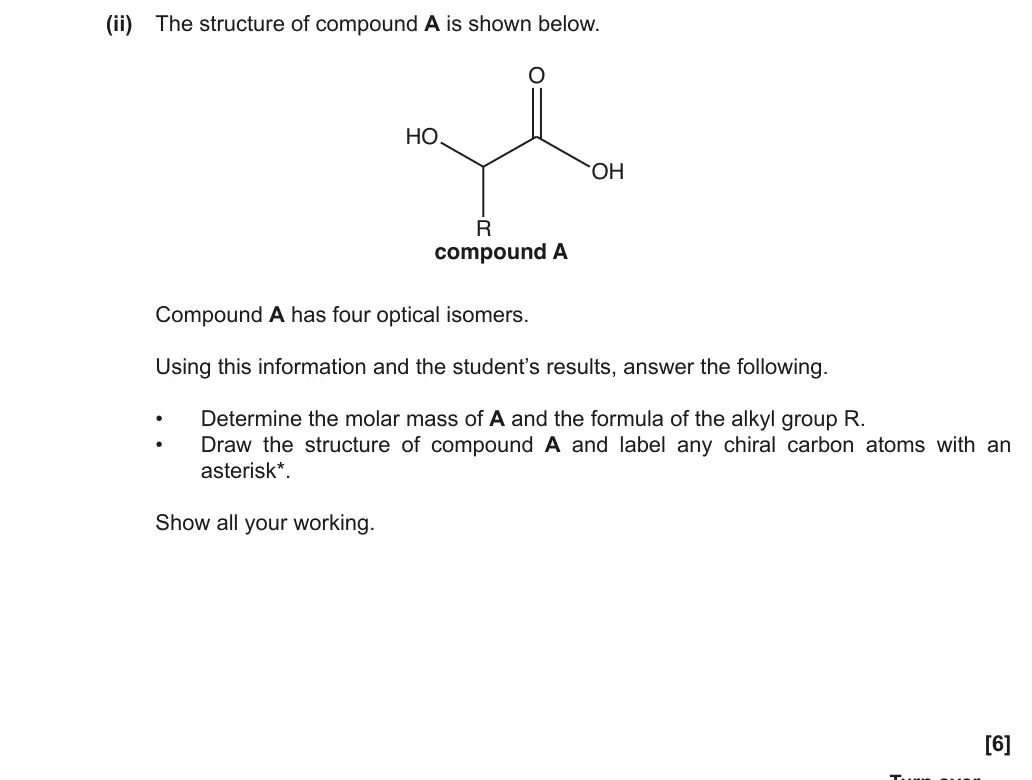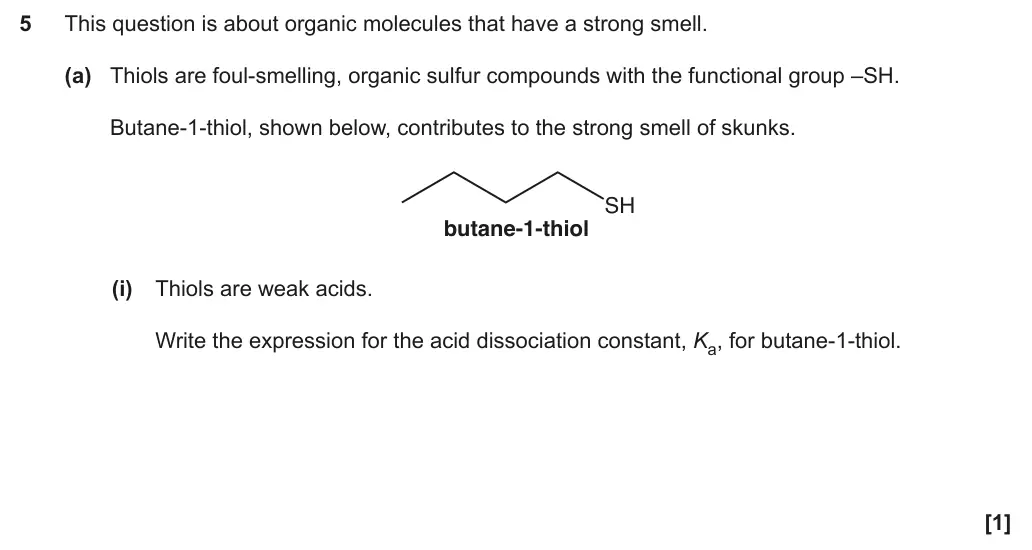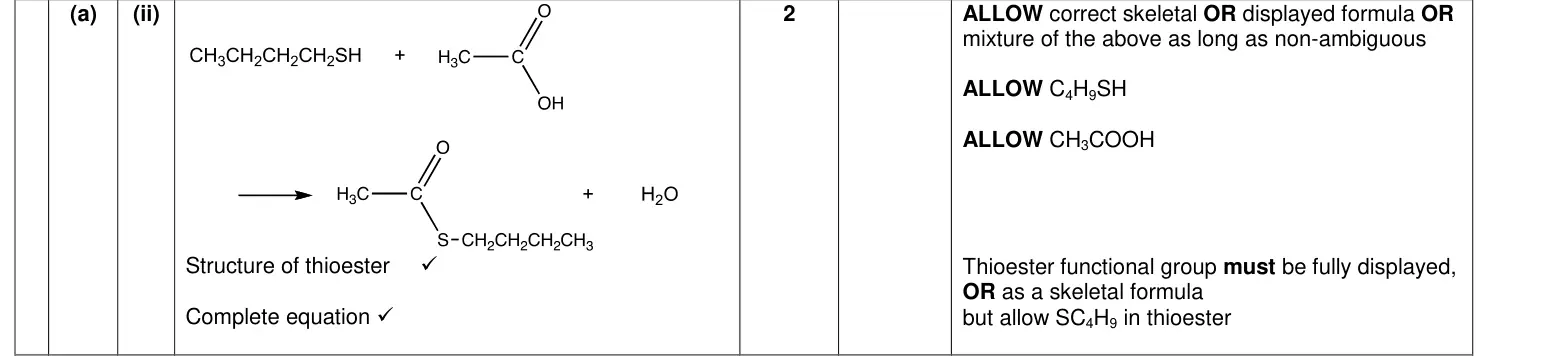
Answer
B
Mark scheme

Examiner's comment
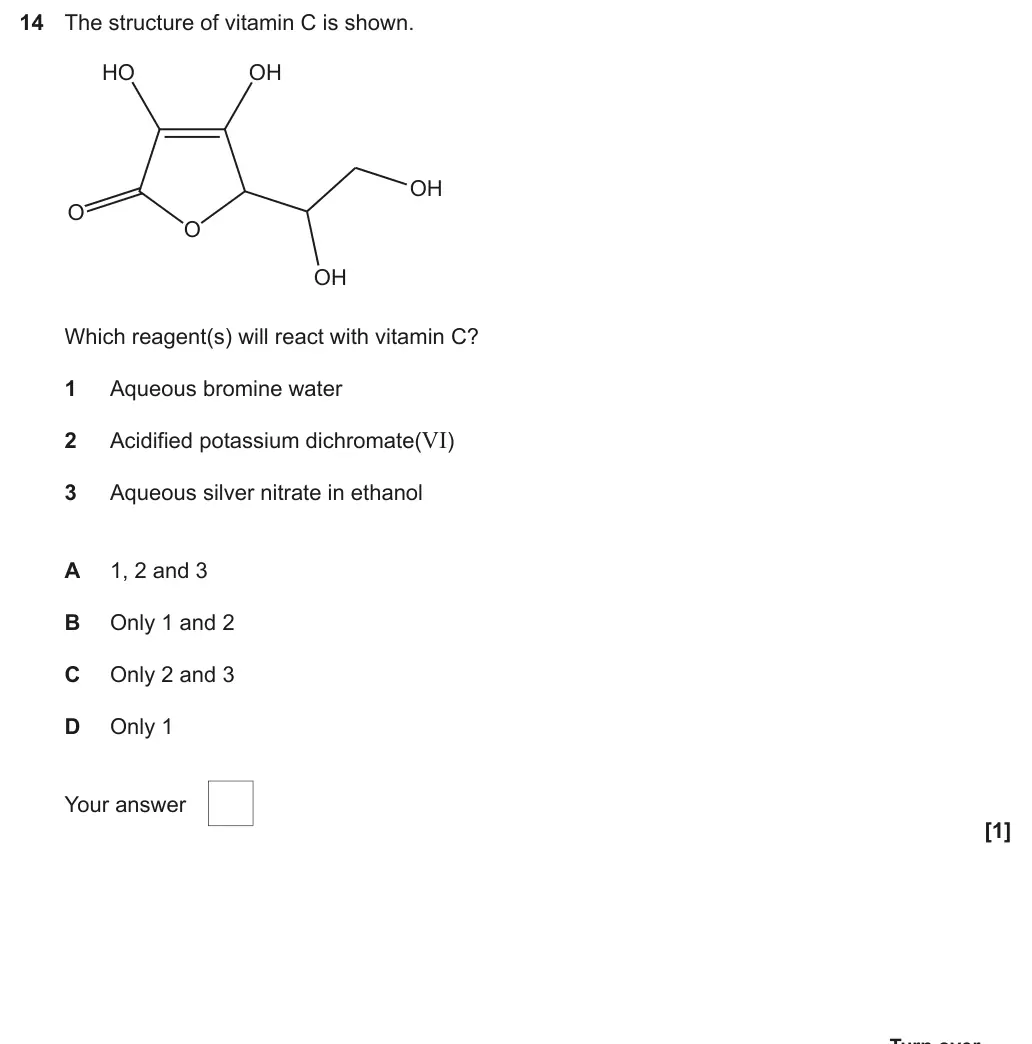
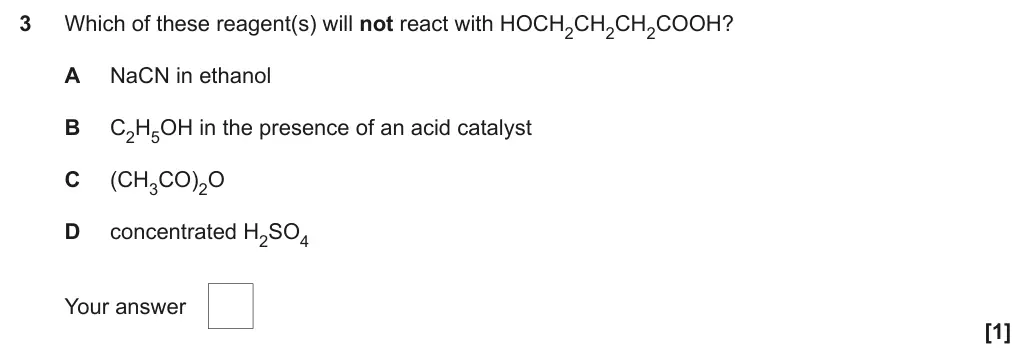
The majority of candidates gave the correct response, B. The most common incorrect answer was A, indicating that silver nitrate would also react with this molecule.
Notes and key-term cards for this topic are being written by our tutors. The past-paper questions below are ready now.
| Series | Paper | Q | What it asks |
|---|---|---|---|
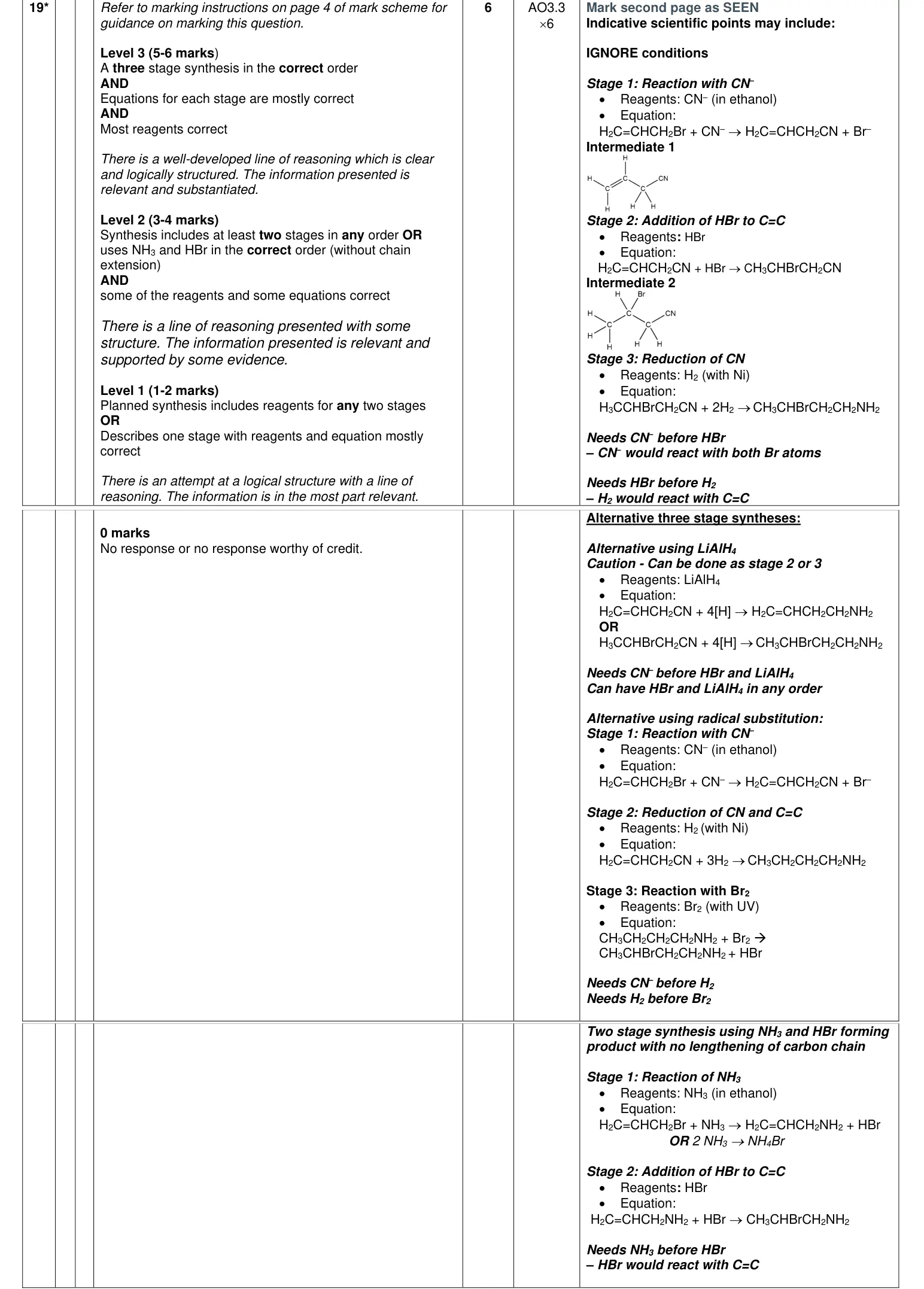
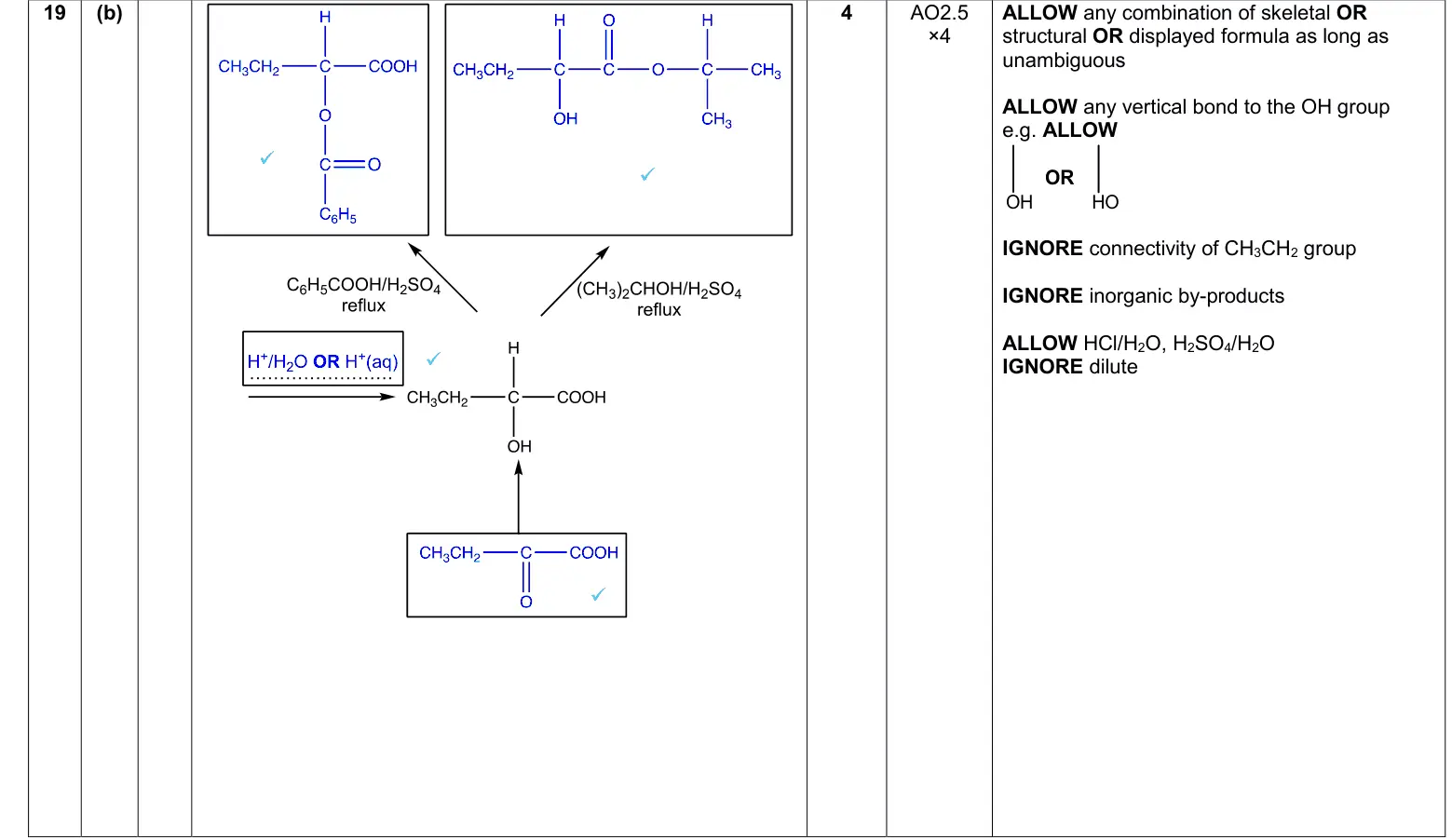
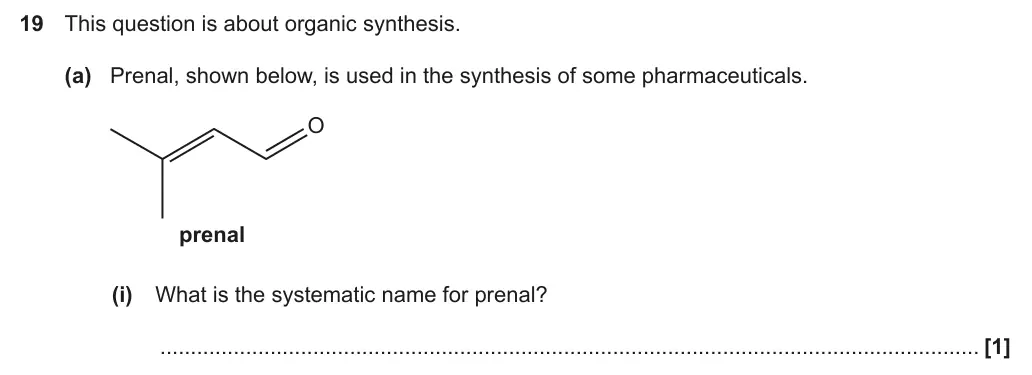
| June 2023 | Paper 2 | 19 | A student intends to synthesise compound Z, as shown in the flowchart below. Plan this synthesis showing reagents, the structures of intermediate 1 and intermediate 2, and |
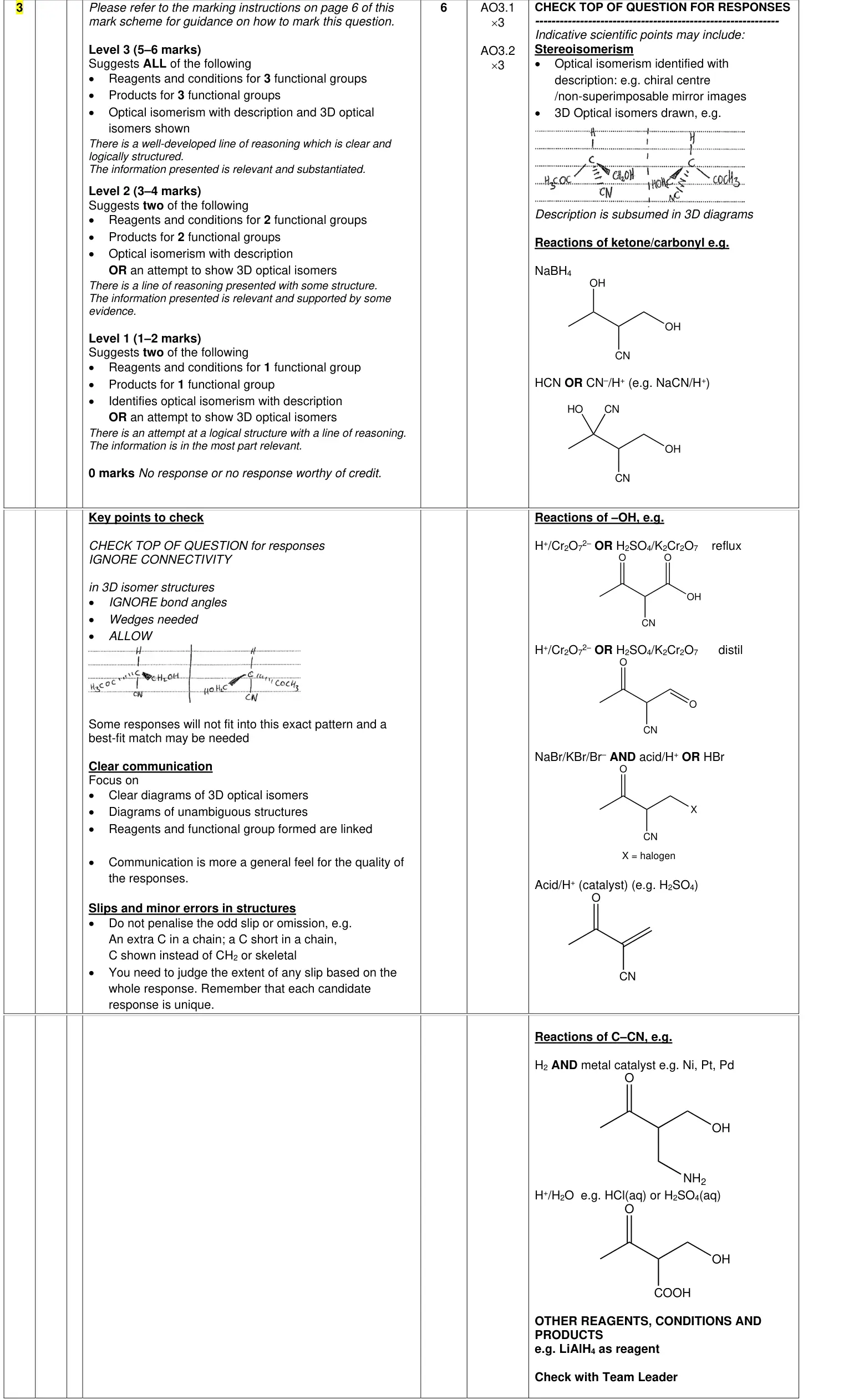
| June 2023 | Paper 3 | 3 | A chemist is investigating compound A, shown below, as a potential organic intermediate. Describe the type of stereoisomerism shown by compound A and suggest three reactions of |
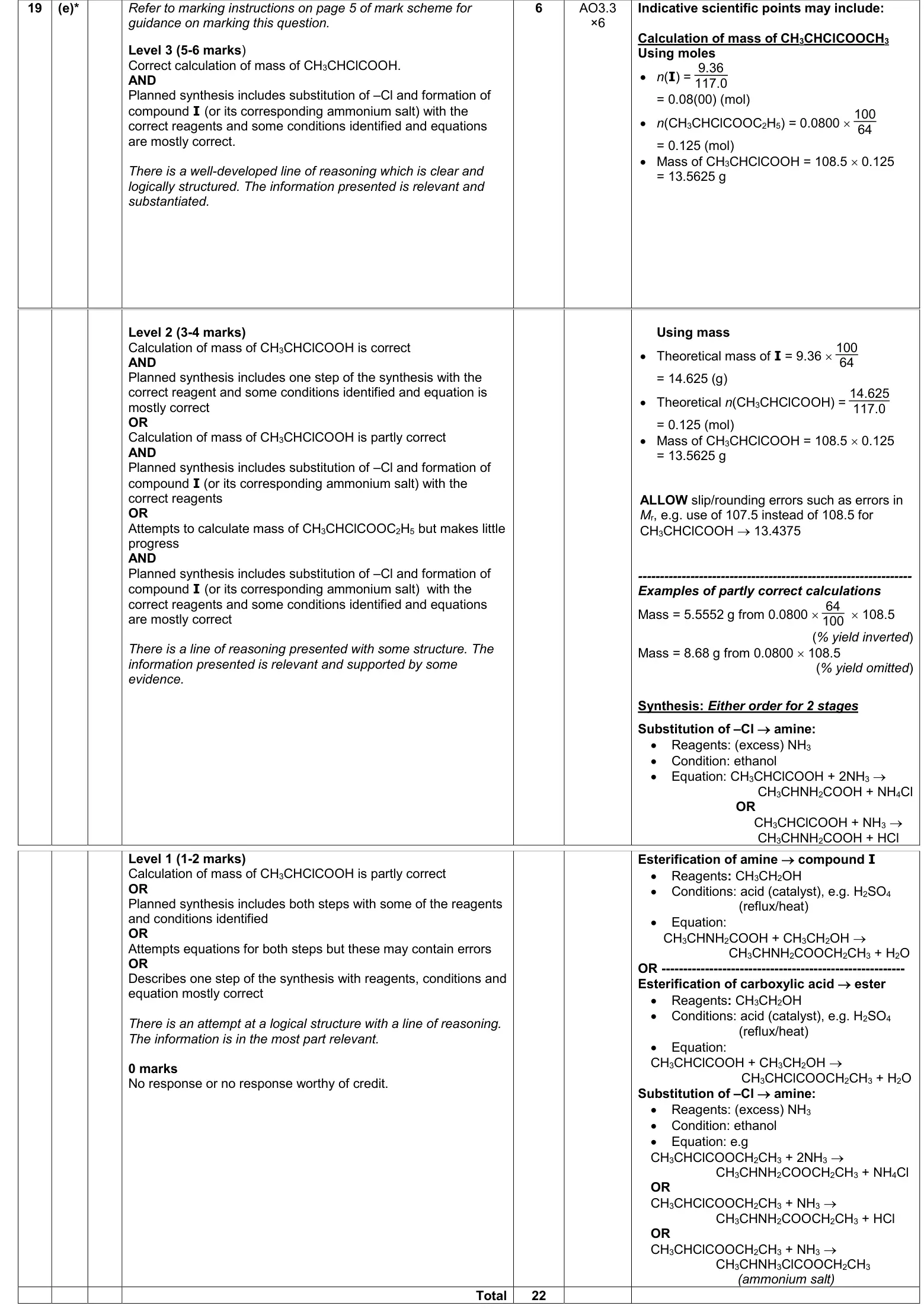
| June 2022 | Paper 2 | 19(e) | A student intends to synthesise compound I. Plan a synthesis to prepare 9.36 g of compound I starting from 2-chloropropanoic acid, |
| November 2021 | Paper 2 | 19(b) | A student intends to synthesise compound A using the two-stage route below. Plan a two-stage synthesis to prepare 5.44 g of compound A starting from |
| June 2019 | Paper 2 | 18(e)(i) | A student intends to synthesise ester C. (i) Plan a two-stage synthesis to prepare 12.75 g of ester C starting from 2-methylpropanal, |
| June 2018 | Paper 3 | 4(b)(ii) | A chemist prepares a pure solid sample of paracetamol from 4-nitrophenol in two stages: Describe a two-stage synthesis of 5.00 g of pure paracetamol from 4-nitrophenol. The |
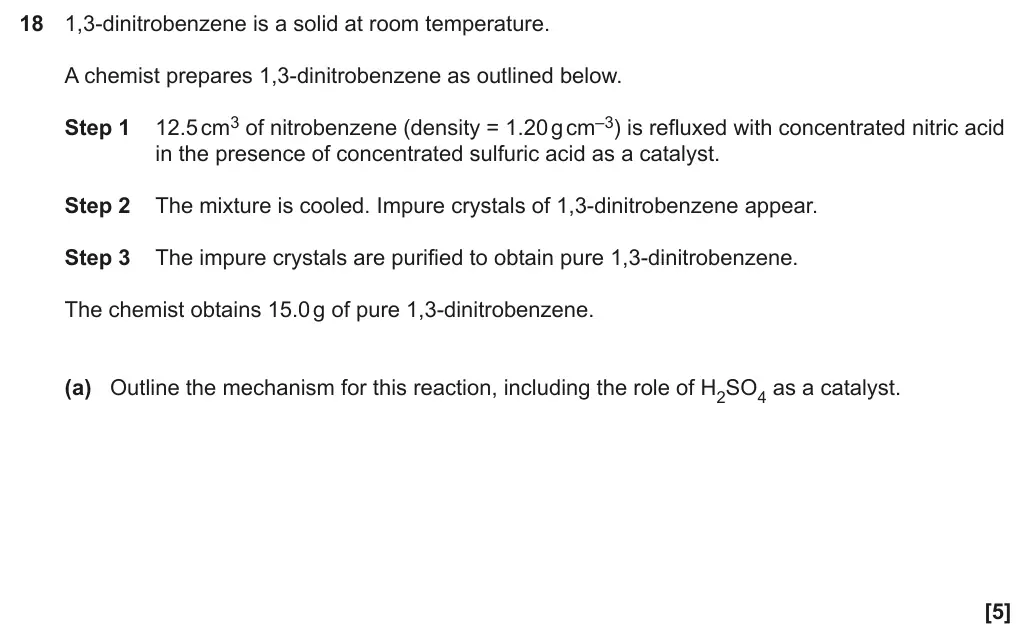
| June 2017 | Paper 2 | 17(a)(ii) | A chemist carries out the reaction in Equation 17.1 using 4.97 g of benzoic acid. Describe a method to obtain a pure sample of 3-nitrobenzoic acid from the impure solid, |
| June 2017 | Paper 3 | 5(b) | The structures for six naturally occurring organic compounds with pleasant smells, B–G, are Explain how chemical tests would allow each compound to be distinguished from the other |
B
The majority of candidates gave the correct response, B. The most common incorrect answer was A, indicating that silver nitrate would also react with this molecule.

There were many excellent responses to this question requiring application of information that was provided. A lot of candidates scored both marks. Many less successful candidates were also able to correctly identify the correct organic products. Some candidates did not realise the COOH group formed the CO2 so often provided a second organic compound (usually propanone) from each reaction, as it contradicted the ketone they suggested. Some candidates struggle with skeletal formula, so marks were commonly lost for missing a C from the correct answer, e.g. pentan-2-one instead of pentan-3-one or butan-2-one rather than cyclopentone.

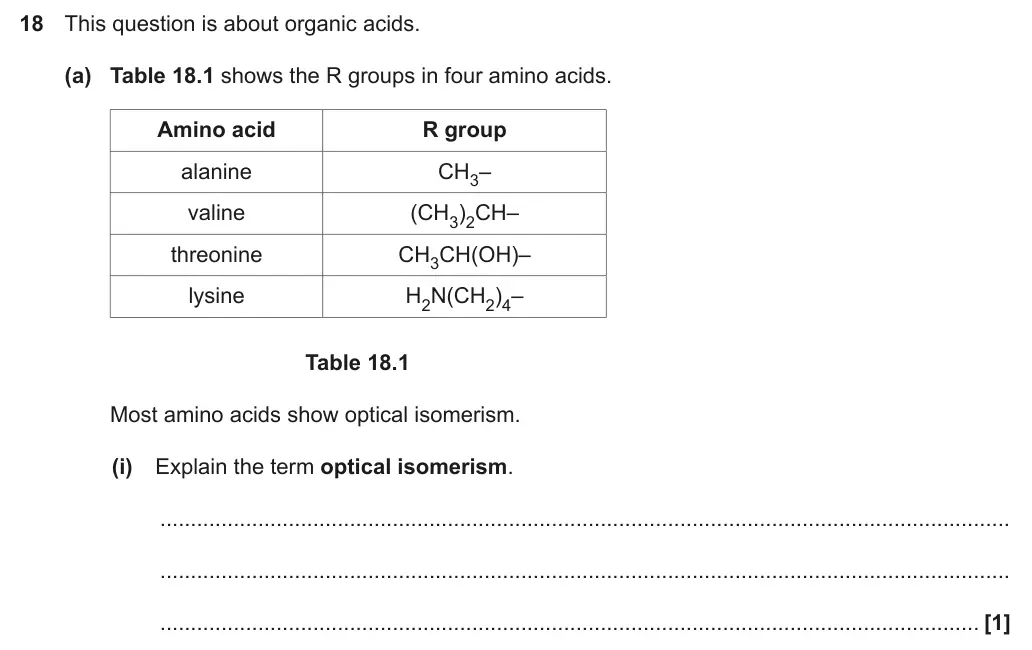
A difficult question that few candidates fully understood. Even for those that knew the difference, it was rare to get the mark as they would only describe one of the acids rather than both, e.g. ‘C=O is next to the COOH in an keto acid’ but with no reference to keto acids. Teachers should remind candidates that a comparison question needs to have information about both or all items that are being compared. Many struggled to make the comparison to amino acids (as given to help in the question) to help them explain what keto acids are. Some suggested that keto acids were amino acids and that the difference to keto acids was due to presence of C=O rather than NH2. Some linked keto acids to amino acids saying that the -NH2 group is linked to the next C along. It was also not sufficient to just say ‘in keto acids the C=O is next to COOH but keto acids it is found elsewhere on the molecule’ – it had to be clear where the C=O was relative to the COOH in each. However, we allowed for keto acid that the C=O is on the adjacent C where the C of the C=O is the adjacent C, as candidates used the terminology given for amino acids in the question. The clearest responses usually drew and labelled structures to show the difference in the positioning of C=O relative to COOH. Candidates should be advised that a well labelled diagram can help if they find it difficult to explain a point.
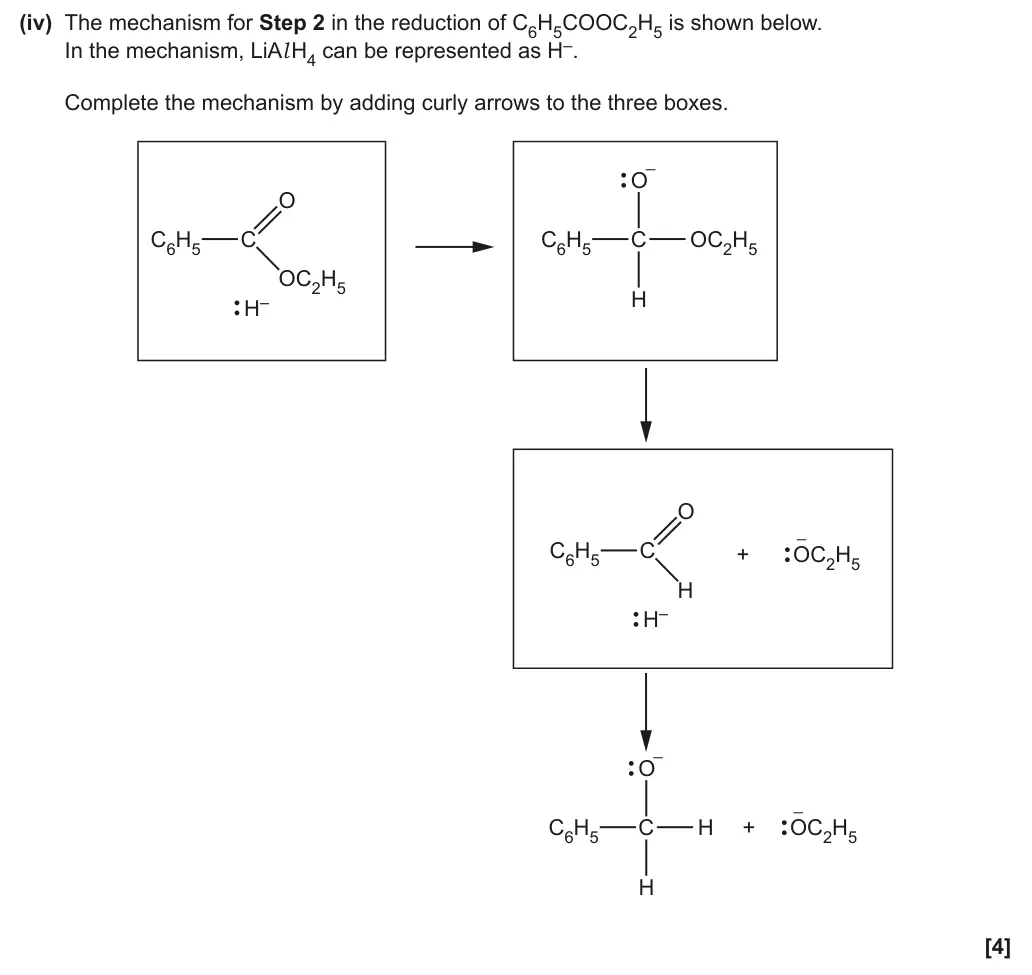
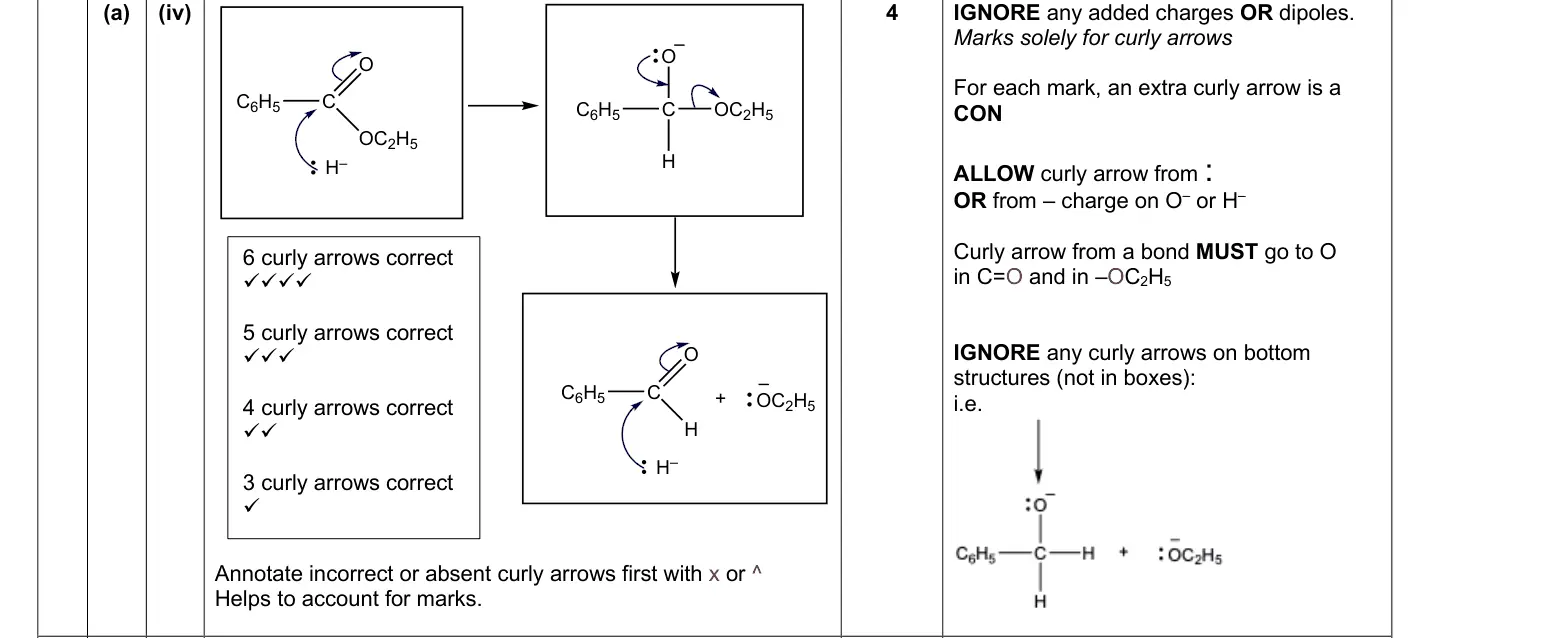
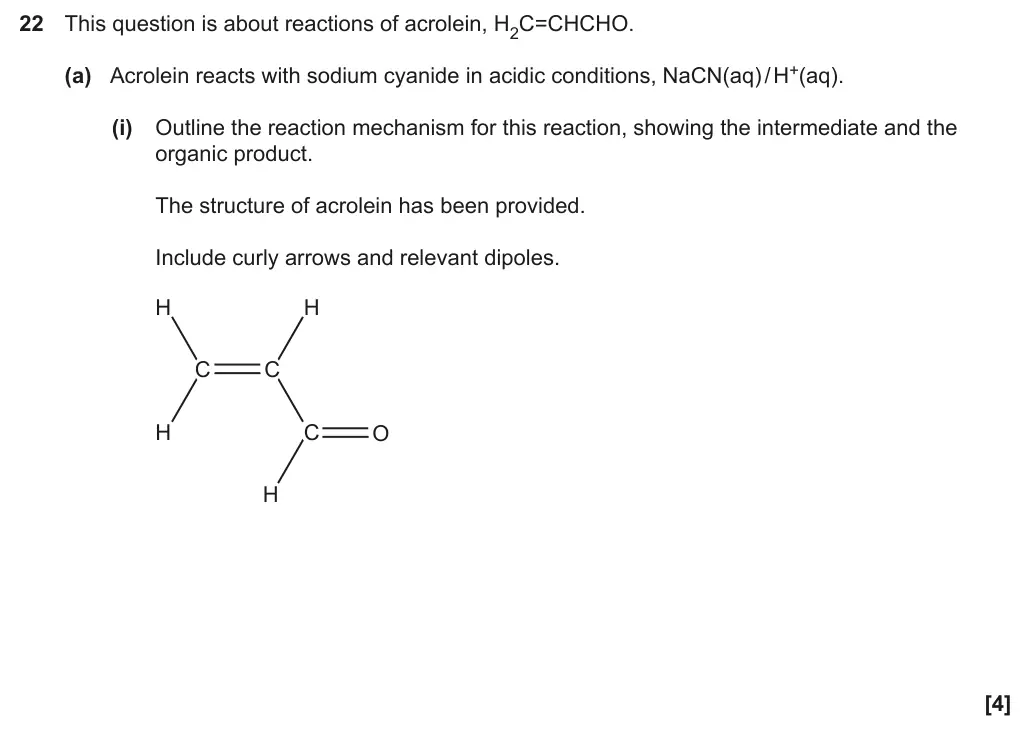
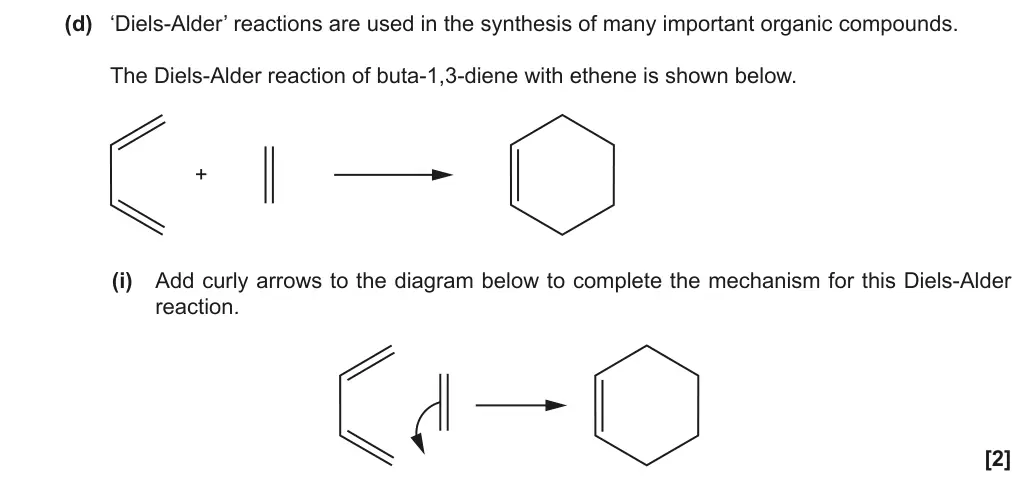
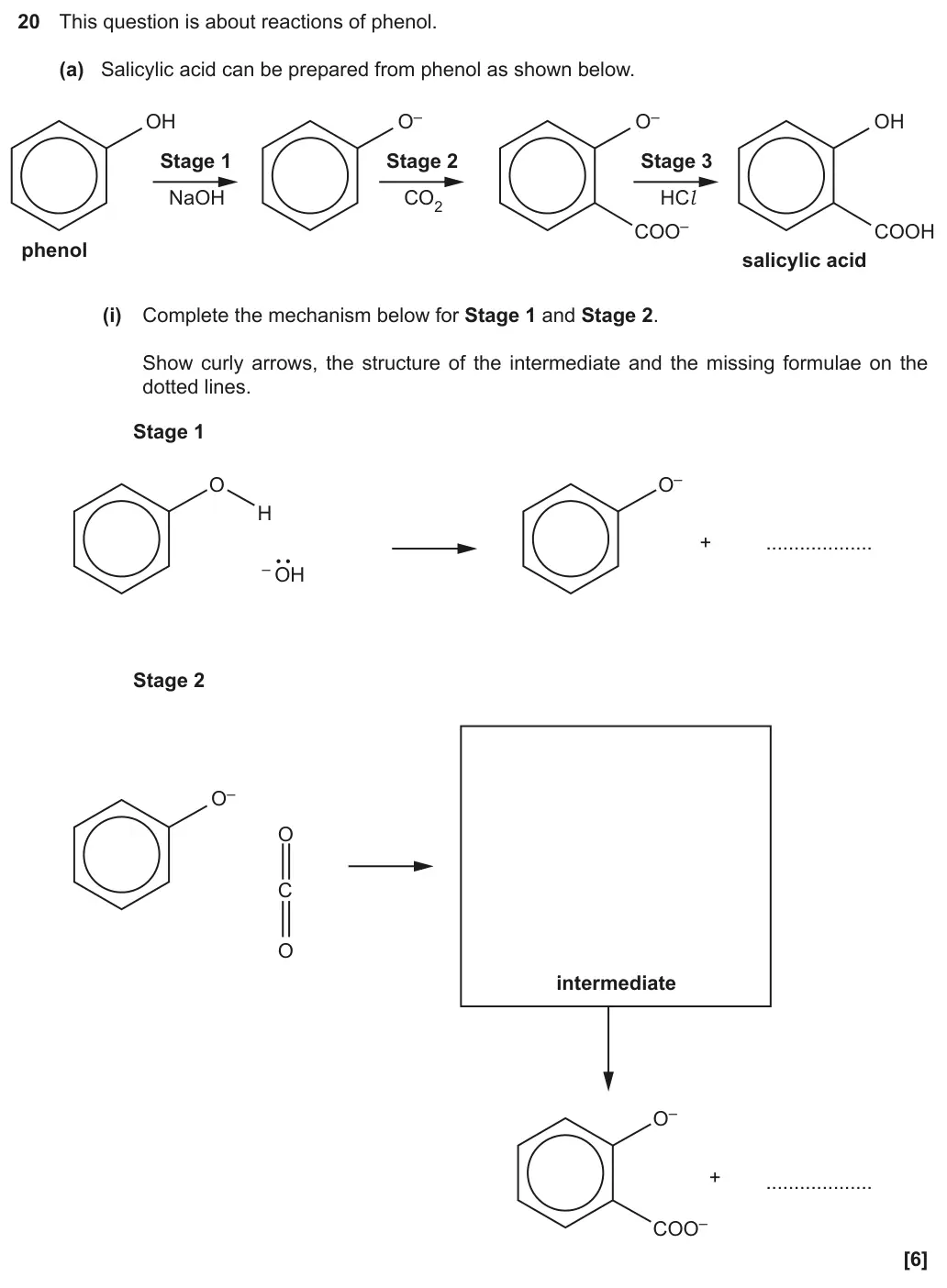
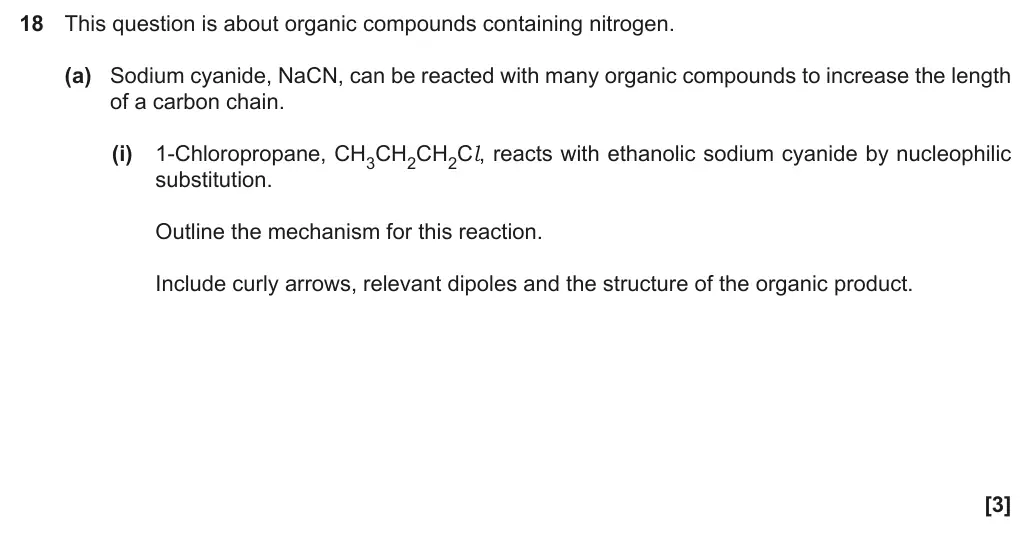
Candidates showed a good understanding of how to position curly arrows within an unknown mechanism. Incorrect responses were mainly in the second box. Some arrows were shown from O– to C atom instead of to the bond. It was rare for additional arrows to be added. From the responses, there was clear evidence that most candidates are becoming more confident in the accurate use of curly arrows in a mechanism and the role of lone pairs. The positioning of both ends of a curly arrow were often accurate.
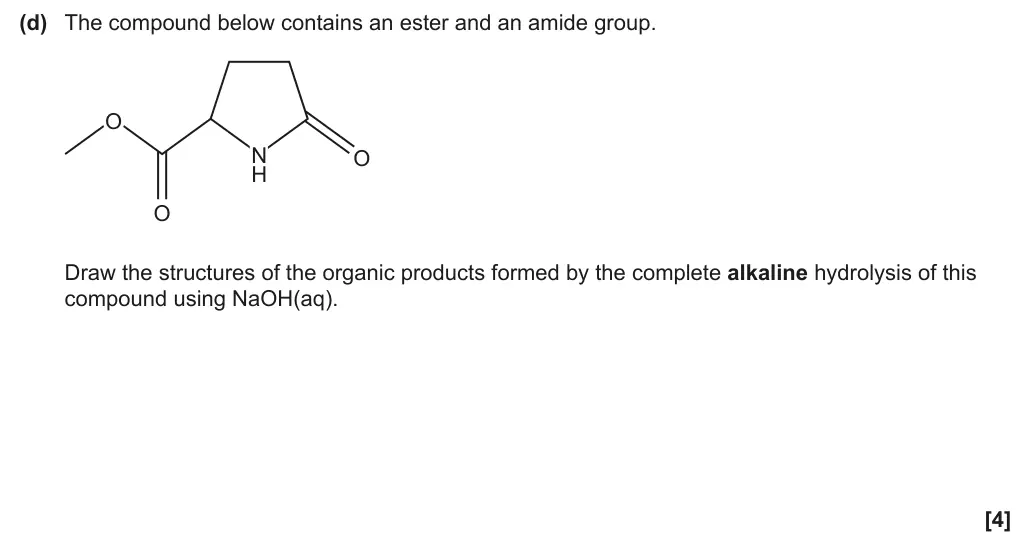
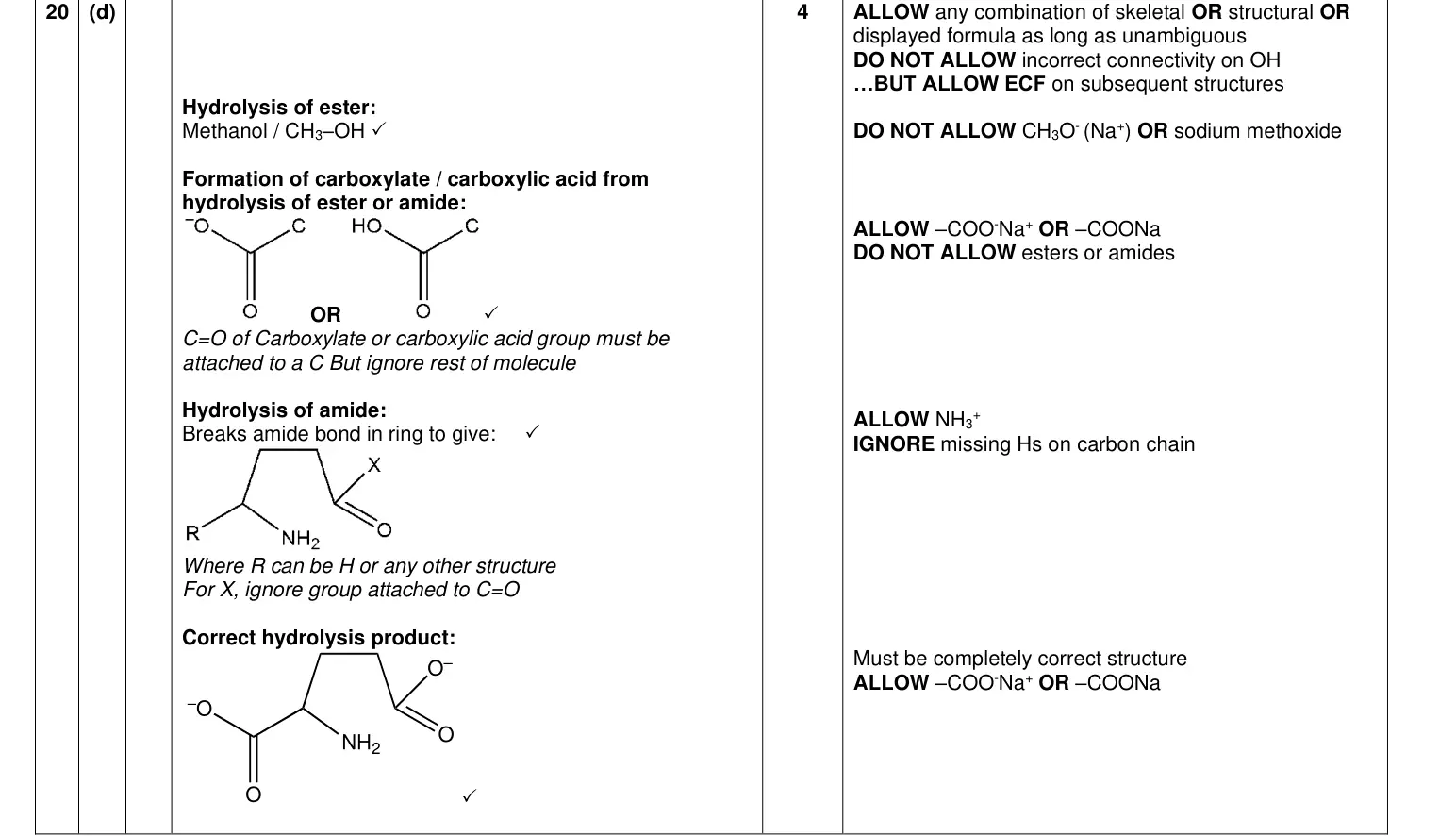
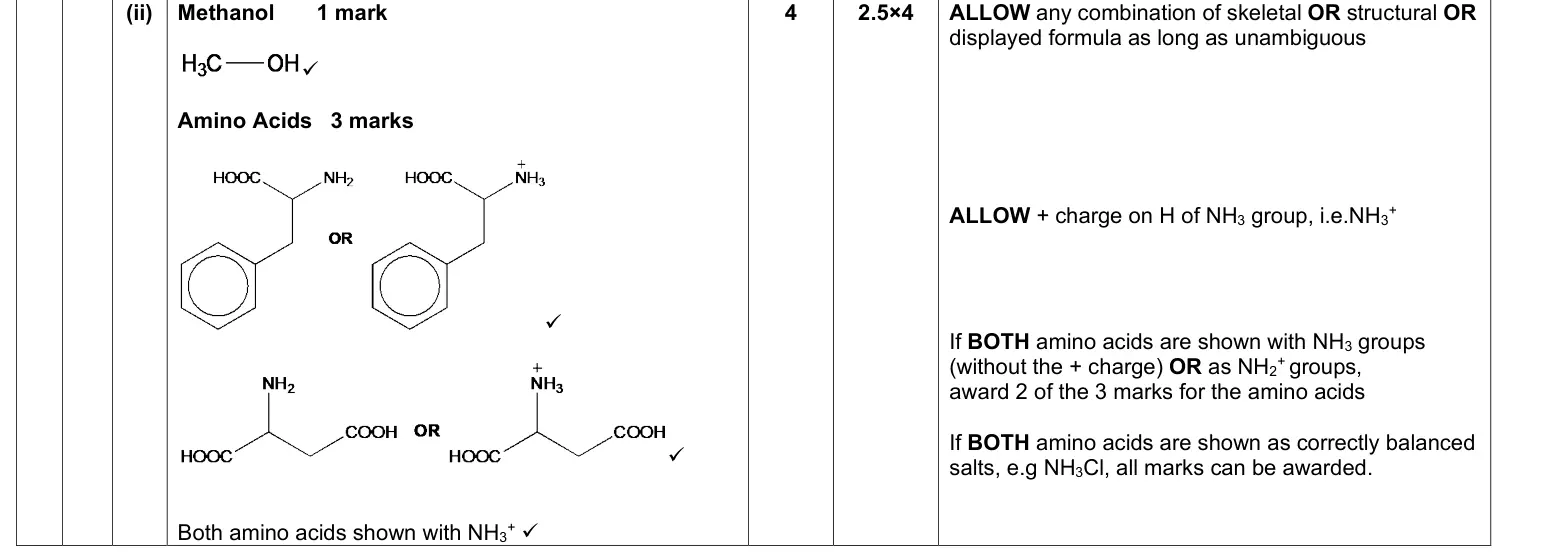
Just over a quarter of candidates were able to gain all 4 marks. The successful candidates clearly identified where the ester and amide would be hydrolysed on the structure provided, helping them draw out the correct products. This question differentiated well. Most were able to gain some credit for hydrolysing the ester to give methanol and a carboxylate or carboxylic acid, leaving the amide bond and ring intact. However, some lost the first mark for giving the methoxide ion, assuming that the alkaline conditions are capable of deprotonating the alcohol group. Lower attaining candidates often broke other C-C bonds in the ring forming a range of products. A few displayed the structure as C=O-Na+ and some also protonated the amine group either with the ring intact or broken.
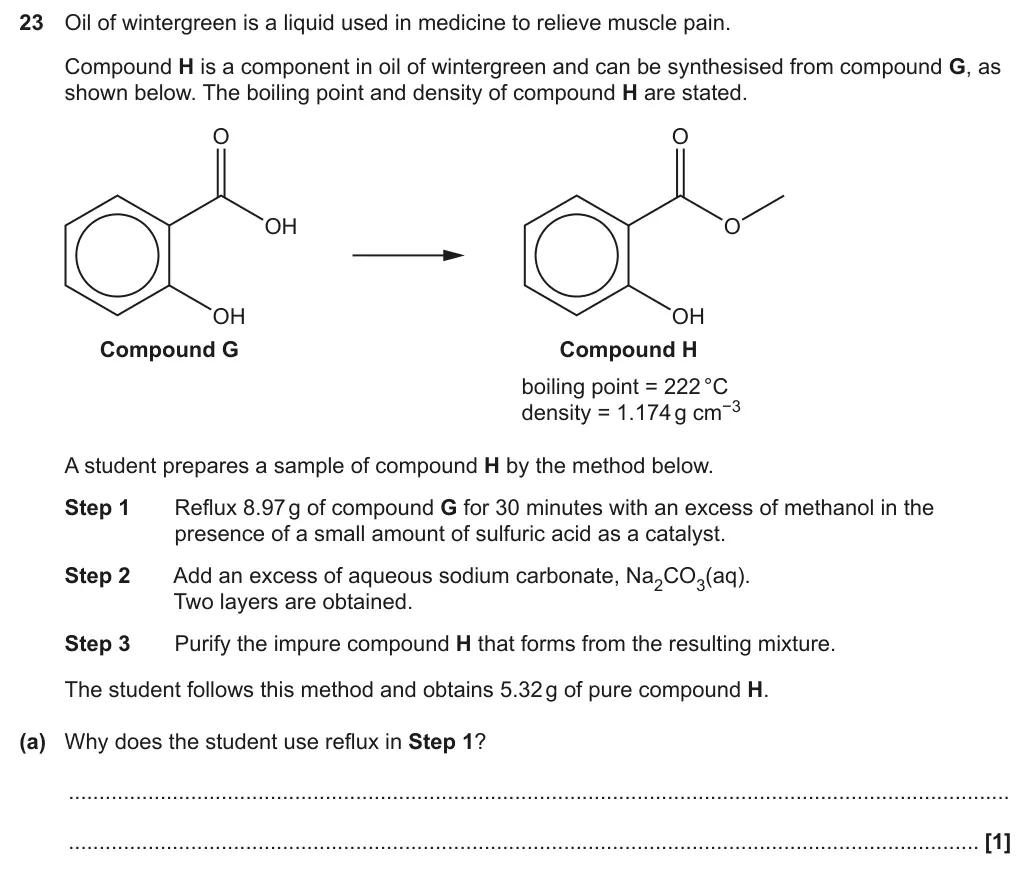
An unfamiliar question that proved challenging with only around a fifth of candidates obtaining the mark for correctly suggesting that reflux would prevent loss of volatile compounds. Many candidates suggested that reflux ensures the reaction goes to completion but here this was insufficient as esterification is an equilibrium reaction and additional information in (b)(i) indicates that there is unreacted compound G present. It was necessary to focus on the purpose for reflux rather than other ways of heating a reaction, such as the energy needed to break bonds or speed up the rate of reaction. Some less successful responses linked to oxidation reactions, presumably as they understand the importance of either reflux or distillation in this context. For example, ‘reflux is required for complete oxidation’ or ‘if distillation had been used an aldehyde would have been formed’.
Skills: PAG5 Synthesis of an organic liquid

C
D was the most common incorrect response, separating the amide into a ketone and amine. This was followed by A, not recognising that a phenol OH is distinct from alcohol OH. A common strategy was to circle or label the functional groups on the structure of paracetamol.

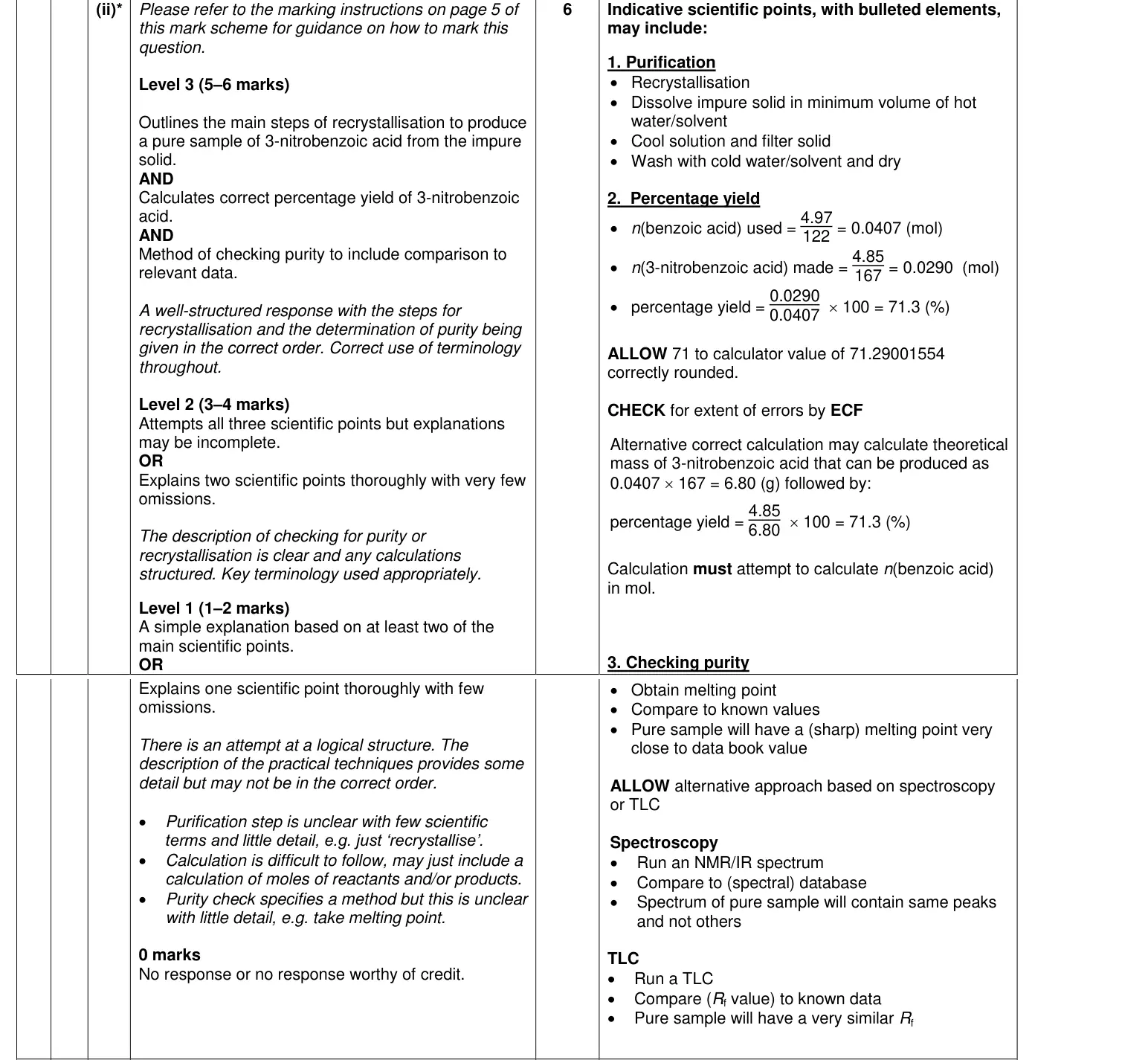
About a quarter of candidates gained all 3 marks. They were able to give clear, well-structured answers with all the steps as carried out in PAG 6 practical activities. The best answers were often in the form of bullet pointed steps and often included extra details such as a hot filtration step or promoting crystallisation by scratching the surface. Many candidates lost the first mark as their responses didn’t give sufficient detail, e.g. hot solvent, not just warm and minimum volume required. Some missed the cooling step essential for formation of crystals before filtration. Some missed that the crystals need to be dried following filtration but often if only given 1 mark this was the mark given. Lots of confusion with purification with organic liquid was seen, such as references to use of a separating funnel, drying agents and distillation. Some also went on to explained how to check purity using melting point determination.
Skills: PAG6 Synthesis of an organic solid
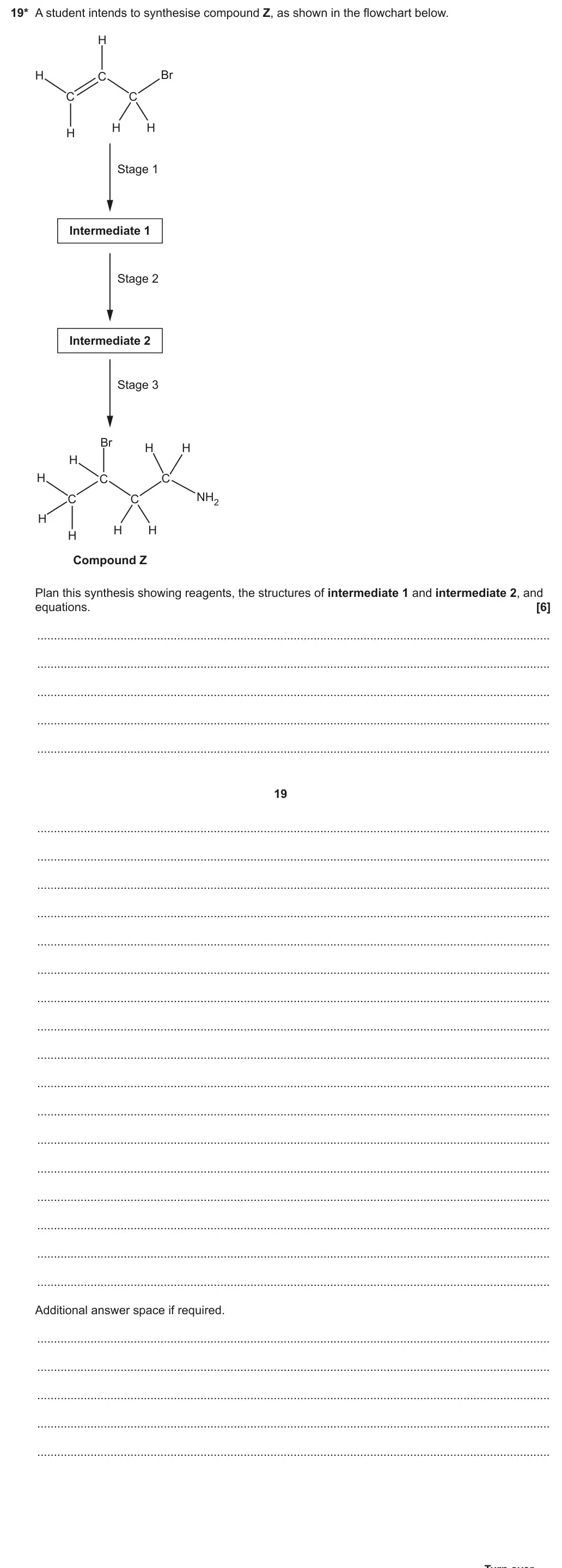
This challenging level of response question was generally well attempted. Many candidates recognised the reagents required in this synthesis but fewer candidates were able to deduce three correct reagents in the right order with equations to achieve Level 3. Most candidates achieved Level 2 4 marks. Many correctly identified suitable reagents but carried out the stages in the wrong order. A common error was to carry out electrophilic addition with HBr first then react with cyanide ion, not realising both Br groups would react and the reaction would not be selective. Alternatively, having introduced the nitrile group then carried out the reduction first, not realising that the C=C would also be reduced. The lowest scoring responses were often incomplete and despite identifying some reagents did not give equations. Candidates are encouraged to read the questions carefully so they can make sure their response covers all the detail required. Many candidates used molecular formula in their equations. It is usually preferrable in organic chemistry to give structures. Some gave surplus information such as the mechanisms and reaction conditions for each reaction. The key to answering this question well was knowing reagents for different functional group interconversions as well as planning each step to make sure of a logical synthesis. Some candidates were seemingly confused by the term ‘intermediate’ and gave an intermediate as in a mechanism, e.g. carbocation.
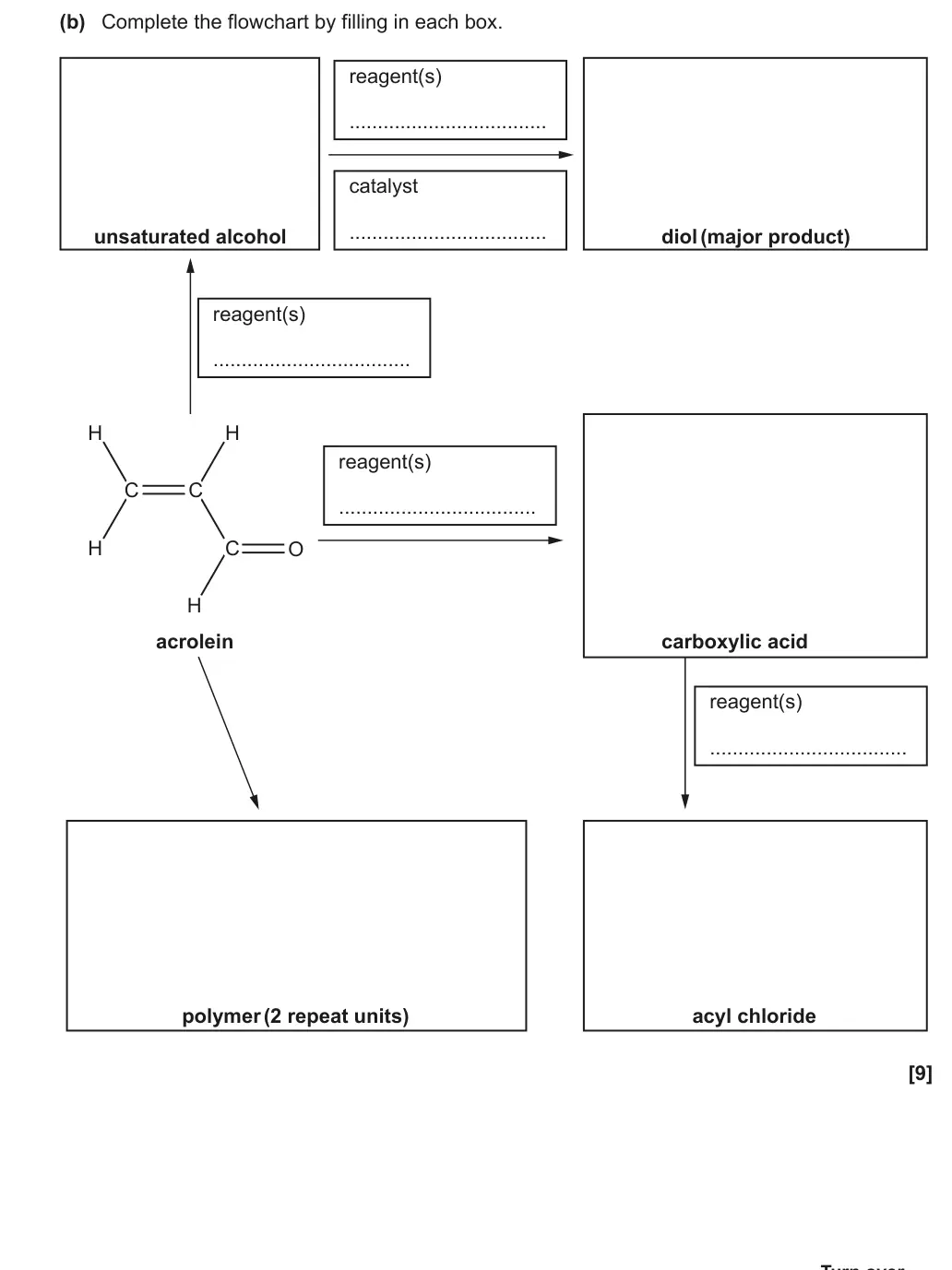
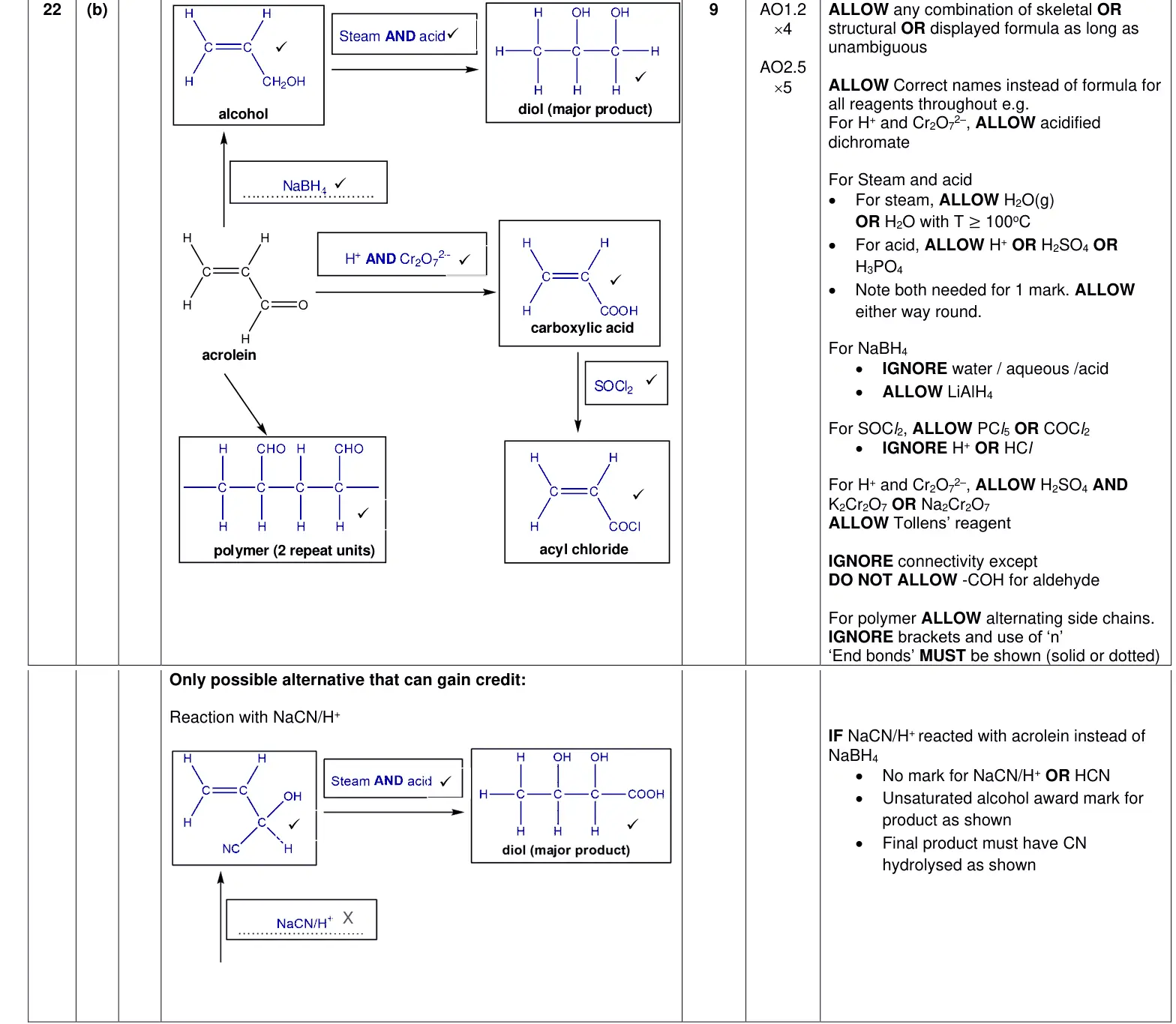
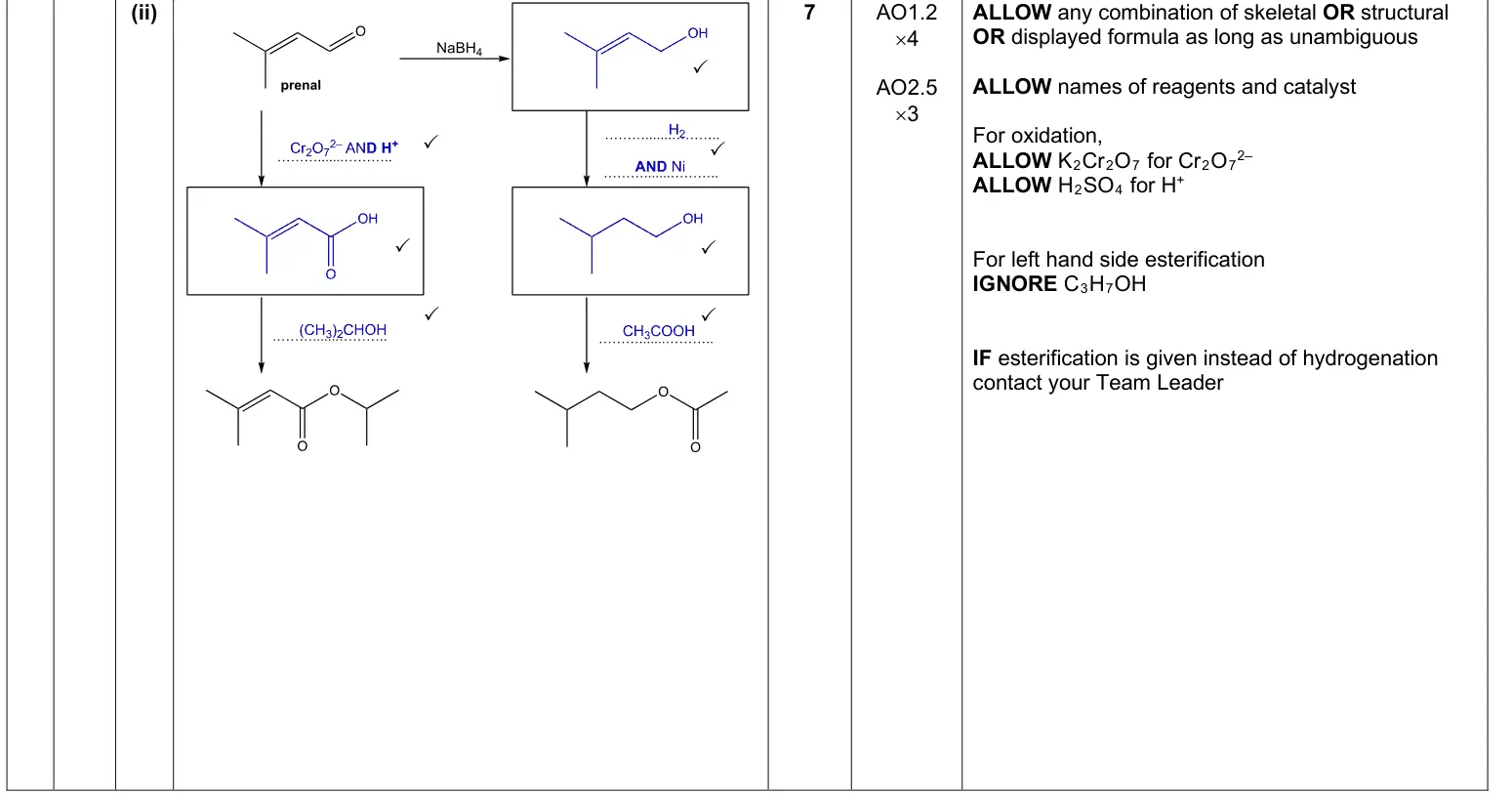
This question discriminated well. Many candidates were able to demonstrate an excellent knowledge of organic reactions and it was not uncommon to see scores of at least 7 marks. This question identified which candidates had learned their synthetic routes including necessary reagents and conditions. Marks were often lost for small details such as missing Hs (check all Cs have four bonds) or not specifying that steam is required for hydration of alkenes or missing the acid needed for oxidation. Many suggested the use of NaOH or just a mixture of acids to product the diol. The minor 1,3-diol or 1,1-diol product was often seen. The sequence leading to an acyl chloride from acrolein was usually the most well answered. However, quite a few tried to use HCl to make the acyl chloride. Many lost marks for the polymer for incorrect connectivity on the aldehyde, e.g. -COH or attempting to make a polymer via connection of the aldehyde group.

Overall, candidates performed well when answering this question. They were required to identify that compound A shows optical isomerism and to choose a reaction for each of the three functional groups. Candidates were also expected to use structures for the organic products. To achieve the highest level of response, a description of optical isomerism should be accompanied by 3D diagrams of the optical isomers. Optical isomerism was usually identified, with associated diagrams with almost all candidates identifying the chiral centre. Most attempted 3D diagrams but candidates do need to take care that the groups attached to the chiral C atom are those in compound A and that no parts of chains are omitted. Optical isomers do also require use bold and dashed wedges to be used. Most candidates showed good knowledge and understanding of reactions for the three functional groups. • For the primary alcohol, most chose H+/Cr2O72–, with distil (→ aldehyde) or reflux (→ carboxylic acid); a significant number chose a concentrated acid (→ alkene) or Br–-/H+ (→ haloalkane) • For the ketone, most chose NaBH4 (→ secondary alcohol) • For the nitrile, most chose either H2/Ni (→ amine) or H+(aq) (→ carboxylic acid). Clear diagrams of the products were usually seen although many omitted a CH2 from the amine branch for hydrolysis of the nitrile or an extra CH2 in the aldehyde or carboxylic acid branch from oxidation of the primary alcohol. Some candidates chose 2,4-DNP for a reaction of the ketone and treated the question as one requiring tests, and then proving that the compound was a ketone from no reaction with Tollens’ reagent. The question asked for the organic product and the 2,4- DNP product is beyond the demands of this specification (although this was seen very rarely). Candidates adopting this reaction were limiting the extent of their response and candidate should have considered this requirement before selecting 2.4- DNP. This exemplar shows a good response that lacks 3D diagrams for the optical isomers. The candidate has clearly given reagents and conditions and has shown the organic products. In the response, you can see that the candidate initially showed an extra CH2 in the –COOH branch, and a mistake in the amine branch. The absence of 3D structures limits the response to Level 2 and 4 marks have been awarded for choosing correct and relevant reagents and conditions, and for the clear communication of the structures.
Skills: M4.2 Visualise and represent 2-D and 3-D forms including 2-D representations of 3-D objects
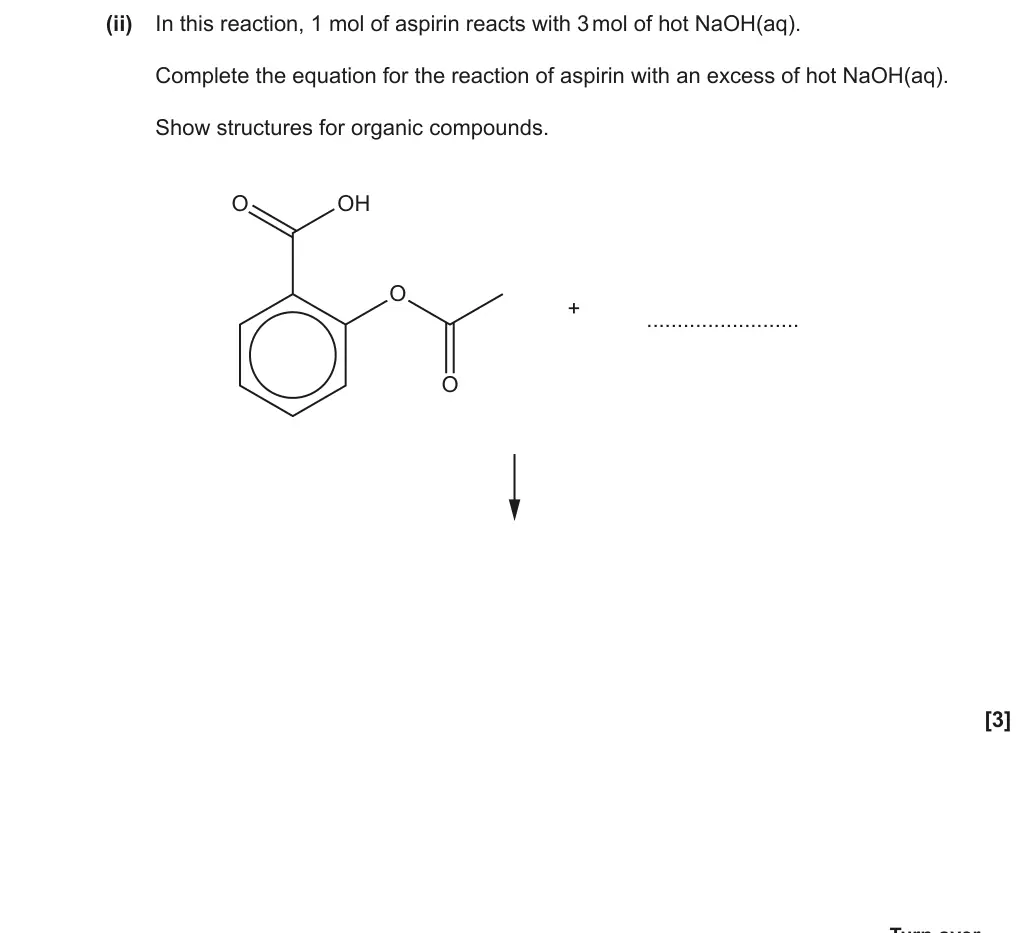
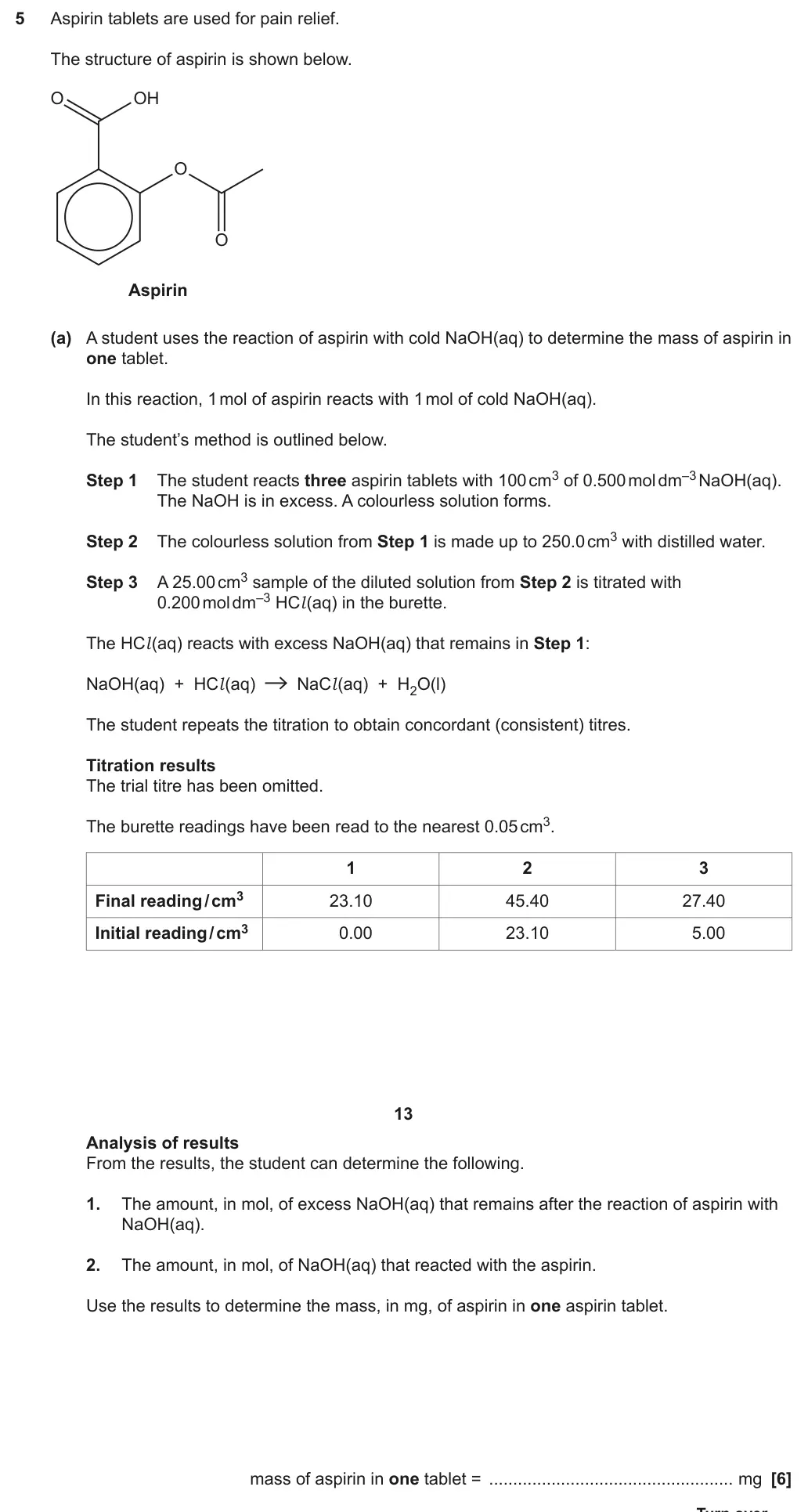
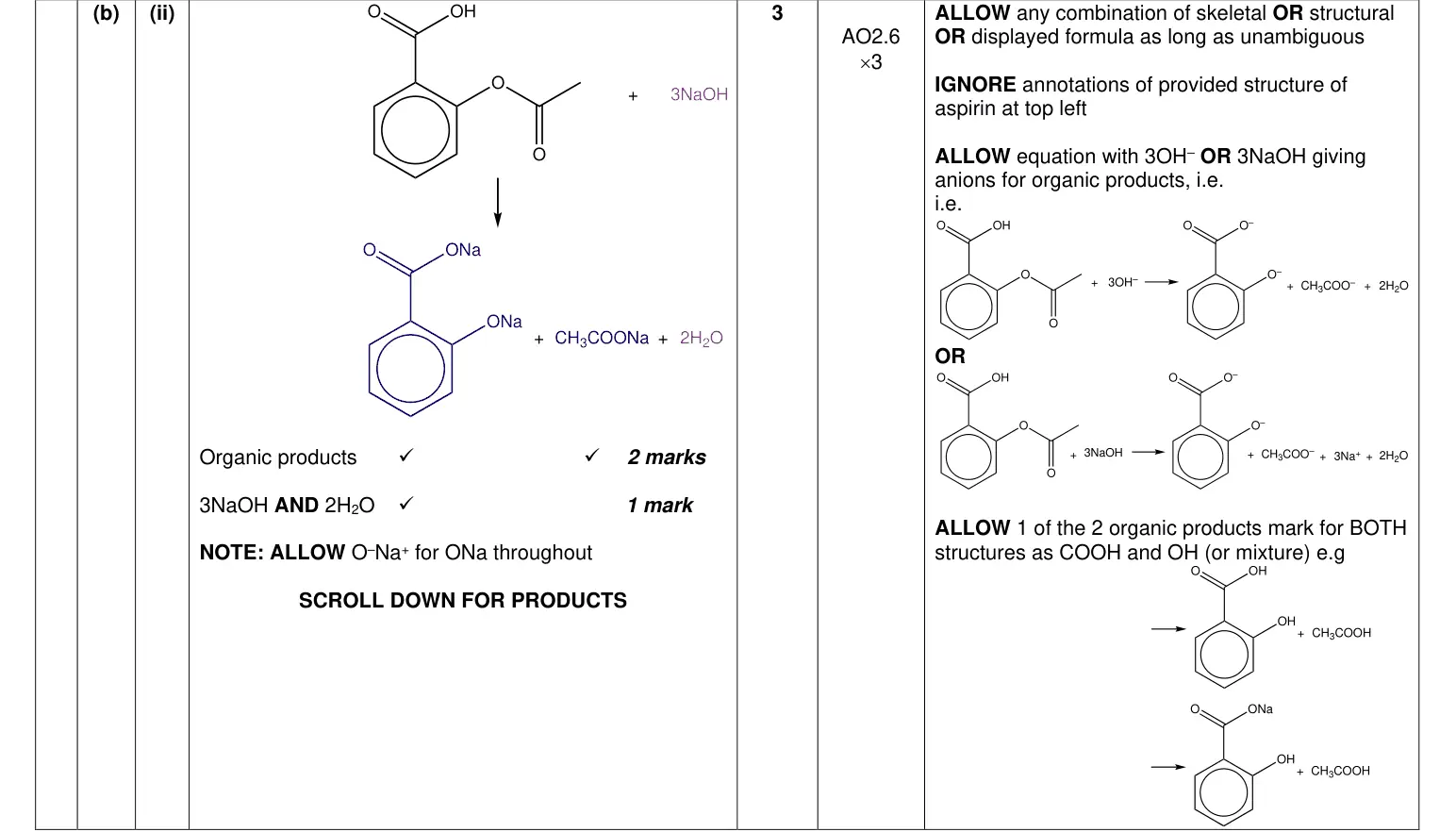
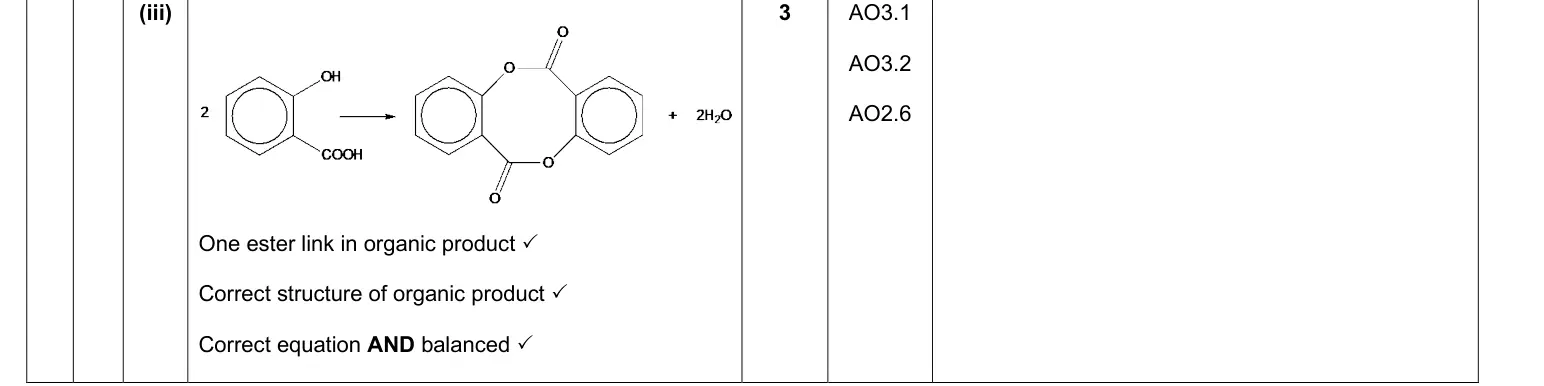
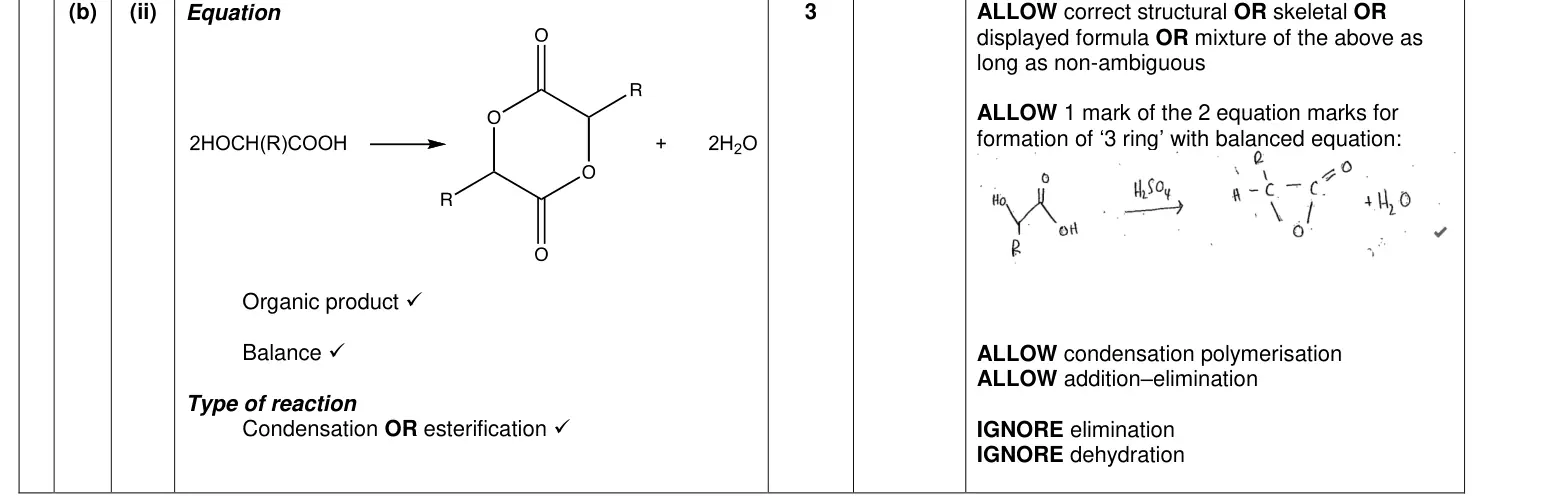
This question was the hardest part of Question 5 and about half the candidates were not given any marks. Some drew the sodium carboxylate salt of aspirin structure, leaving the ester link intact. A large number of candidates realised that the ester would be hydrolysed. Sometimes the sodium salts were often not shown and, even they were shown, the phenol group was often shown intact. The hardest mark was the formation of 2H2O and a large number of candidates showed the more intuitive but incorrect ‘3H2O’ instead.
Skills: M0.2 Use ratios, fractions and percentages

A
Most candidates correctly selected A. The most common incorrect response was option D as candidates had misinterpreted the amide group as a ketone and an amine.
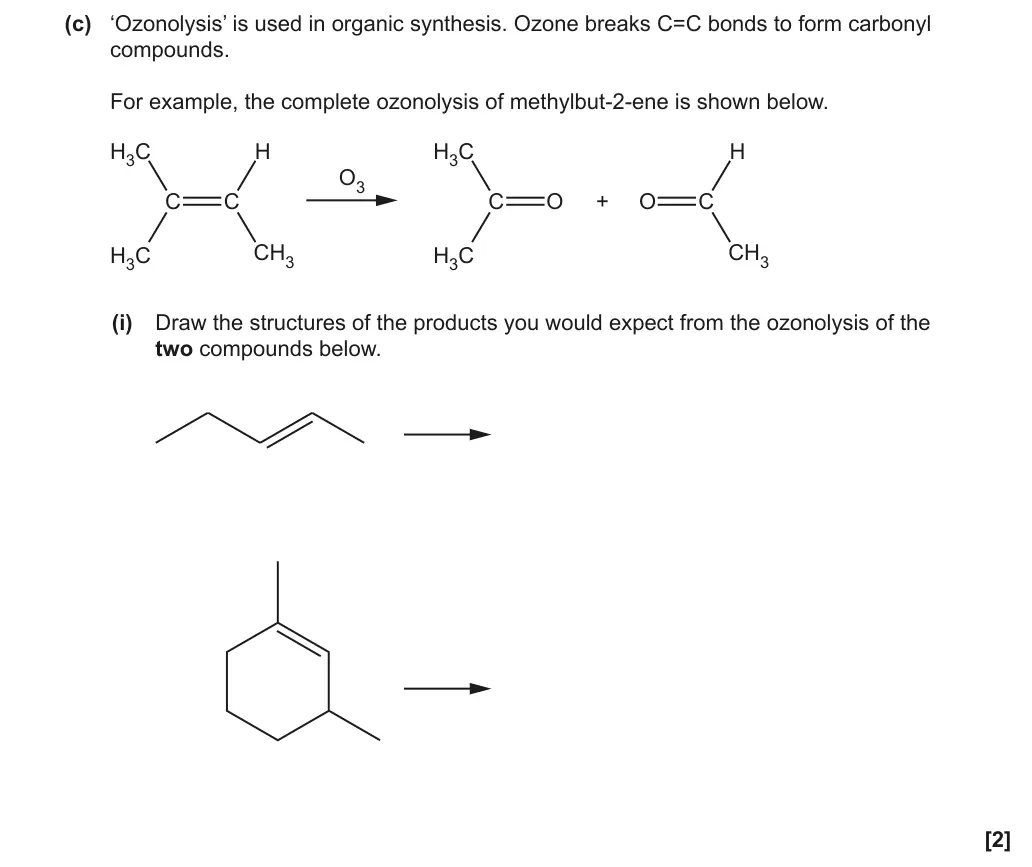
Most candidates were able to score 1 mark for correctly drawing the structures of the two aldehyde products of the first reaction. The second reaction proved more challenging, with most candidates incorrectly drawing two products.
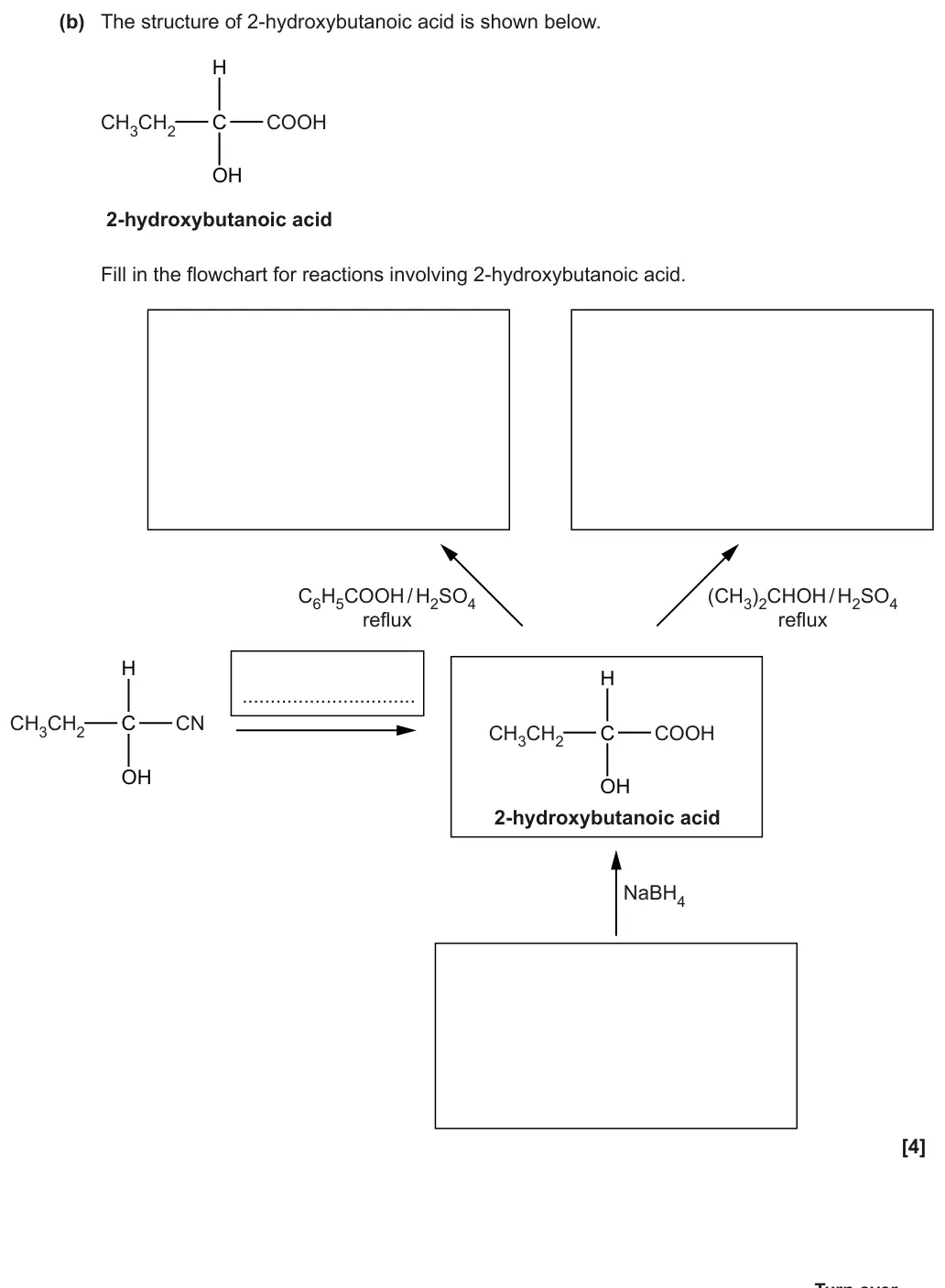
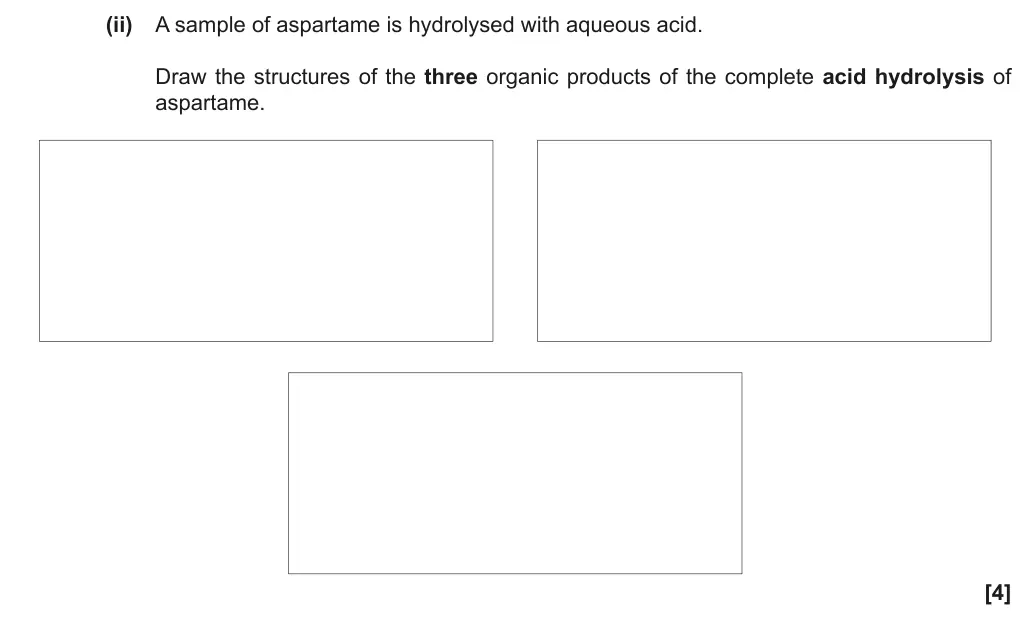
The majority of candidates were able to identify at least one of the structures. A significant number of candidates did not check the number of bonds of each atom in their structures and frequently had too many or too few hydrogen atoms attached. Most candidates identified that acidic conditions were required but some missed the aqueous condition that was also required for the mark.
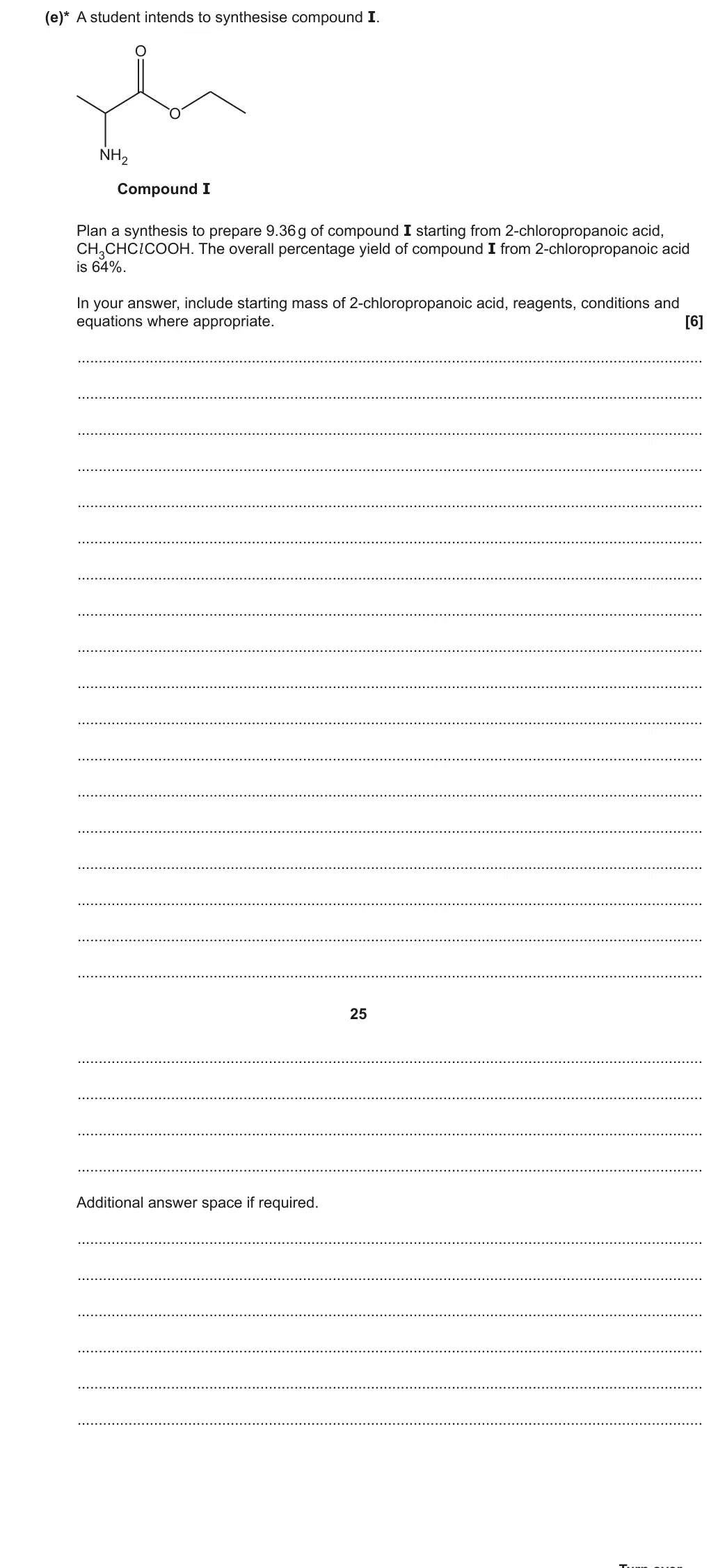
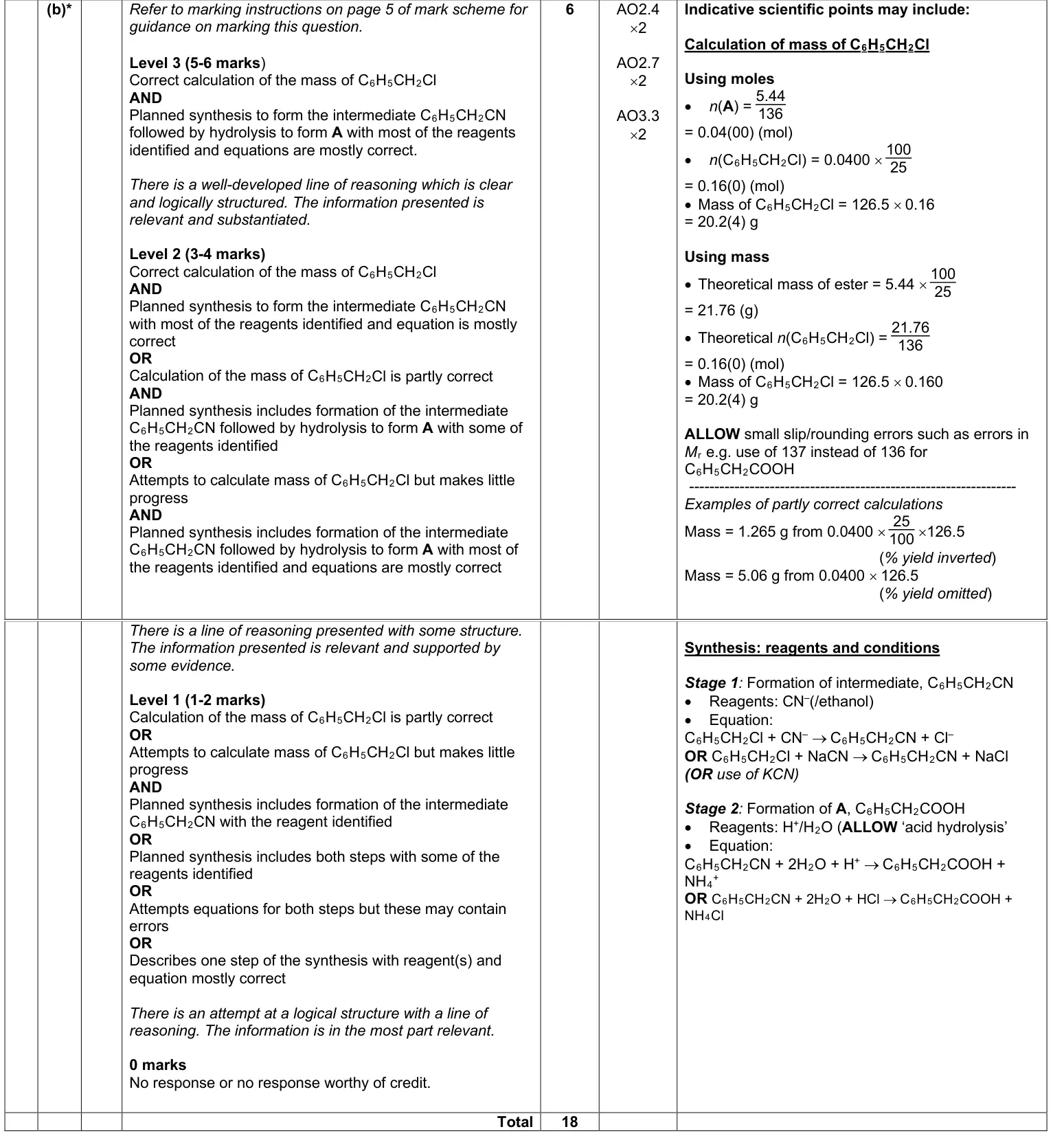
This question was marked using a level of response mark scheme. Most candidates gave an answer worth of at least Level 2 (3-4 marks) by providing the synthetic steps with reagents and equations for the synthesis of compound I. Exemplar 2, below, shows a frequent Level 2 response. The best performing candidates correctly determined the mass attempting to calculate the mass and showed the synthesis efficiently, using equations to communicate the preparation of compound I, with these responses being given Level 3 (5-6 marks). A number of responses omitted the mass calculation, such responses received Level 2 (1-2 marks). In this response the candidate has attempted to calculate the starting mass but has made little progress. Two stages of the synthesis have been covered with the reagents and most of the conditions identified. Both equations are complete. This is a Level 2 response and 4 marks have been given as the repones is logical and well communicated
Skills: M0.2 Use ratios, fractions and percentages; M2.2 Change the subject of an equation
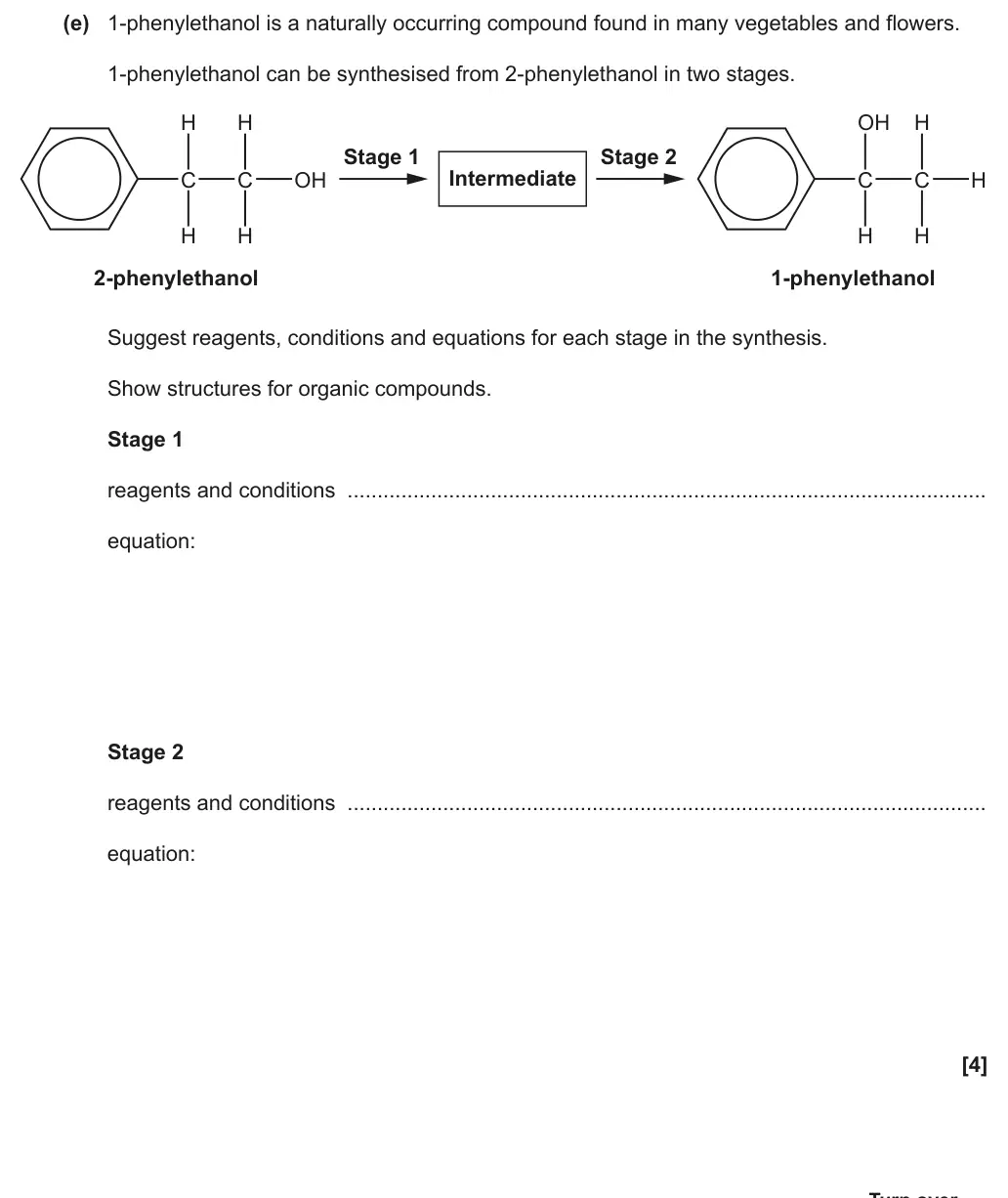
This question proved challenging with only the most able being given full marks. The reagents and conditions were not well known and candidates did not include water in their equations to make sure they were balanced.

Question 16(d)(ii): Many candidates did not correctly answer this question with products being given that had too few carbon atoms. .
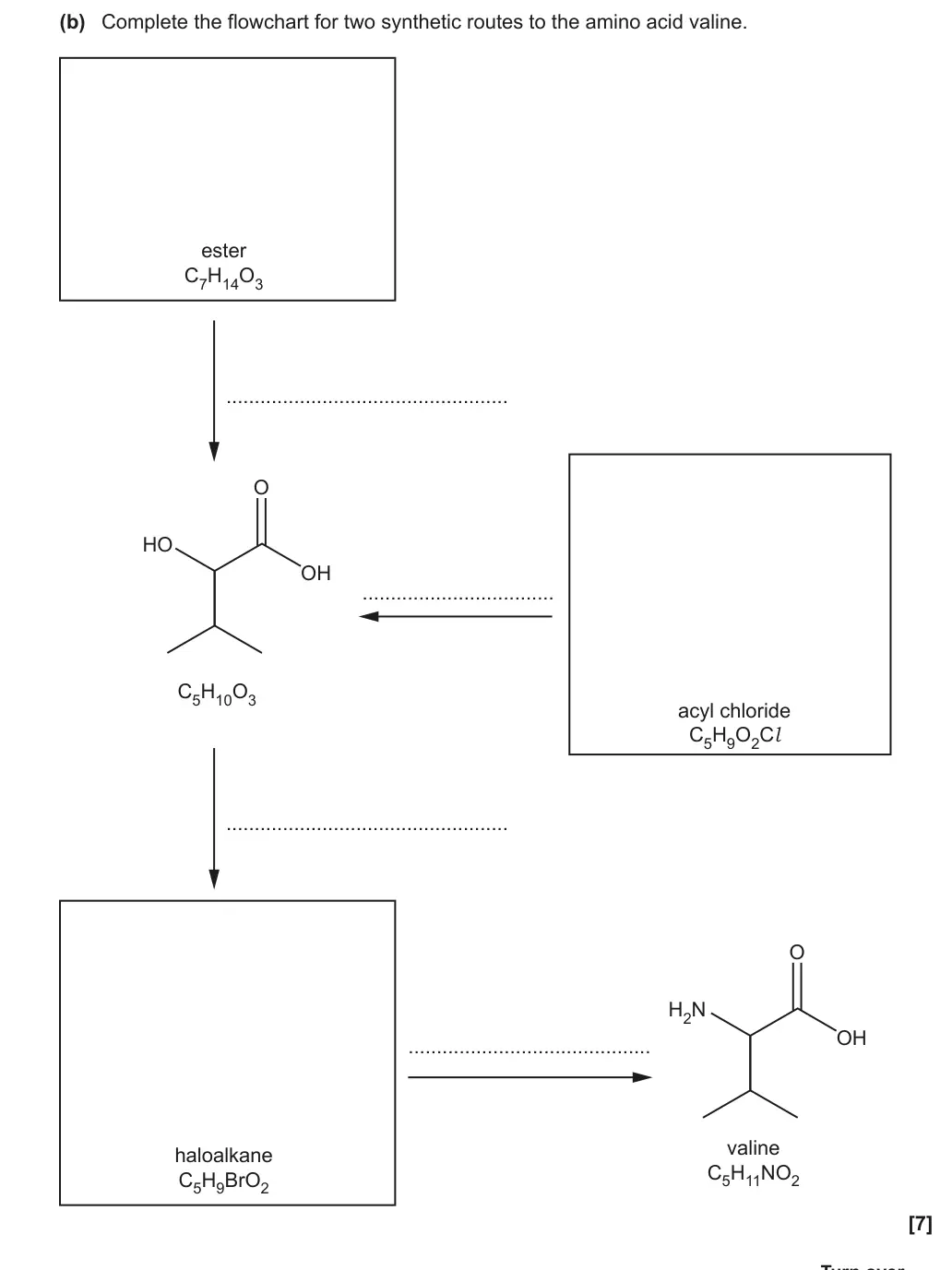
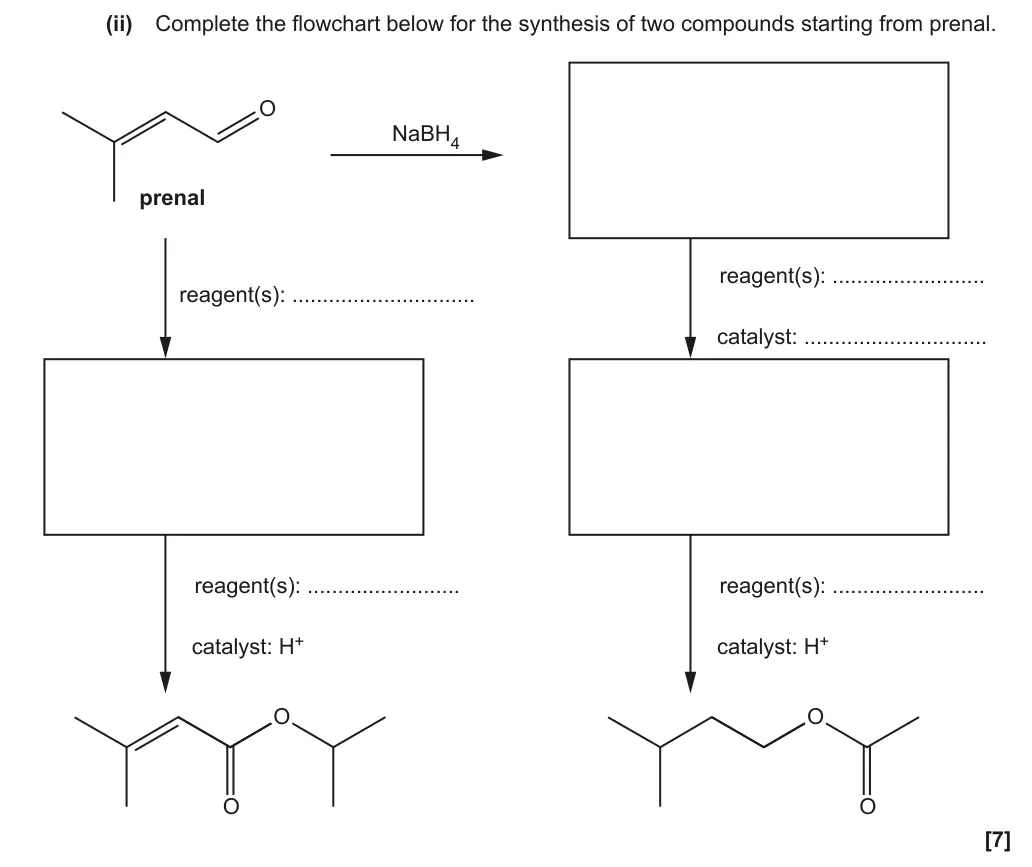
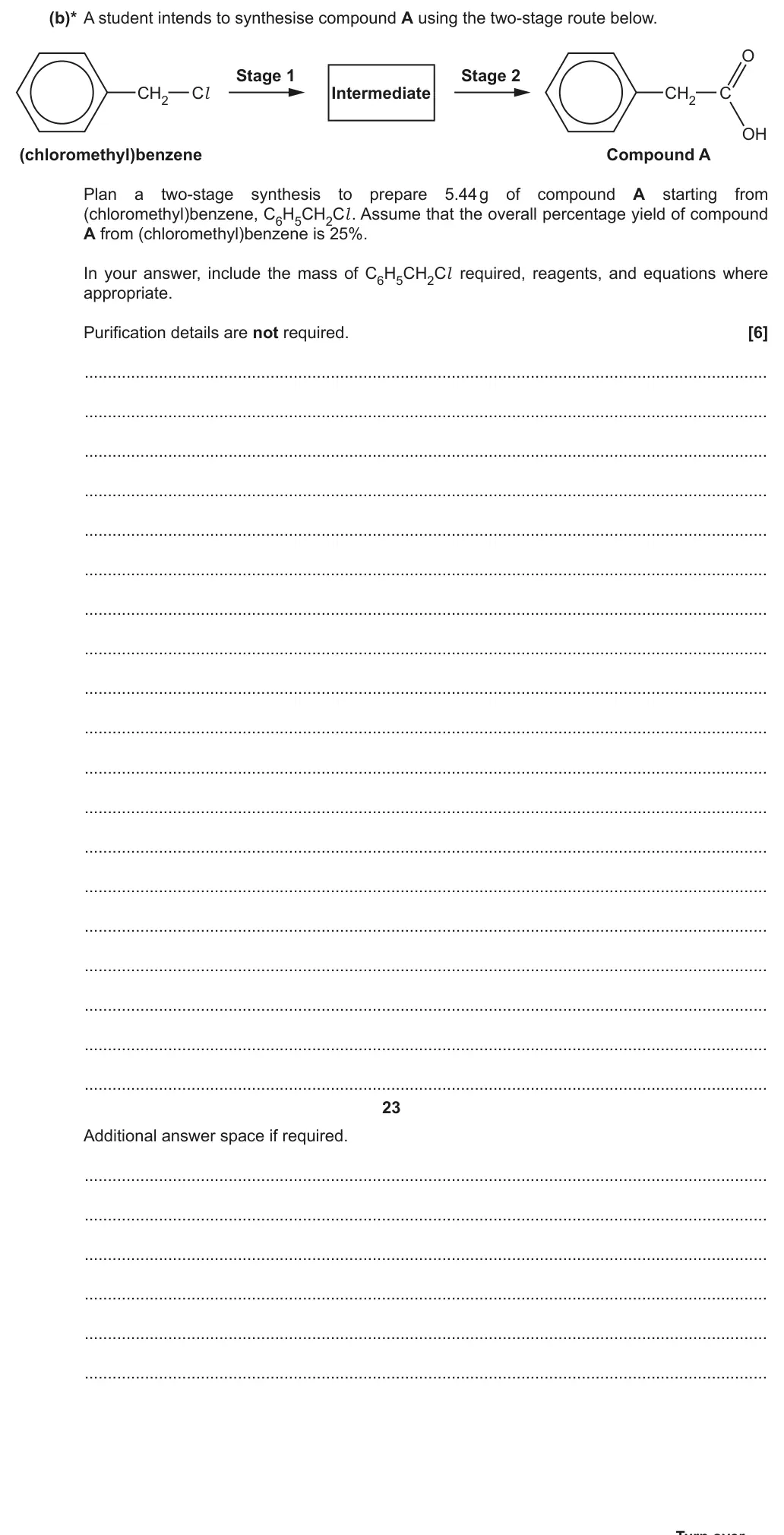
Question 19(b): This question differentiated well.
Skills: M0.2 Use ratios, fractions and percentages; M2.3 Substitute numerical values into algebraic equations using appropriate units for physical quantities
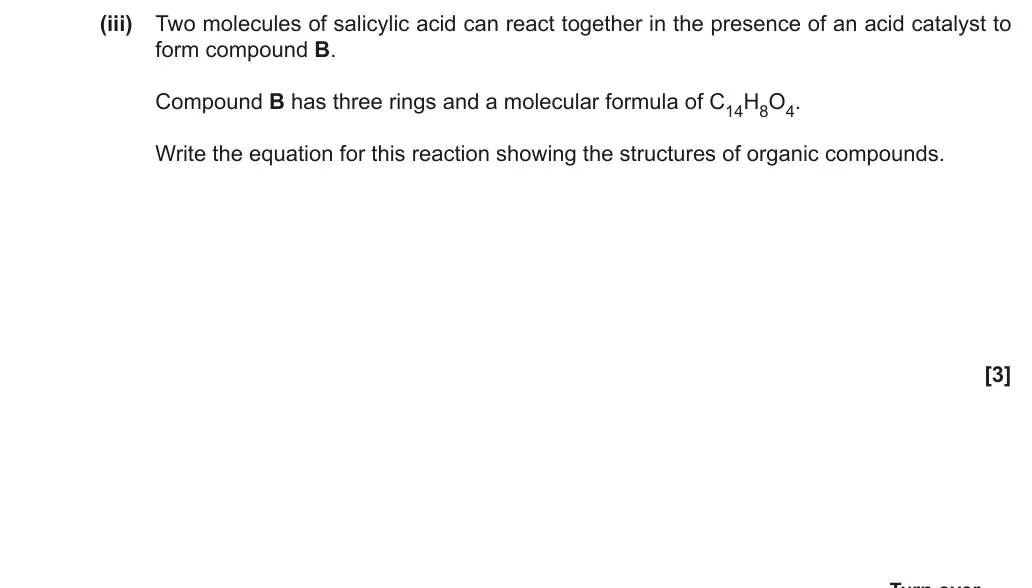
Question 20(a)(iii): Candidates who found this question difficult often did not recognise the functional groups present in the reacting molecule.
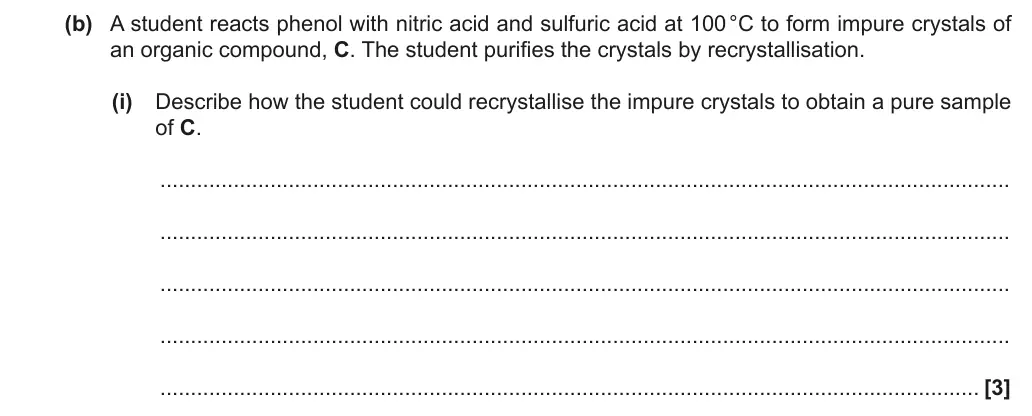
Skills: PAG6 Synthesis of an organic solid
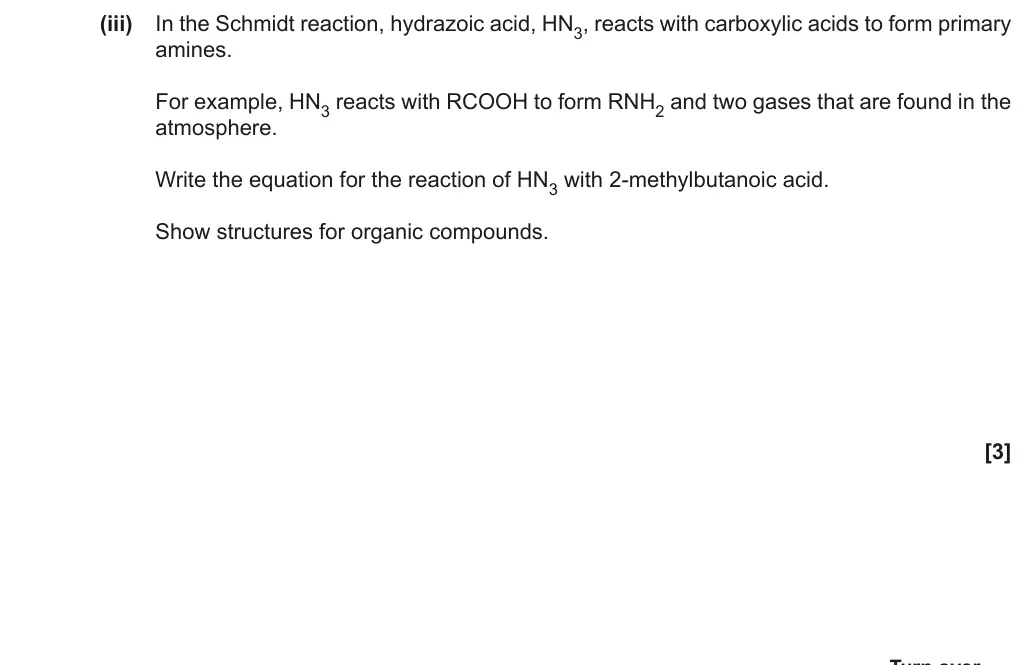
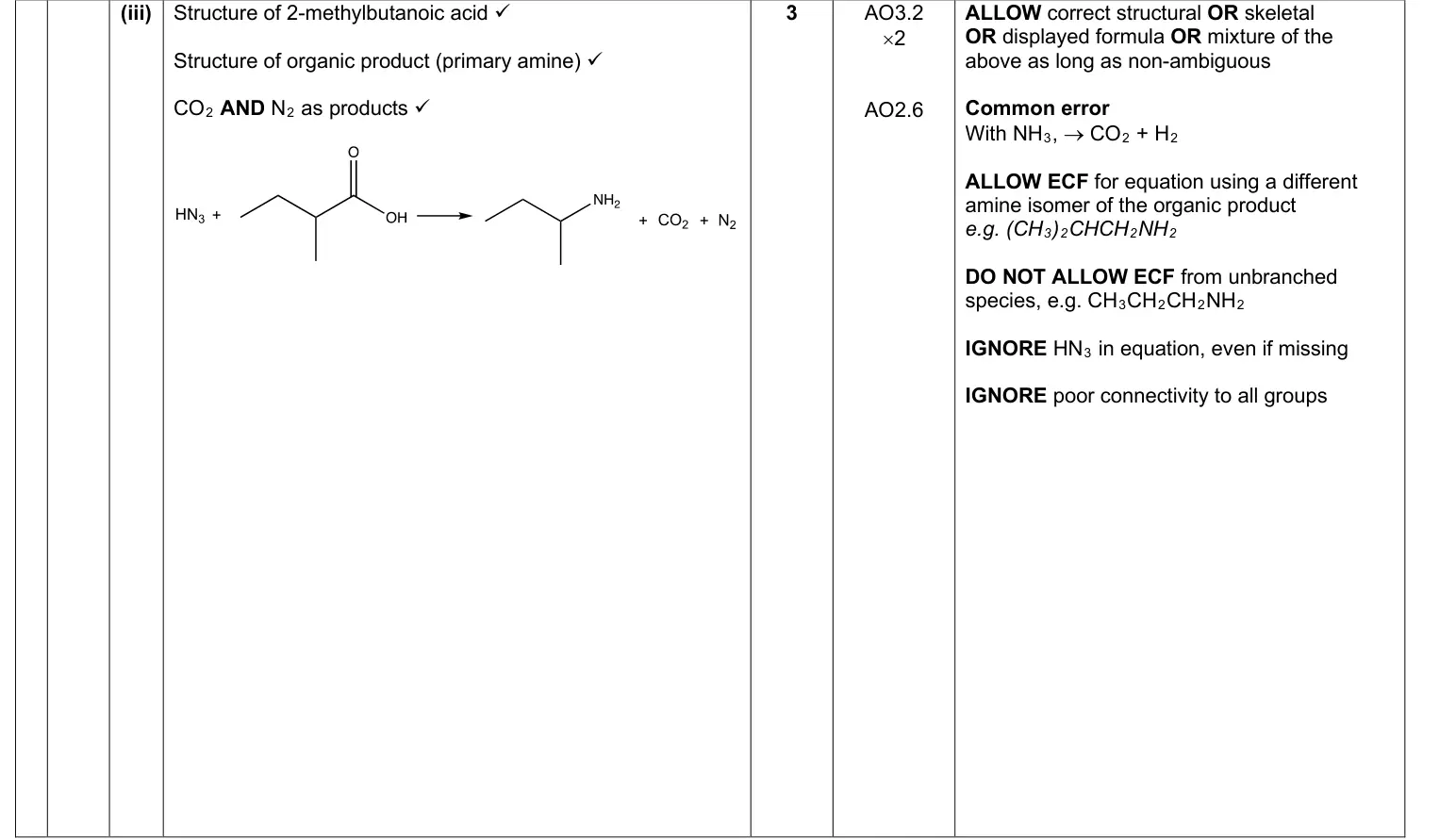
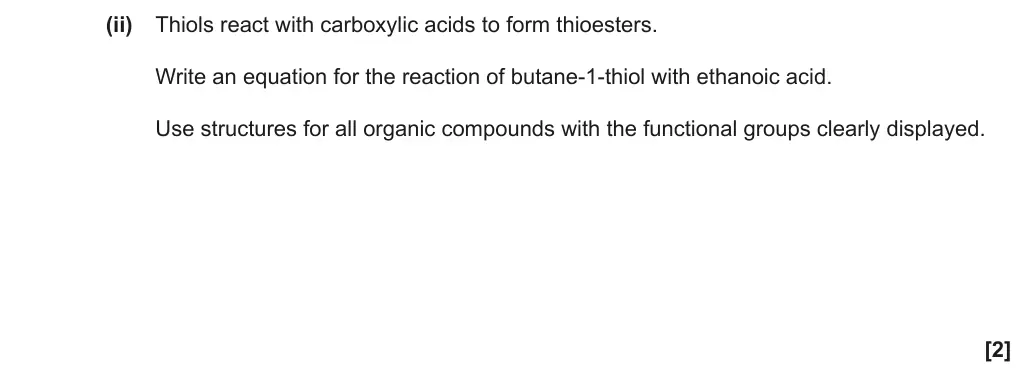
Q1(f) Outlining a mechanism for an unfamiliar reaction Q5(b)(iii) Predicting the equation for an unfamiliar organic reaction • Did not consider what a question is asking or read the information, e.g. Q5(b)(iii) Candidates were expected to interpret information for an unfamiliar organic reaction and to write a balanced question. In Q5(b)(iii), 2-methylbutanoic acid is CH3CH(CH3)CH2COOH.
A


1a(i) Most candidates labelled some of the apparatus correctly and identified the reflux technique. A significant number showed water flowing in the wrong direction and ‘distillation’ was given as the name of the technique. The ‘condenser’ was sometimes labelled incorrectly, e.g. ‘condensation tube, ‘distillation tube’ and ‘water jacket’. Only just over half the candidates were given both marks. 1a(ii) Many diagrams were incomplete and it was comparatively rare for both of the two available marks to be given. Important labels were often missing. Some candidates drew diagrams of other techniques, such as distillation. Many responses were not credited with marks and this question was often omitted. Candidates need practice in recognising practical techniques and in drawing acceptable diagrams. 1b(i) Candidates were expected to explain the different boiling points of three amines. Most candidates linked increased branching with less surface contact between molecules, leading to weaker induced dipole interactions (London forces). Fewer candidates linked the decreasing boiling points to less energy being required to break the intermolecular bonds. The highest performing candidates recognised the large difference between the boiling points of the primary and tertiary amines. They then identified the cause: primary amines form hydrogen bonds but tertiary amines do not. This question was answered reasonably well with fewer candidates than in the past describing relative strengths of covalent bonds, a common misconception. 1(b)(ii) Most candidates rearranged the ideal gas equation correctly to make n the subject. They then substituted correct values for p, V, R and T into the equation, with correct unit conversions. Most candidates then calculated n correctly as 2.32 × 10⁻³ and combined this value with the mass of 0.202 g to derive the molecular formula as 87. Lower-attaining candidates often made an error in their conversion of cm3 into m3, by multiplying by 10–3 rather than 10–6. This error resulted in a value of n as 2.32 and the unrealistic molecular mass of 8.7 × 10⁻³, from which a molecular formula is impossible. Candidates in this position are advised to check back at the unit conversions in the working. Very few candidates did not convert 100ºC into 373 K. Candidates with the correct molecular formula of 87 usually suggested C5H13N as the molecular formula. A significant number quoted C5H11NH2. This response was not credited as it is not a ‘molecular’ formula. There are several possible structures of C5H13N with three 13C NMR peaks and any were credited. Error carried forward was applied from a different molecular mass for both the molecular formula and a structure. This emphasises the importance of working within calculation; credit will always be given for a correct method. Instead of using the ideal gas equation, some candidates used the molar gas constant at room temperature and pressure, 24.0 dm3, which gives a molecular mass of 67. This simplified approach could only gain the final 2 marks for this question: a molecular formula (with an error carried forward value of 67, e.g. C4H5N) and a structure of an amine with this molecular formula and 3 peaks in the 13C NMR spectrum. 1(c) Candidates were supplied with information about an unfamiliar reaction of an amino acid and asked to predict a possible equation. Many candidates suggested H2O as one product, being the difference in the formula of the amino acid and the C3H3NO cyclic organic product. Any cyclic structure of C3H3NO that met the bonding rules for C, H, N and O was credited. Examples included a 4-membered ring lactam and substituted cyclopropenes. A significant number of candidates showed an equation for the reaction of two molecules of the amino acid to form 2 H2O and a cyclic dipeptide. Although chemically feasible, the dipeptide could not be credited because the molecular formula was C3H3NO in the question. This error could have been avoided if the information in the question had been used.
Skills: PAG5 Synthesis of an organic liquid

1a(i) Most candidates labelled some of the apparatus correctly and identified the reflux technique. A significant number showed water flowing in the wrong direction and ‘distillation’ was given as the name of the technique. The ‘condenser’ was sometimes labelled incorrectly, e.g. ‘condensation tube, ‘distillation tube’ and ‘water jacket’. Only just over half the candidates were given both marks. 1a(ii) Many diagrams were incomplete and it was comparatively rare for both of the two available marks to be given. Important labels were often missing. Some candidates drew diagrams of other techniques, such as distillation. Many responses were not credited with marks and this question was often omitted. Candidates need practice in recognising practical techniques and in drawing acceptable diagrams. 1b(i) Candidates were expected to explain the different boiling points of three amines. Most candidates linked increased branching with less surface contact between molecules, leading to weaker induced dipole interactions (London forces). Fewer candidates linked the decreasing boiling points to less energy being required to break the intermolecular bonds. The highest performing candidates recognised the large difference between the boiling points of the primary and tertiary amines. They then identified the cause: primary amines form hydrogen bonds but tertiary amines do not. This question was answered reasonably well with fewer candidates than in the past describing relative strengths of covalent bonds, a common misconception. 1(b)(ii) Most candidates rearranged the ideal gas equation correctly to make n the subject. They then substituted correct values for p, V, R and T into the equation, with correct unit conversions. Most candidates then calculated n correctly as 2.32 × 10⁻³ and combined this value with the mass of 0.202 g to derive the molecular formula as 87. Lower-attaining candidates often made an error in their conversion of cm3 into m3, by multiplying by 10–3 rather than 10–6. This error resulted in a value of n as 2.32 and the unrealistic molecular mass of 8.7 × 10⁻³, from which a molecular formula is impossible. Candidates in this position are advised to check back at the unit conversions in the working. Very few candidates did not convert 100ºC into 373 K. Candidates with the correct molecular formula of 87 usually suggested C5H13N as the molecular formula. A significant number quoted C5H11NH2. This response was not credited as it is not a ‘molecular’ formula. There are several possible structures of C5H13N with three 13C NMR peaks and any were credited. Error carried forward was applied from a different molecular mass for both the molecular formula and a structure. This emphasises the importance of working within calculation; credit will always be given for a correct method. Instead of using the ideal gas equation, some candidates used the molar gas constant at room temperature and pressure, 24.0 dm3, which gives a molecular mass of 67. This simplified approach could only gain the final 2 marks for this question: a molecular formula (with an error carried forward value of 67, e.g. C4H5N) and a structure of an amine with this molecular formula and 3 peaks in the 13C NMR spectrum. 1(c) Candidates were supplied with information about an unfamiliar reaction of an amino acid and asked to predict a possible equation. Many candidates suggested H2O as one product, being the difference in the formula of the amino acid and the C3H3NO cyclic organic product. Any cyclic structure of C3H3NO that met the bonding rules for C, H, N and O was credited. Examples included a 4-membered ring lactam and substituted cyclopropenes. A significant number of candidates showed an equation for the reaction of two molecules of the amino acid to form 2 H2O and a cyclic dipeptide. Although chemically feasible, the dipeptide could not be credited because the molecular formula was C3H3NO in the question. This error could have been avoided if the information in the question had been used.
Skills: PAG6 Synthesis of an organic solid

1a(i) Most candidates labelled some of the apparatus correctly and identified the reflux technique. A significant number showed water flowing in the wrong direction and ‘distillation’ was given as the name of the technique. The ‘condenser’ was sometimes labelled incorrectly, e.g. ‘condensation tube, ‘distillation tube’ and ‘water jacket’. Only just over half the candidates were given both marks. 1a(ii) Many diagrams were incomplete and it was comparatively rare for both of the two available marks to be given. Important labels were often missing. Some candidates drew diagrams of other techniques, such as distillation. Many responses were not credited with marks and this question was often omitted. Candidates need practice in recognising practical techniques and in drawing acceptable diagrams. 1b(i) Candidates were expected to explain the different boiling points of three amines. Most candidates linked increased branching with less surface contact between molecules, leading to weaker induced dipole interactions (London forces). Fewer candidates linked the decreasing boiling points to less energy being required to break the intermolecular bonds. The highest performing candidates recognised the large difference between the boiling points of the primary and tertiary amines. They then identified the cause: primary amines form hydrogen bonds but tertiary amines do not. This question was answered reasonably well with fewer candidates than in the past describing relative strengths of covalent bonds, a common misconception. 1(b)(ii) Most candidates rearranged the ideal gas equation correctly to make n the subject. They then substituted correct values for p, V, R and T into the equation, with correct unit conversions. Most candidates then calculated n correctly as 2.32 × 10⁻³ and combined this value with the mass of 0.202 g to derive the molecular formula as 87. Lower-attaining candidates often made an error in their conversion of cm3 into m3, by multiplying by 10–3 rather than 10–6. This error resulted in a value of n as 2.32 and the unrealistic molecular mass of 8.7 × 10⁻³, from which a molecular formula is impossible. Candidates in this position are advised to check back at the unit conversions in the working. Very few candidates did not convert 100ºC into 373 K. Candidates with the correct molecular formula of 87 usually suggested C5H13N as the molecular formula. A significant number quoted C5H11NH2. This response was not credited as it is not a ‘molecular’ formula. There are several possible structures of C5H13N with three 13C NMR peaks and any were credited. Error carried forward was applied from a different molecular mass for both the molecular formula and a structure. This emphasises the importance of working within calculation; credit will always be given for a correct method. Instead of using the ideal gas equation, some candidates used the molar gas constant at room temperature and pressure, 24.0 dm3, which gives a molecular mass of 67. This simplified approach could only gain the final 2 marks for this question: a molecular formula (with an error carried forward value of 67, e.g. C4H5N) and a structure of an amine with this molecular formula and 3 peaks in the 13C NMR spectrum. 1(c) Candidates were supplied with information about an unfamiliar reaction of an amino acid and asked to predict a possible equation. Many candidates suggested H2O as one product, being the difference in the formula of the amino acid and the C3H3NO cyclic organic product. Any cyclic structure of C3H3NO that met the bonding rules for C, H, N and O was credited. Examples included a 4-membered ring lactam and substituted cyclopropenes. A significant number of candidates showed an equation for the reaction of two molecules of the amino acid to form 2 H2O and a cyclic dipeptide. Although chemically feasible, the dipeptide could not be credited because the molecular formula was C3H3NO in the question. This error could have been avoided if the information in the question had been used.

A

B
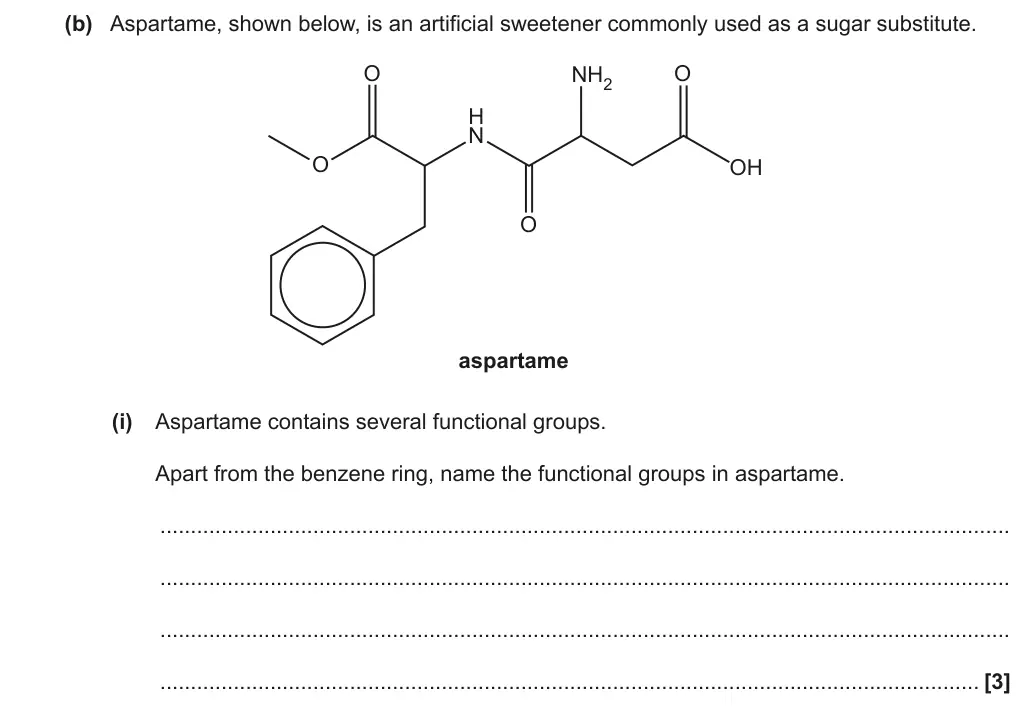
Most candidates were able to identify the functional groups correctly and selected B. Some candidates opted for A, presumably assuming the C=O at the top of the structure was a ketone. A small, but significant number of candidates chose option C. Section B overview Section B includes a mixture of short answer and extended response questions, including two questions marked using a level of response mark scheme (18(e)(i) and 21). This section of the paper is worth 85 marks.
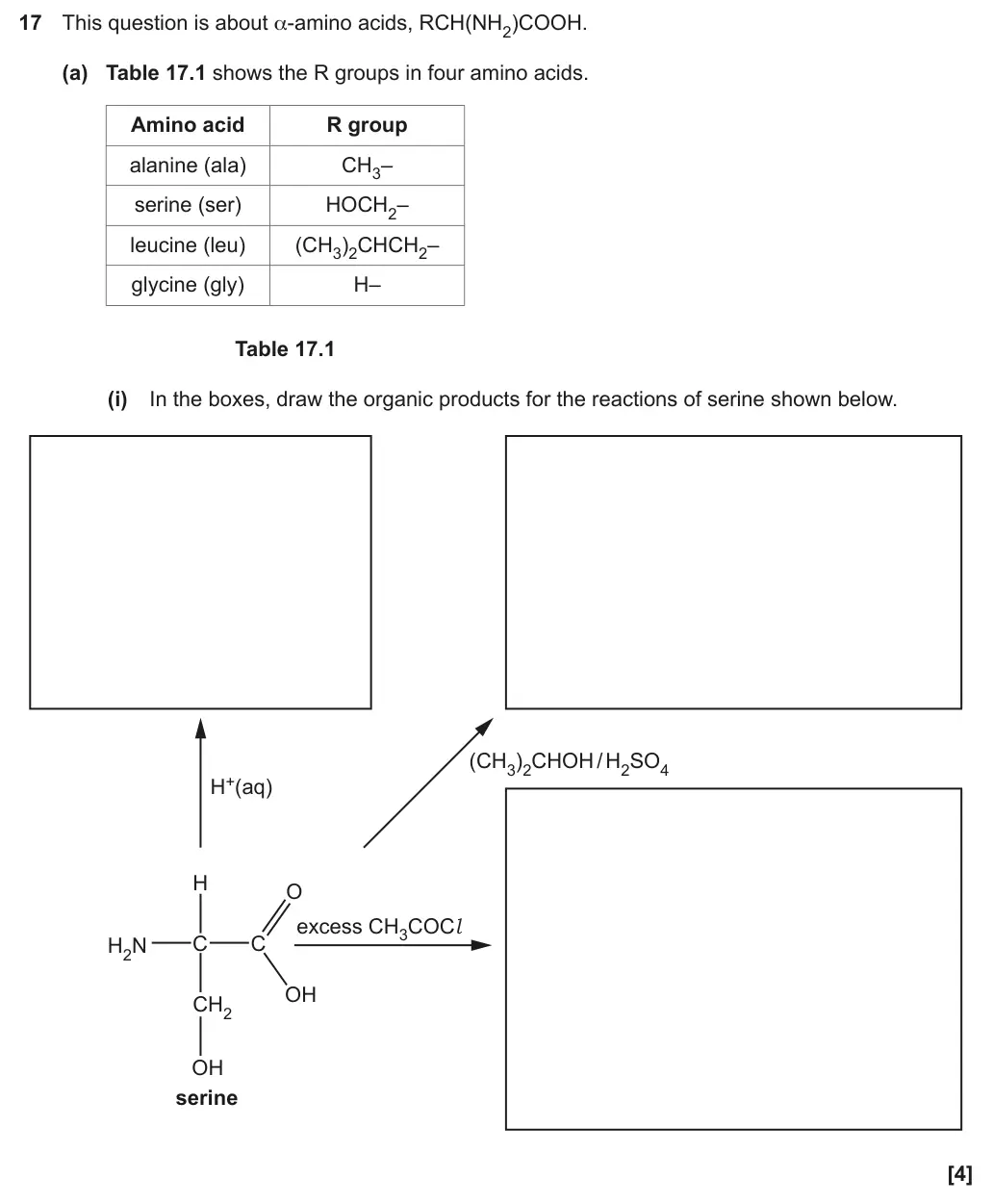
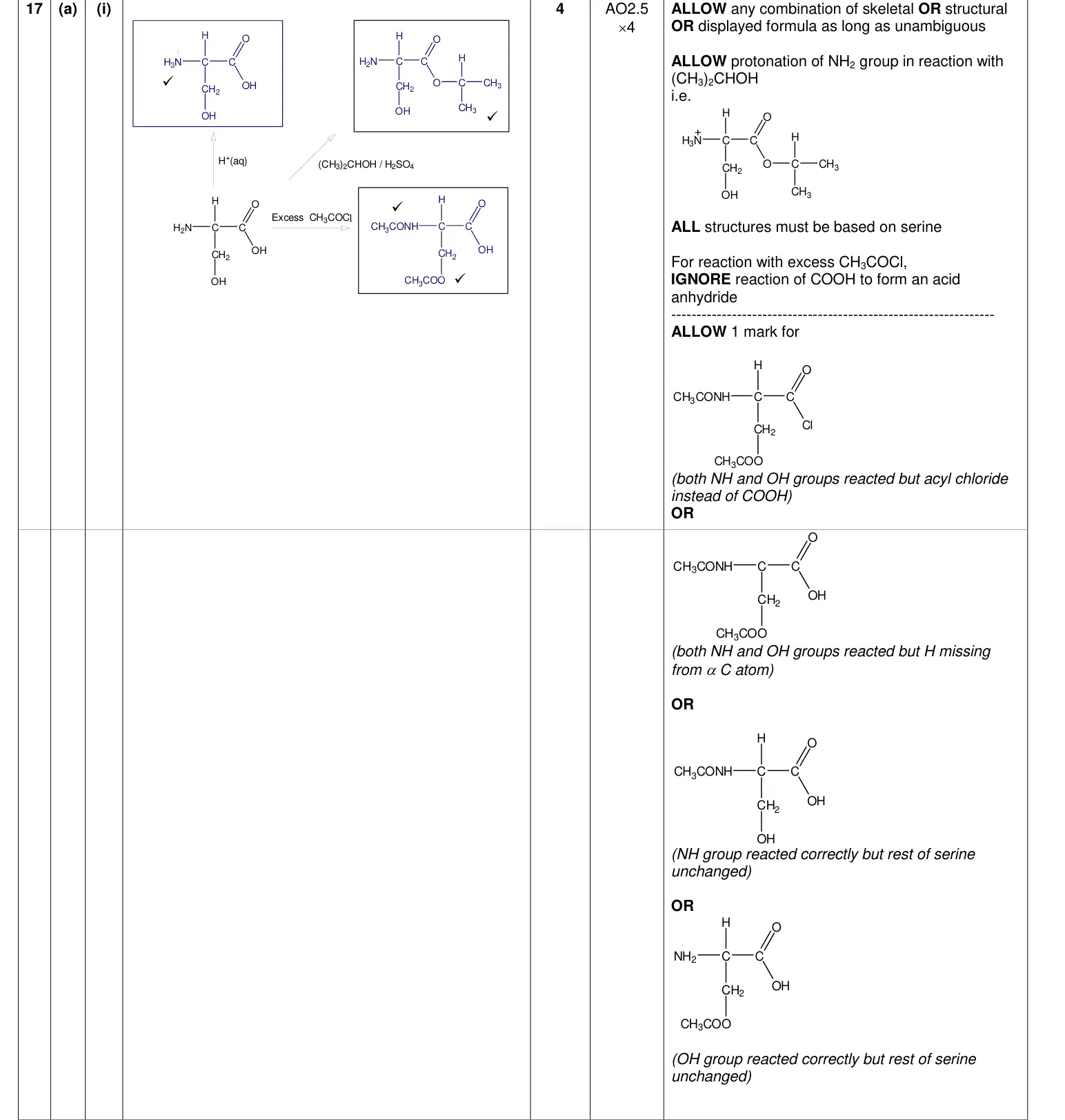
This question focused on the reactions of the different functional groups in serine. Candidates are familiar with these reactions and most candidates scored at least two marks. These were achieved by the formation of the ammonium ion by reaction with H+ and the formation of the ester from (CH3)2CHOH. Determining the organic product from the reaction of serine with excess CH3COCl proved more difficult. Some candidates realised that the OH of serine’s R group would react and others drew the amide formed from the reaction of the NH2 group. The best responses showed both conversions and scored full marks. Lower ability responses often showed organic products containing the Cl atom from the ethanoyl chloride rather than the CH3CO group. This response scored three marks. The candidate has drawn correct organic products for the reaction of serine with H+ and (CH3)2CHOH. The product from the reaction of excess CH3COCl shows the formation of an ester but not the formation of the amide. This product was seen often by examiners and scored one mark. If an amide group had been shown this response would have received full marks. Notice the candidate has presented their organic products clearly with the structures drawn in a similar manner to serine shown in the question. This is a good strategy to avoid errors and omissions when drawing organic structures.
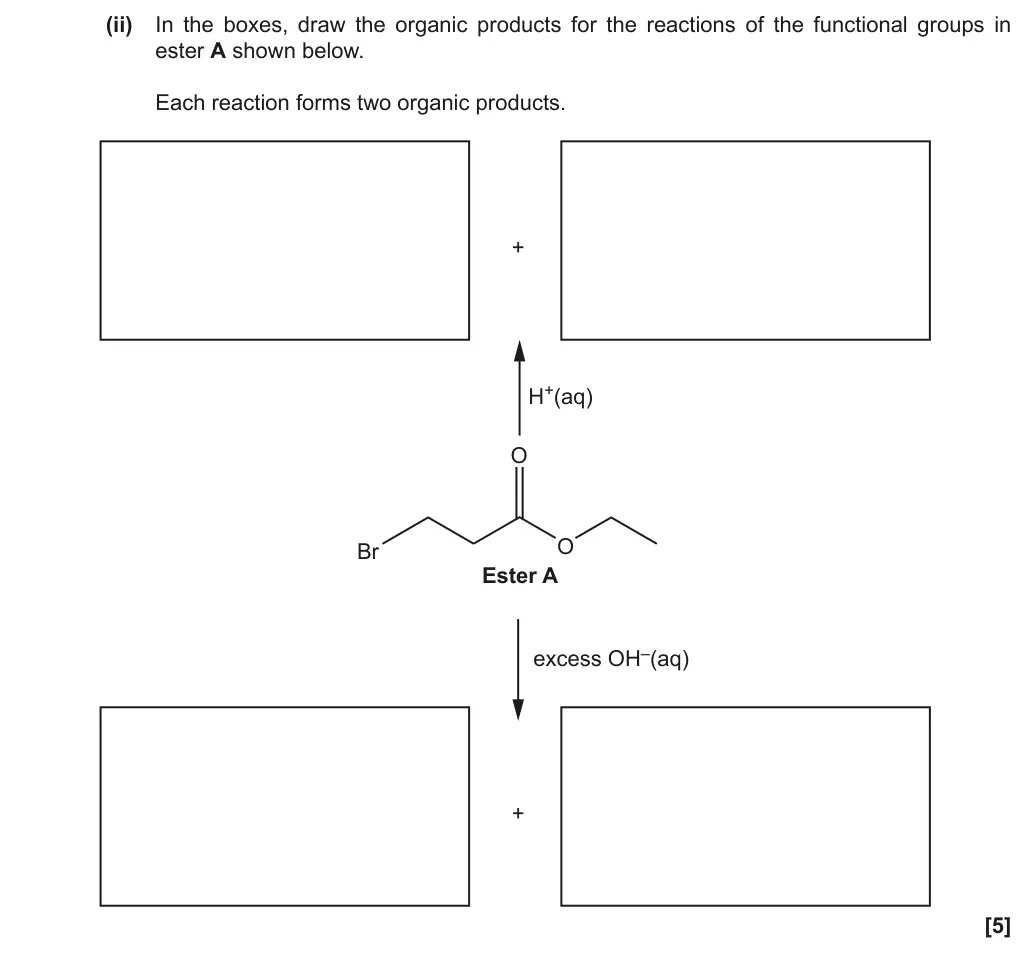
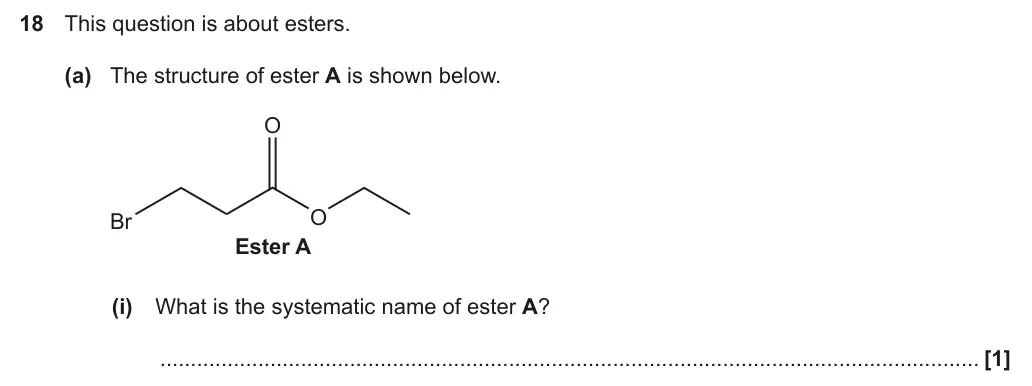
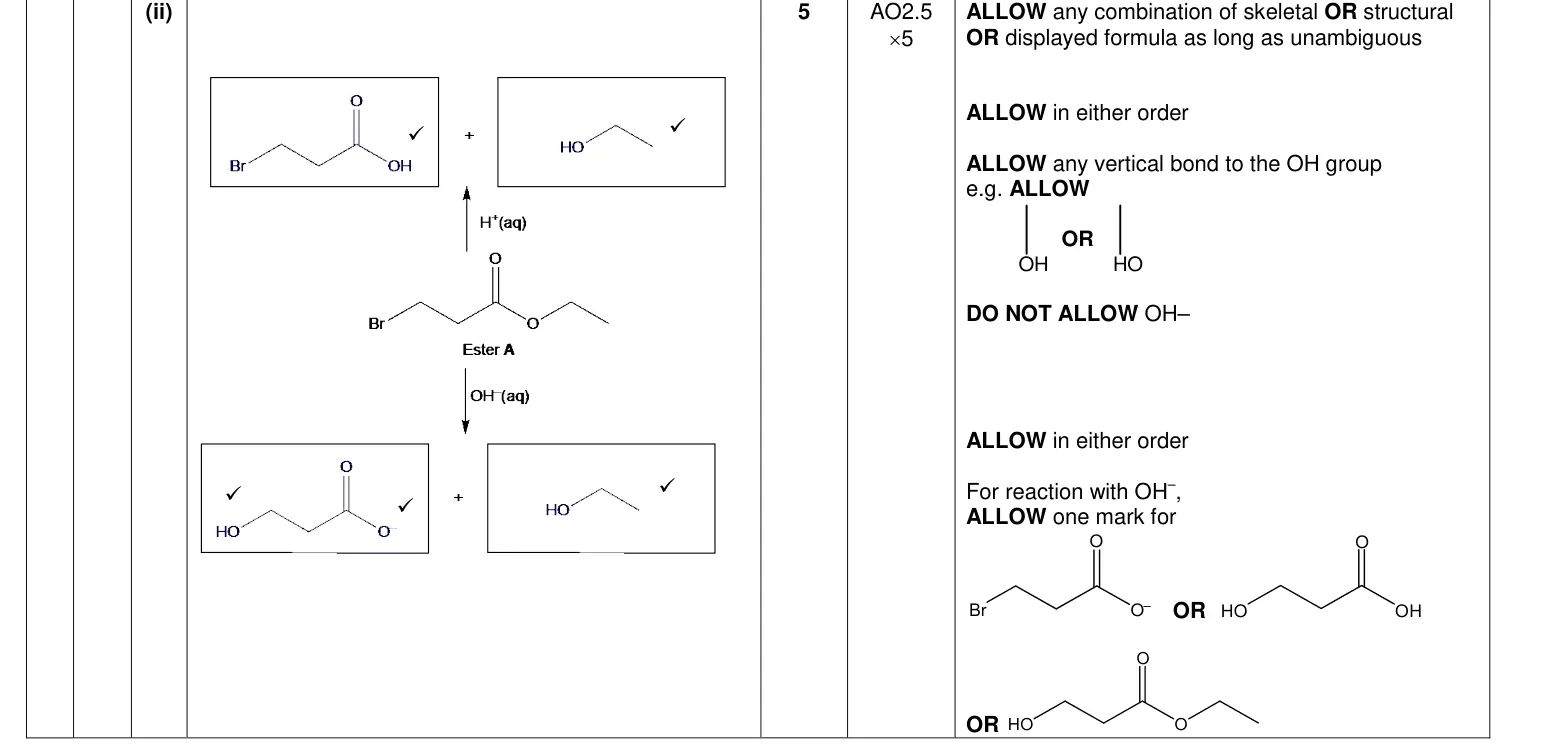
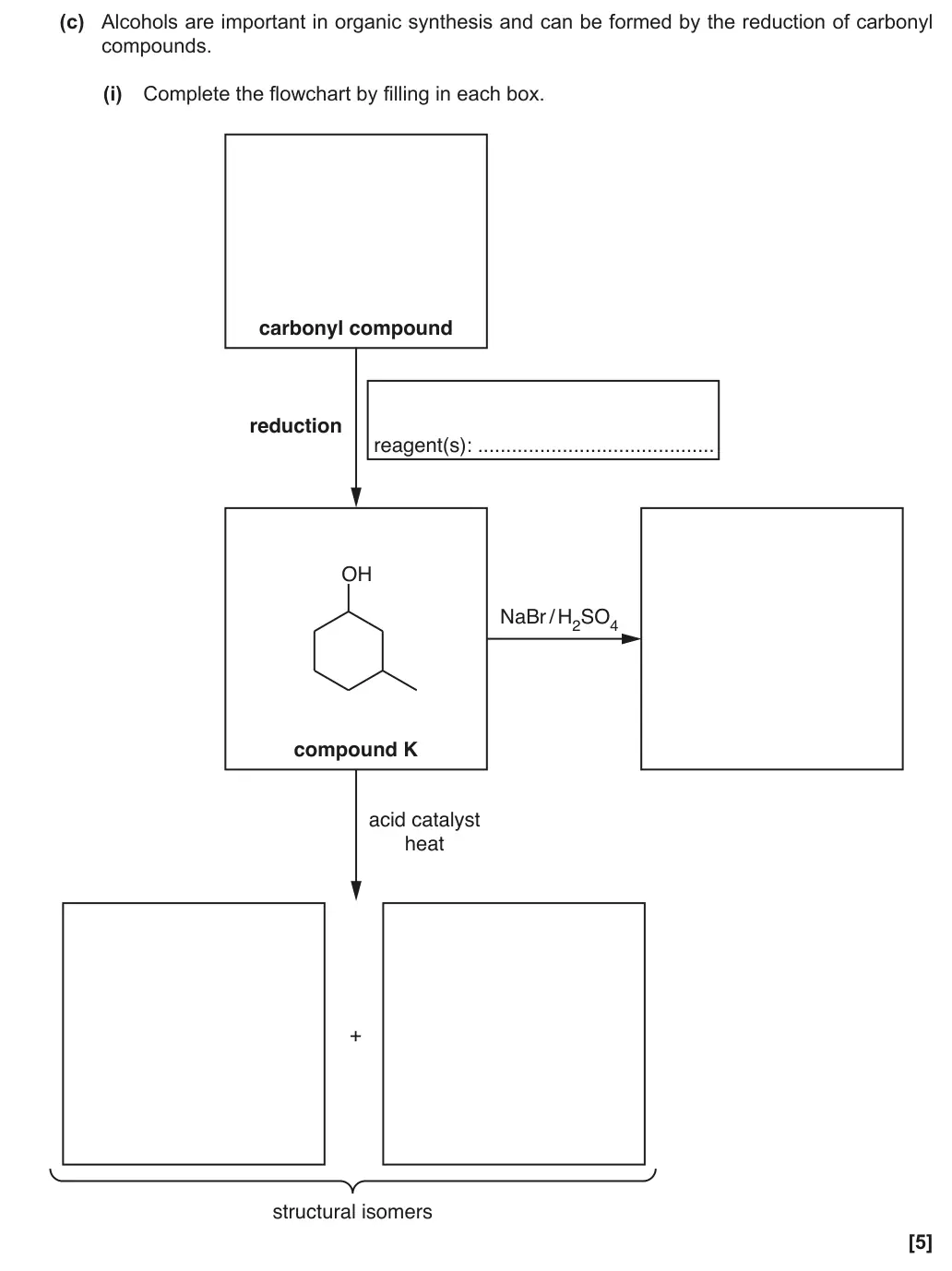
This question required candidates to apply their knowledge of hydrolysis reactions to ester A. The majority of candidates were able to show 3-bromopropanoic acid and ethanol in the top two boxes to secure two marks. The organic products from the alkaline hydrolysis proved more difficult. Many candidates identified ethanol as a product in one of the lower boxes but lower ability responses showed the ethoxide ion. Some candidates drew the 3-bromopropanoate ion as the other product. Higher ability candidates realised that the Br atom would be replaced by an OH group and the best responses showed the correct carboxylate ion. Examiners were encouraged by the number of excellent responses seen and the majority of candidates scored 4 or 5 marks.
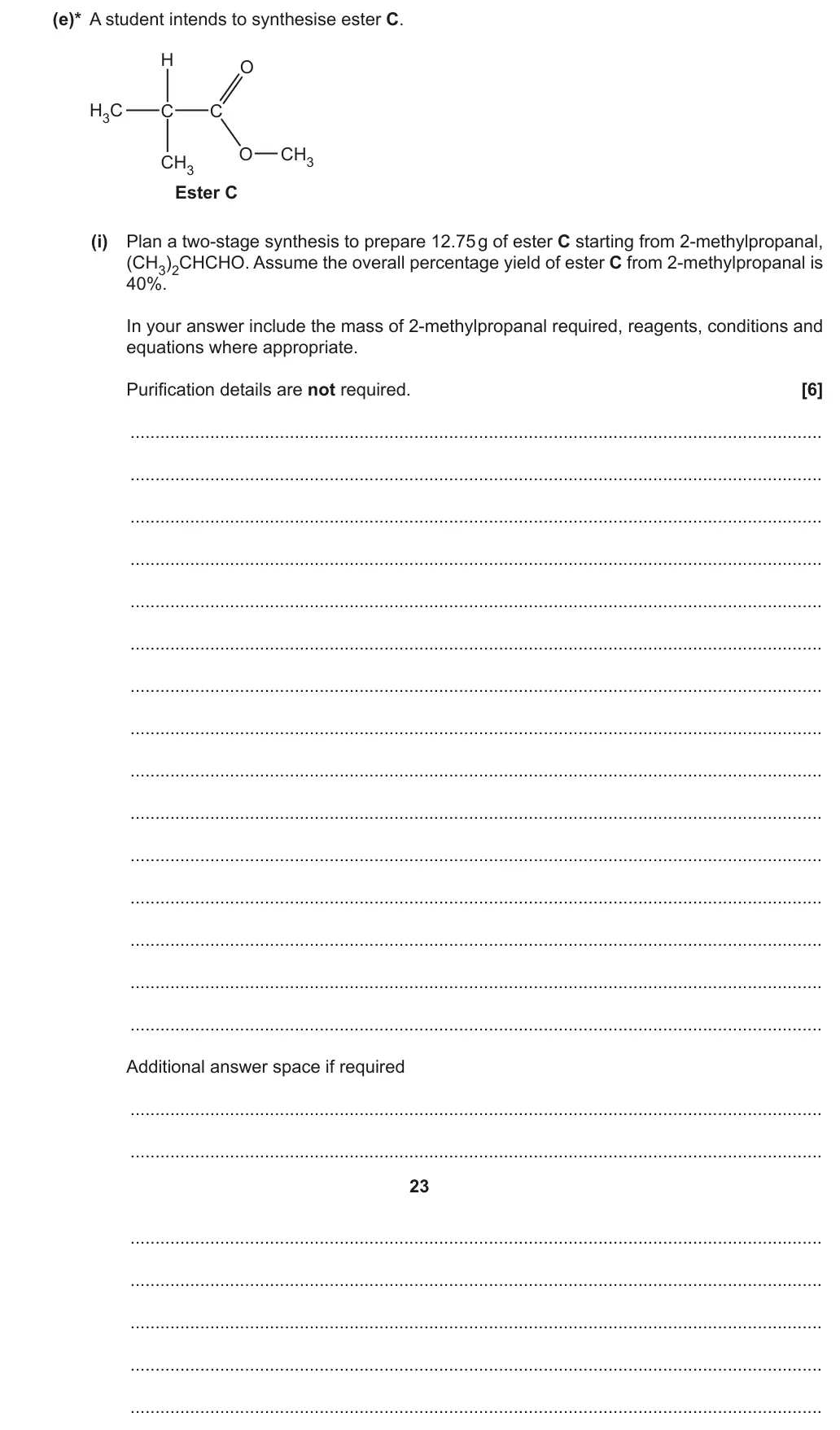
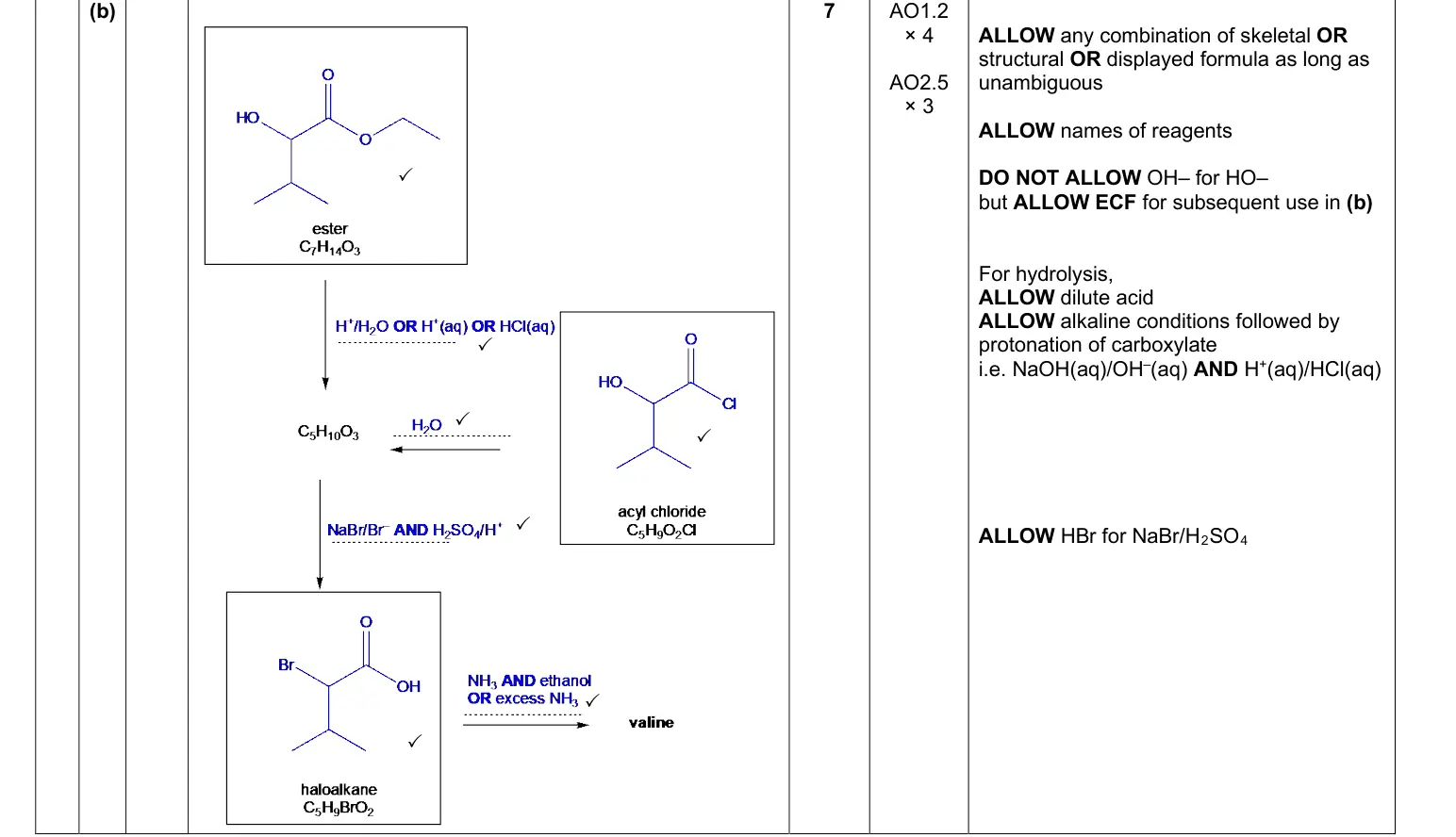
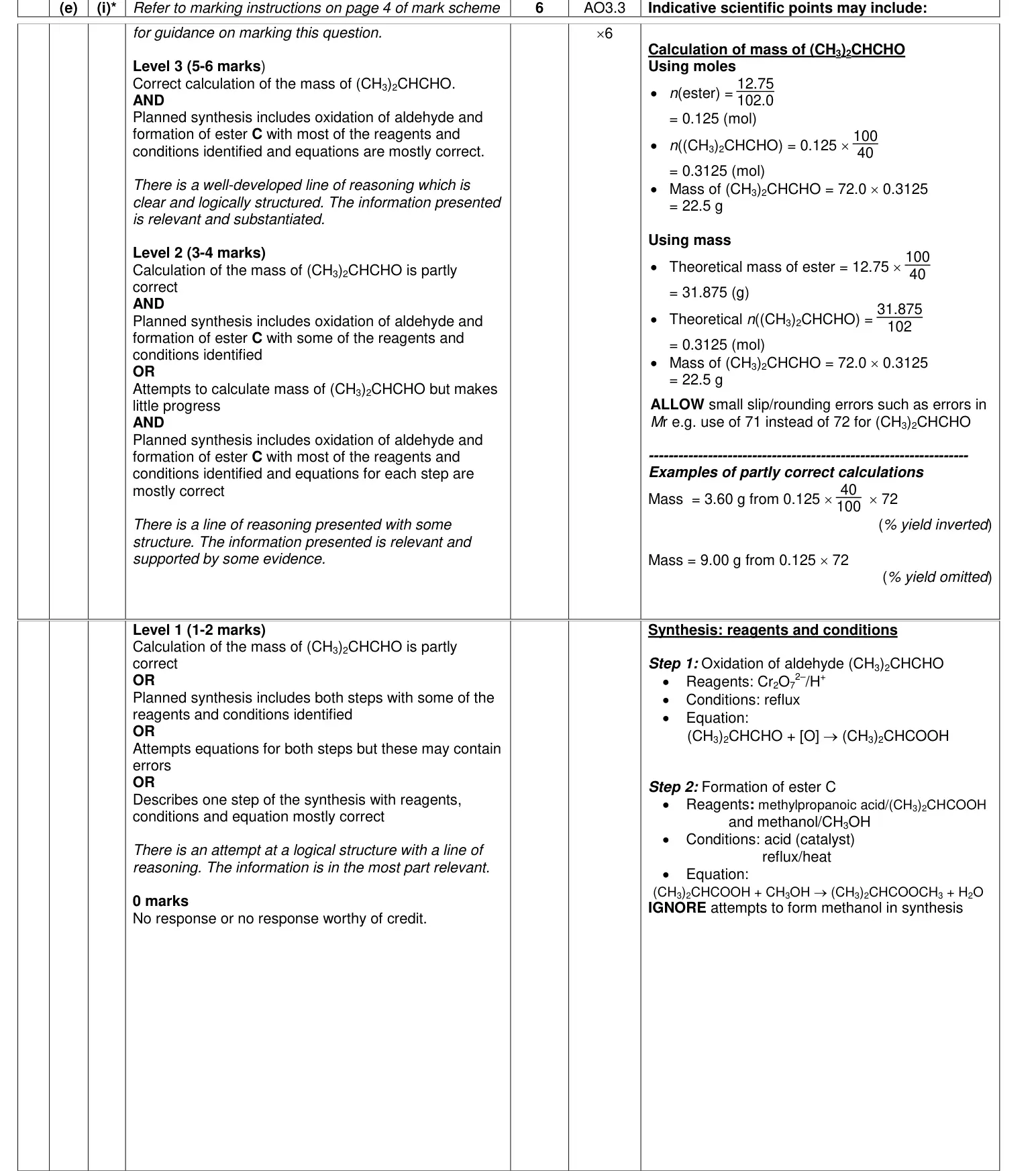
This question was marked using a level of response mark scheme. Most candidates gave a response worthy of at least Level 2 (3-4 marks) by either providing the synthetic steps with reagents and/or equations for the synthesis of ester C as well as calculating the mass of 2-methylpropanal required. determined the mass correctly and showed the synthesis efficiently, using equations to communicate the preparation of ester C and received Level 3 (5-6 marks). Some responses focused solely on the 2- methylpropanal and suggested it would be both oxidised and reduced with each of the products being used to form an ester. Others omitted the mass calculation or gave only a partial synthesis. Such responses received Level 1 (1-2 marks). A variety of responses was seen in this demanding question. In general candidates adopted one of two approaches. The most common was to multiply the Mr of 2-hydroxybenzoic acid by 200 and then subtract the mass of the 199 water molecules removed during polymerisation. The other approach used the Mr of the repeat unit. This was multiplied by 200 and the mass of H and OH at each end of the polymer was added to give the final answer. Many candidates were successful with the first step of their approach, but the best responses included the second step taking into account the Mr of water. A significant number of candidates used an incorrect value for the Mr in their first step. Candidates are advised to draw out the structure of a compound before determining the Mr. This is particularly important when only a name is given in the question. This response includes an excellent description of the synthesis of ester C. Each step is labelled clearly with the most of the reagents and conditions stated and correct equations. The candidate makes little progress with the calculation of the mass of 2-methylpropanal required, completing only the first step. This response satisfies the Level 2 criteria. The information is provided is relevant and presented with a clear logical structure and was therefore given the upper mark within the level and achieved four marks. The presentation of the synthesis by equations rather than words is an excellent strategy. Candidates are advised to adopt such an approach in questions like this as it allows them develop and clear line of reasoning without the need to write lots of unnecessary text.
Skills: M0.2 Use ratios, fractions and percentages; M2.3 Substitute numerical values into algebraic equations using appropriate units for physical quantities

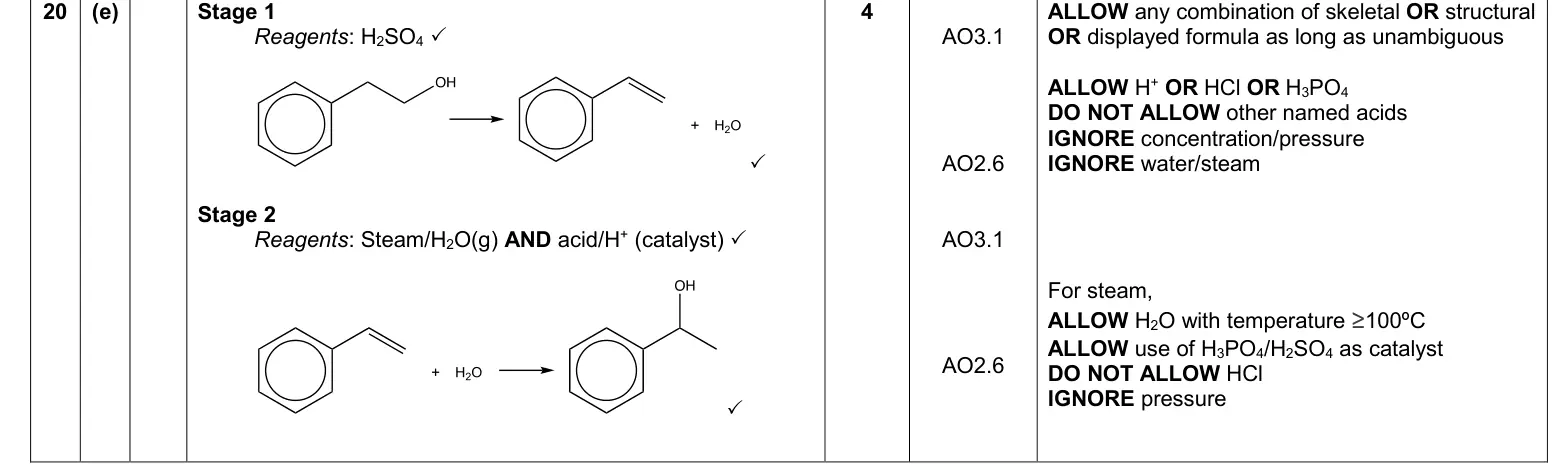
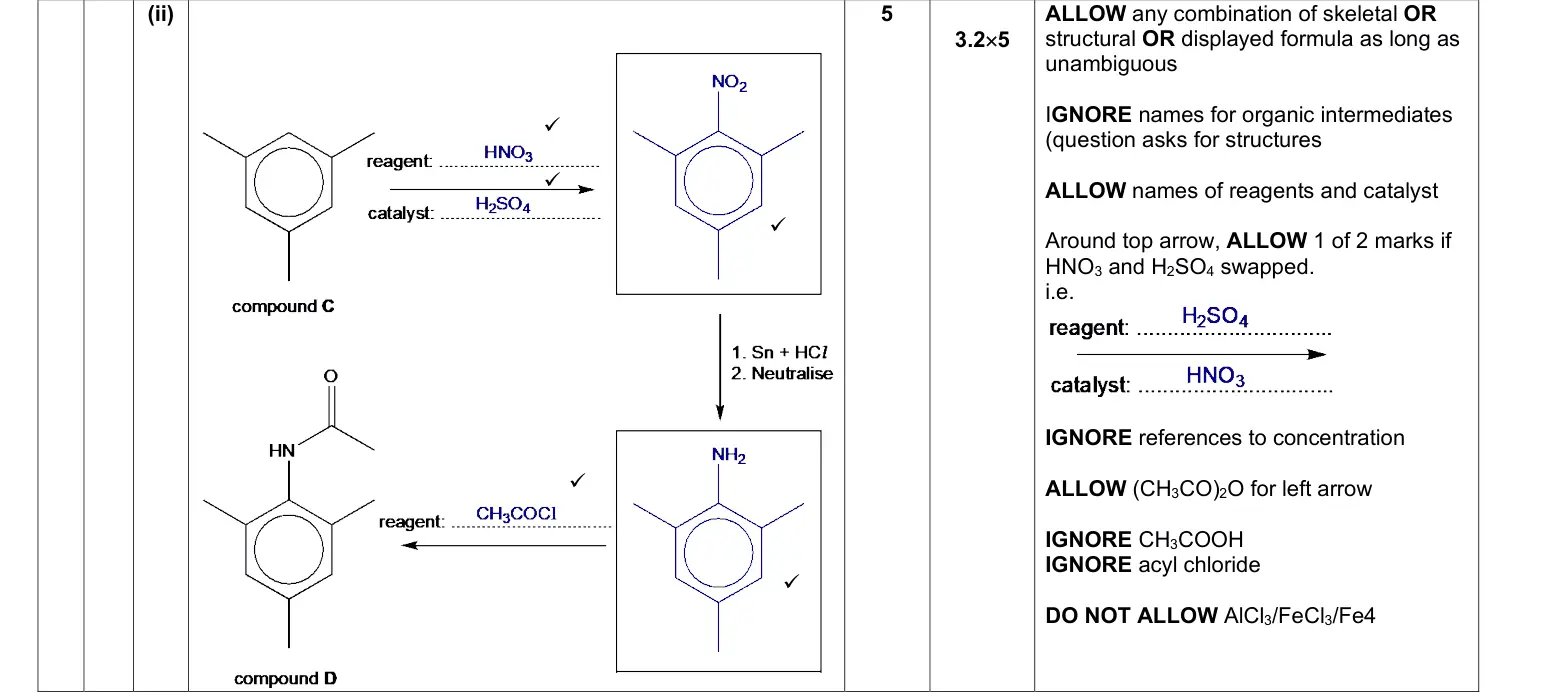
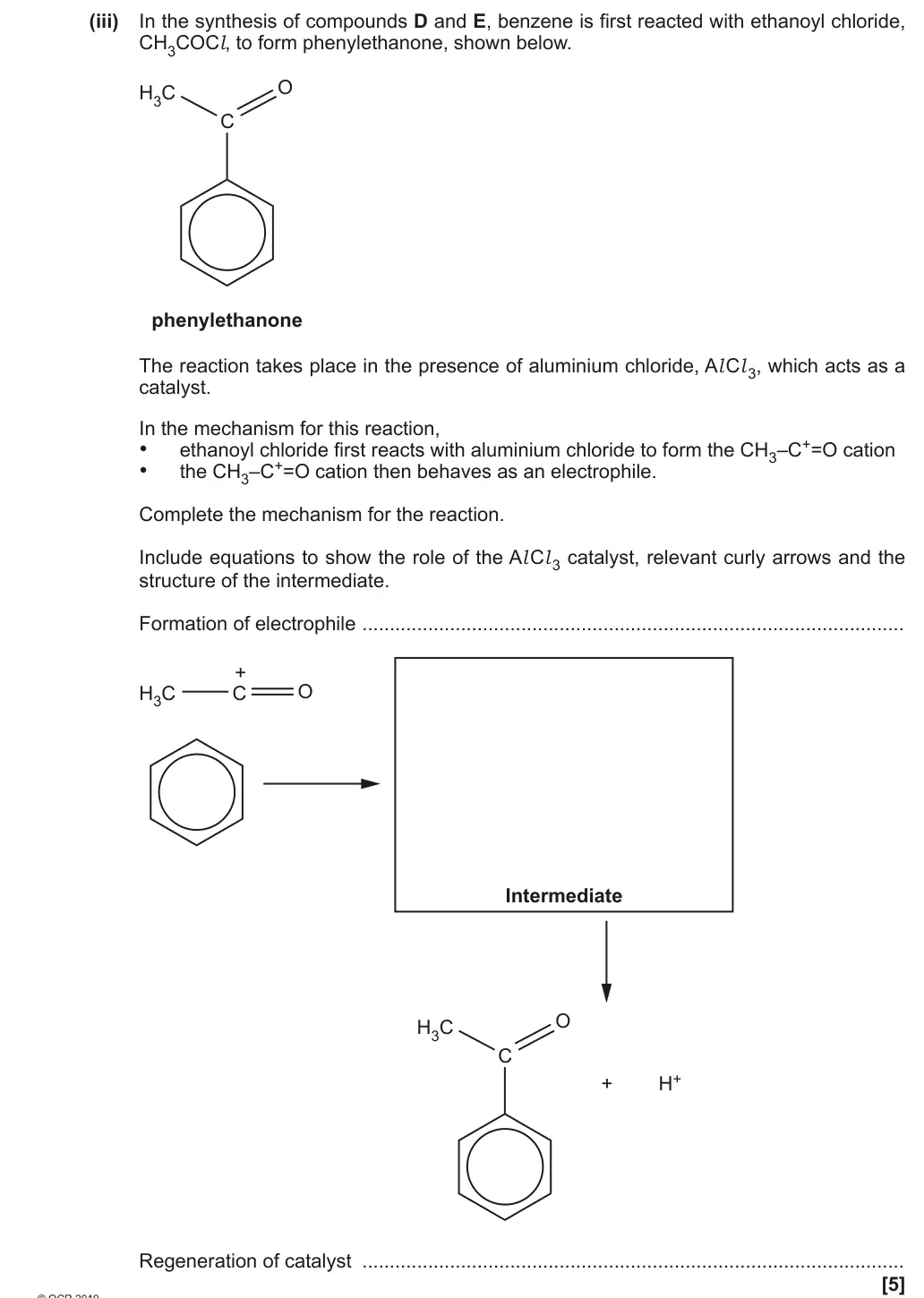
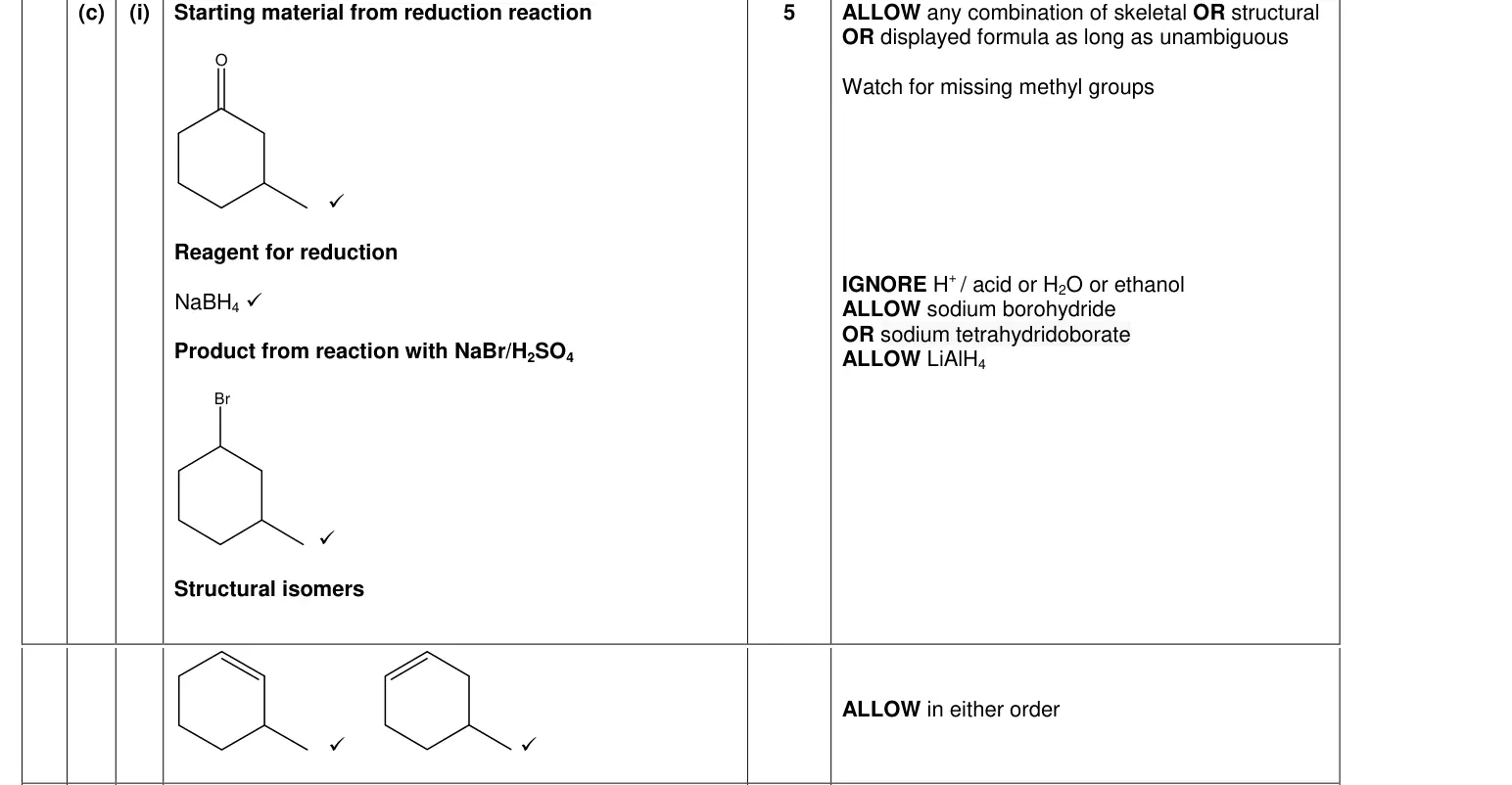
This question required candidates to apply knowledge of organic reactions from across the specification and discriminated well. Candidates with a good knowledge of reagents and conditions frequently scored over five marks. More detailed feedback is discussed with Exemplar 7, below. Phenylethanone is the starting point of this flowchart which shows the synthesis of compounds D and E. Synthesis of D The first step in the synthesis of D is the reduction of the ketone group. This response demonstrates a common error seen by examiners. The candidate has correctly deduced that than alcohol is formed but has omitted a hydrogen atom. Candidates are advised to take care when drawing structures. If a carbon atom is displayed it should be shown to be making four bonds. The final step of the synthesis is the dehydration of the alcohol with an acid. This candidate has used H3PO4. H2SO4 was also frequently seen. Lower ability responses included reference to water or steam and this was not credited. Synthesis of E The first step of the synthesis of E from phenylethanone is the reaction with NaCN(aq)/H+(aq). This candidate identifies that the product of the reaction is a hydroxynitrile but unfortunately this cannot be credited due to the incorrect linking of the OH group via the H atom. Candidates should be aware that, when drawing structures, groups must be bonded via the correct atoms. The next step of the synthesis is the substitution of the OH group. The candidate correctly recognises that NaBr is a suitable reagent but omits an acid, e.g. H2SO4, which is also required for this reaction. This error was seen frequently by examiners. The final two steps involve the substitution of the Br atom and acid hydrolysis of the nitrile group. In this case the candidate chooses the reaction with excess NH3. The structure of the correct product of this reaction is shown and the synthesis is completed by identifying a suitable reagent for the final step. Other candidates opted to perform these steps in the reverse order and the mark scheme allowed full credit for either approach. Common errors in the final steps were omissions. Some candidates simply stated NH3 without mentioning ethanol. Others identified water as important for the hydrolysis but did not include reference to an acid.

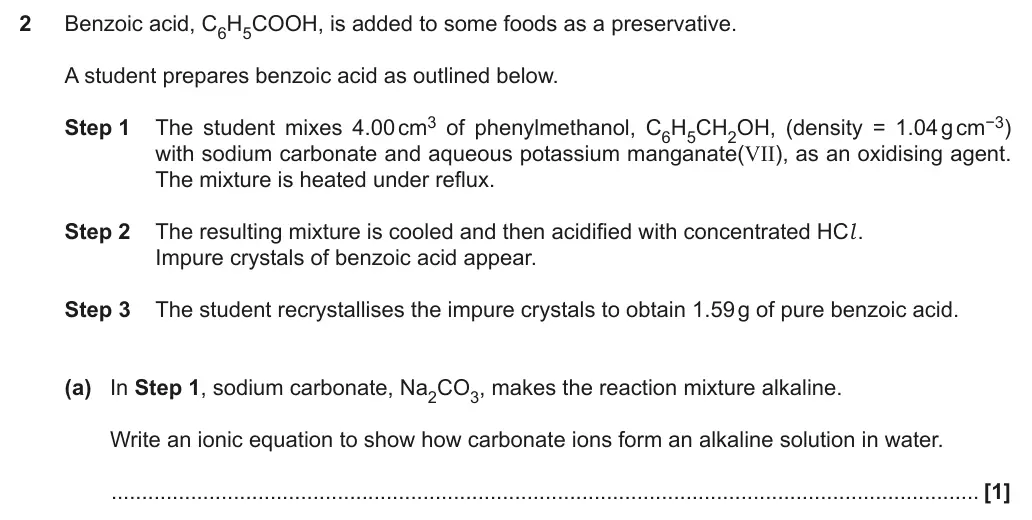
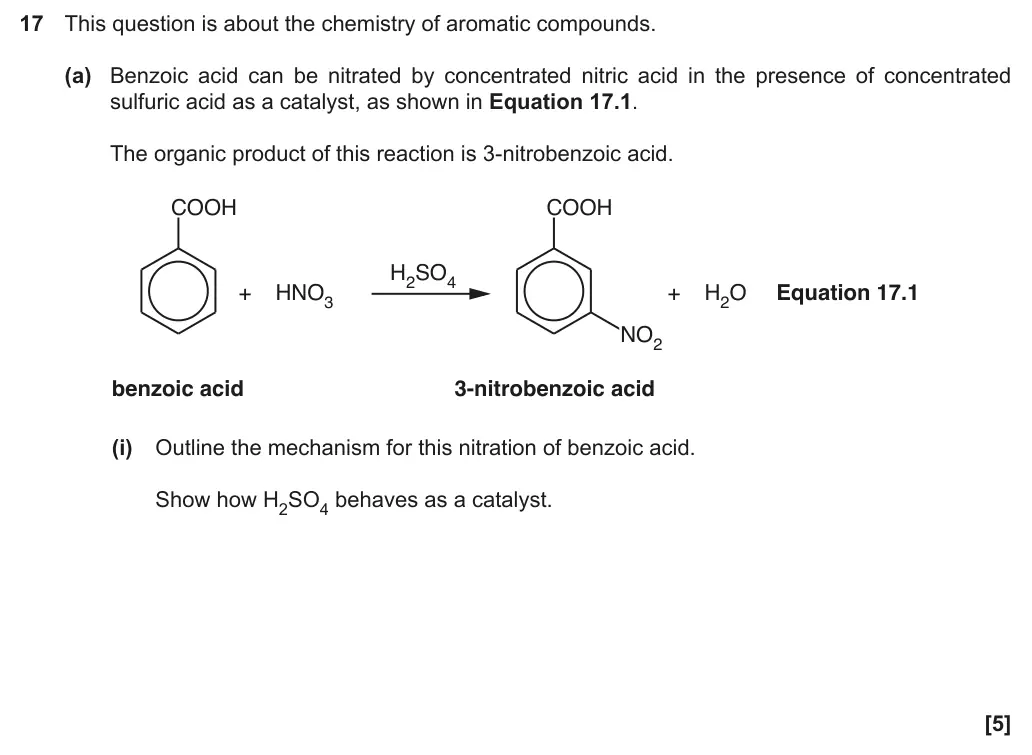
Many candidates produced thorough responses, showing that they had encountered recrystallisation as a technique in their practical work. Most candidates were aware that the impure product is dissolved in a minimum volume of hot solvent, although ‘minimum’ was sometimes omitted. The subsequent stages were sometimes incomplete or in the wrong order. Many were aware that the hot solution can be passed through fluted filter paper to remove solid impurities. (This is beyond the specification requirements for A Level but good practice). Most candidates were aware of the need to filter (usually under reduced pressure) but the necessary cooling stage to form the crystals was sometimes omitted. Finally, many responses omitted the need to dry the crystals. Candidates did sometimes dry the crystals by adding an anhydrous salt (e.g. CaCl2 or MgSO4), a clear confusion with drying an organic liquid. Others described the purification of an organic liquid for their response, including use of a separating funnel, drying and distillation.
Skills: PAG6 Synthesis of an organic solid
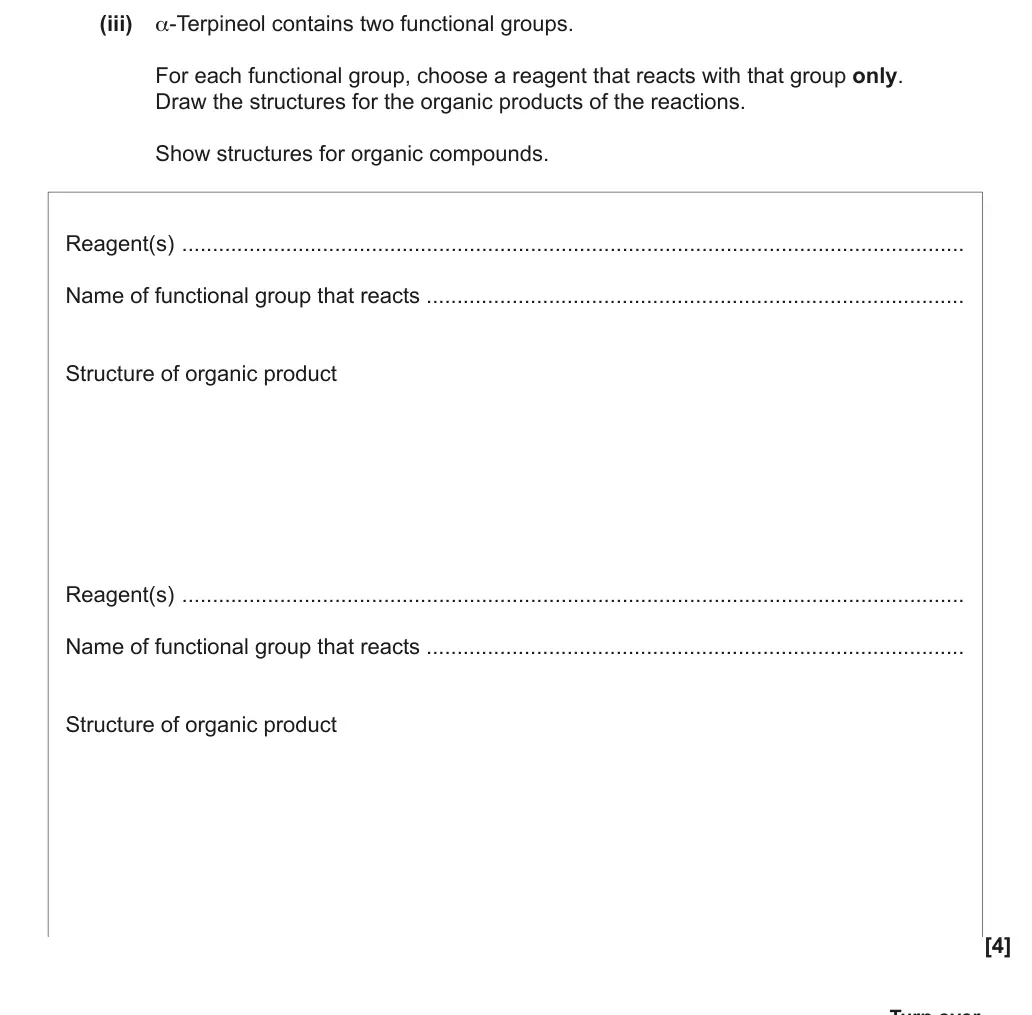
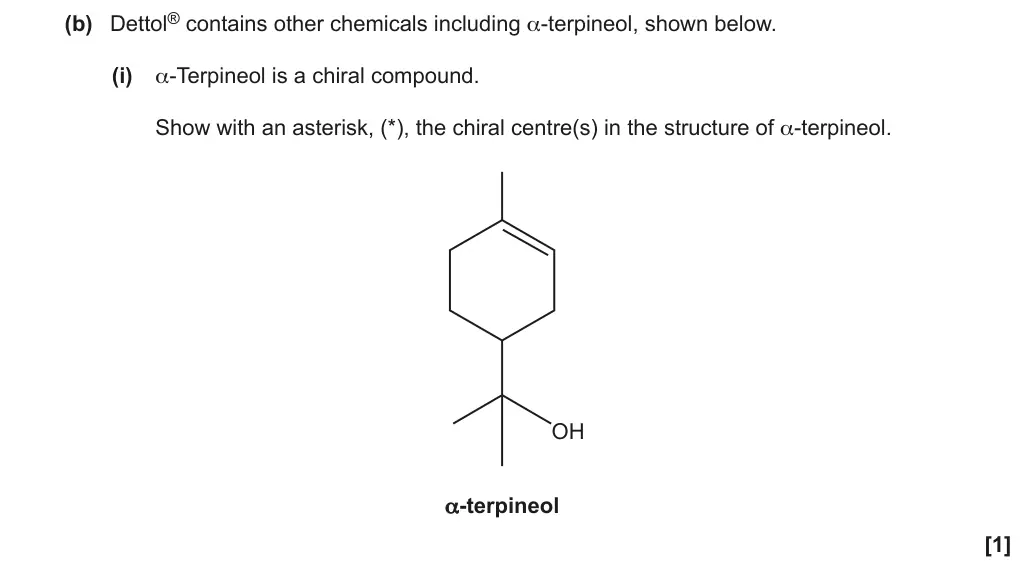
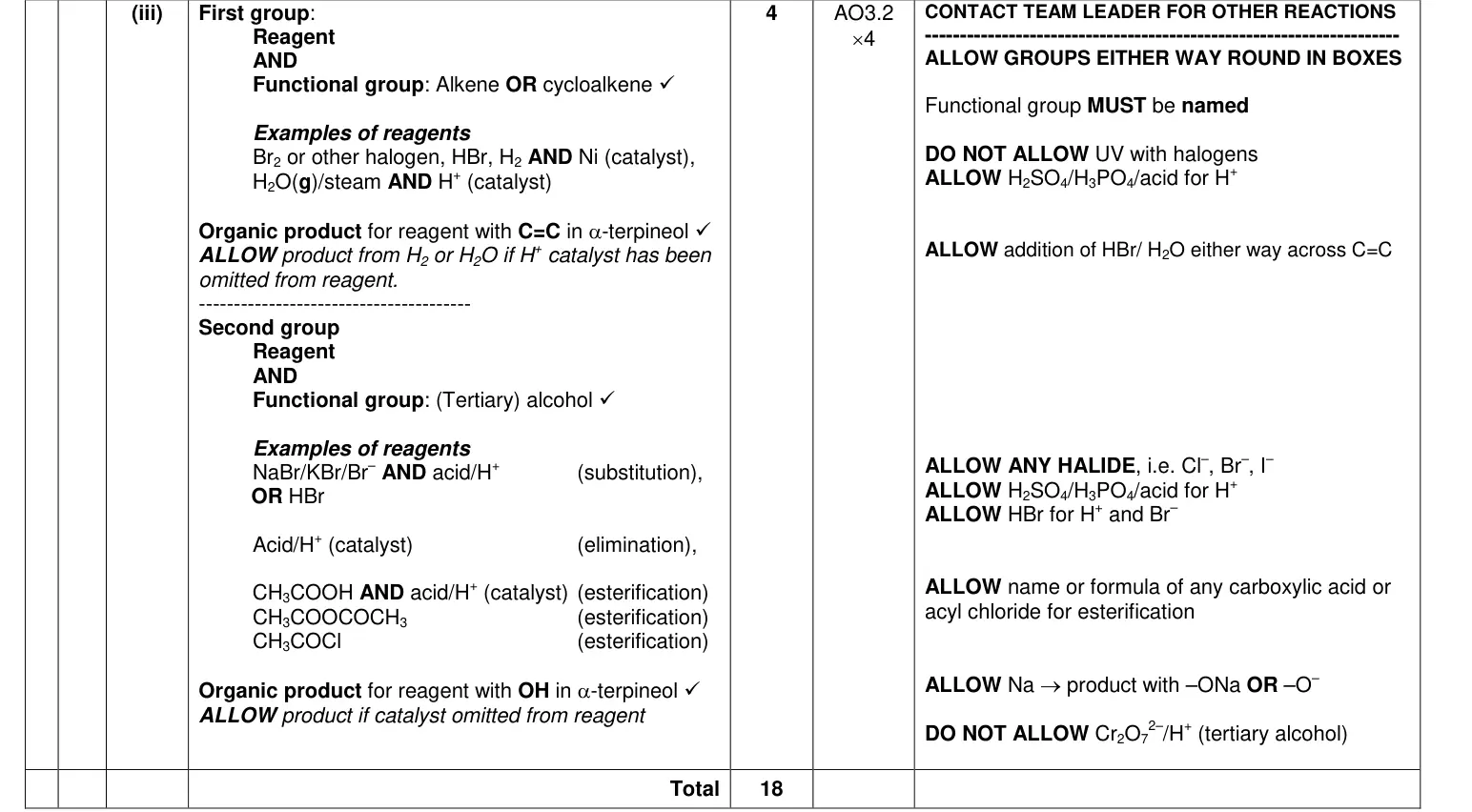
In this question, candidates were given the opportunity to demonstrate some knowledge of organic reaction in a new context. The choice of reaction was up to the candidate. Most candidates were able to identify the alkene group in terpineol and to suggest a reagent that would react with this functional group. A correct structure for the organic product then usually followed. Although most candidates identified the alcohol group, many struggled with a reagent and resulting product. Although the alcohol –OH group has many reactions, (e.g. elimination, substitution, esterification) many candidates were fixated on oxidation with acidified dichromate despite a tertiary alcohol not being capable of oxidation with this reagent. Some candidates quoted acidified dichromate but then copied the structure of terpineol, stating that there was no reaction, despite the question directing them to select a reagent that would react with their chosen group.

B
Many candidates correctly selected B. Option A proved a good distractor, presumably as candidates linked melting point to recrystallisation without fully interpreting statement 3.
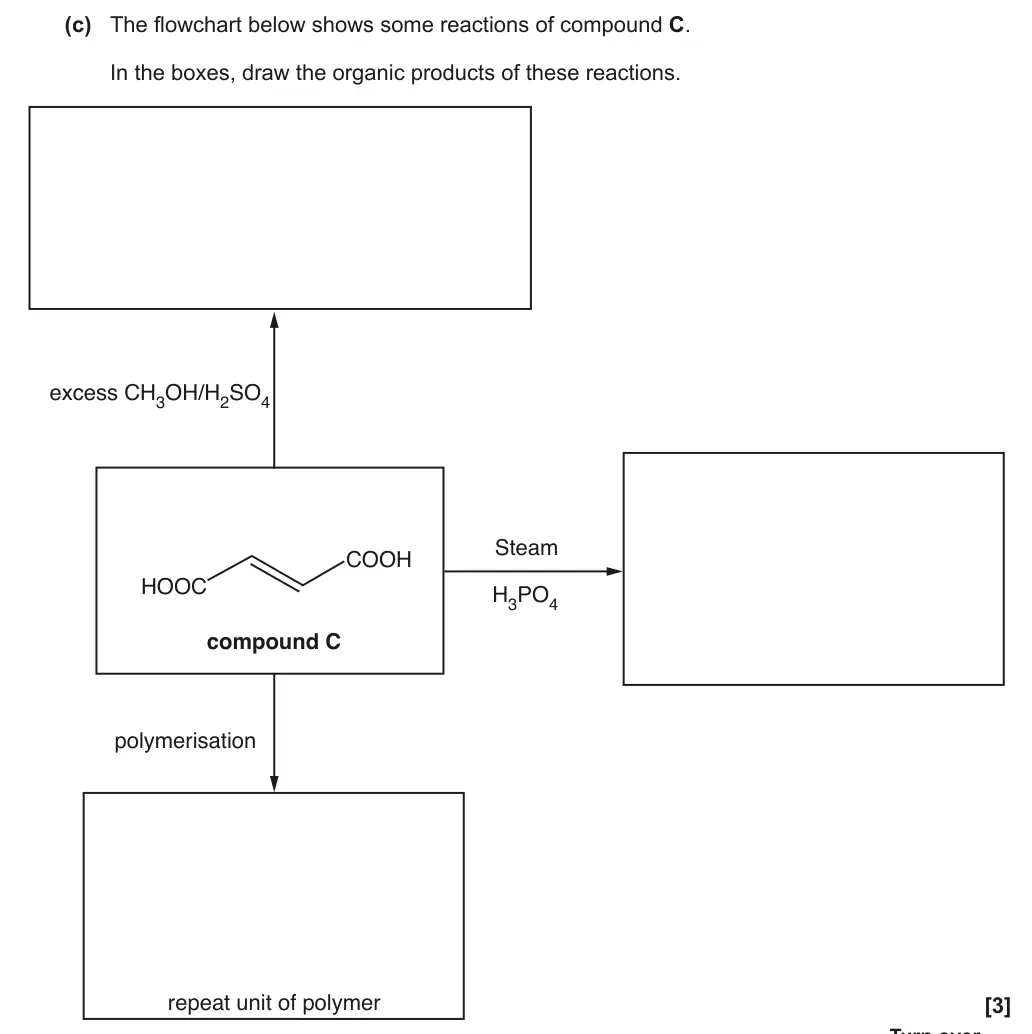
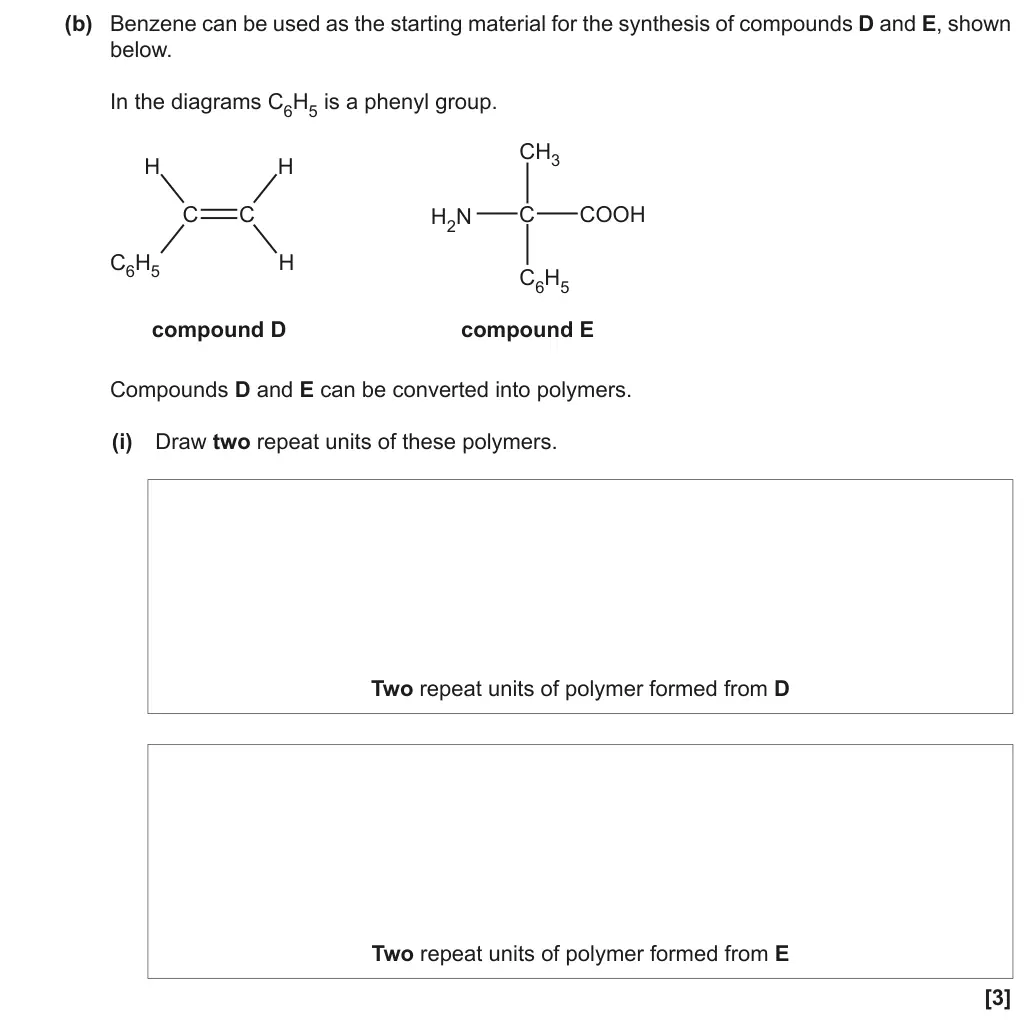
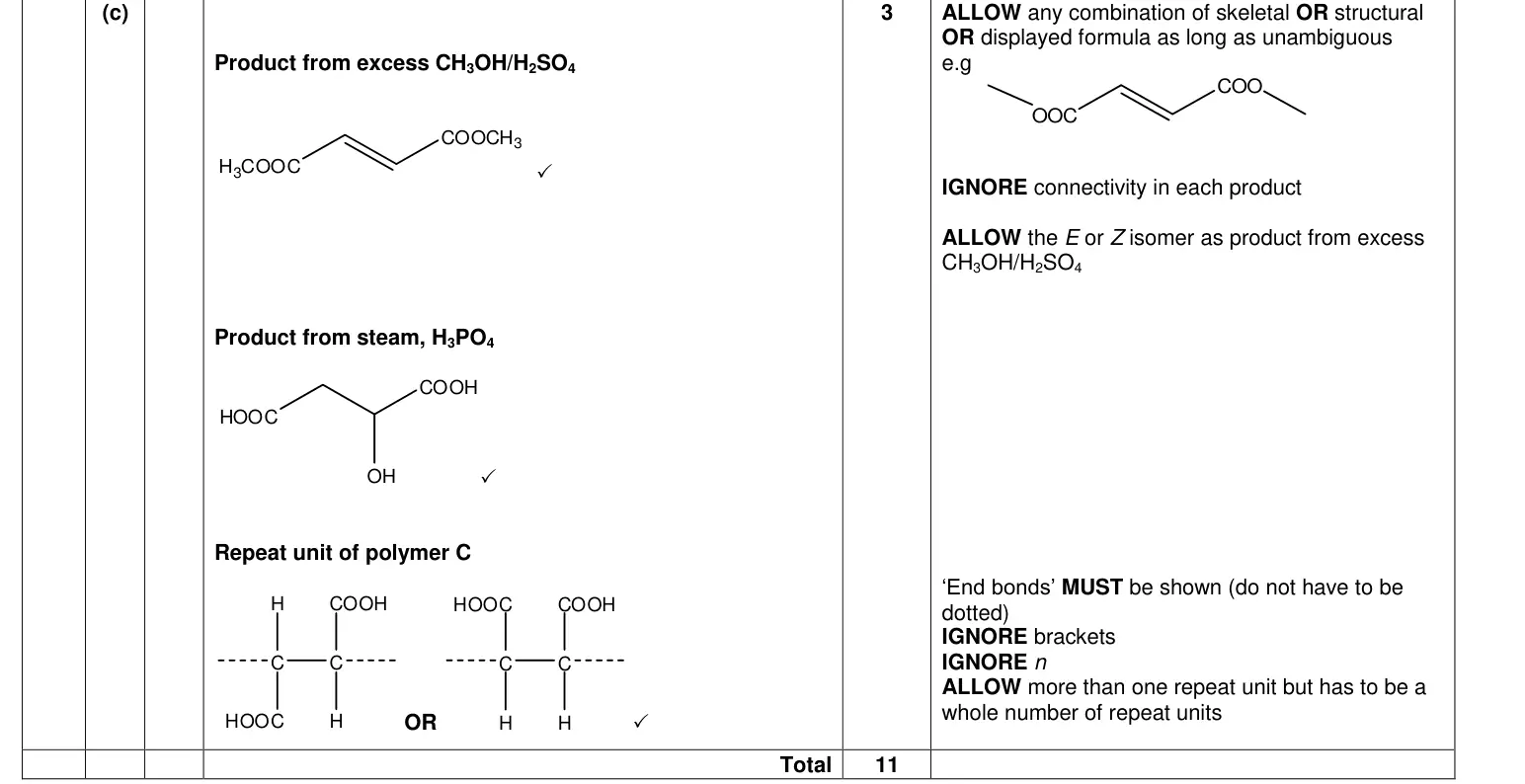
The majority of candidates were able to identify at least one product from the reactions of compound C. The polymerisation reaction appeared to be the most familiar, although some candidates attempted to draw a condensation polymer using the carboxylic acid groups rather than the alkene. The reaction of C with excess methanol was also well attempted. However, a significant number of candidates used chemical symbols to show their product. A proportion of these did not show the H atoms of the alkene group, showing only C=C in the centre of the structure. Candidates are advised to use the type of formulae given in a question as this will reduce the potential for error or omissions. The product from the hydration of C appeared to be the hardest to deduce. Many candidates recognised this reaction would produce an alcohol, but often included two OH groups – one on each C from the double bond – in their structure. Other candidates confused this reaction with hydrogenation and formed a saturated product from C.
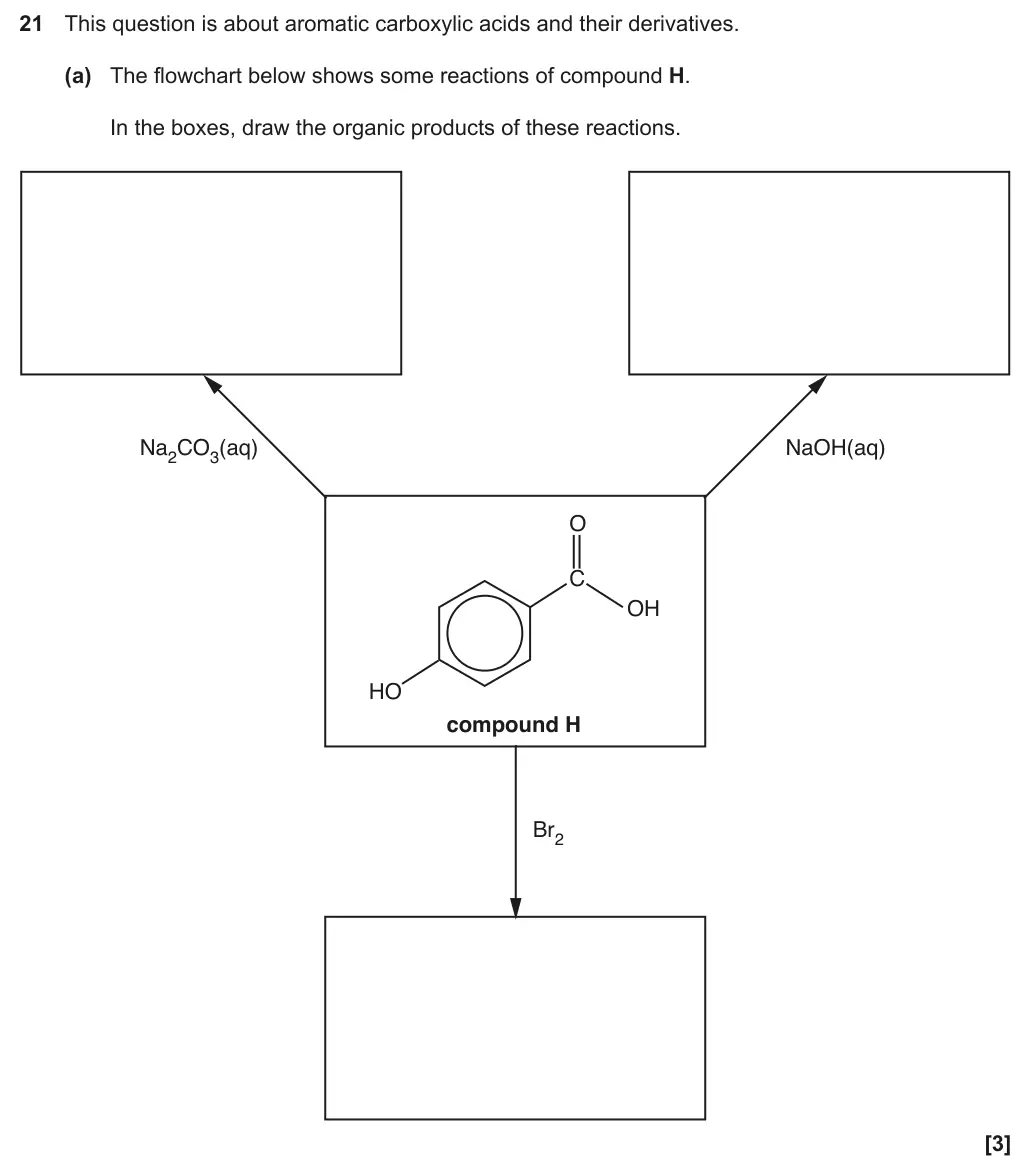
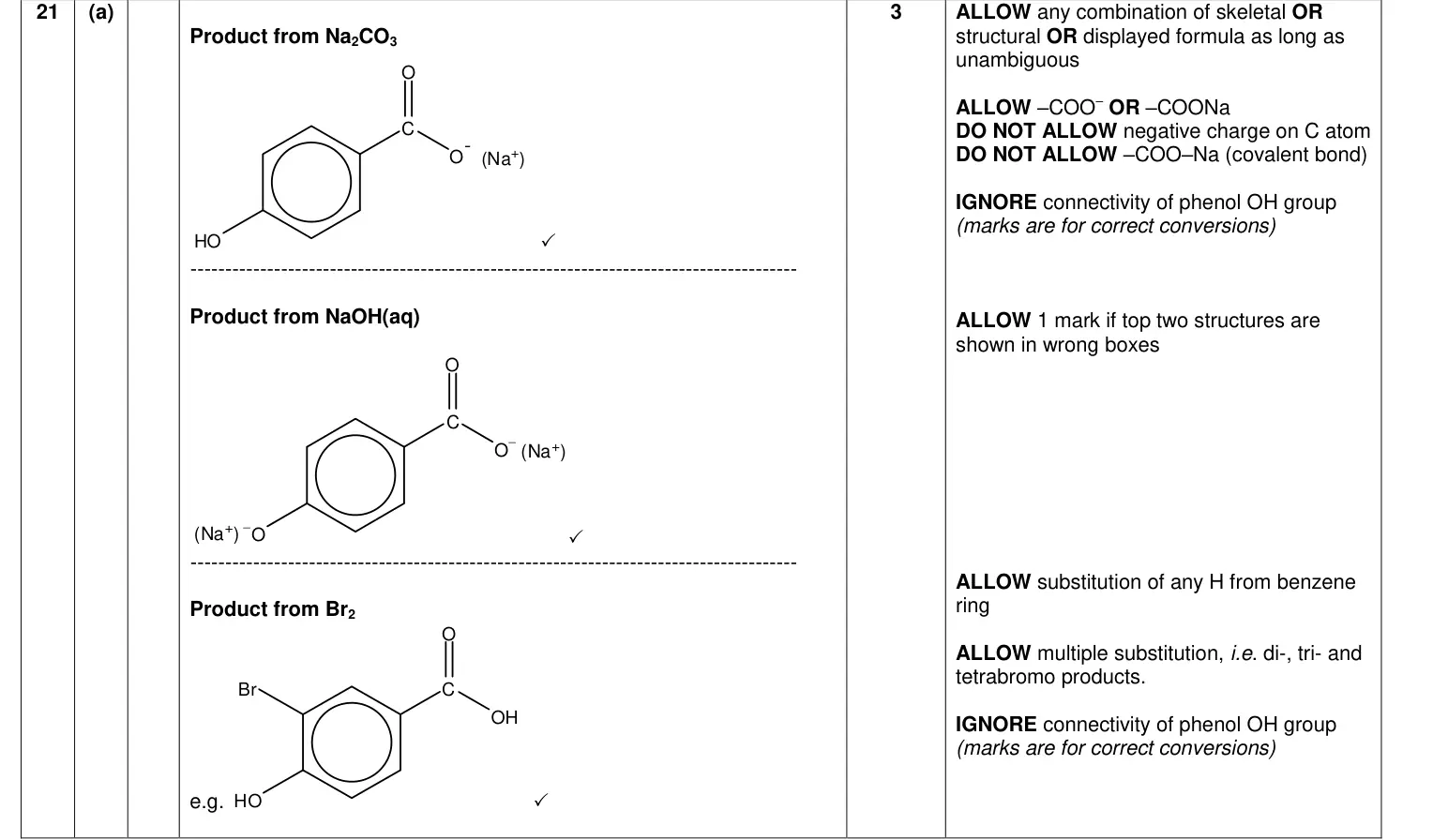
This question assessed different reactions of compound H, 4-hydroxybenzoic acid, and discriminated well. Two of the reactions focused on acid-base chemistry, using the reagents Na2CO3 and NaOH. Many candidates recognised that the carboxylic acid group would react in both cases but only some managed to identify when the phenol group was involved correctly. A number of responses suggested that a phenoxide ion was formed with sodium carbonate but not with sodium hydroxide. The third reaction was substitution with bromine. This reaction appeared more familiar to all candidates with the majority scoring this mark. A small proportion of candidates substituted the phenol OH group or carboxylic acid group.
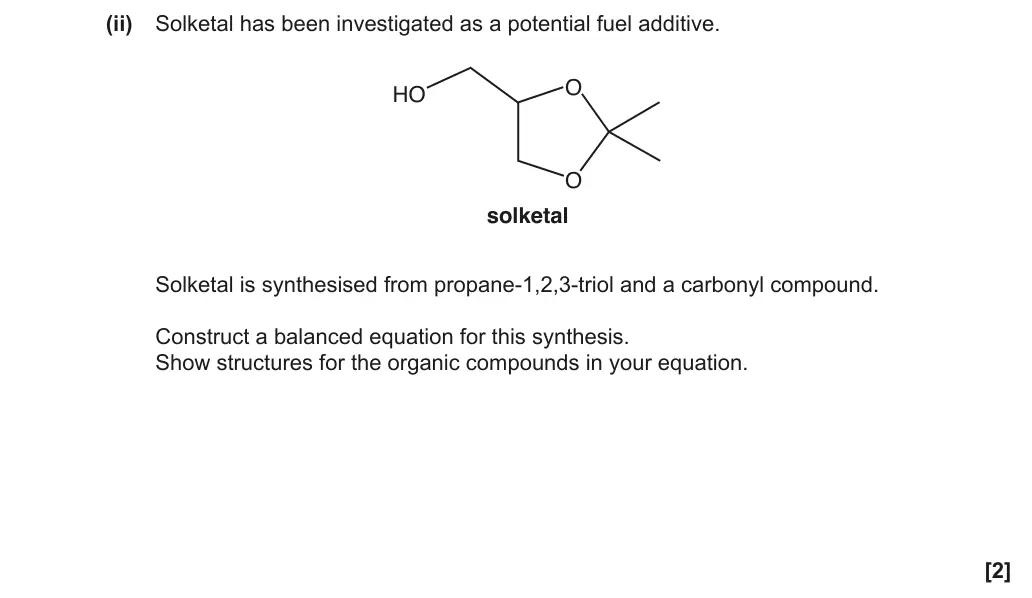
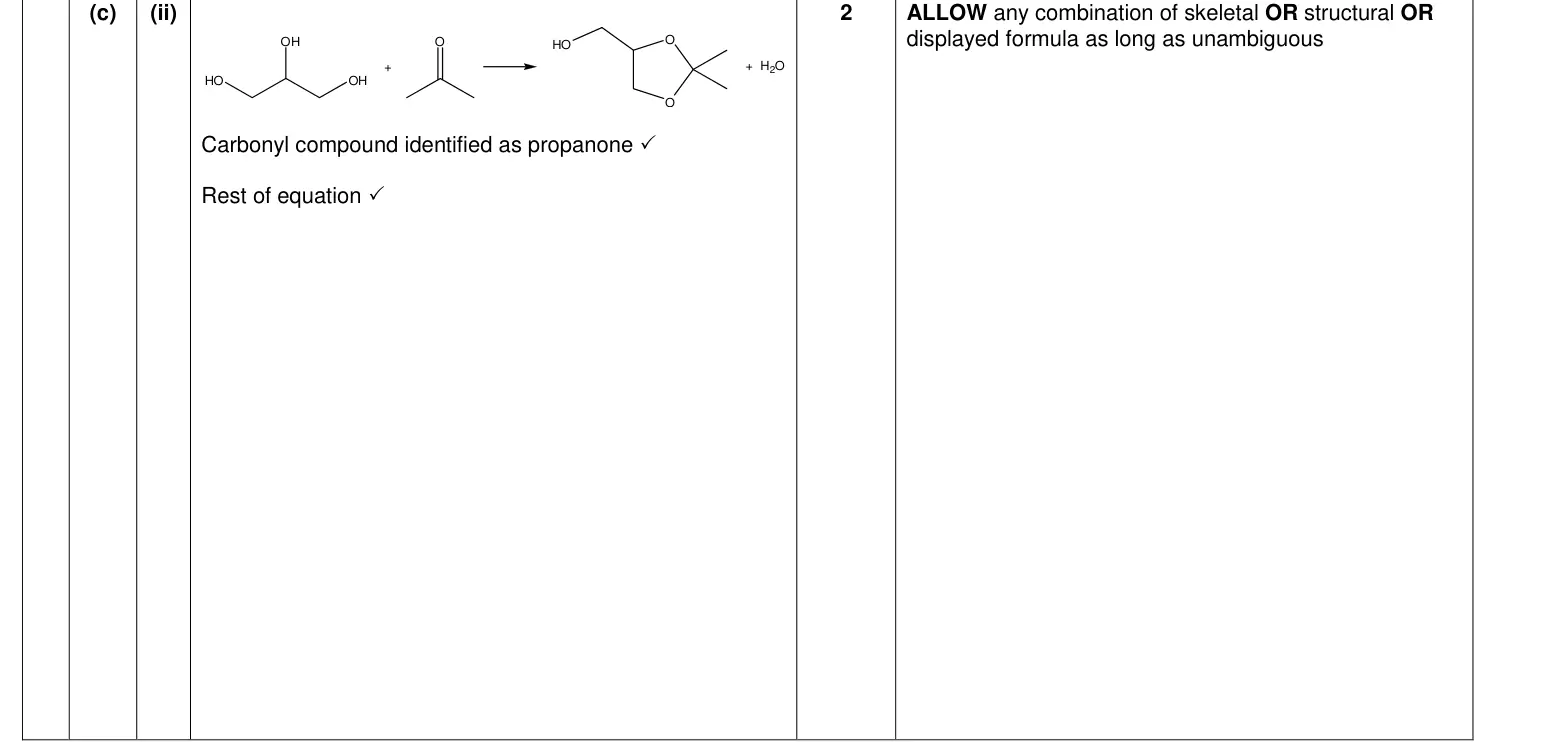
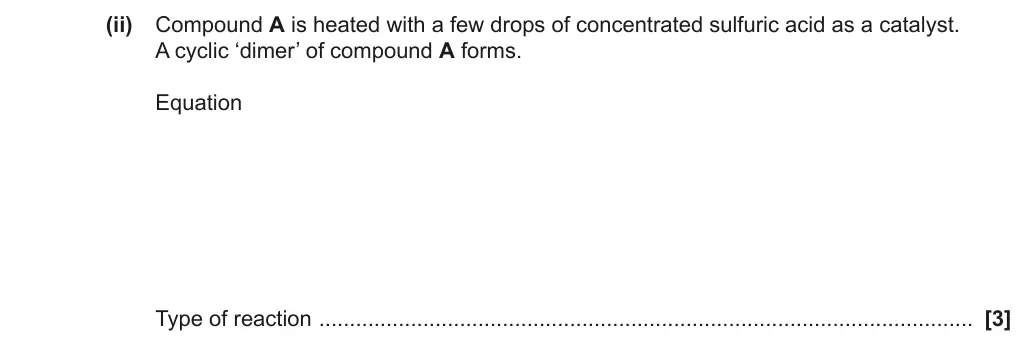
Many candidates found this demanding question very difficult. Some were able to deduce that propanone was the carbonyl compound in the reaction. Only the most able recognised that water was a by-product of this reaction.
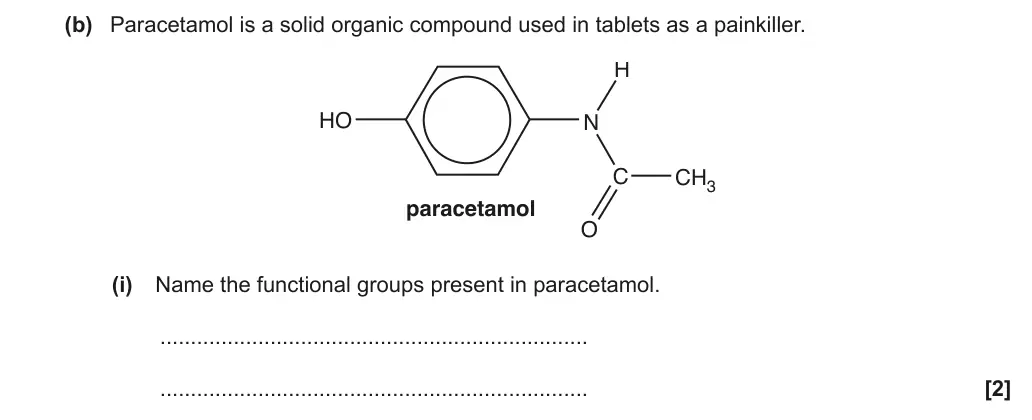
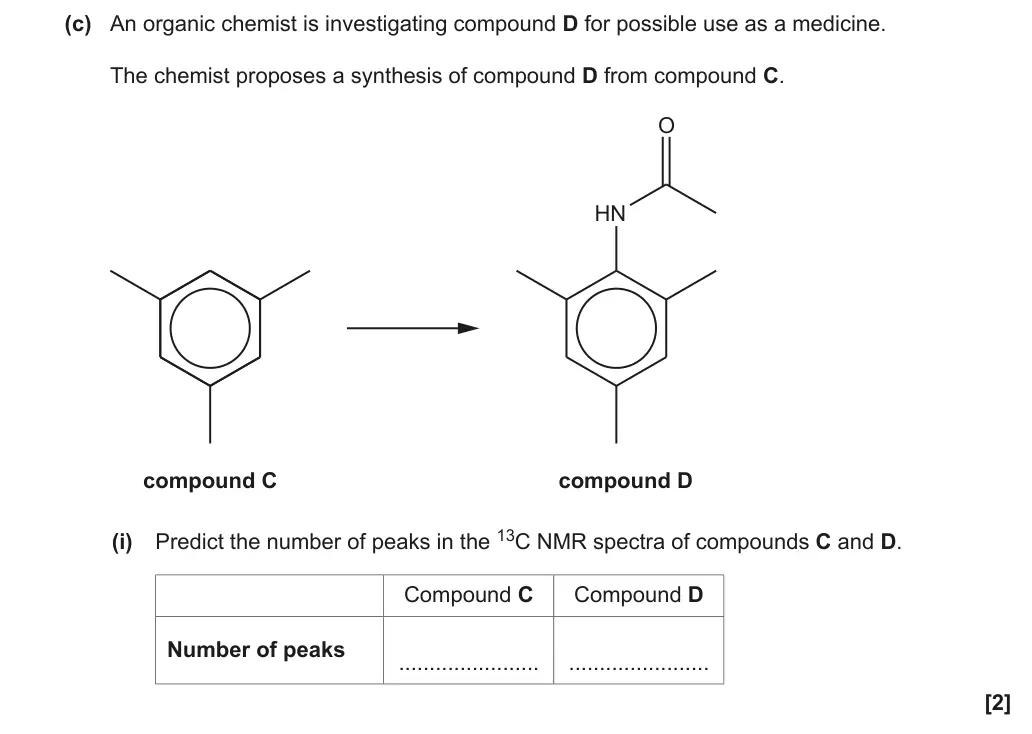
This part assessed knowledge of functional groups and proved to be a very good discriminator. Able candidates usually identified the phenol and amide functional groups, with ‘secondary amide’ also seen. In Exemplar 9, the candidate has identified the correct functional groups. The candidate’s working by circling the functional groups in the structure shows good examination technique, helping the candidate to arrive at the correct conclusion. The phenol group was often incorrectly identified as an alcohol and the amide group as a combination of ‘amine’, ‘ketone’, ‘keytone’ or ‘carbonyl’. Neutral responses such as ‘hydroxyl’ and ‘benzene’ were ignored. Candidates need to be careful that they do not present an extensive list of many functional groups in the hope that the correct groups are amongst them, as shown in Exemplar 10. Incorrect groups are marked first.
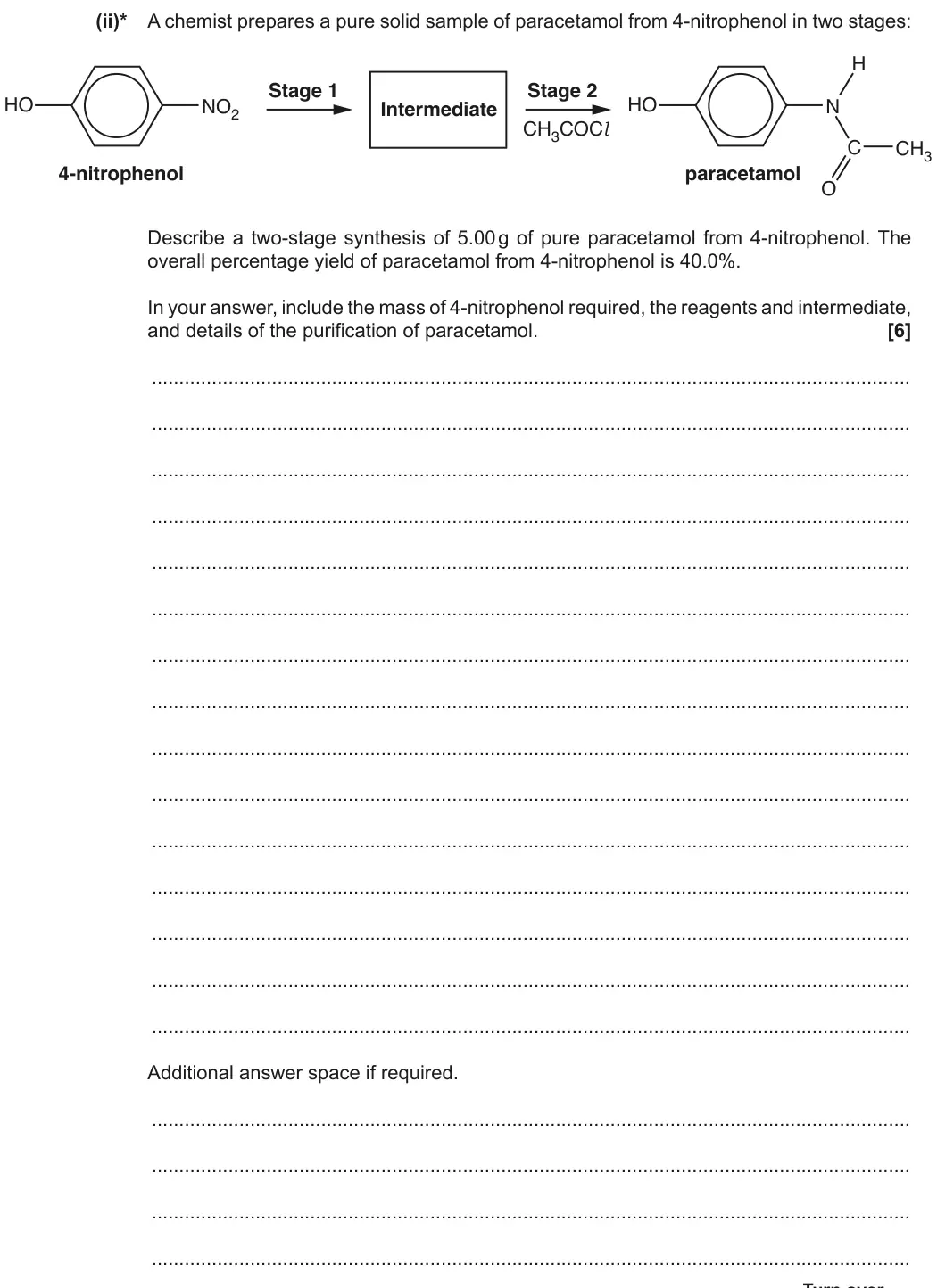
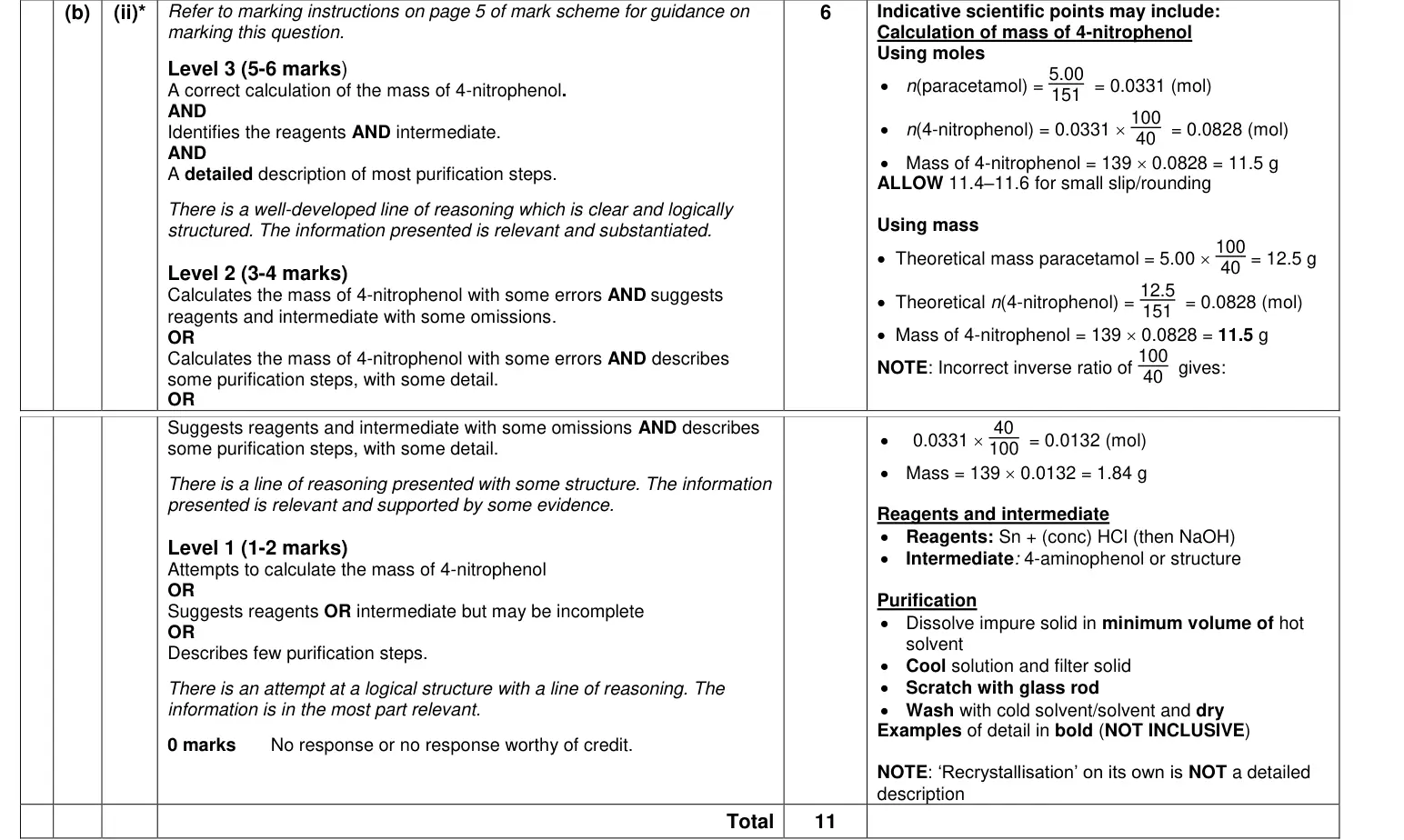
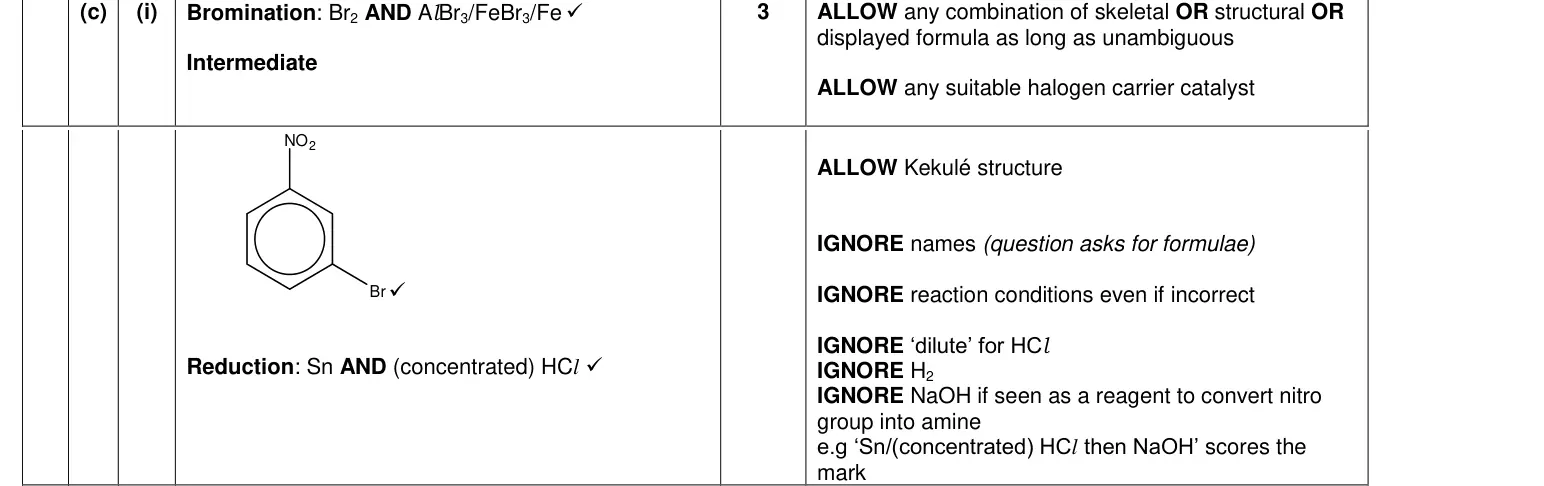
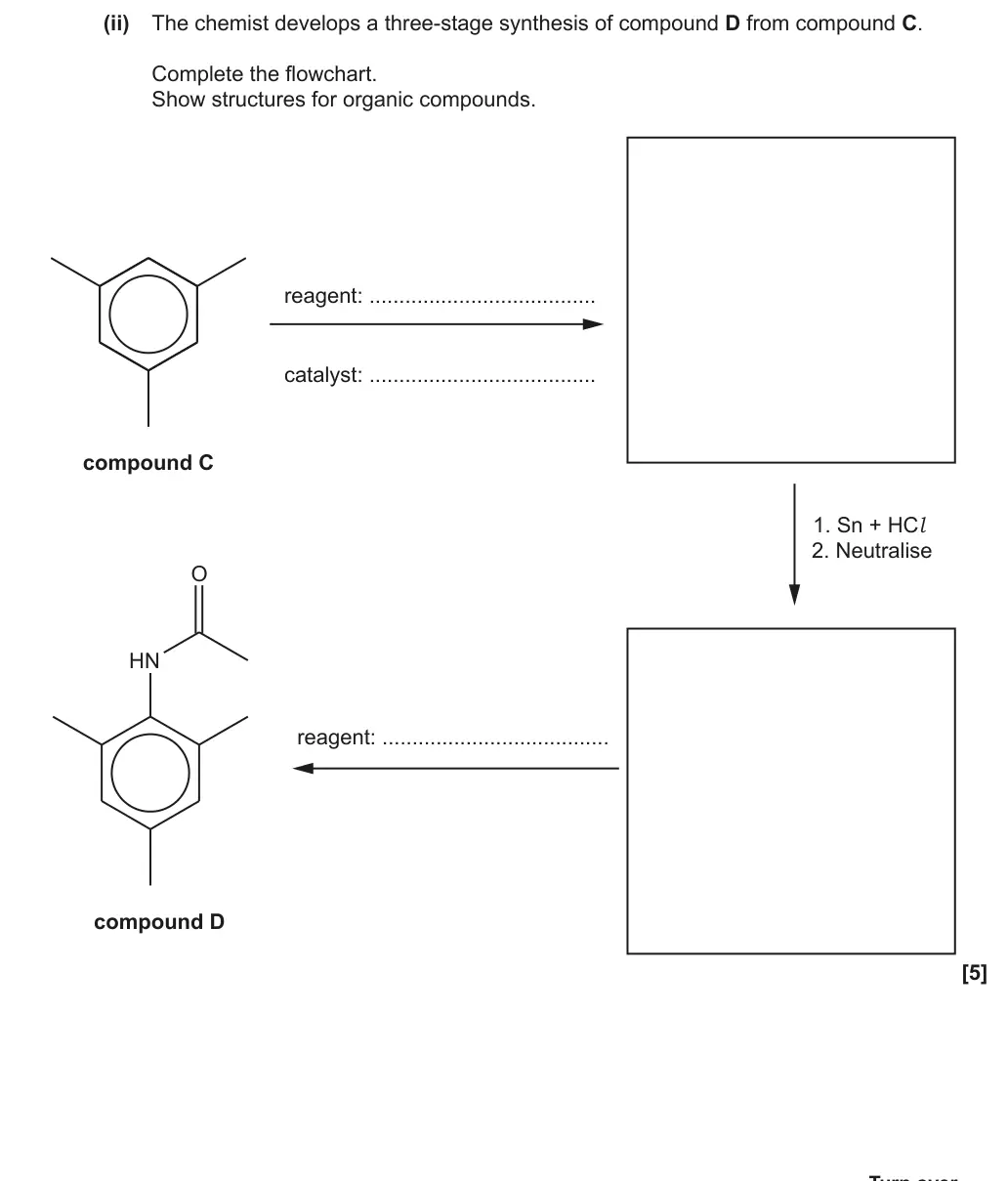
This part assessed practical aspects of a two-stage organic synthesis. Overall, candidates responded well, and this part was discriminating. Many candidates produced well-structured responses although lower ability candidates do have problems with constructing a cohesive response. Most candidates identified the correct reagents (Sn and concentrated HCl) and the intermediate (4- aminophenol), which was usually shown as its structure. Able candidates usually showed that 11.5 g of 4-nitrophenol is needed for the synthesis. A common error used the ‘inverse percentage’ ratio of 40/100, resulting in an incorrect mass of 1.84 g. Candidates are recommended to check whether a calculated answer looks sensible. Looking at the structures and with a percentage yield of 40%, 1.84 g does not look to be enough of the starting chemical. Some lower ability candidate responses assumed that 5.00 g was 40% of the required mass and responded with 5.00 × 100/40 = 12.5 g. There were some good descriptions of purification, although finer details such as using a minimum volume of hot solvent, washing with cold solvent, and drying) were often omitted. Candidates needed to respond with more than just ‘recrystallisation’. In the purification, common errors were showing the correct steps but in the wrong order and use of a drying agent such as CaCl2 (confusion with part of the purification of an organic liquid). These candidates seemed unaware that adding a solid drying agent to an organic solid would result in impure paracetamol rather than purifying. In comparison, Exemplar 12 is much less detailed: concentrated HCl has not been shown as a reagent for step 1, the candidate has not shown that they know how to carry out a percentage yield calculation, and the purification is confused, and lacks detail.
Skills: M0.2 Use ratios, fractions and percentages; M2.2 Change the subject of an equation; PAG6 Synthesis of an organic solid

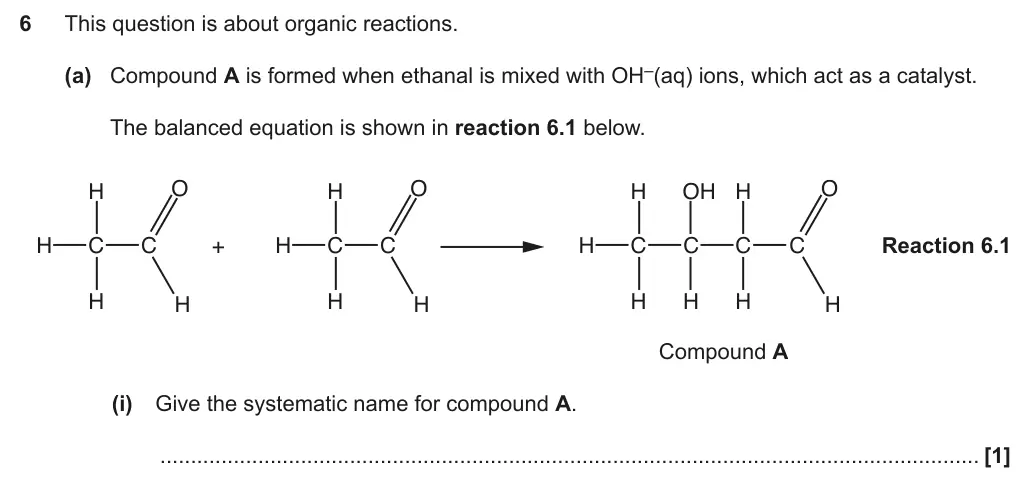
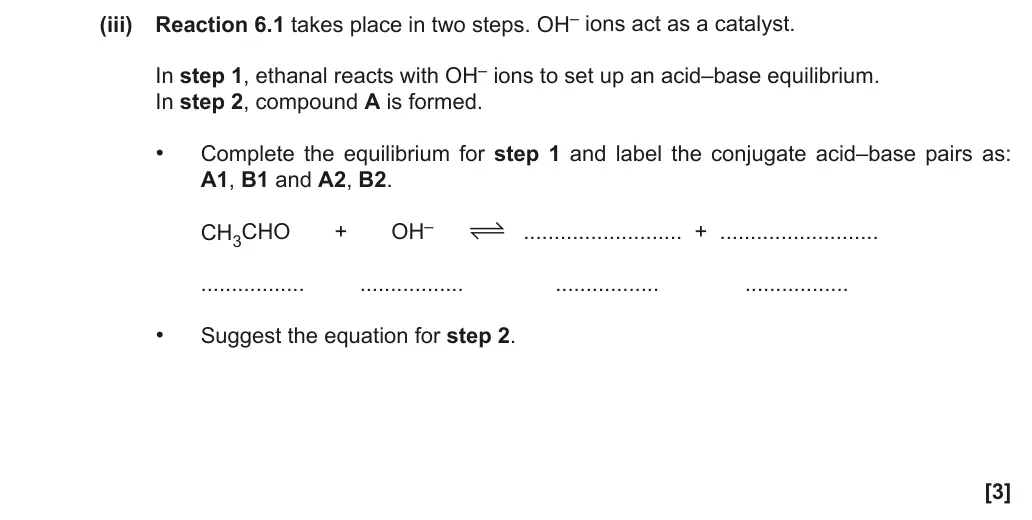
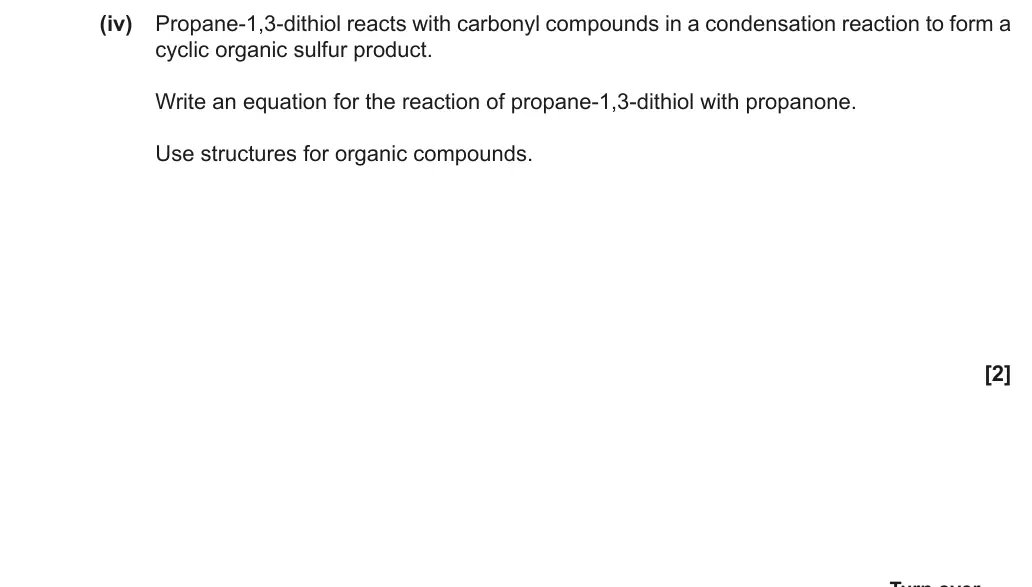
This part was one of the most challenging on the paper. Candidates needed to link the earlier information for combining two ethanal molecules to derive the product for combining two propanone molecules. Despite the challenge, the highest ability candidates were able to come up with the correct structure.

A
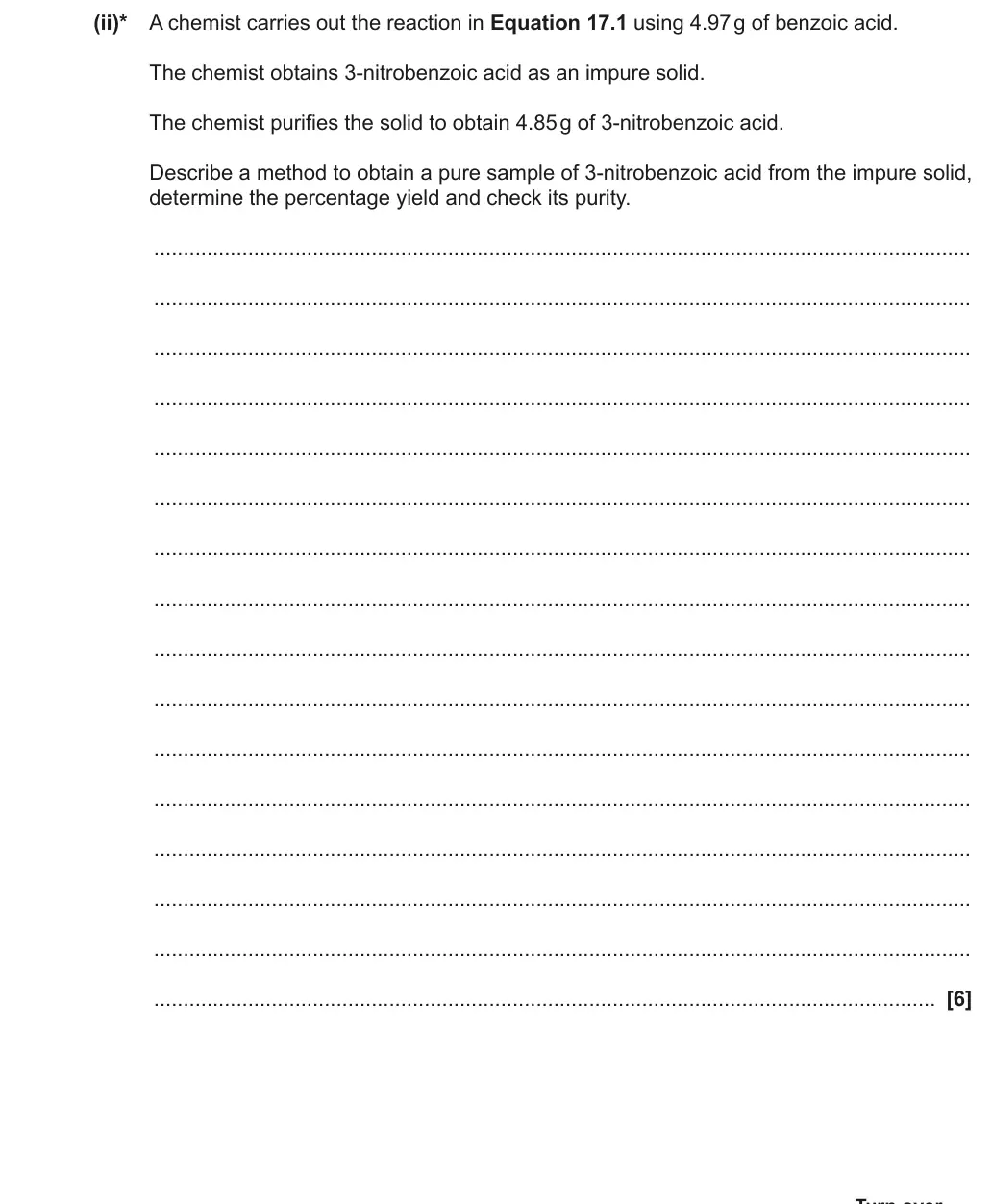
Skills: M0.2 Use ratios, fractions and percentages; M2.3 Substitute numerical values into algebraic equations using appropriate units for physical quantities; PAG6 Synthesis of an organic solid
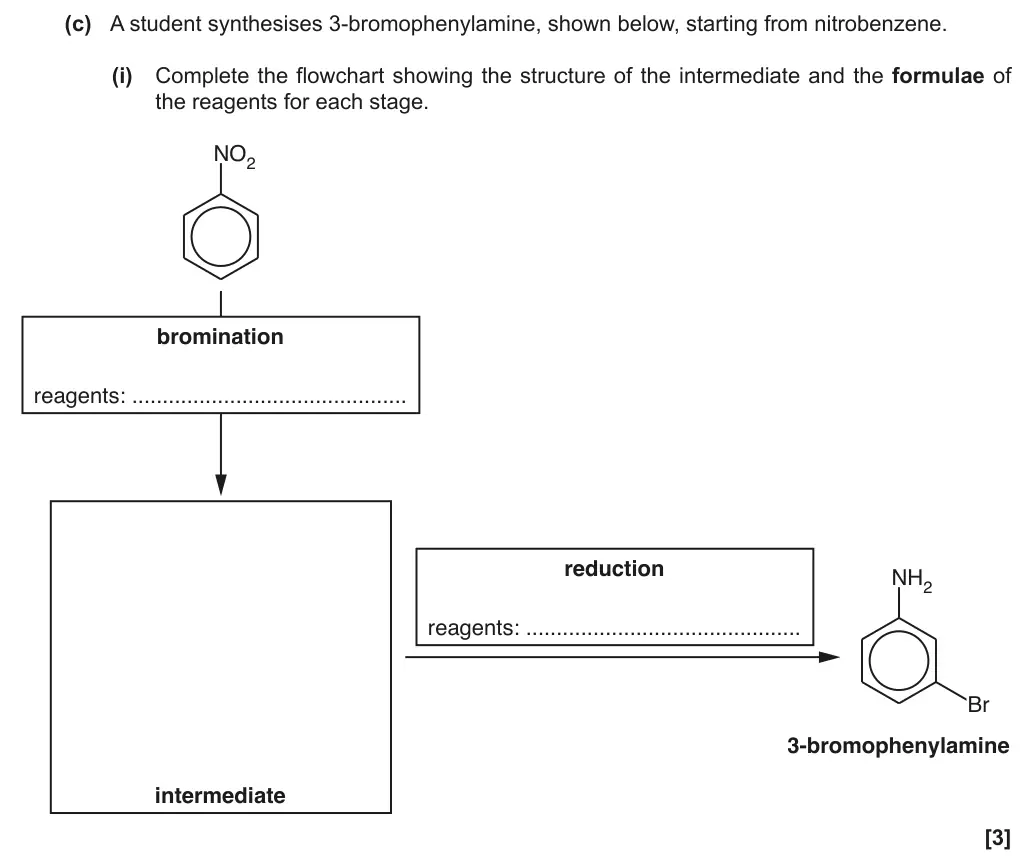


Skills: PAG7 Qualitative analysis of organic functional groups
Dropping marks on calculations, mechanisms or the six-markers? Book a trial session with a specialist OCR chemistry tutor.