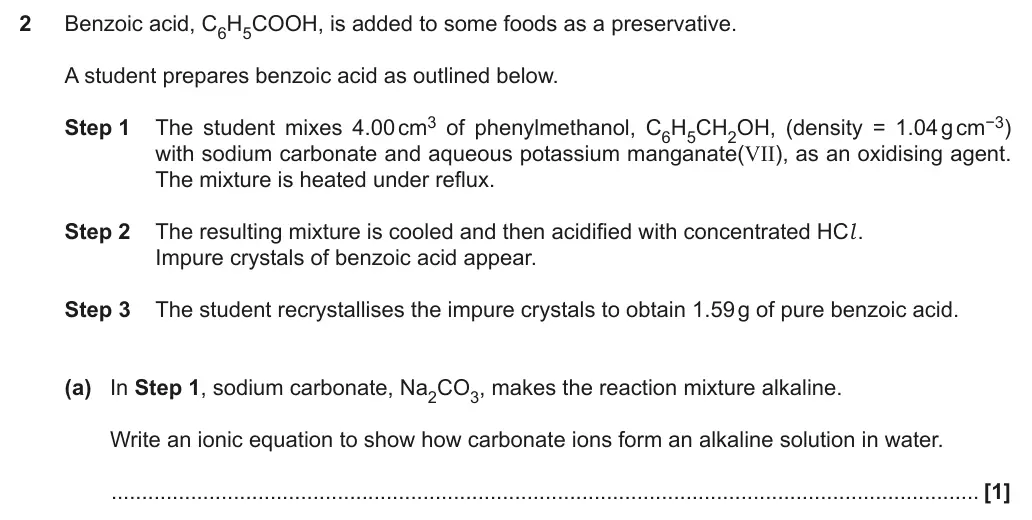
Notes and key-term cards for this topic are being written by our tutors. The past-paper questions below are ready now.
Learning outcomes
Show the 30 learning outcomes from the specification
1.2.1(a) apply investigative approaches and methods to practical work
1.2.1(b) safely and correctly use a range of practical equipment and materials
1.2.1(c) follow written instructions
1.2.1(d) make and record observations/measurements
1.2.1(e) keep appropriate records of experimental activities
1.2.1(f) present information and data in a scientific way
1.2.1(g) use appropriate software and tools to process data, carry out research and report findings
1.2.1(h) use online and offline research skills including websites, textbooks and other printed scientific sources of information
1.2.1(i) correctly cite sources of information
1.2.1(j) use a wide range of experimental and practical instruments, equipment and techniques appropriate to the knowledge and understanding included in the specification.
1.2.2(a) use of appropriate apparatus to record a range of measurements (to include mass, time, volume of liquids and gases, temperature)
1.2.2(b) use of a water bath or electric heater or sand bath for heating
1.2.2(c) measurement of pH using pH charts, or pH meter, or pH probe on a data logger
1.2.2(d) use of laboratory apparatus for a variety of experimental techniques including:
1.2.2(d)(i) titration, using burette and pipette
1.2.2(d)(ii) distillation and heating under reflux, including setting up glassware using retort stand and clamps
1.2.2(d)(iii) qualitative tests for ions and organic functional groups
1.2.2(d)(iv) filtration, including use of fluted filter paper, or filtration under reduced pressure
1.2.2(e) use of a volumetric flask, including accurate technique for making up a standard solution
1.2.2(f) use of acid– base indicators in titrations of weak/ strong acids with weak/strong alkalis
1.2.2(g) purification of:
1.2.2(g)(i) a solid product by recrystallisation
1.2.2(g)(ii) a liquid product, including use of a separating funnel
1.2.2(h) use of melting point apparatus
1.2.2(i) use of thin layer or paper chromatography
1.2.2(j) setting up of electrochemical cells and measuring voltages
1.2.2(k) safely and carefully handling solids and liquids, including corrosive, irritant, flammable and toxic substances
1.2.2(l) measurement of rates of reaction by at least two different methods, for example:
1.2.2(l)(i) an initial rate method such as a clock reaction
1.2.2(l)(ii) a continuous monitoring method.
Six-mark level of response questions on this topic
2-Chlorobutane, CH3CH2CHCl CH3, is an organic liquid with a boiling point of 70 °C. Describe how the student could obtain a pure, dry sample of CH3CH2CHCl CH3 from the reaction
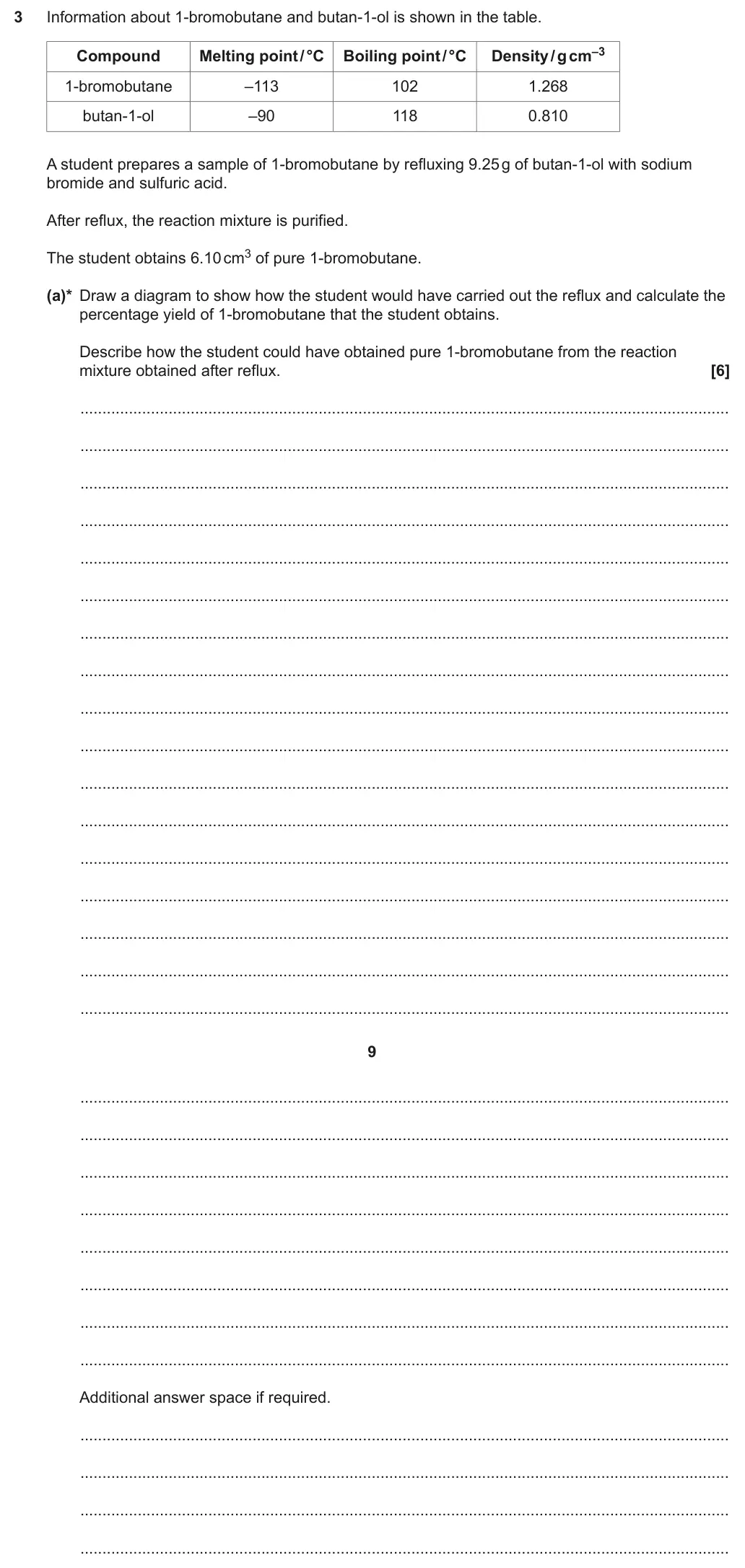
Draw a diagram to show how the student would have carried out the reflux and calculate the Describe how the student could have obtained pure 1-bromobutane from the reaction
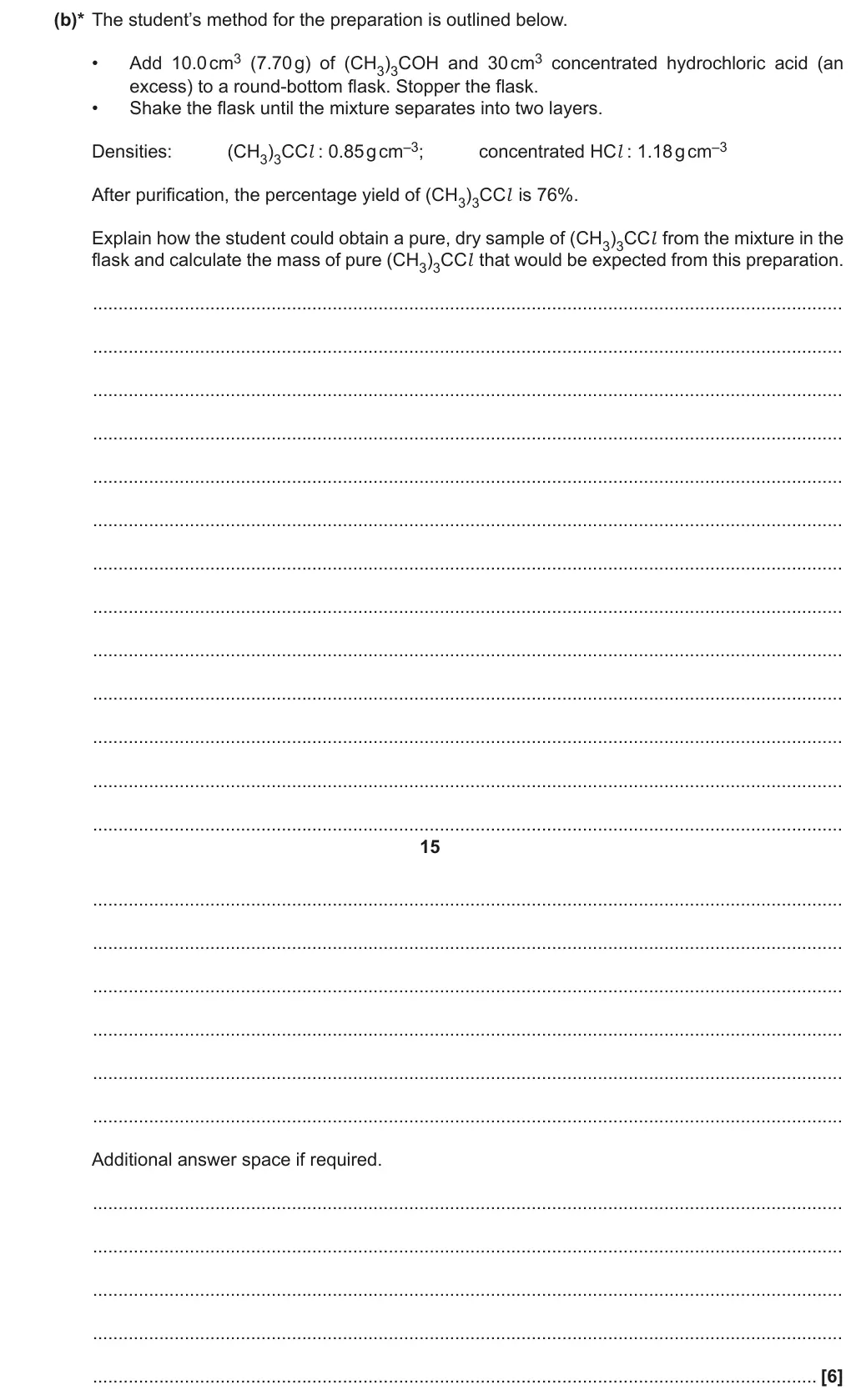
The student’s method for the preparation is outlined below. Explain how the student could obtain a pure, dry sample of (CH3)3CCl from the mixture in the
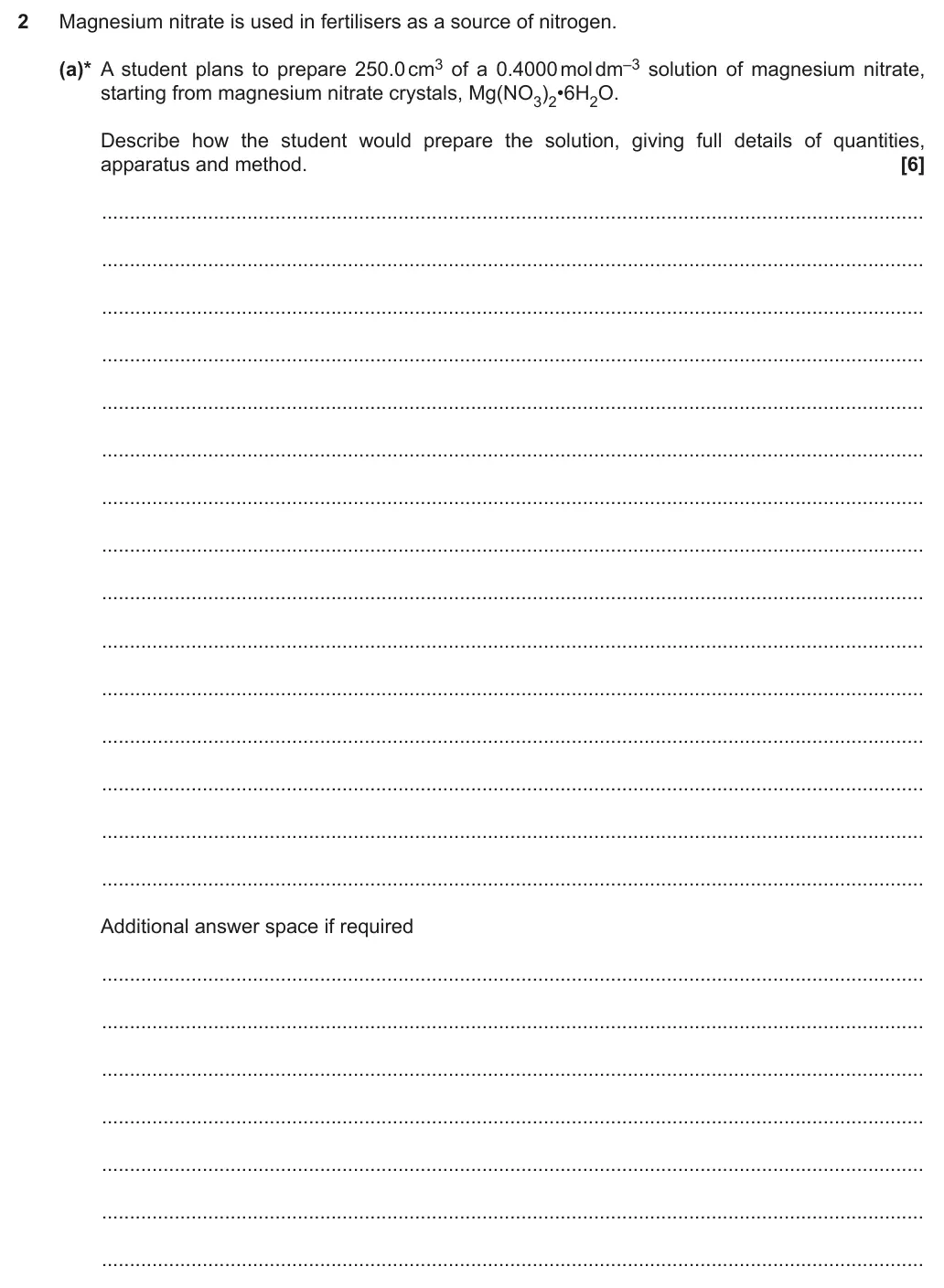
A student plans to prepare 250.0 cm3 of a 0.4000 mol dm–3 solution of magnesium nitrate, Describe how the student would prepare the solution, giving full details of quantities,
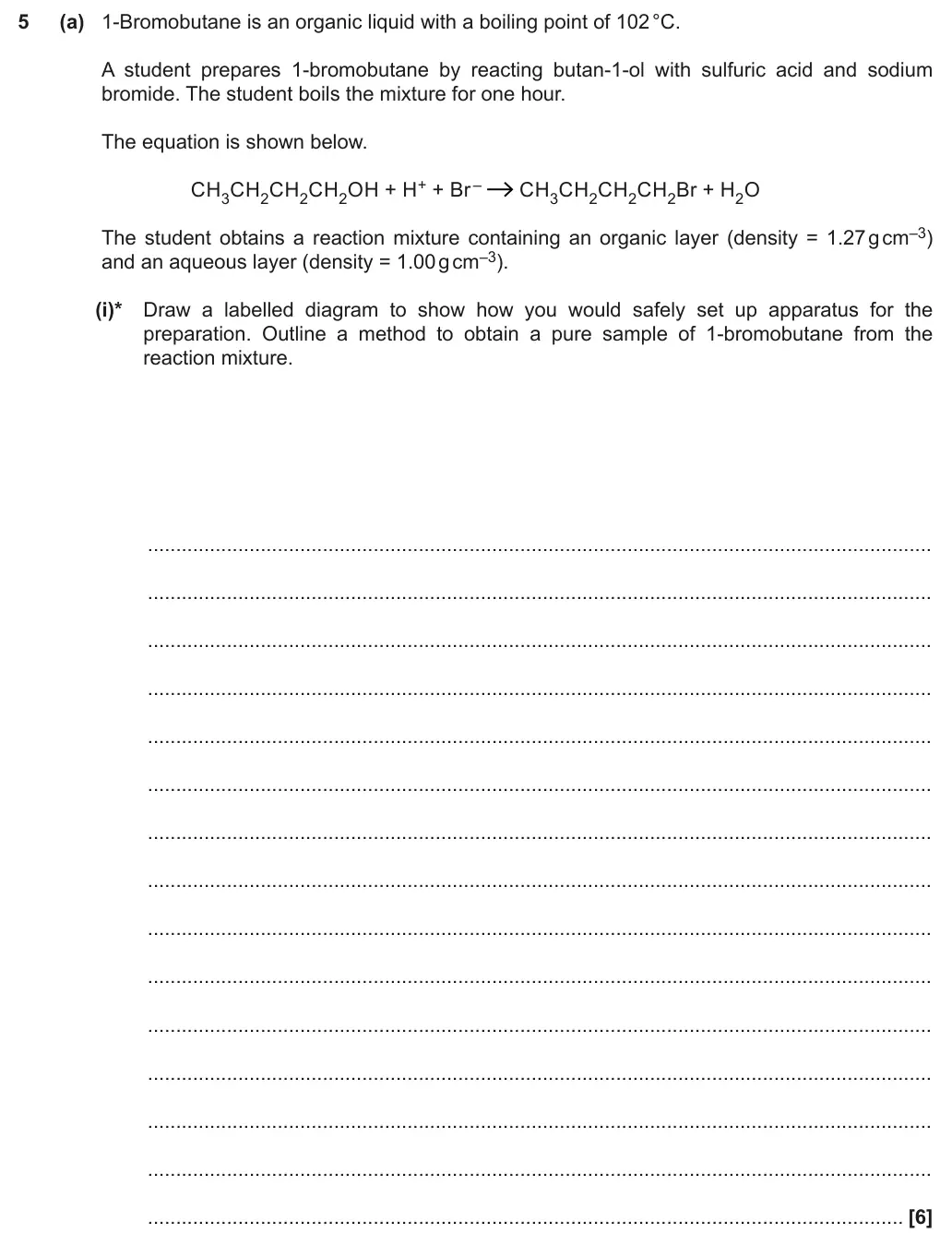
Draw a labelled diagram to show how you would safely set up apparatus for the preparation. Outline a method to obtain a pure sample of 1-bromobutane from the
Tap a question to zoom it. Where a part needs a table, graph or structure from an earlier part, that part folds out above it; the mark scheme and examiner's comment open underneath. Have the OCR Data Sheet beside you.
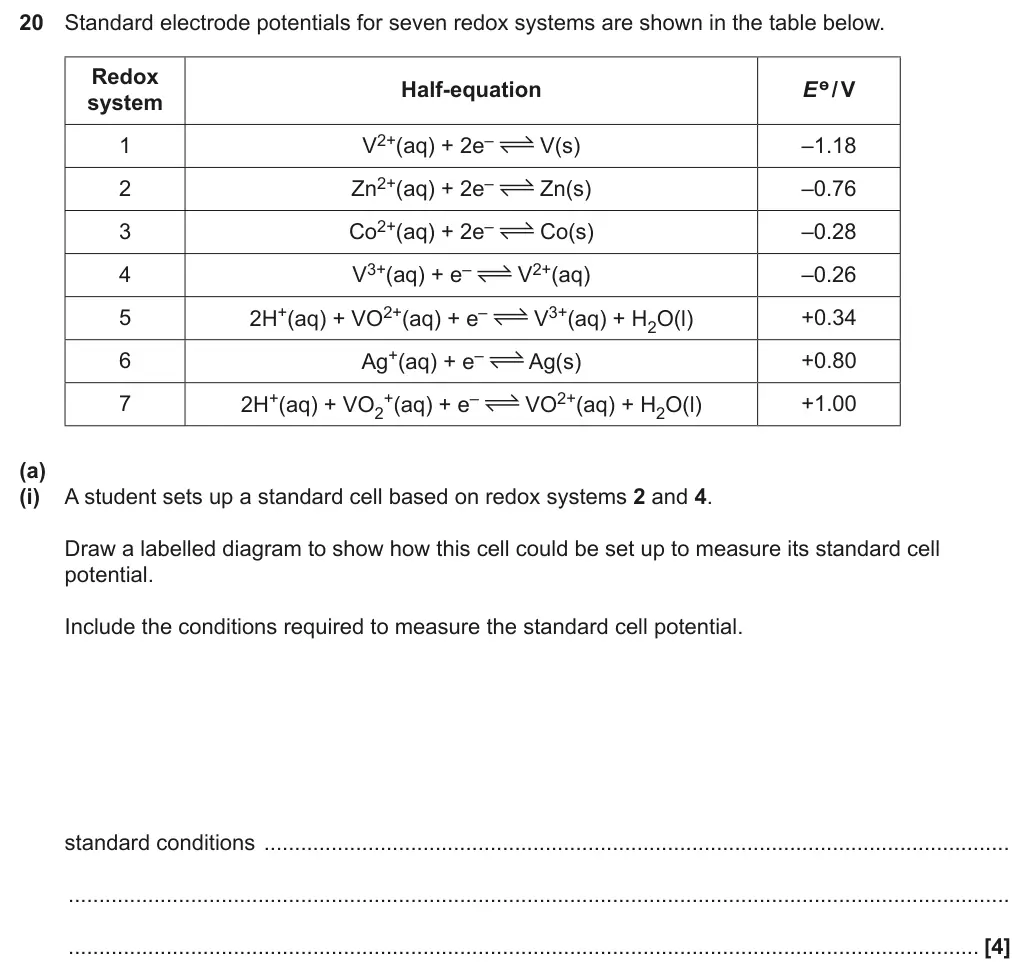
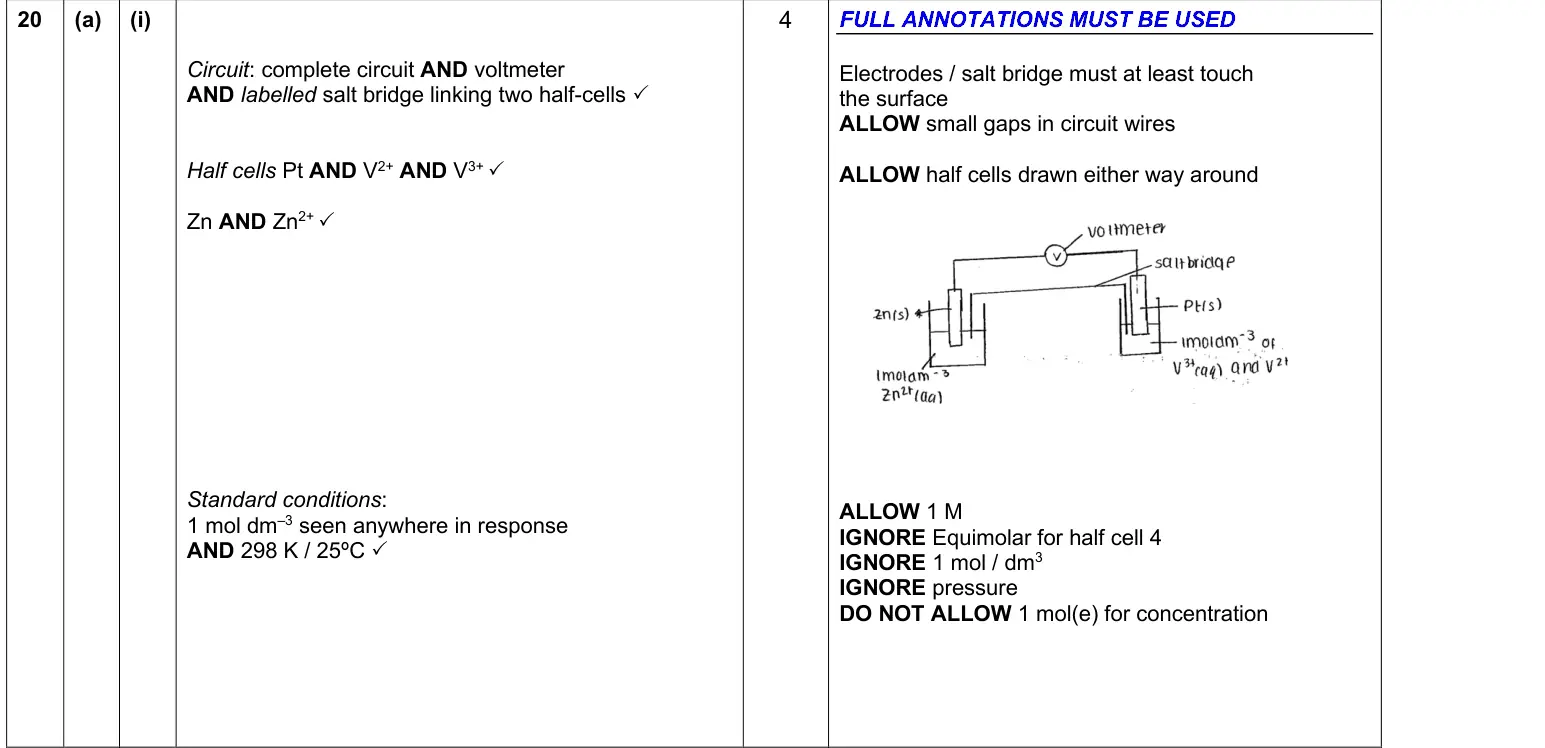
June 2025 · Paper 1 · Q20(a)(i)4 marksDrawing / labellingMedium
Mark scheme
Examiner's comment
Candidates made good progress and produced good diagrams with many given 4 marks. More candidates appreciated how the vanadium half-cell was set up than in previous series. Common errors were to miss the labelling of the salt bridge or to quote an incorrect temperature, e.g. 273K or 293K. Occasionally a hydrogen electrode was drawn, or V was used instead of Pt. Some candidates put H+ in with their V2+ /V3+.
Notes from the mark scheme and report
complete circuit with voltmeter AND labelled salt bridge
Pt electrode in V2+ AND V3+
Zn in Zn2+
1 mol dm–3 AND 298 K (DO NOT ALLOW 1 mol
IGNORE pressure and 'equimolar')
electrodes/salt bridge must dip into solutions
Skills: PAG8 Electrochemical cells
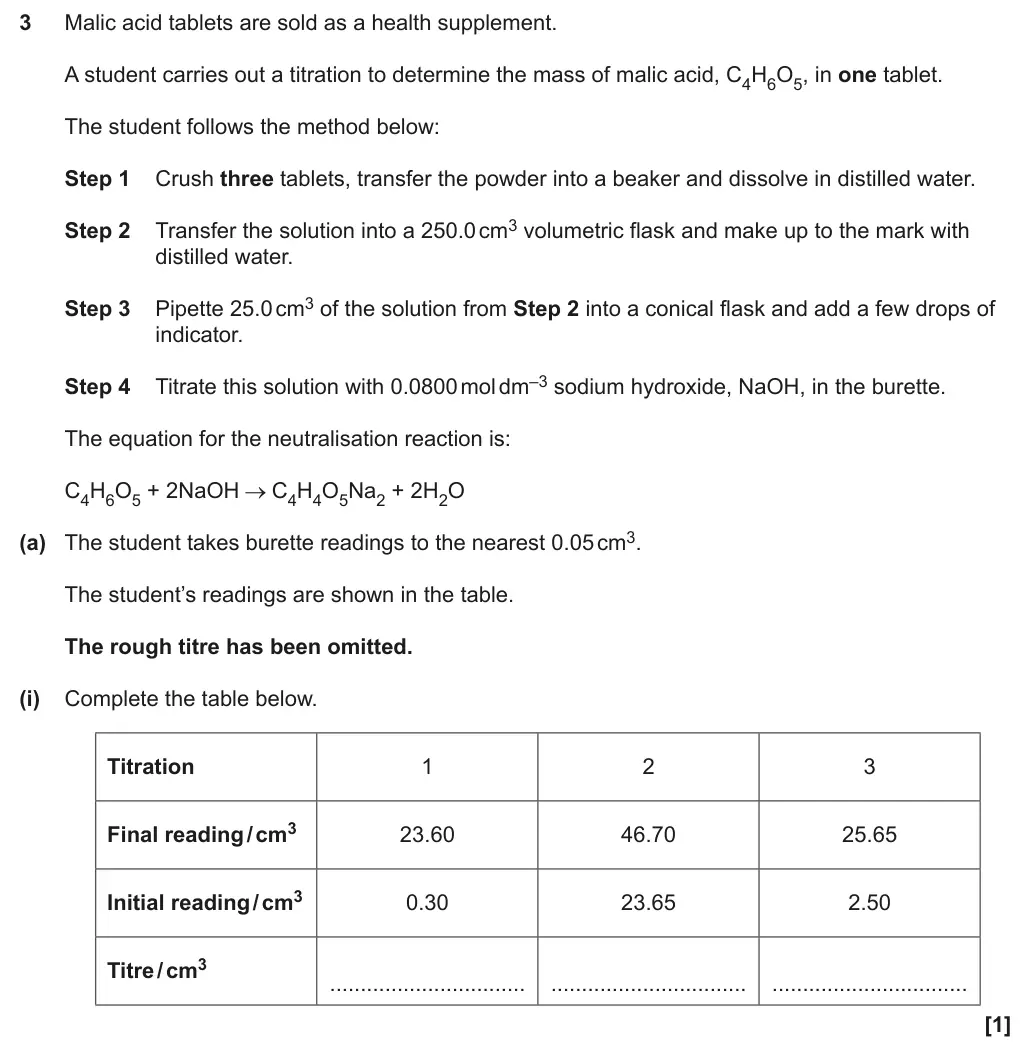
June 2025 · AS Paper 2 · Q3(a)(i)1 markComplete table/diagramHard
Mark scheme
Examiner's comment
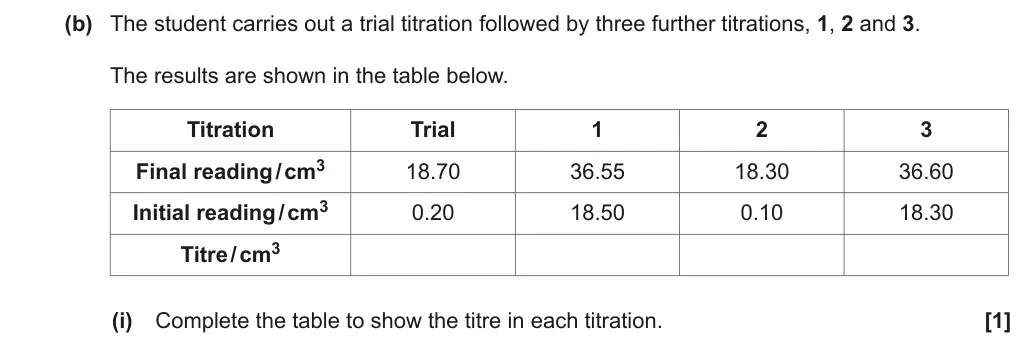
Very few lost this mark and when they did it was usually for the giving the first titre to only 1 decimal place. Occasionally arithmetic errors were seen.
Notes from the mark scheme and report
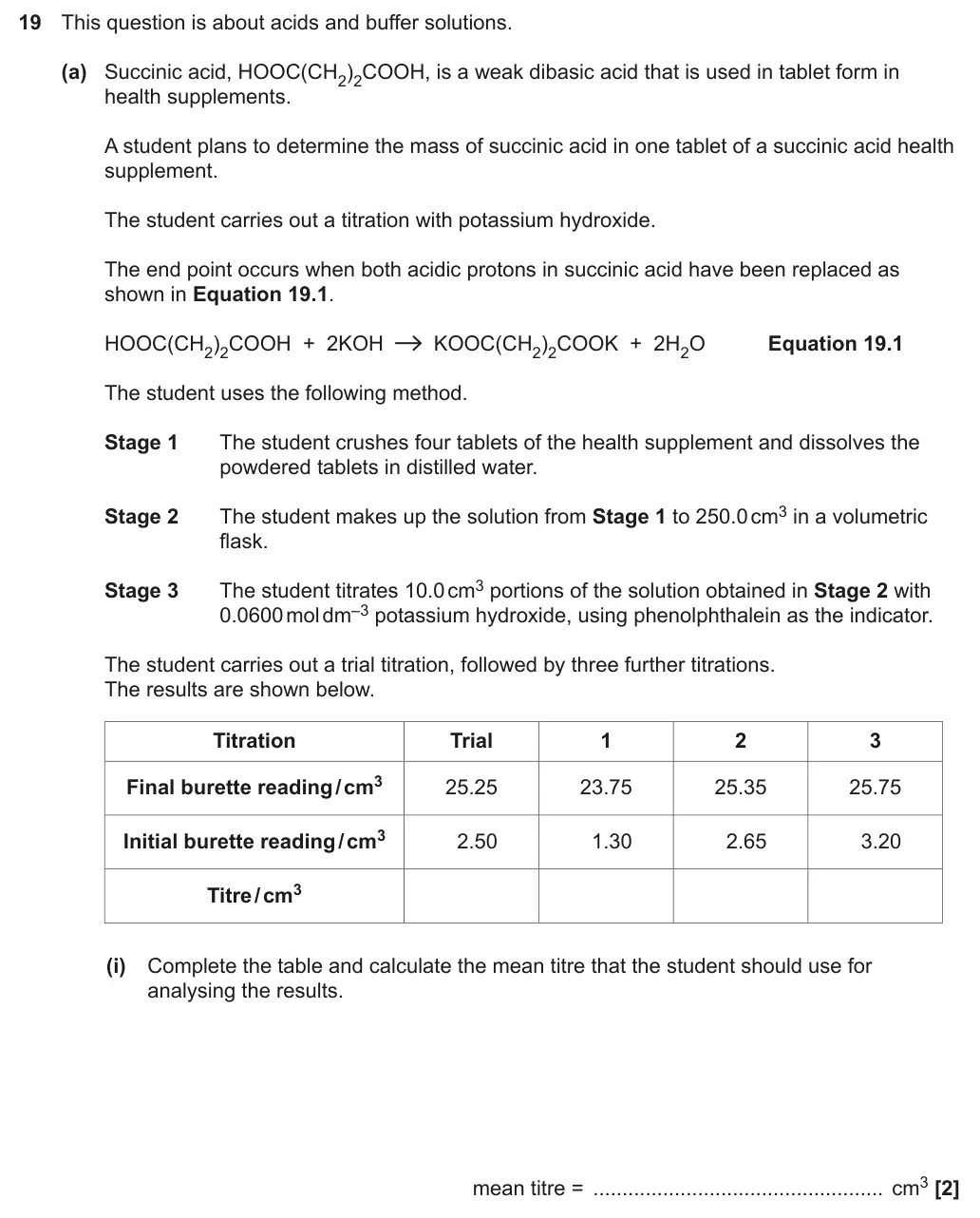
23.30, 23.05, 23.15
DO NOT ALLOW 23.3 (must be 2 d.p.)
Skills: PAG2 Acid–base titration
June 2025 · Paper 2 · Q41 markMultiple choiceMedium
Answer
A
Mark scheme
Examiner's comment
The majority of candidates were able to recognise that reflux should be used for this reaction and selected A with the correct water flow through the condenser. The most common incorrect response was C using distillation but a few selected B or D with the incorrect water flow.
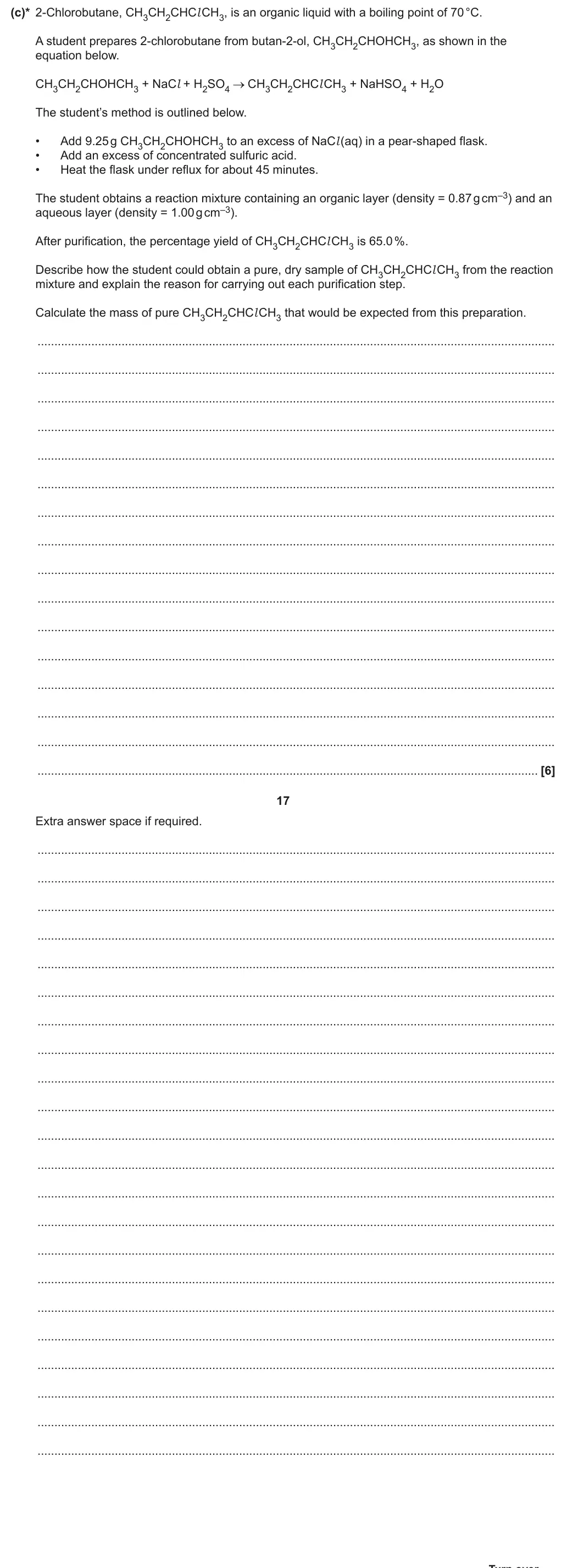
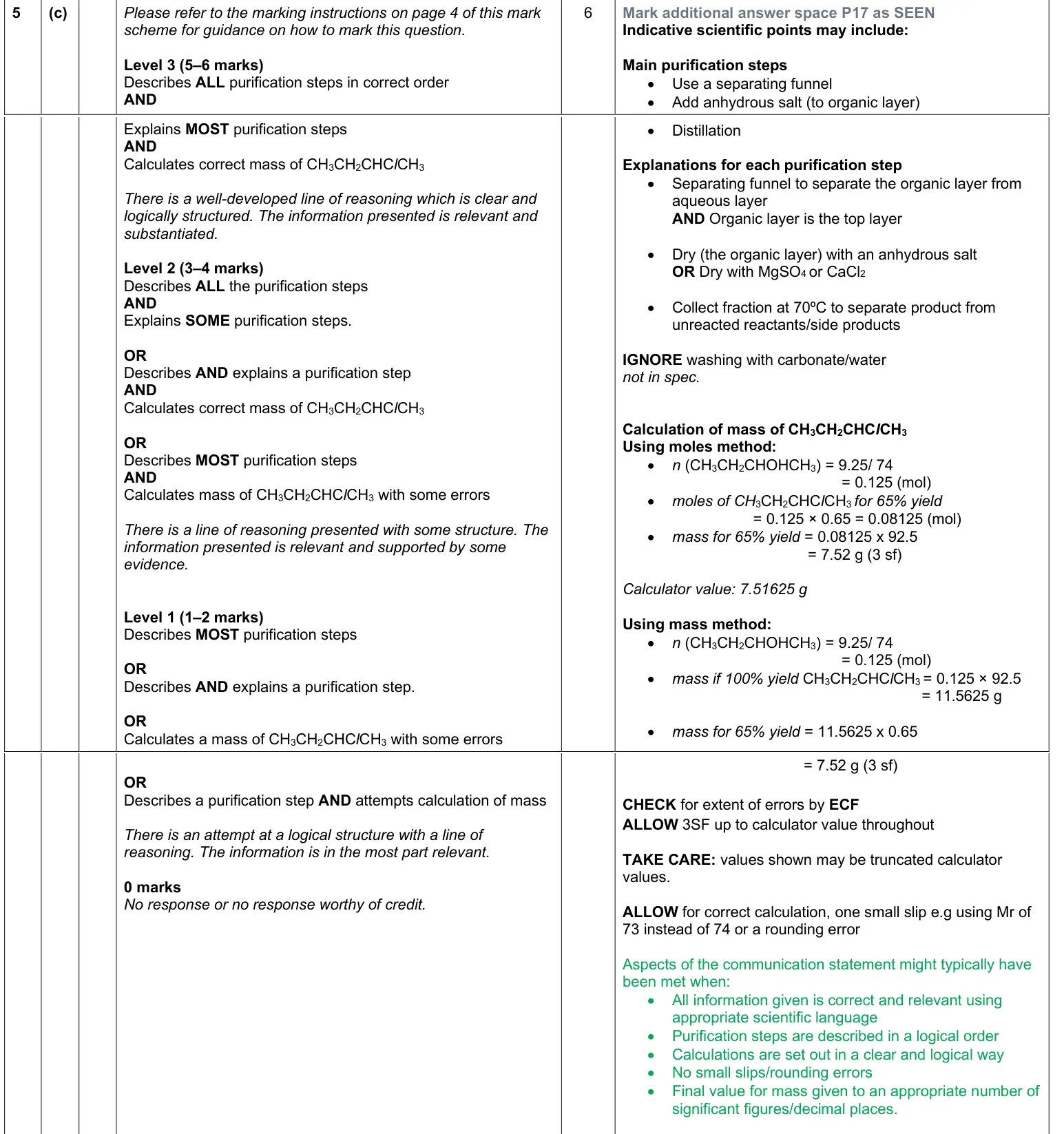
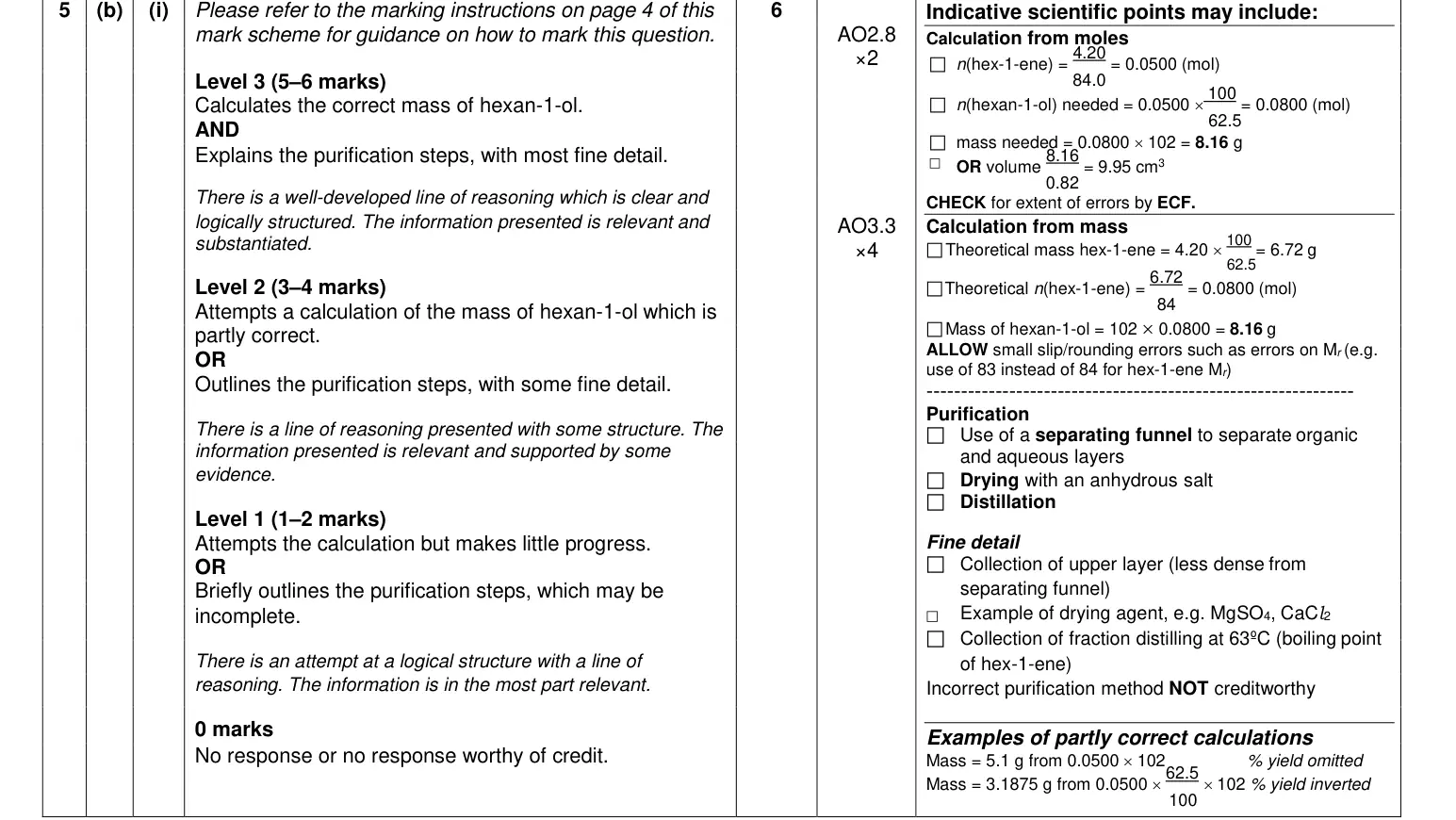
June 2025 · AS Paper 2 · Q5(c)6 marks6-mark level of responseMedium
Mark scheme, with the levels and indicative points
Examiner's comment
Many understood the necessary steps to purify a liquid and were confident with the calculation. Most knew at least one or two purification steps and could explain their purpose. Reasons marks were lost included: • Not remembering the correct name for equipment i.e. separating funnel • Getting the layers the wrong way round despite being given density information • Unclear which layer an anhydrous salt was added to for drying • Using an inappropriate salt for dry step, e.g. Na2CO3 or MgCO3 • Slips in calculations, e.g. incorrect Mr values, yield inverted or not accounted for • Thinking a solid would be formed • Describing reflux (including drawing apparatus) • Saying to distil at a specific boiling point but not stating the actual value (given in the question) As with all calculations, it is important to set out working clearly as it helps to avoid slips. Remind candi- dates of the importance of checking their Mr values – many made slips here. Candidates should also avoid rounding intermediate values and consider the number of significant figures used for the final re- sponse. Some rounded intermediate values to less than 3 significant figures but gave a final response to 4 or more. The response scored Level 3 and gained all 6 marks. All three purification steps are given in the correct order and explained. The calculation for mass is set out clearly and the final mass is given to 3 signifi- cant figures.
Notes from the mark scheme and report
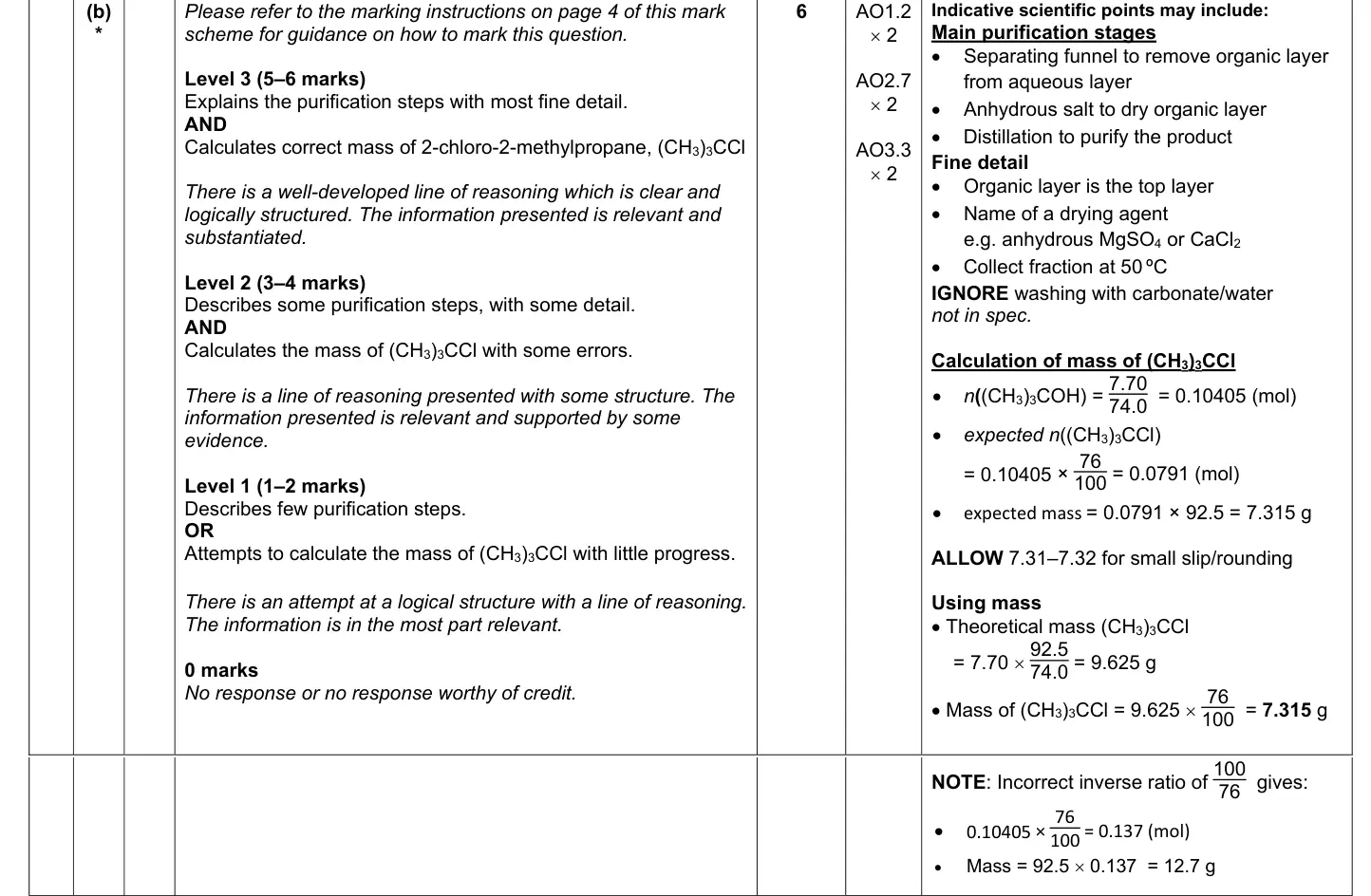
separating funnel - organic layer is the top (less dense) layer
dry with anhydrous MgSO4/CaCl2
distil collecting fraction at 70 °C
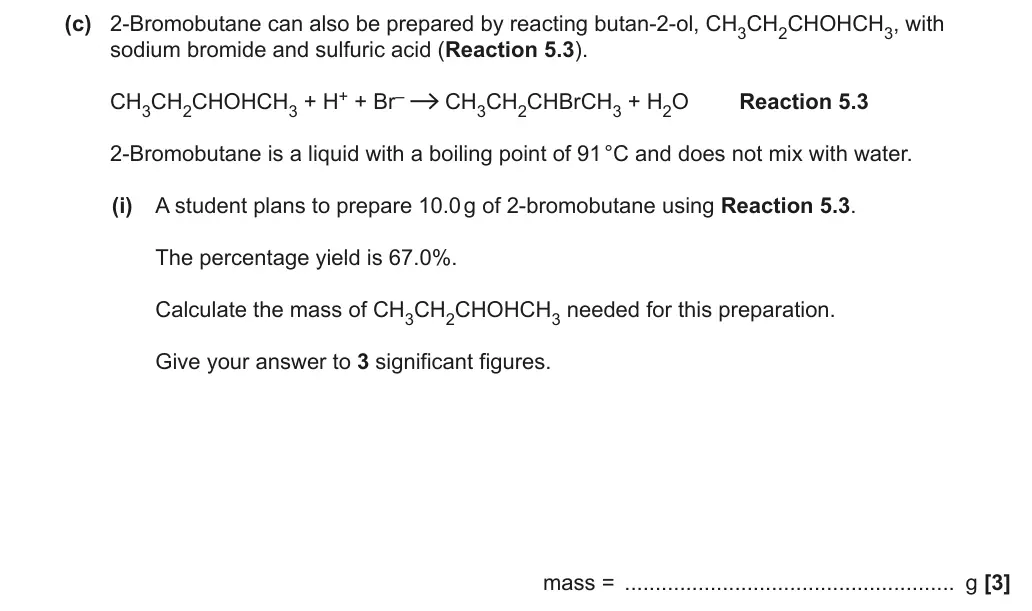
0.125 mol × 0.65 × 92.5 = 7.52 g
IGNORE washing with carbonate/water
ALLOW one small slip e.g. Mr 73
Skills: M0.2 Use ratios, fractions and percentages; M1.1 Use an appropriate number of significant figures; M2.3 Substitute numerical values into algebraic equations using appropriate units for physical quantities; PAG5 Synthesis of an organic liquid
June 2025 · Paper 2 · Q19(b)(ii)4 marksShort answerMedium
Earlier part of question 19 that this part uses
Mark scheme
Examiner's comment
Candidates appeared better prepared for this type of question than in previous sessions, with a significant proportion achieving 3 or 4 marks. It differentiated well between candidates at different grades. Most candidates recognised the organic layer would be at the bottom but couldn’t always name the apparatus used to separate these two layers with incorrect responses including burettes, pear-shaped flasks, separating flasks and separating tubes. Some were confused about the density information, thinking that as the organic layer is denser it would be on top, or if adding more water it would then switch around the layers. Many gave the first step but not step 2 and 3. Lots of detail was given about how to use the separating funnel, e.g. invert to mix, vent to release pressure build up etc., to fill up the space provided. Most that went on to add an anhydrous salt were able to explain that it was used to dry the organic layer and were able to give a suitable example. Some candidates often misunderstood how to use them suggesting the anhydrous salt should be added to the separating funnel or the aqueous layer. Some candidates also suggested washing the layer with water or aqueous sodium carbonate to remove the acid once the organic layer had been dried. Many candidates either omitted the temperature to distil at to obtain pure 1-bromopropane or confused it with the boiling point of propan-1-ol (reactant) also given in the question. Some said to collect the distillate at its boiling point but didn’t quote the value that they had been given in the question so did not score the final mark. Many candidates introduced additional, unnecessary steps. Lower attaining candidates often confused the purification with that of an organic solid i.e. recrystallisation and scored 0 marks. A clear and concise response which scored all 4 marks.
Notes from the mark scheme and report
separating funnel
keep bottom (denser organic) layer
dry with anhydrous salt (MgSO4/CaCl2)
redistil collecting at 71 °C (70–72)
no further marks if purification of a solid described
We have produced a range of practice exam questions linked to the purification of an organic liquid (PAG5) which can be found on the Teach Cambridge website.
This video produced by MaChemGuy is helpful for reviewing PAG 5: PRACTICAL SKILLS - PAG 5 - SYNTHESIS OF AN ORGANIC LIQUID.
Skills: PAG5 Synthesis of an organic liquid
June 2024 · AS Paper 1 · Q25(c)2 marksDrawing / labellingHard
Mark scheme
Examiner's comment
The presentation of many candidates’ diagrams in questions such as this one requires improvement. The mark scheme was generous, requiring to first see that a candidate knew what distillation is. A first mark was given for a set up comprising a flask connected to a roughly horizontal condenser. There had to be no gap above the condenser and the overall set up could not be a closed system. A second mark was given for minimal labels: condenser and correct direction of water flow. Nearly half the candidates received no marks for their diagram with only just over a quarter being given both marks. Typical errors included: • a reflux set up • open above the flask • a closed system • water flowing the wrong way • the condenser labelled as condensation tube, cooling tube, cooling funnel, distiller, etc. Less successful responses showed a conical flask, beaker or test tube being heated. The best advice is to spend some time instructing students how to draw diagrams and to label the apparatus using the accepted scientific names. Students increasingly appear to be finding these questions challenging.
Notes from the mark scheme and report
DO NOT ALLOW any marks for a reflux set up
condenser horizontal or angled down
not a sealed system
water in at bottom and out at top
IGNORE no heat or thermometer
Practise the drawing of common organic apparatus as part of the practical work carried out for the practical endorsement.
Skills: PAG5 Synthesis of an organic liquid
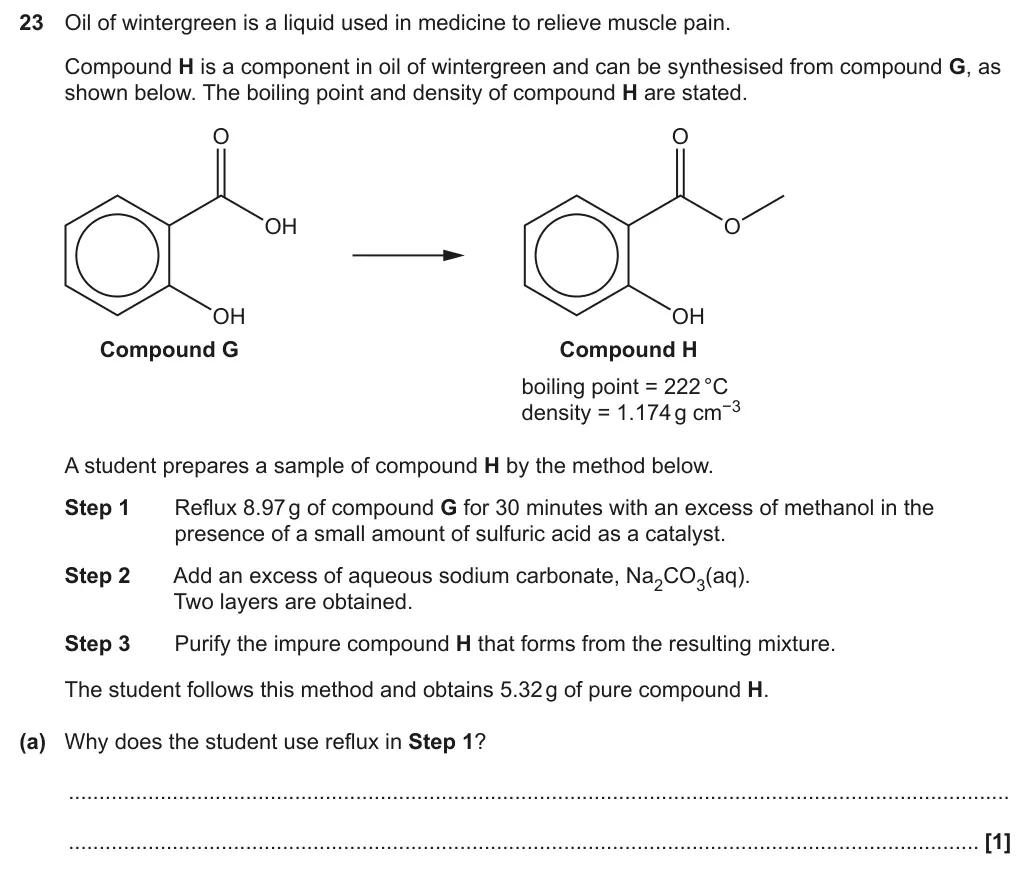
June 2024 · Paper 2 · Q23(a)1 markShort answerHard
Mark scheme
Examiner's comment
An unfamiliar question that proved challenging with only around a fifth of candidates obtaining the mark for correctly suggesting that reflux would prevent loss of volatile compounds. Many candidates suggested that reflux ensures the reaction goes to completion but here this was insufficient as esterification is an equilibrium reaction and additional information in (b)(i) indicates that there is unreacted compound G present. It was necessary to focus on the purpose for reflux rather than other ways of heating a reaction, such as the energy needed to break bonds or speed up the rate of reaction. Some less successful responses linked to oxidation reactions, presumably as they understand the importance of either reflux or distillation in this context. For example, ‘reflux is required for complete oxidation’ or ‘if distillation had been used an aldehyde would have been formed’.
Notes from the mark scheme and report
prevents loss of volatile reactants/products by evaporation (mixture boiling dry)
IGNORE rate or completeness of reaction
Skills: PAG5 Synthesis of an organic liquid
June 2024 · Paper 2 · Q23(d)4 marksShort answerHard
Earlier part of question 23 that this part uses
Mark scheme
Examiner's comment
Many candidates identified the need to describe the isolation and purification of a liquid in response to this question. Some struggled to remember the name of the apparatus required i.e. ‘separating funnel’ but could describe the separation of layers. The best responses used the density data provided to explain that the lower layer would contain compound H. A few gained a mark for a description of the addition of water to identify the correct layer to discard. In generally, candidates only have experience of the organic layer being less dense in their practical work which was reflected in their responses. The use of an anhydrous salt to dry the organic layer was well-known, but many candidates gave vague answers such as ‘add anhydrous salt’ failing to justify why the salt was needed. Many recognised the need to purify the resultant liquid by distillation, but not all linked to the boiling point of compound H to secure this final mark. Some who didn’t dry with an anhydrous salt said to heat to 100oC to remove water. Approximately a third of candidates gained no marks here. Candidates thought that compound H would form crystals so described recrystallisation rather than a method to purify an organic liquid. Other responses attempted to merge both methods together. This candidate scored 1 mark for this response for the use of a ‘separating funnel’. They have attempted to use the density information but have incorrectly identified that the density of H as being low which would make it the top layer. Candidates needed to know that the density of water is 1 g cm-3 to be able to make a correct comparison. There is no addition of an anhydrous salt to dry the organic layer. They have recognised the need to distil but have not given the correct temperature at which to collect the pure compound. However, if they had given the boiling point for distillation no mark would have been given as they would lose this final mark for describing the purification of a solid. It was very common to see responses which described the purification of a solid, often in addition to that of a liquid.
Notes from the mark scheme and report
steps in order: separating funnel
keep the bottom (organic, denser) layer
dry with anhydrous MgSO4/CaCl2
redistil at 222 °C
no further credit if the method treats H as a solid (recrystallisation)
The method to purify an organic liquid was poorly understood by many candidates. Many of the candidates answered this question using techniques to purify an organic solid which is covered in the second year of A Level, rather than an organic liquid which is covered in the first year. It is important to spend time comparing both methods and helping candidates identify when each method is required.
OCR have produced a range of practice exam questions linked to the purification of an organic liquid (PAG5). These can be found on Teach Cambridge.
Skills: PAG5 Synthesis of an organic liquid
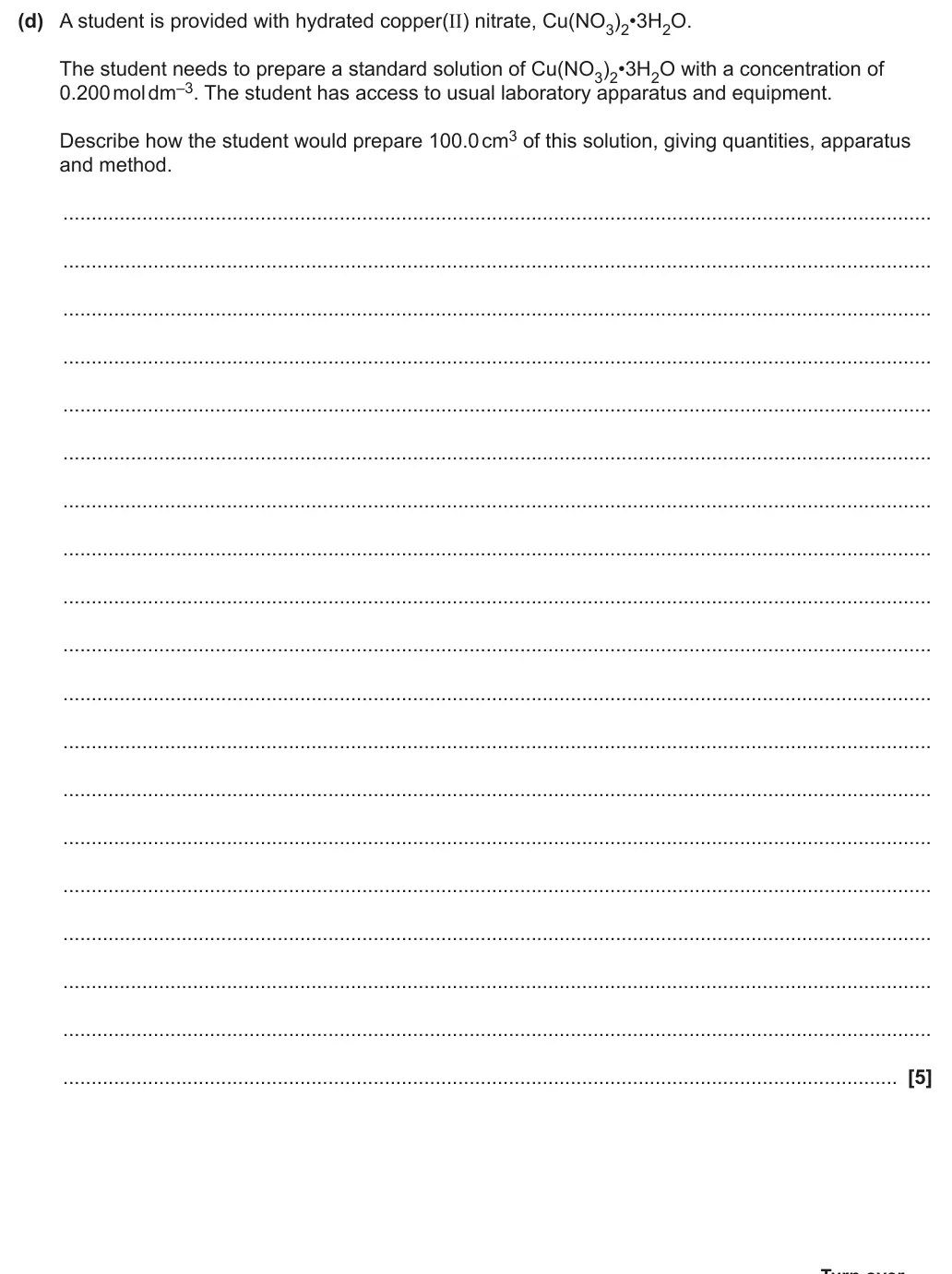
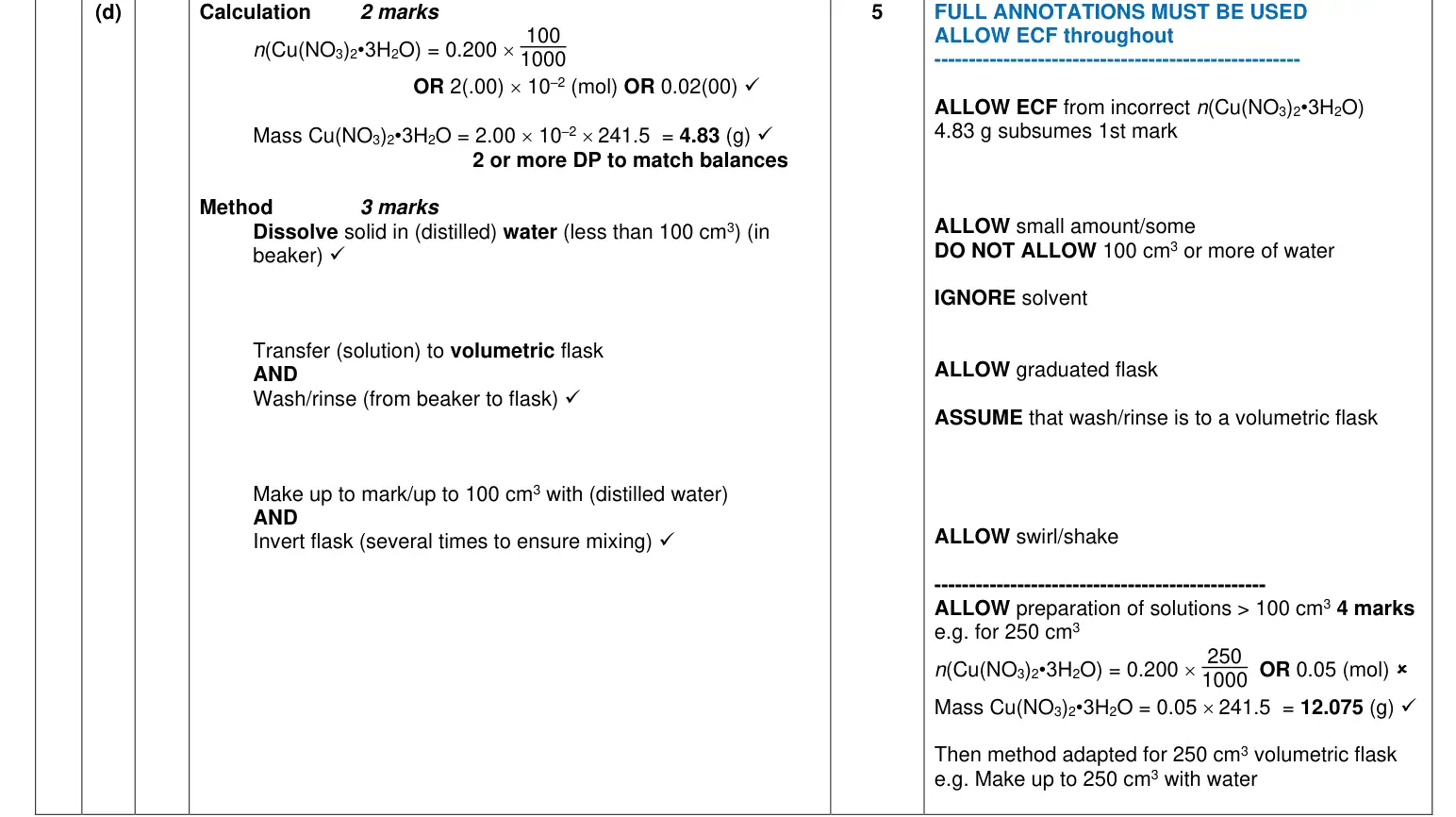
June 2024 · Paper 3 · Q1(d)5 marksExtended responseMedium
Mark scheme
Examiner's comment
This question differentiated between candidates extremely well. See Exemplar 1 below. some of the issues encountered in the responses. Unfortunately, nearly a quarter of candidates could not be given any marks at all for their responses. To improve, it is worth studying Exemplar 1. The candidate has communicated the key steps required to prepare the standard solution: • Calculation of the mass of hydrated copper(II) nitrate required. • Dissolving the hydrated copper(II) nitrate in water in a suitable container (a beaker). • Transferring the solid to a 100 cm3 volumetric flask, washing the beaker with water and transferring the washings also to the volumetric flask. • Making the solution up to the 100 cm3 mark in the volumetric flask and inverting the flask to mix the contents thoroughly. Issues with responses which arose by not reading the question closely enough: • Omitting to calculate the mass of hydrated copper(II) nitrate required. • Calculating the mass of anhydrous copper(II) nitrate instead of the hydrated salt. • Dissolving in 100 cm3 of water and then adding more water for rinsing. • Not rinsing out the original container at all. • Making the solution up in the volumetric flask. • Using of a 250 cm3 volumetric flask for preparing 100 cm3 of solution. • Omitting the inversion stage. • Answering a different question, e.g. how to carry out a titration, how to determine an enthalpy change, how to work out the number of waters of crystallisation by heating in a crucible.
Notes from the mark scheme and report
mass 4.83 g using M of the hydrated salt (241.5), 2 or more decimal places
dissolve in less than 100 cm3 of distilled water in a beaker (DO NOT ALLOW 100 cm3 or more)
transfer to volumetric flask AND rinse washings in
make up to the mark AND invert
Skills: M0.0 Recognise and make use of appropriate units in calculations; M0.2 Use ratios, fractions and percentages; PAG2 Acid–base titration
June 2024 · Paper 3 · Q3(b)(ii)3 marksComplete table/diagramMedium
Earlier part of question 3 that this part uses
Mark scheme
Examiner's comment
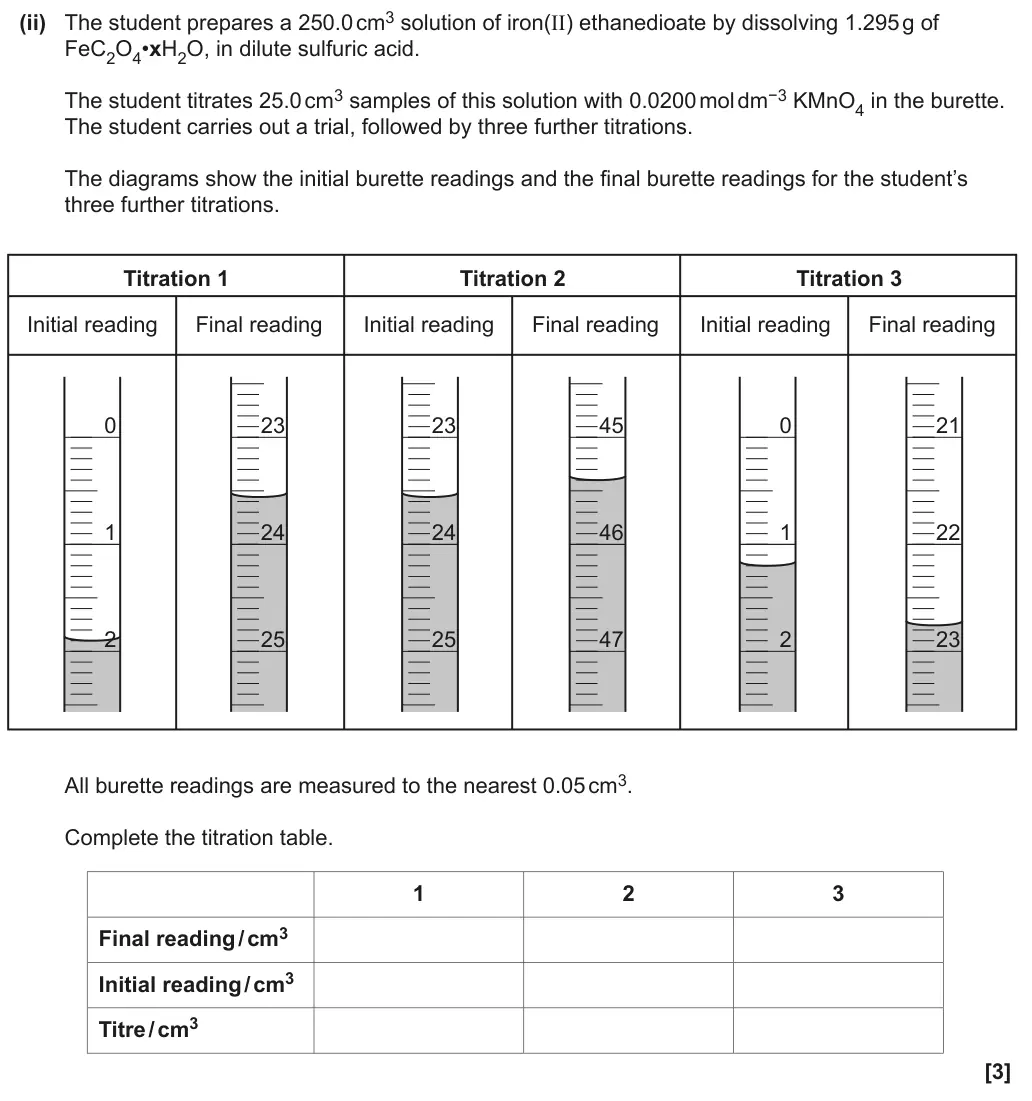
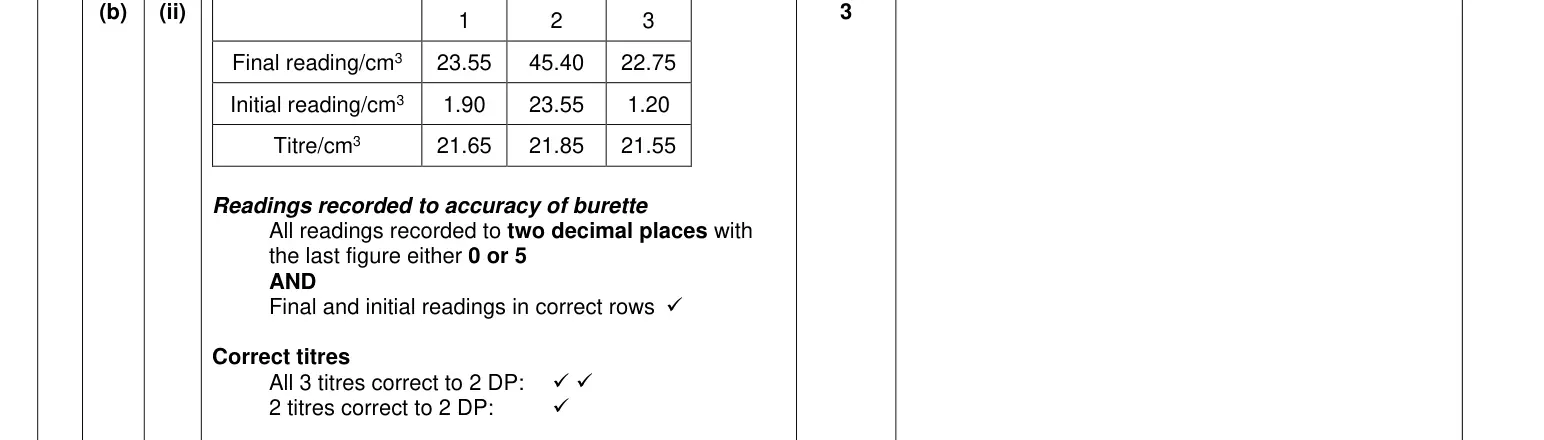
Most candidates were given all 3 marks for their titration tables. One mark was allocated to the readings, the other 2 for the correct titres. Candidates are expected to record burette readings to 2 decimal places with the last figure being 0 or 5, reflecting the accuracy of the burette, which is stated in the question. Two issues were seen: • Some candidates ignored the terminal 0 in their readings, e.g. 1.9 for 1.90 cm3. • A small number of candidates recorded the initial and final readings the wrong way round despite these terms being used above each burette diagram. Titres were usually correct.
Notes from the mark scheme and report
all readings to 2 decimal places with last figure 0 or 5 AND final/initial readings in the correct rows
titres 21.65, 21.85, 21.55 (2 correct for 1 mark)
Skills: M1.1 Use an appropriate number of significant figures
June 2023 · AS Paper 1 · Q22(c)(i)1 markAO1Short answerMedium
Mark scheme
Examiner's comment
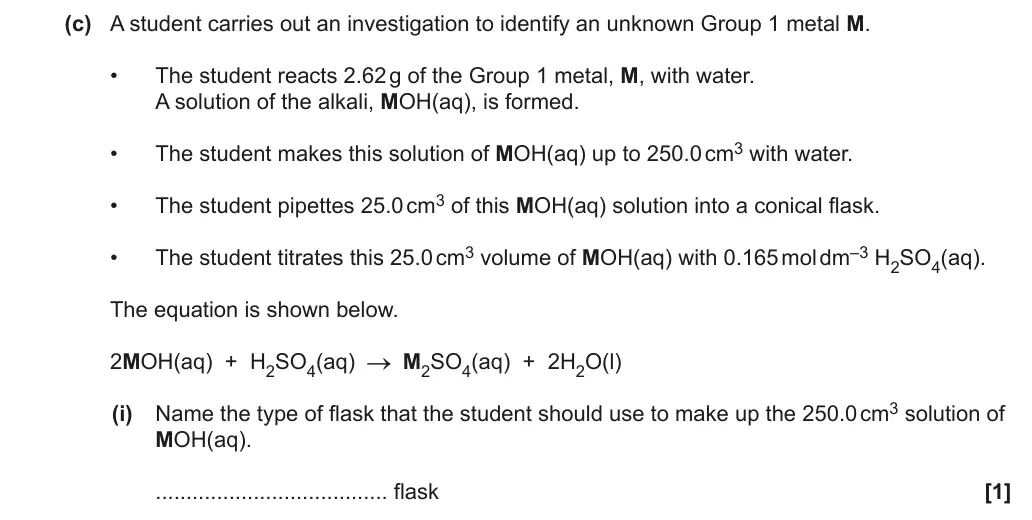
Most candidates recognised that a volumetric flask is used to accurately prepare volumes of solutions. A common error was a conical flask, perhaps by not reading the information clearly and giving the name of the flask used in the titration itself.
Notes from the mark scheme and report
ALLOW graduated flask
Skills: PAG2 Acid–base titration
June 2023 · Paper 3 · Q5(b)(i)2 marksAO3Drawing / labellingMedium
Earlier part of question 5 that this part uses
Mark scheme
Examiner's comment
Most candidates drew a diagram that looked like a vertical condenser above a flask. The quality of the diagrams was not very good. Candidates then needed to label their diagram. Errors included a bung or thermometer inserted at the top of the condenser and water flowing the wrong way in the condenser. For labelling, candidates were expected to use scientific terminology. Responses such as ‘condensation tube’ and vague terms such as ‘flask’ were not credited. These labels were often omitted. A significant number drew a set up for distillation instead of reflux.
Notes from the mark scheme and report
flask AND upright condenser AND open at top
labels pear-shaped/round-bottom flask, condenser, water in at bottom and out at top
DO NOT ALLOW conical/volumetric flask, thermometer or sealed system
heat not required
Skills: PAG5 Synthesis of an organic liquid
June 2022 · Paper 1 · Q19(a)(i)2 marksAO1CalculationEasy
Mark scheme
Examiner's comment
Almost all candidates calculated the titres correctly, but a significant number were penalised for recording 22.70 as 22.7. A significant number also used this result and the trial titre to derive their mean value. There were also very small numbers of candidates who used all 4, or all of titres 1, 2 and 3, to calculate their mean.
Notes from the mark scheme and report
titres to 2 d.p. (22.70 not 22.7)
mean from concordant 22.45 and 22.55 = 22.50
DO NOT ALLOW use of trial
Links to the legacy coursework tasks and PAG practice question sets can be found on OCR Interchange. Exam hints for students can be found at: https://www.ocr.org.uk/Images/592305-exam-hints-for-students.pdf.
June 2022 · AS Paper 2 · Q1(b)(i)4 marksAO1CalculationEasy
Mark scheme
Examiner's comment
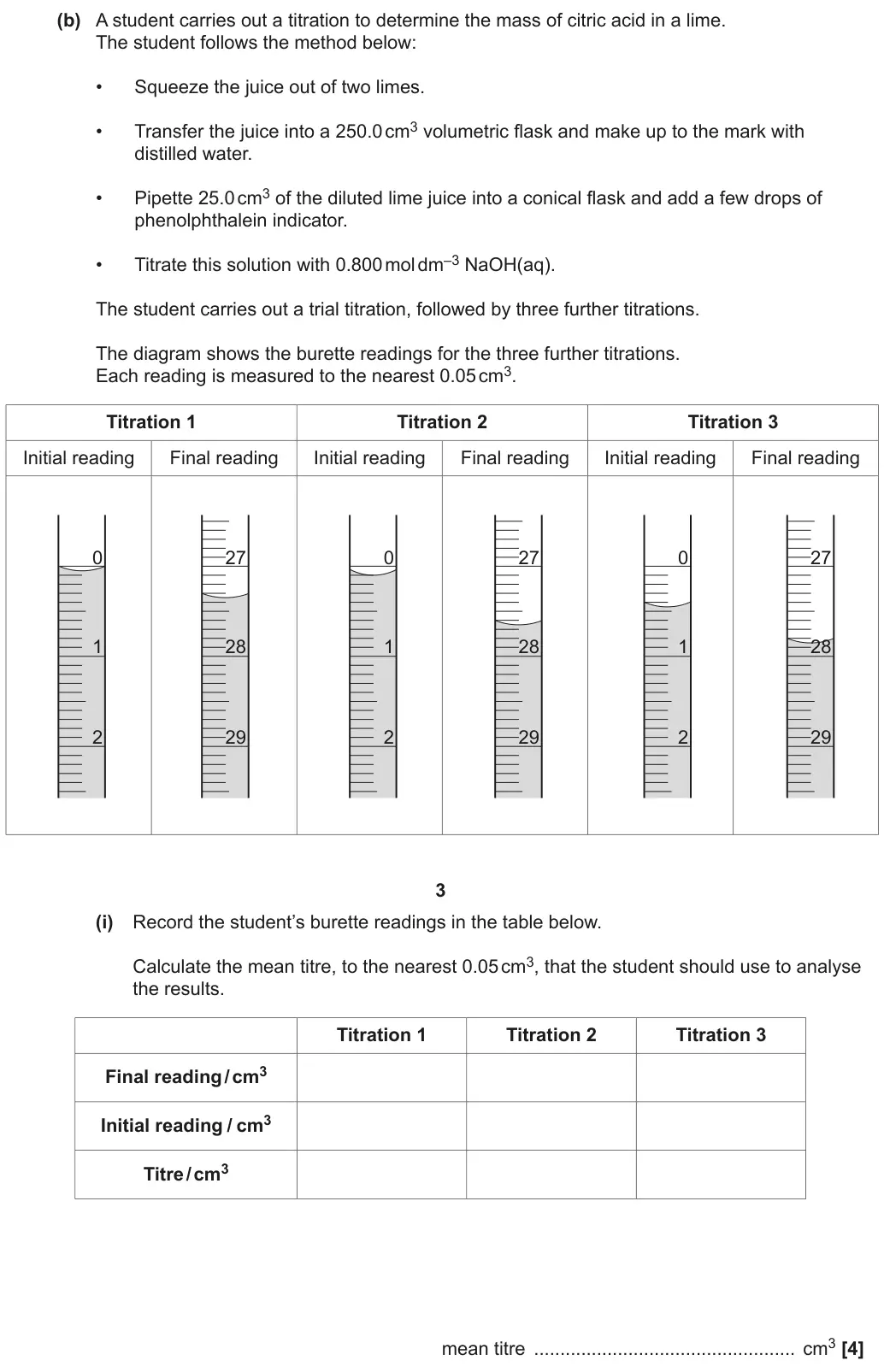
Although most candidates gained some marks here, there were a significant number who did not gain all 4 marks. Some candidates need to practice reading burettes and recording their values – this can be checked during practical work. The most common errors included not recording values to 2 decimal places (especially if final number was 0), readings recorded the wrong way round in the table, and misreading 0.05 as 0.5. Most candidates were able to identify concordant results, but some still calculated the mean from all values. This led to an average that needed to be rounded to the nearest 0.05, as asked for in the question, resulting in them losing both the mean titre mark and mark for accuracy. Some had errors which lead to values which weren’t concordant – this should be a flag to students that they have made a mistake.
Notes from the mark scheme and report
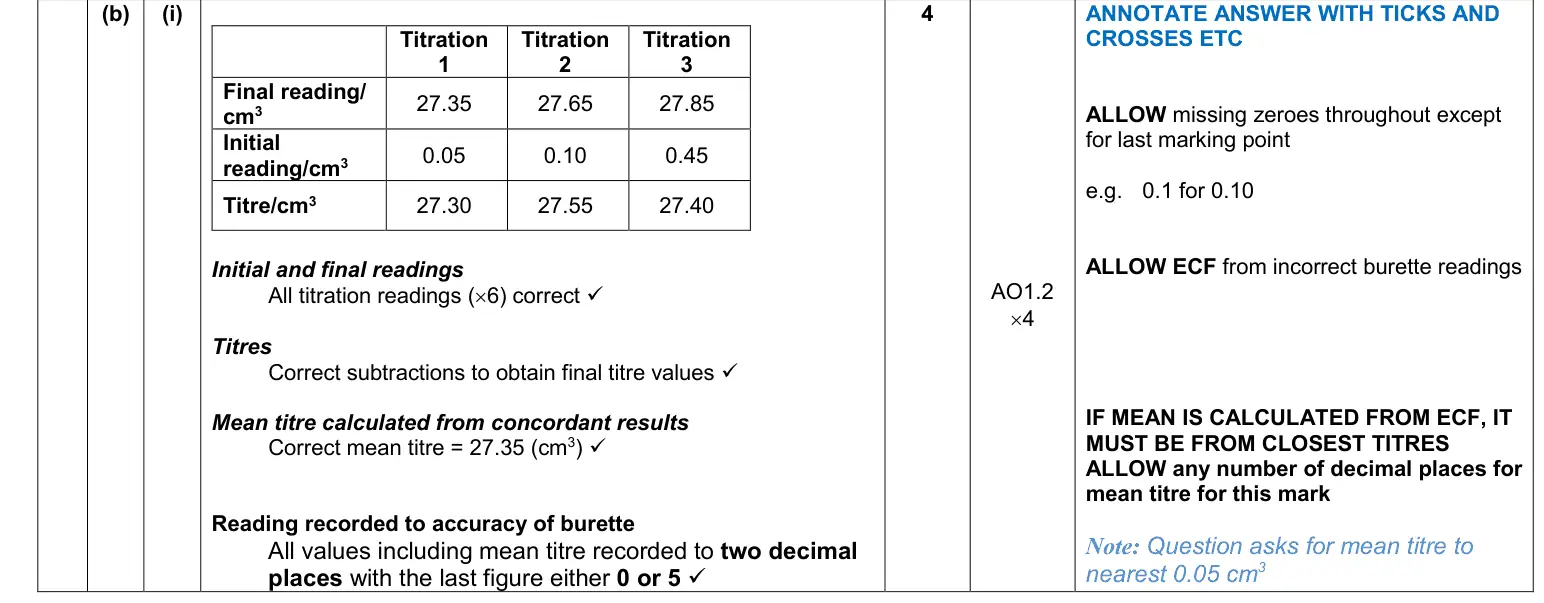
all six burette readings correct
mean from concordant titres 27.30 and 27.40 only (27.35)
all values to 2 d.p. ending in 0 or 5
ALLOW ECF from incorrect readings but mean must use closest titres
Skills: M1.1 Use an appropriate number of significant figures; M1.2 Find arithmetic means; PAG2 Acid–base titration
June 2022 · AS Paper 2 · Q5(c)(ii)3 marksAO3Short answerMedium
Earlier part of question 5 that this part uses
Mark scheme
Examiner's comment
This question was not answered well with over half the candidates failing to score any marks. While some candidates seemed familiar with the techniques required, describing the process to separate the layers, they often struggled to name the separating funnel. Common approaches were to attempt to ‘filter’ the layers or to use heat (via evaporation or distillation) to drive off the water. Some attempted to use Na2CO3 or NaOH to dry the organic layer – perhaps confusing neutralisation of any remaining acid. Although distillation appeared frequently many did not give the temperature so did not gain marks. The order of the procedure was also not always clear with distillation before using a drying agent. Some described attempts to crystallise the organic layer. The range of answers suggests students may need more practical experience with separating organic liquids.
Notes from the mark scheme and report
separating funnel to separate layers
dry organic layer with anhydrous salt (MgSO4, CaCl2)
distil and collect fraction at 91 °C
Skills: PAG5 Synthesis of an organic liquid
June 2022 · Paper 3 · Q3(a)6 marksAO2, 36-mark level of responseMedium
Mark scheme, with the levels and indicative points
Examiner's comment
Showed limited knowledge and understanding of practical scenarios and drawing labelled diagrams of apparatus, e.g. • Question 3 (a): Diagram of reflux • Question 3 (a): Purification of an organic liquid There was no evidence that any time constraints had led to a candidate underperforming or of scripts where there were no responses to many questions.
Notes from the mark scheme and report
reflux diagram: condenser above flask, water in at bottom and out at top
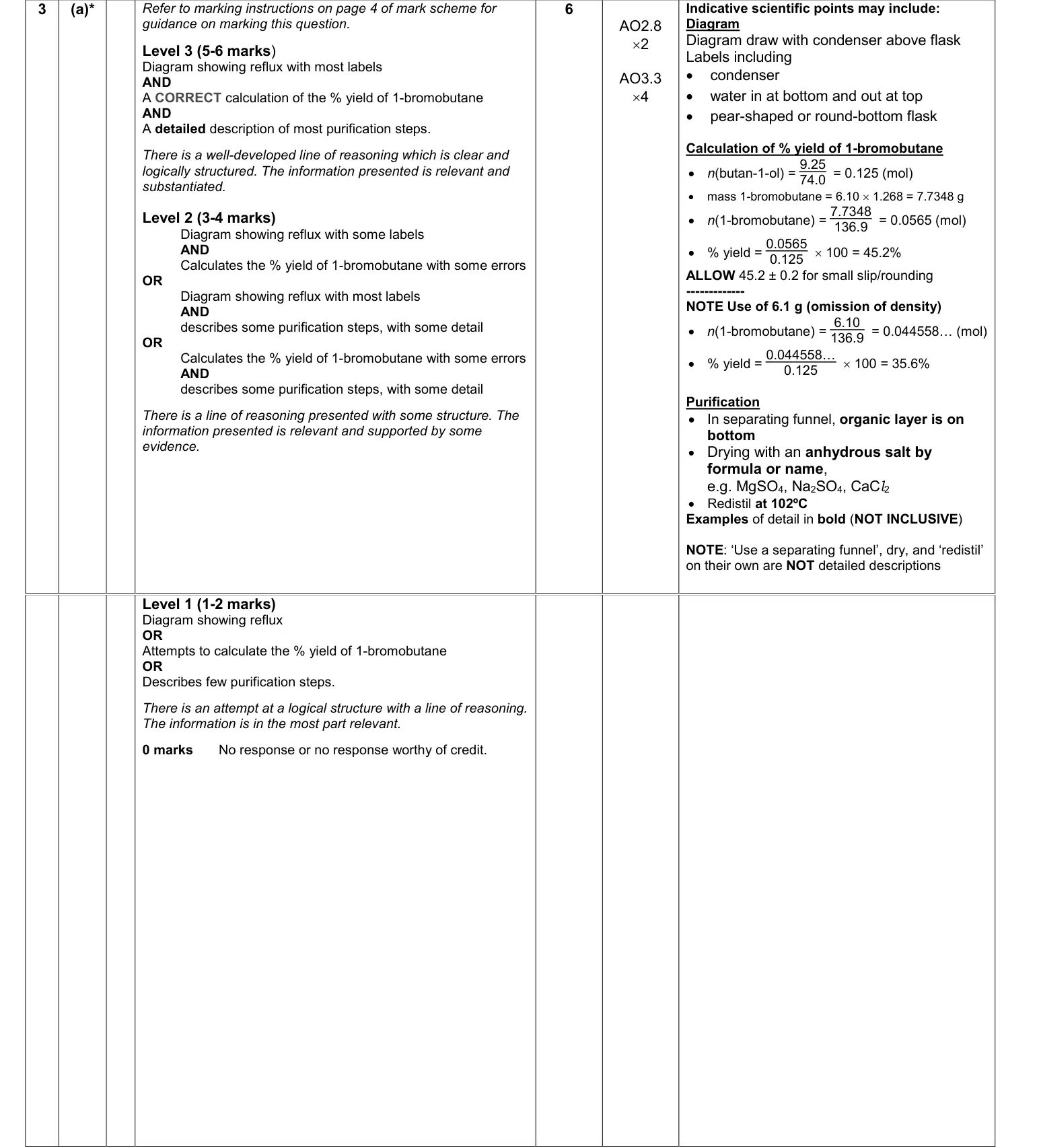
mass = 6.10 × 1.268 = 7.73 g, yield 45.2% (35.6% if density omitted)
separating funnel - organic layer is the BOTTOM layer (denser), dry with named anhydrous salt, redistil at 102 °C
bare 'separate, dry, redistil' not detailed
Skills: M0.0 Recognise and make use of appropriate units in calculations; M0.2 Use ratios, fractions and percentages; M2.3 Substitute numerical values into algebraic equations using appropriate units for physical quantities; PAG5 Synthesis of an organic liquid
November 2021 · AS Paper 1 · Q71 markAO2Multiple choice
Answer
B
Mark scheme
November 2021 · AS Paper 1 · Q24(c)(ii)2 marksAO3Drawing / labelling
Earlier part of question 24 that this part uses
Mark scheme
Notes from the mark scheme and report
labelled condenser above a flask
second mark (flask and heat labelled) only if first mark awarded
ALLOW water in and water out as condenser label
Skills: PAG5 Synthesis of an organic liquid
November 2021 · AS Paper 2 · Q3(a)1 markAO2Short answer
Mark scheme
Notes from the mark scheme and report
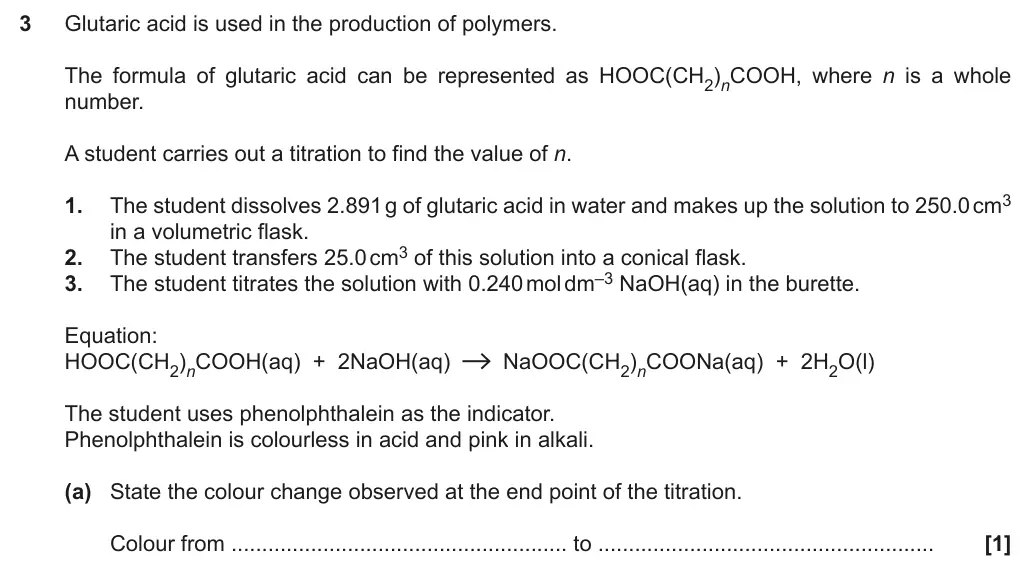
colourless to pink (alkali in burette)
Skills: PAG2 Acid–base titration
November 2021 · AS Paper 2 · Q3(b)(i)1 markAO2Complete table/diagram
Earlier part of question 3 that this part uses
Mark scheme
Notes from the mark scheme and report
all titres to 2 d.p. ending in 0 or 5
DO NOT ALLOW 1 decimal place
Skills: PAG2 Acid–base titration
November 2021 · AS Paper 2 · Q7(b)6 marksAO1, 2, 36-mark level of response
Earlier part of question 7 that this part uses
Mark scheme, with the levels and indicative points
Notes from the mark scheme and report
separating funnel – organic layer is the TOP layer (lower density)
dry with anhydrous MgSO4/CaCl2
distil collecting at 50 °C
mass = 7.70/74.0 × 0.76 × 92.5 = 7.3 g
inverse ratio 100/76 gives 12.7 g
IGNORE washing with carbonate/water
Skills: M0.2 Use ratios, fractions and percentages; M2.3 Substitute numerical values into algebraic equations using appropriate units for physical quantities; PAG5 Synthesis of an organic liquid
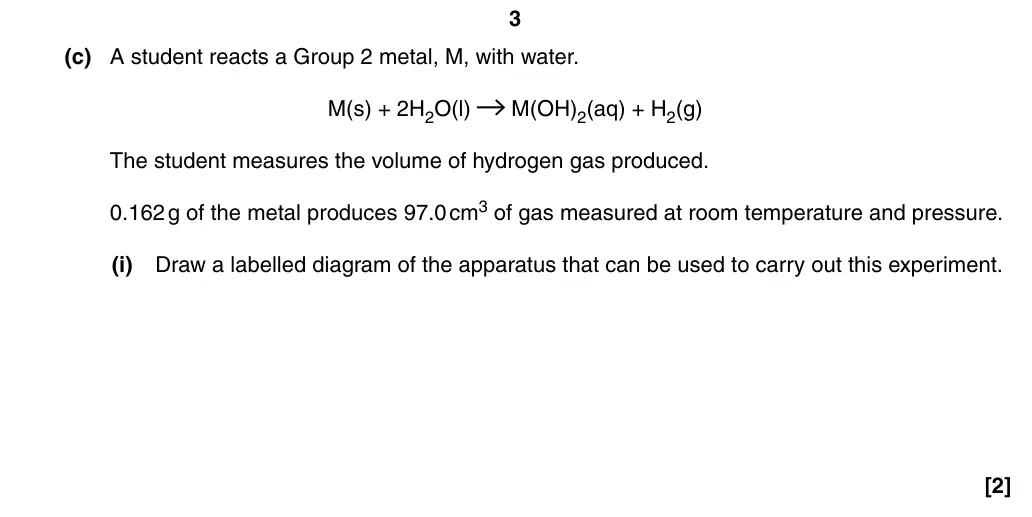
November 2021 · Paper 3 · Q2(a)2 marksAO3Drawing / labellingHard
Mark scheme
Examiner's comment
Q1(d), Q1(e), Q5(a)(i) • Unclear drawing of diagrams and labelling of laboratory apparatus: Q2(a) • Had difficulty explaining chemical ideas, often repeating the same points several times, e.g. Q2(a): Candidates were asked to draw a labelled diagram for a familiar practical set up.
Notes from the mark scheme and report
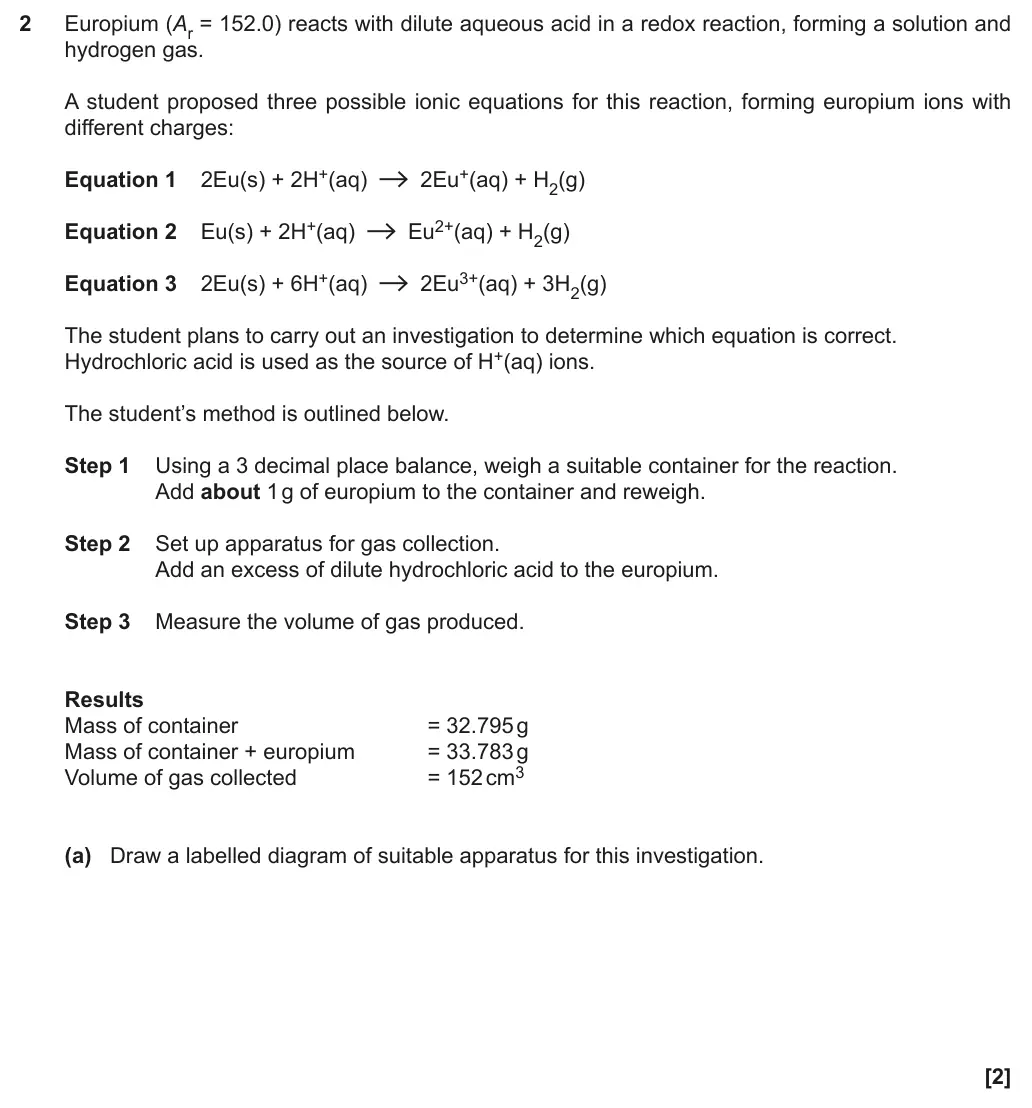
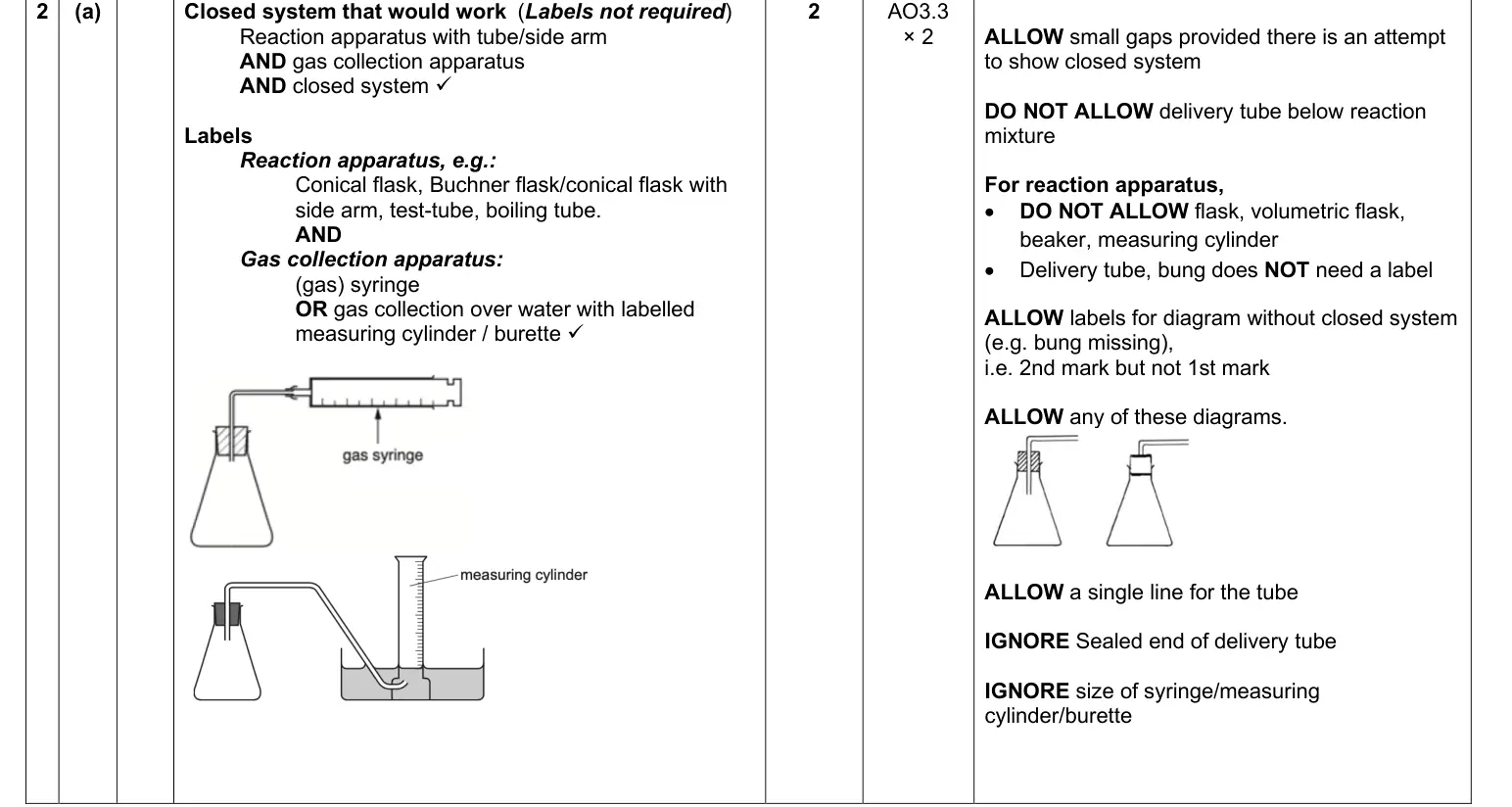
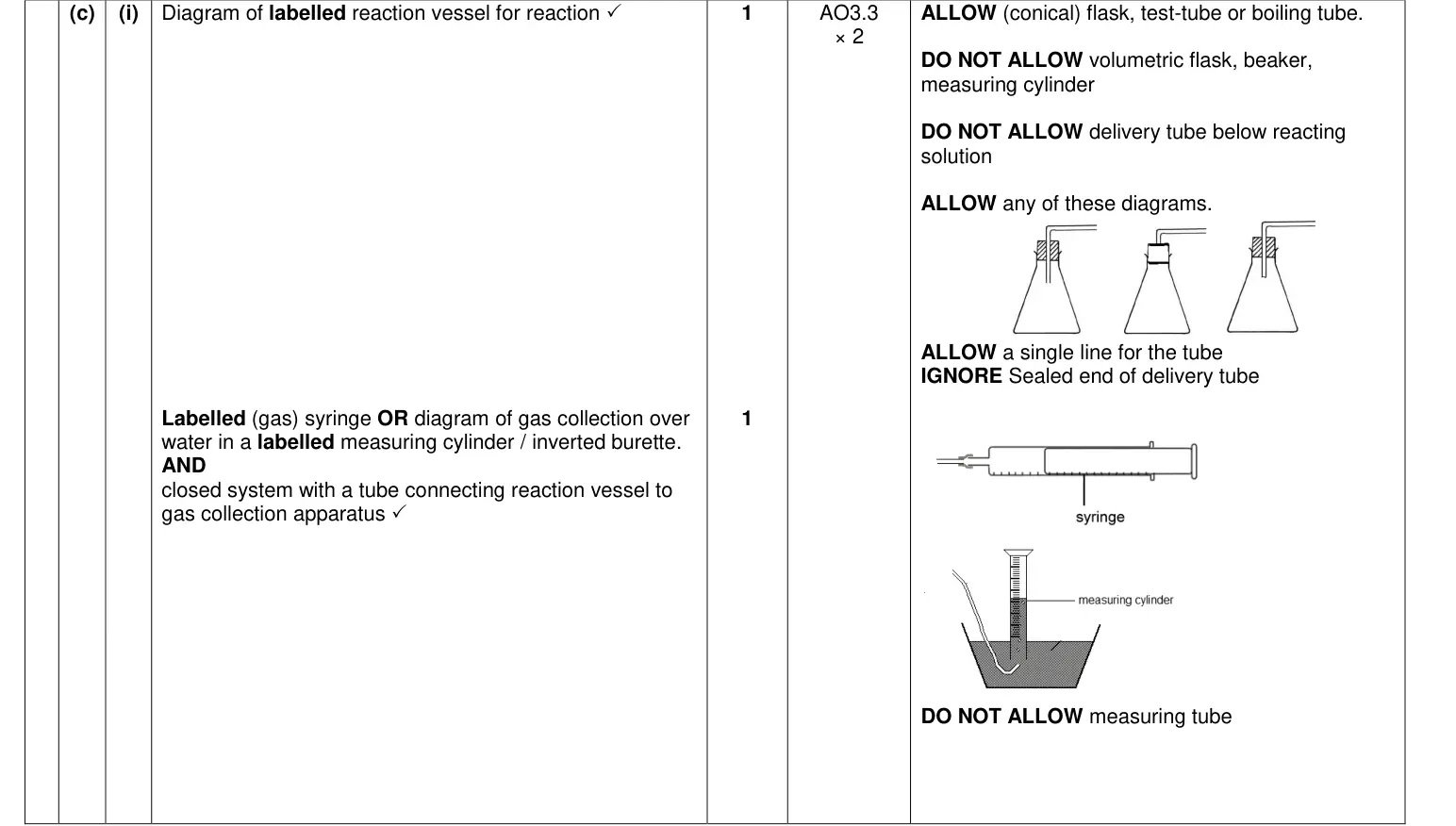
closed system with reaction vessel and gas syringe or collection over water in a measuring cylinder
DO NOT ALLOW delivery tube below reaction mixture
DO NOT ALLOW beaker, volumetric flask or measuring cylinder as reaction vessel
Skills: PAG1 Moles determination
November 2021 · Paper 3 · Q3(a)5 marksAO1, 2Extended responseMedium
Mark scheme
Examiner's comment
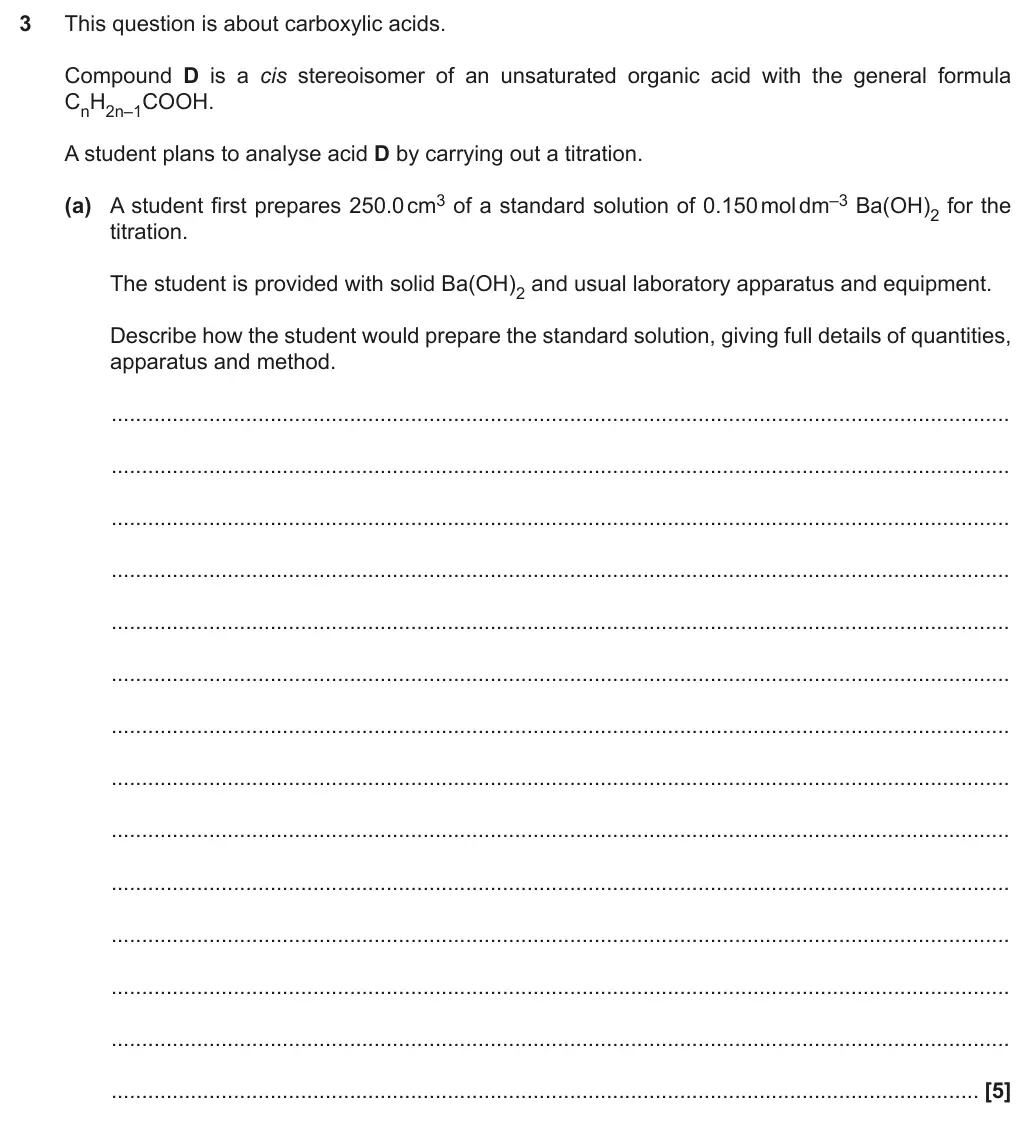
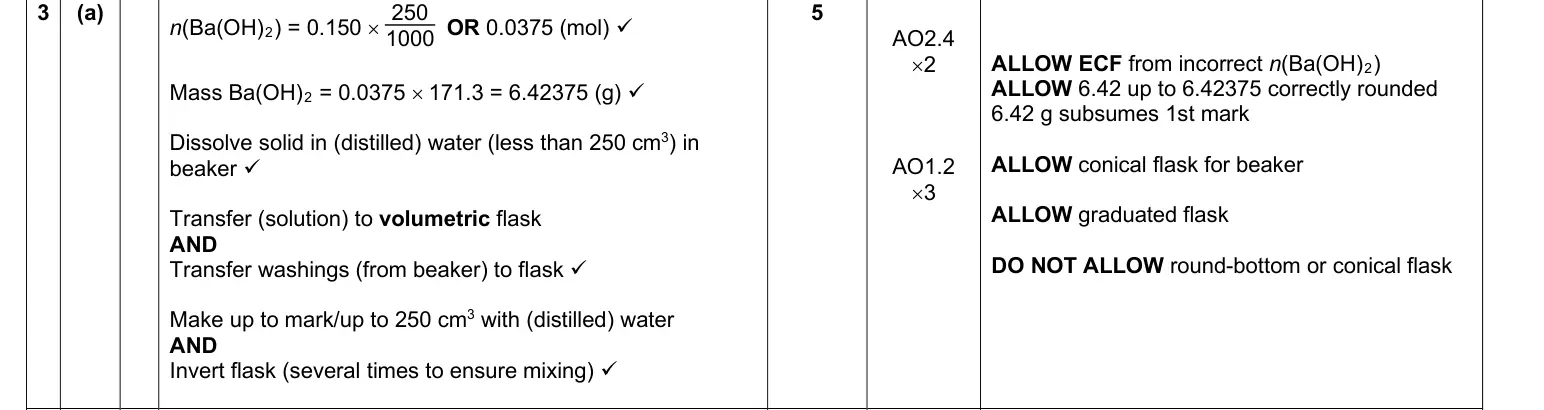
Q3(a): Candidates were required to describe how they would prepare 250 cm3 of a 0.150 mol dm–3 standard solution. Q3(b): As with Question 2, candidates had more success with the mole calculation in Q3(b) than the descriptive response in Q3(a).
Notes from the mark scheme and report
mass Ba(OH)2 = 0.0375 × 171.3 = 6.42 g
dissolve in distilled water in a beaker
transfer solution AND washings to 250 cm3 volumetric flask
make up to the mark AND invert
DO NOT ALLOW round-bottom or conical flask as the volumetric flask
Skills: M0.0 Recognise and make use of appropriate units in calculations; M2.3 Substitute numerical values into algebraic equations using appropriate units for physical quantities; PAG2 Acid–base titration
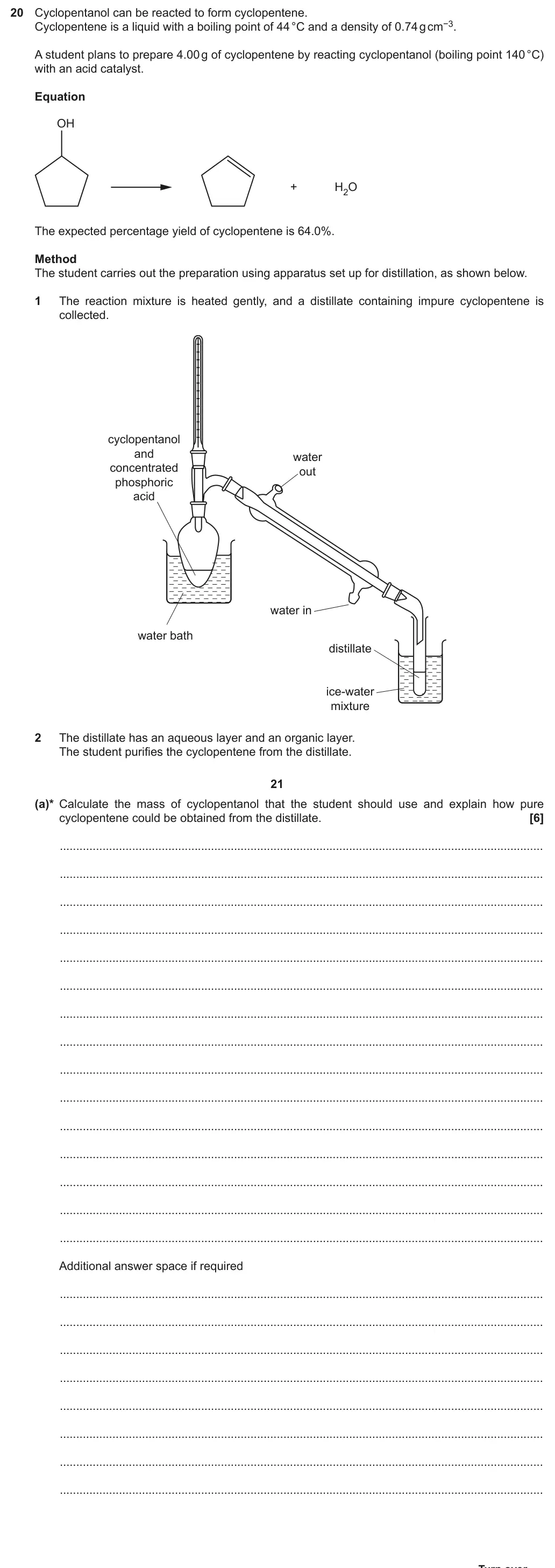
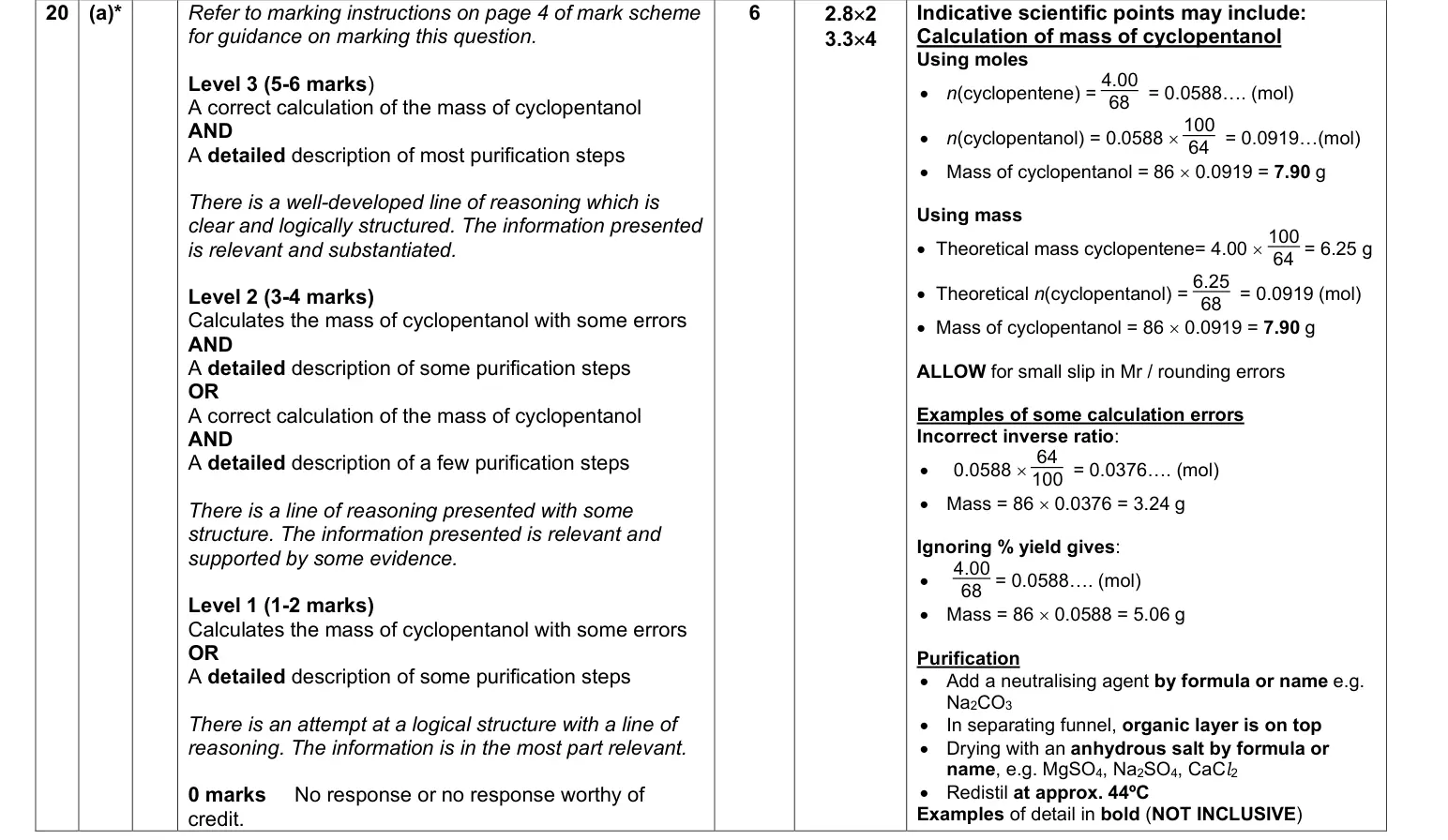
November 2020 · Paper 2 · Q20(a)6 marksAO2, 36-mark level of responseMedium
Mark scheme, with the levels and indicative points
Examiner's comment
Level of response questions Question 20(a) This question differentiated well.
Notes from the mark scheme and report
mass of cyclopentanol 7.90 g (errors: inverse ratio 3.24 g, ignoring yield 5.06 g)
neutralise e.g. Na2CO3
separating funnel with organic layer on top
dry with anhydrous salt e.g. MgSO4
redistil at about 44 °C
Skills: M0.2 Use ratios, fractions and percentages; M2.2 Change the subject of an equation; PAG5 Synthesis of an organic liquid
November 2020 · Paper 3 · Q1(a)(i)2 marksAO1Complete table/diagramHard
Mark scheme
Examiner's comment
1a(i) Most candidates labelled some of the apparatus correctly and identified the reflux technique. A significant number showed water flowing in the wrong direction and ‘distillation’ was given as the name of the technique. The ‘condenser’ was sometimes labelled incorrectly, e.g. ‘condensation tube, ‘distillation tube’ and ‘water jacket’. Only just over half the candidates were given both marks. 1a(ii) Many diagrams were incomplete and it was comparatively rare for both of the two available marks to be given. Important labels were often missing. Some candidates drew diagrams of other techniques, such as distillation. Many responses were not credited with marks and this question was often omitted. Candidates need practice in recognising practical techniques and in drawing acceptable diagrams. 1b(i) Candidates were expected to explain the different boiling points of three amines. Most candidates linked increased branching with less surface contact between molecules, leading to weaker induced dipole interactions (London forces). Fewer candidates linked the decreasing boiling points to less energy being required to break the intermolecular bonds. The highest performing candidates recognised the large difference between the boiling points of the primary and tertiary amines. They then identified the cause: primary amines form hydrogen bonds but tertiary amines do not. This question was answered reasonably well with fewer candidates than in the past describing relative strengths of covalent bonds, a common misconception. 1(b)(ii) Most candidates rearranged the ideal gas equation correctly to make n the subject. They then substituted correct values for p, V, R and T into the equation, with correct unit conversions. Most candidates then calculated n correctly as 2.32 × 10⁻³ and combined this value with the mass of 0.202 g to derive the molecular formula as 87. Lower-attaining candidates often made an error in their conversion of cm3 into m3, by multiplying by 10–3 rather than 10–6. This error resulted in a value of n as 2.32 and the unrealistic molecular mass of 8.7 × 10⁻³, from which a molecular formula is impossible. Candidates in this position are advised to check back at the unit conversions in the working. Very few candidates did not convert 100ºC into 373 K. Candidates with the correct molecular formula of 87 usually suggested C5H13N as the molecular formula. A significant number quoted C5H11NH2. This response was not credited as it is not a ‘molecular’ formula. There are several possible structures of C5H13N with three 13C NMR peaks and any were credited. Error carried forward was applied from a different molecular mass for both the molecular formula and a structure. This emphasises the importance of working within calculation; credit will always be given for a correct method. Instead of using the ideal gas equation, some candidates used the molar gas constant at room temperature and pressure, 24.0 dm3, which gives a molecular mass of 67. This simplified approach could only gain the final 2 marks for this question: a molecular formula (with an error carried forward value of 67, e.g. C4H5N) and a structure of an amine with this molecular formula and 3 peaks in the 13C NMR spectrum. 1(c) Candidates were supplied with information about an unfamiliar reaction of an amino acid and asked to predict a possible equation. Many candidates suggested H2O as one product, being the difference in the formula of the amino acid and the C3H3NO cyclic organic product. Any cyclic structure of C3H3NO that met the bonding rules for C, H, N and O was credited. Examples included a 4-membered ring lactam and substituted cyclopropenes. A significant number of candidates showed an equation for the reaction of two molecules of the amino acid to form 2 H2O and a cyclic dipeptide. Although chemically feasible, the dipeptide could not be credited because the molecular formula was C3H3NO in the question. This error could have been avoided if the information in the question had been used.
Notes from the mark scheme and report
water in at bottom and out at top AND condenser
pear-shaped/round-bottom flask AND reflux
DO NOT ALLOW conical flask, volumetric flask or beaker
Skills: PAG5 Synthesis of an organic liquid
November 2020 · Paper 3 · Q1(a)(ii)2 marksAO2Drawing / labellingHard
Earlier part of question 1 that this part uses
Mark scheme
Examiner's comment
1a(i) Most candidates labelled some of the apparatus correctly and identified the reflux technique. A significant number showed water flowing in the wrong direction and ‘distillation’ was given as the name of the technique. The ‘condenser’ was sometimes labelled incorrectly, e.g. ‘condensation tube, ‘distillation tube’ and ‘water jacket’. Only just over half the candidates were given both marks. 1a(ii) Many diagrams were incomplete and it was comparatively rare for both of the two available marks to be given. Important labels were often missing. Some candidates drew diagrams of other techniques, such as distillation. Many responses were not credited with marks and this question was often omitted. Candidates need practice in recognising practical techniques and in drawing acceptable diagrams. 1b(i) Candidates were expected to explain the different boiling points of three amines. Most candidates linked increased branching with less surface contact between molecules, leading to weaker induced dipole interactions (London forces). Fewer candidates linked the decreasing boiling points to less energy being required to break the intermolecular bonds. The highest performing candidates recognised the large difference between the boiling points of the primary and tertiary amines. They then identified the cause: primary amines form hydrogen bonds but tertiary amines do not. This question was answered reasonably well with fewer candidates than in the past describing relative strengths of covalent bonds, a common misconception. 1(b)(ii) Most candidates rearranged the ideal gas equation correctly to make n the subject. They then substituted correct values for p, V, R and T into the equation, with correct unit conversions. Most candidates then calculated n correctly as 2.32 × 10⁻³ and combined this value with the mass of 0.202 g to derive the molecular formula as 87. Lower-attaining candidates often made an error in their conversion of cm3 into m3, by multiplying by 10–3 rather than 10–6. This error resulted in a value of n as 2.32 and the unrealistic molecular mass of 8.7 × 10⁻³, from which a molecular formula is impossible. Candidates in this position are advised to check back at the unit conversions in the working. Very few candidates did not convert 100ºC into 373 K. Candidates with the correct molecular formula of 87 usually suggested C5H13N as the molecular formula. A significant number quoted C5H11NH2. This response was not credited as it is not a ‘molecular’ formula. There are several possible structures of C5H13N with three 13C NMR peaks and any were credited. Error carried forward was applied from a different molecular mass for both the molecular formula and a structure. This emphasises the importance of working within calculation; credit will always be given for a correct method. Instead of using the ideal gas equation, some candidates used the molar gas constant at room temperature and pressure, 24.0 dm3, which gives a molecular mass of 67. This simplified approach could only gain the final 2 marks for this question: a molecular formula (with an error carried forward value of 67, e.g. C4H5N) and a structure of an amine with this molecular formula and 3 peaks in the 13C NMR spectrum. 1(c) Candidates were supplied with information about an unfamiliar reaction of an amino acid and asked to predict a possible equation. Many candidates suggested H2O as one product, being the difference in the formula of the amino acid and the C3H3NO cyclic organic product. Any cyclic structure of C3H3NO that met the bonding rules for C, H, N and O was credited. Examples included a 4-membered ring lactam and substituted cyclopropenes. A significant number of candidates showed an equation for the reaction of two molecules of the amino acid to form 2 H2O and a cyclic dipeptide. Although chemically feasible, the dipeptide could not be credited because the molecular formula was C3H3NO in the question. This error could have been avoided if the information in the question had been used.
Notes from the mark scheme and report
Buchner flask with ONE side arm and Buchner/Hirsch funnel sealed on top
label from side arm indicating reduced pressure (to pump/vacuum)
DO NOT ALLOW just 'flask' or 'funnel' as labels
Skills: PAG6 Synthesis of an organic solid
November 2020 · Paper 3 · Q4(a)(ii)2 marksAO3Short answerMedium
Earlier part of question 4 that this part uses
Mark scheme
Examiner's comment
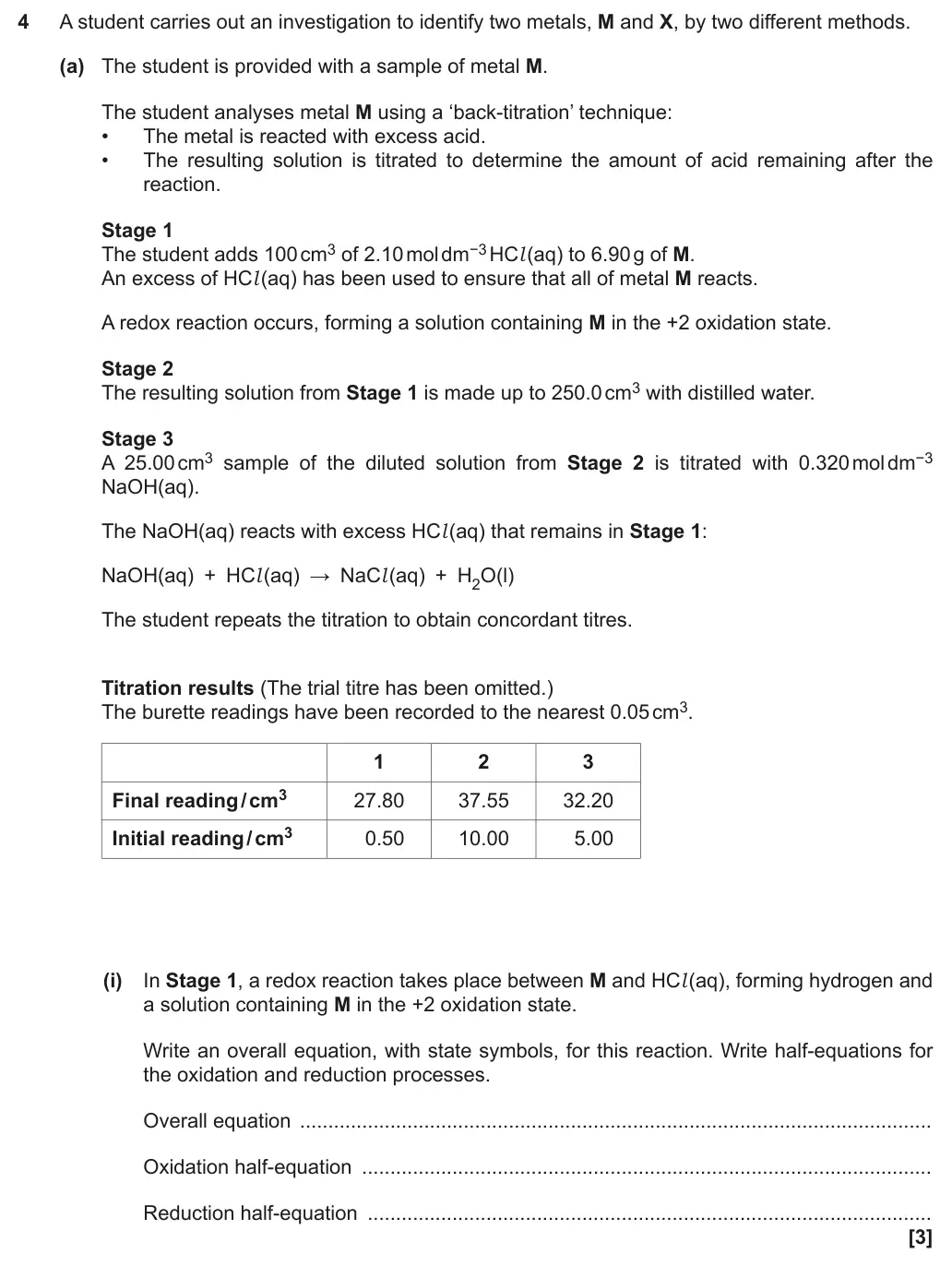
4(a)(i) This question required candidates to write an overall equation and half equations for oxidation and reduction. Many candidates made errors within one or more equations. The overall equation was often written without state symbols, despite the question instruction ‘with state symbols’. The oxidation half equation was more likely to be correct than the reduction half equation, which often used Cl instead of H+. When H+ was used, the half equation was often unbalanced or electrons had been omitted. It is recommended that candidates carefully use the chemical information in the question. 4(a)(ii) Most candidates identified that all the metal would have reacted when it had all disappeared and that gas bubbles from the reaction would have stopped. Some responses did not emphasise that these observations would have stopped and this prevented credit being given. 4(a)(iii) The ionic equation for neutralisation of an acid with an alkali was well known and this question was answered correctly by most candidates. 4(a)(iv) Candidates were presented with information about a back titration, a technique that they would be unlikely to have encountered during their course. The question stem to 4a(iv) suggested a three-step strategy. Many candidates followed this guidance and were credited with many of the available marks. Marks were given for a correct method (by error carried forward) even if there was an error or omission in the multi-step calculation. This emphasises the importance of clear working. Most candidates determined the correct mean titre of 27.25 cm3. A few candidates did take the mean of all three titres rather than the closest. Most calculated that 8.72 × 10⁻³ mol of NaOH reacted with the same number of moles of HCl in the titration and then scaled up the HCl by a factor of 10 to 8.72 × 10⁻² mol in the 250 cm3 volumetric flask. These steps are standard for many titration calculations and gave a route to three of the six available marks. The more difficult back titration steps then followed and the higher-attaining candidates recognised the need to subtract this amount of HCl from the original amount of HCl used to react with metal M. These candidates then divide this value by two to find the moles of M that reacted (from the 1 : 2 stoichiometry of M : HCl). The correct calculation then gave a relative atomic mass of M as 112 and its identity as cadmium. It was common for candidates to omit the division by two and to arrive at a relative atomic mass of 56 for iron. The mark scheme shows the variety of metals that candidates identified from their calculations, the errors made, and the error carried forward marks that resulted. Many lower-attaining candidates did not follow the 3 steps in the stem, using only the original amount of HCl and ignoring the titration. This approach was not credited with marks. A large range of marks was seen, and the question discriminated extremely well. 4(b)(i) This straightforward mole calculation required candidates to determine the mass of CO2 as 2.75 g from the table of results and to divide this value by the molar mass of CO2 to arrive at 0.0625 mol. Most candidates were successful. As with other questions providing raw experimental results, lower-attaining candidates often chose the wrong data from the supplied results. 4(b)(ii) Many candidates used their value from 4b(i) with the mass of X2CO3 from the results table to obtain a value for the molar mass (233.13 from 14.57 ÷ 0.0625). Higher-attaining candidates obtained a value for the atomic mass of X (86.56 from 233.13) and identified X as the Group 1 metal rubidium. Some candidates did not recognise the significance of the formula of X2CO3 and identified X instead as strontium (Ar = 87.6). Lower-attaining candidates often used incorrect data from the supplied information and made little progress with this calculation. 4(c)(i) Most candidates suggested that the mass of the flask and contents could be reweighed until the mass no longer changed. An alternative creditworthy suggestion was to attach a gas syringe and to measure the gas volume until it no longer changed. Vague suggestions such as ‘leave for longer’ were not credited with marks. 4(c)(ii) Candidates found this question challenging. Success required candidates to appreciate that some CO2 dissolving would result in less mass of CO2 being recorded as lost, meaning that less moles of CO2 had apparently been formed and so less moles of X2CO3 had reacted. Using n = m/M, this would show that the calculated molar mass of X2CO3 appears to be greater. Only the highest-attaining candidates successfully navigated this question.
Notes from the mark scheme and report
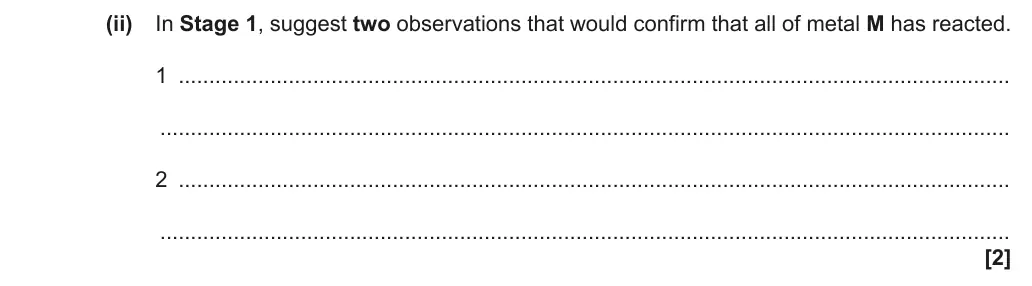
ALL fizzing has stopped
ALL the metal has dissolved ('metal disappears' not quite enough)
IGNORE constant mass and no temperature increase
June 2019 · AS Paper 2 · Q2(a)6 marksAO26-mark level of responseMedium
Mark scheme, with the levels and indicative points
Examiner's comment
Most candidates focused on removing the water of crystallisation, often going to great depths of explanation, with apparatus diagrams, of how to remove it. Some candidates then went on to explain how to make a standard solution and could be given marks. Calculations for the mass required were often correct or could be given some marks. This in a response of a common approach to this question, it was given 4 marks. Despite calculating the mass properly, the candidate then put all their efforts into describing removing the water of crystallisation and left out the valuable fine detail required for a Level 3 response.
Notes from the mark scheme and report
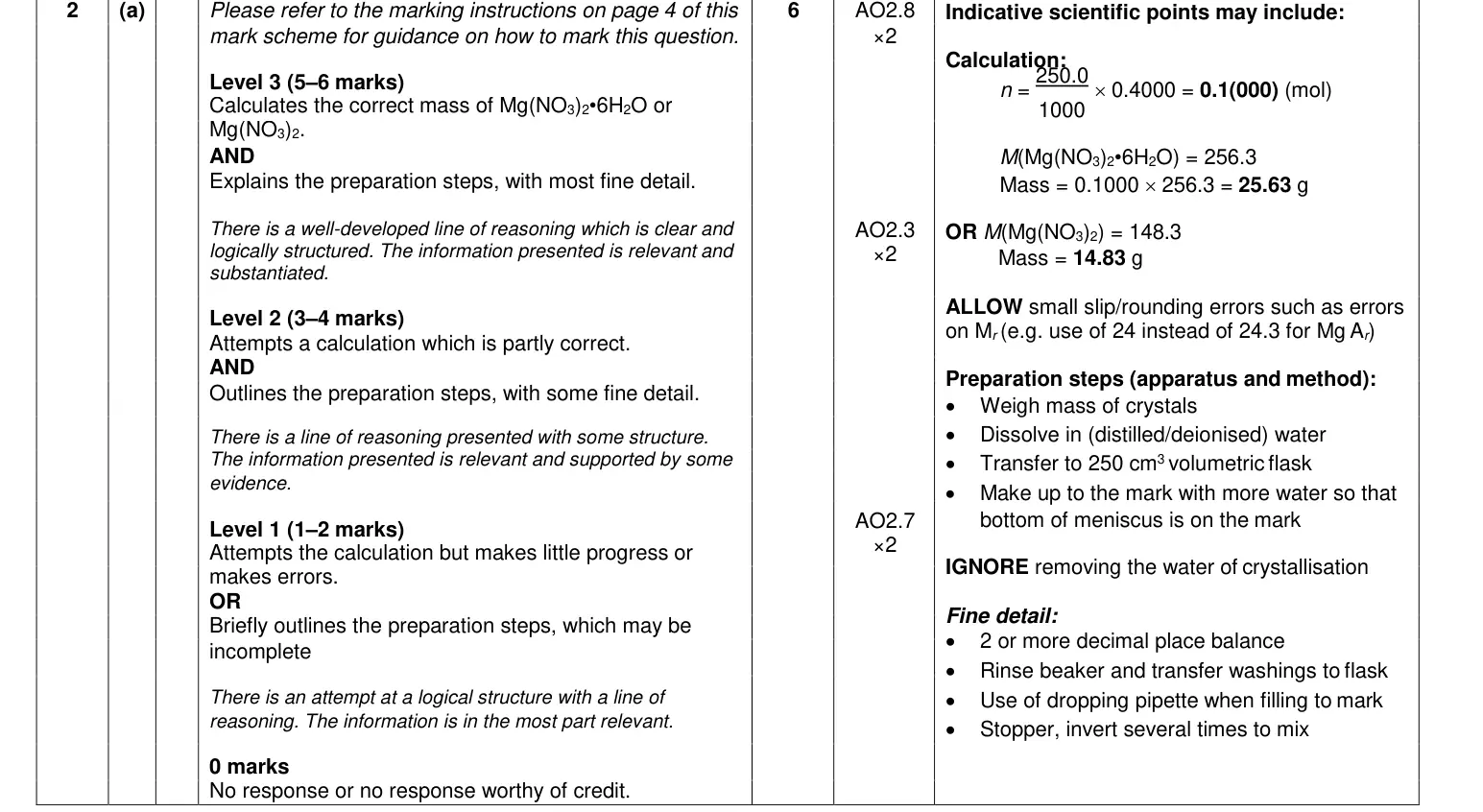
mass 25.63 g of Mg(NO3)2•6H2O (14.83 g if water of crystallisation omitted)
dissolve in distilled water, transfer with washings to 250 cm3 volumetric flask, make up to mark with bottom of meniscus on mark, invert to mix
IGNORE removing water of crystallisation
Skills: M0.0 Recognise and make use of appropriate units in calculations; M2.3 Substitute numerical values into algebraic equations using appropriate units for physical quantities; PAG2 Acid–base titration
June 2019 · AS Paper 2 · Q5(b)(i)6 marksAO2, 36-mark level of responseHard
Mark scheme, with the levels and indicative points
Examiner's comment
This question discriminated well and most were able to attempt to calculate a mass and explain the purification steps with some fine detail. It was evident that most candidates were aware of the apparatus required but the logic in the order was sometimes out of sequence. Drying agents were mentioned, some of the examples used were incorrect and errors were made with the boiling points if candidates mentioned distillation. This in a response of an excellent approach to this question, it was given 6 marks. The correct mass has been calculated and all of the fine detail, except distilling at 63°C
Notes from the mark scheme and report
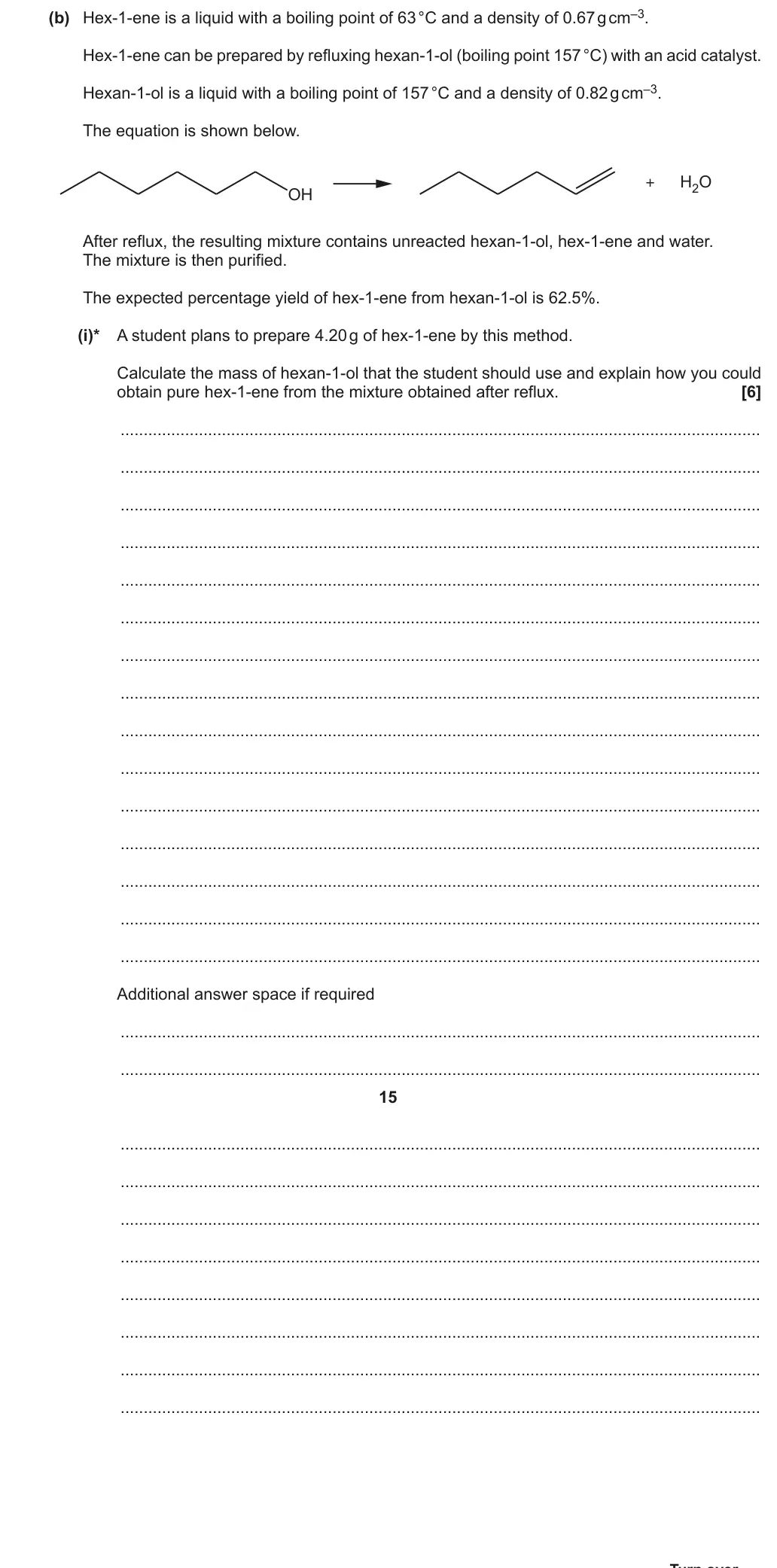
0.0500 mol hex-1-ene needs 0.0800 mol hexan-1-ol = 8.16 g
partly correct: 5.1 g (% yield omitted), 3.19 g (% yield inverted)
separating funnel (upper organic layer), dry with anhydrous MgSO4/CaCl2, distil collecting fraction at 63 °C
incorrect purification method not creditworthy
Skills: M0.2 Use ratios, fractions and percentages; M2.2 Change the subject of an equation; M2.3 Substitute numerical values into algebraic equations using appropriate units for physical quantities; PAG5 Synthesis of an organic liquid
June 2019 · Paper 3 · Q2(e)2 marksAO3Short answerMedium
Earlier part of question 2 that this part uses
Mark scheme
Examiner's comment
Many candidates produced thorough responses, showing that they had encountered recrystallisation as a technique in their practical work. Most candidates were aware that the impure product is dissolved in a minimum volume of hot solvent, although ‘minimum’ was sometimes omitted. The subsequent stages were sometimes incomplete or in the wrong order. Many were aware that the hot solution can be passed through fluted filter paper to remove solid impurities. (This is beyond the specification requirements for A Level but good practice). Most candidates were aware of the need to filter (usually under reduced pressure) but the necessary cooling stage to form the crystals was sometimes omitted. Finally, many responses omitted the need to dry the crystals. Candidates did sometimes dry the crystals by adding an anhydrous salt (e.g. CaCl2 or MgSO4), a clear confusion with drying an organic liquid. Others described the purification of an organic liquid for their response, including use of a separating funnel, drying and distillation.
Notes from the mark scheme and report
dissolve in the minimum quantity of hot solvent
cool AND filter AND dry (all three needed)
DO NOT ALLOW use of a drying agent
IGNORE hot filtration
Skills: PAG6 Synthesis of an organic solid
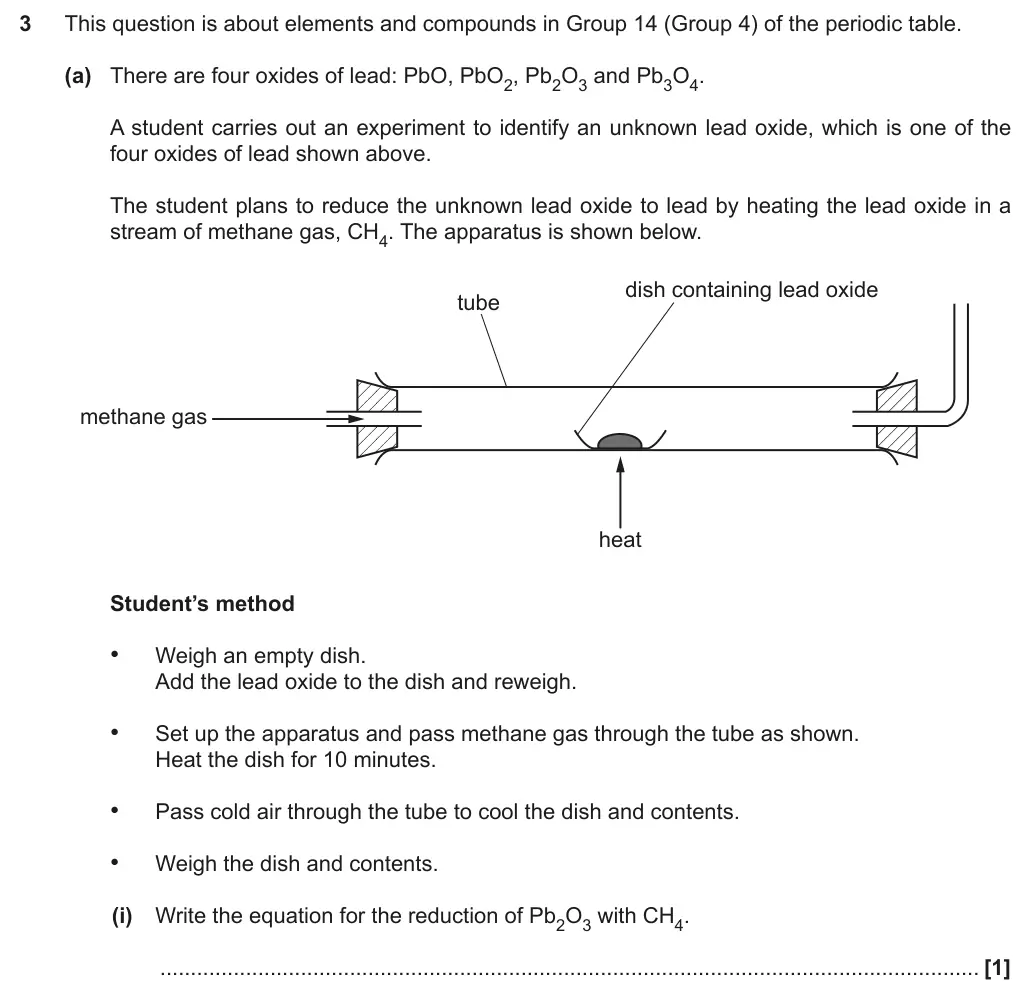
June 2019 · Paper 3 · Q3(a)(ii)1 markAO3Short answerMedium
Earlier part of question 3 that this part uses
Mark scheme
Examiner's comment
The mark scheme catered for a wide range of responses that were judged to be worthy of credit. Responses that form part of normal safe laboratory practice, such as keeping bags under benches, tying hair back, etc., were not given. Candidates were expected to identify a precaution for a chemical hazard. As with GCSE, general words to describe hazards, such as harmful and dangerous, were not given. Acceptable chemical hazards would include those encountered in hazard signs such as flammable (for methane) or toxic (for lead or lead compounds). The best responses suggested that naked flames should be kept away from flammable methane or that gloves should be worn when using toxic lead. Other suggested use of a fume cupboard or good ventilation when using flammable or toxic materials. Responses such as ‘face masks’ gained no credit.
Notes from the mark scheme and report
definite safety issue AND matching precaution (toxic lead compounds – gloves or fume cupboard
flammable methane – keep away from flame)
'harmful'/'dangerous' too vague
IGNORE safety glasses, lab coat
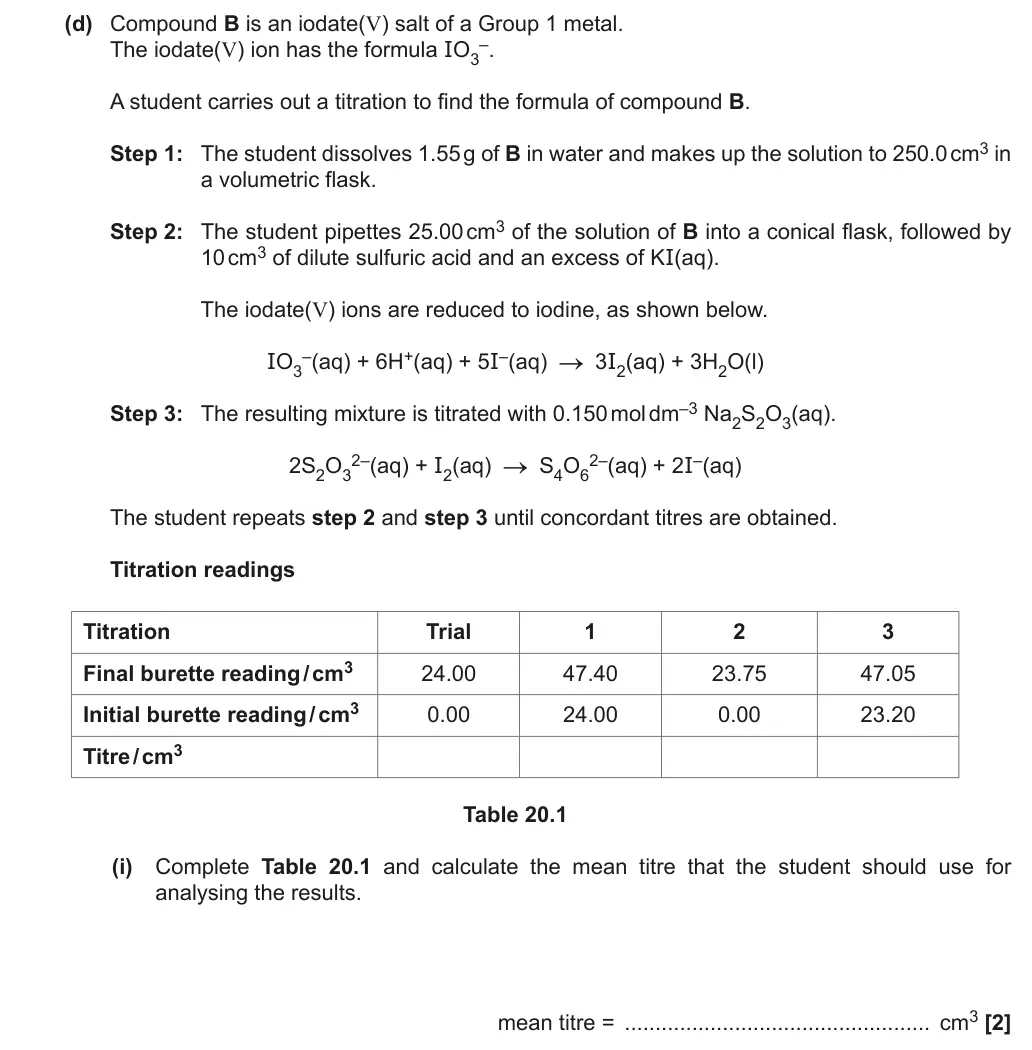
June 2018 · Paper 1 · Q20(d)(i)2 marksCalculationMedium
Mark scheme
Examiner's comment
It is clear candidates are not as experienced at filling in titration tables as might be expected. Every value in a titration table should be recorded to a second decimal place to an accuracy of ± 0.05 cm3. The average titre should be calculated by averaging concordant titres, i.e. those within 0.10 cm3 of each other.
Notes from the mark scheme and report
all titres to 2 d.p.
mean from concordant titres only (23.75 and 23.85) = 23.80
June 2018 · AS Paper 1 · Q22(a)(iii)2 marksShort answerHard
Earlier part of question 22 that this part uses
Mark scheme
Examiner's comment
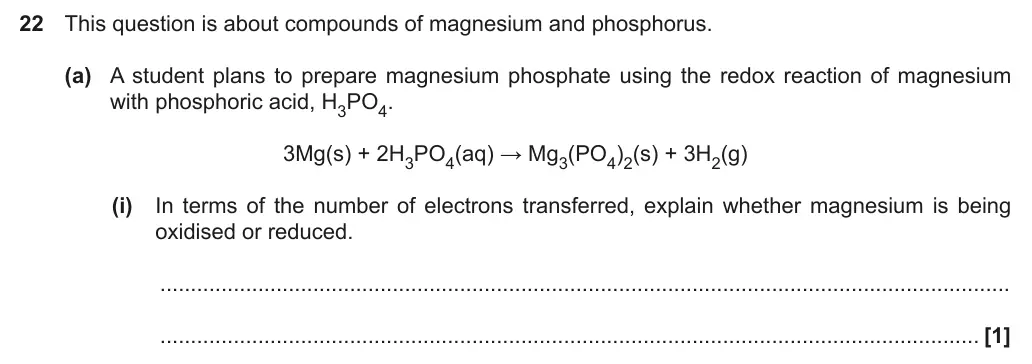
Candidates often struggle with questions based on practical work. There were many random responses to this question, with relatively few candidates identifying that solid magnesium phosphate could be obtained by filtration, followed by drying.
Notes from the mark scheme and report
filter to obtain the solid, then dry
IGNORE 'leave to crystallise' (already solid)
IGNORE distil if product or H2 is distilled
June 2018 · AS Paper 2 · Q1(c)(i)4 marksCalculationEasy
Earlier part of question 1 that this part uses
Mark scheme
Examiner's comment
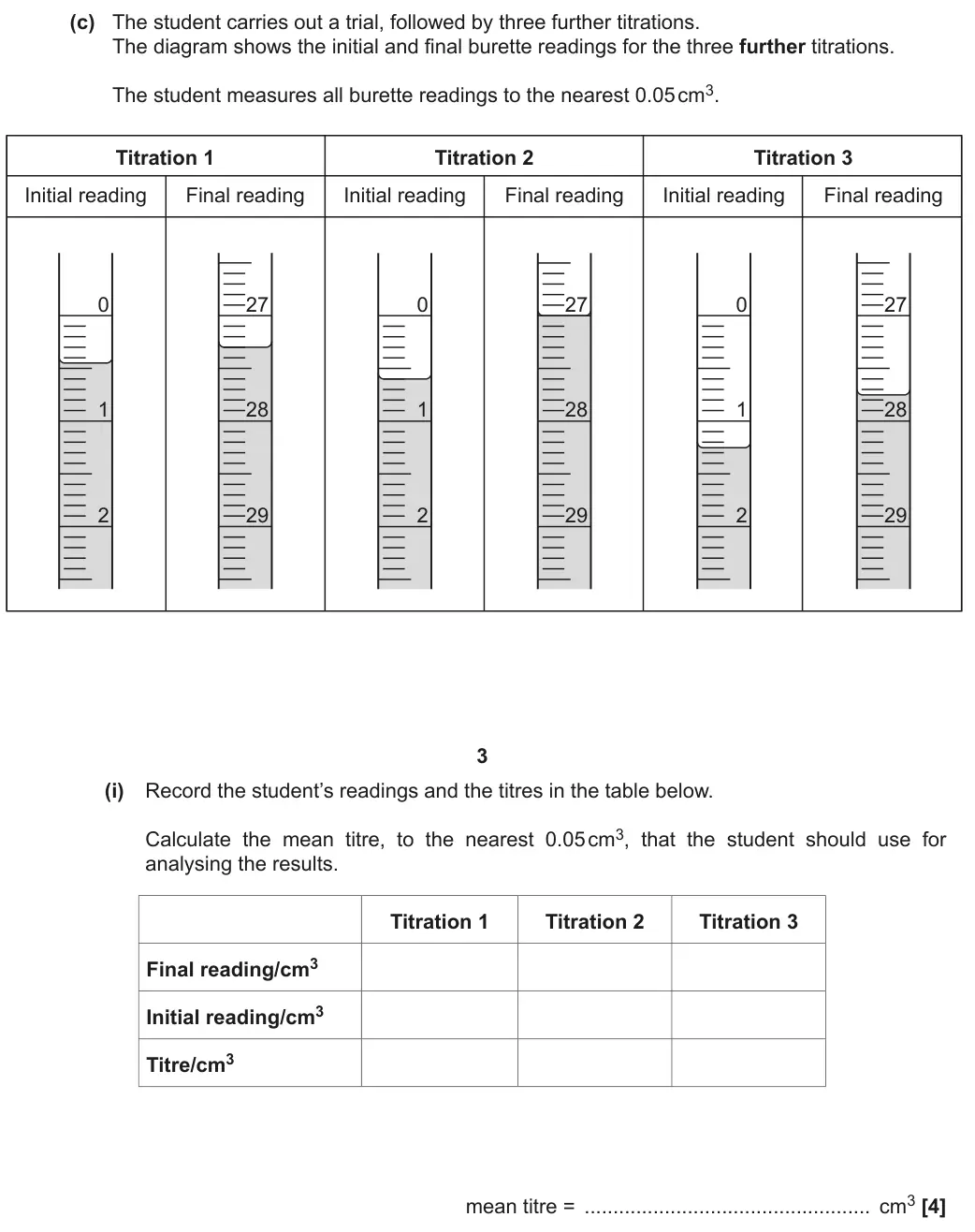
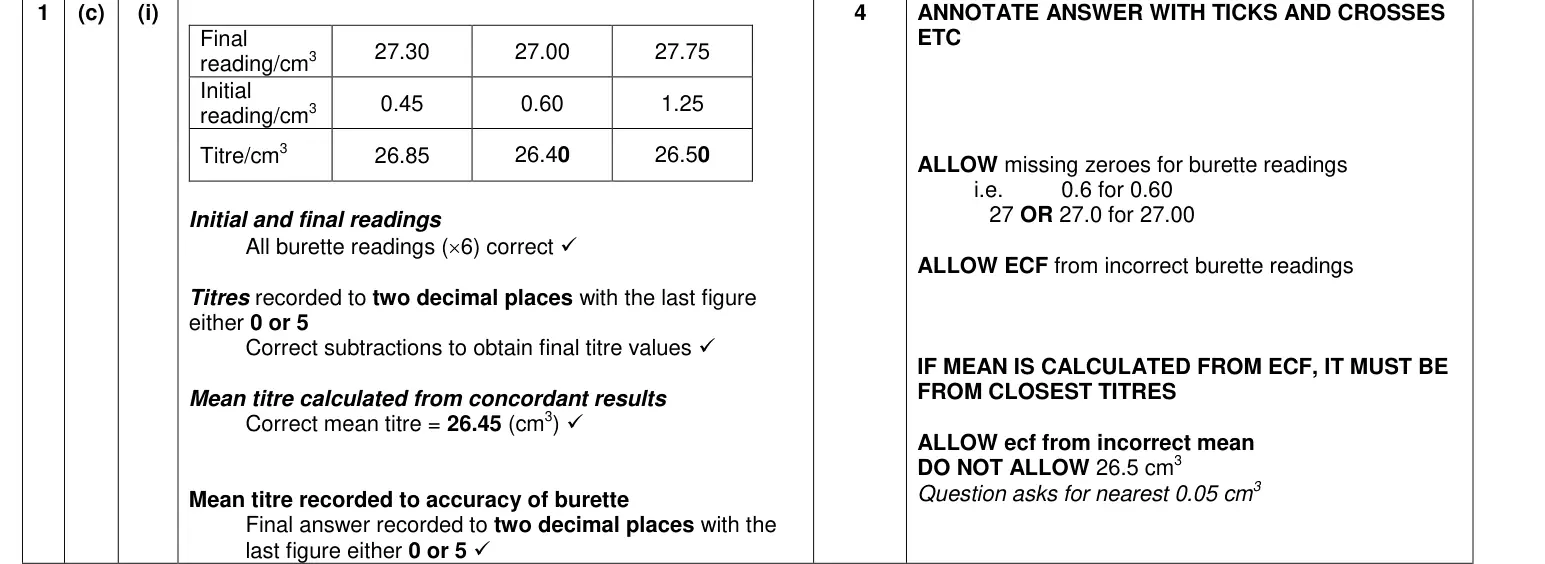
Most candidates were able to accurately record the burette readings and made the correct subtractions. Despite the examination question requesting the mean titre to be recorded to the accuracy of the burette, many candidates did not do this. A common error was taking a mean of all three readings instead of only the concordant results; this led the candidates to give an answer of 26.58 which lost them 2 marks.
June 2018 · AS Paper 2 · Q1(c)(iii)1 markShort answerMedium
Earlier part of question 1 that this part uses
Mark scheme
Examiner's comment
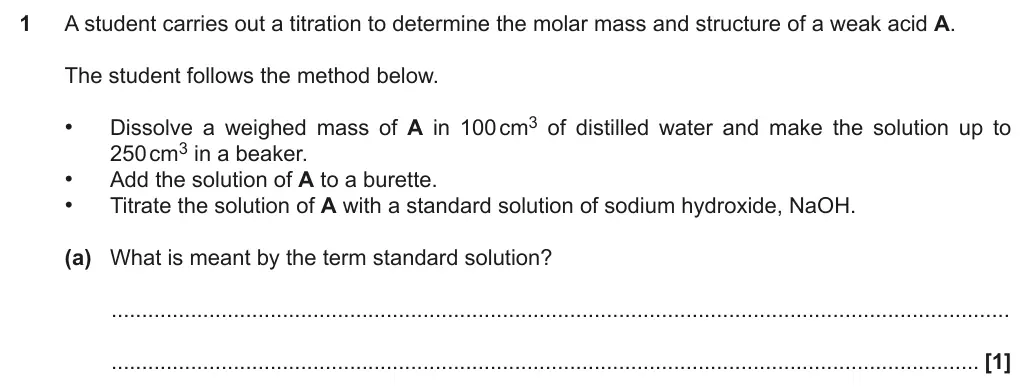
Although there were some excellent descriptions of the correct processes, such as inverting the apparatus to ensure mixing and then making the solution up to the mark, many candidates could not name a volumetric flask.
Notes from the mark scheme and report
volumetric flask instead of beaker
IGNORE graduated flask
Skills: PAG2 Acid–base titration
June 2018 · AS Paper 2 · Q5(a)(i)6 marks6-mark level of responseHard
Mark scheme, with the levels and indicative points
Examiner's comment
Candidates were not prepared to answer this type of question and the diagrams were hard to give credit to. Many had significant safety implications such as open beakers of butan-1-ol being heated by a Bunsen burner. Most mis-read the question and just outlined the method for purification and struggled to recall the practical details. Very few candidates mentioned the use of anhydrous salts, referring instead to ‘boiling off’ the water. This candidate was credited 4 marks for this level 2 answer. Although they have drawn distillation apparatus instead of reflux, they have considered the boiling point of the product, detailed using a separating funnel, a drying agent and that the lower organic layer would be drawn off first.
Notes from the mark scheme and report
reflux with water in at bottom of condenser and open system
separating funnel – organic layer is the lower (denser) layer
dry with anhydrous salt
redistil collecting at 102 °C
Skills: PAG5 Synthesis of an organic liquid
June 2018 · Paper 2 · Q19(c)(i)2 marksDrawing / labellingEasy
Mark scheme
Examiner's comment
Most candidates were able to draw a suitable diagram to show the apparatus required for reflux but some included a stopper on top of the condenser. Many of the diagrams were labelled appropriately but common errors included incorrect direction of water flow or omission of the ‘flask’ label. A small but significant proportion of candidates drew a diagram showing distillation.
Notes from the mark scheme and report
round-bottom/pear-shaped flask AND upright condenser
labels: water in at bottom and out at top, heat
DO NOT ALLOW conical flask/beaker
DO NOT ALLOW distillation
DO NOT ALLOW stopper on top of condenser
Skills: PAG5 Synthesis of an organic liquid
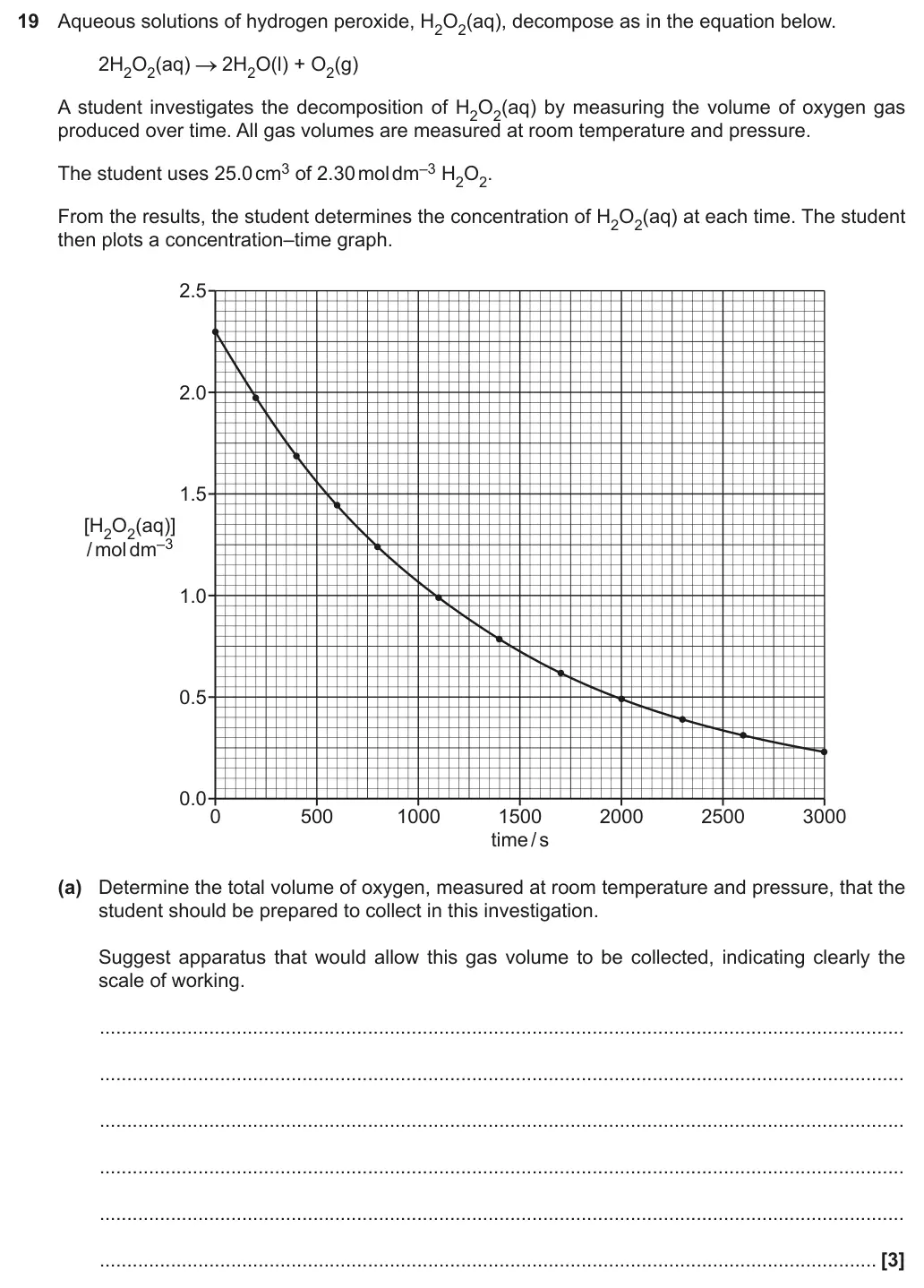
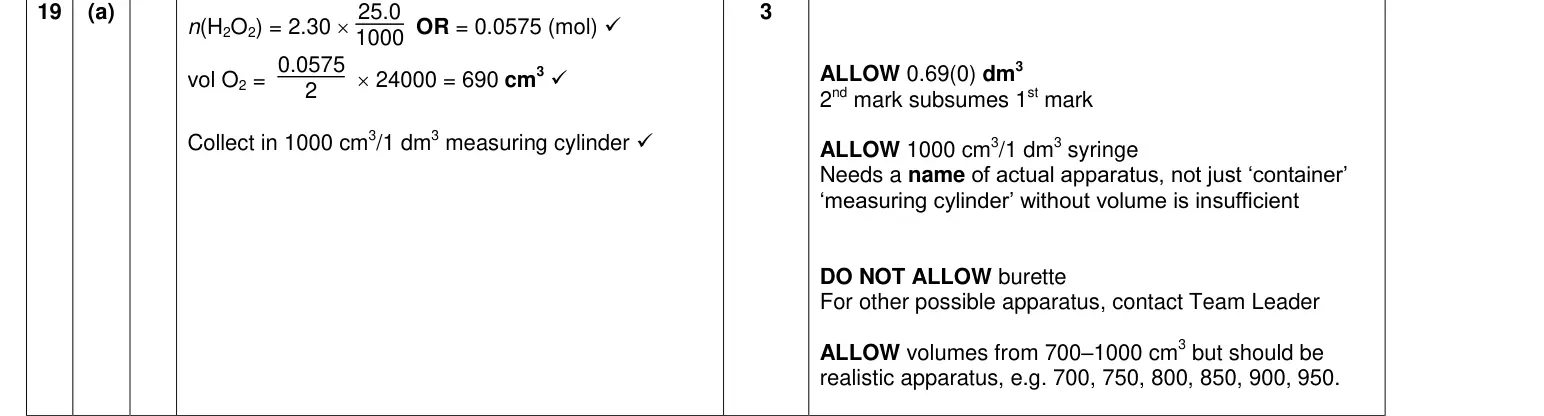
June 2017 · Paper 1 · Q19(a)3 marksShort answer
Mark scheme
Notes from the mark scheme and report
690 cm3
apparatus must be named with a realistic volume (700–1000 cm3 measuring cylinder or syringe)
'measuring cylinder' without volume insufficient
DO NOT ALLOW burette
Skills: M0.2 Use ratios, fractions and percentages; M2.3 Substitute numerical values into algebraic equations using appropriate units for physical quantities; PAG1 Moles determination; PAG9 Rates of reaction – continuous monitoring
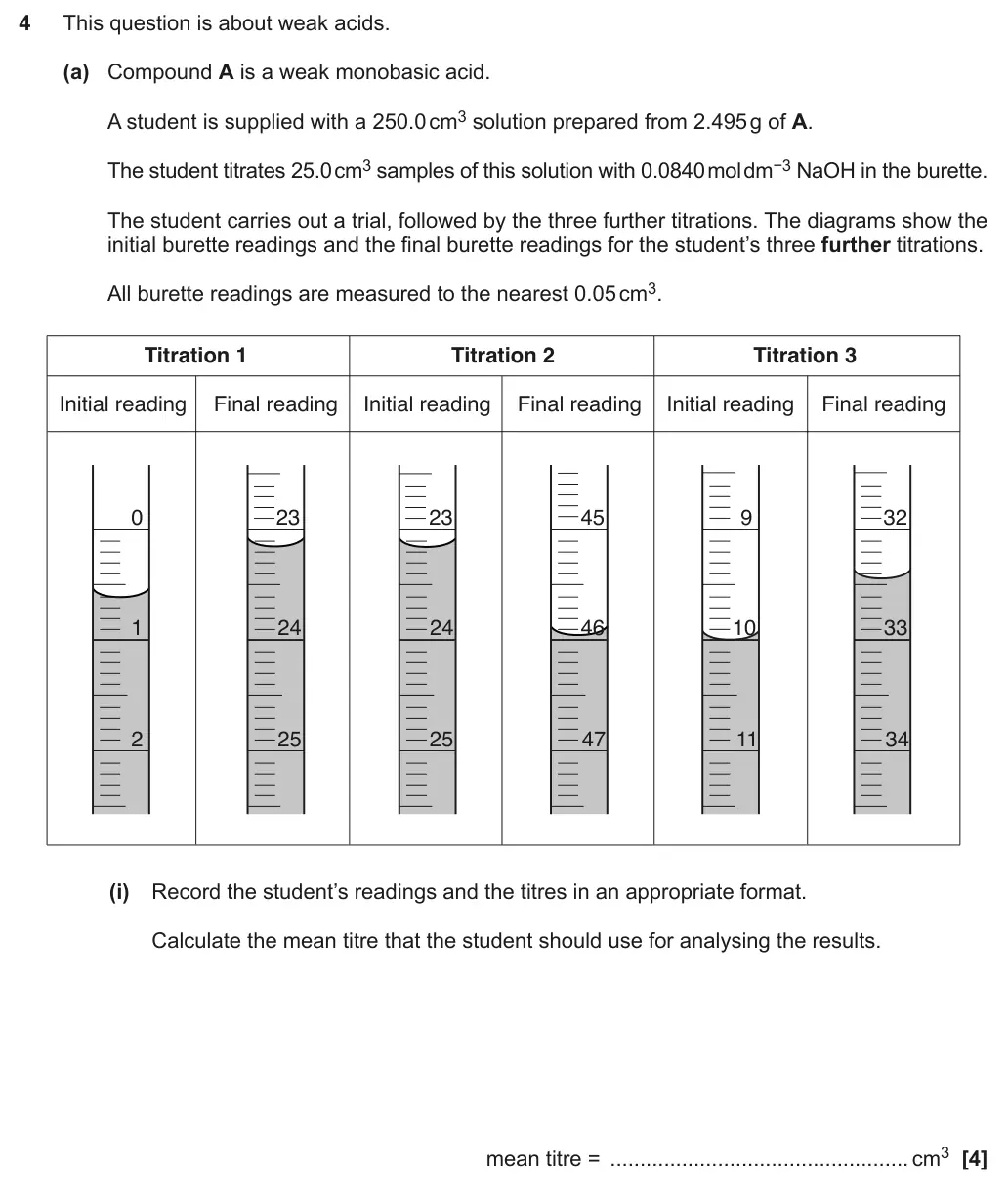
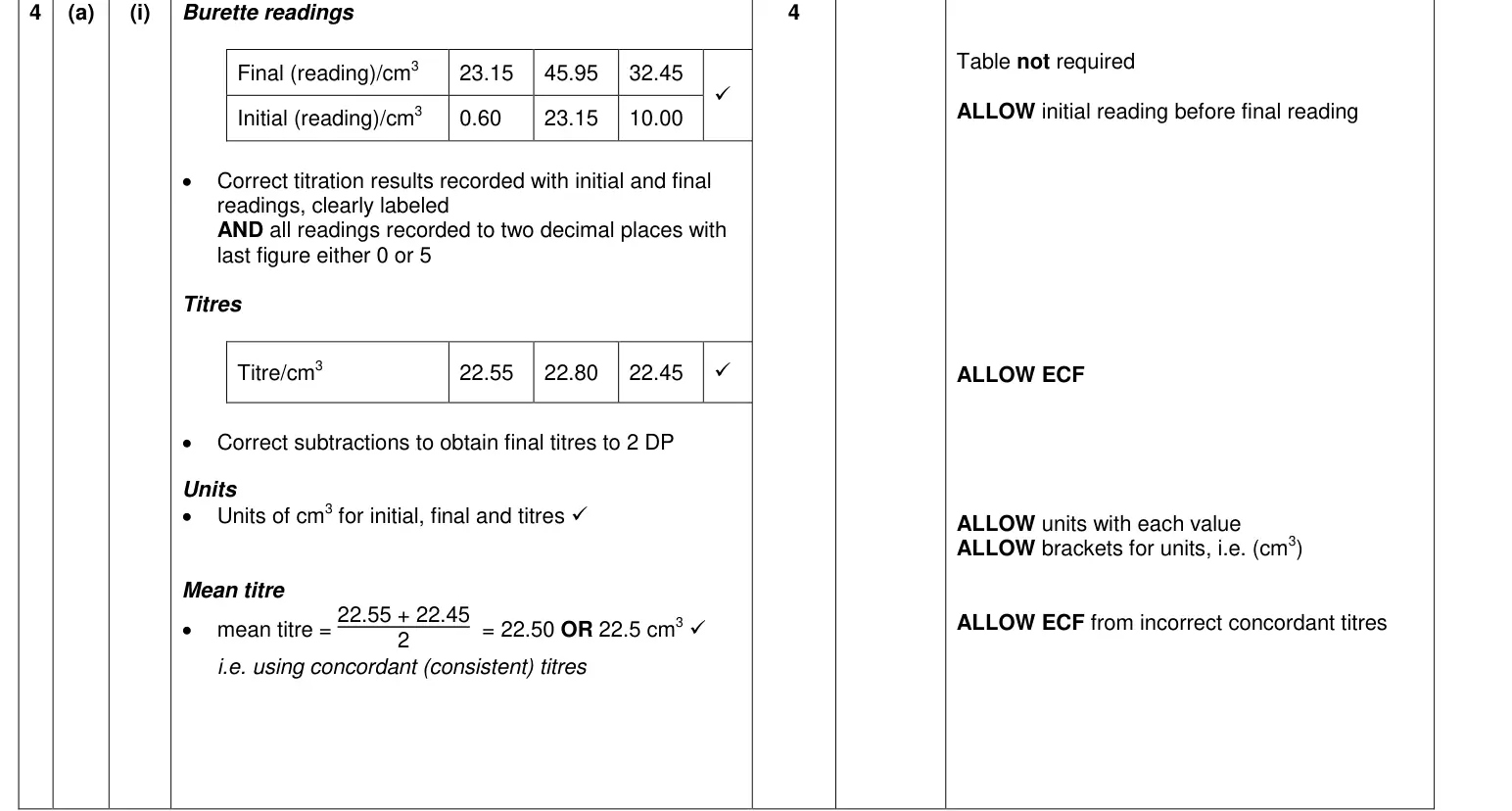
June 2017 · Paper 3 · Q4(a)(i)4 marksCalculation
Mark scheme
Notes from the mark scheme and report
all burette readings to 2 DP ending in 0 or 5
initial and final readings labelled with units cm3