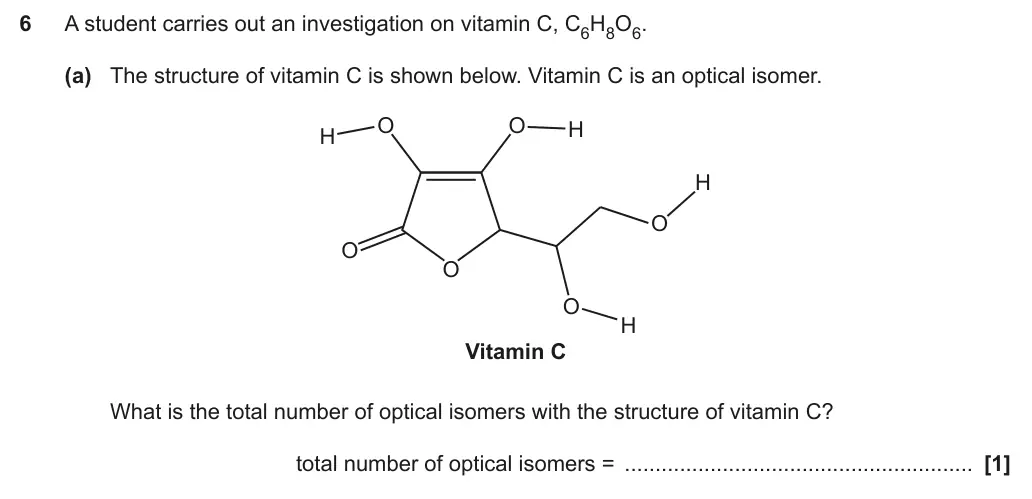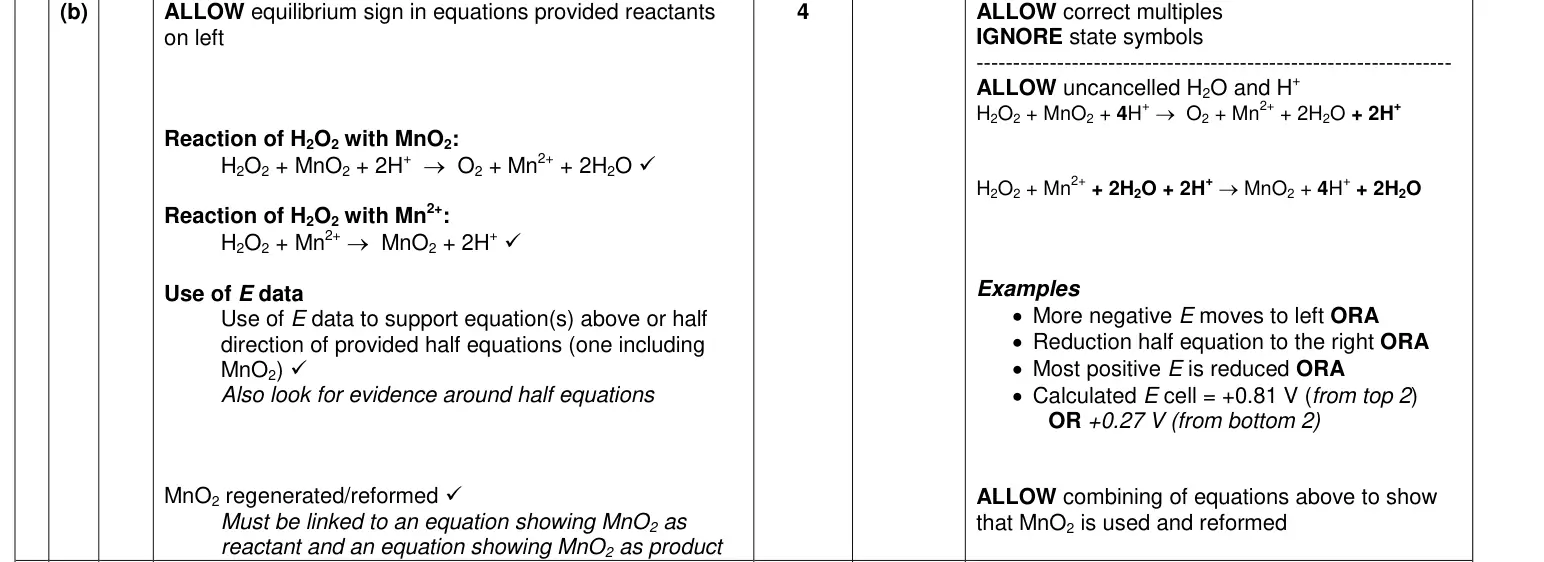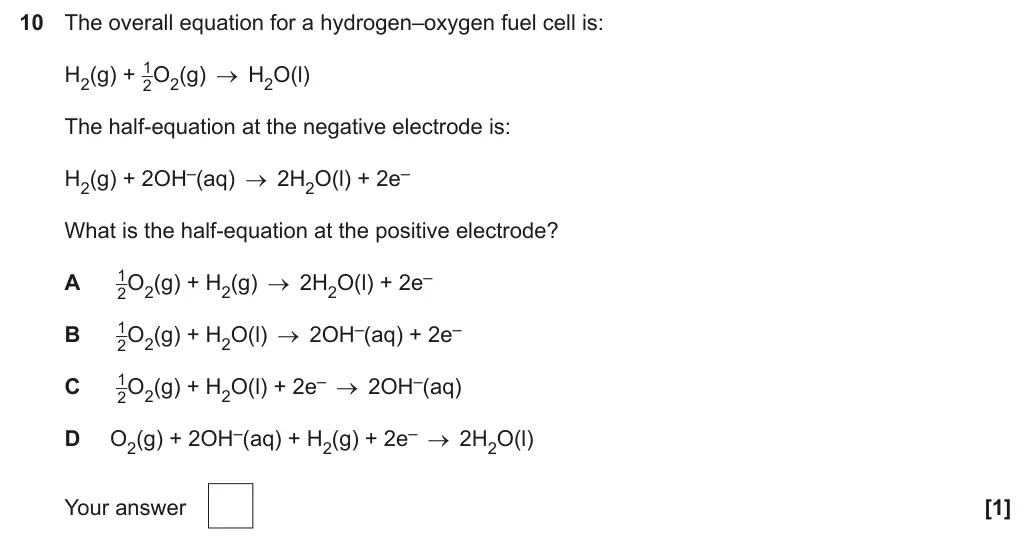
Answer
C
Mark scheme

Examiner's comment
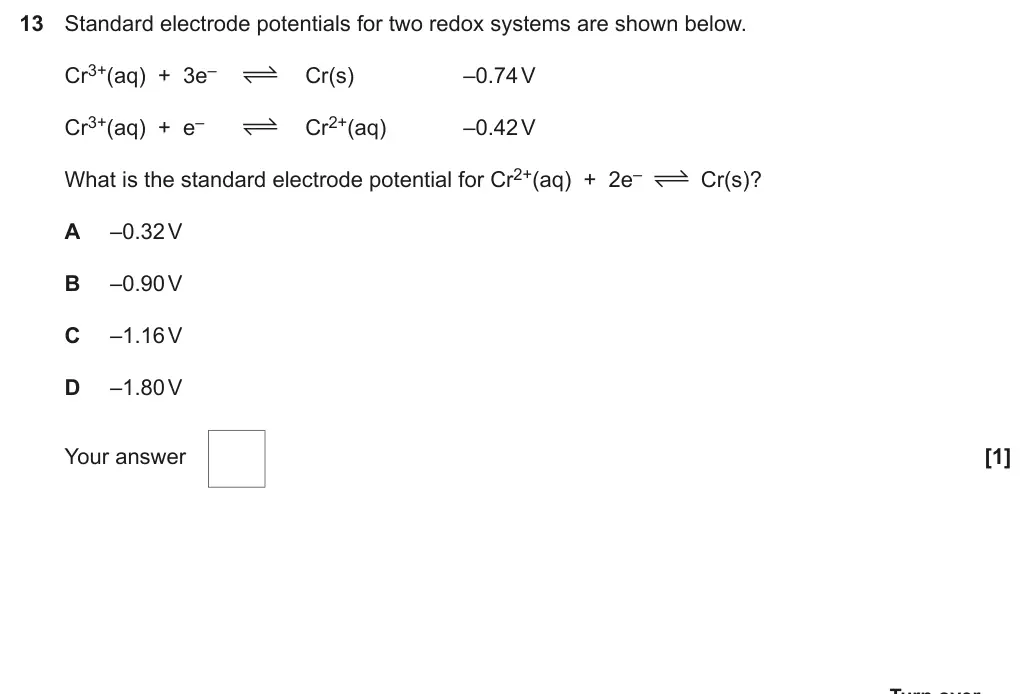
The correct answer was C. This question was slightly more challenging for some candidates who often selected B due to incorrectly observing where the electrons were placed.
Notes and key-term cards for this topic are being written by our tutors. The past-paper questions below are ready now.
| Series | Paper | Q | What it asks |
|---|---|---|---|
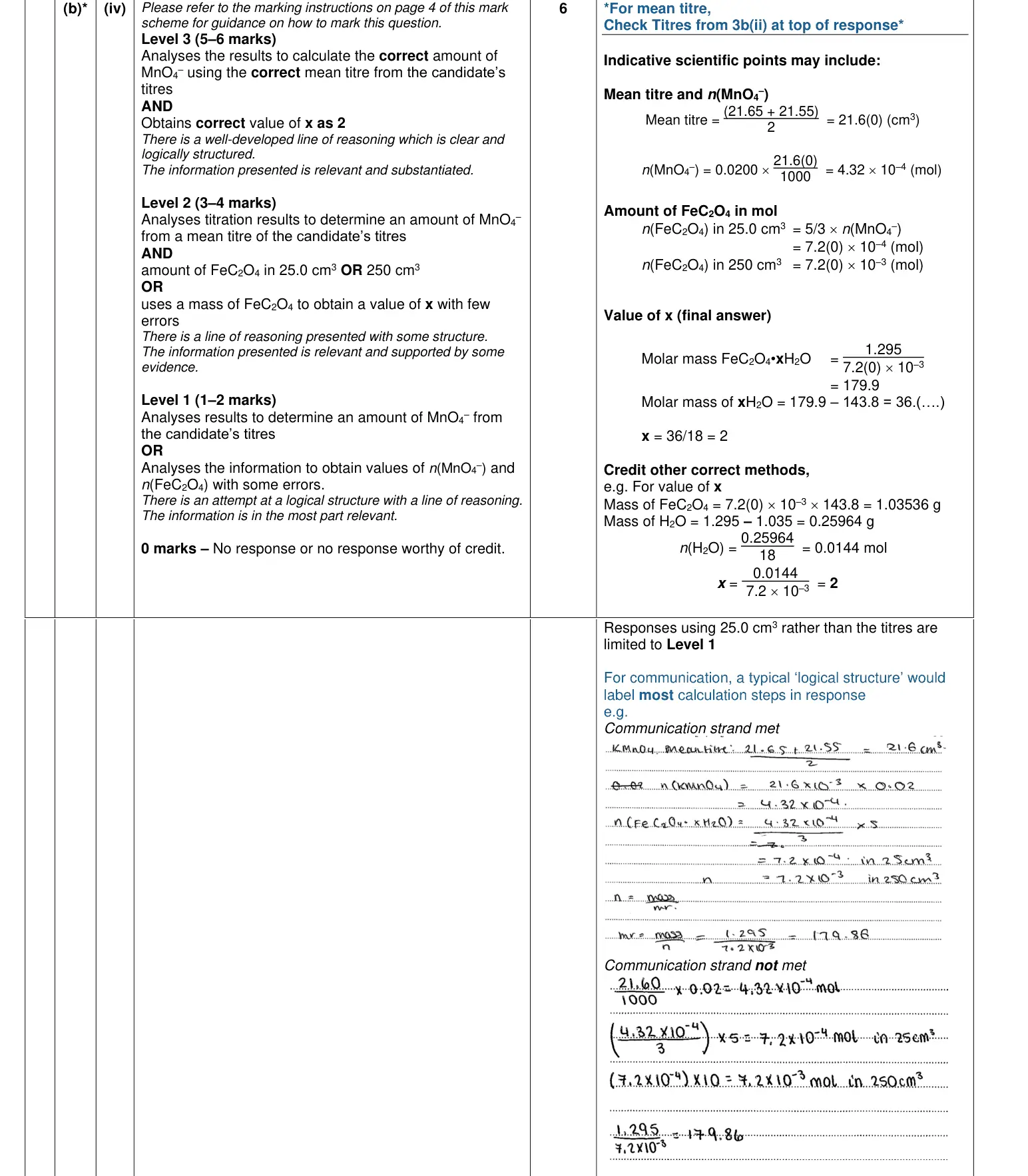
| June 2024 | Paper 3 | 3(b)(iv) | In the titration, 5 mol of iron(II) ethanedioate reacts with 3 mol of manganate(VII) ions. Analyse the student’s results to find the number of waters of crystallisation, x, in the hydrated |
C
The correct answer was C. This question was slightly more challenging for some candidates who often selected B due to incorrectly observing where the electrons were placed.
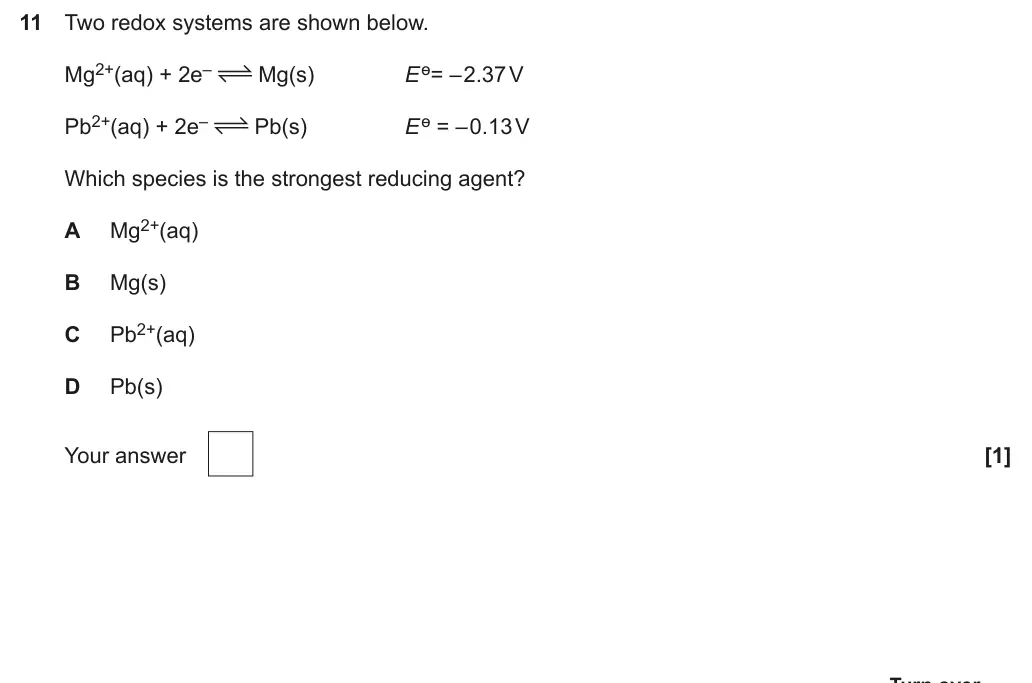
B
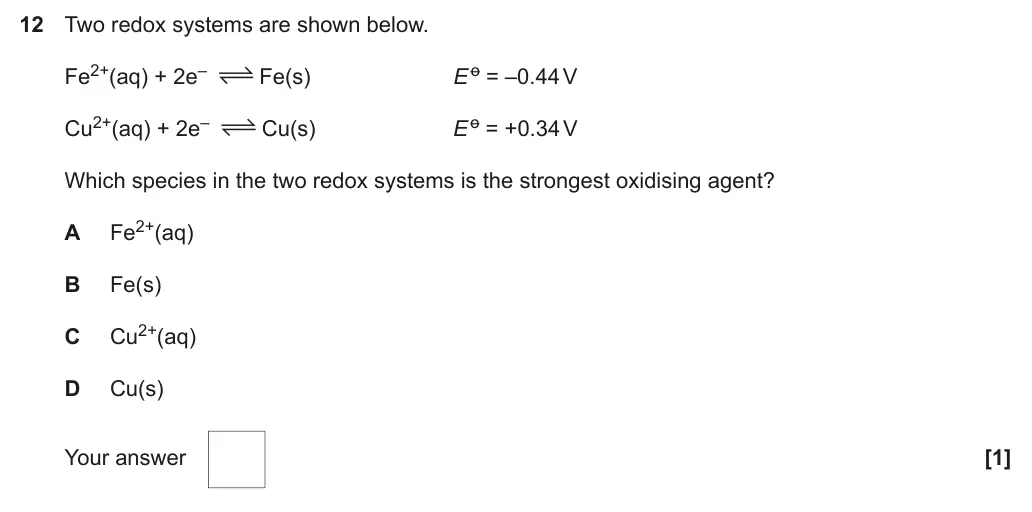
The correct answer was B. This was often the most challenging question for candidates. Redox and electrode potentials continue to be a higher-level concept. The terms reducing ‘agent’ and the species being reduced can often be confused. A good number of candidates did not reverse the more negative equilibrium system before they chose their answer.
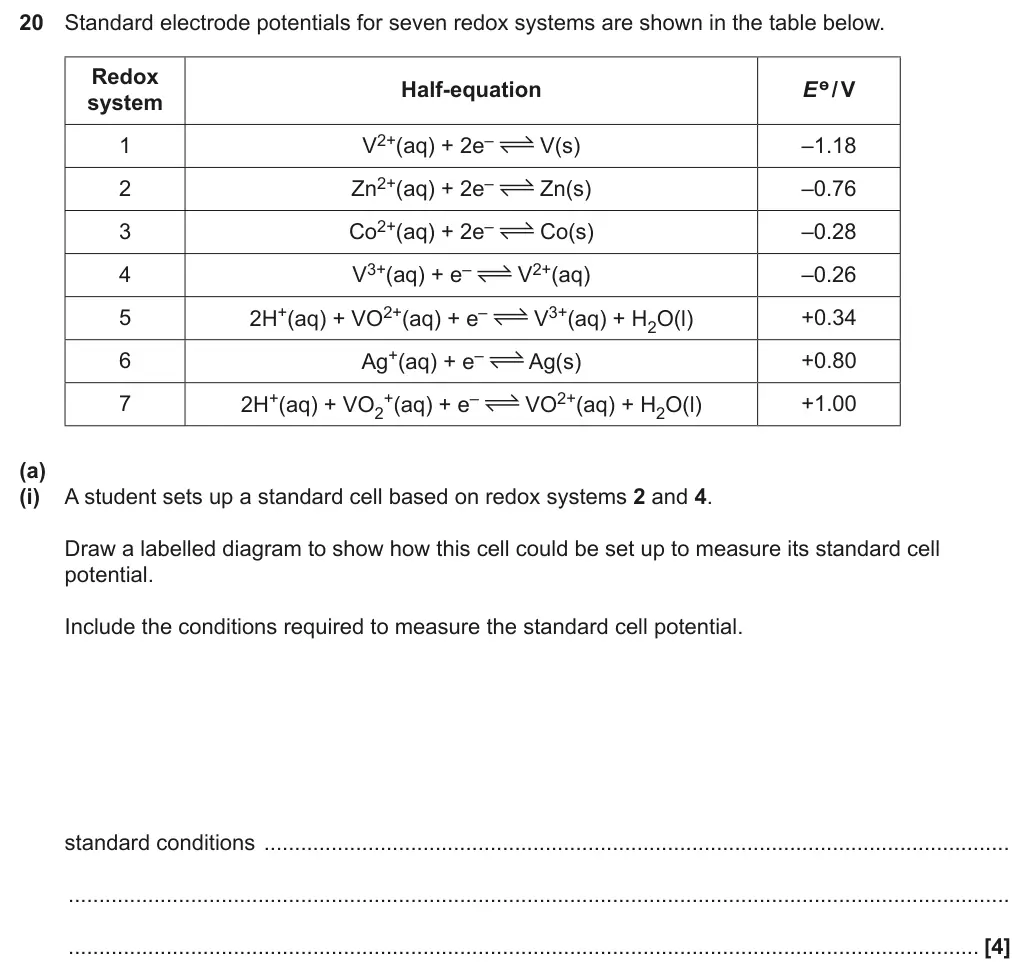
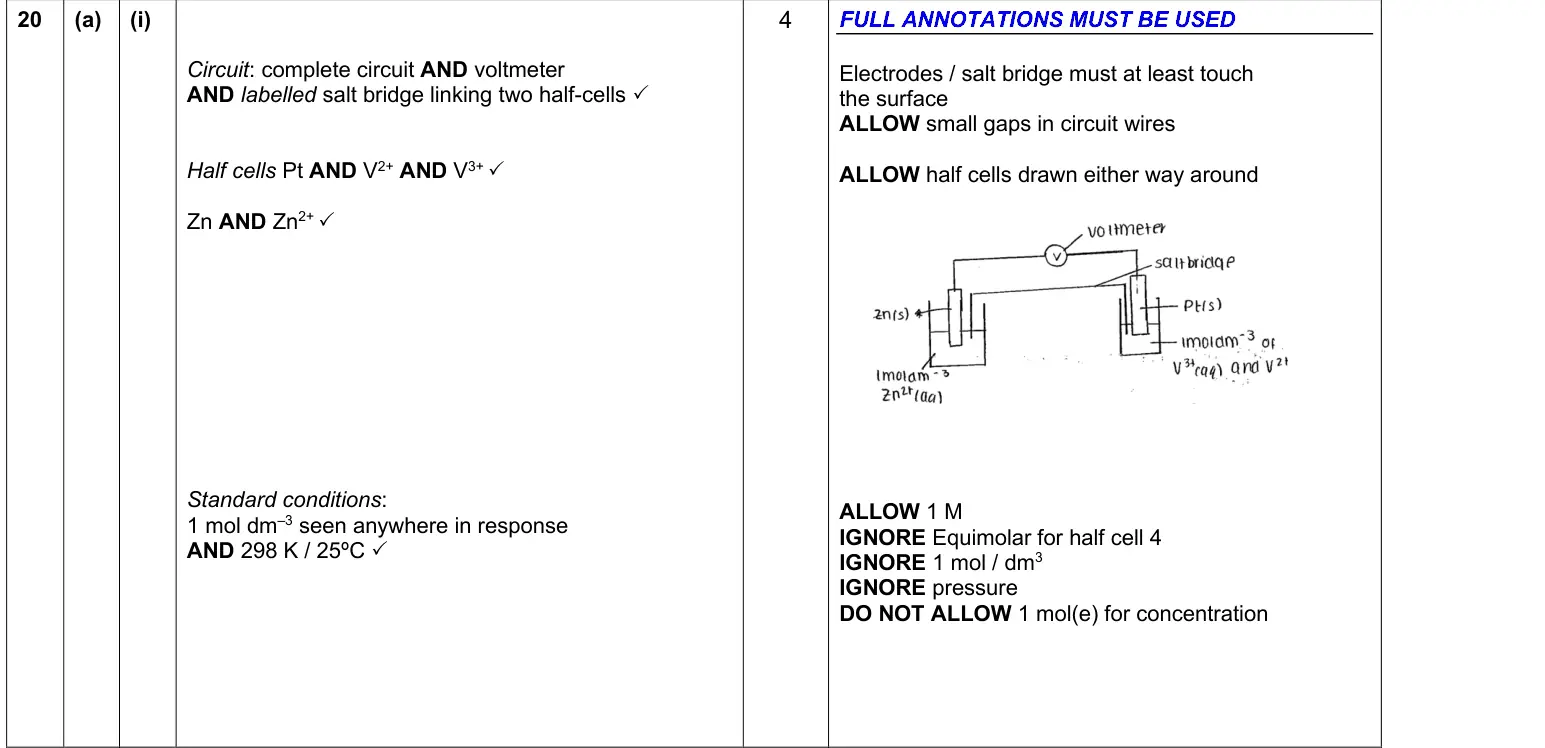
Candidates made good progress and produced good diagrams with many given 4 marks. More candidates appreciated how the vanadium half-cell was set up than in previous series. Common errors were to miss the labelling of the salt bridge or to quote an incorrect temperature, e.g. 273K or 293K. Occasionally a hydrogen electrode was drawn, or V was used instead of Pt. Some candidates put H+ in with their V2+ /V3+.
Skills: PAG8 Electrochemical cells
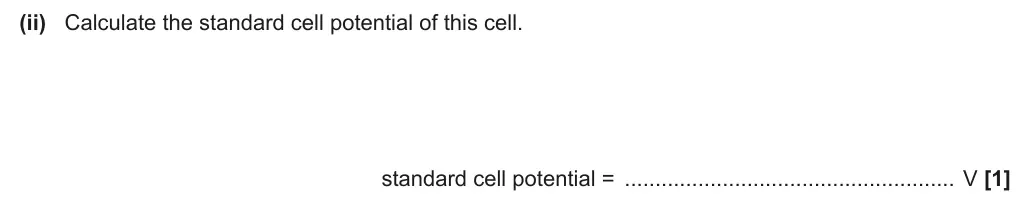
Almost all candidates calculated the standard cell potential correctly. Common errors were -0.5V or -1.02V
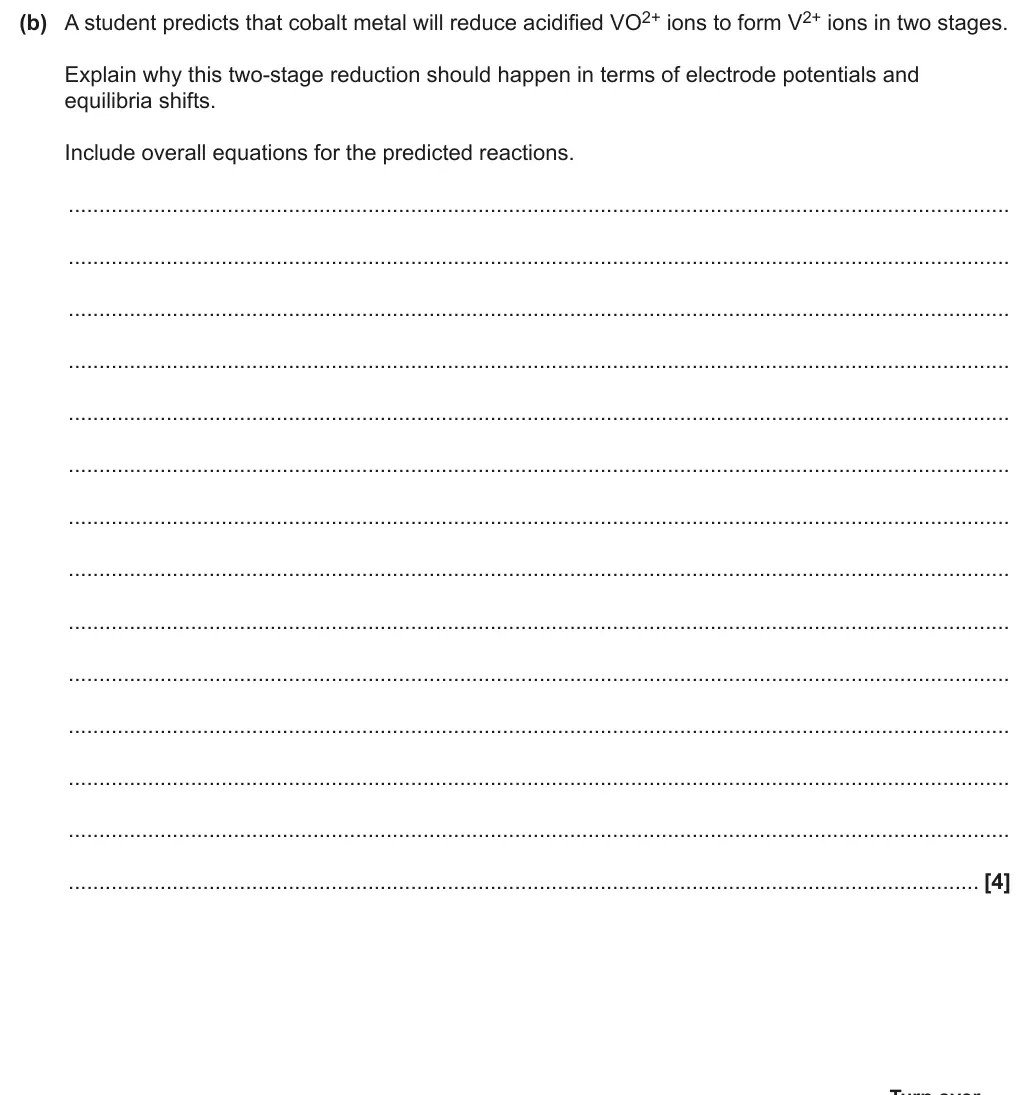
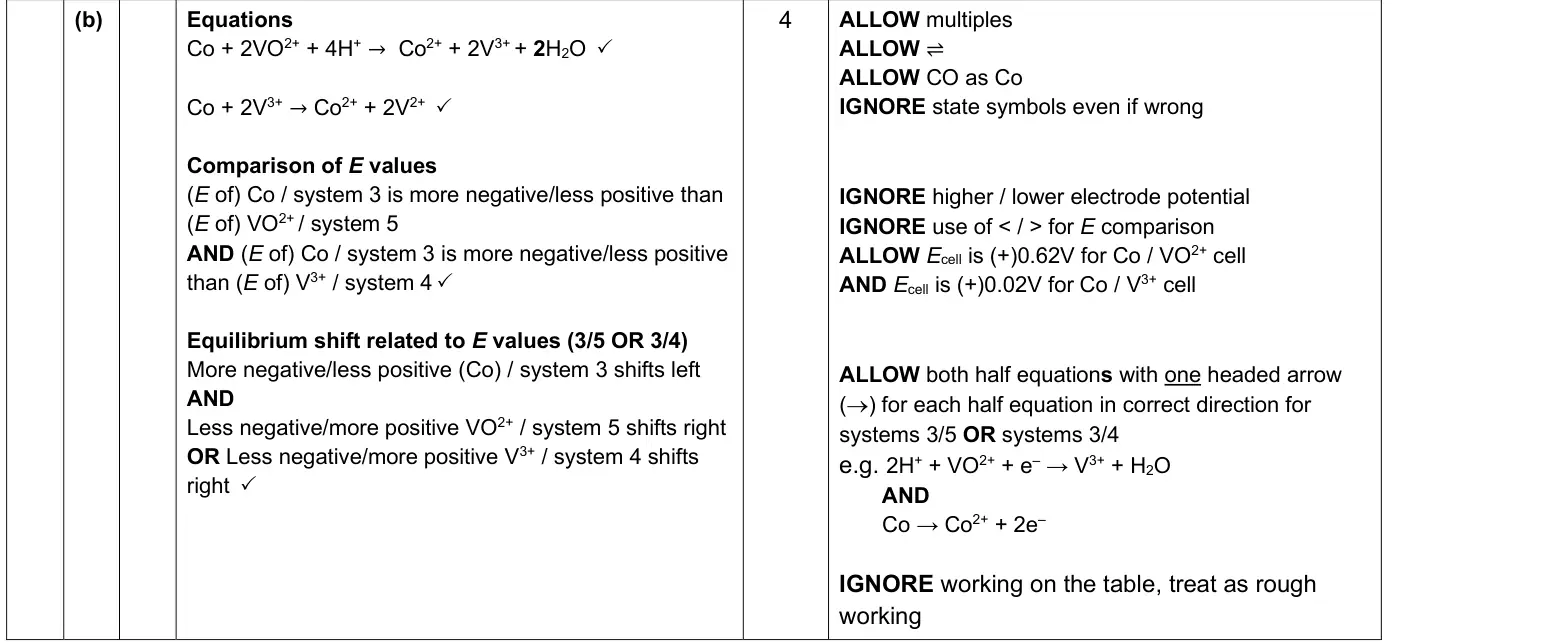
This question required the candidates to explain the two step reduction of VO2+. The question was only answered well by a few candidates and electrode potentials continues to be a conceptually difficult topic. Choosing the correct systems was difficult for most candidates. Some used the Zn system, perhaps because of the diagram and others joined systems: 4+5, 1 and 7. Writing the two equations proved challenging. Equations were often unbalanced, written the wrong way round or missing the second reduction step completely. There was evidence of confusion between VO2+ and VO2+. When comparing electrode potentials, candidates should avoid the use of higher/lower are these phrases are ambiguous due to the negative signs involved. Phrases such as more negative/less positive removes this ambiguity. Candidates are advised to read the instructions contained within the equation and to use or comment on all the data presented. Equilibrium shifts were often stated as shifting left/right without making it clear to which equilibrium the candidate was referring to. Often only one equilibrium shift was mentioned. Candidates should be reminded to use lower case for the second letter in a chemical symbol. CO was often written for Co. While this was accepted for this question, clearly there is a significant chemical difference between these.
Skills: M0.2 Use ratios, fractions and percentages
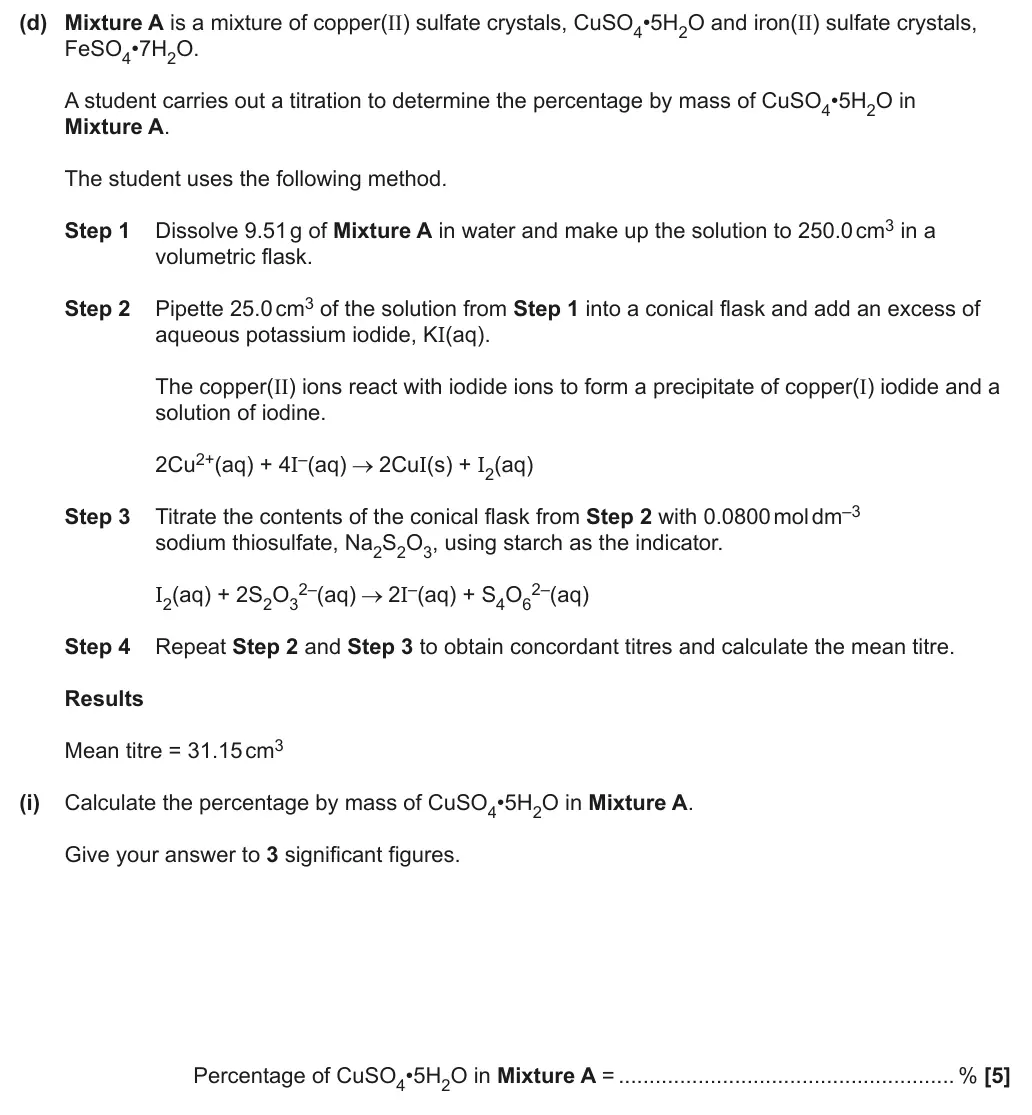
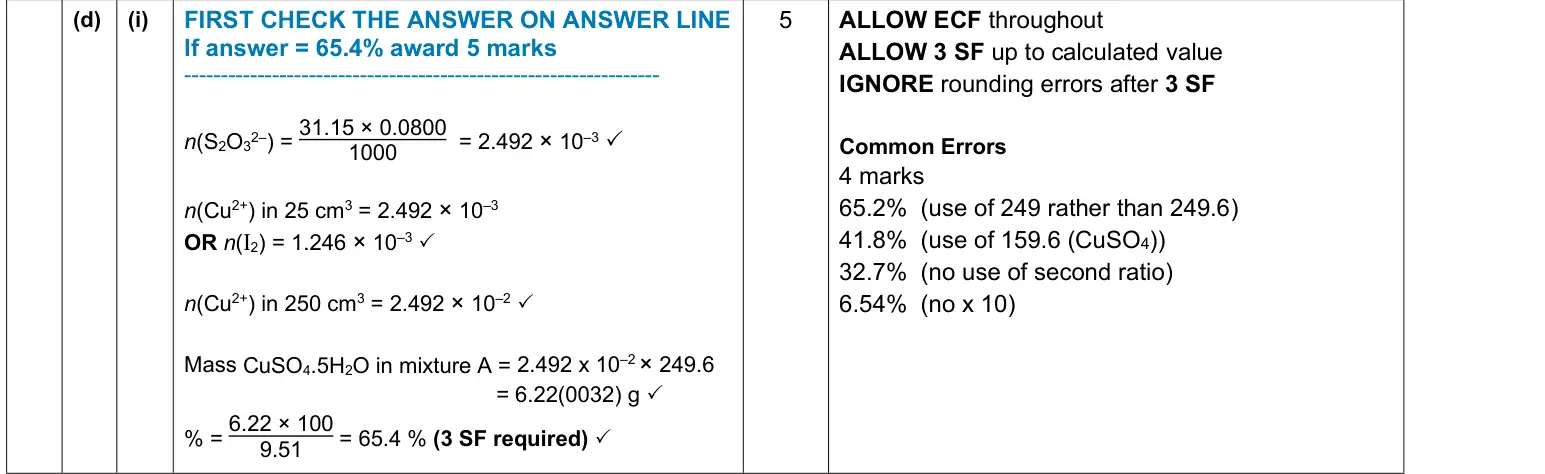
This calculation was answered well by many candidates. It is good to see that the level of communication throughout the multistep calculations is improving compared to previous series, although some candidates are still writing numbers with no indication as to what the number relates to. Annotation allows ECF to be given to a correct method, despite an incorrect value being given during the process. This also, more importantly, allows to candidate to remain focused on what is being calculated. The key steps were: • Calculating the number of moles of S2O32- • Using the molar ratio to link to the number of moles of Cu2+ • Calculating the number of moles in the original volume Calculating the mass by multiplying the moles of Cu2+ by the RFM of the hydrated copper sulfate. • Calculating the percentage in the mixture Common errors were that candidates: • Forgot to use the ratio within the equation. • Forgot to x 10 to calculate the moles in the original sample. • Used the incorrect RFM of copper sulfate or a combined RFM of the two salts CuSO4.5H2O and FeSO4.7H2O. • Divided the total mass of both salts (9.51) by the number of moles of CuSO4 to get a combined Mr. The candidate has produced a correct and fully annotated calculation. This clarity allows the candidate to remain focused on each calculation step. Any miscalculation could then easily gain ECF through a clear method.
Skills: M0.2 Use ratios, fractions and percentages; M1.1 Use an appropriate number of significant figures; M2.3 Substitute numerical values into algebraic equations using appropriate units for physical quantities
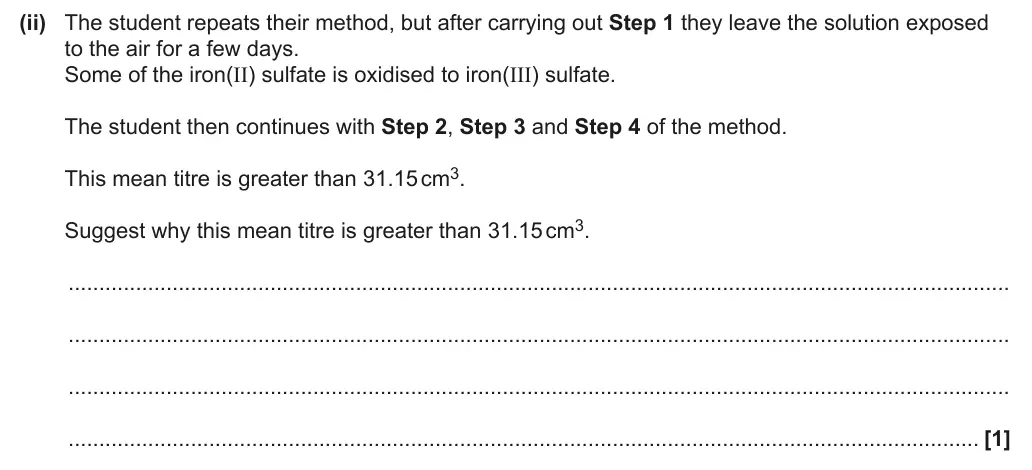
Candidates found this question quite challenging, with only a few giving a correct explanation. A common incorrect theme among less successful candidates was to consider that since it was a titration, then it must be a neutralisation reaction. Common errors involved the suggesting that evaporation of the water concentrating the copper solution, a bigger RFM, and confusion between SO42– and S2O32–. A fair number of candidates did not attempt this question.
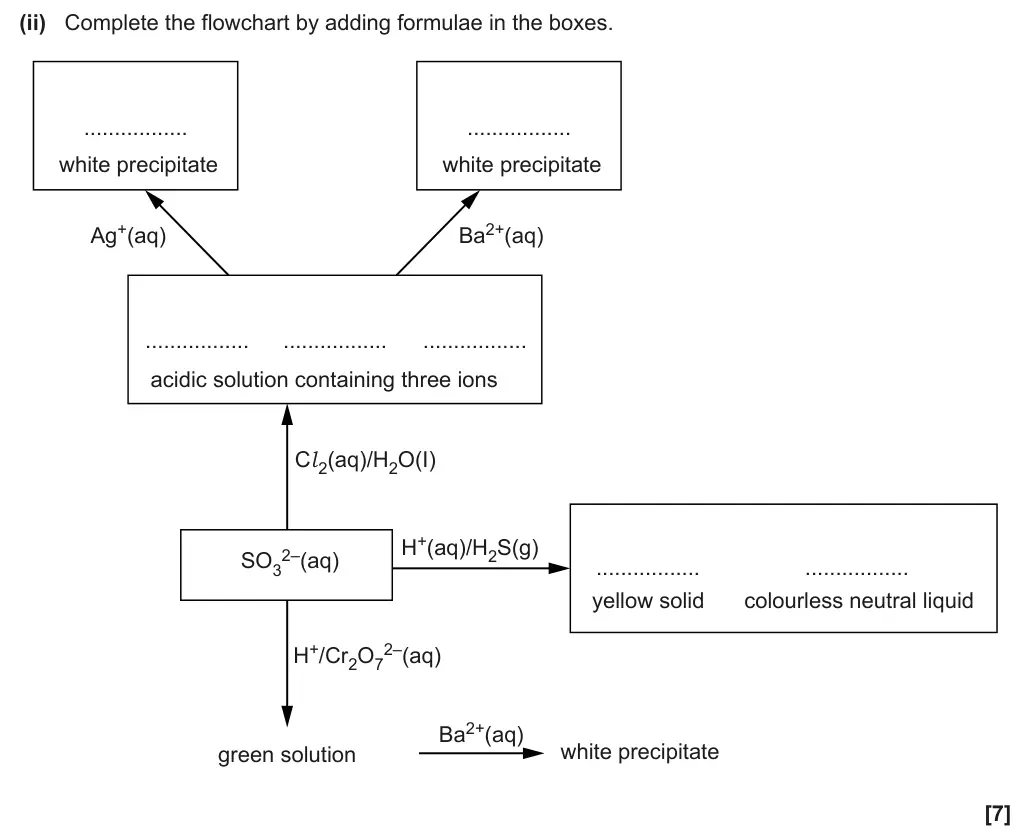
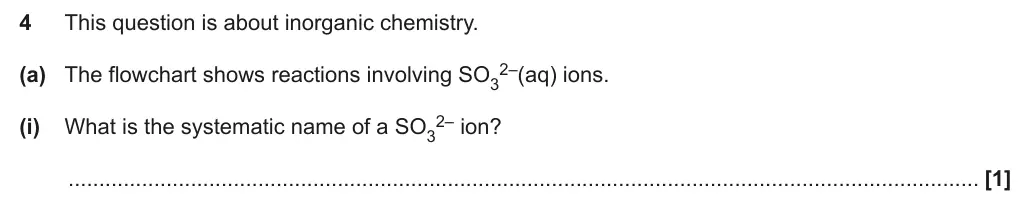
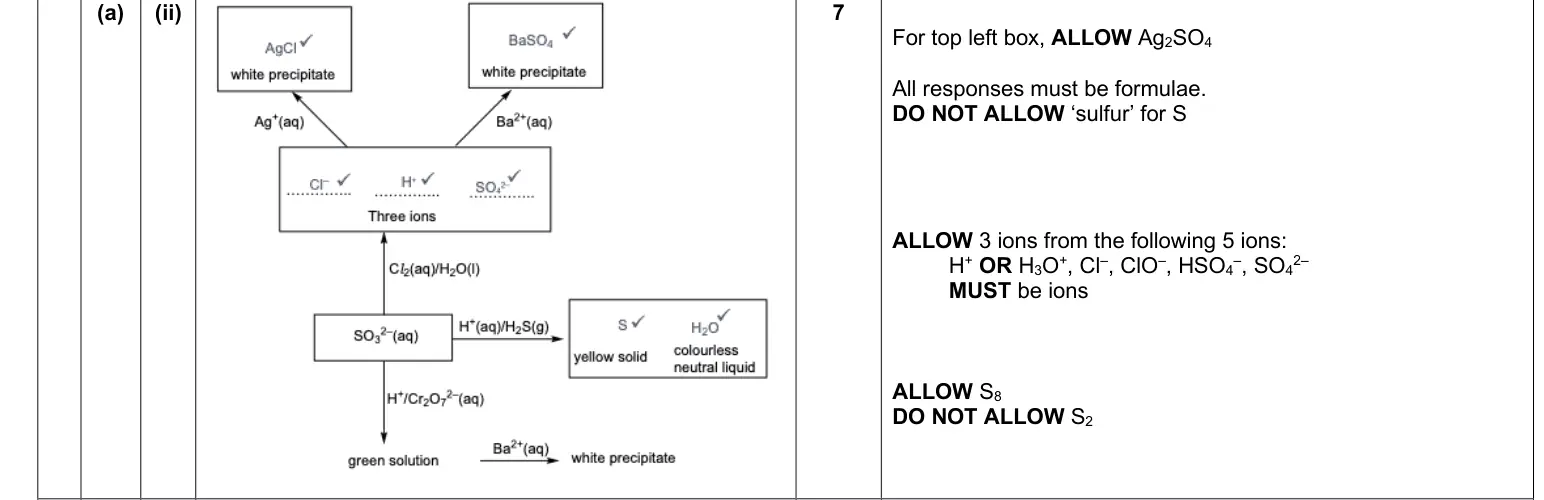
Candidates produced a range of answers, and the question discriminated extremely well. The higher attaining candidates often gave 6 or 7 correct formulae. The flowchart contained many clues which most candidates used. Most were able to provide at least 3-4 of the required formulae and there was no consistently wrong answer. Most candidates gave H+ and Cl– as two of the three ions, and AgCl for the white precipitate with Ag+(aq). Both S and S8 were allowed for sulfur but S2 was not allowed. As SO42– ions are present, Ag2SO4 was also allowed for the precipitate with Ag+(aq). Common errors included acid formulae such as H2SO4 in place of water, an incorrect formula for BaSO4, giving BaSO3, writing SO4– for the sulfate ion, and OH– as one of the three ‘acidic’ ions. Lower attaining candidates added formulae without using information in the question. Examples include full formulae such as HCl in the box labelled ‘ions’ and CuCl42– for the yellow solid, despite Cu being absent in the flowchart.
Skills: PAG4 Qualitative analysis of ions
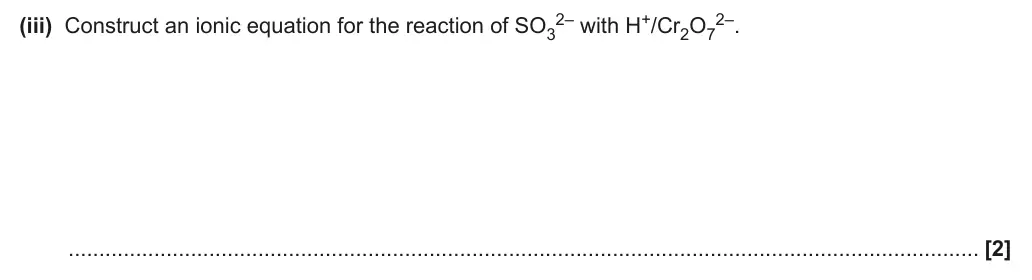
Candidates found all aspects of this question extremely difficult, one of the most testing’s on this examination paper. There was important information in the flowchart to aid candidates: the ‘green solution’ indicated that Cr3+ was one of the products, and the formation of a white precipitate with Ba2+(aq) confirmed the presence of SO42–(aq). The reacting ions were provided in the flowchart. Together this information provided a framework for the equation: SO32–(aq) + Cr2O72– → Cr3+ + SO42–(aq). The equation then needed to be balanced, ideally using oxidation numbers, H2O added as a product, and finally balancing. Similar problems would be an ideal way of preparing candidates for writing equations for redox reactions.
Skills: M0.2 Use ratios, fractions and percentages
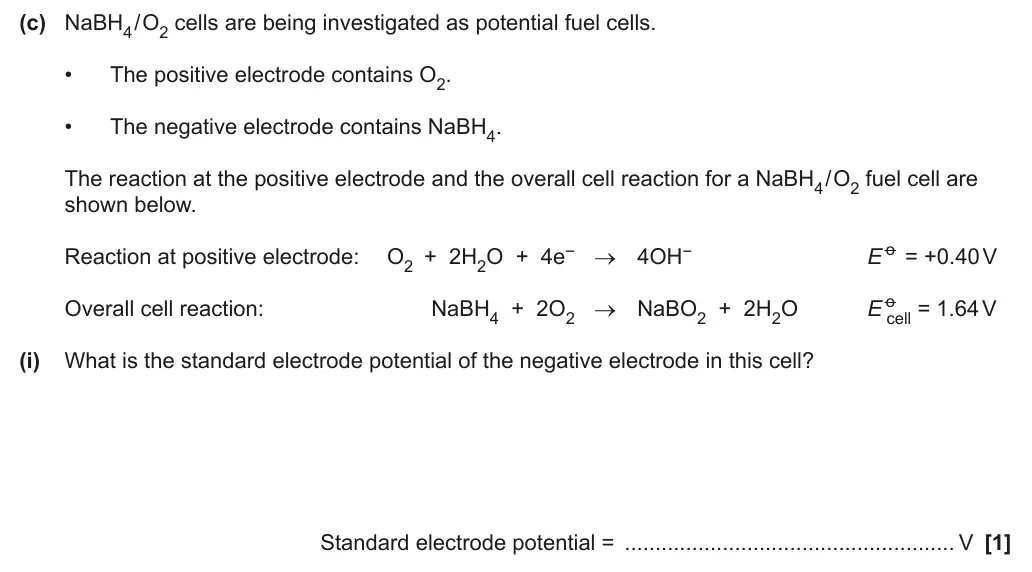
This question was answered well. Incorrect answers mainly resulted from the wrong sign for –1.24 or for 2.04 V, by adding rather than subtracting the 2 values given.
Skills: M2.2 Change the subject of an equation
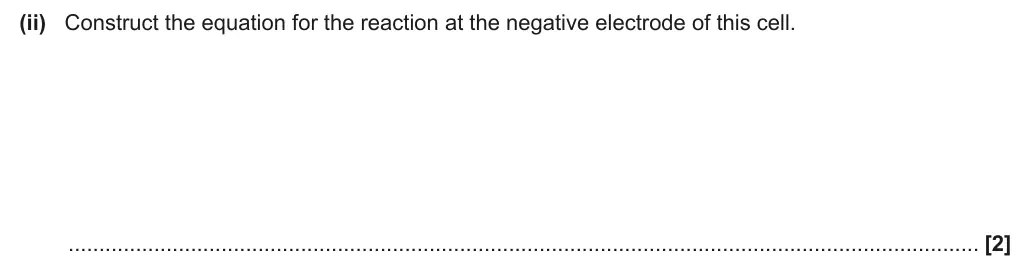
Candidates found this question difficult with few being given 2 marks. 1 mark was available for showing an equation with BH4– and OH– as reactants and NaBO2 and H2O as products. The equation often included O2 as a reactant and 4e–. Only higher attaining candidates were able to combine the equation successfully. This question was a very good discriminator.
Skills: M0.2 Use ratios, fractions and percentages
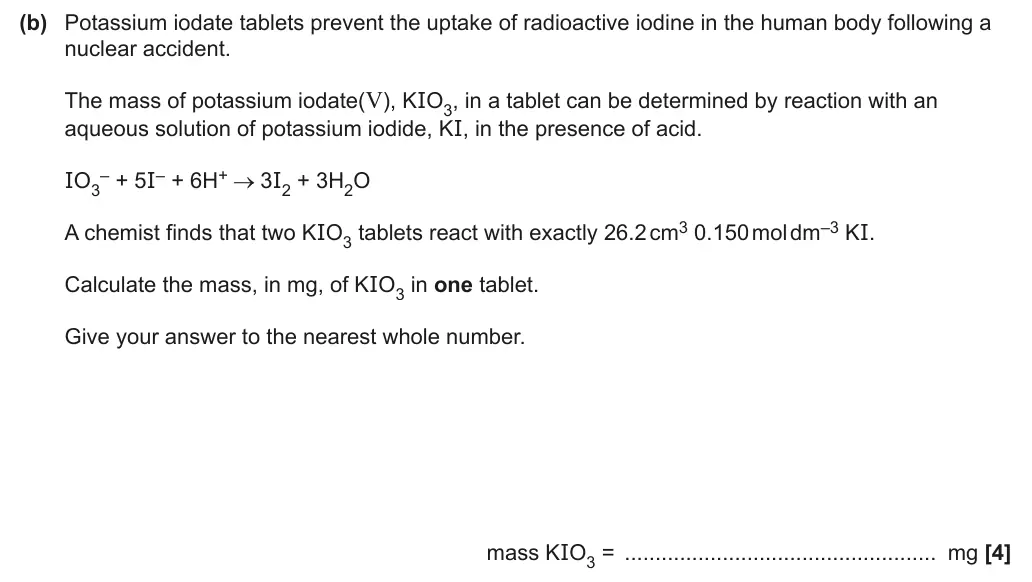
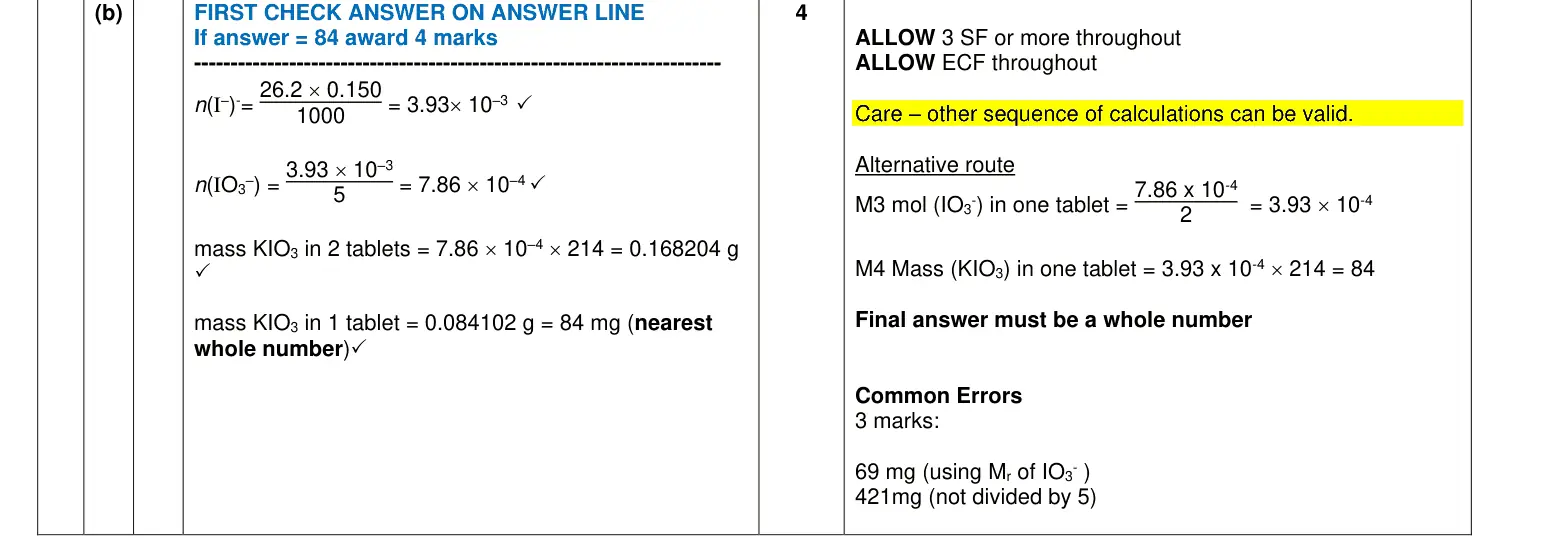
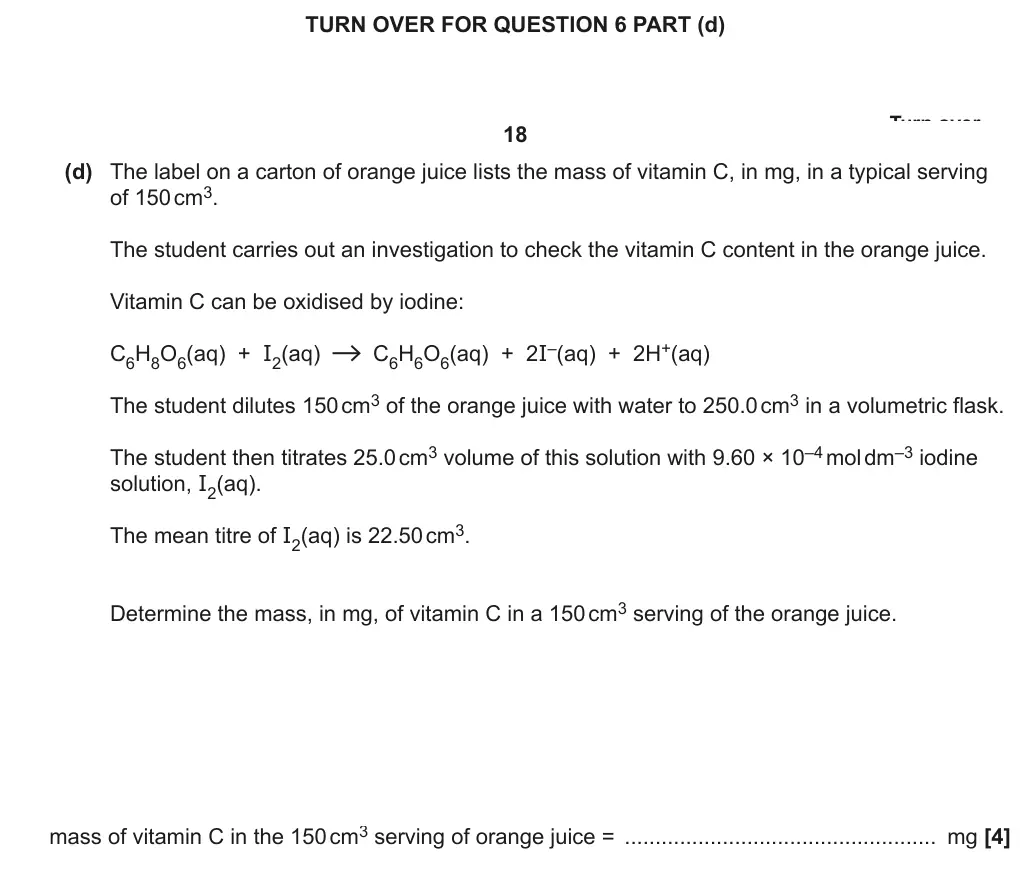
Although lots of candidates got the correct final answer, almost all achieved some credit from this calculation through error carried forward with marks spread across the available range. Almost all candidates were able to find the number of moles of iodide. A few candidates did not get the molar ratio and/or used the mass of just IO3- rather than KIO3. Some then did not realise the need to half this number to find the mass in 1 tablet, and multiplied by either 10 or 100 in order to convert g to mg.
Skills: M0.0 Recognise and make use of appropriate units in calculations; M0.2 Use ratios, fractions and percentages; M2.3 Substitute numerical values into algebraic equations using appropriate units for physical quantities
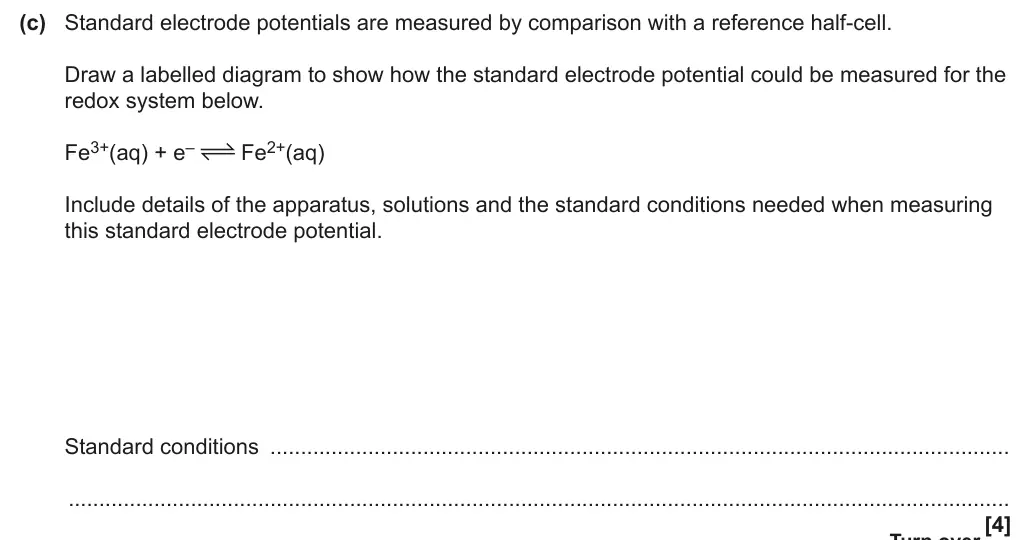
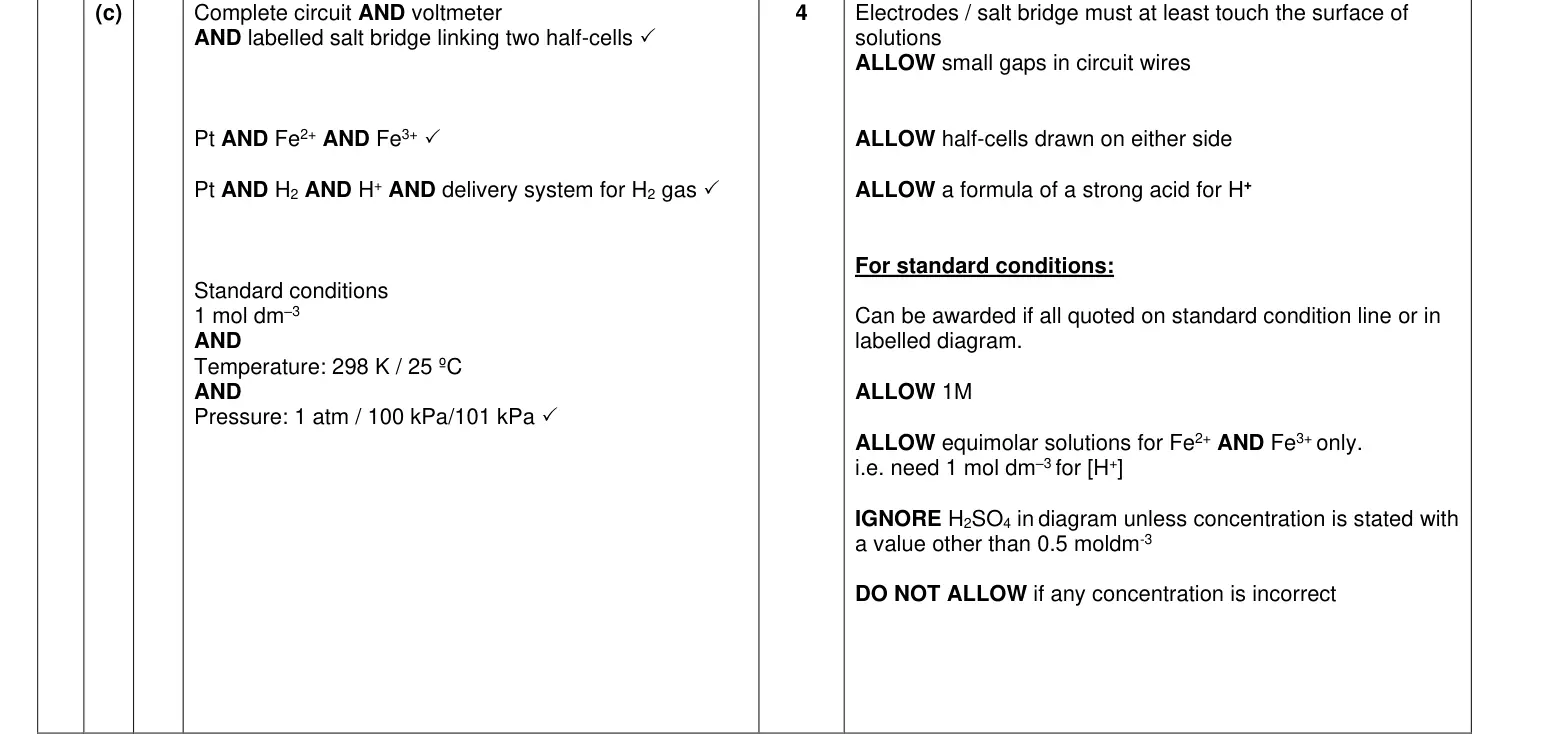
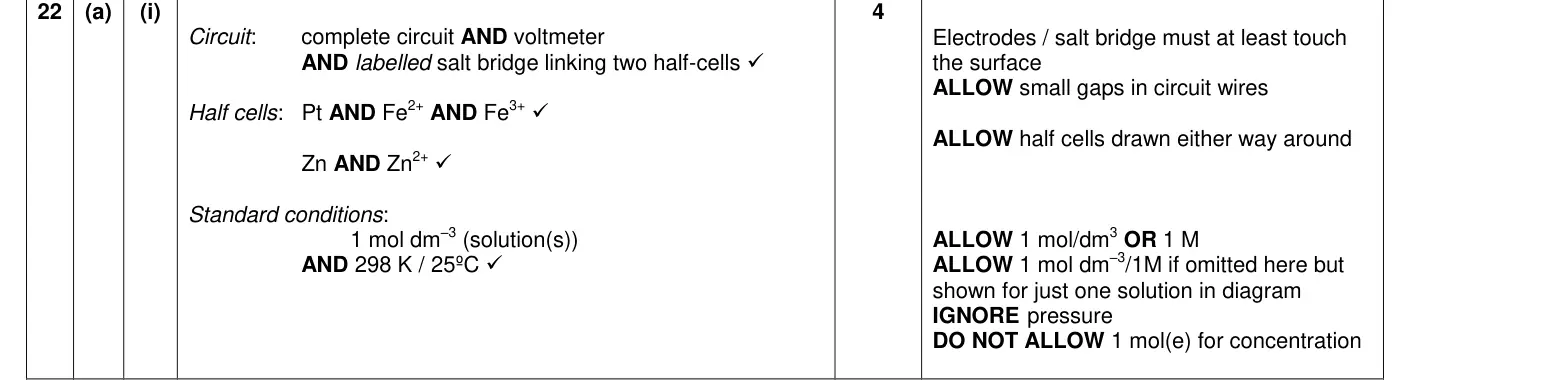
Successful candidates drew a complete circuit and voltmeter with the labelled salt bridge dipped into the two solutions. Both cells had Pt as the electrodes. One cell contained 1 moldm-3 Fe2+ and Fe3+ where the other had a delivery mechanism for H2 (at 1 atm) and H+ (at 1 mol dm-3). Standard temperature of 298K (or 25oC) was stated. Common errors included: not have solutions in the beakers, used Fe or Fe2+ electrodes, the hydrogen cell was missing and/or the H2 with a device for adding it. A few candidates suggested two cells with only Fe2+ one side and only Fe3+ on the other.
Skills: PAG8 Electrochemical cells
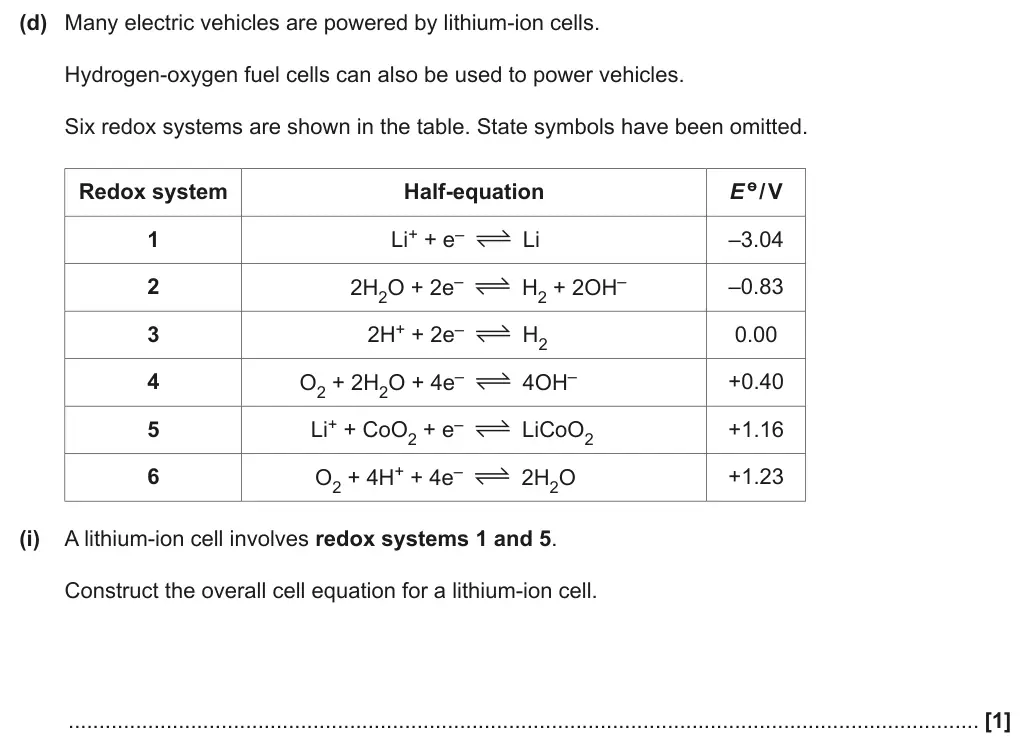
Most candidates were successful in constructing this equation. Common errors included the backwards reaction and some with unbalanced Li+. Candidates should also check their equations, as a few included an erroneous C in the formula e.g. LiCoCO2.
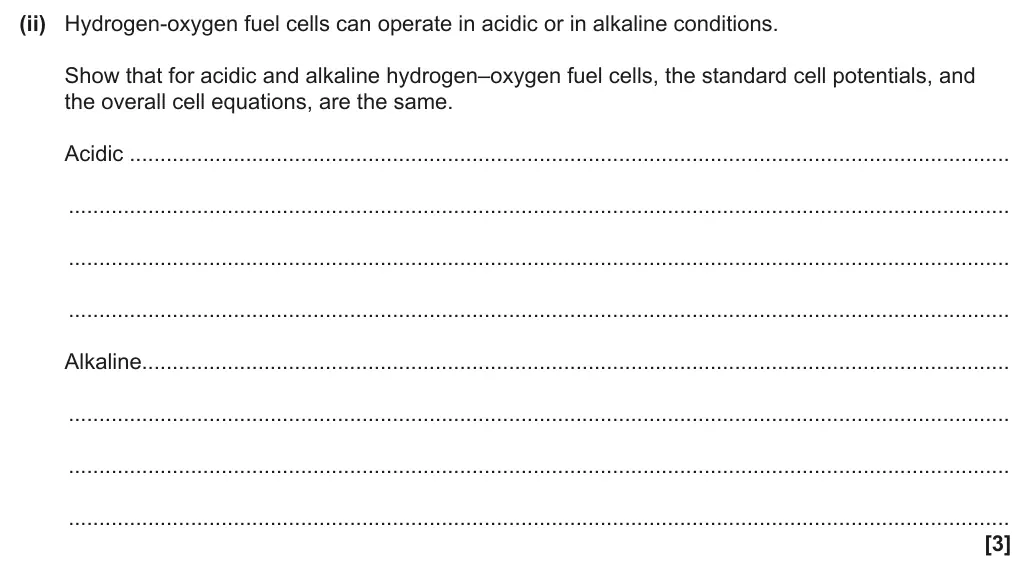
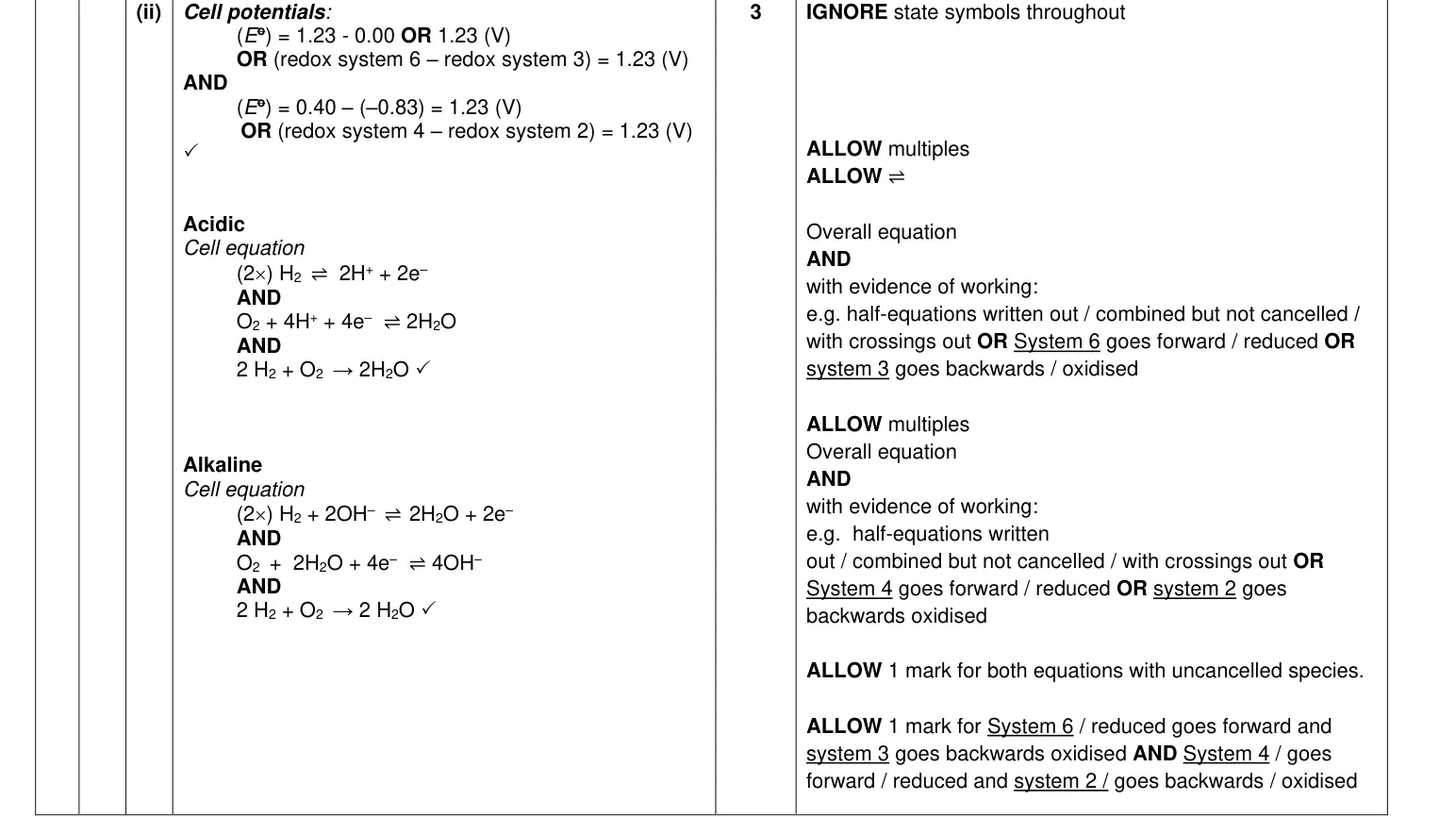
Most candidates were able to successfully show the overall equations were the same. Most combined the two half equations and then cancelled down to give the overall equations. A few candidates chose to describe the redox nature or use the equilibrium shifts scoring the first 2 marks. Some candidates, incorrectly, deduced the equation as H+ + OH- → H2O. Some candidates gave the 1.23V value without showing any calculation or did not refer to this part of the question at all. This was one of the most common questions where candidates omitted to provide a response on the paper.
Skills: M0.0 Recognise and make use of appropriate units in calculations
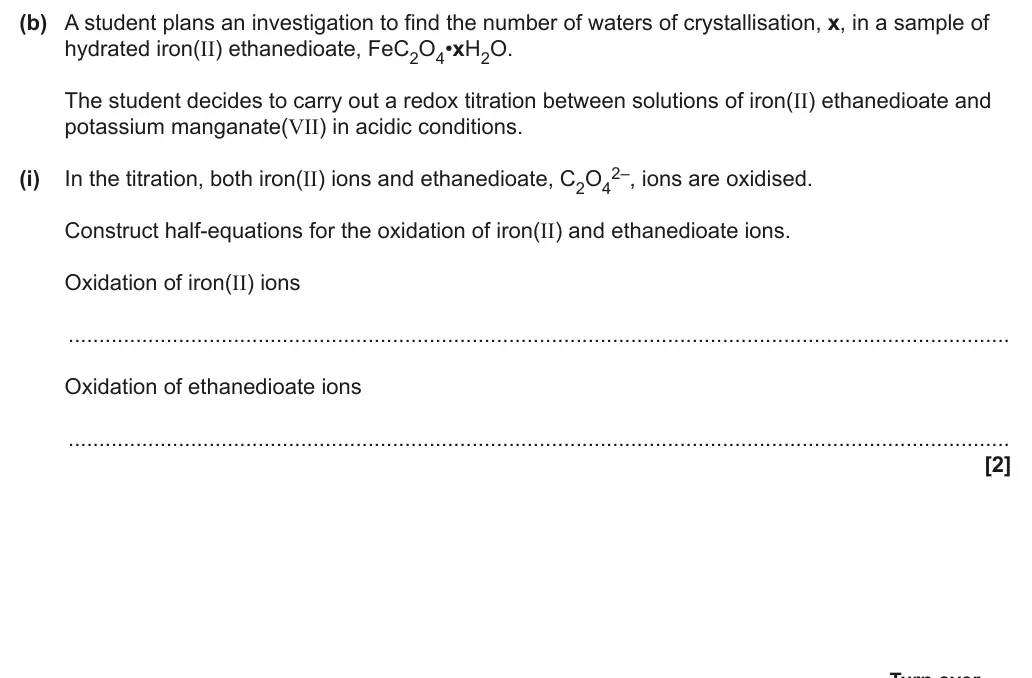
Most candidates were given a mark for one of their half-equations. The half-equation for the oxidation of iron(II) ions was correct more often than that for ethanedioate ions. Strangely, a significant number of half-equations started with Fe metal instead of Fe2+ ions. The mark scheme allowed for variations in the oxidation of ethanedioate ions, with several alternative equations being given from the correct equation forming CO2 receiving a mark.
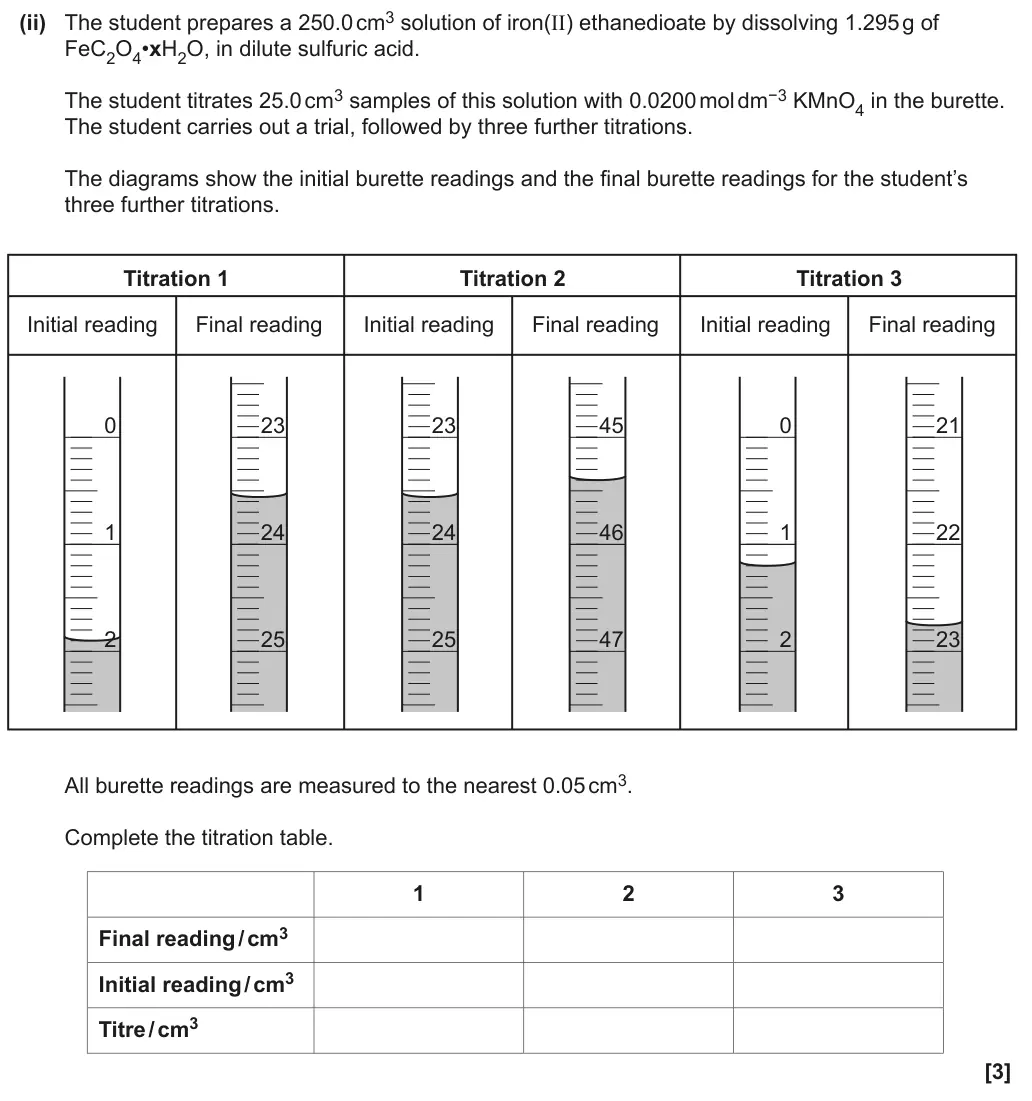
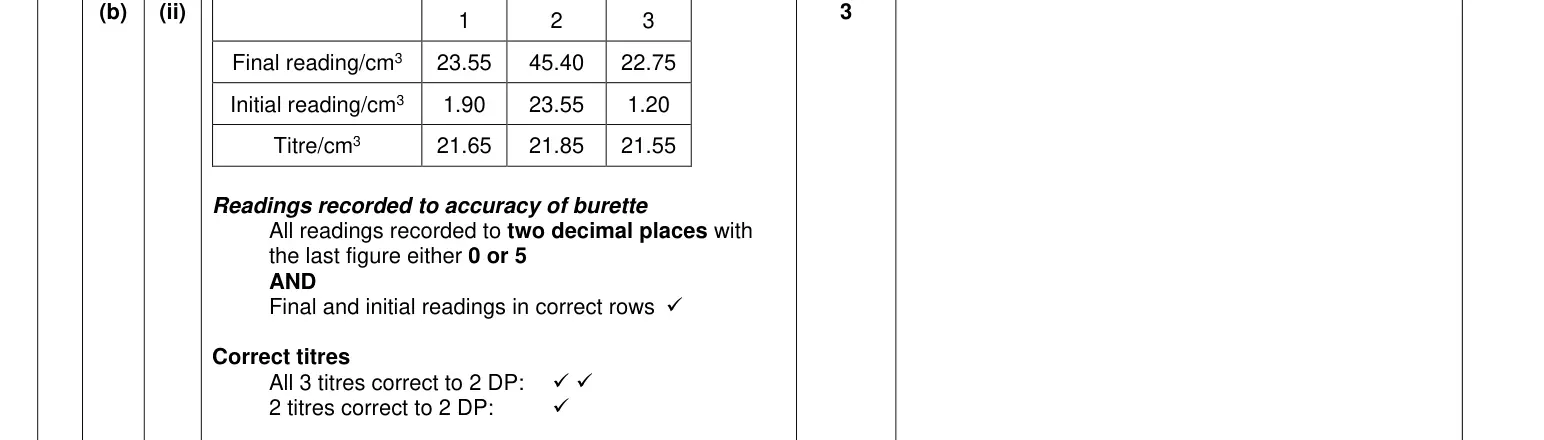
Most candidates were given all 3 marks for their titration tables. One mark was allocated to the readings, the other 2 for the correct titres. Candidates are expected to record burette readings to 2 decimal places with the last figure being 0 or 5, reflecting the accuracy of the burette, which is stated in the question. Two issues were seen: • Some candidates ignored the terminal 0 in their readings, e.g. 1.9 for 1.90 cm3. • A small number of candidates recorded the initial and final readings the wrong way round despite these terms being used above each burette diagram. Titres were usually correct.
Skills: M1.1 Use an appropriate number of significant figures
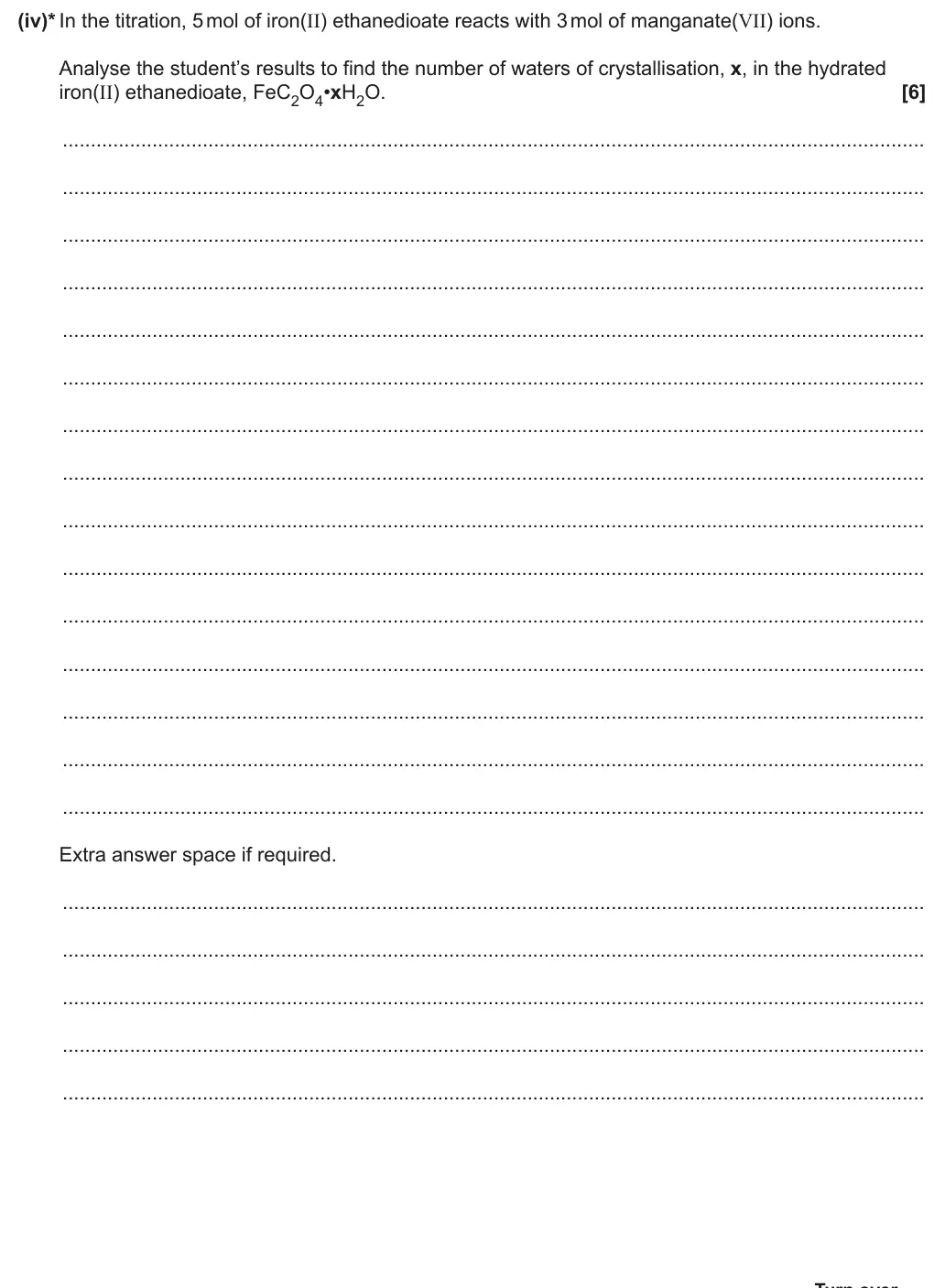
This unstructured titration problem was assessed by Level of Response (LOR). Candidates answered this stock titration calculation well. The key stages are listed below: 1. Determination of the mean titre from the two closest titres in the candidate’s response to Question 3 (b) (ii). If the titres were correct, this would be 21.60 cm3, the mean of 21.55 cm3 and 21.65 cm3. 2. Calculation of the number of moles of MnO4– as 4.32 × 10⁻⁴ mol. 3. Calculation of the number of moles of FeC2O4 in 25 cm3 as 5/3 × 4.32 × 10–4 = 7.20 × 10⁻⁴ mol. Scaling up this number of moles by 10 for the moles in 250 cm3 as 7.20 × 10⁻³ mol. 4. Determination of the number of waters of crystallisation. Most candidates completed Stages 1 and 2 correctly, securing a minimum of a Level 1 response. A significant number of candidates then completed Stage 3, with most including scaling by 10 to secure a minimum of Level 2. Many of these candidates compared the moles of FeC2O4 to the mass of FeC2O4•xH2O used to determine the value of x as 2. Such candidates would have reached Level 3. The communication strand of the LOR mark was determined by the clarity of the response, particularly whether the numbers in the calculation had been labelled. Unfortunately, many ‘correct’ responses had not done this. Over half the candidates were given 5 or 6 marks for this stock calculation. This exemplar demonstrates the hazards of not communicating well. The candidate has followed the four stages described above and the chemistry behind the titration analysis is correct. However, the response is mostly a page of numbers, with no explanation about what the numbers mean. The response is clearly at Level 3 but it is impossible to credit the communication strand, receiving a total of 5 marks.
Skills: M0.2 Use ratios, fractions and percentages; M1.2 Find arithmetic means; M2.2 Change the subject of an equation
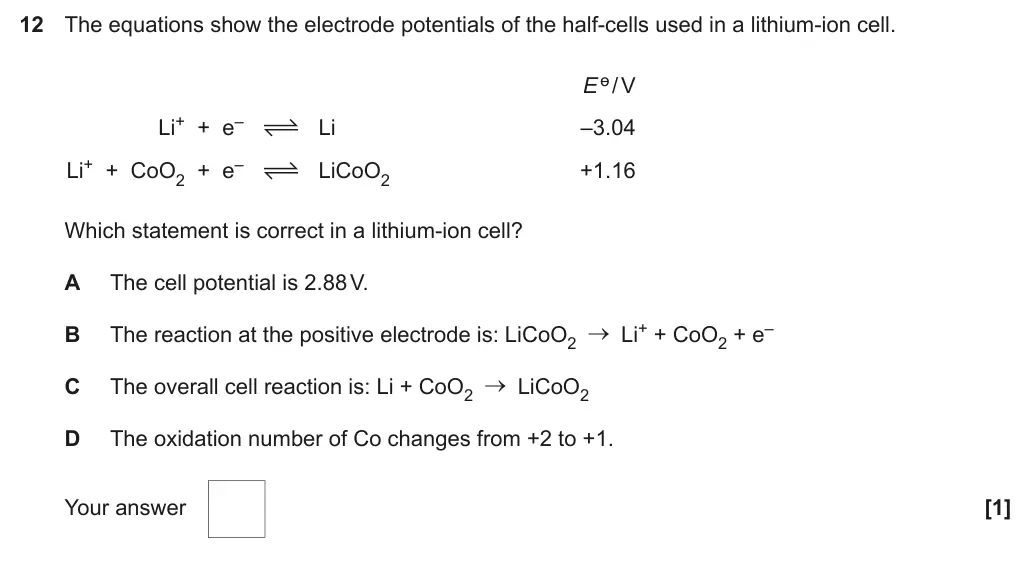
C
Most candidates answered this question correctly with C.
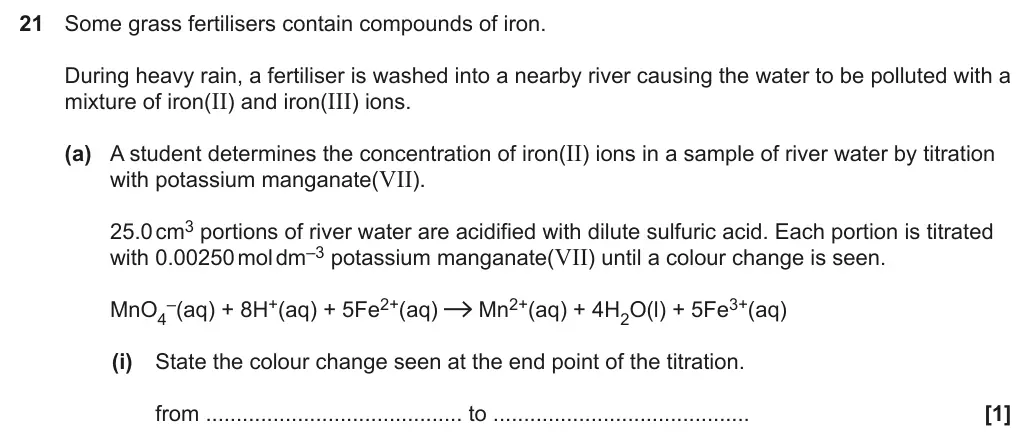
Only a few candidates were given this mark. Some had the colour change inverted and most stated a variety of different colours.
Skills: PAG2 Acid–base titration
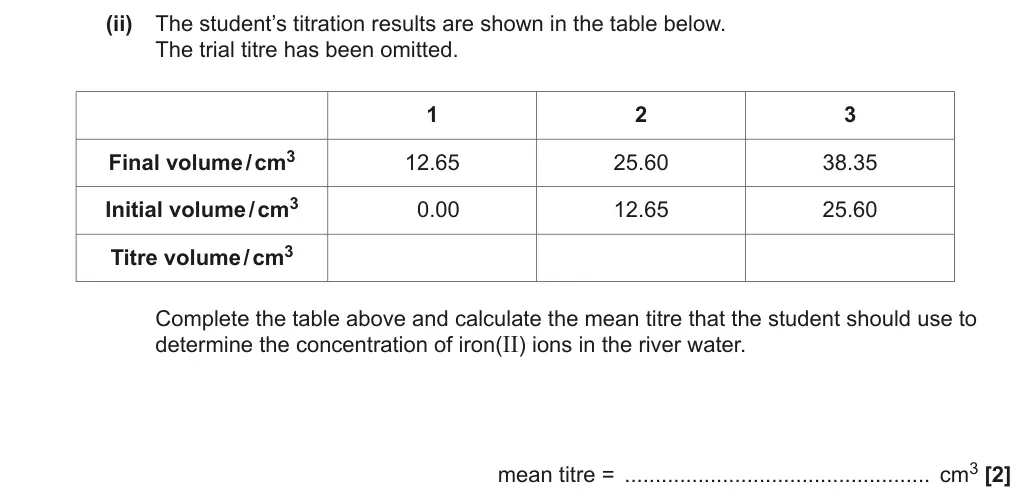
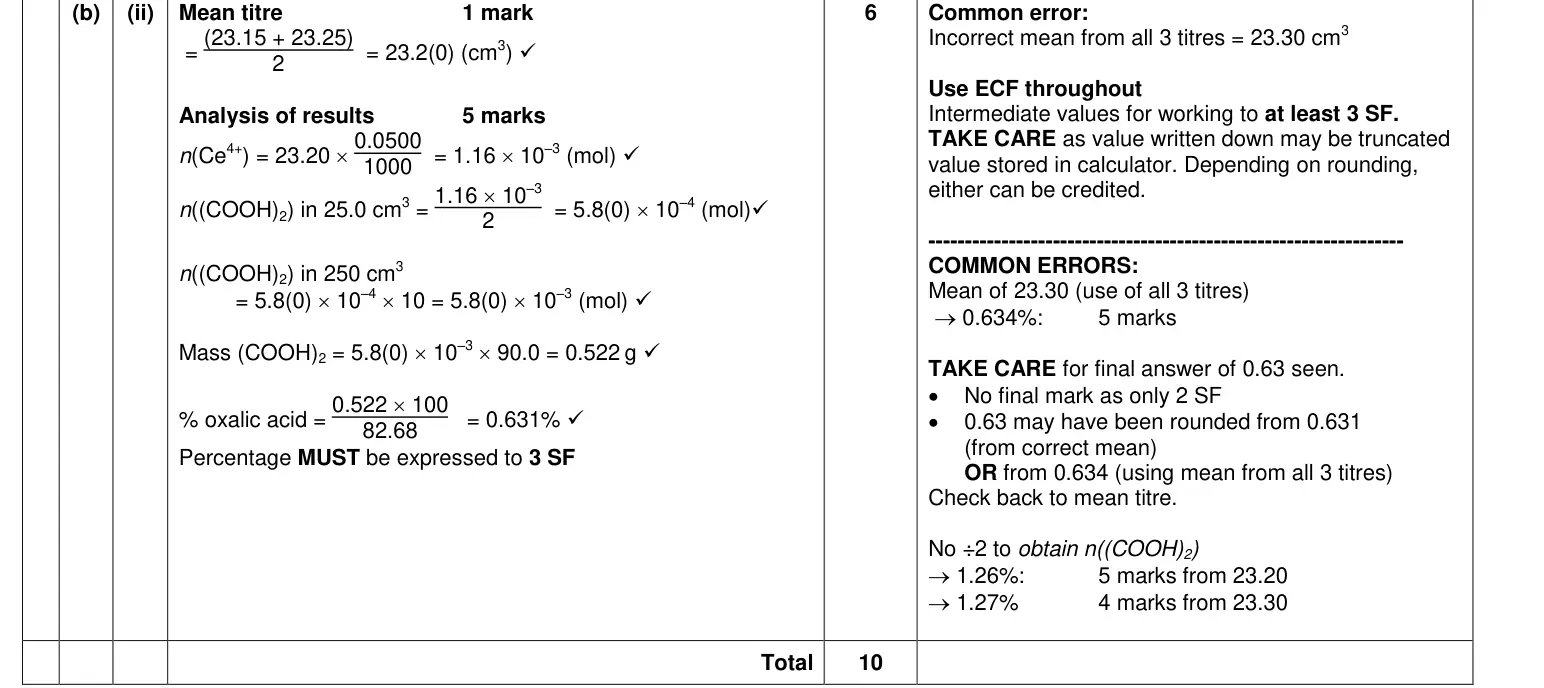
Almost all candidates calculated the titres correctly. A significant number used all three titre values to derive their mean value.
Skills: M1.2 Find arithmetic means; PAG2 Acid–base titration
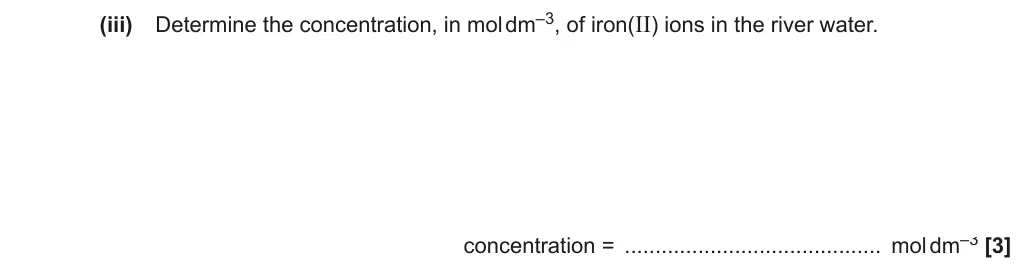
ocr.org.uk/science Oxford Cambridge and RSA CHEMISTRY A H432 For first teaching in 2015 A LEVEL Version 1 H432/01 Summer 2023 series Examiners’ report Contents Introduction .......................................................................................................................................... 4 Paper 1 series overview........................................................................................................................ 5 Section A overview ............................................................................................................................... 6 Question 1 .................................................................................................................................... 6 Question 2 ....................................................................................................................................... 6 Question 3 ....................................................................................................................................... 7 Question 4 ....................................................................................................................................... 7 Question 5 ....................................................................................................................................... 8 Question 6 ....................................................................................................................................... 8 Question 7 ....................................................................................................................................... 9 Question 8 ....................................................................................................................................... 9 Question 9 ..................................................................................................................................... 10 Question 10 ................................................................................................................................... 10 Question 11 ................................................................................................................................... 11 Question 12 ................................................................................................................................... 11 Question 13 ................................................................................................................................... 12 Question 14 ................................................................................................................................... 12 Question 15 ................................................................................................................................... 13 Section B overview ............................................................................................................................. 14 Question 16 (a) (i) ........................................................................................................................... 14 Question 16 (a) (ii) ......................................................................................................................... 15 Question 16 (b) .............................................................................................................................. 16 Question 17* .................................................................................................................................. 17 Question 18 (a) ............................................................................................................................... 18 Question 18 (b) .............................................................................................................................. 19 Question 18 (c) (i) .......................................................................................................................... 20 Question 18 (c) (ii) .......................................................................................................................... 21 Question 19 (a) (i) .......................................................................................................................... 23 Question 19 (a) (ii) ......................................................................................................................... 24 Question 19 (b) .............................................................................................................................. 24 Question 20 .................................................................................................................................... 25 Question 20 (a) (ii) ......................................................................................................................... 26 Question 20 (b) .............................................................................................................................. 26 Question 20 (c) (i) .......................................................................................................................... 27 Question 20 (c) (ii) .......................................................................................................................... 27 Question 20 (d) (i) .......................................................................................................................... 28 Question 20 (d) (ii) ......................................................................................................................... 28 Question 20 (e) (i) .......................................................................................................................... 29 Question 20 (e) (ii) ......................................................................................................................... 29 Question 20 (f) ............................................................................................................................... 30 Question 21 (a) (i) ........................................................................................................................... 31 Question 21 (a) (ii) ......................................................................................................................... 31 Question 21 (iii) .............................................................................................................................. 32 Question 21 (b) .............................................................................................................................. 33 Question 22 (a)* .............................................................................................................................. 34 Question 22 (b) (i) .......................................................................................................................... 36 Question 22 (b) (ii) ......................................................................................................................... 36 Question 22 (c) .............................................................................................................................. 37 Question 22 (d) .............................................................................................................................. 37 Introduction Our examiners’ reports are produced to offer constructive feedback on candidates’ performance in the examinations. Question 21 (a) (i) Only a few candidates were given this mark. Question 21 (a) (ii) Almost all candidates calculated the titres correctly.
Skills: M0.2 Use ratios, fractions and percentages; M1.1 Use an appropriate number of significant figures; M2.3 Substitute numerical values into algebraic equations using appropriate units for physical quantities; PAG2 Acid–base titration
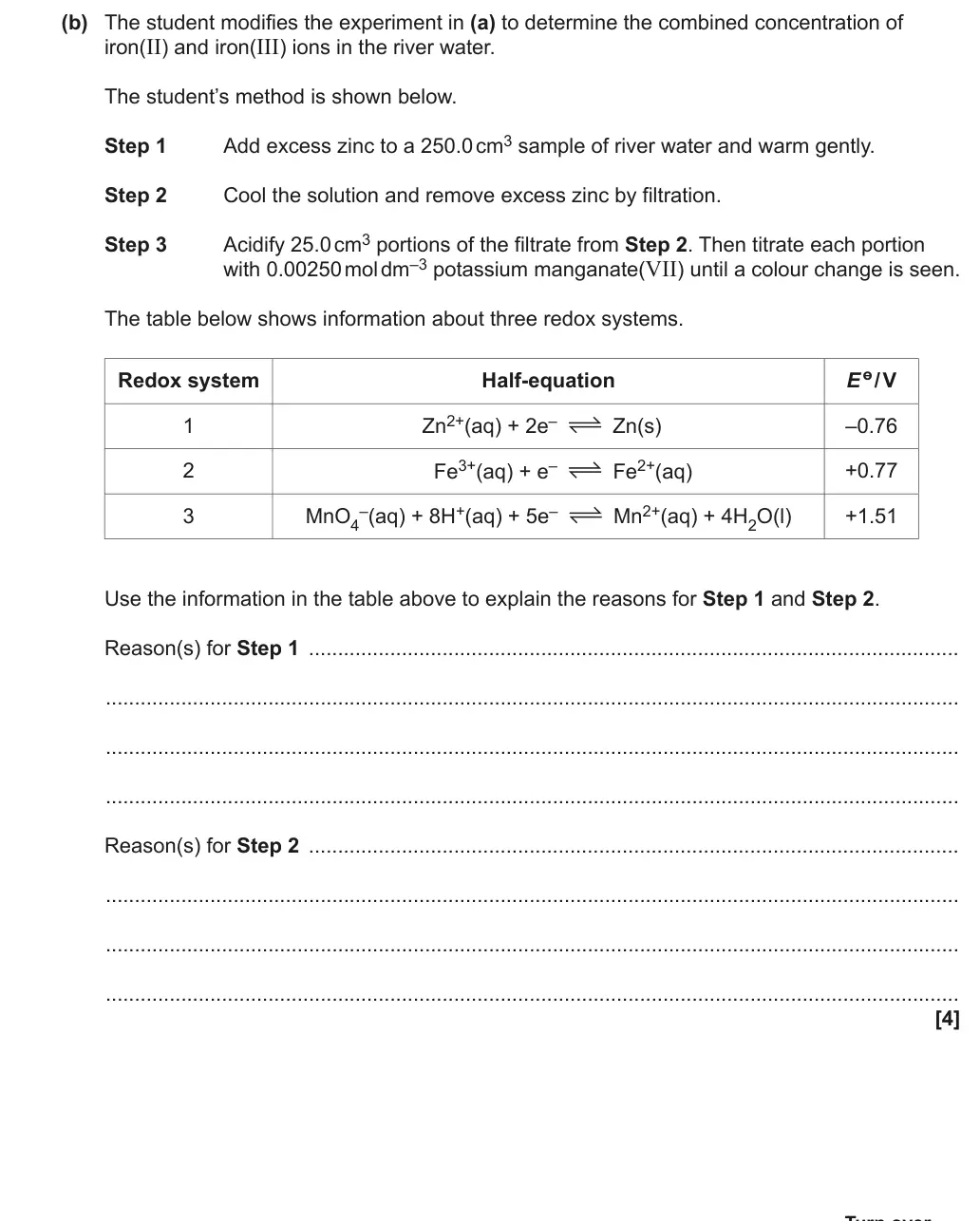
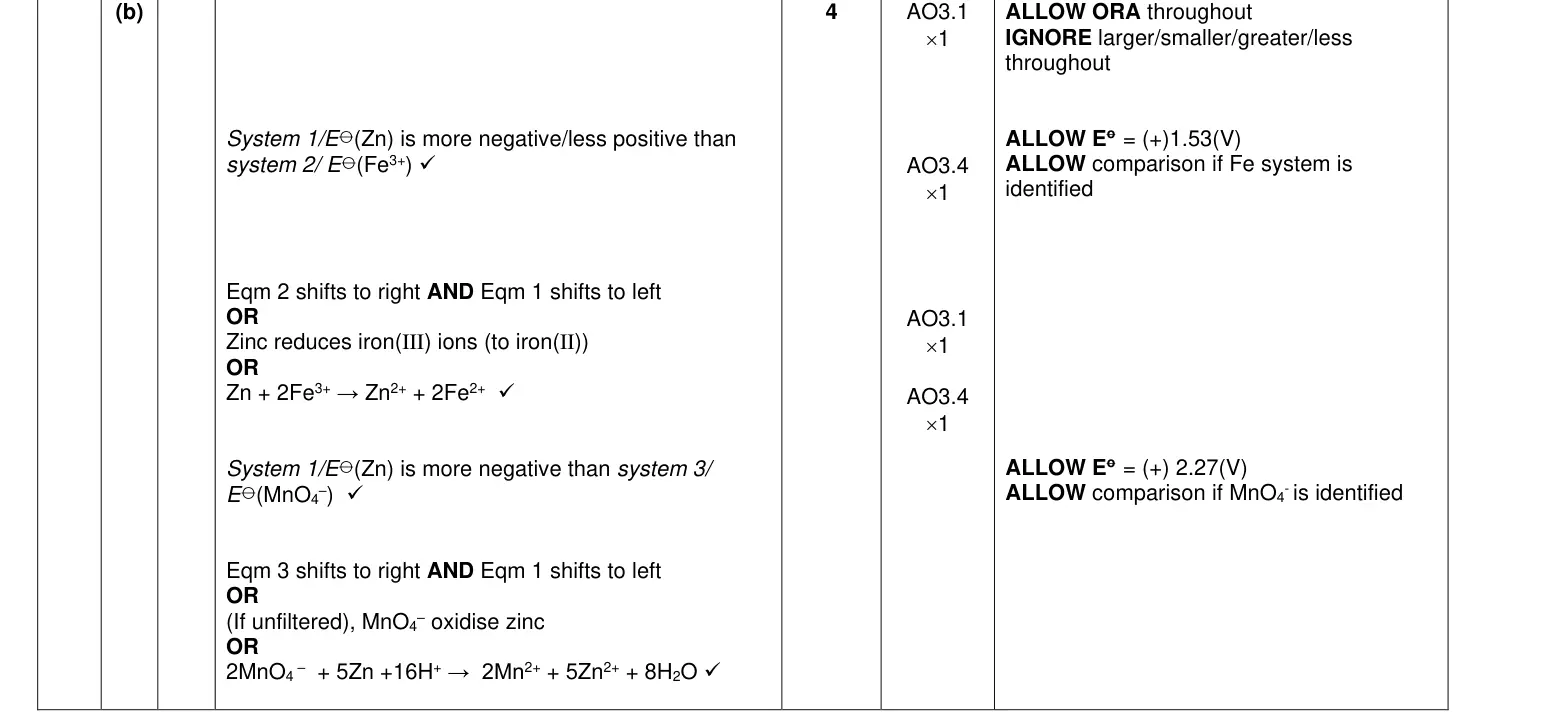
Most candidates were able to successfully explain Step 1, scoring the first 2 marks. When comparing electrode potentials, candidates should avoid the use of higher/lower as these phrases are ambiguous due to the negative signs involved. Describing them as ‘more negative’ or ‘more positive’ is clearer. Candidates are advised to read the instructions contained within the question and to use or comment on all the data presented. Very few candidates linked Step 2 to the reducing effect of zinc to manganate(VII) ions hence the need for filtration. A few candidates explained Step 2 in terms of the warming/cooling and zinc crystalising rather than explaining the redox chemistry given in the table.
Skills: PAG2 Acid–base titration
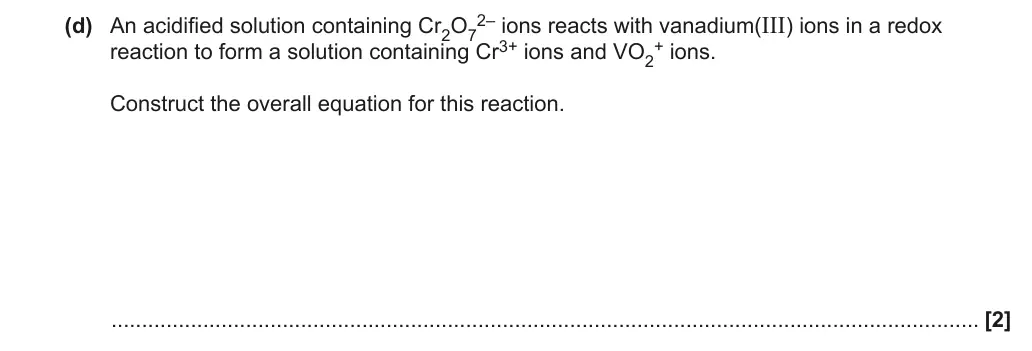
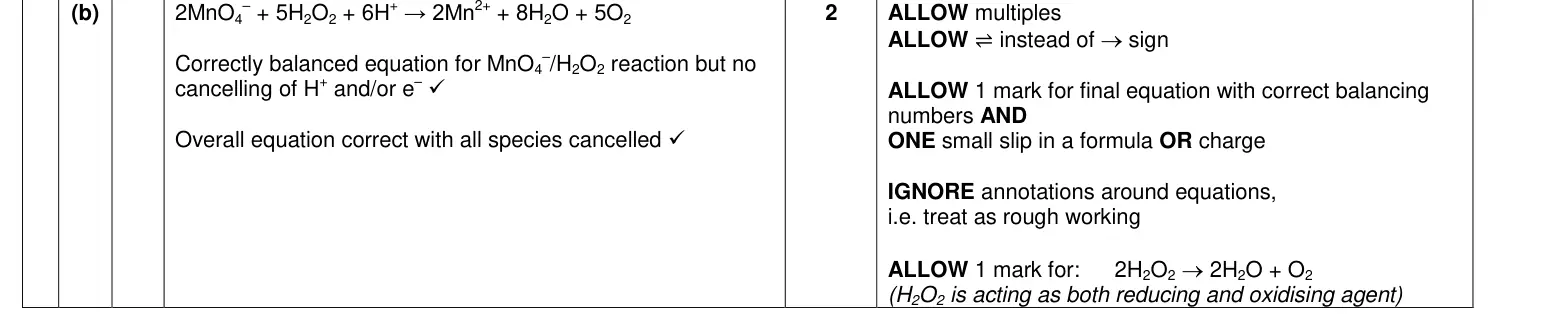
Very few candidates were able to produce the balanced overall equation; a few had the correct reactants and products but not balanced. Candidates are advised to look for the information contained within the question. The formulas were given, and it was stated that the solution was acidified, leaving only water to be identified. Some candidates approached this through two half equations whereas others used oxidation numbers to balance their equations.
Skills: M0.2 Use ratios, fractions and percentages
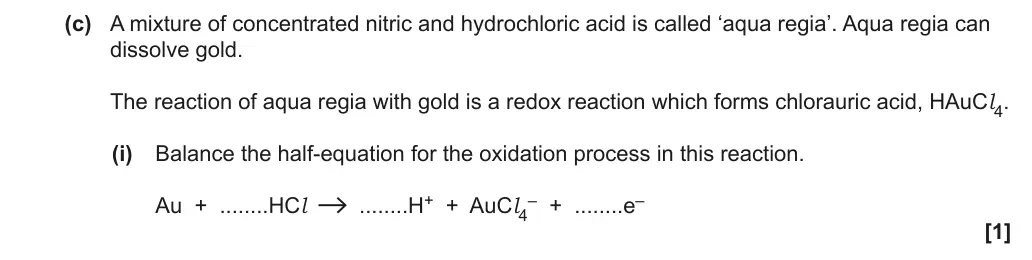
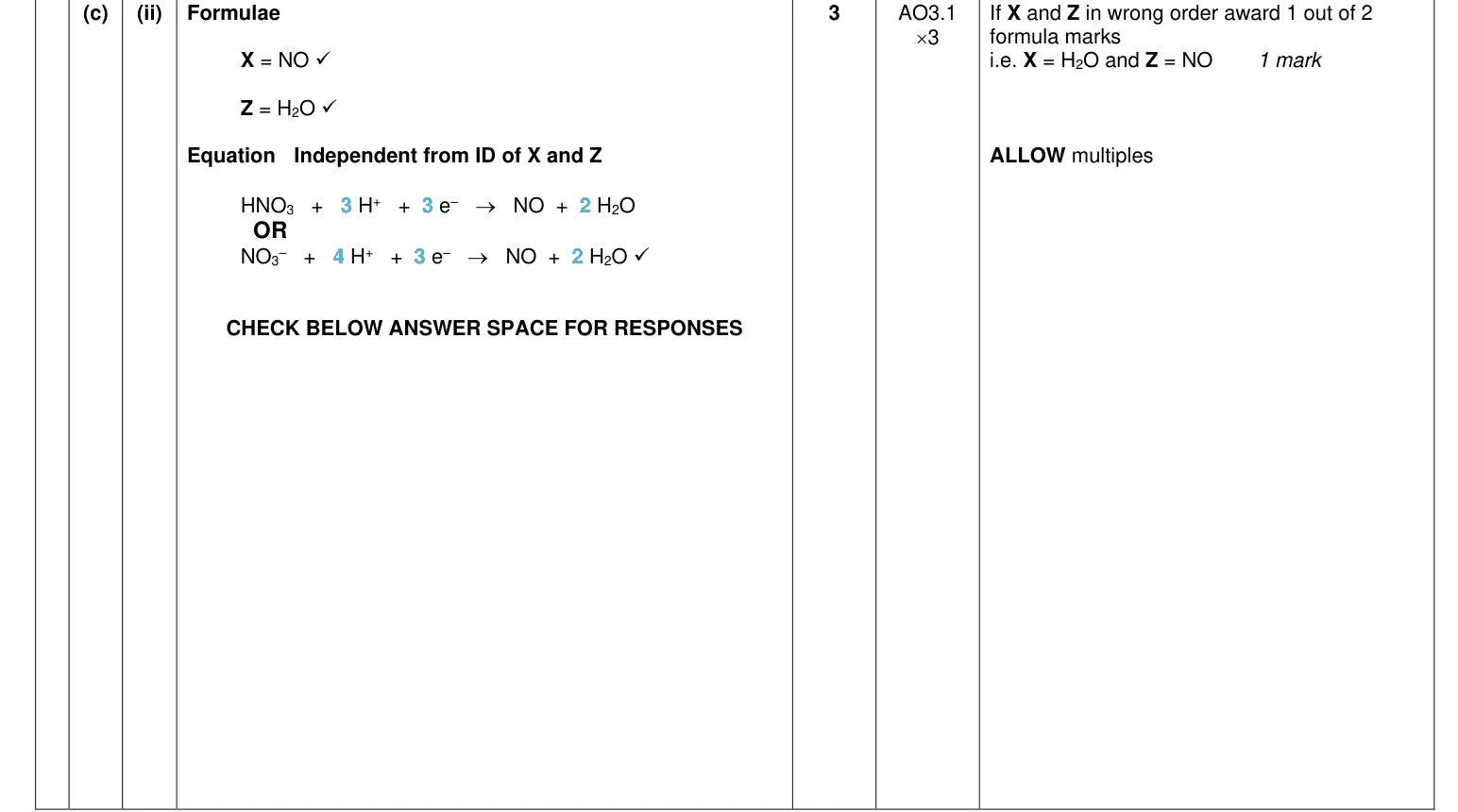
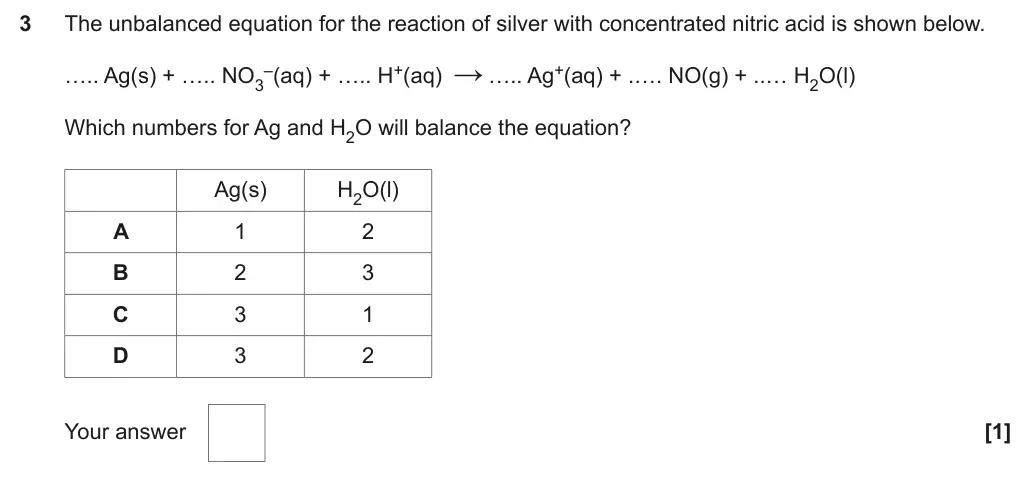
Most candidates added ‘4’ before HCl and H+, and 3 before e– to gain this mark. Where an error was made, it invariably was with the number of electrons, usually 4e–.
Skills: M0.2 Use ratios, fractions and percentages
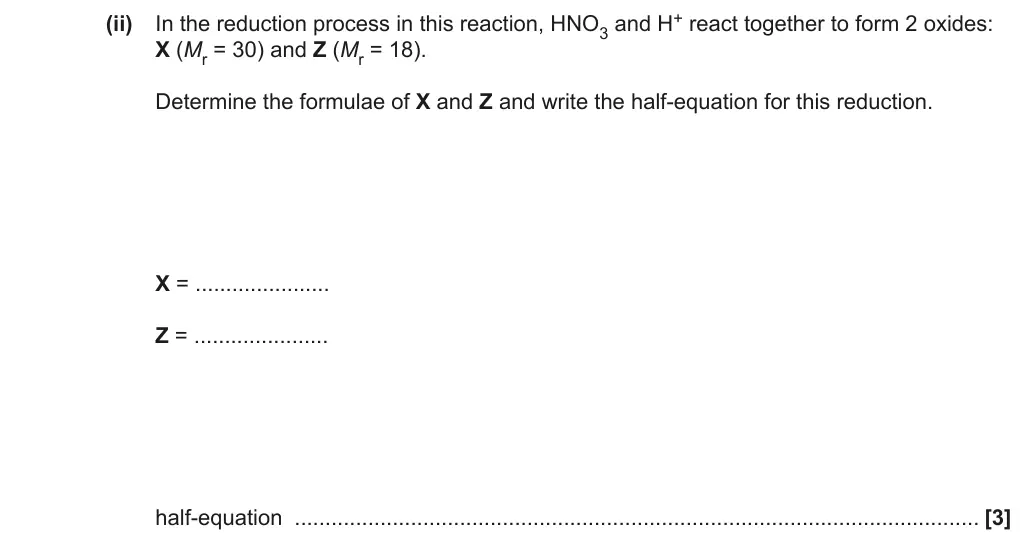
Almost all candidates identified X and Y as NO and H2O respectively, but the equation proved to be much more testing. Some candidates were careless, showing NO and H2O the wrong way round (credited with 1 out of these 2 marks) or with charges. For the equation, candidates needed to consider the oxidation number change of N from +5 to +2, This should have naturally led to 3e– being added on the left-hand side. Many candidates omitted the electrons entirely. Some did add 3e– but on the right. This suggests that candidates would benefit with practising the construction of half equations.
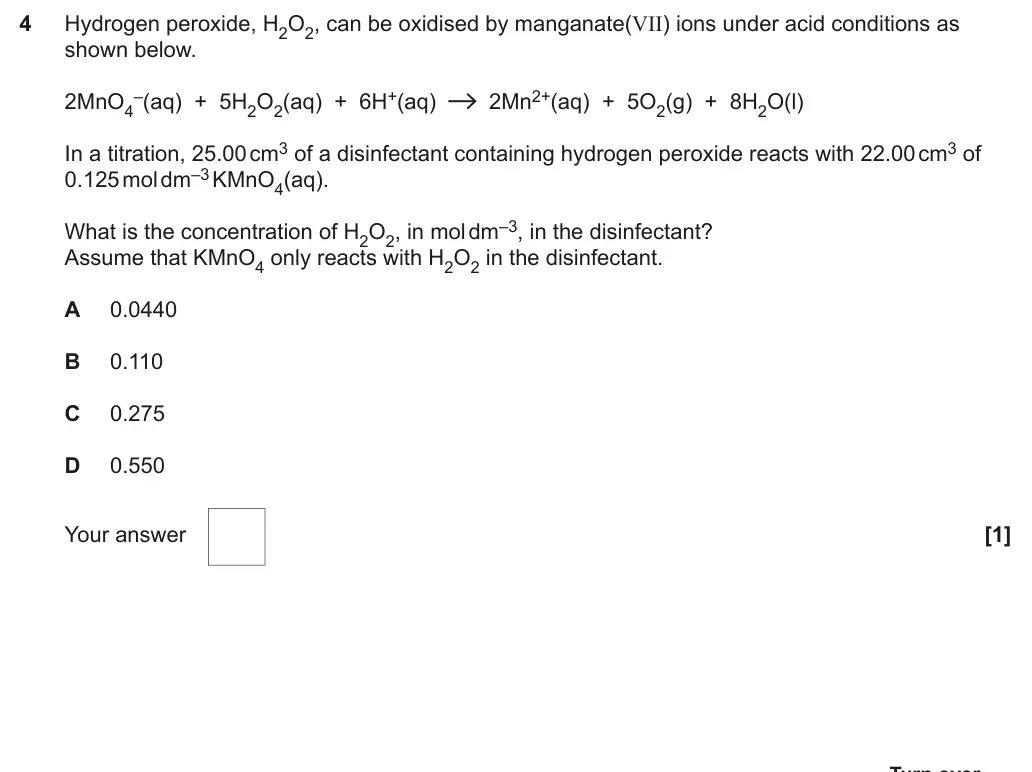
C
The correct answer C required candidates to calculate the moles of manganate (VII) ions and then to use the stoichiometry of the equation to calculate the moles of H2O2 before calculating the concentration. Option A provided a distractor with the incorrect ratio. Option B was obtained without the reference to the molar ratio.
Skills: M0.2 Use ratios, fractions and percentages; M2.3 Substitute numerical values into algebraic equations using appropriate units for physical quantities
In the interests of fairness, we decided to award the mark for this question to all candidates as this question related to theory [or a process] that was not required within our specification.

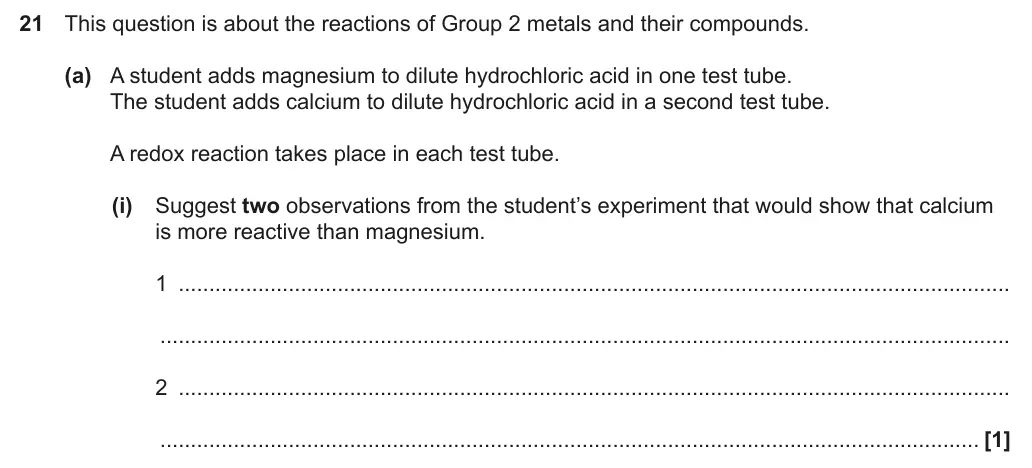
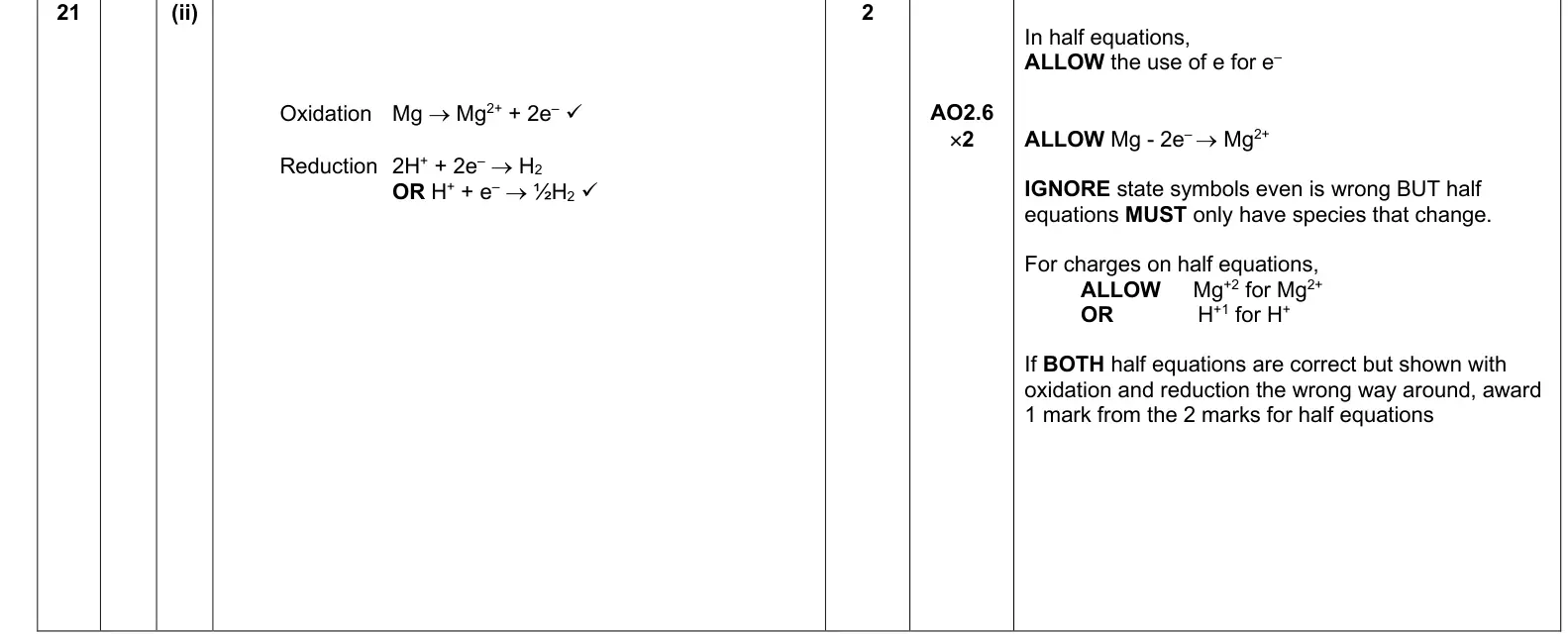
Some candidates coped well with this question which was based on the AS part of the specification and gained both marks. More candidates gained 1 mark through writing one half equation, usually the oxidation of magnesium. Common errors were for chlorine to featuring in the reduction half equation and the lack of electrons in their answers. Very few candidates mixed up the oxidation and reduction equations.
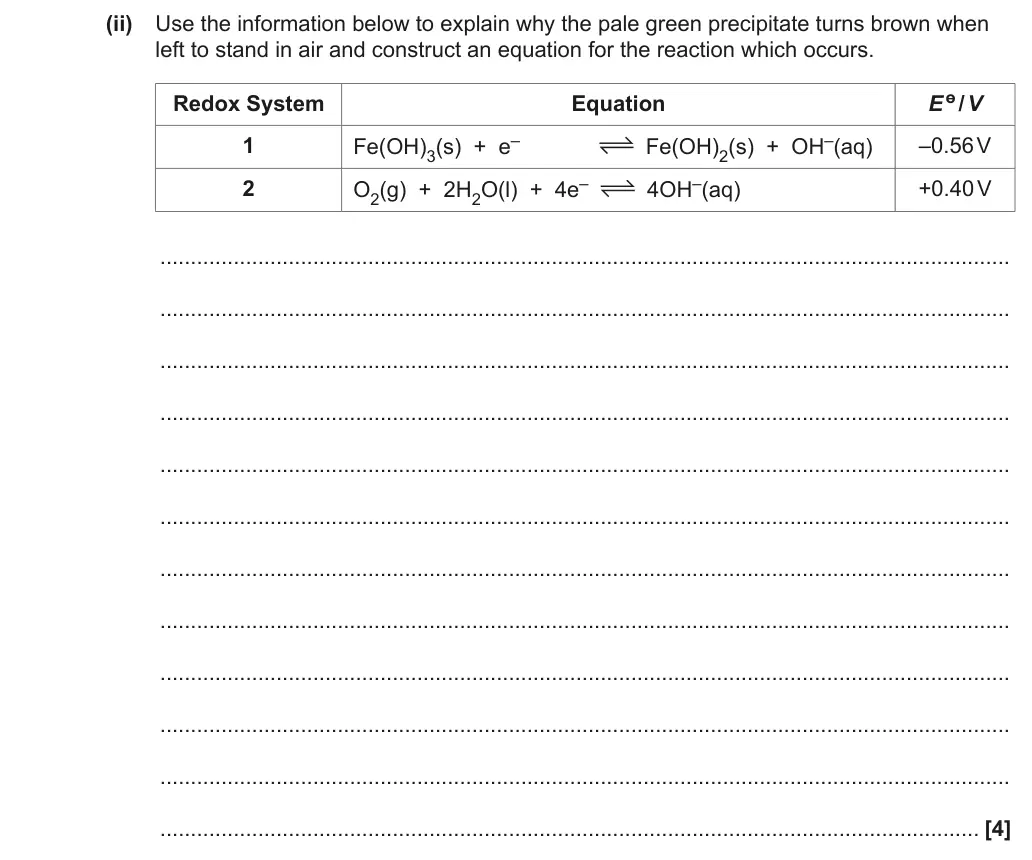
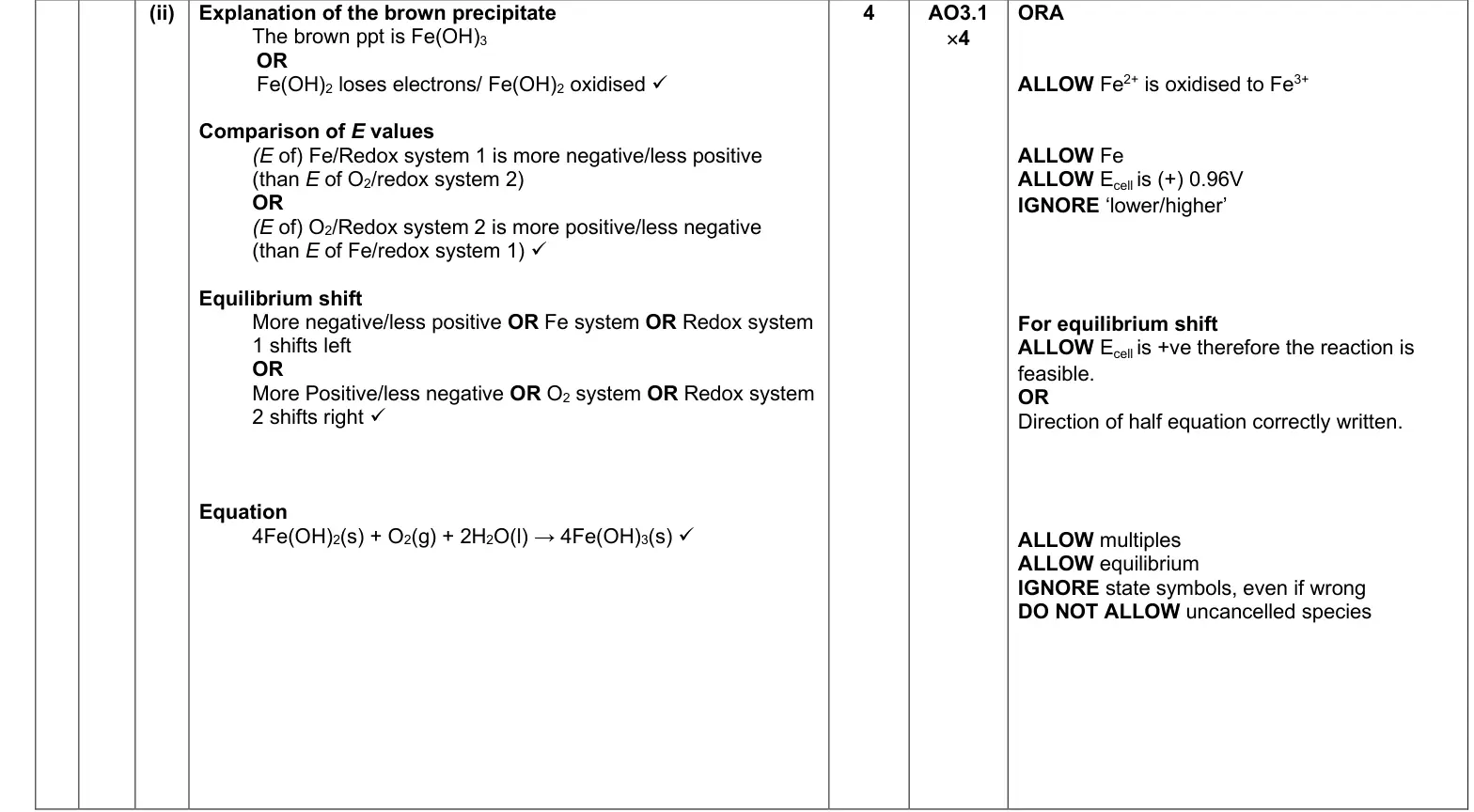
Although a spread of marks across the full available range was seen, a good proportion of candidates gained 3 or 4 marks. Most candidates were able to produce a balanced equation, but candidates should take care cancelling out any species present on both side of the equation, e.g. the hydroxide ions. A common error within the formula of iron (III) hydroxide was to place the number of hydroxide ions within the brackets, e.g. Fe(OH3). Candidates are advised to read the instructions contained within the equation and to use or comment on all the data presented. When commenting on electrode potentials, candidates should avoid the use of higher/lower as these phrases are meaningless due to the negative signs involved.
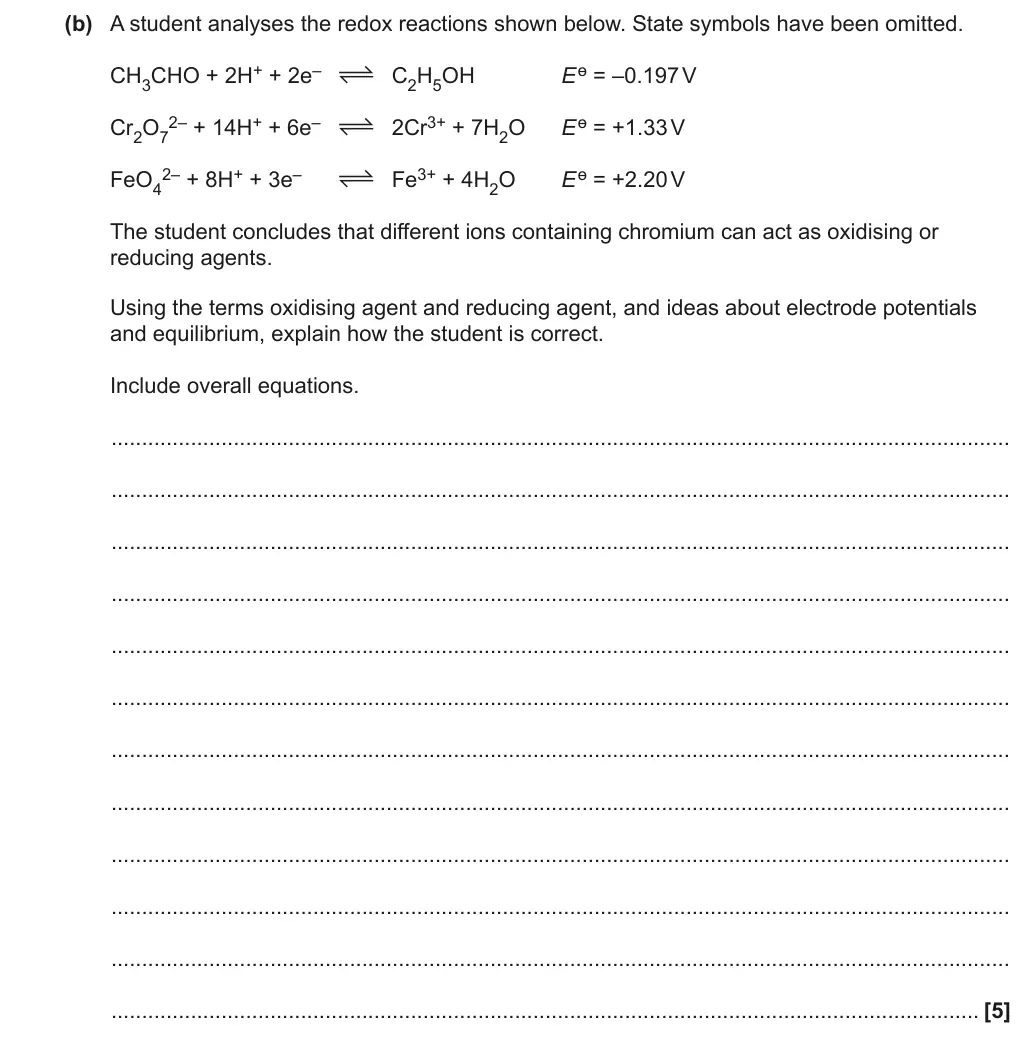
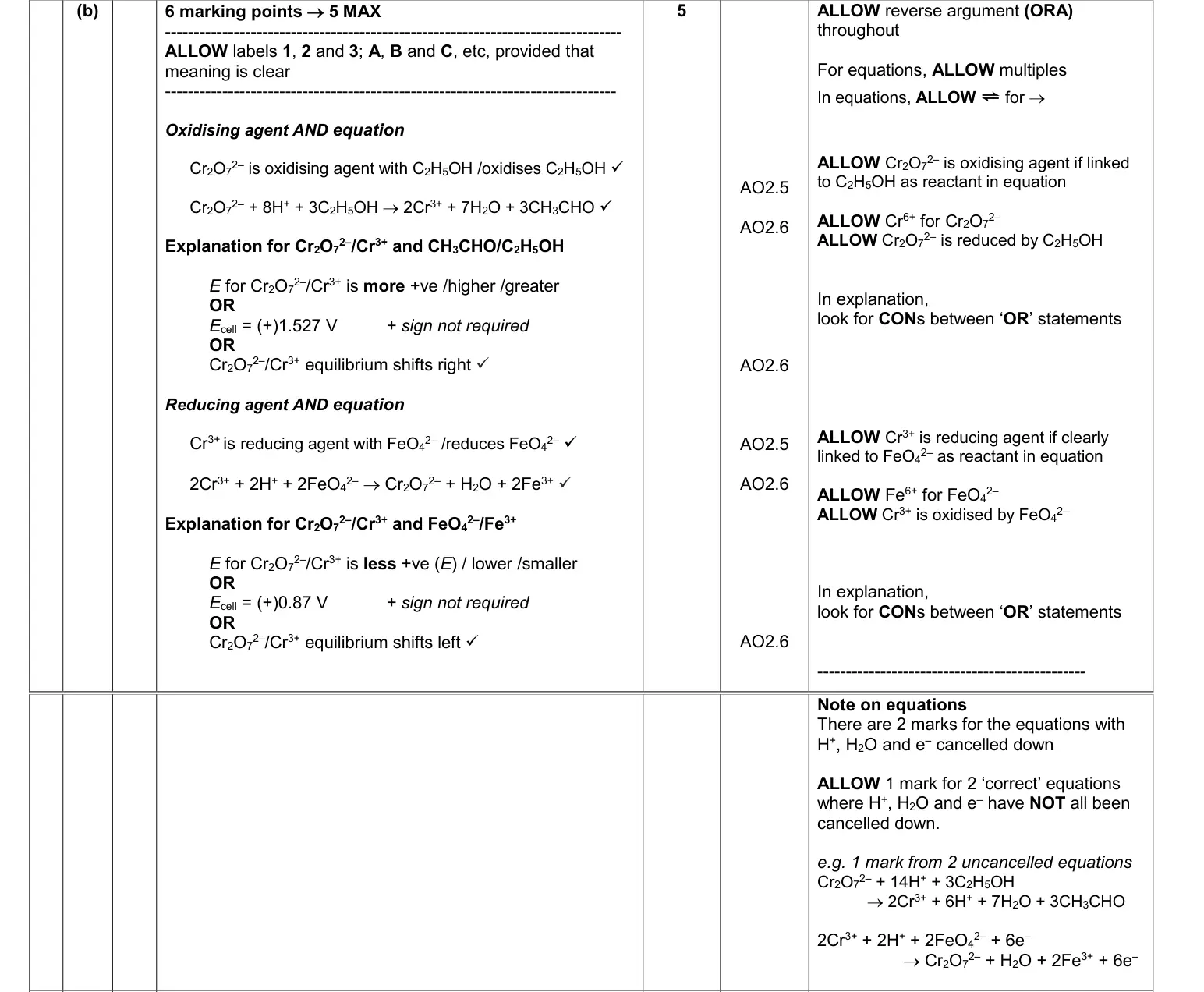
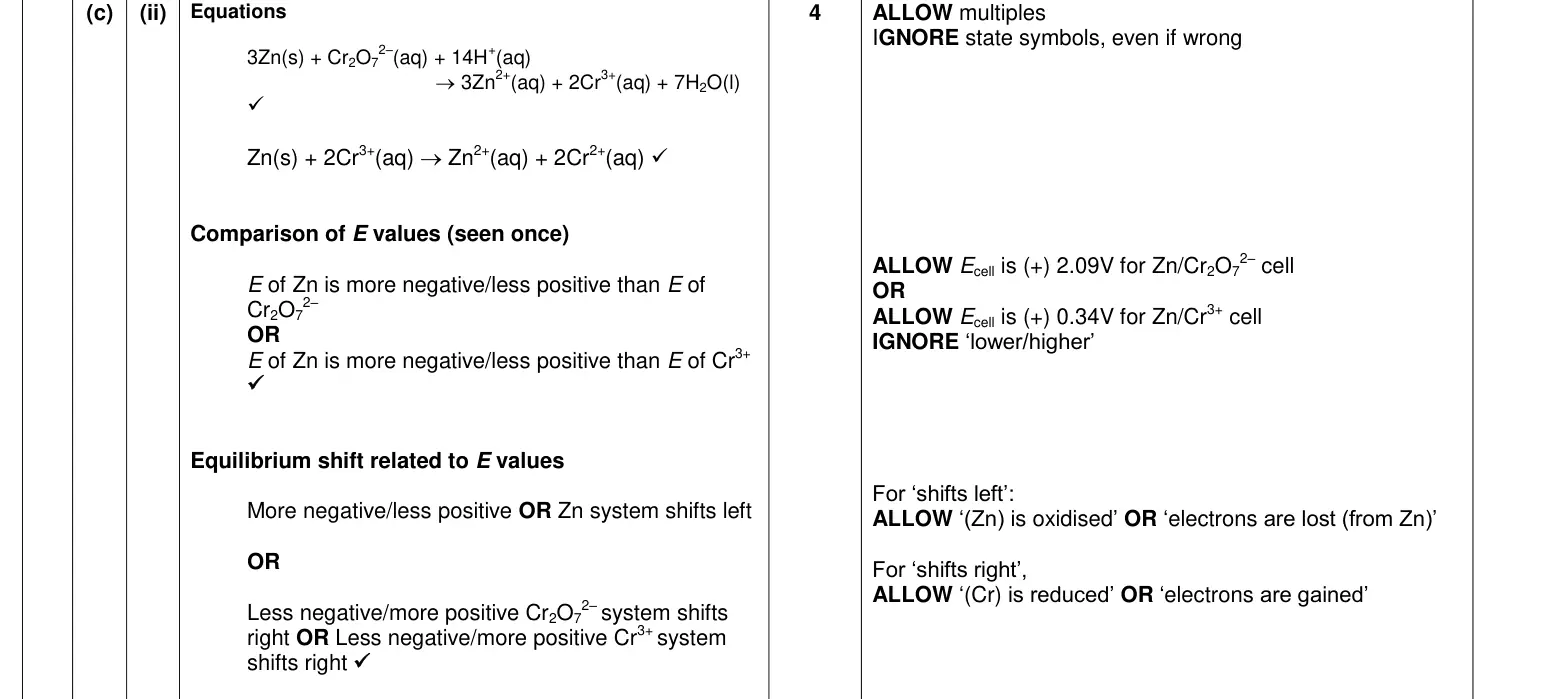
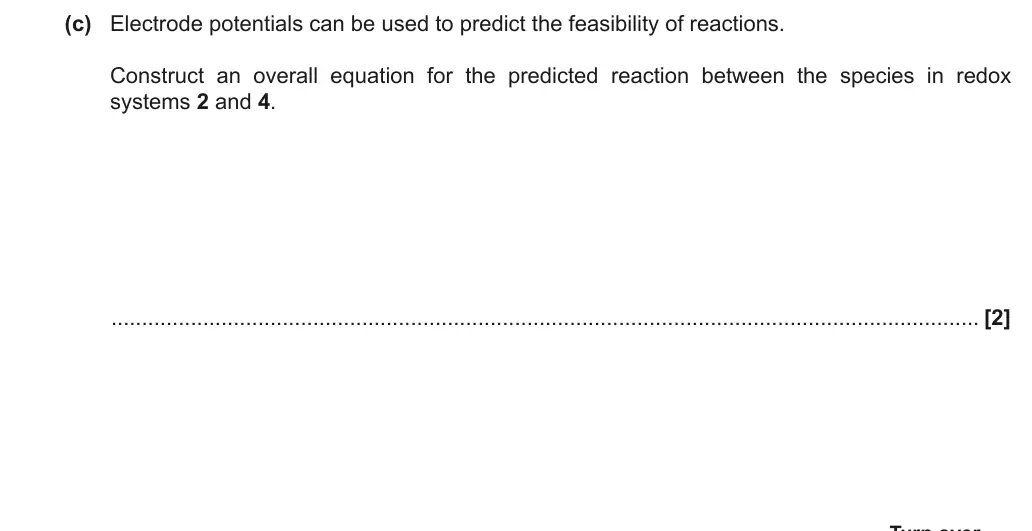
Most candidates were able to obtain some credit for this problem. The equations proved to be among the easier marks, and it was encouraging to see how many candidates were able to use the E data to help them combine the half equations correctly. Most then cancelled down the common species present on both sides of the equation: H+, H2O and e–. Explanations were generally sound, either by comparing the E values, stating the direction of equilibrium shift, or by using cell potentials. The hardest marks proved to be the identification of the chromium ions that were the oxidising and reduction agents. Many candidates just referred to ‘chromium’ despite the chromium half equation containing two chromium ions, Cr2O72– and Cr3+. Candidates who had written correct equations sometimes assigned the wrong chromium ion as the oxidising or reducing agent. Mores successful responses constructed correct equations and stated that Cr2O72– was the oxidising agent as it oxidised C2H5OH and that Cr3+ was the reducing agent as it reduced FeO42–.
Skills: M0.2 Use ratios, fractions and percentages
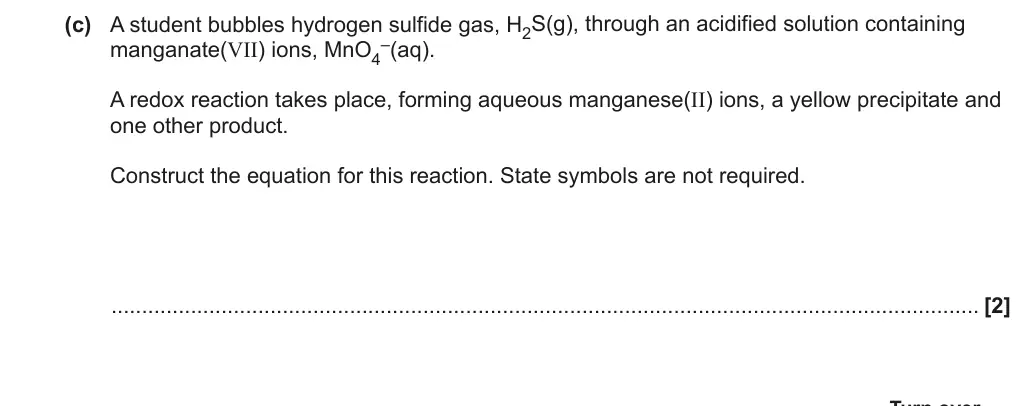
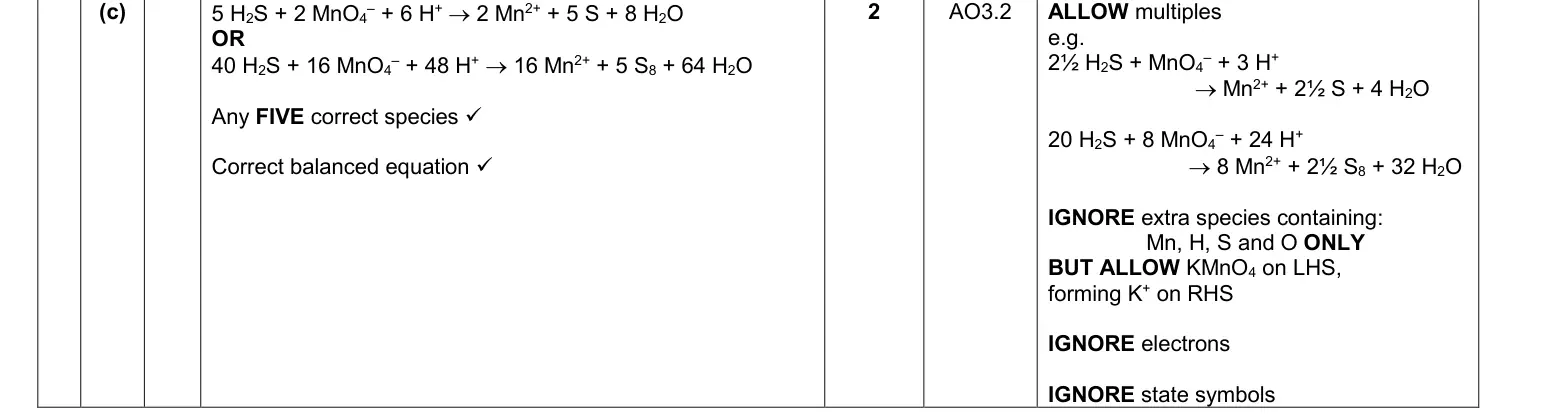
Candidates needed to interpret the information provided and to use this as the basis for their redox equation. The clue of a yellow product proved to be very difficult to interpret as being sulphur. The equation then required H+ to be added as a reactant (‘acidified’ in the information) and H2O as the other product. Balancing required use of oxidation numbers. Candidates found this equation very difficult and relatively few correct equations were seen. The mark scheme did allow 1 mark for any correct five species but the correct equation proved to be challenging in demand. Question 3 (a*) This question was assessed by level of response (LoR). Candidates were required to describe key features in a procedure to prepare a pure organic liquid, including a labelled diagram for reflux, a calculation of the percentage yield and the procedural steps for purification. Levels were determined using these three features. Marks within a level were determined by communication. This question discriminated extremely well. Level 3 candidates would draw a clear diagram with all key items labelled and the set up being capable of being used safely. The percentage yield calculation would be correct, producing a percentage yield close to 45.2%. The steps for the purification: use of a separating funnel, drying and redistillation would be described in the correct order and with some detail. Level 2 candidates would have obtained some of the features required for Level 3 but there would be some key omissions or errors. The diagram may have been drawn clearly but labelling may have been incomplete or a thermometer with bung may have been inserted into the top of the condenser, a very hazardous arrangement. The calculation would be attempted but with some errors, such as omitting to use the density, or using a mixture of moles and masses. The purification steps may have been described but in the wrong order. Purification steps would be incomplete, perhaps only including distillation. Level 1 candidates often drew a diagram resembling a tube above a flask, with water often flowing in the wrong direction. The percentage yield may have been a simple mass ratio with no moles being used. A significant number of candidates described the purification steps for an organic solid, including recrystallisation. The preparation of an organic liquid is a key practical procedure that will have been experienced by students during their A Level studies (PAG 5). The overall standard of drawing diagrams was poor, an area that needs improvement.
Skills: M0.2 Use ratios, fractions and percentages
Skills: M0.0 Recognise and make use of appropriate units in calculations; M0.2 Use ratios, fractions and percentages; M2.3 Substitute numerical values into algebraic equations using appropriate units for physical quantities
D
C

Skills: M0.2 Use ratios, fractions and percentages

Skills: PAG2 Acid–base titration
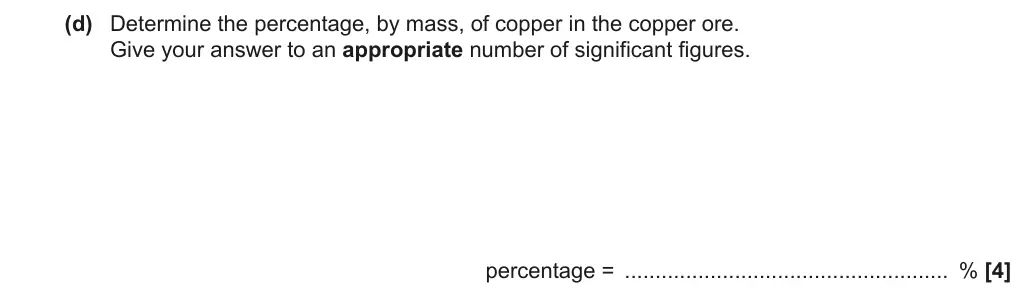
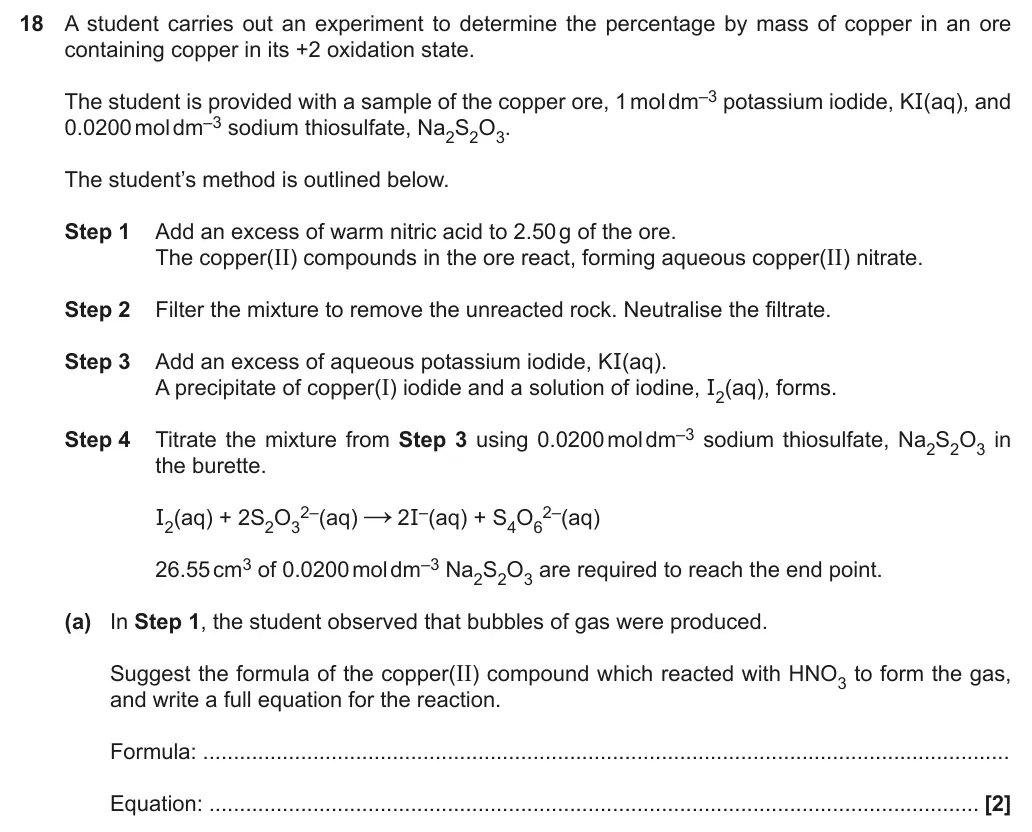
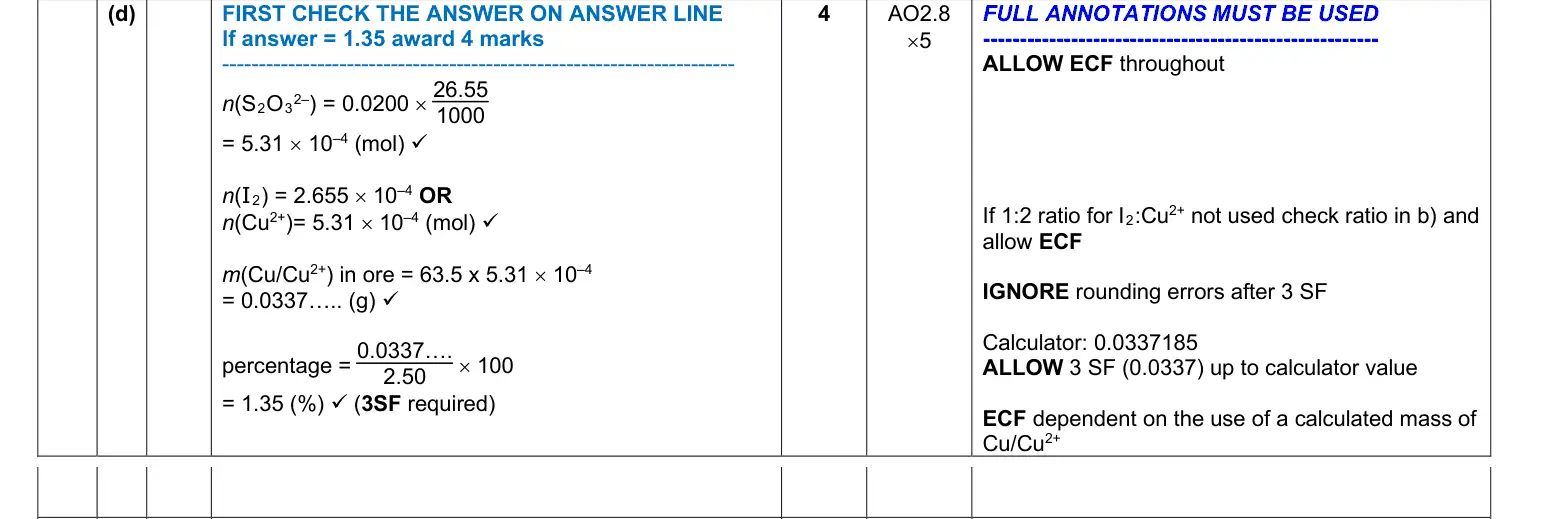
Question 18(d): This was a percentage by mass calculation.
Skills: M0.2 Use ratios, fractions and percentages; M1.1 Use an appropriate number of significant figures; M2.3 Substitute numerical values into algebraic equations using appropriate units for physical quantities; PAG2 Acid–base titration
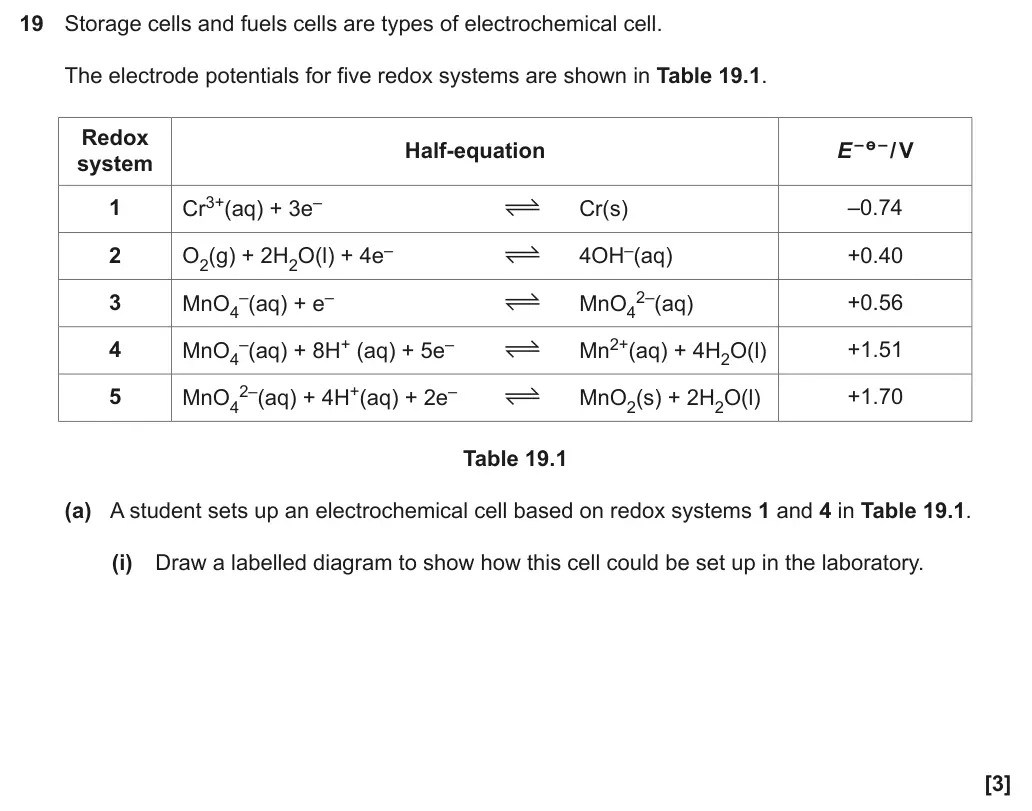
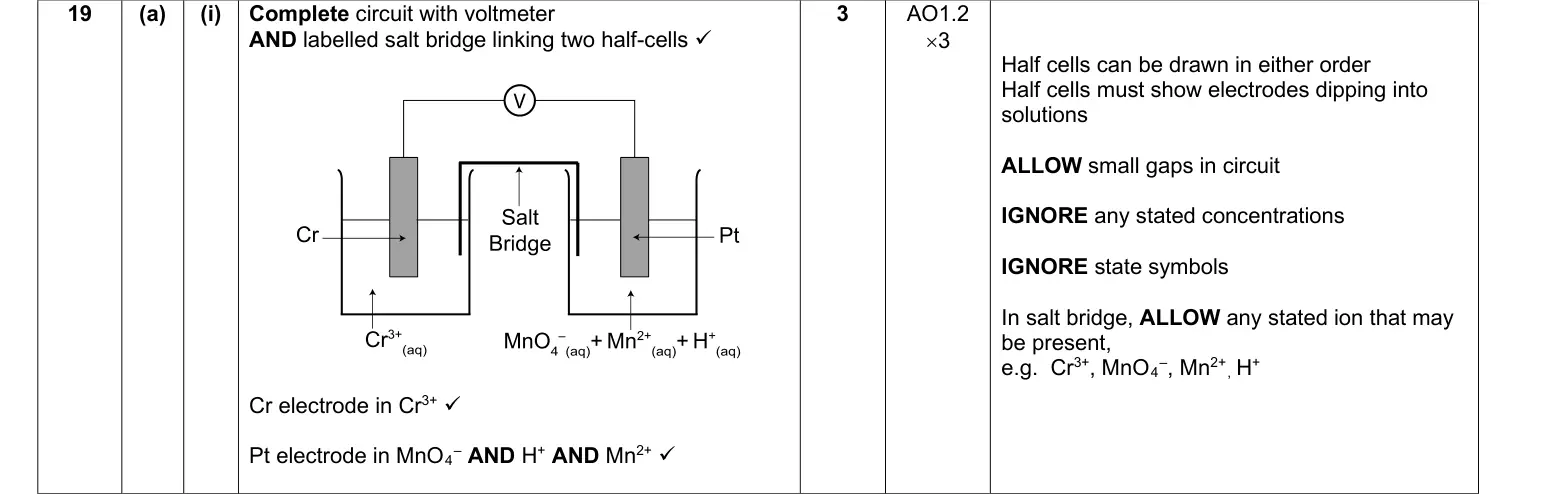
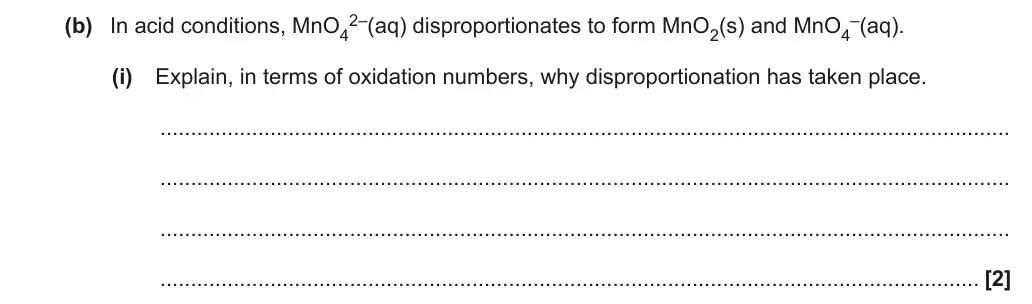
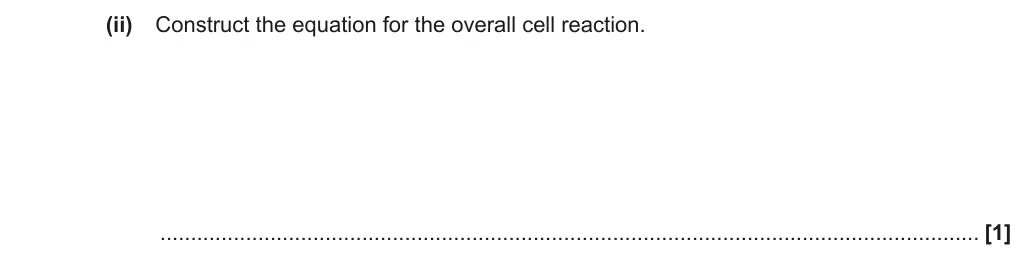
Question 19(a)(i): Most candidates were able to draw a circuit containing a voltmeter and the chromium half-cell but very few candidates included the H+ in the MnO4-/Mn2+ cell. 19(a)(ii) and (b)(i): Most candidates were able to construct the equation for the overall cell reaction and to use oxidation numbers to explain disproportionation. .
Skills: PAG8 Electrochemical cells
Skills: M0.2 Use ratios, fractions and percentages
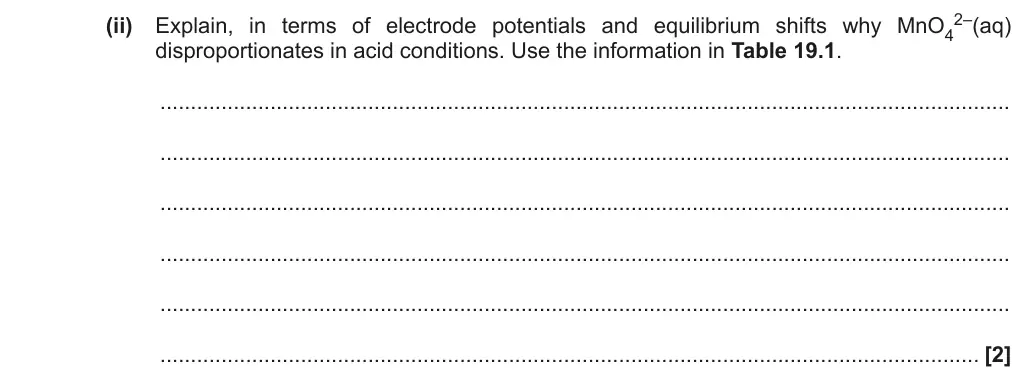
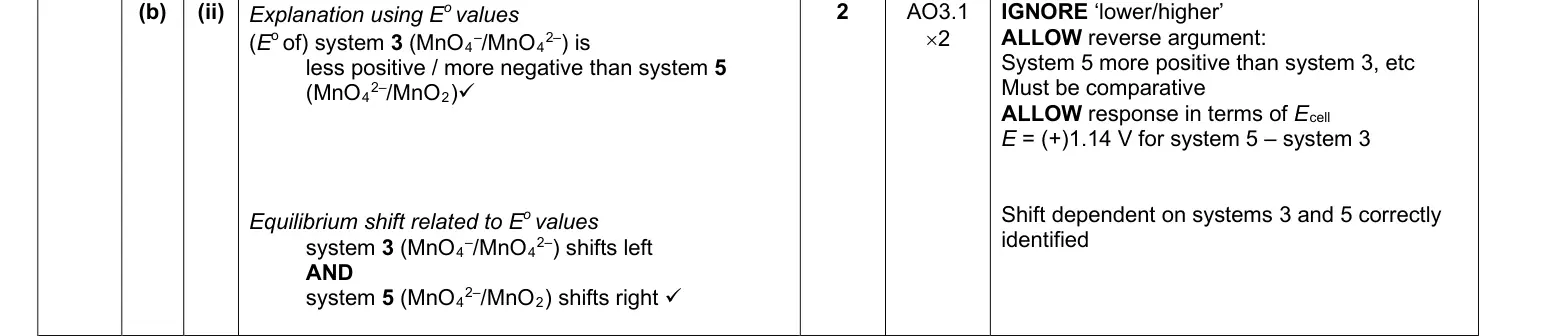
Question 19(b)(ii): Only a few candidates were able to link the electrode potentials and equilibrium shifts.
Skills: M2.2 Change the subject of an equation

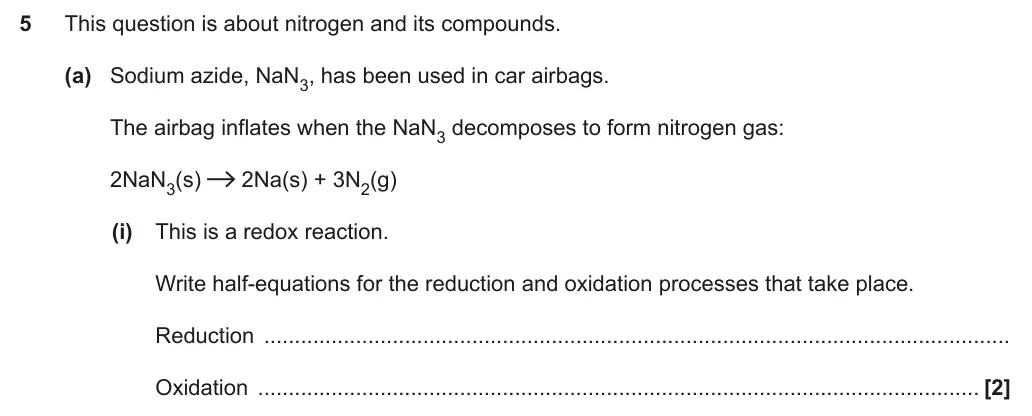
Q1(d), Q1(e), Q5(a)(i) • Unclear drawing of diagrams and labelling of laboratory apparatus: Q2(a) • Had difficulty explaining chemical ideas, often repeating the same points several times, e.g. Q5(a)(i) required candidates to write half equations for a redox reaction.
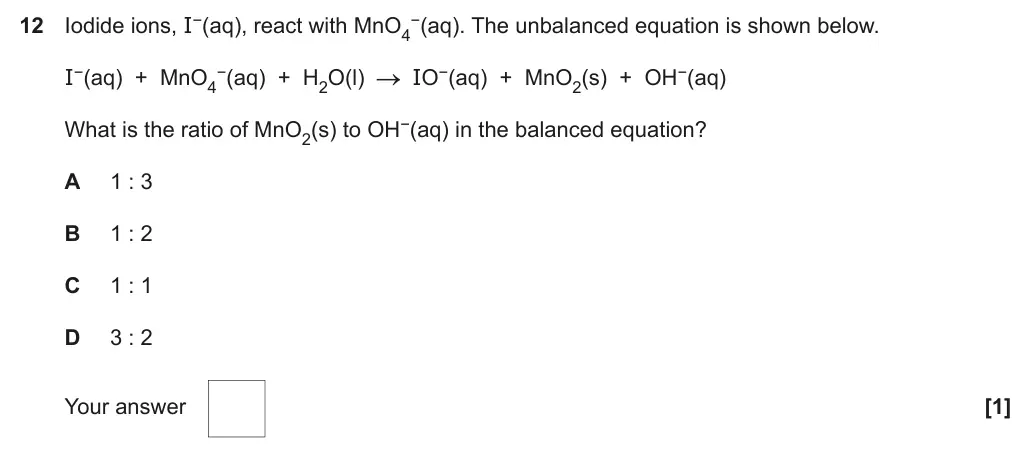
C
Skills: M0.2 Use ratios, fractions and percentages
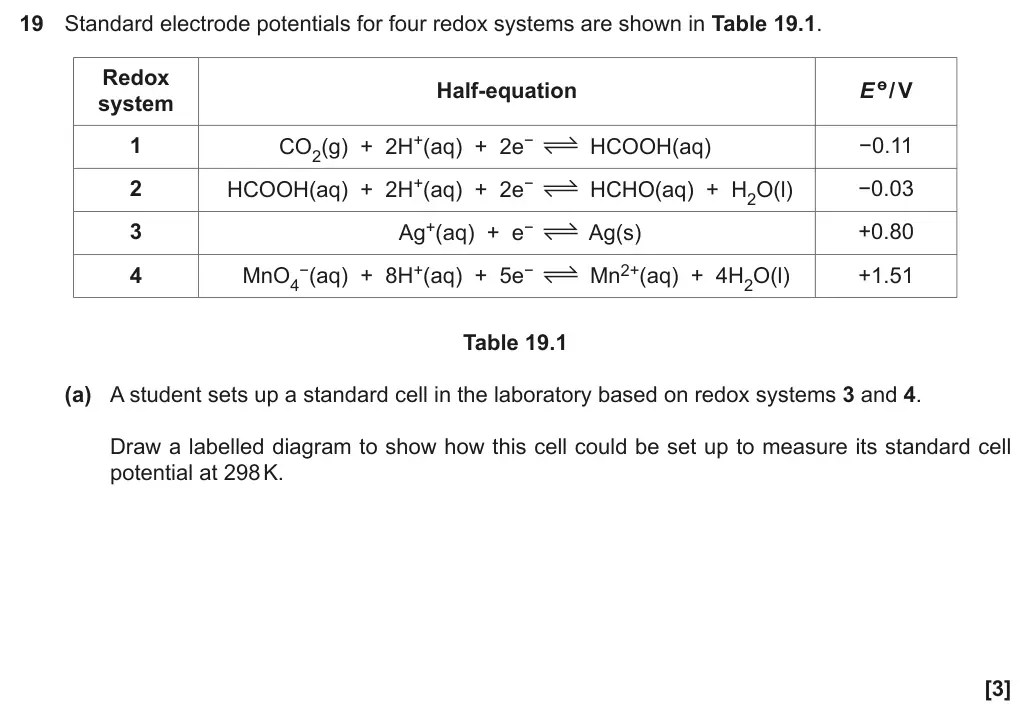
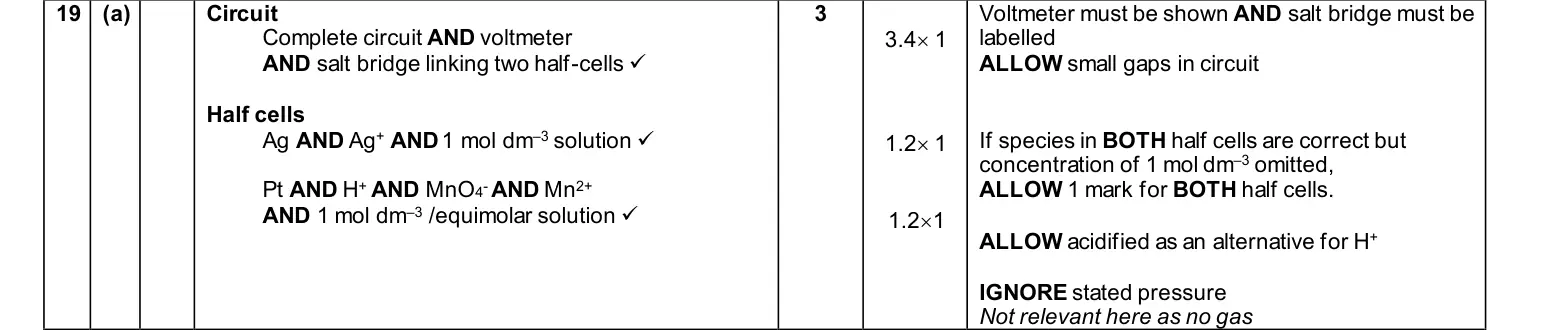
Most candidates drew a circuit containing a voltmeter and the silver half cell but very few candidates included the H+ in the MnO4-/Mn2+ cell.
Skills: PAG8 Electrochemical cells
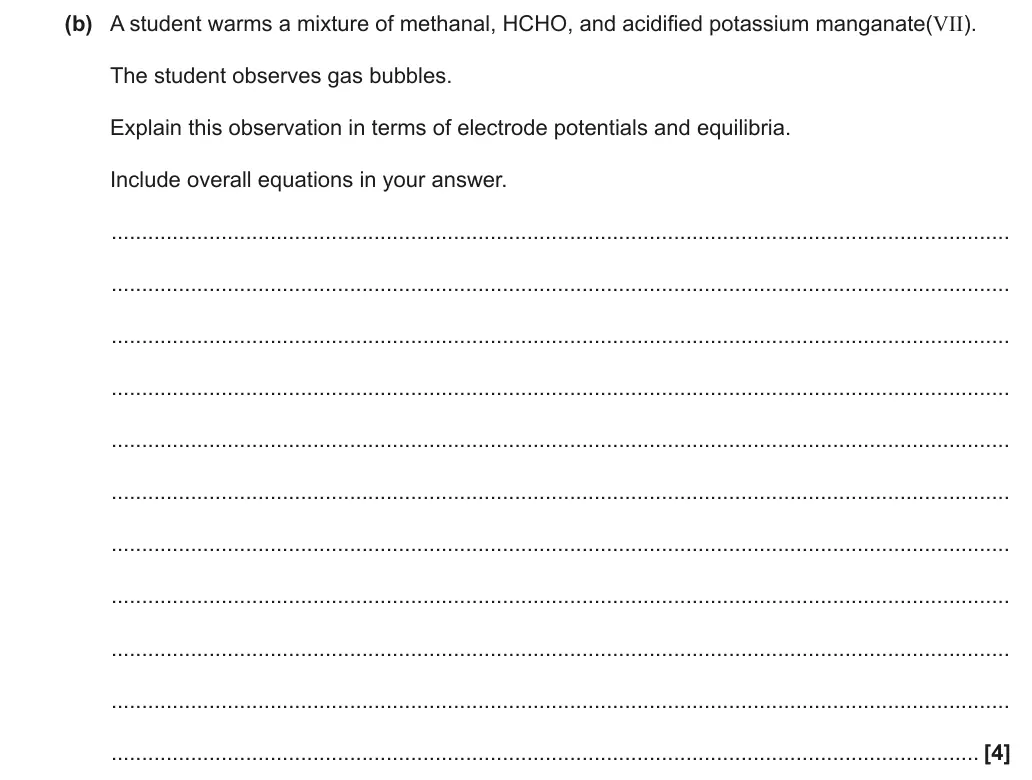
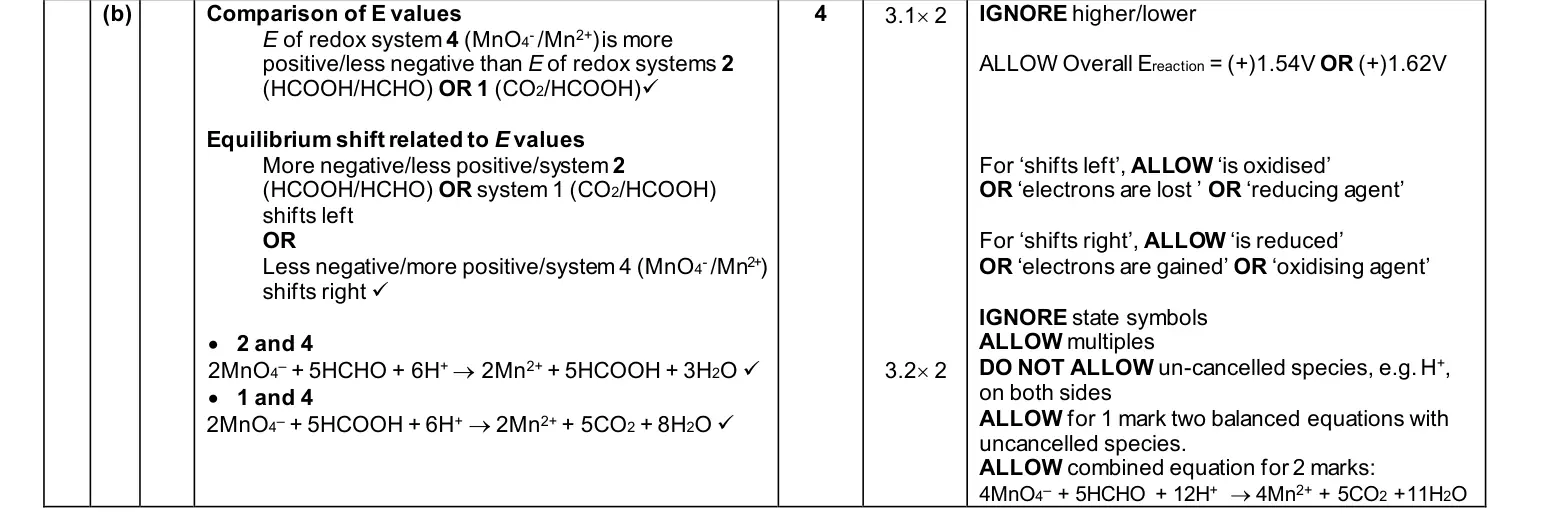
Higher-attaining candidates described two oxidations starting from HCHO to end up with CO2. Many candidates used the data correctly but stopped at the first oxidation to form HCOOH. Lower-attaining candidates did not state that the direction of reaction of redox equilibria is dependent on the relative negativity/positivity of the standard electrode potentials. Some candidates are still using higher/lower to compare the E cell values, and should be encouraged to instead use the phrasing ‘more positive’ or ‘more negative’. Many candidates wrote a correct first equation, although some did not cancel down the H+ and/or water. Group 17
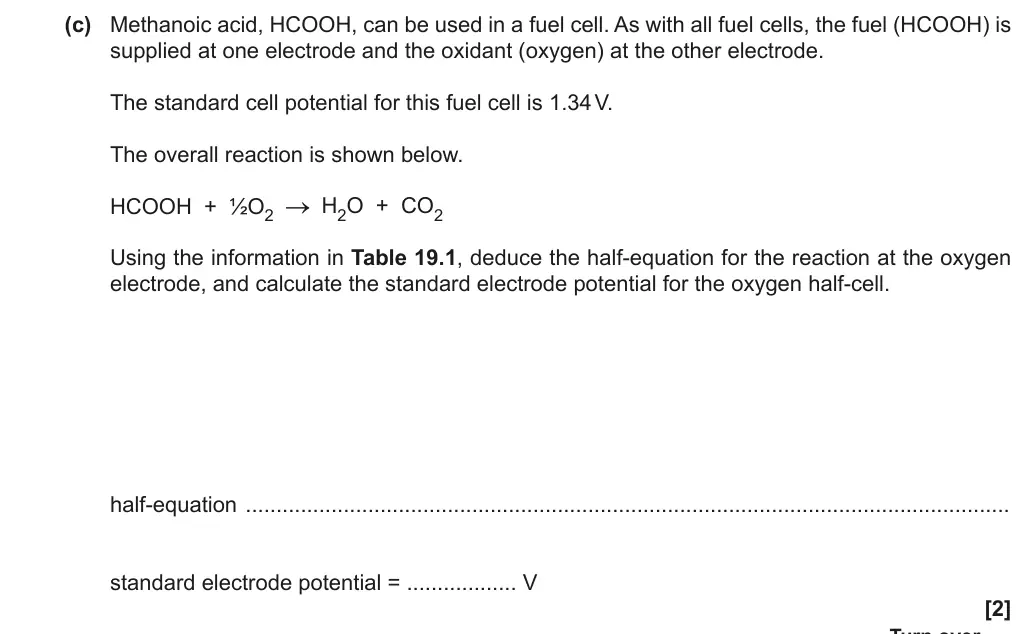
Skills: M2.2 Change the subject of an equation
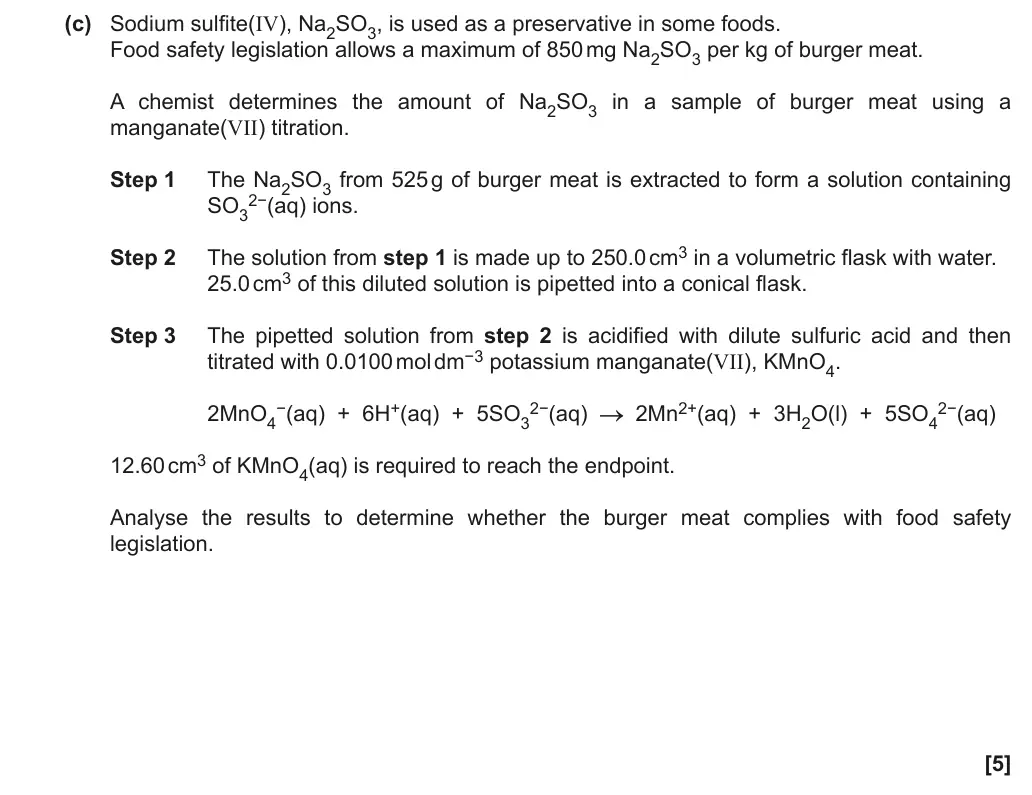
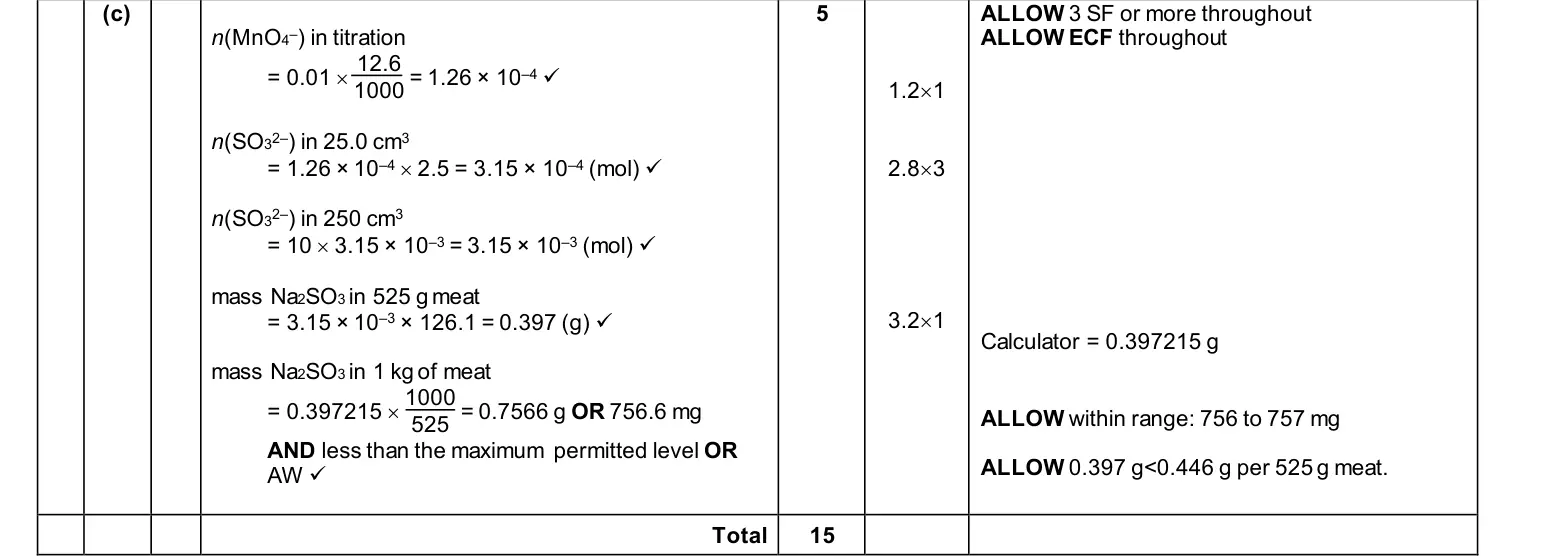
This question asked the candidate to determine the amount of sodium sulfite in food. Many candidates gained full marks. Most candidates calculated the number of moles of MnO4- and SO32-. Some candidates calculated the mass in 525 g of meat, although some used the wrong Mr, e.g. 80, for the sulfite ion. The lower ability candidates did not process the scaling to 1 Kg. Rates of reaction
Skills: M0.0 Recognise and make use of appropriate units in calculations; M0.2 Use ratios, fractions and percentages; M2.3 Substitute numerical values into algebraic equations using appropriate units for physical quantities
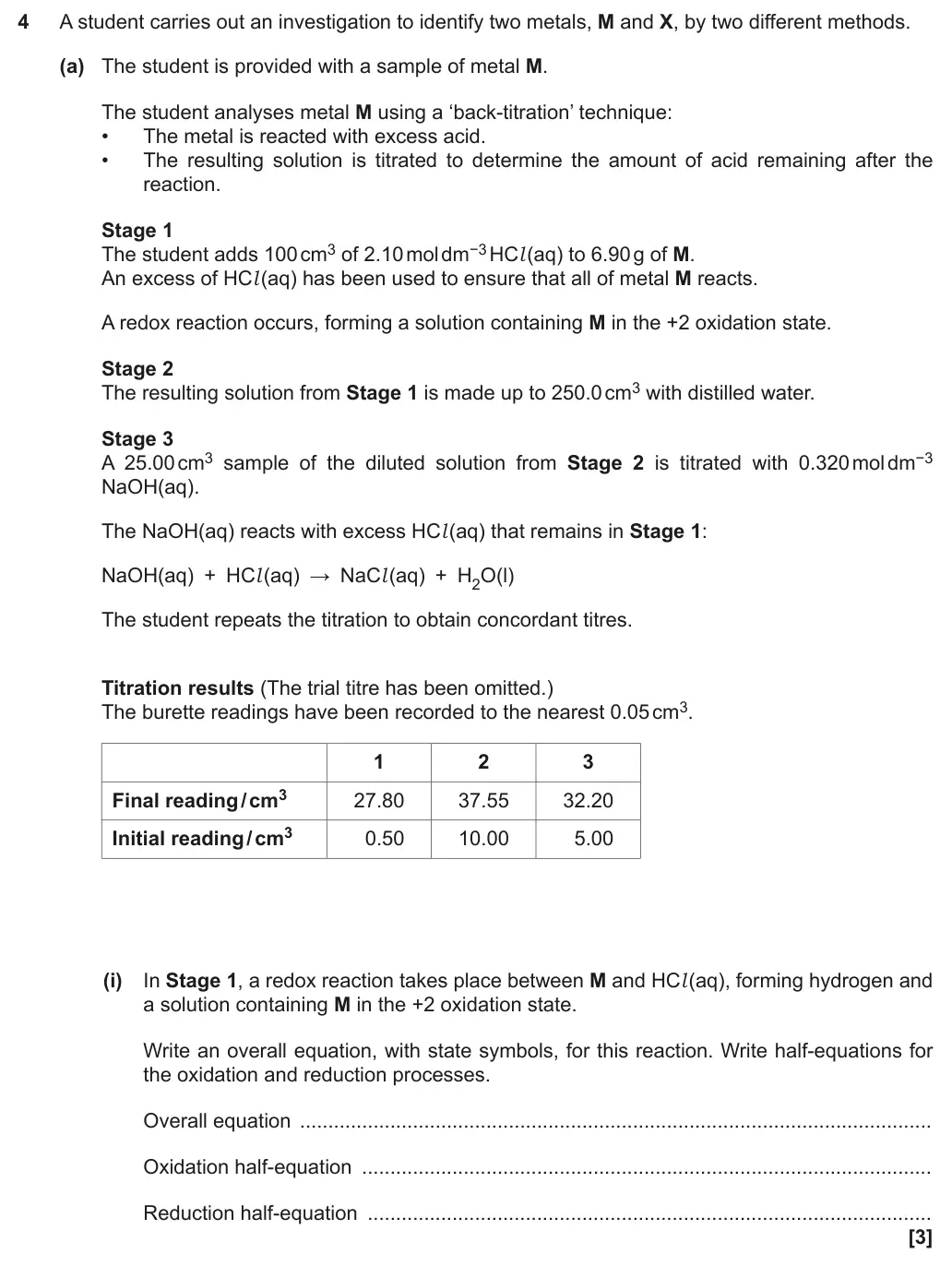
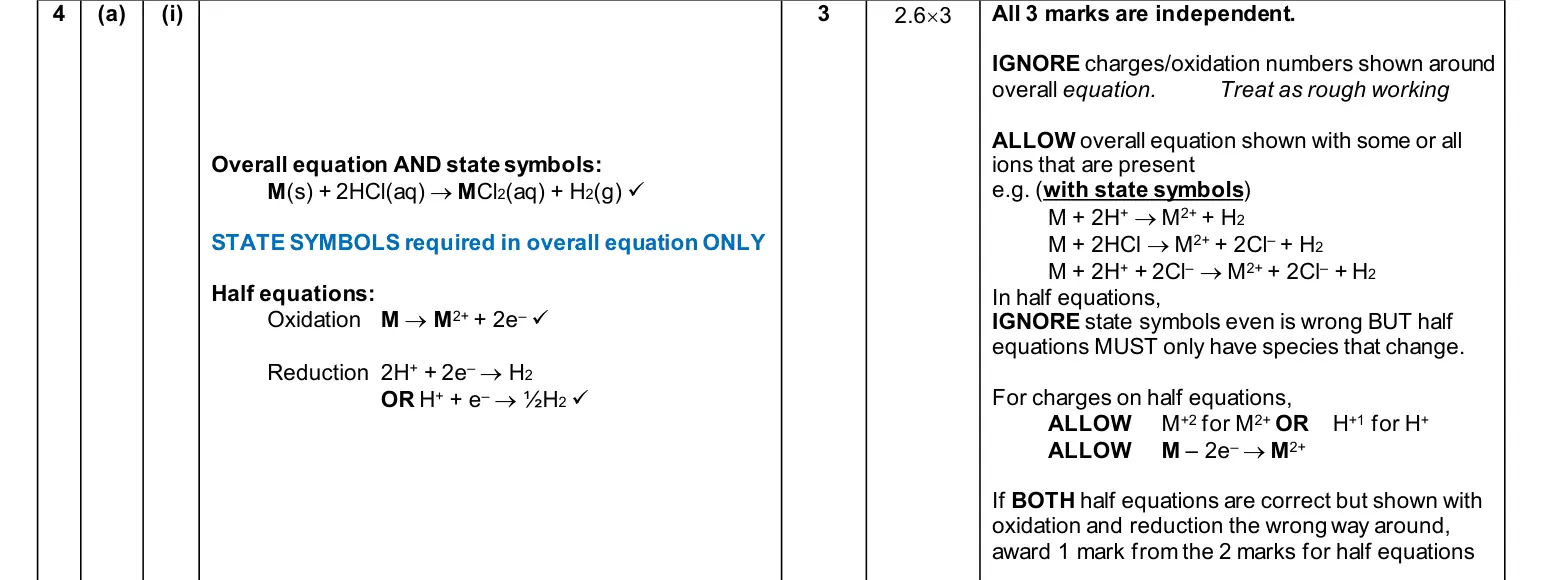
4(a)(i) This question required candidates to write an overall equation and half equations for oxidation and reduction. Many candidates made errors within one or more equations. The overall equation was often written without state symbols, despite the question instruction ‘with state symbols’. The oxidation half equation was more likely to be correct than the reduction half equation, which often used Cl instead of H+. When H+ was used, the half equation was often unbalanced or electrons had been omitted. It is recommended that candidates carefully use the chemical information in the question. 4(a)(ii) Most candidates identified that all the metal would have reacted when it had all disappeared and that gas bubbles from the reaction would have stopped. Some responses did not emphasise that these observations would have stopped and this prevented credit being given. 4(a)(iii) The ionic equation for neutralisation of an acid with an alkali was well known and this question was answered correctly by most candidates. 4(a)(iv) Candidates were presented with information about a back titration, a technique that they would be unlikely to have encountered during their course. The question stem to 4a(iv) suggested a three-step strategy. Many candidates followed this guidance and were credited with many of the available marks. Marks were given for a correct method (by error carried forward) even if there was an error or omission in the multi-step calculation. This emphasises the importance of clear working. Most candidates determined the correct mean titre of 27.25 cm3. A few candidates did take the mean of all three titres rather than the closest. Most calculated that 8.72 × 10⁻³ mol of NaOH reacted with the same number of moles of HCl in the titration and then scaled up the HCl by a factor of 10 to 8.72 × 10⁻² mol in the 250 cm3 volumetric flask. These steps are standard for many titration calculations and gave a route to three of the six available marks. The more difficult back titration steps then followed and the higher-attaining candidates recognised the need to subtract this amount of HCl from the original amount of HCl used to react with metal M. These candidates then divide this value by two to find the moles of M that reacted (from the 1 : 2 stoichiometry of M : HCl). The correct calculation then gave a relative atomic mass of M as 112 and its identity as cadmium. It was common for candidates to omit the division by two and to arrive at a relative atomic mass of 56 for iron. The mark scheme shows the variety of metals that candidates identified from their calculations, the errors made, and the error carried forward marks that resulted. Many lower-attaining candidates did not follow the 3 steps in the stem, using only the original amount of HCl and ignoring the titration. This approach was not credited with marks. A large range of marks was seen, and the question discriminated extremely well. 4(b)(i) This straightforward mole calculation required candidates to determine the mass of CO2 as 2.75 g from the table of results and to divide this value by the molar mass of CO2 to arrive at 0.0625 mol. Most candidates were successful. As with other questions providing raw experimental results, lower-attaining candidates often chose the wrong data from the supplied results. 4(b)(ii) Many candidates used their value from 4b(i) with the mass of X2CO3 from the results table to obtain a value for the molar mass (233.13 from 14.57 ÷ 0.0625). Higher-attaining candidates obtained a value for the atomic mass of X (86.56 from 233.13) and identified X as the Group 1 metal rubidium. Some candidates did not recognise the significance of the formula of X2CO3 and identified X instead as strontium (Ar = 87.6). Lower-attaining candidates often used incorrect data from the supplied information and made little progress with this calculation. 4(c)(i) Most candidates suggested that the mass of the flask and contents could be reweighed until the mass no longer changed. An alternative creditworthy suggestion was to attach a gas syringe and to measure the gas volume until it no longer changed. Vague suggestions such as ‘leave for longer’ were not credited with marks. 4(c)(ii) Candidates found this question challenging. Success required candidates to appreciate that some CO2 dissolving would result in less mass of CO2 being recorded as lost, meaning that less moles of CO2 had apparently been formed and so less moles of X2CO3 had reacted. Using n = m/M, this would show that the calculated molar mass of X2CO3 appears to be greater. Only the highest-attaining candidates successfully navigated this question.
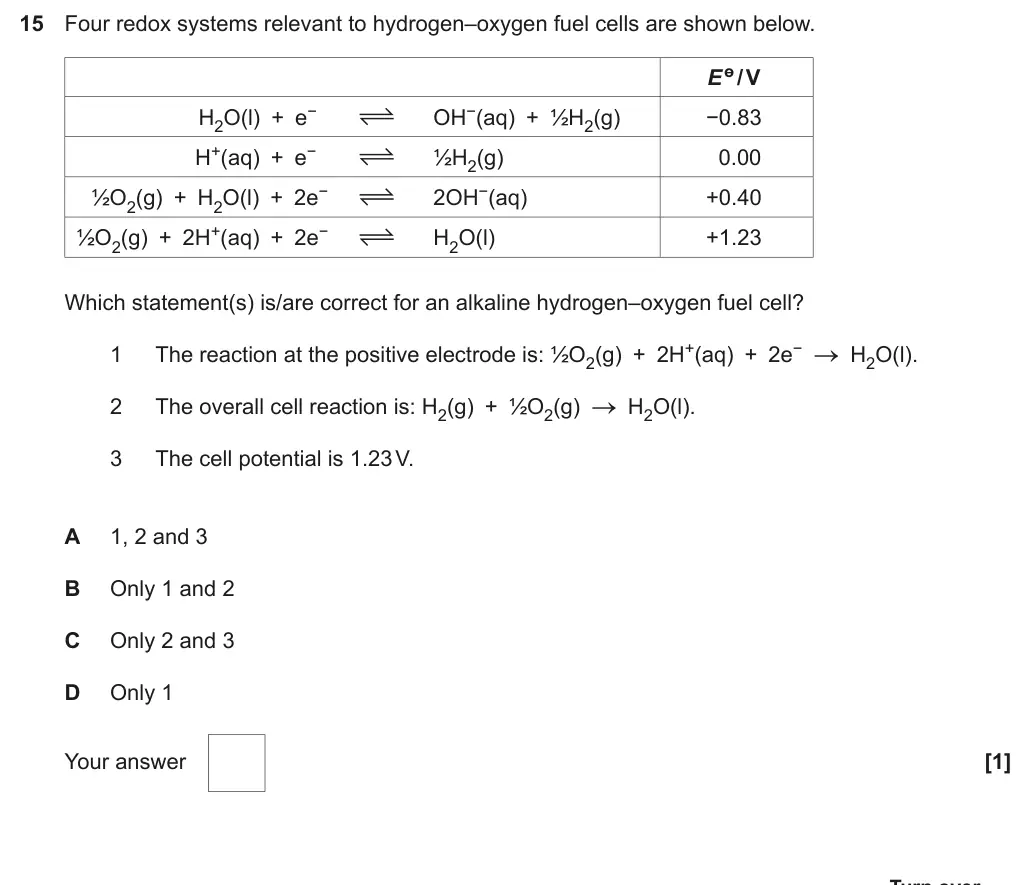
C
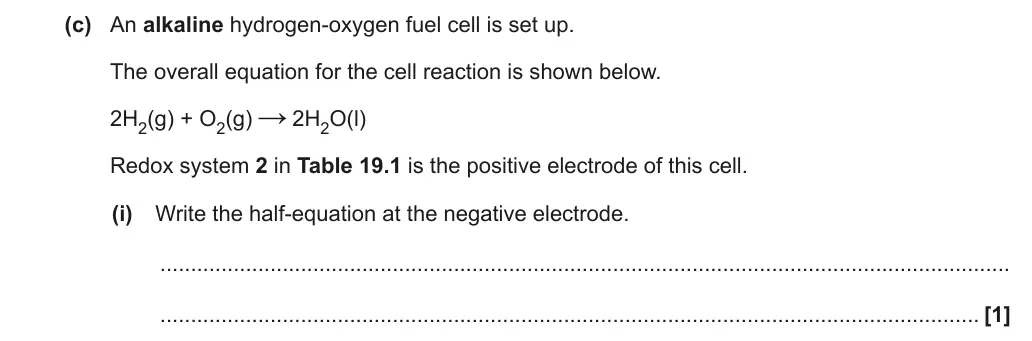
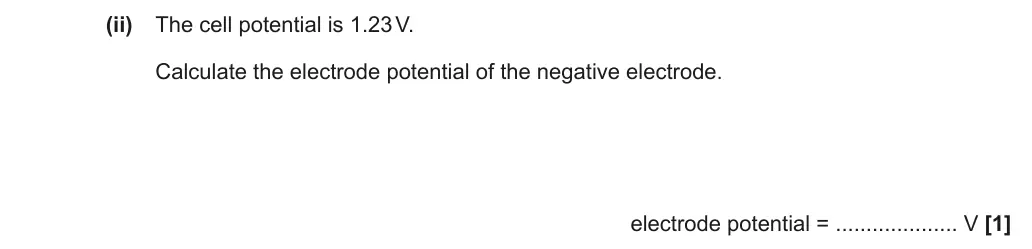
Only the higher attaining candidates opted for the correct answer of C. Many candidates thought statement 1 was correct, (giving option A as the answer), not realising that this equation refers to acidic conditions not alkaline conditions (as mentioned in the question). Others did not recognise that the cell potential was 1.23V (obtained by calculating the difference between +0.40 and –0.83), and so opted for option B. Section B overview
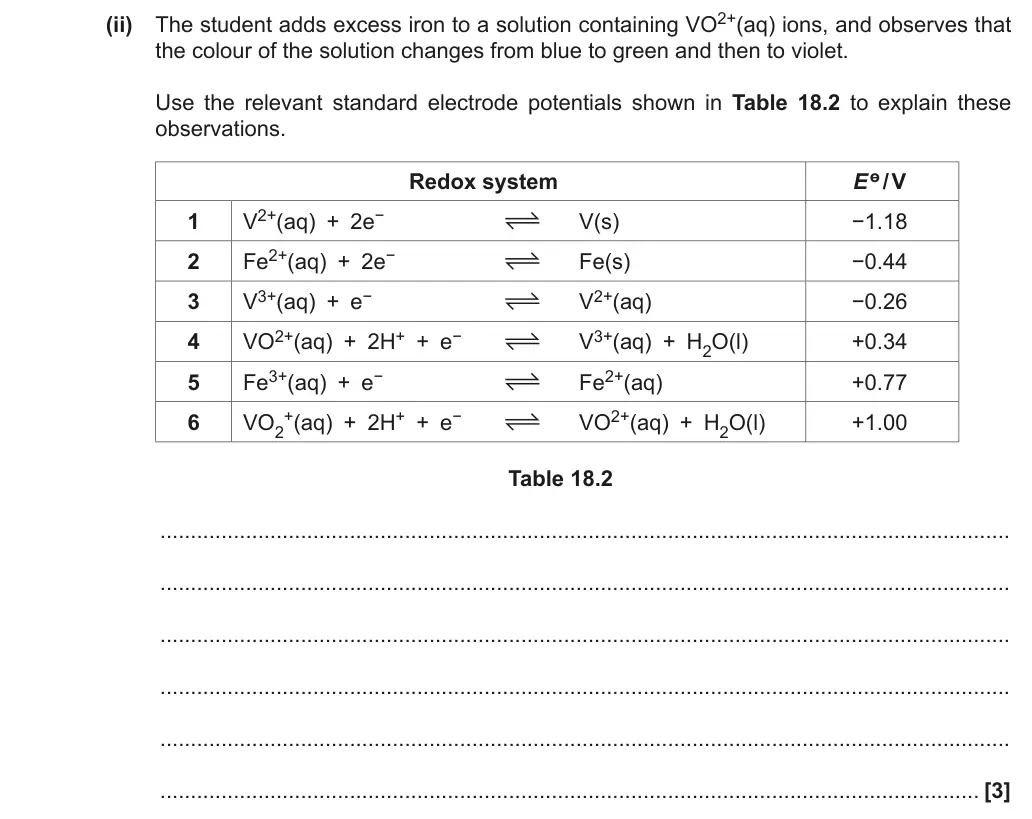
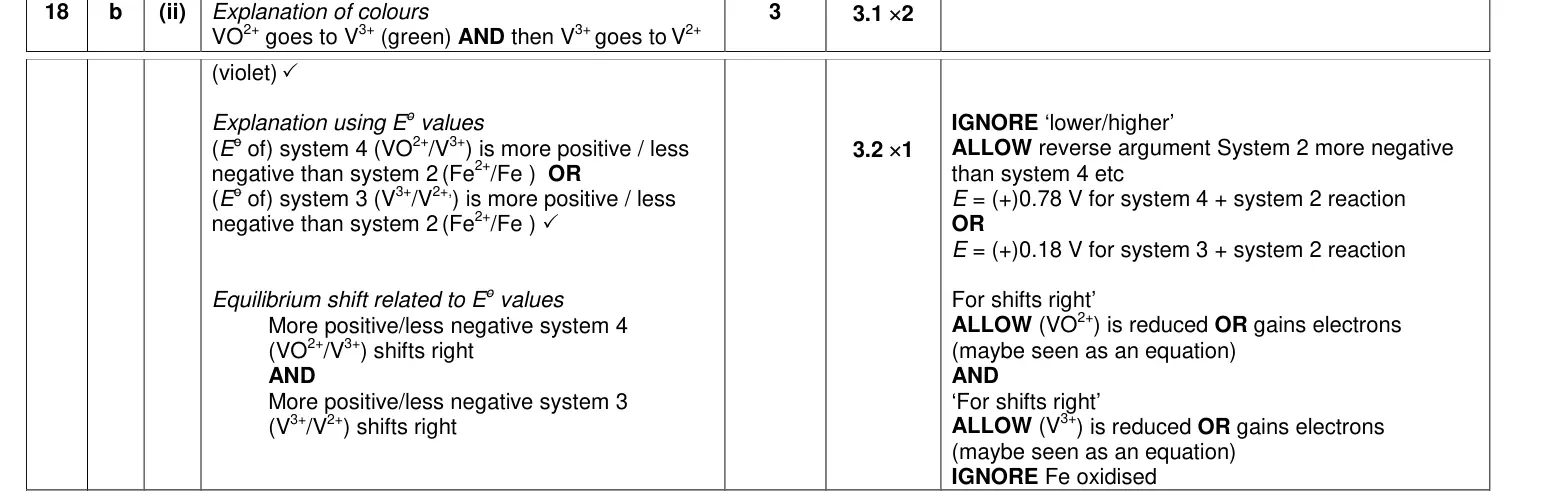
Most candidates did not state that the direction of reaction of redox equilibria is dependent on the relative negativity/positivity of the standard electrode potentials. Higher ability candidates described two reductions of the relevant vanadium ions to end up with V2+ ions.

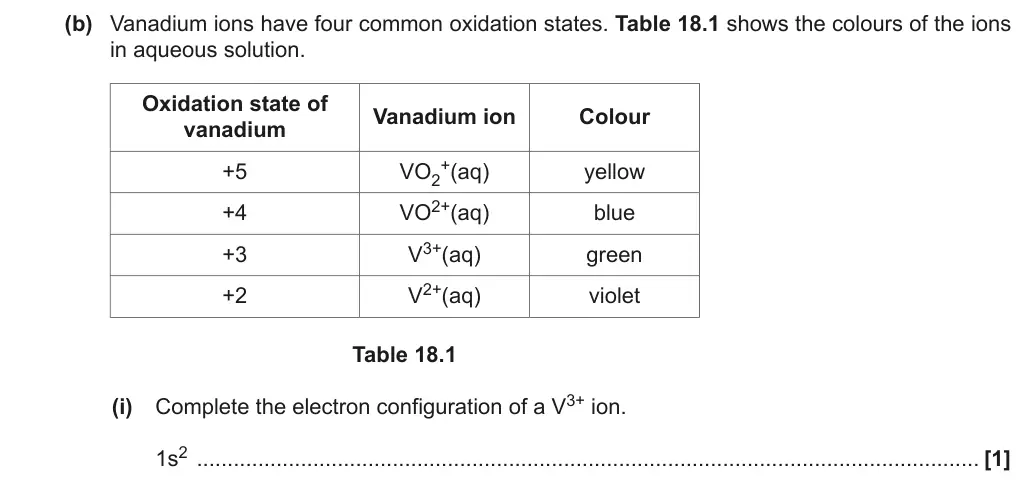
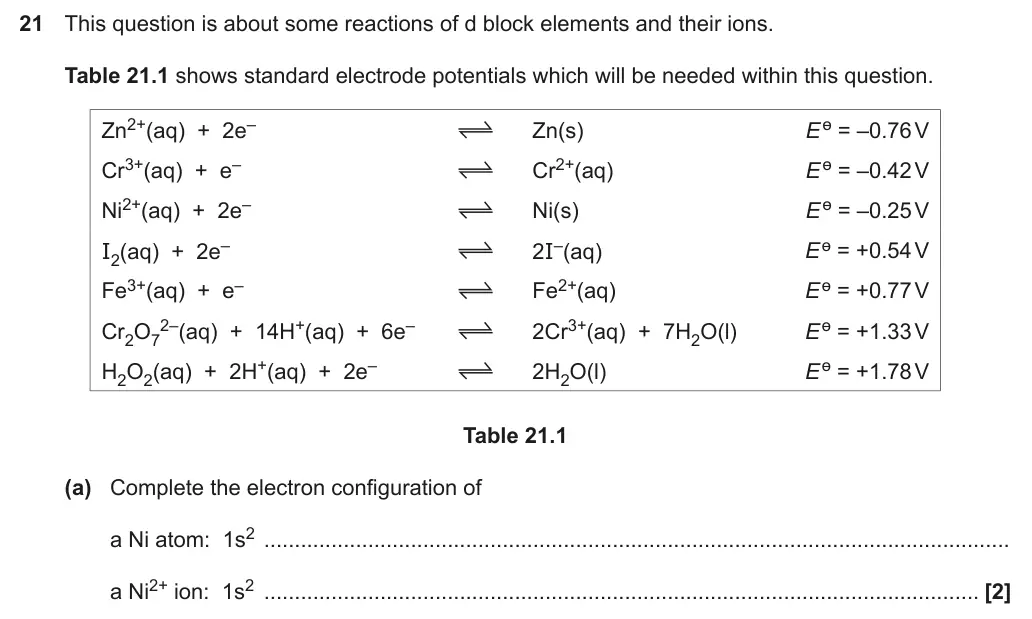
A LEVEL CHEMISTRY A Examiners’ report H432/01 Summer 2019 series Version 1 H432 For first teaching in 2015 www.ocr.org.uk/science Contents Introduction .............................................................................................................................................. 4 Paper 1 series overview ........................................................................................................................... 5 Section A overview ................................................................................................................................... 6 Question 2 ............................................................................................................................................ 6 Question 3 ............................................................................................................................................ 6 Question 4 ............................................................................................................................................ 7 Question 5 ............................................................................................................................................ 7 Question 6 ............................................................................................................................................ 8 Question 8 ............................................................................................................................................ 8 Question 9 ............................................................................................................................................ 9 Question 10 .......................................................................................................................................... 9 Question 11 ........................................................................................................................................ 10 Question 13 ........................................................................................................................................ 10 Question 14 ........................................................................................................................................ 11 Question 15 ........................................................................................................................................ 11 Section B overview ................................................................................................................................. 12 Question 16 (a) ................................................................................................................................... 12 Question 16 (b) ................................................................................................................................... 12 Question 16 (c) (i) ............................................................................................................................... 12 Question 16 (c) (ii) .............................................................................................................................. 13 Question 16 (d) (i) ............................................................................................................................... 14 Question 16 (d) (ii) .............................................................................................................................. 15 Question 16 (e) (i) ............................................................................................................................... 16 Question 16 (e) (ii) .............................................................................................................................. 16 Question 17 (a) ................................................................................................................................... 17 Question 17 (b) ................................................................................................................................... 19 Question 18 (a) (i) ............................................................................................................................... 20 Question 18 (a) (ii) .............................................................................................................................. 20 Question 18 (a) (iii) ............................................................................................................................. 21 Question 18 (a) (iv) ............................................................................................................................. 22 Question 18 (a) (v) .............................................................................................................................. 22 Question 18 (b) (i) ............................................................................................................................... 22 Question 18 (b) (ii) .............................................................................................................................. 23 Question 18 (c) (i) ............................................................................................................................... 24 Question 18 (c) (ii) .............................................................................................................................. 24 Question 19 (a) (i) ............................................................................................................................... 25 Question 19 (a) (ii) .............................................................................................................................. 25 Question 19 (a) (iii) ............................................................................................................................. 26 Question 19 (b) (i) ............................................................................................................................... 26 Question 19 (b) (ii) .............................................................................................................................. 27 Question 19 (b) (iii) ............................................................................................................................. 27 Question 19 (b) (iv) ............................................................................................................................. 28 Question 19 (c) (i) ............................................................................................................................... 28 Question 19 (c) (ii) .............................................................................................................................. 29 Question 20 (a) ................................................................................................................................... 29 Question 20 (b) (i) ............................................................................................................................... 30 Question 20 (b) (ii) .............................................................................................................................. 30 Question 20 (b) (iii) ............................................................................................................................. 31 Question 20 (b) (iv) ............................................................................................................................. 32 Question 20 (b) (v) .............................................................................................................................. 32 Question 20 (c) ................................................................................................................................... 33 Question 21 ........................................................................................................................................ 34 Introduction Our examiners’ reports are produced to offer constructive feedback on candidates’ performance in the examinations. Those who stated orange received credit Question 18 (b) (i) Many candidates did not realise that when transition metal ions are formed, the first electrons removed from atoms are the 4s electrons and so wrote 2s2 2p6 3s2 3p6 3d1 4s2. Question 18 (b) (ii) Most candidates did not state that the direction of reaction of redox equilibria is dependent on the relative negativity/positivity of the standard electrode potentials.
Skills: M0.2 Use ratios, fractions and percentages
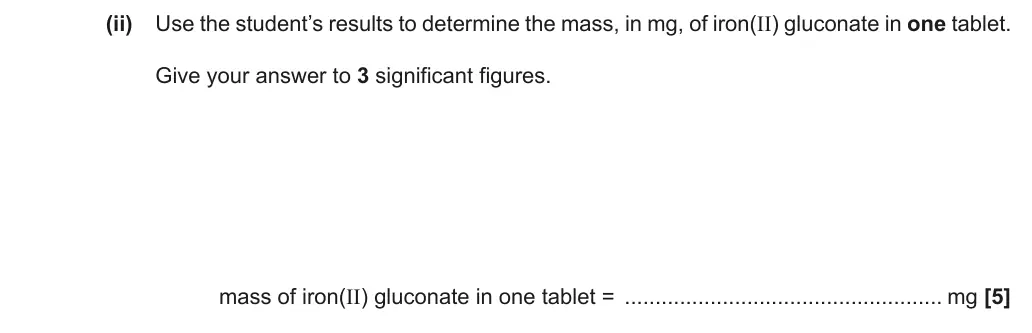
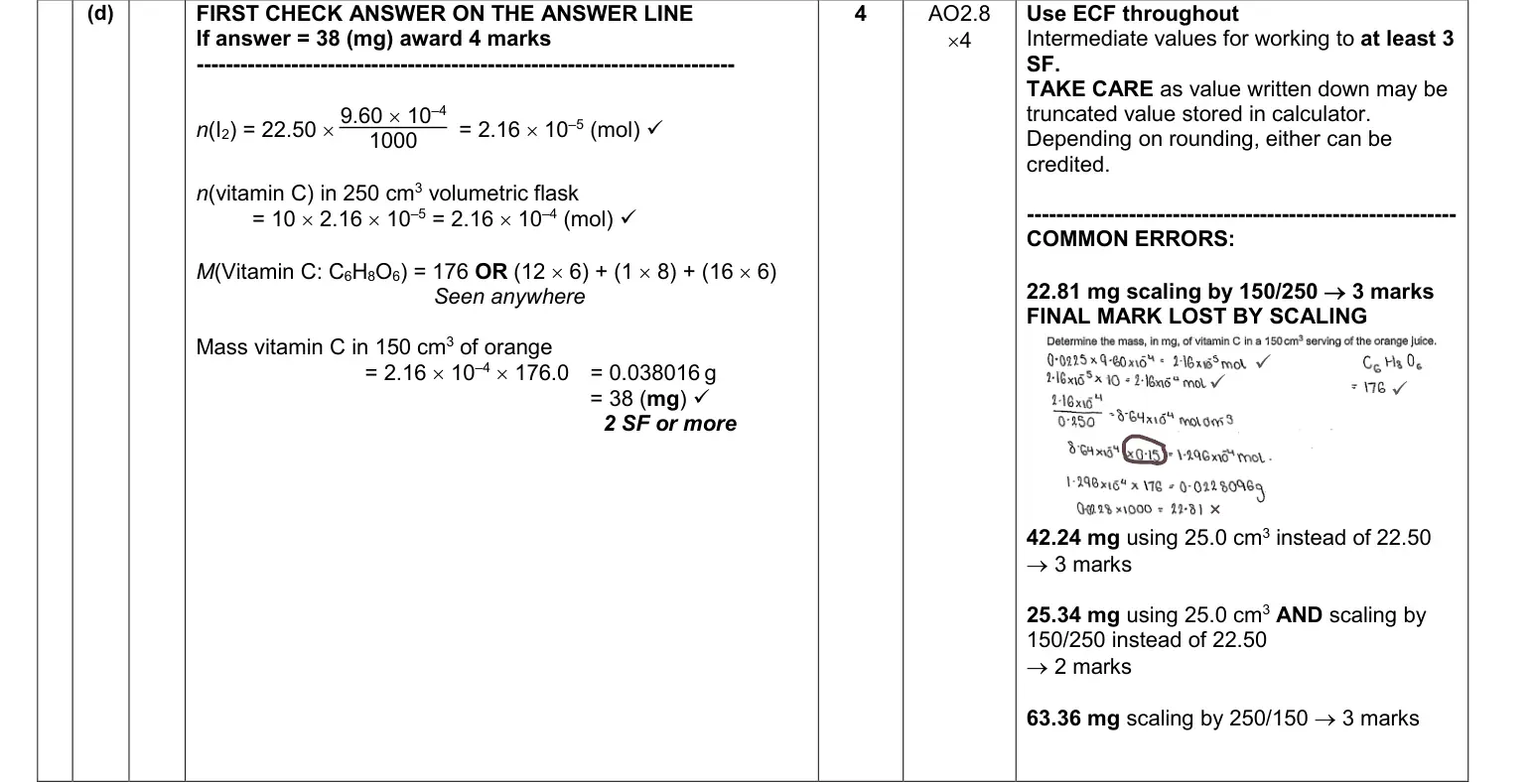
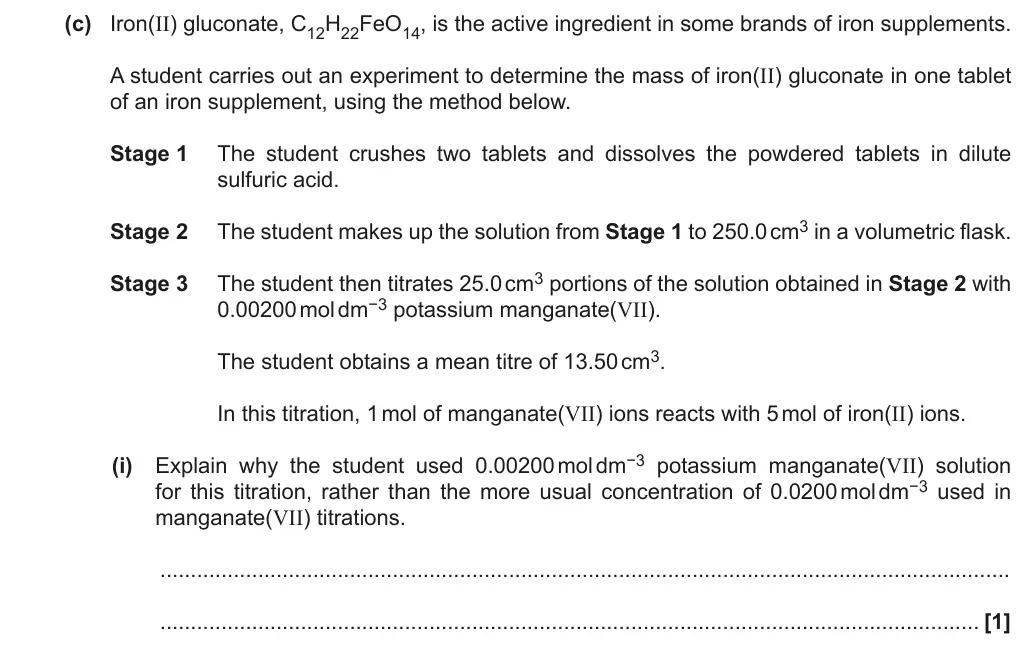
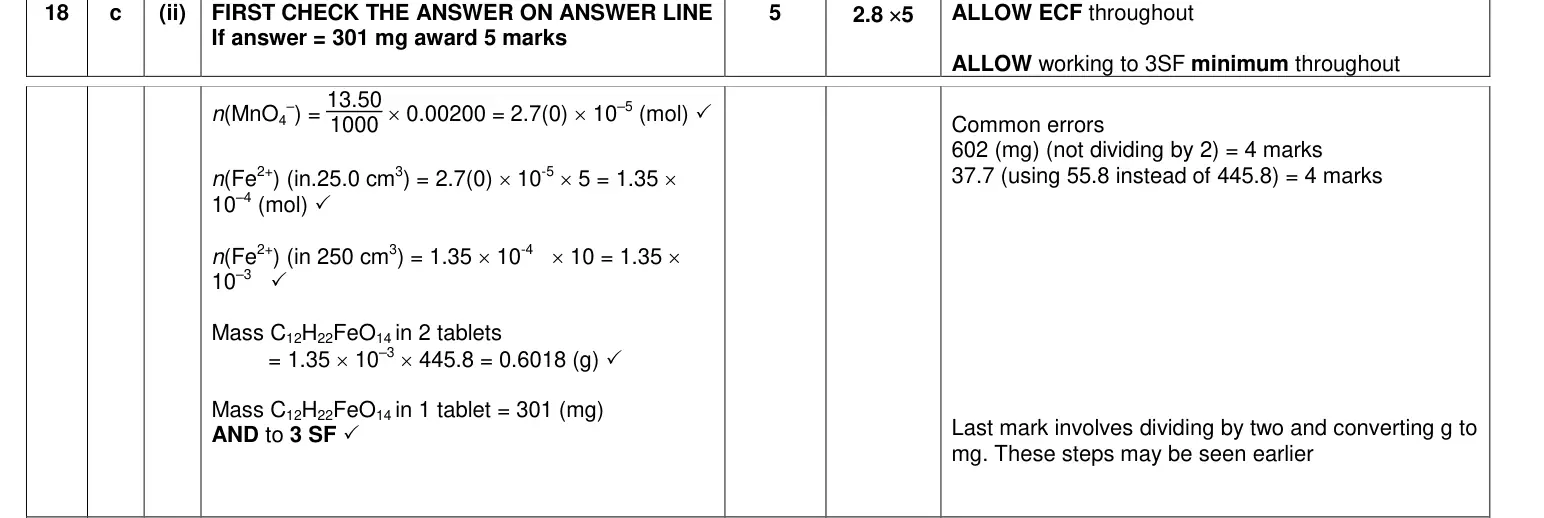
Many candidates coped well with this multi-step calculation. The common errors were: • determining the mass of C12H22FeO14 in two tablets instead of just one tablet as required in the question • determining the mass of Fe in a tablet instead of the mass of C12H22FeO14 • failing to convert from grams to milligrams
Skills: M0.0 Recognise and make use of appropriate units in calculations; M0.2 Use ratios, fractions and percentages; M1.1 Use an appropriate number of significant figures; M2.3 Substitute numerical values into algebraic equations using appropriate units for physical quantities; PAG2 Acid–base titration

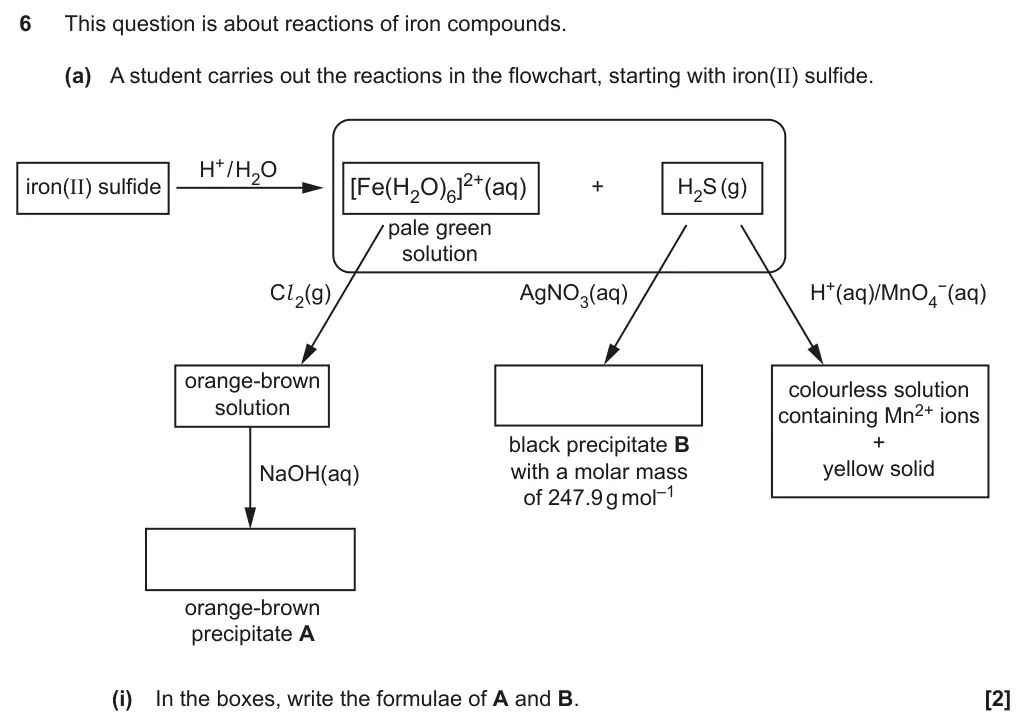
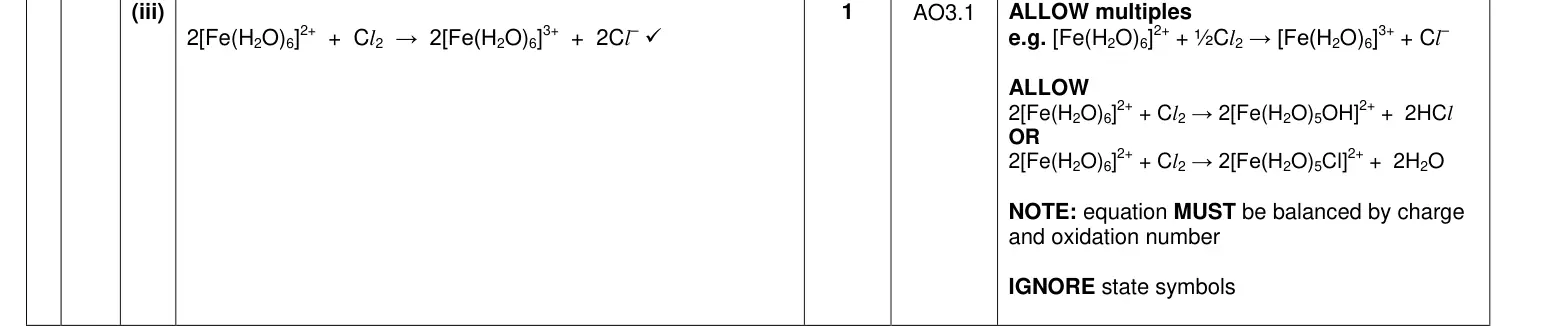
Candidates found this equation extremely difficult with only a small number of candidates writing a correct equation. The problem lies with balancing the oxidation numbers and charges. Many wrote an equation with a 1:1 ratio or 1:2 ratio for [Fe(H2O)6]2+ : Cl2. An equation balanced in oxidation number and charge required a 2:1 ratio. When writing equations for redox reactions, candidates are recommended to check that oxidation changes and charges are balanced as well as atoms.
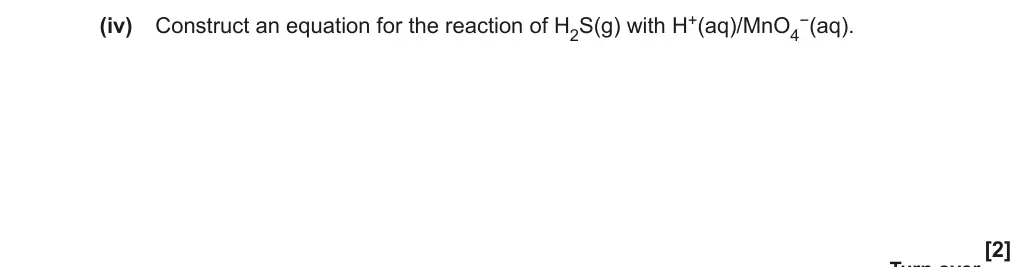
Candidates needed to interpret the information in the flowchart and to use this as the basis for their redox equation. The clue that a yellow solid is a product proved to be very difficult to interpret as being sulfur. The equation then required H2O to be added as the other product. Candidates found this equation difficult and relatively few correct equations were seen. As with 6a(iii), many equations were not balanced by oxidation number or charge. Some candidates omitted this part entirely.
Skills: M0.2 Use ratios, fractions and percentages
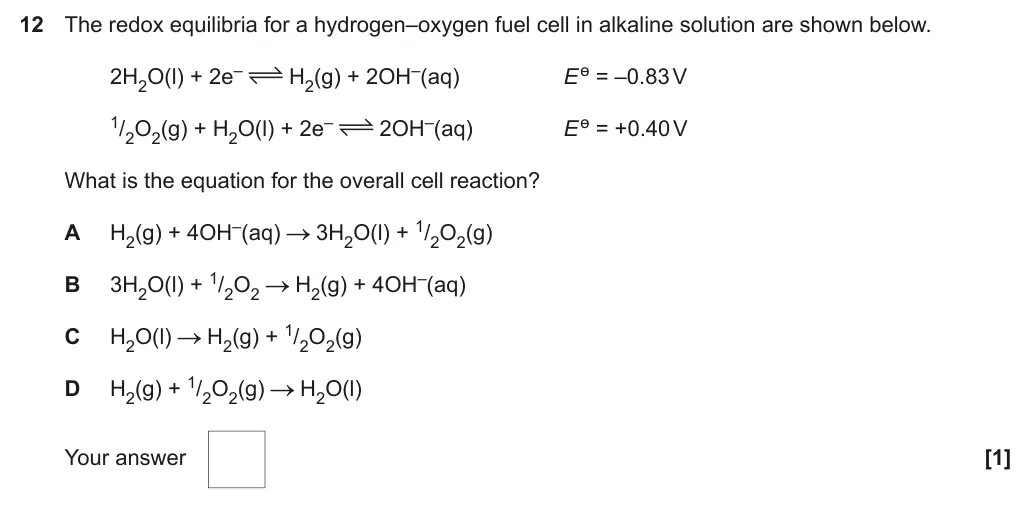
D
Most candidates knew the correct equation.
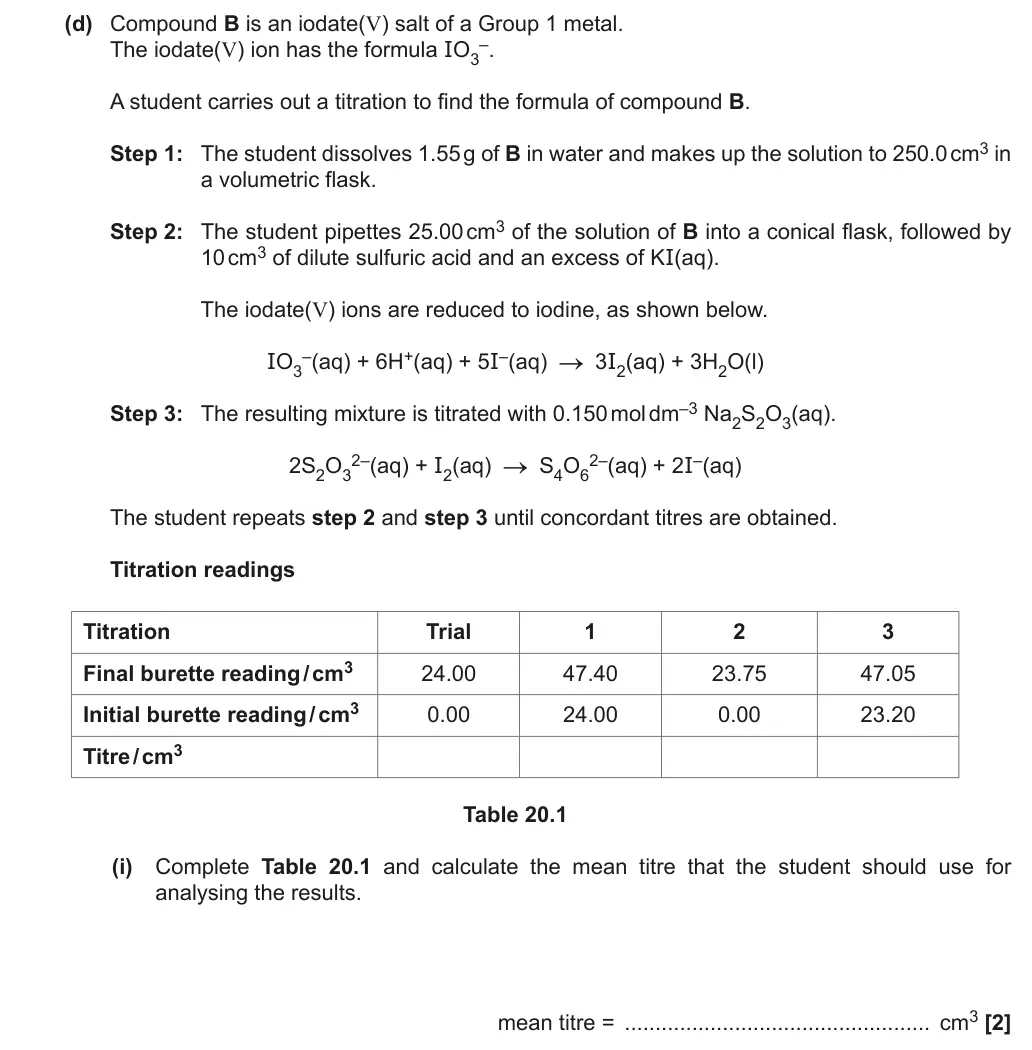
It is clear candidates are not as experienced at filling in titration tables as might be expected. Every value in a titration table should be recorded to a second decimal place to an accuracy of ± 0.05 cm3. The average titre should be calculated by averaging concordant titres, i.e. those within 0.10 cm3 of each other.
Skills: M1.2 Find arithmetic means; PAG2 Acid–base titration
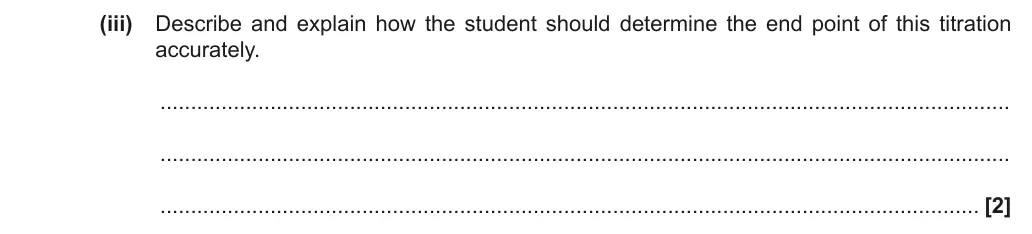
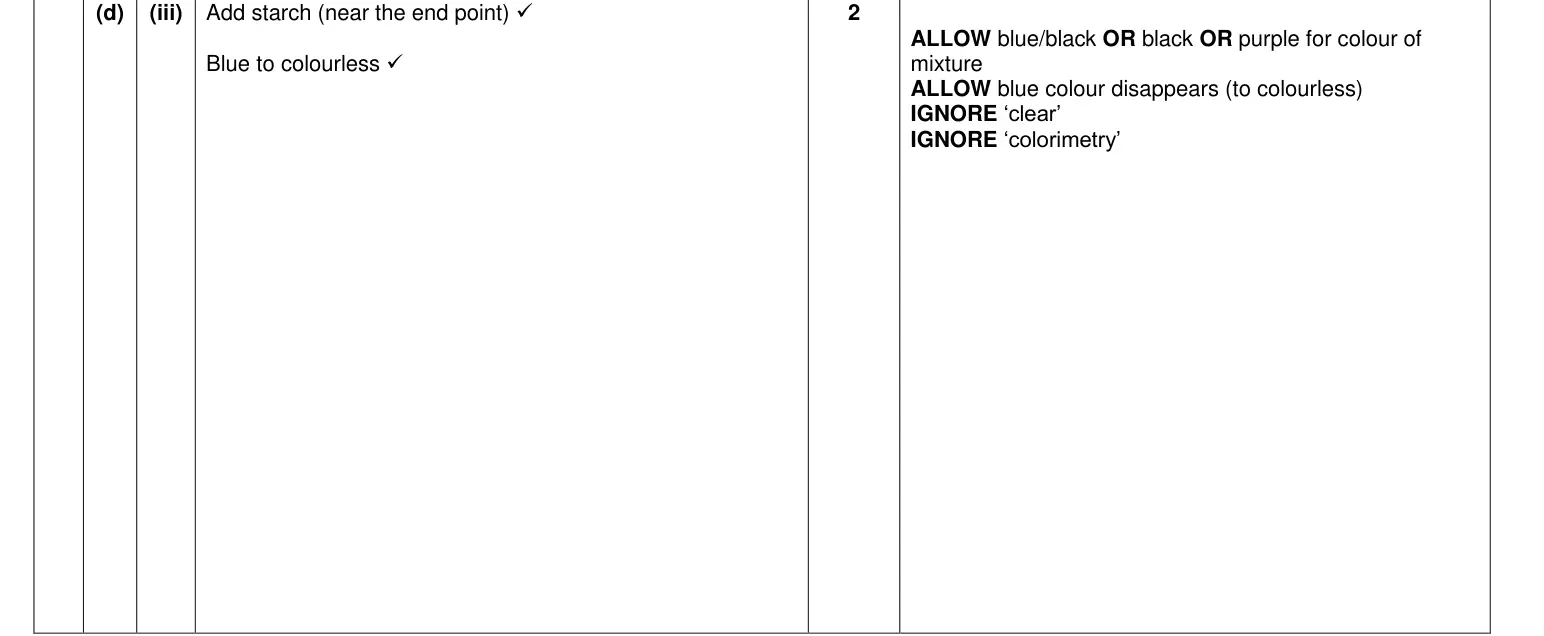
Only the higher ability candidates realised starch needed to be added close to the end-point and this made the resulting colour change (blue-black to colourless) easier to see. The common error was to assume this was an acid-base titration and indicators such as methyl orange or phenolphthalein should be added.
Skills: PAG2 Acid–base titration
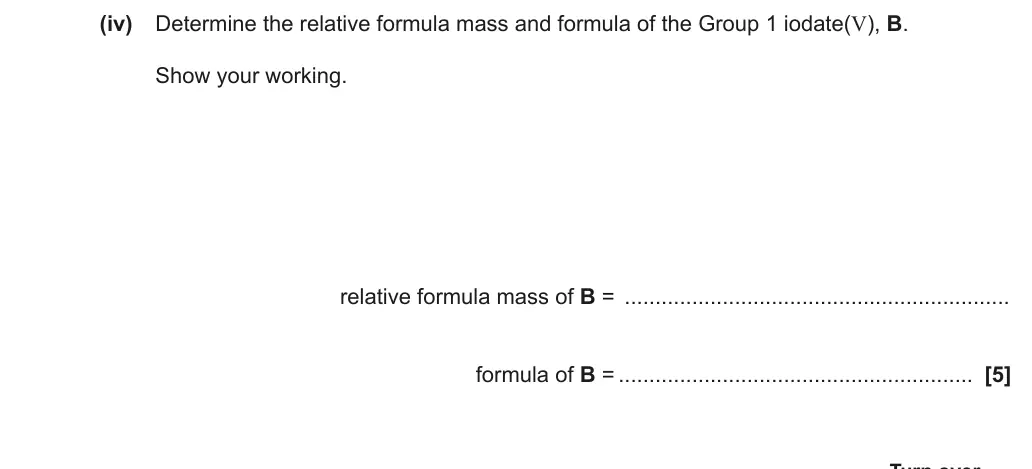
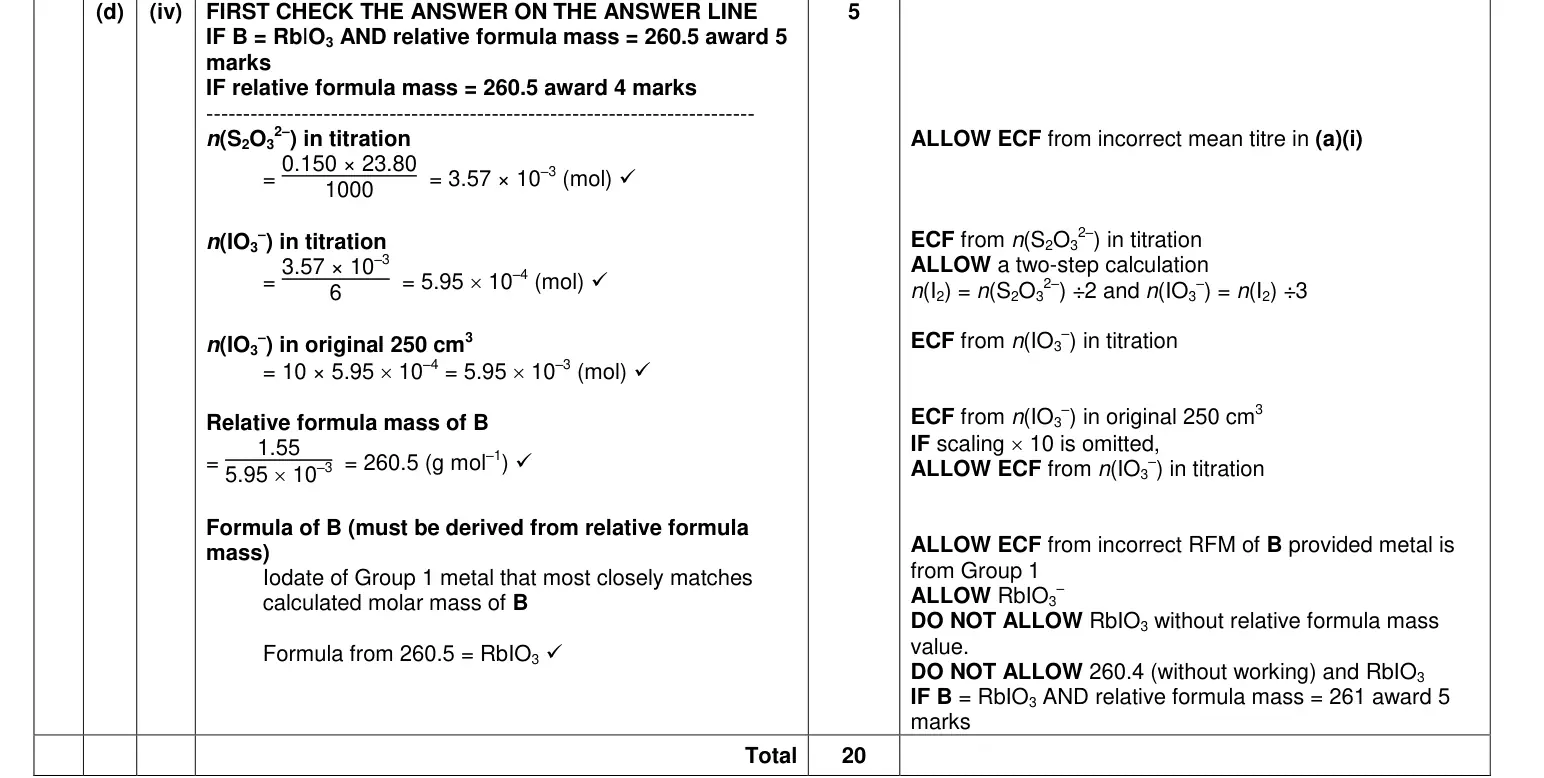
This unstructured calculation was done well by the higher ability candidates. Lower ability candidates struggled to show what they were attempting to calculate and in particular did not appreciate the 1 : 6 ratio of S2O3 2–(aq) to IO3 –(aq). Candidates might be advised to start n(formula) = … at the start of each line of calculation eg n(S2O3 2–) = … mol No credit was given to candidates who grasped the identity of the Group 1 iodate from nowhere and calculated the theoretical relative formula mass.
Skills: M0.2 Use ratios, fractions and percentages; M2.3 Substitute numerical values into algebraic equations using appropriate units for physical quantities; M2.4 Solve algebraic equations
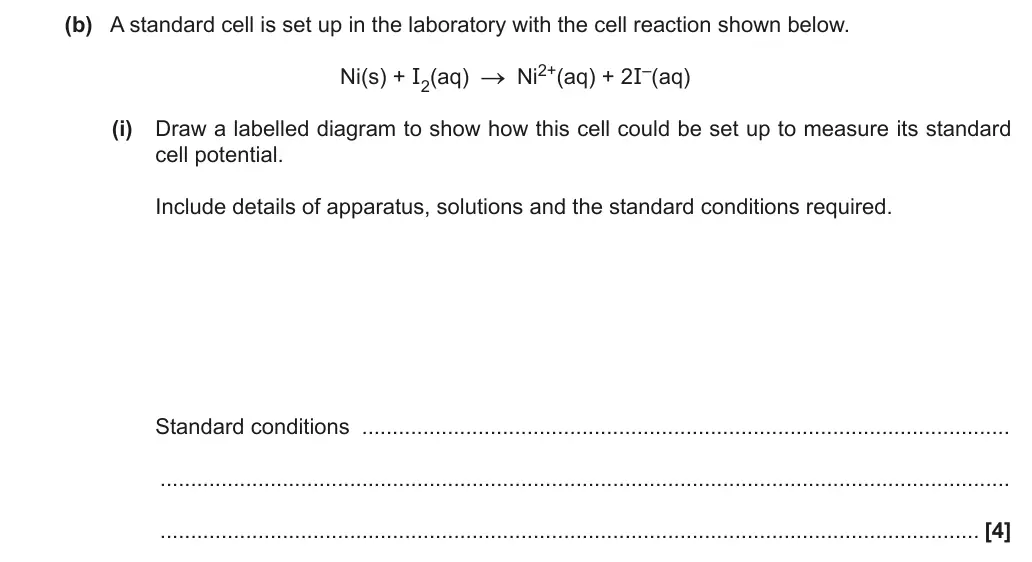
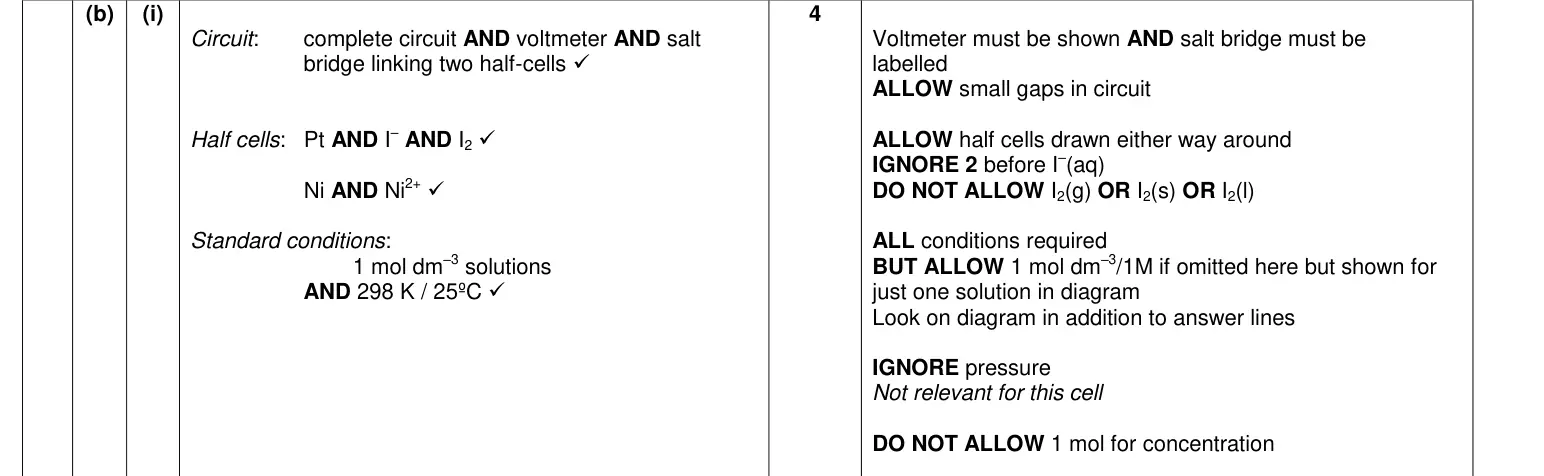
A significant number of candidates did not draw a simple circuit. Most candidates scored the mark for the Ni electrode but fewer scored the mark for the Pt electrode in the I–(aq)/I2(aq) mixture. The last mark, for the conditions (including concentrations of 1.00 mol dm–3), was almost universally scored even by those who omitted the solutions in their diagram. Common errors were: diagrams with electrodes not entering solutions; salt bridges not labelled or not entering solutions; making solid iodine an electrode; and assuming iodine to be a gas and adapting a standard hydrogen electrode to accommodate this.
Skills: PAG8 Electrochemical cells

This was the most successfully answered single mark question on the paper.
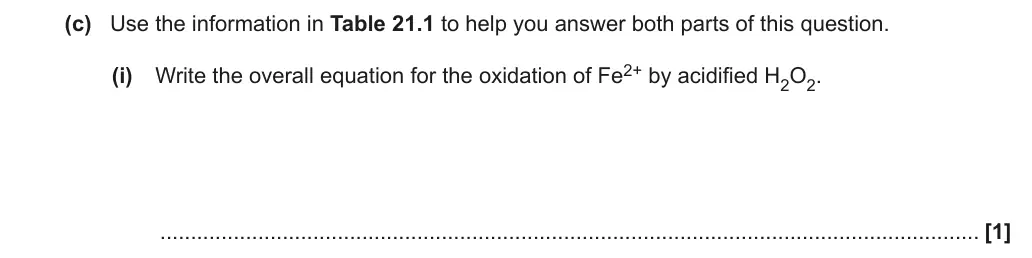
Most candidates got the equation correct. Occasionally a number was omitted causing incorrect stoichiometry and occasionally the equation was reversed.
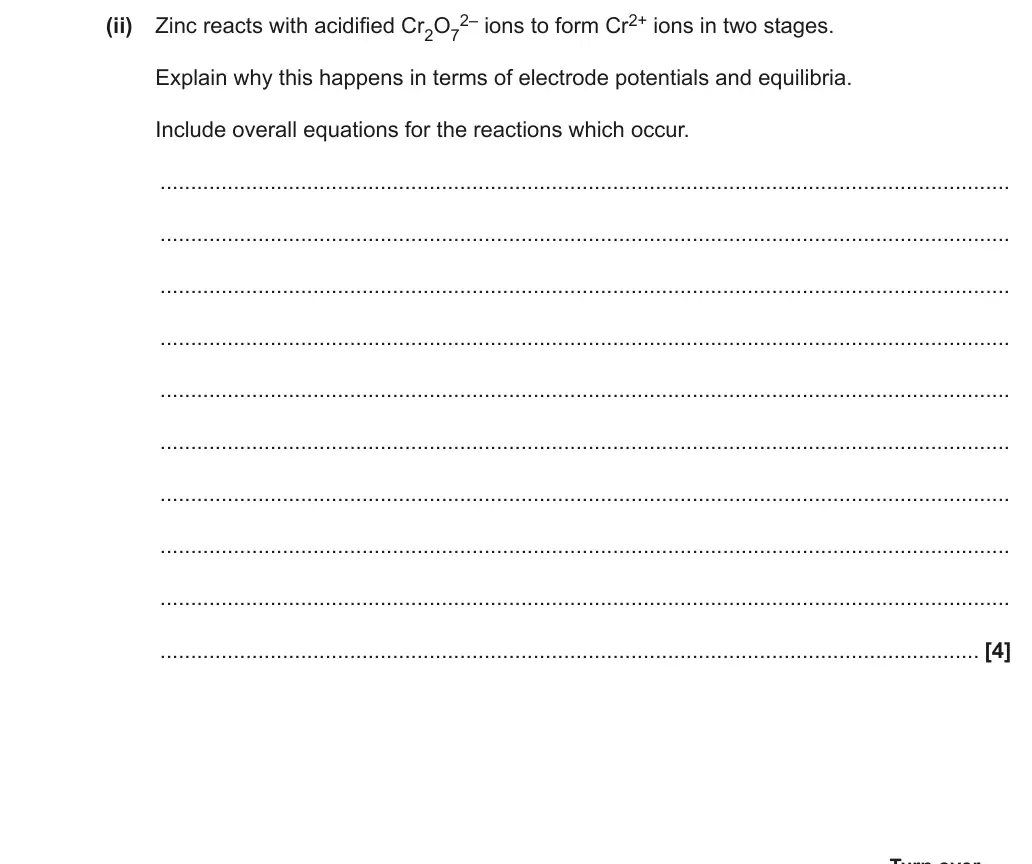
Only the higher ability candidates achieved full marks. Most candidates were able to come up with both redox equations and some could state that zinc was oxidised or chromium was reduced as a result of zinc having a more negative electrode potential than either chromium species. Common errors were: stating that zinc had a lower (not more negative) electrode potential; stating that zinc was an oxidising agent (as well as being oxidised); confusing the direction of change of equilibria shown; and not balancing the overall redox equations.
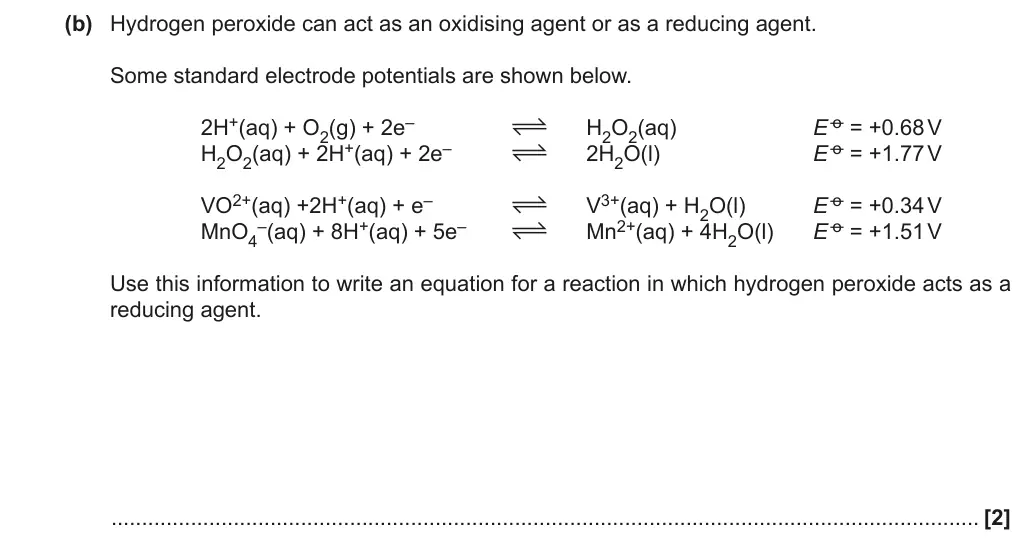
This part discriminated extremely well with many candidates obtaining either both marks or zero marks. Candidates needed to select the correct redox pairs, combine them and cancel H+ and H2O. Many otherwise correct equations did not receive credit as they contained basic balancing errors. As a final step in constructing an equation, candidates are recommended to check the formulae of their species and that the equation is balanced.
Skills: M0.2 Use ratios, fractions and percentages
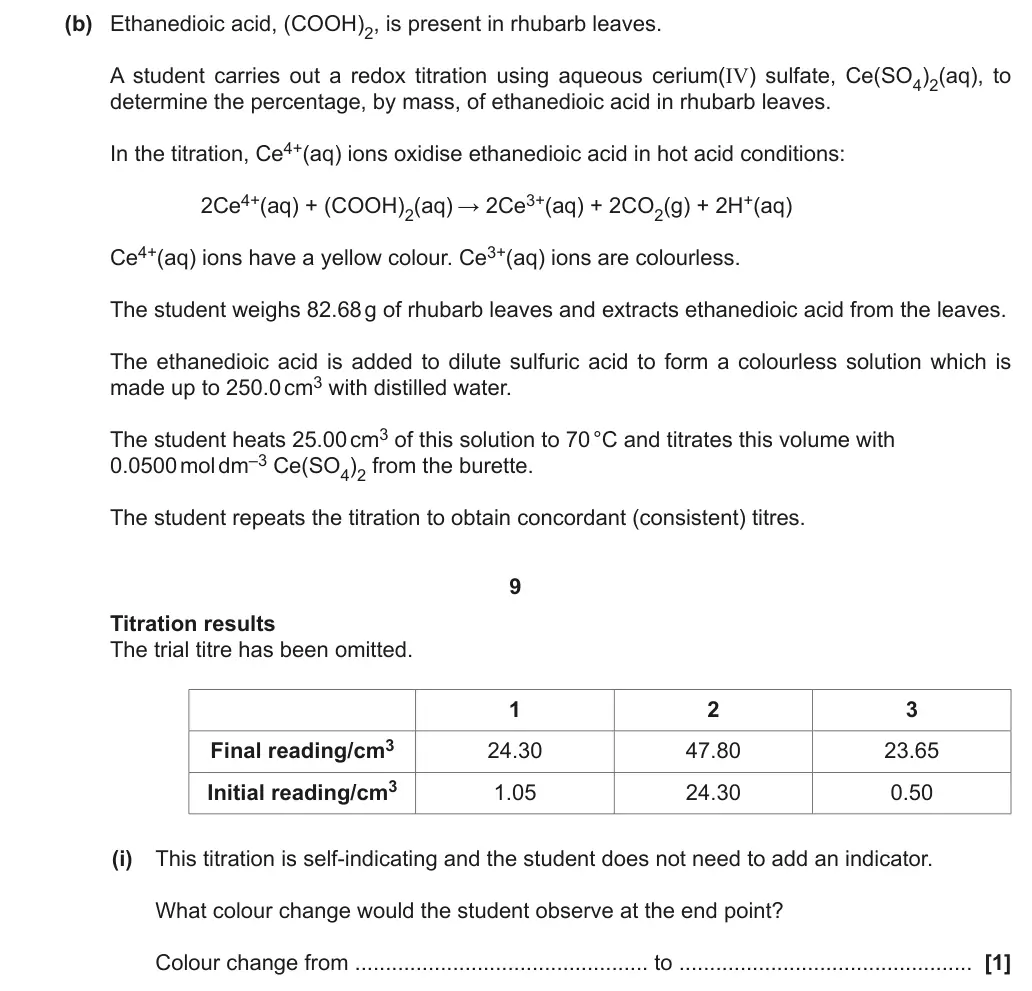
Candidates were expected to apply their knowledge of the colour change in a manganate(VII) titration to this novel situation. Most candidates incorrectly showed the inverse colour change of yellow → colourless.
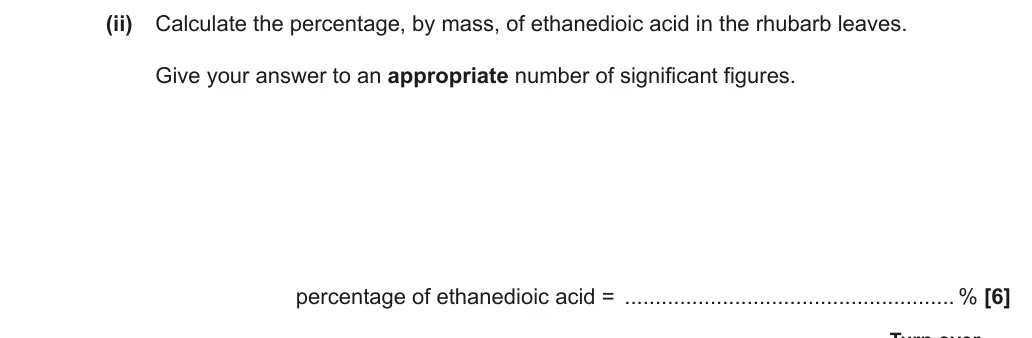
Most candidates answered this unstructured titration calculation well, with almost all responses gaining some credit. Most coped well with the 1:2 reaction stoichiometry and the need to scale up to 250 cm3. Common errors included the following. • Taking the mean of all three titres (23.30 cm3) instead of the closest titres (23.20 cm3). • Not considering the 1:2 stoichiometry. • Not scaling up to 250 cm3. • Giving the final answer to two rather than three significant figures; this was the most common error. The question required the final answer to be given to an appropriate number of significant figures. Many candidates seemed to be unaware that this reflects the least significant figures provided in the data, in this case three significant figures. Candidates are also advised to only round at the end of a multi-step calculation. Rounding of intermediate values introduces rounding errors in the final answer. The example shows a perfect response with each step clearly described, leading to the correct concentration of ethanedioic acid. Candidates should present their calculations clearly. If there is a mistake at any stage, this can be easily identified, allowing for error carried forward to be applied for any subsequent good method.
Skills: M0.2 Use ratios, fractions and percentages; M1.1 Use an appropriate number of significant figures; M1.2 Find arithmetic means; M2.3 Substitute numerical values into algebraic equations using appropriate units for physical quantities
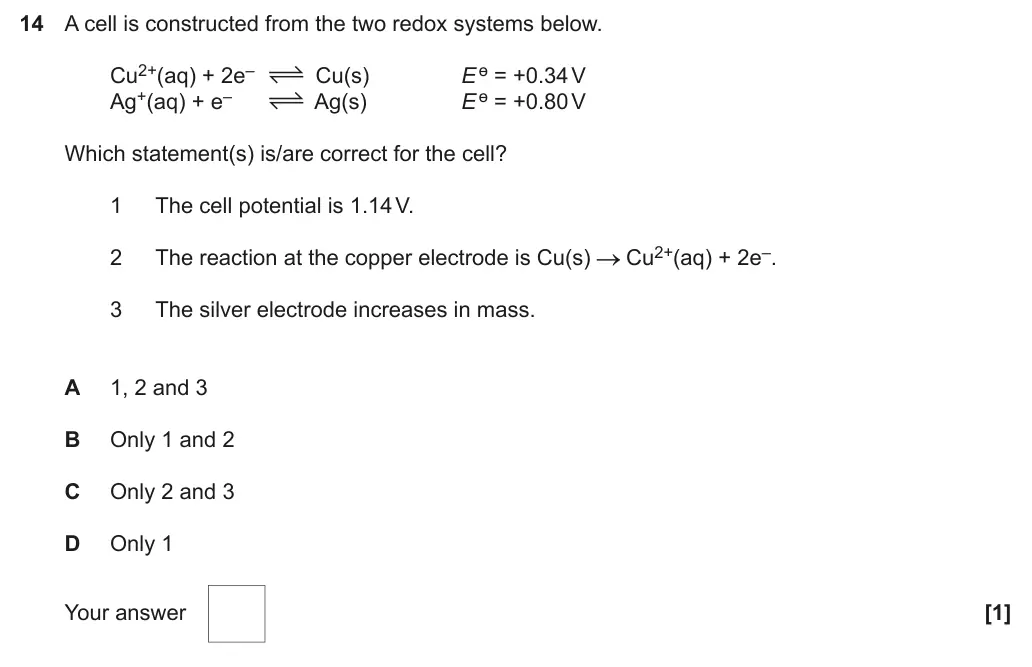
C
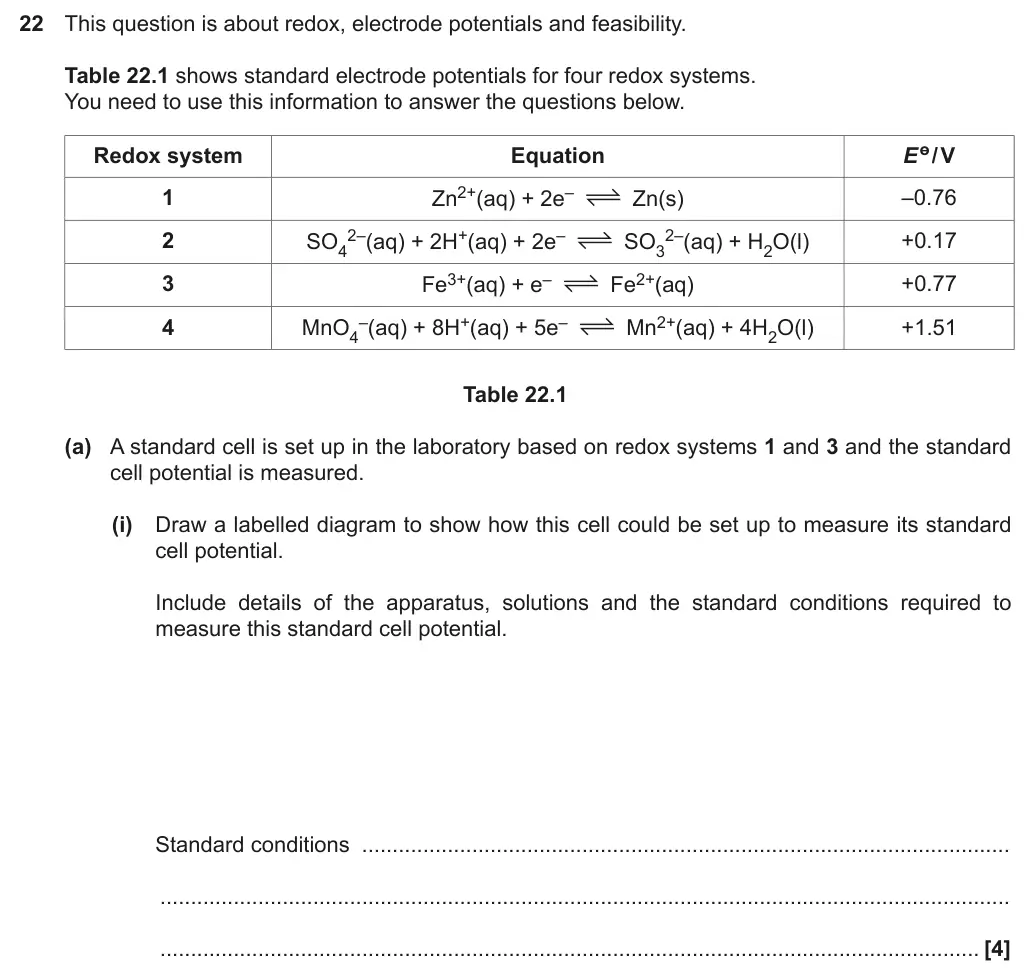
Skills: PAG8 Electrochemical cells


Skills: M0.2 Use ratios, fractions and percentages
Dropping marks on calculations, mechanisms or the six-markers? Book a trial session with a specialist OCR chemistry tutor.