November 2020: AS Paper 2, Depth in chemistry

70 marks · 30 question parts · Paper, mark scheme and report on OCR's site · An autumn series, sat in place of the cancelled summer exams · Have OCR's Data Sheet beside you
Question by question

QTopicMarksAOType
1(a) Redox and oxidation numbers 1AO2Short answer
1(b)(i) Amount of substance (moles) 3AO1, 2Calculation
1(b)(ii) Amount of substance (moles) 1AO2Calculation
1(b)(iii) Amount of substance (moles) 2AO3Short answer
1(c) Qualitative analysis: tests for ions, Formulae and equations, Acids, bases and titrations, The halogens 6AO1, 2, 3Level of response
2(a) Enthalpy changes and Hess’ law 2AO1Short answer
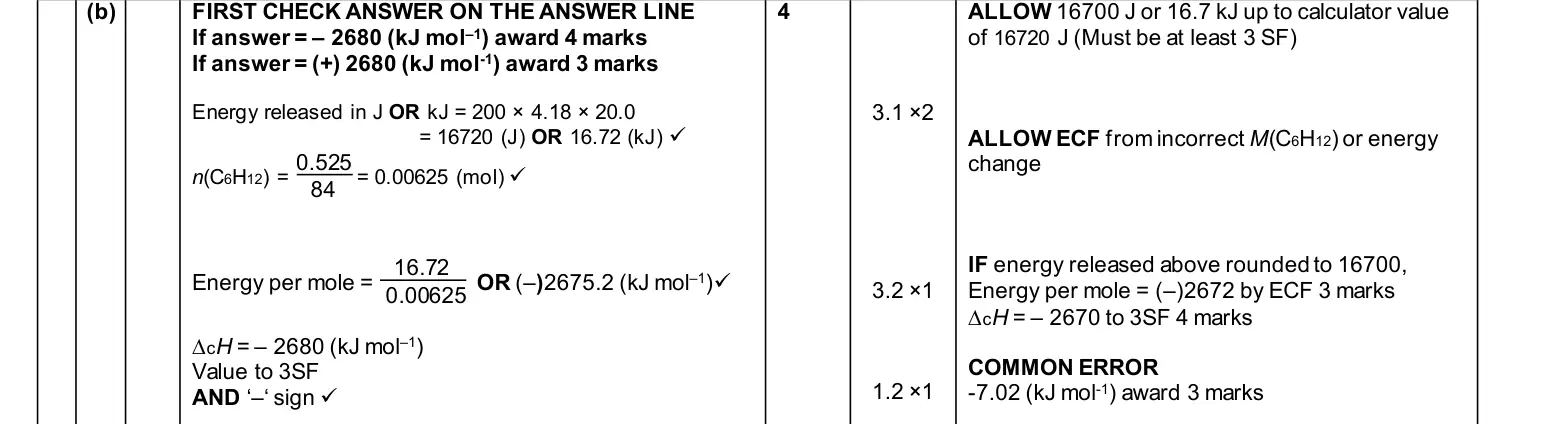
2(b) Enthalpy changes and Hess’ law, Amount of substance (moles) 4AO1, 3Calculation
2(c)(i) Practical skills: planning, analysis and evaluation 2AO2Short answer
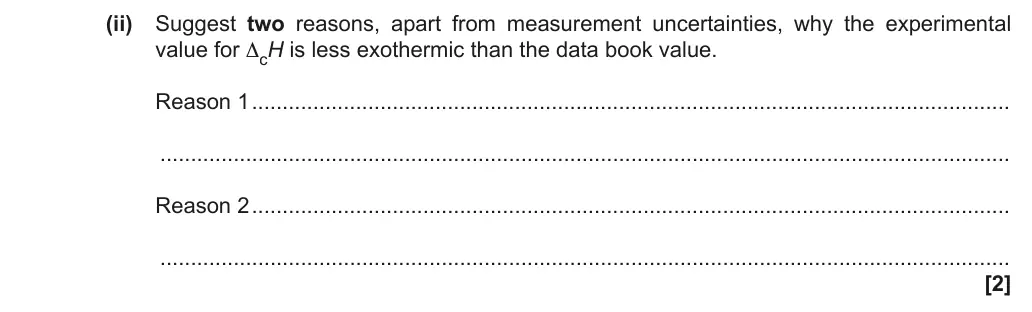
2(c)(ii) Practical skills: planning, analysis and evaluation, Enthalpy changes and Hess’ law 2AO3Short answer
2(c)(iii) Practical skills: planning, analysis and evaluation 2AO3Short answer
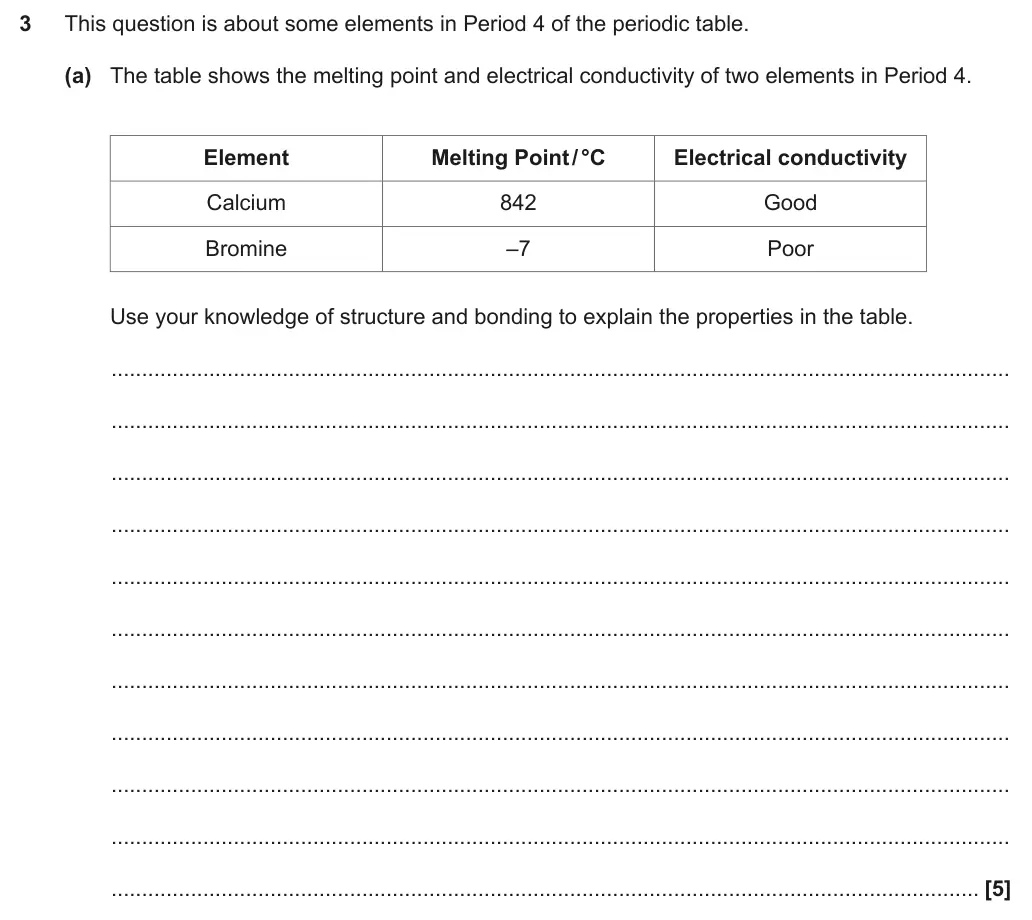
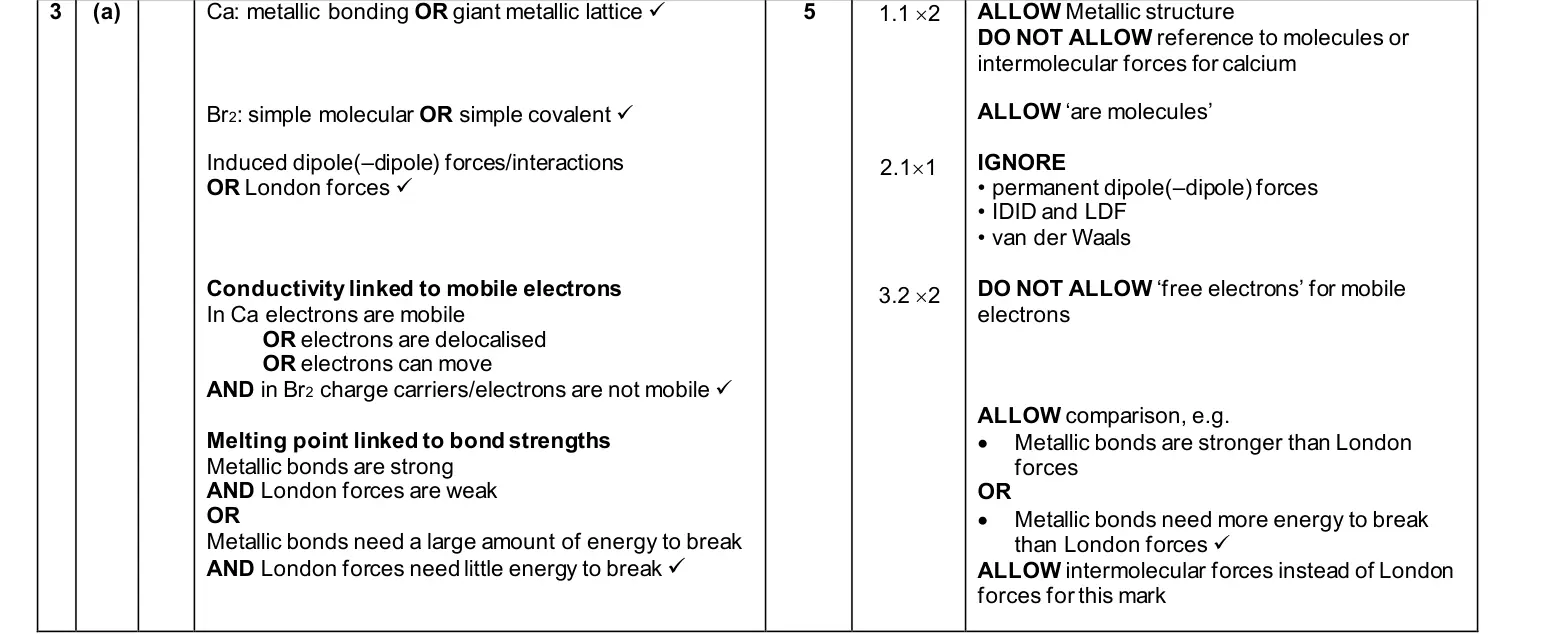
3(a) Periodicity and ionisation energy, Bonding, structure and shapes of molecules 5AO1, 2, 3Extended response
3(b)(i) Bonding, structure and shapes of molecules 2AO1, 2Drawing / labelling
3(b)(ii) Group 2, Periodicity and ionisation energy 3AO1, 2Short answer
3(c)(i) Formulae and equations 1AO2Equation writing
3(c)(ii) Bonding, structure and shapes of molecules 3AO1, 2Short answer
3(d)(i) Redox and oxidation numbers 1AO2Equation writing
3(d)(ii) The halogens, Redox and oxidation numbers 3AO1, 2Data interpretation
4(a) Bonding, structure and shapes of molecules 3AO1, 2Short answer
4(b)(i) Chemical equilibrium and Kc 1AO1Short answer
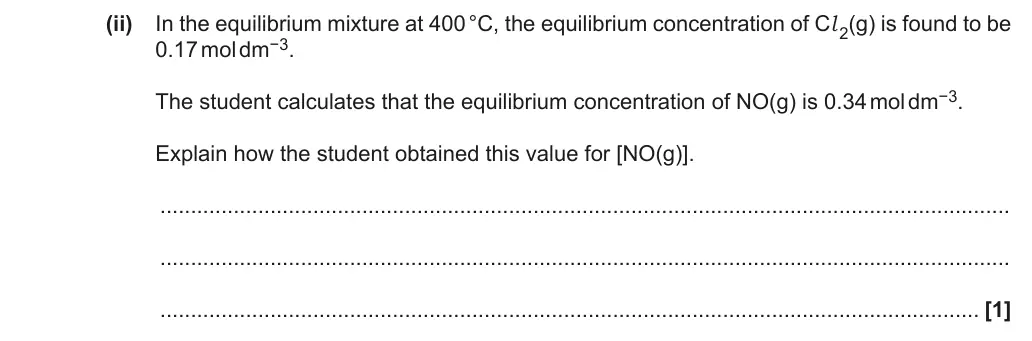
4(b)(ii) Amount of substance (moles) 1AO3Short answer
4(b)(iii) Chemical equilibrium and Kc 2AO2Calculation
4(b)(iv) Chemical equilibrium and Kc 2AO2Short answer
5(a) Alcohols 2AO1, 2Short answer
5(b) Alcohols, Formulae and equations 1AO2Equation writing
5(c) Organic basics: naming, formulae and isomerism 1AO1Short answer
5(d)(i) Amount of substance (moles) 2AO1, 2Calculation
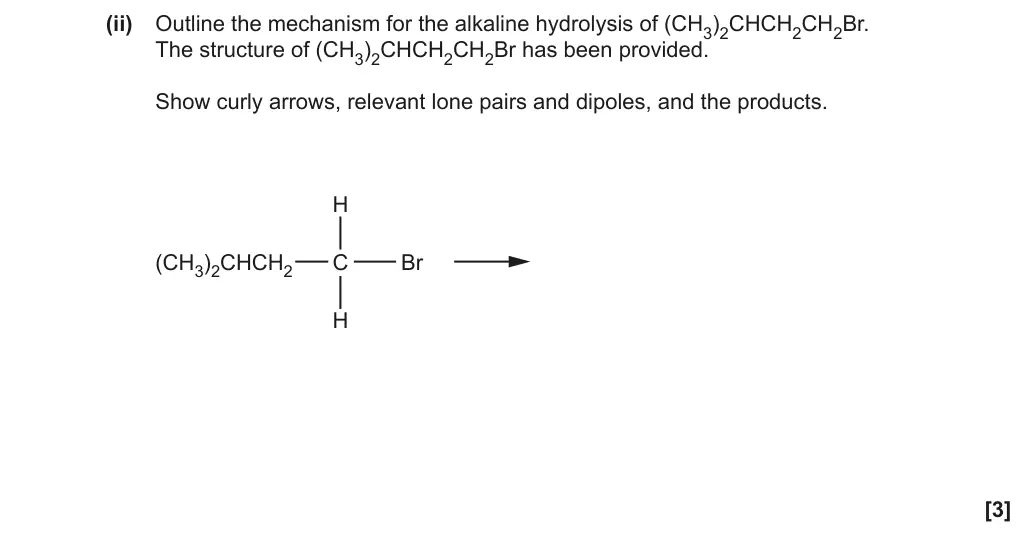
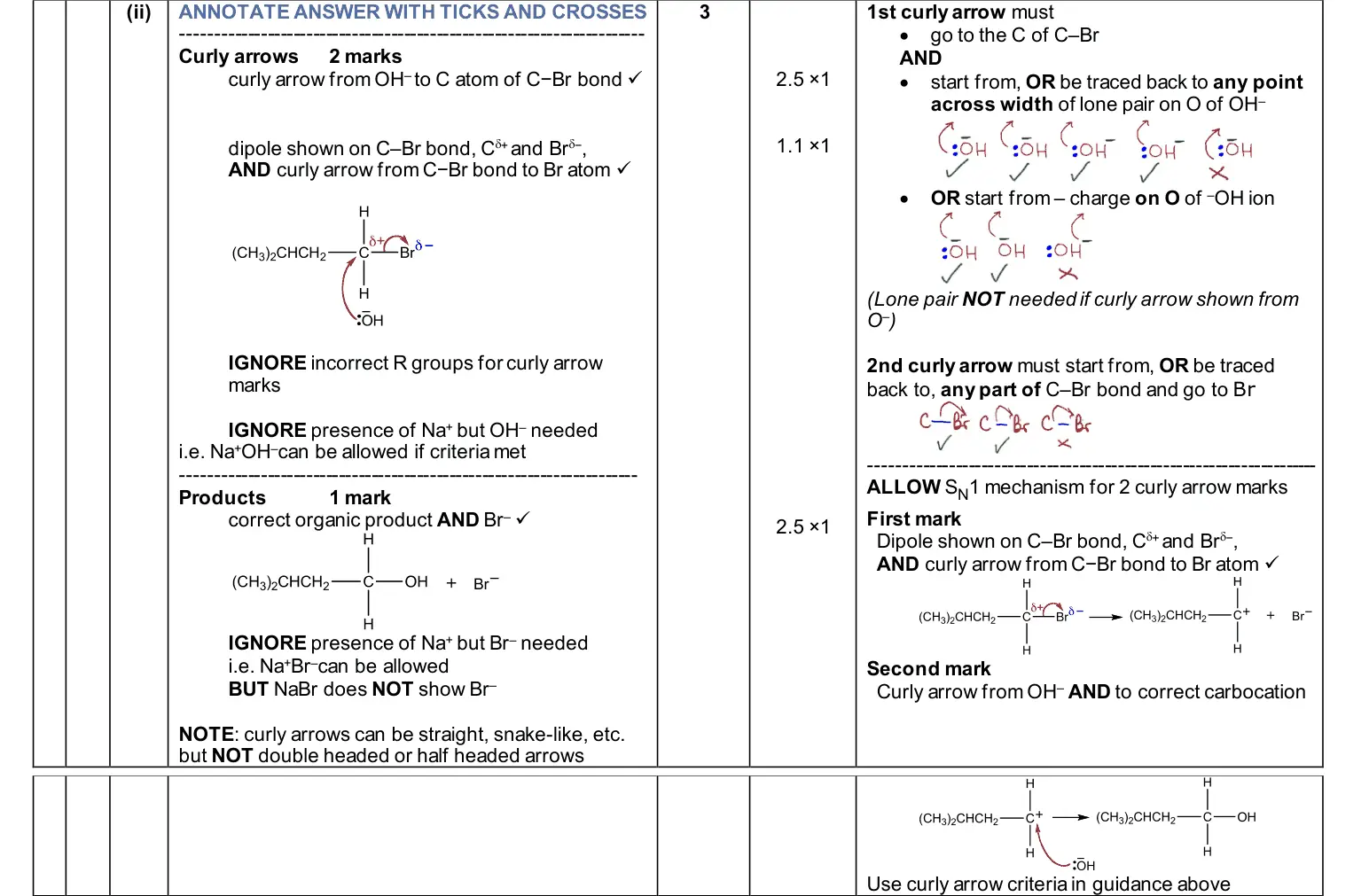
5(d)(ii) Haloalkanes, Organic basics: naming, formulae and isomerism 3AO1, 2Mechanism
5(d)(iii) Haloalkanes 1AO1Short answer
5(e) Haloalkanes 2AO2, 3Short answer
5(f) Infrared spectroscopy and mass spectrometry, Alcohols 6AO2, 3Level of response

The questions

1(a)1(b)(i)1(b)(ii)1(b)(iii)1(c)2(a)2(b)2(c)(i)2(c)(ii)2(c)(iii)3(a)3(b)(i)3(b)(ii)3(c)(i)3(c)(ii)3(d)(i)3(d)(ii)4(a)4(b)(i)4(b)(ii)4(b)(iii)4(b)(iv)5(a)5(b)5(c)5(d)(i)5(d)(ii)5(d)(iii)5(e)5(f)
November 2020 · AS Paper 2 · Q1(a) 1 mark AO2 Short answer Medium redox
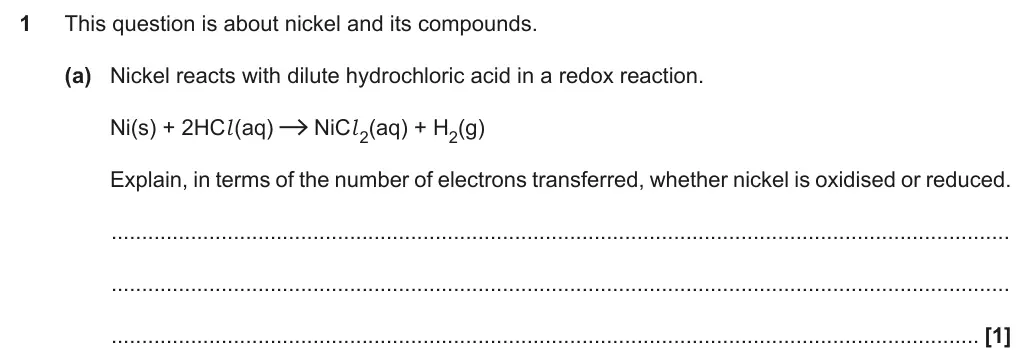
1 This question is about nickel and its compounds.
(a) Nickel reacts with dilute hydrochloric acid in a redox reaction.
Ni(s) + 2HCl (aq) NiCl 2(aq) + H2(g)
Explain, in terms of the number of electrons transferred, whether nickel is oxidised or reduced.
...................................................................................................................................................
...................................................................................................................................................
.............................................................................................................................................. [1]
November 2020 · AS Paper 2 · Q1(b)(i) 3 marks AO1, 2 Calculation Medium amount of substance
Earlier part of question 1 that this part usesEarlier part of November 2020 Paper 2 question 1
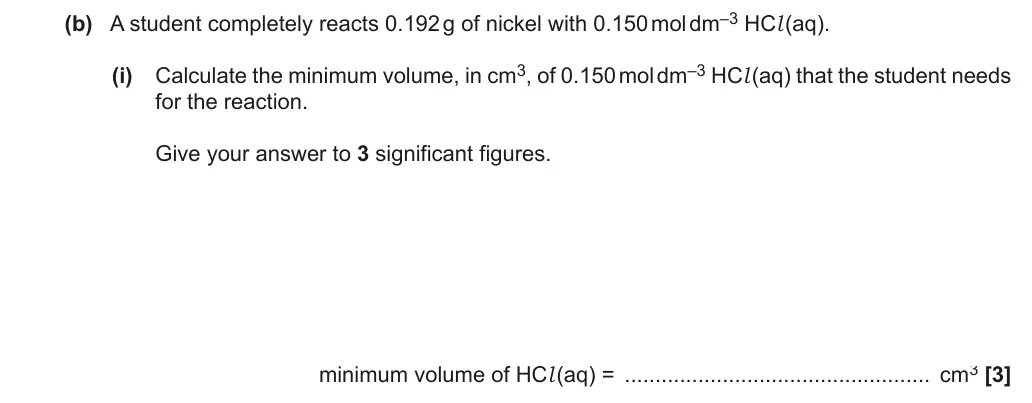
(b) A student completely reacts 0.192 g of nickel with 0.150 mol dm–3 HCl (aq).
(i) Calculate the minimum volume, in cm3, of 0.150 mol dm–3 HCl (aq) that the student needs
for the reaction.
Give your answer to 3 significant figures.
minimum volume of HCl (aq) =  .................................................. cm3 [3]
November 2020 · AS Paper 2 · Q1(b)(ii) 1 mark AO2 Calculation Medium amount of substance
Earlier parts of question 1 that this part usesEarlier part of November 2020 Paper 2 question 1Earlier part of November 2020 Paper 2 question 1
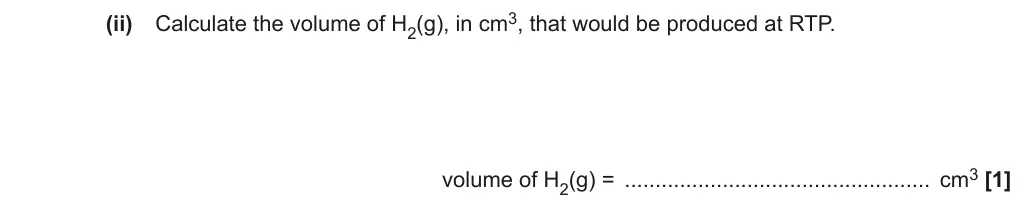
(ii) Calculate the volume of H2(g), in cm3, that would be produced at RTP.
volume of H2(g) =  .................................................. cm3 [1]
November 2020 · AS Paper 2 · Q1(b)(iii) 2 marks AO3 Short answer Medium amount of substance
Earlier parts of question 1 that this part usesEarlier part of November 2020 Paper 2 question 1Earlier part of November 2020 Paper 2 question 1Earlier part of November 2020 Paper 2 question 1
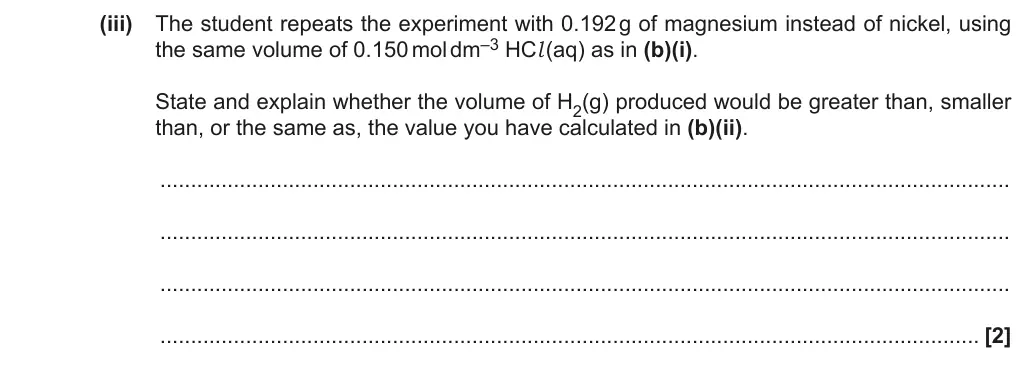
(iii) The student repeats the experiment with 0.192 g of magnesium instead of nickel, using
the same volume of 0.150 mol dm–3 HCl (aq) as in (b)(i).
State and explain whether the volume of H2(g) produced would be greater than, smaller
than, or the same as, the value you have calculated in (b)(ii).
...........................................................................................................................................
...........................................................................................................................................
...........................................................................................................................................
...................................................................................................................................... [2]
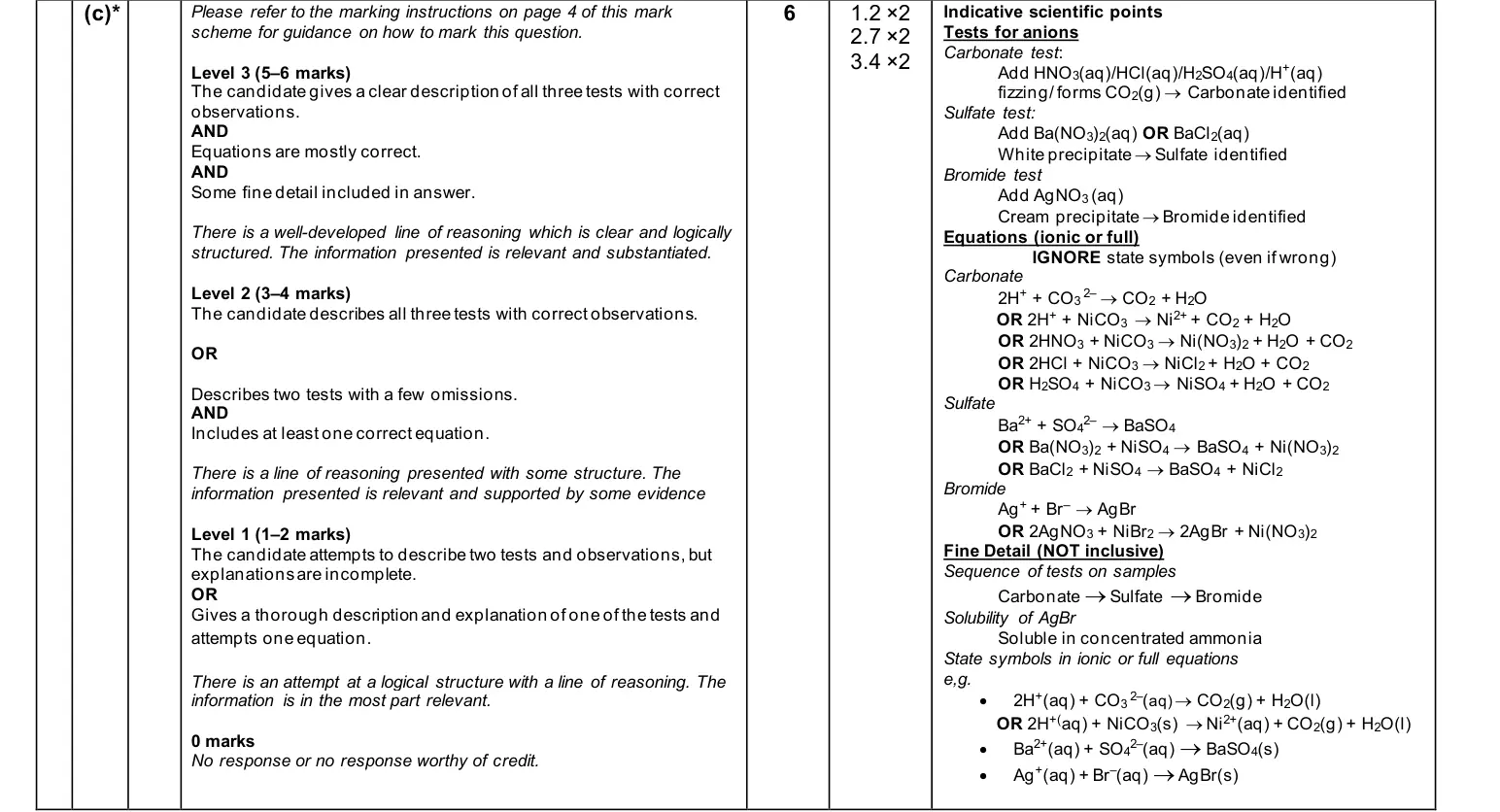
November 2020 · AS Paper 2 · Q1(c) 6 marks AO1, 2, 3 6-mark level of response Medium qualitative analysisformulae and equationsacids and titrationshalogens
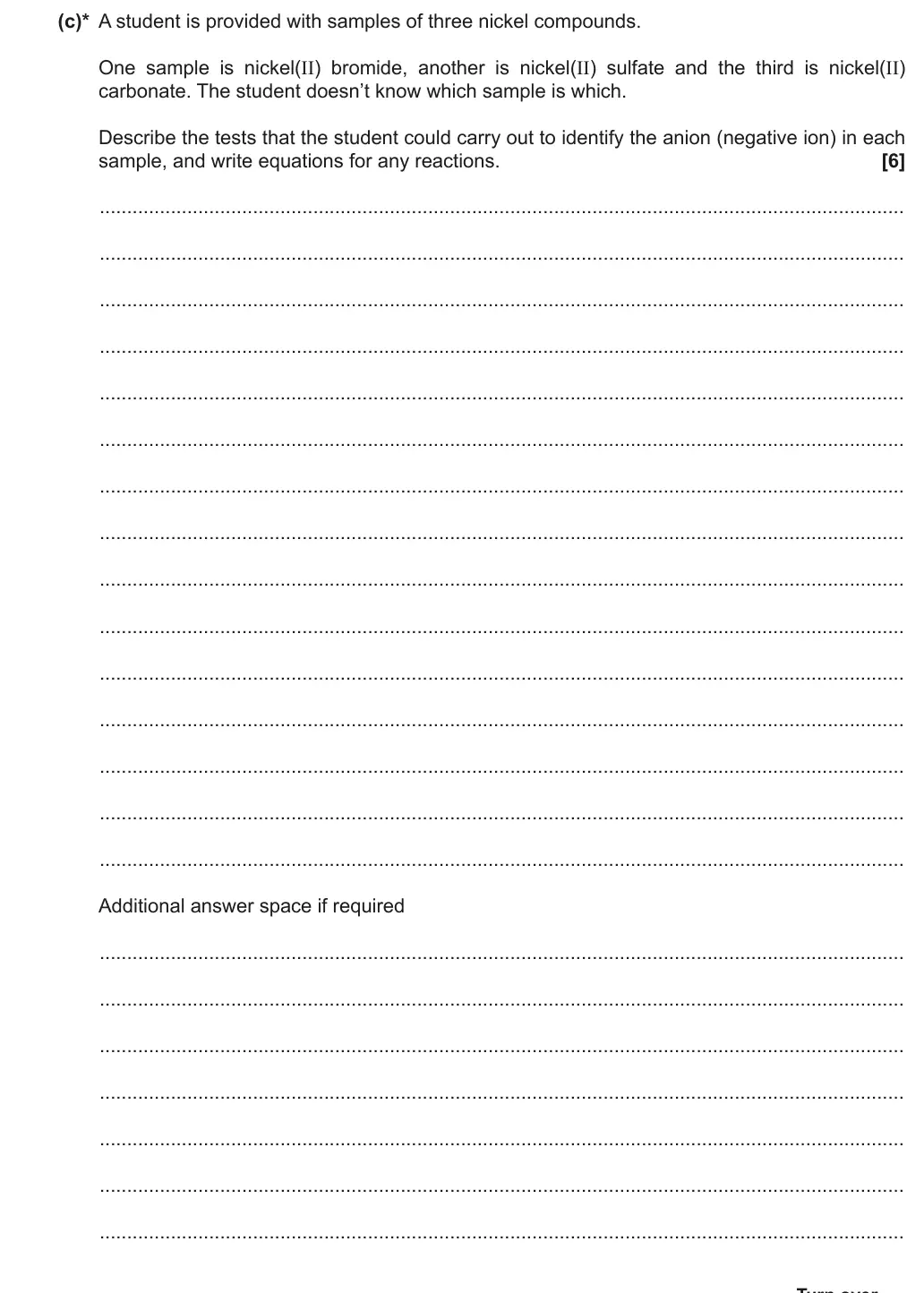
(c)* A student is provided with samples of three nickel compounds.
One sample is nickel(II) bromide, another is nickel(II) sulfate and the third is nickel(II)
carbonate. The student doesn’t know which sample is which.
Describe the tests that the student could carry out to identify the anion (negative ion) in each
sample, and write equations for any reactions. [6]
...................................................................................................................................................
...................................................................................................................................................
...................................................................................................................................................
...................................................................................................................................................
...................................................................................................................................................
...................................................................................................................................................
...................................................................................................................................................
...................................................................................................................................................
...................................................................................................................................................
...................................................................................................................................................
...................................................................................................................................................
...................................................................................................................................................
...................................................................................................................................................
...................................................................................................................................................
...................................................................................................................................................
Additional answer space if required
...................................................................................................................................................
...................................................................................................................................................
...................................................................................................................................................
...................................................................................................................................................
...................................................................................................................................................
...................................................................................................................................................
...................................................................................................................................................
November 2020 · AS Paper 2 · Q2(a) 2 marks AO1 Short answer Medium enthalpy changes
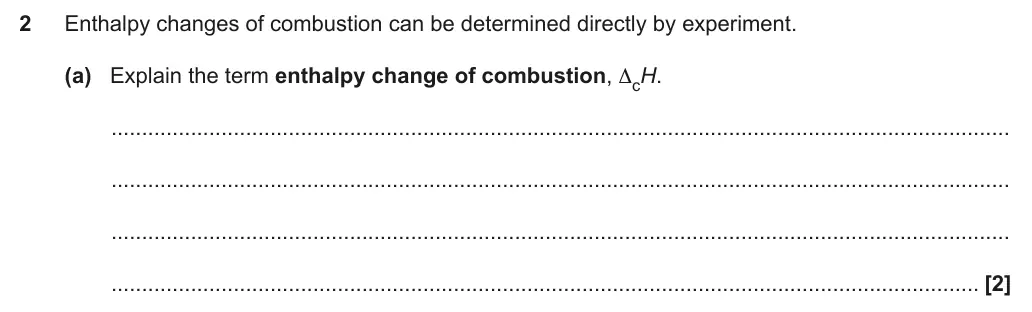
2 Enthalpy changes of combustion can be determined directly by experiment.
(a) Explain the term enthalpy change of combustion, ΔcH.
...................................................................................................................................................
...................................................................................................................................................
...................................................................................................................................................
.............................................................................................................................................. [2]
November 2020 · AS Paper 2 · Q2(b) 4 marks AO1, 3 Calculation Medium enthalpy changesamount of substance
Earlier part of question 2 that this part usesEarlier part of November 2020 Paper 2 question 2
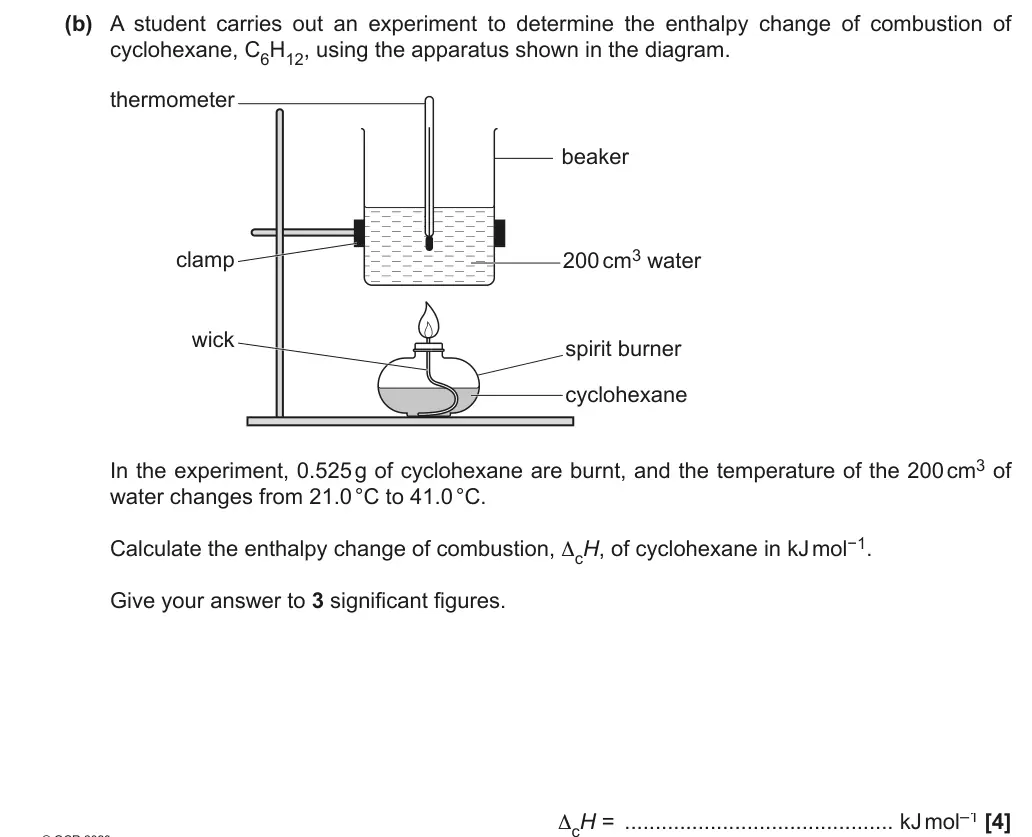
(b) A student carries out an experiment to determine the enthalpy change of combustion of
cyclohexane, C6H12, using the apparatus shown in the diagram.
thermometer
beaker
clamp 200 cm3 water
wick
spirit burner
cyclohexane
In the experiment, 0.525 g of cyclohexane are burnt, and the temperature of the 200 cm3 of
water changes from 21.0 °C to 41.0 °C.
Calculate the enthalpy change of combustion, ΔcH, of cyclohexane in kJ mol−1.
Give your answer to 3 significant figures.
ΔcH =  ............................................ kJ mol–1 [4]
November 2020 · AS Paper 2 · Q2(c)(i) 2 marks AO2 Short answer Medium practical skills
Earlier part of question 2 that this part usesEarlier part of November 2020 Paper 2 question 2
(c) The student finds that their experimental value for ΔcH is less exothermic than the value in a
data book.
The student evaluates the experimental results.
(i) The uncertainty in each thermometer reading is ±0.5 °C and the uncertainty in the
measured volume of water is ±2 cm3.
Determine whether the temperature change or the measured volume of water has the
greater percentage uncertainty.
[2]
November 2020 · AS Paper 2 · Q2(c)(ii) 2 marks AO3 Short answer Medium practical skillsenthalpy changes
Earlier part of question 2 that this part usesEarlier part of November 2020 Paper 2 question 2
(ii) Suggest two reasons, apart from measurement uncertainties, why the experimental
value for ΔcH is less exothermic than the data book value.
Reason 1 ............................................................................................................................
...........................................................................................................................................
Reason 2 ............................................................................................................................
...........................................................................................................................................
[2]
November 2020 · AS Paper 2 · Q2(c)(iii) 2 marks AO3 Short answer Medium practical skills
Earlier parts of question 2 that this part usesEarlier part of November 2020 Paper 2 question 2Earlier part of November 2020 Paper 2 question 2
(iii) In the experiment the water in the beaker was heated for 5 minutes. The student thought
that the experiment could be improved by heating the water for 10 minutes.
Explain whether the accuracy in the student’s calculated value for ΔcH may or may not
be improved by heating for longer.
...........................................................................................................................................
...........................................................................................................................................
...........................................................................................................................................
...........................................................................................................................................
...................................................................................................................................... [2]
November 2020 · AS Paper 2 · Q3(a) 5 marks AO1, 2, 3 Extended response Medium periodicitybonding and structure
3 This question is about some elements in Period 4 of the periodic table.
(a) The table shows the melting point and electrical conductivity of two elements in Period 4.
Element Melting Point / °C Electrical conductivity
Calcium 842 Good
Bromine –7 Poor
Use your knowledge of structure and bonding to explain the properties in the table.
...................................................................................................................................................
...................................................................................................................................................
...................................................................................................................................................
...................................................................................................................................................
...................................................................................................................................................
...................................................................................................................................................
...................................................................................................................................................
...................................................................................................................................................
...................................................................................................................................................
...................................................................................................................................................
.............................................................................................................................................. [5]
November 2020 · AS Paper 2 · Q3(b)(i) 2 marks AO1, 2 Drawing / labelling Medium bonding and structure
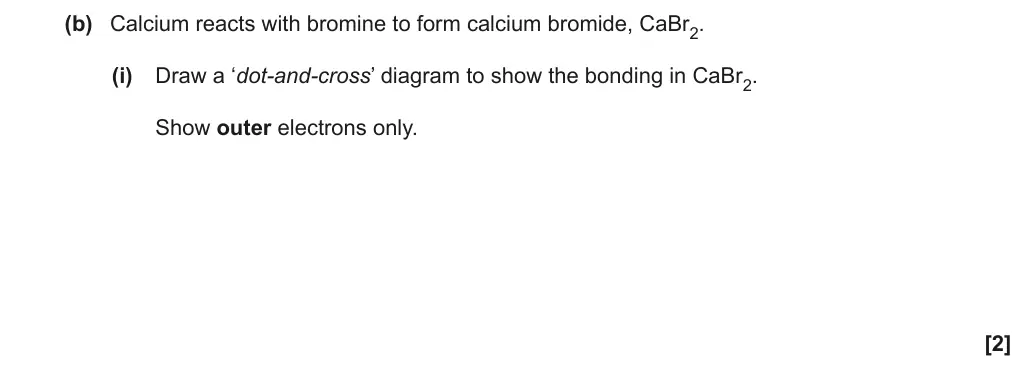
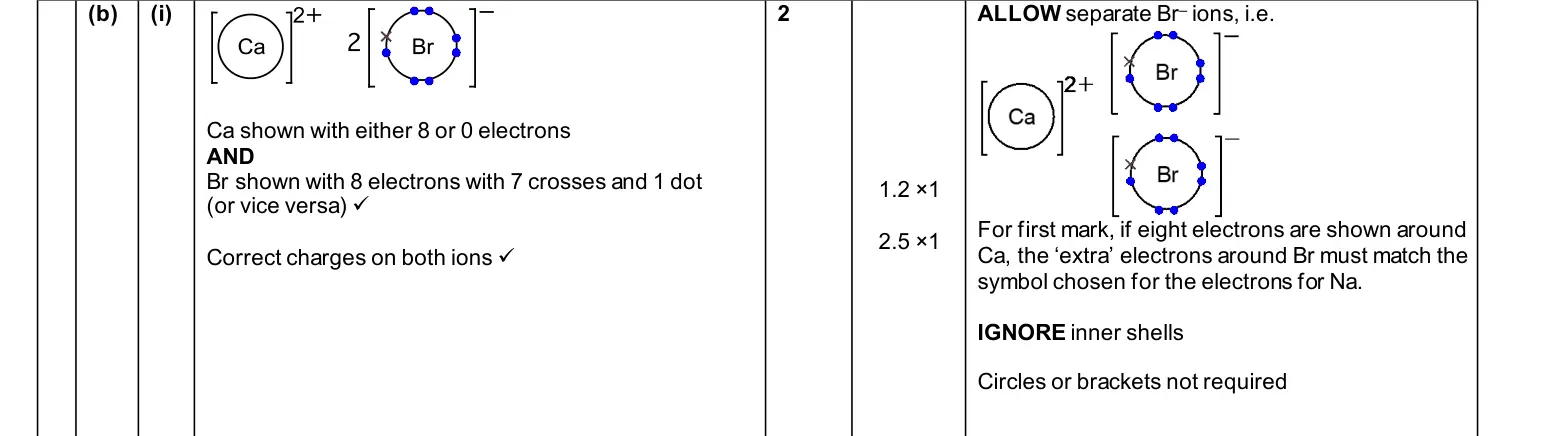
(b) Calcium reacts with bromine to form calcium bromide, CaBr2.
(i) Draw a ‘dot-and-cross’ diagram to show the bonding in CaBr2.
Show outer electrons only.
[2]
November 2020 · AS Paper 2 · Q3(b)(ii) 3 marks AO1, 2 Short answer Medium group 2periodicity
Earlier part of question 3 that this part usesEarlier part of November 2020 Paper 2 question 3
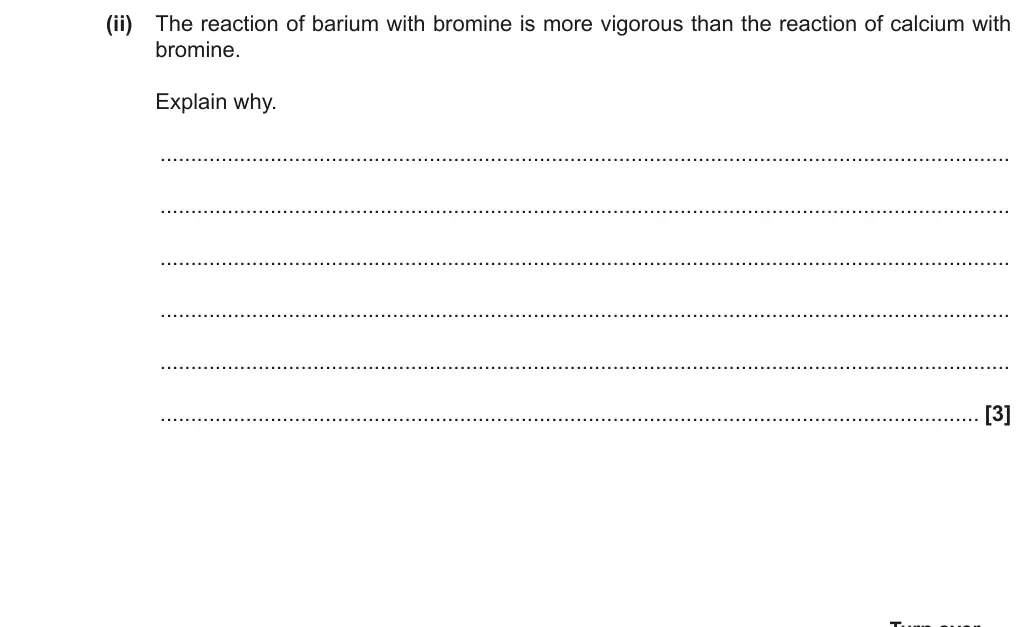
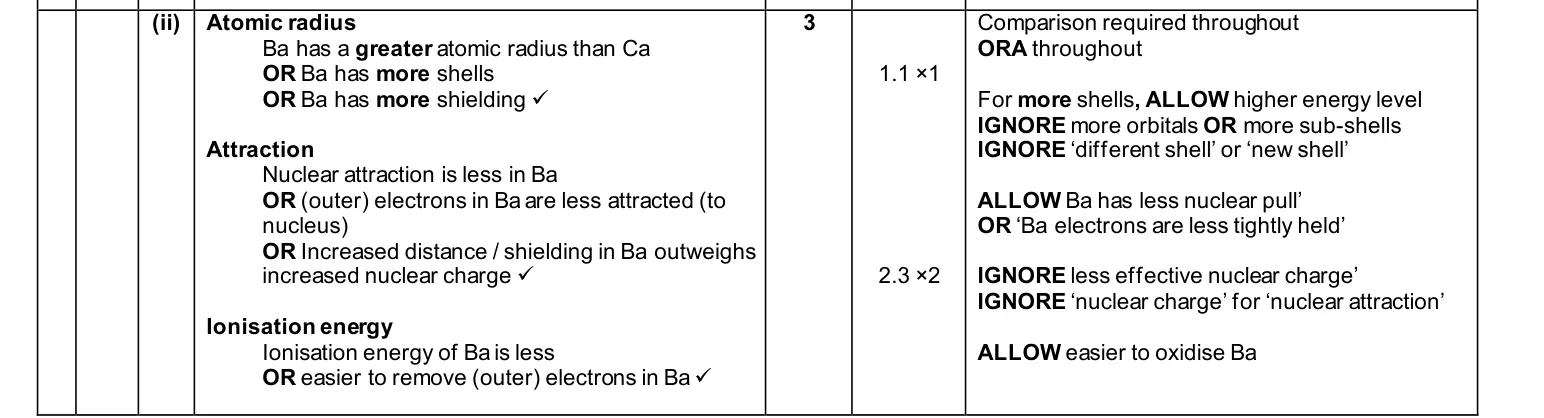
(ii) The reaction of barium with bromine is more vigorous than the reaction of calcium with
bromine.
Explain why.
...........................................................................................................................................
...........................................................................................................................................
...........................................................................................................................................
...........................................................................................................................................
...........................................................................................................................................
...................................................................................................................................... [3]
November 2020 · AS Paper 2 · Q3(c)(i) 1 mark AO2 Equation writing Medium formulae and equations
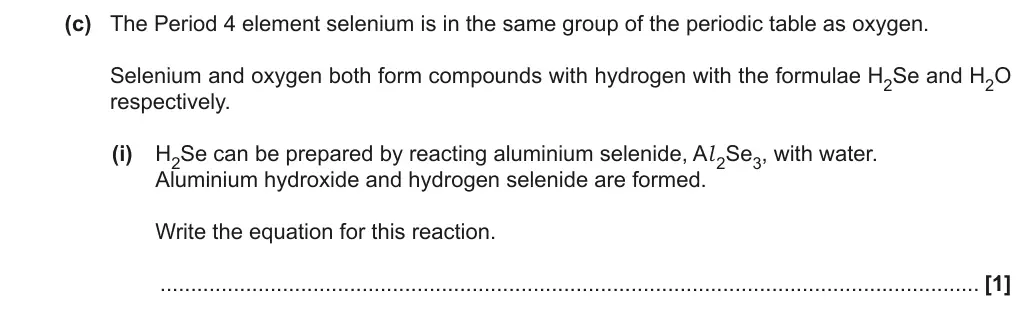
(c) The Period 4 element selenium is in the same group of the periodic table as oxygen.
Selenium and oxygen both form compounds with hydrogen with the formulae H2Se and H2O
respectively.
(i)  H2Se can be prepared by reacting aluminium selenide, Al 2Se3, with water.
Aluminium hydroxide and hydrogen selenide are formed.
Write the equation for this reaction.
...................................................................................................................................... [1]
November 2020 · AS Paper 2 · Q3(c)(ii) 3 marks AO1, 2 Short answer Medium bonding and structure
Earlier part of question 3 that this part usesEarlier part of November 2020 Paper 2 question 3
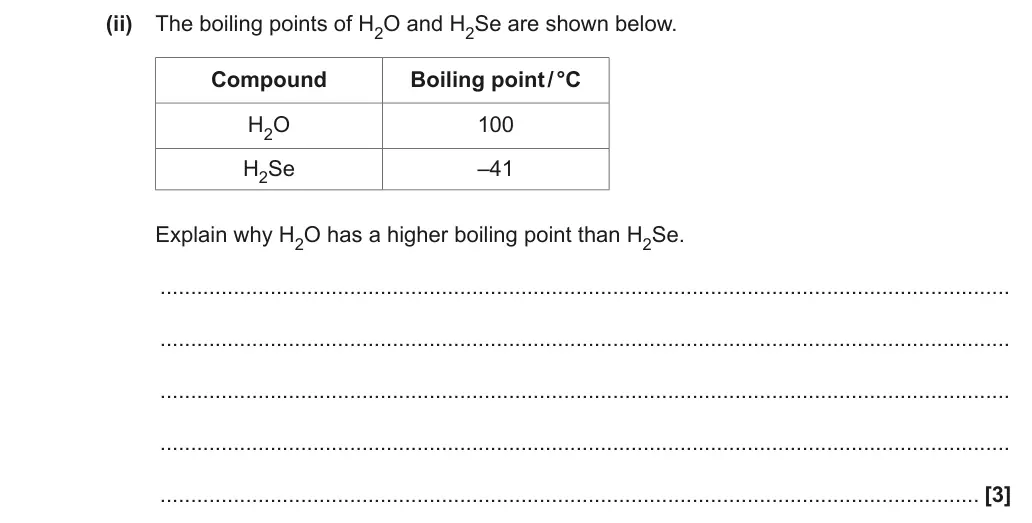
(ii)  The boiling points of H2O and H2Se are shown below.
Compound Boiling point / °C
H2O 100
H2Se –41
Explain why H2O has a higher boiling point than H2Se.
...........................................................................................................................................
...........................................................................................................................................
...........................................................................................................................................
...........................................................................................................................................
...................................................................................................................................... [3]
November 2020 · AS Paper 2 · Q3(d)(i) 1 mark AO2 Equation writing Medium redox
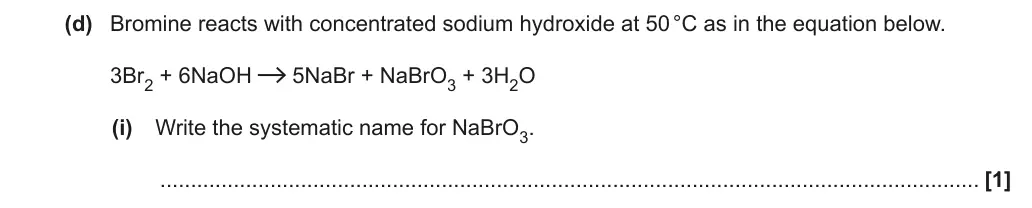
(d) Bromine reacts with concentrated sodium hydroxide at 50 °C as in the equation below.
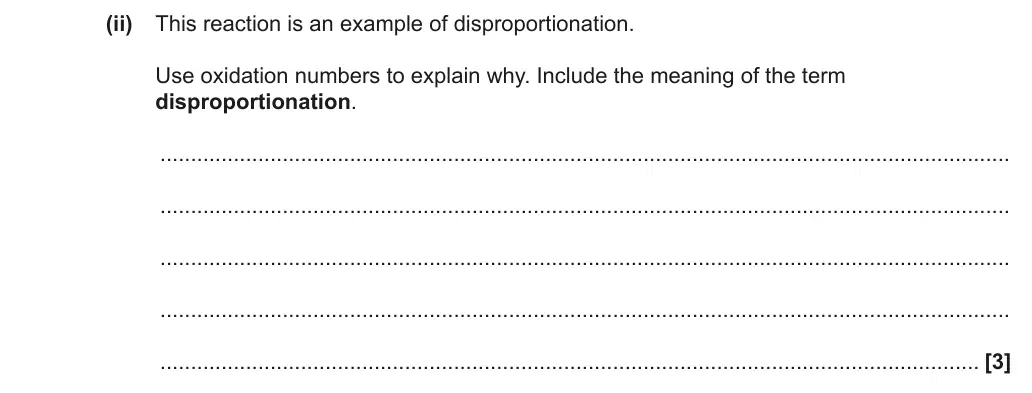
3Br2 + 6NaOH 5NaBr + NaBrO3 + 3H2O
(i) Write the systematic name for NaBrO3.
...................................................................................................................................... [1]
November 2020 · AS Paper 2 · Q3(d)(ii) 3 marks AO1, 2 Data interpretation Medium halogensredox
Earlier part of question 3 that this part usesEarlier part of November 2020 Paper 2 question 3
(ii) This reaction is an example of disproportionation.
Use oxidation numbers to explain why. Include the meaning of the term
disproportionation.
...........................................................................................................................................
...........................................................................................................................................
...........................................................................................................................................
...........................................................................................................................................
...................................................................................................................................... [3]
November 2020 · AS Paper 2 · Q4(a) 3 marks AO1, 2 Short answer Medium bonding and structure
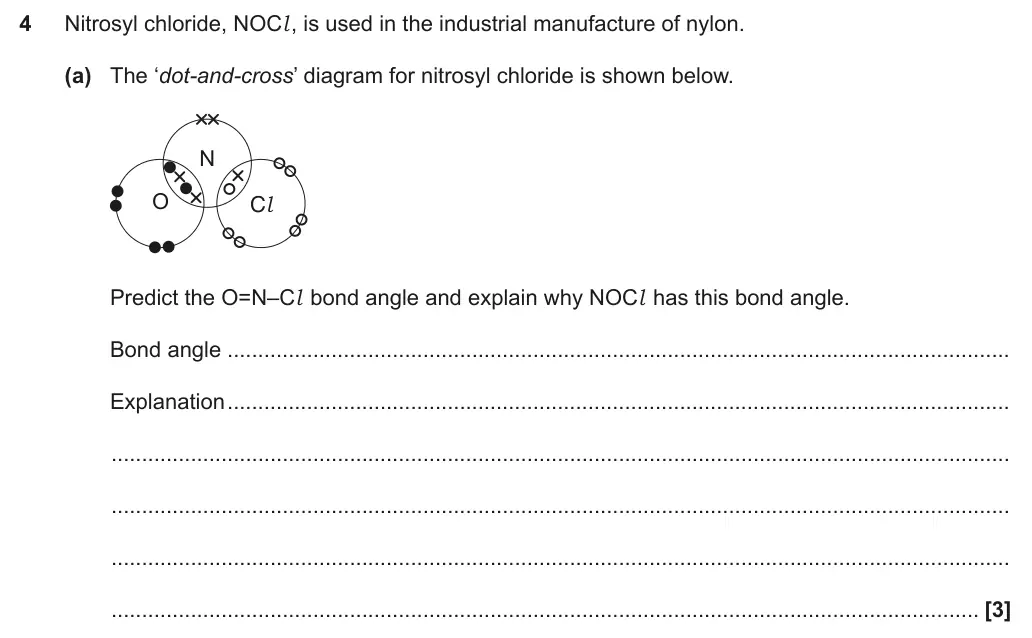
4 Nitrosyl chloride, NOCl , is used in the industrial manufacture of nylon.
(a) The ‘dot-and-cross’ diagram for nitrosyl chloride is shown below.
N
O Cl
Predict the O=N–Cl  bond angle and explain why NOCl  has this bond angle.
Bond angle ................................................................................................................................
Explanation ................................................................................................................................
...................................................................................................................................................
...................................................................................................................................................
...................................................................................................................................................
.............................................................................................................................................. [3]
November 2020 · AS Paper 2 · Q4(b)(i) 1 mark AO1 Short answer Medium chemical equilibrium
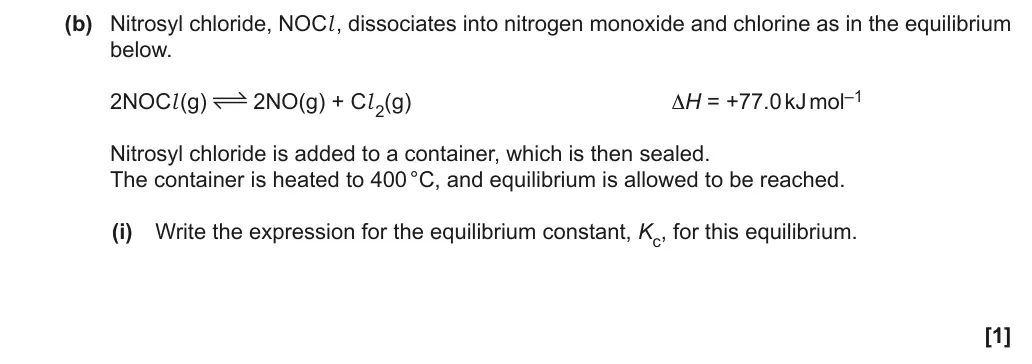
(b) Nitrosyl chloride, NOCl , dissociates into nitrogen monoxide and chlorine as in the equilibrium
below.
2NOCl (g) 2NO(g) + Cl 2(g) ΔH = +77.0 kJ mol–1
Nitrosyl chloride is added to a container, which is then sealed.
The container is heated to 400 °C, and equilibrium is allowed to be reached.
(i) Write the expression for the equilibrium constant, Kc, for this equilibrium.
[1]
November 2020 · AS Paper 2 · Q4(b)(ii) 1 mark AO3 Short answer Medium amount of substance
Earlier part of question 4 that this part usesEarlier part of November 2020 Paper 2 question 4
(ii) In the equilibrium mixture at 400 °C, the equilibrium concentration of Cl 2(g) is found to be
0.17 mol dm−3.
The student calculates that the equilibrium concentration of NO(g) is 0.34 mol dm−3.
Explain how the student obtained this value for [NO(g)].
...........................................................................................................................................
...........................................................................................................................................
...................................................................................................................................... [1]
November 2020 · AS Paper 2 · Q4(b)(iii) 2 marks AO2 Calculation Medium chemical equilibrium
Earlier parts of question 4 that this part usesEarlier part of November 2020 Paper 2 question 4Earlier part of November 2020 Paper 2 question 4
(iii) At 400 °C, Kc = 0.015 mol dm–3.
Calculate the equilibrium concentration of NOCl (g) at 400 °C.
equilibrium concentration of NOCl (g) =  .......................................... mol dm−3 [2]
November 2020 · AS Paper 2 · Q4(b)(iv) 2 marks AO2 Short answer Medium chemical equilibrium
Earlier part of question 4 that this part usesEarlier part of November 2020 Paper 2 question 4
(iv) The temperature of the equilibrium mixture is increased above 400 °C while keeping the
pressure constant.
State and explain the effect on the equilibrium concentration of nitrogen monoxide,
NO(g), with these new conditions.
...........................................................................................................................................
...........................................................................................................................................
...........................................................................................................................................
...................................................................................................................................... [2]
November 2020 · AS Paper 2 · Q5(a) 2 marks AO1, 2 Short answer Medium alcohols
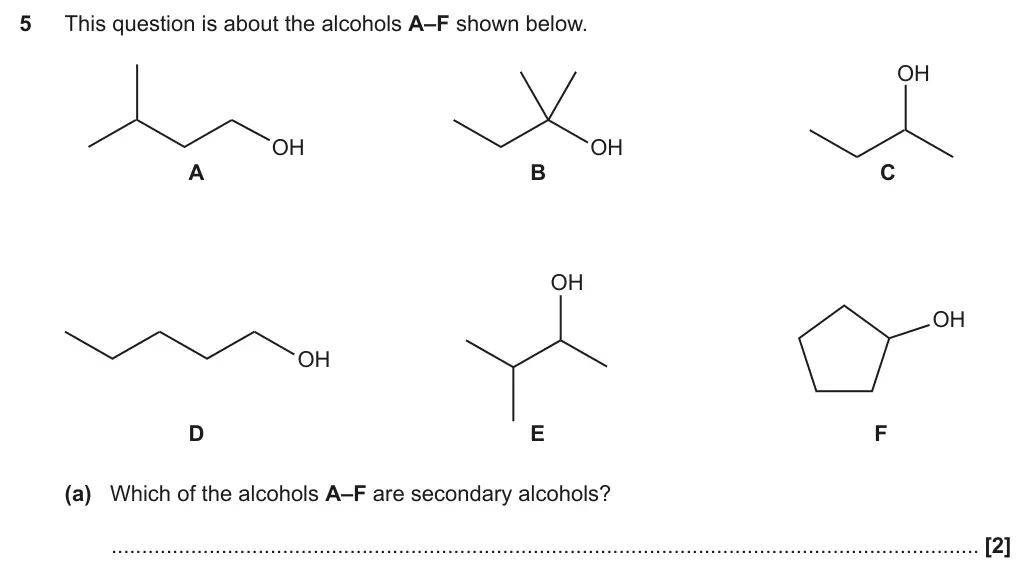
5 This question is about the alcohols A–F shown below.
OH
OH OH
A B C
OH
OH
OH
D E F
(a) Which of the alcohols A–F are secondary alcohols?
.............................................................................................................................................. [2]
November 2020 · AS Paper 2 · Q5(b) 1 mark AO2 Equation writing Medium alcoholsformulae and equations
Earlier part of question 5 that this part usesEarlier part of November 2020 Paper 2 question 5
(b) Complete a balanced equation for the complete combustion of alcohol C.
CH3CH2CH(OH)CH3 + ........................... ........................... + ........................... [1]
November 2020 · AS Paper 2 · Q5(c) 1 mark AO1 Short answer Medium organic basics
Earlier part of question 5 that this part usesEarlier part of November 2020 Paper 2 question 5
(c) What is the systematic name of alcohol B?
.............................................................................................................................................. [1]
November 2020 · AS Paper 2 · Q5(d)(i) 2 marks AO1, 2 Calculation Medium amount of substance
Earlier part of question 5 that this part usesEarlier part of November 2020 Paper 2 question 5
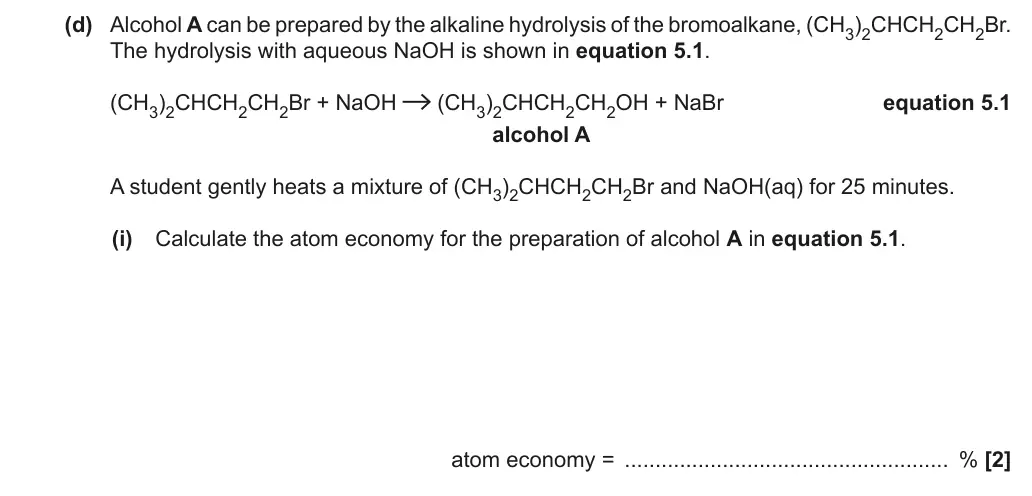
(d) Alcohol A can be prepared by the alkaline hydrolysis of the bromoalkane, (CH3)2CHCH2CH2Br.
The hydrolysis with aqueous NaOH is shown in equation 5.1.
(CH3)2CHCH2CH2Br + NaOH (CH3)2CHCH2CH2OH + NaBr equation 5.1
alcohol A
A student gently heats a mixture of (CH3)2CHCH2CH2Br and NaOH(aq) for 25 minutes.
(i) Calculate the atom economy for the preparation of alcohol A in equation 5.1.
atom economy =  ..................................................... % [2]
November 2020 · AS Paper 2 · Q5(d)(ii) 3 marks AO1, 2 Mechanism Medium haloalkanesorganic basics
Earlier part of question 5 that this part usesEarlier part of November 2020 Paper 2 question 5
(ii) Outline the mechanism for the alkaline hydrolysis of (CH3)2CHCH2CH2Br.
The structure of (CH3)2CHCH2CH2Br has been provided.
Show curly arrows, relevant lone pairs and dipoles, and the products.
H
(CH3)2CHCH2 C Br
H
[3]
November 2020 · AS Paper 2 · Q5(d)(iii) 1 mark AO1 Short answer Medium haloalkanes
Earlier parts of question 5 that this part usesEarlier part of November 2020 Paper 2 question 5Earlier part of November 2020 Paper 2 question 5
(iii) Name this type of mechanism.
...................................................................................................................................... [1]
November 2020 · AS Paper 2 · Q5(e) 2 marks AO2, 3 Short answer Medium haloalkanes
Earlier part of question 5 that this part usesEarlier part of November 2020 Paper 2 question 5
(e) The student decides to prepare alcohol A using the same method as in (d) but using the
chloroalkane (CH3)2CHCH2CH2Cl  instead of the bromoalkane, (CH3)2CHCH2CH2Br.
State and explain how the rates of hydrolysis of the chloroalkane and the bromoalkane would
differ.
...................................................................................................................................................
...................................................................................................................................................
...................................................................................................................................................
...................................................................................................................................................
.............................................................................................................................................. [2]
November 2020 · AS Paper 2 · Q5(f) 6 marks AO2, 3 6-mark level of response Medium infrared and mass spectrometryalcohols
Earlier part of question 5 that this part usesEarlier part of November 2020 Paper 2 question 5
(f)* The structures of A–F are repeated below.
OH
OH OH
A B C
OH
OH
OH
D E F
Compound X is one of the alcohols A–F.
A student refluxes compound X with acidified potassium dichromate(VI) as an oxidising
agent. A pure sample of the organic product Y is obtained from the resulting mixture.
The mass spectrum and IR spectrum of Y are shown below.
Mass spectrum of Y
100
80
relative 60
intensity
40
20
0
10 20 30 40 50 60 70 80 90
m / z
IR spectrum of Y
100
transmittance
50
(100%)
0
4000 3000 2000 1500 1000 500
wavenumber / cm–1
Using this information, identify compound X and product Y, and write an equation for the
formation of product Y from compound X. You may use [O] to represent the oxidising agent.
In your answer you should make clear how your conclusions are linked to the evidence. [6]
...................................................................................................................................................
...................................................................................................................................................
...................................................................................................................................................
...................................................................................................................................................
...................................................................................................................................................
...................................................................................................................................................
...................................................................................................................................................
...................................................................................................................................................
...................................................................................................................................................
...................................................................................................................................................
...................................................................................................................................................
...................................................................................................................................................
...................................................................................................................................................
...................................................................................................................................................
...................................................................................................................................................
Additional answer space if required
...................................................................................................................................................
...................................................................................................................................................
...................................................................................................................................................
...................................................................................................................................................
...................................................................................................................................................
...................................................................................................................................................
...................................................................................................................................................
...................................................................................................................................................
...................................................................................................................................................

Work with an OCR chemistry tutor

Want a paper marked and gone through with you? Message us.

Prefer email? Send an enquiry

If you are under 18, please include a parent's contact details. Enquiries go to enquiries@chemistryaleveltutor.com and are deleted once handled. All tutoring is online.