June 2016: AS Paper 1, Breadth in chemistry

70 marks · 46 question parts · Paper, mark scheme and report on OCR's site · Have OCR's Data Sheet beside you

Question by question

QTopicMarksAOType
1 Atomic structure and isotopes 1Multiple choice
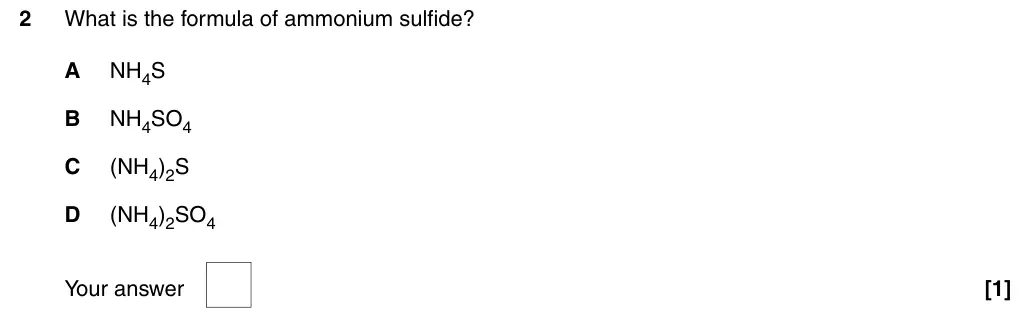
2 Formulae and equations 1Multiple choice
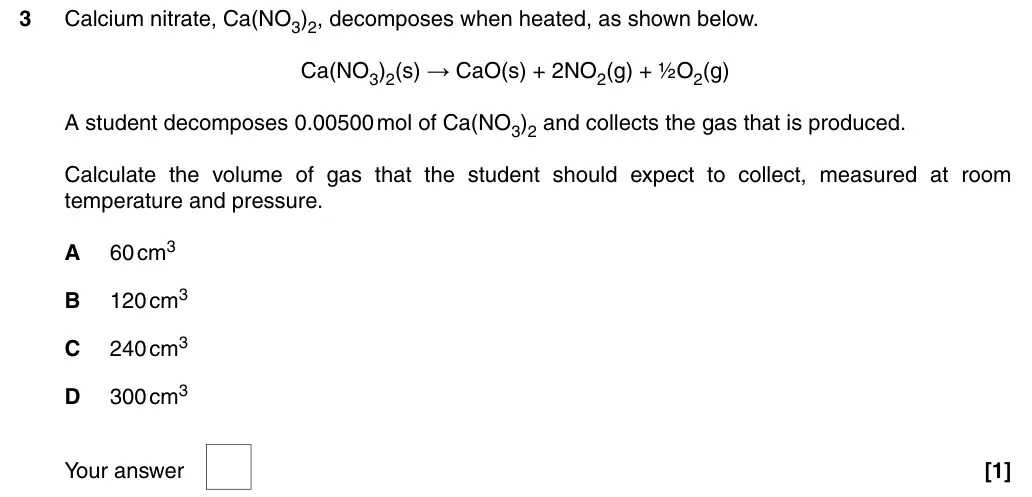
3 Amount of substance (moles) 1Multiple choice
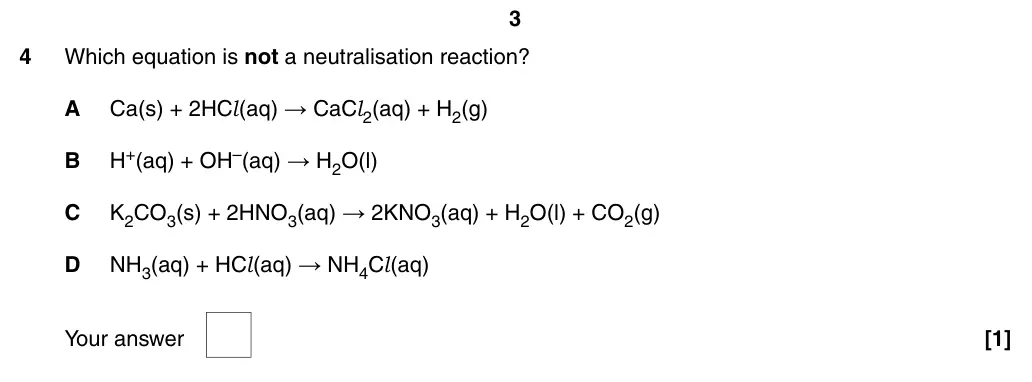
4 Acids, bases and titrations, Redox and oxidation numbers 1Multiple choice
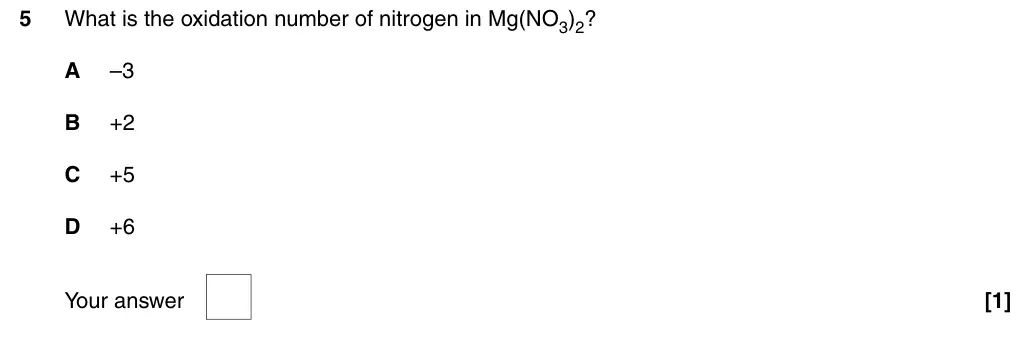
5 Redox and oxidation numbers 1Multiple choice
6 Electron structure and orbitals 1Multiple choice
7 Bonding, structure and shapes of molecules 1Multiple choice
8 Periodicity and ionisation energy, Bonding, structure and shapes of molecules 1Multiple choice
9 Periodicity and ionisation energy 1Multiple choice
10 Periodicity and ionisation energy 1Multiple choice
11 Qualitative analysis: tests for ions, Acids, bases and titrations 1Multiple choice
12 Enthalpy changes and Hess’ law 1Multiple choice
13 Organic basics: naming, formulae and isomerism 1Multiple choice
14 Organic basics: naming, formulae and isomerism 1Multiple choice
15 Bonding, structure and shapes of molecules, Alkenes 1Multiple choice
16 Alkenes, Alkanes 1Multiple choice
17 Alkanes 1Multiple choice
18 Alcohols 1Multiple choice
19 Alkenes, Haloalkanes 1Multiple choice
20 Haloalkanes 1Multiple choice
21(a) Atomic structure and isotopes 2AO1Short answer
21(b)(i) Atomic structure and isotopes 2AO1Calculation
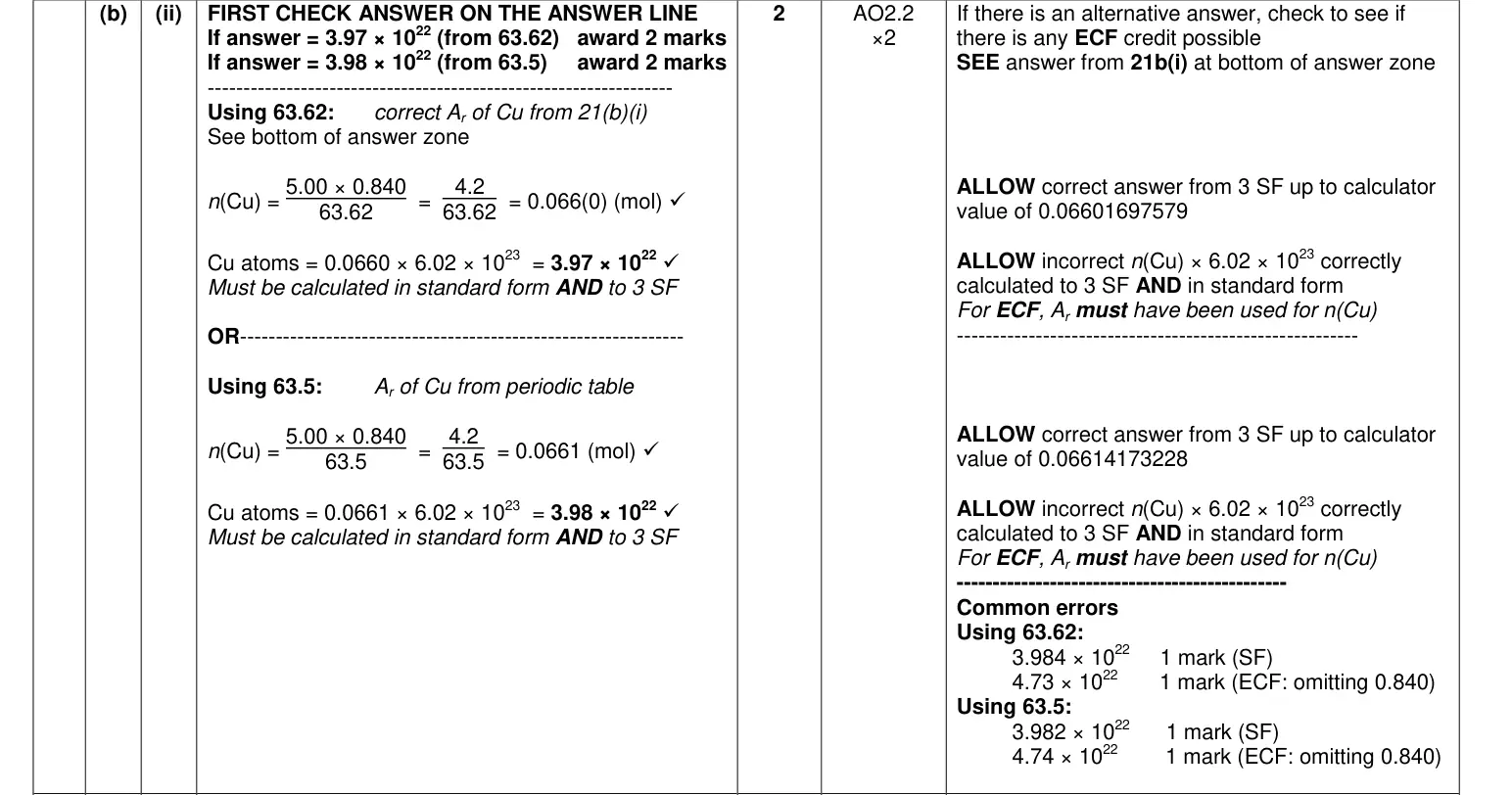
21(b)(ii) Amount of substance (moles) 2AO2Calculation
21(c)(i) Acids, bases and titrations 1AO1Equation writing
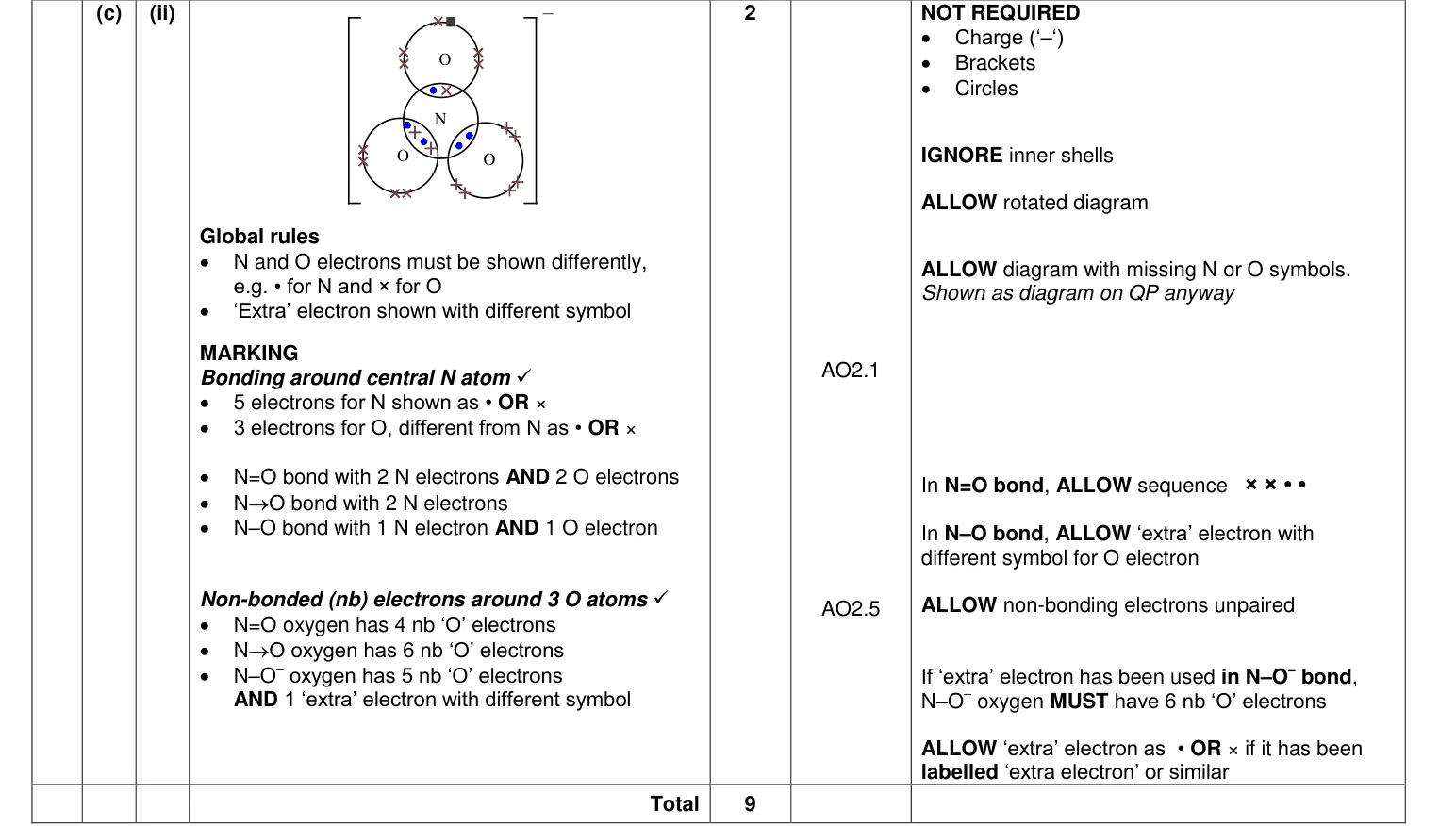
21(c)(ii) Bonding, structure and shapes of molecules 2AO2Drawing / labelling
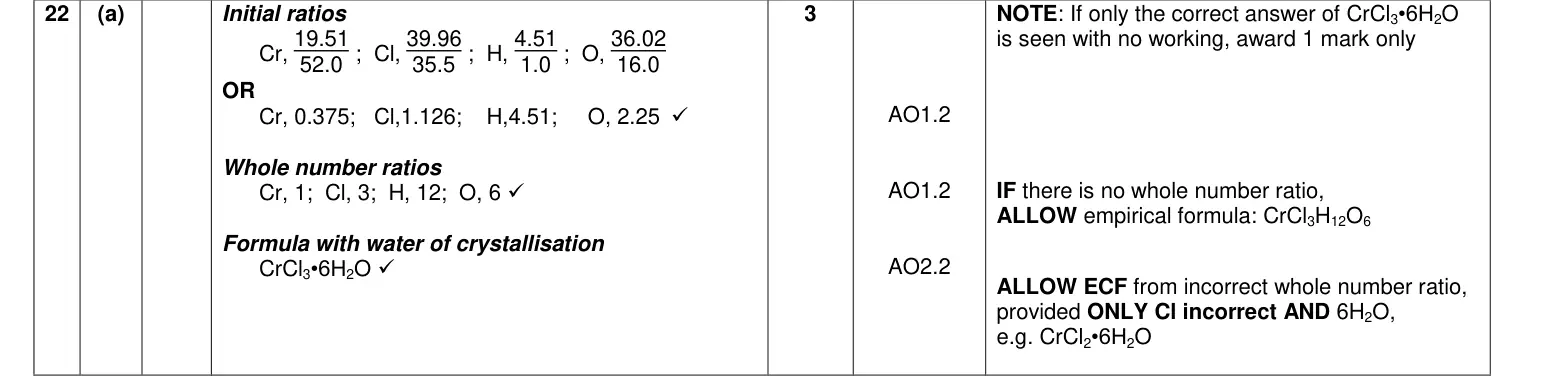
22(a) Amount of substance (moles) 3AO1, 2Calculation
22(b)(i) Practical skills: planning, analysis and evaluation 1AO2Calculation
22(b)(ii) Practical skills: planning, analysis and evaluation 1AO3Short answer
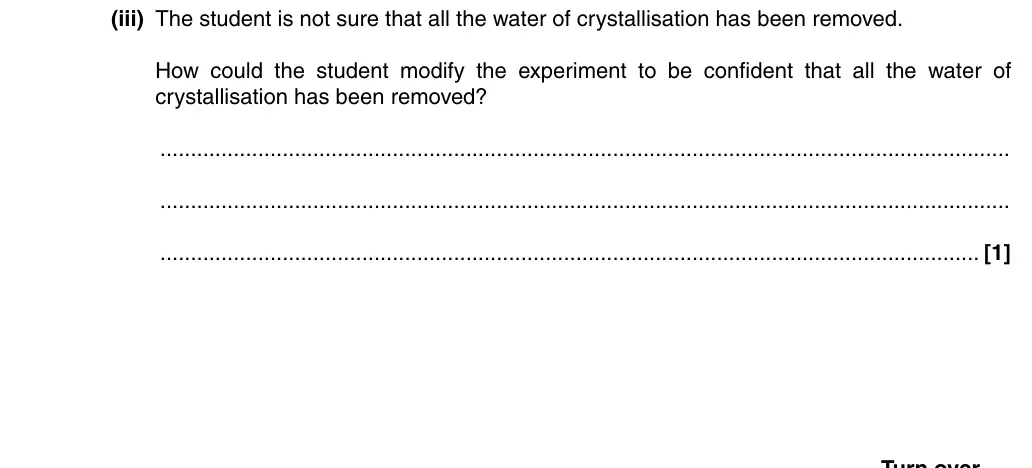
22(b)(iii) Amount of substance (moles), Practical skills: planning, analysis and evaluation 1AO3Short answer
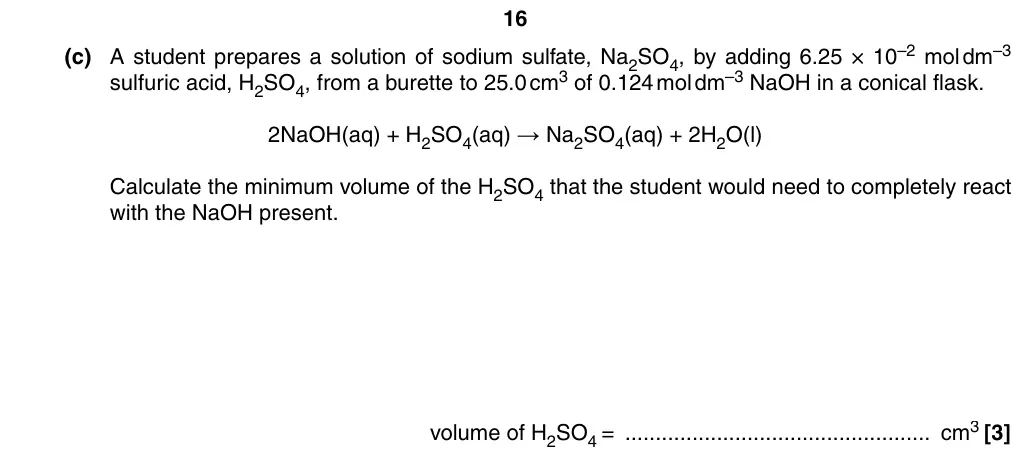
22(c) Acids, bases and titrations, Amount of substance (moles) 3AO2Calculation
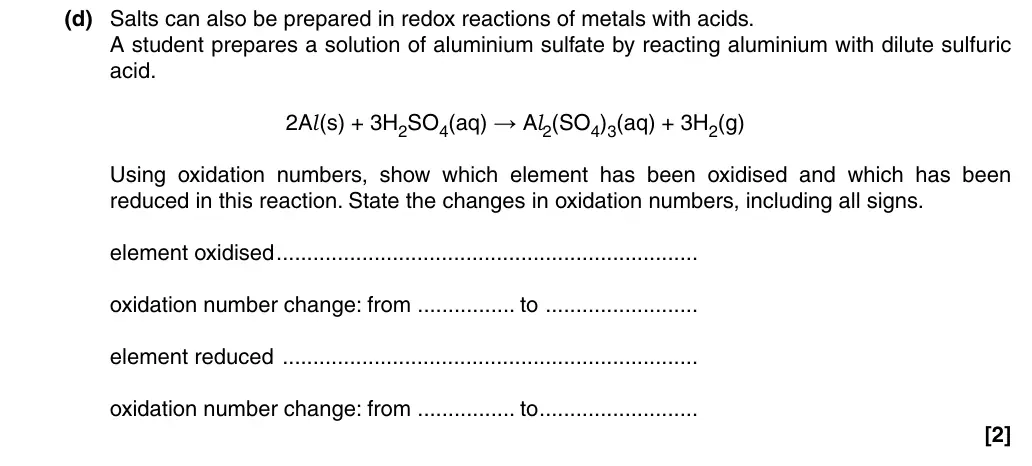
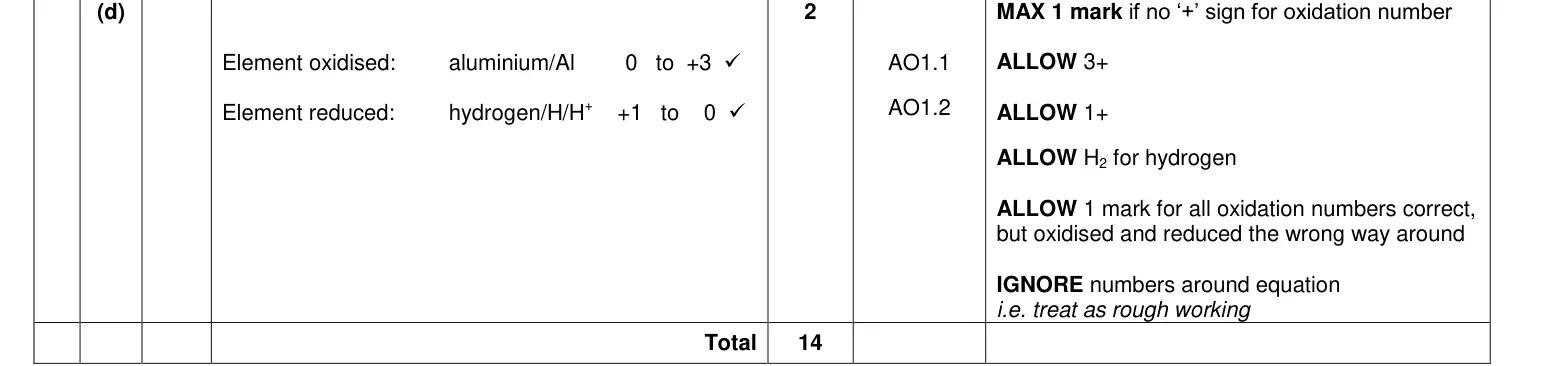
22(d) Redox and oxidation numbers 2AO1Short answer
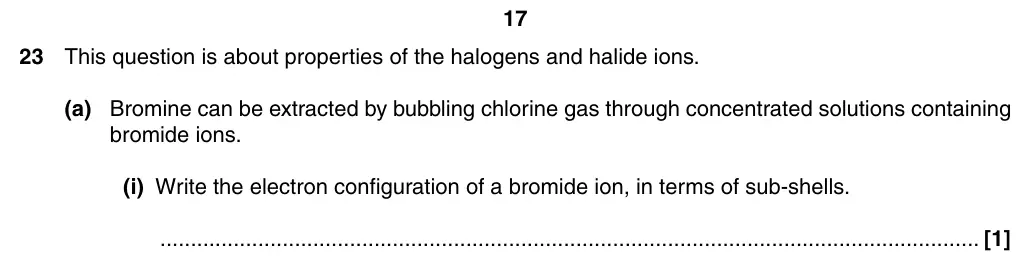
23(a)(i) Electron structure and orbitals 1AO1Short answer
23(a)(ii) The halogens, Formulae and equations 2AO1Equation writing
23(b) The halogens 1AO1Short answer
23(c)(i) The halogens 1AO1Short answer
23(c)(ii) The halogens, Qualitative analysis: tests for ions 1AO1Short answer
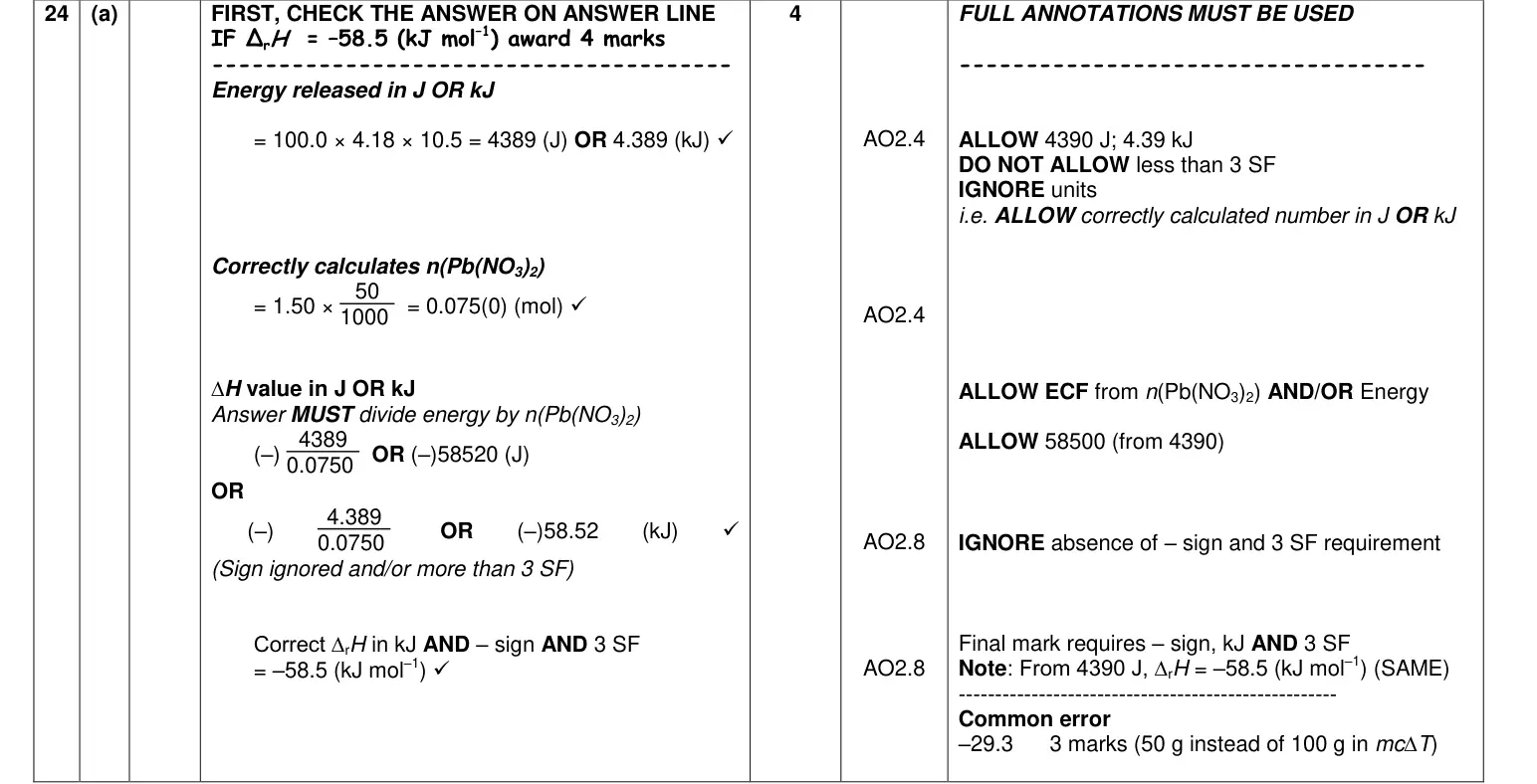
24(a) Enthalpy changes and Hess’ law, Amount of substance (moles) 4AO2Calculation
24(b) Formulae and equations 1AO2Equation writing
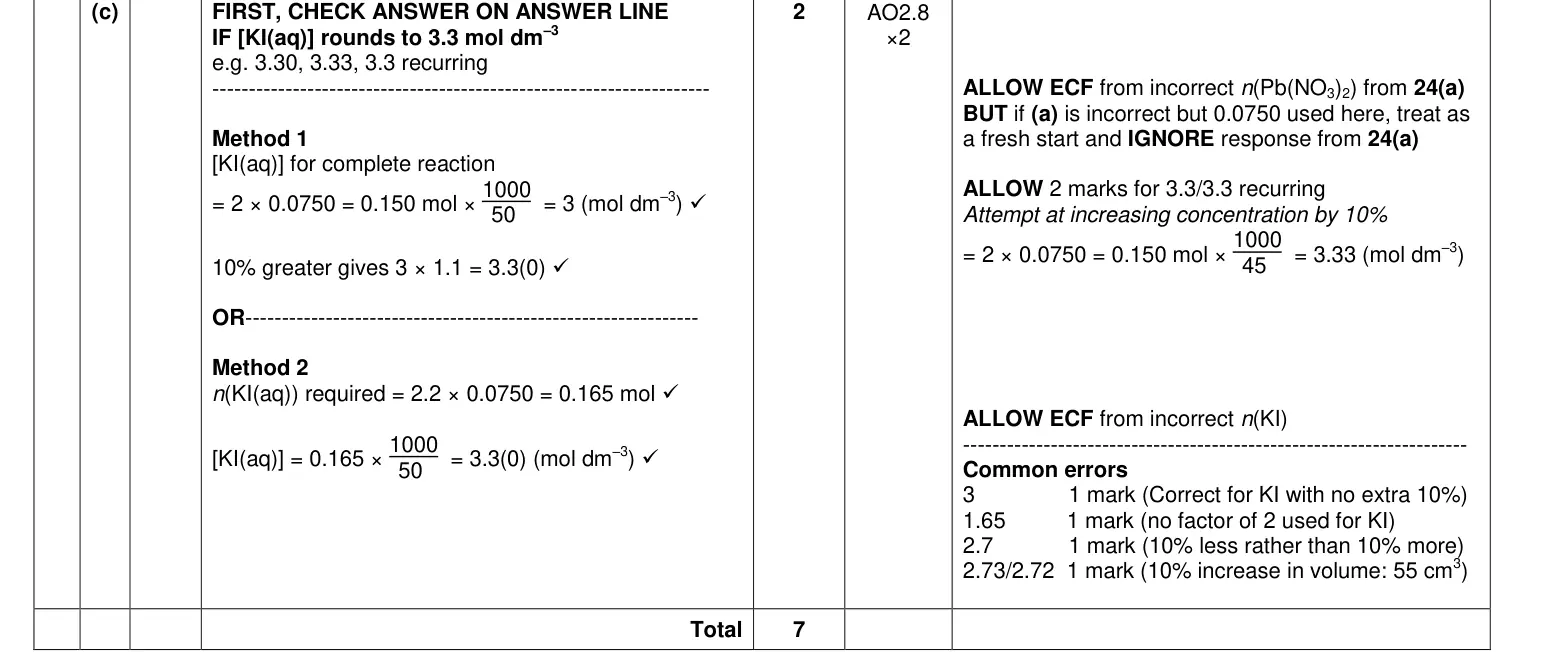
24(c) Amount of substance (moles) 2AO2Calculation
25(a) Chemical equilibrium and Kc 5AO1, 3Extended response
25(b) Chemical equilibrium and Kc 4AO1, 2, 3Calculation
26(a)(i) Organic basics: naming, formulae and isomerism 1AO1Short answer
26(a)(ii) Alkenes 1AO1Short answer
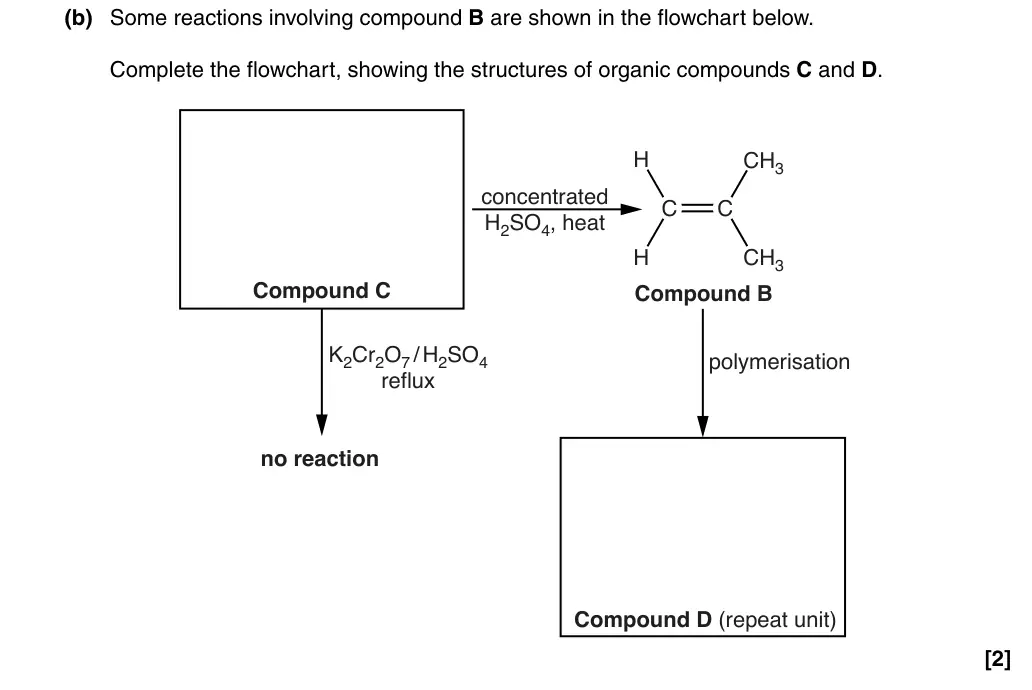
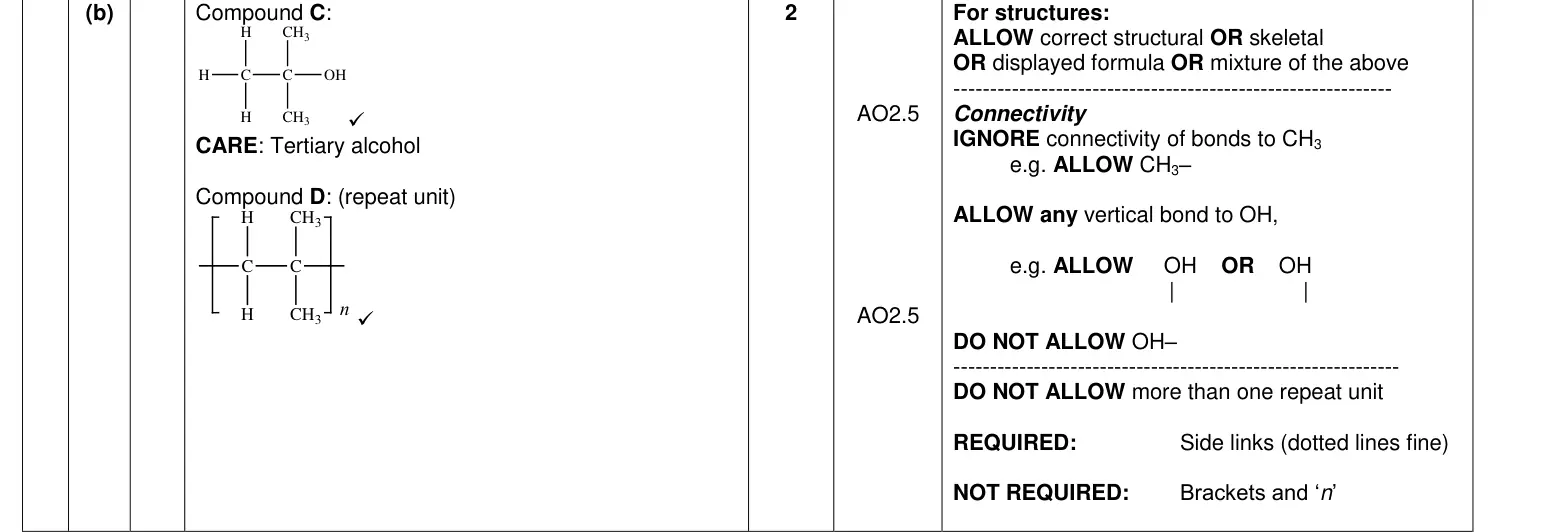
26(b) Alcohols, Alkenes 2AO2Structure / isomer
26(c)(i) Amount of substance (moles) 1AO1Short answer
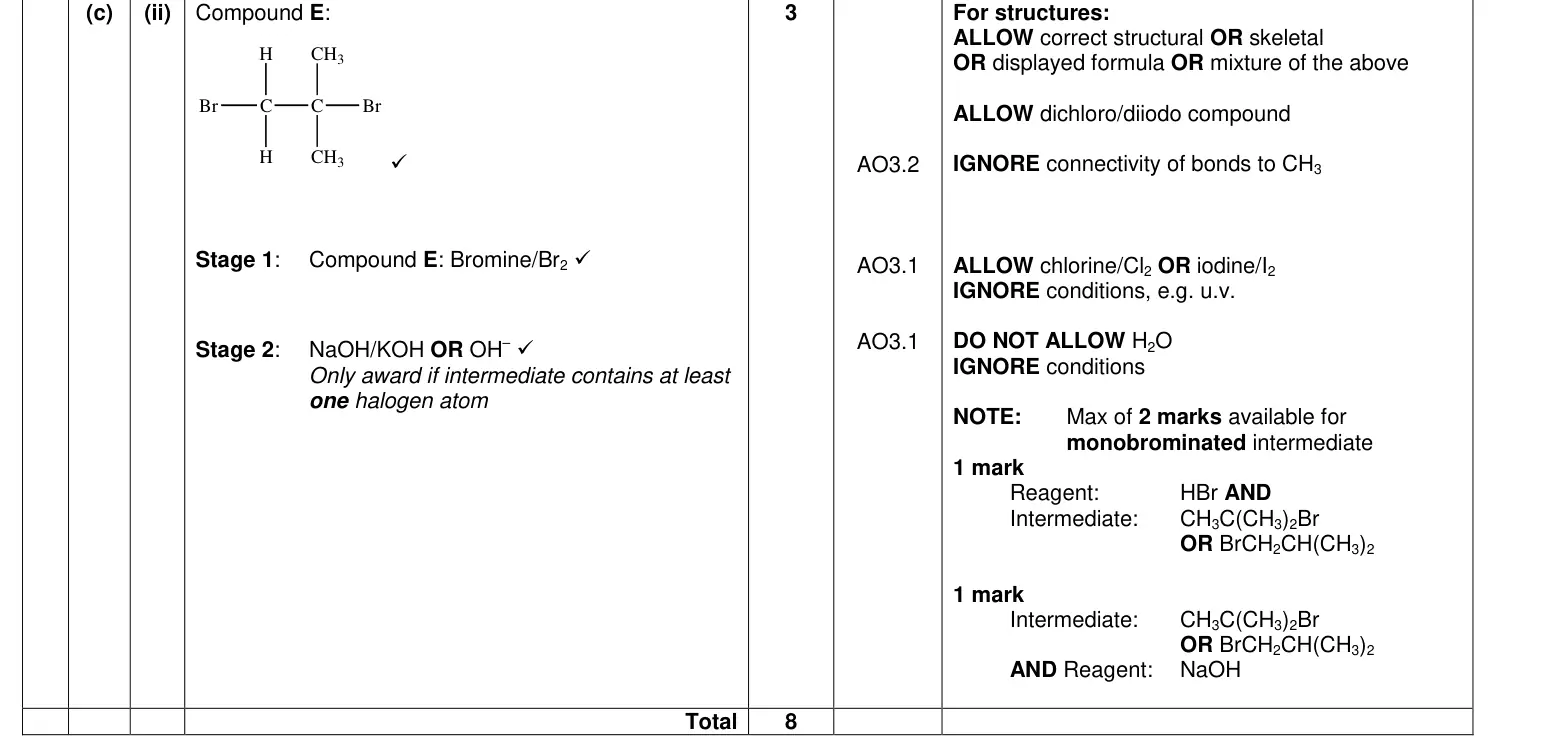
26(c)(ii) Organic synthesis and practical techniques (Module 4), Alkenes, Haloalkanes 3AO3Structure / isomer

The questions

123456789101112131415161718192021(a)21(b)(i)21(b)(ii)21(c)(i)21(c)(ii)22(a)22(b)(i)22(b)(ii)22(b)(iii)22(c)22(d)23(a)(i)23(a)(ii)23(b)23(c)(i)23(c)(ii)24(a)24(b)24(c)25(a)25(b)26(a)(i)26(a)(ii)26(b)26(c)(i)26(c)(ii)
June 2016 · AS Paper 1 · Q1 1 mark Multiple choice atomic structure and isotopes
1 Which row shows the atomic structure of 37Cl–?
protons neutrons electrons
A 17 18 20
B 17 20 18
C 18 19 17
D 20 17 21
Your answer [1]
June 2016 · AS Paper 1 · Q2 1 mark Multiple choice formulae and equations
2 What is the formula of ammonium sulfide?
A NH4S
B NH4SO4
C (NH4)2S
D (NH4)2SO4
Your answer [1]
June 2016 · AS Paper 1 · Q3 1 mark Multiple choice amount of substance
3 Calcium nitrate, Ca(NO3)2, decomposes when heated, as shown below.
Ca(NO3)2(s) → CaO(s) + 2NO2(g) + ½O2(g)
A student decomposes 0.00500 mol of Ca(NO3)2 and collects the gas that is produced.
Calculate the volume of gas that the student should expect to collect, measured at room
temperature and pressure.
A 60 cm3
B 120 cm3
C 240 cm3
D 300 cm3
Your answer [1]
June 2016 · AS Paper 1 · Q4 1 mark Multiple choice acids and titrationsredox
3
4 Which equation is not a neutralisation reaction?
A Ca(s) + 2HCl(aq) → CaCl2(aq) + H2(g)
B H+(aq) + OH–(aq) → H2O(l)
C K2CO3(s) + 2HNO3(aq) → 2KNO3(aq) + H2O(l) + CO2(g)
D NH3(aq) + HCl(aq) → NH4Cl(aq)
Your answer [1]
June 2016 · AS Paper 1 · Q5 1 mark Multiple choice redox
5 What is the oxidation number of nitrogen in Mg(NO3)2?
A –3
B +2
C +5
D +6
Your answer [1]
June 2016 · AS Paper 1 · Q6 1 mark Multiple choice electron structure
6 How many orbitals are occupied in a silicon atom?
A 5
B 7
C 8
D 9
Your answer [1]
June 2016 · AS Paper 1 · Q7 1 mark Multiple choice bonding and structure
4
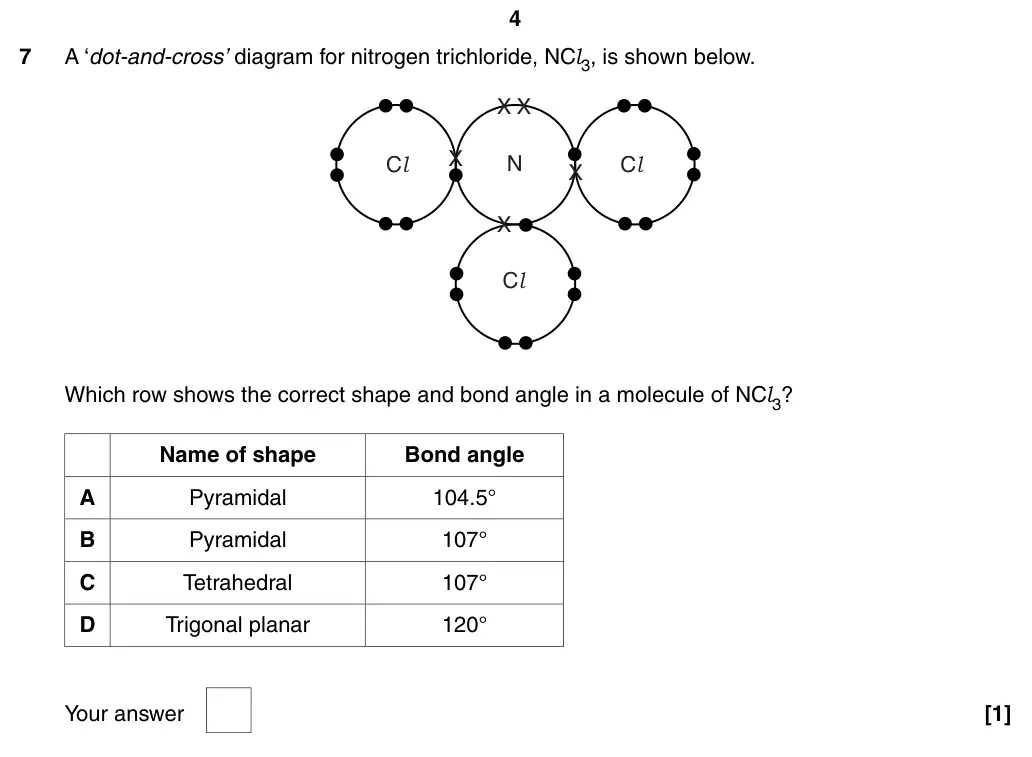
7 A ‘dot-and-cross’ diagram for nitrogen trichloride, NCl3, is shown below.
X X
Cl X N Cl
X
X
Cl
Which row shows the correct shape and bond angle in a molecule of NCl3?
Name of shape Bond angle
A Pyramidal 104.5°
B Pyramidal 107°
C Tetrahedral 107°
D Trigonal planar 120°
Your answer [1]
June 2016 · AS Paper 1 · Q8 1 mark Multiple choice periodicitybonding and structure
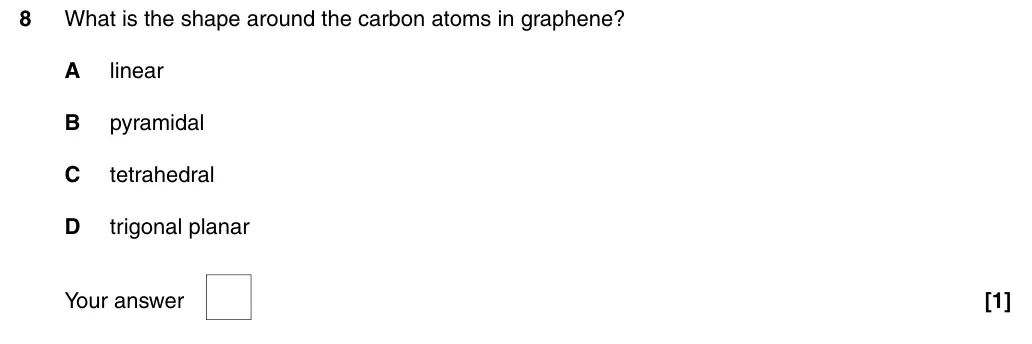
8 What is the shape around the carbon atoms in graphene?
A linear
B pyramidal
C tetrahedral
D trigonal planar
Your answer [1]
June 2016 · AS Paper 1 · Q9 1 mark Multiple choice periodicity
5
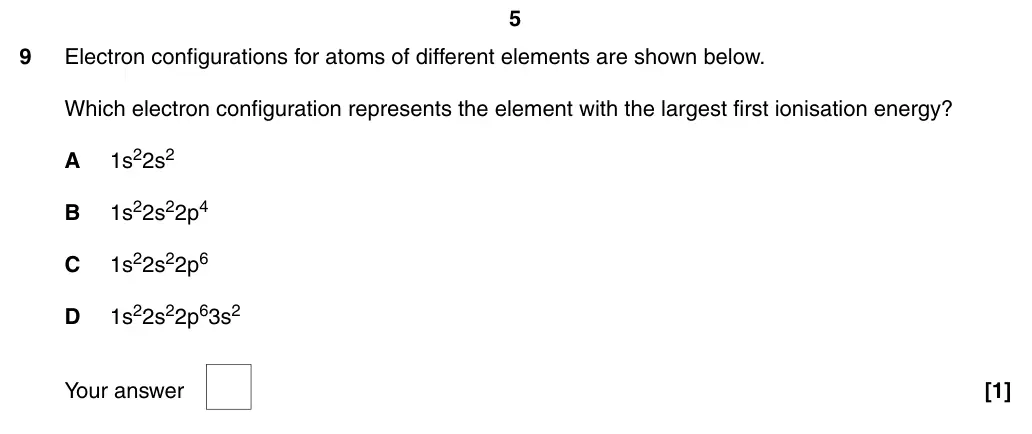
9 Electron configurations for atoms of different elements are shown below.
Which electron configuration represents the element with the largest first ionisation energy?
A 1s22s2
B 1s22s22p4
C 1s22s22p6
D 1s22s22p63s2
Your answer [1]
June 2016 · AS Paper 1 · Q10 1 mark Multiple choice periodicity
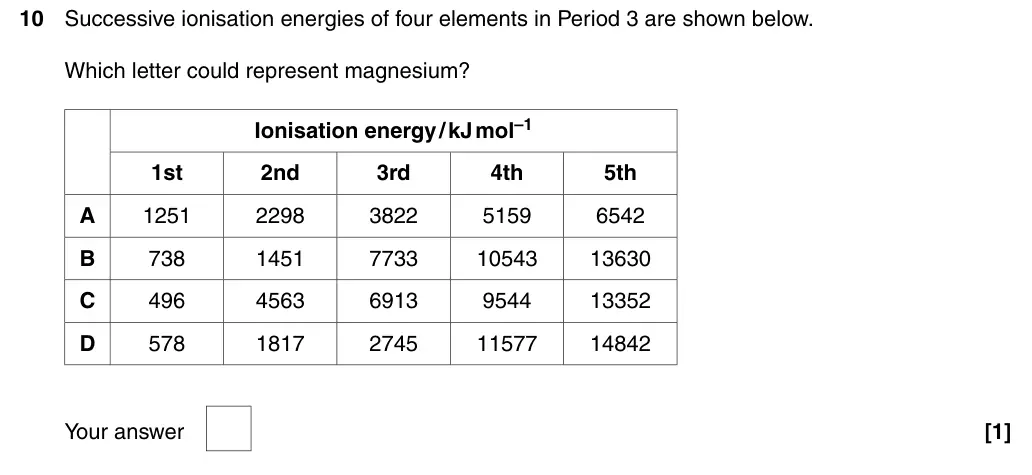
10 Successive ionisation energies of four elements in Period 3 are shown below.
Which letter could represent magnesium?
Ionisation energy / kJ mol–1
1st 2nd 3rd 4th 5th
A 1251 2298 3822 5159 6542
B 738 1451 7733 10543 13630
C 496 4563 6913 9544 13352
D 578 1817 2745 11577 14842
Your answer [1]
June 2016 · AS Paper 1 · Q11 1 mark Multiple choice qualitative analysisacids and titrations
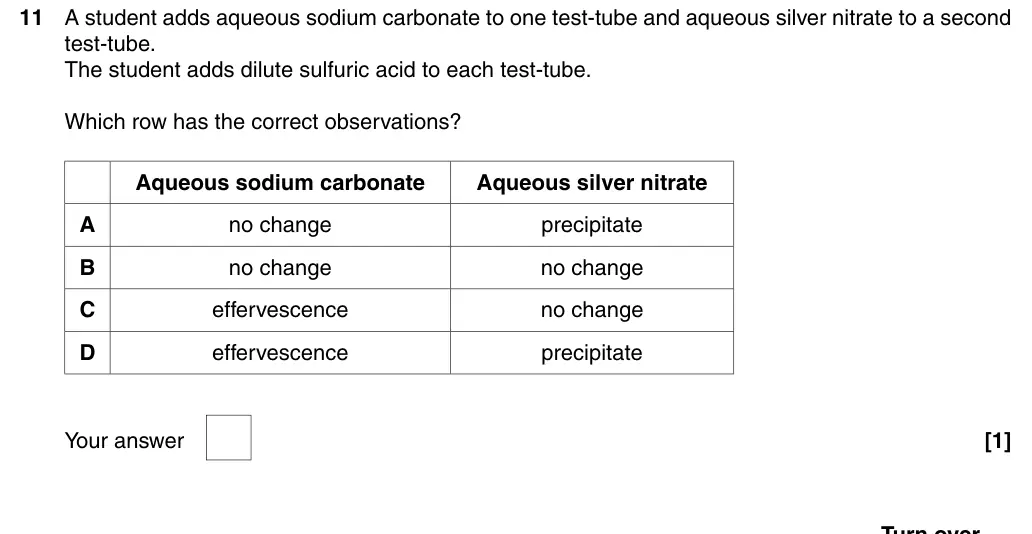
11 A student adds aqueous sodium carbonate to one test-tube and aqueous silver nitrate to a second
test-tube.
The student adds dilute sulfuric acid to each test-tube.
Which row has the correct observations?
Aqueous sodium carbonate Aqueous silver nitrate
A no change precipitate
B no change no change
C effervescence no change
D effervescence precipitate
Your answer [1]
June 2016 · AS Paper 1 · Q12 1 mark Multiple choice enthalpy changes
6
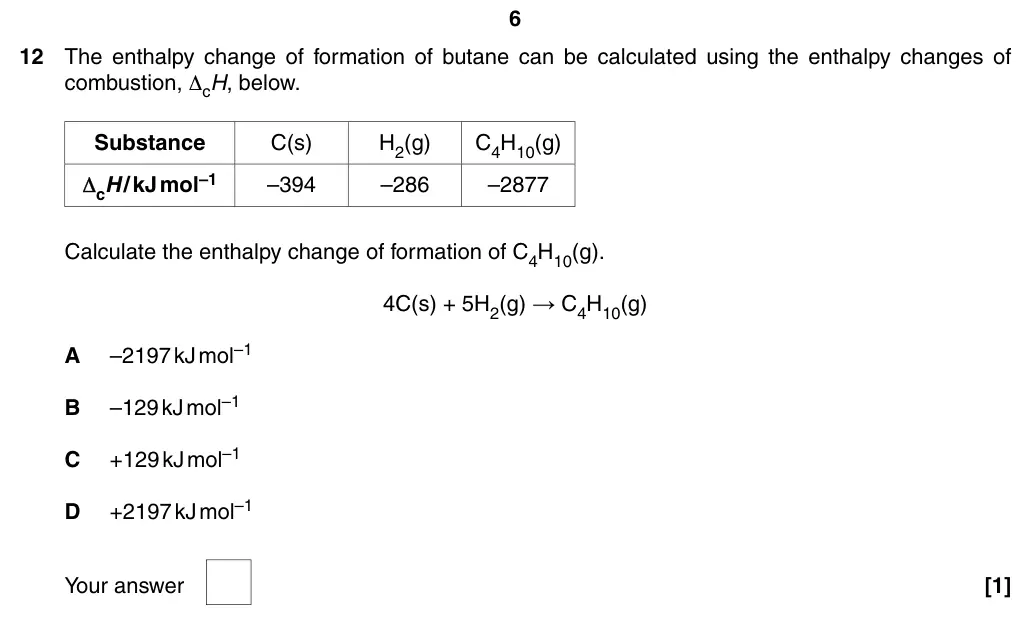
12 The enthalpy change of formation of butane can be calculated using the enthalpy changes of
combustion, ΔcH, below.
Substance C(s) H2(g) C4H10(g)
ΔcH / kJ mol–1 –394 –286 –2877
Calculate the enthalpy change of formation of C4H10(g).
4C(s) + 5H2(g) → C4H10(g)
A –2197 kJ mol–1
B –129 kJ mol–1
C +129 kJ mol–1
D +2197 kJ mol–1
Your answer [1]
June 2016 · AS Paper 1 · Q13 1 mark Multiple choice organic basics
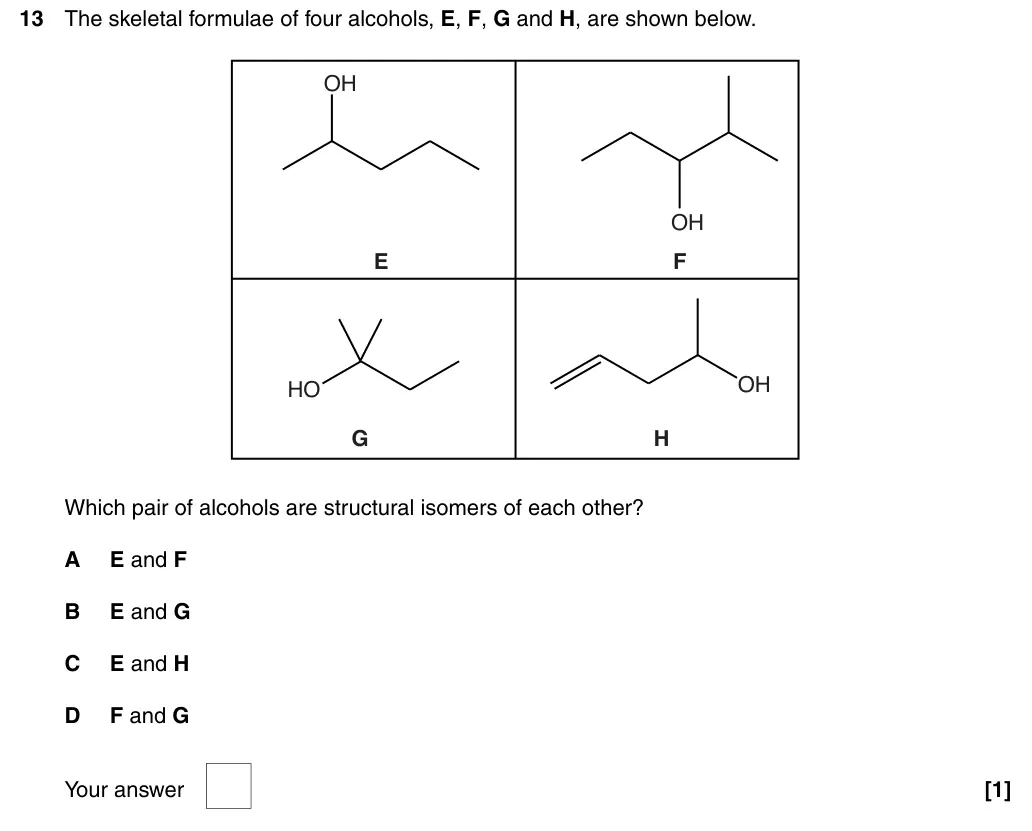
13 The skeletal formulae of four alcohols, E, F, G and H, are shown below.
OH
OH
E F
HO OH
G H
Which pair of alcohols are structural isomers of each other?
A E and F
B E and G
C E and H
D F and G
Your answer [1]
June 2016 · AS Paper 1 · Q14 1 mark Multiple choice organic basics
7
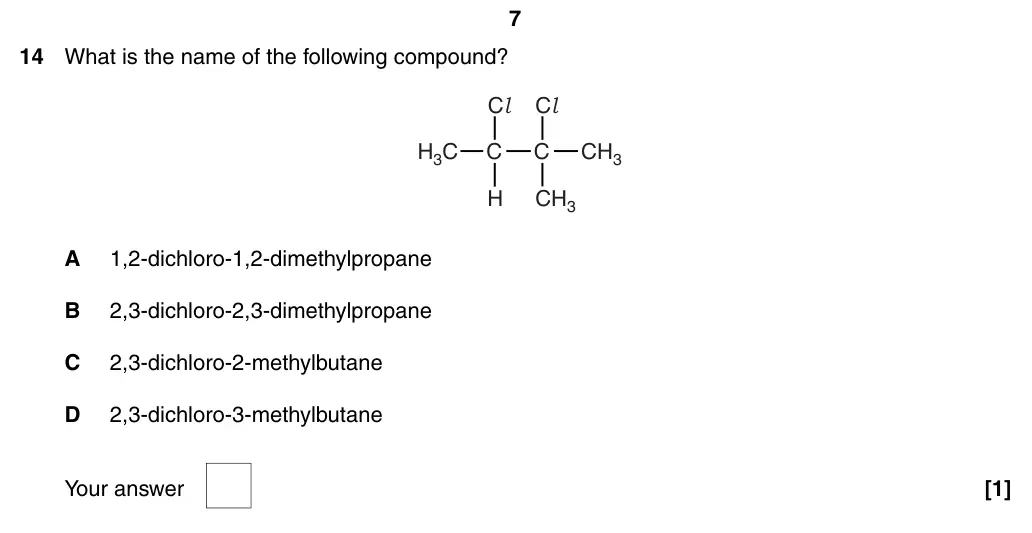
14 What is the name of the following compound?
Cl Cl
H3C C C CH3
H CH3
A 1,2-dichloro-1,2-dimethylpropane
B 2,3-dichloro-2,3-dimethylpropane
C 2,3-dichloro-2-methylbutane
D 2,3-dichloro-3-methylbutane
Your answer [1]
June 2016 · AS Paper 1 · Q15 1 mark Multiple choice bonding and structurealkenes
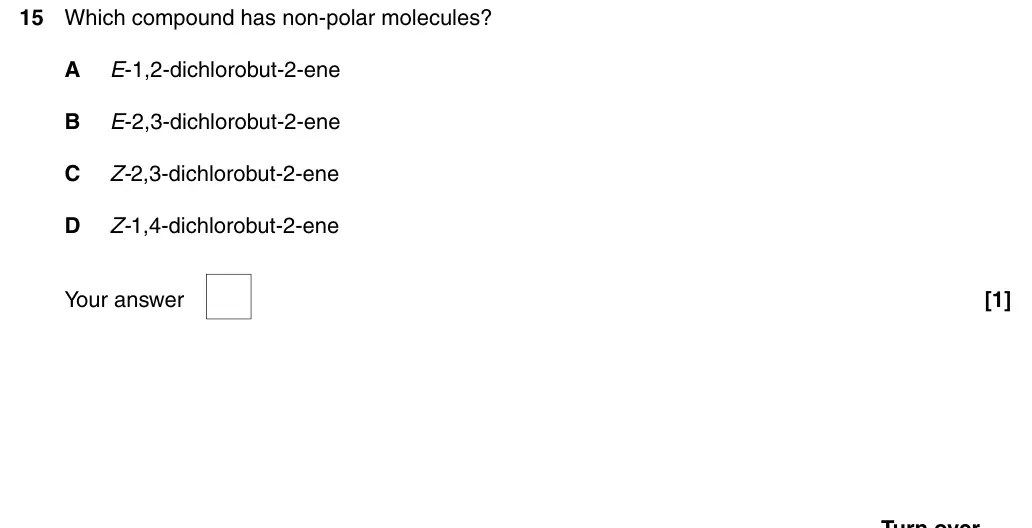
15 Which compound has non-polar molecules?
A E-1,2-dichlorobut-2-ene
B E-2,3-dichlorobut-2-ene
C Z-2,3-dichlorobut-2-ene
D Z-1,4-dichlorobut-2-ene
Your answer [1]
June 2016 · AS Paper 1 · Q16 1 mark Multiple choice alkenesalkanes
8
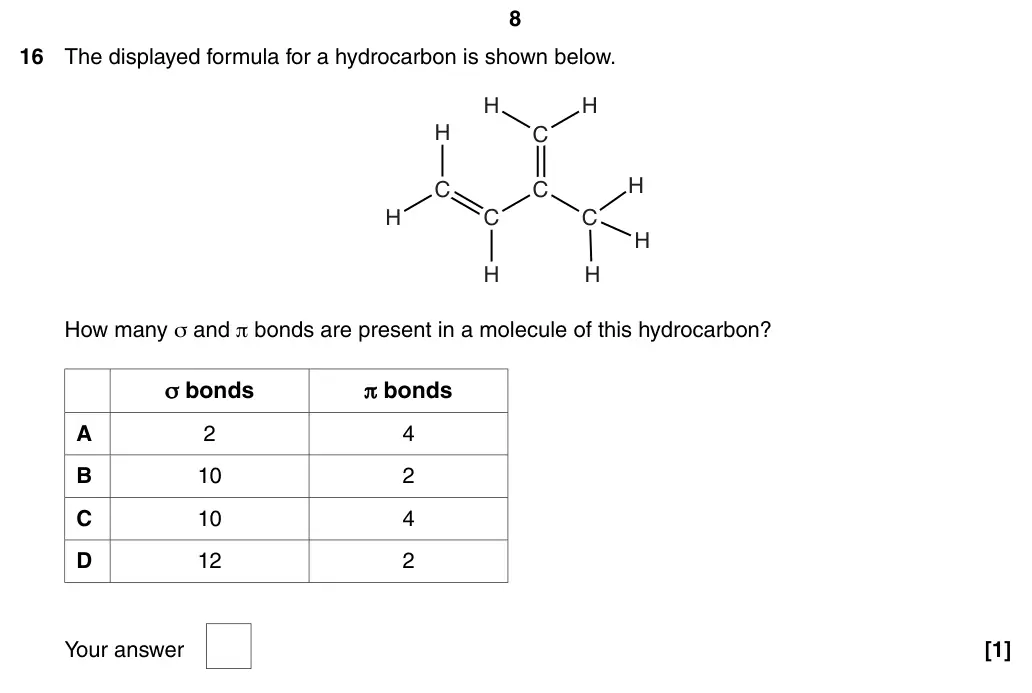
16 The displayed formula for a hydrocarbon is shown below.
H H
H C
C C H
H C C
H
H H
How many σ and π bonds are present in a molecule of this hydrocarbon?
σ bonds π bonds
A 2 4
B 10 2
C 10 4
D 12 2
Your answer [1]
June 2016 · AS Paper 1 · Q17 1 mark Multiple choice alkanes
17 Chlorine reacts with 1-chloropropane in the presence of ultraviolet radiation via a radical
substitution mechanism.
Which equation shows a propagation step in the mechanism for this reaction?
A Cl2 → •Cl + •Cl
B •Cl + •C3H6Cl → C3H6Cl2
C C3H7Cl + •Cl → C3H6Cl2 + •H
D •Cl + C3H7Cl → •C3H6Cl + HCl
Your answer [1]
June 2016 · AS Paper 1 · Q18 1 mark Multiple choice alcohols
9
18 Which alcohol can be oxidised by K2Cr2O7 and H2SO4 to form a ketone?
A
OH
B
OH
C
OH
OH
D
Your answer [1]
June 2016 · AS Paper 1 · Q19 1 mark Multiple choice alkeneshaloalkanes
10
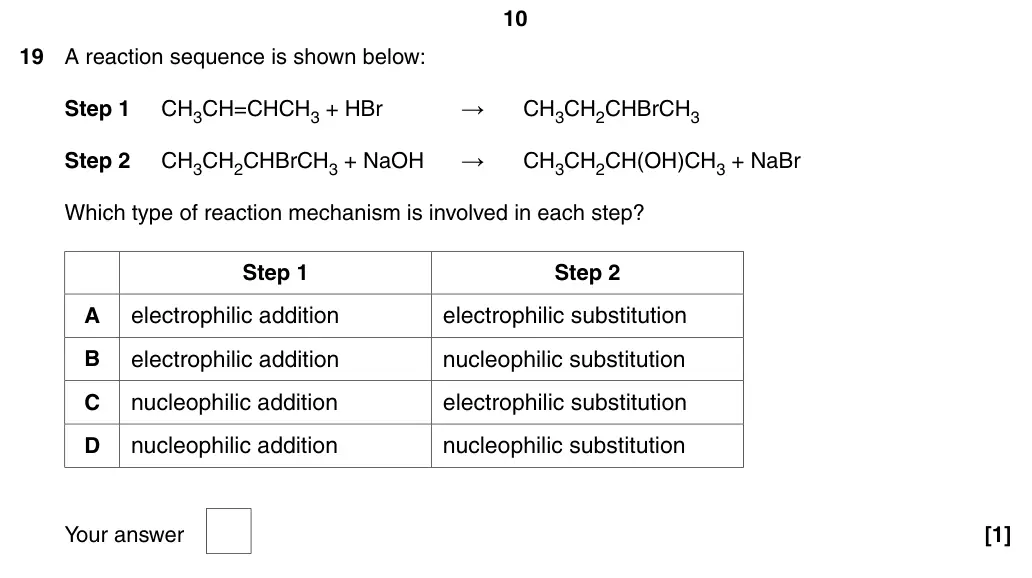
19 A reaction sequence is shown below:
Step 1 CH3CH=CHCH3 + HBr → CH3CH2CHBrCH3
Step 2 CH3CH2CHBrCH3 + NaOH → CH3CH2CH(OH)CH3 + NaBr
Which type of reaction mechanism is involved in each step?
Step 1 Step 2
A electrophilic addition electrophilic substitution
B electrophilic addition nucleophilic substitution
C nucleophilic addition electrophilic substitution
D nucleophilic addition nucleophilic substitution
Your answer [1]
June 2016 · AS Paper 1 · Q20 1 mark Multiple choice haloalkanes
20 When heated with NaOH(aq), 1-iodobutane is hydrolysed at a much faster rate than 1-chlorobutane.
Which statement explains the different rates?
A The C–I bond enthalpy is greater than the C–Cl bond enthalpy.
B The C–I bond is less polar than the C–Cl bond.
C The C–I bond has a C atom with a greater δ+ charge than in the C–Cl bond.
D The C–I bond requires less energy to break than the C–Cl bond.
Your answer [1]
June 2016 · AS Paper 1 · Q21(a) 2 marks AO1 Short answer atomic structure and isotopes
12
SECTION B
Answer all the questions.
21 A twenty pence coin contains copper and nickel.
(a) Copper and nickel each exist as a mixture of isotopes.
State the similarities and differences between the atomic structure of isotopes of the same
element.
Similarities  ................................................................................................................................
...................................................................................................................................................
Differences  ................................................................................................................................
...................................................................................................................................................
[2]
June 2016 · AS Paper 1 · Q21(b)(i) 2 marks AO1 Calculation atomic structure and isotopes
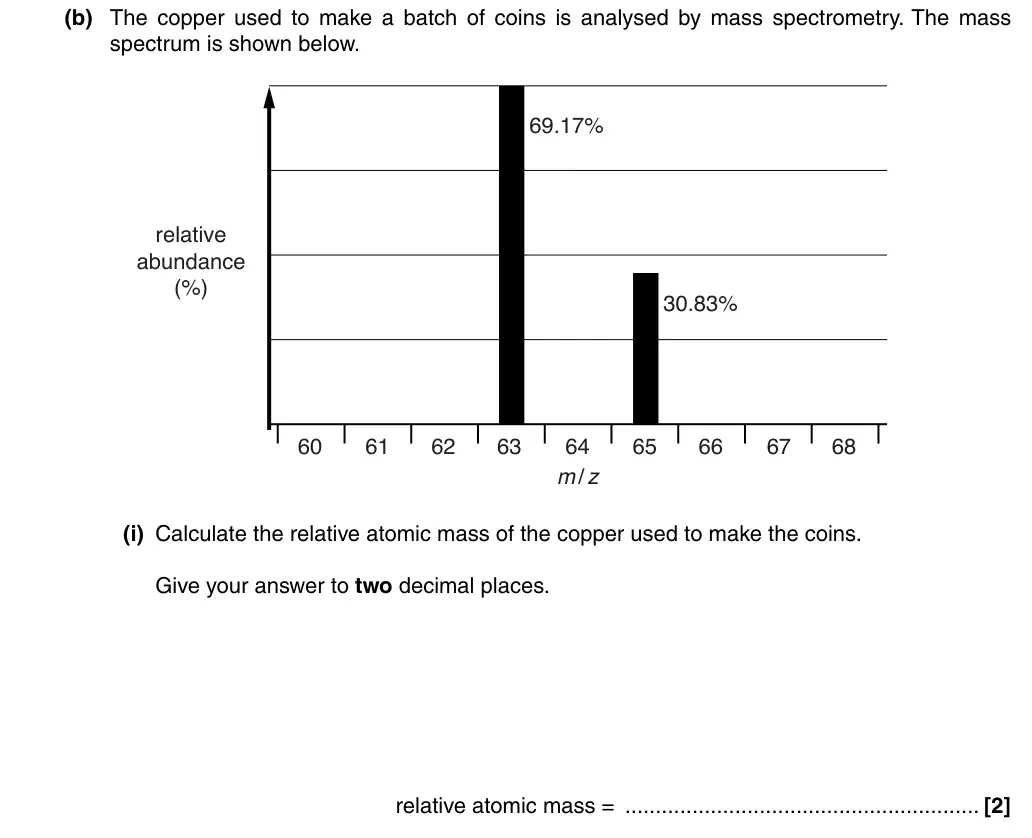
(b) The copper used to make a batch of coins is analysed by mass spectrometry. The mass
spectrum is shown below.
69.17%
relative
abundance
(%)
30.83%
60 61 62 63 64 65 66 67 68
m / z
(i) Calculate the relative atomic mass of the copper used to make the coins.
Give your answer to two decimal places.
relative atomic mass =  .......................................................... [2]
June 2016 · AS Paper 1 · Q21(b)(ii) 2 marks AO2 Calculation amount of substance
Earlier part of question 21 that this part usesEarlier part of June 2016 Paper 1 question 21
13
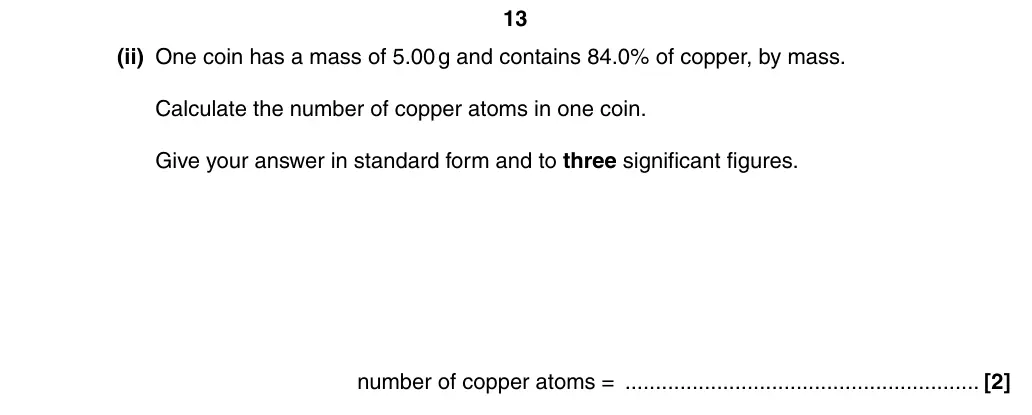
(ii) One coin has a mass of 5.00 g and contains 84.0% of copper, by mass.
Calculate the number of copper atoms in one coin.
Give your answer in standard form and to three significant figures.
number of copper atoms =  .......................................................... [2]
June 2016 · AS Paper 1 · Q21(c)(i) 1 mark AO1 Equation writing acids and titrations
(c) Nickel(II) nitrate, Ni(NO3)2, can be prepared by reacting nickel(II) oxide with dilute nitric acid.
(i) Write the equation for this reaction.
...................................................................................................................................... [1]
June 2016 · AS Paper 1 · Q21(c)(ii) 2 marks AO2 Drawing / labelling bonding and structure
Earlier part of question 21 that this part usesEarlier part of June 2016 Paper 1 question 21
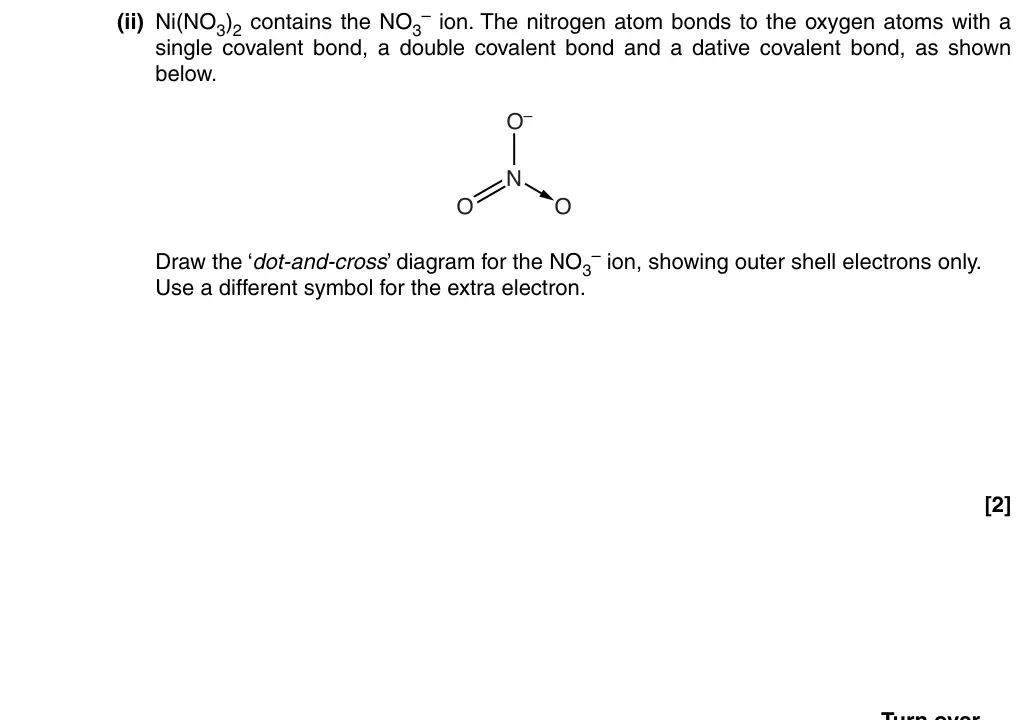
(ii) Ni(NO3)2 contains the NO3 – ion. The nitrogen atom bonds to the oxygen atoms with a
single covalent bond, a double covalent bond and a dative covalent bond, as shown
below.
O–
N
O O
Draw the ‘dot-and-cross’ diagram for the NO3 – ion, showing outer shell electrons only.
Use a different symbol for the extra electron.
[2]
June 2016 · AS Paper 1 · Q22(a) 3 marks AO1, 2 Calculation amount of substance
14
22 This question is about several salts.
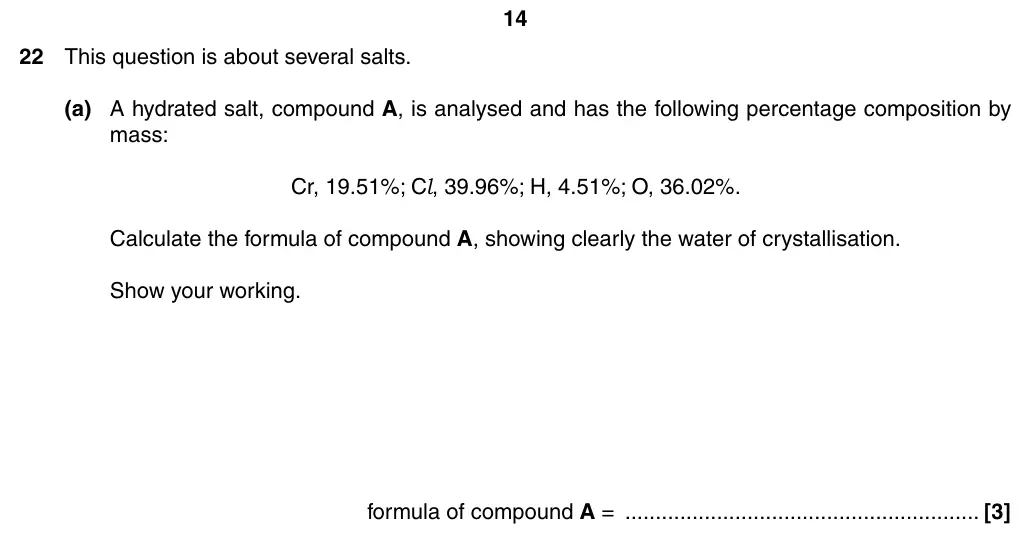
(a) A hydrated salt, compound A, is analysed and has the following percentage composition by
mass:
Cr, 19.51%; Cl, 39.96%; H, 4.51%; O, 36.02%.
Calculate the formula of compound A, showing clearly the water of crystallisation.
Show your working.
formula of compound A =  .......................................................... [3]
June 2016 · AS Paper 1 · Q22(b)(i) 1 mark AO2 Calculation practical skills
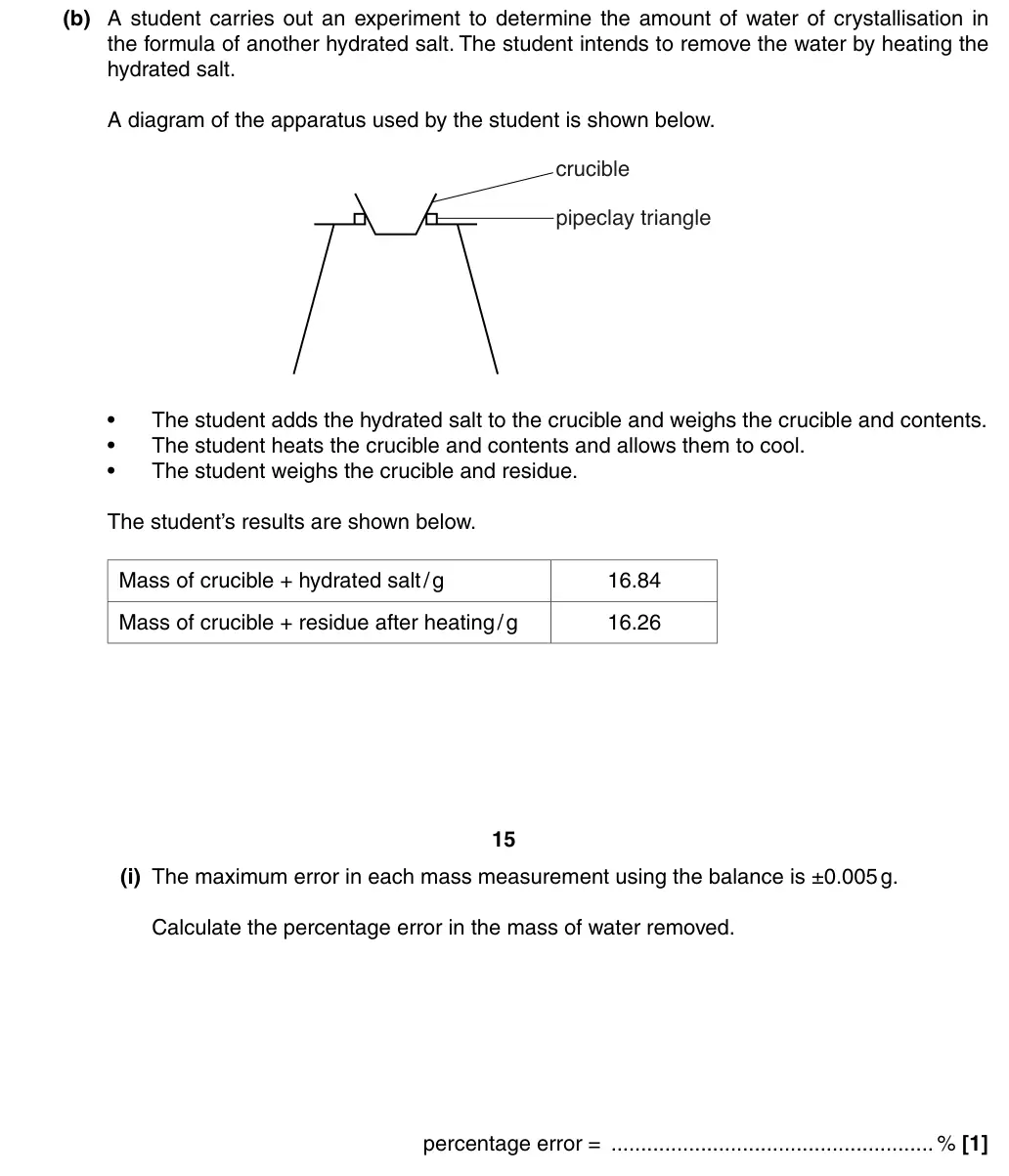
(b) A student carries out an experiment to determine the amount of water of crystallisation in
the formula of another hydrated salt. The student intends to remove the water by heating the
hydrated salt.
A diagram of the apparatus used by the student is shown below.
crucible
pipeclay triangle
• The student adds the hydrated salt to the crucible and weighs the crucible and contents.
• The student heats the crucible and contents and allows them to cool.
• The student weighs the crucible and residue.
The student’s results are shown below.
Mass of crucible + hydrated salt / g 16.84
Mass of crucible + residue after heating / g 16.26
15
(i) The maximum error in each mass measurement using the balance is ±0.005 g.
Calculate the percentage error in the mass of water removed.
percentage error =  ......................................................% [1]
June 2016 · AS Paper 1 · Q22(b)(ii) 1 mark AO3 Short answer practical skills
Earlier part of question 22 that this part usesEarlier part of June 2016 Paper 1 question 22
(ii) Suggest one modification that the student could make to their method to reduce the
percentage error in the mass of water removed.
...........................................................................................................................................
...........................................................................................................................................
...................................................................................................................................... [1]
June 2016 · AS Paper 1 · Q22(b)(iii) 1 mark AO3 Short answer amount of substancepractical skills
Earlier part of question 22 that this part usesEarlier part of June 2016 Paper 1 question 22
(iii) The student is not sure that all the water of crystallisation has been removed.
How could the student modify the experiment to be confident that all the water of
crystallisation has been removed?
...........................................................................................................................................
...........................................................................................................................................
...................................................................................................................................... [1]
June 2016 · AS Paper 1 · Q22(c) 3 marks AO2 Calculation acids and titrationsamount of substance
16
(c) A student prepares a solution of sodium sulfate, Na2SO4, by adding 6.25 × 10⁻² mol dm–3
sulfuric acid, H2SO4, from a burette to 25.0 cm3 of 0.124 mol dm–3 NaOH in a conical flask.
2NaOH(aq) + H2SO4(aq) → Na2SO4(aq) + 2H2O(l)
Calculate the minimum volume of the H2SO4 that the student would need to completely react
with the NaOH present.
volume of H2SO4 =  .................................................. cm3 [3]
June 2016 · AS Paper 1 · Q22(d) 2 marks AO1 Short answer redox
(d) Salts can also be prepared in redox reactions of metals with acids.
A student prepares a solution of aluminium sulfate by reacting aluminium with dilute sulfuric
acid.
2Al(s) + 3H2SO4(aq) → Al2(SO4)3(aq) + 3H2(g)
Using oxidation numbers, show which element has been oxidised and which has been
reduced in this reaction. State the changes in oxidation numbers, including all signs.
element oxidised .....................................................................
oxidation number change: from ................ to  .........................
element reduced  ....................................................................
oxidation number change: from ................ to ..........................
[2]
June 2016 · AS Paper 1 · Q23(a)(i) 1 mark AO1 Short answer electron structure
17
23 This question is about properties of the halogens and halide ions.
(a) Bromine can be extracted by bubbling chlorine gas through concentrated solutions containing
bromide ions.
(i) Write the electron configuration of a bromide ion, in terms of sub-shells.
...................................................................................................................................... [1]
June 2016 · AS Paper 1 · Q23(a)(ii) 2 marks AO1 Equation writing halogensformulae and equations
Earlier part of question 23 that this part usesEarlier part of June 2016 Paper 1 question 23
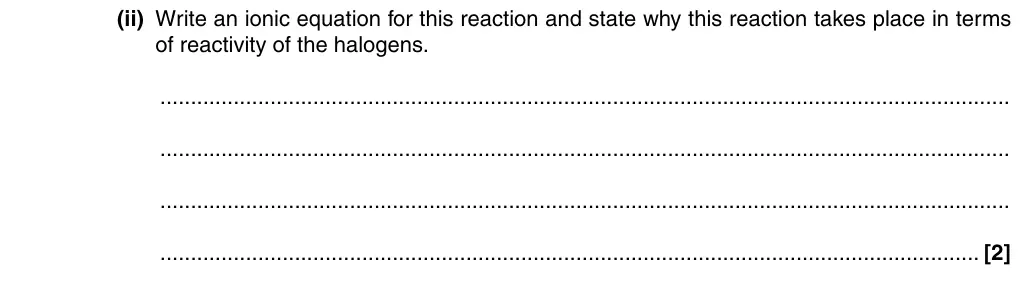
(ii) Write an ionic equation for this reaction and state why this reaction takes place in terms
of reactivity of the halogens.
...........................................................................................................................................
...........................................................................................................................................
...........................................................................................................................................
...................................................................................................................................... [2]
June 2016 · AS Paper 1 · Q23(b) 1 mark AO1 Short answer halogens
(b) Chlorine is used in water treatment.
State one benefit and one risk of chlorine in water treatment.
Benefit .......................................................................................................................................
...................................................................................................................................................
Risk  ...........................................................................................................................................
.............................................................................................................................................. [1]
June 2016 · AS Paper 1 · Q23(c)(i) 1 mark AO1 Short answer halogens
(c) Precipitation reactions can be used to distinguish between halide ions.
(i) State the reagent needed for these precipitation reactions.
...................................................................................................................................... [1]
June 2016 · AS Paper 1 · Q23(c)(ii) 1 mark AO1 Short answer halogensqualitative analysis
Earlier part of question 23 that this part usesEarlier part of June 2016 Paper 1 question 23
(ii) How would the appearance of the precipitates allow you to distinguish between chloride,
bromide and iodide ions?
Chloride  .............................................................................................................................
Bromide  .............................................................................................................................
Iodide  ................................................................................................................................
[1]
June 2016 · AS Paper 1 · Q24(a) 4 marks AO2 Calculation enthalpy changesamount of substance
18
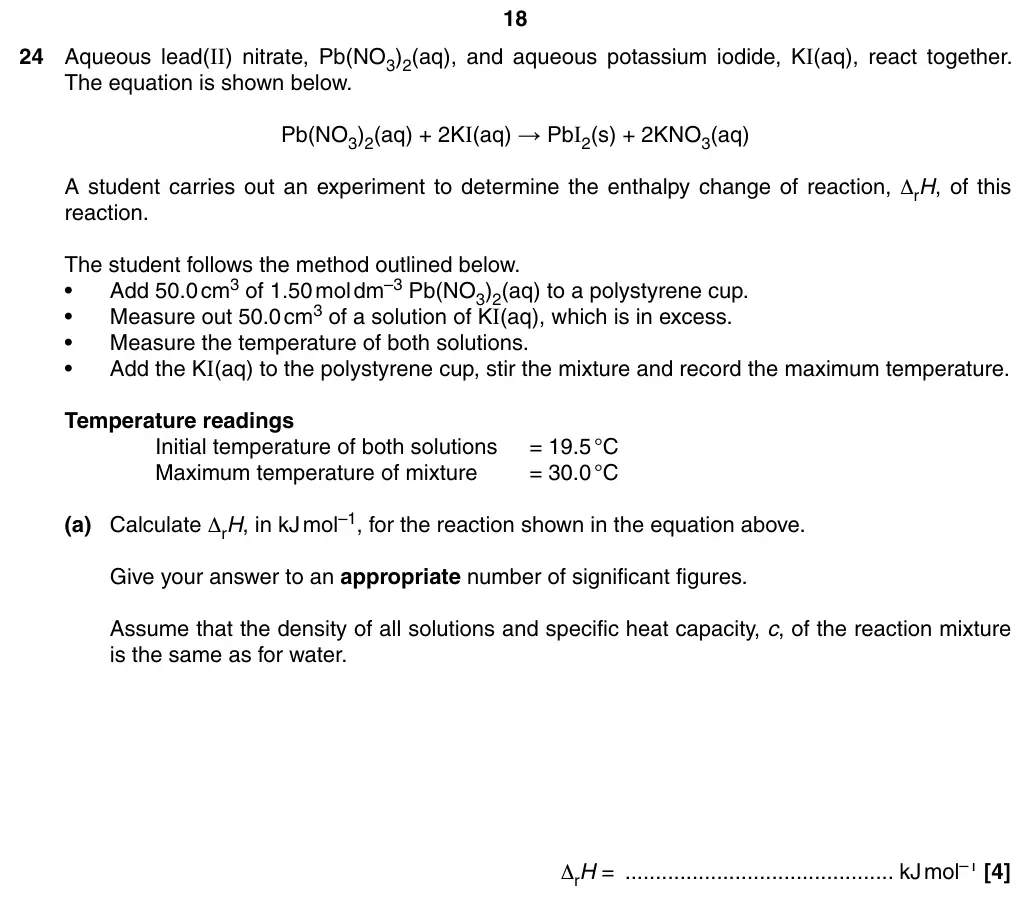
24 Aqueous lead(II) nitrate, Pb(NO3)2(aq), and aqueous potassium iodide, KI(aq), react together.
The equation is shown below.
Pb(NO3)2(aq) + 2KI(aq) → PbI2(s) + 2KNO3(aq)
A student carries out an experiment to determine the enthalpy change of reaction, ΔrH, of this
reaction.
The student follows the method outlined below.
• Add 50.0 cm3 of 1.50 mol dm–3 Pb(NO3)2(aq) to a polystyrene cup.
• Measure out 50.0 cm3 of a solution of KI(aq), which is in excess.
• Measure the temperature of both solutions.
• Add the KI(aq) to the polystyrene cup, stir the mixture and record the maximum temperature.
Temperature readings
Initial temperature of both solutions = 19.5 °C
Maximum temperature of mixture = 30.0 °C
(a) Calculate ΔrH, in kJ mol–1, for the reaction shown in the equation above.
Give your answer to an appropriate number of significant figures.
Assume that the density of all solutions and specific heat capacity, c, of the reaction mixture
is the same as for water.
ΔrH =  ............................................ kJ mol–1 [4]
June 2016 · AS Paper 1 · Q24(b) 1 mark AO2 Equation writing formulae and equations
Earlier part of question 24 that this part usesEarlier part of June 2016 Paper 1 question 24
19
(b) Write an ionic equation for the reaction that the student carries out.
Include state symbols.
.............................................................................................................................................. [1]
June 2016 · AS Paper 1 · Q24(c) 2 marks AO2 Calculation amount of substance
Earlier part of question 24 that this part usesEarlier part of June 2016 Paper 1 question 24
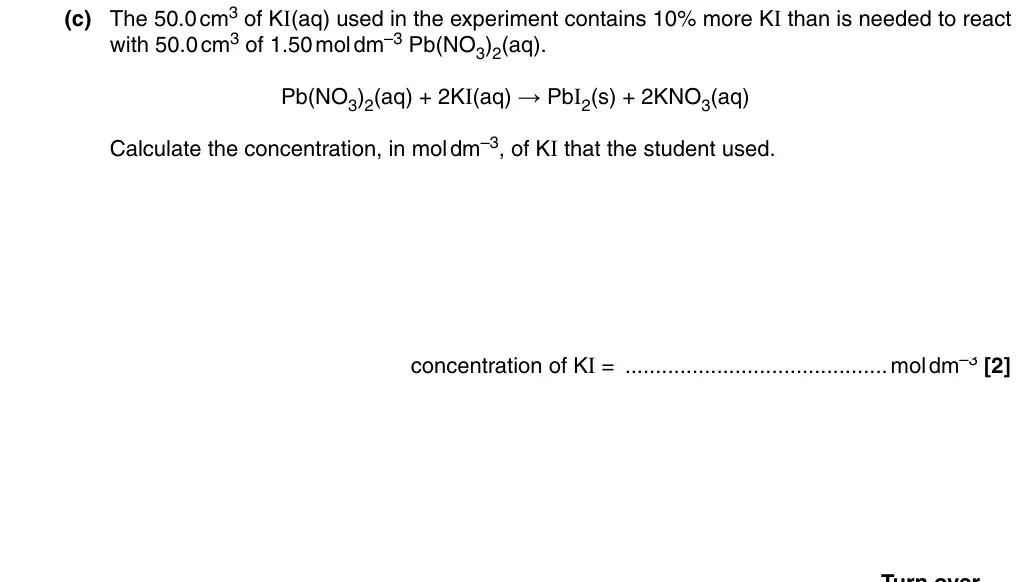
(c) The 50.0 cm3 of KI(aq) used in the experiment contains 10% more KI than is needed to react
with 50.0 cm3 of 1.50 mol dm–3 Pb(NO3)2(aq).
Pb(NO3)2(aq) + 2KI(aq) → PbI2(s) + 2KNO3(aq)
Calculate the concentration, in mol dm–3, of KI that the student used.
concentration of KI =  ...........................................mol dm–3 [2]
June 2016 · AS Paper 1 · Q25(a) 5 marks AO1, 3 Extended response chemical equilibrium
20
25 Sulfur trioxide, SO3, is used for the industrial manufacture of sulfuric acid.
SO3 is produced by reacting sulfur dioxide, SO2, and oxygen, O2, as shown in equilibrium 25.1
below.
Equilibrium 25.1   2SO2(g) + O2(g) 2SO3(g) ΔH = –197 kJ mol–1
(a) Le Chatelier’s principle can be used to predict how different conditions affect the equilibrium
position.
• Using le Chatelier’s principle, show that a low temperature and a high pressure should
be used to obtain a maximum equilibrium yield of SO3.
• Explain why the actual conditions used in industry may be different from the conditions
needed for a maximum equilibrium yield.
...................................................................................................................................................
...................................................................................................................................................
...................................................................................................................................................
...................................................................................................................................................
...................................................................................................................................................
...................................................................................................................................................
...................................................................................................................................................
...................................................................................................................................................
...................................................................................................................................................
.............................................................................................................................................. [5]
June 2016 · AS Paper 1 · Q25(b) 4 marks AO1, 2, 3 Calculation chemical equilibrium
Earlier part of question 25 that this part usesEarlier part of June 2016 Paper 1 question 25
21
(b) Under certain conditions, Kc for equilibrium 25.1 is 0.160 dm3 mol–1.
The equilibrium mixture under these conditions has the following concentrations of SO2 and O2.
Species Equilibrium concentration
/ mol dm–3
SO2 2.00
O2 1.20
• Using the value of Kc, explain whether the equilibrium position will be towards the right or
towards the left under these conditions.
• Calculate the concentration of SO3 in the equilibrium mixture.
...................................................................................................................................................
...................................................................................................................................................
...................................................................................................................................................
...................................................................................................................................................
...................................................................................................................................................
...................................................................................................................................................
...................................................................................................................................................
...................................................................................................................................................
.............................................................................................................................................. [4]
June 2016 · AS Paper 1 · Q26(a)(i) 1 mark AO1 Short answer organic basics
22
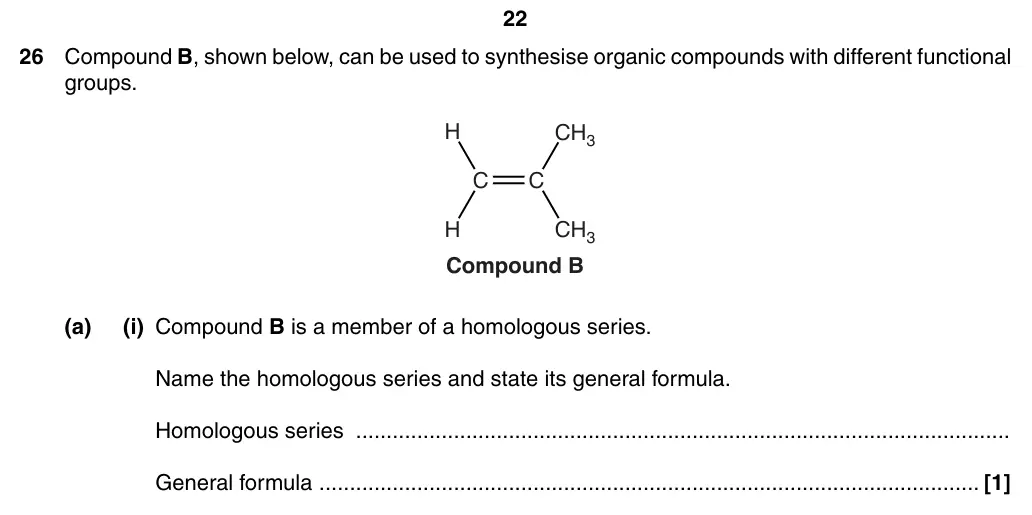
26 Compound B, shown below, can be used to synthesise organic compounds with different functional
groups.
H CH3
C C
H CH3
Compound B
(a) (i) Compound B is a member of a homologous series.
Name the homologous series and state its general formula.
Homologous series  ...........................................................................................................
General formula  ............................................................................................................ [1]
June 2016 · AS Paper 1 · Q26(a)(ii) 1 mark AO1 Short answer alkenes
Earlier part of question 26 that this part usesEarlier part of June 2016 Paper 1 question 26
(ii) What reagents and conditions are needed to convert compound B into a saturated
hydrocarbon?
...................................................................................................................................... [1]
June 2016 · AS Paper 1 · Q26(b) 2 marks AO2 Structure / isomer alcoholsalkenes
Earlier part of question 26 that this part usesEarlier part of June 2016 Paper 1 question 26
(b) Some reactions involving compound B are shown in the flowchart below.
Complete the flowchart, showing the structures of organic compounds C and D.
H CH3
concentrated
C C
H2SO4, heat
H CH3
Compound C Compound B
K2Cr2O7 / H2SO4 polymerisation
reflux
no reaction
Compound D (repeat unit)
[2]
June 2016 · AS Paper 1 · Q26(c)(i) 1 mark AO1 Short answer amount of substance
23
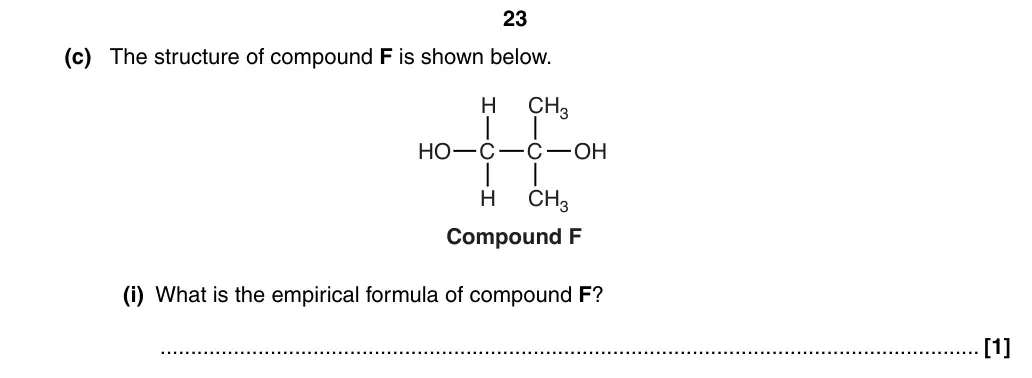
(c) The structure of compound F is shown below.
H CH3
HO C C OH
H CH3
Compound F
(i) What is the empirical formula of compound F?
...................................................................................................................................... [1]
June 2016 · AS Paper 1 · Q26(c)(ii) 3 marks AO3 Structure / isomer organic synthesis asalkeneshaloalkanes
Earlier parts of question 26 that this part usesEarlier part of June 2016 Paper 1 question 26Earlier part of June 2016 Paper 1 question 26
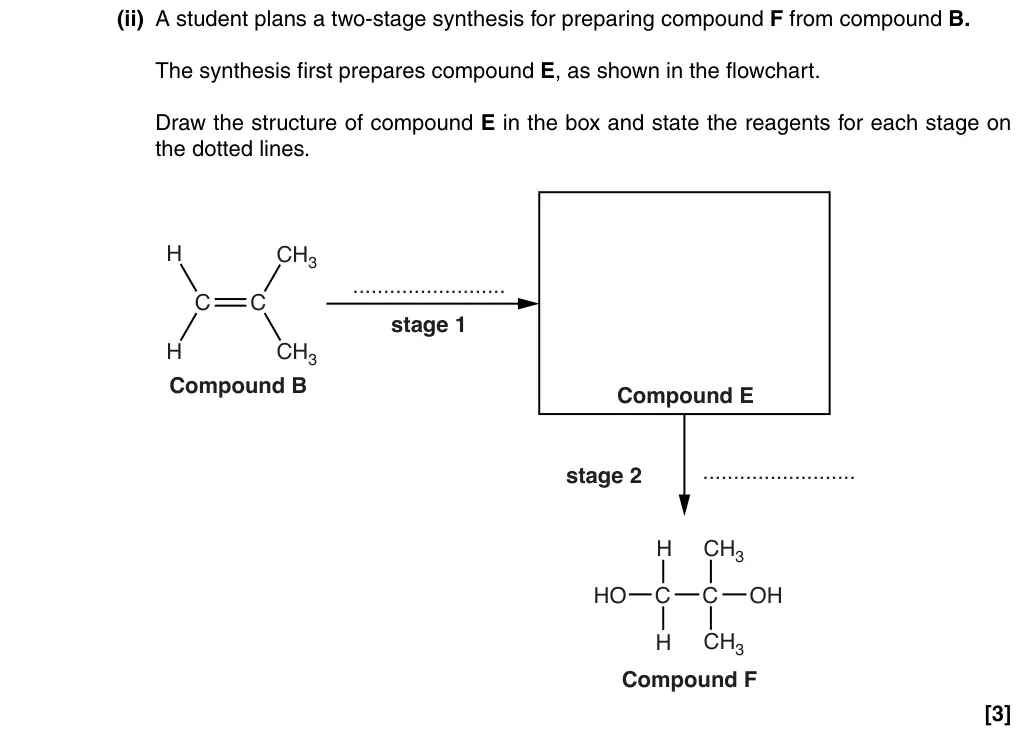
(ii) A student plans a two-stage synthesis for preparing compound F from compound B.
The synthesis first prepares compound E, as shown in the flowchart.
Draw the structure of compound E in the box and state the reagents for each stage on
the dotted lines.
H CH3
.........................
C C
stage 1
H CH3
Compound B
Compound E
stage 2 .........................
H CH3
HO C C OH
H CH3
Compound F
[3]

Work with an OCR chemistry tutor

Want a paper marked and gone through with you? Message us.

Prefer email? Send an enquiry

If you are under 18, please include a parent's contact details. Enquiries go to enquiries@chemistryaleveltutor.com and are deleted once handled. All tutoring is online.