June 2017: AS Paper 1, Breadth in chemistry

70 marks · 42 question parts · Paper, mark scheme and report on OCR's site · Have OCR's Data Sheet beside you

Question by question

QTopicMarksAOType
1 Atomic structure and isotopes 1Multiple choice
2 Amount of substance (moles) 1Multiple choice
3 Amount of substance (moles) 1Multiple choice
4 Amount of substance (moles) 1Multiple choice
5 Practical skills: planning, analysis and evaluation 1Multiple choice
6 Electron structure and orbitals 1Multiple choice
7 Bonding, structure and shapes of molecules 1Multiple choice
8 Periodicity and ionisation energy 1Multiple choice
9 The halogens, Bonding, structure and shapes of molecules 1Multiple choice
10 The halogens 1Multiple choice
11 Enthalpy changes and Hess’ law 1Multiple choice
12 Enthalpy changes and Hess’ law 1Multiple choice
13 Chemical equilibrium and Kc 1Multiple choice
14 Organic basics: naming, formulae and isomerism, Alkenes 1Multiple choice
15 Organic basics: naming, formulae and isomerism, Amount of substance (moles) 1Multiple choice
16 Organic basics: naming, formulae and isomerism 1Multiple choice
17 Alkanes 1Multiple choice
18 Alcohols, Alkenes 1Multiple choice
19 Alcohols, Infrared spectroscopy and mass spectrometry 1Multiple choice
20 Infrared spectroscopy and mass spectrometry 1Multiple choice
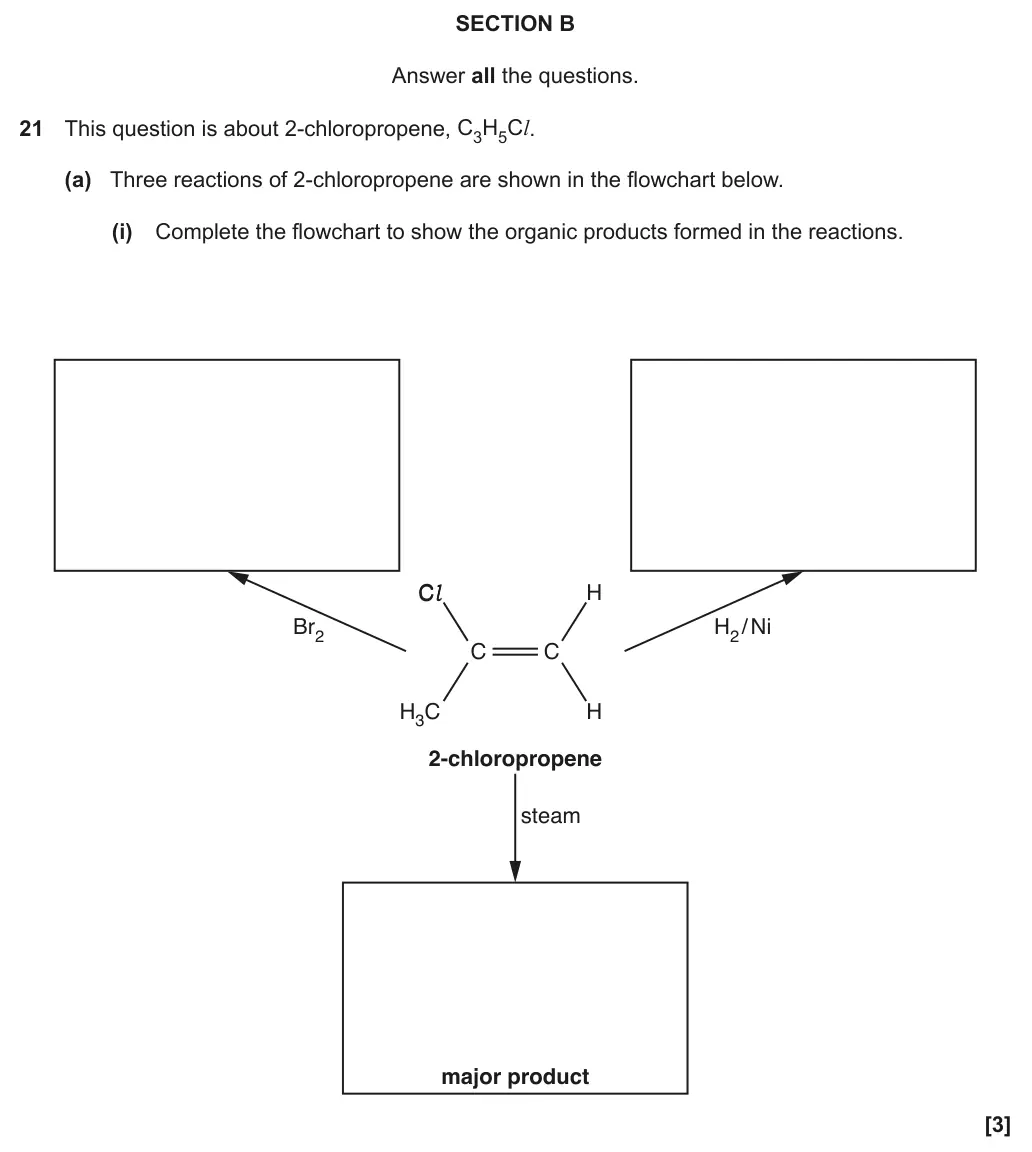
21(a)(i) Alkenes 3Short answer
21(a)(ii) Alkenes 1Short answer
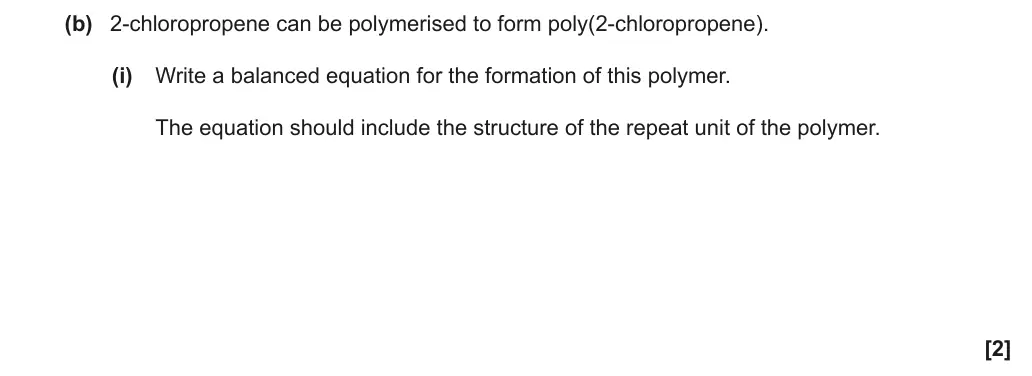
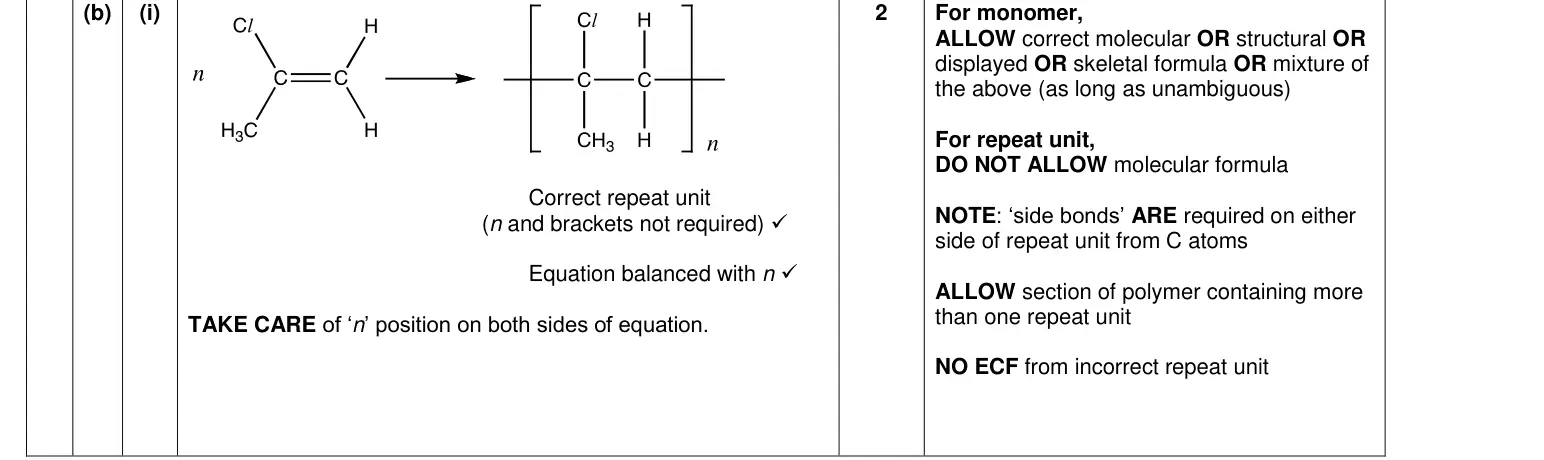
21(b)(i) Alkenes 2Equation writing
21(b)(ii) Alkenes 1Short answer
22(a)(i) Atomic structure and isotopes 2Complete table/diagram
22(a)(ii) Atomic structure and isotopes 2Calculation
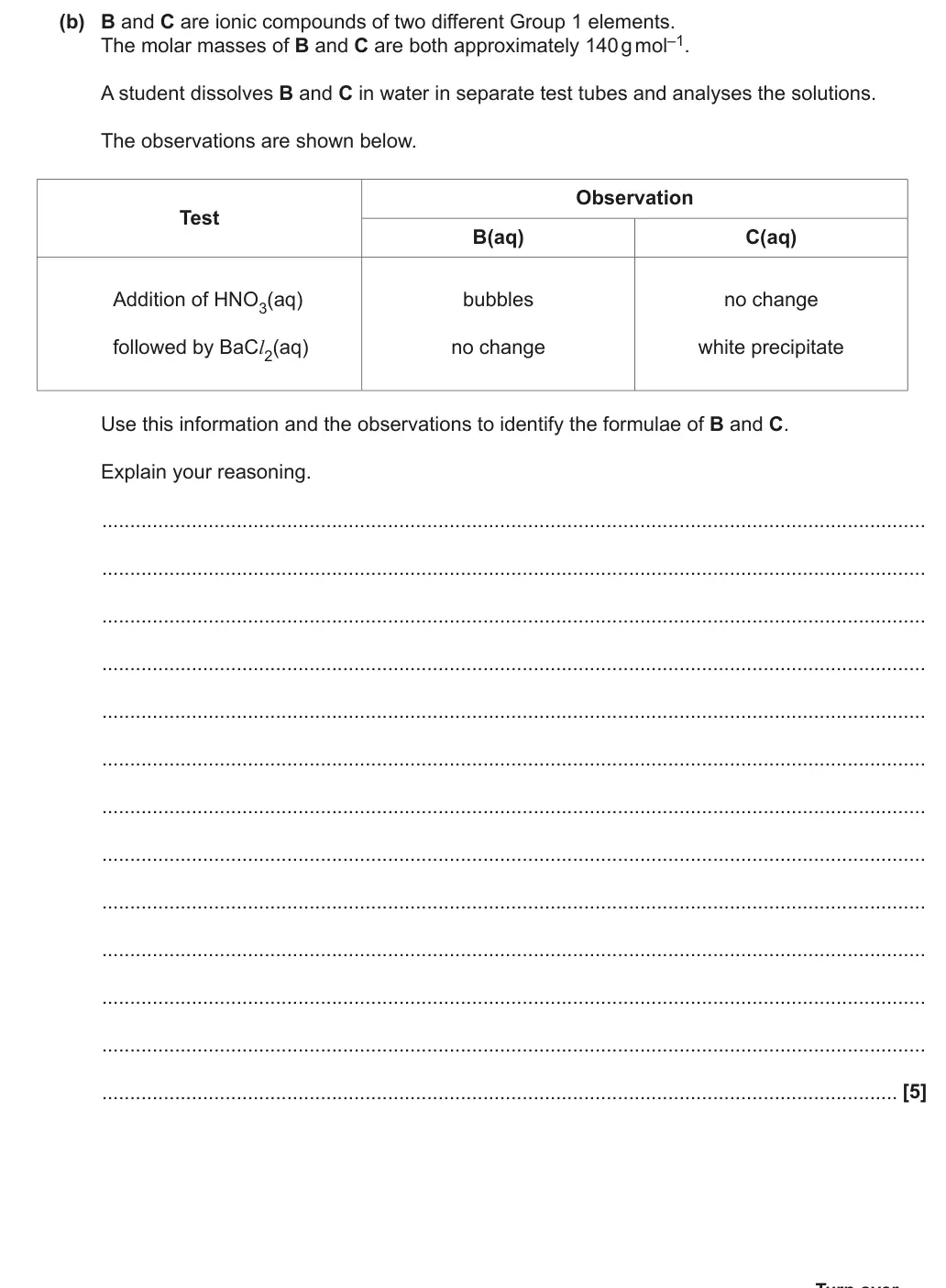
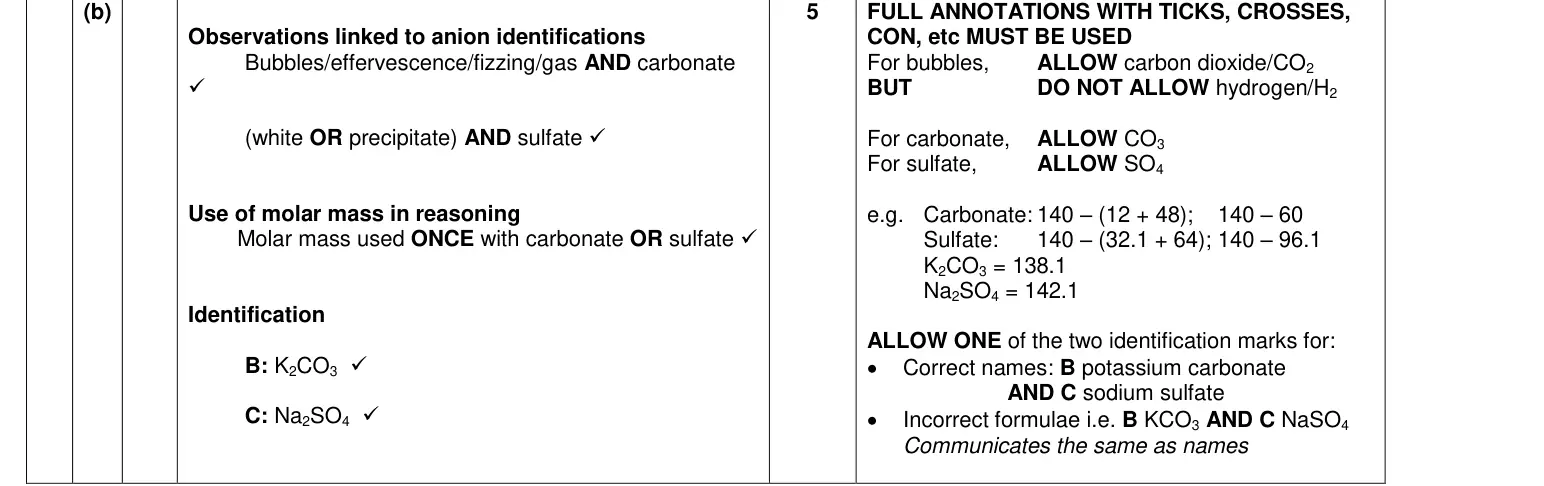
22(b) Qualitative analysis: tests for ions, Atomic structure and isotopes, Formulae and equations 5Extended response
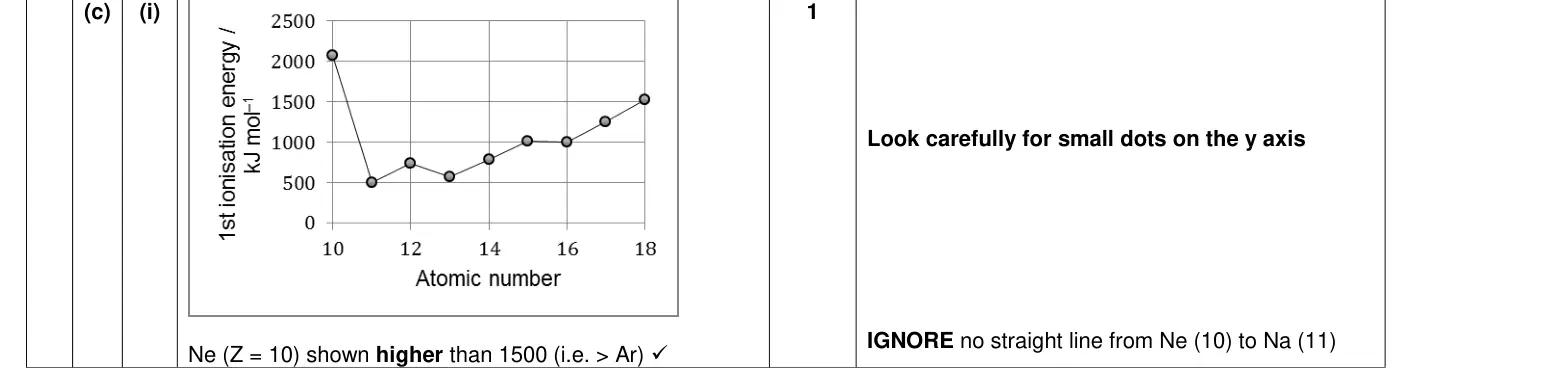
22(c)(i) Periodicity and ionisation energy 1Graph plotting
22(c)(ii) Periodicity and ionisation energy, Amount of substance (moles) 1Calculation
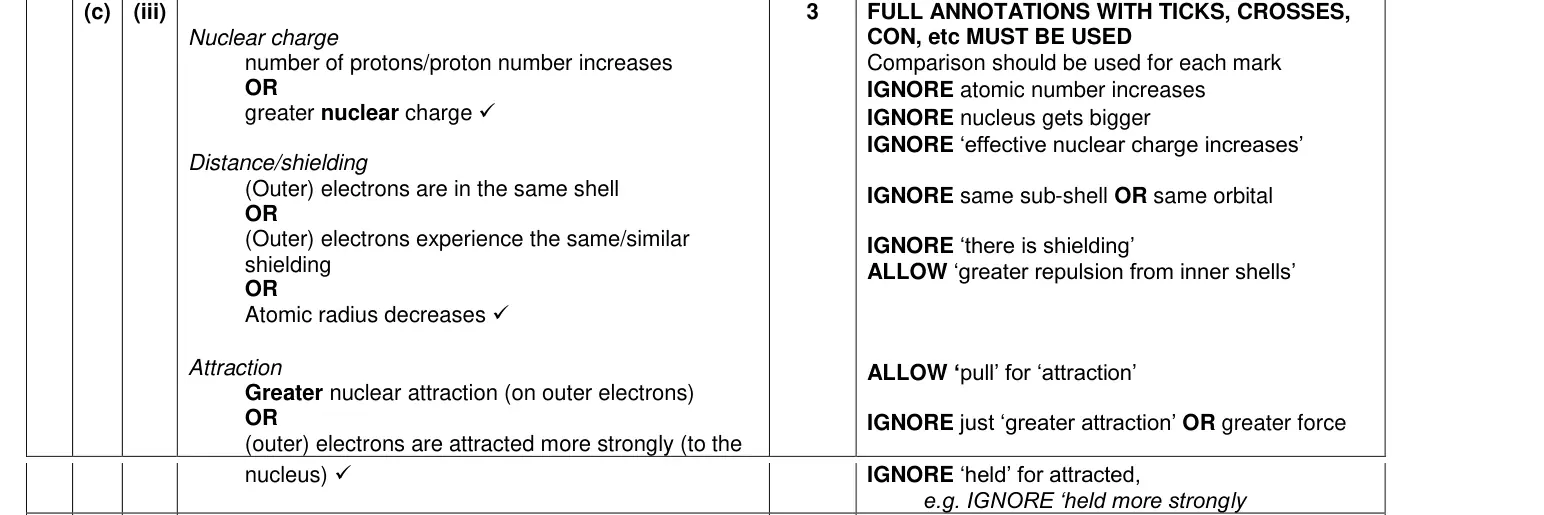
22(c)(iii) Periodicity and ionisation energy 3Data interpretation
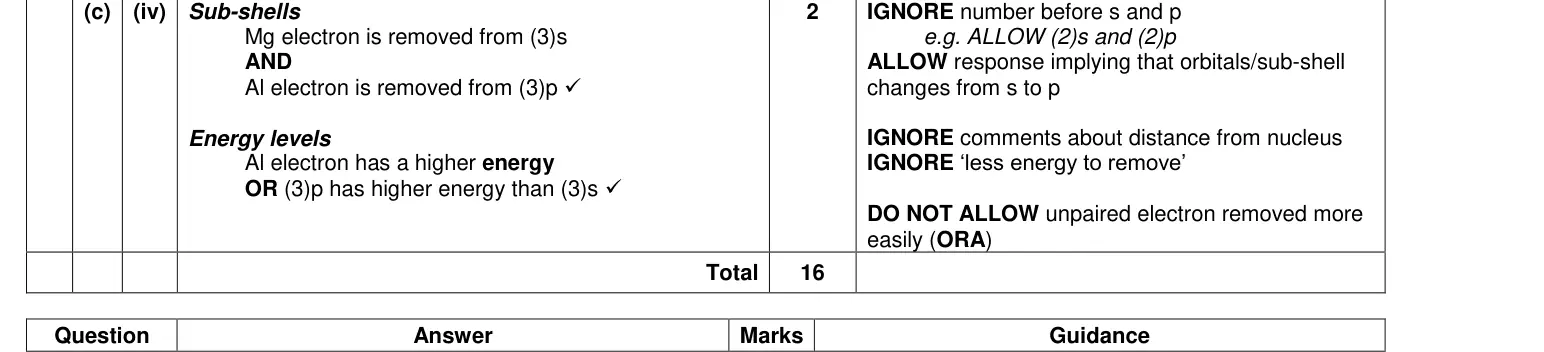
22(c)(iv) Periodicity and ionisation energy, Electron structure and orbitals 2Short answer
23(a) Reaction rates and the Boltzmann distribution 4Short answer
23(b) Reaction rates and the Boltzmann distribution 2Short answer
23(c) Chemical equilibrium and Kc 2Calculation
24(a) Acids, bases and titrations 1Short answer
24(b)(i) Formulae and equations, Redox and oxidation numbers 1Equation writing
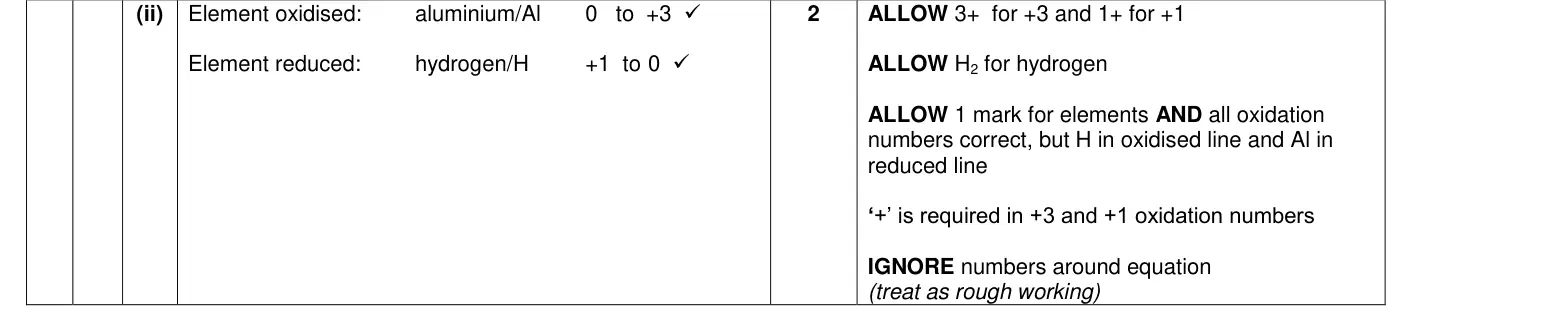
24(b)(ii) Redox and oxidation numbers 2Data interpretation
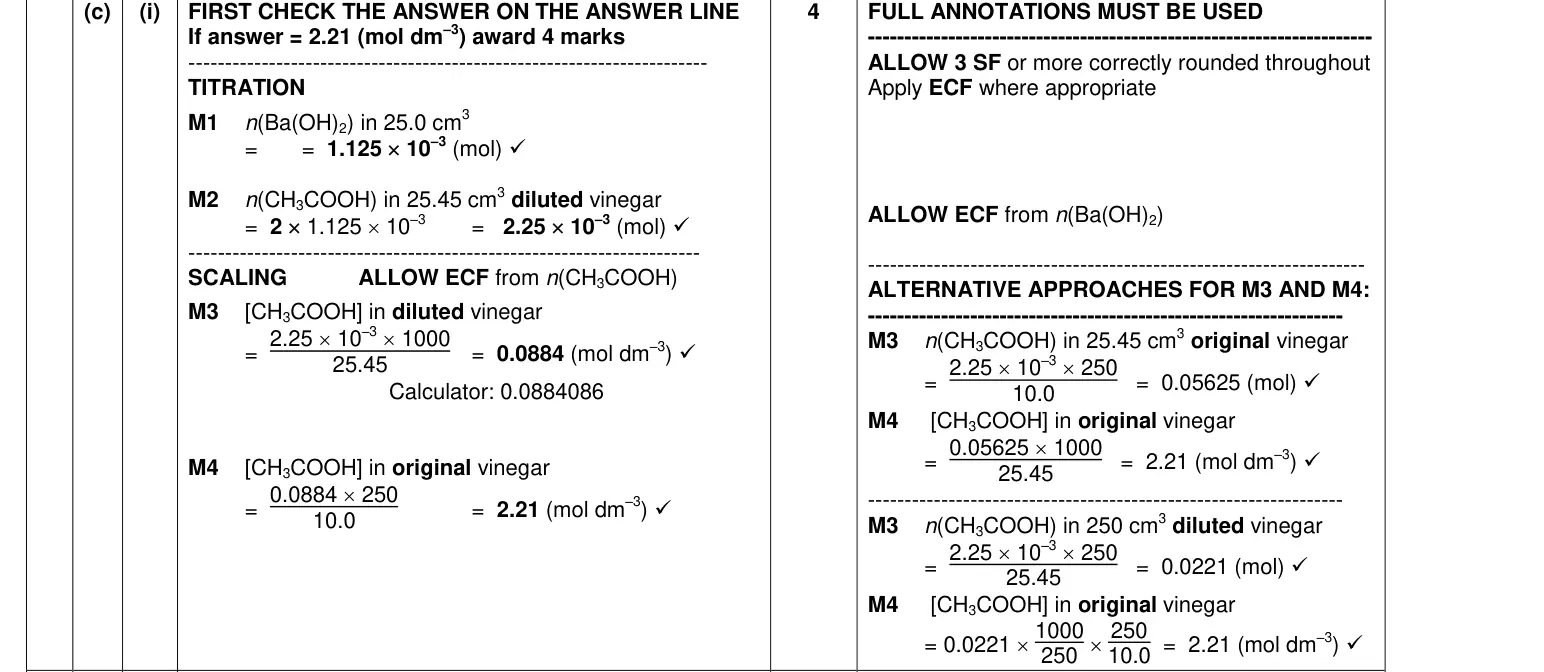
24(c)(i) Acids, bases and titrations, Amount of substance (moles) 4Calculation
24(c)(ii) Practical skills: planning, analysis and evaluation 2Short answer
25(a)(i) Enthalpy changes and Hess’ law 1Short answer
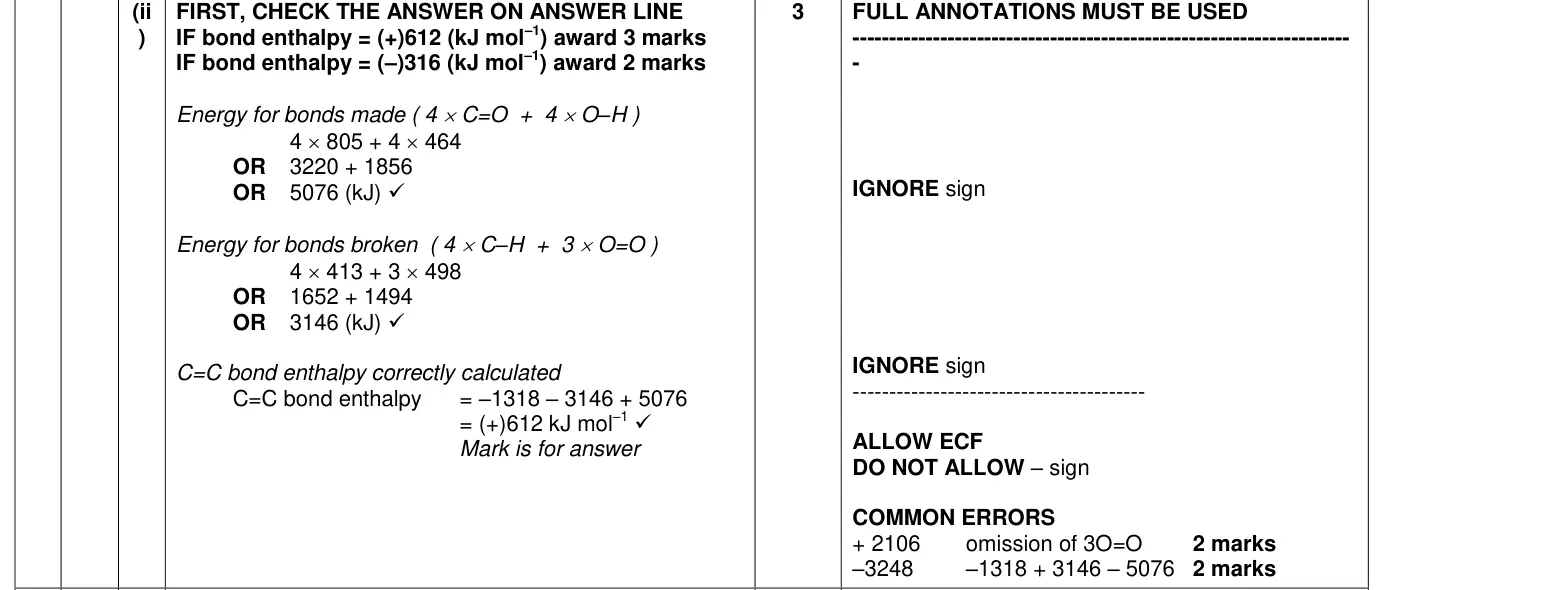
25(a)(ii) Enthalpy changes and Hess’ law 3Calculation
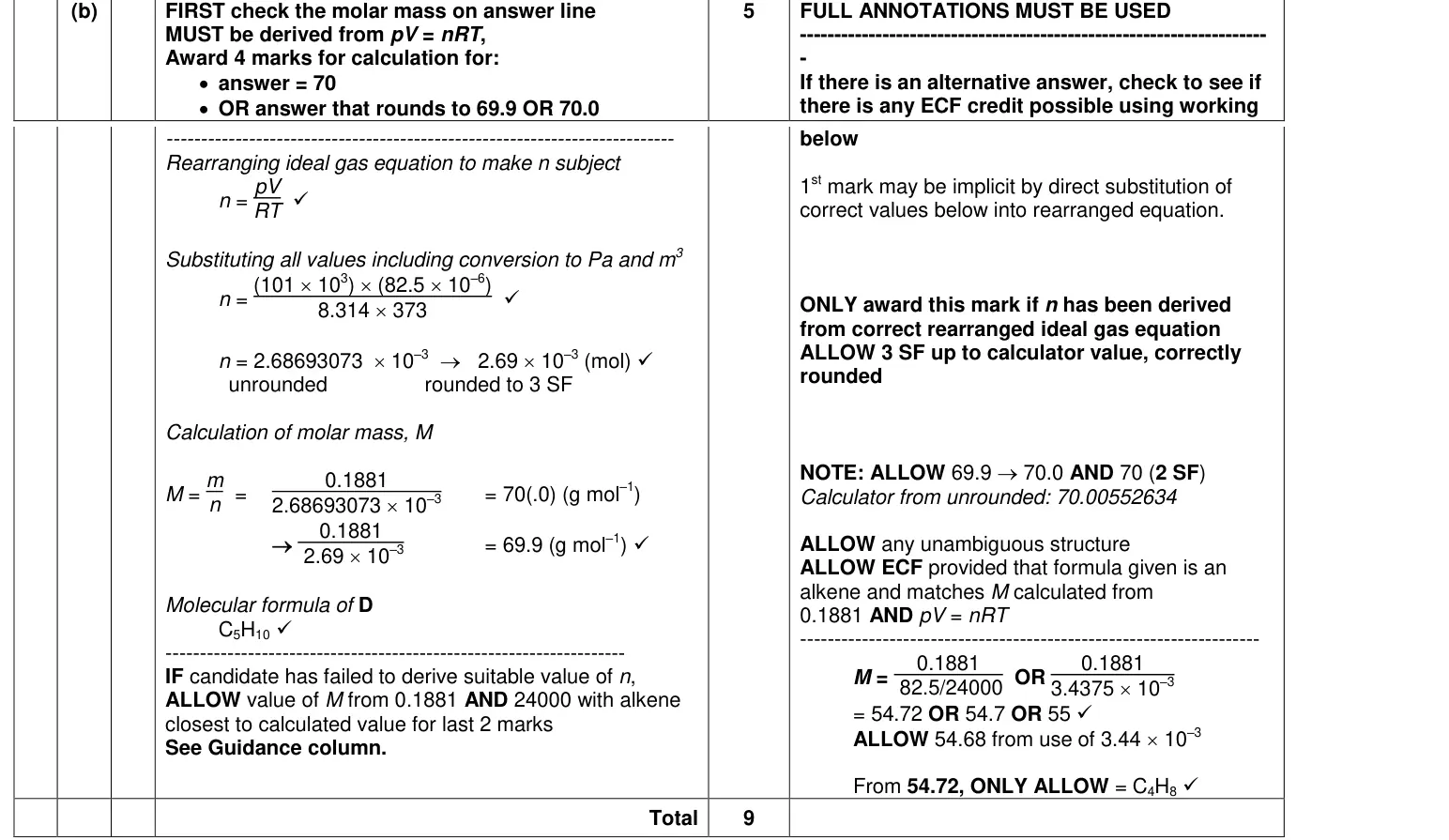
25(b) Amount of substance (moles), Organic basics: naming, formulae and isomerism 5Calculation

The questions

123456789101112131415161718192021(a)(i)21(a)(ii)21(b)(i)21(b)(ii)22(a)(i)22(a)(ii)22(b)22(c)(i)22(c)(ii)22(c)(iii)22(c)(iv)23(a)23(b)23(c)24(a)24(b)(i)24(b)(ii)24(c)(i)24(c)(ii)25(a)(i)25(a)(ii)25(b)
June 2017 · AS Paper 1 · Q1 1 mark Multiple choice atomic structure and isotopes
1 Which ion has a different number of electrons from the other three ions?
A Ga3+
B Cl −
C S2−
D Ca2+
Your answer [1]
June 2017 · AS Paper 1 · Q2 1 mark Multiple choice amount of substance
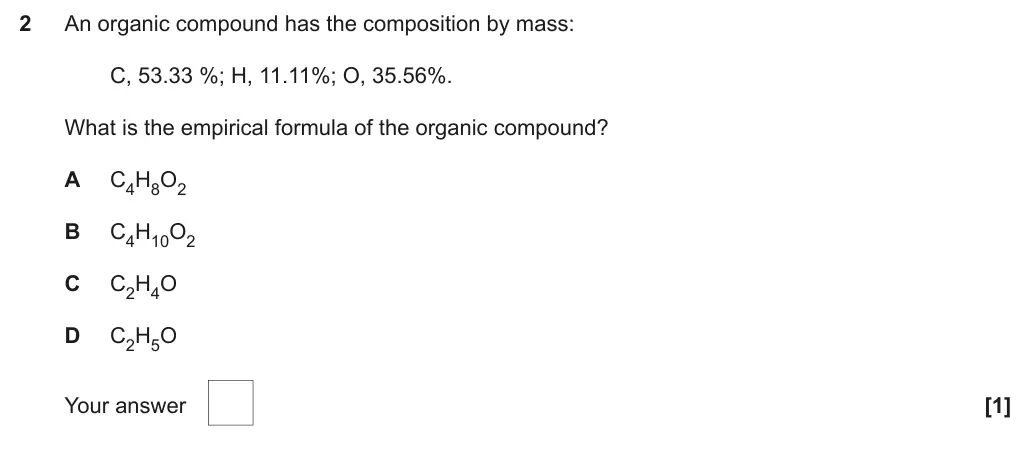
2 An organic compound has the composition by mass:
C, 53.33 %; H, 11.11%; O, 35.56%.
What is the empirical formula of the organic compound?
A C4H8O2
B C4H10O2
C C2H4O
D C2H5O
Your answer [1]
June 2017 · AS Paper 1 · Q3 1 mark Multiple choice amount of substance
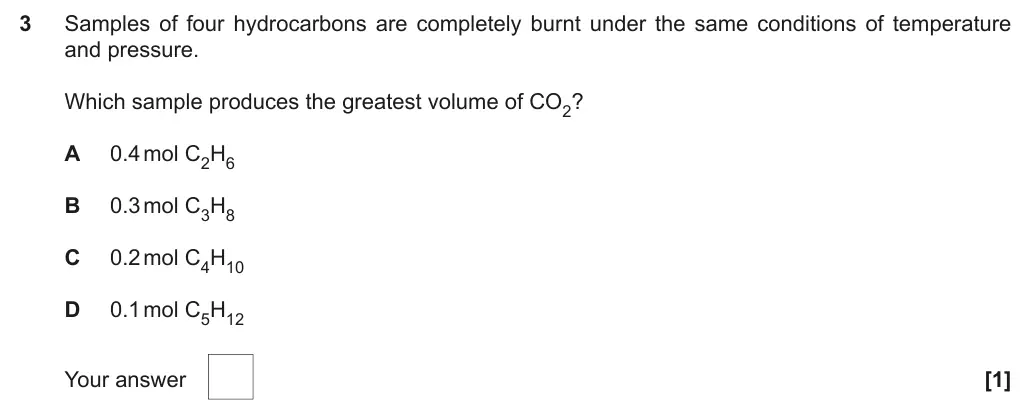
3 Samples of four hydrocarbons are completely burnt under the same conditions of temperature
and pressure.
Which sample produces the greatest volume of CO2?
A 0.4 mol C2H6
B 0.3 mol C3H8
C 0.2 mol C4H10
D 0.1 mol C5H12
Your answer [1]
June 2017 · AS Paper 1 · Q4 1 mark Multiple choice amount of substance
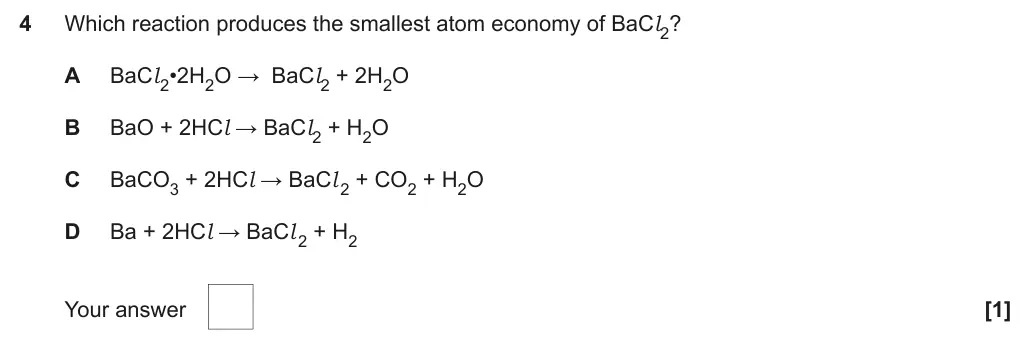
4 Which reaction produces the smallest atom economy of BaCl2?
A BaCl2•2H2O →  BaCl2 + 2H2O
B BaO + 2HCl → BaCl2 + H2O
C BaCO3 + 2HCl → BaCl 2 + CO2 + H2O
D Ba + 2HCl → BaCl 2 + H2
Your answer [1]
June 2017 · AS Paper 1 · Q5 1 mark Multiple choice practical skills
5 The burette readings from a titration are shown below.
Final reading / cm3 24.95
Initial reading / cm3 5.00
The burette used has an uncertainty of ±0.05 cm3 in each reading.
What is the percentage uncertainty of the resulting titre?
A 0.20%
B 0.25%
C 0.45%
D 0.50%
Your answer [1]
June 2017 · AS Paper 1 · Q6 1 mark Multiple choice electron structure
6 Which element has atoms with the greatest number of singly occupied orbitals?
A C
B Cl
C Ca
D Ga
Your answer [1]
June 2017 · AS Paper 1 · Q7 1 mark Multiple choice bonding and structure
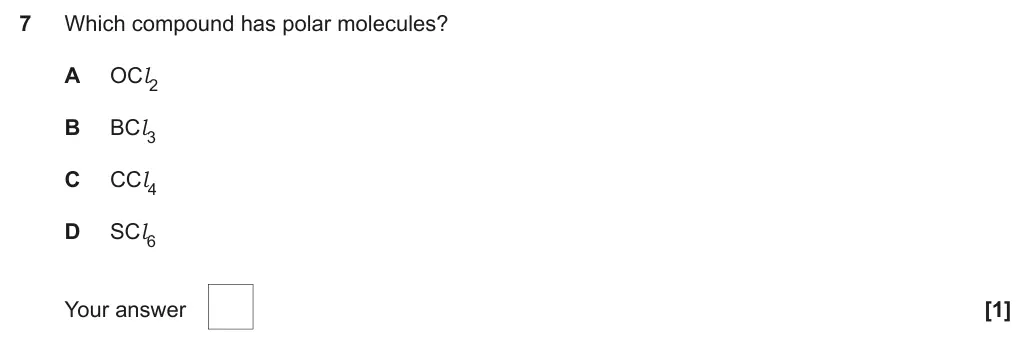
7 Which compound has polar molecules?
A OCl2
B BCl3
C CCl4
D SCl6
Your answer [1]
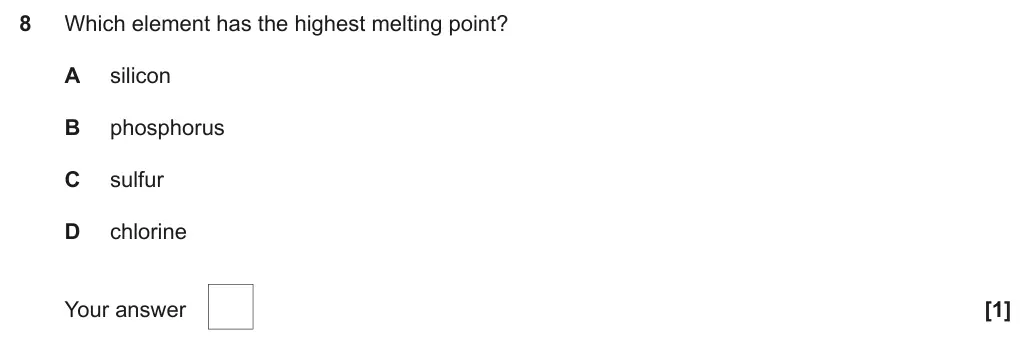
June 2017 · AS Paper 1 · Q8 1 mark Multiple choice periodicity
8 Which element has the highest melting point?
A silicon
B phosphorus
C sulfur
D chlorine
Your answer [1]
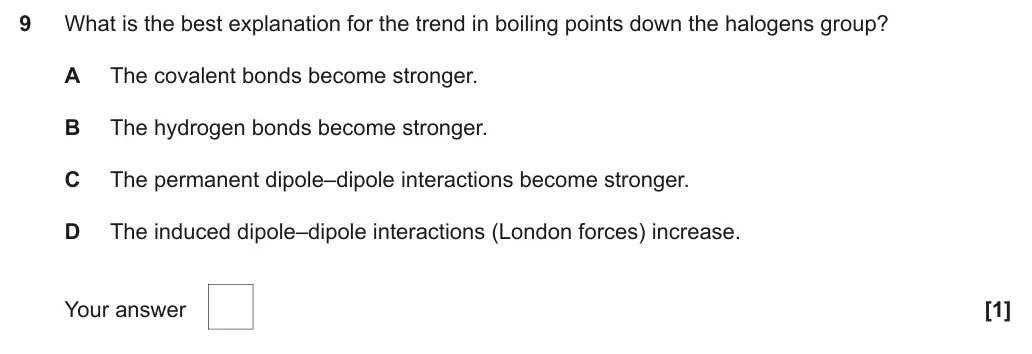
June 2017 · AS Paper 1 · Q9 1 mark Multiple choice halogensbonding and structure
9 What is the best explanation for the trend in boiling points down the halogens group?
A The covalent bonds become stronger.
B The hydrogen bonds become stronger.
C The permanent dipole–dipole interactions become stronger.
D The induced dipole–dipole interactions (London forces) increase.
Your answer [1]
June 2017 · AS Paper 1 · Q10 1 mark Multiple choice halogens
10 Which silver compound is insoluble in concentrated NH3(aq)?
A AgNO3
B AgCl
C AgBr
D AgI
Your answer [1]
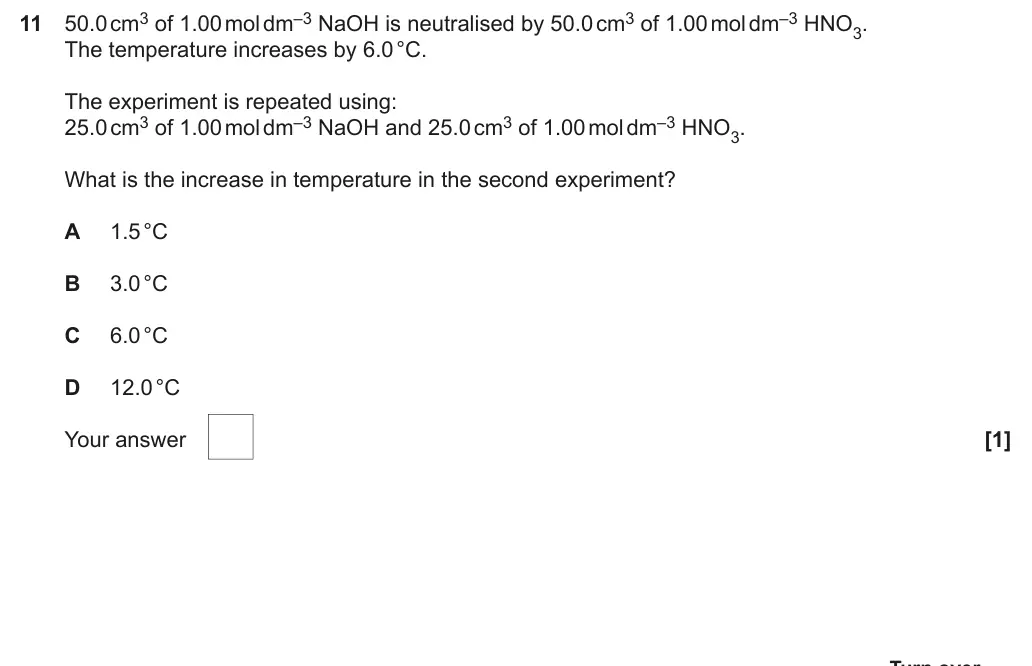
June 2017 · AS Paper 1 · Q11 1 mark Multiple choice enthalpy changes
11 50.0 cm3 of 1.00 mol dm–3 NaOH is neutralised by 50.0 cm3 of 1.00 mol dm–3 HNO3.
The temperature increases by 6.0 °C.
The experiment is repeated using:
25.0 cm3 of 1.00 mol dm–3 NaOH and 25.0 cm3 of 1.00 mol dm–3 HNO3.
What is the increase in temperature in the second experiment?
A 1.5 °C
B 3.0 °C
C 6.0 °C
D 12.0 °C
Your answer [1]
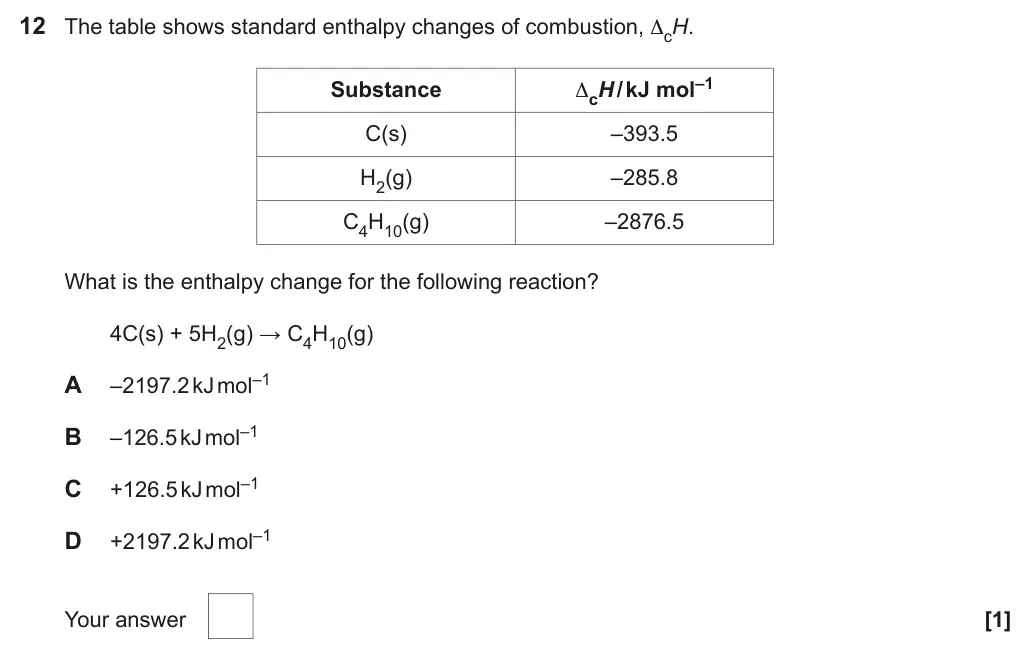
June 2017 · AS Paper 1 · Q12 1 mark Multiple choice enthalpy changes
12 The table shows standard enthalpy changes of combustion, ΔcH.
Substance ΔcH / kJ mol–1
C(s) –393.5
H2(g) –285.8
C4H10(g) –2876.5
What is the enthalpy change for the following reaction?
4C(s) + 5H2(g) → C4H10(g)
A –2197.2 kJ mol–1
B –126.5 kJ mol–1
C +126.5 kJ mol–1
D +2197.2 kJ mol–1
Your answer [1]
June 2017 · AS Paper 1 · Q13 1 mark Multiple choice chemical equilibrium
13 The reversible reaction below is allowed to reach equilibrium.
H2(g) + I2(g) 2HI(g) ΔH = –9.4 kJ mol–1
Which change in conditions would be expected to shift the equilibrium position towards the
products?
A decrease the pressure
B decrease the temperature
C increase the pressure
D increase the temperature
Your answer [1]
June 2017 · AS Paper 1 · Q14 1 mark Multiple choice organic basicsalkenes
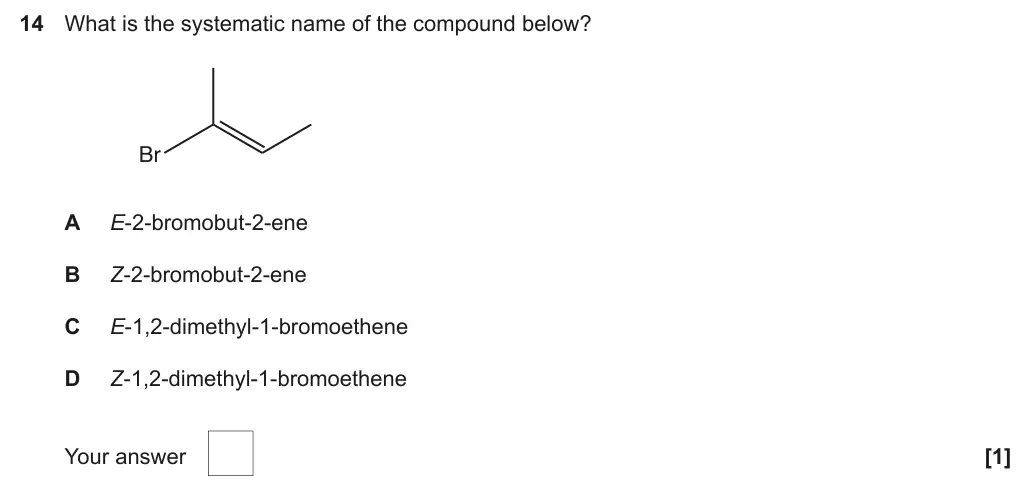
14 What is the systematic name of the compound below?
Br
A E-2-bromobut-2-ene
B Z-2-bromobut-2-ene
C E-1,2-dimethyl-1-bromoethene
D Z-1,2-dimethyl-1-bromoethene
Your answer [1]
June 2017 · AS Paper 1 · Q15 1 mark Multiple choice organic basicsamount of substance
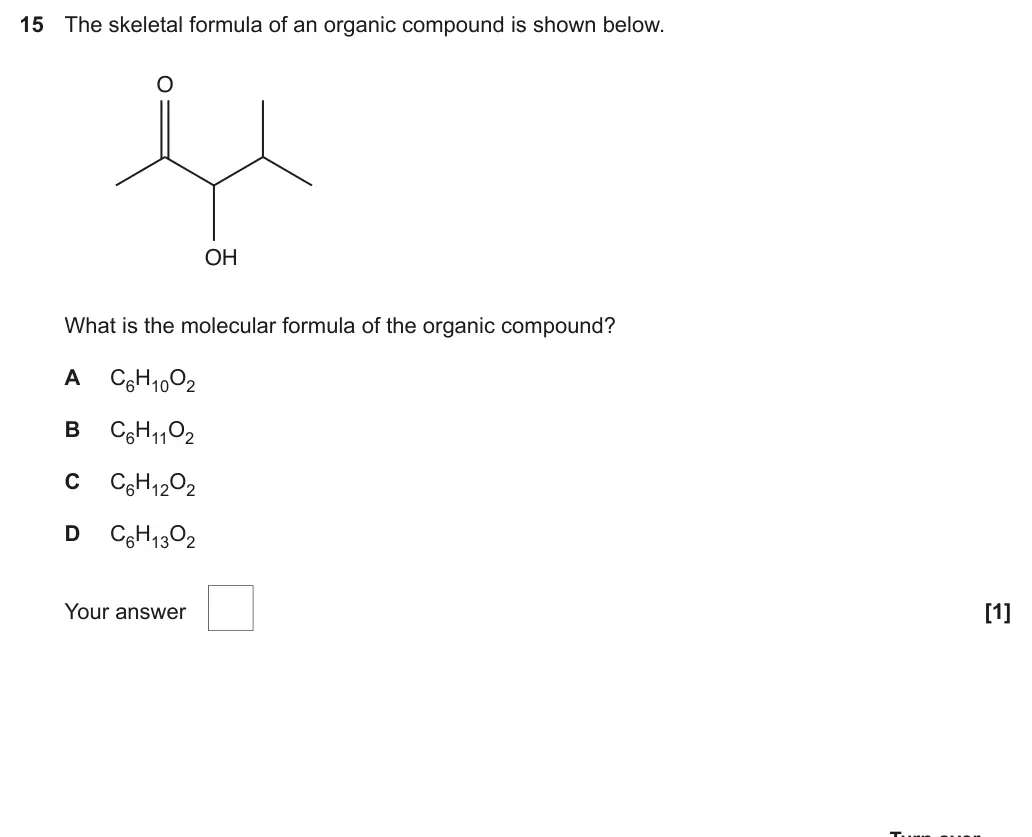
15 The skeletal formula of an organic compound is shown below.
O
OH
What is the molecular formula of the organic compound?
A C6H10O2
B C6H11O2
C C6H12O2
D C6H13O2
Your answer [1]
June 2017 · AS Paper 1 · Q16 1 mark Multiple choice organic basics
16 How many structural isomers have the molecular formula C5H12?
A 2
B 3
C 4
D 5
Your answer [1]
June 2017 · AS Paper 1 · Q17 1 mark Multiple choice alkanes
17 Which organic compound has the lowest boiling point?
A 2,3,4-trimethylpentane
B 2,3-dimethylhexane
C 2-methylheptane
D octane
Your answer [1]
June 2017 · AS Paper 1 · Q18 1 mark Multiple choice alcoholsalkenes
18 Which alcohol reacts with an acid catalyst to form E and Z stereoisomers?
A pentan-3-ol
B pentan-1-ol
C 2-methylbutan-2-ol
D 2,2-dimethylpropan-1-ol
Your answer [1]
June 2017 · AS Paper 1 · Q19 1 mark Multiple choice alcoholsinfrared and mass spectrometry
19 An alcohol A is heated under reflux with sulfuric acid and potassium dichromate(VI).
The organic compound formed produces the infrared spectrum below.
100
transmittance
(%)
50
0
4000 3000 2000 1500 1000 500
wavenumber / cm–1
Which compound could be alcohol A?
A OH
OH
B
C
OH
D
HO
Your answer [1]
June 2017 · AS Paper 1 · Q20 1 mark Multiple choice infrared and mass spectrometry
20 Which alcohol is not likely to have a fragment ion at m / z = 43 in its mass spectrum?
A CH3CH2CH(OH)CH3
B CH3CH2CH2CH2OH
C CH3CH(OH)CH2CH2CH3
D (CH3)2CHCH2OH
Your answer [1]
June 2017 · AS Paper 1 · Q21(a)(i) 3 marks Short answer alkenes
SECTION B
Answer all the questions.
21 This question is about 2-chloropropene, C3H5Cl.
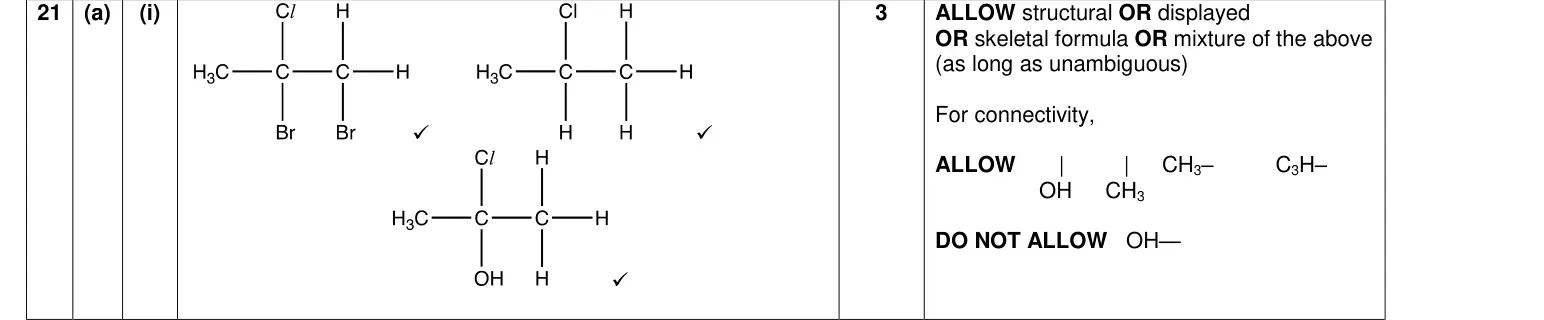
(a) Three reactions of 2-chloropropene are shown in the flowchart below.
(i) Complete the flowchart to show the organic products formed in the reactions.
Cl Cl H
Br2 H2 / Ni
C C
H3C H
2-chloropropene
steam
major product
[3]
June 2017 · AS Paper 1 · Q21(a)(ii) 1 mark Short answer alkenes
Earlier part of question 21 that this part usesEarlier part of June 2017 Paper 1 question 21
(ii) The reaction of 2-chloropropene with steam requires a catalyst.
State a suitable catalyst for this reaction.
...................................................................................................................................... [1]
June 2017 · AS Paper 1 · Q21(b)(i) 2 marks Equation writing alkenes
Earlier part of question 21 that this part usesEarlier part of June 2017 Paper 1 question 21
(b) 2-chloropropene can be polymerised to form poly(2-chloropropene).
(i) Write a balanced equation for the formation of this polymer.
The equation should include the structure of the repeat unit of the polymer.
[2]
June 2017 · AS Paper 1 · Q21(b)(ii) 1 mark Short answer alkenes
Earlier part of question 21 that this part usesEarlier part of June 2017 Paper 1 question 21
(ii) After their useful life, waste polymers can be disposed of by combustion.
State one particular problem with disposal of poly(2-chloropropene) by combustion.
...........................................................................................................................................
...................................................................................................................................... [1]
June 2017 · AS Paper 1 · Q22(a)(i) 2 marks Complete table/diagram atomic structure and isotopes
22 This question is about elements from the s-block and p-block of the periodic table.
(a) A sample of magnesium is analysed by mass spectrometry. The mass spectrum is shown
below.
78.99%
relative
abundance
(%)
10.00% 11.01%
21 22 23 24 25 26 27 28 29
m / z
(i) The species causing the peaks in the mass spectrum are 1+ ions of magnesium.
Complete the table to show the number of protons, neutrons and electrons in each
1+ ion of magnesium.
m / z protons neutrons electrons
24
25
26
[2]
June 2017 · AS Paper 1 · Q22(a)(ii) 2 marks Calculation atomic structure and isotopes
Earlier part of question 22 that this part usesEarlier part of June 2017 Paper 1 question 22
(ii) Calculate the relative atomic mass of the magnesium in the sample.
Give your answer to two decimal places.
relative atomic mass =  .......................................................... [2]
June 2017 · AS Paper 1 · Q22(b) 5 marks Extended response qualitative analysisatomic structure and isotopesformulae and equations
(b) B and C are ionic compounds of two different Group 1 elements.
The molar masses of B and C are both approximately 140 g mol–1.
A student dissolves B and C in water in separate test tubes and analyses the solutions.
The observations are shown below.
Observation
Test
B(aq) C(aq)
Addition of HNO3(aq) bubbles no change
followed by BaCl2(aq) no change white precipitate
Use this information and the observations to identify the formulae of B and C.
Explain your reasoning.
...................................................................................................................................................
...................................................................................................................................................
...................................................................................................................................................
...................................................................................................................................................
...................................................................................................................................................
...................................................................................................................................................
...................................................................................................................................................
...................................................................................................................................................
...................................................................................................................................................
...................................................................................................................................................
...................................................................................................................................................
...................................................................................................................................................
.............................................................................................................................................. [5]
June 2017 · AS Paper 1 · Q22(c)(i) 1 mark Graph plotting periodicity
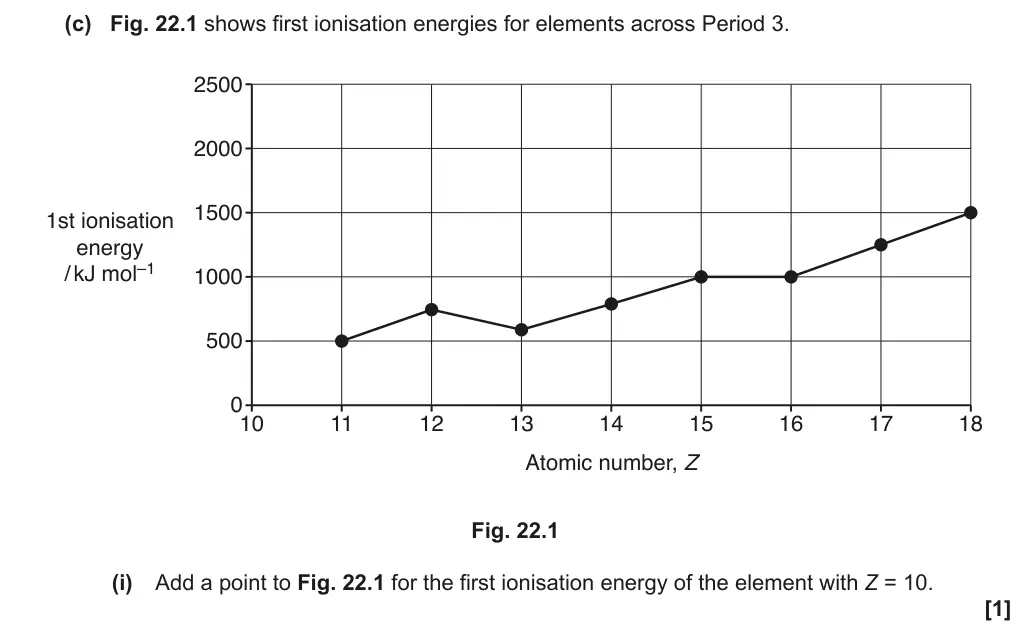
(c) Fig. 22.1 shows first ionisation energies for elements across Period 3.
2500
2000
1500
1st ionisation
energy
/ kJ mol–1 1000
500
0
10 11 12 13 14 15 16 17 18
Atomic number, Z
Fig. 22.1
(i) Add a point to Fig. 22.1 for the first ionisation energy of the element with Z = 10.
[1]
June 2017 · AS Paper 1 · Q22(c)(ii) 1 mark Calculation periodicityamount of substance
Earlier part of question 22 that this part usesEarlier part of June 2017 Paper 1 question 22
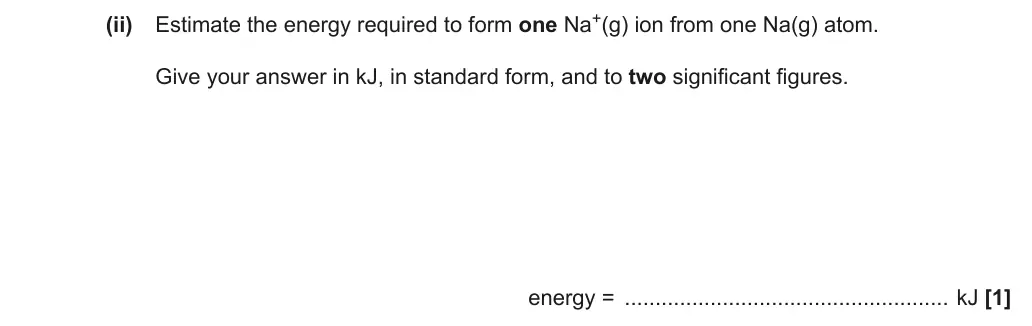
(ii) Estimate the energy required to form one Na+(g) ion from one Na(g) atom.
Give your answer in kJ, in standard form, and to two significant figures.
energy =  ..................................................... kJ [1]
June 2017 · AS Paper 1 · Q22(c)(iii) 3 marks Data interpretation periodicity
Earlier part of question 22 that this part usesEarlier part of June 2017 Paper 1 question 22
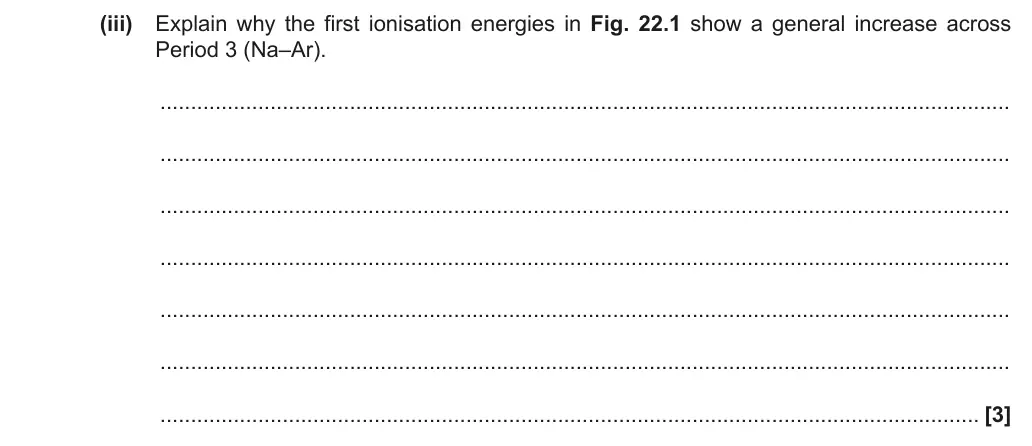
(iii) Explain why the first ionisation energies in Fig. 22.1 show a general increase across
Period 3 (Na–Ar).
...........................................................................................................................................
...........................................................................................................................................
...........................................................................................................................................
...........................................................................................................................................
...........................................................................................................................................
...........................................................................................................................................
...................................................................................................................................... [3]
June 2017 · AS Paper 1 · Q22(c)(iv) 2 marks Short answer periodicityelectron structure
Earlier part of question 22 that this part usesEarlier part of June 2017 Paper 1 question 22
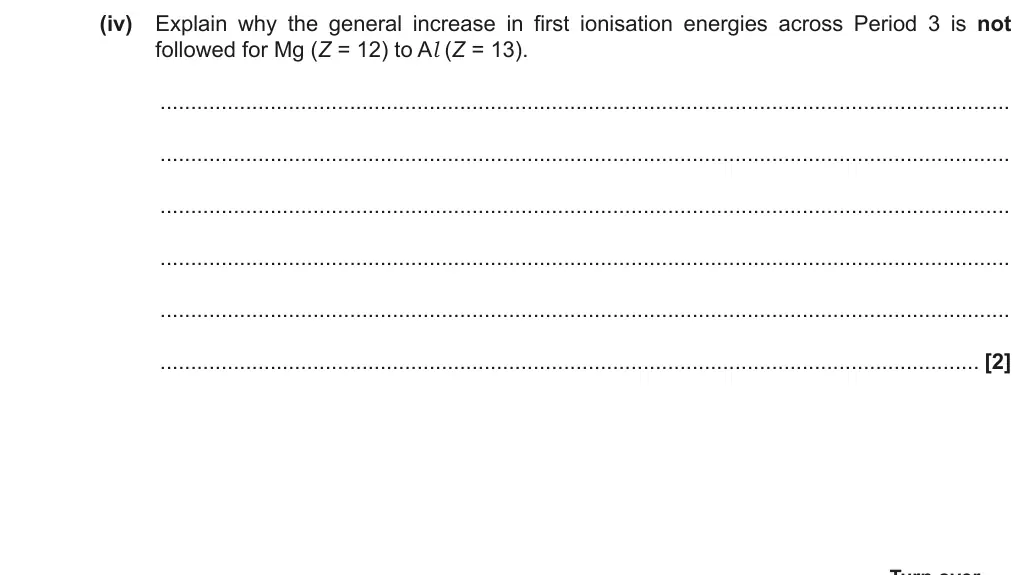
(iv) Explain why the general increase in first ionisation energies across Period 3 is not
followed for Mg (Z = 12) to Al (Z = 13).
...........................................................................................................................................
...........................................................................................................................................
...........................................................................................................................................
...........................................................................................................................................
...........................................................................................................................................
...................................................................................................................................... [2]
June 2017 · AS Paper 1 · Q23(a) 4 marks Short answer reaction rates
23 Methanol can be prepared industrially by reacting carbon monoxide with hydrogen in the presence
of a copper catalyst. This is a reversible reaction.
CO(g) + 2H2(g) CH3OH(g)
(a) Using the Boltzmann distribution model, explain why the rate of a reaction increases in the
presence of a catalyst.
You are provided with the axes below, which should be labelled.
...................................................................................................................................................
...................................................................................................................................................
...................................................................................................................................................
...................................................................................................................................................
...................................................................................................................................................
...................................................................................................................................................
...................................................................................................................................................
.............................................................................................................................................. [4]
June 2017 · AS Paper 1 · Q23(b) 2 marks Short answer reaction rates
(b) The reaction for the production of methanol in the presence of the copper catalyst is carried
out at 200–300 °C.
Explain why use of the catalyst reduces energy demand and benefits the environment.
...................................................................................................................................................
...................................................................................................................................................
...................................................................................................................................................
...................................................................................................................................................
.............................................................................................................................................. [2]
June 2017 · AS Paper 1 · Q23(c) 2 marks Calculation chemical equilibrium
(c) A chemist investigates the equilibrium that produces methanol:
CO(g) + 2H2(g) CH3OH(g)
The chemist mixes CO(g) with H2(g) and leaves the mixture to react until equilibrium is
reached.
The equilibrium mixture is analysed and found to contain the following concentrations.
Concentration
Substance
/mol dm–3
CO(g) 0.310
H2(g) 0.240
CH3OH(g) 0.260
Calculate the numerical value of Kc for this equilibrium.
Give your answer to an appropriate number of significant figures.
Kc =  ........................................ dm2 mol−6 [2]
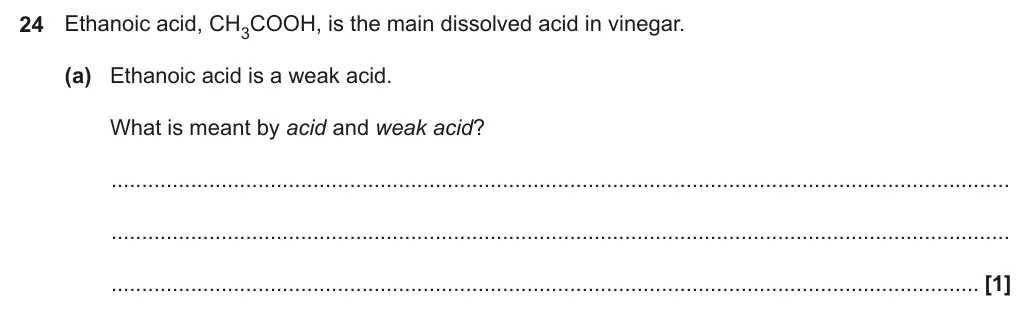
June 2017 · AS Paper 1 · Q24(a) 1 mark Short answer acids and titrations
24 Ethanoic acid, CH3COOH, is the main dissolved acid in vinegar.
(a) Ethanoic acid is a weak acid.
What is meant by acid and weak acid?
...................................................................................................................................................
...................................................................................................................................................
.............................................................................................................................................. [1]
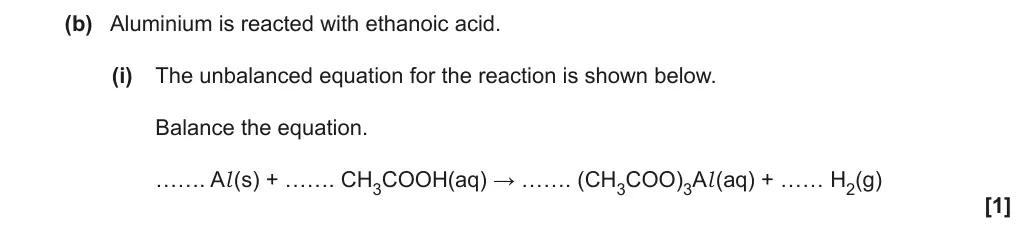
June 2017 · AS Paper 1 · Q24(b)(i) 1 mark Equation writing formulae and equationsredox
(b) Aluminium is reacted with ethanoic acid.
(i) The unbalanced equation for the reaction is shown below.
Balance the equation.
……. Al (s) + ……. CH3COOH(aq) → ……. (CH3COO)3Al (aq) + …… H2(g)
[1]
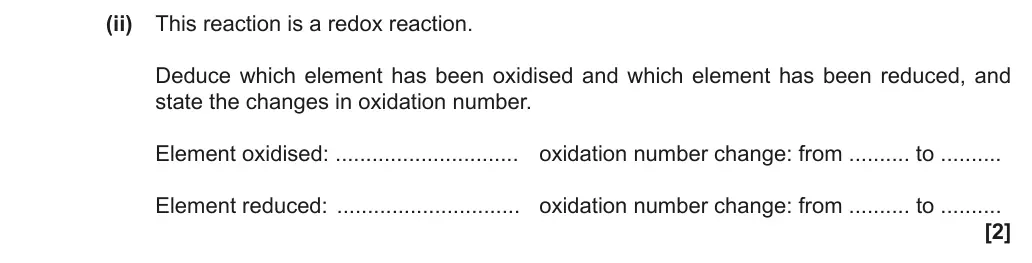
June 2017 · AS Paper 1 · Q24(b)(ii) 2 marks Data interpretation redox
Earlier part of question 24 that this part usesEarlier part of June 2017 Paper 1 question 24
(ii) This reaction is a redox reaction.
Deduce which element has been oxidised and which element has been reduced, and
state the changes in oxidation number.
Element oxidised: ..............................  oxidation number change: from .......... to ..........
Element reduced:  ..............................  oxidation number change: from .......... to ..........
[2]
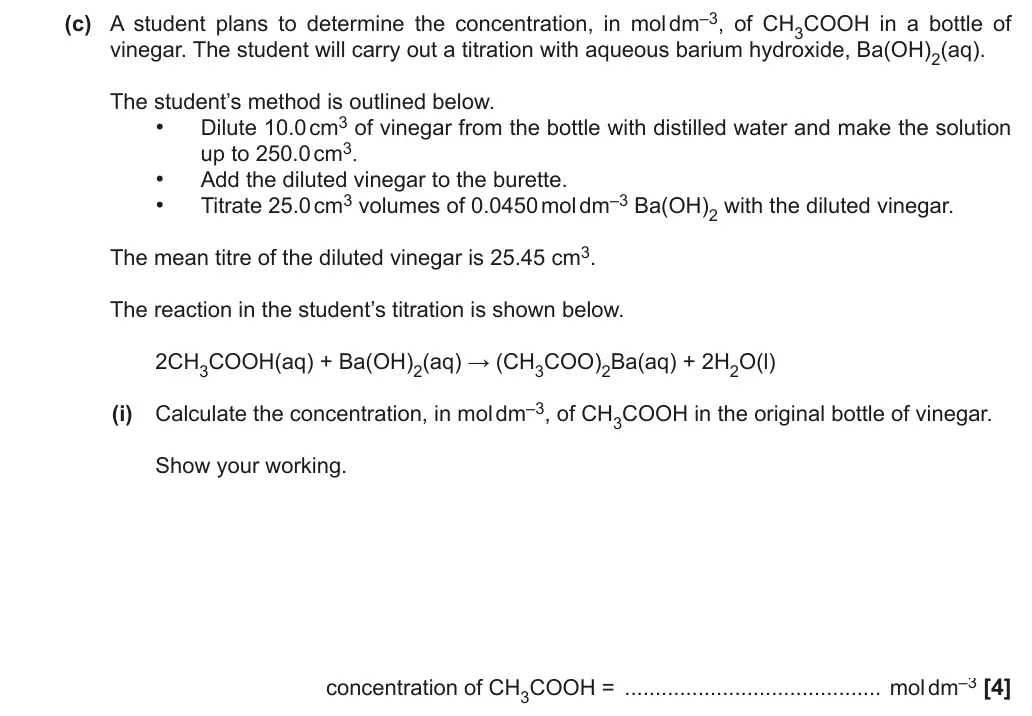
June 2017 · AS Paper 1 · Q24(c)(i) 4 marks Calculation acids and titrationsamount of substance
(c) A student plans to determine the concentration, in mol dm–3, of CH3COOH in a bottle of
vinegar. The student will carry out a titration with aqueous barium hydroxide, Ba(OH)2(aq).
The student’s method is outlined below.
• Dilute 10.0 cm3 of vinegar from the bottle with distilled water and make the solution
up to 250.0 cm3.
• Add the diluted vinegar to the burette.
• Titrate 25.0 cm3 volumes of 0.0450 mol dm–3 Ba(OH)2 with the diluted vinegar.
The mean titre of the diluted vinegar is 25.45 cm3.
The reaction in the student’s titration is shown below.
2CH3COOH(aq) + Ba(OH)2(aq) → (CH3COO)2Ba(aq) + 2H2O(l)
(i) Calculate the concentration, in mol dm–3, of CH3COOH in the original bottle of vinegar.
Show your working.
concentration of CH3COOH =  .......................................... mol dm–3 [4]
June 2017 · AS Paper 1 · Q24(c)(ii) 2 marks Short answer practical skills
Earlier part of question 24 that this part usesEarlier part of June 2017 Paper 1 question 24
(ii) Suggest one assumption that the student has made that might mean that their calculated
concentration of ethanoic acid in the vinegar is invalid.
Predict, with a reason, how the experimental result would differ from the actual
concentration of CH3COOH if the assumption were not correct.
...........................................................................................................................................
...........................................................................................................................................
...........................................................................................................................................
...................................................................................................................................... [2]
June 2017 · AS Paper 1 · Q25(a)(i) 1 mark Short answer enthalpy changes
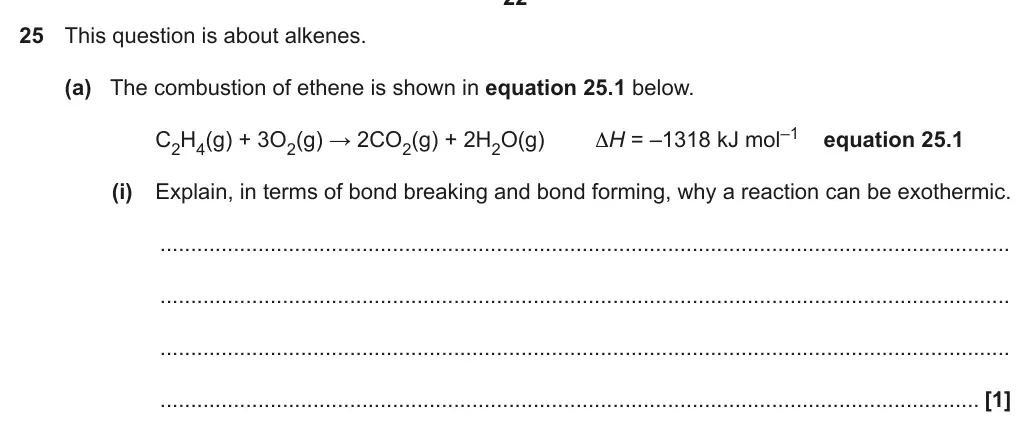
25 This question is about alkenes.
(a) The combustion of ethene is shown in equation 25.1 below.
C2H4(g) + 3O2(g) → 2CO2(g) + 2H2O(g) ΔH = –1318 kJ mol–1   equation 25.1
(i) Explain, in terms of bond breaking and bond forming, why a reaction can be exothermic.
...........................................................................................................................................
...........................................................................................................................................
...........................................................................................................................................
...................................................................................................................................... [1]
June 2017 · AS Paper 1 · Q25(a)(ii) 3 marks Calculation enthalpy changes
Earlier part of question 25 that this part usesEarlier part of June 2017 Paper 1 question 25
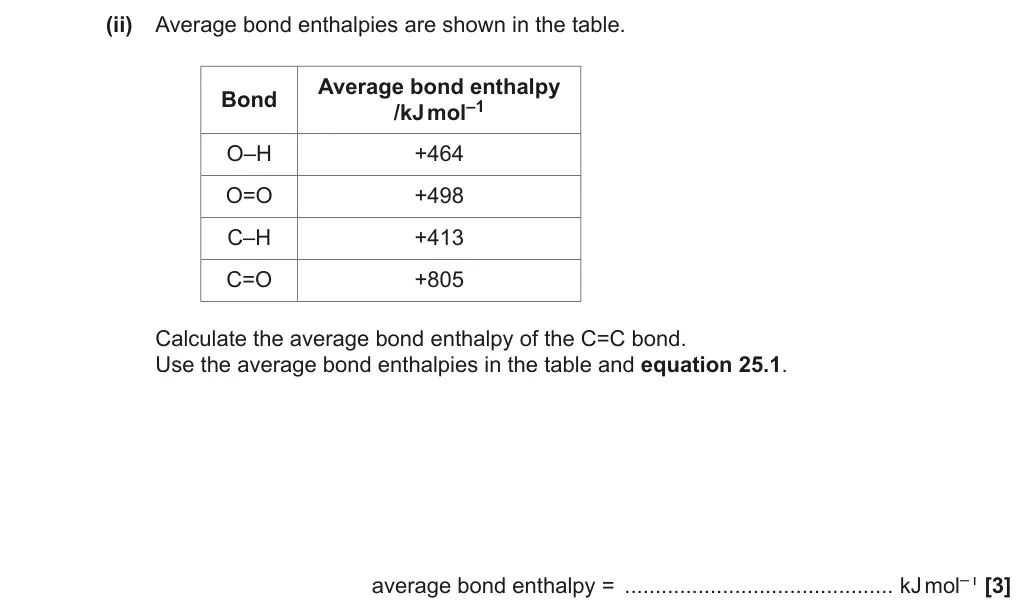
(ii) Average bond enthalpies are shown in the table.
Average bond enthalpy
Bond
/kJ mol–1
O–H +464
O=O +498
C–H +413
C=O +805
Calculate the average bond enthalpy of the C=C bond.
Use the average bond enthalpies in the table and equation 25.1.
average bond enthalpy =  ............................................ kJ mol–1 [3]
June 2017 · AS Paper 1 · Q25(b) 5 marks Calculation amount of substanceorganic basics
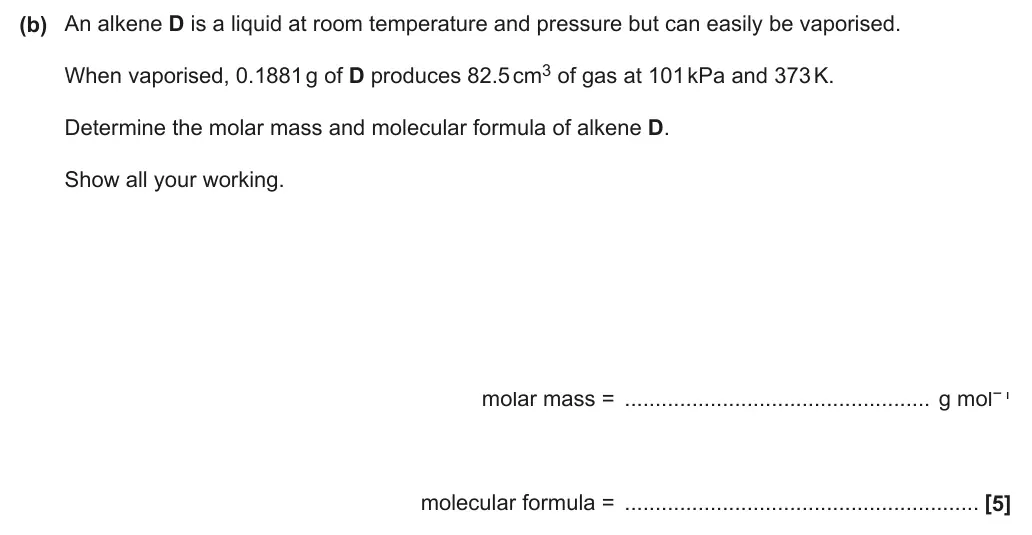
(b) An alkene D is a liquid at room temperature and pressure but can easily be vaporised.
When vaporised, 0.1881 g of D produces 82.5 cm3 of gas at 101 kPa and 373 K.
Determine the molar mass and molecular formula of alkene D.
Show all your working.
molar mass =  .................................................. g mol−1
molecular formula =  .......................................................... [5]

Work with an OCR chemistry tutor

Want a paper marked and gone through with you? Message us.

Prefer email? Send an enquiry

If you are under 18, please include a parent's contact details. Enquiries go to enquiries@chemistryaleveltutor.com and are deleted once handled. All tutoring is online.