Answer
C
Mark scheme

Examiner's comment
The majority of candidates were able to calculate the correct answer.
100 marks · 46 question parts · Paper, mark scheme and report on OCR's site · Have OCR's Data Sheet beside you
C
The majority of candidates were able to calculate the correct answer.
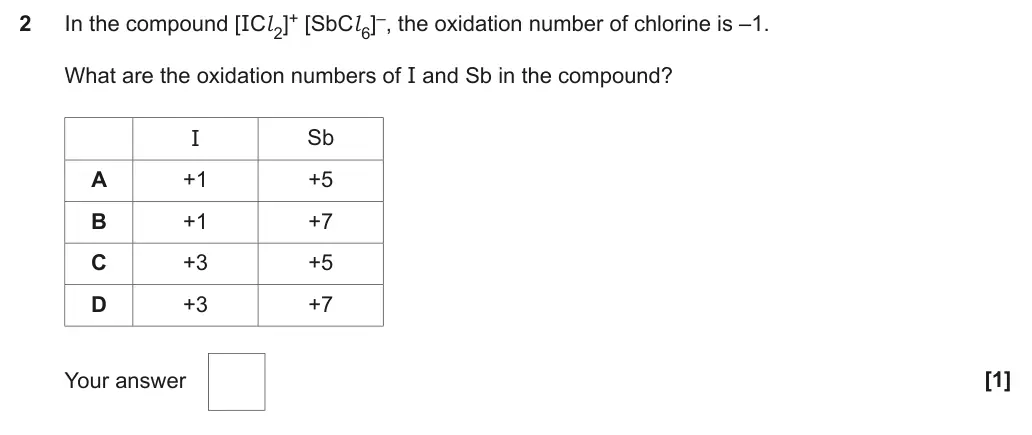
C
The majority of candidates showed a good understanding of oxidation number and gave the correct answer.
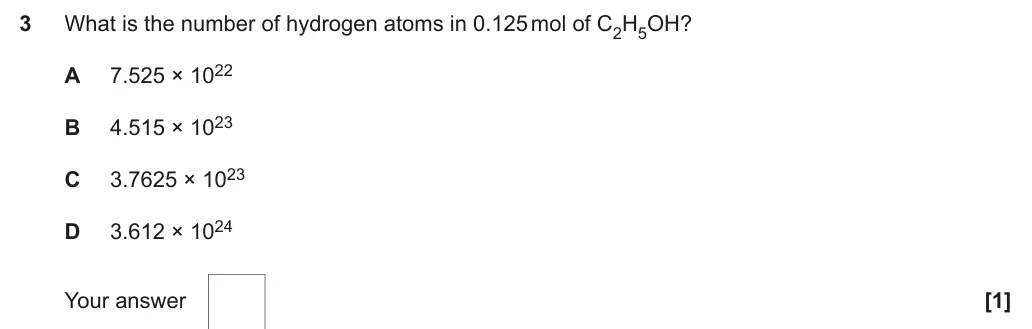
B
This proved problematical for many candidates with A being a common distractor.
Skills: M0.1 Recognise and use expressions in decimal and ordinary form; M0.2 Use ratios, fractions and percentages
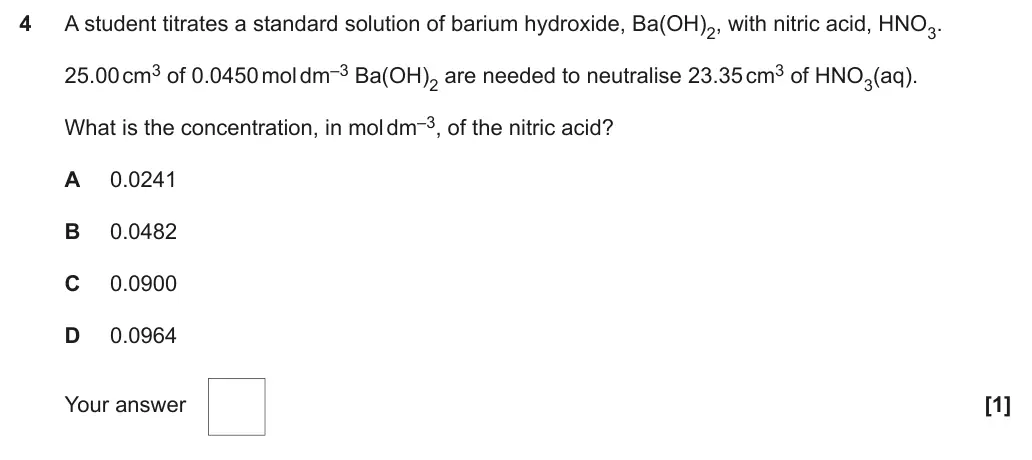
D
The majority of candidates were able to calculate the correct answer.
Skills: M0.2 Use ratios, fractions and percentages; M2.3 Substitute numerical values into algebraic equations using appropriate units for physical quantities; PAG2 Acid–base titration
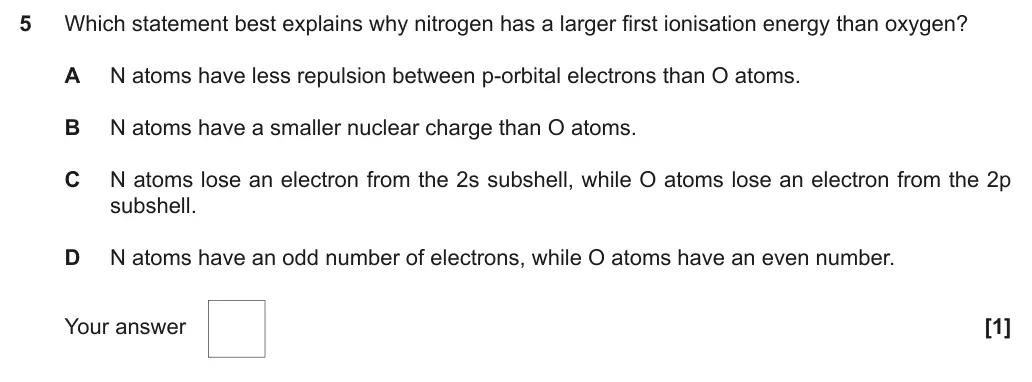
A
The majority of candidates knew the key factor affecting the relative ionisation energies of nitrogen and oxygen.
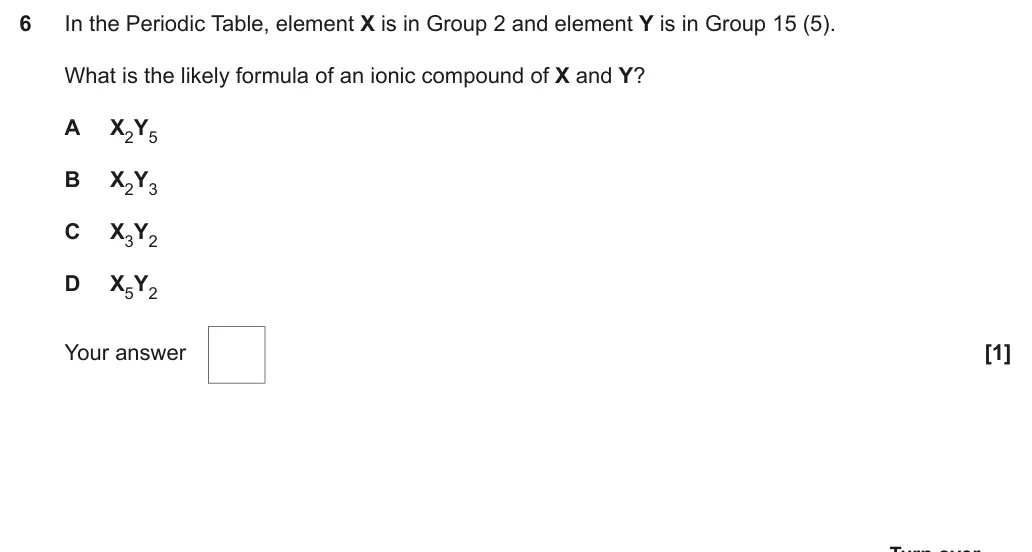
C
Nearly all candidates were able to determine the most likely formula.
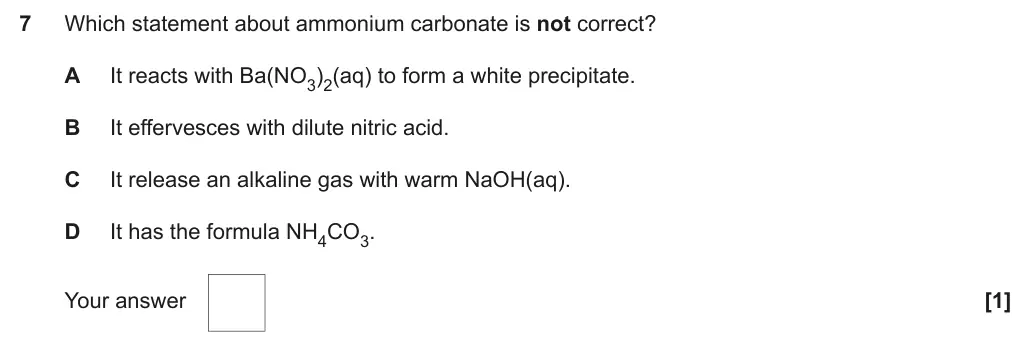
D
Most candidates knew that the formula given in D was incorrect.
Skills: PAG4 Qualitative analysis of ions
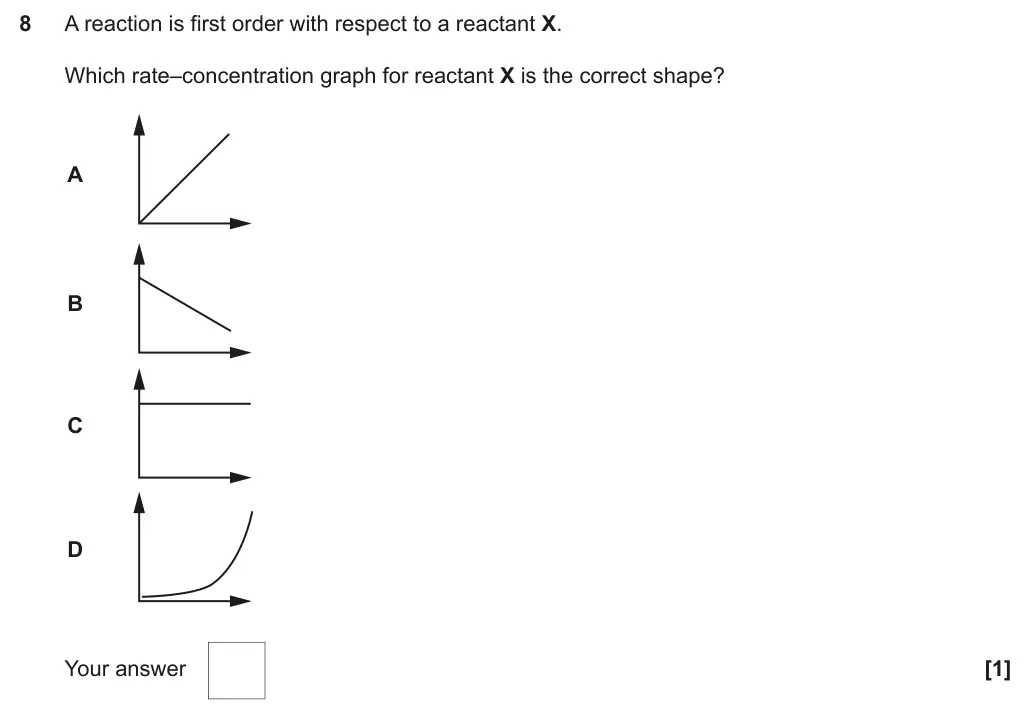
A
The vast majority of candidates knew graph A was correct.

B
This was a very successful multiple choice question for nearly all candidates.
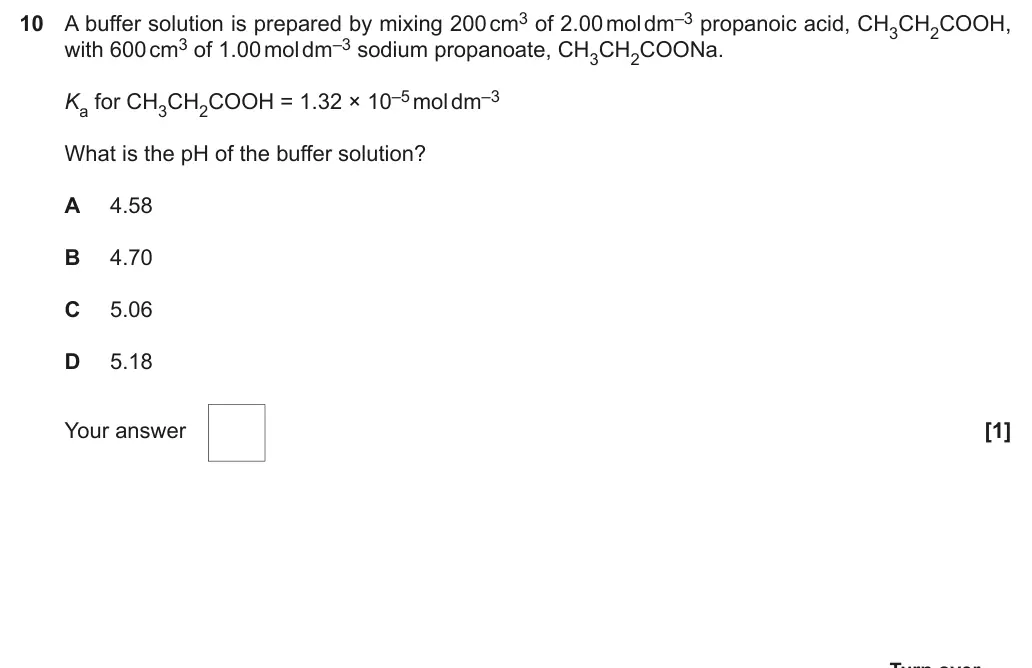
C
This relatively difficult pH calculation was readily done successfully by higher ability candidates, but lower ability candidates found it difficult, with answer B proving a popular choice.

A
The correct answer to this was known by the more able candidates. Lower ability candidates struggled.
Skills: M2.3 Substitute numerical values into algebraic equations using appropriate units for physical quantities
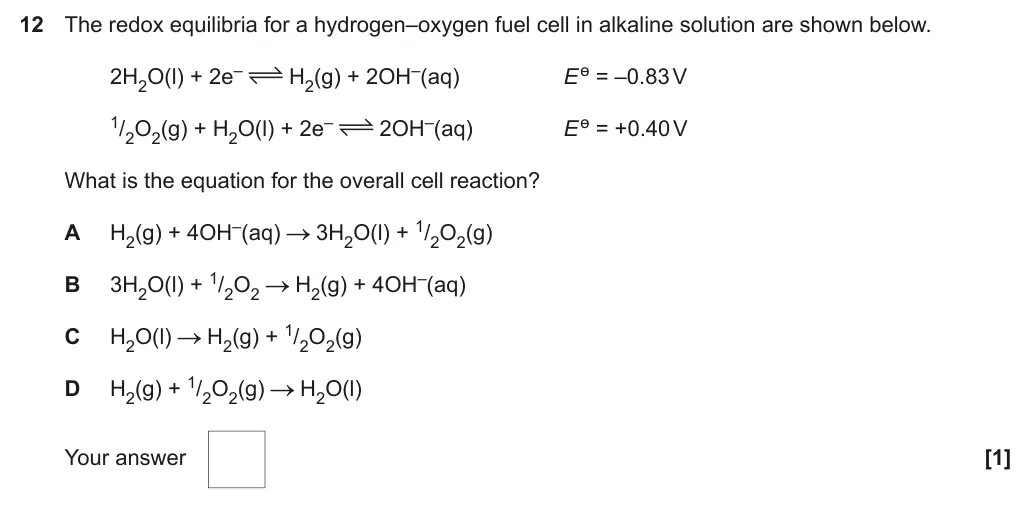
D
Most candidates knew the correct equation.
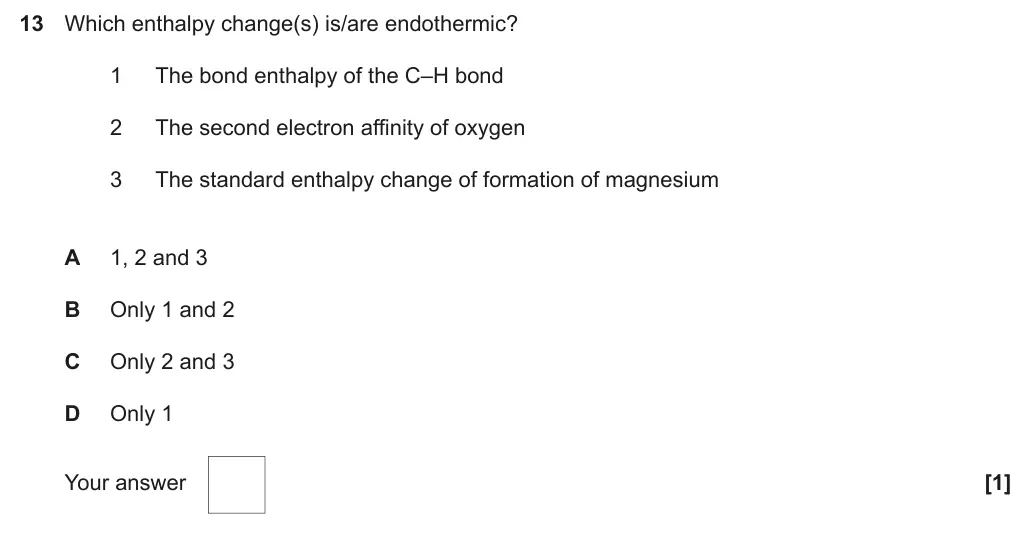
B
D was the common distractor given as the answer by many candidates, suggesting confusion with the first electron affinity and second electron affinity of oxygen.
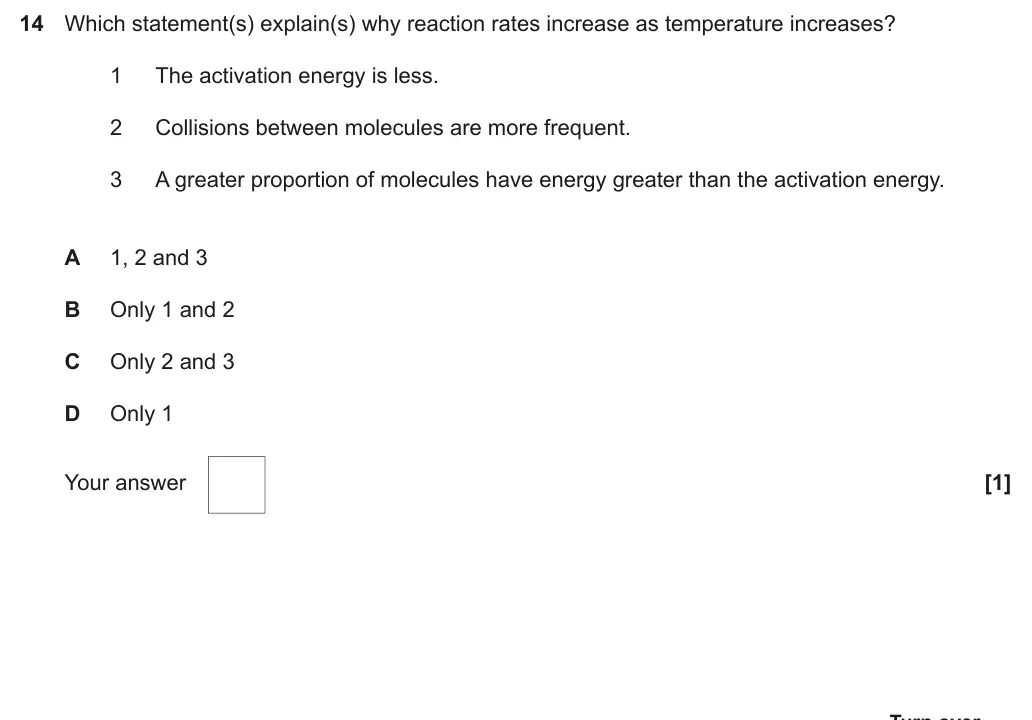
C
This was almost universally correct.
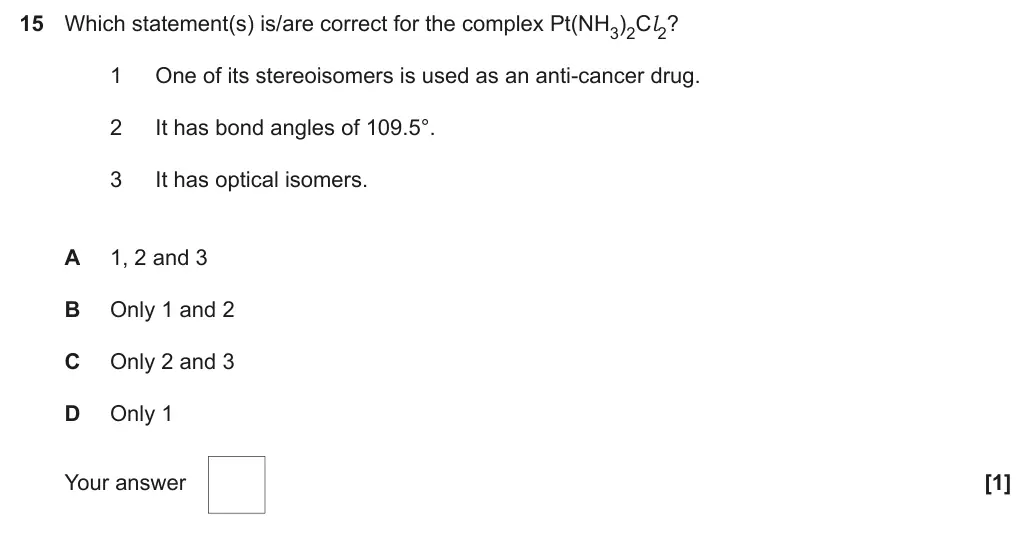
D
The drawing of many (incorrect) shapes based upon a tetrahedral arrangement around the central Pt ion suggested many were unaware of the square planar shape of the complex. Section B overview

Most candidates were able to state that one mole of gaseous ions was dissolved into water. Common errors seen included candidates referring to the dissolving of one mole of substance (i.e. the enthalpy change of solution); the use of the generic term ‘solvent’ rather than water; and dissolving of gaseous ions into one mole of water.

Most candidates were able to score some marks on this question with more able candidates scoring all 4 marks. Common errors included the omission of state symbols and the use of only one F–(g) ion (often despite a correct formula of CaF2 being seen on the bottom line). For some reason, many candidates write their lower case ‘s’ in an identical way to their lower case ‘g’. This means the examiner cannot distinguish between these state symbols on such scripts. Centres may wish to stress this point to prevent candidates losing marks unnecessarily.

Most candidates were able to do this relatively straightforward calculation by rearranging the values of the enthalpy changes associated with the energy cycle diagram. However, a significant number forgot to divide –1008 by 2 to score full marks.
Skills: M2.2 Change the subject of an equation; M2.3 Substitute numerical values into algebraic equations using appropriate units for physical quantities; M2.4 Solve algebraic equations

When comparing enthalpy changes candidates need to be aware that descriptions such as ‘bigger’ or ‘smaller’ are meaningless as there are often negative signs involved. The correct description required here was that the enthalpy change of hydration of F– ions would be more negative than that of Cl– ions. Although some candidates wrote in terms of charge density, it was those candidates who related the smaller size of the F– ion to the difference in enthalpy change of hydration who received credit and went on to say that this was as a consequence of greater attraction to water molecules.
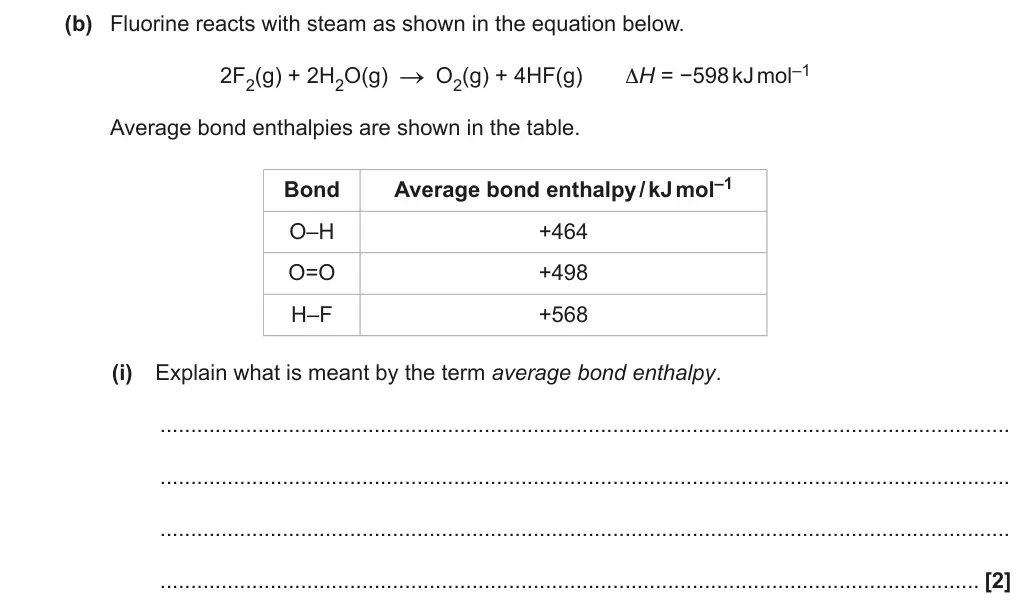
Only the higher ability candidates could explain the term average bond enthalpy. The specification clarifies that candidates are not expected to memorise a formal definition, and makes clear the limits expected for candidate explanations. One mark was credited for mention of breaking one mole of bonds; to score the second mark candidates had to clarify that this is in gaseous molecules. A common error was to describe the enthalpy change as being applied to bonds in one mole of molecules.
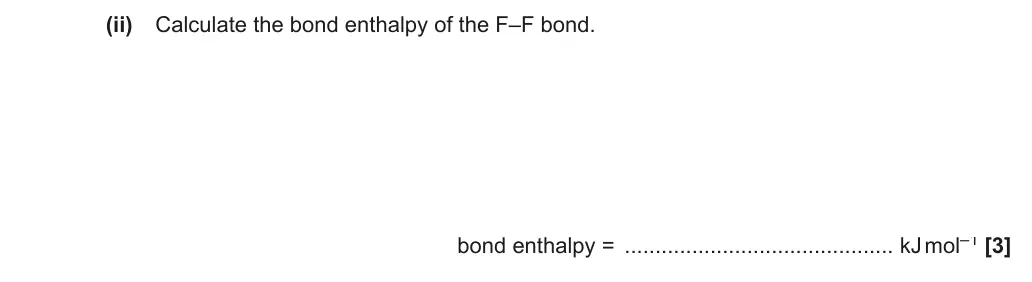
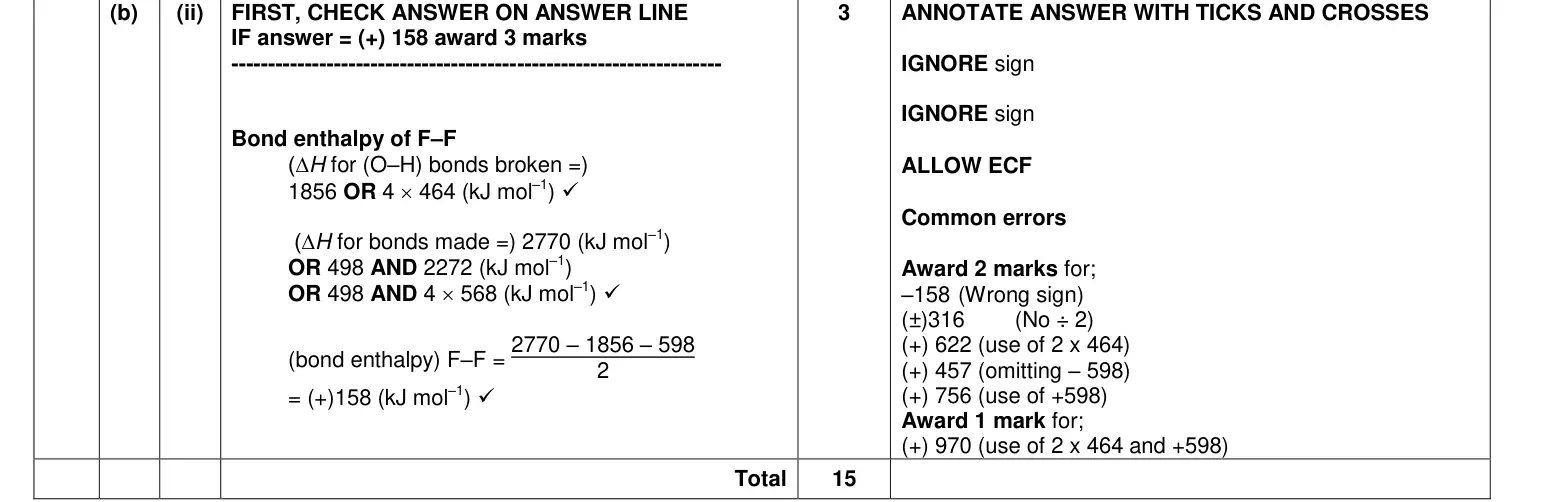
This relatively straightforward calculation depended upon a candidates’ knowledge that the sum of average bond enthalpies of bonds formed subtracted from the sum of average bond enthalpies of bonds broken was equal to ∆H (– 598 kJ mol–1), and that a rearrangement of this sum gave the value of the bond enthalpy associated with 2 mol of F–F bonds (+316 kJ mol–1). Thus, the bond enthalpy of the F–F bond required division by two.
Skills: M2.2 Change the subject of an equation; M2.3 Substitute numerical values into algebraic equations using appropriate units for physical quantities; M2.4 Solve algebraic equations
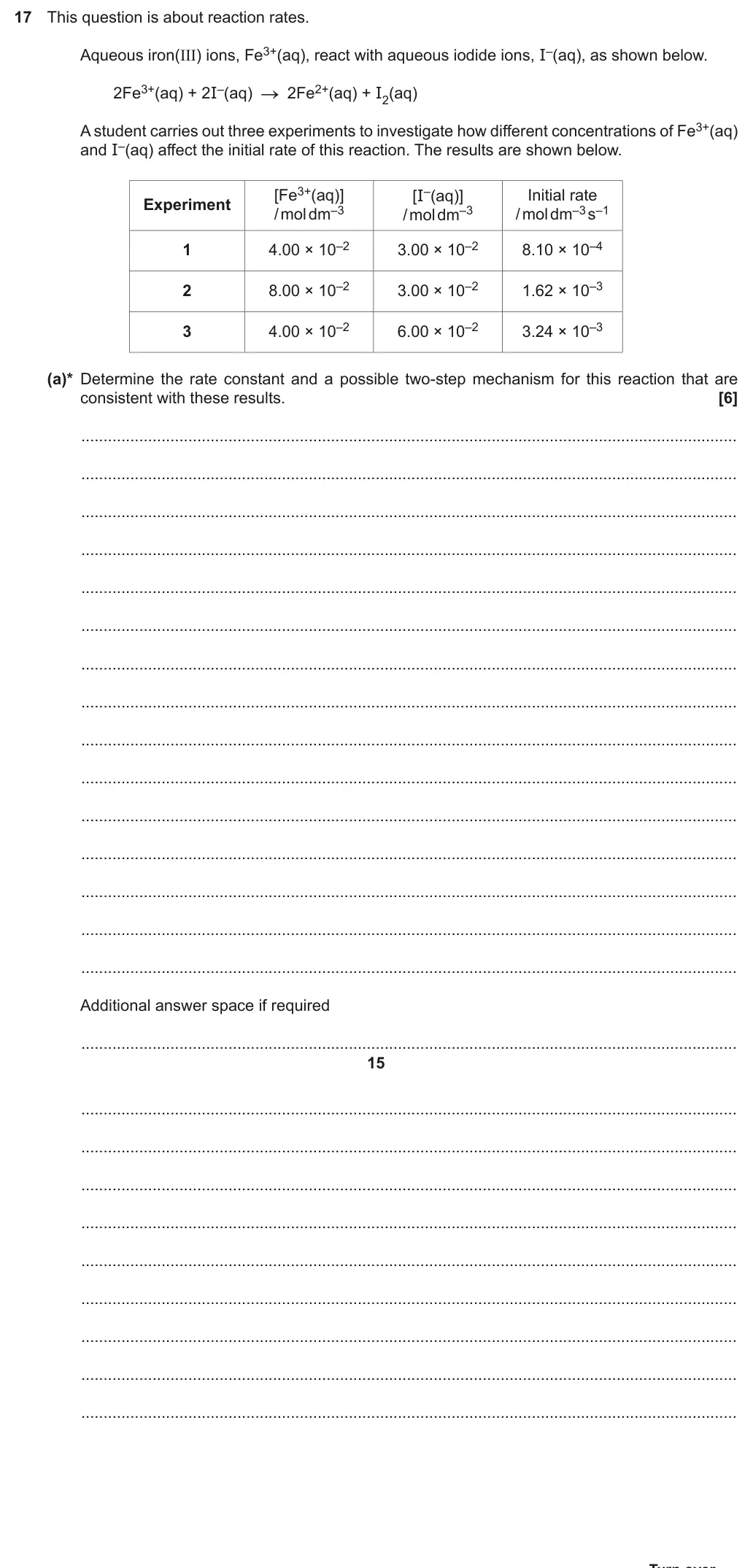
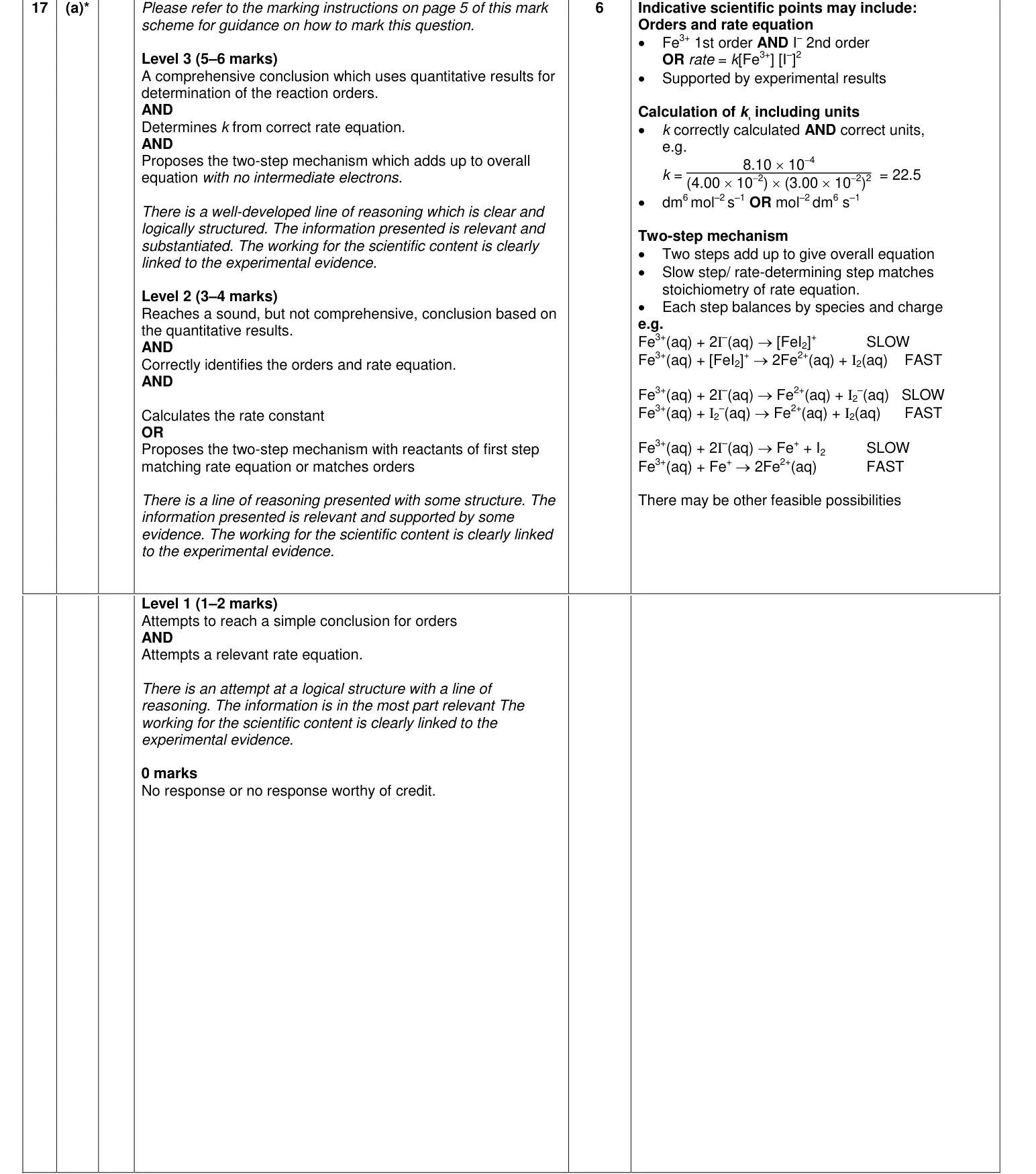
Most candidates were able to use the information in the table to determine the order of reaction with respect to Fe3+ ions and I– ions, which were 1 and 2 respectively. Most candidates were then able to use this knowledge and further information from the table to determine the rate constant, including units (22.5 dm6 mol–1 s–1). Many candidates appreciated that the mechanism involved a stoichiometric ratio of 1 : 2 with respect to Fe3+ ions and I– ions, but only the more able were able to suggest a suitable possible two step mechanism. Common errors in proposing a mechanism included equations such as Fe3+(aq) + 2I–(aq) Fe2+(aq) + ½I2(aq) + I–(aq) which gives a net ratio of 1 : 1 for the reactants. or Fe3+(aq) + 2I–(aq) Fe2+(aq) + I2(aq) + e– which although introducing a correct ratio of reactants also introduces a ‘floating’ electron which in all reality would have attached itself to one of the product species. In questions such as 17a where the quality of extended responses is assessed candidates need to be aware of the need for explanation of their answers. For instance, just giving a correct order of a species in the rate equation is not as strong an answer as one which explains how altering, say doubling, the concentration of a reactant effects the overall rate of reaction, leading to determination of the order. This exemplifies how a concise response can gain full marks on a Level of Response question. The candidate has clearly identified which data they have referred to in the table, and explained the conclusions that can be drawn. The rate equation is then clearly shown, along with subsequent working to determine the value of the rate constant. Finally, the suggested mechanism is given, along with an indication of which is the slow step. The line breaks clearly identify each stage in the response, and it fully satisfies the level 3 criteria in the mark scheme.
Skills: M0.0 Recognise and make use of appropriate units in calculations; M0.2 Use ratios, fractions and percentages; M2.3 Substitute numerical values into algebraic equations using appropriate units for physical quantities; PAG10 Rates of reaction – initial rates
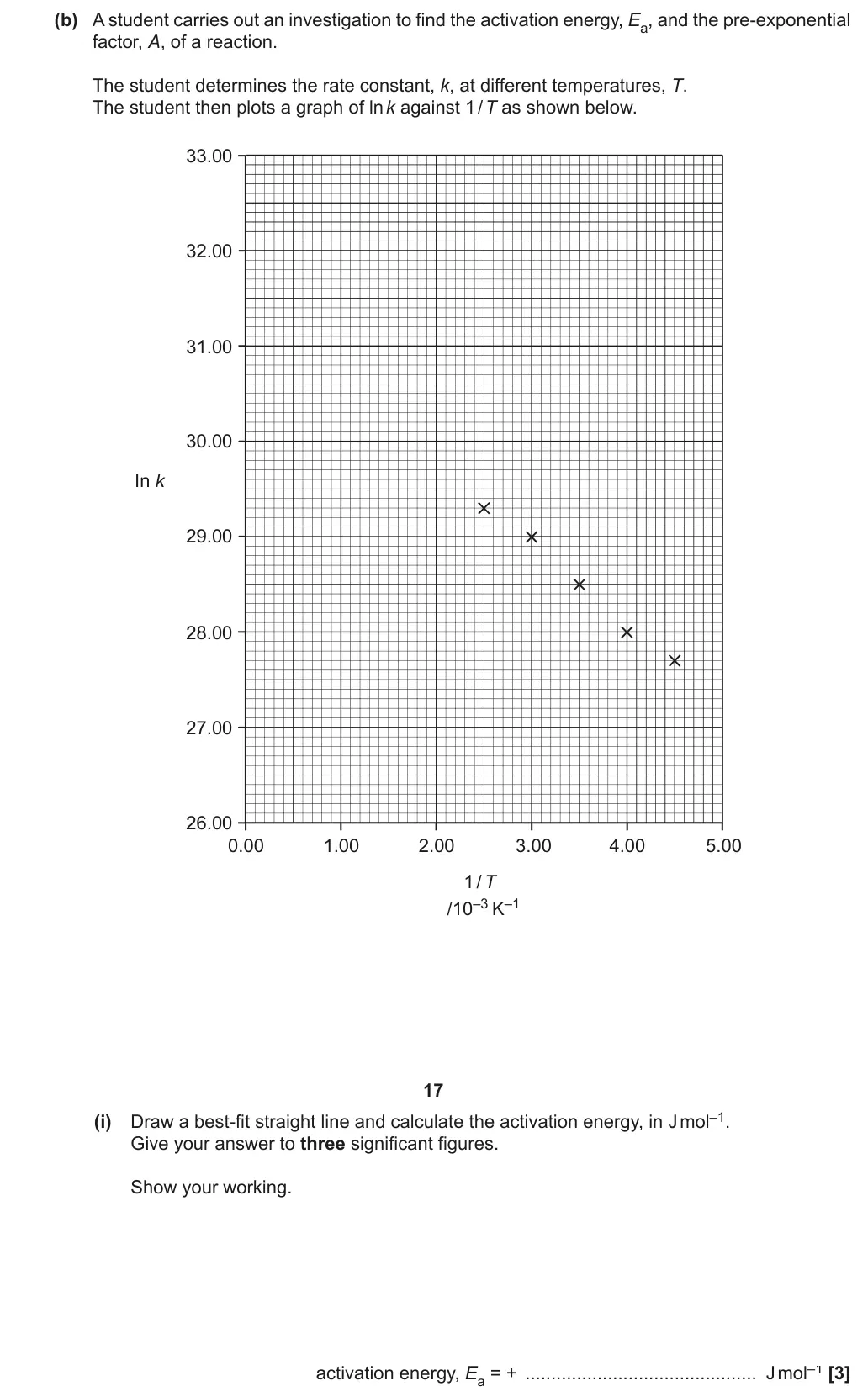
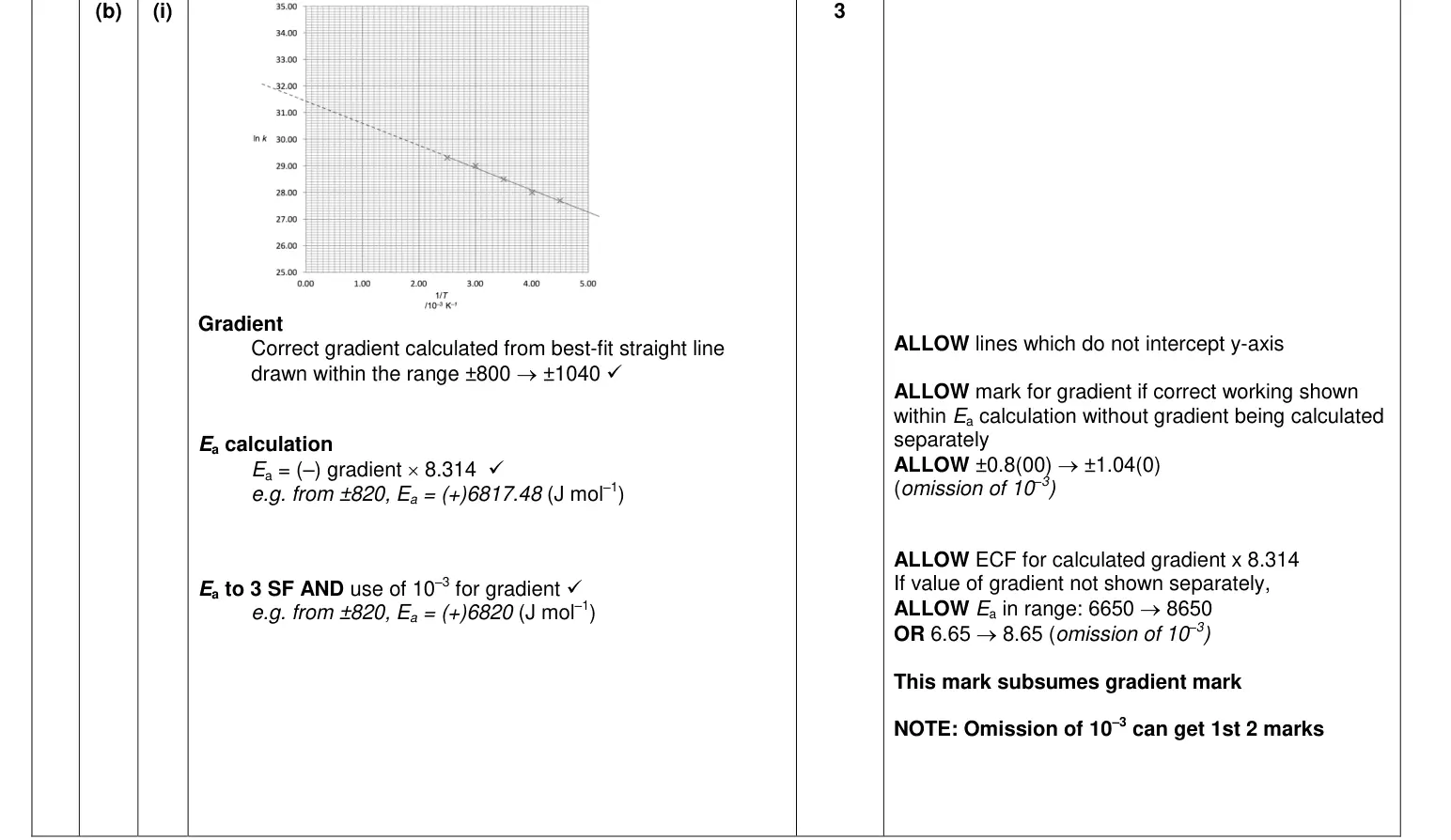
Higher ability candidates realised that the gradient was equivalent to –Ea/R and determined a gradient within the range ± 800 to ± 1040, depending upon the line drawn. Credit was given to gradients of ± 0.800 to ± 1.040 resulting from calculations which omitted 10–3 on the x-axis. The negative gradient was multiplied by R to determine Ea with a value rounded to 3 significant figures. Common errors were omission of 10–3 in the calculation which led to Ea values between 6.65 and 8.65 J mol–1, or not rounding to 3 significant figures.
Skills: M1.1 Use an appropriate number of significant figures; M2.3 Substitute numerical values into algebraic equations using appropriate units for physical quantities; M3.2 Plot two variables from experimental or other data; M3.3 Determine the slope and intercept of a linear graph
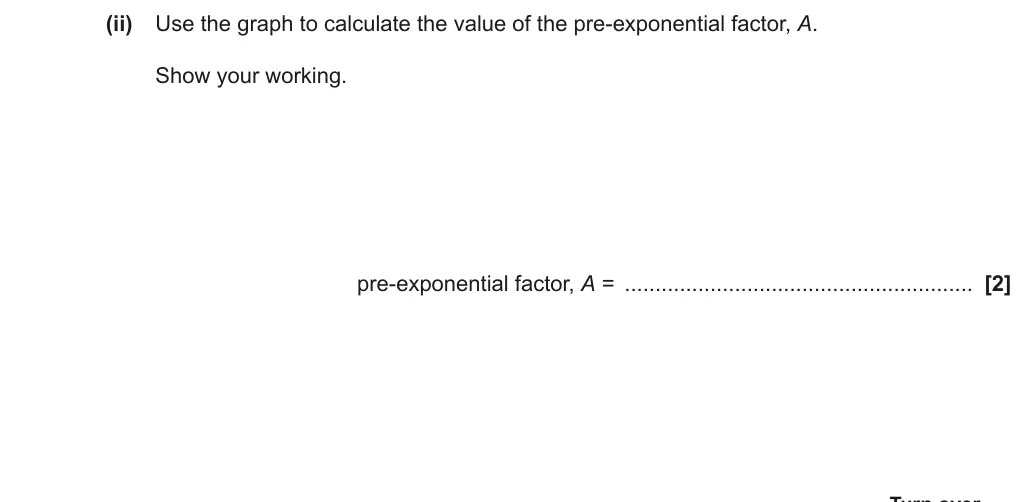
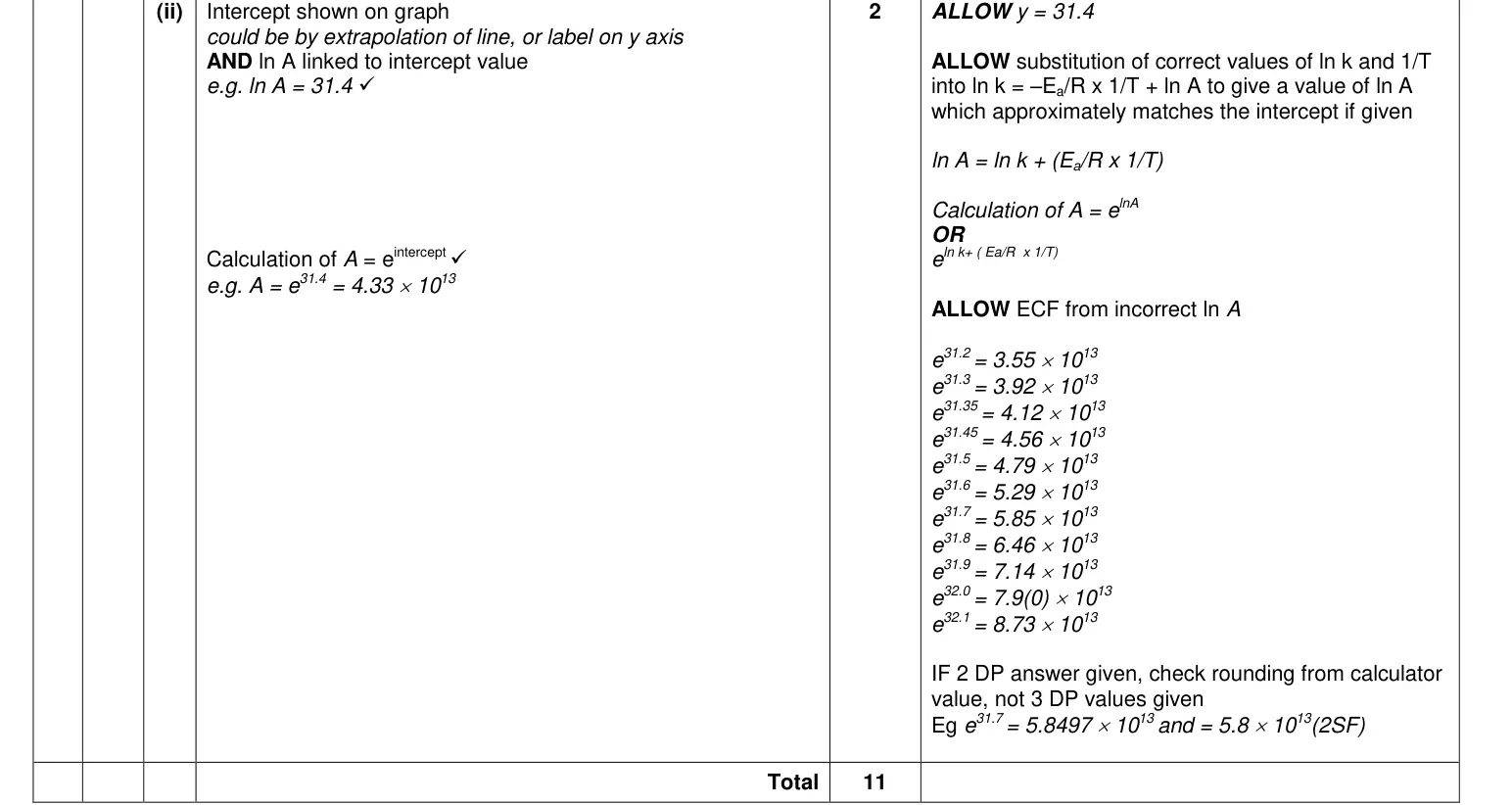
Higher ability candidates realised that the y-intercept of ln k was equivalent to ln A and A was equivalent to e(ln A) and were able to process this readily in their calculators. Common errors were to mis-read the intercept. For example, 31.5 was frequently seen as 31.05. Other candidates assumed the y-intercept was log A and tried to determine A by 10(log A).
Skills: M0.4 Use calculators to find and use power, exponential and logarithmic functions; M2.5 Use logarithms in relation to quantities that range over several orders of magnitude; M3.3 Determine the slope and intercept of a linear graph

The expression and the units were almost universally known by the candidates.
Skills: M0.0 Recognise and make use of appropriate units in calculations

There were three steps to this calculation: Conversion of molar quantities of NO and O2 to molar concentrations. Insertion into the Kc expression and determination (via a square root calculation) of the molar concentration of NO2. Conversion of the molar concentration of NO2 to a molar quantity. Steps 1 and/or 3 of the calculation were occasionally omitted but if the calculation was presented in a coherent manner, even here, partial credit was awarded.
Skills: M2.2 Change the subject of an equation; M2.3 Substitute numerical values into algebraic equations using appropriate units for physical quantities; M2.4 Solve algebraic equations

Most candidates knew the forward reaction was exothermic due to Kp decreasing as temperature increased. A common error was to write vague responses such as ‘Kp decreases with temperature’.

Candidates almost universally secured the first mark for equilibrium shifting to the right. Many scored this by simple application of Le Chatelier’s principle, and then went on to incorrectly explain Kp increased because of this shift. Very few realised that (a constant) Kp drives Le Chatelier’s principle (and not the other way around). An increase of pressure will increase the value of the partial pressures in the bottom half of the Kp expression more than the top half, thus (initially) decreasing the Kp ratio. Therefore, to restore Kp, the amount of NO2 present must increase; consequently, the equilibrium shifts to the right.
Skills: M0.3 Estimate results
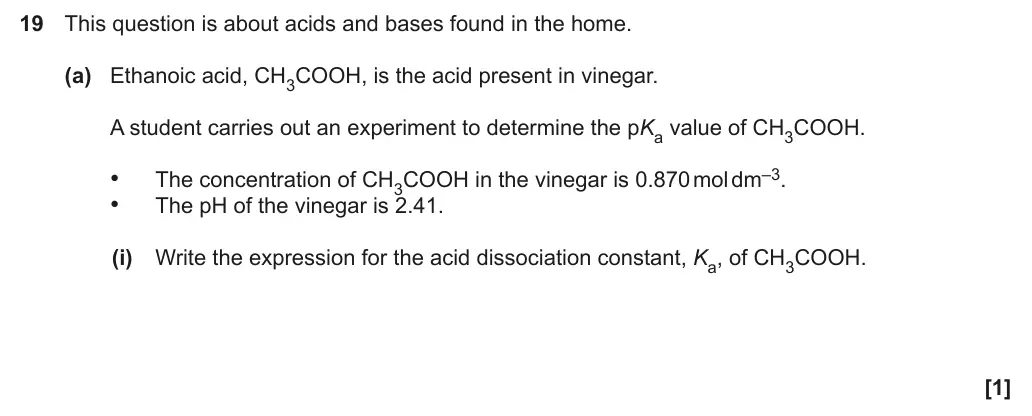
Almost universally known. Common errors were the use of [HA], [A–] or [H+]2.
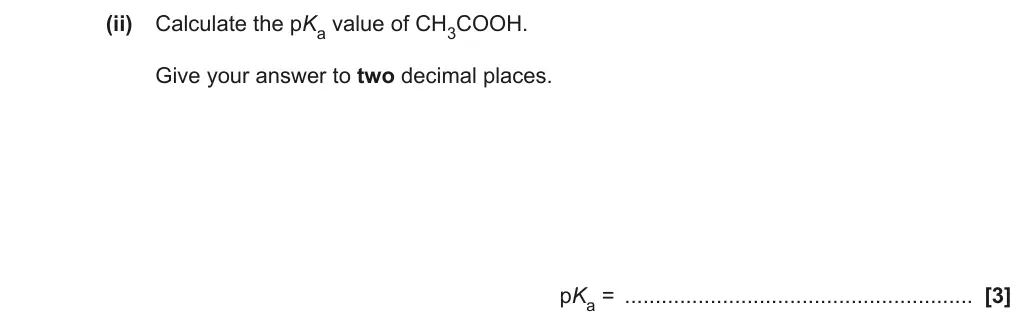
This three-step calculation was successfully completed by almost all candidates. The common errors were to omit giving the final answer to 2 decimal places or to use [H+] rather than [H+]2 in the calculation, leading to a pKa of 2.35.
Skills: M0.4 Use calculators to find and use power, exponential and logarithmic functions; M2.3 Substitute numerical values into algebraic equations using appropriate units for physical quantities; M2.5 Use logarithms in relation to quantities that range over several orders of magnitude
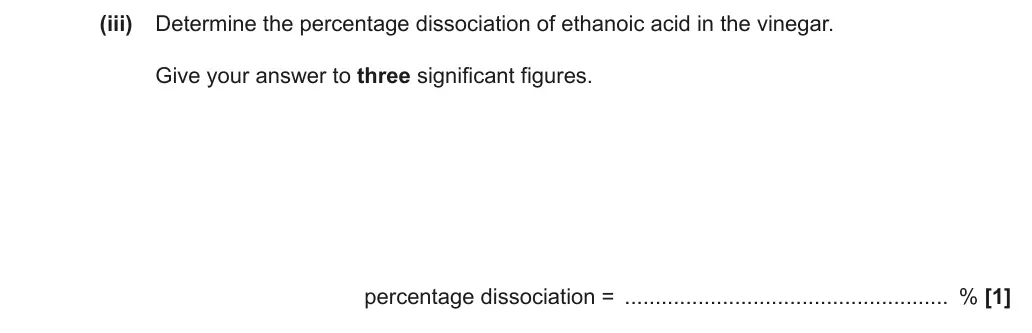
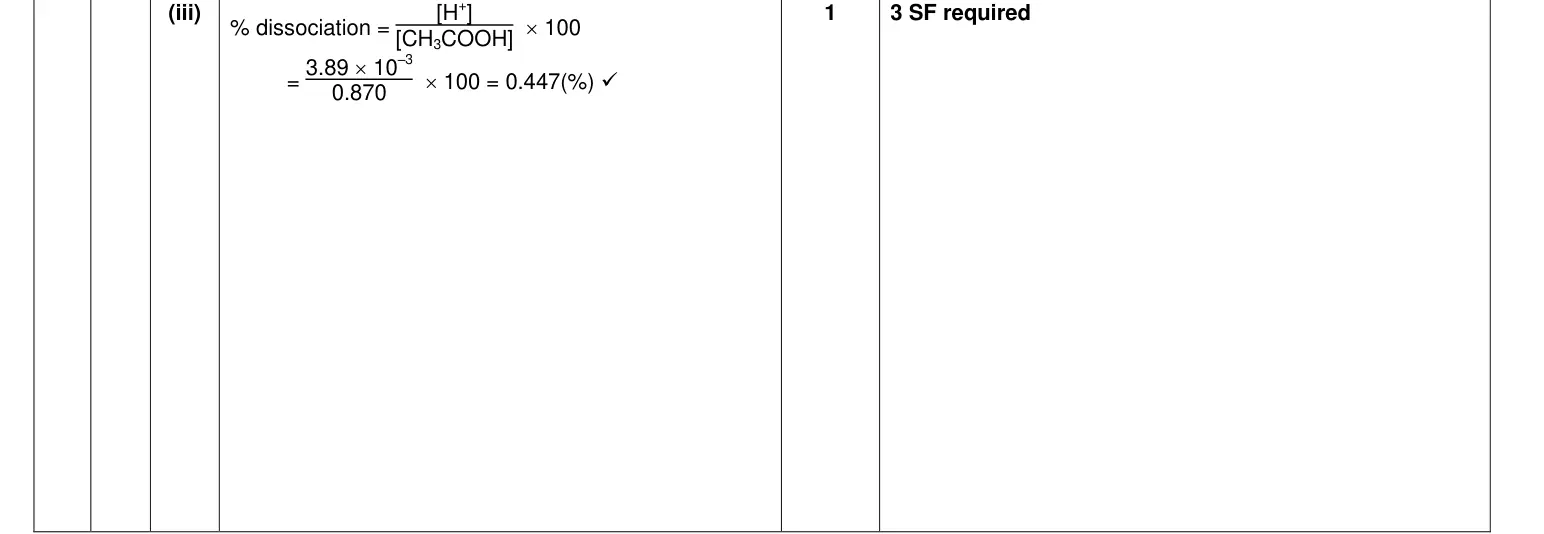
This proved a more difficult calculation than expected, but higher ability candidates realised that [H+] (determined from the pH) divided by the given concentration of CH3COOH was required. Answers had to be expressed to three significant figures in order to receive credit.
Skills: M0.2 Use ratios, fractions and percentages; M1.1 Use an appropriate number of significant figures
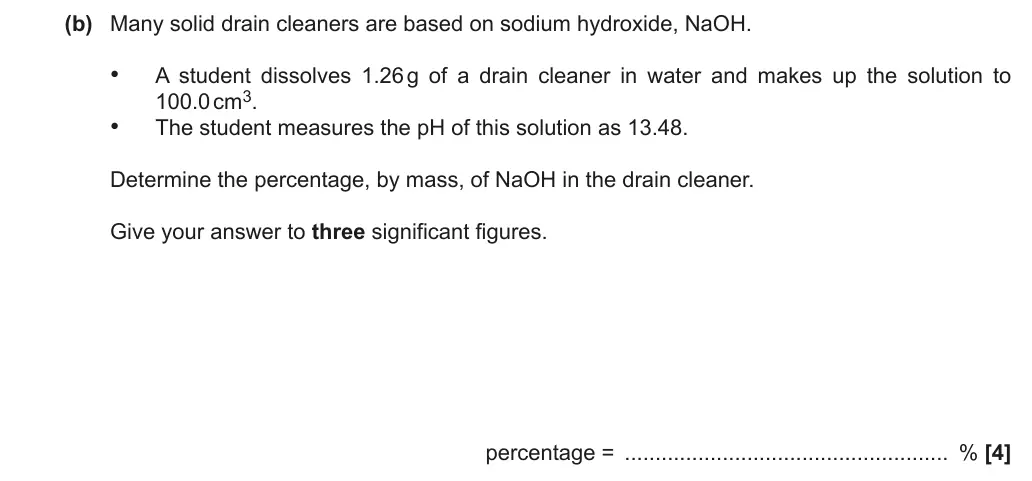
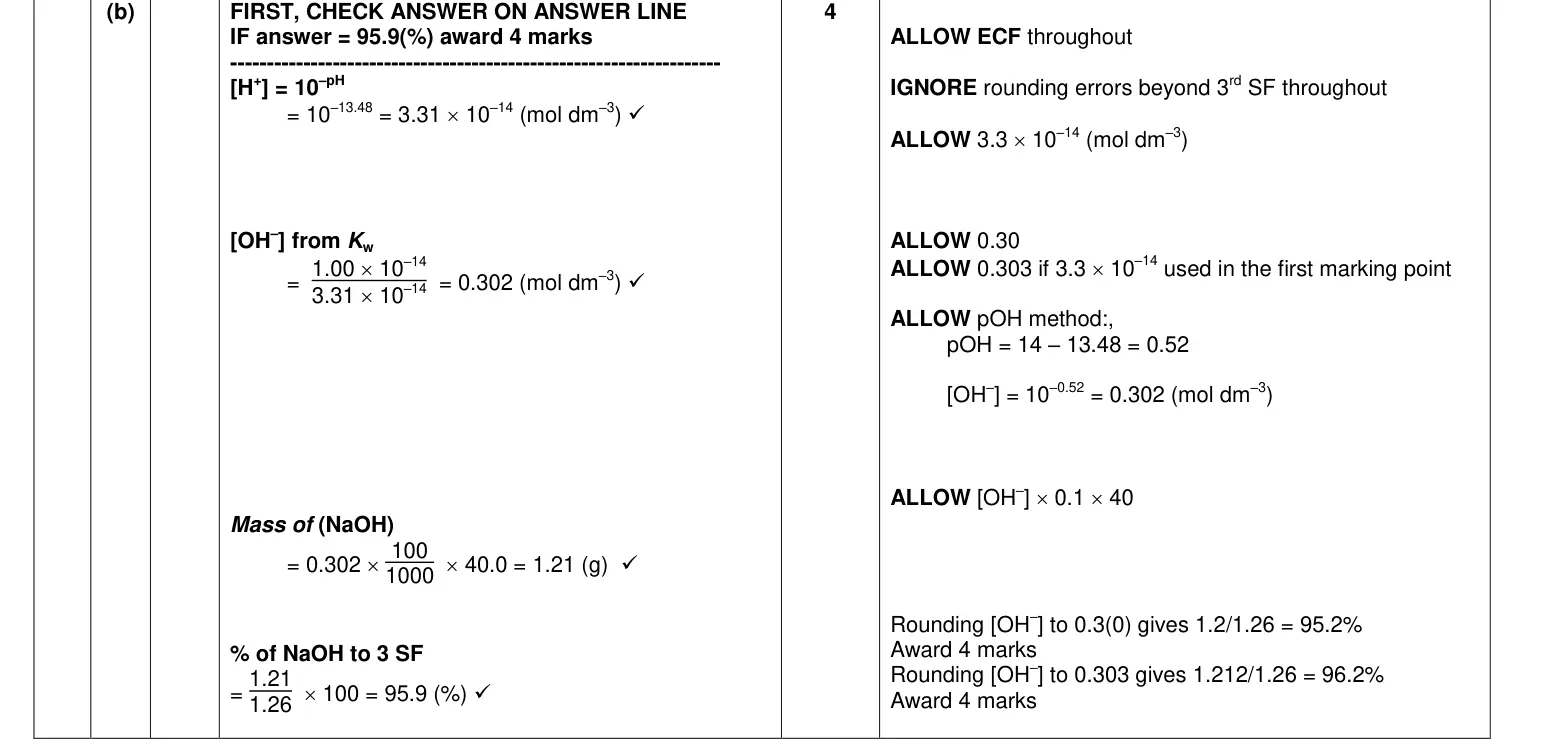
To help candidates, on this occasion early rounding was ignored and consequently most candidates scored full marks in this multi-step calculation. However, candidates should be advised not to round in the early stages of calculations such as this, as this introduces rounding errors into the final answer. Candidates should be encouraged to indicate what they are attempting to calculate in unstructured calculations such as this. The first step was frequently seen as 10–13.48 = 3.31… x 10–14 which most examiners could take to be [H+]. However, it is clearer to write [H+] = 10–13.48 = 3.31… x 10–14 mol dm–3. Even inclusion of units would help some candidates achieve partial credit as this might allow examiners to determine what a candidate is attempting to do.
Skills: M0.2 Use ratios, fractions and percentages; M0.4 Use calculators to find and use power, exponential and logarithmic functions; M1.1 Use an appropriate number of significant figures; M2.5 Use logarithms in relation to quantities that range over several orders of magnitude
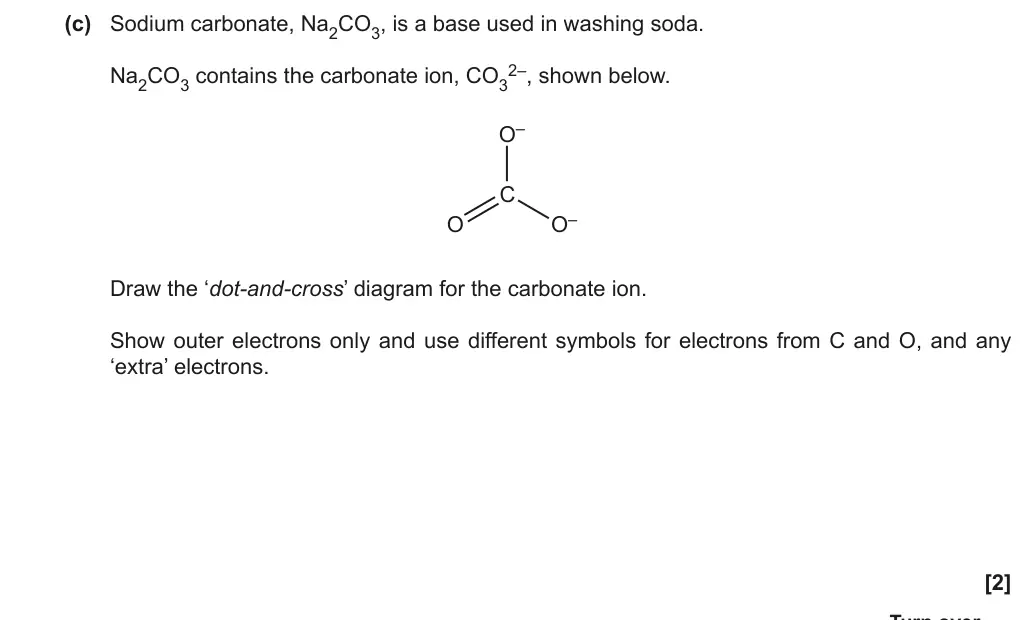
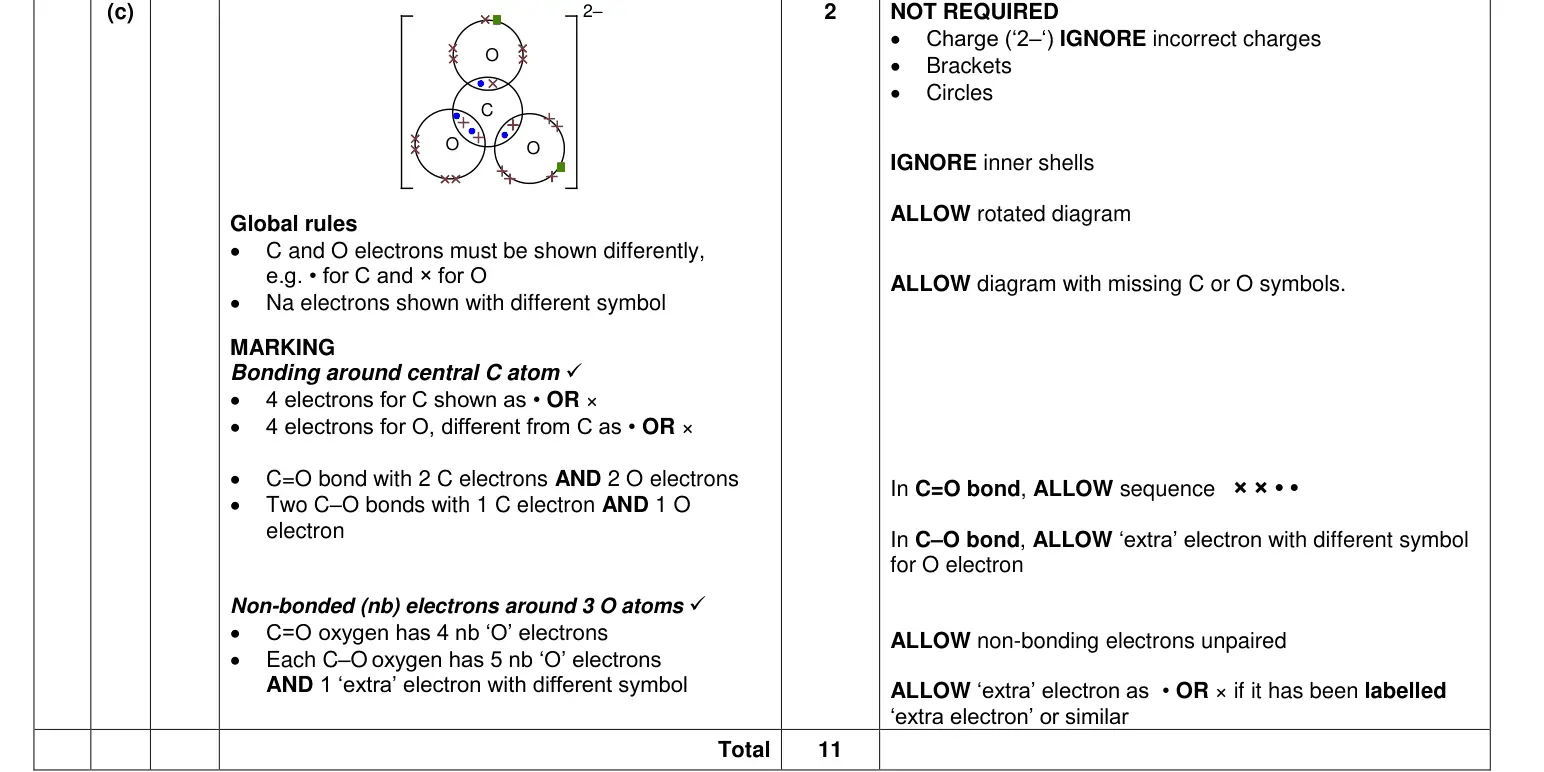
Most candidates could draw the three lots of C–O bonds including the double C=O bond as dot and cross arrangements but relatively few were able to score the second mark. Common errors included 6 non-bonding electrons on the double bonded O atom; 5 non-bonding electrons on each single bonded O atom; not showing a clear enough difference for the ‘extra’ electrons for this difference to be recognised. A small triangle or square would have been better symbols to have chosen.
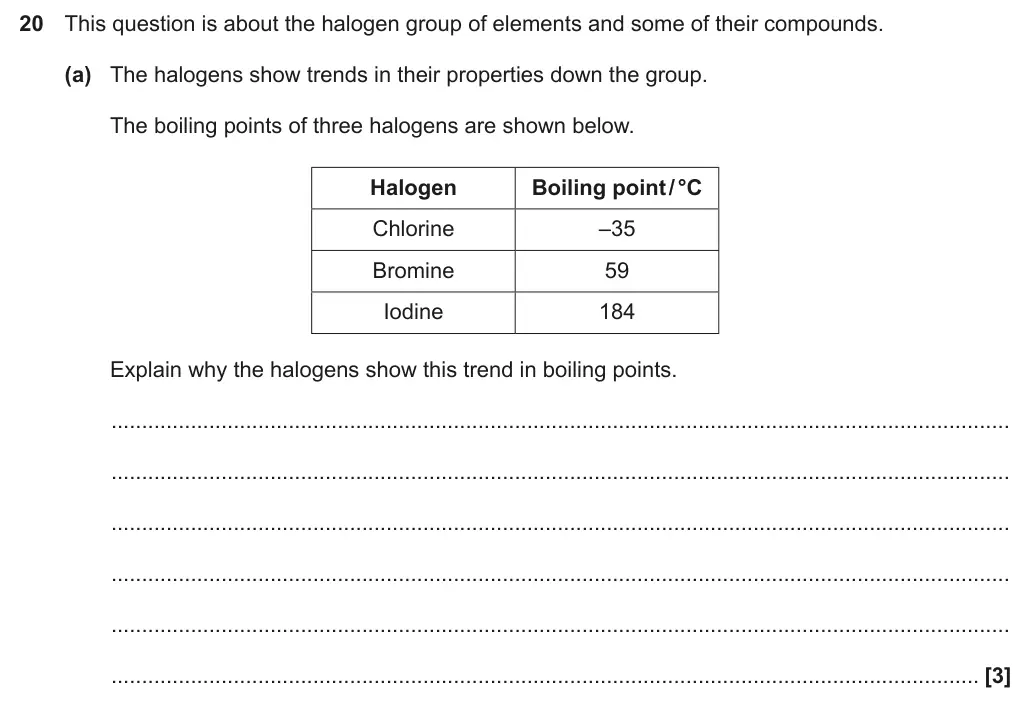
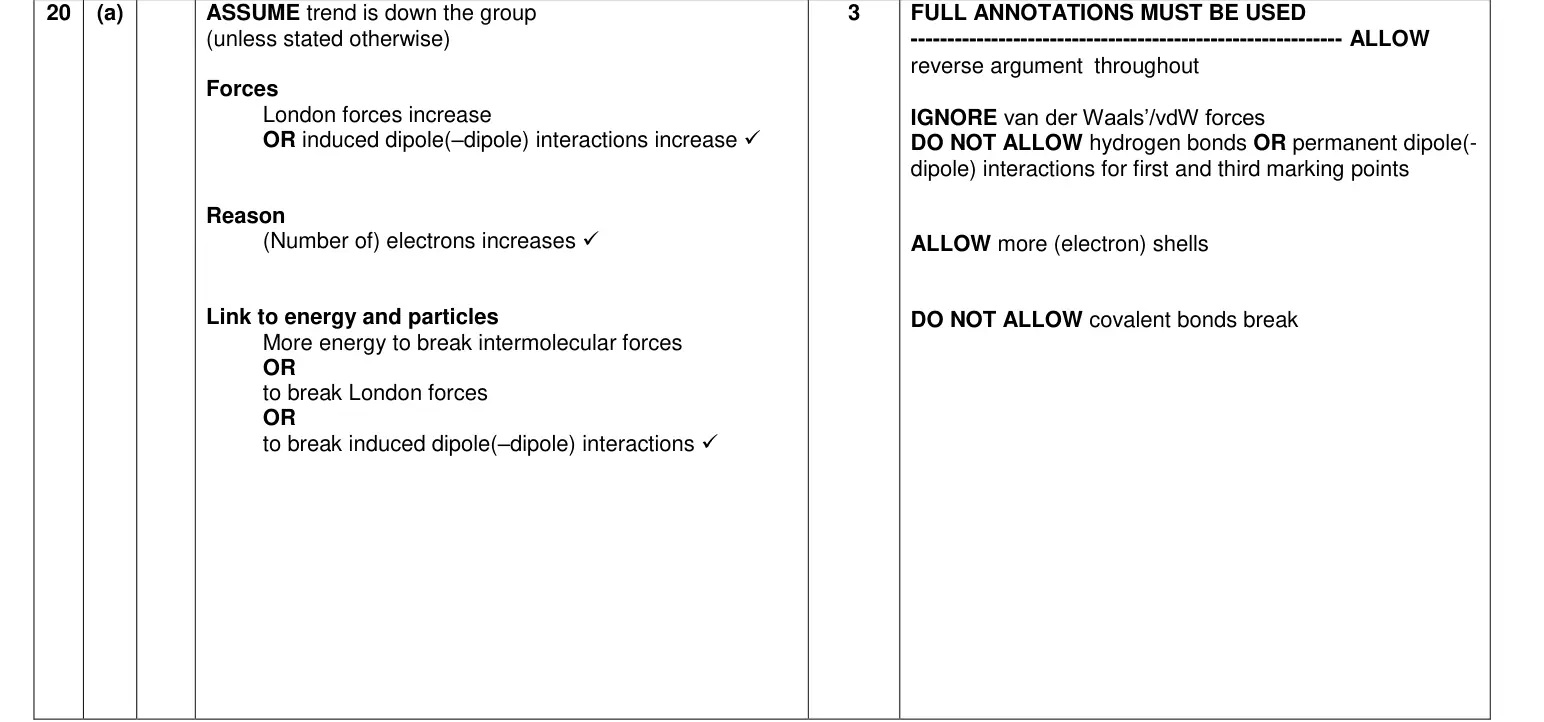
Most candidates realised that as the group is descended, each molecule has more electrons, resulting in stronger London forces (or greater induced dipole-dipole interactions), which require greater energy to overcome. Common errors included describing the intermolecular forces as van der Waals’ forces or permanent dipoles; stating that more energy is needed to overcome bonds (there are covalent bonds in these molecules) having previously used the term forces or interactions; and relating boiling point to reactivity based upon ease of electron loss due to differences in nuclear attraction.
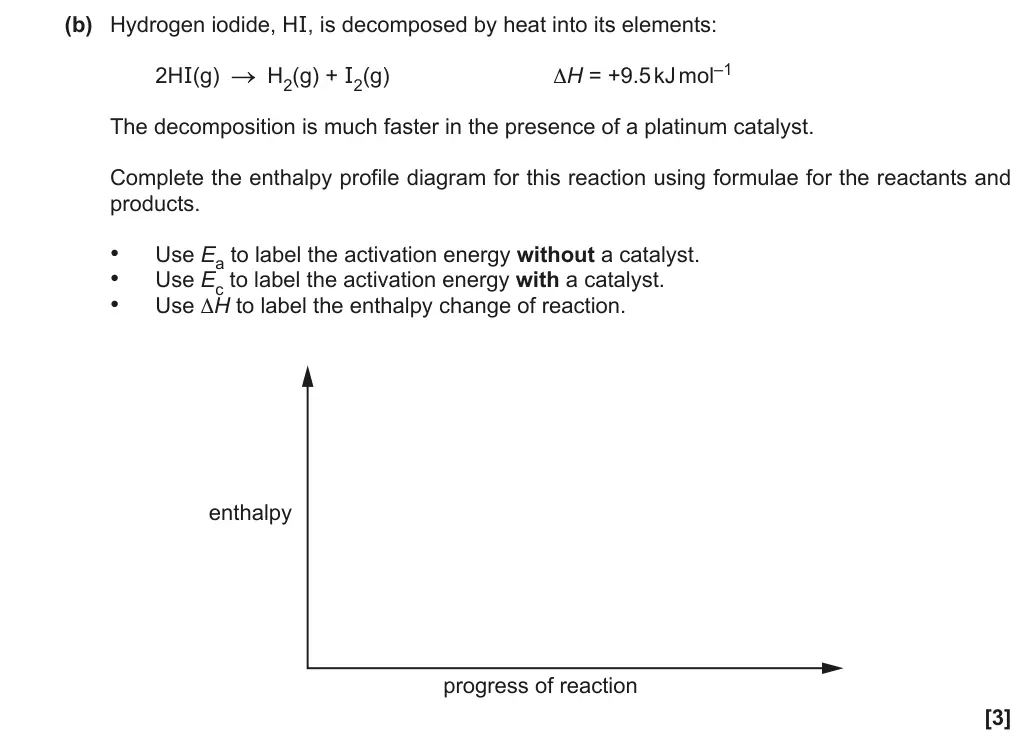
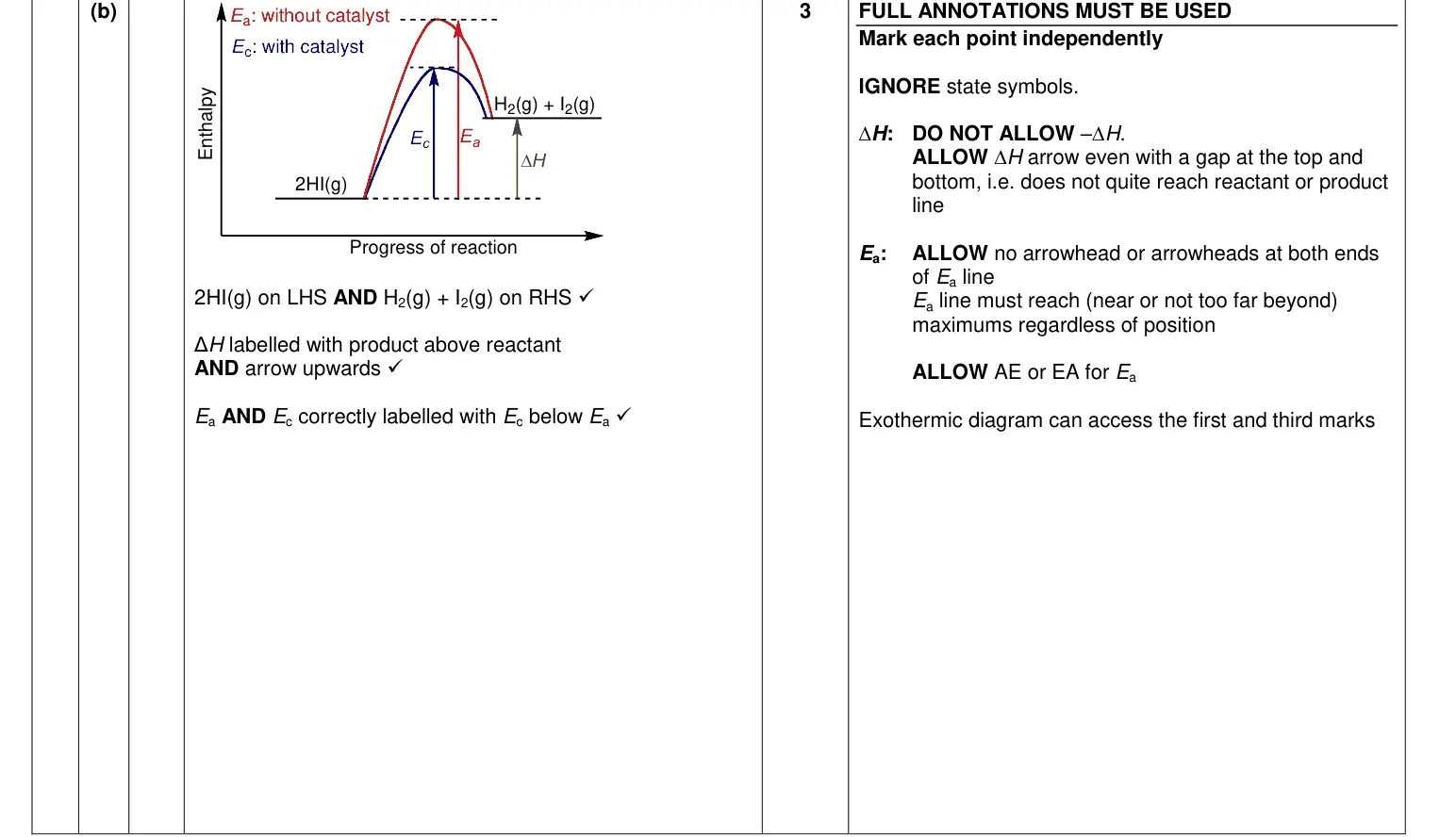
Apart from lower ability candidates, who opted to draw Boltzmann distributions, most candidates scored well here. Common errors included: omission of formulae of reactants and/or products; using a double-headed arrow for ∆H; and masking the lower part of the Ea line with the Ec line so it appeared that Ea was an additional energy increase above the Ec value.
Skills: M3.1 Translate information between graphical, numerical and algebraic forms
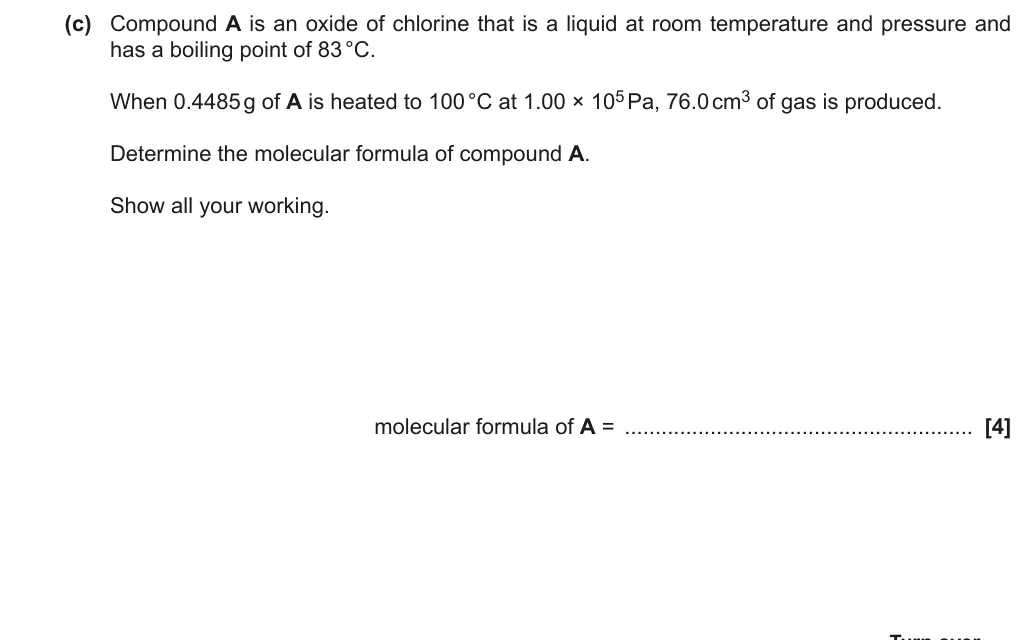
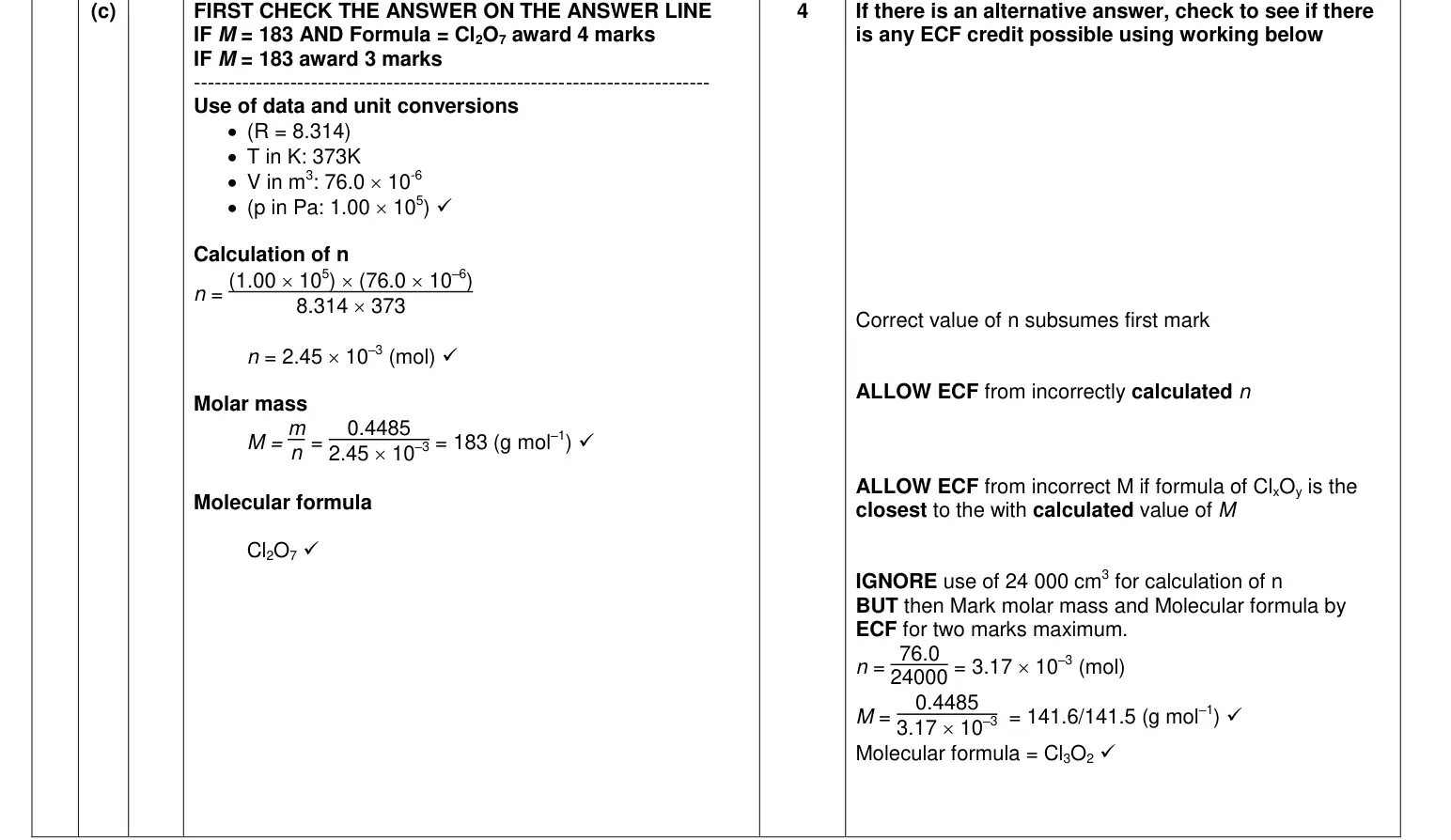
Candidates found the unit conversion into the pV = nRT equation difficult but were able to rearrange the equation to arrive at a value of n. They were then able to determine a molar mass by dividing n into 0.4485 g. Having arrived at 183.0 g mol–1, it was expected that candidates would realise that there must be an even number of Cl atoms. The next step would be to subtract 71.0 from 183.0. This gives 112.0, which divides by 16.0 to give 7, thus leading to Cl2O7. The most common errors were seen in the unit conversions. Pressure is measured in Pa (not kPa), volume is measured in m3 (not dm3) and temperature is measured in K (in this case 373 K). Another source of error was to attempt to determine n by dividing the volume by 24,000 cm3.
Skills: M0.0 Recognise and make use of appropriate units in calculations; M2.2 Change the subject of an equation; M2.3 Substitute numerical values into algebraic equations using appropriate units for physical quantities
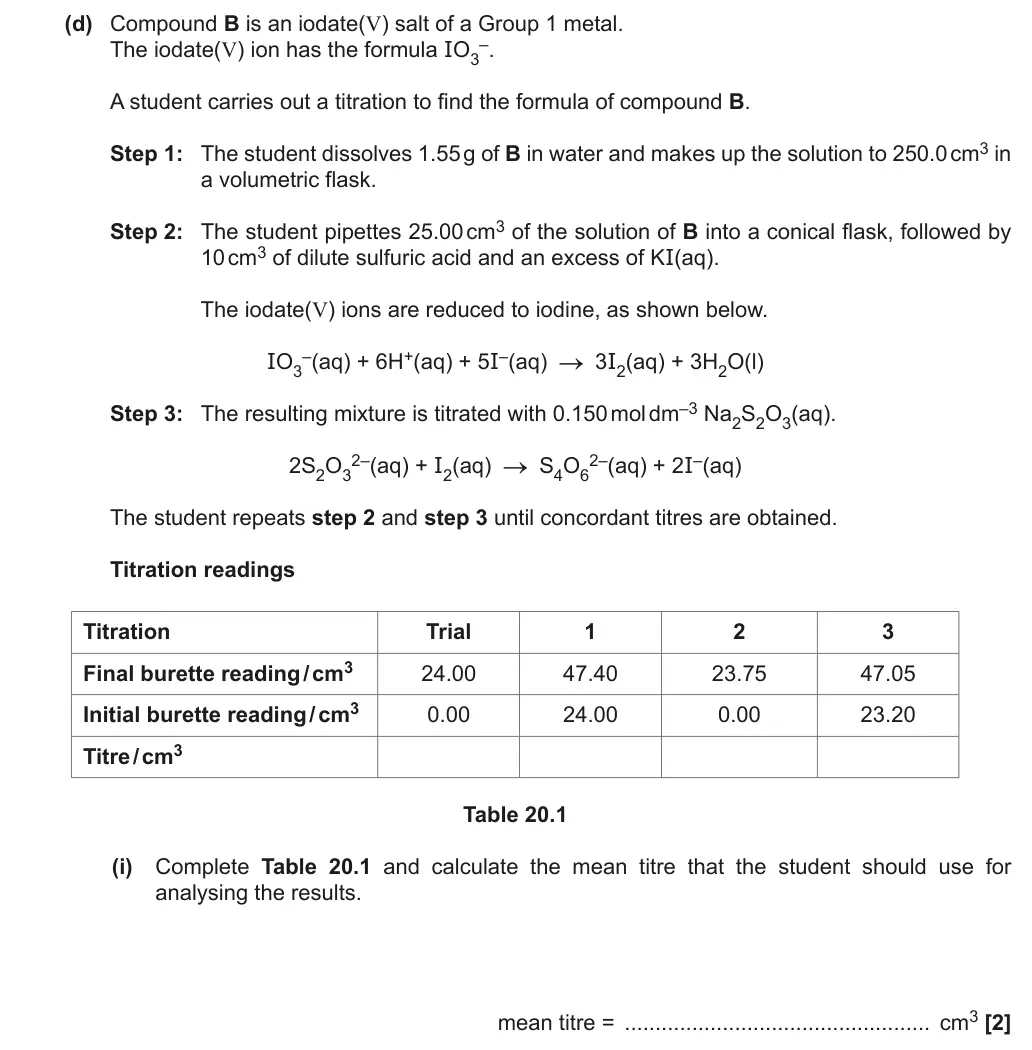
It is clear candidates are not as experienced at filling in titration tables as might be expected. Every value in a titration table should be recorded to a second decimal place to an accuracy of ± 0.05 cm3. The average titre should be calculated by averaging concordant titres, i.e. those within 0.10 cm3 of each other.
Skills: M1.2 Find arithmetic means; PAG2 Acid–base titration

Candidates are unfamiliar with determination of percentage uncertainty. Marks were credited for any percentage uncertainty calculation correctly determined from any titre value, as many opted to choose the trial value as titre 1 or used an average titre.
Skills: M0.2 Use ratios, fractions and percentages; M1.3 Identify uncertainties in measurements and use simple techniques to determine uncertainty when data are combined; PAG2 Acid–base titration
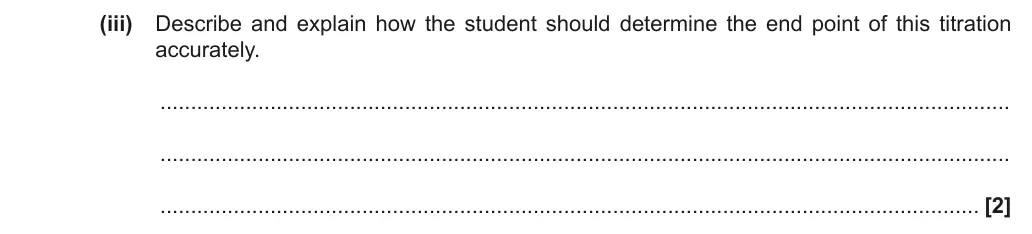
Only the higher ability candidates realised starch needed to be added close to the end-point and this made the resulting colour change (blue-black to colourless) easier to see. The common error was to assume this was an acid-base titration and indicators such as methyl orange or phenolphthalein should be added.
Skills: PAG2 Acid–base titration
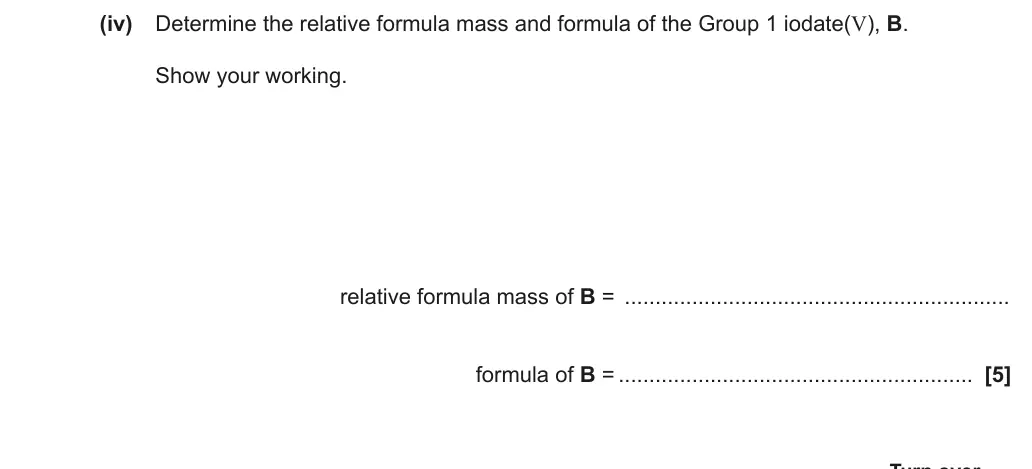
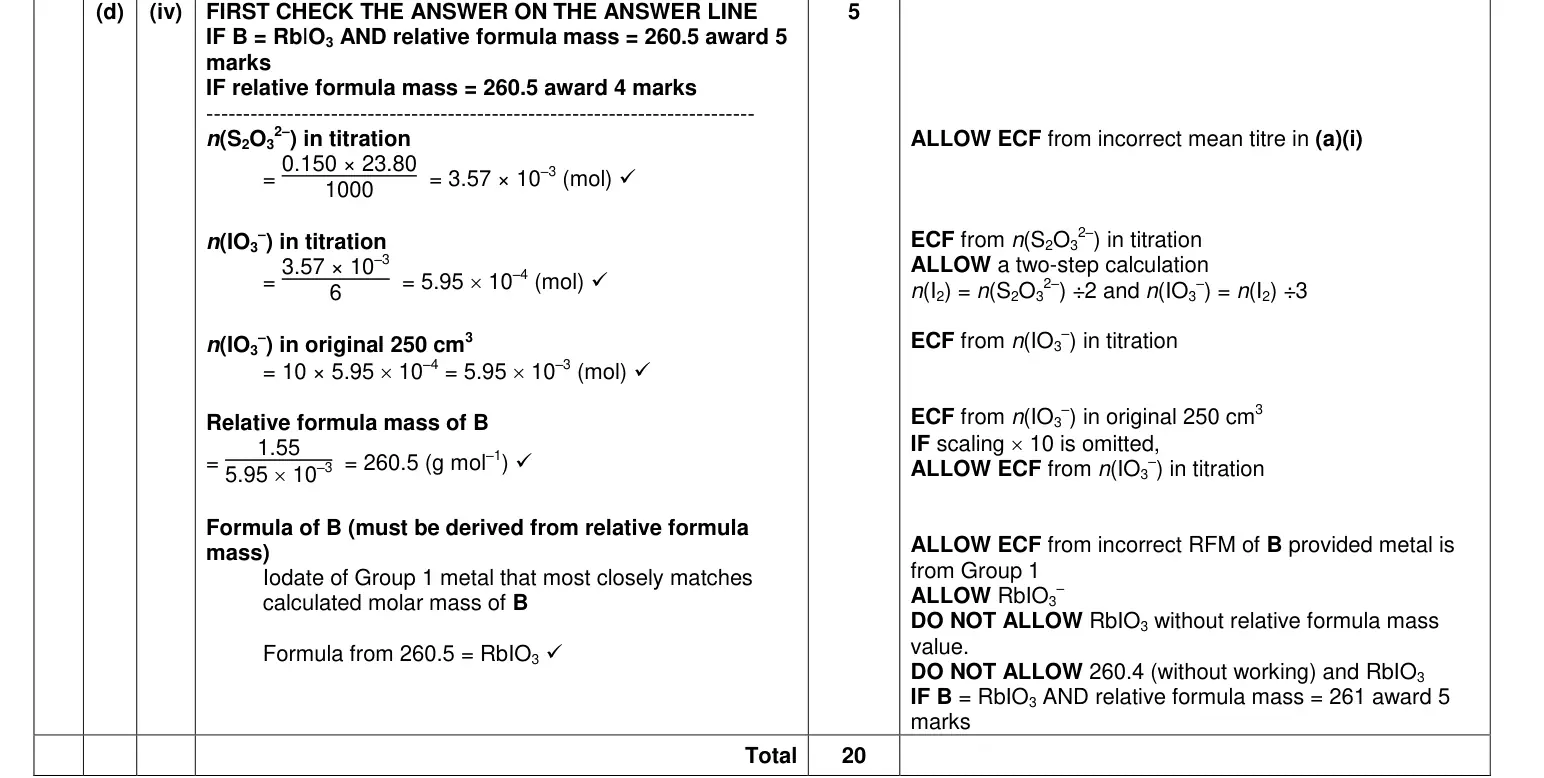
This unstructured calculation was done well by the higher ability candidates. Lower ability candidates struggled to show what they were attempting to calculate and in particular did not appreciate the 1 : 6 ratio of S2O3 2–(aq) to IO3 –(aq). Candidates might be advised to start n(formula) = … at the start of each line of calculation eg n(S2O3 2–) = … mol No credit was given to candidates who grasped the identity of the Group 1 iodate from nowhere and calculated the theoretical relative formula mass.
Skills: M0.2 Use ratios, fractions and percentages; M2.3 Substitute numerical values into algebraic equations using appropriate units for physical quantities; M2.4 Solve algebraic equations
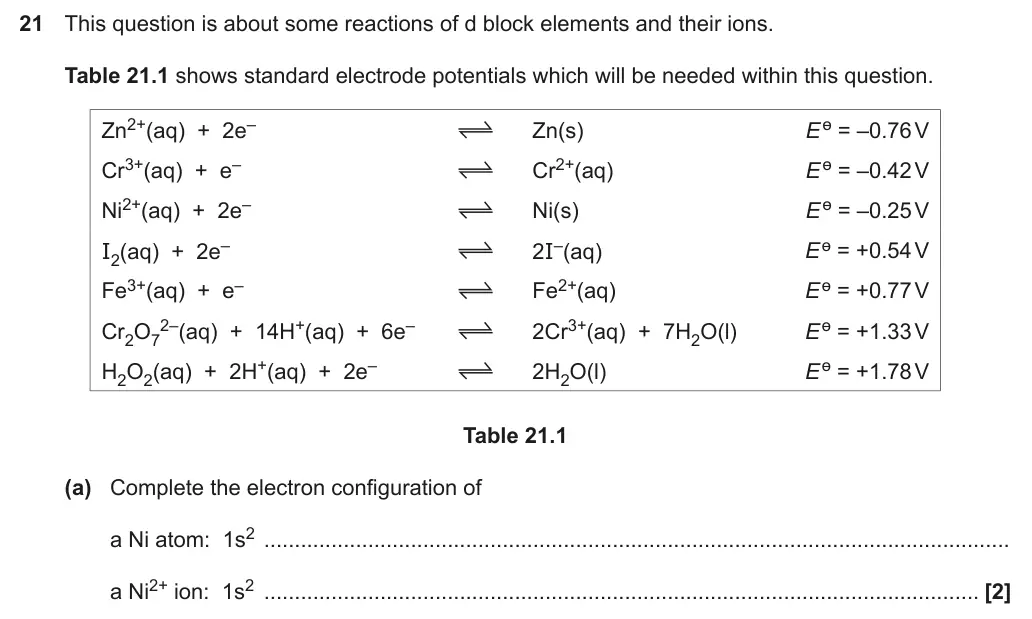
Most candidates knew the electron configuration of an Ni atom but the number knowing the electron configuration of the Ni2+ ion was considerably fewer. The common error was the failure to remove the two 4s electrons.
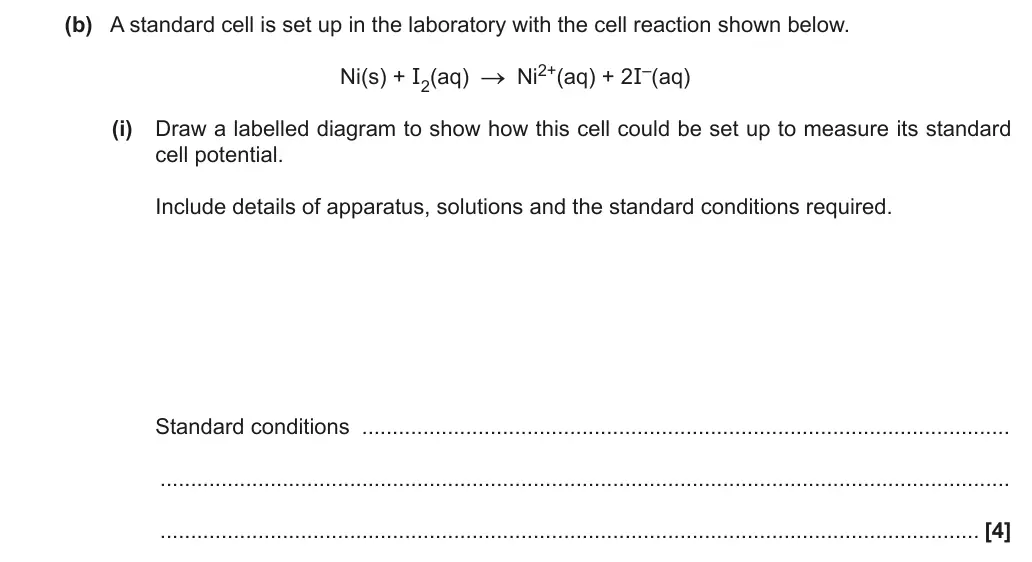
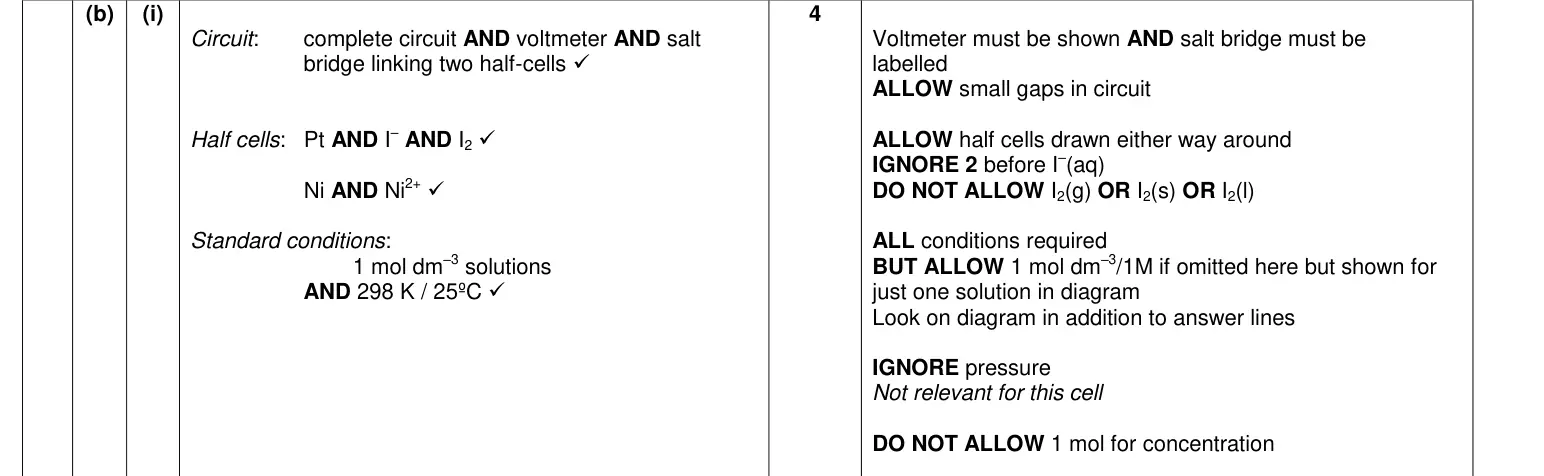
A significant number of candidates did not draw a simple circuit. Most candidates scored the mark for the Ni electrode but fewer scored the mark for the Pt electrode in the I–(aq)/I2(aq) mixture. The last mark, for the conditions (including concentrations of 1.00 mol dm–3), was almost universally scored even by those who omitted the solutions in their diagram. Common errors were: diagrams with electrodes not entering solutions; salt bridges not labelled or not entering solutions; making solid iodine an electrode; and assuming iodine to be a gas and adapting a standard hydrogen electrode to accommodate this.
Skills: PAG8 Electrochemical cells

This was the most successfully answered single mark question on the paper.
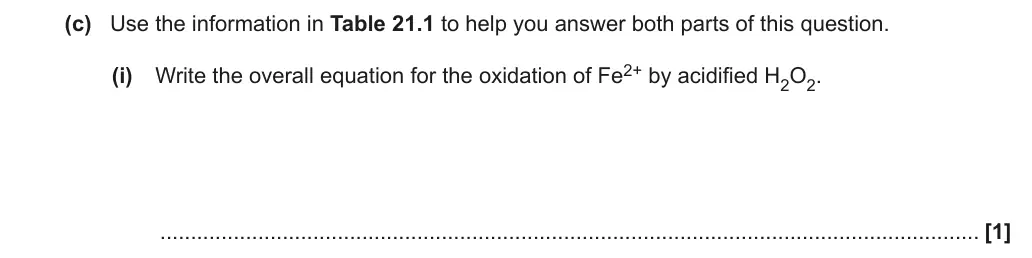
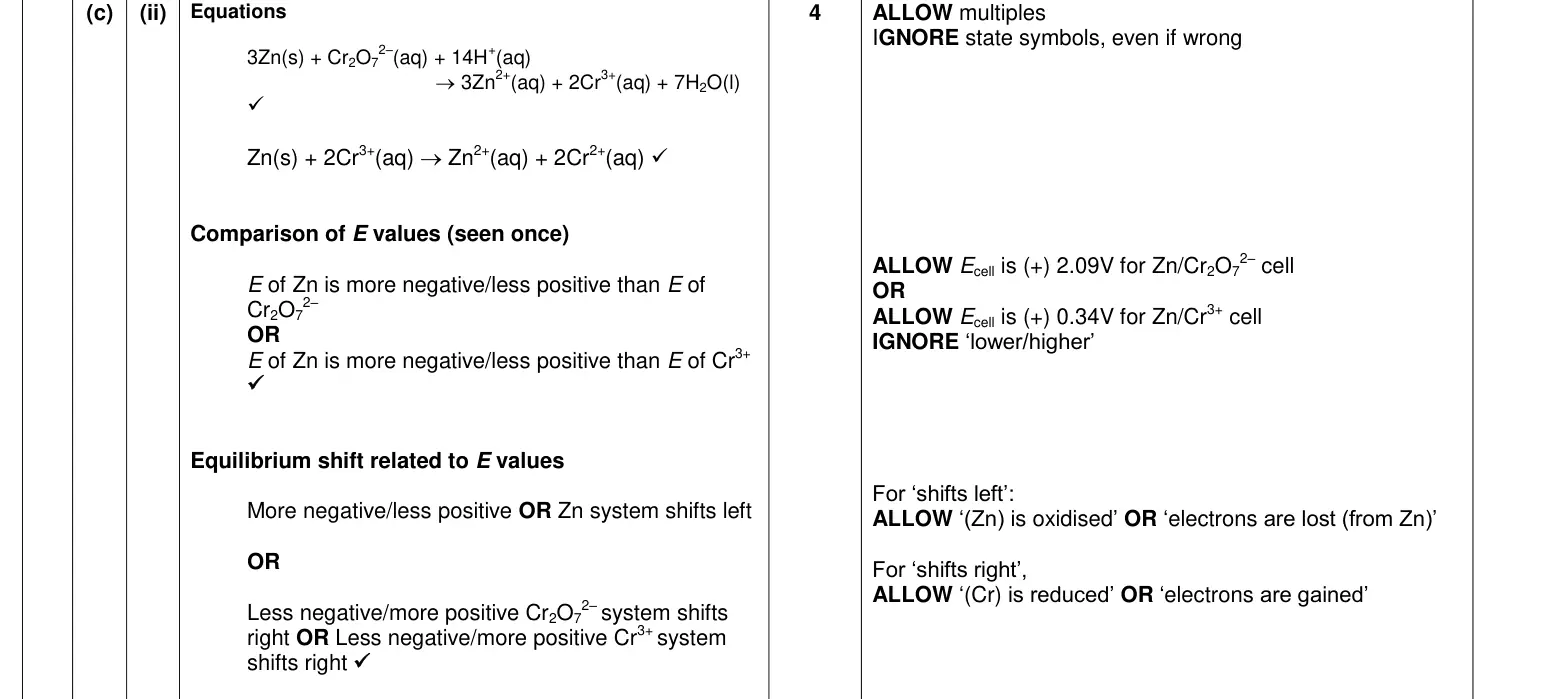
Most candidates got the equation correct. Occasionally a number was omitted causing incorrect stoichiometry and occasionally the equation was reversed.
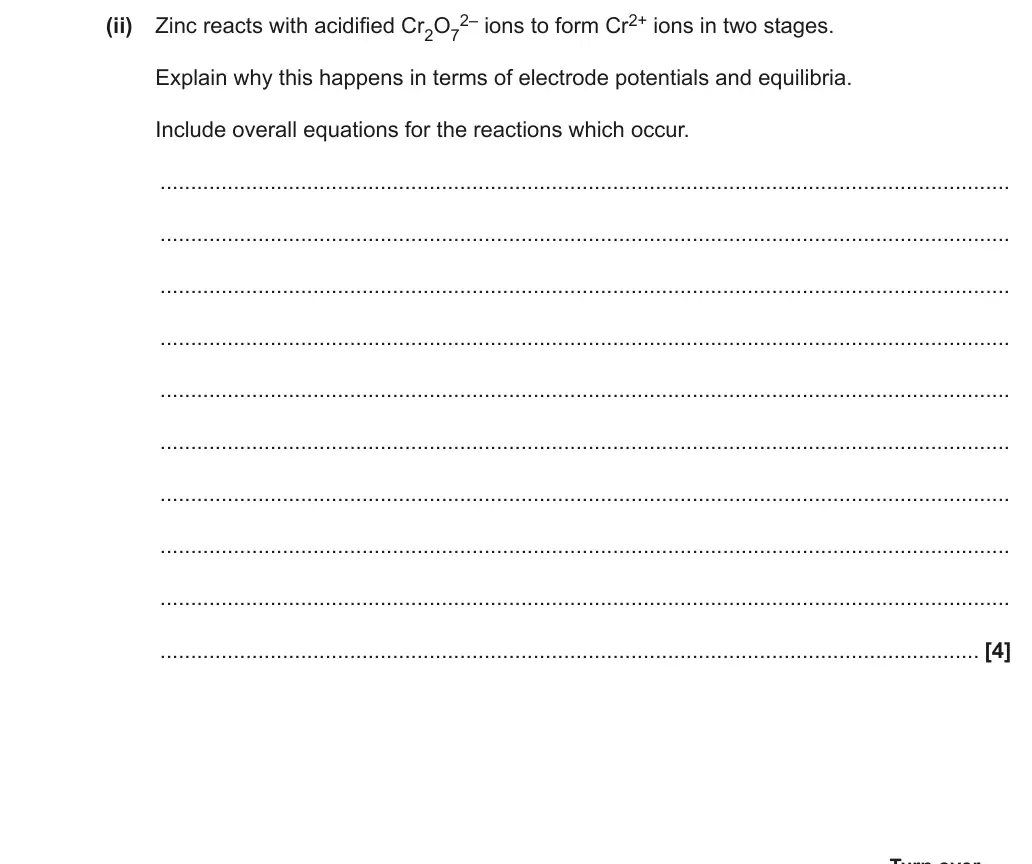
Only the higher ability candidates achieved full marks. Most candidates were able to come up with both redox equations and some could state that zinc was oxidised or chromium was reduced as a result of zinc having a more negative electrode potential than either chromium species. Common errors were: stating that zinc had a lower (not more negative) electrode potential; stating that zinc was an oxidising agent (as well as being oxidised); confusing the direction of change of equilibria shown; and not balancing the overall redox equations.
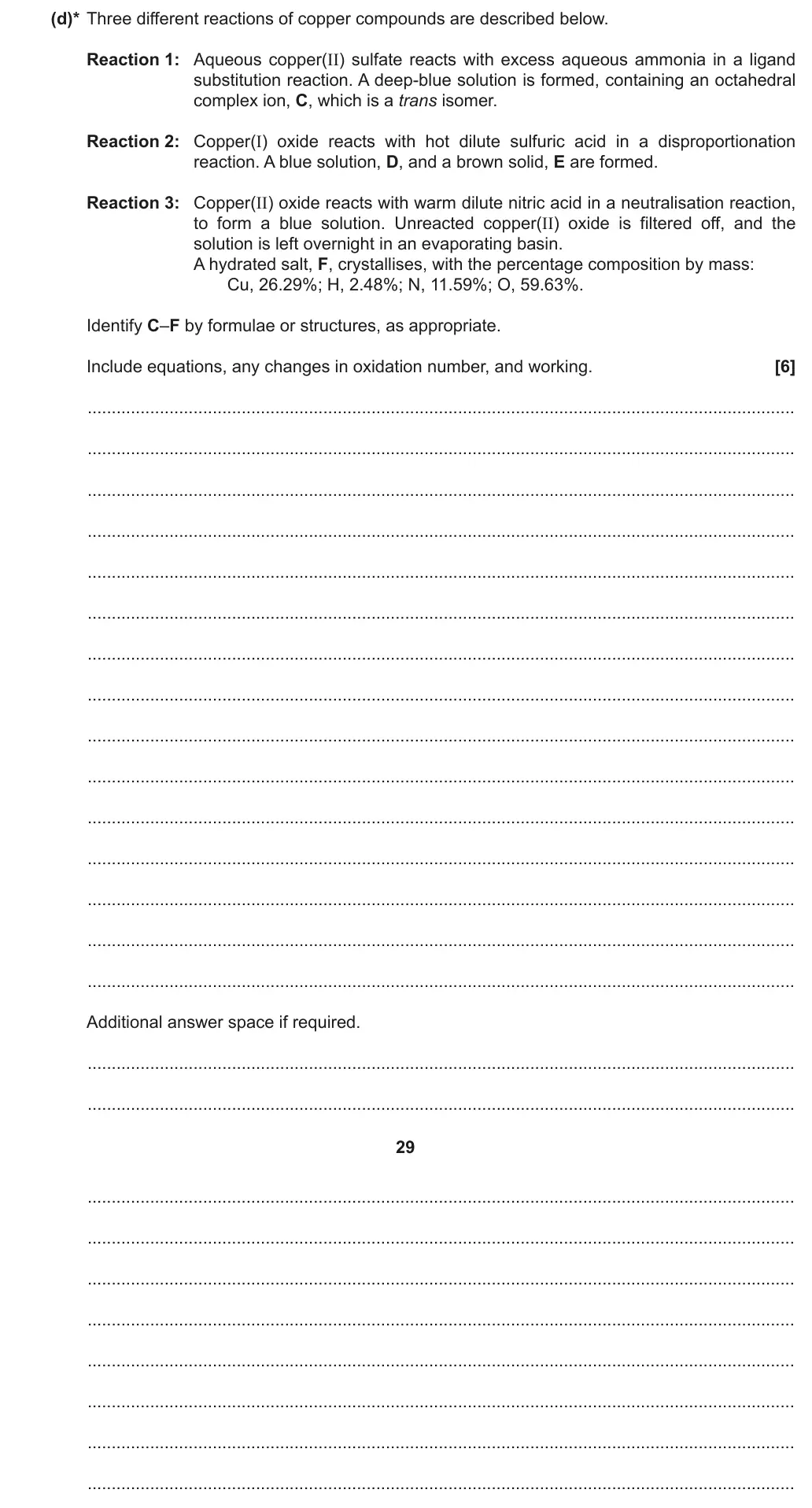
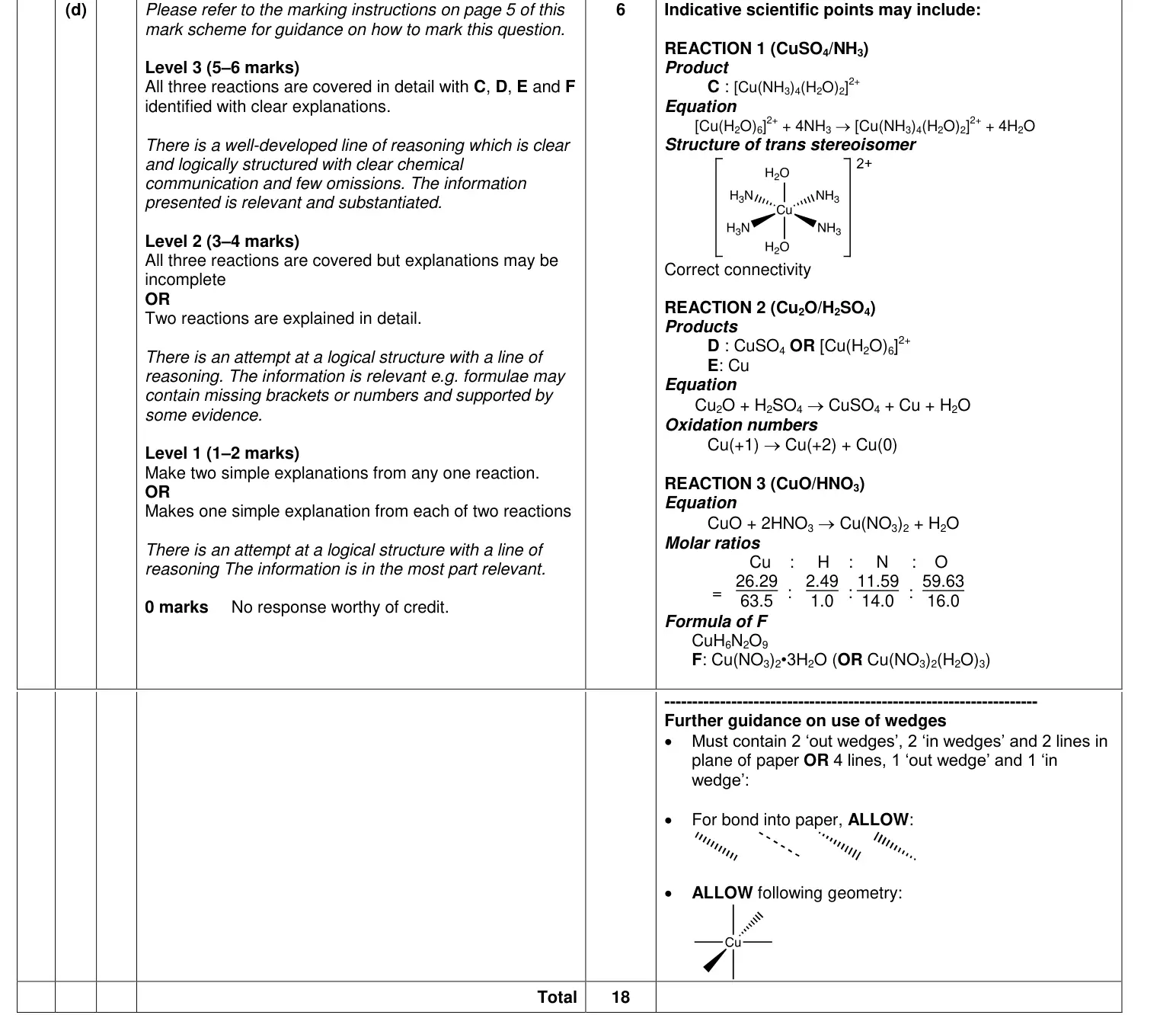
Many candidates had a stab at identifying C–F but neglected to include equations for the three reactions described or to show relevant working. Most candidates recognised C as the ammoniacal copper(II) ion but the formula was frequently incorrect and correct attempts at a ligand substitution equation from [Cu(H2O)6]2+ was rarely seen. Diagrams showing the trans isomer were attempted but often of poor quality due to incorrect linking. Candidates recognised D as being CuSO4 but often did not identify E as Cu due to a lack of familiarity with this common disproportionation reaction. Cu(OH)2(s) was a common incorrect identification of E. Only the best responses described the oxidation number changes which made this a disproportionation reaction. F was identified by a percentage by mass calculation to determine an empirical formula and then by deduction to produce Cu(NO3)2.3H2O. Having done this, many candidates did not give the relatively simple equation for reaction 3 between copper(II) oxide and dilute nitric acid. This exemplifies how considered structuring of candidate responses can enhance their clarity. The clear labelling of C-F in the response, along with numbering which corresponds to the reactions in the question stem, make the candidate’s line of reasoning easy to follow. The underlining and annotations in the question stem show good practice in picking out and interpreting key information.
Skills: M0.2 Use ratios, fractions and percentages; M4.2 Visualise and represent 2-D and 3-D forms including 2-D representations of 3-D objects
Want a paper marked and gone through with you? Message us.