Answer
B
Mark scheme

Examiner's comment
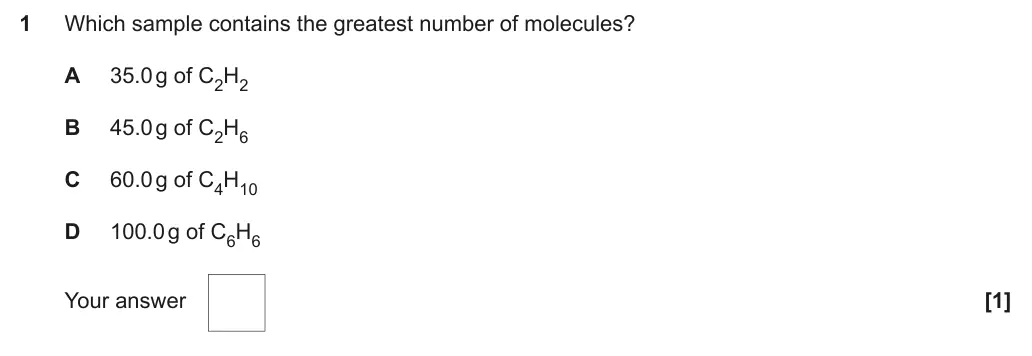
Most candidates answered this question correctly with the answer B. D was a common error based on the highest mass.
100 marks · 45 question parts · Paper, mark scheme and report on OCR's site · Have OCR's Data Sheet beside you
B
Most candidates answered this question correctly with the answer B. D was a common error based on the highest mass.
C
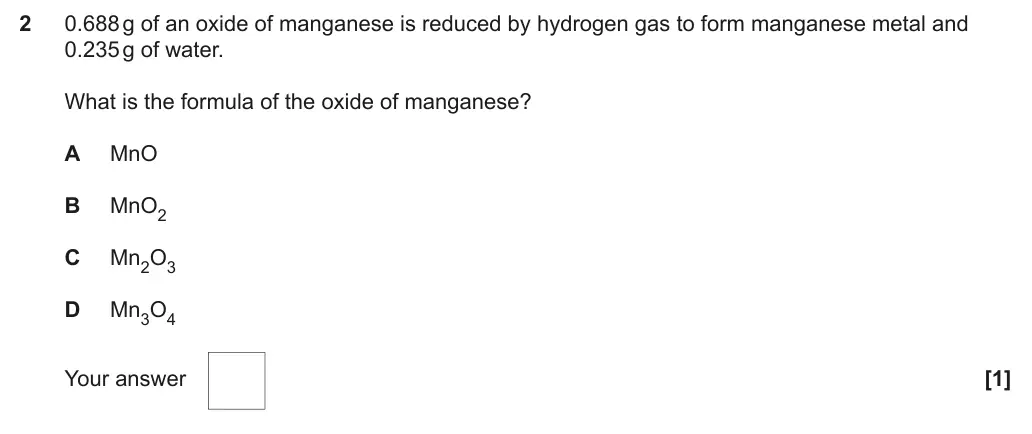
Candidates found this question challenging with the correct answer being C. A or B were the common errors selected by most candidates.
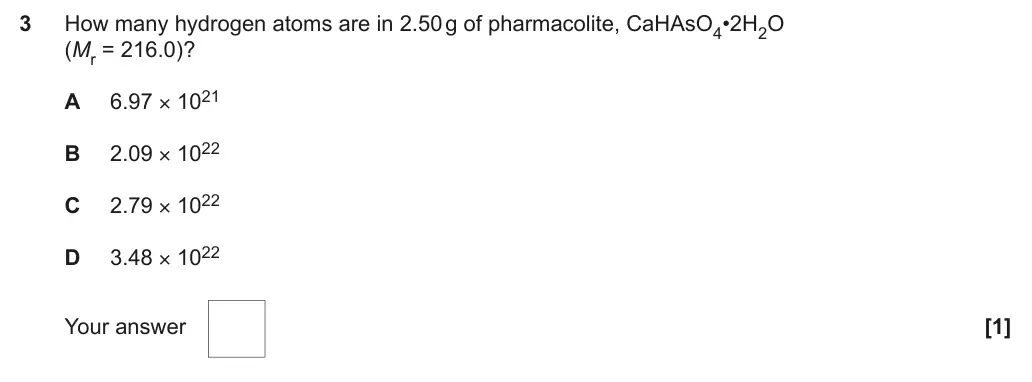
D
The correct answer was D. Most candidates did not recognise the number of H atoms, 5, in the compound, choosing A as their final answer.
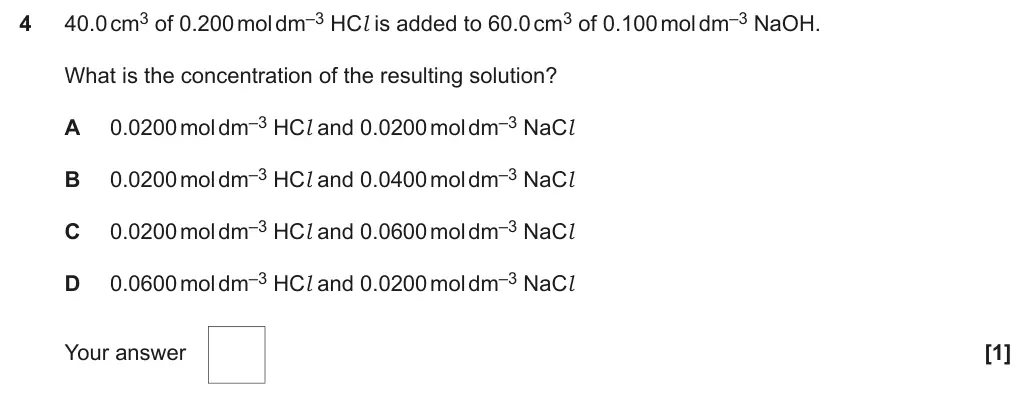
C
This question was answered correctly for the most part with the answer being C.
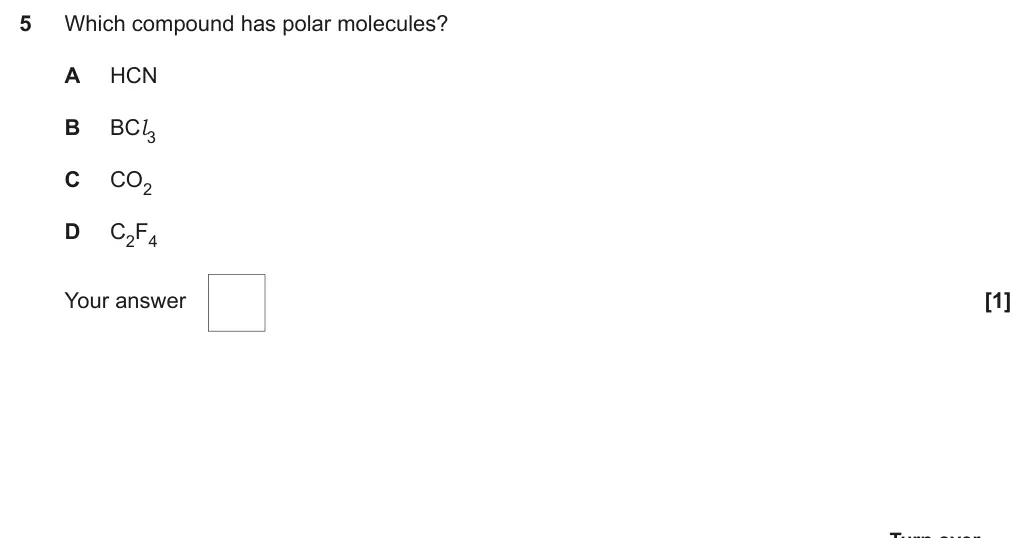
A
Most candidates recognised HCN to be linear and therefore polar due to lack of symmetry – answer A. The most common error was D.
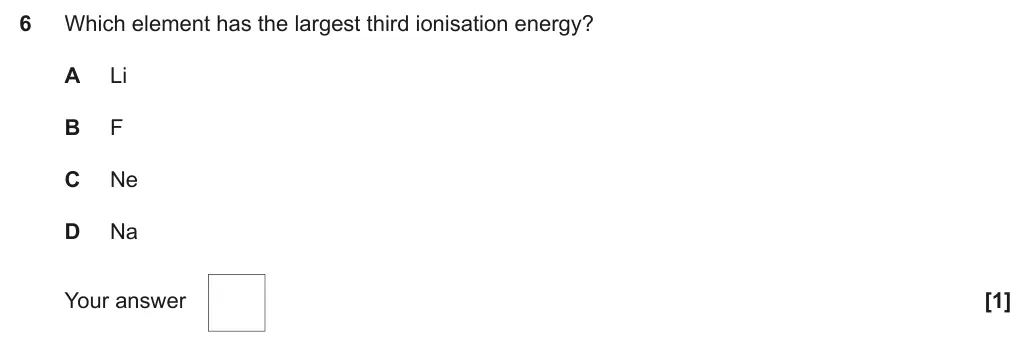
A
The correct answer was A. This question proved to be challenging, with the common incorrect answer being C.
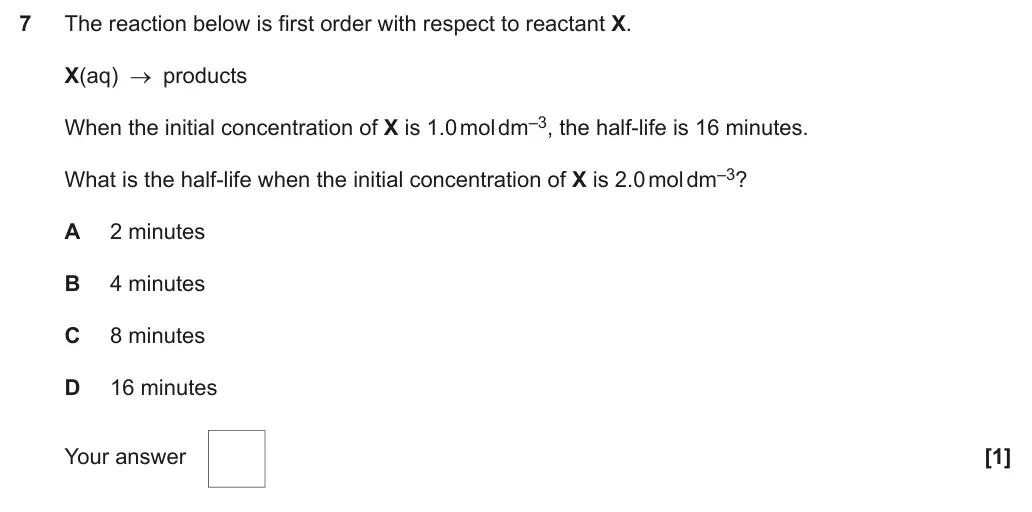
D
Half of the candidates chose the correct half-life of D and a large proportion of the others chose 8 minutes, halving the time as the concentration was doubled, causing C to be a common error.

D
This question was another challenging idea. The correct answer was D. Many candidates chose A or C, possibly due to fluorine’s high electronegativity.

B
Most candidates were able to use the data correctly. The correct answer was B. The main error was from not recognising the need to make 1 mole of SO3, so the use of ½ mole of O2, and therefore using the wrong molar ratio.
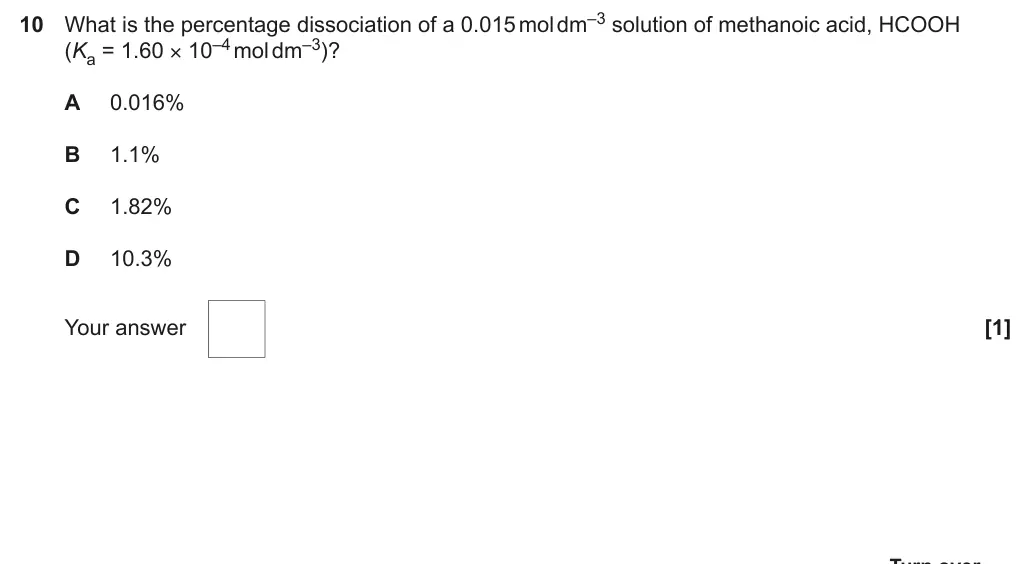
D
The most successful candidates showed their workings for the correct answer of D.

D
Most candidates answered this correctly with D. Errors came from candidates not realising HCl provided Cl- ions that would react with AgNO3 and therefore they did not recognise the formation of the white precipitate.
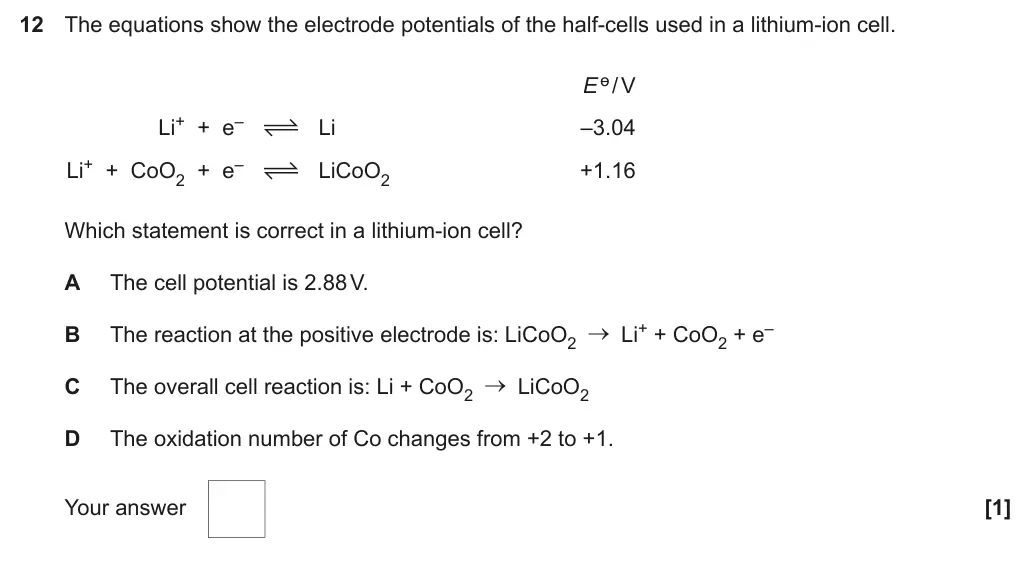
C
Most candidates answered this question correctly with C.
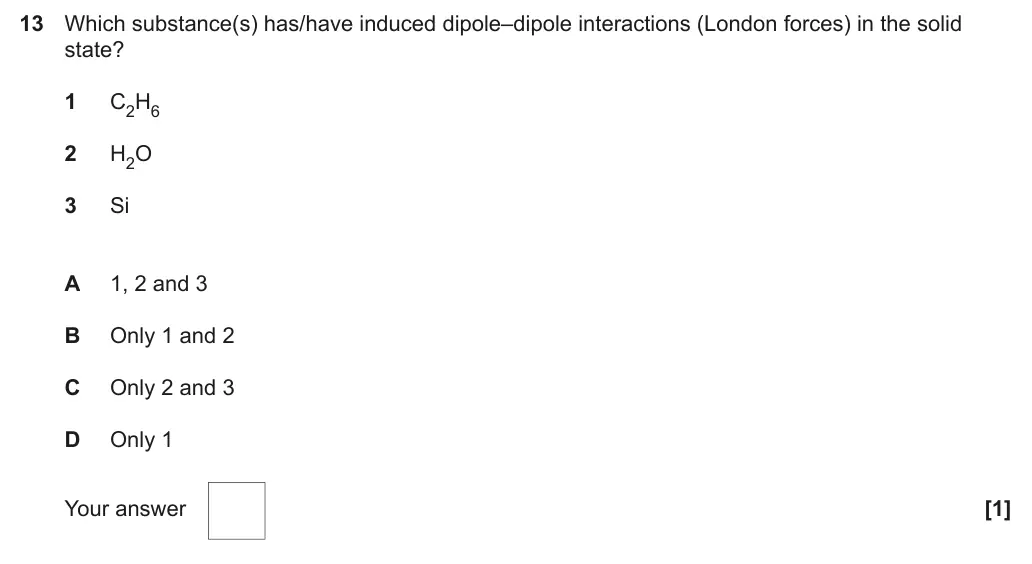
B
The correct answer was B. Most candidates did not recognise that Si has covalent bonds between atoms so included it or did not recognise that water forms London forces as well as hydrogen bonds and therefore excluded it.
D
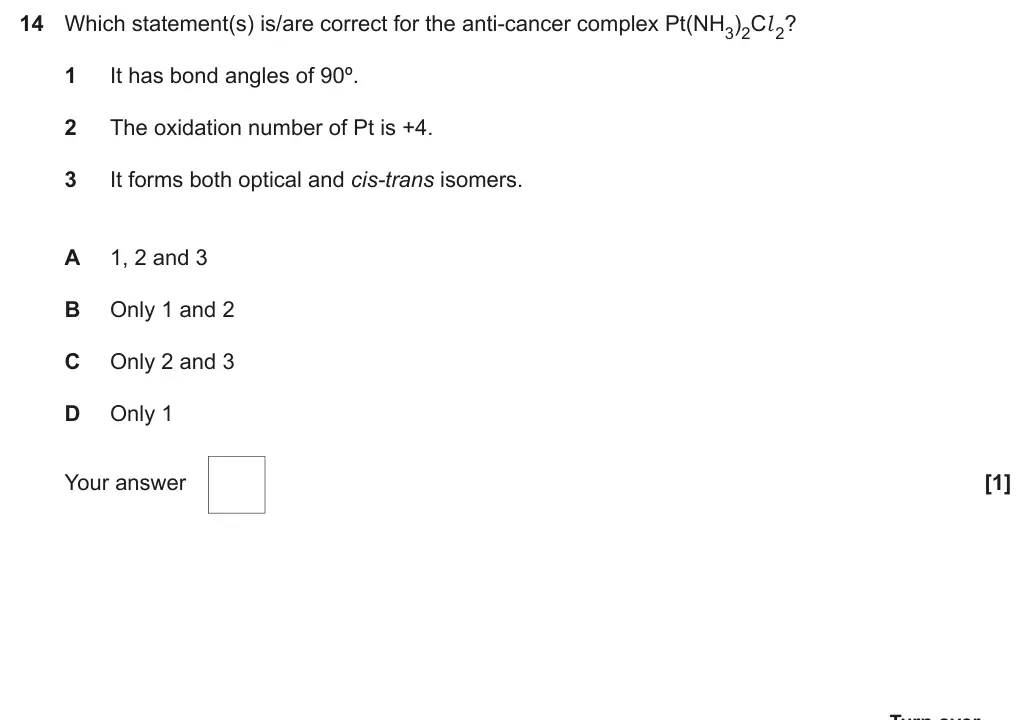
The correct answer was D. Most candidates recognised that the complex represented cisplatin. Cisplatin has a bond angle of 90 degrees due to being square planar and shows cis/trans isomerism, but some candidates thought it showed optical isomerism too. Most could tell the oxidation number of platinum is not +4.
B
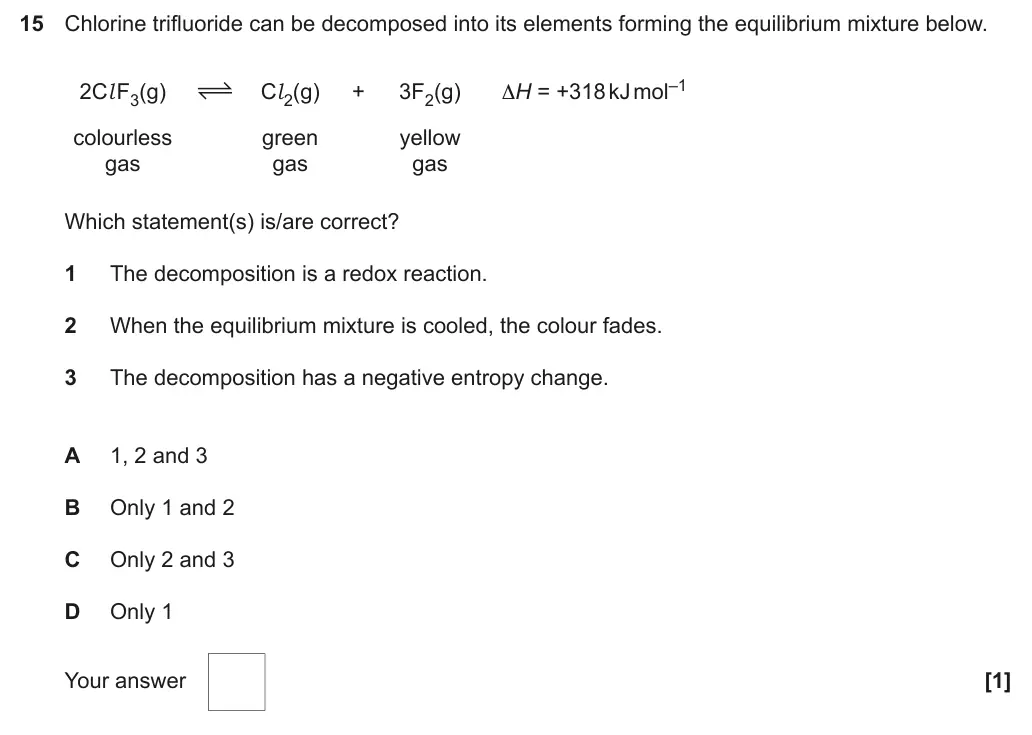
This question was for the most part answered correctly with B. Errors came from not recognising the reaction is endothermic and therefore its equilibrium would shift to the left when the temperature decreases, ruling out option 2. Section B overview The section contained questions from all aspects of the specification. Candidates found many of the questions, including those with an extended response nature, straightforward and the majority managed to cope with the mathematical content. Candidates should use calculator values in their intermediate calculations to avoid rounding errors in their final answer. Well set out calculations which clearly indicate what each numerical value represents allow error carried forward marks to be awarded in the event of an incorrect answer. Some candidates were less confident and knowledgeable with the less demanding aspects of some questions. These were specifically: ionic equations, equations involving group 2 metals and their compounds, equilibria shifts and enthalpy changes. There was evidence that candidates wrote far more than necessary in some responses. For example, Question16 (b) was allotted a very generous 9 lines for an answer but many candidates provided repetitive responses and requoted the question. Many more effective responses provided 4 or 5 line answers but gained full marks. With the exception of questions marked using a level of response mark scheme, candidates should look to the marks available to give insight to the amount of detail, and discrete points, that needed to be made.

Some candidates wrote illegible state symbols where (g) and (s) were impossible to tell apart. Also, many candidates choose to write state symbols as a very small sub-script, e.g. Ba(s) or I2(s). The convention is to use lower case letters of normal size, e.g. Ba(s) or I2(g). The most common errors were the iodine state symbol, with both (g) and (l) being used, and the use of 2I for I2. Some candidates missed state symbols in one species, missed electrons with the two ions, or gave a charge on the top left iodine.

The correct was answer seen frequently, along with lots of the common errors. Candidates tended to forget the mole ratio and did not multiply either -107 or +296 by two. Some candidates applied the cycle incorrectly and therefore used the wrong sign for an enthalpy change, leading to them attaining 1 mark.
Skills: M2.2 Change the subject of an equation; M2.3 Substitute numerical values into algebraic equations using appropriate units for physical quantities; M2.4 Solve algebraic equations
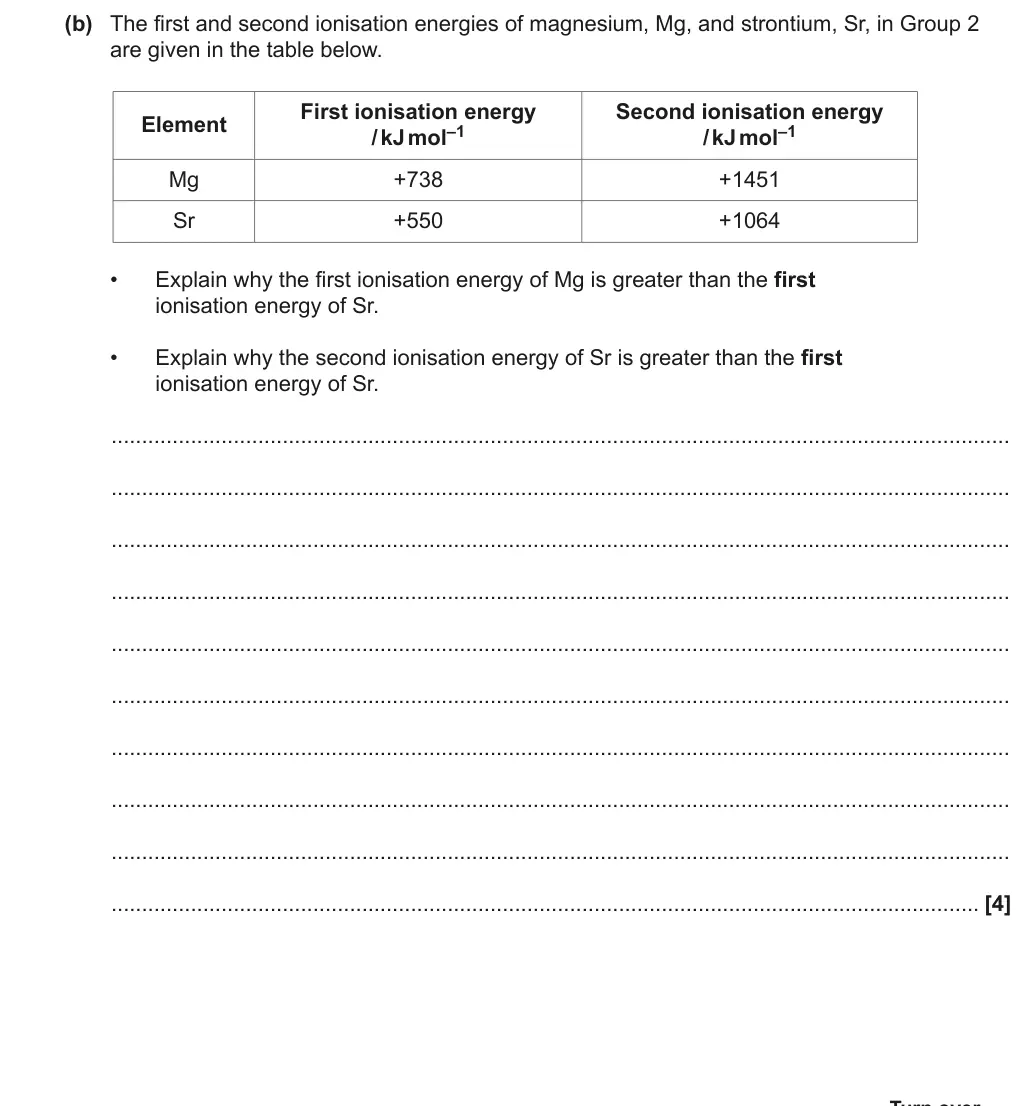
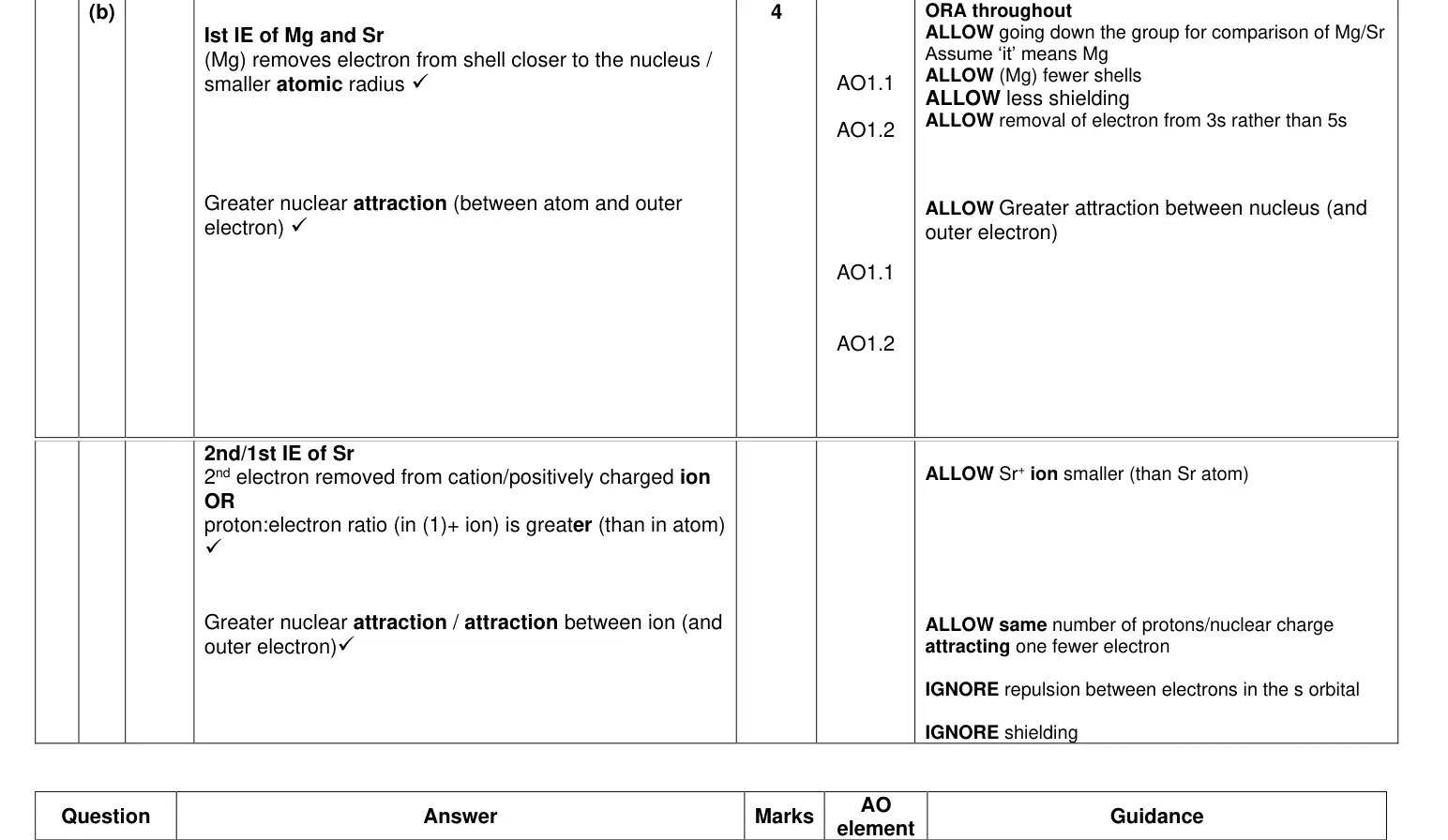
Most candidates were able to explain why the first ionisation energy of Mg is greater than that of Sr due to the Mg’s smaller atomic radius/less shielding and therefore increased nuclear attraction. Candidates should be reminded that there is no requirement to restate the question in their answers. Terminology is important and some candidates lost marks as they referred to nuclear radius instead of atomic radius. However, most candidates did not recognise that the second ionisation energy of Sr involves removing an electron from a +1 ion and instead discussed the repulsion between electrons in the s orbital. Atomic radius instead of ionic radius was often seen when discussing the Sr+ ion. Some candidates were still referring to Mg in this part of their answer and they should be advised to reread the question between each part to remain focused on the requirement.
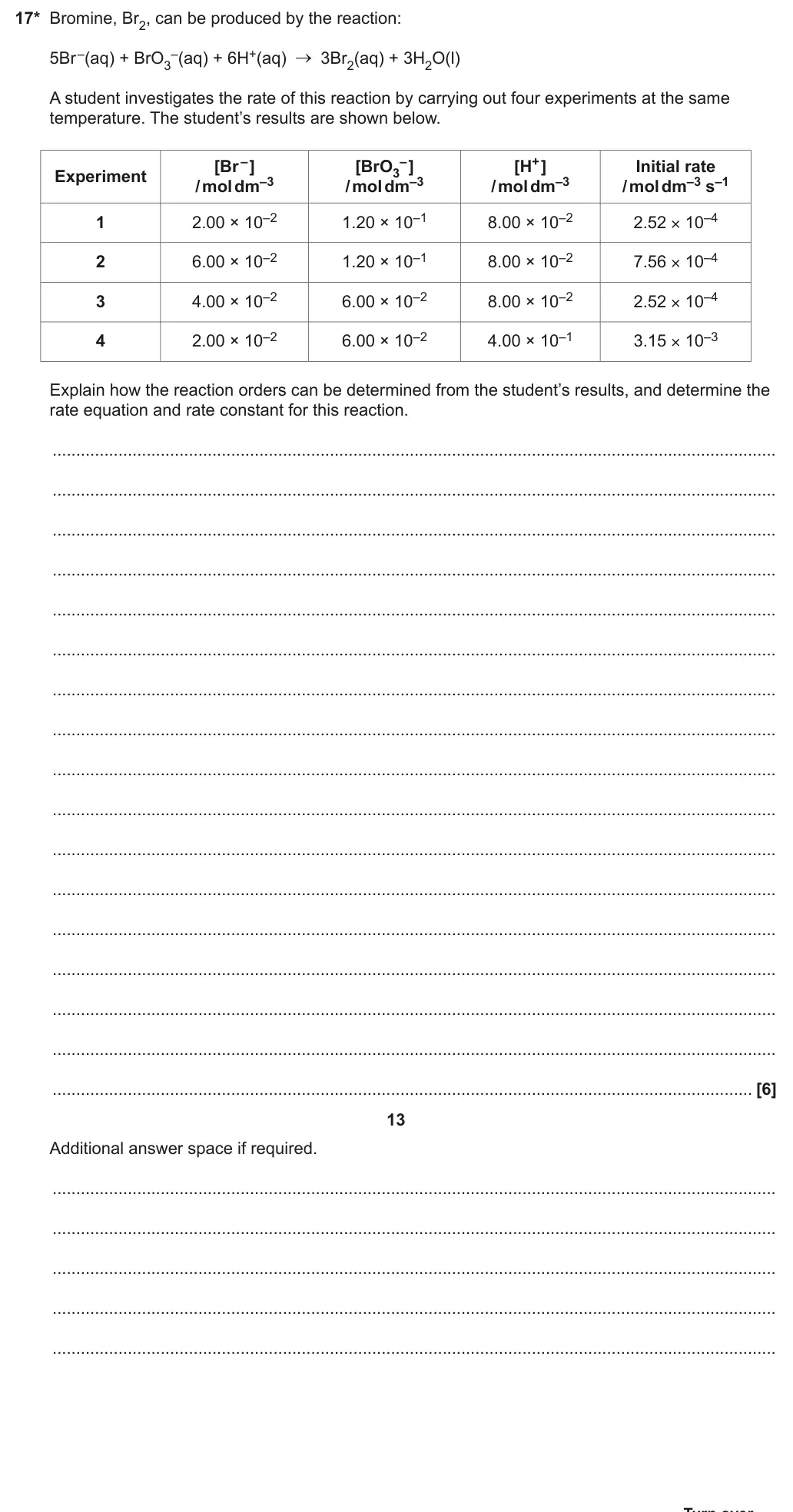
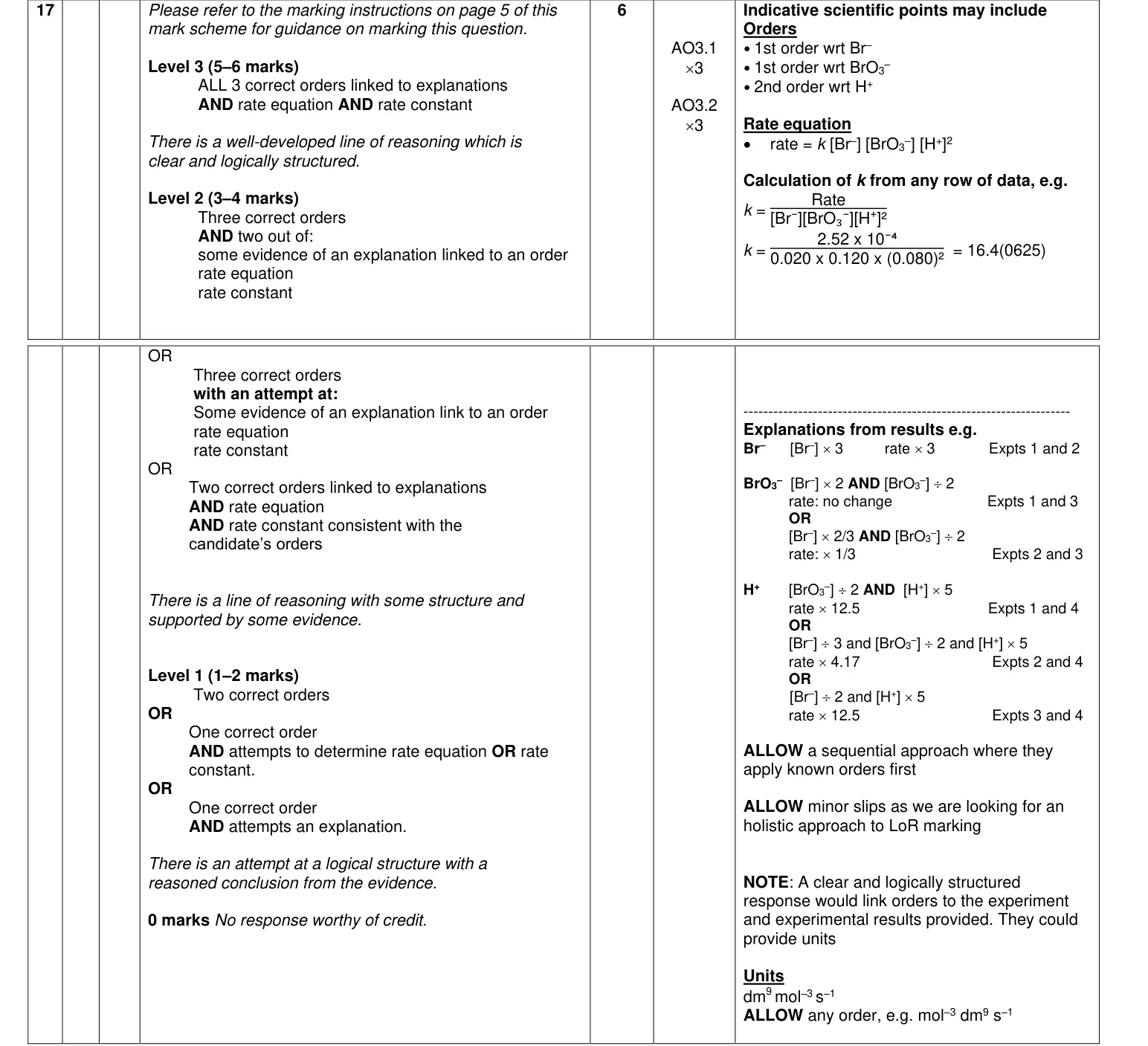
The first Level of Response question in the paper was answered well. Almost all candidates were able to conclude that the experimental results showed that they were consistent with first order with respect to Br-. Some candidates were able to use a sequential approach to determine the orders with respect to BrO3- and H+, reaching a Level 3, but others found this more problematic. Some did not notice that more than one concentration had been changed between experiments. This led to many determining the rate to be 0 order with respect to [BrO3-] and [H+]. Candidates should focus on the quality of their descriptions when linking data to their conclusions with some candidates creating their own data set to fit their explanations. Having determined orders, nearly all candidates were able to give a corresponding rate equation and could calculate a value for the rate constant, albeit with frequent omission of units. Some candidates confused the rate equation with a Kc expression.
Skills: M0.0 Recognise and make use of appropriate units in calculations; M0.2 Use ratios, fractions and percentages; M2.3 Substitute numerical values into algebraic equations using appropriate units for physical quantities; PAG10 Rates of reaction – initial rates
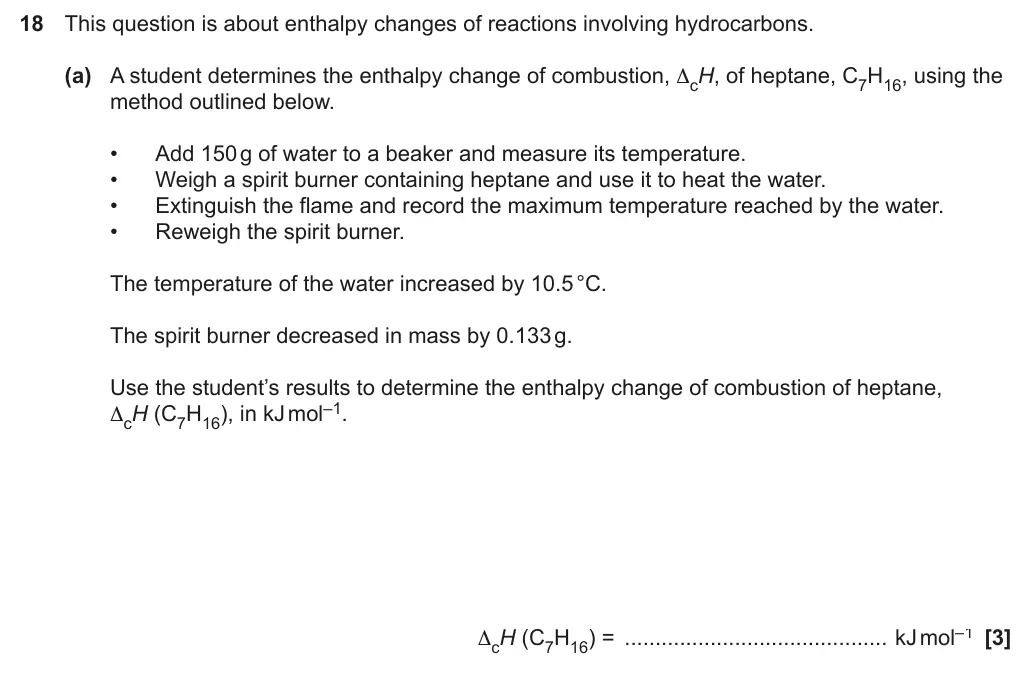
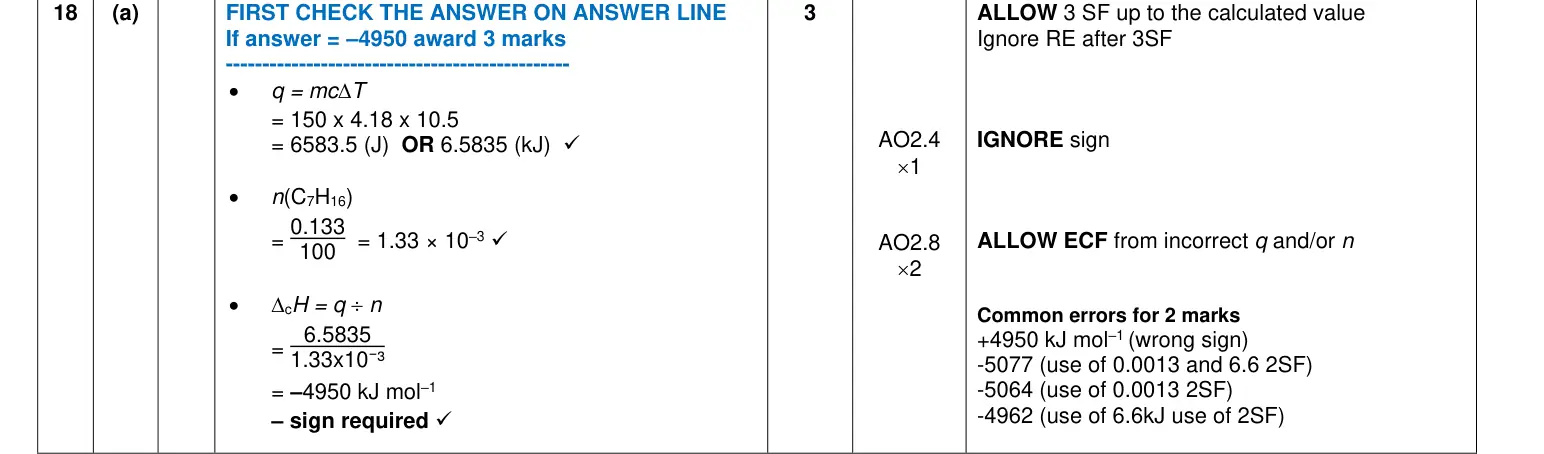
Many candidates calculated the correct value of q and scored all three marks. Common errors saw some candidates using the incorrect mass, of either 0.133 or that added to or subtracted from the 150. The temperature change was given but a few candidates added the 10.5 to 273 in order to, incorrectly, convert to K. The final mark required the candidate to link the temperature increase to an exothermic value and include a minus sign.
Skills: M0.0 Recognise and make use of appropriate units in calculations; M0.2 Use ratios, fractions and percentages; M2.3 Substitute numerical values into algebraic equations using appropriate units for physical quantities; PAG3 Enthalpy determination
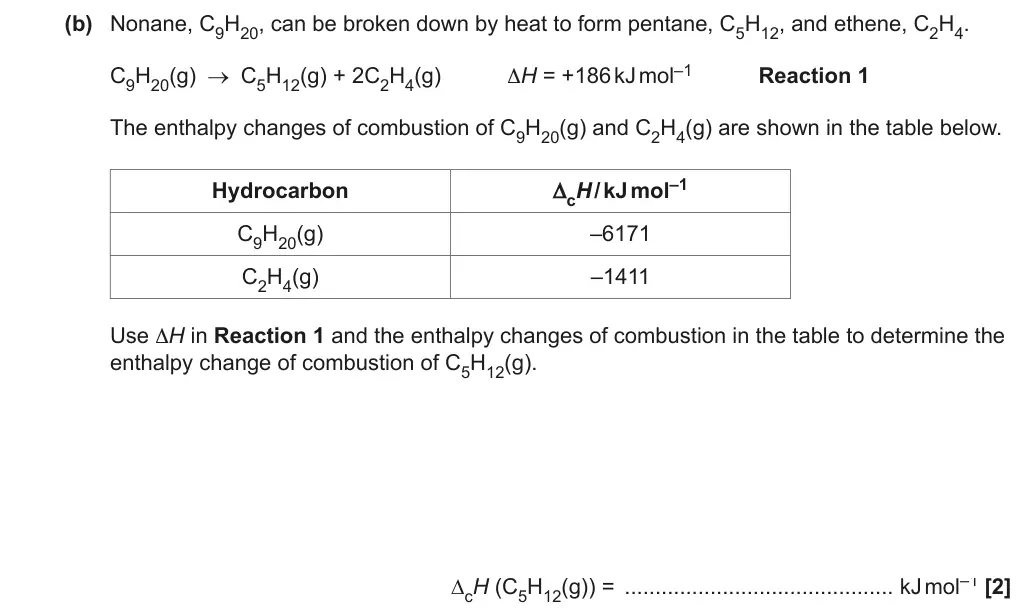
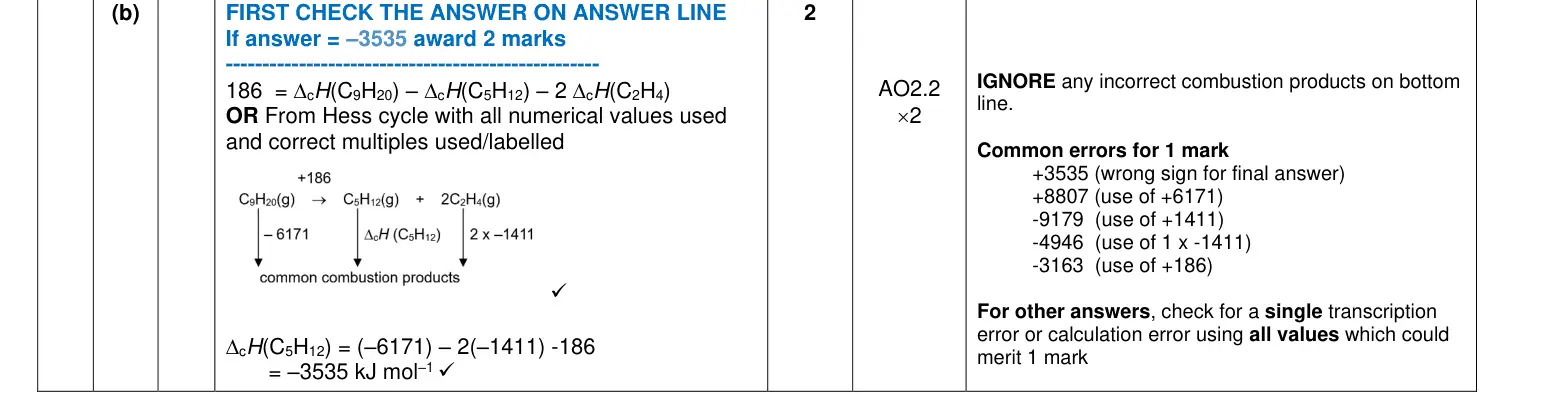
This calculation proved difficult. Many candidates did not deduce the correct cycle. Of those who did, a significant majority did not appreciate the stoichiometry and/or use the correct signs from the cycle. Many candidates scored 1 mark for this question, which was gained as an error carried forward, in the enthalpy cycle. -3163 was a common error. This candidate showed clarity in their working by drawing a correct Hess cycle and then applying correct multiples and directions for the enthalpy changes.
Skills: M2.2 Change the subject of an equation; M2.3 Substitute numerical values into algebraic equations using appropriate units for physical quantities; M2.4 Solve algebraic equations

Candidates needed to explain the correct sign and understand that entropy is a measure of the dispersal of energy in a system. Most candidates linked the increase in disorder with the number of moles increasing and therefore the + sign for ∆S. Some candidates were not given the mark as they stated that entropy increases without giving the sign. Some candidates tried to answer using ∆G statements by suggesting ∆H and T values.

Nearly all candidates were able to draw the line of best fit and linked the equation of a straight line to the equation for delta G. Some hadn’t used a ruler to draw a straight line and candidates should be reminded of this requirement. Candidates were able to recognise that the gradient corresponded to (-) delta S but some did not to use the scale correctly. Some candidates tried to use very small triangles to get the gradient and candidates would be advised to use the largest scale possible to minimise errors in the line of best fit. Most candidates recognised that the minimum temperature was the x-intercept (when delta G = 0) and that delta H was the y-intercept. Some did not use this approach and instead used the ∆G=∆H-T∆S equation, using previously obtained value(s), to calculate the minimum temperature, ∆S or ∆H. Some candidates used ∆H = -186 from a previous question or attempted to solve both ∆S and ∆H by simultaneous equations.
Skills: M0.0 Recognise and make use of appropriate units in calculations; M3.1 Translate information between graphical, numerical and algebraic forms; M3.2 Plot two variables from experimental or other data; M3.3 Determine the slope and intercept of a linear graph

Candidates tend to find Kp calculations difficult and so a strategy to work their way through them could include: • write the Kp expression, with units, ensuring square brackets are not used. Common mistakes with units included atm-1 mol-1, mol-1 dm3, kPa-1 • calculation of initial moles present, with careful consideration of the use of appropriate significant figures • calculation of the change in moles present • deduction of the number of moles present at equilibrium • determination of total moles present at equilibrium. These steps are often best completed as RICE tables (Ratio, Initial, Change, Equilibrium) and should look to use the appropriate amount of significant figures: • calculation of mole fractions at equilibrium • calculation of partial pressures at equilibrium • inserting partial pressure vales into the Kp expression and avoiding any unnecessary unit conversions • writing an answer to the required number of significant figures.
Skills: M0.0 Recognise and make use of appropriate units in calculations; M0.2 Use ratios, fractions and percentages; M1.1 Use an appropriate number of significant figures; M2.3 Substitute numerical values into algebraic equations using appropriate units for physical quantities

This question was answered for the most part correctly with many candidates scoring 2 marks for the explanations of the effect on the equilibrium position by the changing of the temperature and pressure. Most candidates were able to recognise the changes had opposite effects but could not score the final mark, as their response needed the concept of opposing factors, or ‘we don’t know which factor is dominant’. Some did not write anything about equilibrium and attempted answers based on rate, or loss of energy/chemicals to the surroundings.
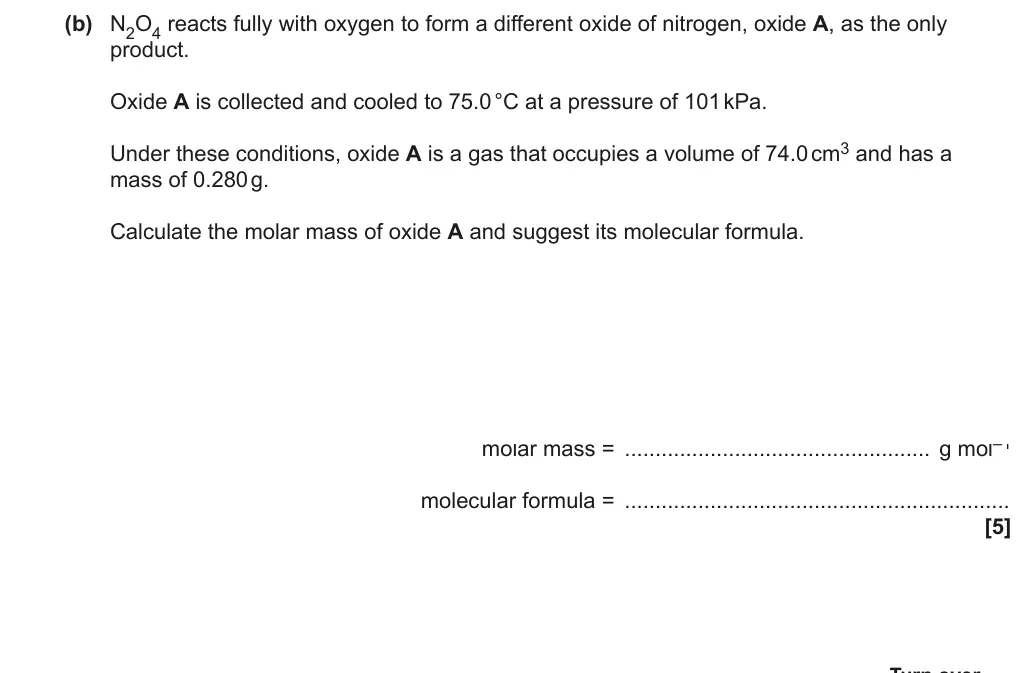
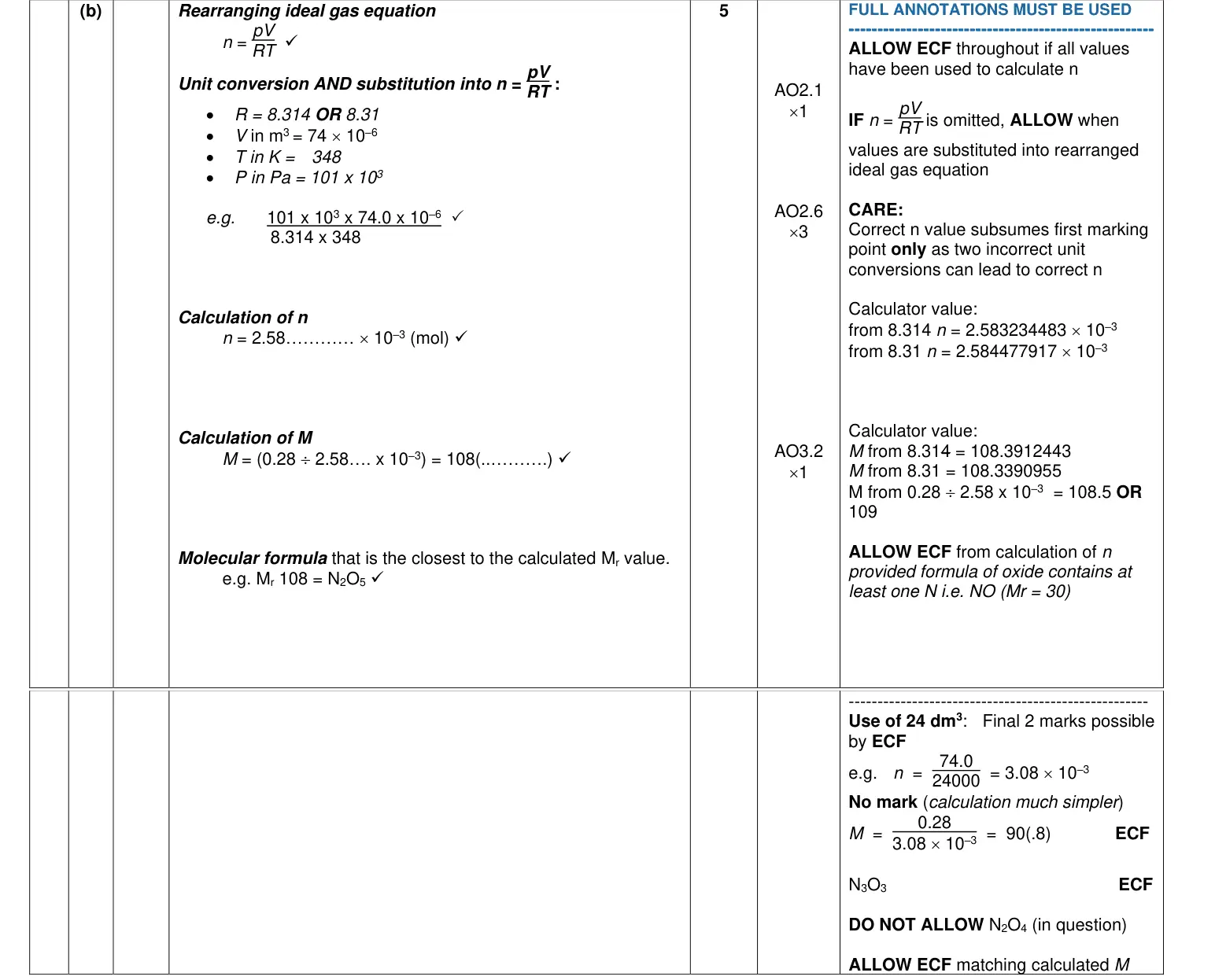
This question was well answered by nearly all candidates and many scored all 5 marks. A number used the wrong units for the pressure and the volume so used both kPa and dm3. This resulted in the correct number of moles and scored 4 marks as error carried forward. Most candidates were able to find the formula from the molar mass and very few used the incorrect molar volume route.
Skills: M0.0 Recognise and make use of appropriate units in calculations; M2.2 Change the subject of an equation; M2.3 Substitute numerical values into algebraic equations using appropriate units for physical quantities
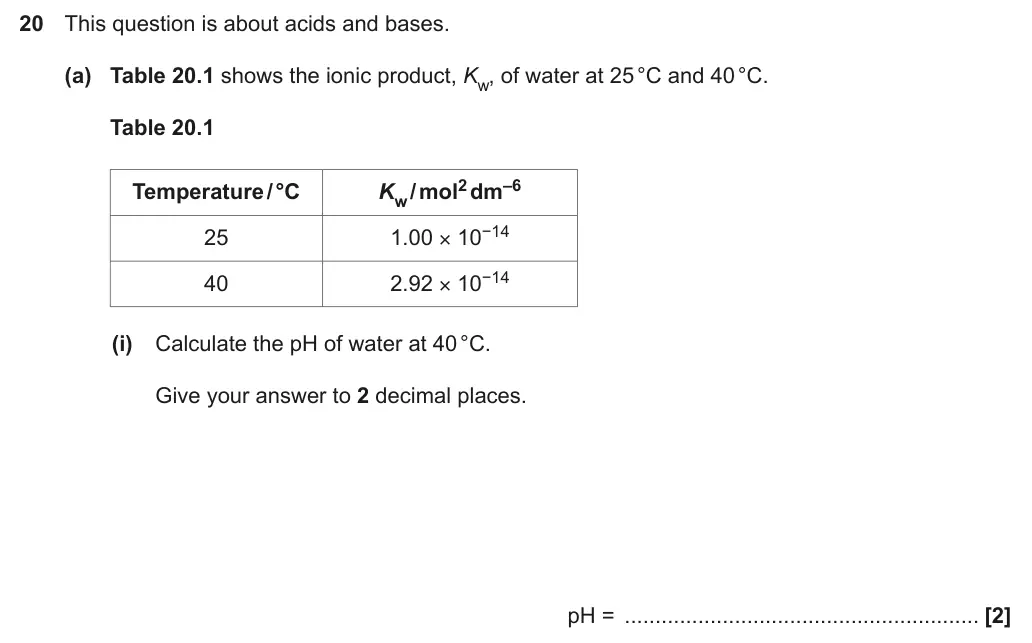
ocr.org.uk/science Oxford Cambridge and RSA CHEMISTRY A H432 For first teaching in 2015 A LEVEL Version 1 H432/01 Summer 2023 series Examiners’ report Contents Introduction .......................................................................................................................................... 4 Paper 1 series overview........................................................................................................................ 5 Section A overview ............................................................................................................................... 6 Question 1 .................................................................................................................................... 6 Question 2 ....................................................................................................................................... 6 Question 3 ....................................................................................................................................... 7 Question 4 ....................................................................................................................................... 7 Question 5 ....................................................................................................................................... 8 Question 6 ....................................................................................................................................... 8 Question 7 ....................................................................................................................................... 9 Question 8 ....................................................................................................................................... 9 Question 9 ..................................................................................................................................... 10 Question 10 ................................................................................................................................... 10 Question 11 ................................................................................................................................... 11 Question 12 ................................................................................................................................... 11 Question 13 ................................................................................................................................... 12 Question 14 ................................................................................................................................... 12 Question 15 ................................................................................................................................... 13 Section B overview ............................................................................................................................. 14 Question 16 (a) (i) ........................................................................................................................... 14 Question 16 (a) (ii) ......................................................................................................................... 15 Question 16 (b) .............................................................................................................................. 16 Question 17* .................................................................................................................................. 17 Question 18 (a) ............................................................................................................................... 18 Question 18 (b) .............................................................................................................................. 19 Question 18 (c) (i) .......................................................................................................................... 20 Question 18 (c) (ii) .......................................................................................................................... 21 Question 19 (a) (i) .......................................................................................................................... 23 Question 19 (a) (ii) ......................................................................................................................... 24 Question 19 (b) .............................................................................................................................. 24 Question 20 .................................................................................................................................... 25 Question 20 (a) (ii) ......................................................................................................................... 26 Question 20 (b) .............................................................................................................................. 26 Question 20 (c) (i) .......................................................................................................................... 27 Question 20 (c) (ii) .......................................................................................................................... 27 Question 20 (d) (i) .......................................................................................................................... 28 Question 20 (d) (ii) ......................................................................................................................... 28 Question 20 (e) (i) .......................................................................................................................... 29 Question 20 (e) (ii) ......................................................................................................................... 29 Question 20 (f) ............................................................................................................................... 30 Question 21 (a) (i) ........................................................................................................................... 31 Question 21 (a) (ii) ......................................................................................................................... 31 Question 21 (iii) .............................................................................................................................. 32 Question 21 (b) .............................................................................................................................. 33 Question 22 (a)* .............................................................................................................................. 34 Question 22 (b) (i) .......................................................................................................................... 36 Question 22 (b) (ii) ......................................................................................................................... 36 Question 22 (c) .............................................................................................................................. 37 Question 22 (d) .............................................................................................................................. 37 Introduction Our examiners’ reports are produced to offer constructive feedback on candidates’ performance in the examinations. Question 20 (a) (ii) This question proved difficult with only a few candidates able to state that in neutral water, [H+] = [OH-].
Skills: M0.4 Use calculators to find and use power, exponential and logarithmic functions; M2.3 Substitute numerical values into algebraic equations using appropriate units for physical quantities; M2.5 Use logarithms in relation to quantities that range over several orders of magnitude
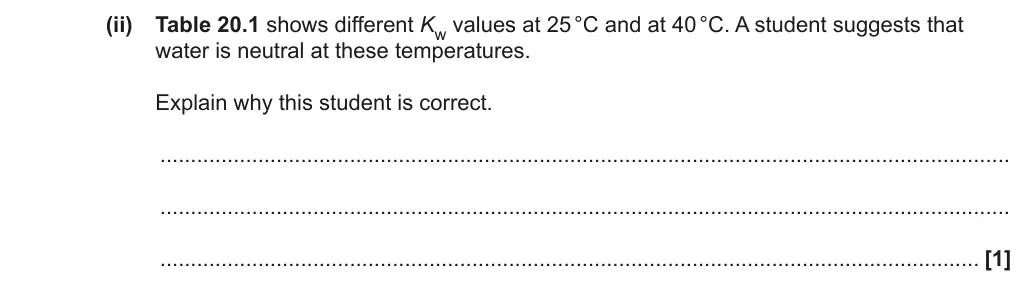
This question proved difficult with only a few candidates able to state that in neutral water, [H+] = [OH-]. Many candidates said that as the pH is close to 7, water is therefore neutral.
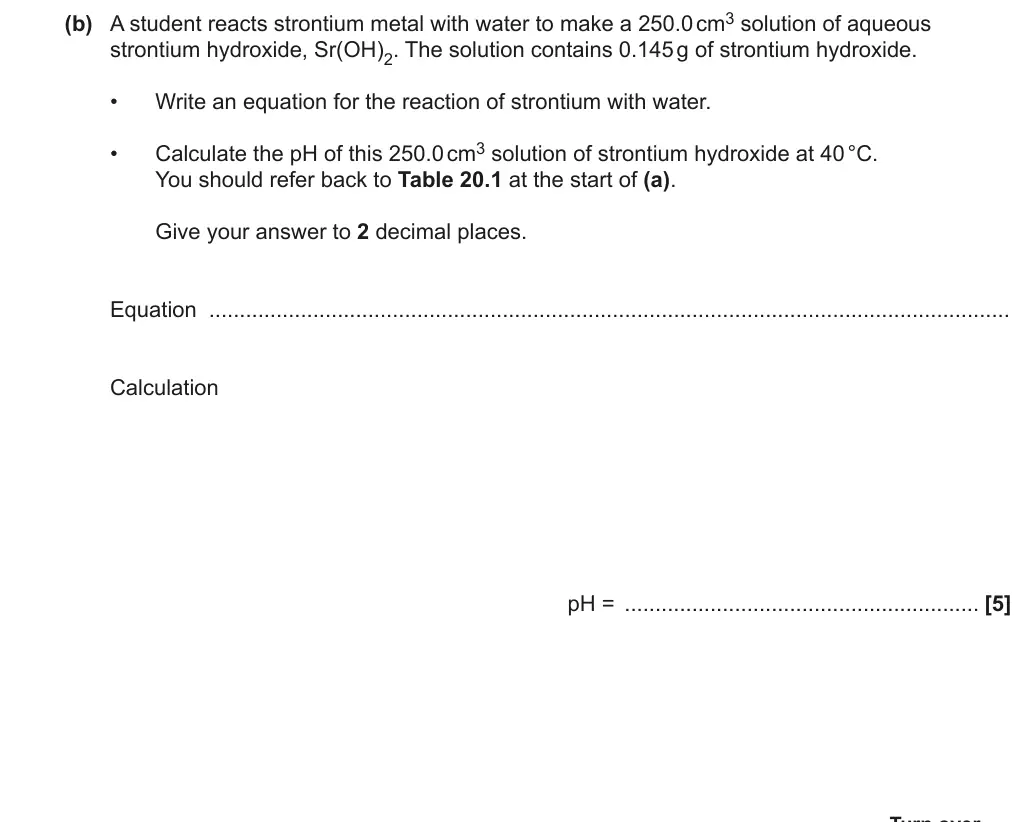
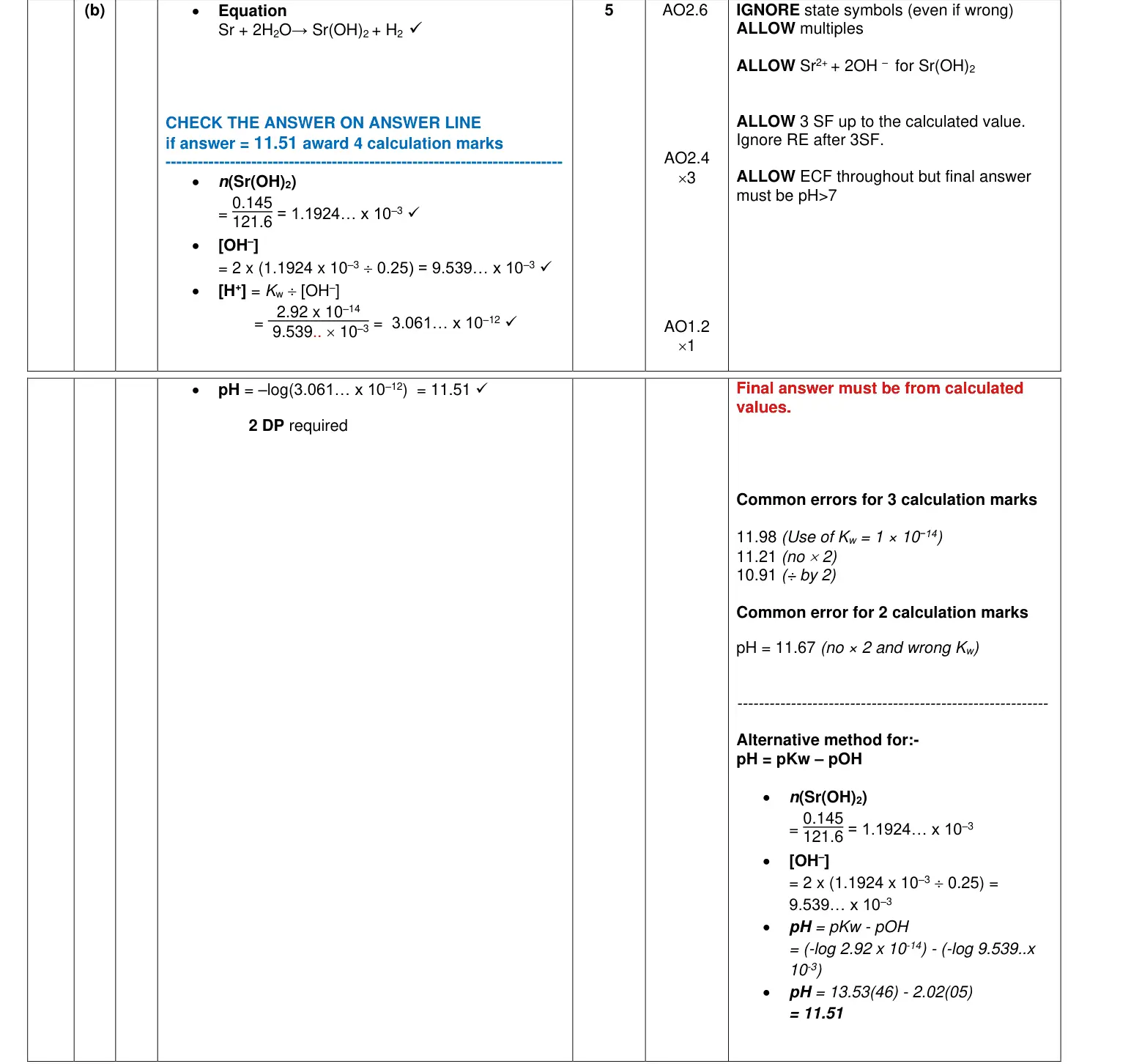
Most candidates wrote the correct equation. Common errors were using Sr2+ as reactant, not balancing the H2O and not having the H2 as second product. Most candidates calculated the moles of Sr(OH)2 correctly but fewer recognised that [OH-] = twice the [Sr(OH)2]. As a result, most candidates scored 3 calculation marks. A few candidates chose the incorrect Kw value.
Skills: M0.2 Use ratios, fractions and percentages; M0.4 Use calculators to find and use power, exponential and logarithmic functions; M2.3 Substitute numerical values into algebraic equations using appropriate units for physical quantities; M2.5 Use logarithms in relation to quantities that range over several orders of magnitude

This was often answered correctly but some candidates gave the incorrect formulae for Sr(NO3)2 and either no other product or H2 gas.
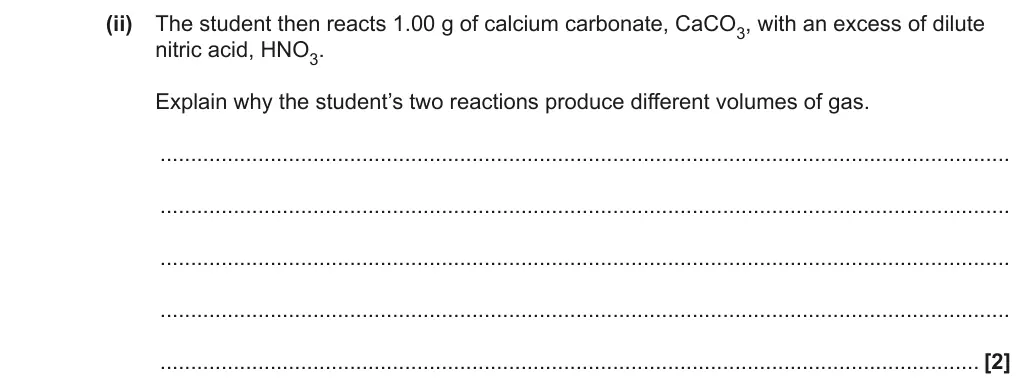
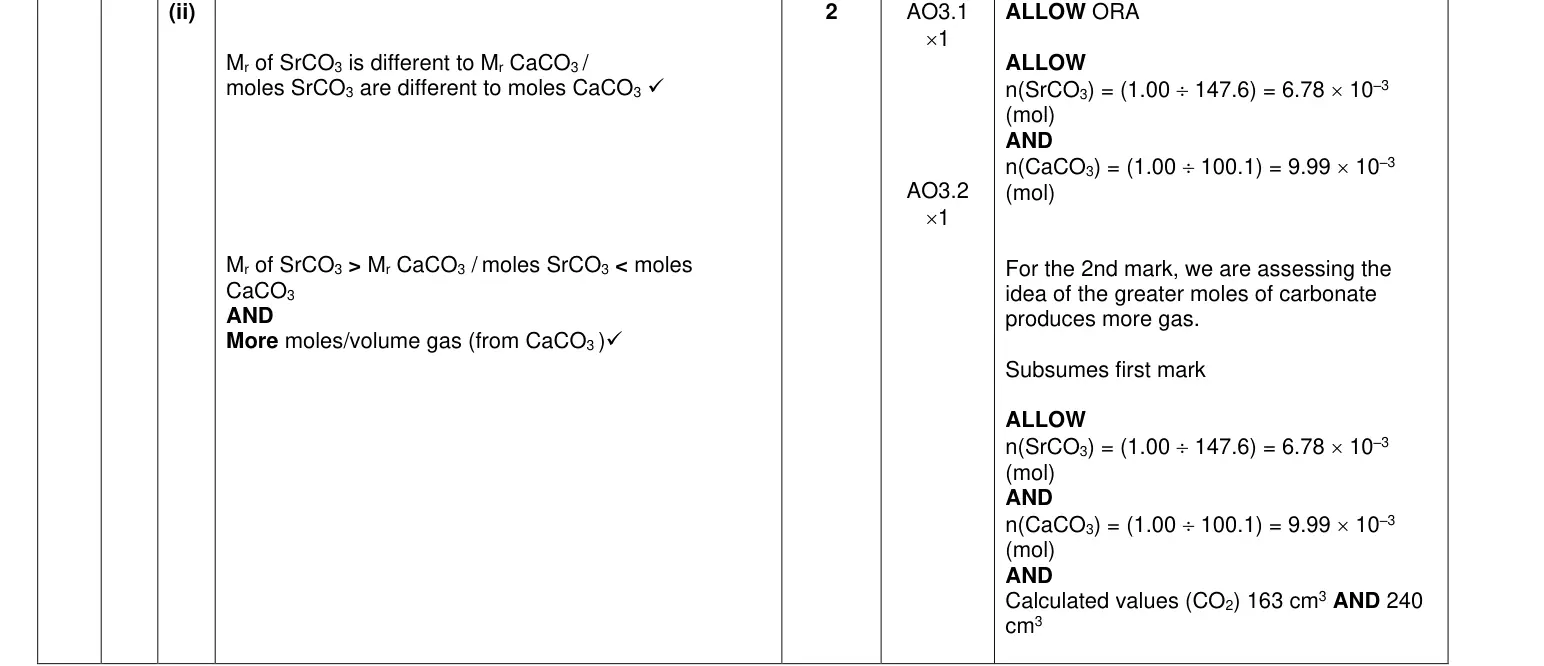
Only a few candidates used the mass value given in the question to link the number of moles of the group 2 metal carbonate and the number of moles, and hence volume, of gas produced.
Skills: M0.2 Use ratios, fractions and percentages
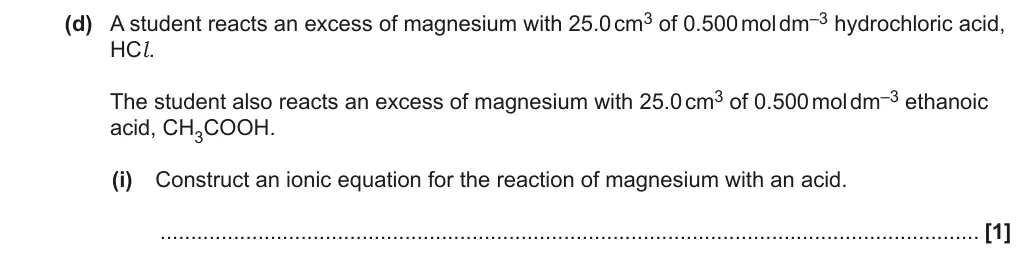
Ionic equations still present candidates with a challenge. A few candidates scored the mark but many candidates gave a full equation or one that contained a mismatch of spectator ions as well as the correct ions.
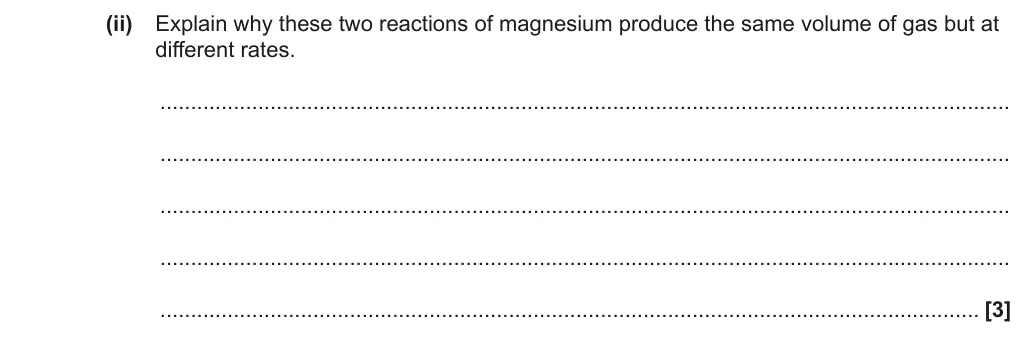
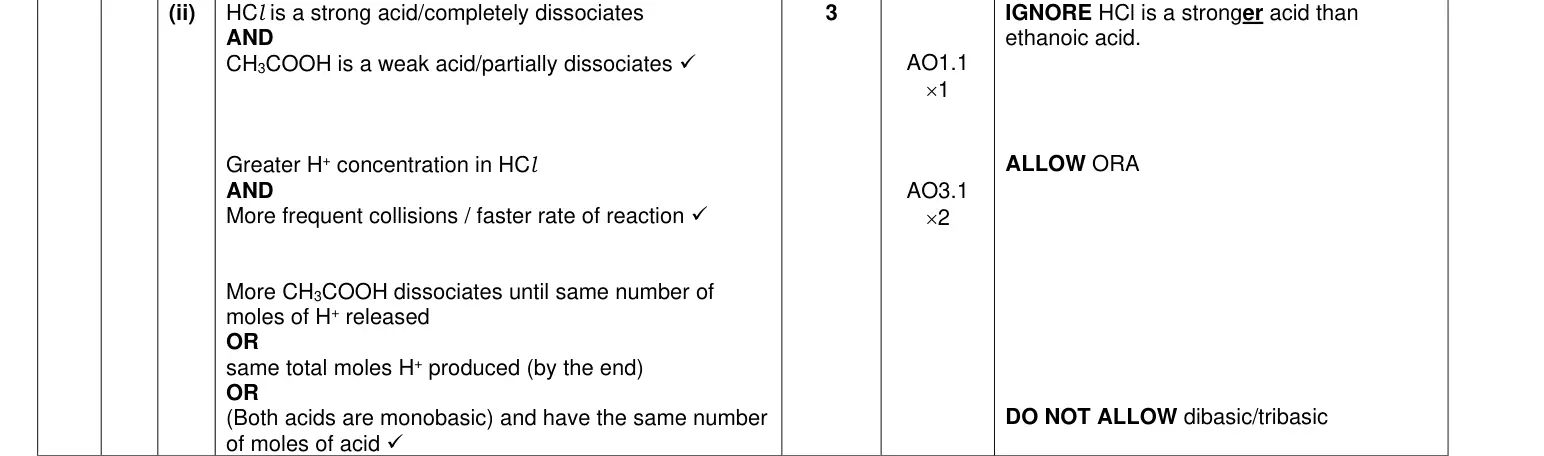
This question proved challenging for the candidates to identify the three ideas: Those of comparing acids, comparing moles and comparing rates. Very few candidates were able to score the 3 marks. Most candidates recognised the different strength of the two acids, but some only used comparative language. Some linked the moles of acid used to the volume of gas produced but many simply restated the same volume and concentration which is given within the question. Only a few candidates linked the higher initial [H+] in HCl to the increased rate through more frequent collisions. A common issue was describing the rate of dissociation rather than the [H+] present in determining the rate of the reactions or mentioning that it dissociates more but not linking this to the H+ concentration.
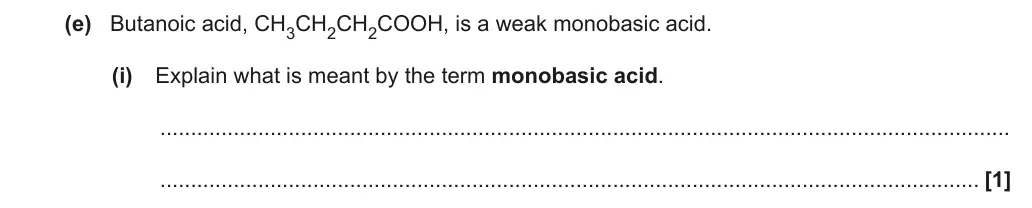
Very few candidates wrote the complete definition of a monobasic acid. Most wrote “donates one proton” only, omitting mole or molecule. Some candidates described donating electrons or OH-.
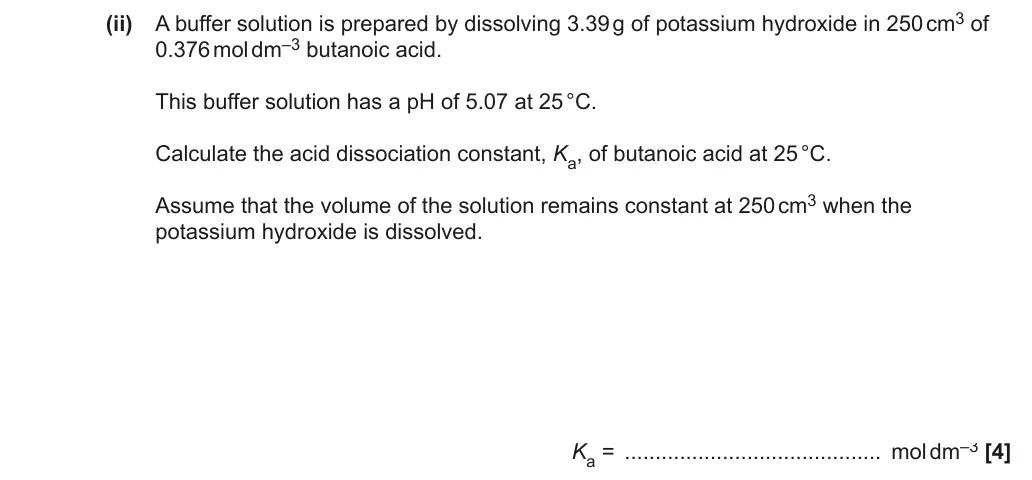
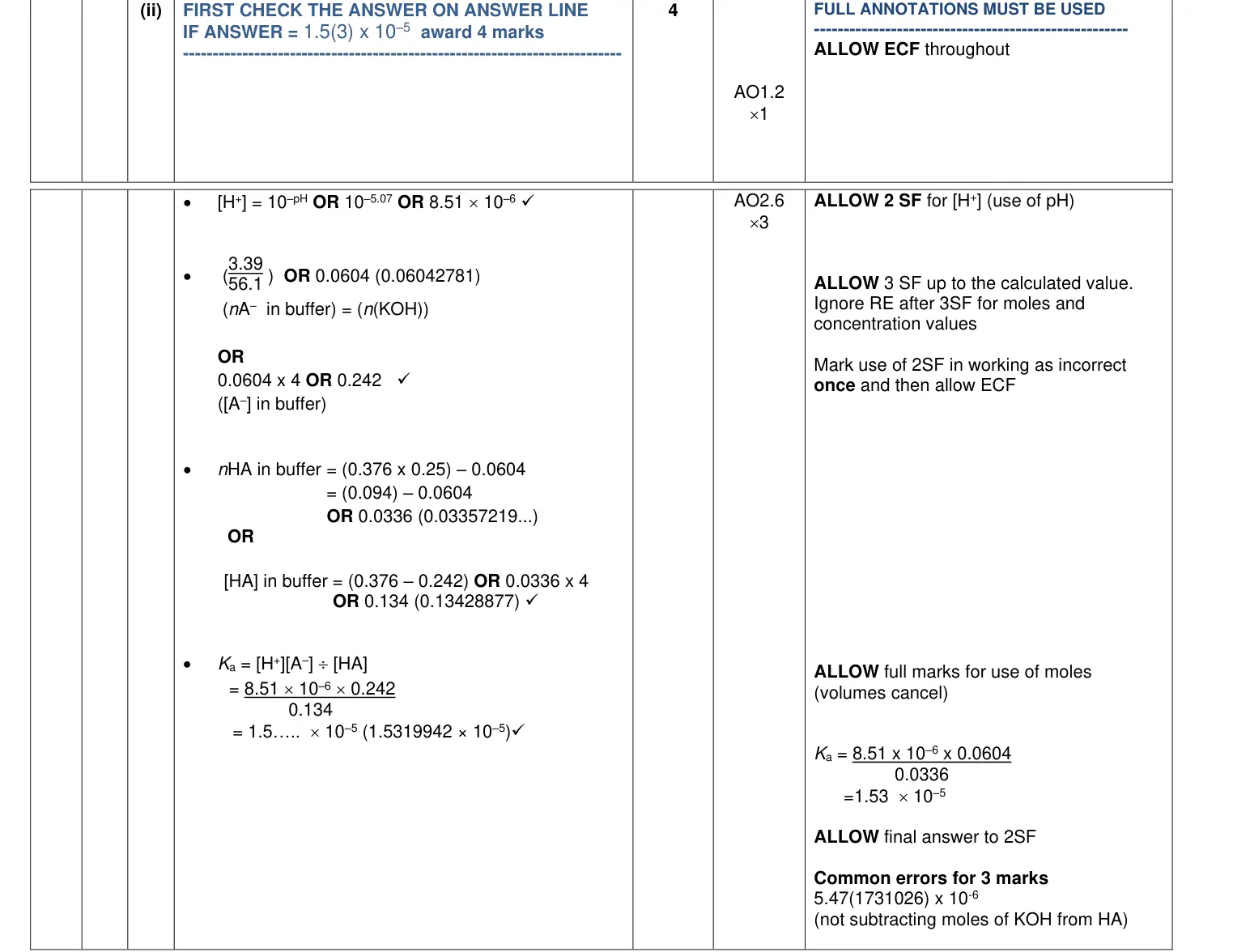
This calculation proved difficult with many figures and sums appearing with little indication as to their relevance. Candidates should remember to provide written indications of what it is they’re working out – presenting the calculations without any annotations can make it harder for error carried forward marks to be given if there is an error in their calculation. Few candidates scored all 4 marks. Most found the concentration of H+ from the pH and the moles of KOH correctly but did not recognise they had to take away the moles of KOH from those of HA to find the remaining concentration of HA. Some candidates then used the [H+] as the [HA]. A few candidates tried a [H+] squared expression of a weak acid. The candidate has clearly set out the calculation so each numerical value can be linked and the steps understood. The only error is not calculating the excess acid (i.e. not subtracting moles OH- from initial moles acid) so 3 marks were given.
Skills: M0.4 Use calculators to find and use power, exponential and logarithmic functions; M2.2 Change the subject of an equation; M2.3 Substitute numerical values into algebraic equations using appropriate units for physical quantities; M2.5 Use logarithms in relation to quantities that range over several orders of magnitude
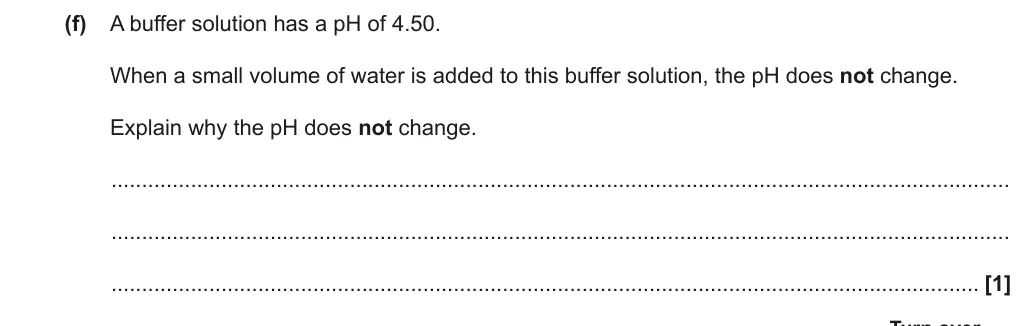
ocr.org.uk/science Oxford Cambridge and RSA CHEMISTRY A H432 For first teaching in 2015 A LEVEL Version 1 H432/01 Summer 2023 series Examiners’ report Contents Introduction .......................................................................................................................................... 4 Paper 1 series overview........................................................................................................................ 5 Section A overview ............................................................................................................................... 6 Question 1 .................................................................................................................................... 6 Question 2 ....................................................................................................................................... 6 Question 3 ....................................................................................................................................... 7 Question 4 ....................................................................................................................................... 7 Question 5 ....................................................................................................................................... 8 Question 6 ....................................................................................................................................... 8 Question 7 ....................................................................................................................................... 9 Question 8 ....................................................................................................................................... 9 Question 9 ..................................................................................................................................... 10 Question 10 ................................................................................................................................... 10 Question 11 ................................................................................................................................... 11 Question 12 ................................................................................................................................... 11 Question 13 ................................................................................................................................... 12 Question 14 ................................................................................................................................... 12 Question 15 ................................................................................................................................... 13 Section B overview ............................................................................................................................. 14 Question 16 (a) (i) ........................................................................................................................... 14 Question 16 (a) (ii) ......................................................................................................................... 15 Question 16 (b) .............................................................................................................................. 16 Question 17* .................................................................................................................................. 17 Question 18 (a) ............................................................................................................................... 18 Question 18 (b) .............................................................................................................................. 19 Question 18 (c) (i) .......................................................................................................................... 20 Question 18 (c) (ii) .......................................................................................................................... 21 Question 19 (a) (i) .......................................................................................................................... 23 Question 19 (a) (ii) ......................................................................................................................... 24 Question 19 (b) .............................................................................................................................. 24 Question 20 .................................................................................................................................... 25 Question 20 (a) (ii) ......................................................................................................................... 26 Question 20 (b) .............................................................................................................................. 26 Question 20 (c) (i) .......................................................................................................................... 27 Question 20 (c) (ii) .......................................................................................................................... 27 Question 20 (d) (i) .......................................................................................................................... 28 Question 20 (d) (ii) ......................................................................................................................... 28 Question 20 (e) (i) .......................................................................................................................... 29 Question 20 (e) (ii) ......................................................................................................................... 29 Question 20 (f) ............................................................................................................................... 30 Question 21 (a) (i) ........................................................................................................................... 31 Question 21 (a) (ii) ......................................................................................................................... 31 Question 21 (iii) .............................................................................................................................. 32 Question 21 (b) .............................................................................................................................. 33 Question 22 (a)* .............................................................................................................................. 34 Question 22 (b) (i) .......................................................................................................................... 36 Question 22 (b) (ii) ......................................................................................................................... 36 Question 22 (c) .............................................................................................................................. 37 Question 22 (d) .............................................................................................................................. 37 Introduction Our examiners’ reports are produced to offer constructive feedback on candidates’ performance in the examinations. Candidates who did well on this paper generally: Candidates who did less well on this paper generally: • produced clearly structured working for calculations – Questions 18 (a),18 (b), 19 (a) (i),19 (b), 20 (b), 20 (e) (ii) and 21 (c) • applied equations to a graphical representation Question 18 (c) (ii)) • produced clear and concise responses for the two Level of Response Questions 17 (a) and 22 (a) • produced clear and concise responses to descriptions in trends of ionisation energy Question 16 (b) • were able to make and justify predictions based on their knowledge Questions 20 (c), (d) • explained equilibrium changes Question 19 (a) (ii) • gave answers to the correct number of significant figures Questions 19 (a) (i), 20 (a) (i) and 20 (b) • converted between units when required Questions 18 (c) (ii) and 19 (b) • correctly explained experimental procedures using electrode potentials Question 21 (b) • wrote a balanced equation for unfamiliar compound Question 22 (d) • understood the effect of addition of chemical substances on the pH of a buffer solution Question 20 (f). • found it difficult to apply what they had learned to unfamiliar situations • produced unstructured responses to Level of Response questions which were lacking in depth or explanation or contained inaccurate definitions Questions 17 (a) and 22 (a) • did not clearly set out calculations, making it difficult for marks to be given for working Questions 18 (a),18 (b), 19 (a) (i), 19 (b), 20 (b), 20 (e) (ii) and 21 (c) • did not give answers to calculations to the specified number of significant figures Questions 19 (a) (i), 20 (a) (i) and 20 (b) • either did not realise the need to convert between units for some calculations or found this difficult Questions 18 (c) (ii) and 19 (b) • did not produced clear and concise responses to descriptions in trends of ionisation energy Question 16 (b) • did not write a balanced equation, and ionic equations, for reactions with group 2 metal and metal compounds Questions 20 (b), 20 (c) (i) and 20 (d). Question 20 (f) Misconception Only the most successful candidates linked the pH not changing to the ratio of [HA] and [A-] not changing on addition of water.
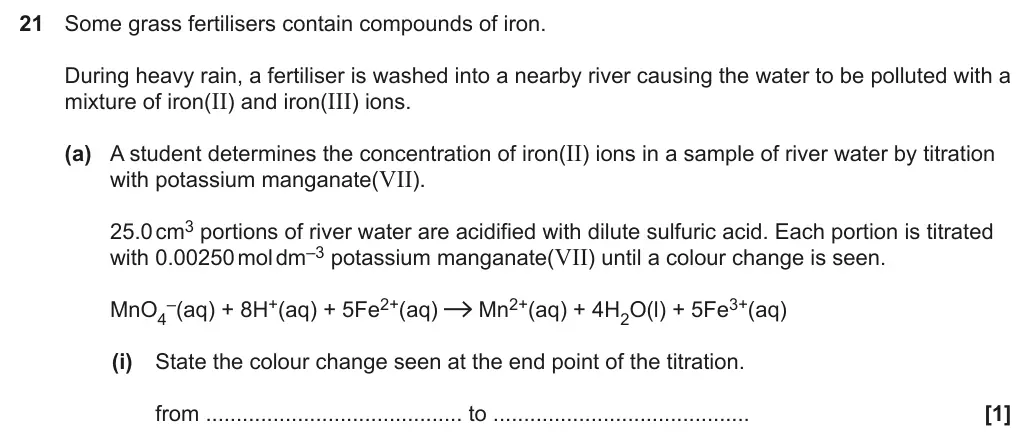
Only a few candidates were given this mark. Some had the colour change inverted and most stated a variety of different colours.
Skills: PAG2 Acid–base titration
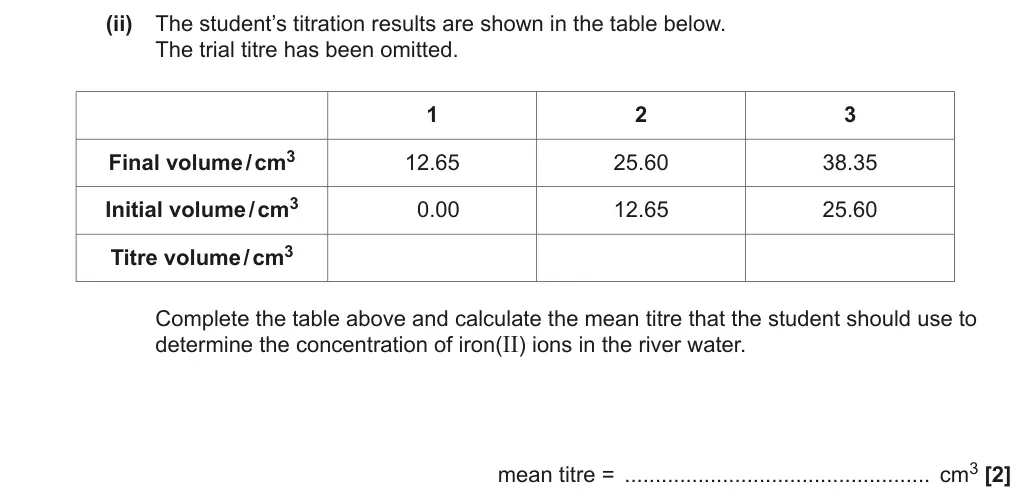
Almost all candidates calculated the titres correctly. A significant number used all three titre values to derive their mean value.
Skills: M1.2 Find arithmetic means; PAG2 Acid–base titration
ocr.org.uk/science Oxford Cambridge and RSA CHEMISTRY A H432 For first teaching in 2015 A LEVEL Version 1 H432/01 Summer 2023 series Examiners’ report Contents Introduction .......................................................................................................................................... 4 Paper 1 series overview........................................................................................................................ 5 Section A overview ............................................................................................................................... 6 Question 1 .................................................................................................................................... 6 Question 2 ....................................................................................................................................... 6 Question 3 ....................................................................................................................................... 7 Question 4 ....................................................................................................................................... 7 Question 5 ....................................................................................................................................... 8 Question 6 ....................................................................................................................................... 8 Question 7 ....................................................................................................................................... 9 Question 8 ....................................................................................................................................... 9 Question 9 ..................................................................................................................................... 10 Question 10 ................................................................................................................................... 10 Question 11 ................................................................................................................................... 11 Question 12 ................................................................................................................................... 11 Question 13 ................................................................................................................................... 12 Question 14 ................................................................................................................................... 12 Question 15 ................................................................................................................................... 13 Section B overview ............................................................................................................................. 14 Question 16 (a) (i) ........................................................................................................................... 14 Question 16 (a) (ii) ......................................................................................................................... 15 Question 16 (b) .............................................................................................................................. 16 Question 17* .................................................................................................................................. 17 Question 18 (a) ............................................................................................................................... 18 Question 18 (b) .............................................................................................................................. 19 Question 18 (c) (i) .......................................................................................................................... 20 Question 18 (c) (ii) .......................................................................................................................... 21 Question 19 (a) (i) .......................................................................................................................... 23 Question 19 (a) (ii) ......................................................................................................................... 24 Question 19 (b) .............................................................................................................................. 24 Question 20 .................................................................................................................................... 25 Question 20 (a) (ii) ......................................................................................................................... 26 Question 20 (b) .............................................................................................................................. 26 Question 20 (c) (i) .......................................................................................................................... 27 Question 20 (c) (ii) .......................................................................................................................... 27 Question 20 (d) (i) .......................................................................................................................... 28 Question 20 (d) (ii) ......................................................................................................................... 28 Question 20 (e) (i) .......................................................................................................................... 29 Question 20 (e) (ii) ......................................................................................................................... 29 Question 20 (f) ............................................................................................................................... 30 Question 21 (a) (i) ........................................................................................................................... 31 Question 21 (a) (ii) ......................................................................................................................... 31 Question 21 (iii) .............................................................................................................................. 32 Question 21 (b) .............................................................................................................................. 33 Question 22 (a)* .............................................................................................................................. 34 Question 22 (b) (i) .......................................................................................................................... 36 Question 22 (b) (ii) ......................................................................................................................... 36 Question 22 (c) .............................................................................................................................. 37 Question 22 (d) .............................................................................................................................. 37 Introduction Our examiners’ reports are produced to offer constructive feedback on candidates’ performance in the examinations. Question 21 (a) (i) Only a few candidates were given this mark. Question 21 (a) (ii) Almost all candidates calculated the titres correctly.
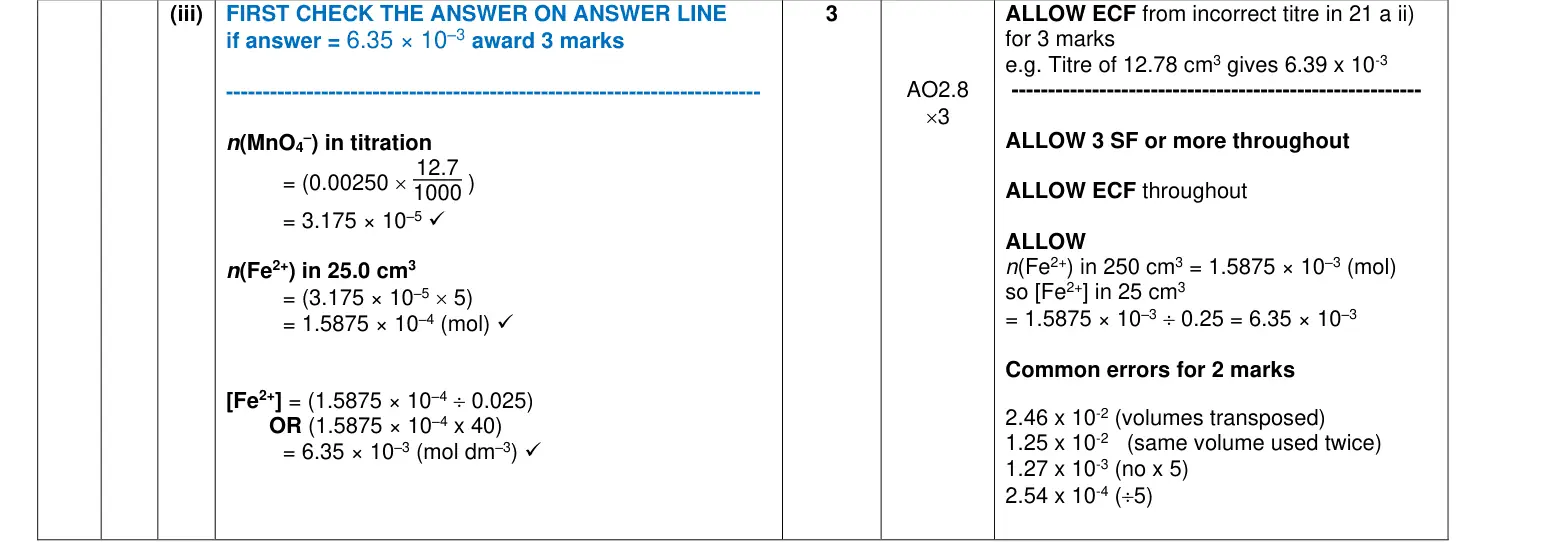
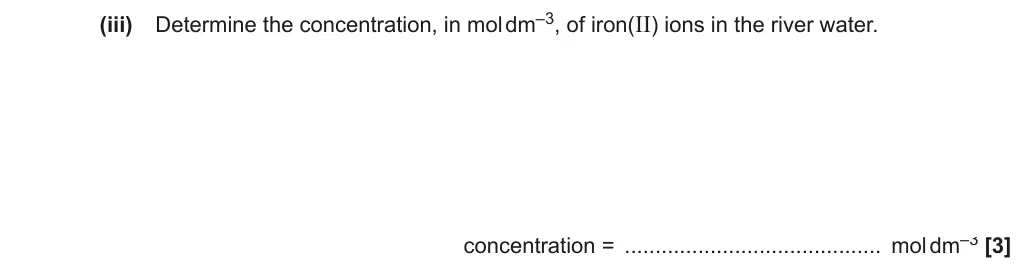
Skills: M0.2 Use ratios, fractions and percentages; M1.1 Use an appropriate number of significant figures; M2.3 Substitute numerical values into algebraic equations using appropriate units for physical quantities; PAG2 Acid–base titration
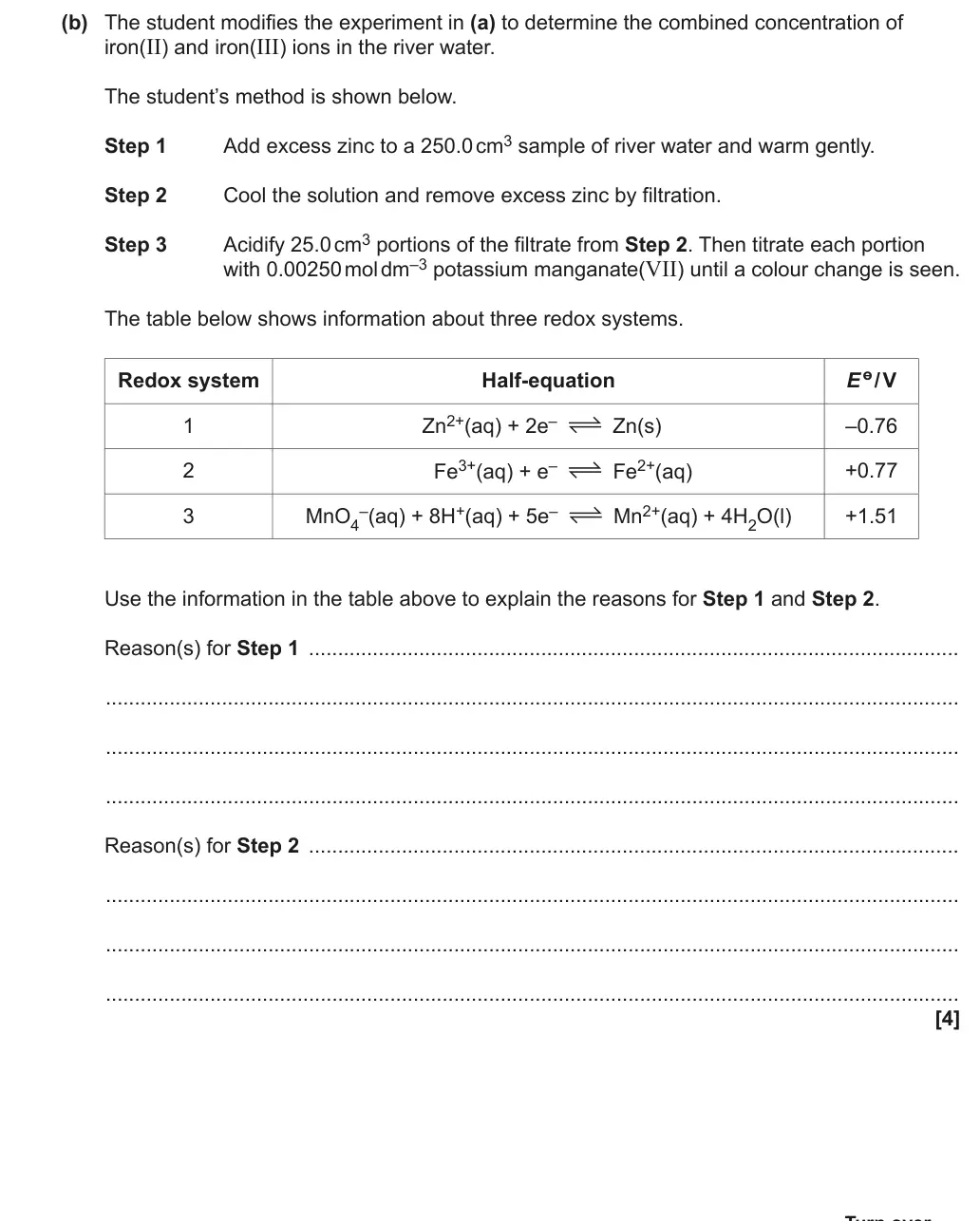
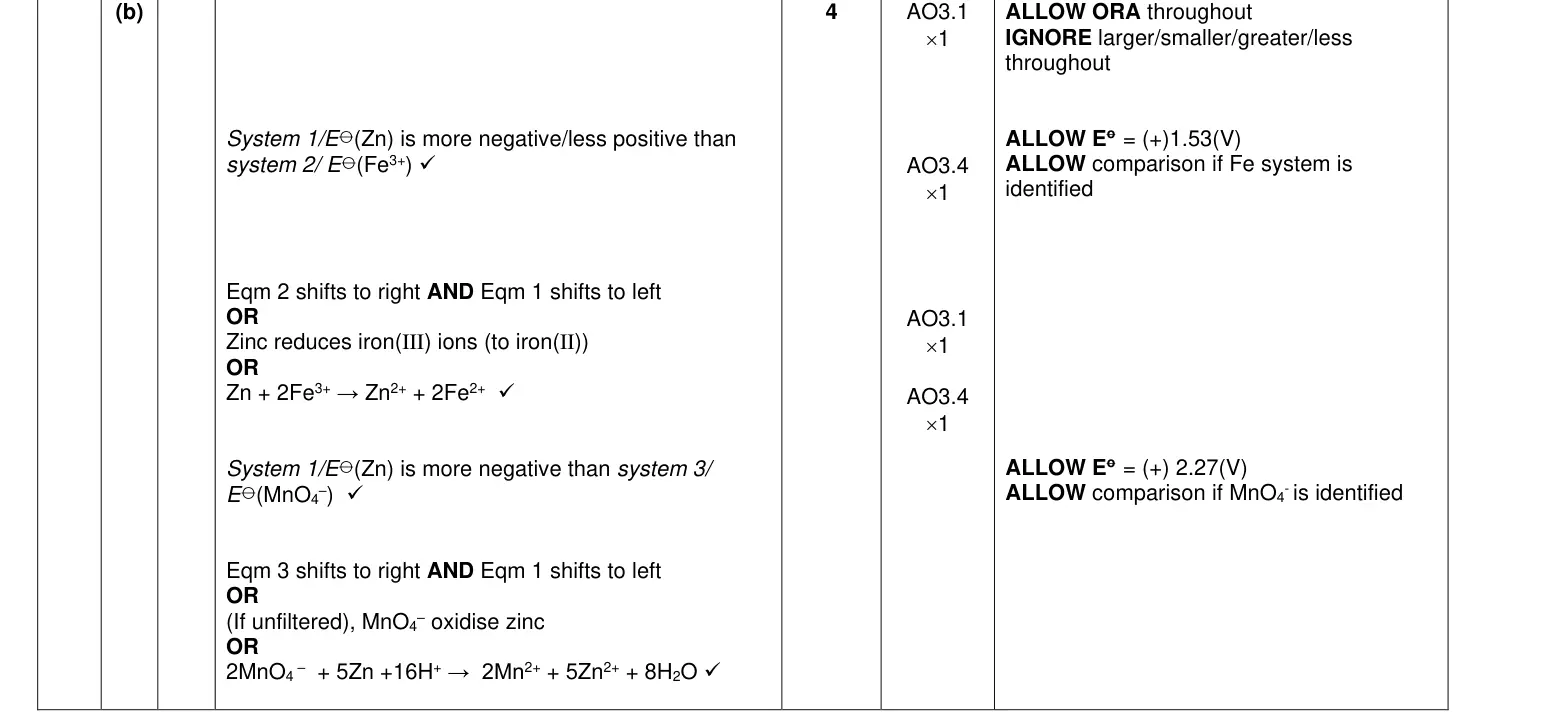
Most candidates were able to successfully explain Step 1, scoring the first 2 marks. When comparing electrode potentials, candidates should avoid the use of higher/lower as these phrases are ambiguous due to the negative signs involved. Describing them as ‘more negative’ or ‘more positive’ is clearer. Candidates are advised to read the instructions contained within the question and to use or comment on all the data presented. Very few candidates linked Step 2 to the reducing effect of zinc to manganate(VII) ions hence the need for filtration. A few candidates explained Step 2 in terms of the warming/cooling and zinc crystalising rather than explaining the redox chemistry given in the table.
Skills: PAG2 Acid–base titration
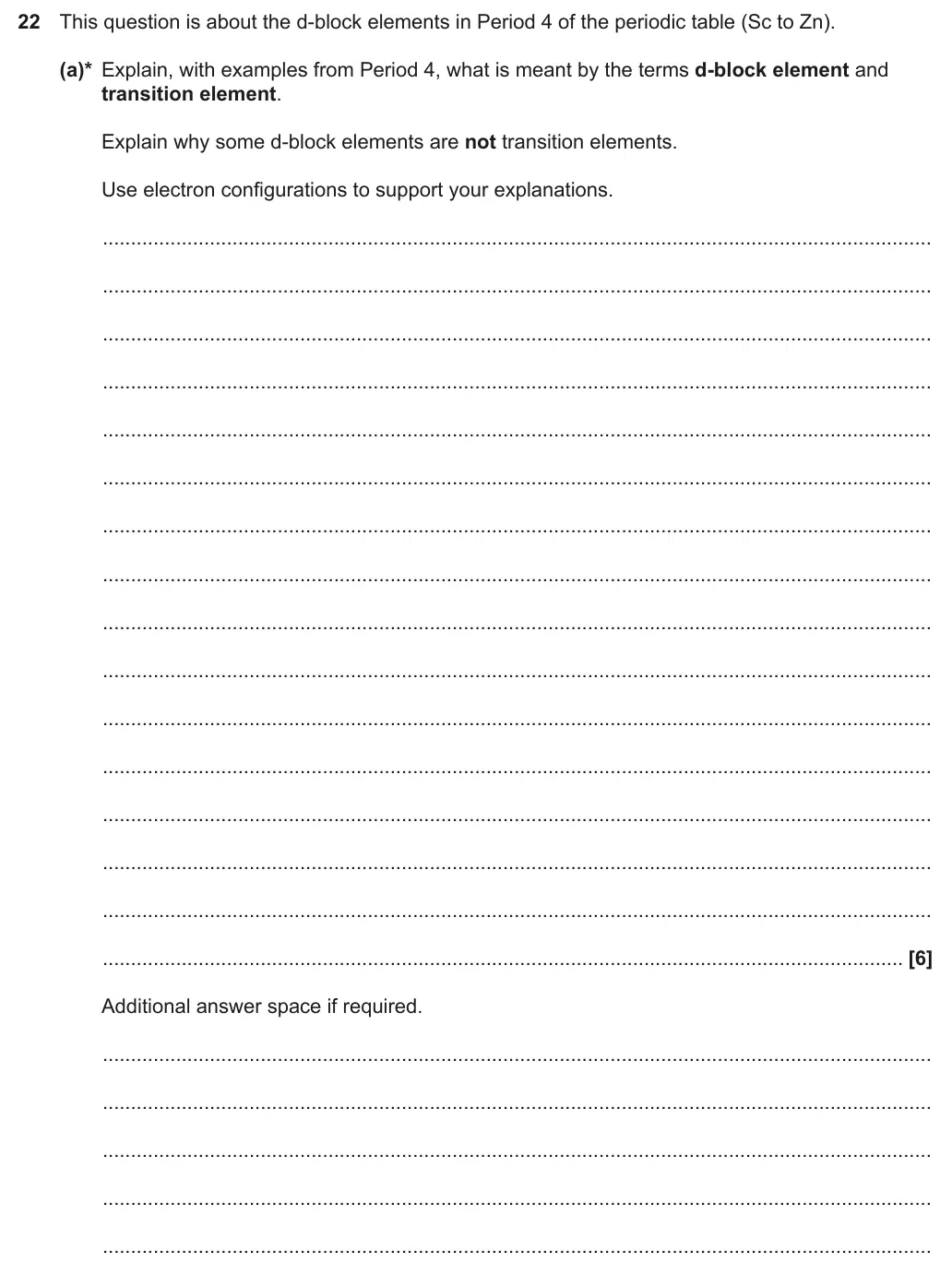
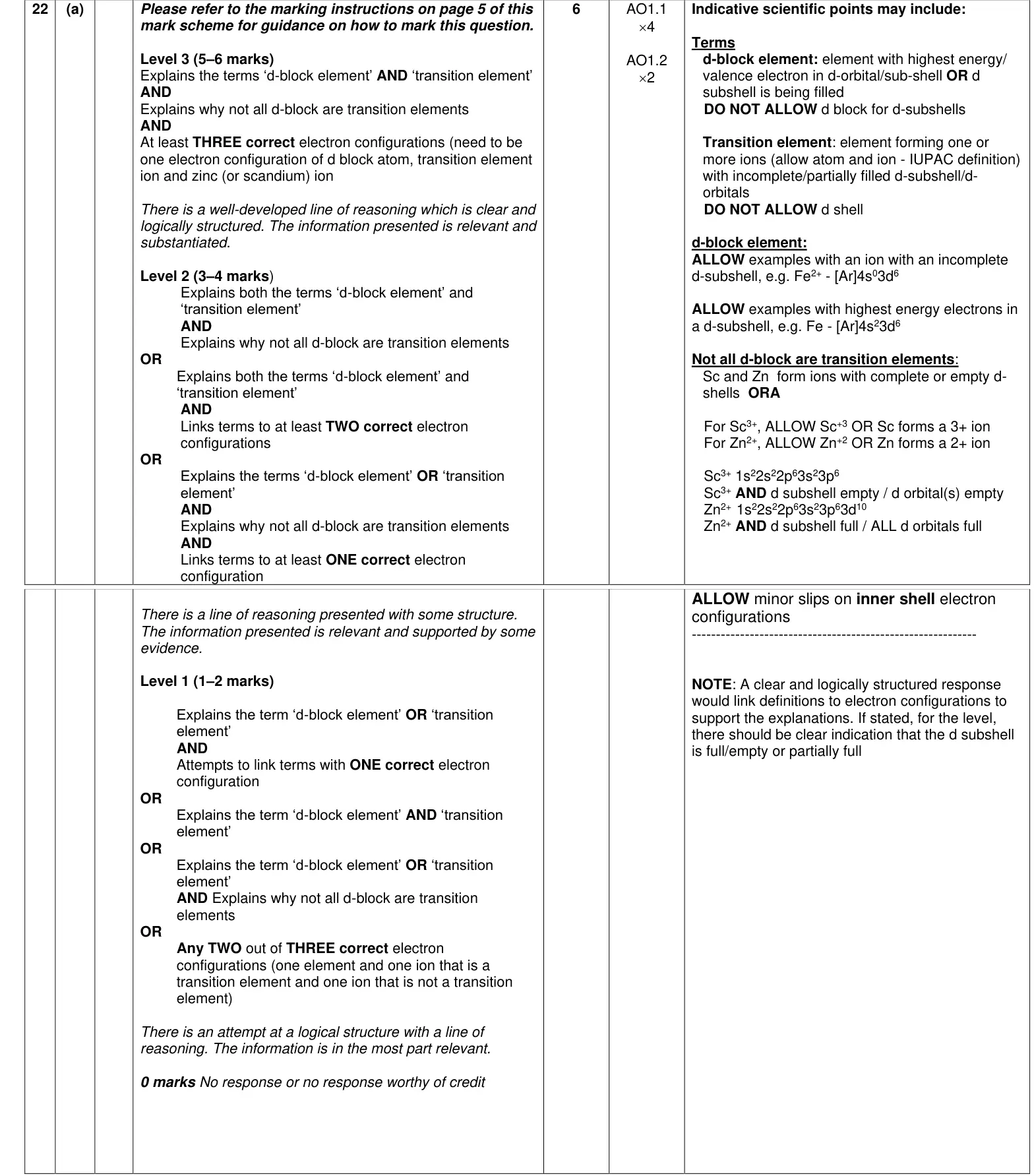
Only the higher-attaining candidates scored full marks. Very few candidates were able to define d-block element correctly without the minor slip of saying outermost electron instead of highest energy or valence electron. Many candidates often did not mention ions for the transition metal definition. Many did not include any of the electron arrangements for d-block elements and transition elements. The majority of candidates who were able to recognise zinc and scandium as d-block elements, but not transition elements, gave their electronic configurations correctly. Common errors included the presence of the 4s electrons in the electron configurations of the ions and incorrect electron configurations of copper and chromium atoms. A few candidates thought chromium and copper were not transition elements due to the 4s1 electron configuration. This candidate has mentioned outer electrons rather than highest energy but was this is a minor slip and they were still given a Level 3 response as everything else is correct. A holistic approach for LoRs is used and not a point-based marking system.
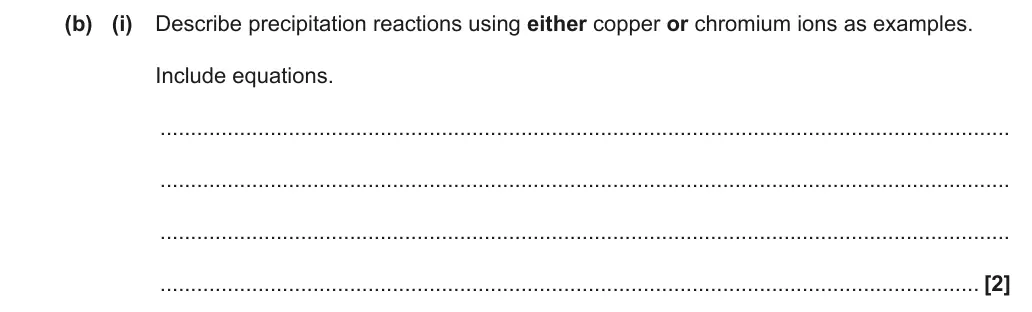
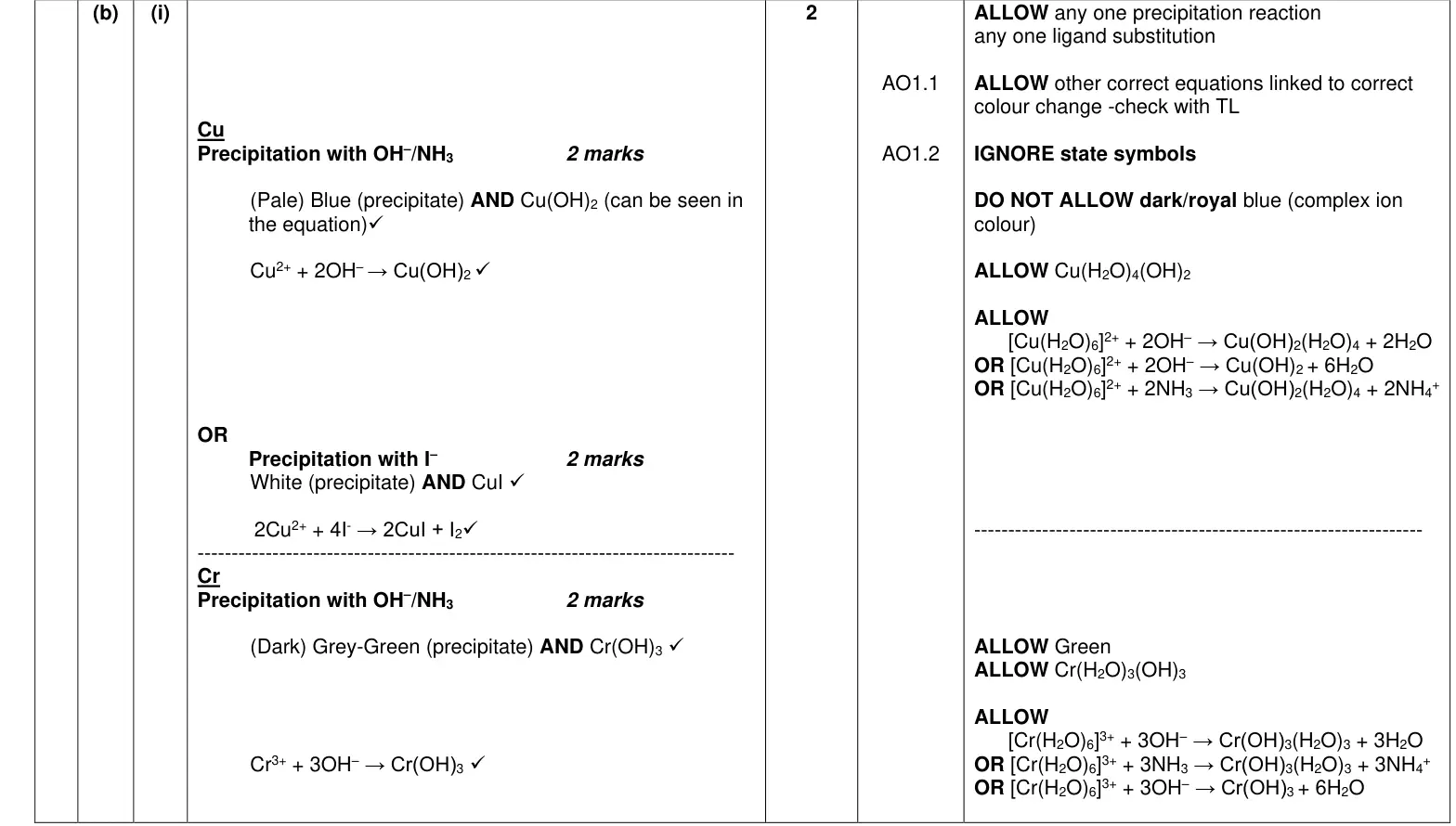
Most candidates scored 1 mark. Most used Cu2+ as their example and recognised Cu(OH)2 forms a blue precipitate. Some candidates either did not give the colour of the precipitate or were unable to write a balanced equation. Some candidates defined rather than described precipitation.
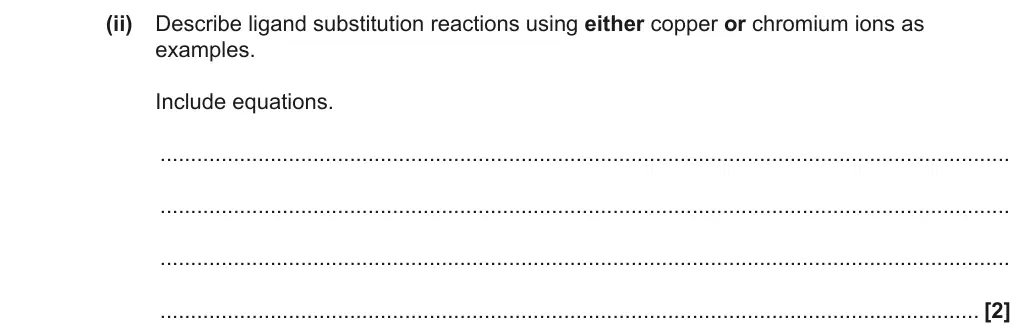
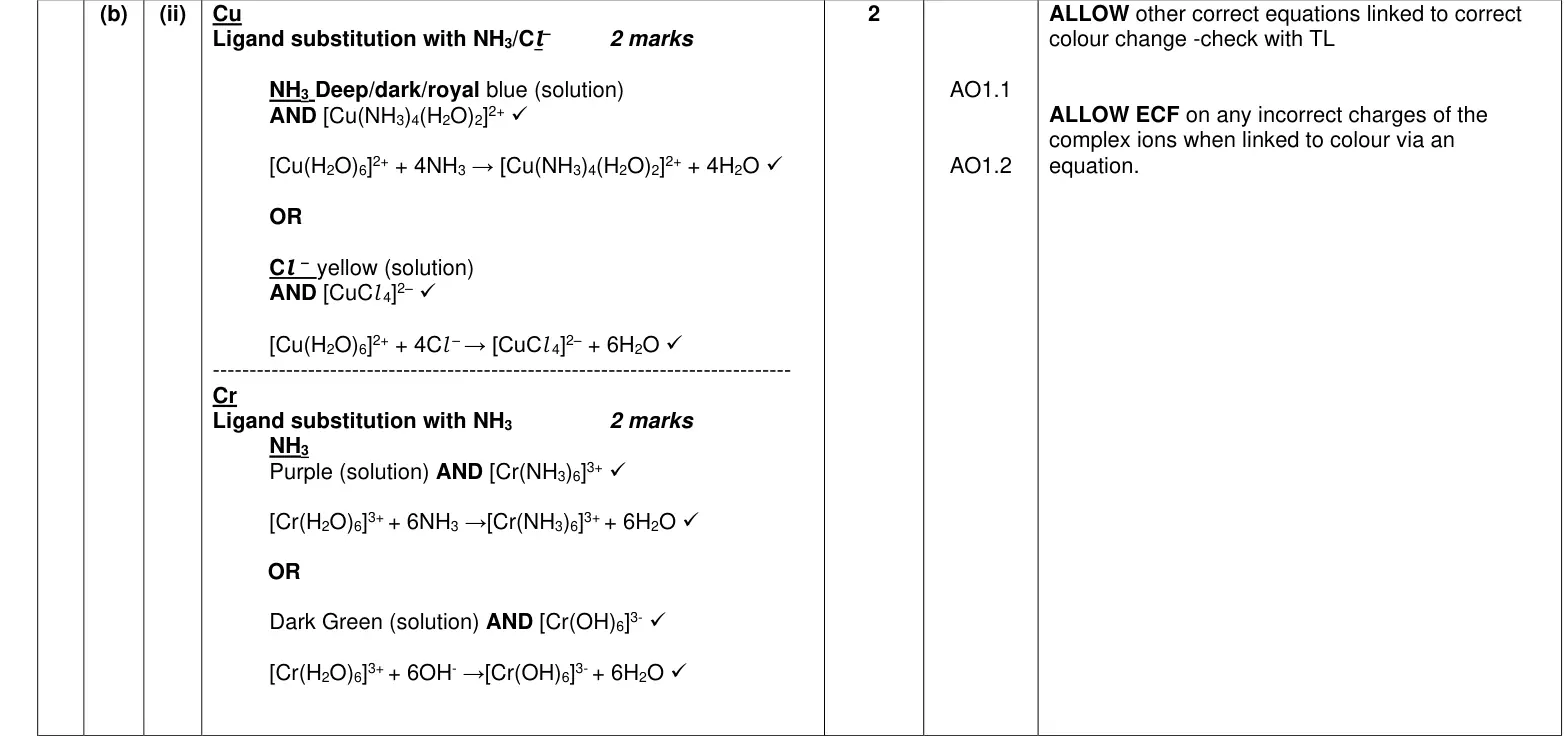
Only the highest-attaining candidates on the paper were able to give an example of a ligand substitution reaction with the colour of the new complex ion. Some candidates confused a precipitation reaction for a ligand substitution and some candidates were perhaps a little ambitious in giving ‘unusual’ complex ions for which they did not know the colour. Cu was often chosen over Cr, usually the formation of [CuCl4]2-, but [Cu(NH3)4(H2O)2]2+ was also chosen. With both, there were issues with charges of the complex, and with the latter some were confused with how many NH3 were coordinated. Some candidates defined rather than described ligand substitution.
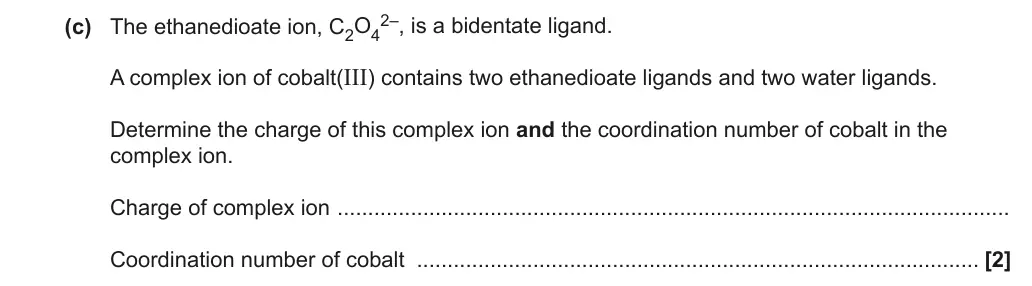
Most candidates identified the charge as -1 and a coordination number of 6. A few candidates identified the coordination number as 4 as they did not spot that ethanedioate is bidentate and charge of +3 stated.
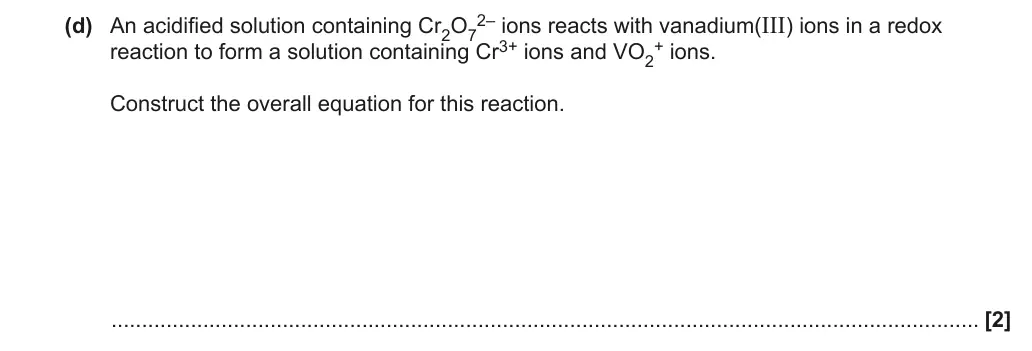
Very few candidates were able to produce the balanced overall equation; a few had the correct reactants and products but not balanced. Candidates are advised to look for the information contained within the question. The formulas were given, and it was stated that the solution was acidified, leaving only water to be identified. Some candidates approached this through two half equations whereas others used oxidation numbers to balance their equations.
Skills: M0.2 Use ratios, fractions and percentages
Want a paper marked and gone through with you? Message us.