Answer
D
Mark scheme

Examiner's comment
The correct answer was D. Wrong answers were very rarely seen as candidates had secure knowledge of filling orbitals individually before pairing.
100 marks · 48 question parts · Paper, mark scheme and report on OCR's site · Have OCR's Data Sheet beside you
D
The correct answer was D. Wrong answers were very rarely seen as candidates had secure knowledge of filling orbitals individually before pairing.
B
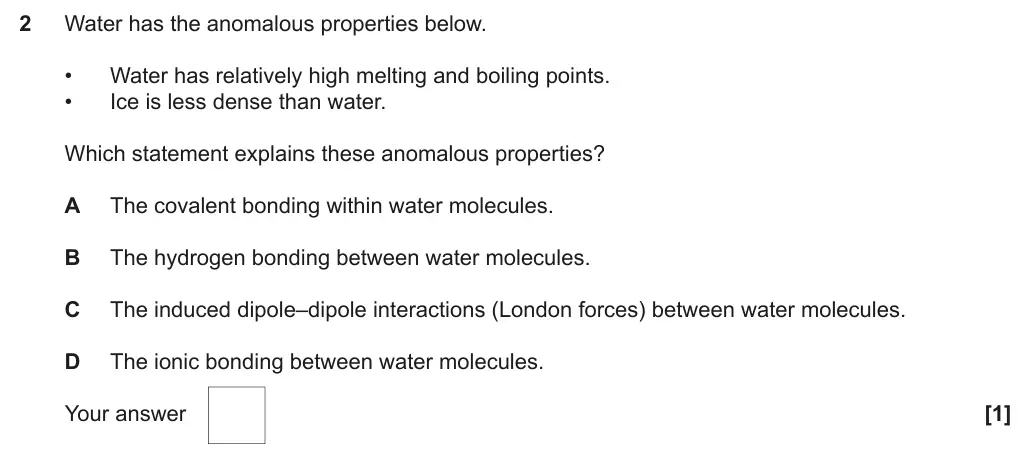
The correct answer was B. Candidates generally understood that these anomalous properties were due to hydrogen bonding. A few selected C, associating the incorrect type of intermolecular force.
C
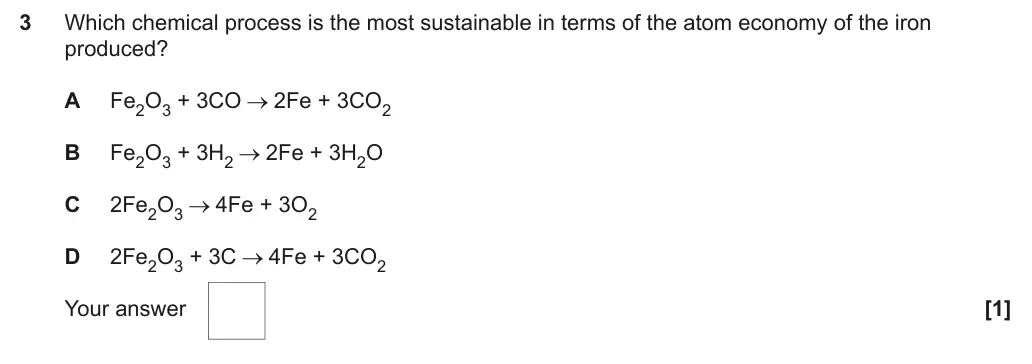
The correct answer was C. Candidates should be encouraged to use the space around the question to jot down the equation and perform any calculations. There was evidence of some confusion about atom economy leading to B or D being selected.

B
The correct answer was B. Most candidates selected this response and understood that hydroxides were needed to neutralise an acid. Incorrect options were also selected in equal measure. It is important that candidates make the link between theory and practical use.
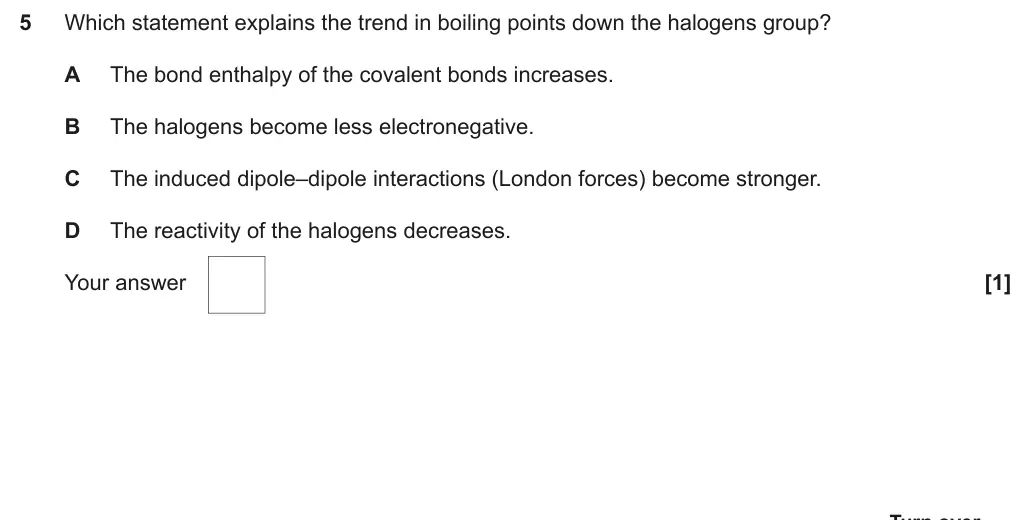
C
The correct answer was C. This question was answered well, alongside Q2. Candidates should aim to separate explanations regarding chemical and physical properties. B was a common wrong answer and a few candidates suggested that the covalent bonds need to be broken, selecting A.
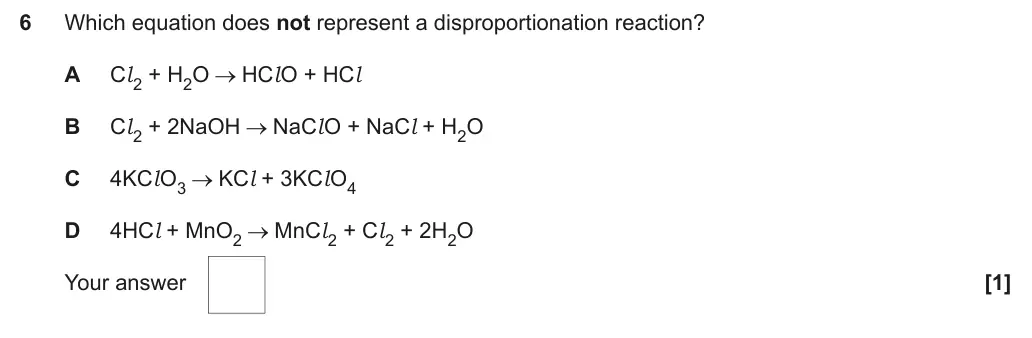
D
The correct answer was D. This proved a more challenging question. Successful candidates often presented oxidation numbers above the equations to identify the element that was simultaneously oxidised and reduced. Most candidates recognised that A and B could be ruled out, with C being the most common error.
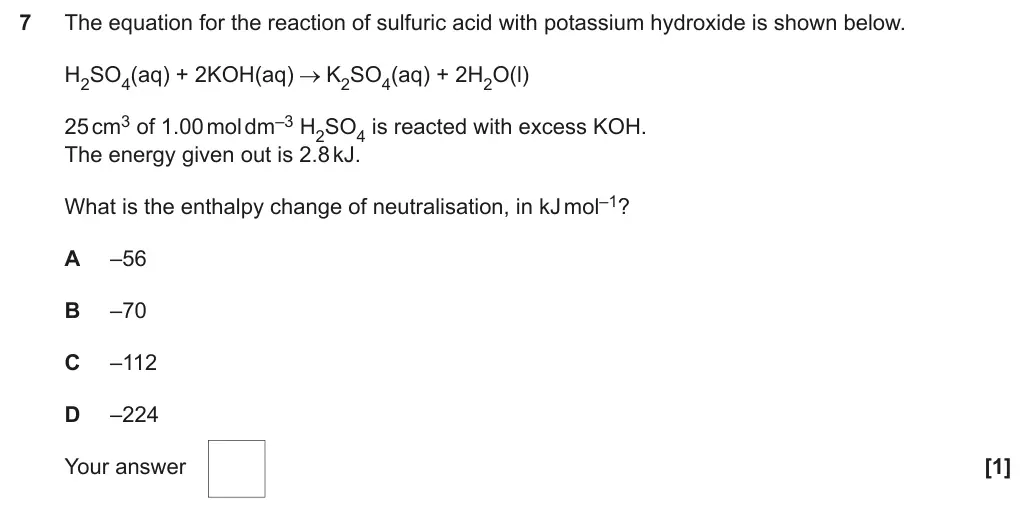
A
The correct answer was A. Some candidates showed full working in the space provided. B and C were common errors. Those who selected C did not take into account the need to half the reaction’s enthalpy change to meet the definition requirements of one mole of water.

B
The correct answer was B. Candidates had a good knowledge of the Boltzmann distribution and few incorrect responses were seen.
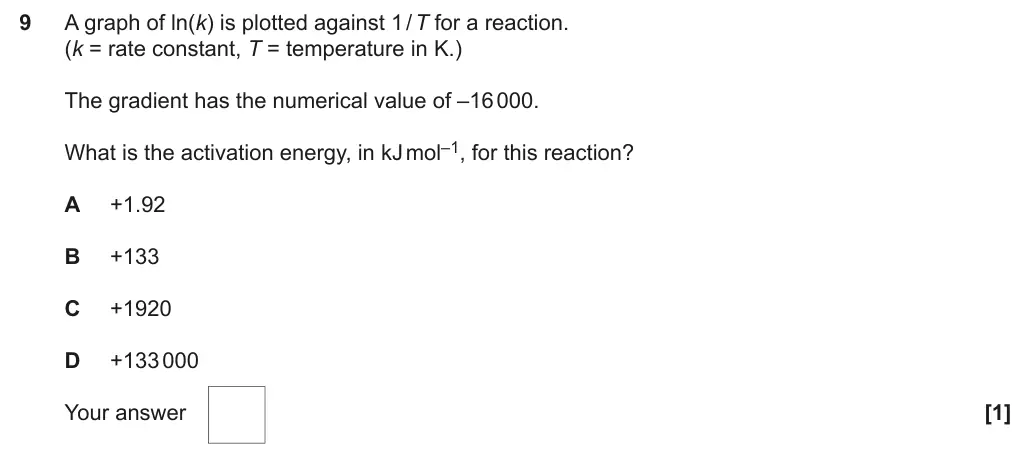
B
The correct answer was B. Candidates generally find the use and manipulation of the Arrhenius equation challenging. Focus was need on the unit conversion when using R (Jmol-1K-1) for the gradient and activation energy (kJ mol-1). This led to a few candidates selecting D. It is worth reminding candidates that the two forms of this equation are given on the data sheet.
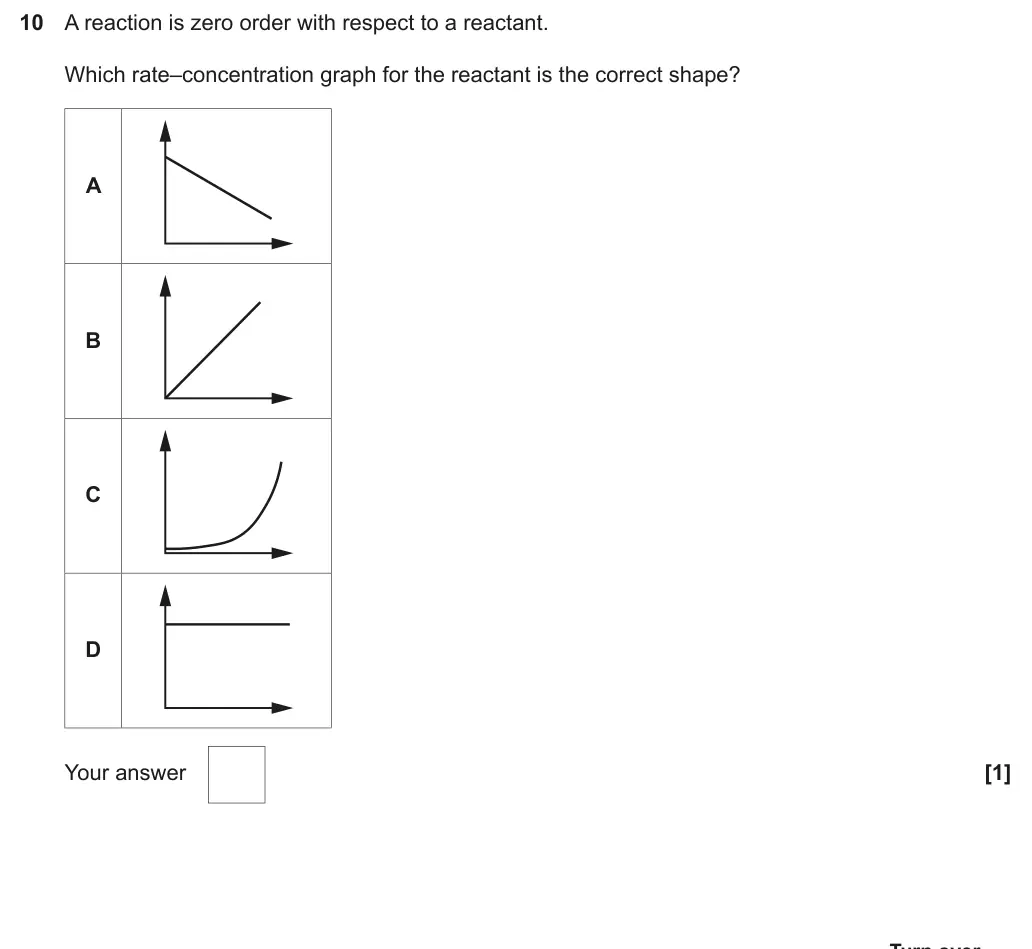
D
The correct answer was D. Candidates performed well on this question with incorrect answers rarely seen. A minority of candidates confused rate-concentration graphs with concentration-time graphs.

C
The correct answer was C. This was a well answered question with most candidates gaining the mark. The most common error was B, where reactants and product concentration became equal. It is important that candidates can apply definitions and theory to diagrams.
Skills: M3.1 Translate information between graphical, numerical and algebraic forms
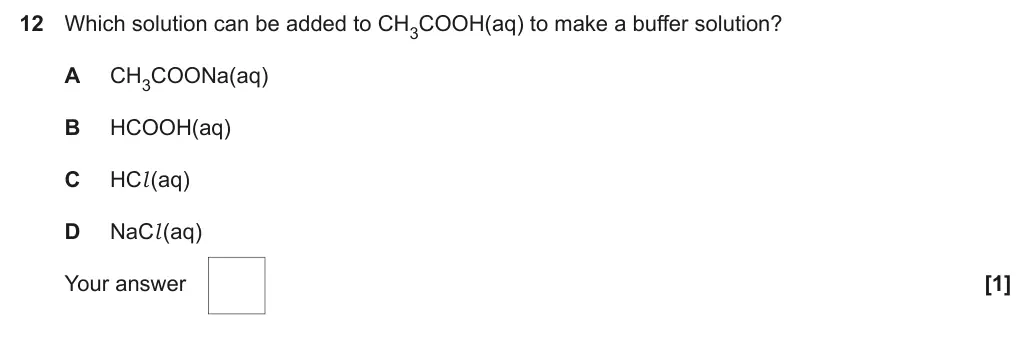
A
The correct answer was A. Formation of a buffer solution can either be from either: • a weak acid and a salt of the weak acid, e.g. CH3COOH/CH3COONa • an excess of a weak acid and a strong alkali, e.g. excess CH3COOH/NaOH A few candidates suggested the other alternatives in equal measure.
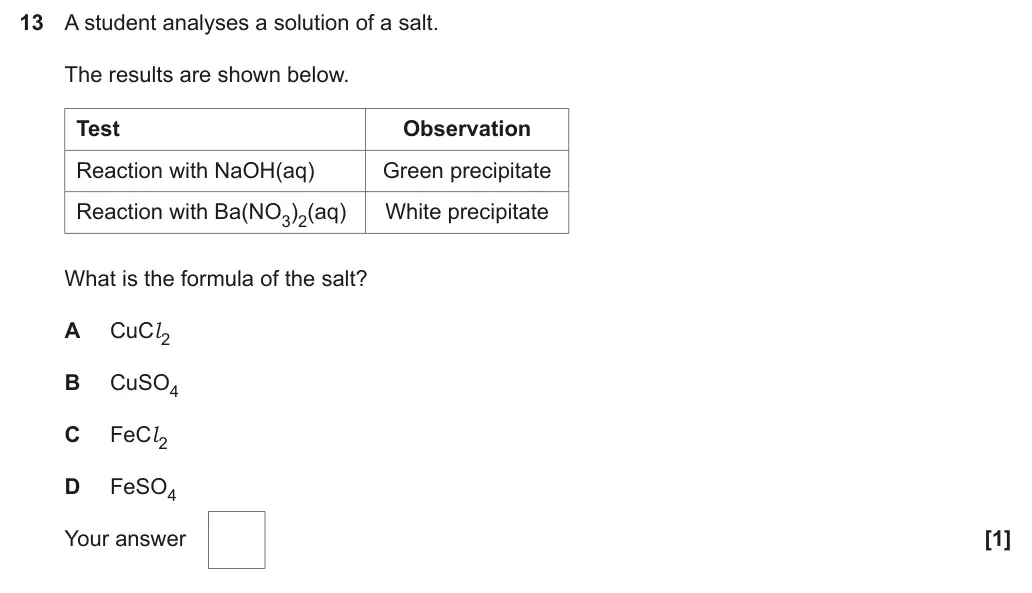
D
The correct answer was D. Many candidates were able to identify the green precipitate as Fe(OH)2 and the white precipitate as BaSO4. A few candidates suggested C, identifying BaCl2 as the white precipitate, or B, identifying Cu(OH)2 as the green precipitate.
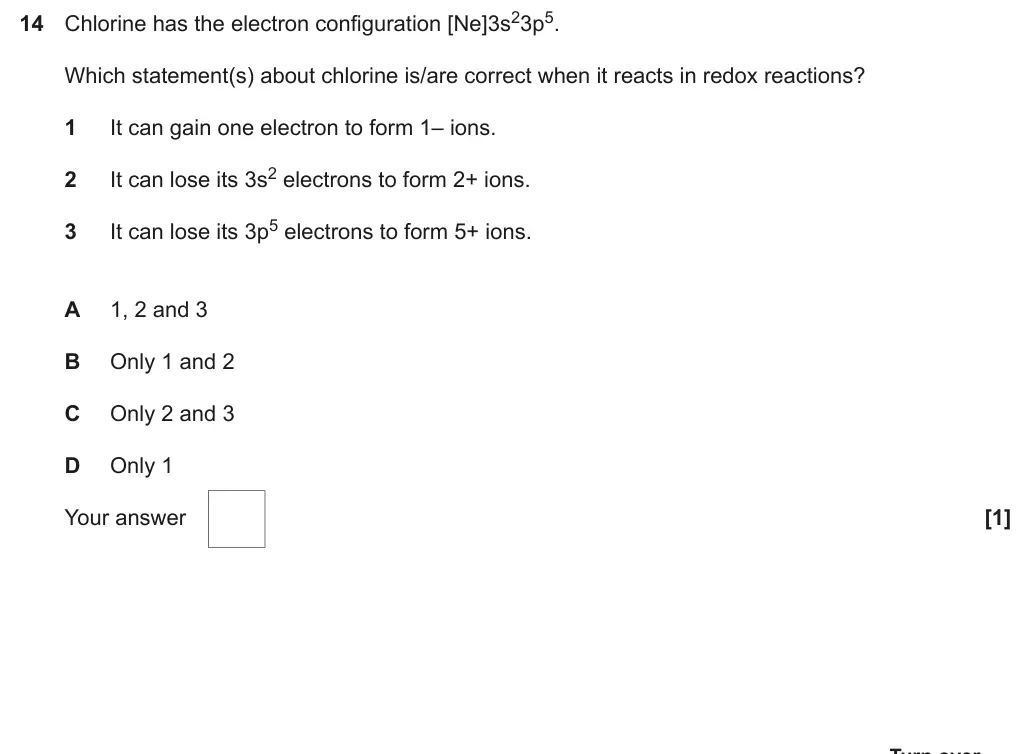
D
The correct answer was D. Most candidates were able to select this response, but the common error was the selection of A. It is important that candidates can distinguish the difference between oxidation states and charge on the ions. Oxidation state is the measure of the number of electrons that an atom uses to bond with atoms of another element.
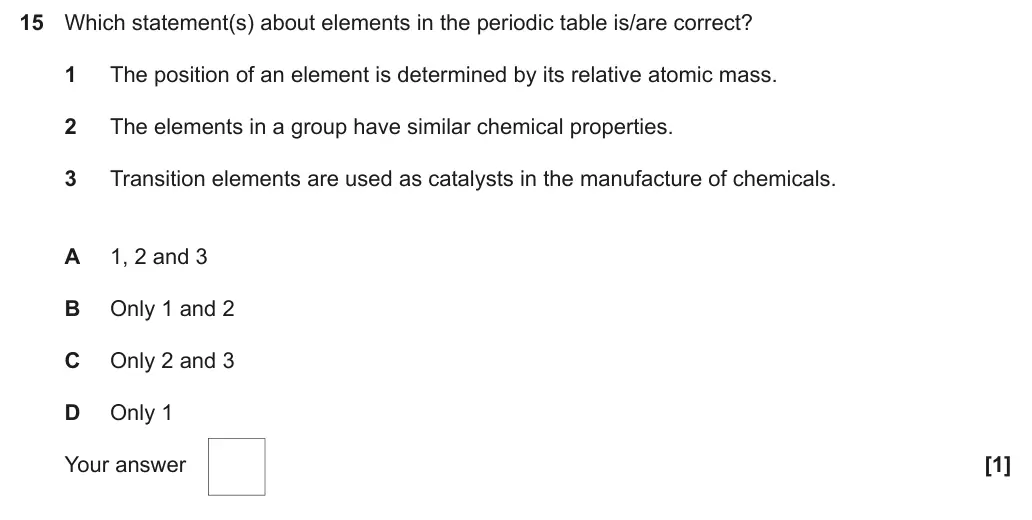
C
The correct answer was C. Most candidates chose the correct answer but a few selected A. The position of the element is based on its atomic number. Section B overview The section contained questions from all aspects of the specification. Candidates found many of the questions, including those with an extended response nature, relatively straightforward and the majority managed to cope with the mathematical content. As a rule, candidates should aim to use at least three significant figures, unless directed otherwise, in their intermediate calculations to avoid rounding errors in their final answer. Candidates should be advised that well set out calculations, which clearly indicate what each numerical value represents, allows effective error carried forward to be given in the event of an incorrect answer. It is also important that candidates avoid offering several solutions and clearly indicate which one has been used to derive the final answer. Some candidates were less confident and knowledgeable of questions which covered content traditionally taught earlier on in the A Level course. These were specifically: equations involving group 2 metals and their compounds; group 7; enthalpy profiles; and structure and bonding. There was evidence that candidates wrote far more than was necessary in some responses. Candidates should avoid repeating sentences which often introduce contradictions when expanding on written answers.
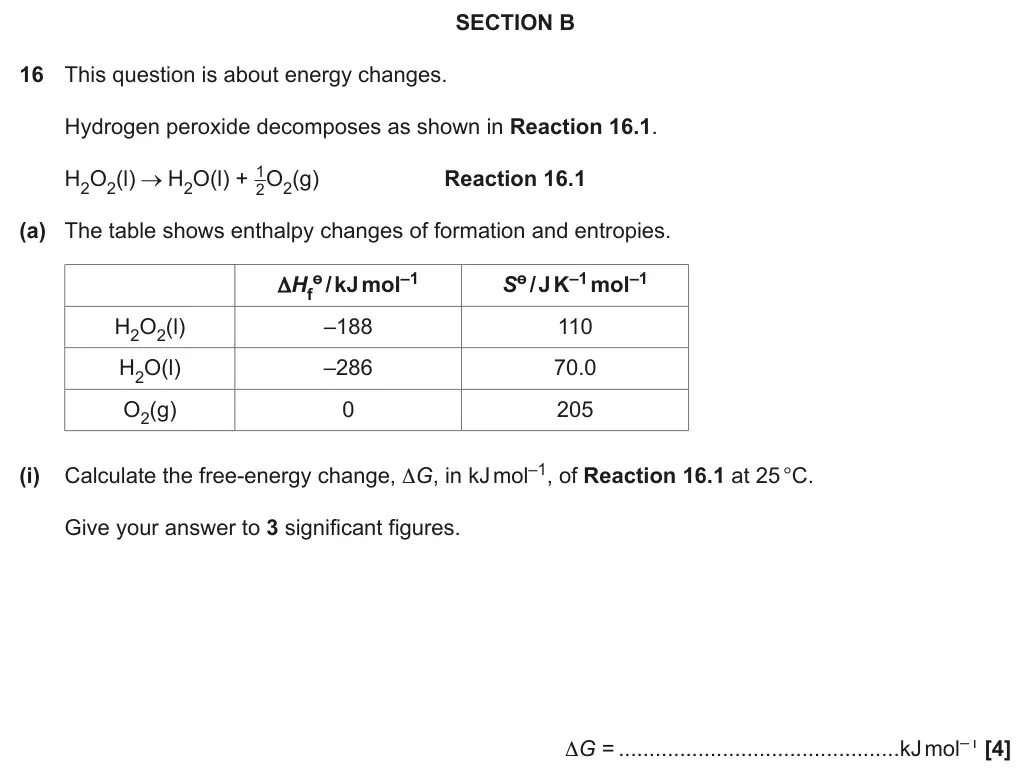
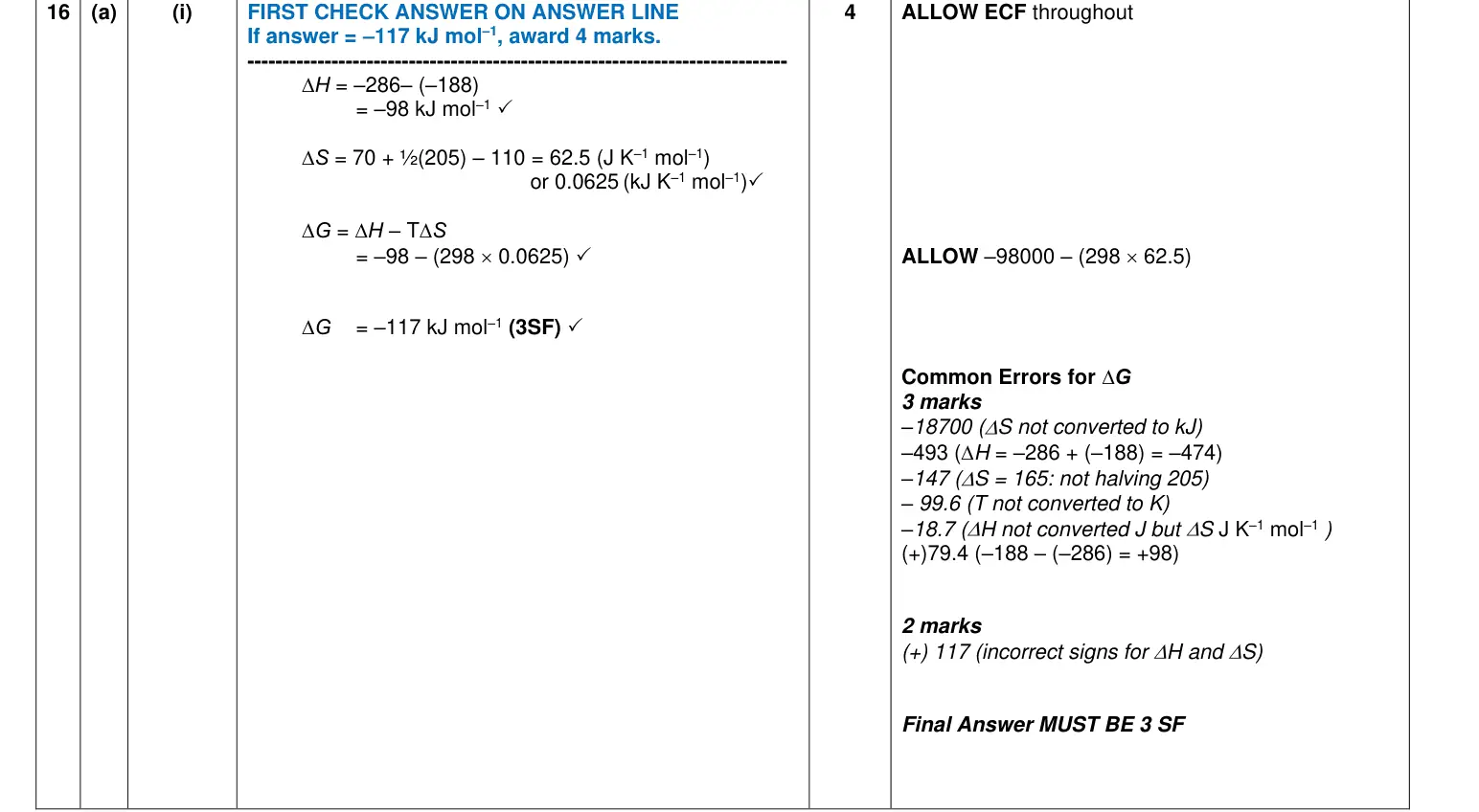
Almost all candidates had a good attempt at this calculation, with many gaining full marks. Most were able to calculate the entropy change. Almost all could reproduce the equation for free energy. Of those who did not get the correct final answer, the most common error was not converting the entropy value into kJ and / or the temperature to K. There were a few candidates who did not manipulate the equation correctly. A few candidates incorrectly calculated ΔS, obtaining the value of 165 J K-1 mol-1 or ΔH, obtaining -474 kJ mol-1. Candidates were given ECF in these cases.
Skills: M0.0 Recognise and make use of appropriate units in calculations; M1.1 Use an appropriate number of significant figures; M2.3 Substitute numerical values into algebraic equations using appropriate units for physical quantities

Lots of good answers from candidates were seen for this question. A few candidates attempted the explanation via a ΔG / ΔS argument and misinterpreted the comment within the question.
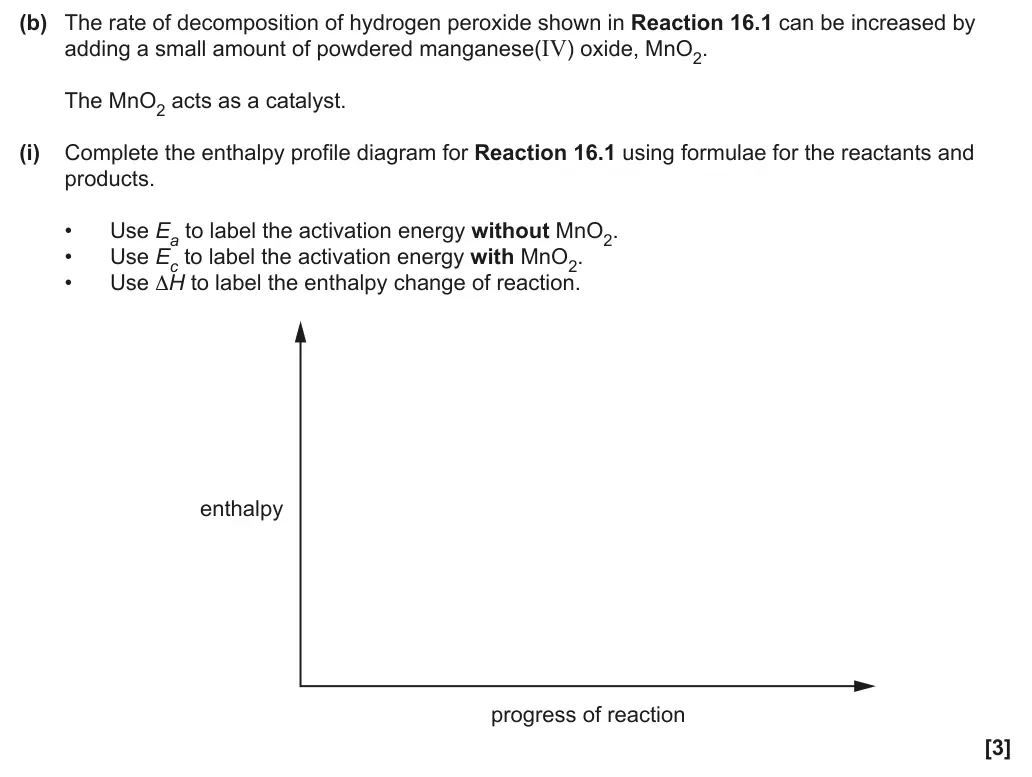
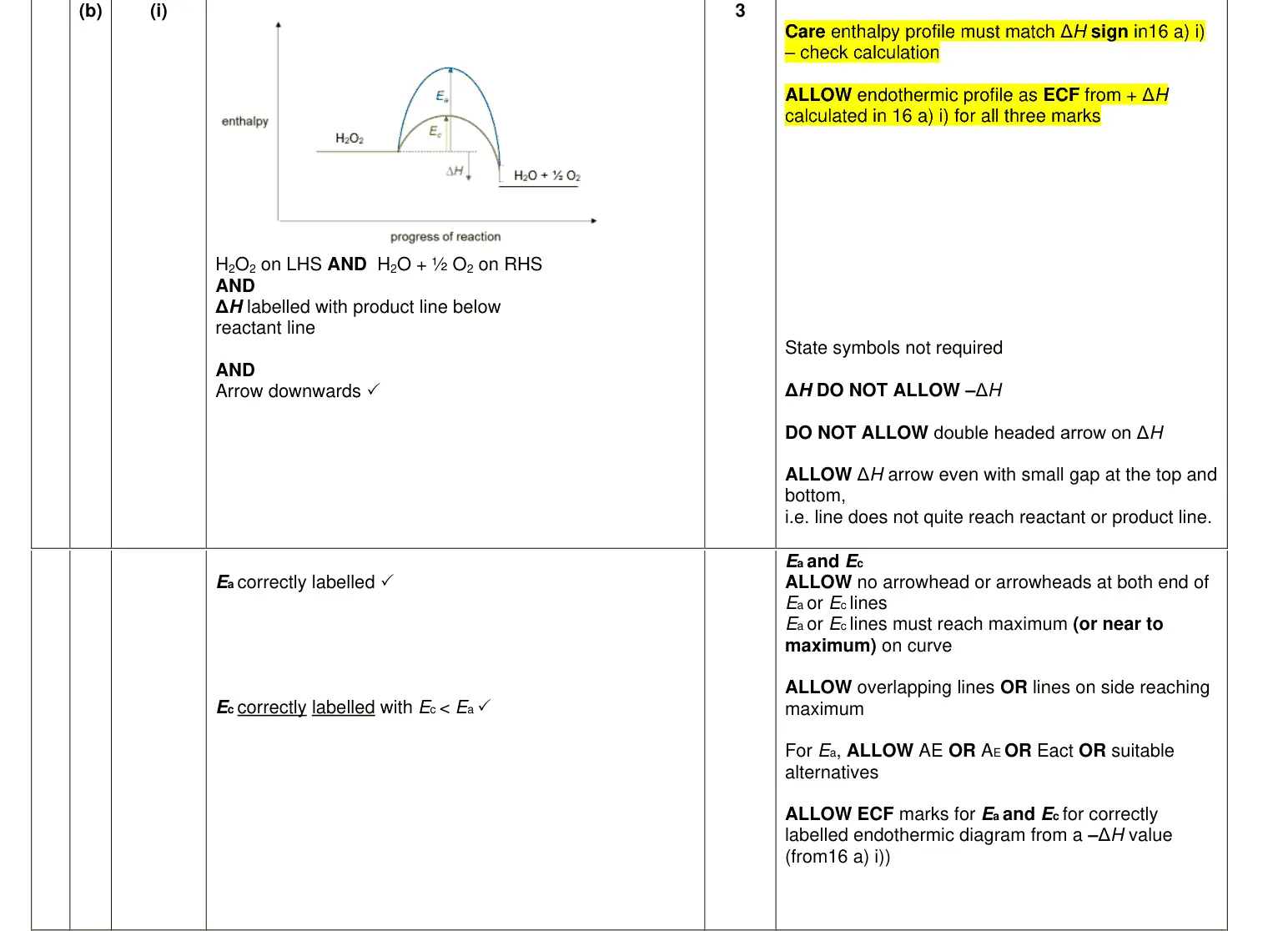
This question proved more difficult for candidates with lots of inaccuracies. The profile was dependent on the calculation for ΔH in Question 16 (a) (i). The arrowhead for ΔH needs to be pointing from the reactants to the products. The activation energies, again, need to start at the reactant line and go to the maximum level of the curve. Those that needed to draw an endothermic profile were far more likely to make an error with the Ea and Ec arrows, often starting from the product line or even from the base line of the graph. A significant number of candidates did not add arrows and instead labelled the curves Ea and Ec. Some candidates drew a Boltzmann distribution curve scoring 0 marks. The candidate has the correct exothermic profile but has the incorrect starting point for the activation energy going from the product line.

This was a well answered question. A few candidates, incorrectly, suggested that it was heterogeneous due to the reactants and products being in different states, and did not mention the catalyst.
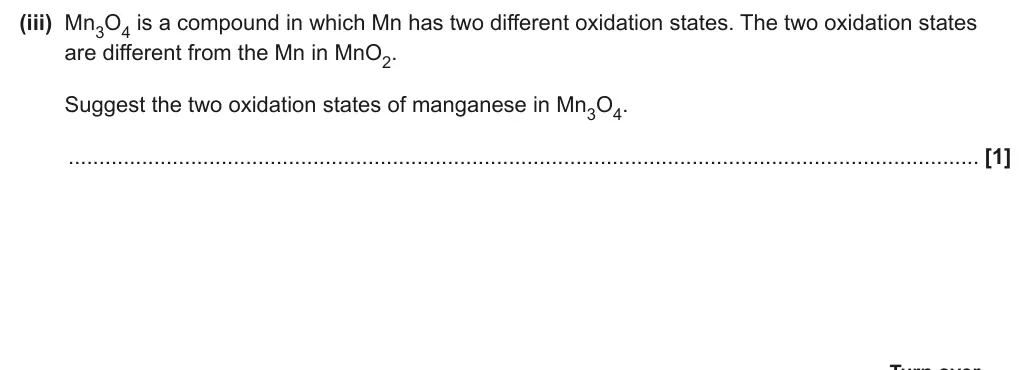
This question proved more challenging for candidates. Candidates stating +4 was the most common error; this is the oxidation state in MnO2. Some candidates stated fractions, negative values and gave the state symbol instead i.e. solid and liquid.

This question required a standard definition to be recalled. The two components are (a) one mole of an ionic lattice and (b) formed from its gaseous ion. Some candidates produced answers combining all the various definitions, most often 1 mol of gaseous ions. In general, when enthalpy definitions are required, candidates should be mindful of whether energy is given out or taken in. The phrase ‘enthalpy that accompanies’ may be most appropriate when candidates are unsure of the energy change.

Most candidates scored all three marks. Some candidates wrote illegible state symbols where (g) and (s) were impossible to tell apart, but this was improved on from last year. Also, many candidates choose to write state symbols as a very small sub-script e.g. Mn(s) or O2(g). The convention is to use lower case letters of normal size e.g. Mn(s) or O2(g). The most common errors were the manganese formula, i.e. MnO2, and incorrect state symbol with (g) being used. Candidates also missed state symbols in one species, electron on the top left and an incorrect charge on either the Mn or O ions.

The correct answer was seen frequently, along with lots of the common errors listed on the mark scheme. Candidates tended to misjudge the mole ratio and divided +249 by two. Some candidates applied the cycle incorrectly and therefore used the wrong sign for an enthalpy change, leading to them attaining one mark. Candidates should check for transcription errors as -3789 was often written for - 3798.
Skills: M2.2 Change the subject of an equation; M2.4 Solve algebraic equations
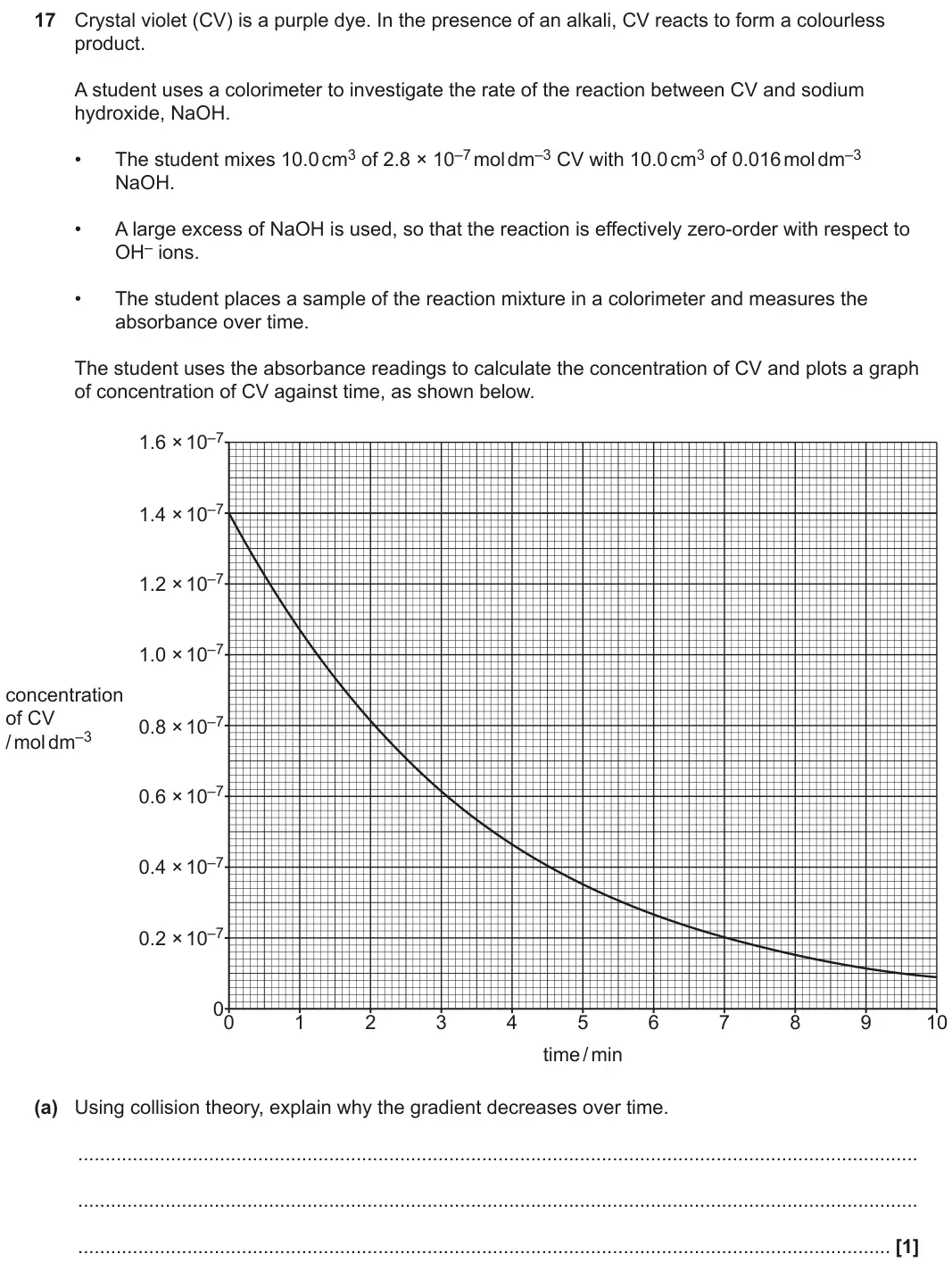
This question proved difficult for candidates to explain well. Collision theory linked to rate requires a quantitative approach, e.g. less particles per unit volume and less collisions per unit time. A lot of candidates wrote vague responses about fewer particles so less collisions and did not gain credit.
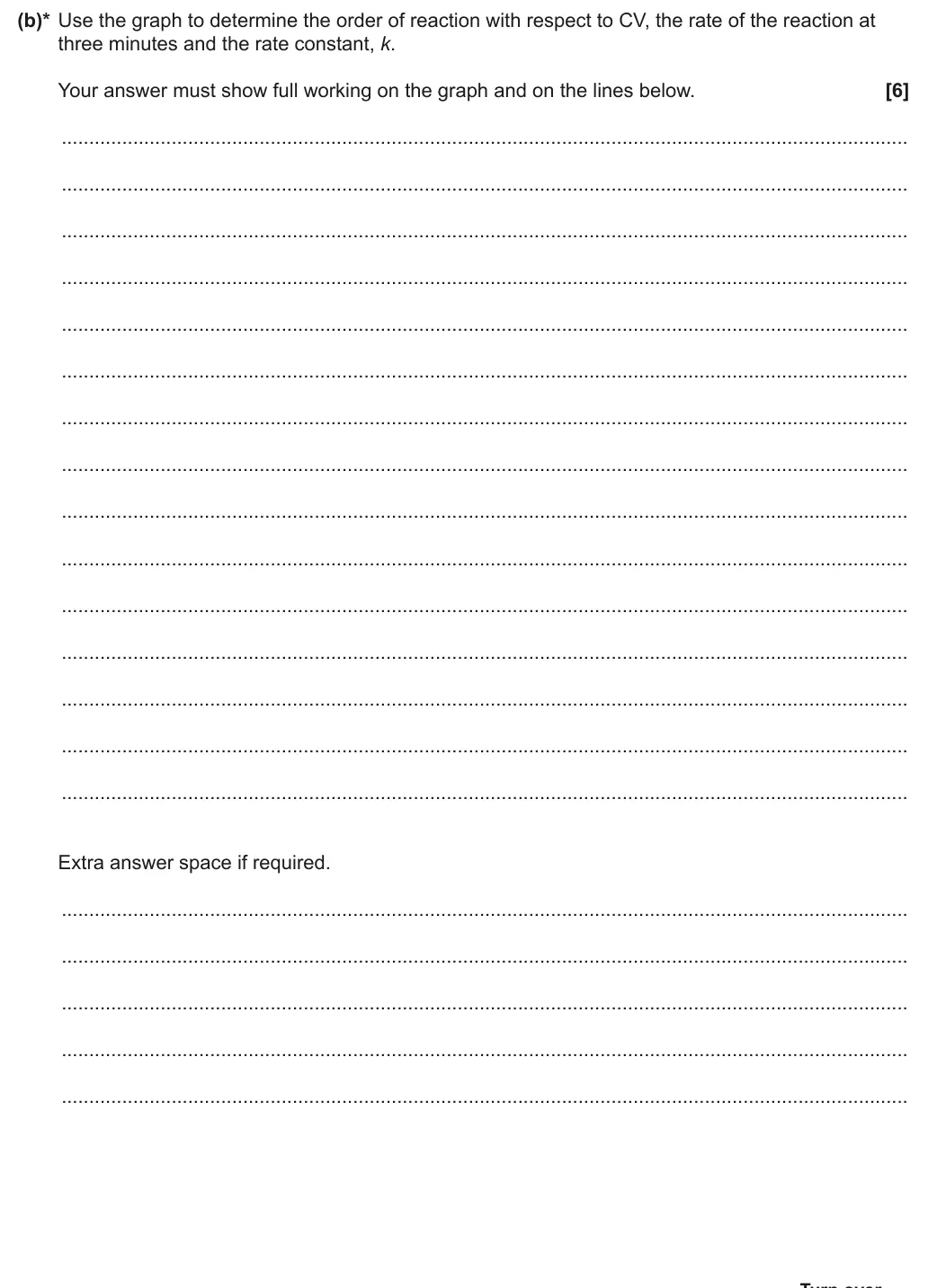
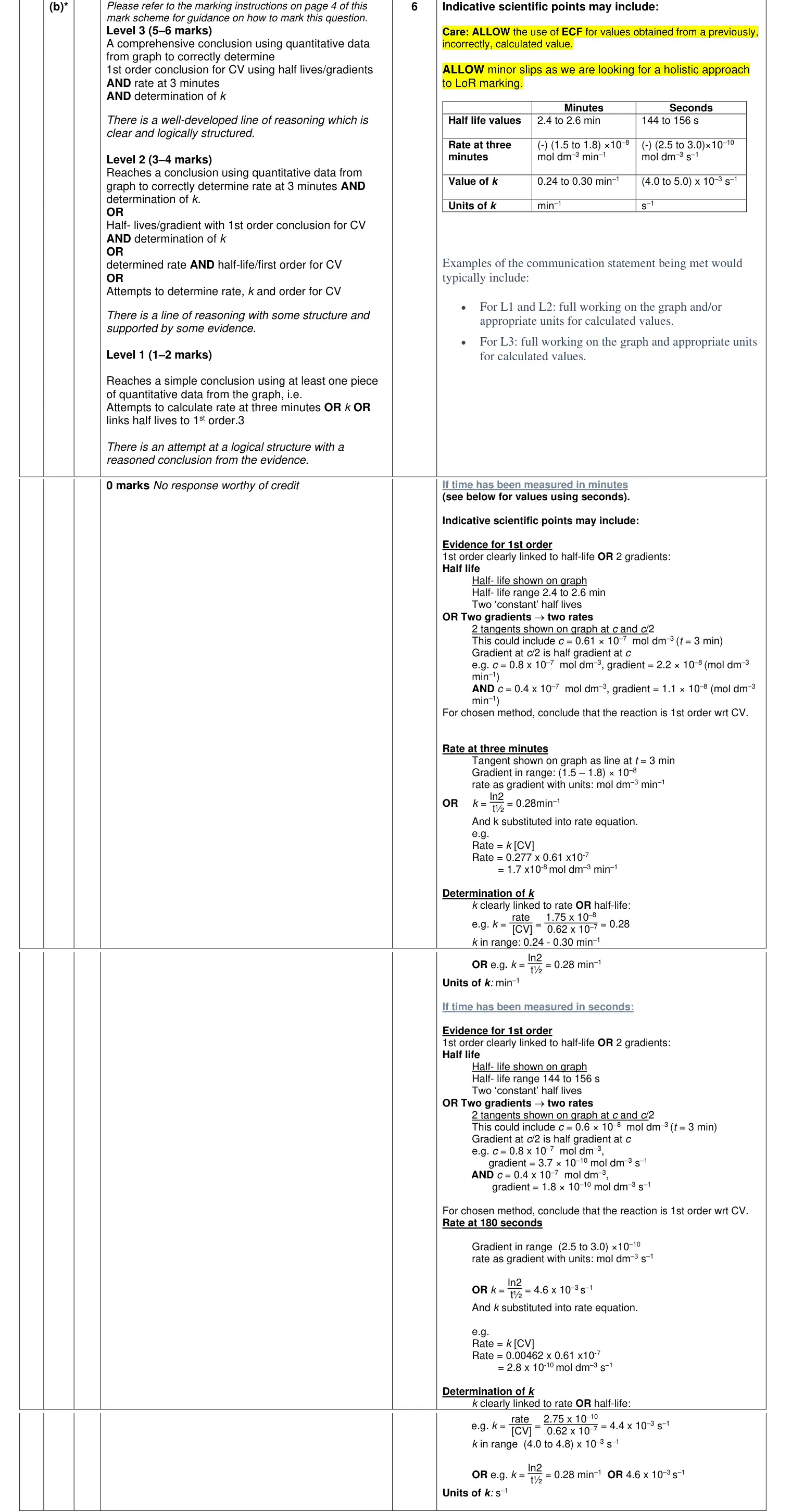
The first Level of Response question in the paper was answered well with the higher-attaining candidates on the paper scoring full marks. These students started with a nice clear analysis of the half-life, referring to labelled sections of the graph, then went on to calculate the rate from a well-drawn tangent with correct indices and were careful to write down the correct units. Then used the rate equation to calculate K and get the correct units. Almost all candidates were able to conclude that it was first order for CV. Most used the half-life approach with others comparing two gradients. Candidates should be advised, especially in LoR questions, that the conclusion needs a clear link to the data. The gradient at 3 minutes was done well and the candidates used the appropriate scale from the graph in their calculations. Clarity of communication does require indication of what is being calculated and how the numbers were obtained. This would allow an initial rate versus a rate at three minutes to be distinguished. Units were particularly important in this question as some candidates used minutes from the graph while others converted time into seconds. A common error was to state the wrong units or leave them out altogether. Most candidates used the rate equation to calculate K and get the correct units. A few approached the value by using k = ln2 t½ . Error carried forward was given for those with incorrect half-lives or rate value. Candidate errors arose from graph readings that caused rate to be wrong, errors in concentrations used in rate or K calculation, and badly drawn tangents causing the rate to be out of tolerance. Some candidates tried to adjust the concentrations as if conducting mole calculations or take the rate from two points on the graph. The candidate scored Level 3. The graph was clearly used to obtain half-lives and gradients. This was communicated on the answer lines, showing calculations and units.
Skills: M0.0 Recognise and make use of appropriate units in calculations; M1.1 Use an appropriate number of significant figures; M3.1 Translate information between graphical, numerical and algebraic forms; M3.5 Draw and use the slope of a tangent to a curve as a measure of rate of change

Candidates tend to find Kp calculations difficult and so a strategy to work their way through them could include: • Write the Kp expression using the molar ratio given in the question. Care should be taken not to change the molar ratio to help an easier calculation. Square brackets should not be used as these represent concentration. • Calculation of initial moles present, with careful consideration of the use of appropriate significant figures • Calculation of the change in moles present • Deduction of the number of moles present at equilibrium • Determination of total moles present at equilibrium These steps are often best completed as RICE tables (Ratio, Initial, Change, Equilibrium) and should look to use the appropriate amount of significant figures to avoid having a rounding error in the final answer.
Skills: M0.0 Recognise and make use of appropriate units in calculations; M0.2 Use ratios, fractions and percentages; M1.1 Use an appropriate number of significant figures; M2.3 Substitute numerical values into algebraic equations using appropriate units for physical quantities

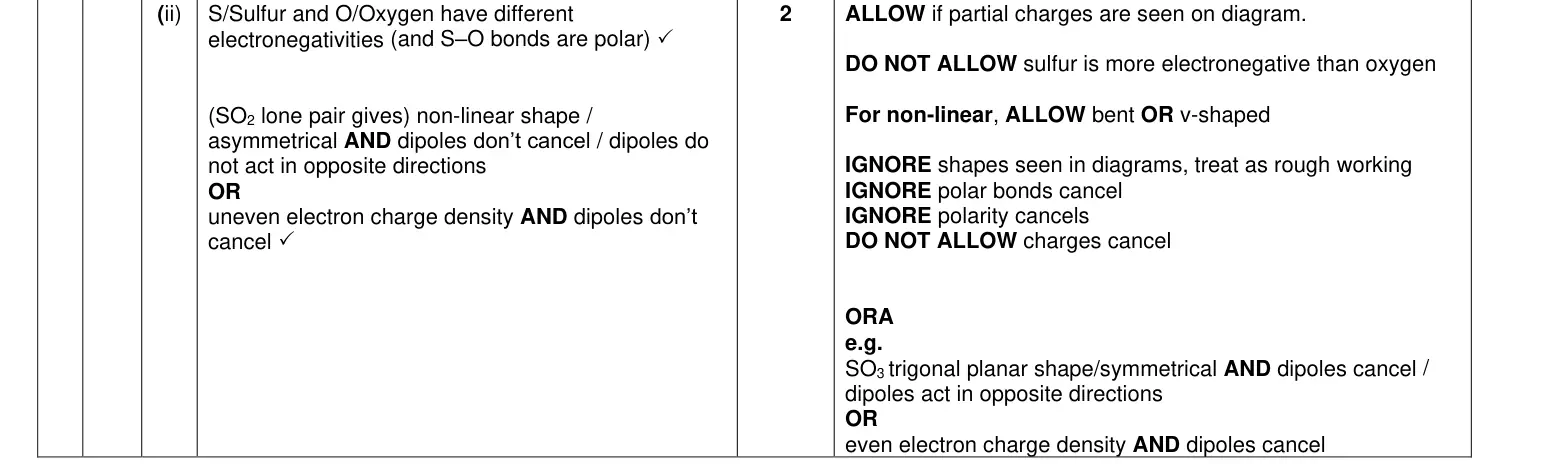
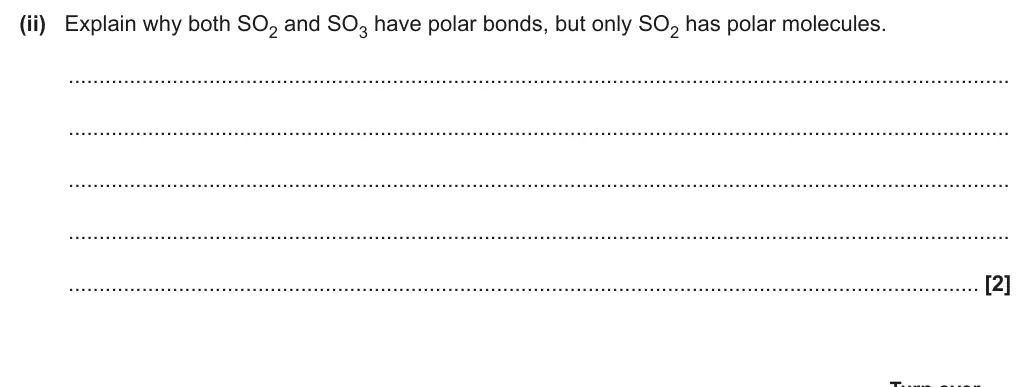
Candidates performed well with this question and many stated that Kp would increase. Some identified the forward reaction as endothermic but did not link this to equilibrium being shifted to the right, thus increasing the ratio within the Kp expression. A few candidates sought to incorrectly explain the effect by using Le Chatelier effect on pressure. Candidates found this question demanding. Many candidates explained the formation of a polar bond by describing the difference in electronegativity between S and O. Many answers had descriptions about symmetry but explained polarity in terms of polar bonds/charges cancelling instead of dipoles. A symmetric molecule (all bonds identical and no lone pairs) will not be polar even if individual bonds within the molecular are polar. The individual dipoles on the bonds ‘cancel out’ due to the symmetrical shape of the molecule. There is no net dipole moment: the molecule is non-polar

This proved a challenging question where candidates did not stick to the principle that Kp (or Ka) values only change due to temperature changes. Only a few candidates scored both marks with many having the Kp value changing due to increased pressure.
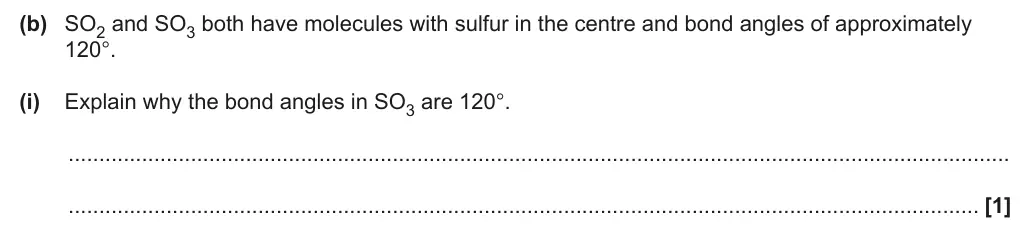
Another challenging question, requiring the identification of 3 double bonds (and no lone pair). The most common error was stating that SO2 has 3 bonding pairs – it doesn’t, it has 6 bonding pairs which are arranged as 3 double bonds. They could also state that it has 3 bonding regions.
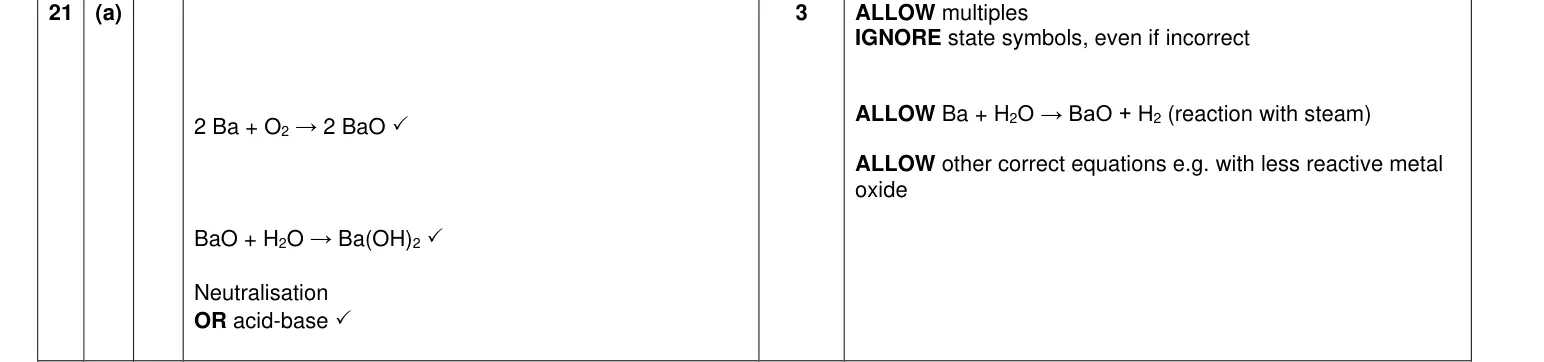
ocr.org.uk/science Oxford Cambridge and RSA CHEMISTRY A H432 For first teaching in 2015 A LEVEL Version 1 H432/01 Summer 2024 series Examiners’ report Contents Introduction .............................................................................................................................................. 4 Paper 1 series overview ........................................................................................................................... 5 Section A overview ................................................................................................................................... 6 Question 1 ............................................................................................................................................ 6 Question 2 ............................................................................................................................................ 7 Question 3 ............................................................................................................................................ 7 Question 4 ............................................................................................................................................ 8 Question 5 ............................................................................................................................................ 8 Question 6 ............................................................................................................................................ 9 Question 7 ............................................................................................................................................ 9 Question 8 .......................................................................................................................................... 10 Question 9 .......................................................................................................................................... 10 Question 10 ........................................................................................................................................ 11 Question 11 ........................................................................................................................................ 12 Question 12 ........................................................................................................................................ 13 Question 13 ........................................................................................................................................ 13 Question 14 ........................................................................................................................................ 14 Question 15 ........................................................................................................................................ 15 Section B overview ................................................................................................................................. 16 Question 16 (a) (i) ............................................................................................................................... 16 Question 16 (a) (ii) .............................................................................................................................. 17 Question 16 (b) (i) ............................................................................................................................... 18 Question 16 (b) (ii) .............................................................................................................................. 19 Question 16 (b) (iii) ............................................................................................................................. 20 Question 16 (c) (i) ............................................................................................................................... 20 Question 16 (c) (ii) .............................................................................................................................. 21 Question 16 (c) (iii) .............................................................................................................................. 22 Question 17 (a) ................................................................................................................................... 23 Question 17 (b)* .................................................................................................................................. 24 Question 18 (a) (i) ............................................................................................................................... 26 Question 18 (a) (ii) .............................................................................................................................. 27 Question 18 (a) (iii) ............................................................................................................................. 27 Question 18 (b) (i) ............................................................................................................................... 28 Question 18 (a) (ii) .............................................................................................................................. 28 Question 19 (a) (i) ............................................................................................................................... 29 Question 19 (a) (ii) .............................................................................................................................. 29 Question 19 (a) (iii) ............................................................................................................................. 30 Question 19 (b) (i) ............................................................................................................................... 31 Question 19 (b) (ii) .............................................................................................................................. 34 Question 20 (a) (i) ............................................................................................................................... 35 Question 20 (a) (ii) .............................................................................................................................. 35 Question 20 (b) ................................................................................................................................... 36 Question 20 (c)* .................................................................................................................................. 37 Question 21 (a) ................................................................................................................................... 38 Question 21 (b) ................................................................................................................................... 40 Question 21 (c) ................................................................................................................................... 41 Question 21 (d) (i) ............................................................................................................................... 42 Question 21 (d) (ii) .............................................................................................................................. 43 Question 22 (a) ................................................................................................................................... 44 Question 22 (b) (i) ............................................................................................................................... 45 Question 22 (b) (ii) .............................................................................................................................. 45 Question 22 (c) ................................................................................................................................... 46 Introduction Our examiners’ reports are produced to offer constructive feedback on candidates’ performance in the examinations. Candidates who did well on this paper generally: Candidates who did less well on this paper generally: • produced clearly structured working for calculations – Questions 16 (a),16 (c) (ii), 18 (a), 19 (a) (iii), 19 (b) (i), 21 (b), 22 (c) • produced clear and concise responses for the two Level of Response questions – Questions 17 (b) and 20 (c) • produced clear and concise responses to describe a polar molecule – Question 18 (b) (ii) • deduced the rate determining step and rate equation – Question 20 (b) • correctly used electrode potentials – Question 21 (d) (ii) • wrote a formula for an unfamiliar complex ion – Question 22 (b) (ii) • deduced the oxidation numbers of an unfamiliar compound • drew an enthalpy profile for an exothermic or endothermic reaction – Question 16 (b) (i) • drew a labelled diagram to measure a standard electrode potential. • found it difficult to apply what they had learned to unfamiliar situations • produced unstructured responses to Level of Response questions which were lacking in depth or used incorrect terminology – Questions 17 (b) and 20 (c) • did not clearly set out calculations, making it difficult for marks to be given for working – Questions 16 (a), 16 (c) (ii), 18 (a), 19 (a) (iii), 19 (b) (i), 21 (b), 22 (c) • did not give answers to calculations to the specified number of significant figures – Questions 18 (a) (i), 19 (a) (iii), 21 (b) • did not appropriately convert between units for calculations – Question 21 (b) • found it difficult to write a balanced equation, or ionic equations, for reactions with group 2 metal and metal compounds or group 7 redox reactions – Questions 20 (a) (ii), 21 (a) • drew an inaccurate enthalpy profile for an exothermic or endothermic reaction – Question 16 (b) (i) • drew an inaccurate or incomplete labelled diagram to measure a standard electrode potential. Question 18 (b) (i) Another challenging question, requiring the identification of 3 double bonds (and no lone pair).
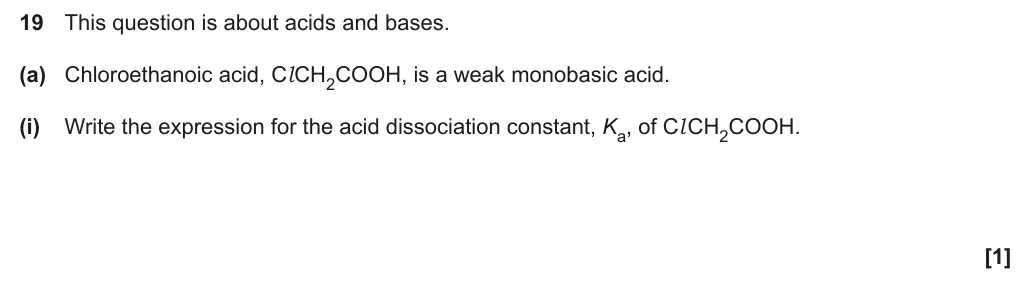
Most candidates scored the marking point. They realised that the full formulae were needed although some candidates left off the square brackets or used HA or [H]2. Care should be taken in checking the correct amount and location of H in the formula. As an acid dissociates to form a H+, it is important to acknowledge only one H+ is dissociated from the correct part of the molecule.
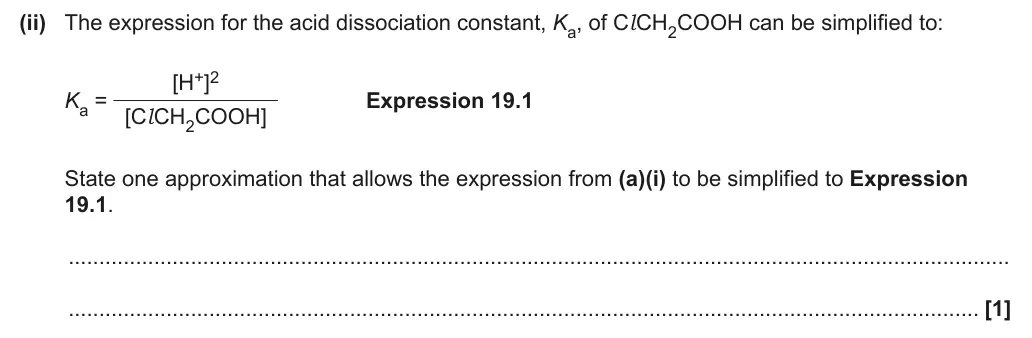
This question required the candidate to understand that the dissociation of water to produce H+ ions had no effect on the overall [H+] of the solution, leading to [H+] = [A-]. This was mostly answered well but some candidates used the idea of [H+] = [OH-].
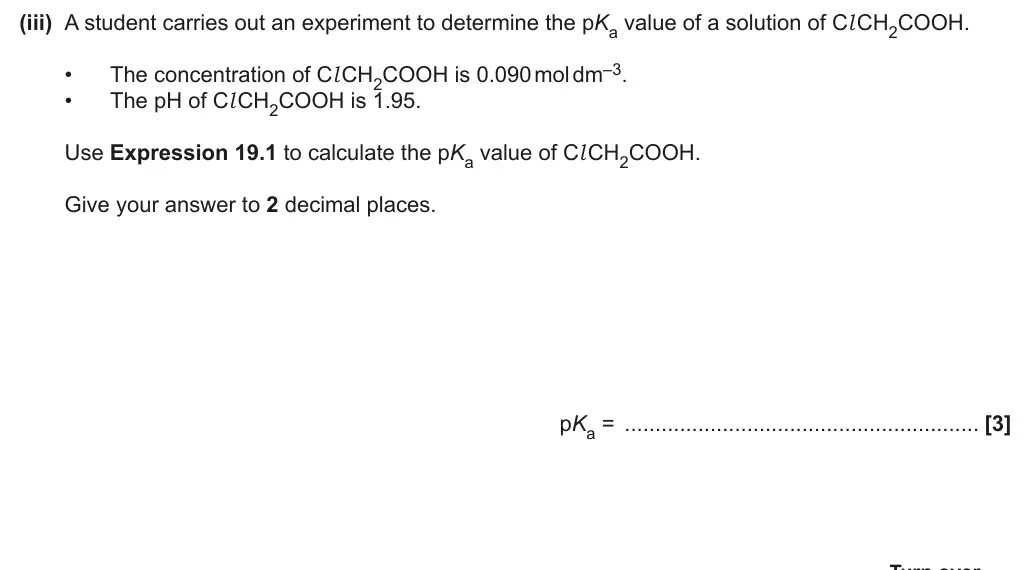
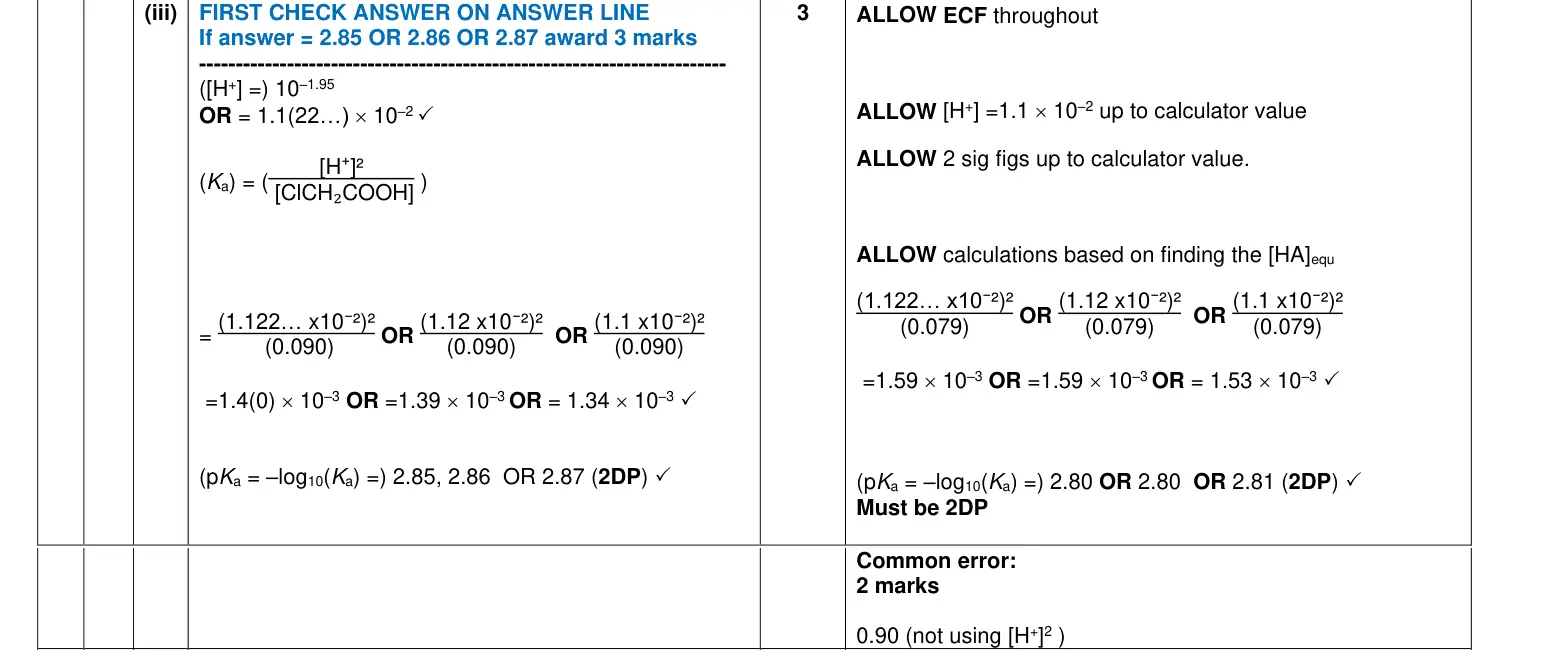
Candidates made good progress with this calculation, many gaining 2 or 3 marks, including error carried forward. Common errors included, in various combinations: using -log[-1.95]; using an incorrect value for the concentration of ClCH2COOH; and using 10-Ka.
Skills: M0.4 Use calculators to find and use power, exponential and logarithmic functions; M2.3 Substitute numerical values into algebraic equations using appropriate units for physical quantities; M2.5 Use logarithms in relation to quantities that range over several orders of magnitude
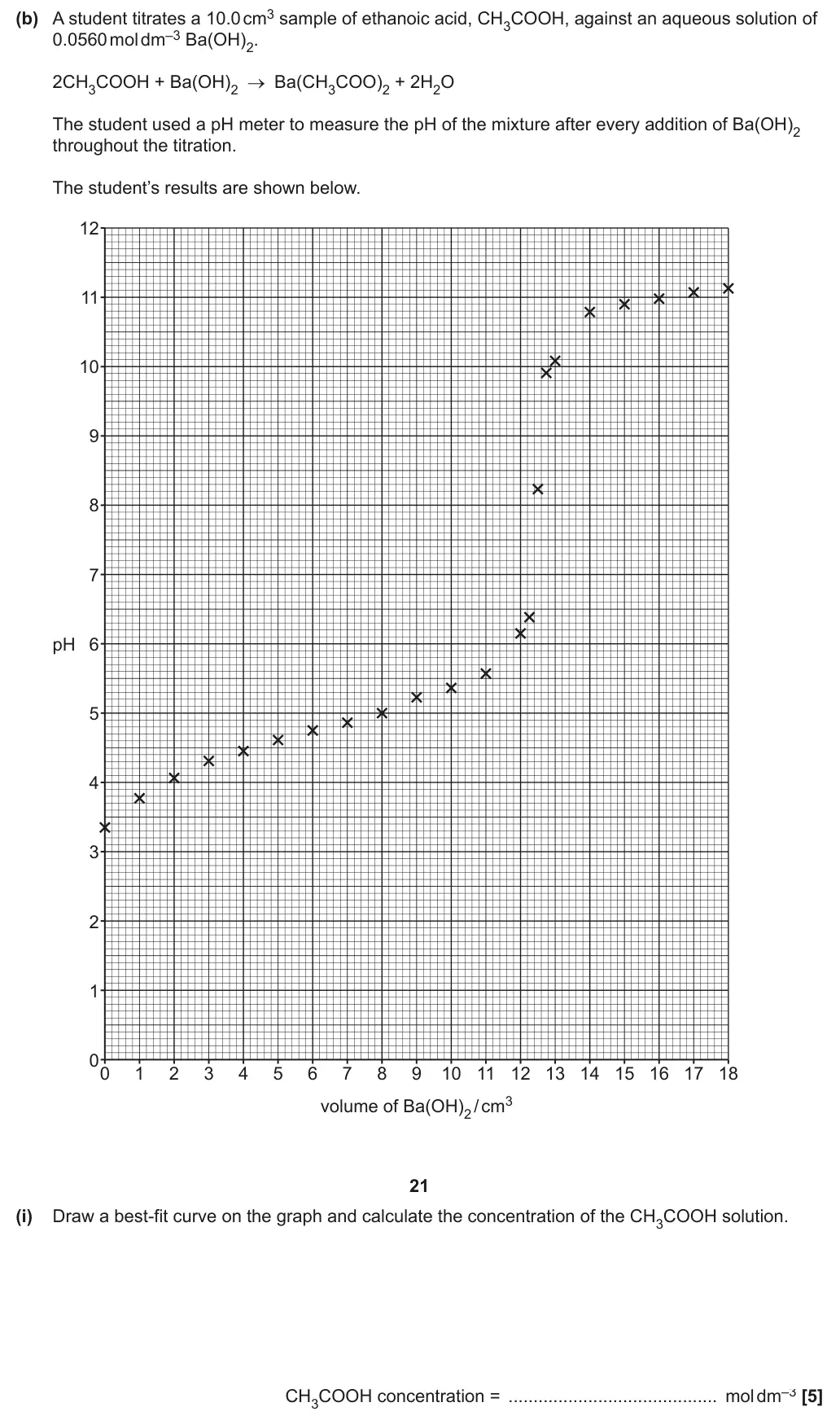
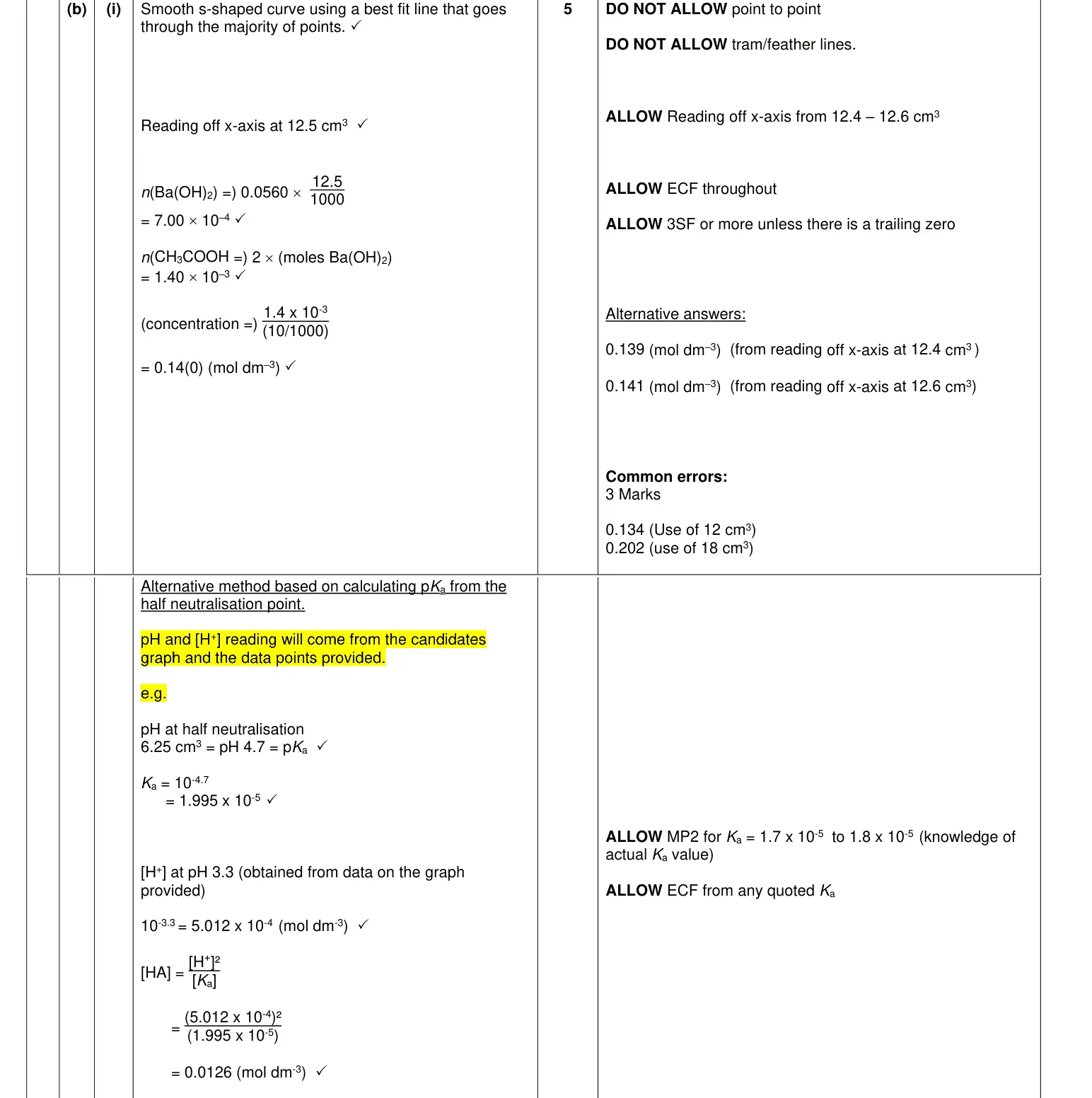
Nearly all candidates were able to draw the line of best fit and linked the sharp vertical section of the graph with the volume of Ba(OH)2 needed to neutralise the ethanoic acid. Candidates should aim to produce a smooth line of best fit and avoid ‘tram’ lines when the pencil is taken off the paper and the curve started again. The line should go through most points. Some candidates misinterpreted the graph and used values of 8, 12, 12.2, 12.25 and 18. However, the remainder of the calculation was accessible, and most candidates scored well with ECF marks from this point. There was occasional division of 2 for the moles of ethanoic acid and dividing by the original volume of Ba(OH)2 rather than the 10cm3 of ethanoic acid. This candidate scored all available marks. This is a very good example of a candidate displaying their working. The response was well communicated indicating the end point, links were made to what was being calculated and how the next number was obtained.
Skills: M0.0 Recognise and make use of appropriate units in calculations; M0.2 Use ratios, fractions and percentages; M3.2 Plot two variables from experimental or other data; PAG11 pH measurement; PAG2 Acid–base titration
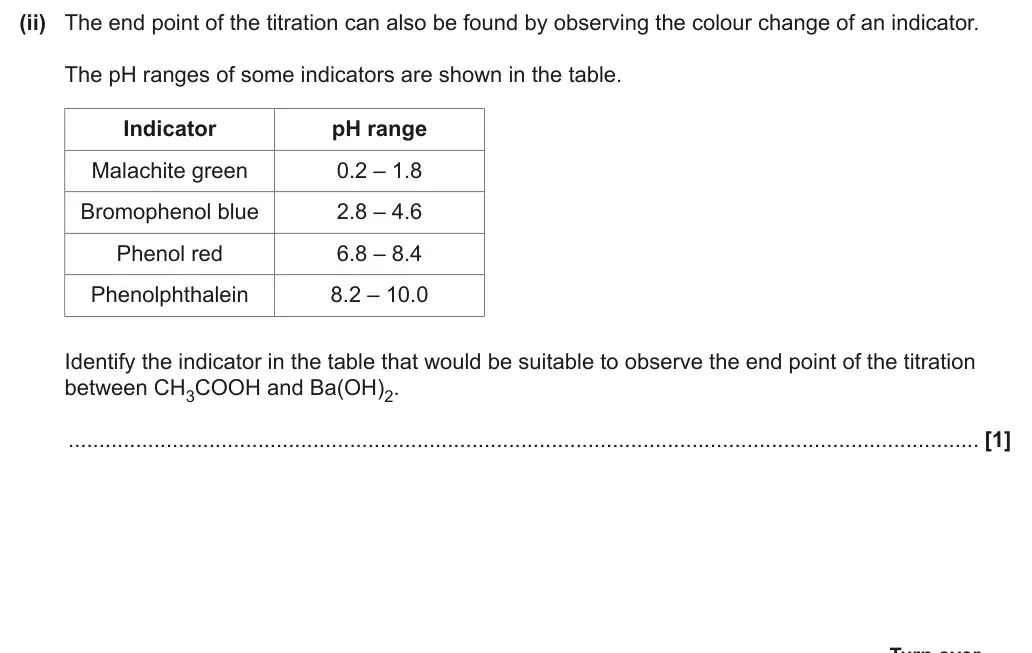
Nearly all candidates scored this marking point. Phenol red and Phenolphthalein were good choices of indicator as their colour changed on the sharp vertical section of the graph, depending on how the top end of the line of best fit was drawn. Occasionally malachite green and bromophenol blue were seen.

Candidates performed well on this question with most knowing that Cl2 kills the bacteria. Some stated that chlorine removed bacteria or purified the water.
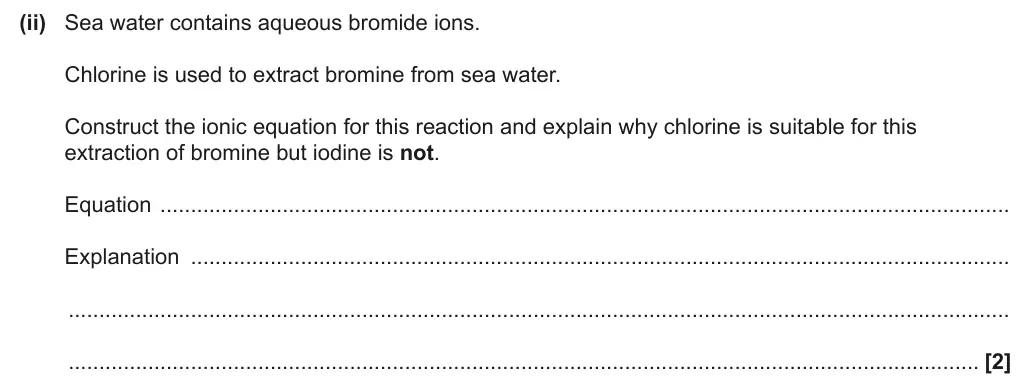
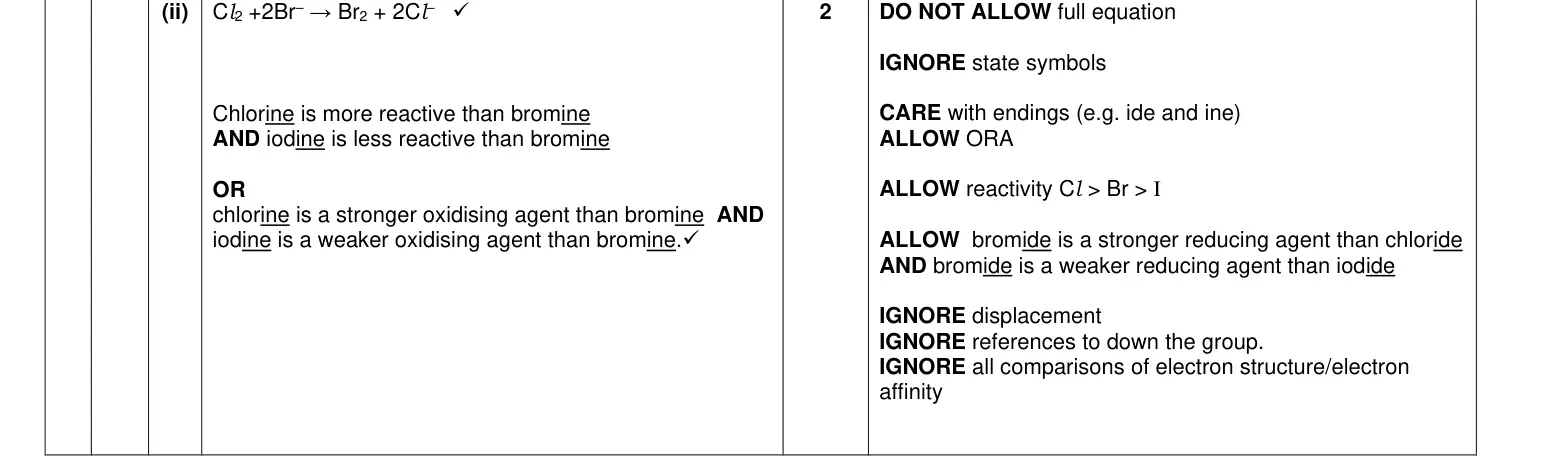
Most students scored the equation mark, although some presented unbalanced equations. Nearly all candidates used the ionic equation. Explanations were well argued with most candidates using the order of reactivity. A few considered the oxidising power of the halogen. Candidates are advised to ensure that both comparisons are clearly made, and it is obvious which of the two halogens the response is referring to. It is also important that candidates can distinguish between a halogen and a halide. Some candidates explained in terms of electronegativity and displacement.
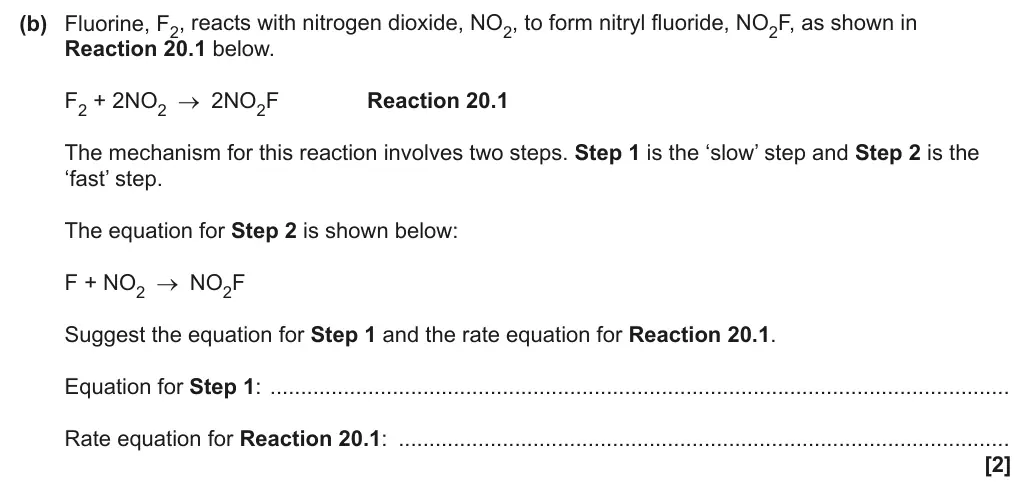
Candidates found this question more challenging. Many candidates deduced Step 1 and then went on to state the rate equation. A few candidates incorrectly deduced F rather than F2 and/or obtained a second order for NO2
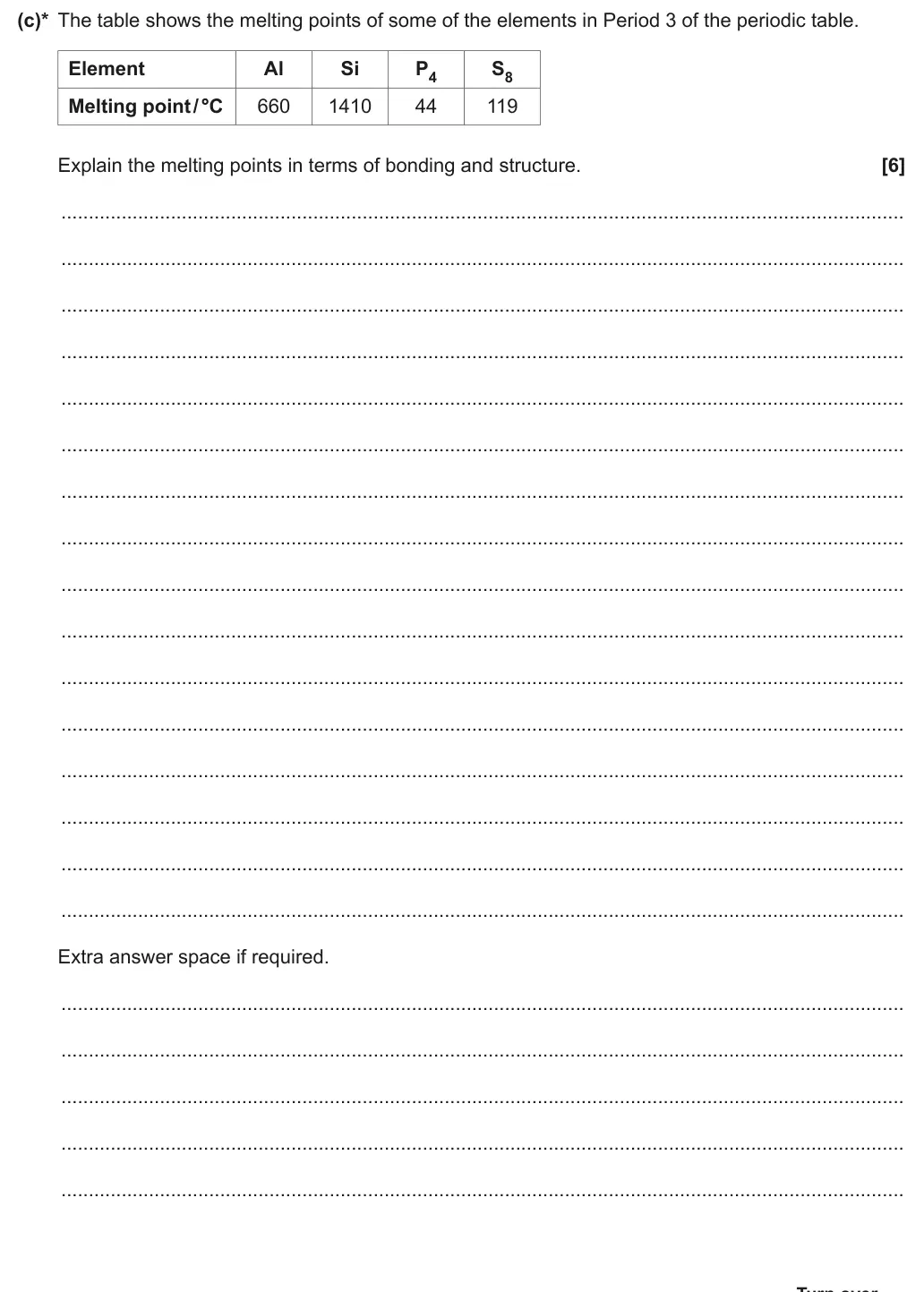
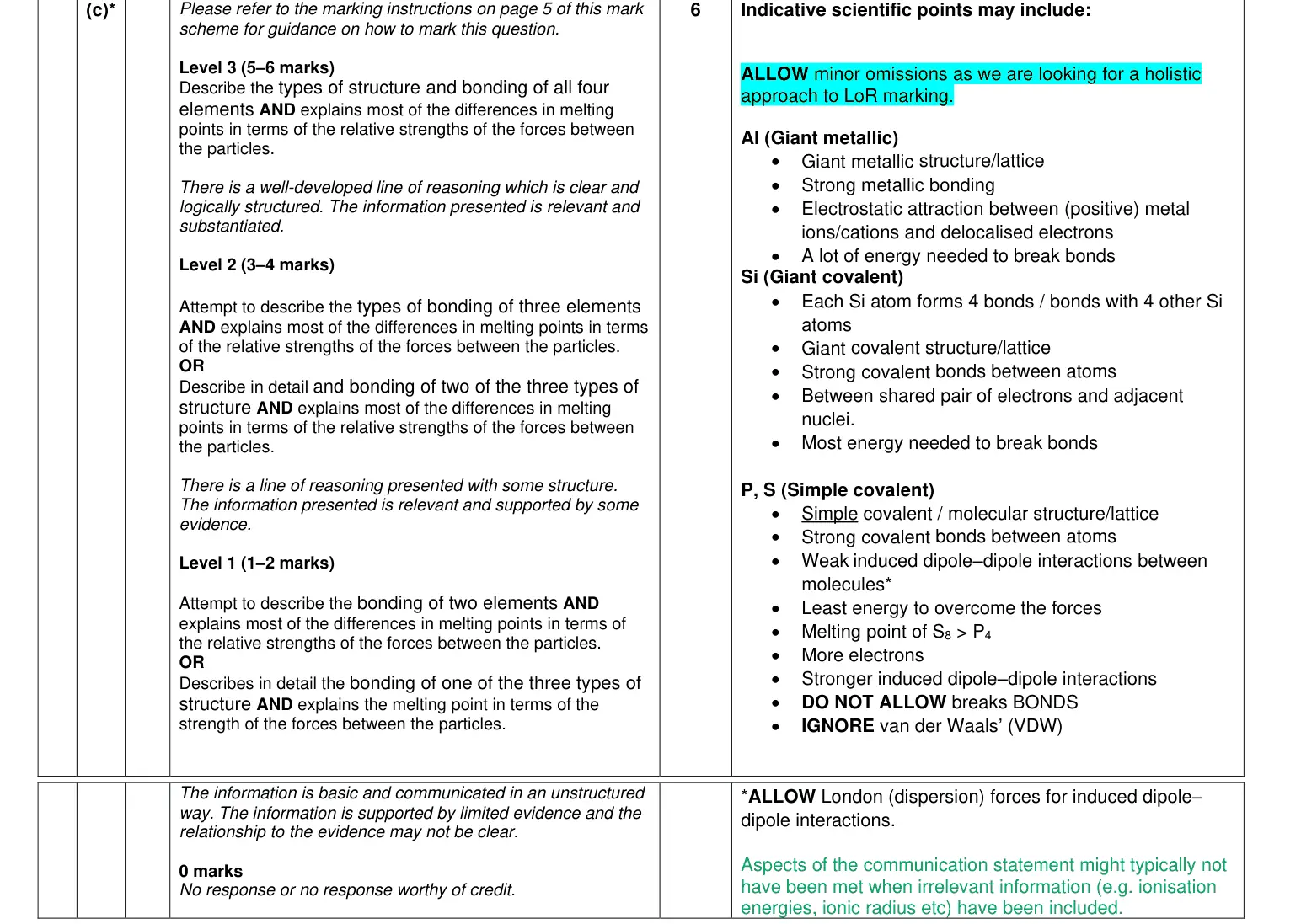
Structure and bonding continue to be a difficult concept for many candidates. High-attaining candidates were able to identify why the element had a certain magnitude of melting point. They clearly linked the structure type with the type of bonding. They then described, in detail, the nature of the bond. The strength of force required to break/overcome the bond/London Force was linked to the melting point. It was very common for ‘giant’ to be omitted in the name of the lattice, especially in Al. Candidates find it particularly challenging to associate the correct terminology with the correct structure, often describing intermolecular forces in giant covalent explanations or use of molecules in giant metallic explanations. London forces were mentioned widely but sometimes not described as being forces between molecules and not linked to the increased number of electrons. A holistic, rather than a point based, approach is used in marking these responses. This allowed Level 2 to be given when the candidate did not use all of the correct terminology throughout the three structure types. Several candidates described the varying melting point going across the period as being due to atoms having more electrons in the outer shell and a greater nuclear charge.
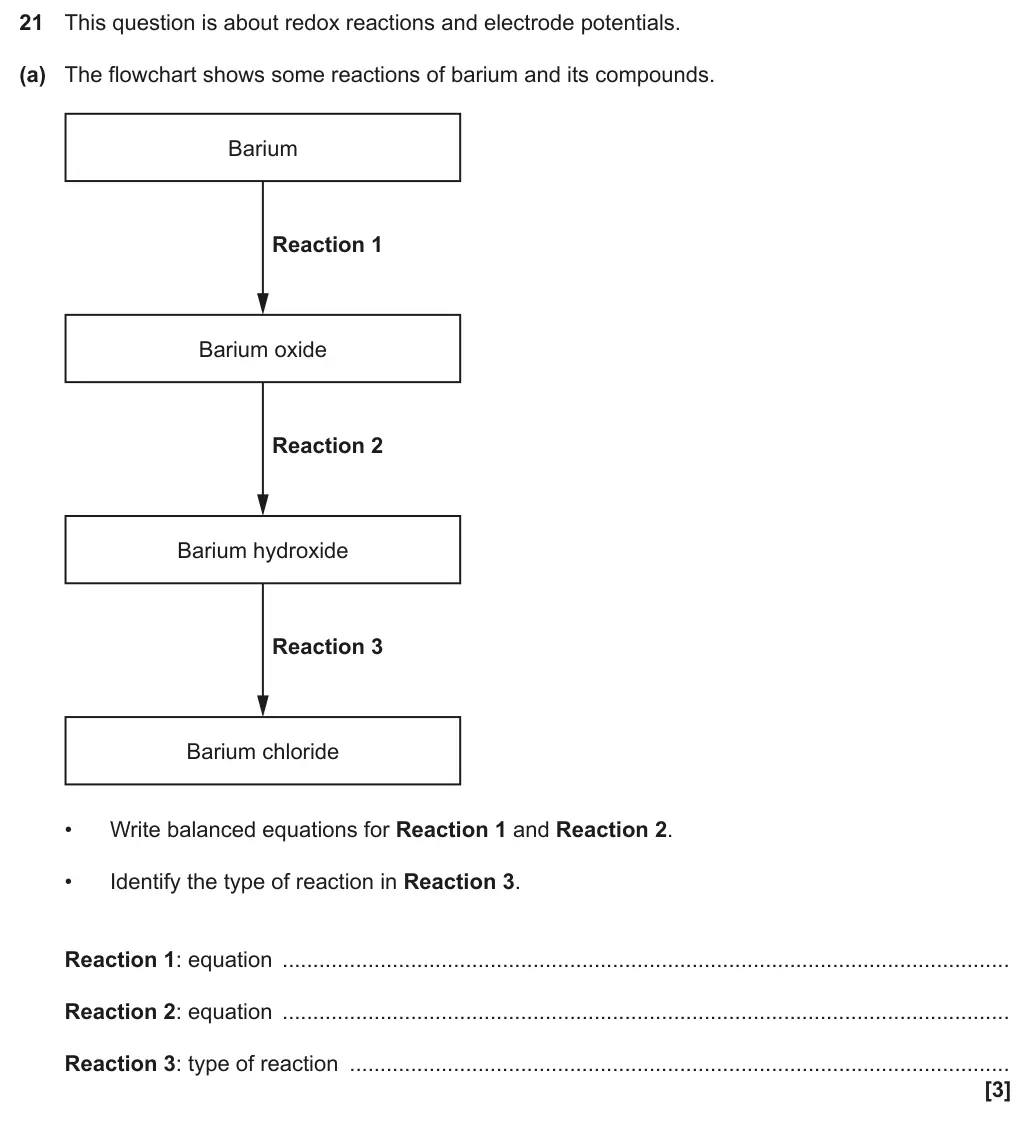
Some candidates coped well with this question which was based on the AS part of the specification and gained all three marks. Common errors were for unbalanced equations in reaction 1 or adding H2 to the product of reaction 2. Reaction 3 was often, incorrectly, considered as: redox, halogenation, nucleophilic substitution or a precipitation reaction.
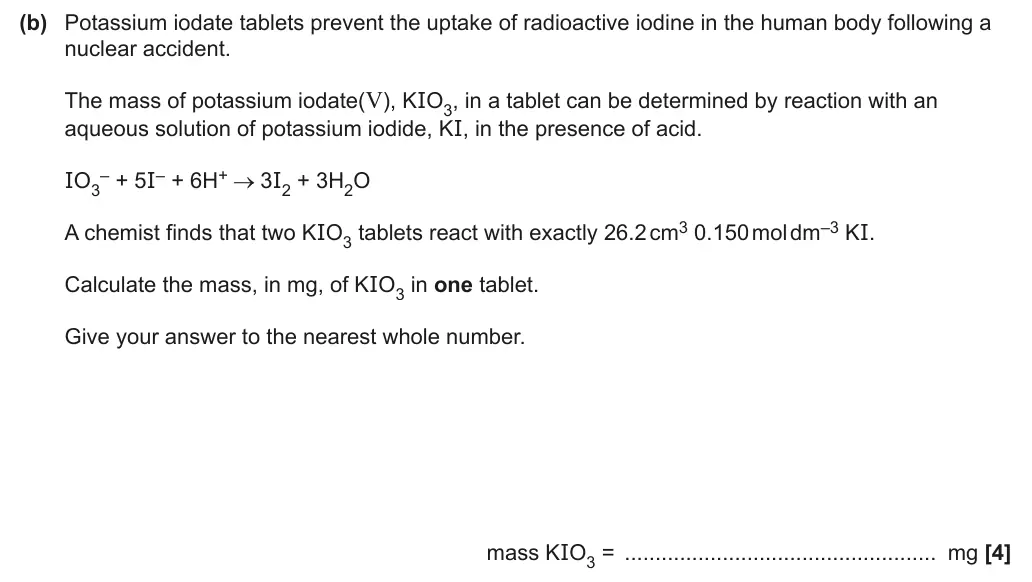
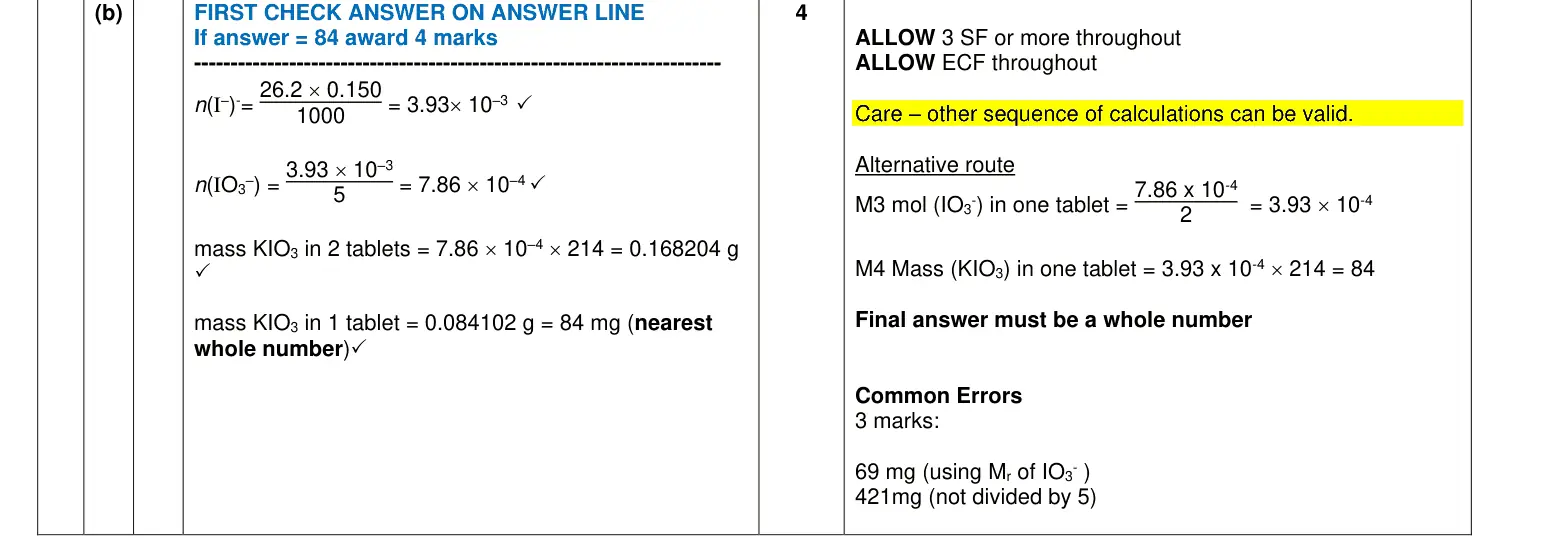
Although lots of candidates got the correct final answer, almost all achieved some credit from this calculation through error carried forward with marks spread across the available range. Almost all candidates were able to find the number of moles of iodide. A few candidates did not get the molar ratio and/or used the mass of just IO3- rather than KIO3. Some then did not realise the need to half this number to find the mass in 1 tablet, and multiplied by either 10 or 100 in order to convert g to mg.
Skills: M0.0 Recognise and make use of appropriate units in calculations; M0.2 Use ratios, fractions and percentages; M2.3 Substitute numerical values into algebraic equations using appropriate units for physical quantities
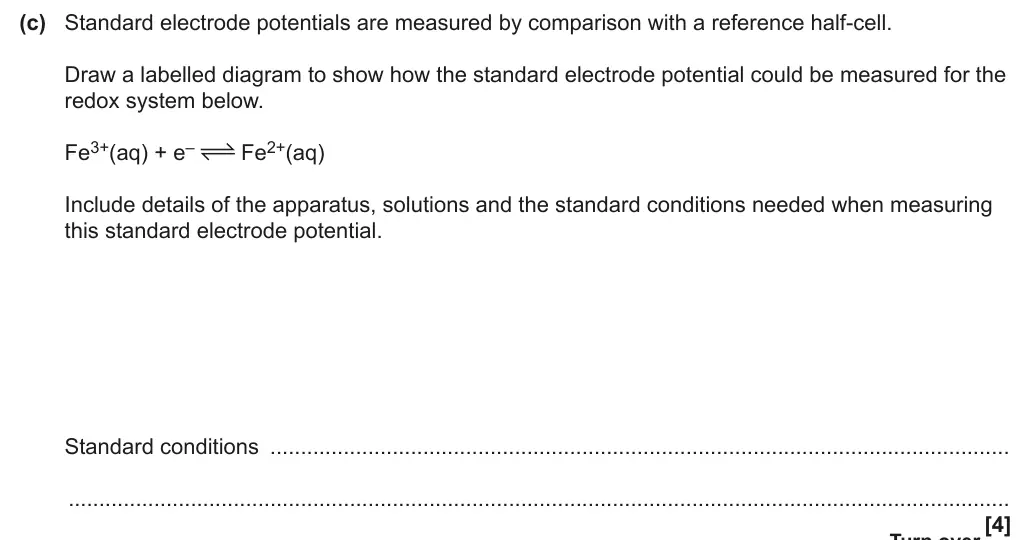
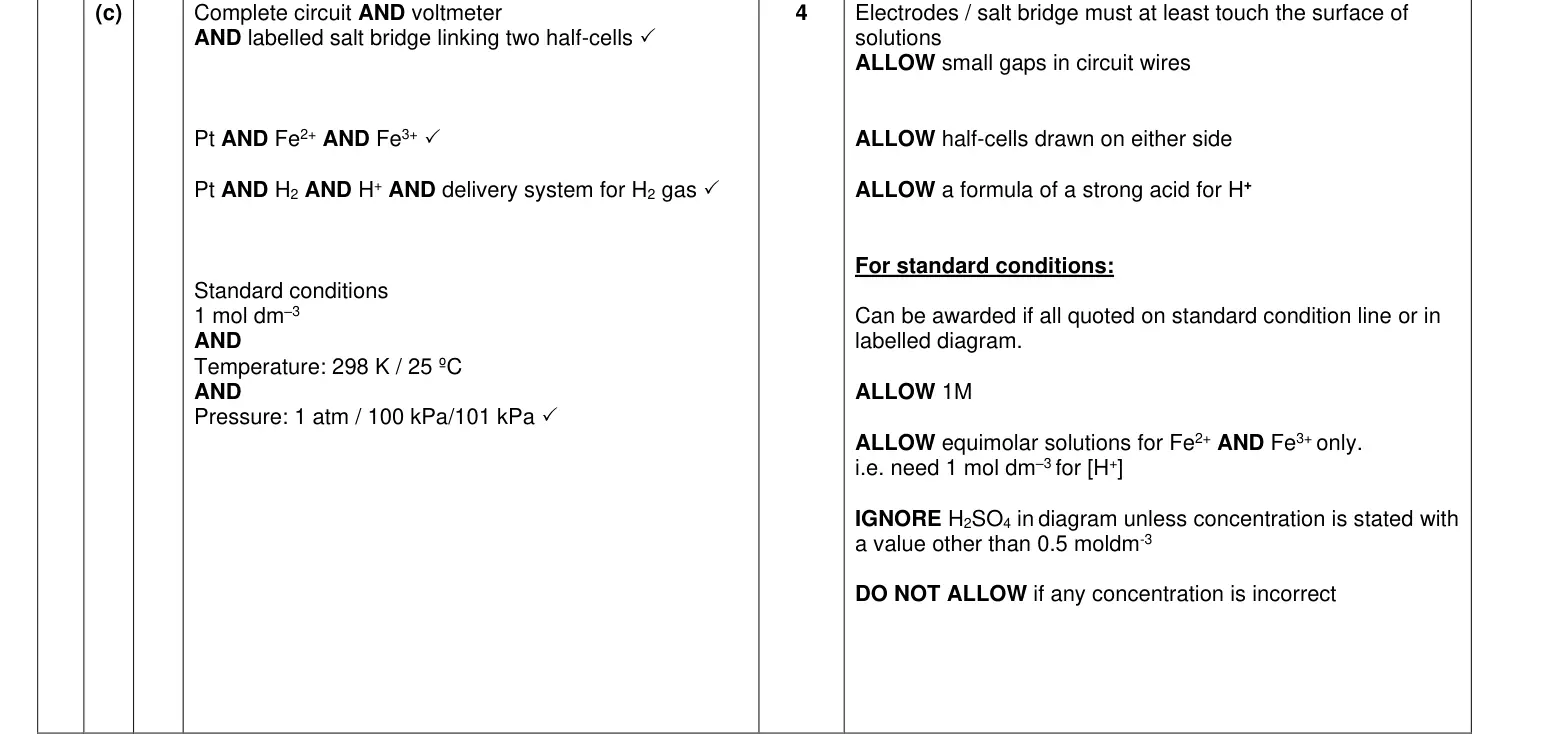
Successful candidates drew a complete circuit and voltmeter with the labelled salt bridge dipped into the two solutions. Both cells had Pt as the electrodes. One cell contained 1 moldm-3 Fe2+ and Fe3+ where the other had a delivery mechanism for H2 (at 1 atm) and H+ (at 1 mol dm-3). Standard temperature of 298K (or 25oC) was stated. Common errors included: not have solutions in the beakers, used Fe or Fe2+ electrodes, the hydrogen cell was missing and/or the H2 with a device for adding it. A few candidates suggested two cells with only Fe2+ one side and only Fe3+ on the other.
Skills: PAG8 Electrochemical cells
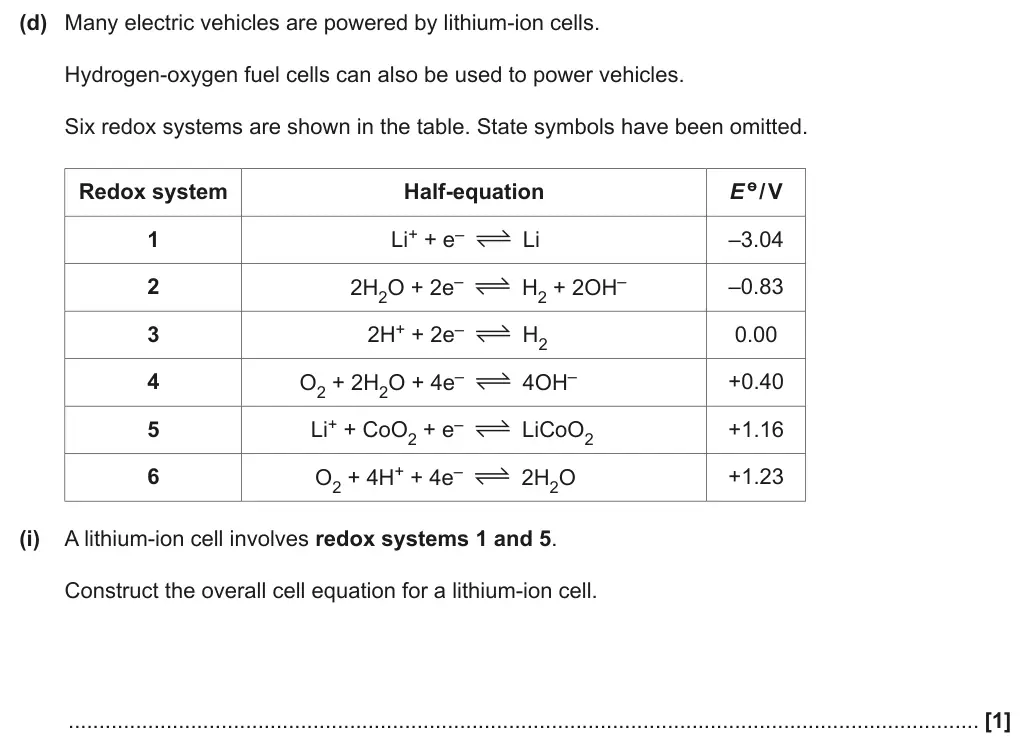
Most candidates were successful in constructing this equation. Common errors included the backwards reaction and some with unbalanced Li+. Candidates should also check their equations, as a few included an erroneous C in the formula e.g. LiCoCO2.
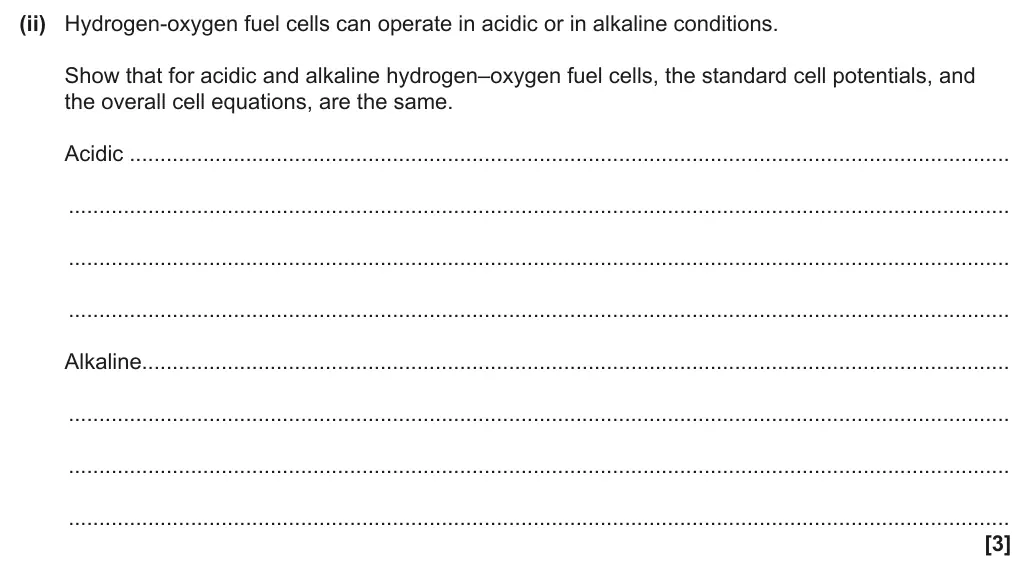
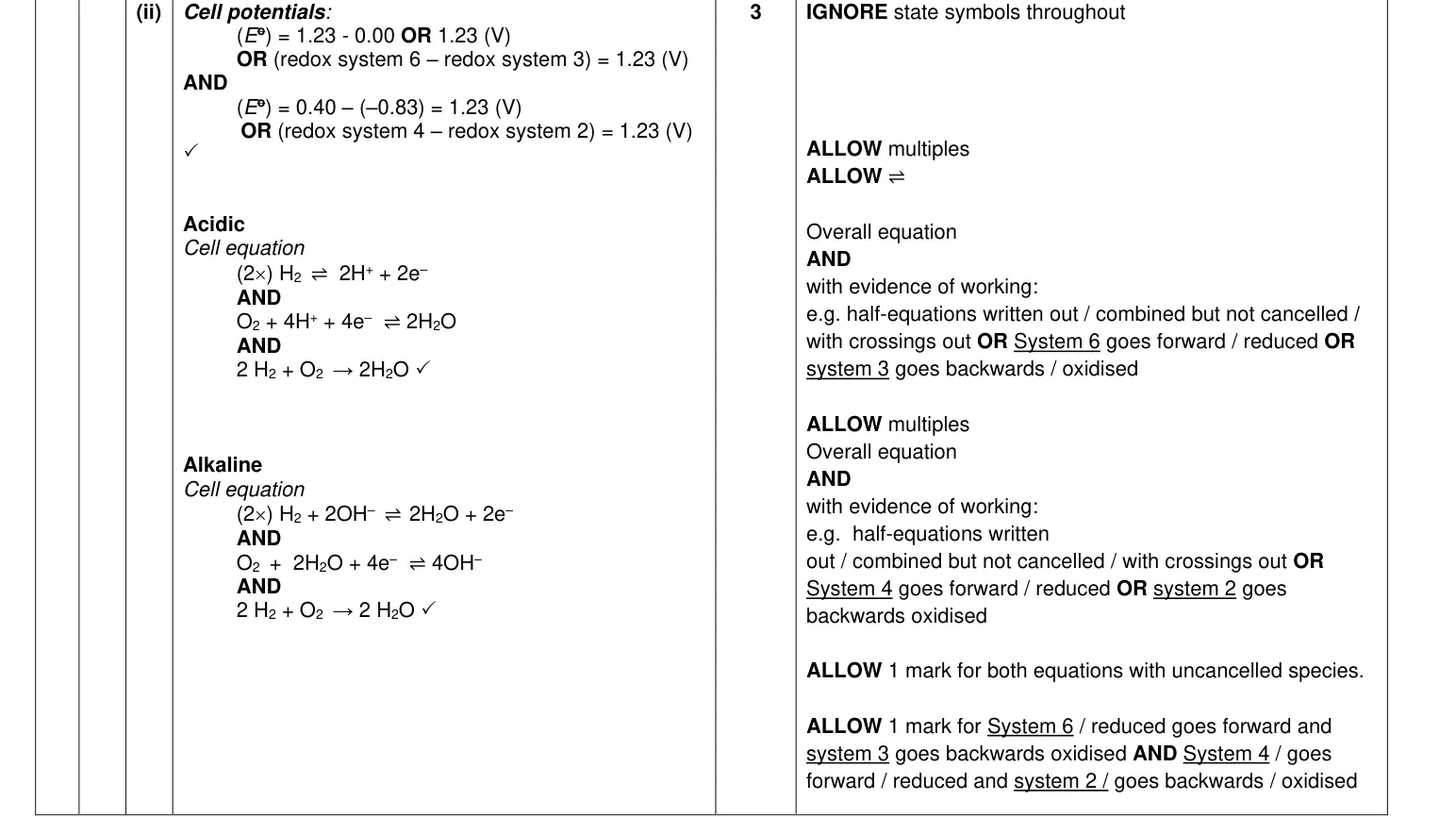
Most candidates were able to successfully show the overall equations were the same. Most combined the two half equations and then cancelled down to give the overall equations. A few candidates chose to describe the redox nature or use the equilibrium shifts scoring the first 2 marks. Some candidates, incorrectly, deduced the equation as H+ + OH- → H2O. Some candidates gave the 1.23V value without showing any calculation or did not refer to this part of the question at all. This was one of the most common questions where candidates omitted to provide a response on the paper.
Skills: M0.0 Recognise and make use of appropriate units in calculations
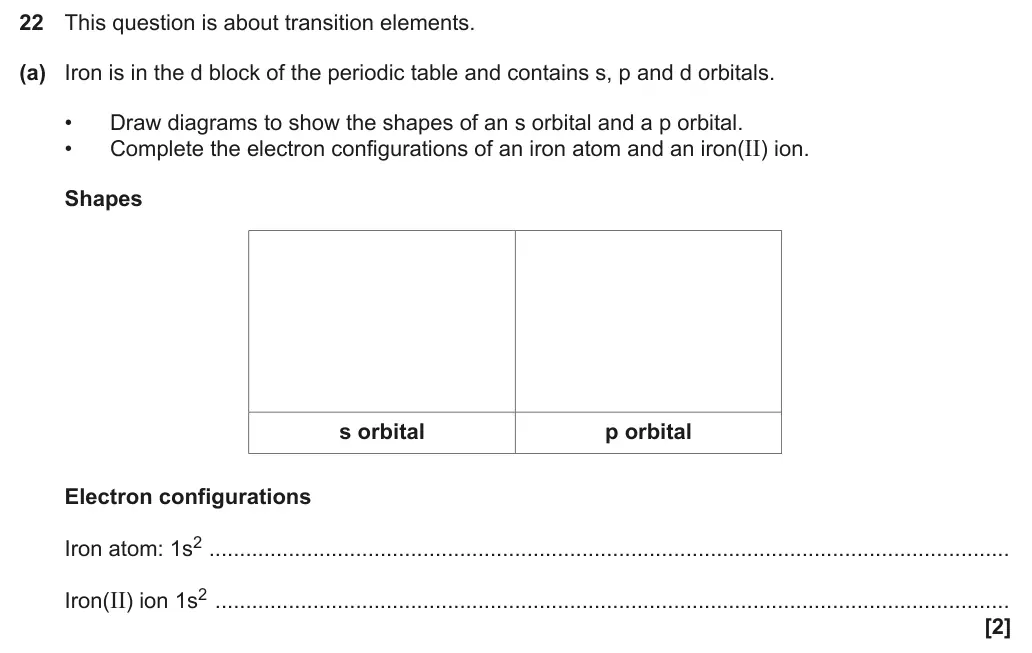
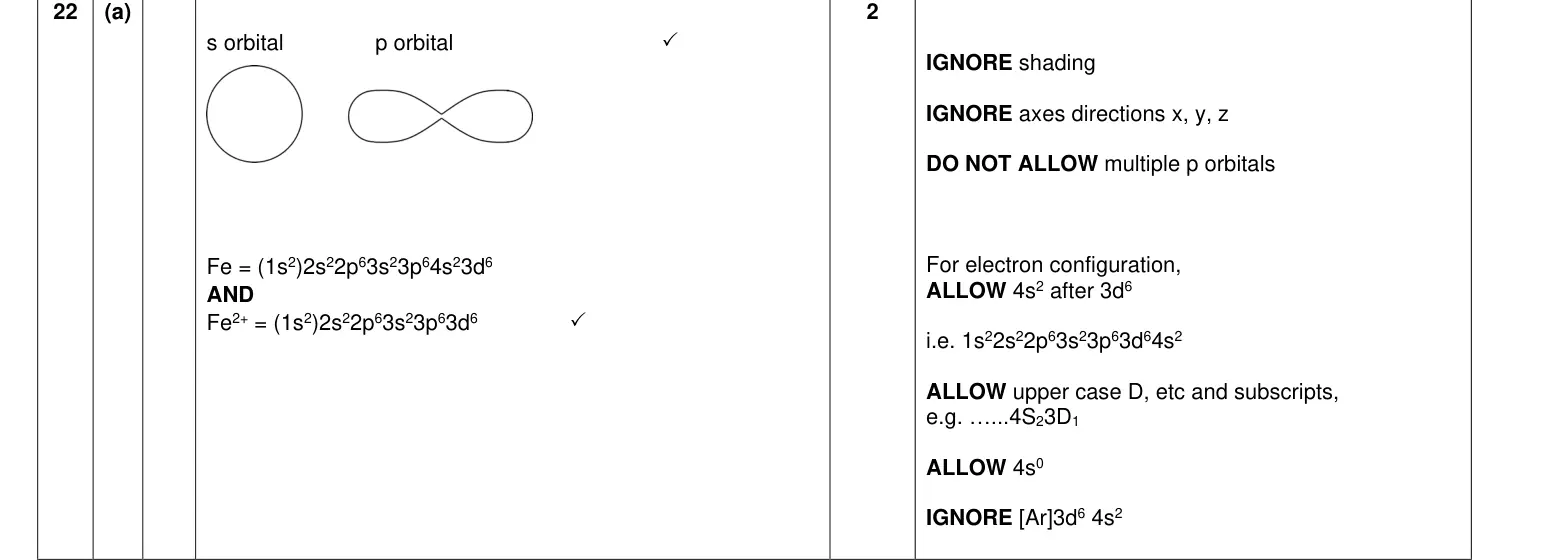
Many candidates were successful in drawing the orbital shapes. Occasionally candidates linked the question to the formation of a π bond or drew two arrows in a box to represent the electrons. Many candidates did not realise that when transition metal ions are formed, the first electrons removed from atoms are the 4s electrons and so wrote 2s2 2p6 3s2 3p6 3d4 4s2.
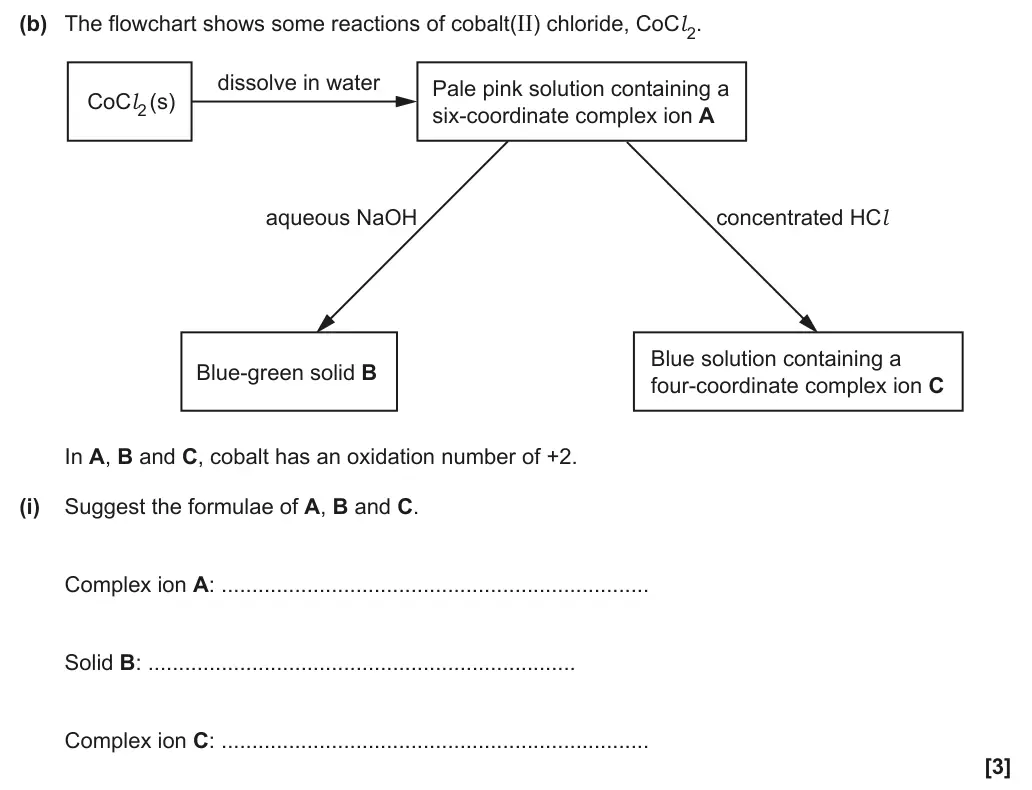
Most candidates scored three marks. Some used other transition metal ions such as Cu2+ or Mn2+ and candidates should be mindful of the information given in the question. Charges were sometimes incorrect, and some responses lacked the square brackets to show the complex.
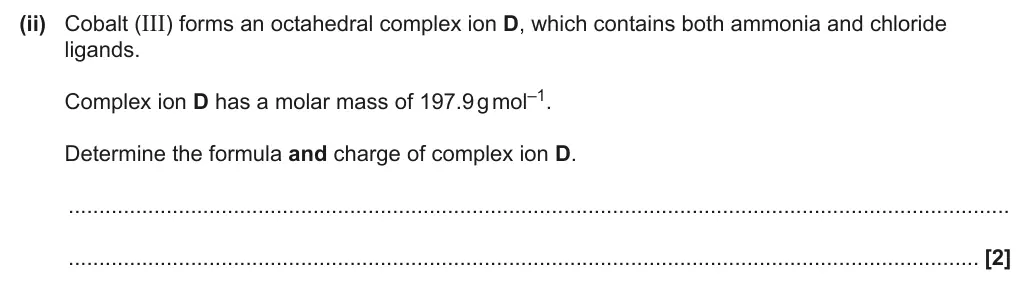
Most candidates identified the formula and the charge as 1+. A few candidates stated no charge or 3+. Candidates should consider the use of brackets in the formula, e.g. square brackets to show the complex and curly brackets to show the number of ligands attached. A few candidates used NH4 rather than NH3 for the ammonia ligand.
Skills: M0.2 Use ratios, fractions and percentages; M2.4 Solve algebraic equations
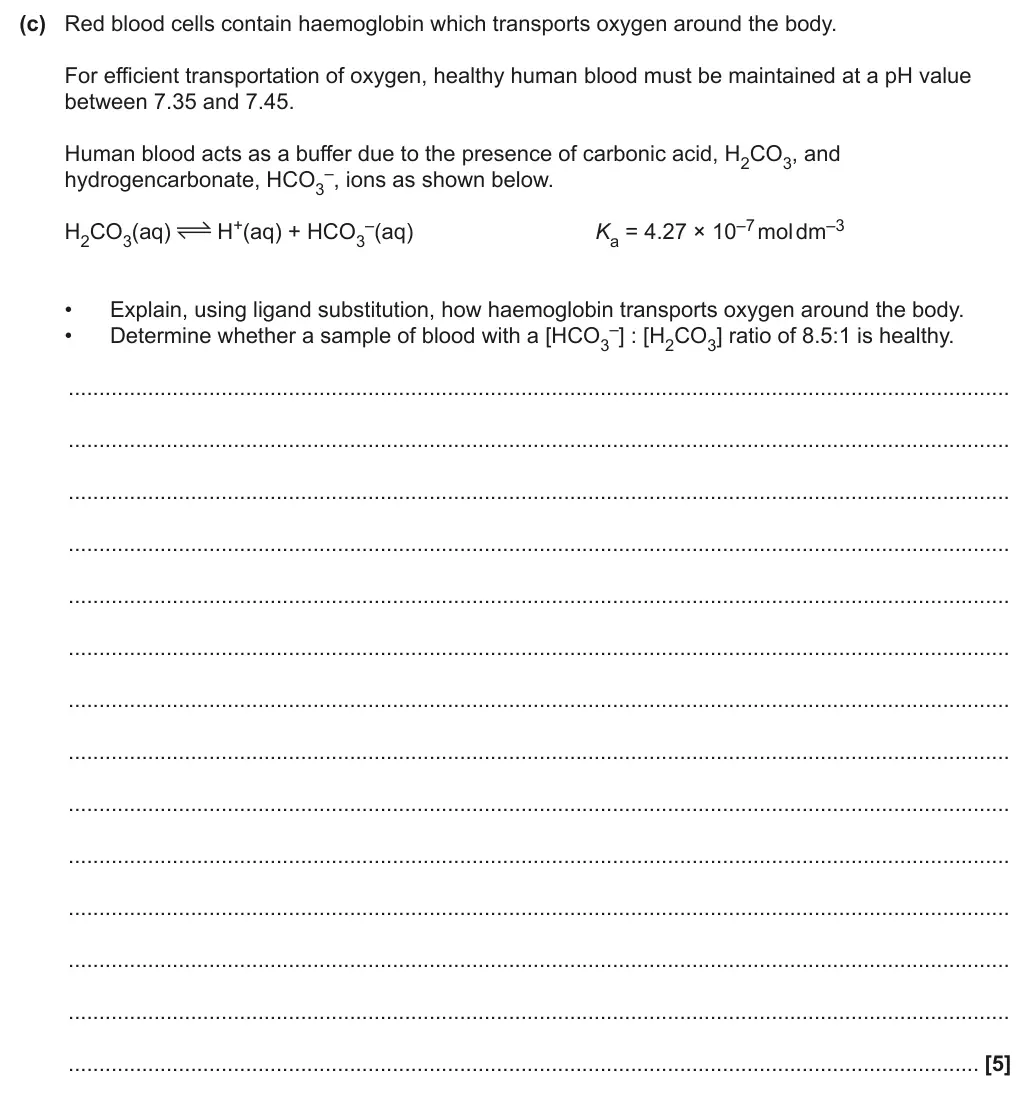
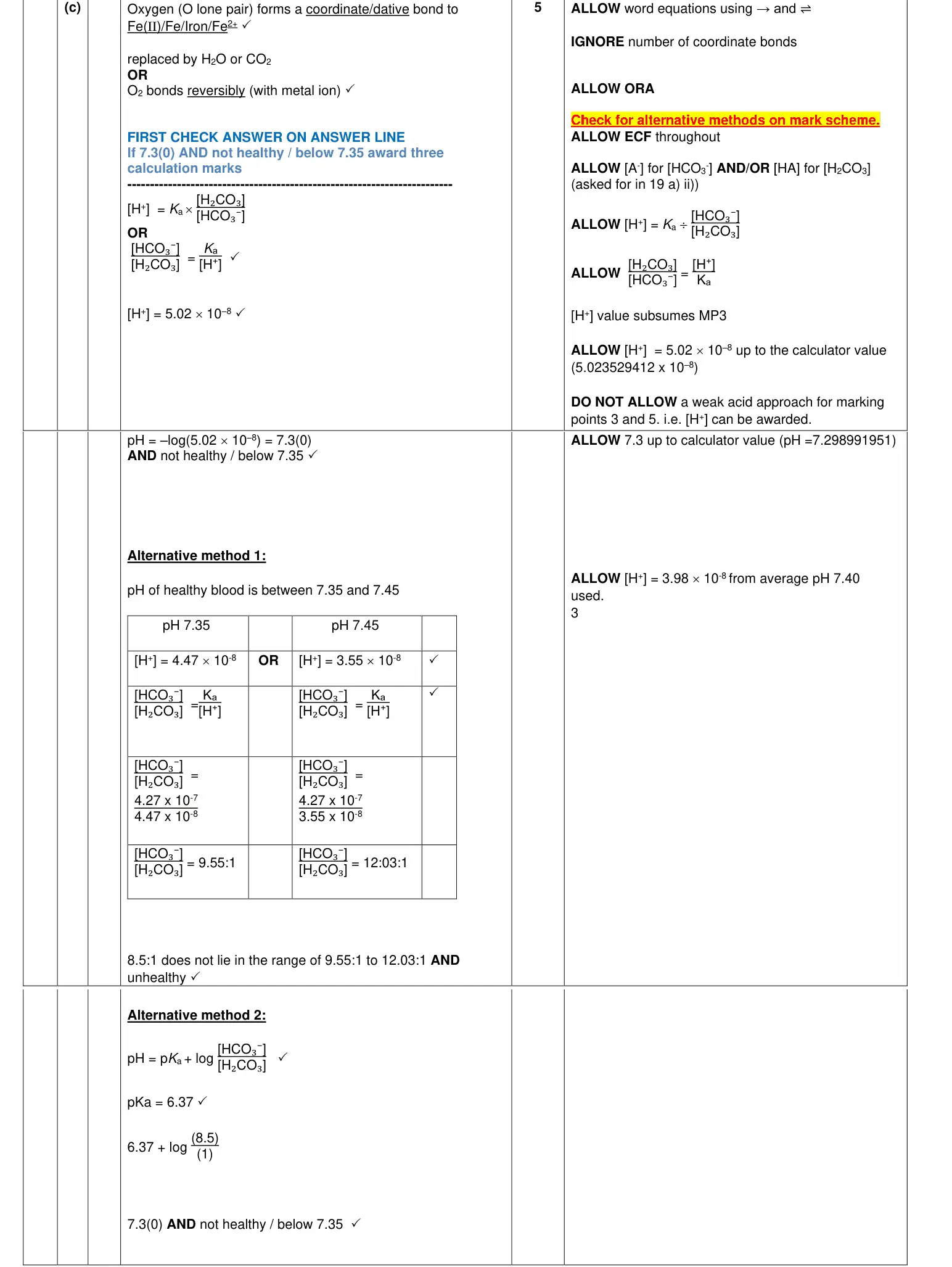
The key chemistry that candidates needed to discuss in their response was as follows: • O2 molecules forming coordinate bonds with and Fe2+ ions in haemoglobin. Often candidates omitted the Fe2+ and just stated it was to haemoglobin • O2 molecules being replaced by another ligand (e.g. H2O or CO2) The calculation using the [HCO3–] : [H2CO3] ratio of 8.5 : 1 was well described, although sometimes the final expression of the ratio left ambiguity as it was hard to tell whether the ratio given referred to the [HCO3–] : [H2CO3] ratio or the [H2CO3] : [HCO3–] ratio. ECF was given for the [H+] and then the pH linked to whether the blood was healthy. A smaller number of candidates approached the question by calculating the ratio of [HCO3–] : [H2CO3] for both pH 7.35 and pH 7.45 and then compared both ratios to the ratio of 8.5 : 1 for healthy blood. A few candidates attempted the calculation by the weak acid approach using [H+]2. In this case only the [H+] was given.
Skills: M0.4 Use calculators to find and use power, exponential and logarithmic functions; M2.3 Substitute numerical values into algebraic equations using appropriate units for physical quantities; M2.5 Use logarithms in relation to quantities that range over several orders of magnitude
Want a paper marked and gone through with you? Message us.