Answer
C
Mark scheme

Examiner's comment
The correct answer was C. Incorrect answers were rarely seen as candidates had a secure knowledge of isotopes.
100 marks · 49 question parts · Paper, mark scheme and report on OCR's site · Have OCR's Data Sheet beside you
C
The correct answer was C. Incorrect answers were rarely seen as candidates had a secure knowledge of isotopes.
C
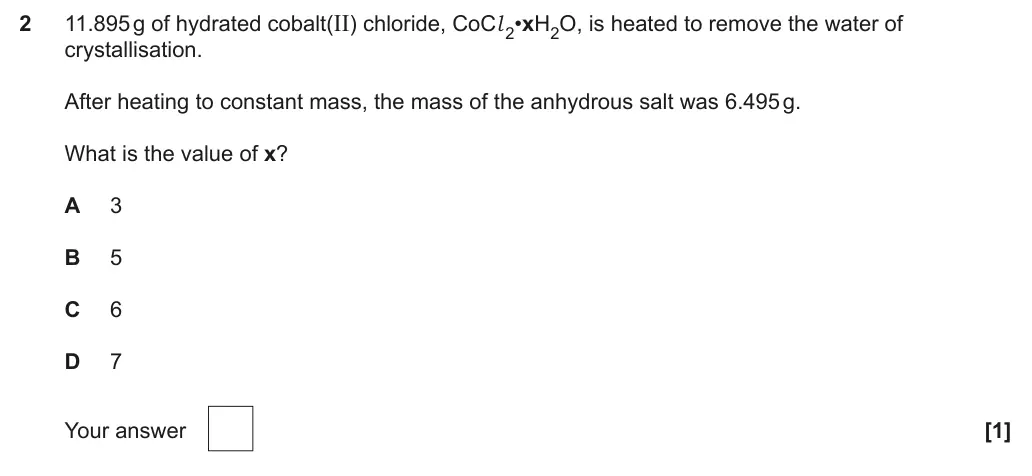
The correct answer was C. Candidates generally were able to complete this calculation to obtain the value for x by finding the molar ratio. A few candidates selected A from an incorrect calculation of the number of moles.

B
The correct answer was B. Most candidates were able to link the energy required to the repulsion between the negative charges. A few candidates suggested A and C. These candidates did not understand why the 2nd electron affinity is endothermic or that an electron was being added to form the O2- ion.
A
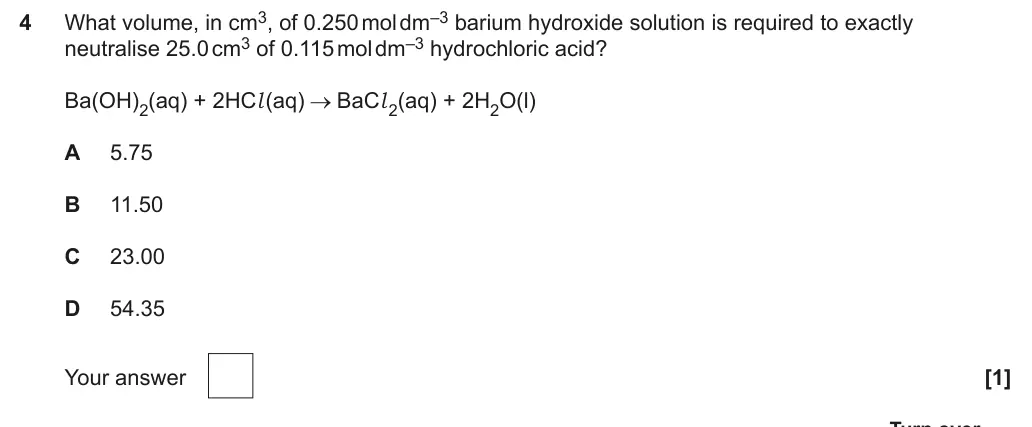
The correct answer was A. Most students were able to complete this titration calculation. B was a common incorrect answer seen as candidates did not consider the stoichiometry in the equation.

B
The correct answer was B. Candidates had to draw the tangent and calculate the gradient at 30 seconds. The answer should then be selected from the closest value to take the inaccuracy of the tangent into consideration. The most common incorrect answer was C, where candidates incorrectly calculated an average rate for the first 30 seconds.
C
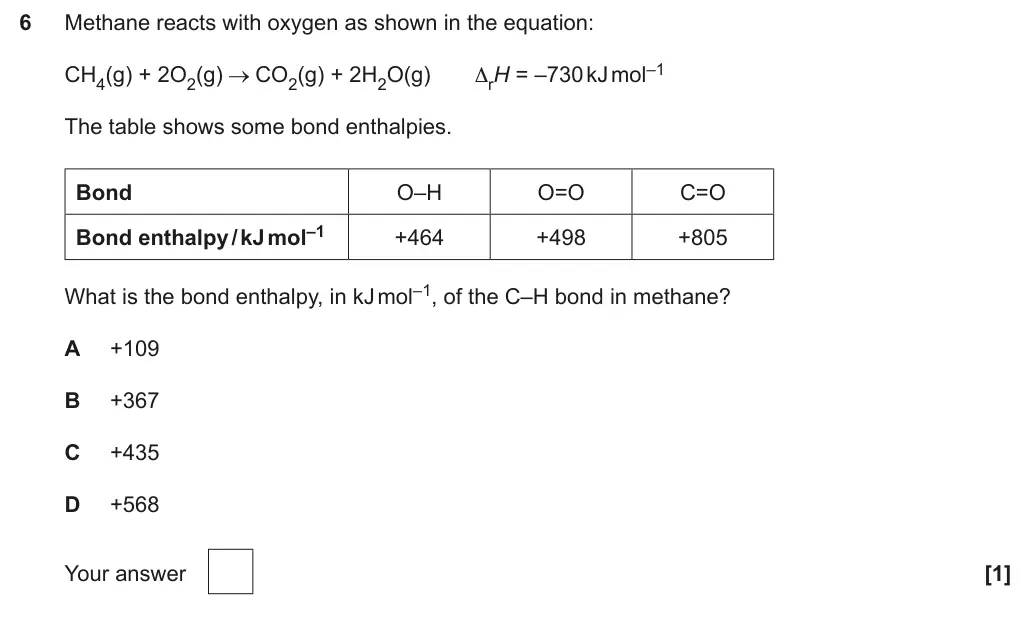
The correct answer was C. This question was well answered by most candidates. Candidates should be encouraged to use the space around the question to jot down the equation and perform any calculations. Those who obtained an incorrect answer did not consider the number of moles of bonds broken or made and used wrong signs.
C
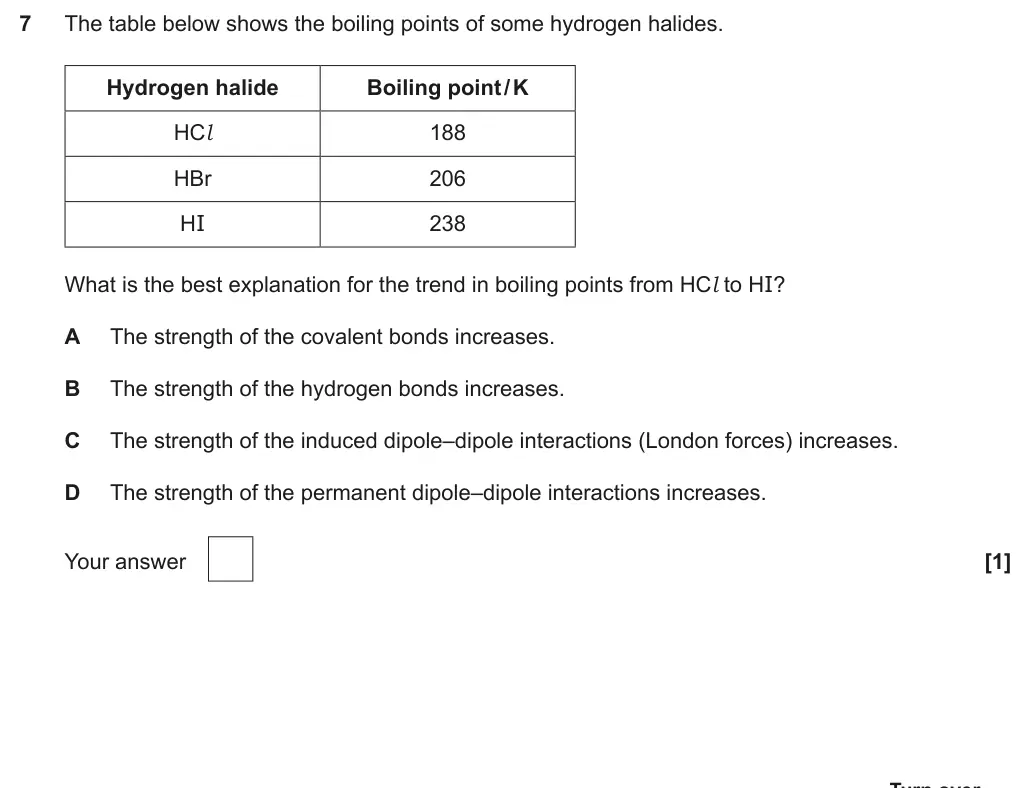
The correct answer was C. Candidates generally understood the intermolecular nature of this trend was due to London forces. The most common incorrect answer was D. It is important to make sure that candidates can appreciate that London forces can be more significant/stronger, as the molecule increases in size, compared to other intermolecular forces.

D
The correct answer was D. This was another well answered question with most of the candidates being given the mark. The idea that the titre reading comes from a subtraction and hence two errors are introduced was better understood than in previous series. Common errors were from not multiplying uncertainty by 2 (response A) and use of the final volume (response B).
B
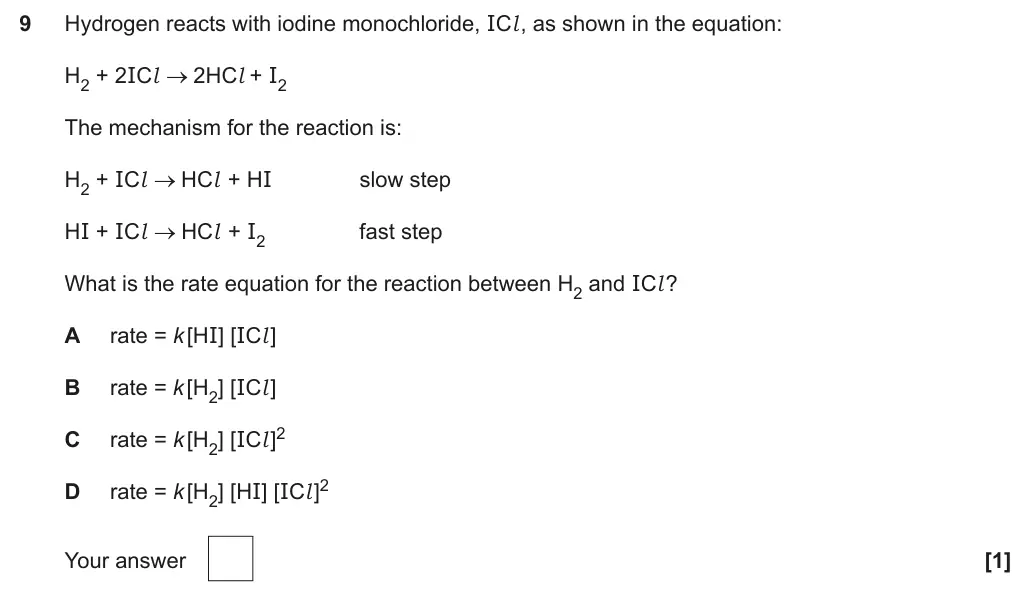
The correct answer was B. This question proved slightly more challenging, but a significant number of candidates selected this response. The most common incorrect answer was C due to, presumably, basing their reasoning on the stoichiometric equation rather than the mechanism.
C
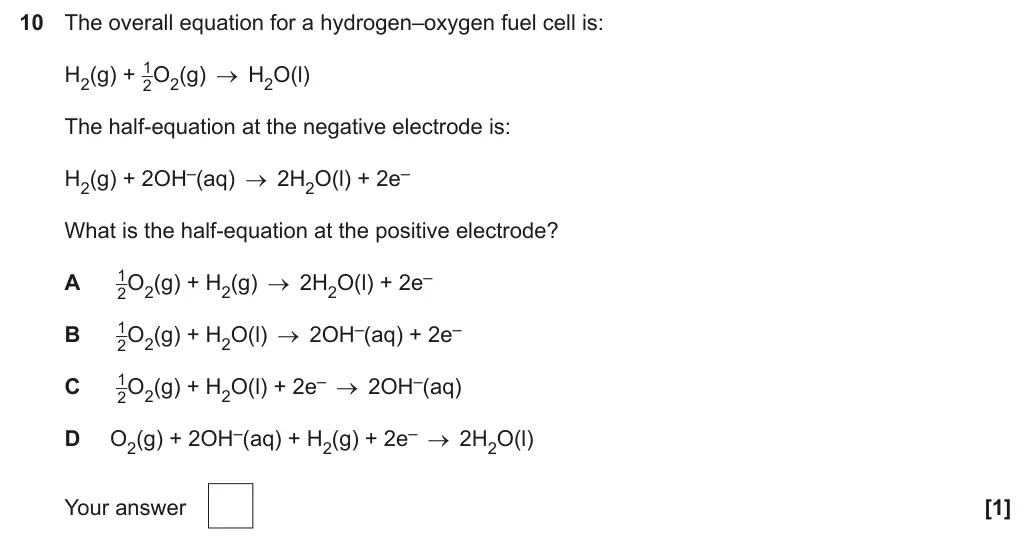
The correct answer was C. This question was slightly more challenging for some candidates who often selected B due to incorrectly observing where the electrons were placed.
B
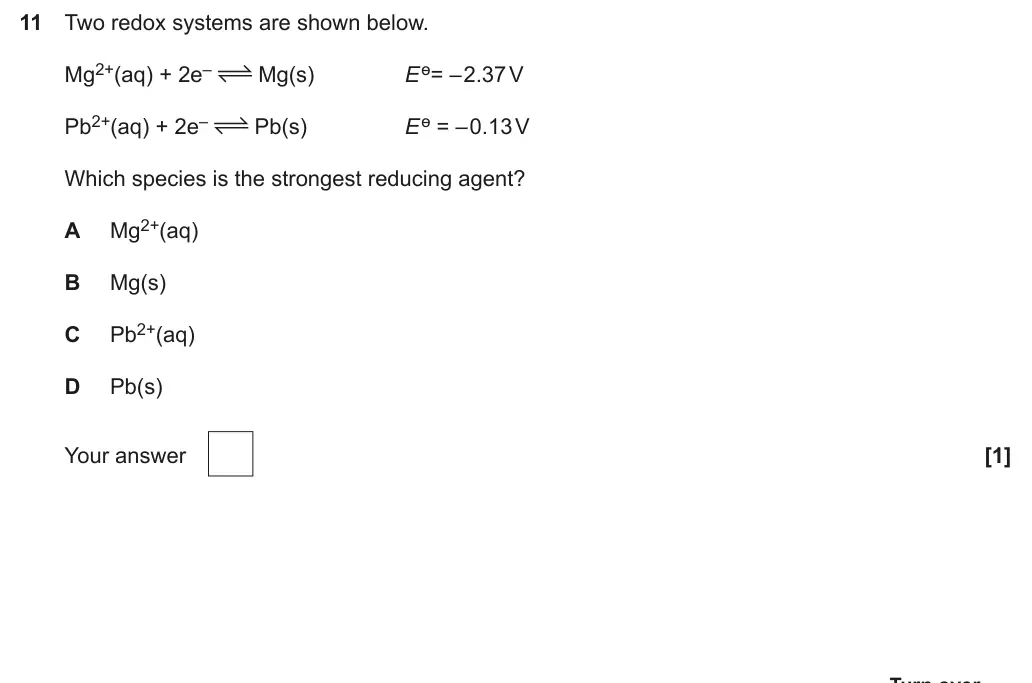
The correct answer was B. This was often the most challenging question for candidates. Redox and electrode potentials continue to be a higher-level concept. The terms reducing ‘agent’ and the species being reduced can often be confused. A good number of candidates did not reverse the more negative equilibrium system before they chose their answer.
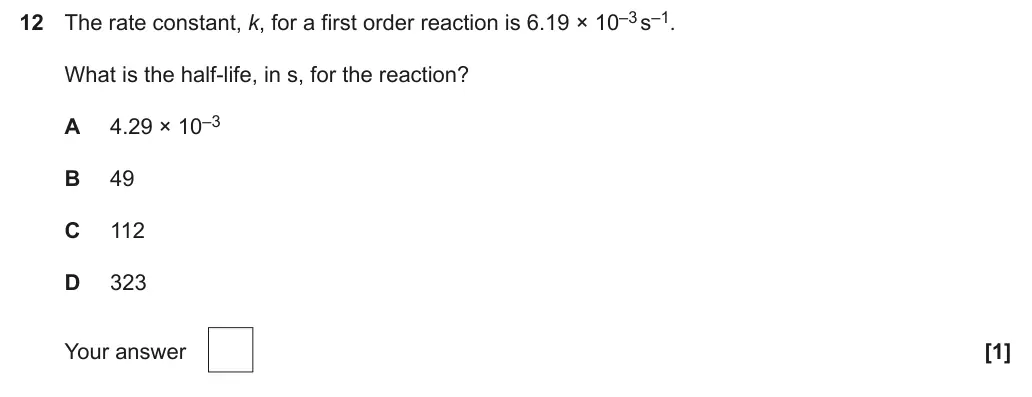
C
The correct answer was C. A good number of candidates chose this response as they were able to recall the mathematical relationship between k and half-life i.e. k = ln 2 / t1/2. The most common incorrect answer was A.
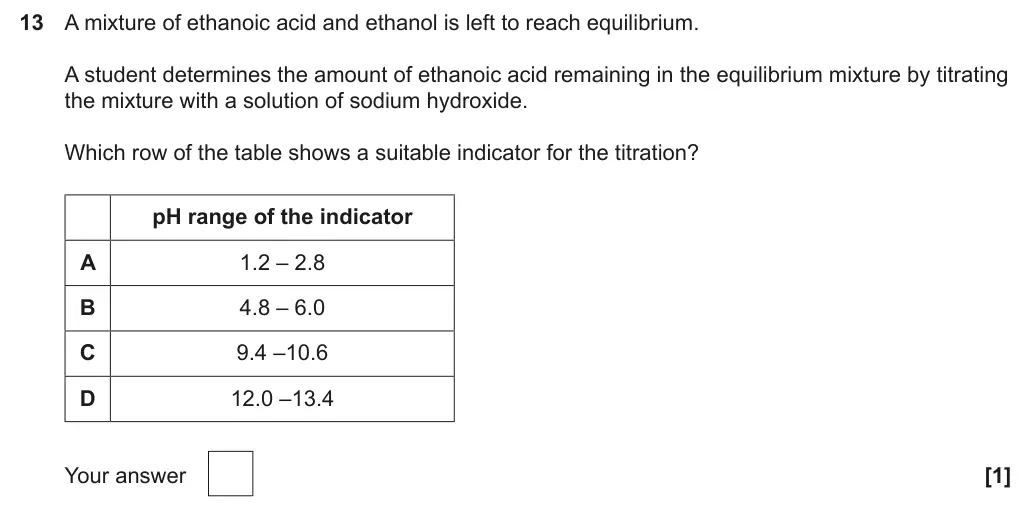
C
The correct answer was C. Only some of the candidates selected this response, showing good knowledge of a choice of indicator from a weak acid – strong base titration. B was the most common incorrect response, presumably due to considering the pH of a weak acid.

B
The correct answer was B. Most candidates were able to select this response, showing a good knowledge of group 2 chemistry. Some candidates did not successfully recall the trend in reactivity and/or ionisation energy and selected A or D.
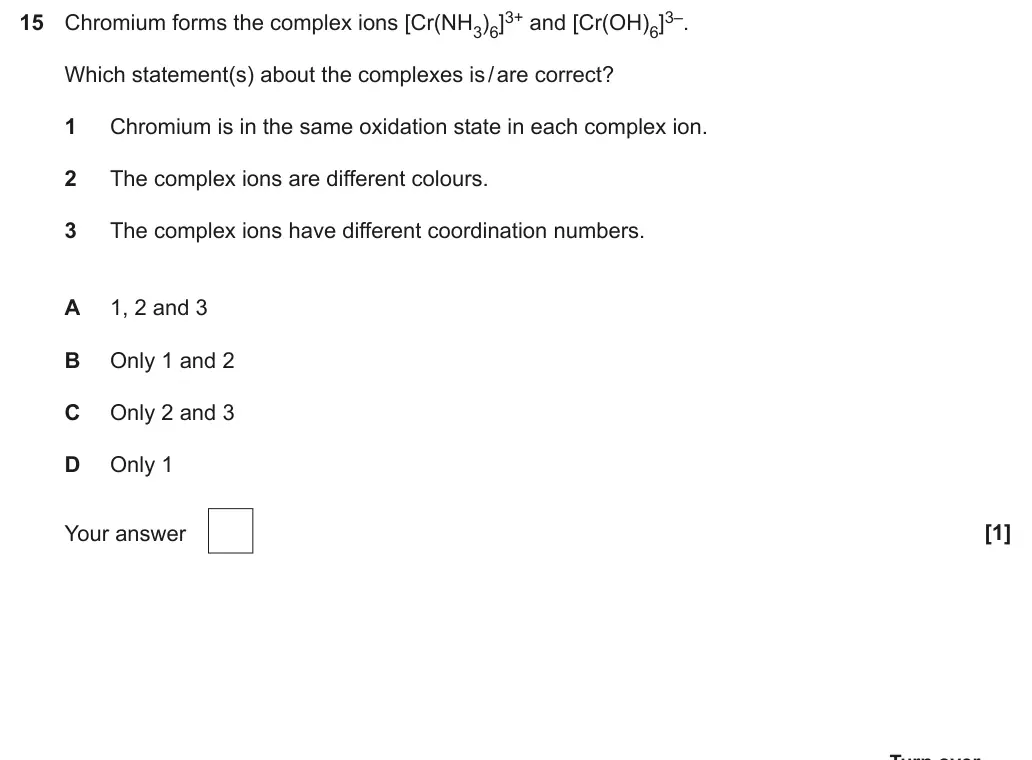
B
The correct answer was B. Most candidates chose the correct answer but a few selected C or D as they were unsuccessful in assigning oxidation numbers or coordination numbers to the given complex ion. Section B overview The section contained questions from all aspects of modules 1, 2, 3 and 5 of the specification. Candidates found many of the questions, including those with an extended response nature, relatively straightforward and the majority managed to cope with the mathematical content. As a rule, candidates should aim to use unrounded calculator values in their intermediate calculations to avoid rounding errors in their final answer. Candidates should be reminded to present their numerical working clearly. They should also be advised to avoid leaving two different solution approaches without crossing one of them out. If they need to restart an answer, they would be well advised to make use of additional space as necessary rather than trying to write their answers in the margins with the order of steps difficult to follow. In more complicated calculations, where multiple different chemical species and quantities are involved, using appropriate symbols and subscripts/descriptors in brackets, as well as units, helps appropriately identify numbers provided as amounts in moles/concentrations/masses. Some candidates were less confident and knowledgeable of content shared with the AS specification and traditionally taught earlier on in the course. These were specifically: structure and bonding, reaction rates and redox reactions of the halogens. Candidates wrote far more than was necessary in some responses. Candidates should avoid repeating sentences which often introduce contradictions at the end of the response when expanding on written answers. Where candidates make use of additional space, it would be worth reminding them to write down the full question part: in many cases where questions had a number, part and subpart, the part or subpart was missing (or incorrect).
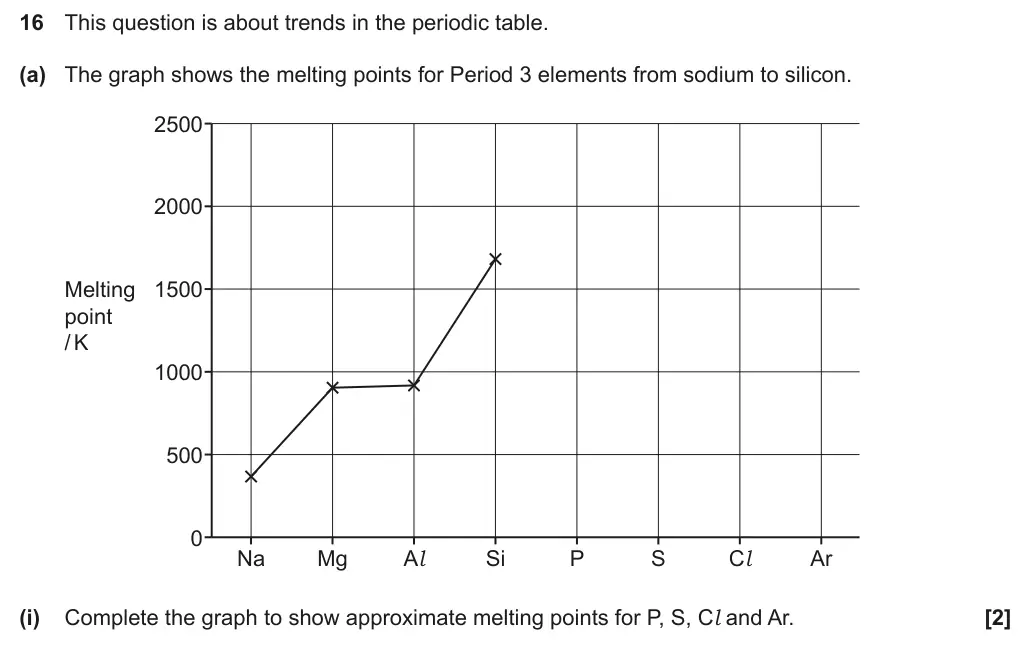
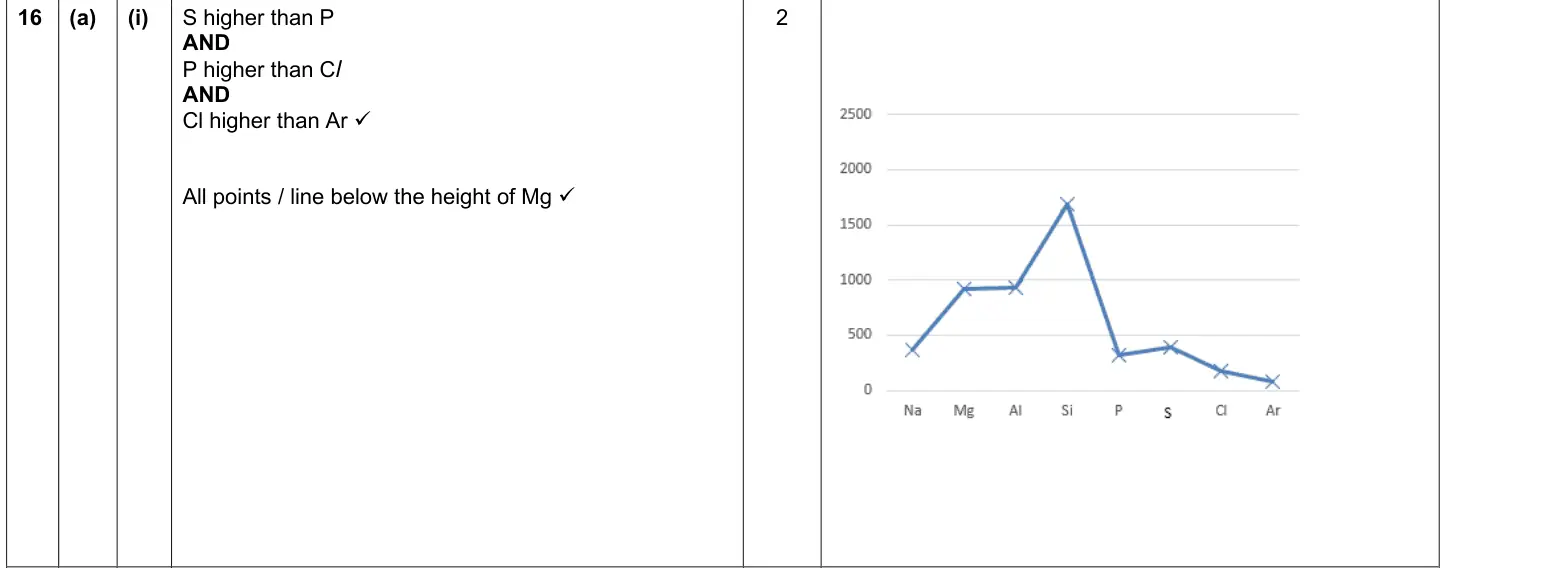
This question required the candidates to know the trend in melting points across period 3. This question proved difficult for candidates with few being given both marks. Many candidates did not recognise Mg as a metal with a higher melting point than the non-metals and continued the trend upwards above Si. The candidates may be aware that Ar and Cl2 are gases at room temperature, but they didn’t relate this into the concept of melting points. Some candidates plotted points lower than Mg in a straight line on a downward trajectory. Sulfur, with a higher melting point than phosphorus, appears to be not well-known. One misconception seemed to be confusing this with a graph for ionisation energy, maybe by using the first ionisation energy data given on the next page.
Skills: M3.1 Translate information between graphical, numerical and algebraic forms
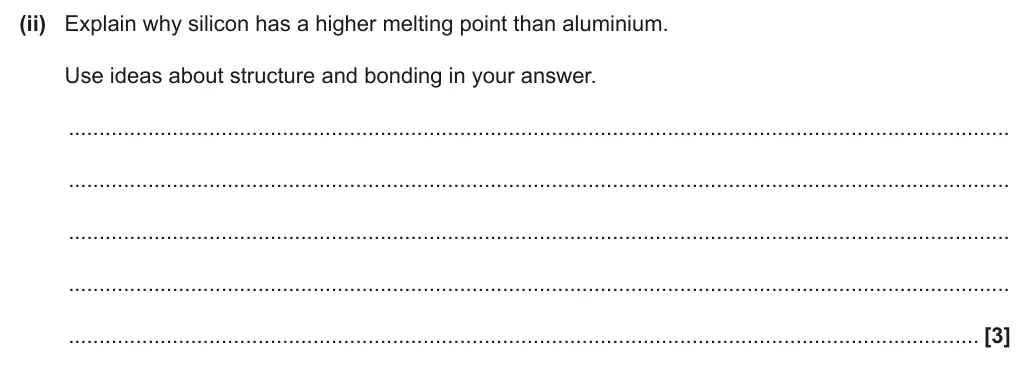
This question required the comparison of structure and bonding. The structure and bonding topic continues to be a difficult one for many candidates. Candidates who did well on this paper were able to identify why each of the elements had a certain magnitude of melting point. They clearly linked the structure type with the type of bonding. They then described the strength of force and gave a detailed description of the bond that was being broken. It was very common for ‘giant’ to be omitted in the name of the lattice for aluminium. Candidates find it particularly challenging to associate the correct terminology with the correct structure, often describing intermolecular forces in giant covalent explanations or use of molecules in giant metallic explanations. London forces were mentioned widely and described when comparing the strength of the bonding and this also appeared after a well written answer causing a CON for the last marking point. Less successful candidates gave an answer that appeared to confuse the melting point with ionisation energy and described number of electrons, shielding and nuclear attraction. The candidate correctly identified silicon as having a giant covalent structure but misidentified aluminium as having a simple molecular structure. This resulted in in incorrect bonding being compared for the final marking point.
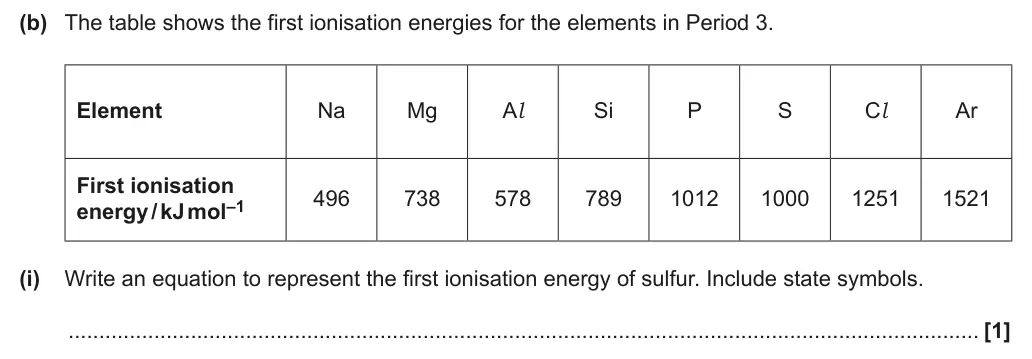
Most candidates were given this mark. However, there were multiple errors made which included the wrong element, missing or incorrect state symbols, and the formation of a negatively charged ion. Misconceptions included that a non-metal would form a negative ion, and the sulfur existed as S8 rather than an atom. Candidates are advised to make sure that state symbols are clearly written and the (s) and (g) can be easily distinguished by the reader. The convention is to use lower case letters of normal size, e.g. S(s) or S(g).
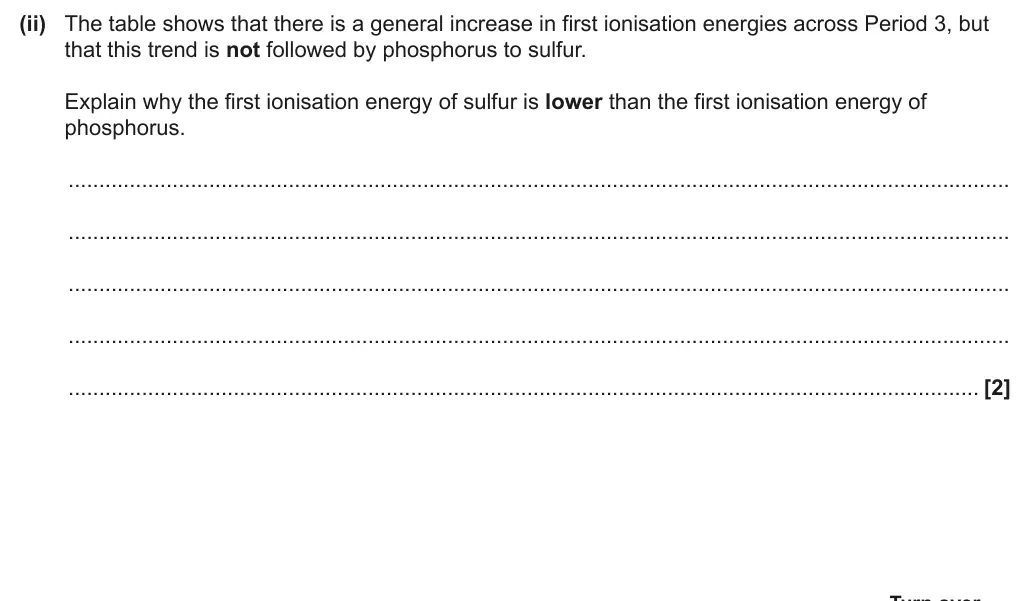
Most candidates were able to explain the lower first ionisation energy in sulfur. The description of the pairing of electrons for sulfur was better for those who used the orbital diagram with electrons clearly paired. Imprecise language was the most common cause of the mark not being given, e.g. ‘sulfur has four electrons in the subshell’ or incorrectly stating within the orbital. Less successful candidates approached this by explaining in terms of atomic radius, nuclear charge and nuclear attraction which demonstrated that they were not aware of the exceptions to the general trend.
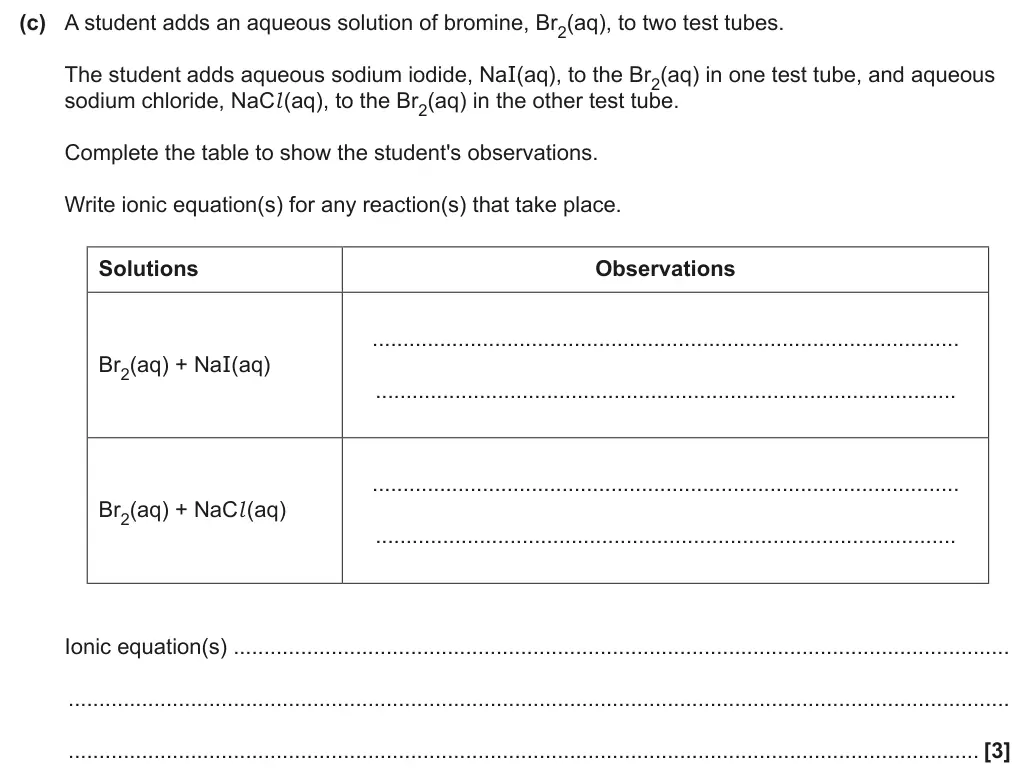
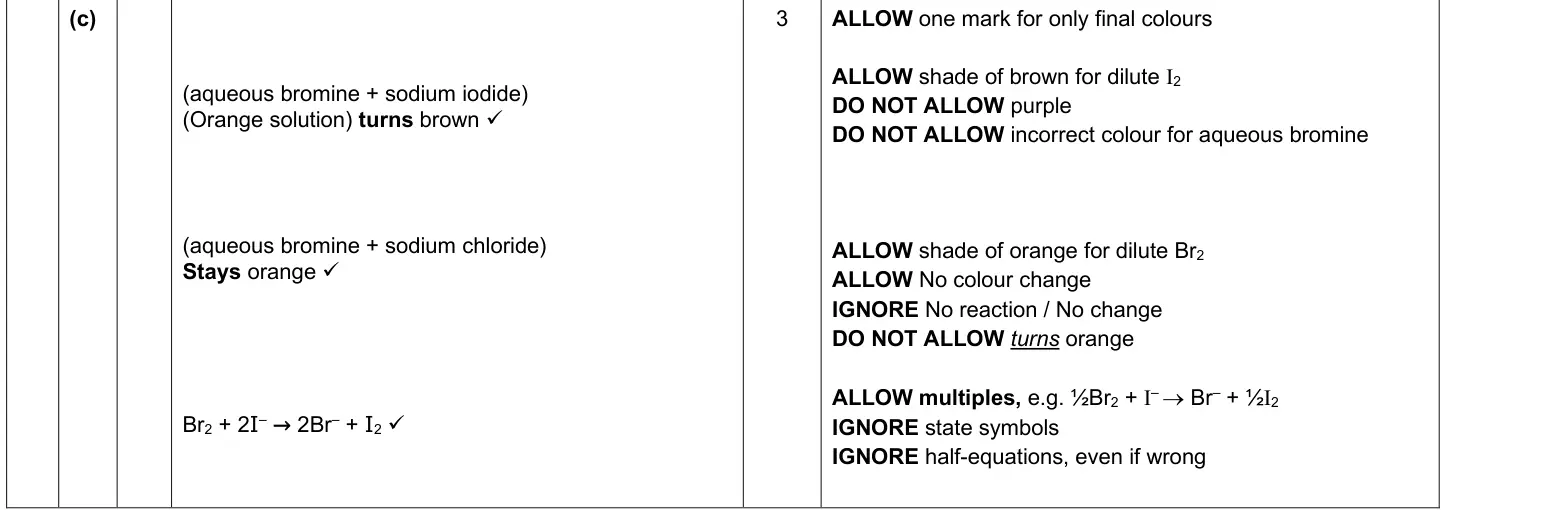
This question required the candidates to know the observations of the reactions of group 7 and to recognise a change in colour to show the evidence of a chemical reaction. This question proved difficult for candidates with few being given all three marks. Colours were not well-known with I2 in aqueous solution often described as purple. Other incorrect answers included no colours stated, effervescence and descriptions of the formation of the halide precipitates. Several candidates gave an equation instead of an observation. The PAGs – section 1.2.1 (d) mentions accurate use of terminology to describe change instead of just final colours. A good number of candidates were able to provide the correct ionic equation, although several incorrectly included Na in their equations or wrote half equations. Occasionally candidates wrote more than one incorrect equation, often forming Cl2.
Skills: PAG4 Qualitative analysis of ions
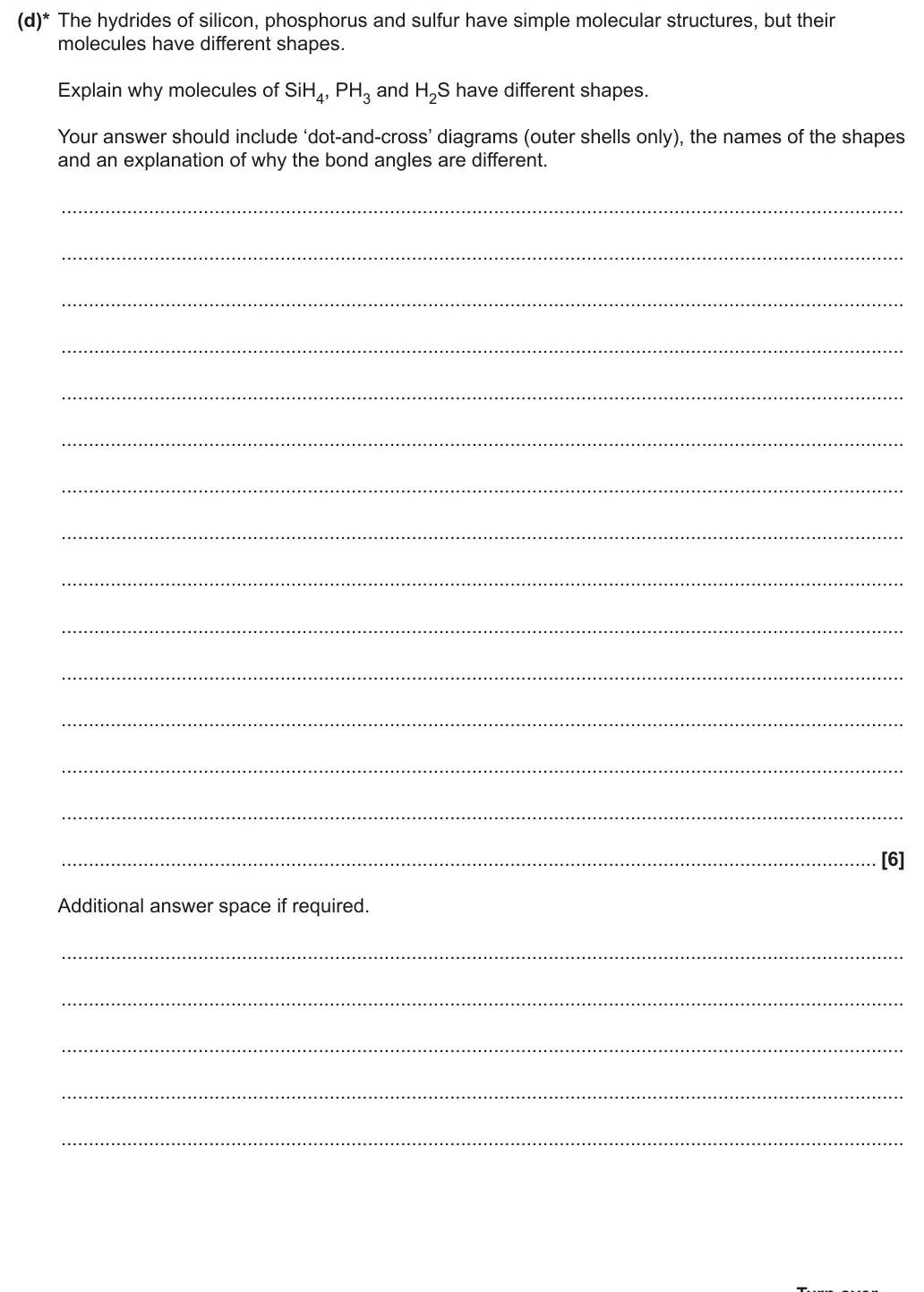
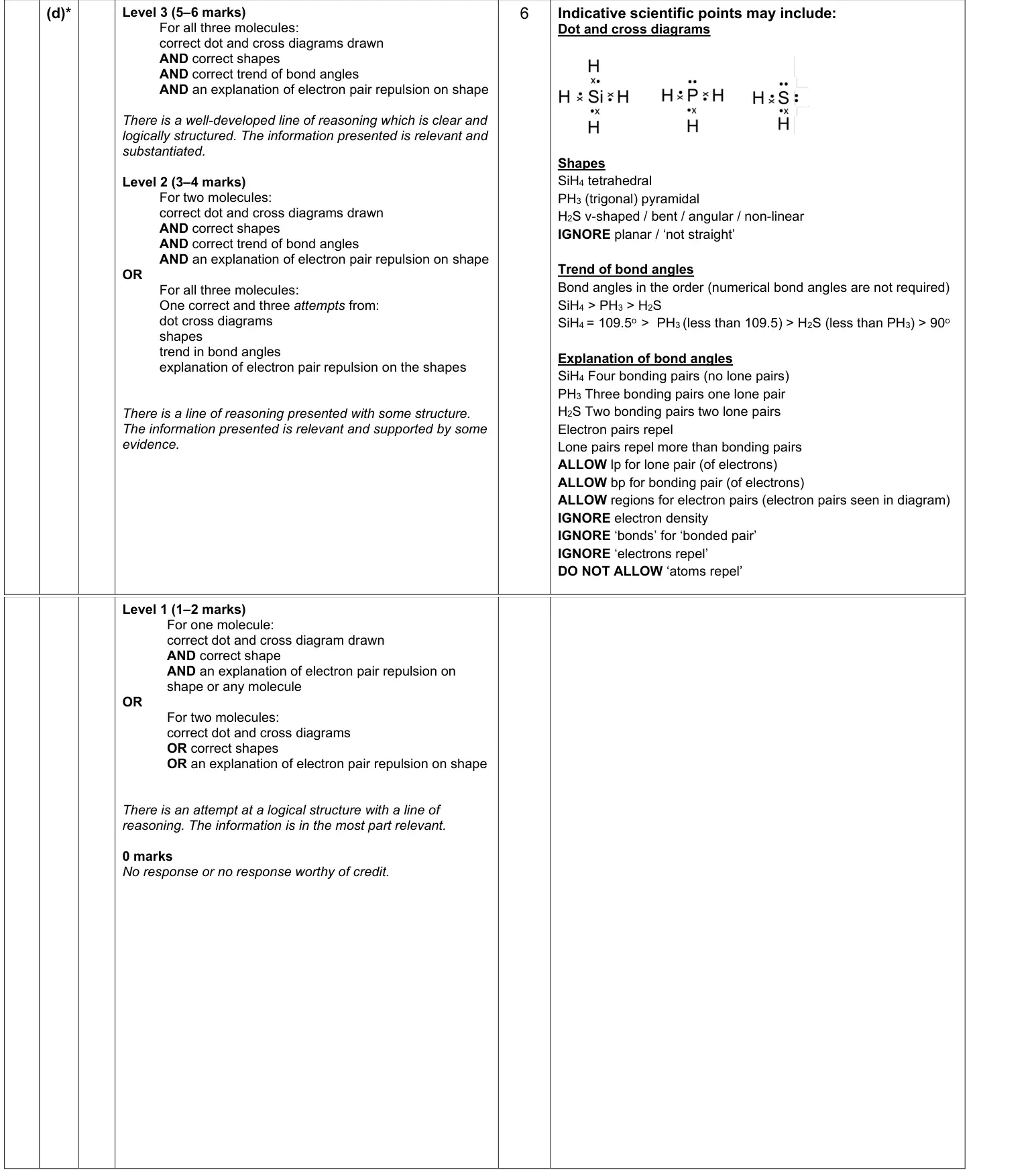
The first level of response question in the paper was answered well. Almost all candidates were able to draw correct dot cross diagrams. Many candidates scored Level 3 with correct shapes, bond angles and gave good explanations of the electron pair repulsion. The mark scheme allowed for the taught bond angle values and the true bond angle values of these molecules which followed the same trend. Level 2 candidates often had an incorrect shape of either PH3 or H2S. The tetrahedral shape for SiH4 was almost always correct but less successful candidates suggested trigonal planar or bipyramidal for PH3 and linear for H2S. Bond angles were often correct with some candidates linking the incorrect angle to their incorrect shape. Explanations were well described but some candidates were not clear about electron pairs repelling but described atoms or bonds repelling. Some candidates explained the bond angle in terms of being reduced by 2.5o without referencing electron pair repulsion Most candidates were able to access Level 1 often by having the correct dot cross diagrams.
Skills: M4.1 Use angles and shapes in regular 2-D and 3-D structures; M4.2 Visualise and represent 2-D and 3-D forms including 2-D representations of 3-D objects
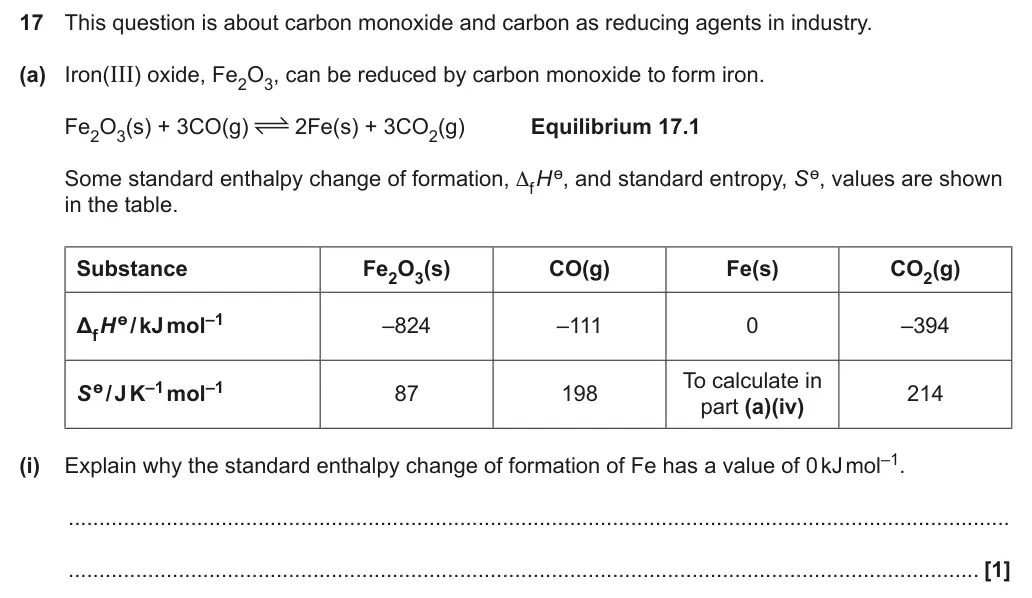
Most candidates were able to identify that Fe is already in its elemental state and the enthalpy change of formation would, therefore, be 0 kJ mol-1. Less successful candidates described iron as being in its natural state or an atom and thus didn’t have a formation enthalpy.
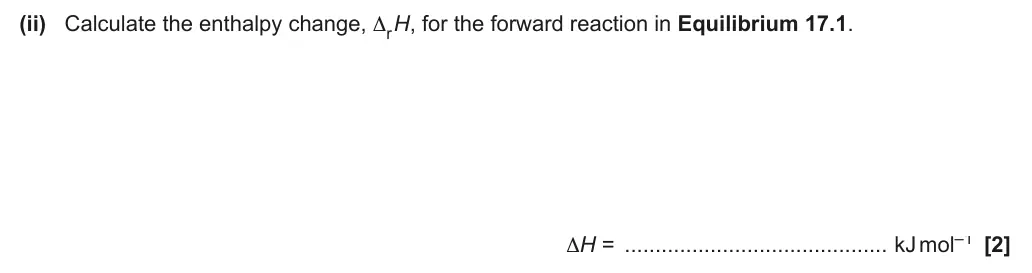
Many candidates were given both marks with the correct answer of -25 kJ mol-1. The best responses showed clear working using a Hess’s law cycle. Common errors of +25 and not using the correct multiples were seen from a few candidates.
Skills: M0.2 Use ratios, fractions and percentages; M2.3 Substitute numerical values into algebraic equations using appropriate units for physical quantities

Many candidates were given both marks with a clear description of the difference in states and a good explanation describing the increase in disorder within a gaseous system. A few candidates linked the standard entropy to the increase in moles (from one mole of Fe2O3 to three moles of CO2), showing a misunderstanding between ‘entropy change of reaction’ and ‘standard entropy’. Occasionally the candidate did not state that Fe was a solid.

Many candidates were given both marks with the correct answer of 27 J K-1 mol-1. Common errors saw some candidates quoting +12 from reversing the subtraction and 54 through not dividing by 2.
Skills: M2.2 Change the subject of an equation; M2.3 Substitute numerical values into algebraic equations using appropriate units for physical quantities; M2.4 Solve algebraic equations

Many candidates scored all three marks. They correctly calculated ΔG, made a feasibility statement and calculated the minimum temperature or 904K or 905K. The alternative methods found in the MS guidance were rarely seen. Nearly all candidates remembered to convert the units which is typically a common error. Less successful candidates missed the unit conversion (i.e. J K-1 mol-1 to kJ K-1 mol-1 for entropy or kJ mol-1 to J mol-1 for enthalpy) or incorrect temperature used (e.g. 298 K). Sometimes there was a lack of a clear feasibility statement.
Skills: M0.0 Recognise and make use of appropriate units in calculations; M2.2 Change the subject of an equation; M2.3 Substitute numerical values into algebraic equations using appropriate units for physical quantities

This question was well answered by many candidates. There was a clear description of units cancelling, although some did correctly compare the molar ratios. Some candidates showed this in a clearly written equation. Less successful candidates were not given the mark due unclear terminology or explanation. The question was to explain Kp so the units would need to be a pressure unit rather than concentration (as in a Kc expression).

This question required the calculation of two partial pressures. This question proved to be a challenge for most students. Common errors were to divide the 5476 by 2 instead of using the square root. Many were given a mark for recognising that the partial pressures needed to be the same. A common error was 602 from the incorrect rearrangement of the Kp expression and some candidates used the value for R (8.31) rather than 8.13 in the Kp expression. Less successful candidates attempted, unsuccessfully, to use an ICE table to work out the moles of everything at equilibrium.
Skills: M2.2 Change the subject of an equation; M2.3 Substitute numerical values into algebraic equations using appropriate units for physical quantities; M2.4 Solve algebraic equations

This question required the candidate to link the change in Kp value to the change in temperature. The question was answered well by many candidates. Most identified it was lower and exothermic, but not all went on to say that equilibrium shifted. A few candidates mixed up their lefts and rights and could be advised to use the terms products side and reactant side, as identified by the written equation. Misconceptions included that a higher T was because Kp is higher and that ‘Kp shifted to the right’ rather than the equilibrium.
Skills: M0.3 Estimate results
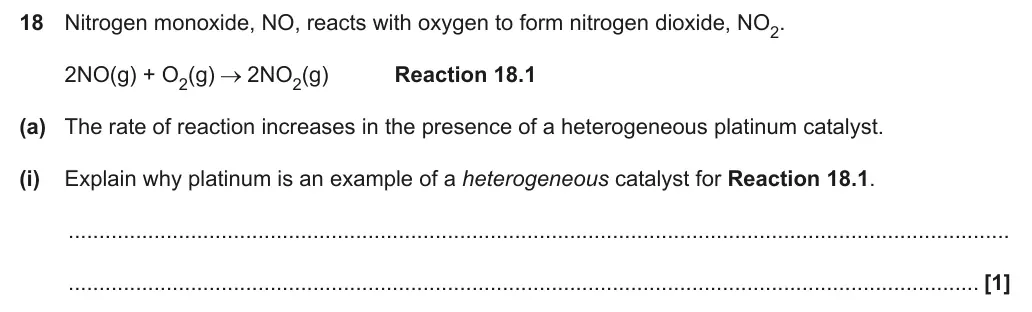
This was a well answered question. A few candidates, incorrectly, suggested that it was heterogeneous due to the reactants and products being in different states, and didn’t mention the catalyst or suggested the catalyst was in same state.

Many candidates gave a good Boltzmann distribution graph, even though a few did not start at the origin, and some were horizontal on the far right-hand side, much above the 0 line. The quality of the Boltzmann distribution could be improved by the candidates, although marks were given. Occasionally candidates drew multiple lines, presumably addressing a change of temperature. This question proved difficult for some candidates to explain well. Collision theory linked to catalyst requires the link between number of particles having energy ≥ the activation energy. A lot of candidates wrote vague responses, often confusing or mixing temperature and concentration effects and did not gain credit. The candidate drew a curve clearly starting at 0,0 but then drew a horizontal line above 0 on the right- hand side. This line would never approach 0 and has a constant number of molecules with the increasing energy and so was not given credit.
Skills: M3.1 Translate information between graphical, numerical and algebraic forms

Most responses were excellent, with many candidates mentioning more than one of the marking criteria. A typical response would be ‘lower temperatures can be used, decreasing use of (fossil) fuels, and reducing CO2 / greenhouse gas emissions.’ Some responses instead mentioned that catalysts can be reused. The most common incorrect response was to say fewer toxic products were released or similar.
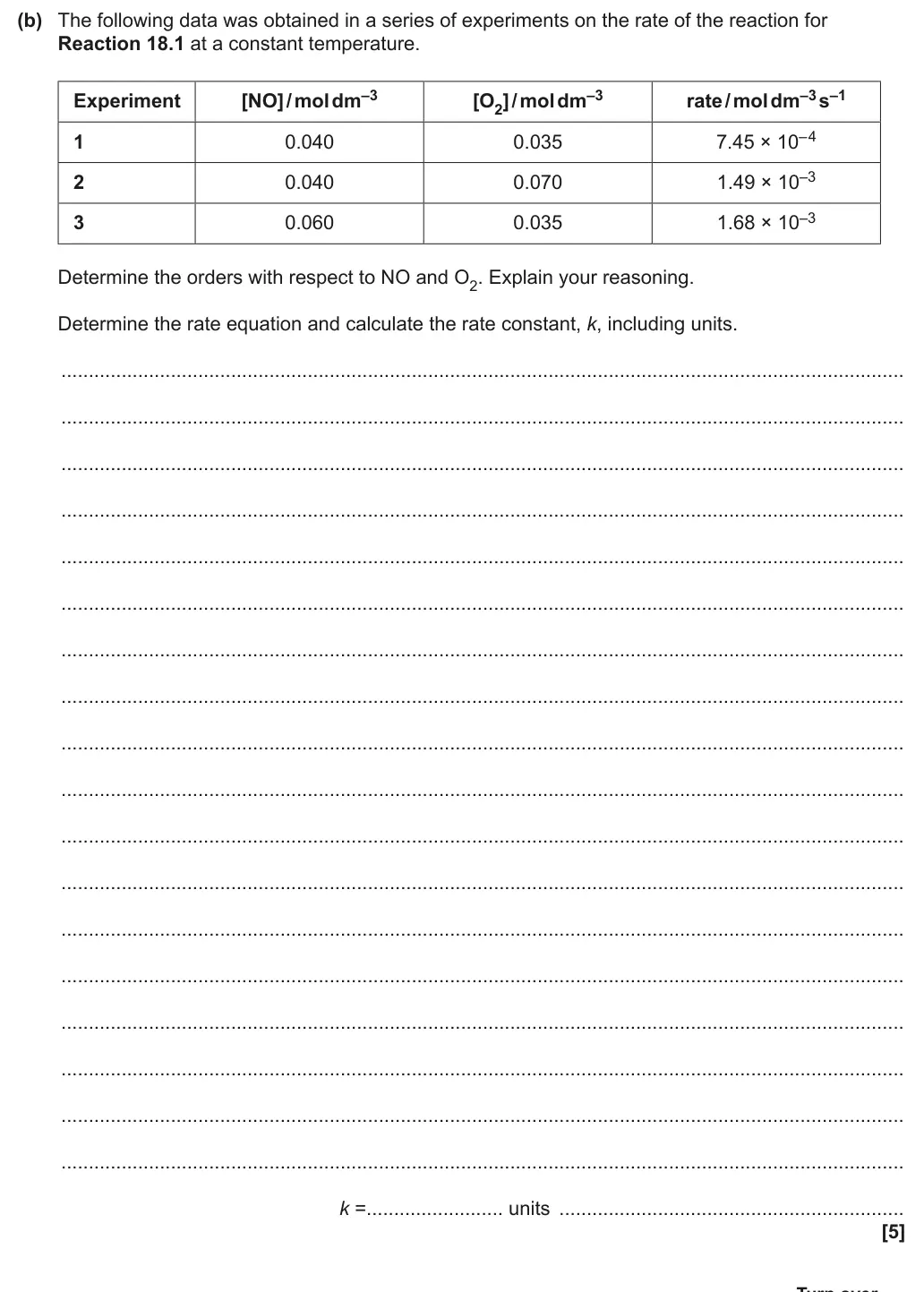
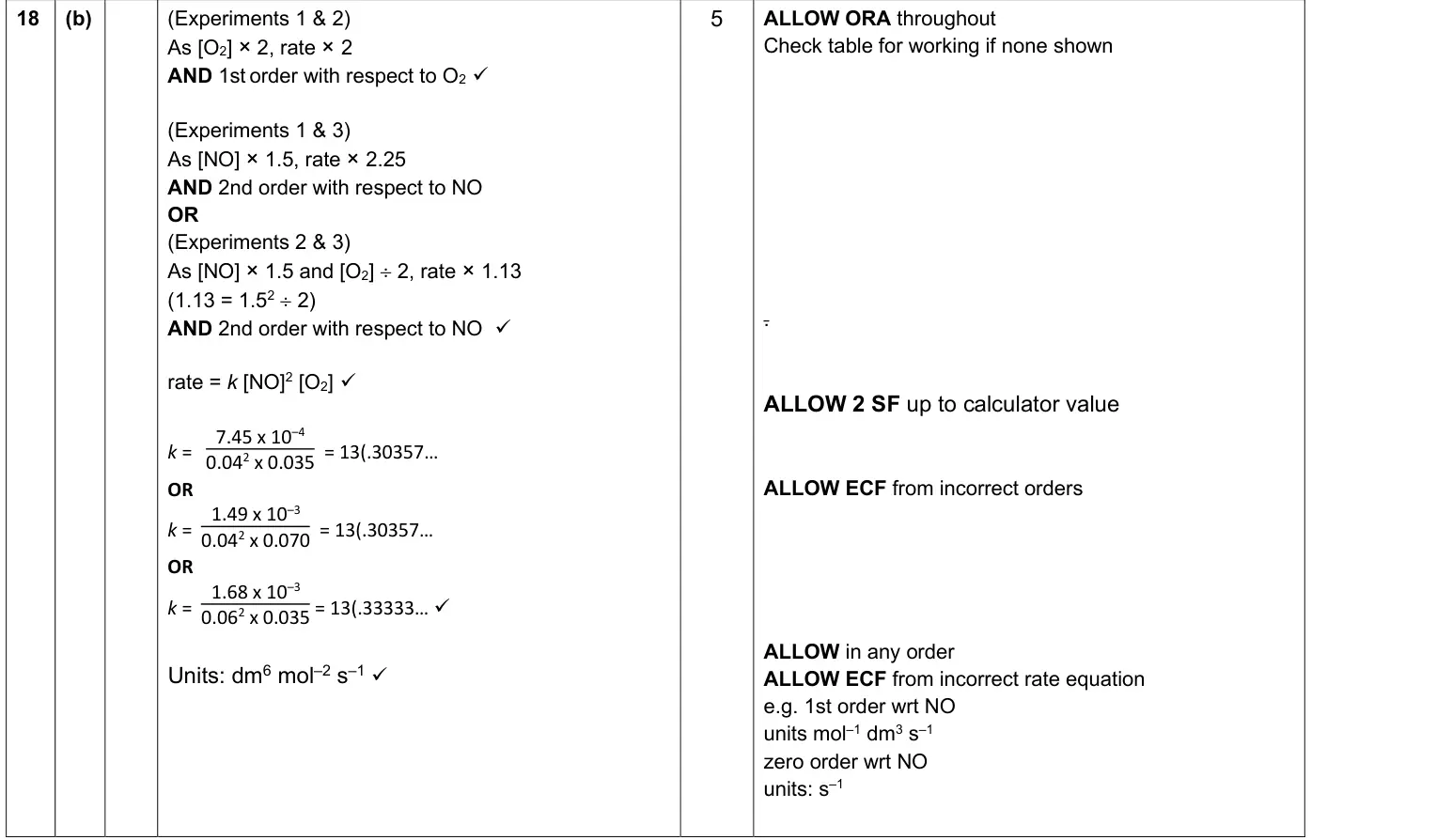
Lots of candidates were given 5 marks. They were able to use the experimental evidence to deduce the orders, write a rate equation and calculate k. The best candidates listed their reasoning for the orders rather than writing in large paragraphs of prose which sometimes got confused and led to contradictions. A good proportion of candidates recognised that 2.25 was 1.52, although a few thought that the 2nd order with respect to NO was a result of ‘2.25 being approximately 2 times 1.5’. Less successful candidates assumed that if they couldn’t identify what the relationship was between the concentration and the rate, that meant it was zero order. Less successful candidates were also unsuccessful in working out the units. A few candidates omitted k in their rate equations or didn’t write a rate equation. Many candidates were given marks as ECF from incorrect orders.
Skills: M0.0 Recognise and make use of appropriate units in calculations; M0.2 Use ratios, fractions and percentages; M2.2 Change the subject of an equation; M2.3 Substitute numerical values into algebraic equations using appropriate units for physical quantities; PAG10 Rates of reaction – initial rates
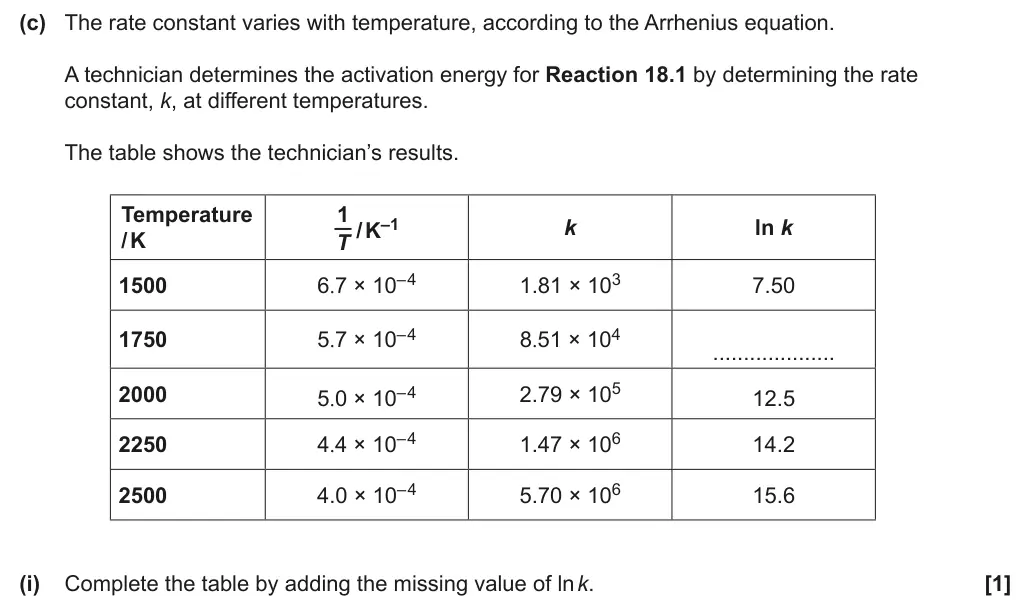
Excellent responses were seen with either 11.35 or 11.4 given. A few candidates suggested 10.4 or 11.40. This could have been from completing Question 18 (c) (ii) first and then choosing the value for part (c) (i) based on their line of best fit (e.g. 10.40).
Skills: M0.4 Use calculators to find and use power, exponential and logarithmic functions; M2.5 Use logarithms in relation to quantities that range over several orders of magnitude
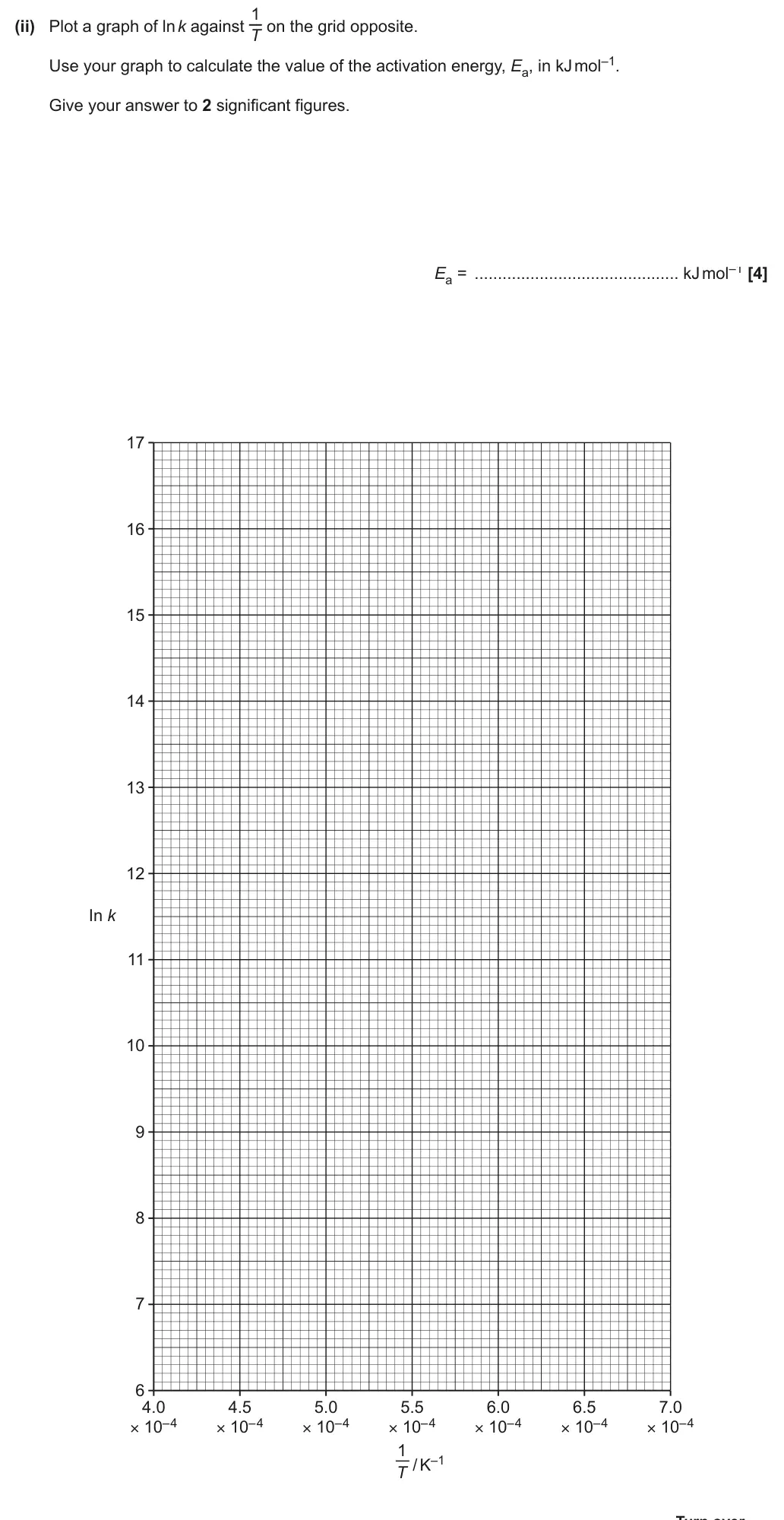
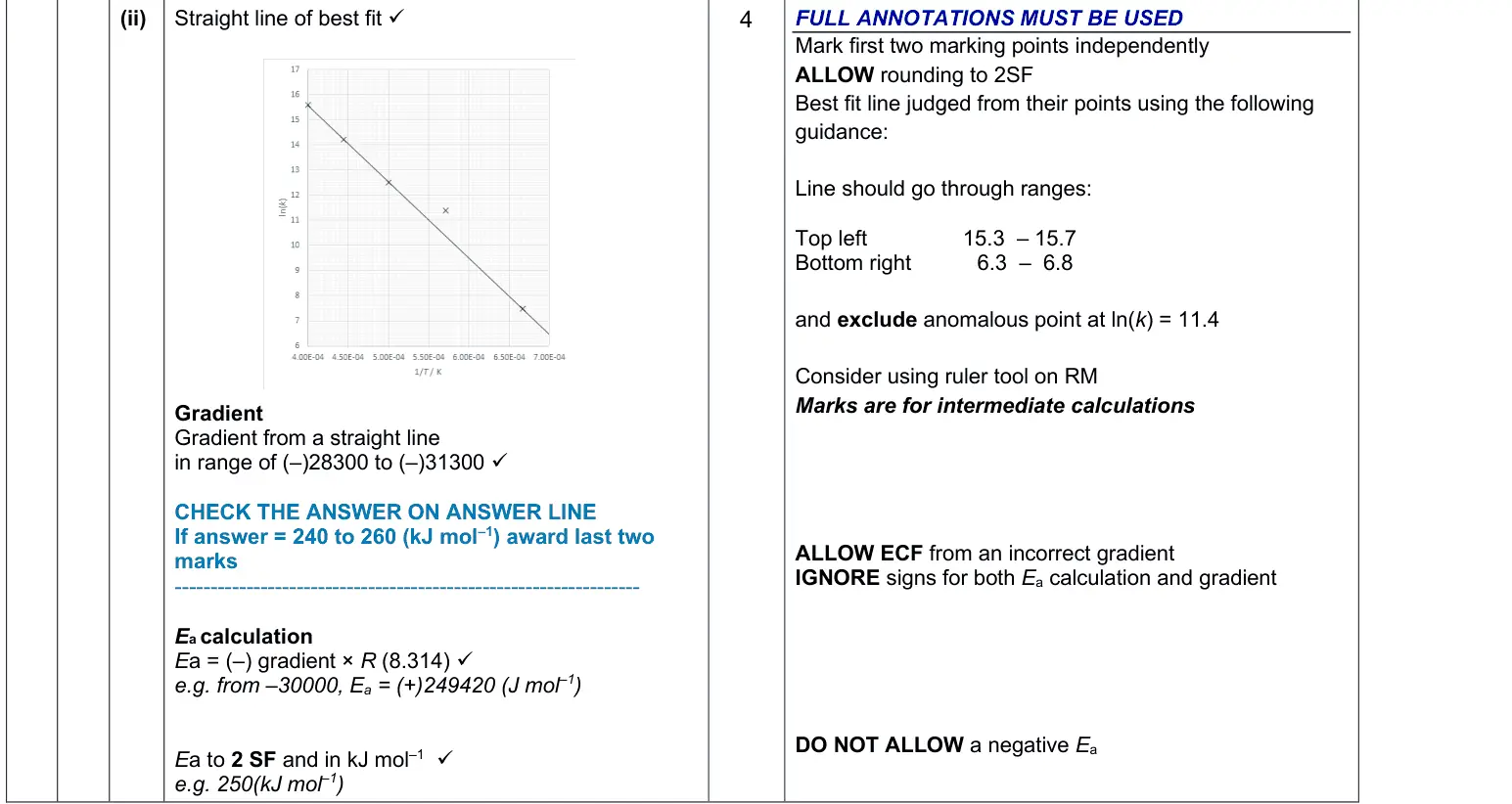
Nearly all candidates were able to draw the line of best fit and linked the equation of a straight line to the equation. A few candidates drew a curve, and some included the anomalous result. Gradients were calculated with accuracy with a few candidates calculating the gradient using an inverted formula. A few didn’t notice the x-axis didn’t go to 0, so used Δx in their gradient at -7x10⁻⁴ and ended up with a gradient of about -12800 and Ea of 110 as ECF. Most candidates knew to multiply by R but a few incorrectly divided by R. Some candidates didn’t give to 2 SF and / or convert to kJ and gave a negative value. A few candidates tried to substitute values into lnk = - Ea/RT + lnA, rather than use the graph. Many realised that they didn’t have a y-intercept and then calculated the gradient. Those that were able to complete the maths calculated the correct answer within the range.
Skills: M0.0 Recognise and make use of appropriate units in calculations; M1.1 Use an appropriate number of significant figures; M2.3 Substitute numerical values into algebraic equations using appropriate units for physical quantities; M3.2 Plot two variables from experimental or other data; M3.3 Determine the slope and intercept of a linear graph
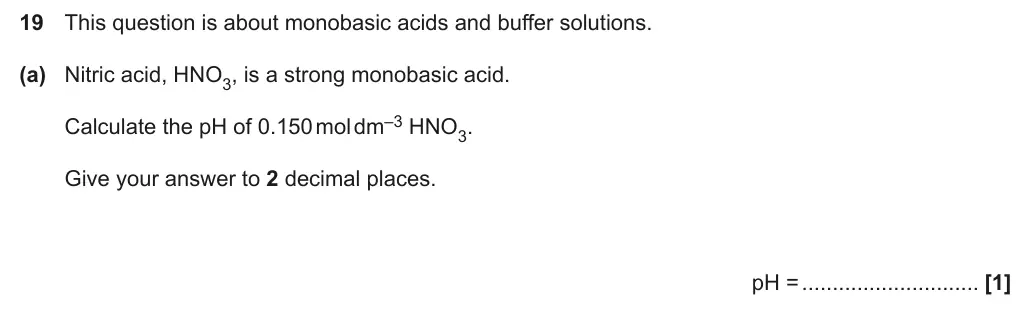
Most candidates were successful in calculating pH. A few candidates gave the pH value to 1 or 3 decimal places, and few quoted 13.18 as if HNO3 were an alkali.
Skills: M0.4 Use calculators to find and use power, exponential and logarithmic functions; M2.5 Use logarithms in relation to quantities that range over several orders of magnitude
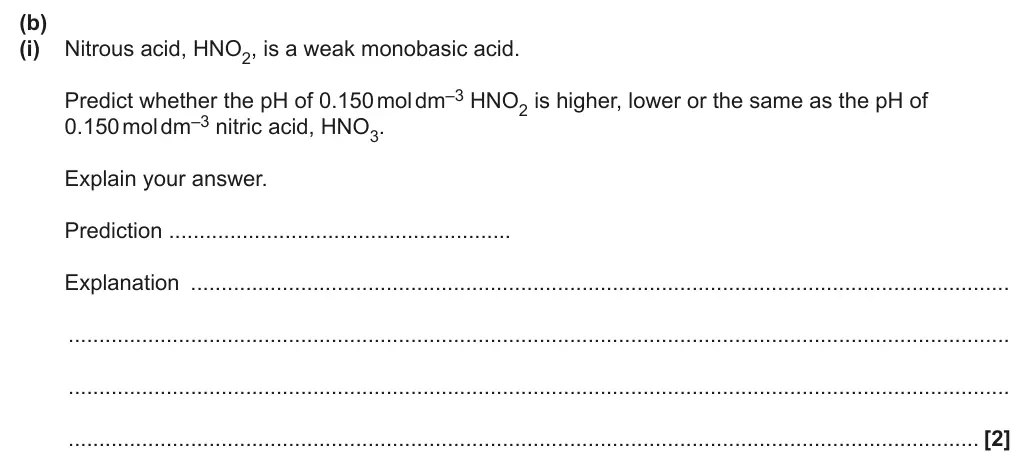
This question required that the candidate understood that pH was a function of both the dissociation and concentration of H+ for a weak acid. This did prove more challenging and often was not explained well. Less successful candidates often quoted a lower pH, explained that it didn’t fully dissociate (rather than partially dissociate) or didn’t link the number of H+ ions to a concentration.
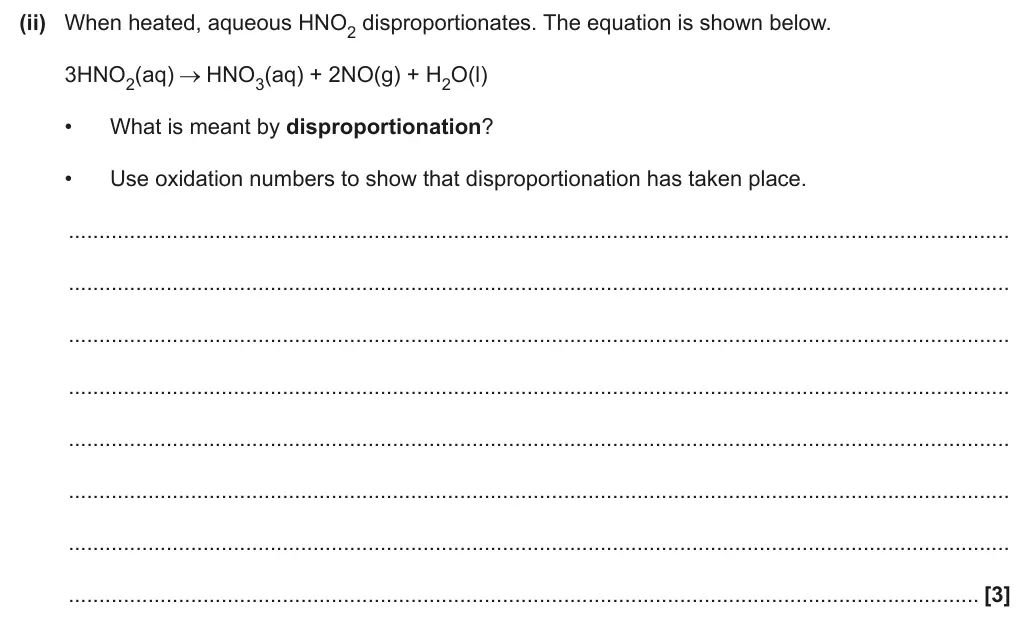
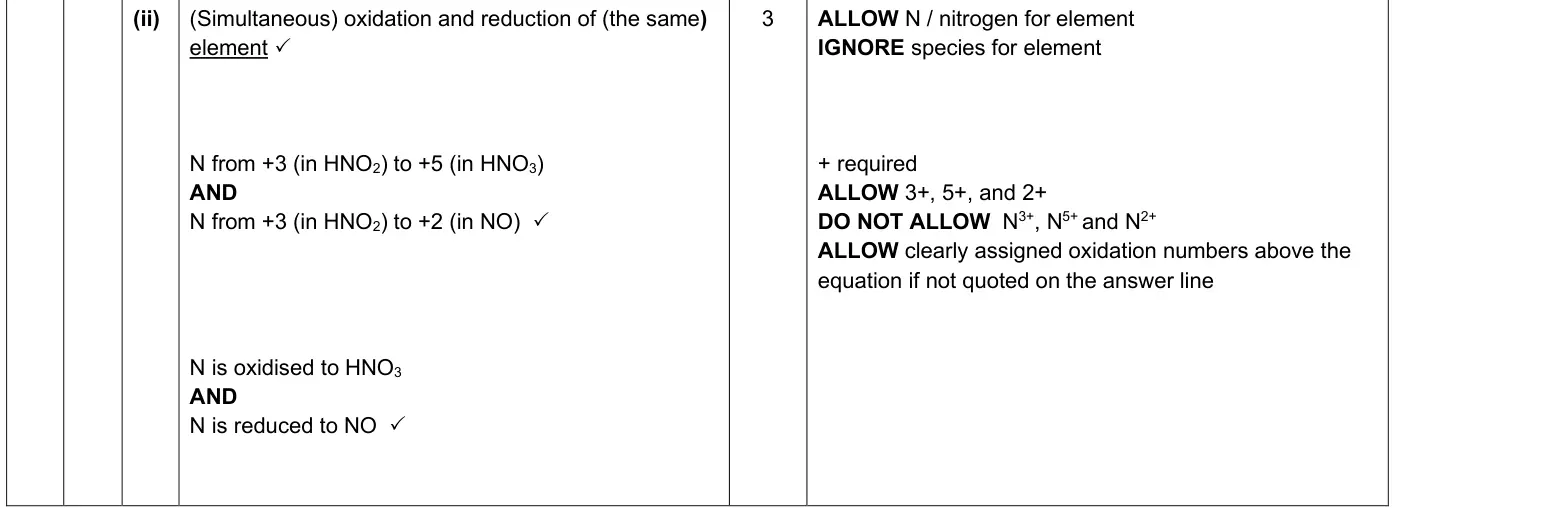
This was generally a well answered question from most candidates. The definition requires the use of ‘element’ rather than the more general term ‘species’. Candidates often went on to identify N as the element. Less successful candidates identified H or O from the redox change. A misconception for a few was that an ‘atom’ was disproportionated without realising this would be impossible. Oxidation numbers were mostly correct and correct oxidation and reduction identified, either by naming compounds in the answer space or labelling them in the equation. Candidates would be advised to make sure that there is a clear link between the oxidation number and the element that it refers to.
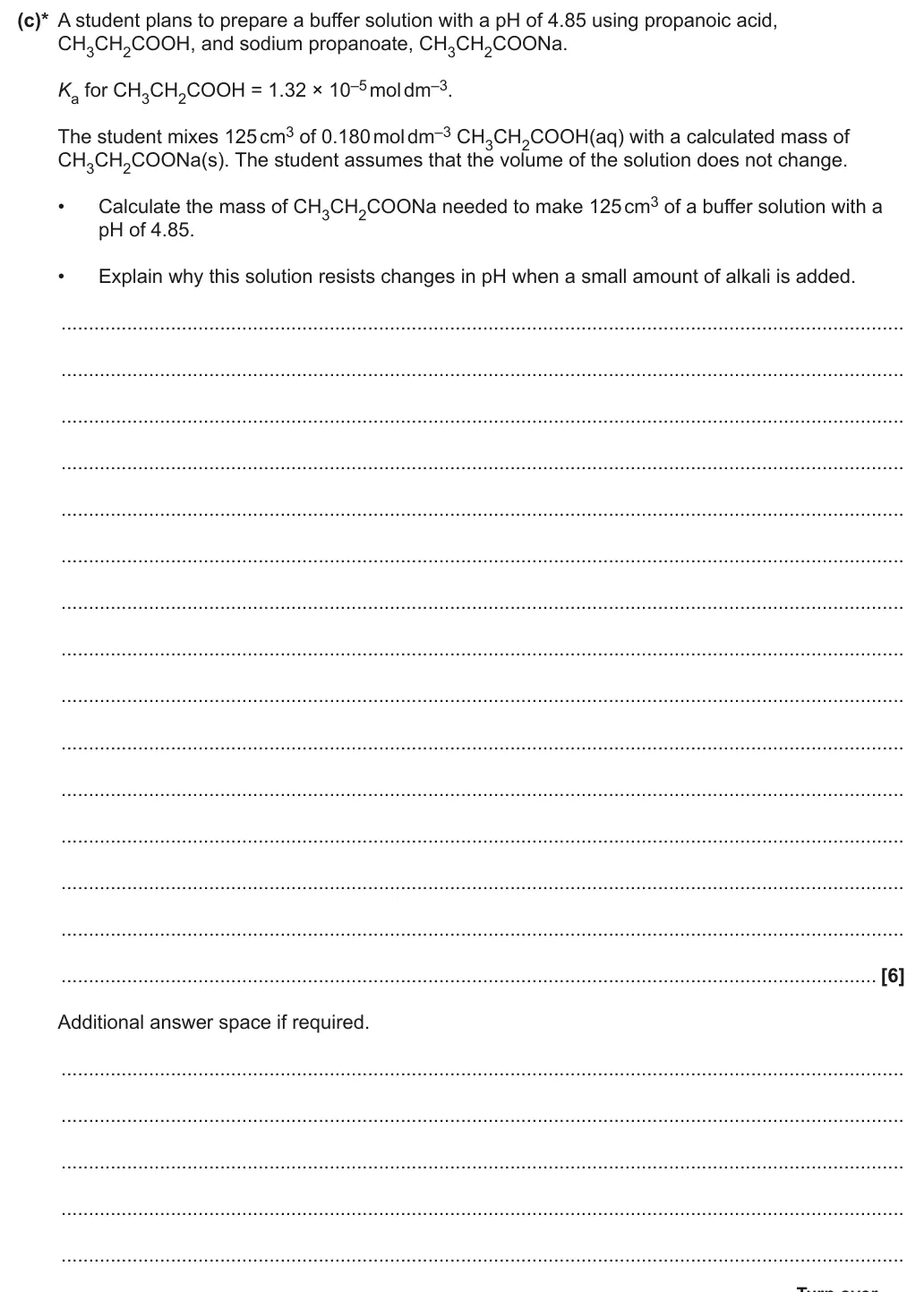
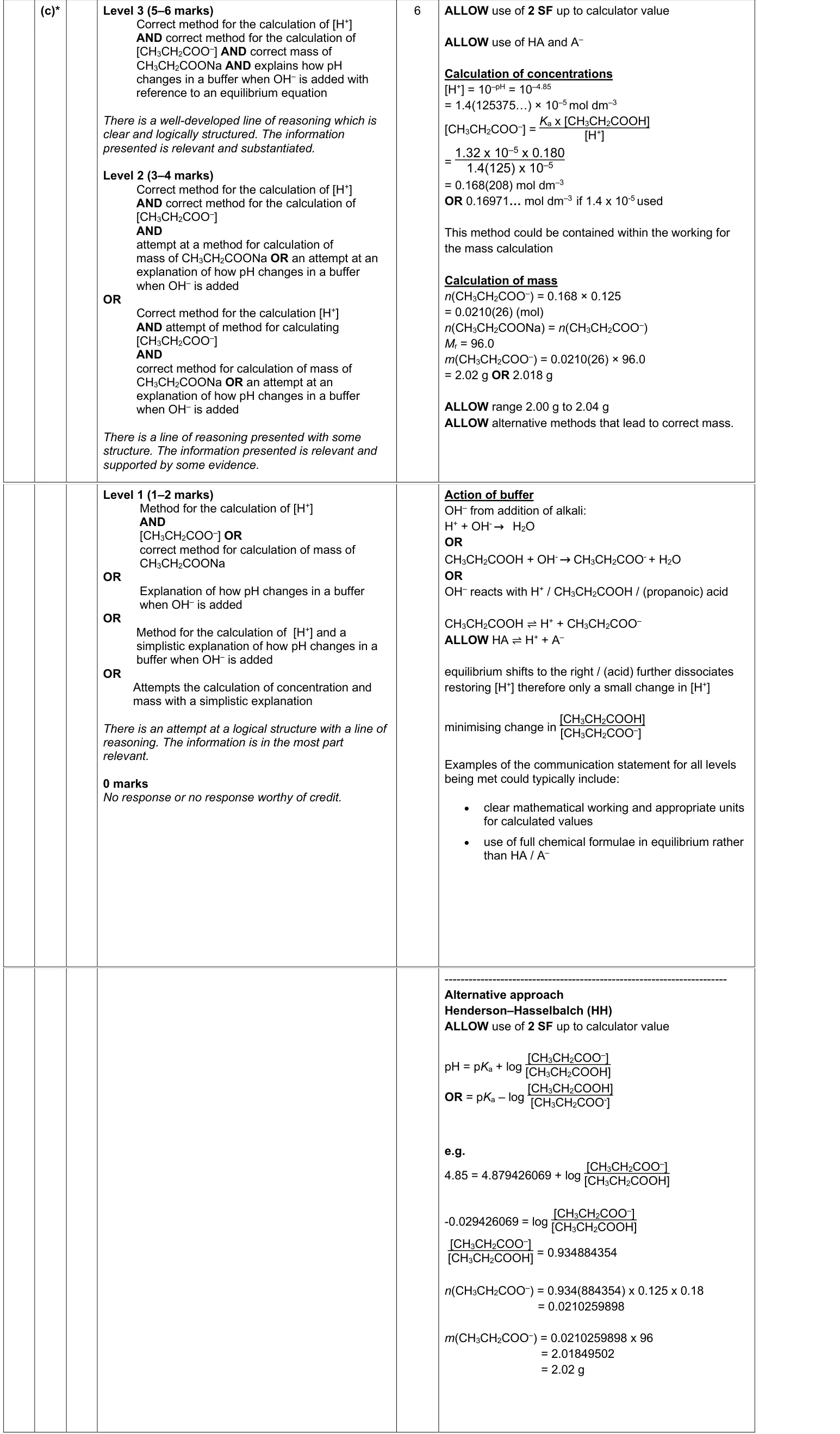
This was our second Level of Response question which proved more challenging for candidates. Only a few candidates scored full marks. Candidates are reminded to structure their answers and make sure they answer all points in the question. Candidates often find pH of buffer solution calculations difficult to process. The most difficult part in this calculation was the concentration of the salt. The majority that calculated salt concentration were able to calculate the mass. We should encourage the candidates to always write the units when calculating any quantity as concentration and moles were often confused within the calculation. Some candidates were given Level 2 for converting what they thought was the salt concentration into a value for the mass of salt needed, using a correct method. Less successful candidates calculated the correct [H+] but then used a weak acid calculation approach. A few responses attempted to use the Henderson-Hasselbalch approach, but most were unsuccessful due to the mathematical inaccuracies. The buffer action description proved to be a more challenging part to the question. Some candidates wrote a clear and concise description, linked to a written equilibrium equation, of the reaction of an alkali and the resulting equilibrium shift. Level 2 candidates often described an equilibrium shift of a non- existent equilibrium equation. Level 1 candidates were often only able to calculate [H+] and tried to explain the action of a buffer.
Skills: M0.4 Use calculators to find and use power, exponential and logarithmic functions; M2.2 Change the subject of an equation; M2.3 Substitute numerical values into algebraic equations using appropriate units for physical quantities; M2.5 Use logarithms in relation to quantities that range over several orders of magnitude
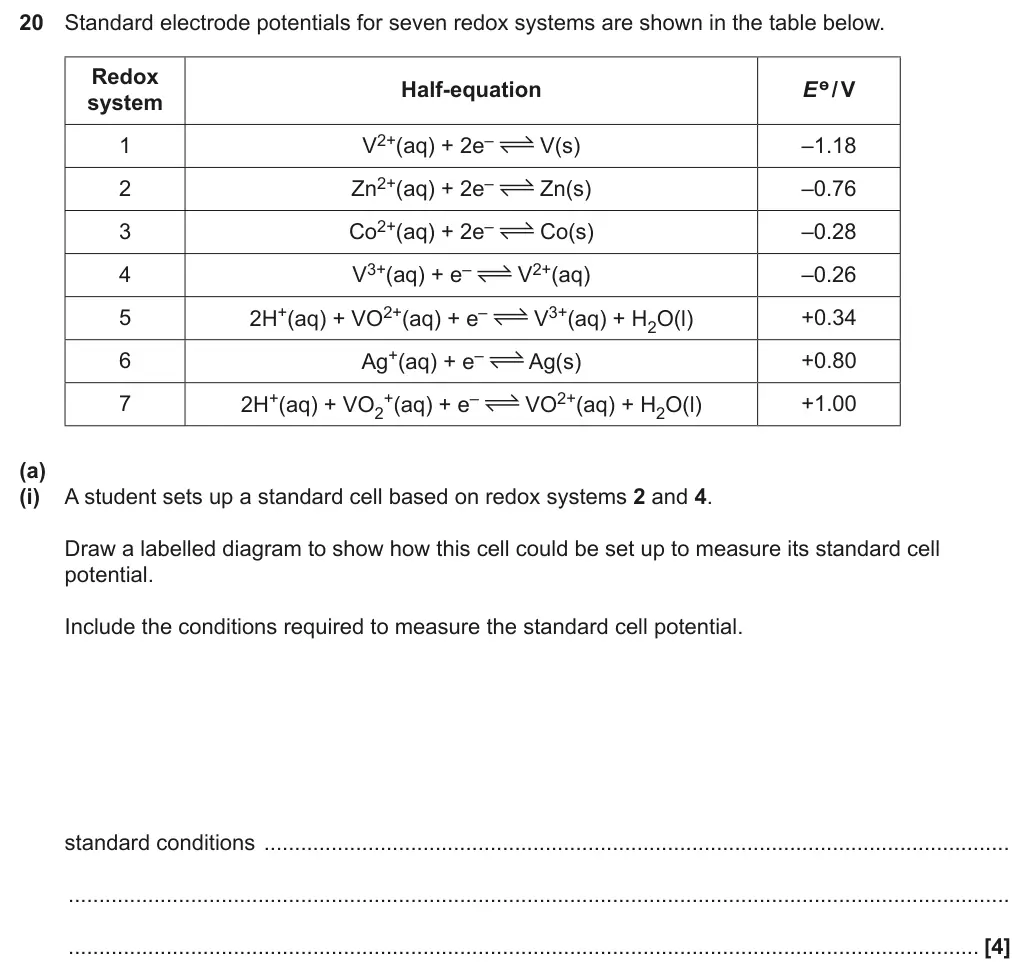
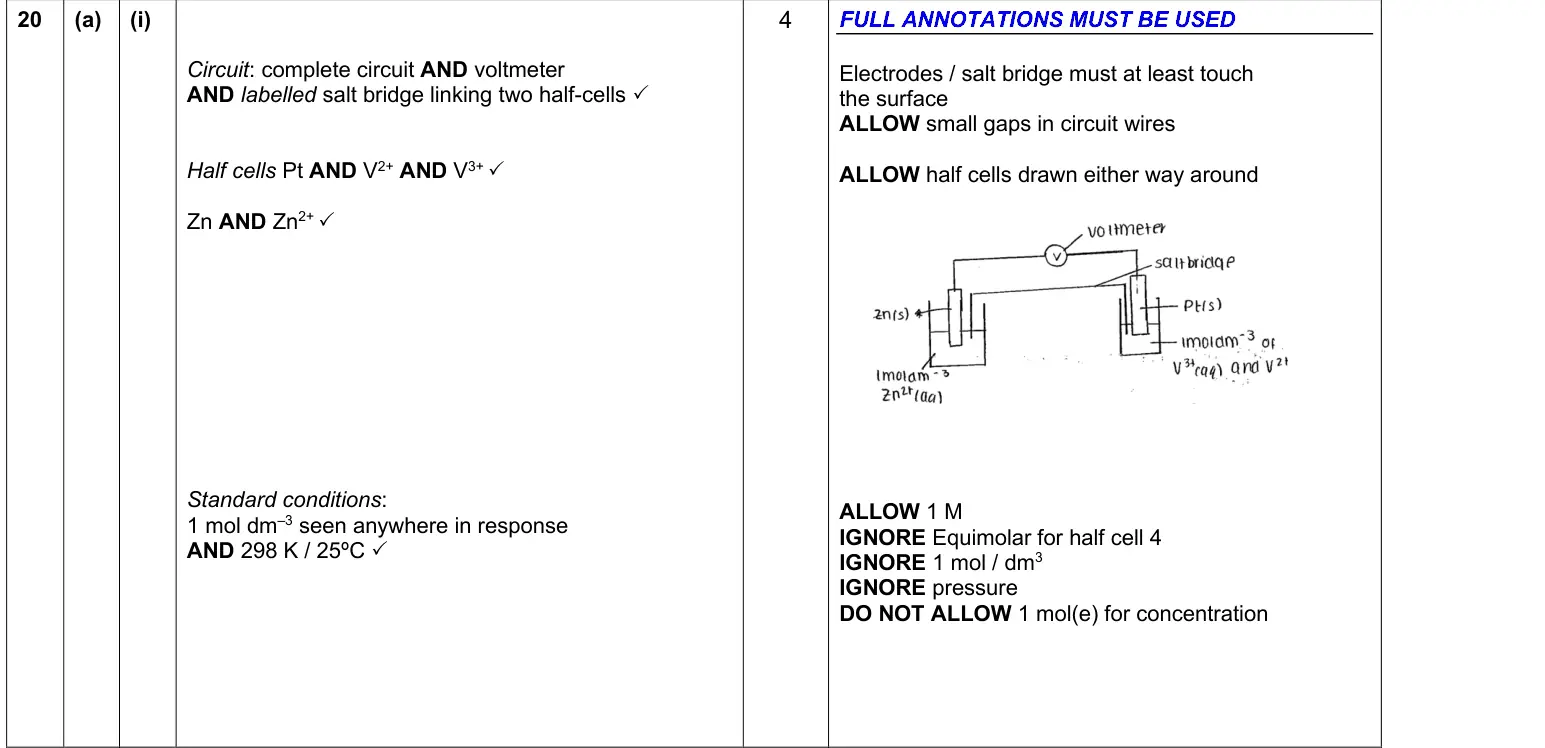
Candidates made good progress and produced good diagrams with many given 4 marks. More candidates appreciated how the vanadium half-cell was set up than in previous series. Common errors were to miss the labelling of the salt bridge or to quote an incorrect temperature, e.g. 273K or 293K. Occasionally a hydrogen electrode was drawn, or V was used instead of Pt. Some candidates put H+ in with their V2+ /V3+.
Skills: PAG8 Electrochemical cells
Almost all candidates calculated the standard cell potential correctly. Common errors were -0.5V or -1.02V
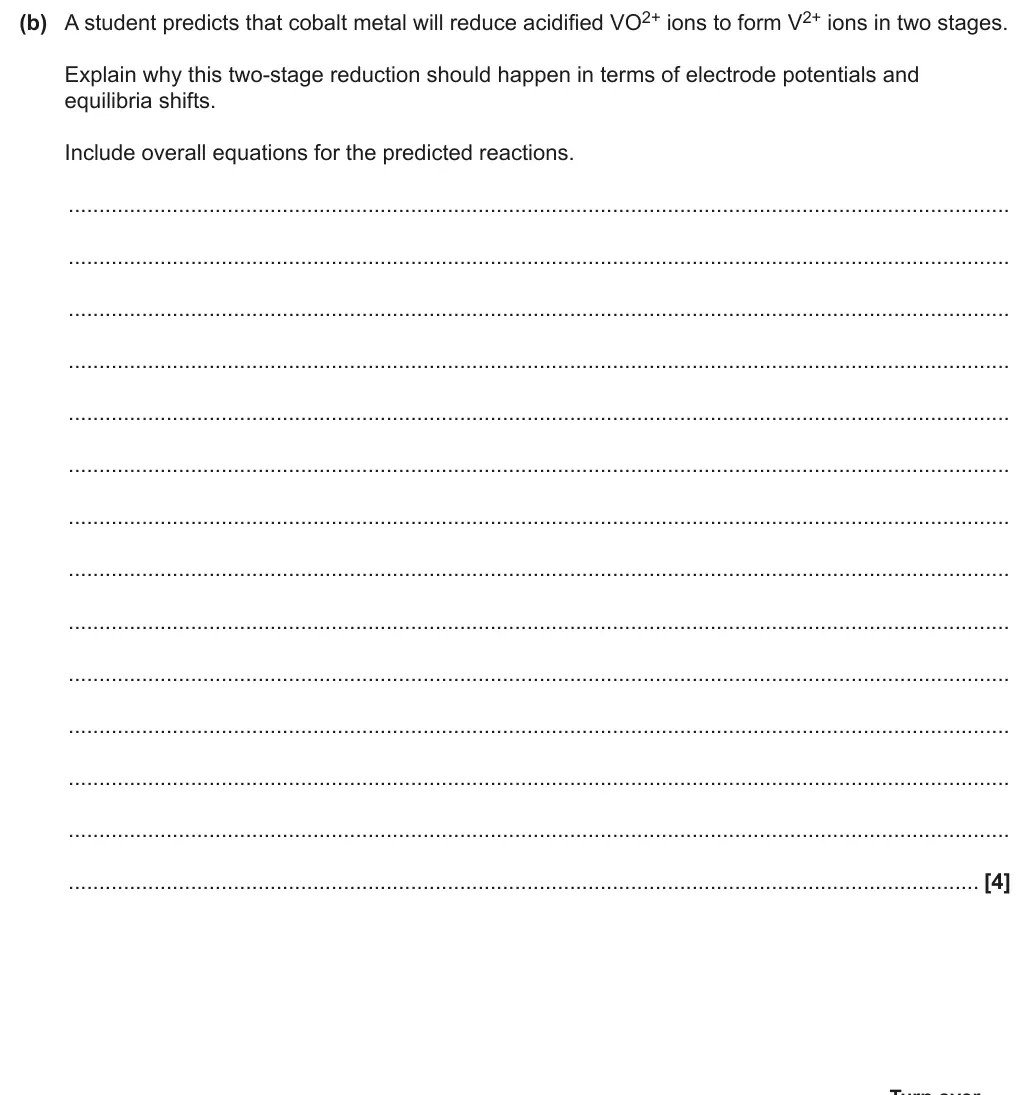
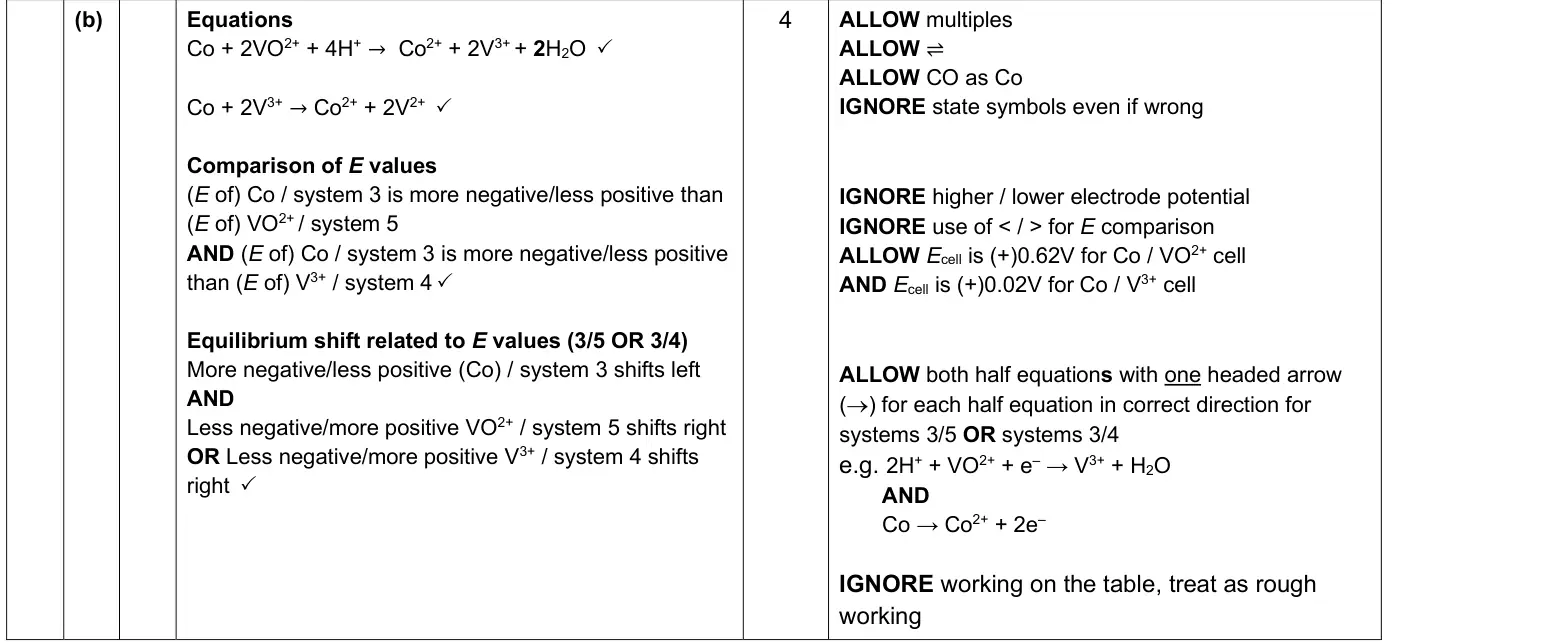
This question required the candidates to explain the two step reduction of VO2+. The question was only answered well by a few candidates and electrode potentials continues to be a conceptually difficult topic. Choosing the correct systems was difficult for most candidates. Some used the Zn system, perhaps because of the diagram and others joined systems: 4+5, 1 and 7. Writing the two equations proved challenging. Equations were often unbalanced, written the wrong way round or missing the second reduction step completely. There was evidence of confusion between VO2+ and VO2+. When comparing electrode potentials, candidates should avoid the use of higher/lower are these phrases are ambiguous due to the negative signs involved. Phrases such as more negative/less positive removes this ambiguity. Candidates are advised to read the instructions contained within the equation and to use or comment on all the data presented. Equilibrium shifts were often stated as shifting left/right without making it clear to which equilibrium the candidate was referring to. Often only one equilibrium shift was mentioned. Candidates should be reminded to use lower case for the second letter in a chemical symbol. CO was often written for Co. While this was accepted for this question, clearly there is a significant chemical difference between these.
Skills: M0.2 Use ratios, fractions and percentages
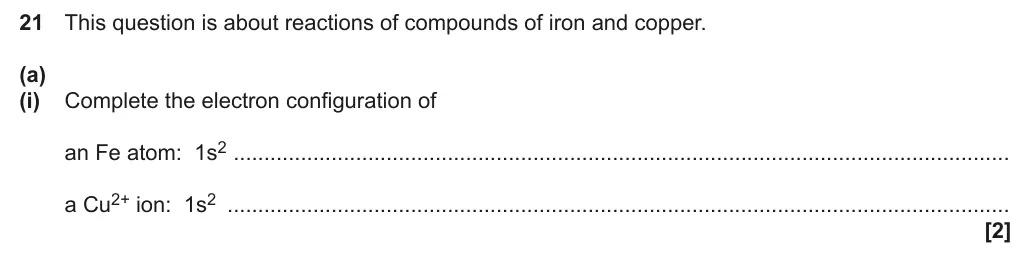
Most candidates were successful in writing the electron configuration for Fe. Many candidates did not realise that when transition metal ions are formed, the first electrons removed from atoms are the 4s electrons and so wrote 2s2 2p6 3s2 3p6 3d7 4s2. Others, incorrectly suggested, 4s1 or 4d7.
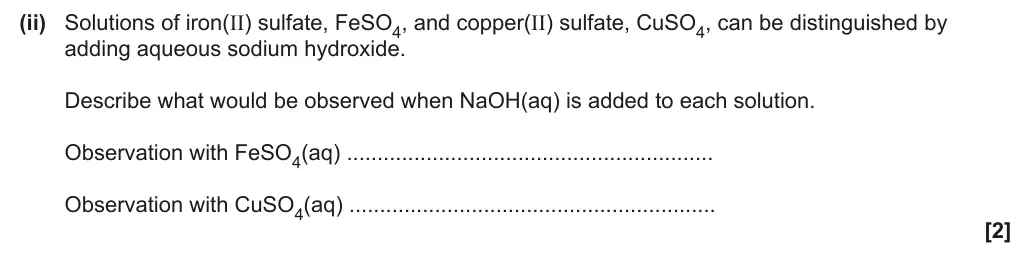
Most candidates were able to identity the correct colour and followed this by describing a precipitate or solid. A few candidates missed the observation of the precipitate. Incorrect colours suggested were yellow, cream and brown. The latter was perhaps as a confusion with the Fe3+ ion.
Skills: PAG4 Qualitative analysis of ions
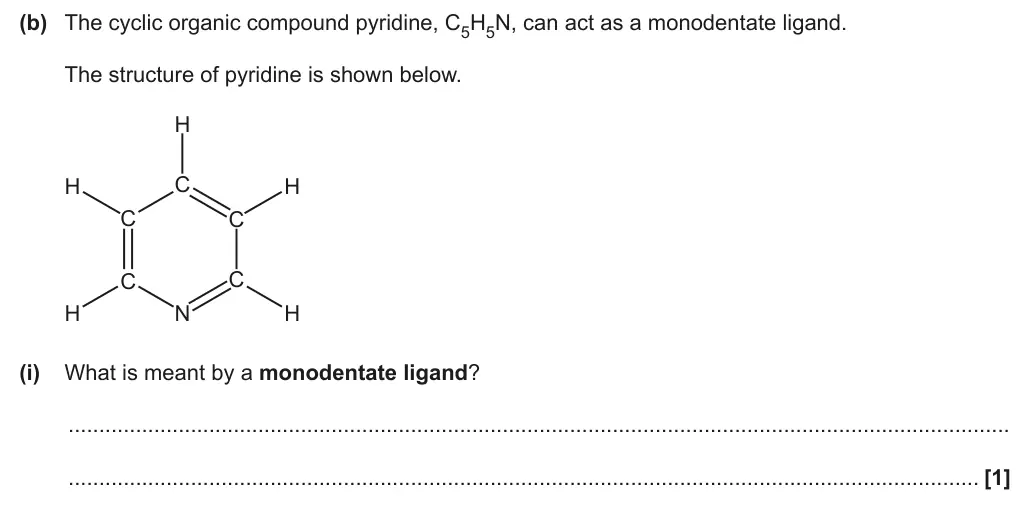
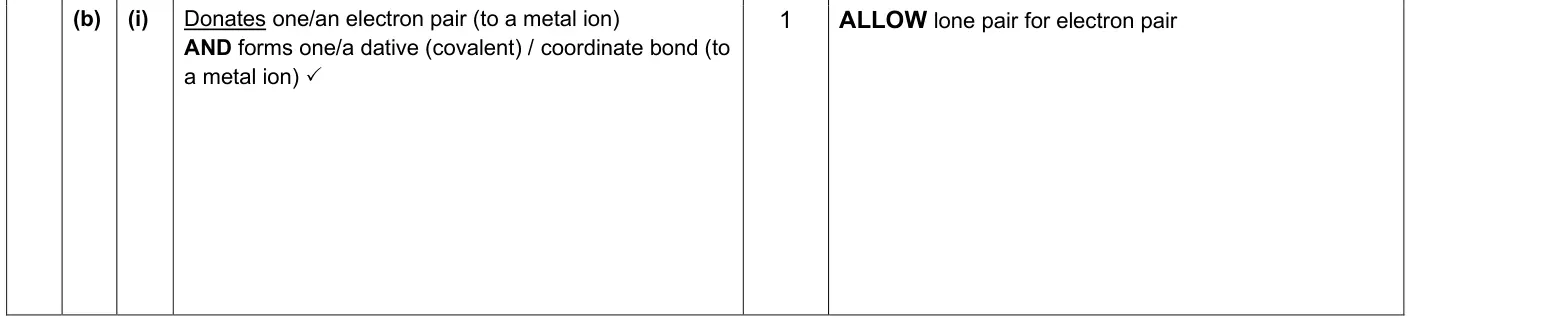
The term ‘monodentate ligand’ was well-known by most candidates. A few candidates didn’t describe the electron pair being donated or forming a coordinate bond. Both these parts were required to be given the mark.
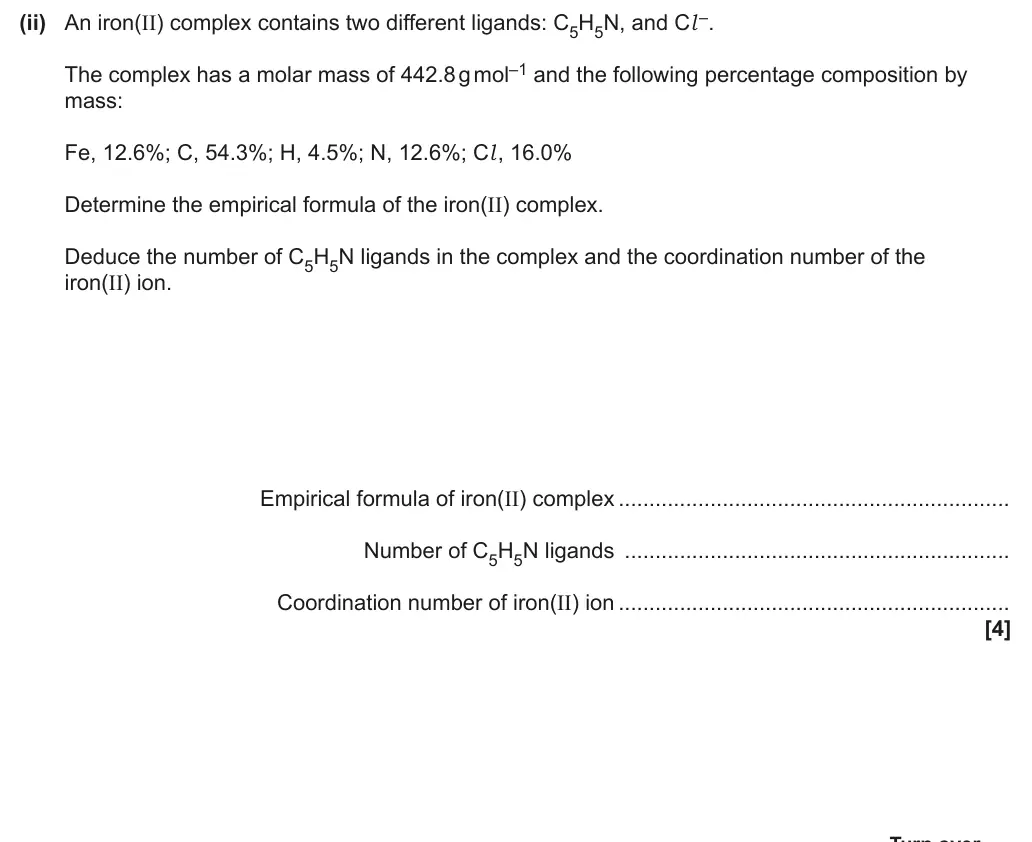
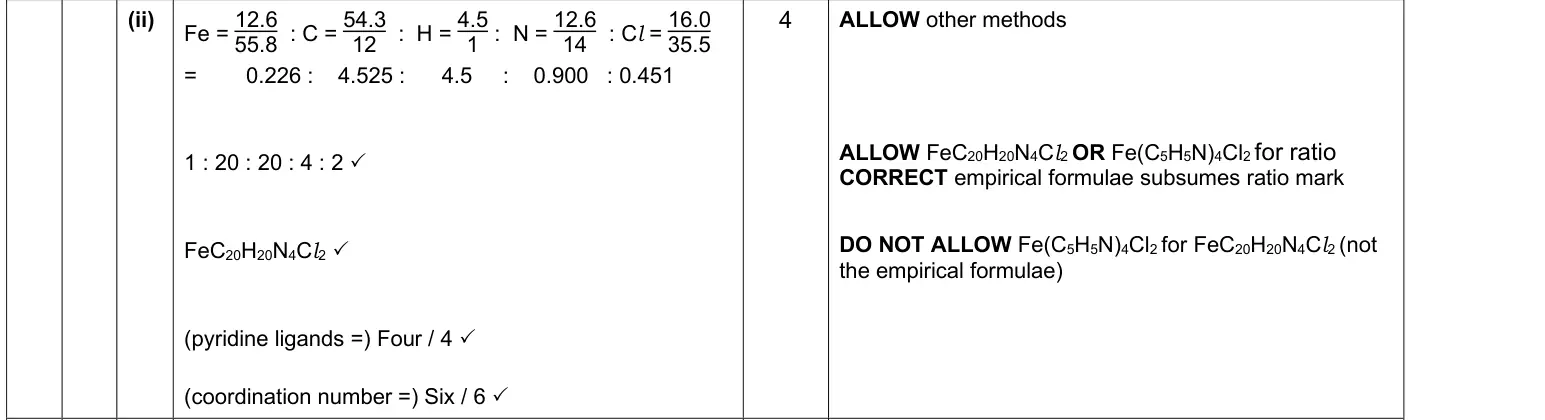
Most candidates were given full marks. They successfully calculated the empirical formula but a few then grouped the ligands together giving a molecular formula, e.g. Fe(C5H5N4)Cl2. Most candidates then continued and found the number of ligands and coordination number. Occasionally coordination number was mixed up with the charge on the ion.
Skills: M0.2 Use ratios, fractions and percentages; M2.3 Substitute numerical values into algebraic equations using appropriate units for physical quantities
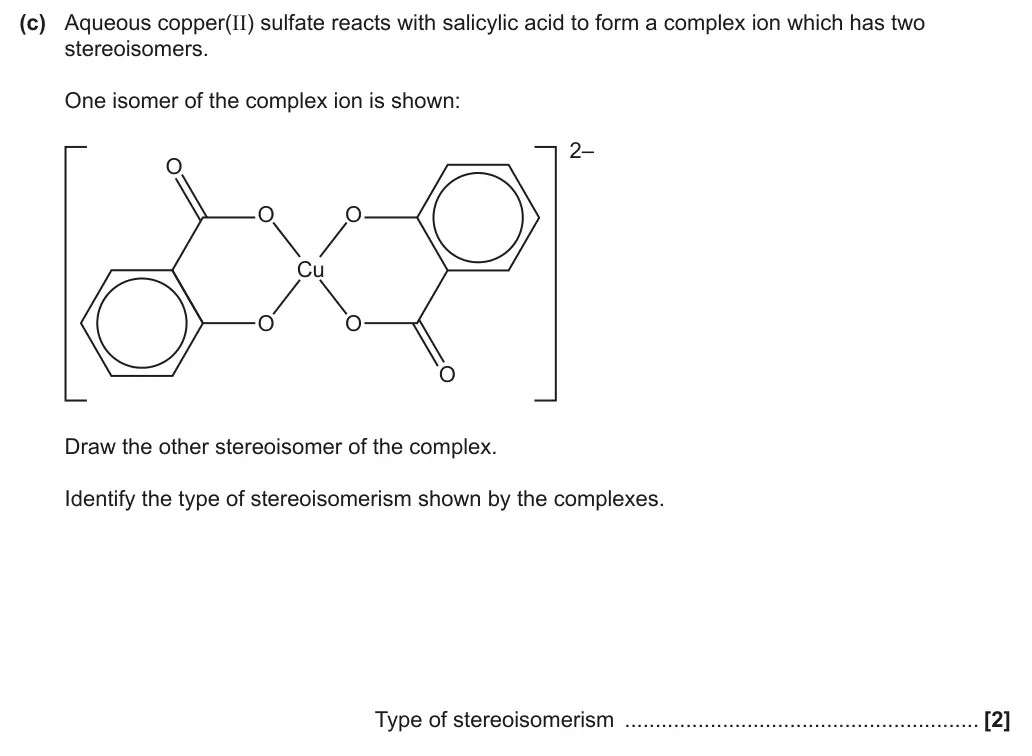
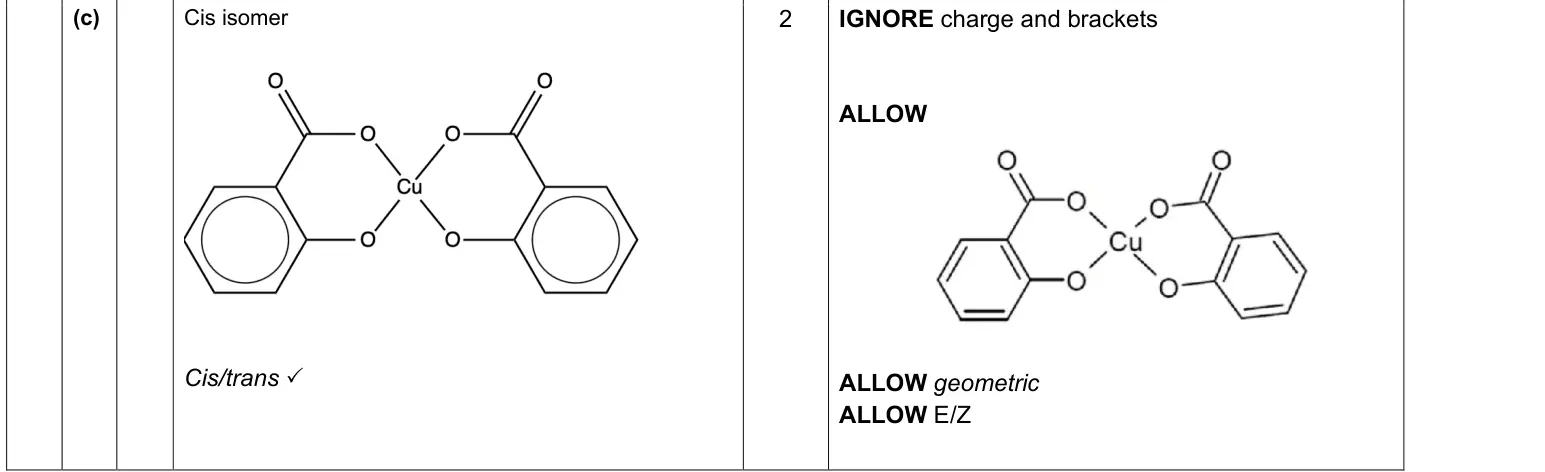
This question required the candidates to identify the isomerism in an unfamiliar complex. This question was one of the more demanding ideas on the paper. A few candidates successfully drew the cis isomer and identified the type as cis/trans isomerism. Many candidates suggested, incorrectly, that the isomerisation was optical. A few did draw the cis complex ion but then identified the isomerism as optical.
Skills: M4.2 Visualise and represent 2-D and 3-D forms including 2-D representations of 3-D objects; M4.3 Understand the symmetry of 2-D and 3-D shapes
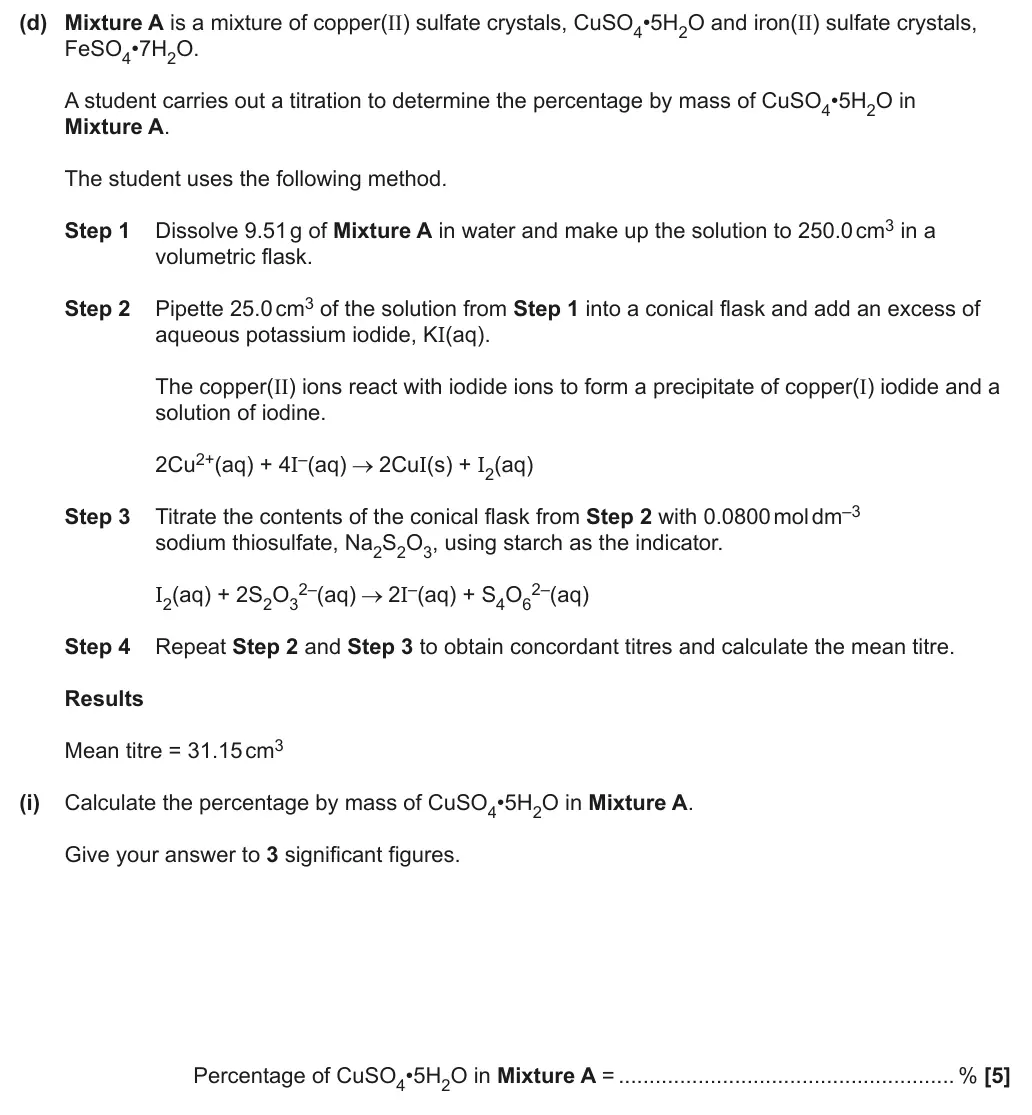
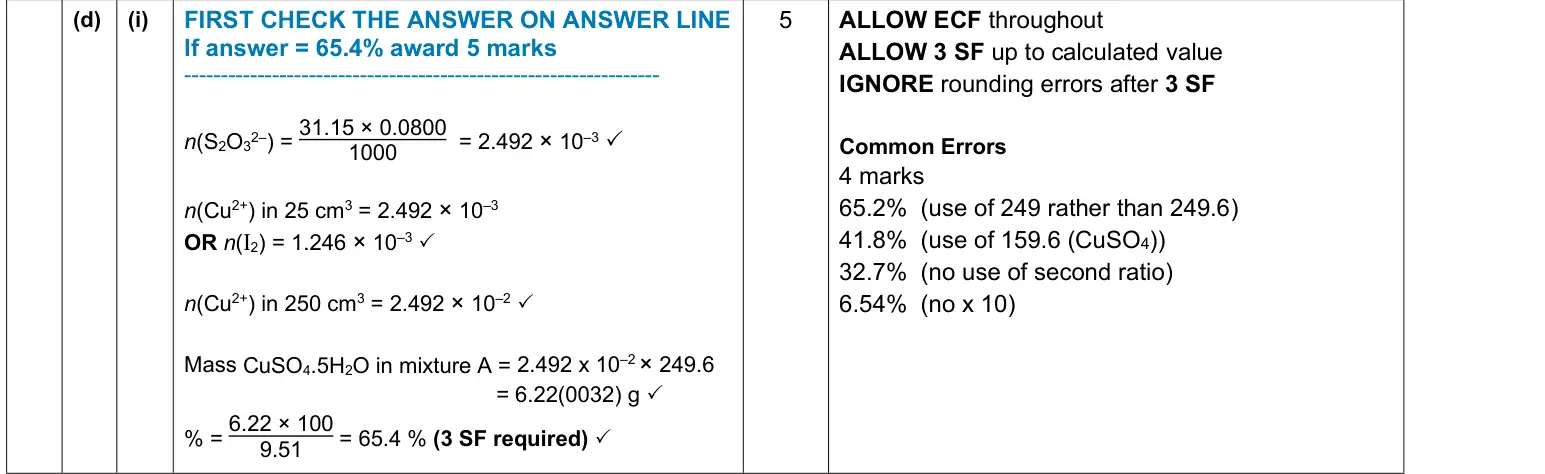
This calculation was answered well by many candidates. It is good to see that the level of communication throughout the multistep calculations is improving compared to previous series, although some candidates are still writing numbers with no indication as to what the number relates to. Annotation allows ECF to be given to a correct method, despite an incorrect value being given during the process. This also, more importantly, allows to candidate to remain focused on what is being calculated. The key steps were: • Calculating the number of moles of S2O32- • Using the molar ratio to link to the number of moles of Cu2+ • Calculating the number of moles in the original volume Calculating the mass by multiplying the moles of Cu2+ by the RFM of the hydrated copper sulfate. • Calculating the percentage in the mixture Common errors were that candidates: • Forgot to use the ratio within the equation. • Forgot to x 10 to calculate the moles in the original sample. • Used the incorrect RFM of copper sulfate or a combined RFM of the two salts CuSO4.5H2O and FeSO4.7H2O. • Divided the total mass of both salts (9.51) by the number of moles of CuSO4 to get a combined Mr. The candidate has produced a correct and fully annotated calculation. This clarity allows the candidate to remain focused on each calculation step. Any miscalculation could then easily gain ECF through a clear method.
Skills: M0.2 Use ratios, fractions and percentages; M1.1 Use an appropriate number of significant figures; M2.3 Substitute numerical values into algebraic equations using appropriate units for physical quantities
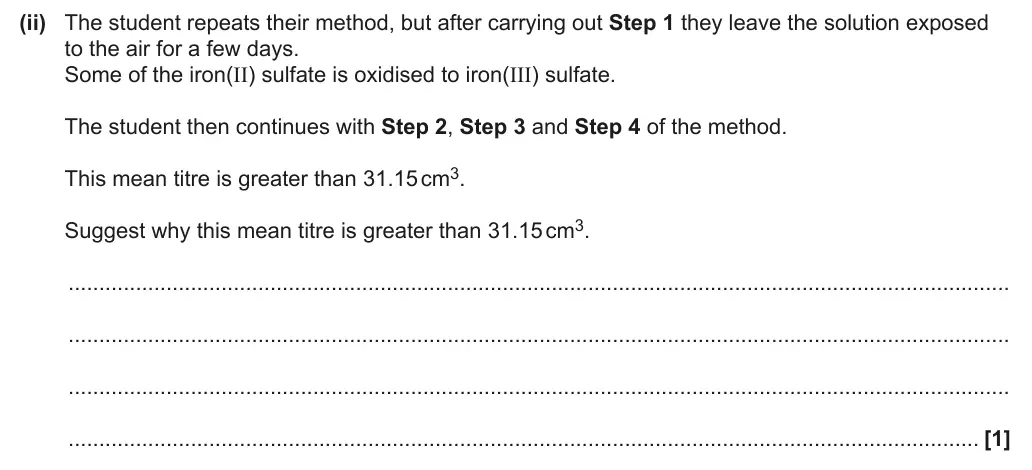
Candidates found this question quite challenging, with only a few giving a correct explanation. A common incorrect theme among less successful candidates was to consider that since it was a titration, then it must be a neutralisation reaction. Common errors involved the suggesting that evaporation of the water concentrating the copper solution, a bigger RFM, and confusion between SO42– and S2O32–. A fair number of candidates did not attempt this question.
Want a paper marked and gone through with you? Message us.