Mechanism questions

Curly-arrow mechanisms. The marks are for where each arrow starts and finishes, the dipoles and lone pairs, and the intermediate. 47 questions.
Other types: Multiple-choice questions · Calculation questions · Equation questions · Structure and isomer questions · Six-mark level of response questions · Practical questions · Graph and data questions · Short-answer questions

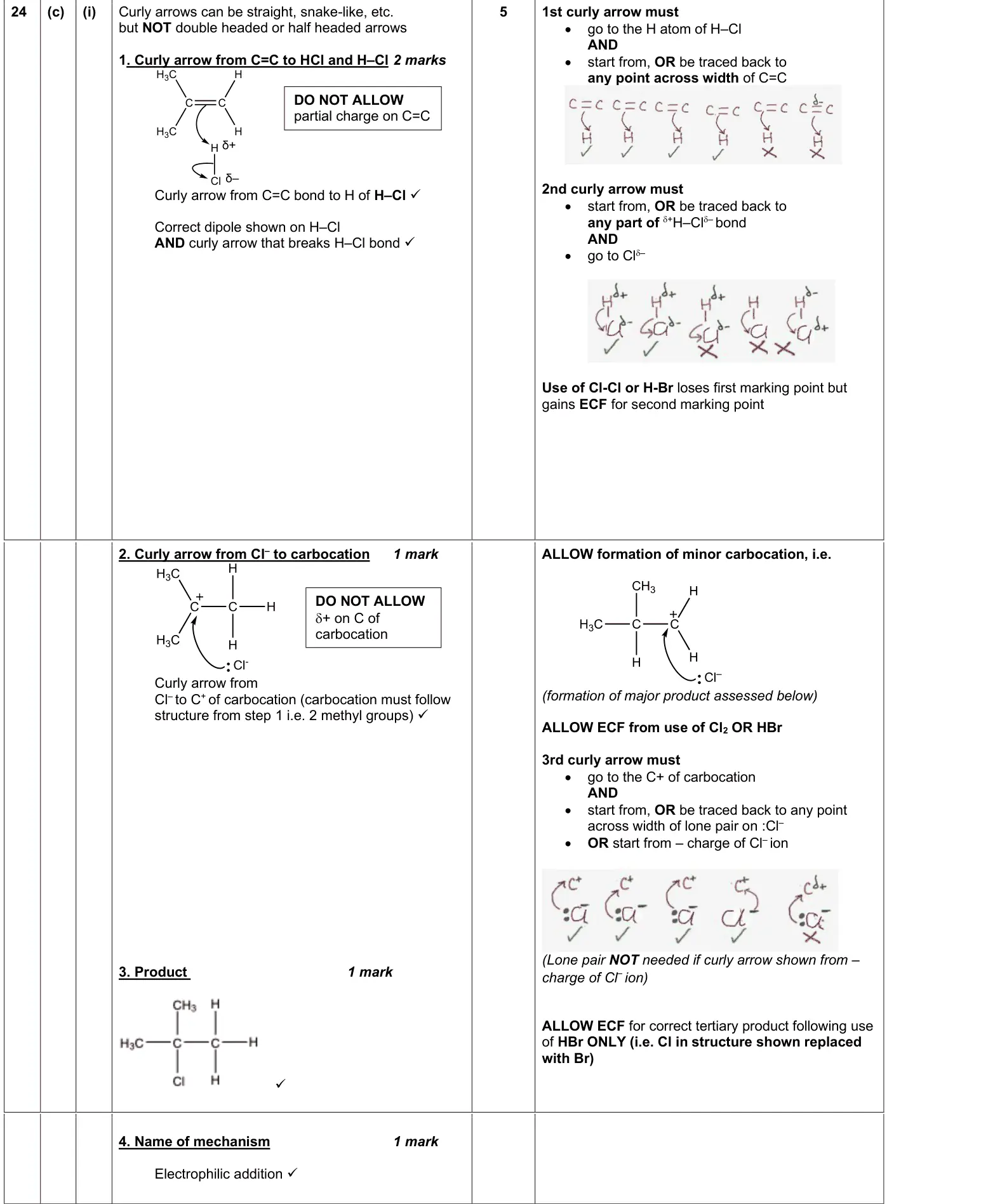
June 2025 · AS Paper 1 · Q24(c)(i) 5 marks Mechanism Hard alkenesorganic basics
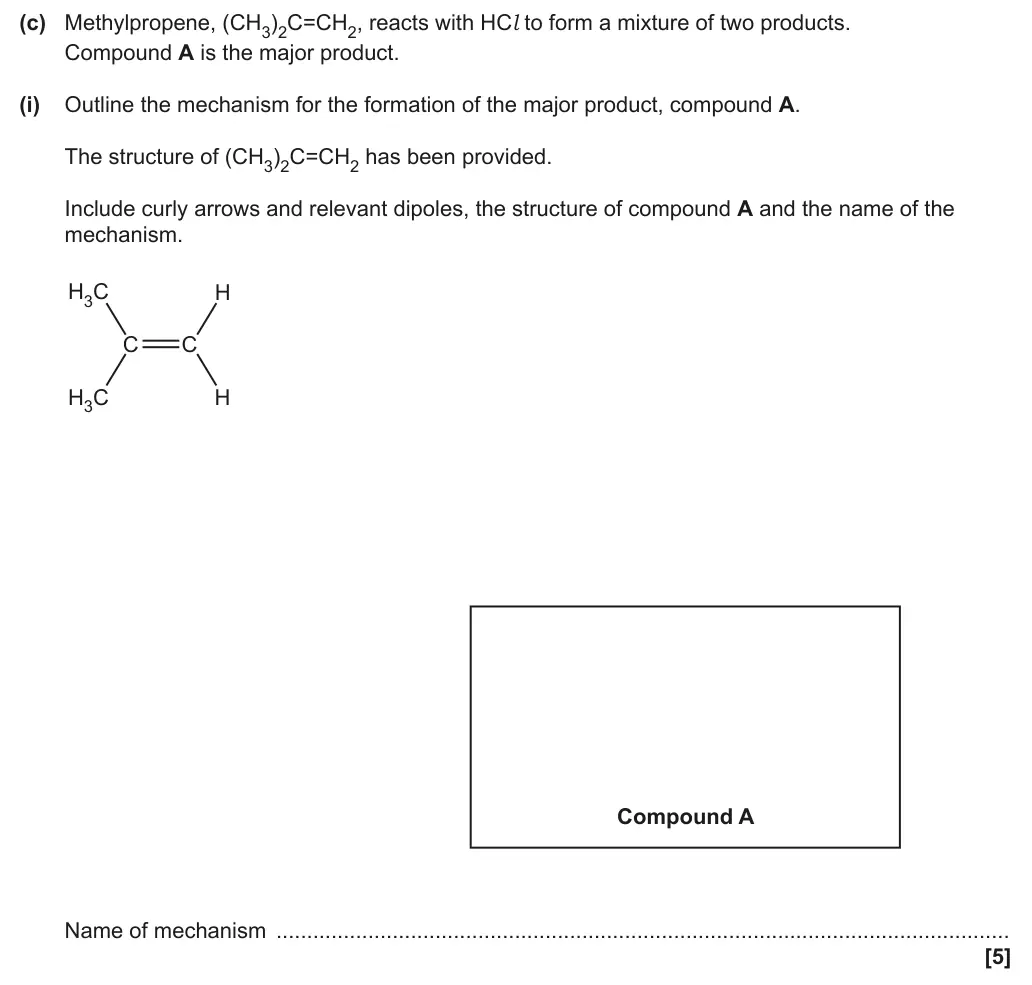
(c) Methylpropene, (CH3)2C=CH2, reacts with HCl to form a mixture of two products.
Compound A is the major product.
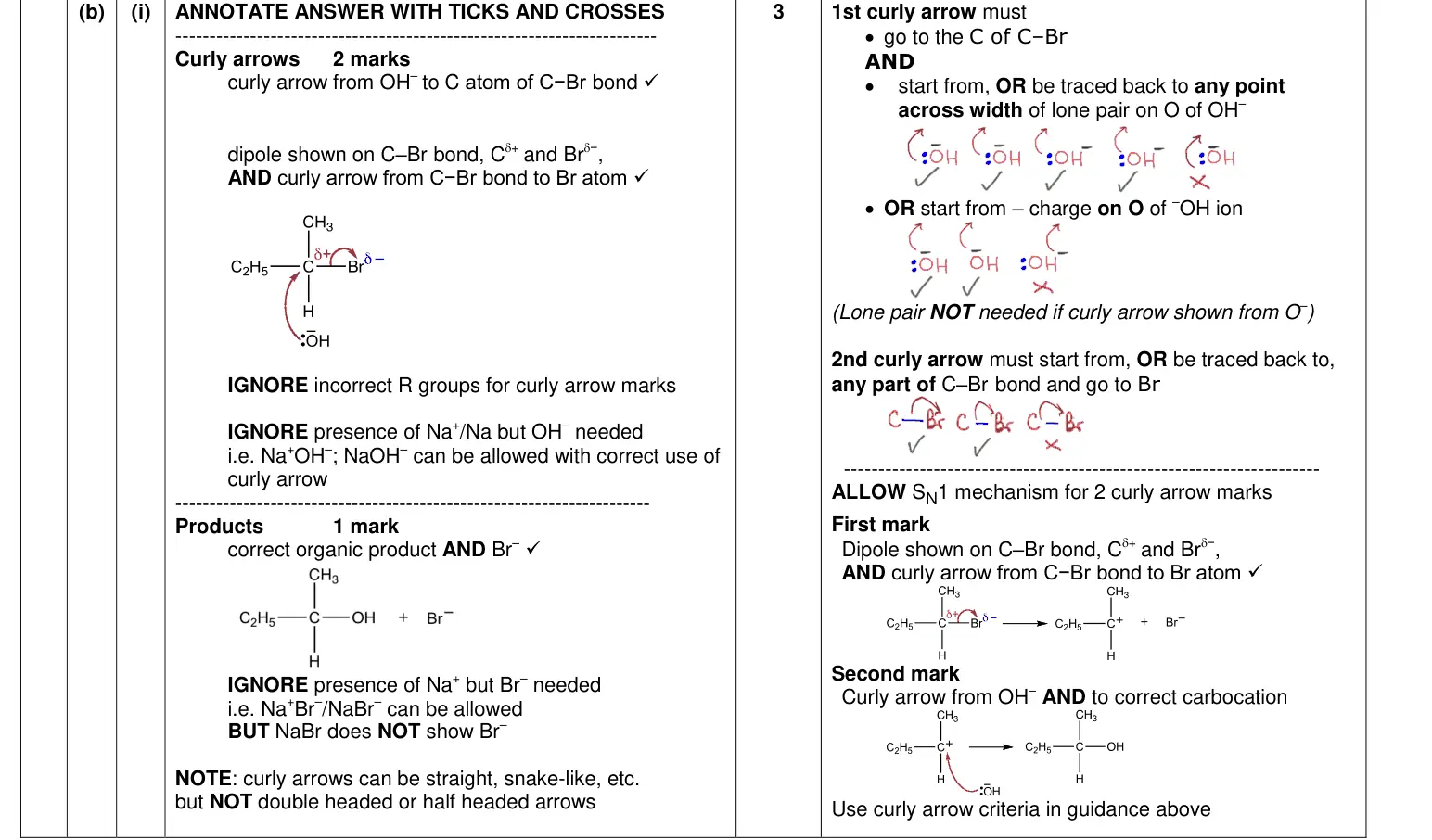
(i) Outline the mechanism for the formation of the major product, compound A.
The structure of (CH3)2C=CH2 has been provided.
Include curly arrows and relevant dipoles, the structure of compound A and the name of the
mechanism.
H3C H
C C
H3C H
Compound A
Name of mechanism  ........................................................................................................................
[5]
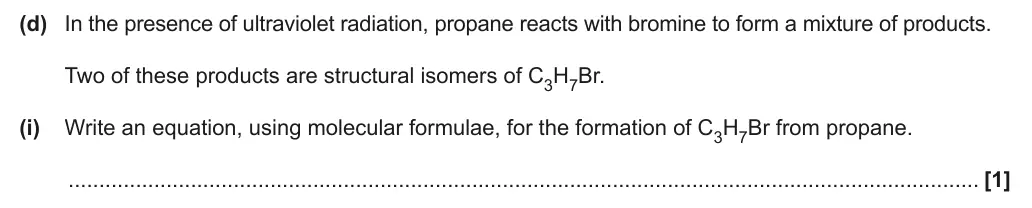
June 2025 · AS Paper 2 · Q4(d)(iii) 2 marks Mechanism Hard alkanesorganic basics
Earlier part of question 4 that this part usesEarlier part of June 2025 Paper 2 question 4
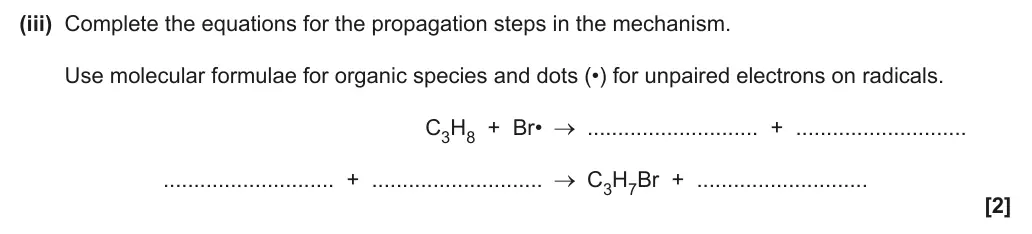
(iii) Complete the equations for the propagation steps in the mechanism.
Use molecular formulae for organic species and dots (•) for unpaired electrons on radicals.
C3H8  +  Br• ............................  +  ............................
............................  +  ............................ C3H7Br  +  ............................
[2]
June 2025 · Paper 2 · Q19(a)(i) 3 marks Mechanism Hard carbon carbon bond formationorganic basicshaloalkanes
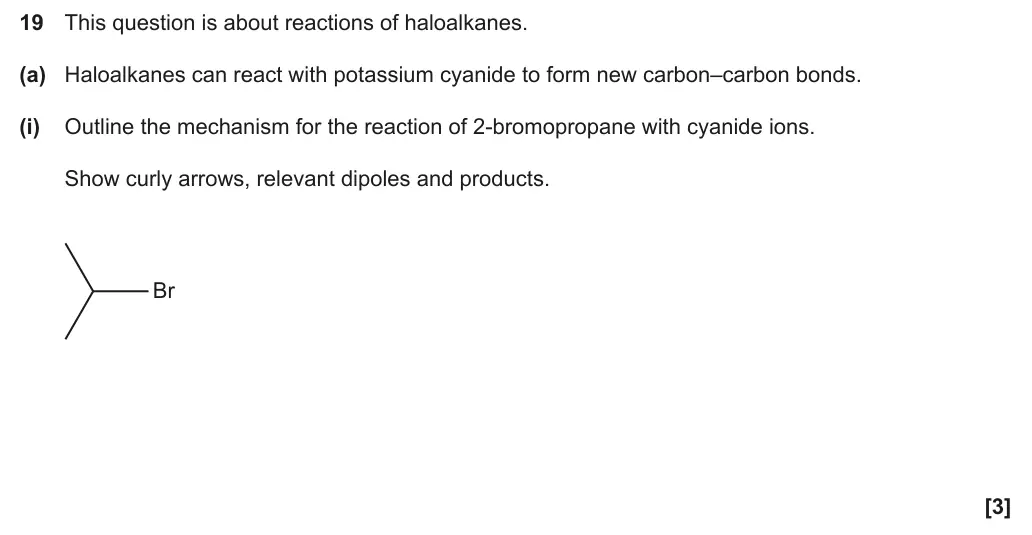
19 This question is about reactions of haloalkanes.
(a) Haloalkanes can react with potassium cyanide to form new carbon–carbon bonds.
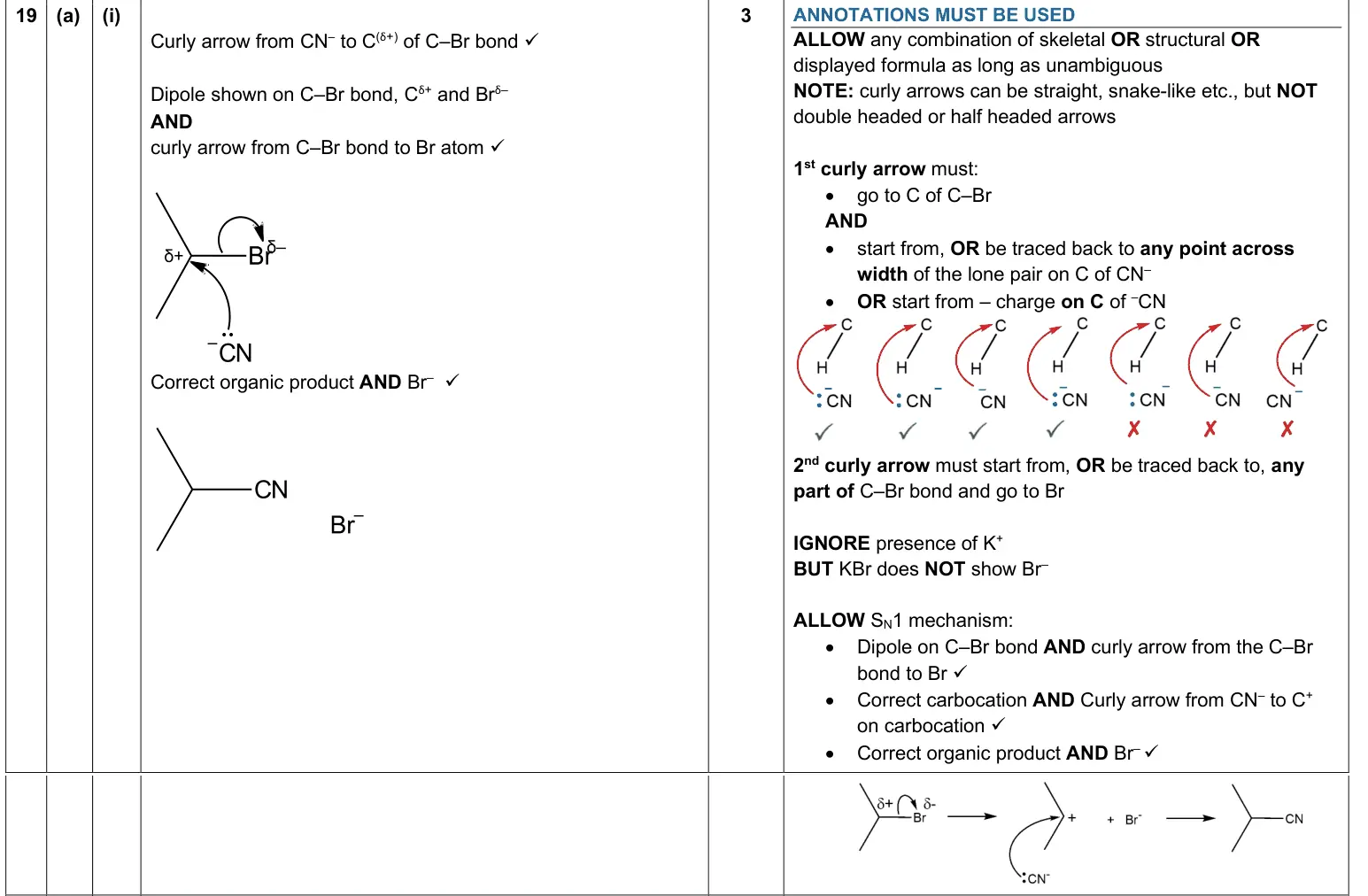
(i) Outline the mechanism for the reaction of 2-bromopropane with cyanide ions.
Show curly arrows, relevant dipoles and products.
Br
[3]
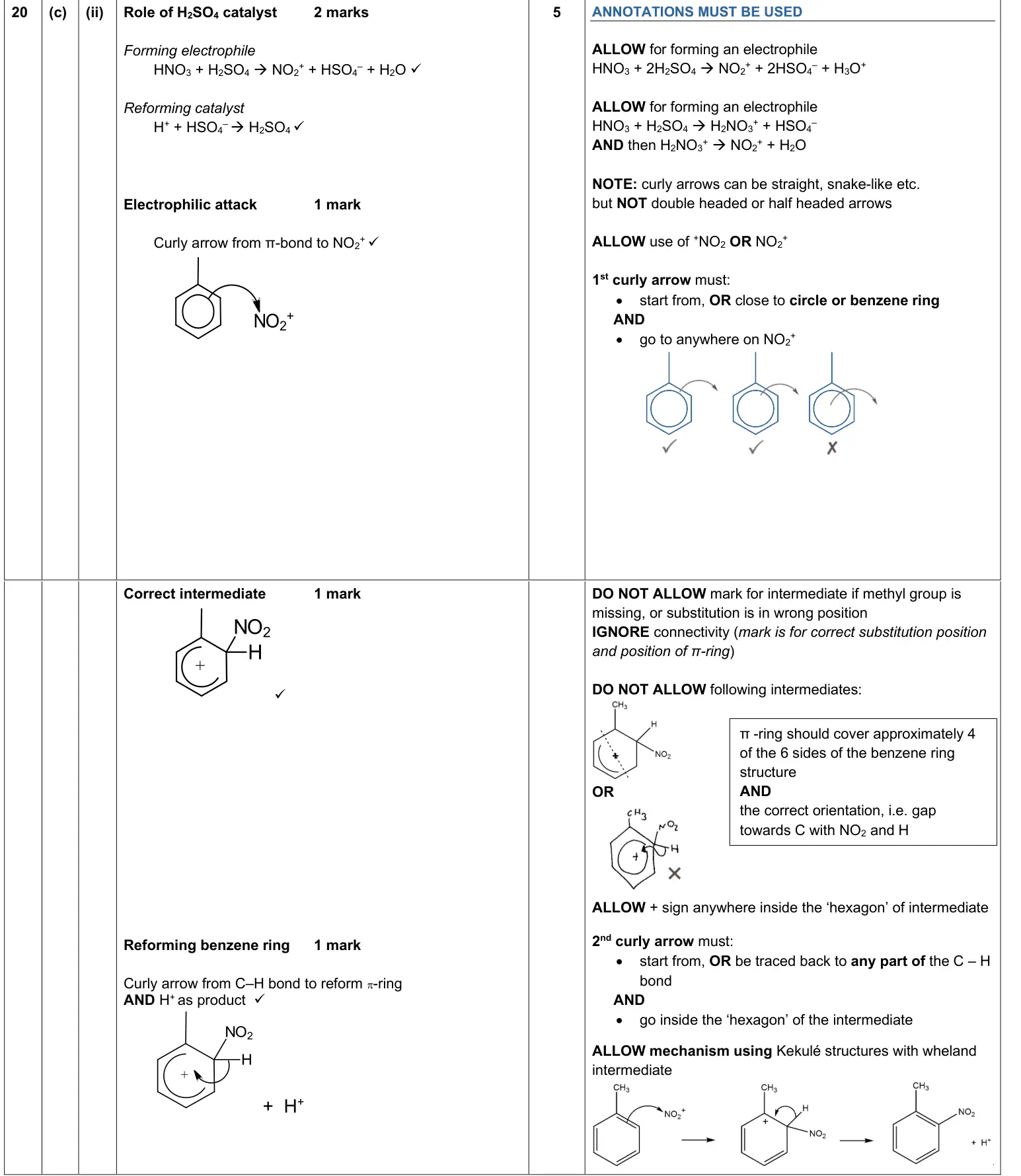
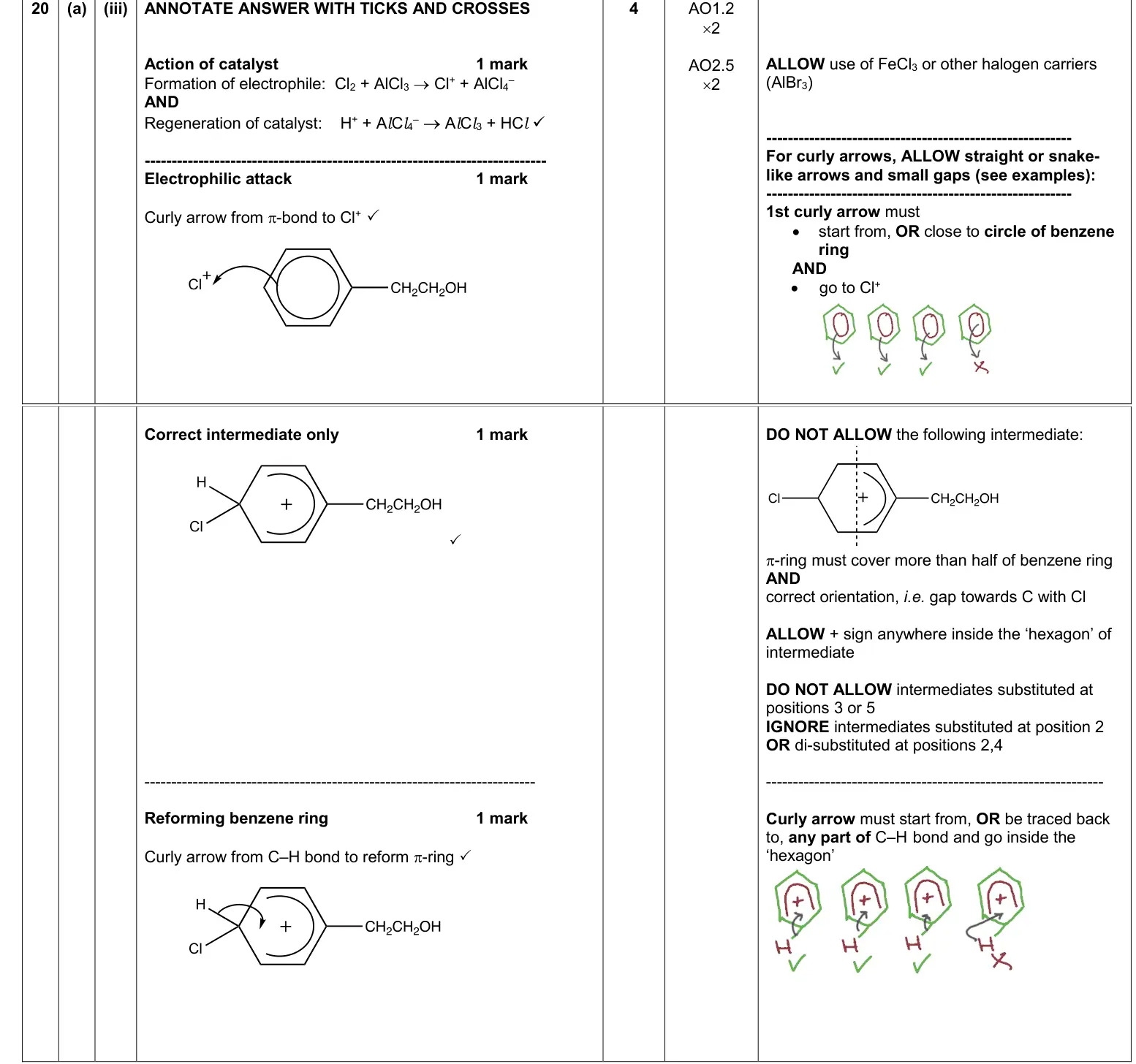
June 2025 · Paper 2 · Q20(c)(ii) 5 marks Mechanism Hard aromatic compounds
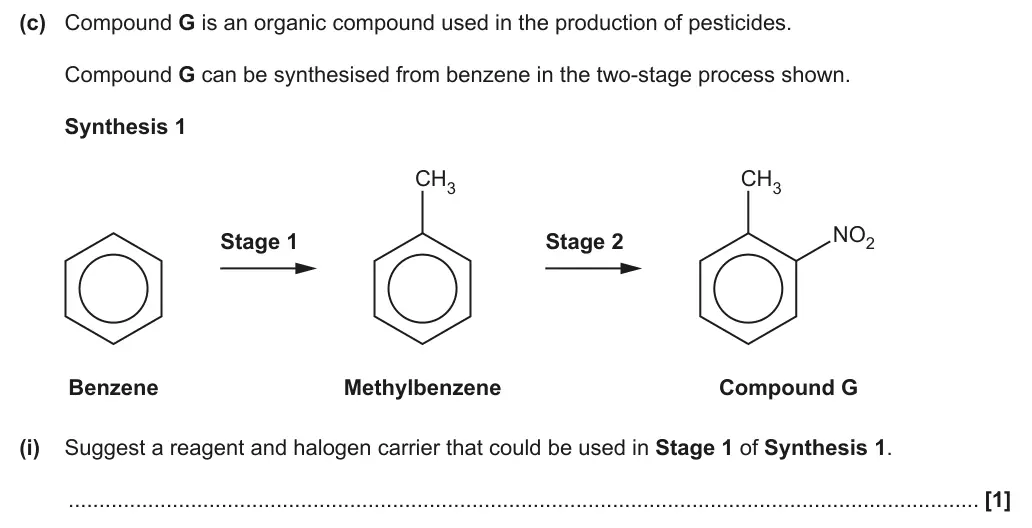
Earlier part of question 20 that this part usesEarlier part of June 2025 Paper 2 question 20
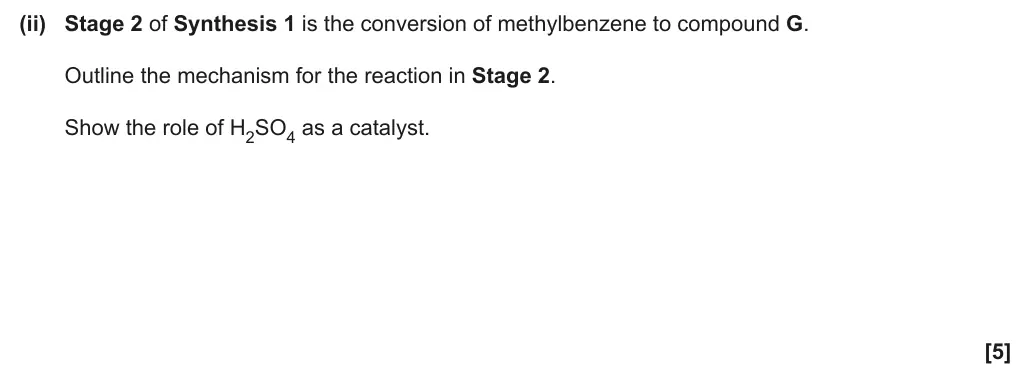
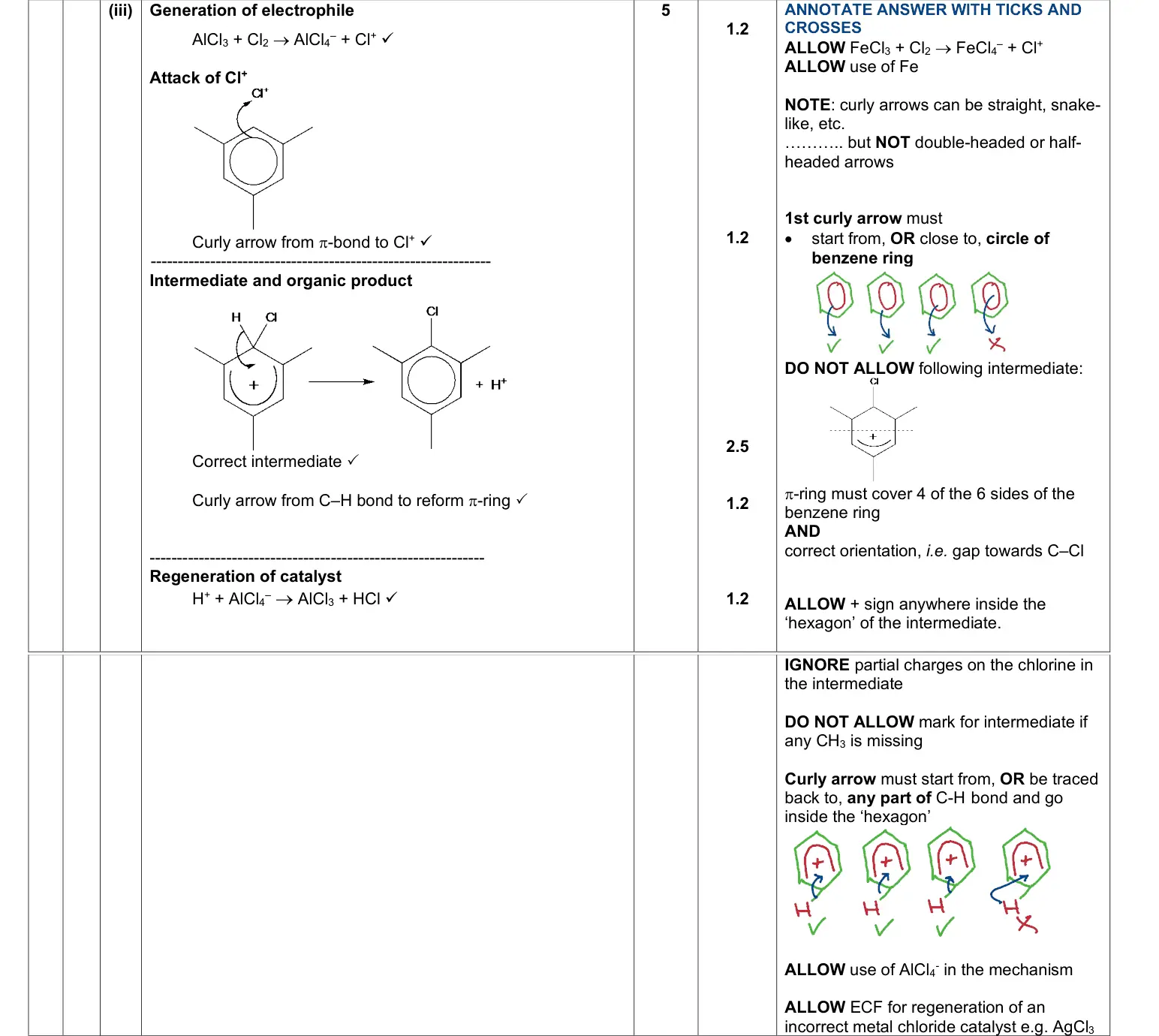
(ii) Stage 2 of Synthesis 1 is the conversion of methylbenzene to compound G.
Outline the mechanism for the reaction in Stage 2.
Show the role of H2SO4 as a catalyst.
[5]
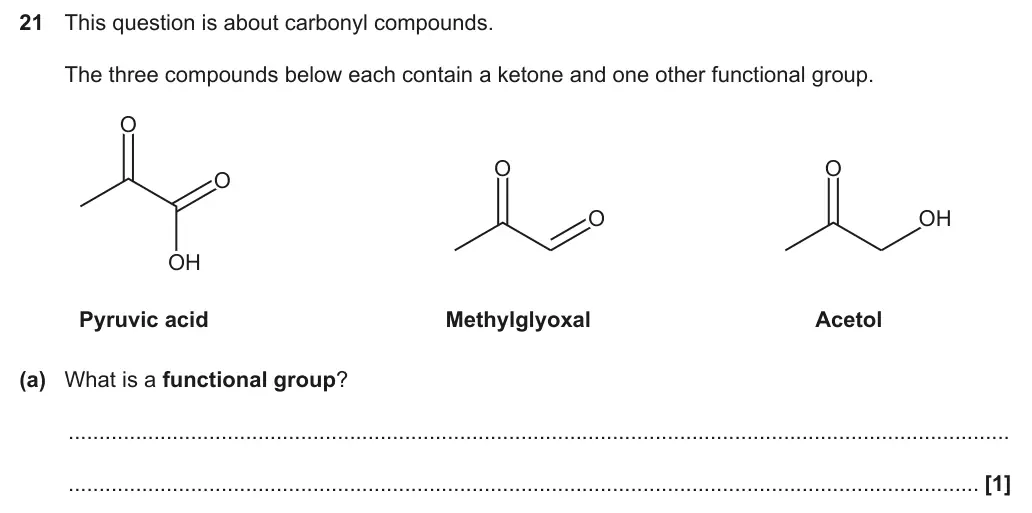
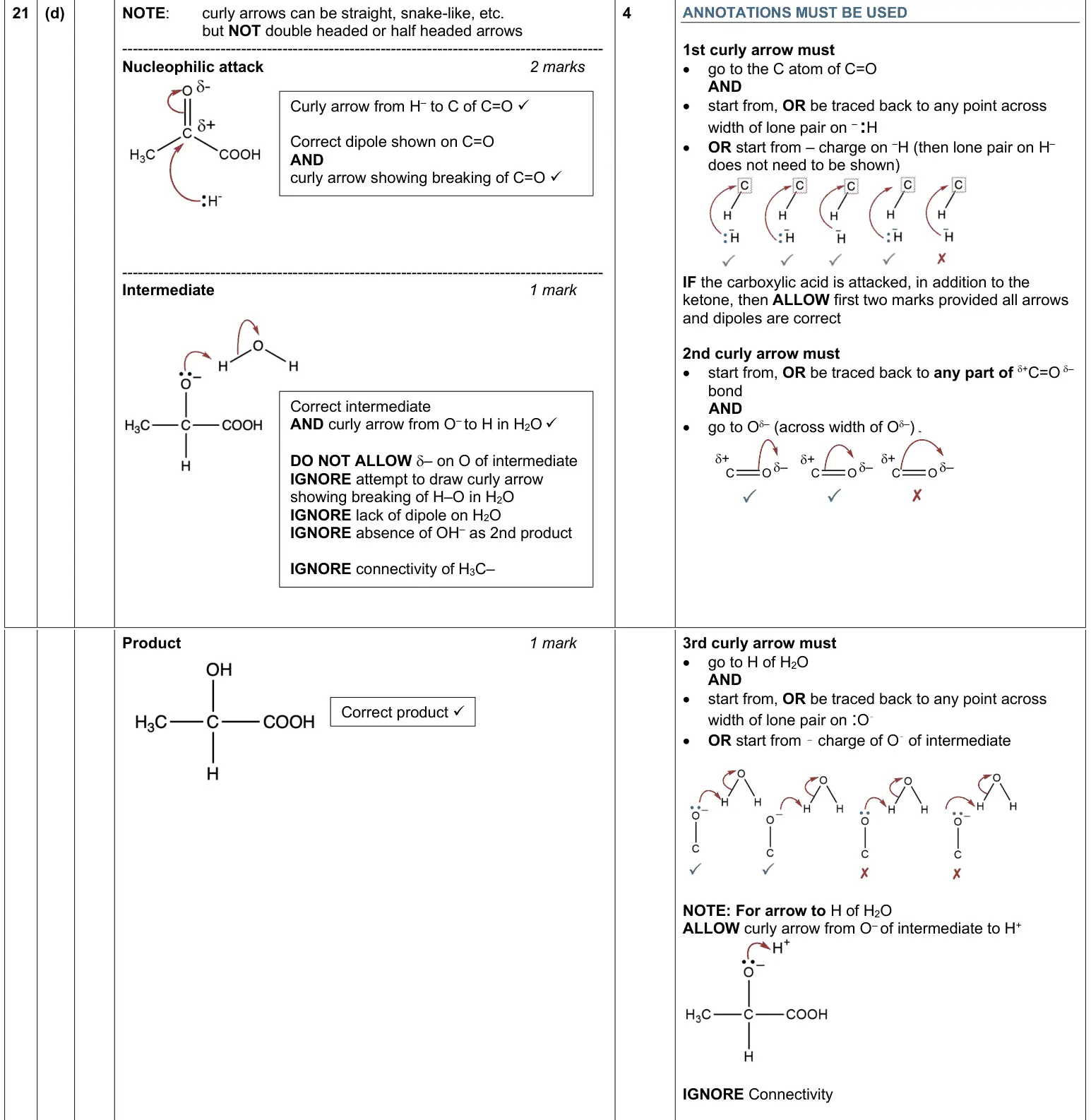
June 2025 · Paper 2 · Q21(d) 4 marks Mechanism Hard carbonyl compounds
Earlier part of question 21 that this part usesEarlier part of June 2025 Paper 2 question 21
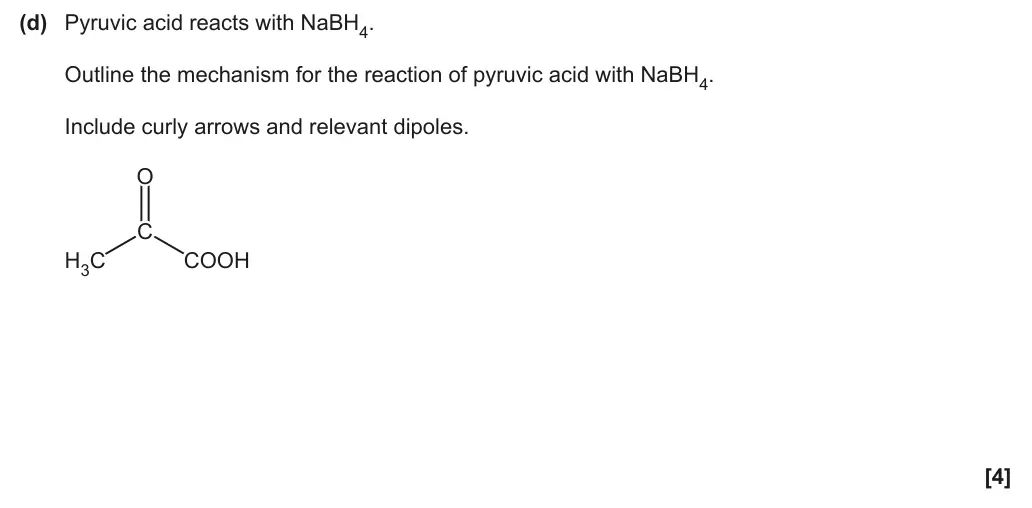
(d) Pyruvic acid reacts with NaBH4.
Outline the mechanism for the reaction of pyruvic acid with NaBH4.
Include curly arrows and relevant dipoles.
O
C
H3C COOH
[4]
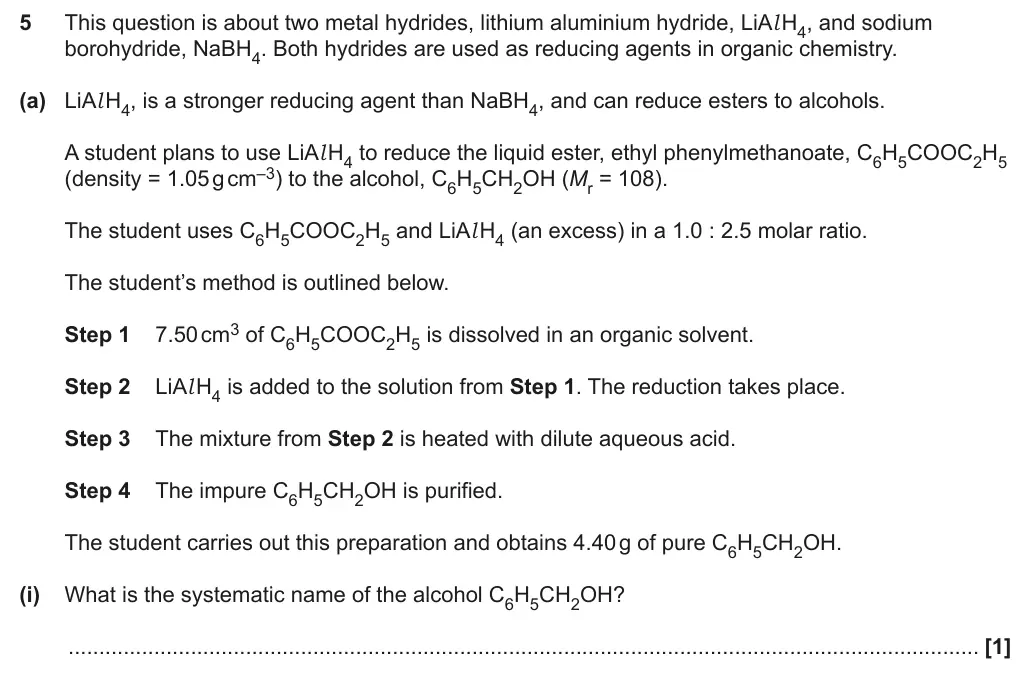
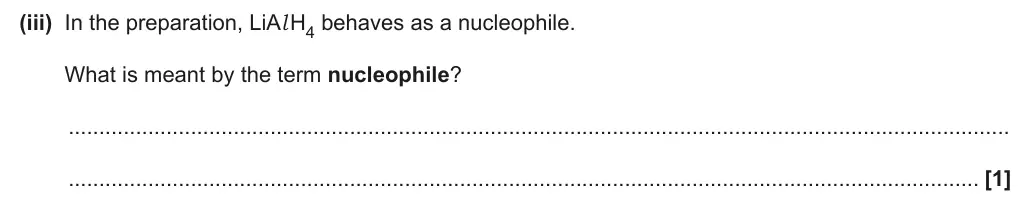
June 2025 · Paper 3 · Q5(a)(iv) 4 marks Mechanism Medium organic basicsorganic synthesis
Earlier parts of question 5 that this part usesEarlier part of June 2025 Paper 3 question 5Earlier part of June 2025 Paper 3 question 5
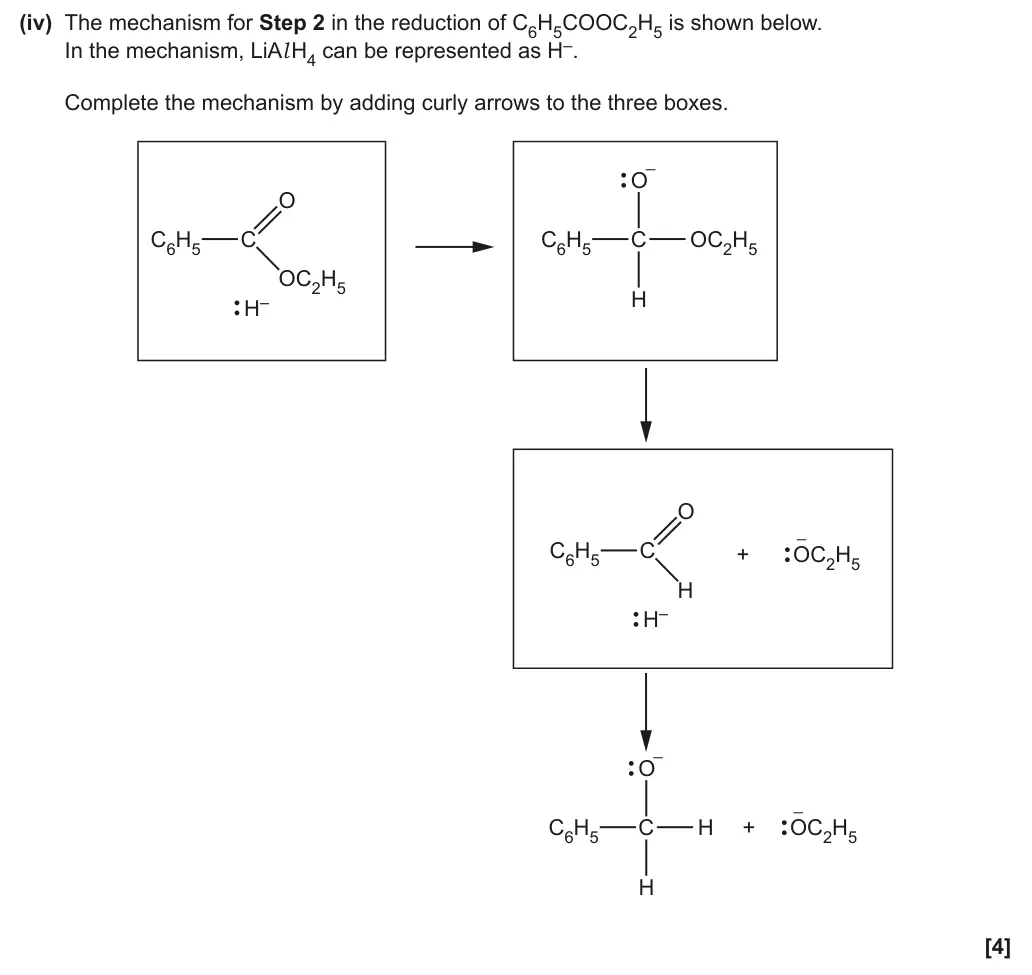
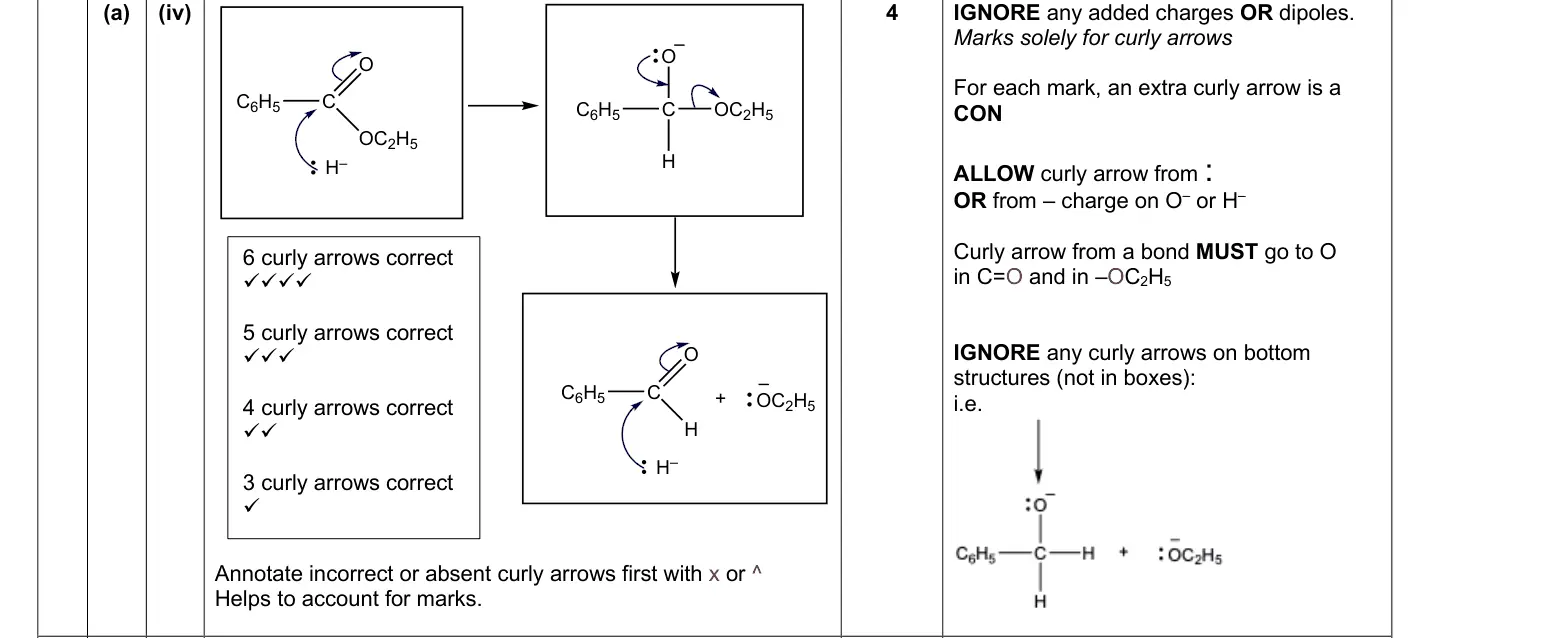
(iv) The mechanism for Step 2 in the reduction of C6H5COOC2H5 is shown below.
In the mechanism, LiAl H4 can be represented as H–.
Complete the mechanism by adding curly arrows to the three boxes.
_
O
O
C6H5 C C6H5 C OC2H5
OC2H5
H– H
O
_
C6H5 C + OC2H5
H
H–
_
O
_
C6H5 C H + OC2H5
H
[4]
June 2024 · AS Paper 1 · Q24(b) 5 marks Mechanism Medium alkanesorganic basics
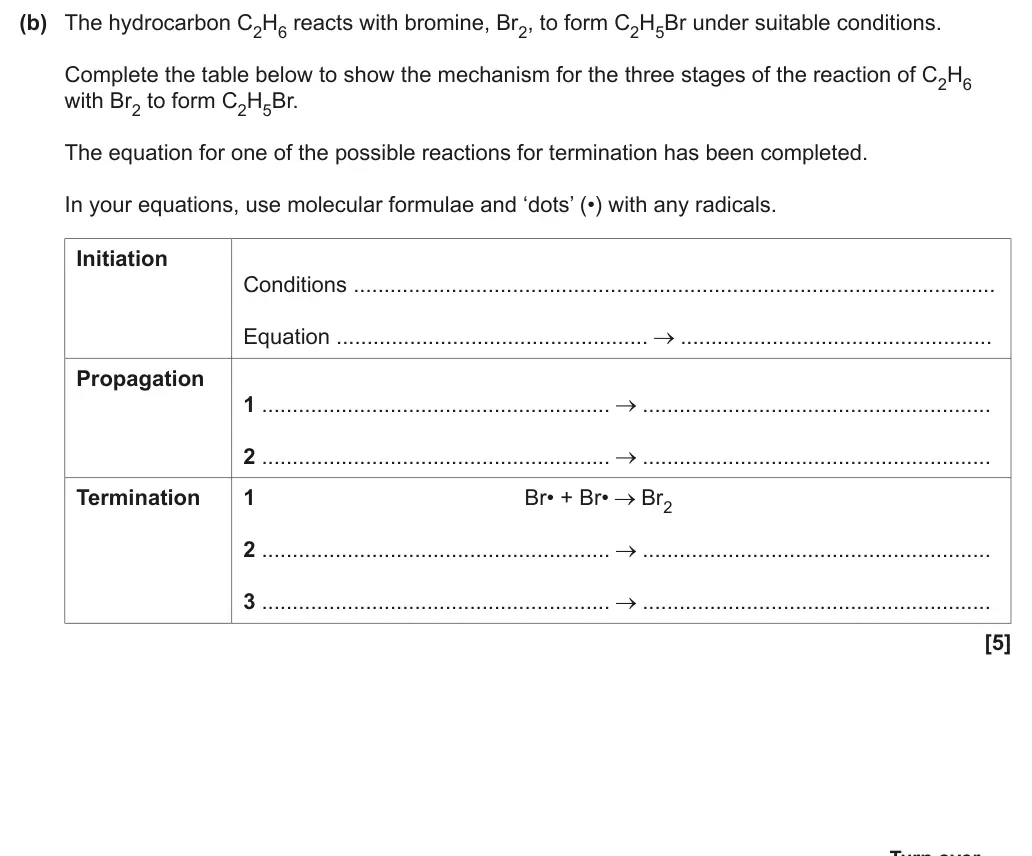
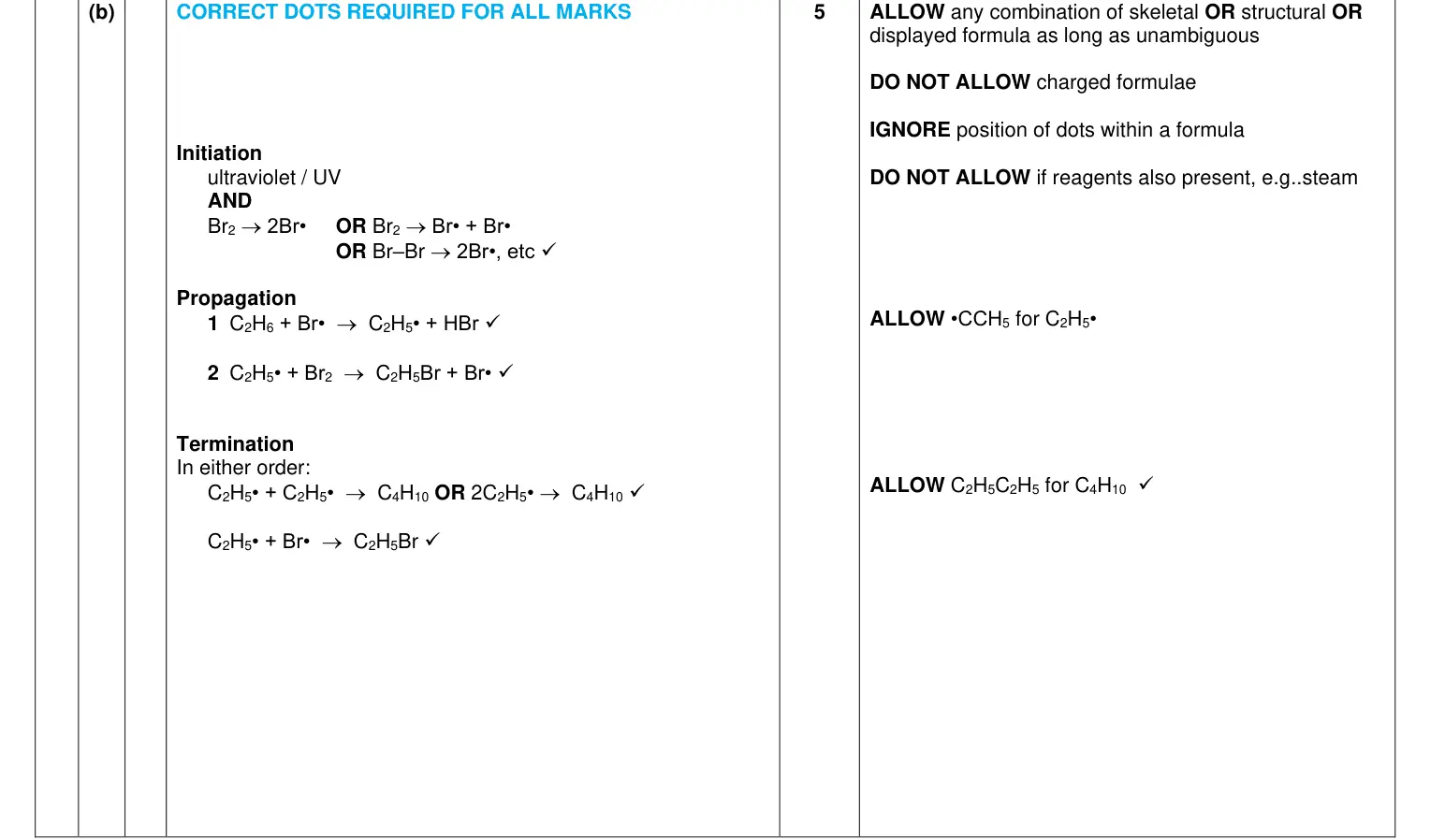
(b) The hydrocarbon C2H6 reacts with bromine, Br2, to form C2H5Br under suitable conditions.
Complete the table below to show the mechanism for the three stages of the reaction of C2H6
with Br2 to form C2H5Br.
The equation for one of the possible reactions for termination has been completed.
In your equations, use molecular formulae and ‘dots’ (•) with any radicals.
Initiation
Conditions .........................................................................................................
Equation ................................................... ...................................................
Propagation
1 ......................................................... .........................................................
2 ......................................................... .........................................................
Termination 1                                            Br• + Br• Br2
2 ......................................................... .........................................................
3 ......................................................... .........................................................
[5]
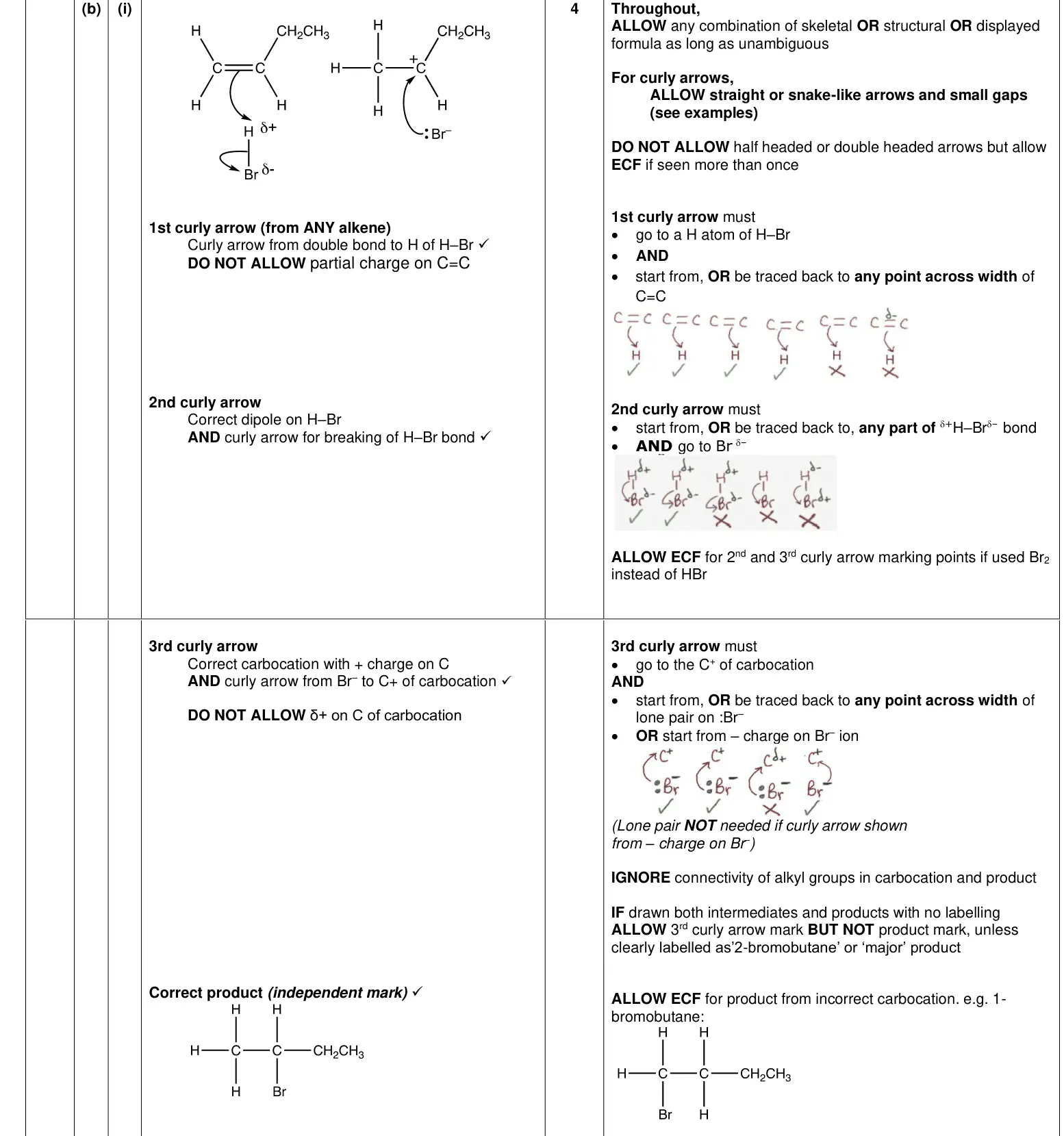
June 2024 · AS Paper 2 · Q5(b)(i) 4 marks Mechanism Hard alkenesorganic basics
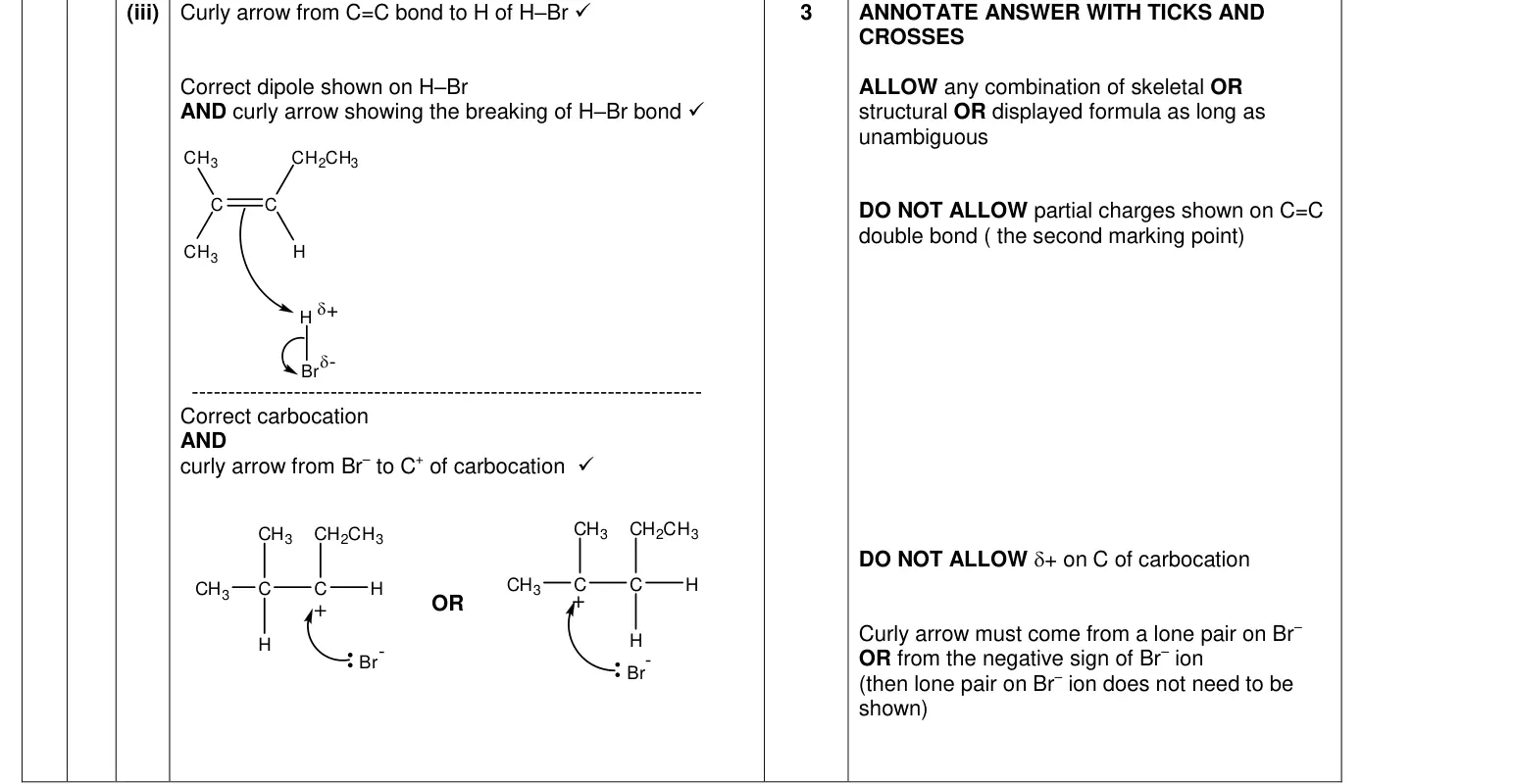
Earlier part of question 5 that this part usesEarlier part of June 2024 Paper 2 question 5
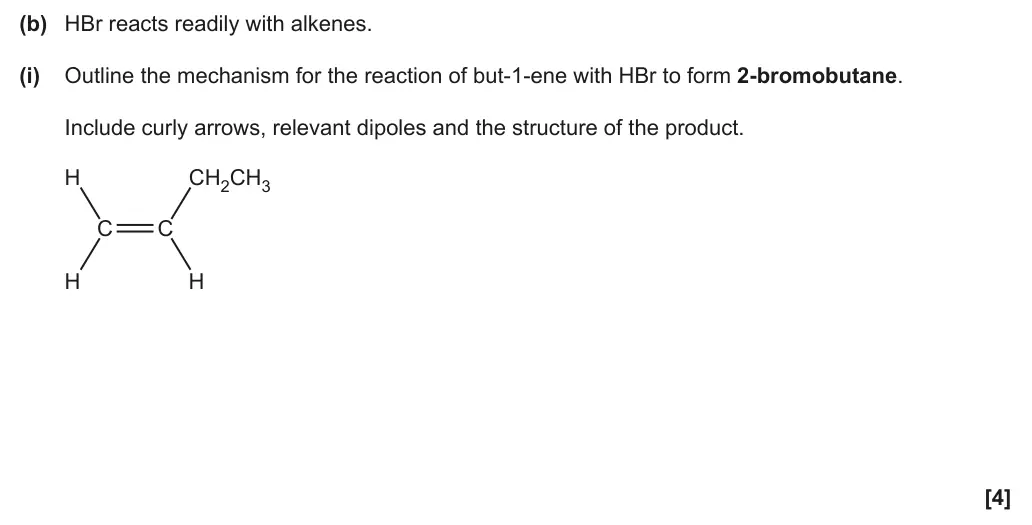
(b) HBr reacts readily with alkenes.
(i) Outline the mechanism for the reaction of but-1-ene with HBr to form 2-bromobutane.
Include curly arrows, relevant dipoles and the structure of the product.
H CH2CH3
C C
H H
[4]
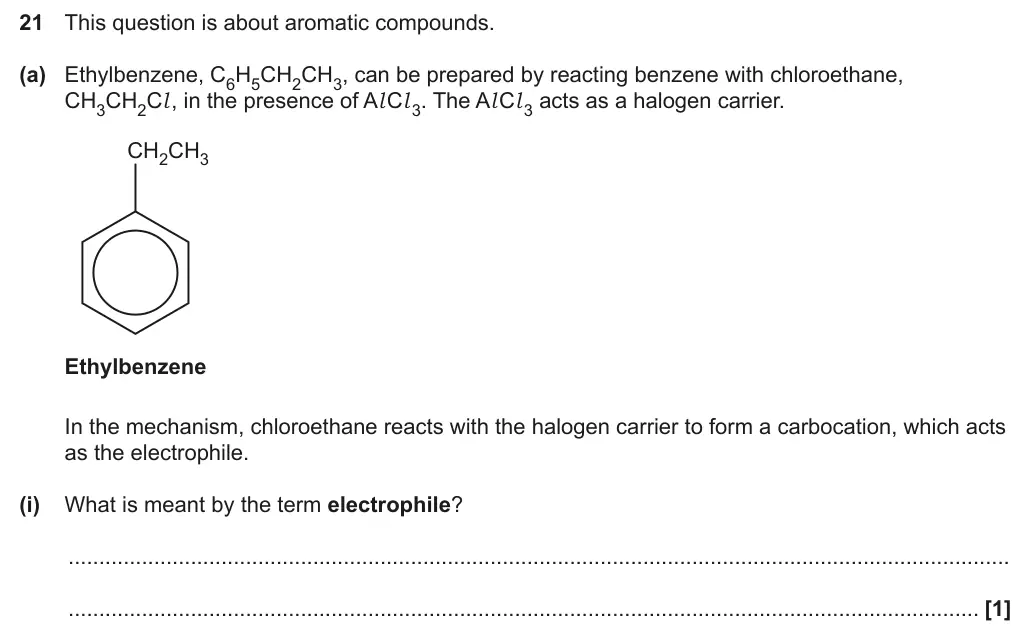
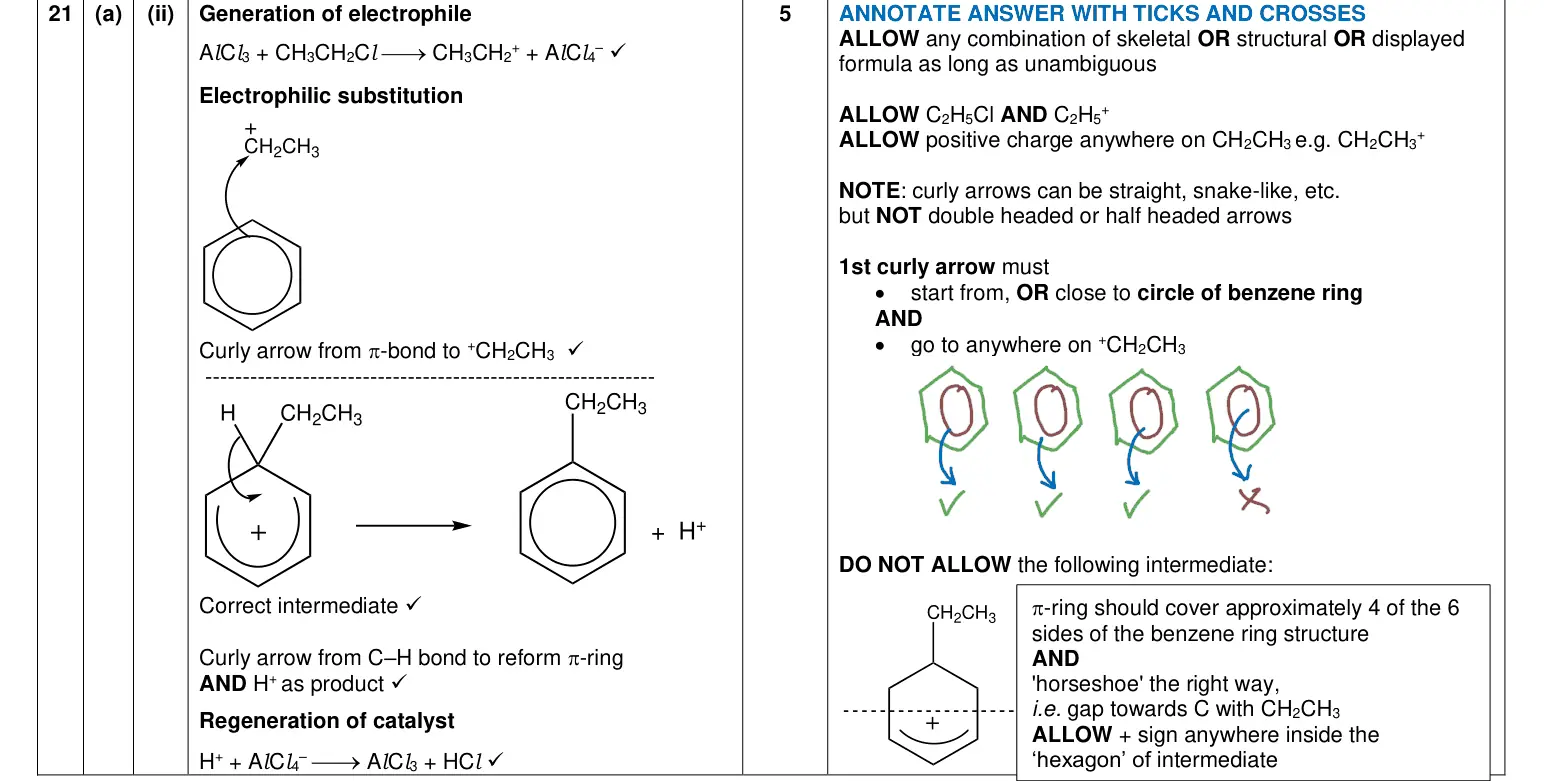
June 2024 · Paper 2 · Q21(a)(ii) 5 marks Mechanism Medium aromatic compoundsorganic basicscarbon carbon bond formation
Earlier part of question 21 that this part usesEarlier part of June 2024 Paper 2 question 21
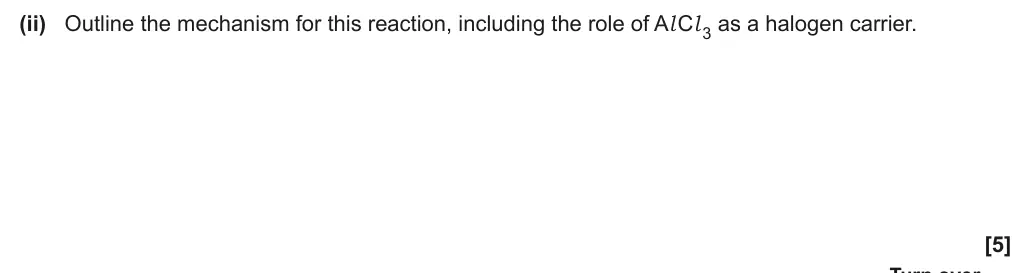
(ii) Outline the mechanism for this reaction, including the role of Al Cl 3 as a halogen carrier.
[5]
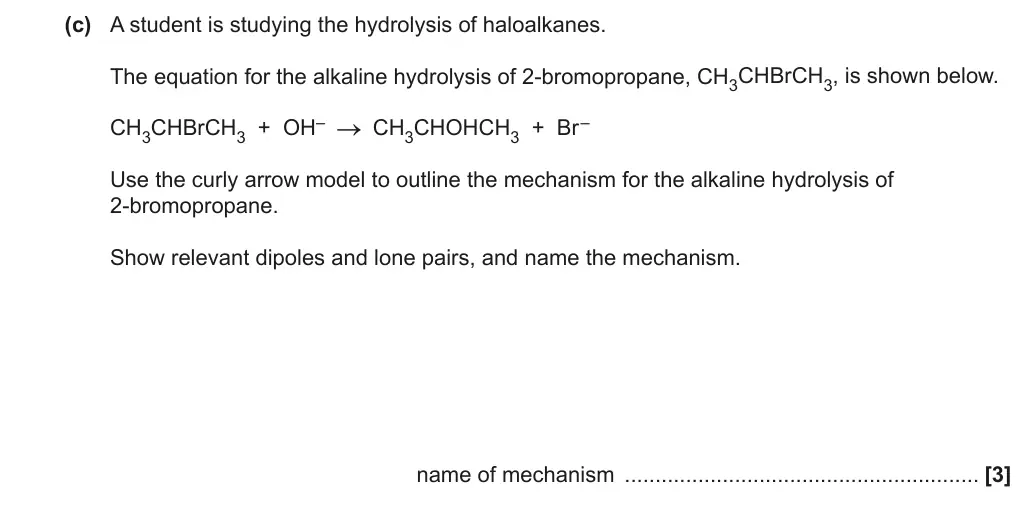
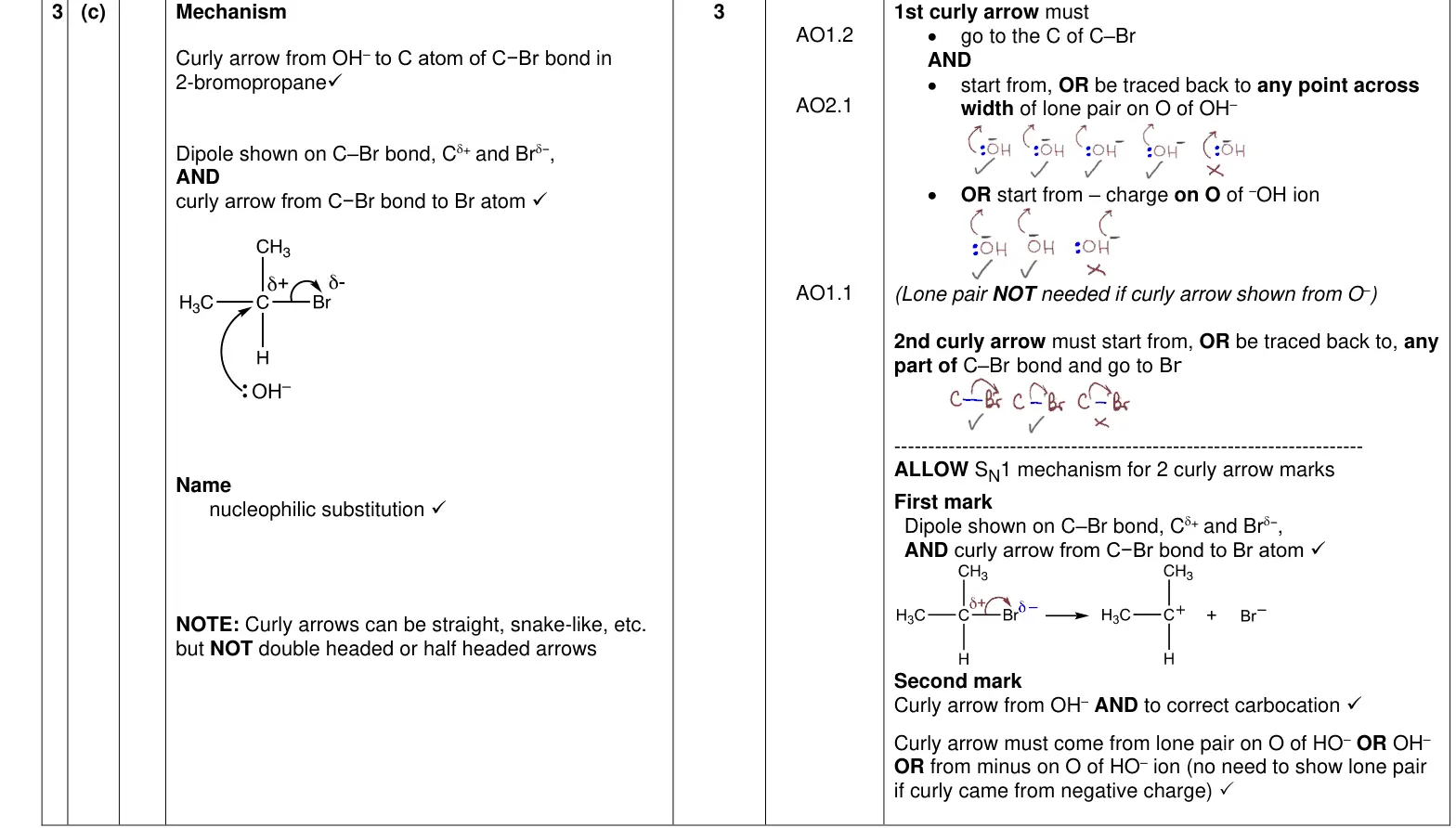
June 2023 · AS Paper 2 · Q3(c) 3 marks AO1, 2 Mechanism Medium haloalkanesorganic basics
(c) A student is studying the hydrolysis of haloalkanes.
The equation for the alkaline hydrolysis of 2-bromopropane, CH3CHBrCH3, is shown below.
CH3CHBrCH3  +  OH– CH3CHOHCH3  +  Br –
Use the curly arrow model to outline the mechanism for the alkaline hydrolysis of
2-bromopropane.
Show relevant dipoles and lone pairs, and name the mechanism.
name of mechanism  .......................................................... [3]
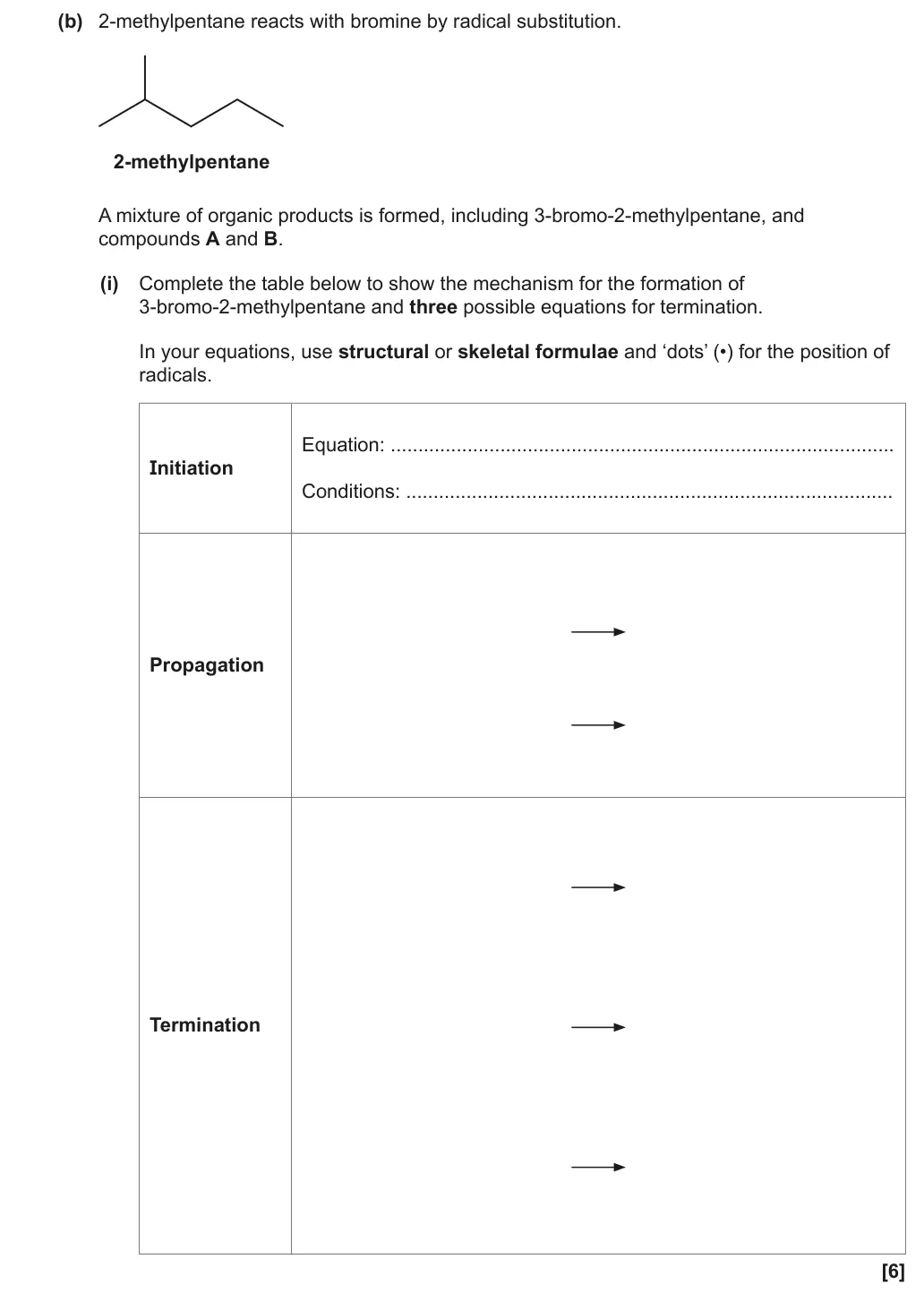
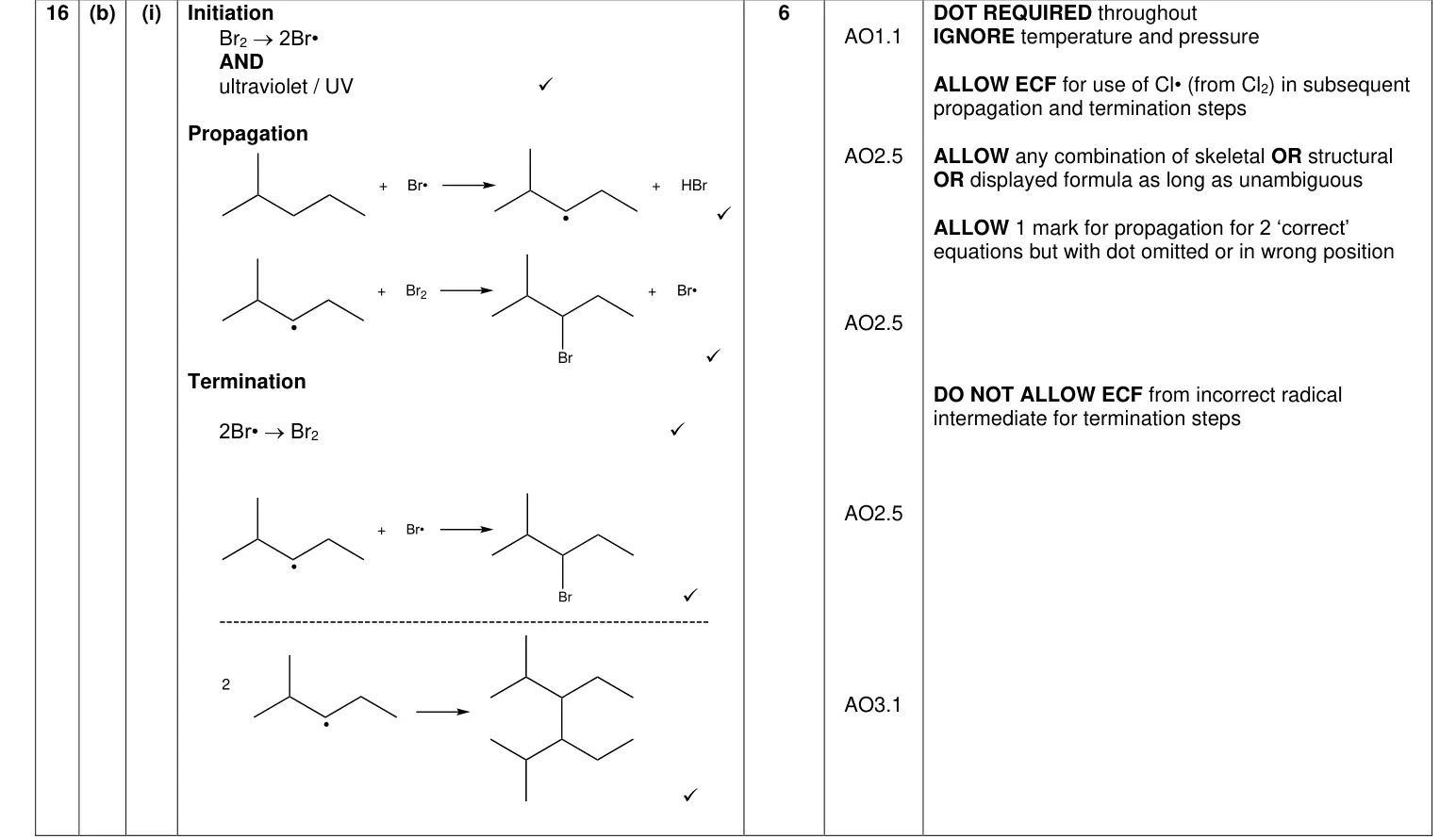
June 2023 · Paper 2 · Q16(b)(i) 6 marks AO1, 2, 3 Mechanism Medium alkanesorganic basics
(b) 2-methylpentane reacts with bromine by radical substitution.
2-methylpentane
A mixture of organic products is formed, including 3-bromo-2-methylpentane, and
compounds A and B.
(i) Complete the table below to show the mechanism for the formation of
3-bromo-2-methylpentane and three possible equations for termination.
In your equations, use structural or skeletal formulae and ‘dots’ (•) for the position of
radicals.
Equation: ............................................................................................
Initiation
Conditions: .........................................................................................
Propagation
Termination
[6]
June 2023 · Paper 2 · Q18(a) 5 marks AO1, 2 Mechanism Medium aromatic compounds
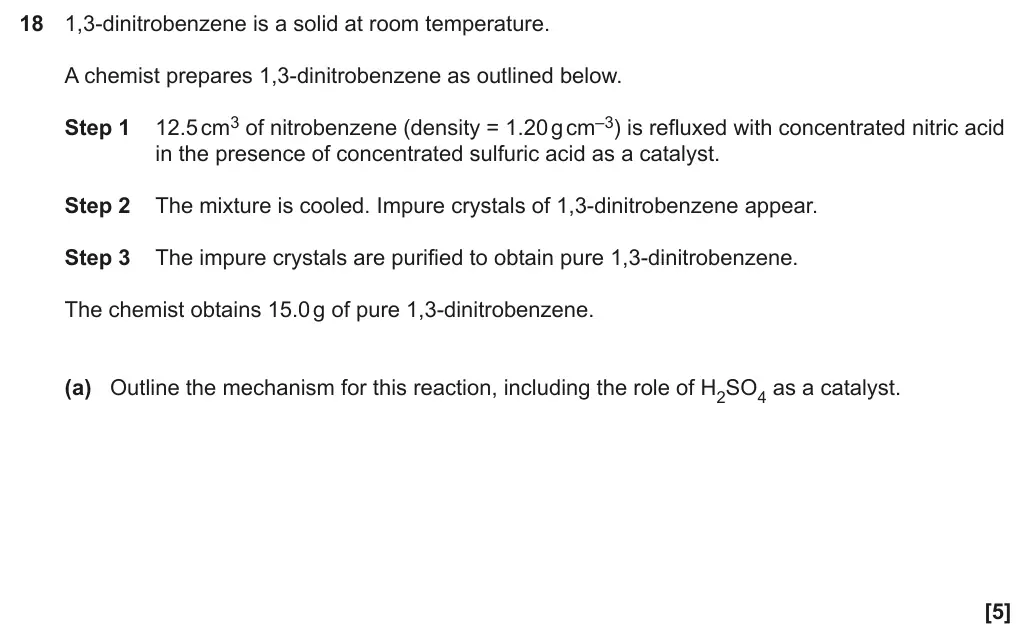
18 1,3-dinitrobenzene is a solid at room temperature.
A chemist prepares 1,3-dinitrobenzene as outlined below.
Step 1 12.5 cm3 of nitrobenzene (density = 1.20 g cm–3) is refluxed with concentrated nitric acid
in the presence of concentrated sulfuric acid as a catalyst.
Step 2 The mixture is cooled. Impure crystals of 1,3-dinitrobenzene appear.
Step 3 The impure crystals are purified to obtain pure 1,3-dinitrobenzene.
The chemist obtains 15.0 g of pure 1,3-dinitrobenzene.
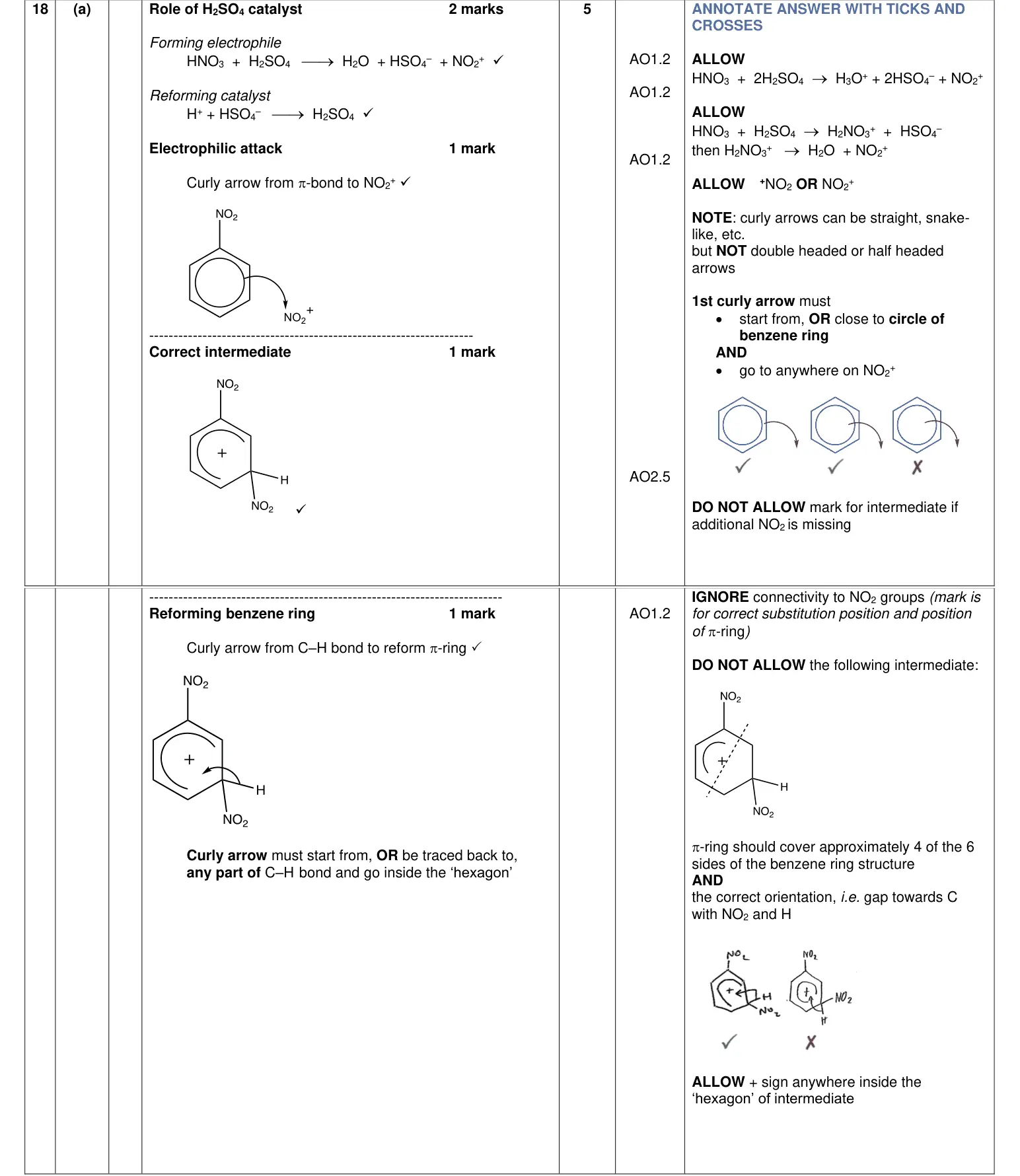
(a) Outline the mechanism for this reaction, including the role of H2SO4 as a catalyst.
[5]
June 2023 · Paper 2 · Q22(a)(i) 4 marks AO1, 2 Mechanism Easy carbonyl compoundsorganic basicscarbon carbon bond formation
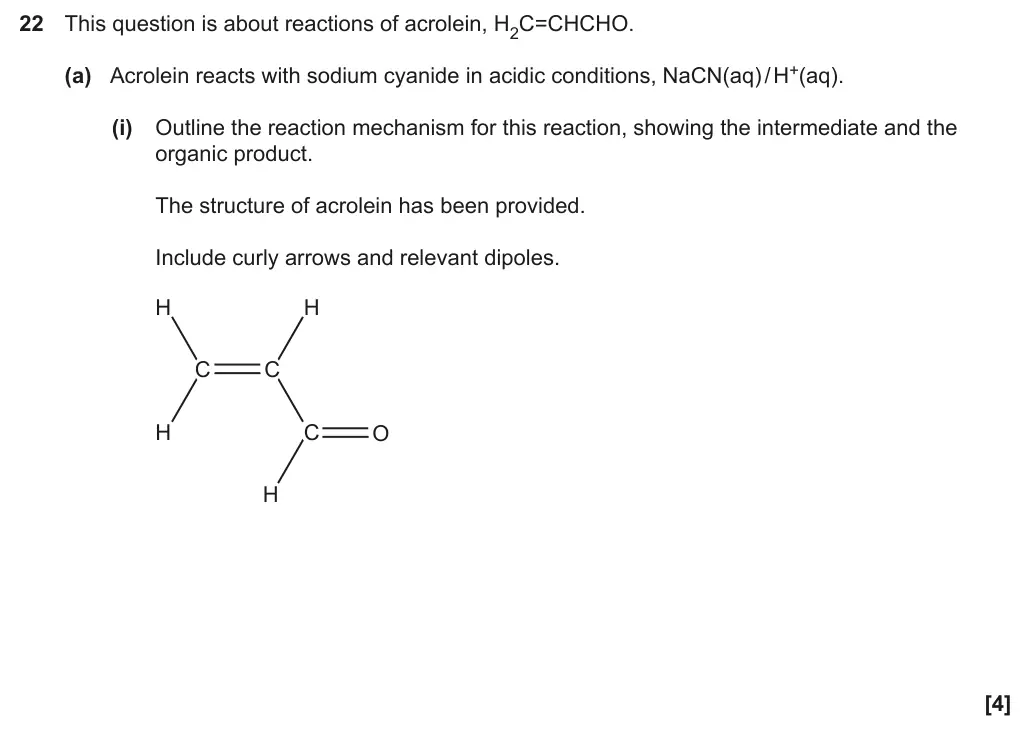
22 This question is about reactions of acrolein, H2C=CHCHO.
(a) Acrolein reacts with sodium cyanide in acidic conditions, NaCN(aq) / H+(aq).
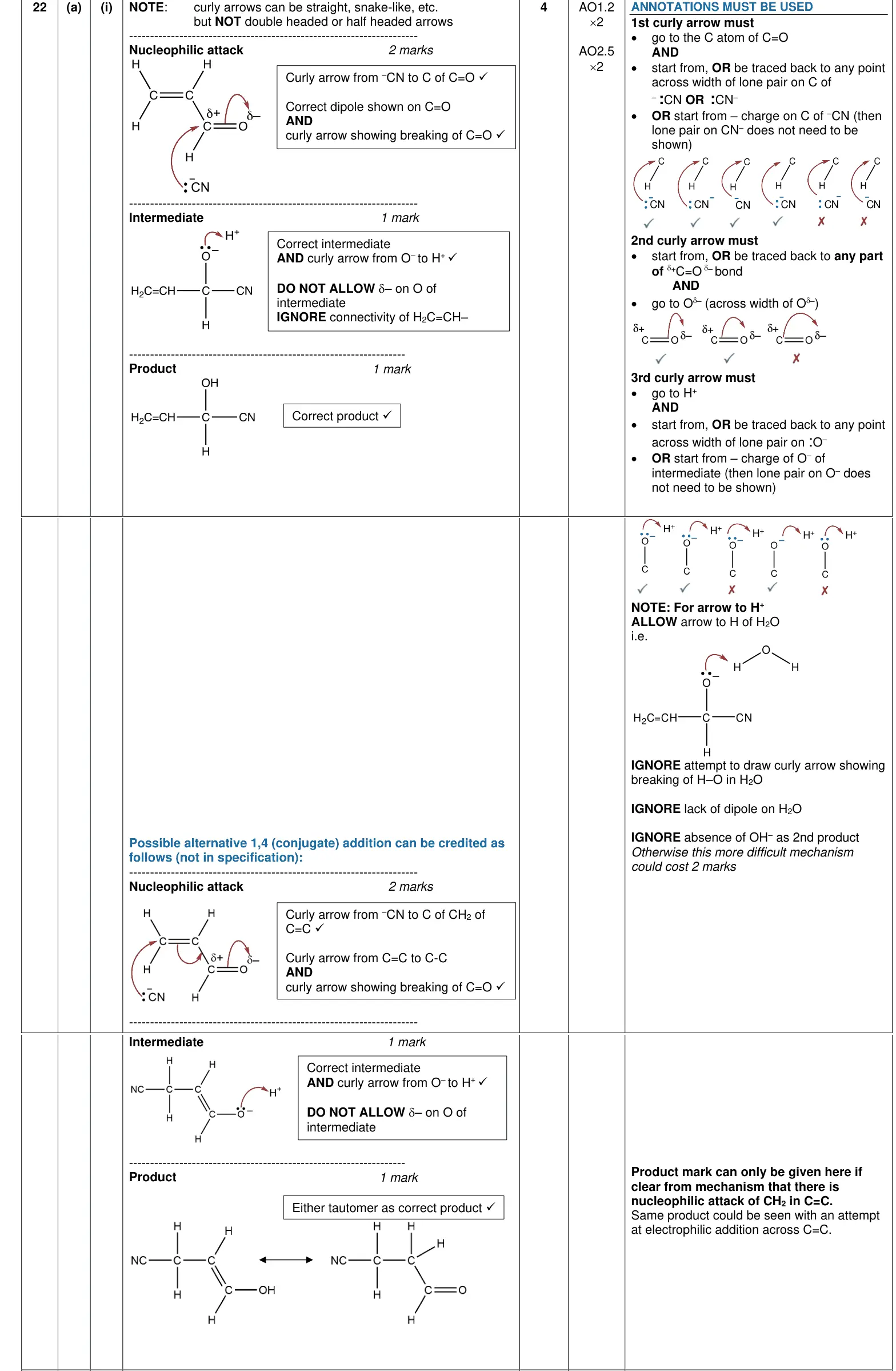
(i) Outline the reaction mechanism for this reaction, showing the intermediate and the
organic product.
The structure of acrolein has been provided.
Include curly arrows and relevant dipoles.
H H
C C
H C O
H
[4]
June 2023 · Paper 3 · Q2(c) 4 marks AO3 Mechanism Medium organic basicshaloalkanes
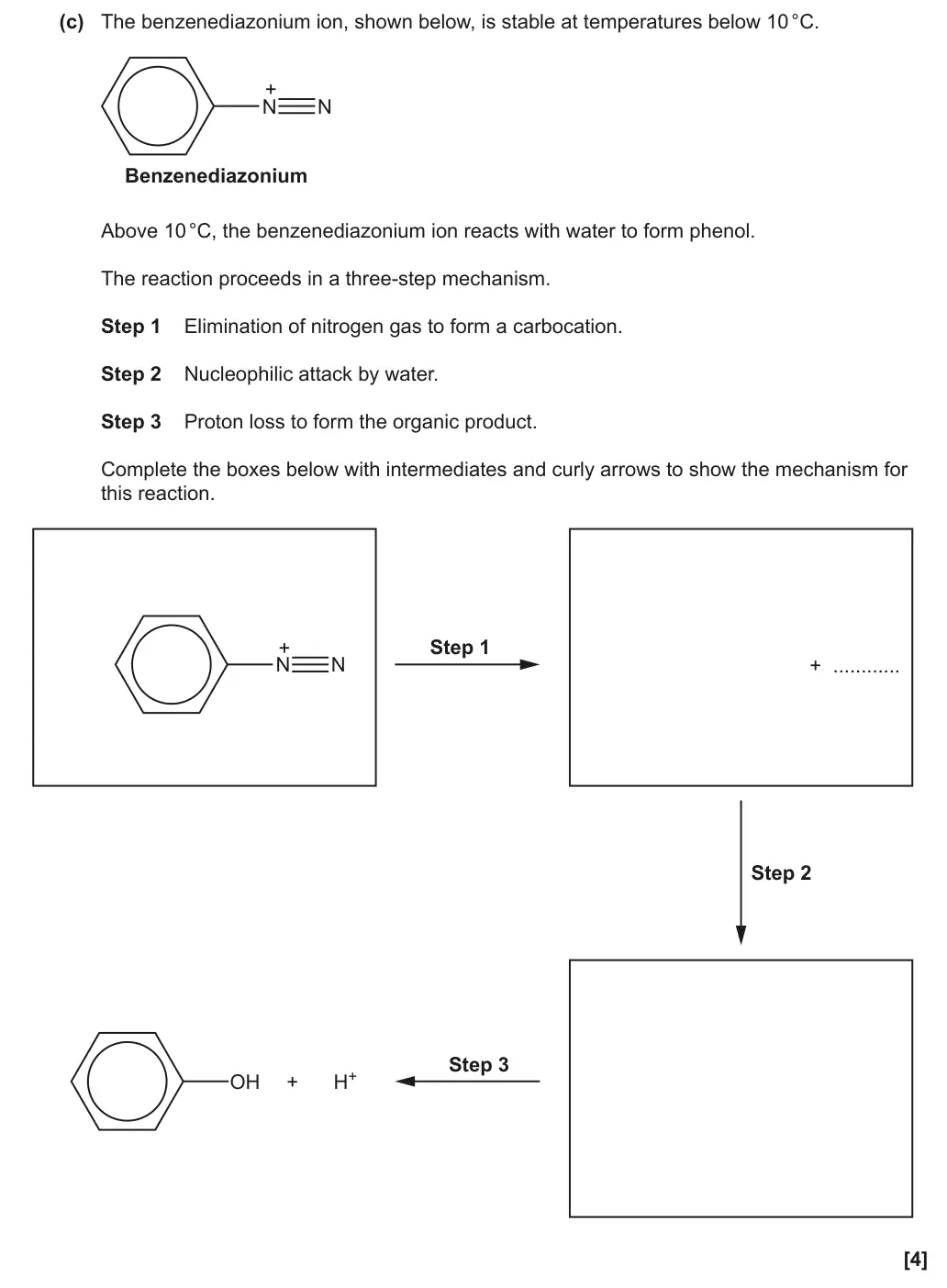
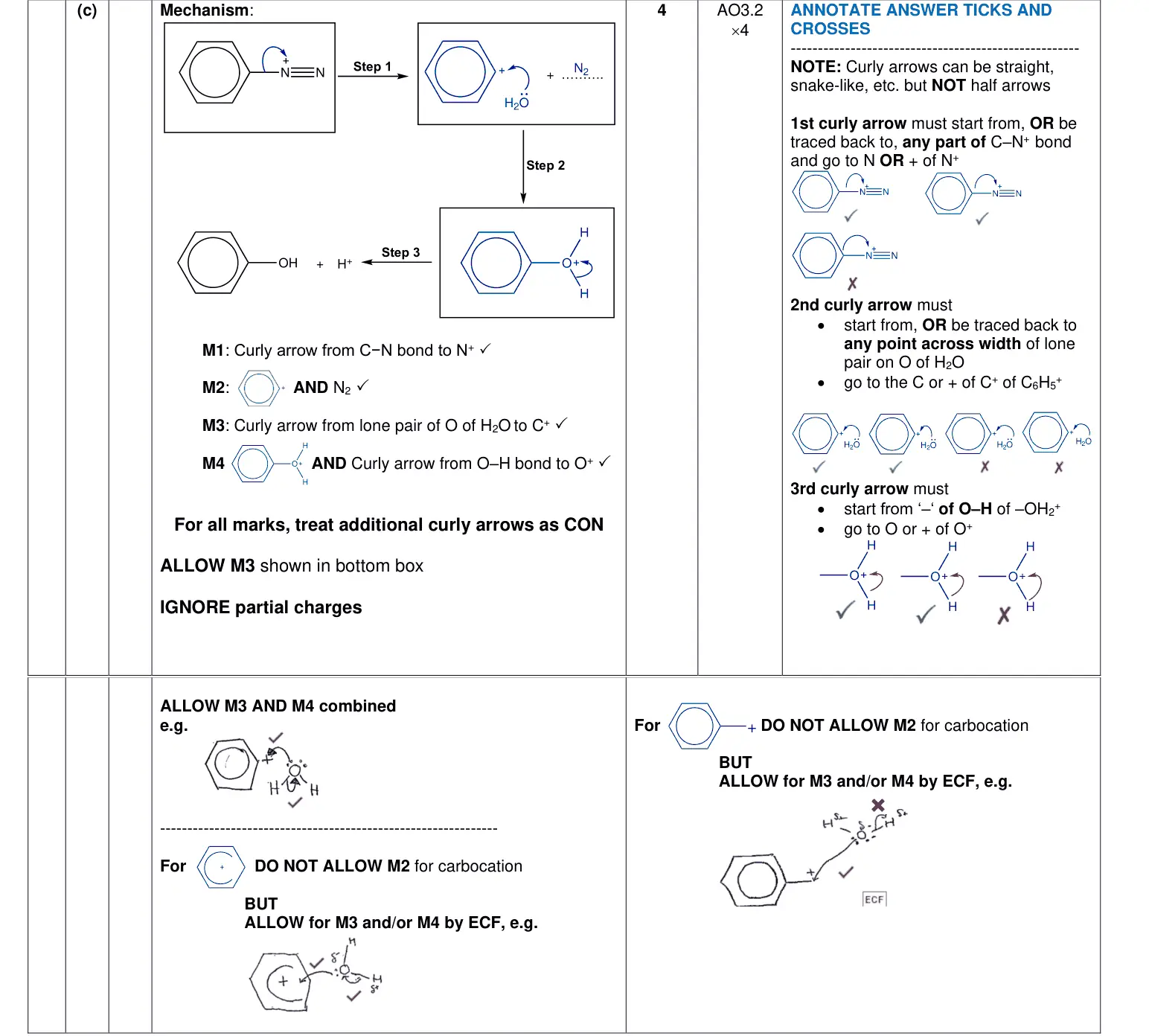
(c) The benzenediazonium ion, shown below, is stable at temperatures below 10 °C.
+
N N
Benzenediazonium
Above 10 °C, the benzenediazonium ion reacts with water to form phenol.
The reaction proceeds in a three-step mechanism.
Step 1 Elimination of nitrogen gas to form a carbocation.
Step 2 Nucleophilic attack by water.
Step 3 Proton loss to form the organic product.
Complete the boxes below with intermediates and curly arrows to show the mechanism for
this reaction.
+ Step 1
N N + ............
Step 2
Step 3
OH + H+
[4]
June 2022 · AS Paper 1 · Q21(a)(ii) 5 marks AO1, 2 Mechanism Medium alkenesorganic basics
Earlier part of question 21 that this part usesEarlier part of June 2022 Paper 1 question 21
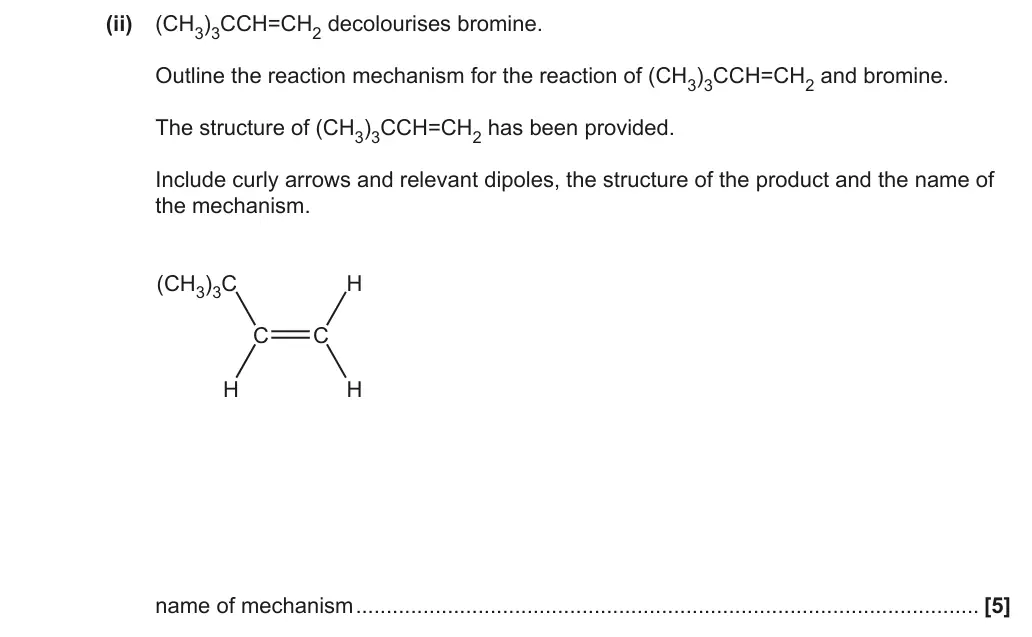
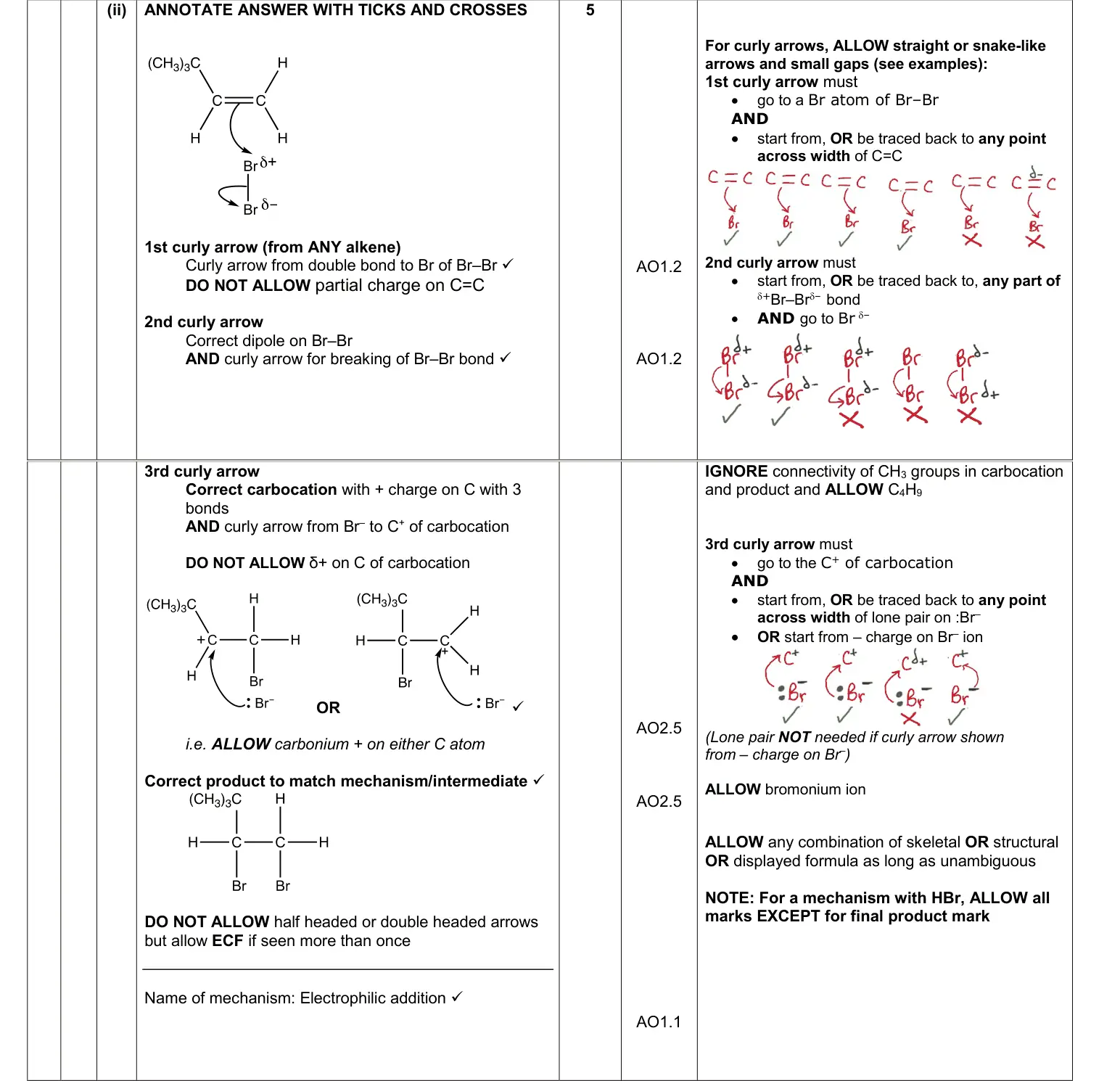
(ii) (CH3)3CCH=CH2 decolourises bromine.
Outline the reaction mechanism for the reaction of (CH3)3CCH=CH2 and bromine.
The structure of (CH3)3CCH=CH2 has been provided.
Include curly arrows and relevant dipoles, the structure of the product and the name of
the mechanism.
(CH3)3C H
C C
H H
name of mechanism ...................................................................................................... [5]
June 2022 · AS Paper 1 · Q26(a) 3 marks AO1, 2 Mechanism Medium haloalkanesorganic basics
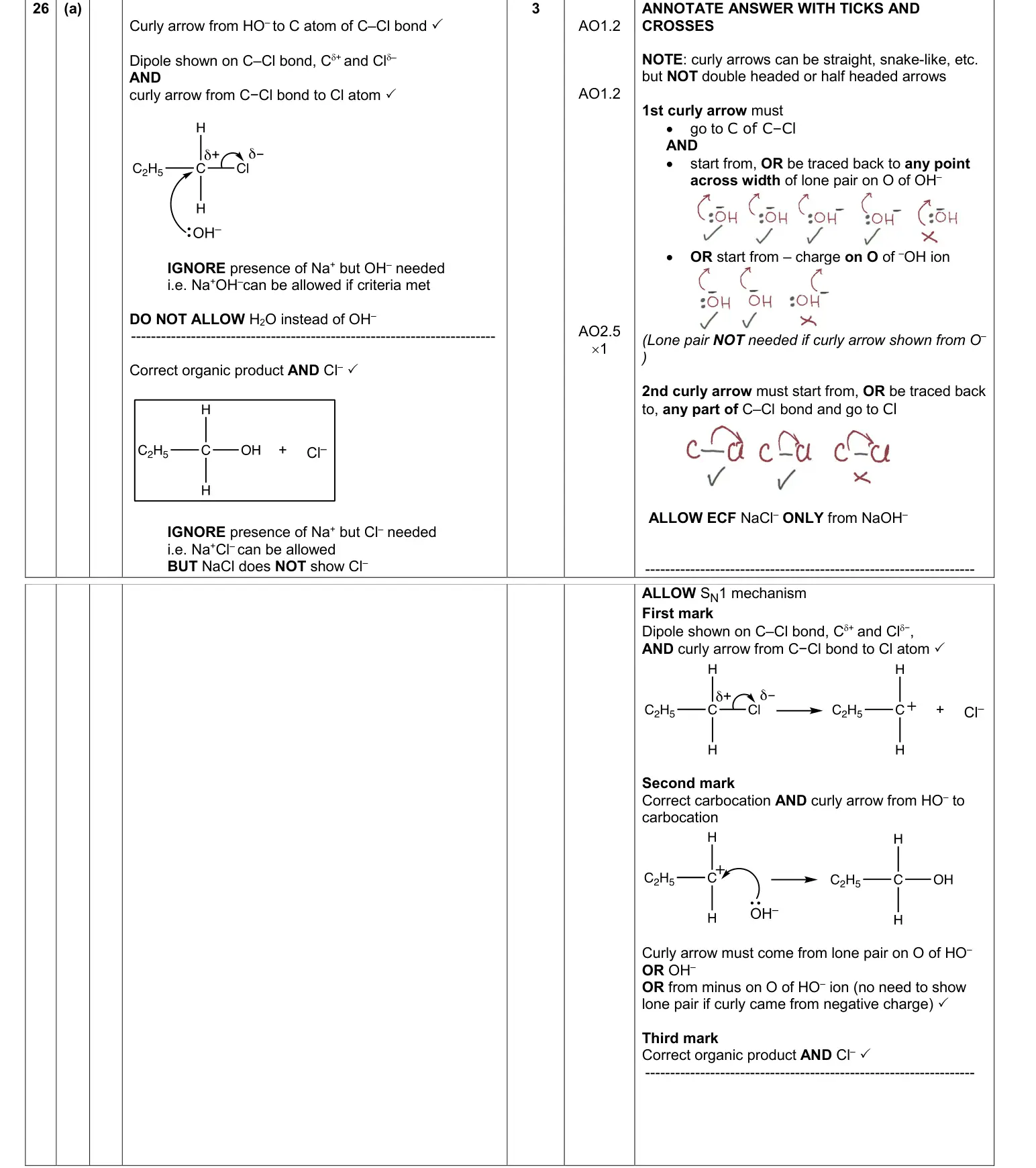
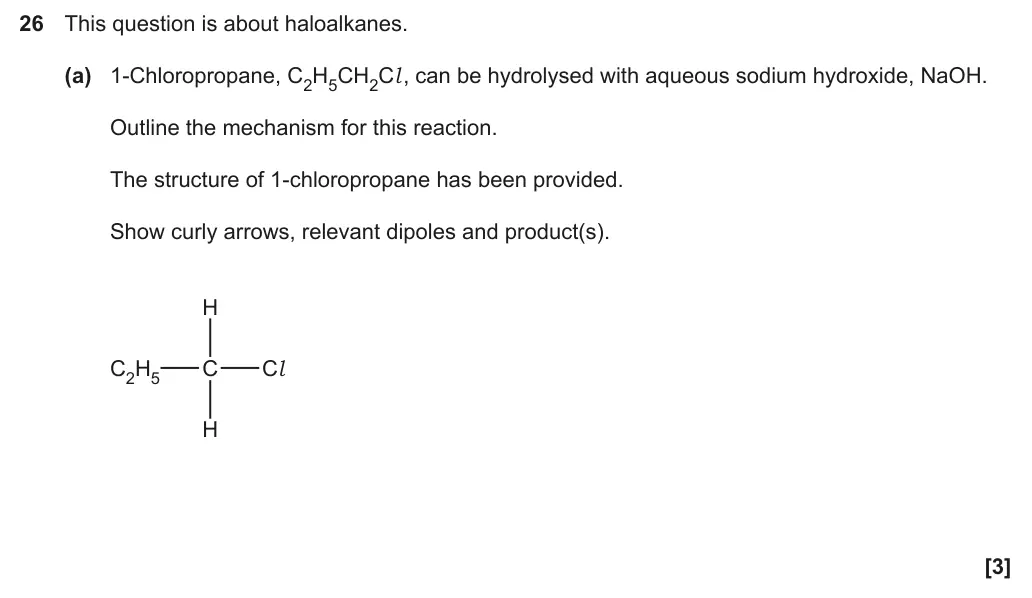
26 This question is about haloalkanes.
(a) 1-Chloropropane, C2H5CH2Cl , can be hydrolysed with aqueous sodium hydroxide, NaOH.
Outline the mechanism for this reaction.
The structure of 1-chloropropane has been provided.
Show curly arrows, relevant dipoles and product(s).
H
C2H5 C Cl
H
[3]
June 2022 · Paper 2 · Q16(a)(ii) 3 marks AO1, 2 Mechanism Easy alkenesorganic basics
Earlier part of question 16 that this part usesEarlier part of June 2022 Paper 2 question 16
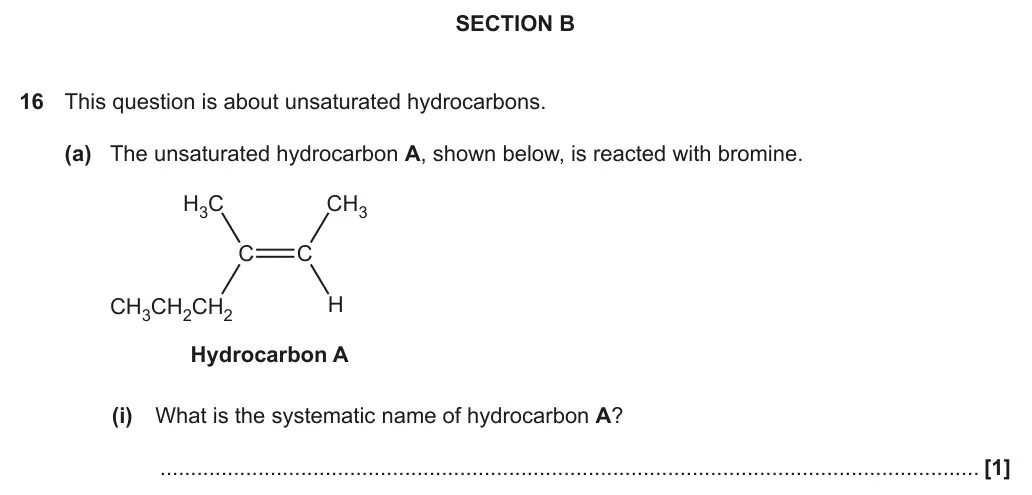
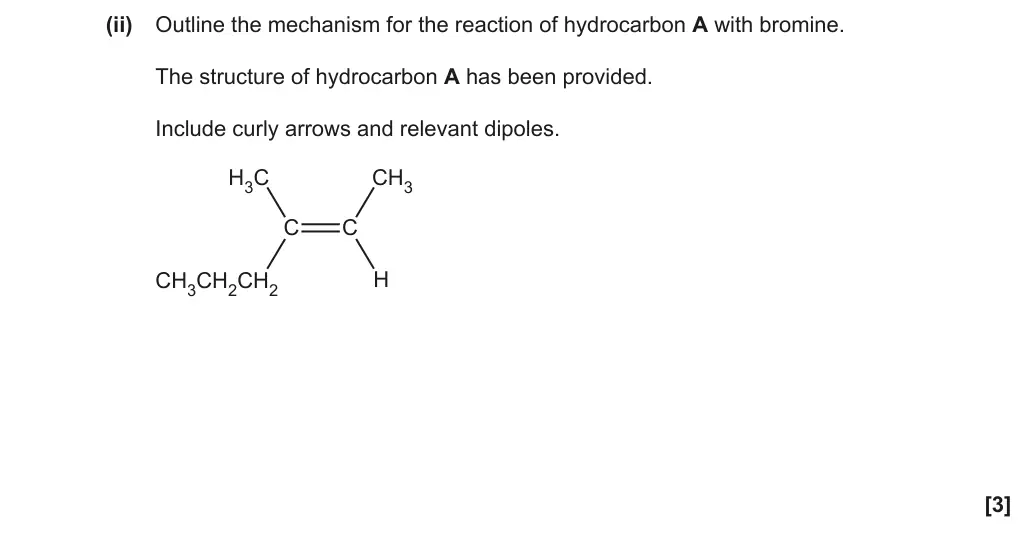
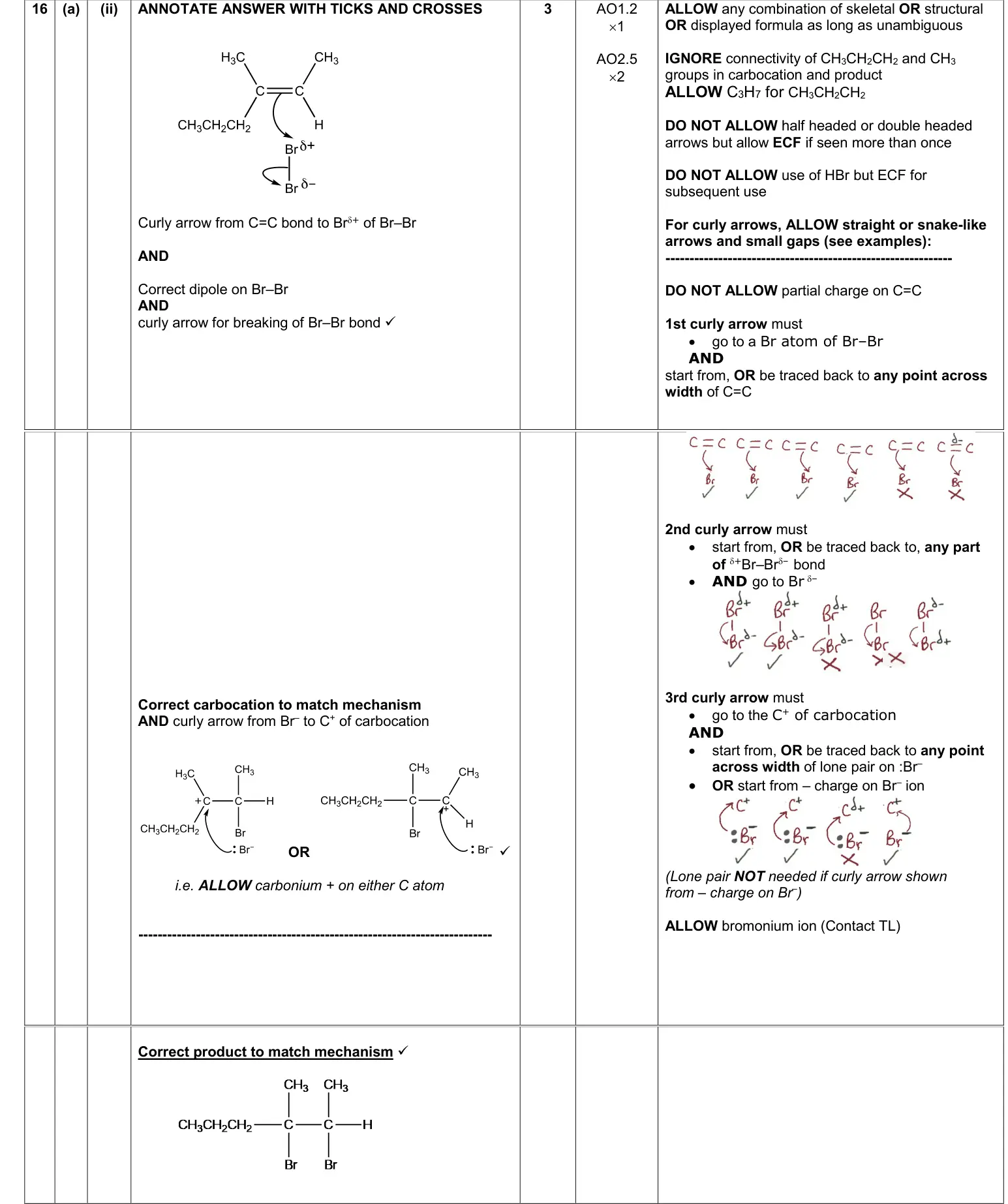
(ii) Outline the mechanism for the reaction of hydrocarbon A with bromine.
The structure of hydrocarbon A has been provided.
Include curly arrows and relevant dipoles.
H3C CH3
C C
CH3CH2CH2 H
[3]
June 2022 · Paper 2 · Q16(c)(ii) 1 mark AO3 Mechanism Hard organic basics
Earlier part of question 16 that this part usesEarlier part of June 2022 Paper 2 question 16
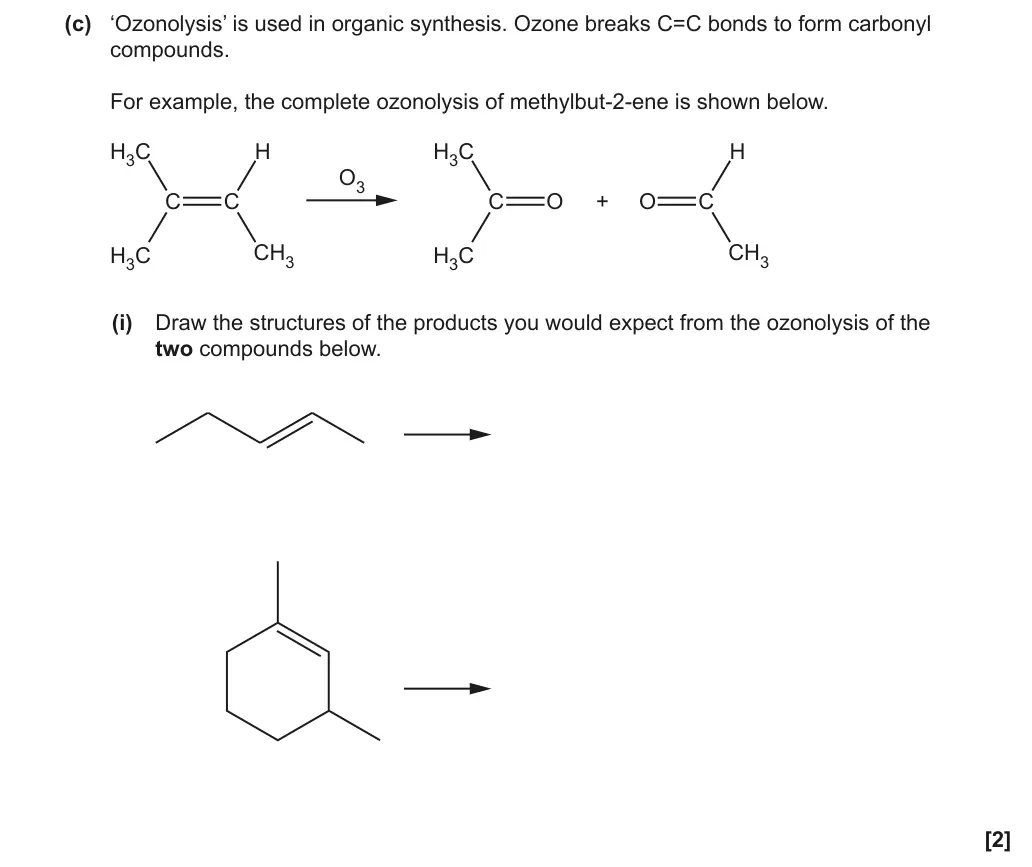
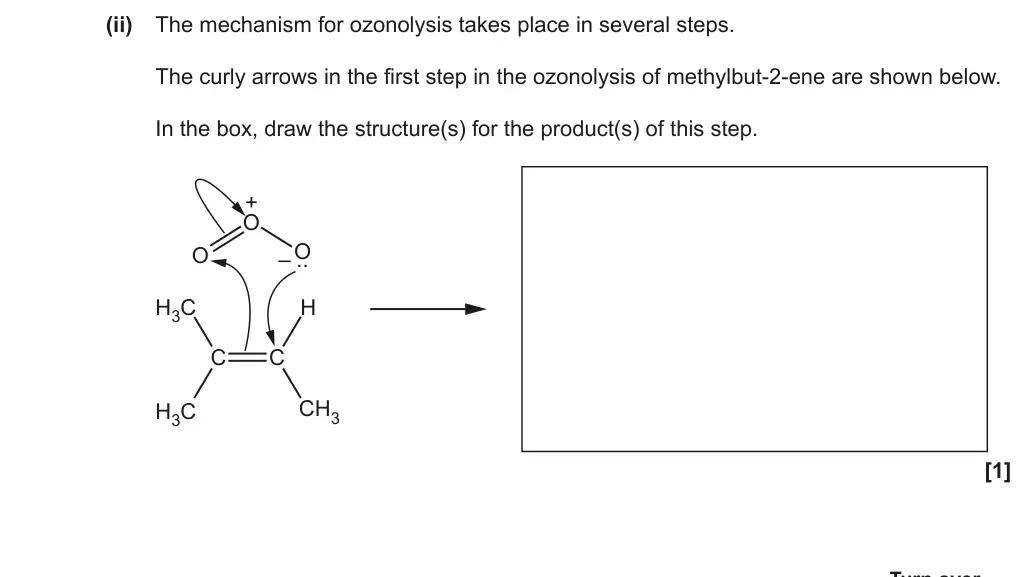
(ii) The mechanism for ozonolysis takes place in several steps.
The curly arrows in the first step in the ozonolysis of methylbut-2-ene are shown below.
In the box, draw the structure(s) for the product(s) of this step.
+
O
O O..
–
H3C H
C C
H3C CH3
[1]
June 2022 · Paper 2 · Q20(a)(iii) 4 marks AO1, 2 Mechanism Medium aromatic compounds
Earlier part of question 20 that this part usesEarlier part of June 2022 Paper 2 question 20
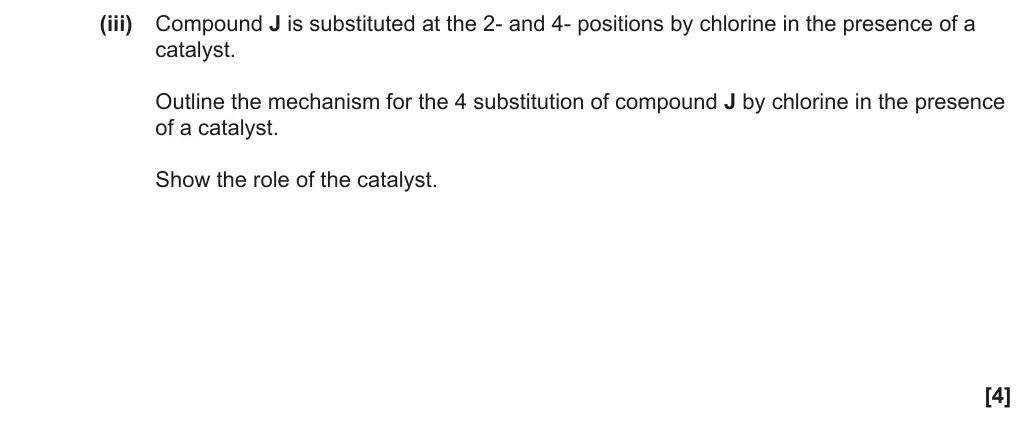
(iii) Compound J is substituted at the 2- and 4- positions by chlorine in the presence of a
catalyst.
Outline the mechanism for the 4 substitution of compound J by chlorine in the presence
of a catalyst.
Show the role of the catalyst.
[4]
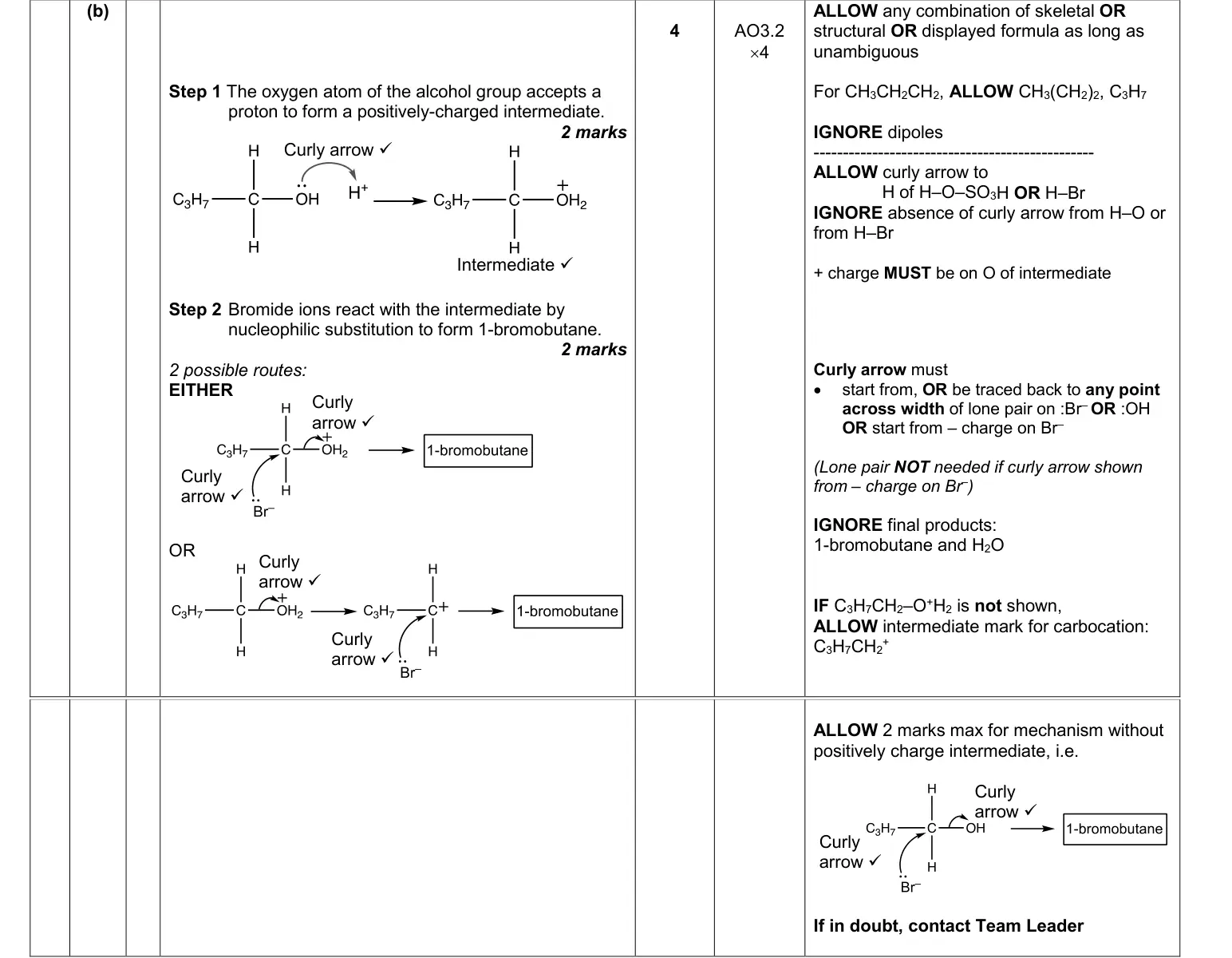
June 2022 · Paper 3 · Q3(b) 4 marks AO3 Mechanism Medium organic basicsalcoholshaloalkanes
Earlier part of question 3 that this part usesEarlier part of June 2022 Paper 3 question 3
(b) Butan-1-ol reacts with sodium bromide and sulfuric acid to form 1-bromobutane by
nucleophilic substitution.
The mechanism for this reaction takes place by two steps.
Step 1 The oxygen atom of the alcohol group accepts a proton to form a positively-
charged intermediate.
Step 2 Bromide ions react with the intermediate from Step 1 by nucleophilic substitution
to form 1-bromobutane.
Show both steps in this mechanism.
[4]
June 2022 · Paper 3 · Q6(c)(i) 2 marks AO3 Mechanism Hard organic basicsacids bases and buffers
Earlier part of question 6 that this part usesEarlier part of June 2022 Paper 3 question 6
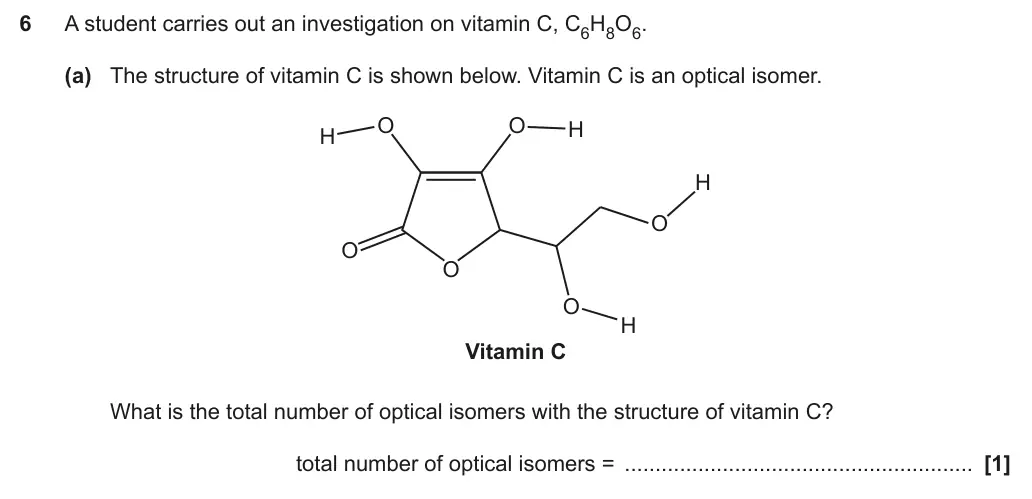
(c) Vitamin C, C6H8O6, is a weak acid (Ka = 7.94 x 10⁻⁵ (mol dm–3)), which is often referred to
as ascorbic acid.
(i) In aqueous solution, vitamin C donates a proton to water:
C6H8O6  +  H2O C6H7O6 –  +  H3O+
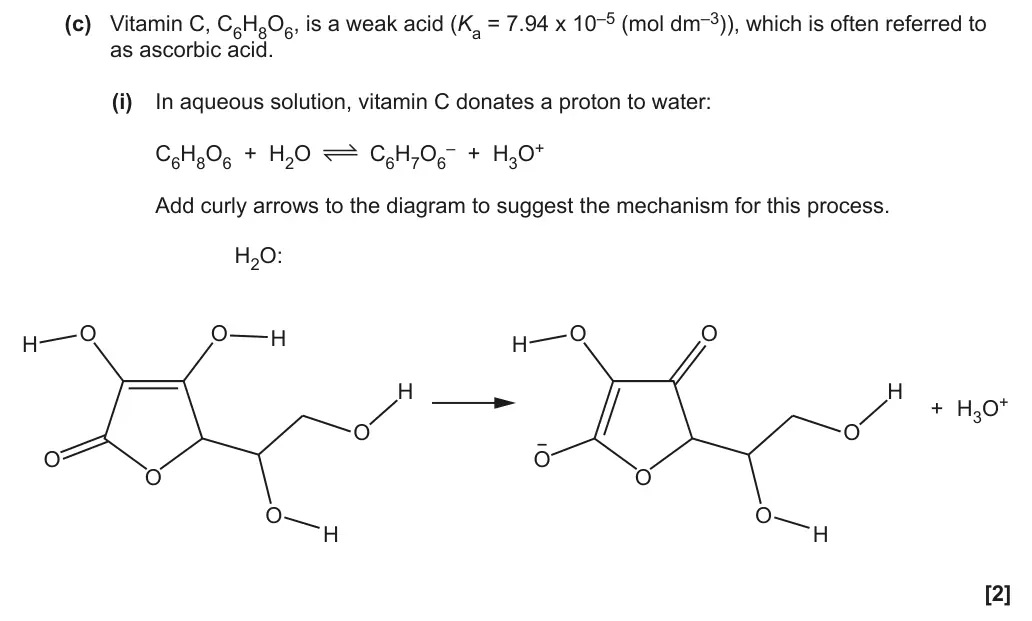
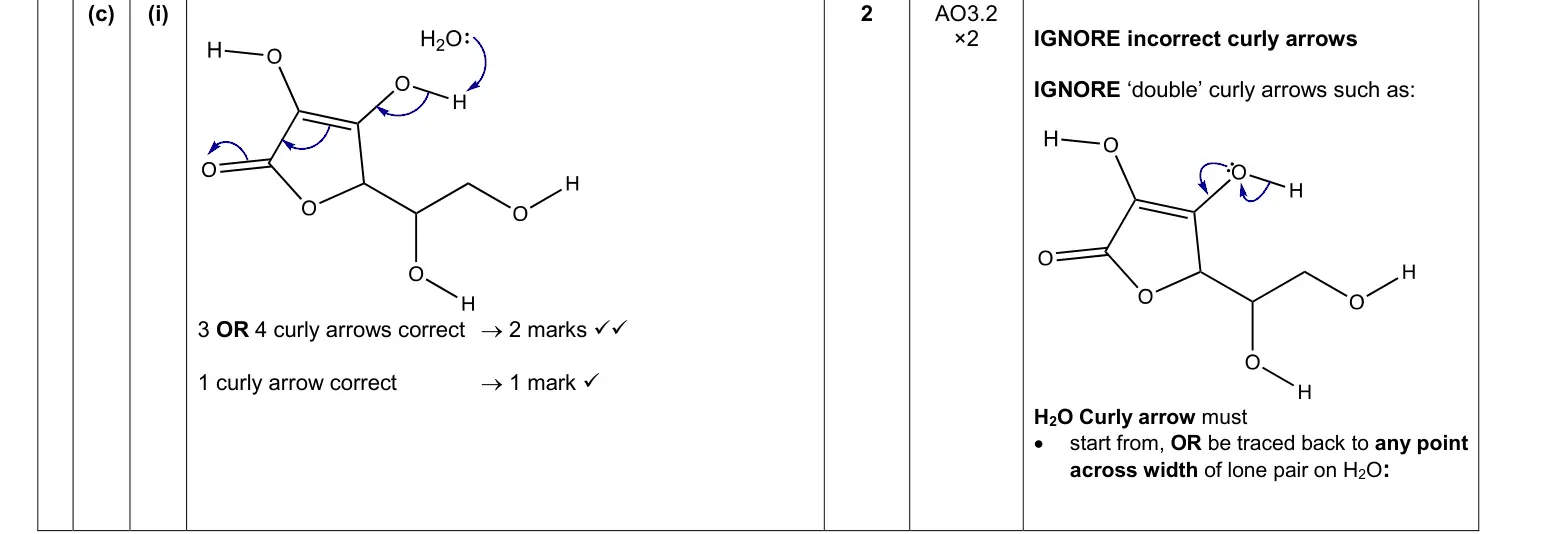
Add curly arrows to the diagram to suggest the mechanism for this process.
H2O:
O O H O O
H H
H H
+ H3O+
O O
–
O O
O O
O O
H H
[2]
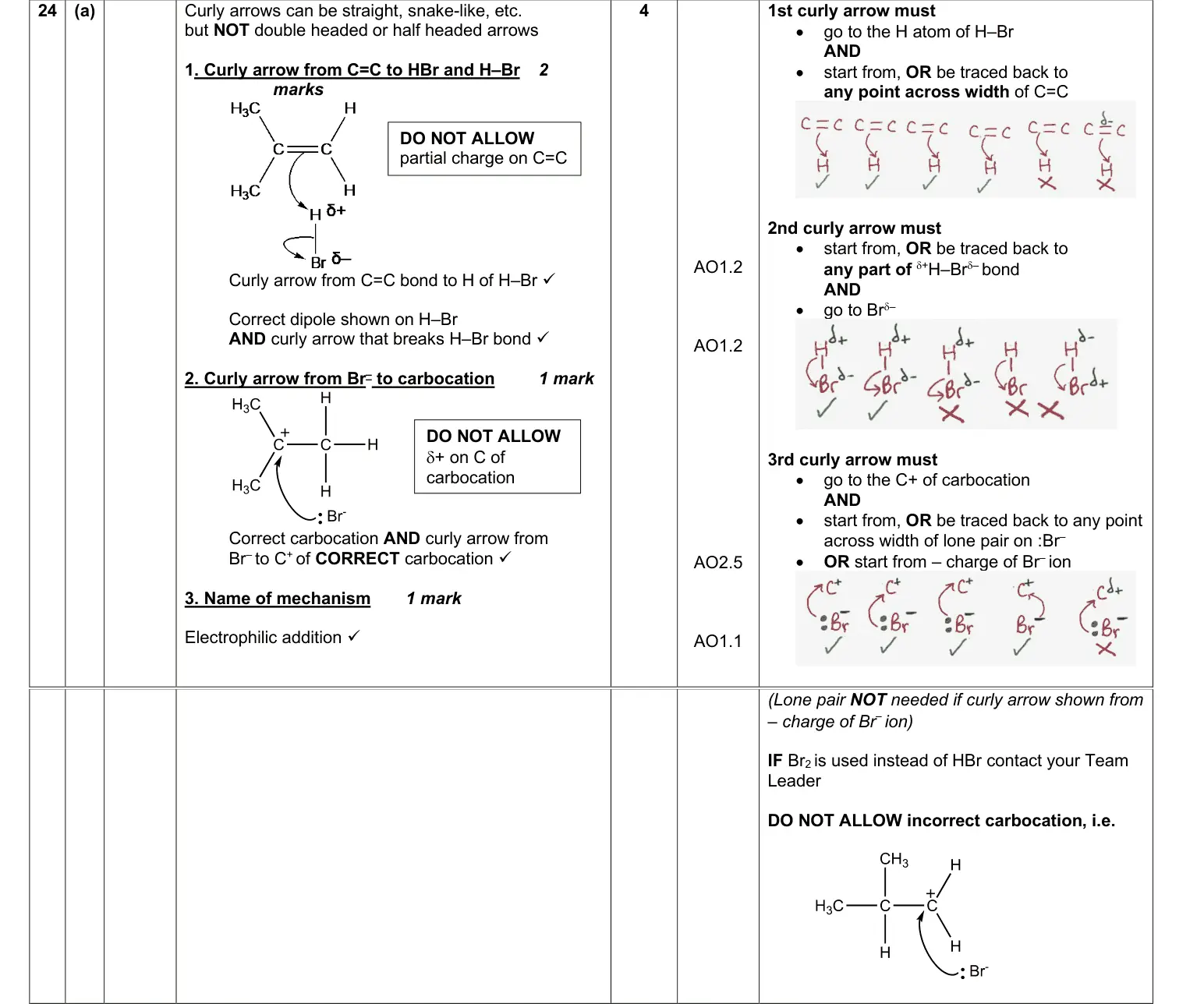
November 2021 · AS Paper 1 · Q24(a) 4 marks AO1, 2 Mechanism alkenesorganic basics
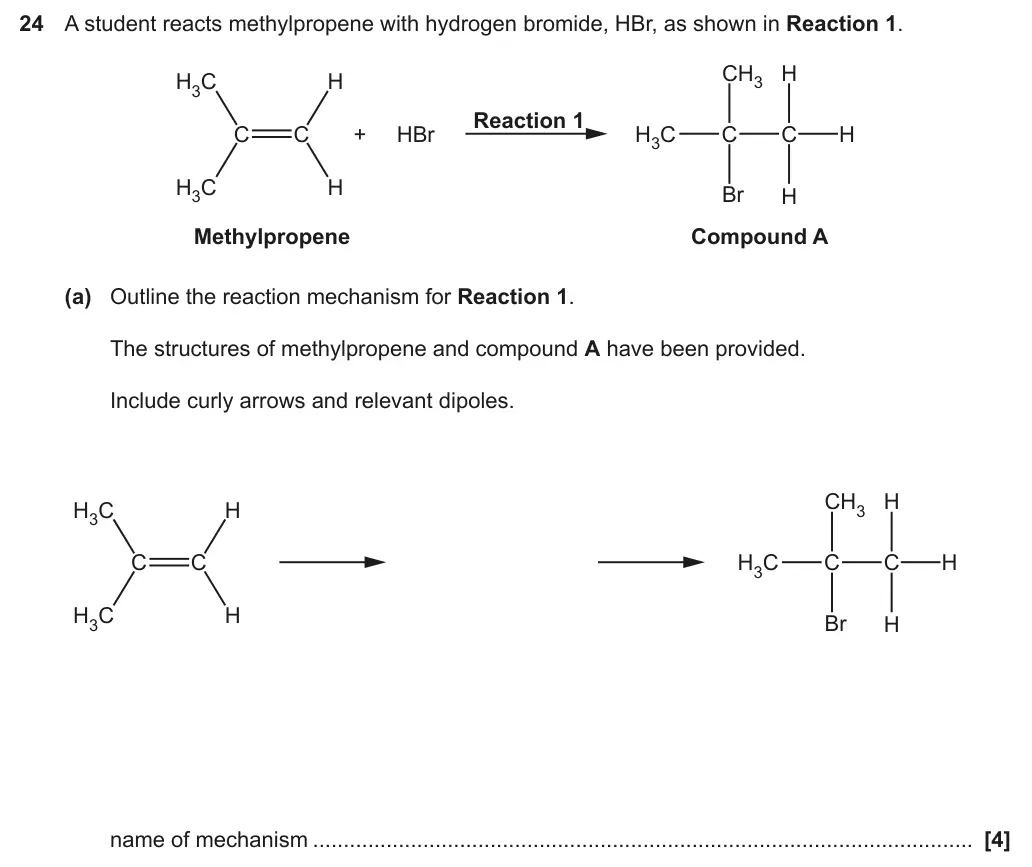
24 A student reacts methylpropene with hydrogen bromide, HBr, as shown in Reaction 1.
CH3 H
H3C H
Reaction 1
C C + HBr H3C C C H
H3C H
Br H
Methylpropene Compound A
(a) Outline the reaction mechanism for Reaction 1.
The structures of methylpropene and compound A have been provided.
Include curly arrows and relevant dipoles.
CH3 H
H3C H
C C H3C C C H
H3C H
Br H
name of mechanism ............................................................................................................ [4]
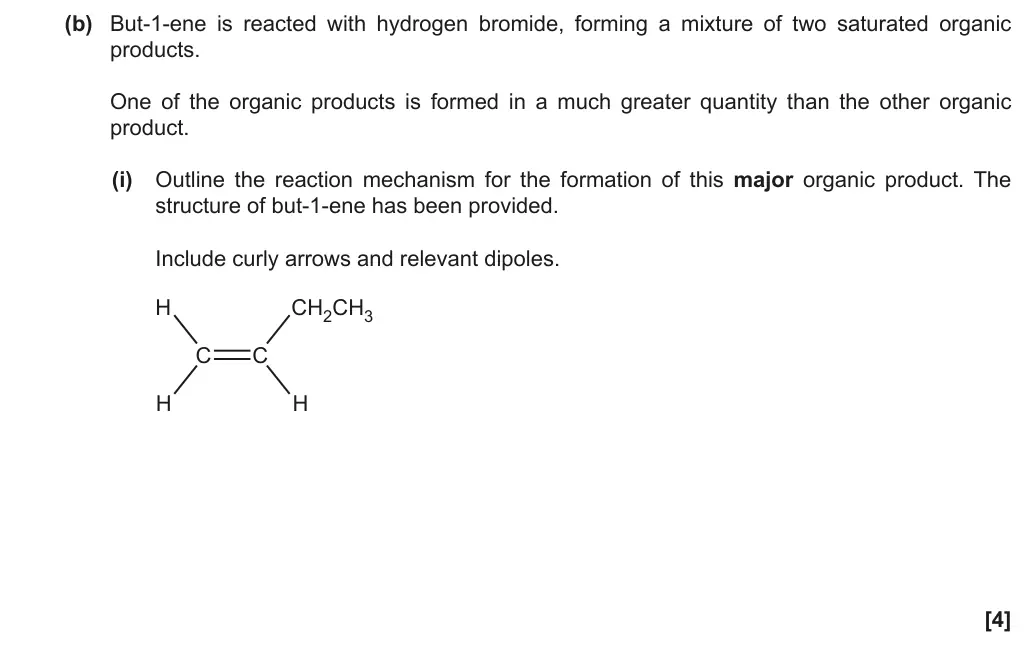
November 2021 · Paper 2 · Q16(b)(i) 4 marks AO1, 2 Mechanism Easy alkenesorganic basics
(b) But-1-ene is reacted with hydrogen bromide, forming a mixture of two saturated organic
products.
One of the organic products is formed in a much greater quantity than the other organic
product.
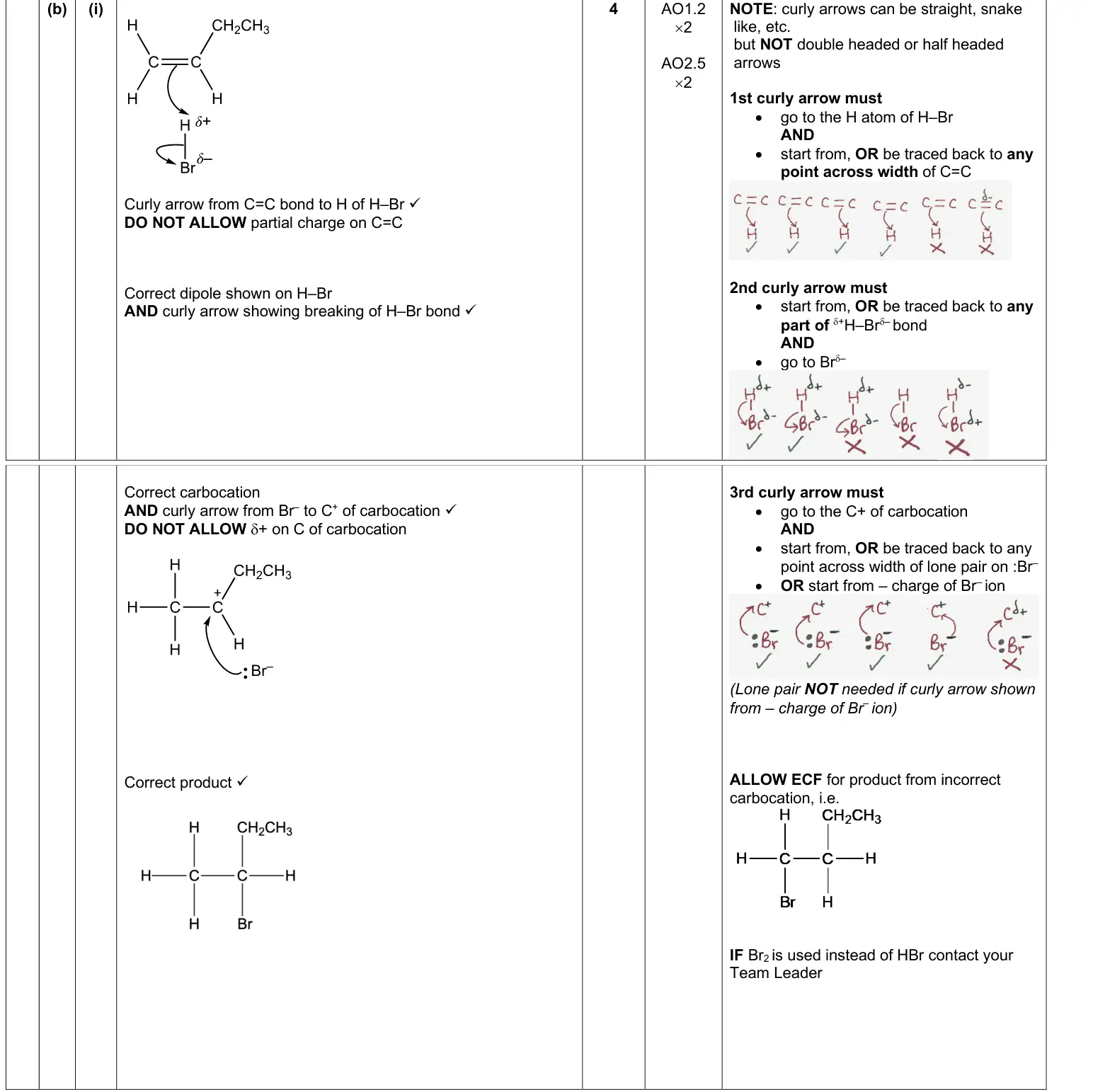
(i) Outline the reaction mechanism for the formation of this major organic product. The
structure of but-1-ene has been provided.
Include curly arrows and relevant dipoles.
H CH2CH3
C C
H H
[4]
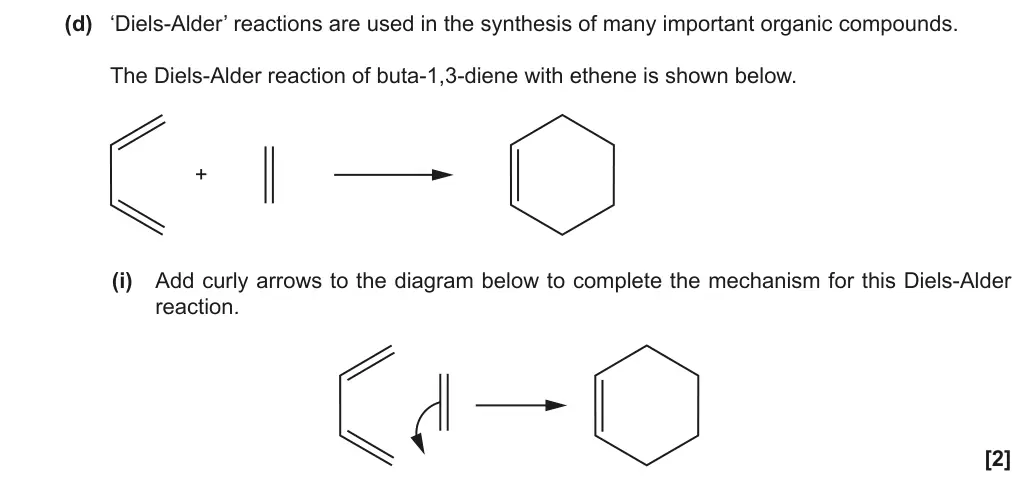
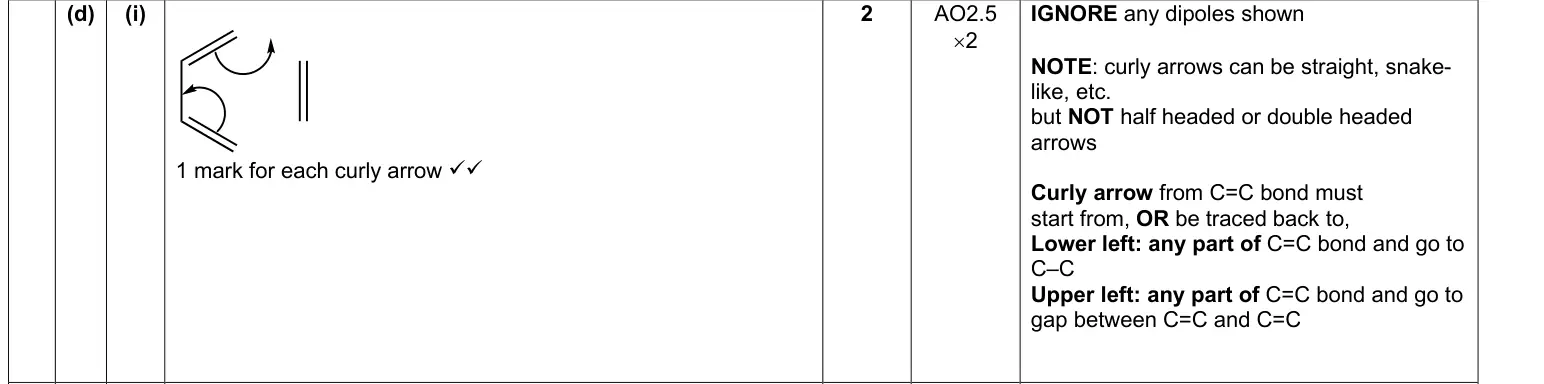
November 2021 · Paper 2 · Q16(d)(i) 2 marks AO2 Mechanism Medium organic basics
(d) ‘Diels-Alder’ reactions are used in the synthesis of many important organic compounds.
The Diels-Alder reaction of buta-1,3-diene with ethene is shown below.
+
(i) Add curly arrows to the diagram below to complete the mechanism for this Diels-Alder
reaction.
[2]
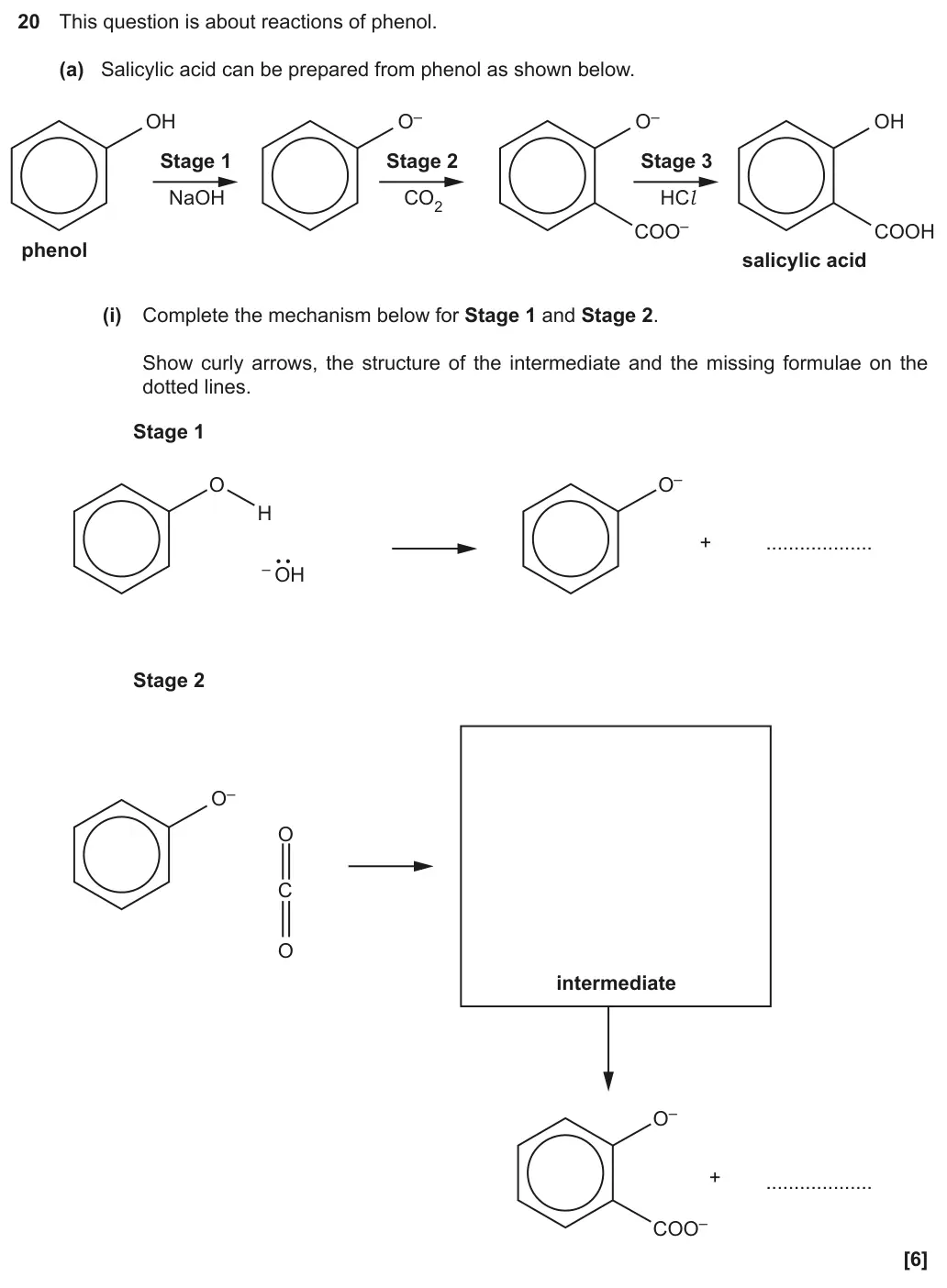
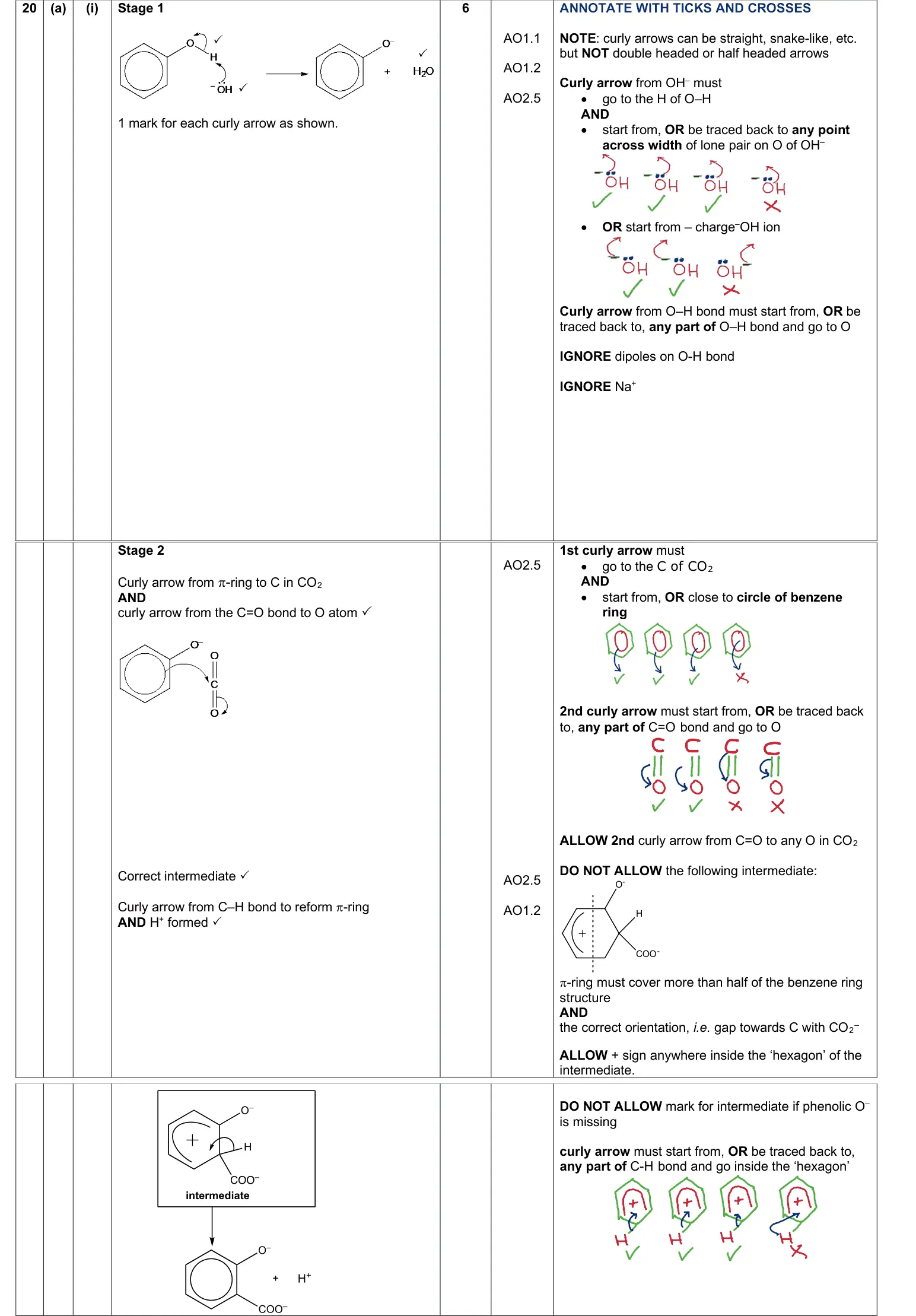
November 2021 · Paper 2 · Q20(a)(i) 6 marks AO1, 2 Mechanism Medium aromatic compoundsorganic basics
20 This question is about reactions of phenol.
(a) Salicylic acid can be prepared from phenol as shown below.
OH O– O– OH
Stage 1 Stage 2 Stage 3
NaOH CO2 HCl
COO– COOH
phenol
salicylic acid
(i) Complete the mechanism below for Stage 1 and Stage 2.
Show curly arrows, the structure of the intermediate and the missing formulae on the
dotted lines.
Stage 1
O O–
H
+ ...................
– OH
Stage 2
O–
O
C
O
intermediate
O–
+ ...................
COO–
[6]
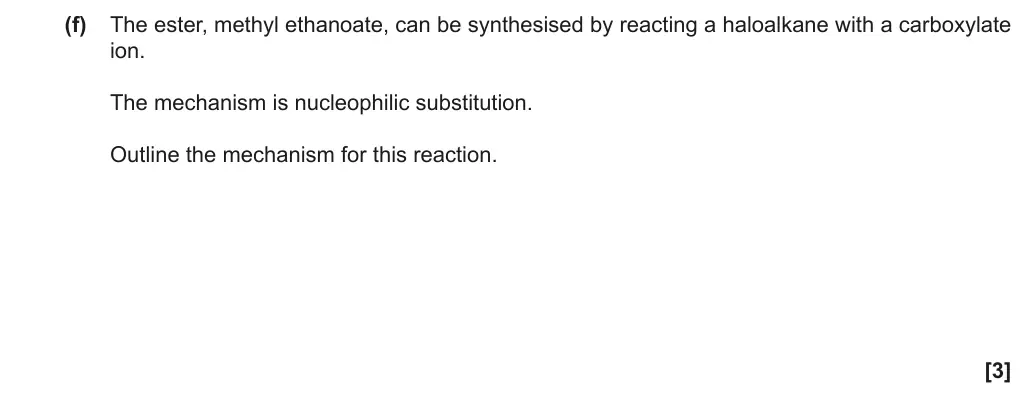
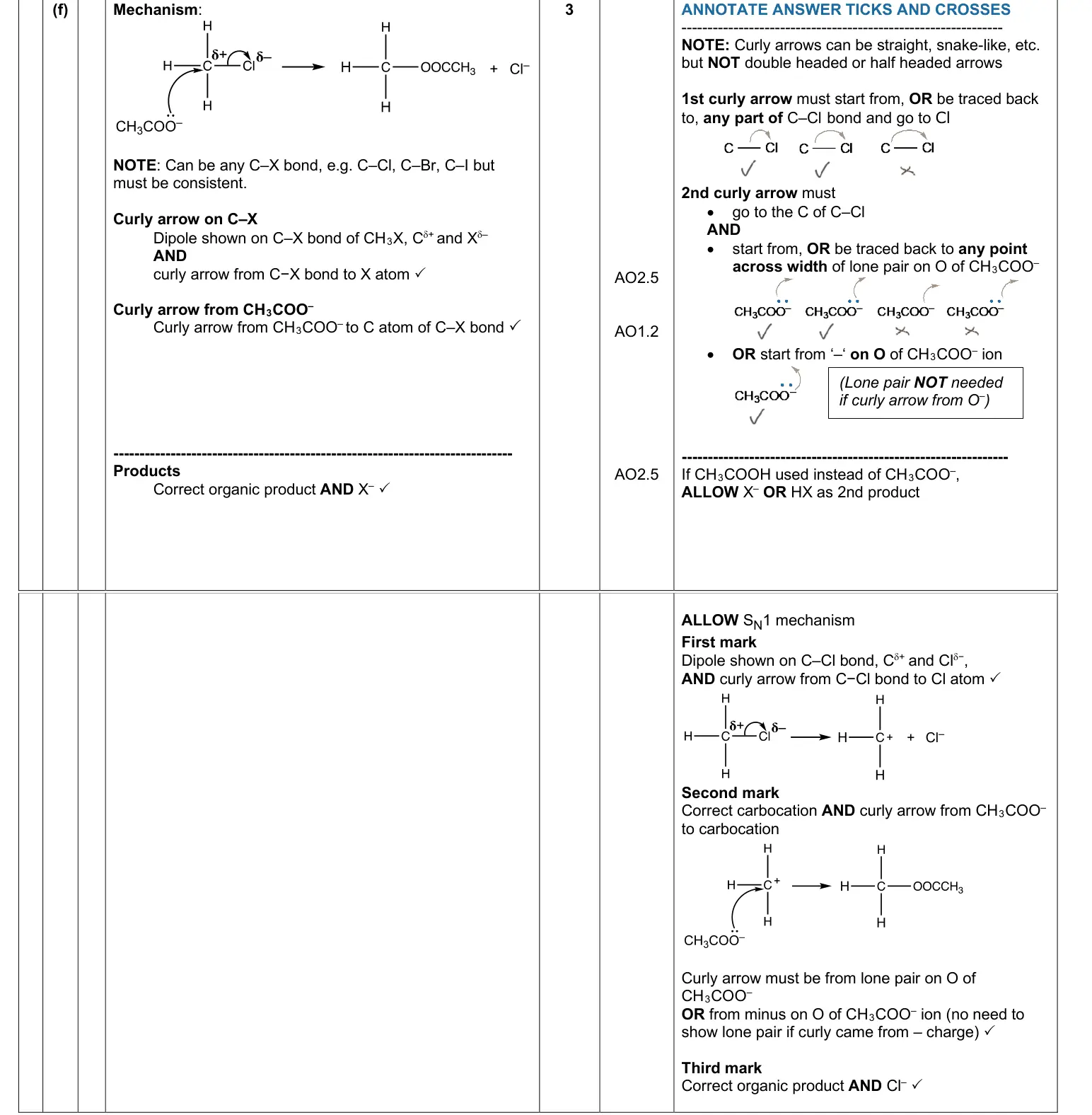
November 2021 · Paper 3 · Q1(f) 3 marks AO1, 2 Mechanism Medium haloalkanesorganic basics
(f) The ester, methyl ethanoate, can be synthesised by reacting a haloalkane with a carboxylate
ion.
The mechanism is nucleophilic substitution.
Outline the mechanism for this reaction.
[3]
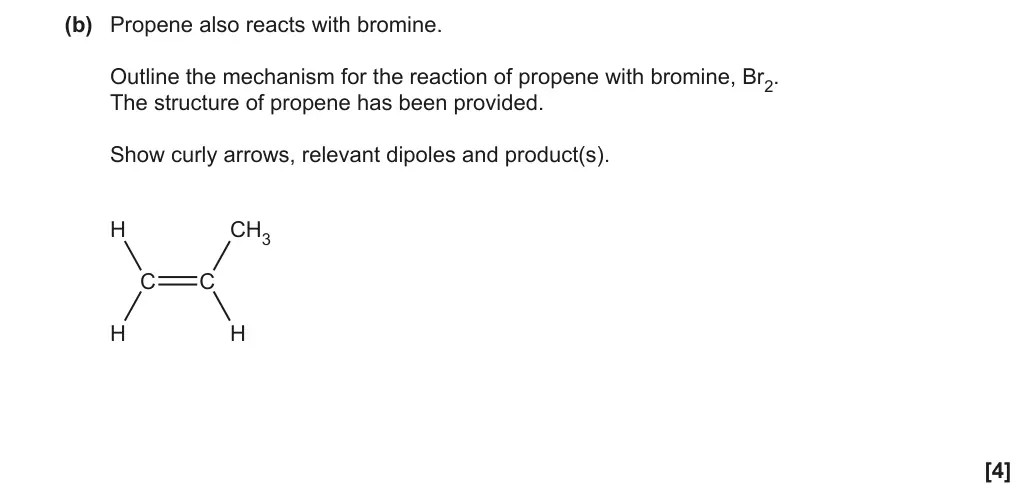
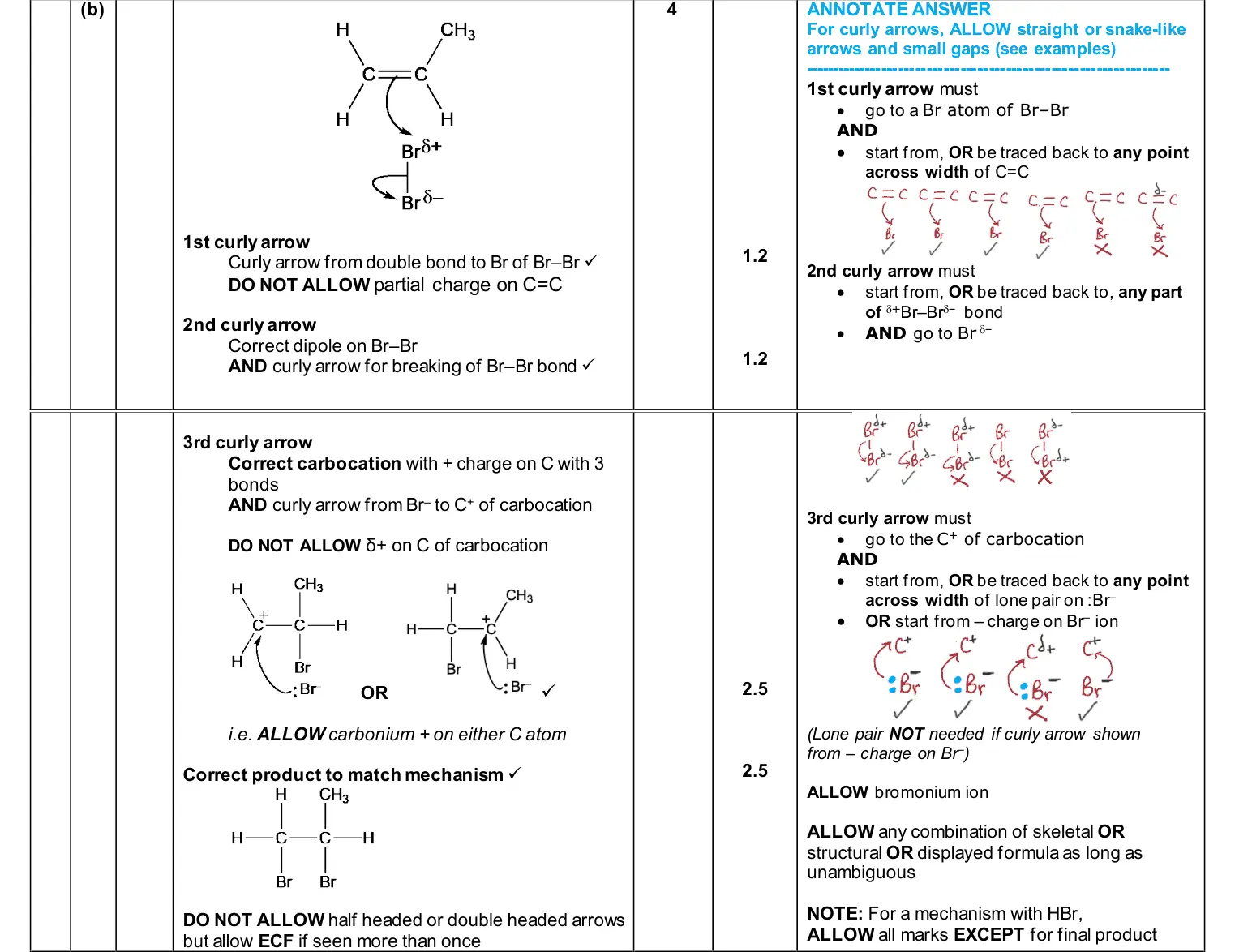
November 2020 · AS Paper 1 · Q25(b) 4 marks AO1, 2 Mechanism Medium alkenesorganic basics
Earlier part of question 25 that this part usesEarlier part of November 2020 Paper 1 question 25
(b) Propene also reacts with bromine.
Outline the mechanism for the reaction of propene with bromine, Br2.
The structure of propene has been provided.
Show curly arrows, relevant dipoles and product(s).
H CH3
C C
H H
[4]
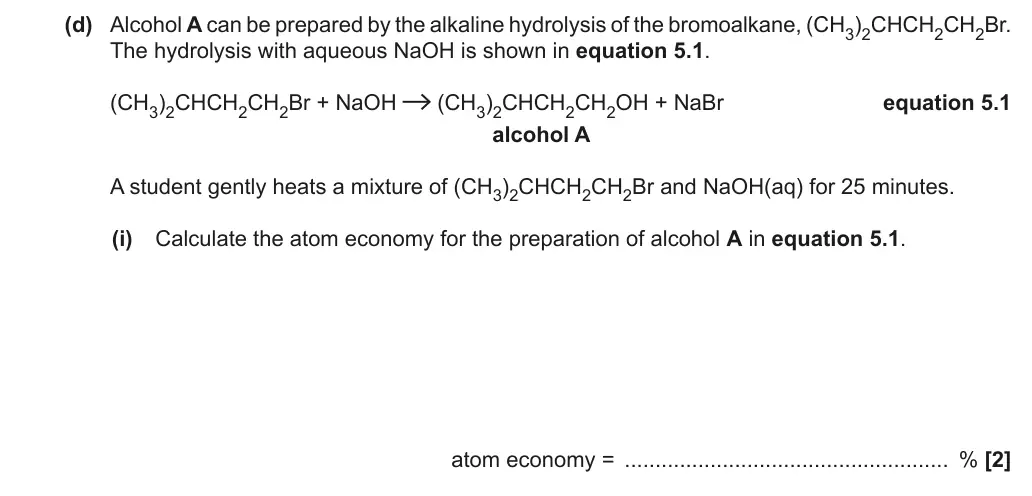
November 2020 · AS Paper 2 · Q5(d)(ii) 3 marks AO1, 2 Mechanism Medium haloalkanesorganic basics
Earlier part of question 5 that this part usesEarlier part of November 2020 Paper 2 question 5
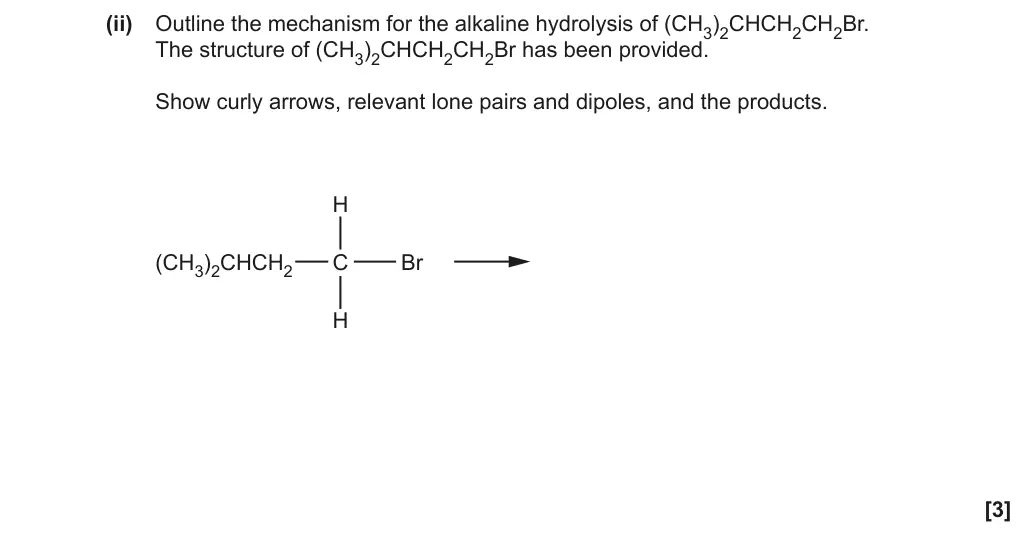
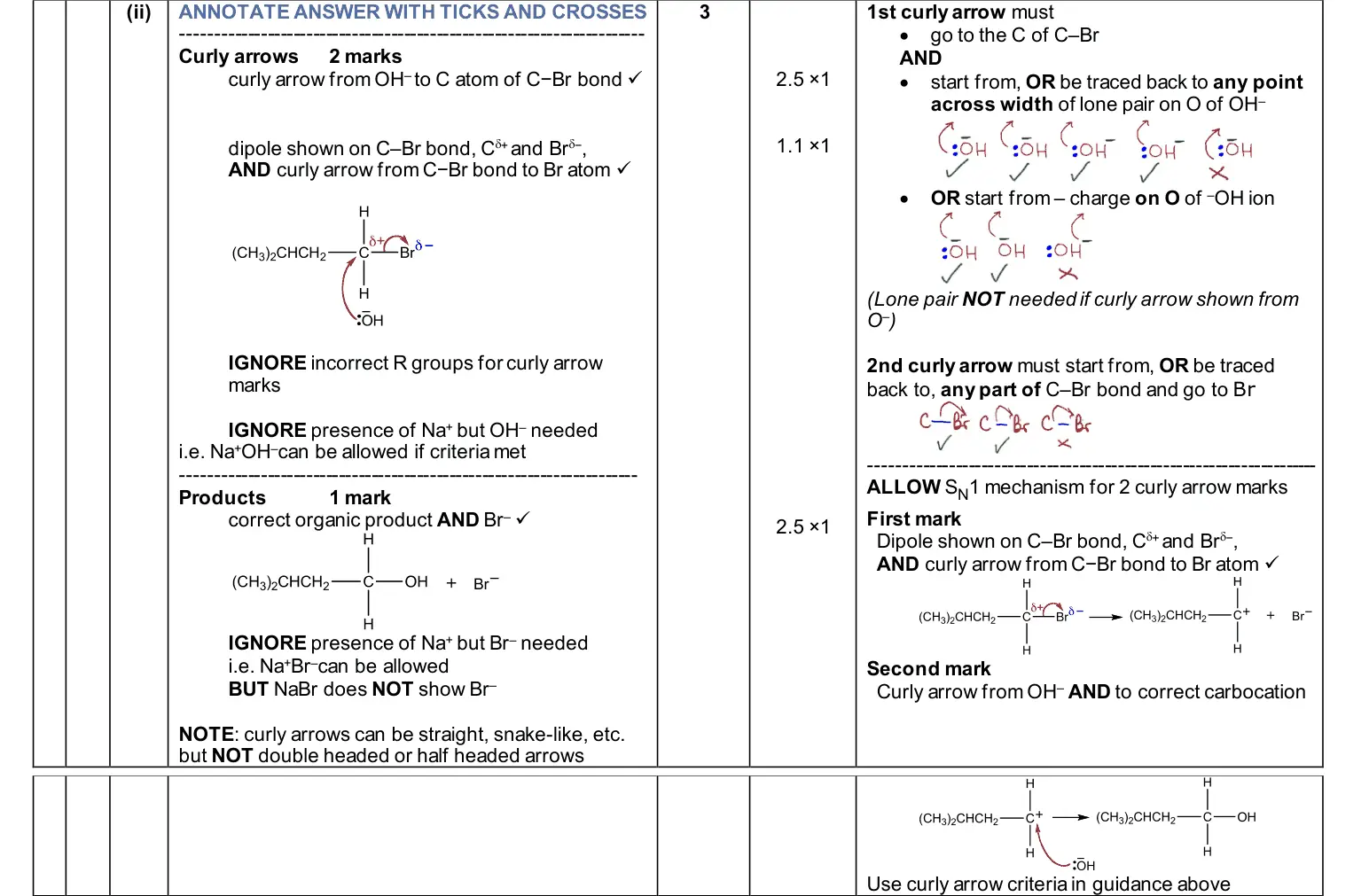
(ii) Outline the mechanism for the alkaline hydrolysis of (CH3)2CHCH2CH2Br.
The structure of (CH3)2CHCH2CH2Br has been provided.
Show curly arrows, relevant lone pairs and dipoles, and the products.
H
(CH3)2CHCH2 C Br
H
[3]
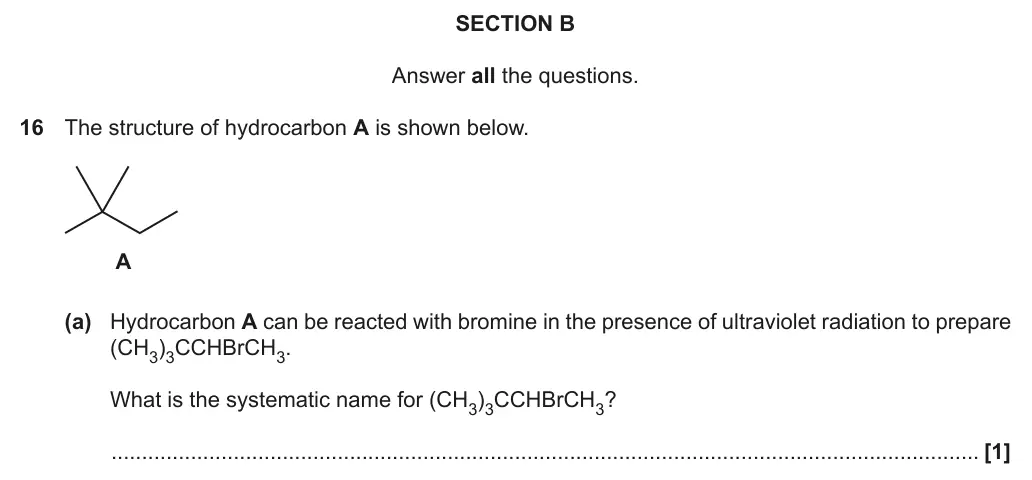
November 2020 · Paper 2 · Q16(c) 3 marks AO1, 2 Mechanism Medium alkanesorganic basics
Earlier part of question 16 that this part usesEarlier part of November 2020 Paper 2 question 16
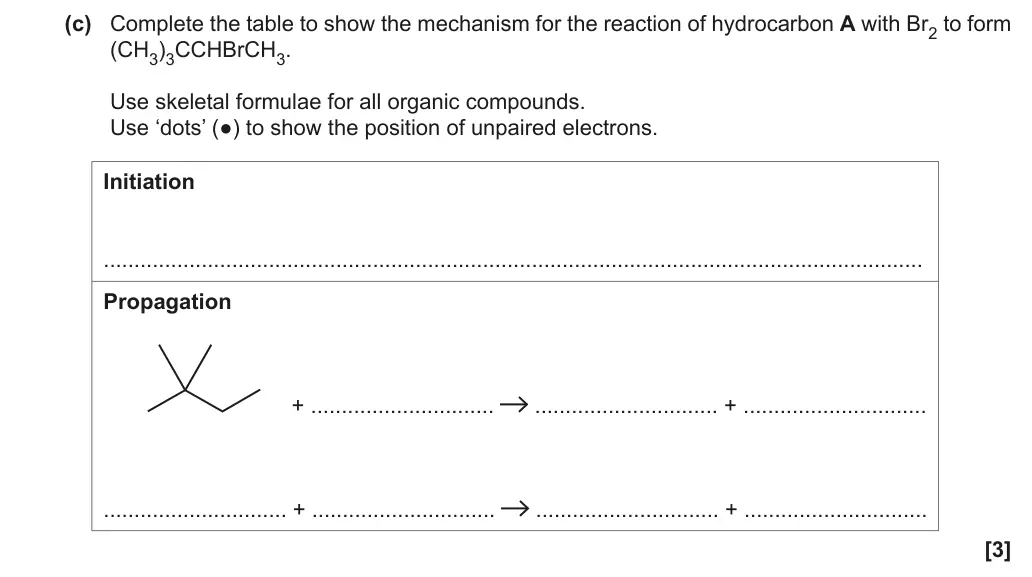
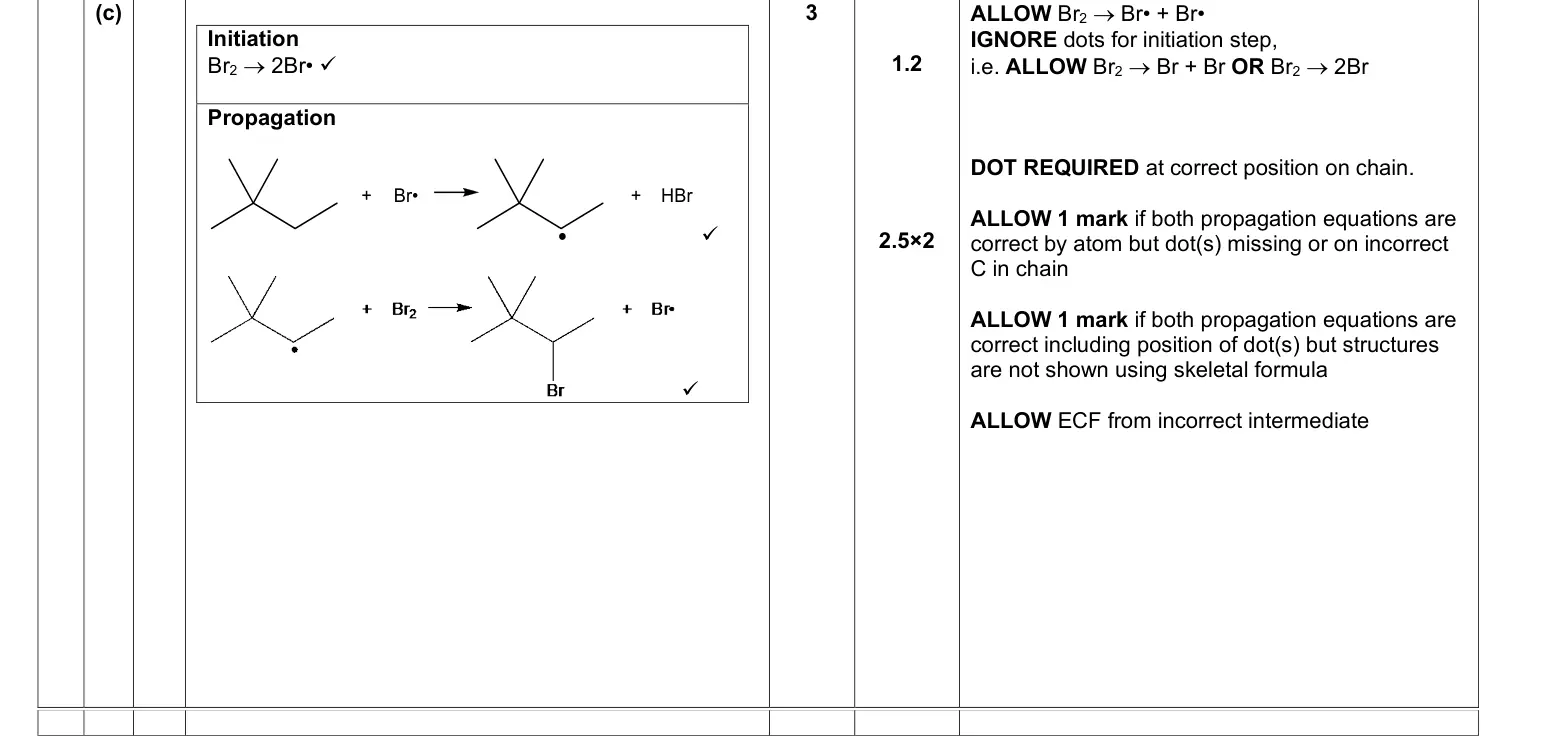
(c) Complete the table to show the mechanism for the reaction of hydrocarbon A with Br2 to form
(CH3)3CCHBrCH3.
Use skeletal formulae for all organic compounds.
Use ‘dots’ (●) to show the position of unpaired electrons.
Initiation
......................................................................................................................................
Propagation
+ .............................. .............................. + ..............................
.............................. + .............................. .............................. + ..............................
[3]
November 2020 · Paper 2 · Q17(a)(iii) 5 marks AO1, 2 Mechanism aromatic compounds
Earlier part of question 17 that this part usesEarlier part of November 2020 Paper 2 question 17
(iii) Outline the mechanism for the reaction of compound C with chlorine.
Show the role of the halogen carrier.
[5]
November 2020 · Paper 2 · Q19(c)(i) 5 marks AO1, 2 Mechanism carbonyl compoundsorganic basics
Earlier part of question 19 that this part usesEarlier part of November 2020 Paper 2 question 19
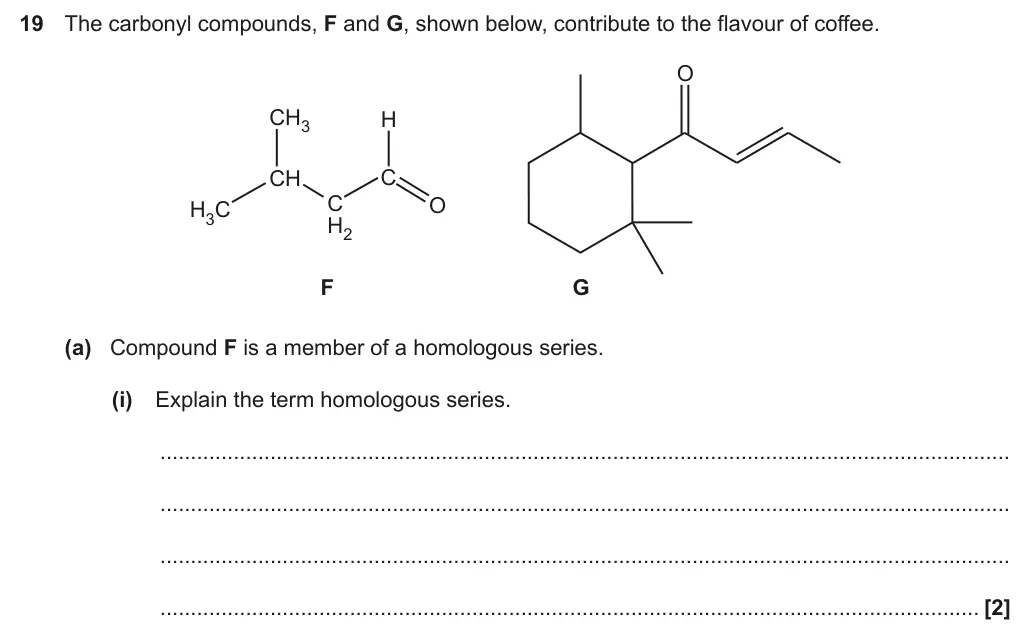
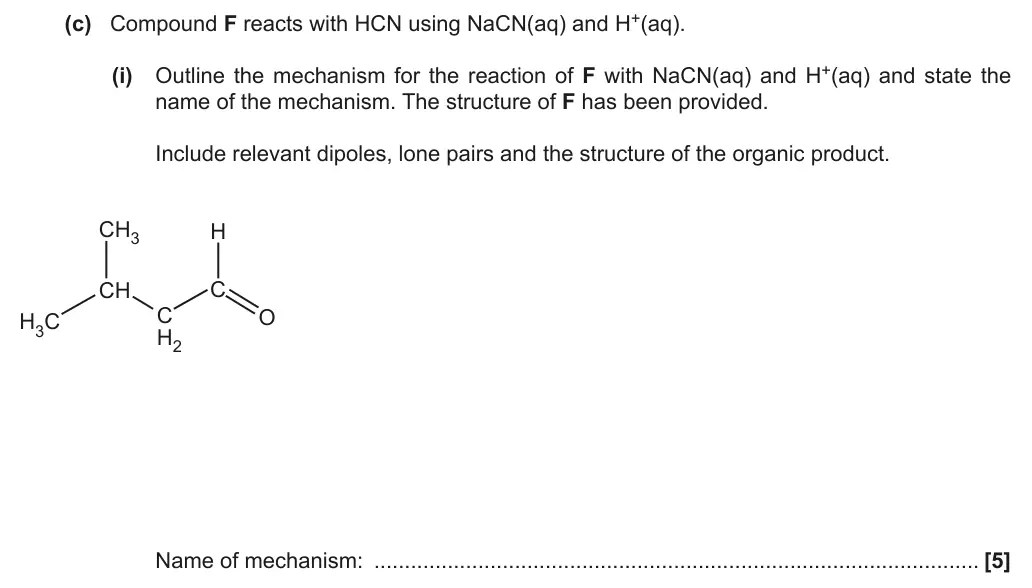
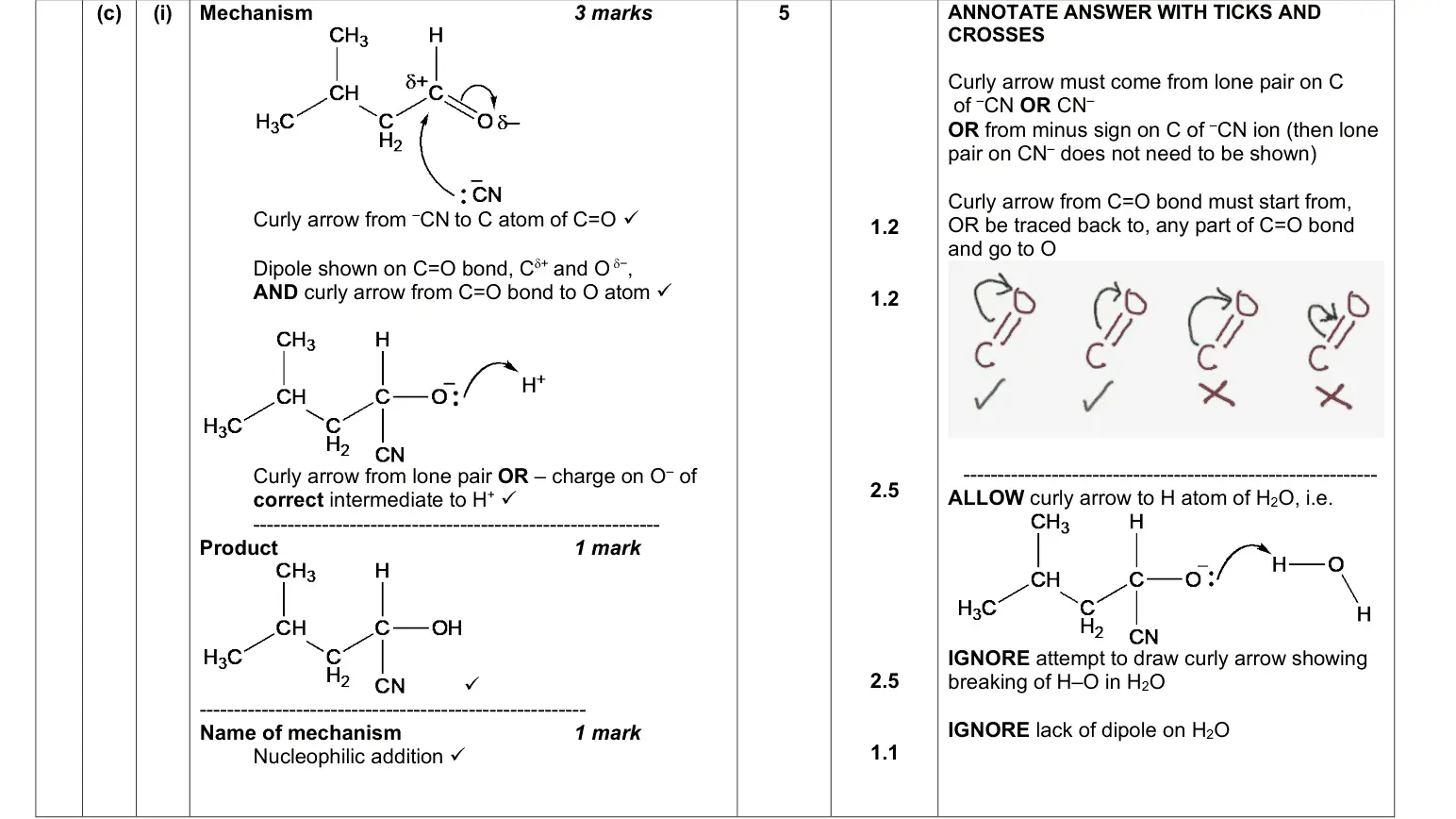
(c) Compound F reacts with HCN using NaCN(aq) and H+(aq).
(i) Outline the mechanism for the reaction of F with NaCN(aq) and H+(aq) and state the
name of the mechanism. The structure of F has been provided.
Include relevant dipoles, lone pairs and the structure of the organic product.
CH3 H
CH C
H3C C O
H2
Name of mechanism:  ................................................................................................... [5]
November 2020 · Paper 3 · Q6(c) 4 marks AO3 Mechanism Hard organic basicscarboxylic acids and esters
Earlier part of question 6 that this part usesEarlier part of November 2020 Paper 3 question 6
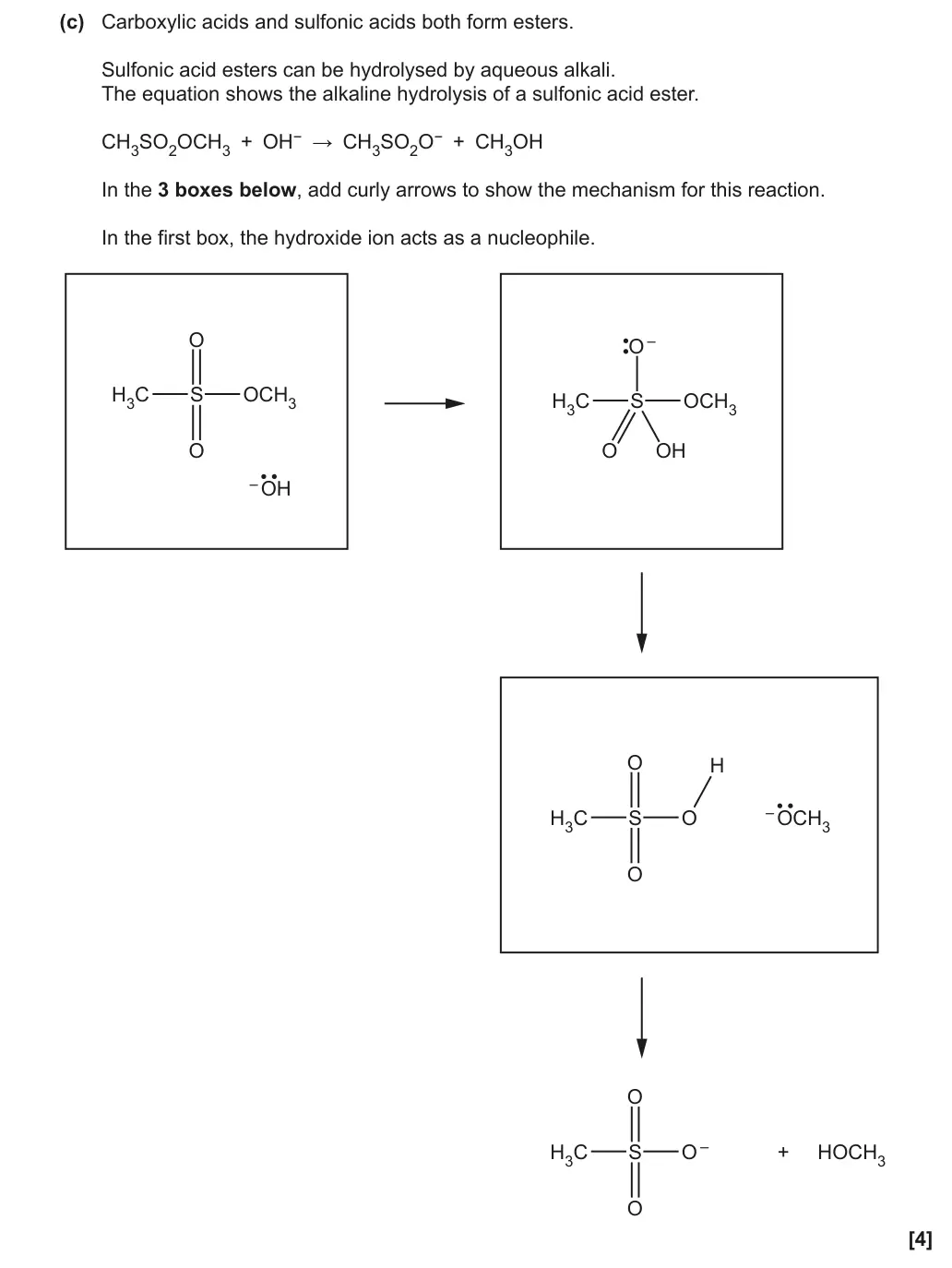
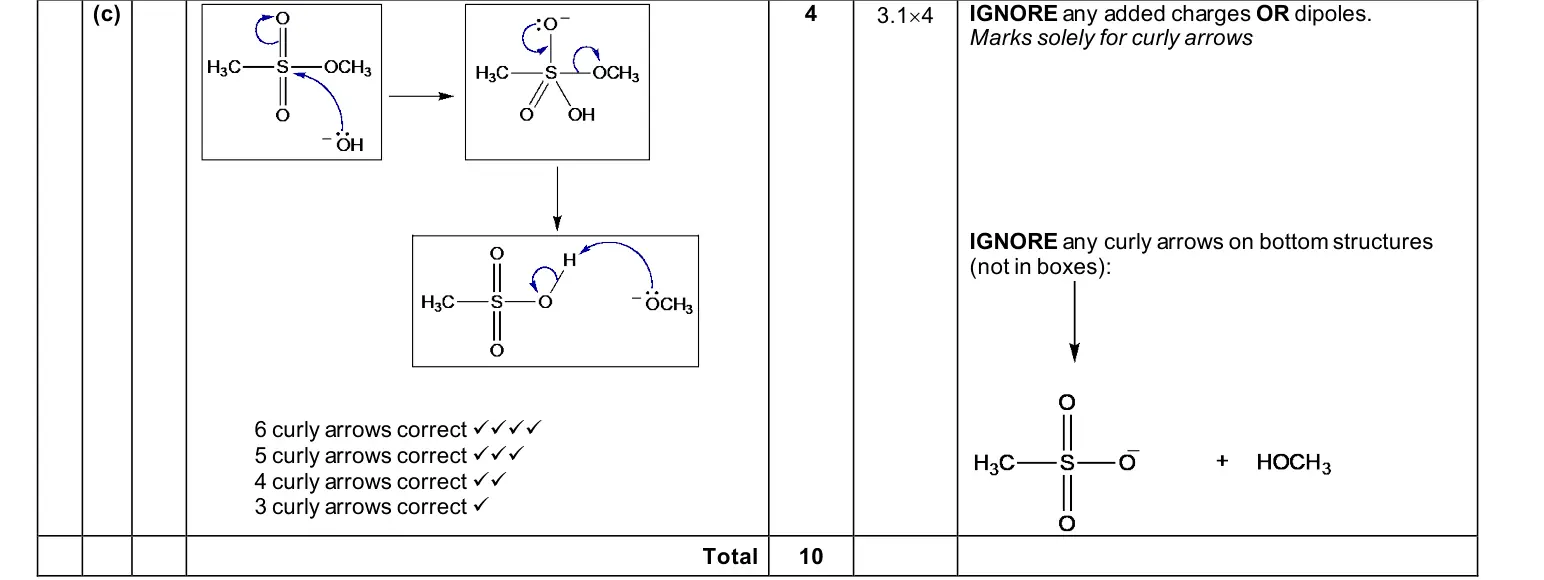
(c) Carboxylic acids and sulfonic acids both form esters.
Sulfonic acid esters can be hydrolysed by aqueous alkali.
The equation shows the alkaline hydrolysis of a sulfonic acid ester.
CH3SO2OCH3 + OH− → CH3SO2O− + CH3OH
In the 3 boxes below, add curly arrows to show the mechanism for this reaction.
In the first box, the hydroxide ion acts as a nucleophile.
O O –
H3C S OCH3
H3C S OCH3
O O OH
– OH
O H
H3C S O – OCH3
O
O
H3C S O – + HOCH3
O
[4]
June 2019 · AS Paper 1 · Q25(b)(i) 3 marks AO1, 2 Mechanism Medium alkanesorganic basics
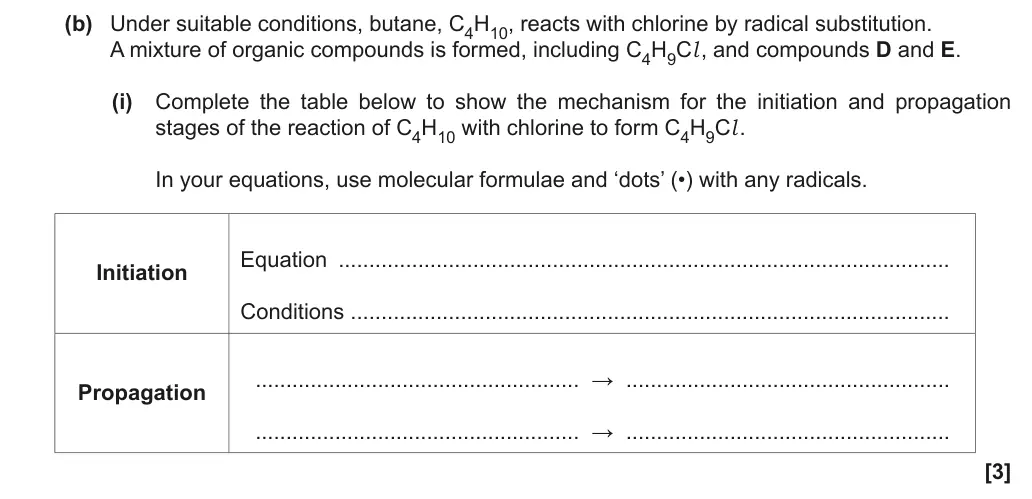
(b) Under suitable conditions, butane, C4H10, reacts with chlorine by radical substitution.
A mixture of organic compounds is formed, including C4H9Cl , and compounds D and E.
(i) Complete the table below to show the mechanism for the initiation and propagation
stages of the reaction of C4H10 with chlorine to form C4H9Cl .
In your equations, use molecular formulae and ‘dots’ (•) with any radicals.
Equation  ....................................................................................................
Initiation
Conditions ..................................................................................................
.....................................................  →  .....................................................
Propagation
.....................................................  →  .....................................................
[3]
June 2019 · AS Paper 2 · Q3(a)(i) 3 marks AO2 Mechanism Medium haloalkanesorganic basics
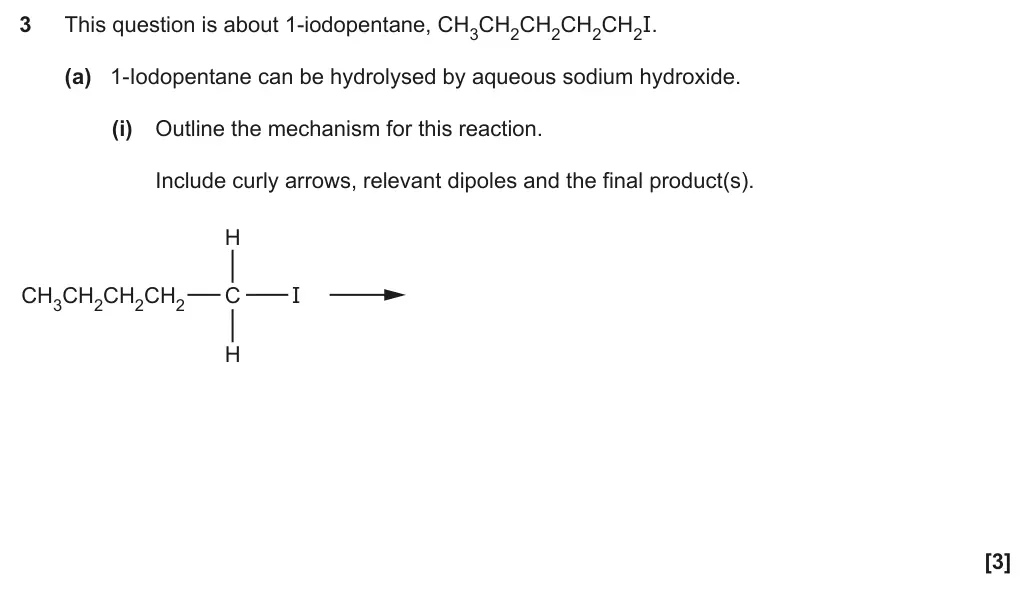
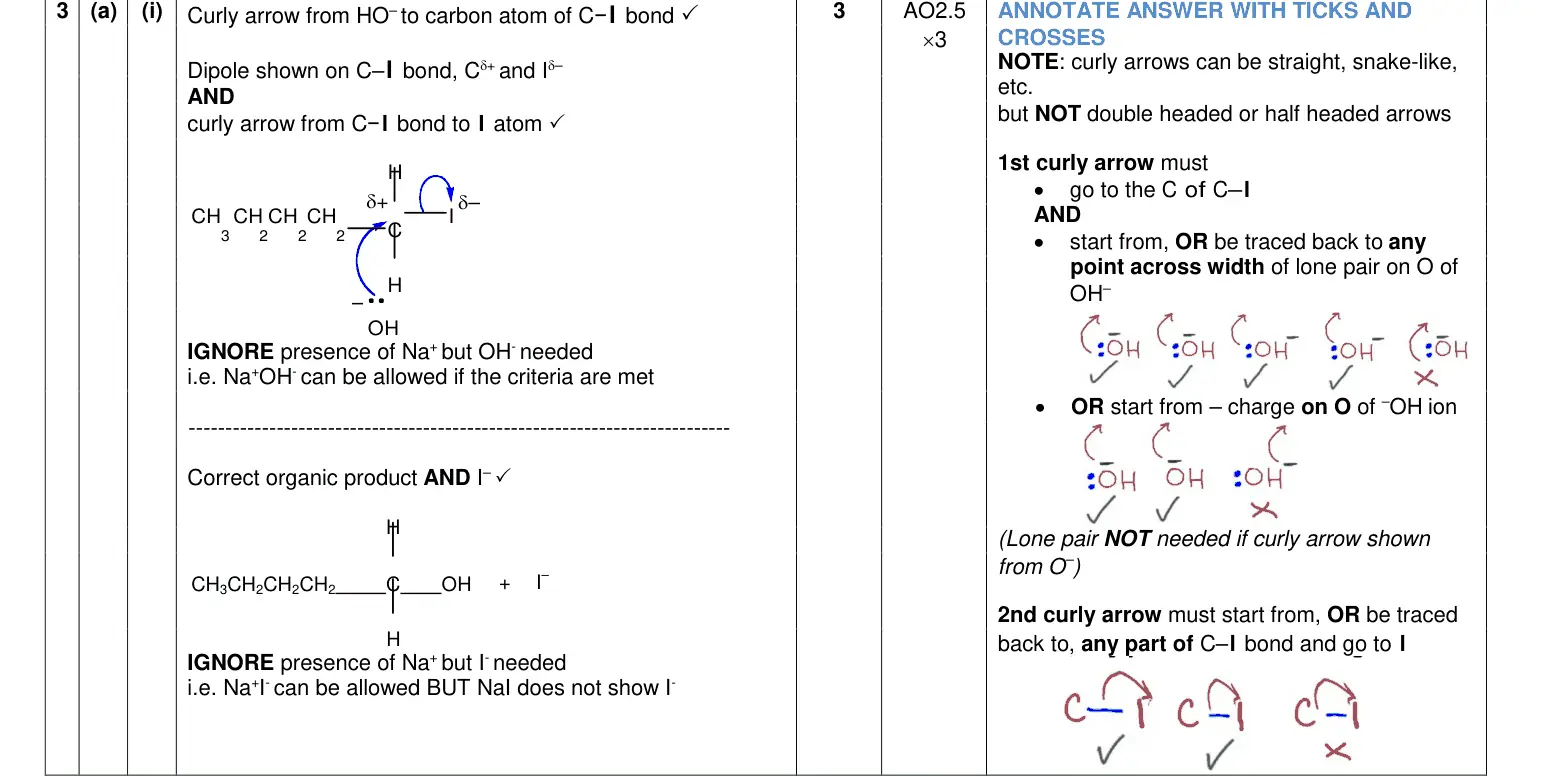
3 This question is about 1-iodopentane, CH3CH2CH2CH2CH2I.
(a) 1-Iodopentane can be hydrolysed by aqueous sodium hydroxide.
(i) Outline the mechanism for this reaction.
Include curly arrows, relevant dipoles and the final product(s).
H
CH3CH2CH2CH2 C I
H
[3]
June 2019 · Paper 2 · Q16(a)(i) 4 marks AO1, 2 Mechanism Easy alkenesorganic basics
SECTION B
Answer all the questions.
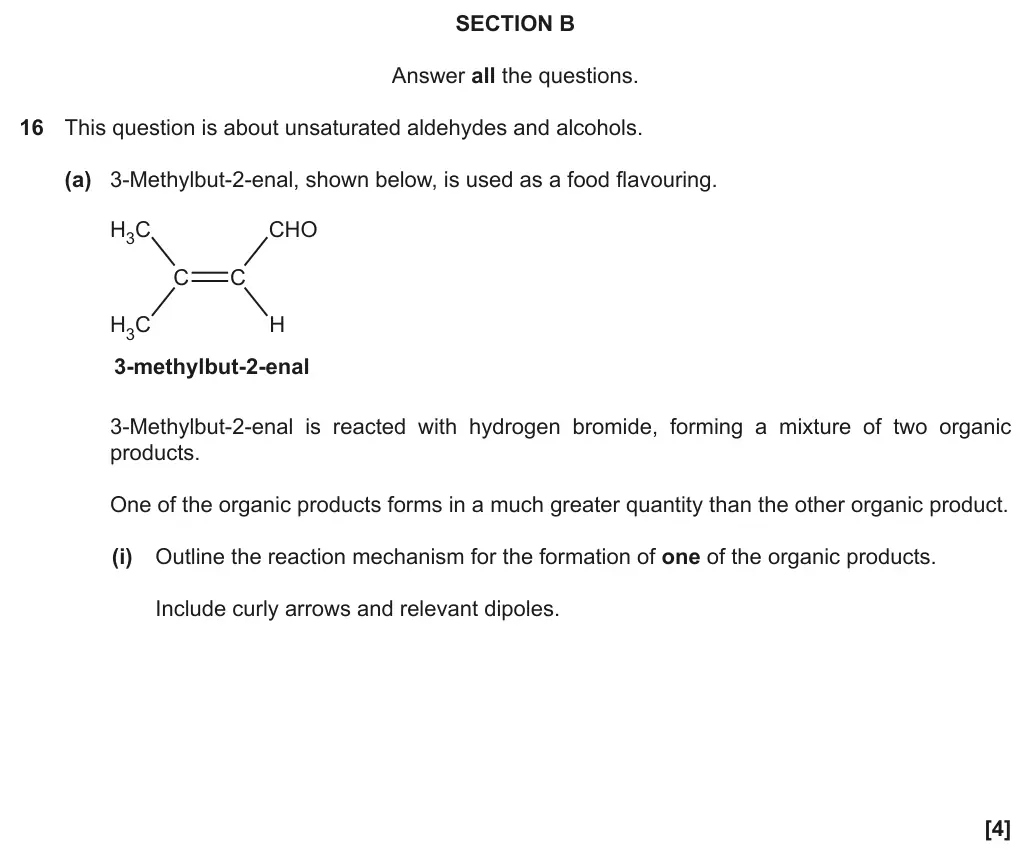
16 This question is about unsaturated aldehydes and alcohols.
(a) 3-Methylbut-2-enal, shown below, is used as a food flavouring.
H3C CHO
C C
H3C H
3-methylbut-2-enal
3-Methylbut-2-enal is reacted with hydrogen bromide, forming a mixture of two organic
products.
One of the organic products forms in a much greater quantity than the other organic product.
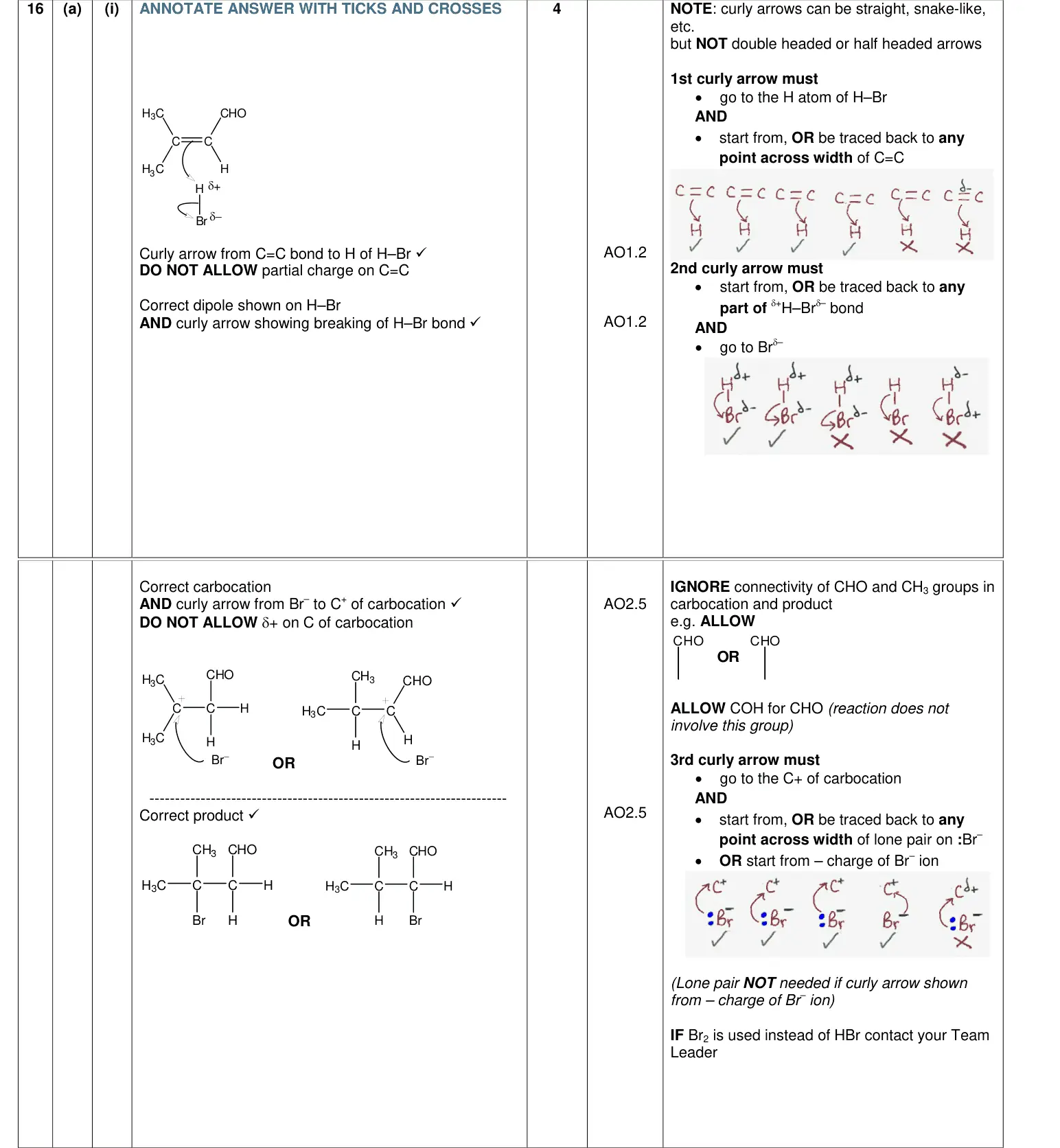
(i) Outline the reaction mechanism for the formation of one of the organic products.
Include curly arrows and relevant dipoles.
[4]
June 2019 · Paper 2 · Q19(b)(iii) 5 marks AO1, 2, 3 Mechanism Medium aromatic compoundsorganic basicscarbon carbon bond formation
Earlier part of question 19 that this part usesEarlier part of June 2019 Paper 2 question 19
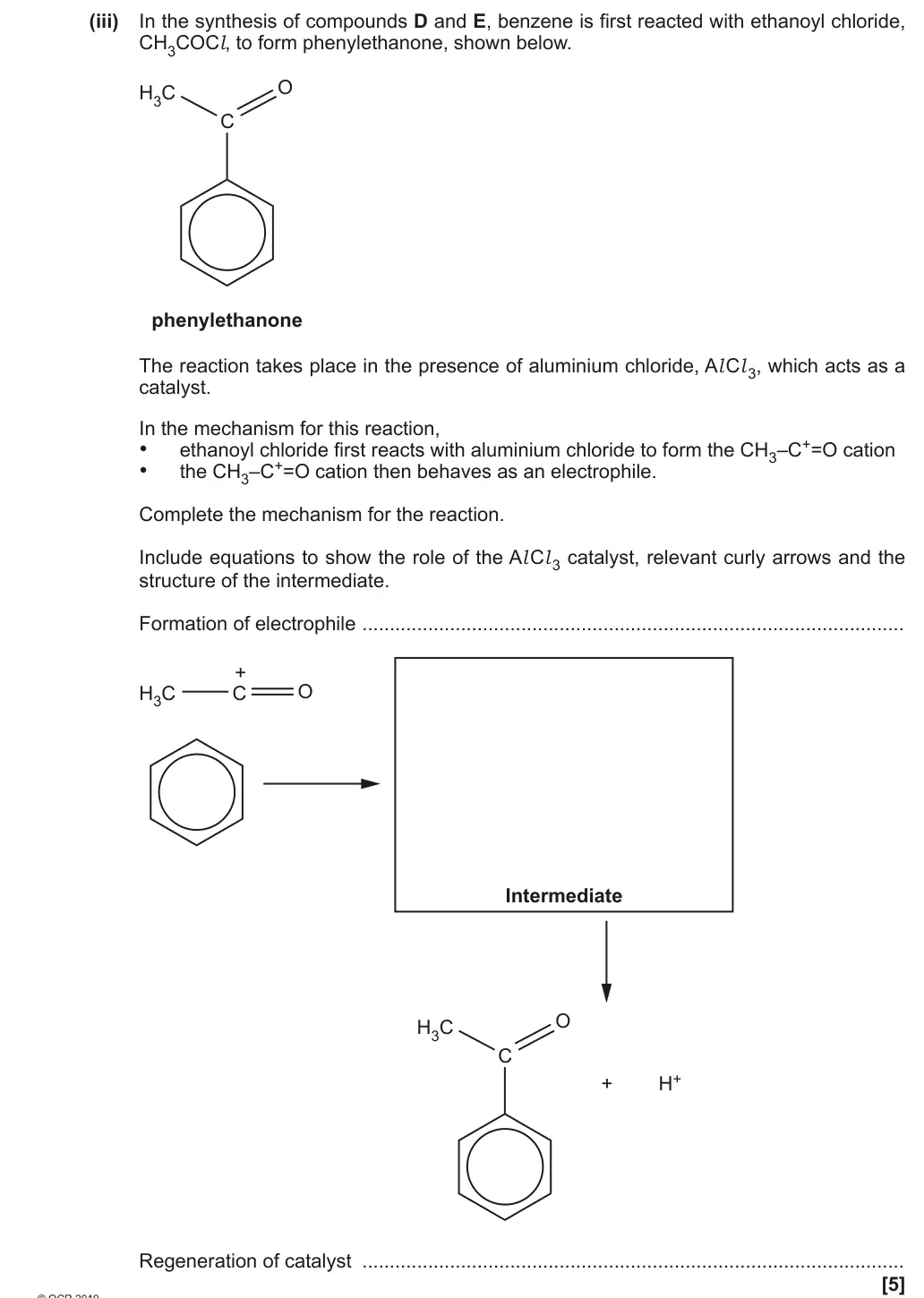
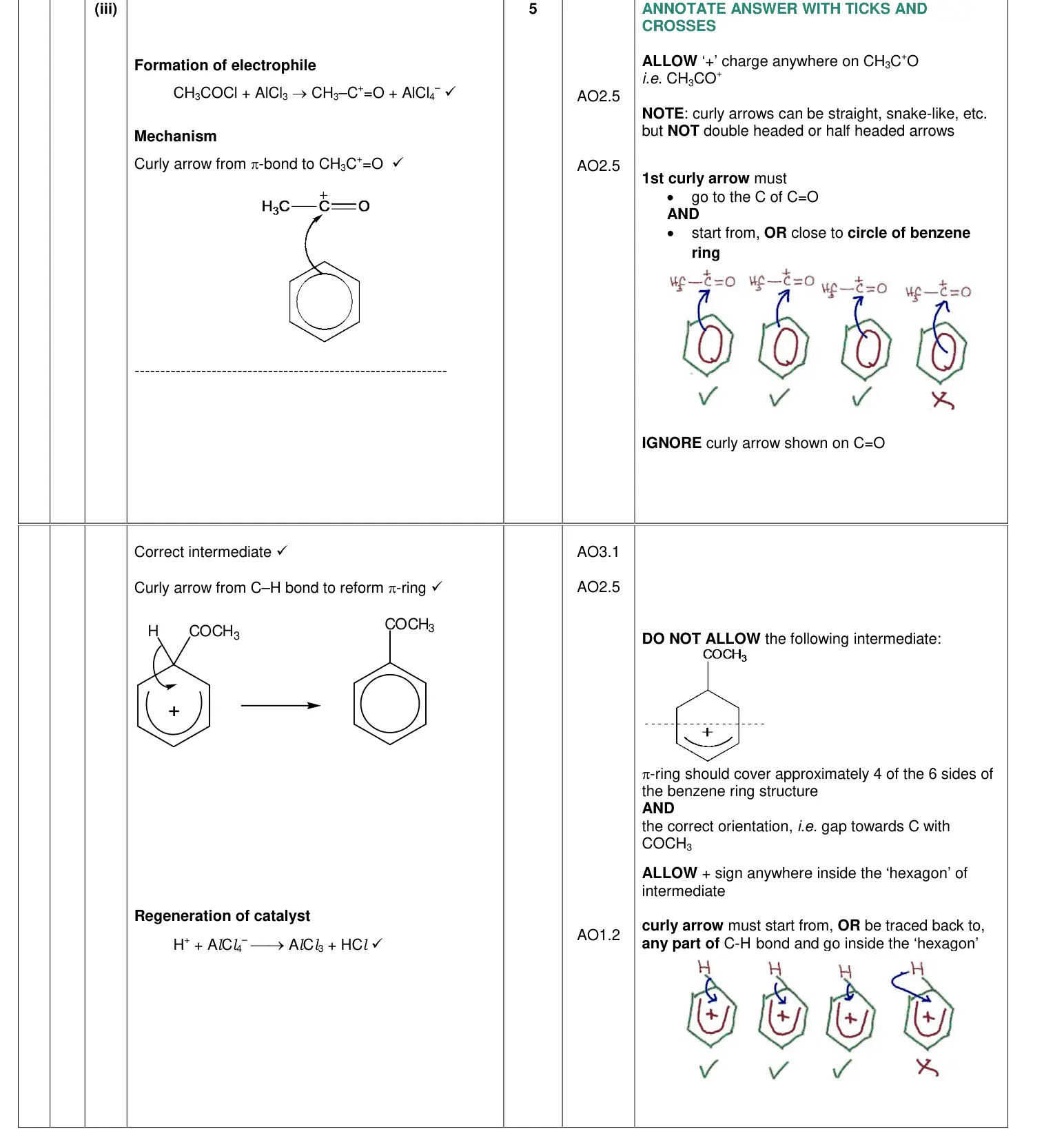
(iii) In the synthesis of compounds D and E, benzene is first reacted with ethanoyl chloride,
CH3COCl, to form phenylethanone, shown below.
H3C O
C
phenylethanone
The reaction takes place in the presence of aluminium chloride, Al Cl 3, which acts as a
catalyst.
In the mechanism for this reaction,
• ethanoyl chloride first reacts with aluminium chloride to form the CH3–C+=O cation
• the CH3–C+=O cation then behaves as an electrophile.
Complete the mechanism for the reaction.
Include equations to show the role of the Al Cl 3 catalyst, relevant curly arrows and the
structure of the intermediate.
Formation of electrophile  ...................................................................................................
+
H3C C O
Intermediate
H3C O
C
+ H+
Regeneration of catalyst  ...................................................................................................
[5]
June 2019 · Paper 2 · Q20(a)(ii) 2 marks AO3 Mechanism Medium organic basics
Earlier part of question 20 that this part usesEarlier part of June 2019 Paper 2 question 20
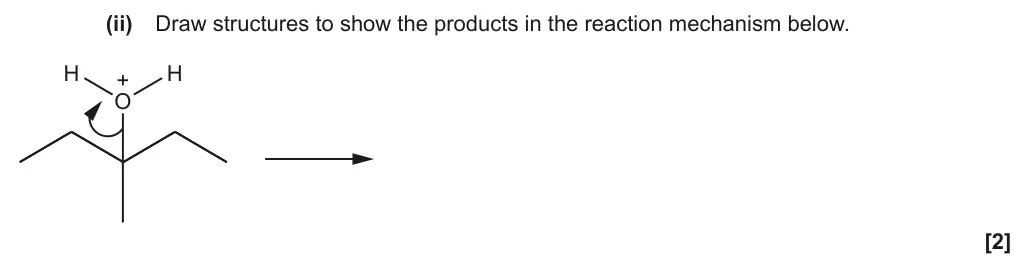
(ii) Draw structures to show the products in the reaction mechanism below.
H H
+
O
[2]
June 2019 · Paper 2 · Q20(b)(i) 4 marks AO3 Mechanism Medium organic basicscarboxylic acids and esters
Earlier part of question 20 that this part usesEarlier part of June 2019 Paper 2 question 20
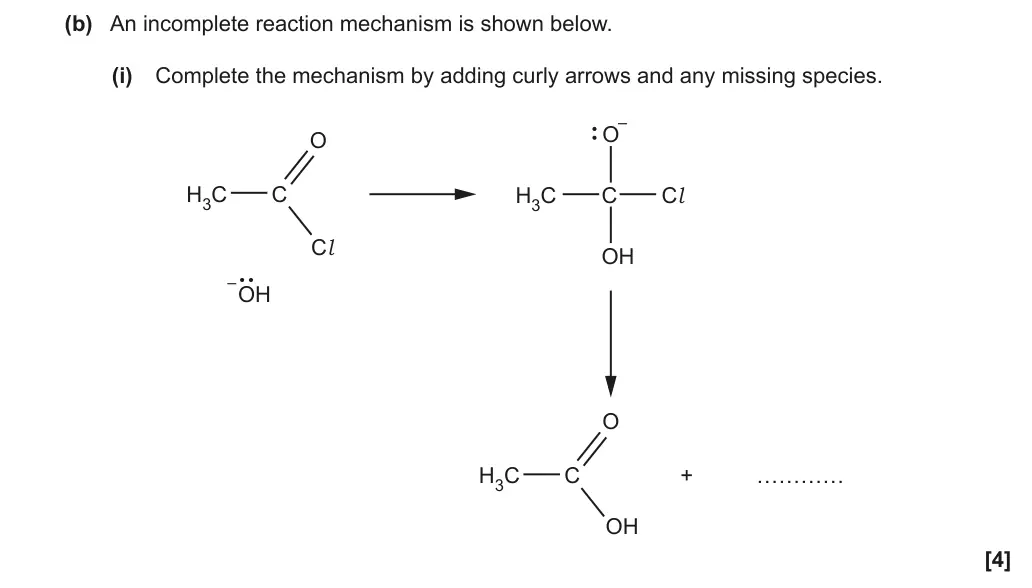
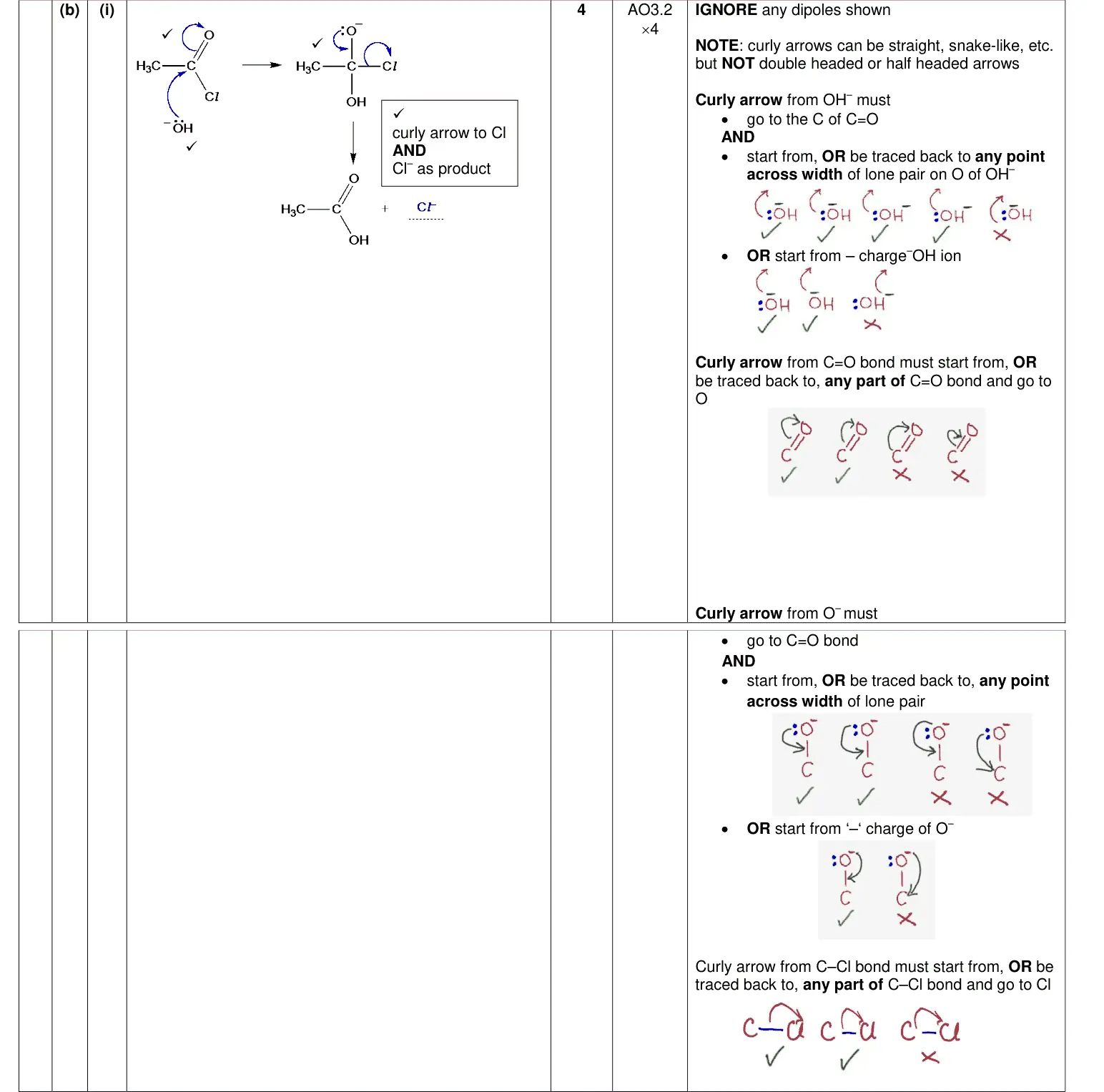
(b) An incomplete reaction mechanism is shown below.
(i) Complete the mechanism by adding curly arrows and any missing species.
–
O O
H3C C H3C C Cl
Cl
OH
–
OH
O
H3C C + …………
OH
[4]
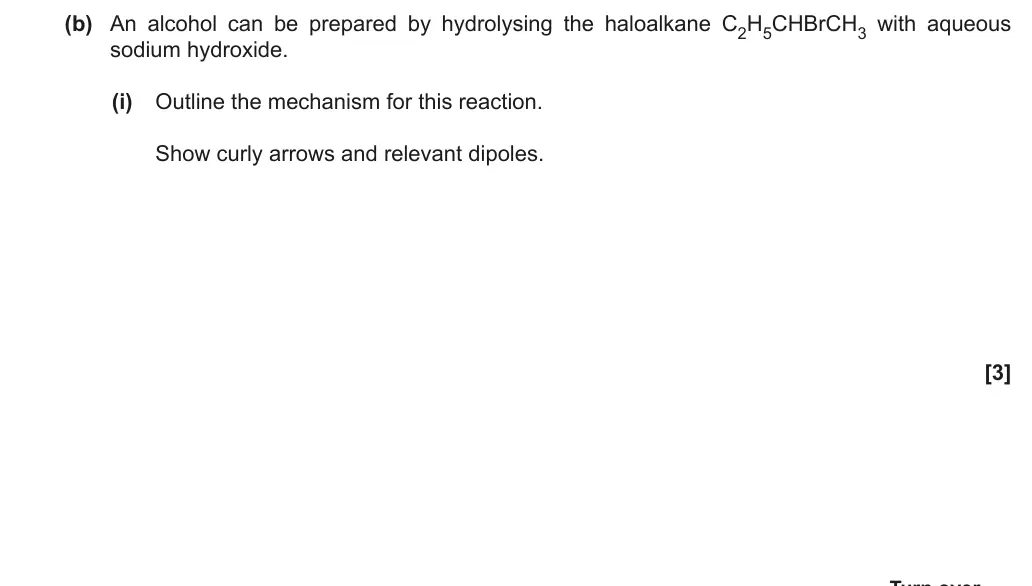
June 2018 · AS Paper 1 · Q25(b)(i) 3 marks Mechanism Medium haloalkanesorganic basics
(b) An alcohol can be prepared by hydrolysing the haloalkane C2H5CHBrCH3 with aqueous
sodium hydroxide.
(i) Outline the mechanism for this reaction.
Show curly arrows and relevant dipoles.
[3]
June 2018 · AS Paper 2 · Q6(b)(ii) 3 marks Mechanism Medium alkenesorganic basics
Earlier part of question 6 that this part usesEarlier part of June 2018 Paper 2 question 6
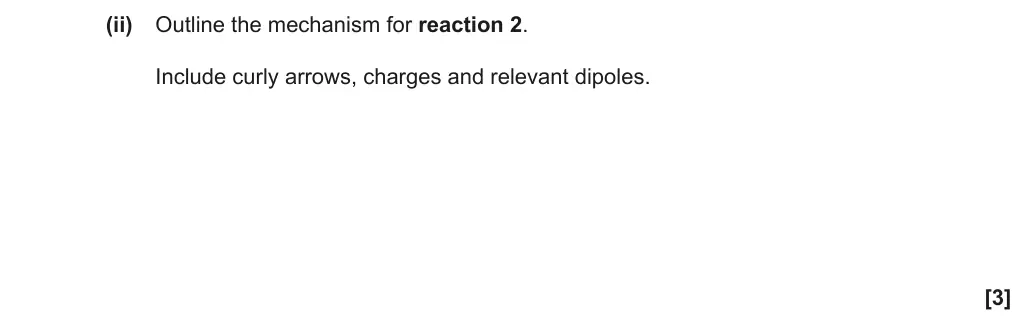
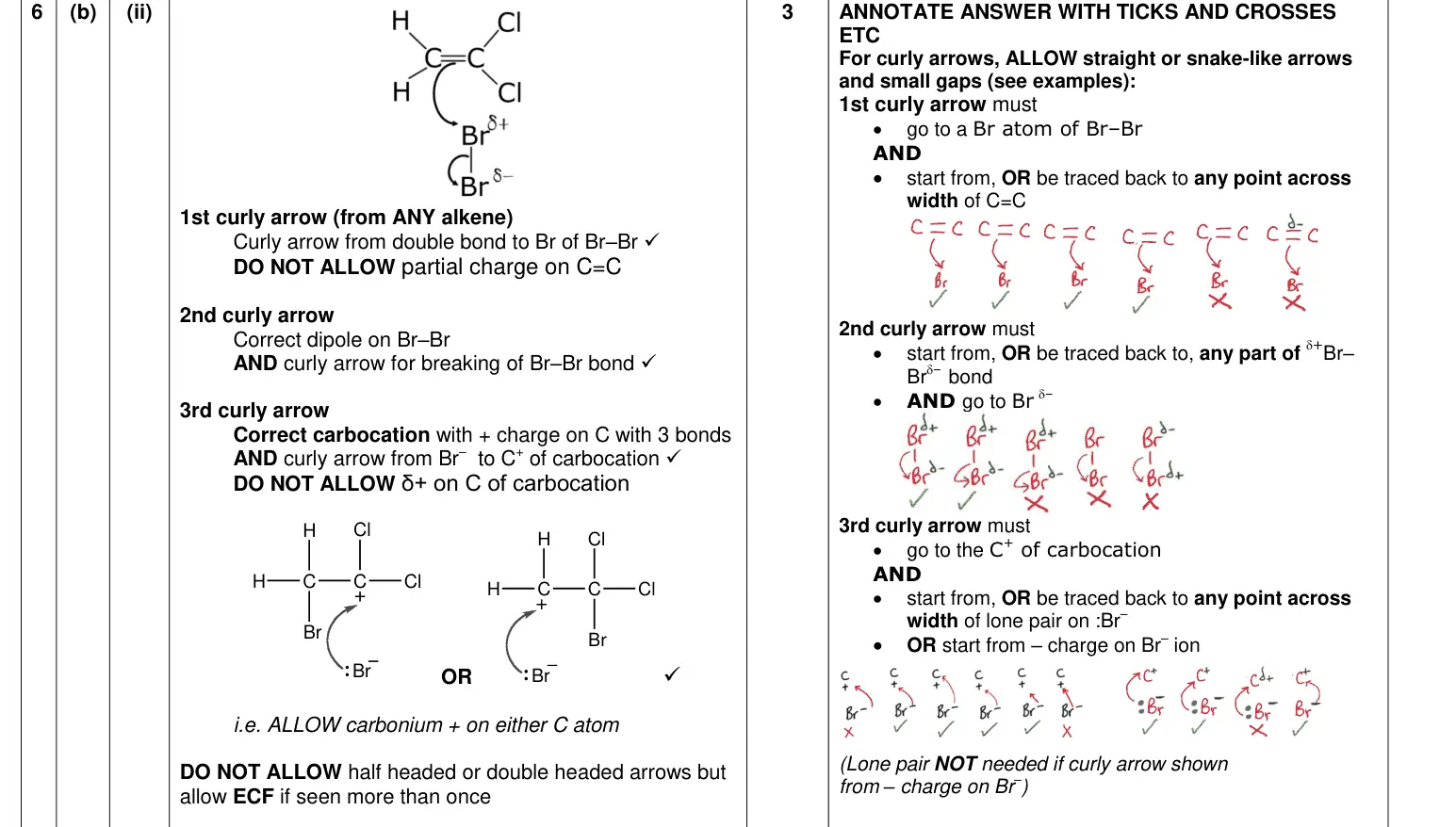
(ii) Outline the mechanism for reaction 2.
Include curly arrows, charges and relevant dipoles.
[3]
June 2018 · Paper 2 · Q18(b) 3 marks Mechanism Medium aromatic compounds
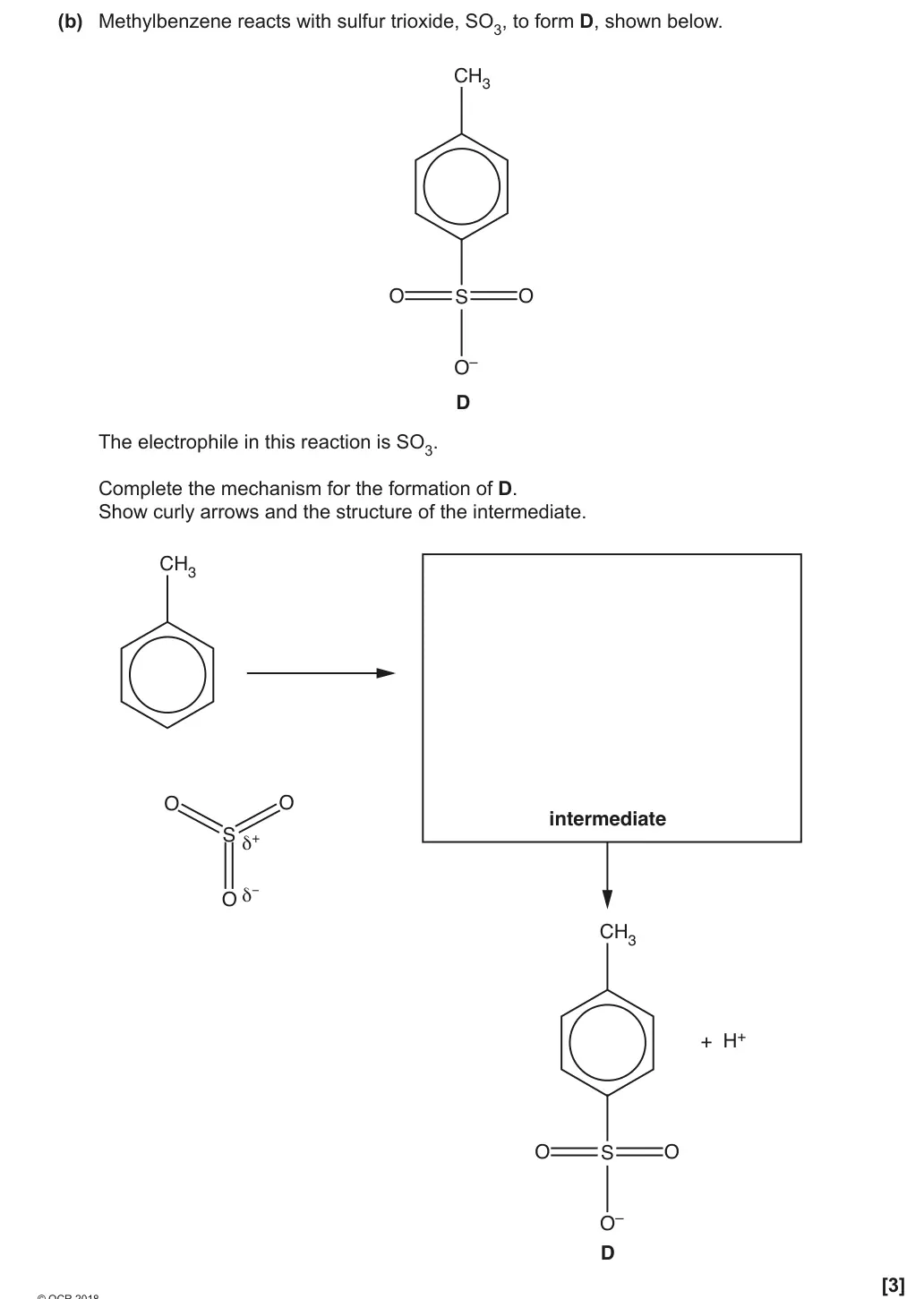
(b) Methylbenzene reacts with sulfur trioxide, SO3, to form D, shown below.
CH3
O S O
O–
D
The electrophile in this reaction is SO3.
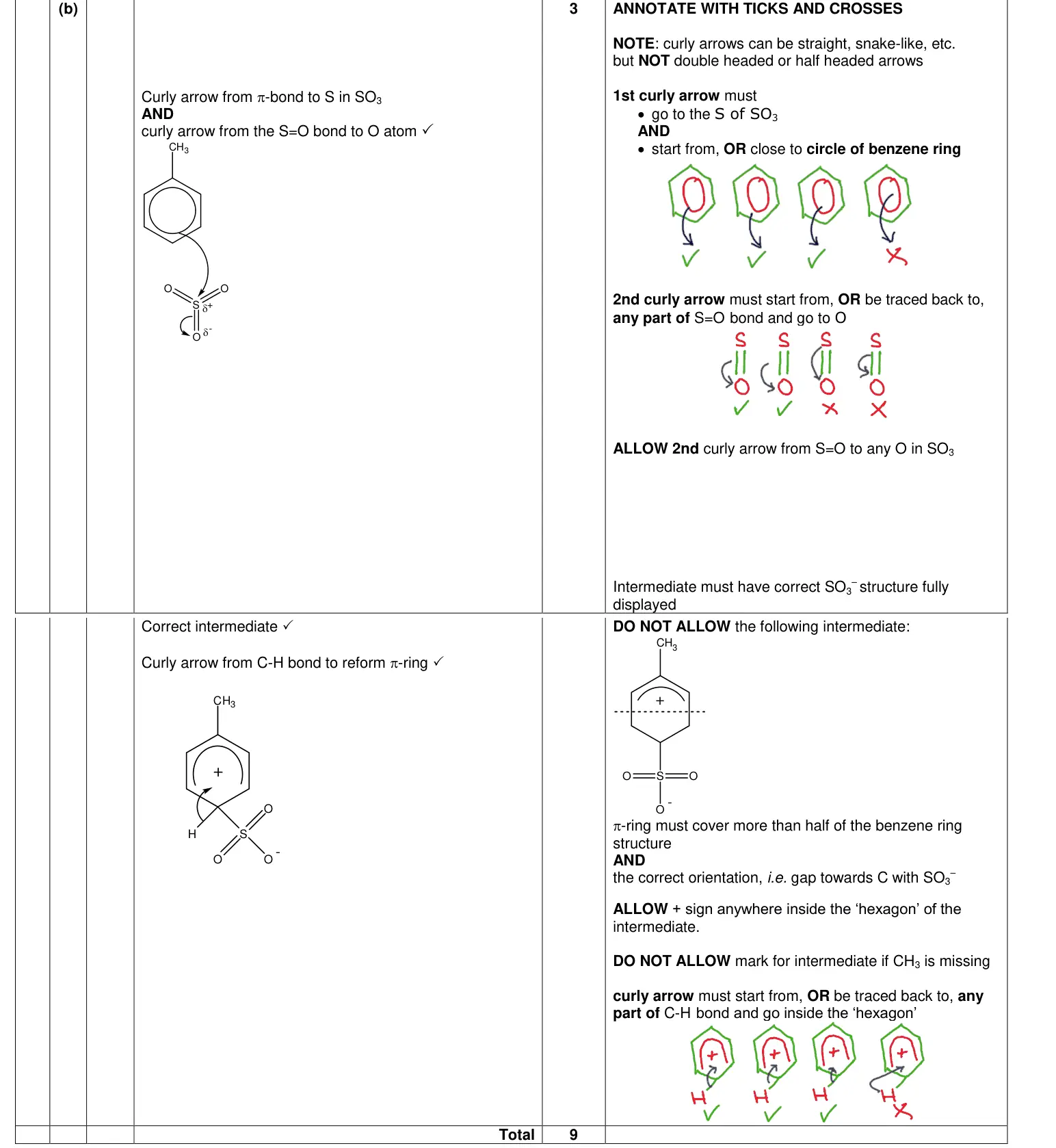
Complete the mechanism for the formation of D.
Show curly arrows and the structure of the intermediate.
CH3
O O
intermediate
S
δ+
O δ–
CH3
+  H+
O S O
O–
D
[3]
June 2018 · Paper 2 · Q19(b) 3 marks Mechanism Easy haloalkanesorganic basics
Earlier part of question 19 that this part usesEarlier part of June 2018 Paper 2 question 19
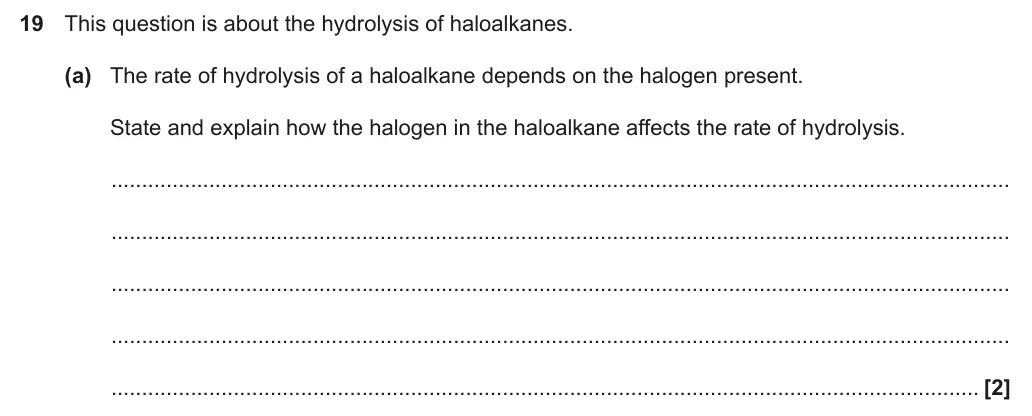
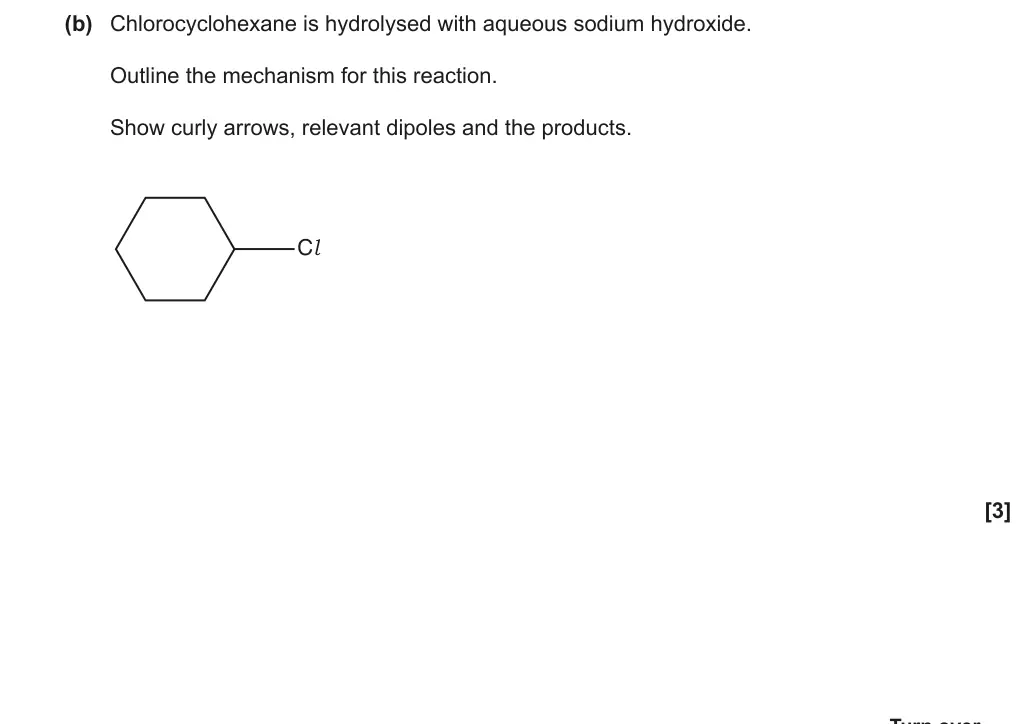
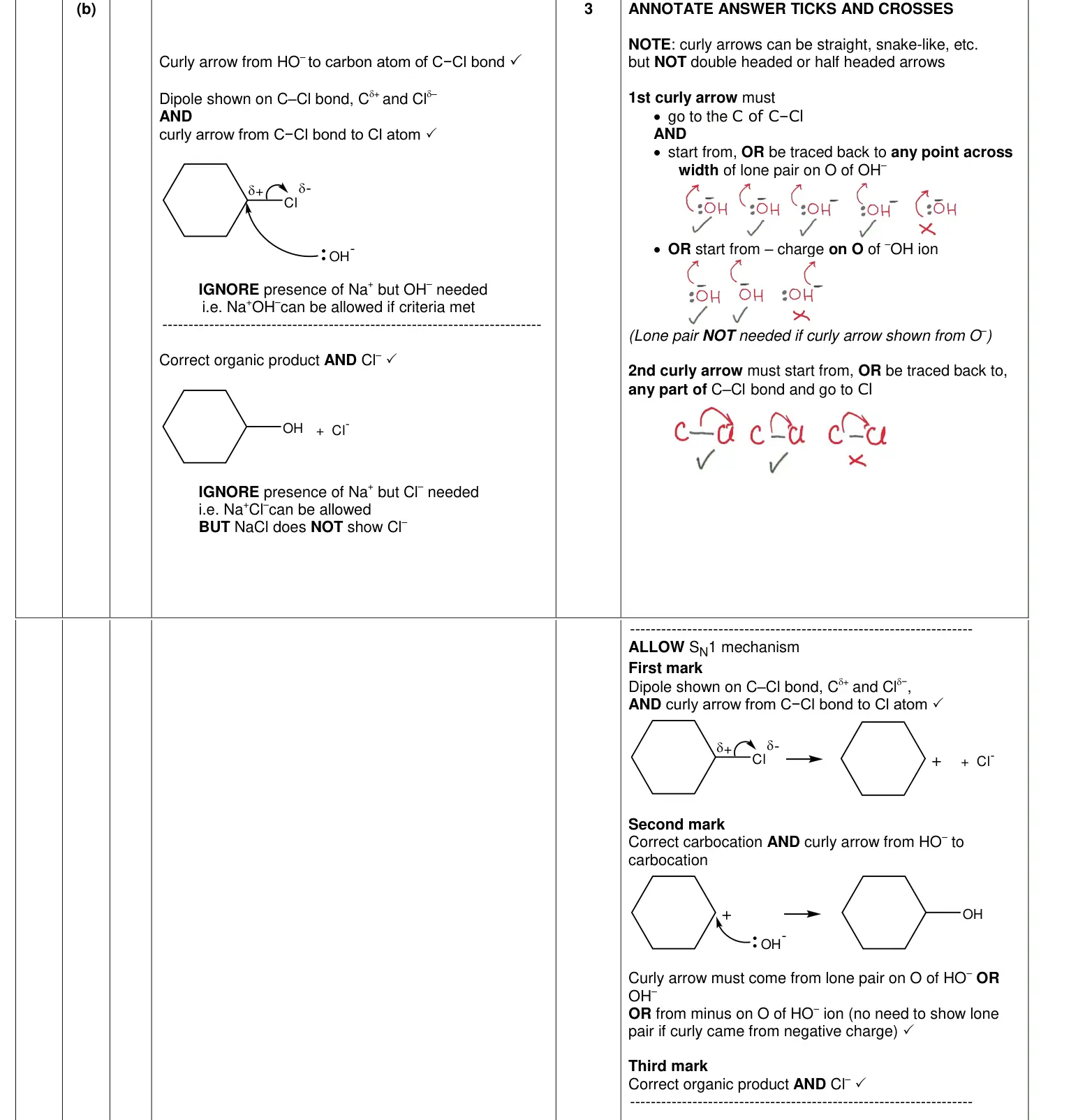
(b) Chlorocyclohexane is hydrolysed with aqueous sodium hydroxide.
Outline the mechanism for this reaction.
Show curly arrows, relevant dipoles and the products.
Cl
[3]
June 2018 · Paper 3 · Q4(a)(ii) 2 marks Mechanism Hard transition elementsorganic basics
Earlier part of question 4 that this part usesEarlier part of June 2018 Paper 3 question 4
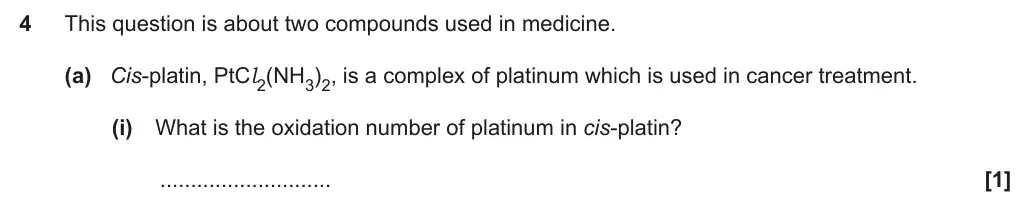
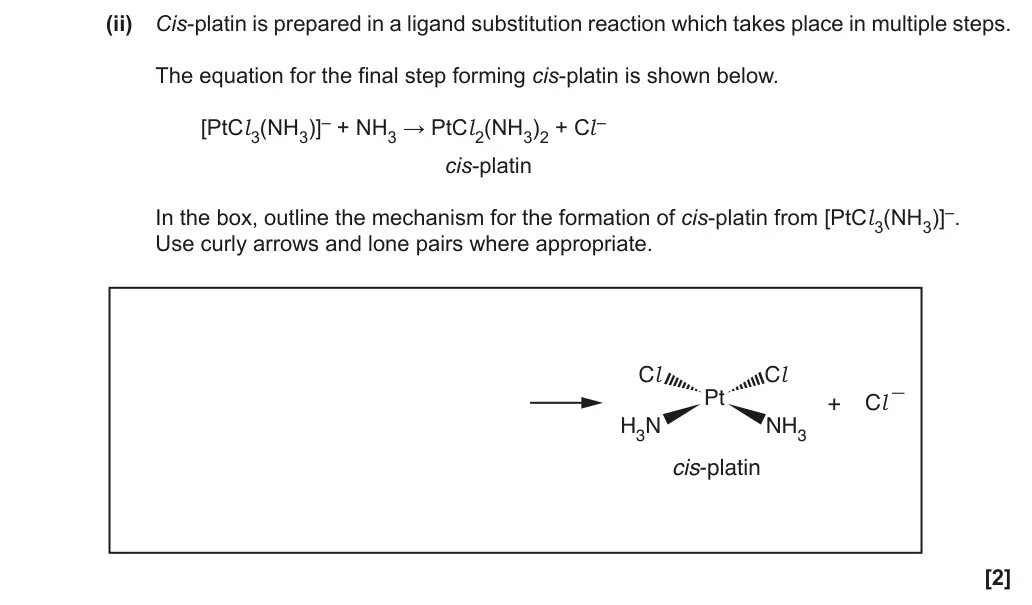
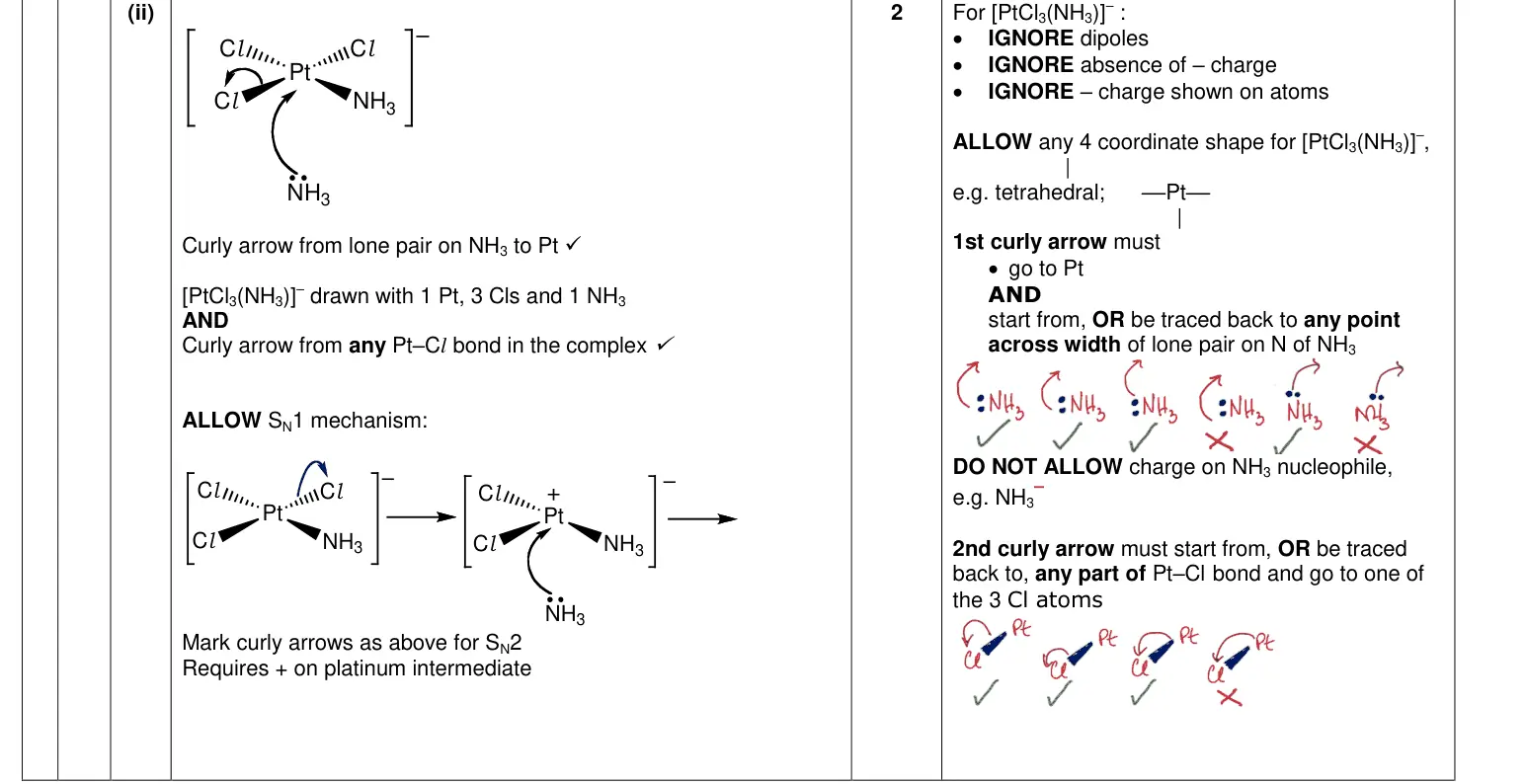
(ii) Cis-platin is prepared in a ligand substitution reaction which takes place in multiple steps.
The equation for the final step forming cis-platin is shown below.
[PtCl3(NH3)]– + NH3 → PtCl2(NH3)2 + Cl–
cis-platin
In the box, outline the mechanism for the formation of cis-platin from [PtCl3(NH3)]–.
Use curly arrows and lone pairs where appropriate.
Cl Cl
_
Pt + Cl
H3N NH3
cis-platin
[2]
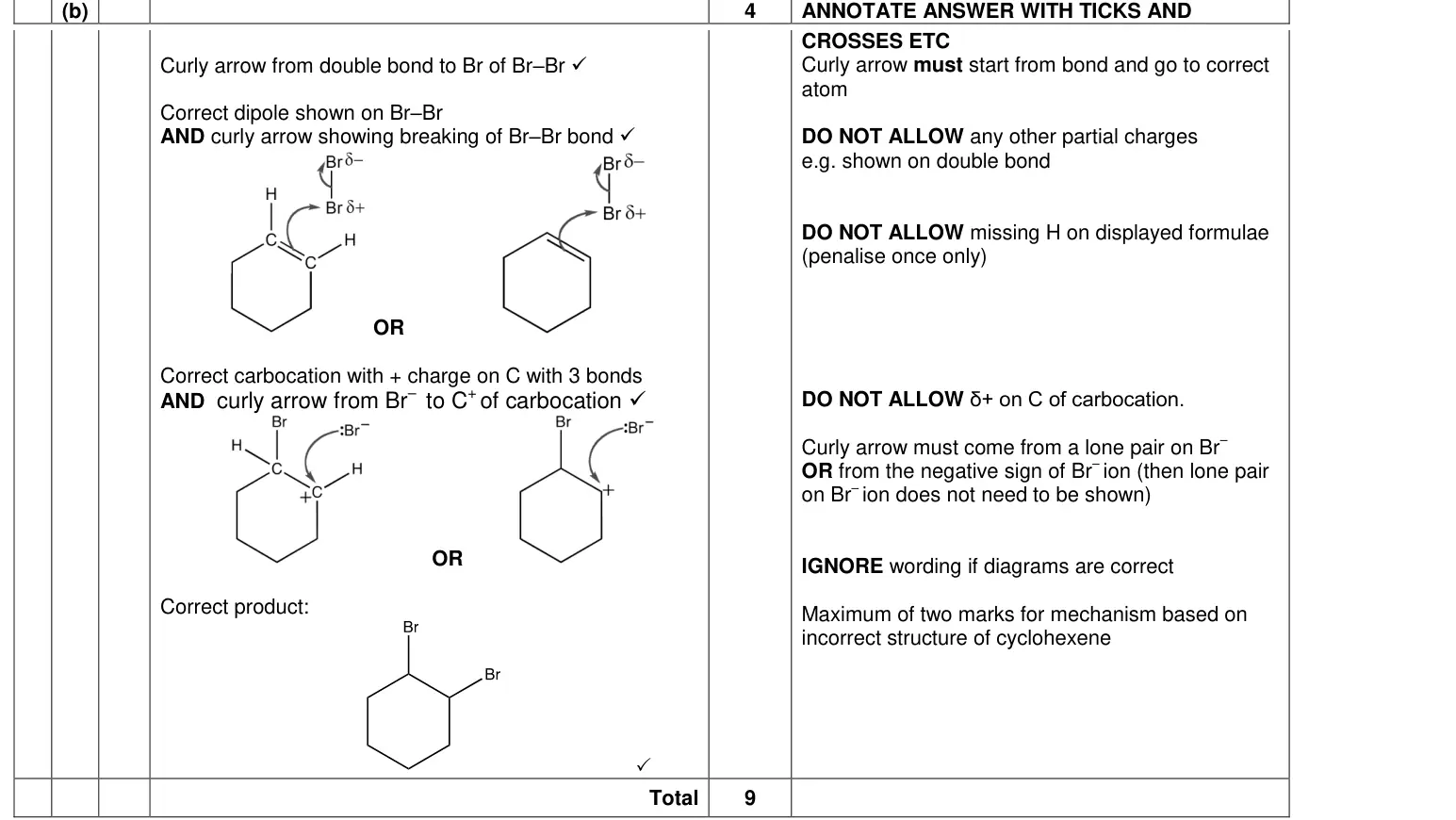
June 2017 · AS Paper 2 · Q6(b) 4 marks Mechanism alkenes
Earlier part of question 6 that this part usesEarlier part of June 2017 Paper 2 question 6
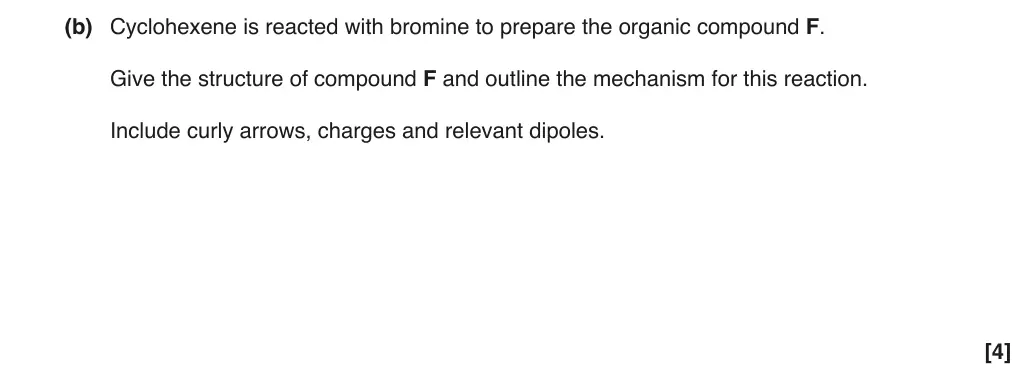
(b) Cyclohexene is reacted with bromine to prepare the organic compound F.
Give the structure of compound F and outline the mechanism for this reaction.
Include curly arrows, charges and relevant dipoles.
[4]
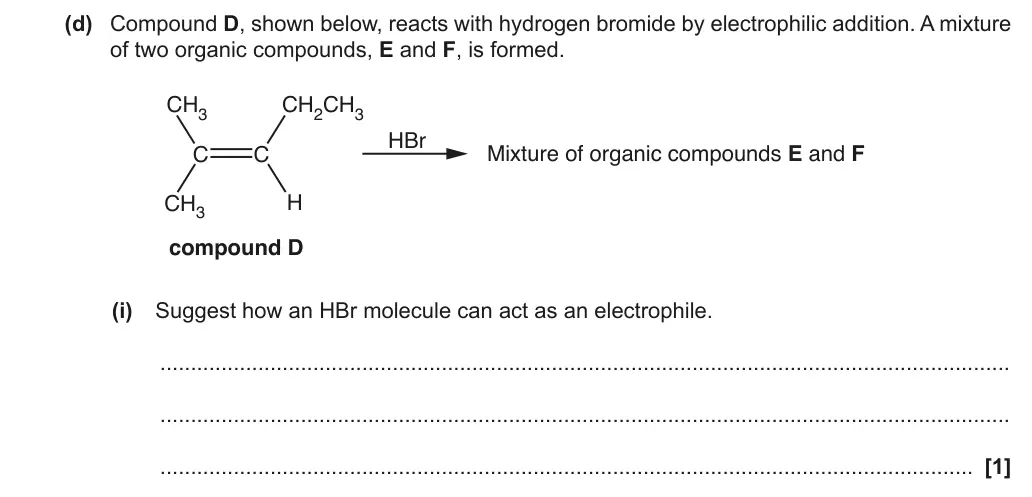
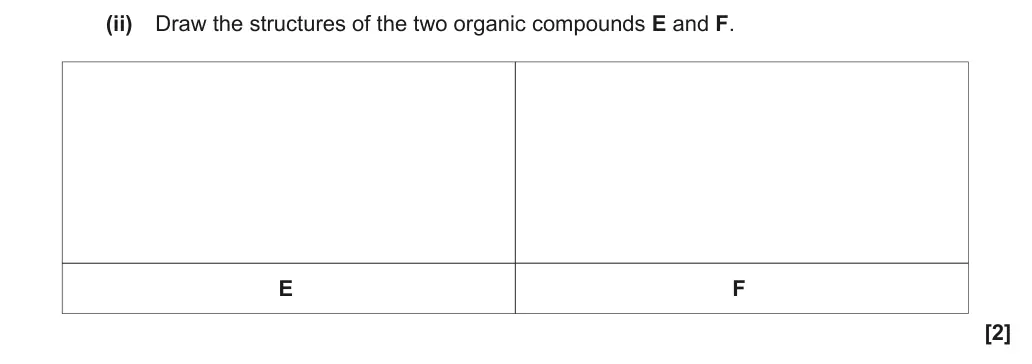
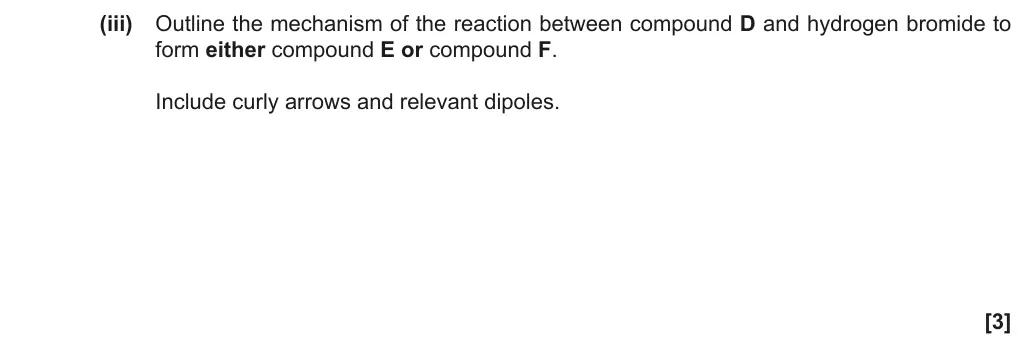
June 2017 · Paper 2 · Q16(d)(iii) 3 marks Mechanism alkenesorganic basics
Earlier parts of question 16 that this part usesEarlier part of June 2017 Paper 2 question 16Earlier part of June 2017 Paper 2 question 16
(iii) Outline the mechanism of the reaction between compound D and hydrogen bromide to
form either compound E or compound F.
Include curly arrows and relevant dipoles.
[3]
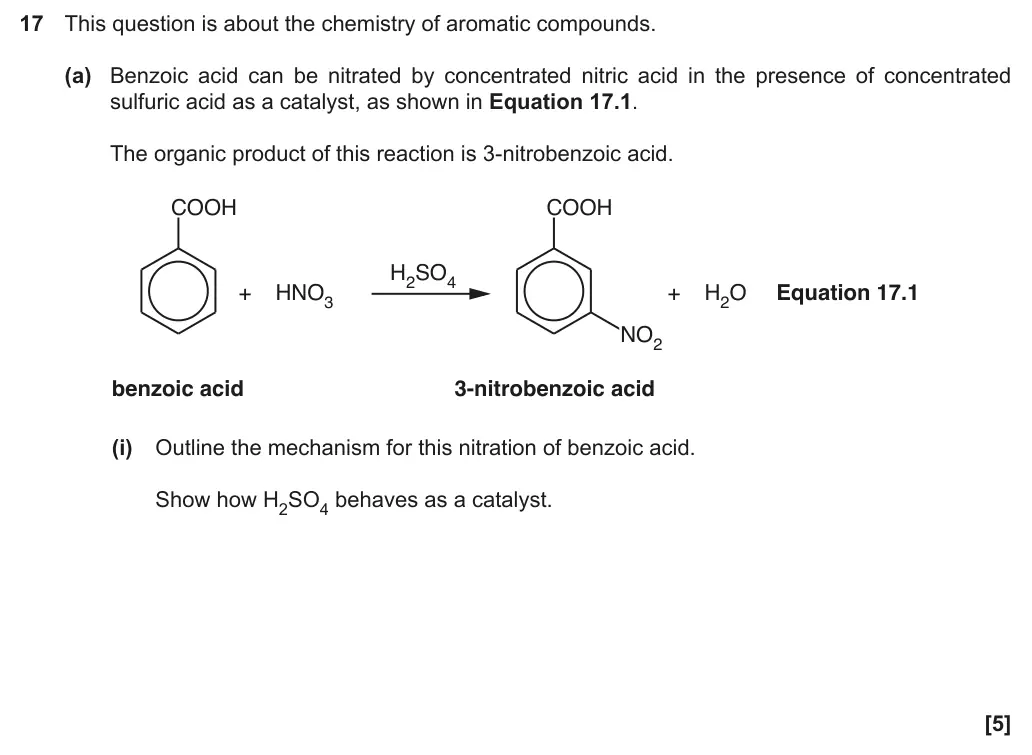
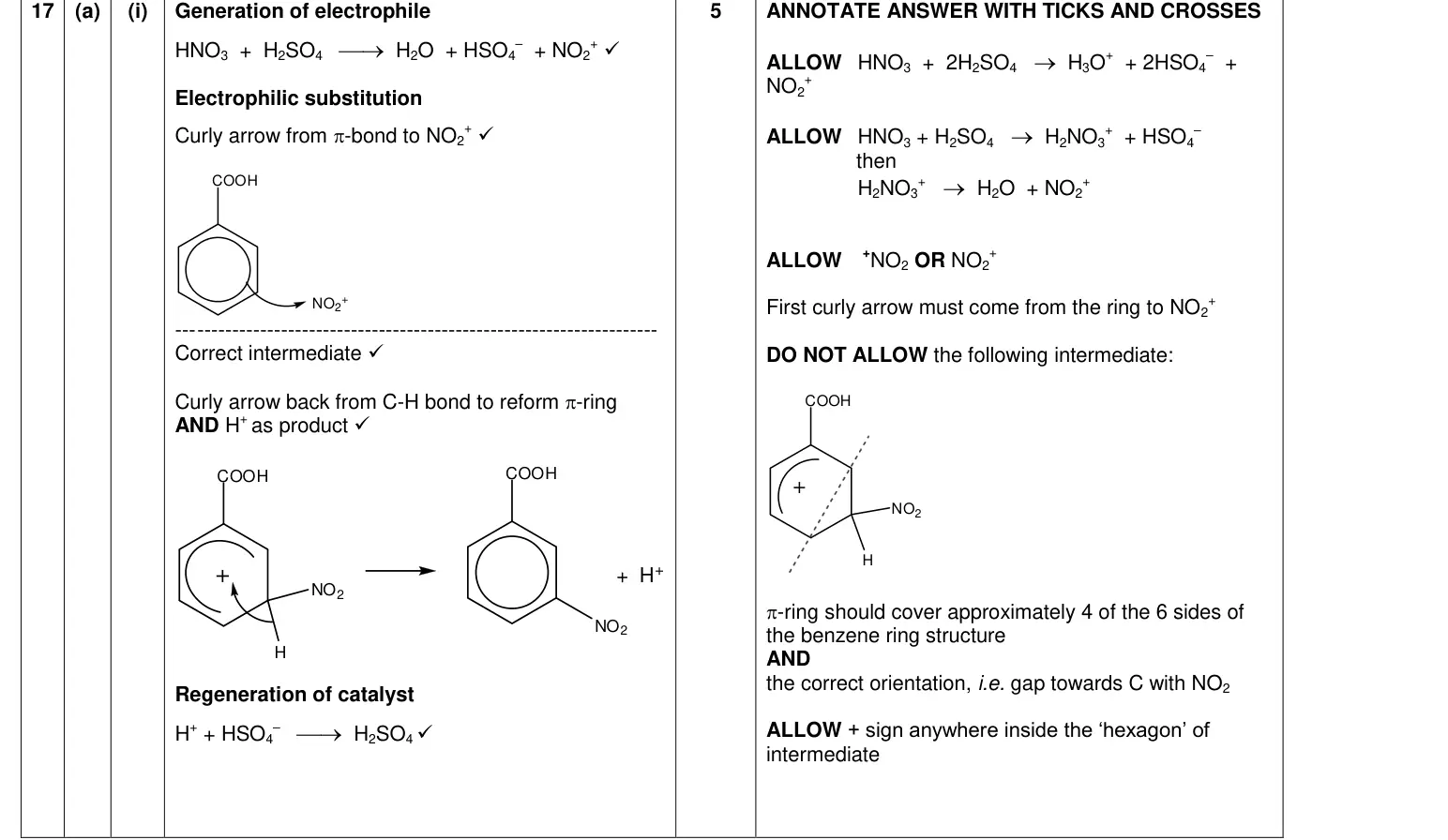
June 2017 · Paper 2 · Q17(a)(i) 5 marks Mechanism aromatic compounds
17 This question is about the chemistry of aromatic compounds.
(a) Benzoic acid can be nitrated by concentrated nitric acid in the presence of concentrated
sulfuric acid as a catalyst, as shown in Equation 17.1.
The organic product of this reaction is 3-nitrobenzoic acid.
COOH COOH
H2SO4
+ HNO3 + H2O Equation 17.1
NO2
benzoic acid 3-nitrobenzoic acid
(i) Outline the mechanism for this nitration of benzoic acid.
Show how H2SO4 behaves as a catalyst.
[5]
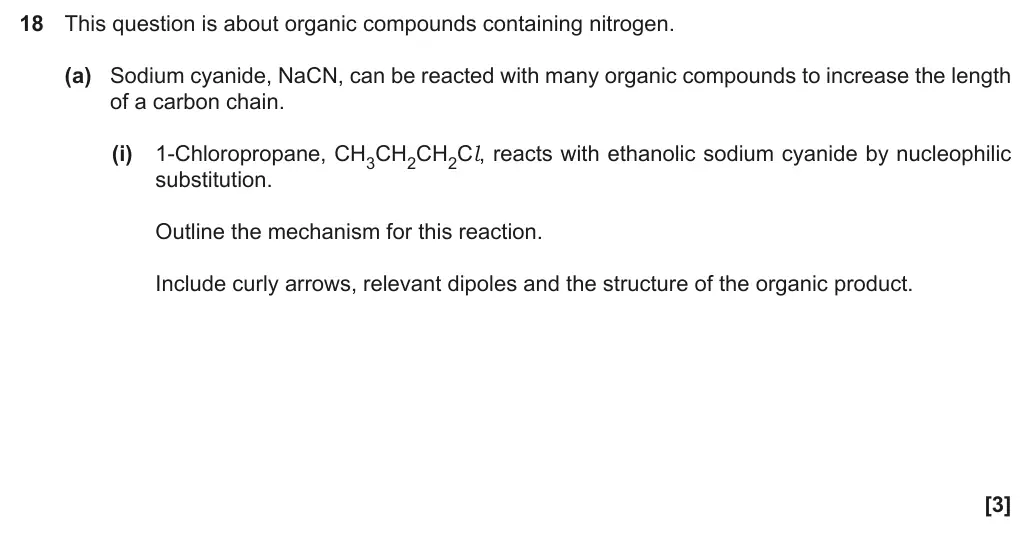
June 2017 · Paper 2 · Q18(a)(i) 3 marks Mechanism carbon carbon bond formationorganic basics
18 This question is about organic compounds containing nitrogen.
(a) Sodium cyanide, NaCN, can be reacted with many organic compounds to increase the length
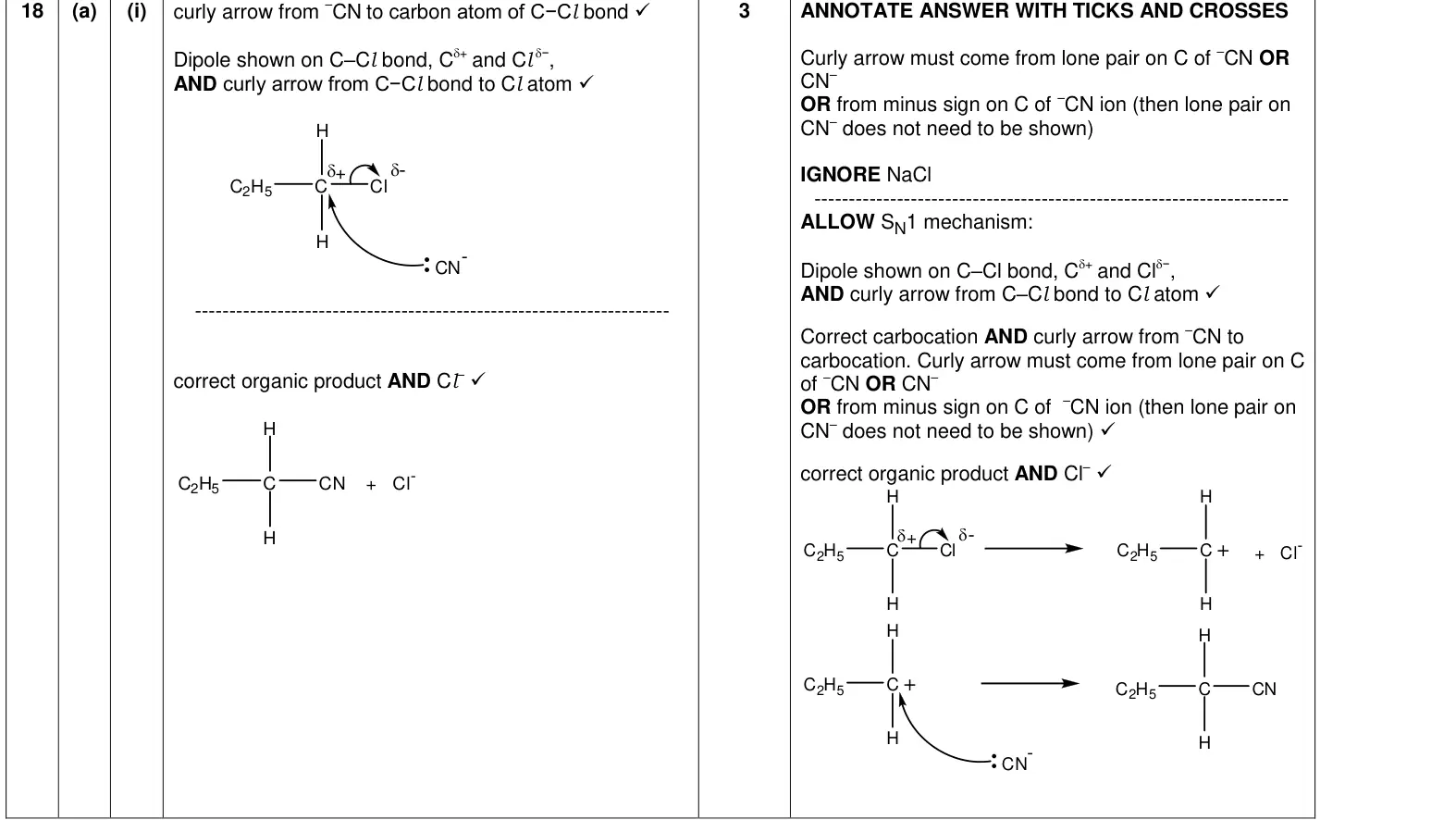
of a carbon chain.
(i) 1-Chloropropane, CH3CH2CH2Cl, reacts with ethanolic sodium cyanide by nucleophilic
substitution.
Outline the mechanism for this reaction.
Include curly arrows, relevant dipoles and the structure of the organic product.
[3]

Work with an OCR chemistry tutor

Dropping marks on calculations, mechanisms or the six-markers? Book a trial session with a specialist OCR chemistry tutor.

Prefer email? Send an enquiry

If you are under 18, please include a parent's contact details. Enquiries go to enquiries@chemistryaleveltutor.com and are deleted once handled. All tutoring is online.