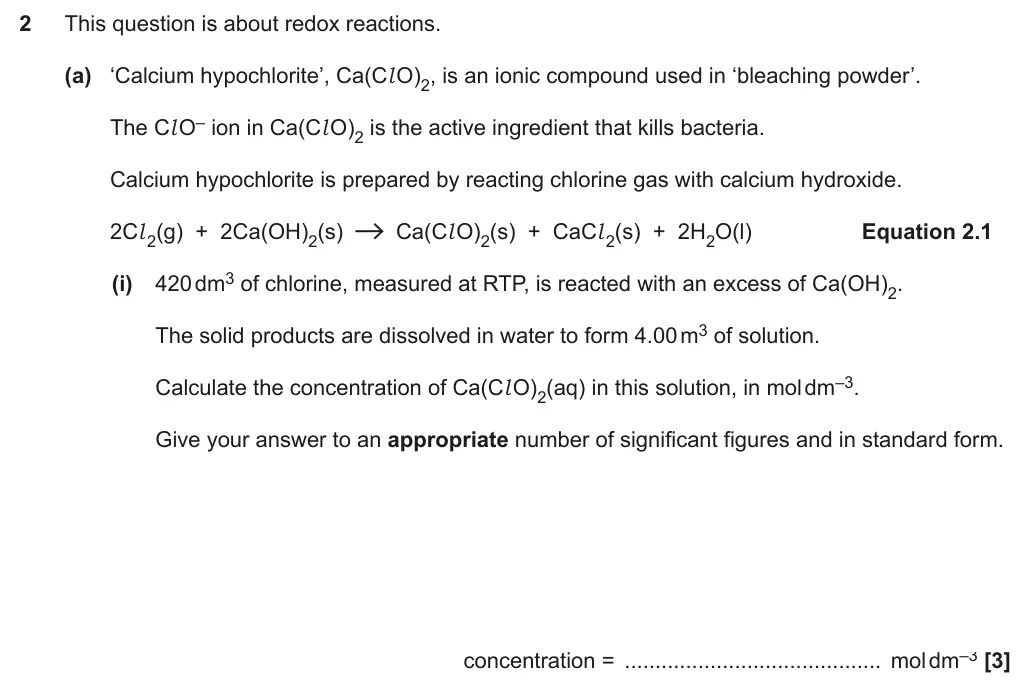
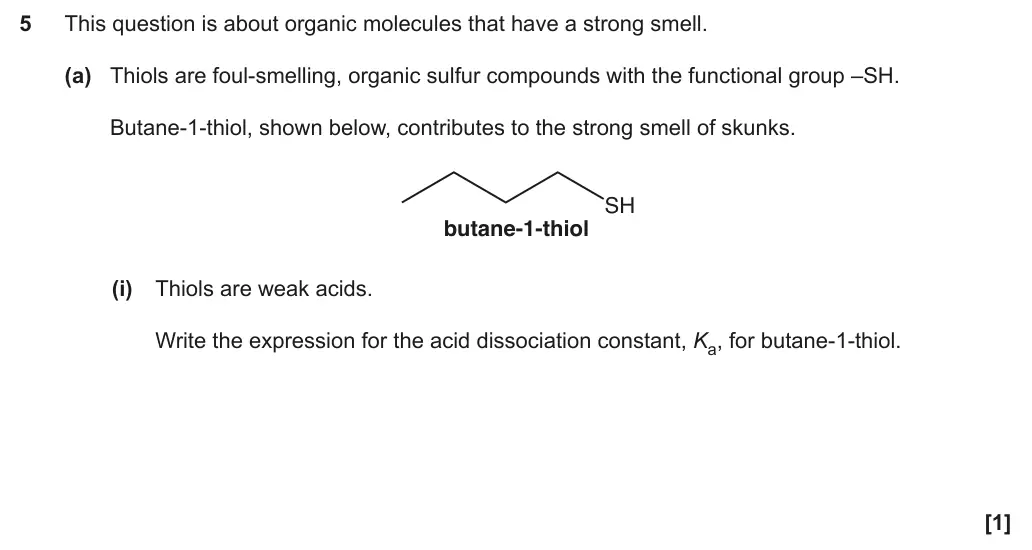
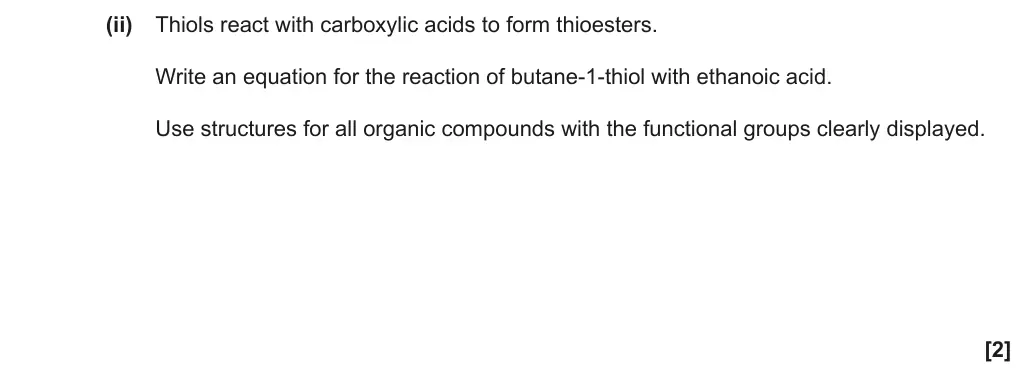
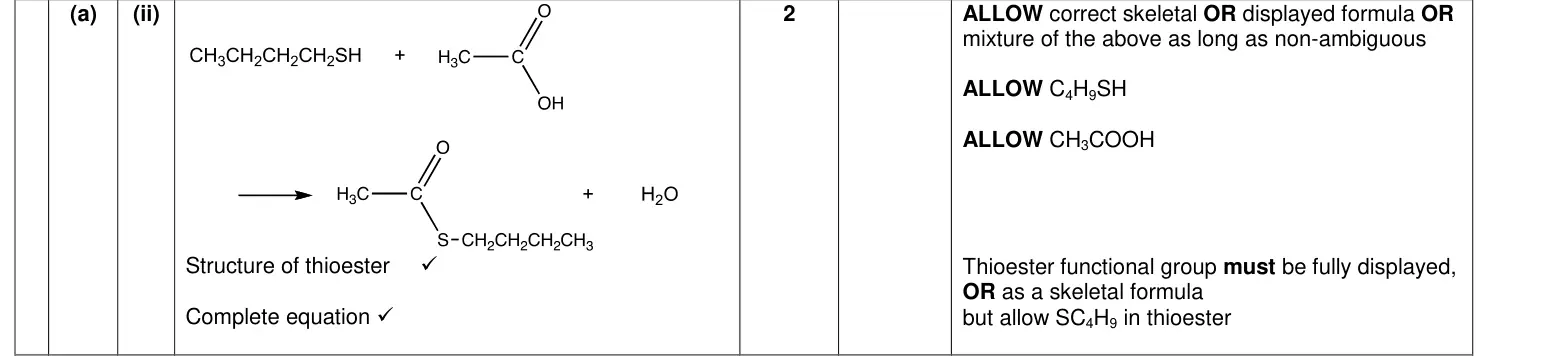
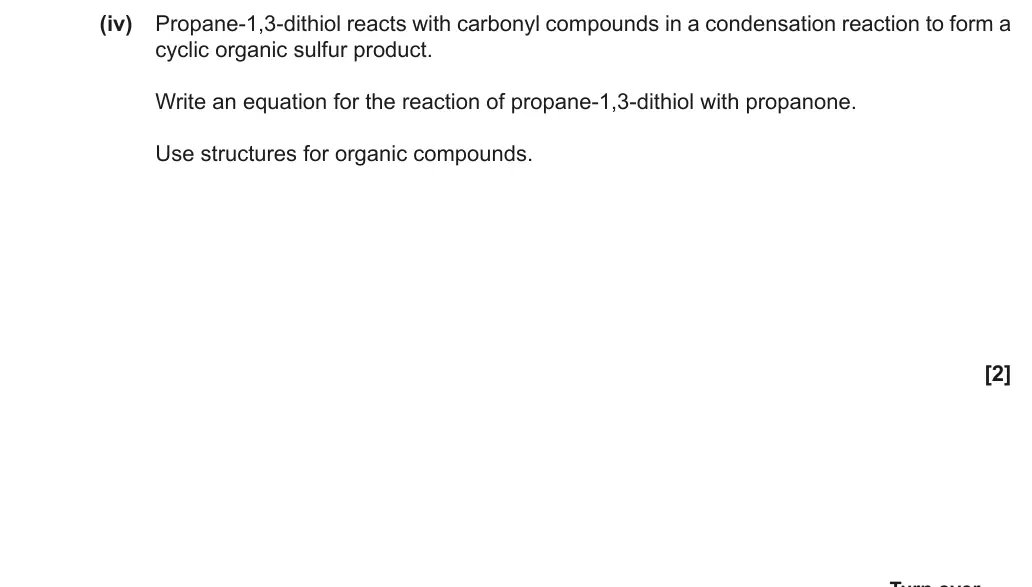
Equation questions

Write, construct or balance an equation: full, ionic and half-equations, with state symbols where the question asks for them. 129 questions.

Other types: Multiple-choice questions · Calculation questions · Mechanism questions · Structure and isomer questions · Six-mark level of response questions · Practical questions · Graph and data questions · Short-answer questions

June 2025 · AS Paper 1 · Q24(b) 1 mark Equation writing Easy formulae and equationsalkanes
(b) Pentene, C5H10, can undergo complete combustion to produce the same products as the
combustion of an alkane.
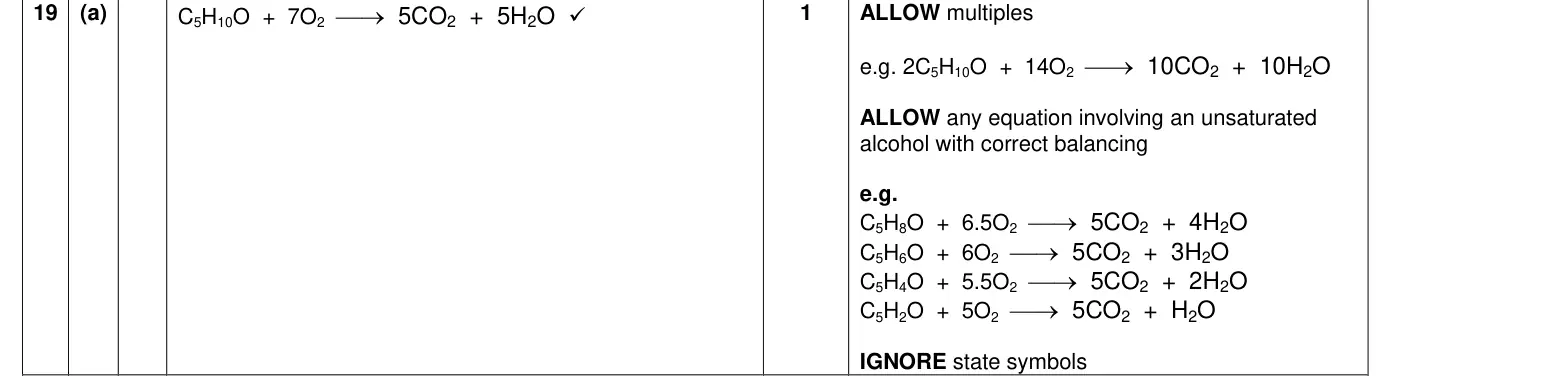
Write the equation for the complete combustion of C5H10.
.................................................................................................................................................... [1]
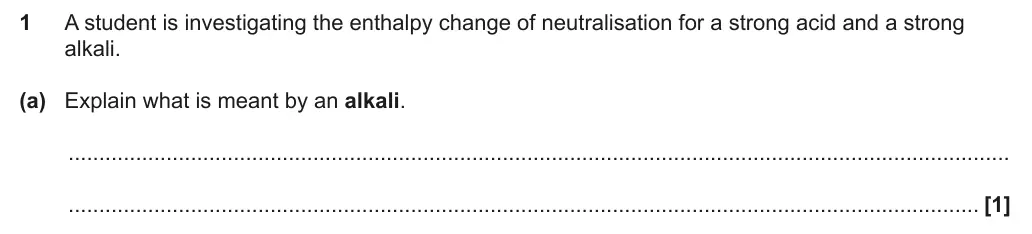
June 2025 · AS Paper 2 · Q1(b) 1 mark Equation writing Easy acids and titrations
Earlier part of question 1 that this part usesEarlier part of June 2025 Paper 2 question 1
(b) Write the ionic equation for the neutralisation reaction between an acid and an alkali.
..................................................................................................................................................... [1]
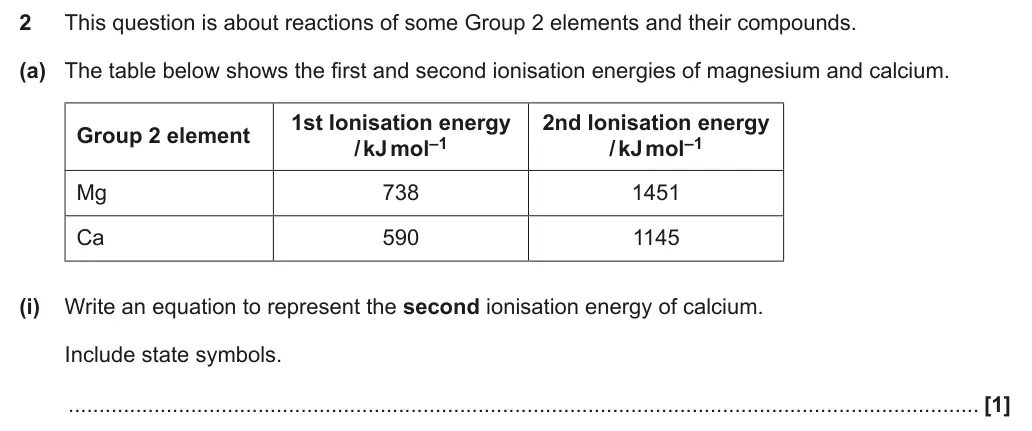
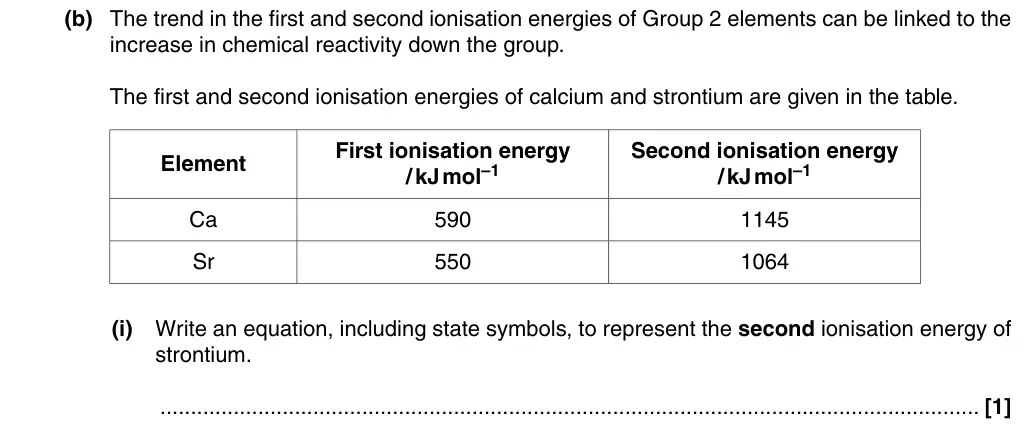
June 2025 · AS Paper 2 · Q2(a)(i) 1 mark Equation writing Medium group 2periodicity
2 This question is about reactions of some Group 2 elements and their compounds.
(a) The table below shows the first and second ionisation energies of magnesium and calcium.
1st Ionisation energy 2nd Ionisation energy
Group 2 element
/ kJ mol–1 / kJ mol–1
Mg 738 1451
Ca 590 1145
(i) Write an equation to represent the second ionisation energy of calcium.
Include state symbols.
..................................................................................................................................................... [1]
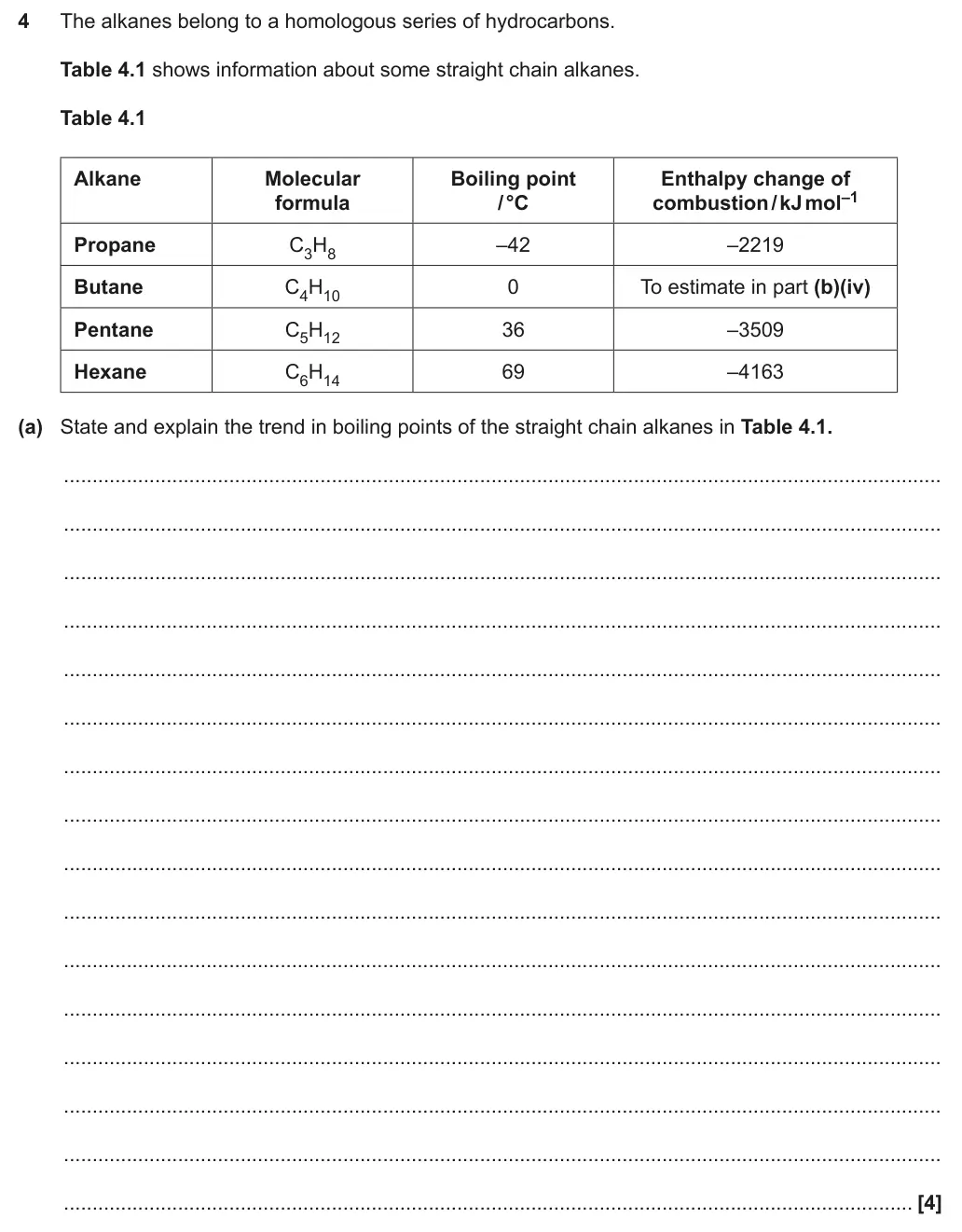
June 2025 · AS Paper 2 · Q4(b)(i) 1 mark Equation writing Hard alkanes
Earlier part of question 4 that this part usesEarlier part of June 2025 Paper 2 question 4
(b) When alkanes undergo complete combustion carbon dioxide and water are produced.
(i) Write the balanced equation for the complete combustion of one mole of pentane.
..................................................................................................................................................... [1]
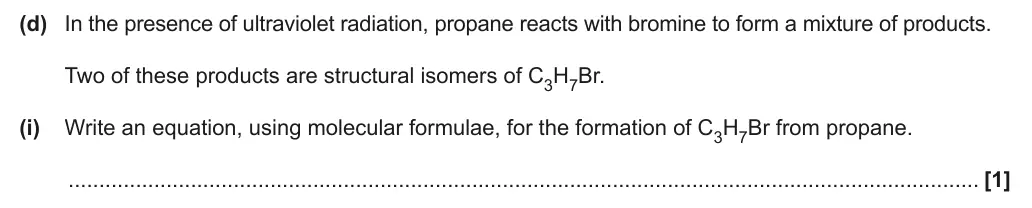
June 2025 · AS Paper 2 · Q4(d)(i) 1 mark Equation writing Medium alkanes
(d) In the presence of ultraviolet radiation, propane reacts with bromine to form a mixture of products.
Two of these products are structural isomers of C3H7Br.
(i) Write an equation, using molecular formulae, for the formation of C3H7Br from propane.
..................................................................................................................................................... [1]
June 2025 · Paper 1 · Q16(b)(i) 1 mark Equation writing Medium periodicity
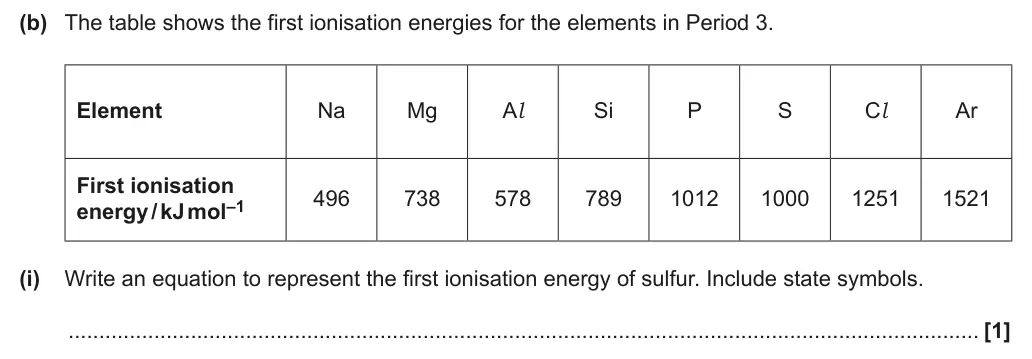
(b) The table shows the first ionisation energies for the elements in Period 3.
Element Na Mg Al Si P S Cl Ar
First ionisation
496 738 578 789 1012 1000 1251 1521
energy / kJ mol–1
(i) Write an equation to represent the first ionisation energy of sulfur. Include state symbols.
..................................................................................................................................................... [1]
June 2025 · Paper 1 · Q16(c) 3 marks Equation writing Hard halogensformulae and equations
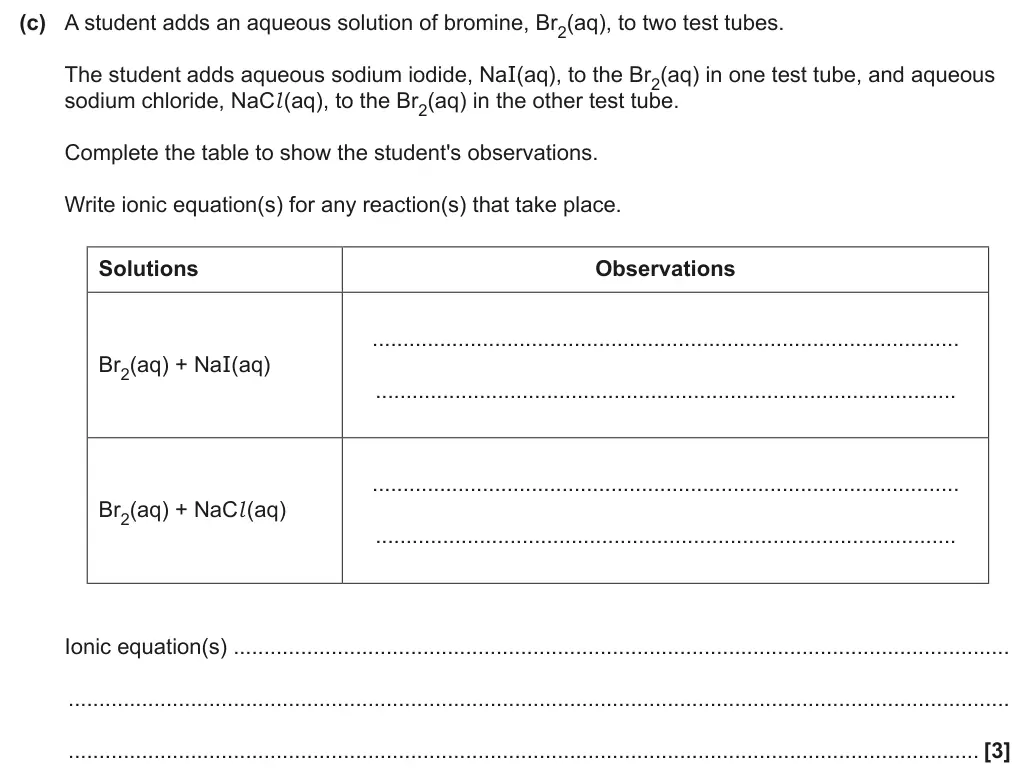
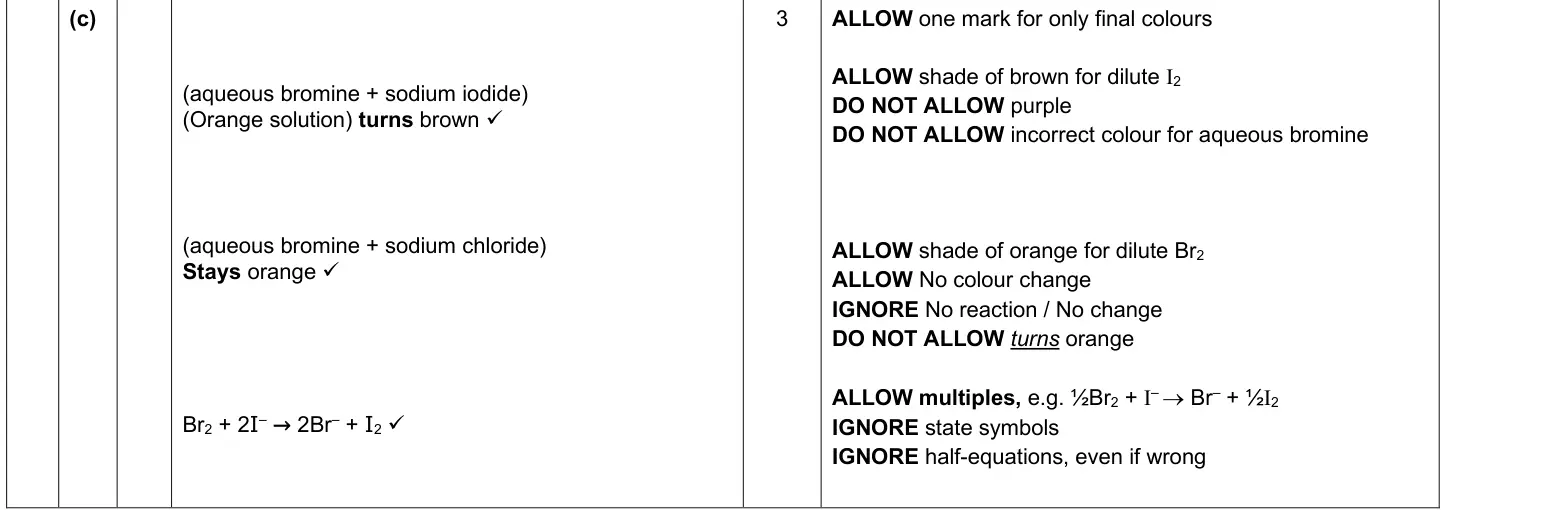
(c) A student adds an aqueous solution of bromine, Br2(aq), to two test tubes.
The student adds aqueous sodium iodide, NaI(aq), to the Br2(aq) in one test tube, and aqueous
sodium chloride, NaCl (aq), to the Br2(aq) in the other test tube.
Complete the table to show the student's observations.
Write ionic equation(s) for any reaction(s) that take place.
Solutions Observations
................................................................................................
Br2(aq) + NaI(aq)
...............................................................................................
................................................................................................
Br2(aq) + NaCl (aq)
...............................................................................................
Ionic equation(s) ...............................................................................................................................
..........................................................................................................................................................
..................................................................................................................................................... [3]
June 2025 · Paper 2 · Q16(d) 1 mark Equation writing Medium alkanesformulae and equations
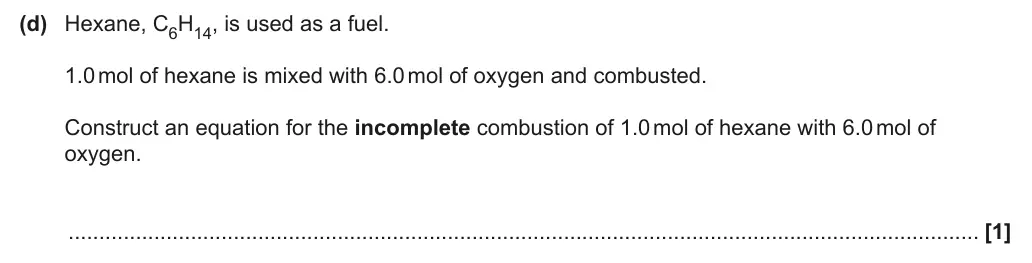
(d) Hexane, C6H14, is used as a fuel.
1.0 mol of hexane is mixed with 6.0 mol of oxygen and combusted.
Construct an equation for the incomplete combustion of 1.0 mol of hexane with 6.0 mol of
oxygen.
..................................................................................................................................................... [1]
June 2025 · Paper 2 · Q20(b)(ii) 2 marks Equation writing Hard aromatic compounds
Earlier part of question 20 that this part usesEarlier part of June 2025 Paper 2 question 20
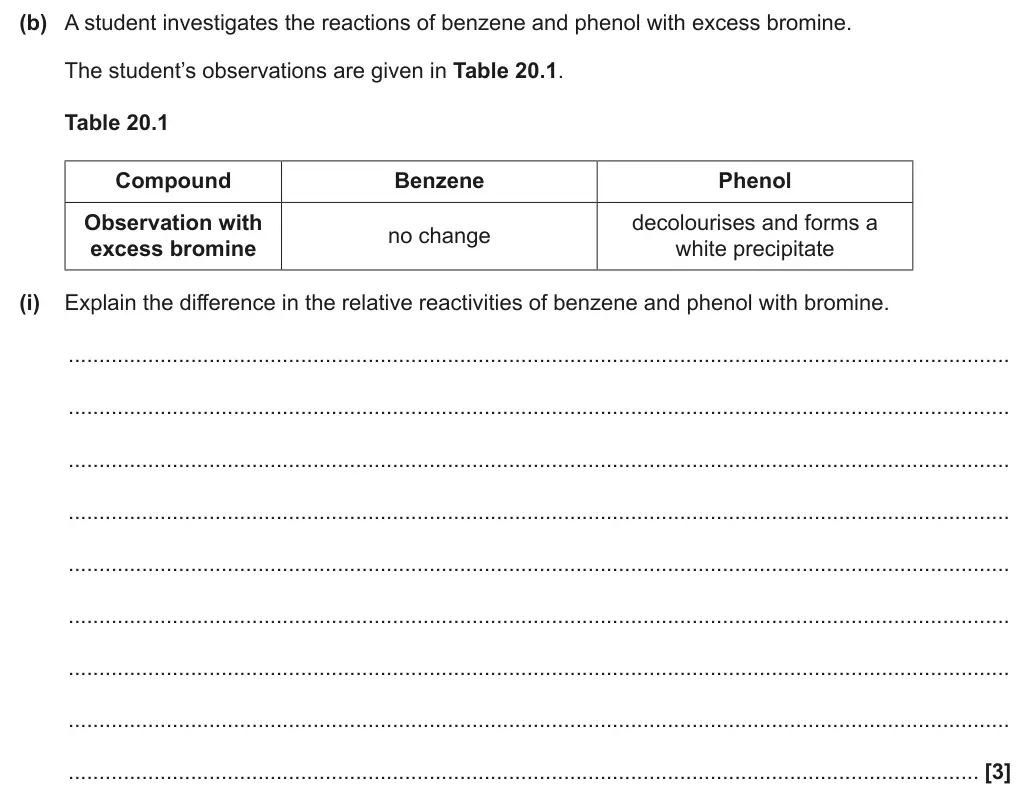
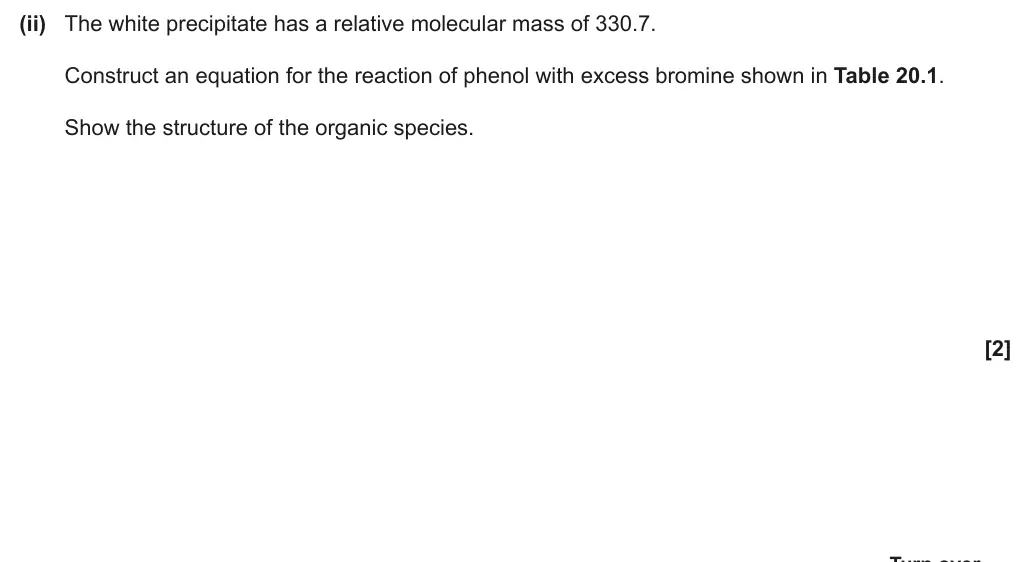
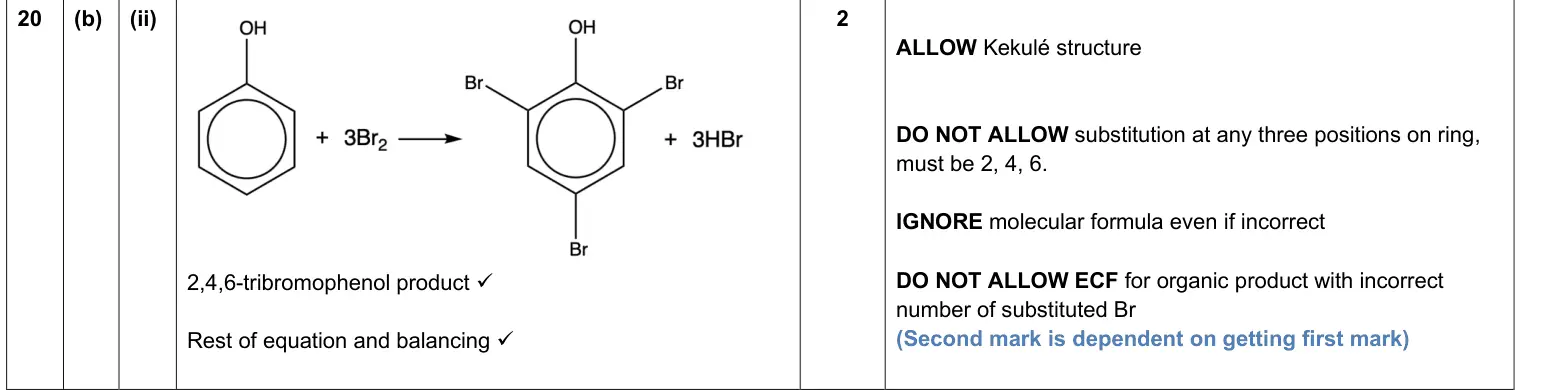
(ii) The white precipitate has a relative molecular mass of 330.7.
Construct an equation for the reaction of phenol with excess bromine shown in Table 20.1.
Show the structure of the organic species.
[2]
June 2025 · Paper 3 · Q4(a)(iii) 2 marks Equation writing Hard redox and electrode potentialstransition elements
Earlier parts of question 4 that this part usesEarlier part of June 2025 Paper 3 question 4Earlier part of June 2025 Paper 3 question 4
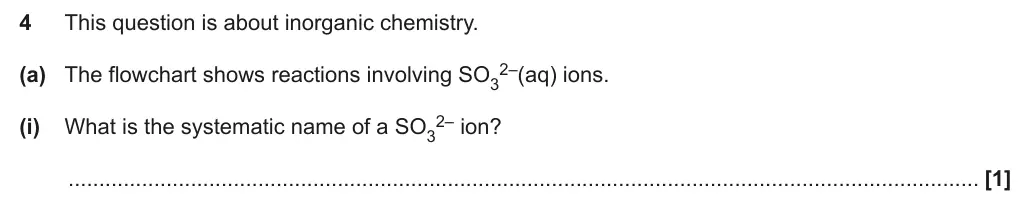
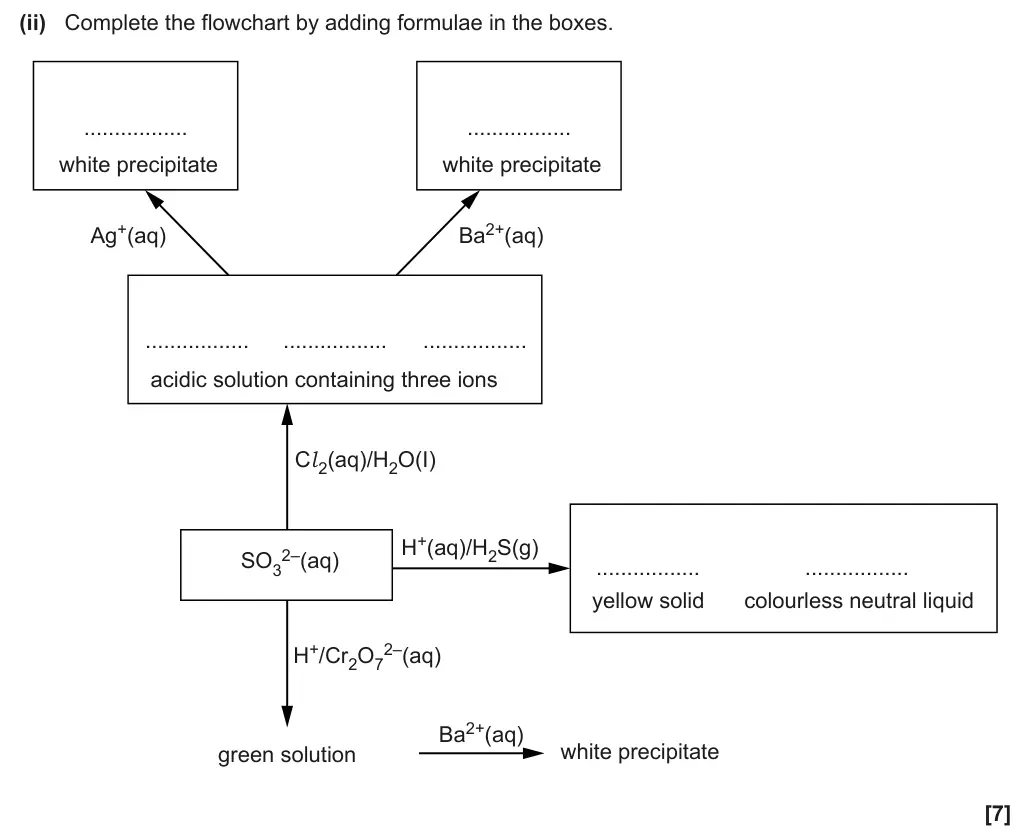
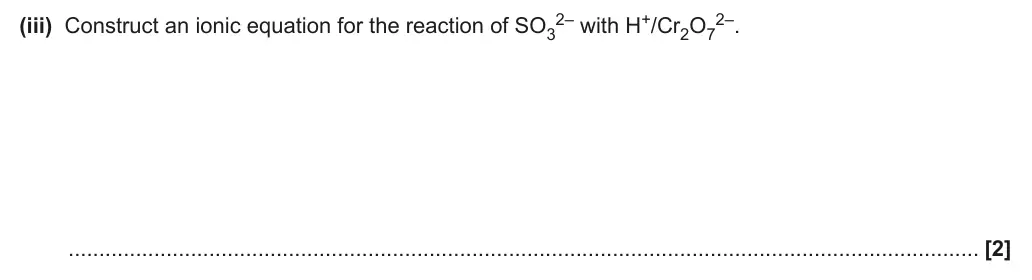
(iii) Construct an ionic equation for the reaction of SO3 2– with H+/Cr2O7 2–.
..................................................................................................................................................... [2]
June 2025 · Paper 3 · Q5(c)(ii) 2 marks Equation writing Hard redox and electrode potentials
Earlier part of question 5 that this part usesEarlier part of June 2025 Paper 3 question 5
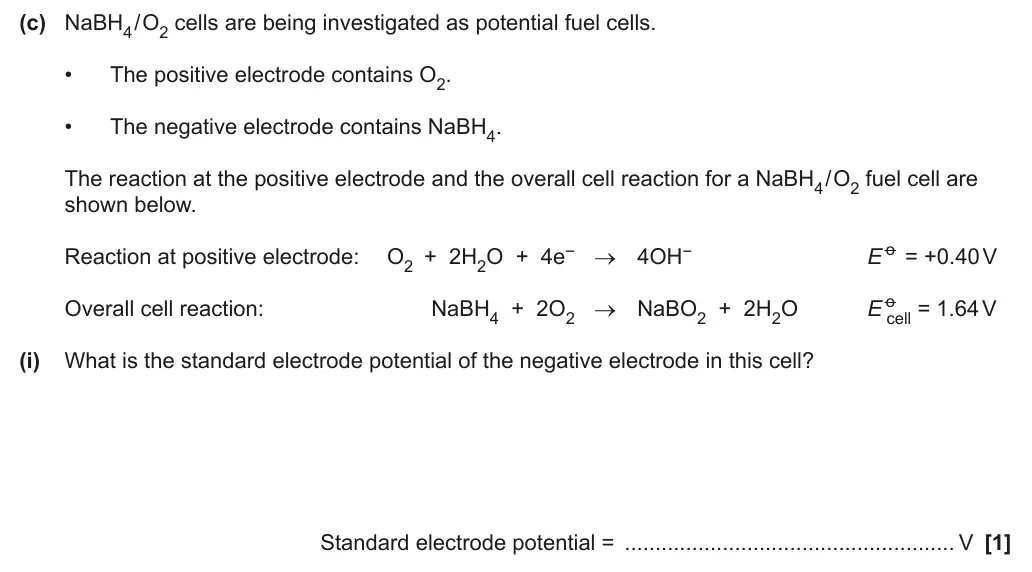
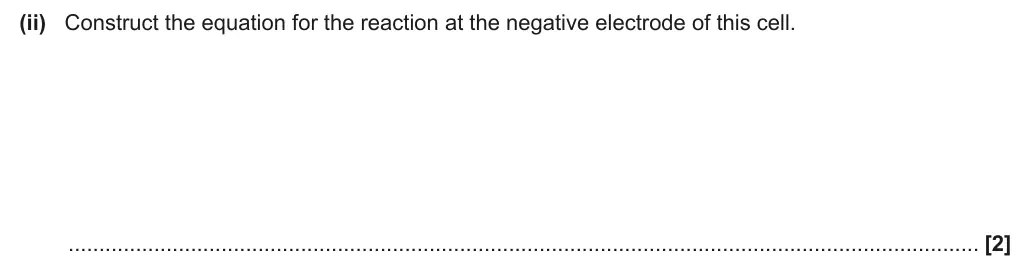
(ii) Construct the equation for the reaction at the negative electrode of this cell.
..................................................................................................................................................... [2]
June 2024 · AS Paper 1 · Q21(b)(ii) 1 mark Equation writing Easy formulae and equations
Earlier part of question 21 that this part usesEarlier part of June 2024 Paper 1 question 21
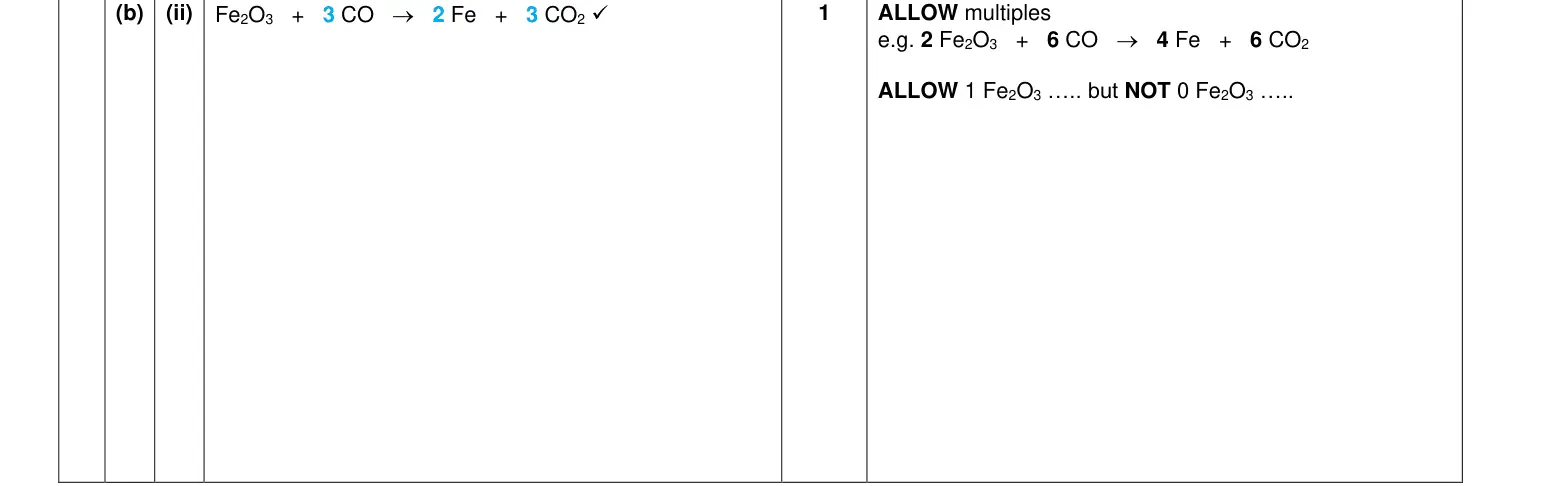
(ii) Balance the equation for the reduction of Fe2O3 with carbon monoxide.
......... Fe2O3 + ......... CO ......... Fe + ......... CO2 [1]
June 2024 · AS Paper 1 · Q25(d)(i) 2 marks Equation writing Medium haloalkanesorganic basics
(d) Alcohols can be prepared by the hydrolysis of haloalkanes with aqueous alkali.
(i) Write an equation for the hydrolysis of 2‑bromo‑2‑methylpropane.
Show organic compounds as structures.
[2]
June 2024 · AS Paper 2 · Q2(a)(iv) 1 mark Equation writing Medium group 2
(iv) Magnesium reacts with oxygen in the air.
Write the equation for this reaction.
..................................................................................................................................................... [1]
June 2024 · AS Paper 2 · Q2(c)(ii) 2 marks Equation writing Medium periodicityformulae and equations
Earlier part of question 2 that this part usesEarlier part of June 2024 Paper 2 question 2
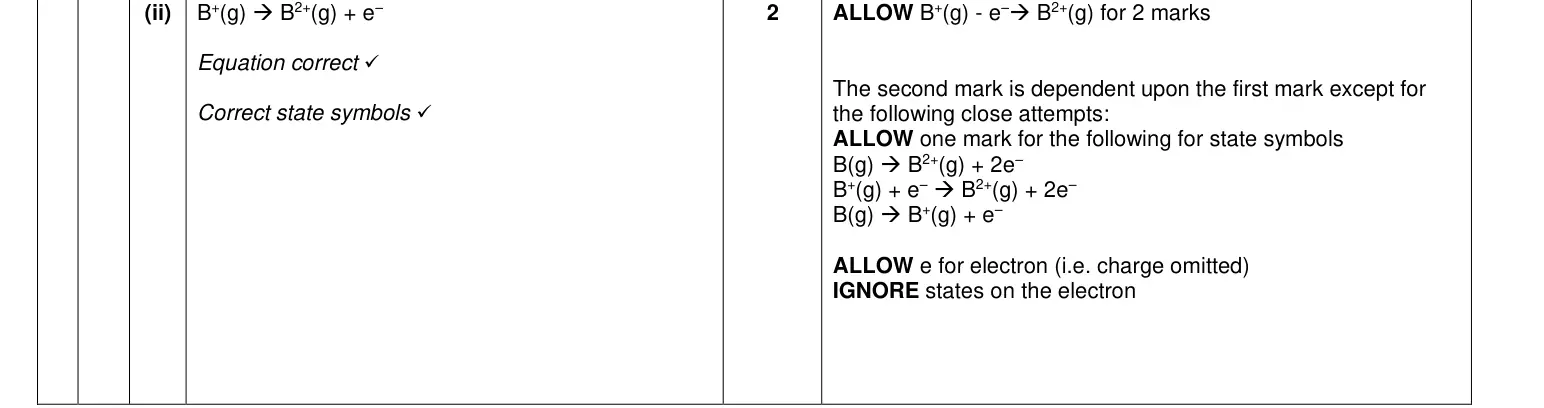
(ii) Write an equation, including state symbols, to represent the second ionisation energy of B.
..................................................................................................................................................... [2]
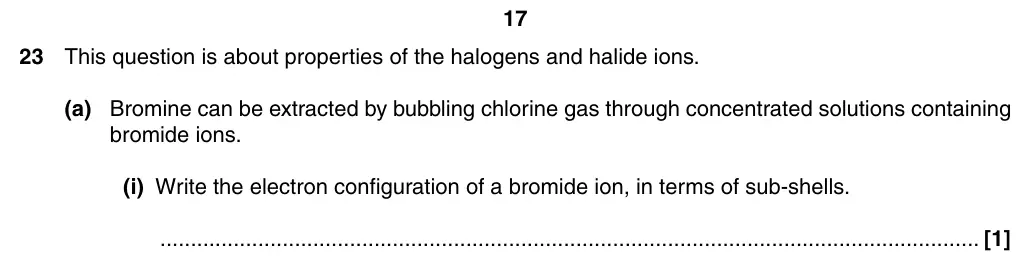
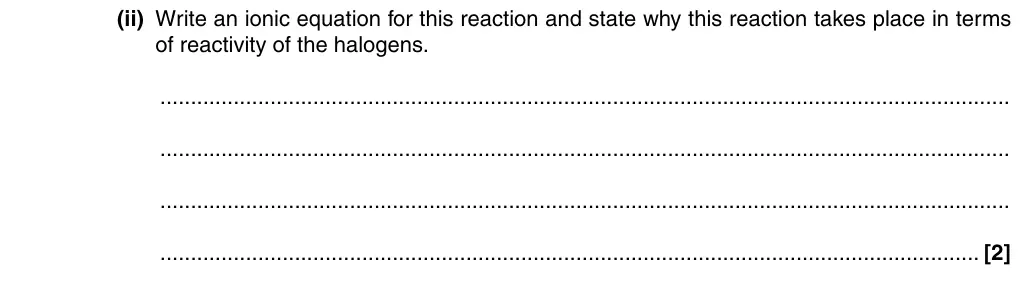
June 2024 · Paper 1 · Q20(a)(ii) 2 marks Equation writing Easy halogensformulae and equations
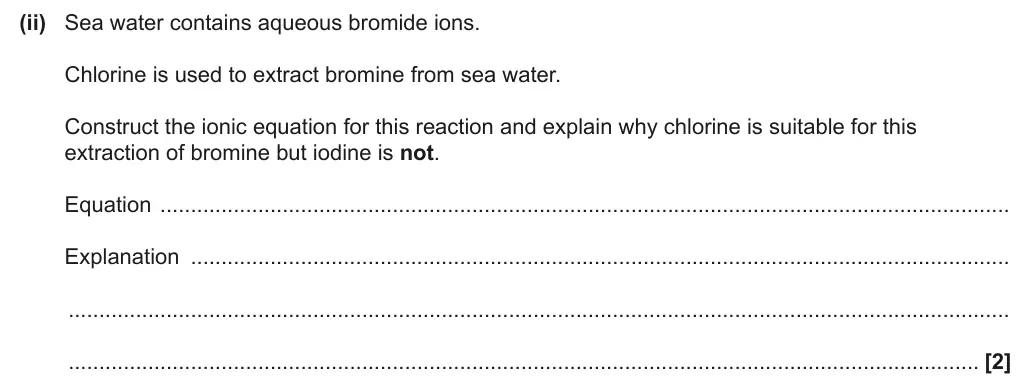
(ii) Sea water contains aqueous bromide ions.
Chlorine is used to extract bromine from sea water.
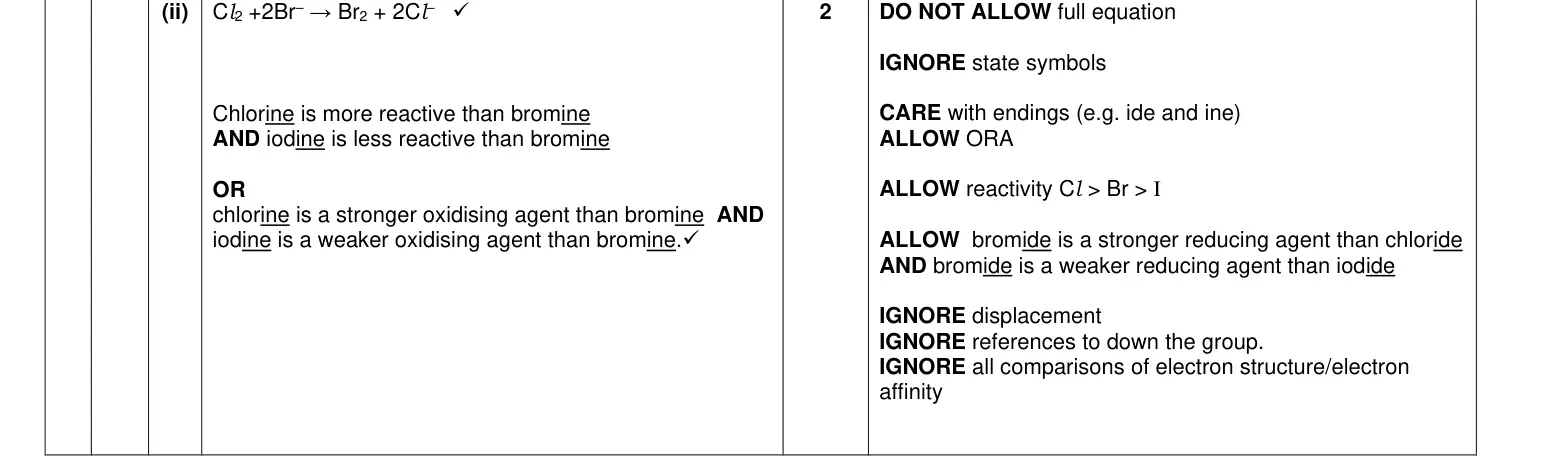
Construct the ionic equation for this reaction and explain why chlorine is suitable for this
extraction of bromine but iodine is not.
Equation  ...........................................................................................................................................
Explanation  ......................................................................................................................................
..........................................................................................................................................................
..................................................................................................................................................... [2]
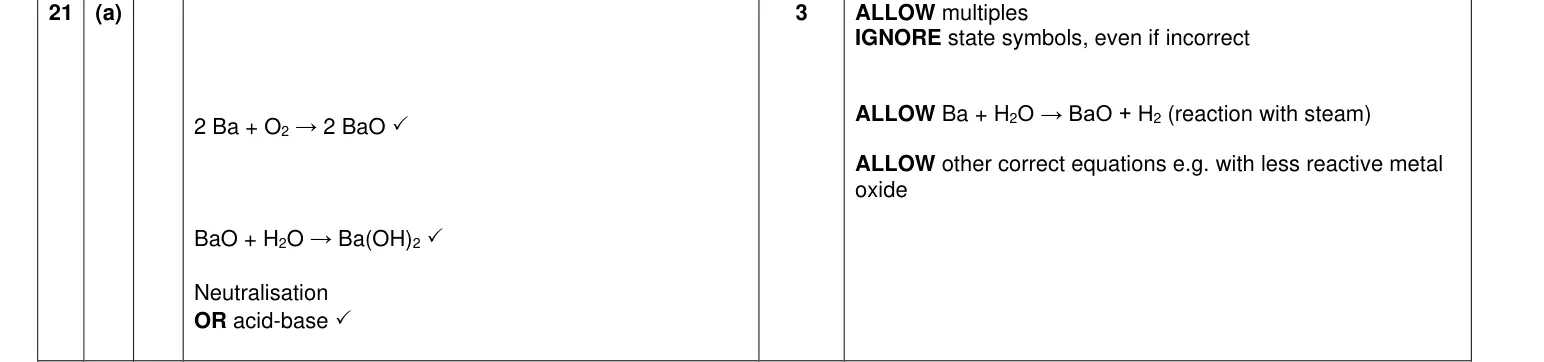
June 2024 · Paper 1 · Q21(a) 3 marks Equation writing Medium group 2formulae and equationsacids and titrations
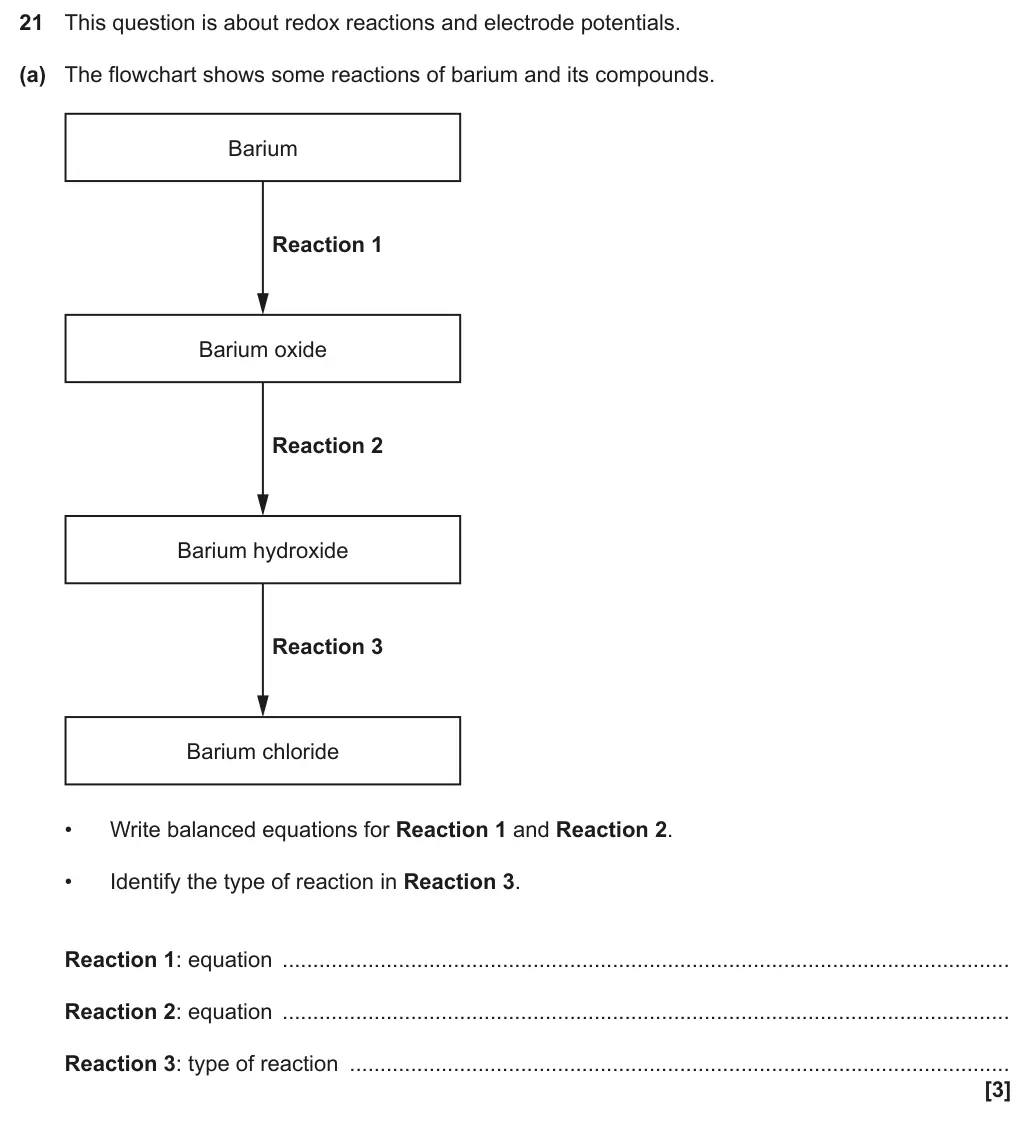
21 This question is about redox reactions and electrode potentials.
(a) The flowchart shows some reactions of barium and its compounds.
Barium
Reaction 1
Barium oxide
Reaction 2
Barium hydroxide
Reaction 3
Barium chloride
• Write balanced equations for Reaction 1 and Reaction 2.
• Identify the type of reaction in Reaction 3.
Reaction 1: equation  .......................................................................................................................
Reaction 2: equation  .......................................................................................................................
Reaction 3: type of reaction  ............................................................................................................
[3]
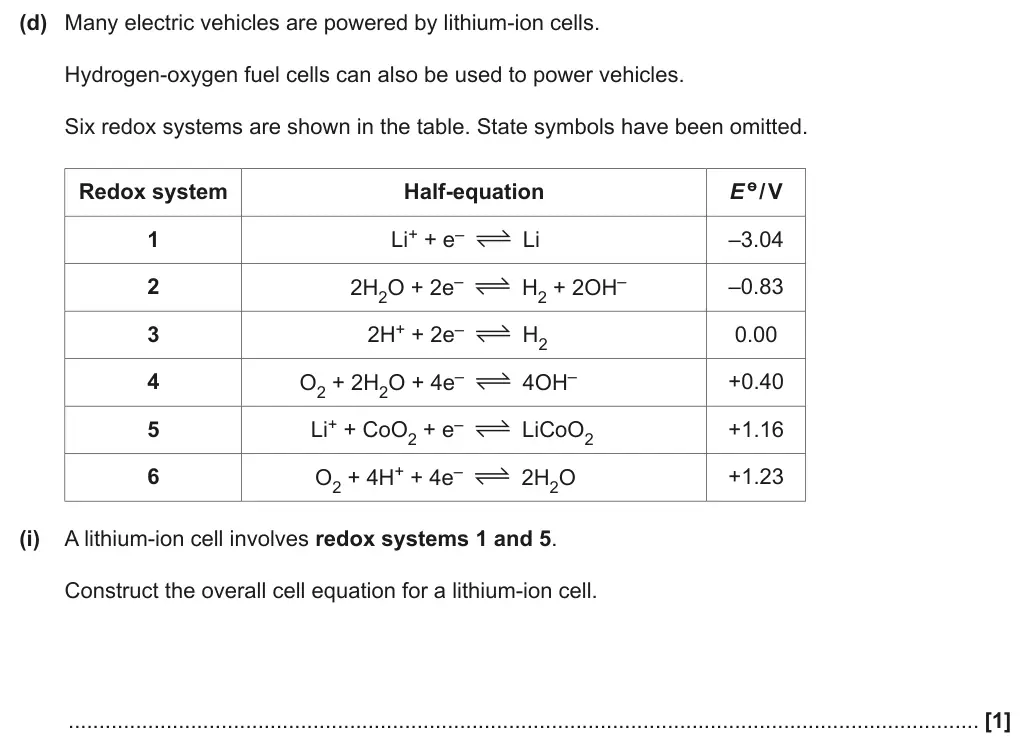
June 2024 · Paper 1 · Q21(d)(i) 1 mark Equation writing Medium redox and electrode potentials
(d) Many electric vehicles are powered by lithium-ion cells.
Hydrogen-oxygen fuel cells can also be used to power vehicles.
Six redox systems are shown in the table. State symbols have been omitted.
Redox system Half-equation E ө / V
1 Li+ + e– Li –3.04
2 2H2O + 2e– H2 + 2OH– –0.83
3 2H+ + 2e– H2 0.00
4 O2 + 2H2O + 4e– 4OH– +0.40
5 Li+ + CoO2 + e– LiCoO2 +1.16
6 O2 + 4H+ + 4e– 2H2O +1.23
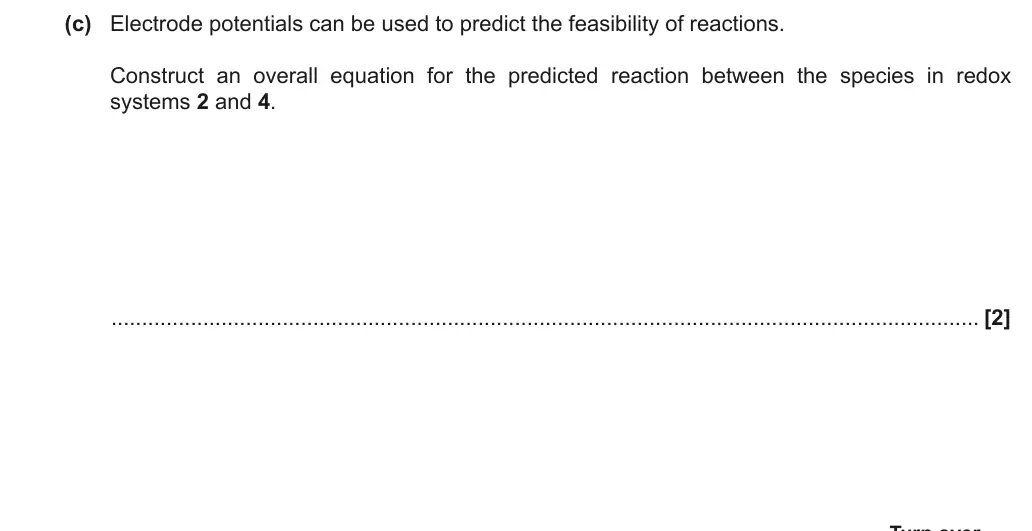
(i) A lithium-ion cell involves redox systems 1 and 5.
Construct the overall cell equation for a lithium-ion cell.
..................................................................................................................................................... [1]
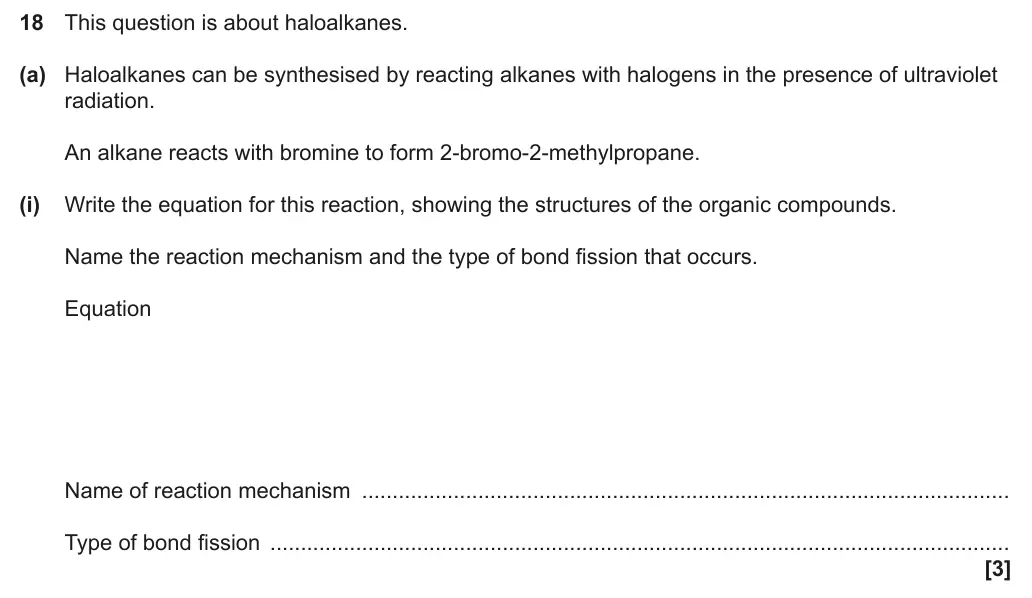
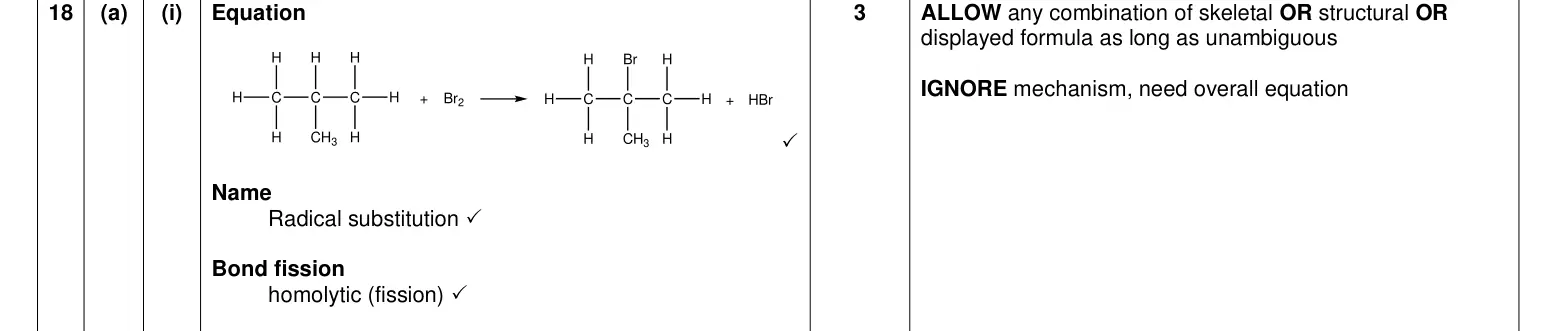
June 2024 · Paper 2 · Q18(a)(i) 3 marks Equation writing Hard alkanesorganic basics
18 This question is about haloalkanes.
(a) Haloalkanes can be synthesised by reacting alkanes with halogens in the presence of ultraviolet
radiation.
An alkane reacts with bromine to form 2-bromo-2-methylpropane.
(i) Write the equation for this reaction, showing the structures of the organic compounds.
Name the reaction mechanism and the type of bond fission that occurs.
Equation
Name of reaction mechanism  ..........................................................................................................
Type of bond fission  .........................................................................................................................
[3]
June 2024 · Paper 2 · Q20(b)(ii) 4 marks Equation writing Hard carboxylic acids and estersformulae and equations
Earlier part of question 20 that this part usesEarlier part of June 2024 Paper 2 question 20
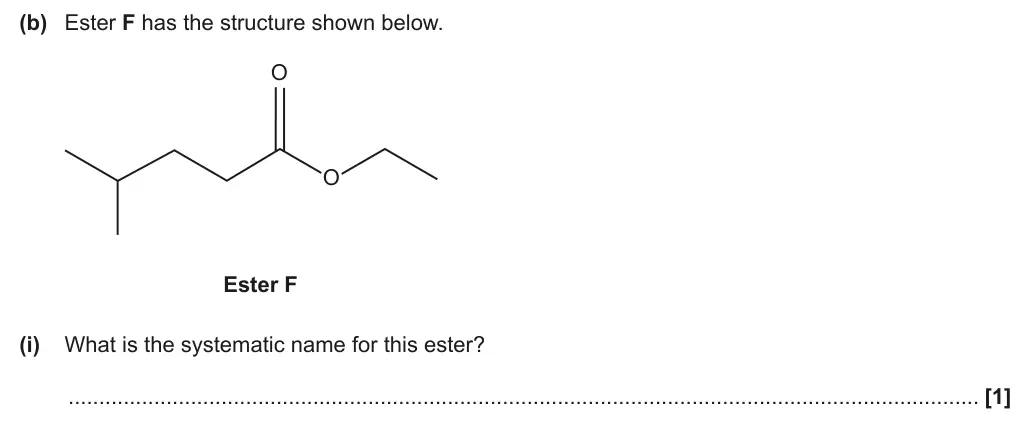
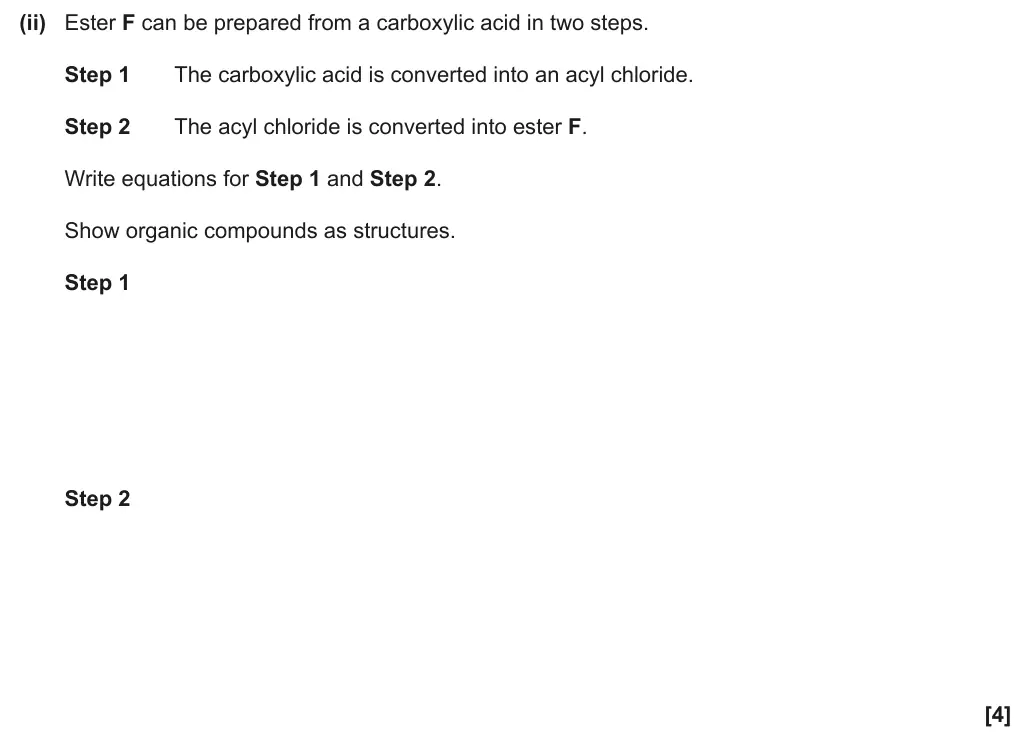
(ii) Ester F can be prepared from a carboxylic acid in two steps.
Step 1  The carboxylic acid is converted into an acyl chloride.
Step 2  The acyl chloride is converted into ester F.
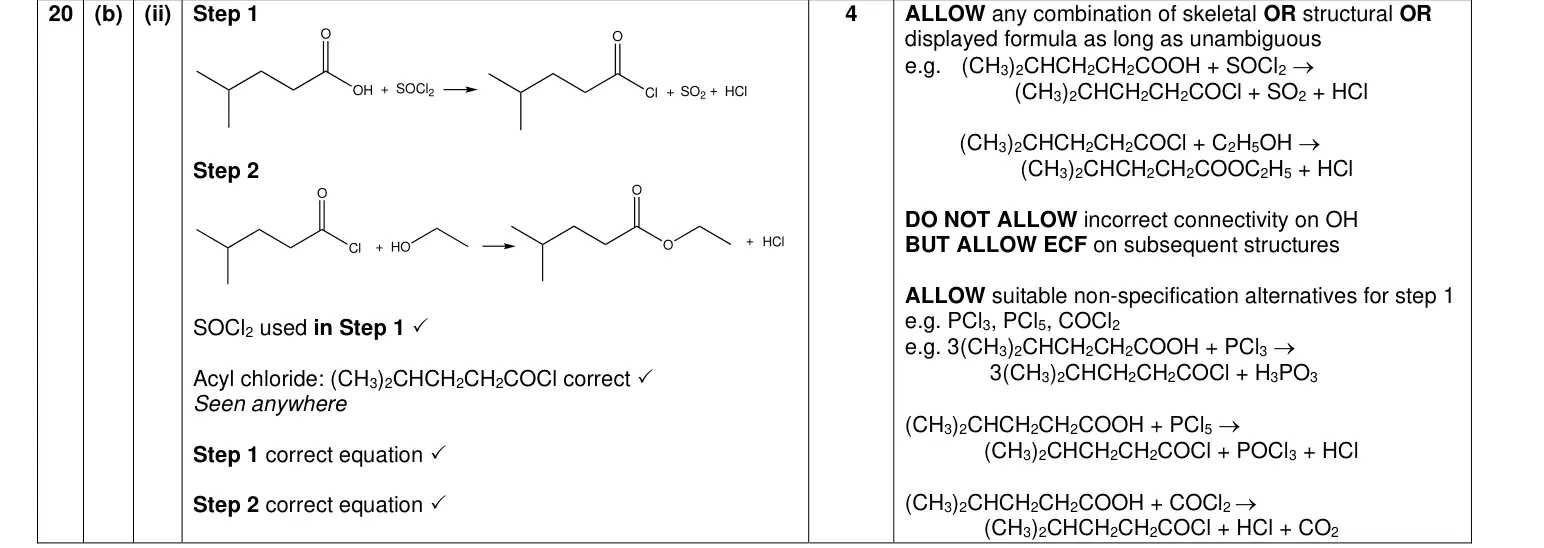
Write equations for Step 1 and Step 2.
Show organic compounds as structures.
Step 1
Step 2
[4]
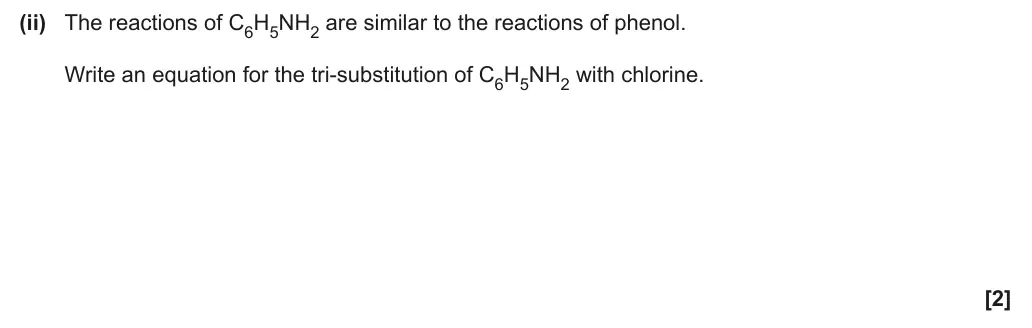
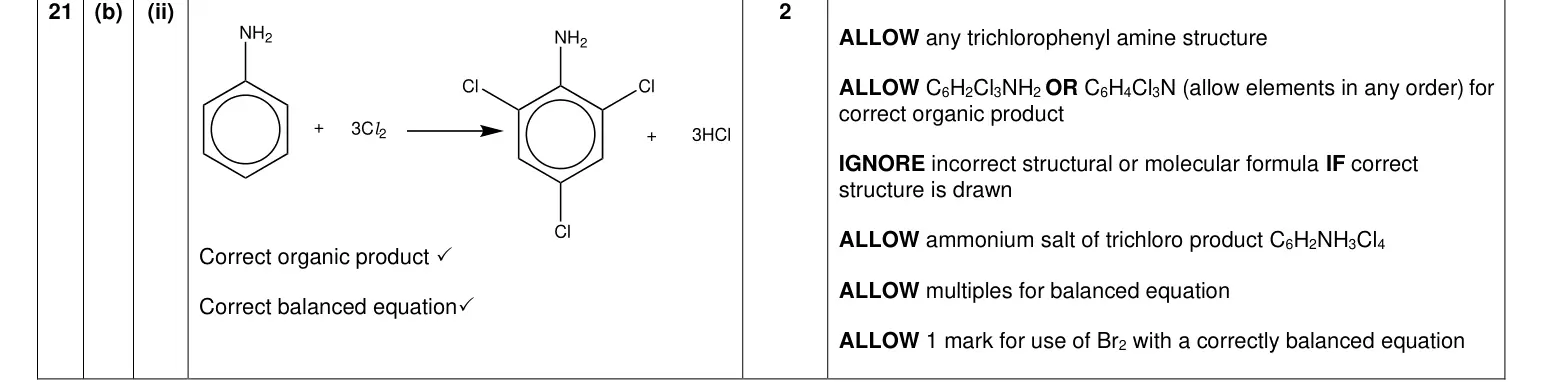
June 2024 · Paper 2 · Q21(b)(ii) 2 marks Equation writing Medium aromatic compoundsformulae and equations
Earlier part of question 21 that this part usesEarlier part of June 2024 Paper 2 question 21
(ii) The reactions of C6H5NH2 are similar to the reactions of phenol.
Write an equation for the tri-substitution of C6H5NH2 with chlorine.
[2]
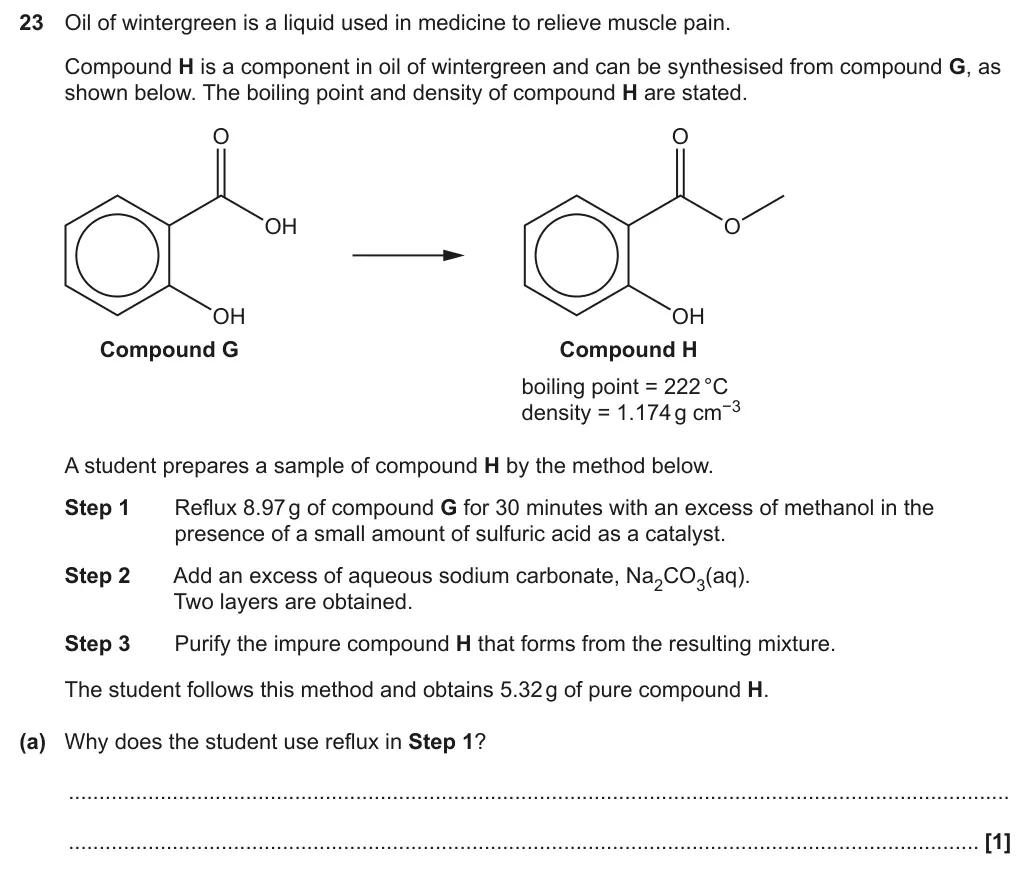
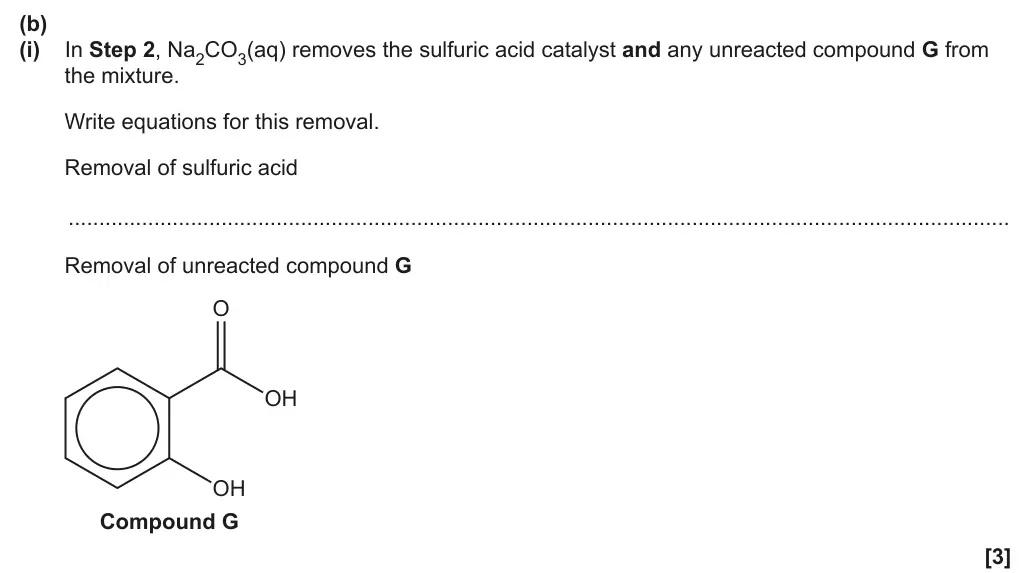
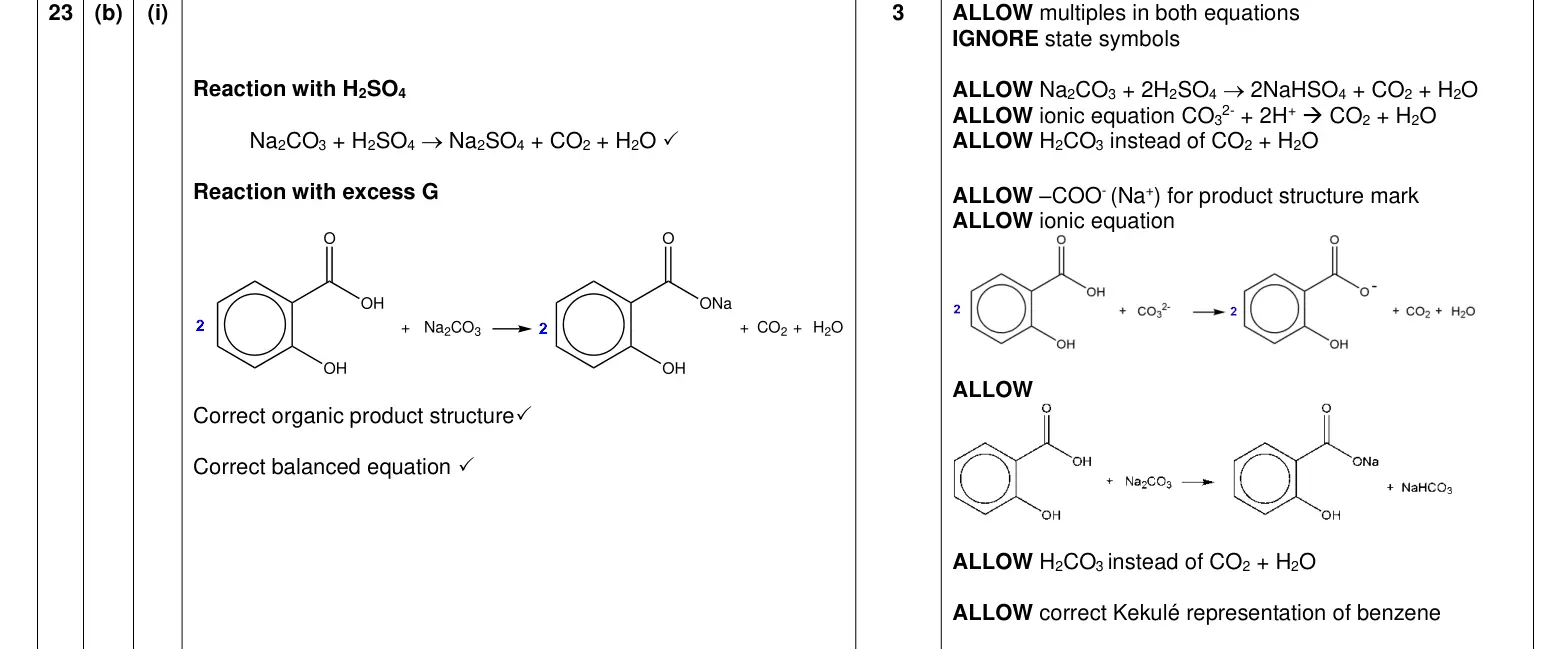
June 2024 · Paper 2 · Q23(b)(i) 3 marks Equation writing Hard carboxylic acids and estersformulae and equationsacids and titrationsaromatic compounds
Earlier part of question 23 that this part usesEarlier part of June 2024 Paper 2 question 23
(b)
(i) In Step 2, Na2CO3(aq) removes the sulfuric acid catalyst and any unreacted compound G from
the mixture.
Write equations for this removal.
Removal of sulfuric acid
..........................................................................................................................................................
Removal of unreacted compound G
O
OH
OH
Compound G
[3]
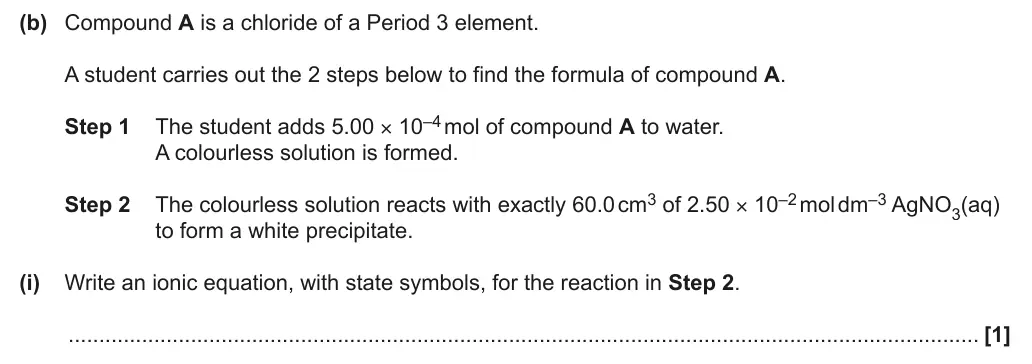
June 2024 · Paper 3 · Q2(b)(i) 1 mark Equation writing Easy halogens
(b) Compound A is a chloride of a Period 3 element.
A student carries out the 2 steps below to find the formula of compound A.
Step 1 The student adds 5.00 × 10⁻⁴ mol of compound A to water.
A colourless solution is formed.
Step 2 The colourless solution reacts with exactly 60.0 cm3 of 2.50 × 10⁻² mol dm–3 AgNO3(aq)
to form a white precipitate.
(i) Write an ionic equation, with state symbols, for the reaction in Step 2.
..................................................................................................................................................... [1]
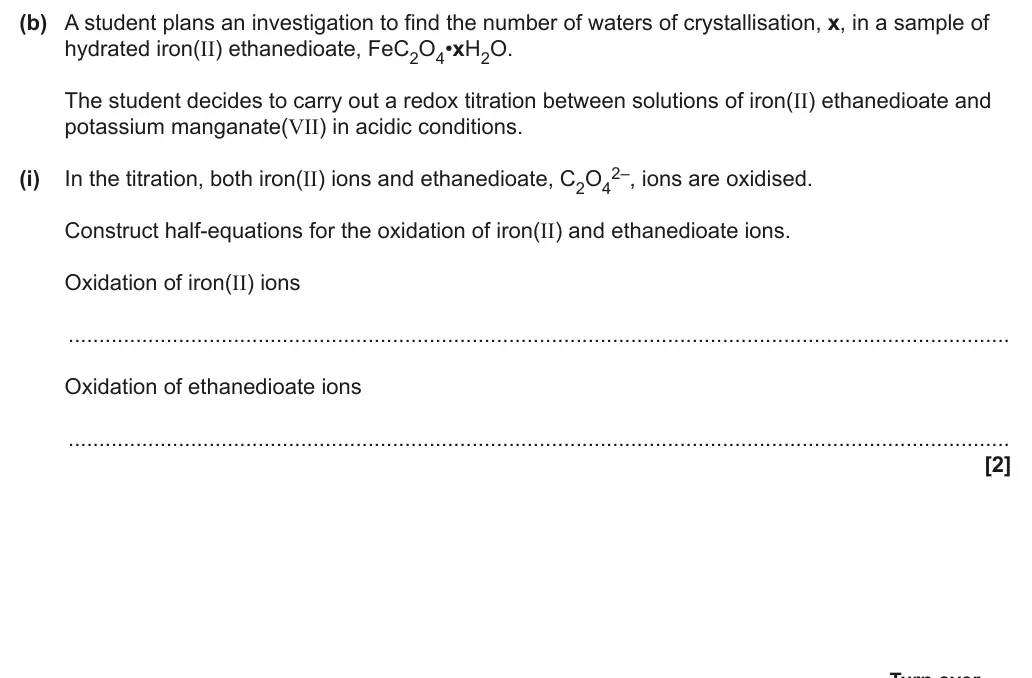
June 2024 · Paper 3 · Q3(b)(i) 2 marks Equation writing Medium redox and electrode potentials
(b) A student plans an investigation to find the number of waters of crystallisation, x, in a sample of
hydrated iron(II) ethanedioate, FeC2O4•xH2O.
The student decides to carry out a redox titration between solutions of iron(II) ethanedioate and
potassium manganate(VII) in acidic conditions.
(i) In the titration, both iron(II) ions and ethanedioate, C2O4 2–, ions are oxidised.
Construct half-equations for the oxidation of iron(II) and ethanedioate ions.
Oxidation of iron(II) ions
..........................................................................................................................................................
Oxidation of ethanedioate ions
..........................................................................................................................................................
[2]
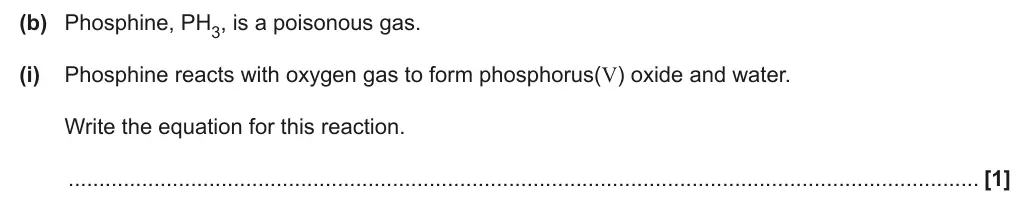
June 2024 · Paper 3 · Q4(b)(i) 1 mark Equation writing Medium formulae and equationsredox
(b) Phosphine, PH3, is a poisonous gas.
(i) Phosphine reacts with oxygen gas to form phosphorus(V) oxide and water.
Write the equation for this reaction.
..................................................................................................................................................... [1]
June 2024 · Paper 3 · Q4(b)(ii) 3 marks Equation writing Hard redoxformulae and equations
Earlier part of question 4 that this part usesEarlier part of June 2024 Paper 3 question 4
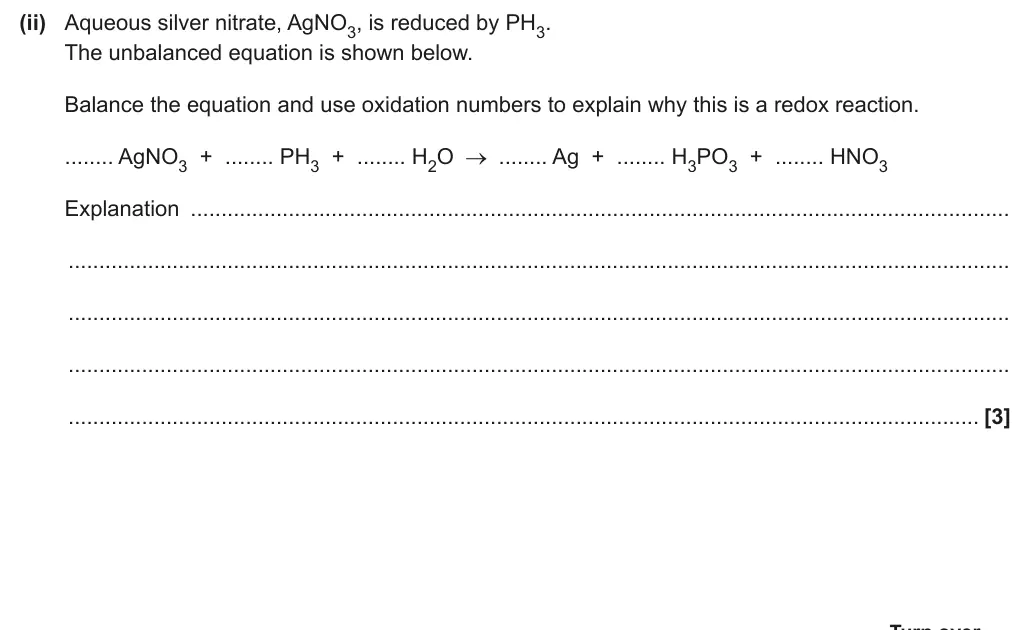
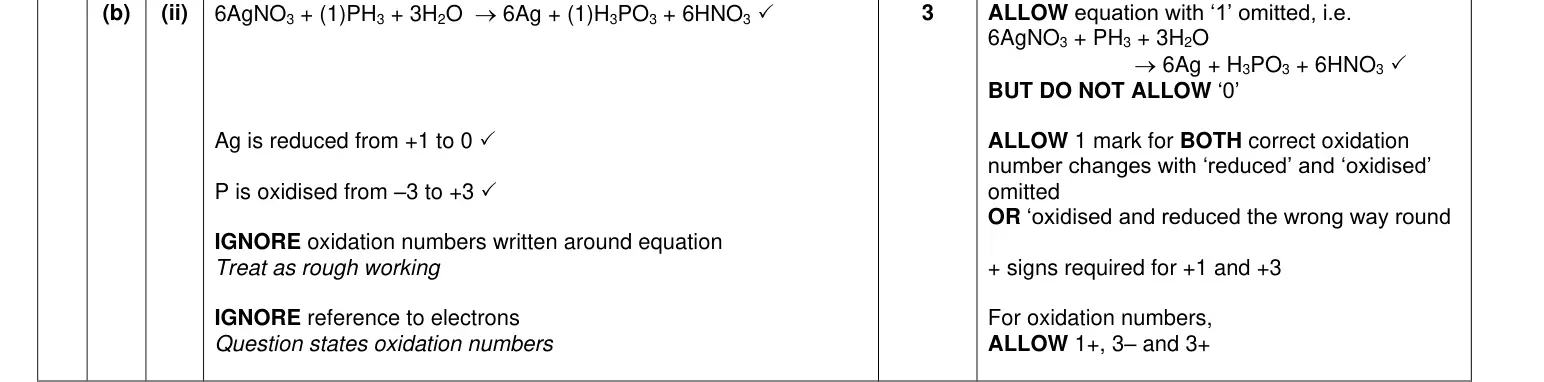
(ii) Aqueous silver nitrate, AgNO3, is reduced by PH3.
The unbalanced equation is shown below.
Balance the equation and use oxidation numbers to explain why this is a redox reaction.
........ AgNO3  +  ........ PH3  +  ........ H2O ........ Ag  +  ........ H3PO3  +  ........ HNO3
Explanation  ......................................................................................................................................
..........................................................................................................................................................
..........................................................................................................................................................
..........................................................................................................................................................
..................................................................................................................................................... [3]
June 2024 · Paper 3 · Q4(c)(i) 1 mark Equation writing Easy formulae and equations
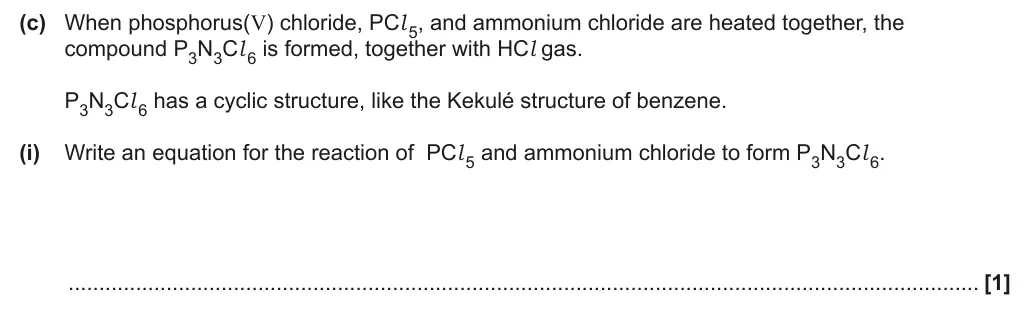
(c) When phosphorus(V) chloride, PCl 5, and ammonium chloride are heated together, the
compound P3N3Cl 6 is formed, together with HCl gas.
P3N3Cl 6 has a cyclic structure, like the Kekulé structure of benzene.
(i) Write an equation for the reaction of  PCl 5 and ammonium chloride to form P3N3Cl 6.
..................................................................................................................................................... [1]
June 2024 · Paper 3 · Q5(a)(ii) 1 mark Equation writing Easy haloalkanes
Earlier part of question 5 that this part usesEarlier part of June 2024 Paper 3 question 5
(ii) Write an equation for the alkaline hydrolysis of 1-bromopropane.
Show structures of organic compounds.
[1]
June 2023 · AS Paper 1 · Q22(b)(i) 1 mark AO2 Equation writing Medium acids and titrations
(b) Write equations for the reactions below. State symbols are not required.
(i) The reaction of copper(II) oxide with dilute hydrochloric acid.
...................................................................................................................................... [1]
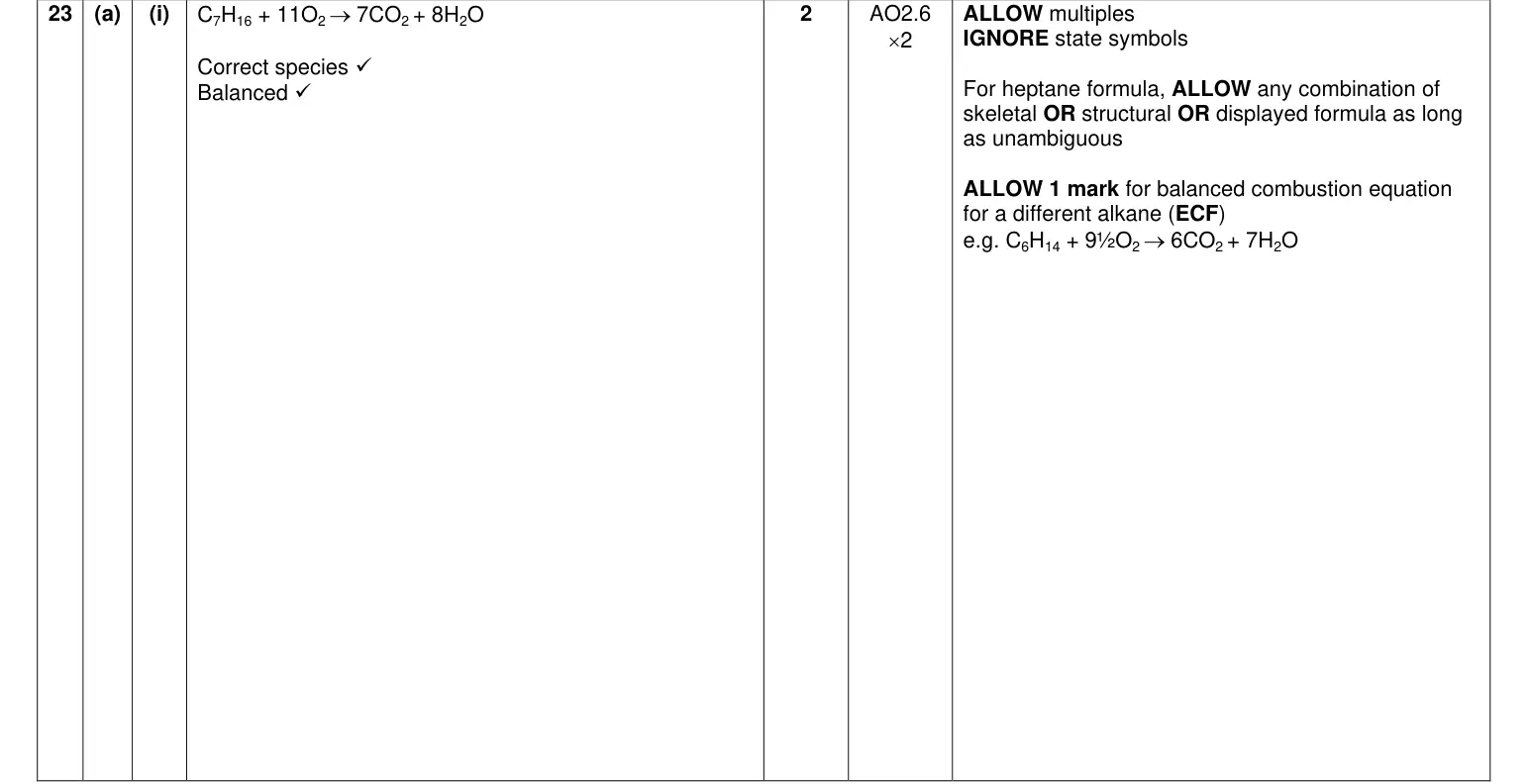
June 2023 · AS Paper 1 · Q23(a)(i) 2 marks AO2 Equation writing Easy alkanesformulae and equations
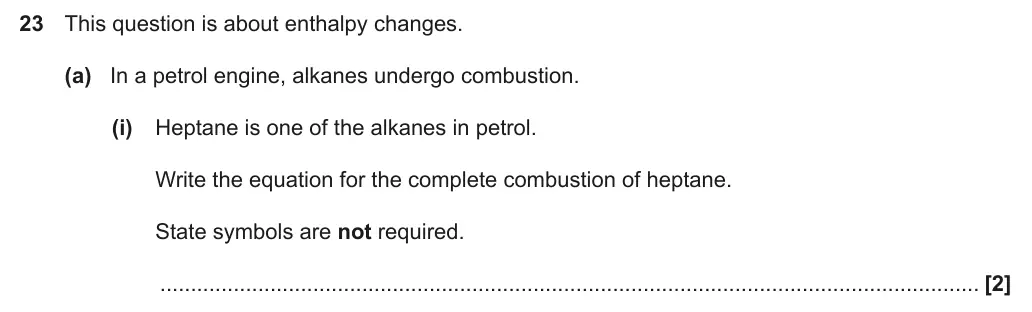
23 This question is about enthalpy changes.
(a) In a petrol engine, alkanes undergo combustion.
(i) Heptane is one of the alkanes in petrol.
Write the equation for the complete combustion of heptane.
State symbols are not required.
...................................................................................................................................... [2]
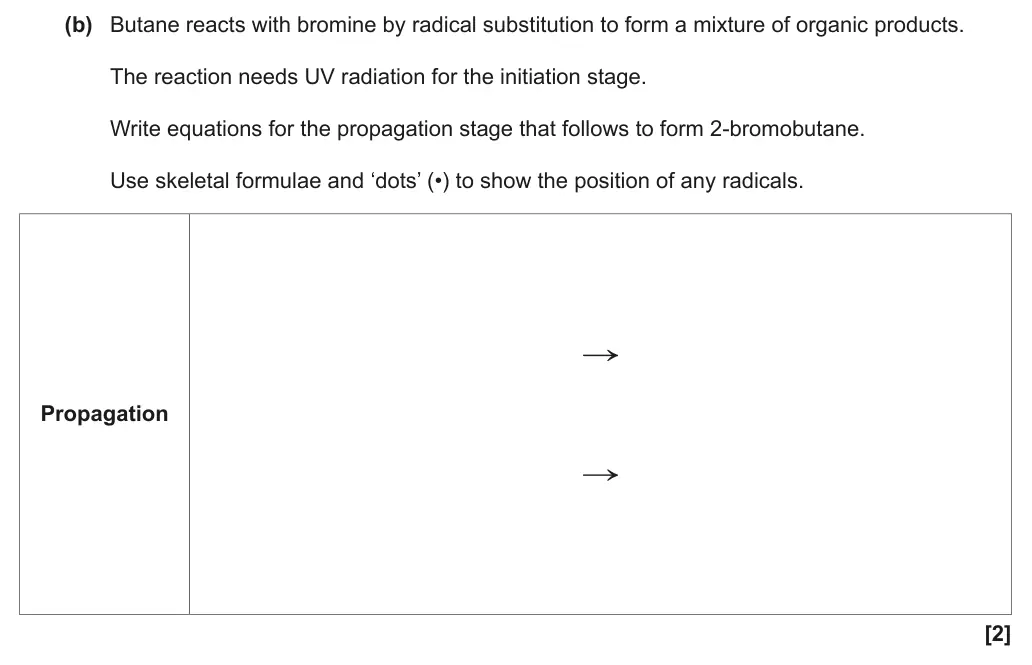
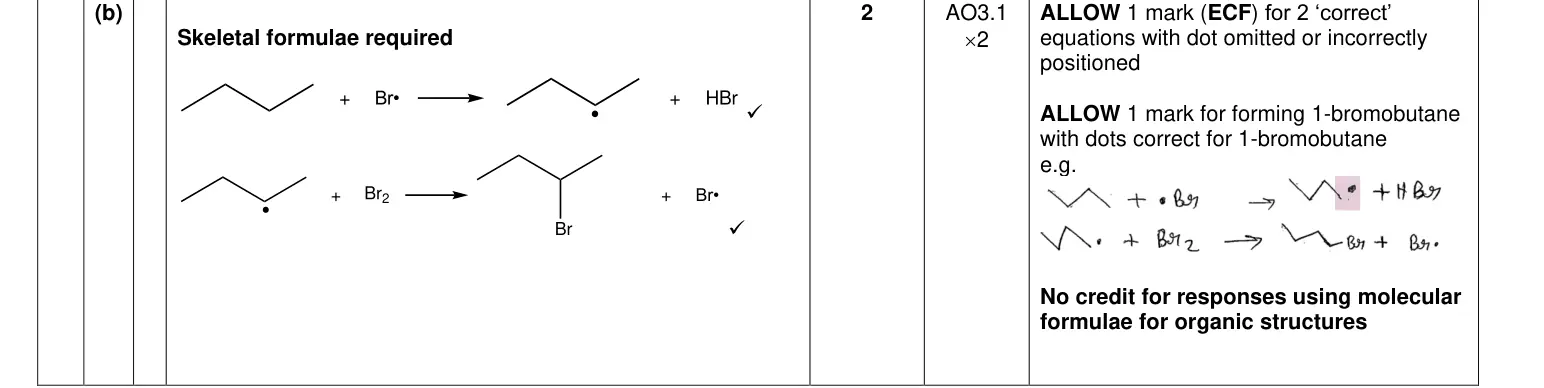
June 2023 · AS Paper 1 · Q25(b) 2 marks AO3 Equation writing Medium alkanesorganic basics
(b) Butane reacts with bromine by radical substitution to form a mixture of organic products.
The reaction needs UV radiation for the initiation stage.
Write equations for the propagation stage that follows to form 2-bromobutane.
Use skeletal formulae and ‘dots’ (•) to show the position of any radicals.
Propagation
[2]
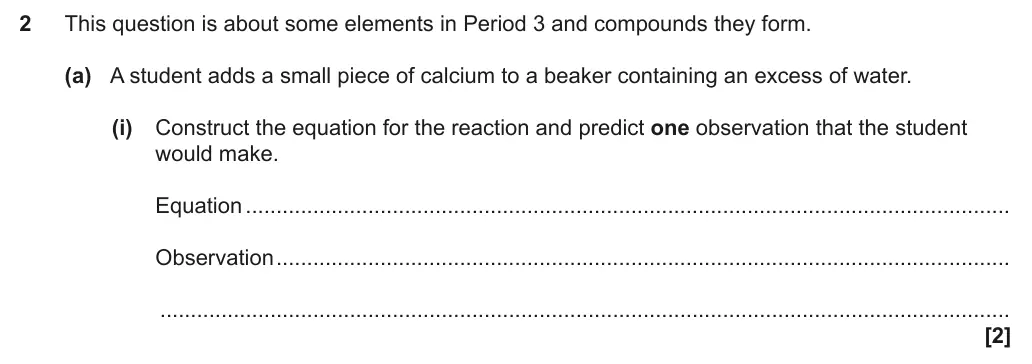
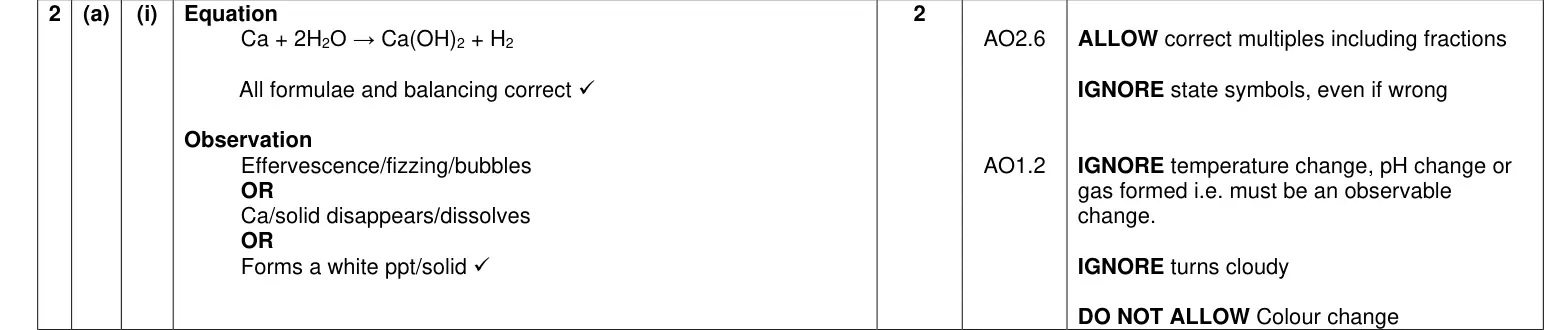
June 2023 · AS Paper 2 · Q2(a)(i) 2 marks AO1, 2 Equation writing Medium group 2formulae and equations
2 This question is about some elements in Period 3 and compounds they form.
(a) A student adds a small piece of calcium to a beaker containing an excess of water.
(i) Construct the equation for the reaction and predict one observation that the student
would make.
Equation .............................................................................................................................
Observation ........................................................................................................................
...........................................................................................................................................
[2]
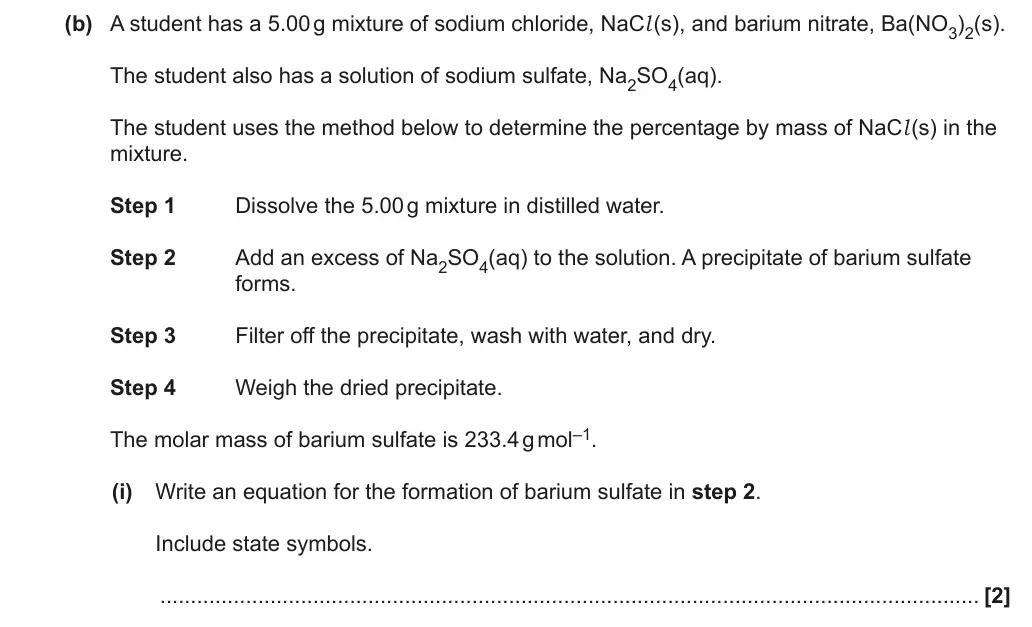
June 2023 · AS Paper 2 · Q2(b)(i) 2 marks AO2 Equation writing Hard formulae and equationsqualitative analysis
(b) A student has a 5.00 g mixture of sodium chloride, NaCl (s), and barium nitrate, Ba(NO3)2(s).
The student also has a solution of sodium sulfate, Na2SO4(aq).
The student uses the method below to determine the percentage by mass of NaCl (s) in the
mixture.
Step 1 Dissolve the 5.00 g mixture in distilled water.
Step 2 Add an excess of Na2SO4(aq) to the solution. A precipitate of barium sulfate
forms.
Step 3 Filter off the precipitate, wash with water, and dry.
Step 4 Weigh the dried precipitate.
The molar mass of barium sulfate is 233.4 g mol–1.
(i) Write an equation for the formation of barium sulfate in step 2.
Include state symbols.
...................................................................................................................................... [2]
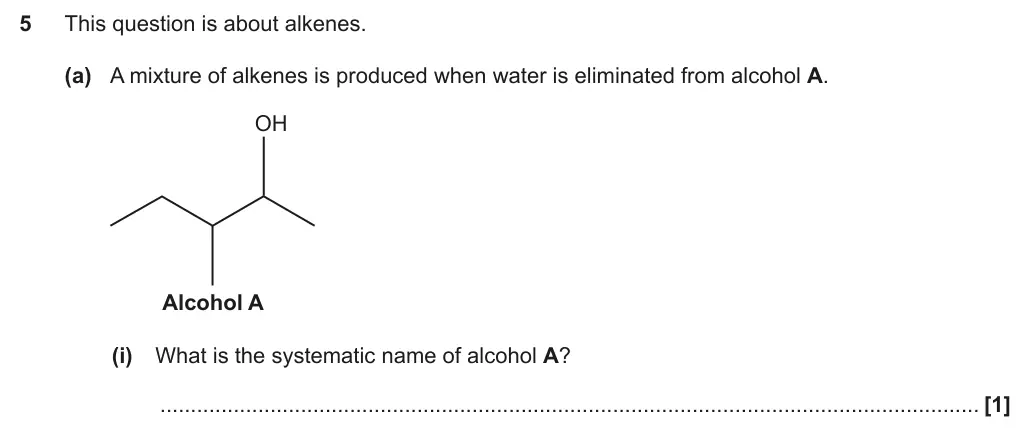
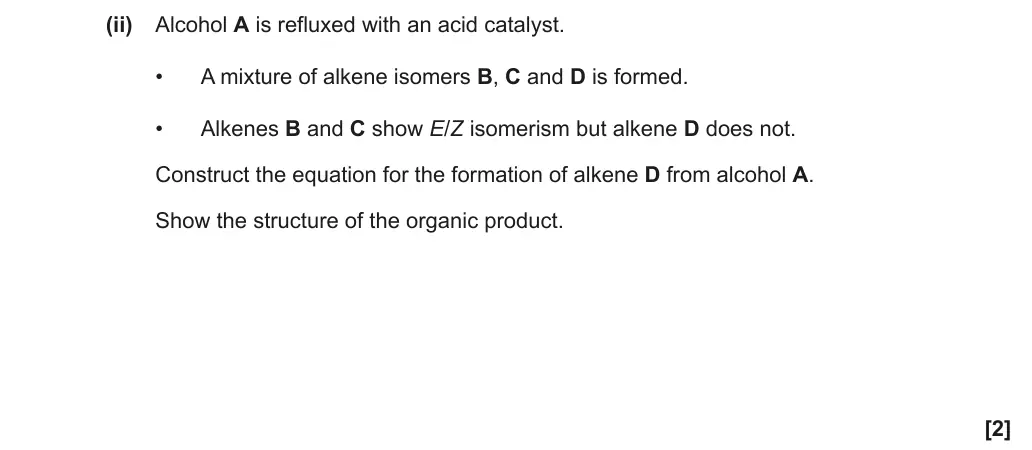
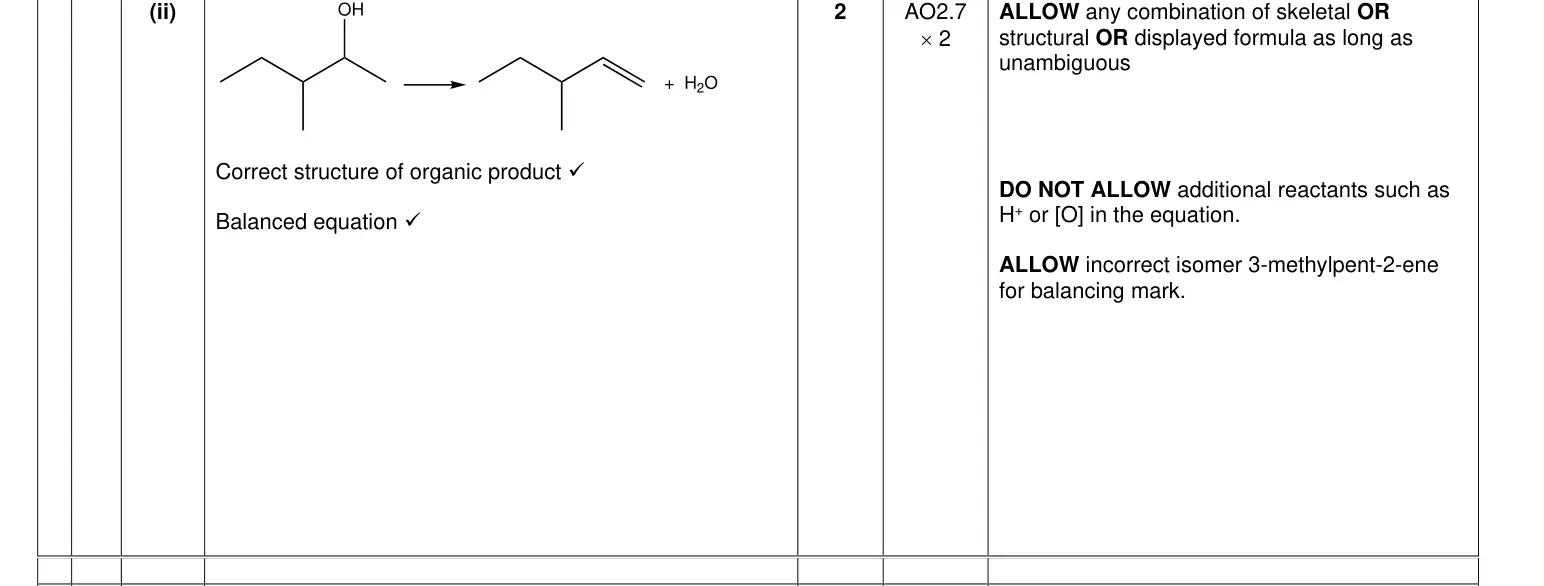
June 2023 · AS Paper 2 · Q5(a)(ii) 2 marks AO2 Equation writing Medium alcoholsorganic basicsalkenes
Earlier part of question 5 that this part usesEarlier part of June 2023 Paper 2 question 5
(ii) Alcohol A is refluxed with an acid catalyst.
• A mixture of alkene isomers B, C and D is formed.
• Alkenes B and C show E/Z isomerism but alkene D does not.
Construct the equation for the formation of alkene D from alcohol A.
Show the structure of the organic product.
[2]
June 2023 · Paper 1 · Q20(c)(i) 1 mark AO2 Equation writing Medium acids and titrationsformulae and equations
(c) A student reacts 1.00 g of strontium carbonate, SrCO3, with an excess of dilute nitric acid,
HNO3. A gas is produced.
(i) Construct the equation for this reaction.
...................................................................................................................................... [1]
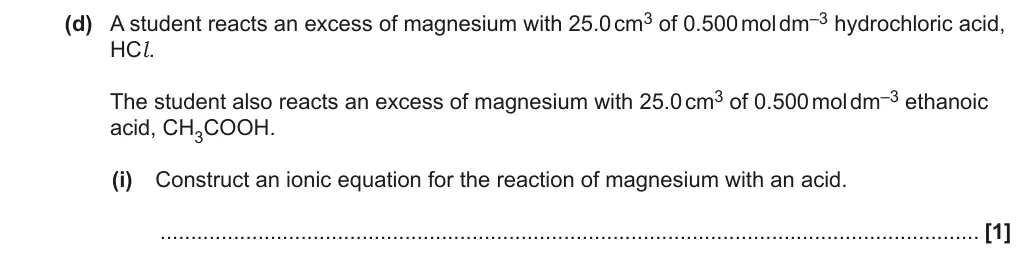
June 2023 · Paper 1 · Q20(d)(i) 1 mark AO2 Equation writing Hard acids bases and buffersredox
(d) A student reacts an excess of magnesium with 25.0 cm3 of 0.500 mol dm–3 hydrochloric acid,
HCl .
The student also reacts an excess of magnesium with 25.0 cm3 of 0.500 mol dm–3 ethanoic
acid, CH3COOH.
(i) Construct an ionic equation for the reaction of magnesium with an acid.
...................................................................................................................................... [1]
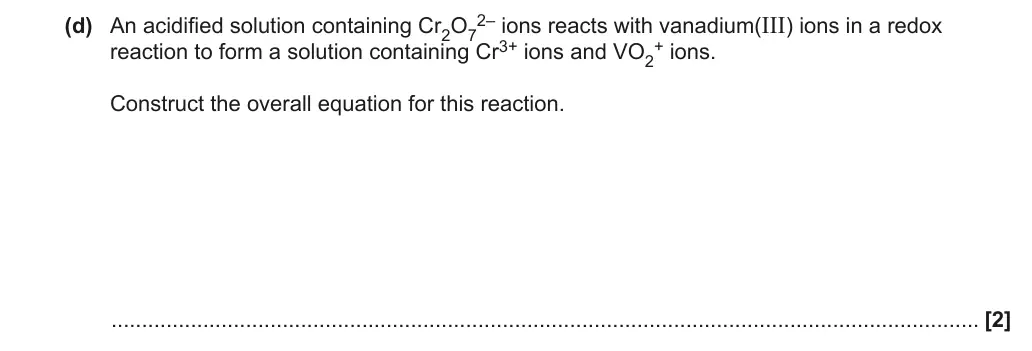
June 2023 · Paper 1 · Q22(d) 2 marks AO2 Equation writing Hard redox and electrode potentialstransition elements
(d) An acidified solution containing Cr2O7 2– ions reacts with vanadium(III) ions in a redox
reaction to form a solution containing Cr3+ ions and VO2 + ions.
Construct the overall equation for this reaction.
.............................................................................................................................................. [2]
June 2023 · Paper 2 · Q16(b)(ii) 2 marks AO2 Equation writing Medium alkanesformulae and equations
Earlier part of question 16 that this part usesEarlier part of June 2023 Paper 2 question 16
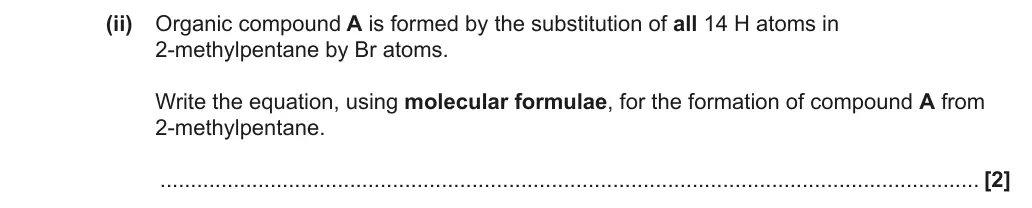
(ii) Organic compound A is formed by the substitution of all 14 H atoms in
2-methylpentane by Br atoms.
Write the equation, using molecular formulae, for the formation of compound A from
2-methylpentane.
...................................................................................................................................... [2]
June 2023 · Paper 2 · Q17(a) 2 marks AO2 Equation writing Hard alcoholsformulae and equationsorganic basics
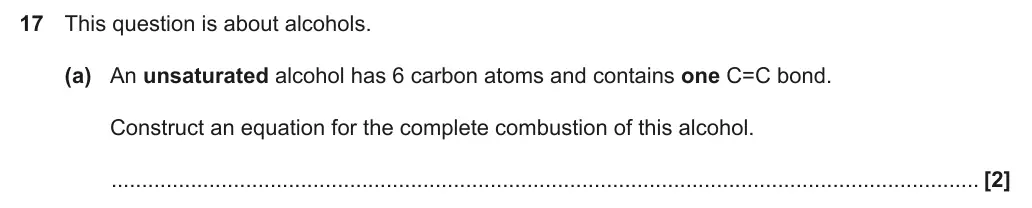
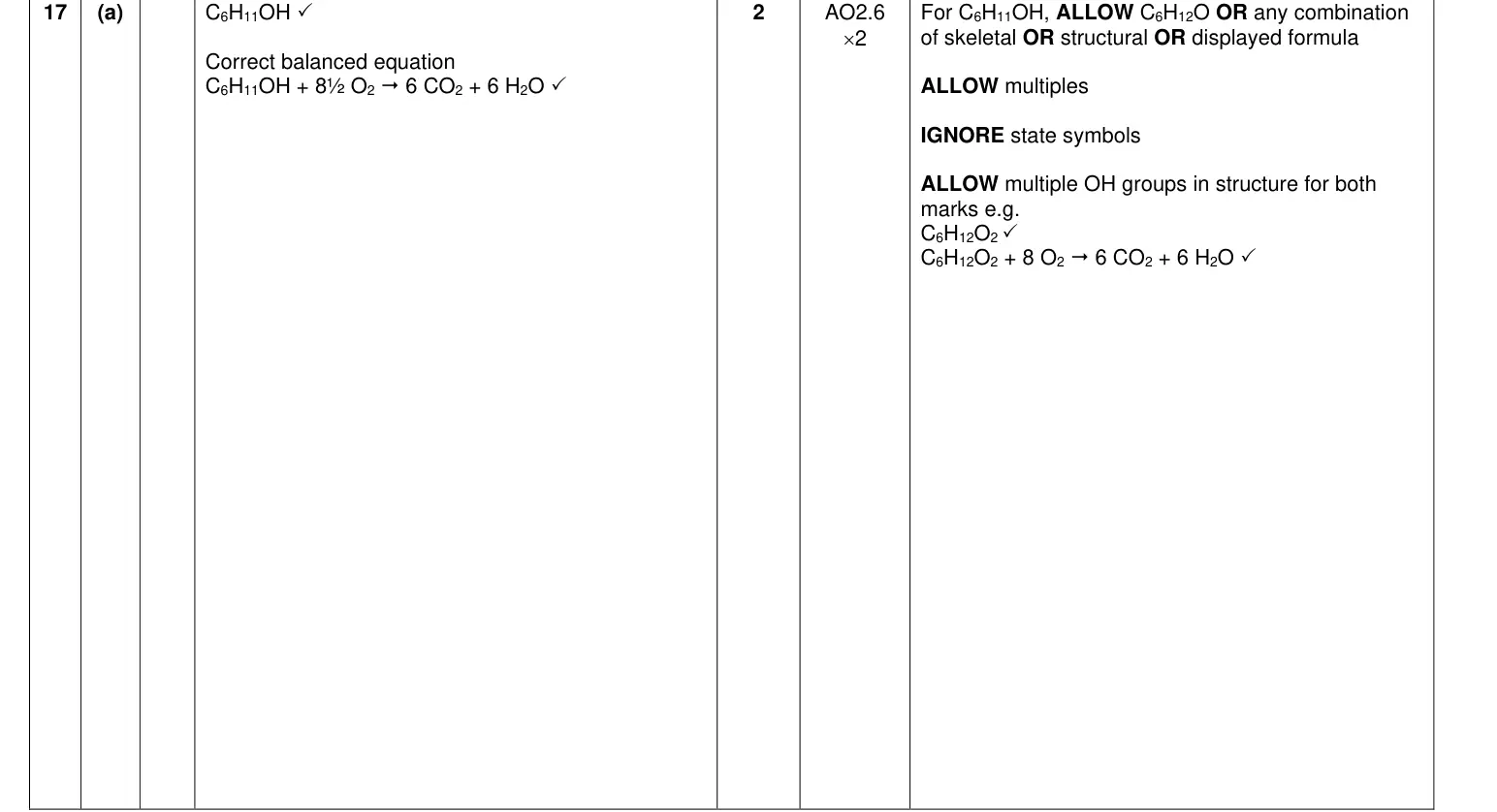
17 This question is about alcohols.
(a) An unsaturated alcohol has 6 carbon atoms and contains one C=C bond.
Construct an equation for the complete combustion of this alcohol.
.............................................................................................................................................. [2]
June 2023 · Paper 3 · Q6(b)(i) 2 marks AO2 Equation writing Hard acids and titrationsformulae and equations
Earlier part of question 6 that this part usesEarlier part of June 2023 Paper 3 question 6
(b) Dilute nitric acid reacts with aluminium oxide to form a solution of aluminium nitrate.
(i) Write an equation for this reaction.
...................................................................................................................................... [2]
June 2023 · Paper 3 · Q6(c)(i) 1 mark AO1 Equation writing Medium redox and electrode potentials
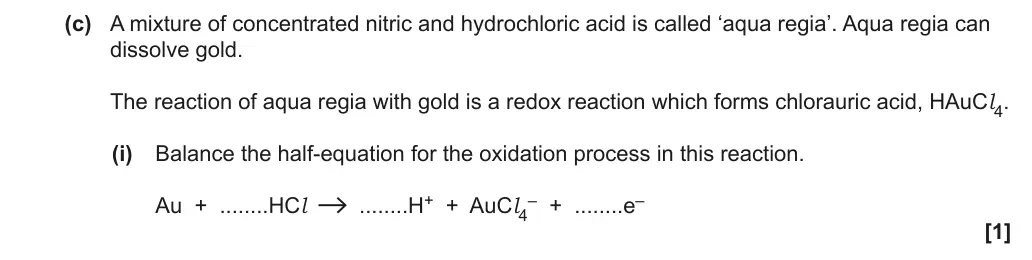
(c) A mixture of concentrated nitric and hydrochloric acid is called ‘aqua regia’. Aqua regia can
dissolve gold.
The reaction of aqua regia with gold is a redox reaction which forms chlorauric acid, HAuCl4.
(i) Balance the half-equation for the oxidation process in this reaction.
Au  +  ........HCl ........H+  +  AuCl4 –  +  ........e–
[1]
June 2022 · AS Paper 1 · Q24(a)(ii) 3 marks AO2 Equation writing Medium halogensredox
Earlier part of question 24 that this part usesEarlier part of June 2022 Paper 1 question 24
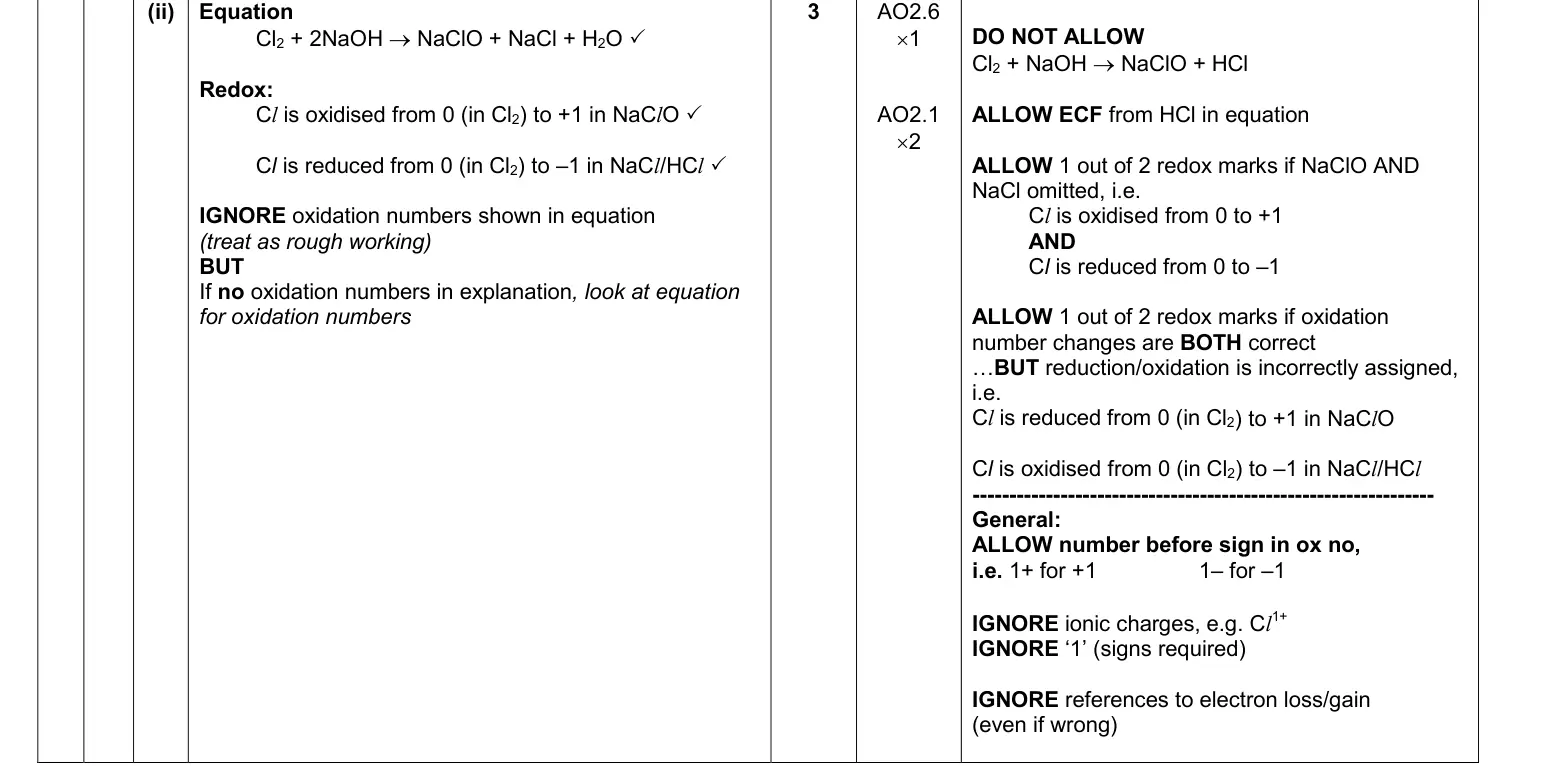
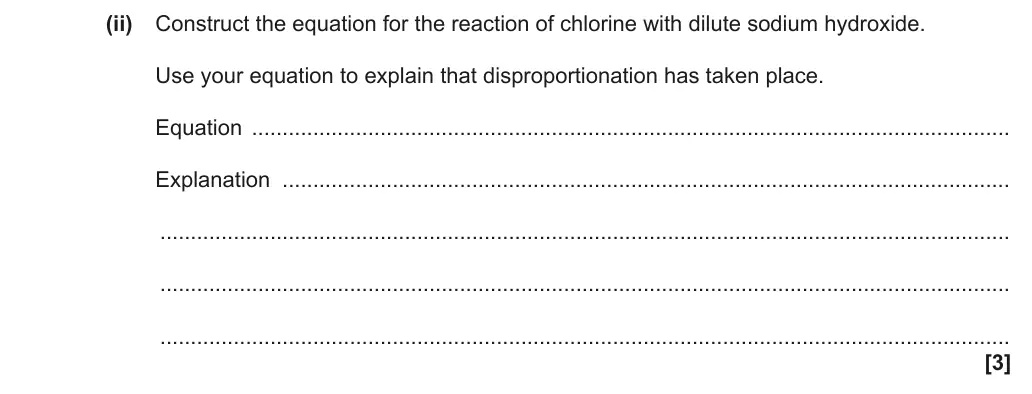
(ii) Construct the equation for the reaction of chlorine with dilute sodium hydroxide.
Use your equation to explain that disproportionation has taken place.
Equation  ............................................................................................................................
Explanation  .......................................................................................................................
...........................................................................................................................................
...........................................................................................................................................
...........................................................................................................................................
[3]
June 2022 · AS Paper 2 · Q1(d) 2 marks AO2 Equation writing Medium alcoholsformulae and equationsorganic synthesis as
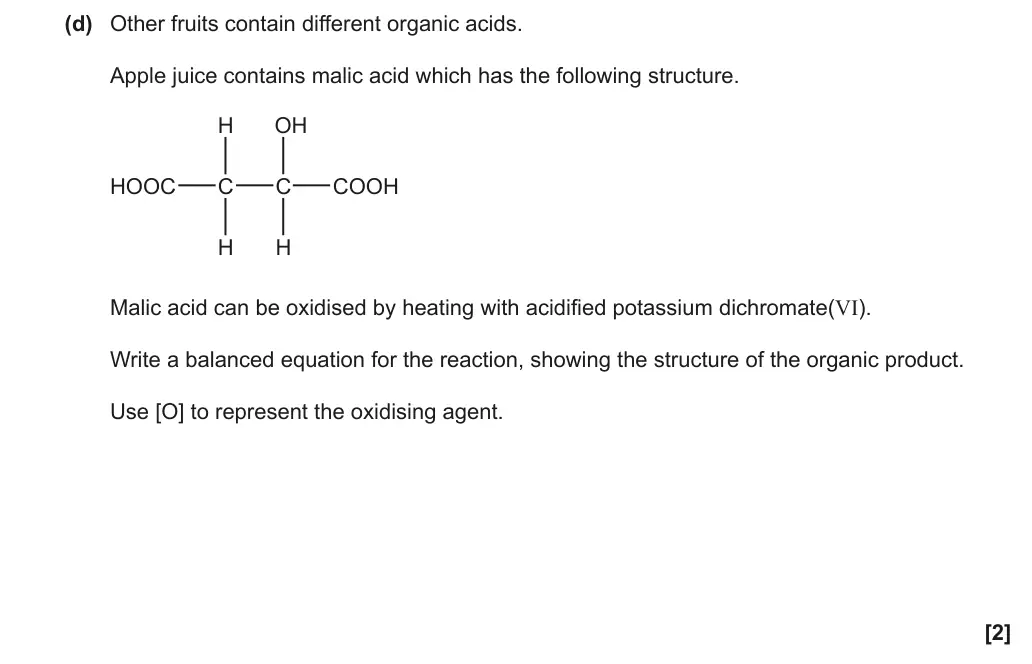
(d) Other fruits contain different organic acids.
Apple juice contains malic acid which has the following structure.
H OH
HOOC C C COOH
H H
Malic acid can be oxidised by heating with acidified potassium dichromate(VI).
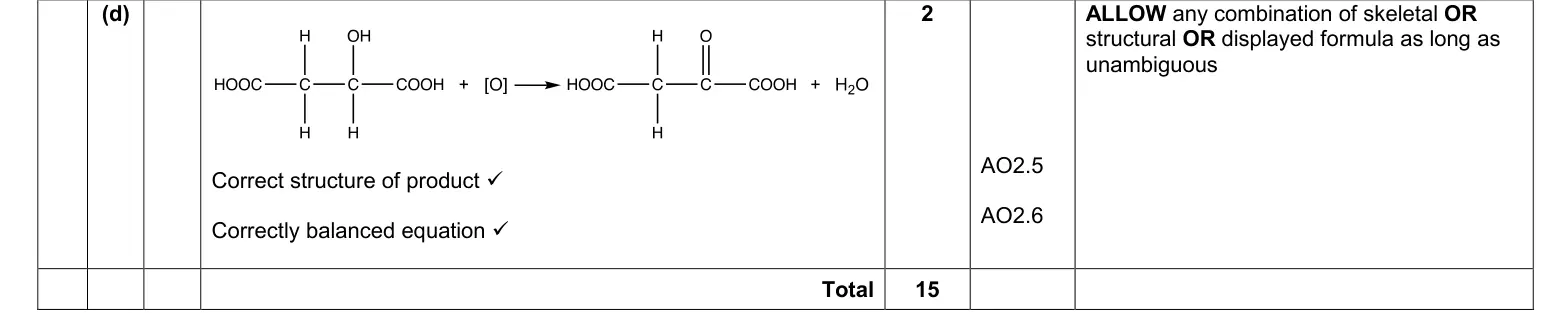
Write a balanced equation for the reaction, showing the structure of the organic product.
Use [O] to represent the oxidising agent.
[2]
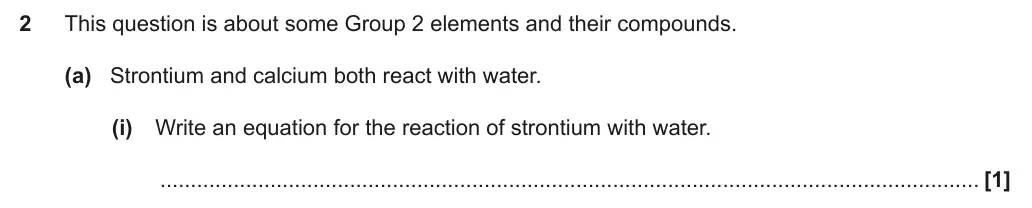
June 2022 · AS Paper 2 · Q2(a)(i) 1 mark AO2 Equation writing Medium group 2
2 This question is about some Group 2 elements and their compounds.
(a) Strontium and calcium both react with water.
(i) Write an equation for the reaction of strontium with water.
...................................................................................................................................... [1]
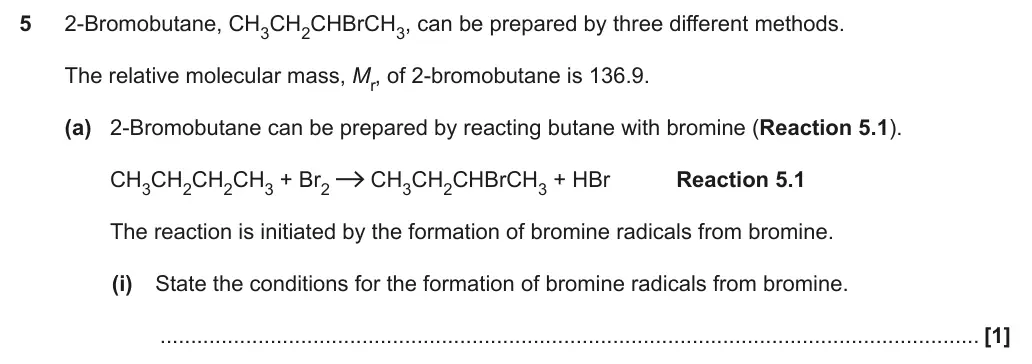
June 2022 · AS Paper 2 · Q5(a)(ii) 2 marks AO2 Equation writing Medium alkanesorganic basics
Earlier part of question 5 that this part usesEarlier part of June 2022 Paper 2 question 5
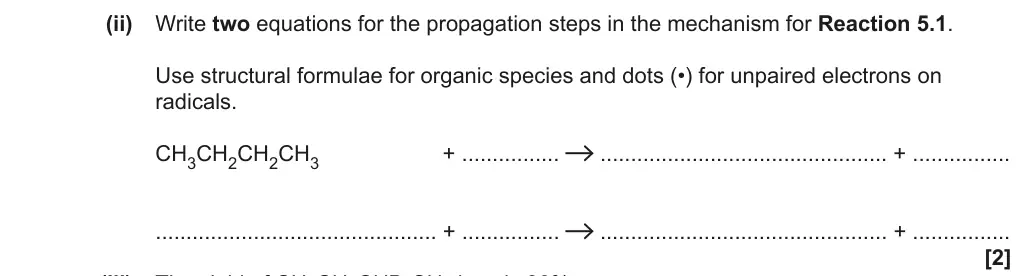
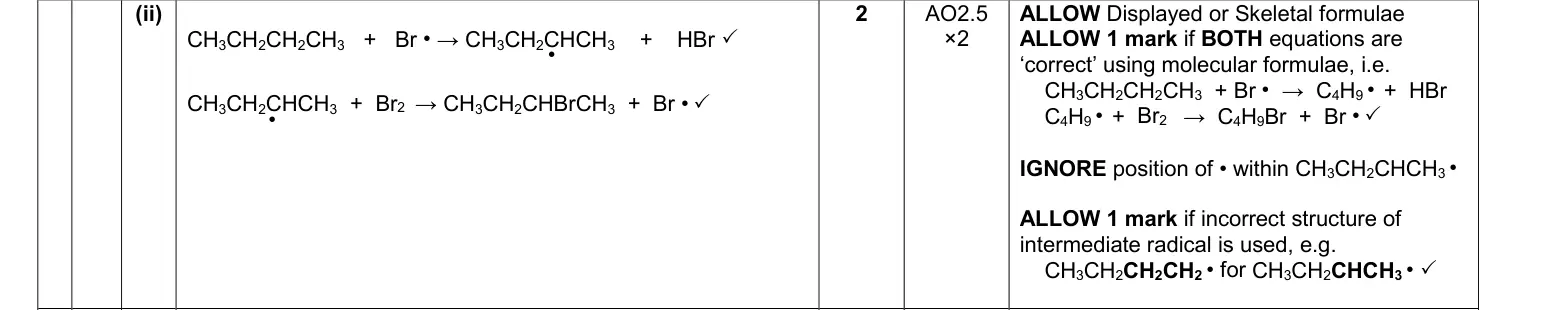
(ii) Write two equations for the propagation steps in the mechanism for Reaction 5.1.
Use structural formulae for organic species and dots (•) for unpaired electrons on
radicals.
CH3CH2CH2CH3 + ................ ............................................... + ................
.............................................. + ................ ............................................... + ................
[2]
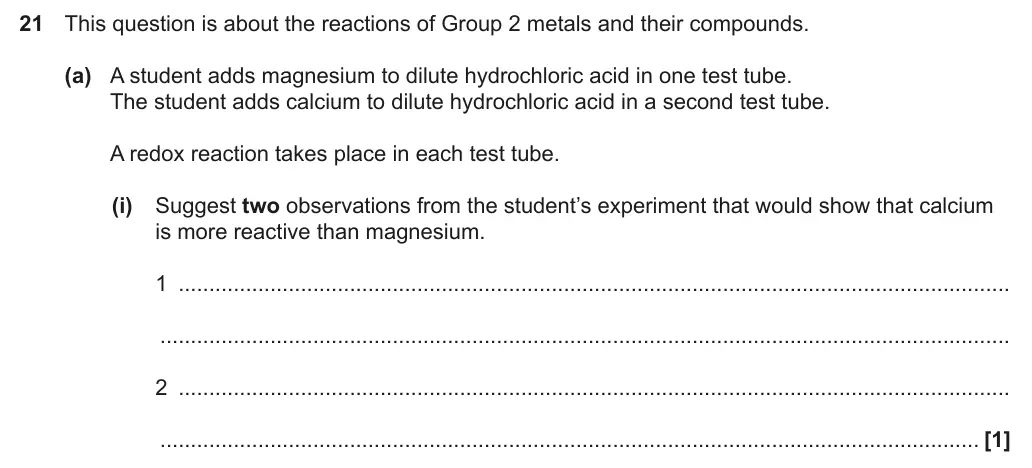
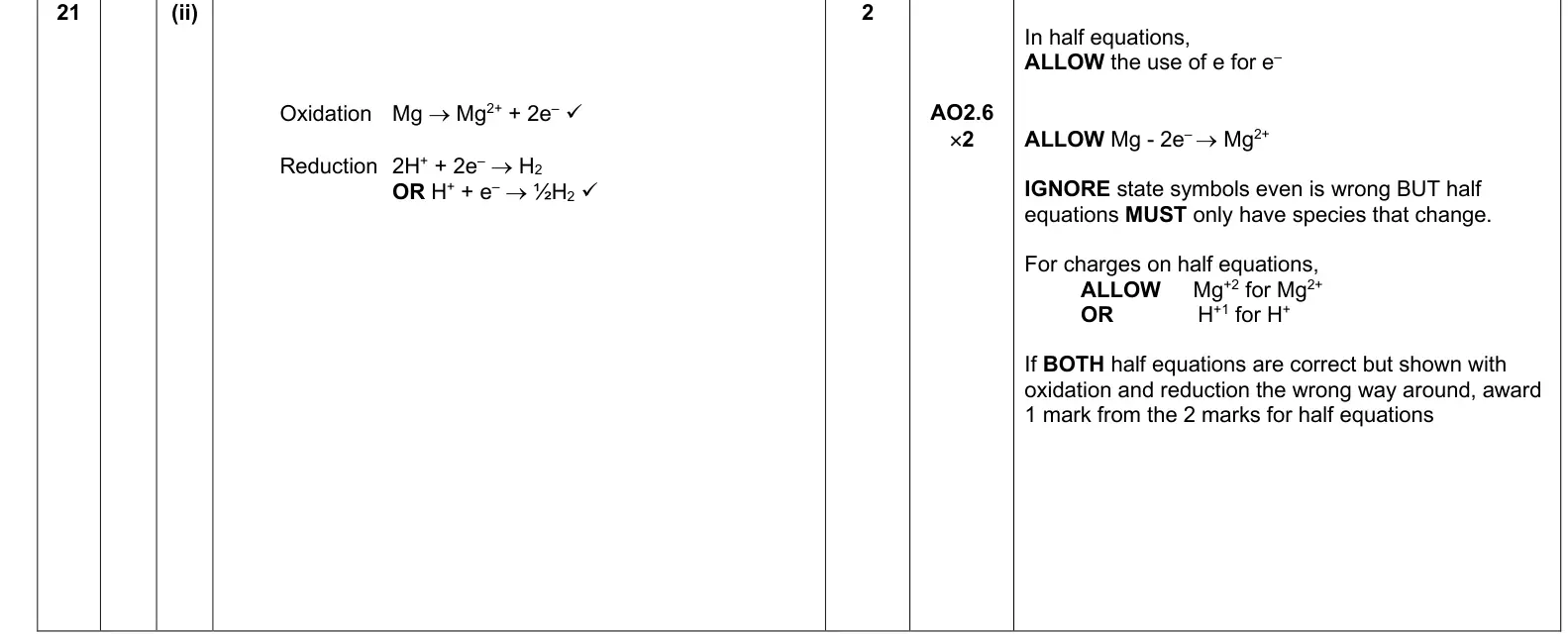
June 2022 · Paper 1 · Q21(a)(ii) 2 marks AO2 Equation writing Hard redoxgroup 2redox and electrode potentials
Earlier part of question 21 that this part usesEarlier part of June 2022 Paper 1 question 21
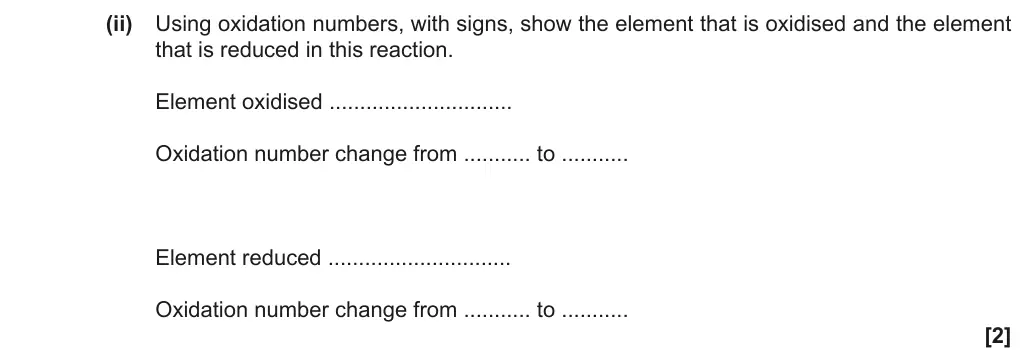
(ii) Write half-equations for the reaction of magnesium with hydrochloric acid.
Oxidation half-equation:  ....................................................................................................
Reduction half-equation:  ...................................................................................................
[2]
June 2022 · Paper 1 · Q21(b)(ii) 1 mark AO3 Equation writing Easy formulae and equationsacids and titrationsqualitative analysis
Earlier part of question 21 that this part usesEarlier part of June 2022 Paper 1 question 21
(ii) 10 cm3 of dilute sulfuric acid is added to 10 cm3 of the colourless solution of Ba(OH)2.
Write an ionic equation, including state symbols, for the reaction.
...................................................................................................................................... [1]
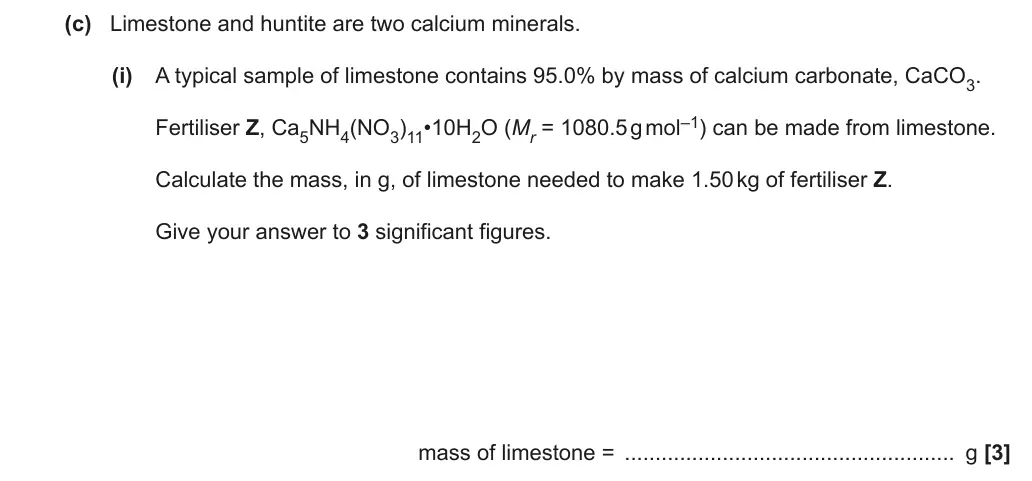
June 2022 · Paper 1 · Q21(c)(ii) 2 marks AO2 Equation writing Hard formulae and equationsacids and titrations
Earlier part of question 21 that this part usesEarlier part of June 2022 Paper 1 question 21
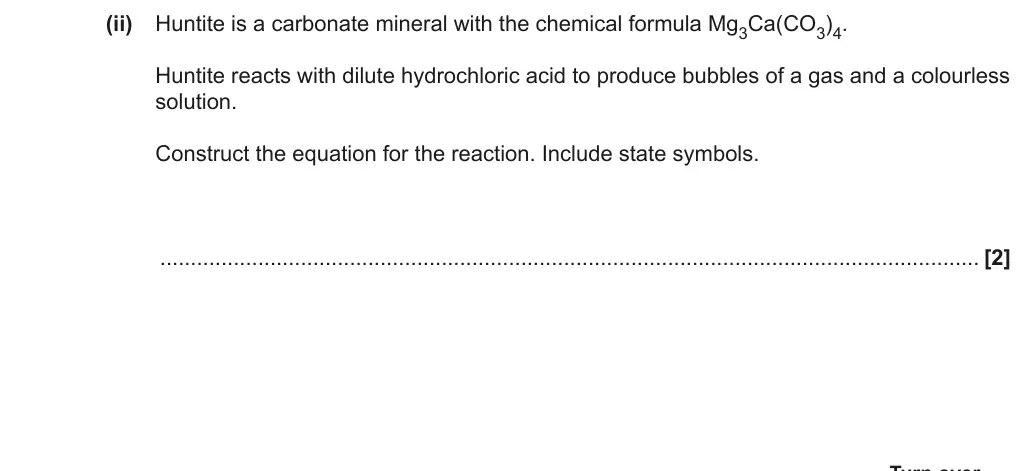
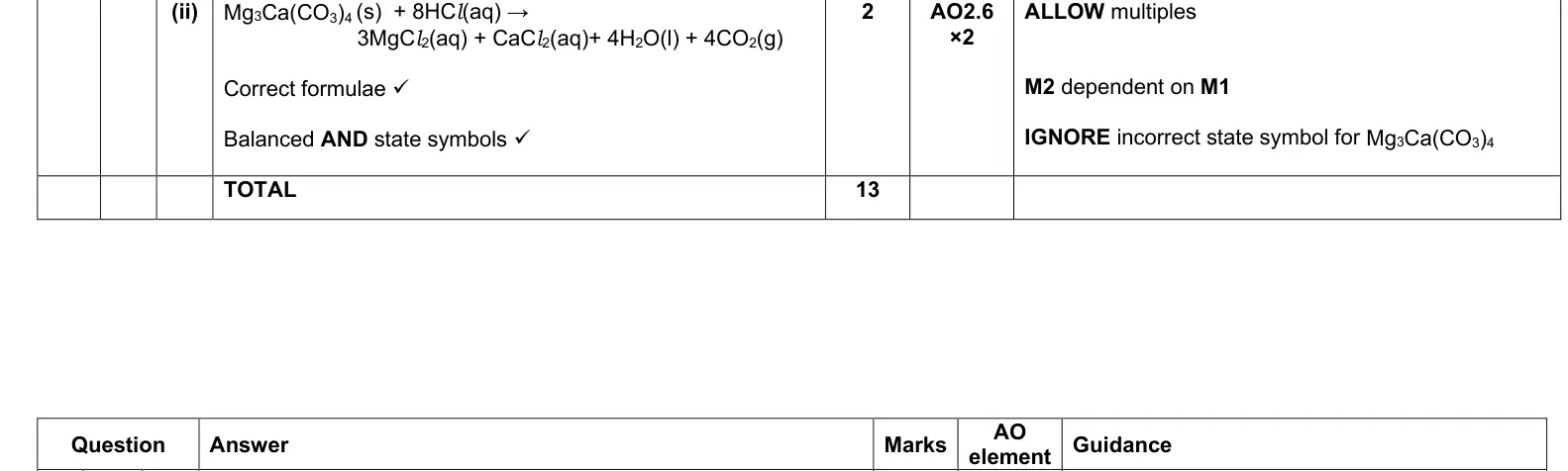
(ii) Huntite is a carbonate mineral with the chemical formula Mg3Ca(CO3)4.
Huntite reacts with dilute hydrochloric acid to produce bubbles of a gas and a colourless
solution.
Construct the equation for the reaction. Include state symbols.
...................................................................................................................................... [2]
June 2022 · Paper 1 · Q22(b)(i) 1 mark AO2 Equation writing Medium transition elements
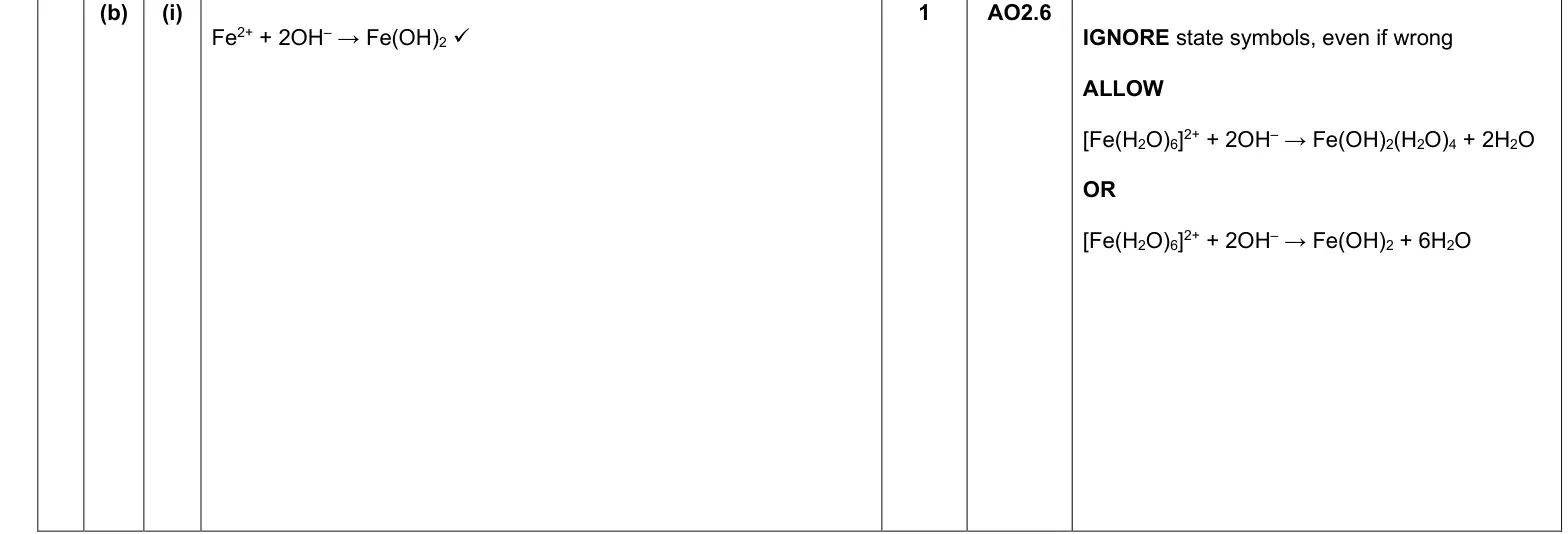
(b) Aqueous sodium hydroxide is added to an aqueous solution of iron(II) sulfate.
A pale green precipitate forms which turns brown when left to stand in air.
(i) Write an ionic equation for the formation of the pale green precipitate.
...................................................................................................................................... [1]
June 2022 · Paper 1 · Q22(b)(ii) 4 marks AO3 Equation writing Easy redox and electrode potentialstransition elements
Earlier part of question 22 that this part usesEarlier part of June 2022 Paper 1 question 22
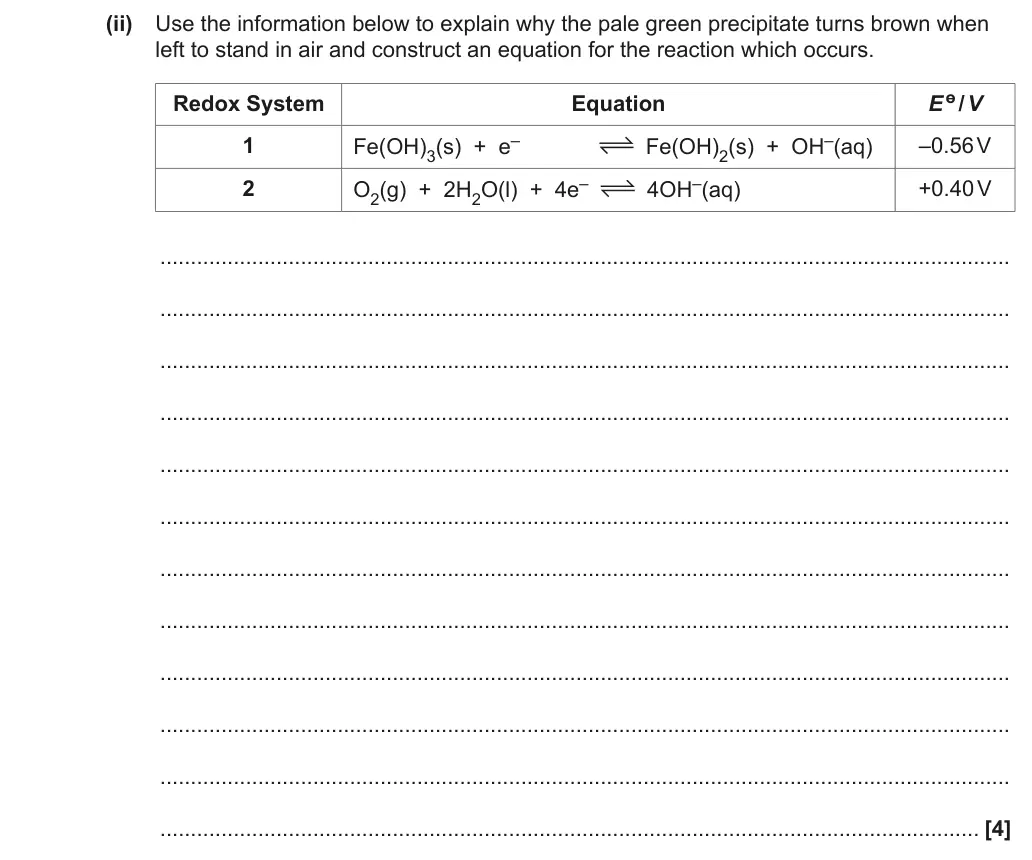
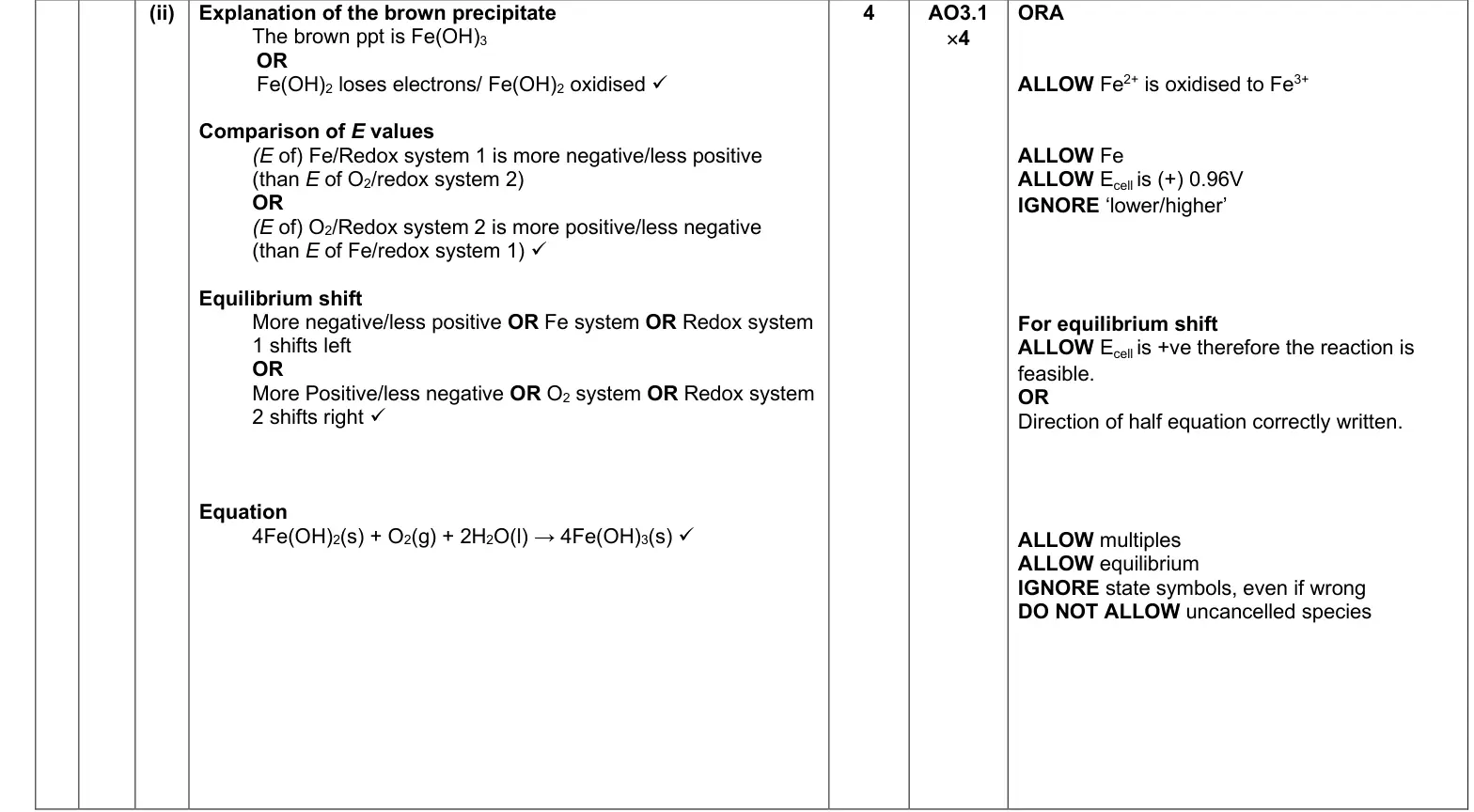
(ii) Use the information below to explain why the pale green precipitate turns brown when
left to stand in air and construct an equation for the reaction which occurs.
Redox System Equation E ө / V
1 Fe(OH)3(s)  +  e– Fe(OH)2(s)  +  OH–(aq) –0.56 V
2 O2(g)  +  2H2O(l)  +  4e– 4OH–(aq) +0.40 V
...........................................................................................................................................
...........................................................................................................................................
...........................................................................................................................................
...........................................................................................................................................
...........................................................................................................................................
...........................................................................................................................................
...........................................................................................................................................
...........................................................................................................................................
...........................................................................................................................................
...........................................................................................................................................
...........................................................................................................................................
...................................................................................................................................... [4]
June 2022 · Paper 2 · Q19(a) 4 marks AO2 Equation writing Hard carboxylic acids and estersformulae and equationsamino acids amides and chirality
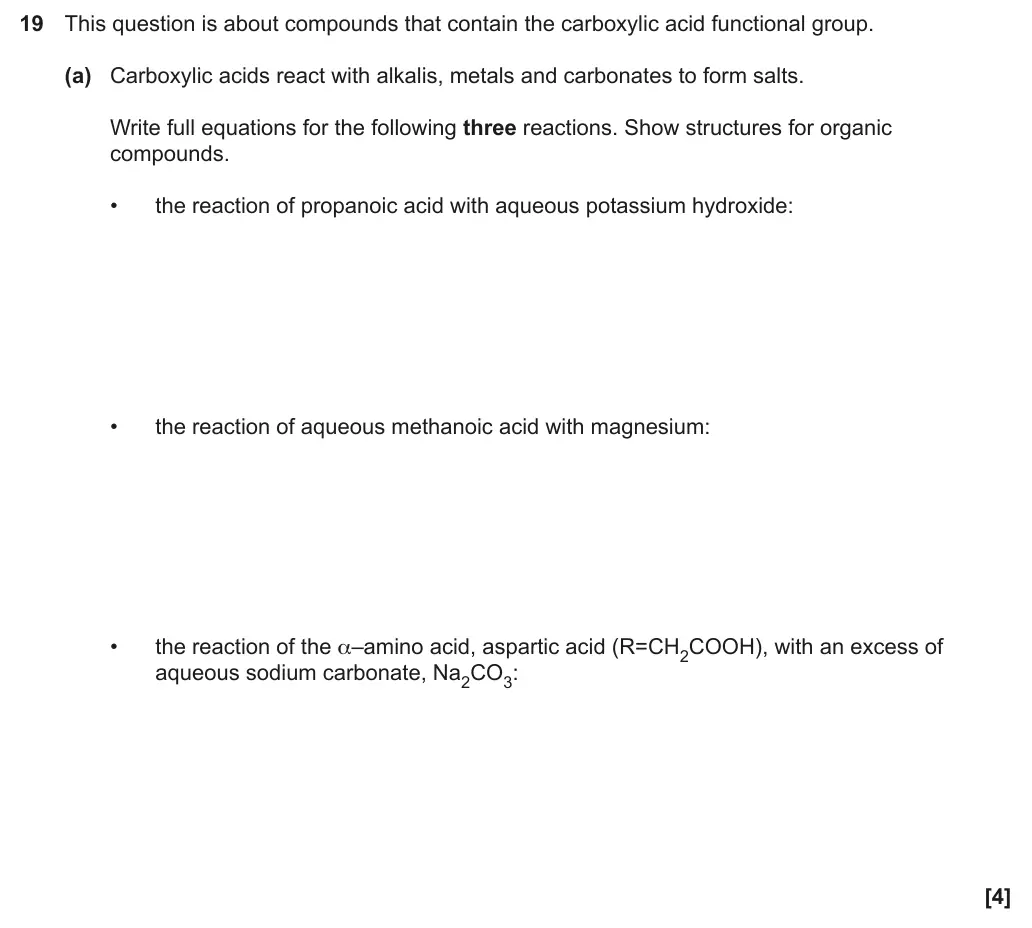
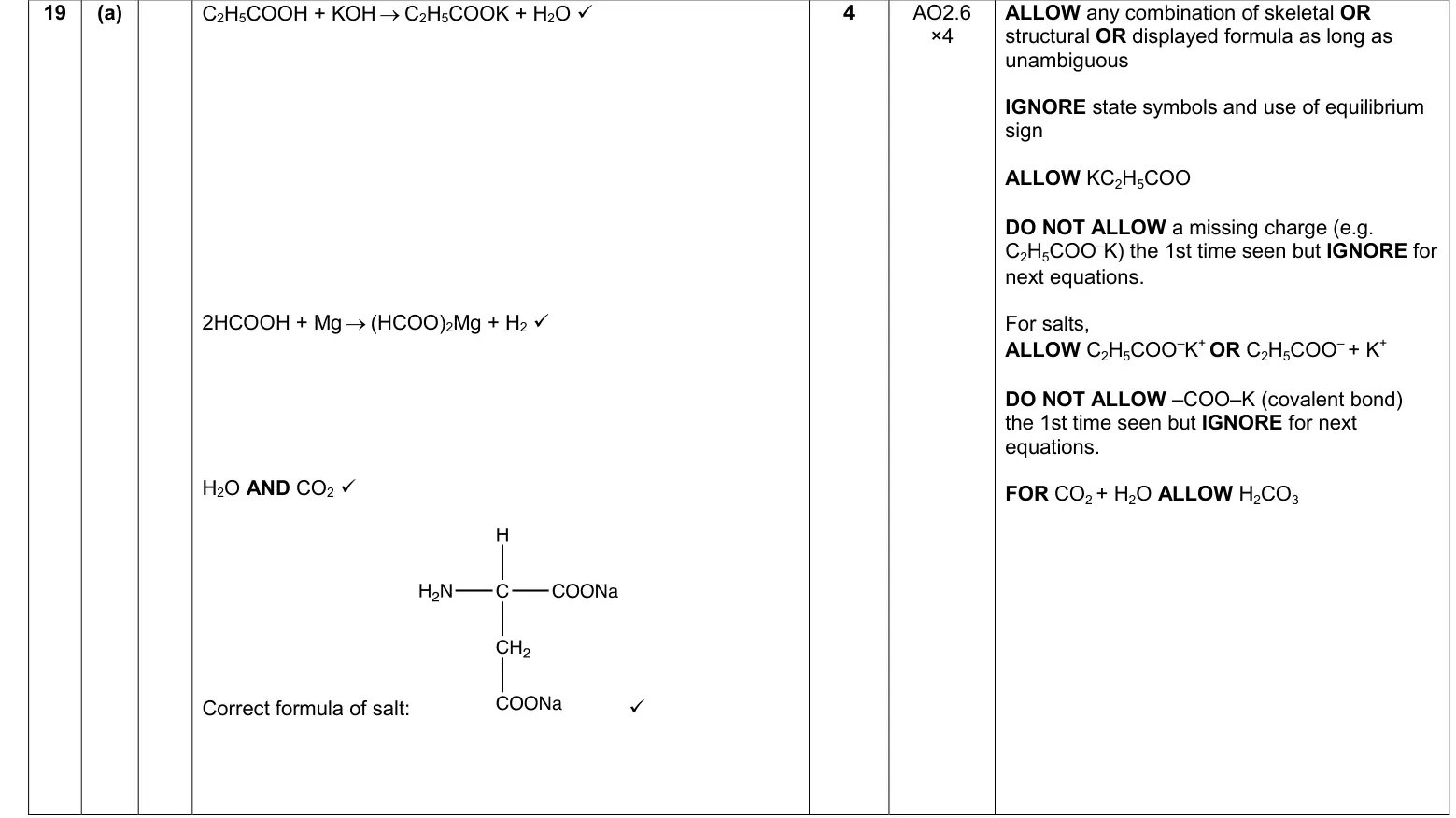
19 This question is about compounds that contain the carboxylic acid functional group.
(a) Carboxylic acids react with alkalis, metals and carbonates to form salts.
Write full equations for the following three reactions. Show structures for organic
compounds.
• the reaction of propanoic acid with aqueous potassium hydroxide:
• the reaction of aqueous methanoic acid with magnesium:
• the reaction of the α–amino acid, aspartic acid (R=CH2COOH), with an excess of
aqueous sodium carbonate, Na2CO3:
[4]
June 2022 · Paper 2 · Q20(c) 2 marks AO2 Equation writing Easy alcoholsformulae and equations
Earlier part of question 20 that this part usesEarlier part of June 2022 Paper 2 question 20
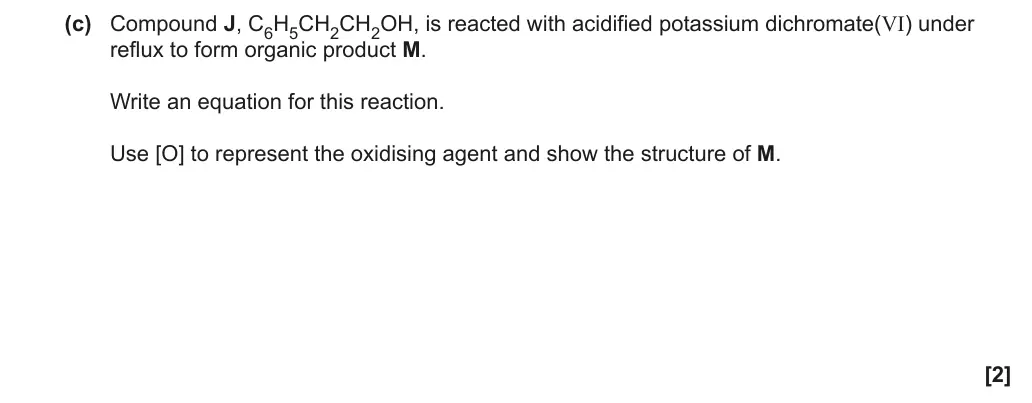
(c) Compound J, C6H5CH2CH2OH, is reacted with acidified potassium dichromate(VI) under
reflux to form organic product M.
Write an equation for this reaction.
Use [O] to represent the oxidising agent and show the structure of M.
[2]
June 2022 · Paper 3 · Q1(d)(ii) 3 marks AO2 Equation writing Hard transition elementsformulae and equations
Earlier part of question 1 that this part usesEarlier part of June 2022 Paper 3 question 1
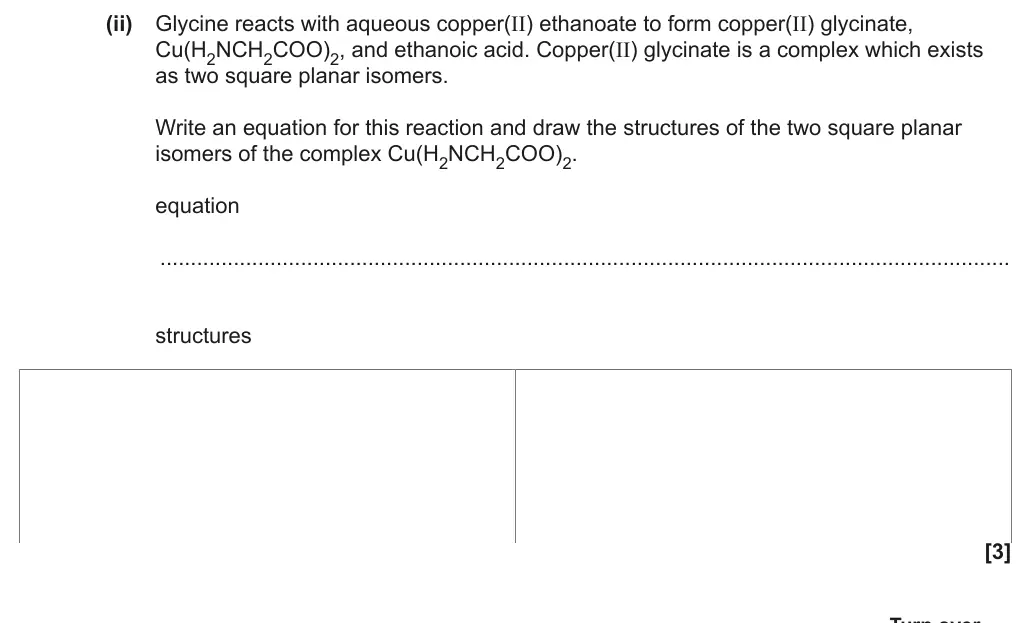
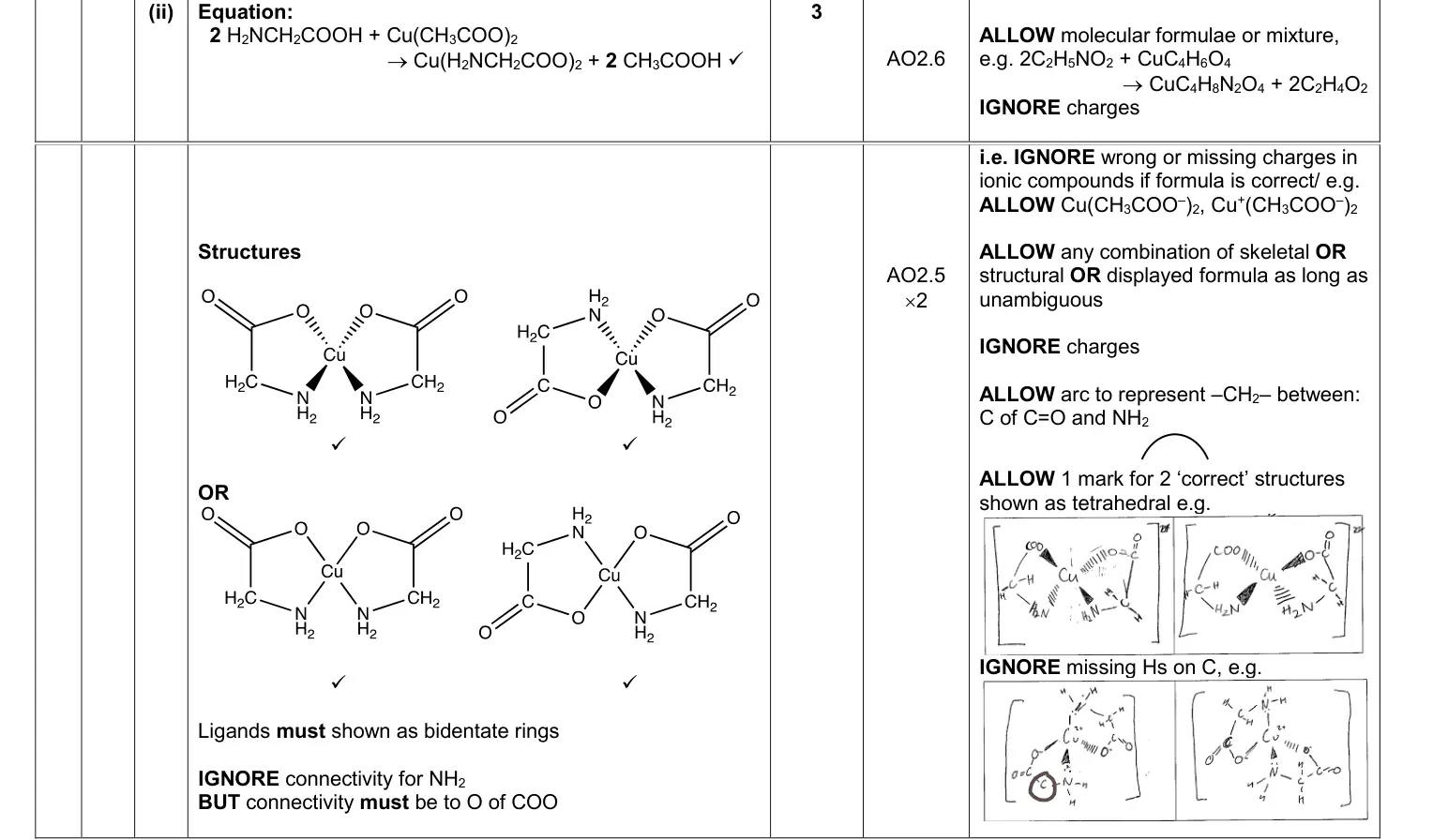
(ii) Glycine reacts with aqueous copper(II) ethanoate to form copper(II) glycinate,
Cu(H2NCH2COO)2, and ethanoic acid. Copper(II) glycinate is a complex which exists
as two square planar isomers.
Write an equation for this reaction and draw the structures of the two square planar
isomers of the complex Cu(H2NCH2COO)2.
equation
...........................................................................................................................................
structures
[3]
June 2022 · Paper 3 · Q2(a)(ii) 3 marks AO1, 2 Equation writing Hard halogensformulae and equationsredox
Earlier part of question 2 that this part usesEarlier part of June 2022 Paper 3 question 2
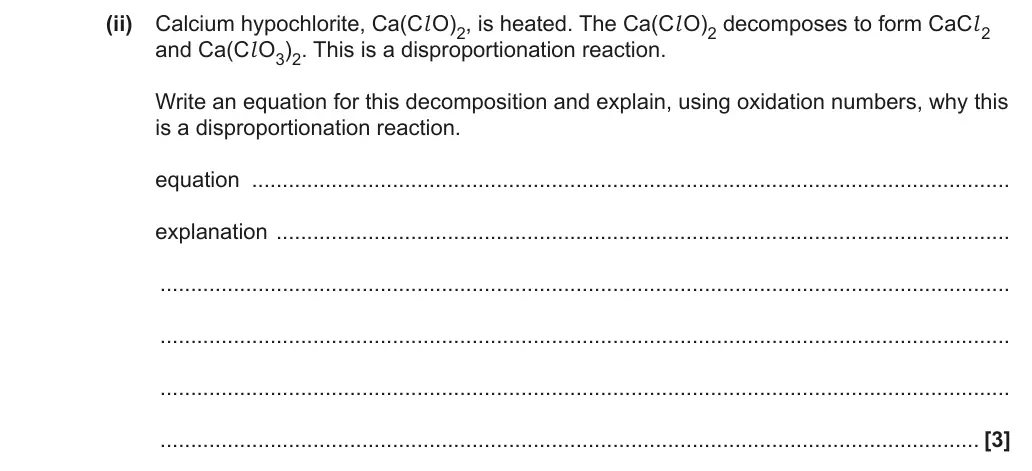
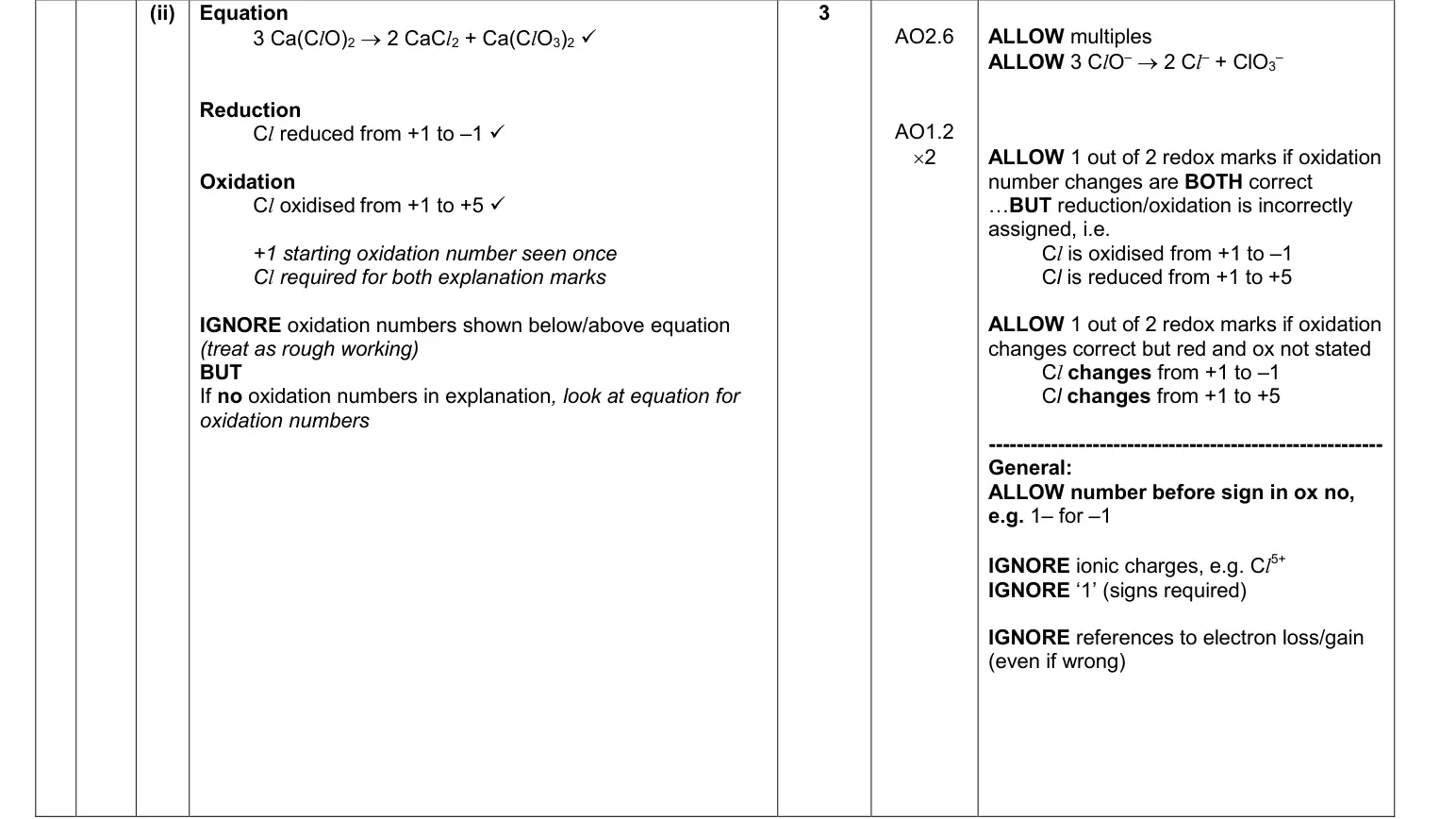
(ii) Calcium hypochlorite, Ca(Cl O)2, is heated. The Ca(Cl O)2 decomposes to form CaCl 2
and Ca(Cl O3)2. This is a disproportionation reaction.
Write an equation for this decomposition and explain, using oxidation numbers, why this
is a disproportionation reaction.
equation  ............................................................................................................................
explanation  ........................................................................................................................
...........................................................................................................................................
...........................................................................................................................................
...........................................................................................................................................
...................................................................................................................................... [3]
June 2022 · Paper 3 · Q2(c) 2 marks AO3 Equation writing Hard redox and electrode potentials
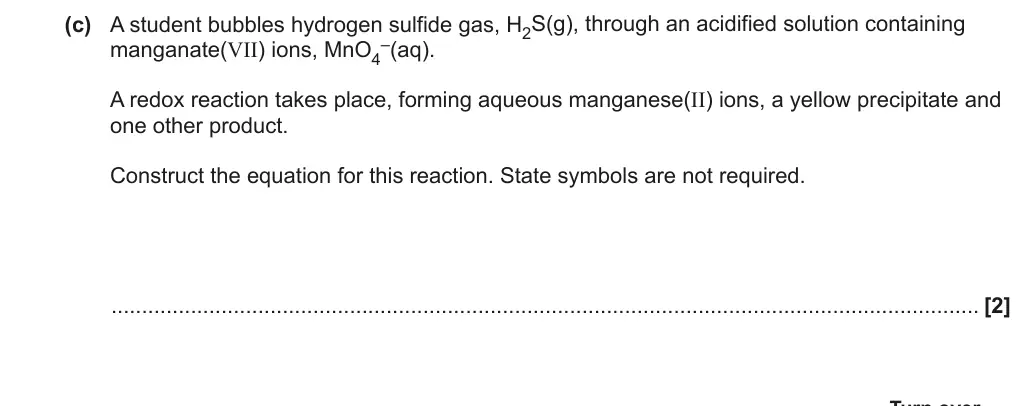
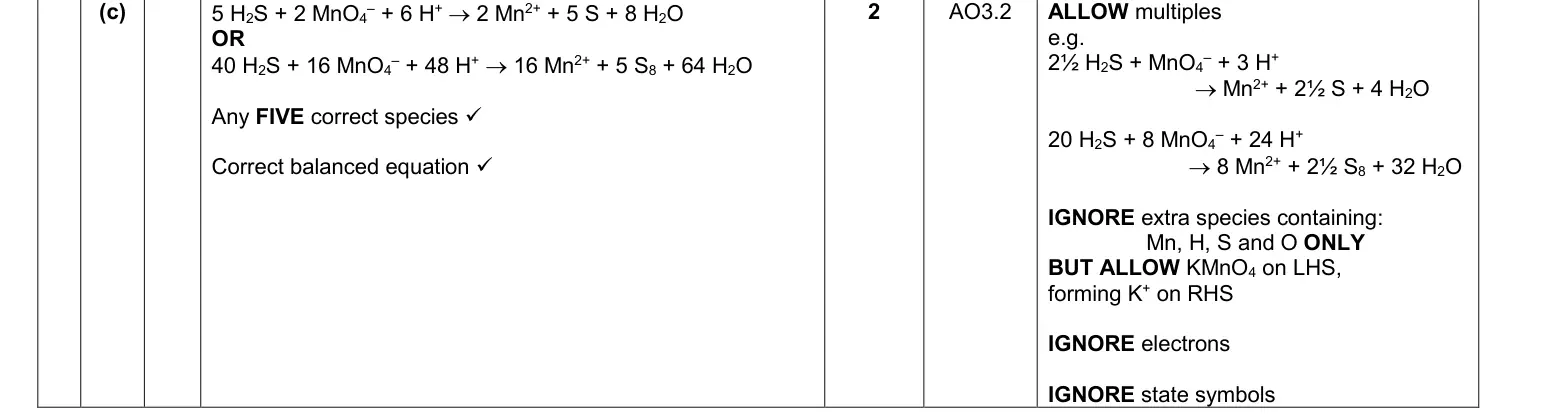
(c) A student bubbles hydrogen sulfide gas, H2S(g), through an acidified solution containing
manganate(VII) ions, MnO4 –(aq).
A redox reaction takes place, forming aqueous manganese(II) ions, a yellow precipitate and
one other product.
Construct the equation for this reaction. State symbols are not required.
.............................................................................................................................................. [2]
June 2022 · Paper 3 · Q5(b)(i) 1 mark AO2 Equation writing Easy alkanesformulae and equationsalcohols
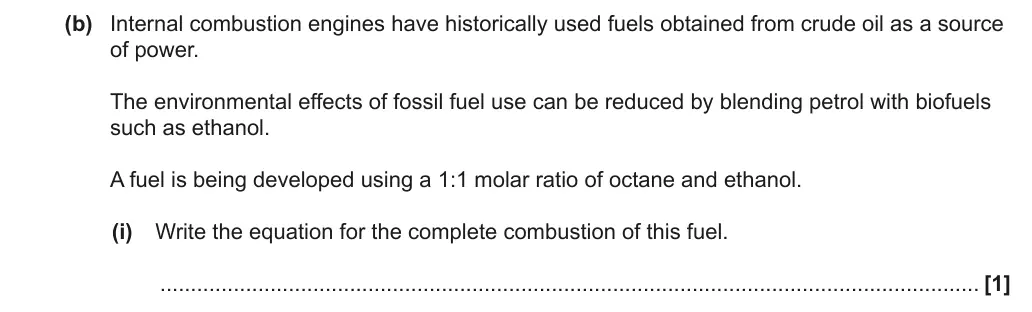
(b) Internal combustion engines have historically used fuels obtained from crude oil as a source
of power.
The environmental effects of fossil fuel use can be reduced by blending petrol with biofuels
such as ethanol.
A fuel is being developed using a 1:1 molar ratio of octane and ethanol.
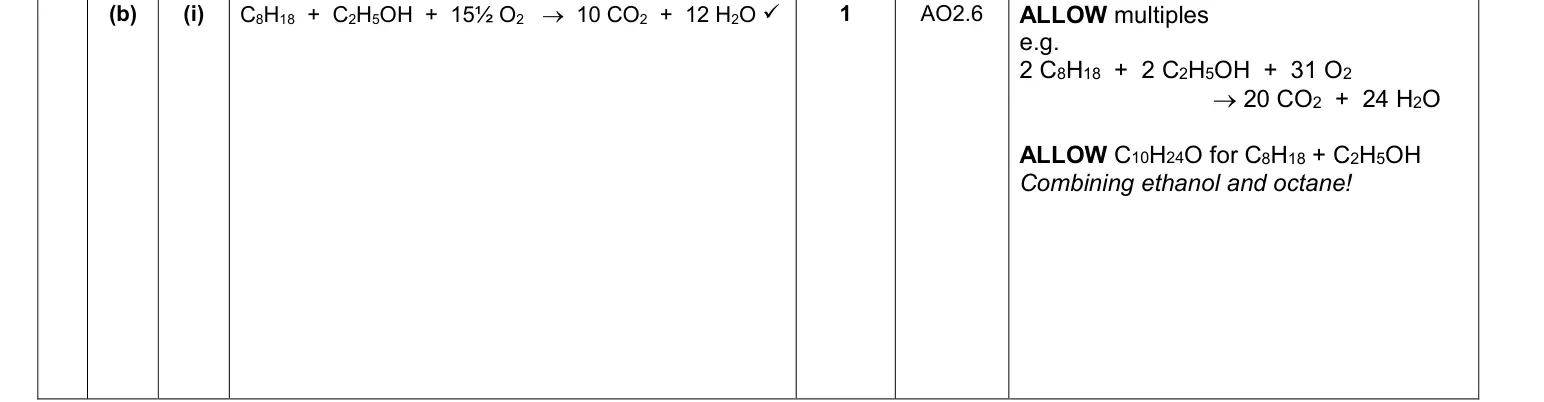
(i) Write the equation for the complete combustion of this fuel.
...................................................................................................................................... [1]
November 2021 · AS Paper 1 · Q23(c) 1 mark AO2 Equation writing formulae and equations
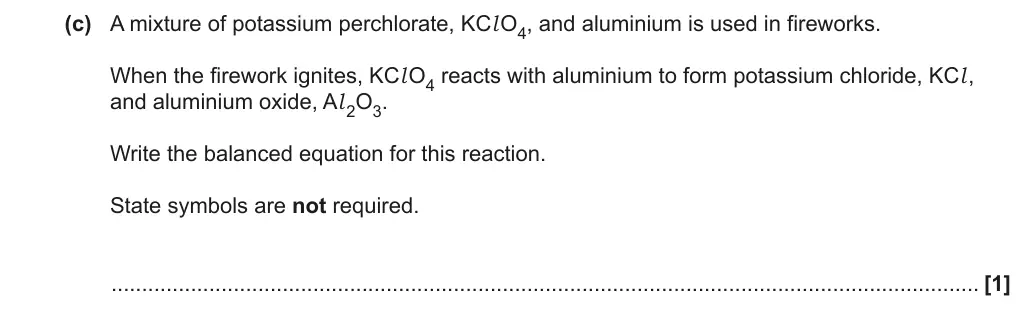
(c) A mixture of potassium perchlorate, KCl O4, and aluminium is used in fireworks.
When the firework ignites, KCl O4 reacts with aluminium to form potassium chloride, KCl ,
and aluminium oxide, Al 2O3.
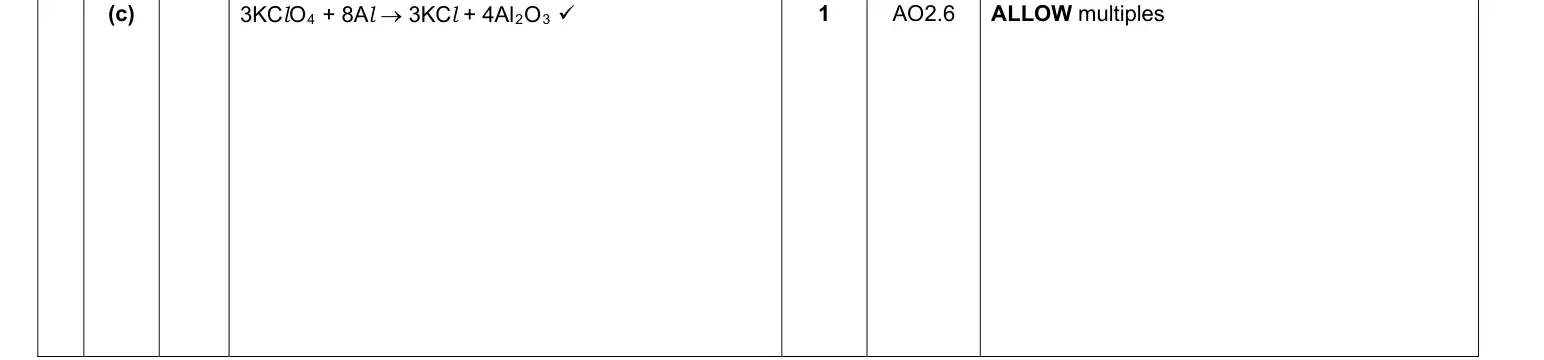
Write the balanced equation for this reaction.
State symbols are not required.
.............................................................................................................................................. [1]
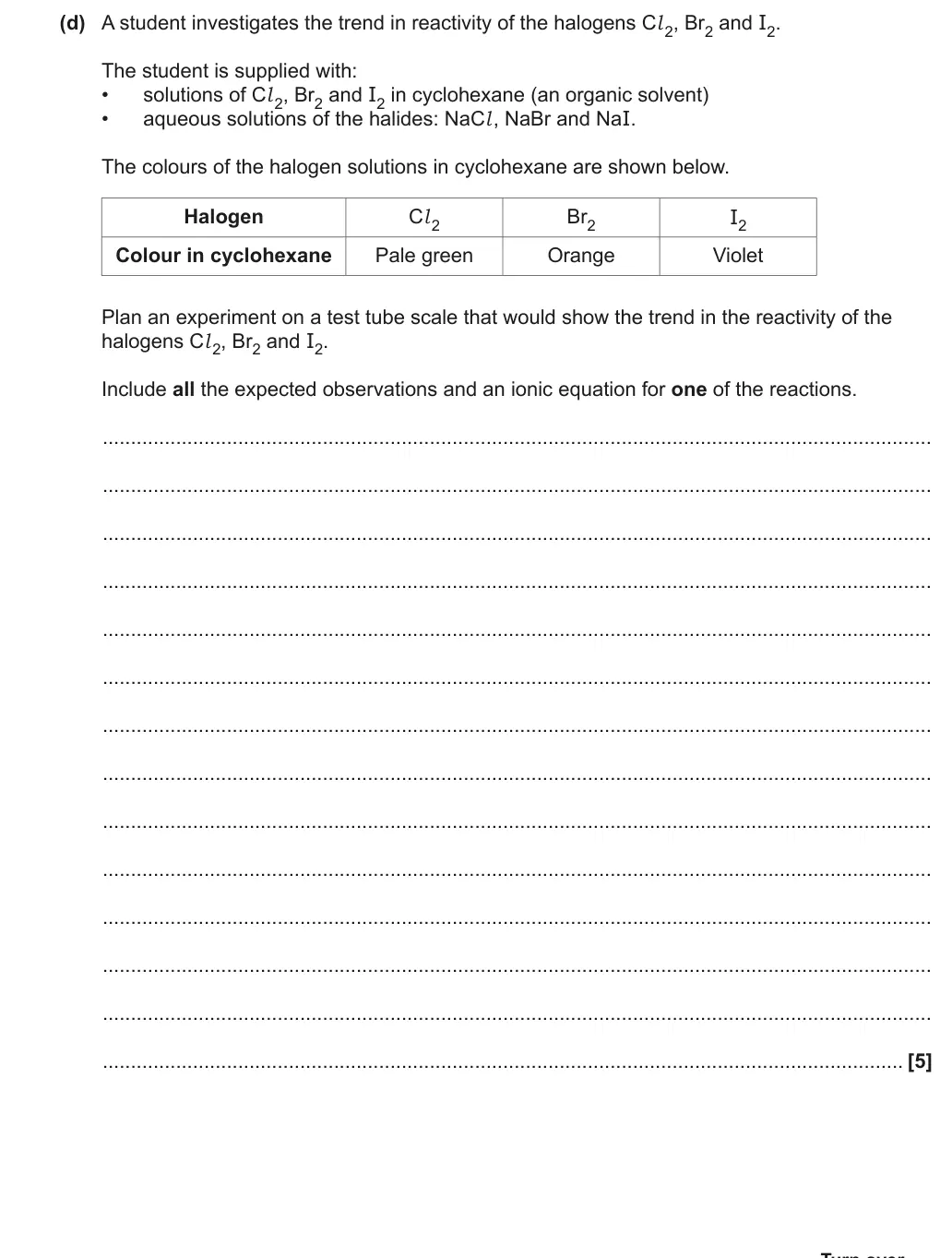
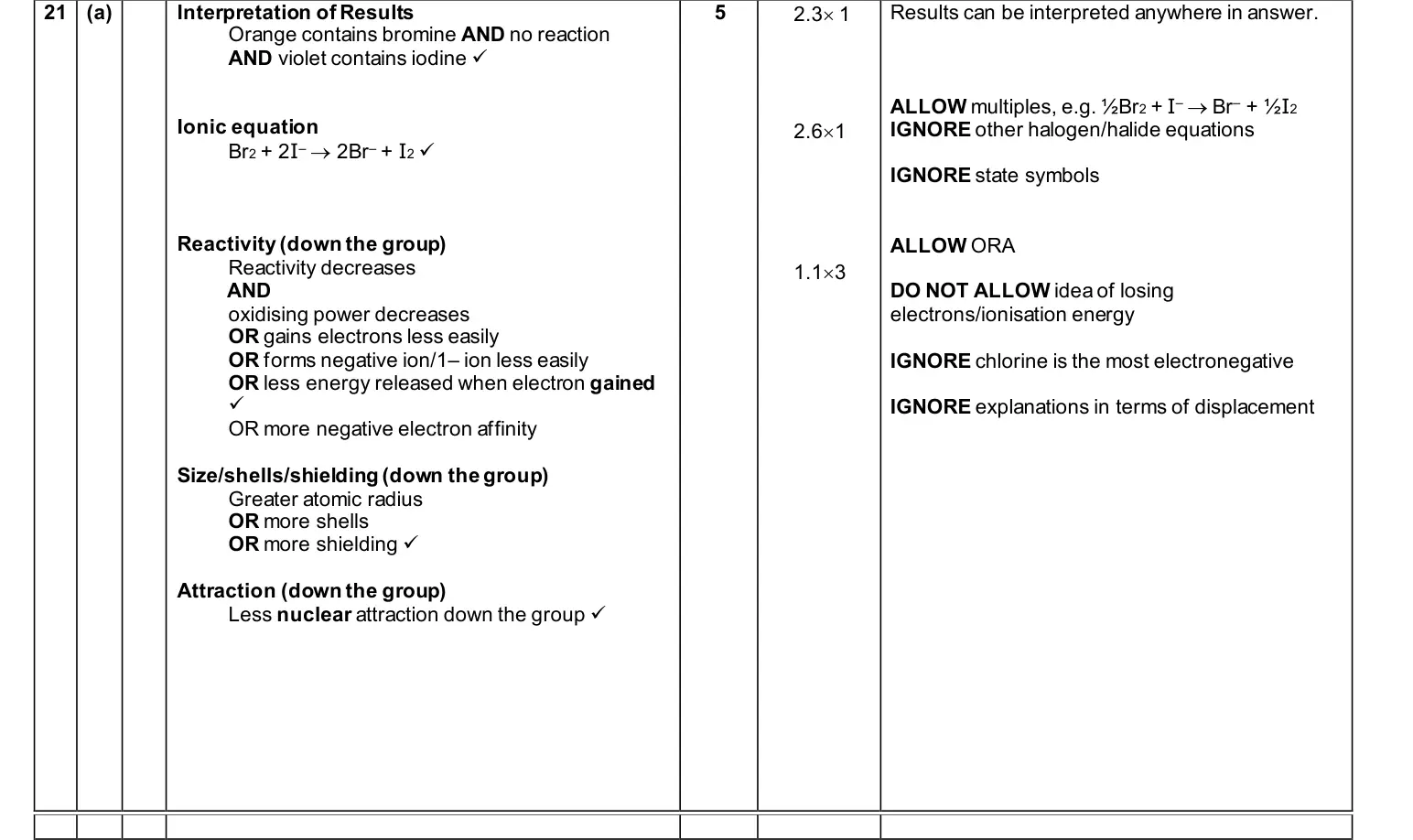
November 2021 · AS Paper 1 · Q23(d) 5 marks AO1, 2, 3 Equation writing halogenspractical skillsformulae and equations
(d) A student investigates the trend in reactivity of the halogens Cl 2, Br2 and I2.
The student is supplied with:
• solutions of Cl 2, Br2 and I2 in cyclohexane (an organic solvent)
• aqueous solutions of the halides: NaCl , NaBr and NaI.
The colours of the halogen solutions in cyclohexane are shown below.
Halogen Cl 2 Br2 I2
Colour in cyclohexane Pale green Orange Violet
Plan an experiment on a test tube scale that would show the trend in the reactivity of the
halogens Cl 2, Br2 and I2.
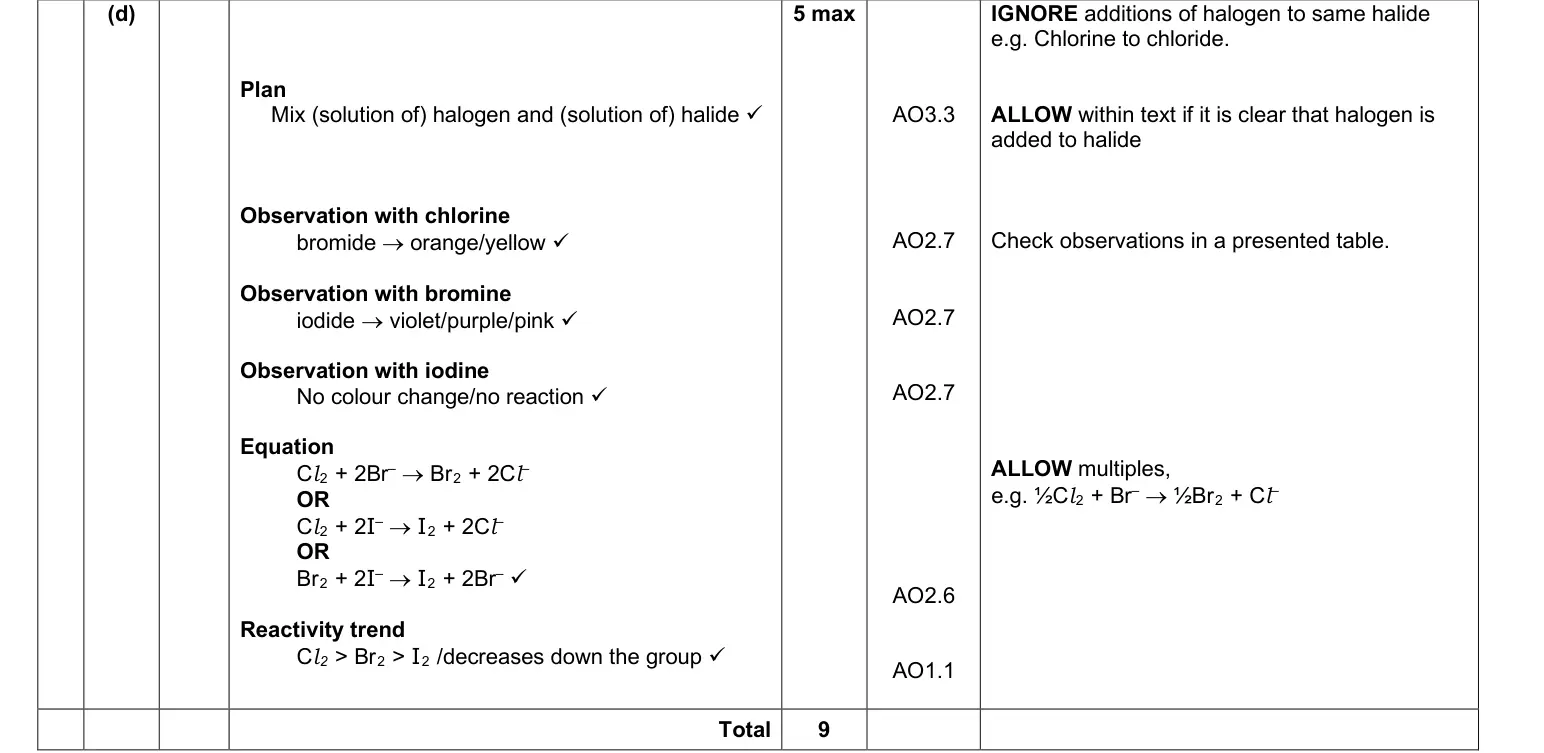
Include all the expected observations and an ionic equation for one of the reactions.
...................................................................................................................................................
...................................................................................................................................................
...................................................................................................................................................
...................................................................................................................................................
...................................................................................................................................................
...................................................................................................................................................
...................................................................................................................................................
...................................................................................................................................................
...................................................................................................................................................
...................................................................................................................................................
...................................................................................................................................................
...................................................................................................................................................
...................................................................................................................................................
.............................................................................................................................................. [5]
November 2021 · AS Paper 2 · Q2(d) 2 marks AO2 Equation writing alkanesformulae and equations
Earlier part of question 2 that this part usesEarlier part of November 2021 Paper 2 question 2
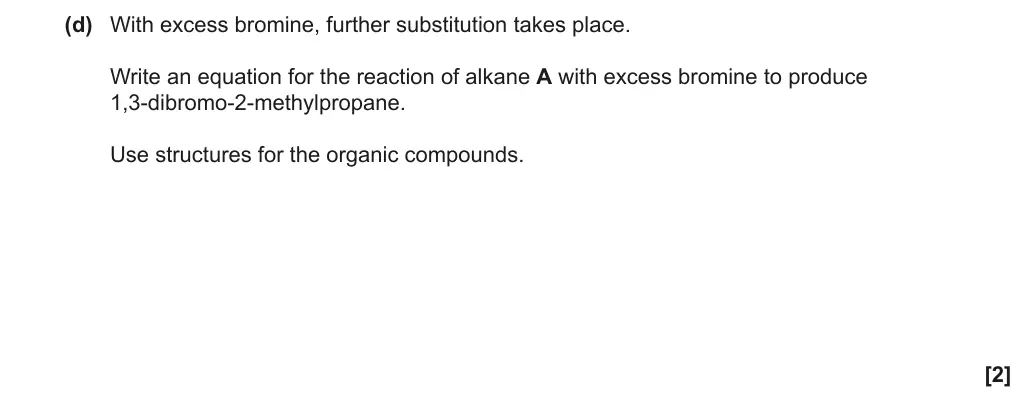
(d) With excess bromine, further substitution takes place.
Write an equation for the reaction of alkane A with excess bromine to produce
1,3-dibromo-2-methylpropane.
Use structures for the organic compounds.
[2]
November 2021 · AS Paper 2 · Q7(a) 2 marks AO2 Equation writing alcoholsformulae and equationsorganic basics
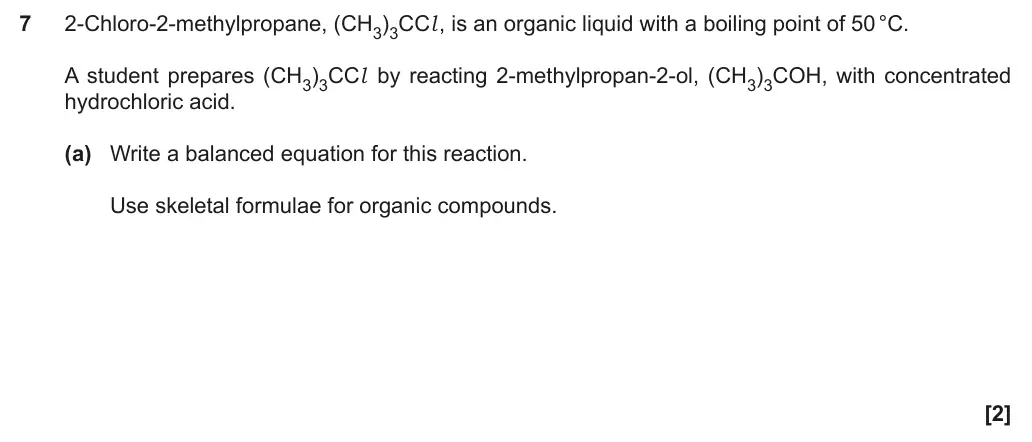
7 2-Chloro-2-methylpropane, (CH3)3CCl , is an organic liquid with a boiling point of 50 °C.
A student prepares (CH3)3CCl  by reacting 2-methylpropan-2-ol, (CH3)3COH, with concentrated
hydrochloric acid.
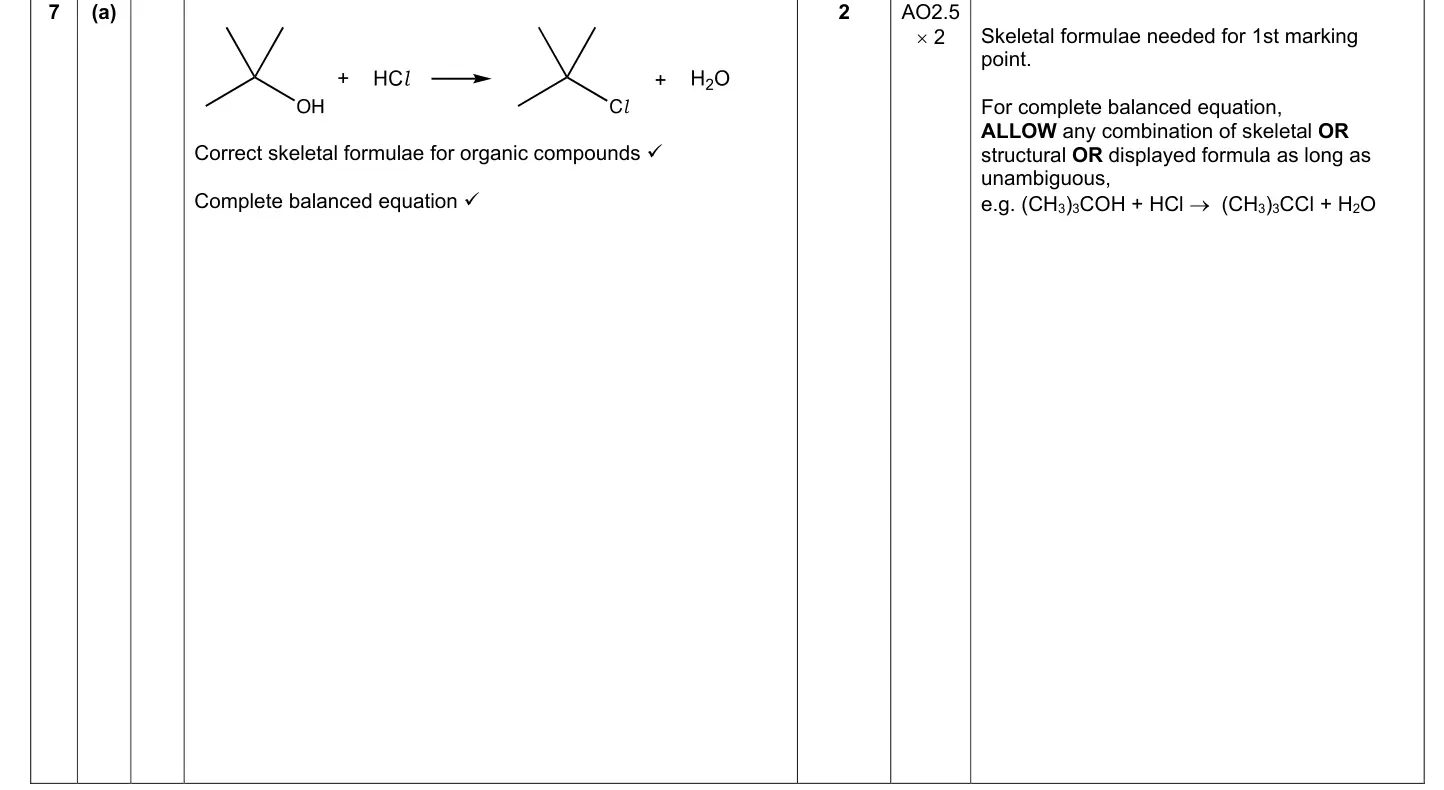
(a) Write a balanced equation for this reaction.
Use skeletal formulae for organic compounds.
[2]
November 2021 · AS Paper 2 · Q7(c)(ii) 3 marks AO2 Equation writing alcoholsorganic basics
Earlier part of question 7 that this part usesEarlier part of November 2021 Paper 2 question 7
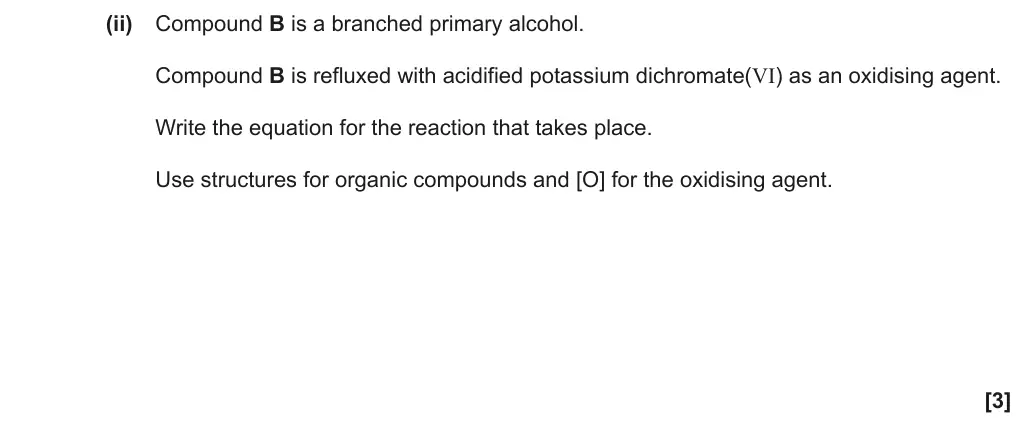
(ii) Compound B is a branched primary alcohol.
Compound B is refluxed with acidified potassium dichromate(VI) as an oxidising agent.
Write the equation for the reaction that takes place.
Use structures for organic compounds and [O] for the oxidising agent.
[3]
November 2021 · Paper 1 · Q16(b)(i) 1 mark AO1 Equation writing periodicity
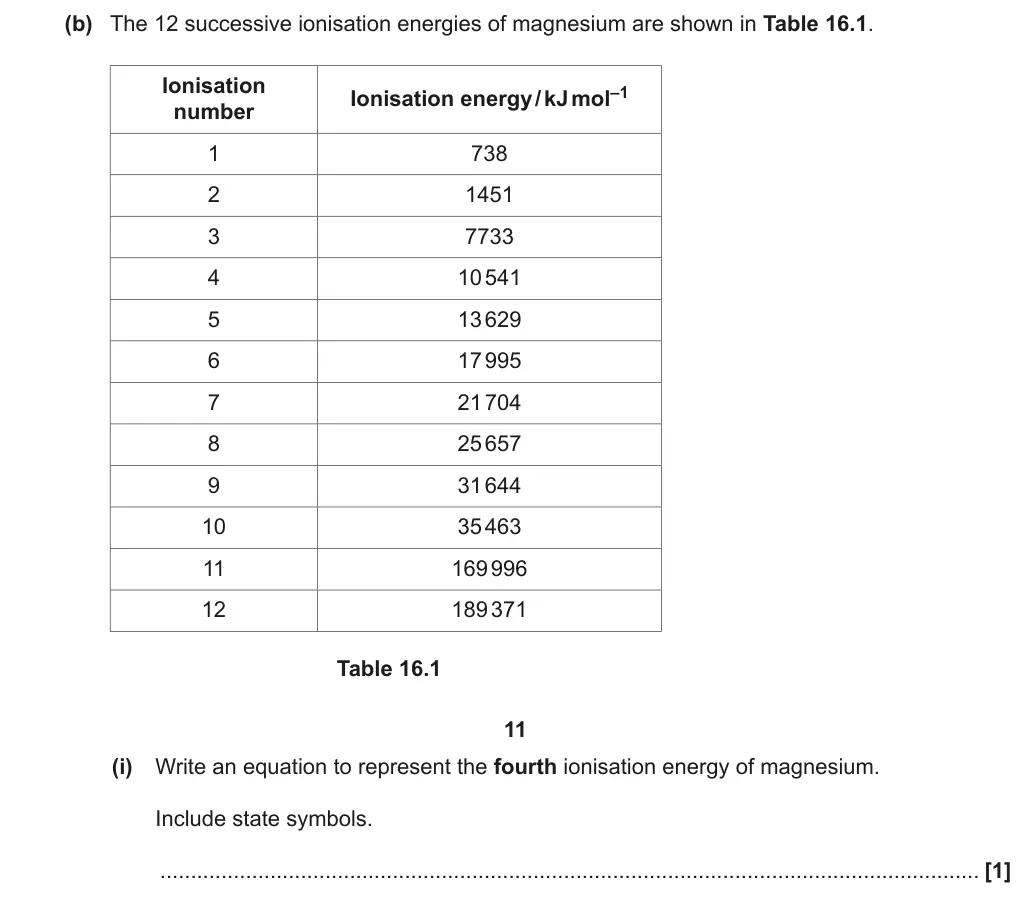
(b) The 12 successive ionisation energies of magnesium are shown in Table 16.1.
Ionisation
Ionisation energy / kJ mol–1
number
1 738
2 1451
3 7733
4 10 541
5 13 629
6 17 995
7 21 704
8 25 657
9 31 644
10 35 463
11 169 996
12 189 371
Table 16.1
(i) Write an equation to represent the fourth ionisation energy of magnesium.
Include state symbols.
...................................................................................................................................... [1]
November 2021 · Paper 1 · Q18(a) 2 marks AO1, 2 Equation writing acids and titrationsformulae and equations
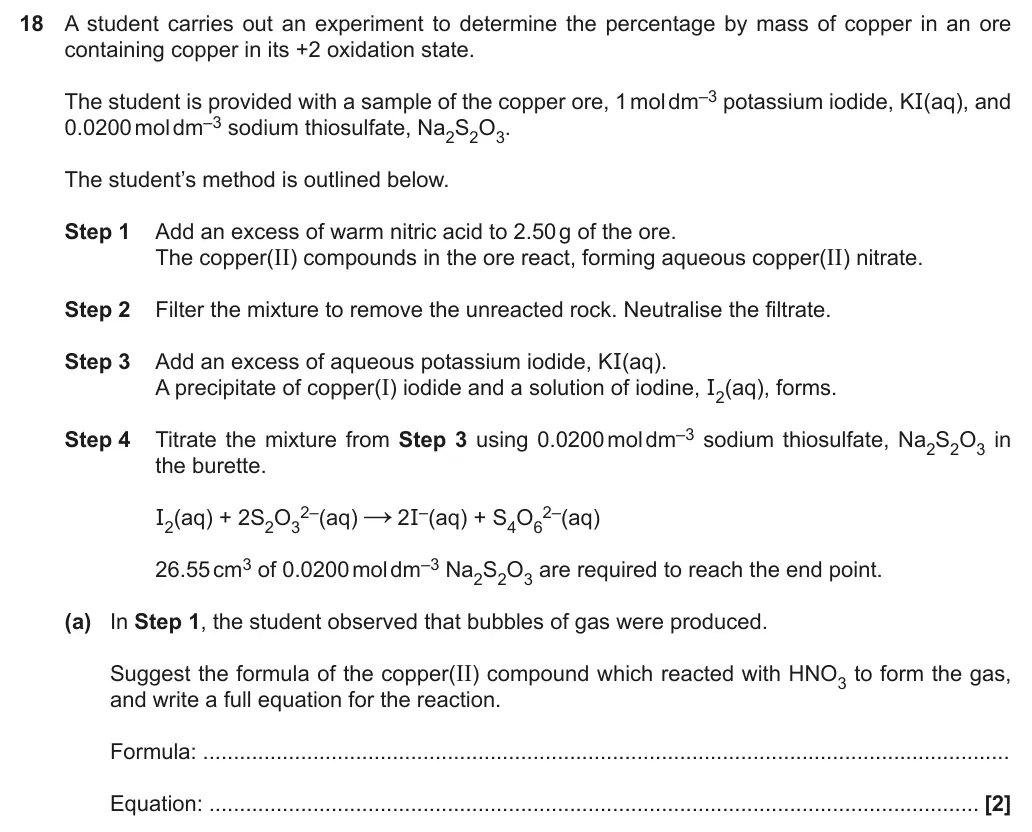
18 A student carries out an experiment to determine the percentage by mass of copper in an ore
containing copper in its +2 oxidation state.
The student is provided with a sample of the copper ore, 1 mol dm–3 potassium iodide, KI(aq), and
0.0200 mol dm–3 sodium thiosulfate, Na2S2O3.
The student’s method is outlined below.
Step 1 Add an excess of warm nitric acid to 2.50 g of the ore.
The copper(II) compounds in the ore react, forming aqueous copper(II) nitrate.
Step 2 Filter the mixture to remove the unreacted rock. Neutralise the filtrate.
Step 3 Add an excess of aqueous potassium iodide, KI(aq).
A precipitate of copper(I) iodide and a solution of iodine, I2(aq), forms.
Step 4 Titrate the mixture from Step 3 using 0.0200 mol dm–3 sodium thiosulfate, Na2S2O3 in
the burette.
I2(aq) + 2S2O3 2–(aq) → 2I–(aq) + S4O6 2–(aq)
26.55 cm3 of 0.0200 mol dm–3 Na2S2O3 are required to reach the end point.
(a) In Step 1, the student observed that bubbles of gas were produced.
Suggest the formula of the copper(II) compound which reacted with HNO3 to form the gas,
and write a full equation for the reaction.
Formula: ....................................................................................................................................
Equation: .............................................................................................................................. [2]
November 2021 · Paper 1 · Q18(b) 1 mark AO2 Equation writing transition elementsredox and electrode potentials
Earlier part of question 18 that this part usesEarlier part of November 2021 Paper 1 question 18
(b) Write an ionic equation, including state symbols, for the reaction in Step 3.
.............................................................................................................................................. [1]
November 2021 · Paper 1 · Q19(a)(ii) 1 mark AO2 Equation writing redox and electrode potentials
Earlier part of question 19 that this part usesEarlier part of November 2021 Paper 1 question 19
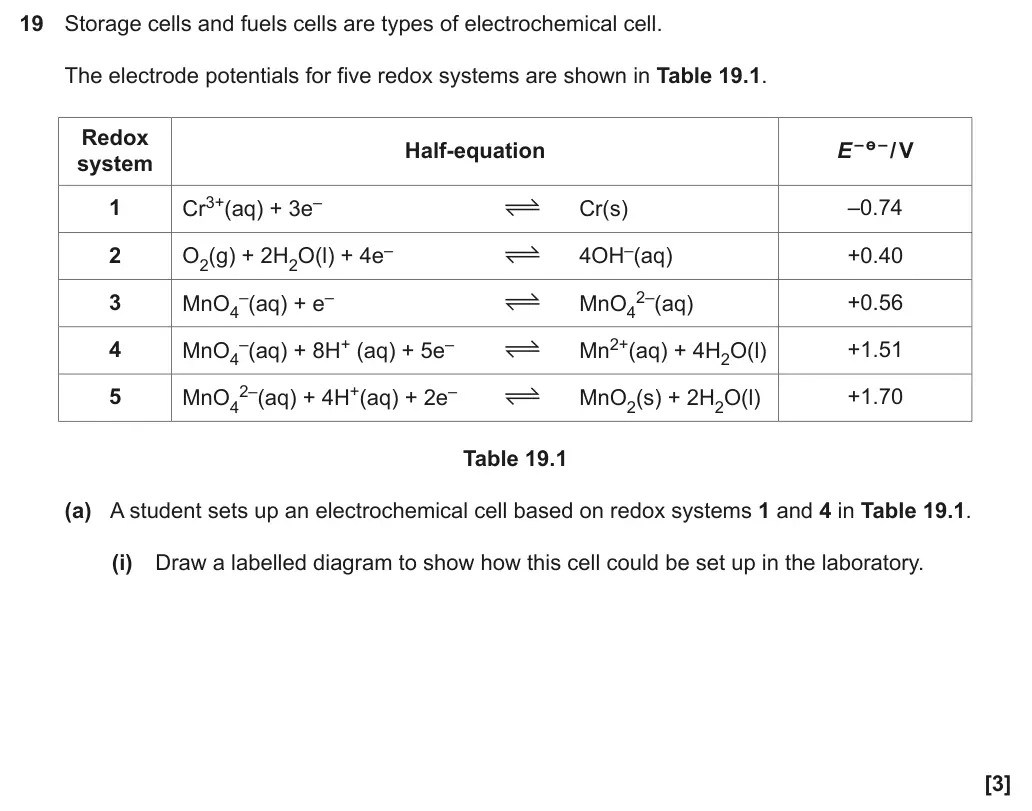
(ii) Construct the equation for the overall cell reaction.
...................................................................................................................................... [1]
November 2021 · Paper 1 · Q19(c)(i) 1 mark AO2 Equation writing redox and electrode potentials
Earlier part of question 19 that this part usesEarlier part of November 2021 Paper 1 question 19
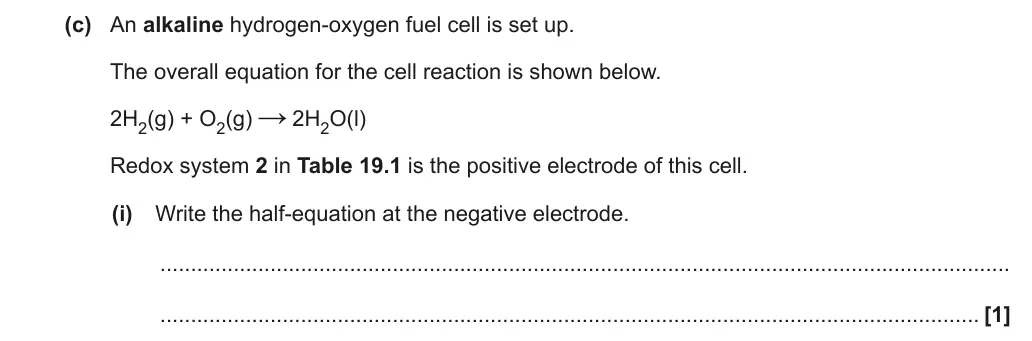
(c) An alkaline hydrogen-oxygen fuel cell is set up.
The overall equation for the cell reaction is shown below.
2H2(g) + O2(g) → 2H2O(l)
Redox system 2 in Table 19.1 is the positive electrode of this cell.
(i) Write the half-equation at the negative electrode.
...........................................................................................................................................
...................................................................................................................................... [1]
November 2021 · Paper 2 · Q20(a)(iii) 3 marks AO2, 3 Equation writing Hard carboxylic acids and estersformulae and equationsorganic synthesis
Earlier part of question 20 that this part usesEarlier part of November 2021 Paper 2 question 20
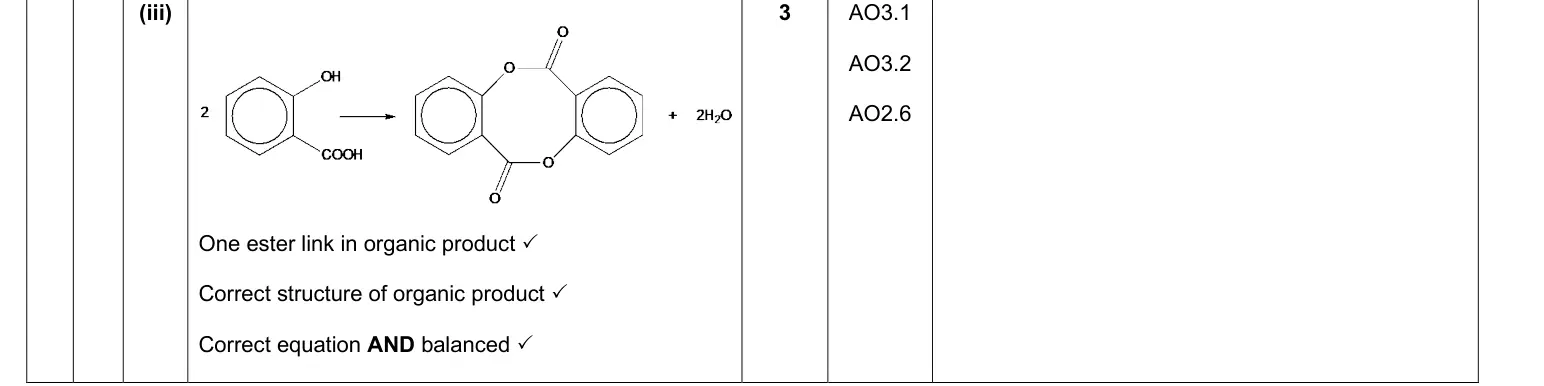
(iii) Two molecules of salicylic acid can react together in the presence of an acid catalyst to
form compound B.
Compound B has three rings and a molecular formula of C14H8O4.
Write the equation for this reaction showing the structures of organic compounds.
[3]
November 2021 · Paper 3 · Q1(d) 4 marks AO1, 2 Equation writing Hard amount of substanceformulae and equationsacids and titrations
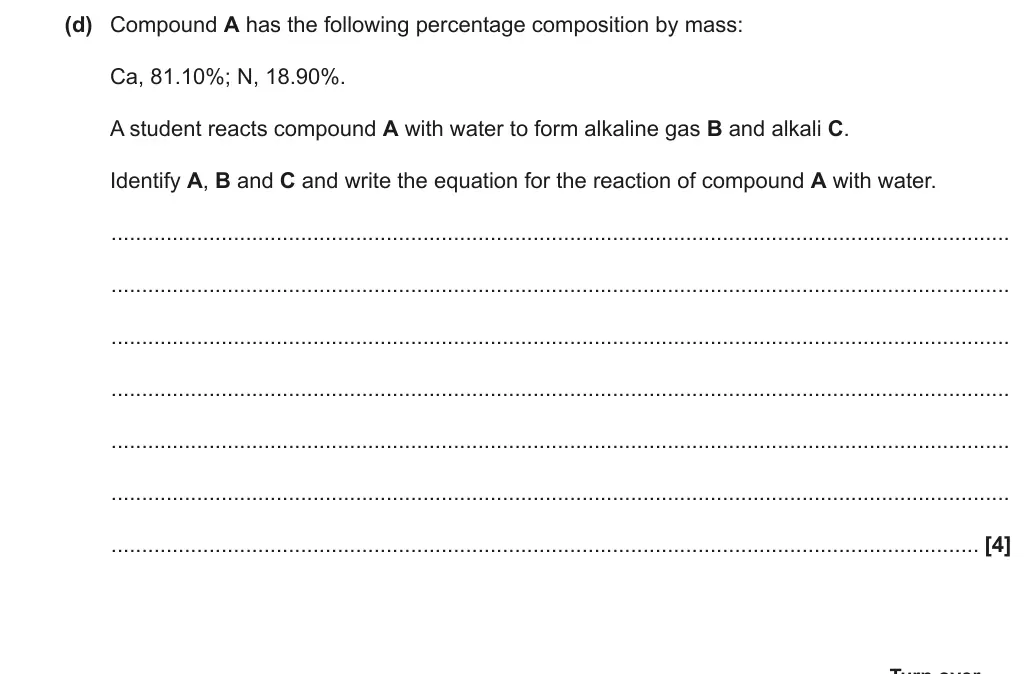
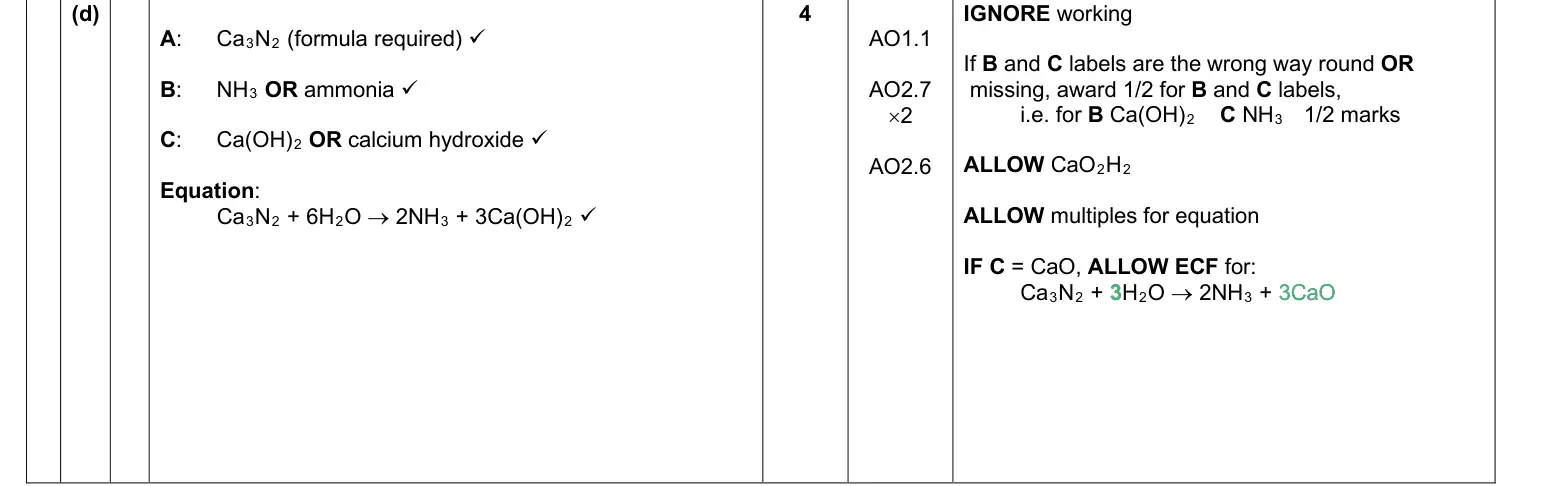
(d) Compound A has the following percentage composition by mass:
Ca, 81.10%; N, 18.90%.
A student reacts compound A with water to form alkaline gas B and alkali C.
Identify A, B and C and write the equation for the reaction of compound A with water.
...................................................................................................................................................
...................................................................................................................................................
...................................................................................................................................................
...................................................................................................................................................
...................................................................................................................................................
...................................................................................................................................................
.............................................................................................................................................. [4]
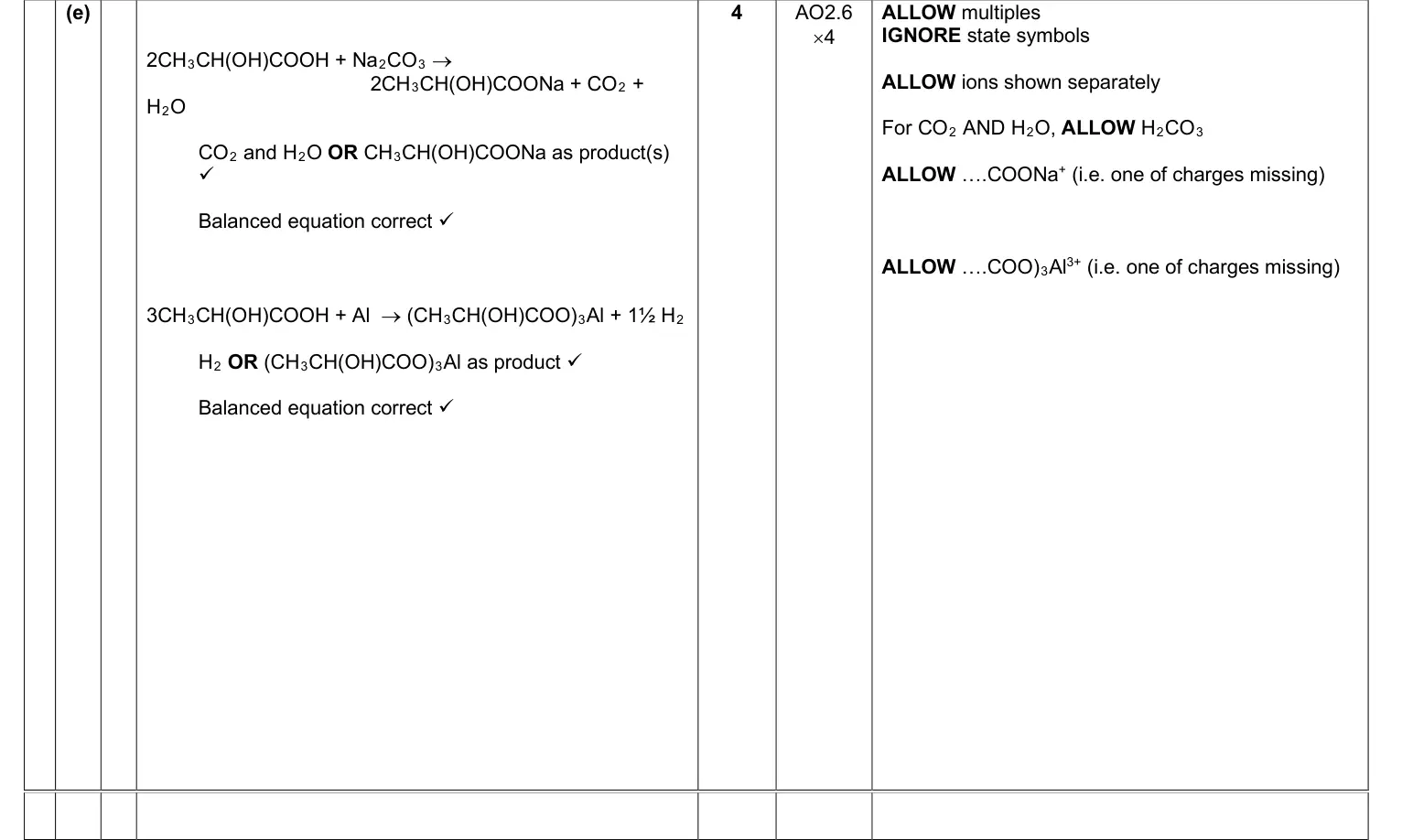
November 2021 · Paper 3 · Q1(e) 4 marks AO2 Equation writing Hard carboxylic acids and estersformulae and equationsacids and titrationsredox
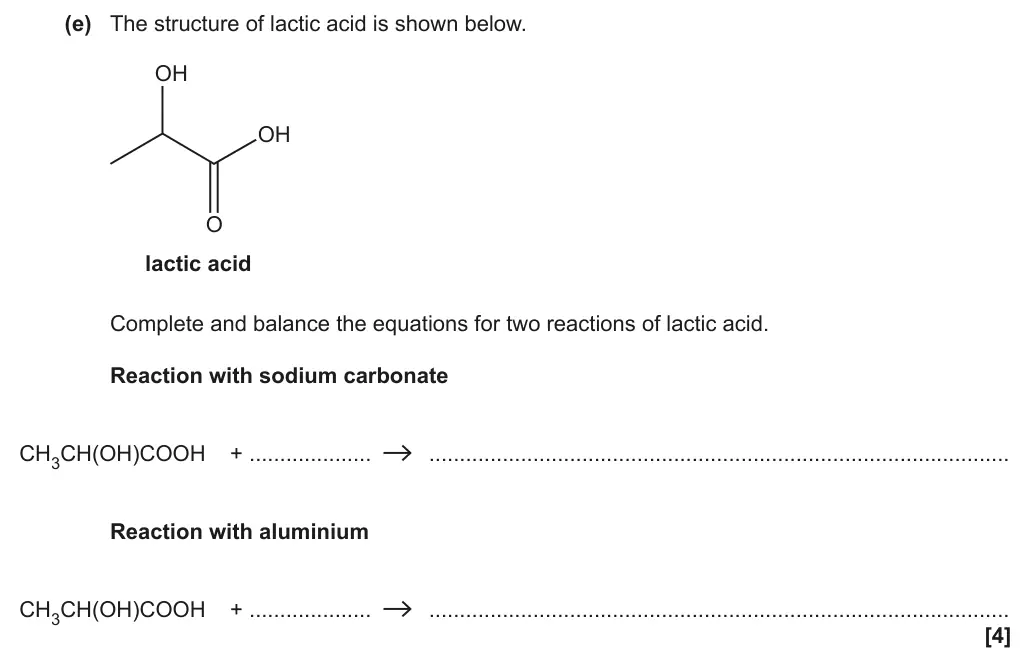
(e) The structure of lactic acid is shown below.
OH
OH
O
lactic acid
Complete and balance the equations for two reactions of lactic acid.
Reaction with sodium carbonate
CH3CH(OH)COOH    + .................... ...............................................................................................
Reaction with aluminium
CH3CH(OH)COOH    + .................... ...............................................................................................
[4]
November 2021 · Paper 3 · Q4(c)(i) 2 marks AO2 Equation writing Medium rate equations
Earlier part of question 4 that this part usesEarlier part of November 2021 Paper 3 question 4
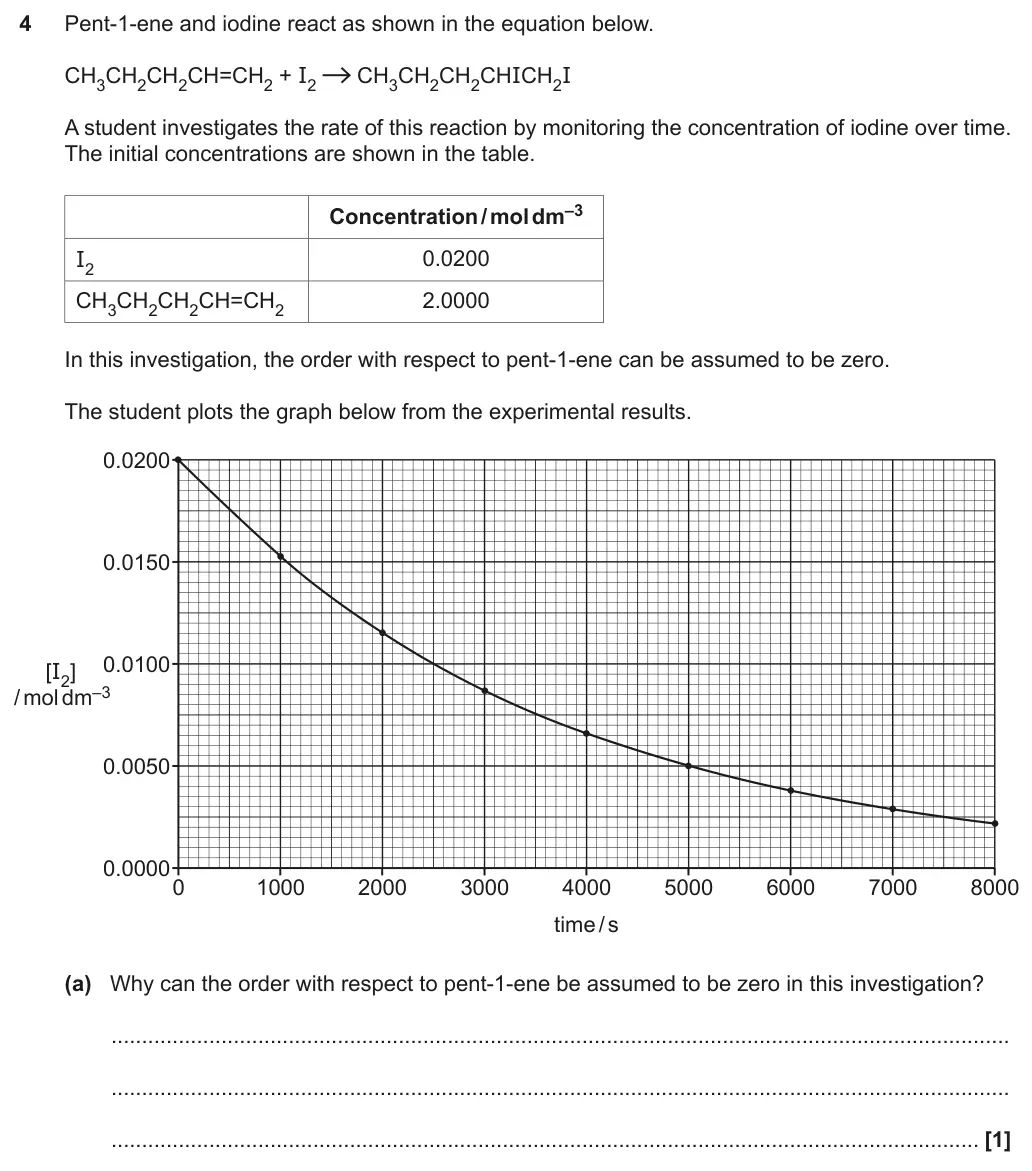
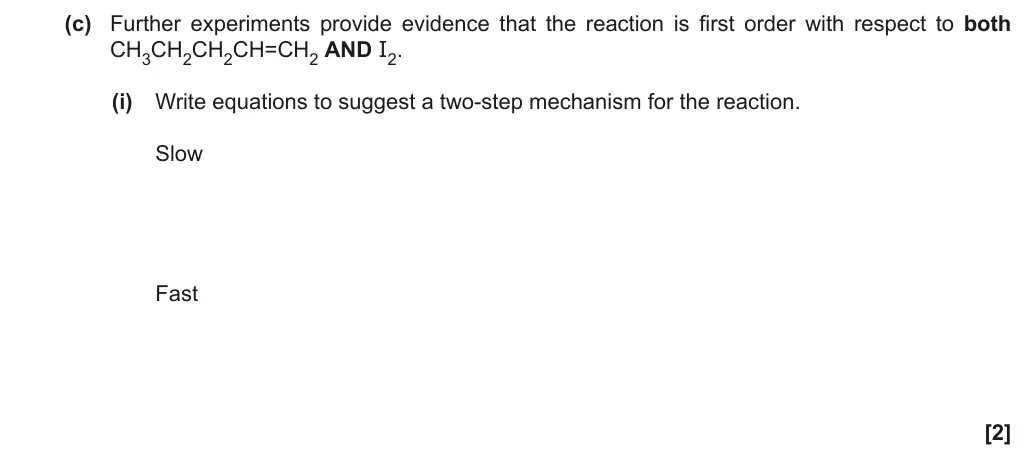
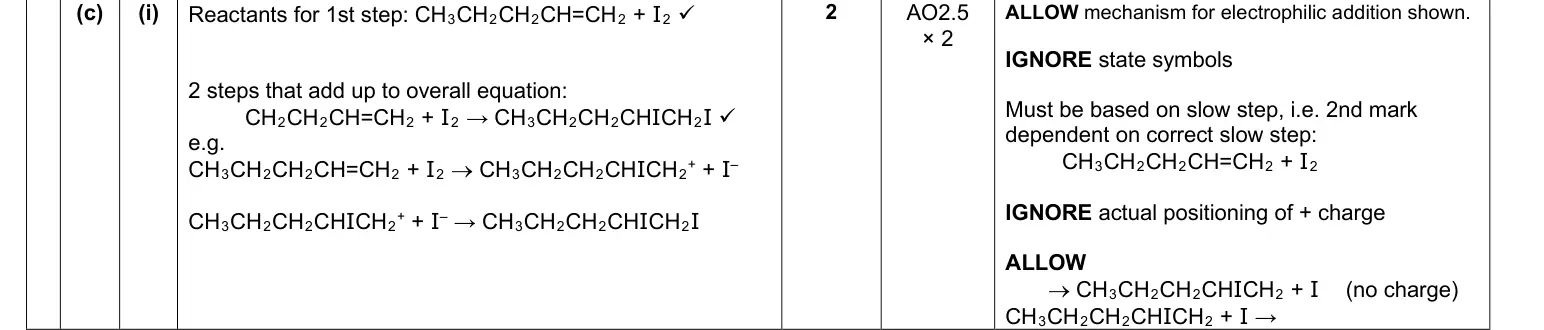
(c) Further experiments provide evidence that the reaction is first order with respect to both
CH3CH2CH2CH=CH2 AND I2.
(i) Write equations to suggest a two-step mechanism for the reaction.
Slow
Fast
[2]
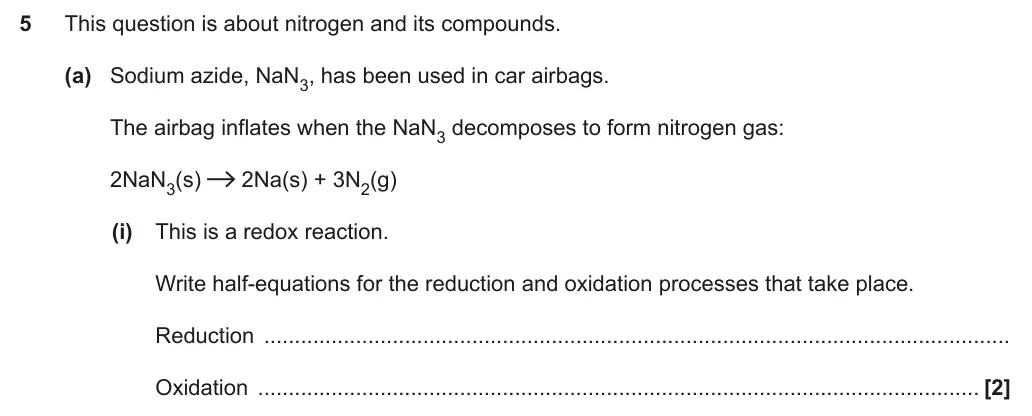
November 2021 · Paper 3 · Q5(a)(i) 2 marks AO1 Equation writing Hard redox and electrode potentialsredox
5 This question is about nitrogen and its compounds.
(a) Sodium azide, NaN3, has been used in car airbags.
The airbag inflates when the NaN3 decomposes to form nitrogen gas:
2NaN3(s) 2Na(s) + 3N2(g)
(i) This is a redox reaction.
Write half-equations for the reduction and oxidation processes that take place.
Reduction  ..........................................................................................................................
Oxidation  ...................................................................................................................... [2]
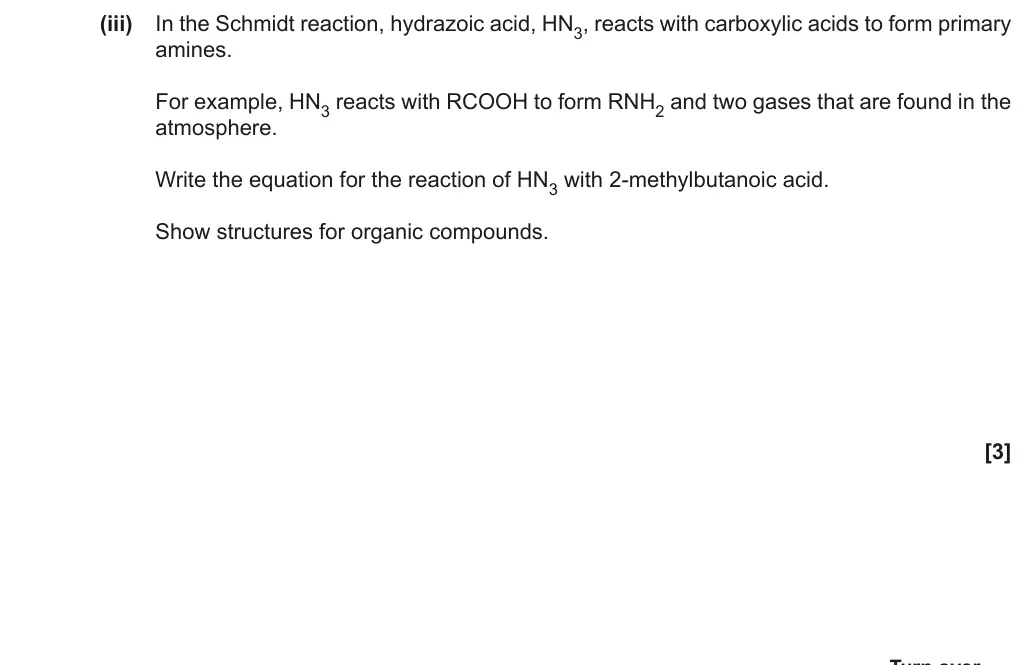
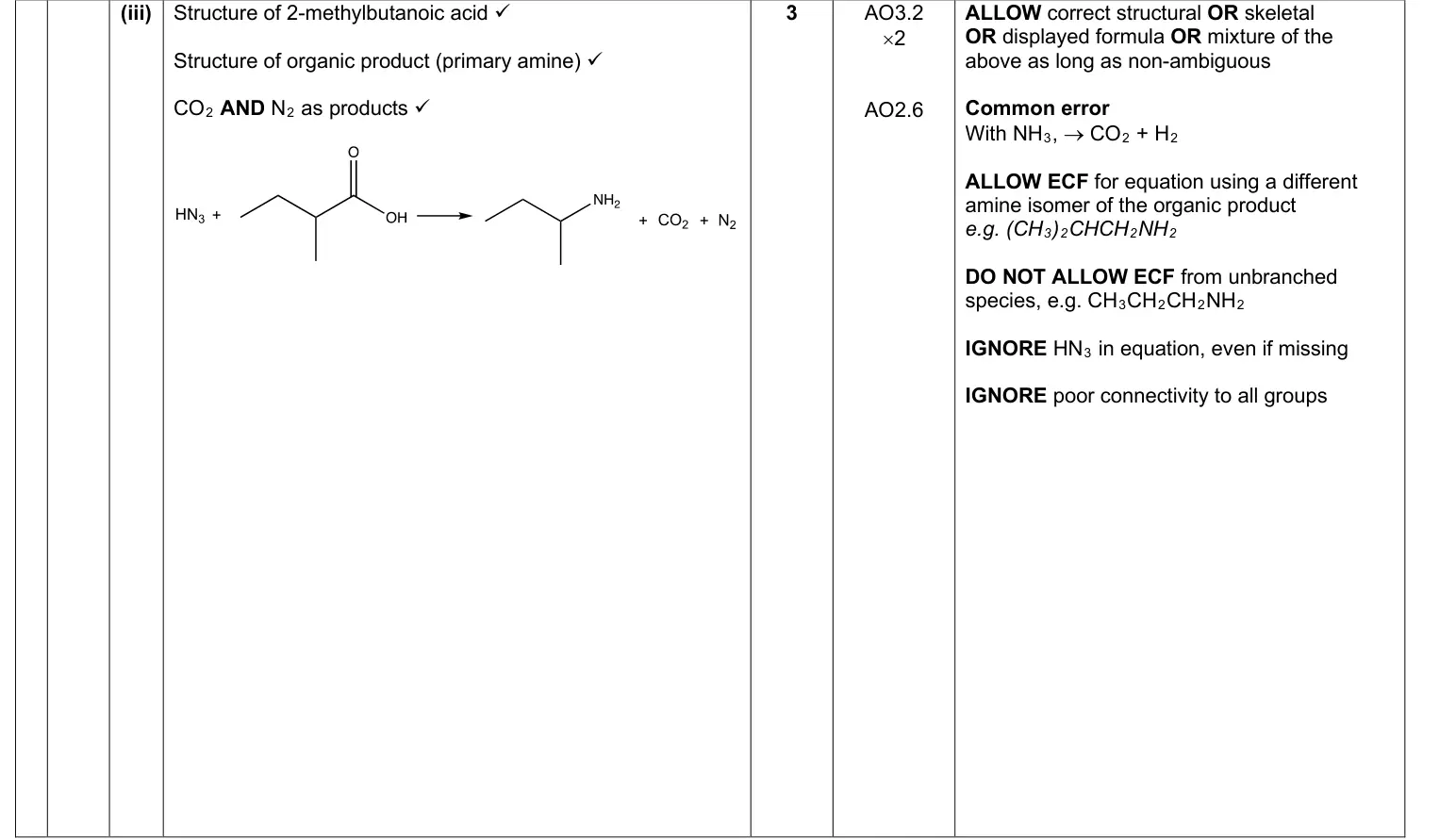
November 2021 · Paper 3 · Q5(b)(iii) 3 marks AO2, 3 Equation writing Medium organic synthesisformulae and equationsorganic basics
Earlier part of question 5 that this part usesEarlier part of November 2021 Paper 3 question 5
(iii) In the Schmidt reaction, hydrazoic acid, HN3, reacts with carboxylic acids to form primary
amines.
For example, HN3 reacts with RCOOH to form RNH2 and two gases that are found in the
atmosphere.
Write the equation for the reaction of HN3 with 2-methylbutanoic acid.
Show structures for organic compounds.
[3]
November 2020 · AS Paper 1 · Q22(a)(ii) 1 mark AO2 Equation writing Medium formulae and equations
Earlier part of question 22 that this part usesEarlier part of November 2020 Paper 1 question 22
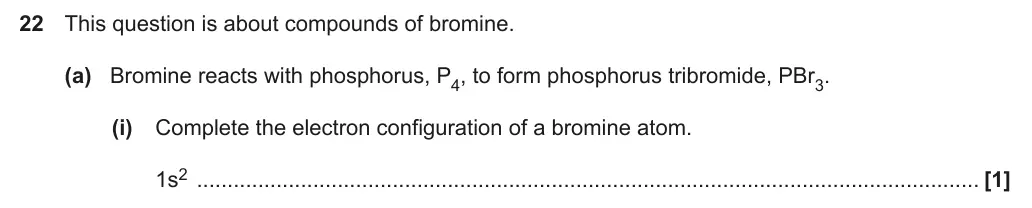
(ii) Write the equation for the reaction of phosphorus with bromine.
...................................................................................................................................... [1]
November 2020 · AS Paper 1 · Q25(c)(iii) 2 marks AO2 Equation writing Medium alkenesformulae and equationsorganic basics
Earlier part of question 25 that this part usesEarlier part of November 2020 Paper 1 question 25
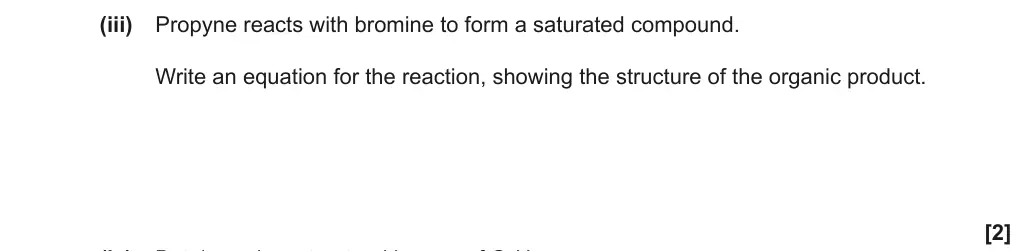
(iii) Propyne reacts with bromine to form a saturated compound.
Write an equation for the reaction, showing the structure of the organic product.
[2]
November 2020 · AS Paper 2 · Q3(c)(i) 1 mark AO2 Equation writing Medium formulae and equations
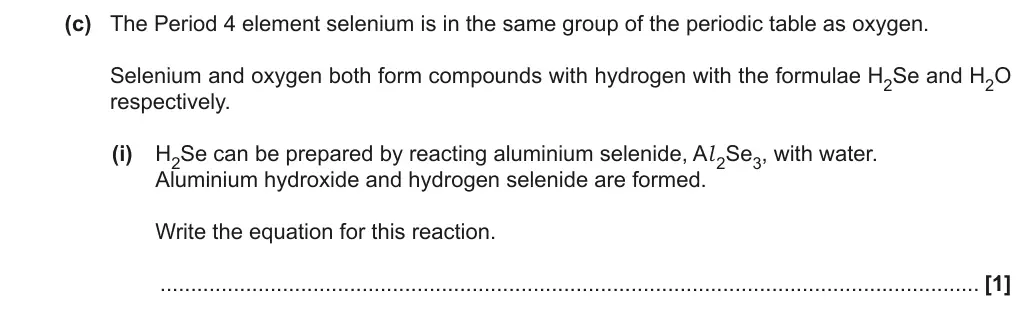
(c) The Period 4 element selenium is in the same group of the periodic table as oxygen.
Selenium and oxygen both form compounds with hydrogen with the formulae H2Se and H2O
respectively.
(i)  H2Se can be prepared by reacting aluminium selenide, Al 2Se3, with water.
Aluminium hydroxide and hydrogen selenide are formed.
Write the equation for this reaction.
...................................................................................................................................... [1]
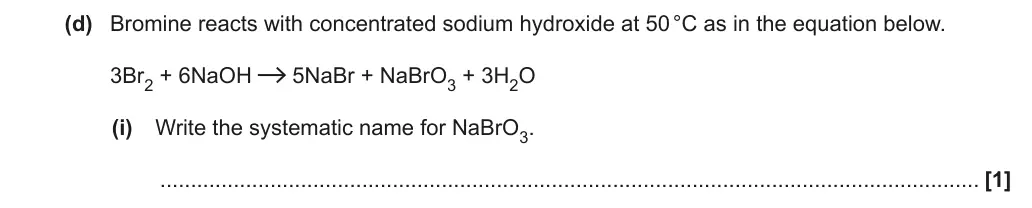
November 2020 · AS Paper 2 · Q3(d)(i) 1 mark AO2 Equation writing Medium redox
(d) Bromine reacts with concentrated sodium hydroxide at 50 °C as in the equation below.
3Br2 + 6NaOH 5NaBr + NaBrO3 + 3H2O
(i) Write the systematic name for NaBrO3.
...................................................................................................................................... [1]
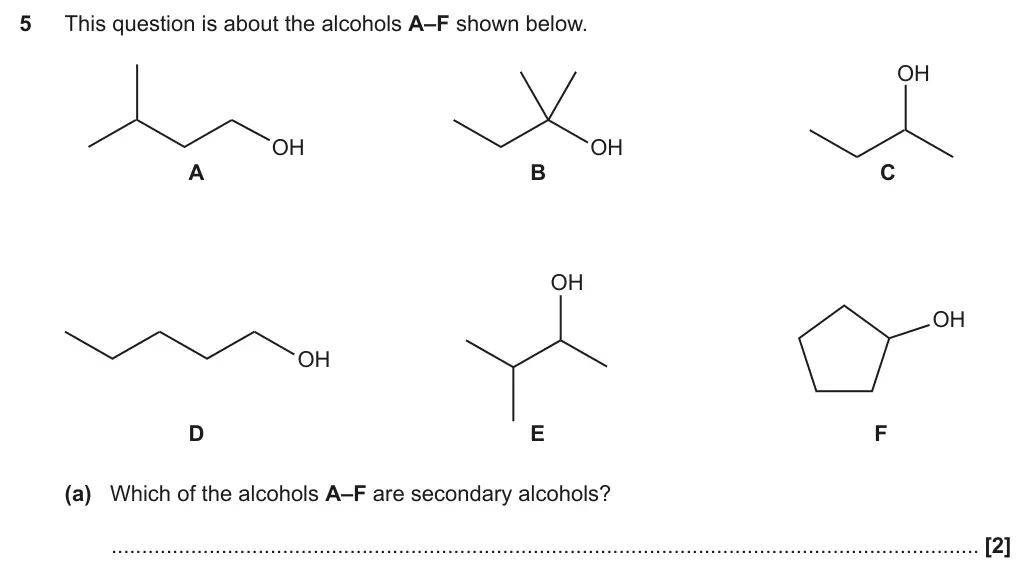
November 2020 · AS Paper 2 · Q5(b) 1 mark AO2 Equation writing Medium alcoholsformulae and equations
Earlier part of question 5 that this part usesEarlier part of November 2020 Paper 2 question 5
(b) Complete a balanced equation for the complete combustion of alcohol C.
CH3CH2CH(OH)CH3 + ........................... ........................... + ........................... [1]
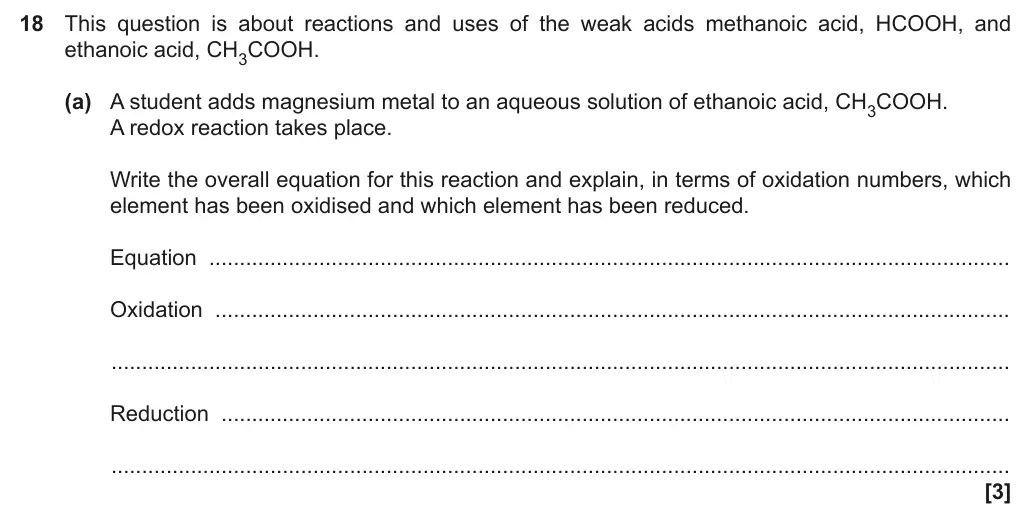
November 2020 · Paper 1 · Q18(a) 3 marks AO1, 2 Equation writing redoxacids bases and buffers
18 This question is about reactions and uses of the weak acids methanoic acid, HCOOH, and
ethanoic acid, CH3COOH.
(a) A student adds magnesium metal to an aqueous solution of ethanoic acid, CH3COOH.
A redox reaction takes place.
Write the overall equation for this reaction and explain, in terms of oxidation numbers, which
element has been oxidised and which element has been reduced.
Equation  ...................................................................................................................................
Oxidation  ..................................................................................................................................
...................................................................................................................................................
Reduction  .................................................................................................................................
...................................................................................................................................................
[3]
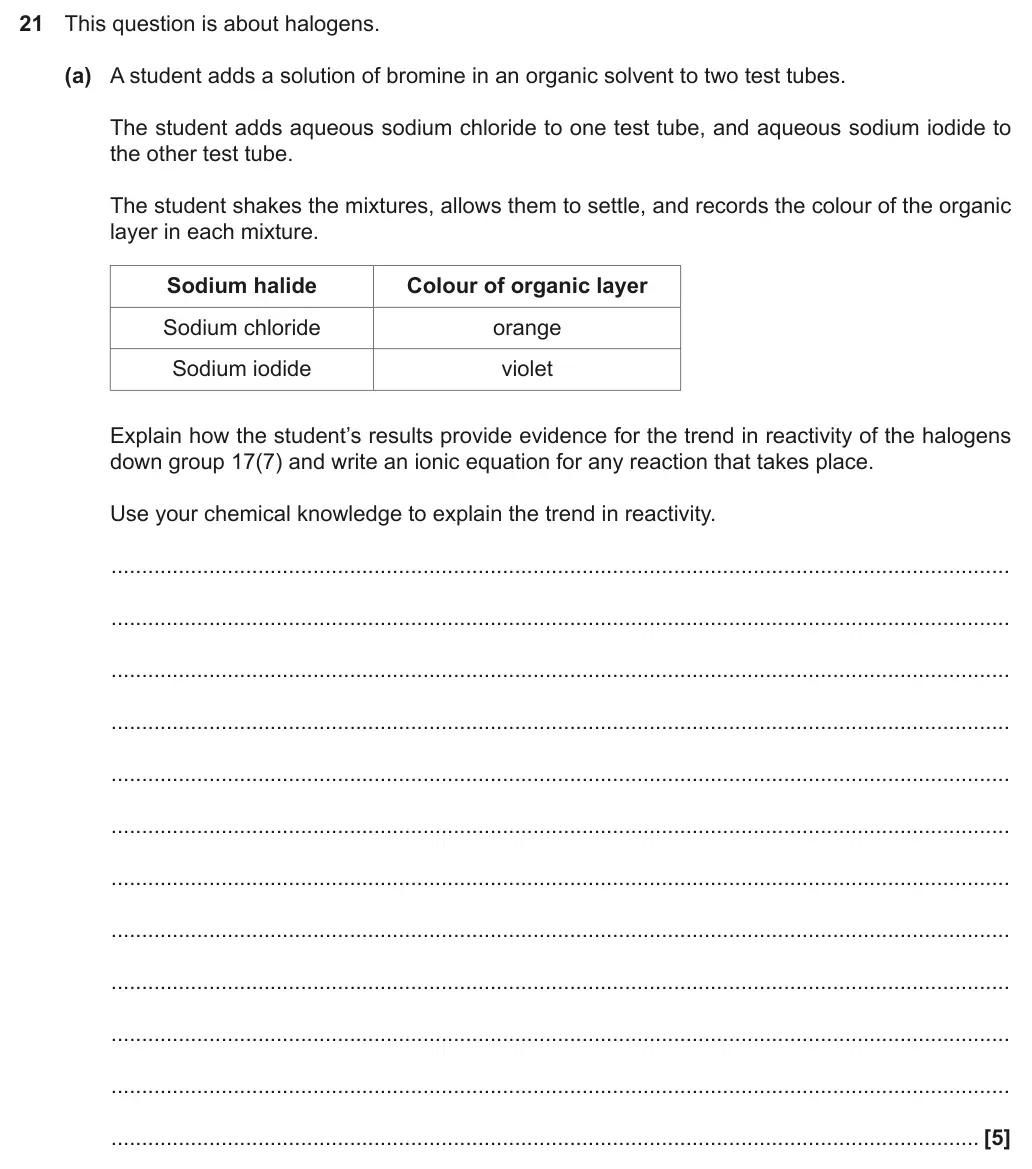
November 2020 · Paper 1 · Q21(a) 5 marks AO1, 2 Equation writing Medium halogensformulae and equations
21 This question is about halogens.
(a) A student adds a solution of bromine in an organic solvent to two test tubes.
The student adds aqueous sodium chloride to one test tube, and aqueous sodium iodide to
the other test tube.
The student shakes the mixtures, allows them to settle, and records the colour of the organic
layer in each mixture.
Sodium halide Colour of organic layer
Sodium chloride orange
Sodium iodide violet
Explain how the student’s results provide evidence for the trend in reactivity of the halogens
down group 17(7) and write an ionic equation for any reaction that takes place.
Use your chemical knowledge to explain the trend in reactivity.
...................................................................................................................................................
...................................................................................................................................................
...................................................................................................................................................
...................................................................................................................................................
...................................................................................................................................................
...................................................................................................................................................
...................................................................................................................................................
...................................................................................................................................................
...................................................................................................................................................
...................................................................................................................................................
...................................................................................................................................................
.............................................................................................................................................. [5]
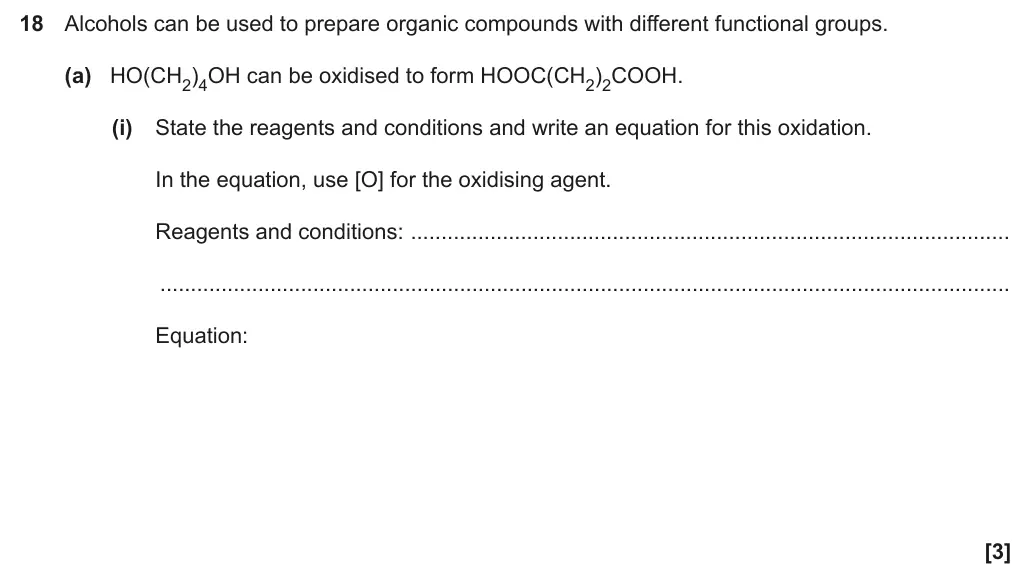
November 2020 · Paper 2 · Q18(a)(i) 3 marks AO1, 2 Equation writing Medium alcoholsformulae and equations
18 Alcohols can be used to prepare organic compounds with different functional groups.
(a) HO(CH2)4OH can be oxidised to form HOOC(CH2)2COOH.
(i) State the reagents and conditions and write an equation for this oxidation.
In the equation, use [O] for the oxidising agent.
Reagents and conditions:  ..................................................................................................
...........................................................................................................................................
Equation:
[3]
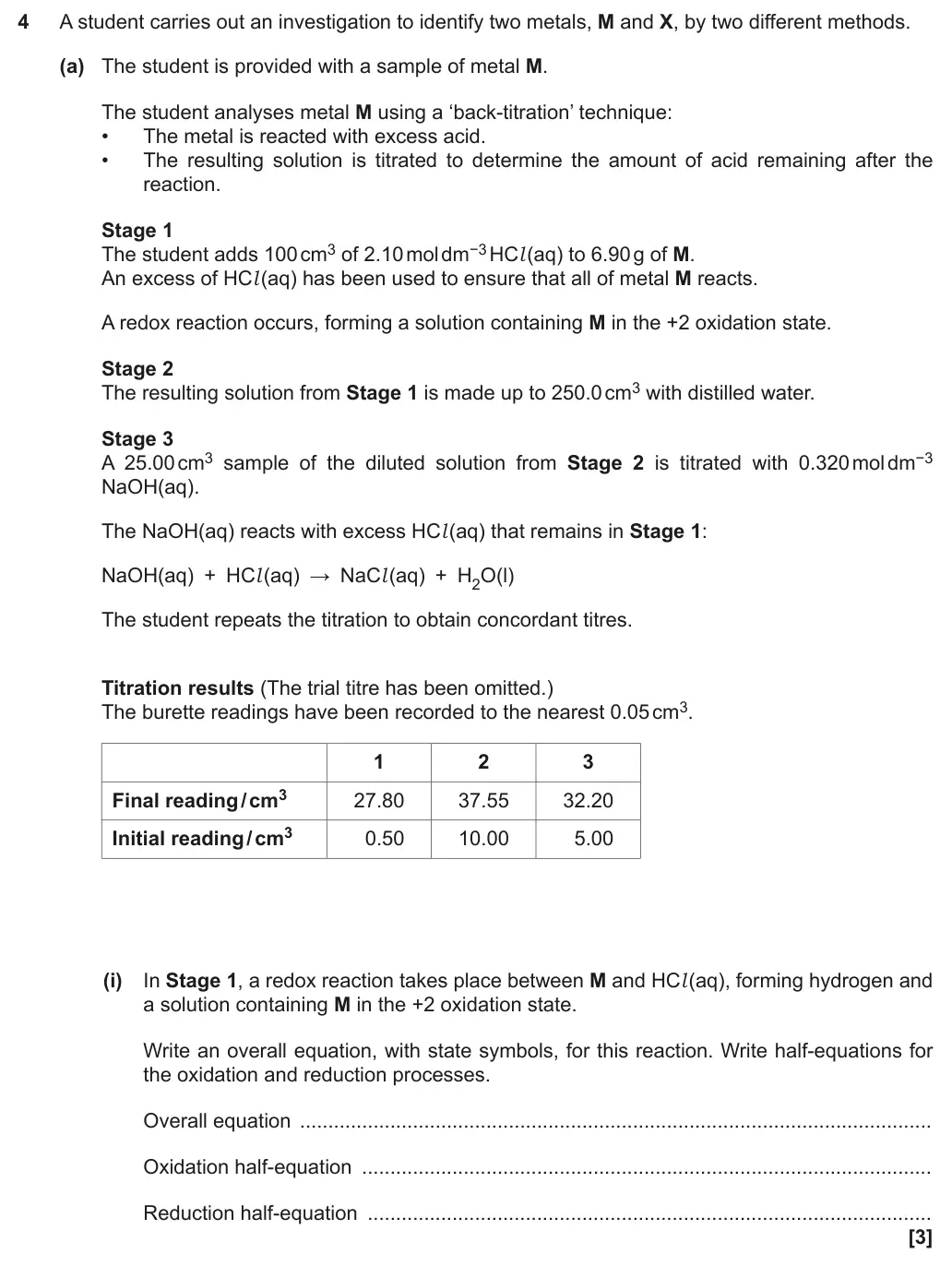
November 2020 · Paper 3 · Q4(a)(i) 3 marks AO2 Equation writing Medium redoxformulae and equationsredox and electrode potentials
4 A student carries out an investigation to identify two metals, M and X, by two different methods.
(a) The student is provided with a sample of metal M.
The student analyses metal M using a ‘back-titration’ technique:
• The metal is reacted with excess acid.
• The resulting solution is titrated to determine the amount of acid remaining after the
reaction.
Stage 1
The student adds 100 cm3 of 2.10 mol dm−3 HCl (aq) to 6.90 g of M.
An excess of HCl (aq) has been used to ensure that all of metal M reacts.
A redox reaction occurs, forming a solution containing M in the +2 oxidation state.
Stage 2
The resulting solution from Stage 1 is made up to 250.0 cm3 with distilled water.
Stage 3
A 25.00 cm3 sample of the diluted solution from Stage 2 is titrated with 0.320 mol dm−3
NaOH(aq).
The NaOH(aq) reacts with excess HCl (aq) that remains in Stage 1:
NaOH(aq) + HCl (aq) → NaCl (aq) + H2O(l)
The student repeats the titration to obtain concordant titres.
Titration results (The trial titre has been omitted.)
The burette readings have been recorded to the nearest 0.05 cm3.
1 2 3
Final reading / cm3 27.80 37.55 32.20
Initial reading / cm3 0.50 10.00 5.00
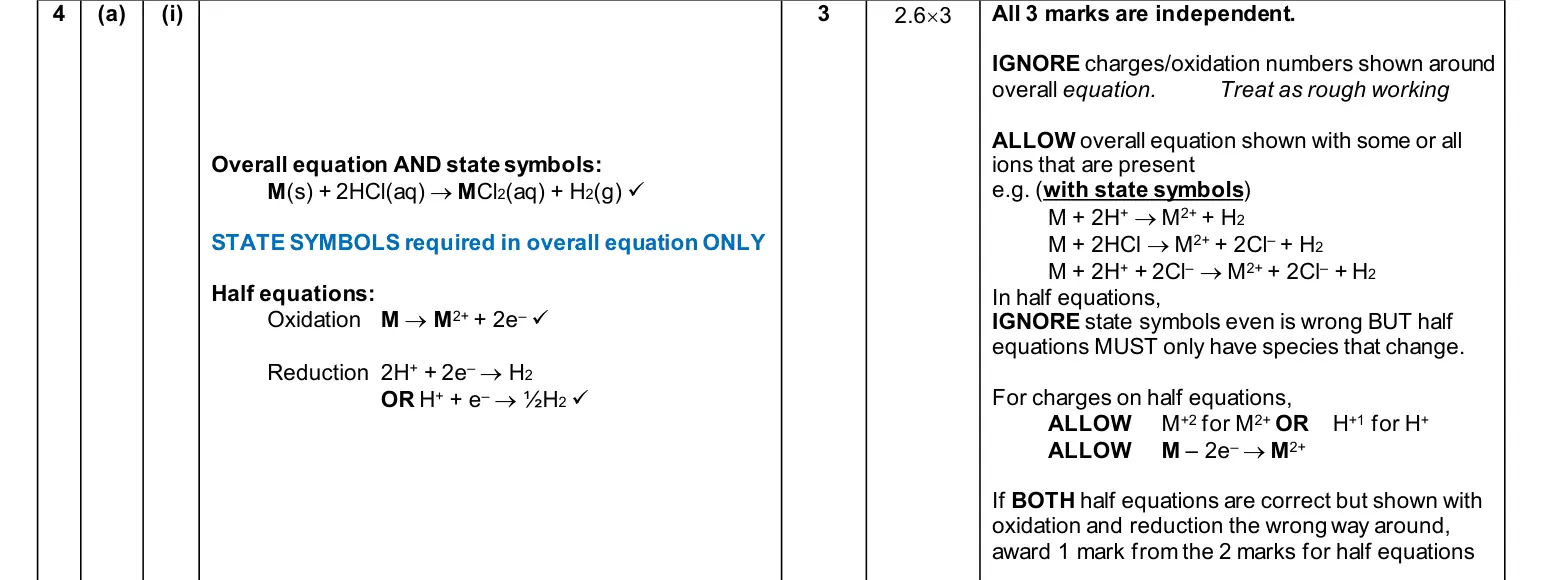
(i) In Stage 1, a redox reaction takes place between M and HCl (aq), forming hydrogen and
a solution containing M in the +2 oxidation state.
Write an overall equation, with state symbols, for this reaction. Write half-equations for
the oxidation and reduction processes.
Overall equation  ................................................................................................................
Oxidation half-equation  .....................................................................................................
Reduction half-equation  ....................................................................................................
[3]
November 2020 · Paper 3 · Q4(a)(iii) 1 mark AO2 Equation writing Medium acids and titrations
Earlier part of question 4 that this part usesEarlier part of November 2020 Paper 3 question 4
(iii) In Stage 3, write the ionic equation for the reaction taking place in the titration.
...................................................................................................................................... [1]
November 2020 · Paper 3 · Q6(b) 4 marks AO2, 3 Equation writing Hard acids bases and buffersacids and titrations
Earlier part of question 6 that this part usesEarlier part of November 2020 Paper 3 question 6
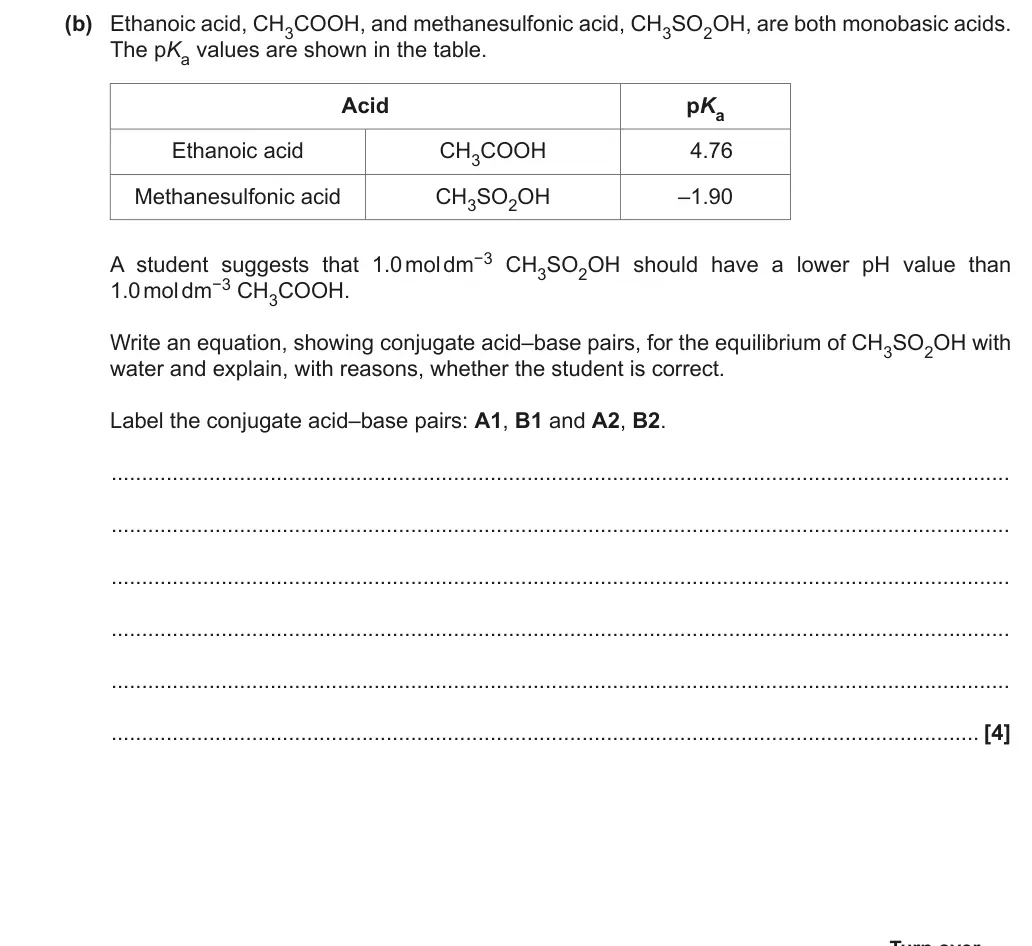
(b) Ethanoic acid, CH3COOH, and methanesulfonic acid, CH3SO2OH, are both monobasic acids.
The pKa values are shown in the table.
Acid pKa
Ethanoic acid CH3COOH 4.76
Methanesulfonic acid CH3SO2OH –1.90
A student suggests that 1.0 mol dm−3 CH3SO2OH should have a lower pH value than
1.0 mol dm−3 CH3COOH.
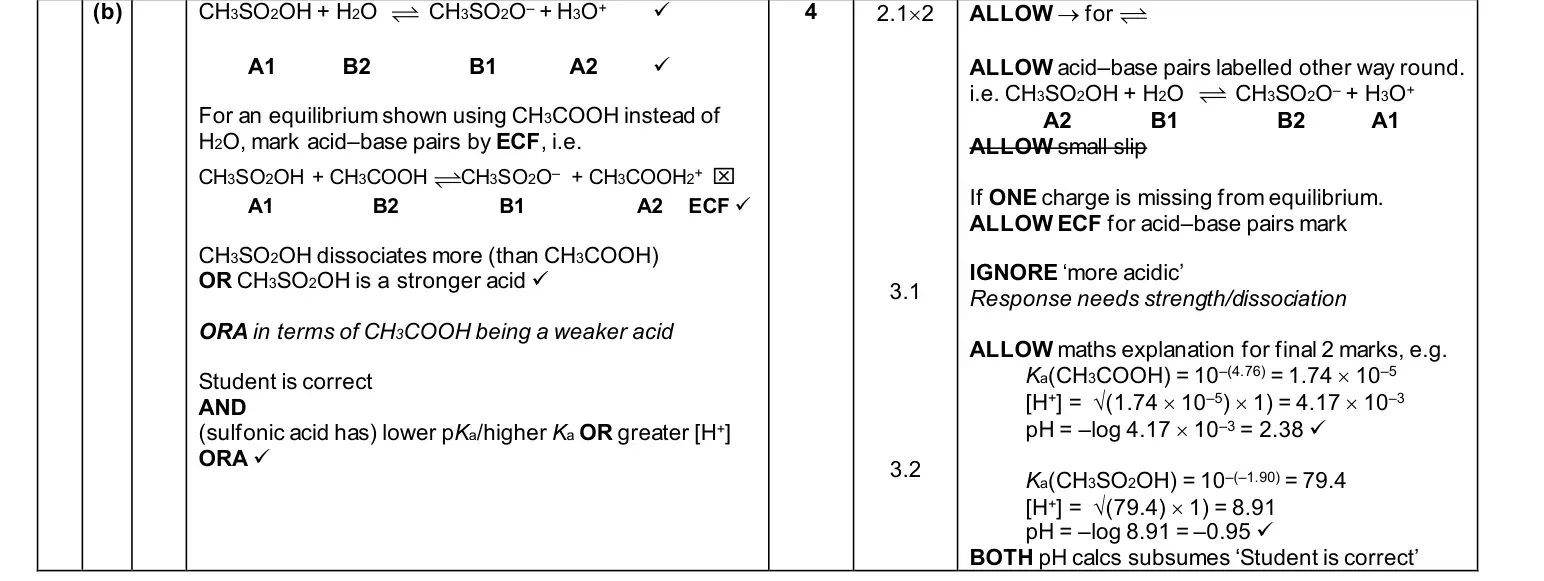
Write an equation, showing conjugate acid–base pairs, for the equilibrium of CH3SO2OH with
water and explain, with reasons, whether the student is correct.
Label the conjugate acid–base pairs: A1, B1 and A2, B2.
...................................................................................................................................................
...................................................................................................................................................
...................................................................................................................................................
...................................................................................................................................................
...................................................................................................................................................
.............................................................................................................................................. [4]
June 2019 · AS Paper 1 · Q21(d)(ii) 2 marks AO2 Equation writing Medium formulae and equations
Earlier part of question 21 that this part usesEarlier part of June 2019 Paper 1 question 21
(ii) Calcium nitride reacts with water to form a solution containing two alkaline compounds.
Write an equation for this reaction.
...................................................................................................................................... [2]
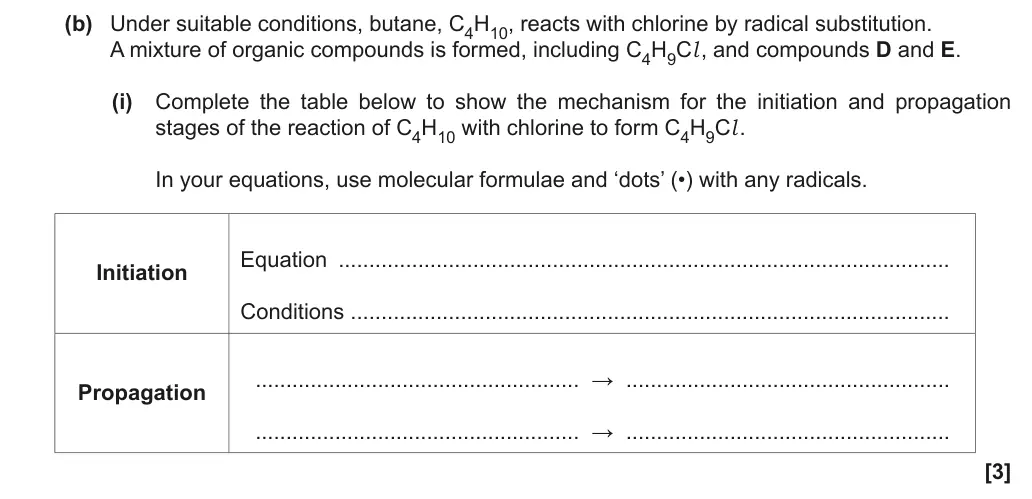
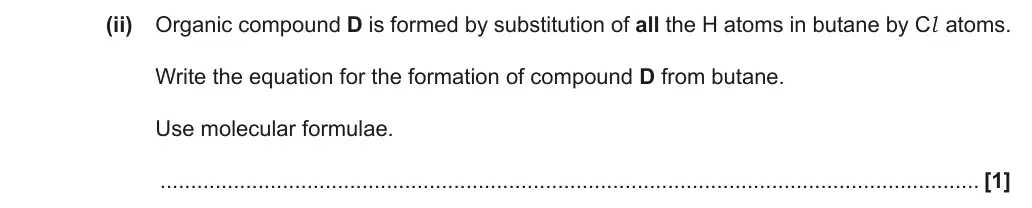
June 2019 · AS Paper 1 · Q25(b)(ii) 1 mark AO2 Equation writing Medium alkanesformulae and equations
Earlier part of question 25 that this part usesEarlier part of June 2019 Paper 1 question 25
(ii) Organic compound D is formed by substitution of all the H atoms in butane by Cl  atoms.
Write the equation for the formation of compound D from butane.
Use molecular formulae.
...................................................................................................................................... [1]
June 2019 · AS Paper 2 · Q1(c)(i) 1 mark AO2 Equation writing Medium group 2
(c) A student adds a small amount of strontium to water.
When the reaction has finished, the student measures the pH of the final solution.
(i) Write the equation for the reaction of strontium with water.
...................................................................................................................................... [1]
June 2019 · Paper 1 · Q16(c)(i) 1 mark AO2 Equation writing Easy group 2
(c) A student adds an excess of calcium oxide to water in a test tube.
In a separate test tube, the student adds an excess of strontium oxide to water.
(i) Write the equation for the reaction of calcium oxide with water.
State symbols are not required.
...................................................................................................................................... [1]
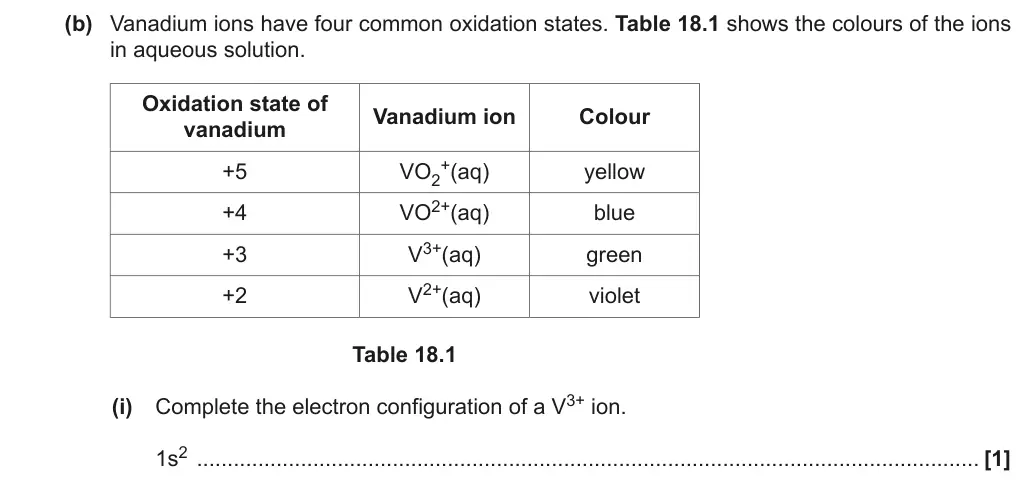
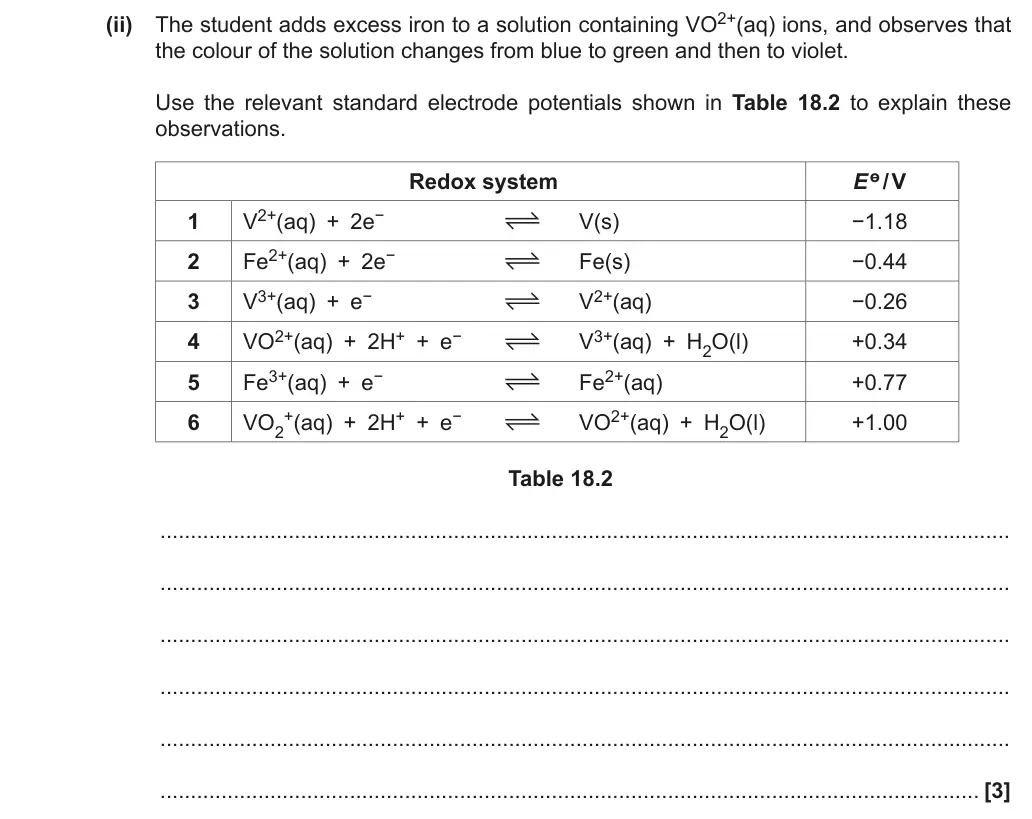
June 2019 · Paper 1 · Q18(b)(iii) 1 mark AO2 Equation writing Medium redox and electrode potentials
Earlier parts of question 18 that this part usesEarlier part of June 2019 Paper 1 question 18Earlier part of June 2019 Paper 1 question 18
(iii) Construct an equation for the first colour change from blue to green.
...................................................................................................................................... [1]
June 2019 · Paper 3 · Q2(a) 1 mark AO1 Equation writing Medium formulae and equationsacids bases and buffers
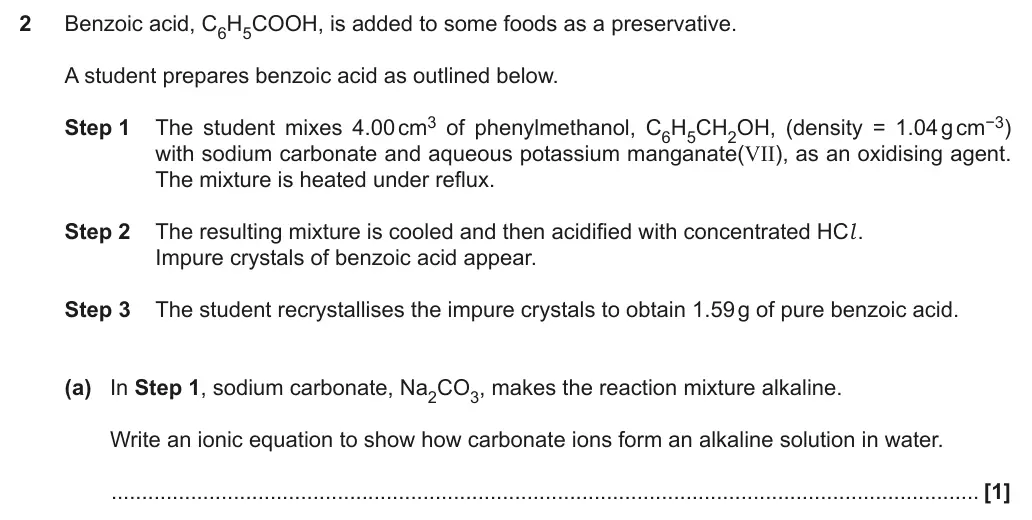
2 Benzoic acid, C6H5COOH, is added to some foods as a preservative.
A student prepares benzoic acid as outlined below.
Step 1 The student mixes 4.00 cm3 of phenylmethanol, C6H5CH2OH, (density = 1.04 g cm−3)
with sodium carbonate and aqueous potassium manganate(VII), as an oxidising agent.
The mixture is heated under reflux.
Step 2 The resulting mixture is cooled and then acidified with concentrated HCl .
Impure crystals of benzoic acid appear.
Step 3 The student recrystallises the impure crystals to obtain 1.59 g of pure benzoic acid.
(a) In Step 1, sodium carbonate, Na2CO3, makes the reaction mixture alkaline.
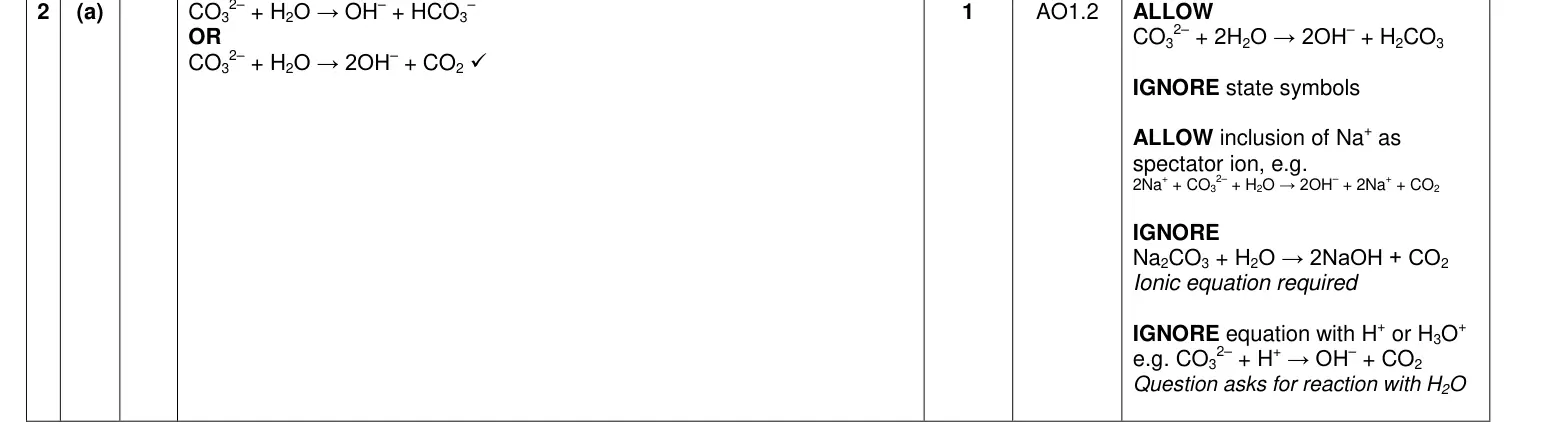
Write an ionic equation to show how carbonate ions form an alkaline solution in water.
.............................................................................................................................................. [1]
June 2019 · Paper 3 · Q2(c) 1 mark AO2 Equation writing Hard alcohols
Earlier part of question 2 that this part usesEarlier part of June 2019 Paper 3 question 2
(c) Write the overall equation for the preparation of benzoic acid from phenylmethanol.
Use [O] for the oxidising agent.
.............................................................................................................................................. [1]
June 2019 · Paper 3 · Q3(a)(i) 1 mark AO2 Equation writing Hard formulae and equations
3 This question is about elements and compounds in Group 14 (Group 4) of the periodic table.
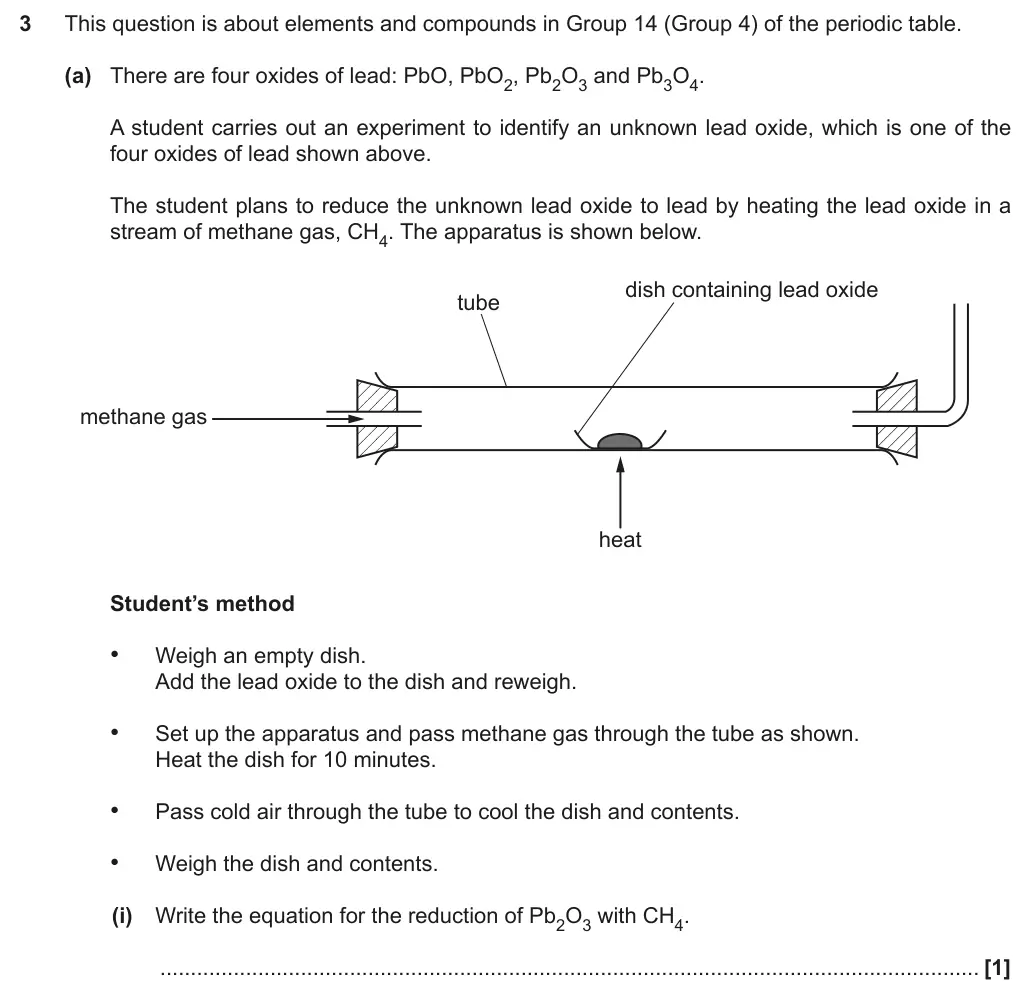
(a) There are four oxides of lead: PbO, PbO2, Pb2O3 and Pb3O4.
A student carries out an experiment to identify an unknown lead oxide, which is one of the
four oxides of lead shown above.
The student plans to reduce the unknown lead oxide to lead by heating the lead oxide in a
stream of methane gas, CH4. The apparatus is shown below.
dish containing lead oxide
tube
methane gas
heat
Student’s method
• Weigh an empty dish.
Add the lead oxide to the dish and reweigh.
• Set up the apparatus and pass methane gas through the tube as shown.
Heat the dish for 10 minutes.
• Pass cold air through the tube to cool the dish and contents.
• Weigh the dish and contents.
(i) Write the equation for the reduction of Pb2O3 with CH4.
...................................................................................................................................... [1]
June 2019 · Paper 3 · Q6(a)(iii) 1 mark AO3 Equation writing Hard transition elementsredox and electrode potentials
Earlier part of question 6 that this part usesEarlier part of June 2019 Paper 3 question 6
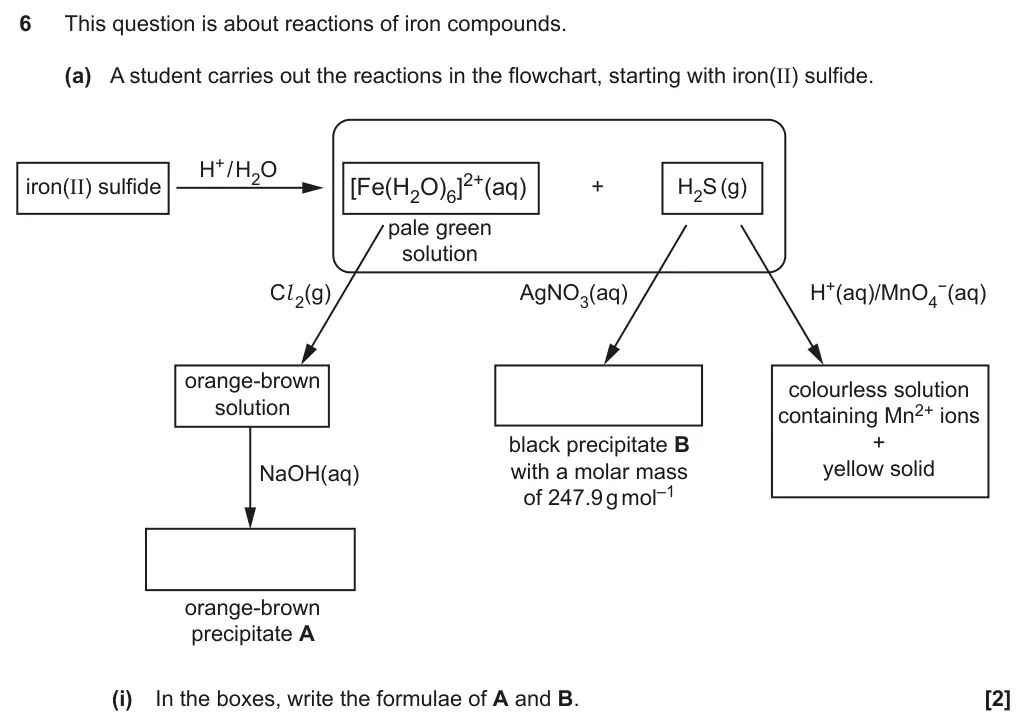
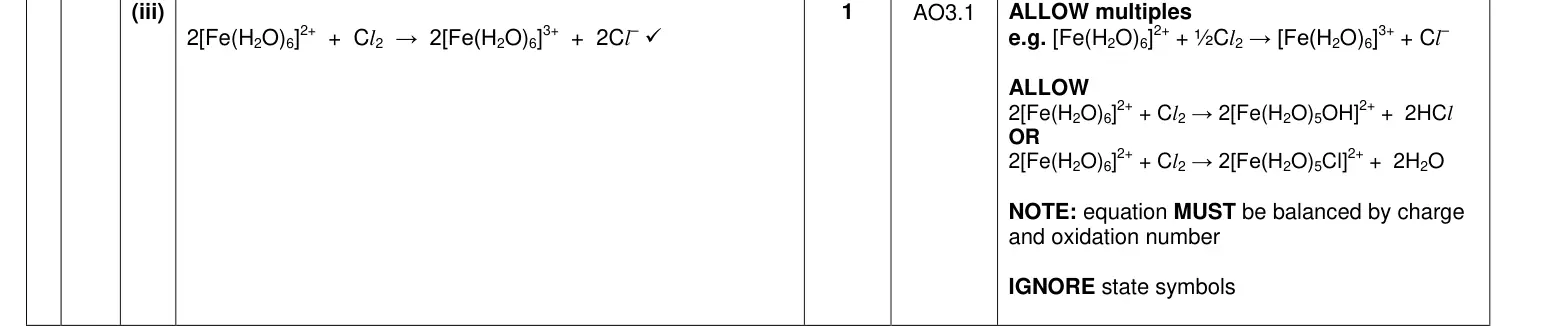
(iii) Write the equation for the reaction of [Fe(H2O)6]2+(aq) with Cl 2(g).
...................................................................................................................................... [1]
June 2019 · Paper 3 · Q6(a)(iv) 2 marks AO3 Equation writing Hard redox and electrode potentialstransition elements
Earlier part of question 6 that this part usesEarlier part of June 2019 Paper 3 question 6
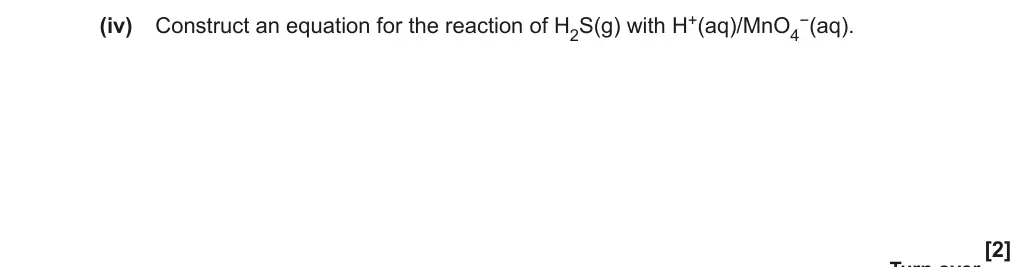
(iv) Construct an equation for the reaction of H2S(g) with H+(aq)/MnO4 −(aq).
[2]
June 2018 · AS Paper 1 · Q22(a)(iv) 2 marks Equation writing Medium acids and titrationsformulae and equations
Earlier part of question 22 that this part usesEarlier part of June 2018 Paper 1 question 22
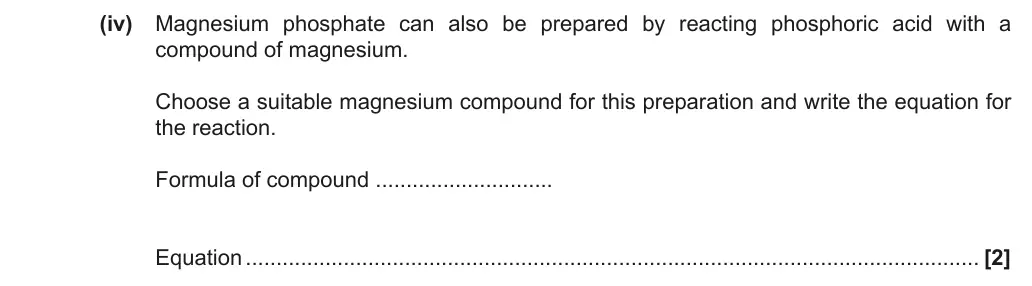
(iv) Magnesium phosphate can also be prepared by reacting phosphoric acid with a
compound of magnesium.
Choose a suitable magnesium compound for this preparation and write the equation for
the reaction.
Formula of compound .............................
Equation ........................................................................................................................ [2]
June 2018 · AS Paper 1 · Q22(b)(ii) 1 mark Equation writing Easy formulae and equations
Earlier part of question 22 that this part usesEarlier part of June 2018 Paper 1 question 22
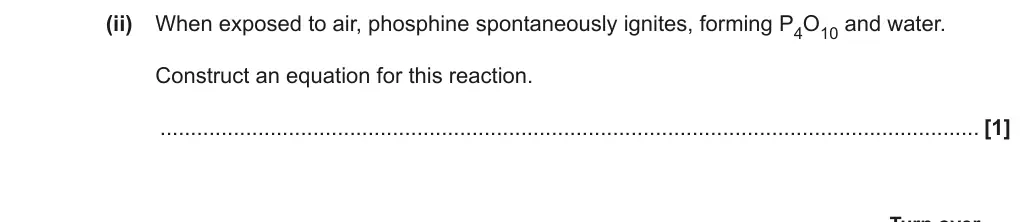
(ii) When exposed to air, phosphine spontaneously ignites, forming P4O10 and water.
Construct an equation for this reaction.
...................................................................................................................................... [1]
June 2018 · AS Paper 1 · Q23(a)(ii) 2 marks Equation writing Hard halogensformulae and equationsqualitative analysis
Earlier part of question 23 that this part usesEarlier part of June 2018 Paper 1 question 23
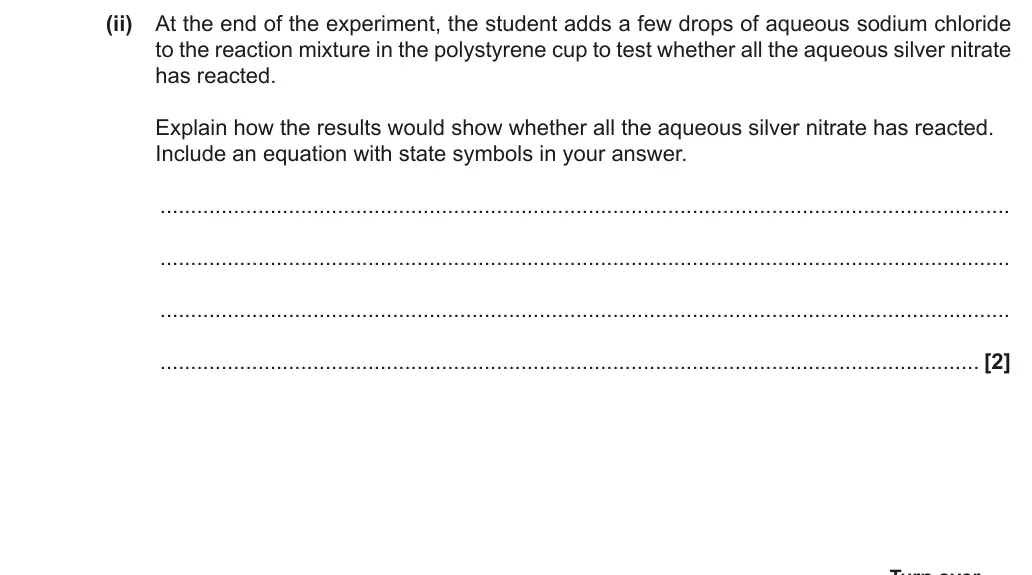
(ii) At the end of the experiment, the student adds a few drops of aqueous sodium chloride
to the reaction mixture in the polystyrene cup to test whether all the aqueous silver nitrate
has reacted.
Explain how the results would show whether all the aqueous silver nitrate has reacted.
Include an equation with state symbols in your answer.
...........................................................................................................................................
...........................................................................................................................................
...........................................................................................................................................
...................................................................................................................................... [2]
June 2018 · AS Paper 1 · Q24(b)(iii) 2 marks Equation writing Hard alkanesformulae and equations
Earlier part of question 24 that this part usesEarlier part of June 2018 Paper 1 question 24
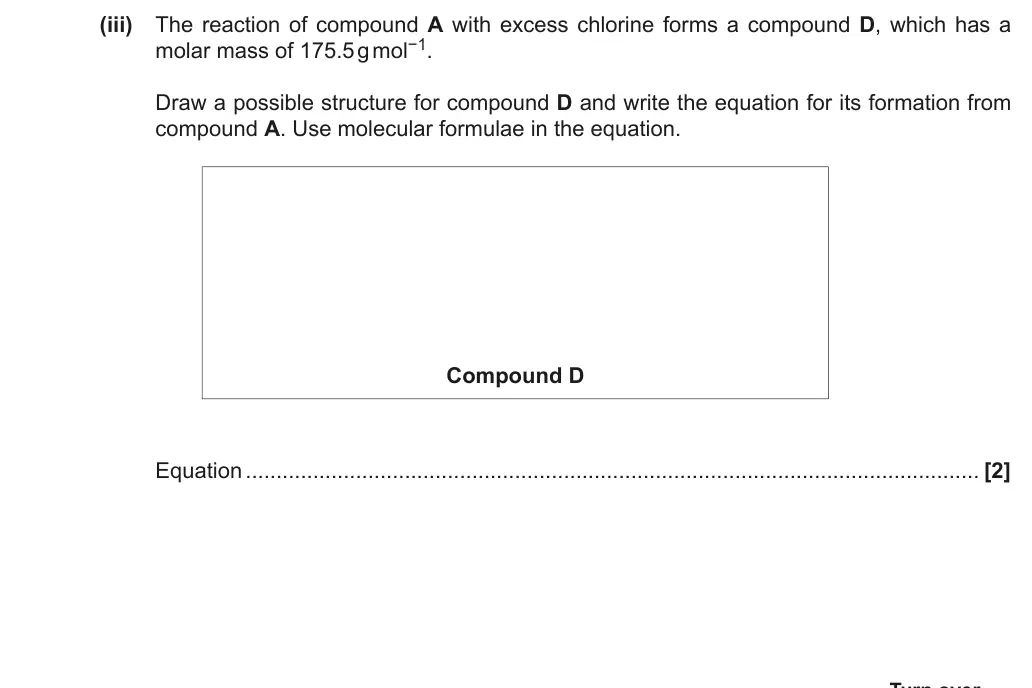
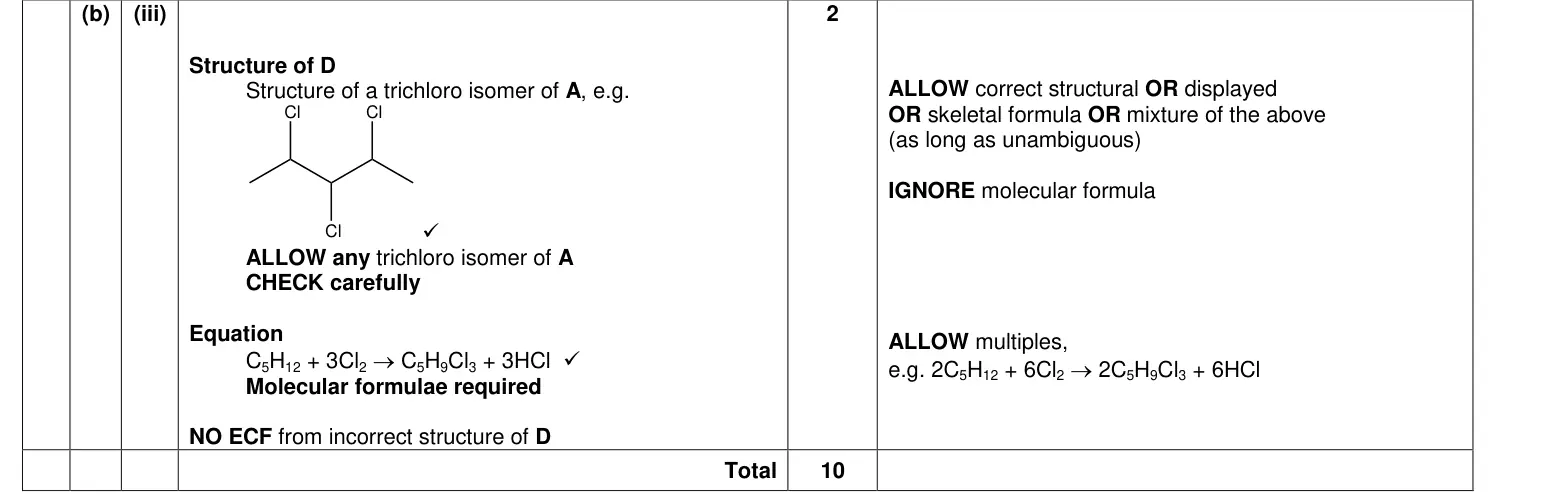
(iii) The reaction of compound A with excess chlorine forms a compound D, which has a
molar mass of 175.5 g mol−1.
Draw a possible structure for compound D and write the equation for its formation from
compound A. Use molecular formulae in the equation.
Compound D
Equation ........................................................................................................................ [2]
June 2018 · AS Paper 2 · Q2(c)(ii) 2 marks Equation writing Medium formulae and equationsatomic structure and isotopesperiodicity
Earlier part of question 2 that this part usesEarlier part of June 2018 Paper 2 question 2
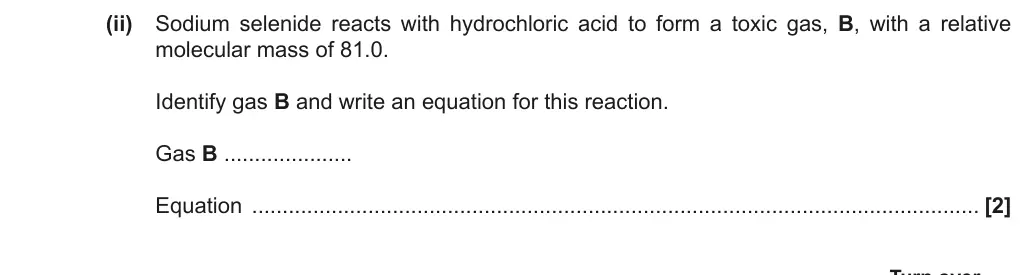
(ii) Sodium selenide reacts with hydrochloric acid to form a toxic gas, B, with a relative
molecular mass of 81.0.
Identify gas B and write an equation for this reaction.
Gas B .....................
Equation  ....................................................................................................................... [2]
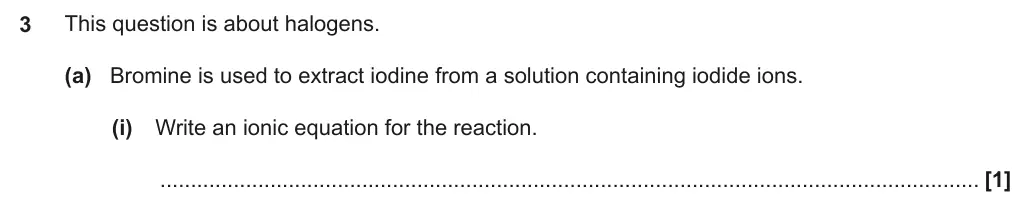
June 2018 · AS Paper 2 · Q3(a)(i) 1 mark Equation writing Medium halogensformulae and equations
3 This question is about halogens.
(a) Bromine is used to extract iodine from a solution containing iodide ions.
(i) Write an ionic equation for the reaction.
...................................................................................................................................... [1]
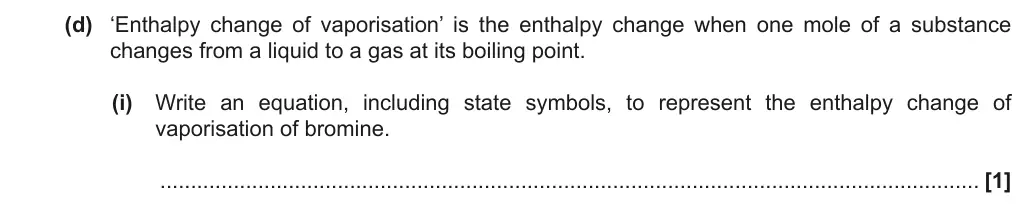
June 2018 · AS Paper 2 · Q3(d)(i) 1 mark Equation writing Easy formulae and equationshalogens
(d) ‘Enthalpy change of vaporisation’ is the enthalpy change when one mole of a substance
changes from a liquid to a gas at its boiling point.
(i) Write an equation, including state symbols, to represent the enthalpy change of
vaporisation of bromine.
...................................................................................................................................... [1]
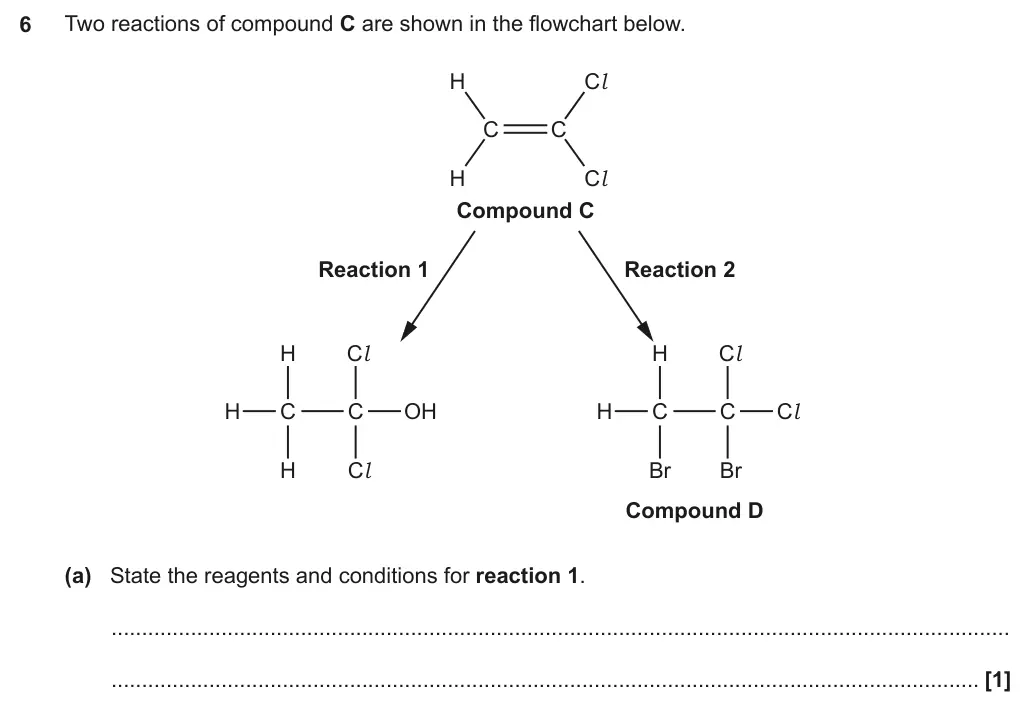
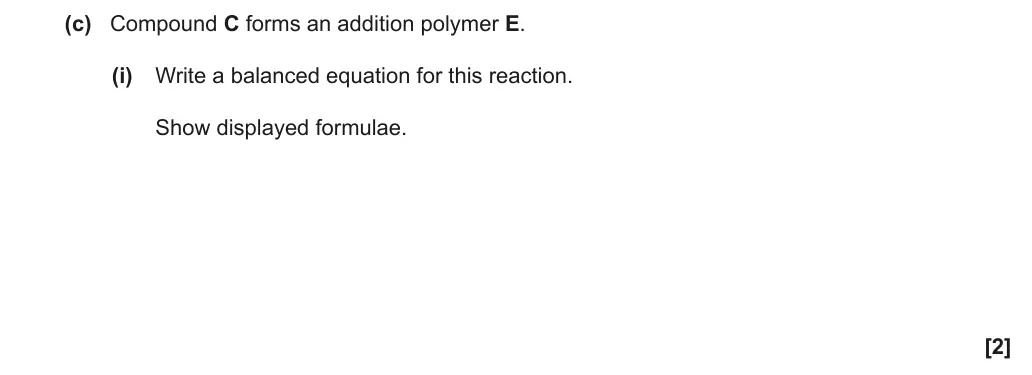
June 2018 · AS Paper 2 · Q6(c)(i) 2 marks Equation writing Easy alkenesorganic basics
Earlier part of question 6 that this part usesEarlier part of June 2018 Paper 2 question 6
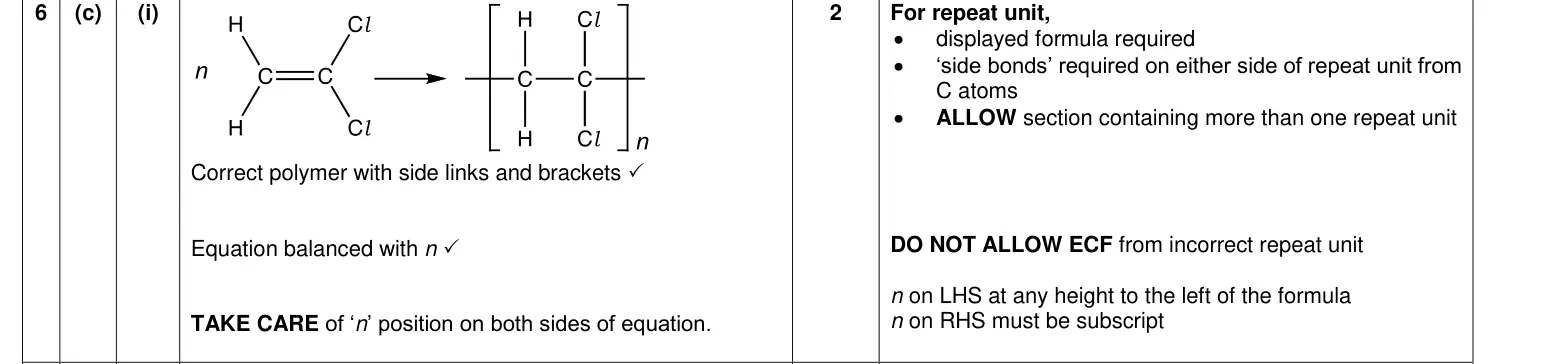
(c) Compound C forms an addition polymer E.
(i) Write a balanced equation for this reaction.
Show displayed formulae.
[2]
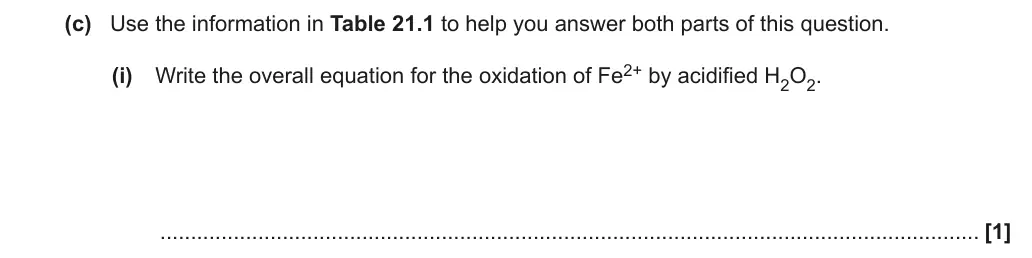
June 2018 · Paper 1 · Q21(c)(i) 1 mark Equation writing Medium redox and electrode potentialstransition elements
Earlier part of question 21 that this part usesEarlier part of June 2018 Paper 1 question 21
(c) Use the information in Table 21.1 to help you answer both parts of this question.
(i) Write the overall equation for the oxidation of Fe2+ by acidified H2O2.
...................................................................................................................................... [1]
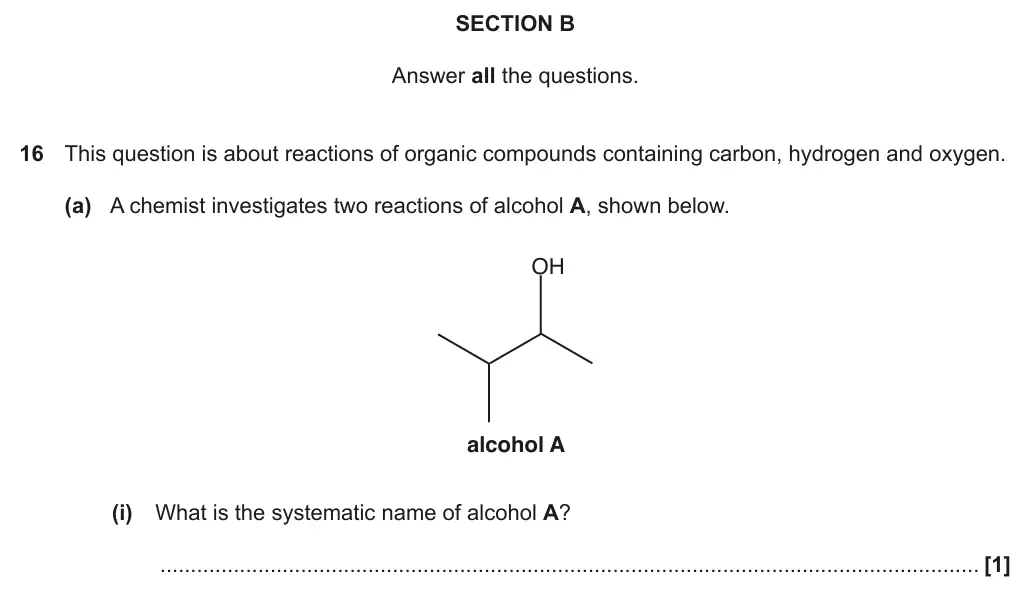
June 2018 · Paper 2 · Q16(a)(iv) 2 marks Equation writing Hard alcoholsformulae and equations
Earlier part of question 16 that this part usesEarlier part of June 2018 Paper 2 question 16
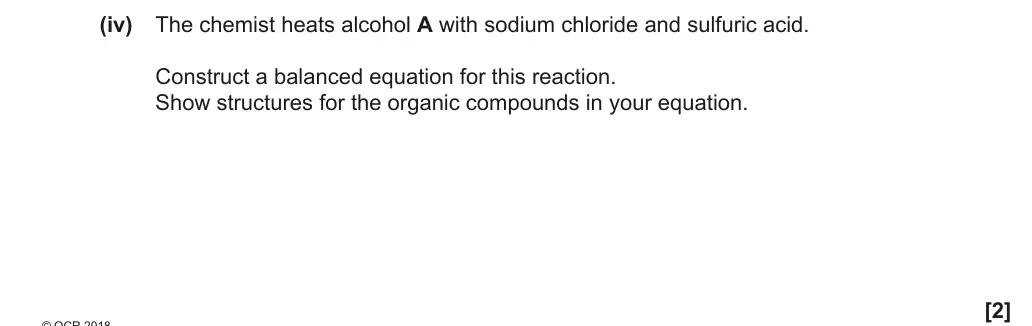
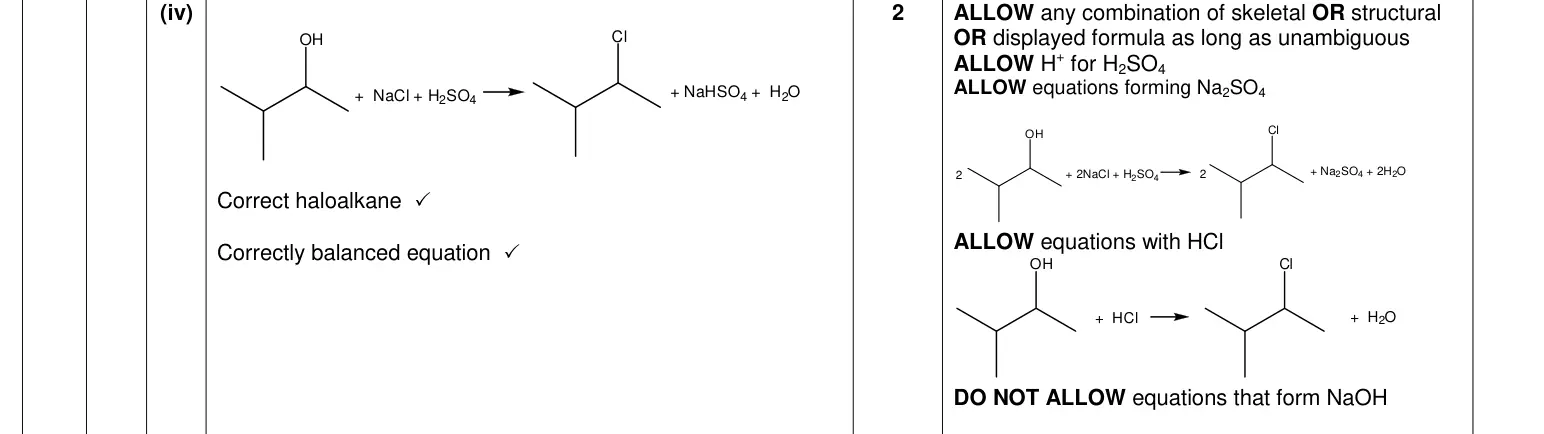
(iv) The chemist heats alcohol A with sodium chloride and sulfuric acid.
Construct a balanced equation for this reaction.
Show structures for the organic compounds in your equation.
[2]
June 2018 · Paper 2 · Q22(a) 1 mark Equation writing Medium alkanesformulae and equations
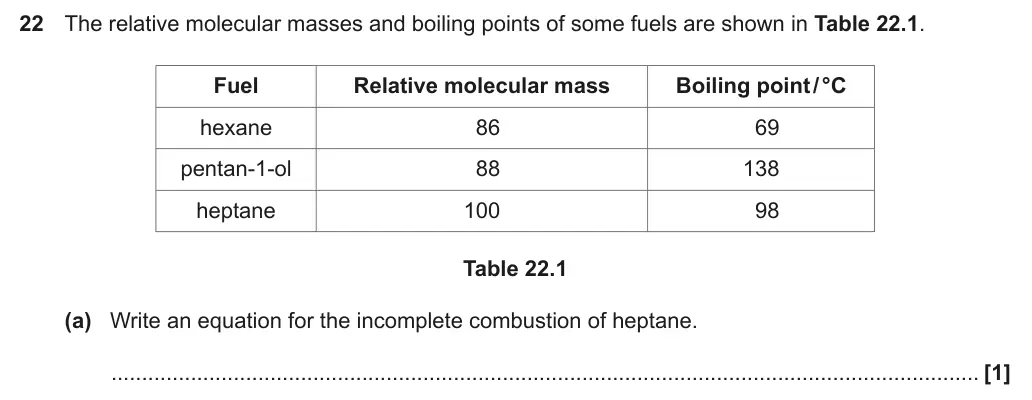
22 The relative molecular masses and boiling points of some fuels are shown in Table 22.1.
Fuel Relative molecular mass Boiling point / °C
hexane 86 69
pentan-1-ol 88 138
heptane 100 98
Table 22.1
(a) Write an equation for the incomplete combustion of heptane.
.............................................................................................................................................. [1]
June 2018 · Paper 2 · Q22(c)(ii) 2 marks Equation writing Hard formulae and equationsorganic synthesis
Earlier part of question 22 that this part usesEarlier part of June 2018 Paper 2 question 22
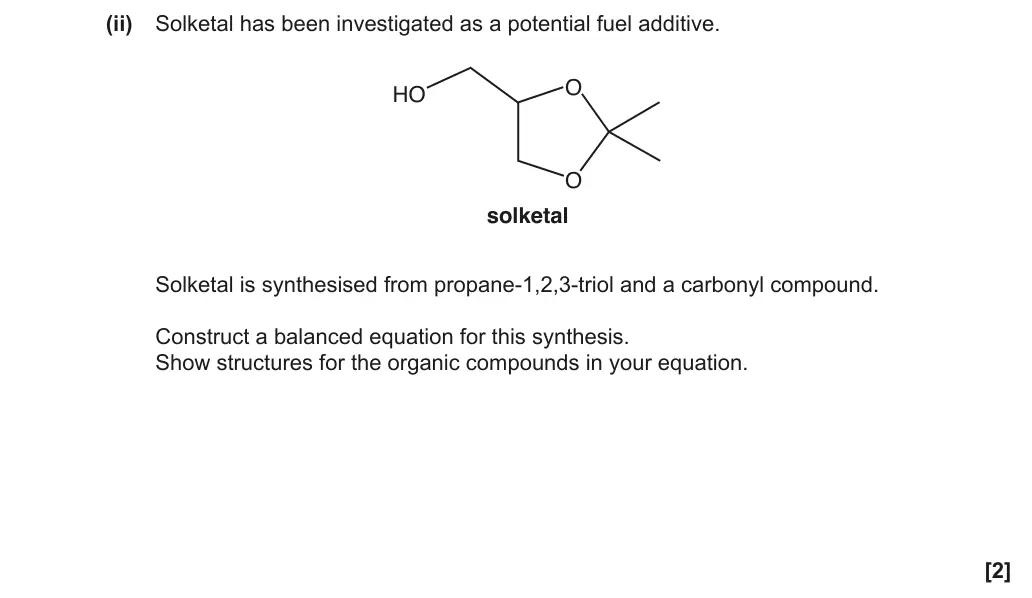
(ii) Solketal has been investigated as a potential fuel additive.
HO O
O
solketal
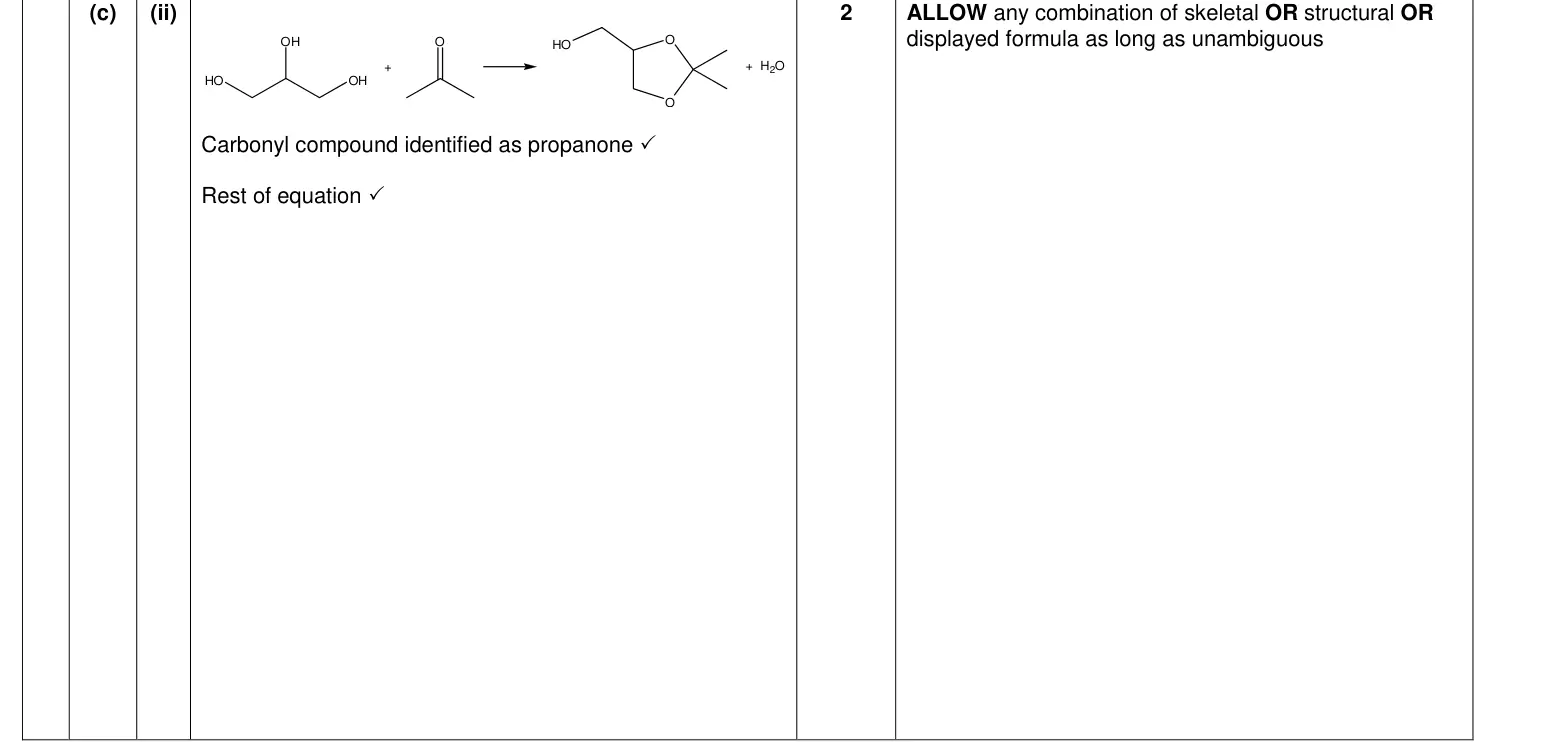
Solketal is synthesised from propane-1,2,3-triol and a carbonyl compound.
Construct a balanced equation for this synthesis.
Show structures for the organic compounds in your equation.
[2]
June 2018 · Paper 3 · Q2(b) 2 marks Equation writing Hard redox and electrode potentials
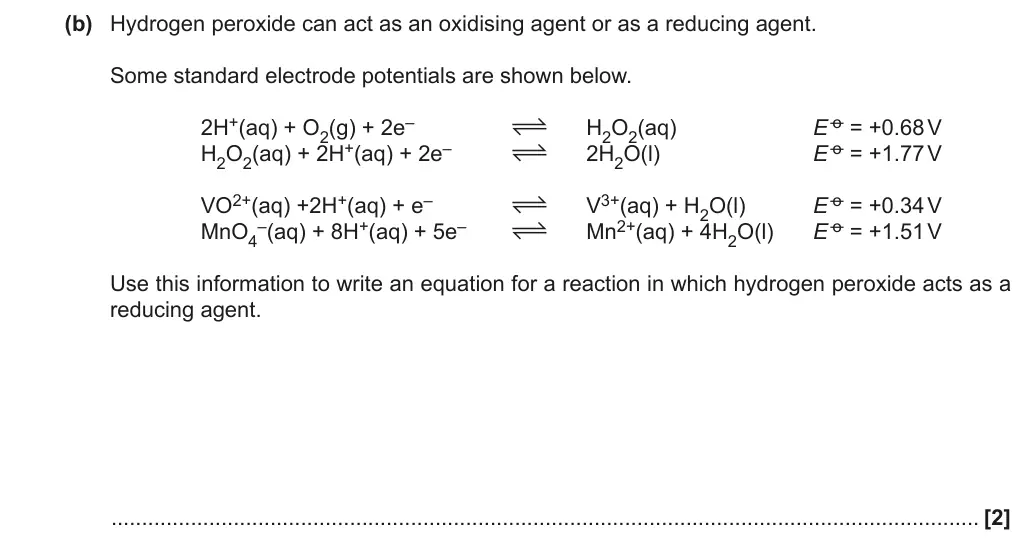
(b) Hydrogen peroxide can act as an oxidising agent or as a reducing agent.
Some standard electrode potentials are shown below.
2H+(aq) + O2(g) + 2e– H2O2(aq) E  o  = +0.68 V
H2O2(aq) + 2H+(aq) + 2e– 2H2O(l) E  o  = +1.77 V
VO2+(aq) +2H+(aq) + e– V3+(aq) + H2O(l) E  o  = +0.34 V
MnO4 –(aq) + 8H+(aq) + 5e– Mn2+(aq) + 4H2O(l) E  o  = +1.51 V
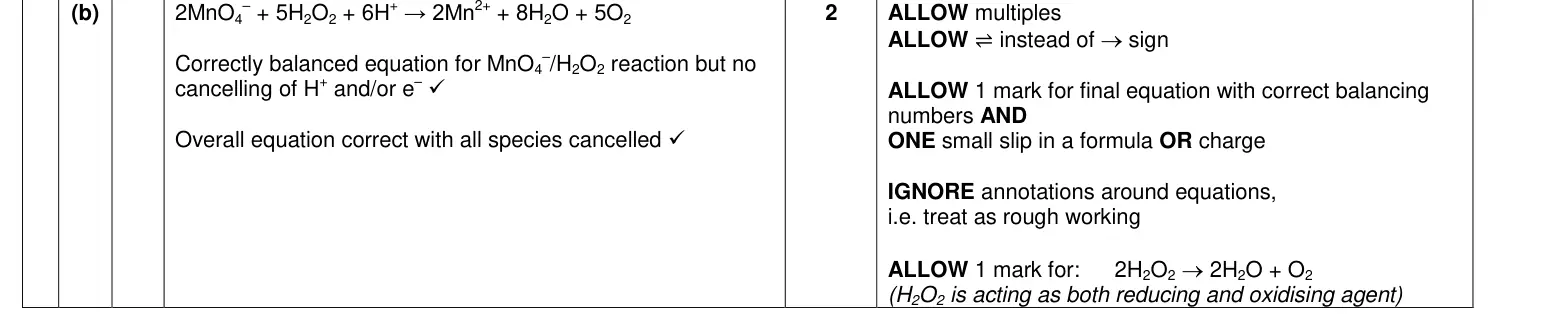
Use this information to write an equation for a reaction in which hydrogen peroxide acts as a
reducing agent.
.............................................................................................................................................. [2]
June 2018 · Paper 3 · Q2(c)(i) 1 mark Equation writing Medium transition elements
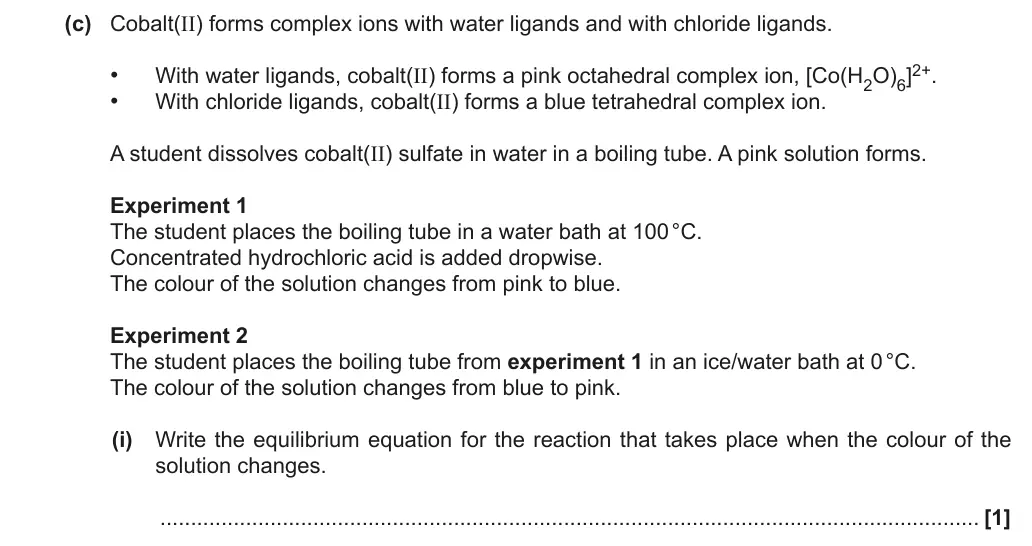
(c) Cobalt(II) forms complex ions with water ligands and with chloride ligands.
• With water ligands, cobalt(II) forms a pink octahedral complex ion, [Co(H2O)6]2+.
• With chloride ligands, cobalt(II) forms a blue tetrahedral complex ion.
A student dissolves cobalt(II) sulfate in water in a boiling tube. A pink solution forms.
Experiment 1
The student places the boiling tube in a water bath at 100 °C.
Concentrated hydrochloric acid is added dropwise.
The colour of the solution changes from pink to blue.
Experiment 2
The student places the boiling tube from experiment 1 in an ice/water bath at 0 °C.
The colour of the solution changes from blue to pink.
(i) Write the equilibrium equation for the reaction that takes place when the colour of the
solution changes.
...................................................................................................................................... [1]
June 2018 · Paper 3 · Q5(b)(ii) 1 mark Equation writing Medium carboxylic acids and estersformulae and equations
Earlier part of question 5 that this part usesEarlier part of June 2018 Paper 3 question 5
(ii) Write the equation for the equilibrium reaction that takes place.
...................................................................................................................................... [1]
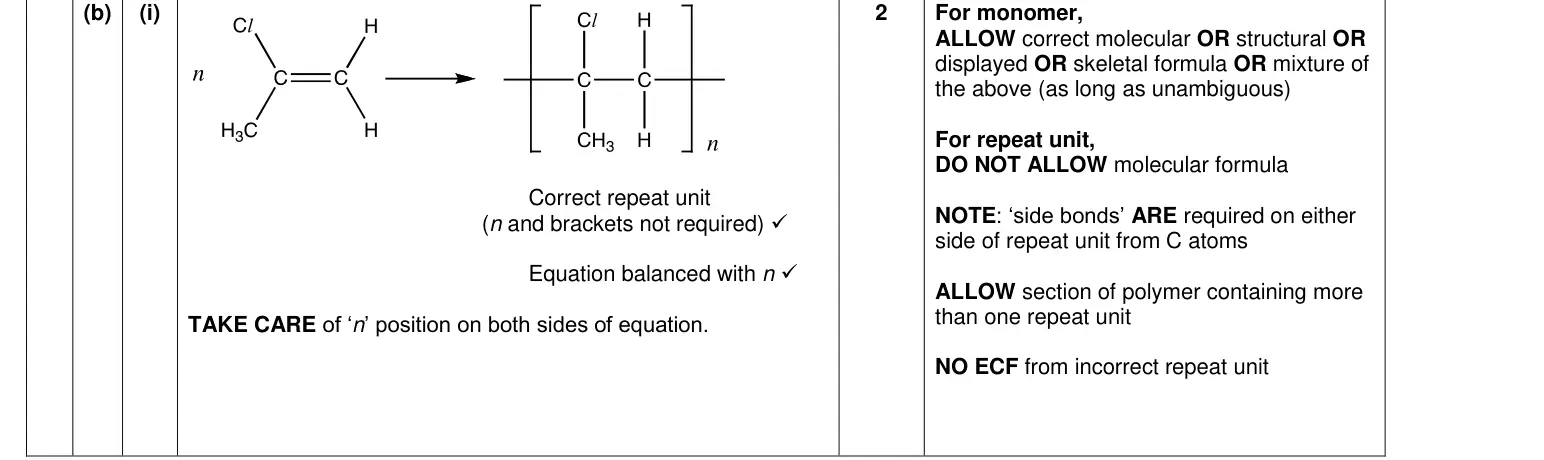
June 2017 · AS Paper 1 · Q21(b)(i) 2 marks Equation writing alkenes
Earlier part of question 21 that this part usesEarlier part of June 2017 Paper 1 question 21
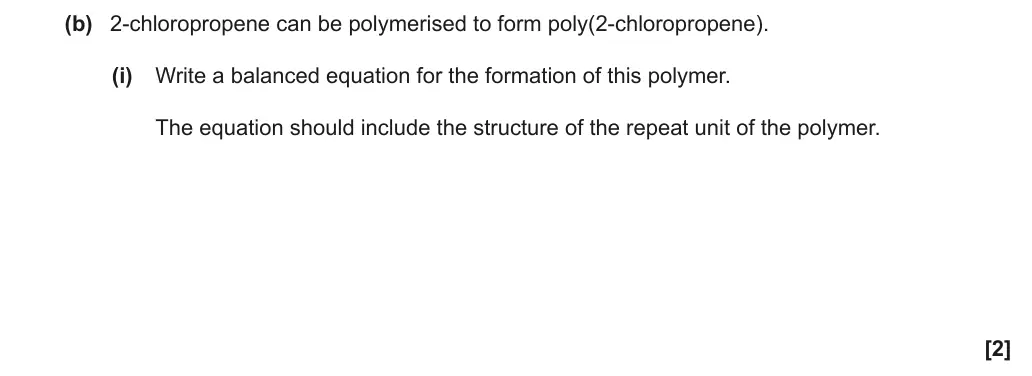
(b) 2-chloropropene can be polymerised to form poly(2-chloropropene).
(i) Write a balanced equation for the formation of this polymer.
The equation should include the structure of the repeat unit of the polymer.
[2]
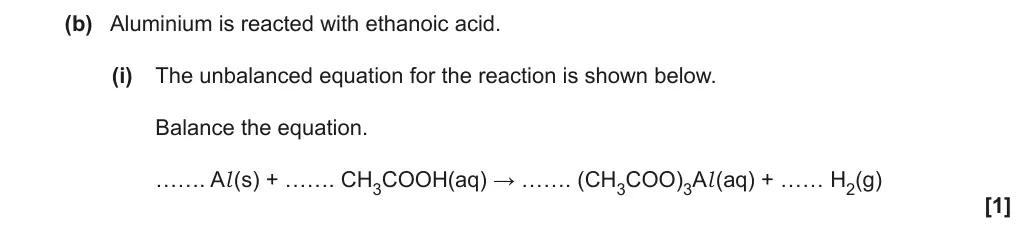
June 2017 · AS Paper 1 · Q24(b)(i) 1 mark Equation writing formulae and equationsredox
(b) Aluminium is reacted with ethanoic acid.
(i) The unbalanced equation for the reaction is shown below.
Balance the equation.
……. Al (s) + ……. CH3COOH(aq) → ……. (CH3COO)3Al (aq) + …… H2(g)
[1]
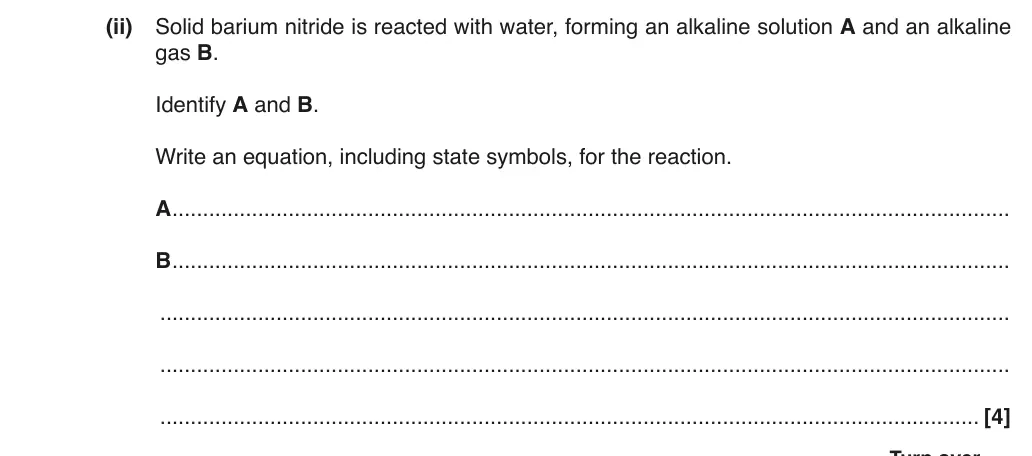
June 2017 · AS Paper 2 · Q1(c)(ii) 4 marks Equation writing formulae and equationsacids and titrations
Earlier part of question 1 that this part usesEarlier part of June 2017 Paper 2 question 1
(ii) Solid barium nitride is reacted with water, forming an alkaline solution A and an alkaline
gas B.
Identify A and B.
Write an equation, including state symbols, for the reaction.
A .........................................................................................................................................
B .........................................................................................................................................
...........................................................................................................................................
...........................................................................................................................................
...................................................................................................................................... [4]
June 2017 · AS Paper 2 · Q5(d)(ii) 1 mark Equation writing alkanes
Earlier part of question 5 that this part usesEarlier part of June 2017 Paper 2 question 5
(ii) Write the overall equation for the reaction.
...................................................................................................................................... [1]
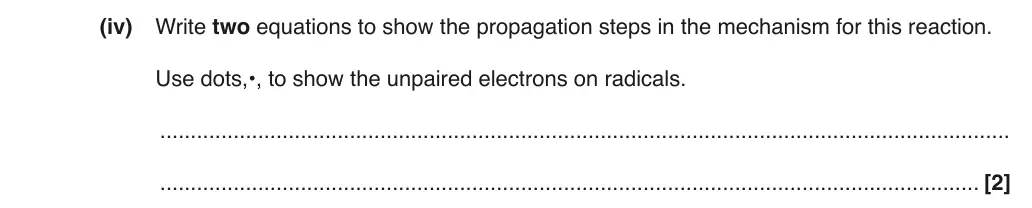
June 2017 · AS Paper 2 · Q5(d)(iv) 2 marks Equation writing alkanesorganic basics
Earlier part of question 5 that this part usesEarlier part of June 2017 Paper 2 question 5
(iv) Write two equations to show the propagation steps in the mechanism for this reaction.
Use dots,•, to show the unpaired electrons on radicals.
...........................................................................................................................................
...................................................................................................................................... [2]
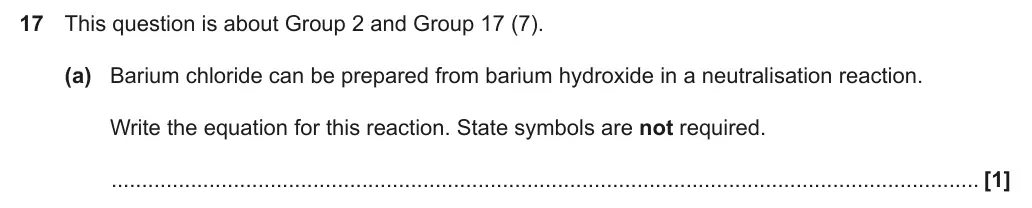
June 2017 · Paper 1 · Q17(a) 1 mark Equation writing acids and titrations
17 This question is about Group 2 and Group 17 (7).
(a) Barium chloride can be prepared from barium hydroxide in a neutralisation reaction.
Write the equation for this reaction. State symbols are not required.
.............................................................................................................................................. [1]
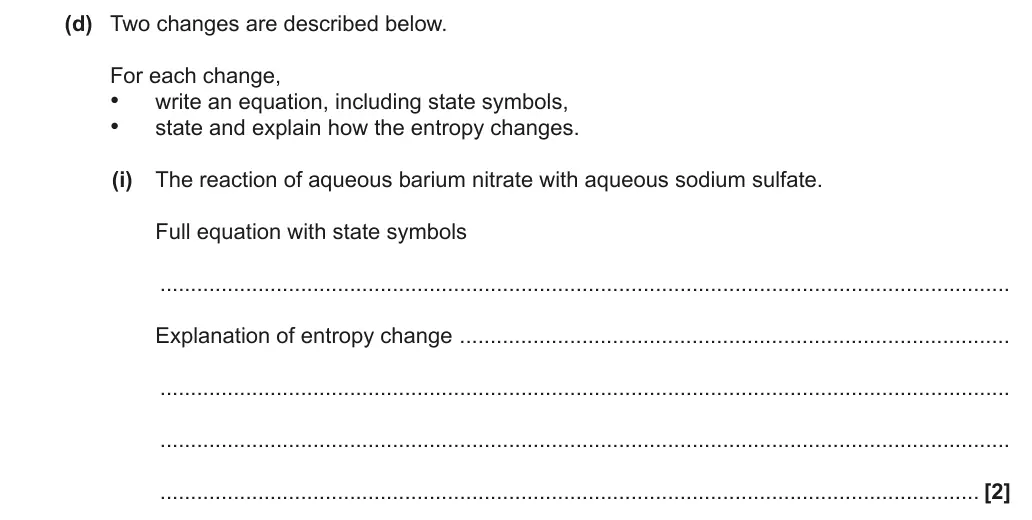
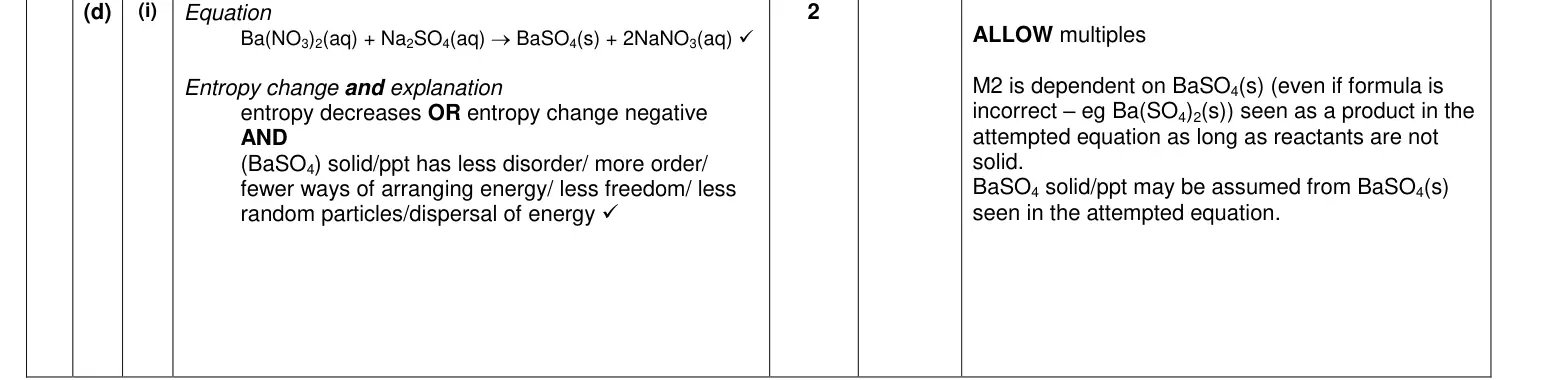
June 2017 · Paper 1 · Q17(d)(ii) 2 marks Equation writing entropy and free energylattice enthalpy
Earlier part of question 17 that this part usesEarlier part of June 2017 Paper 1 question 17
(ii) The change that accompanies the standard enthalpy change of atomisation of iodine.
Equation with state symbols
...........................................................................................................................................
Explanation of entropy change  ..........................................................................................
...........................................................................................................................................
...........................................................................................................................................
...................................................................................................................................... [2]
June 2017 · Paper 1 · Q22(c) 2 marks Equation writing redox and electrode potentials
Earlier part of question 22 that this part usesEarlier part of June 2017 Paper 1 question 22
(c) Electrode potentials can be used to predict the feasibility of reactions.
Construct an overall equation for the predicted reaction between the species in redox
systems 2 and 4.
.............................................................................................................................................. [2]
June 2017 · Paper 2 · Q19(a) 1 mark Equation writing alcoholsformulae and equationsorganic basics
19 This question is about alcohols.
(a) Construct an equation for the complete combustion of an unsaturated alcohol with 5 carbon
atoms.
............................................................................................................................................. [1]
June 2017 · Paper 2 · Q19(d) 5 marks Equation writing alcohols
(d) Butan-1-ol can be oxidised to form two different organic products, depending on the reaction
conditions used.
Describe both oxidation reactions of butan-1-ol.
For each reaction include
• the structure of the organic product
• a balanced equation
• the essential reaction conditions.
In your equations you may use [O] to represent the oxidising agent.
...................................................................................................................................................
...................................................................................................................................................
...................................................................................................................................................
...................................................................................................................................................
...................................................................................................................................................
...................................................................................................................................................
...................................................................................................................................................
...................................................................................................................................................
...................................................................................................................................................
...................................................................................................................................................
...................................................................................................................................................
............................................................................................................................................. [5]
June 2017 · Paper 3 · Q2(d)(iii) 1 mark Equation writing formulae and equationsredox
Earlier parts of question 2 that this part usesEarlier part of June 2017 Paper 3 question 2Earlier part of June 2017 Paper 3 question 2
(iii) Construct the equation for this reaction.
Equation  ...................................................................................................................... [1]
June 2017 · Paper 3 · Q5(a)(ii) 2 marks Equation writing carboxylic acids and estersorganic synthesis
Earlier part of question 5 that this part usesEarlier part of June 2017 Paper 3 question 5
(ii) Thiols react with carboxylic acids to form thioesters.
Write an equation for the reaction of butane-1-thiol with ethanoic acid.
Use structures for all organic compounds with the functional groups clearly displayed.
[2]
June 2017 · Paper 3 · Q5(a)(iv) 2 marks Equation writing organic synthesisformulae and equations
Earlier part of question 5 that this part usesEarlier part of June 2017 Paper 3 question 5
(iv) Propane-1,3-dithiol reacts with carbonyl compounds in a condensation reaction to form a
cyclic organic sulfur product.
Write an equation for the reaction of propane-1,3-dithiol with propanone.
Use structures for organic compounds.
[2]
June 2016 · AS Paper 1 · Q21(c)(i) 1 mark AO1 Equation writing acids and titrations
(c) Nickel(II) nitrate, Ni(NO3)2, can be prepared by reacting nickel(II) oxide with dilute nitric acid.
(i) Write the equation for this reaction.
...................................................................................................................................... [1]
June 2016 · AS Paper 1 · Q23(a)(ii) 2 marks AO1 Equation writing halogensformulae and equations
Earlier part of question 23 that this part usesEarlier part of June 2016 Paper 1 question 23
(ii) Write an ionic equation for this reaction and state why this reaction takes place in terms
of reactivity of the halogens.
...........................................................................................................................................
...........................................................................................................................................
...........................................................................................................................................
...................................................................................................................................... [2]
June 2016 · AS Paper 1 · Q24(b) 1 mark AO2 Equation writing formulae and equations
Earlier part of question 24 that this part usesEarlier part of June 2016 Paper 1 question 24
19
(b) Write an ionic equation for the reaction that the student carries out.
Include state symbols.
.............................................................................................................................................. [1]
June 2016 · AS Paper 2 · Q1(b)(i) 1 mark AO2 Equation writing group 2periodicity
(b) The trend in the first and second ionisation energies of Group 2 elements can be linked to the
increase in chemical reactivity down the group.
The first and second ionisation energies of calcium and strontium are given in the table.
First ionisation energy Second ionisation energy
Element
/ kJ mol–1 / kJ mol–1
Ca 590 1145
Sr 550 1064
(i) Write an equation, including state symbols, to represent the second ionisation energy of
strontium.
...................................................................................................................................... [1]
June 2016 · AS Paper 2 · Q2(c) 1 mark AO2 Equation writing formulae and equations
(c) Aluminium forms a sulfide, Al2S3.
Al2S3 reacts with water to form aluminium hydroxide and hydrogen sulfide, H2S.
Write an equation for the reaction of Al2S3 with water.
.............................................................................................................................................. [1]
June 2016 · AS Paper 2 · Q4(c) 2 marks AO1 Equation writing haloalkanes
(c) NO radicals catalyse the breakdown of ozone in the stratosphere.
Write two equations to show how NO radicals catalyse this breakdown.
...................................................................................................................................................
.............................................................................................................................................. [2]
June 2016 · AS Paper 2 · Q6(c)(i) 2 marks AO2 Equation writing alcohols
Earlier part of question 6 that this part usesEarlier part of June 2016 Paper 2 question 6
(c) Butan-2-ol can be oxidised by heating with an oxidising agent.
(i) Write an equation for the reaction.
Use [O] to represent the oxidising agent and show the structure of the organic product.
[2]

Work with an OCR chemistry tutor

Dropping marks on calculations, mechanisms or the six-markers? Book a trial session with a specialist OCR chemistry tutor.

Prefer email? Send an enquiry

If you are under 18, please include a parent's contact details. Enquiries go to enquiries@chemistryaleveltutor.com and are deleted once handled. All tutoring is online.