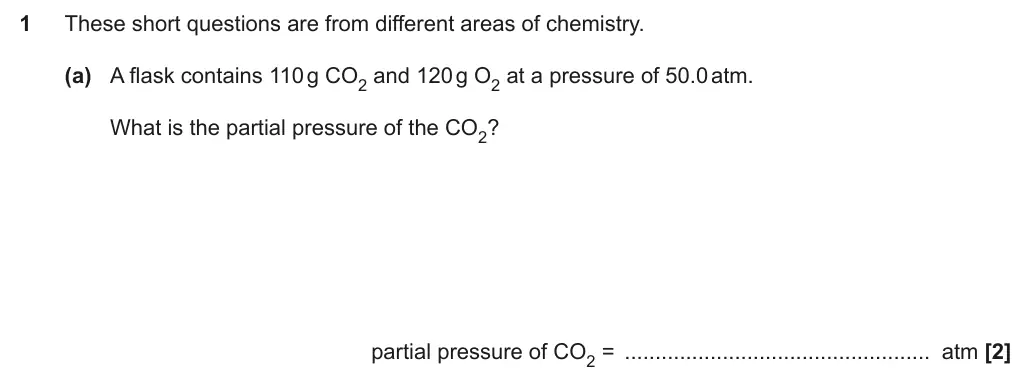
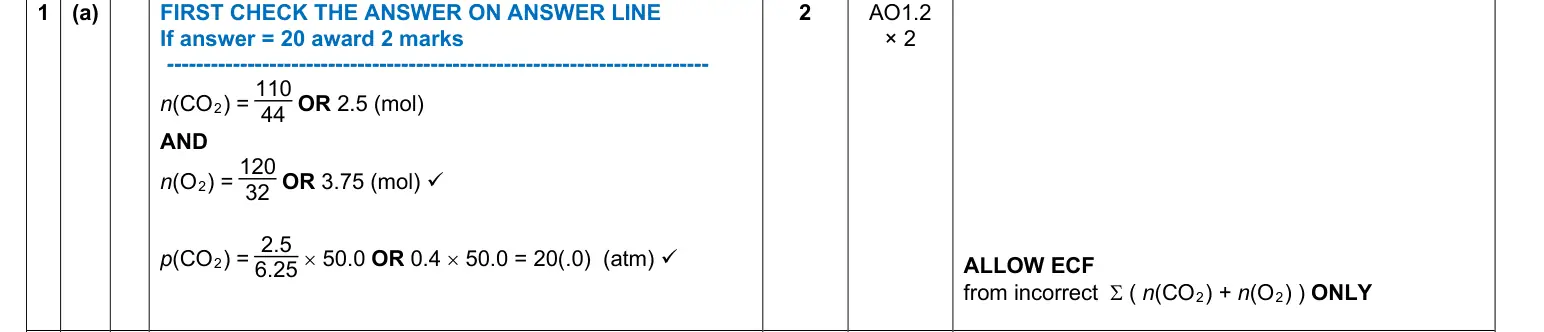
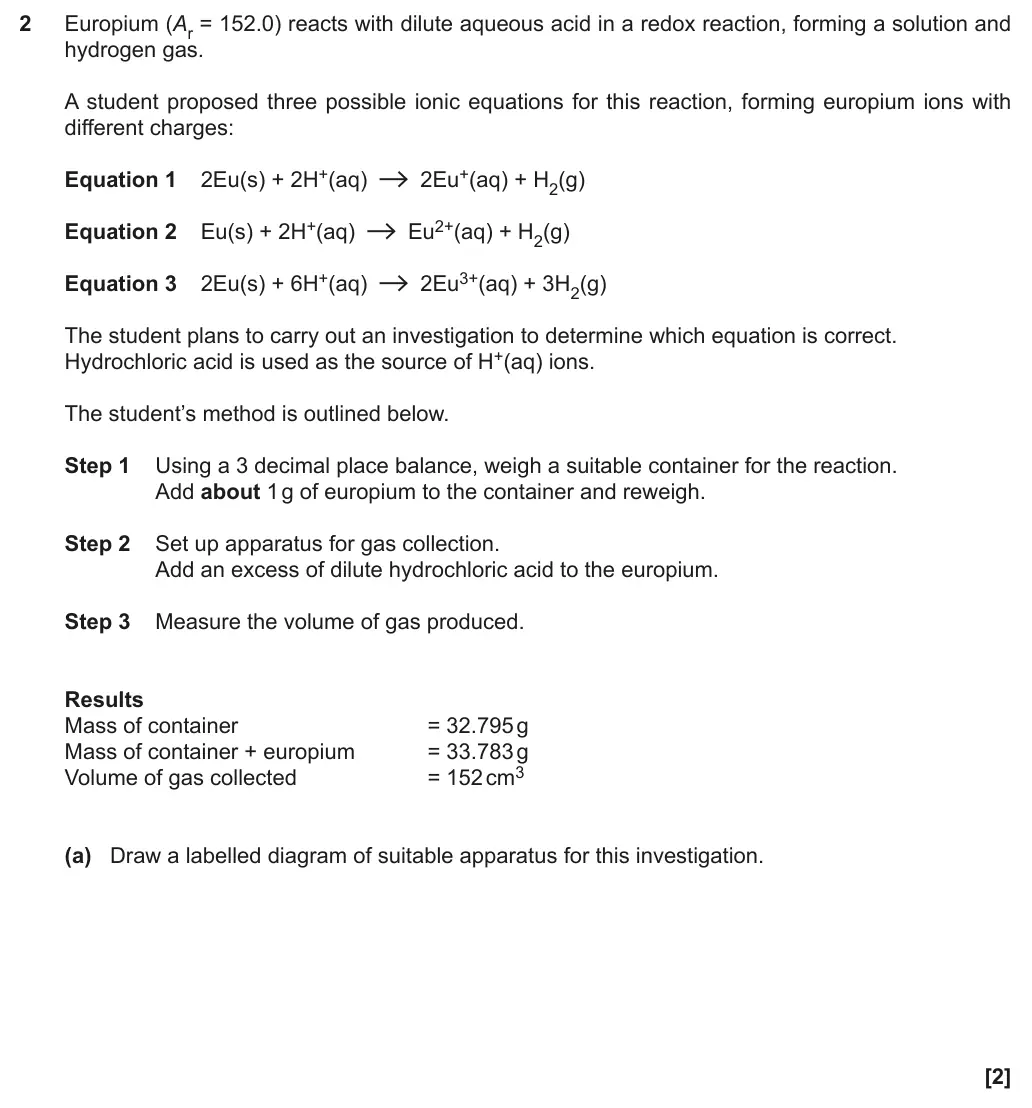
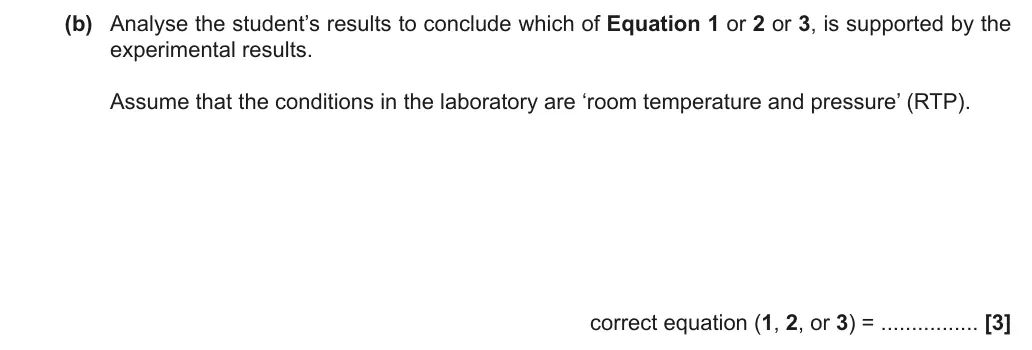
Calculation questions

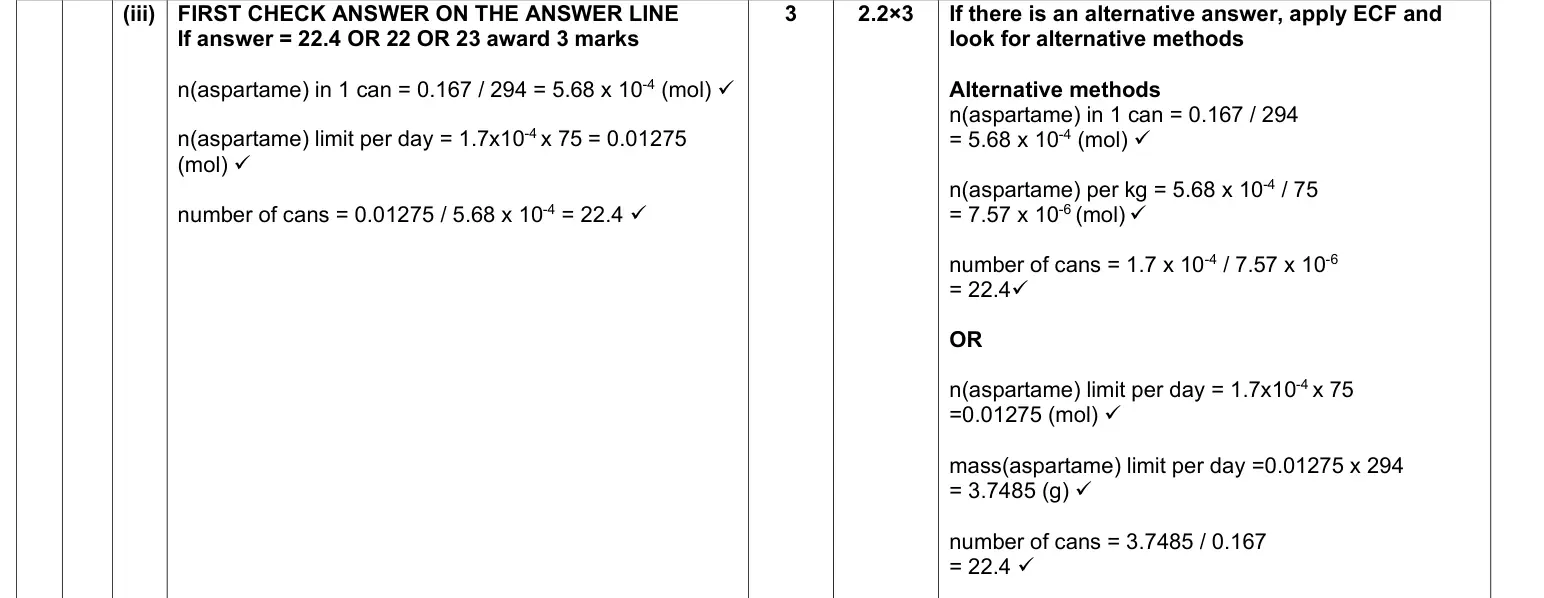
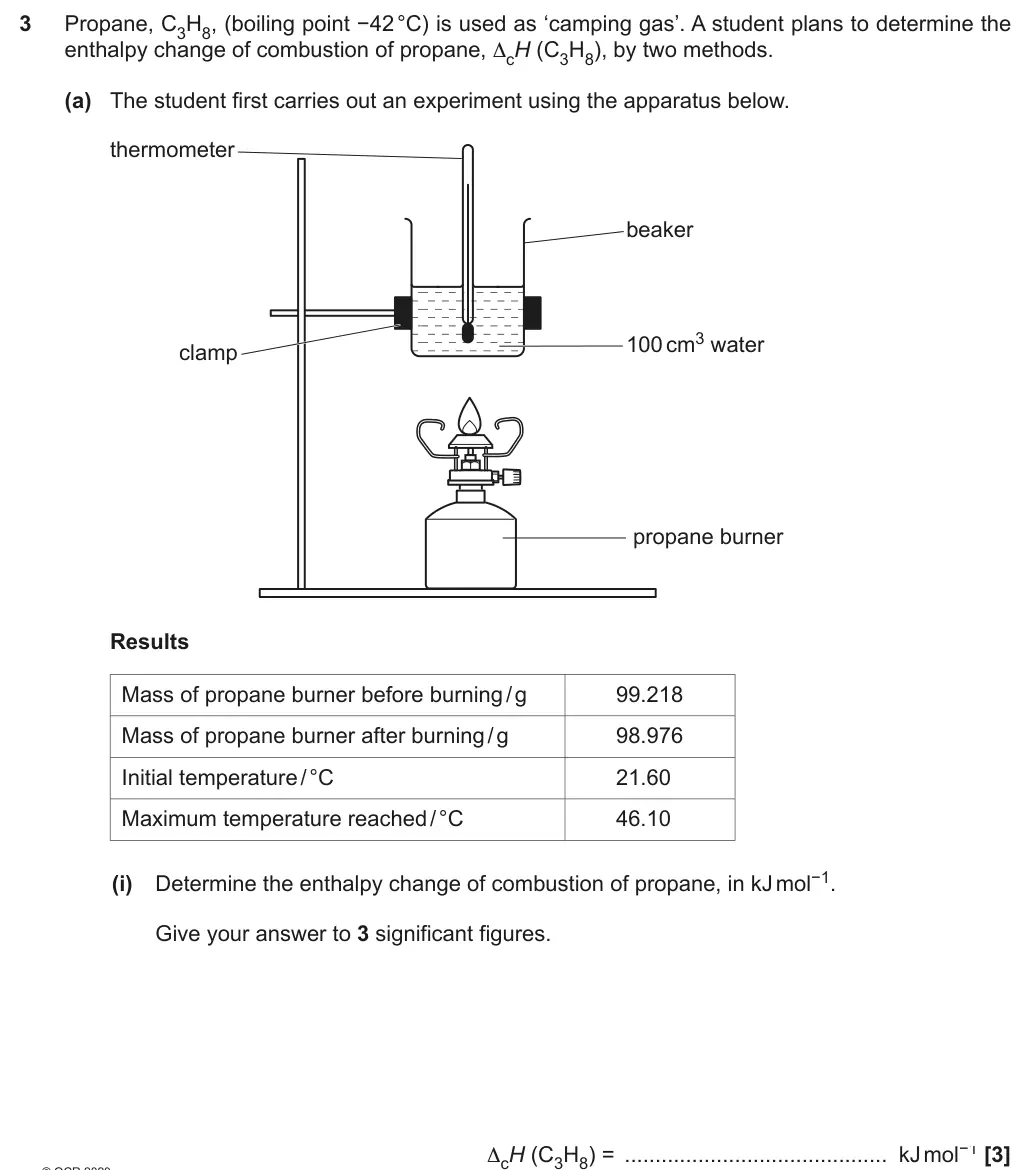
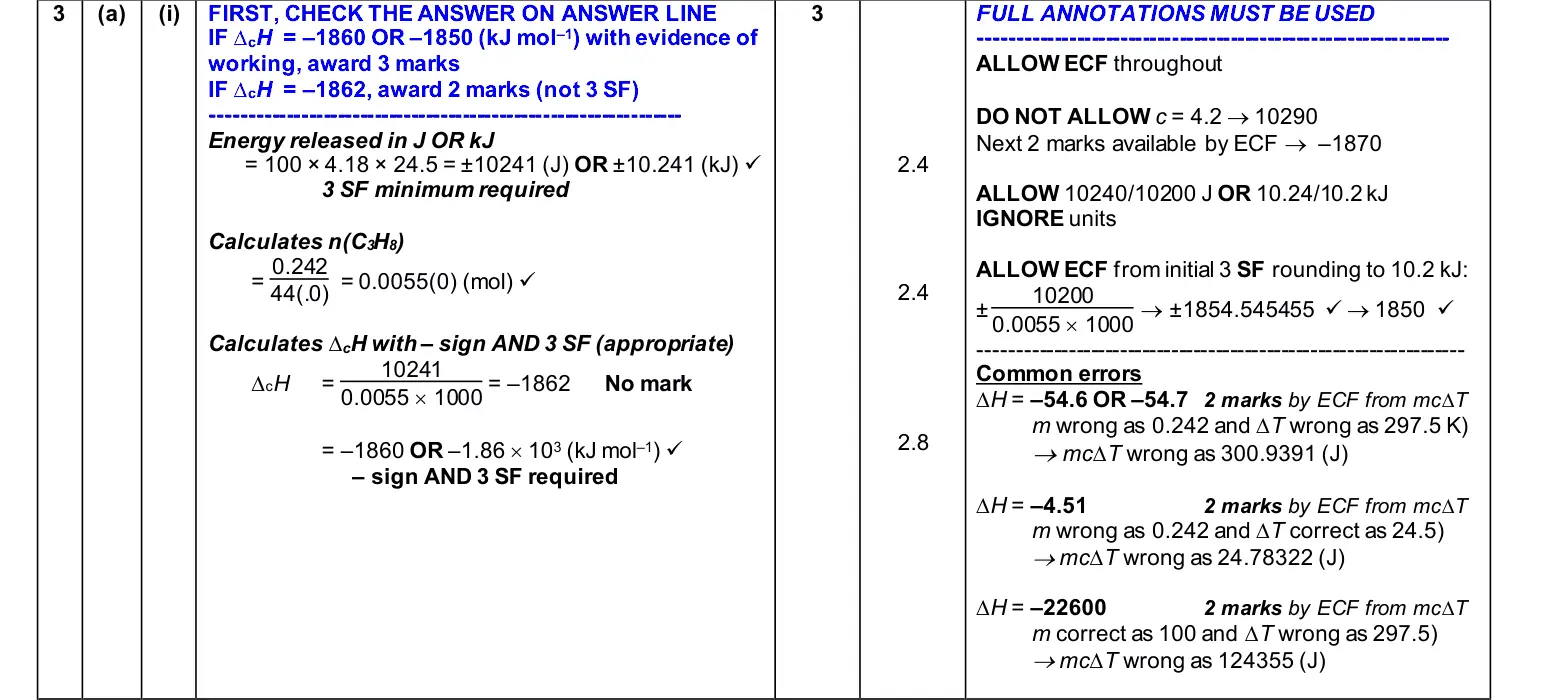
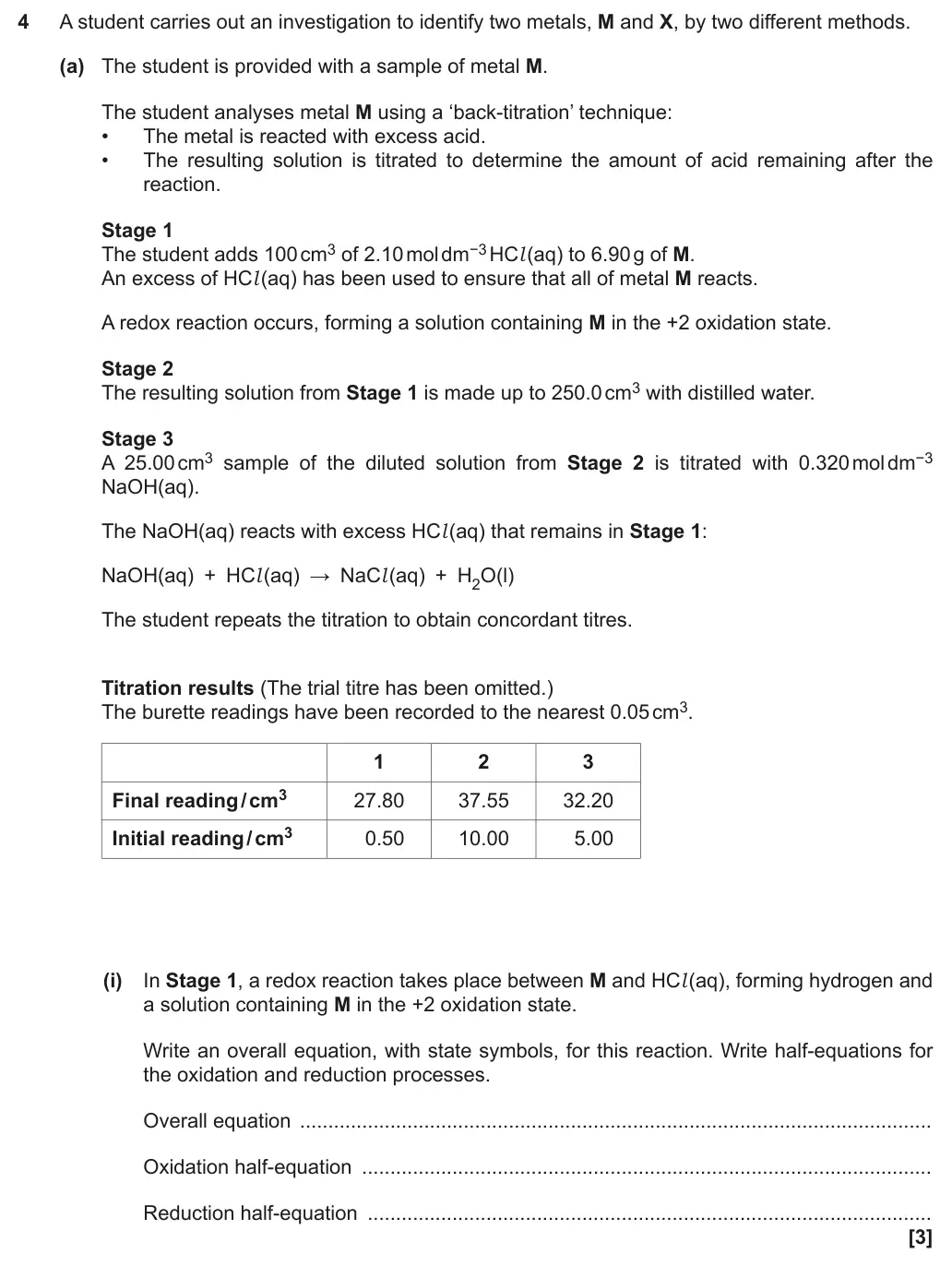
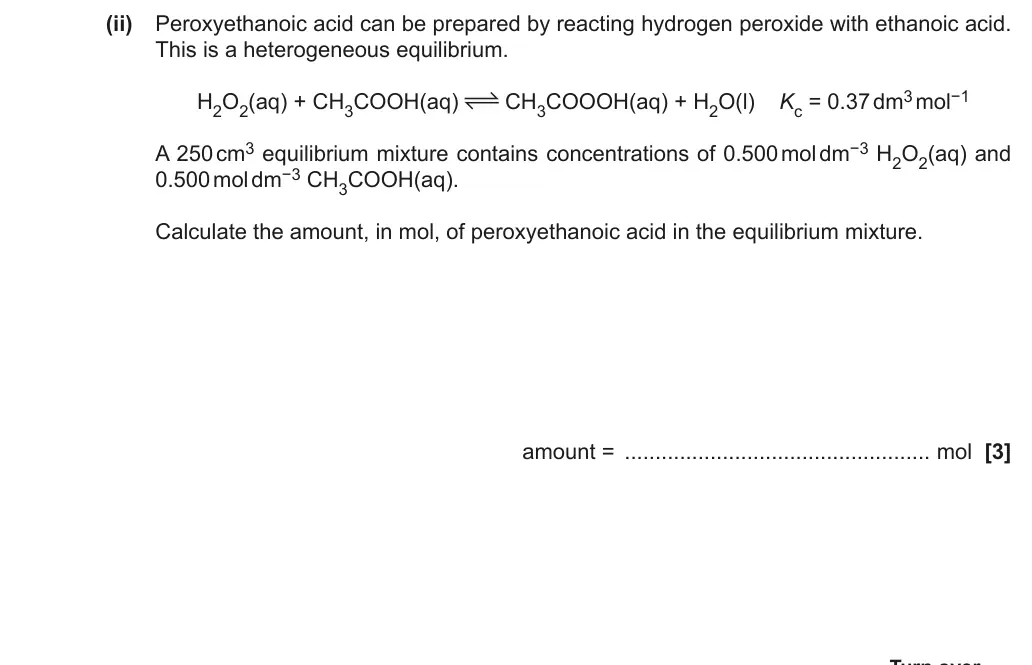
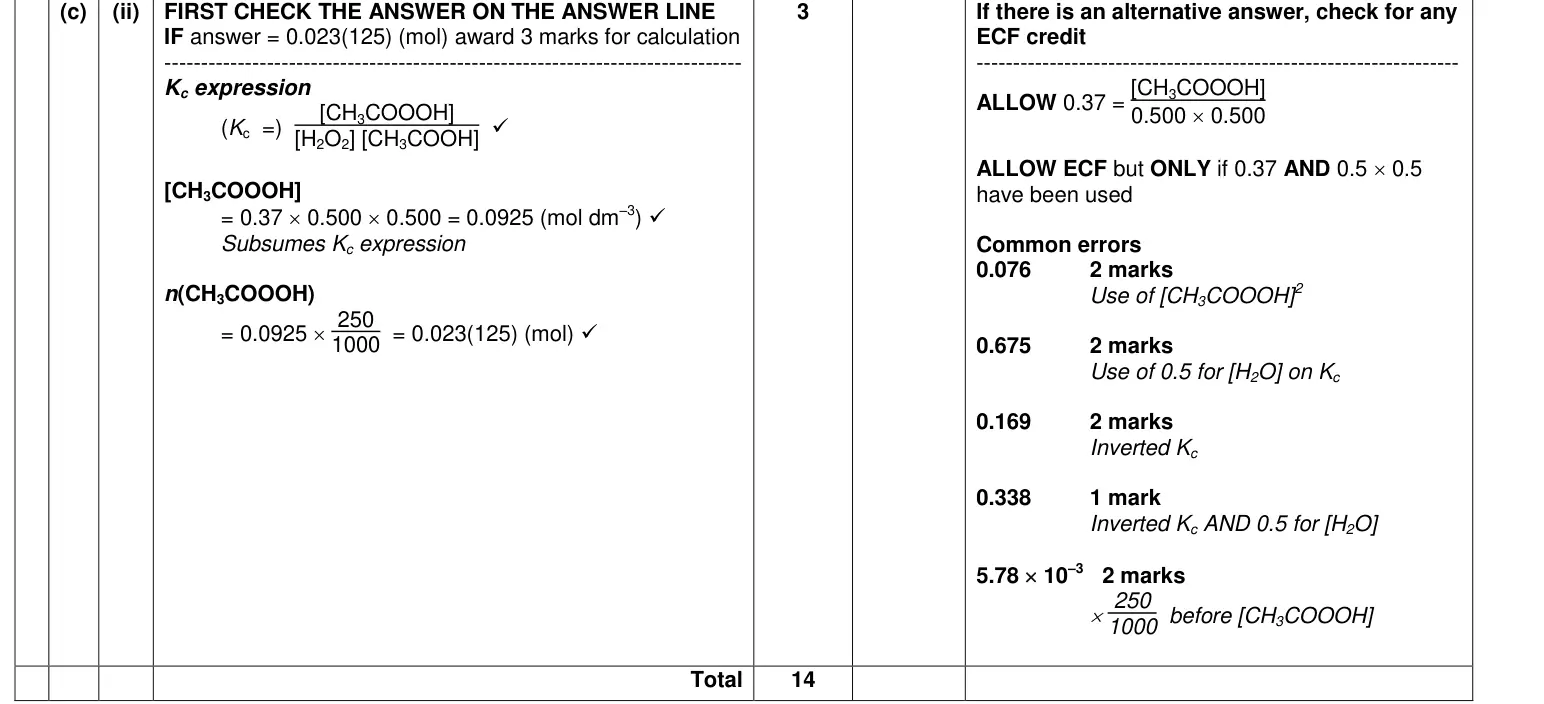
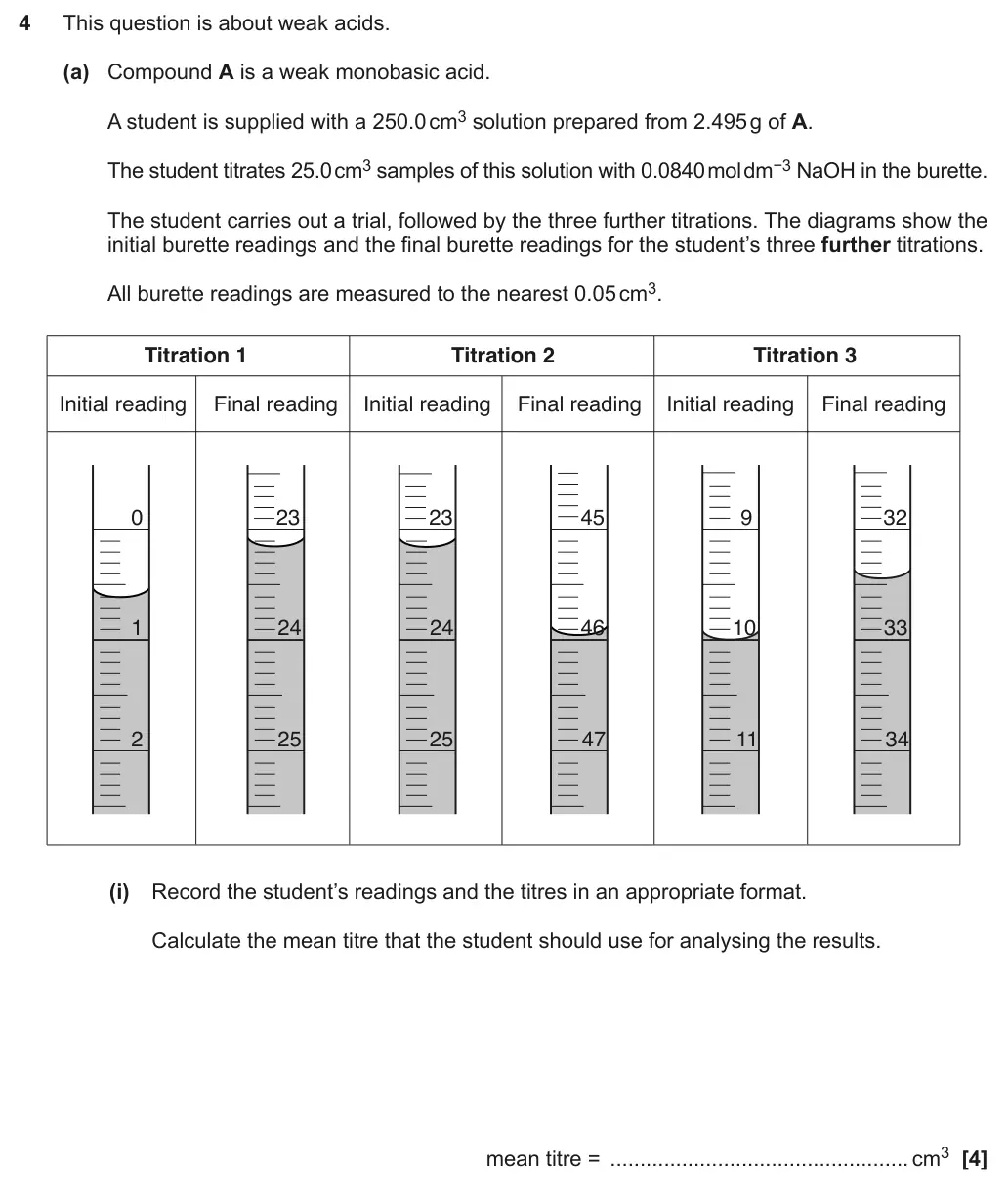
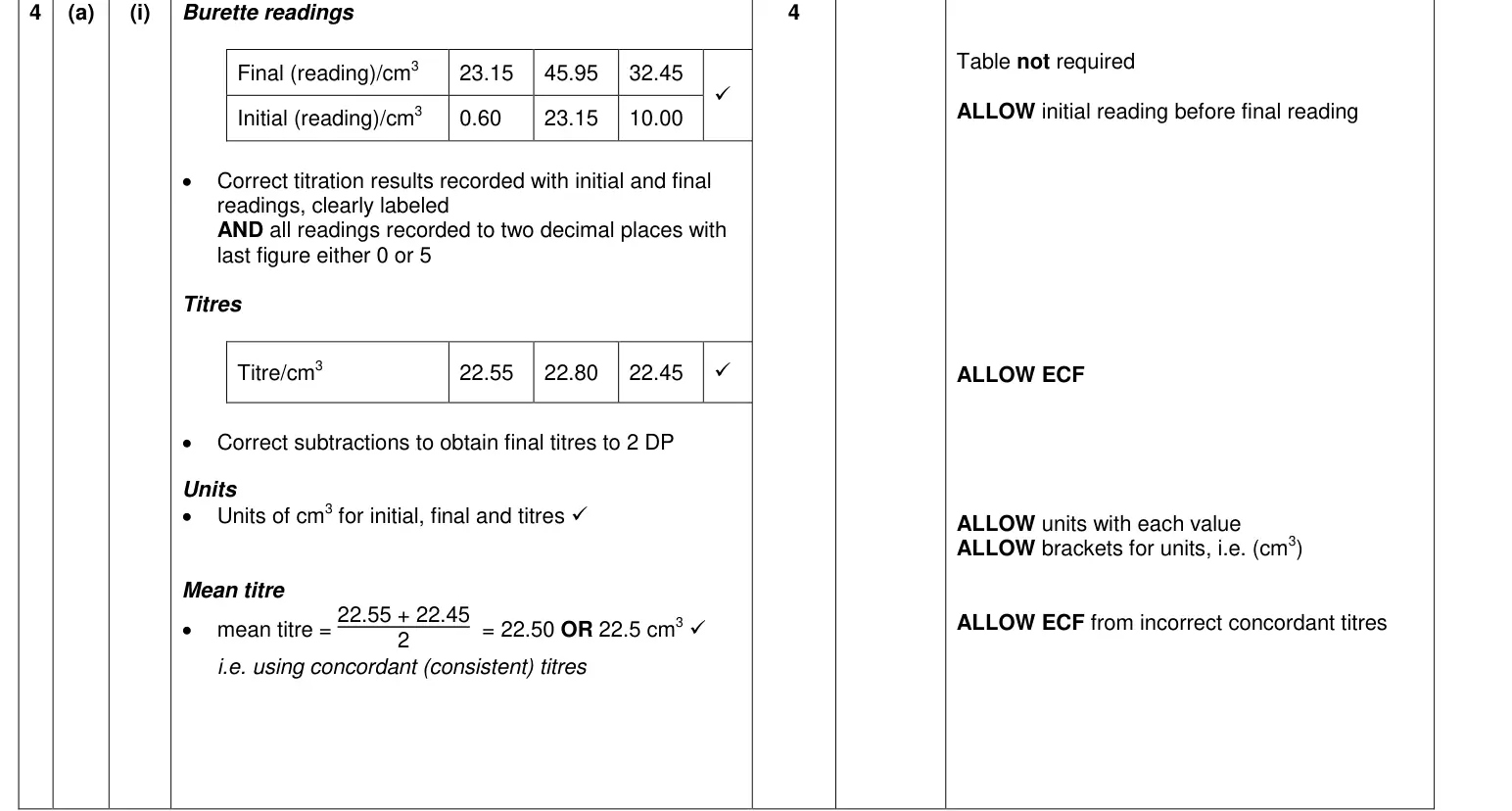
Moles, titrations, enthalpy, equilibrium constants, pH, rates and electrode potentials. Set out every step: OCR awards the marks for the method, and an error carried forward still scores. 270 questions.

Other types: Multiple-choice questions · Equation questions · Mechanism questions · Structure and isomer questions · Six-mark level of response questions · Practical questions · Graph and data questions · Short-answer questions

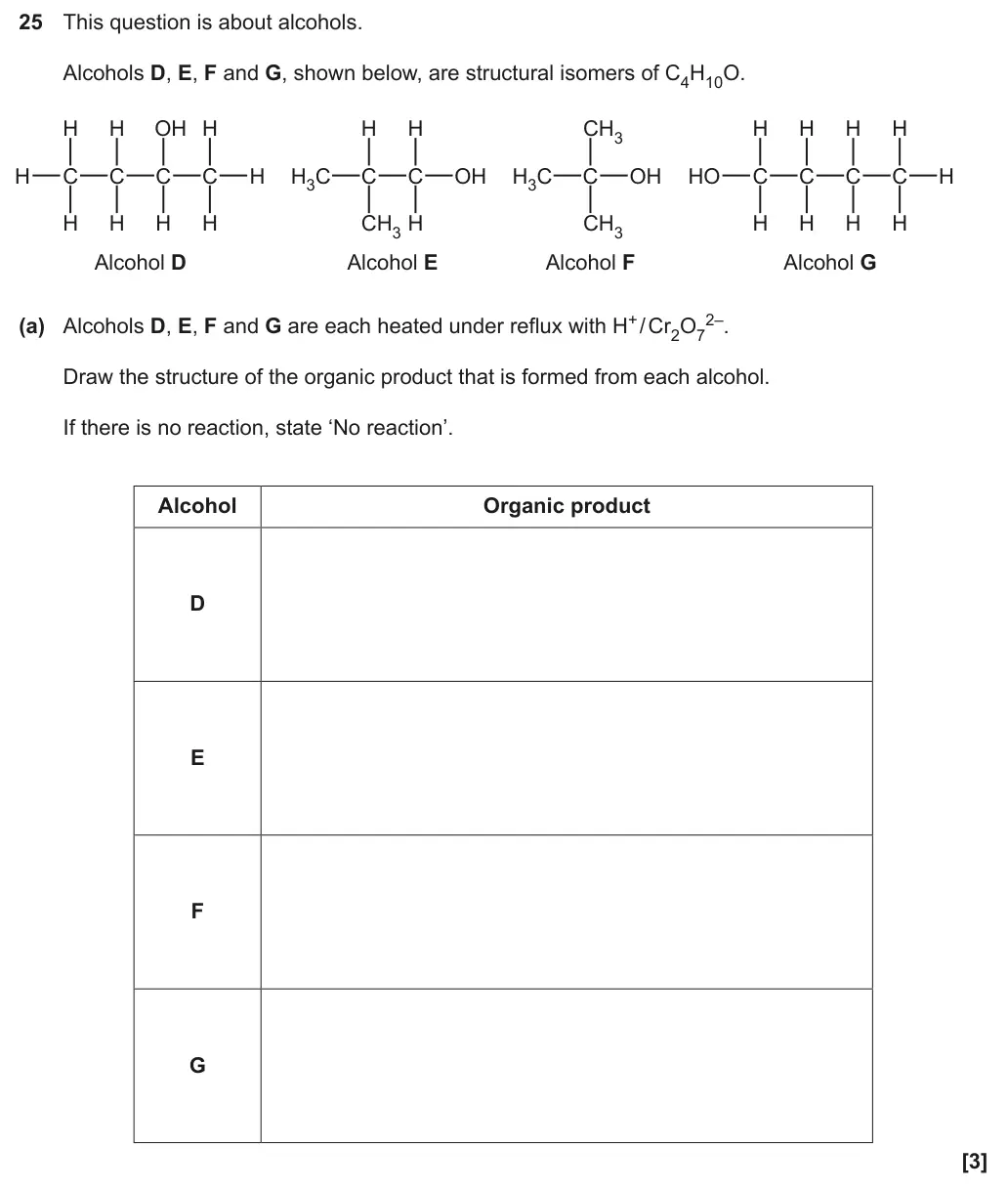
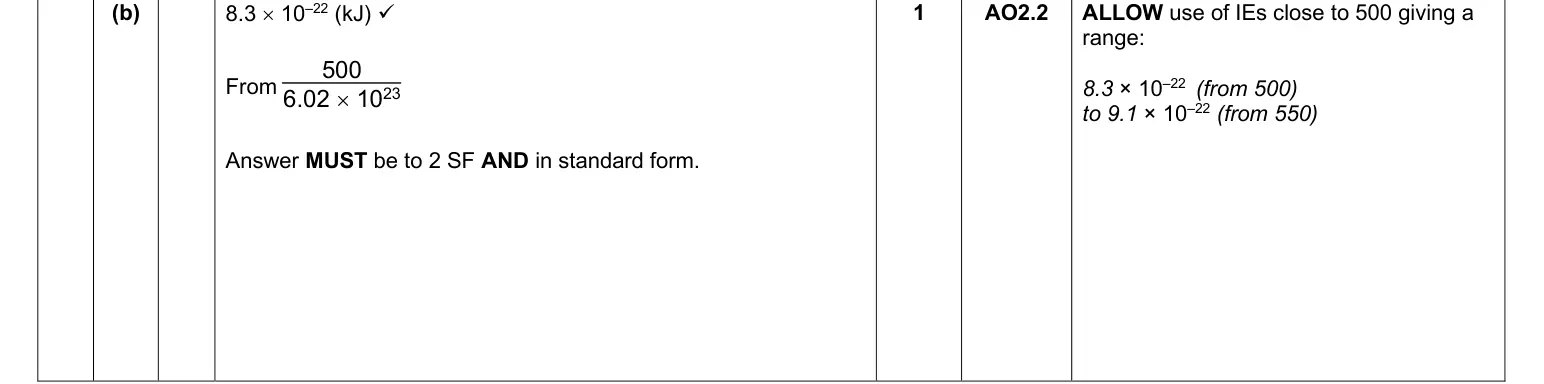
June 2025 · AS Paper 1 · Q21(b) 2 marks Calculation Easy atomic structure and isotopes
(b) The mass spectrum of a sample of magnesium is shown below.
75.45%
Relative
abundance
15.21%
9.34%
24 25 26
m / z
Calculate the relative atomic mass of magnesium in the sample.
Give your answer to 2 decimal places.
Relative atomic mass =  ......................................................... [2]
June 2025 · AS Paper 1 · Q21(d)(i) 3 marks Calculation Hard amount of substance
(d) Magnesium reacts with dilute hydrochloric acid, as shown in the equation.
Mg(s) + 2HCl (aq) MgCl 2(aq) + H2(g)
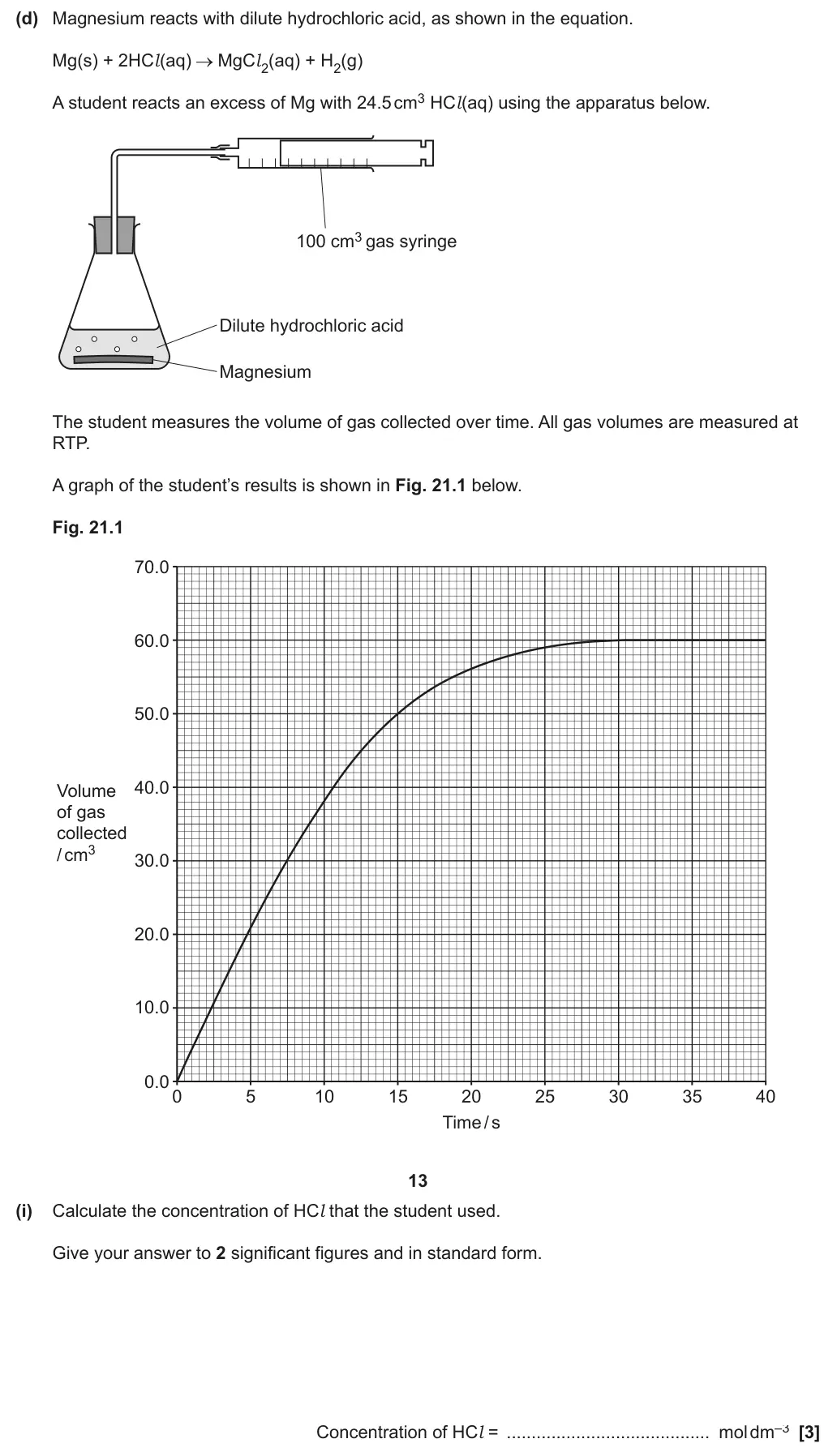
A student reacts an excess of Mg with 24.5 cm3 HCl (aq) using the apparatus below.
100 cm3 gas syringe
Dilute hydrochloric acid
Magnesium
The student measures the volume of gas collected over time. All gas volumes are measured at
RTP.
A graph of the student’s results is shown in Fig. 21.1 below.
Fig. 21.1
70.0
60.0
50.0
Volume 40.0
of gas
collected
/ cm3
30.0
20.0
10.0
0.0
0 5 10 15 20 25 30 35 40
Time / s
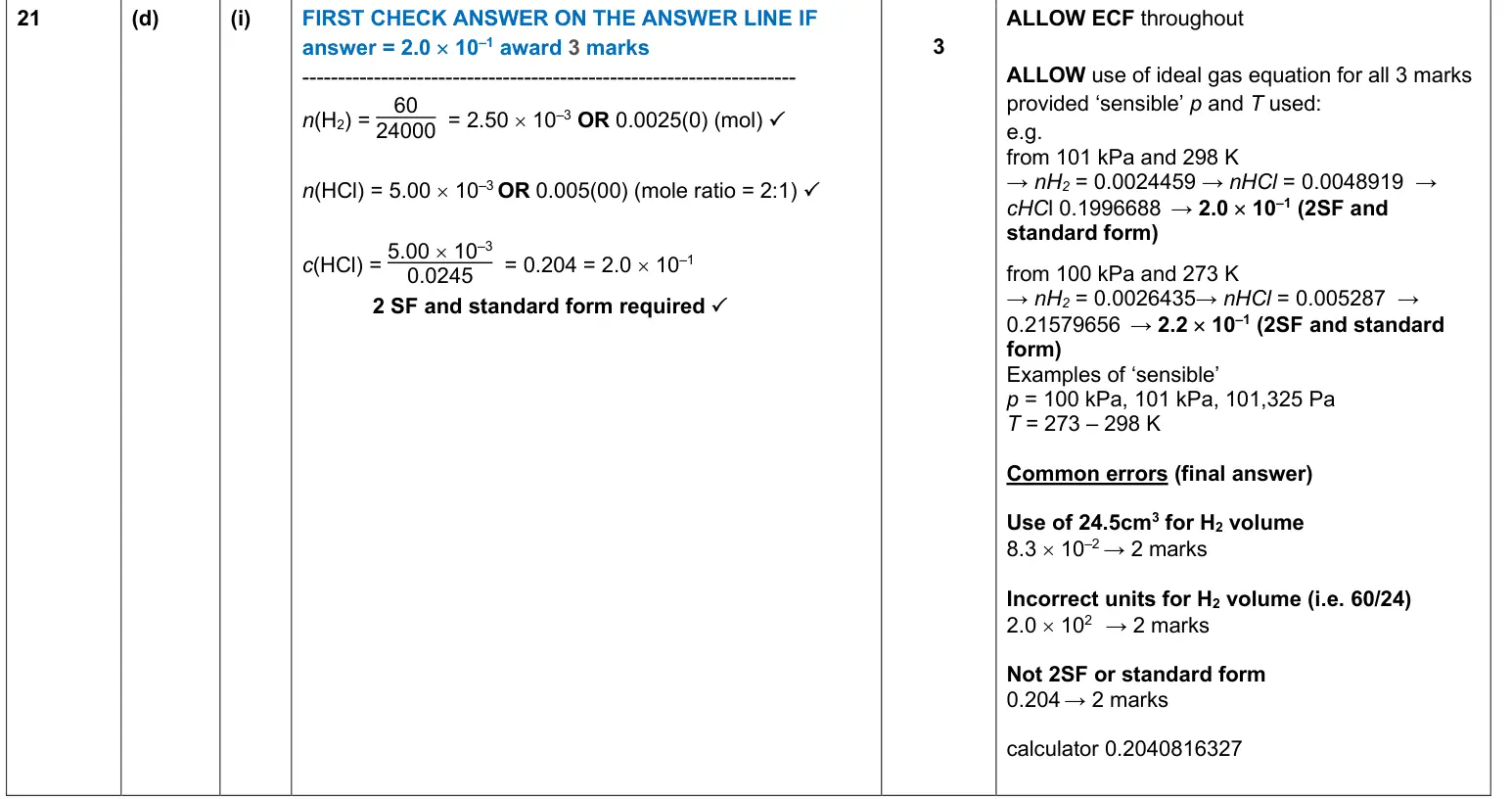
(i) Calculate the concentration of HCl that the student used.
Give your answer to 2 significant figures and in standard form.
Concentration of HCl =  ......................................... mol dm–3 [3]
June 2025 · AS Paper 1 · Q23(b) 3 marks Calculation Hard enthalpy changes
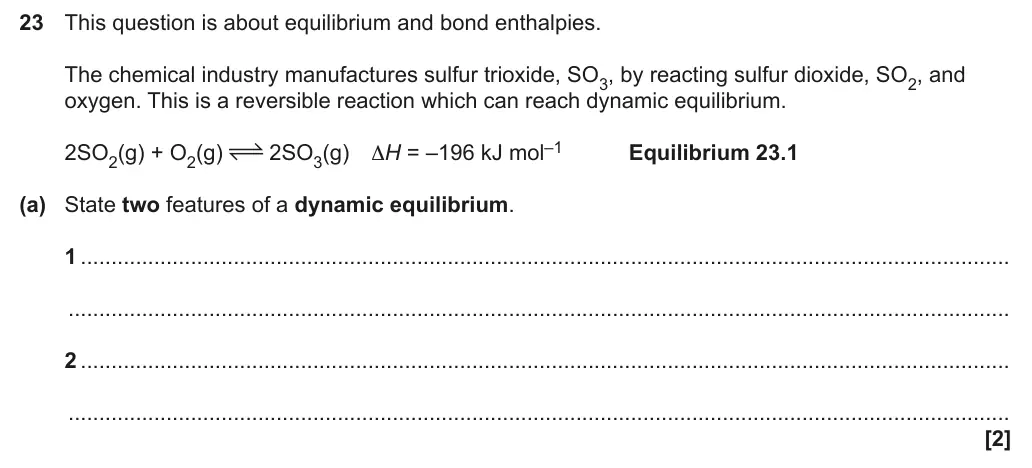
Earlier part of question 23 that this part usesEarlier part of June 2025 Paper 1 question 23
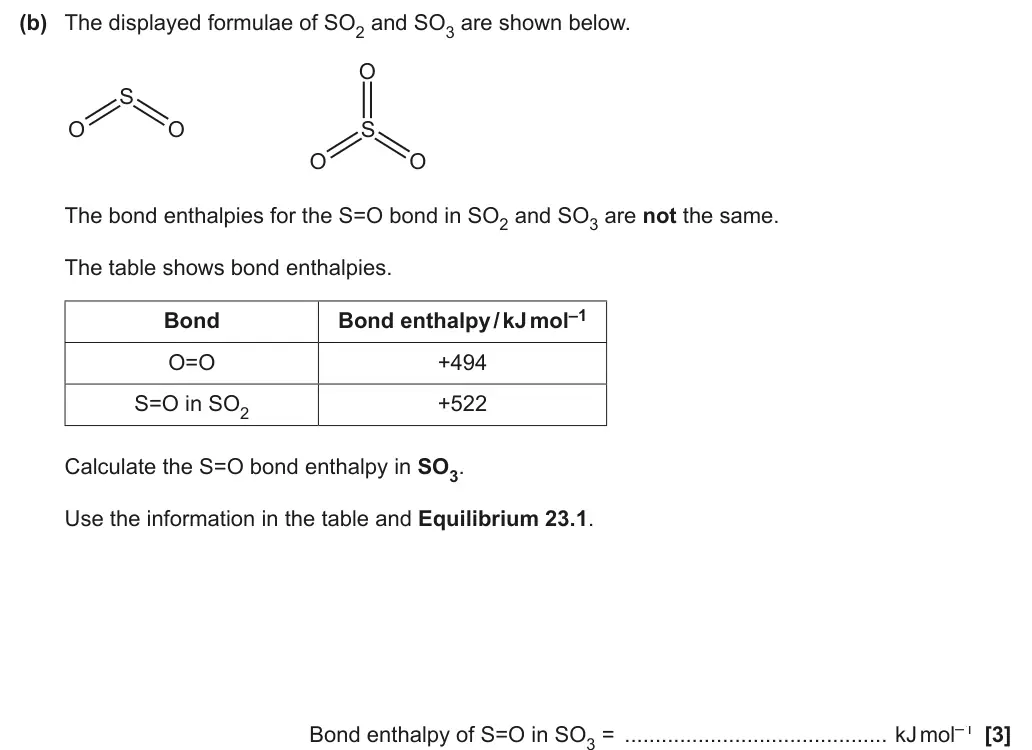
(b) The displayed formulae of SO2 and SO3 are shown below.
O
S
O O S
O O
The bond enthalpies for the S=O bond in SO2 and SO3 are not the same.
The table shows bond enthalpies.
Bond Bond enthalpy / kJ mol–1
O=O +494
S=O in SO2 +522
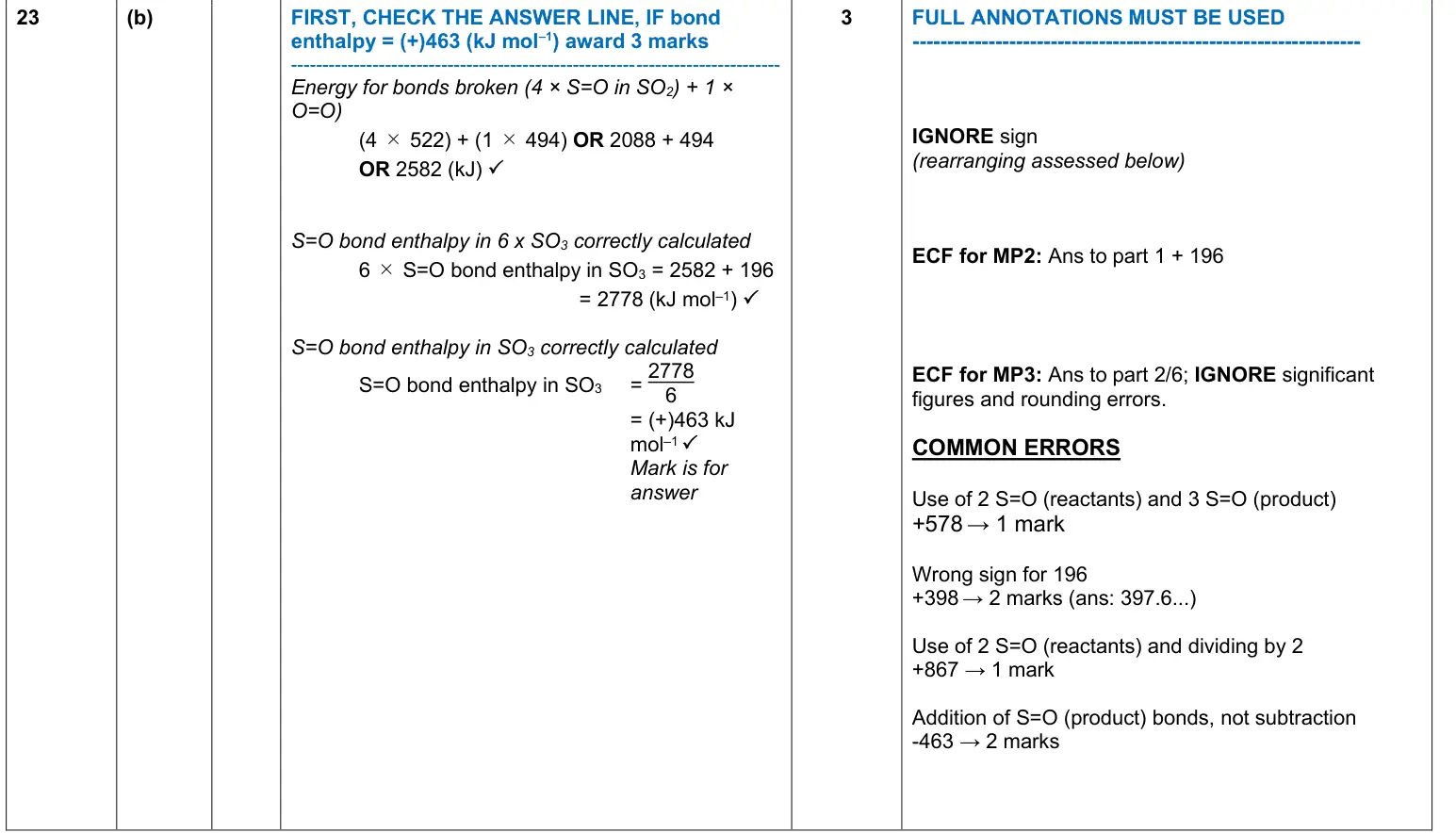
Calculate the S=O bond enthalpy in SO3.
Use the information in the table and Equilibrium 23.1.
Bond enthalpy of S=O in SO3 =  ........................................... kJ mol–1 [3]
June 2025 · AS Paper 1 · Q23(c) 3 marks Calculation Easy chemical equilibrium
Earlier part of question 23 that this part usesEarlier part of June 2025 Paper 1 question 23
(c) The table shows equilibrium concentrations for Equilibrium 23.1.
[SO2(g)] / mol dm–3 [O2(g)] / mol dm–3 [SO3(g)] / mol dm–3
25.0 108 42.0
For Equilibrium 23.1
• write the expression for the equilibrium constant, Kc
• calculate Kc to 3 significant figures and in standard form.
Kc = ............................................... dm3 mol–1
[3]
June 2025 · AS Paper 1 · Q25(c) 5 marks Calculation Easy amount of substance
Earlier part of question 25 that this part usesEarlier part of June 2025 Paper 1 question 25
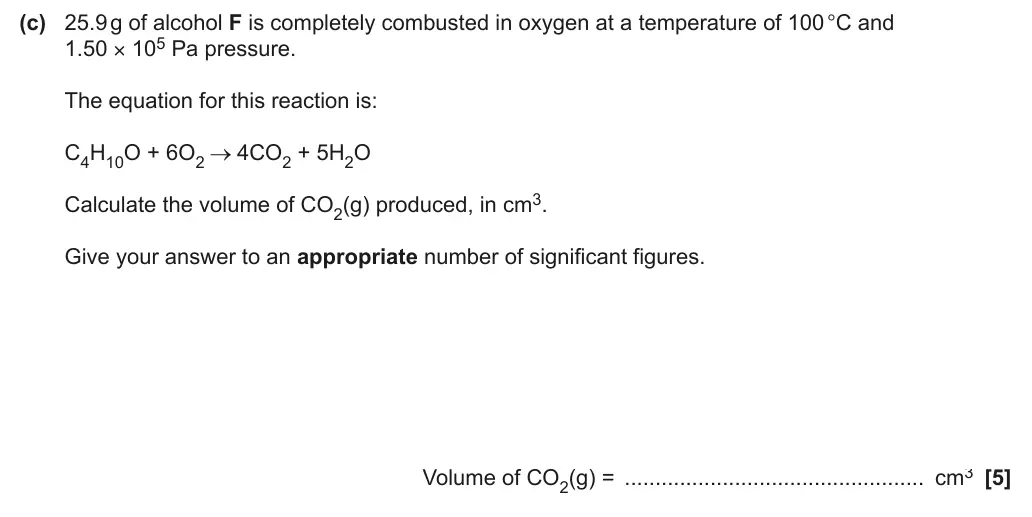
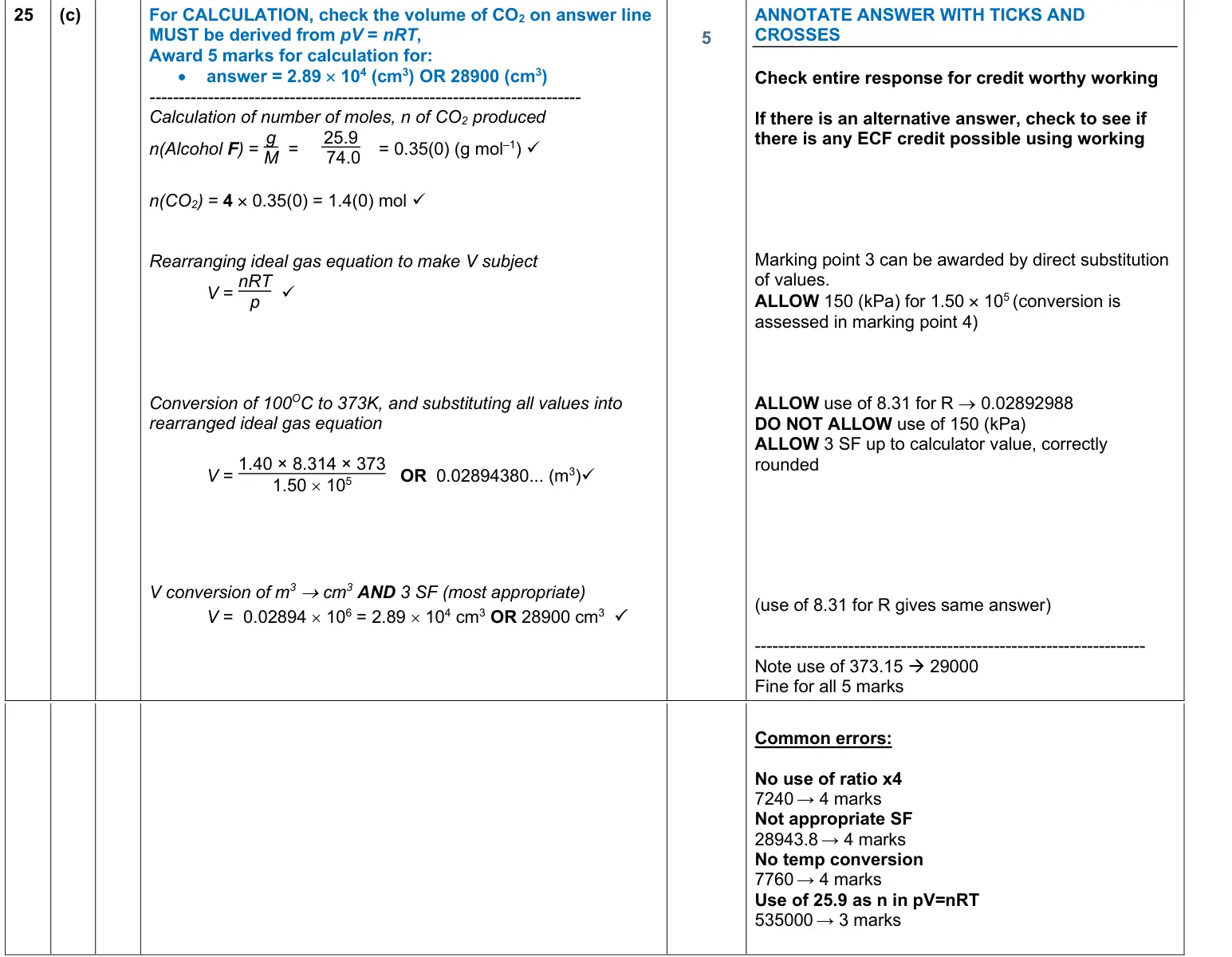
(c) 25.9 g of alcohol F is completely combusted in oxygen at a temperature of 100 °C and
1.50 × 10⁵ Pa pressure.
The equation for this reaction is:
C4H10O + 6O2 4CO2 + 5H2O
Calculate the volume of CO2(g) produced, in cm3.
Give your answer to an appropriate number of significant figures.
Volume of CO2(g) =  ................................................. cm3 [5]
June 2025 · AS Paper 2 · Q1(c)(i) 4 marks Calculation Easy enthalpy changesamount of substance
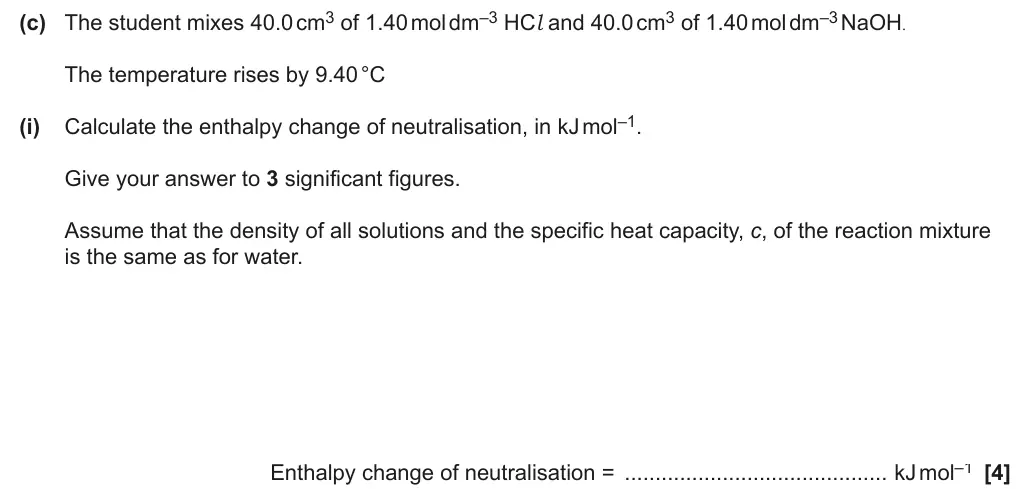
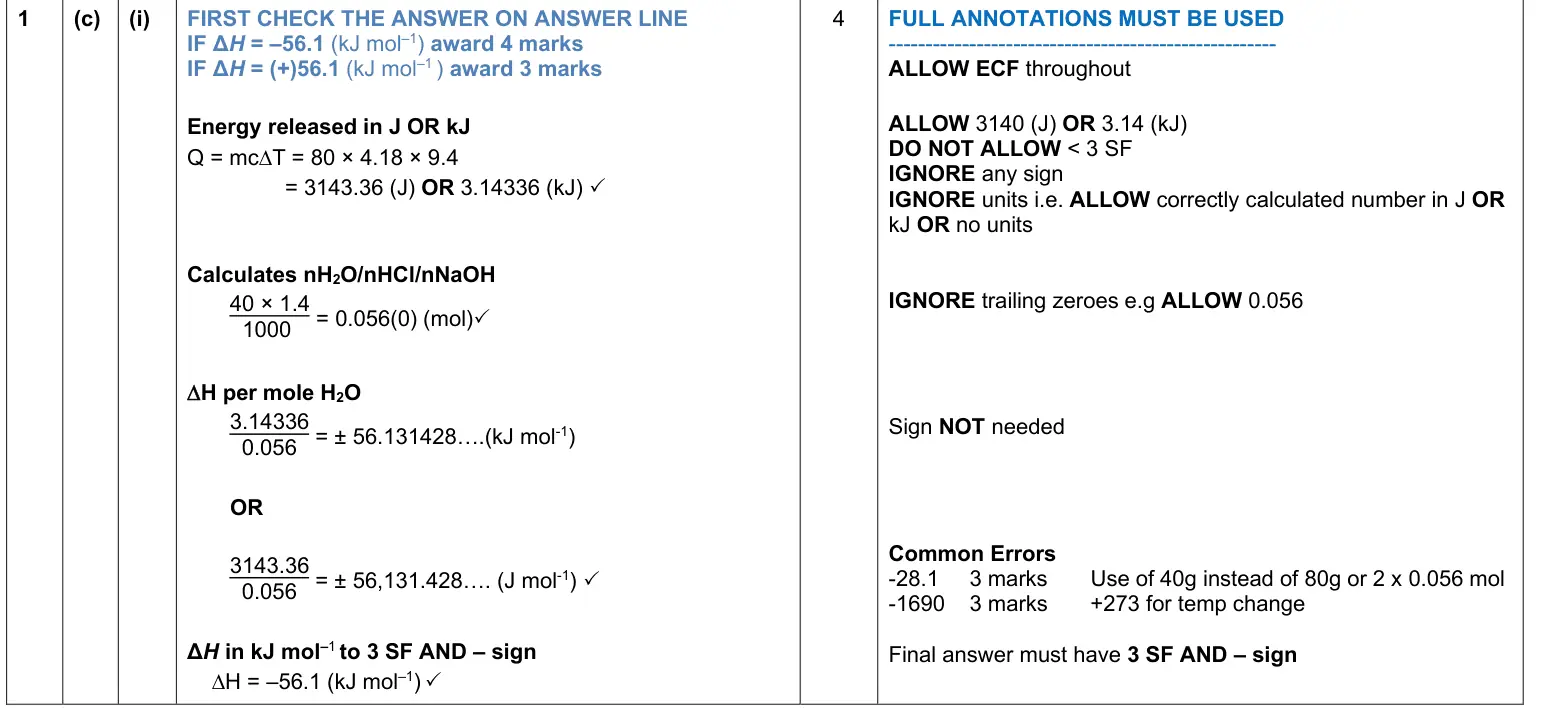
(c) The student mixes 40.0 cm3 of 1.40 mol dm–3 HCl and 40.0 cm3 of 1.40 mol dm–3 NaOH.
The temperature rises by 9.40 °C
(i) Calculate the enthalpy change of neutralisation, in kJ mol–1.
Give your answer to 3 significant figures.
Assume that the density of all solutions and the specific heat capacity, c, of the reaction mixture
is the same as for water.
Enthalpy change of neutralisation =  ........................................... kJ mol–1 [4]
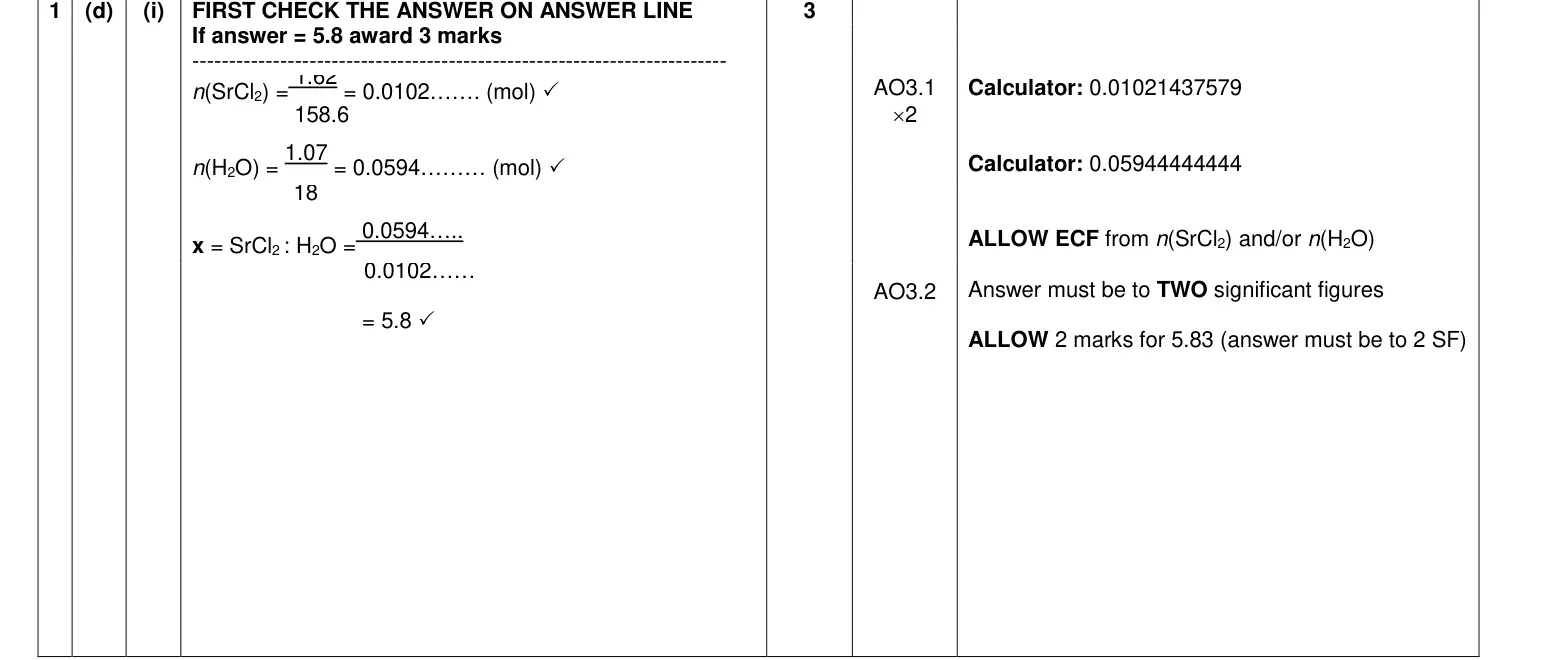
June 2025 · AS Paper 2 · Q2(b)(i) 2 marks Calculation Hard amount of substance
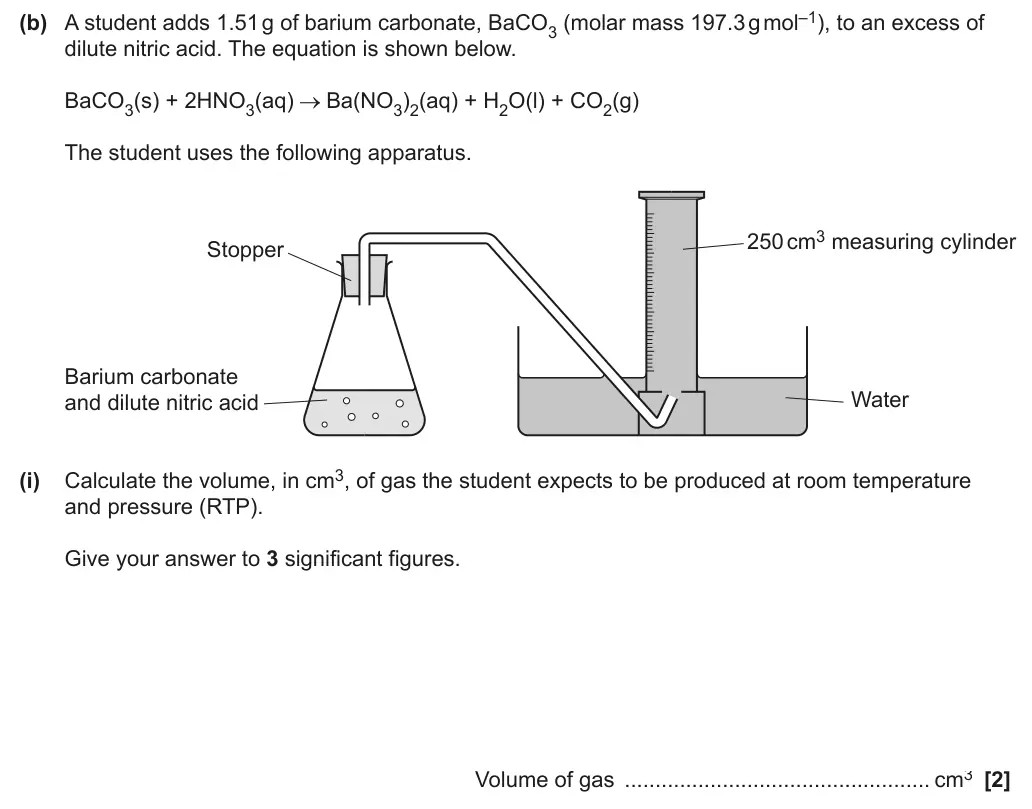
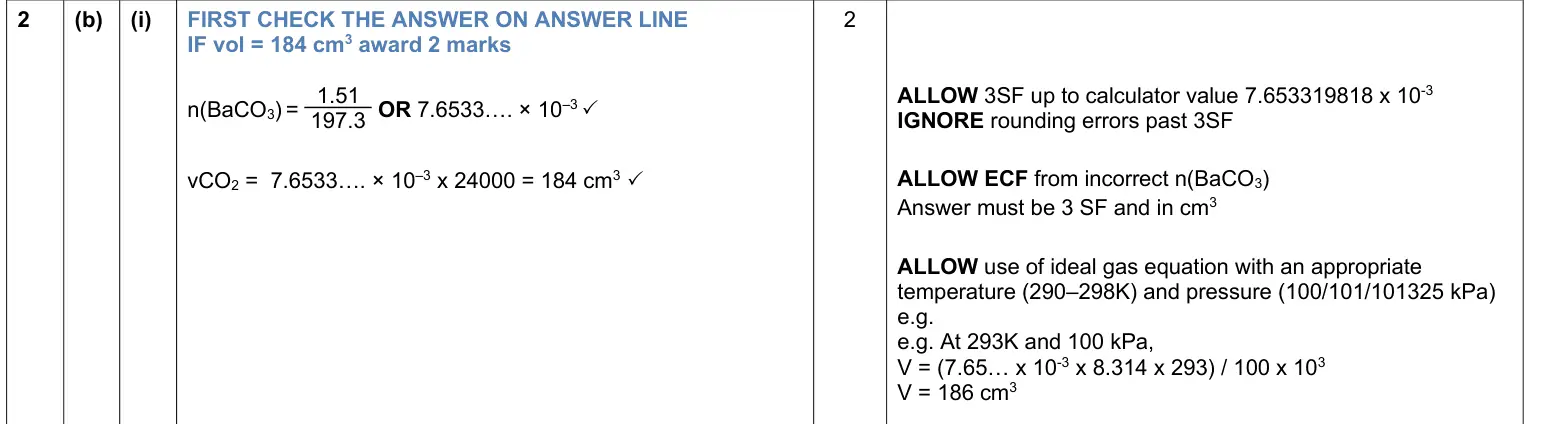
(b) A student adds 1.51 g of barium carbonate, BaCO3 (molar mass 197.3 g mol–1), to an excess of
dilute nitric acid. The equation is shown below.
BaCO3(s) + 2HNO3(aq) Ba(NO3)2(aq) + H2O(l) + CO2(g)
The student uses the following apparatus.
250 cm3 measuring cylinder
Stopper
Barium carbonate
and dilute nitric acid Water
(i) Calculate the volume, in cm3, of gas the student expects to be produced at room temperature
and pressure (RTP).
Give your answer to 3 significant figures.
Volume of gas  .................................................. cm3 [2]
June 2025 · AS Paper 2 · Q3(a)(ii) 1 mark Calculation Medium acids and titrations
Earlier part of question 3 that this part usesEarlier part of June 2025 Paper 2 question 3
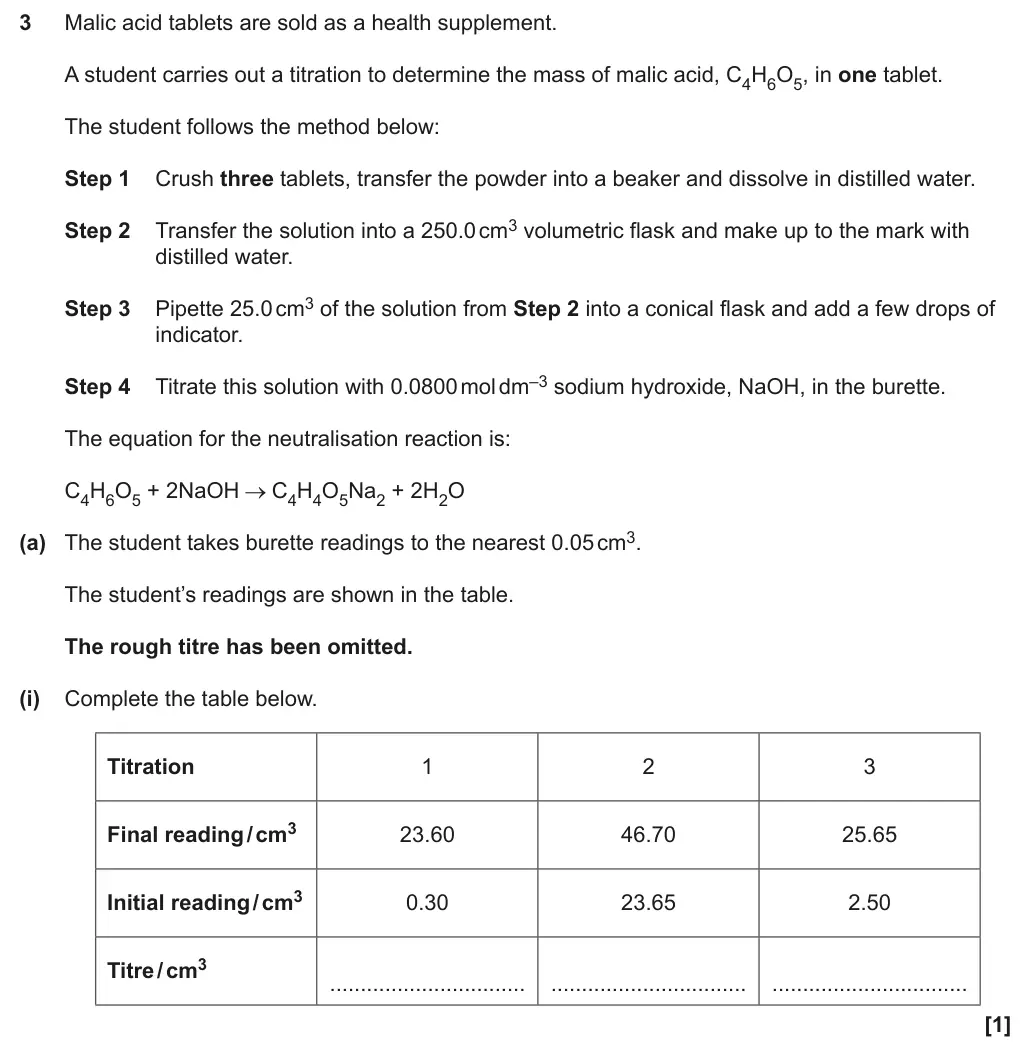
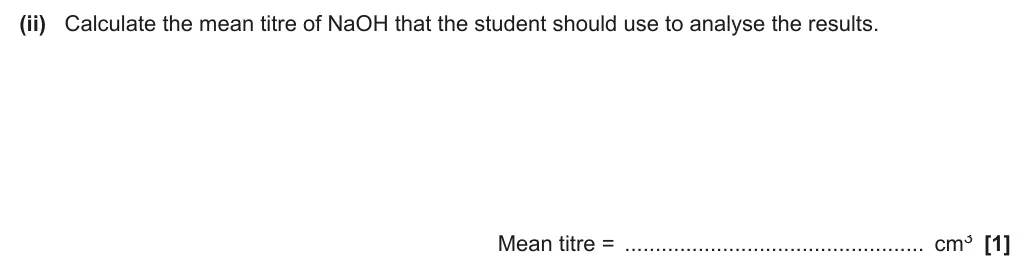
(ii) Calculate the mean titre of NaOH that the student should use to analyse the results.
Mean titre =  ................................................. cm3 [1]
June 2025 · AS Paper 2 · Q3(a)(iii) 5 marks Calculation Easy acids and titrationsamount of substance
Earlier parts of question 3 that this part usesEarlier part of June 2025 Paper 2 question 3Earlier part of June 2025 Paper 2 question 3
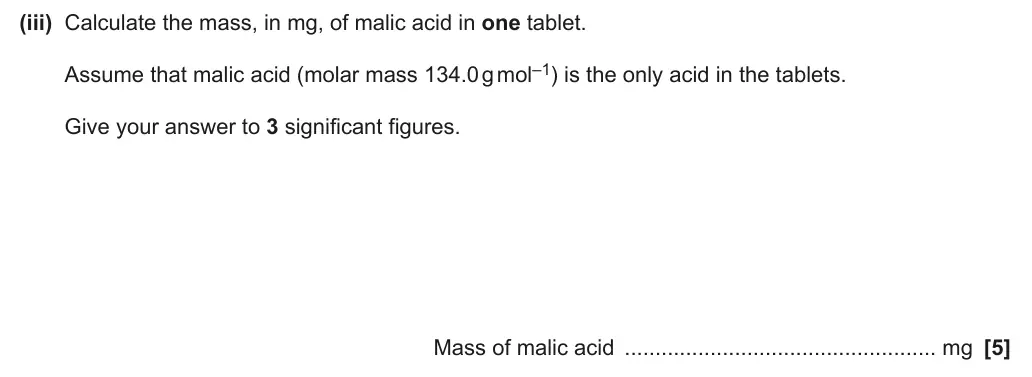
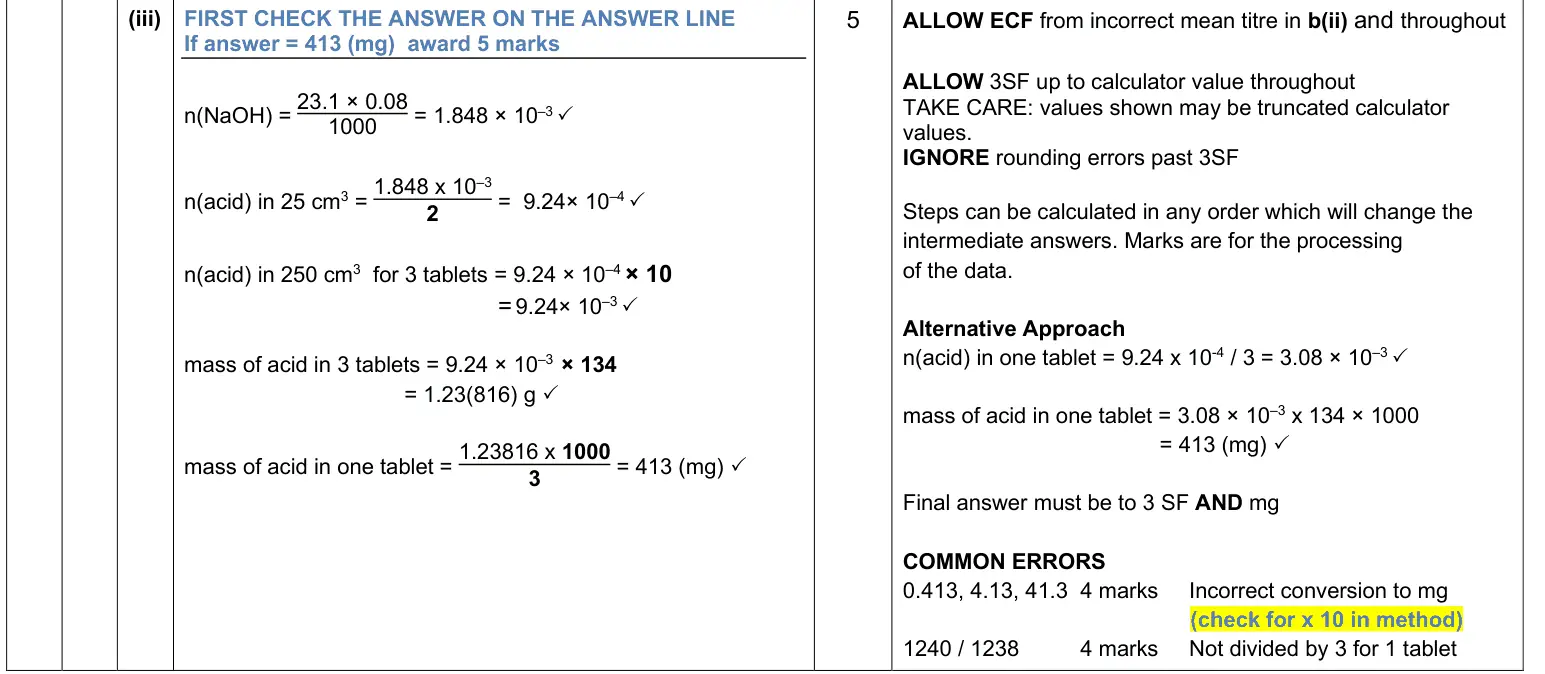
(iii) Calculate the mass, in mg, of malic acid in one tablet.
Assume that malic acid (molar mass 134.0 g mol–1) is the only acid in the tablets.
Give your answer to 3 significant figures.
Mass of malic acid  ................................................... mg [5]
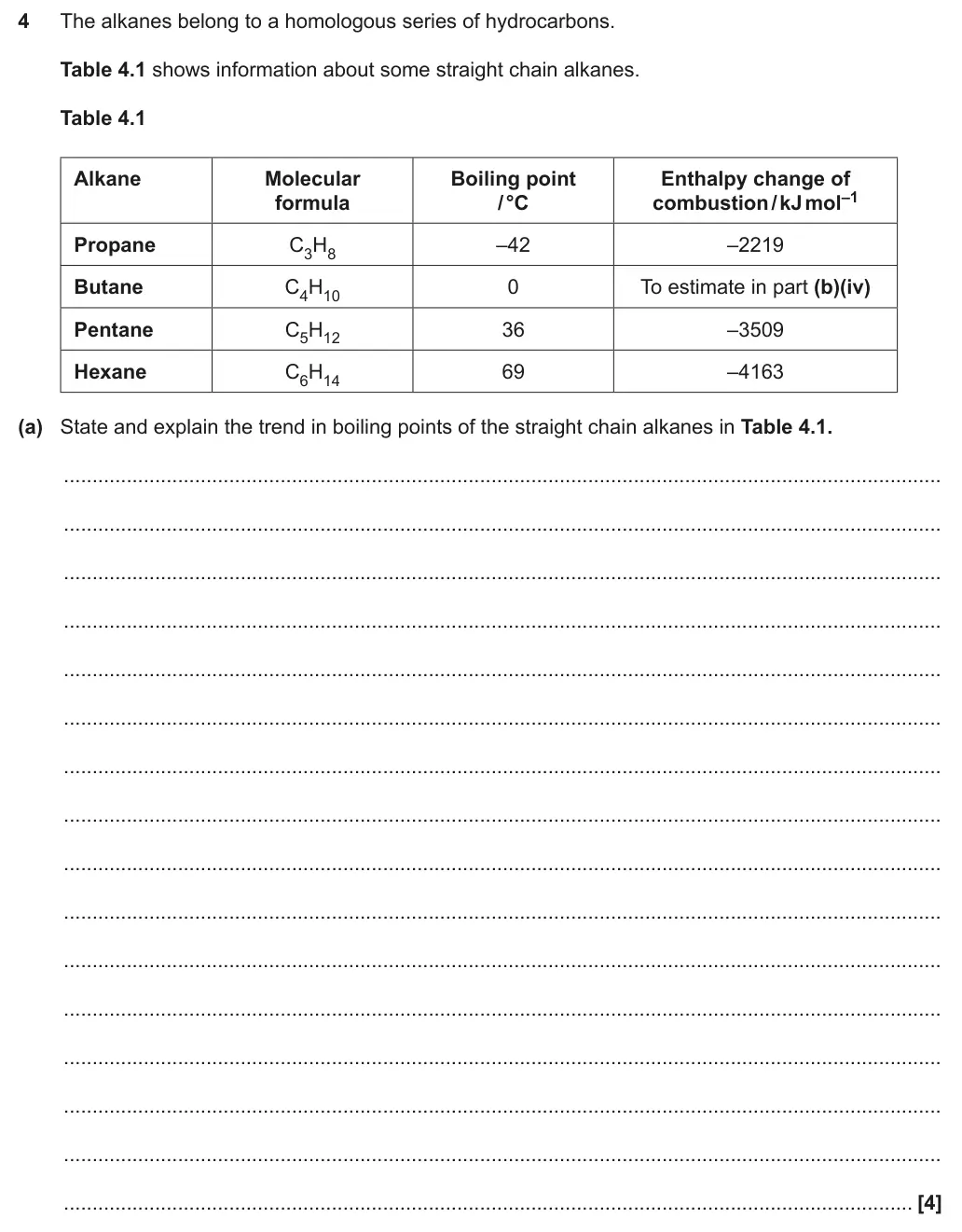
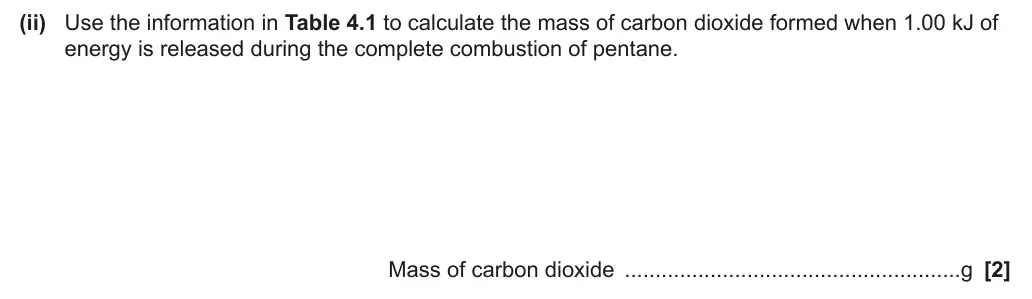
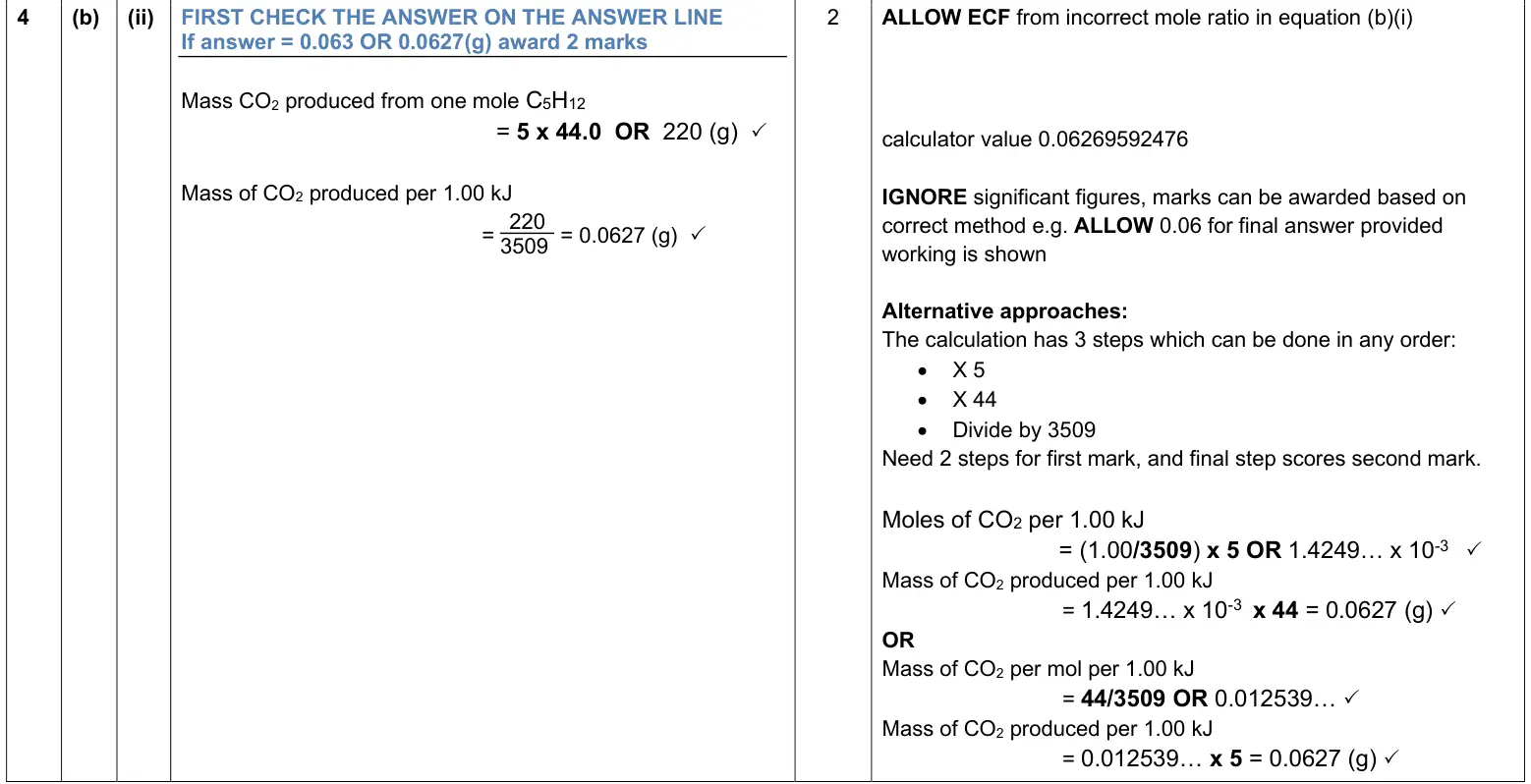
June 2025 · AS Paper 2 · Q4(b)(ii) 2 marks Calculation Medium enthalpy changesamount of substance
Earlier parts of question 4 that this part usesEarlier part of June 2025 Paper 2 question 4Earlier part of June 2025 Paper 2 question 4
(ii) Use the information in Table 4.1 to calculate the mass of carbon dioxide formed when 1.00 kJ of
energy is released during the complete combustion of pentane.
Mass of carbon dioxide  .......................................................g [2]
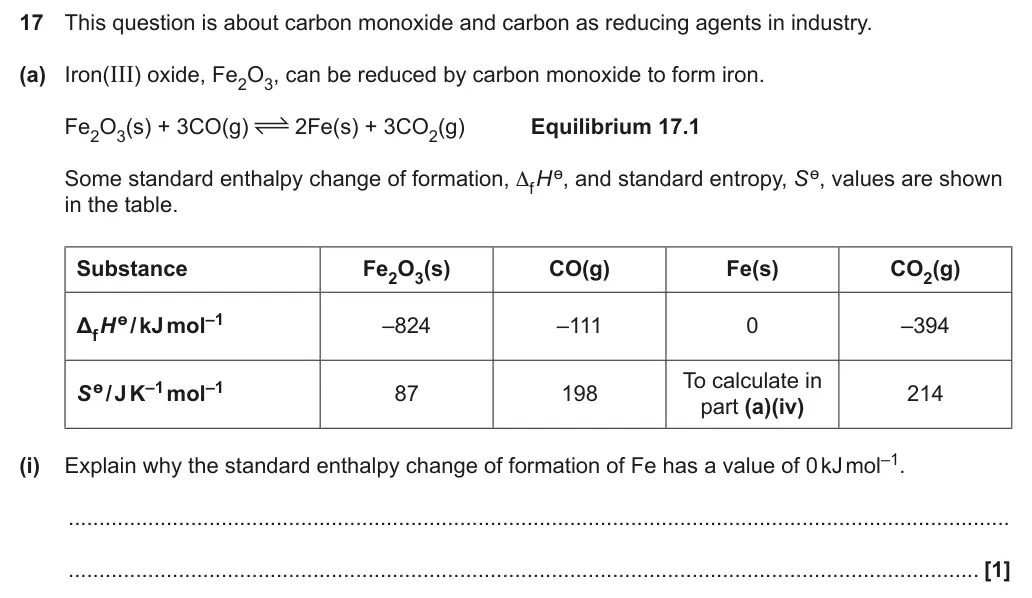
June 2025 · Paper 1 · Q17(a)(ii) 2 marks Calculation Hard enthalpy changes
Earlier part of question 17 that this part usesEarlier part of June 2025 Paper 1 question 17
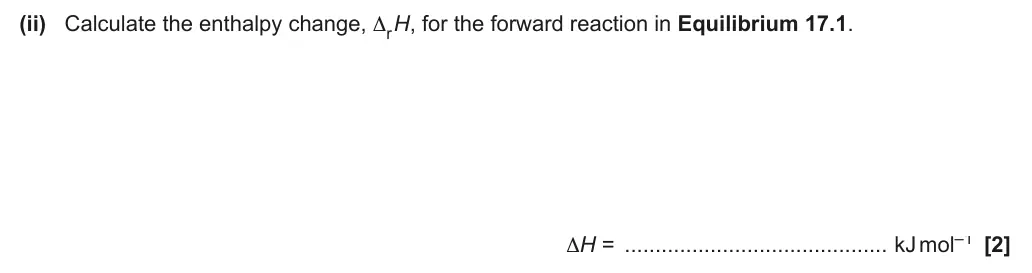
(ii) Calculate the enthalpy change, ΔrH, for the forward reaction in Equilibrium 17.1.
ΔH =  ........................................... kJ mol–1 [2]
June 2025 · Paper 1 · Q17(a)(iv) 2 marks Calculation Medium entropy and free energy
Earlier part of question 17 that this part usesEarlier part of June 2025 Paper 1 question 17
(iv) The standard entropy change, ΔSɵ, for the forward reaction in Equilibrium 17.1 has a value of
+15 J K–1 mol–1.
Use data from the table to calculate the standard entropy, S ɵ, of Fe.
Sɵ =  ....................................... J K–1 mol–1 [2]
June 2025 · Paper 1 · Q17(b) 3 marks Calculation Medium entropy and free energy
(b) Carbon can also reduce Fe2O3(s) to iron as shown in Equilibrium 17.2.
Fe2O3(s) + 3C(g) 3CO(g) + 2Fe(s) Equilibrium 17.2
ΔH = +491 kJ mol–1
ΔS = +543 J K–1 mol–1
The forward reaction is only feasible at high temperatures.
• Show that the forward reaction is not feasible at 100 °C.
• Calculate the minimum temperature, in K, for the forward reaction to be feasible.
Give the minimum temperature to the nearest whole number.
T =  ..................................................... K [3]
June 2025 · Paper 1 · Q17(c)(ii) 3 marks Calculation Hard equilibrium constants
Earlier part of question 17 that this part usesEarlier part of June 2025 Paper 1 question 17
(ii) An equal number of moles of steam and carbon monoxide are left at 700 K in a sealed container
until equilibrium is reached.
At equilibrium, both H2 and CO2 have a partial pressure of 211 kPa.
Calculate the partial pressures of H2O and CO at equilibrium.
Partial pressure of H2O =  ........................................................ kPa
Partial pressure of CO =  ........................................................ kPa
[3]
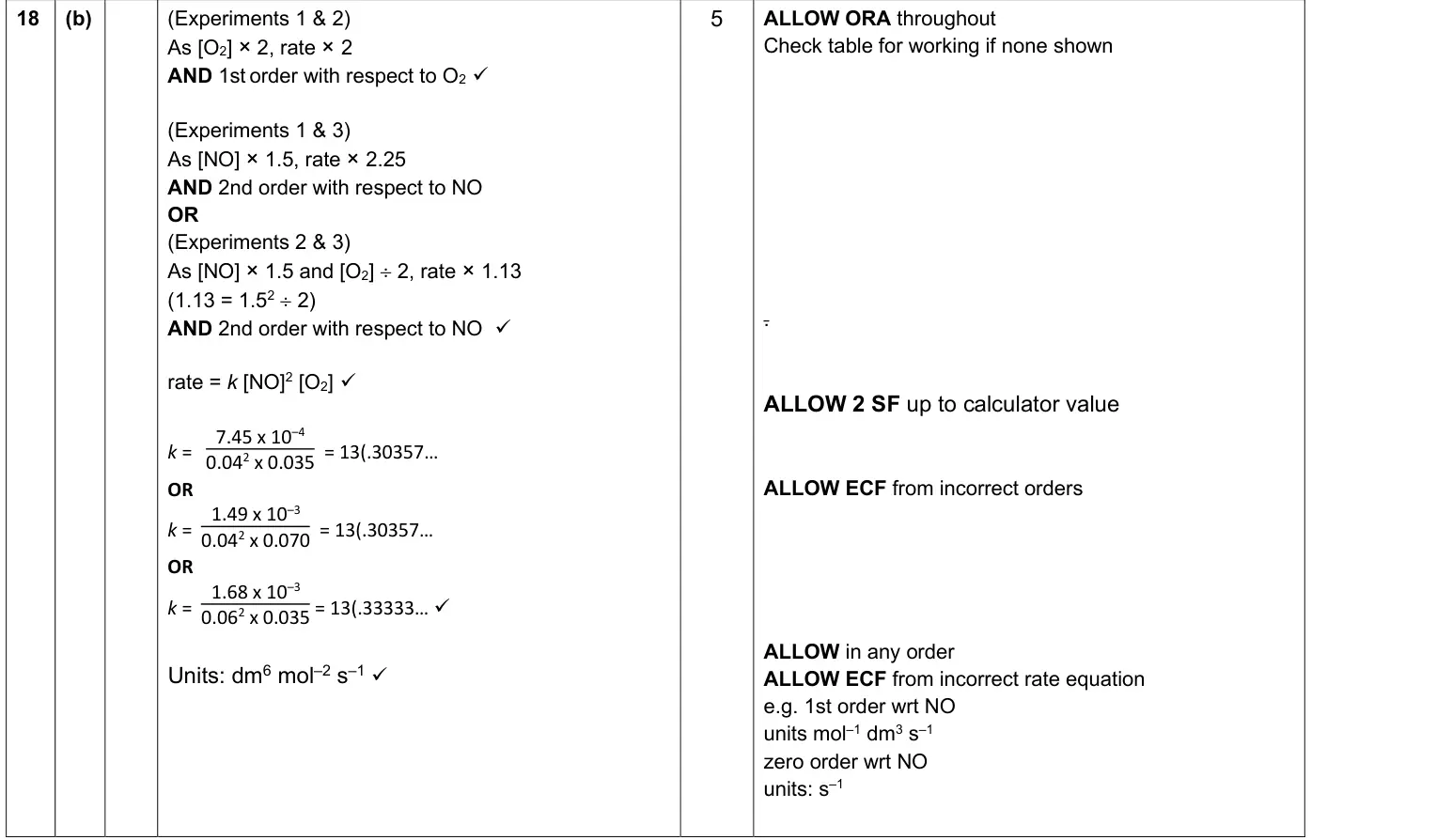
June 2025 · Paper 1 · Q18(b) 5 marks Calculation Hard rate equations
Earlier part of question 18 that this part usesEarlier part of June 2025 Paper 1 question 18
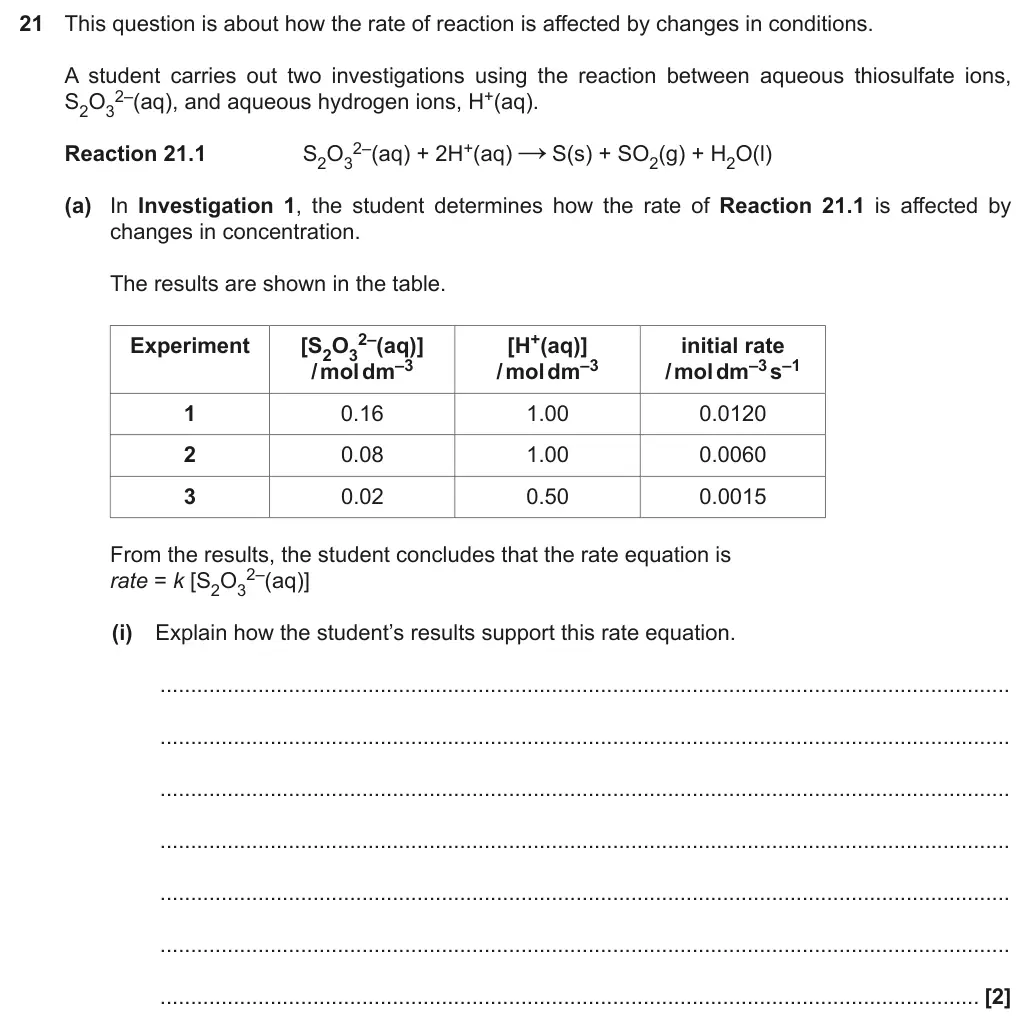
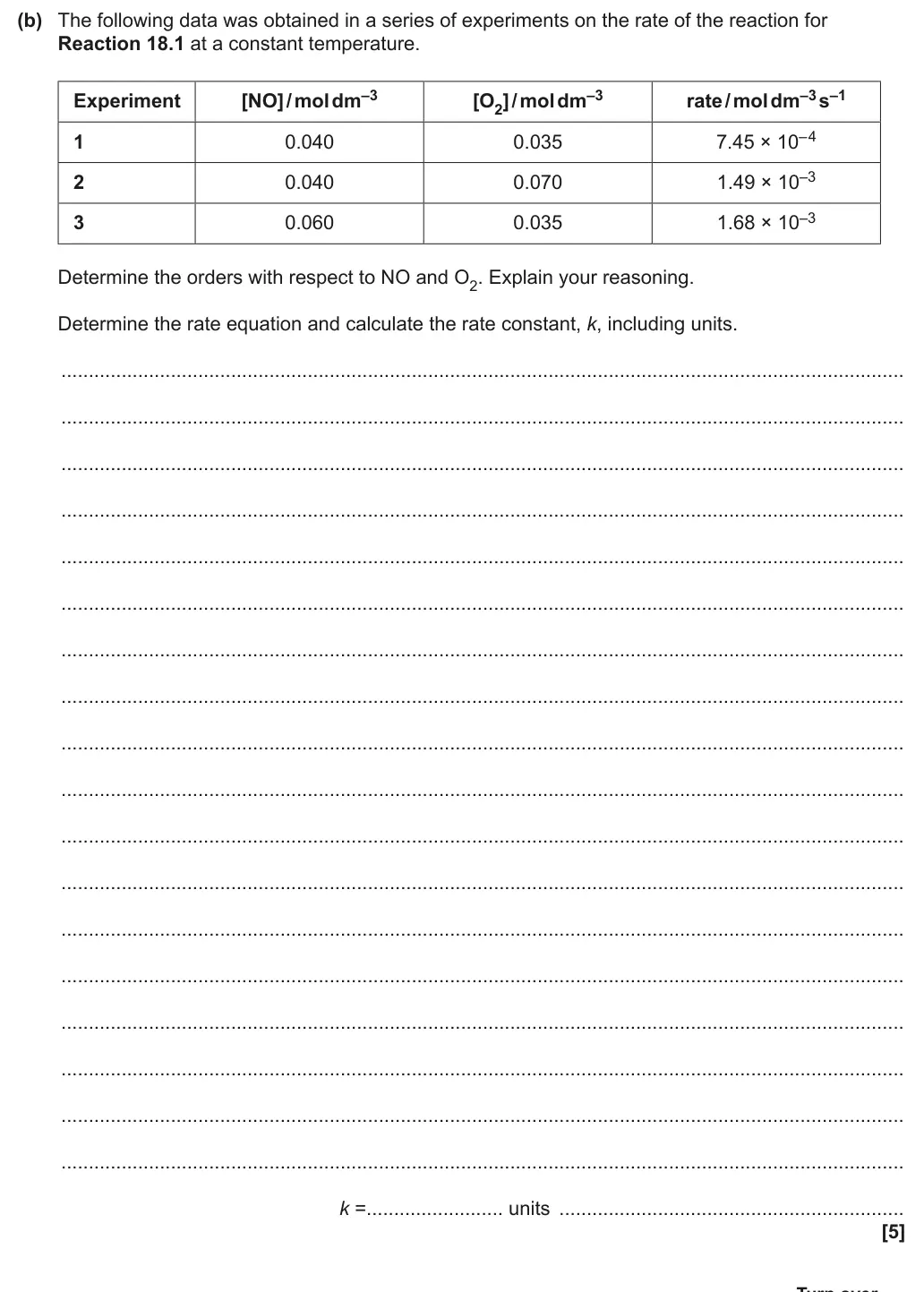
(b) The following data was obtained in a series of experiments on the rate of the reaction for
Reaction 18.1 at a constant temperature.
Experiment [NO] / mol dm–3 [O2] / mol dm–3 rate / mol dm–3 s–1
1 0.040 0.035 7.45 × 10– 4
2 0.040 0.070 1.49 × 10⁻³
3 0.060 0.035 1.68 × 10⁻³
Determine the orders with respect to NO and O2. Explain your reasoning.
Determine the rate equation and calculate the rate constant, k, including units.
..........................................................................................................................................................
..........................................................................................................................................................
..........................................................................................................................................................
..........................................................................................................................................................
..........................................................................................................................................................
..........................................................................................................................................................
..........................................................................................................................................................
..........................................................................................................................................................
..........................................................................................................................................................
..........................................................................................................................................................
..........................................................................................................................................................
..........................................................................................................................................................
..........................................................................................................................................................
..........................................................................................................................................................
..........................................................................................................................................................
..........................................................................................................................................................
..........................................................................................................................................................
..........................................................................................................................................................
k =......................... units  ...............................................................
[5]
June 2025 · Paper 1 · Q18(c)(ii) 4 marks Calculation Medium rate equationspractical skills
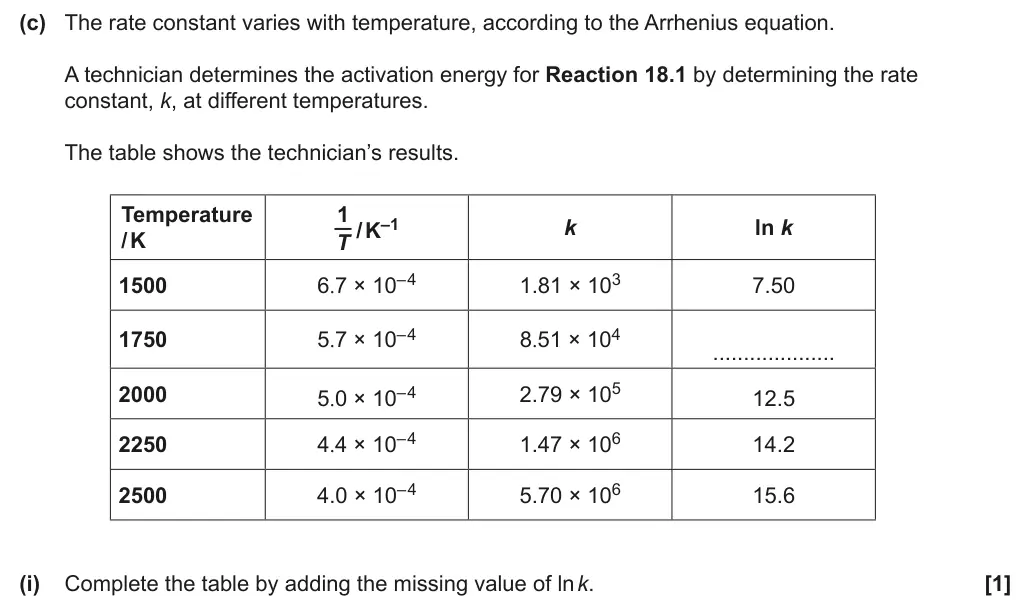
Earlier parts of question 18 that this part usesEarlier part of June 2025 Paper 1 question 18Earlier part of June 2025 Paper 1 question 18
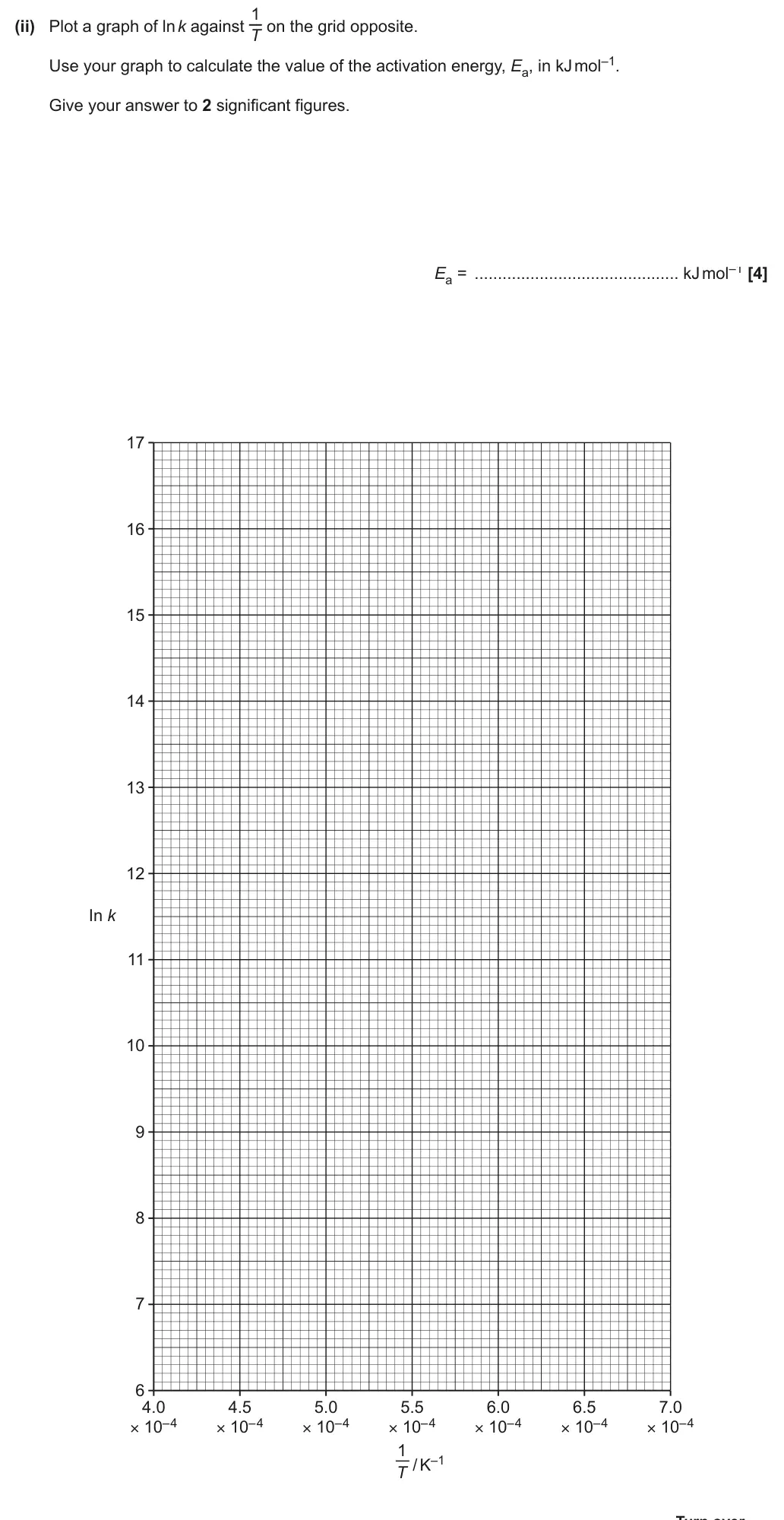
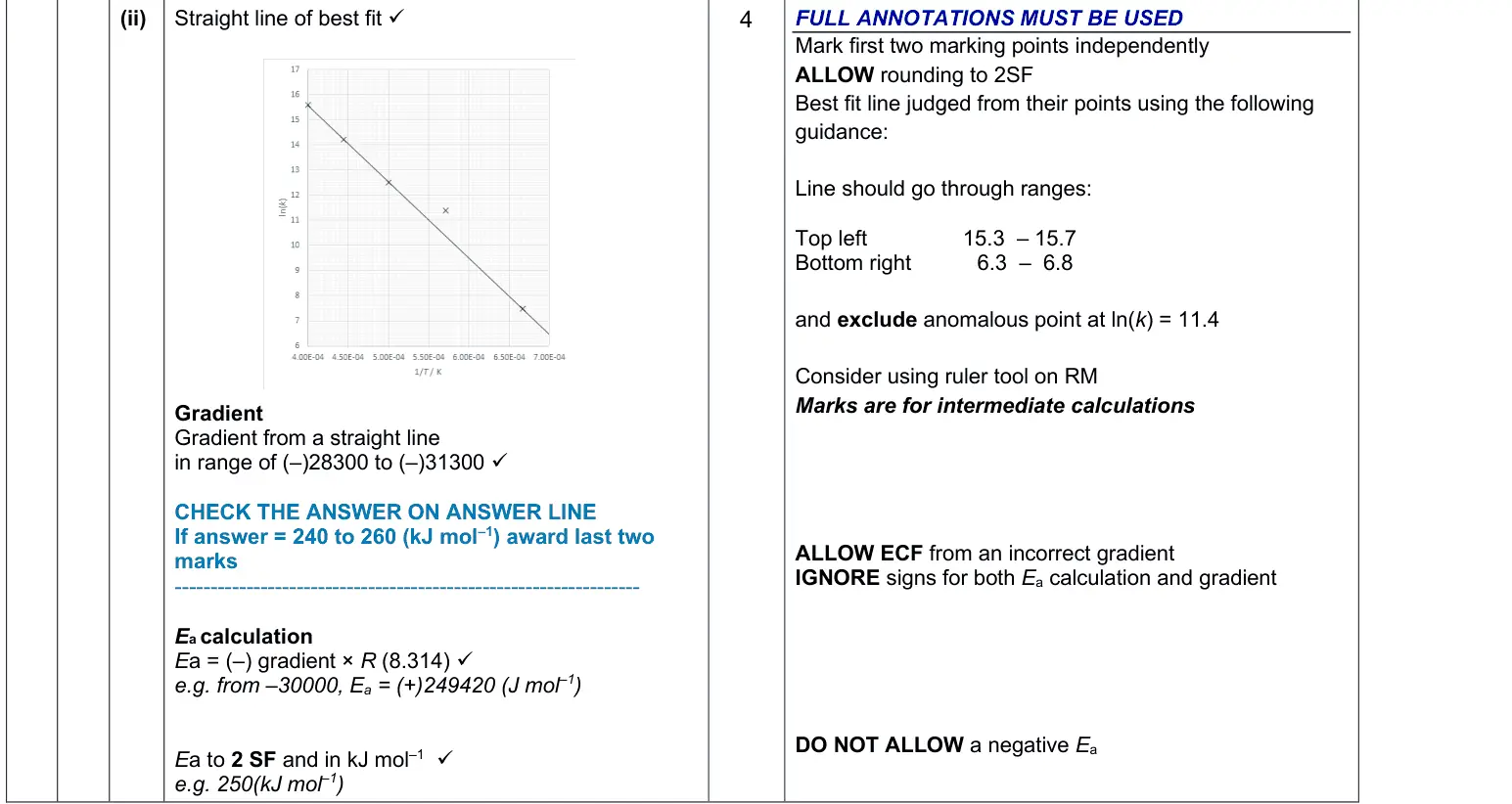
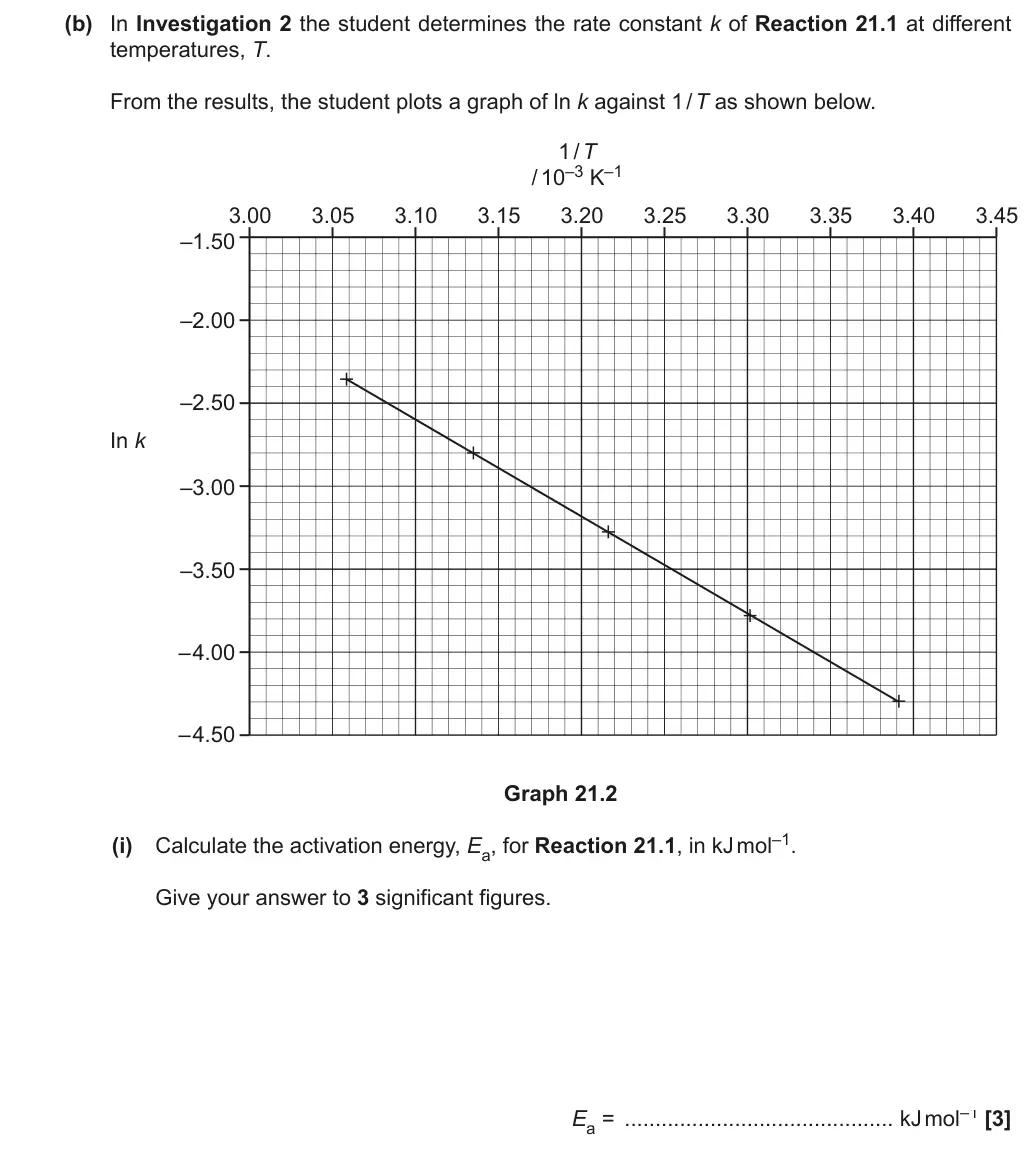
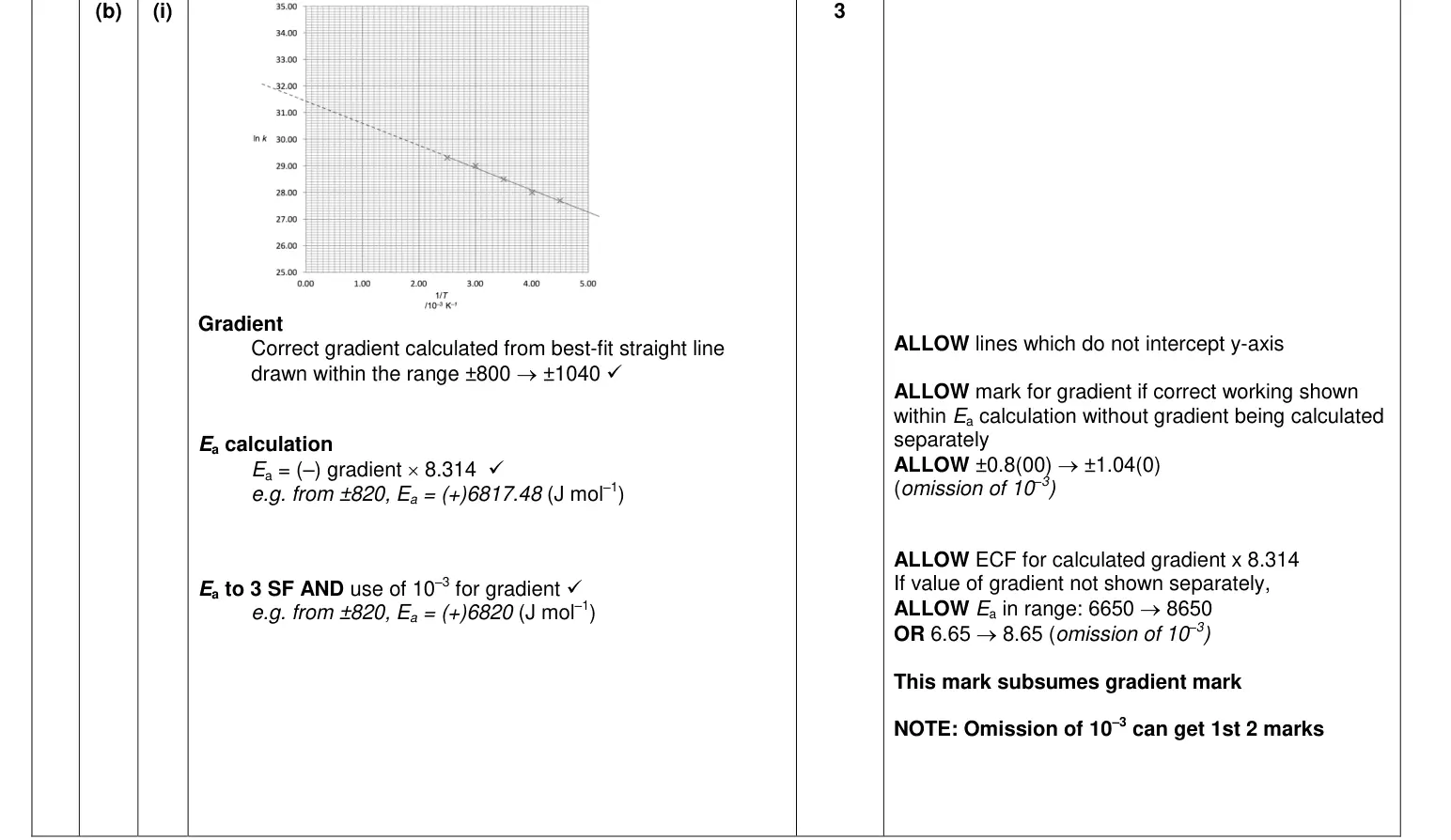
(ii) Plot a graph of ln k against 1
T on the grid opposite.
Use your graph to calculate the value of the activation energy, Ea, in kJ mol–1.
Give your answer to 2 significant figures.
Ea =  ............................................ kJ mol–1 [4]
June 2025 · Paper 1 · Q19(a) 1 mark Calculation Hard acids bases and buffers
17
16
15
14
13
12
In k
11
10
9
8
7
6
4.0 4.5 5.0 5.5 6.0 6.5 7.0
× 10– 4 × 10– 4 × 10– 4 × 10– 4 × 10– 4 × 10– 4 × 10– 4
1
T / K–1
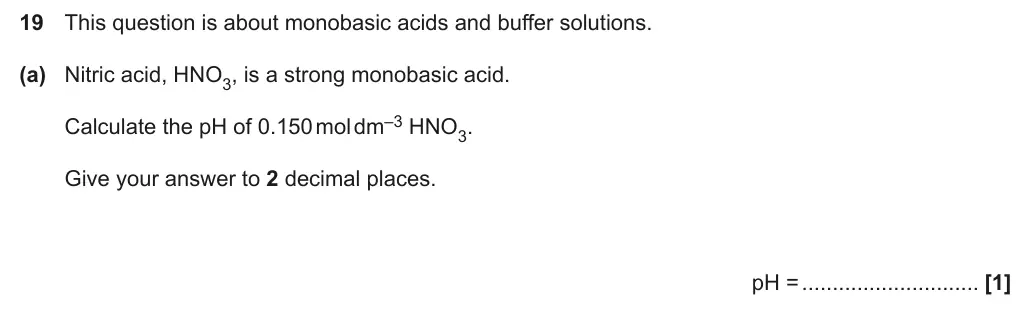
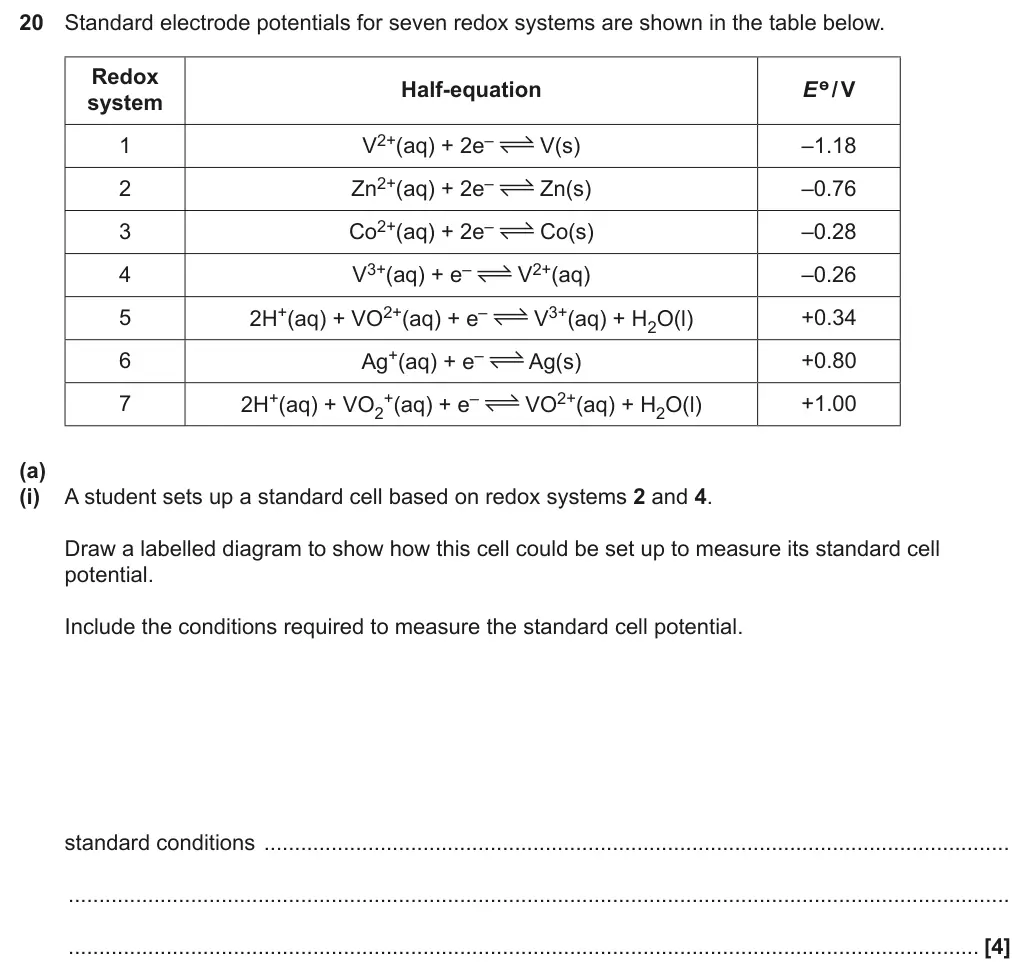
19  This question is about monobasic acids and buffer solutions.
(a) Nitric acid, HNO3, is a strong monobasic acid.
Calculate the pH of 0.150 mol dm–3 HNO3.
Give your answer to 2 decimal places.
pH = ............................. [1]
June 2025 · Paper 1 · Q20(a)(ii) 1 mark Calculation Easy redox and electrode potentials
Earlier part of question 20 that this part usesEarlier part of June 2025 Paper 1 question 20
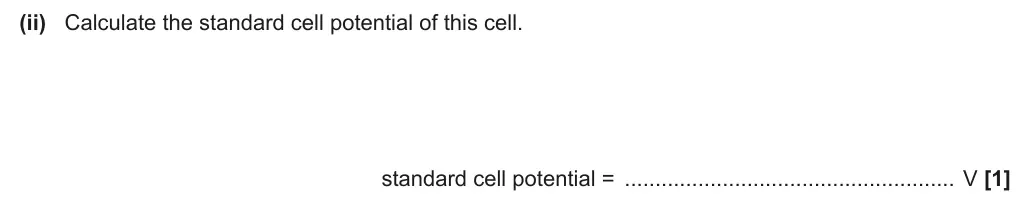
(ii) Calculate the standard cell potential of this cell.
standard cell potential =  ...................................................... V [1]
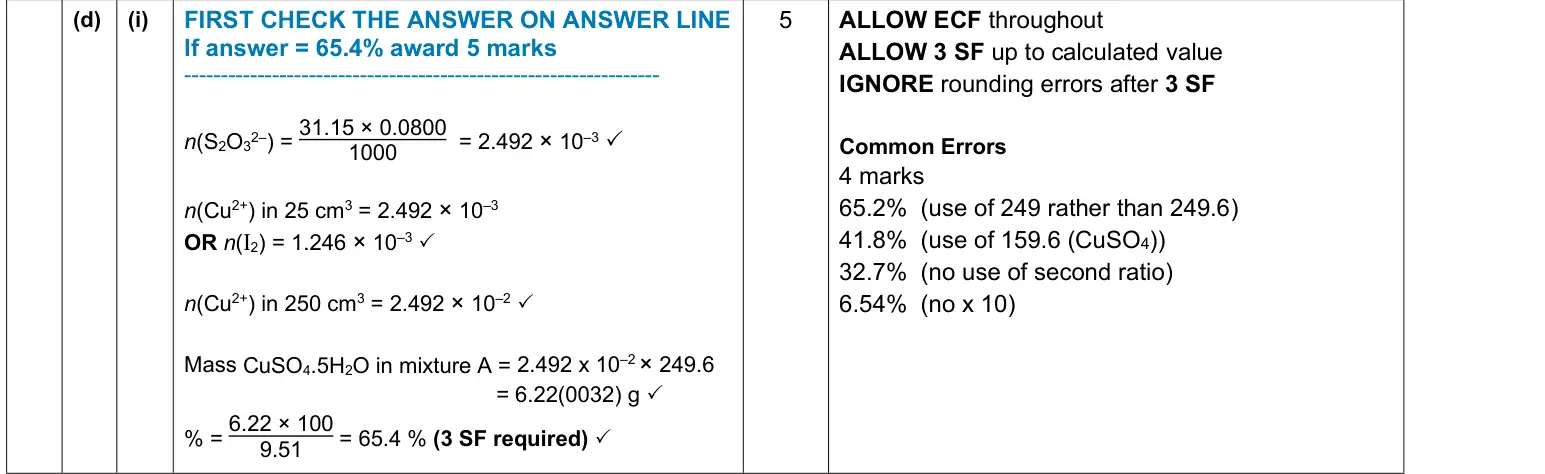
June 2025 · Paper 1 · Q21(d)(i) 5 marks Calculation Easy redox and electrode potentialsamount of substance
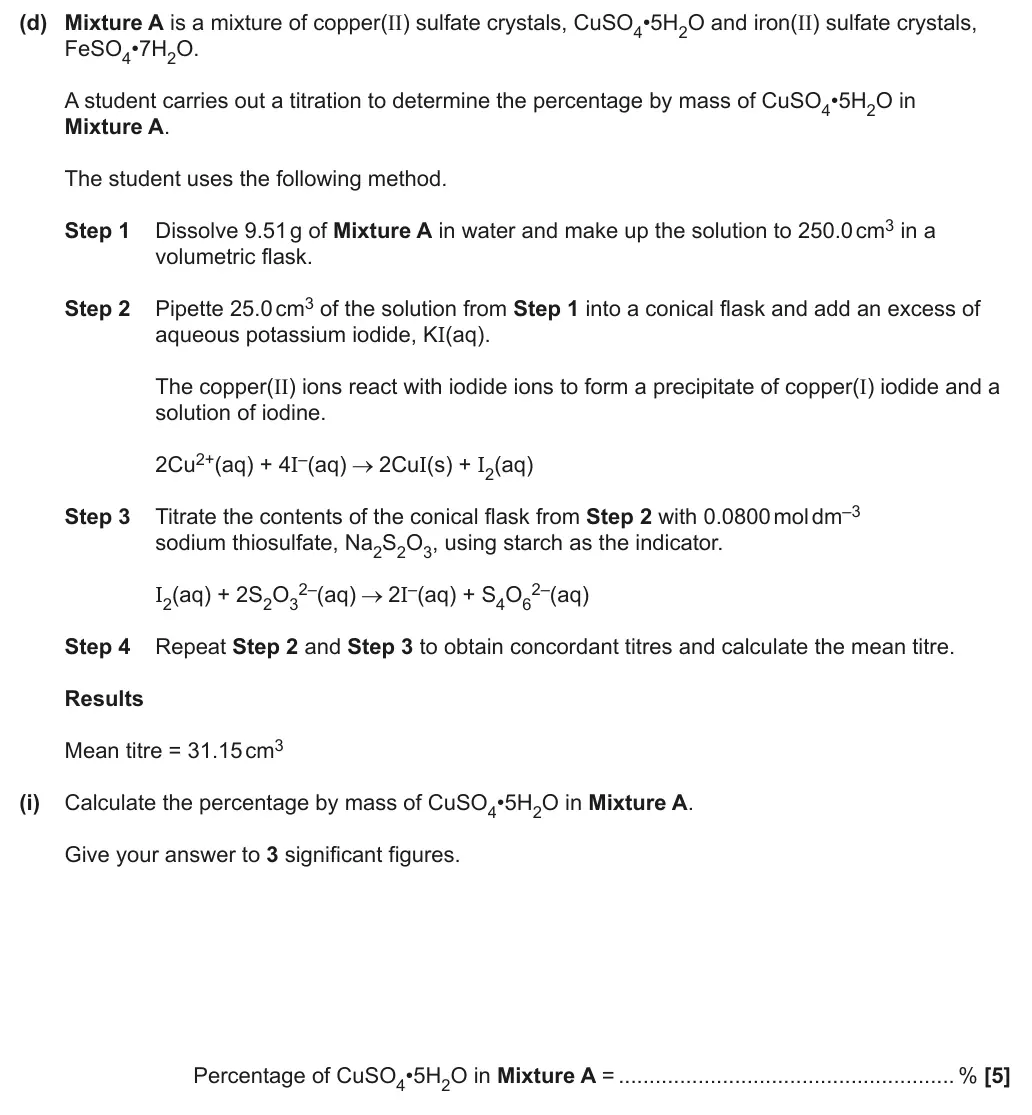
(d)  Mixture A is a mixture of copper(II) sulfate crystals, CuSO4•5H2O and iron(II) sulfate crystals,
FeSO4•7H2O.
A student carries out a titration to determine the percentage by mass of CuSO4•5H2O in
Mixture A.
The student uses the following method.
Step 1   Dissolve 9.51 g of Mixture A in water and make up the solution to 250.0 cm3 in a
volumetric flask.
Step 2   Pipette 25.0 cm3 of the solution from Step 1 into a conical flask and add an excess of
aqueous potassium iodide, KI(aq).
The copper(II) ions react with iodide ions to form a precipitate of copper(I) iodide and a
solution of iodine.
2Cu2+(aq) + 4I–(aq) 2CuI(s) + I2(aq)
Step 3   Titrate the contents of the conical flask from Step 2 with 0.0800 mol dm–3
sodium thiosulfate, Na2S2O3, using starch as the indicator.
I2(aq) + 2S2O3 2–(aq) 2I–(aq) + S4O6 2–(aq)
Step 4  Repeat Step 2 and Step 3 to obtain concordant titres and calculate the mean titre.
Results
Mean titre = 31.15 cm3
(i) Calculate the percentage by mass of CuSO4•5H2O in Mixture A.
Give your answer to 3 significant figures.
Percentage of CuSO4•5H2O in Mixture A = ....................................................... % [5]
June 2025 · Paper 3 · Q2(a)(ii) 3 marks Calculation Easy amount of substance
Earlier part of question 2 that this part usesEarlier part of June 2025 Paper 3 question 2
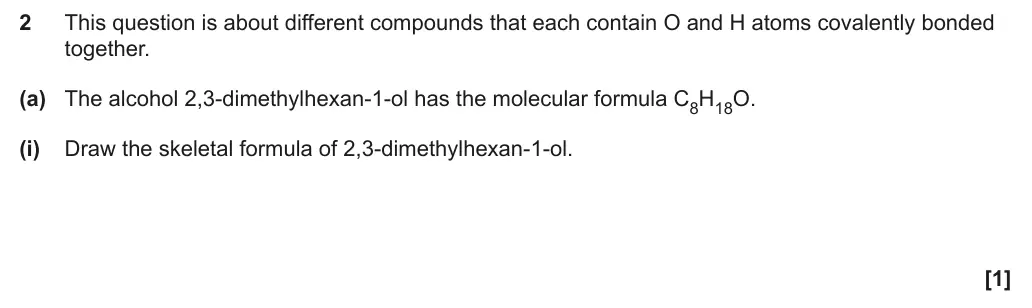
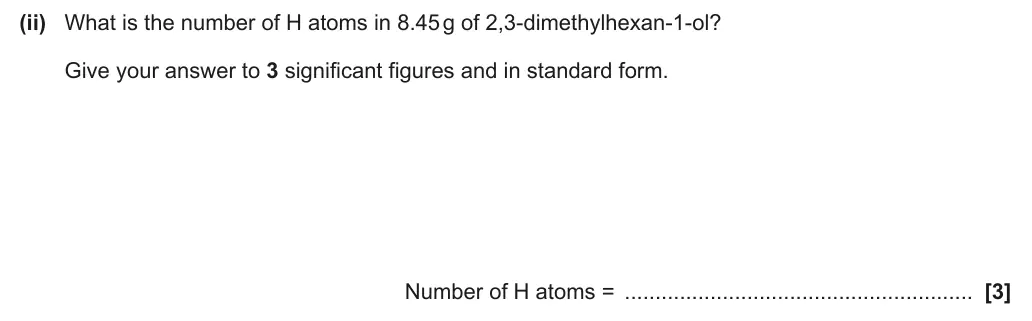
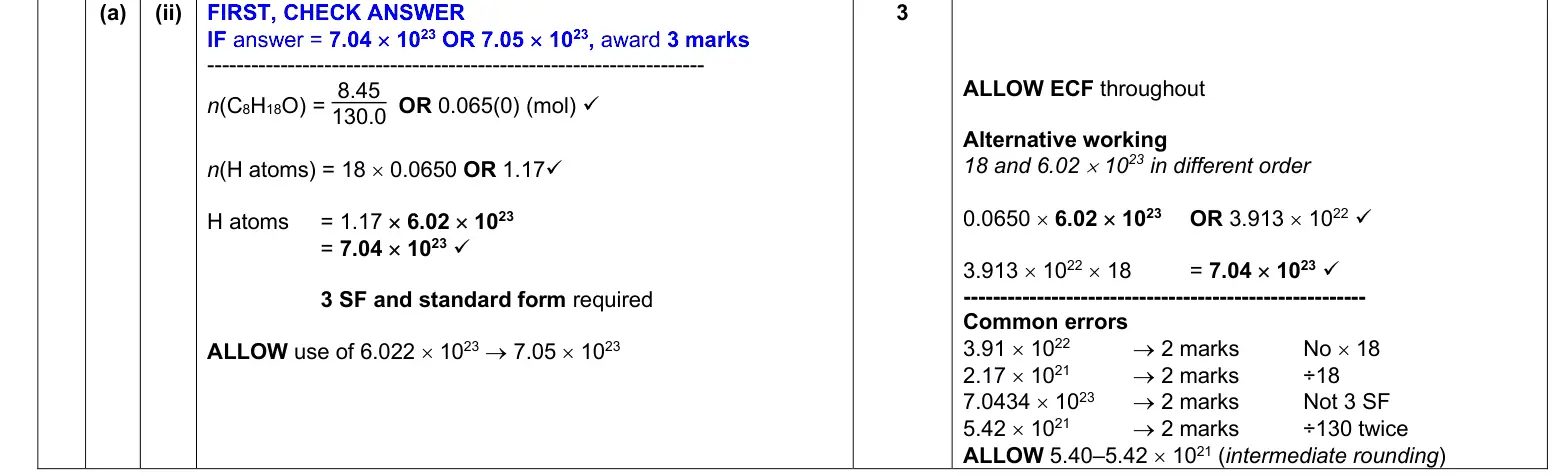
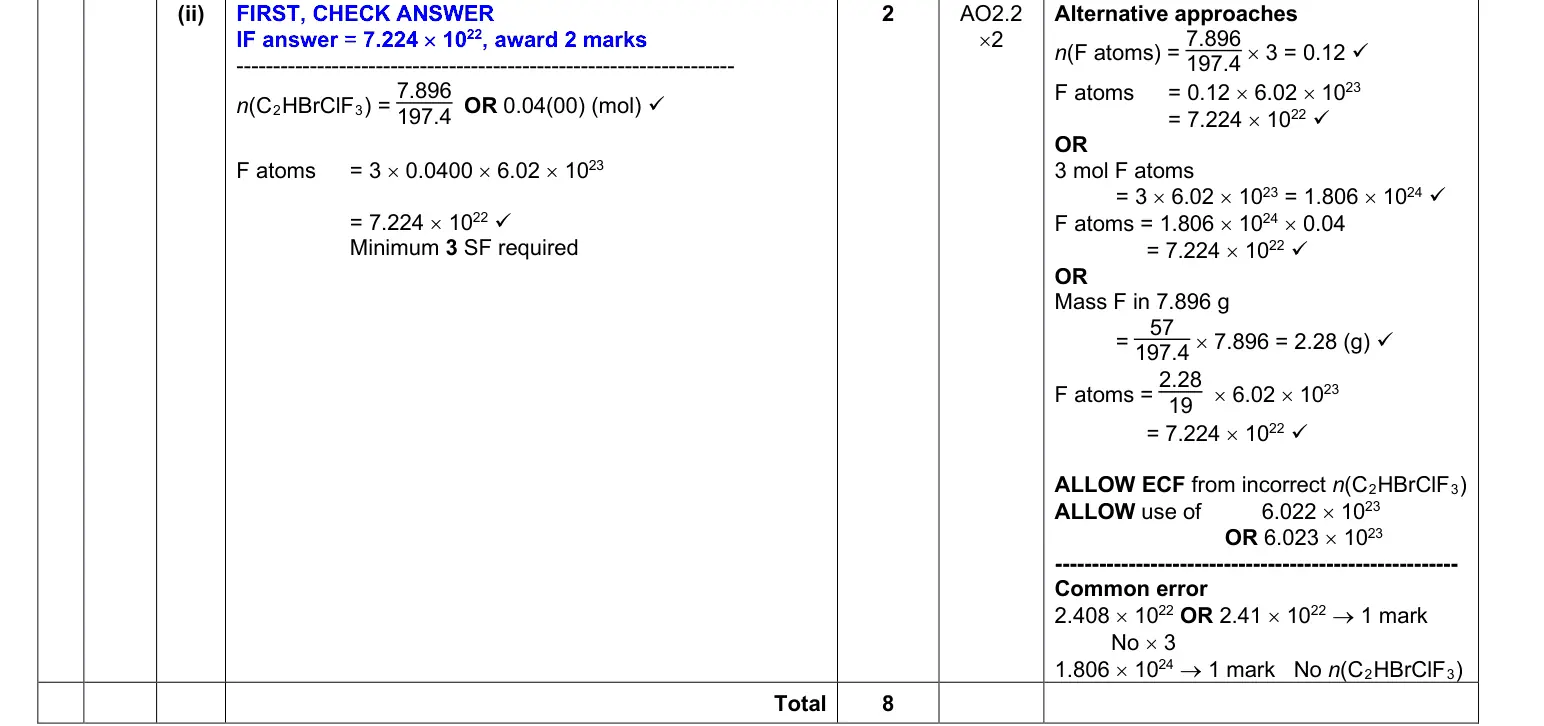
(ii) What is the number of H atoms in 8.45 g of 2,3‑dimethylhexan‑1‑ol?
Give your answer to 3 significant figures and in standard form.
Number of H atoms =  ......................................................... [3]
June 2025 · Paper 3 · Q2(b)(ii) 4 marks Calculation Medium amount of substance
Earlier part of question 2 that this part usesEarlier part of June 2025 Paper 3 question 2
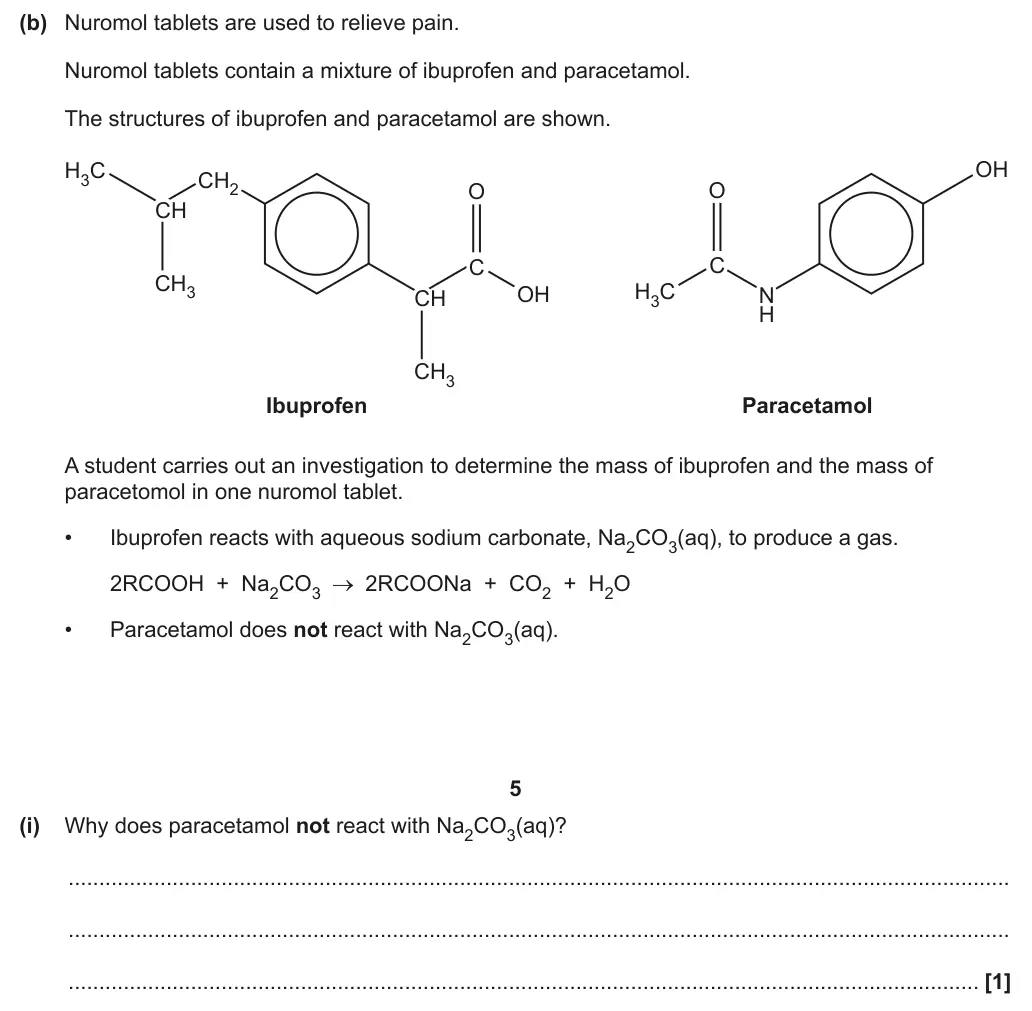
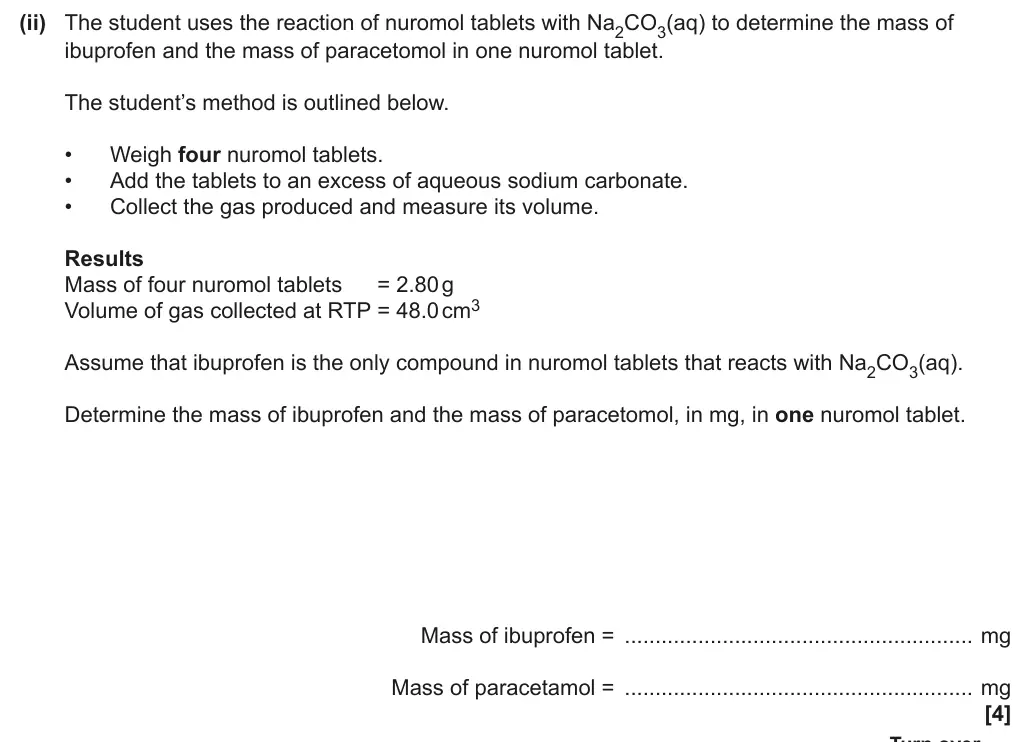
(ii) The student uses the reaction of nuromol tablets with Na2CO3(aq) to determine the mass of
ibuprofen and the mass of paracetomol in one nuromol tablet.
The student’s method is outlined below.
• Weigh four nuromol tablets.
• Add the tablets to an excess of aqueous sodium carbonate.
• Collect the gas produced and measure its volume.
Results
Mass of four nuromol tablets = 2.80 g
Volume of gas collected at RTP = 48.0 cm3
Assume that ibuprofen is the only compound in nuromol tablets that reacts with Na2CO3(aq).
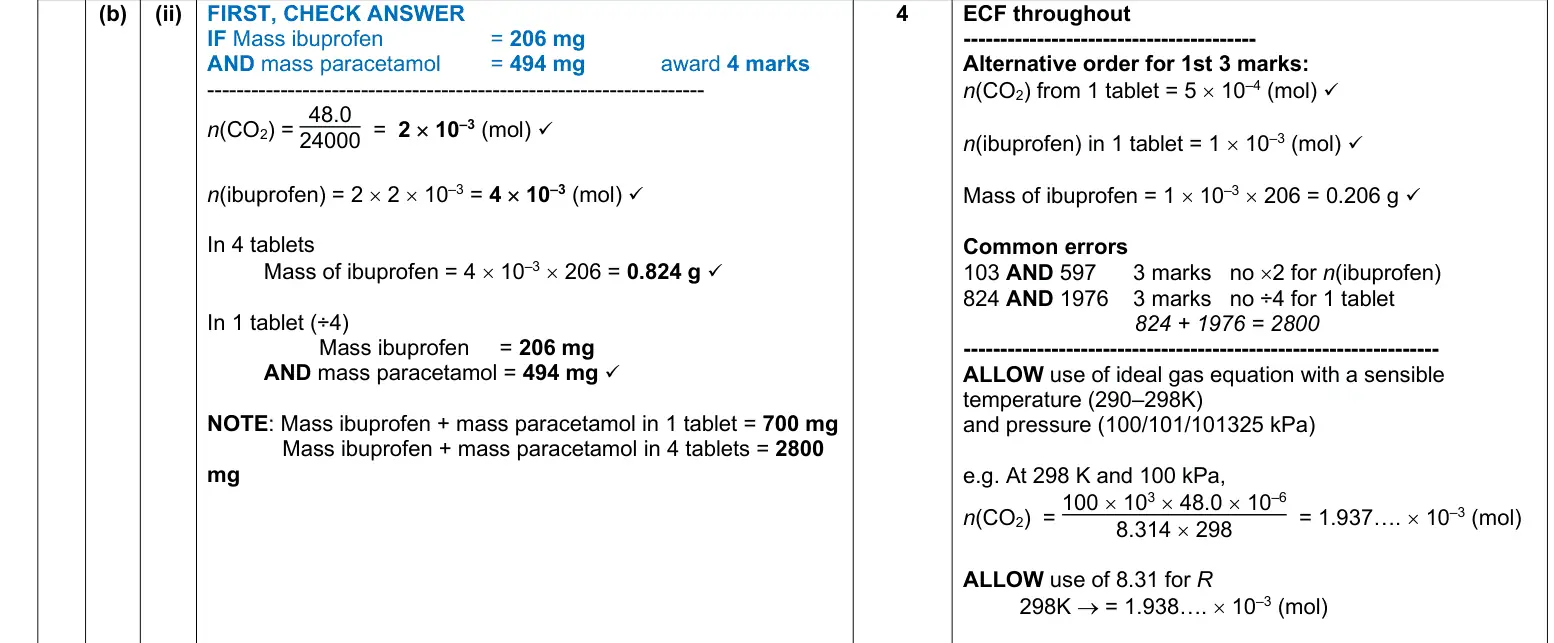
Determine the mass of ibuprofen and the mass of paracetomol, in mg, in one nuromol tablet.
Mass of ibuprofen =  ......................................................... mg
Mass of paracetamol =  ......................................................... mg
[4]
June 2025 · Paper 3 · Q2(c) 5 marks Calculation Hard acids bases and buffersamount of substance
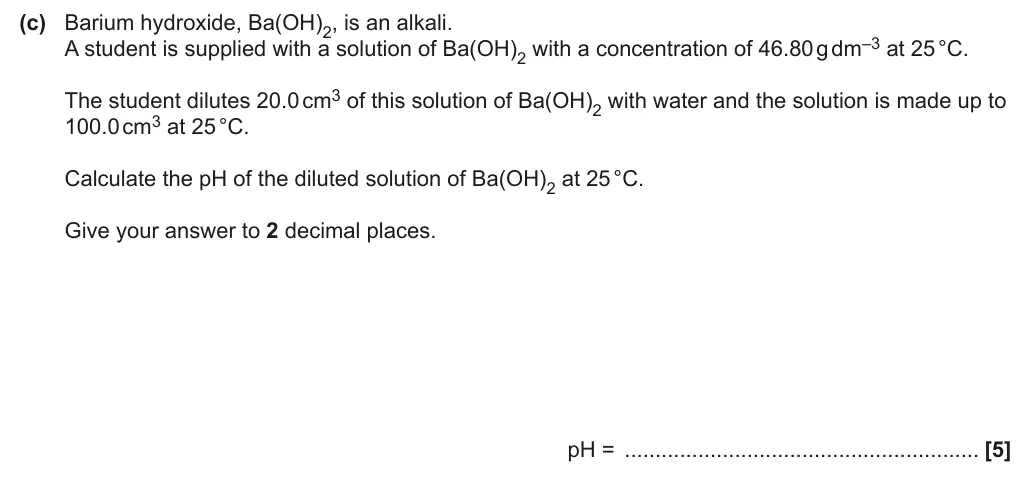
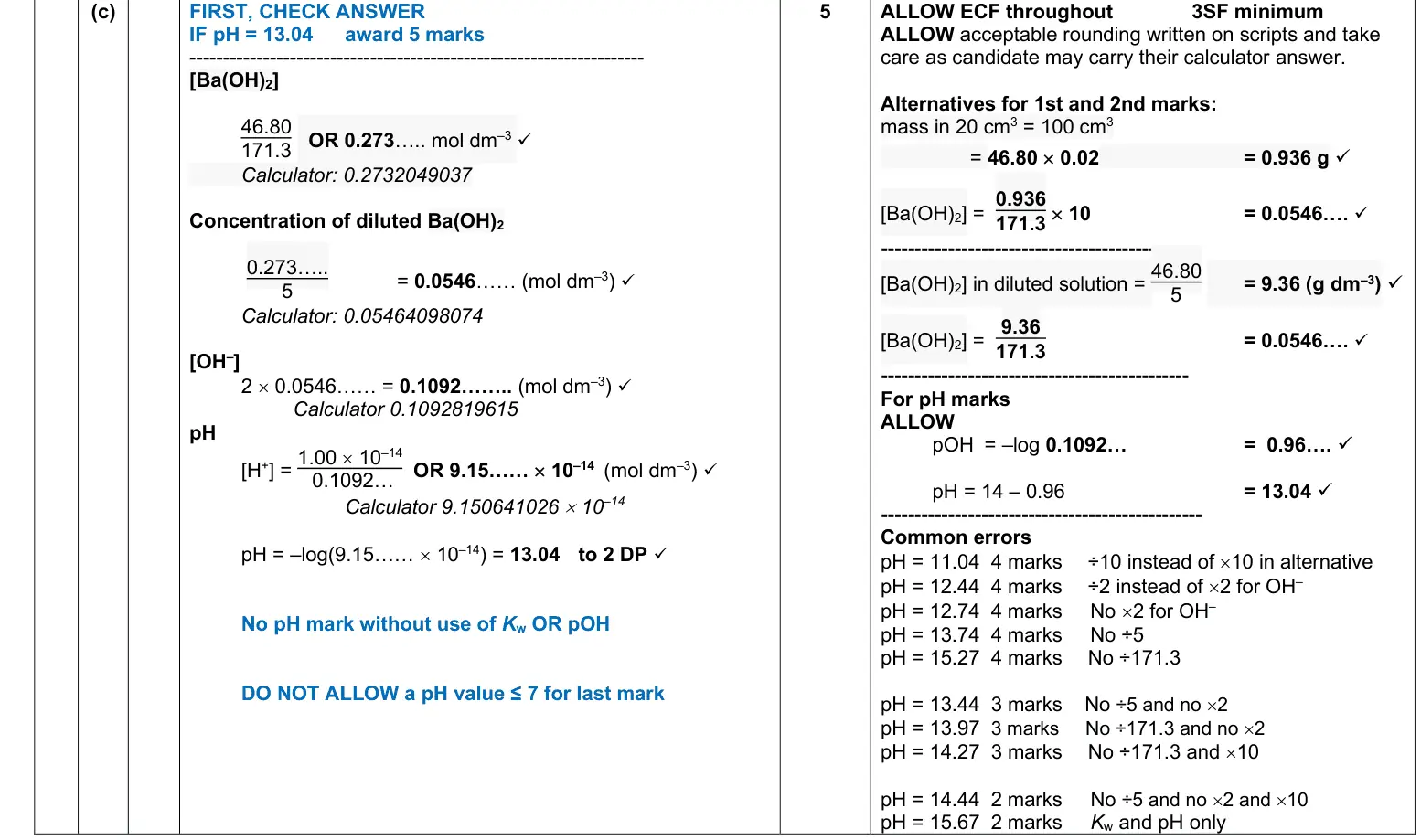
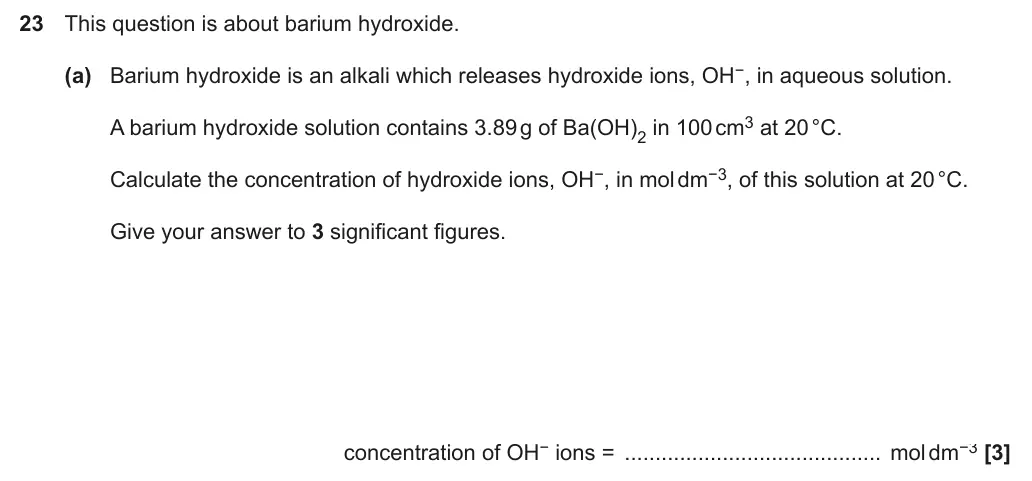
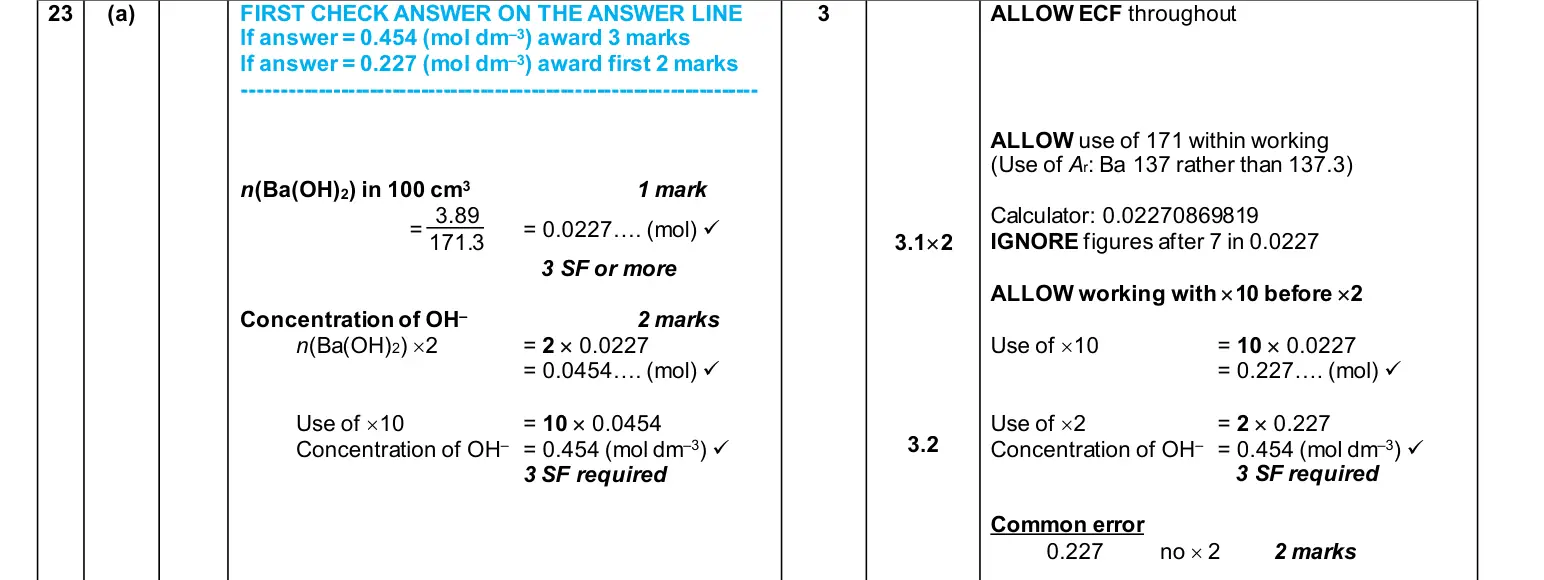
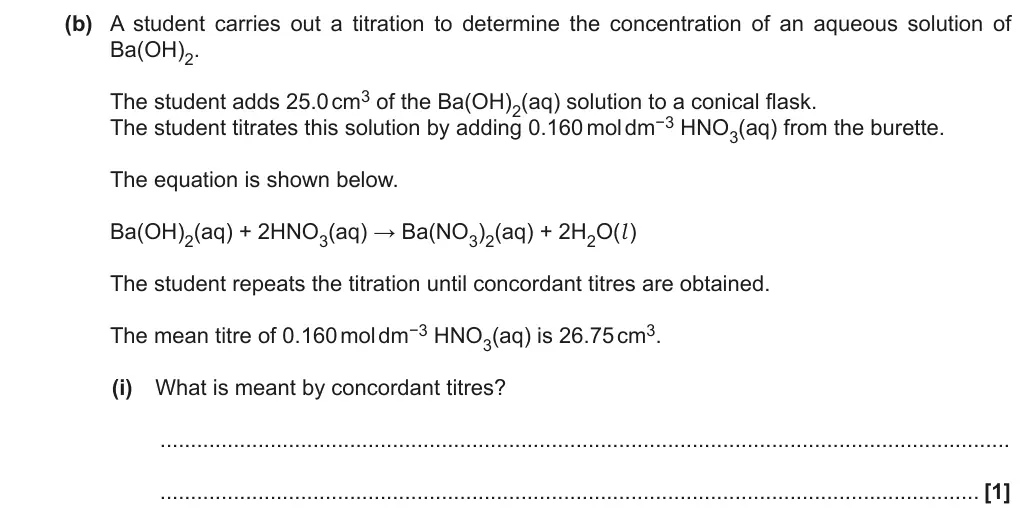
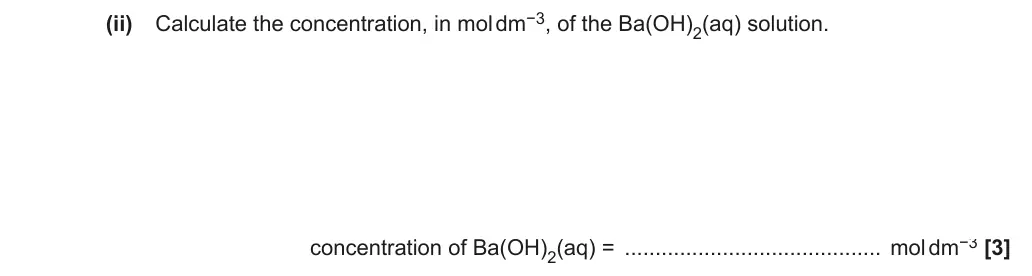
(c) Barium hydroxide, Ba(OH)2, is an alkali.
A student is supplied with a solution of Ba(OH)2 with a concentration of 46.80 g dm–3 at 25 °C.
The student dilutes 20.0 cm3 of this solution of Ba(OH)2 with water and the solution is made up to
100.0 cm3 at 25 °C.
Calculate the pH of the diluted solution of Ba(OH)2 at 25 °C.
Give your answer to 2 decimal places.
pH =  .......................................................... [5]
June 2025 · Paper 3 · Q3(a) 5 marks Calculation Easy chemical equilibriumpractical skillsequilibrium constants
3 This question is about equilibrium and rates.
(a) Methanol, CH3OH, can be made industrially by the reaction of carbon monoxide, CO, with
hydrogen, H2, in the presence of a catalyst. This is a reversible reaction.
The equilibrium below is set up.
CO(g)  +  2H2(g) CH3OH(g) ∆H = –91 kJ mol–1
The concentrations of CO(g) and CH3OH(g) in the equilibrium mixture are shown in the table
below.
CO(g) CH3OH(g)
equilibrium concentration / mol dm–3 0.27 0.11
The value of the equilibrium constant, Kc, for this reaction is 1.8 dm6 mol–2.
• Explain the conditions of pressure and temperature that would give the maximum equilibrium
yield of CH3OH(g).
• Calculate the concentration of H2(g) in the equilibrium mixture to an appropriate number of
significant figures.
..........................................................................................................................................................
..........................................................................................................................................................
..........................................................................................................................................................
..........................................................................................................................................................
..........................................................................................................................................................
..........................................................................................................................................................
..........................................................................................................................................................
..........................................................................................................................................................
..........................................................................................................................................................
..........................................................................................................................................................
..........................................................................................................................................................
..........................................................................................................................................................
..........................................................................................................................................................
..........................................................................................................................................................
..........................................................................................................................................................
..................................................................................................................................................... [5]
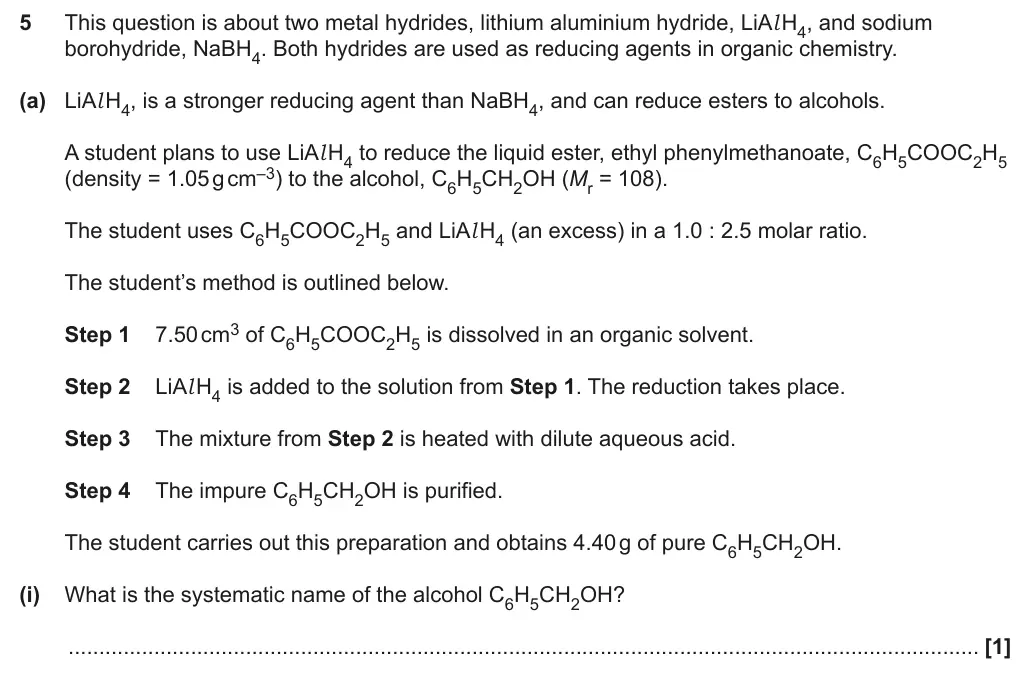
June 2025 · Paper 3 · Q5(a)(ii) 4 marks Calculation Hard amount of substance
Earlier part of question 5 that this part usesEarlier part of June 2025 Paper 3 question 5
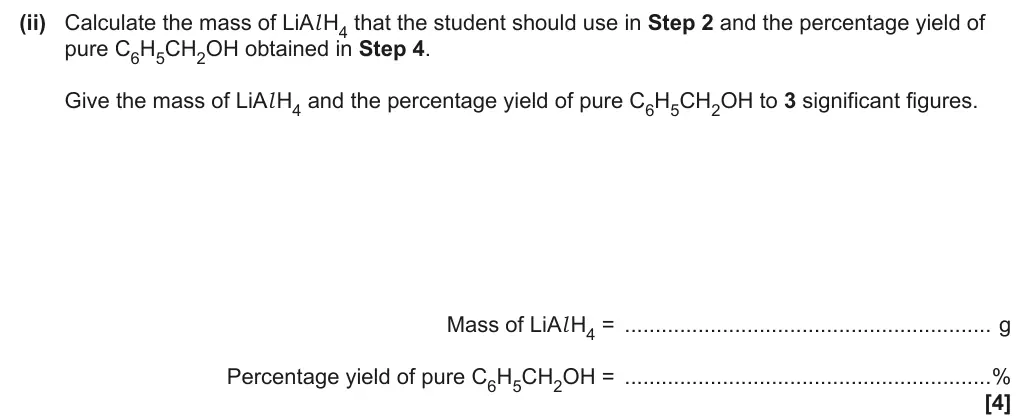
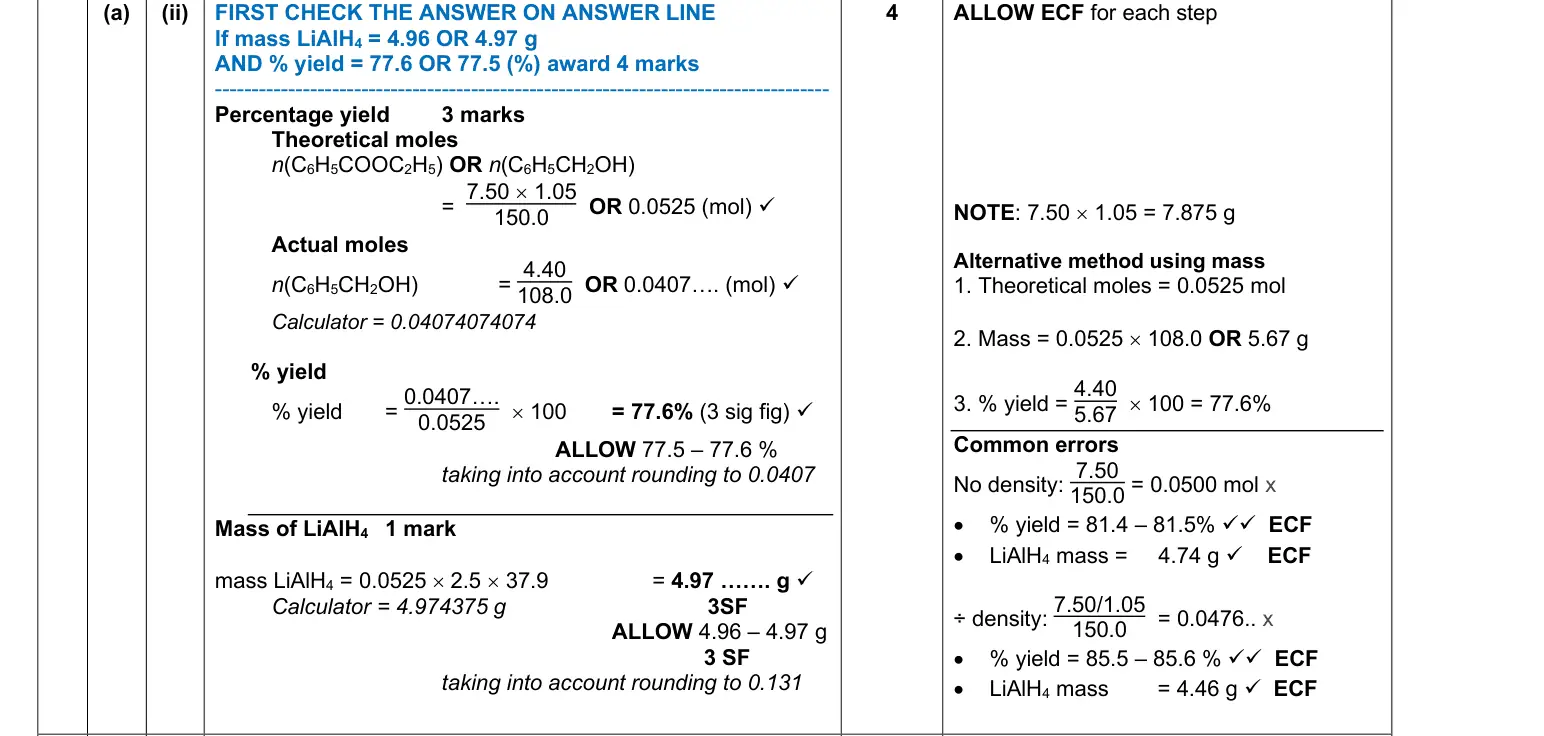
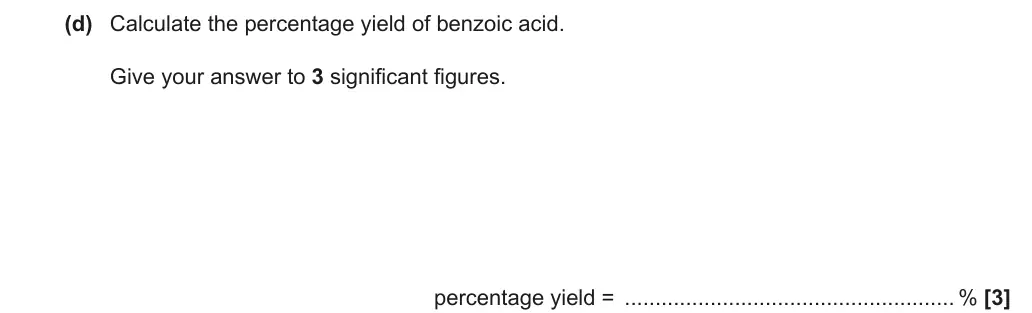
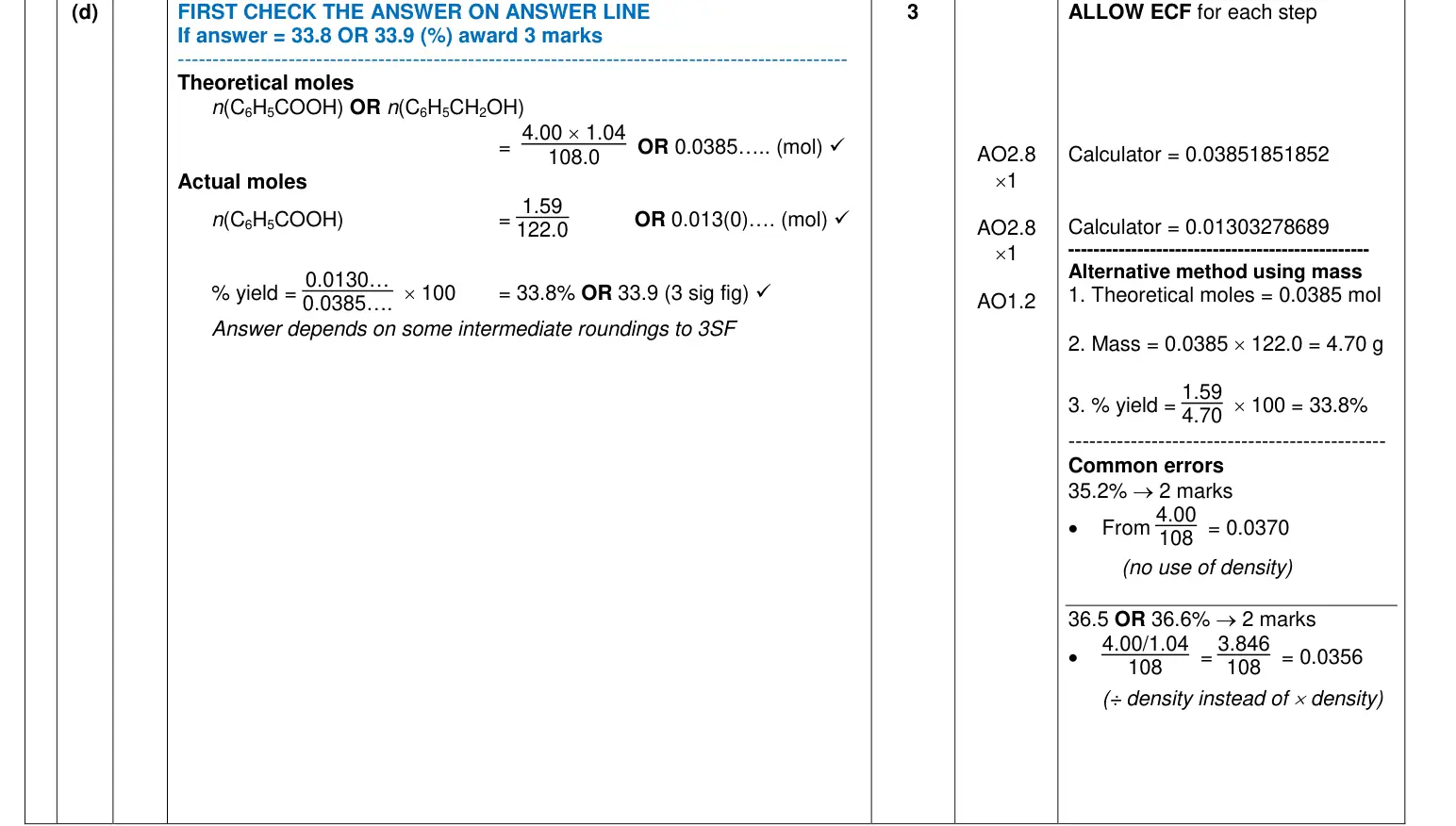
(ii) Calculate the mass of LiAl H4 that the student should use in Step 2 and the percentage yield of
pure C6H5CH2OH obtained in Step 4.
Give the mass of LiAl H4 and the percentage yield of pure C6H5CH2OH to 3 significant figures.
Mass of LiAl H4 =  ............................................................ g
Percentage yield of pure C6H5CH2OH =  ............................................................%
[4]
June 2025 · Paper 3 · Q5(c)(i) 1 mark Calculation Easy redox and electrode potentials
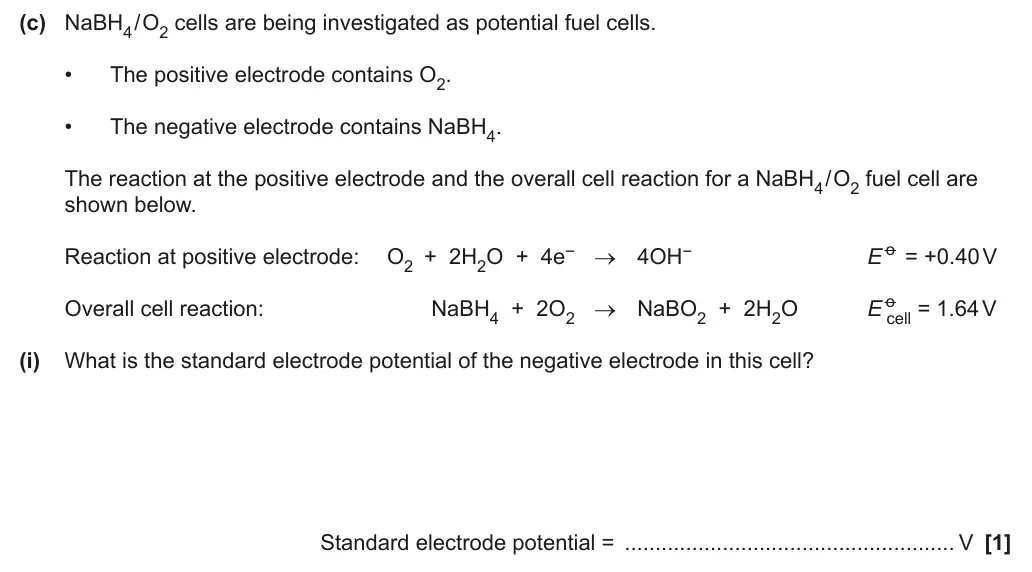
(c) NaBH4 / O2 cells are being investigated as potential fuel cells.
• The positive electrode contains O2.
• The negative electrode contains NaBH4.
The reaction at the positive electrode and the overall cell reaction for a NaBH4 / O2 fuel cell are
shown below.
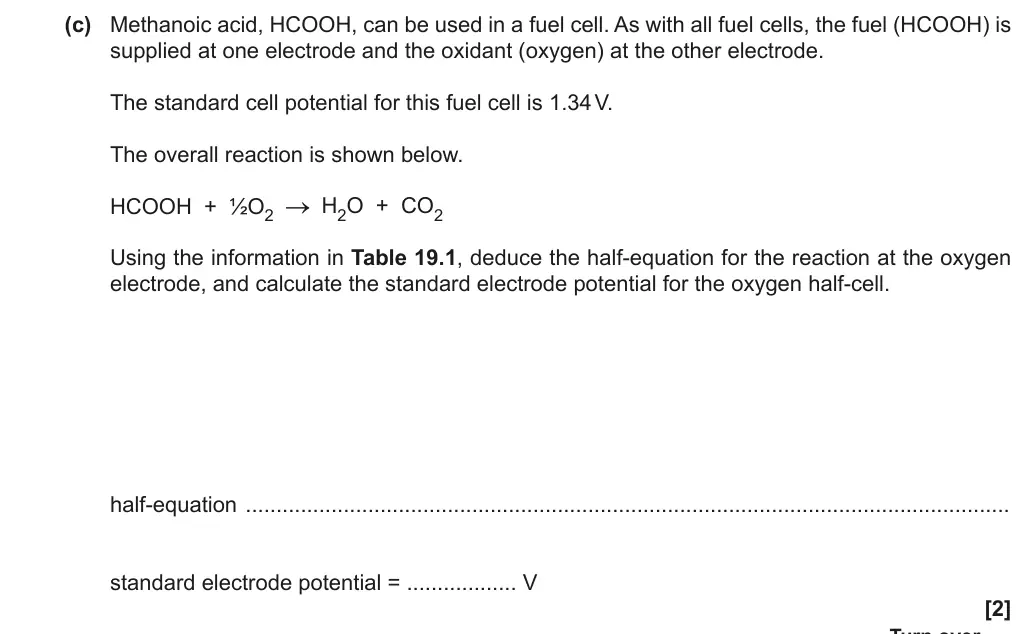
Reaction at positive electrode: O2  +  2H2O  +  4e− 4OH− E o = +0.40 V
Overall cell reaction: NaBH4  +  2O2 NaBO2  +  2H2O E o cell = 1.64 V
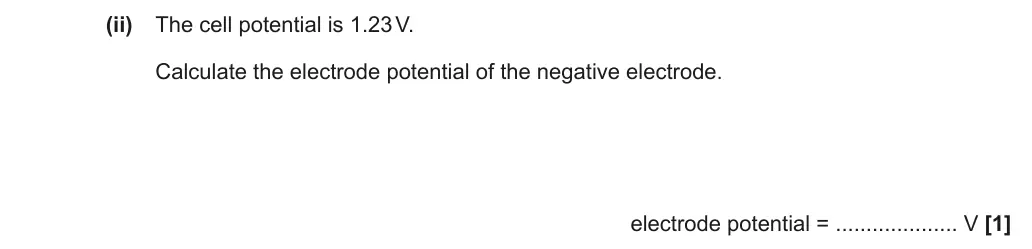
(i) What is the standard electrode potential of the negative electrode in this cell?
Standard electrode potential =  ...................................................... V [1]
June 2024 · AS Paper 1 · Q21(a) 2 marks Calculation Easy atomic structure and isotopes
SECTION B
21 This question is about iron.
(a) A sample of iron is isolated from a meteorite and analysed by mass spectrometry.
The mass spectrum shows peaks with the relative abundances below.
Isotope 54Fe 56Fe 57Fe 58Fe
Relative abundance 78.54% 8.88% 5.10% 7.48%
Calculate the relative atomic mass of the iron in the sample.
Give your answer to 2 decimal places.
relative atomic mass =  ......................................................... [2]
June 2024 · AS Paper 1 · Q21(c) 3 marks Calculation Medium amount of substance
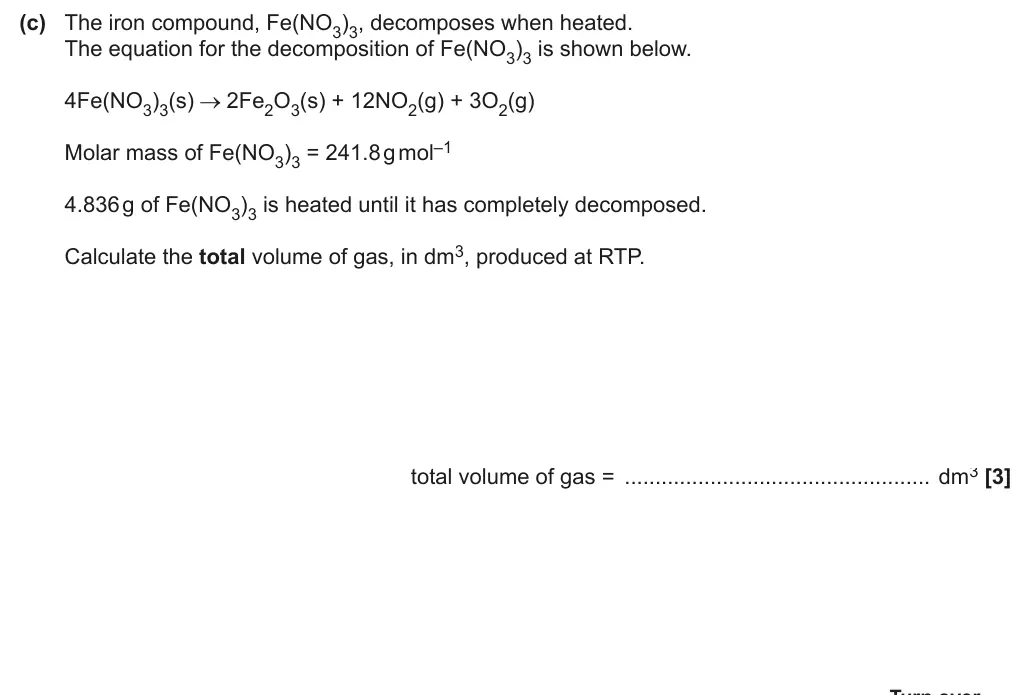
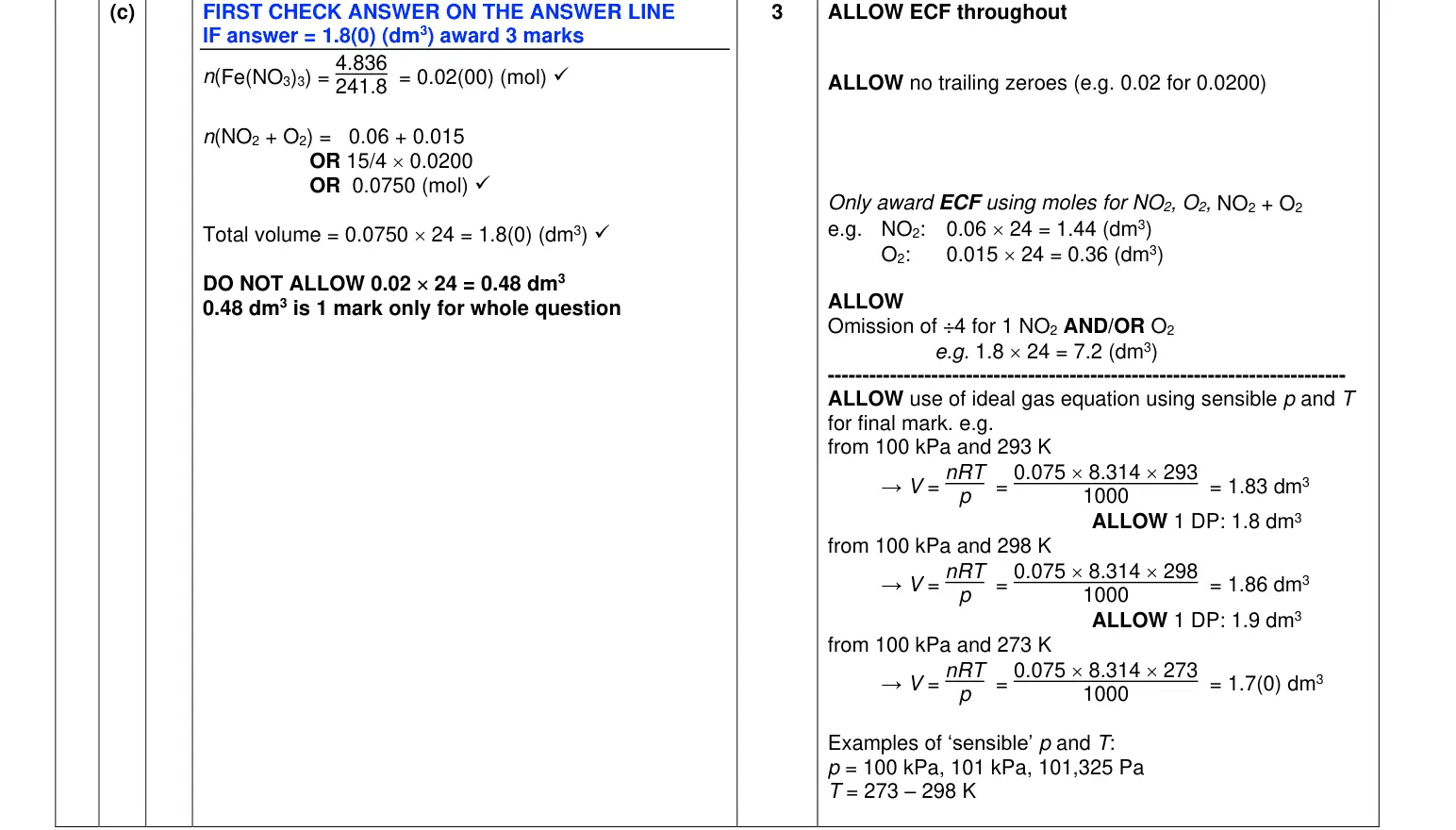
(c) The iron compound, Fe(NO3)3, decomposes when heated.
The equation for the decomposition of Fe(NO3)3 is shown below.
4Fe(NO3)3(s) 2Fe2O3(s) + 12NO2(g) + 3O2(g)
Molar mass of Fe(NO3)3 = 241.8 g mol–1
4.836 g of Fe(NO3)3 is heated until it has completely decomposed.
Calculate the total volume of gas, in dm3, produced at RTP.
total volume of gas =  .................................................. dm3 [3]
June 2024 · AS Paper 1 · Q22(b)(ii) 1 mark Calculation Medium acids and titrations
Earlier part of question 22 that this part usesEarlier part of June 2024 Paper 1 question 22
(ii) Calculate the mean titre, to the nearest 0.05 cm3, that the student should use for analysing these
results.
mean titre =  ................................................... cm3 [1]
June 2024 · AS Paper 1 · Q22(b)(iii) 5 marks Calculation Medium acids and titrationsamount of substance
Earlier parts of question 22 that this part usesEarlier part of June 2024 Paper 1 question 22Earlier part of June 2024 Paper 1 question 22
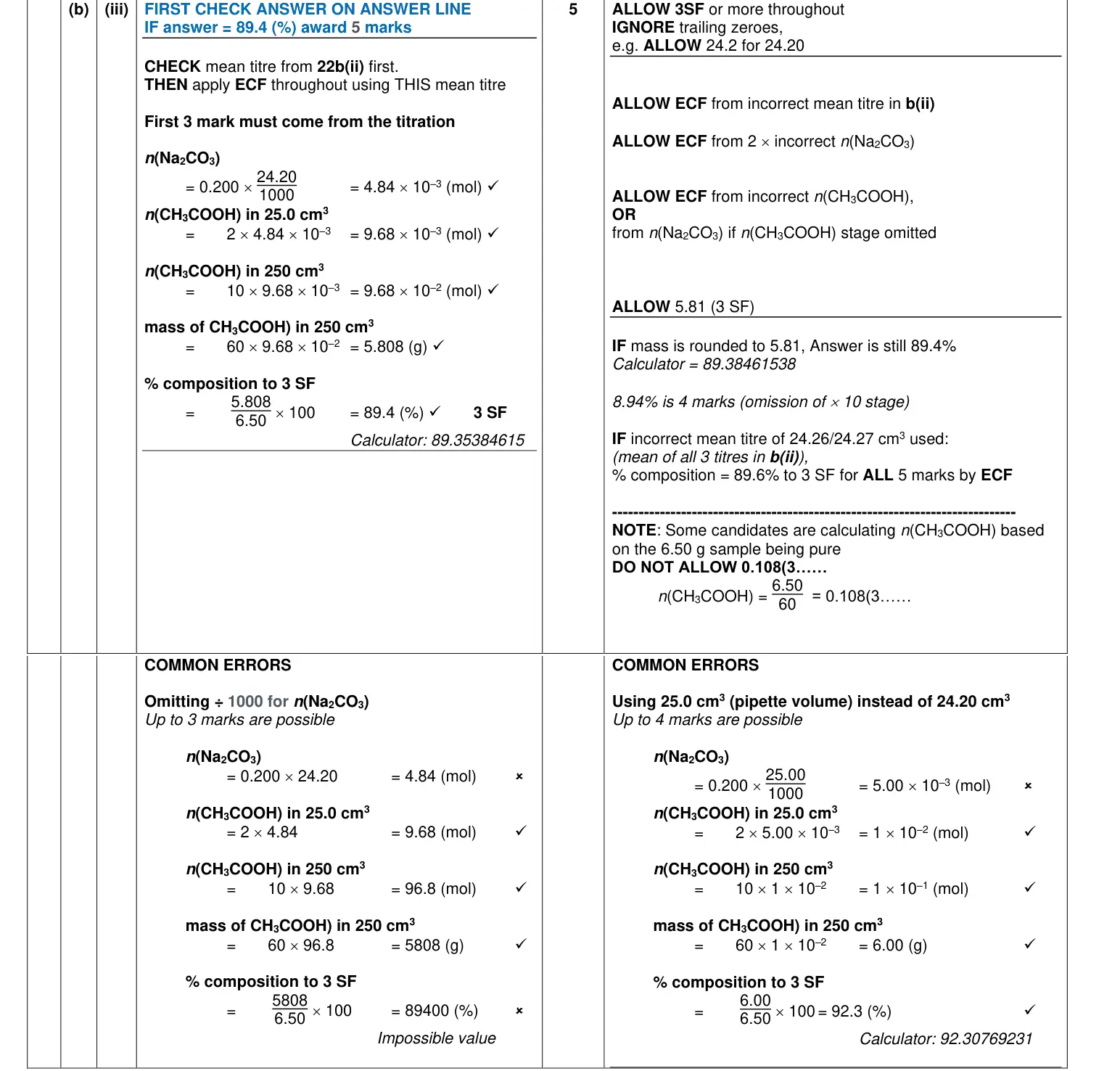
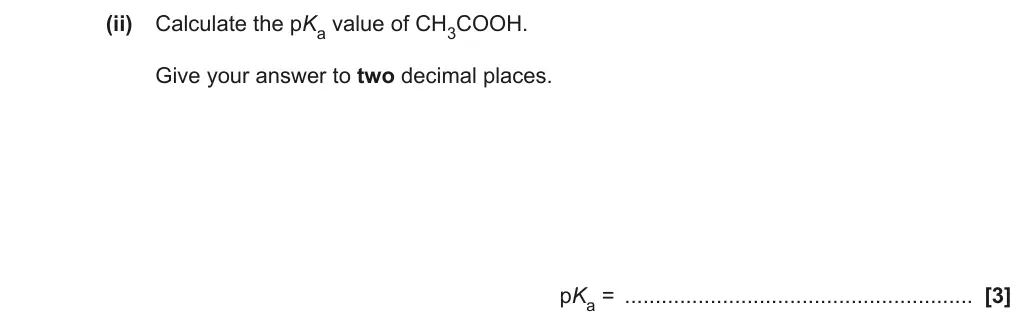
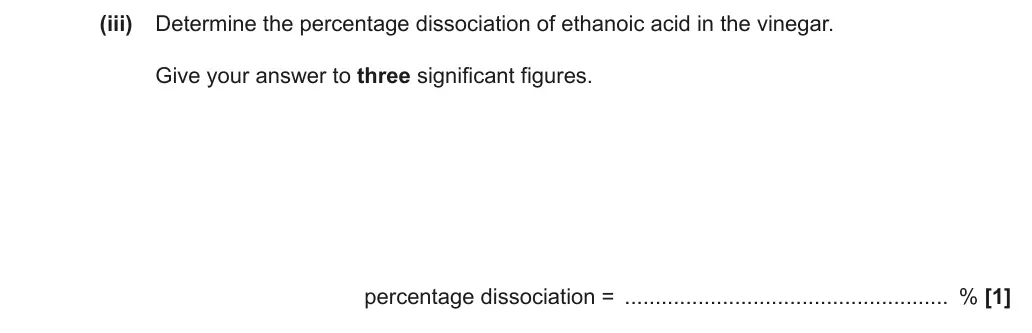
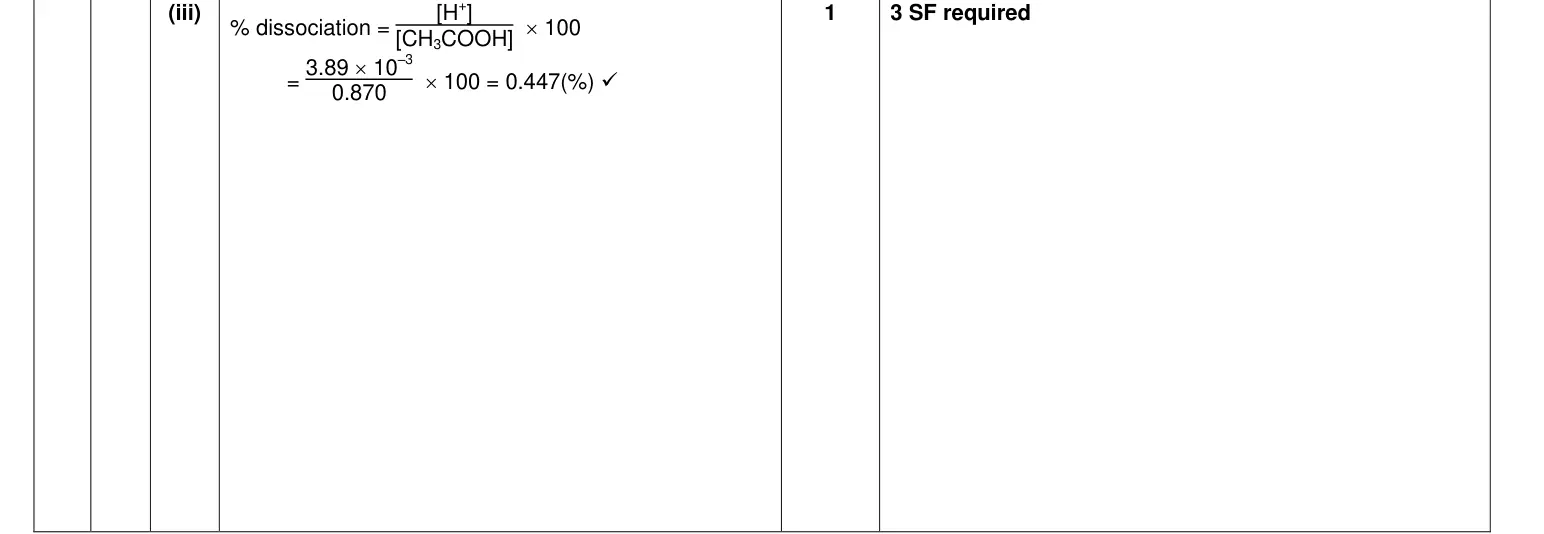
(iii) Calculate the percentage composition by mass of CH3COOH in the descaler.
Assume that CH3COOH is the only acid in the descaler.
Give your answer to 3 significant figures.
percentage composition by mass =  ..................................................... % [5]
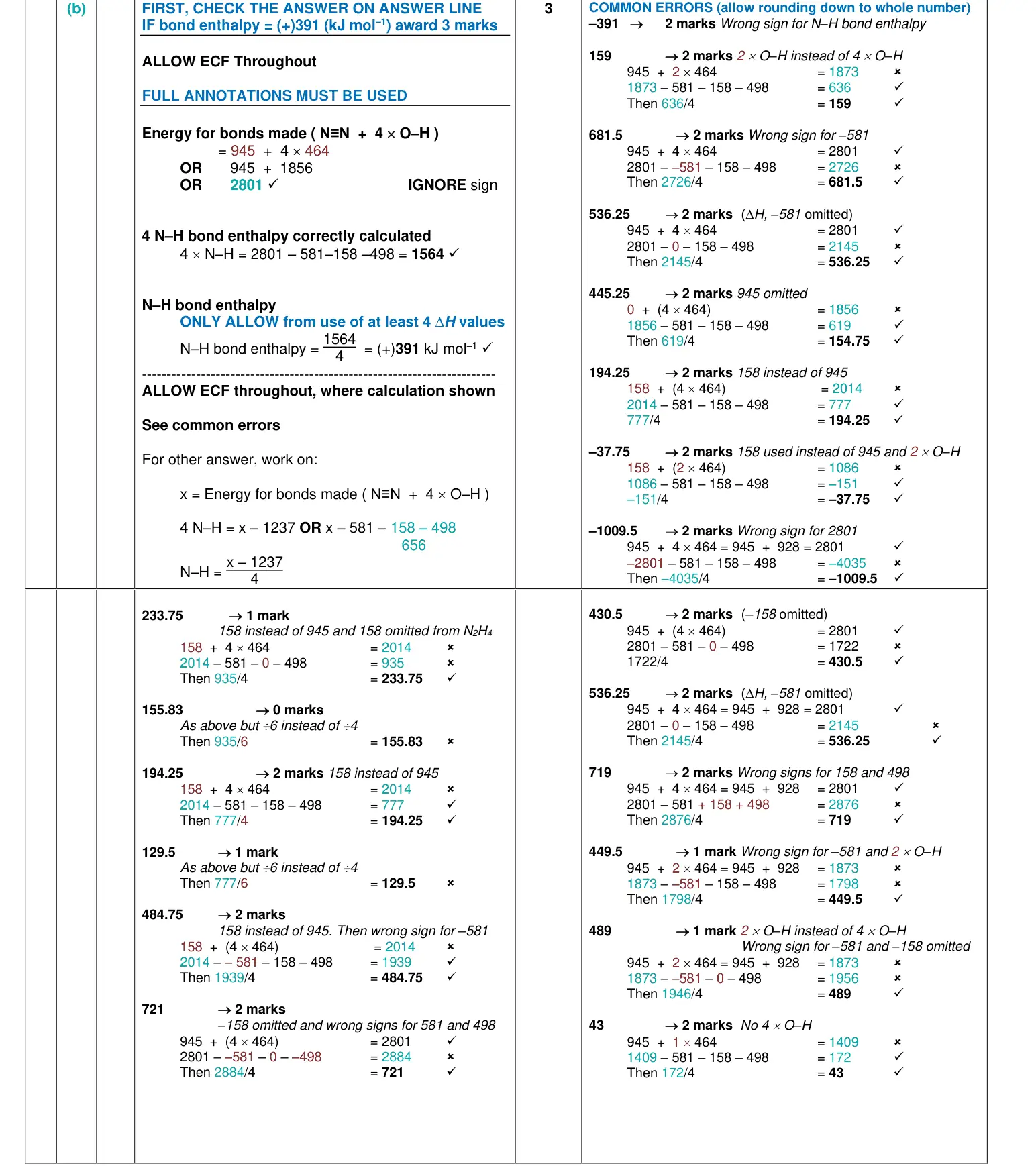
June 2024 · AS Paper 1 · Q23(b) 3 marks Calculation Hard enthalpy changes
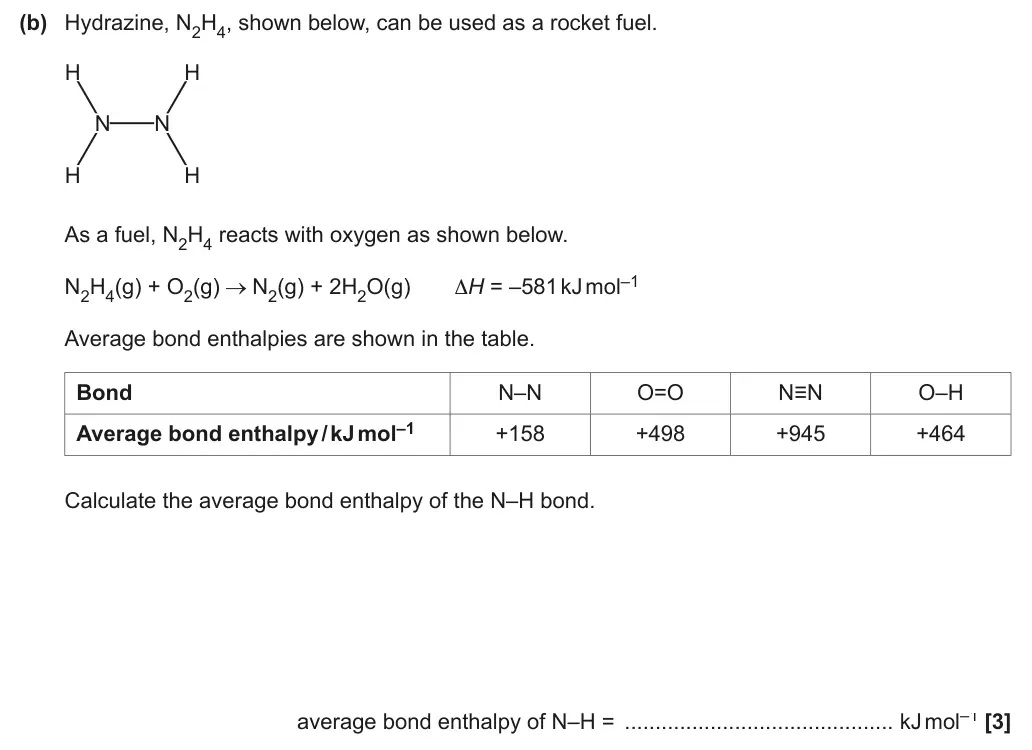
(b) Hydrazine, N2H4, shown below, can be used as a rocket fuel.
H H
N N
H H
As a fuel, N2H4 reacts with oxygen as shown below.
N2H4(g) + O2(g) N2(g) + 2H2O(g)  ΔH = –581 kJ mol–1
Average bond enthalpies are shown in the table.
Bond N–N O=O N≡N O–H
Average bond enthalpy / kJ mol–1 +158 +498 +945 +464
Calculate the average bond enthalpy of the N–H bond.
average bond enthalpy of N–H =  ............................................ kJ mol–1 [3]
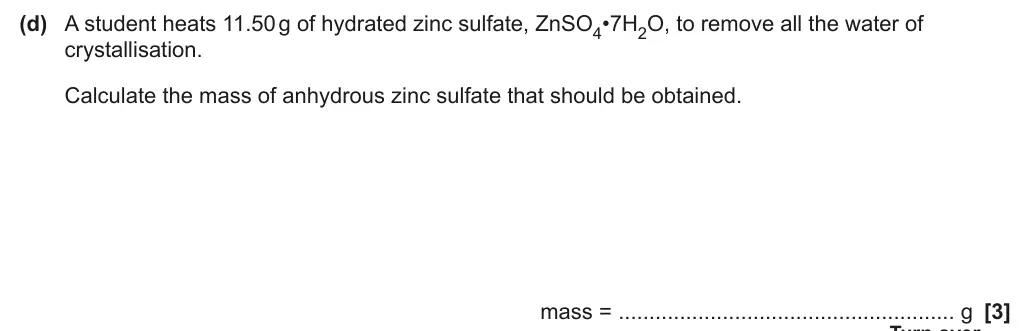
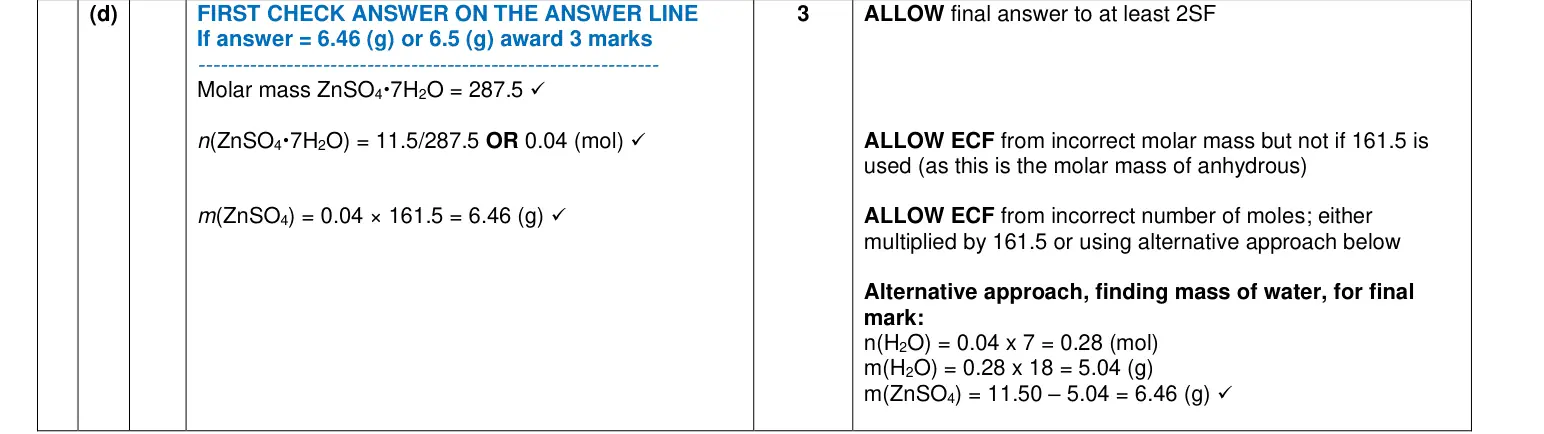
June 2024 · AS Paper 2 · Q1(d) 3 marks Calculation Hard amount of substance
(d) A student heats 11.50 g of hydrated zinc sulfate, ZnSO4•7H2O, to remove all the water of
crystallisation.
Calculate the mass of anhydrous zinc sulfate that should be obtained.
mass =  ....................................................... g [3]
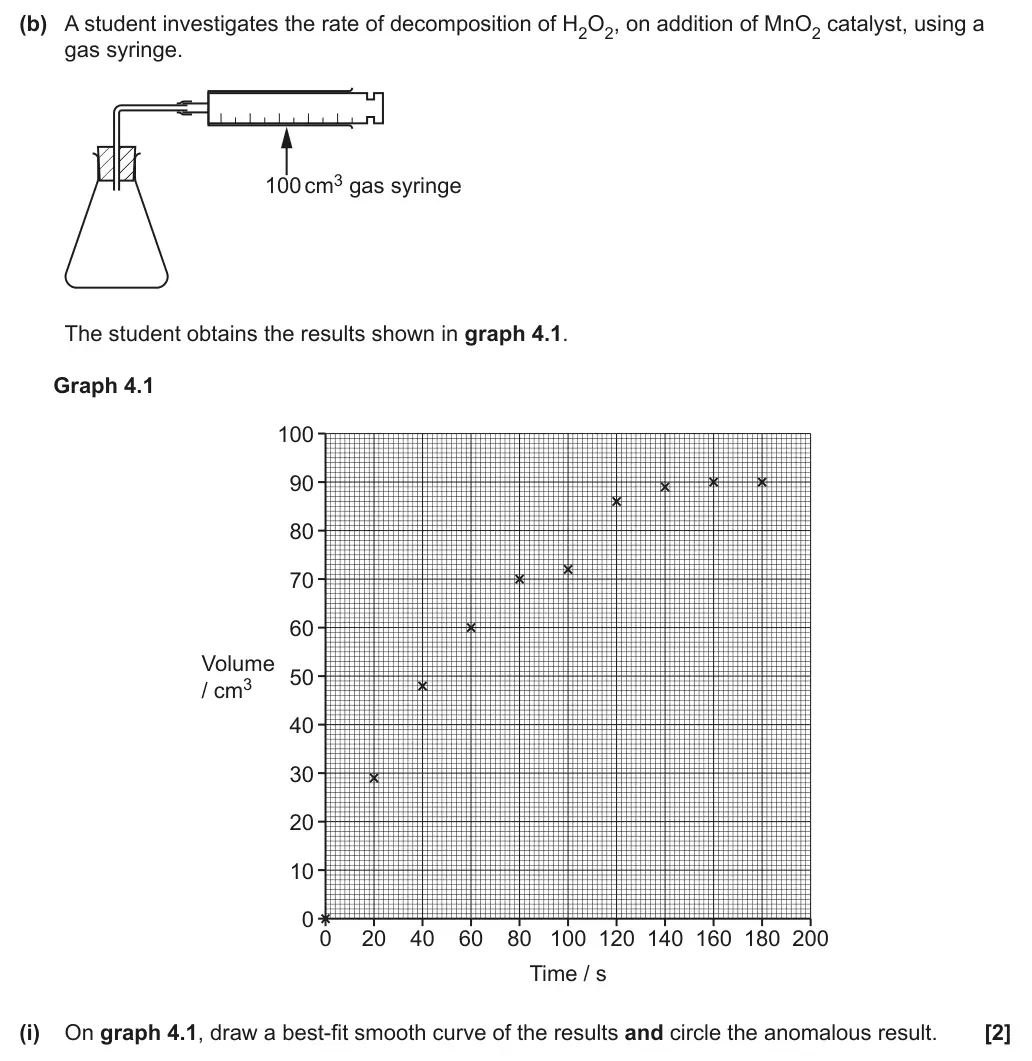
June 2024 · AS Paper 2 · Q4(b)(ii) 2 marks Calculation Medium reaction rates
Earlier part of question 4 that this part usesEarlier part of June 2024 Paper 2 question 4
(ii) Use your graph to determine the rate of reaction, in cm3 s–1, at 50 s.
Show your working below and on the graph.
rate =  ............................................. cm3 s–1 [2]
June 2024 · AS Paper 2 · Q4(b)(iii) 3 marks Calculation Hard amount of substance
Earlier part of question 4 that this part usesEarlier part of June 2024 Paper 2 question 4
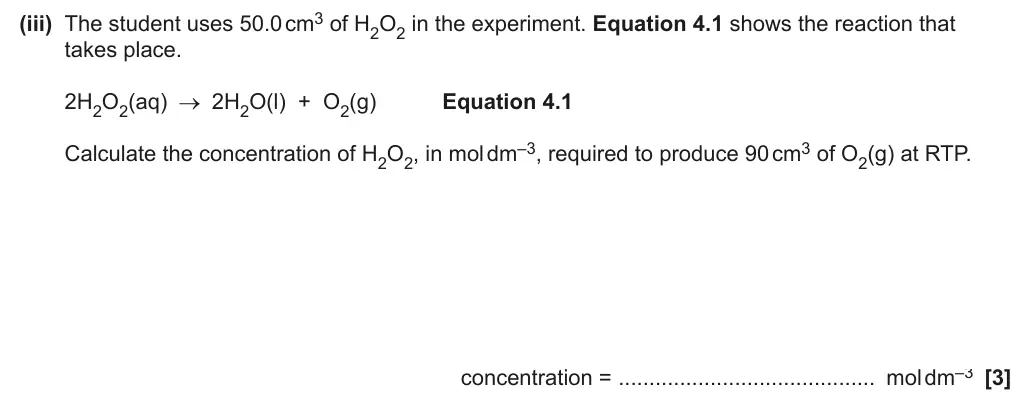
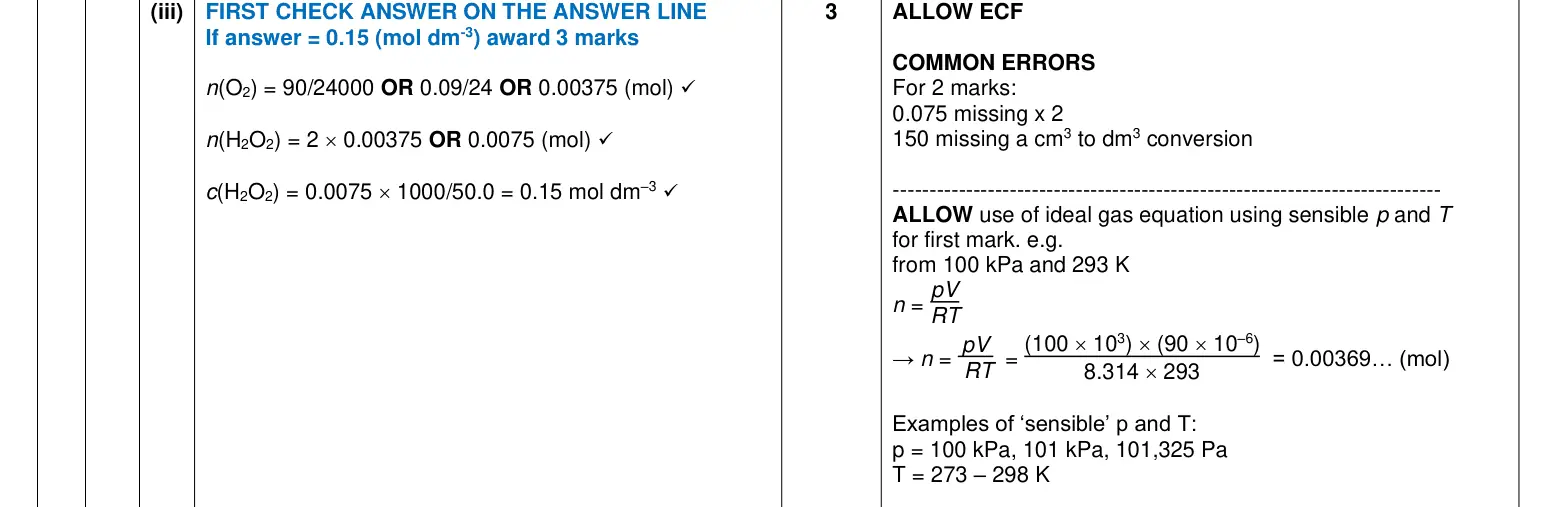
(iii) The student uses 50.0 cm3 of H2O2 in the experiment. Equation 4.1 shows the reaction that
takes place.
2H2O2(aq) 2H2O(l)  +  O2(g)   Equation 4.1
Calculate the concentration of H2O2, in mol dm–3, required to produce 90 cm3 of O2(g) at RTP.
concentration =  .......................................... mol dm–3 [3]
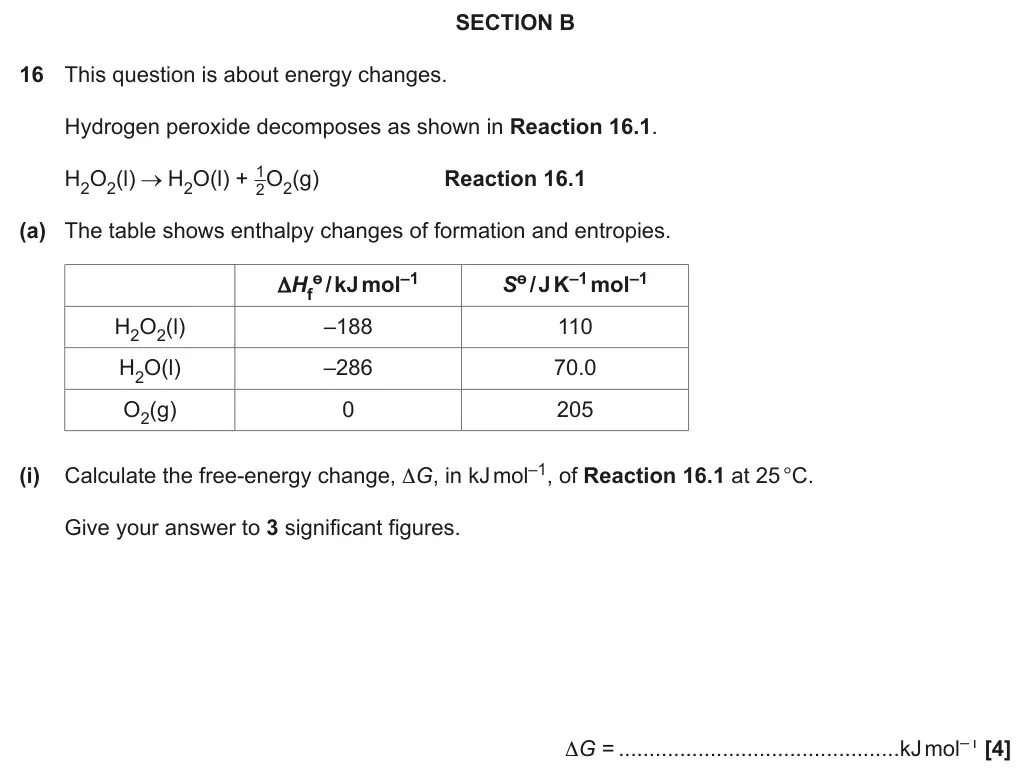
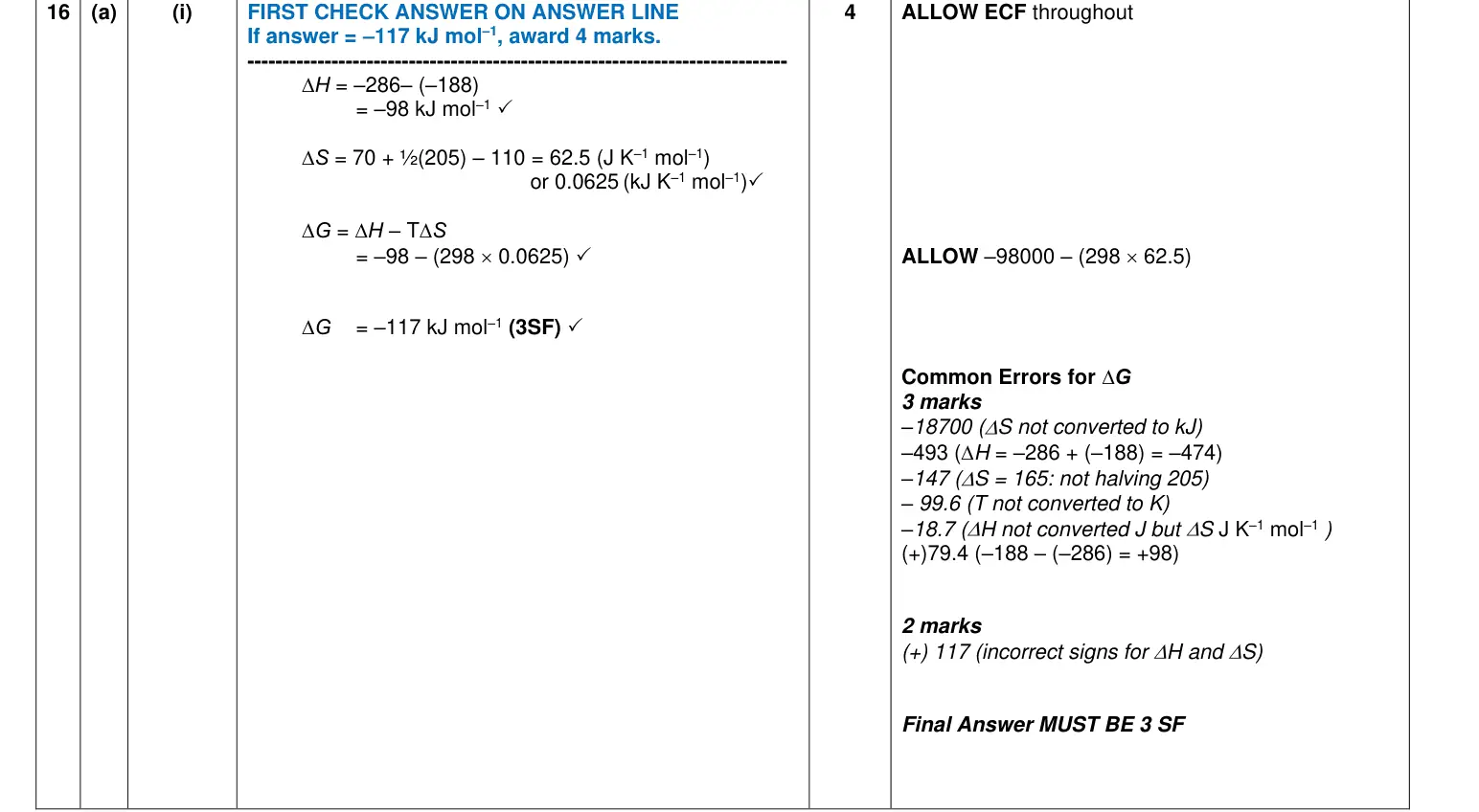
June 2024 · Paper 1 · Q16(a)(i) 4 marks Calculation Medium entropy and free energyenthalpy changes
SECTION B
16 This question is about energy changes.
Hydrogen peroxide decomposes as shown in Reaction 16.1.
H2O2(l) H2O(l) + 1 2O2(g) Reaction 16.1
(a) The table shows enthalpy changes of formation and entropies.
∆Hf ө / kJ mol–1 Sө / J K–1 mol–1
H2O2(l) –188 110
H2O(l) –286 70.0
O2(g) 0 205
(i) Calculate the free-energy change, ∆G, in kJ mol–1, of Reaction 16.1 at 25 °C.
Give your answer to 3 significant figures.
∆G = ..............................................kJ mol–1 [4]
June 2024 · Paper 1 · Q16(c)(iii) 2 marks Calculation Medium lattice enthalpy
Earlier parts of question 16 that this part usesEarlier part of June 2024 Paper 1 question 16Earlier part of June 2024 Paper 1 question 16
(iii) Calculate the lattice enthalpy of MnO.
lattice enthalpy =  ............................................ kJ mol–1 [2]
June 2024 · Paper 1 · Q18(a)(i) 5 marks Calculation Hard equilibrium constants
18 This question is about two oxides of sulfur: sulfur dioxide, SO2, and sulfur trioxide, SO3.
(a) SO3 decomposes to form SO2 and O2, as shown in Equilibrium 18.1.
SO3(g) SO2(g) + 1 2O2(g) ∆H = +99 kJ mol–1 Equilibrium 18.1
(i) 2.25 moles of SO3 is heated to 550 °C in the presence of a catalyst and the resulting mixture
allowed to reach equilibrium.
The equilibrium mixture contains 0.900 mol of SO2 and the total pressure is 2.80 atm.
Calculate the numerical value for Kp for Equilibrium 18.1 under these conditions and state the
units of Kp.
Give your answer to 3 significant figures.
Kp =  ...............................................................
units  .......................................................... [5]
June 2024 · Paper 1 · Q19(a)(iii) 3 marks Calculation Medium acids bases and buffers
Earlier part of question 19 that this part usesEarlier part of June 2024 Paper 1 question 19
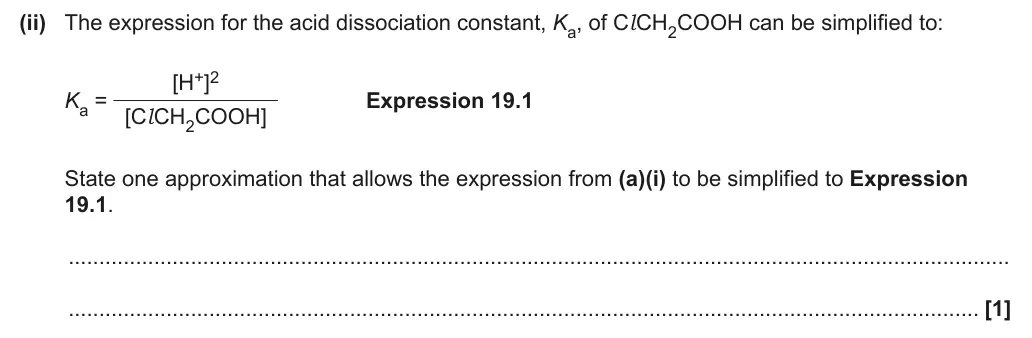
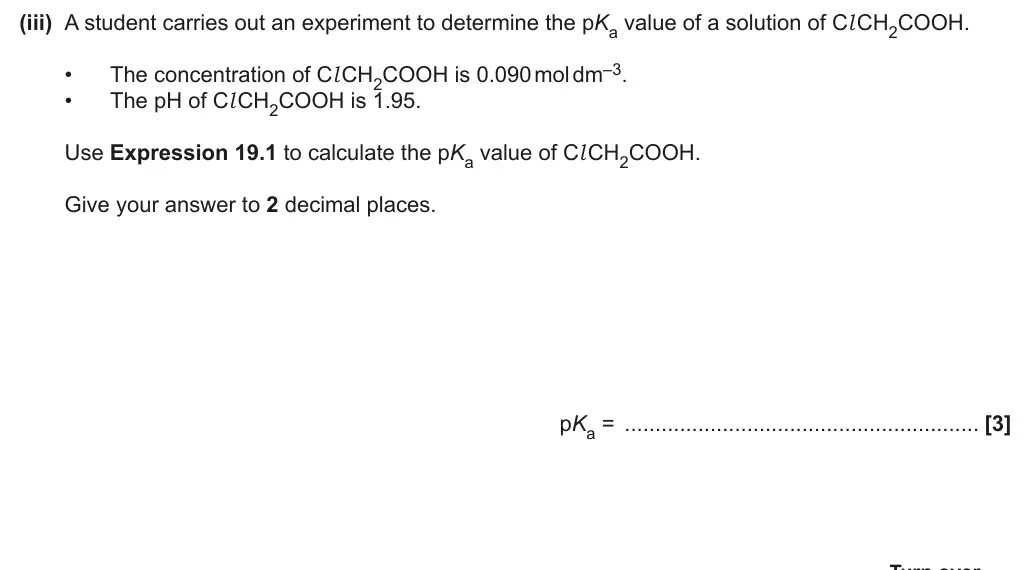
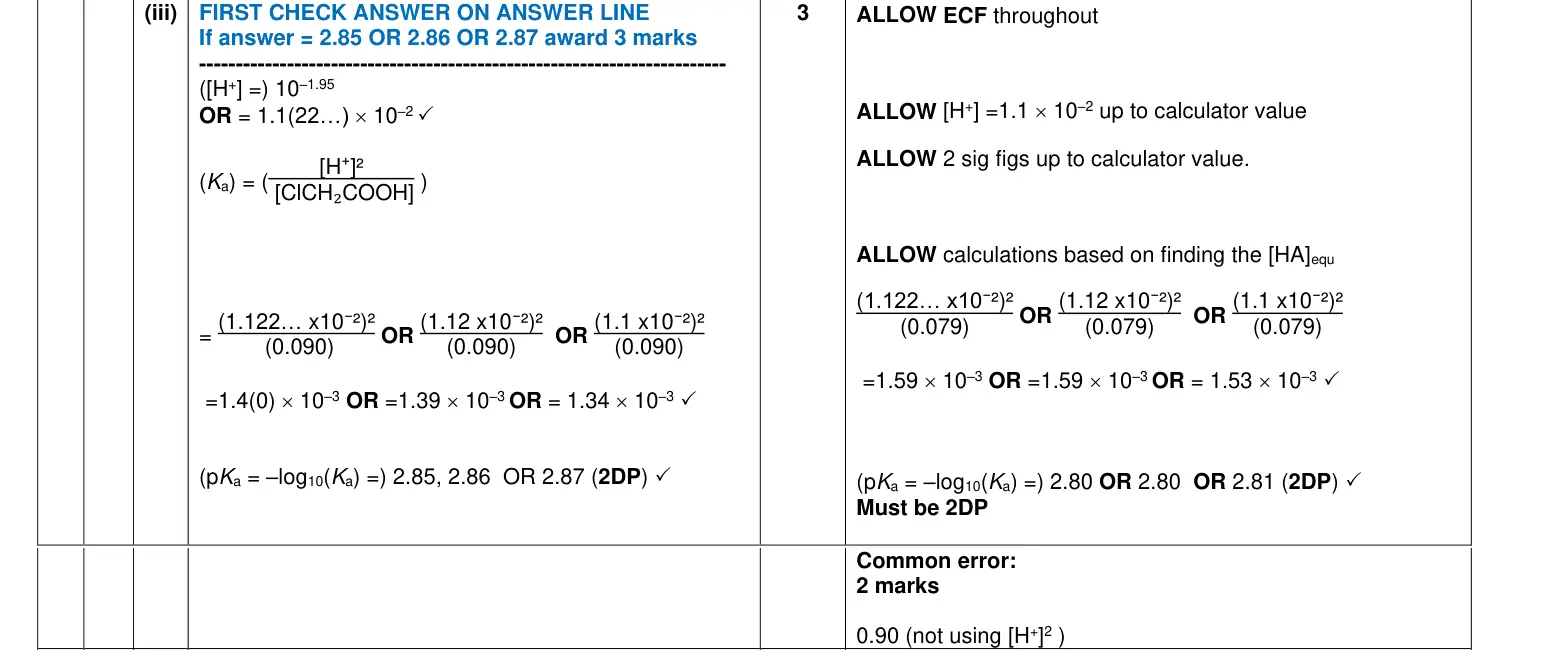
(iii) A student carries out an experiment to determine the pKa value of a solution of Cl CH2COOH.
• The concentration of Cl CH2COOH is 0.090 mol dm–3.
• The pH of Cl CH2COOH is 1.95.
Use Expression 19.1 to calculate the pKa value of Cl CH2COOH.
Give your answer to 2 decimal places.
pKa =  .......................................................... [3]
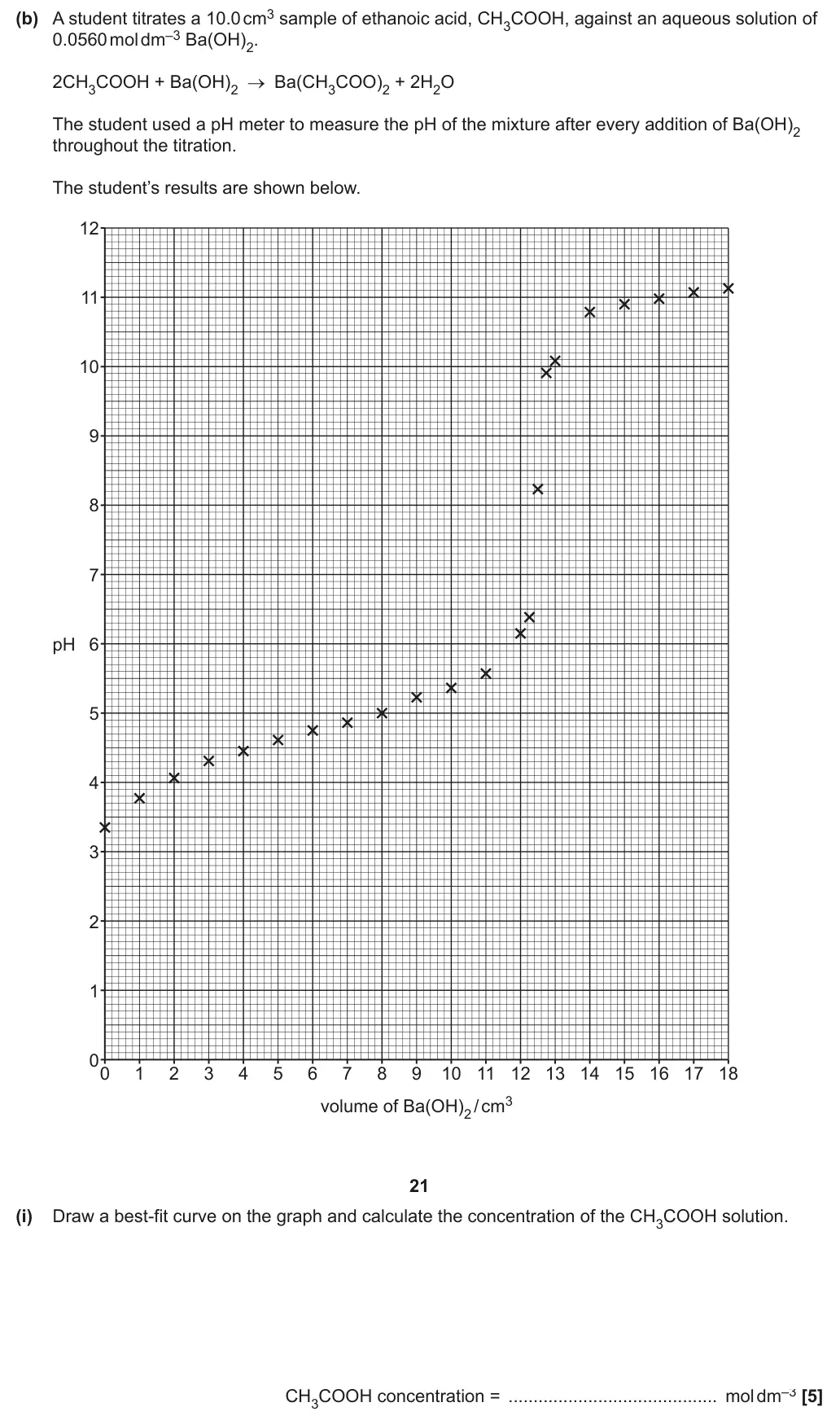
June 2024 · Paper 1 · Q19(b)(i) 5 marks Calculation Easy acids bases and bufferspractical skillsamount of substanceacids and titrations
(b) A student titrates a 10.0 cm3 sample of ethanoic acid, CH3COOH, against an aqueous solution of
0.0560 mol dm–3 Ba(OH)2.
2CH3COOH + Ba(OH)2 Ba(CH3COO)2 + 2H2O
The student used a pH meter to measure the pH of the mixture after every addition of Ba(OH)2
throughout the titration.
The student’s results are shown below.
12
11
10
9
8
7
pH 6
5
4
3
2
1
0
0 1 2 3 4 5 6 7 8 9 10 11 12 13 14 15 16 17 18
volume of Ba(OH)2 / cm3
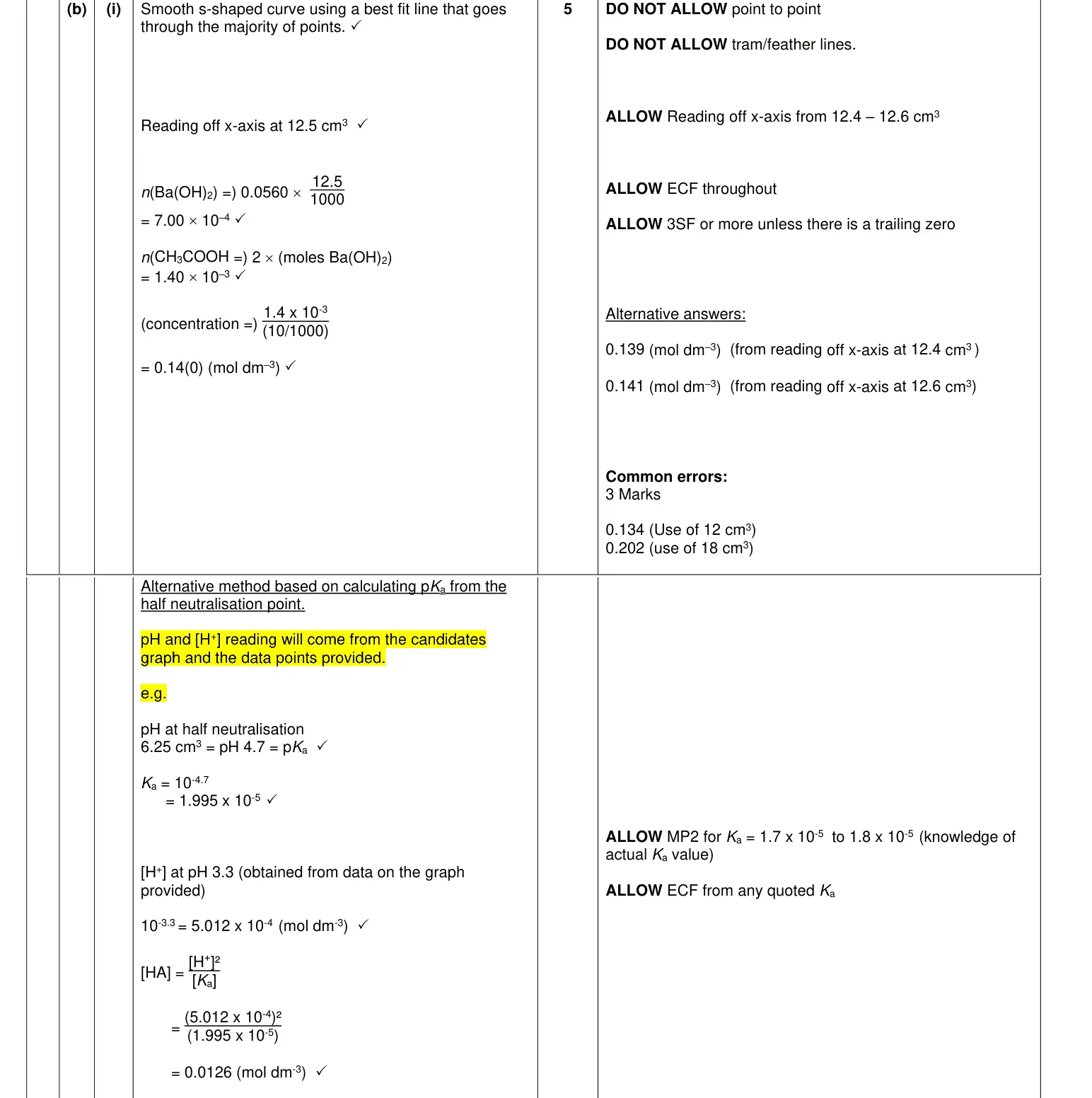
(i) Draw a best-fit curve on the graph and calculate the concentration of the CH3COOH solution.
CH3COOH concentration =  .......................................... mol dm–3 [5]
June 2024 · Paper 1 · Q21(b) 4 marks Calculation Medium redox and electrode potentialsamount of substance
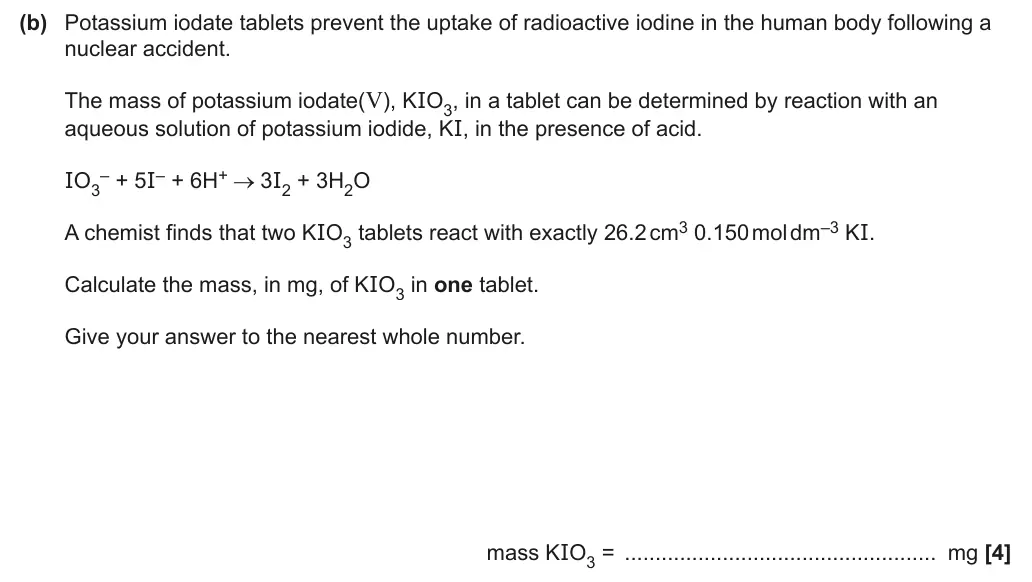
(b) Potassium iodate tablets prevent the uptake of radioactive iodine in the human body following a
nuclear accident.
The mass of potassium iodate(V), KIO3, in a tablet can be determined by reaction with an
aqueous solution of potassium iodide, KI, in the presence of acid.
IO3 – + 5I– + 6H+ 3I2 + 3H2O
A chemist finds that two KIO3 tablets react with exactly 26.2 cm3 0.150 mol dm–3 KI.
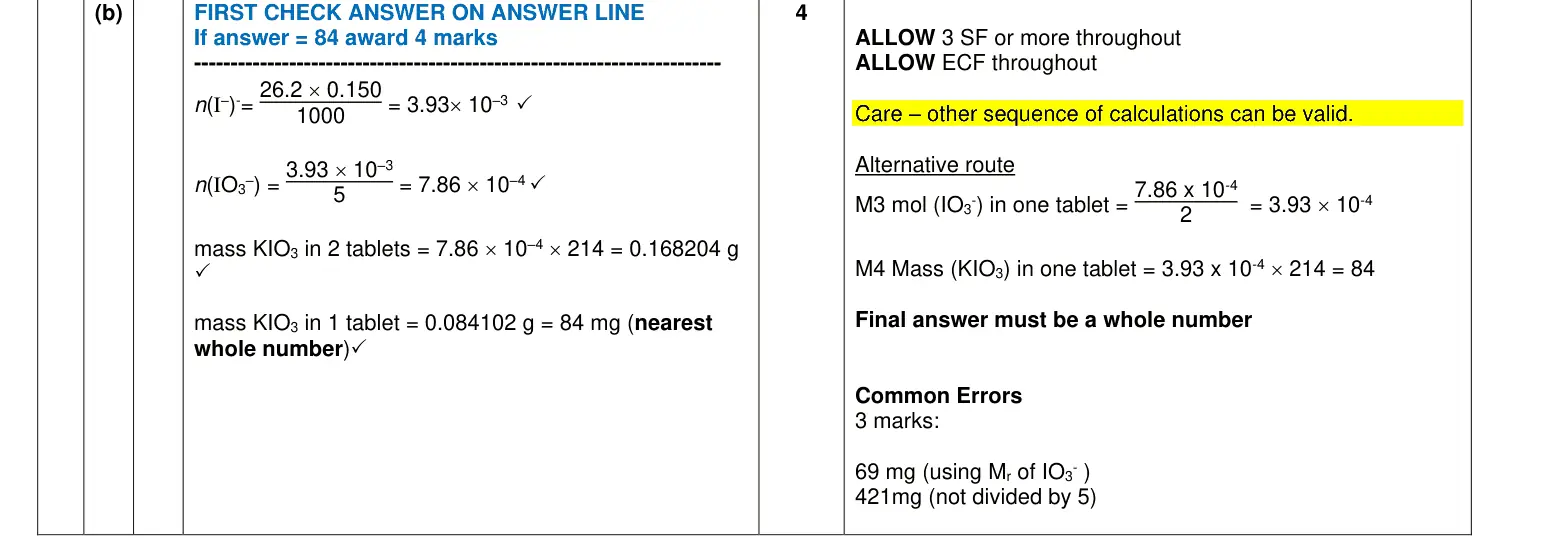
Calculate the mass, in mg, of KIO3 in one tablet.
Give your answer to the nearest whole number.
mass KIO3 =  ................................................... mg [4]
June 2024 · Paper 2 · Q22(a) 3 marks Calculation Hard condensation polymersatomic structure and isotopesamino acids amides and chirality
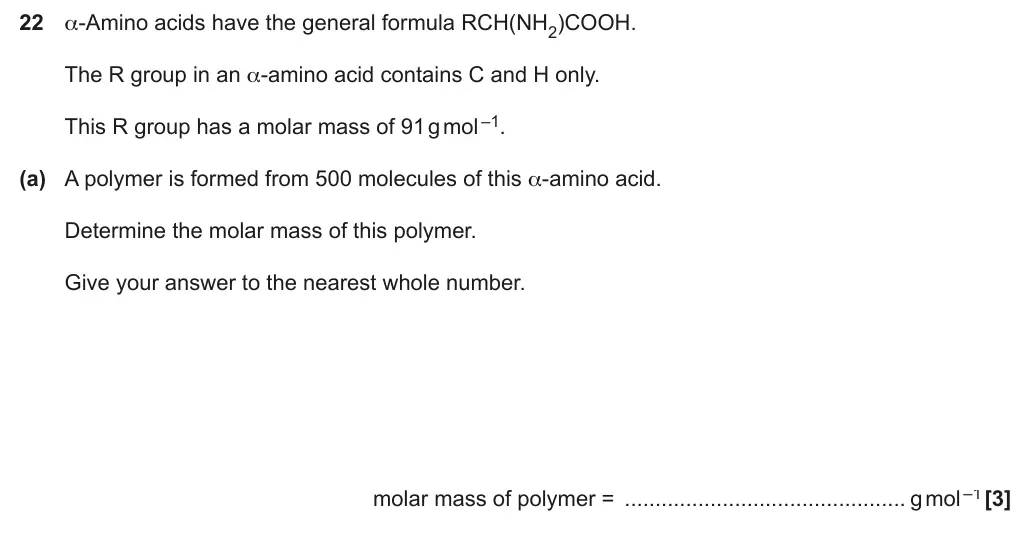
22 α-Amino acids have the general formula RCH(NH2)COOH.
The R group in an α-amino acid contains C and H only.
This R group has a molar mass of 91 g mol –1.
(a) A polymer is formed from 500 molecules of this α-amino acid.
Determine the molar mass of this polymer.
Give your answer to the nearest whole number.
molar mass of polymer =  .............................................. g mol –1[3]
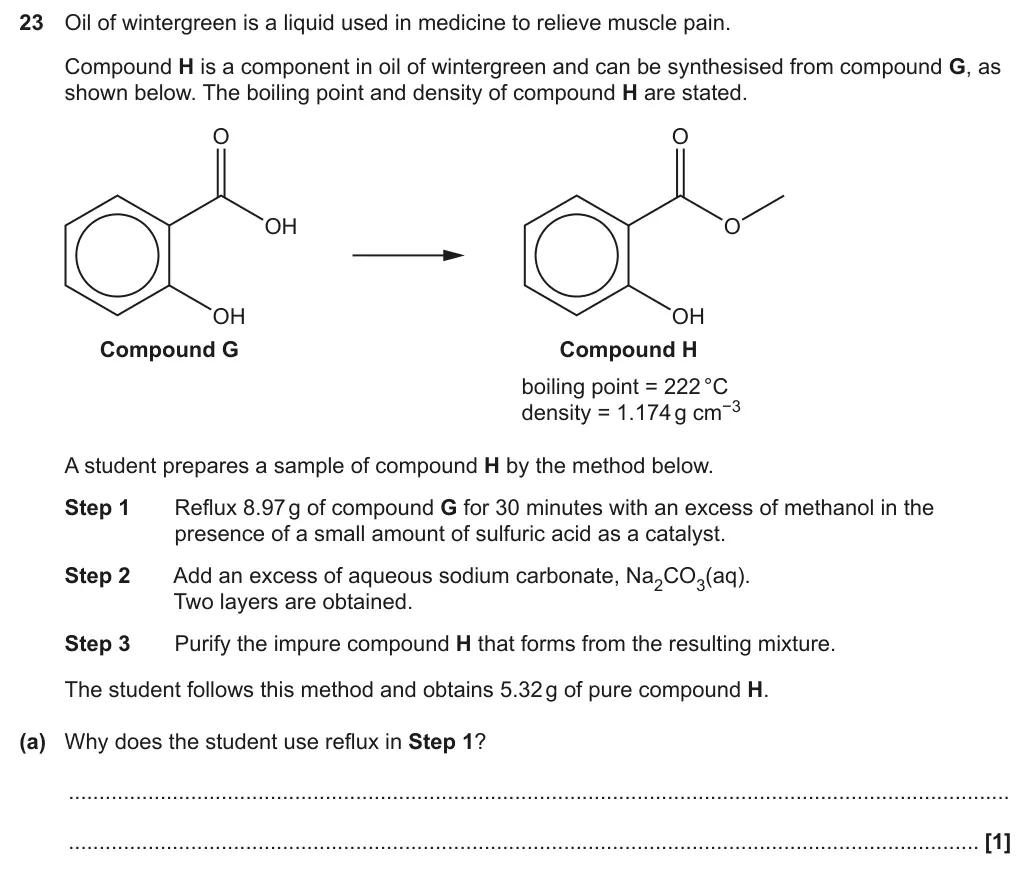
June 2024 · Paper 2 · Q23(c) 3 marks Calculation Hard amount of substance
Earlier part of question 23 that this part usesEarlier part of June 2024 Paper 2 question 23
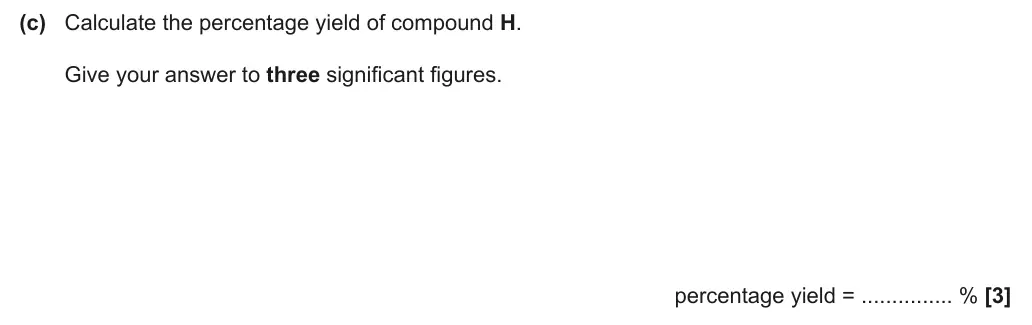
(c) Calculate the percentage yield of compound H.
Give your answer to three significant figures.
percentage yield = ............... % [3]
June 2024 · Paper 3 · Q1(a) 2 marks Calculation Medium acids bases and buffers
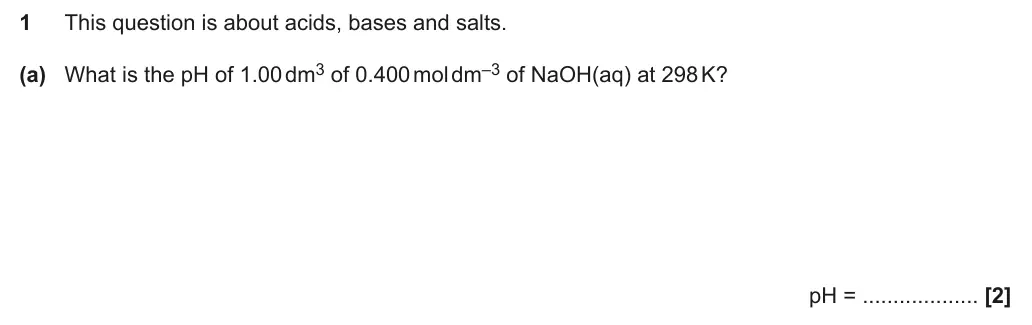
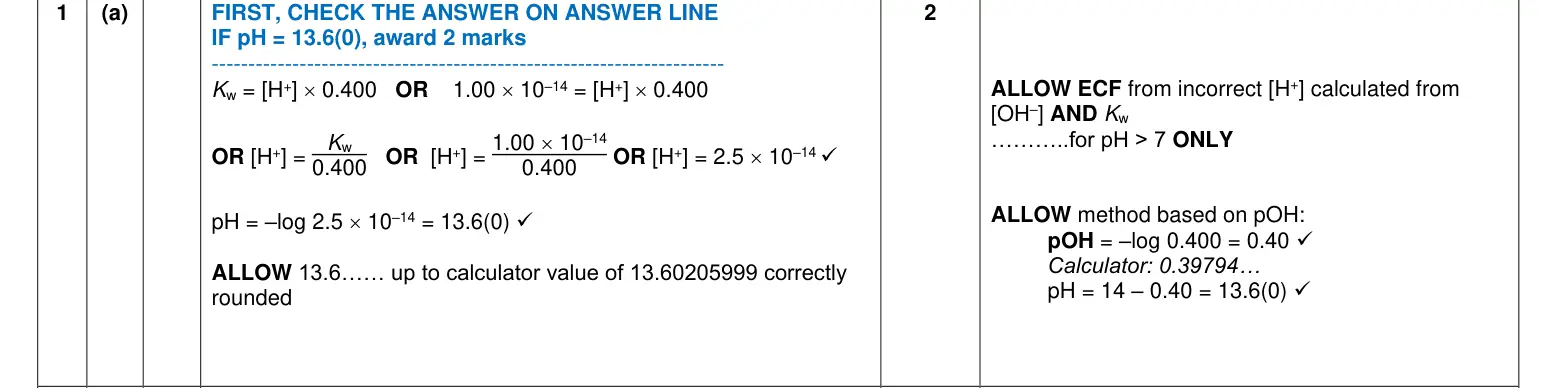
1 This question is about acids, bases and salts.
(a) What is the pH of 1.00 dm3 of 0.400 mol dm–3 of NaOH(aq) at 298 K?
pH = ................... [2]
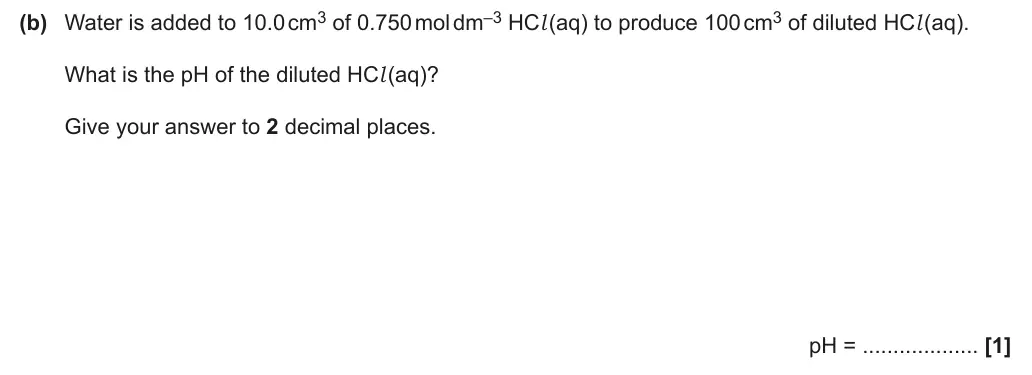
June 2024 · Paper 3 · Q1(b) 1 mark Calculation Medium acids bases and buffersamount of substance
(b) Water is added to 10.0 cm3 of 0.750 mol dm–3 HCl (aq) to produce 100 cm3 of diluted HCl (aq).
What is the pH of the diluted HCl (aq)?
Give your answer to 2 decimal places.
pH = ................... [1]
June 2024 · Paper 3 · Q1(c) 2 marks Calculation Medium acids bases and buffers
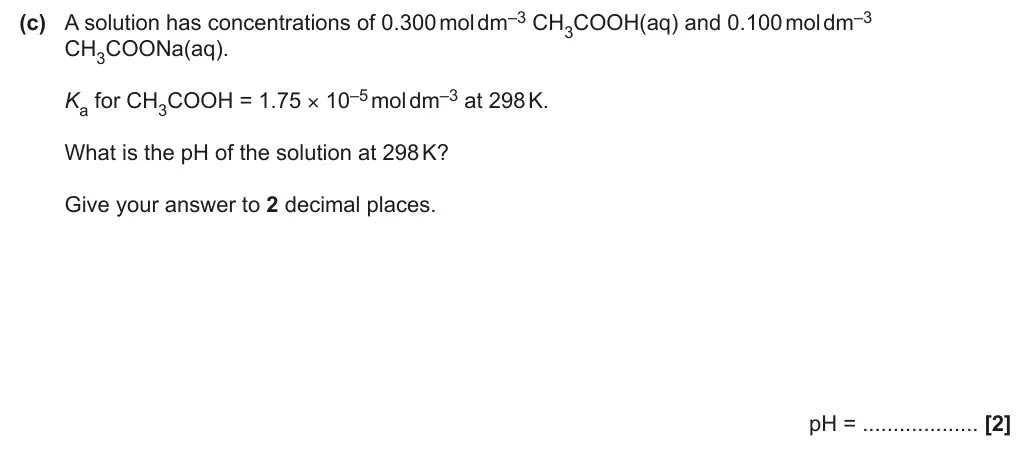
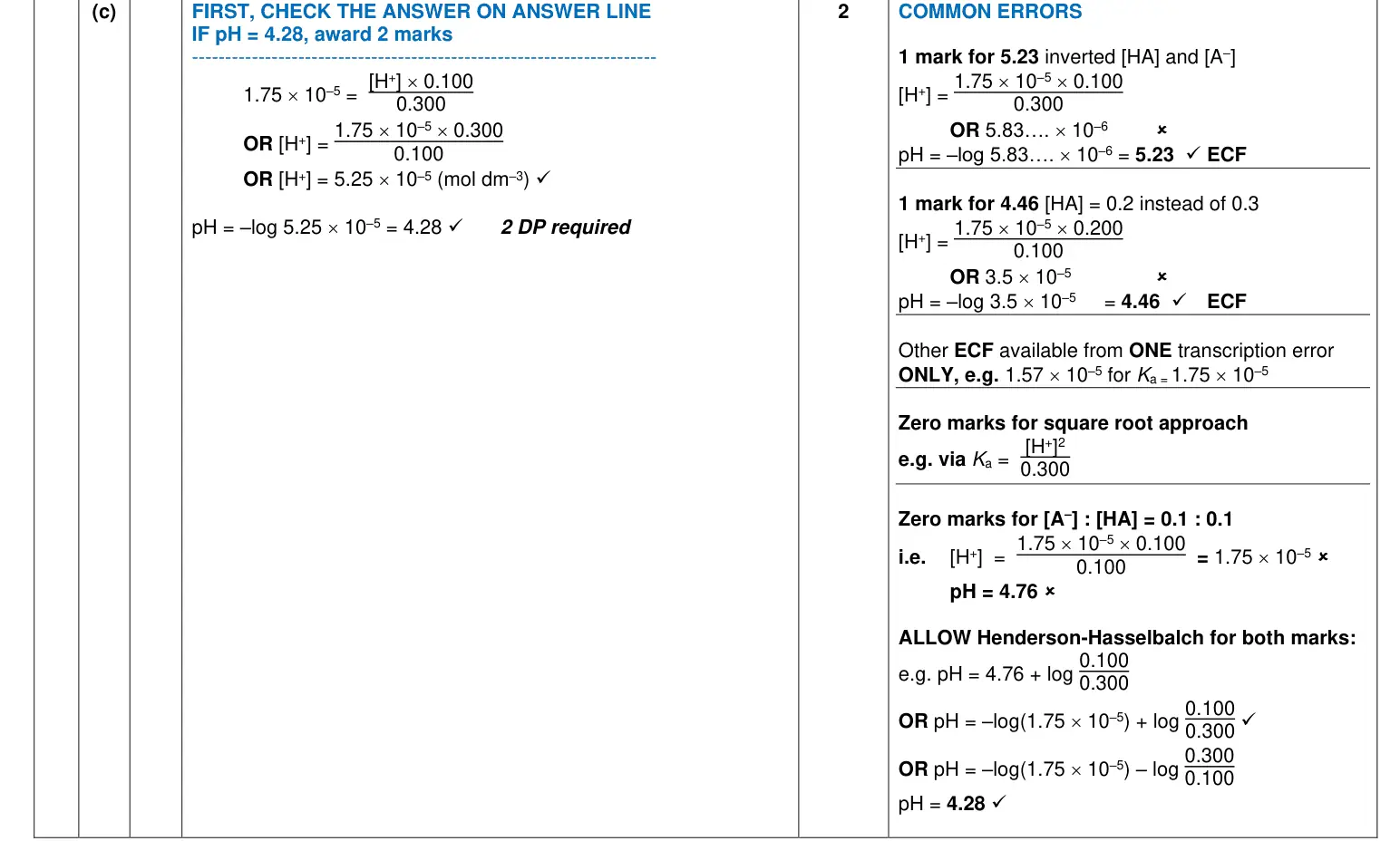
(c) A solution has concentrations of 0.300 mol dm–3 CH3COOH(aq) and 0.100 mol dm–3
CH3COONa(aq).
Ka for CH3COOH = 1.75 × 10⁻⁵ mol dm–3 at 298 K.
What is the pH of the solution at 298 K?
Give your answer to 2 decimal places.
pH = ................... [2]
June 2024 · Paper 3 · Q2(a)(ii) 3 marks Calculation Hard enthalpy changes
Earlier part of question 2 that this part usesEarlier part of June 2024 Paper 3 question 2
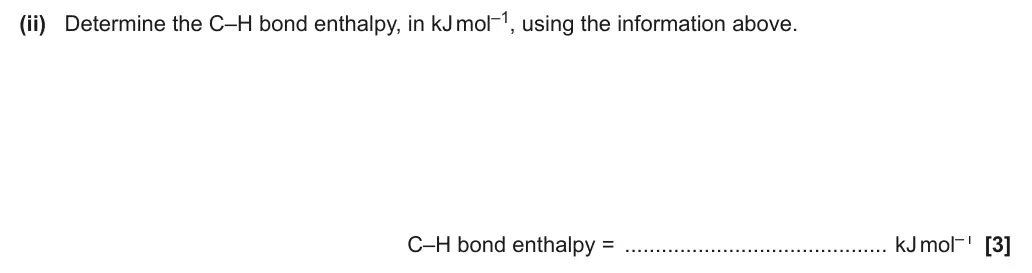
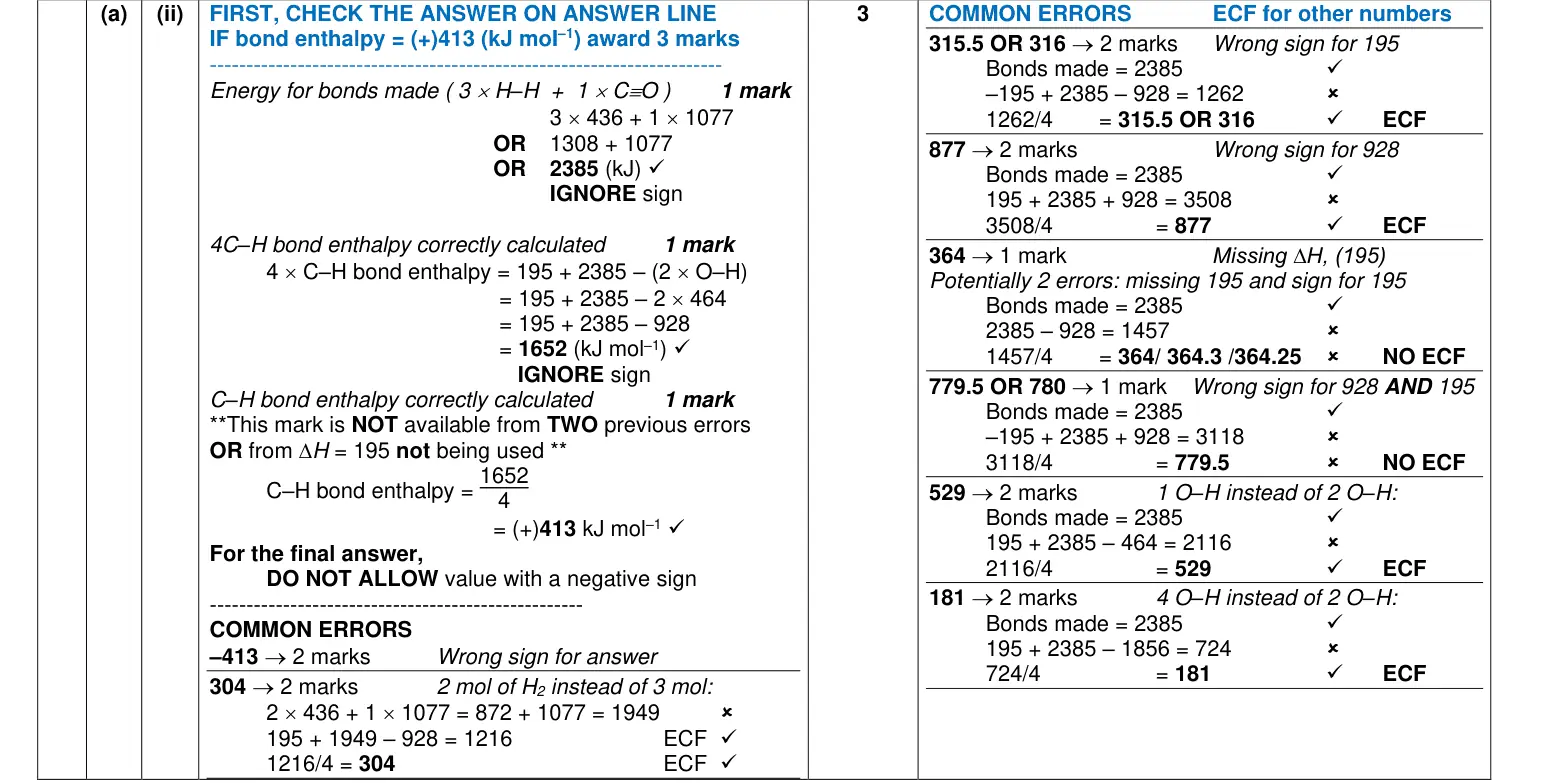
(ii) Determine the C–H bond enthalpy, in kJ mol–1, using the information above.
C–H bond enthalpy =  ........................................... kJ mol–1 [3]
June 2024 · Paper 3 · Q2(a)(iii) 2 marks Calculation Medium amount of substanceenthalpy changes
Earlier part of question 2 that this part usesEarlier part of June 2024 Paper 3 question 2
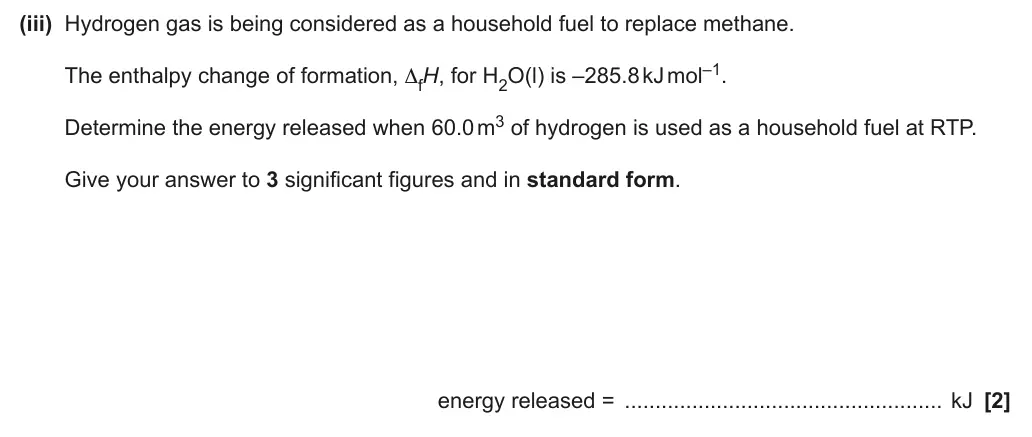
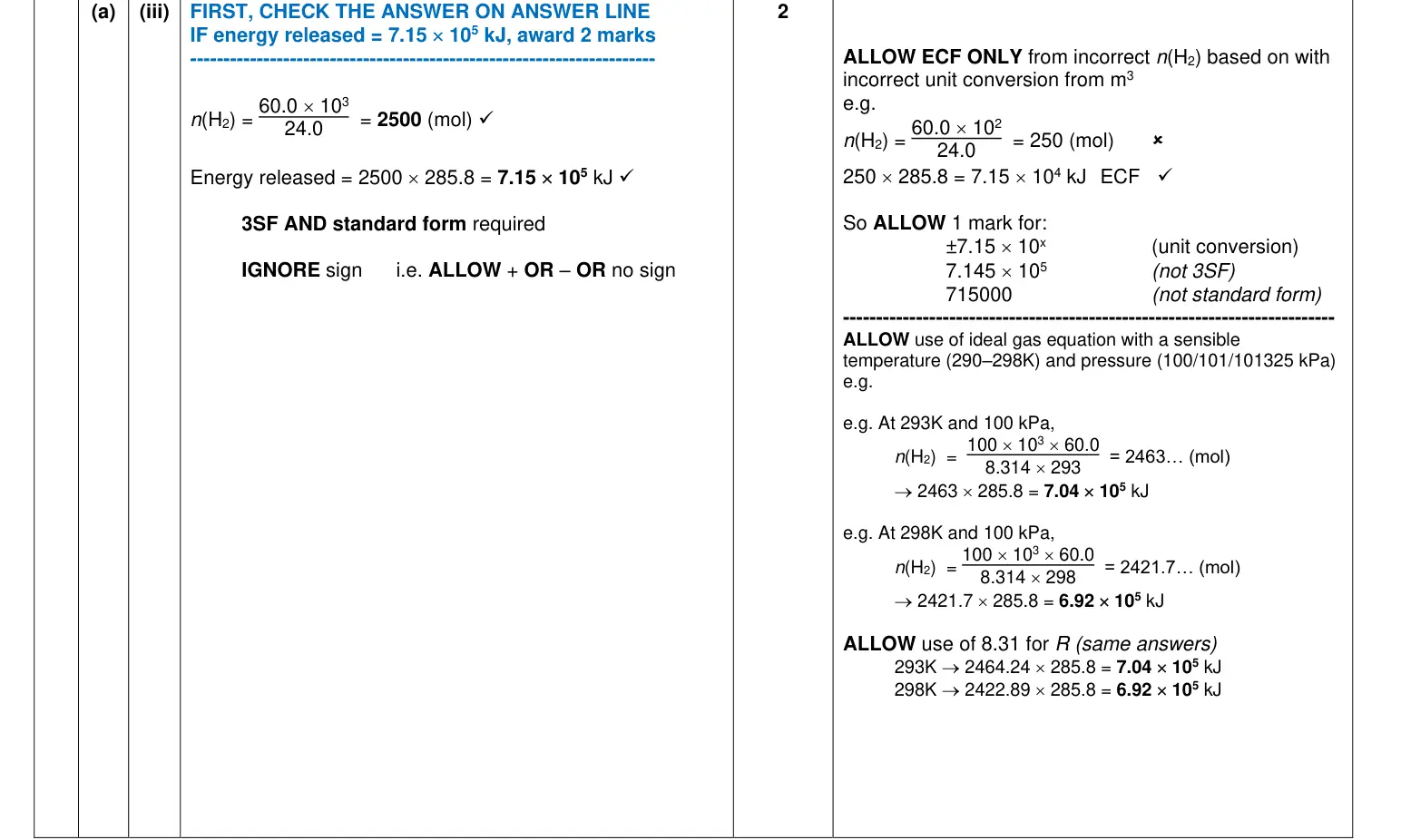
(iii) Hydrogen gas is being considered as a household fuel to replace methane.
The enthalpy change of formation, ΔfH, for H2O(l) is –285.8 kJ mol–1.
Determine the energy released when 60.0 m3 of hydrogen is used as a household fuel at RTP.
Give your answer to 3 significant figures and in standard form.
energy released =  .................................................... kJ [2]
June 2024 · Paper 3 · Q2(b)(ii) 3 marks Calculation Medium amount of substanceformulae and equations
Earlier part of question 2 that this part usesEarlier part of June 2024 Paper 3 question 2
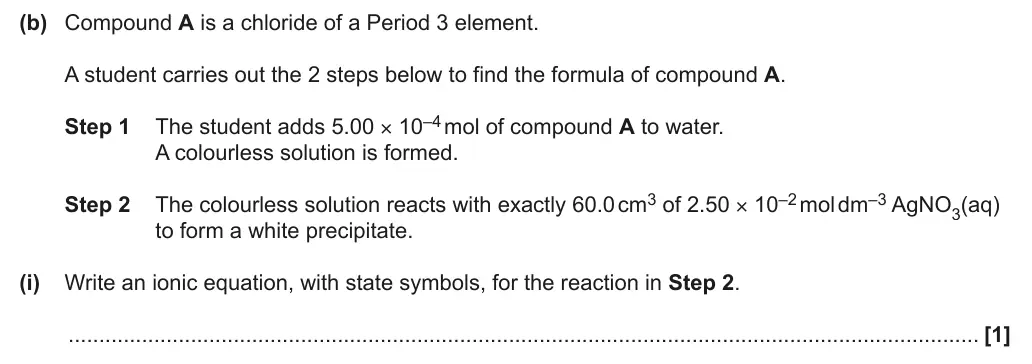
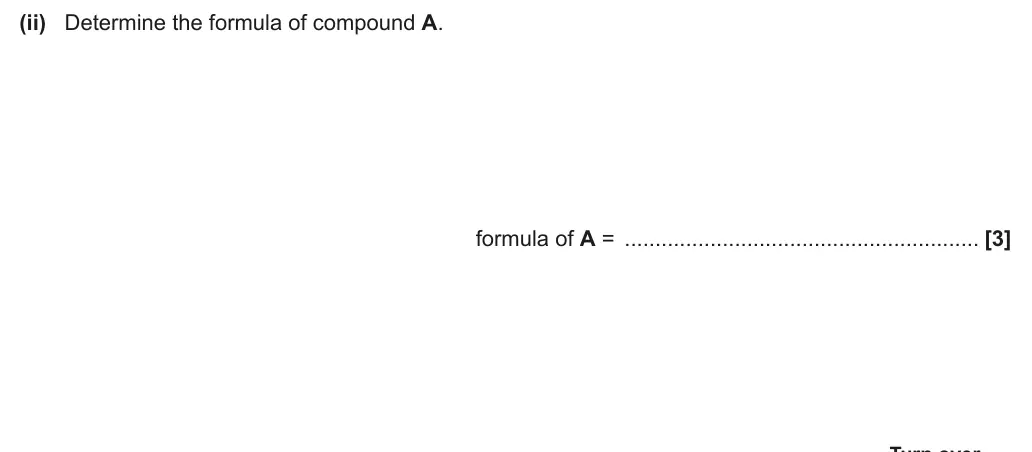
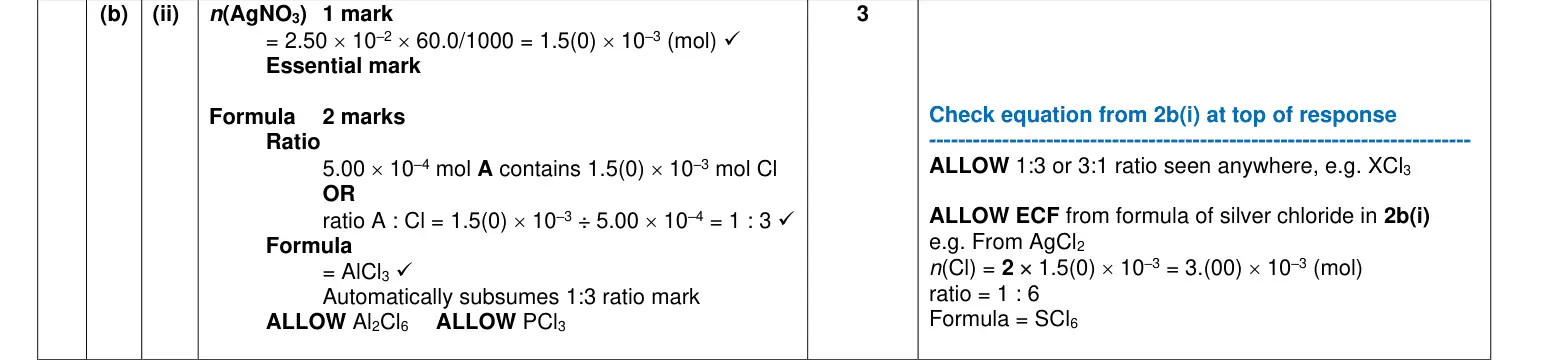
(ii) Determine the formula of compound A.
formula of A =  .......................................................... [3]
June 2024 · Paper 3 · Q2(c)(iii) 2 marks Calculation Medium atomic structure and isotopes
Earlier part of question 2 that this part usesEarlier part of June 2024 Paper 3 question 2
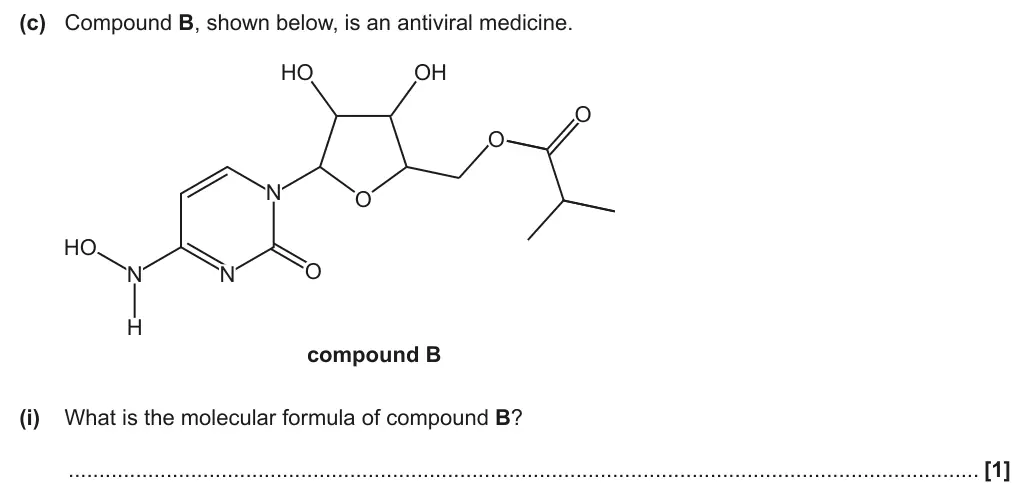
(iii) A research chemist synthesises two related compounds, compound C and compound D, from
compound B.
• In compound C, the N atoms in compound B had been replaced by P atoms.
• In compound D, the O atoms in compound B had been replaced by S atoms.
What is the difference between the relative molecular masses of compound C and compound D?
difference =  .......................................................... [2]
June 2024 · Paper 3 · Q3(b)(iii) 1 mark Calculation Medium practical skills
Earlier part of question 3 that this part usesEarlier part of June 2024 Paper 3 question 3
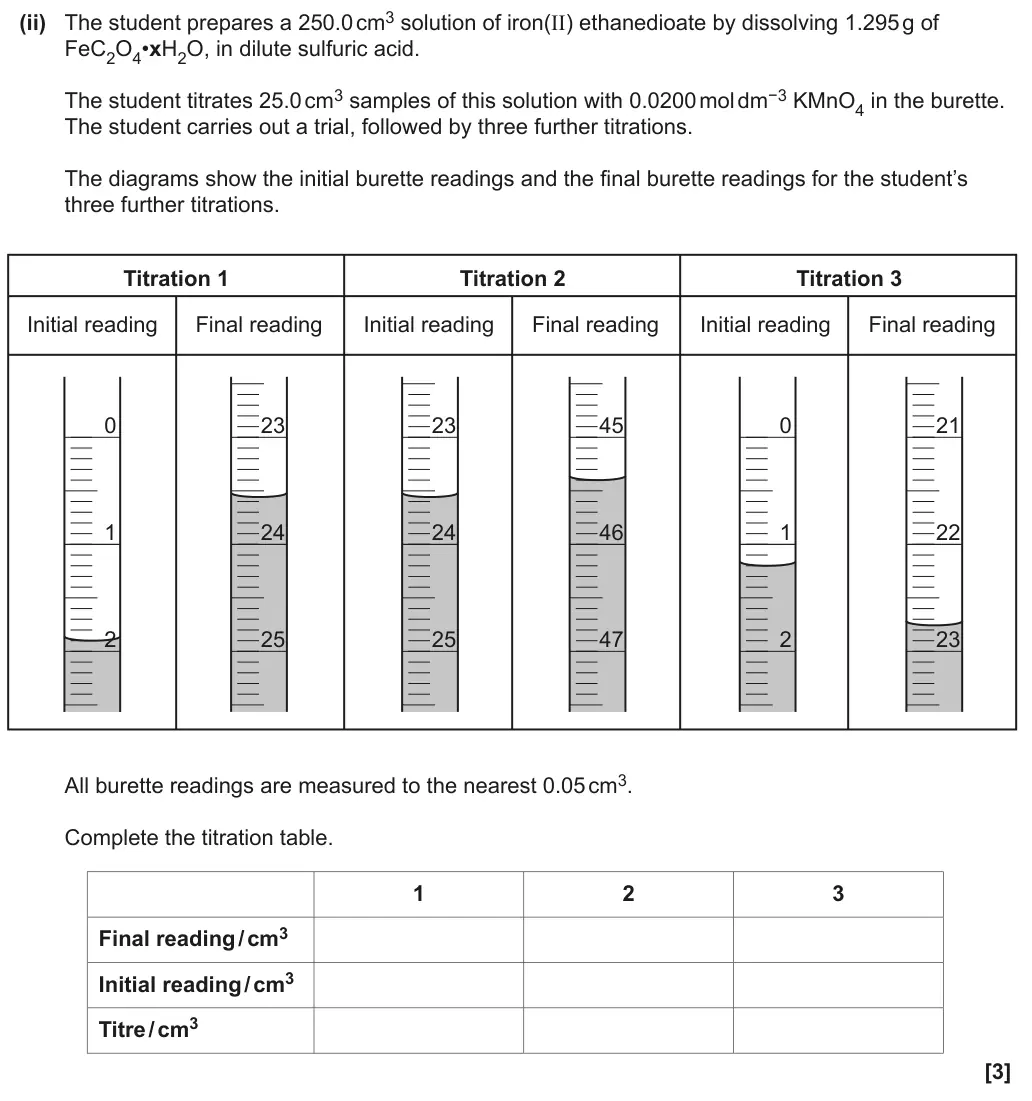
(iii) The uncertainty in each burette reading is ±0.05 cm3.
Calculate the percentage uncertainty for the titre in Titration 1.
percentage uncertainty =  .................................................... % [1]
June 2024 · Paper 3 · Q4(c)(ii) 2 marks Calculation Medium atomic structure and isotopes
Earlier part of question 4 that this part usesEarlier part of June 2024 Paper 3 question 4
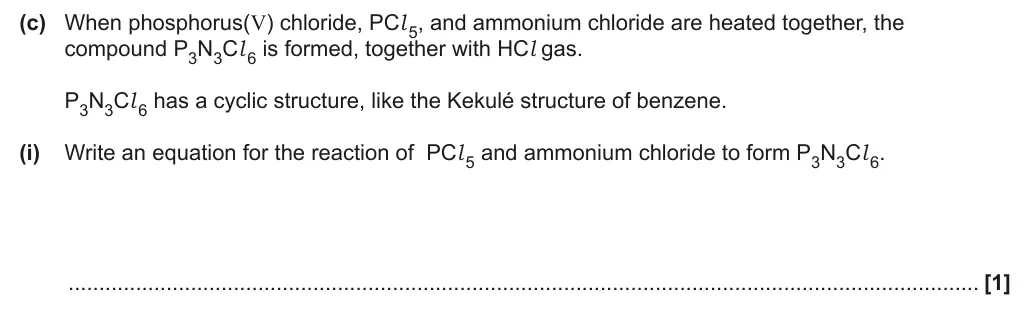
(ii) Calculate the percentage by mass of P in P3N3Cl 6.
Give your answer to 2 decimal places.
percentage by mass of P = ................... % [2]
June 2024 · Paper 3 · Q5(a)(i) 1 mark Calculation Easy chromatography and functional group tests
5 This question is about the analysis of organic compounds.
(a) A student investigates the alkaline hydrolysis of 1-bromopropane as outlined below.
Step 1 The student adds 1-bromopropane to an excess of aqueous potassium hydroxide,
KOH(aq), in a pear-shaped flask.
Step 2 A TLC chromatogram is run using propan-1-ol and the reaction mixture.
Step 3 The reaction mixture is refluxed.
A TLC chromatogram of the reaction mixture is run every 10 minutes.
The TLC chromatograms are shown below.
Before reflux After 10 minutes After 20 minutes After 30 minutes
solvent
front
origin
propan-1-ol reaction mixture propan-1-ol reaction mixture propan-1-ol reaction mixture propan-1-ol reaction mixture
(i) Determine the Rf value of propan-1-ol.
Show your working.
Rf = ................... [1]
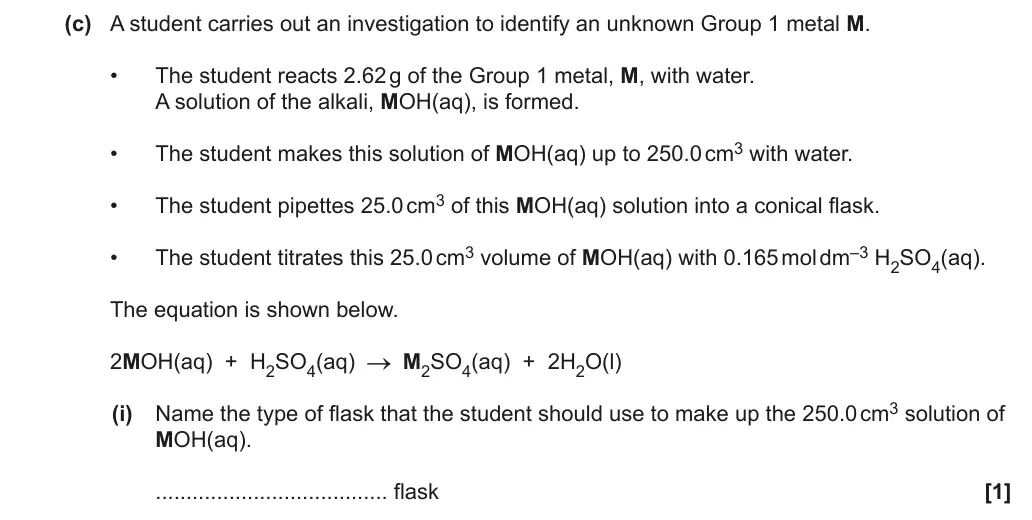
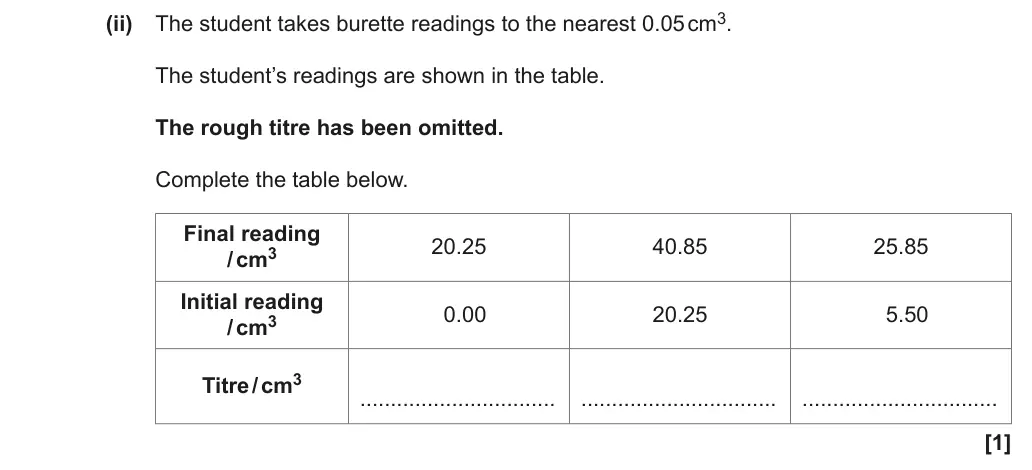
June 2023 · AS Paper 1 · Q22(c)(iii) 1 mark AO2 Calculation Medium acids and titrations
Earlier parts of question 22 that this part usesEarlier part of June 2023 Paper 1 question 22Earlier part of June 2023 Paper 1 question 22
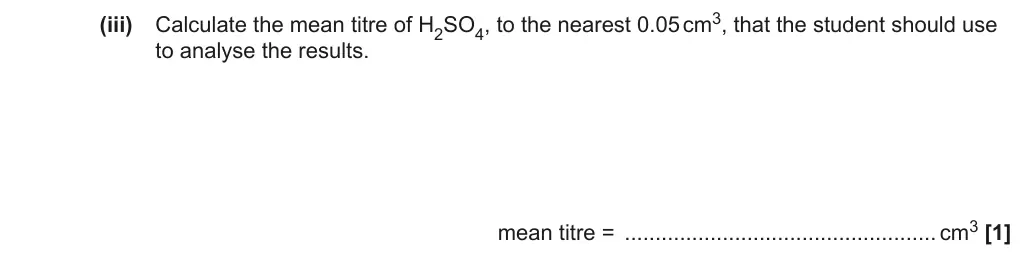
(iii) Calculate the mean titre of H2SO4, to the nearest 0.05 cm3, that the student should use
to analyse the results.
mean titre =  ................................................... cm3 [1]
June 2023 · AS Paper 1 · Q22(c)(iv) 4 marks AO3 Calculation Medium acids and titrationsamount of substance
Earlier parts of question 22 that this part usesEarlier part of June 2023 Paper 1 question 22Earlier part of June 2023 Paper 1 question 22
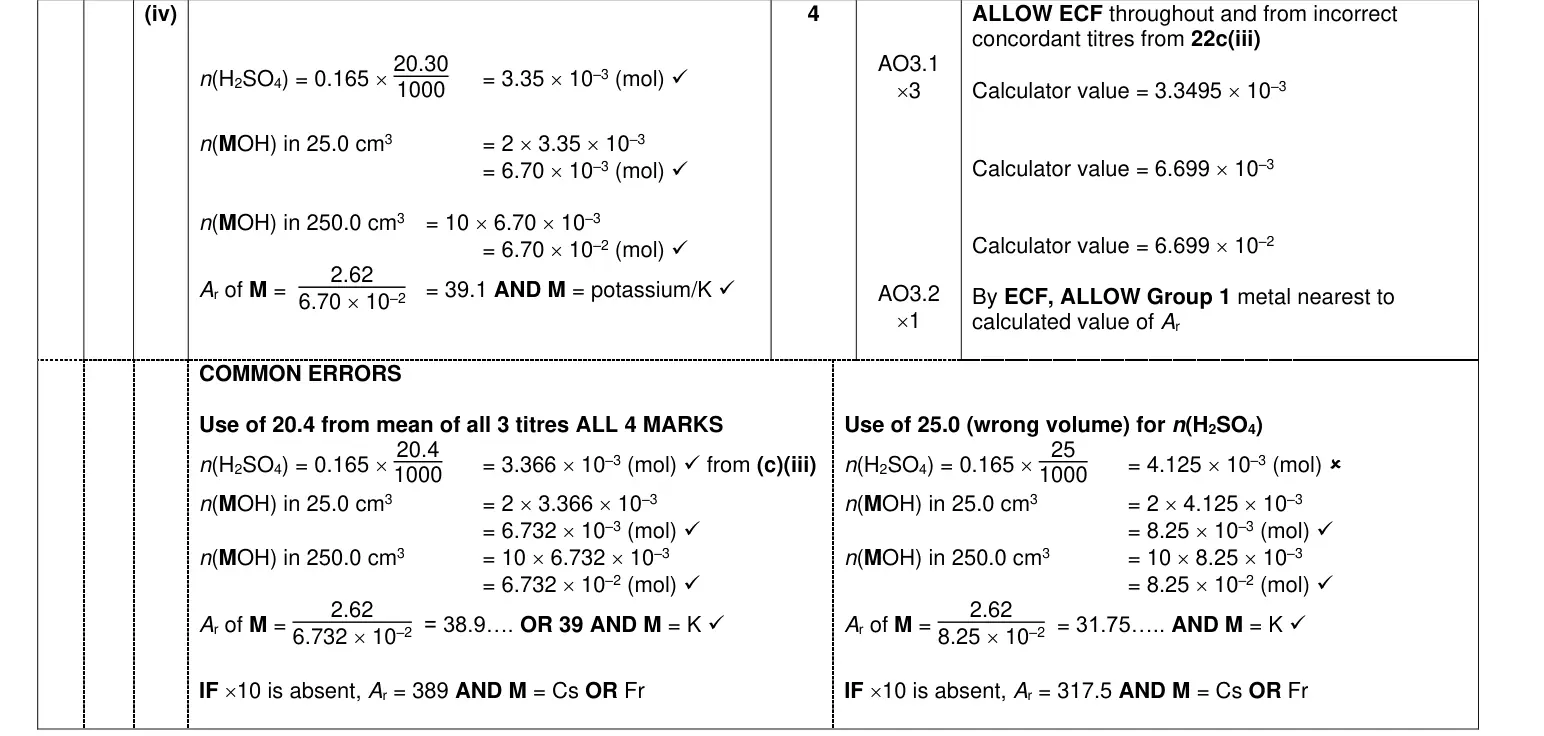
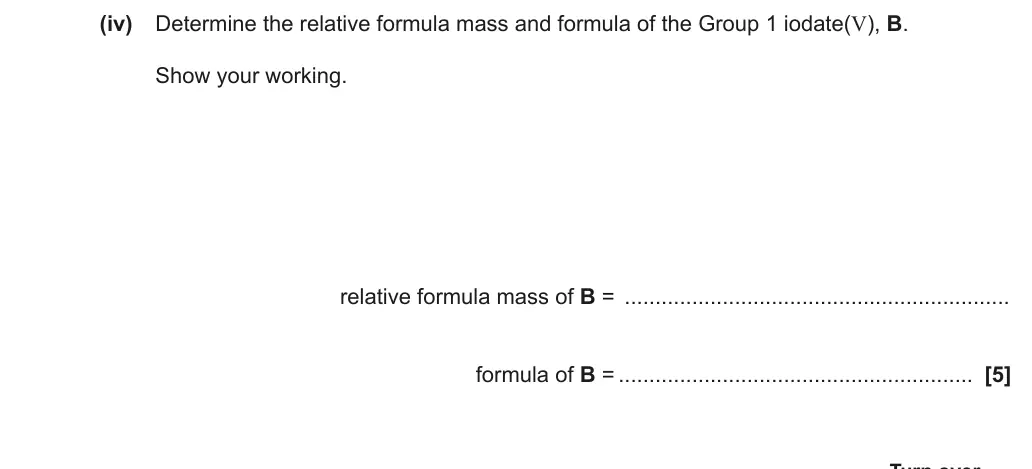
(iv) Calculate the amount, in mol, of MOH in 25.0 cm3 of solution and determine the identity
of the Group 1 metal M.
metal M =  .......................................................... [4]
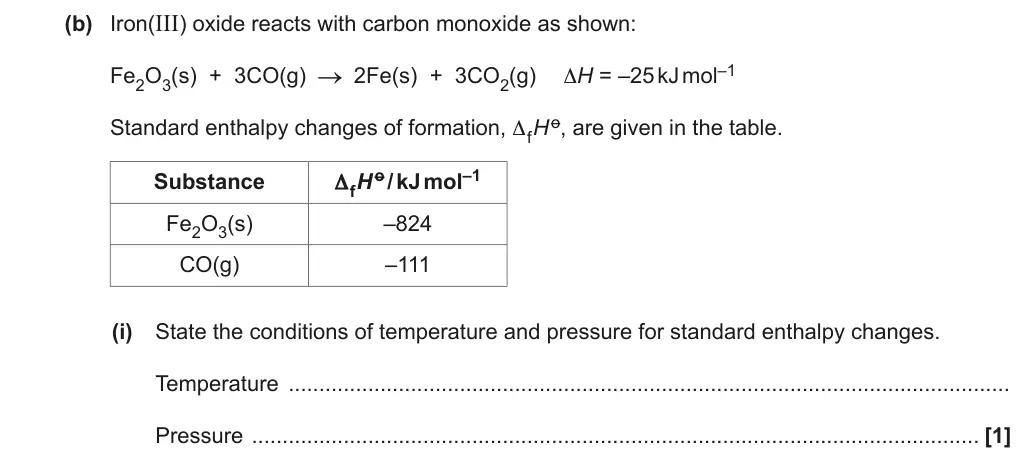
June 2023 · AS Paper 1 · Q23(b)(ii) 3 marks AO2 Calculation Hard enthalpy changes
Earlier part of question 23 that this part usesEarlier part of June 2023 Paper 1 question 23
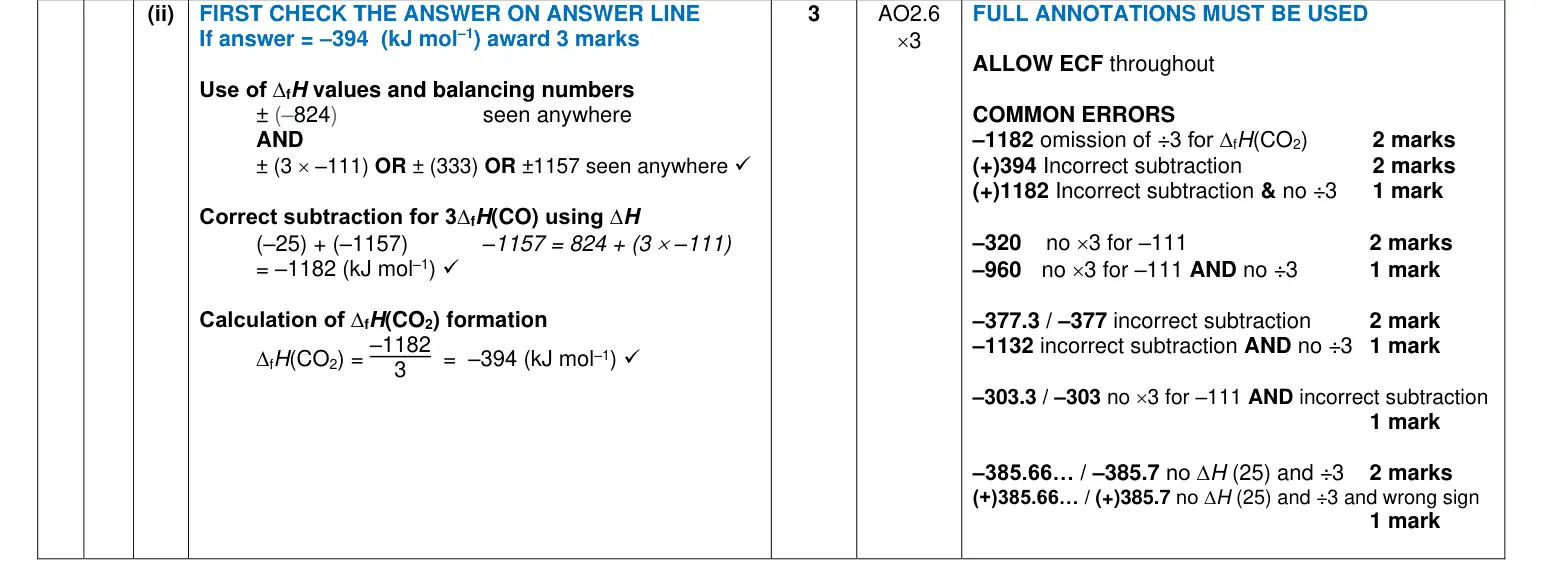
(ii) Calculate the standard enthalpy change of formation for CO2(g).
Δ f H o (CO2(g)) =  ............................................ kJ mol–1 [3]
June 2023 · AS Paper 1 · Q24(c)(i) 2 marks AO2 Calculation Medium chemical equilibrium
Earlier part of question 24 that this part usesEarlier part of June 2023 Paper 1 question 24
(c) A mixture of SO2(g) and O2(g) is allowed to reach equilibrium at a constant temperature.
The equilibrium concentrations are shown in the table.
Equilibrium concentration
Substance
/ mol dm–3
SO2(g) 3.0 × 10⁻³
O2(g) 3.5 × 10⁻³
SO3(g) 5.0 × 10⁻²
(i) Write the expression for Kc and calculate the numerical value for Kc in Equilibrium 24.1
at this constant temperature.
Give your answer to an appropriate number of significant figures and in standard
form.
Kc =  ......................................... dm3 mol–1 [2]
June 2023 · AS Paper 2 · Q1(a)(i) 2 marks AO1, 2 Calculation Easy atomic structure and isotopes
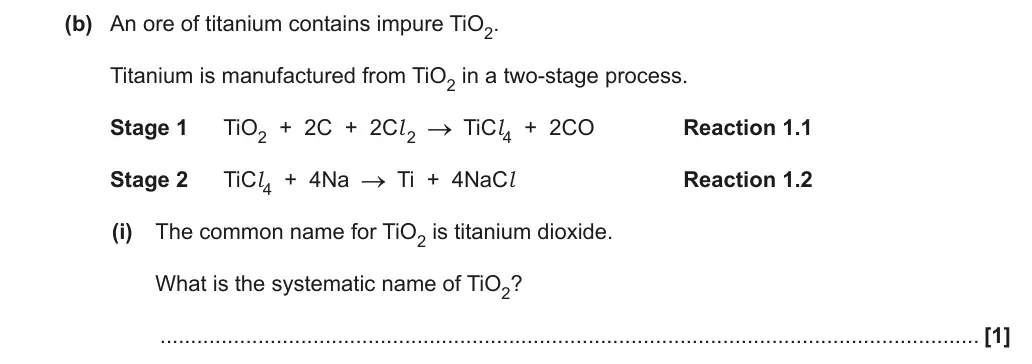
1 This question is about titanium (atomic number 22) and its compounds.
(a) Titanium exists as a mixture of five isotopes.
A chemist analyses a sample of titanium using mass spectrometry.
The results are shown in the table below.
Isotope Abundance (%)
46Ti 8.30
47Ti 7.40
48Ti 73.70
49Ti 5.40
50Ti 5.20
(i) Calculate the relative atomic mass of titanium in the sample.
Give your answer to 2 decimal places.
relative atomic mass =  ......................................................... [2]
June 2023 · AS Paper 2 · Q1(b)(ii) 4 marks AO2 Calculation Hard amount of substance
Earlier part of question 1 that this part usesEarlier part of June 2023 Paper 2 question 1
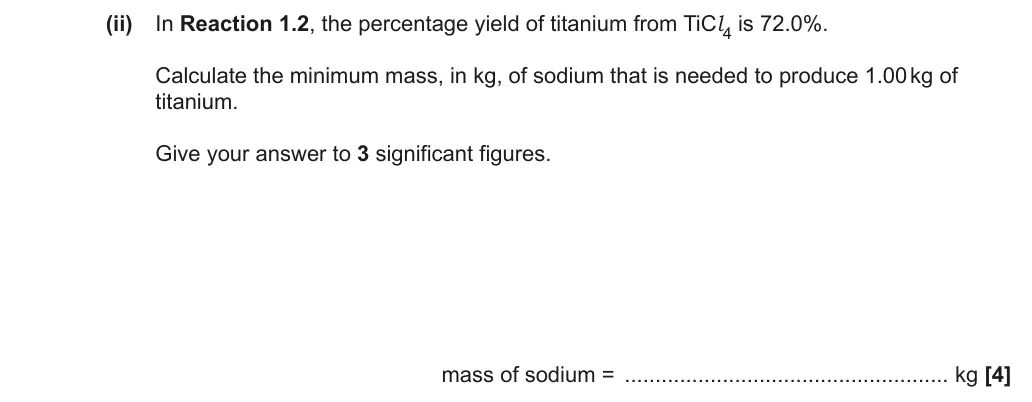
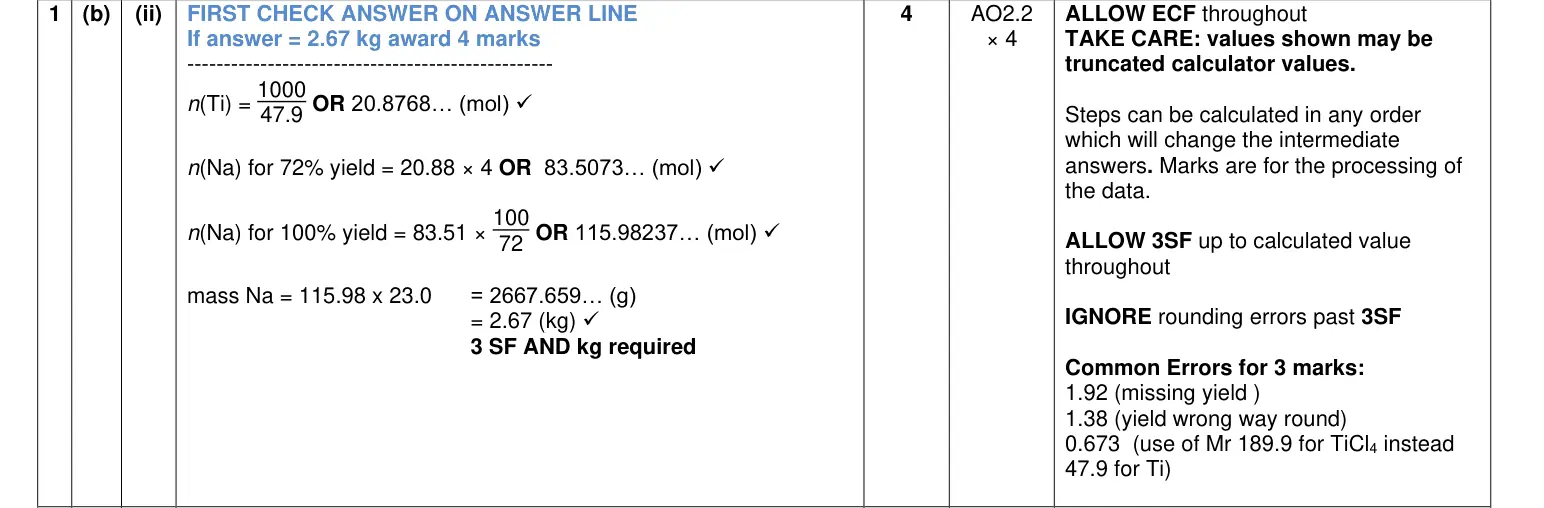
(ii) In Reaction 1.2, the percentage yield of titanium from TiCl4 is 72.0%.
Calculate the minimum mass, in kg, of sodium that is needed to produce 1.00 kg of
titanium.
Give your answer to 3 significant figures.
mass of sodium =  ..................................................... kg [4]
June 2023 · AS Paper 2 · Q2(b)(ii) 4 marks AO3 Calculation Hard amount of substancepractical skills
Earlier part of question 2 that this part usesEarlier part of June 2023 Paper 2 question 2
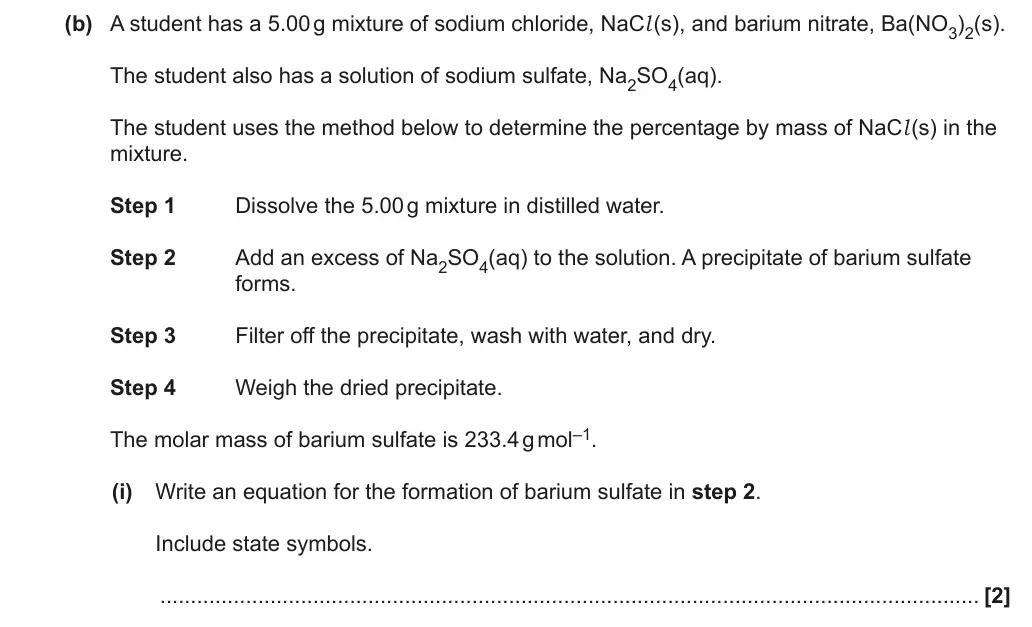
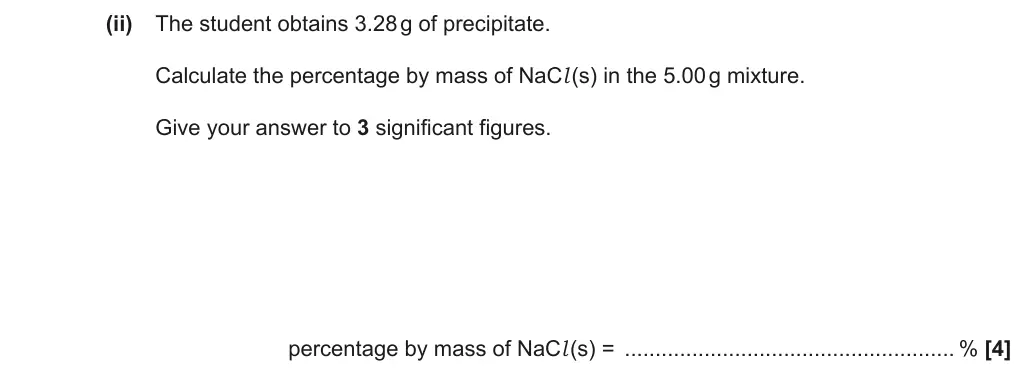
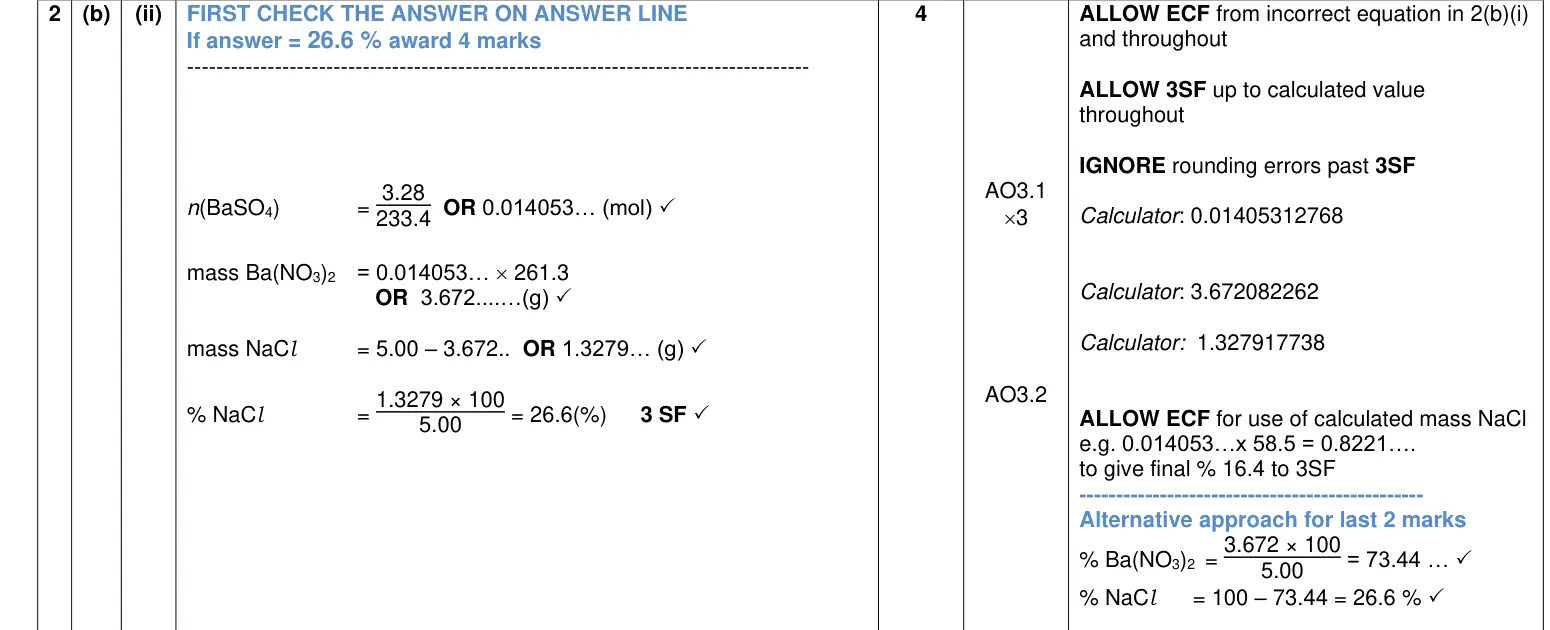
(ii) The student obtains 3.28 g of precipitate.
Calculate the percentage by mass of NaCl (s) in the 5.00 g mixture.
Give your answer to 3 significant figures.
percentage by mass of NaCl (s) =  ...................................................... % [4]
June 2023 · AS Paper 2 · Q4(b)(i) 1 mark AO2 Calculation Medium practical skills
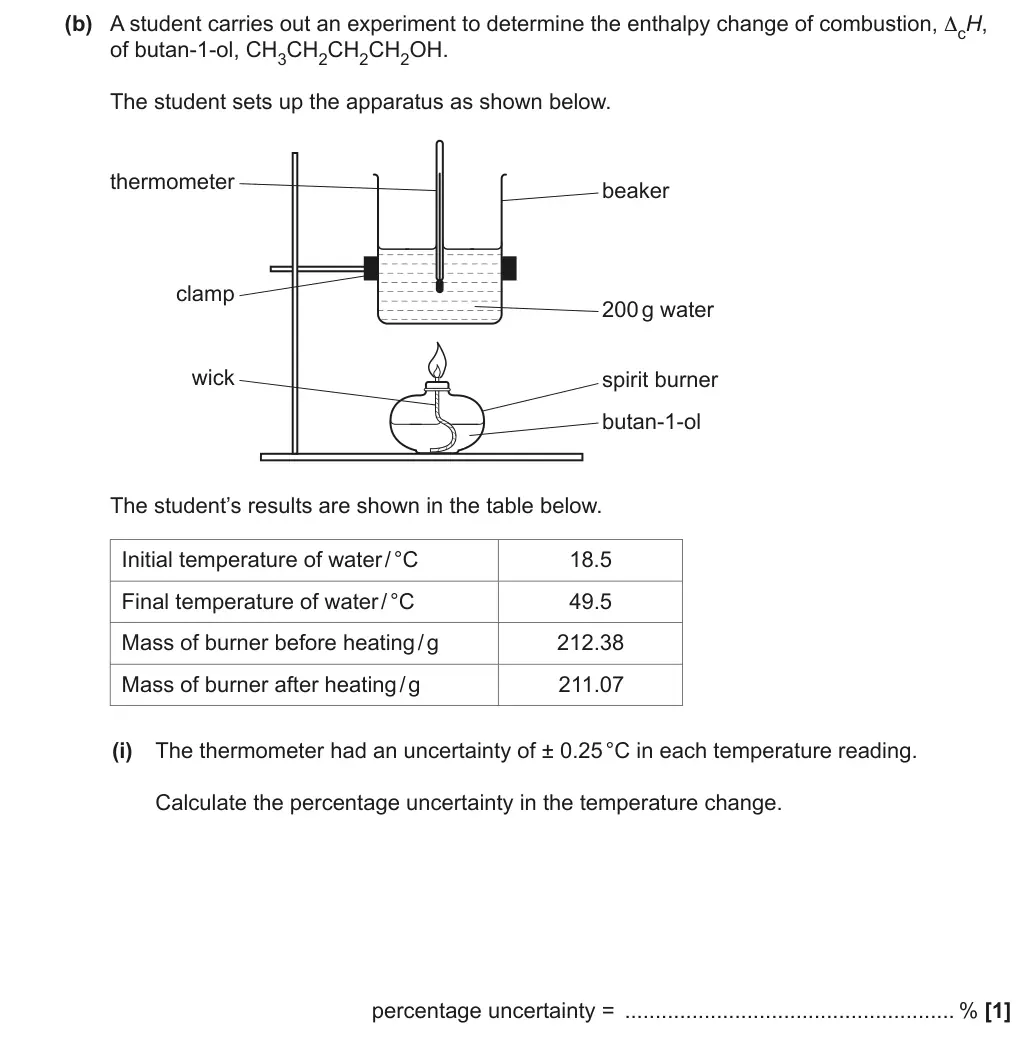
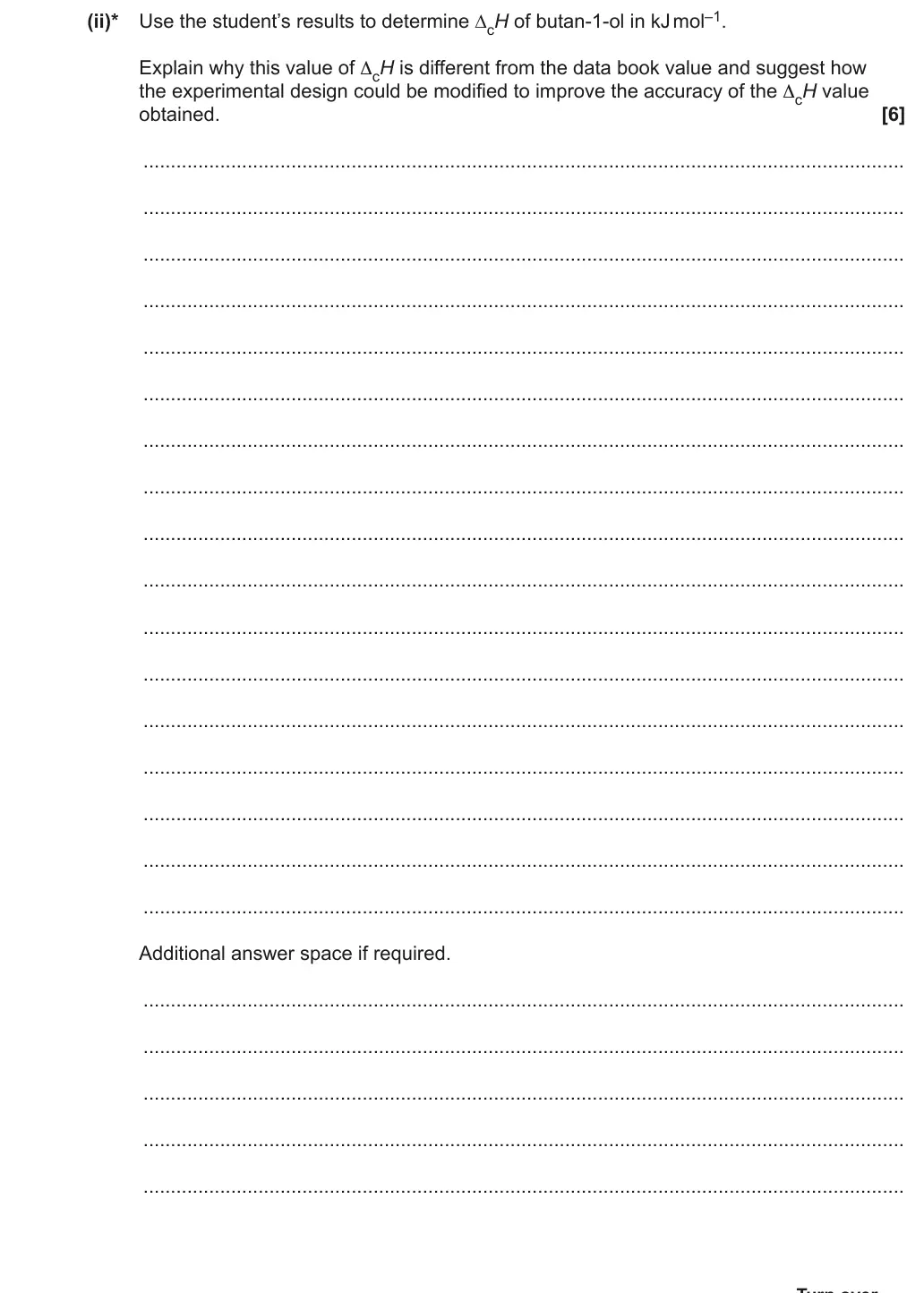
(b) A student carries out an experiment to determine the enthalpy change of combustion, ΔcH,
of butan-1-ol, CH3CH2CH2CH2OH.
The student sets up the apparatus as shown below.
thermometer
beaker
clamp
200 g water
wick spirit burner
butan-1-ol
The student’s results are shown in the table below.
Initial temperature of water / °C 18.5
Final temperature of water / °C 49.5
Mass of burner before heating / g 212.38
Mass of burner after heating / g 211.07
(i) The thermometer had an uncertainty of ± 0.25 °C in each temperature reading.
Calculate the percentage uncertainty in the temperature change.
percentage uncertainty =  ...................................................... % [1]
June 2023 · AS Paper 2 · Q4(b)(iii) 1 mark AO3 Calculation Medium enthalpy changes
Earlier parts of question 4 that this part usesEarlier part of June 2023 Paper 2 question 4Earlier part of June 2023 Paper 2 question 4
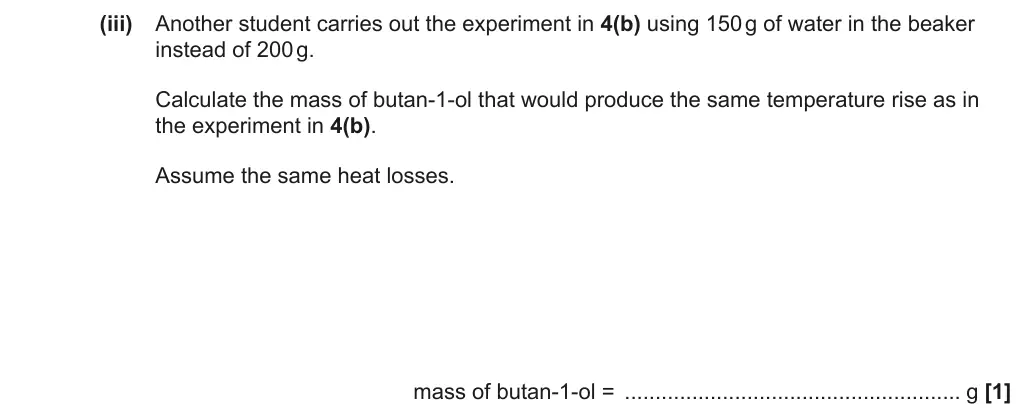
(iii) Another student carries out the experiment in 4(b) using 150 g of water in the beaker
instead of 200 g.
Calculate the mass of butan-1-ol that would produce the same temperature rise as in
the experiment in 4(b).
Assume the same heat losses.
mass of butan-1-ol =  ....................................................... g [1]
June 2023 · AS Paper 2 · Q4(c)(i) 4 marks AO2 Calculation Hard enthalpy changes
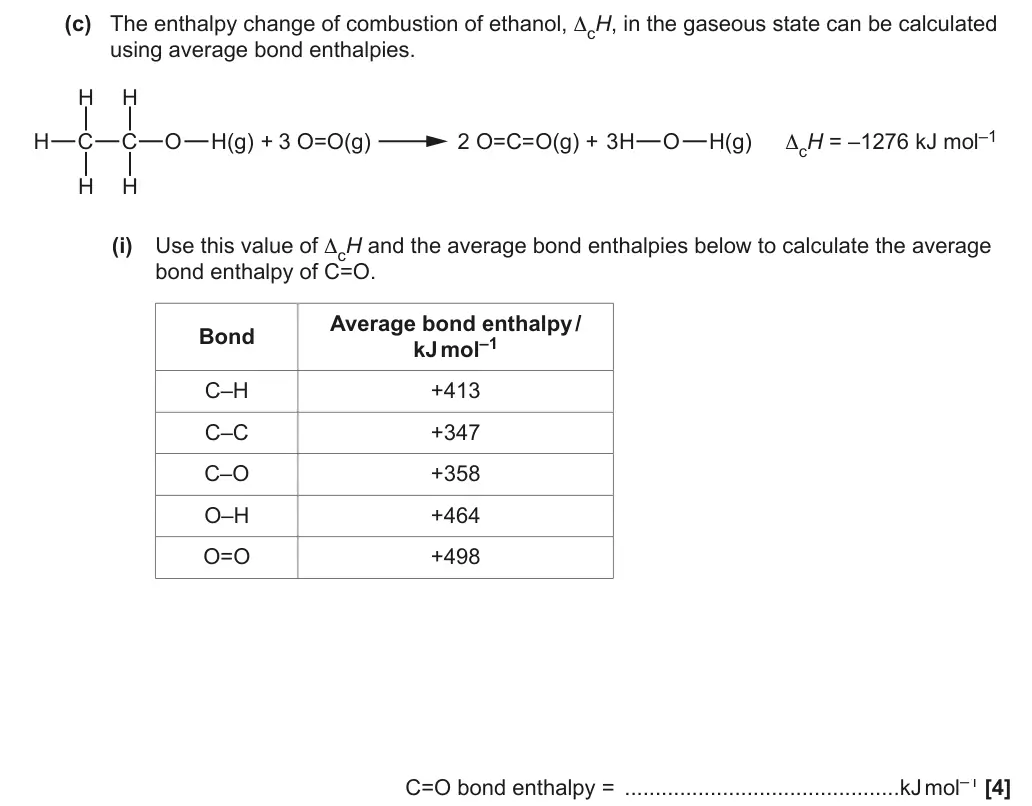
(c) The enthalpy change of combustion of ethanol, ΔcH, in the gaseous state can be calculated
using average bond enthalpies.
H H
H C C O H(g)  + 3 O=O(g) 2 O=C= O(g) + 3 H O H(g) ΔcH = –1276 kJ mol–1
H H
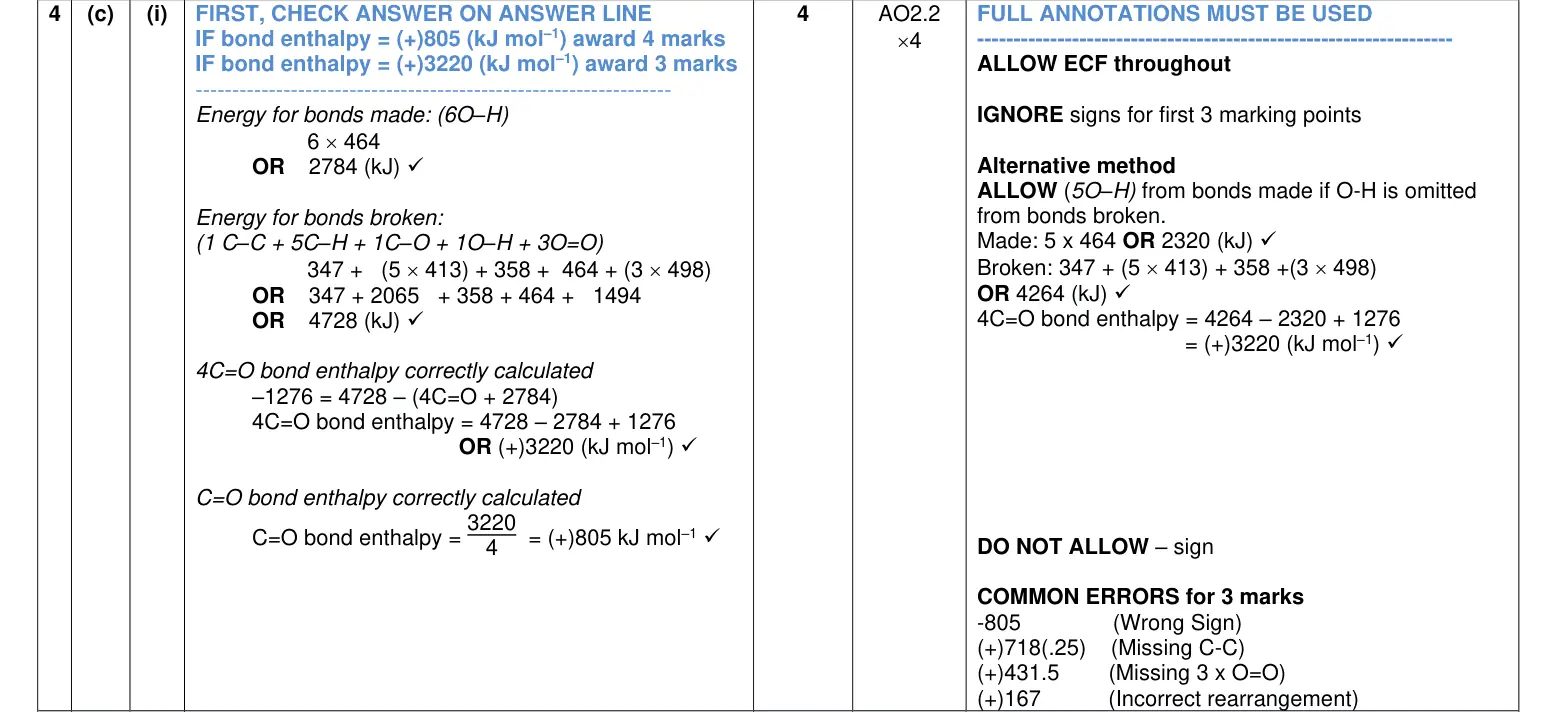
(i) Use this value of ΔcH and the average bond enthalpies below to calculate the average
bond enthalpy of C=O.
Average bond enthalpy /
Bond
kJ mol–1
C–H +413
C–C +347
C–O +358
O–H +464
O=O +498
C=O bond enthalpy =  .............................................kJ mol–1 [4]
June 2023 · Paper 1 · Q16(a)(ii) 2 marks AO2 Calculation Medium lattice enthalpy
Earlier part of question 16 that this part usesEarlier part of June 2023 Paper 1 question 16
(ii) Calculate the lattice enthalpy of barium iodide.
lattice enthalpy =  ............................................ kJ mol–1 [2]
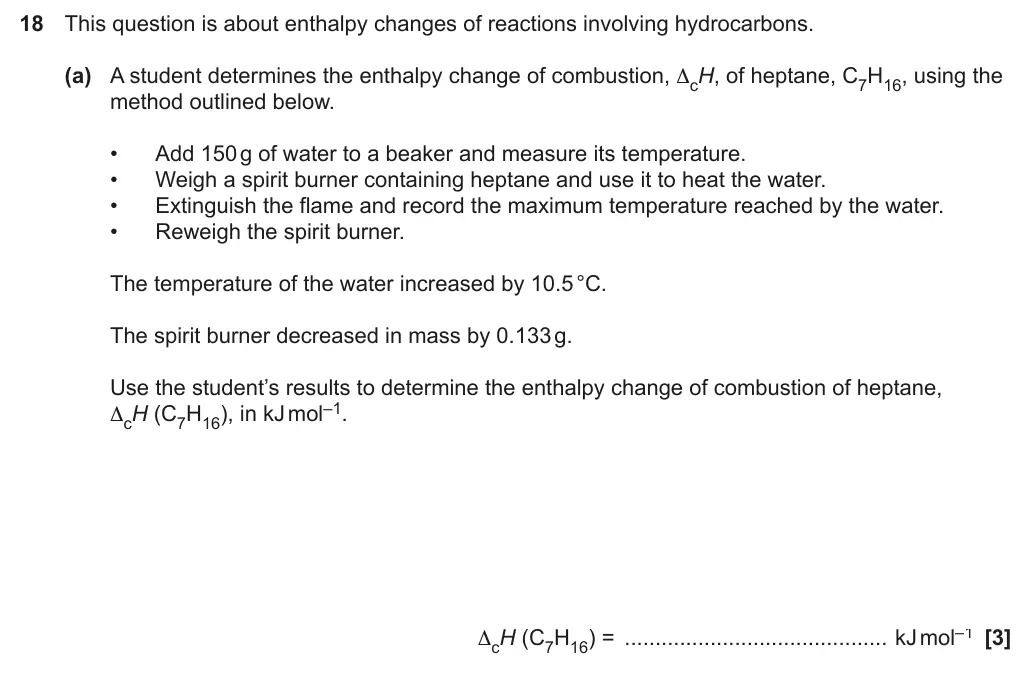
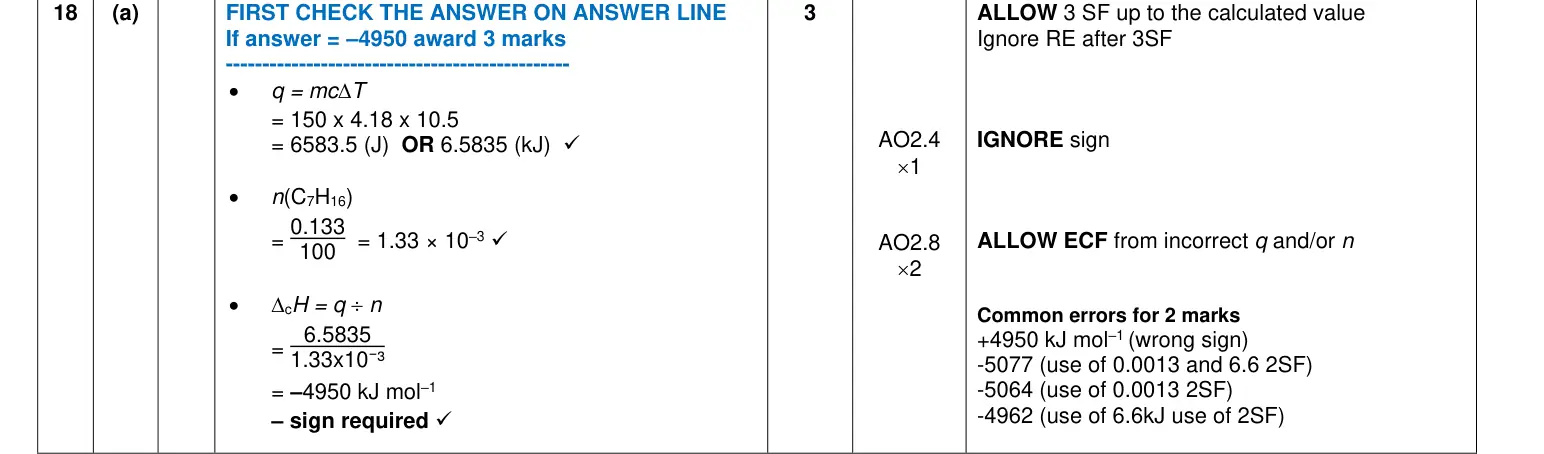
June 2023 · Paper 1 · Q18(a) 3 marks AO2 Calculation Hard enthalpy changesamount of substance
18 This question is about enthalpy changes of reactions involving hydrocarbons.
(a) A student determines the enthalpy change of combustion, ∆cH, of heptane, C7H16, using the
method outlined below.
• Add 150 g of water to a beaker and measure its temperature.
• Weigh a spirit burner containing heptane and use it to heat the water.
• Extinguish the flame and record the maximum temperature reached by the water.
• Reweigh the spirit burner.
The temperature of the water increased by 10.5 °C.
The spirit burner decreased in mass by 0.133 g.
Use the student’s results to determine the enthalpy change of combustion of heptane,
∆cH (C7H16), in kJ mol–1.
∆cH (C7H16) =  ........................................... kJ mol–1 [3]
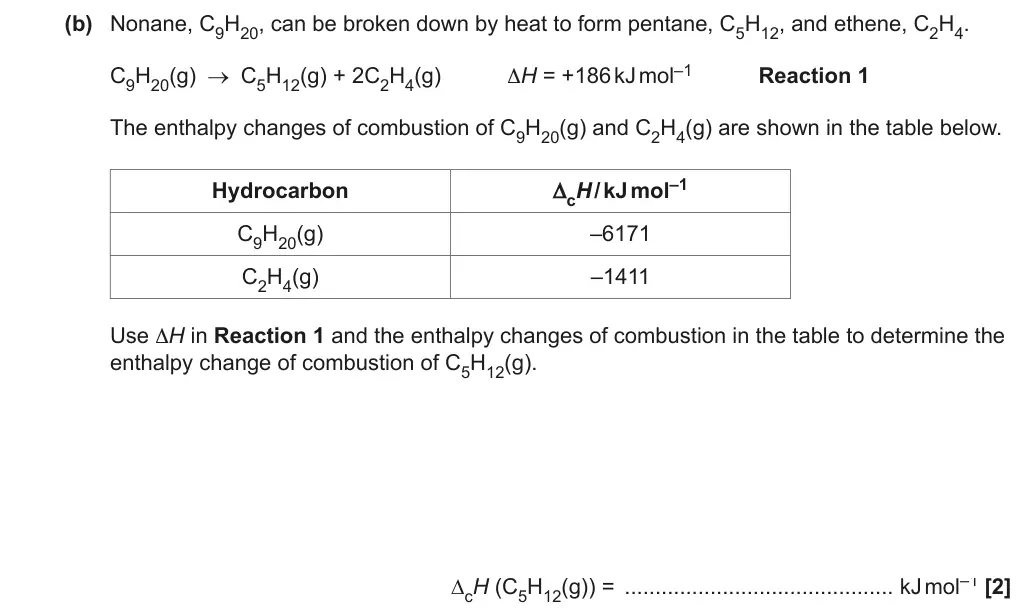
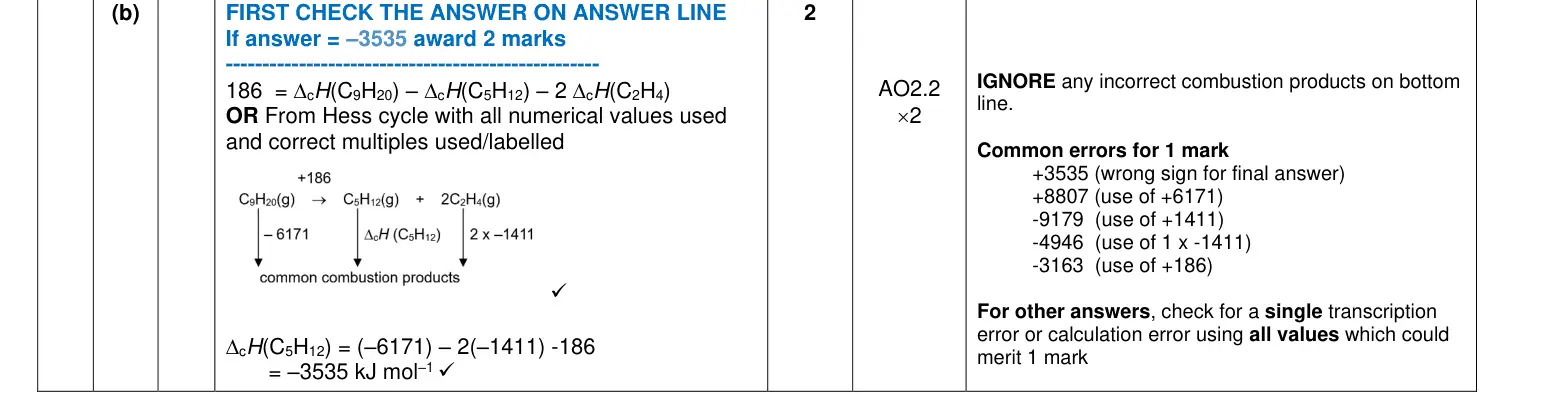
June 2023 · Paper 1 · Q18(b) 2 marks AO2 Calculation Hard enthalpy changes
(b) Nonane, C9H20, can be broken down by heat to form pentane, C5H12, and ethene, C2H4.
C9H20(g) C5H12(g) + 2C2H4(g)   ∆H = +186 kJ mol–1   Reaction 1
The enthalpy changes of combustion of C9H20(g) and C2H4(g) are shown in the table below.
Hydrocarbon ∆cH / kJ mol–1
C9H20(g) –6171
C2H4(g) –1411
Use ∆H in Reaction 1 and the enthalpy changes of combustion in the table to determine the
enthalpy change of combustion of C5H12(g).
∆cH (C5H12(g)) =  ............................................ kJ mol–1 [2]
June 2023 · Paper 1 · Q18(c)(ii) 5 marks AO3 Calculation Easy entropy and free energypractical skills
Earlier part of question 18 that this part usesEarlier part of June 2023 Paper 1 question 18
(ii) Reaction 2 is repeated:
C2H5OH(g) C2H4(g) + H2O(g)            Reaction 2
The Gibbs equation is shown below.
∆G = ∆H – T∆S
The enthalpy change, ∆H, and the entropy change, ∆S, can be assumed to be constant
at different temperatures.
Fig. 18.1 shows values of the free energy change, ∆G, in kJ mol–1, at different
temperatures, T, in K, for Reaction 2.
Fig. 18.1
60
50
40
30
20
10
∆G
0
/ kJ mol–1
–10
–20
–30
–40
–50
–60
0 100 200 300 400 500 600 700 800 900
T / K
Use the graph in Fig. 18.1 to answer the following:
• Draw the best-fit line on the graph in Fig. 18.1.
• Determine ∆S, in J K–1 mol–1, for  Reaction 2.
• Determine the minimum temperature, T, at which the reaction is feasible.
• Determine ∆H for Reaction 2.
∆S = .................................... J K–1 mol–1
minimum T = ....................... K
∆H = .................................... kJ mol–1
[5]
June 2023 · Paper 1 · Q19(a)(i) 5 marks AO1, 2 Calculation Hard equilibrium constants
19 This question is about oxides of nitrogen.
(a) An investigation is carried out on the equilibrium system shown below.
2NO2(g) N2O4(g) ∆H = –57.4 kJ mol–1
(i) A sealed flask containing 6.00 moles of NO2(g) is heated to a constant temperature and
allowed to reach equilibrium.
The equilibrium mixture contains 5.40 mol of NO2(g), and the total pressure is 5.00 atm.
Determine the value of Kp and give your answer to 3 significant figures.
Include an expression for Kp and the units of Kp in your answer.
Kp = ............................................... units ......................[5]
June 2023 · Paper 1 · Q19(b) 5 marks AO2, 3 Calculation Medium amount of substance
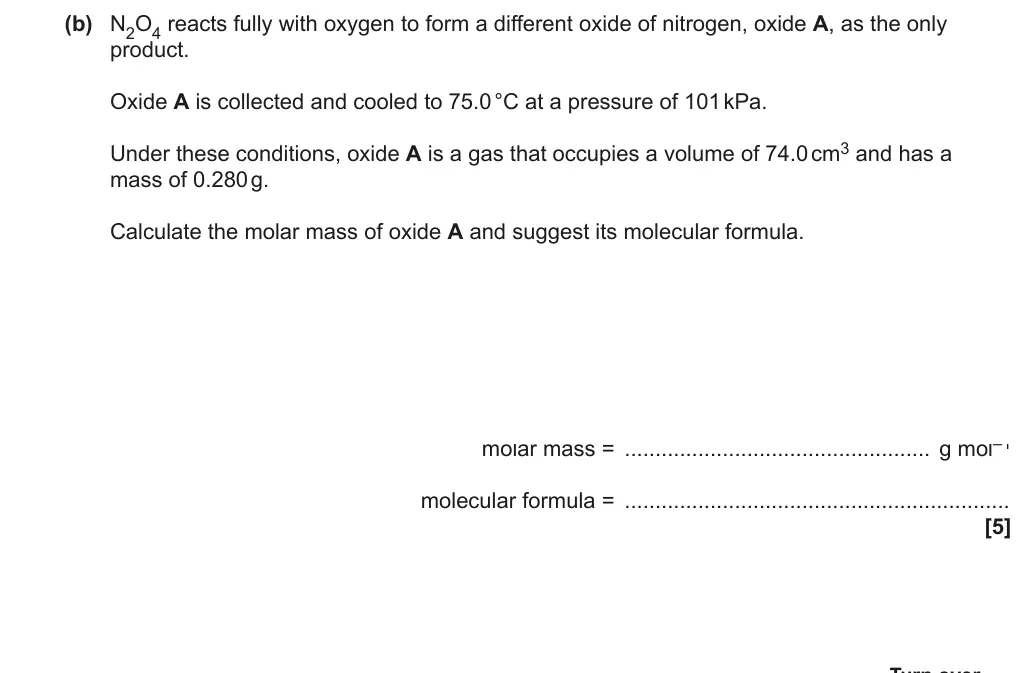
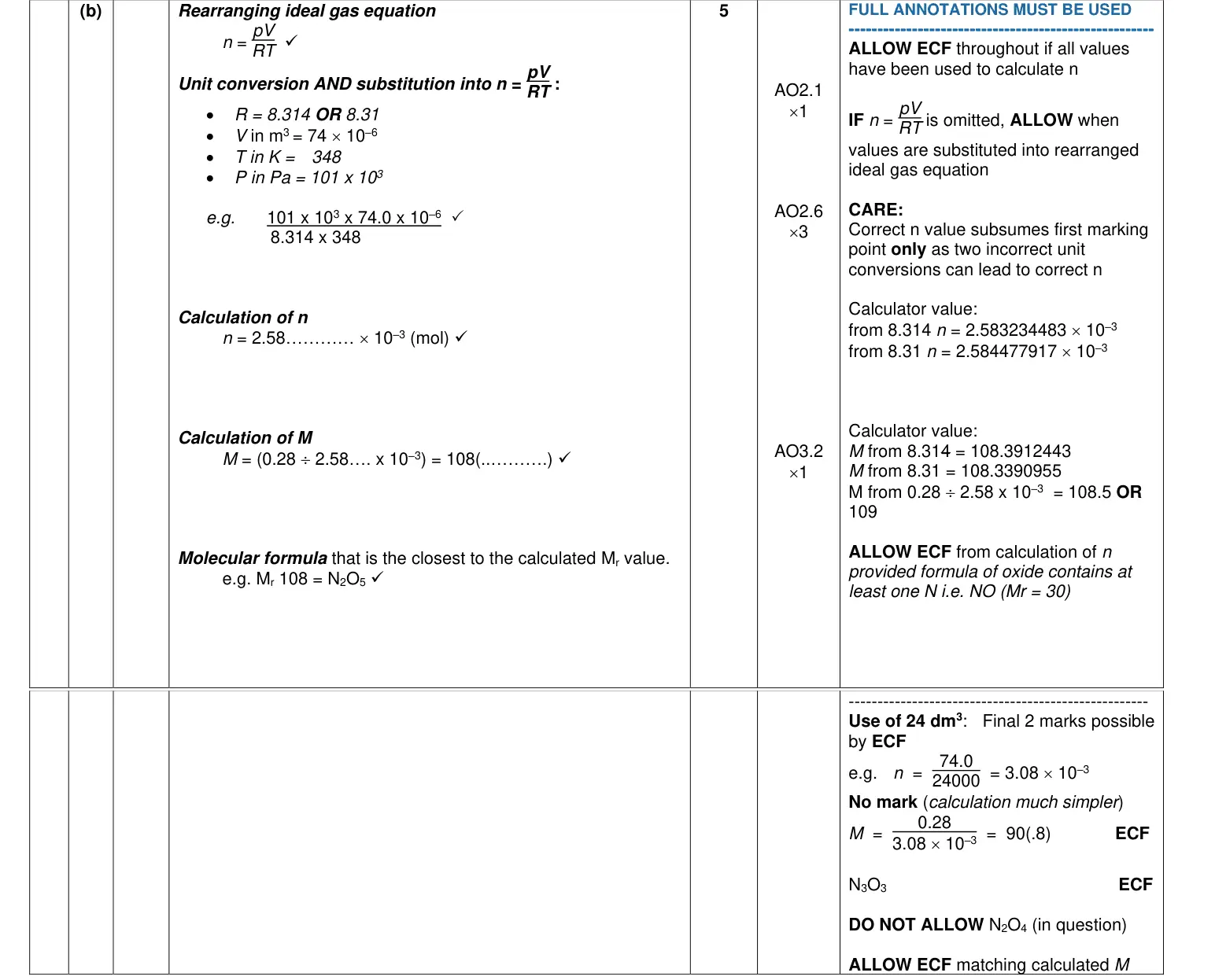
(b) N2O4 reacts fully with oxygen to form a different oxide of nitrogen, oxide A, as the only
product.
Oxide A is collected and cooled to 75.0 °C at a pressure of 101 kPa.
Under these conditions, oxide A is a gas that occupies a volume of 74.0 cm3 and has a
mass of 0.280 g.
Calculate the molar mass of oxide A and suggest its molecular formula.
molar mass =  .................................................. g mol–1
molecular formula =  ...............................................................
[5]
June 2023 · Paper 1 · Q20(a)(i) 2 marks AO1, 2 Calculation Hard acids bases and buffers
20 This question is about acids and bases.
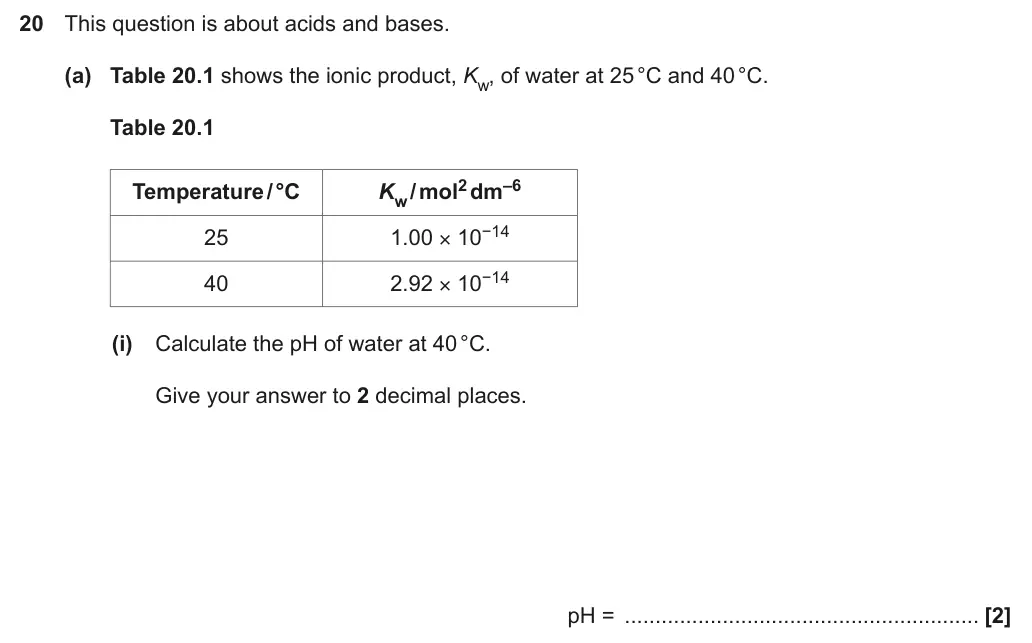
(a) Table 20.1 shows the ionic product, Kw, of water at 25 °C and 40 °C.
Table 20.1
Temperature / °C Kw / mol2 dm–6
25 1.00 × 10⁻¹⁴
40 2.92 × 10⁻¹⁴
(i) Calculate the pH of water at 40 °C.
Give your answer to 2 decimal places.
pH =  .......................................................... [2]
June 2023 · Paper 1 · Q20(b) 5 marks AO1, 2 Calculation Medium group 2amount of substanceacids bases and buffers
Earlier part of question 20 that this part usesEarlier part of June 2023 Paper 1 question 20
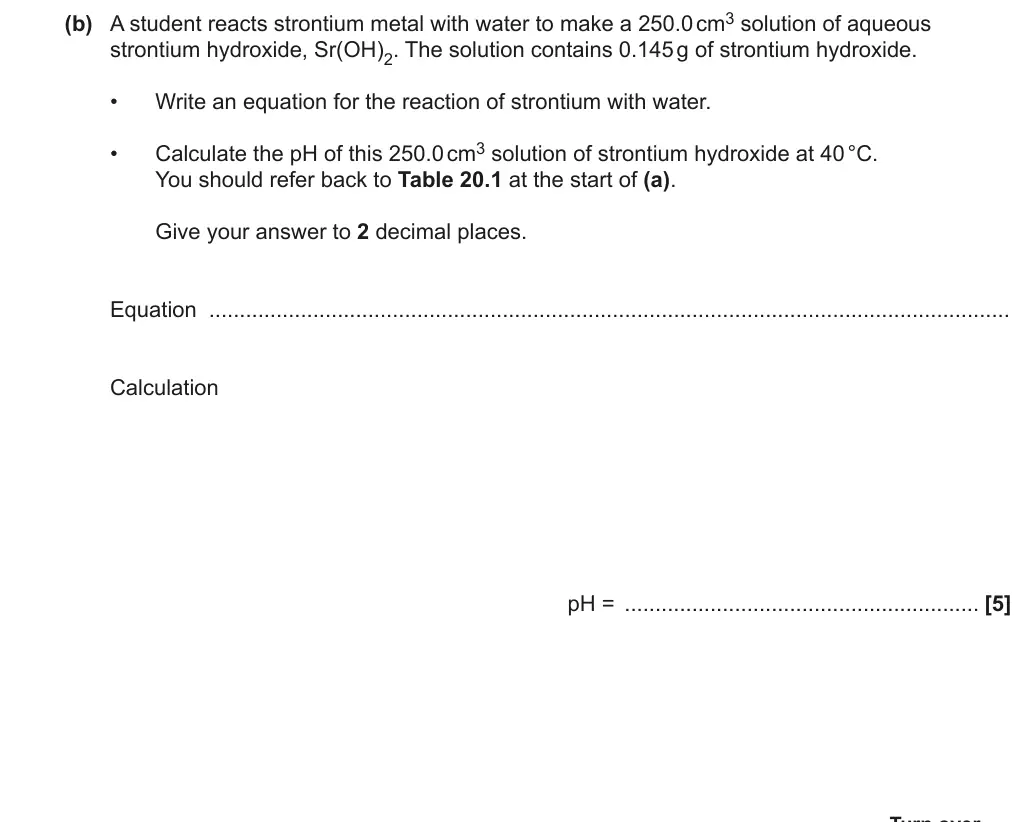
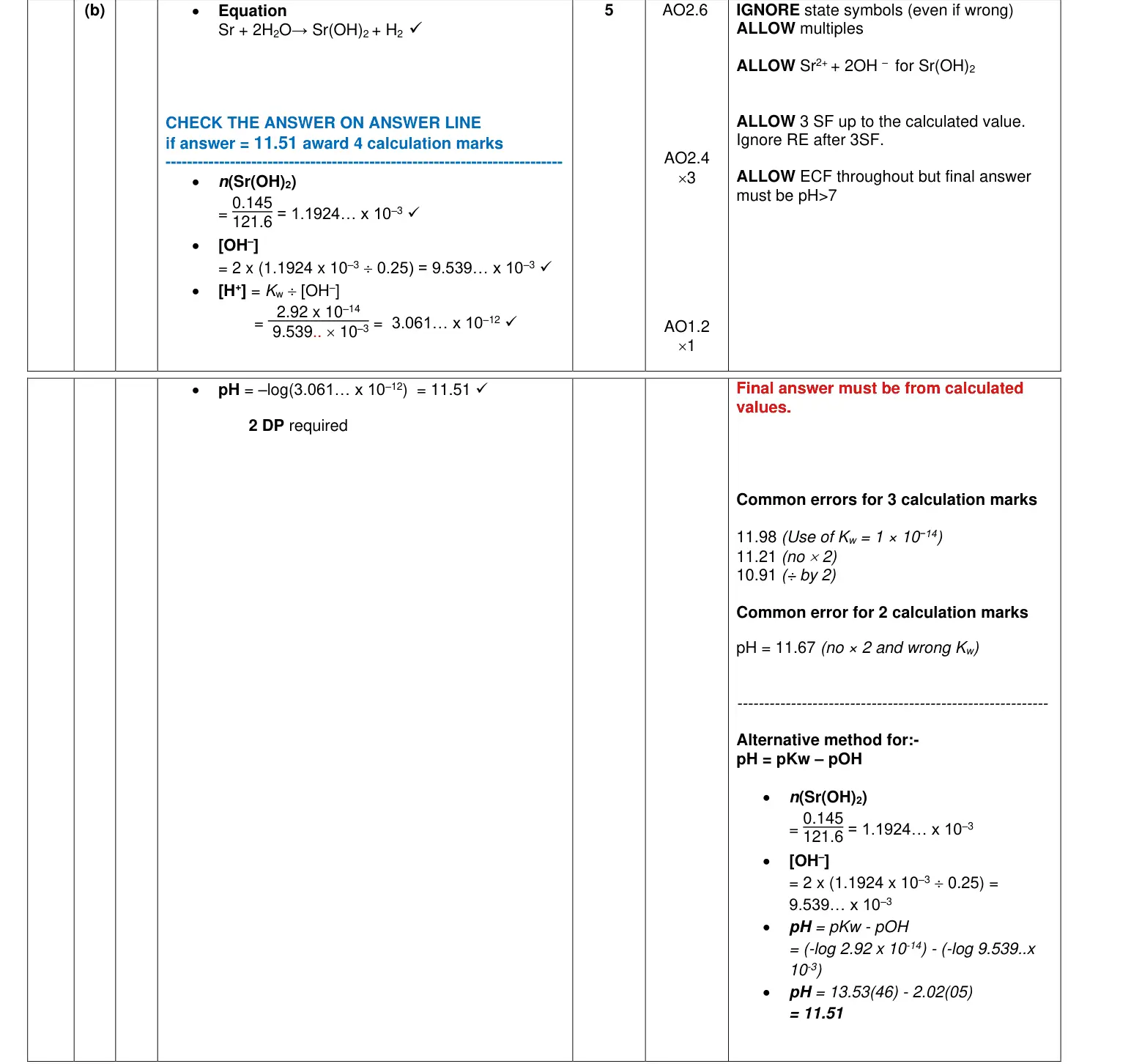
(b) A student reacts strontium metal with water to make a 250.0 cm3 solution of aqueous
strontium hydroxide, Sr(OH)2. The solution contains 0.145 g of strontium hydroxide.
• Write an equation for the reaction of strontium with water.
• Calculate the pH of this 250.0 cm3 solution of strontium hydroxide at 40 °C.
You should refer back to Table 20.1 at the start of (a).
Give your answer to 2 decimal places.
Equation  ...................................................................................................................................
Calculation
pH =  .......................................................... [5]
June 2023 · Paper 1 · Q20(e)(ii) 4 marks AO1, 2 Calculation Hard acids bases and buffersamount of substance
Earlier part of question 20 that this part usesEarlier part of June 2023 Paper 1 question 20
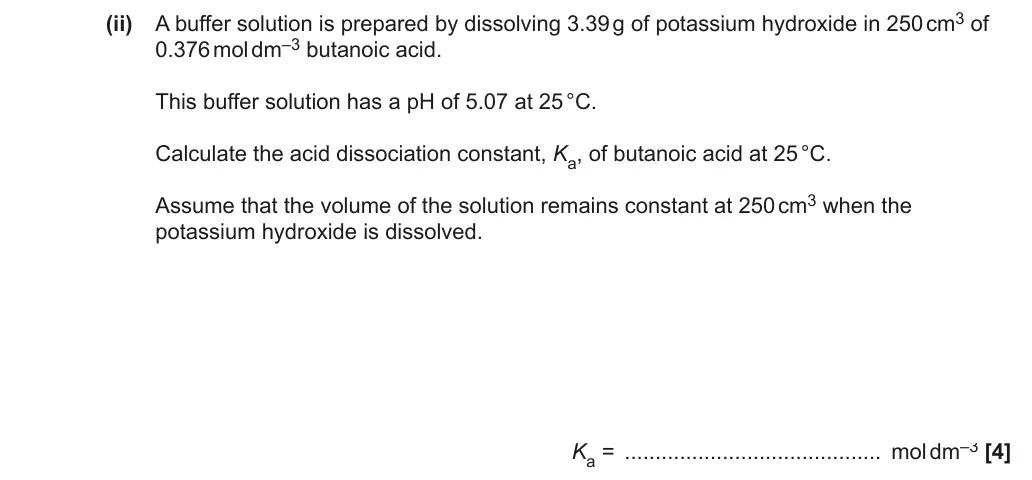
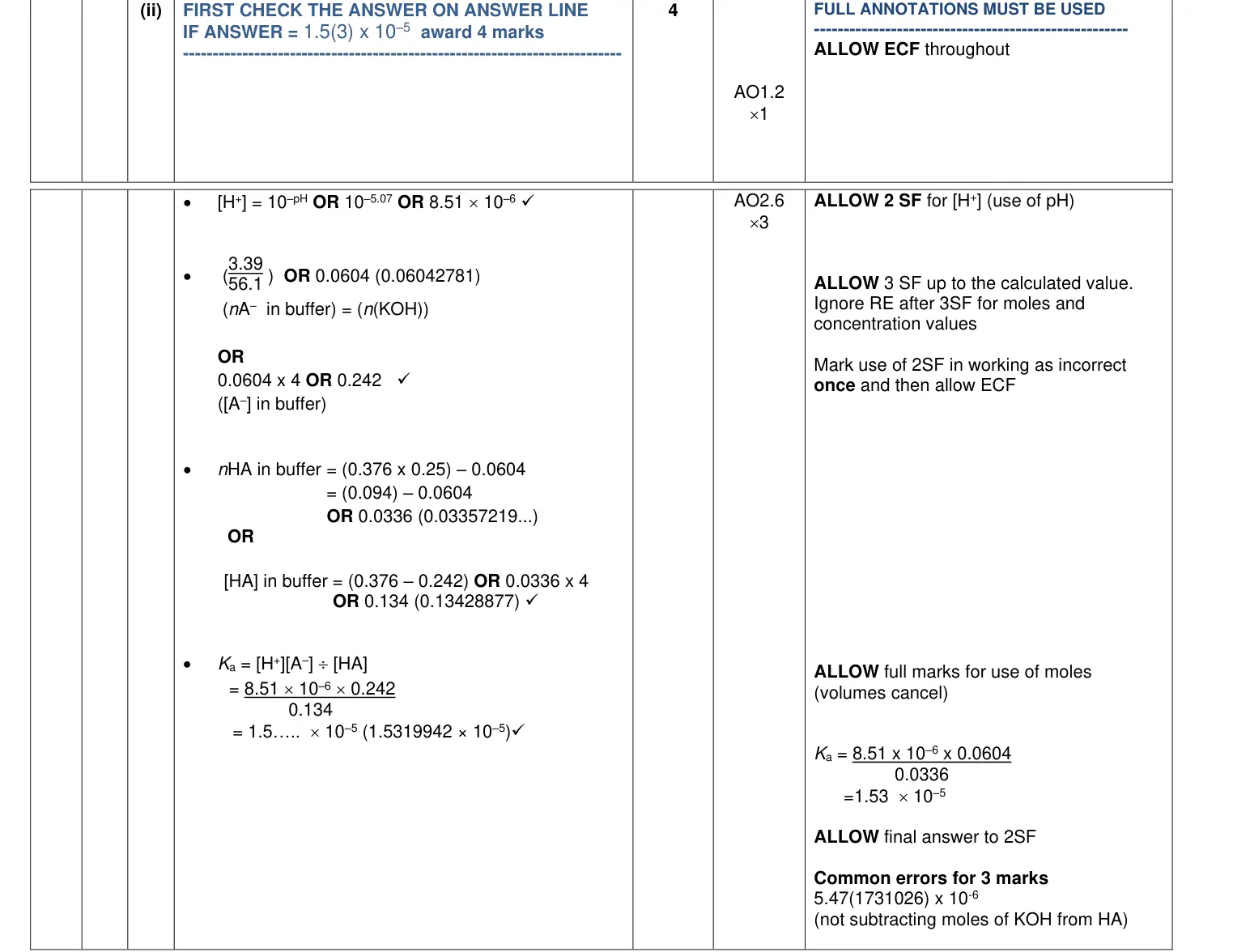
(ii) A buffer solution is prepared by dissolving 3.39 g of potassium hydroxide in 250 cm3 of
0.376 mol dm–3 butanoic acid.
This buffer solution has a pH of 5.07 at 25 °C.
Calculate the acid dissociation constant, Ka, of butanoic acid at 25 °C.
Assume that the volume of the solution remains constant at 250 cm3 when the
potassium hydroxide is dissolved.
Ka =  .......................................... mol dm–3 [4]
June 2023 · Paper 1 · Q21(a)(ii) 2 marks AO2 Calculation Easy redox and electrode potentialspractical skills
Earlier part of question 21 that this part usesEarlier part of June 2023 Paper 1 question 21
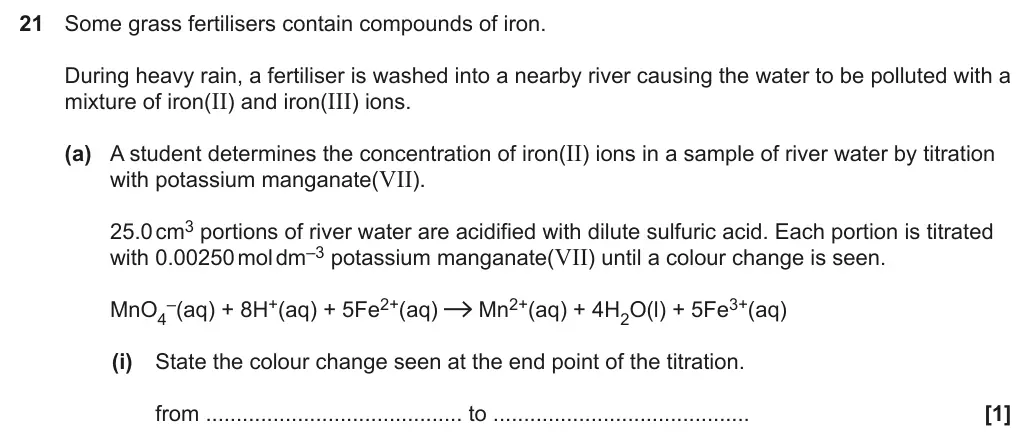
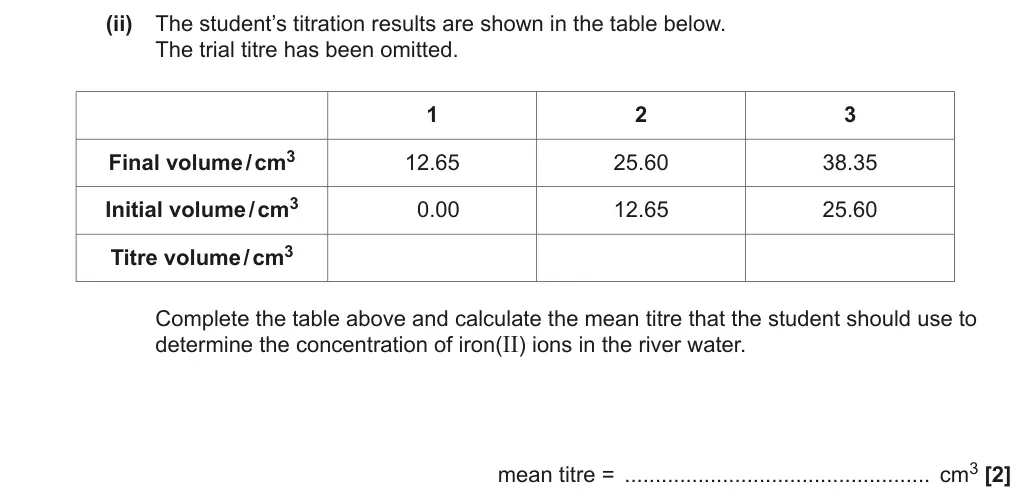
(ii) The student’s titration results are shown in the table below.
The trial titre has been omitted.
1 2 3
Final volume / cm3 12.65 25.60 38.35
Initial volume / cm3 0.00 12.65 25.60
Titre volume / cm3
Complete the table above and calculate the mean titre that the student should use to
determine the concentration of iron(II) ions in the river water.
mean titre =  .................................................. cm3 [2]
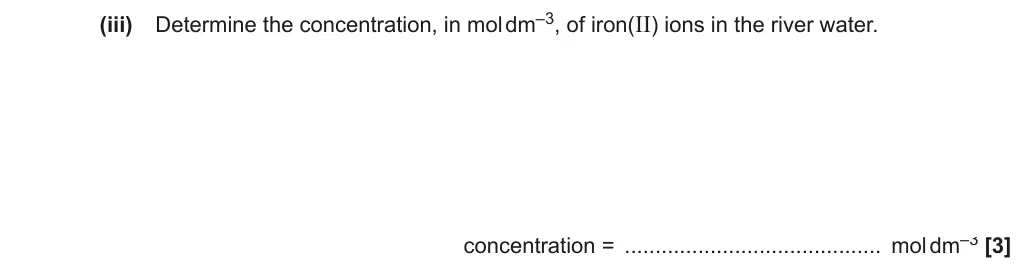
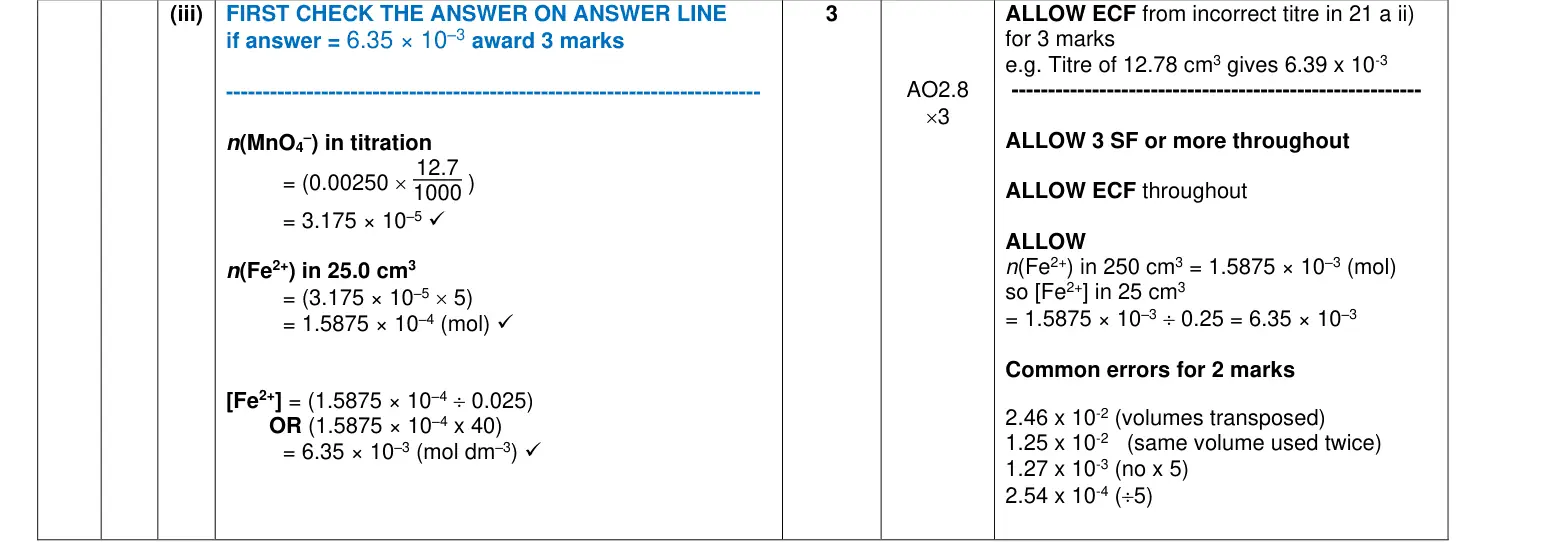
June 2023 · Paper 1 · Q21(a)(iii) 3 marks AO2 Calculation Medium redox and electrode potentialsamount of substance
Earlier parts of question 21 that this part usesEarlier part of June 2023 Paper 1 question 21Earlier part of June 2023 Paper 1 question 21
(iii) Determine the concentration, in mol dm–3, of iron(II) ions in the river water.
concentration =  .......................................... mol dm–3 [3]
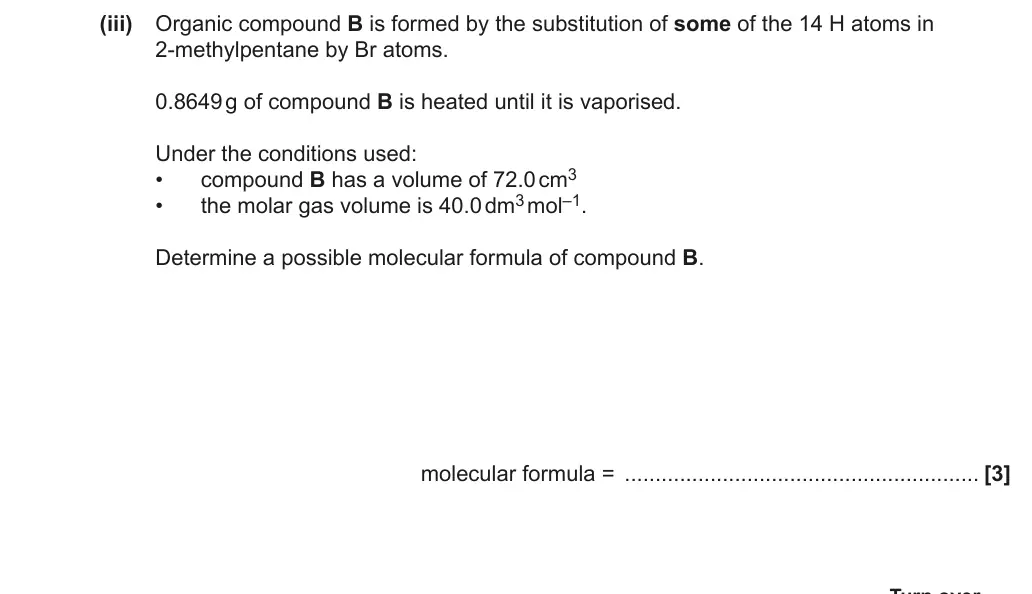
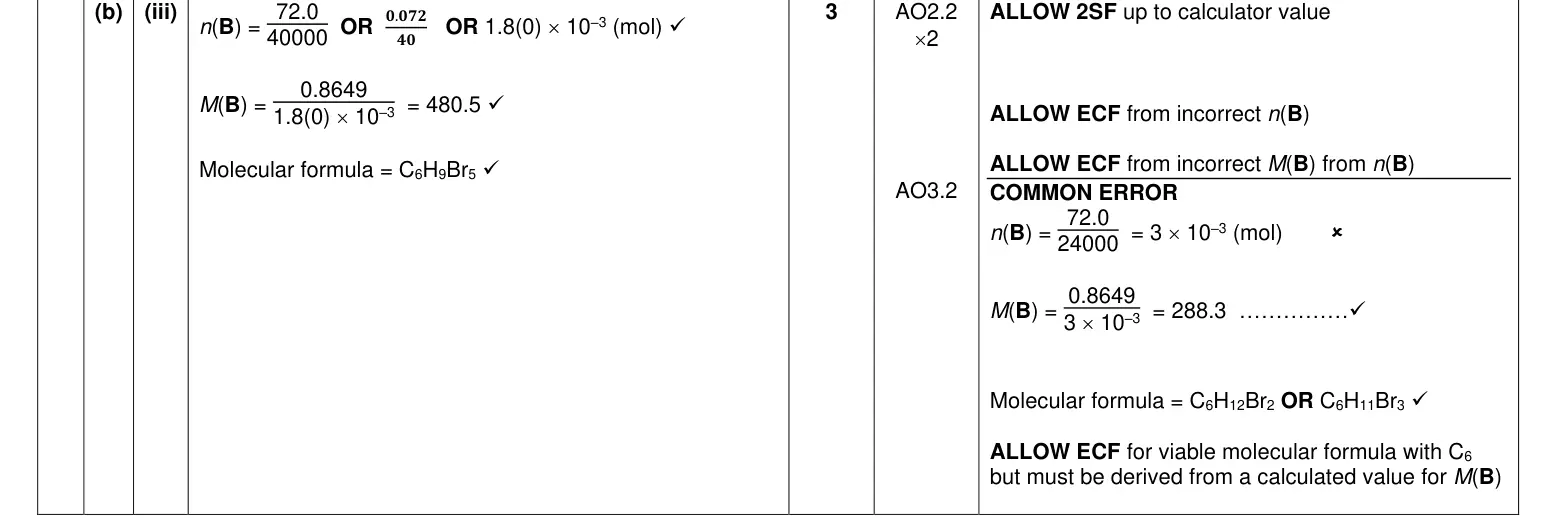
June 2023 · Paper 2 · Q16(b)(iii) 3 marks AO2, 3 Calculation Medium amount of substanceatomic structure and isotopes
Earlier part of question 16 that this part usesEarlier part of June 2023 Paper 2 question 16
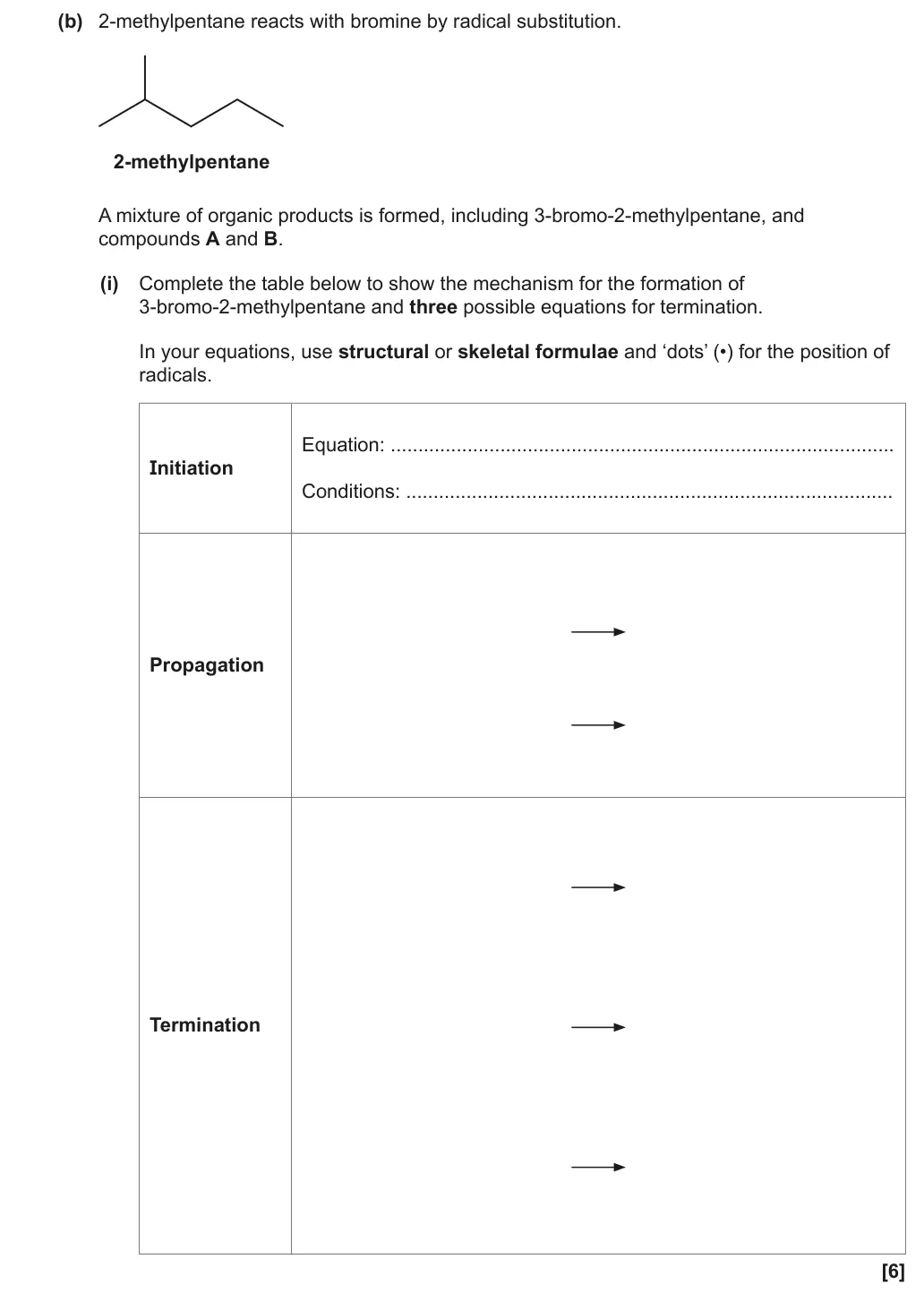
(iii) Organic compound B is formed by the substitution of some of the 14 H atoms in
2-methylpentane by Br atoms.
0.8649 g of compound B is heated until it is vaporised.
Under the conditions used:
• compound B has a volume of 72.0 cm3
• the molar gas volume is 40.0 dm3 mol–1.
Determine a possible molecular formula of compound B.
molecular formula =  .......................................................... [3]
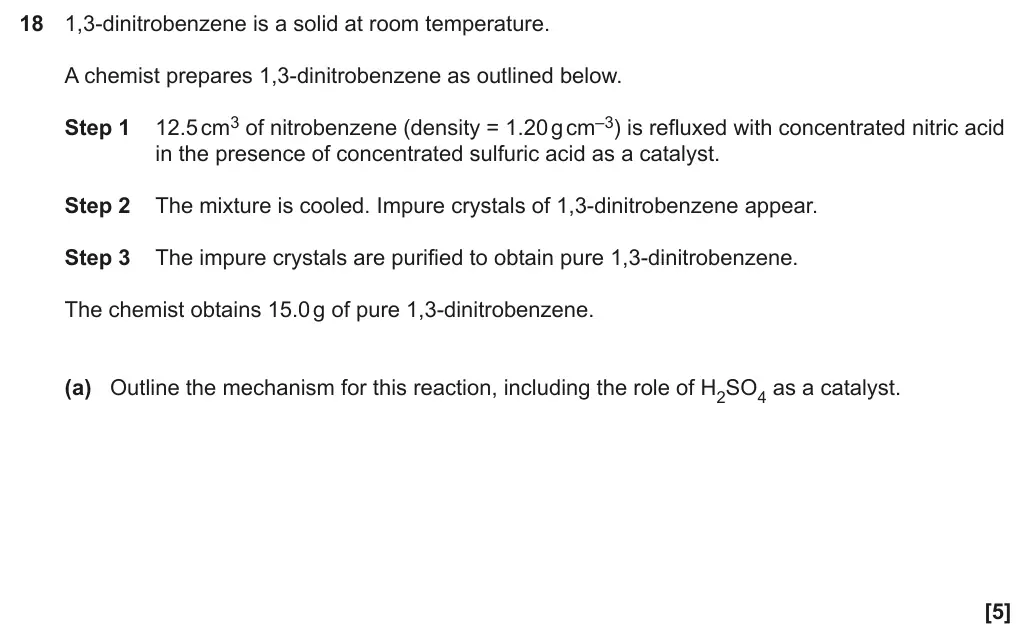
June 2023 · Paper 2 · Q18(b) 3 marks AO1, 2 Calculation Hard amount of substance
Earlier part of question 18 that this part usesEarlier part of June 2023 Paper 2 question 18
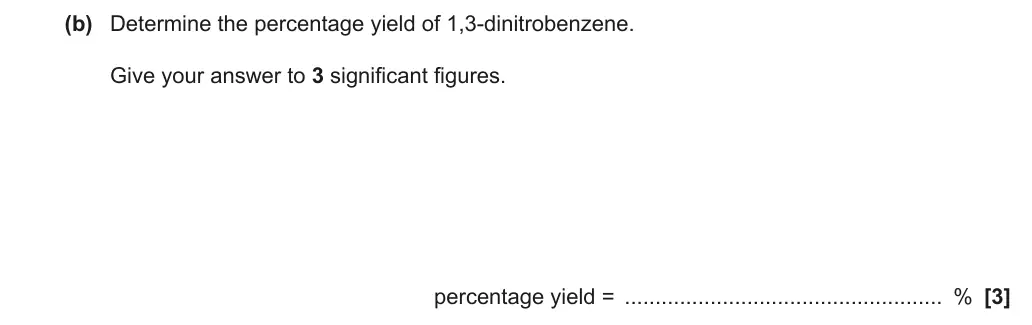
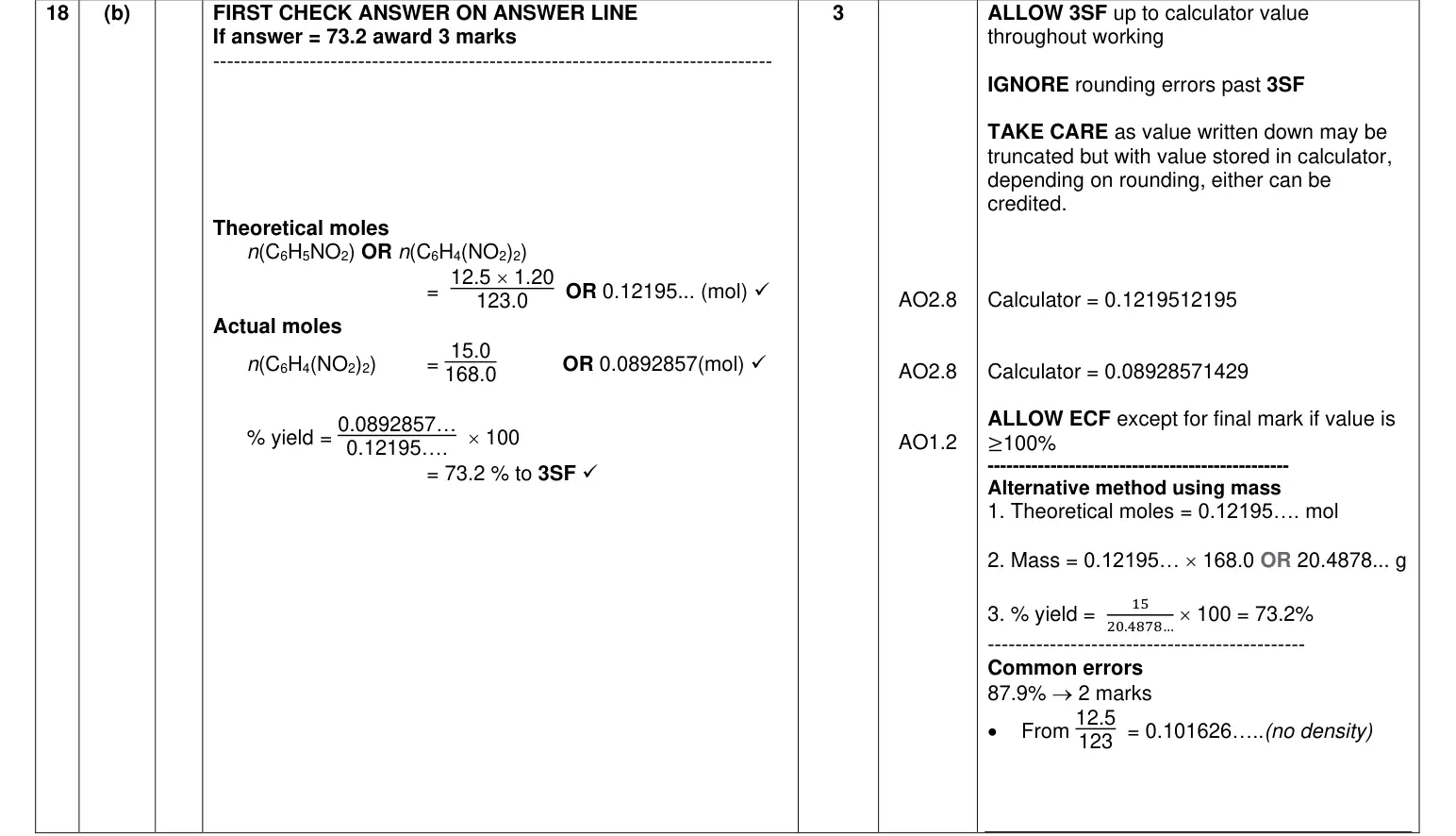
(b) Determine the percentage yield of 1,3-dinitrobenzene.
Give your answer to 3 significant figures.
percentage yield =  .................................................... % [3]
June 2023 · Paper 2 · Q20(b)(ii) 3 marks AO3 Calculation Hard amount of substance
Earlier part of question 20 that this part usesEarlier part of June 2023 Paper 2 question 20
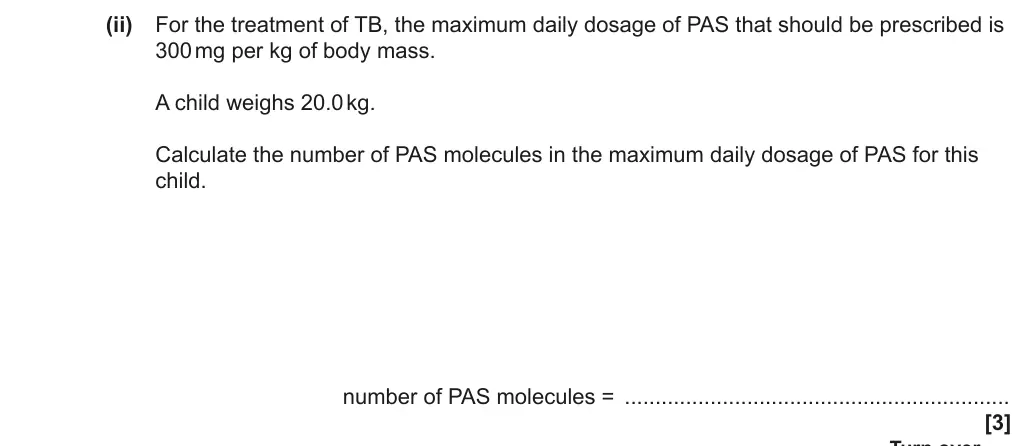
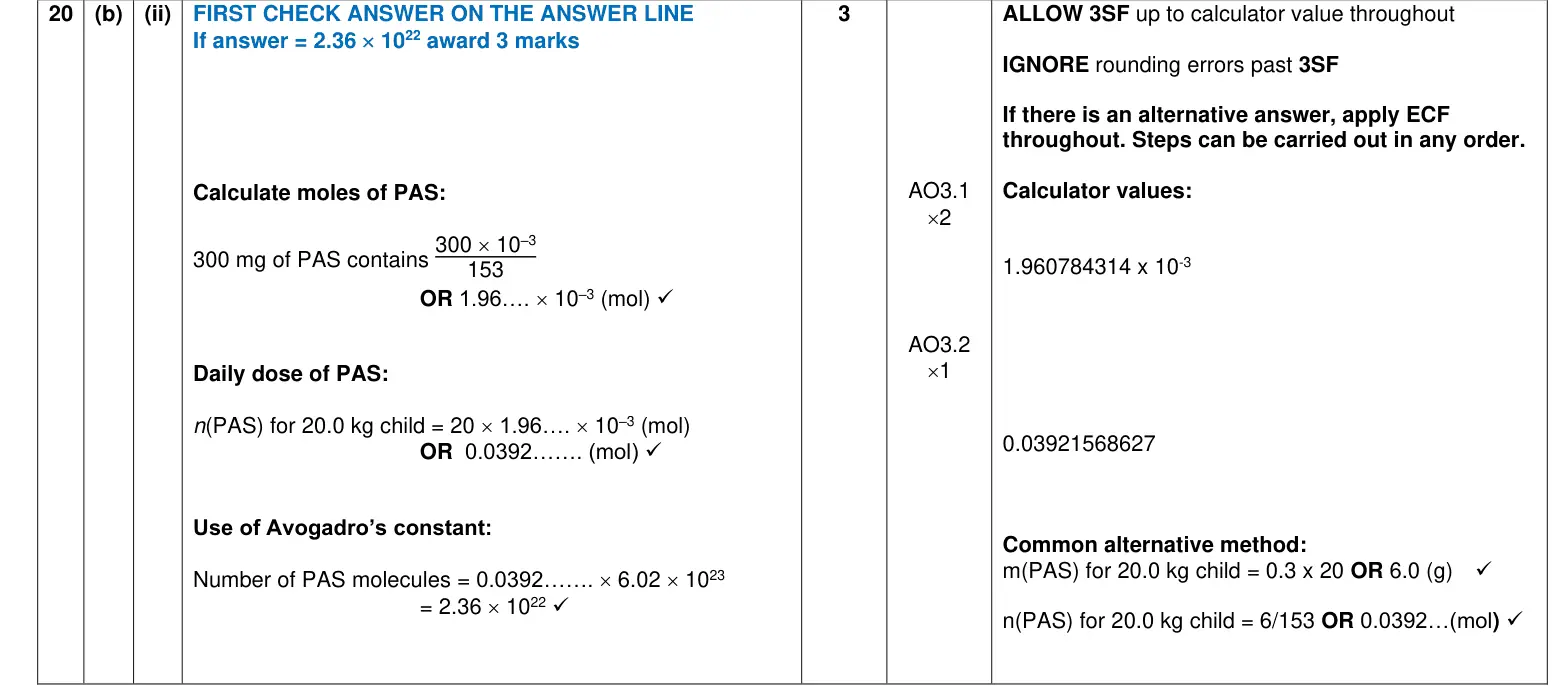
(ii) For the treatment of TB, the maximum daily dosage of PAS that should be prescribed is
300 mg per kg of body mass.
A child weighs 20.0 kg.
Calculate the number of PAS molecules in the maximum daily dosage of PAS for this
child.
number of PAS molecules =  ...............................................................
[3]
June 2023 · Paper 3 · Q2(a)(ii) 3 marks AO2 Calculation Hard enthalpy changesamount of substancelattice enthalpy
Earlier part of question 2 that this part usesEarlier part of June 2023 Paper 3 question 2
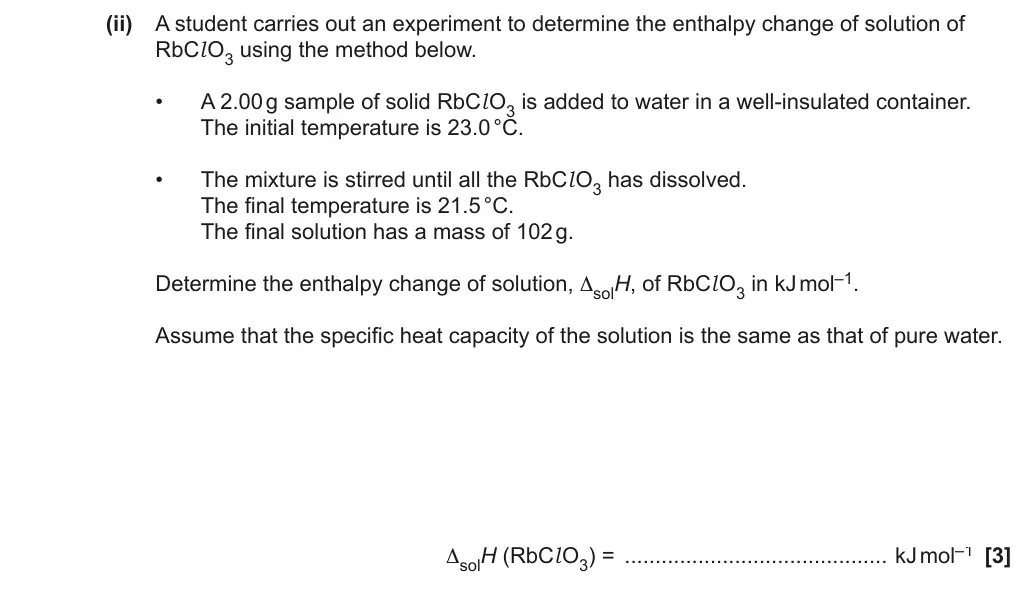
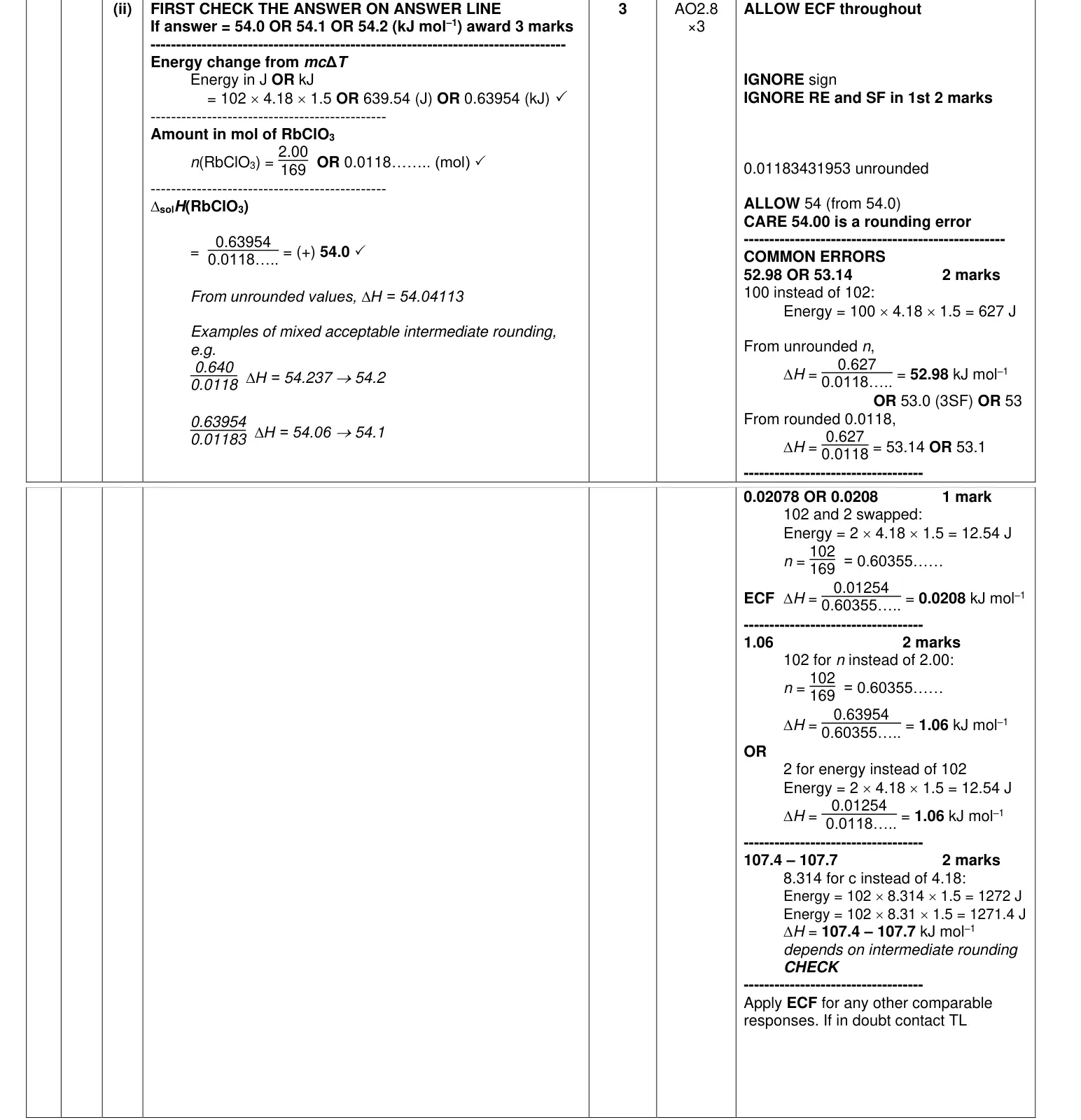
(ii) A student carries out an experiment to determine the enthalpy change of solution of
RbCl O3 using the method below.
• A 2.00 g sample of solid RbCl O3 is added to water in a well-insulated container.
The initial temperature is 23.0 °C.
• The mixture is stirred until all the RbCl O3 has dissolved.
The final temperature is 21.5 °C.
The final solution has a mass of 102 g.
Determine the enthalpy change of solution, ΔsolH, of RbCl O3 in kJ mol–1.
Assume that the specific heat capacity of the solution is the same as that of pure water.
ΔsolH (RbCl O3) =  ........................................... kJ mol–1 [3]
June 2023 · Paper 3 · Q2(b) 3 marks AO3 Calculation Hard acids bases and buffersrate equations
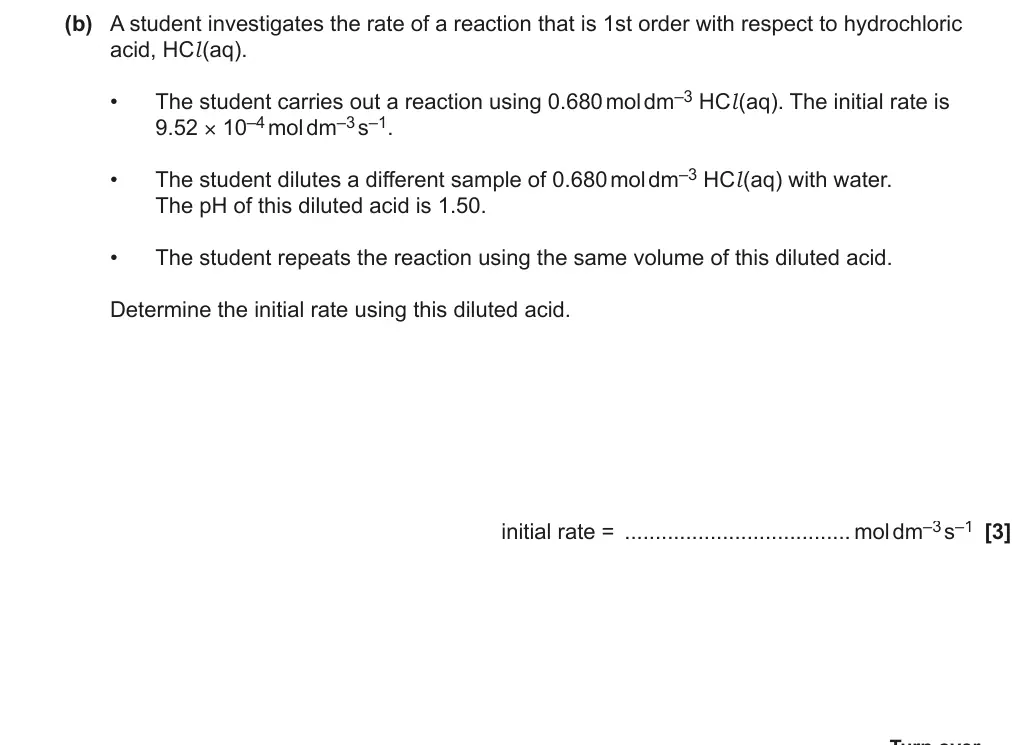
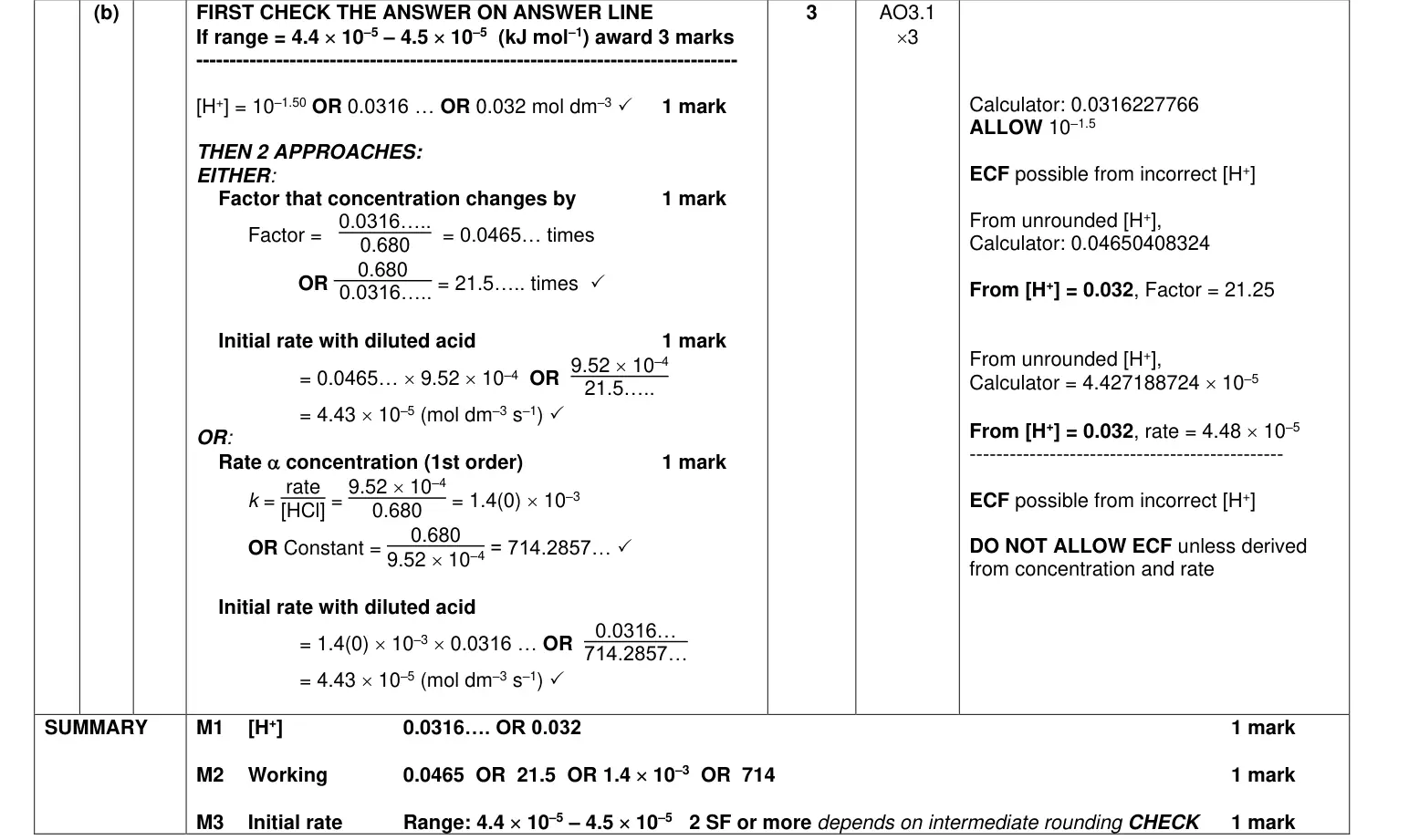
(b) A student investigates the rate of a reaction that is 1st order with respect to hydrochloric
acid, HCl (aq).
• The student carries out a reaction using 0.680 mol dm–3 HCl (aq). The initial rate is
9.52 × 10⁻⁴ mol dm–3 s–1.
• The student dilutes a different sample of 0.680 mol dm–3 HCl (aq) with water.
The pH of this diluted acid is 1.50.
• The student repeats the reaction using the same volume of this diluted acid.
Determine the initial rate using this diluted acid.
initial rate =  ..................................... mol dm–3 s–1 [3]
June 2023 · Paper 3 · Q4(b)(i) 2 marks AO1 Calculation Medium amount of substanceatomic structure and isotopesformulae and equations
Earlier part of question 4 that this part usesEarlier part of June 2023 Paper 3 question 4
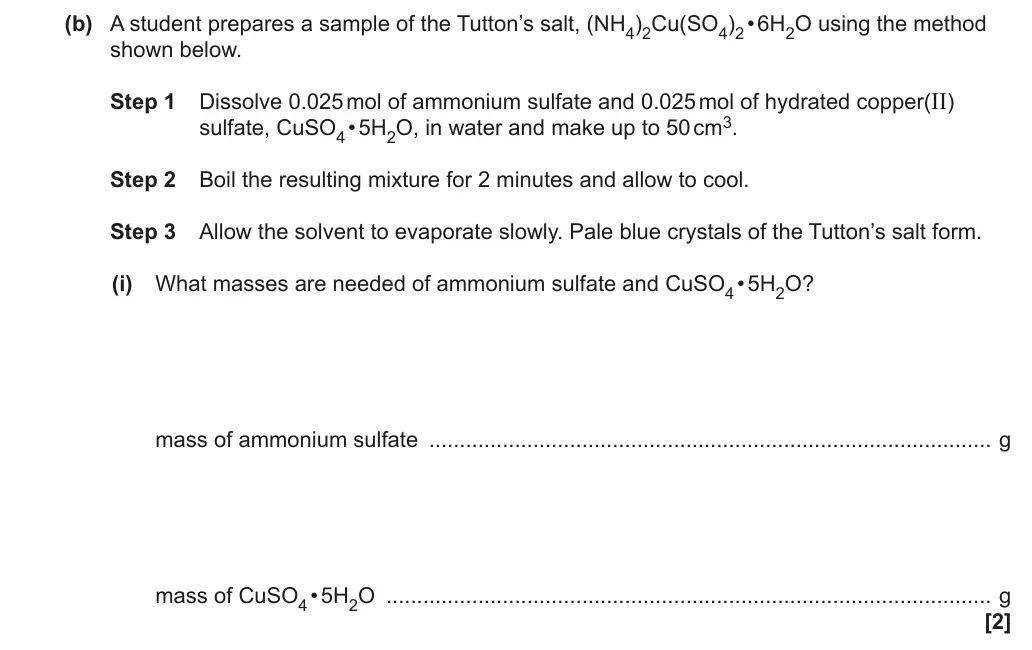
(b) A student prepares a sample of the Tutton’s salt, (NH4)2Cu(SO4)2 • 6H2O using the method
shown below.
Step 1  Dissolve 0.025 mol of ammonium sulfate and 0.025 mol of hydrated copper(II)
sulfate, CuSO4 • 5H2O, in water and make up to 50 cm3.
Step 2 Boil the resulting mixture for 2 minutes and allow to cool.
Step 3  Allow the solvent to evaporate slowly. Pale blue crystals of the Tutton’s salt form.
(i) What masses are needed of ammonium sulfate and CuSO4 • 5H2O?
mass of ammonium sulfate  ............................................................................................ g
mass of CuSO4 • 5H2O  ................................................................................................... g
[2]
June 2023 · Paper 3 · Q5(a) 6 marks AO2 Calculation Easy acids and titrationsamount of substance
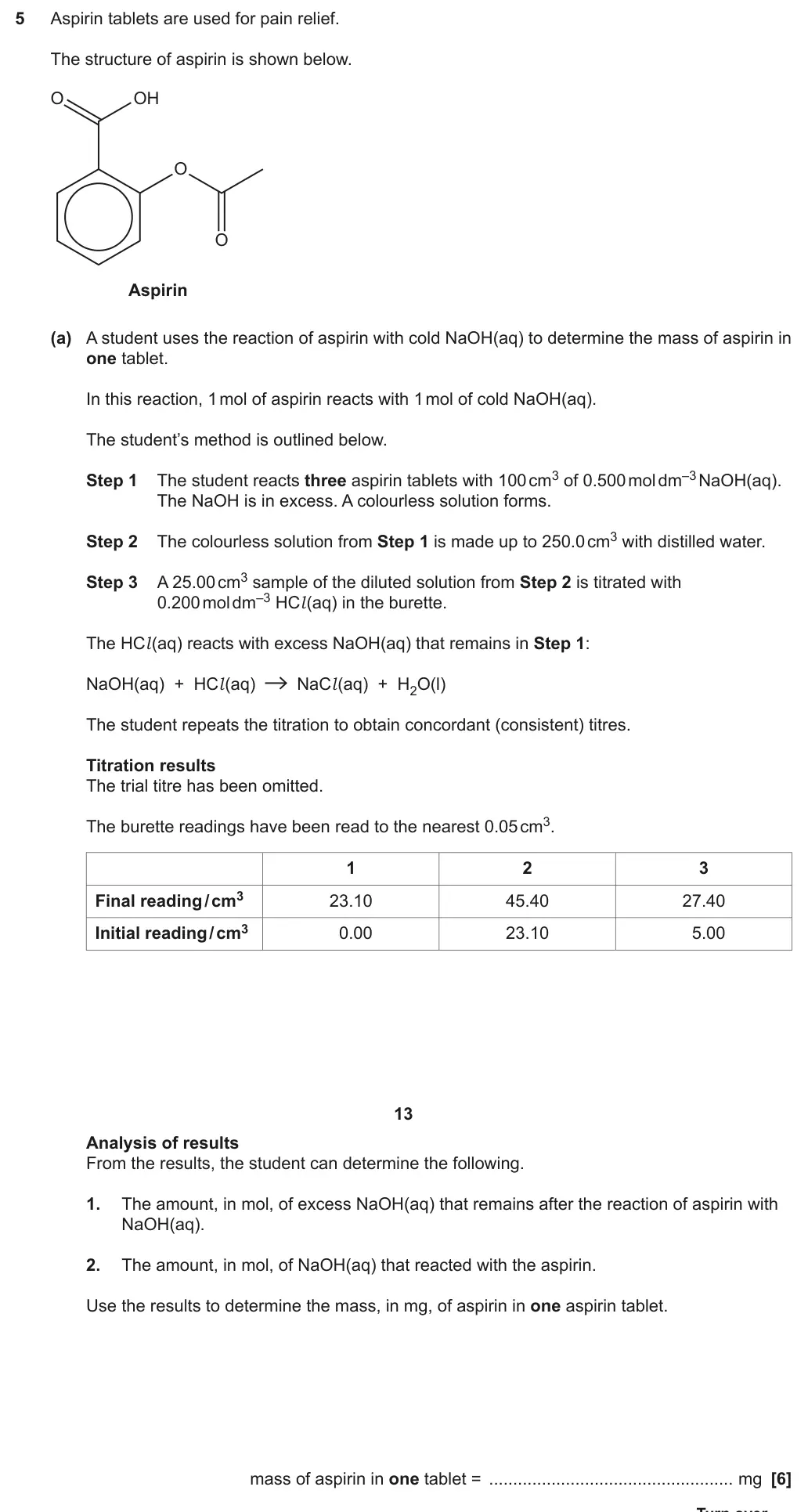
5 Aspirin tablets are used for pain relief.
The structure of aspirin is shown below.
O OH
O
O
Aspirin
(a) A student uses the reaction of aspirin with cold NaOH(aq) to determine the mass of aspirin in
one tablet.
In this reaction, 1 mol of aspirin reacts with 1 mol of cold NaOH(aq).
The student’s method is outlined below.
Step 1 The student reacts three aspirin tablets with 100 cm3 of 0.500 mol dm–3 NaOH(aq).
The NaOH is in excess. A colourless solution forms.
Step 2 The colourless solution from Step 1 is made up to 250.0 cm3 with distilled water.
Step 3 A 25.00 cm3 sample of the diluted solution from Step 2 is titrated with
0.200 mol dm–3 HCl (aq) in the burette.
The HCl (aq) reacts with excess NaOH(aq) that remains in Step 1:
NaOH(aq)  +  HCl (aq) NaCl (aq)  +  H2O(l)
The student repeats the titration to obtain concordant (consistent) titres.
Titration results
The trial titre has been omitted.
The burette readings have been read to the nearest 0.05 cm3.
1 2 3
Final reading / cm3 23.10 45.40 27.40
Initial reading / cm3 0.00 23.10 5.00
Analysis of results
From the results, the student can determine the following.
1. The amount, in mol, of excess NaOH(aq) that remains after the reaction of aspirin with
NaOH(aq).
2. The amount, in mol, of NaOH(aq) that reacted with the aspirin.
Use the results to determine the mass, in mg, of aspirin in one aspirin tablet.
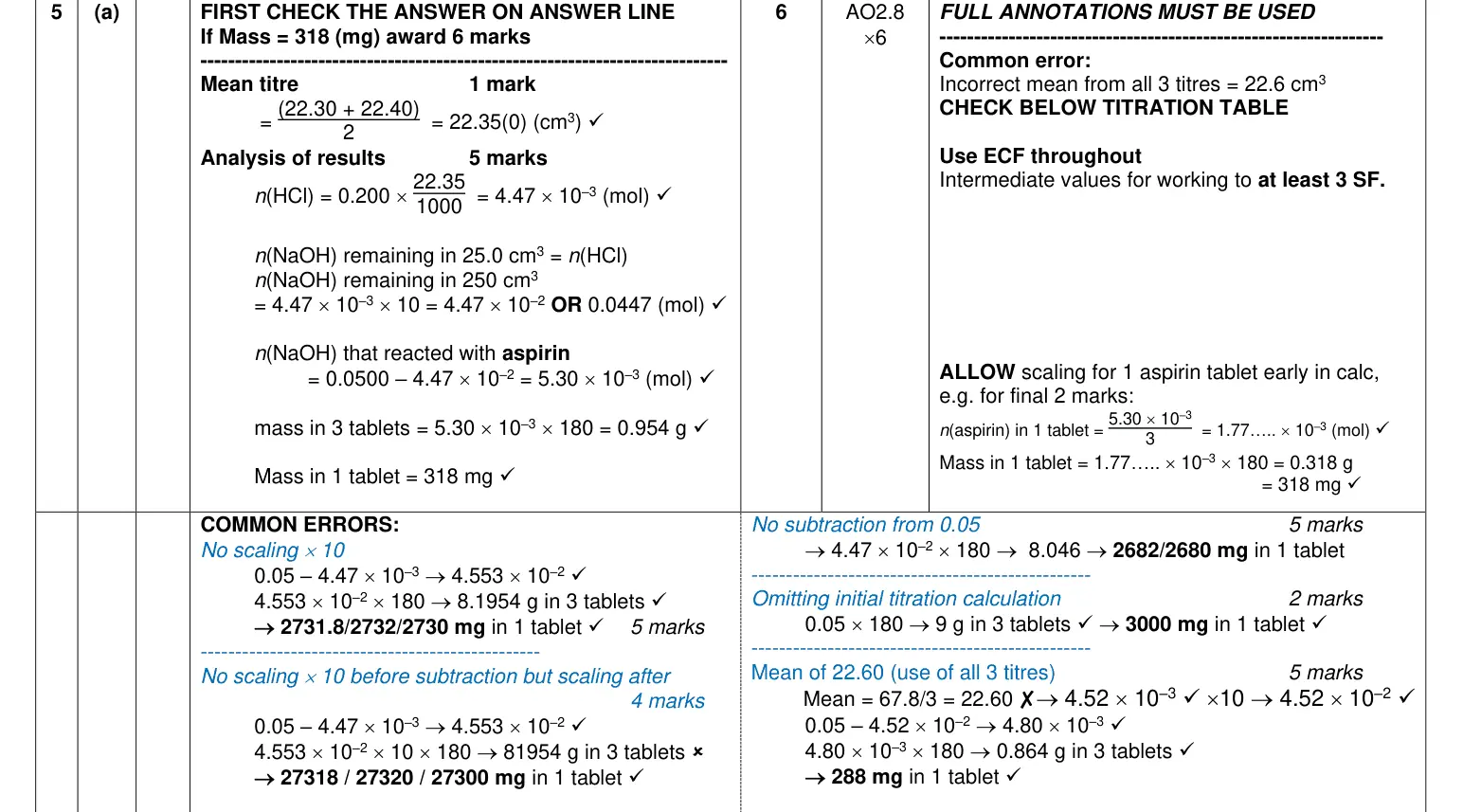
mass of aspirin in one tablet =  ................................................... mg [6]
June 2023 · Paper 3 · Q6(c)(ii) 3 marks AO3 Calculation Easy redox and electrode potentialsatomic structure and isotopesredox
Earlier part of question 6 that this part usesEarlier part of June 2023 Paper 3 question 6
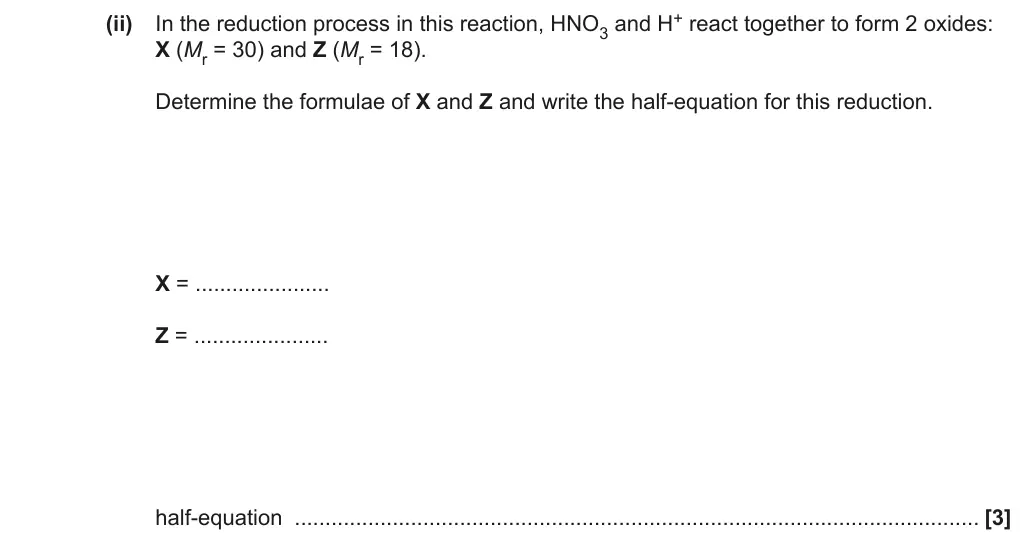
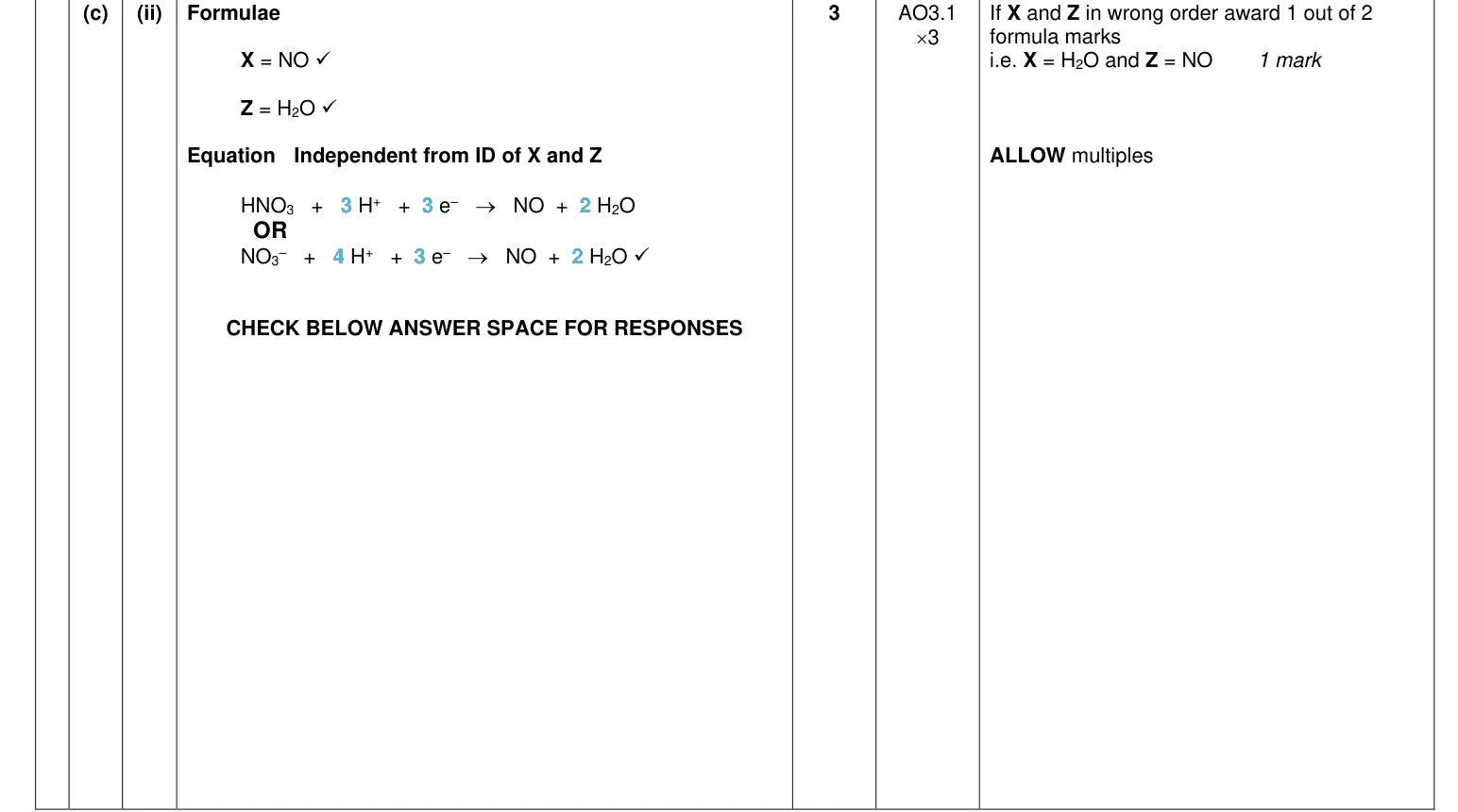
(ii) In the reduction process in this reaction, HNO3 and H+ react together to form 2 oxides:
X (Mr = 30) and Z (Mr = 18).
Determine the formulae of X and Z and write the half-equation for this reduction.
X = ......................
Z = ......................
half-equation  ................................................................................................................ [3]
June 2023 · Paper 3 · Q6(d) 5 marks AO1, 2 Calculation Hard equilibrium constantschemical equilibrium
(d) In the UK, most sulfuric acid, H2SO4, is manufactured by the Contact process.
One stage in the Contact process involves the equilibrium between sulfur dioxide, oxygen
and sulfur trioxide.
2SO2(g)  +  O2(g) 2SO3(g)
This equilibrium is investigated:
Step 1 5.82 × 10⁻² mol of SO2 is mixed with 7.40 × 10⁻² mol of O2 in a 2.00 dm3 container.
Step 2 The container is sealed and allowed to reach equilibrium at constant temperature.
Step 3 At equilibrium, 5.20 × 10⁻² mol of SO3 is formed.
Determine the equilibrium concentrations and calculate Kc, including units.
Kc =  ........................ units ........................ [5]
June 2022 · AS Paper 1 · Q22(a) 2 marks AO1 Calculation Hard atomic structure and isotopes
22 This question is about atomic structure and formulae.
(a) The relative atomic mass of a sample of osmium can be determined from its mass spectrum,
shown below.
43.89%
27.23%
relative
abundance
16.75%
(%)
12.13%
185 186 187 188 189 190 191 192 193 194 195
m / z
Calculate the relative atomic mass of osmium in the sample.
Give your answer to two decimal places.
relative atomic mass =  ......................................................... [2]
June 2022 · AS Paper 1 · Q25(a)(i) 4 marks AO2 Calculation Medium enthalpy changesamount of substance
25 This question is about enthalpy changes and reaction rates.
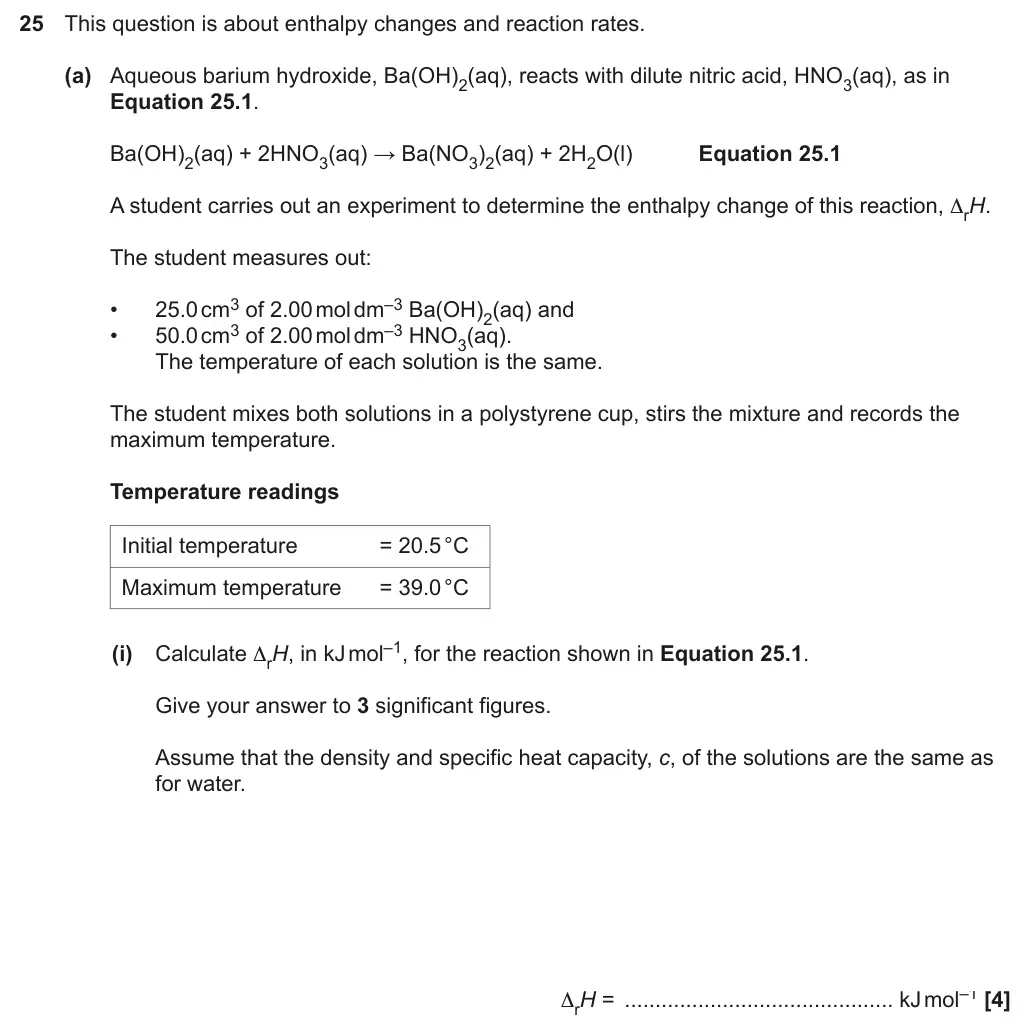
(a) Aqueous barium hydroxide, Ba(OH)2(aq), reacts with dilute nitric acid, HNO3(aq), as in
Equation 25.1.
Ba(OH)2(aq) + 2HNO3(aq) → Ba(NO3)2(aq) + 2H2O(l)   Equation 25.1
A student carries out an experiment to determine the enthalpy change of this reaction, ∆rH.
The student measures out:
• 25.0 cm3 of 2.00 mol dm–3 Ba(OH)2(aq) and
• 50.0 cm3 of 2.00 mol dm–3 HNO3(aq).
The temperature of each solution is the same.
The student mixes both solutions in a polystyrene cup, stirs the mixture and records the
maximum temperature.
Temperature readings
Initial temperature = 20.5 °C
Maximum temperature = 39.0 °C
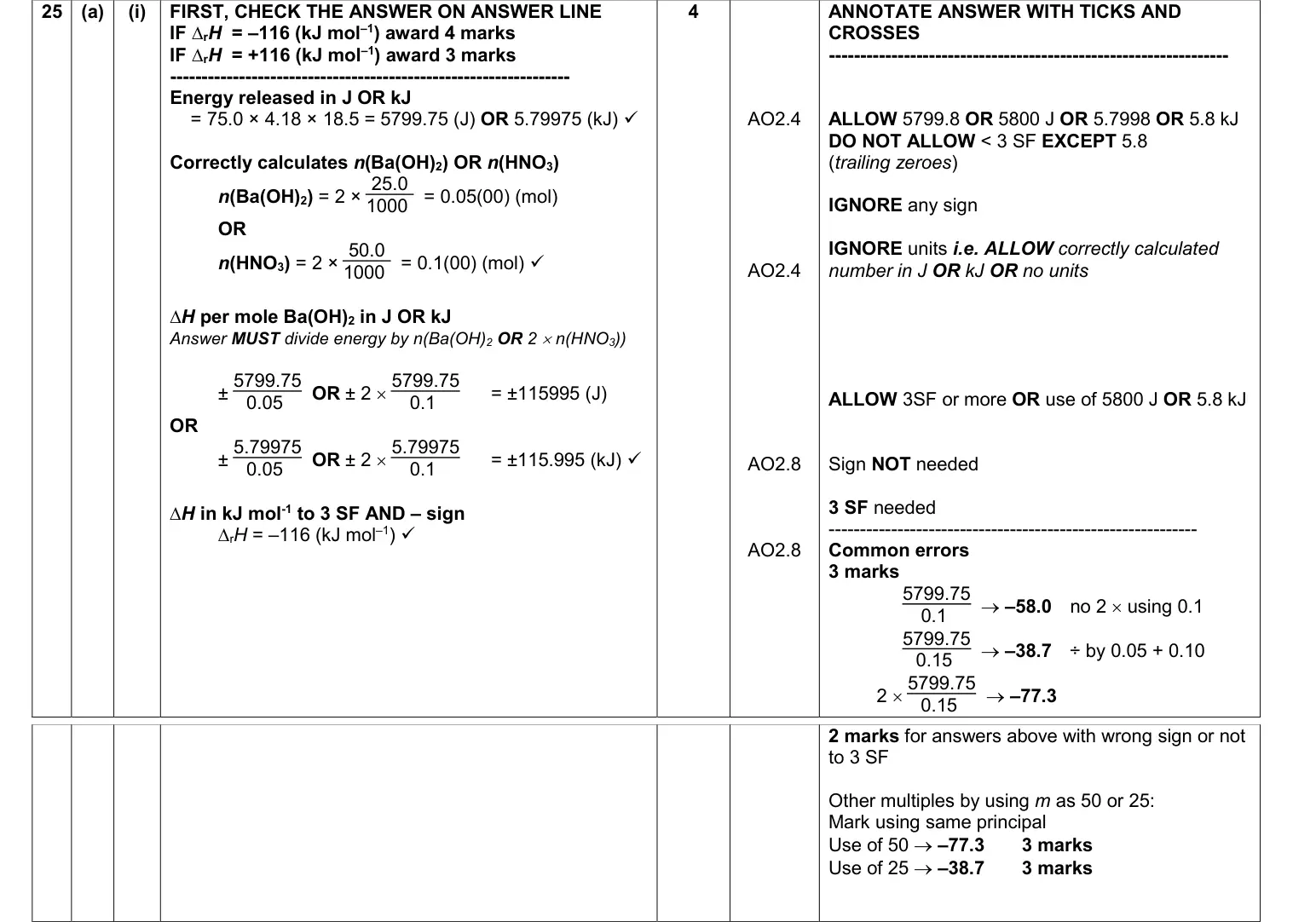
(i) Calculate ∆rH, in kJ mol–1, for the reaction shown in Equation 25.1.
Give your answer to 3 significant figures.
Assume that the density and specific heat capacity, c, of the solutions are the same as
for water.
∆rH =  ............................................ kJ mol–1 [4]
June 2022 · AS Paper 1 · Q25(a)(ii) 2 marks AO3 Calculation Hard enthalpy changes
Earlier part of question 25 that this part usesEarlier part of June 2022 Paper 1 question 25
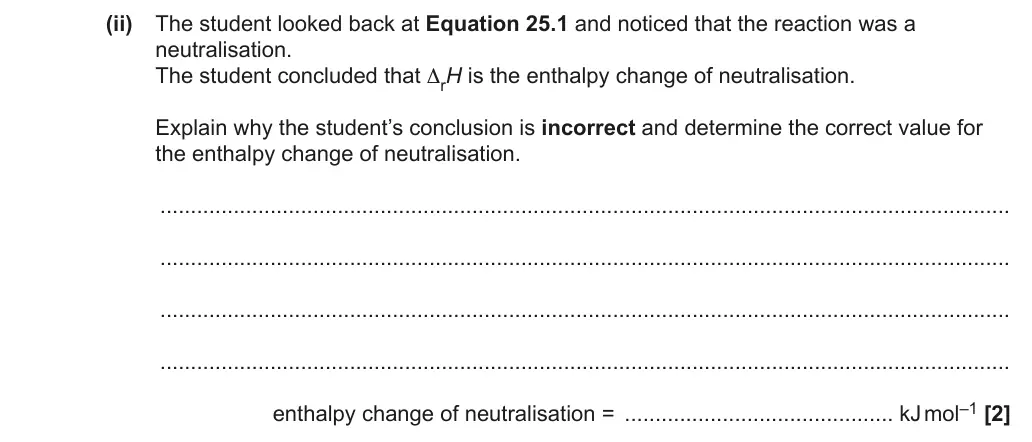
(ii) The student looked back at Equation 25.1 and noticed that the reaction was a
neutralisation.
The student concluded that ∆rH is the enthalpy change of neutralisation.
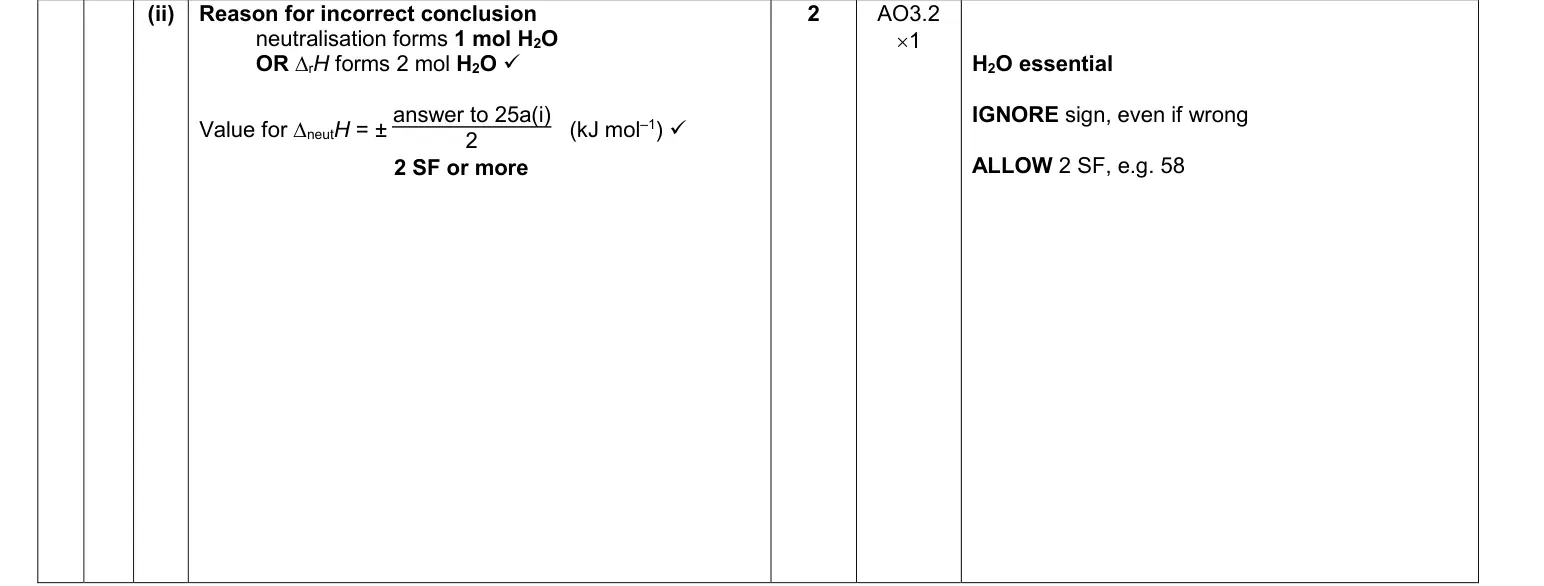
Explain why the student’s conclusion is incorrect and determine the correct value for
the enthalpy change of neutralisation.
...........................................................................................................................................
...........................................................................................................................................
...........................................................................................................................................
...........................................................................................................................................
enthalpy change of neutralisation =  ............................................ kJ mol–1 [2]
June 2022 · AS Paper 1 · Q26(b) 5 marks AO2, 3 Calculation Easy amount of substance
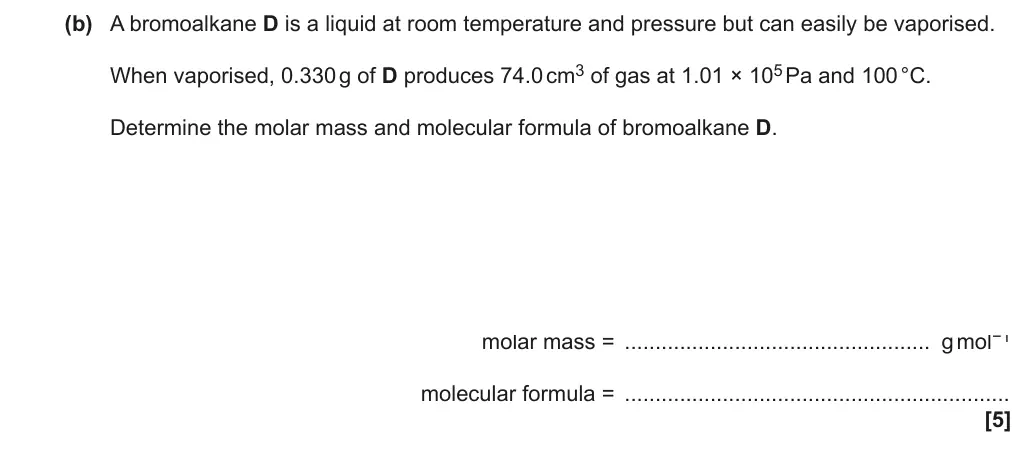
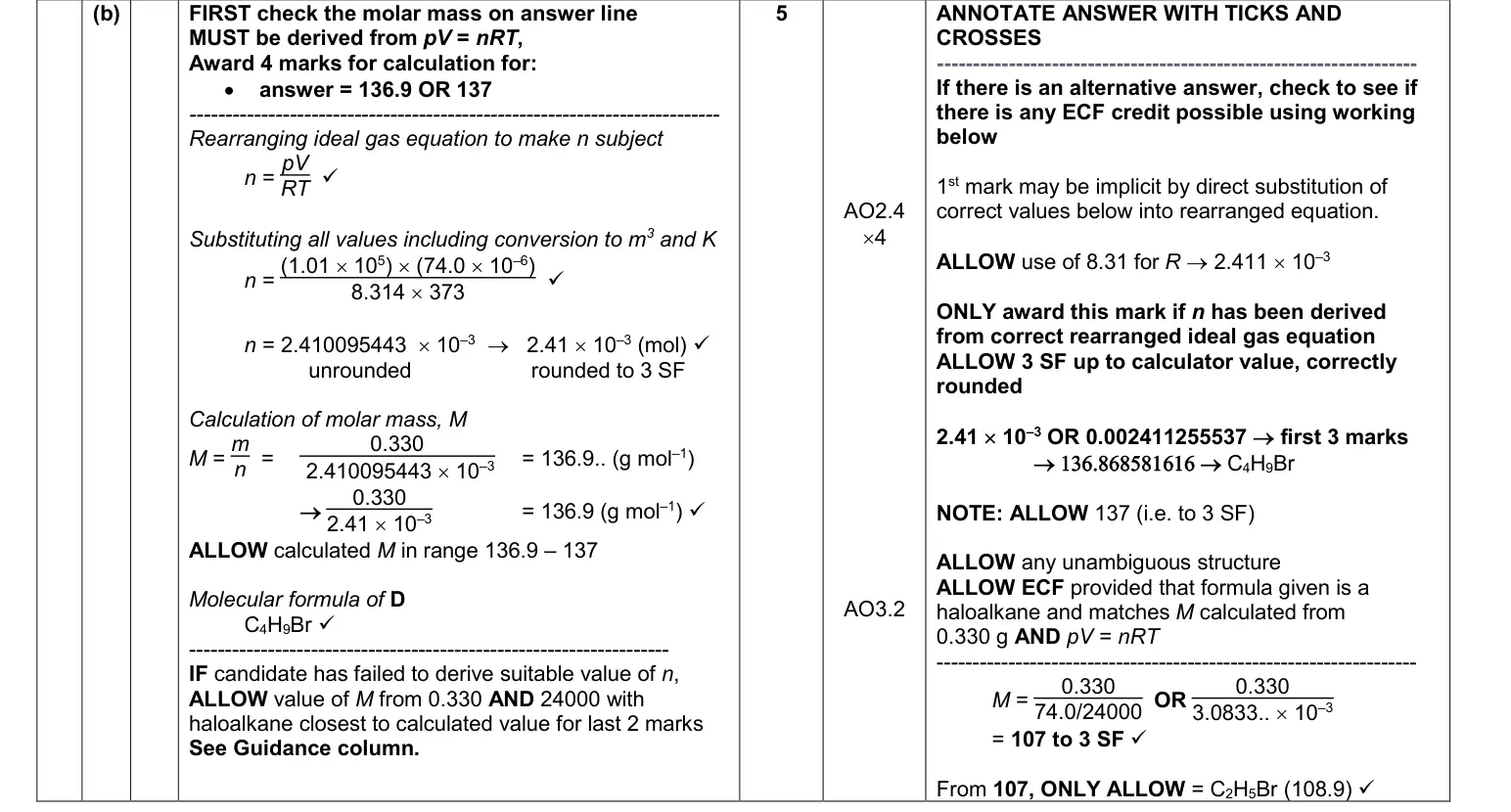
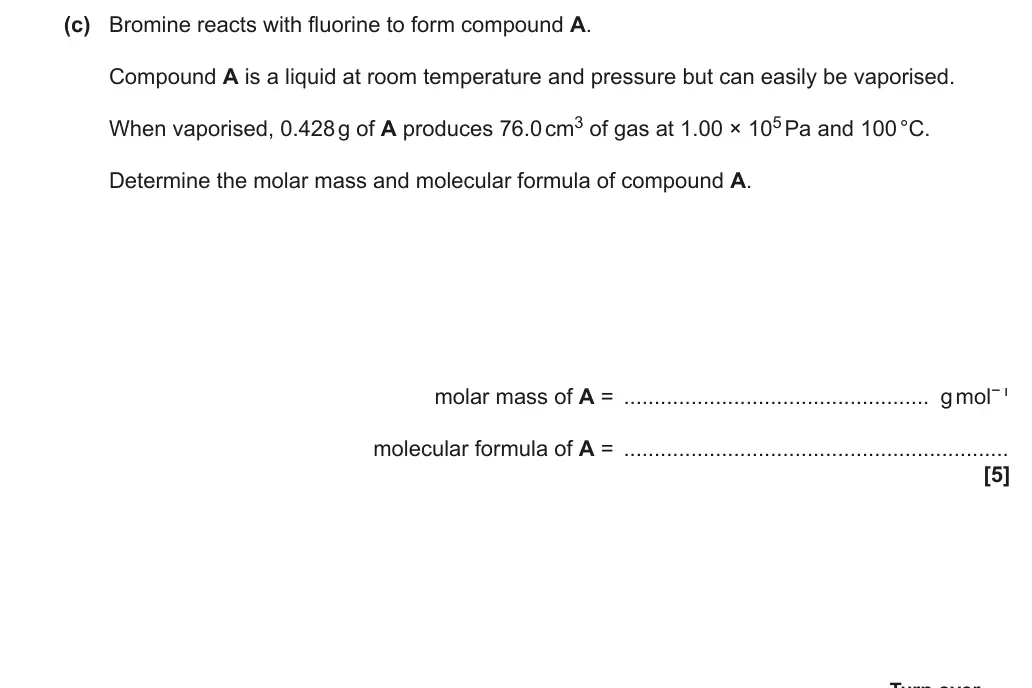
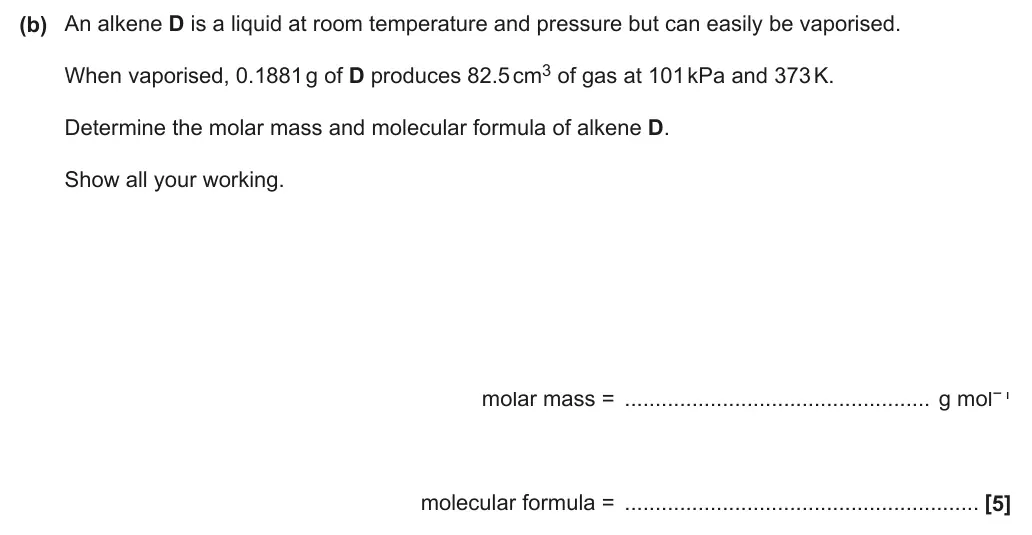
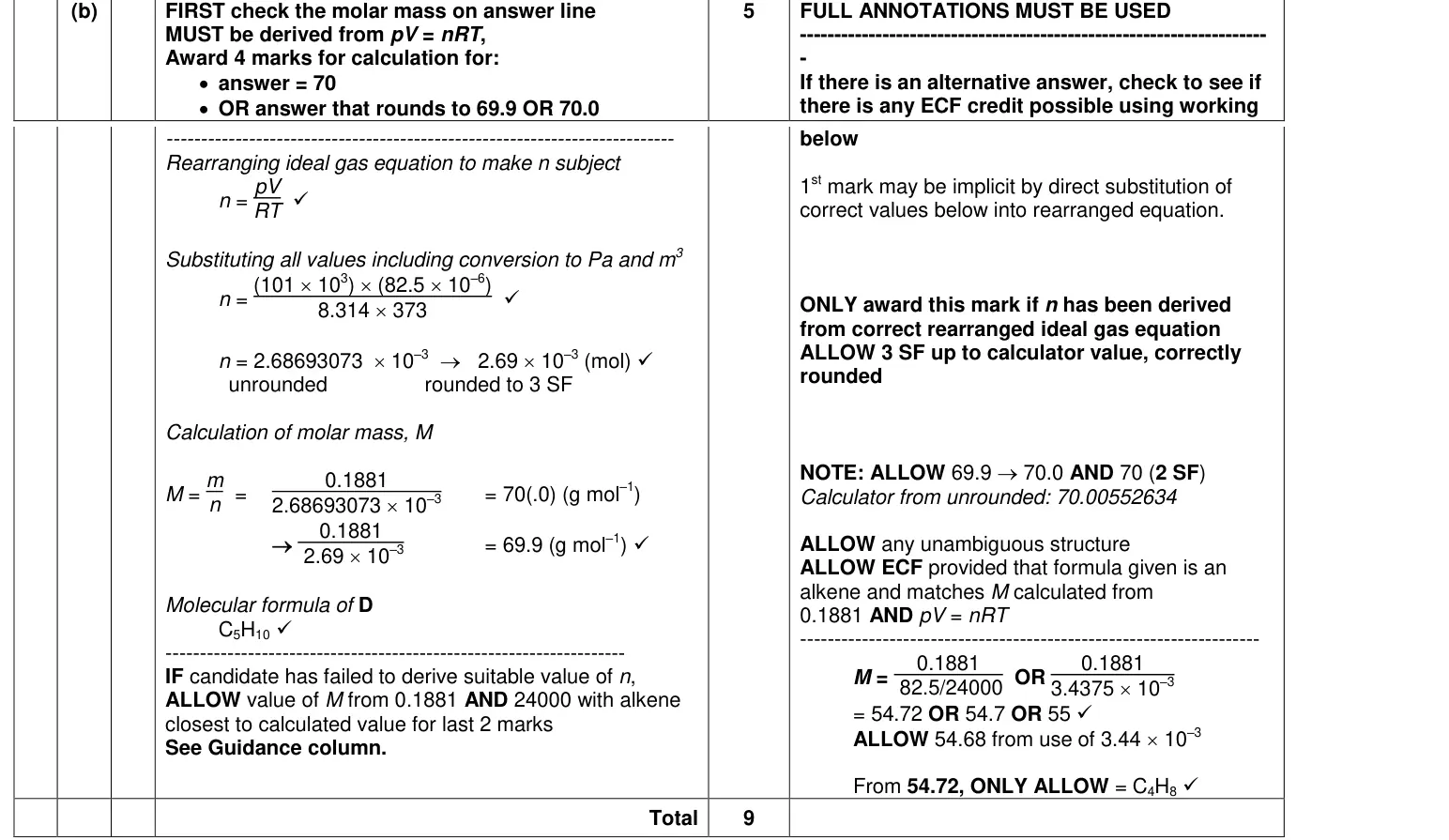
(b) A bromoalkane D is a liquid at room temperature and pressure but can easily be vaporised.
When vaporised, 0.330 g of D produces 74.0 cm3 of gas at 1.01 × 10⁵ Pa and 100 °C.
Determine the molar mass and molecular formula of bromoalkane D.
molar mass =  .................................................. g mol−1
molecular formula =  ...............................................................
[5]
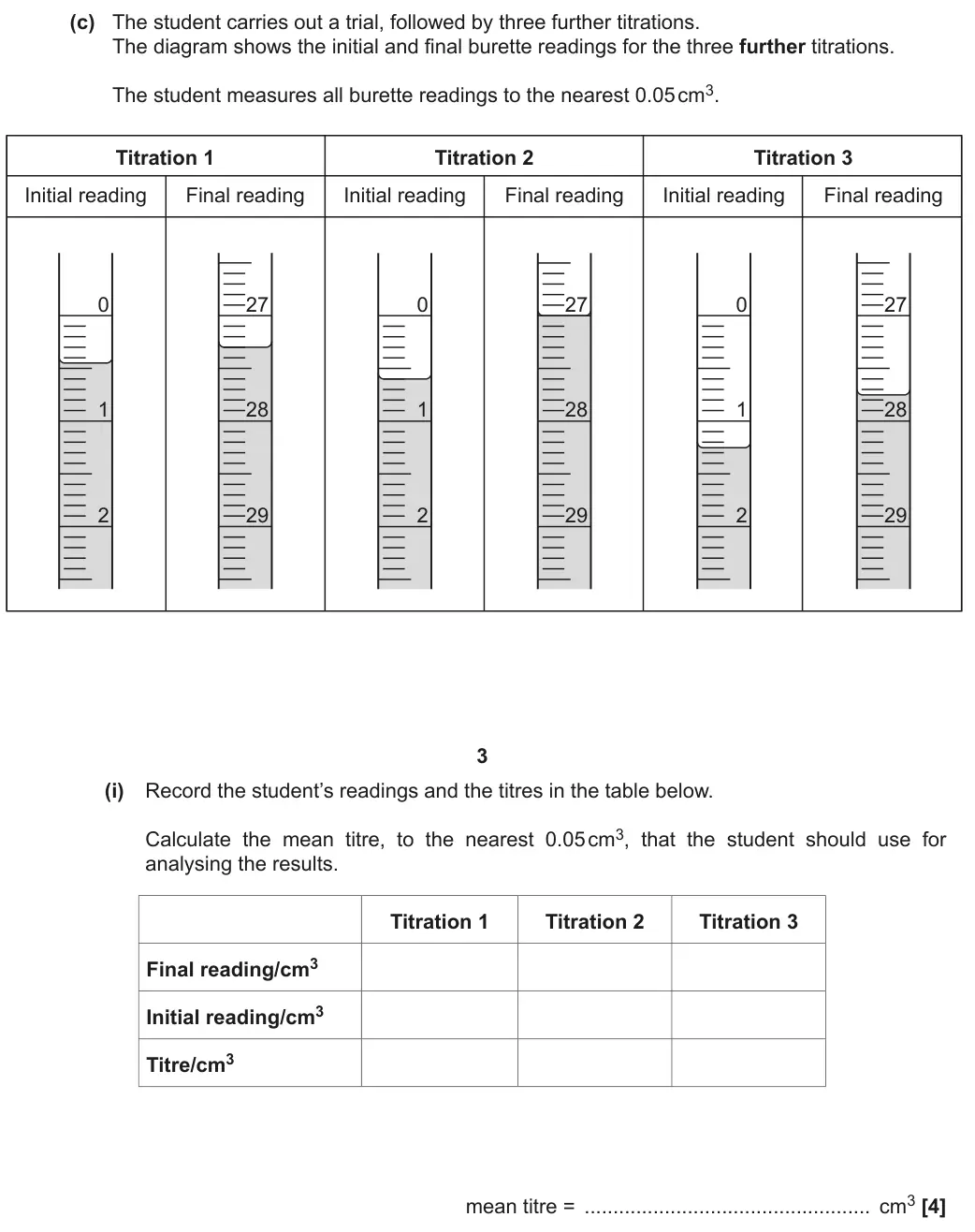
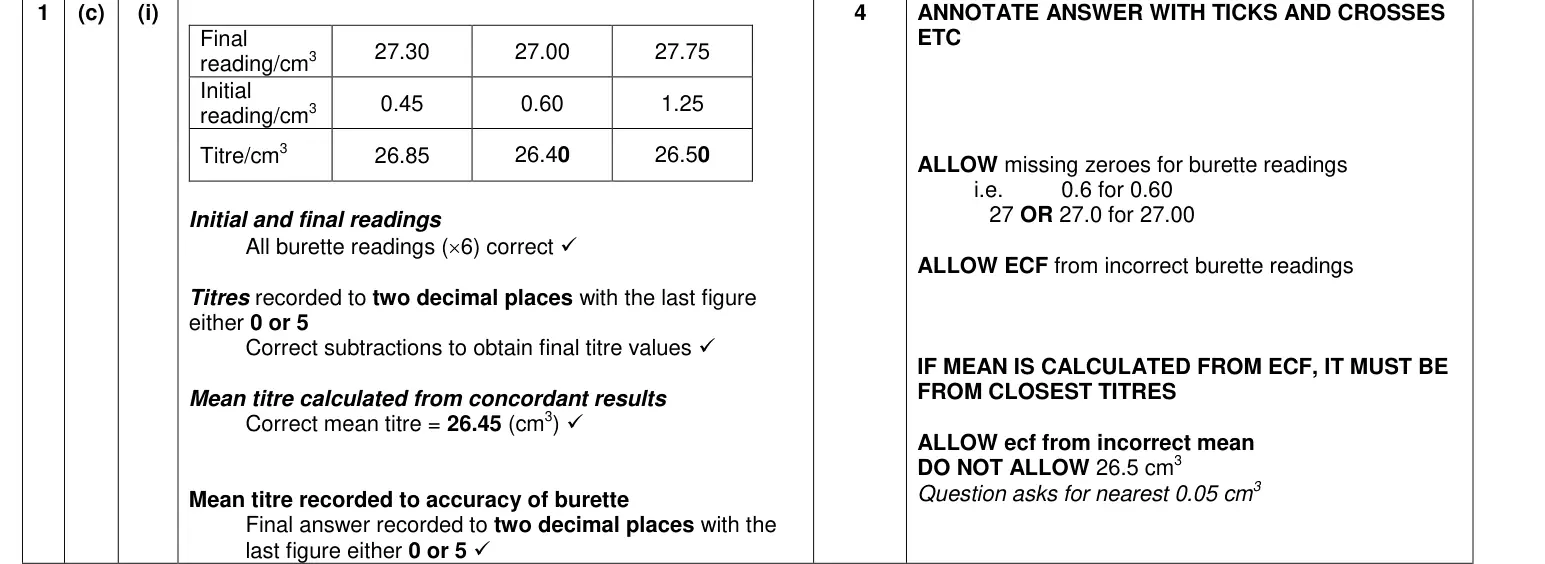
June 2022 · AS Paper 2 · Q1(b)(i) 4 marks AO1 Calculation Easy acids and titrationspractical techniques
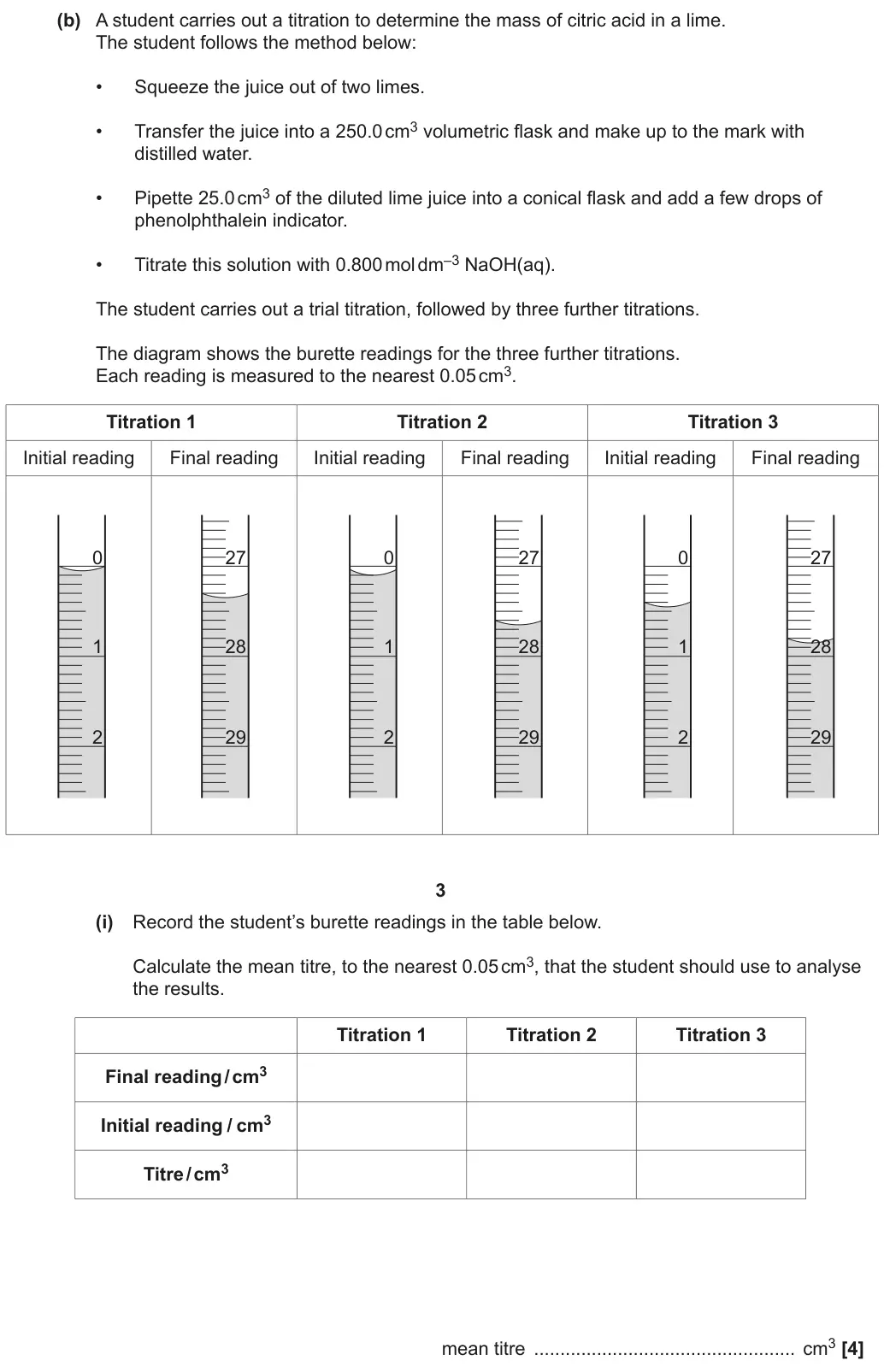
(b) A student carries out a titration to determine the mass of citric acid in a lime.
The student follows the method below:
• Squeeze the juice out of two limes.
• Transfer the juice into a 250.0 cm3 volumetric flask and make up to the mark with
distilled water.
• Pipette 25.0 cm3 of the diluted lime juice into a conical flask and add a few drops of
phenolphthalein indicator.
• Titrate this solution with 0.800 mol dm–3 NaOH(aq).
The student carries out a trial titration, followed by three further titrations.
The diagram shows the burette readings for the three further titrations.
Each reading is measured to the nearest 0.05 cm3.
Titration 1 Titration 2 Titration 3
Initial reading Final reading Initial reading Final reading Initial reading Final reading
0 27 0 27 0 27
1 28 1 28 1 28
2 29 2 29 2 29
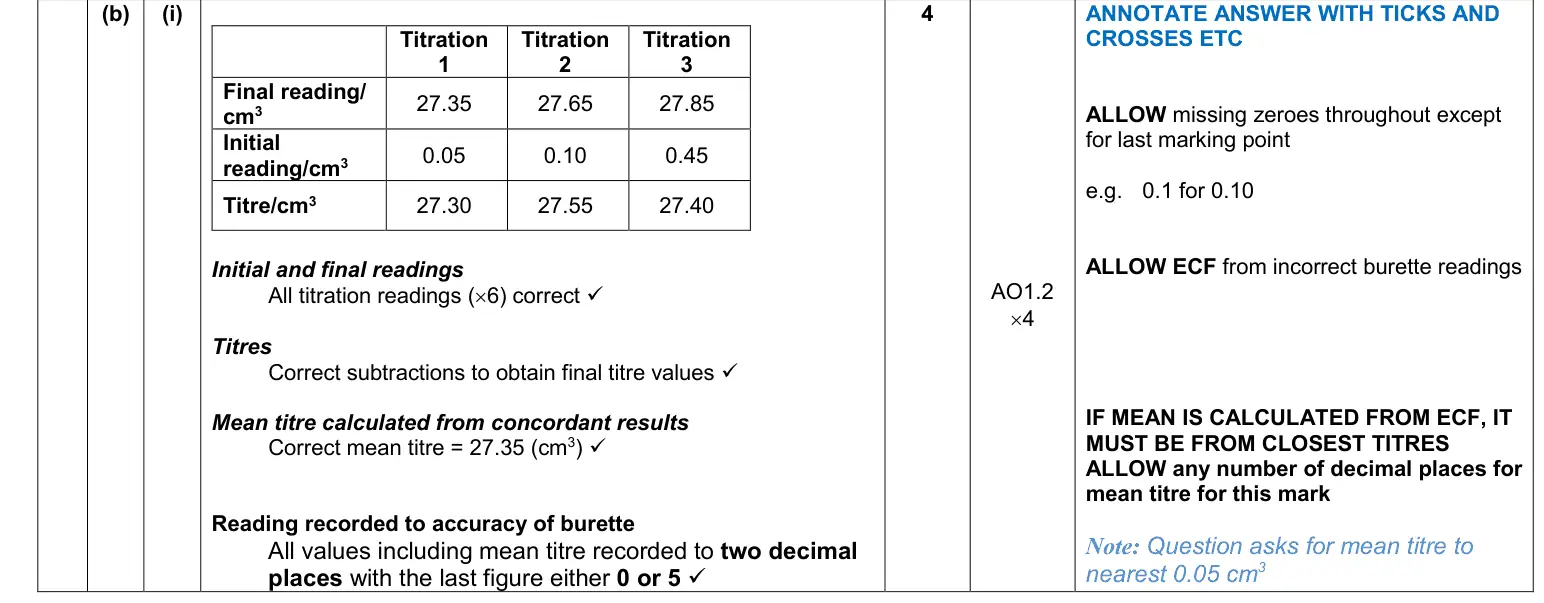
(i) Record the student’s burette readings in the table below.
Calculate the mean titre, to the nearest 0.05 cm3, that the student should use to analyse
the results.
Titration 1 Titration 2 Titration 3
Final reading / cm3
Initial reading  /  cm3
Titre / cm3
mean titre  .................................................. cm3 [4]
June 2022 · AS Paper 2 · Q1(b)(ii) 5 marks AO2 Calculation Medium acids and titrationsamount of substance
Earlier part of question 1 that this part usesEarlier part of June 2022 Paper 2 question 1
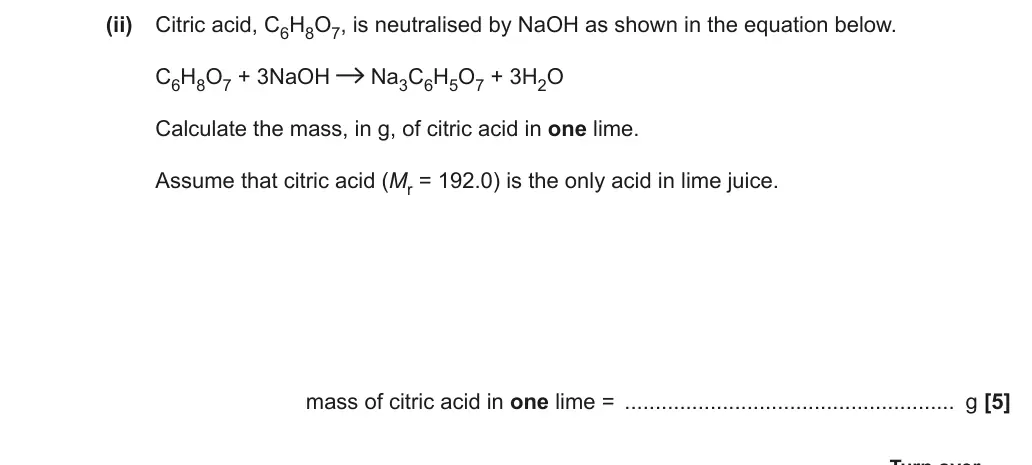
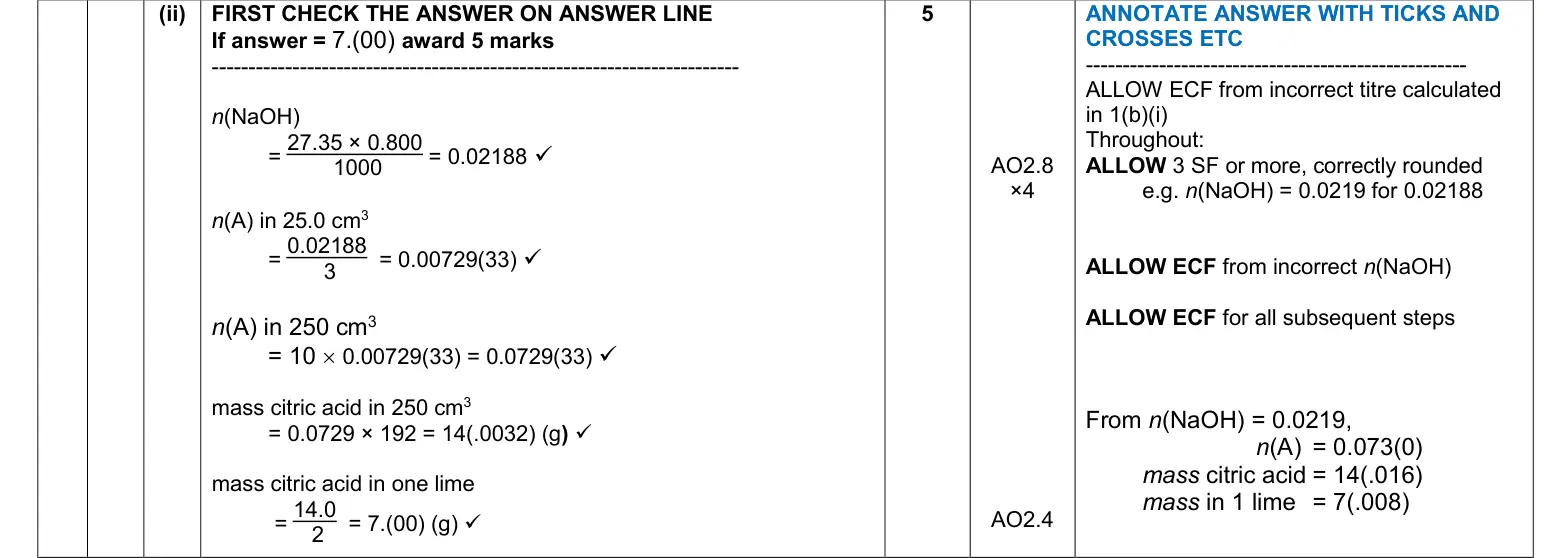
(ii) Citric acid, C6H8O7, is neutralised by NaOH as shown in the equation below.
C6H8O7 + 3NaOH Na3C6H5O7 + 3H2O
Calculate the mass, in g, of citric acid in one lime.
Assume that citric acid (Mr = 192.0) is the only acid in lime juice.
mass of citric acid in one lime =  ...................................................... g [5]
June 2022 · AS Paper 2 · Q2(b)(i) 1 mark AO1 Calculation Easy group 2
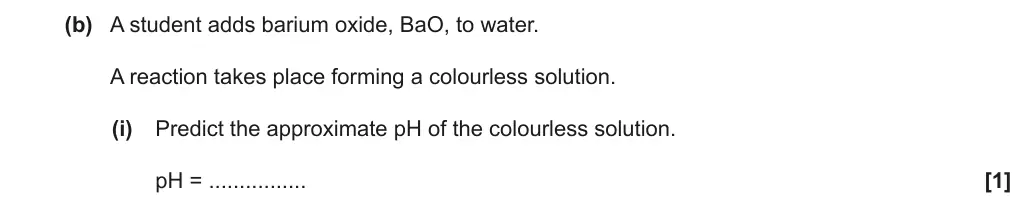
(b) A student adds barium oxide, BaO, to water.
A reaction takes place forming a colourless solution.
(i) Predict the approximate pH of the colourless solution.
pH = ................ [1]
June 2022 · AS Paper 2 · Q3(a)(ii) 2 marks AO3 Calculation Medium reaction ratespractical skills
Earlier part of question 3 that this part usesEarlier part of June 2022 Paper 2 question 3
(ii) Using the graph in Fig. 3.1, find the rate of reaction, in g s–1, at 50 seconds.
Show your working on the graph and in the space below.
rate of reaction =  ................................................. g s–1 [2]
June 2022 · AS Paper 2 · Q4(a)(ii) 2 marks AO2 Calculation Easy chemical equilibrium
Earlier part of question 4 that this part usesEarlier part of June 2022 Paper 2 question 4
(ii) A chemist mixes CH4(g) and H2O(g) and leaves the mixture to reach equilibrium.
CH4(g) + H2O(g) CO(g) + 3H2(g)     ΔH = +206 kJ mol–1 Equilibrium 4.1
The equilibrium mixture contains the following concentrations.
Substance Concentration / mol dm–3
CH4(g) 0.111
H2O(g) 0.682
CO(g) 0.510
H2(g) 1.530
Write an expression for the equilibrium constant, Kc, for Equilibrium 4.1 and calculate
the numerical value of Kc.
Give your answer to 3 significant figures.
Kc =  ......................................... mol2 dm–6 [2]
June 2022 · AS Paper 2 · Q4(b) 3 marks AO2 Calculation Medium enthalpy changes
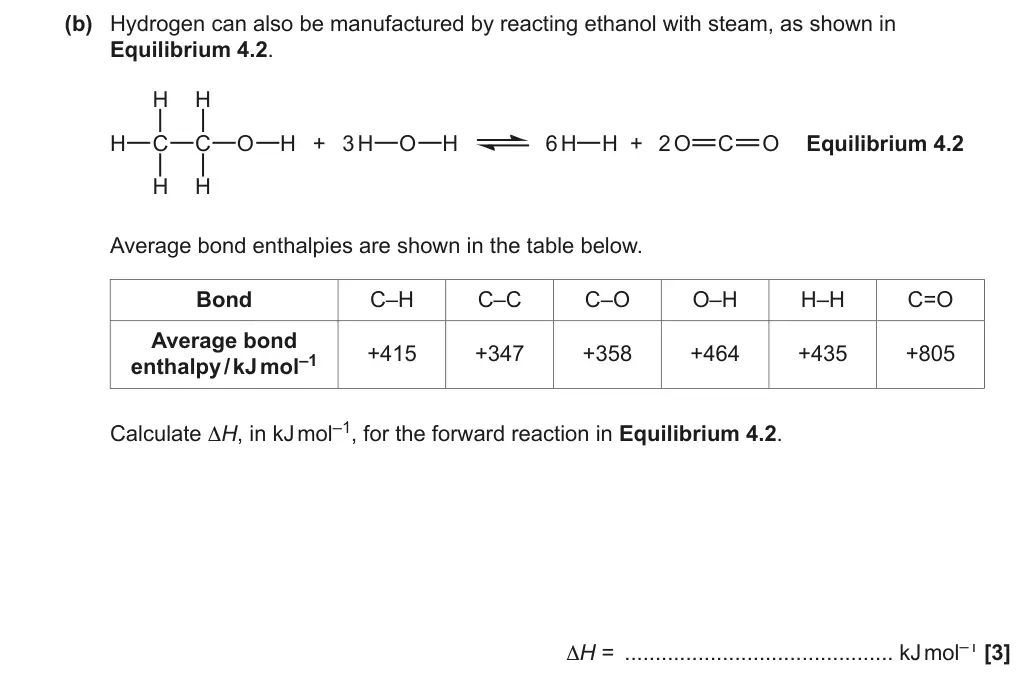
(b) Hydrogen can also be manufactured by reacting ethanol with steam, as shown in
Equilibrium 4.2.
H H
H C C O H + 3 H O H 6 H H + 2 O C O Equilibrium 4.2
H H
Average bond enthalpies are shown in the table below.
Bond C–H C–C C–O O–H H–H C=O
Average bond
+415 +347 +358 +464 +435 +805
enthalpy / kJ mol–1
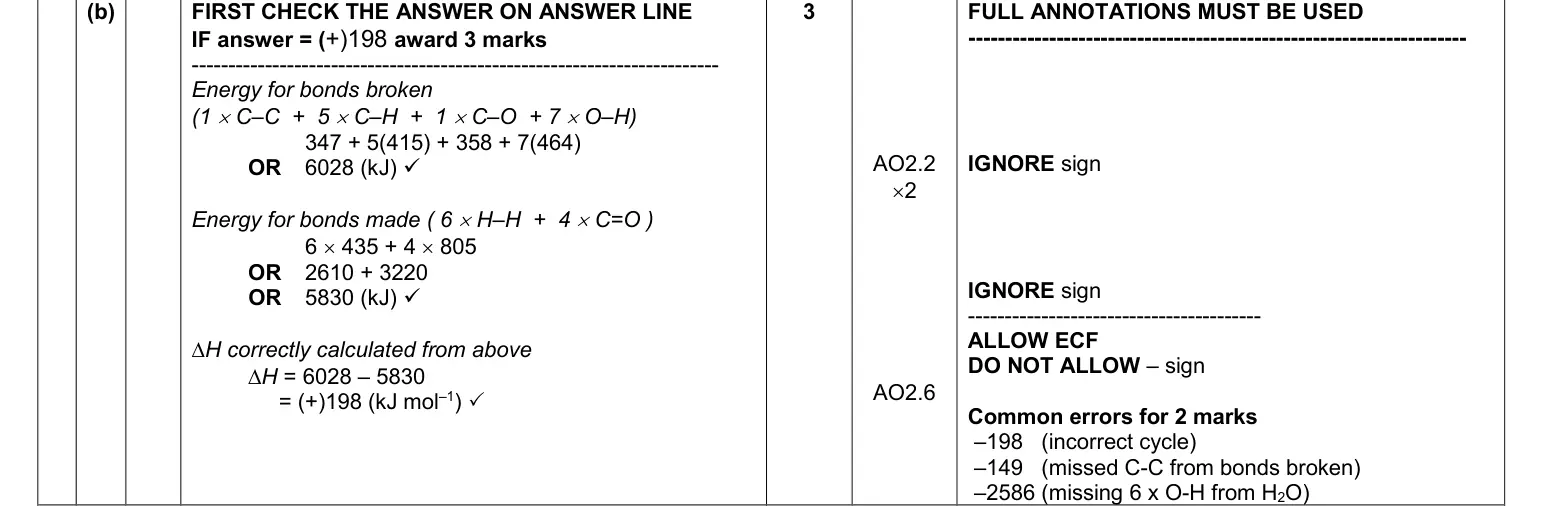
Calculate ΔH, in kJ mol–1, for the forward reaction in Equilibrium 4.2.
ΔH =  ............................................ kJ mol–1 [3]
June 2022 · AS Paper 2 · Q5(b) 2 marks AO1, 2 Calculation Medium amount of substance
Earlier part of question 5 that this part usesEarlier part of June 2022 Paper 2 question 5
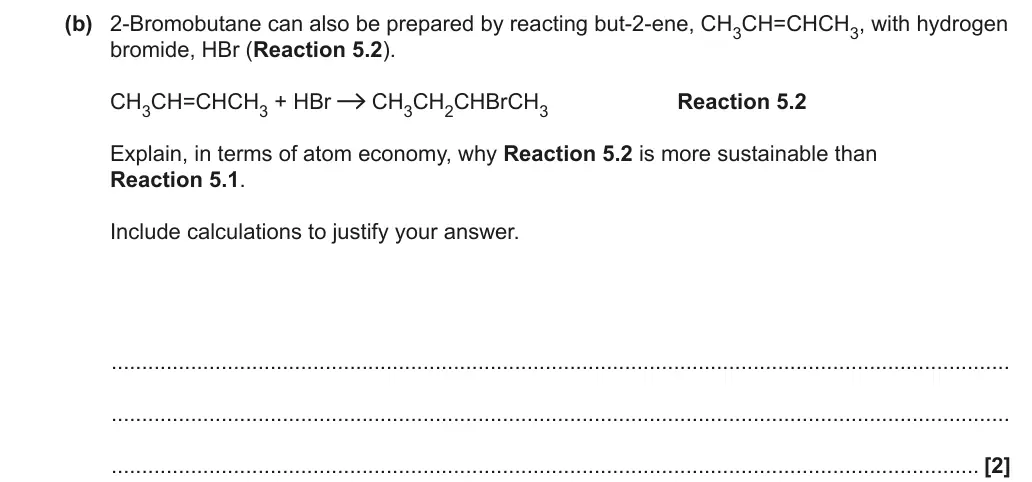
(b) 2-Bromobutane can also be prepared by reacting but-2-ene, CH3CH=CHCH3, with hydrogen
bromide, HBr (Reaction 5.2).
CH3CH=CHCH3 + HBr CH3CH2CHBrCH3 Reaction 5.2
Explain, in terms of atom economy, why Reaction 5.2 is more sustainable than
Reaction 5.1.
Include calculations to justify your answer.
...................................................................................................................................................
...................................................................................................................................................
.............................................................................................................................................. [2]
June 2022 · AS Paper 2 · Q5(c)(i) 3 marks AO2 Calculation Medium amount of substance
Earlier part of question 5 that this part usesEarlier part of June 2022 Paper 2 question 5
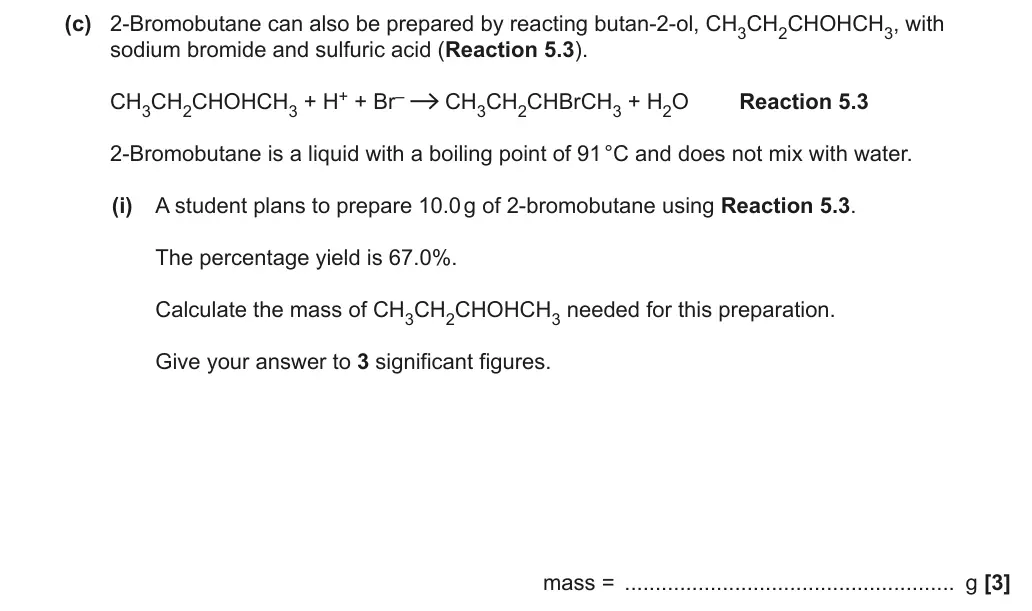
(c) 2-Bromobutane can also be prepared by reacting butan-2-ol, CH3CH2CHOHCH3, with
sodium bromide and sulfuric acid (Reaction 5.3).
CH3CH2CHOHCH3 + H+ + Br– CH3CH2CHBrCH3 + H2O Reaction 5.3
2-Bromobutane is a liquid with a boiling point of 91 °C and does not mix with water.
(i) A student plans to prepare 10.0 g of 2-bromobutane using Reaction 5.3.
The percentage yield is 67.0%.
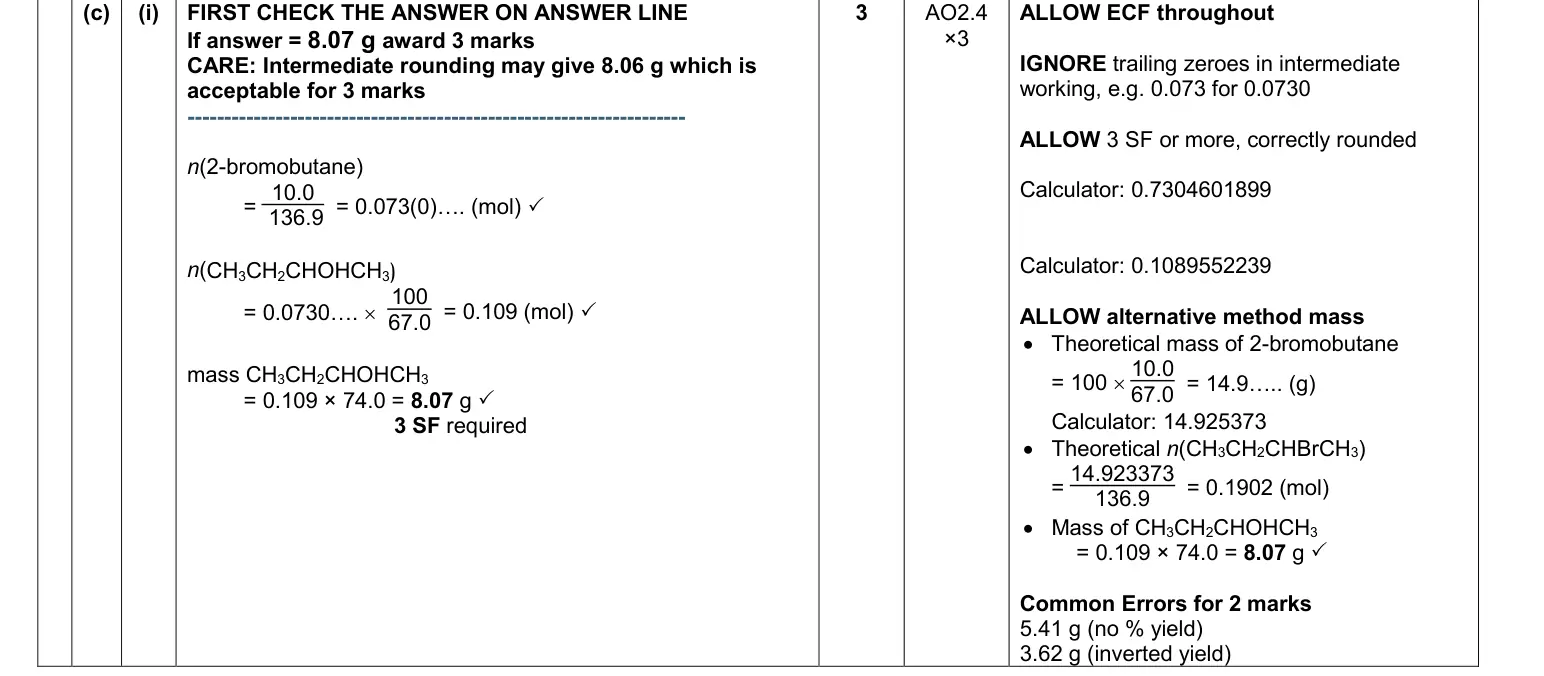
Calculate the mass of CH3CH2CHOHCH3 needed for this preparation.
Give your answer to 3 significant figures.
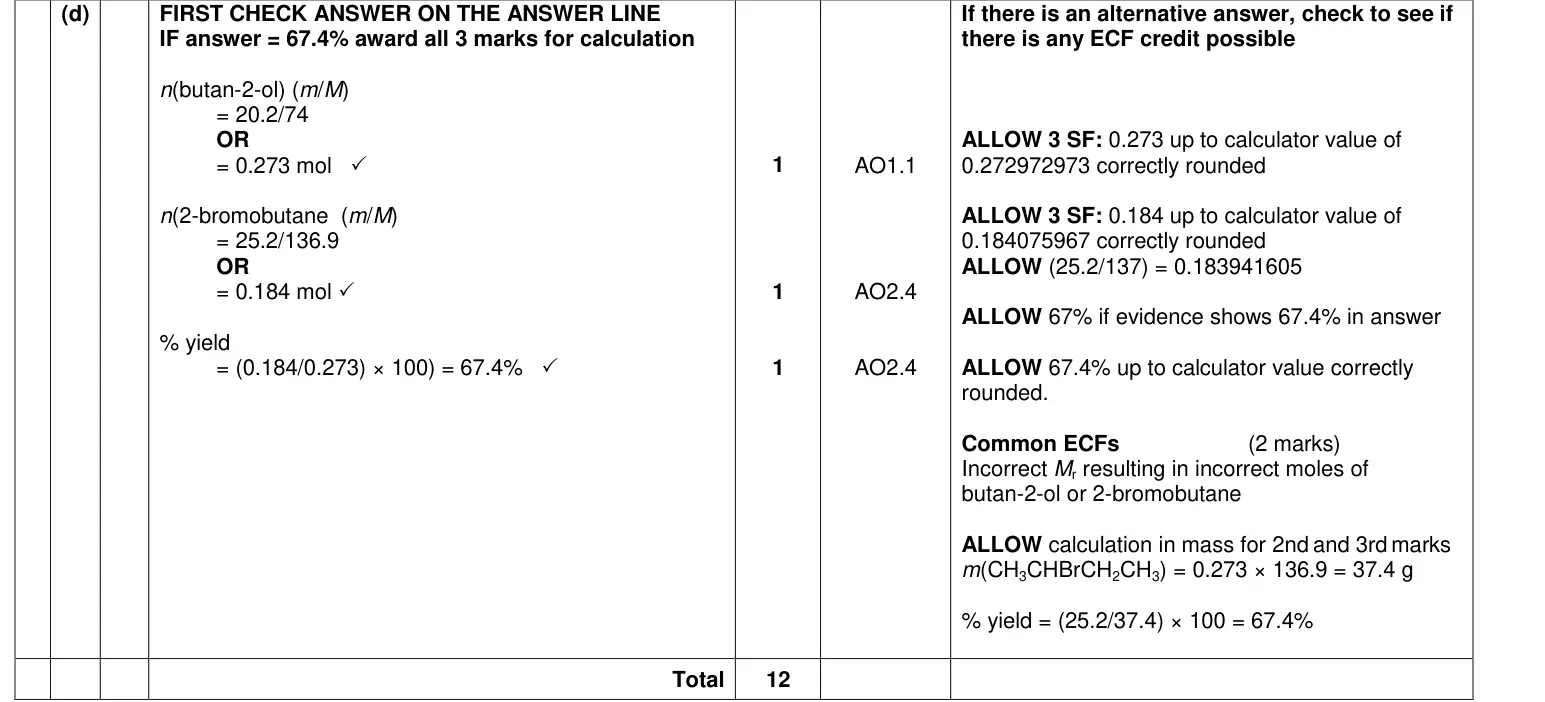
mass =  ...................................................... g [3]
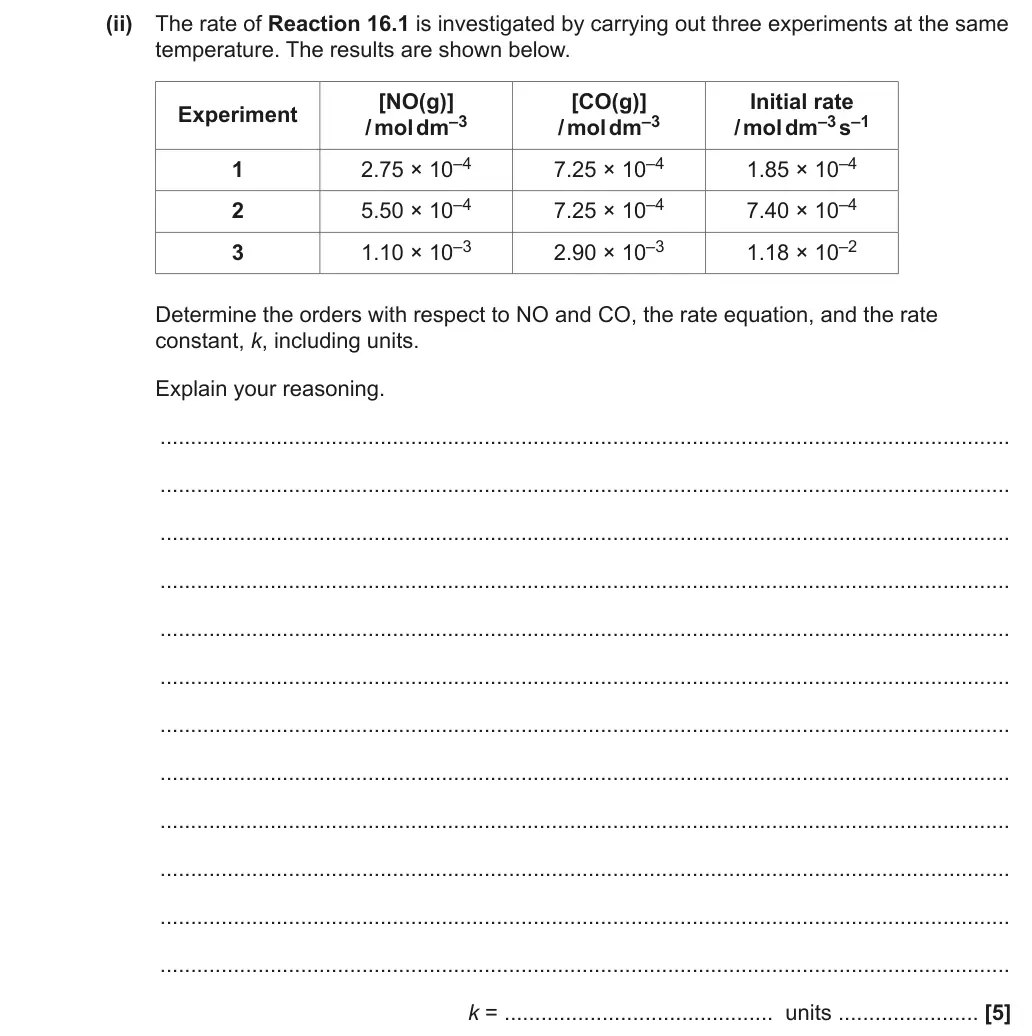
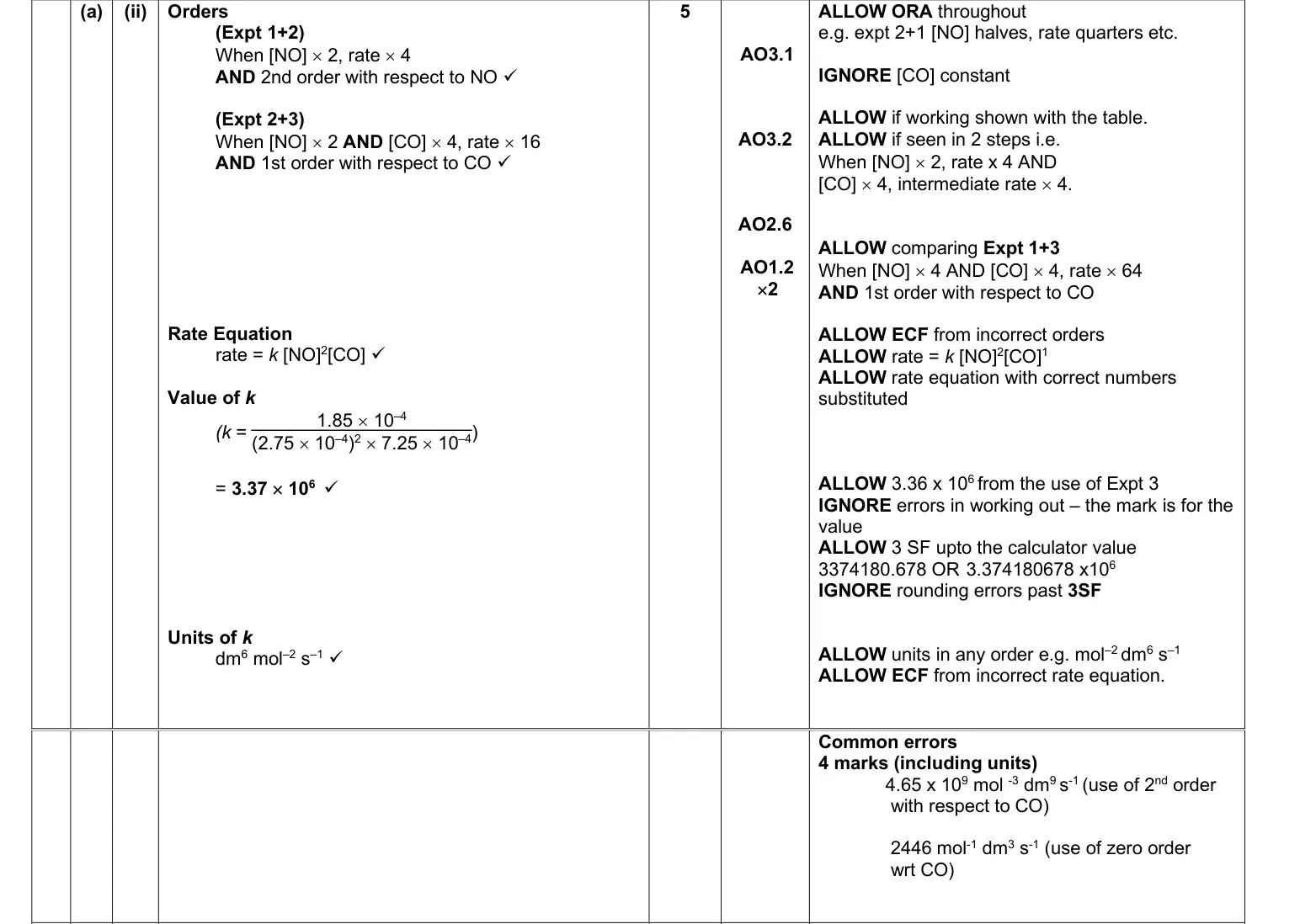
June 2022 · Paper 1 · Q16(a)(ii) 5 marks AO1, 2, 3 Calculation Hard rate equations
Earlier part of question 16 that this part usesEarlier part of June 2022 Paper 1 question 16
(ii) The rate of Reaction 16.1 is investigated by carrying out three experiments at the same
temperature. The results are shown below.
[NO(g)] [CO(g)] Initial rate
Experiment
/ mol dm–3 / mol dm–3 / mol dm–3 s–1
1 2.75 × 10⁻⁴ 7.25 × 10⁻⁴ 1.85 × 10⁻⁴
2 5.50 × 10⁻⁴ 7.25 × 10⁻⁴ 7.40 × 10⁻⁴
3 1.10 × 10⁻³ 2.90 × 10⁻³ 1.18 × 10⁻²
Determine the orders with respect to NO and CO, the rate equation, and the rate
constant, k, including units.
Explain your reasoning.
...........................................................................................................................................
...........................................................................................................................................
...........................................................................................................................................
...........................................................................................................................................
...........................................................................................................................................
...........................................................................................................................................
...........................................................................................................................................
...........................................................................................................................................
...........................................................................................................................................
...........................................................................................................................................
...........................................................................................................................................
...........................................................................................................................................
k = ............................................  units ....................... [5]
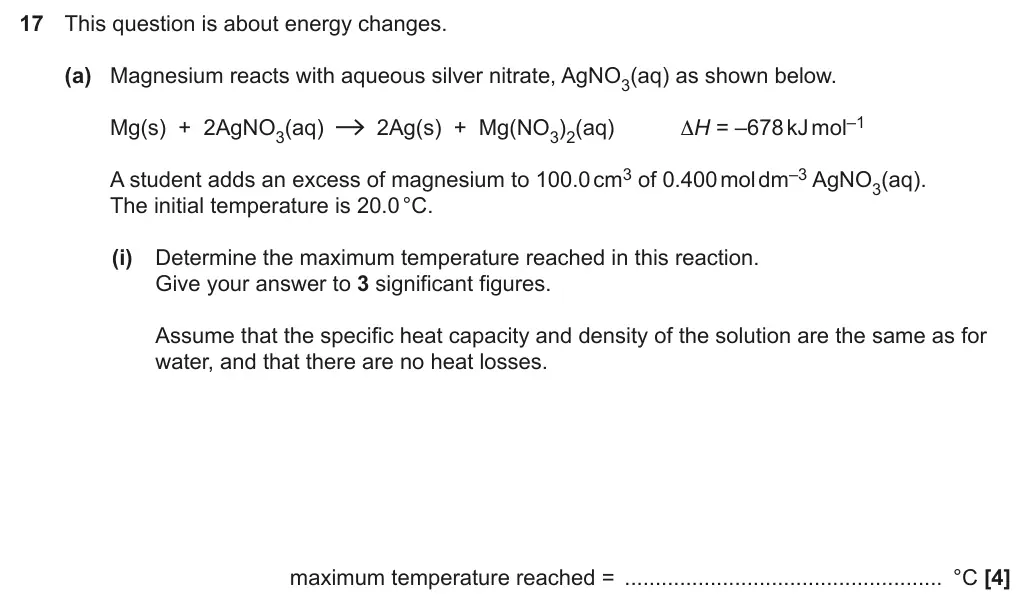
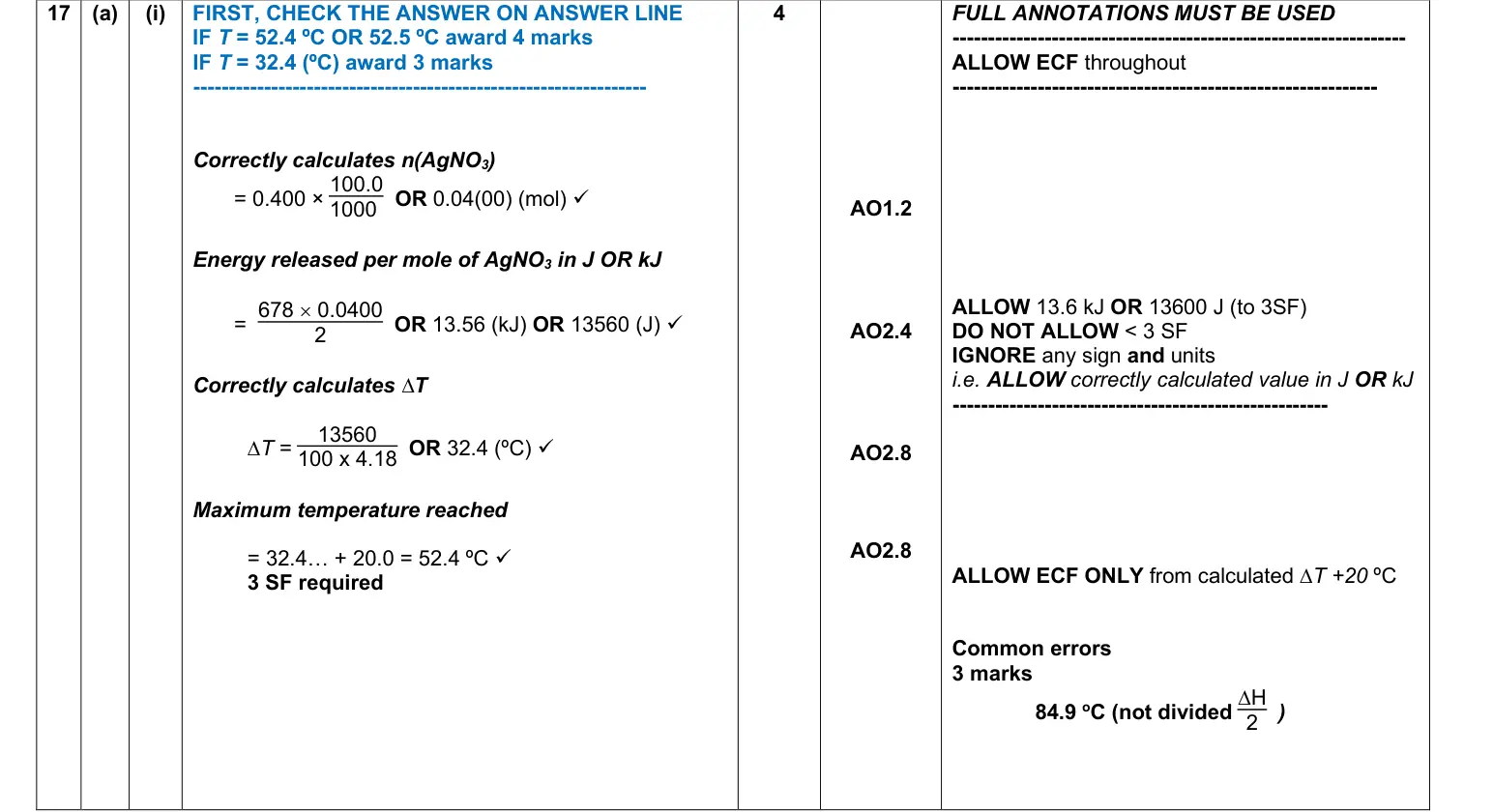
June 2022 · Paper 1 · Q17(a)(i) 4 marks AO1, 2 Calculation Hard enthalpy changesamount of substance
17 This question is about energy changes.
(a) Magnesium reacts with aqueous silver nitrate, AgNO3(aq) as shown below.
Mg(s)  +  2AgNO3(aq) 2Ag(s)  +  Mg(NO3)2(aq)   ∆H = –678 kJ mol–1
A student adds an excess of magnesium to 100.0 cm3 of 0.400 mol dm–3 AgNO3(aq).
The initial temperature is 20.0 °C.
(i) Determine the maximum temperature reached in this reaction.
Give your answer to 3 significant figures.
Assume that the specific heat capacity and density of the solution are the same as for
water, and that there are no heat losses.
maximum temperature reached =  .................................................... °C [4]
June 2022 · Paper 1 · Q17(b)(ii) 2 marks AO2 Calculation Hard enthalpy changes
Earlier part of question 17 that this part usesEarlier part of June 2022 Paper 1 question 17
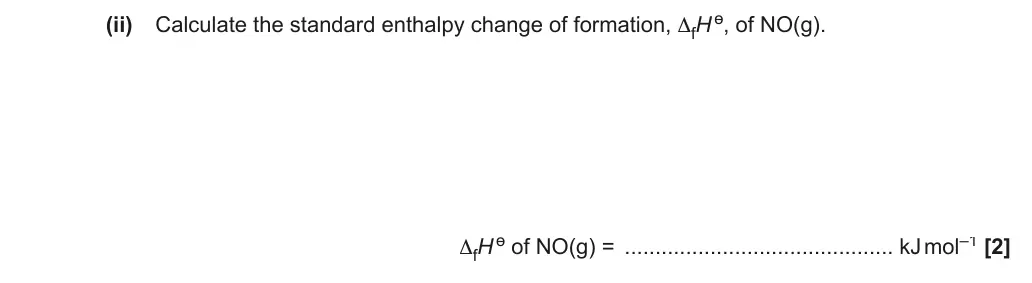
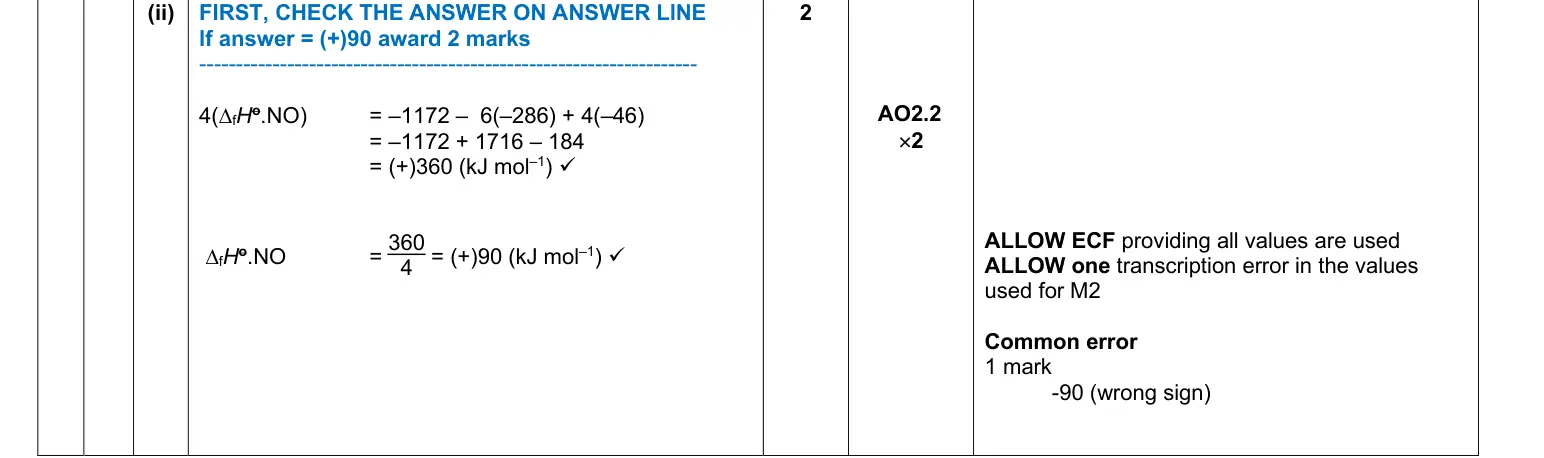
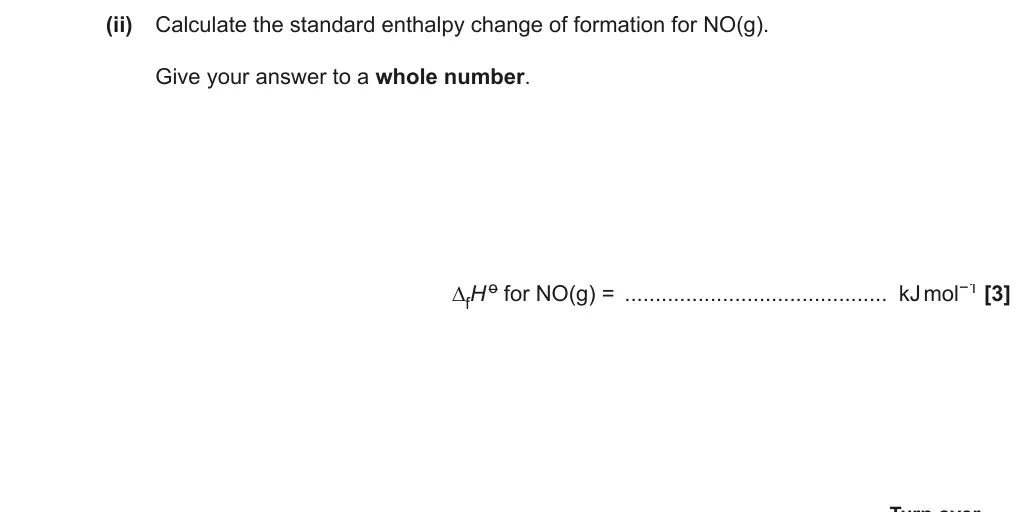
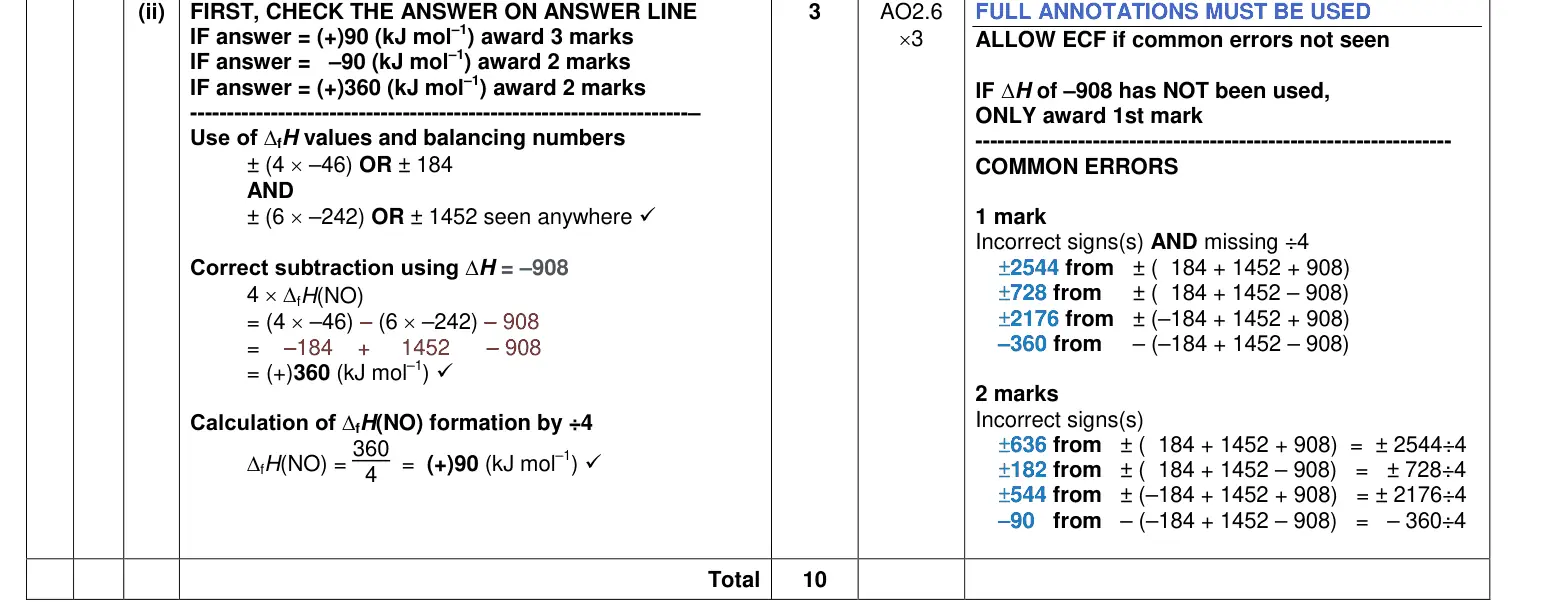
(ii) Calculate the standard enthalpy change of formation, ∆fH ө, of NO(g).
∆fH ө of NO(g) =  ............................................ kJ mol–1 [2]
June 2022 · Paper 1 · Q17(c)(ii) 3 marks AO2 Calculation Medium entropy and free energy
Earlier part of question 17 that this part usesEarlier part of June 2022 Paper 1 question 17
(ii) The free energy change, ∆G, of Reaction 17.2 is –2672 kJ mol–1 at 25 °C.
Calculate the enthalpy change, ∆H, of Reaction 17.2, in kJ mol–1.
∆H =  ............................................ kJ mol–1 [3]
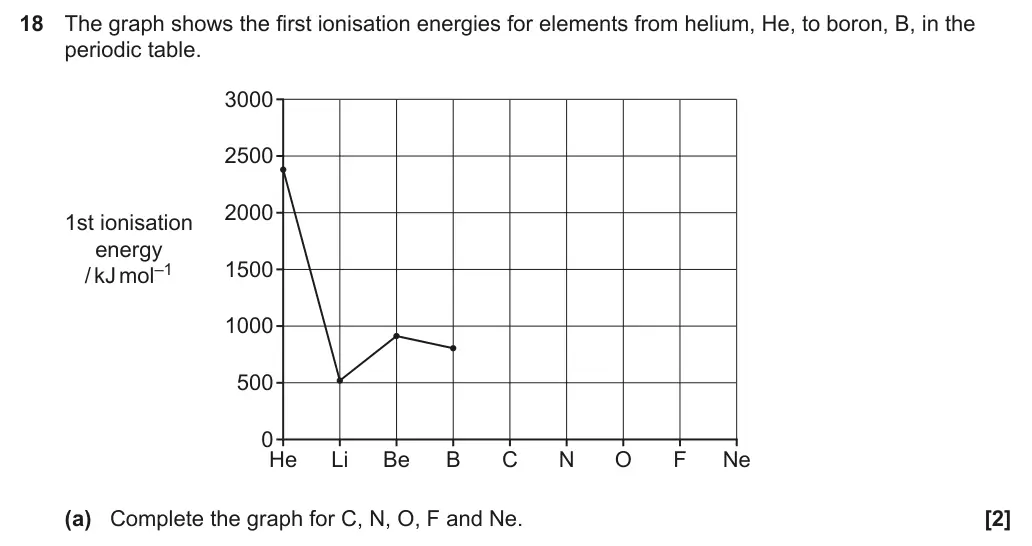
June 2022 · Paper 1 · Q18(b) 1 mark AO2 Calculation Medium periodicityamount of substance
Earlier part of question 18 that this part usesEarlier part of June 2022 Paper 1 question 18
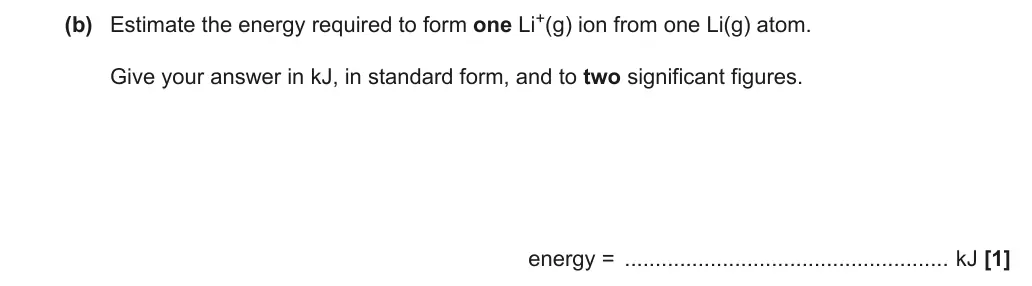
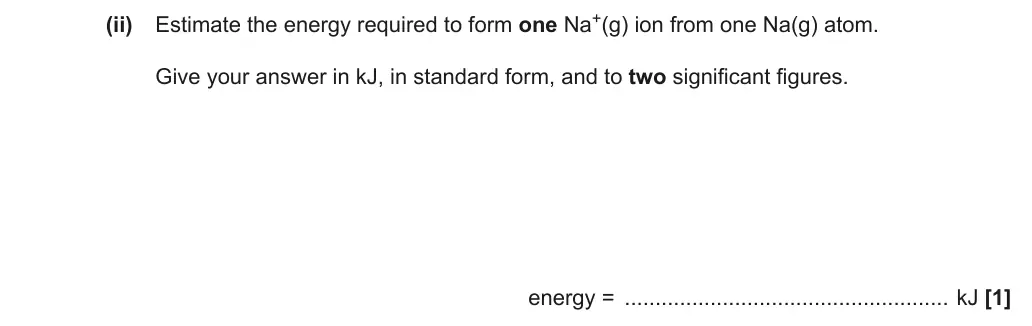
(b) Estimate the energy required to form one Li+(g) ion from one Li(g) atom.
Give your answer in kJ, in standard form, and to two significant figures.
energy =  ..................................................... kJ [1]
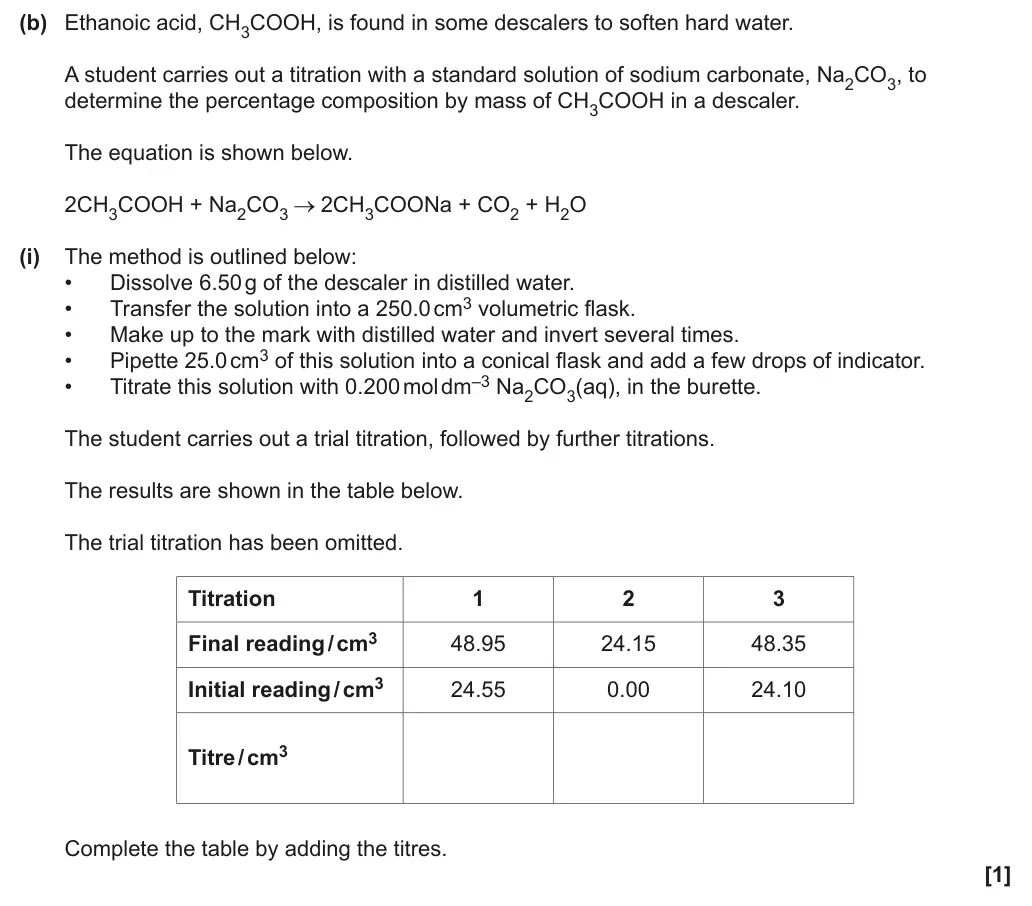
June 2022 · Paper 1 · Q19(a)(i) 2 marks AO1 Calculation Easy acids and titrationspractical skillspractical techniques
19 This question is about acids and buffer solutions.
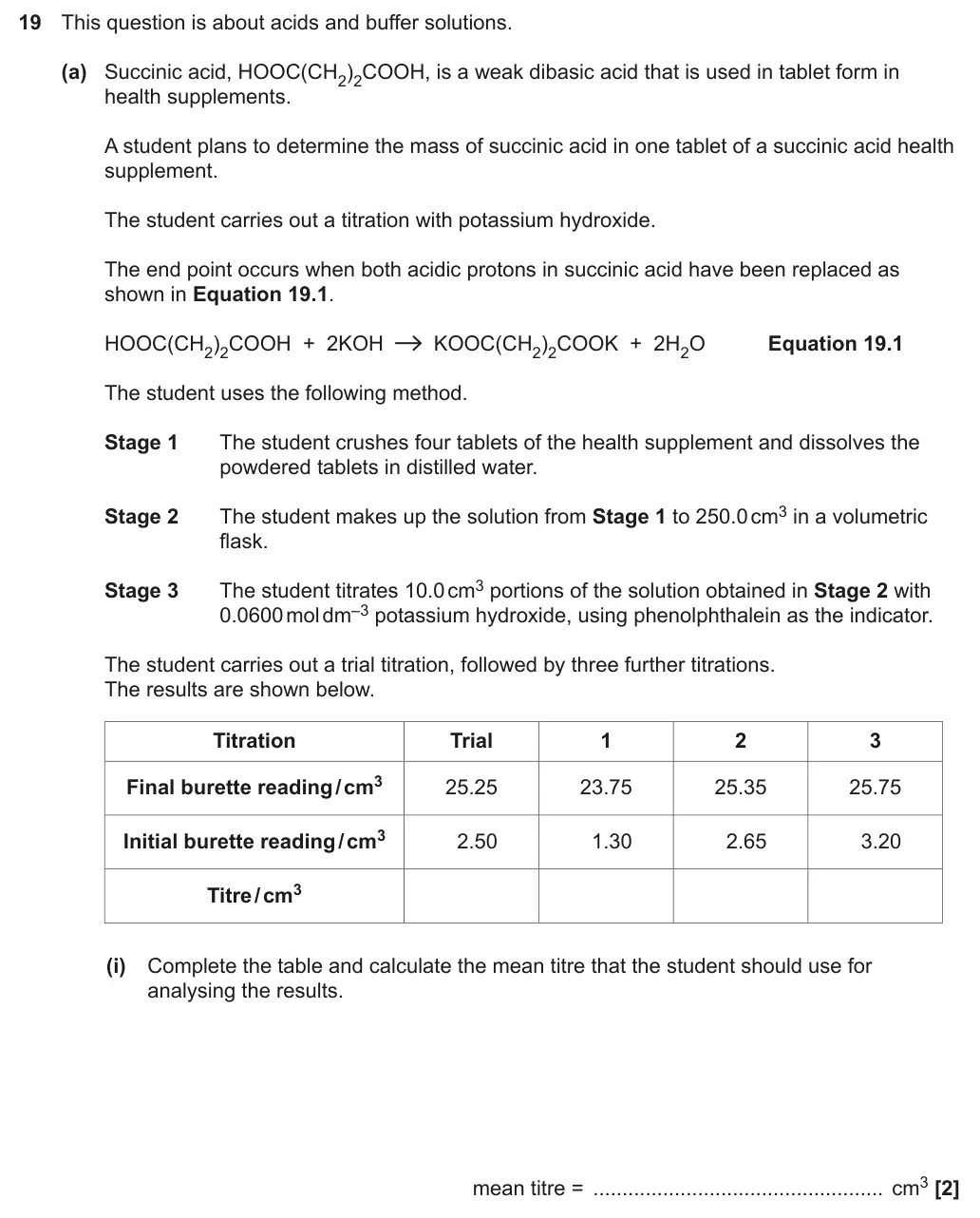
(a) Succinic acid, HOOC(CH2)2COOH, is a weak dibasic acid that is used in tablet form in
health supplements.
A student plans to determine the mass of succinic acid in one tablet of a succinic acid health
supplement.
The student carries out a titration with potassium hydroxide.
The end point occurs when both acidic protons in succinic acid have been replaced as
shown in Equation 19.1.
HOOC(CH2)2COOH  +  2KOH KOOC(CH2)2COOK  +  2H2O   Equation 19.1
The student uses the following method.
Stage 1 The student crushes four tablets of the health supplement and dissolves the
powdered tablets in distilled water.
Stage 2 The student makes up the solution from Stage 1 to 250.0 cm3 in a volumetric
flask.
Stage 3 The student titrates 10.0 cm3 portions of the solution obtained in Stage 2 with
0.0600 mol dm–3 potassium hydroxide, using phenolphthalein as the indicator.
The student carries out a trial titration, followed by three further titrations.
The results are shown below.
Titration Trial 1 2 3
Final burette reading / cm3 25.25 23.75 25.35 25.75
Initial burette reading / cm3 2.50 1.30 2.65 3.20
Titre / cm3
(i) Complete the table and calculate the mean titre that the student should use for
analysing the results.
mean titre =  .................................................. cm3 [2]
June 2022 · Paper 1 · Q19(a)(ii) 5 marks AO2, 3 Calculation Medium acids and titrationsamount of substance
Earlier part of question 19 that this part usesEarlier part of June 2022 Paper 1 question 19
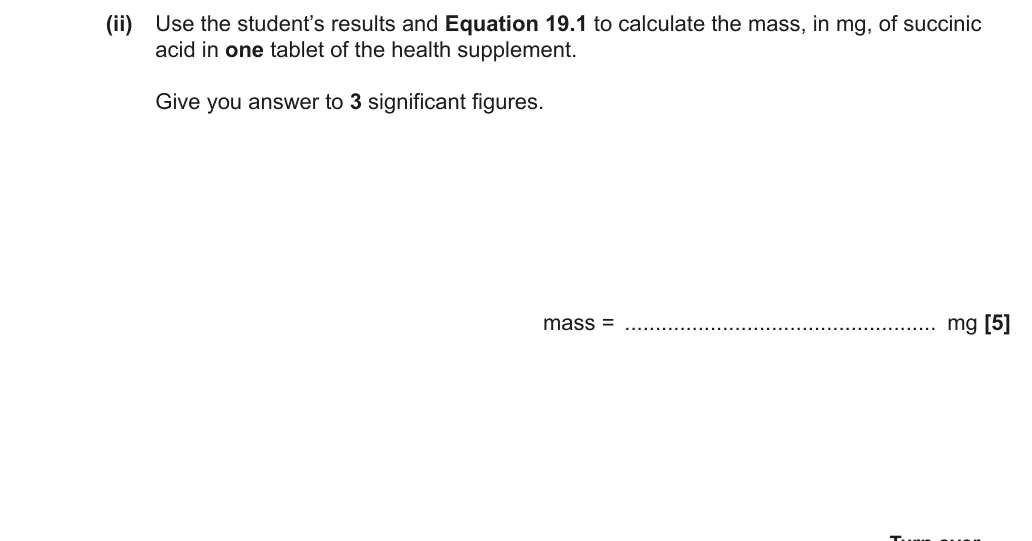
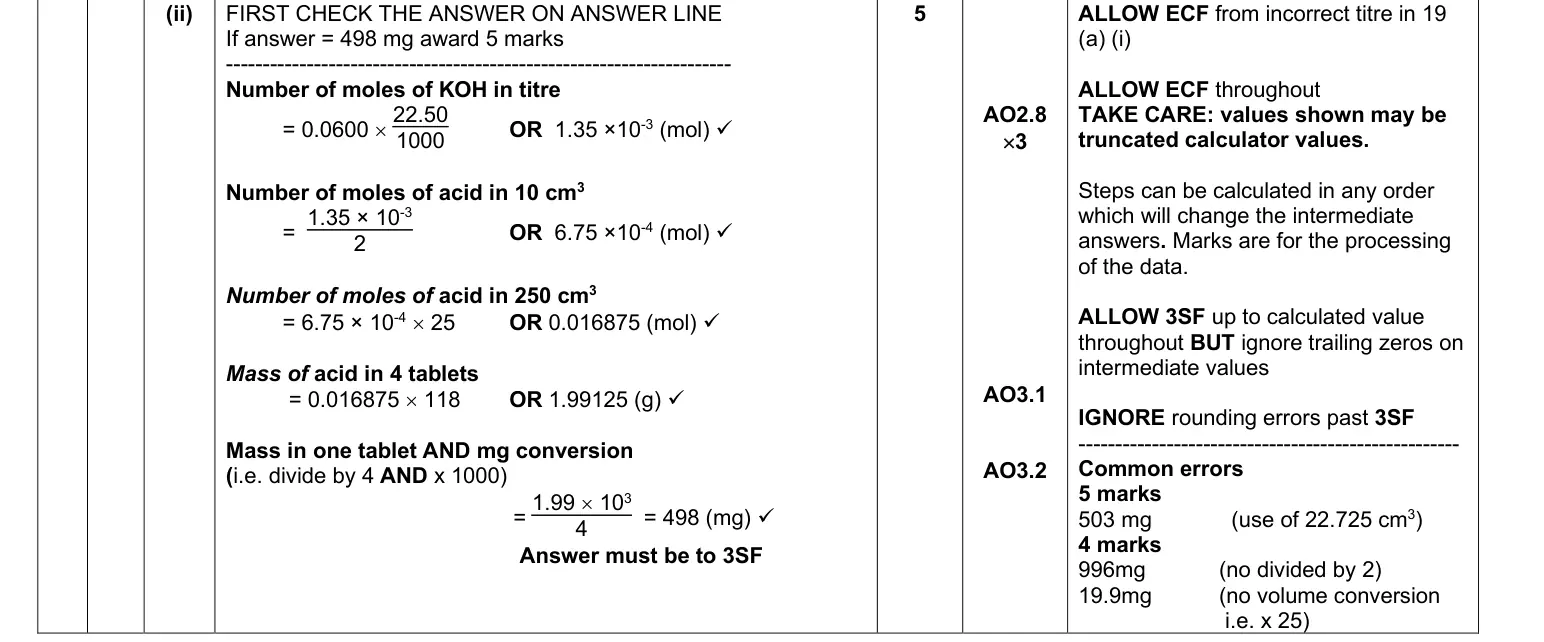
(ii) Use the student’s results and Equation 19.1 to calculate the mass, in mg, of succinic
acid in one tablet of the health supplement.
Give you answer to 3 significant figures.
mass =  ................................................... mg [5]
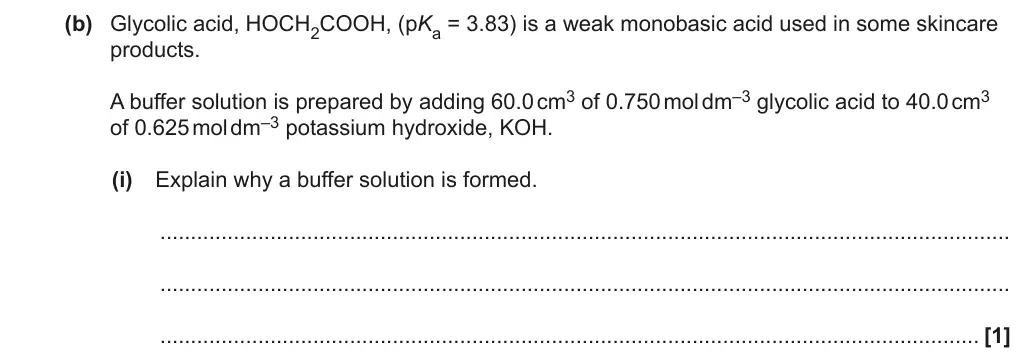
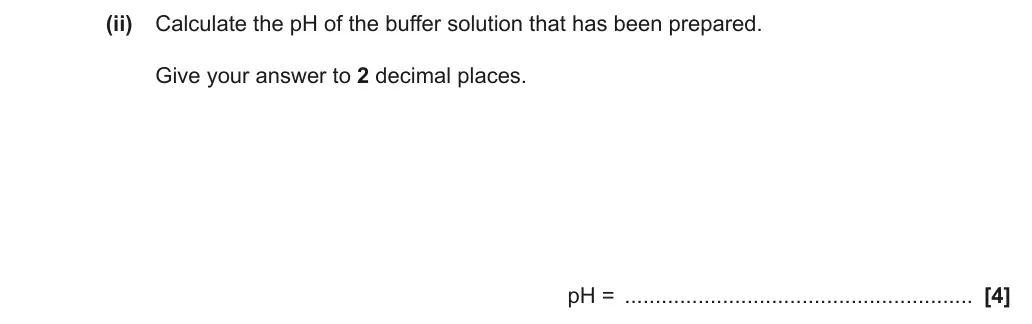
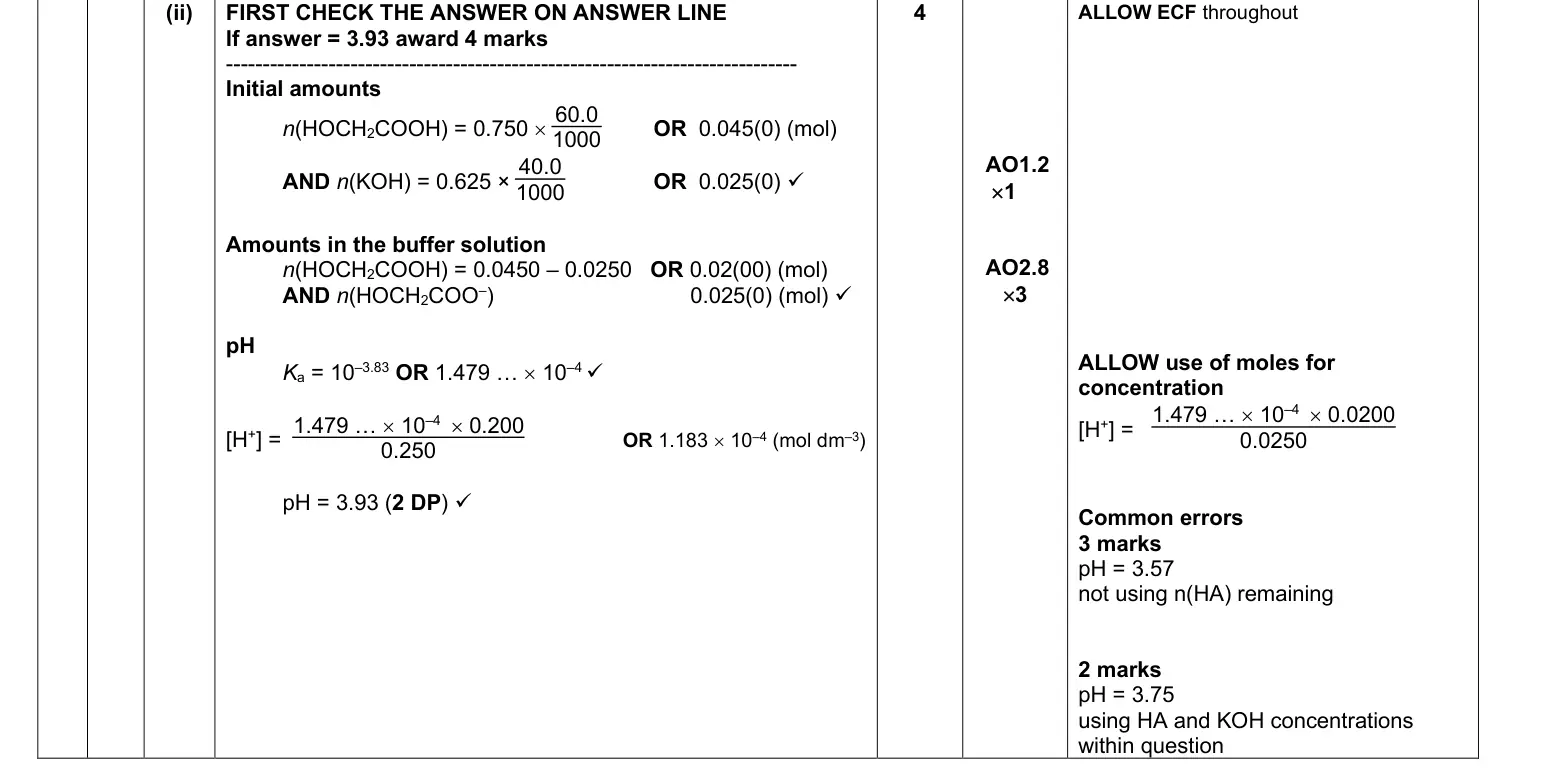
June 2022 · Paper 1 · Q19(b)(ii) 4 marks AO1, 2 Calculation Easy acids bases and buffers
Earlier part of question 19 that this part usesEarlier part of June 2022 Paper 1 question 19
(ii) Calculate the pH of the buffer solution that has been prepared.
Give your answer to 2 decimal places.
pH =  ......................................................... [4]
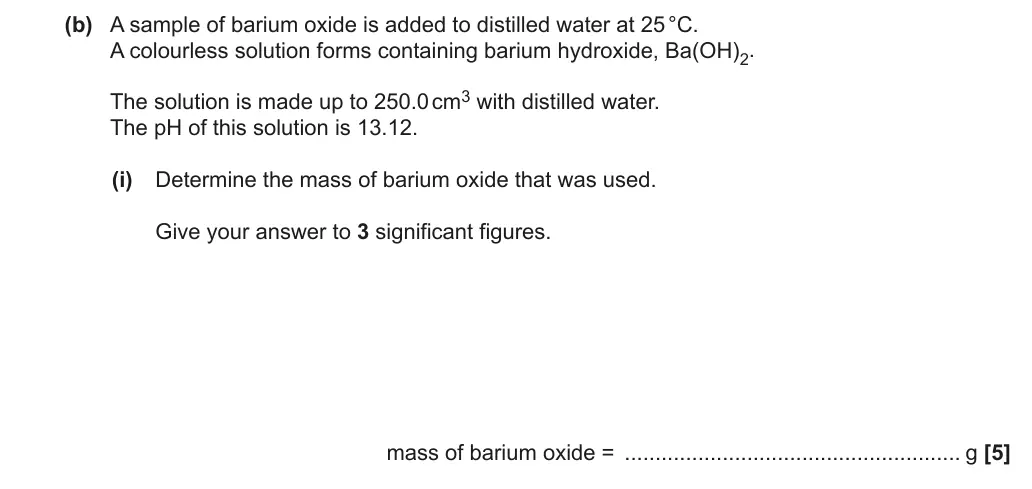
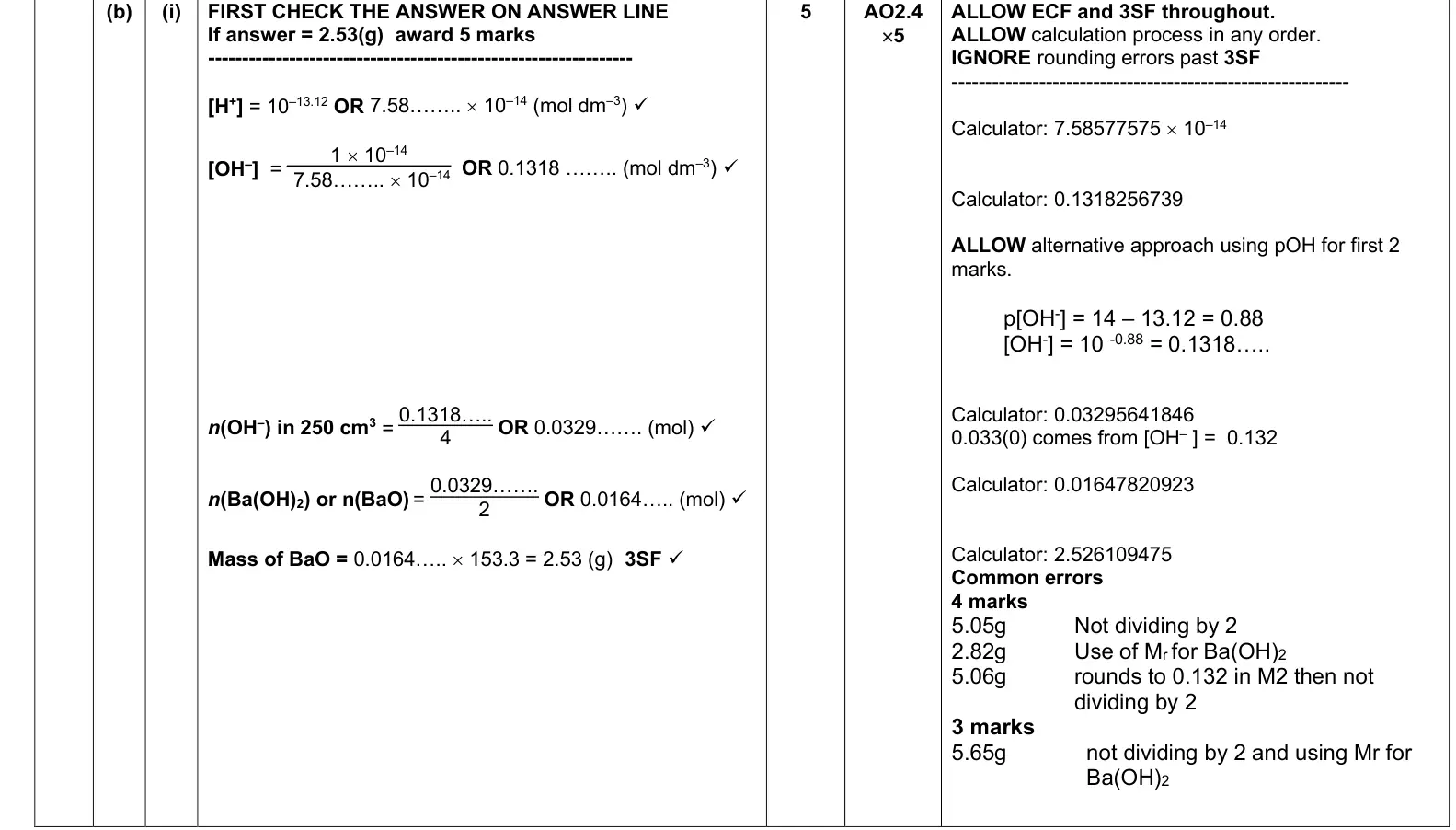
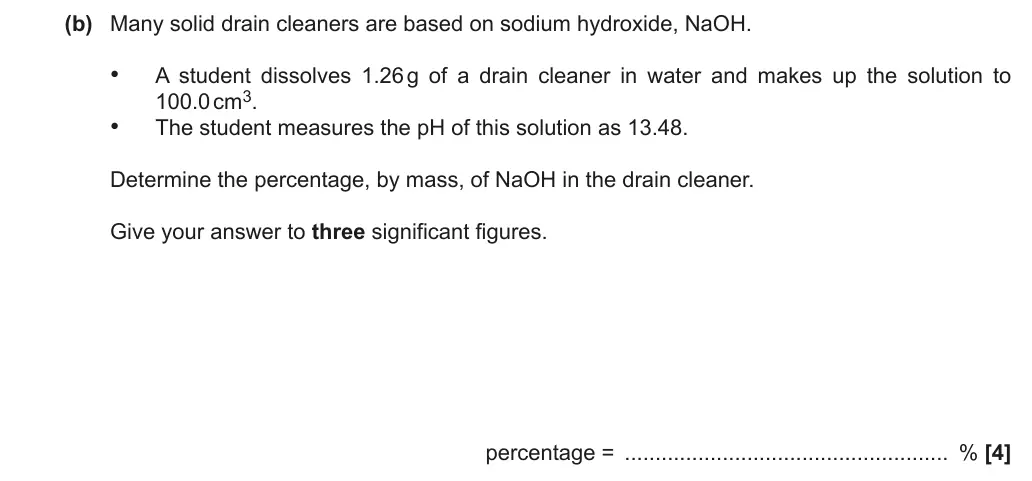
June 2022 · Paper 1 · Q21(b)(i) 5 marks AO2 Calculation Medium acids bases and buffersamount of substancegroup 2
(b) A sample of barium oxide is added to distilled water at 25 °C.
A colourless solution forms containing barium hydroxide, Ba(OH)2.
The solution is made up to 250.0 cm3 with distilled water.
The pH of this solution is 13.12.
(i) Determine the mass of barium oxide that was used.
Give your answer to 3 significant figures.
mass of barium oxide =  ....................................................... g [5]
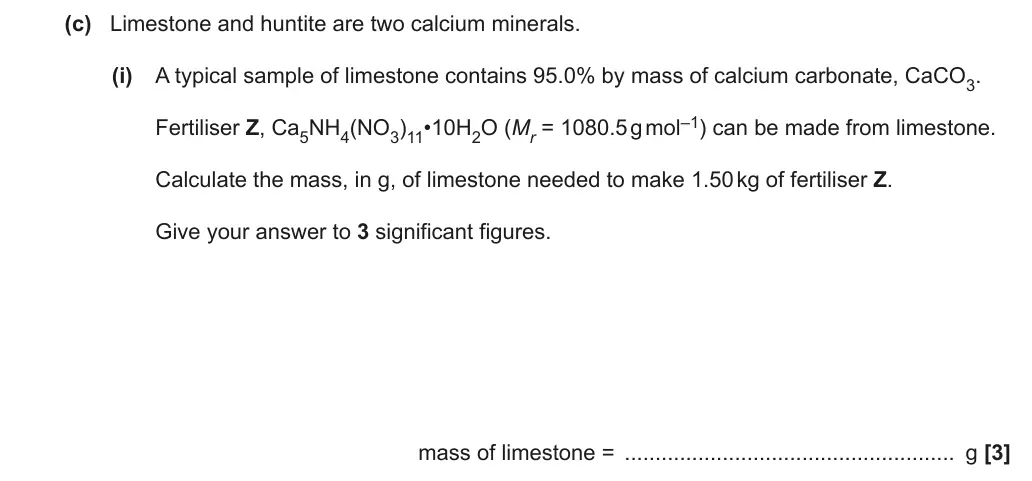
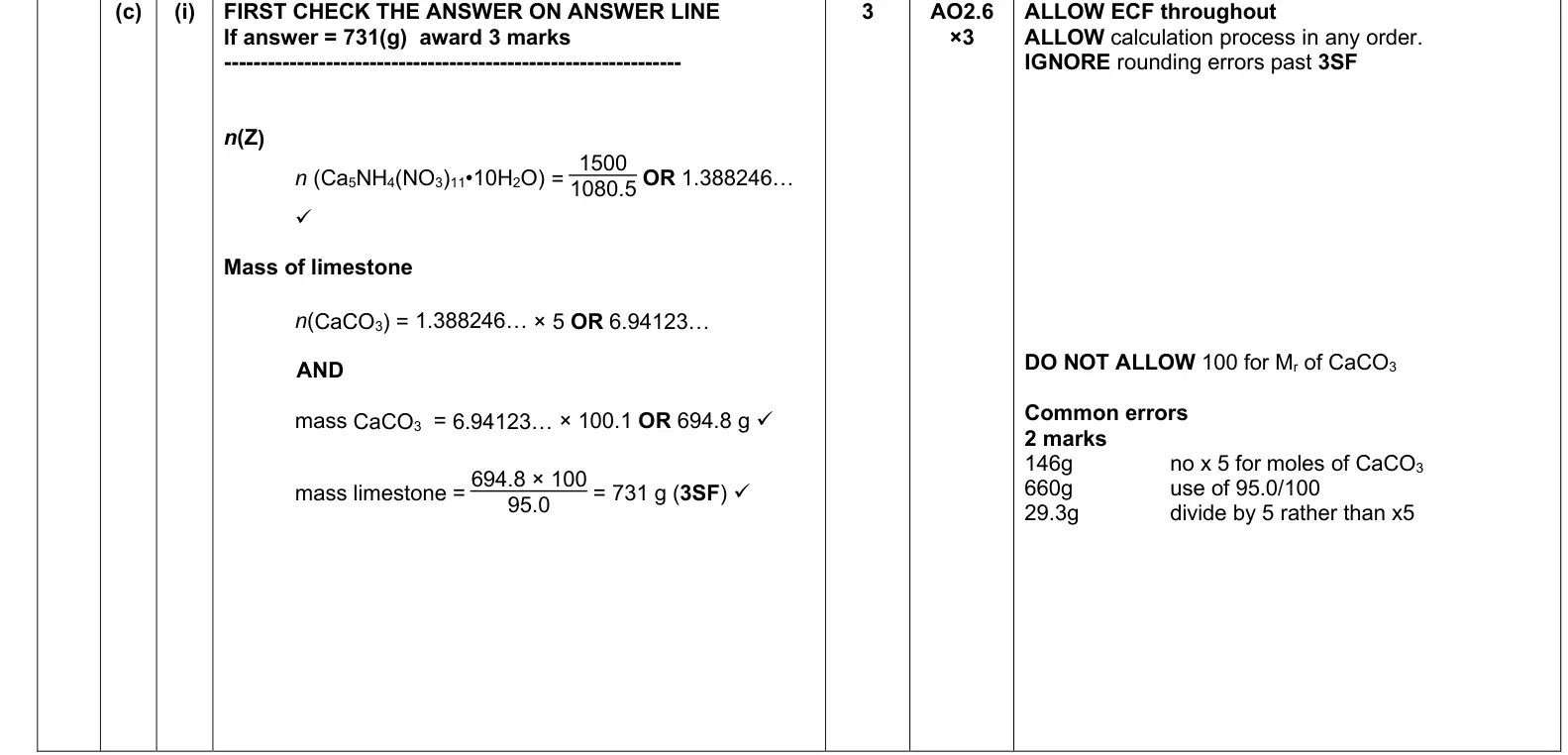
June 2022 · Paper 1 · Q21(c)(i) 3 marks AO2 Calculation Hard amount of substance
(c) Limestone and huntite are two calcium minerals.
(i) A typical sample of limestone contains 95.0% by mass of calcium carbonate, CaCO3.
Fertiliser Z, Ca5NH4(NO3)11•10H2O (Mr = 1080.5 g mol–1) can be made from limestone.
Calculate the mass, in g, of limestone needed to make 1.50 kg of fertiliser Z.
Give your answer to 3 significant figures.
mass of limestone =  ...................................................... g [3]
June 2022 · Paper 2 · Q19(d)(ii) 2 marks AO2 Calculation Medium atomic structure and isotopescondensation polymers
Earlier part of question 19 that this part usesEarlier part of June 2022 Paper 2 question 19
(ii) What is the relative molecular mass, Mr, of the polymer?
Mr =  ......................................................... [2]
June 2022 · Paper 3 · Q1(b)(i) 1 mark AO2 Calculation Easy atomic structure and isotopes
(b) Brass is an alloy of copper and zinc.
The mass spectrum of a sample of brass is shown below.
45.64%
Relative
abundance
20.36%
16.82%
9.53%
6.27%
1.38%
60 61 62 63 64 65 66 67 68 69 70
m/z
The peaks at m/z = 63 and m/z = 65 are from the 63Cu and 65Cu isotopes of copper.
The remaining four peaks are from isotopes of zinc.
(i) What are the percentage compositions of copper and zinc in the brass sample?
Cu = ............. %  Zn = ............. % [1]
June 2022 · Paper 3 · Q1(b)(ii) 2 marks AO1 Calculation Medium atomic structure and isotopes
Earlier part of question 1 that this part usesEarlier part of June 2022 Paper 3 question 1
(ii) Calculate the relative atomic mass of zinc in the sample of brass.
Give your answer to 2 decimal places.
relative atomic mass =  .......................................................... [2]
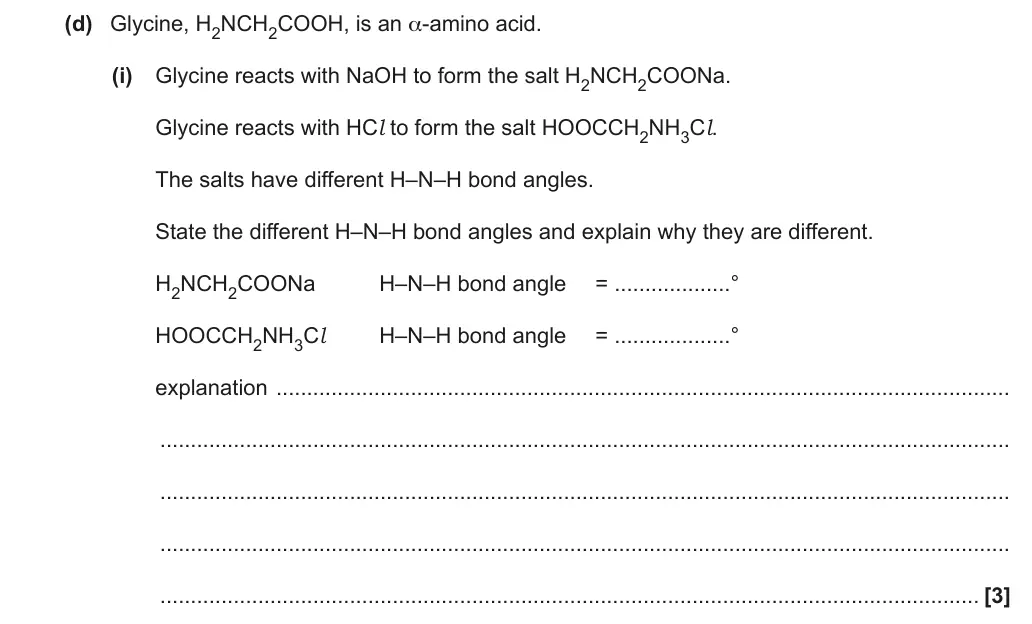
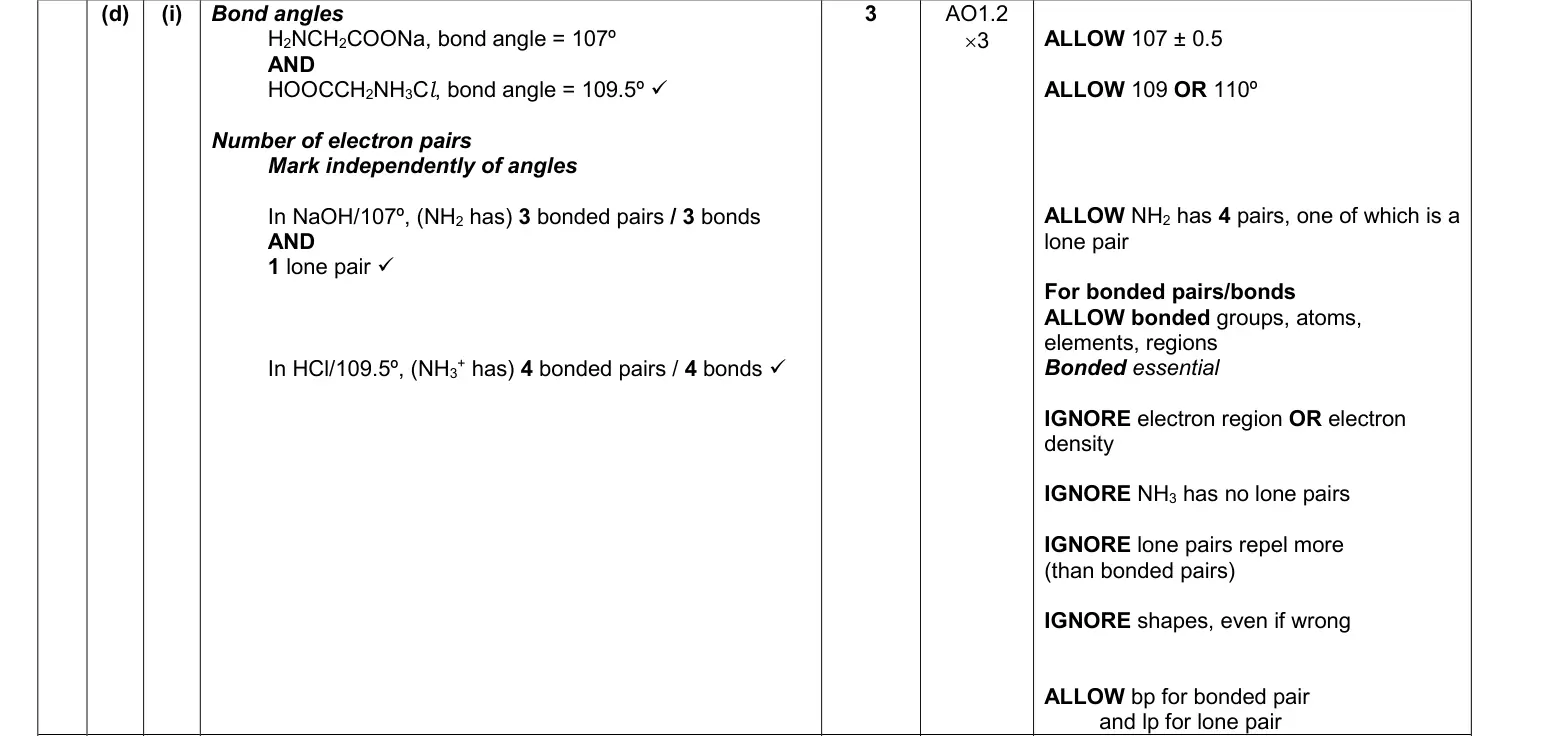
June 2022 · Paper 3 · Q1(d)(i) 3 marks AO1 Calculation Hard bonding and structure
(d)  Glycine, H2NCH2COOH, is an α-amino acid.
(i) Glycine reacts with NaOH to form the salt H2NCH2COONa.
Glycine reacts with HCl to form the salt HOOCCH2NH3Cl.
The salts have different H–N–H bond angles.
State the different H–N–H bond angles and explain why they are different.
H2NCH2COONa H–N–H bond angle = ...................°
HOOCCH2NH3Cl H–N–H bond angle = ...................°
explanation  ........................................................................................................................
...........................................................................................................................................
...........................................................................................................................................
...........................................................................................................................................
...................................................................................................................................... [3]
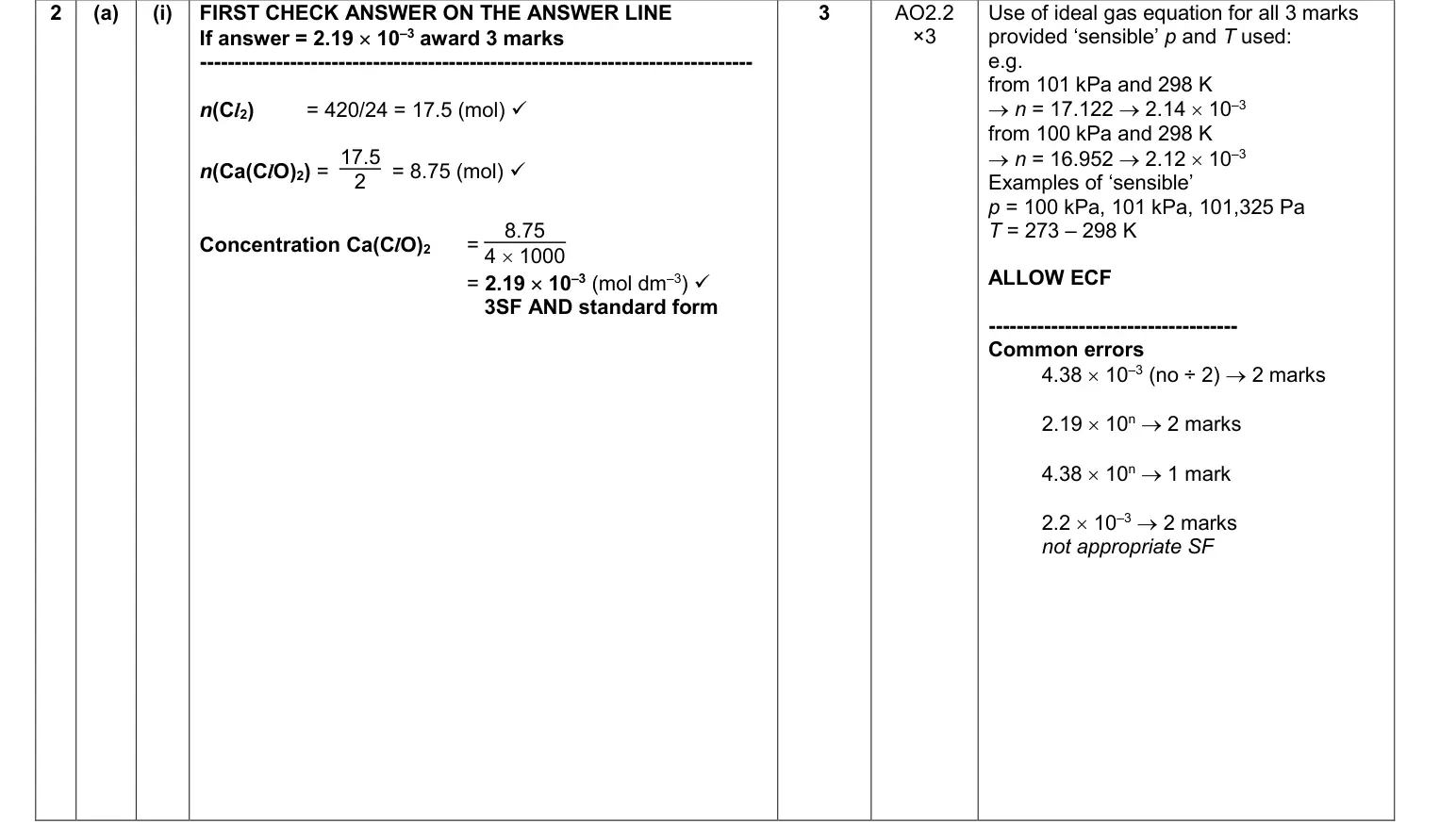
June 2022 · Paper 3 · Q2(a)(i) 3 marks AO2 Calculation Medium amount of substance
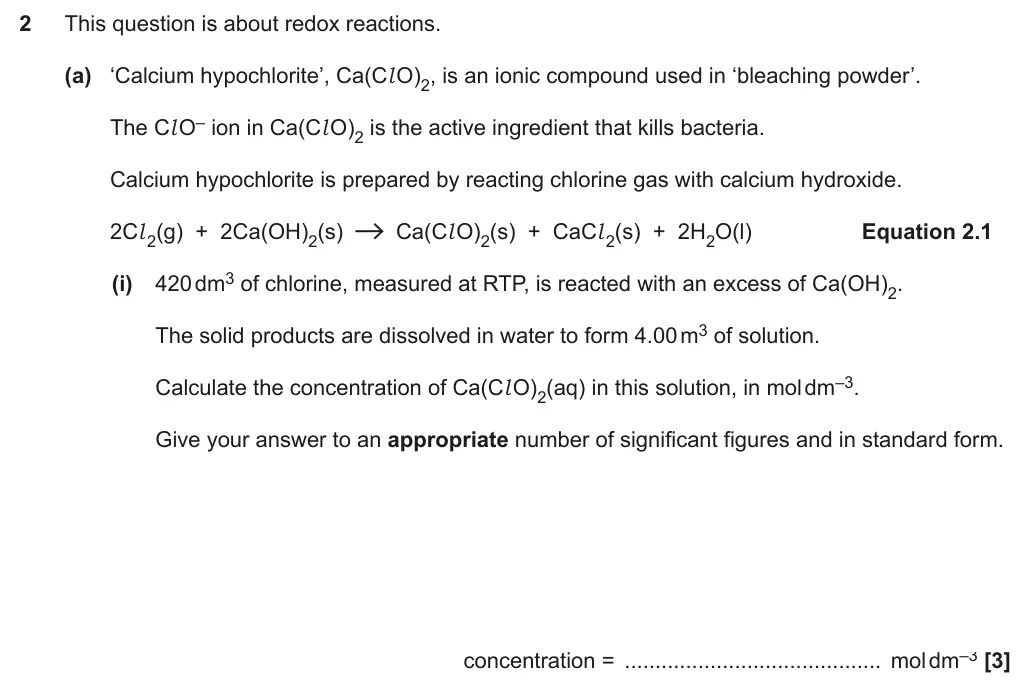
2 This question is about redox reactions.
(a) ‘Calcium hypochlorite’, Ca(Cl O)2, is an ionic compound used in ‘bleaching powder’.
The Cl O– ion in Ca(Cl O)2 is the active ingredient that kills bacteria.
Calcium hypochlorite is prepared by reacting chlorine gas with calcium hydroxide.
2Cl 2(g)  +  2Ca(OH)2(s) Ca(Cl O)2(s)  +  CaCl 2(s)  +  2H2O(l)     Equation 2.1
(i) 420 dm3 of chlorine, measured at RTP, is reacted with an excess of Ca(OH)2.
The solid products are dissolved in water to form 4.00 m3 of solution.
Calculate the concentration of Ca(Cl O)2(aq) in this solution, in mol dm–3.
Give your answer to an appropriate number of significant figures and in standard form.
concentration =  .......................................... mol dm–3 [3]
June 2022 · Paper 3 · Q5(b)(ii) 3 marks AO2 Calculation Easy enthalpy changesamount of substance
Earlier part of question 5 that this part usesEarlier part of June 2022 Paper 3 question 5
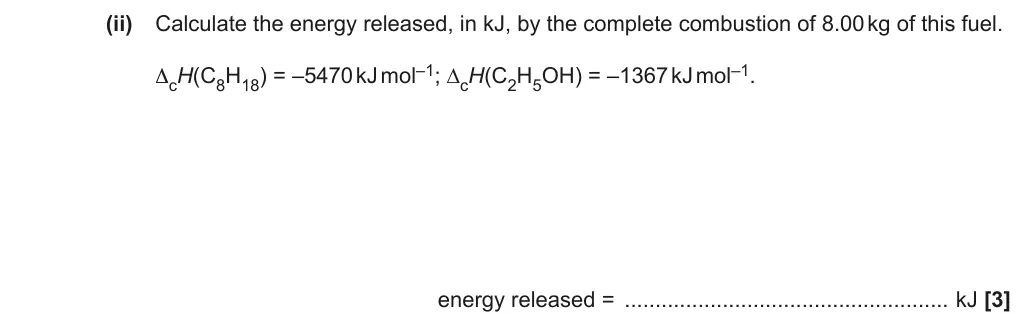
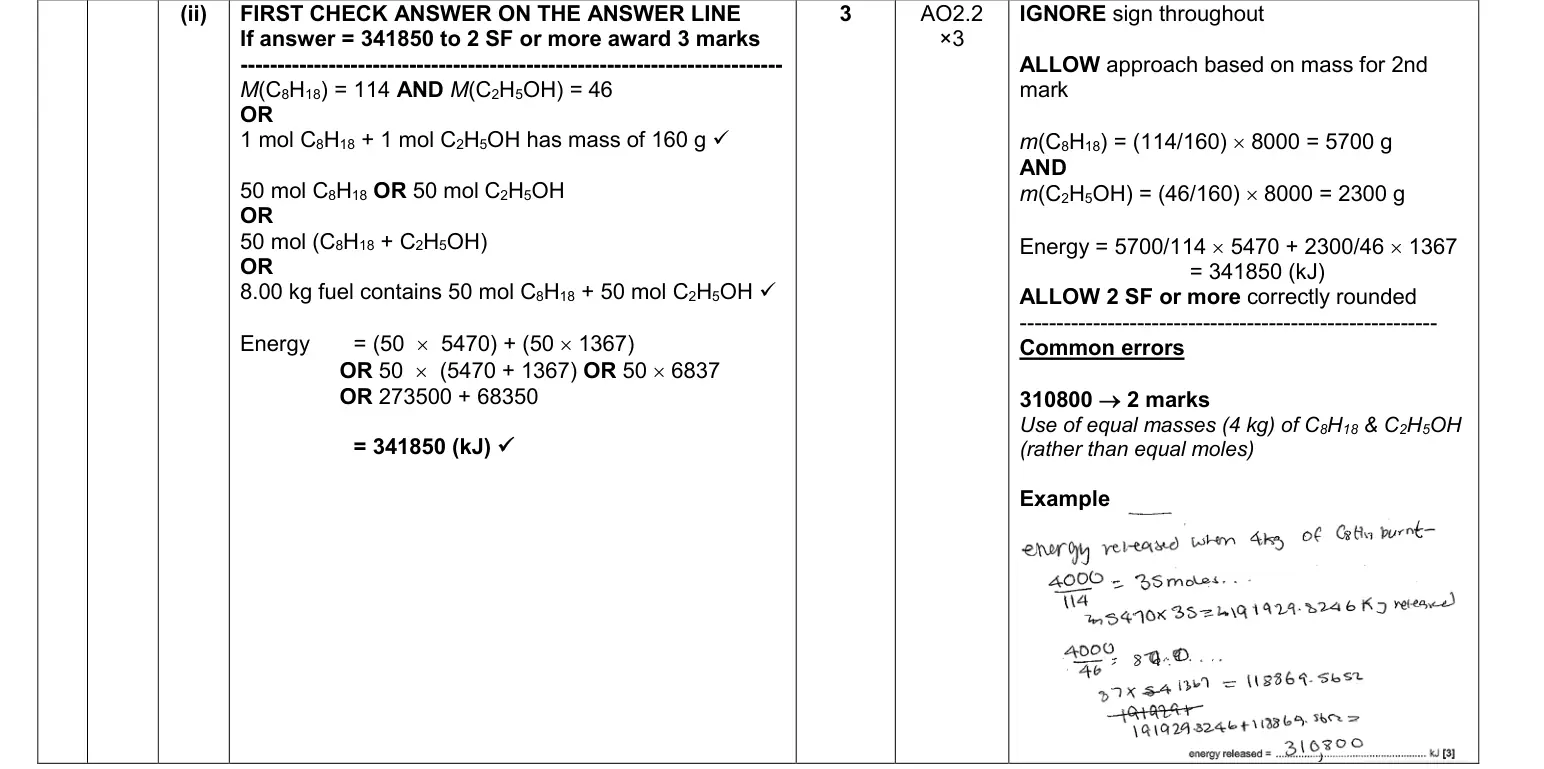
(ii) Calculate the energy released, in kJ, by the complete combustion of 8.00 kg of this fuel.
∆cH(C8H18) = –5470 kJ mol–1; ∆cH(C2H5OH) = –1367 kJ mol–1.
energy released =  ..................................................... kJ [3]
June 2022 · Paper 3 · Q6(a) 1 mark AO2 Calculation Medium amino acids amides and chirality
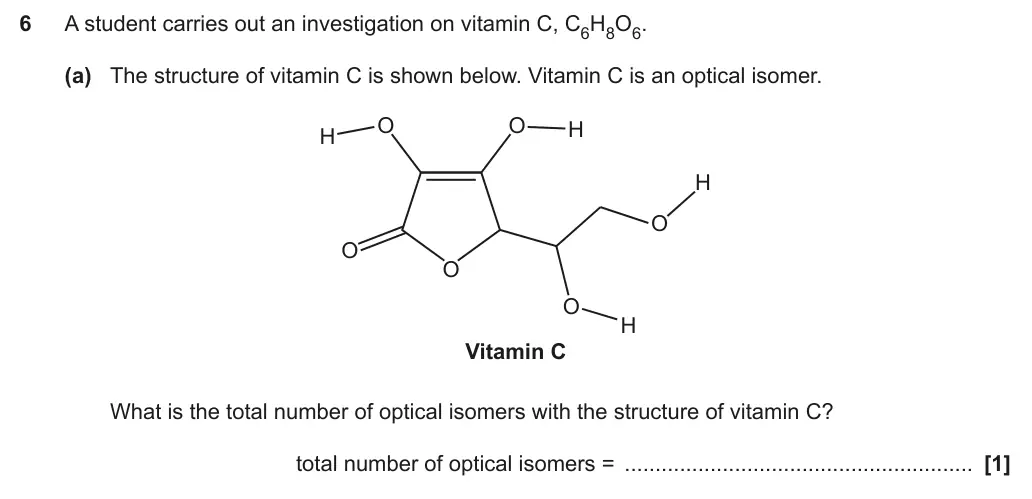
6 A student carries out an investigation on vitamin C, C6H8O6.
(a) The structure of vitamin C is shown below. Vitamin C is an optical isomer.
O O H
H
H
O
O
O
O
H
Vitamin C
What is the total number of optical isomers with the structure of vitamin C?
total number of optical isomers =  ......................................................... [1]
June 2022 · Paper 3 · Q6(b)(ii) 2 marks AO3 Calculation Medium carboxylic acids and estersamount of substance
Earlier parts of question 6 that this part usesEarlier part of June 2022 Paper 3 question 6Earlier part of June 2022 Paper 3 question 6
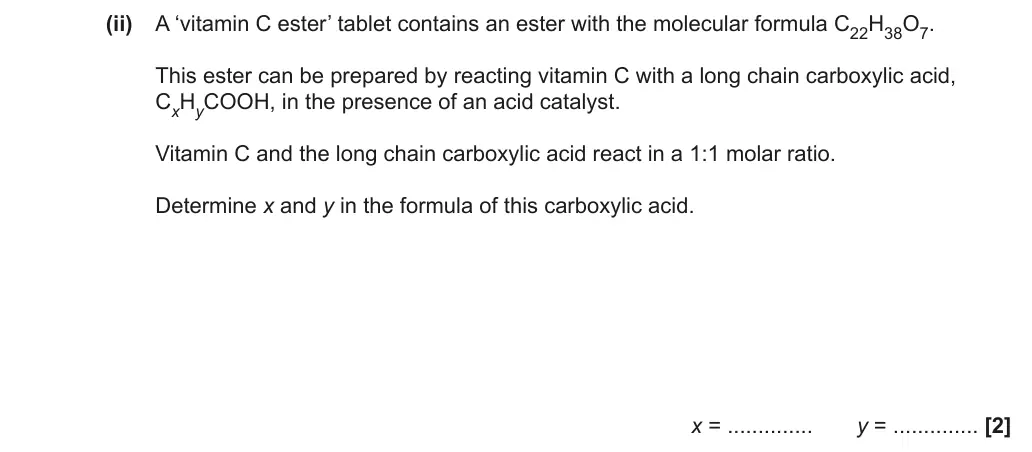
(ii) A ‘vitamin C ester’ tablet contains an ester with the molecular formula C22H38O7.
This ester can be prepared by reacting vitamin C with a long chain carboxylic acid,
CxHyCOOH, in the presence of an acid catalyst.
Vitamin C and the long chain carboxylic acid react in a 1:1 molar ratio.
Determine x and y in the formula of this carboxylic acid.
x = ..............  y = .............. [2]
June 2022 · Paper 3 · Q6(c)(ii) 3 marks AO1, 2 Calculation Medium acids bases and buffersamount of substance
Earlier part of question 6 that this part usesEarlier part of June 2022 Paper 3 question 6
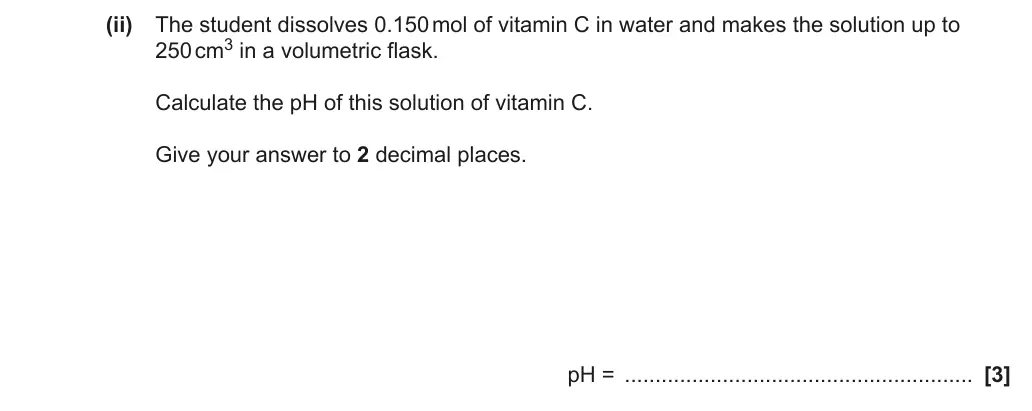
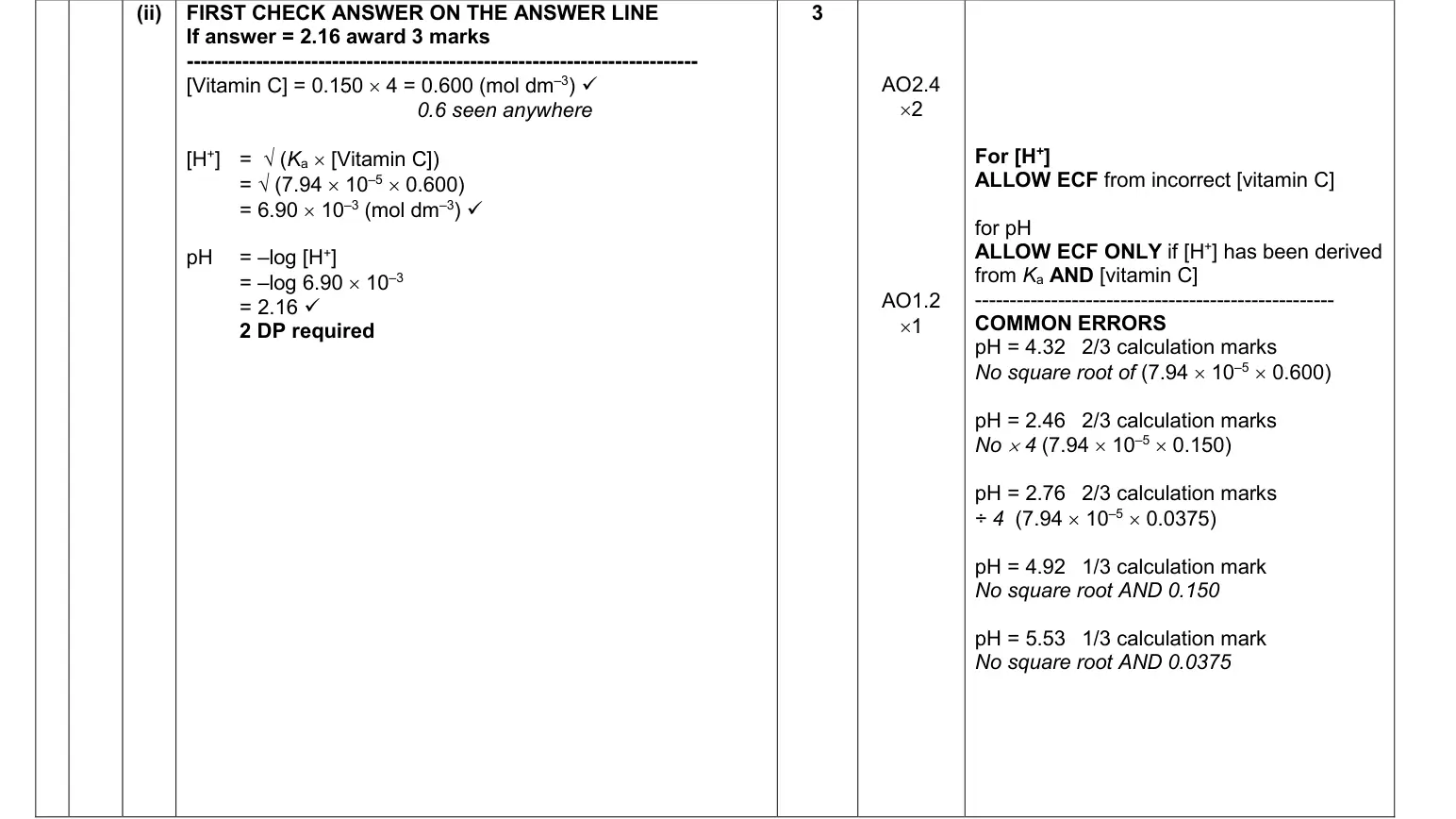
(ii) The student dissolves 0.150 mol of vitamin C in water and makes the solution up to
250 cm3 in a volumetric flask.
Calculate the pH of this solution of vitamin C.
Give your answer to 2 decimal places.
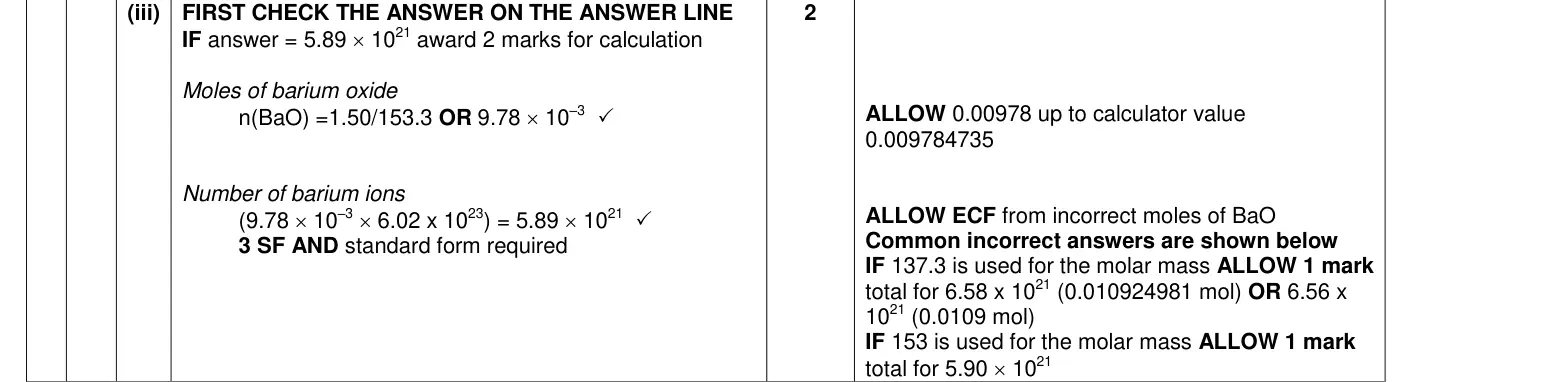
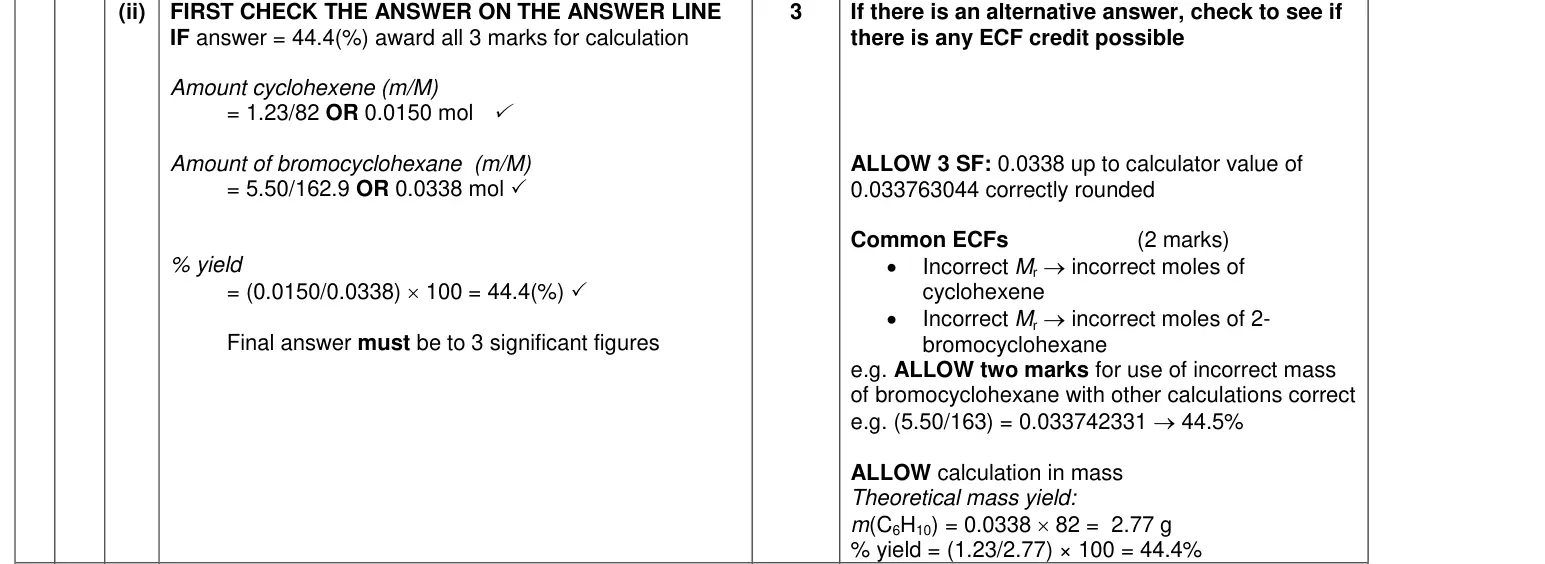
pH =  ......................................................... [3]
June 2022 · Paper 3 · Q6(d) 4 marks AO2 Calculation redox and electrode potentialsamount of substance
Earlier part of question 6 that this part usesEarlier part of June 2022 Paper 3 question 6
TURN OVER FOR QUESTION 6 PART (d)
(d) The label on a carton of orange juice lists the mass of vitamin C, in mg, in a typical serving
of 150 cm3.
The student carries out an investigation to check the vitamin C content in the orange juice.
Vitamin C can be oxidised by iodine:
C6H8O6(aq)  +  I2(aq) C6H6O6(aq)  +  2I–(aq)  +  2H+(aq)
The student dilutes 150 cm3 of the orange juice with water to 250.0 cm3 in a volumetric flask.
The student then titrates 25.0 cm3 volume of this solution with 9.60 × 10⁻⁴ mol dm–3 iodine
solution, I2(aq).
The mean titre of I2(aq) is 22.50 cm3.
Determine the mass, in mg, of vitamin C in a 150 cm3 serving of the orange juice.
mass of vitamin C in the 150 cm3 serving of orange juice =  ................................................... mg [4]
November 2021 · AS Paper 1 · Q21(c) 2 marks AO1 Calculation atomic structure and isotopes
(c) The relative atomic mass of an element can be determined from its mass spectrum.
The table shows the results of a mass spectrum of a sample of sulfur, S.
Isotope Abundance (%)
32S 94.93
33S 0.78
34S 4.29
Calculate the relative atomic mass of the sample of sulfur.
Give your answer to 3 decimal places.
relative atomic mass =  ......................................................... [2]
November 2021 · AS Paper 1 · Q21(d)(ii) 2 marks AO2 Calculation amount of substance
Earlier part of question 21 that this part usesEarlier part of November 2021 Paper 1 question 21
(ii) What is the number of fluorine atoms in 7.896 g of halothane, C2HBrCl F3?
number of fluorine atoms =  ......................................................... [2]
November 2021 · AS Paper 1 · Q22(c) 3 marks AO2 Calculation enthalpy changes
Earlier part of question 22 that this part usesEarlier part of November 2021 Paper 1 question 22
(c) The reaction for the production of hydrogen is repeated below.
CH4(g) + H2O(g) 3H2(g) + CO(g)     ∆H = +206 kJ mol–1
Average bond enthalpies are shown in the table.
Average bond enthalpy
Bond
/ kJ mol–1
C–H 413
O–H 464
C≡O 1077
Calculate the bond enthalpy of the H–H bond.
bond enthalpy =  ............................................ kJ mol–1 [3]
November 2021 · AS Paper 1 · Q25(a)(i) 2 marks AO2 Calculation amount of substance
25 This question is about the analysis of unknown compounds.
(a) Scandium (atomic number 21) reacts with oxygen to form an oxide of scandium.
A student carries out an experiment to determine the empirical formula of the scandium
oxide.
A diagram of the apparatus used by the student is shown below.
crucible
pipeclay triangle
The student’s method is outlined below.
• Weigh an empty crucible.
• Add scandium to the crucible and reweigh.
• Heat the crucible and contents for 10 minutes.
• Allow to cool and reweigh.
The student’s results are shown below.
Mass of crucible / g 12.165
Mass of crucible + scandium / g 12.435
Mass of crucible + scandium oxide / g 12.579
(i) Determine the empirical formula of the scandium oxide.
empirical formula =  ......................................................... [2]
November 2021 · AS Paper 1 · Q25(b) 5 marks AO1, 2, 3 Calculation amount of substance
(b) A gas cylinder has a gas volume of 9.39 dm3.
The gas cylinder holds 1.69 kg of a gas at a pressure of 1.37 × 10⁷ Pa at 20 °C.
Determine the molar mass and possible identity of the gas.
molar mass =  .................................................. g mol−1
identity of gas =  ...............................................................
[5]
November 2021 · AS Paper 2 · Q3(b)(iii) 1 mark AO2 Calculation acids and titrationspractical skills
Earlier part of question 3 that this part usesEarlier part of November 2021 Paper 2 question 3
(iii) Calculate the mean titre of NaOH(aq) that the student should use for analysing the
results.
mean titre =  .................................................. cm3 [1]
November 2021 · AS Paper 2 · Q3(b)(iv) 1 mark AO2 Calculation practical skills
Earlier part of question 3 that this part usesEarlier part of November 2021 Paper 2 question 3
(iv) In the titration, the uncertainty in each burette reading is ± 0.05 cm3.
Calculate the percentage uncertainty in the titre for Titration 1.
percentage uncertainty =  ..................................................... % [1]
November 2021 · AS Paper 2 · Q3(c) 5 marks AO2, 3 Calculation acids and titrationsatomic structure and isotopesamount of substance
Earlier parts of question 3 that this part usesEarlier part of November 2021 Paper 2 question 3Earlier part of November 2021 Paper 2 question 3
(c) Calculate the value of n in HOOC(CH2)nCOOH.
Give your answer to the nearest whole number.
n =  .......................................................... [5]
November 2021 · AS Paper 2 · Q5(b)(i) 2 marks AO2 Calculation chemical equilibrium
Earlier part of question 5 that this part usesEarlier part of November 2021 Paper 2 question 5
(b) A chemist mixes CO and H2 in a container.
The mixture is heated to 200 °C and left to reach equilibrium.
The equilibrium concentrations of CO and H2 are shown in the table.
Equilibrium concentration
Compound
/ mol dm–3
CO(g) 0.57
H2(g) 0.40
The numerical value of Kc for this equilibrium is 15.4.
(i) Calculate the equilibrium concentration of CH3OH(g).
concentration =  .......................................... mol dm–3 [2]
November 2021 · AS Paper 2 · Q5(e) 2 marks AO3 Calculation periodicity
(e) Element A is in period 3 of the periodic table (Na-Ar).
The first six ionisation energies (I.E.) of element A are shown below.
1st I.E. 2nd I.E. 3rd I.E. 4th I.E. 5th I.E. 6th I.E.
/ kJ mol–1 / kJ mol–1 / kJ mol–1 / kJ mol–1 / kJ mol–1 / kJ mol–1
789 1577 3232 4356 16091 19785
Identify element A.
Explain your answer.
Element A =  ..............................................................................................................................
Explanation  ...............................................................................................................................
...................................................................................................................................................
.............................................................................................................................................. [2]
November 2021 · AS Paper 2 · Q6(a) 3 marks AO1, 2 Calculation reaction ratespractical skills
6 A student investigates the rate of reaction between strontium and water.
Sr(s)  +  2H2O(l) Sr(OH)2(aq)  +  H2(g)
The student’s method is shown below.
• Pour 100 cm3 of water into a conical flask.
• Add 0.26 g of strontium and quickly connect a 100 cm3 gas syringe.
• Measure the volume of gas produced every 10 seconds until all the strontium has reacted.
The student plots a graph of volume of gas produced against time as shown in Fig. 6.1.
80
70
60
50
volume
of gas 40
produced
/ cm3
30
20
10
0
0 10 20 30 40 50 60 70 80 90 100
time / s
Fig. 6.1
(a) Draw a best fit curve on Fig. 6.1.
Use the graph to determine the rate of reaction, in cm3 s–1, at 50 s.
Show your working below and on the graph.
rate at 50 s  ............................................. cm3 s–1 [3]
November 2021 · AS Paper 2 · Q6(c)(i) 2 marks AO3 Calculation amount of substance
Earlier part of question 6 that this part usesEarlier part of November 2021 Paper 2 question 6
(c) A third student repeats the original experiment using the same amount, in moles, of barium
as strontium.
(i) Calculate the mass of barium that the student uses.
Give your answer to 2 decimal places.
mass of barium =  ...................................................... g [2]
November 2021 · Paper 1 · Q16(c)(iii) 1 mark AO2 Calculation Medium lattice enthalpy
Earlier parts of question 16 that this part usesEarlier part of November 2021 Paper 1 question 16Earlier part of November 2021 Paper 1 question 16
(iii) Calculate the enthalpy change of solution of MgF2.
enthalpy change of solution =  ............................................ kJ mol–1 [1]
November 2021 · Paper 1 · Q18(d) 4 marks AO2 Calculation Medium redox and electrode potentialsamount of substance
Earlier parts of question 18 that this part usesEarlier part of November 2021 Paper 1 question 18Earlier part of November 2021 Paper 1 question 18
(d) Determine the percentage, by mass, of copper in the copper ore.
Give your answer to an appropriate number of significant figures.
percentage =  ..................................................... % [4]
November 2021 · Paper 1 · Q19(c)(ii) 1 mark AO1 Calculation redox and electrode potentials
Earlier parts of question 19 that this part usesEarlier part of November 2021 Paper 1 question 19Earlier part of November 2021 Paper 1 question 19
(ii) The cell potential is 1.23 V.
Calculate the electrode potential of the negative electrode.
electrode potential = .................... V [1]
November 2021 · Paper 1 · Q20(b)(ii) 1 mark AO2 Calculation entropy and free energy
Earlier parts of question 20 that this part usesEarlier part of November 2021 Paper 1 question 20Earlier part of November 2021 Paper 1 question 20
(ii) Determine the maximum temperature, in K, for feasibility.
Give your answer to an appropriate number of significant figures.
maximum temperature = .................... K [1]
November 2021 · Paper 1 · Q20(c)(i) 4 marks AO2 Calculation Medium equilibrium constants
Earlier part of question 20 that this part usesEarlier part of November 2021 Paper 1 question 20
(c) A chemist investigates the equilibrium shown in Equilibrium 20.1.
The chemist mixes together 1.60 mol of NO(g) and 1.50 mol of O2(g) in a container and the
mixture is allowed to reach equilibrium.
At equilibrium:
• 75% of the NO(g) has been converted to NO2(g)
• the total pressure is 1.21 MPa.
(i) Calculate Kp, in MPa–1, for Equilibrium 20.1.
Give your answer to 3 significant figures.
Kp =  .............................................. MPa–1 [4]
November 2021 · Paper 1 · Q21(b)(i) 3 marks AO2 Calculation Medium rate equations
Earlier part of question 21 that this part usesEarlier part of November 2021 Paper 1 question 21
(b) In Investigation 2 the student determines the rate constant k of Reaction 21.1 at different
temperatures, T.
From the results, the student plots a graph of ln k against 1 / T as shown below.
1 / T
/ 10–3 K–1
3.00 3.05 3.10 3.15 3.20 3.25 3.30 3.35 3.40 3.45
–1.50
–2.00
–2.50
In k
–3.00
–3.50
– 4.00
– 4.50
Graph 21.2
(i) Calculate the activation energy, Ea, for Reaction 21.1, in kJ mol–1.
Give your answer to 3 significant figures.
Ea =  ............................................ kJ mol–1 [3]
November 2021 · Paper 1 · Q21(b)(iii) 2 marks AO3 Calculation rate equations
Earlier parts of question 21 that this part usesEarlier part of November 2021 Paper 1 question 21Earlier part of November 2021 Paper 1 question 21
(iii) The student calculates the value of k in Investigation 1 as 0.075 s–1.
Using Graph 21.2, determine the temperature, in °C, at which Investigation 1 was
carried out.
temperature =  .................................................... °C [2]
November 2021 · Paper 1 · Q22(a) 2 marks AO2 Calculation acids bases and buffers
22 This question is about acids, bases and buffers.
(a) Sodium hydroxide, NaOH, is a strong base.
Calculate the pH of 0.140 mol dm–3 NaOH(aq) at 298 K.
Give your answer to 2 decimal places.
pH =  ......................................................... [2]
November 2021 · Paper 1 · Q22(b)(ii) 4 marks AO2 Calculation Medium enthalpy changes
Earlier part of question 22 that this part usesEarlier part of November 2021 Paper 1 question 22
(ii) Calculate the enthalpy change, ΔH1, for Equation 22.1, and deduce the value for the
enthalpy change of neutralisation, ∆neutH, in kJ mol–1.
Assume that the densities of all solutions and the specific heat capacity, c, of the reaction
mixture are the same as for water.
enthalpy change, ΔH1 =  ........................................... kJ mol–1
enthalpy change of neutralisation, ΔneutH =  ............................................ kJ mol–1 [4]
November 2021 · Paper 2 · Q18(c)(ii) 3 marks AO2 Calculation amount of substance
Earlier part of question 18 that this part usesEarlier part of November 2021 Paper 2 question 18
(ii) One ibuprofen tablet contains 400 mg of ibuprofen.
Calculate the number of ibuprofen molecules in one ibuprofen tablet.
Give your answer to 3 significant figures.
number of ibuprofen molecules =  ......................................................... [3]
November 2021 · Paper 3 · Q1(a) 2 marks AO1 Calculation Hard equilibrium constantsamount of substance
1 These short questions are from different areas of chemistry.
(a) A flask contains 110 g CO2 and 120 g O2 at a pressure of 50.0 atm.
What is the partial pressure of the CO2?
partial pressure of CO2 =  .................................................. atm [2]
November 2021 · Paper 3 · Q1(b) 2 marks AO1, 2 Calculation Medium chemical equilibriumequilibrium constants
(b) Pure PCl5 is placed in a sealed container which is heated to 200 ºC.
An equilibrium is set up:  PCl5(g) PCl3(g)  +  Cl2(g)
Under these conditions:
• Kc = 8.00 × 10⁻³ mol dm–3
• equilibrium concentration of PCl5 = 0.0500 mol dm–3.
Calculate the concentrations of PCl3 and Cl2 at equilibrium.
concentration of PCl3 =  ................................................ mol dm–3
concentration of Cl2 =  ................................................ mol dm–3
[2]
November 2021 · Paper 3 · Q2(b) 3 marks AO2, 3 Calculation Hard amount of substancepractical skills
Earlier part of question 2 that this part usesEarlier part of November 2021 Paper 3 question 2
(b) Analyse the student’s results to conclude which of Equation 1 or 2 or 3, is supported by the
experimental results.
Assume that the conditions in the laboratory are ‘room temperature and pressure’ (RTP).
correct equation (1, 2, or 3) = ................ [3]
November 2021 · Paper 3 · Q5(a)(ii) 5 marks AO2 Calculation Hard amount of substance
Earlier part of question 5 that this part usesEarlier part of November 2021 Paper 3 question 5
(ii) A 16.0 dm3 airbag is inflated at 17.0 ºC.
The pressure in the inflated airbag is 1.20 × 10⁵ Pa.
Calculate the mass of NaN3 that has decomposed.
Give your answer to 3 significant figures.
mass of NaN3 =  ...................................................... g [5]
November 2021 · Paper 3 · Q5(b)(i) 2 marks AO2 Calculation Hard acids bases and buffers
(b) Hydrazoic acid, HN3, is a weak acid (Ka = 2.51 × 10⁻⁵ mol dm–3).
(i) Calculate the pH of 0.125 mol dm–3 hydrazoic acid.
Give your answer to 2 decimal places.
pH =  .......................................................... [2]
November 2020 · AS Paper 1 · Q21(c)(i) 2 marks AO1 Calculation Medium atomic structure and isotopes
(c) Mass spectrometry can be used to identify the isotopes of chlorine.
Part of the mass spectrum of chlorine is shown below.
75.76
relative
abundance
(%)
24.24
32 33 34 35 36 37 38
m / z
(i) Calculate the relative atomic mass of chlorine.
Give your answer to 2 decimal places.
relative atomic mass =  .......................................................... [2]
November 2020 · AS Paper 1 · Q22(c) 5 marks AO2, 3 Calculation Medium amount of substance
(c) Bromine reacts with fluorine to form compound A.
Compound A is a liquid at room temperature and pressure but can easily be vaporised.
When vaporised, 0.428 g of A produces 76.0 cm3 of gas at 1.00 × 10⁵ Pa and 100 °C.
Determine the molar mass and molecular formula of compound A.
molar mass of A =  .................................................. g mol−1
molecular formula of A =  ...............................................................
[5]
November 2020 · AS Paper 1 · Q23(a) 3 marks AO3 Calculation Hard amount of substanceacids and titrations
23 This question is about barium hydroxide.
(a) Barium hydroxide is an alkali which releases hydroxide ions, OH−, in aqueous solution.
A barium hydroxide solution contains 3.89 g of Ba(OH)2 in 100 cm3 at 20 °C.
Calculate the concentration of hydroxide ions, OH−, in mol dm−3, of this solution at 20 °C.
Give your answer to 3 significant figures.
concentration of OH− ions =  .......................................... mol dm−3 [3]
November 2020 · AS Paper 1 · Q23(b)(ii) 3 marks AO2 Calculation Hard acids and titrationsamount of substance
Earlier part of question 23 that this part usesEarlier part of November 2020 Paper 1 question 23
(ii) Calculate the concentration, in mol dm−3, of the Ba(OH)2(aq) solution.
concentration of Ba(OH)2(aq) =  .......................................... mol dm−3 [3]
November 2020 · AS Paper 1 · Q24(a) 3 marks AO2 Calculation Medium enthalpy changes
24 This question is about making ammonia, NH3.
(a) Ammonia is manufactured by reacting nitrogen with hydrogen:
N2(g) + 3H2(g) → 2NH3(g)
Standard enthalpy changes of combustion, ∆cH o, are given in the table.
Substance ∆cH o / kJ mol−1
N2(g) +180
H2(g) –286
NH3(g) –293
Calculate the standard enthalpy change of formation, ∆fH o, for NH3(g).
∆fH o for NH3(g) =  ........................................... kJ mol−1 [3]
November 2020 · AS Paper 2 · Q1(b)(i) 3 marks AO1, 2 Calculation Medium amount of substance
Earlier part of question 1 that this part usesEarlier part of November 2020 Paper 2 question 1
(b) A student completely reacts 0.192 g of nickel with 0.150 mol dm–3 HCl (aq).
(i) Calculate the minimum volume, in cm3, of 0.150 mol dm–3 HCl (aq) that the student needs
for the reaction.
Give your answer to 3 significant figures.
minimum volume of HCl (aq) =  .................................................. cm3 [3]
November 2020 · AS Paper 2 · Q1(b)(ii) 1 mark AO2 Calculation Medium amount of substance
Earlier parts of question 1 that this part usesEarlier part of November 2020 Paper 2 question 1Earlier part of November 2020 Paper 2 question 1
(ii) Calculate the volume of H2(g), in cm3, that would be produced at RTP.
volume of H2(g) =  .................................................. cm3 [1]
November 2020 · AS Paper 2 · Q2(b) 4 marks AO1, 3 Calculation Medium enthalpy changesamount of substance
Earlier part of question 2 that this part usesEarlier part of November 2020 Paper 2 question 2
(b) A student carries out an experiment to determine the enthalpy change of combustion of
cyclohexane, C6H12, using the apparatus shown in the diagram.
thermometer
beaker
clamp 200 cm3 water
wick
spirit burner
cyclohexane
In the experiment, 0.525 g of cyclohexane are burnt, and the temperature of the 200 cm3 of
water changes from 21.0 °C to 41.0 °C.
Calculate the enthalpy change of combustion, ΔcH, of cyclohexane in kJ mol−1.
Give your answer to 3 significant figures.
ΔcH =  ............................................ kJ mol–1 [4]
November 2020 · AS Paper 2 · Q4(b)(iii) 2 marks AO2 Calculation Medium chemical equilibrium
Earlier parts of question 4 that this part usesEarlier part of November 2020 Paper 2 question 4Earlier part of November 2020 Paper 2 question 4
(iii) At 400 °C, Kc = 0.015 mol dm–3.
Calculate the equilibrium concentration of NOCl (g) at 400 °C.
equilibrium concentration of NOCl (g) =  .......................................... mol dm−3 [2]
November 2020 · AS Paper 2 · Q5(d)(i) 2 marks AO1, 2 Calculation Medium amount of substance
Earlier part of question 5 that this part usesEarlier part of November 2020 Paper 2 question 5
(d) Alcohol A can be prepared by the alkaline hydrolysis of the bromoalkane, (CH3)2CHCH2CH2Br.
The hydrolysis with aqueous NaOH is shown in equation 5.1.
(CH3)2CHCH2CH2Br + NaOH (CH3)2CHCH2CH2OH + NaBr equation 5.1
alcohol A
A student gently heats a mixture of (CH3)2CHCH2CH2Br and NaOH(aq) for 25 minutes.
(i) Calculate the atom economy for the preparation of alcohol A in equation 5.1.
atom economy =  ..................................................... % [2]
November 2020 · Paper 1 · Q16(b)(ii) 3 marks AO2 Calculation amount of substance
(ii) Calculate the total number of ions in 1.74 g of magnesium bromide, MgBr2.
Give your answer to 3 significant figures.
number of ions =  ......................................................... [3]
November 2020 · Paper 1 · Q16(d)(ii) 2 marks AO2 Calculation Medium lattice enthalpy
Earlier part of question 16 that this part usesEarlier part of November 2020 Paper 1 question 16
(ii) Using your completed energy cycle in 16(d)(i), calculate the enthalpy change of hydration
of bromide ions.
enthalpy change of hydration =  ........................................... kJ mol−1 [2]
November 2020 · Paper 1 · Q16(d)(iii) 3 marks AO1, 2 Calculation lattice enthalpy
Earlier parts of question 16 that this part usesEarlier part of November 2020 Paper 1 question 16Earlier part of November 2020 Paper 1 question 16
(iii) Write the equation for the lattice enthalpy of magnesium bromide and calculate the lattice
enthalpy of magnesium bromide.
Equation  ............................................................................................................................
Calculation
lattice enthalpy =  ............................................ kJ mol−1 [3]
November 2020 · Paper 1 · Q17(c) 5 marks AO2, 3 Calculation entropy and free energy
Earlier part of question 17 that this part usesEarlier part of November 2020 Paper 1 question 17
(c) Standard entropy values are given below.
Substance CO(g) H2(g) CH3OH(g)
Sө / J K−1 mol−1 198 131 238
A chemist proposed producing methanol at 525 K using equilibrium 1.
Explain, with a calculation, whether the production of methanol is feasible at 525 K.
...................................................................................................................................................
...................................................................................................................................................
...................................................................................................................................................
...................................................................................................................................................
...................................................................................................................................................
...................................................................................................................................................
...................................................................................................................................................
...................................................................................................................................................
...................................................................................................................................................
.............................................................................................................................................. [5]
November 2020 · Paper 1 · Q17(d) 3 marks AO1, 3 Calculation Medium equilibrium constantsentropy and free energy
Earlier part of question 17 that this part usesEarlier part of November 2020 Paper 1 question 17
(d) At 298 K, the free energy change, ∆G, for the production of methanol in equilibrium 1 is
−2.48 × 10⁴ J mol−1.
∆G is linked to Kp by the relationship: ∆G = −RT lnKp.
R = gas constant
T = temperature in K.
Calculate Kp for equilibrium 1 at 298 K.
Give your answer to 3 significant figures.
Kp =  .......................... units ...................... [3]
November 2020 · Paper 1 · Q18(c)(ii) 4 marks AO3 Calculation Medium acids bases and buffers
Earlier parts of question 18 that this part usesEarlier part of November 2020 Paper 1 question 18Earlier part of November 2020 Paper 1 question 18
(ii) The student plans to make a buffer solution of pH 4.00 from a mixture of CH3COOH(aq)
and sodium ethanoate, CH3COONa(aq).
The student mixes 400 cm3 of 0.204 mol dm−3 CH3COOH(aq) with 600 cm3 of
CH3COONa(aq).
Calculate the concentration of CH3COONa(aq) needed to prepare this buffer solution of
pH 4.00.
concentration =  .......................................... mol dm−3 [4]
November 2020 · Paper 1 · Q19(c) 2 marks AO2 Calculation redox and electrode potentials
Earlier part of question 19 that this part usesEarlier part of November 2020 Paper 1 question 19
(c) Methanoic acid, HCOOH, can be used in a fuel cell. As with all fuel cells, the fuel (HCOOH) is
supplied at one electrode and the oxidant (oxygen) at the other electrode.
The standard cell potential for this fuel cell is 1.34 V.
The overall reaction is shown below.
HCOOH  +  ½O2 H2O  +  CO2
Using the information in Table 19.1, deduce the half-equation for the reaction at the oxygen
electrode, and calculate the standard electrode potential for the oxygen half-cell.
half-equation  .............................................................................................................................
standard electrode potential = .................. V
[2]
November 2020 · Paper 1 · Q20(a)(ii) 2 marks AO3 Calculation Hard rate equations
Earlier part of question 20 that this part usesEarlier part of November 2020 Paper 1 question 20
(ii) Use the half-life of this reaction to show that the reaction is first order with respect to
CH3COOH.
Show your working on the graph and below.
...........................................................................................................................................
...................................................................................................................................... [2]
November 2020 · Paper 1 · Q20(a)(iii) 2 marks AO3 Calculation Hard rate equations
Earlier parts of question 20 that this part usesEarlier part of November 2020 Paper 1 question 20Earlier part of November 2020 Paper 1 question 20
(iii) Determine the initial rate of reaction.
initial rate =  ................................. mol dm−3 min−1 [2]
November 2020 · Paper 1 · Q20(b) 4 marks AO1, 2 Calculation Medium equilibrium constantsamount of substance
Earlier part of question 20 that this part usesEarlier part of November 2020 Paper 1 question 20
(b) The student carries out a second experiment to determine the value of Kc for this reaction.
The student mixes 9.6 g of CH3OH with 12.0 g of CH3COOH and adds the acid catalyst.
When the mixture reaches equilibrium, 0.030 mol of CH3COOH remains.
Calculate Kc for this equilibrium.
Kc =  ......................................................... [4]
November 2020 · Paper 1 · Q21(c) 3 marks AO2, 3 Calculation amount of substance
(c) Compound A contains bromine and fluorine only, and has a boiling point of 41 °C.
1.26 g of compound A is heated to 80 °C.
The volume of gas produced is 0.209 dm3.
Under the conditions used, 1 mol of gas molecules has a volume of 29.0 dm3.
Determine the molecular formula of compound A.
molecular formula =  ......................................................... [3]
November 2020 · Paper 1 · Q22(b)(i) 3 marks AO3 Calculation amount of substancetransition elements
(b) A compound of nickel, J, has the formula (NH4)2 [Ni(SCN)x(NH3)y] and contains SCN− and
NH3 ligands.
The percentage by mass of three of the elements in compound J is shown below:
Ni, 16.26%; S, 35.56%; N, 31.00%.
(i) Calculate the values of x and y in the formula of compound J.
x =  ...............................................................
y =  ...............................................................
[3]
November 2020 · Paper 2 · Q21(b)(iii) 3 marks AO2 Calculation amount of substanceatomic structure and isotopes
Earlier part of question 21 that this part usesEarlier part of November 2020 Paper 2 question 21
(iii) Some people are concerned that aspartame, C14H18N2O5, may have adverse health
effects.
Research shows that the safe maximum daily intake of aspartame is 1.7 × 10⁻⁴ mol kg−1.
• A typical UK adult has a mass of 75 kg.
• A can of a diet drink contains 167 mg of aspartame.
How many cans of this diet drink is it safe for a typical adult to drink in one day?
Number of cans =  .......................................................... [3]
November 2020 · Paper 3 · Q3(a)(i) 3 marks AO2 Calculation Hard enthalpy changesamount of substance
3 Propane, C3H8, (boiling point −42 °C) is used as ‘camping gas’. A student plans to determine the
enthalpy change of combustion of propane, ∆cH (C3H8), by two methods.
(a) The student first carries out an experiment using the apparatus below.
thermometer
beaker
100 cm3 water
clamp
propane burner
Results
Mass of propane burner before burning / g 99.218
Mass of propane burner after burning / g 98.976
Initial temperature / °C 21.60
Maximum temperature reached / °C 46.10
(i) Determine the enthalpy change of combustion of propane, in kJ mol−1.
Give your answer to 3 significant figures.
∆cH (C3H8) =  ........................................... kJ mol−1 [3]
November 2020 · Paper 3 · Q4(a)(iv) 6 marks AO2, 3 Calculation Medium acids and titrationsamount of substance
Earlier part of question 4 that this part usesEarlier part of November 2020 Paper 3 question 4
(iv) Metal M can be identified following the steps below.
1. The amount, in mol, of excess HCl (aq) that remains after the reaction of M with
HCl (aq).
2. The amount, in mol, of HCl (aq) that reacted with M.
3. The identity of metal M.
Analyse the results to identify metal M.
Metal M =  .......................................................... [6]
November 2020 · Paper 3 · Q4(b)(i) 1 mark AO2 Calculation Medium amount of substance
(b) The student is provided with the carbonate of an unknown metal, X2CO3.
The student measures the mass loss when the X2CO3 is reacted with an excess of
hydrochloric acid. The equation is shown below.
X2CO3(s) + 2HCl (aq) → 2XCl (aq) + CO2(g) + H2O(l)
The reaction is carried out using this method:
Step 1 Add 100 cm3 HCl (aq) to a conical flask and weigh.
Step 2 Add X2CO3 to the conical flask and immediately reweigh.
Step 3 After 5 minutes, reweigh the conical flask and contents.
Results
Mass of conical flask + HCl (aq) 172.93 g
Mass of conical flask + X2CO3 + HCl (aq) before reaction 187.50 g
Mass of conical flask + contents after 5 minutes 184.75 g
(i) Calculate the amount, in mol, of CO2 released in the reaction.
Amount of CO2 =  ................................................... mol [1]
November 2020 · Paper 3 · Q4(b)(ii) 3 marks AO1, 2, 3 Calculation Medium amount of substanceatomic structure and isotopes
Earlier part of question 4 that this part usesEarlier part of November 2020 Paper 3 question 4
(ii) Calculate the molar mass of X2CO3 and identify metal X.
Molar mass of X2CO3 = .................... g mol−1    Metal X = ....................[3]
November 2020 · Paper 3 · Q5(c) 4 marks AO3 Calculation Medium practical skillsequilibrium constants
Earlier parts of question 5 that this part usesEarlier part of November 2020 Paper 3 question 5Earlier part of November 2020 Paper 3 question 5
(c) Plot a graph of ln Kp against 1
T using the axes provided on the opposite page.
Use your graph and equation 5.1 to determine ∆H, in kJ mol−1, for this equilibrium.
Give your answer to 3 significant figures.
∆H =  ........................................... kJ mol−1 [4]
June 2019 · AS Paper 1 · Q22(a)(ii) 1 mark AO2 Calculation Medium acids and titrations
Earlier part of question 22 that this part usesEarlier part of June 2019 Paper 1 question 22
(ii) Calculate the mean titre of HCl , to the nearest 0.05 cm3, that the student should use for
analysing the results.
mean titre =  .................................................. cm3 [1]
June 2019 · AS Paper 1 · Q22(b) 3 marks AO2 Calculation Medium acids and titrationsamount of substance
Earlier parts of question 22 that this part usesEarlier part of June 2019 Paper 1 question 22Earlier part of June 2019 Paper 1 question 22
(b) Calculate the concentration, in mol dm−3, of the hydrochloric acid.
Give your answer to 3 significant figures.
concentration of HCl =  .......................................... mol dm−3 [3]
June 2019 · AS Paper 1 · Q24(a)(ii) 2 marks AO2 Calculation Medium chemical equilibrium
Earlier part of question 24 that this part usesEarlier part of June 2019 Paper 1 question 24
(ii) Using certain conditions, equilibrium 24.1 has the equilibrium concentrations in the
table.
Equilibrium concentration
Substance
/ mol dm−3
N2(g) 1.25
H2(g) 2.75
NH3(g) 0.862
Calculate the numerical value for Kc for equilibrium 24.1 under these conditions.
Give your answer to an appropriate number of significant figures and in standard form.
Kc =  ......................................................... [2]
June 2019 · AS Paper 1 · Q24(b)(ii) 3 marks AO2 Calculation Medium enthalpy changes
Earlier part of question 24 that this part usesEarlier part of June 2019 Paper 1 question 24
(ii) Calculate the standard enthalpy change of formation for NO(g).
Give your answer to a whole number.
∆fH o for NO(g) =  ........................................... kJ mol−1 [3]
June 2019 · AS Paper 1 · Q25(b)(iii) 3 marks AO3 Calculation Medium amount of substance
Earlier part of question 25 that this part usesEarlier part of June 2019 Paper 1 question 25
(iii) Organic compound E is formed by the substitution of some of the H atoms in butane by
Cl  atoms.
A chemist found that 0.636 g of compound E has a volume of 78.0 cm3.
Under the conditions used, the molar gas volume is 32.5 dm3 mol−1.
Determine the molecular formula of compound E.
molecular formula =  ......................................................... [3]
June 2019 · AS Paper 2 · Q1(a)(ii) 2 marks AO1 Calculation Easy atomic structure and isotopes
Earlier part of question 1 that this part usesEarlier part of June 2019 Paper 2 question 1
(ii) A sample of strontium has a relative atomic mass of 87.73.
The sample consists of:
• 82.9% Sr-88
• 6.9% Sr-87
• one other isotope.
Determine the other isotope of strontium in the sample.
isotope of strontium =  .......................................................... [2]
June 2019 · AS Paper 2 · Q1(d)(i) 3 marks AO3 Calculation Medium amount of substance
(d) When hydrated strontium chloride is heated, the water of crystallisation is removed, leaving a
residue of anhydrous strontium chloride.
A student carries out an experiment to find the value of x in the formula of hydrated strontium
chloride, SrCl2•xH2O.
The student’s method is outlined below.
Step 1
Weigh an empty crucible.
Add SrCl2•xH2O to the crucible and reweigh.
Step 2
Heat the crucible and contents for 10 minutes.
Allow to cool and reweigh.
Step 3
Heat the crucible and residue for another 5 minutes.
Allow to cool and weigh the crucible and residue.
Repeat step 3 a further two times.
The student’s results are shown below:
Mass of empty crucible / g 15.96
Mass of crucible + SrCl2•xH2O / g 18.65
First mass of crucible + residue / g 17.66
Second mass of crucible + residue / g 17.61
Third mass of crucible + residue / g 17.58
Fourth mass of crucible + residue / g 17.58
(i) Calculate the value of x in SrCl2•xH2O.
Give your answer to 2 significant figures.
x =  .......................................................... [3]
June 2019 · AS Paper 2 · Q2(b) 3 marks AO2 Calculation Easy amount of substance
(b) A solution of magnesium nitrate can be prepared by reacting magnesium carbonate, MgCO3,
with nitric acid, HNO3(aq).
The equation is shown below.
MgCO3(s) + 2HNO3(aq) Mg(NO3)2(aq) + H2O(l) + CO2(g)
Calculate the minimum volume, in cm3, of 1.75 mol dm–3 HNO3 that is needed to prepare a
solution containing 5.00 g of Mg(NO3)2.
Give your answer to 3 significant figures.
volume =  ................................................... cm3 [3]
June 2019 · AS Paper 2 · Q4(a) 3 marks AO2 Calculation Easy amount of substance
4 Zinc reacts with hydrochloric acid, HCl(aq), as shown in the following equation.
Zn(s) + 2HCl(aq) ZnCl2(aq) + H2(g)
A student investigates the rate of this reaction.
(a) The student plans to react 50.0 cm3 of 0.100 mol dm–3 HCl with 0.200 g of zinc (an excess).
Calculate the volume, in cm3, of hydrogen that should be produced at RTP.
volume =  ................................................... cm3 [3]
June 2019 · Paper 1 · Q16(b) 2 marks AO2 Calculation Hard atomic structure and isotopes
(b) A sample of magnesium, Ar = 24.305, is found to consist of three isotopes. The accurate
relative isotopic masses and % abundances of two of the isotopes are shown in the table.
Isotope Relative isotopic mass % abundance
24 Mg 23.985 78.99%
25 Mg 24.986 10.00%
Determine the relative isotopic mass of the third isotope of magnesium in the sample.
Give your answer to 5 significant figures.
relative isotopic mass =  ......................................................... [2]
June 2019 · Paper 1 · Q16(d)(ii) 2 marks AO2 Calculation Easy lattice enthalpy
Earlier part of question 16 that this part usesEarlier part of June 2019 Paper 1 question 16
(ii) Calculate the lattice enthalpy of potassium oxide.
lattice enthalpy = ............................................ kJ mol−1 [2]
June 2019 · Paper 1 · Q18(c)(ii) 5 marks AO2 Calculation Medium redox and electrode potentialsamount of substance
Earlier part of question 18 that this part usesEarlier part of June 2019 Paper 1 question 18
(ii) Use the student’s results to determine the mass, in mg, of iron(II) gluconate in one tablet.
Give your answer to 3 significant figures.
mass of iron(II) gluconate in one tablet =  .................................................... mg [5]
June 2019 · Paper 1 · Q19(a)(ii) 4 marks AO2, 3 Calculation Hard entropy and free energy
Earlier part of question 19 that this part usesEarlier part of June 2019 Paper 1 question 19
(ii)  Some standard entropy values are given below.
Substance H2S(g) O2(g) SO2(g) H2O(l)
Sө / J K−1 mol−1 206 205 248 70
Using calculations, explain whether Reaction 1 is feasible at 20 °C.
Calculations
Explanation for feasible or non feasible  .......................................................................
...................................................................................................................................... [4]
June 2019 · Paper 1 · Q19(a)(iii) 3 marks AO2 Calculation Hard enthalpy changes
Earlier part of question 19 that this part usesEarlier part of June 2019 Paper 1 question 19
(iii) Calculate the standard enthalpy change of formation, ∆fH ө, of hydrogen sulfide using
the enthalpy change for Reaction 1, and the standard enthalpy changes of combustion
below.
Substance ∆cH ө / kJ mol−1
S(s) −296.8
H2(g) −285.8
2H2S(g)  +  3O2(g) 2SO2(g) + 2H2O(l)      ∆rH = –1125 kJ mol−1 Reaction 1
∆fH ө of hydrogen sulfide =  ........................................... kJ mol−1 [3]
June 2019 · Paper 1 · Q19(b)(i) 2 marks AO1 Calculation Medium equilibrium constants
(b) The second step in the manufacture of sulfuric acid is the conversion of SO2 into sulfur
trioxide, SO3, using Equilibrium 1.
2SO2(g) + O2(g) 2SO3(g)      ∆H = −197 kJ mol−1 Equilibrium 1
An industrial chemist carries out some research into Equilibrium 1.
• The chemist fills a 10.2 dm3 container with SO2(g) at RTP, and then adds 12.0 g of O2(g).
• The chemist adds the vanadium(V) oxide catalyst, and heats the mixture. The mixture is
allowed to reach equilibrium at a pressure of 2.50 atm and a temperature of 1000 K.
• A sample of the equilibrium mixture is analysed, and found to contain 0.350 mol of SO3.
(i) Write an expression for Kp for Equilibrium 1.
Include the units.
units =  ......................................................... [2]
June 2019 · Paper 1 · Q19(b)(ii) 5 marks AO2 Calculation Hard equilibrium constantsamount of substance
Earlier part of question 19 that this part usesEarlier part of June 2019 Paper 1 question 19
(ii) Determine the value of Kp for Equilibrium 1 at 1000 K.
Show all your working.
Give your answer to 3 significant figures.
Kp =  ......................................................... [5]
June 2019 · Paper 1 · Q20(a) 2 marks AO2 Calculation Medium acids bases and buffers
20 This question is about weak acids.
The Ka values of three weak acids are shown in Table 20.1.
Weak acid Ka / mol dm−3
iodic(V) acid, HIO3(aq) 1.78 × 10⁻¹
propanoic acid, C2H5COOH(aq) 1.35  ×  10−5
hydrocyanic acid, HCN(aq) 6.17 × 10⁻¹⁰
Table 20.1
(a) Calculate the pH of 0.0800 mol dm−3 C2H5COOH(aq).
Give your answer to 2 decimal places.
pH =  ......................................................... [2]
June 2019 · Paper 1 · Q20(b)(ii) 4 marks AO1, 2 Calculation Hard acids bases and buffersamount of substance
Earlier parts of question 20 that this part usesEarlier part of June 2019 Paper 1 question 20Earlier part of June 2019 Paper 1 question 20
(ii) Calculate the pH of the final solution.
Give your answer to 2 decimal places.
pH =  ......................................................... [4]
June 2019 · Paper 2 · Q17(b)(i) 1 mark AO1 Calculation Easy chromatography and functional group tests
Earlier part of question 17 that this part usesEarlier part of June 2019 Paper 2 question 17
(b) The student is provided with another amino acid.
The student attempts to identify the unknown amino acid using chromatography.
The student obtains two TLC chromatograms of the unknown amino acid and the four amino
acids in Table 17.1, using two different solvents, W and X.
solvent  front
origin
unknown ala ser leu gly unknown ala ser leu gly
amino amino
acid acid
Solvent W Solvent X
(i) What is the Rf value of serine (ser) in solvent W?
Rf =  ......................................................... [1]
June 2019 · Paper 2 · Q18(d) 2 marks AO2 Calculation Medium condensation polymersatomic structure and isotopes
(d) A polyester is formed from 200 molecules of 4-hydroxybenzoic acid.
What is the relative molecular mass, Mr, of the polyester?
Mr =  ............................................. g mol−1 [2]
June 2019 · Paper 3 · Q1(c) 1 mark AO2 Calculation Medium equilibrium constants
(c) What is the partial pressure of O2 (in Pa) in a gas mixture containing 21% O2 by volume and
with a total pressure of 1.0 × 10⁵ Pa?
partial pressure of O2 =  .................................................... Pa [1]
June 2019 · Paper 3 · Q1(d) 2 marks AO2 Calculation Hard amount of substance
(d) What mass of carbon dioxide (in g) is formed by the complete combustion of 42.0 m3
(measured at RTP) of propane?
mass =  ...................................................... g [2]
June 2019 · Paper 3 · Q1(e) 1 mark AO2 Calculation Hard acids bases and buffersrate equations
(e) A reaction is first order with respect to H+. At a pH of 1, the initial rate is 2.4 × 10⁻³ mol dm−3 s−1.
What is the initial rate at a pH of 3?
initial rate =  ..................................... mol dm−3 s−1 [1]
June 2019 · Paper 3 · Q1(f) 2 marks AO2 Calculation Hard amount of substance
(f) What is the number of oxygen atoms in 4.26 g of P2O5?
number of oxygen atoms =  ......................................................... [2]
June 2019 · Paper 3 · Q2(d) 3 marks AO1, 2 Calculation Medium amount of substance
Earlier part of question 2 that this part usesEarlier part of June 2019 Paper 3 question 2
(d) Calculate the percentage yield of benzoic acid.
Give your answer to 3 significant figures.
percentage yield =  ...................................................... % [3]
June 2019 · Paper 3 · Q3(a)(iv) 2 marks AO2 Calculation Easy amount of substance
Earlier part of question 3 that this part usesEarlier part of June 2019 Paper 3 question 3
(iv) The student makes suitable modifications to the method and repeats the experiment to
obtain the accurate results shown below.
Mass of dish / g 8.364
Mass of dish + lead oxide / g 11.818
Mass of dish + lead at end of experiment / g 11.496
Calculate the empirical formula of the lead oxide.
empirical formula =  ......................................................... [2]
June 2019 · Paper 3 · Q4(a)(iv) 5 marks AO1, 2 Calculation Medium acids bases and buffersamount of substance
Earlier part of question 4 that this part usesEarlier part of June 2019 Paper 3 question 4
(iv) A student measures the pH of the contents in a bottle of Dettol® as 5.14.
The label on the bottle shows the percentage of chloroxylenol in Dettol® as 4.80%
i.e. 100 cm3 of Dettol® contains 4.80 g of chloroxylenol.
Assume the following:
• Chloroxylenol is the only acidic component in Dettol®.
• Chloroxylenol is a weak monobasic acid.
• The density of Dettol® is 1.00 g cm−3.
Write the equation, using molecular formulae, for the acid dissociation of chloroxylenol.
Calculate the acid dissociation constant, Ka, for chloroxylenol.
Ka =  .......................................... mol dm−3 [5]
June 2019 · Paper 3 · Q5(a)(ii) 1 mark AO2 Calculation Medium practical skills
Earlier part of question 5 that this part usesEarlier part of June 2019 Paper 3 question 5
(ii) The thermometer had an uncertainty in each temperature reading of ± 0.1 °C.
The student calculates a 20% uncertainty in the temperature change in Experiment 2.
Calculate the temperature change in Experiment 2.
temperature change =  .................................................... °C [1]
June 2019 · Paper 3 · Q5(b) 4 marks AO2 Calculation Medium entropy and free energy
(b) The standard enthalpy change of reaction, ∆rH  o , and the standard free energy change, ∆G  o ,
for converting anhydrous sodium thiosulfate to hydrated sodium thiosulfate are shown below.
Na2S2O3(s) + 5H2O(l) → Na2S2O3•5H2O(s) ∆rH  o  = –55.8 kJ mol−1
∆G  o  = –16.1 kJ mol−1
Standard entropies are given in the table.
Compound S  o  / J K−1 mol−1
Na2S2O3•5H2O(s) 372.4
H2O(l) 69.9
Determine the standard entropy, S  o , of anhydrous sodium thiosulfate, Na2S2O3(s).
Give your answer to 3 significant figures.
S  o  =  ....................................... J K−1 mol−1 [4]
June 2018 · AS Paper 1 · Q21(a)(ii) 2 marks Calculation Easy atomic structure and isotopes
Earlier part of question 21 that this part usesEarlier part of June 2018 Paper 1 question 21
(ii) A sample of silicon is analysed by mass spectrometry.
The mass spectrum shows peaks with the relative abundances below.
• 28Si 92.23%
• 29Si 4.68%
• 30Si 3.09%
Calculate the relative atomic mass of silicon in the sample.
Give your answer to two decimal places.
relative atomic mass =  .......................................................... [2]
June 2018 · AS Paper 1 · Q22(a)(ii) 3 marks Calculation Easy amount of substance
Earlier part of question 22 that this part usesEarlier part of June 2018 Paper 1 question 22
(ii) The student plans to add magnesium to 50.0 cm3 of 1.24 mol dm−3 H3PO4.
Calculate the mass of magnesium that the student should add to react exactly with the
phosphoric acid.
Give your answer to three significant figures.
mass of Mg =  ...................................................... g [3]
June 2018 · AS Paper 1 · Q22(b)(i) 4 marks Calculation Easy amount of substance
(b) Phosphine, PH3, is a gas formed by heating phosphorous acid, H3PO3, in the absence of air.
4H3PO3(s) → PH3(g) + 3H3PO4(s)
(i) 3.20 × 10⁻² mol of H3PO3 is completely decomposed by this reaction.
Calculate the volume of phosphine gas formed, in cm3, at 100 kPa pressure and 200 °C.
volume of PH3 =  .................................................. cm3 [4]
June 2018 · AS Paper 1 · Q23(a)(i) 4 marks Calculation Hard enthalpy changesamount of substance
23 This question is about energy changes and rate of reaction.
(a) Magnesium reacts with aqueous silver nitrate, AgNO3(aq), as in equation 23.1.
Mg(s) + 2AgNO3(aq) → 2Ag(s) + Mg(NO3)2(aq) Equation 23.1
A student carries out an experiment to determine the enthalpy change of this reaction, ∆rH.
• The student adds 25.0 cm3 of 0.512 mol dm−3 AgNO3 to a polystyrene cup.
• The student measures the temperature of the solution.
• The student adds a small spatula measure of magnesium powder, stirs the mixture and
records the maximum temperature.
Temperature readings
Initial temperature = 19.5 °C
Maximum temperature = 47.5 °C
(i) Calculate ∆rH, in kJ mol−1, for the reaction shown in equation 23.1.
Give your answer to an appropriate number of significant figures.
Assume that the density and specific heat capacity, c, of the solution are the same as for
water and that all the aqueous silver nitrate has reacted.
∆rH =  ........................................... kJ mol−1 [4]
June 2018 · AS Paper 2 · Q1(c)(i) 4 marks Calculation Easy acids and titrationspractical skillspractical techniques
Earlier part of question 1 that this part usesEarlier part of June 2018 Paper 2 question 1
(c) The student carries out a trial, followed by three further titrations.
The diagram shows the initial and final burette readings for the three further titrations.
The student measures all burette readings to the nearest 0.05 cm3.
Titration 1 Titration 2 Titration 3
Initial reading Final reading Initial reading Final reading Initial reading Final reading
0 27 0 27 0 27
1 28 1 28 1 28
2 29 2 29 2 29
(i) Record the student’s readings and the titres in the table below.
Calculate the mean titre, to the nearest 0.05 cm3, that the student should use for
analysing the results.
Titration 1 Titration 2 Titration 3
Final reading/cm3
Initial reading/cm3
Titre/cm3
mean titre =  .................................................. cm3 [4]
June 2018 · AS Paper 2 · Q1(c)(ii) 1 mark Calculation Easy practical skills
Earlier part of question 1 that this part usesEarlier part of June 2018 Paper 2 question 1
(ii) The uncertainty in each burette reading is ± 0.05 cm3.
Calculate the percentage uncertainty for the titre in Titration 1.
percentage uncertainty =  ..................................................... % [1]
June 2018 · AS Paper 2 · Q1(d)(i) 4 marks Calculation Hard acids and titrationsamount of substance
Earlier part of question 1 that this part usesEarlier part of June 2018 Paper 2 question 1
(d) A student repeats the titration to determine the molar mass and structure of A.
• The student prepares a 250.0 cm3 solution from 1.513 g of A.
• The solution of A is added to the burette and titrated with 25.0 cm3 volumes of
0.112 mol dm–3 NaOH(aq).
• 1 mol of A reacts with 2 mol of NaOH.
• The student obtains a mean titre of 27.30 cm3.
(i) Calculate the molar mass of A from these results.
Give your answer to the nearest whole number.
Show your working.
molar mass of A =  ............................................. g mol–1 [4]
June 2018 · AS Paper 2 · Q3(c) 2 marks Calculation Easy enthalpy changes
(c) Hydrogen reacts with chlorine to form hydrogen chloride, HCl:
H2(g) + Cl2(g) 2HCl(g)   ∆H = –184 kJ mol–1
Table 3.1 shows bond enthalpies.
Bond Bond Enthalpy / kJ mol–1
H–H +436
Cl–Cl +243
Table 3.1
Calculate the bond enthalpy for the H–Cl bond from the information above.
bond enthalpy =  ............................................ kJ mol–1 [2]
June 2018 · AS Paper 2 · Q4(a)(ii) 4 marks Calculation Easy amount of substanceenthalpy changes
Earlier part of question 4 that this part usesEarlier part of June 2018 Paper 2 question 4
(ii) 5.10 tonnes of NH3 are converted into NO.
Calculate the energy released, in kJ, for this conversion.
Give your answer in standard form and to an appropriate number of significant figures.
energy released =  ..................................................... kJ [4]
June 2018 · AS Paper 2 · Q5(a)(ii) 2 marks Calculation Easy amount of substance
Earlier part of question 5 that this part usesEarlier part of June 2018 Paper 2 question 5
(ii) The student used 0.150 mol of butan-1-ol. The student obtained a 61.4% percentage
yield of 1-bromobutane.
Calculate the mass of 1-bromobutane obtained.
Give your answer to three significant figures.
mass =  ...................................................... g [2]
June 2018 · AS Paper 2 · Q5(b) 2 marks Calculation Medium reaction rates
(b) A student investigates the rate of reaction of 1-bromobutane with aqueous hydroxide ions.
The graph shows how the hydroxide ion concentration, [OH–(aq)], changes during the
reaction.
0.45
0.40
0.35
0.30
[OH–(aq)] 0.25
/ mol dm–3
0.20
0.15
0.10
0.05
0.00
0 50 100 150 200
time / min
Using the graph, calculate the rate of reaction, in mol dm–3 min–1, at 30 minutes.
Show your working on the graph and in the space below.
rate of reaction =  ................................. mol dm–3 min–1 [2]
June 2018 · Paper 1 · Q16(a)(iii) 2 marks Calculation Easy lattice enthalpy
Earlier parts of question 16 that this part usesEarlier part of June 2018 Paper 1 question 16Earlier part of June 2018 Paper 1 question 16
(iii) Calculate the enthalpy change of hydration of fluoride ions, F–.
enthalpy change of hydration =  ............................................ kJ mol–1 [2]
June 2018 · Paper 1 · Q16(b)(ii) 3 marks Calculation Easy enthalpy changes
Earlier part of question 16 that this part usesEarlier part of June 2018 Paper 1 question 16
(ii) Calculate the bond enthalpy of the F–F bond.
bond enthalpy =  ............................................ kJ mol–1 [3]
June 2018 · Paper 1 · Q17(b)(i) 3 marks Calculation Medium rate equationspractical skills
(b) A student carries out an investigation to find the activation energy, Ea, and the pre-exponential
factor, A, of a reaction.
The student determines the rate constant, k, at different temperatures, T.
The student then plots a graph of ln k against 1 / T as shown below.
33.00
32.00
31.00
30.00
In k
29.00
28.00
27.00
26.00
0.00 1.00 2.00 3.00 4.00 5.00
1 / T
/10–3 K–1
(i) Draw a best-fit straight line and calculate the activation energy, in J mol–1.
Give your answer to three significant figures.
Show your working.
activation energy, Ea = +  ............................................. J mol–1 [3]
June 2018 · Paper 1 · Q17(b)(ii) 2 marks Calculation Medium rate equations
Earlier part of question 17 that this part usesEarlier part of June 2018 Paper 1 question 17
(ii) Use the graph to calculate the value of the pre-exponential factor, A.
Show your working.
pre-exponential factor, A =  ......................................................... [2]
June 2018 · Paper 1 · Q18(a) 2 marks Calculation Medium chemical equilibriumequilibrium constants
18 Nitrogen monoxide, NO, and oxygen, O2, react to form nitrogen dioxide, NO2, in the reversible
reaction shown in equilibrium 18.1.
2NO(g) + O2(g) 2NO2(g) Equilibrium 18.1
(a) Write an expression for Kc for this equilibrium and state the units.
Kc =
Units =  ........................ [2]
June 2018 · Paper 1 · Q18(b) 4 marks Calculation Medium equilibrium constants
Earlier part of question 18 that this part usesEarlier part of June 2018 Paper 1 question 18
(b) A chemist mixes together nitrogen and oxygen and pressurises the gases so that their total
gas volume is 4.0 dm3.
• The mixture is allowed to reach equilibrium at constant temperature and volume.
• The equilibrium mixture contains 0.40 mol NO and 0.80 mol O2.
• Under these conditions, the numerical value of Kc is 45.
Calculate the amount, in mol, of NO2 in the equilibrium mixture.
amount of NO2 =  ................................................... mol [4]
June 2018 · Paper 1 · Q19(a)(ii) 3 marks Calculation Easy acids bases and buffers
Earlier part of question 19 that this part usesEarlier part of June 2018 Paper 1 question 19
(ii) Calculate the pKa value of CH3COOH.
Give your answer to two decimal places.
pKa =  ......................................................... [3]
June 2018 · Paper 1 · Q19(a)(iii) 1 mark Calculation Hard acids bases and buffers
Earlier parts of question 19 that this part usesEarlier part of June 2018 Paper 1 question 19Earlier part of June 2018 Paper 1 question 19
(iii) Determine the percentage dissociation of ethanoic acid in the vinegar.
Give your answer to three significant figures.
percentage dissociation =  ..................................................... % [1]
June 2018 · Paper 1 · Q19(b) 4 marks Calculation Easy acids bases and buffersamount of substance
(b) Many solid drain cleaners are based on sodium hydroxide, NaOH.
• A student dissolves 1.26 g of a drain cleaner in water and makes up the solution to
100.0 cm3.
• The student measures the pH of this solution as 13.48.
Determine the percentage, by mass, of NaOH in the drain cleaner.
Give your answer to three significant figures.
percentage =  ..................................................... % [4]
June 2018 · Paper 1 · Q20(c) 4 marks Calculation Hard amount of substance
(c) Compound A is an oxide of chlorine that is a liquid at room temperature and pressure and
has a boiling point of 83 °C.
When 0.4485 g of A is heated to 100 °C at 1.00 × 10⁵ Pa, 76.0 cm3 of gas is produced.
Determine the molecular formula of compound A.
Show all your working.
molecular formula of A =  ......................................................... [4]
June 2018 · Paper 1 · Q20(d)(i) 2 marks Calculation Medium redox and electrode potentialspractical skillspractical techniques
(d) Compound B is an iodate(V) salt of a Group 1 metal.
The iodate(V) ion has the formula IO3 –.
A student carries out a titration to find the formula of compound B.
Step 1: The student dissolves 1.55 g of B in water and makes up the solution to 250.0 cm3 in
a volumetric flask.
Step 2: The student pipettes 25.00 cm3 of the solution of B into a conical flask, followed by
10 cm3 of dilute sulfuric acid and an excess of KI(aq).
The iodate(V) ions are reduced to iodine, as shown below.
IO3 –(aq) + 6H+(aq) + 5I–(aq) 3I2(aq) + 3H2O(l)
Step 3: The resulting mixture is titrated with 0.150 mol dm–3 Na2S2O3(aq).
2S2O3 2–(aq) + I2(aq) S4O6 2–(aq) + 2I–(aq)
The student repeats step 2 and step 3 until concordant titres are obtained.
Titration readings
Titration Trial 1 2 3
Final burette reading / cm3 24.00 47.40 23.75 47.05
Initial burette reading / cm3 0.00 24.00 0.00 23.20
Titre / cm3
Table 20.1
(i) Complete Table 20.1 and calculate the mean titre that the student should use for
analysing the results.
mean titre =  .................................................. cm3 [2]
June 2018 · Paper 1 · Q20(d)(ii) 1 mark Calculation Medium practical skills
Earlier part of question 20 that this part usesEarlier part of June 2018 Paper 1 question 20
(ii) The uncertainty in each burette reading is ±0.05 cm3.
Calculate the percentage uncertainty in the titre obtained from titration 1.
Give your answer to two decimal places.
percentage uncertainty =  ..................................................... % [1]
June 2018 · Paper 1 · Q20(d)(iv) 5 marks Calculation Hard redox and electrode potentialsamount of substance
Earlier part of question 20 that this part usesEarlier part of June 2018 Paper 1 question 20
(iv) Determine the relative formula mass and formula of the Group 1 iodate(V), B.
Show your working.
relative formula mass of B =  ...............................................................
formula of B = .......................................................... [5]
June 2018 · Paper 1 · Q21(b)(ii) 1 mark Calculation Medium redox and electrode potentials
Earlier parts of question 21 that this part usesEarlier part of June 2018 Paper 1 question 21Earlier part of June 2018 Paper 1 question 21
(ii) Predict the standard cell potential of this cell.
standard cell potential =  ...................................................... V [1]
Earlier part of question 19 that this part usesEarlier part of June 2018 Paper 2 question 19
(ii) Analyse the information to identify E, F and G.
Show your working.
[3]
June 2018 · Paper 2 · Q21(c)(i) 2 marks Calculation Medium chromatography and functional group testsamount of substance
(c) A cosmetic product containing four esters, J, K, L and M, is analysed by gas chromatography
and mass spectrometry. The results are shown below.
Gas chromatogram
M
5.9
K
J
4.3
4.2
L
1.0
0 1 2 3 4 5
retention time / minutes
The numbers by the peaks are the relative molar proportions of the compounds in the mixture.
Mass spectrometry
ester m/z of molecular ion peak
J 152
K 166
L 180
M 180
(i) The concentration of ester K in the cosmetic product is 9.13 × 10⁻² g dm−3.
Using the results, calculate the concentration, in mol dm−3, of ester M in the cosmetic
product.
Give your answer to two significant figures.
concentration of ester M =  .......................................... mol dm−3 [2]
June 2018 · Paper 2 · Q22(c)(i) 5 marks Calculation Medium amount of substanceorganic basics
(c) Fuel additives are often used to improve the combustion of a fuel.
(i) Compound N is a fuel additive containing carbon, hydrogen and oxygen only.
Complete combustion of 1.71 g of compound N produces 2.97 g of CO2 and 1.62 g of
H2O. The relative molecular mass of compound N is 76.0.
Calculate the molecular formula of N and suggest a possible structure for the compound.
compound N
[5]
June 2018 · Paper 3 · Q2(a)(i) 5 marks Calculation Easy reaction ratespractical skillsrate equations
2 This question looks at reactions of hydrogen peroxide and of cobalt(II) ions.
(a) Aqueous hydrogen peroxide decomposes as shown in equation 2.1.
2H2O2(aq) → 2H2O(l) + O2(g)    Equation 2.1
The reaction is catalysed by manganese(IV) oxide, MnO2.
A student investigates the decomposition of a hydrogen peroxide solution as outlined below.
• The student adds 50.00 cm3 of H2O2(aq) to a conical flask.
• The student adds a small spatula measure of MnO2 and quickly connects the flask
to a gas syringe.
• The student measures the volume of oxygen every 200 seconds.
Results
Time/s Volume of O2/cm3
0 0
200 15
400 28
600 36
800 41
1000 46
1200 48
1400 50
(i) Process the results as outlined below.
• On page 5, plot a graph of volume of O2 against time.
• Use your graph to find the rate of the reaction, in cm3 s–1, at t = 500 s.
Show your working on the graph and in the space below.
rate =  ..............................................cm3 s–1 [5]
June 2018 · Paper 3 · Q2(a)(ii) 3 marks Calculation Easy amount of substance
Earlier part of question 2 that this part usesEarlier part of June 2018 Paper 3 question 2
(ii) The student allows the reaction in equation 2.1 to proceed until no more gas is evolved.
The volume of O2 in the syringe is now 55 cm3, measured at RTP.
Calculate the initial concentration of the H2O2.
Give your answer to two significant figures.
initial concentration of H2O2 =  ........................................... mol dm–3 [3]
June 2018 · Paper 3 · Q3(b)(ii) 6 marks Calculation Easy redox and electrode potentialsamount of substance
Earlier part of question 3 that this part usesEarlier part of June 2018 Paper 3 question 3
(ii) Calculate the percentage, by mass, of ethanedioic acid in the rhubarb leaves.
Give your answer to an appropriate number of significant figures.
percentage of ethanedioic acid =  ...................................................... % [6]
June 2018 · Paper 3 · Q5(a) 4 marks Calculation Medium enthalpy changesamount of substance
5 A student carries out two experiments in the laboratory based on succinic acid (butanedioic acid),
(CH2COOH)2.
(a) Aqueous succinic acid can be neutralised by aqueous sodium hydroxide, NaOH(aq):
(CH2COOH)2(aq) + 2NaOH(aq) → (CH2COONa)2(aq) + 2H2O(l)
This reaction can be used to determine a value for the enthalpy change of neutralisation,
∆neutH.
The student follows this method:
• Add 50.0 cm3 of 0.400 mol dm–3 succinic acid to a polystyrene cup.
• Measure out 50.0 cm3 of 1.00 mol dm–3 NaOH(aq), which is in excess.
• Measure the temperature of both solutions.
• Add the NaOH(aq) to the aqueous succinic acid in the polystyrene cup, stir the mixture,
and record the maximum temperature.
Temperature readings
Maximum temperature of mixture/°C 26.5
Initial temperature of both solutions/°C 21.5
Calculate a value for the enthalpy change of neutralisation, ∆neutH, in kJ mol–1.
Assume that the density of all solutions and the specific heat capacity, c, of the reaction
mixture are the same as for water.
ΔneutH =  ............................................ kJ mol–1 [4]
June 2018 · Paper 3 · Q5(b)(v) 3 marks Calculation Hard equilibrium constants
Earlier parts of question 5 that this part usesEarlier part of June 2018 Paper 3 question 5Earlier part of June 2018 Paper 3 question 5
(v) Calculate the value of Kc for this reaction.
Show your working.
Kc =  ......................................................... [3]
June 2017 · AS Paper 1 · Q22(a)(ii) 2 marks Calculation atomic structure and isotopes
Earlier part of question 22 that this part usesEarlier part of June 2017 Paper 1 question 22
(ii) Calculate the relative atomic mass of the magnesium in the sample.
Give your answer to two decimal places.
relative atomic mass =  .......................................................... [2]
June 2017 · AS Paper 1 · Q22(c)(ii) 1 mark Calculation periodicityamount of substance
Earlier part of question 22 that this part usesEarlier part of June 2017 Paper 1 question 22
(ii) Estimate the energy required to form one Na+(g) ion from one Na(g) atom.
Give your answer in kJ, in standard form, and to two significant figures.
energy =  ..................................................... kJ [1]
June 2017 · AS Paper 1 · Q23(c) 2 marks Calculation chemical equilibrium
(c) A chemist investigates the equilibrium that produces methanol:
CO(g) + 2H2(g) CH3OH(g)
The chemist mixes CO(g) with H2(g) and leaves the mixture to react until equilibrium is
reached.
The equilibrium mixture is analysed and found to contain the following concentrations.
Concentration
Substance
/mol dm–3
CO(g) 0.310
H2(g) 0.240
CH3OH(g) 0.260
Calculate the numerical value of Kc for this equilibrium.
Give your answer to an appropriate number of significant figures.
Kc =  ........................................ dm2 mol−6 [2]
June 2017 · AS Paper 1 · Q24(c)(i) 4 marks Calculation acids and titrationsamount of substance
(c) A student plans to determine the concentration, in mol dm–3, of CH3COOH in a bottle of
vinegar. The student will carry out a titration with aqueous barium hydroxide, Ba(OH)2(aq).
The student’s method is outlined below.
• Dilute 10.0 cm3 of vinegar from the bottle with distilled water and make the solution
up to 250.0 cm3.
• Add the diluted vinegar to the burette.
• Titrate 25.0 cm3 volumes of 0.0450 mol dm–3 Ba(OH)2 with the diluted vinegar.
The mean titre of the diluted vinegar is 25.45 cm3.
The reaction in the student’s titration is shown below.
2CH3COOH(aq) + Ba(OH)2(aq) → (CH3COO)2Ba(aq) + 2H2O(l)
(i) Calculate the concentration, in mol dm–3, of CH3COOH in the original bottle of vinegar.
Show your working.
concentration of CH3COOH =  .......................................... mol dm–3 [4]
June 2017 · AS Paper 1 · Q25(a)(ii) 3 marks Calculation enthalpy changes
Earlier part of question 25 that this part usesEarlier part of June 2017 Paper 1 question 25
(ii) Average bond enthalpies are shown in the table.
Average bond enthalpy
Bond
/kJ mol–1
O–H +464
O=O +498
C–H +413
C=O +805
Calculate the average bond enthalpy of the C=C bond.
Use the average bond enthalpies in the table and equation 25.1.
average bond enthalpy =  ............................................ kJ mol–1 [3]
June 2017 · AS Paper 1 · Q25(b) 5 marks Calculation amount of substanceorganic basics
(b) An alkene D is a liquid at room temperature and pressure but can easily be vaporised.
When vaporised, 0.1881 g of D produces 82.5 cm3 of gas at 101 kPa and 373 K.
Determine the molar mass and molecular formula of alkene D.
Show all your working.
molar mass =  .................................................. g mol−1
molecular formula =  .......................................................... [5]
June 2017 · AS Paper 2 · Q1(a)(iii) 2 marks Calculation amount of substance
Earlier part of question 1 that this part usesEarlier part of June 2017 Paper 2 question 1
(iii) Calculate the number of barium ions in 1.50 g of barium oxide.
Give your answer in standard form and to three significant figures.
number of barium ions =  .......................................................... [2]
June 2017 · AS Paper 2 · Q1(b)(iii) 2 marks Calculation amount of substance
Earlier part of question 1 that this part usesEarlier part of June 2017 Paper 2 question 1
(iii) Hydrated barium chloride can be crystallised from solution.
Hydrated barium chloride has the formula BaCl2•xH2O and a molar mass of 244.3 g mol −1.
Determine the value of x in the formula of BaCl2•xH2O.
Show your working.
x =  .......................................................... [2]
June 2017 · AS Paper 2 · Q3(a)(i) 4 marks Calculation enthalpy changesamount of substance
3 Alkanes are saturated hydrocarbons with the general formula CnH2n+2.
(a) A student carries out an experiment to measure the enthalpy change of combustion, ∆cH, of
hexane.
The student finds that combustion of 1.29 g of hexane changes the temperature of 200 g of
water from 20.5 °C to 65.5 °C.
(i) Calculate the enthalpy change of combustion, ∆cH, of hexane, in kJ mol−1.
Give your final answer to an appropriate number of significant figures.
∆cH ............................................ kJ mol−1  [4]
June 2017 · AS Paper 2 · Q3(b)(ii) 3 marks Calculation practical skillsamount of substanceenthalpy changes
Earlier part of question 3 that this part usesEarlier part of June 2017 Paper 2 question 3
(ii) Use the graph to estimate the energy released during complete combustion of 1.80 g of
pentane.
Show relevant working below and on the graph.
energy released =  .................................................... kJ  [3]
June 2017 · AS Paper 2 · Q3(c) 3 marks Calculation enthalpy changes
(c) The equation for the complete combustion of cyclohexane is shown below.
C6H12(l) + 9O2(g) 6CO2(g) + 6H2O(l)
Standard enthalpy changes of formation, ∆fH , are shown in the table.
Substance C6H12(l) CO2(g) H2O(l)
∆fH  / kJ mol−1 –156.3 –393.5 –285.8
Calculate the standard enthalpy change of combustion, ∆cH , of cyclohexane.
∆cH  =  ........................................... kJ mol−1  [3]
June 2017 · AS Paper 2 · Q6(a)(ii) 3 marks Calculation amount of substance
Earlier part of question 6 that this part usesEarlier part of June 2017 Paper 2 question 6
(ii) The student carries out this synthesis and obtains 1.23 g of pure cyclohexene from 5.50 g
of bromocyclohexane.
Calculate the percentage yield of cyclohexene.
Give your final answer to an appropriate number of significant figures.
percentage yield =  ..................................................... %  [3]
June 2017 · Paper 1 · Q18(b)(iii) 3 marks Calculation entropy and free energy
Earlier part of question 18 that this part usesEarlier part of June 2017 Paper 1 question 18
(iii) The forward reaction in equilibrium 18.1 is only feasible at high temperatures.
• Show that the forward reaction is not feasible at 25 °C.
• Calculate the minimum temperature, in K, for the forward reaction to be feasible.
minimum temperature =  ...................................................... K [3]
June 2017 · Paper 1 · Q18(b)(iv) 3 marks Calculation enthalpy changes
Earlier part of question 18 that this part usesEarlier part of June 2017 Paper 1 question 18
(iv) Another equilibrium involved in the extraction of iron from Fe3O4 is shown below.
Fe3O4(s) + 4CO(g) 3Fe(s) + 4CO2(g)  ∆H = –13.5 kJ mol–1
Enthalpy changes of formation, ∆f H, for Fe3O4(s) and CO2(g) are shown in the table.
Compound ∆f H / kJ mol–1
Fe3O4(s) –1118.5
CO2(g) –393.5
Calculate the enthalpy change of formation, ∆f H, for CO(g).
∆f H, for CO(g) =  ............................................ kJ mol–1 [3]
June 2017 · Paper 1 · Q20(b)(ii) 4 marks Calculation equilibrium constants
Earlier part of question 20 that this part usesEarlier part of June 2017 Paper 1 question 20
(ii) Determine the amount, in mol, of SO3 in the equilibrium mixture at this temperature.
Give your final answer to an appropriate number of significant figures.
Show all your working.
equilibrium amount of SO3 =  ................................................... mol [4]
June 2017 · Paper 1 · Q21(a) 3 marks Calculation acids bases and buffers
21 This question is about the properties and reactions of ethanoic acid, CH3COOH.
Ethanoic acid is a weak acid with an acid dissociation constant, Ka, of 1.75 × 10⁻⁵ mol dm–3 at
25 °C.
(a) A student uses a pH meter to measure the pH of a solution of CH3COOH at 25 °C.
The measured pH is 2.440.
Calculate the concentration of ethanoic acid in the solution.
Give your answer to three significant figures.
concentration =  .......................................... mol dm–3 [3]
June 2017 · Paper 1 · Q22(a)(ii) 1 mark Calculation redox and electrode potentials
Earlier part of question 22 that this part usesEarlier part of June 2017 Paper 1 question 22
(ii) Predict the standard cell potential of this cell.
standard cell potential =  ...................................................... V [1]
June 2017 · Paper 2 · Q16(e)(i) 2 marks Calculation amount of substancealkenes
(e) Myrcene, C10H16, is a naturally occurring hydrocarbon containing more than one
carbon-carbon double bond.
myrcene
(i) Reaction of 204 mg of myrcene with hydrogen gas produces a saturated alkane.
Calculate the volume of hydrogen gas, in cm3 and measured at RTP, needed for this reaction.
Show your working.
volume =  .................................................. cm3  [2]
June 2017 · Paper 2 · Q16(e)(ii) 4 marks Calculation amount of substanceformulae and equationsorganic basicsalkenes
Earlier part of question 16 that this part usesEarlier part of June 2017 Paper 2 question 16
(ii) β-Carotene is a naturally occurring unsaturated hydrocarbon found in carrots.
A β-carotene molecule contains 40 carbon atoms, has two rings, and a branched chain.
0.0200 mol of β-carotene reacts with 5.28 dm3 of hydrogen gas to form a saturated
hydrocarbon.
Using molecular formulae, construct a balanced equation for this reaction.
Include relevant calculations and reasoning.
Equation  ...................................................................................................................... [4]
June 2017 · Paper 2 · Q18(b)(ii) 1 mark Calculation atomic structure and isotopes
Earlier part of question 18 that this part usesEarlier part of June 2017 Paper 2 question 18
(ii) A sample of Nylon 6,6 has a relative molecular mass of 21500.
Estimate the number of repeat units in the sample.
Give your answer as a whole number.
number of repeat units =  ......................................................... [1]
June 2017 · Paper 2 · Q20(a) 3 marks AO1 Calculation amount of substanceinfrared and mass spectrometry
20 A chemist analyses a naturally occurring aromatic compound.
(a) The percentage composition and mass spectrum of the compound are shown below.
Percentage composition by mass: C, 70.58%; H, 5.92%; O, 23.50%.
Mass spectrum
100
80
60
relative
intensity
40
20
0
25 50 75 100 125 150
m /z
Determine the molecular formula of the compound.
Show your working.
molecular formula =  ......................................................... [3]
June 2017 · Paper 3 · Q1(c) 2 marks Calculation amount of substance
(c) Determine the formula of ‘methane hydrate’, CH4•xH2O.
In the formula, show the value of x to two decimal places.
formula =  ......................................................... [2]
June 2017 · Paper 3 · Q1(d) 4 marks Calculation amount of substance
Earlier part of question 1 that this part usesEarlier part of June 2017 Paper 3 question 1
(d) Calculate the volume of methane, in dm3, that would be released from the melting of each
1.00 kg of ‘methane hydrate’ at 101 kPa and 0 °C.
Give your answer to three significant figures.
volume =  ................................................. dm3  [4]
June 2017 · Paper 3 · Q3(a)(i) 3 marks Calculation rate equations
3 This question is about reactions of hydrogen peroxide, H2O2.
(a) Hydrogen peroxide, H2O2, iodide ions, I−, and acid, H+, react as shown in the equation below.
H2O2(aq)  +  2I−(aq)  +  2H+(aq) I2(aq)  +  2H2O(l)
A student carries out several experiments at the same temperature, using the initial rates
method, to determine the rate constant, k, for this reaction.
The results are shown below.
Initial concentrations
Rate
Experiment
[H2O2(aq)] [I−(aq)] [H+(aq)] / 10−6 mol dm−3 s−1
/ mol dm−3 / mol dm−3 / mol dm−3
1 0.0100 0.0100 0.100 2.00
2 0.0100 0.0200 0.100 4.00
3 0.0200 0.0100 0.100 4.00
4 0.0200 0.0100 0.200 4.00
(i) Determine the rate equation and calculate the rate constant, k, including units.
k =  ........................ units ........................ [3]
June 2017 · Paper 3 · Q3(c)(ii) 3 marks Calculation equilibrium constantsamount of substance
Earlier part of question 3 that this part usesEarlier part of June 2017 Paper 3 question 3
(ii) Peroxyethanoic acid can be prepared by reacting hydrogen peroxide with ethanoic acid.
This is a heterogeneous equilibrium.
H2O2(aq) + CH3COOH(aq) CH3COOOH(aq) + H2O(l)    Kc = 0.37 dm3 mol−1
A 250 cm3 equilibrium mixture contains concentrations of 0.500 mol dm−3 H2O2(aq) and
0.500 mol dm−3 CH3COOH(aq).
Calculate the amount, in mol, of peroxyethanoic acid in the equilibrium mixture.
amount =  .................................................. mol  [3]
June 2017 · Paper 3 · Q4(a)(i) 4 marks Calculation acids and titrationspractical skillspractical techniques
4 This question is about weak acids.
(a) Compound A is a weak monobasic acid.
A student is supplied with a 250.0 cm3 solution prepared from 2.495 g of A.
The student titrates 25.0 cm3 samples of this solution with 0.0840 mol dm−3 NaOH in the burette.
The student carries out a trial, followed by the three further titrations. The diagrams show the
initial burette readings and the final burette readings for the student’s three further titrations.
All burette readings are measured to the nearest 0.05 cm3.
Titration 1 Titration 2 Titration 3
Initial reading Final reading Initial reading Final reading Initial reading Final reading
0 23 23 45 9 32
1 24 24 46 10 33
2 25 25 47 11 34
(i) Record the student’s readings and the titres in an appropriate format.
Calculate the mean titre that the student should use for analysing the results.
mean titre =  .................................................. cm3  [4]
June 2017 · Paper 3 · Q4(c)(ii) 2 marks Calculation amount of substanceatomic structure and isotopes
Earlier part of question 4 that this part usesEarlier part of June 2017 Paper 3 question 4
(ii) A typical tablet of chromium(III) picolinate contains 200 μg of chromium.
Calculate the mass, in g, of chromium(III) picolinate in a typical tablet.
1 μg = 10−6 g.
Give your answer to three significant figures.
mass =  ...................................................... g  [2]
June 2016 · AS Paper 1 · Q21(b)(i) 2 marks AO1 Calculation atomic structure and isotopes
(b) The copper used to make a batch of coins is analysed by mass spectrometry. The mass
spectrum is shown below.
69.17%
relative
abundance
(%)
30.83%
60 61 62 63 64 65 66 67 68
m / z
(i) Calculate the relative atomic mass of the copper used to make the coins.
Give your answer to two decimal places.
relative atomic mass =  .......................................................... [2]
June 2016 · AS Paper 1 · Q21(b)(ii) 2 marks AO2 Calculation amount of substance
Earlier part of question 21 that this part usesEarlier part of June 2016 Paper 1 question 21
13
(ii) One coin has a mass of 5.00 g and contains 84.0% of copper, by mass.
Calculate the number of copper atoms in one coin.
Give your answer in standard form and to three significant figures.
number of copper atoms =  .......................................................... [2]
June 2016 · AS Paper 1 · Q22(a) 3 marks AO1, 2 Calculation amount of substance
14
22 This question is about several salts.
(a) A hydrated salt, compound A, is analysed and has the following percentage composition by
mass:
Cr, 19.51%; Cl, 39.96%; H, 4.51%; O, 36.02%.
Calculate the formula of compound A, showing clearly the water of crystallisation.
Show your working.
formula of compound A =  .......................................................... [3]
June 2016 · AS Paper 1 · Q22(b)(i) 1 mark AO2 Calculation practical skills
(b) A student carries out an experiment to determine the amount of water of crystallisation in
the formula of another hydrated salt. The student intends to remove the water by heating the
hydrated salt.
A diagram of the apparatus used by the student is shown below.
crucible
pipeclay triangle
• The student adds the hydrated salt to the crucible and weighs the crucible and contents.
• The student heats the crucible and contents and allows them to cool.
• The student weighs the crucible and residue.
The student’s results are shown below.
Mass of crucible + hydrated salt / g 16.84
Mass of crucible + residue after heating / g 16.26
15
(i) The maximum error in each mass measurement using the balance is ±0.005 g.
Calculate the percentage error in the mass of water removed.
percentage error =  ......................................................% [1]
June 2016 · AS Paper 1 · Q22(c) 3 marks AO2 Calculation acids and titrationsamount of substance
16
(c) A student prepares a solution of sodium sulfate, Na2SO4, by adding 6.25 × 10⁻² mol dm–3
sulfuric acid, H2SO4, from a burette to 25.0 cm3 of 0.124 mol dm–3 NaOH in a conical flask.
2NaOH(aq) + H2SO4(aq) → Na2SO4(aq) + 2H2O(l)
Calculate the minimum volume of the H2SO4 that the student would need to completely react
with the NaOH present.
volume of H2SO4 =  .................................................. cm3 [3]
June 2016 · AS Paper 1 · Q24(a) 4 marks AO2 Calculation enthalpy changesamount of substance
18
24 Aqueous lead(II) nitrate, Pb(NO3)2(aq), and aqueous potassium iodide, KI(aq), react together.
The equation is shown below.
Pb(NO3)2(aq) + 2KI(aq) → PbI2(s) + 2KNO3(aq)
A student carries out an experiment to determine the enthalpy change of reaction, ΔrH, of this
reaction.
The student follows the method outlined below.
• Add 50.0 cm3 of 1.50 mol dm–3 Pb(NO3)2(aq) to a polystyrene cup.
• Measure out 50.0 cm3 of a solution of KI(aq), which is in excess.
• Measure the temperature of both solutions.
• Add the KI(aq) to the polystyrene cup, stir the mixture and record the maximum temperature.
Temperature readings
Initial temperature of both solutions = 19.5 °C
Maximum temperature of mixture = 30.0 °C
(a) Calculate ΔrH, in kJ mol–1, for the reaction shown in the equation above.
Give your answer to an appropriate number of significant figures.
Assume that the density of all solutions and specific heat capacity, c, of the reaction mixture
is the same as for water.
ΔrH =  ............................................ kJ mol–1 [4]
June 2016 · AS Paper 1 · Q24(c) 2 marks AO2 Calculation amount of substance
Earlier part of question 24 that this part usesEarlier part of June 2016 Paper 1 question 24
(c) The 50.0 cm3 of KI(aq) used in the experiment contains 10% more KI than is needed to react
with 50.0 cm3 of 1.50 mol dm–3 Pb(NO3)2(aq).
Pb(NO3)2(aq) + 2KI(aq) → PbI2(s) + 2KNO3(aq)
Calculate the concentration, in mol dm–3, of KI that the student used.
concentration of KI =  ...........................................mol dm–3 [2]
June 2016 · AS Paper 1 · Q25(b) 4 marks AO1, 2, 3 Calculation chemical equilibrium
Earlier part of question 25 that this part usesEarlier part of June 2016 Paper 1 question 25
21
(b) Under certain conditions, Kc for equilibrium 25.1 is 0.160 dm3 mol–1.
The equilibrium mixture under these conditions has the following concentrations of SO2 and O2.
Species Equilibrium concentration
/ mol dm–3
SO2 2.00
O2 1.20
• Using the value of Kc, explain whether the equilibrium position will be towards the right or
towards the left under these conditions.
• Calculate the concentration of SO3 in the equilibrium mixture.
...................................................................................................................................................
...................................................................................................................................................
...................................................................................................................................................
...................................................................................................................................................
...................................................................................................................................................
...................................................................................................................................................
...................................................................................................................................................
...................................................................................................................................................
.............................................................................................................................................. [4]
June 2016 · AS Paper 2 · Q1(c)(ii) 3 marks AO2, 3 Calculation amount of substance
Earlier part of question 1 that this part usesEarlier part of June 2016 Paper 2 question 1
(ii) Identify the Group 2 metal, M.
Show your working.
Group 2 metal =  .......................................................... [3]
June 2016 · AS Paper 2 · Q4(b) 4 marks AO2 Calculation amount of substance
11
(b) N2O is supplied as a compressed gas in steel cylinders for use as an anaesthetic.
The cylinders are stored at 20.0 °C.
Calculate the gas pressure, in Pa, in a 2.32 dm3 steel cylinder containing 187 g of N2O gas.
Give your answer in standard form to three significant figures.
pressure =  .................................................... Pa [4]
June 2016 · AS Paper 2 · Q5(a)(ii) 3 marks AO2 Calculation amount of substance
Earlier part of question 5 that this part usesEarlier part of June 2016 Paper 2 question 5
(ii) An excess of strontium carbonate, SrCO3, is mixed with 20.0 cm3 of 1.25 mol dm–3 nitric
acid, HNO3.
Calculate the mass of SrCO3 that reacts with the HNO3.
mass =  ...................................................... g [3]
June 2016 · AS Paper 2 · Q5(b)(ii) 2 marks AO3 Calculation reaction ratespractical skills
Earlier parts of question 5 that this part usesEarlier part of June 2016 Paper 2 question 5Earlier part of June 2016 Paper 2 question 5
(ii) Using the graph, calculate the rate of reaction, in g s–1, at 200 seconds.
Show your working on the graph.
rate of reaction =  ................................................. g s–1 [2]
June 2016 · AS Paper 2 · Q6(d) 3 marks AO1, 2 Calculation amount of substance
Earlier part of question 6 that this part usesEarlier part of June 2016 Paper 2 question 6
(d) 20.2 g of butan-2-ol is reacted with excess sodium bromide and sulfuric acid.
CH3CH(OH)CH2CH3 + NaBr + H2SO4 CH3CHBrCH2CH3 + NaHSO4 + H2O
25.2 g of CH3CHBrCH2CH3 is formed.
Calculate the percentage yield of CH3CHBrCH2CH3.
percentage yield =  ..................................................... % [3]

Work with an OCR chemistry tutor

Dropping marks on calculations, mechanisms or the six-markers? Book a trial session with a specialist OCR chemistry tutor.

Prefer email? Send an enquiry

If you are under 18, please include a parent's contact details. Enquiries go to enquiries@chemistryaleveltutor.com and are deleted once handled. All tutoring is online.