June 2017: Paper 1, Periodic table, elements and physical chemistry

100 marks · 47 question parts · Paper, mark scheme and report on OCR's site · Have OCR's Data Sheet beside you

Question by question

QTopicMarksAOType
1 Atomic structure and isotopes 1Multiple choice
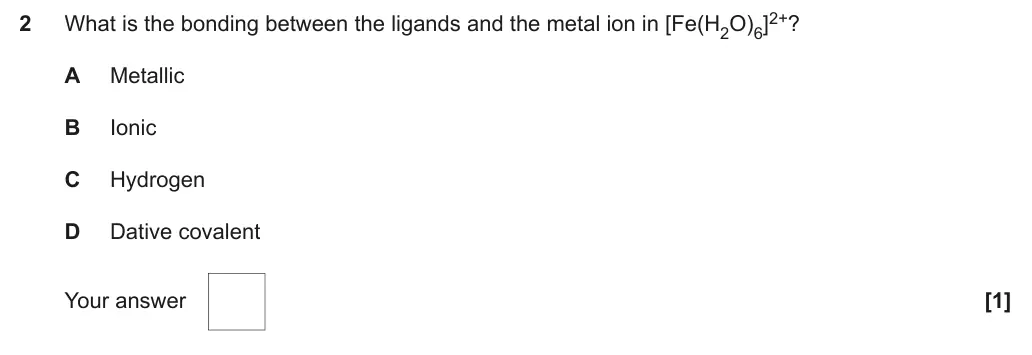
2 Transition elements 1Multiple choice
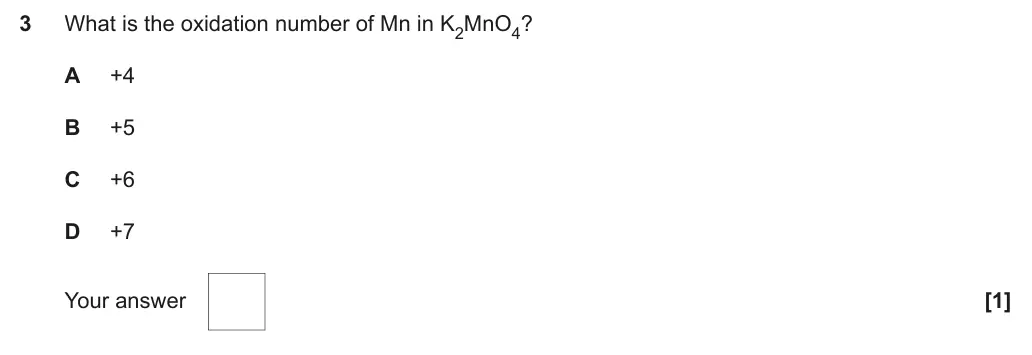
3 Redox and oxidation numbers 1Multiple choice
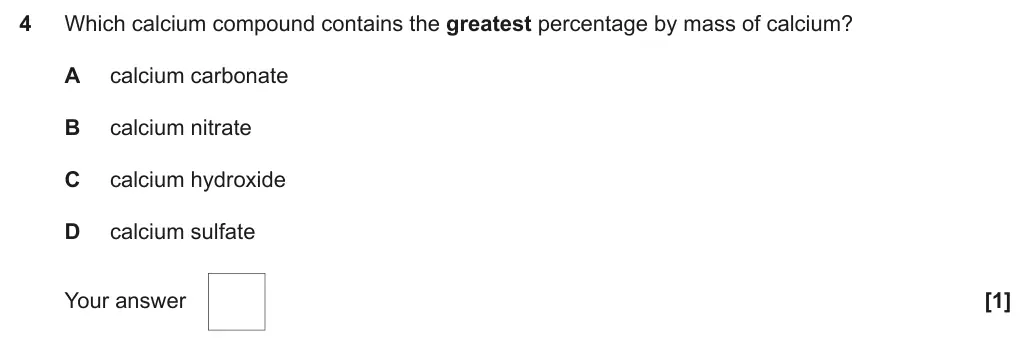
4 Atomic structure and isotopes, Formulae and equations 1Multiple choice
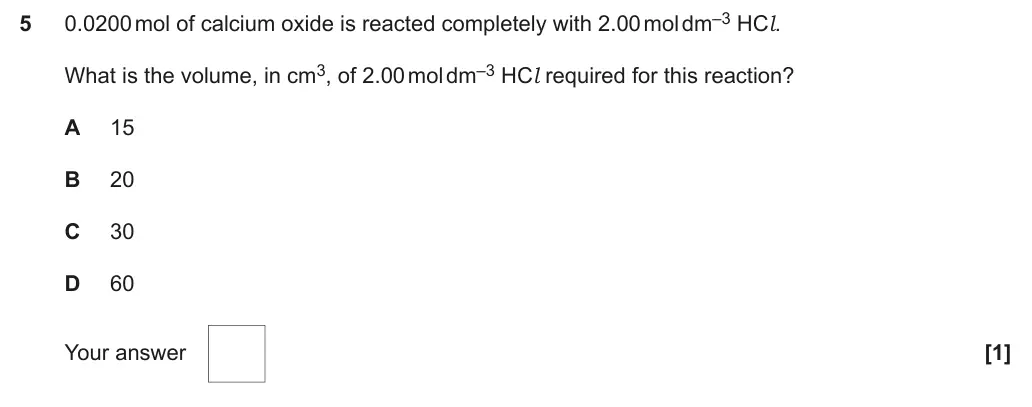
5 Amount of substance (moles), Acids, bases and titrations 1Multiple choice
6 Amount of substance (moles) 1Multiple choice
7 Amount of substance (moles) 1Multiple choice
8 Qualitative analysis: tests for ions, The halogens, Transition elements 1Multiple choice
9 Enthalpy changes and Hess’ law 1Multiple choice
10 Rates: orders, rate equations and the Arrhenius equation 1Multiple choice
11 Transition elements 1Multiple choice
12 Amount of substance (moles) 1Multiple choice
13 Equilibrium constants Kc and Kp 1Multiple choice
14 Redox titrations and electrode potentials 1Multiple choice
15 Transition elements, Electron structure and orbitals 1Multiple choice
16(a) Bonding, structure and shapes of molecules 1Drawing / labelling
16(b) Bonding, structure and shapes of molecules 2Short answer
16(c)(i) Bonding, structure and shapes of molecules 2Short answer
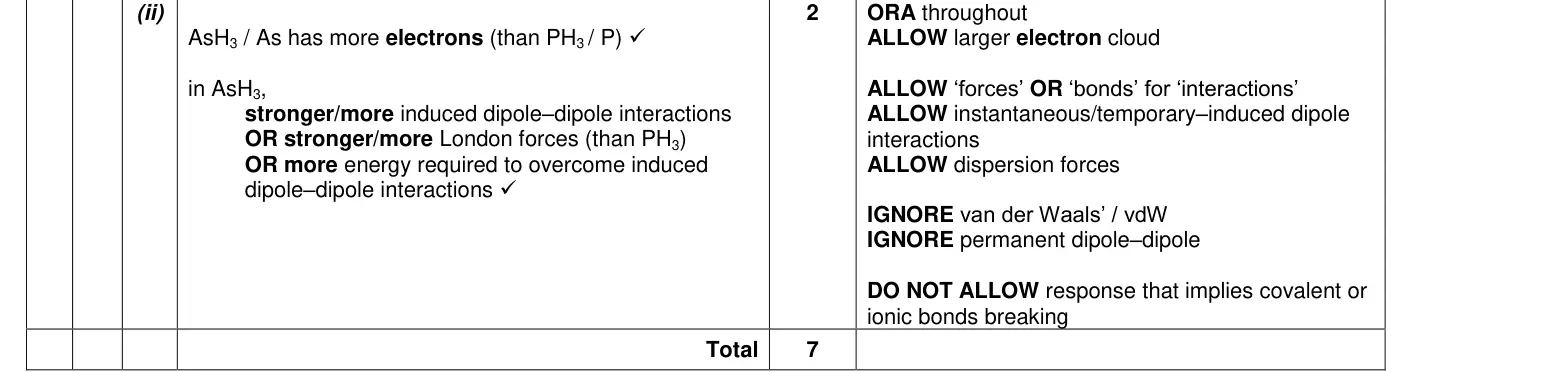
16(c)(ii) Bonding, structure and shapes of molecules 2Short answer
17(a) Acids, bases and titrations 1Equation writing
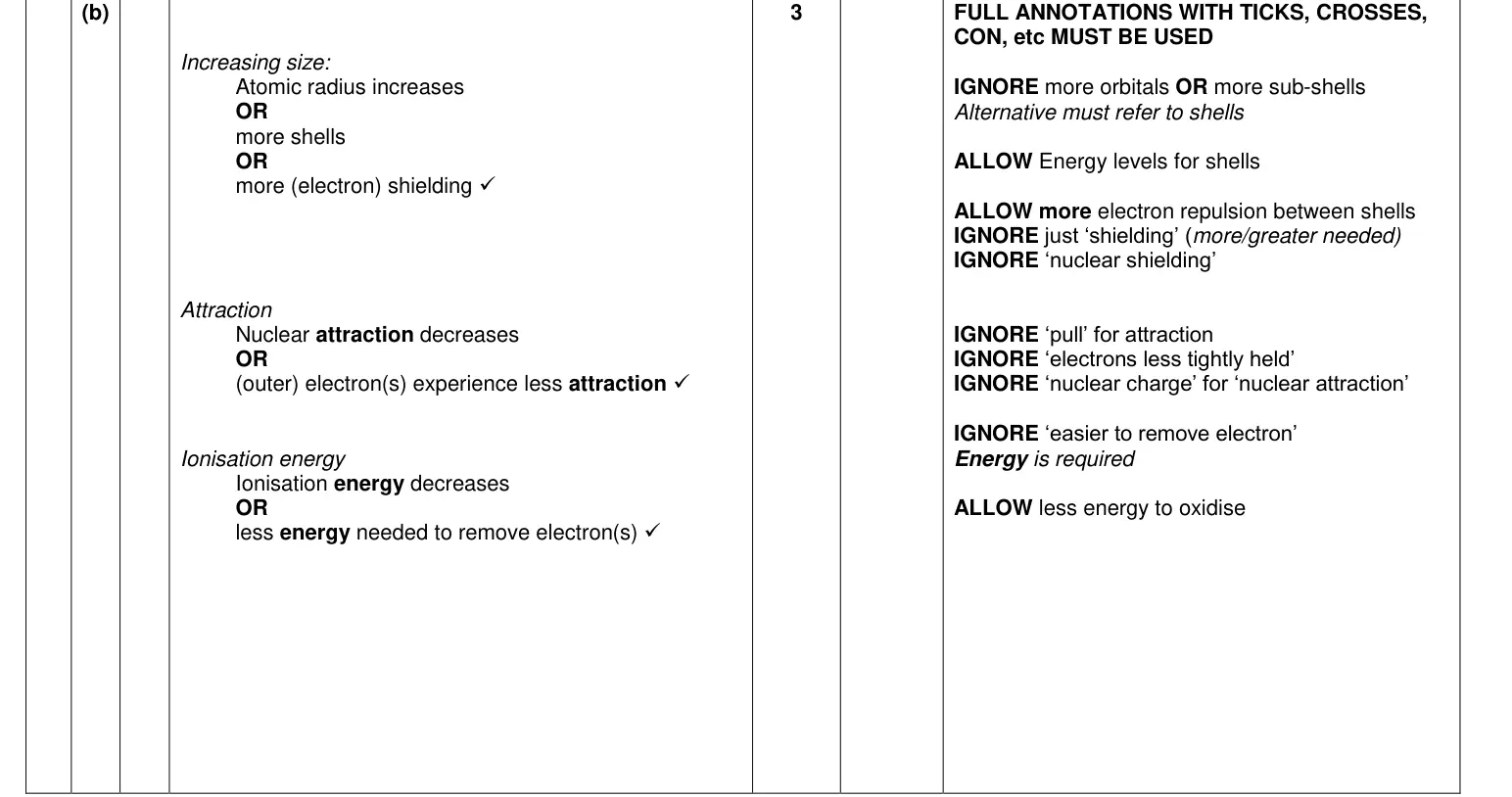
17(b) Group 2, Periodicity and ionisation energy 3Short answer
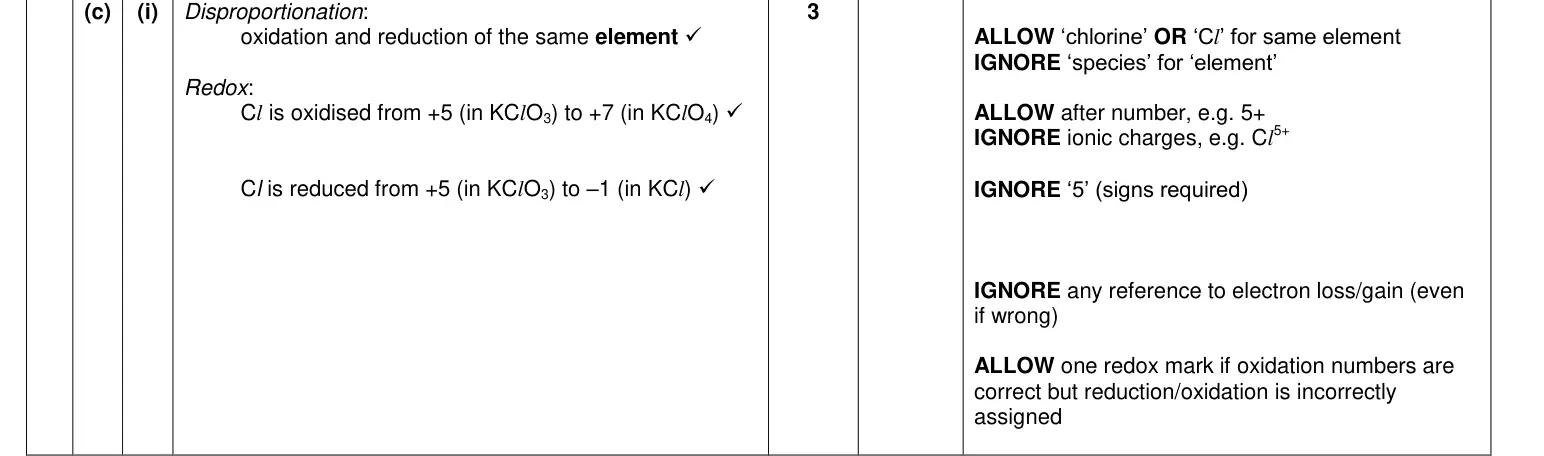
17(c)(i) The halogens, Redox and oxidation numbers 3Data interpretation
17(c)(ii) Redox and oxidation numbers 1Short answer
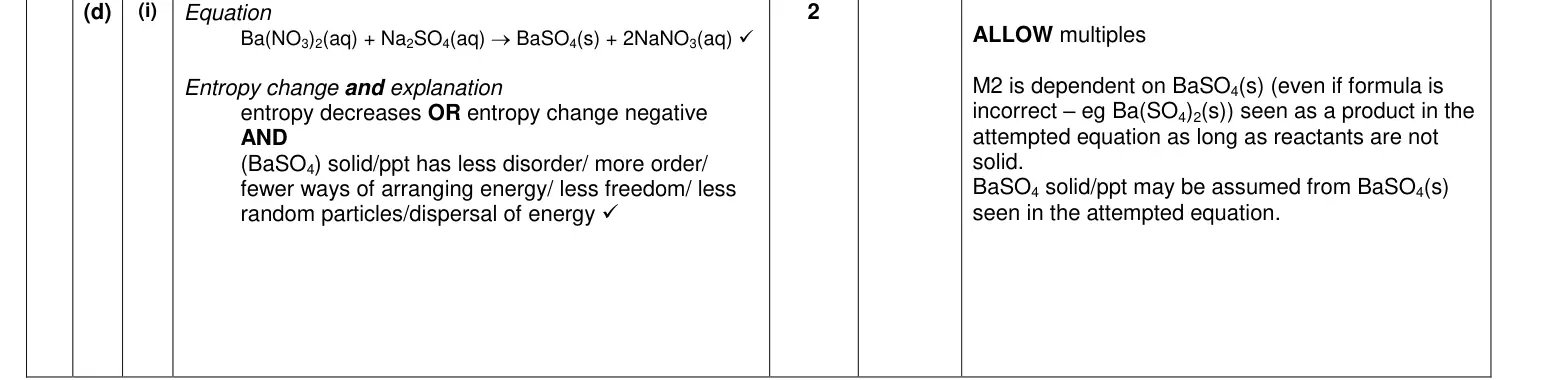
17(d)(i) Entropy and free energy, Formulae and equations, Qualitative analysis: tests for ions 2Equation writing
17(d)(ii) Entropy and free energy, Lattice enthalpy and Born–Haber cycles 2Equation writing
18(a) Entropy and free energy 4Data interpretation
18(b)(i) Equilibrium constants Kc and Kp 1Short answer
18(b)(ii) Equilibrium constants Kc and Kp 1Short answer
18(b)(iii) Entropy and free energy 3Calculation
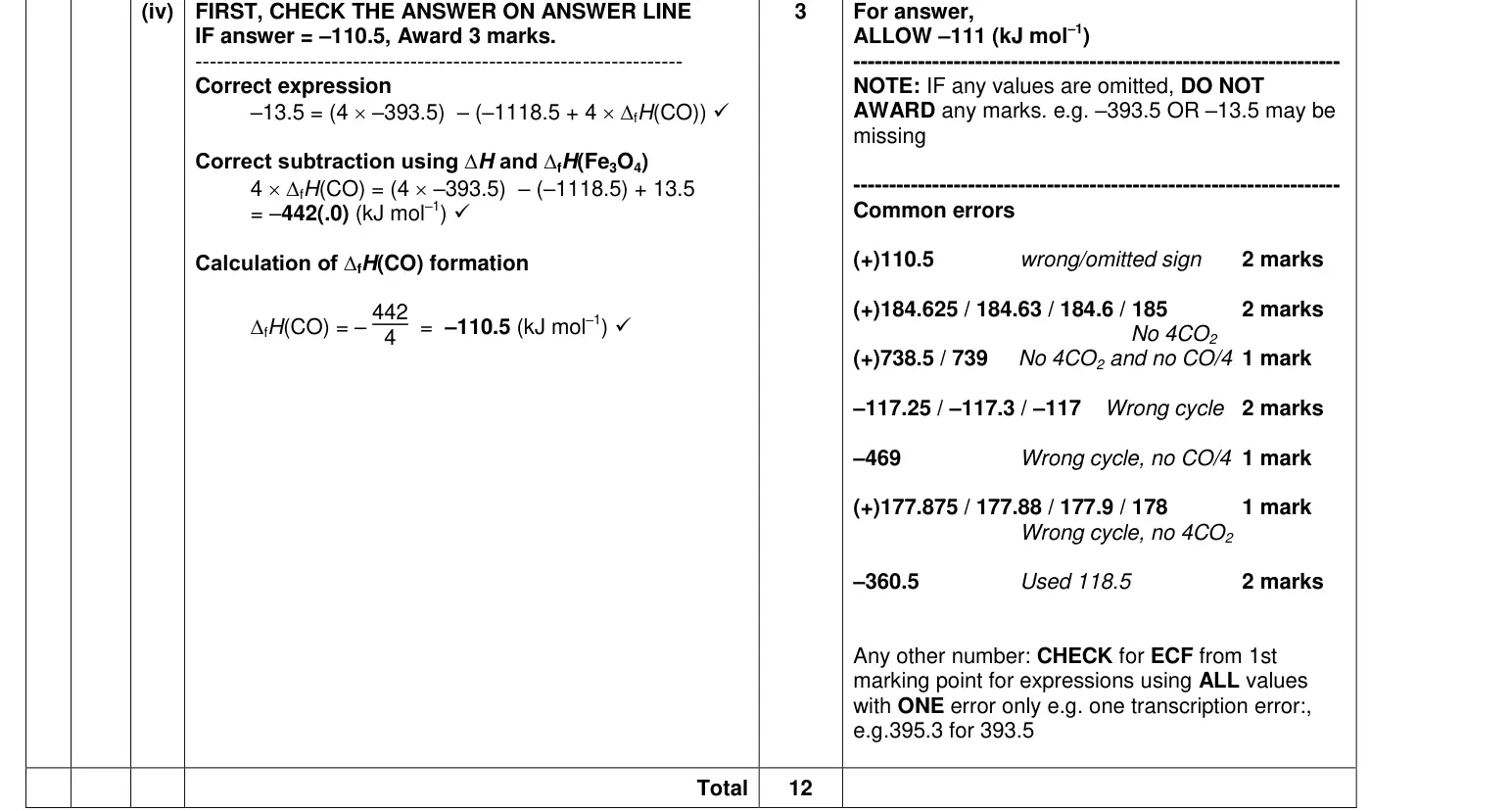
18(b)(iv) Enthalpy changes and Hess’ law 3Calculation
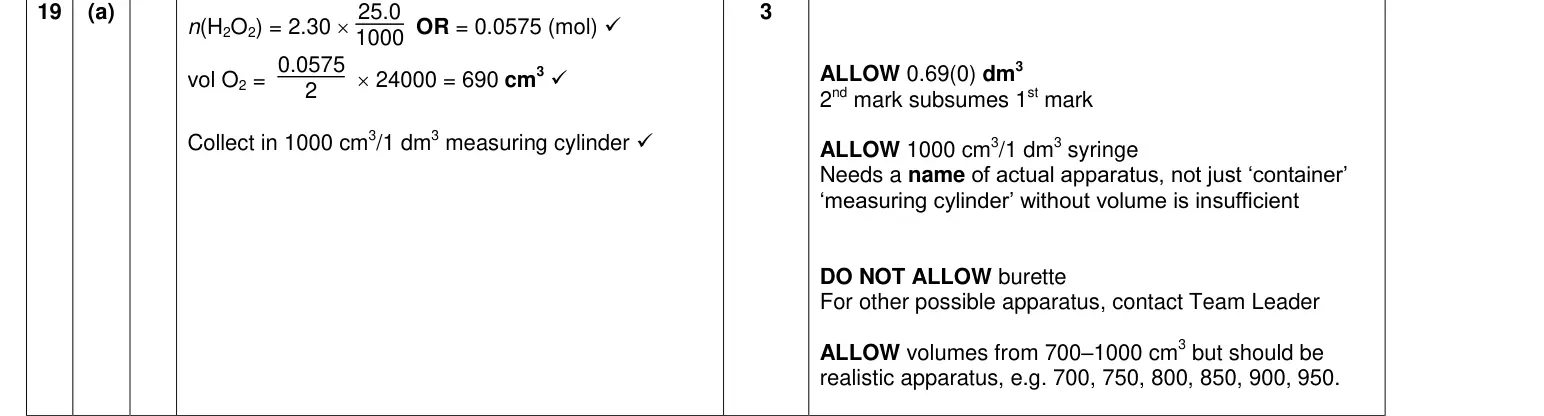
19(a) Amount of substance (moles), Practical skills: planning, analysis and evaluation, Practical techniques and apparatus (PAGs) 3Short answer
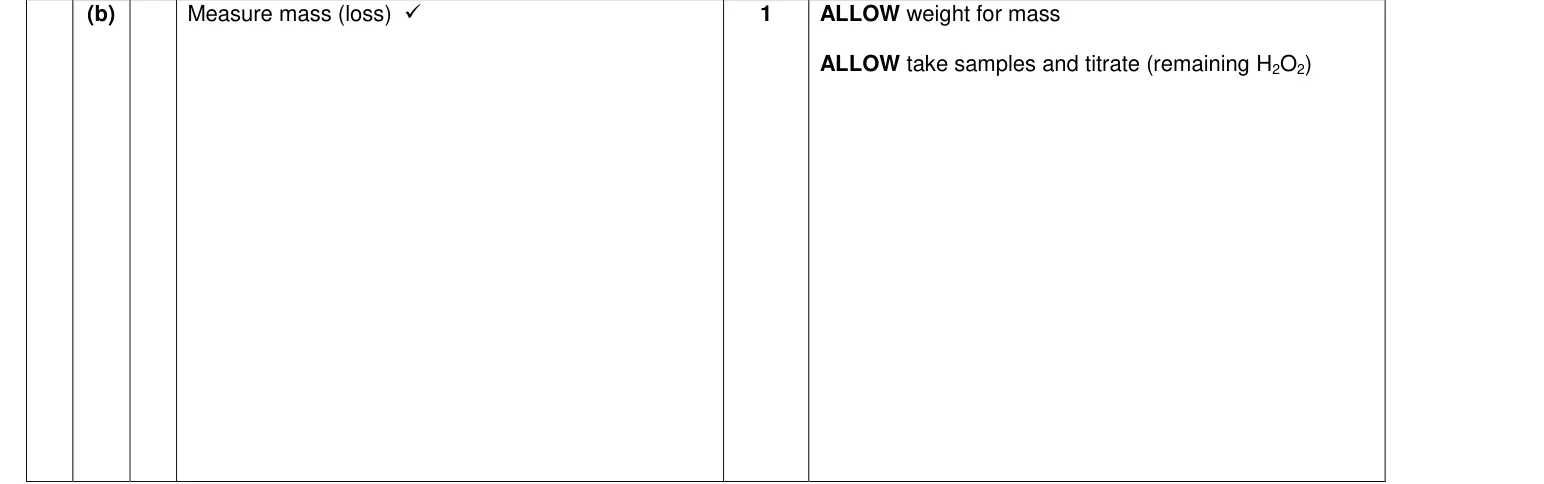
19(b) Reaction rates and the Boltzmann distribution, Rates: orders, rate equations and the Arrhenius equation 1Short answer
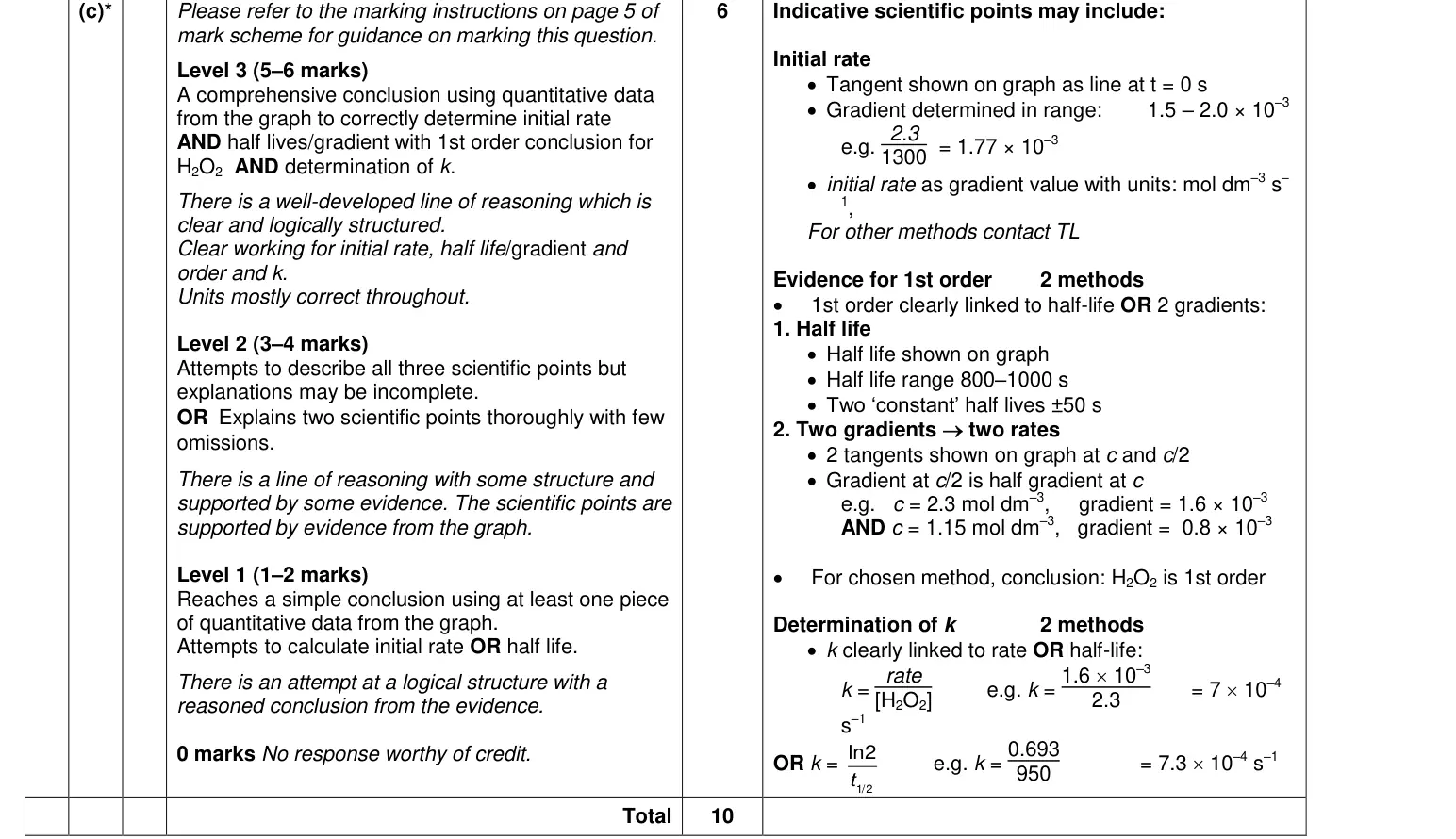
19(c) Rates: orders, rate equations and the Arrhenius equation 6Level of response
20(a) Chemical equilibrium and Kc 4Short answer
20(b)(i) Equilibrium constants Kc and Kp, Chemical equilibrium and Kc 2Short answer
20(b)(ii) Equilibrium constants Kc and Kp 4Calculation
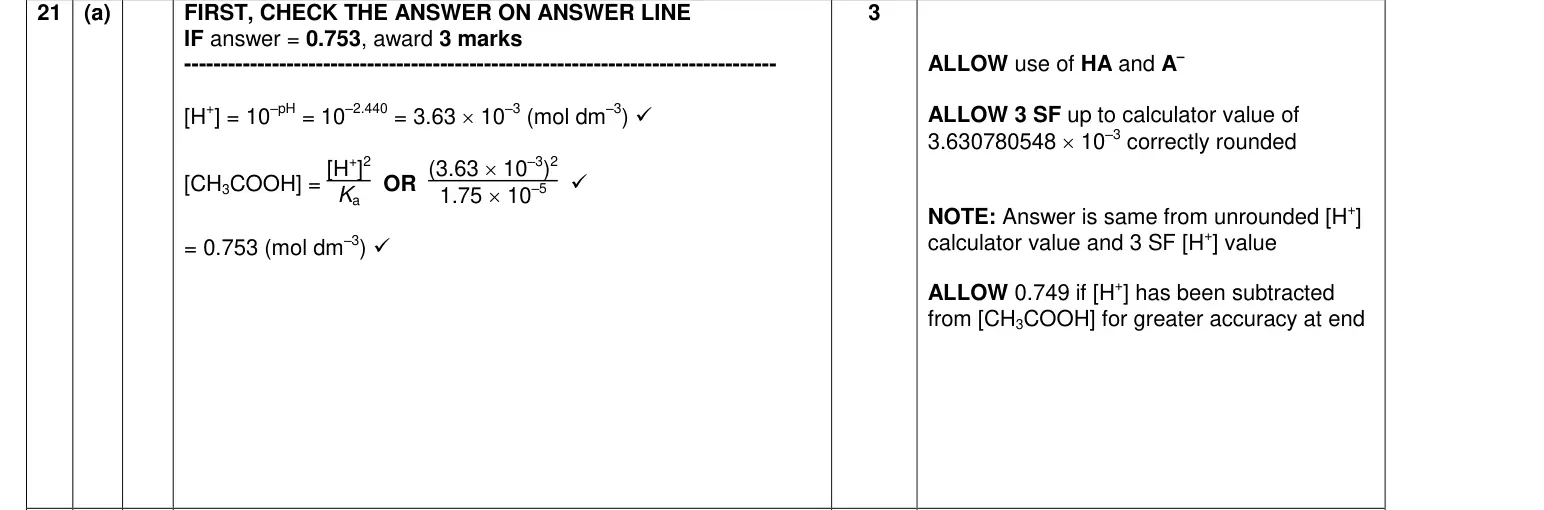
21(a) Acids, bases, pH and buffers 3Calculation
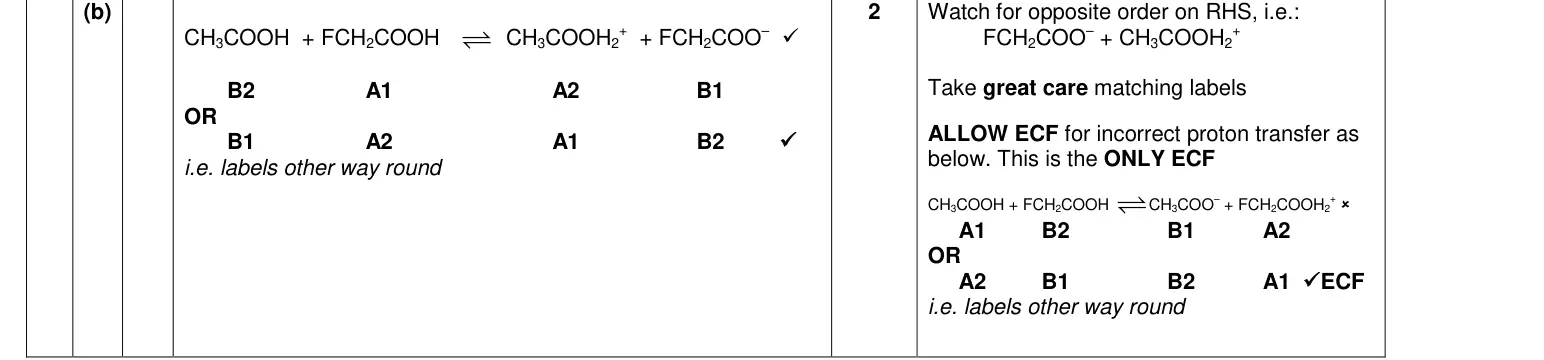
21(b) Acids, bases, pH and buffers 2Drawing / labelling
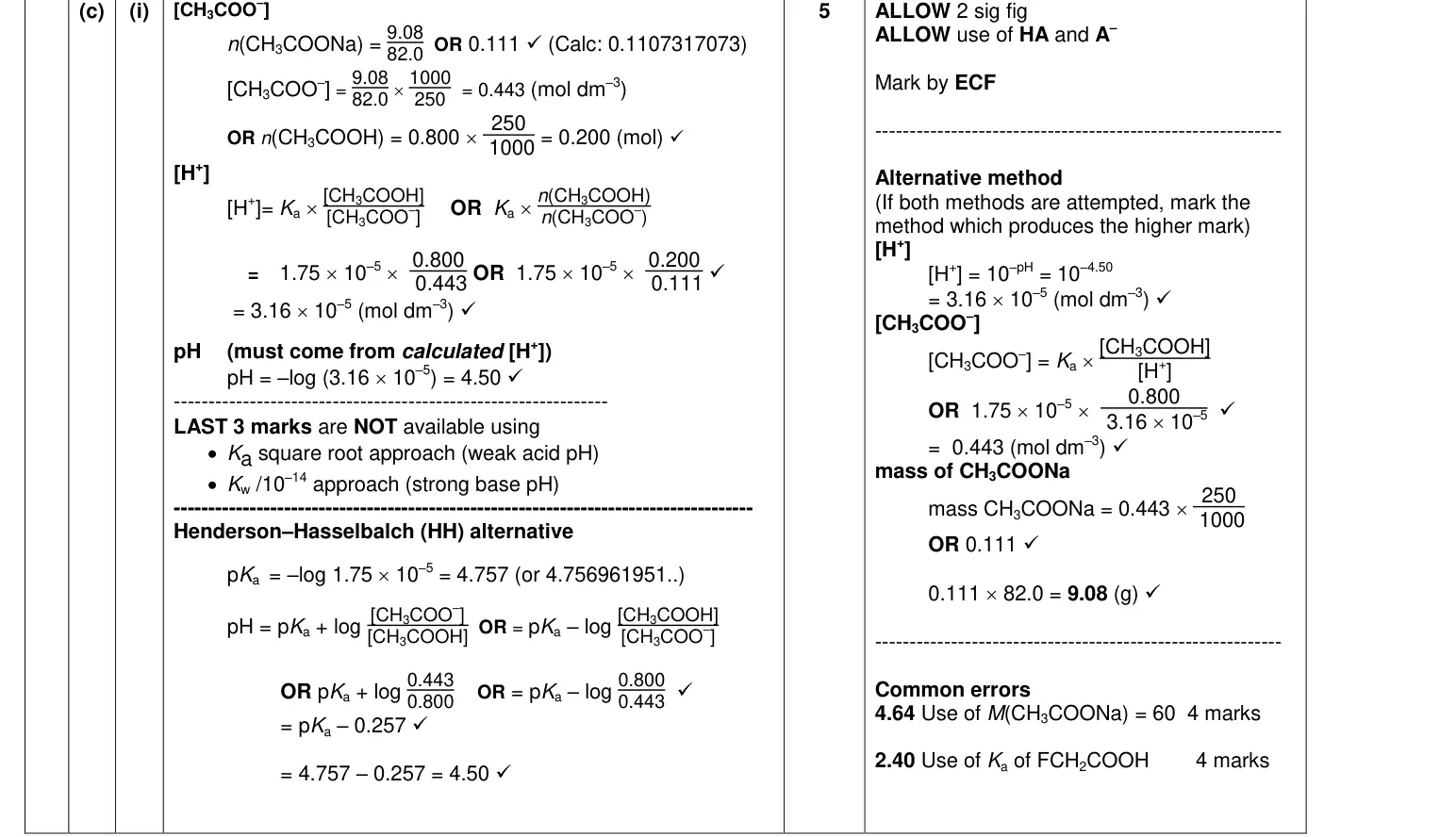
21(c)(i) Acids, bases, pH and buffers, Amount of substance (moles) 5Short answer
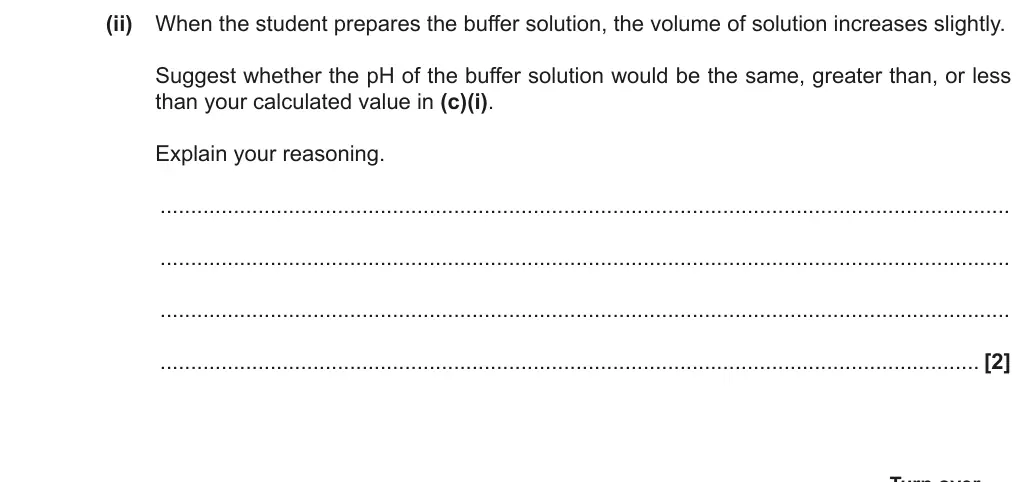
21(c)(ii) Acids, bases, pH and buffers 2Short answer
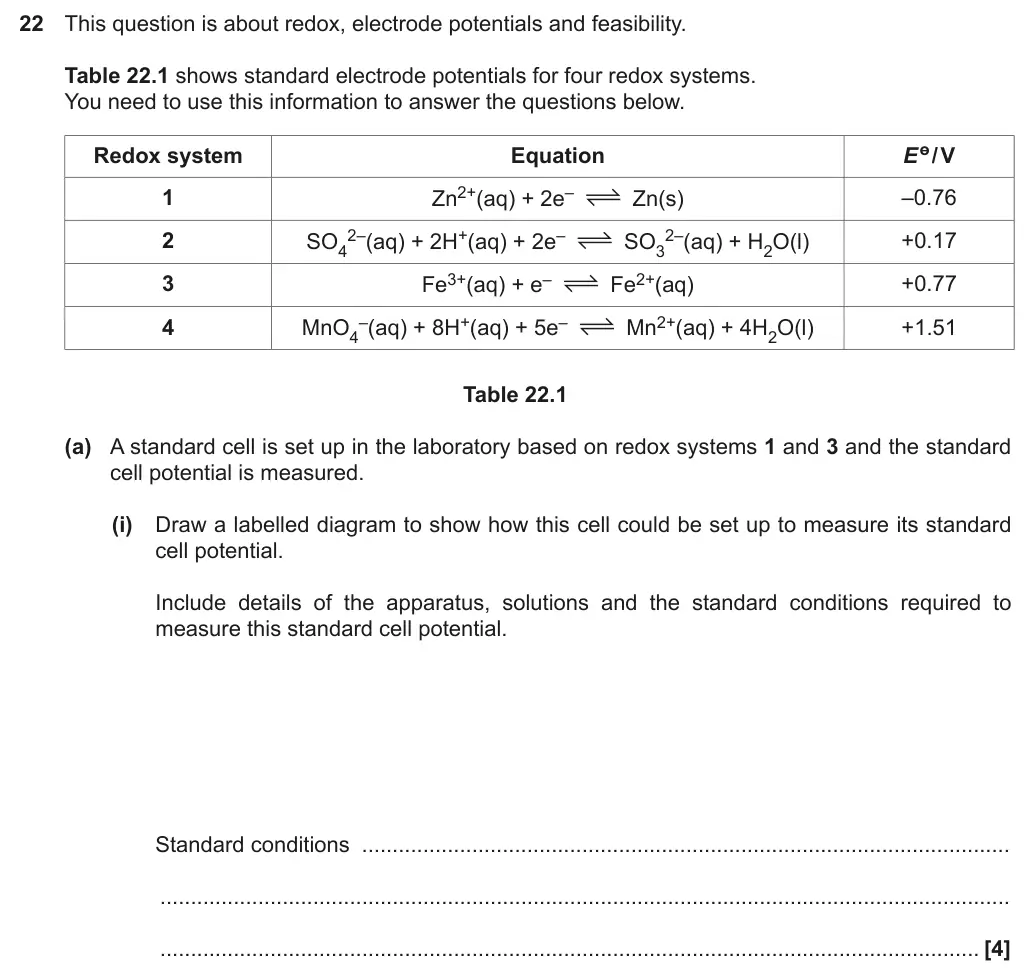
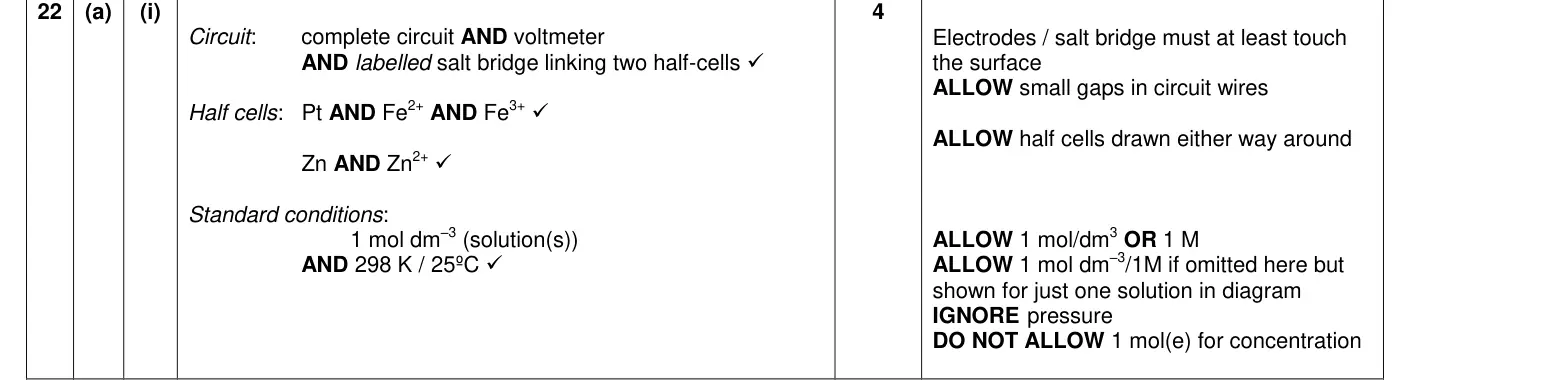
22(a)(i) Redox titrations and electrode potentials 4Drawing / labelling
22(a)(ii) Redox titrations and electrode potentials 1Calculation
22(b) Redox titrations and electrode potentials 2Data interpretation
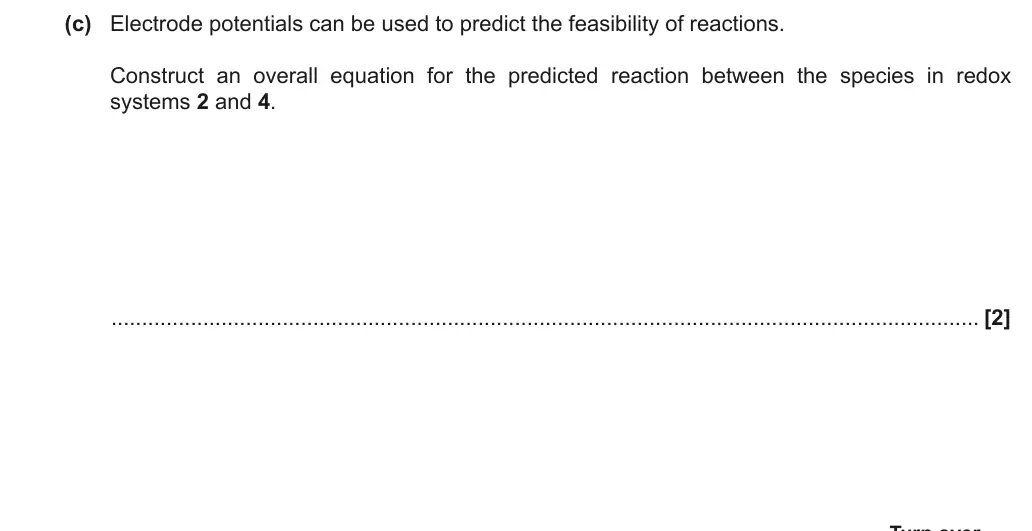
22(c) Redox titrations and electrode potentials 2Equation writing
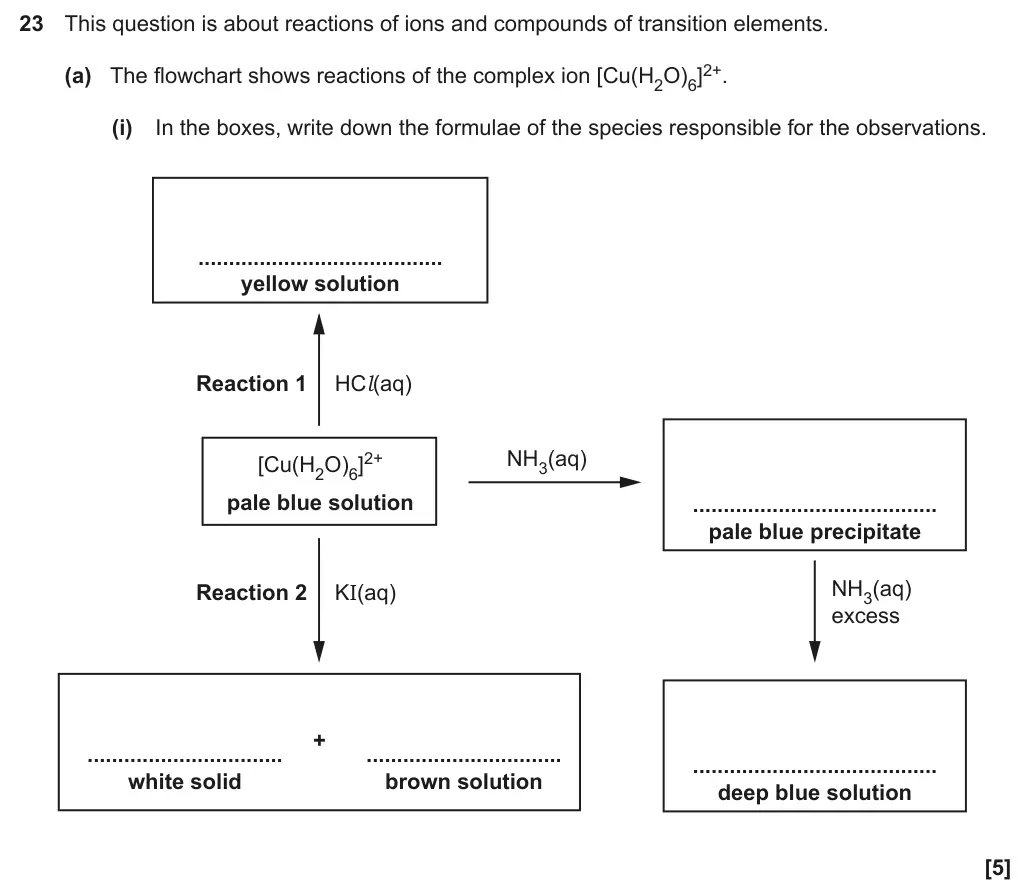
23(a)(i) Transition elements 5Short answer
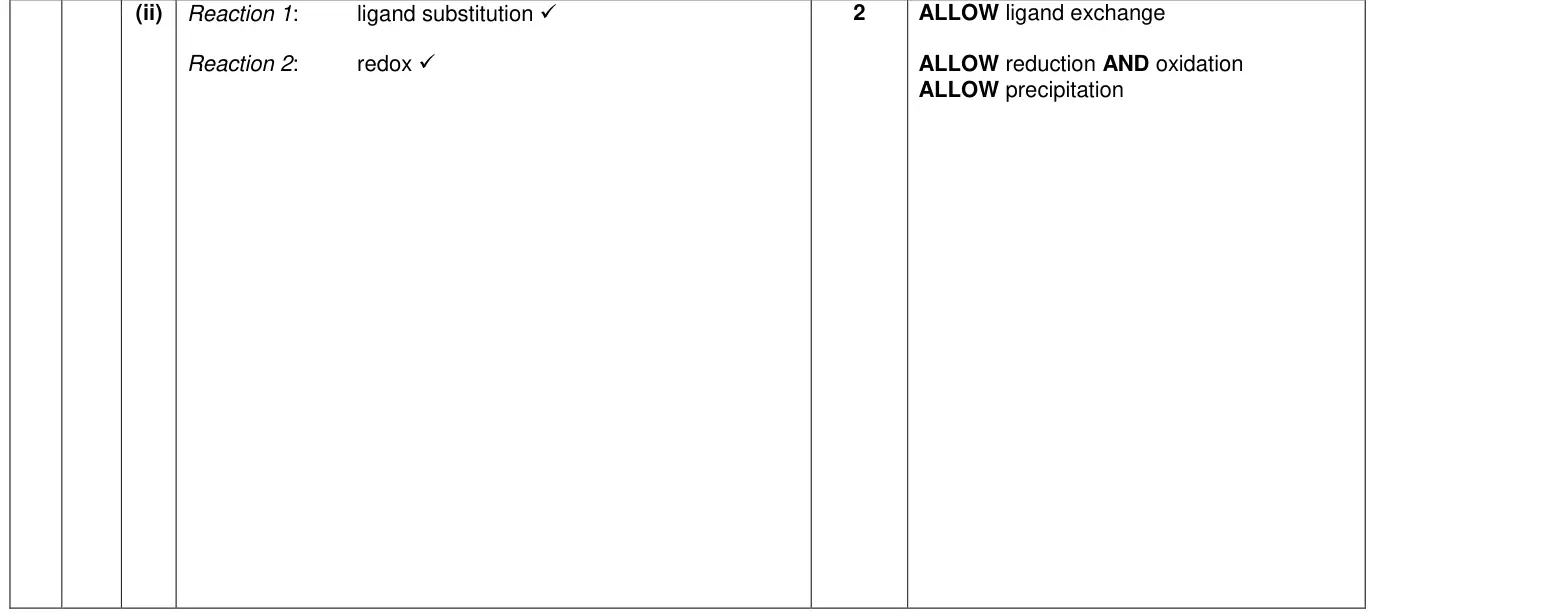
23(a)(ii) Transition elements 2Short answer
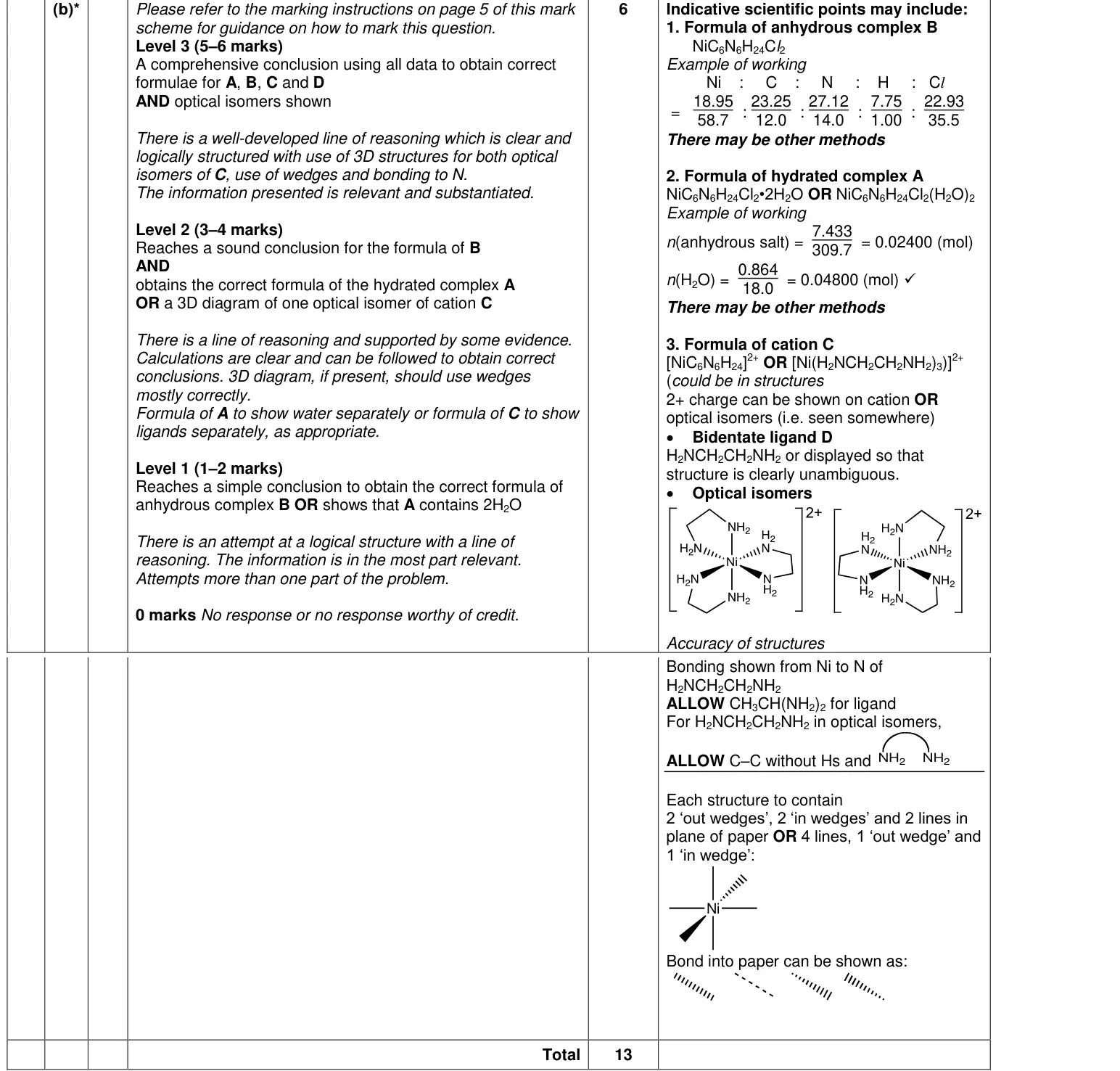
23(b) Amount of substance (moles), Transition elements 6Level of response

The questions

12345678910111213141516(a)16(b)16(c)(i)16(c)(ii)17(a)17(b)17(c)(i)17(c)(ii)17(d)(i)17(d)(ii)18(a)18(b)(i)18(b)(ii)18(b)(iii)18(b)(iv)19(a)19(b)19(c)20(a)20(b)(i)20(b)(ii)21(a)21(b)21(c)(i)21(c)(ii)22(a)(i)22(a)(ii)22(b)22(c)23(a)(i)23(a)(ii)23(b)
June 2017 · Paper 1 · Q1 1 mark Multiple choice atomic structure and isotopes
1 Which atom is not an isotope of iodine?
Number of neutrons Mass number
A 72 125
B 74 127
C 75 128
D 77 129
Your answer [1]
June 2017 · Paper 1 · Q2 1 mark Multiple choice transition elements
2 What is the bonding between the ligands and the metal ion in [Fe(H2O)6]2+?
A Metallic
B Ionic
C Hydrogen
D Dative covalent
Your answer [1]
June 2017 · Paper 1 · Q3 1 mark Multiple choice redox
3 What is the oxidation number of Mn in K2MnO4?
A +4
B +5
C +6
D +7
Your answer [1]
June 2017 · Paper 1 · Q4 1 mark Multiple choice atomic structure and isotopesformulae and equations
4 Which calcium compound contains the greatest percentage by mass of calcium?
A calcium carbonate
B calcium nitrate
C calcium hydroxide
D calcium sulfate
Your answer [1]
June 2017 · Paper 1 · Q5 1 mark Multiple choice amount of substanceacids and titrations
5 0.0200 mol of calcium oxide is reacted completely with 2.00 mol dm–3 HCl.
What is the volume, in cm3, of 2.00 mol dm–3 HCl required for this reaction?
A 15
B 20
C 30
D 60
Your answer [1]
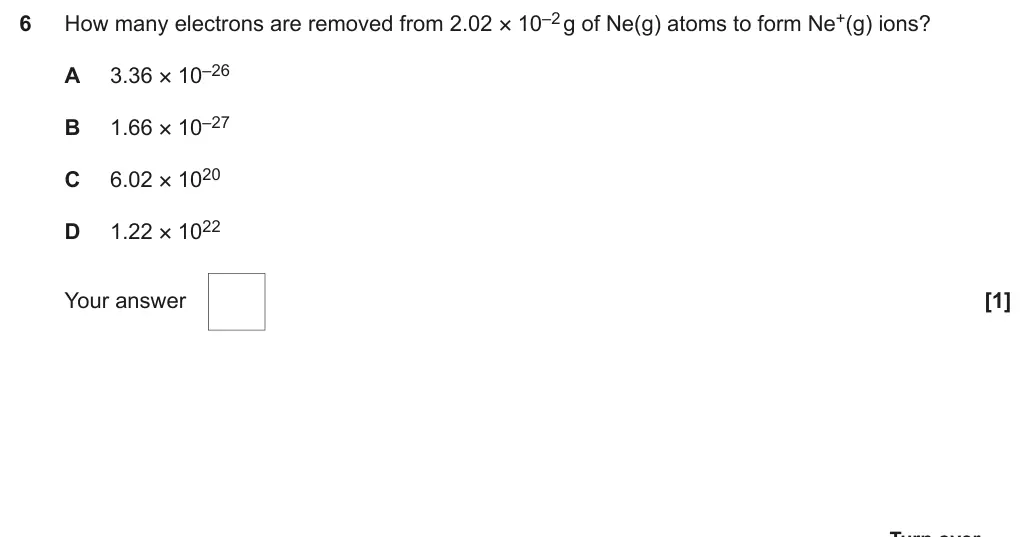
June 2017 · Paper 1 · Q6 1 mark Multiple choice amount of substance
6 How many electrons are removed from 2.02 × 10⁻² g of Ne(g) atoms to form Ne+(g) ions?
A 3.36 × 10⁻²⁶
B 1.66 × 10⁻²⁷
C 6.02 × 10²⁰
D 1.22 × 10²²
Your answer [1]
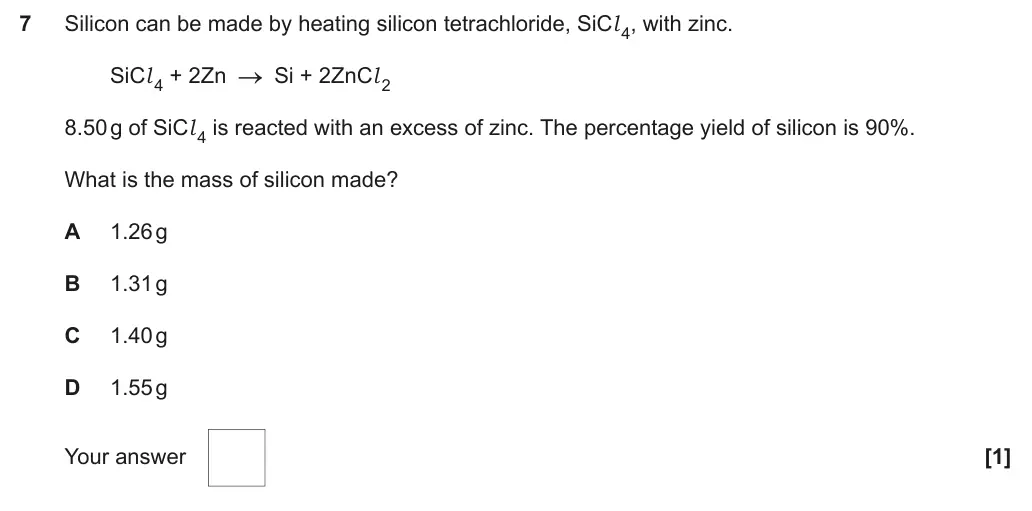
June 2017 · Paper 1 · Q7 1 mark Multiple choice amount of substance
7 Silicon can be made by heating silicon tetrachloride, SiCl 4, with zinc.
SiCl 4 + 2Zn Si + 2ZnCl 2
8.50 g of SiCl 4 is reacted with an excess of zinc. The percentage yield of silicon is 90%.
What is the mass of silicon made?
A 1.26 g
B 1.31 g
C 1.40 g
D 1.55 g
Your answer [1]
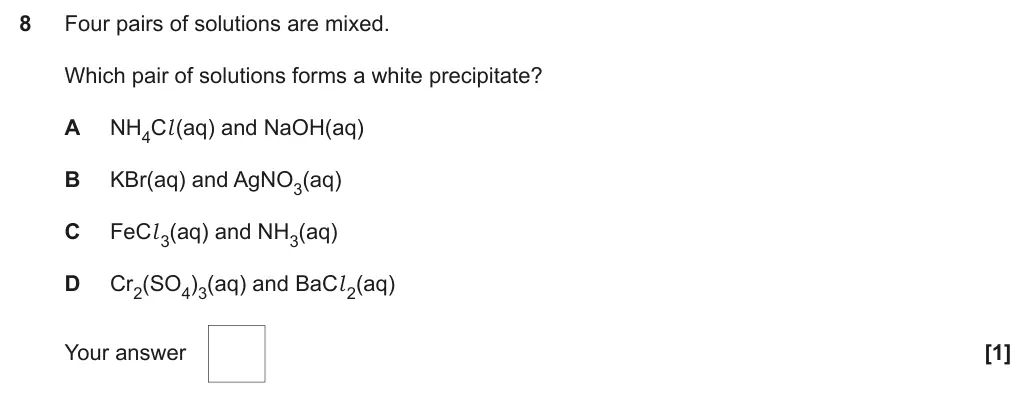
June 2017 · Paper 1 · Q8 1 mark Multiple choice qualitative analysishalogenstransition elements
8 Four pairs of solutions are mixed.
Which pair of solutions forms a white precipitate?
A NH4Cl (aq) and NaOH(aq)
B KBr(aq) and AgNO3(aq)
C FeCl 3(aq) and NH3(aq)
D Cr2(SO4)3(aq) and BaCl 2(aq)
Your answer [1]
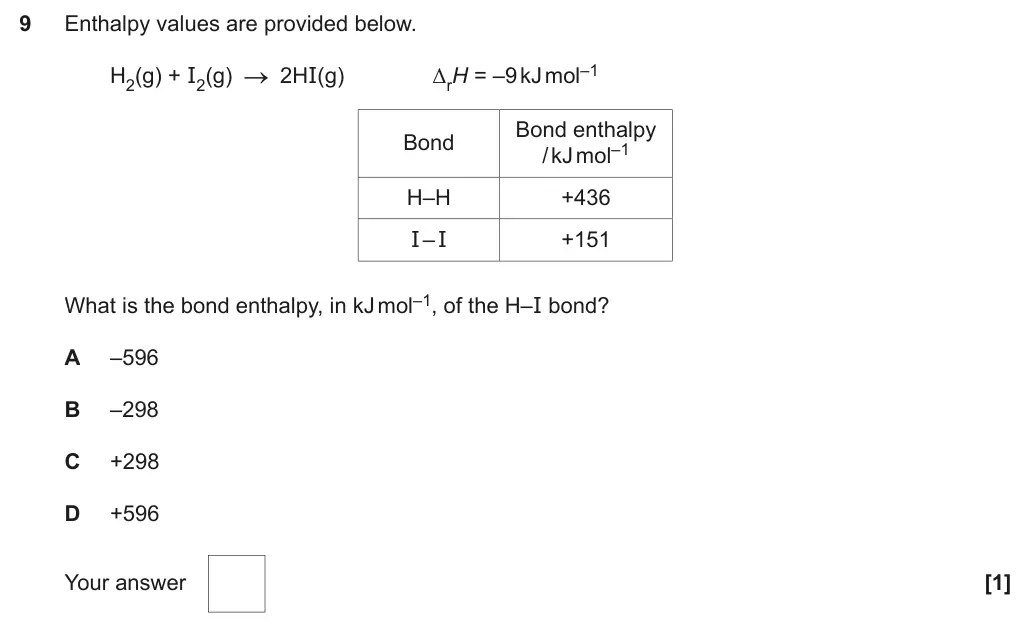
June 2017 · Paper 1 · Q9 1 mark Multiple choice enthalpy changes
9 Enthalpy values are provided below.
H2(g) + I2(g) 2HI(g)    ΔrH = –9 kJ mol–1
Bond enthalpy
Bond
/ kJ mol–1
H–H +436
I – I +151
What is the bond enthalpy, in kJ mol–1, of the H–I bond?
A –596
B –298
C +298
D +596
Your answer [1]
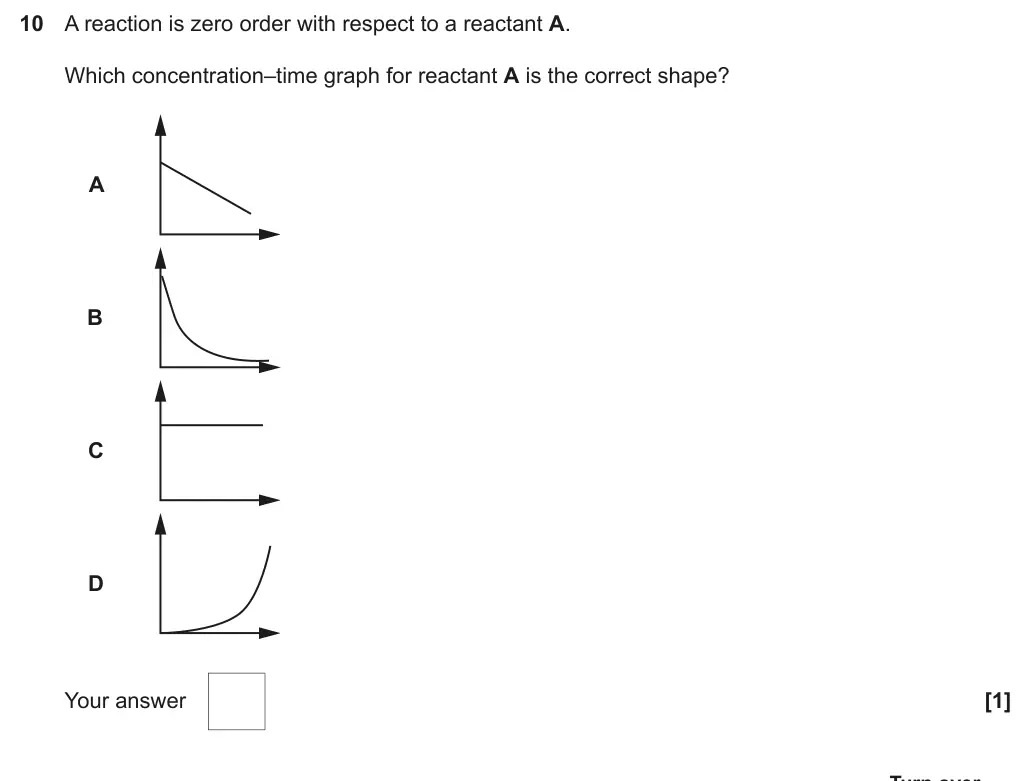
June 2017 · Paper 1 · Q10 1 mark Multiple choice rate equations
10 A reaction is zero order with respect to a reactant A.
Which concentration–time graph for reactant A is the correct shape?
A
B
C
D
Your answer [1]
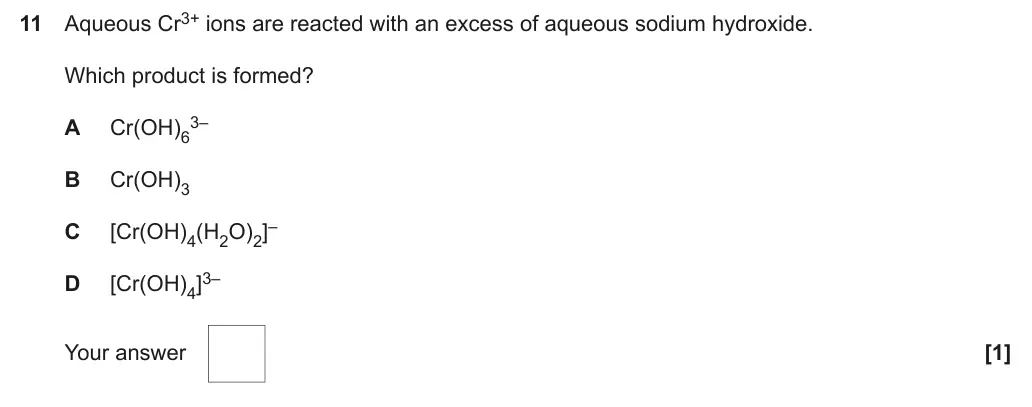
June 2017 · Paper 1 · Q11 1 mark Multiple choice transition elements
11 Aqueous Cr3+ ions are reacted with an excess of aqueous sodium hydroxide.
Which product is formed?
A Cr(OH)6 3–
B Cr(OH)3
C [Cr(OH)4(H2O)2]–
D [Cr(OH)4]3–
Your answer [1]
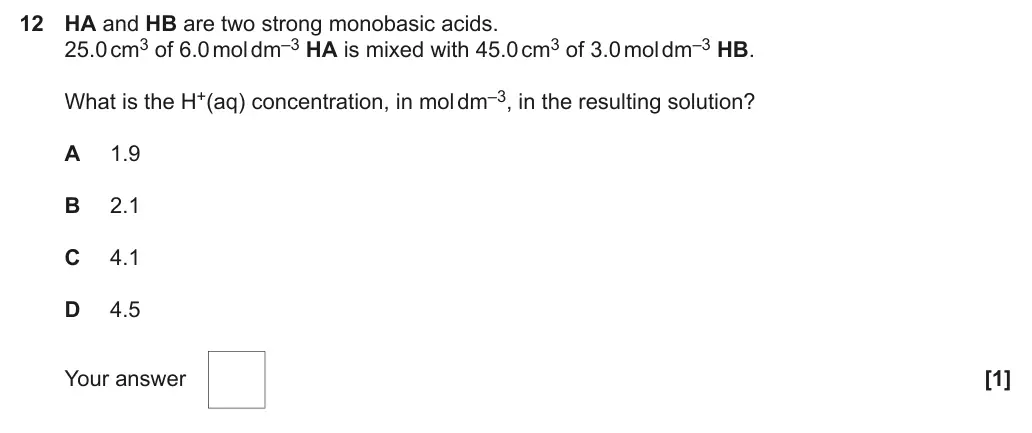
June 2017 · Paper 1 · Q12 1 mark Multiple choice amount of substance
12 HA and HB are two strong monobasic acids.
25.0 cm3 of 6.0 mol dm–3 HA is mixed with 45.0 cm3 of 3.0 mol dm–3 HB.
What is the H+(aq) concentration, in mol dm–3, in the resulting solution?
A 1.9
B 2.1
C 4.1
D 4.5
Your answer [1]
June 2017 · Paper 1 · Q13 1 mark Multiple choice equilibrium constants
13 A mixture of N2 and O2 gases has a total pressure of 1.42 atm.
The mole fraction of N2 is 0.700.
What is the partial pressure, in atm, of O2 in the mixture?
A 0.211
B 0.426
C 0.493
D 0.994
Your answer [1]
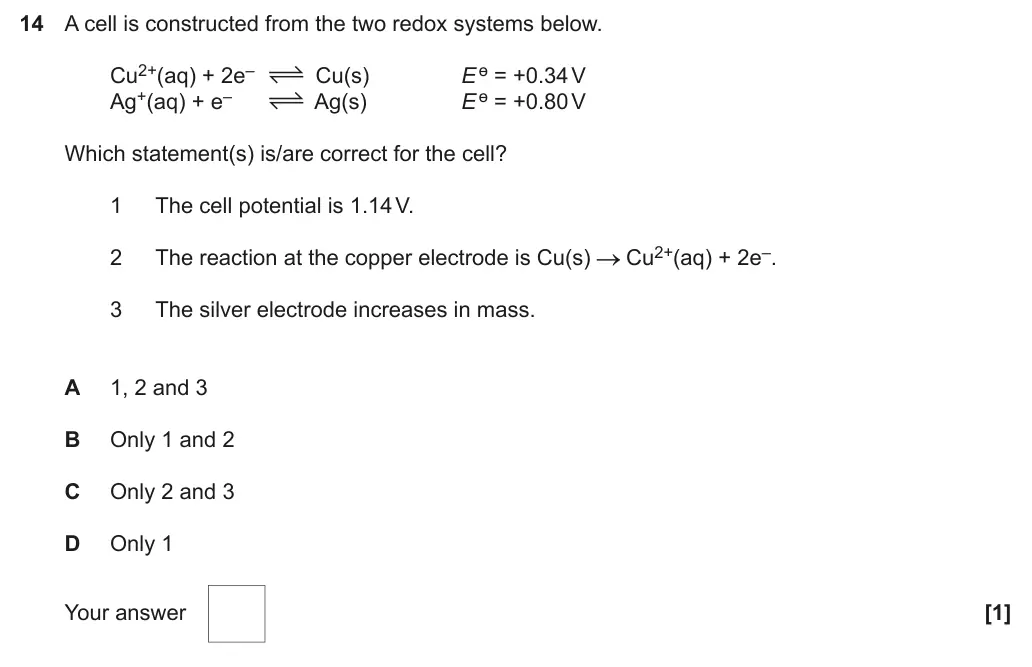
June 2017 · Paper 1 · Q14 1 mark Multiple choice redox and electrode potentials
14 A cell is constructed from the two redox systems below.
Cu2+(aq) + 2e– Cu(s) E ө = +0.34 V
Ag+(aq) + e– Ag(s) E ө = +0.80 V
Which statement(s) is/are correct for the cell?
1 The cell potential is 1.14 V.
2 The reaction at the copper electrode is Cu(s) Cu2+(aq) + 2e–.
3 The silver electrode increases in mass.
A 1, 2 and 3
B Only 1 and 2
C Only 2 and 3
D Only 1
Your answer [1]
June 2017 · Paper 1 · Q15 1 mark Multiple choice transition elementselectron structure
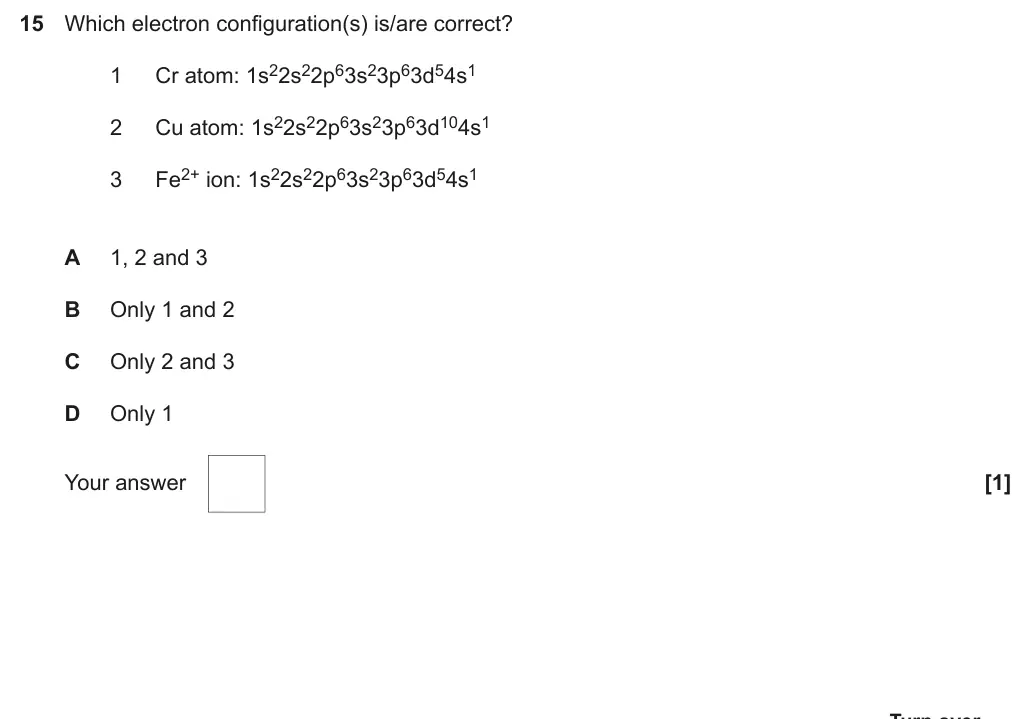
15 Which electron configuration(s) is/are correct?
1 Cr atom: 1s22s22p63s23p63d54s1
2 Cu atom: 1s22s22p63s23p63d104s1
3 Fe2+ ion: 1s22s22p63s23p63d54s1
A 1, 2 and 3
B Only 1 and 2
C Only 2 and 3
D Only 1
Your answer [1]
June 2017 · Paper 1 · Q16(a) 1 mark Drawing / labelling bonding and structure
SECTION B
Answer all the questions.
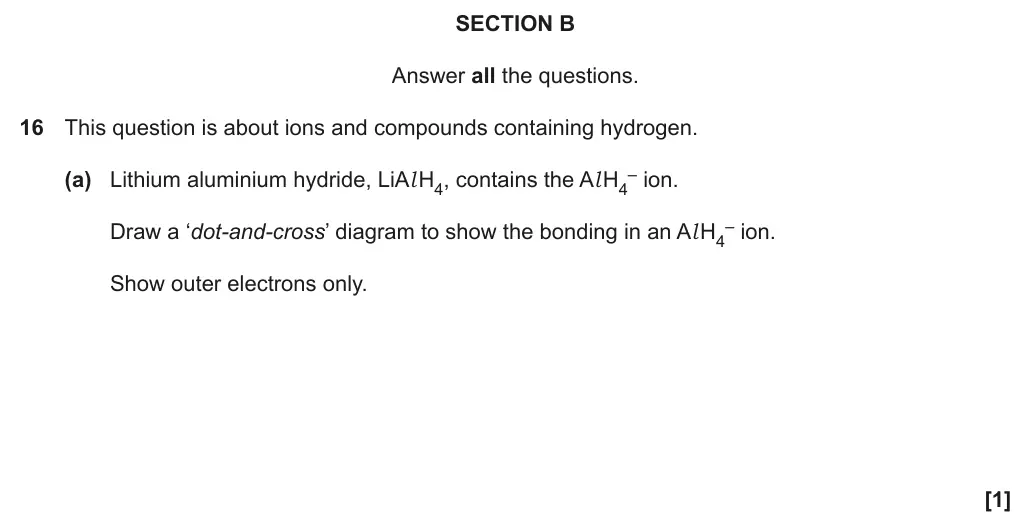
16 This question is about ions and compounds containing hydrogen.
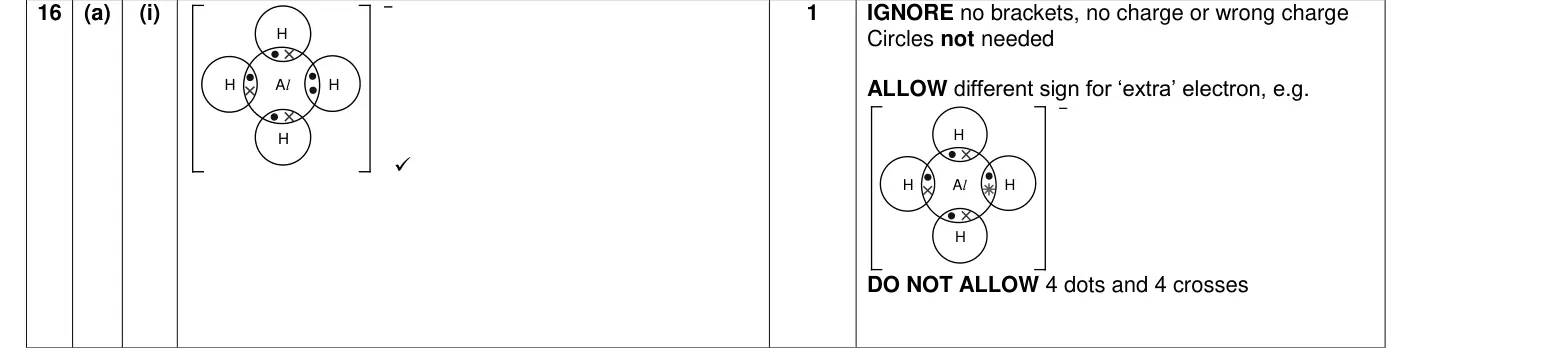
(a) Lithium aluminium hydride, LiAl H4, contains the Al H4 – ion.
Draw a ‘dot-and-cross’ diagram to show the bonding in an Al H4 – ion.
Show outer electrons only.
[1]
June 2017 · Paper 1 · Q16(b) 2 marks Short answer bonding and structure
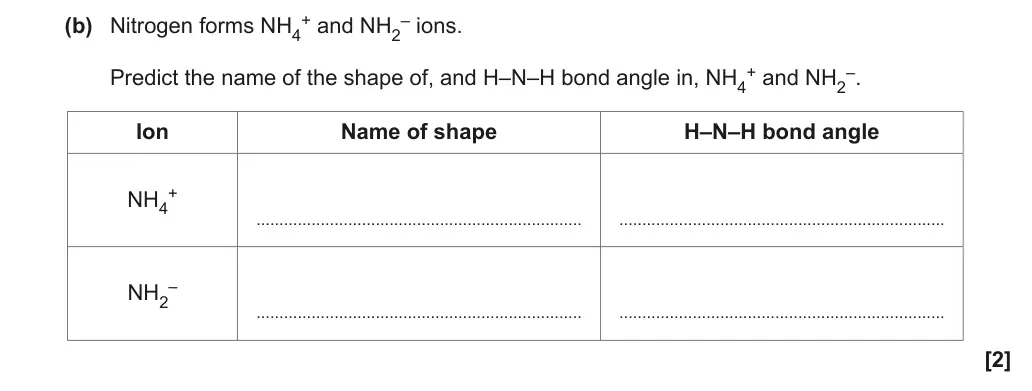
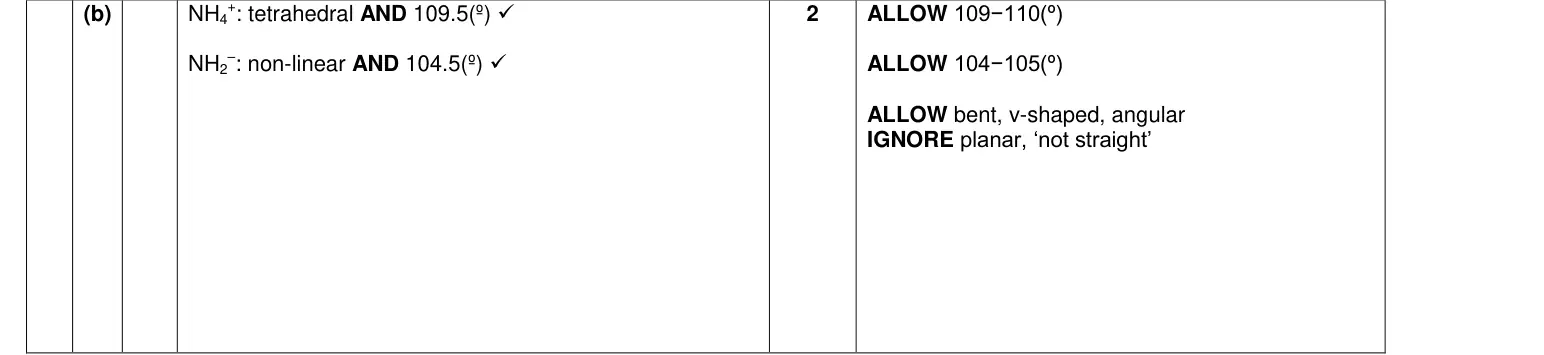
(b) Nitrogen forms NH4 + and NH2 – ions.
Predict the name of the shape of, and H–N–H bond angle in, NH4 + and NH2 –.
Ion Name of shape H–N–H bond angle
NH4 +
....................................................................... .......................................................................
NH2 –
....................................................................... .......................................................................
[2]
June 2017 · Paper 1 · Q16(c)(i) 2 marks Short answer bonding and structure
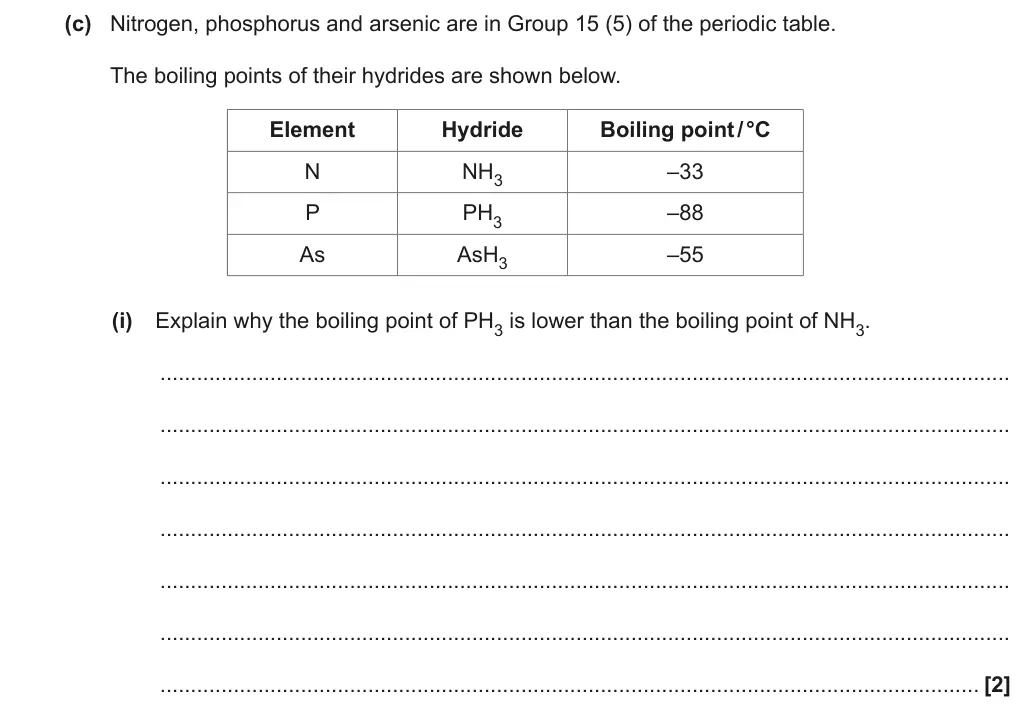
(c) Nitrogen, phosphorus and arsenic are in Group 15 (5) of the periodic table.
The boiling points of their hydrides are shown below.
Element Hydride Boiling point / °C
N NH3 –33
P PH3 –88
As AsH3 –55
(i) Explain why the boiling point of PH3 is lower than the boiling point of NH3.
...........................................................................................................................................
...........................................................................................................................................
...........................................................................................................................................
...........................................................................................................................................
...........................................................................................................................................
...........................................................................................................................................
...................................................................................................................................... [2]
June 2017 · Paper 1 · Q16(c)(ii) 2 marks Short answer bonding and structure
Earlier part of question 16 that this part usesEarlier part of June 2017 Paper 1 question 16
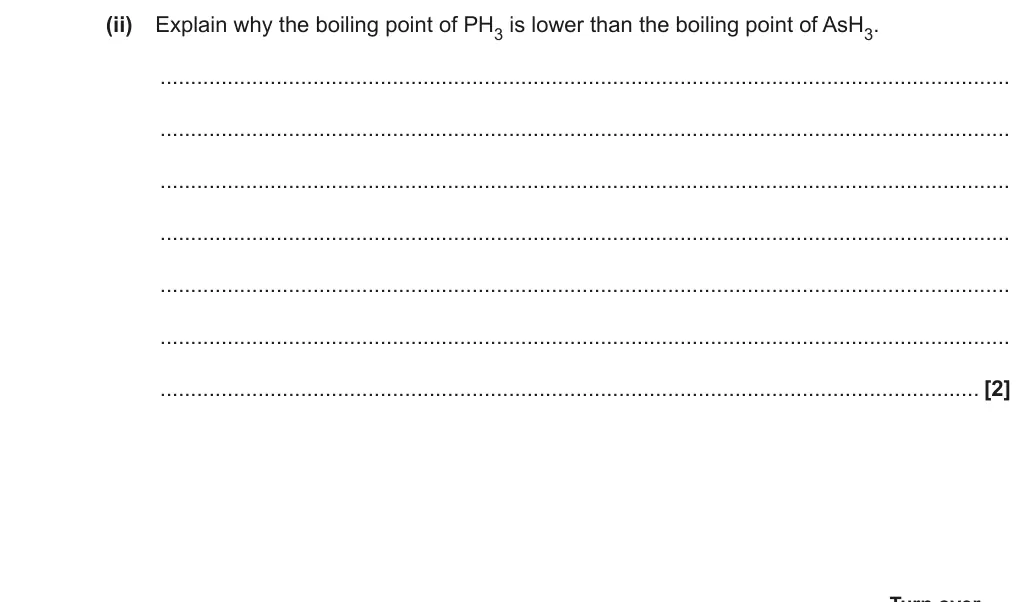
(ii) Explain why the boiling point of PH3 is lower than the boiling point of AsH3.
...........................................................................................................................................
...........................................................................................................................................
...........................................................................................................................................
...........................................................................................................................................
...........................................................................................................................................
...........................................................................................................................................
...................................................................................................................................... [2]
June 2017 · Paper 1 · Q17(a) 1 mark Equation writing acids and titrations
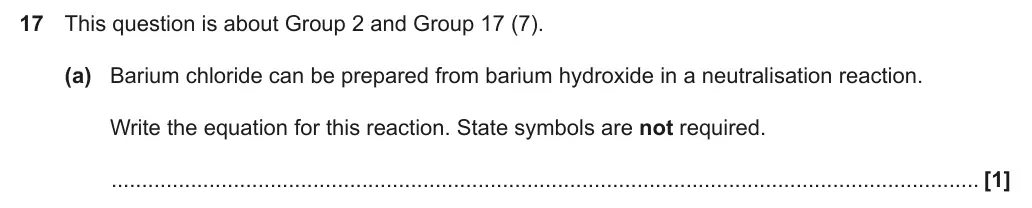
17 This question is about Group 2 and Group 17 (7).
(a) Barium chloride can be prepared from barium hydroxide in a neutralisation reaction.
Write the equation for this reaction. State symbols are not required.
.............................................................................................................................................. [1]
June 2017 · Paper 1 · Q17(b) 3 marks Short answer group 2periodicity
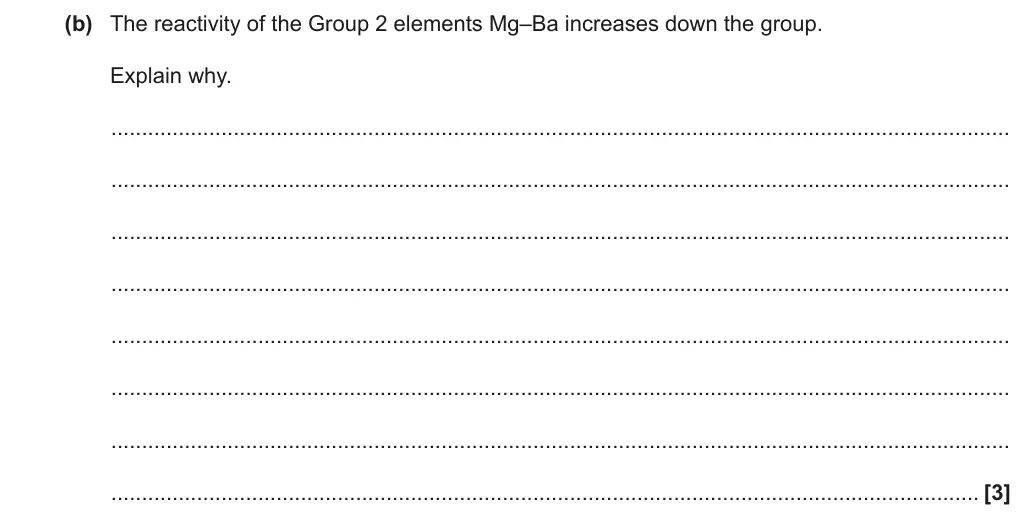
(b) The reactivity of the Group 2 elements Mg–Ba increases down the group.
Explain why.
...................................................................................................................................................
...................................................................................................................................................
...................................................................................................................................................
...................................................................................................................................................
...................................................................................................................................................
...................................................................................................................................................
...................................................................................................................................................
.............................................................................................................................................. [3]
June 2017 · Paper 1 · Q17(c)(i) 3 marks Data interpretation halogensredox
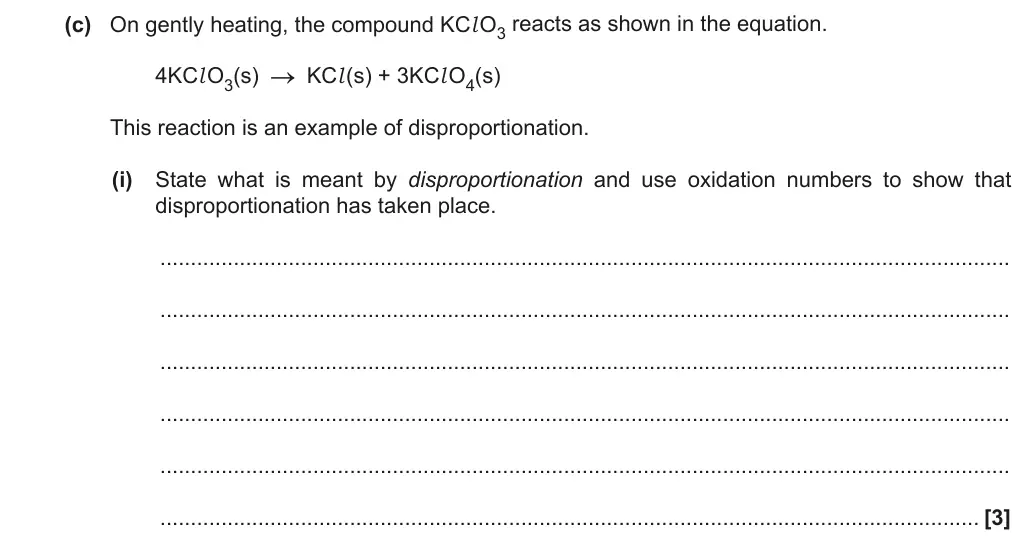
(c) On gently heating, the compound KCl O3 reacts as shown in the equation.
4KCl O3(s) KCl (s) + 3KCl O4(s)
This reaction is an example of disproportionation.
(i) State what is meant by disproportionation and use oxidation numbers to show that
disproportionation has taken place.
...........................................................................................................................................
...........................................................................................................................................
...........................................................................................................................................
...........................................................................................................................................
...........................................................................................................................................
...................................................................................................................................... [3]
June 2017 · Paper 1 · Q17(c)(ii) 1 mark Short answer redox
Earlier part of question 17 that this part usesEarlier part of June 2017 Paper 1 question 17
(ii) What is the systematic name for KCl O4?
...................................................................................................................................... [1]
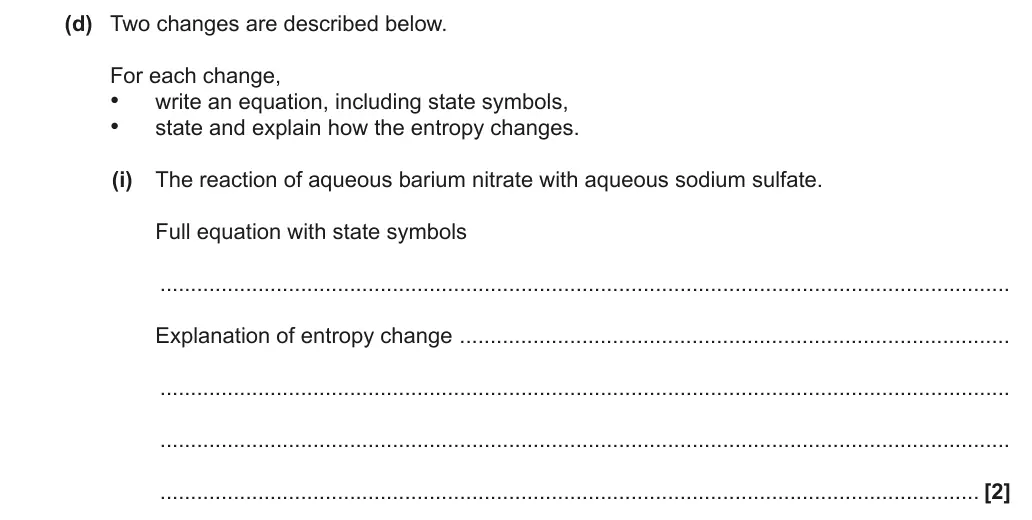
June 2017 · Paper 1 · Q17(d)(i) 2 marks Equation writing entropy and free energyformulae and equationsqualitative analysis
(d) Two changes are described below.
For each change,
• write an equation, including state symbols,
• state and explain how the entropy changes.
(i) The reaction of aqueous barium nitrate with aqueous sodium sulfate.
Full equation with state symbols
...........................................................................................................................................
Explanation of entropy change  ..........................................................................................
...........................................................................................................................................
...........................................................................................................................................
...................................................................................................................................... [2]
June 2017 · Paper 1 · Q17(d)(ii) 2 marks Equation writing entropy and free energylattice enthalpy
Earlier part of question 17 that this part usesEarlier part of June 2017 Paper 1 question 17
(ii) The change that accompanies the standard enthalpy change of atomisation of iodine.
Equation with state symbols
...........................................................................................................................................
Explanation of entropy change  ..........................................................................................
...........................................................................................................................................
...........................................................................................................................................
...................................................................................................................................... [2]
June 2017 · Paper 1 · Q18(a) 4 marks Data interpretation entropy and free energy
18 This question is about free energy changes, ∆G, enthalpy changes, ∆H, and temperature, T.
(a) The Gibbs’ equation is shown below.
∆G = ∆H – T∆S
A chemist investigates a reaction to determine how ∆G varies with T.
The results are shown in Fig. 18.1.
+
ΔG Q
/ kJ mol–1 0,0
T/K
–
P
Fig. 18.1
What is significant about the gradient of the line and the values P and Q shown in Fig. 18.1?
Explain your reasoning.
...................................................................................................................................................
...................................................................................................................................................
...................................................................................................................................................
...................................................................................................................................................
...................................................................................................................................................
...................................................................................................................................................
...................................................................................................................................................
...................................................................................................................................................
.............................................................................................................................................. [4]
June 2017 · Paper 1 · Q18(b)(i) 1 mark Short answer equilibrium constants
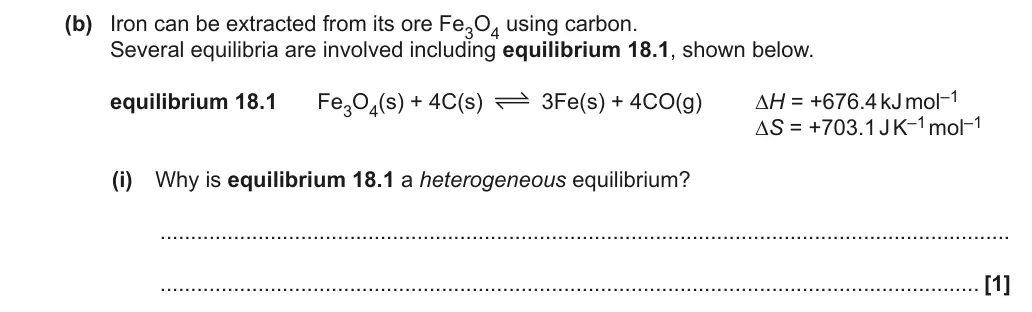
(b) Iron can be extracted from its ore Fe3O4 using carbon.
Several equilibria are involved including equilibrium 18.1, shown below.
equilibrium 18.1 Fe3O4(s) + 4C(s) 3Fe(s) + 4CO(g) ∆H = +676.4 kJ mol–1
∆S = +703.1 J K–1 mol–1
(i) Why is equilibrium 18.1 a heterogeneous equilibrium?
...........................................................................................................................................
...................................................................................................................................... [1]
June 2017 · Paper 1 · Q18(b)(ii) 1 mark Short answer equilibrium constants
Earlier part of question 18 that this part usesEarlier part of June 2017 Paper 1 question 18
(ii) Write the expression for Kp for equilibrium 18.1.
[1]
June 2017 · Paper 1 · Q18(b)(iii) 3 marks Calculation entropy and free energy
Earlier part of question 18 that this part usesEarlier part of June 2017 Paper 1 question 18
(iii) The forward reaction in equilibrium 18.1 is only feasible at high temperatures.
• Show that the forward reaction is not feasible at 25 °C.
• Calculate the minimum temperature, in K, for the forward reaction to be feasible.
minimum temperature =  ...................................................... K [3]
June 2017 · Paper 1 · Q18(b)(iv) 3 marks Calculation enthalpy changes
Earlier part of question 18 that this part usesEarlier part of June 2017 Paper 1 question 18
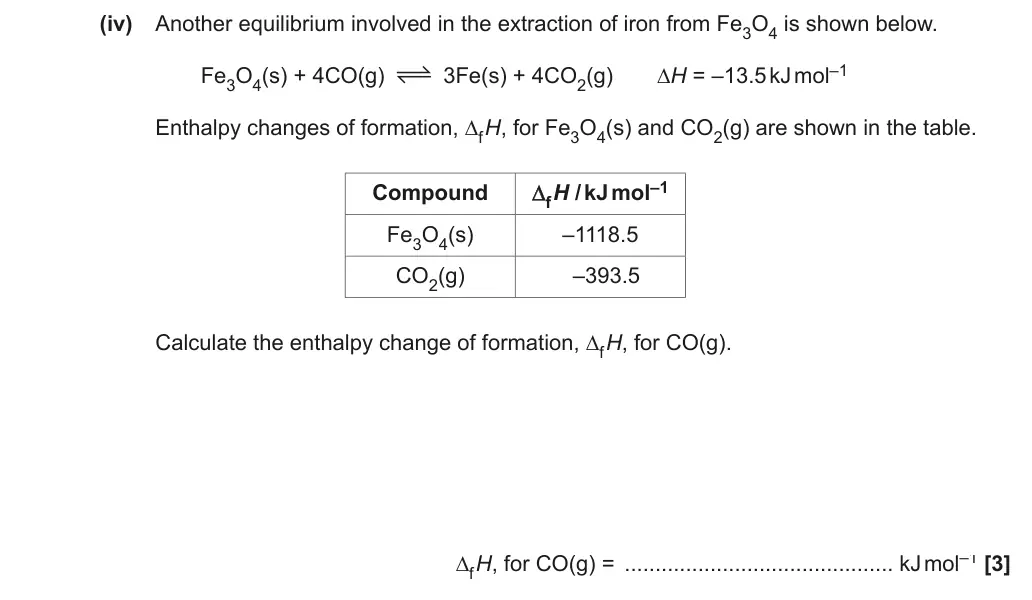
(iv) Another equilibrium involved in the extraction of iron from Fe3O4 is shown below.
Fe3O4(s) + 4CO(g) 3Fe(s) + 4CO2(g)  ∆H = –13.5 kJ mol–1
Enthalpy changes of formation, ∆f H, for Fe3O4(s) and CO2(g) are shown in the table.
Compound ∆f H / kJ mol–1
Fe3O4(s) –1118.5
CO2(g) –393.5
Calculate the enthalpy change of formation, ∆f H, for CO(g).
∆f H, for CO(g) =  ............................................ kJ mol–1 [3]
June 2017 · Paper 1 · Q19(a) 3 marks Short answer amount of substancepractical skillspractical techniques
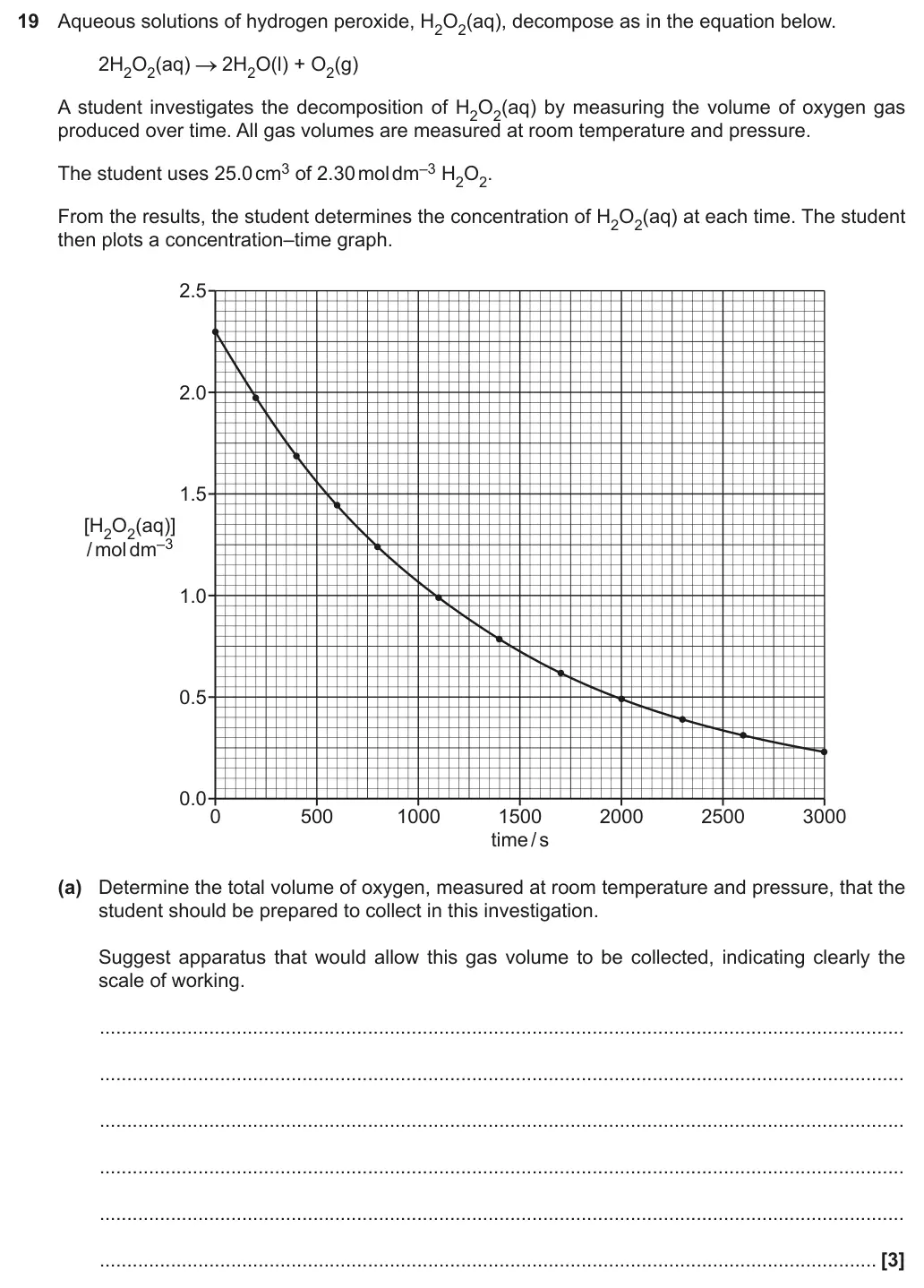
19 Aqueous solutions of hydrogen peroxide, H2O2(aq), decompose as in the equation below.
2H2O2(aq) 2H2O(l) + O2(g)
A student investigates the decomposition of H2O2(aq) by measuring the volume of oxygen gas
produced over time. All gas volumes are measured at room temperature and pressure.
The student uses 25.0 cm3 of 2.30 mol dm–3 H2O2.
From the results, the student determines the concentration of H2O2(aq) at each time. The student
then plots a concentration–time graph.
2.5
2.0
1.5
[H2O2(aq)]
/ mol dm–3
1.0
0.5
0.0
0 500 1000 1500 2000 2500 3000
time / s
(a) Determine the total volume of oxygen, measured at room temperature and pressure, that the
student should be prepared to collect in this investigation.
Suggest apparatus that would allow this gas volume to be collected, indicating clearly the
scale of working.
...................................................................................................................................................
...................................................................................................................................................
...................................................................................................................................................
...................................................................................................................................................
...................................................................................................................................................
.............................................................................................................................................. [3]
June 2017 · Paper 1 · Q19(b) 1 mark Short answer reaction ratesrate equations
Earlier part of question 19 that this part usesEarlier part of June 2017 Paper 1 question 19
(b) Suggest a different experimental method that would allow the rate of this reaction to be
followed over time.
...................................................................................................................................................
.............................................................................................................................................. [1]
June 2017 · Paper 1 · Q19(c) 6 marks 6-mark level of response rate equations
Earlier part of question 19 that this part usesEarlier part of June 2017 Paper 1 question 19
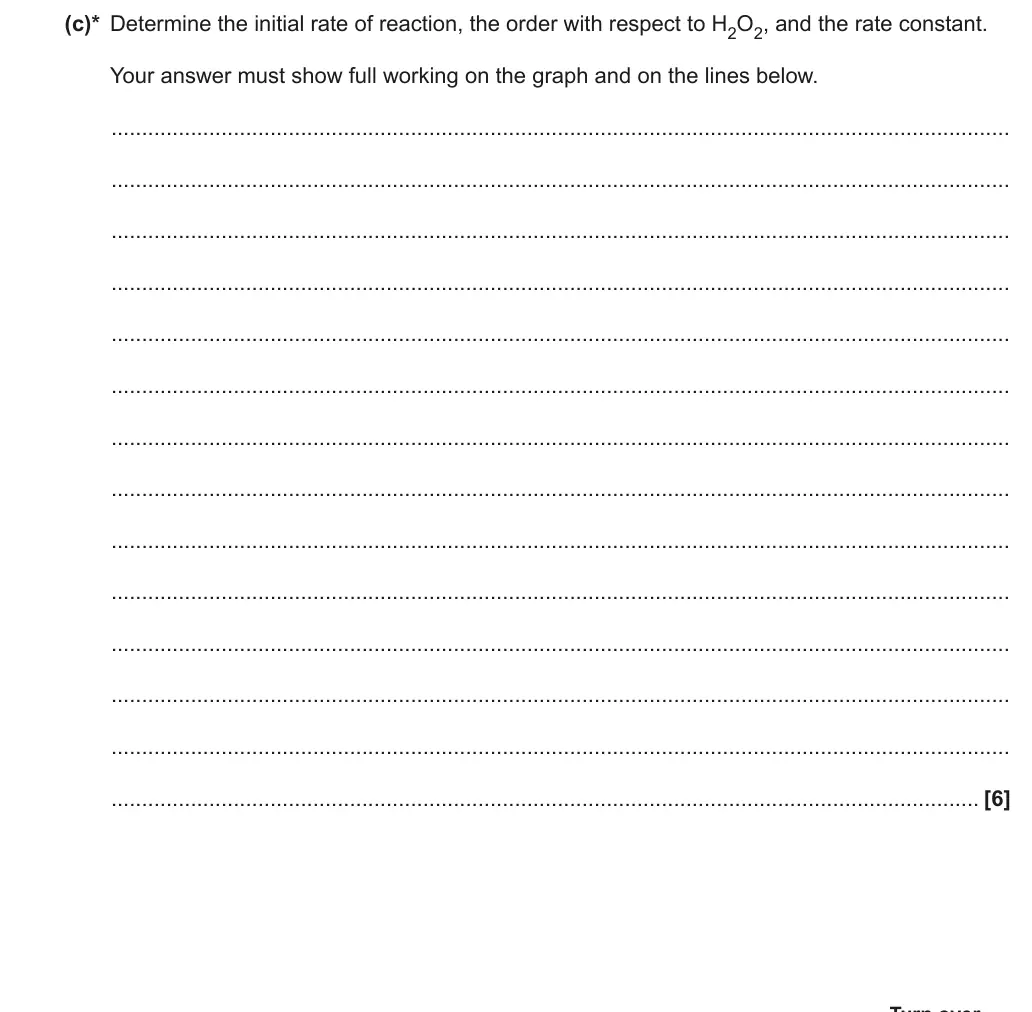
(c)* Determine the initial rate of reaction, the order with respect to H2O2, and the rate constant.
Your answer must show full working on the graph and on the lines below.
...................................................................................................................................................
...................................................................................................................................................
...................................................................................................................................................
...................................................................................................................................................
...................................................................................................................................................
...................................................................................................................................................
...................................................................................................................................................
...................................................................................................................................................
...................................................................................................................................................
...................................................................................................................................................
...................................................................................................................................................
...................................................................................................................................................
...................................................................................................................................................
.............................................................................................................................................. [6]
June 2017 · Paper 1 · Q20(a) 4 marks Short answer chemical equilibrium
20 This question is about equilibrium reactions.
(a) Hydrogen gas is manufactured by the chemical industry using the reaction of methane and
steam. This is a reversible reaction, shown in equilibrium 20.1 below.
equilibrium 20.1   CH4(g) + H2O(g) 3H2(g) + CO(g)    ∆H = +210 kJ mol–1
Explain, in terms of le Chatelier’s principle, the conditions of pressure and temperature
for a maximum yield of hydrogen from equilibrium 20.1, and explain why the operational
conditions used by the chemical industry may be different.
...................................................................................................................................................
...................................................................................................................................................
...................................................................................................................................................
...................................................................................................................................................
...................................................................................................................................................
...................................................................................................................................................
...................................................................................................................................................
...................................................................................................................................................
.............................................................................................................................................. [4]
June 2017 · Paper 1 · Q20(b)(i) 2 marks Short answer equilibrium constantschemical equilibrium
(b) A chemist investigates the equilibrium reaction between sulfur dioxide, oxygen, and sulfur
trioxide, shown below.
2SO2(g) + O2(g) 2SO3(g)
• The chemist mixes together SO2 and O2 with a catalyst.
• The chemist compresses the gas mixture to a volume of 400 cm3.
• The mixture is heated to a constant temperature and is allowed to reach equilibrium
without changing the total gas volume.
The equilibrium mixture contains 0.0540 mol SO2 and 0.0270 mol O2.
At the temperature used, the numerical value for Kc is 3.045 × 10⁴ dm3 mol–1.
(i) Write the expression for Kc and the units of Kc for this equilibrium.
[2]
June 2017 · Paper 1 · Q20(b)(ii) 4 marks Calculation equilibrium constants
Earlier part of question 20 that this part usesEarlier part of June 2017 Paper 1 question 20
(ii) Determine the amount, in mol, of SO3 in the equilibrium mixture at this temperature.
Give your final answer to an appropriate number of significant figures.
Show all your working.
equilibrium amount of SO3 =  ................................................... mol [4]
June 2017 · Paper 1 · Q21(a) 3 marks Calculation acids bases and buffers
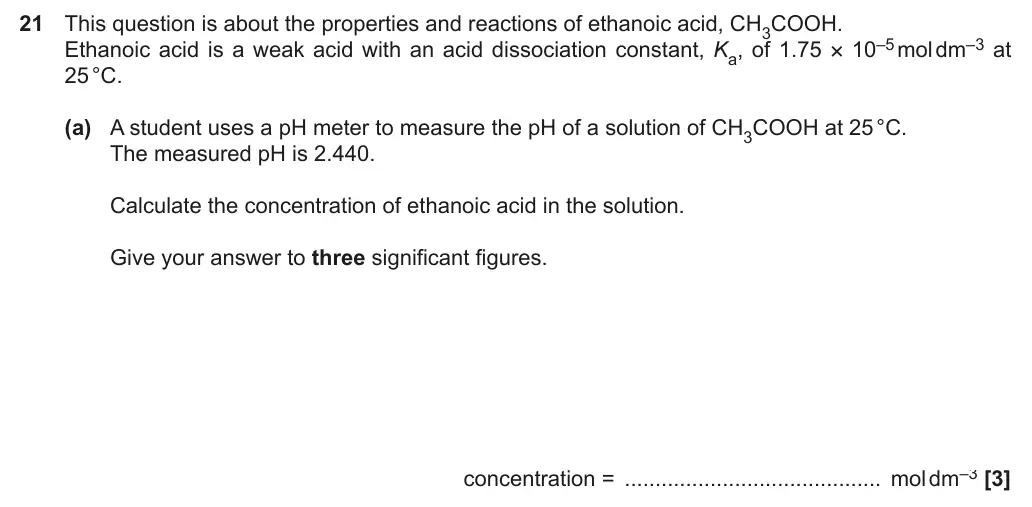
21 This question is about the properties and reactions of ethanoic acid, CH3COOH.
Ethanoic acid is a weak acid with an acid dissociation constant, Ka, of 1.75 × 10⁻⁵ mol dm–3 at
25 °C.
(a) A student uses a pH meter to measure the pH of a solution of CH3COOH at 25 °C.
The measured pH is 2.440.
Calculate the concentration of ethanoic acid in the solution.
Give your answer to three significant figures.
concentration =  .......................................... mol dm–3 [3]
June 2017 · Paper 1 · Q21(b) 2 marks Drawing / labelling acids bases and buffers
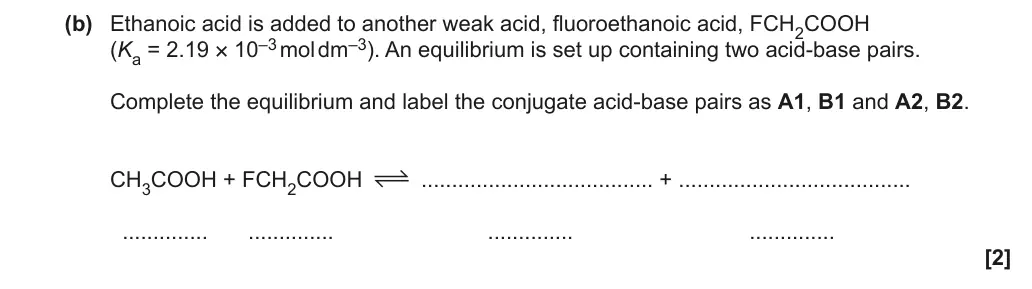
(b) Ethanoic acid is added to another weak acid, fluoroethanoic acid, FCH2COOH
(Ka = 2.19 × 10⁻³ mol dm–3). An equilibrium is set up containing two acid-base pairs.
Complete the equilibrium and label the conjugate acid-base pairs as A1, B1 and A2, B2.
CH3COOH + FCH2COOH ...................................... + ......................................
..............    ..............       ..............        ..............
[2]
June 2017 · Paper 1 · Q21(c)(i) 5 marks Short answer acids bases and buffersamount of substance
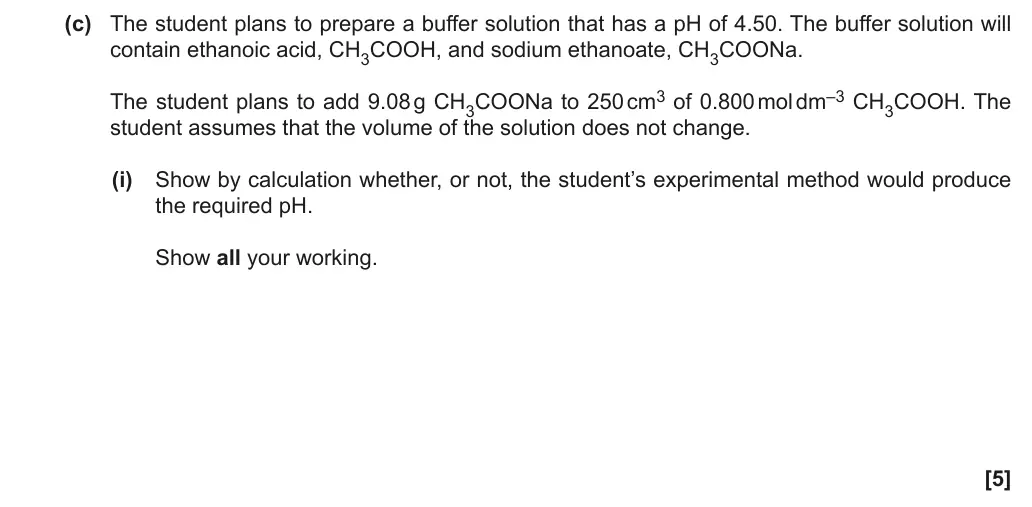
(c) The student plans to prepare a buffer solution that has a pH of 4.50. The buffer solution will
contain ethanoic acid, CH3COOH, and sodium ethanoate, CH3COONa.
The student plans to add 9.08 g CH3COONa to 250 cm3 of 0.800 mol dm–3 CH3COOH. The
student assumes that the volume of the solution does not change.
(i) Show by calculation whether, or not, the student’s experimental method would produce
the required pH.
Show all your working.
[5]
June 2017 · Paper 1 · Q21(c)(ii) 2 marks Short answer acids bases and buffers
Earlier part of question 21 that this part usesEarlier part of June 2017 Paper 1 question 21
(ii) When the student prepares the buffer solution, the volume of solution increases slightly.
Suggest whether the pH of the buffer solution would be the same, greater than, or less
than your calculated value in (c)(i).
Explain your reasoning.
...........................................................................................................................................
...........................................................................................................................................
...........................................................................................................................................
...................................................................................................................................... [2]
June 2017 · Paper 1 · Q22(a)(i) 4 marks Drawing / labelling redox and electrode potentials
22 This question is about redox, electrode potentials and feasibility.
Table 22.1 shows standard electrode potentials for four redox systems.
You need to use this information to answer the questions below.
Redox system Equation E ө / V
1 Zn2+(aq) + 2e– Zn(s) –0.76
2 SO4 2–(aq) + 2H+(aq) + 2e– SO3 2–(aq) + H2O(l) +0.17
3 Fe3+(aq) + e– Fe2+(aq) +0.77
4 MnO4 –(aq) + 8H+(aq) + 5e– Mn2+(aq) + 4H2O(l) +1.51
Table 22.1
(a) A standard cell is set up in the laboratory based on redox systems 1 and 3 and the standard
cell potential is measured.
(i) Draw a labelled diagram to show how this cell could be set up to measure its standard
cell potential.
Include details of the apparatus, solutions and the standard conditions required to
measure this standard cell potential.
Standard conditions  ..........................................................................................................
...........................................................................................................................................
...................................................................................................................................... [4]
June 2017 · Paper 1 · Q22(a)(ii) 1 mark Calculation redox and electrode potentials
Earlier part of question 22 that this part usesEarlier part of June 2017 Paper 1 question 22
(ii) Predict the standard cell potential of this cell.
standard cell potential =  ...................................................... V [1]
June 2017 · Paper 1 · Q22(b) 2 marks Data interpretation redox and electrode potentials
Earlier part of question 22 that this part usesEarlier part of June 2017 Paper 1 question 22
(b) In Table 22.1, what is the strongest reducing agent and the strongest oxidising agent?
Strongest reducing agent ..........................................................................................................
Strongest oxidising agent ..........................................................................................................
[2]
June 2017 · Paper 1 · Q22(c) 2 marks Equation writing redox and electrode potentials
Earlier part of question 22 that this part usesEarlier part of June 2017 Paper 1 question 22
(c) Electrode potentials can be used to predict the feasibility of reactions.
Construct an overall equation for the predicted reaction between the species in redox
systems 2 and 4.
.............................................................................................................................................. [2]
June 2017 · Paper 1 · Q23(a)(i) 5 marks Short answer transition elements
23 This question is about reactions of ions and compounds of transition elements.
(a) The flowchart shows reactions of the complex ion [Cu(H2O)6]2+.
(i) In the boxes, write down the formulae of the species responsible for the observations.
........................................
yellow solution
Reaction 1 HCl(aq)
[Cu(H2O)6]2+ NH3(aq)
pale blue solution ........................................
pale blue precipitate
Reaction 2 KI(aq) NH3(aq)
excess
+
................................ ................................
........................................
white solid brown solution
deep blue solution
[5]
June 2017 · Paper 1 · Q23(a)(ii) 2 marks Short answer transition elements
Earlier part of question 23 that this part usesEarlier part of June 2017 Paper 1 question 23
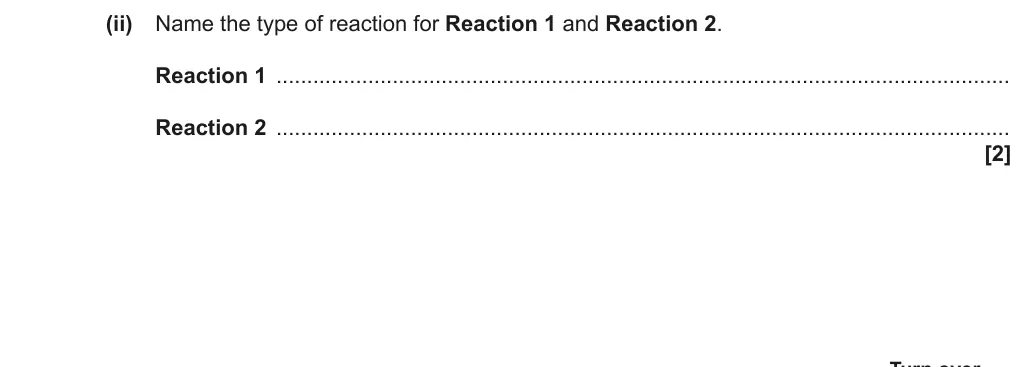
(ii) Name the type of reaction for Reaction 1 and Reaction 2.
Reaction 1  ........................................................................................................................
Reaction 2  ........................................................................................................................
[2]
June 2017 · Paper 1 · Q23(b) 6 marks 6-mark level of response amount of substancetransition elements
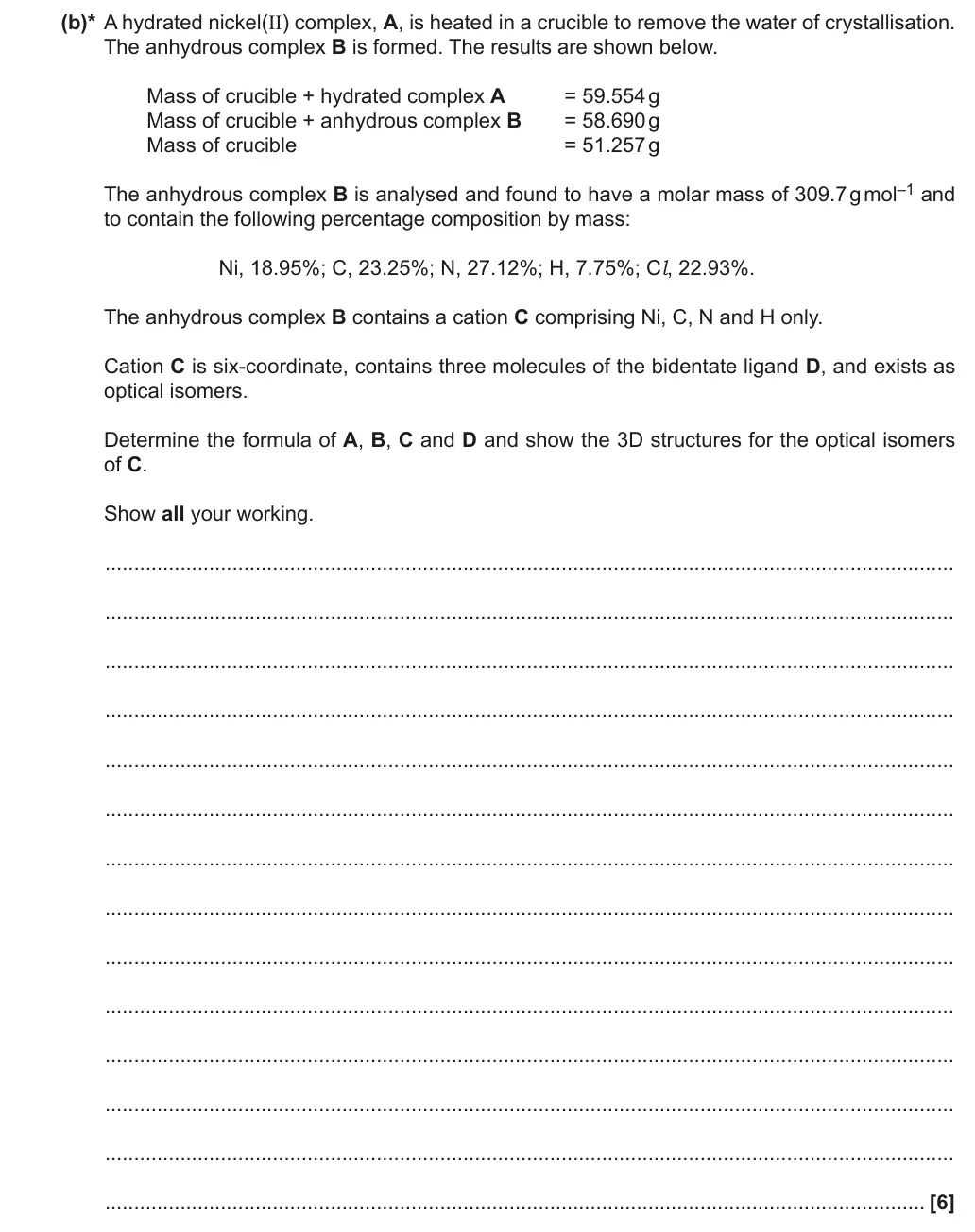
(b)* A hydrated nickel(II) complex, A, is heated in a crucible to remove the water of crystallisation.
The anhydrous complex B is formed. The results are shown below.
Mass of crucible + hydrated complex A = 59.554 g
Mass of crucible + anhydrous complex B = 58.690 g
Mass of crucible = 51.257 g
The anhydrous complex B is analysed and found to have a molar mass of 309.7 g mol–1 and
to contain the following percentage composition by mass:
Ni, 18.95%; C, 23.25%; N, 27.12%; H, 7.75%; Cl, 22.93%.
The anhydrous complex B contains a cation C comprising Ni, C, N and H only.
Cation C is six-coordinate, contains three molecules of the bidentate ligand D, and exists as
optical isomers.
Determine the formula of A, B, C and D and show the 3D structures for the optical isomers
of C.
Show all your working.
...................................................................................................................................................
...................................................................................................................................................
...................................................................................................................................................
...................................................................................................................................................
...................................................................................................................................................
...................................................................................................................................................
...................................................................................................................................................
...................................................................................................................................................
...................................................................................................................................................
...................................................................................................................................................
...................................................................................................................................................
...................................................................................................................................................
...................................................................................................................................................
.............................................................................................................................................. [6]

Work with an OCR chemistry tutor

Want a paper marked and gone through with you? Message us.

Prefer email? Send an enquiry

If you are under 18, please include a parent's contact details. Enquiries go to enquiries@chemistryaleveltutor.com and are deleted once handled. All tutoring is online.