Answer
D
Mark scheme

70 marks · 43 question parts · Paper, mark scheme and report on OCR's site · Have OCR's Data Sheet beside you
D
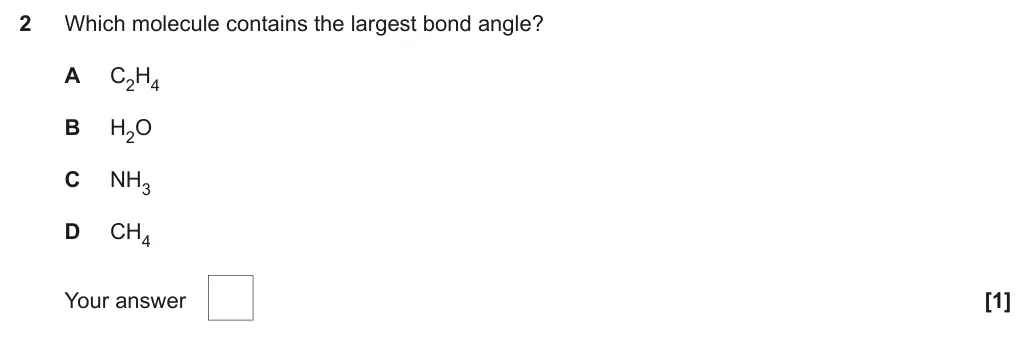
A
This part discriminated well, with most able candidates selecting the correct answer of A. A sizeable number selected B, accompanied by a diagram of an H2O molecule with a 180º bond angle, presumably by ignoring the lone pairs. C2H4 was often shown with a bond angle of 109.5º, presumably as the C=C bond had not been identified, giving a bond angle of 120º.

C
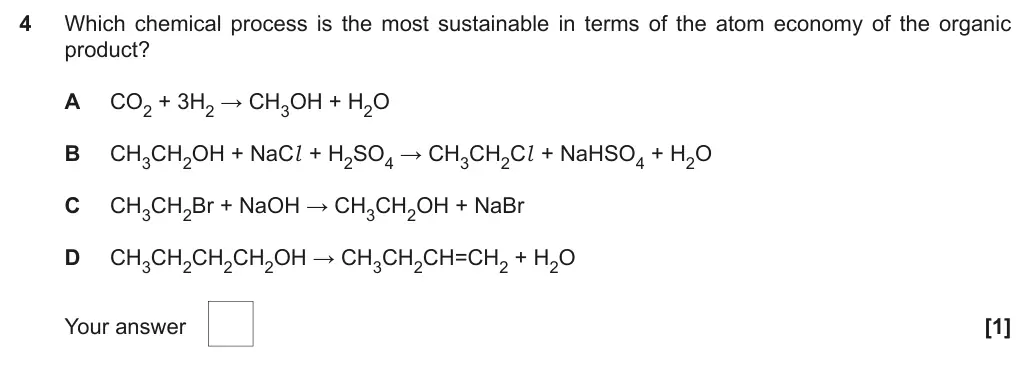
D
This part discriminated extremely well. Many scripts showed clear working of the atom economy of each process, the usual result being the correct response of D. Candidates choosing an incorrect process (usually A), often showed no working suggesting the response was a guess. The advice here is obviously to work through calculations before choosing the answer.
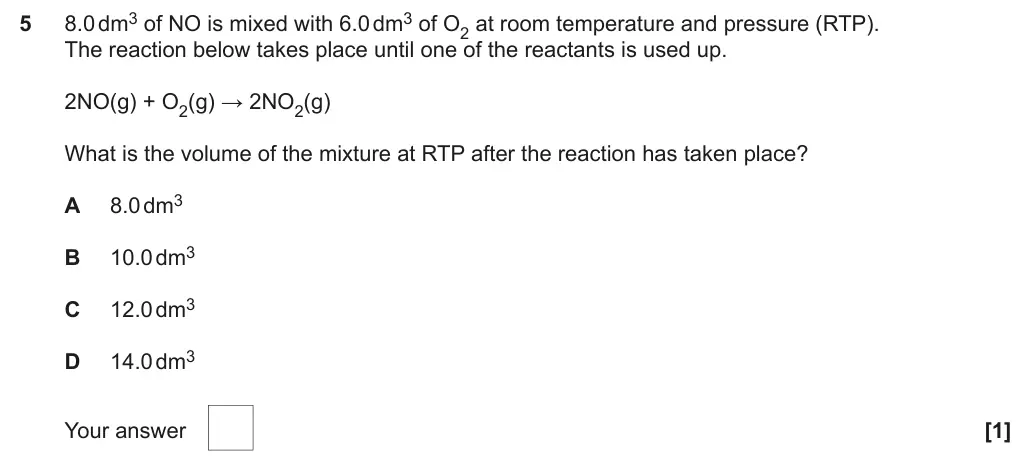
B
This question proved to be the most difficult of the multiple-choice questions. Candidates clearly did not use the clue in the question: ‘until one of the reactants is used up’. Many then responded with C, the volume of NO2 formed from complete reaction of 6 dm3 of O2. D was another common error, which is simply the sum of the volumes of NO and O2 provided in the question. The correct answer of B required candidate to identify that NO is in excess, reacting with 4 dm3 of the O2 to form 8 dm3 NO2 and leaving behind 2 dm3 of O2, and contributing to a total volume of 10 dm3 of gas.
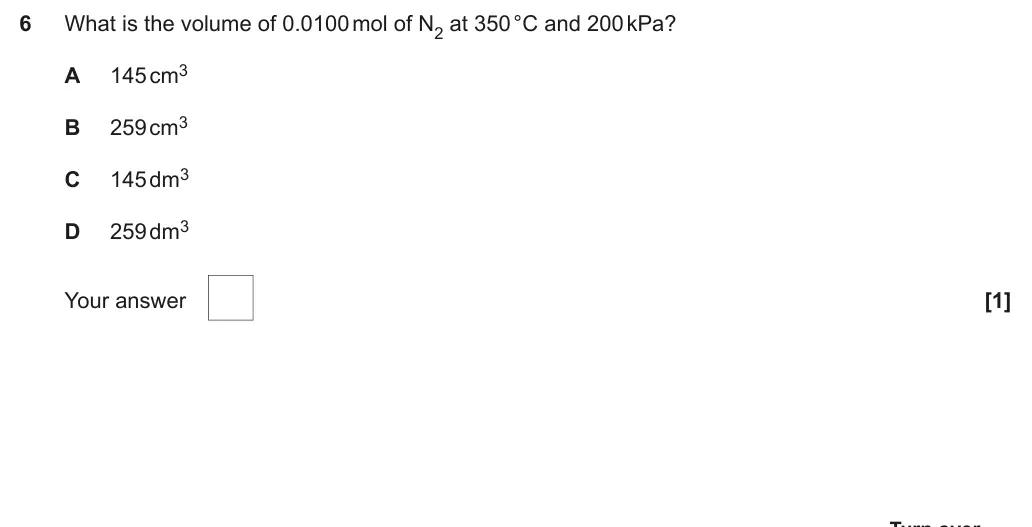
B
After the difficulties with Question 6, most candidates were able to use the ideal gas equation (annotated on many scripts) to obtain either 259 cm3 or 259 dm3. The correct value of B (259 cm3) revealed the difficulties of unit conversions experienced by many candidates.
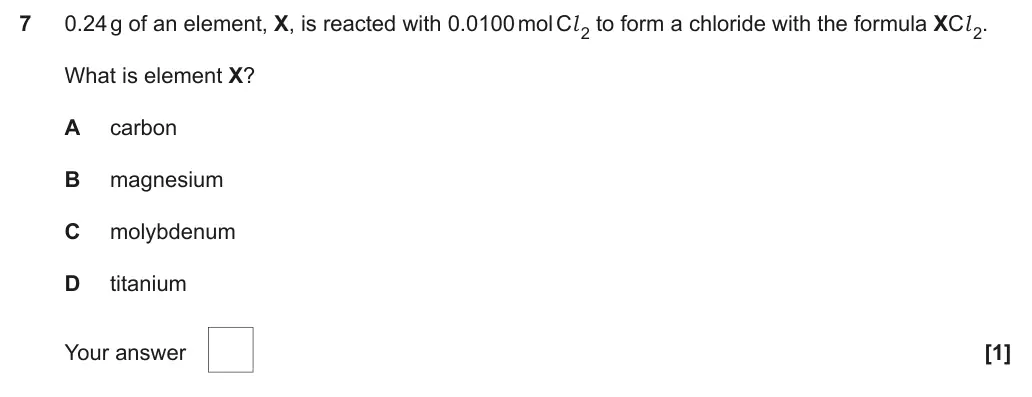
B
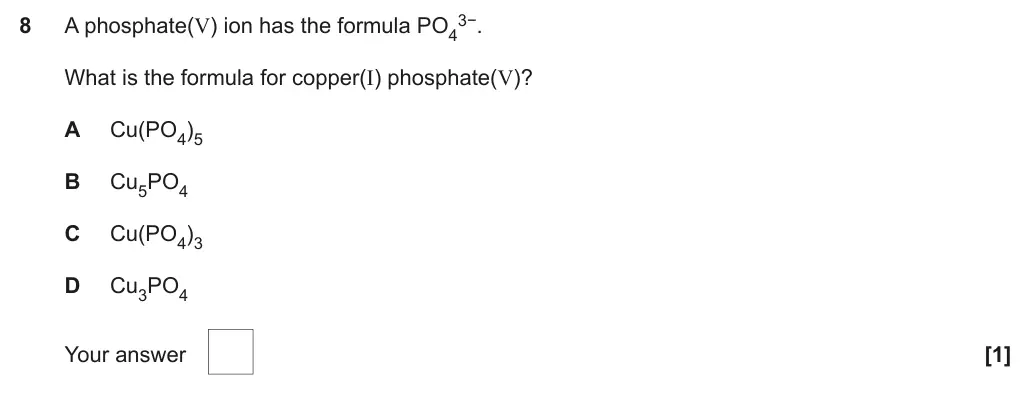
D
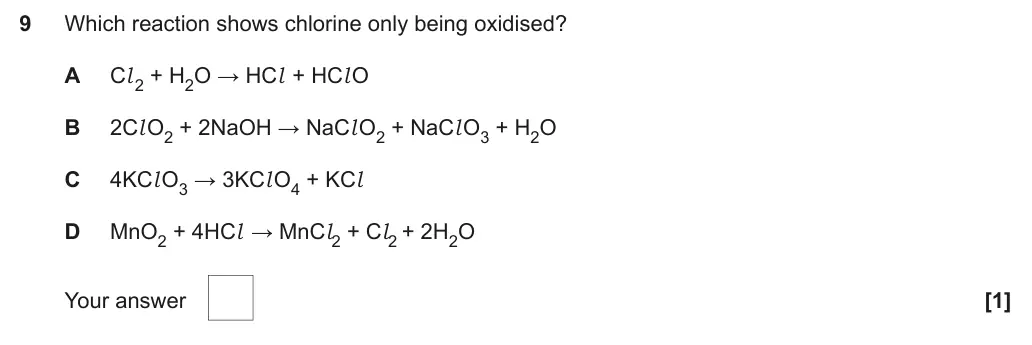
D
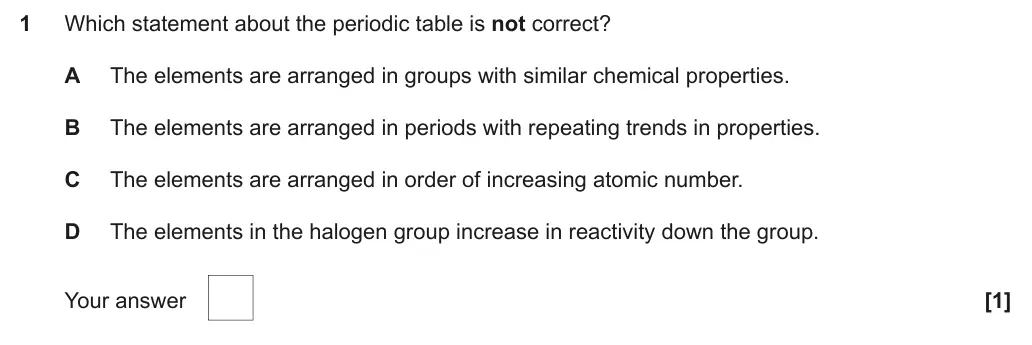
Despite most scripts being covered with annotations of oxidation numbers, only about half of all candidates obtained the correct answer of D.. Option B was the most common incorrect response, followed by option C. The annotations on these scripts often showed incorrect assignments of oxidation numbers.
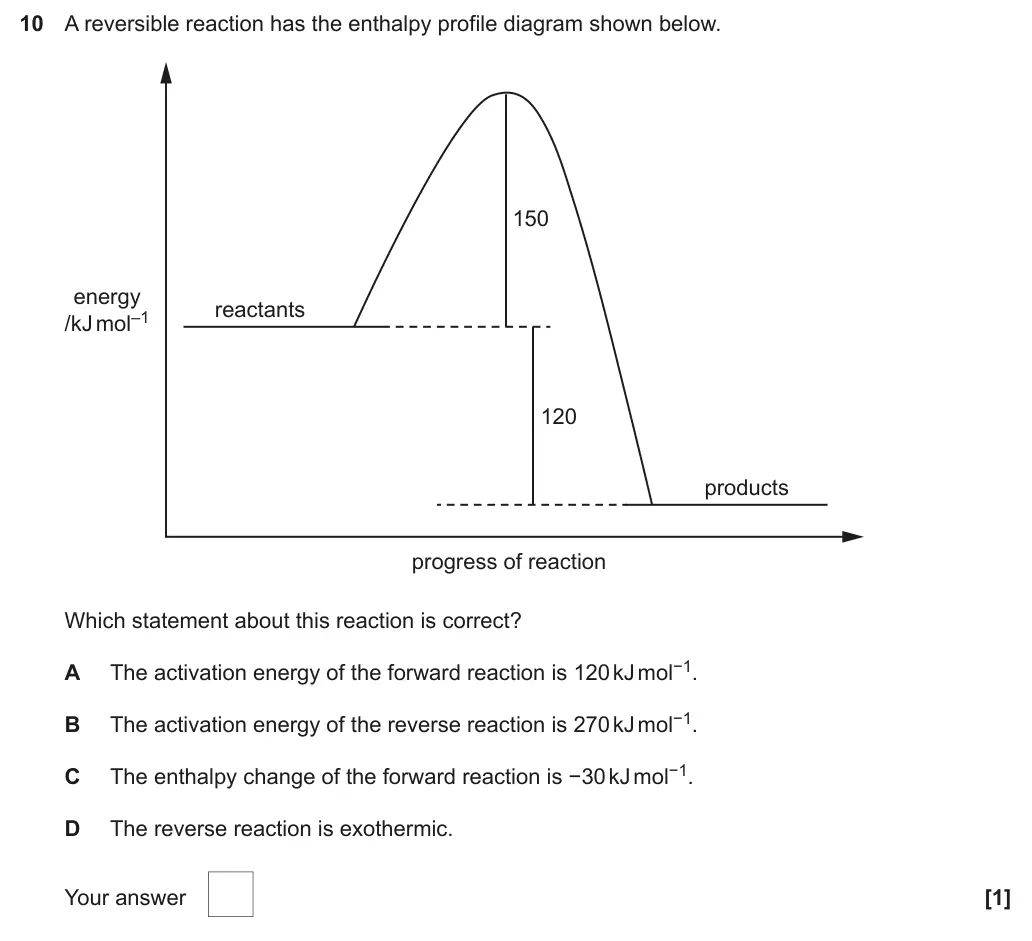
B
This part discriminated extremely well. Most candidates correctly identified option B but a sizeable number of less able candidates chose the different options in almost equal amounts. It was difficult to recognise where candidates were having problems and the incorrect responses were probably mainly guesses.
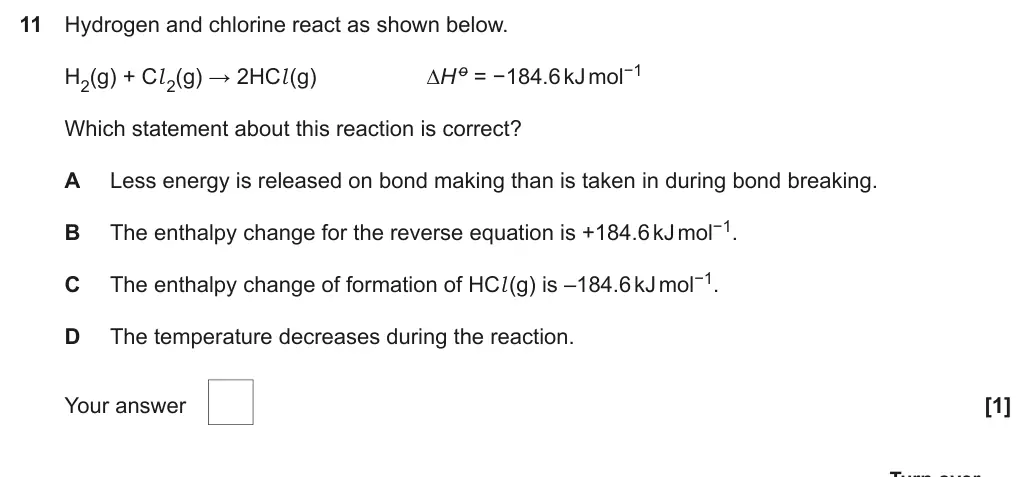
B
Many candidates found this question difficult with less than half choosing the correct option of B. Options A and C proved to be the main discriminators in almost equal amounts. Although first encountered at GCSE level, energies associated with bond breaking and bond making continue to cause candidates problems at AS and A Level. The discriminator C would have been chosen by candidates who did not recognise that –184.6 kJ is released when 2 mol HCl is formed and that the enthalpy change of formation would be half this value.

C
The role of activation energy in the rate of a reaction with increasing temperature was well-known and most candidates chose the correct option C. From the annotations on candidate scripts, many had ruled out options A and B entirely. D was anticipated as being the main distractor and this proved to be the case. Activation energy has a much greater effect than increasing collision frequency.

B
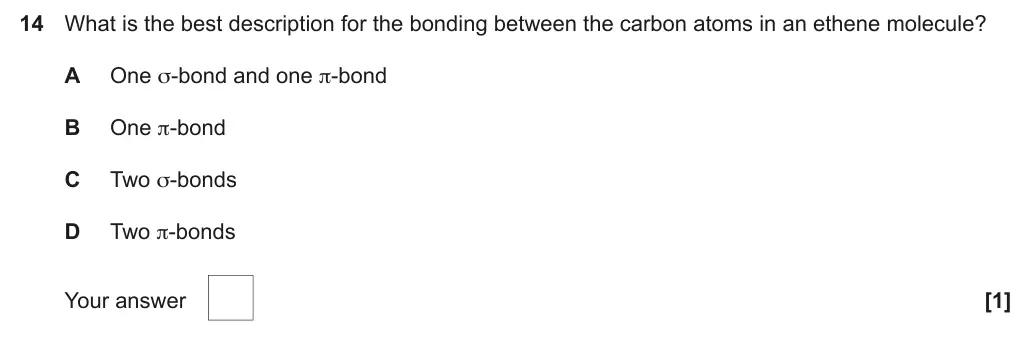
A
Candidates answered this question well with over two-thirds choosing the correct option A. Option D was the most common incorrect response suggesting that candidates are uncertain about the nature of a C=C double bond.
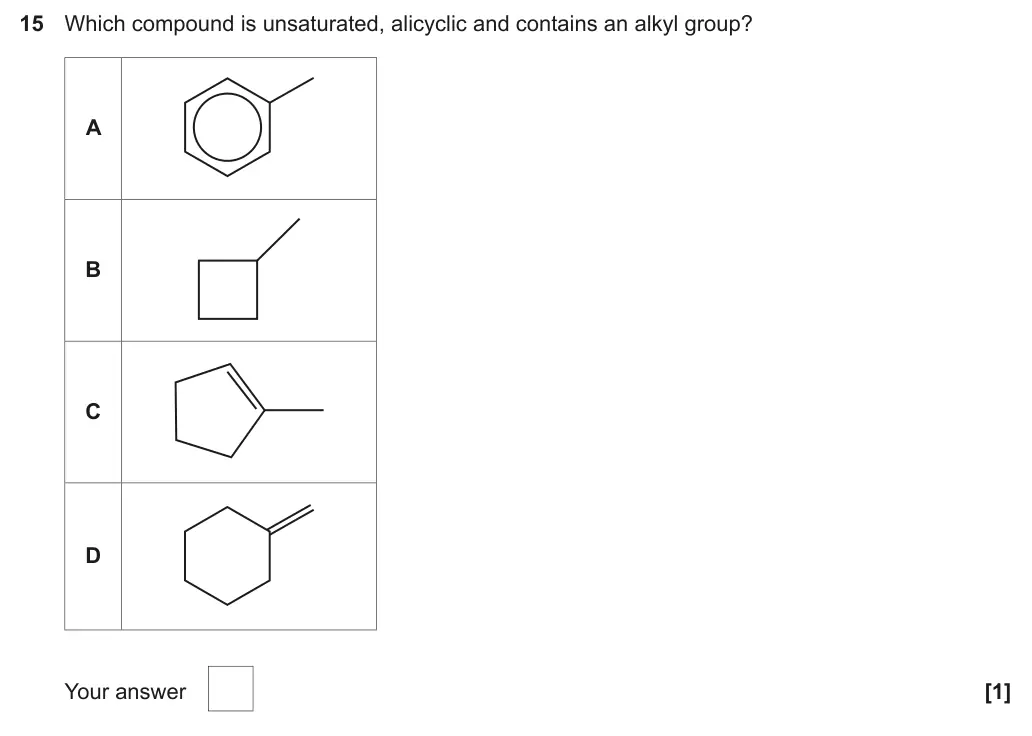
C
Unsaturated, alicyclic and alkyl are all terms that are introduced in AS Chemistry and about two-thirds of candidates recognised that option C met the three criteria. From the annotations on scripts, most candidates ruled out the saturated option B. A sizeable number of candidates selected either the aromatic option A, or structure D which does not possess an alkyl group. It is important that candidates learn the terms introduced in the specification Section 4.1.1, Basic concepts in organic chemistry.
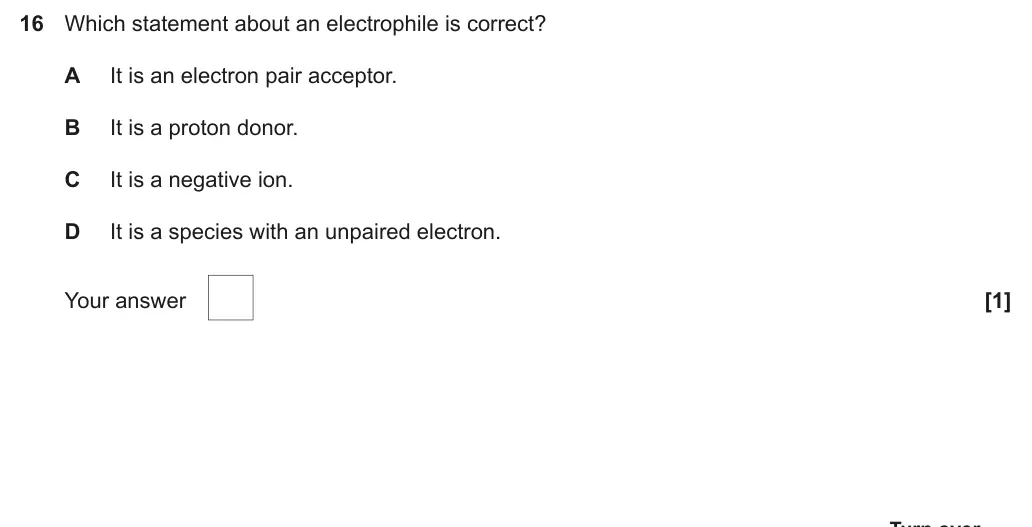
A
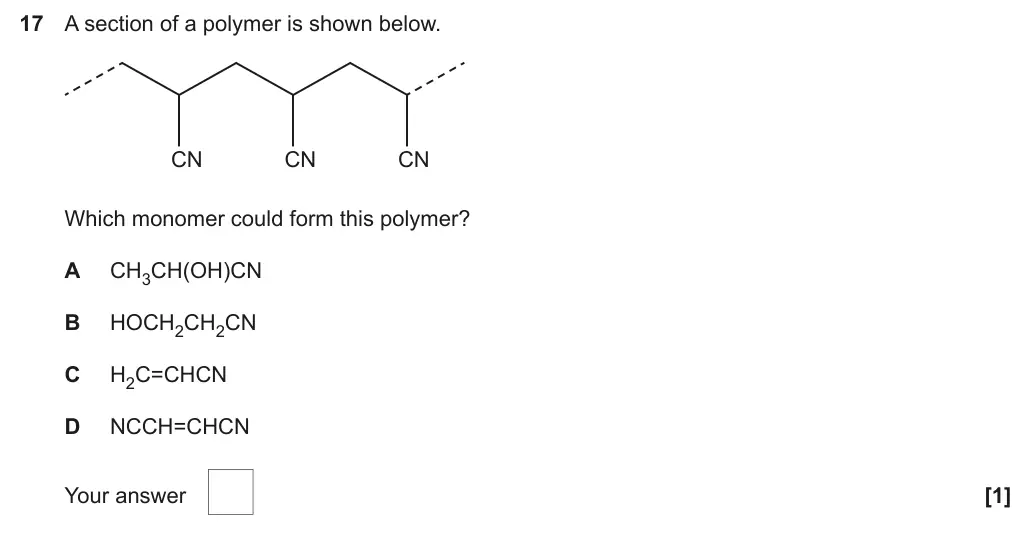
C
This part discriminated well. Although most candidates did select C as the correct structure, many were diverted into selecting option D, the other alternative containing a double C=C bond. In identifying a monomer for an addition polymer, candidates are advised to identify the repeat unit and then to replace the single C–C bond with a double bond to give the monomer.

A
Candidates found this part difficult. Less than half the candidates selected the correct option A, with ‘B’ being the main distractor. From annotations on scripts, successful candidates often drew rings around parts of the structures which helps in identifying parts of a structure that might fragment.

D
Less than half the candidates correctly chose option D. This part discriminated well, with less able candidates selecting the incorrect A and C in similar amounts. A small number of candidates selected B.

B
Able candidates selected option B, identifying that the O–H peak matches an alcohol rather than carboxylic acid from the wavenumbers. Many candidates opted for option A, the carboxylic acid, which would have a much broader O–H peak with slightly lower wavenumber range. Annotations were common on the spectrum and a sizeable number labelled the C–H peak with O–H, a clear misconception which was also mentioned in the report for H032/01 from June 2018. Section B overview Section B includes short answer question styles (structured questions, problem solving, calculations, practical) and extended response questions. This section of the paper is worth 50 marks.

Candidates needed to state two differences for 1 mark. Most candidates selected ‘different numbers of neutrons’ but this was often followed up by different ‘relative atomic mass’, the weighted mean of different isotopes, rather than ’different mass’ for a single isotope. This suggested that many candidates may not have understood the meaning of ’relative’ in ‘relative atomic mass’.

Candidates answered this question reasonably well but many selected incorrect elements despite having identified the correct mass number and numbers of protons, neutrons and electrons. A common error was a mass number of 55.8 for Fe, clearly a confusion between the mass number of an isotope and relative atomic mass (see also comments for 21(a)). Mn was also a common error for the first element, presumably by matching the mass number of 54 with the relative atomic mass of Mn (54.9).

Most candidates added arrows correctly to the boxes but the sub-shell labels were sometimes omitted. Lower attaining candidates sometimes paired electrons, rather than showing them singly or showed six electrons in the 2p sub-shell. This suggested either a lack of understanding or failure to read the question.
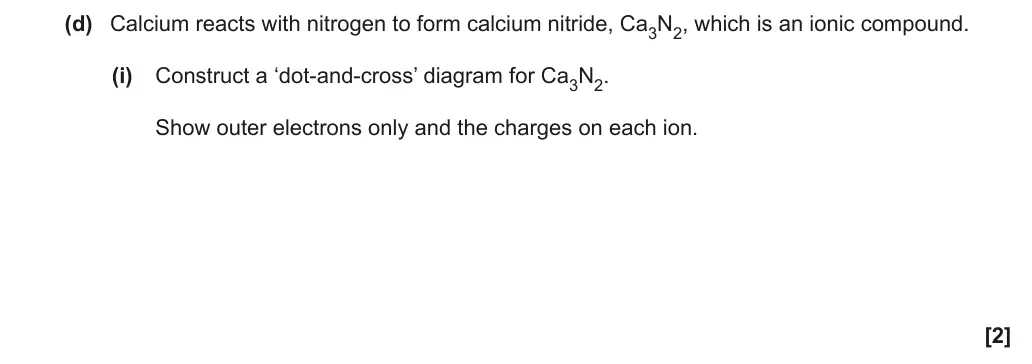
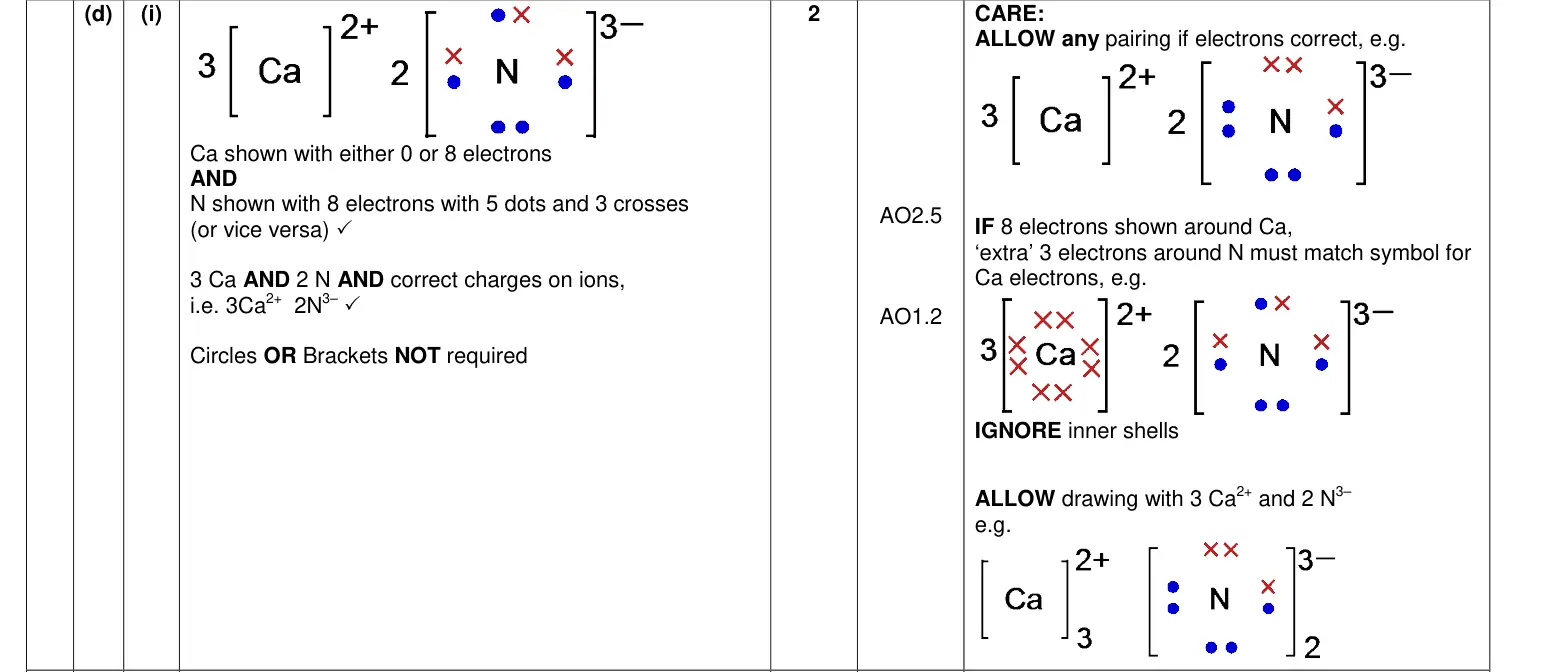
Most candidates showed a correct, clear ‘dot and cross’ diagram. Lower attaining candidates sometimes used wrong charges, not enough ions or an incorrect number of electrons on N. Covalently-bonded molecules were seen, but rarely.

Most candidates were given 1 of the 2 available marks for showing the formula of one correct product, Ca(OH)2 or NH3. The best answers identified both products and were then able to balance the equation. Common errors included ‘CaO’ as a product and incorrect compounds of nitrogen (see the two responses above). This part discriminated very well.
Skills: M0.2 Use ratios, fractions and percentages
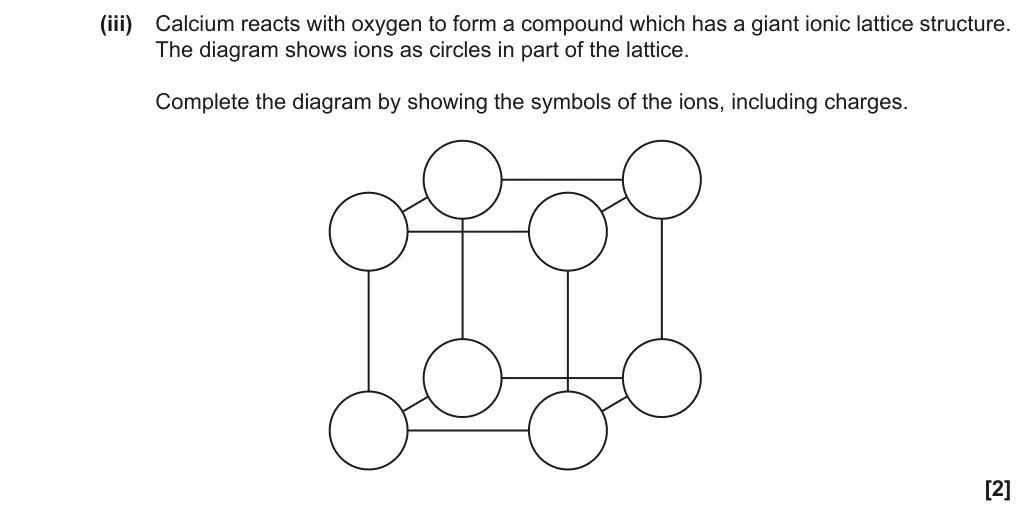
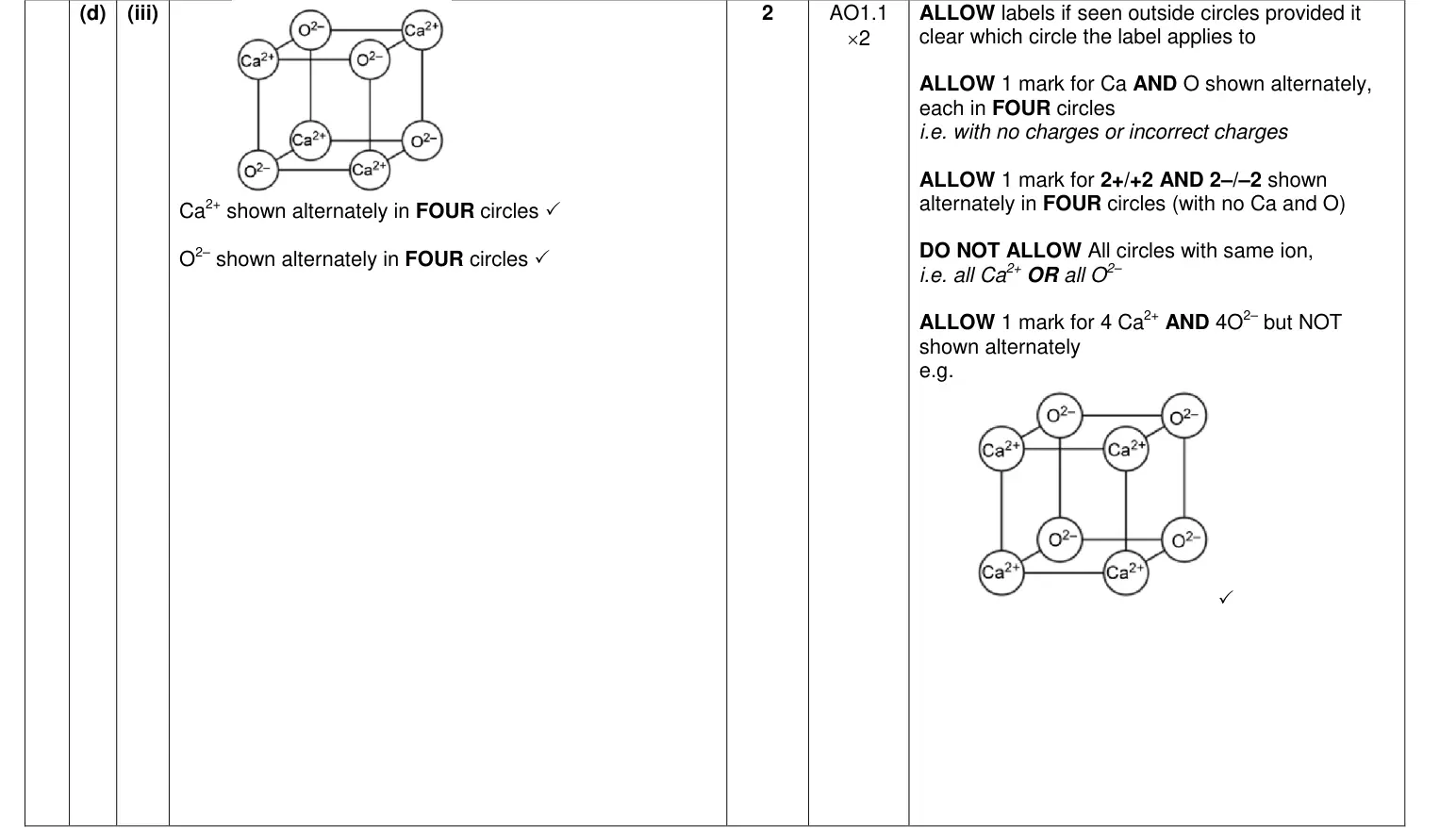
Most candidates completed the diagram with correct Ca2+ and O2– ions, shown alternately. Many different errors were seen for which 1 of the 2 marks could sometimes be given, e.g. 2+ and 2–, or Ca and O shown alternately. Some candidates used incorrect ions, with N3– the most common as a carry- over from 21d(i) and (ii). Some candidates completed each face of the structure with the same ion, rather than different ions alternately.
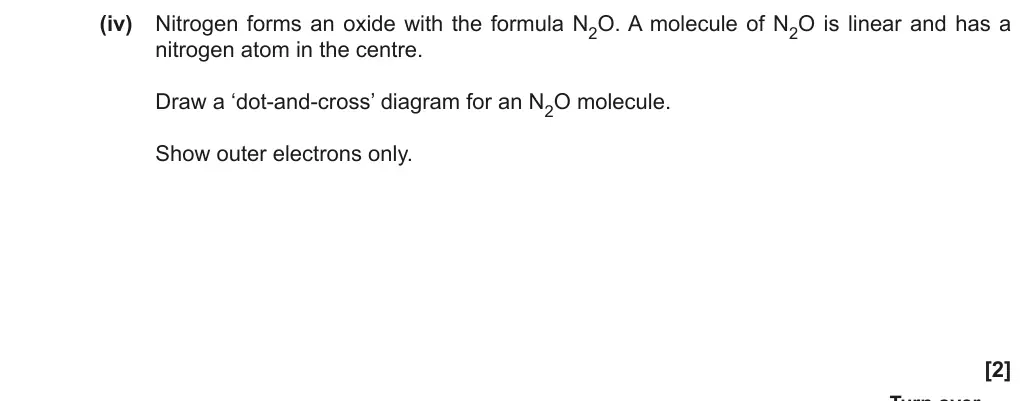
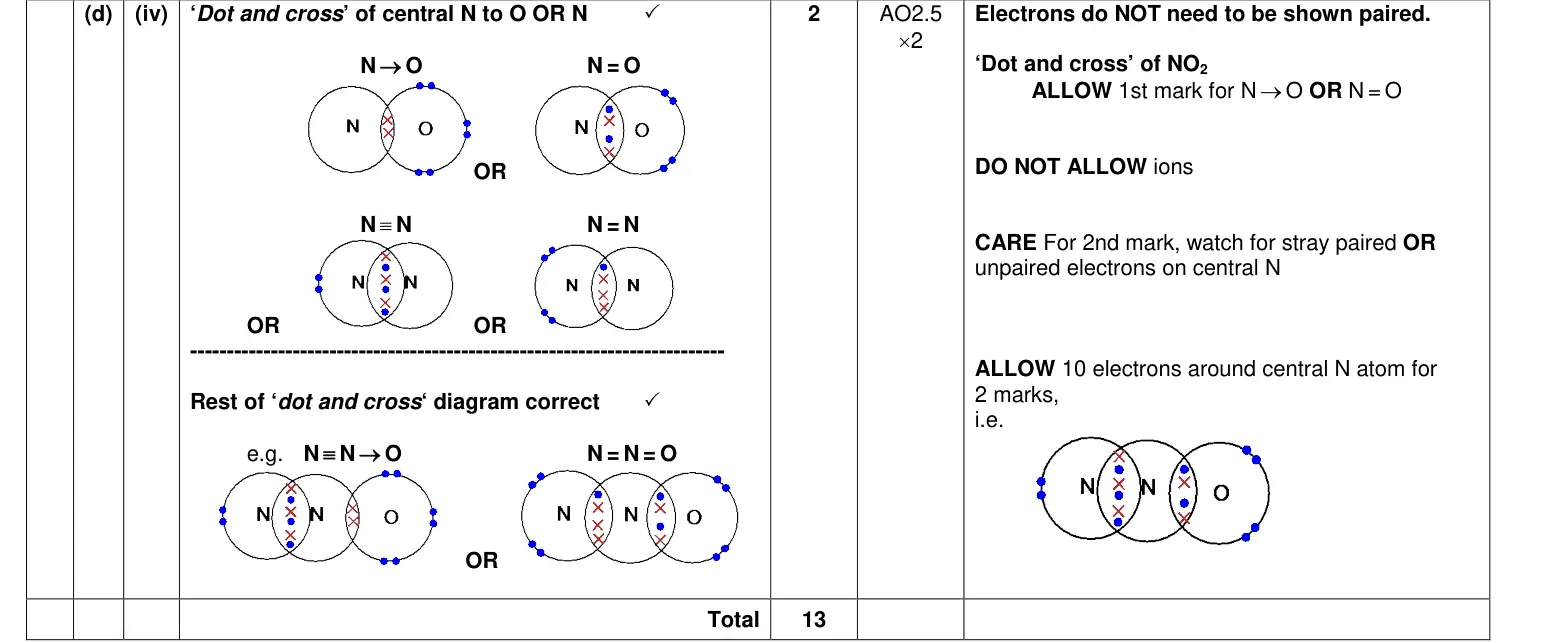
N2O is a very unfamiliar molecule for candidates and they found this ‘dot and cross’ diagram far more difficult than diagram for Ca3N2 in 21(d)(i). Information in the question clearly stated that a nitrogen atom is in the centre but many diagrams were drawn with the O atom at the centre. It was also fairly common to see NO2 rather than N2O. Candidates found the bonding of the O atom to the central N atom easier than the double or dative covalent bond between the two N atoms. Many candidates included lone pairs on the central N atom despite this resulting in a non-linear molecule. (The question states that the molecule is non-linear). It was common to see an expanded octet with 10 electrons being involved with the central N atom (a triple and double bond). If correct, this was given, reflecting a candidate’s knowledge at this stage of the course. Candidates are advised to take great care in showing clear symbols for electrons (dots and crosses or other symbols). Parts of the diagram where a dot and a cross cannot be distinguished cannot be credited. This part discriminated extremely well.
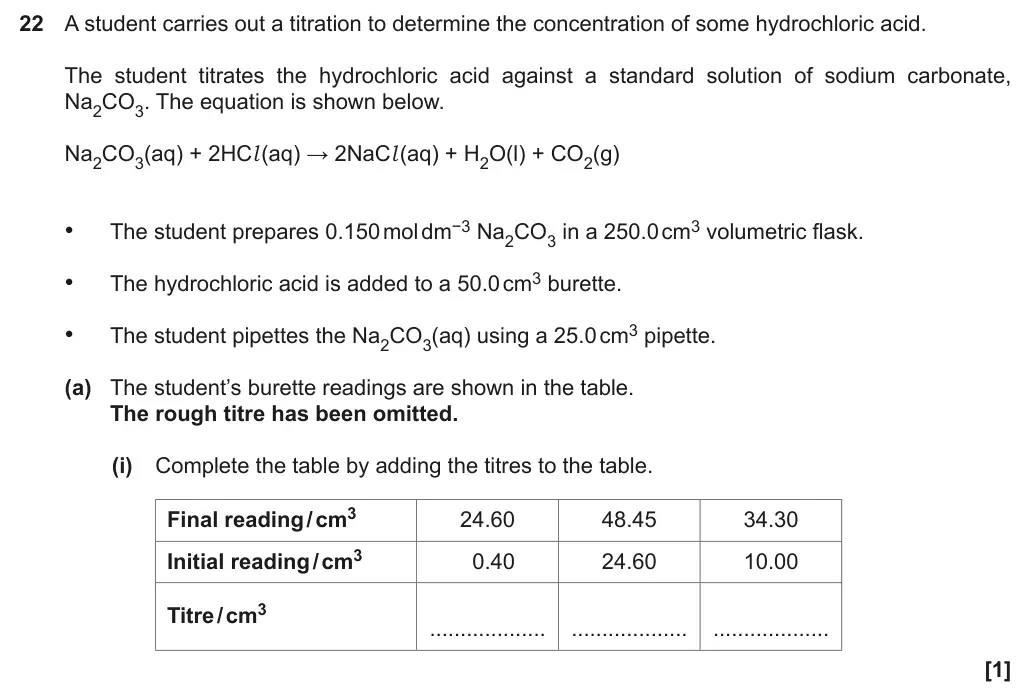
Most candidates added correct titres for the three titrations. However, an error made by a quarter of candidates was to omit the zero as the second decimal place in the first and third titres. This should have been usual practice from candidate experience of practical work and has also been highlighted as a common error in previous exam series.
Skills: PAG2 Acid–base titration

Most candidates identified that the first and third titres were concordant and calculated the mean titre that should be used as 24.25 cm3. About a third of candidates calculated the mean of all 3 titres as 24.10 or 24.12 cm3. Normal practice in titrations would be to select the closest titres.
Skills: M1.2 Find arithmetic means; PAG2 Acid–base titration
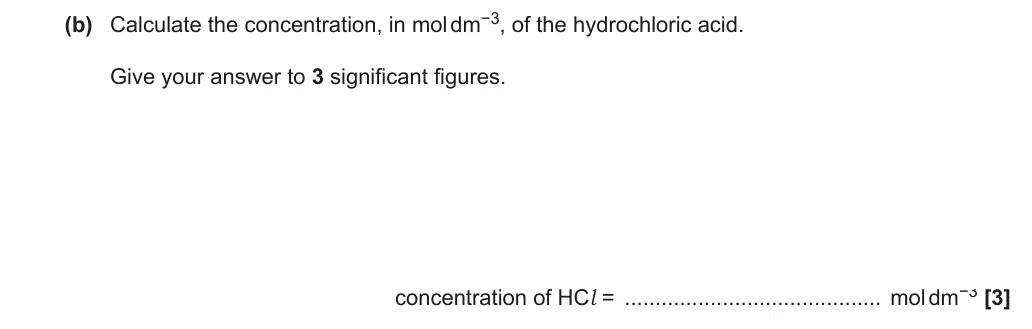
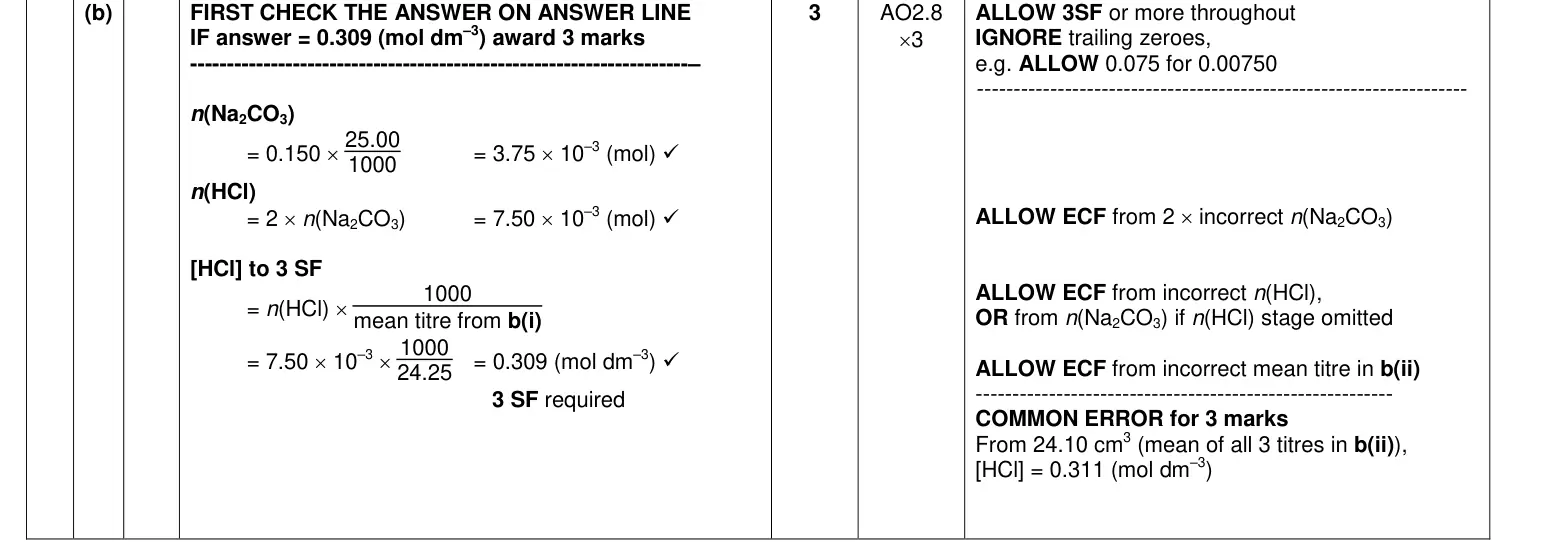
Many candidates were able to calculate the amount of Na2CO3 in the titration as 0.00375 mol although a common error was to calculate the amount of Na2CO3 in the 250 cm3 volumetric flask as 0.0375 mol. Most candidates were credited for the amount of HCl: twice their calculated amount of Na2CO3. Candidates then need to scale up this value by 1000/mean titre to obtain the concentration as 0.309 mol dm–3, and to quote the answer to 3 significant figures. Many candidates scaled up using 50.0, the burette volume, rather than their mean titre, resulting in a concentration 0.15 or 1.5 mol dm–3. A significant number also rounded their value to 2 rather than 3 significant figures. Candidates are advised to show clear working so that credit can be given for such responses by applying error carried forward. The working shown in this response is clear. Many candidates working was more jumbled, with unreferenced numbers common.
Skills: M0.2 Use ratios, fractions and percentages; M1.1 Use an appropriate number of significant figures; M2.2 Change the subject of an equation; PAG2 Acid–base titration

The calculations here should have reflected practical work carried out by candidates. Candidates were expected to realise that the pipette volume involves one measurement requiring the uncertainty of ±0.04 provided being used. As the volume measured by a burette uses two measurements, the uncertainty of ±0.05 must then be doubled to obtain the percentage uncertainty. It was very common for the burette value to be obtained using 0.05 rather than the doubled 0.10; some candidates doubled both uncertainties. Another common error was to use the volume of the burette of 50 cm3 rather than the volume of solution measured in the burette.
Skills: M1.3 Identify uncertainties in measurements and use simple techniques to determine uncertainty when data are combined; PAG2 Acid–base titration
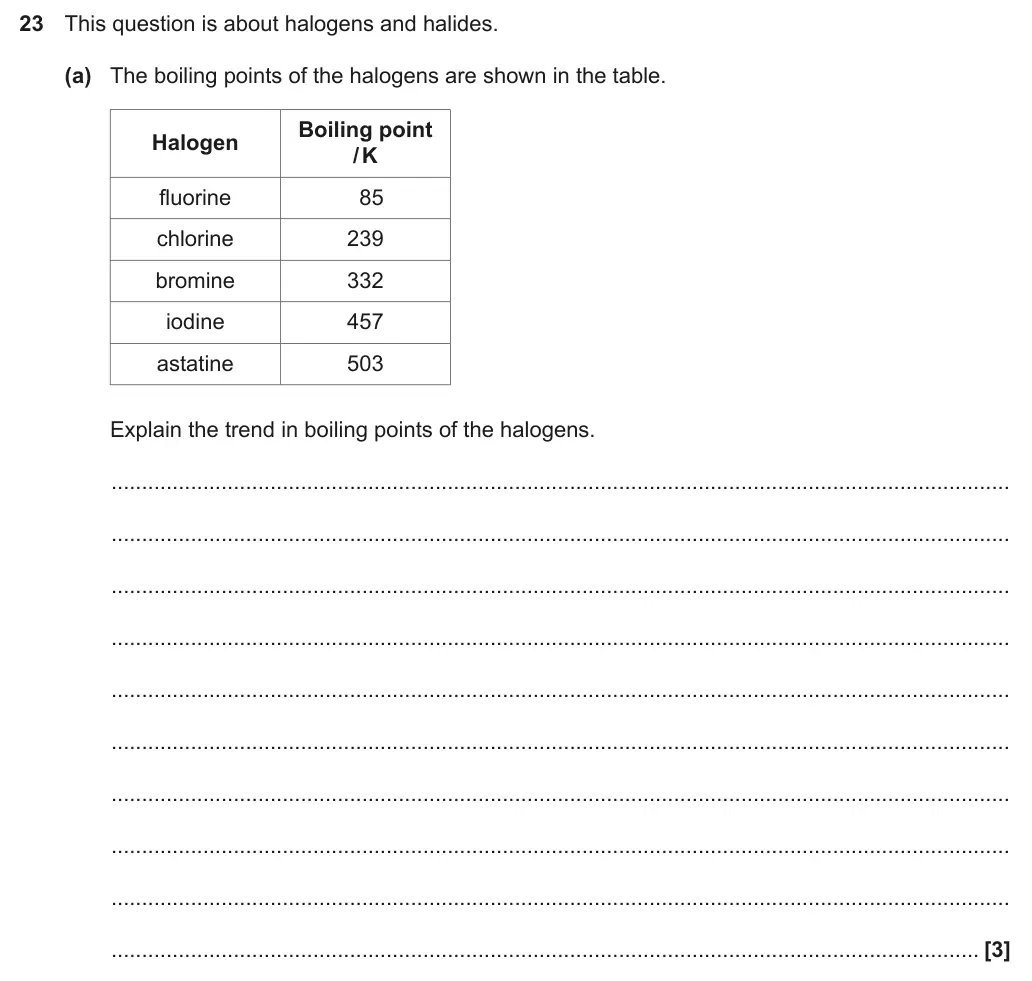
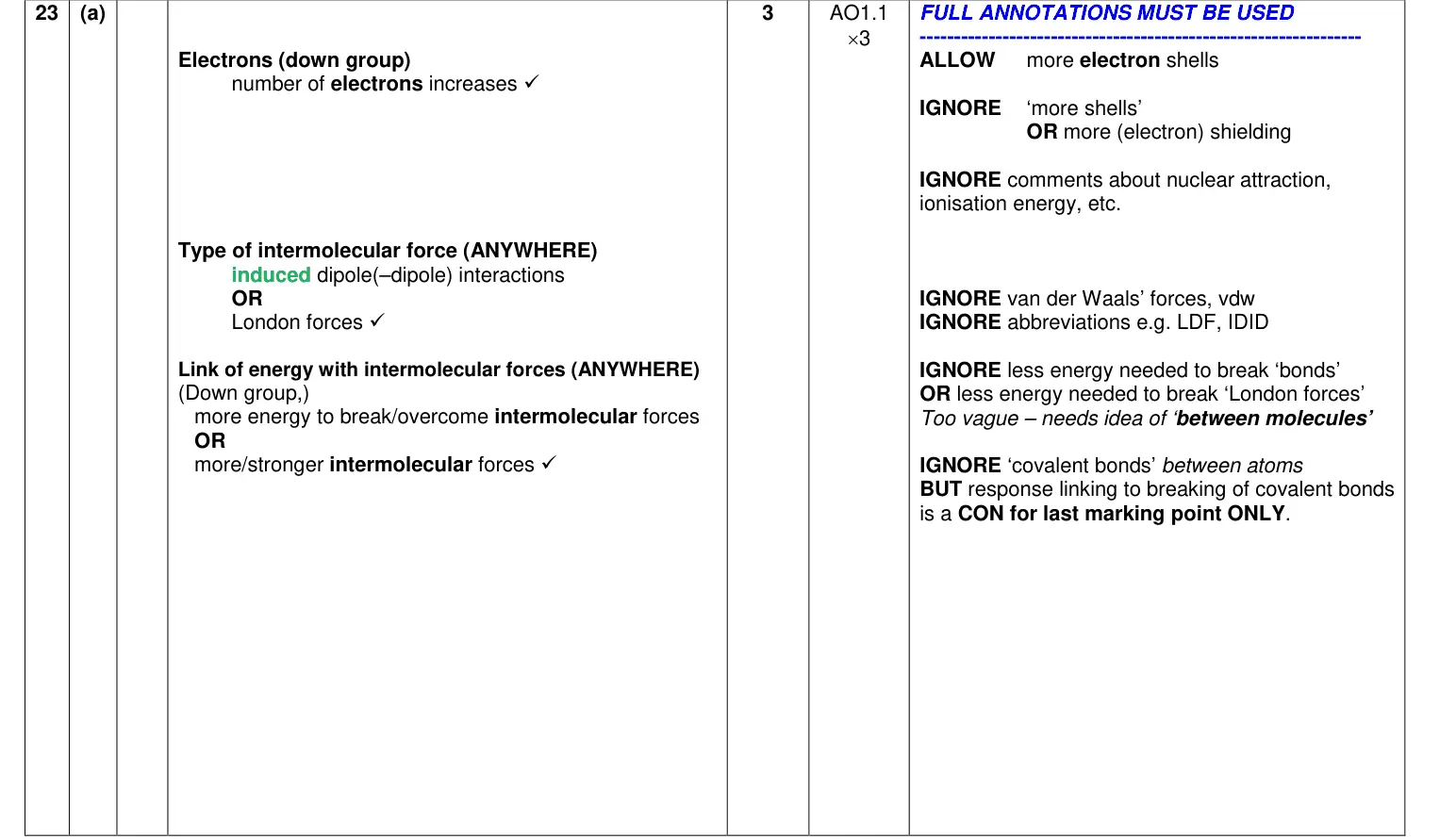
This question discriminated well. Candidates were expected to link increasing boiling point down the group with the increasing number of electrons and stronger induced dipole–dipole forces or London forces between molecules that must be broken. To be given all 3 marks, candidates needed to show that intermolecular forces (or forces between molecules) are broken during boiling. This mark proved to be the most difficult. The response shows a typical response that did not include intermolecular forces. Lower attaining candidates often let themselves down by being unable to construct a well-reasoned, relevant response. Many discussed nuclear charge, shielding, atomic radius and the ease of losing or gaining an electron to produce a valid explanation for ionisation energy or electron gain trend but not for different boiling points. The contrast in the clarity of low- and high-attaining candidate responses was particularly pronounced for this question.

This question was best discriminator of the paper and rewarded the well-prepared candidates who were competent in writing equations. Most candidates were given the 2 marks for the bromide test with silver nitrate and the related equation (usually shown ionically). Many found the test for the ammonium ion more challenging to describe. The alkaline nature of ammonia was well-known and the indicator colour change to blue was often seen. Many candidates omitted the NaOH reagent and tested the compound with indicator, thinking that the ammonium ion itself is alkaline. Few candidates were able to write the equation for the ammonium test. Lower attaining students often outlined electrolysis as a test and many candidates wrote about the carbonate and sulfate tests prior to the halide test.
Skills: PAG4 Qualitative analysis of ions

This question was answered well with many candidates being given all 4 marks. Most candidates identified that there are fewer gaseous moles of products and that an increase the pressure will shift the equilibrium position to the right. Although the exothermic nature of the forward reaction was usually identified, candidates sometimes muddled the temperature conditions required, with ‘higher temperature’ being seen often instead of ‘low temperature’. Lower attaining candidates often seemed to confuse equilibrium (in this question) with rates.

This part discriminated well. Most candidates were able to write the correct expression for Kc as the starting point of the calculation. Candidates often got into a muddle in calculating Kc, perhaps due to issues inputting the calculation into their calculators. The question asked for ‘an appropriate number of significant figures and in standard form’. As the provided data was all to 3 significant figures, this also indicates the required number of significant figures in the answer. A calculated value to 2 significant figures was often seen (see the response); also 0.0286 rather than the standard form: 2.86 × 10⁻². Some responses showed Kc inverted or added, rather than multiplying the two reactants in the denominator. Other candidates wrote the correct equilibrium expression but were then used 2.752, rather than 2.753, to obtain the standard form answer of 7.786 × 10⁻² or 0.0786 with no standard form. Candidates are advised to check back through calculations to see if they have made any such errors.
Skills: M0.1 Recognise and use expressions in decimal and ordinary form; M1.1 Use an appropriate number of significant figures; M2.3 Substitute numerical values into algebraic equations using appropriate units for physical quantities
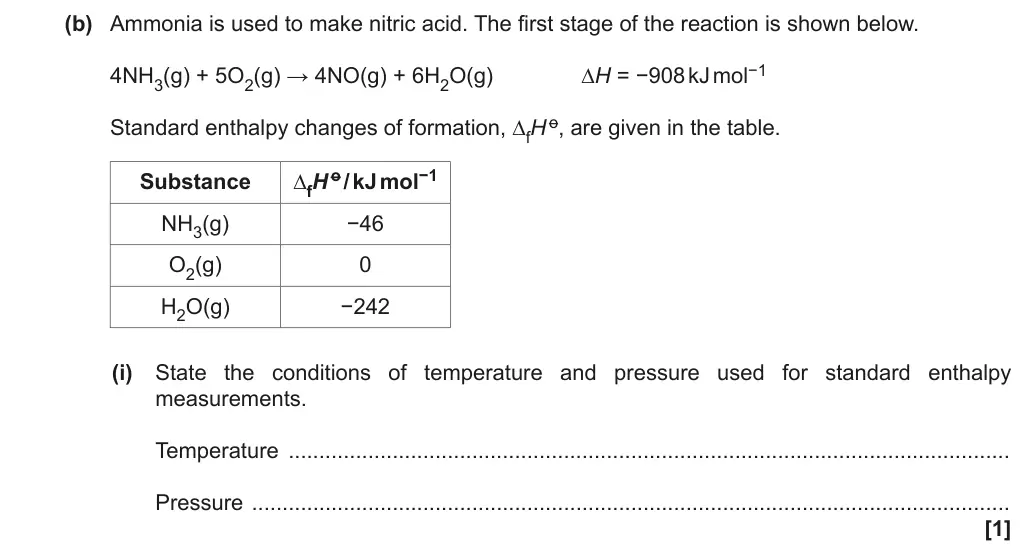
Only just over half of the candidates were able to quote standard conditions for enthalpy measurements. Errors included an incorrect temperature, often 273 and 293 K, or incorrect pressure (e.g. 1000 kPa, 100 atm). Candidates are reminded that ‘room temperature’ is not a standard temperature – a specific figure must be stated.
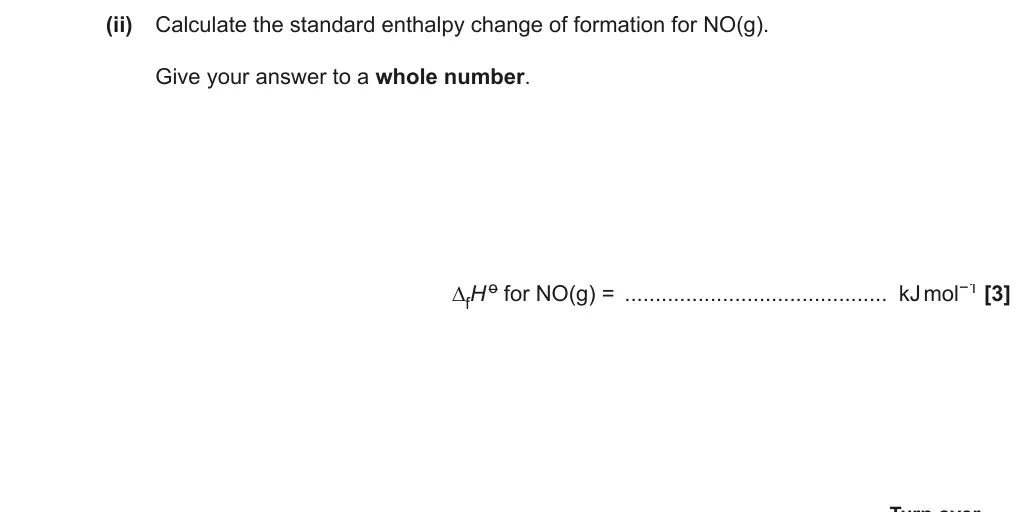
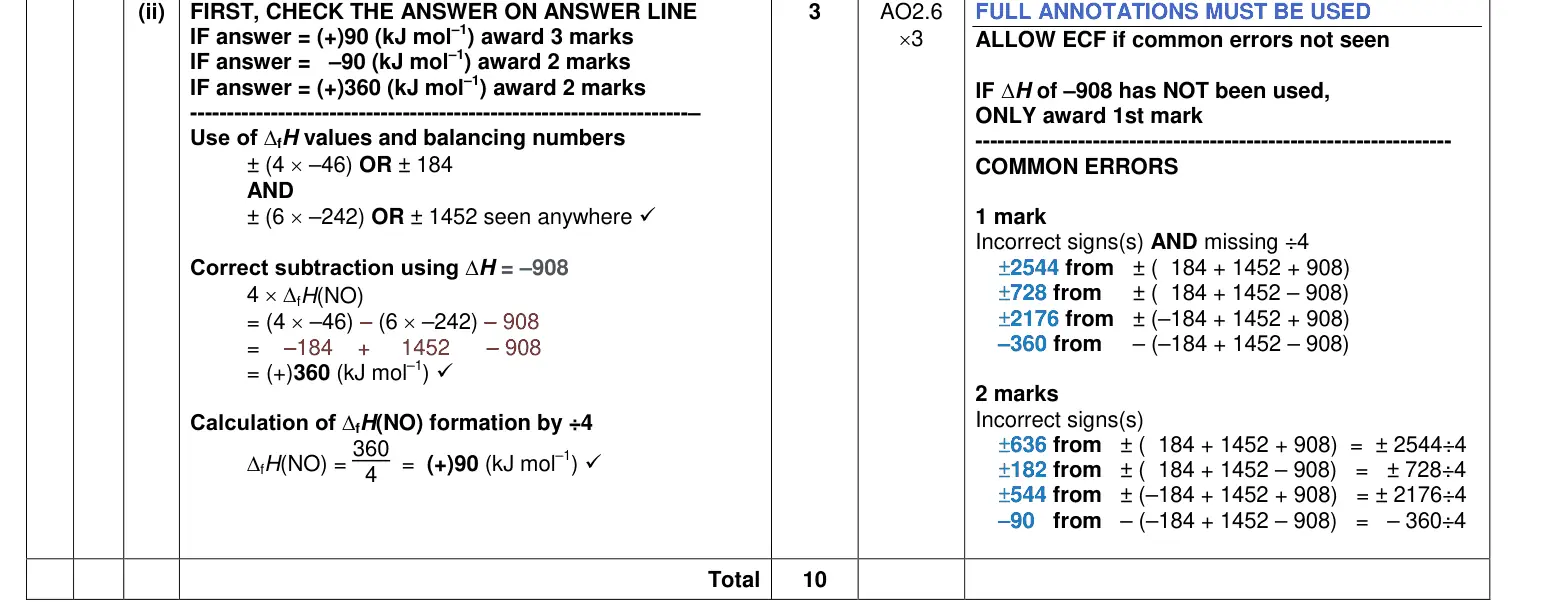
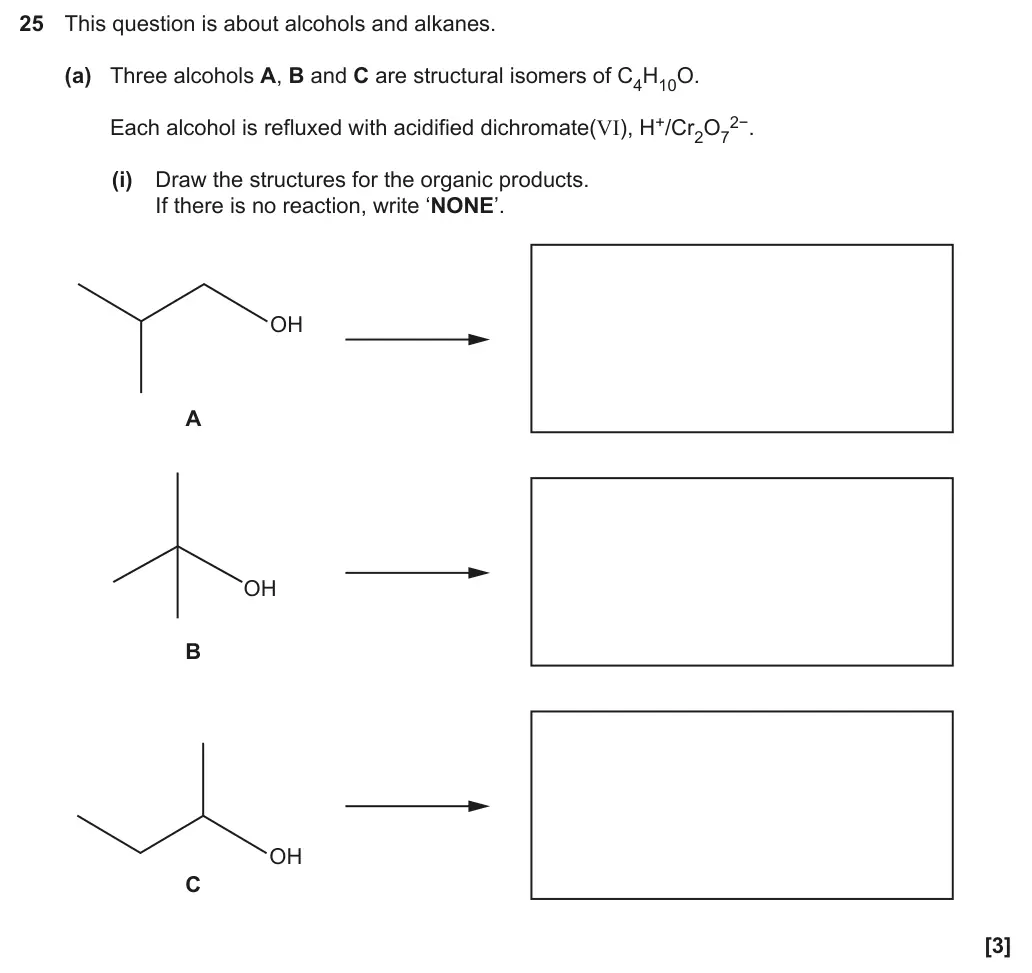
Most candidates were able to make some progress with the enthalpy calculation. Most recognised that the provided ∆fH values had to be multiplied by the balancing numbers in the equation. Correct processing of these values with ∆H for the reaction discriminated well between candidates. The response shows a response that was given 2 out of the 3 available marks. The candidate has correctly calculated +360 kJ mol–1 from their enthalpy cycle but has not realised that this value is for 4 mol NH3 and must be divided by 4 to obtain the enthalpy change of formation of 1 mol of NH3. It was impressive that the correct answer of +90 kJ mol–1 was achieved by about one-third of candidates. Question 25 (a) (i), (ii) and (iii) Part 25(a)(i) discriminated extremely well and rewarded well-prepared candidates. Most candidates recognised that B is a tertiary alcohol and will not react with acidified dichromate. The structure from A was often shown as an aldehyde rather than a carboxylic acid. It was also common for candidates to replace the OH group of A with the carboxyl COOH group, gaining a carbon atom in the chain in the process. The ketone oxidation product from C proved to be easier. Part 25(a)(ii) proved to be difficult. Candidates need to be careful in identifying the longest carbon chain to derive the stem of an organic name. Many candidates thought that alcohol C was a branched propanol, with 1-methylpropan-1-ol being seen very often instead of the correct name of butan-2-ol. In part 25(a)(iii), less than half the candidates wrote a correctly-balanced equation for this reaction. Although 4CO2 and 5H2O were usually seen for the products, oxygen was usually seen as 6½O2, rather than 6O2. Candidates need to look very closely at the formula of the organic compound so that the O in C4H10O is accounted for in the balancing.
Skills: M2.2 Change the subject of an equation; M2.3 Substitute numerical values into algebraic equations using appropriate units for physical quantities; M2.4 Solve algebraic equations
AS LEVEL CHEMISTRY A Examiners’ report H032/01 Summer 2019 series Version 1 H032 For first teaching in 2015 www.ocr.org.uk/science Contents Introduction .............................................................................................................................................. 4 Paper 1 series overview ........................................................................................................................... 5 Section A overview ................................................................................................................................... 6 Question 2 ............................................................................................................................................ 6 Question 4 ............................................................................................................................................ 6 Question 5 ............................................................................................................................................ 7 Question 6 ............................................................................................................................................ 7 Question 9 ............................................................................................................................................ 8 Question 10 .......................................................................................................................................... 9 Question 11 ........................................................................................................................................ 10 Question 12 ........................................................................................................................................ 10 Question 14 ........................................................................................................................................ 11 Question 15 ........................................................................................................................................ 11 Question 17 ........................................................................................................................................ 12 Question 18 ........................................................................................................................................ 13 Question 19 ........................................................................................................................................ 13 Question 20 ........................................................................................................................................ 14 Section B overview ................................................................................................................................. 15 Question 21 (a) ................................................................................................................................... 15 Question 21 (b) .................................................................................................................................. 15 Question 21 (c) ................................................................................................................................... 16 Question 21 (d) (i) ............................................................................................................................... 16 Question 21 (d) (ii) .............................................................................................................................. 17 Question 21 (d) (iii) ............................................................................................................................. 18 Question 21 (d) (iv) ............................................................................................................................. 19 Question 22 (a) (i) ............................................................................................................................... 20 Question 22 (a) (ii) .............................................................................................................................. 20 Question 22 (b) ................................................................................................................................... 21 Question 22 (c) ................................................................................................................................... 22 Question 23 (a) ................................................................................................................................... 23 Question 23 (b) ................................................................................................................................... 24 Question 24 (a) (i) ............................................................................................................................... 25 Question 24 (a) (ii) .............................................................................................................................. 25 Question 24 (b) (i) ............................................................................................................................... 26 Question 24 (b) (ii) .............................................................................................................................. 27 Question 25 (a) (i), (ii) and (iii) ............................................................................................................ 28 Question 25 (b) (i) ............................................................................................................................... 29 Question 25 (b) (ii) .............................................................................................................................. 29 Question 25 (b) (iii) ............................................................................................................................. 30 Introduction Our examiners’ reports are produced to offer constructive feedback on candidates’ performance in the examinations. Question 25 (a) (i), (ii) and (iii) Part 25(a)(i) discriminated extremely well and rewarded well-prepared candidates.

AS LEVEL CHEMISTRY A Examiners’ report H032/01 Summer 2019 series Version 1 H032 For first teaching in 2015 www.ocr.org.uk/science Contents Introduction .............................................................................................................................................. 4 Paper 1 series overview ........................................................................................................................... 5 Section A overview ................................................................................................................................... 6 Question 2 ............................................................................................................................................ 6 Question 4 ............................................................................................................................................ 6 Question 5 ............................................................................................................................................ 7 Question 6 ............................................................................................................................................ 7 Question 9 ............................................................................................................................................ 8 Question 10 .......................................................................................................................................... 9 Question 11 ........................................................................................................................................ 10 Question 12 ........................................................................................................................................ 10 Question 14 ........................................................................................................................................ 11 Question 15 ........................................................................................................................................ 11 Question 17 ........................................................................................................................................ 12 Question 18 ........................................................................................................................................ 13 Question 19 ........................................................................................................................................ 13 Question 20 ........................................................................................................................................ 14 Section B overview ................................................................................................................................. 15 Question 21 (a) ................................................................................................................................... 15 Question 21 (b) .................................................................................................................................. 15 Question 21 (c) ................................................................................................................................... 16 Question 21 (d) (i) ............................................................................................................................... 16 Question 21 (d) (ii) .............................................................................................................................. 17 Question 21 (d) (iii) ............................................................................................................................. 18 Question 21 (d) (iv) ............................................................................................................................. 19 Question 22 (a) (i) ............................................................................................................................... 20 Question 22 (a) (ii) .............................................................................................................................. 20 Question 22 (b) ................................................................................................................................... 21 Question 22 (c) ................................................................................................................................... 22 Question 23 (a) ................................................................................................................................... 23 Question 23 (b) ................................................................................................................................... 24 Question 24 (a) (i) ............................................................................................................................... 25 Question 24 (a) (ii) .............................................................................................................................. 25 Question 24 (b) (i) ............................................................................................................................... 26 Question 24 (b) (ii) .............................................................................................................................. 27 Question 25 (a) (i), (ii) and (iii) ............................................................................................................ 28 Question 25 (b) (i) ............................................................................................................................... 29 Question 25 (b) (ii) .............................................................................................................................. 29 Question 25 (b) (iii) ............................................................................................................................. 30 Introduction Our examiners’ reports are produced to offer constructive feedback on candidates’ performance in the examinations. Question 25 (a) (i), (ii) and (iii) Part 25(a)(i) discriminated extremely well and rewarded well-prepared candidates.

AS LEVEL CHEMISTRY A Examiners’ report H032/01 Summer 2019 series Version 1 H032 For first teaching in 2015 www.ocr.org.uk/science Contents Introduction .............................................................................................................................................. 4 Paper 1 series overview ........................................................................................................................... 5 Section A overview ................................................................................................................................... 6 Question 2 ............................................................................................................................................ 6 Question 4 ............................................................................................................................................ 6 Question 5 ............................................................................................................................................ 7 Question 6 ............................................................................................................................................ 7 Question 9 ............................................................................................................................................ 8 Question 10 .......................................................................................................................................... 9 Question 11 ........................................................................................................................................ 10 Question 12 ........................................................................................................................................ 10 Question 14 ........................................................................................................................................ 11 Question 15 ........................................................................................................................................ 11 Question 17 ........................................................................................................................................ 12 Question 18 ........................................................................................................................................ 13 Question 19 ........................................................................................................................................ 13 Question 20 ........................................................................................................................................ 14 Section B overview ................................................................................................................................. 15 Question 21 (a) ................................................................................................................................... 15 Question 21 (b) .................................................................................................................................. 15 Question 21 (c) ................................................................................................................................... 16 Question 21 (d) (i) ............................................................................................................................... 16 Question 21 (d) (ii) .............................................................................................................................. 17 Question 21 (d) (iii) ............................................................................................................................. 18 Question 21 (d) (iv) ............................................................................................................................. 19 Question 22 (a) (i) ............................................................................................................................... 20 Question 22 (a) (ii) .............................................................................................................................. 20 Question 22 (b) ................................................................................................................................... 21 Question 22 (c) ................................................................................................................................... 22 Question 23 (a) ................................................................................................................................... 23 Question 23 (b) ................................................................................................................................... 24 Question 24 (a) (i) ............................................................................................................................... 25 Question 24 (a) (ii) .............................................................................................................................. 25 Question 24 (b) (i) ............................................................................................................................... 26 Question 24 (b) (ii) .............................................................................................................................. 27 Question 25 (a) (i), (ii) and (iii) ............................................................................................................ 28 Question 25 (b) (i) ............................................................................................................................... 29 Question 25 (b) (ii) .............................................................................................................................. 29 Question 25 (b) (iii) ............................................................................................................................. 30 Introduction Our examiners’ reports are produced to offer constructive feedback on candidates’ performance in the examinations. Question 25 (a) (i), (ii) and (iii) Part 25(a)(i) discriminated extremely well and rewarded well-prepared candidates.
Skills: M0.2 Use ratios, fractions and percentages
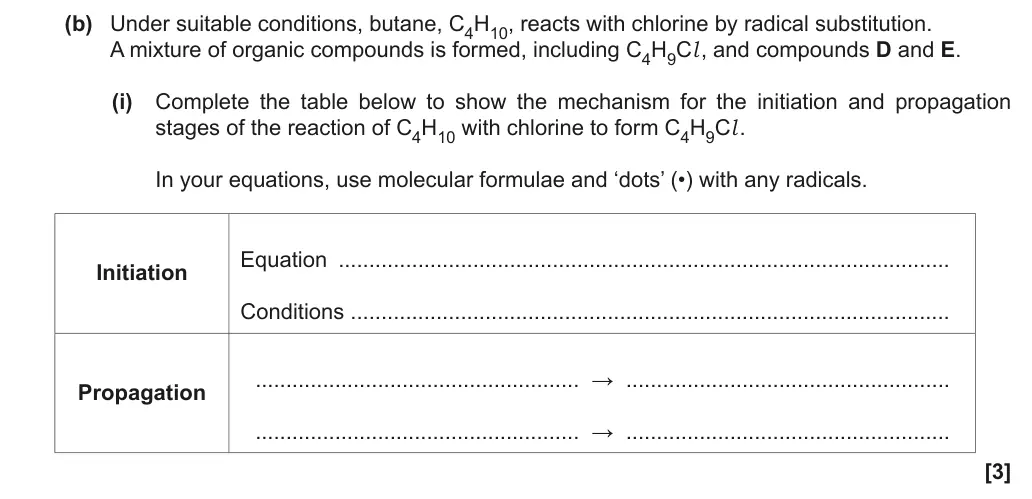
Many candidates scored all 3 marks for this part, showing that most had thoroughly learnt the mechanism for radical substitution. The equation and conditions for the initiation step were well-known but the equations for the propagation steps often included errors. It was common for dots to be omitted for some radicals and C4H9Cl•, rather than C4H9•, was often shown for one of the products in the first propagation stage. H• was then shown as the other product.
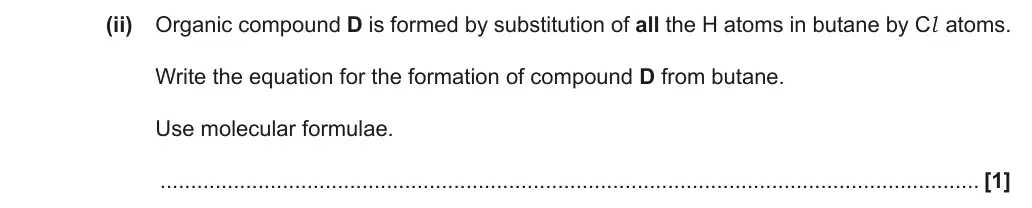
Only the highest attaining candidates were able to write the correct equation. Although most candidates did identify the organic product as C4Cl10, the other product was usually seen as 5H2 rather than 10HCl.
Skills: M0.2 Use ratios, fractions and percentages
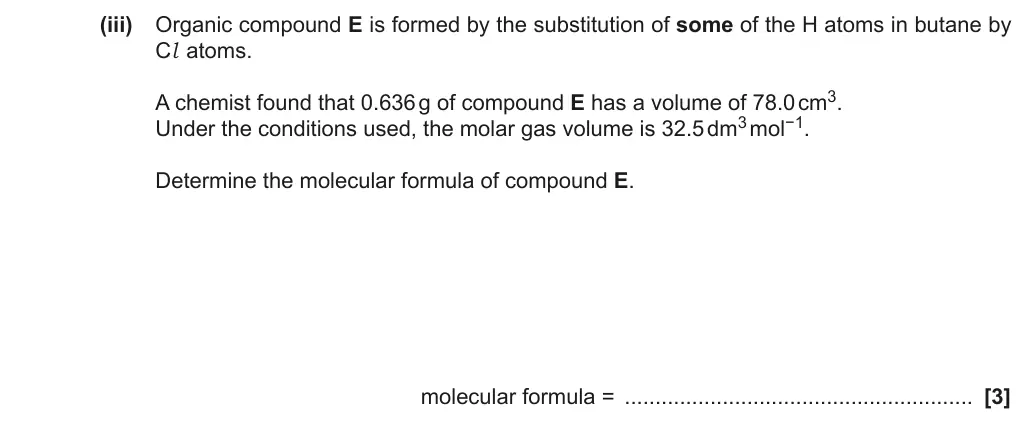
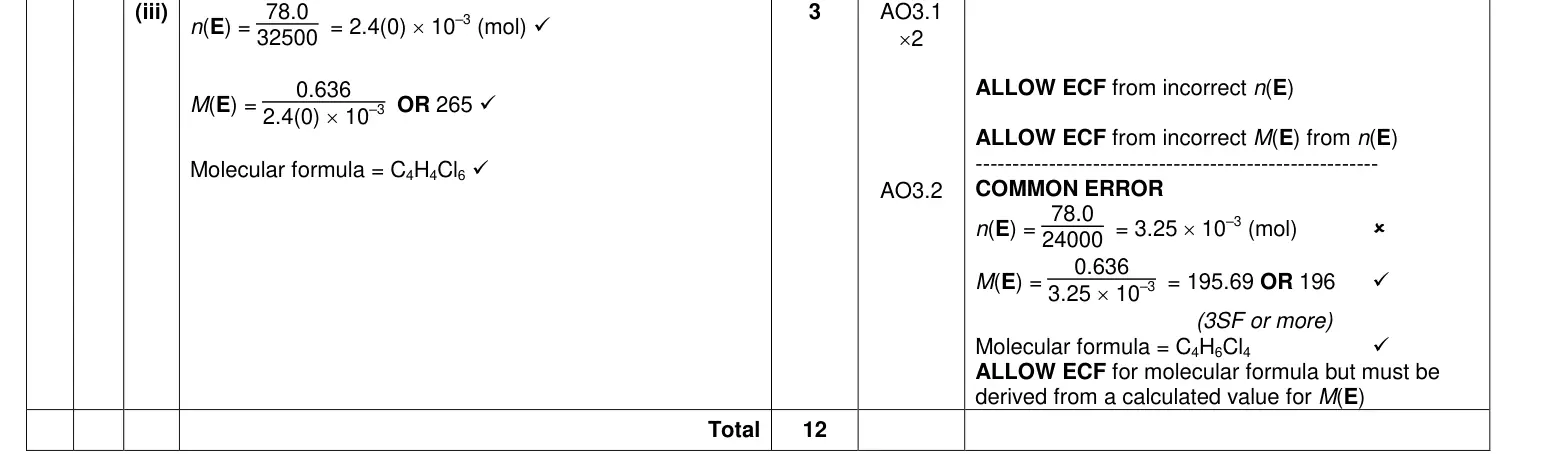
This question discriminated very well. It was encouraging to see the number of candidates who used 32.5 dm3 mol–1 as the molar gas volume under the experimental conditions to obtain 2.40 × 10⁻³ mol of gas. Many though used 24.0 dm3 mol–1 for RTP and obtained 3.25 × 10⁻³ mol. Error carried forward allowed such candidates to still secure the final 2 of the 3 marks available. Lower attaining candidates were unsure where to start and tried to do anything with the number provided. The result was often n unusable number.
Skills: M0.0 Recognise and make use of appropriate units in calculations; M2.2 Change the subject of an equation; M2.4 Solve algebraic equations
Want a paper marked and gone through with you? Message us.