June 2022: Paper 1, Periodic table, elements and physical chemistry

100 marks · 48 question parts · Paper, mark scheme and report on OCR's site · Have OCR's Data Sheet beside you

Question by question

QTopicMarksAOType
1 The halogens 1AO2Multiple choice
2 Amount of substance (moles) 1AO1Multiple choice
3 Amount of substance (moles) 1AO2Multiple choice
4 Redox titrations and electrode potentials, Amount of substance (moles) 1AO2Multiple choice
5 Amount of substance (moles) 1AO2Multiple choice
6 Formulae and equations, Redox and oxidation numbers 1AO1Multiple choice
7 Enthalpy changes and Hess’ law 1AO2Multiple choice
8 Rates: orders, rate equations and the Arrhenius equation 1AO1Multiple choice
9 Lattice enthalpy and Born–Haber cycles 1AO1Multiple choice
10 Entropy and free energy, Enthalpy changes and Hess’ law 1AO2Multiple choice
11 Acids, bases, pH and buffers 1AO2Multiple choice
12 Acids, bases, pH and buffers 1AO1Multiple choice
13 Redox titrations and electrode potentials 1AO2Multiple choice
14 Bonding, structure and shapes of molecules 1AO1Multiple choice
15 Transition elements, Electron structure and orbitals 1AO1Multiple choice
16(a)(i) Reaction rates and the Boltzmann distribution 3AO1Drawing / labelling
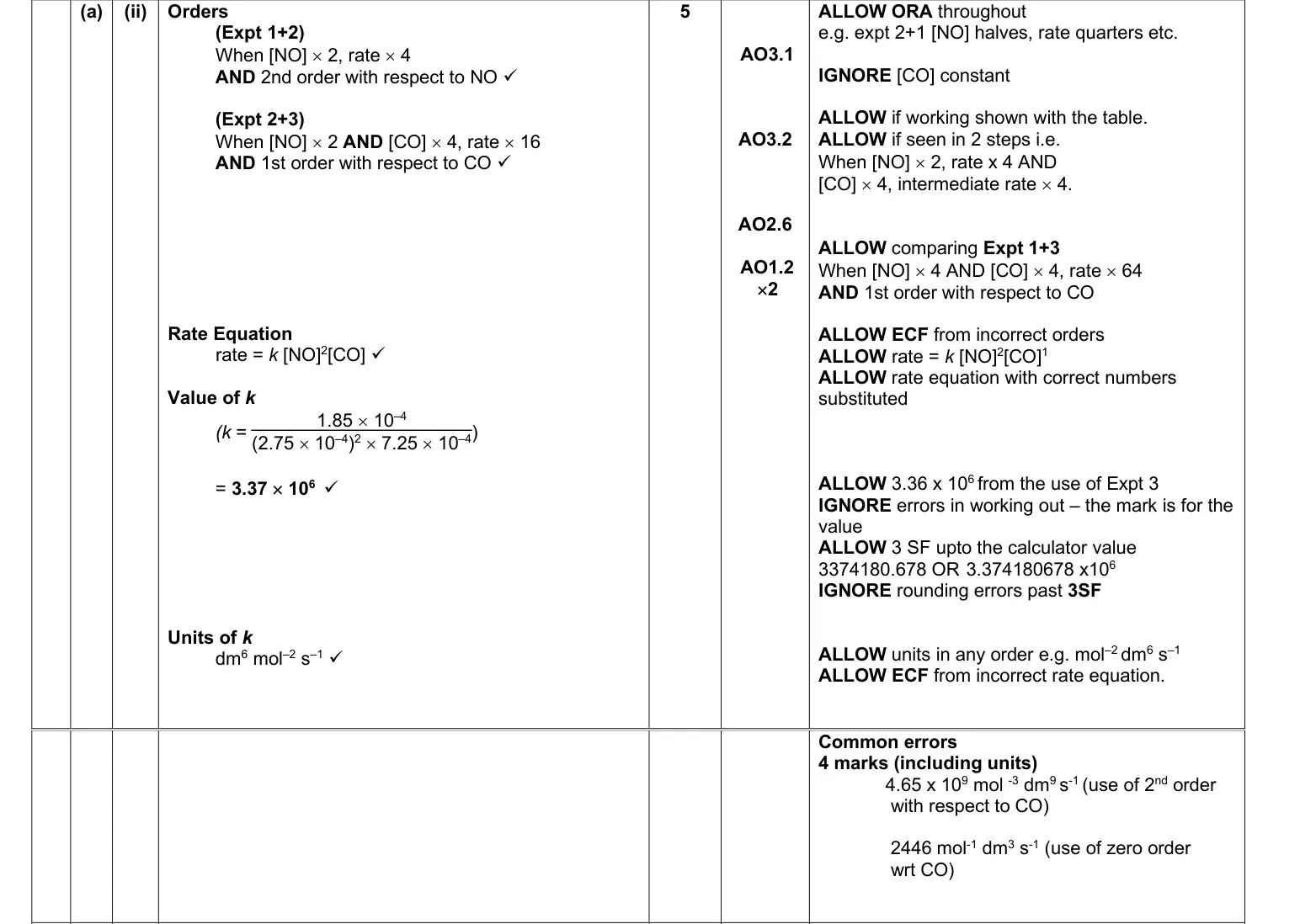
16(a)(ii) Rates: orders, rate equations and the Arrhenius equation 5AO1, 2, 3Calculation
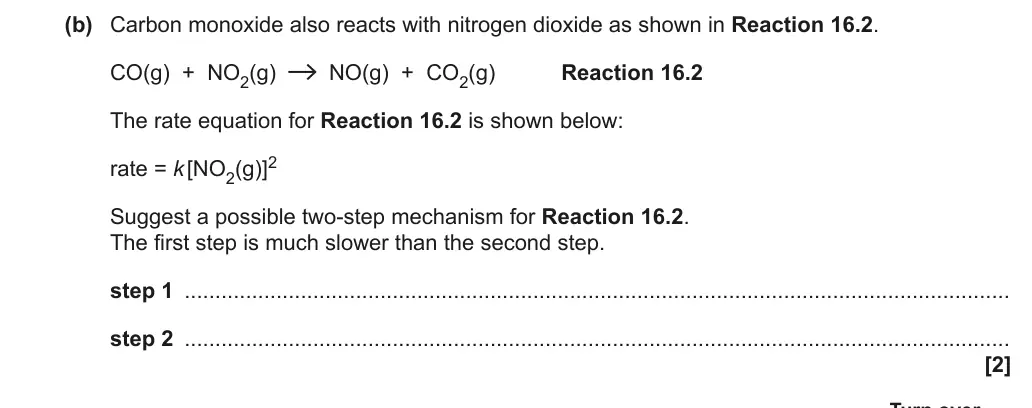
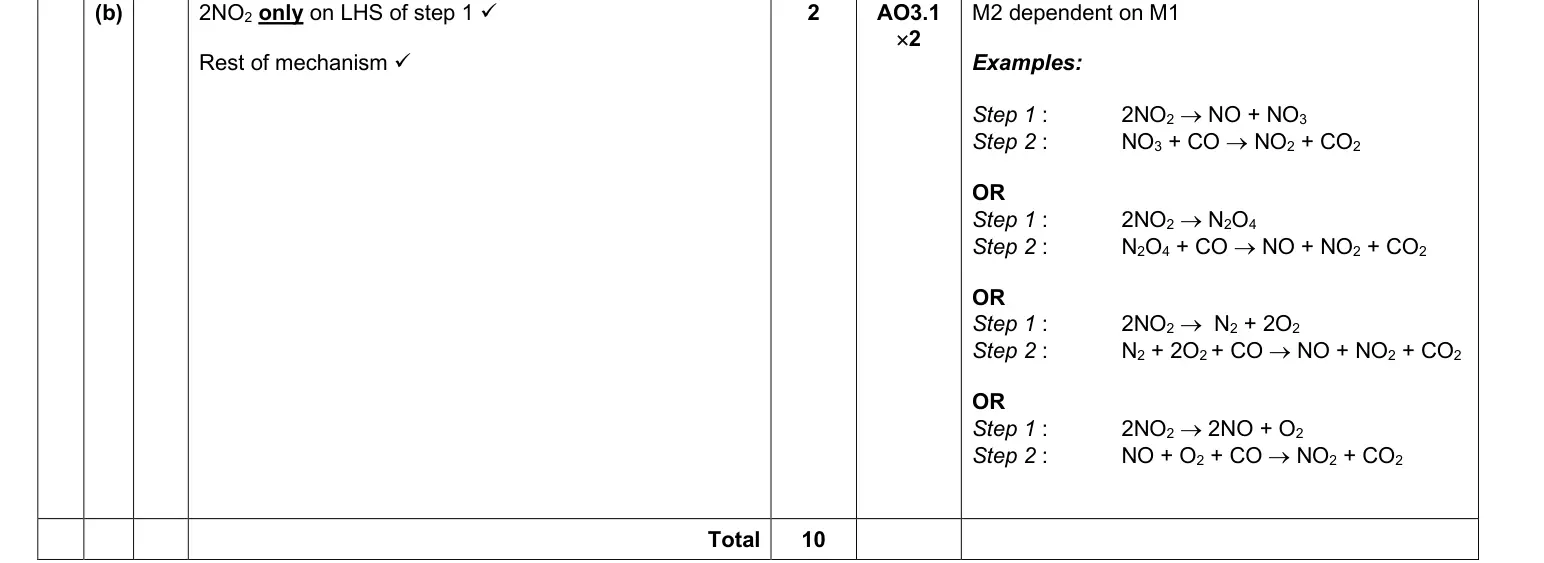
16(b) Rates: orders, rate equations and the Arrhenius equation 2AO3Short answer
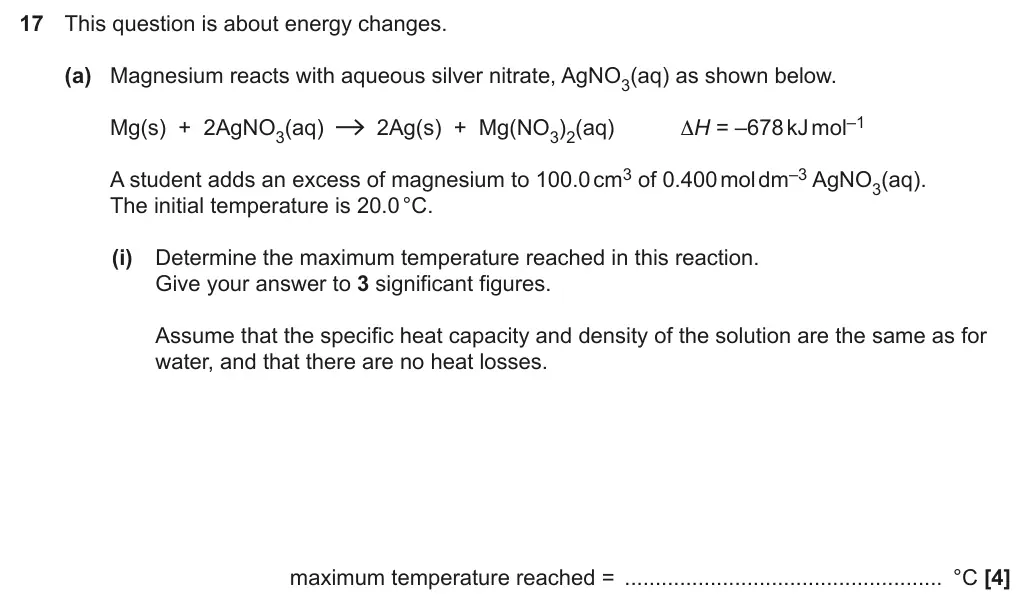
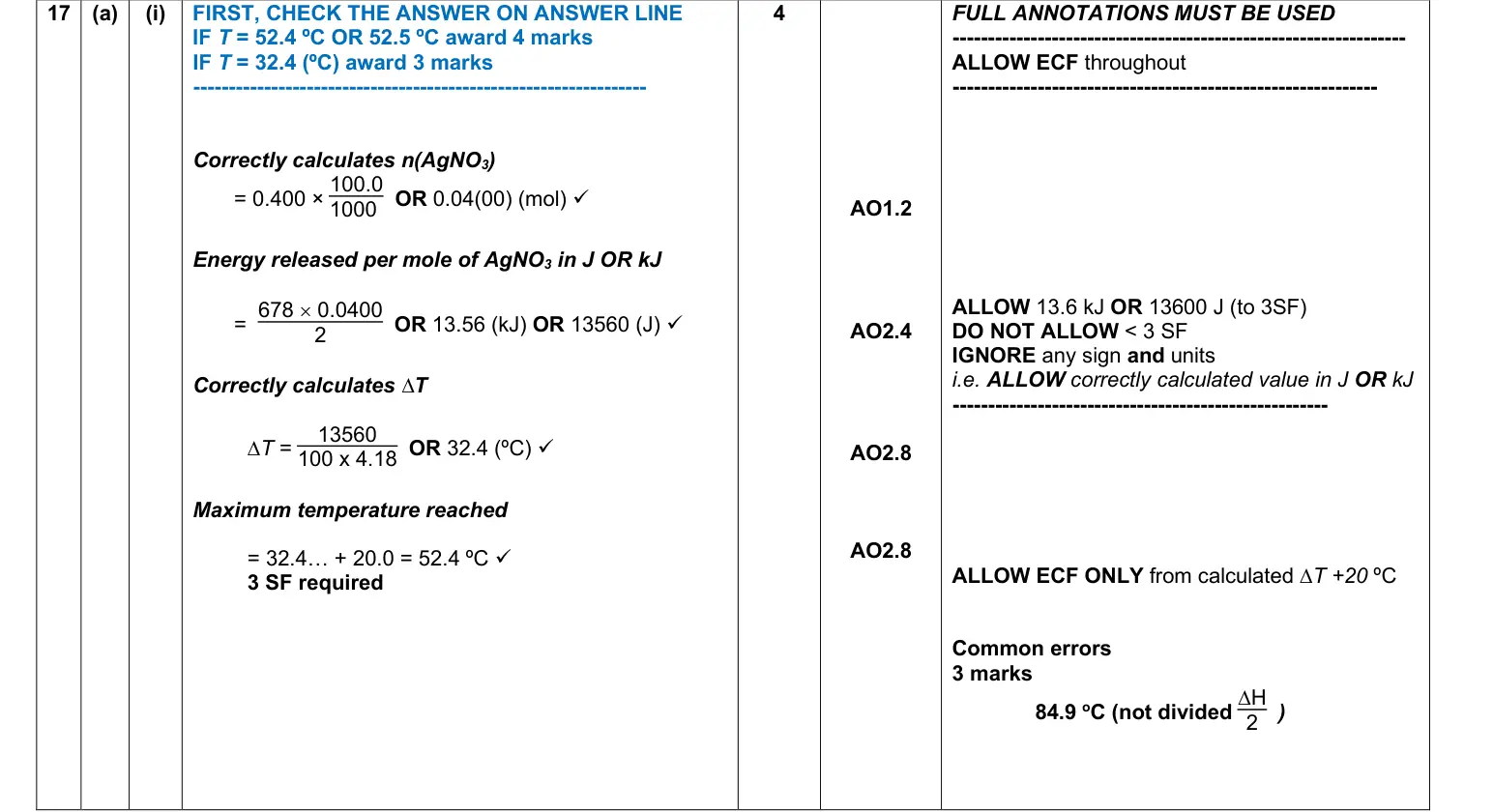
17(a)(i) Enthalpy changes and Hess’ law, Amount of substance (moles) 4AO1, 2Calculation
17(a)(ii) Enthalpy changes and Hess’ law, Practical skills: planning, analysis and evaluation 1AO3Short answer
17(b)(i) Enthalpy changes and Hess’ law 1AO1Short answer
17(b)(ii) Enthalpy changes and Hess’ law 2AO2Calculation
17(c)(i) Entropy and free energy 1AO1Short answer
17(c)(ii) Entropy and free energy 3AO2Calculation
17(c)(iii) Entropy and free energy 2AO3Short answer
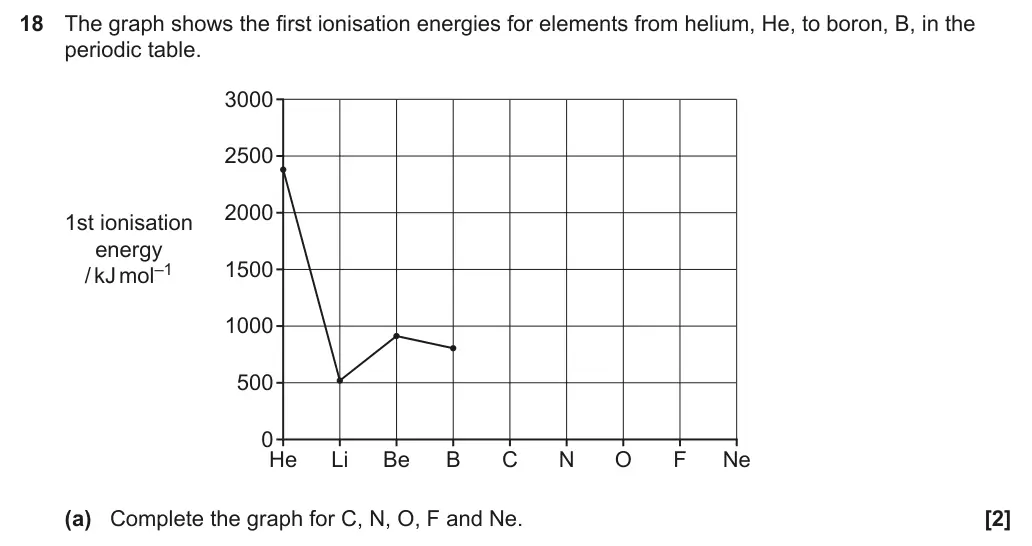
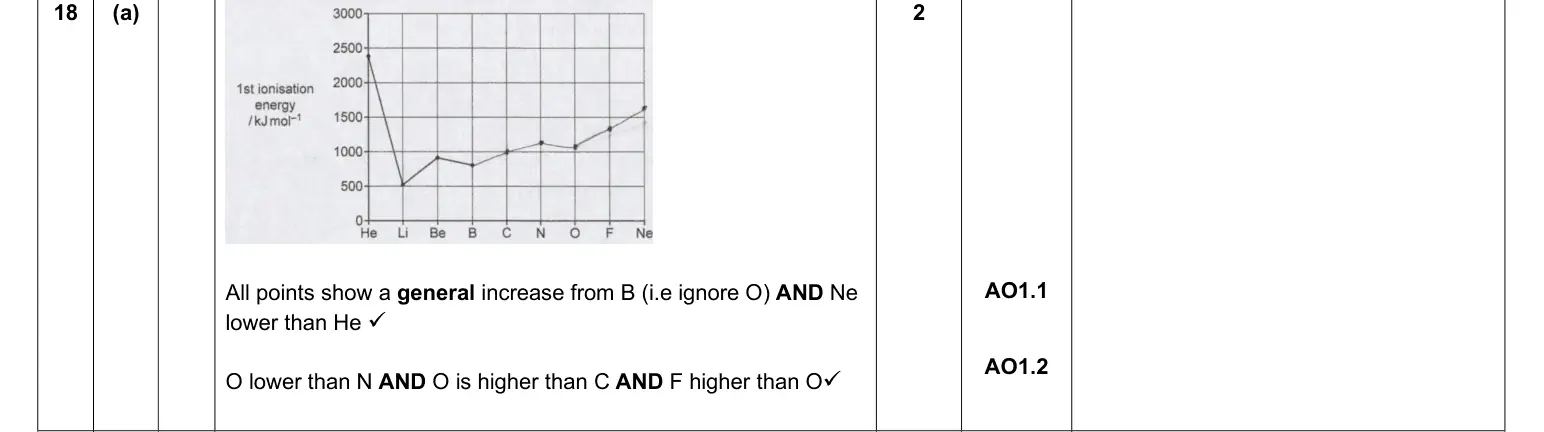
18(a) Periodicity and ionisation energy 2AO1Complete table/diagram
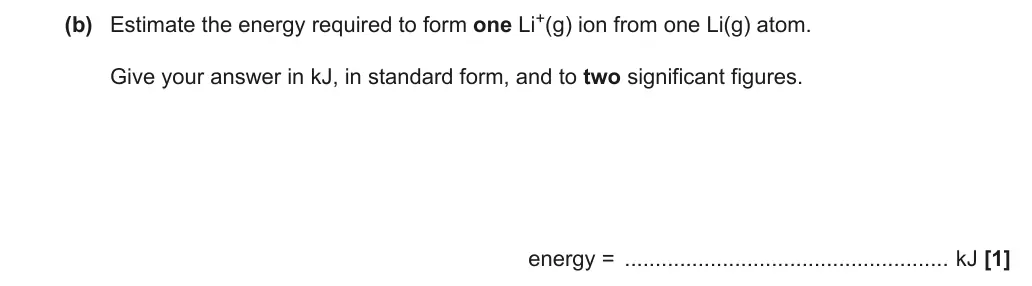
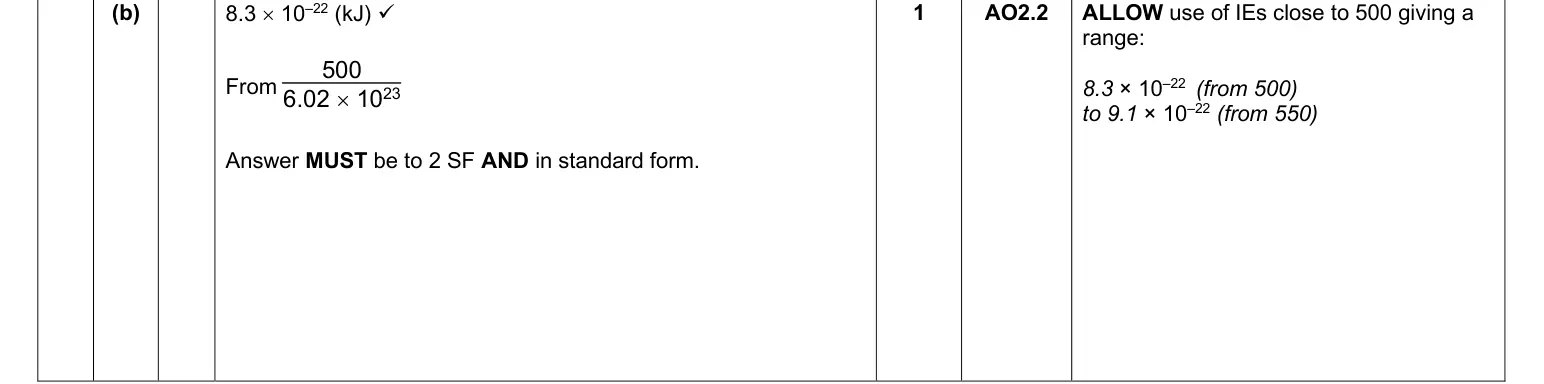
18(b) Periodicity and ionisation energy, Amount of substance (moles) 1AO2Calculation
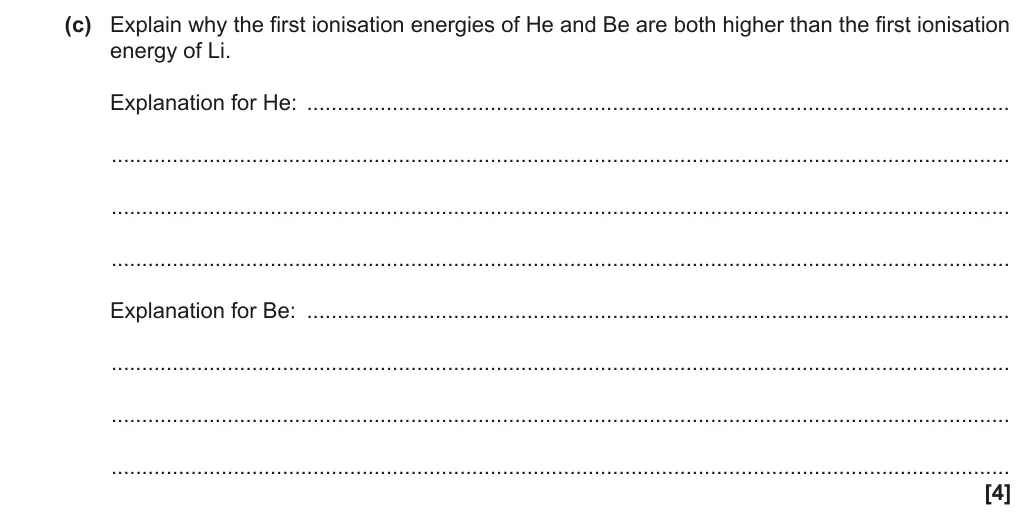
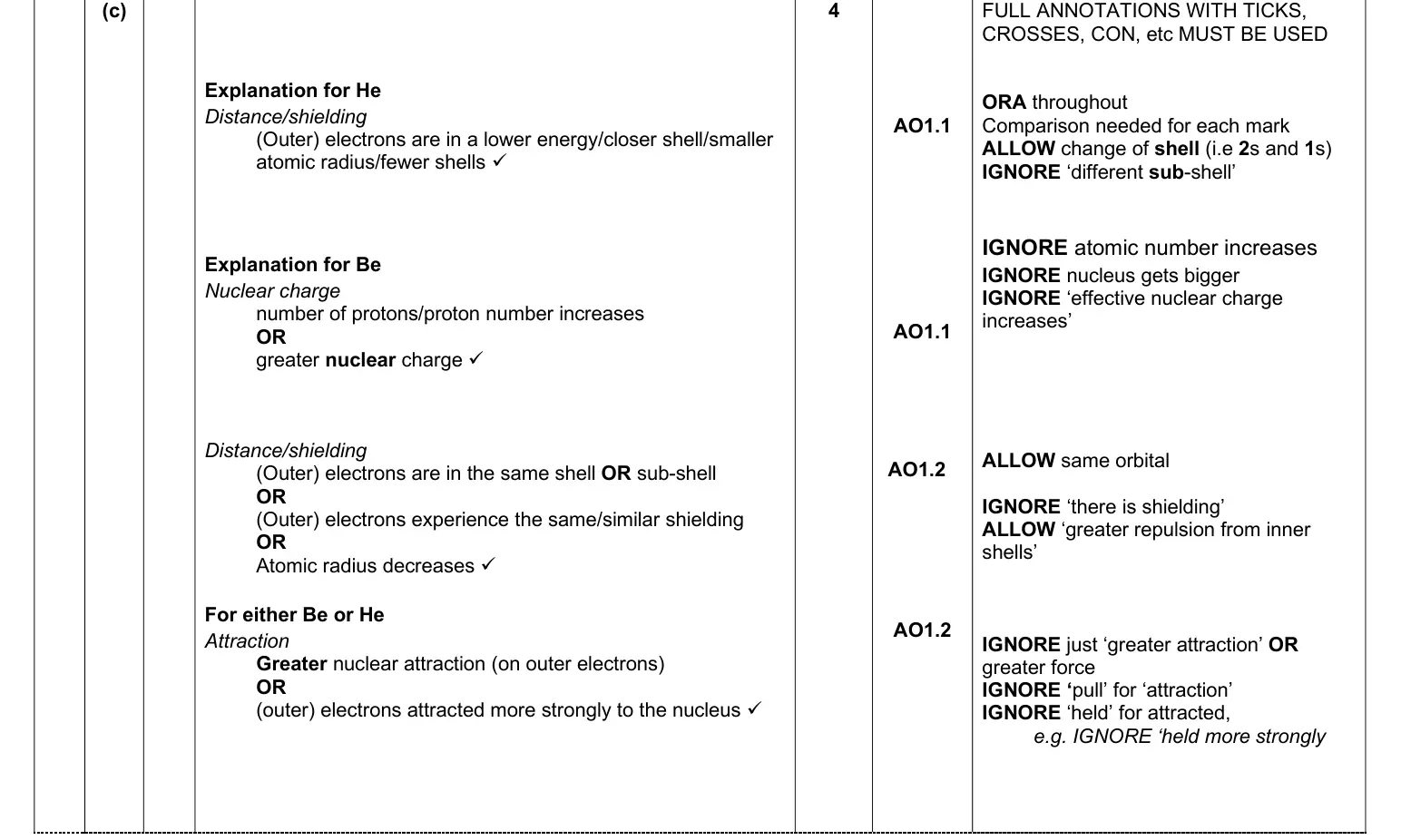
18(c) Periodicity and ionisation energy 4AO1Short answer
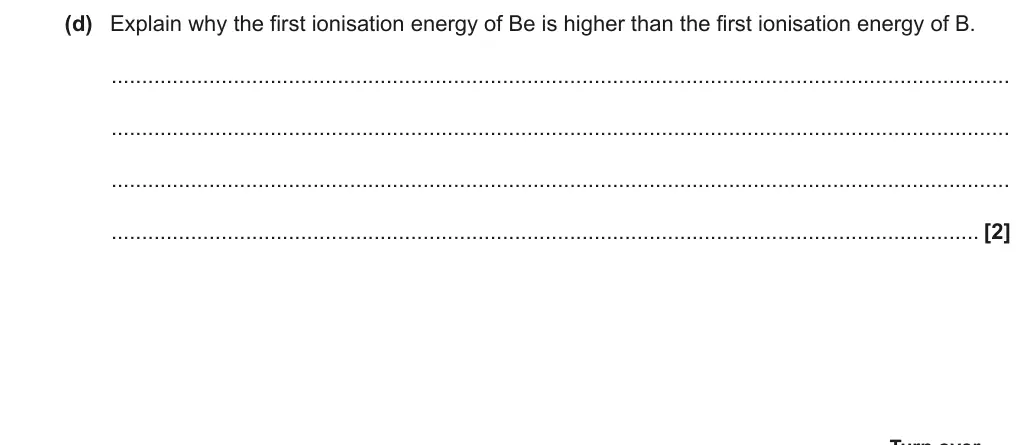
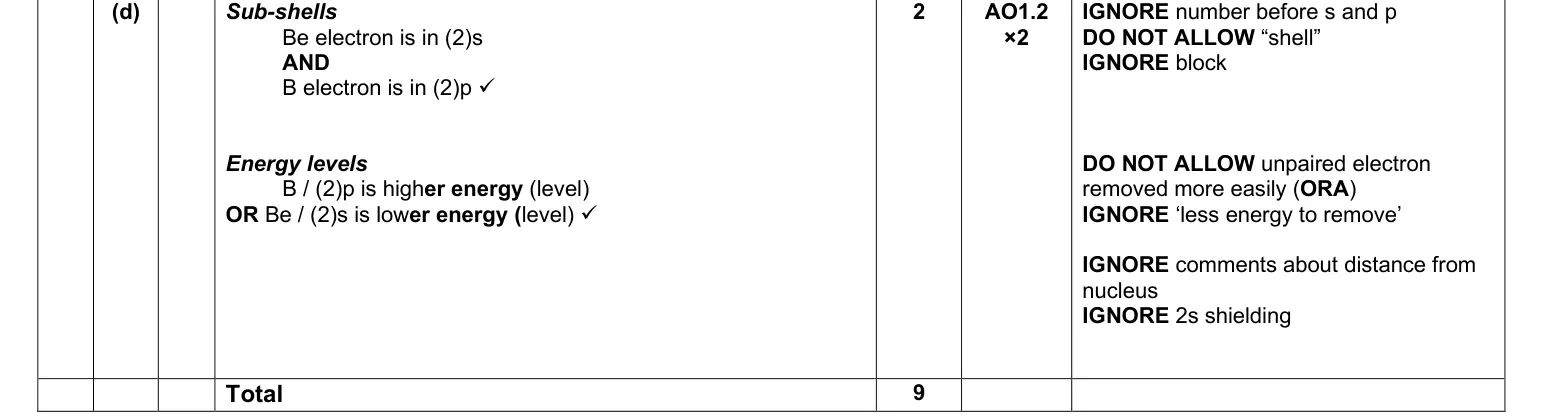
18(d) Periodicity and ionisation energy 2AO1Short answer
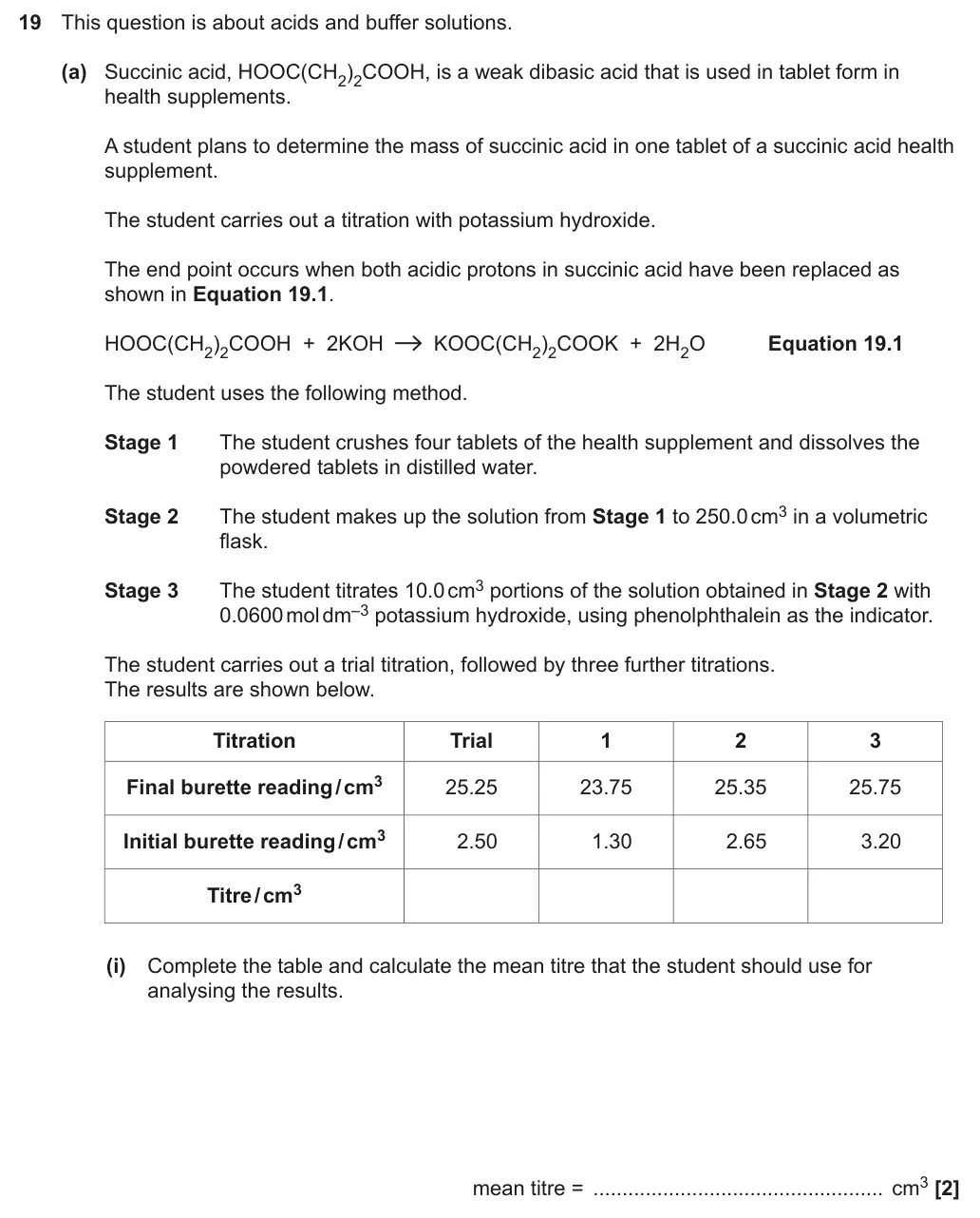
19(a)(i) Acids, bases and titrations, Practical skills: planning, analysis and evaluation, Practical techniques and apparatus (PAGs) 2AO1Calculation
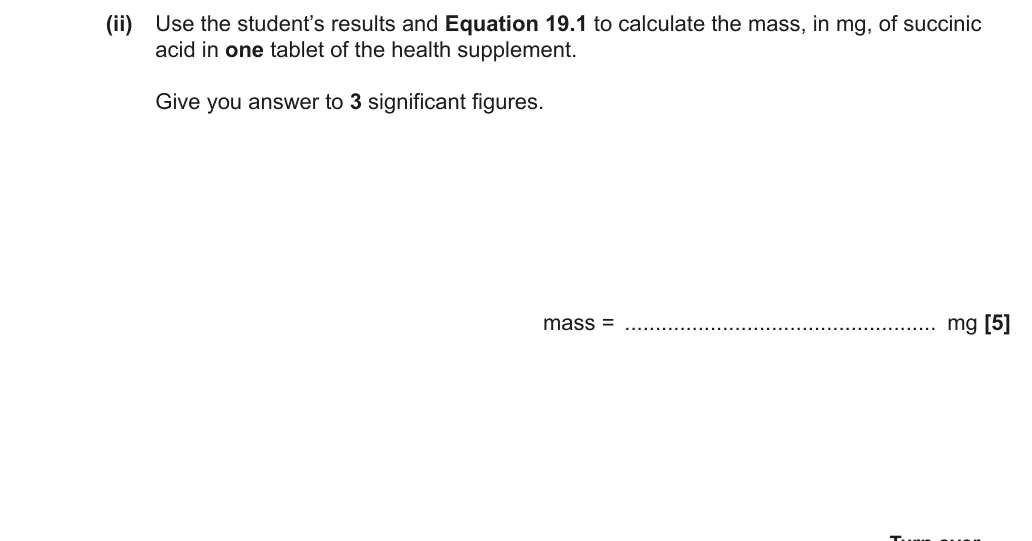
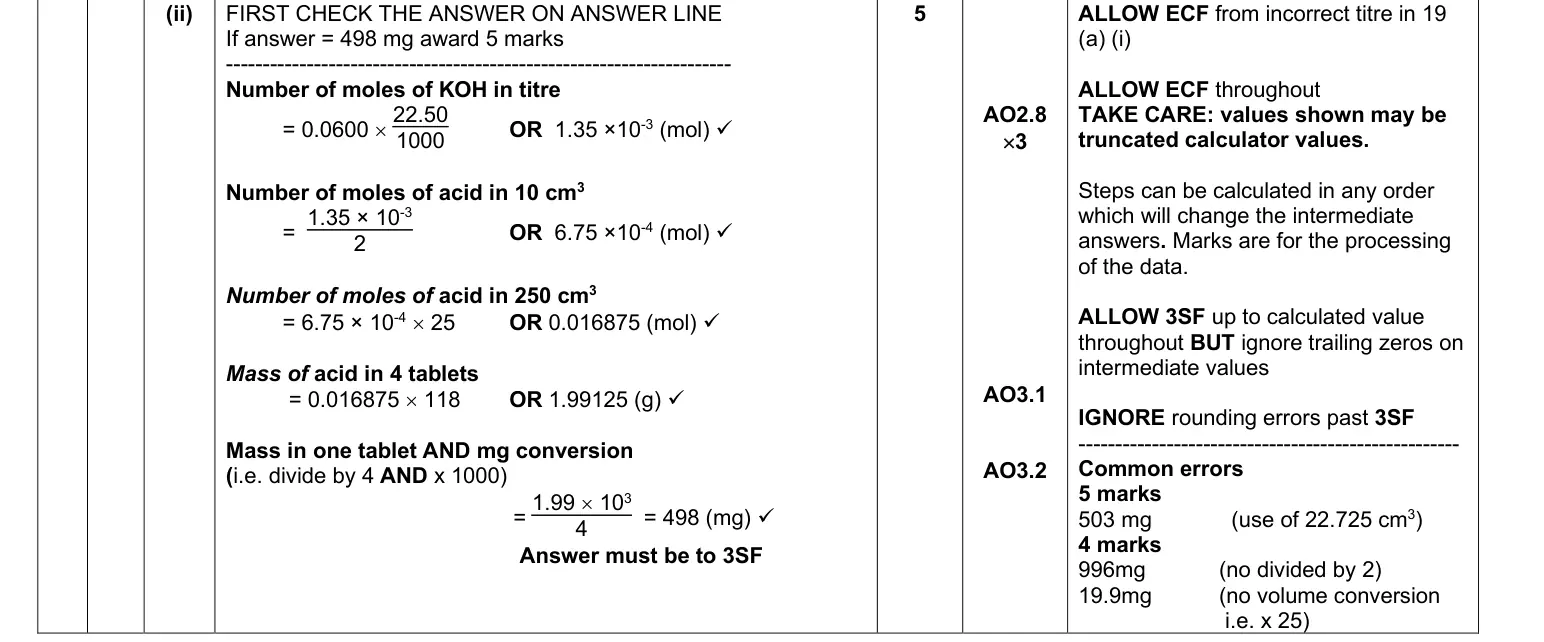
19(a)(ii) Acids, bases and titrations, Amount of substance (moles) 5AO2, 3Calculation
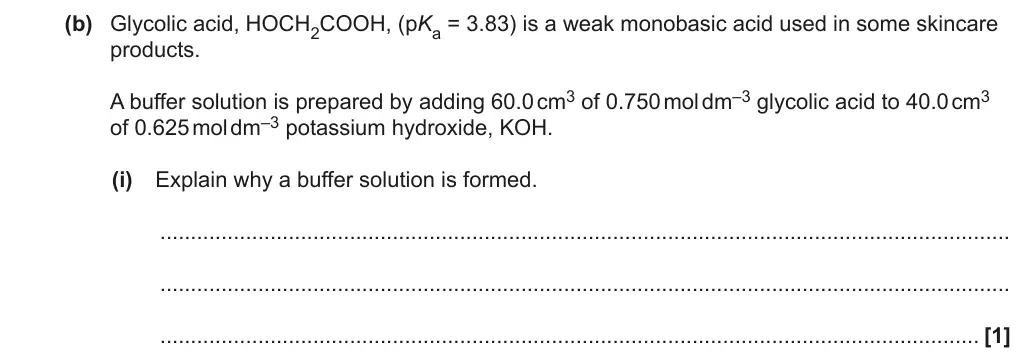
19(b)(i) Acids, bases, pH and buffers 1AO1Short answer
19(b)(ii) Acids, bases, pH and buffers 4AO1, 2Calculation
19(b)(iii) Acids, bases, pH and buffers 2AO1Short answer
20(a) Equilibrium constants Kc and Kp, Chemical equilibrium and Kc 6AO1, 2Level of response
20(b)(i) Equilibrium constants Kc and Kp 1AO1Short answer
20(b)(ii) Equilibrium constants Kc and Kp, Chemical equilibrium and Kc 1AO3Short answer
21(a)(i) Group 2 1AO2Short answer
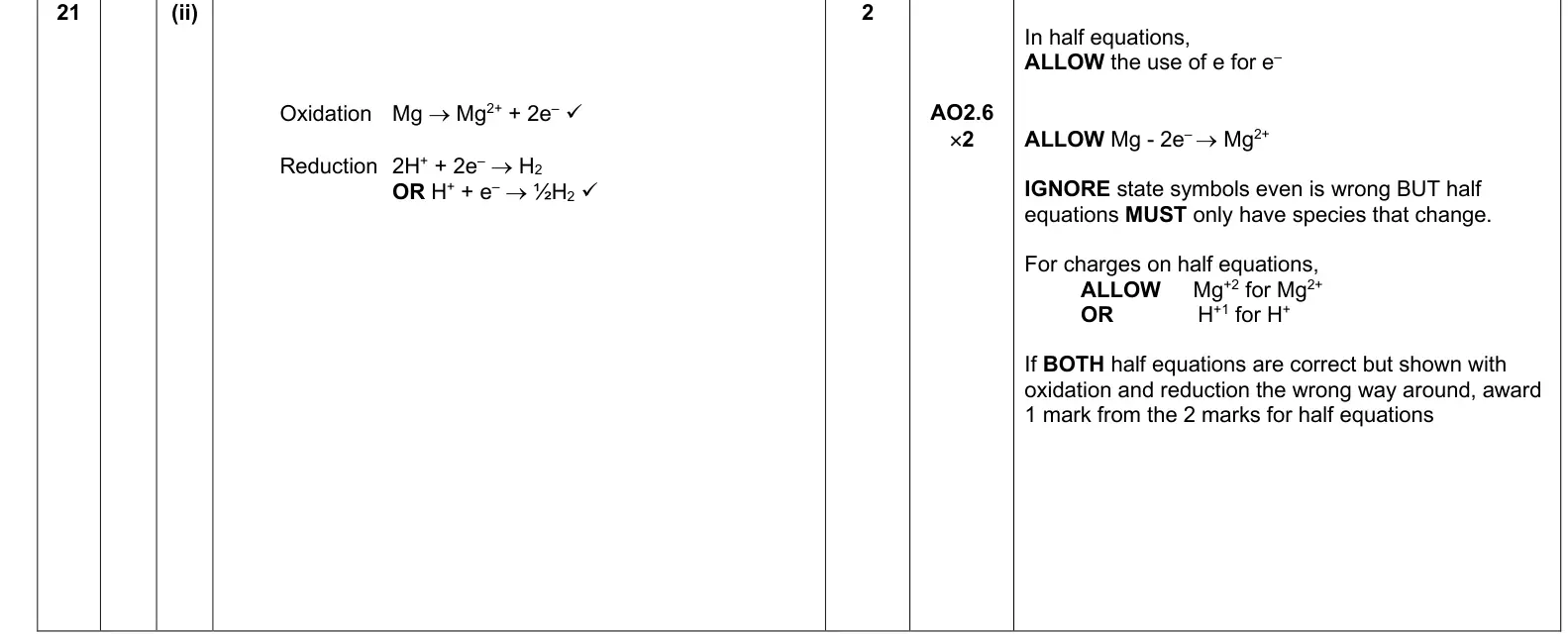
21(a)(ii) Redox and oxidation numbers, Group 2, Redox titrations and electrode potentials 2AO2Equation writing
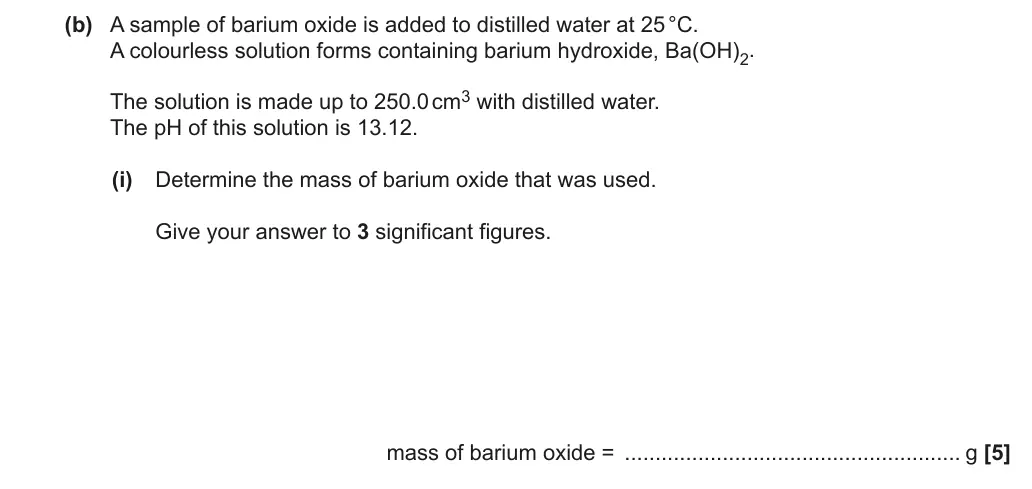
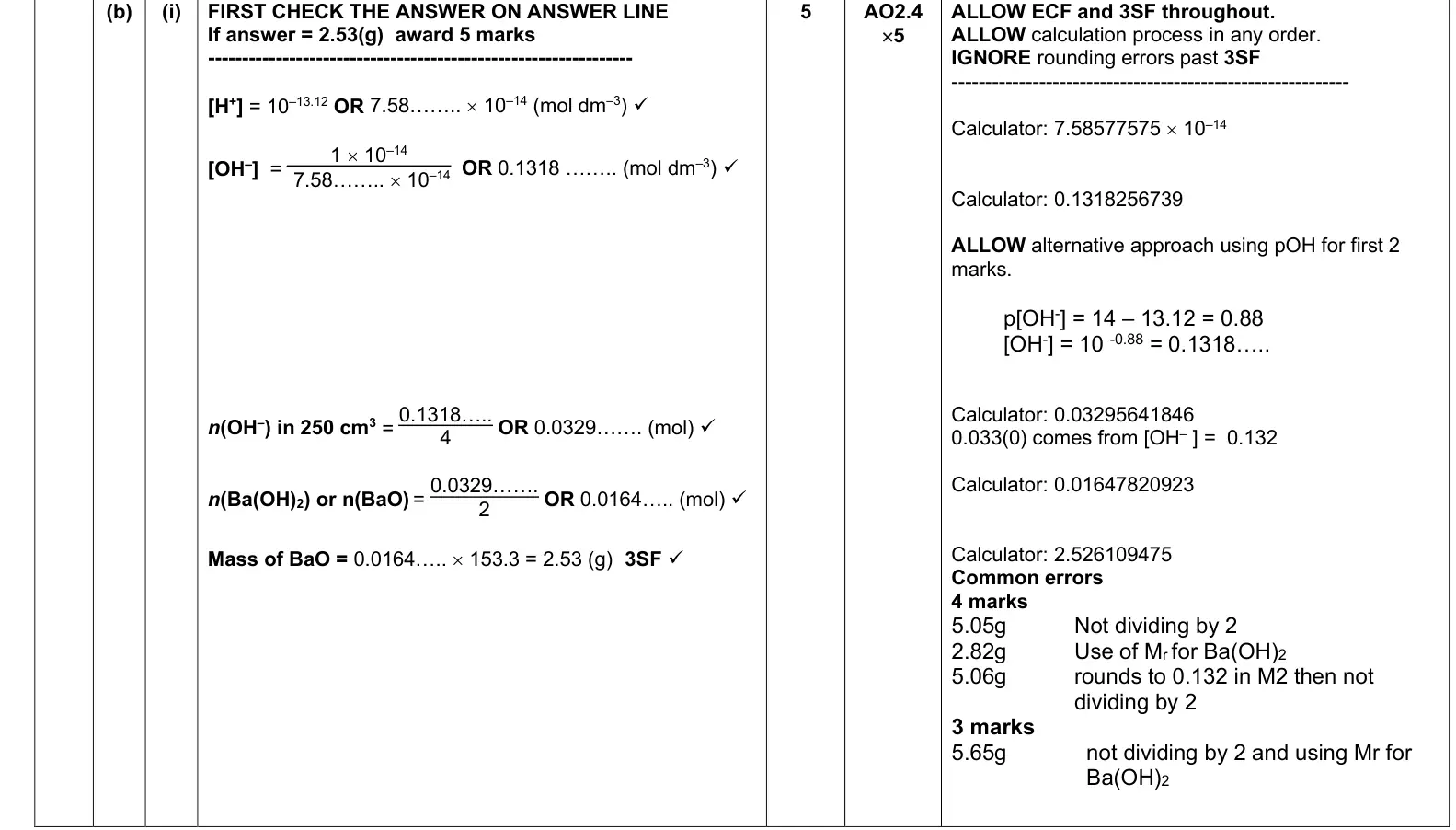
21(b)(i) Acids, bases, pH and buffers, Amount of substance (moles), Group 2 5AO2Calculation
21(b)(ii) Formulae and equations, Acids, bases and titrations, Qualitative analysis: tests for ions 1AO3Equation writing
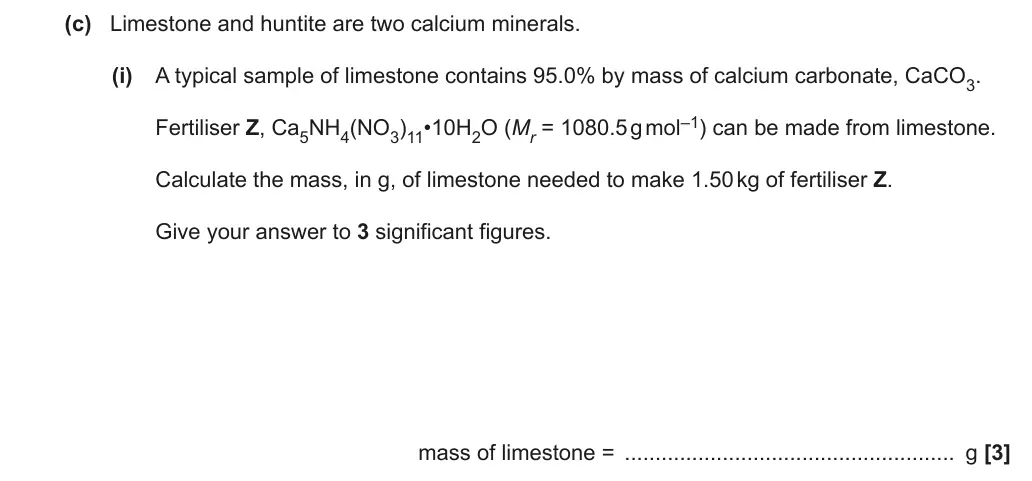
21(c)(i) Amount of substance (moles) 3AO2Calculation
21(c)(ii) Formulae and equations, Acids, bases and titrations 2AO2Equation writing
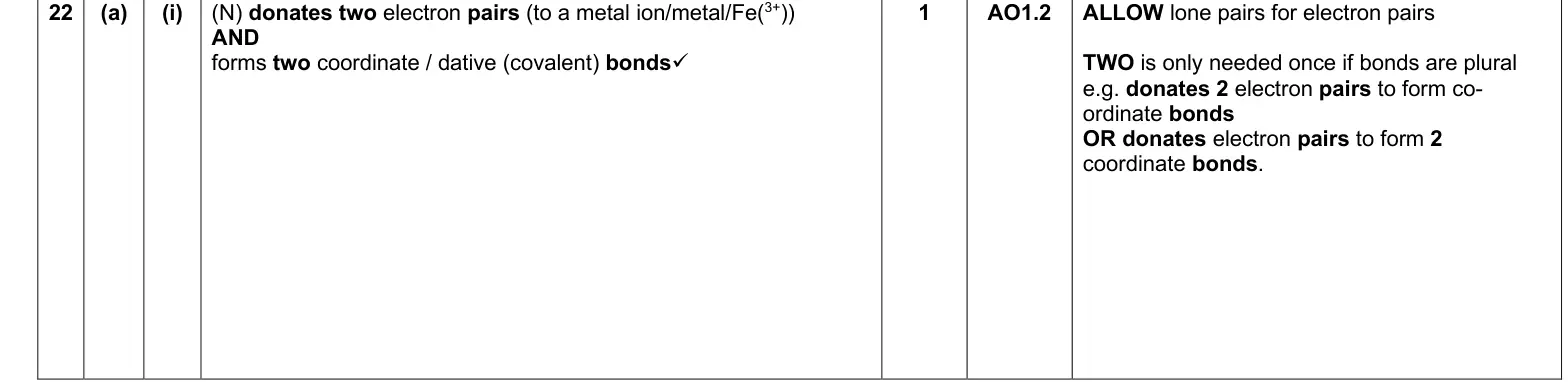
22(a)(i) Transition elements 1AO1Short answer
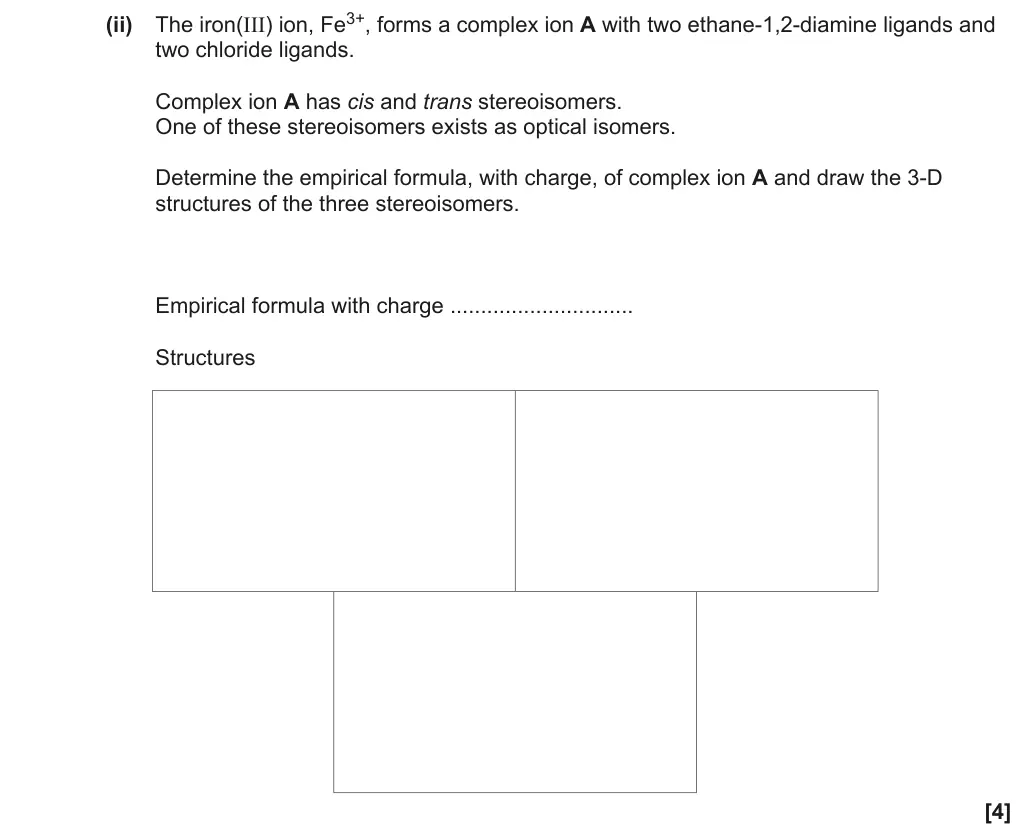
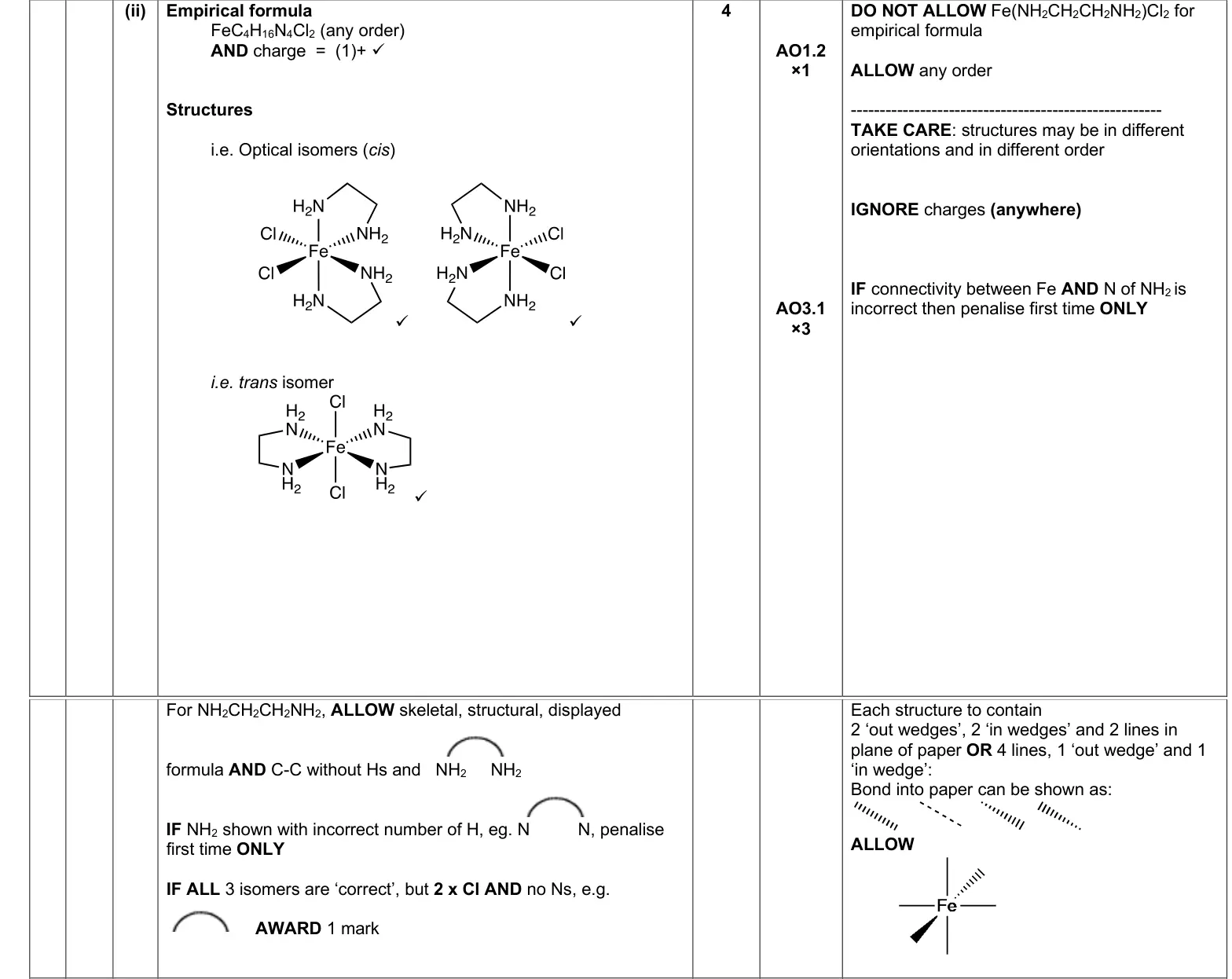
22(a)(ii) Transition elements, Amount of substance (moles) 4AO1, 3Structure / isomer
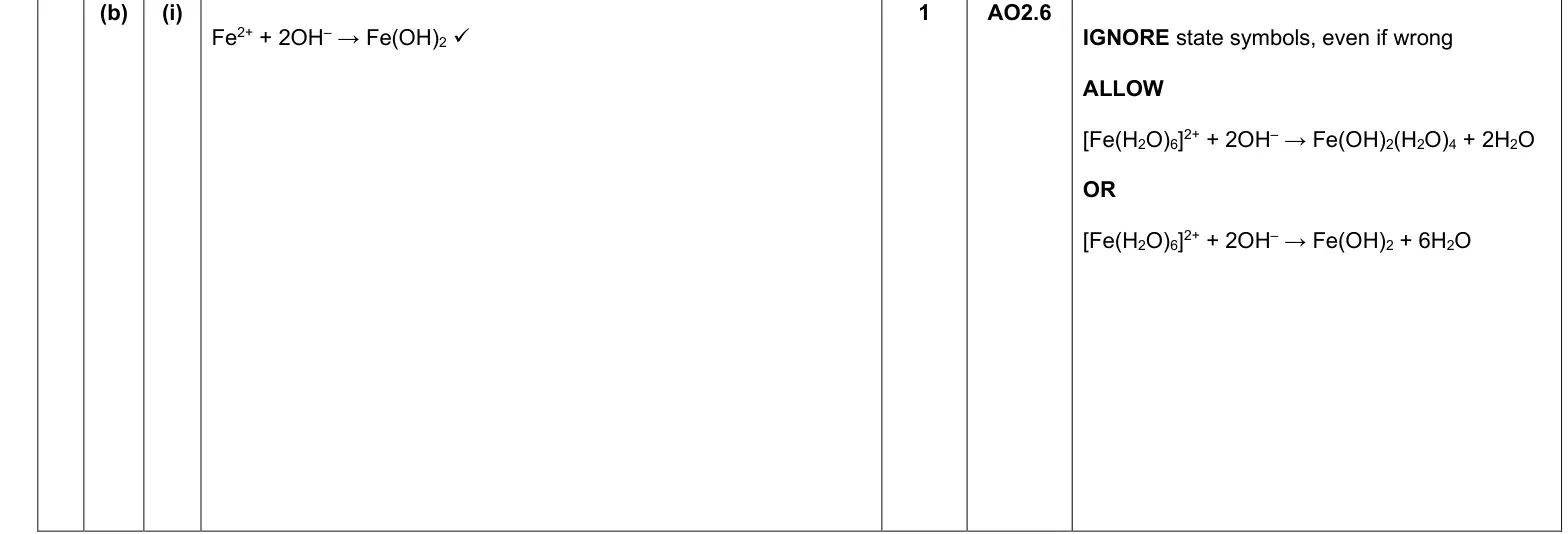
22(b)(i) Transition elements 1AO2Equation writing
22(b)(ii) Redox titrations and electrode potentials, Transition elements 4AO3Equation writing
22(c) Transition elements, Amount of substance (moles), Redox and oxidation numbers 6AO3Level of response

The questions

12345678910111213141516(a)(i)16(a)(ii)16(b)17(a)(i)17(a)(ii)17(b)(i)17(b)(ii)17(c)(i)17(c)(ii)17(c)(iii)18(a)18(b)18(c)18(d)19(a)(i)19(a)(ii)19(b)(i)19(b)(ii)19(b)(iii)20(a)20(b)(i)20(b)(ii)21(a)(i)21(a)(ii)21(b)(i)21(b)(ii)21(c)(i)21(c)(ii)22(a)(i)22(a)(ii)22(b)(i)22(b)(ii)22(c)
June 2022 · Paper 1 · Q1 1 mark AO2 Multiple choice Hard halogens
1 An aqueous solution contains a mixture of chloride, bromide and iodide ions.
AgNO3(aq) is added to this mixture, followed by an excess of dilute NH3(aq).
The resulting mixture is then filtered.
Which compound(s) is/are present in the residue on the filter paper?
A AgCl only
B AgCl and AgBr
C AgBr only
D AgBr and AgI
Your answer [1]
June 2022 · Paper 1 · Q2 1 mark AO1 Multiple choice Easy amount of substance
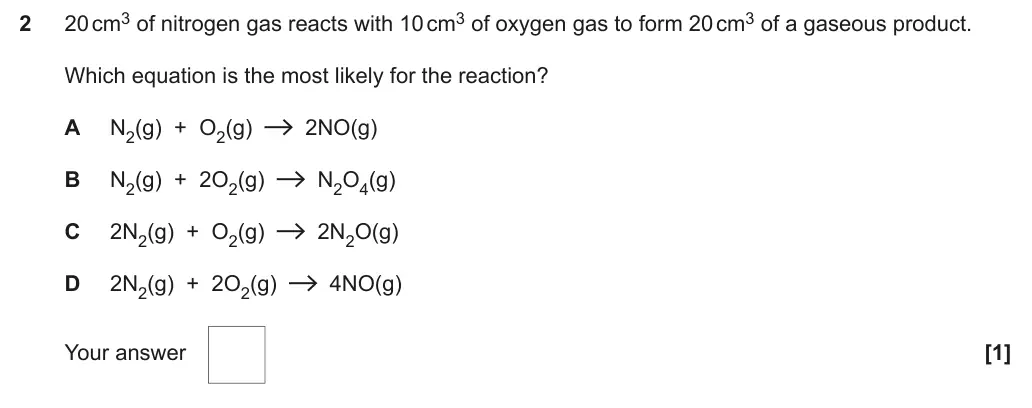
2 20 cm3 of nitrogen gas reacts with 10 cm3 of oxygen gas to form 20 cm3 of a gaseous product.
Which equation is the most likely for the reaction?
A N2(g)  +  O2(g) 2NO(g)
B N2(g)  +  2O2(g) N2O4(g)
C 2N2(g)  +  O2(g) 2N2O(g)
D 2N2(g)  +  2O2(g) 4NO(g)
Your answer [1]
June 2022 · Paper 1 · Q3 1 mark AO2 Multiple choice Hard amount of substance
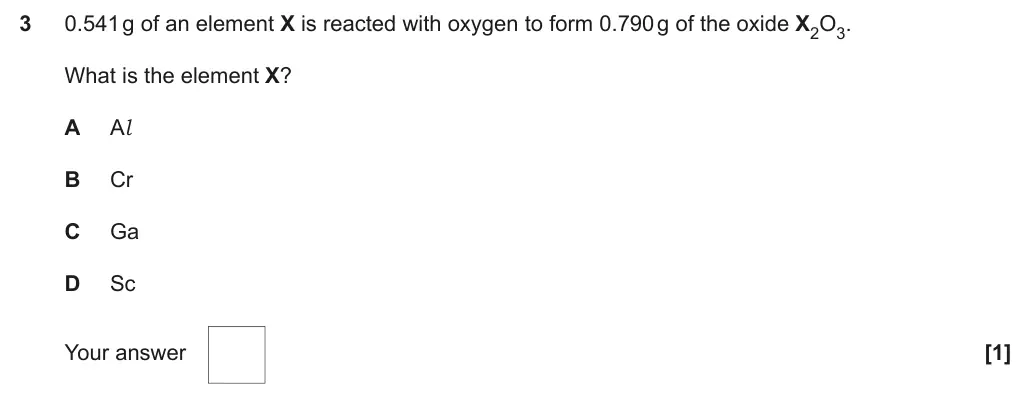
3 0.541 g of an element X is reacted with oxygen to form 0.790 g of the oxide X2O3.
What is the element X?
A Al
B Cr
C Ga
D Sc
Your answer [1]
June 2022 · Paper 1 · Q4 1 mark AO2 Multiple choice Medium redox and electrode potentialsamount of substance
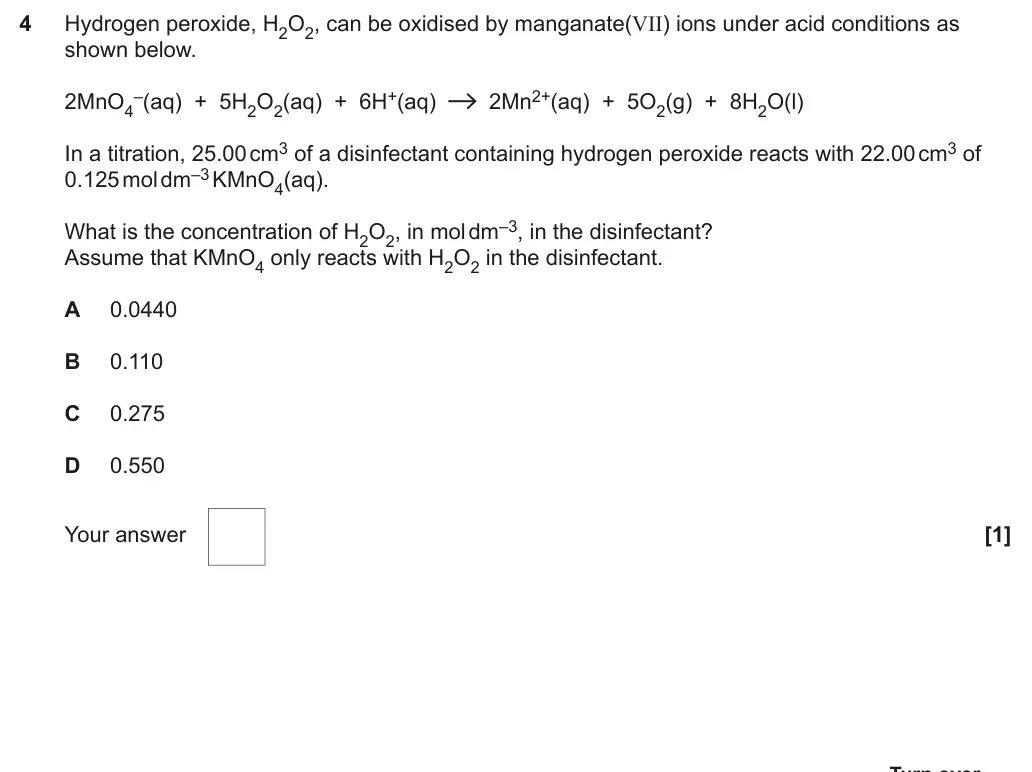
4 Hydrogen peroxide, H2O2, can be oxidised by manganate(VII) ions under acid conditions as
shown below.
2MnO4 –(aq)  +  5H2O2(aq)  +  6H+(aq) 2Mn2+(aq)  +  5O2(g)  +  8H2O(l)
In a titration, 25.00 cm3 of a disinfectant containing hydrogen peroxide reacts with 22.00 cm3 of
0.125 mol dm–3 KMnO4(aq).
What is the concentration of H2O2, in mol dm–3, in the disinfectant?
Assume that KMnO4 only reacts with H2O2 in the disinfectant.
A 0.0440
B 0.110
C 0.275
D 0.550
Your answer [1]
June 2022 · Paper 1 · Q5 1 mark AO2 Multiple choice Medium amount of substance
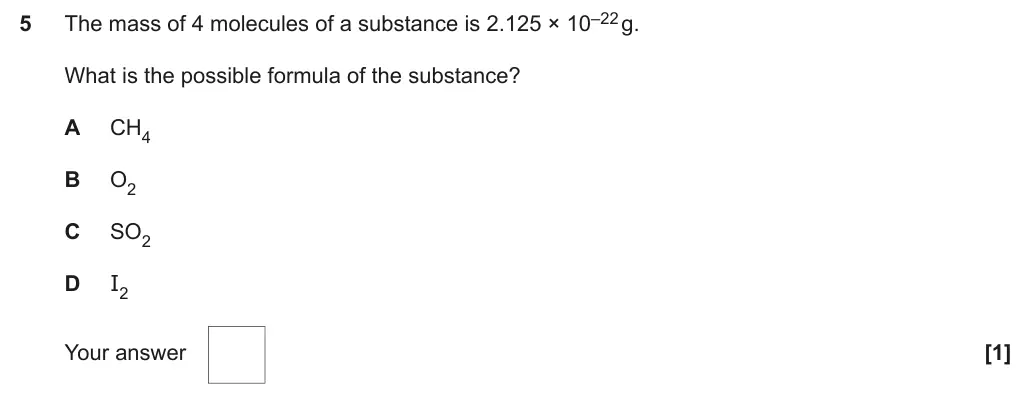
5 The mass of 4 molecules of a substance is 2.125 × 10⁻²² g.
What is the possible formula of the substance?
A CH4
B O2
C SO2
D I2
Your answer [1]
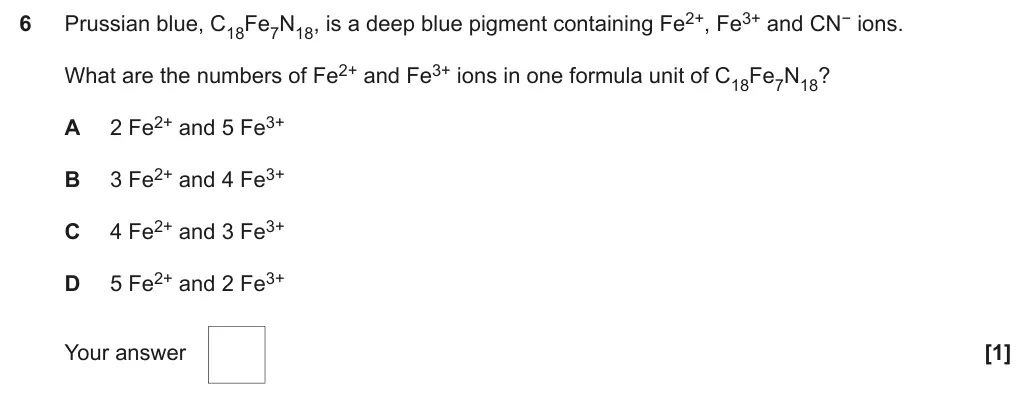
June 2022 · Paper 1 · Q6 1 mark AO1 Multiple choice Easy formulae and equationsredox
6 Prussian blue, C18Fe7N18, is a deep blue pigment containing Fe2+, Fe3+ and CN− ions.
What are the numbers of Fe2+ and Fe3+ ions in one formula unit of C18Fe7N18?
A 2 Fe2+ and 5 Fe3+
B 3 Fe2+ and 4 Fe3+
C 4 Fe2+ and 3 Fe3+
D 5 Fe2+ and 2 Fe3+
Your answer [1]
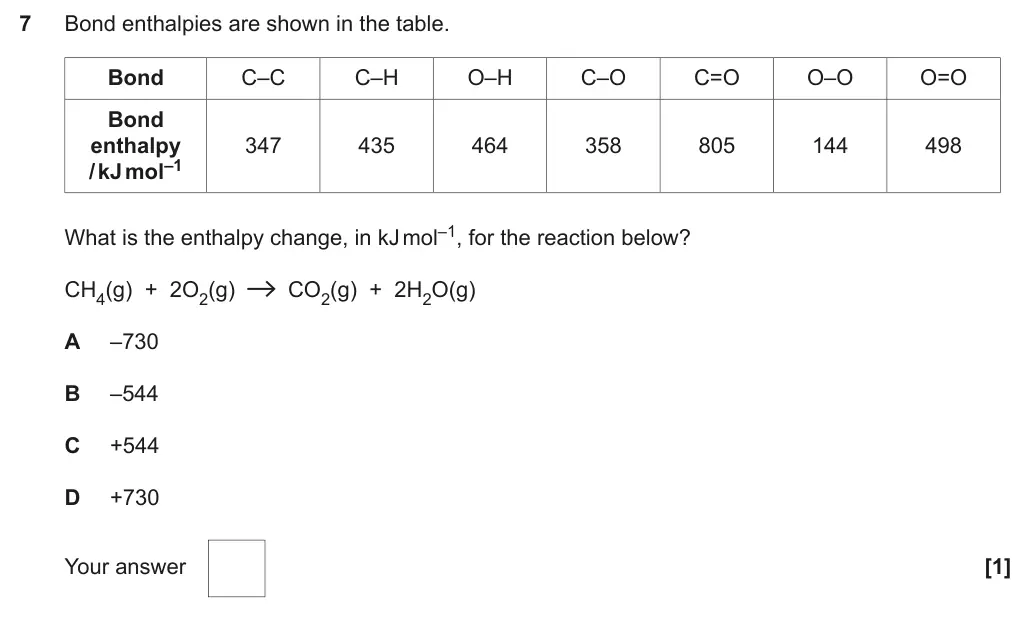
June 2022 · Paper 1 · Q7 1 mark AO2 Multiple choice Hard enthalpy changes
7 Bond enthalpies are shown in the table.
Bond C–C C–H O–H C–O C=O O–O O=O
Bond
enthalpy 347 435 464 358 805 144 498
/ kJ mol–1
What is the enthalpy change, in kJ mol–1, for the reaction below?
CH4(g)  +  2O2(g) CO2(g)  +  2H2O(g)
A –730
B –544
C +544
D +730
Your answer [1]
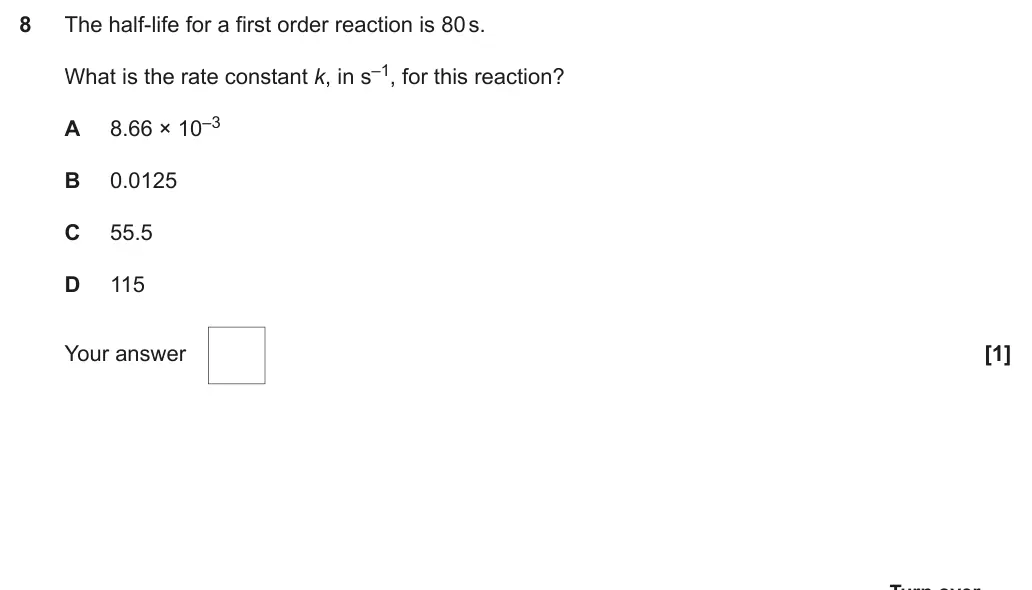
June 2022 · Paper 1 · Q8 1 mark AO1 Multiple choice Easy rate equations
8 The half-life for a first order reaction is 80 s.
What is the rate constant k, in s–1, for this reaction?
A 8.66 × 10⁻³
B 0.0125
C 55.5
D 115
Your answer [1]
June 2022 · Paper 1 · Q9 1 mark AO1 Multiple choice Hard lattice enthalpy
9 Which equation represents the change that accompanies the standard enthalpy change of
atomisation of bromine?
A ½ Br2(l) Br(g)
B Br2(l) 2Br(g)
C ½ Br2(g) Br(g)
D Br2(g) 2Br(g)
Your answer [1]
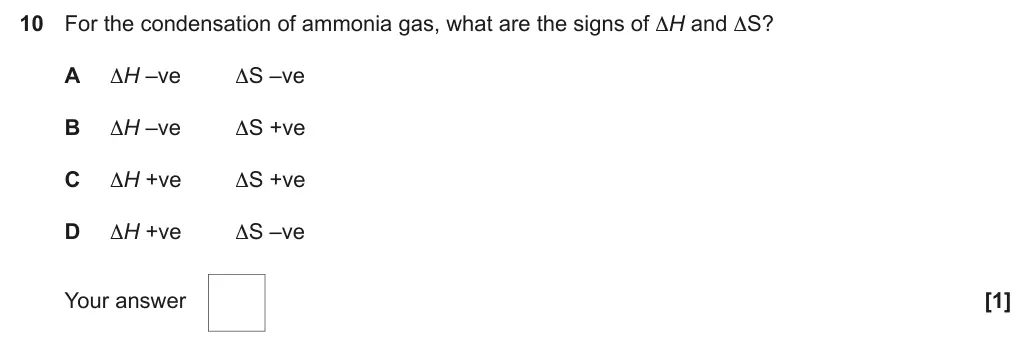
June 2022 · Paper 1 · Q10 1 mark AO2 Multiple choice Medium entropy and free energyenthalpy changes
10 For the condensation of ammonia gas, what are the signs of ∆H and ∆S?
A ∆H –ve ∆S –ve
B ∆H –ve ∆S +ve
C ∆H +ve ∆S +ve
D ∆H +ve ∆S –ve
Your answer [1]
June 2022 · Paper 1 · Q11 1 mark AO2 Multiple choice Easy acids bases and buffers
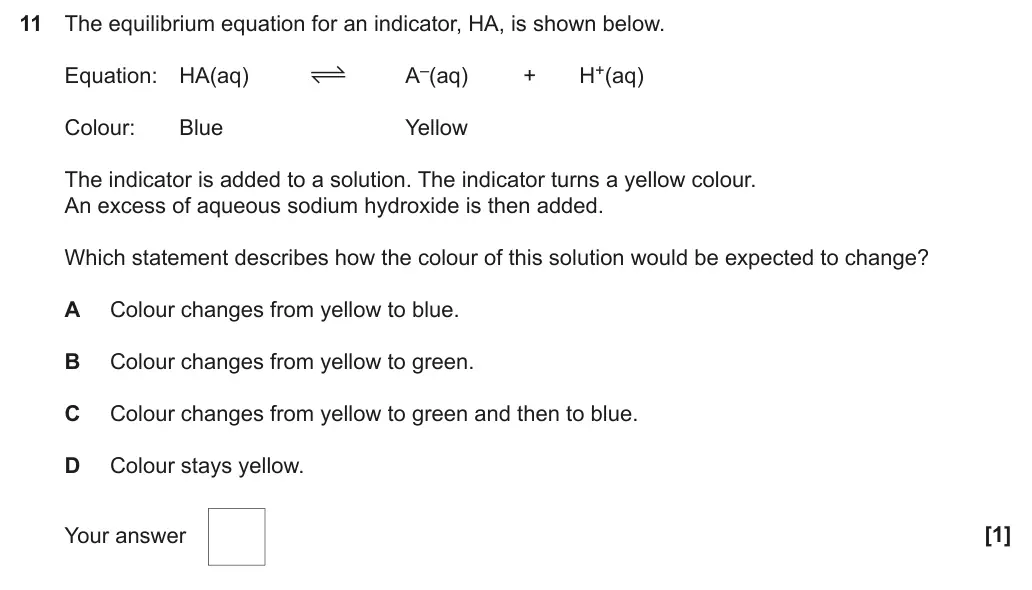
11 The equilibrium equation for an indicator, HA, is shown below.
Equation: HA(aq) A–(aq) + H+(aq)
Colour: Blue Yellow
The indicator is added to a solution. The indicator turns a yellow colour.
An excess of aqueous sodium hydroxide is then added.
Which statement describes how the colour of this solution would be expected to change?
A Colour changes from yellow to blue.
B Colour changes from yellow to green.
C Colour changes from yellow to green and then to blue.
D Colour stays yellow.
Your answer [1]
June 2022 · Paper 1 · Q12 1 mark AO1 Multiple choice Easy acids bases and buffers
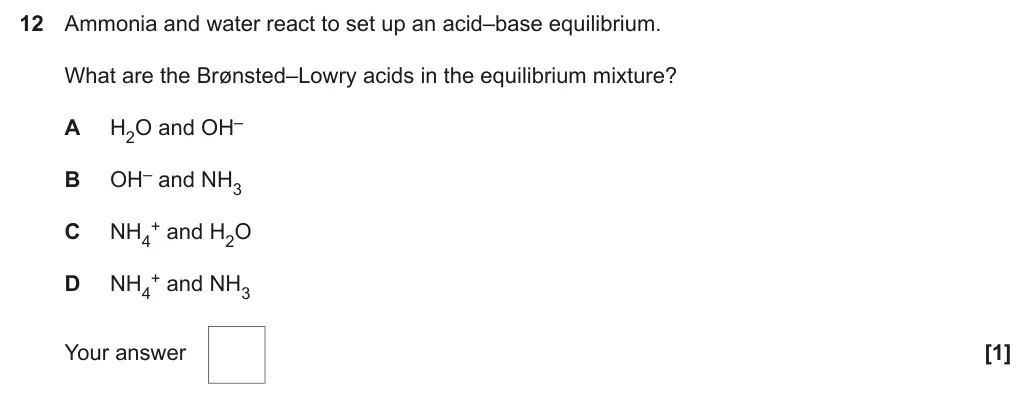
12 Ammonia and water react to set up an acid–base equilibrium.
What are the Brønsted–Lowry acids in the equilibrium mixture?
A H2O and OH–
B OH– and NH3
C NH4 + and H2O
D NH4 + and NH3
Your answer [1]
June 2022 · Paper 1 · Q13 1 mark AO2 Multiple choice Medium redox and electrode potentials
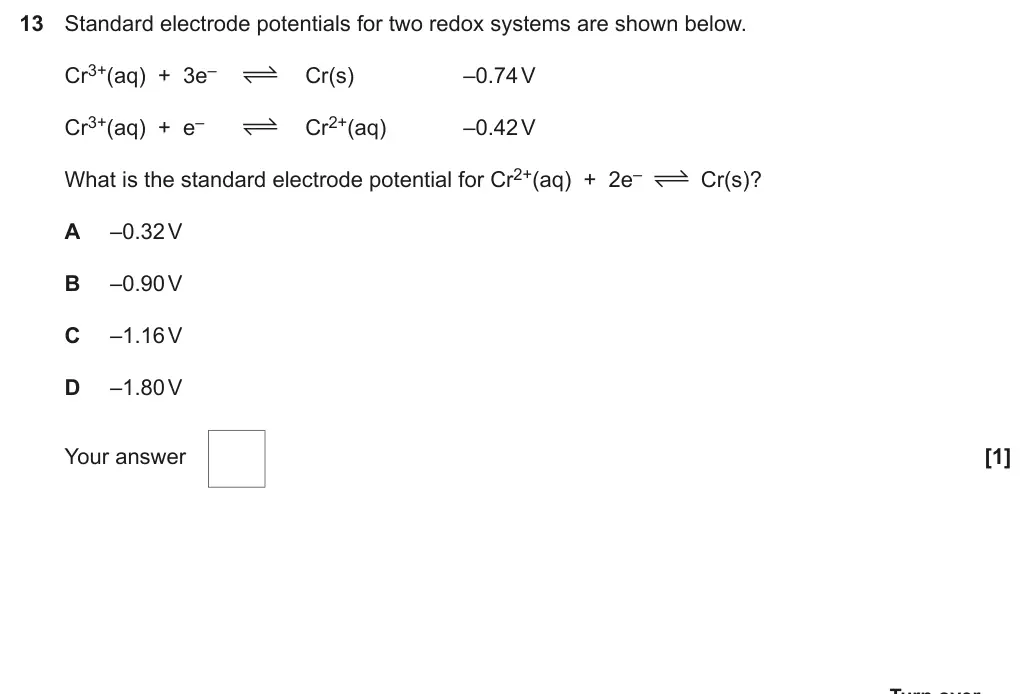
13 Standard electrode potentials for two redox systems are shown below.
Cr3+(aq)  +  3e– Cr(s) –0.74 V
Cr3+(aq)  +  e– Cr2+(aq) –0.42 V
What is the standard electrode potential for Cr2+(aq)  +  2e– Cr(s)?
A –0.32 V
B –0.90 V
C –1.16 V
D –1.80 V
Your answer [1]
June 2022 · Paper 1 · Q14 1 mark AO1 Multiple choice Medium bonding and structure
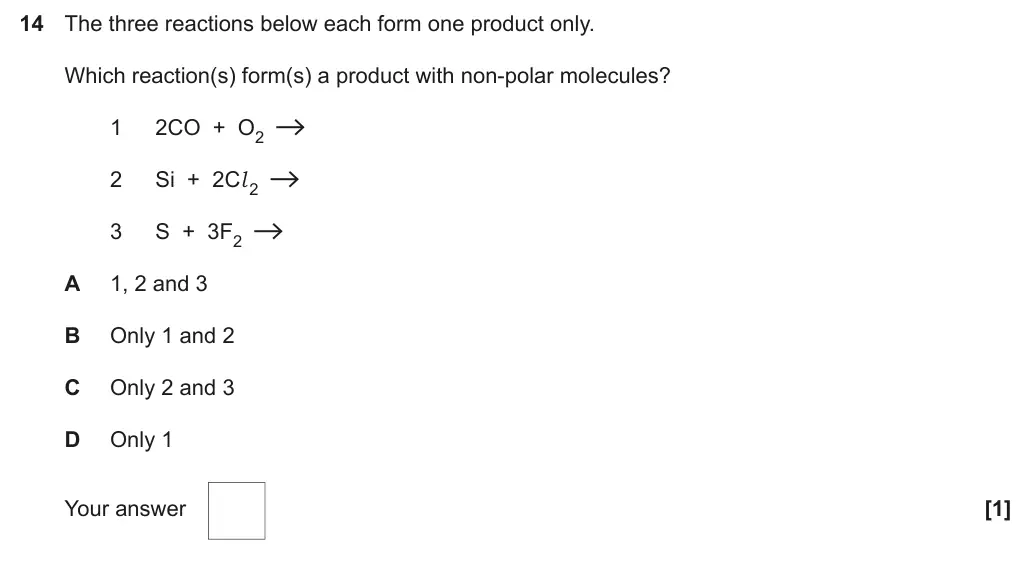
14 The three reactions below each form one product only.
Which reaction(s) form(s) a product with non-polar molecules?
1 2CO  +  O2
2 Si  +  2Cl 2
3 S  +  3F2
A 1, 2 and 3
B Only 1 and 2
C Only 2 and 3
D Only 1
Your answer [1]
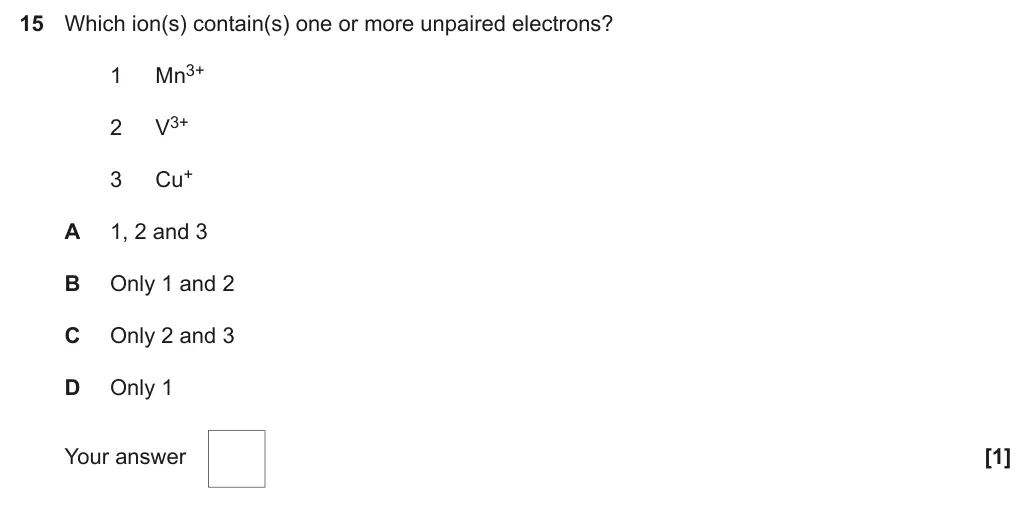
June 2022 · Paper 1 · Q15 1 mark AO1 Multiple choice Hard transition elementselectron structure
15 Which ion(s) contain(s) one or more unpaired electrons?
1 Mn3+
2 V3+
3 Cu+
A 1, 2 and 3
B Only 1 and 2
C Only 2 and 3
D Only 1
Your answer [1]
June 2022 · Paper 1 · Q16(a)(i) 3 marks AO1 Drawing / labelling Easy reaction rates
SECTION B
Answer all the questions.
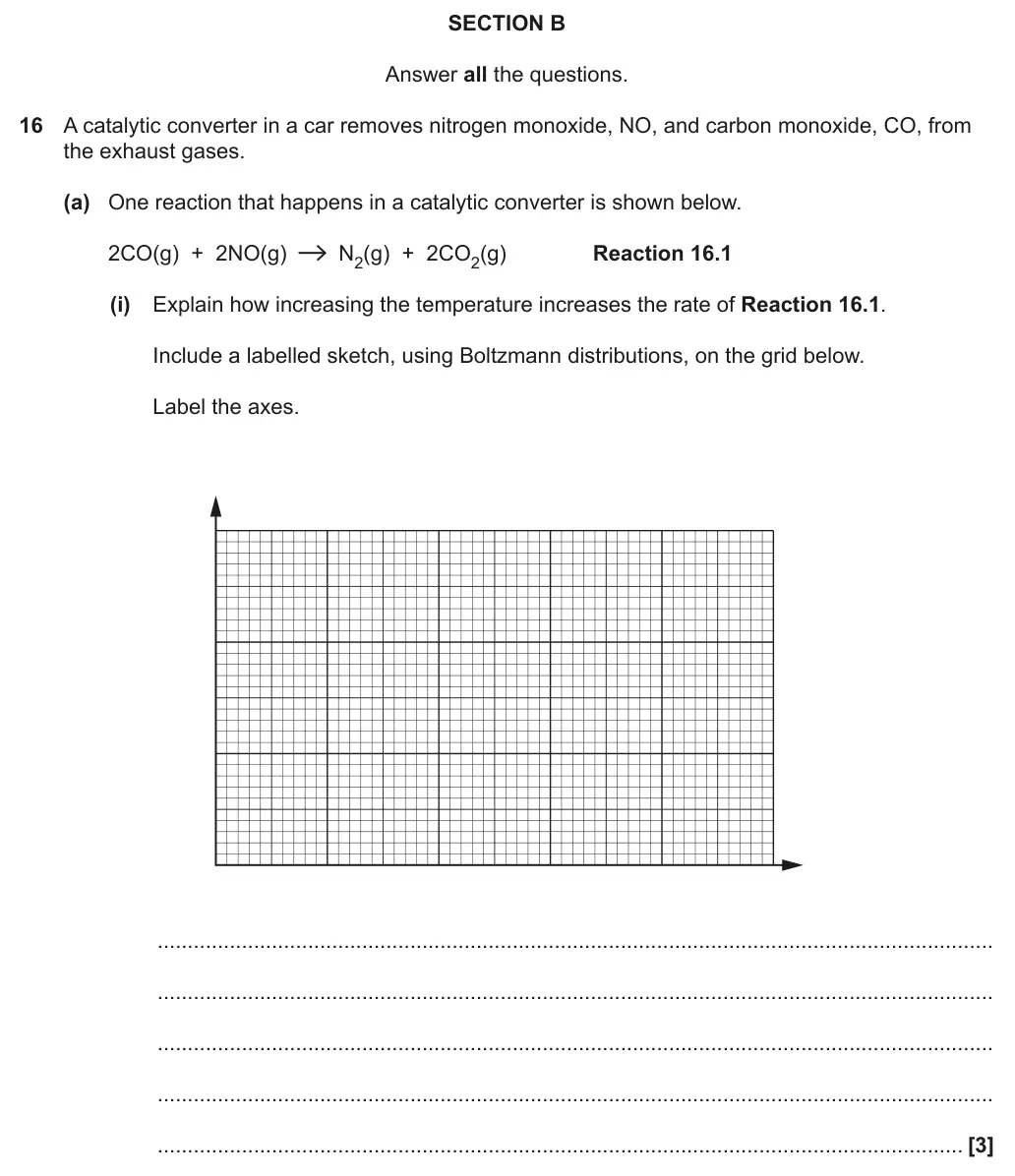
16 A catalytic converter in a car removes nitrogen monoxide, NO, and carbon monoxide, CO, from
the exhaust gases.
(a) One reaction that happens in a catalytic converter is shown below.
2CO(g)  +  2NO(g) N2(g)  +  2CO2(g)    Reaction 16.1
(i) Explain how increasing the temperature increases the rate of Reaction 16.1.
Include a labelled sketch, using Boltzmann distributions, on the grid below.
Label the axes.
...........................................................................................................................................
...........................................................................................................................................
...........................................................................................................................................
...........................................................................................................................................
...................................................................................................................................... [3]
June 2022 · Paper 1 · Q16(a)(ii) 5 marks AO1, 2, 3 Calculation Hard rate equations
Earlier part of question 16 that this part usesEarlier part of June 2022 Paper 1 question 16
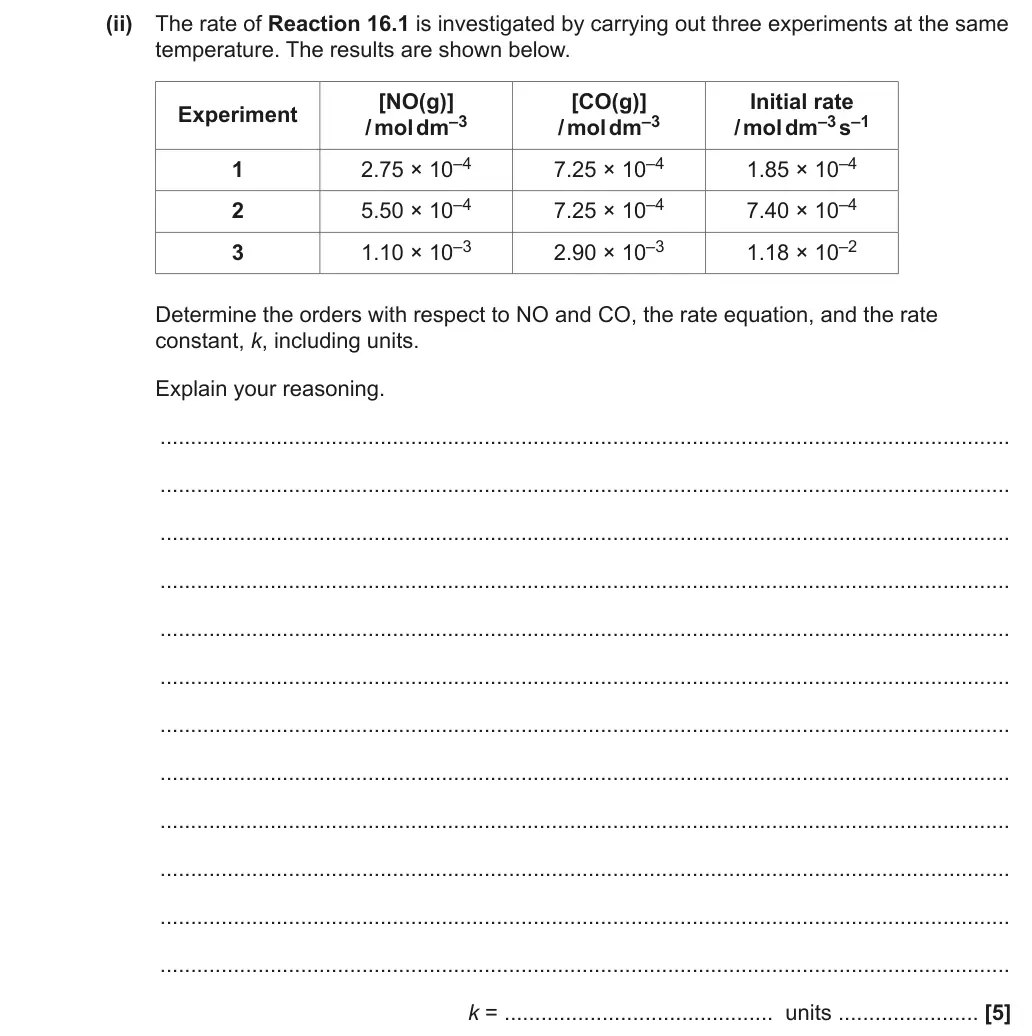
(ii) The rate of Reaction 16.1 is investigated by carrying out three experiments at the same
temperature. The results are shown below.
[NO(g)] [CO(g)] Initial rate
Experiment
/ mol dm–3 / mol dm–3 / mol dm–3 s–1
1 2.75 × 10⁻⁴ 7.25 × 10⁻⁴ 1.85 × 10⁻⁴
2 5.50 × 10⁻⁴ 7.25 × 10⁻⁴ 7.40 × 10⁻⁴
3 1.10 × 10⁻³ 2.90 × 10⁻³ 1.18 × 10⁻²
Determine the orders with respect to NO and CO, the rate equation, and the rate
constant, k, including units.
Explain your reasoning.
...........................................................................................................................................
...........................................................................................................................................
...........................................................................................................................................
...........................................................................................................................................
...........................................................................................................................................
...........................................................................................................................................
...........................................................................................................................................
...........................................................................................................................................
...........................................................................................................................................
...........................................................................................................................................
...........................................................................................................................................
...........................................................................................................................................
k = ............................................  units ....................... [5]
June 2022 · Paper 1 · Q16(b) 2 marks AO3 Short answer Medium rate equations
(b) Carbon monoxide also reacts with nitrogen dioxide as shown in Reaction 16.2.
CO(g)  +  NO2(g) NO(g)  +  CO2(g)   Reaction 16.2
The rate equation for Reaction 16.2 is shown below:
rate = k [NO2(g)]2
Suggest a possible two-step mechanism for Reaction 16.2.
The first step is much slower than the second step.
step 1  .......................................................................................................................................
step 2  .......................................................................................................................................
[2]
June 2022 · Paper 1 · Q17(a)(i) 4 marks AO1, 2 Calculation Hard enthalpy changesamount of substance
17 This question is about energy changes.
(a) Magnesium reacts with aqueous silver nitrate, AgNO3(aq) as shown below.
Mg(s)  +  2AgNO3(aq) 2Ag(s)  +  Mg(NO3)2(aq)   ∆H = –678 kJ mol–1
A student adds an excess of magnesium to 100.0 cm3 of 0.400 mol dm–3 AgNO3(aq).
The initial temperature is 20.0 °C.
(i) Determine the maximum temperature reached in this reaction.
Give your answer to 3 significant figures.
Assume that the specific heat capacity and density of the solution are the same as for
water, and that there are no heat losses.
maximum temperature reached =  .................................................... °C [4]
June 2022 · Paper 1 · Q17(a)(ii) 1 mark AO3 Short answer Hard enthalpy changespractical skills
Earlier part of question 17 that this part usesEarlier part of June 2022 Paper 1 question 17
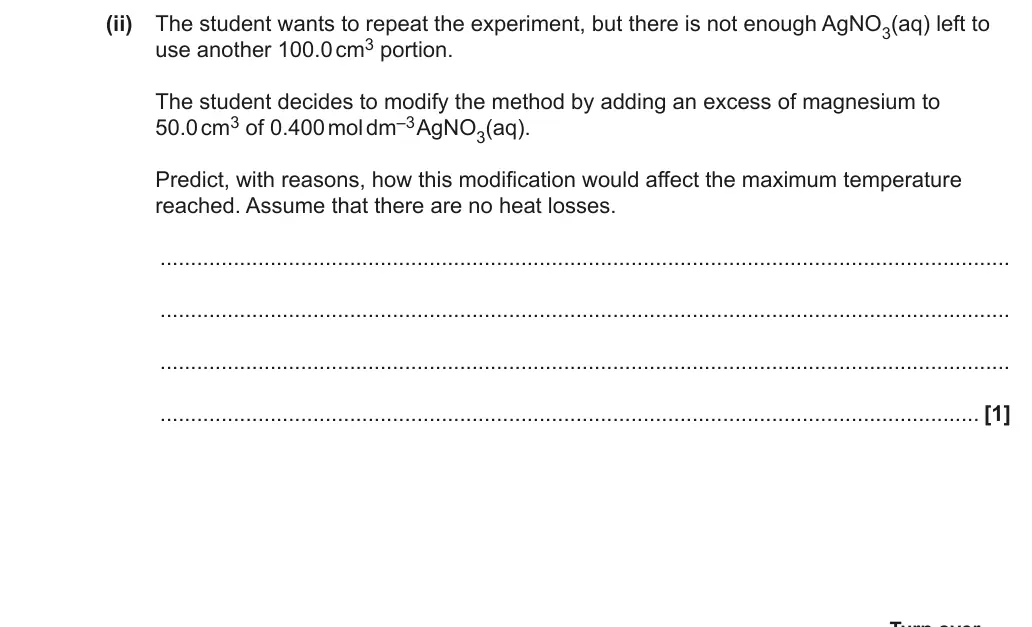
(ii) The student wants to repeat the experiment, but there is not enough AgNO3(aq) left to
use another 100.0 cm3 portion.
The student decides to modify the method by adding an excess of magnesium to
50.0 cm3 of 0.400 mol dm–3 AgNO3(aq).
Predict, with reasons, how this modification would affect the maximum temperature
reached. Assume that there are no heat losses.
...........................................................................................................................................
...........................................................................................................................................
...........................................................................................................................................
...................................................................................................................................... [1]
June 2022 · Paper 1 · Q17(b)(i) 1 mark AO1 Short answer Medium enthalpy changes
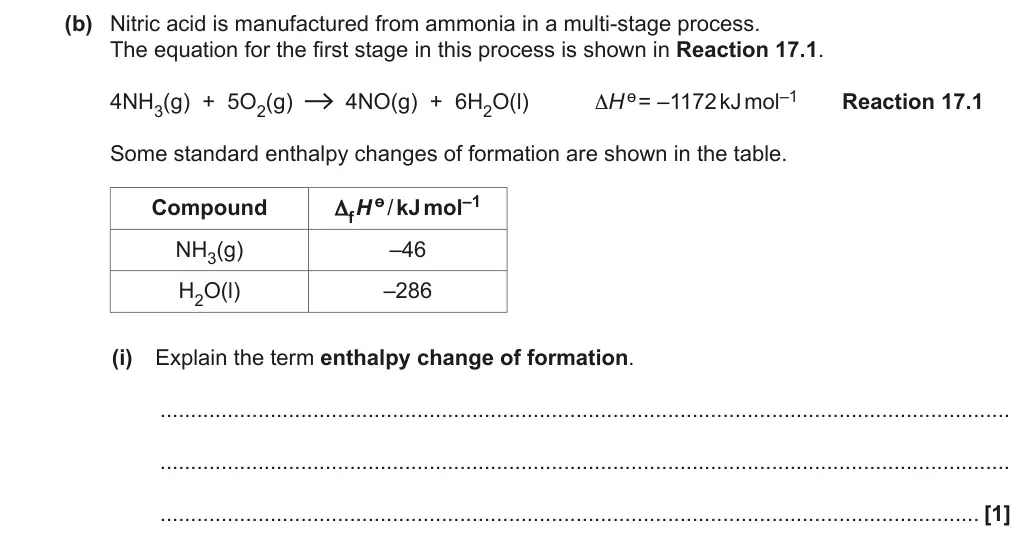
(b) Nitric acid is manufactured from ammonia in a multi-stage process.
The equation for the first stage in this process is shown in Reaction 17.1.
4NH3(g)  +  5O2(g) 4NO(g)  +  6H2O(l)   ∆H ө = –1172 kJ mol–1  Reaction 17.1
Some standard enthalpy changes of formation are shown in the table.
Compound ∆f H ө / kJ mol–1
NH3(g) –46
H2O(l) –286
(i) Explain the term enthalpy change of formation.
...........................................................................................................................................
...........................................................................................................................................
...................................................................................................................................... [1]
June 2022 · Paper 1 · Q17(b)(ii) 2 marks AO2 Calculation Hard enthalpy changes
Earlier part of question 17 that this part usesEarlier part of June 2022 Paper 1 question 17
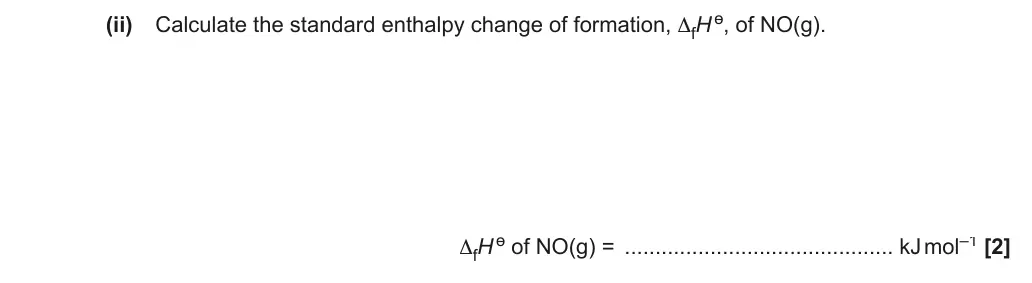
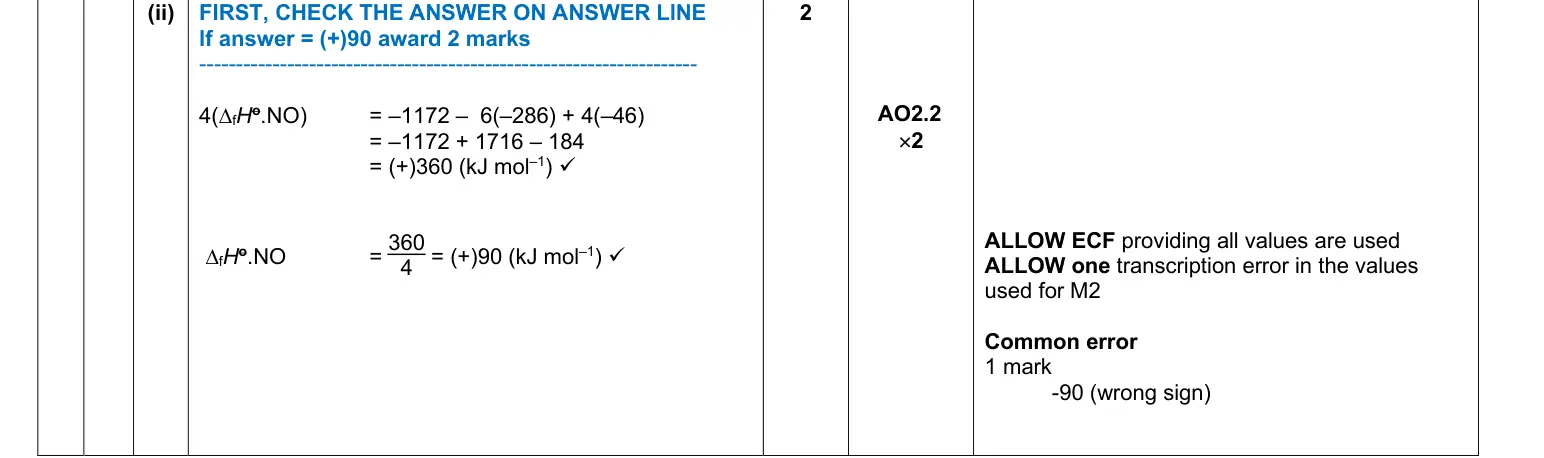
(ii) Calculate the standard enthalpy change of formation, ∆fH ө, of NO(g).
∆fH ө of NO(g) =  ............................................ kJ mol–1 [2]
June 2022 · Paper 1 · Q17(c)(i) 1 mark AO1 Short answer Medium entropy and free energy
(c) Carbon disulfide, CS2, reacts with dinitrogen oxide, N2O, as shown in Reaction 17.2.
4CS2(l)  +  8N2O(g) S8(s)  +  4CO2(g)  +  8N2(g)    Reaction 17.2
Standard entropies, S ө, are shown in the table.
Substance CS2(l) N2O(g) S8(s) CO2(g) N2(g)
S ө/ J K–1 mol–1 151 220 256 214 192
(i) Explain the term entropy.
...........................................................................................................................................
...........................................................................................................................................
...................................................................................................................................... [1]
June 2022 · Paper 1 · Q17(c)(ii) 3 marks AO2 Calculation Medium entropy and free energy
Earlier part of question 17 that this part usesEarlier part of June 2022 Paper 1 question 17
(ii) The free energy change, ∆G, of Reaction 17.2 is –2672 kJ mol–1 at 25 °C.
Calculate the enthalpy change, ∆H, of Reaction 17.2, in kJ mol–1.
∆H =  ............................................ kJ mol–1 [3]
June 2022 · Paper 1 · Q17(c)(iii) 2 marks AO3 Short answer Medium entropy and free energy
Earlier parts of question 17 that this part usesEarlier part of June 2022 Paper 1 question 17Earlier part of June 2022 Paper 1 question 17
(iii) A student concludes that Reaction 17.2 is feasible at all temperatures.
Explain whether the student is correct or not.
...........................................................................................................................................
...........................................................................................................................................
...........................................................................................................................................
...................................................................................................................................... [2]
June 2022 · Paper 1 · Q18(a) 2 marks AO1 Complete table/diagram Hard periodicity
18 The graph shows the first ionisation energies for elements from helium, He, to boron, B, in the
periodic table.
3000
2500
2000
1st ionisation
energy
/ kJ mol–1 1500
1000
500
0
He Li Be B C N O F Ne
(a) Complete the graph for C, N, O, F and Ne. [2]
June 2022 · Paper 1 · Q18(b) 1 mark AO2 Calculation Medium periodicityamount of substance
Earlier part of question 18 that this part usesEarlier part of June 2022 Paper 1 question 18
(b) Estimate the energy required to form one Li+(g) ion from one Li(g) atom.
Give your answer in kJ, in standard form, and to two significant figures.
energy =  ..................................................... kJ [1]
June 2022 · Paper 1 · Q18(c) 4 marks AO1 Short answer Easy periodicity
Earlier part of question 18 that this part usesEarlier part of June 2022 Paper 1 question 18
(c) Explain why the first ionisation energies of He and Be are both higher than the first ionisation
energy of Li.
Explanation for He:  ...................................................................................................................
...................................................................................................................................................
...................................................................................................................................................
...................................................................................................................................................
Explanation for Be:  ...................................................................................................................
...................................................................................................................................................
...................................................................................................................................................
...................................................................................................................................................
[4]
June 2022 · Paper 1 · Q18(d) 2 marks AO1 Short answer Hard periodicity
Earlier part of question 18 that this part usesEarlier part of June 2022 Paper 1 question 18
(d) Explain why the first ionisation energy of Be is higher than the first ionisation energy of B.
...................................................................................................................................................
...................................................................................................................................................
...................................................................................................................................................
.............................................................................................................................................. [2]
June 2022 · Paper 1 · Q19(a)(i) 2 marks AO1 Calculation Easy acids and titrationspractical skillspractical techniques
19 This question is about acids and buffer solutions.
(a) Succinic acid, HOOC(CH2)2COOH, is a weak dibasic acid that is used in tablet form in
health supplements.
A student plans to determine the mass of succinic acid in one tablet of a succinic acid health
supplement.
The student carries out a titration with potassium hydroxide.
The end point occurs when both acidic protons in succinic acid have been replaced as
shown in Equation 19.1.
HOOC(CH2)2COOH  +  2KOH KOOC(CH2)2COOK  +  2H2O   Equation 19.1
The student uses the following method.
Stage 1 The student crushes four tablets of the health supplement and dissolves the
powdered tablets in distilled water.
Stage 2 The student makes up the solution from Stage 1 to 250.0 cm3 in a volumetric
flask.
Stage 3 The student titrates 10.0 cm3 portions of the solution obtained in Stage 2 with
0.0600 mol dm–3 potassium hydroxide, using phenolphthalein as the indicator.
The student carries out a trial titration, followed by three further titrations.
The results are shown below.
Titration Trial 1 2 3
Final burette reading / cm3 25.25 23.75 25.35 25.75
Initial burette reading / cm3 2.50 1.30 2.65 3.20
Titre / cm3
(i) Complete the table and calculate the mean titre that the student should use for
analysing the results.
mean titre =  .................................................. cm3 [2]
June 2022 · Paper 1 · Q19(a)(ii) 5 marks AO2, 3 Calculation Medium acids and titrationsamount of substance
Earlier part of question 19 that this part usesEarlier part of June 2022 Paper 1 question 19
(ii) Use the student’s results and Equation 19.1 to calculate the mass, in mg, of succinic
acid in one tablet of the health supplement.
Give you answer to 3 significant figures.
mass =  ................................................... mg [5]
June 2022 · Paper 1 · Q19(b)(i) 1 mark AO1 Short answer Hard acids bases and buffers
(b) Glycolic acid, HOCH2COOH, (pKa = 3.83) is a weak monobasic acid used in some skincare
products.
A buffer solution is prepared by adding 60.0 cm3 of 0.750 mol dm–3 glycolic acid to 40.0 cm3
of 0.625 mol dm–3 potassium hydroxide, KOH.
(i) Explain why a buffer solution is formed.
...........................................................................................................................................
...........................................................................................................................................
...................................................................................................................................... [1]
June 2022 · Paper 1 · Q19(b)(ii) 4 marks AO1, 2 Calculation Easy acids bases and buffers
Earlier part of question 19 that this part usesEarlier part of June 2022 Paper 1 question 19
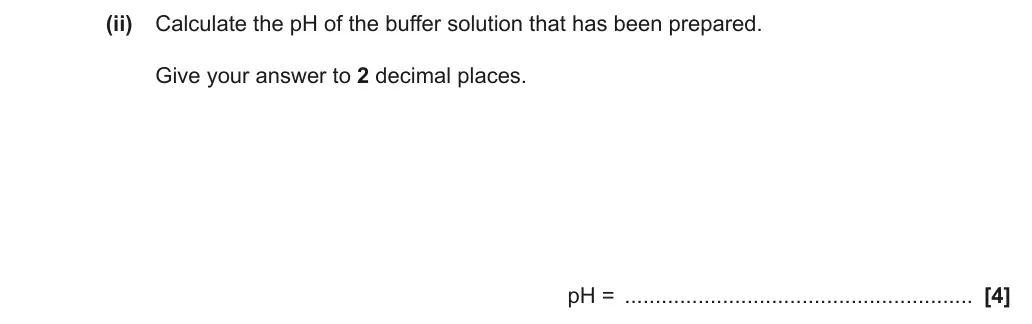
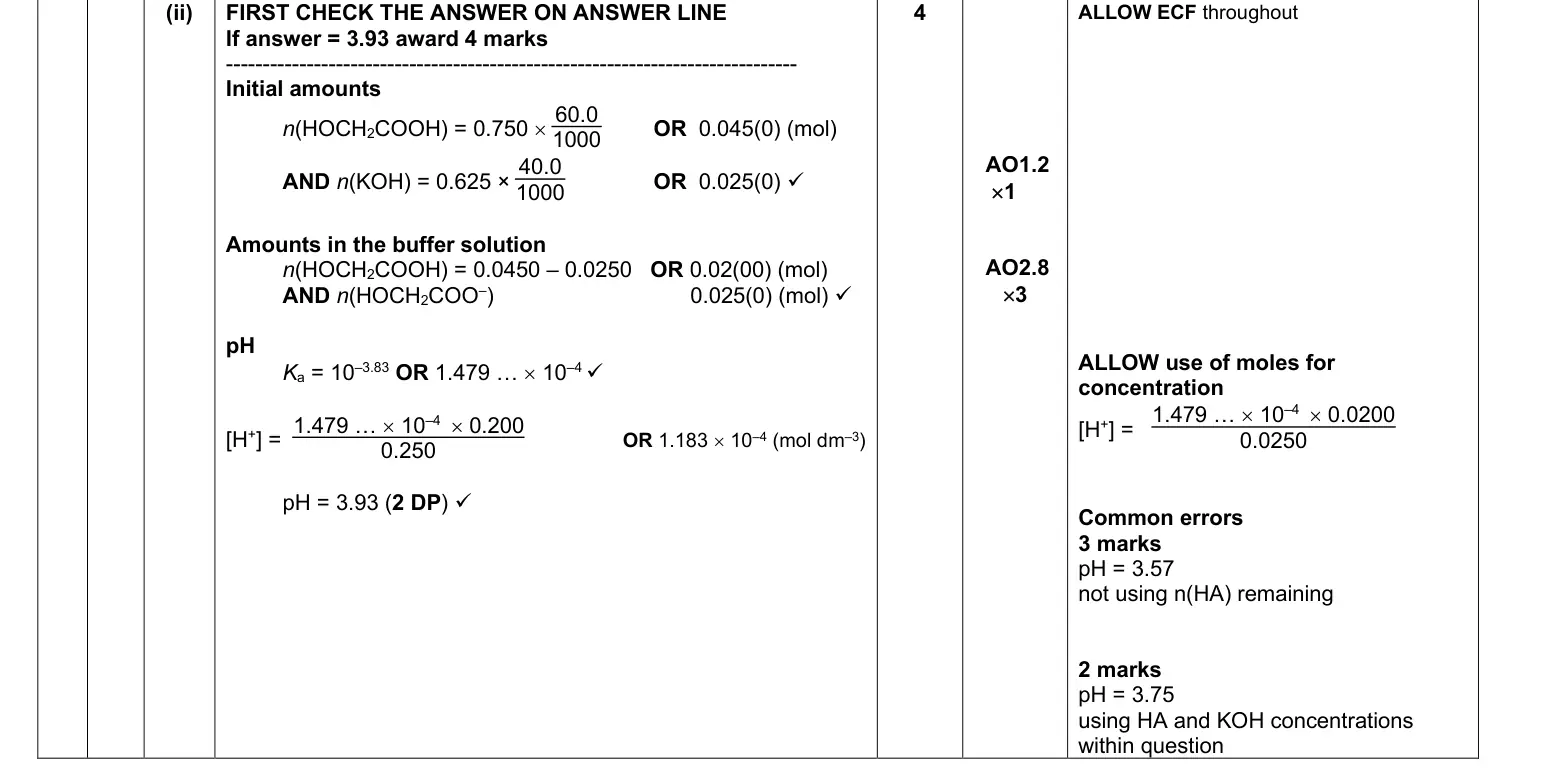
(ii) Calculate the pH of the buffer solution that has been prepared.
Give your answer to 2 decimal places.
pH =  ......................................................... [4]
June 2022 · Paper 1 · Q19(b)(iii) 2 marks AO1 Short answer Medium acids bases and buffers
Earlier part of question 19 that this part usesEarlier part of June 2022 Paper 1 question 19
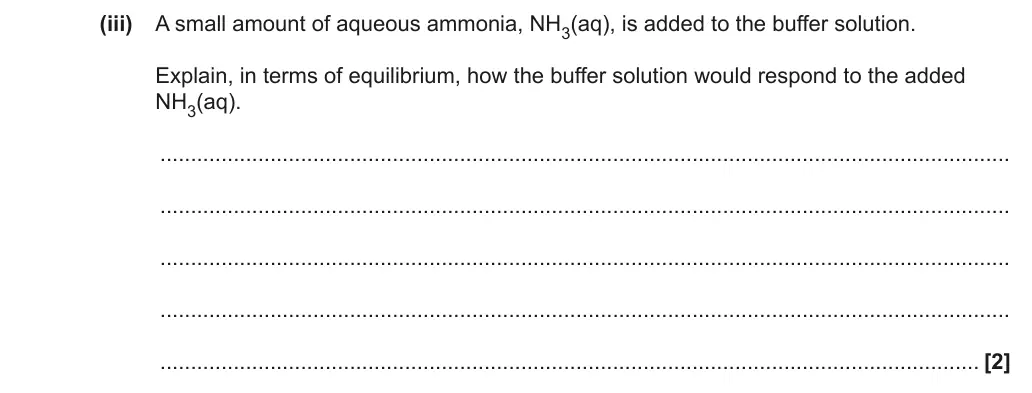
(iii) A small amount of aqueous ammonia, NH3(aq), is added to the buffer solution.
Explain, in terms of equilibrium, how the buffer solution would respond to the added
NH3(aq).
...........................................................................................................................................
...........................................................................................................................................
...........................................................................................................................................
...........................................................................................................................................
...................................................................................................................................... [2]
June 2022 · Paper 1 · Q20(a) 6 marks AO1, 2 6-mark level of response Easy equilibrium constantschemical equilibrium
20 This question is about equilibria involving hydrogen.
(a)* Hydrogen is used industrially to manufacture ammonia.
The equilibrium is shown below.
N2(g) + 3H2(g) 2NH3(g)    ∆H = –92 kJ mol–1    Equilibrium 20.1
1.20 mol N2(g) is mixed with 3.60 mol H2(g) in a 8.00 dm3 container.
The mixture is heated to 550 °C with an iron catalyst and allowed to reach equilibrium.
The equilibrium mixture contains 0.160 mol of NH3.
Determine the equilibrium constant Kc for Equilibrium 20.1, and explain why the operational
conditions used by industry may be different from those required for a maximum equilibrium
yield of ammonia. [6]
...................................................................................................................................................
...................................................................................................................................................
...................................................................................................................................................
...................................................................................................................................................
...................................................................................................................................................
...................................................................................................................................................
...................................................................................................................................................
...................................................................................................................................................
...................................................................................................................................................
...................................................................................................................................................
...................................................................................................................................................
...................................................................................................................................................
...................................................................................................................................................
...................................................................................................................................................
...................................................................................................................................................
...................................................................................................................................................
...................................................................................................................................................
Additional answer space if required.
...................................................................................................................................................
...................................................................................................................................................
...................................................................................................................................................
...................................................................................................................................................
...................................................................................................................................................
June 2022 · Paper 1 · Q20(b)(i) 1 mark AO1 Short answer Medium equilibrium constants
(b) In industry, hydrogen is also used to reduce the iron oxide Fe3O4 as shown in
Equilibrium 20.2.
The reaction is carried out at 500 °C.
Fe3O4(s)  +  4H2(g) 3Fe(s)  +  4H2O(g)    Equilibrium 20.2
(i) When the temperature is decreased, the value of Kp decreases.
Determine whether the forward reaction is exothermic or endothermic.
Explain your answer.
...........................................................................................................................................
...........................................................................................................................................
...........................................................................................................................................
...................................................................................................................................... [1]
June 2022 · Paper 1 · Q20(b)(ii) 1 mark AO3 Short answer Medium equilibrium constantschemical equilibrium
Earlier part of question 20 that this part usesEarlier part of June 2022 Paper 1 question 20
(ii) Two students are discussing the effect of pressure on the equilibrium position of
Equilibrium 20.2.
Student 1 says:
“There are more moles of products than reactants, so increasing the pressure will shift
the equilibrium to the left hand side.”
Student 2 disagrees.
Determine which student is correct. Justify your answer.
...........................................................................................................................................
...........................................................................................................................................
...........................................................................................................................................
...................................................................................................................................... [1]
June 2022 · Paper 1 · Q21(a)(i) 1 mark AO2 Short answer Medium group 2
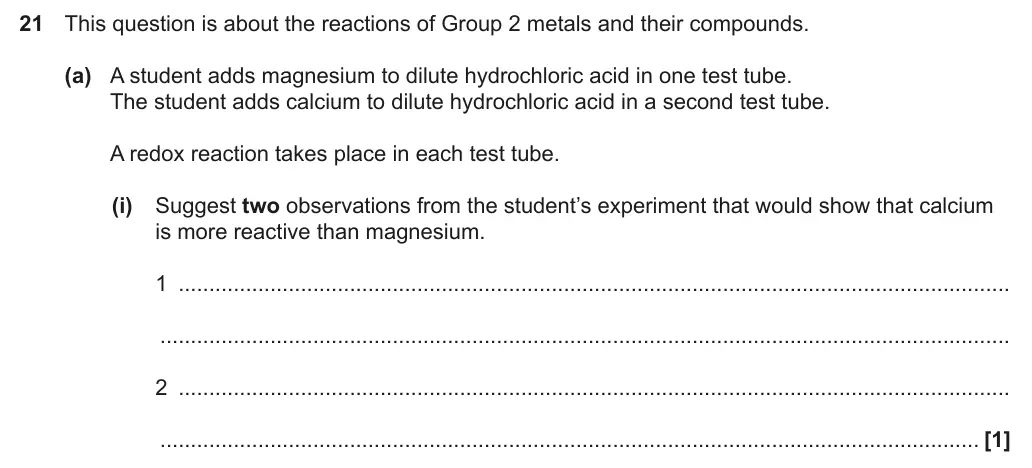
21 This question is about the reactions of Group 2 metals and their compounds.
(a) A student adds magnesium to dilute hydrochloric acid in one test tube.
The student adds calcium to dilute hydrochloric acid in a second test tube.
A redox reaction takes place in each test tube.
(i) Suggest two observations from the student’s experiment that would show that calcium
is more reactive than magnesium.
1  ........................................................................................................................................
...........................................................................................................................................
2  ........................................................................................................................................
...................................................................................................................................... [1]
June 2022 · Paper 1 · Q21(a)(ii) 2 marks AO2 Equation writing Hard redoxgroup 2redox and electrode potentials
Earlier part of question 21 that this part usesEarlier part of June 2022 Paper 1 question 21
(ii) Write half-equations for the reaction of magnesium with hydrochloric acid.
Oxidation half-equation:  ....................................................................................................
Reduction half-equation:  ...................................................................................................
[2]
June 2022 · Paper 1 · Q21(b)(i) 5 marks AO2 Calculation Medium acids bases and buffersamount of substancegroup 2
(b) A sample of barium oxide is added to distilled water at 25 °C.
A colourless solution forms containing barium hydroxide, Ba(OH)2.
The solution is made up to 250.0 cm3 with distilled water.
The pH of this solution is 13.12.
(i) Determine the mass of barium oxide that was used.
Give your answer to 3 significant figures.
mass of barium oxide =  ....................................................... g [5]
June 2022 · Paper 1 · Q21(b)(ii) 1 mark AO3 Equation writing Easy formulae and equationsacids and titrationsqualitative analysis
Earlier part of question 21 that this part usesEarlier part of June 2022 Paper 1 question 21
(ii) 10 cm3 of dilute sulfuric acid is added to 10 cm3 of the colourless solution of Ba(OH)2.
Write an ionic equation, including state symbols, for the reaction.
...................................................................................................................................... [1]
June 2022 · Paper 1 · Q21(c)(i) 3 marks AO2 Calculation Hard amount of substance
(c) Limestone and huntite are two calcium minerals.
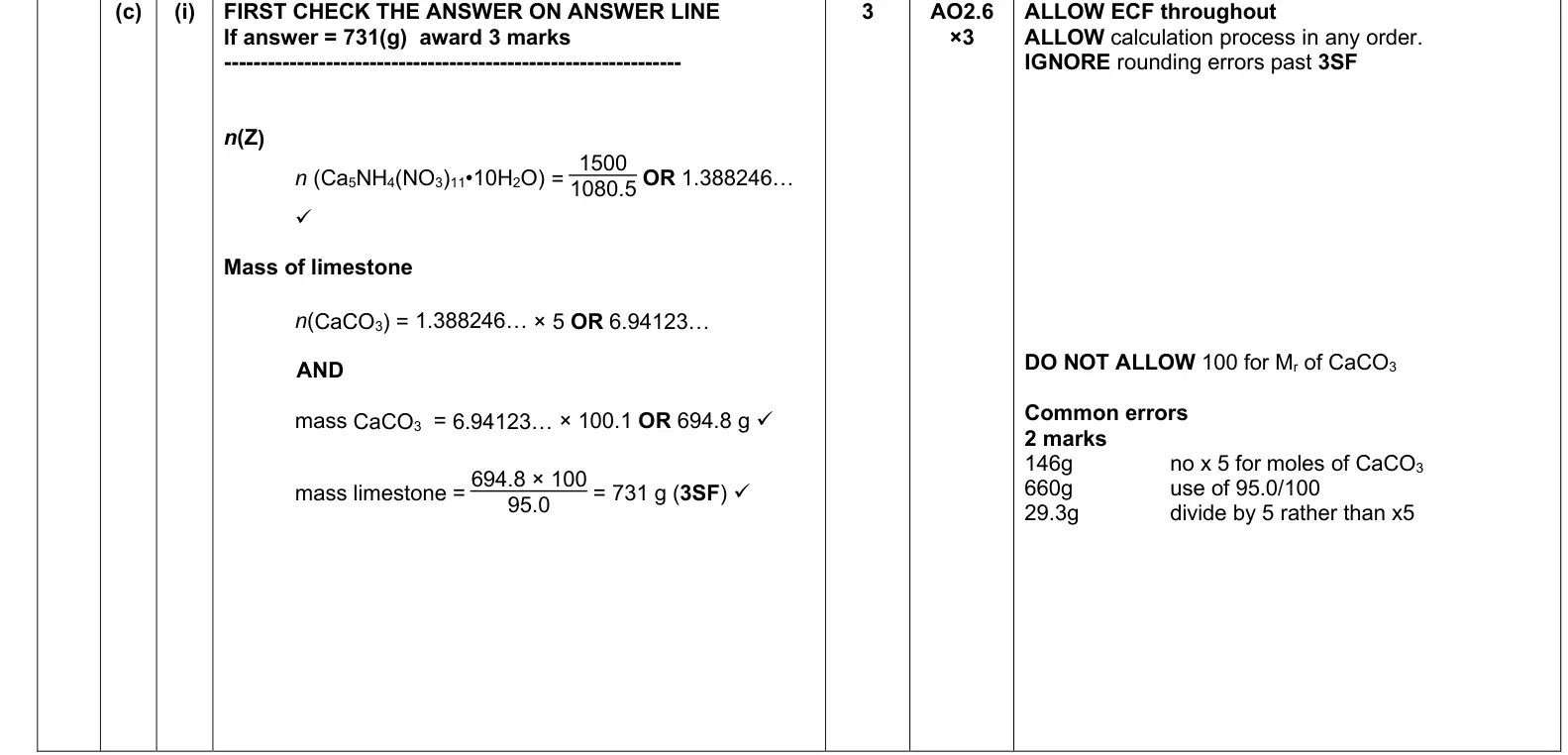
(i) A typical sample of limestone contains 95.0% by mass of calcium carbonate, CaCO3.
Fertiliser Z, Ca5NH4(NO3)11•10H2O (Mr = 1080.5 g mol–1) can be made from limestone.
Calculate the mass, in g, of limestone needed to make 1.50 kg of fertiliser Z.
Give your answer to 3 significant figures.
mass of limestone =  ...................................................... g [3]
June 2022 · Paper 1 · Q21(c)(ii) 2 marks AO2 Equation writing Hard formulae and equationsacids and titrations
Earlier part of question 21 that this part usesEarlier part of June 2022 Paper 1 question 21
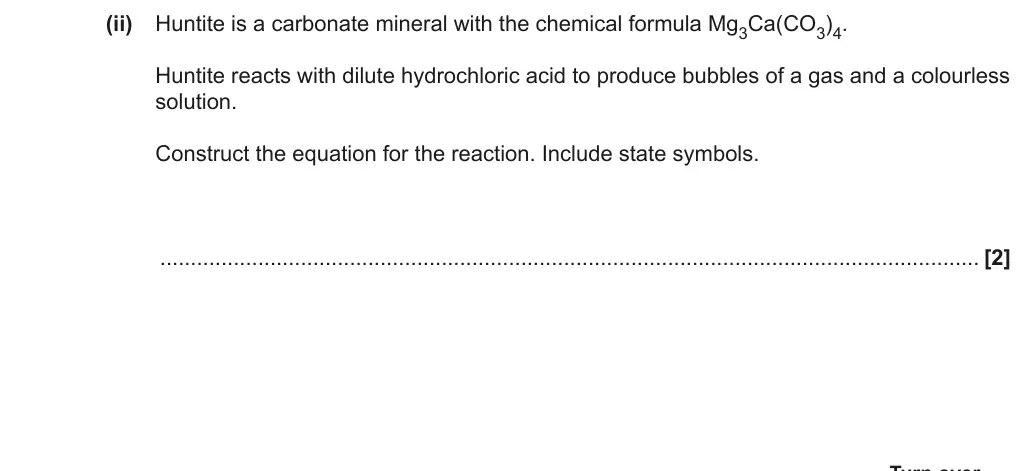
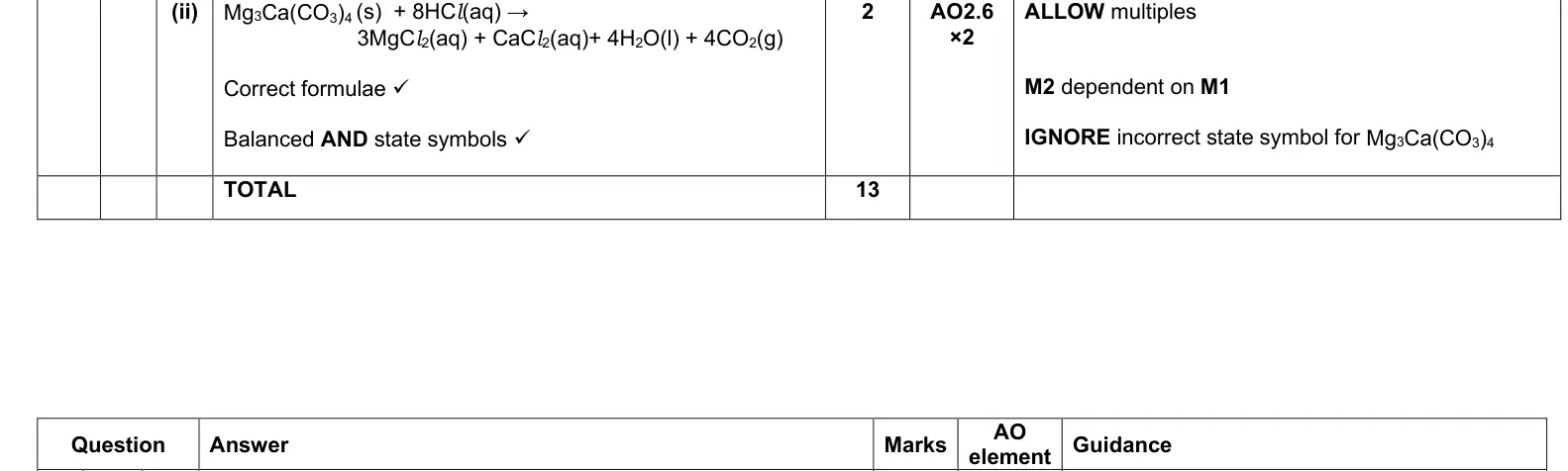
(ii) Huntite is a carbonate mineral with the chemical formula Mg3Ca(CO3)4.
Huntite reacts with dilute hydrochloric acid to produce bubbles of a gas and a colourless
solution.
Construct the equation for the reaction. Include state symbols.
...................................................................................................................................... [2]
June 2022 · Paper 1 · Q22(a)(i) 1 mark AO1 Short answer Medium transition elements
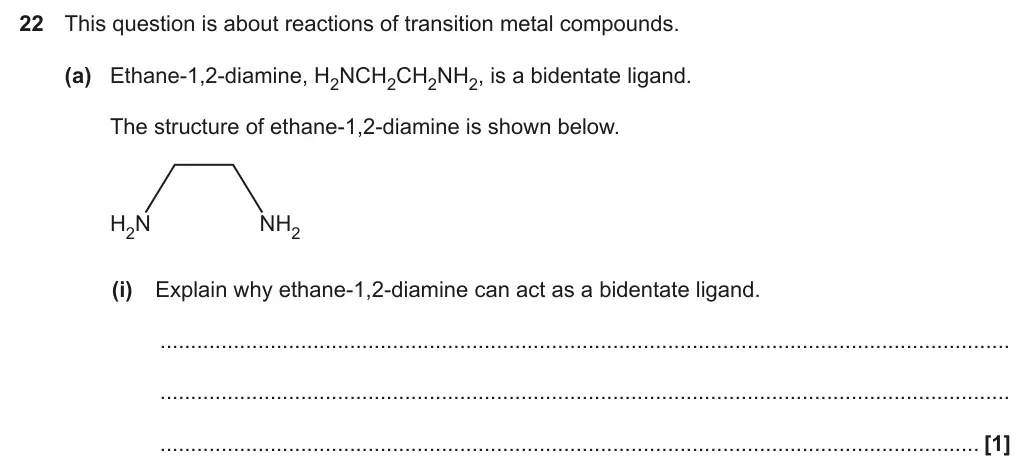
22 This question is about reactions of transition metal compounds.
(a) Ethane-1,2-diamine, H2NCH2CH2NH2, is a bidentate ligand.
The structure of ethane-1,2-diamine is shown below.
H2N NH2
(i) Explain why ethane-1,2-diamine can act as a bidentate ligand.
...........................................................................................................................................
...........................................................................................................................................
...................................................................................................................................... [1]
June 2022 · Paper 1 · Q22(a)(ii) 4 marks AO1, 3 Structure / isomer Easy transition elementsamount of substance
Earlier part of question 22 that this part usesEarlier part of June 2022 Paper 1 question 22
(ii) The iron(III) ion, Fe3+, forms a complex ion A with two ethane-1,2-diamine ligands and
two chloride ligands.
Complex ion A has cis and trans stereoisomers.
One of these stereoisomers exists as optical isomers.
Determine the empirical formula, with charge, of complex ion A and draw the 3-D
structures of the three stereoisomers.
Empirical formula with charge ..............................
Structures
[4]
June 2022 · Paper 1 · Q22(b)(i) 1 mark AO2 Equation writing Medium transition elements
(b) Aqueous sodium hydroxide is added to an aqueous solution of iron(II) sulfate.
A pale green precipitate forms which turns brown when left to stand in air.
(i) Write an ionic equation for the formation of the pale green precipitate.
...................................................................................................................................... [1]
June 2022 · Paper 1 · Q22(b)(ii) 4 marks AO3 Equation writing Easy redox and electrode potentialstransition elements
Earlier part of question 22 that this part usesEarlier part of June 2022 Paper 1 question 22
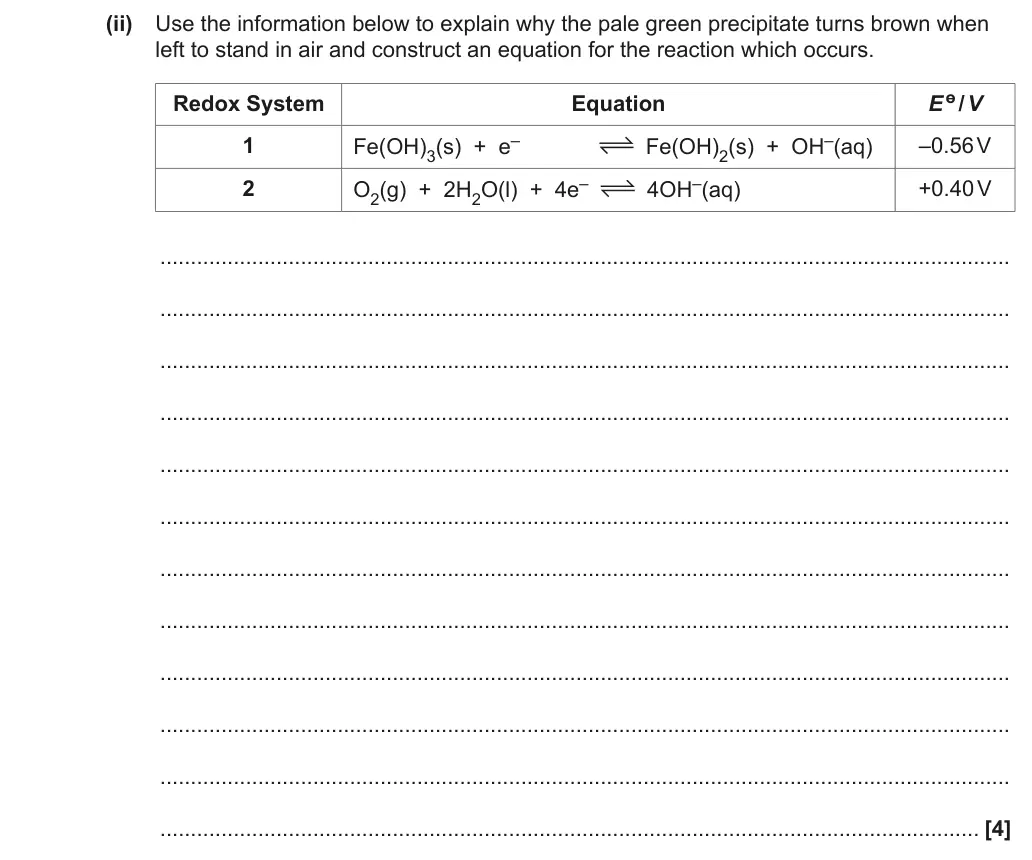
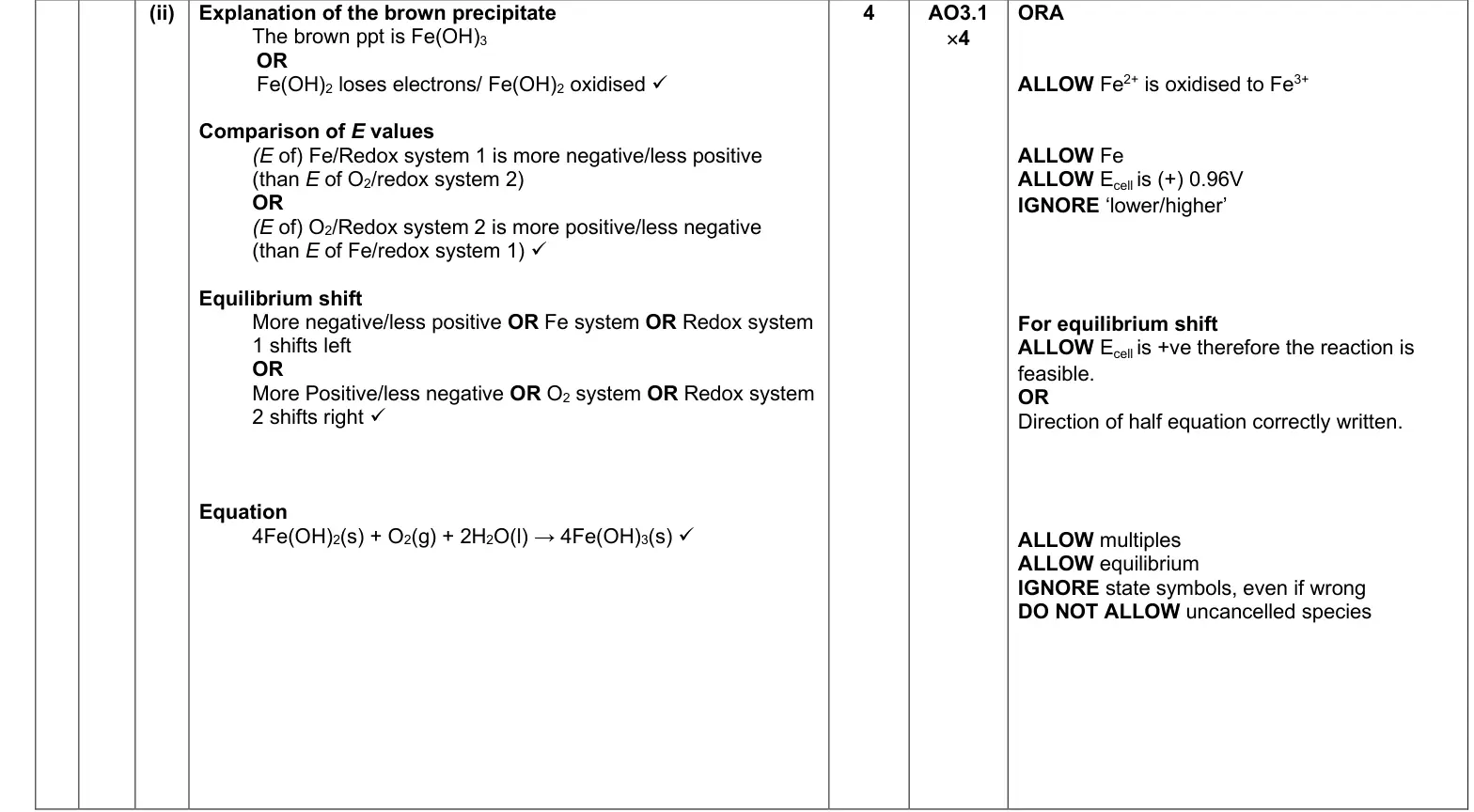
(ii) Use the information below to explain why the pale green precipitate turns brown when
left to stand in air and construct an equation for the reaction which occurs.
Redox System Equation E ө / V
1 Fe(OH)3(s)  +  e– Fe(OH)2(s)  +  OH–(aq) –0.56 V
2 O2(g)  +  2H2O(l)  +  4e– 4OH–(aq) +0.40 V
...........................................................................................................................................
...........................................................................................................................................
...........................................................................................................................................
...........................................................................................................................................
...........................................................................................................................................
...........................................................................................................................................
...........................................................................................................................................
...........................................................................................................................................
...........................................................................................................................................
...........................................................................................................................................
...........................................................................................................................................
...................................................................................................................................... [4]
June 2022 · Paper 1 · Q22(c) 6 marks AO3 6-mark level of response Hard transition elementsamount of substanceredox
TURN OVER FOR QUESTION 22(c)
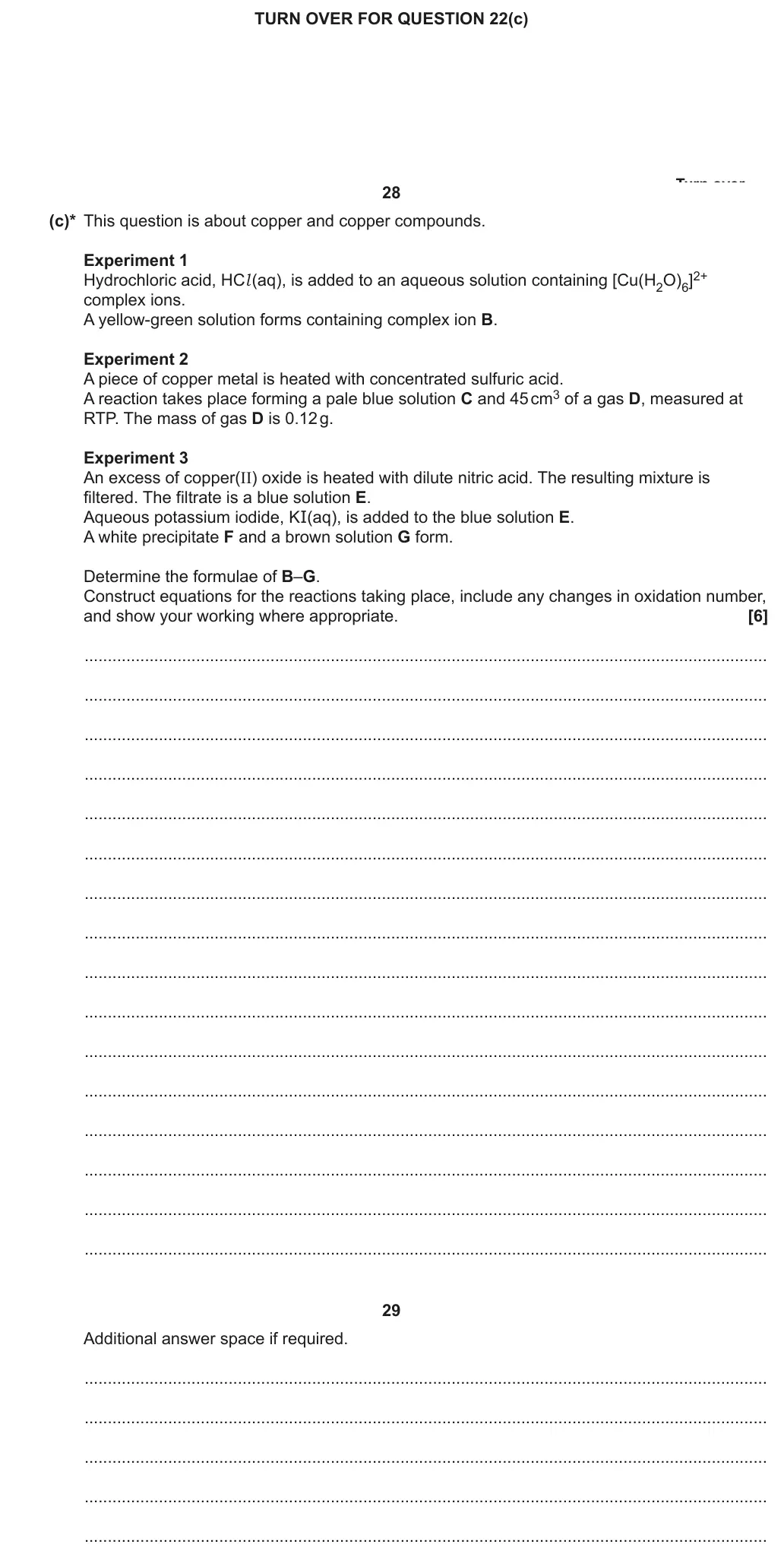
(c)* This question is about copper and copper compounds.
Experiment 1
Hydrochloric acid, HCl (aq), is added to an aqueous solution containing [Cu(H2O)6]2+
complex ions.
A yellow-green solution forms containing complex ion B.
Experiment 2
A piece of copper metal is heated with concentrated sulfuric acid.
A reaction takes place forming a pale blue solution C and 45 cm3 of a gas D, measured at
RTP. The mass of gas D is 0.12 g.
Experiment 3
An excess of copper(II) oxide is heated with dilute nitric acid. The resulting mixture is
filtered. The filtrate is a blue solution E.
Aqueous potassium iodide, KI(aq), is added to the blue solution E.
A white precipitate F and a brown solution G form.
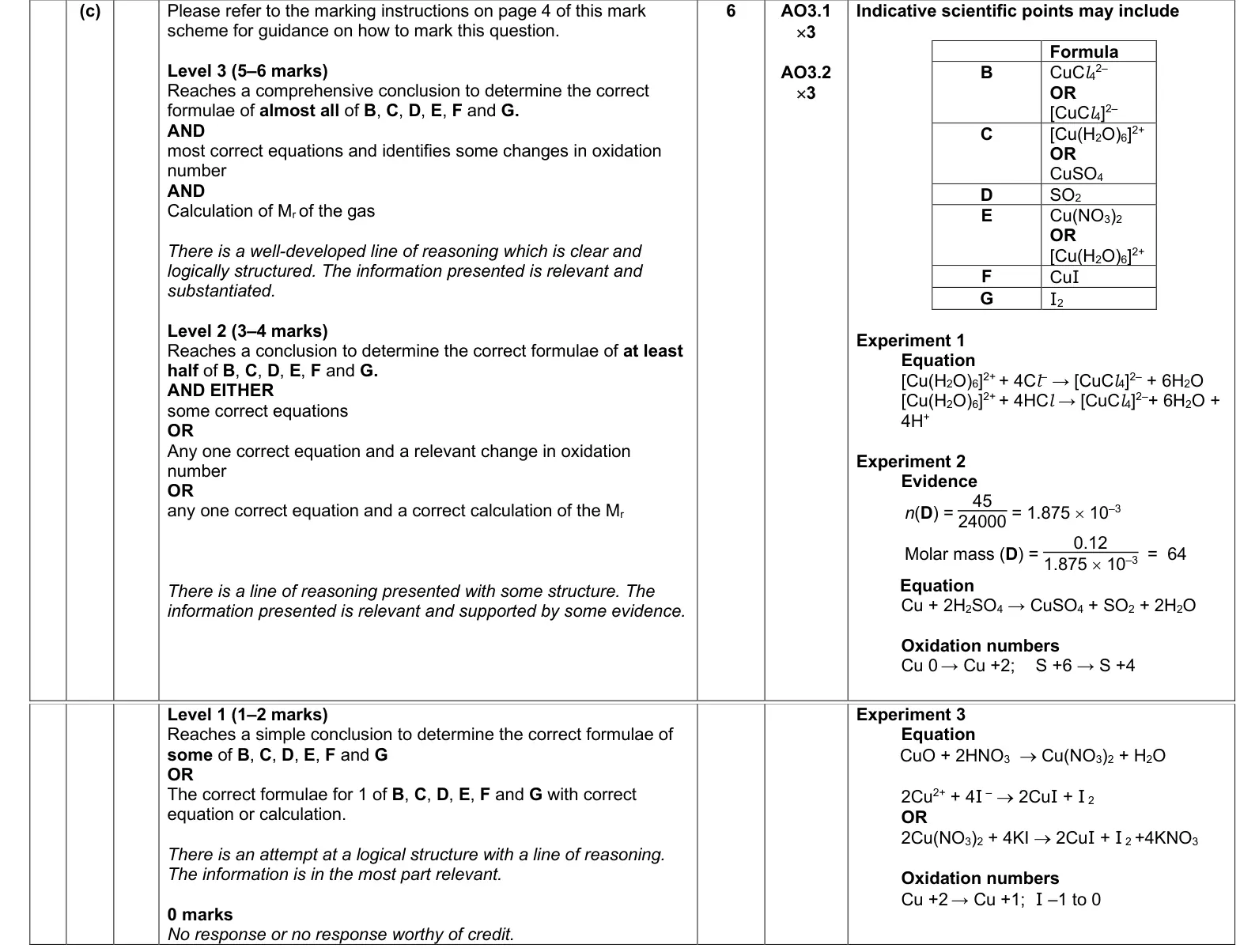
Determine the formulae of B–G.
Construct equations for the reactions taking place, include any changes in oxidation number,
and show your working where appropriate. [6]
...................................................................................................................................................
...................................................................................................................................................
...................................................................................................................................................
...................................................................................................................................................
...................................................................................................................................................
...................................................................................................................................................
...................................................................................................................................................
...................................................................................................................................................
...................................................................................................................................................
...................................................................................................................................................
...................................................................................................................................................
...................................................................................................................................................
...................................................................................................................................................
...................................................................................................................................................
...................................................................................................................................................
...................................................................................................................................................
Additional answer space if required.
...................................................................................................................................................
...................................................................................................................................................
...................................................................................................................................................
...................................................................................................................................................
...................................................................................................................................................

Work with an OCR chemistry tutor

Want a paper marked and gone through with you? Message us.

Prefer email? Send an enquiry

If you are under 18, please include a parent's contact details. Enquiries go to enquiries@chemistryaleveltutor.com and are deleted once handled. All tutoring is online.