June 2025: AS Paper 1, Breadth in chemistry

70 marks · 40 question parts · Paper, mark scheme and report on OCR's site · Have OCR's Data Sheet beside you

Question by question

QTopicMarksAOType
1 Practical skills: planning, analysis and evaluation 1Multiple choice
2 Electron structure and orbitals 1Multiple choice
3 Amount of substance (moles) 1Multiple choice
4 Amount of substance (moles) 1Multiple choice
5 Atomic structure and isotopes 1Multiple choice
6 Redox and oxidation numbers 1Multiple choice
7 Redox and oxidation numbers, Acids, bases and titrations 1Multiple choice
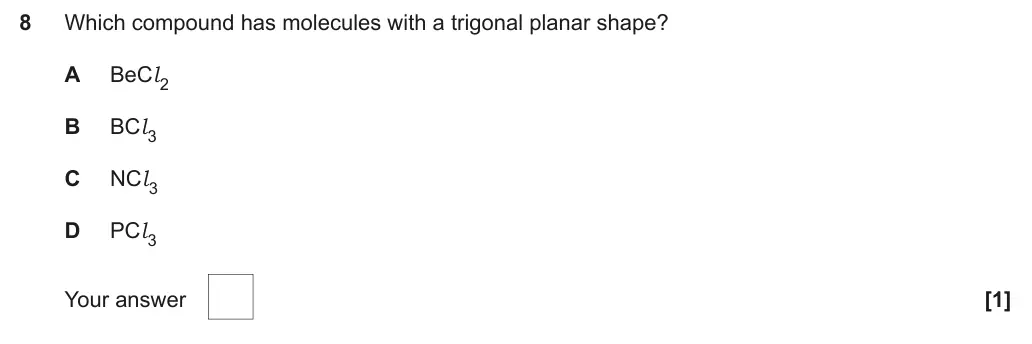
8 Bonding, structure and shapes of molecules 1Multiple choice
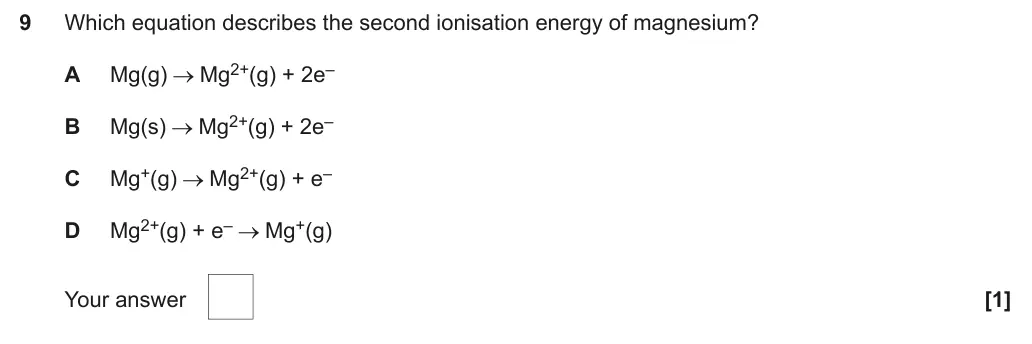
9 Group 2, Periodicity and ionisation energy 1Multiple choice
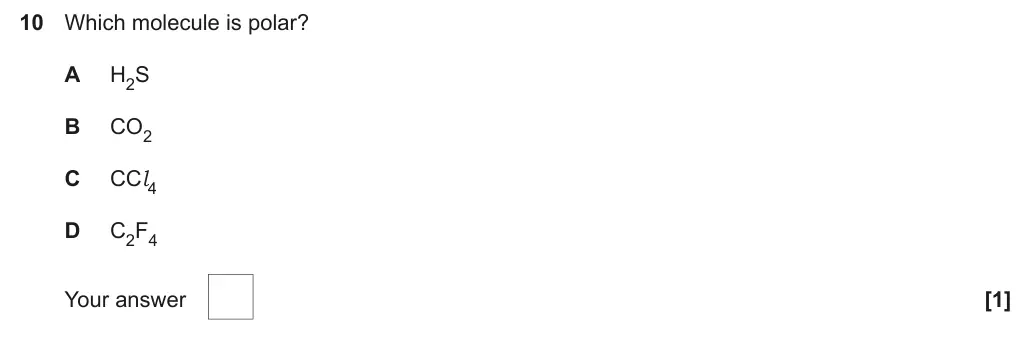
10 Bonding, structure and shapes of molecules 1Multiple choice
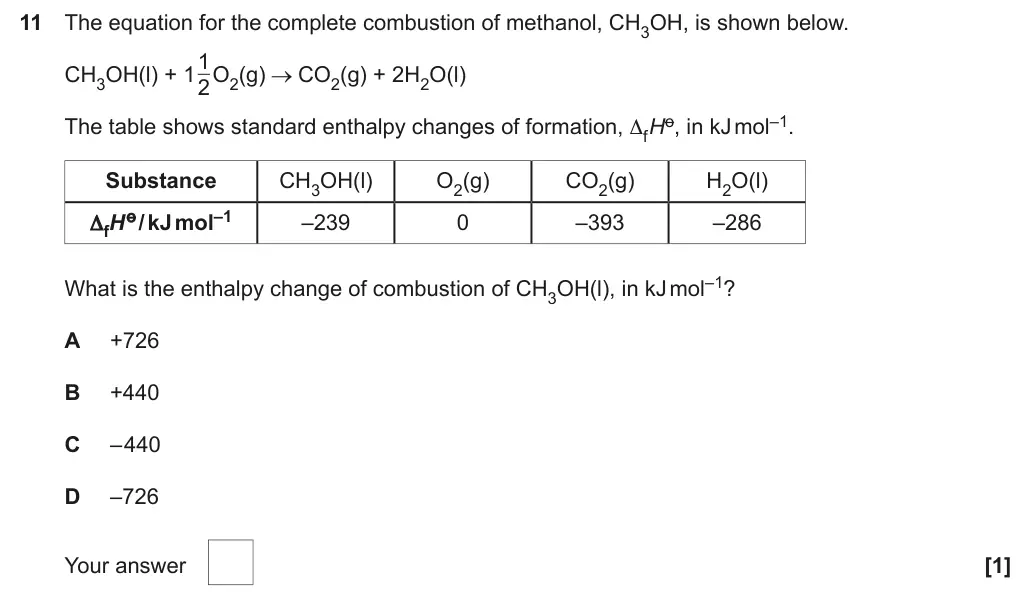
11 Enthalpy changes and Hess’ law 1Multiple choice
12 Reaction rates and the Boltzmann distribution, Chemical equilibrium and Kc 1Multiple choice
13 Reaction rates and the Boltzmann distribution, Chemical equilibrium and Kc 1Multiple choice
14 Organic basics: naming, formulae and isomerism 1Multiple choice
15 Alkenes, Organic basics: naming, formulae and isomerism 1Multiple choice
16 Haloalkanes 1Multiple choice
17 Organic basics: naming, formulae and isomerism, Alcohols 1Multiple choice
18 Haloalkanes 1Multiple choice
19 Infrared spectroscopy and mass spectrometry 1Multiple choice
20 Infrared spectroscopy and mass spectrometry 1Multiple choice
21(a) Atomic structure and isotopes 2Complete table/diagram
21(b) Atomic structure and isotopes 2Calculation
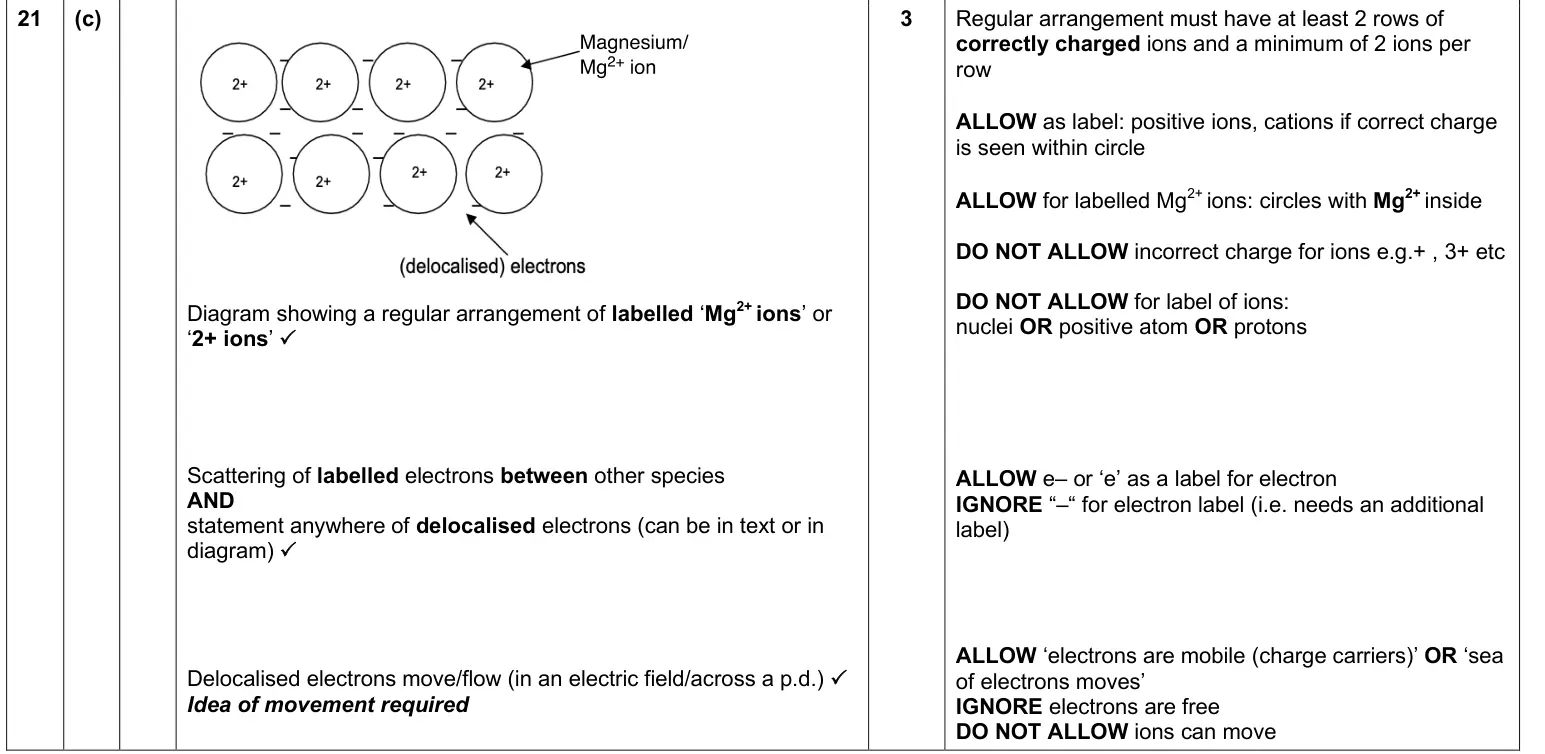
21(c) Periodicity and ionisation energy 3Structure / isomer
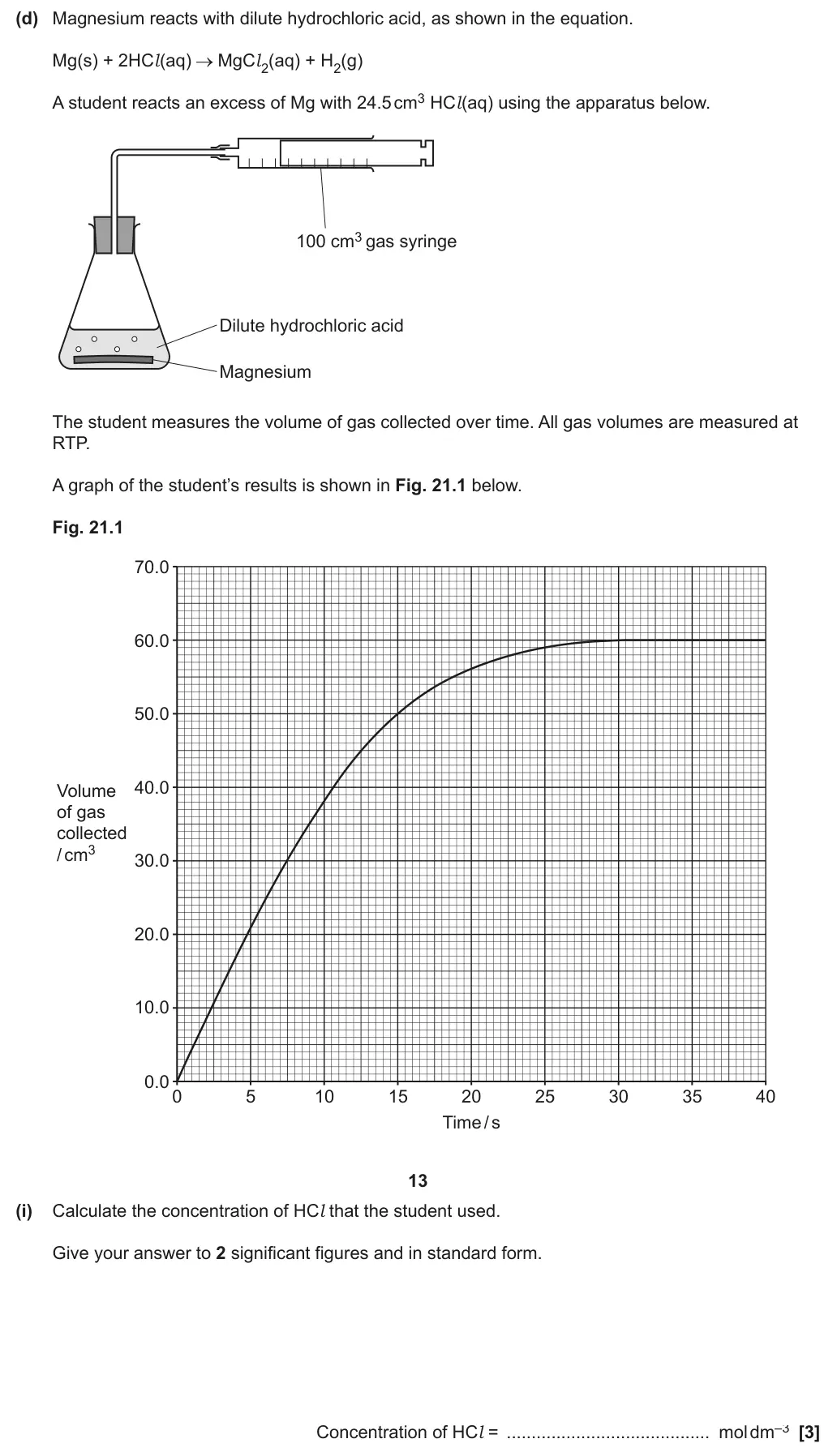
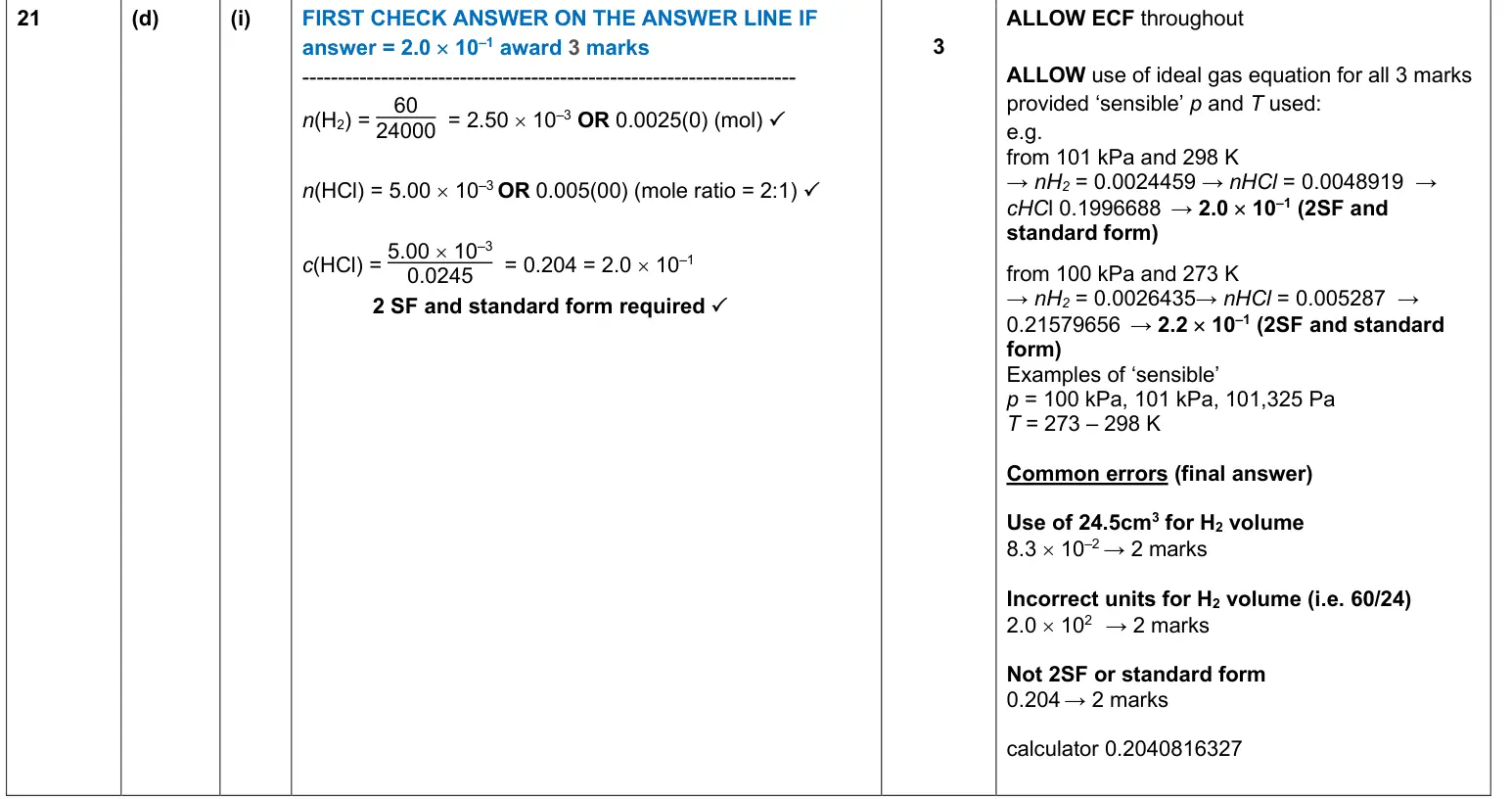
21(d)(i) Amount of substance (moles) 3Calculation
21(d)(ii) Reaction rates and the Boltzmann distribution 3Data interpretation
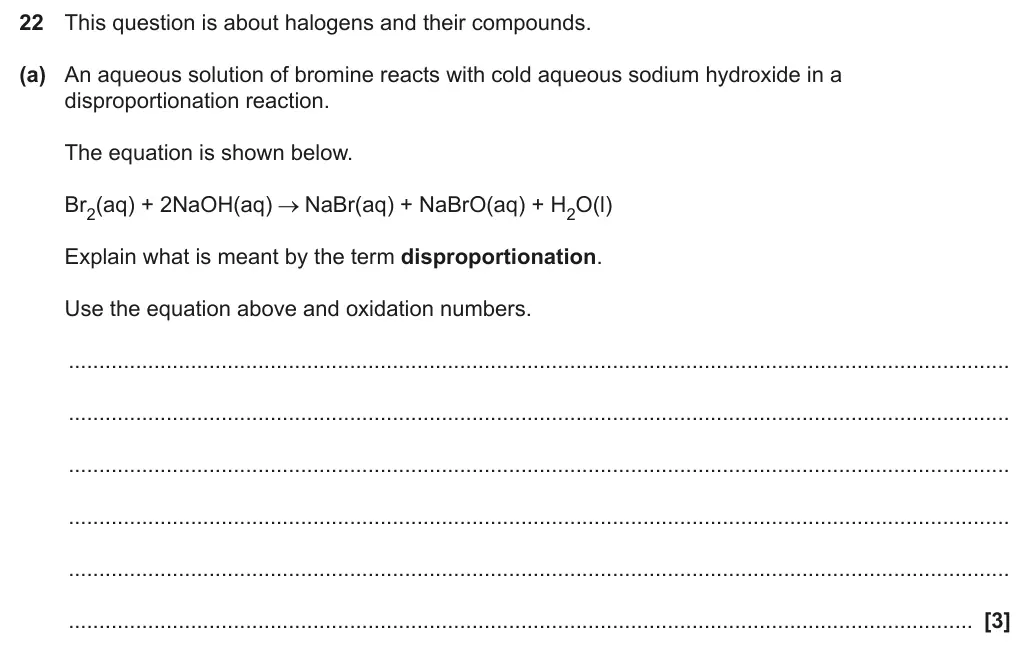
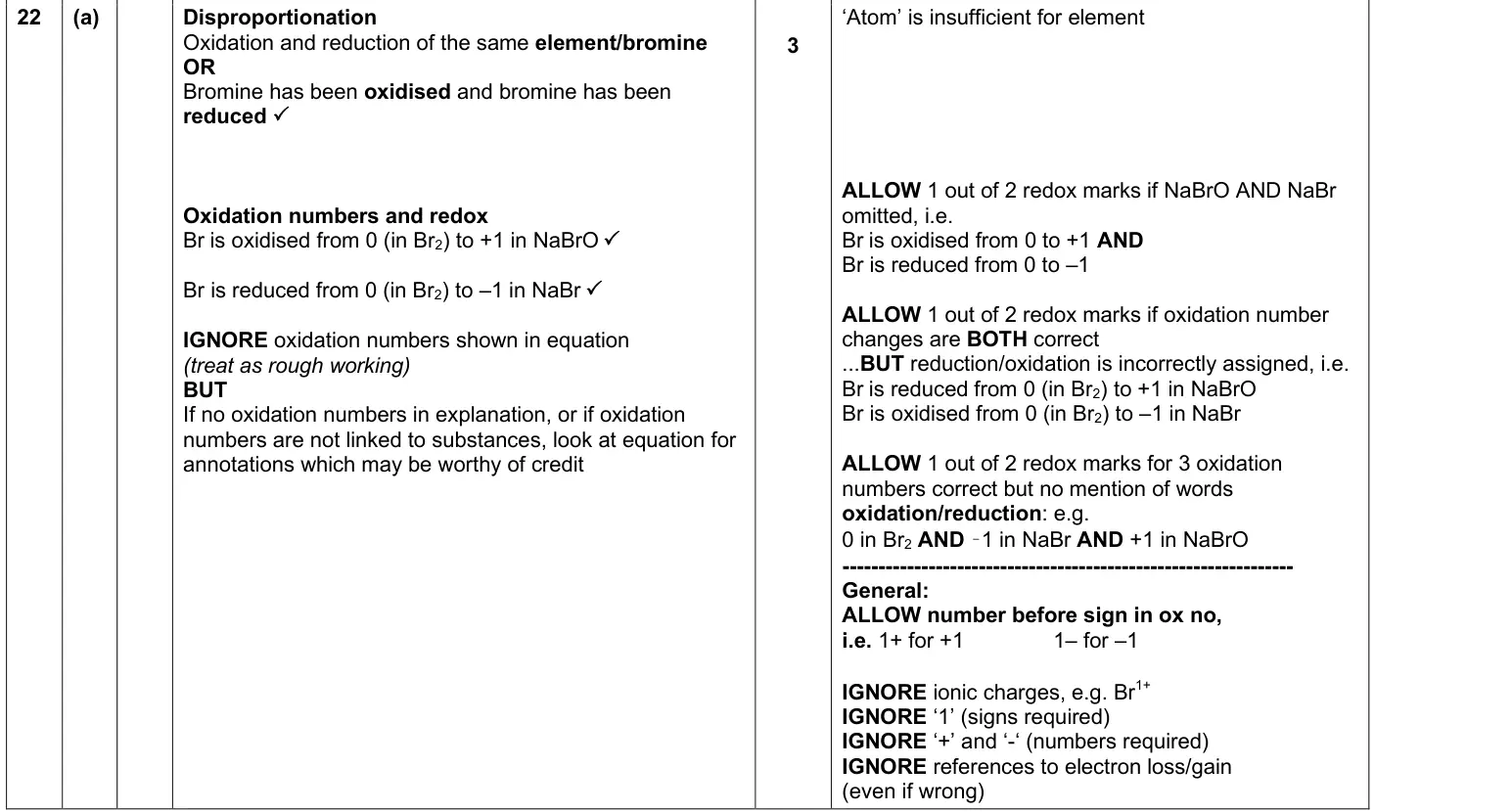
22(a) The halogens, Redox and oxidation numbers 3Short answer
22(b)(i) The halogens 3Short answer
22(b)(ii) The halogens 1Short answer
22(c) The halogens, Qualitative analysis: tests for ions 4Short answer
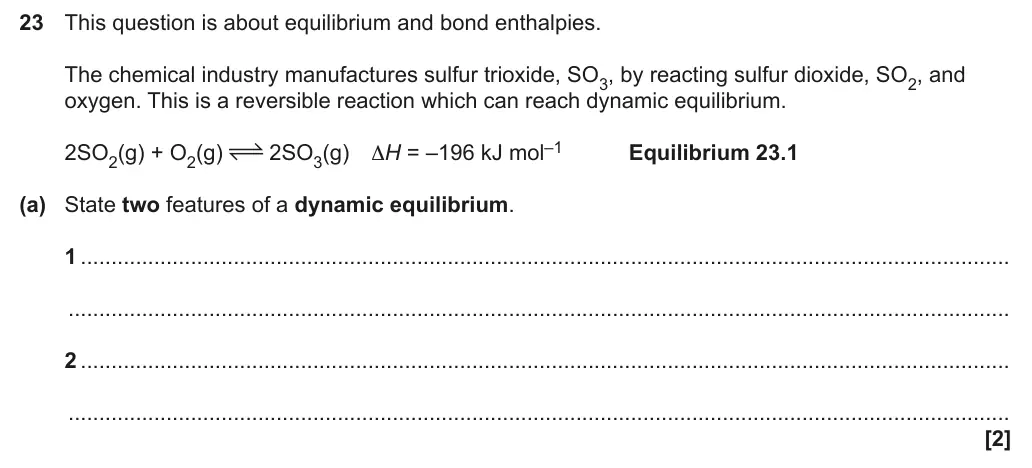
23(a) Chemical equilibrium and Kc 2Short answer
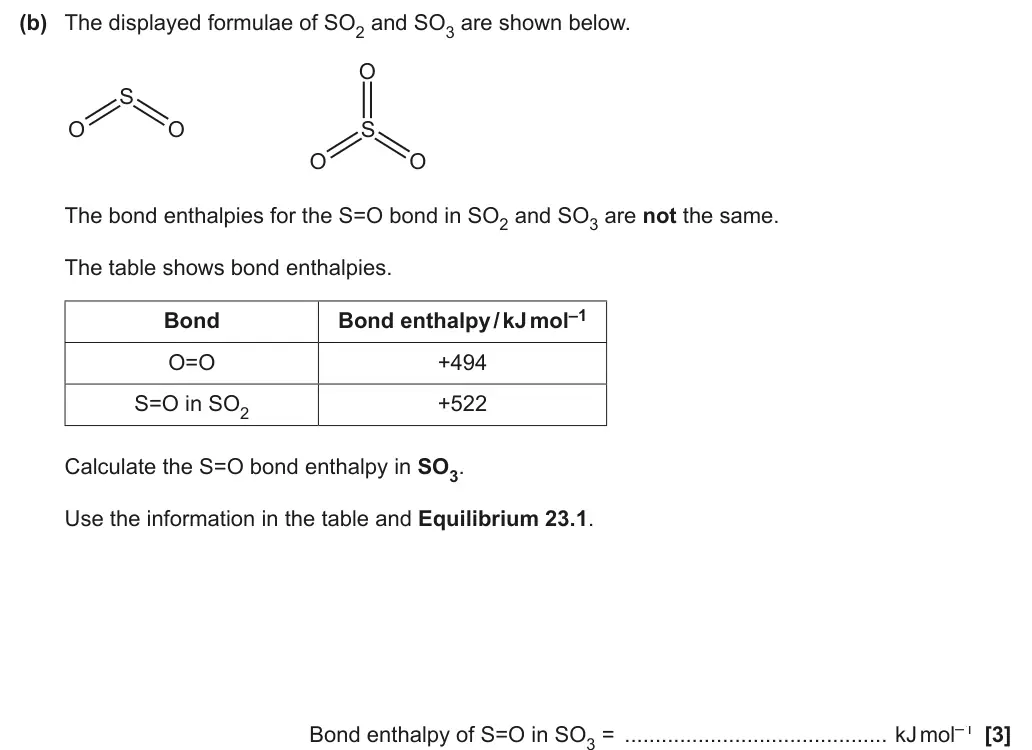
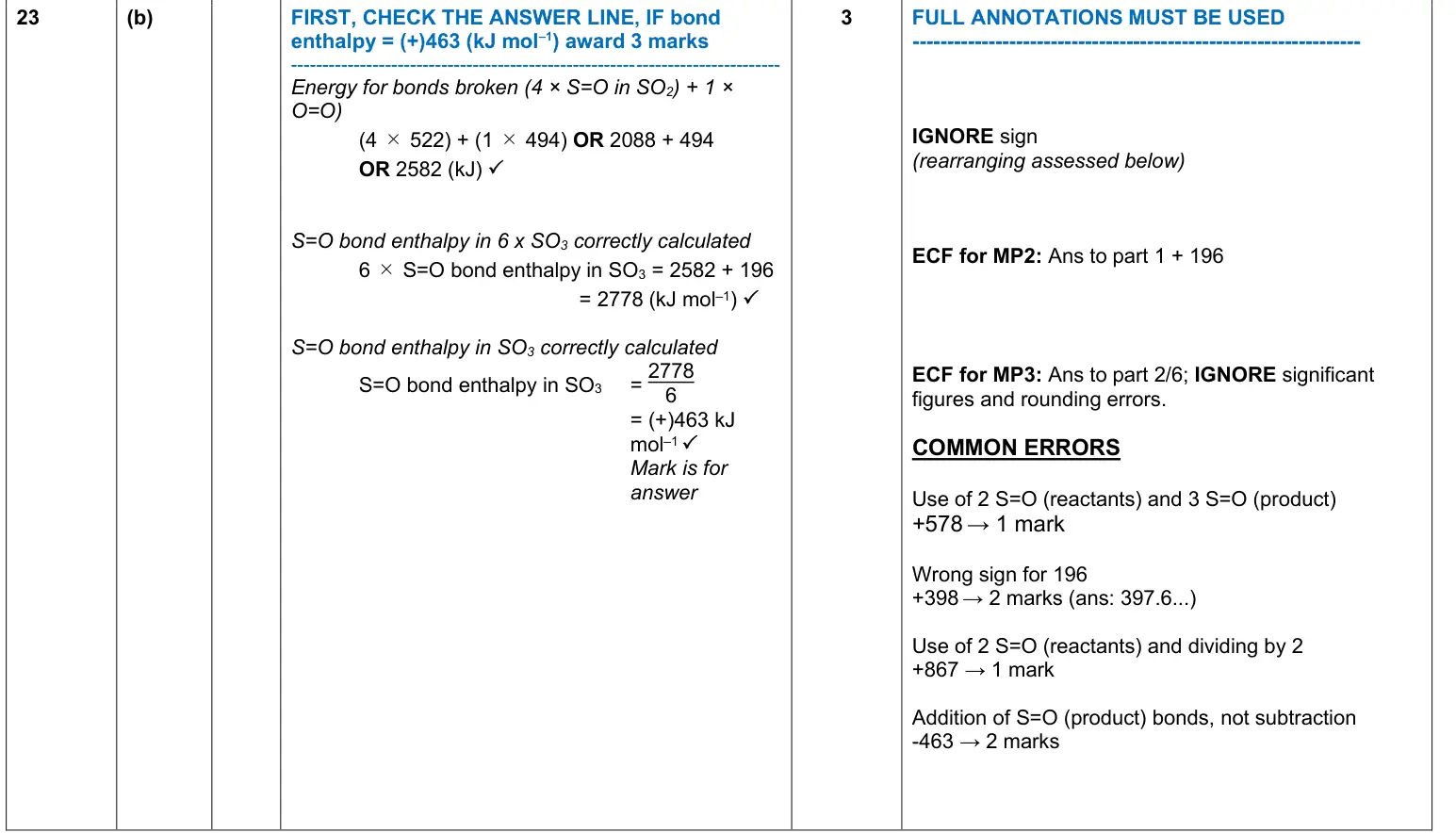
23(b) Enthalpy changes and Hess’ law 3Calculation
23(c) Chemical equilibrium and Kc 3Calculation
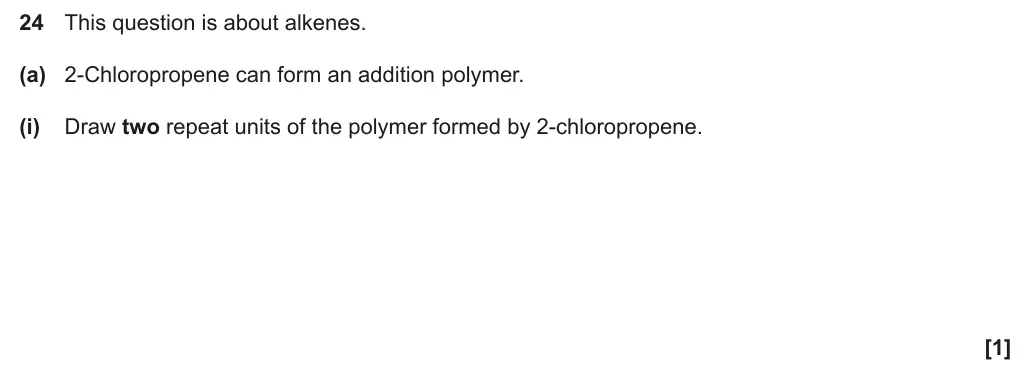
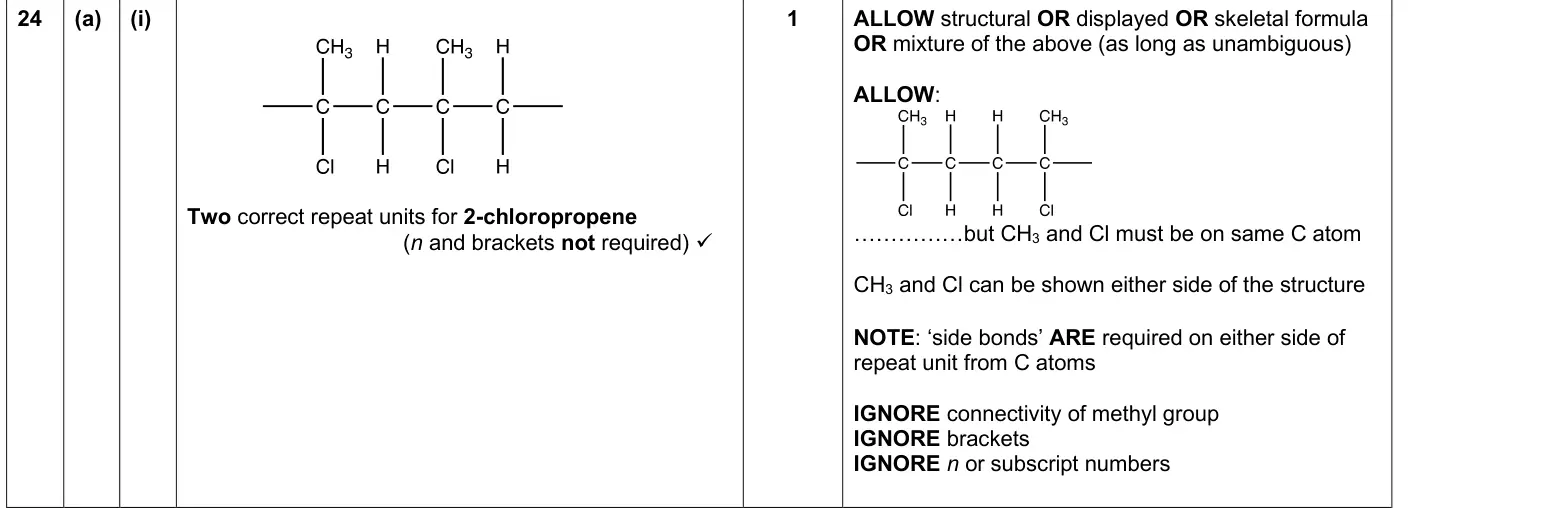
24(a)(i) Alkenes, Organic basics: naming, formulae and isomerism 1Drawing / labelling
24(a)(ii) Alkenes 1Short answer
24(b) Formulae and equations, Alkanes 1Equation writing
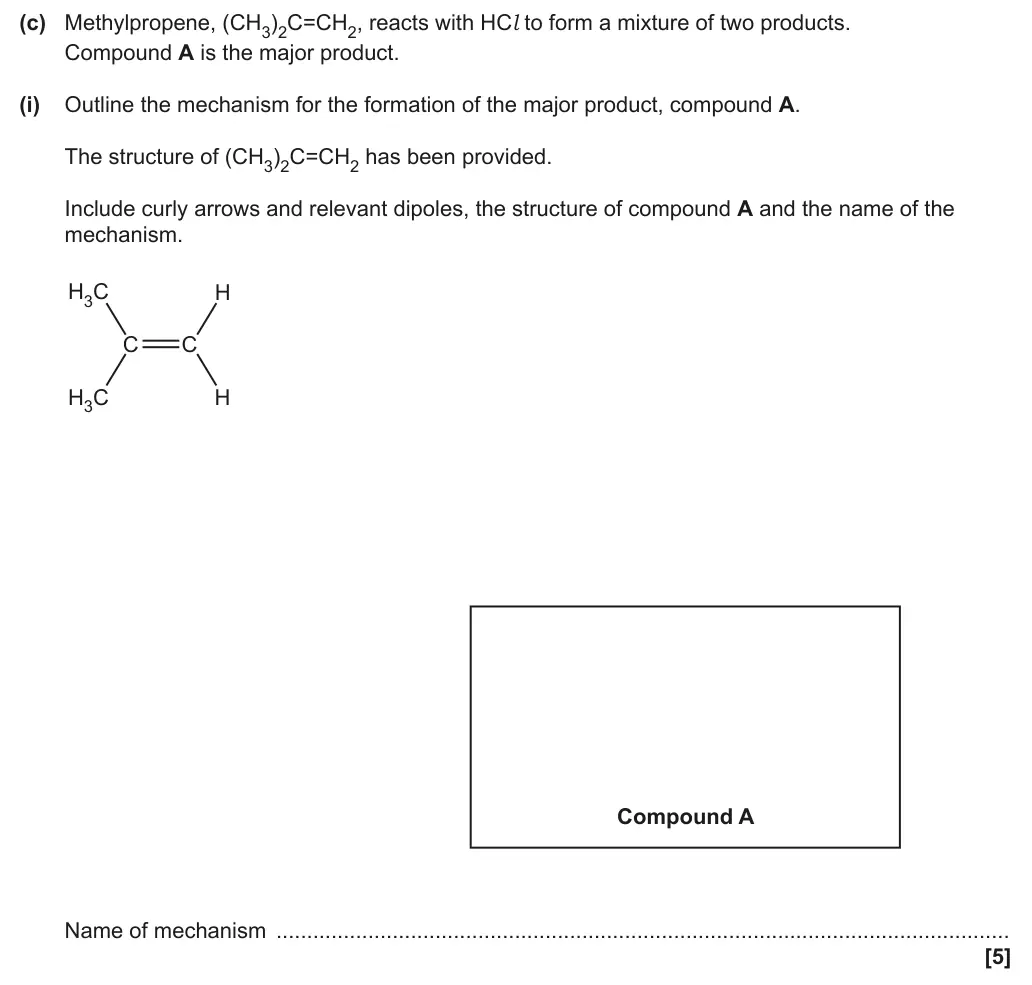
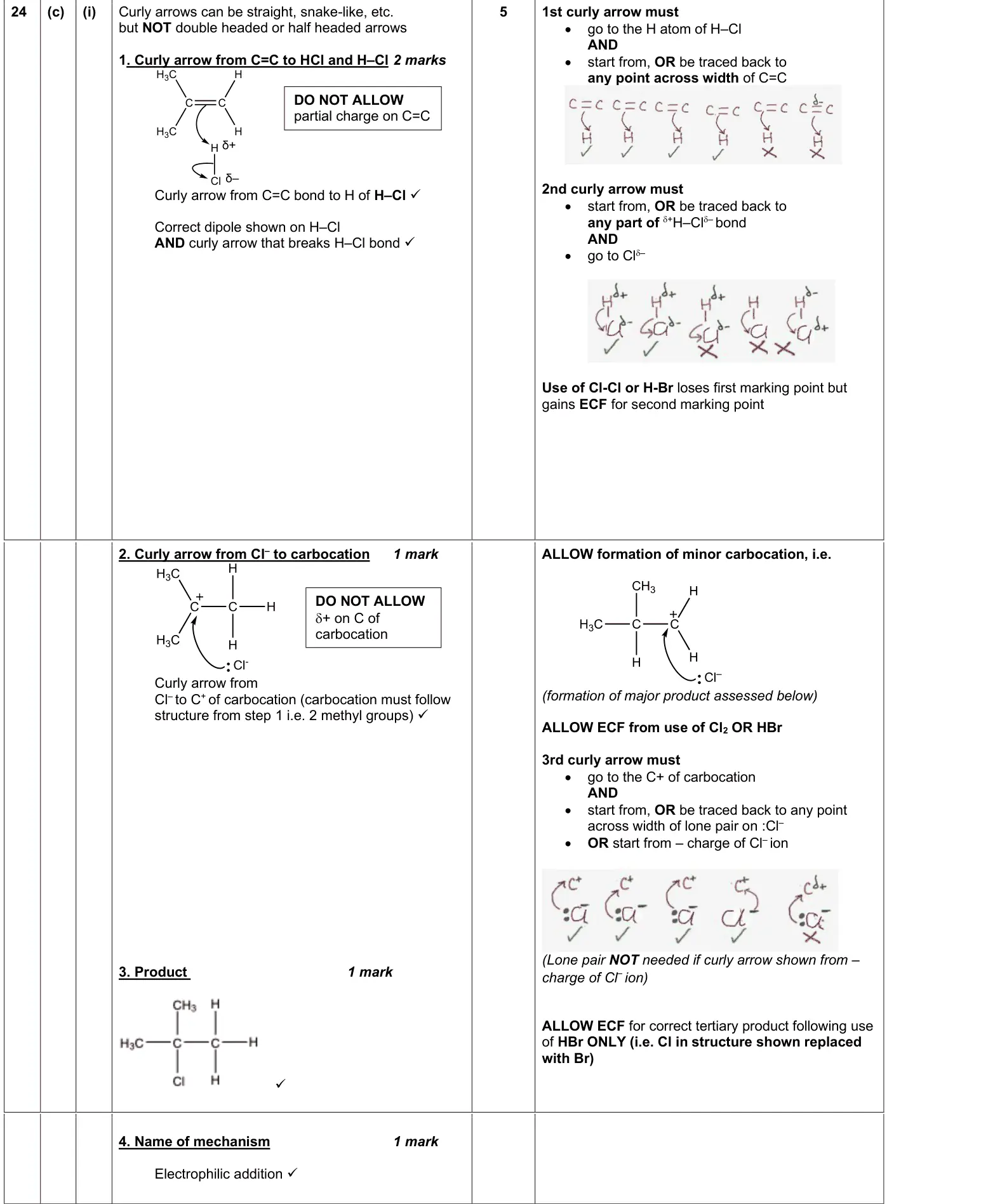
24(c)(i) Alkenes, Organic basics: naming, formulae and isomerism 5Mechanism
24(c)(ii) Alkenes 1Short answer
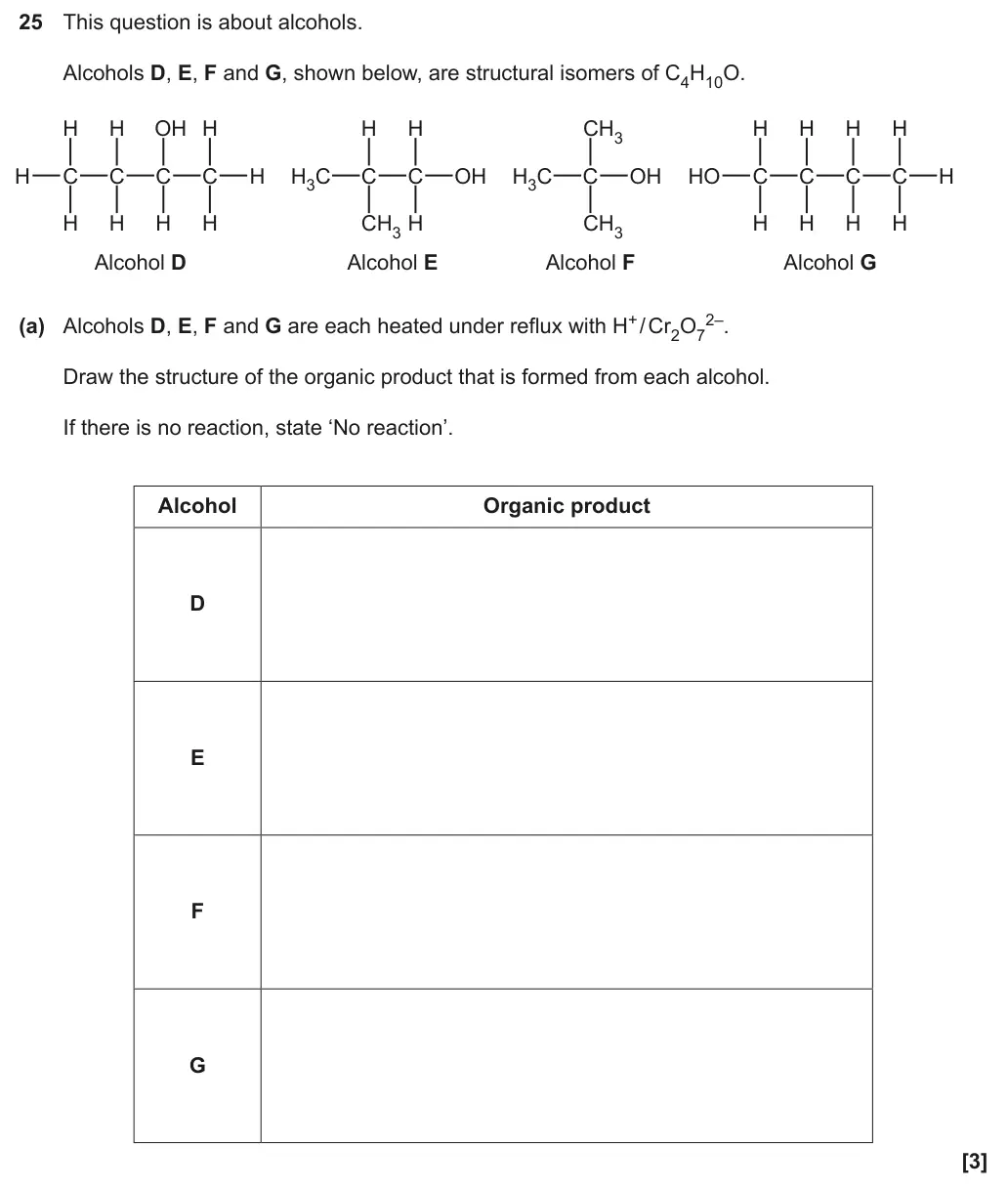
25(a) Alcohols 3Structure / isomer
25(b) Alcohols, Organic basics: naming, formulae and isomerism 1Structure / isomer
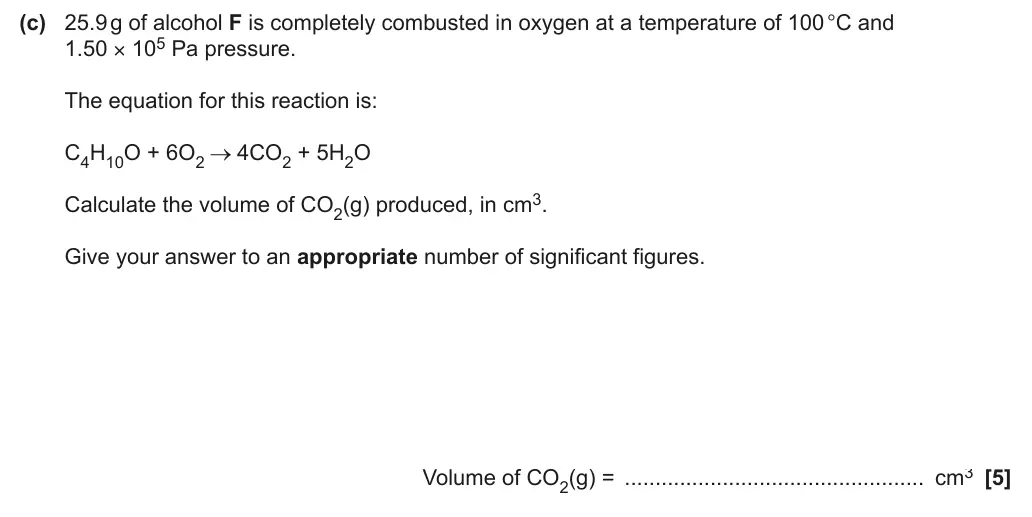
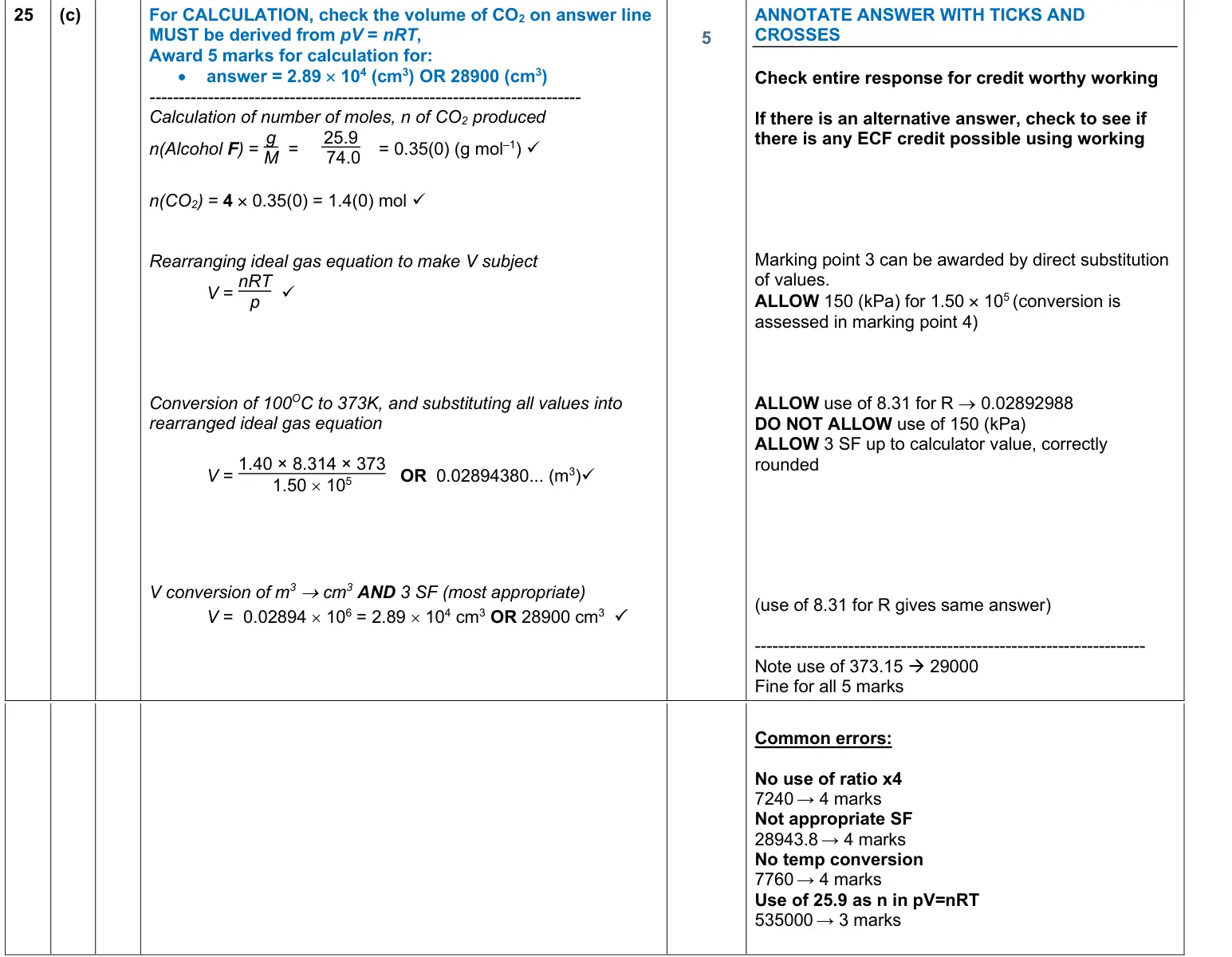
25(c) Amount of substance (moles) 5Calculation

The questions

123456789101112131415161718192021(a)21(b)21(c)21(d)(i)21(d)(ii)22(a)22(b)(i)22(b)(ii)22(c)23(a)23(b)23(c)24(a)(i)24(a)(ii)24(b)24(c)(i)24(c)(ii)25(a)25(b)25(c)
June 2025 · AS Paper 1 · Q1 1 mark Multiple choice Medium practical skills
1 The burette readings from a titration are shown below.

Initial reading / cm3 4.95
Final reading / cm3 23.10
The burette used has an uncertainty of 0.05 cm3 for each reading.
What is the percentage uncertainty of the resulting titre?
A 0.22%
B 0.28%
C 0.44%
D 0.55%
Your answer [1]
June 2025 · AS Paper 1 · Q2 1 mark Multiple choice Medium electron structure
2 How many p electrons does an atom of chlorine have?
A 5
B 7
C 11
D 17
Your answer [1]
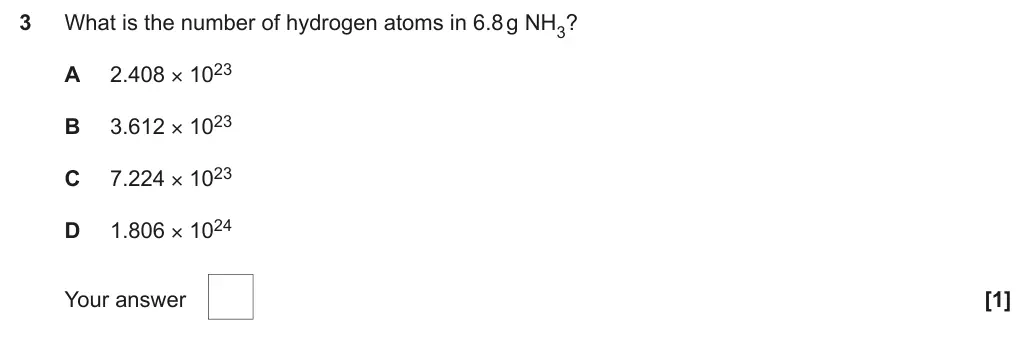
June 2025 · AS Paper 1 · Q3 1 mark Multiple choice Medium amount of substance
3 What is the number of hydrogen atoms in 6.8 g NH3?
A 2.408 × 10²³
B 3.612 × 10²³
C 7.224 × 10²³
D 1.806 × 1024
Your answer [1]
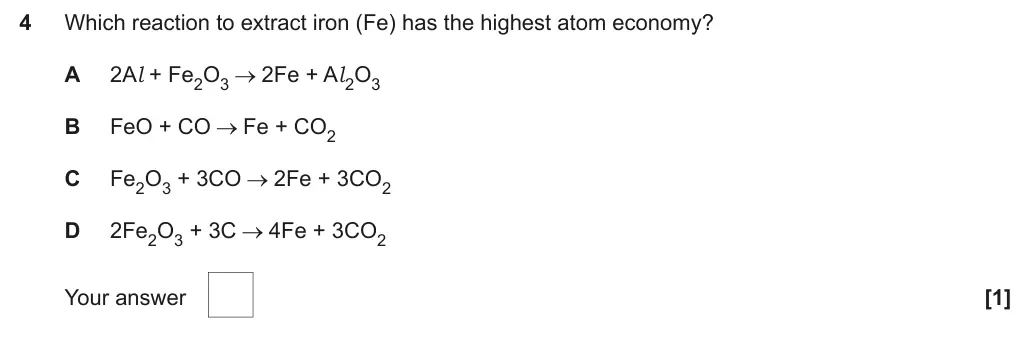
June 2025 · AS Paper 1 · Q4 1 mark Multiple choice Easy amount of substance
4 Which reaction to extract iron (Fe) has the highest atom economy?
A 2Al + Fe2O3 2Fe + Al 2O3
B FeO + CO Fe + CO2
C Fe2O3 + 3CO 2Fe + 3CO2
D 2Fe2O3 + 3C 4Fe + 3CO2
Your answer [1]
June 2025 · AS Paper 1 · Q5 1 mark Multiple choice Medium atomic structure and isotopes
5 Phosphorus is burnt in oxygen to produce a mixture of oxides.
Which oxide has the closest to 50% by mass of phosphorus?
A PO2
B P2O3
C P2O5
D P4O9
Your answer [1]
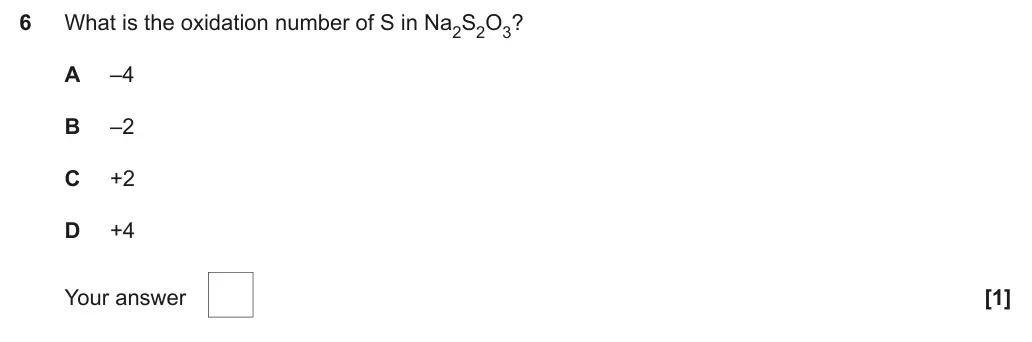
June 2025 · AS Paper 1 · Q6 1 mark Multiple choice Medium redox
6 What is the oxidation number of S in Na2S2O3?
A –4
B –2
C +2
D +4
Your answer [1]
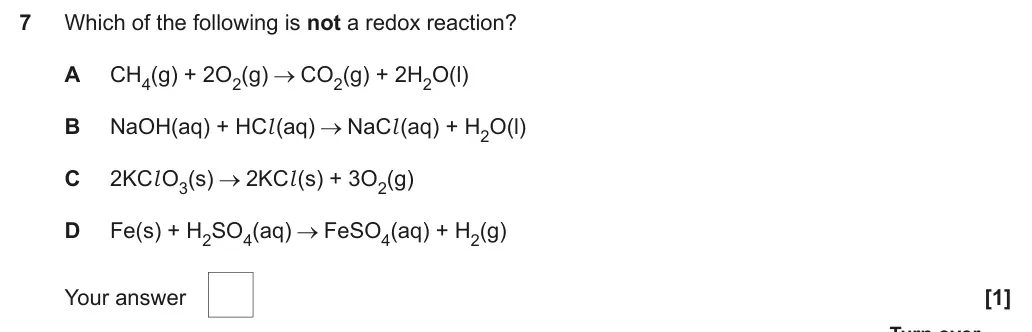
June 2025 · AS Paper 1 · Q7 1 mark Multiple choice Medium redoxacids and titrations
7 Which of the following is not a redox reaction?
A CH4(g) + 2O2(g) CO2(g) + 2H2O(l)
B NaOH(aq) + HCl (aq) NaCl (aq) + H2O(l)
C 2KCl O3(s) 2KCl (s) + 3O2(g)
D Fe(s) + H2SO4(aq) FeSO4(aq) + H2(g)
Your answer [1]
June 2025 · AS Paper 1 · Q8 1 mark Multiple choice Medium bonding and structure
8 Which compound has molecules with a trigonal planar shape?
A BeCl 2
B BCl 3
C NCl 3
D PCl 3
Your answer [1]
June 2025 · AS Paper 1 · Q9 1 mark Multiple choice Easy group 2periodicity
9 Which equation describes the second ionisation energy of magnesium?
A Mg(g) Mg2+(g) + 2e–
B Mg(s) Mg2+(g) + 2e–
C Mg+(g) Mg2+(g) + e–
D Mg2+(g) + e– Mg+(g)
Your answer [1]
June 2025 · AS Paper 1 · Q10 1 mark Multiple choice Medium bonding and structure
10 Which molecule is polar?
A H2S
B CO2
C CCl4
D C2F4
Your answer [1]
June 2025 · AS Paper 1 · Q11 1 mark Multiple choice Medium enthalpy changes
11 The equation for the complete combustion of methanol, CH3OH, is shown below.
CH3OH(l) + 11
2O2(g) CO2(g) + 2H2O(l)
The table shows standard enthalpy changes of formation, Δf Ho, in kJ mol–1.
Substance CH3OH(l) O2(g) CO2(g) H2O(l)
ΔfH o / kJ mol–1 –239 0 –393 –286
What is the enthalpy change of combustion of CH3OH(l), in kJ mol–1?
A +726
B +440
C – 440
D –726
Your answer [1]
June 2025 · AS Paper 1 · Q12 1 mark Multiple choice Hard reaction rateschemical equilibrium
12 Hydrogen and iodine react in the reaction below.
H2(g) + I2(g) 2HI(g)
Which row is correct when pressure is increased?
Rate of reaction Equilibrium yield of HI
A Increases Increases
B Increases No effect
C Increases Decreases
D Decreases No effect
Your answer [1]
June 2025 · AS Paper 1 · Q13 1 mark Multiple choice Medium reaction rateschemical equilibrium
13 Which statement is not a sustainability benefit of an industrial process using a catalyst?
A Lower temperatures can be used.
B The position of equilibrium moves towards the products.
C The reaction takes place in less time.
D There is reduced energy demand.
Your answer [1]
June 2025 · AS Paper 1 · Q14 1 mark Multiple choice Hard organic basics
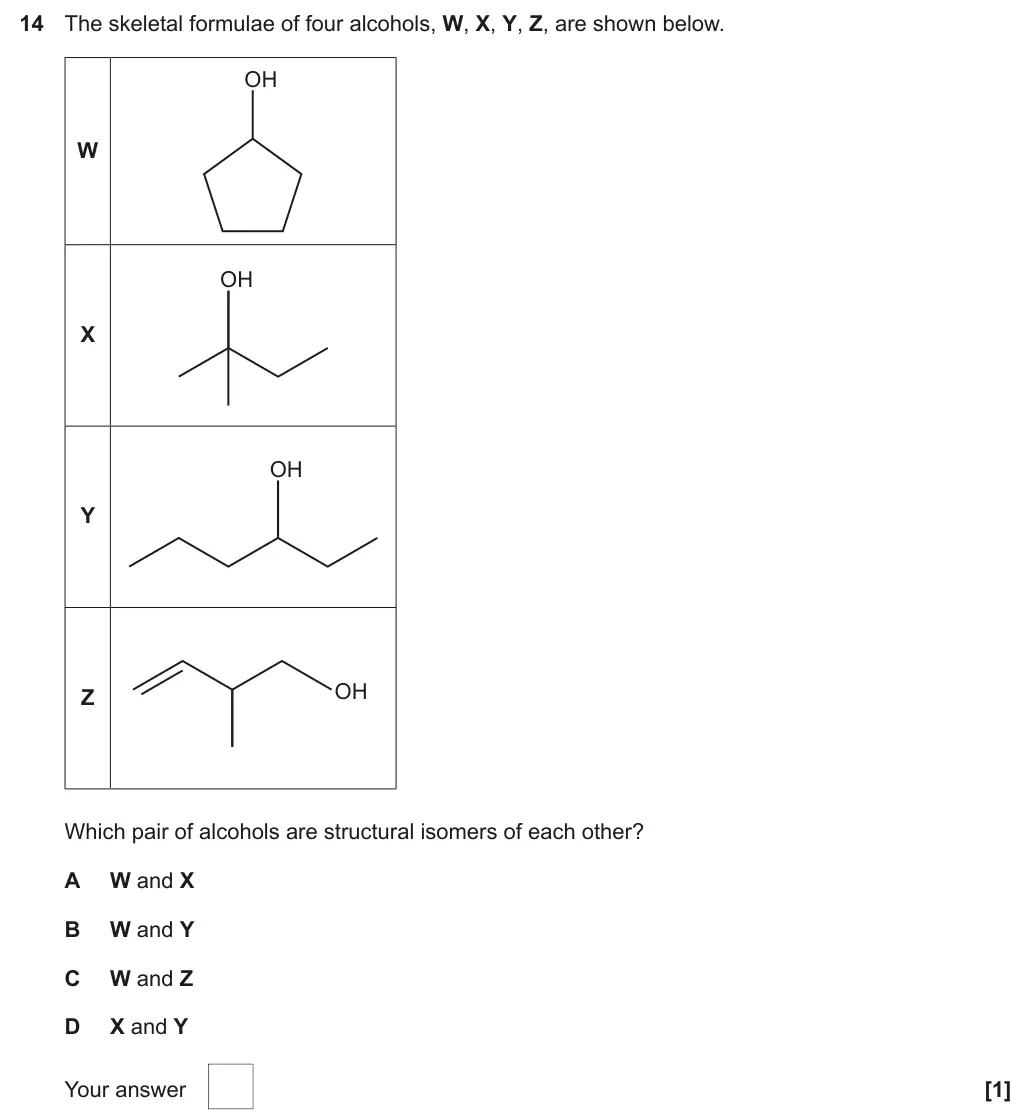
14 The skeletal formulae of four alcohols, W, X, Y, Z, are shown below.
OH
W
OH
X
OH
Y
Z OH
Which pair of alcohols are structural isomers of each other?
A W and X
B W and Y
C W and Z
D X and Y
Your answer [1]
June 2025 · AS Paper 1 · Q15 1 mark Multiple choice Hard alkenesorganic basics
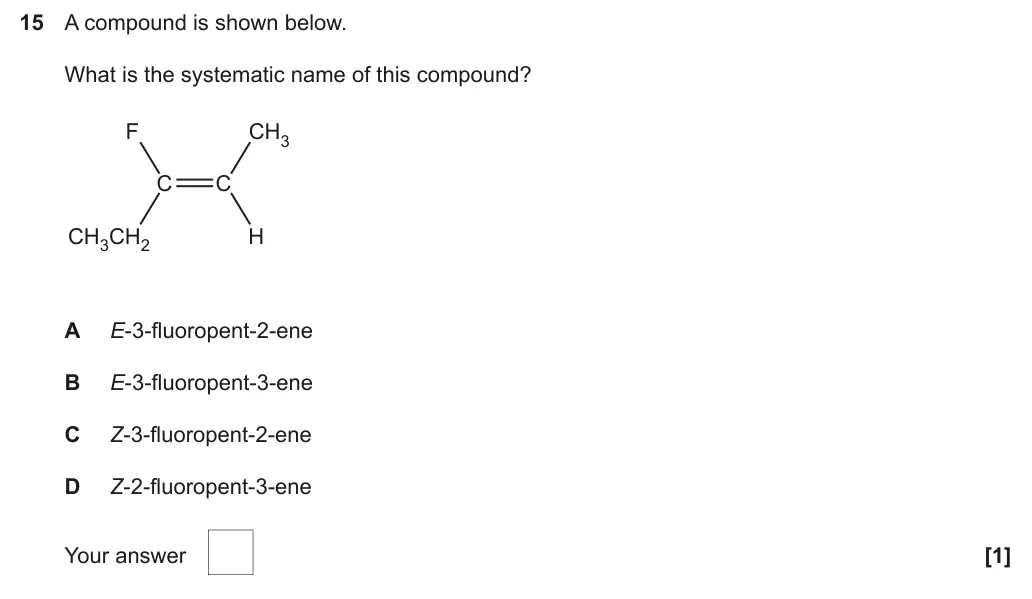
15 A compound is shown below.
What is the systematic name of this compound?
F CH3
C C
CH3CH2 H
A E-3-fluoropent-2-ene
B E-3-fluoropent-3-ene
C Z-3-fluoropent-2-ene
D Z-2-fluoropent-3-ene
Your answer [1]
June 2025 · AS Paper 1 · Q16 1 mark Multiple choice Medium haloalkanes
16 Which equation is a propagation step in the catalytic breakdown of ozone?
A C2F2Cl 2 C2F2Cl • + Cl •
B O3 + O 2O2
C Cl • + Cl • Cl 2
D Cl O• + O Cl • + O2
Your answer [1]
June 2025 · AS Paper 1 · Q17 1 mark Multiple choice Medium organic basicsalcohols
17 How many structural isomers of C5H12O are secondary alcohols?
A 1
B 2
C 3
D 4
Your answer [1]
June 2025 · AS Paper 1 · Q18 1 mark Multiple choice Medium haloalkanes
18 The hydrolysis of 1-iodopropane by aqueous potassium hydroxide takes place at a faster rate
than 1-bromopropane.
Which statement explains the different rates of reaction?
A Iodine is less reactive than bromine.
B The C–I bond enthalpy is less than the C–Br bond enthalpy.
C The C–I bond is less polar than a C–Br bond.
D The C–I bond length is shorter than the C–Br bond length.
Your answer [1]
June 2025 · AS Paper 1 · Q19 1 mark Multiple choice Medium infrared and mass spectrometry
19 In a mass spectrum, which alkene is likely to have a fragment ion at m / z = 29?
A H2C=CHCH=CH2
B H2C=C(CH3)2
C H3CCH=CHCH3
D H3CCH=CHCH2CH3
Your answer [1]
June 2025 · AS Paper 1 · Q20 1 mark Multiple choice Medium infrared and mass spectrometry
20 The IR spectrum of a compound is shown below.
100
80
60
transmittance
(%)
40
20
0
4000 3000 2000 1500 1000 400
wavenumber / cm–1
Which compound could have produced the IR spectrum?
A CH3CH=CH2
B CH3CH2CHO
C CH3CH2CH2OH
D CH3CH2COOH
Your answer [1]
June 2025 · AS Paper 1 · Q21(a) 2 marks Complete table/diagram Medium atomic structure and isotopes
SECTION B
21 This question is about atomic structure and isotopes of two elements in Period 3.
(a) This part of the question is about sulfur.
Complete the table below.
Species Protons Neutrons Electrons
34S 16
16 18
[2]
June 2025 · AS Paper 1 · Q21(b) 2 marks Calculation Easy atomic structure and isotopes
(b) The mass spectrum of a sample of magnesium is shown below.
75.45%
Relative
abundance
15.21%
9.34%
24 25 26
m / z
Calculate the relative atomic mass of magnesium in the sample.
Give your answer to 2 decimal places.
Relative atomic mass =  ......................................................... [2]
June 2025 · AS Paper 1 · Q21(c) 3 marks Structure / isomer Medium periodicity
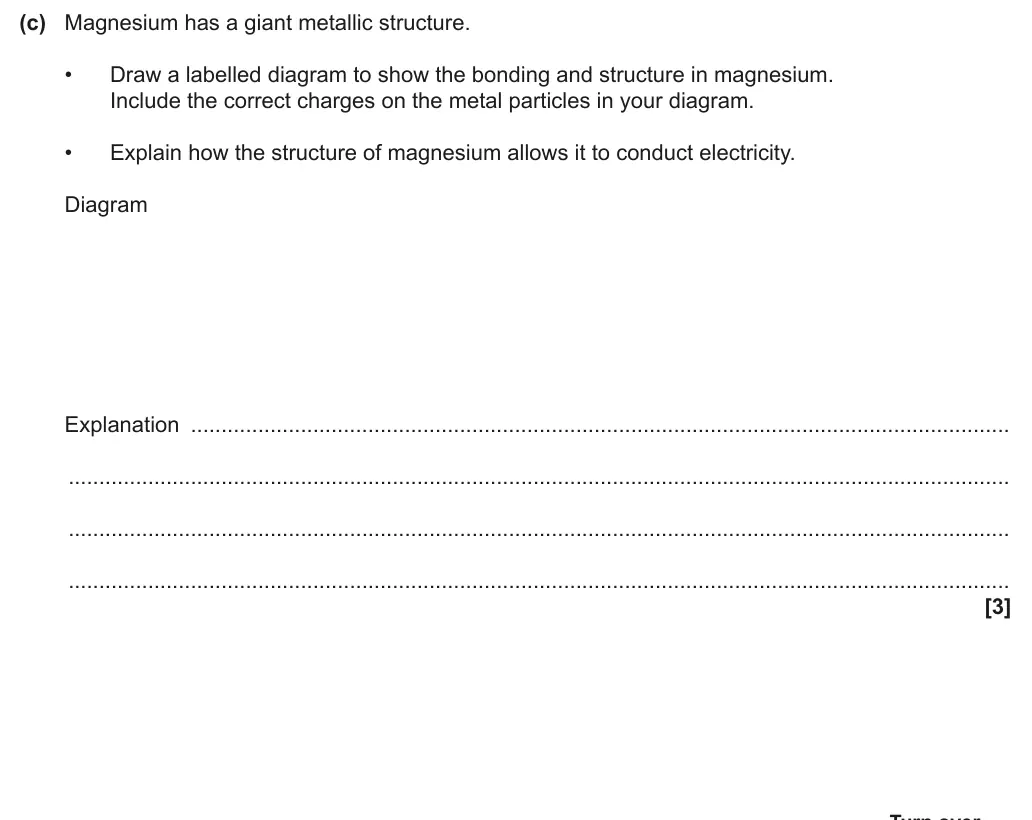
(c) Magnesium has a giant metallic structure.
• Draw a labelled diagram to show the bonding and structure in magnesium.
Include the correct charges on the metal particles in your diagram.
• Explain how the structure of magnesium allows it to conduct electricity.
Diagram
Explanation  ......................................................................................................................................
..........................................................................................................................................................
..........................................................................................................................................................
..........................................................................................................................................................
[3]
June 2025 · AS Paper 1 · Q21(d)(i) 3 marks Calculation Hard amount of substance
(d) Magnesium reacts with dilute hydrochloric acid, as shown in the equation.
Mg(s) + 2HCl (aq) MgCl 2(aq) + H2(g)
A student reacts an excess of Mg with 24.5 cm3 HCl (aq) using the apparatus below.
100 cm3 gas syringe
Dilute hydrochloric acid
Magnesium
The student measures the volume of gas collected over time. All gas volumes are measured at
RTP.
A graph of the student’s results is shown in Fig. 21.1 below.
Fig. 21.1
70.0
60.0
50.0
Volume 40.0
of gas
collected
/ cm3
30.0
20.0
10.0
0.0
0 5 10 15 20 25 30 35 40
Time / s
(i) Calculate the concentration of HCl that the student used.
Give your answer to 2 significant figures and in standard form.
Concentration of HCl =  ......................................... mol dm–3 [3]

June 2025 · AS Paper 1 · Q21(d)(ii) 3 marks Data interpretation Medium reaction rates

Earlier part of question 21 that this part usesEarlier part of June 2025 Paper 1 question 21

(ii) Explain the shape of the graph in Fig. 21.1, in terms of concentration, collisions and time.
..........................................................................................................................................................
..........................................................................................................................................................
..........................................................................................................................................................
..........................................................................................................................................................
..........................................................................................................................................................
..........................................................................................................................................................
..........................................................................................................................................................
.................................................................................................................................................... [3]
June 2025 · AS Paper 1 · Q22(a) 3 marks Short answer Medium halogensredox
22  This question is about halogens and their compounds.
(a) An aqueous solution of bromine reacts with cold aqueous sodium hydroxide in a
disproportionation reaction.
The equation is shown below.
Br2(aq) + 2NaOH(aq) NaBr(aq) + NaBrO(aq) + H2O(l)
Explain what is meant by the term disproportionation.
Use the equation above and oxidation numbers.
..........................................................................................................................................................
..........................................................................................................................................................
..........................................................................................................................................................
..........................................................................................................................................................
..........................................................................................................................................................
.................................................................................................................................................... [3]
June 2025 · AS Paper 1 · Q22(b)(i) 3 marks Short answer Medium halogens
Earlier part of question 22 that this part usesEarlier part of June 2025 Paper 1 question 22
(b) An aqueous solution of chlorine also reacts with cold, aqueous sodium hydroxide.
The reaction is more vigorous than the reaction of Br2(aq) with NaOH(aq) in (a).
(i) Explain why chlorine reacts more vigorously than bromine.
..........................................................................................................................................................
..........................................................................................................................................................
..........................................................................................................................................................
..........................................................................................................................................................
..........................................................................................................................................................
..........................................................................................................................................................
..........................................................................................................................................................
..........................................................................................................................................................
..........................................................................................................................................................
.................................................................................................................................................... [3]
June 2025 · AS Paper 1 · Q22(b)(ii) 1 mark Short answer Medium halogens
(ii) Chlorine is used in water treatment.
State one disadvantage of treating water with chlorine.
..........................................................................................................................................................
.................................................................................................................................................... [1]
June 2025 · AS Paper 1 · Q22(c) 4 marks Short answer Hard halogensqualitative analysis
(c) A group of students is provided with aqueous solutions of sodium chloride, sodium bromide and
sodium iodide in three unlabelled bottles.
Explain how the students can identify which bottle contains each aqueous solution using
precipitation reactions and the solubility of any precipitate formed.
Include an ionic equation in your answer.
..........................................................................................................................................................
..........................................................................................................................................................
..........................................................................................................................................................
..........................................................................................................................................................
..........................................................................................................................................................
..........................................................................................................................................................
..........................................................................................................................................................
..........................................................................................................................................................
..........................................................................................................................................................
.................................................................................................................................................... [4]
June 2025 · AS Paper 1 · Q23(a) 2 marks Short answer Medium chemical equilibrium
23 This question is about equilibrium and bond enthalpies.
The chemical industry manufactures sulfur trioxide, SO3, by reacting sulfur dioxide, SO2, and
oxygen. This is a reversible reaction which can reach dynamic equilibrium.
2SO2(g) + O2(g) 2SO3(g)  ΔH = –196 kJ mol–1   Equilibrium 23.1
(a) State two features of a dynamic equilibrium.
1 ........................................................................................................................................................
..........................................................................................................................................................
2 ........................................................................................................................................................
..........................................................................................................................................................
[2]
June 2025 · AS Paper 1 · Q23(b) 3 marks Calculation Hard enthalpy changes
Earlier part of question 23 that this part usesEarlier part of June 2025 Paper 1 question 23
(b) The displayed formulae of SO2 and SO3 are shown below.
O
S
O O S
O O
The bond enthalpies for the S=O bond in SO2 and SO3 are not the same.
The table shows bond enthalpies.
Bond Bond enthalpy / kJ mol–1
O=O +494
S=O in SO2 +522
Calculate the S=O bond enthalpy in SO3.
Use the information in the table and Equilibrium 23.1.
Bond enthalpy of S=O in SO3 =  ........................................... kJ mol–1 [3]
June 2025 · AS Paper 1 · Q23(c) 3 marks Calculation Easy chemical equilibrium
Earlier part of question 23 that this part usesEarlier part of June 2025 Paper 1 question 23
(c) The table shows equilibrium concentrations for Equilibrium 23.1.
[SO2(g)] / mol dm–3 [O2(g)] / mol dm–3 [SO3(g)] / mol dm–3
25.0 108 42.0
For Equilibrium 23.1
• write the expression for the equilibrium constant, Kc
• calculate Kc to 3 significant figures and in standard form.
Kc = ............................................... dm3 mol–1
[3]
June 2025 · AS Paper 1 · Q24(a)(i) 1 mark Drawing / labelling Medium alkenesorganic basics
24 This question is about alkenes.
(a) 2-Chloropropene can form an addition polymer.
(i) Draw two repeat units of the polymer formed by 2-chloropropene.
[1]
June 2025 · AS Paper 1 · Q24(a)(ii) 1 mark Short answer Hard alkenes
Earlier part of question 24 that this part usesEarlier part of June 2025 Paper 1 question 24
(ii) 2-Chloropropene can be disposed of by combustion. This process releases the greenhouse gas
carbon dioxide.
State one other problem with this method of disposal.
..........................................................................................................................................................
..........................................................................................................................................................
..........................................................................................................................................................
.................................................................................................................................................... [1]
June 2025 · AS Paper 1 · Q24(b) 1 mark Equation writing Easy formulae and equationsalkanes
(b) Pentene, C5H10, can undergo complete combustion to produce the same products as the
combustion of an alkane.
Write the equation for the complete combustion of C5H10.
.................................................................................................................................................... [1]
June 2025 · AS Paper 1 · Q24(c)(i) 5 marks Mechanism Hard alkenesorganic basics
(c) Methylpropene, (CH3)2C=CH2, reacts with HCl to form a mixture of two products.
Compound A is the major product.
(i) Outline the mechanism for the formation of the major product, compound A.
The structure of (CH3)2C=CH2 has been provided.
Include curly arrows and relevant dipoles, the structure of compound A and the name of the
mechanism.
H3C H
C C
H3C H
Compound A
Name of mechanism  ........................................................................................................................
[5]
June 2025 · AS Paper 1 · Q24(c)(ii) 1 mark Short answer Medium alkenes
Earlier part of question 24 that this part usesEarlier part of June 2025 Paper 1 question 24
(ii) Explain why compound A is the major product.
..........................................................................................................................................................
..........................................................................................................................................................
..........................................................................................................................................................
.................................................................................................................................................... [1]
June 2025 · AS Paper 1 · Q25(a) 3 marks Structure / isomer Medium alcohols
25 This question is about alcohols.
Alcohols D, E, F and G, shown below, are structural isomers of C4H10O.
H H OH H H H CH3 H H H H
H C C C C H H3C C C OH H3C C OH HO C C C C H
H H H H CH3 H CH3 H H H H
Alcohol D Alcohol E Alcohol F Alcohol G
(a) Alcohols D, E, F and G are each heated under reflux with H+ / Cr2O7 2–.
Draw the structure of the organic product that is formed from each alcohol.
If there is no reaction, state ‘No reaction’.
Alcohol Organic product
D
E
F
G
[3]
June 2025 · AS Paper 1 · Q25(b) 1 mark Structure / isomer Medium alcoholsorganic basics
Earlier part of question 25 that this part usesEarlier part of June 2025 Paper 1 question 25
(b) Alcohols D, E, F and G are each heated with concentrated H2SO4, which acts as an acid
catalyst.
Which alcohol forms a mixture of two alkenes that are structural isomers of one another?
Alcohol ..................... [1]
June 2025 · AS Paper 1 · Q25(c) 5 marks Calculation Easy amount of substance
Earlier part of question 25 that this part usesEarlier part of June 2025 Paper 1 question 25
(c) 25.9 g of alcohol F is completely combusted in oxygen at a temperature of 100 °C and
1.50 × 10⁵ Pa pressure.
The equation for this reaction is:
C4H10O + 6O2 4CO2 + 5H2O
Calculate the volume of CO2(g) produced, in cm3.
Give your answer to an appropriate number of significant figures.
Volume of CO2(g) =  ................................................. cm3 [5]

Work with an OCR chemistry tutor

Want a paper marked and gone through with you? Message us.

Prefer email? Send an enquiry

If you are under 18, please include a parent's contact details. Enquiries go to enquiries@chemistryaleveltutor.com and are deleted once handled. All tutoring is online.