June 2025: Paper 3, Unified chemistry

70 marks · 25 question parts · Paper, mark scheme and report on OCR's site · Have OCR's Data Sheet beside you

Question by question

QTopicMarksAOType
1(a)(i) Atomic structure and isotopes 2Complete table/diagram
1(a)(ii) Atomic structure and isotopes 3Short answer
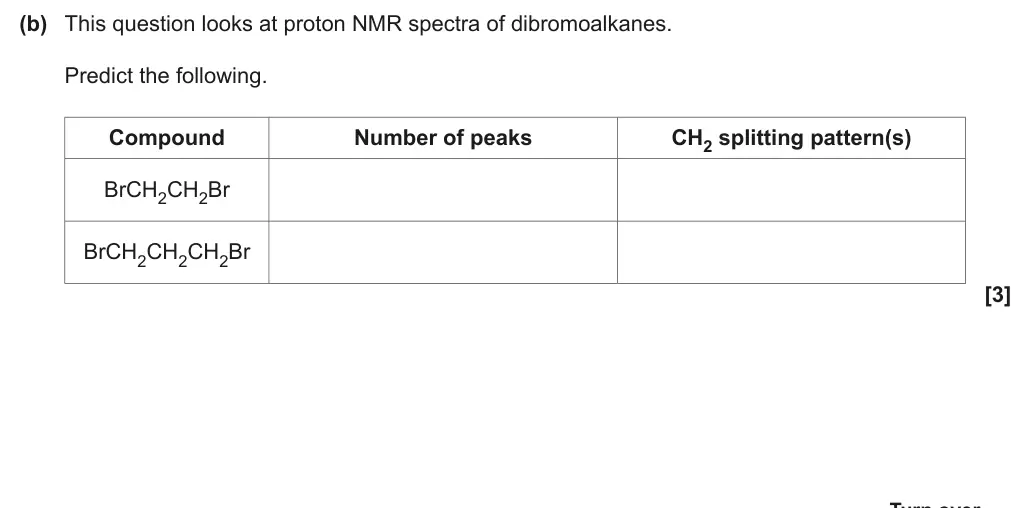
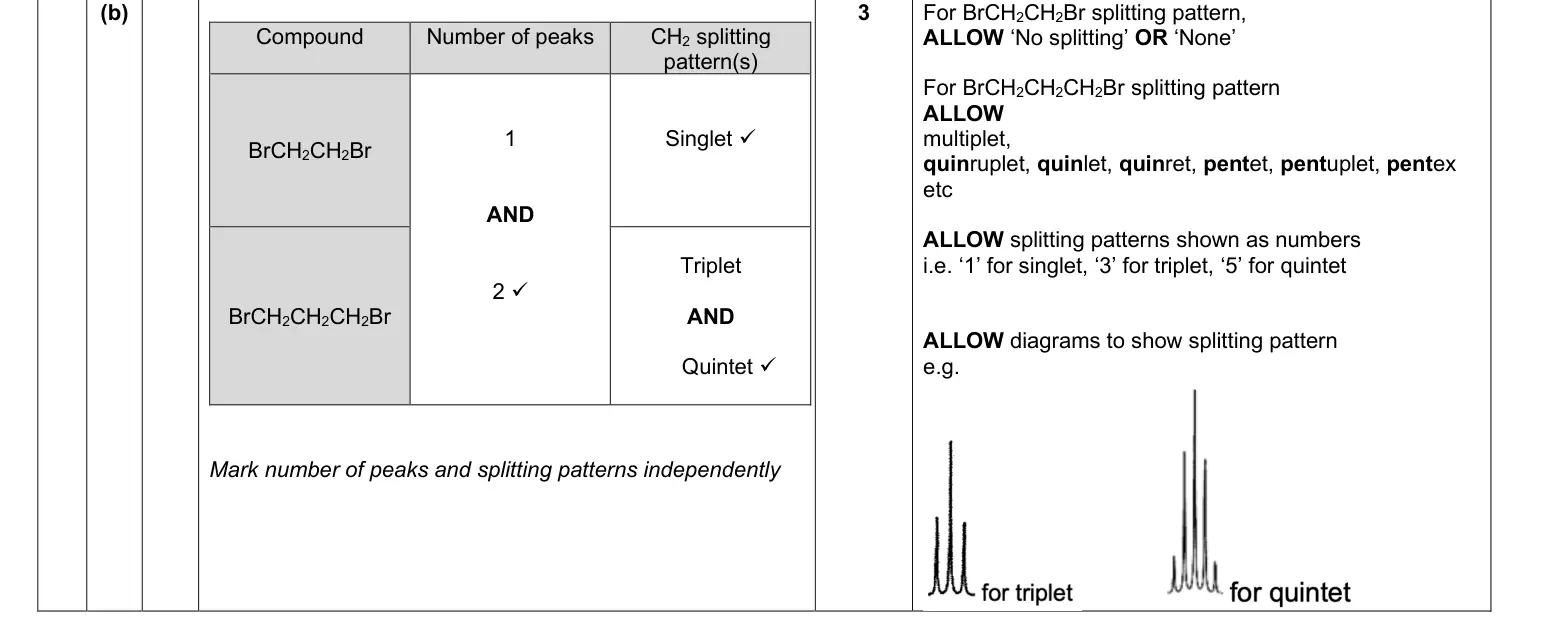
1(b) NMR spectroscopy and combined techniques 3Short answer
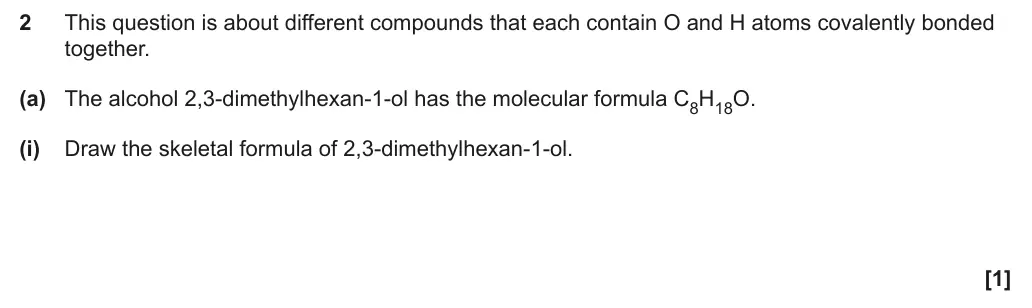
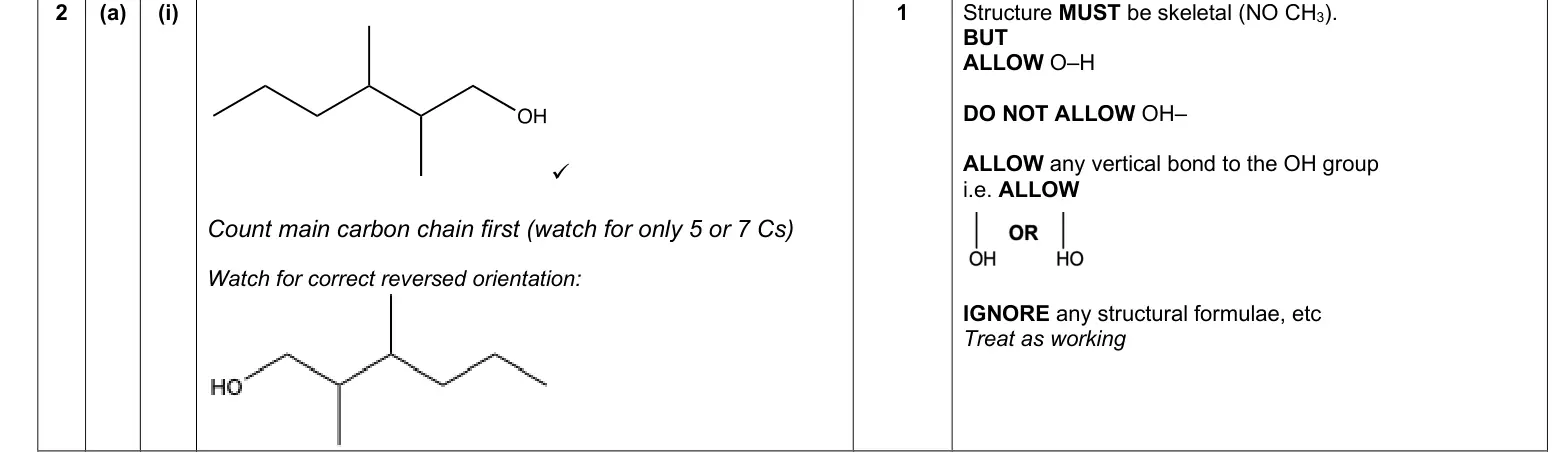
2(a)(i) Organic basics: naming, formulae and isomerism 1Structure / isomer
2(a)(ii) Amount of substance (moles) 3Calculation
2(b)(i) Aromatic compounds: benzene and phenol, Chromatography and tests for functional groups 1Short answer
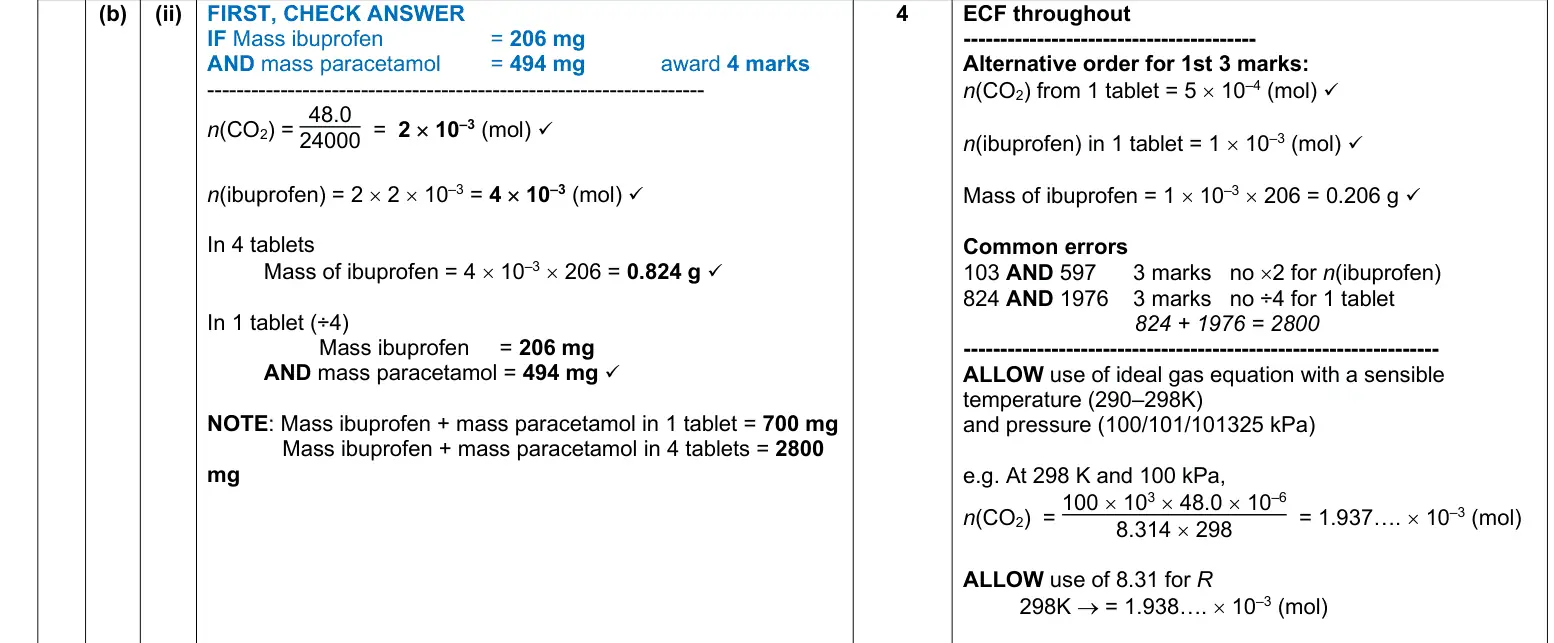
2(b)(ii) Amount of substance (moles) 4Calculation
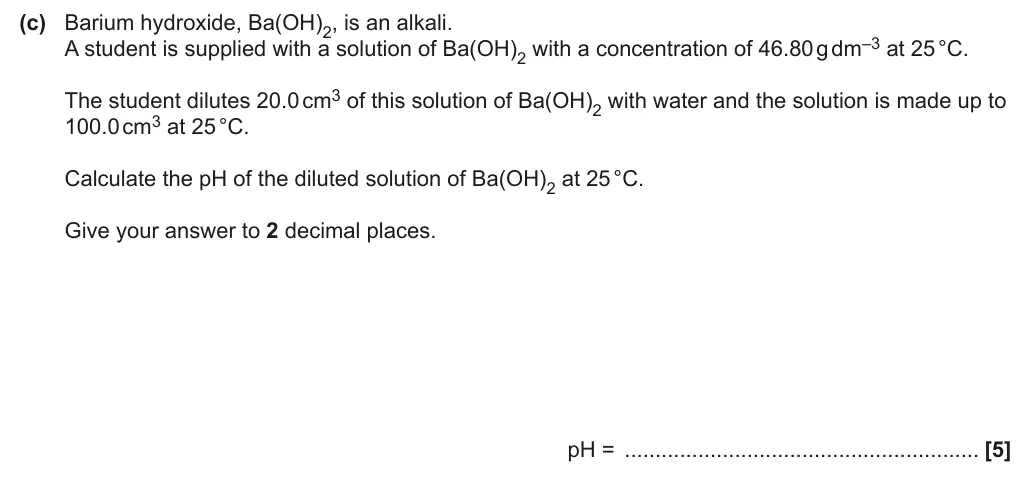
2(c) Acids, bases, pH and buffers, Amount of substance (moles) 5Calculation
3(a) Chemical equilibrium and Kc, Practical skills: planning, analysis and evaluation, Equilibrium constants Kc and Kp 5Calculation
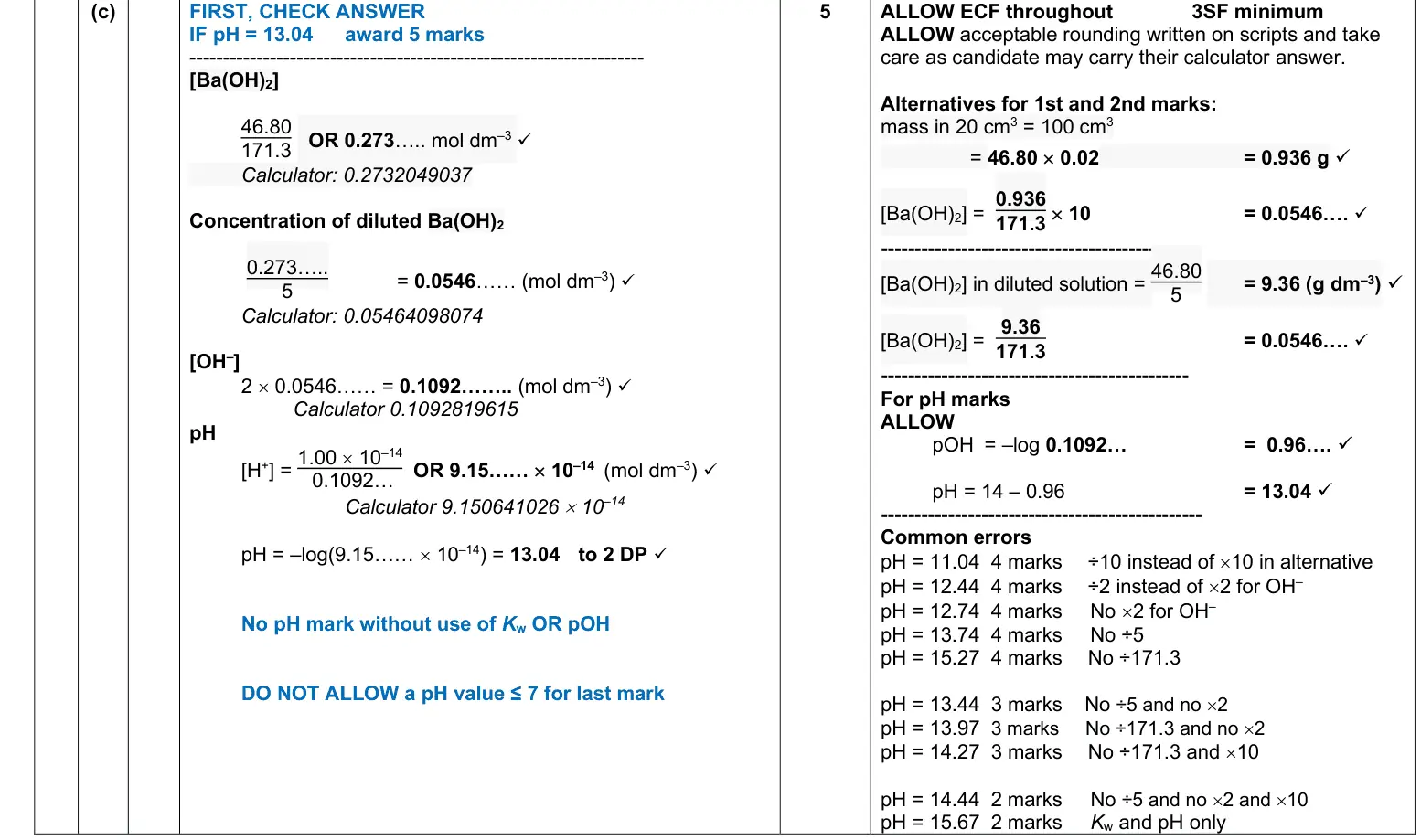
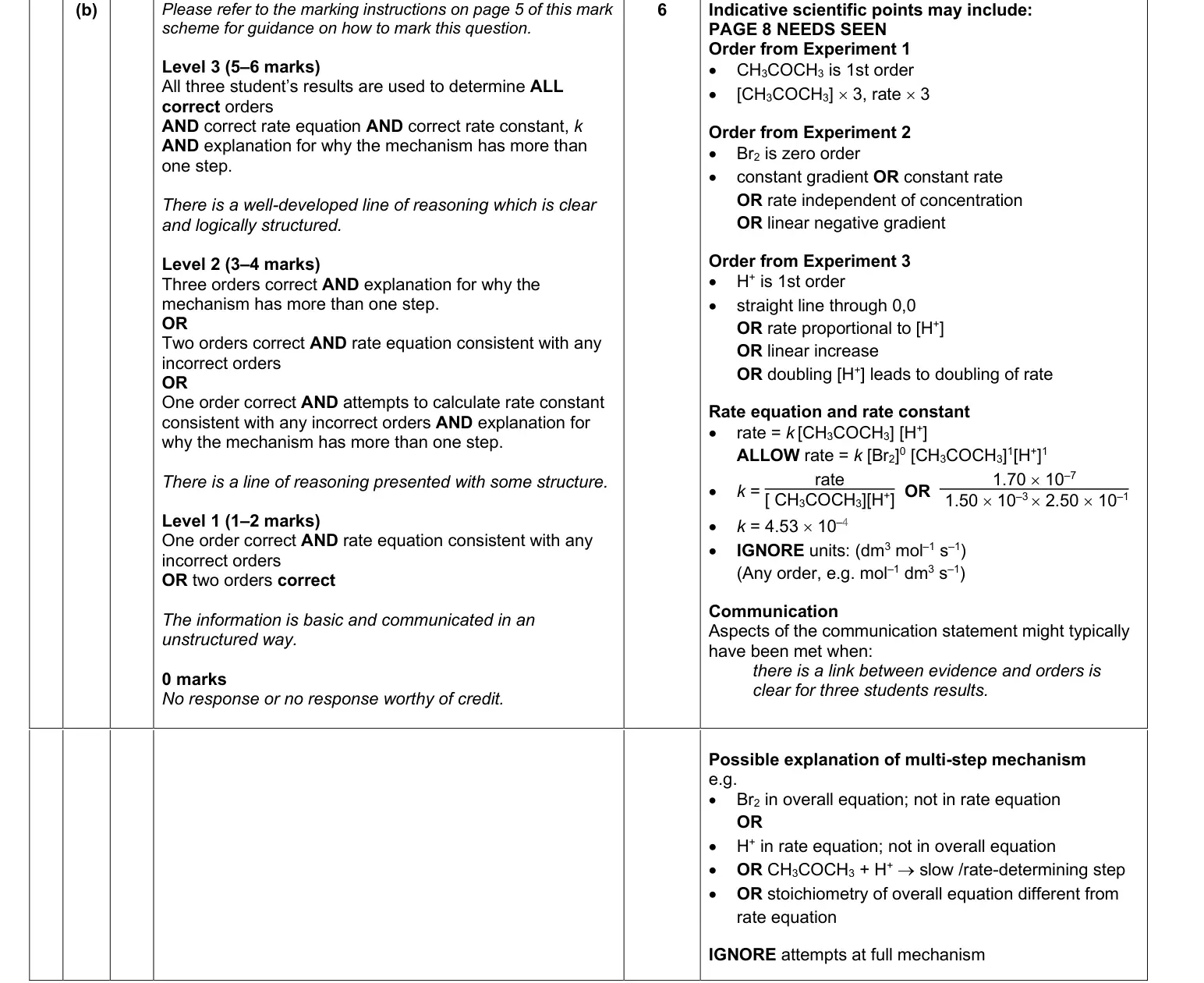
3(b) Rates: orders, rate equations and the Arrhenius equation 6Level of response
4(a)(i) Redox and oxidation numbers 1Short answer
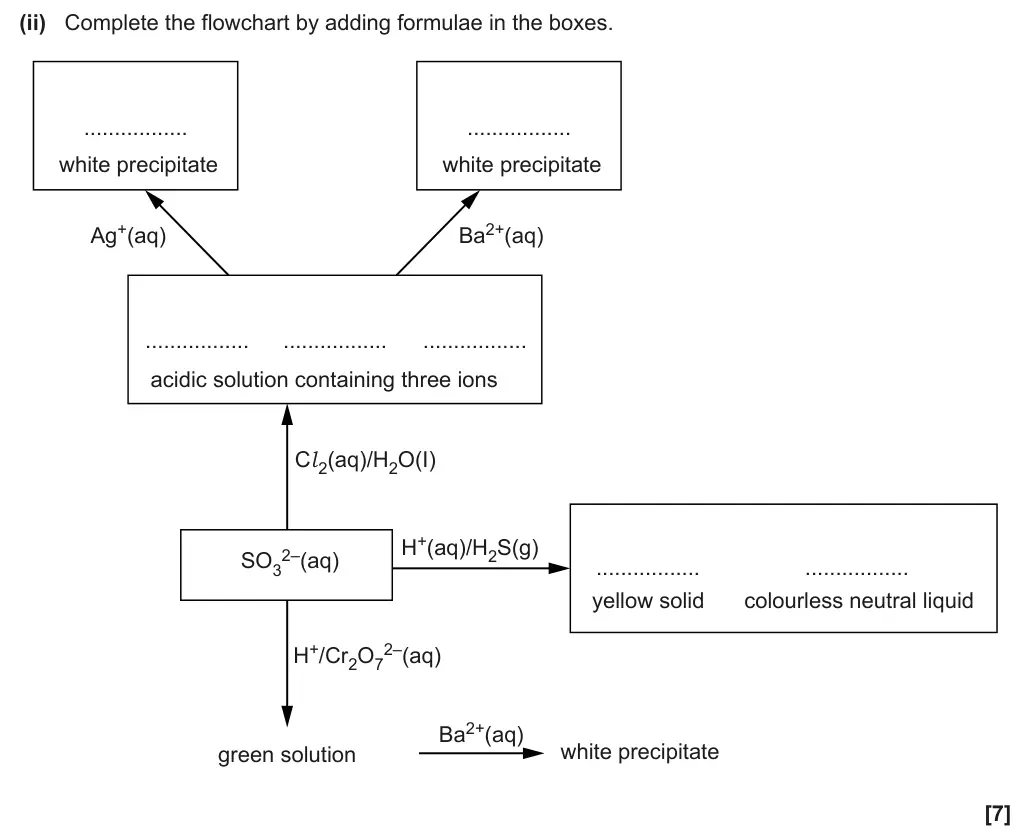
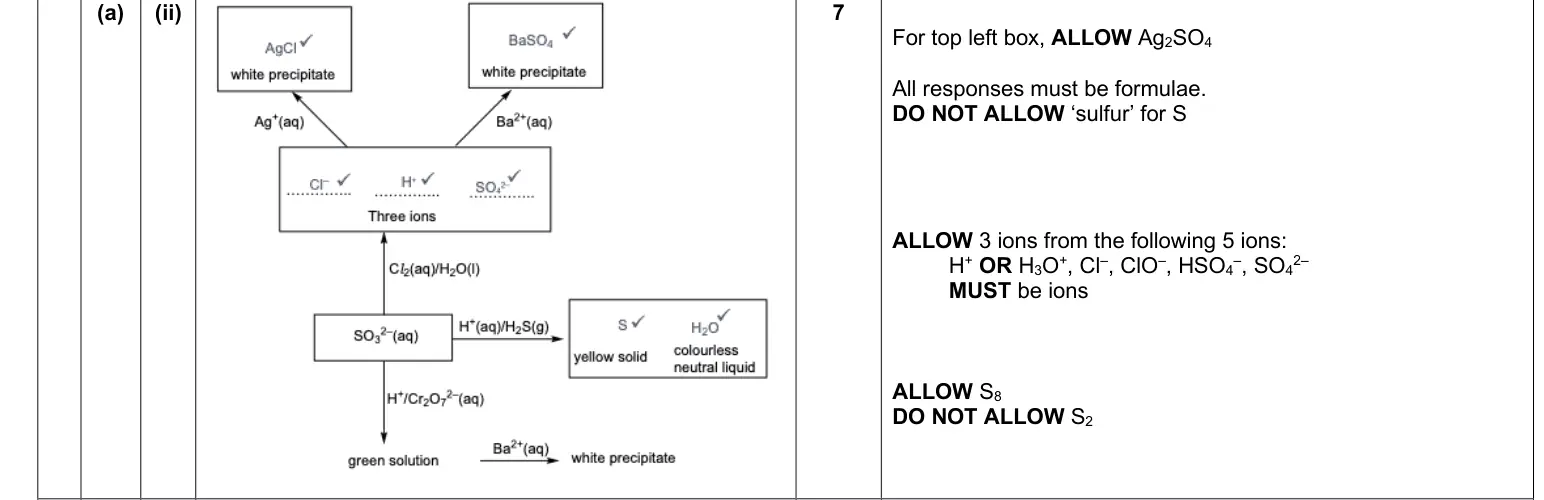
4(a)(ii) Redox titrations and electrode potentials, Redox and oxidation numbers, The halogens, Qualitative analysis: tests for ions 7Short answer
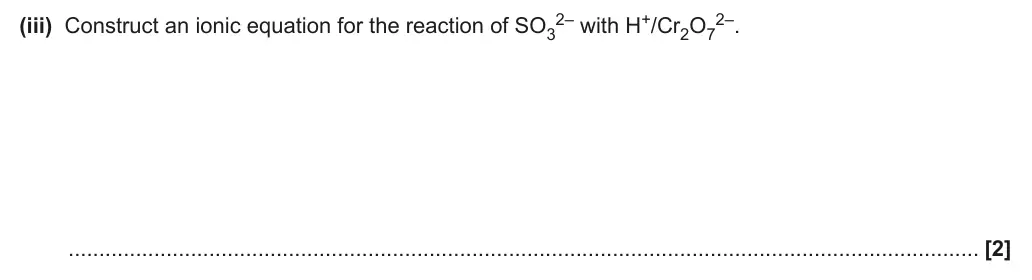
4(a)(iii) Redox titrations and electrode potentials, Transition elements 2Equation writing
4(b)(i) Amount of substance (moles) 1Short answer
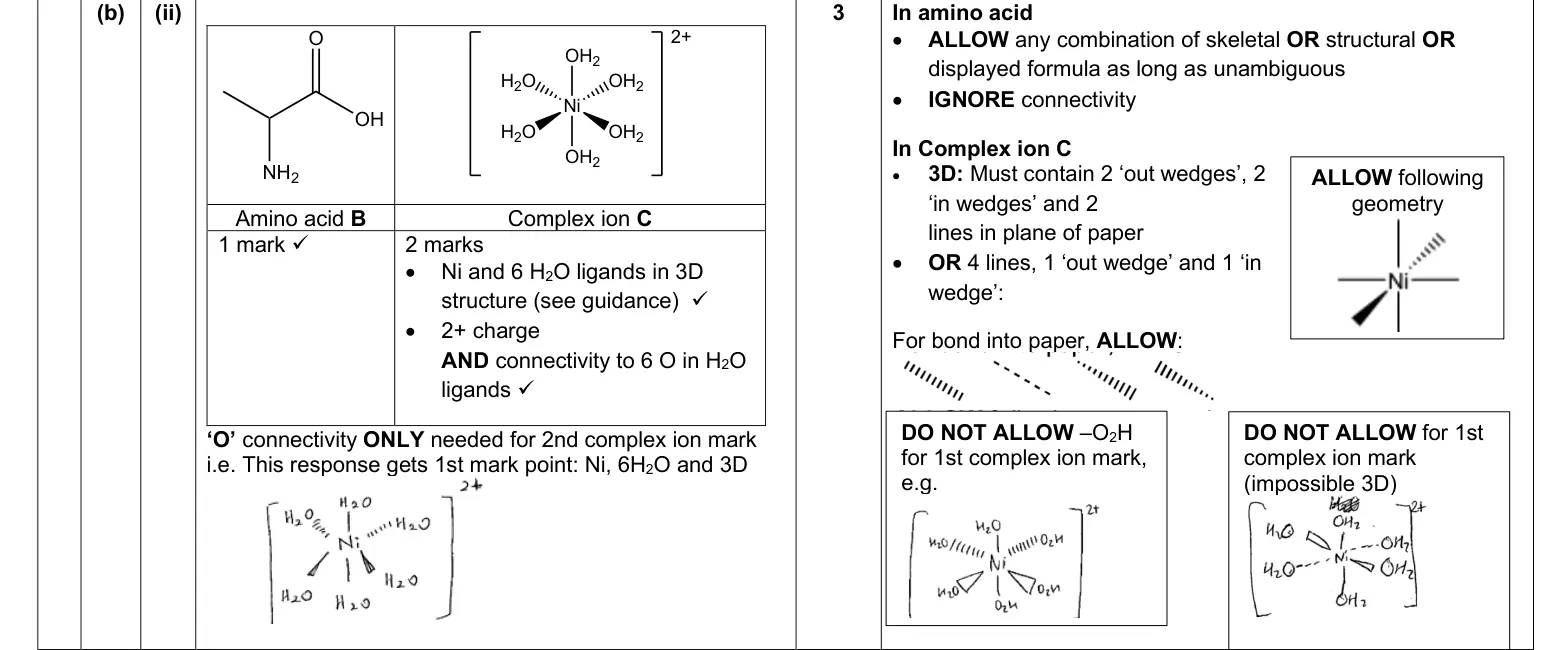
4(b)(ii) Transition elements, Amino acids, amides and chirality 3Structure / isomer
4(b)(iii) Transition elements 1Complete table/diagram
5(a)(i) Organic basics: naming, formulae and isomerism, Aromatic compounds: benzene and phenol 1Short answer
5(a)(ii) Amount of substance (moles) 4Calculation
5(a)(iii) Haloalkanes 1Short answer
5(a)(iv) Organic basics: naming, formulae and isomerism, Organic synthesis (Module 6) 4Mechanism
5(a)(v) Carbonyl compounds: aldehydes and ketones, Acids, bases, pH and buffers 1Short answer
5(b) Bonding, structure and shapes of molecules 2Drawing / labelling
5(c)(i) Redox titrations and electrode potentials 1Calculation
5(c)(ii) Redox titrations and electrode potentials 2Equation writing
6 Enthalpy changes and Hess’ law, Amount of substance (moles) 6Level of response

The questions

1(a)(i)1(a)(ii)1(b)2(a)(i)2(a)(ii)2(b)(i)2(b)(ii)2(c)3(a)3(b)4(a)(i)4(a)(ii)4(a)(iii)4(b)(i)4(b)(ii)4(b)(iii)5(a)(i)5(a)(ii)5(a)(iii)5(a)(iv)5(a)(v)5(b)5(c)(i)5(c)(ii)6
June 2025 · Paper 3 · Q1(a)(i) 2 marks Complete table/diagram Medium atomic structure and isotopes
1 This question is about spectra.
(a) The mass spectrum for Br2 has peaks at m/z values of 79, 81, 158, 160 and 162.
The peaks at m/z 79 and 81 have virtually the same relative abundance.
(i) Complete the table to show the number of protons, neutrons and electrons in the particles that
cause the peaks at m/z 79 and 81.
Number of Number of Number of
m/z
protons neutrons electrons
79
81
[2]
June 2025 · Paper 3 · Q1(a)(ii) 3 marks Short answer Hard atomic structure and isotopes
Earlier part of question 1 that this part usesEarlier part of June 2025 Paper 3 question 1
(ii) Explain why there are peaks with m/z values of 158, 160 and 162 and predict their relative
abundances.
Explanation  ......................................................................................................................................
..........................................................................................................................................................
..........................................................................................................................................................
..........................................................................................................................................................
Relative abundances  .......................................................................................................................
..........................................................................................................................................................
..........................................................................................................................................................
[3]
June 2025 · Paper 3 · Q1(b) 3 marks Short answer Medium nmr spectroscopy
(b) This question looks at proton NMR spectra of dibromoalkanes.
Predict the following.
Compound Number of peaks CH2 splitting pattern(s)
BrCH2CH2Br
BrCH2CH2CH2Br
[3]
June 2025 · Paper 3 · Q2(a)(i) 1 mark Structure / isomer Easy organic basics
2 This question is about different compounds that each contain O and H atoms covalently bonded
together.
(a) The alcohol 2,3‑dimethylhexan‑1‑ol has the molecular formula C8H18O.
(i) Draw the skeletal formula of 2,3‑dimethylhexan‑1‑ol.
[1]
June 2025 · Paper 3 · Q2(a)(ii) 3 marks Calculation Easy amount of substance
Earlier part of question 2 that this part usesEarlier part of June 2025 Paper 3 question 2
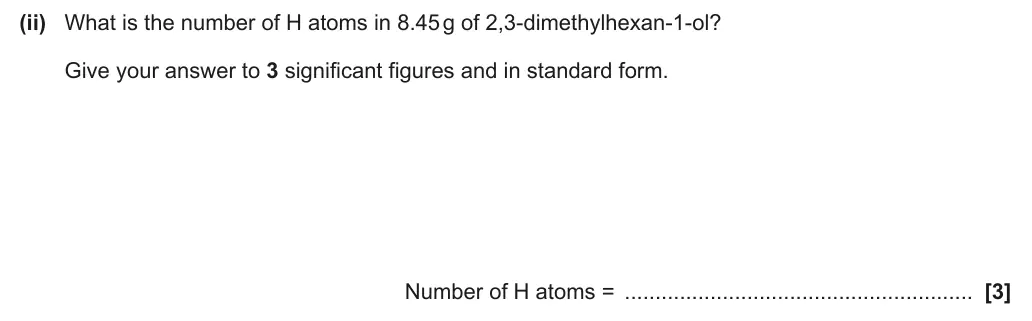
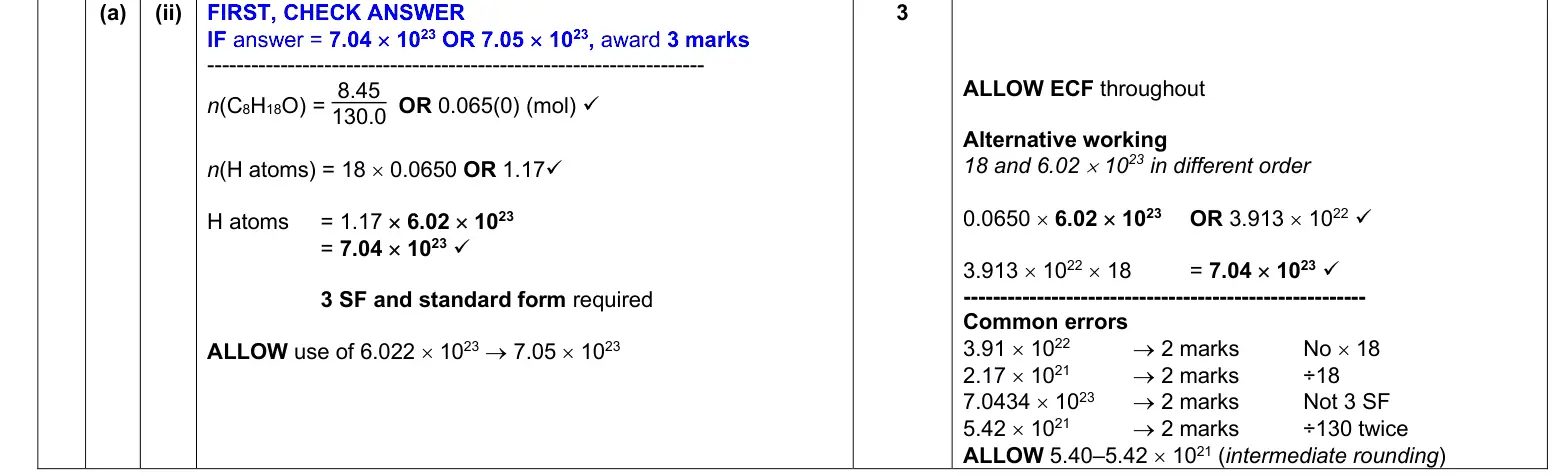
(ii) What is the number of H atoms in 8.45 g of 2,3‑dimethylhexan‑1‑ol?
Give your answer to 3 significant figures and in standard form.
Number of H atoms =  ......................................................... [3]
June 2025 · Paper 3 · Q2(b)(i) 1 mark Short answer Easy aromatic compoundschromatography and functional group tests
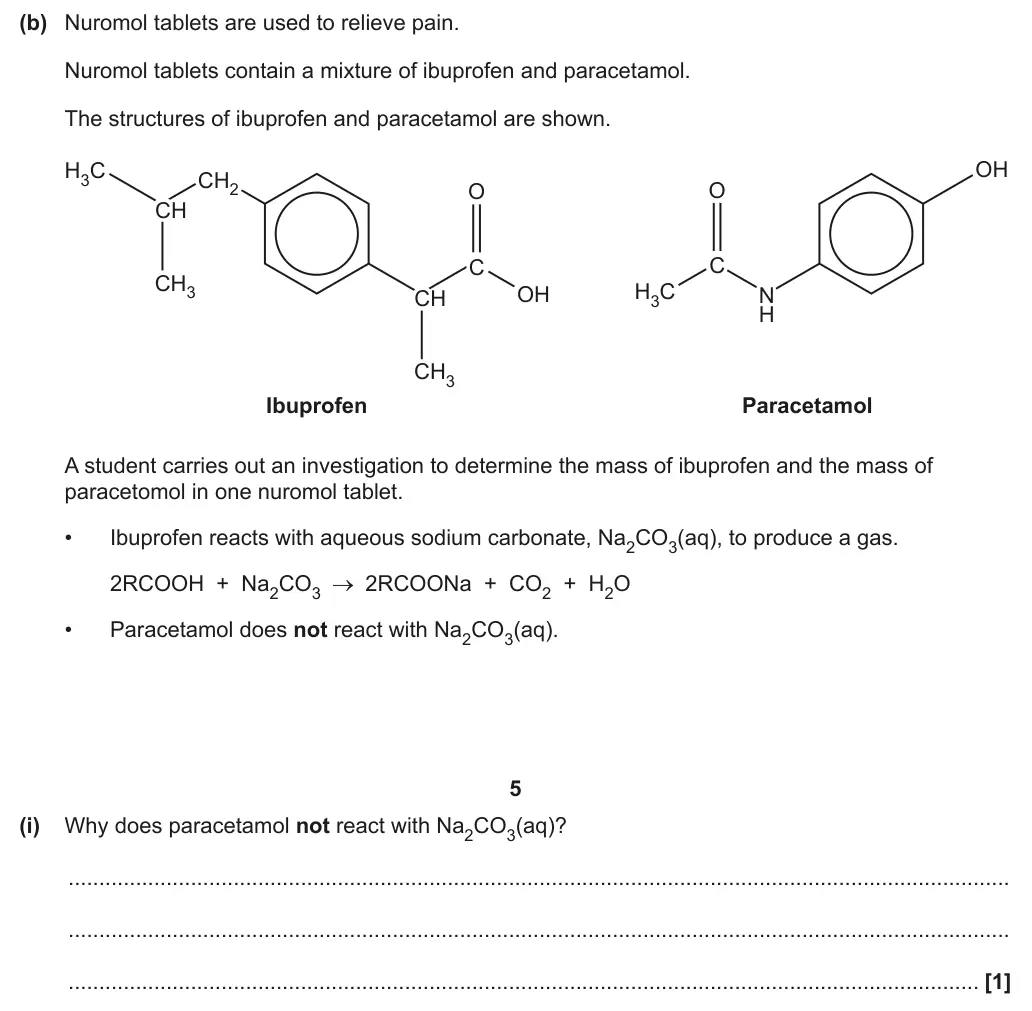
(b) Nuromol tablets are used to relieve pain.
Nuromol tablets contain a mixture of ibuprofen and paracetamol.
The structures of ibuprofen and paracetamol are shown.
H3C OH
CH2
O O
CH
C C
CH3
OH H3C N
CH
H
CH3
Ibuprofen Paracetamol
A student carries out an investigation to determine the mass of ibuprofen and the mass of
paracetomol in one nuromol tablet.
• Ibuprofen reacts with aqueous sodium carbonate, Na2CO3(aq), to produce a gas.
2RCOOH  +  Na2CO3 2RCOONa  +  CO2  +  H2O
• Paracetamol does not react with Na2CO3(aq).
(i) Why does paracetamol not react with Na2CO3(aq)?
..........................................................................................................................................................
..........................................................................................................................................................
..................................................................................................................................................... [1]
June 2025 · Paper 3 · Q2(b)(ii) 4 marks Calculation Medium amount of substance
Earlier part of question 2 that this part usesEarlier part of June 2025 Paper 3 question 2
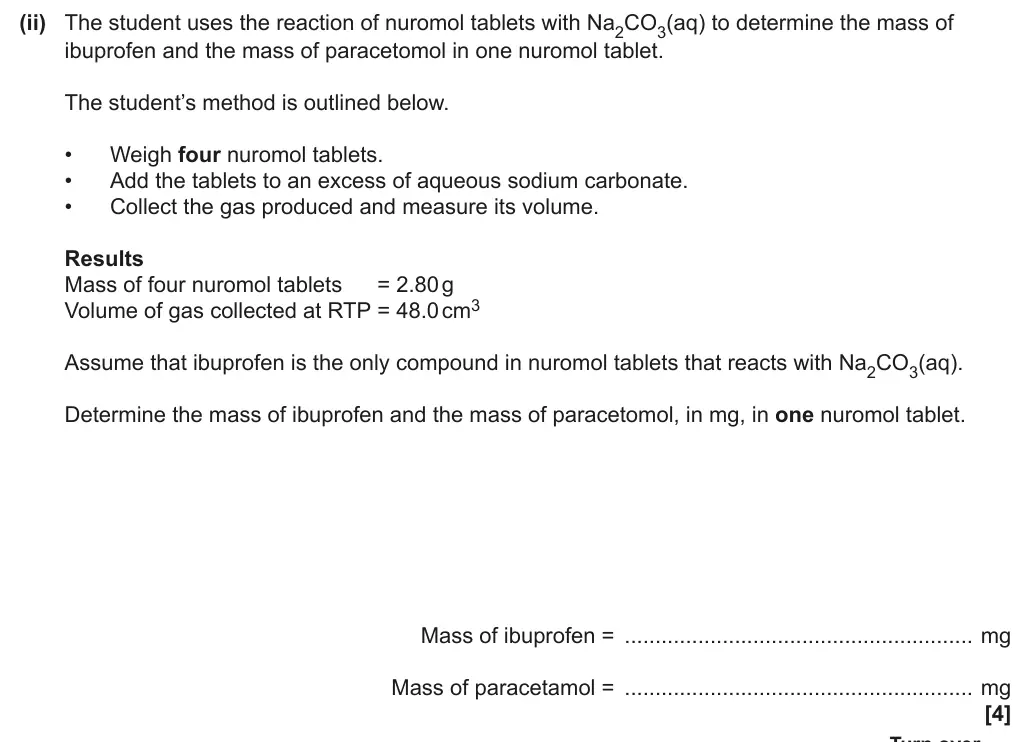
(ii) The student uses the reaction of nuromol tablets with Na2CO3(aq) to determine the mass of
ibuprofen and the mass of paracetomol in one nuromol tablet.
The student’s method is outlined below.
• Weigh four nuromol tablets.
• Add the tablets to an excess of aqueous sodium carbonate.
• Collect the gas produced and measure its volume.
Results
Mass of four nuromol tablets = 2.80 g
Volume of gas collected at RTP = 48.0 cm3
Assume that ibuprofen is the only compound in nuromol tablets that reacts with Na2CO3(aq).
Determine the mass of ibuprofen and the mass of paracetomol, in mg, in one nuromol tablet.
Mass of ibuprofen =  ......................................................... mg
Mass of paracetamol =  ......................................................... mg
[4]
June 2025 · Paper 3 · Q2(c) 5 marks Calculation Hard acids bases and buffersamount of substance
(c) Barium hydroxide, Ba(OH)2, is an alkali.
A student is supplied with a solution of Ba(OH)2 with a concentration of 46.80 g dm–3 at 25 °C.
The student dilutes 20.0 cm3 of this solution of Ba(OH)2 with water and the solution is made up to
100.0 cm3 at 25 °C.
Calculate the pH of the diluted solution of Ba(OH)2 at 25 °C.
Give your answer to 2 decimal places.
pH =  .......................................................... [5]
June 2025 · Paper 3 · Q3(a) 5 marks Calculation Easy chemical equilibriumpractical skillsequilibrium constants
3 This question is about equilibrium and rates.
(a) Methanol, CH3OH, can be made industrially by the reaction of carbon monoxide, CO, with
hydrogen, H2, in the presence of a catalyst. This is a reversible reaction.
The equilibrium below is set up.
CO(g)  +  2H2(g) CH3OH(g) ∆H = –91 kJ mol–1
The concentrations of CO(g) and CH3OH(g) in the equilibrium mixture are shown in the table
below.
CO(g) CH3OH(g)
equilibrium concentration / mol dm–3 0.27 0.11
The value of the equilibrium constant, Kc, for this reaction is 1.8 dm6 mol–2.
• Explain the conditions of pressure and temperature that would give the maximum equilibrium
yield of CH3OH(g).
• Calculate the concentration of H2(g) in the equilibrium mixture to an appropriate number of
significant figures.
..........................................................................................................................................................
..........................................................................................................................................................
..........................................................................................................................................................
..........................................................................................................................................................
..........................................................................................................................................................
..........................................................................................................................................................
..........................................................................................................................................................
..........................................................................................................................................................
..........................................................................................................................................................
..........................................................................................................................................................
..........................................................................................................................................................
..........................................................................................................................................................
..........................................................................................................................................................
..........................................................................................................................................................
..........................................................................................................................................................
..................................................................................................................................................... [5]
June 2025 · Paper 3 · Q3(b) 6 marks 6-mark level of response Medium rate equations
(b)* A reaction takes place when aqueous solutions of propanone, CH3COCH3(aq), and bromine,
Br2(aq), are mixed in the presence of dilute acid, H+(aq).
The overall equation for this reaction is shown below.
CH3COCH3  +  Br2 CH3COCH2Br + HBr Reaction 3.1
• A student carries out three experiments to investigate the rate of this reaction.
• In each experiment, the student investigates the effect of changing the concentration of one
of the three chemicals whilst keeping the concentrations of the other chemicals constant.
The student’s results are shown below.
Experiment 1
Only [CH3COCH3(aq)] is varied.
Initial concentrations
Initial rate
CH3COCH3(aq) Br2(aq) H+(aq)
/ mol dm–3 s–1
/ mol dm–3 / mol dm–3 / mol dm–3
1.50 × 10⁻³ 2.00 × 10⁻¹ 2.50 × 10⁻¹ 1.70 × 10⁻⁷
4.50 × 10⁻³ 2.00 × 10⁻¹ 2.50 × 10⁻¹ 5.10 × 10⁻⁷
Experiment 2
Only [Br2(aq)] is varied.
[Br2(aq)]
/mol dm–3
0
0 Time / s
Experiment 3
Only [H+(aq)] varied.
Initial rate
/mol dm–3 s–1
0
0 [H+(aq)]
/mol dm–3
Use the student’s results to determine the order with respect to each of the three chemicals, the
rate equation and rate constant for Reaction 3.1. Explain your reasoning.
Explain how the student’s results can be used to show that the mechanism of Reaction 3.1 has
more than one step.
..........................................................................................................................................................
..........................................................................................................................................................
..........................................................................................................................................................
..........................................................................................................................................................
..........................................................................................................................................................
..........................................................................................................................................................
..........................................................................................................................................................
..........................................................................................................................................................
..........................................................................................................................................................
..........................................................................................................................................................
..........................................................................................................................................................
..........................................................................................................................................................
..........................................................................................................................................................
..........................................................................................................................................................
..........................................................................................................................................................
..........................................................................................................................................................
..........................................................................................................................................................
..................................................................................................................................................... [6]
Extra answer space if required.
..........................................................................................................................................................
..........................................................................................................................................................
..........................................................................................................................................................
..........................................................................................................................................................
June 2025 · Paper 3 · Q4(a)(i) 1 mark Short answer Medium redox
4 This question is about inorganic chemistry.
(a) The flowchart shows reactions involving SO3 2–(aq) ions.
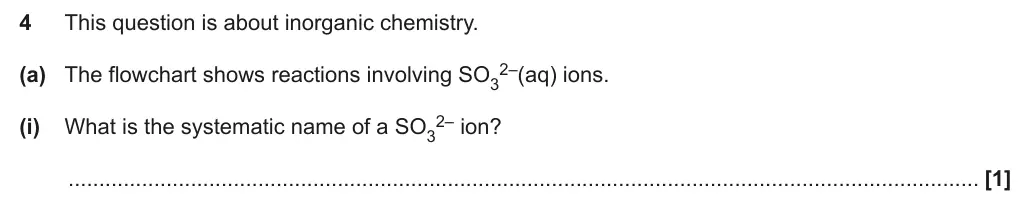
(i) What is the systematic name of a SO3 2– ion?
..................................................................................................................................................... [1]
June 2025 · Paper 3 · Q4(a)(ii) 7 marks Short answer Hard redox and electrode potentialsredoxhalogensqualitative analysis
Earlier part of question 4 that this part usesEarlier part of June 2025 Paper 3 question 4
(ii) Complete the flowchart by adding formulae in the boxes.
................. .................
white precipitate white precipitate
Ag+(aq) Ba2+(aq)
................. ................. .................
acidic solution containing three ions
Cl 2(aq)/H2O(I)
H+(aq)/H2S(g)
SO3 2–(aq)
................. .................
yellow solid colourless neutral liquid
H+/Cr2O7 2–(aq)
Ba2+(aq)
green solution white precipitate
[7]
June 2025 · Paper 3 · Q4(a)(iii) 2 marks Equation writing Hard redox and electrode potentialstransition elements
Earlier parts of question 4 that this part usesEarlier part of June 2025 Paper 3 question 4Earlier part of June 2025 Paper 3 question 4
(iii) Construct an ionic equation for the reaction of SO3 2– with H+/Cr2O7 2–.
..................................................................................................................................................... [2]
June 2025 · Paper 3 · Q4(b)(i) 1 mark Short answer Medium amount of substance
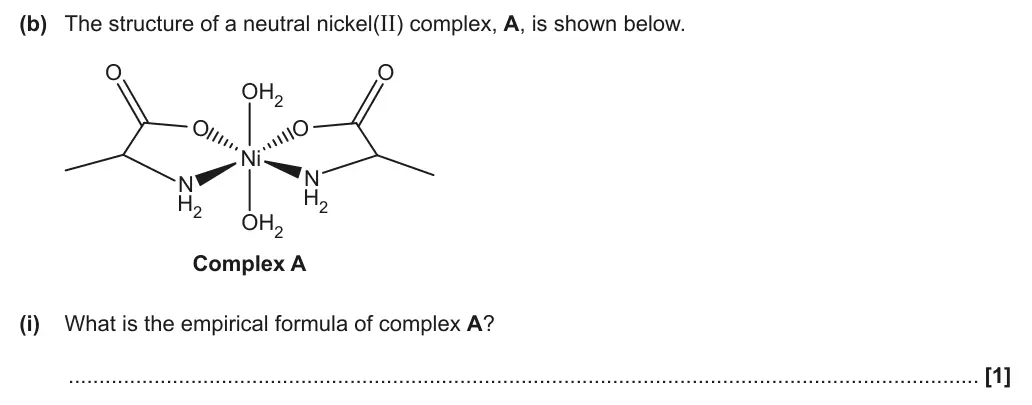
(b) The structure of a neutral nickel(II) complex, A, is shown below.
O O
OH2
O O
Ni
N N
H2 H2
OH2
Complex A
(i) What is the empirical formula of complex A?
..................................................................................................................................................... [1]
June 2025 · Paper 3 · Q4(b)(ii) 3 marks Structure / isomer Medium transition elementsamino acids amides and chirality
Earlier part of question 4 that this part usesEarlier part of June 2025 Paper 3 question 4
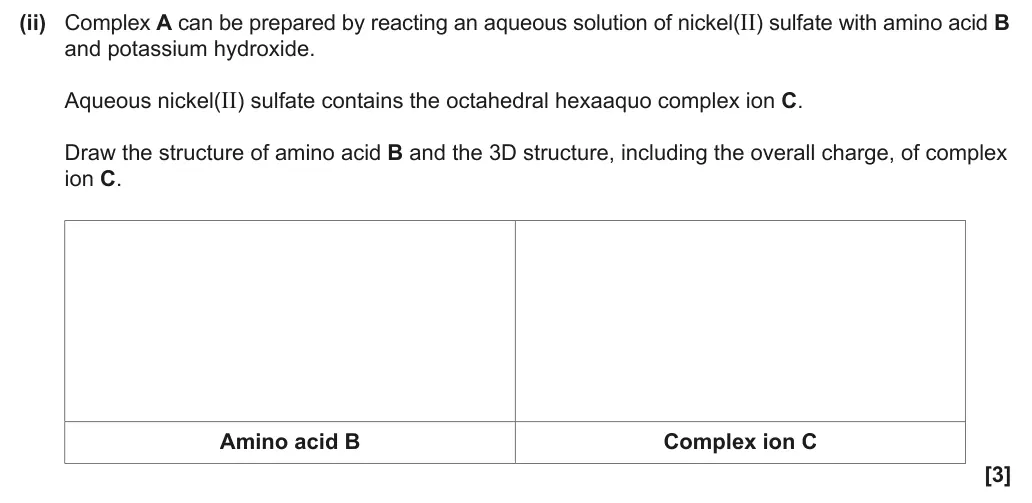
(ii) Complex A can be prepared by reacting an aqueous solution of nickel(II) sulfate with amino acid B
and potassium hydroxide.
Aqueous nickel(II) sulfate contains the octahedral hexaaquo complex ion C.
Draw the structure of amino acid B and the 3D structure, including the overall charge, of complex
ion C.
Amino acid B Complex ion C
[3]
June 2025 · Paper 3 · Q4(b)(iii) 1 mark Complete table/diagram Medium transition elements
Earlier part of question 4 that this part usesEarlier part of June 2025 Paper 3 question 4
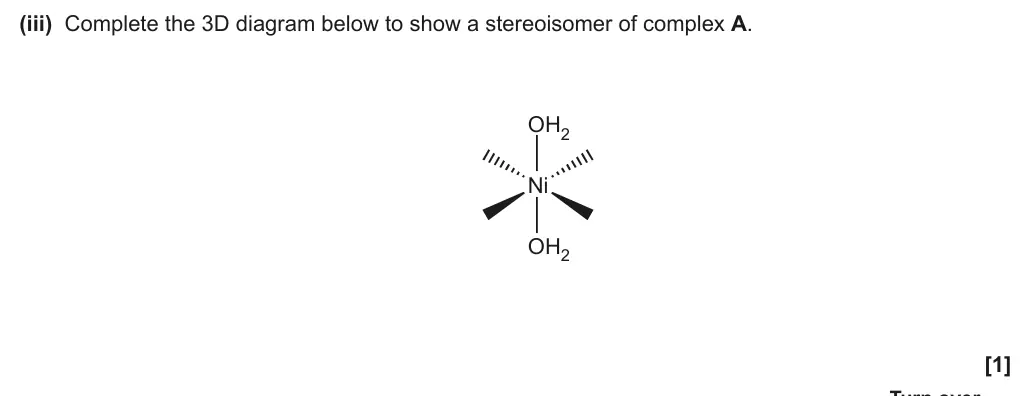
(iii) Complete the 3D diagram below to show a stereoisomer of complex A.
OH2
Ni
OH2
[1]
June 2025 · Paper 3 · Q5(a)(i) 1 mark Short answer Medium organic basicsaromatic compounds
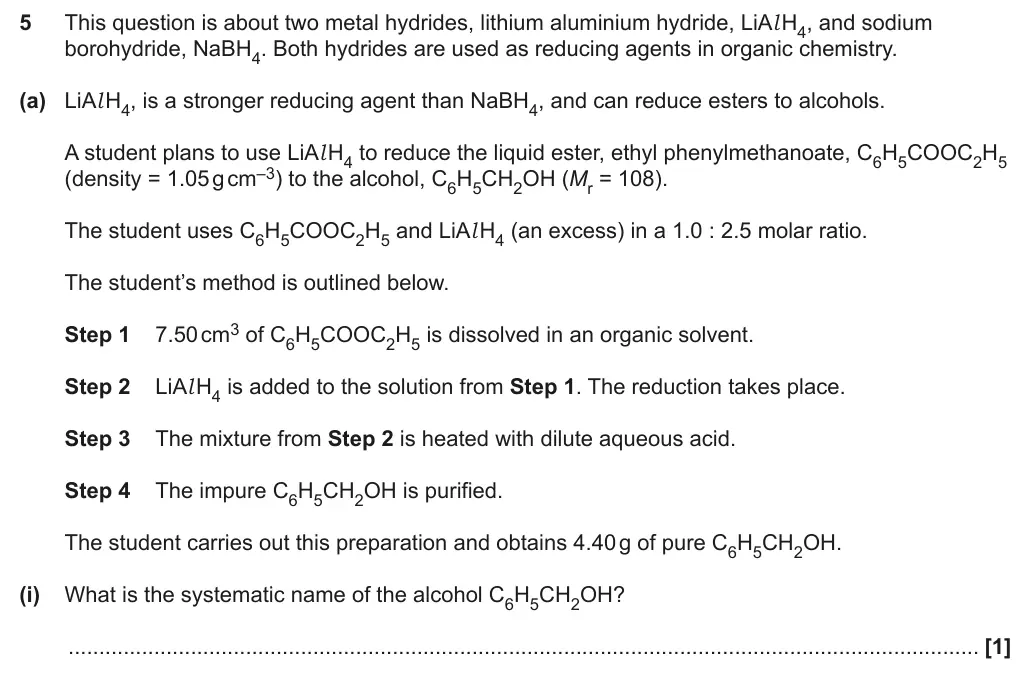
5 This question is about two metal hydrides, lithium aluminium hydride, LiAl H4, and sodium
borohydride, NaBH4. Both hydrides are used as reducing agents in organic chemistry.
(a) LiAl H4, is a stronger reducing agent than NaBH4, and can reduce esters to alcohols.
A student plans to use LiAl H4 to reduce the liquid ester, ethyl phenylmethanoate, C6H5COOC2H5
(density = 1.05 g cm–3) to the alcohol, C6H5CH2OH (Mr = 108).
The student uses C6H5COOC2H5 and LiAl H4 (an excess) in a 1.0 : 2.5 molar ratio.
The student’s method is outlined below.
Step 1 7.50 cm3 of C6H5COOC2H5 is dissolved in an organic solvent.
Step 2 LiAl H4 is added to the solution from Step 1. The reduction takes place.
Step 3 The mixture from Step 2 is heated with dilute aqueous acid.
Step 4 The impure C6H5CH2OH is purified.
The student carries out this preparation and obtains 4.40 g of pure C6H5CH2OH.
(i) What is the systematic name of the alcohol C6H5CH2OH?
..................................................................................................................................................... [1]
June 2025 · Paper 3 · Q5(a)(ii) 4 marks Calculation Hard amount of substance
Earlier part of question 5 that this part usesEarlier part of June 2025 Paper 3 question 5
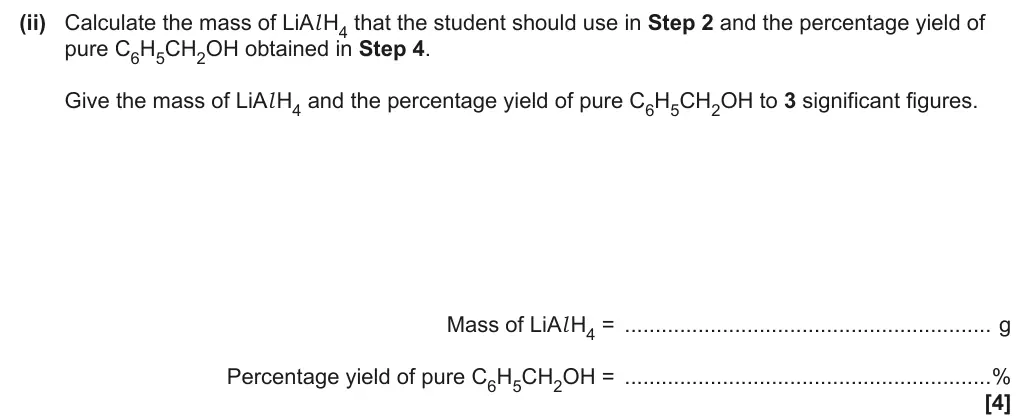
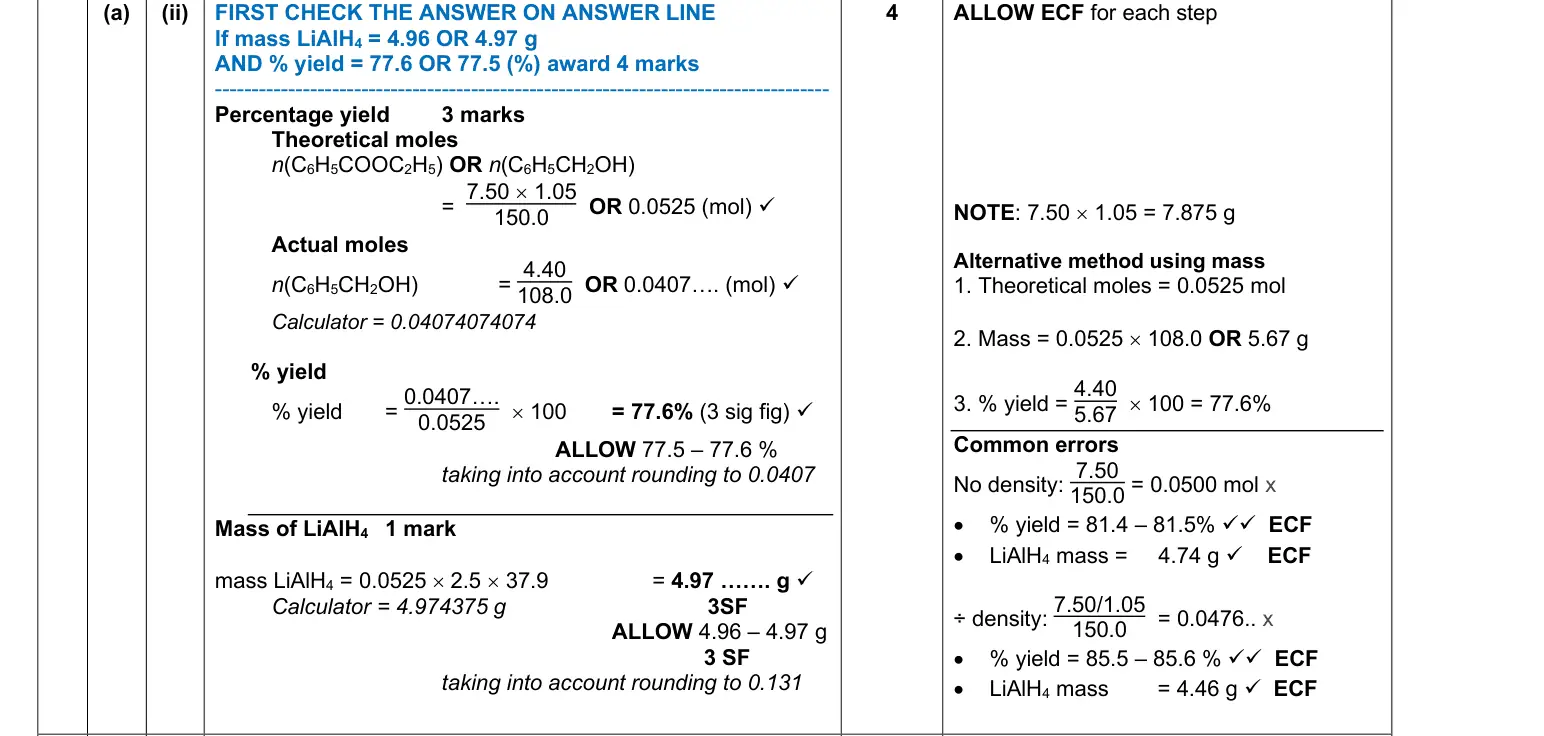
(ii) Calculate the mass of LiAl H4 that the student should use in Step 2 and the percentage yield of
pure C6H5CH2OH obtained in Step 4.
Give the mass of LiAl H4 and the percentage yield of pure C6H5CH2OH to 3 significant figures.
Mass of LiAl H4 =  ............................................................ g
Percentage yield of pure C6H5CH2OH =  ............................................................%
[4]
June 2025 · Paper 3 · Q5(a)(iii) 1 mark Short answer Easy haloalkanes
Earlier part of question 5 that this part usesEarlier part of June 2025 Paper 3 question 5
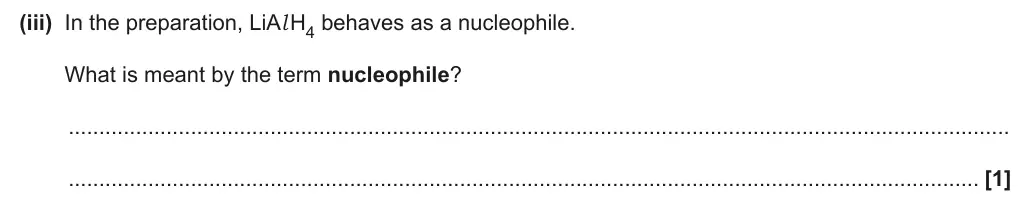
(iii) In the preparation, LiAl H4 behaves as a nucleophile.
What is meant by the term nucleophile?
..........................................................................................................................................................
..................................................................................................................................................... [1]
June 2025 · Paper 3 · Q5(a)(iv) 4 marks Mechanism Medium organic basicsorganic synthesis
Earlier parts of question 5 that this part usesEarlier part of June 2025 Paper 3 question 5Earlier part of June 2025 Paper 3 question 5
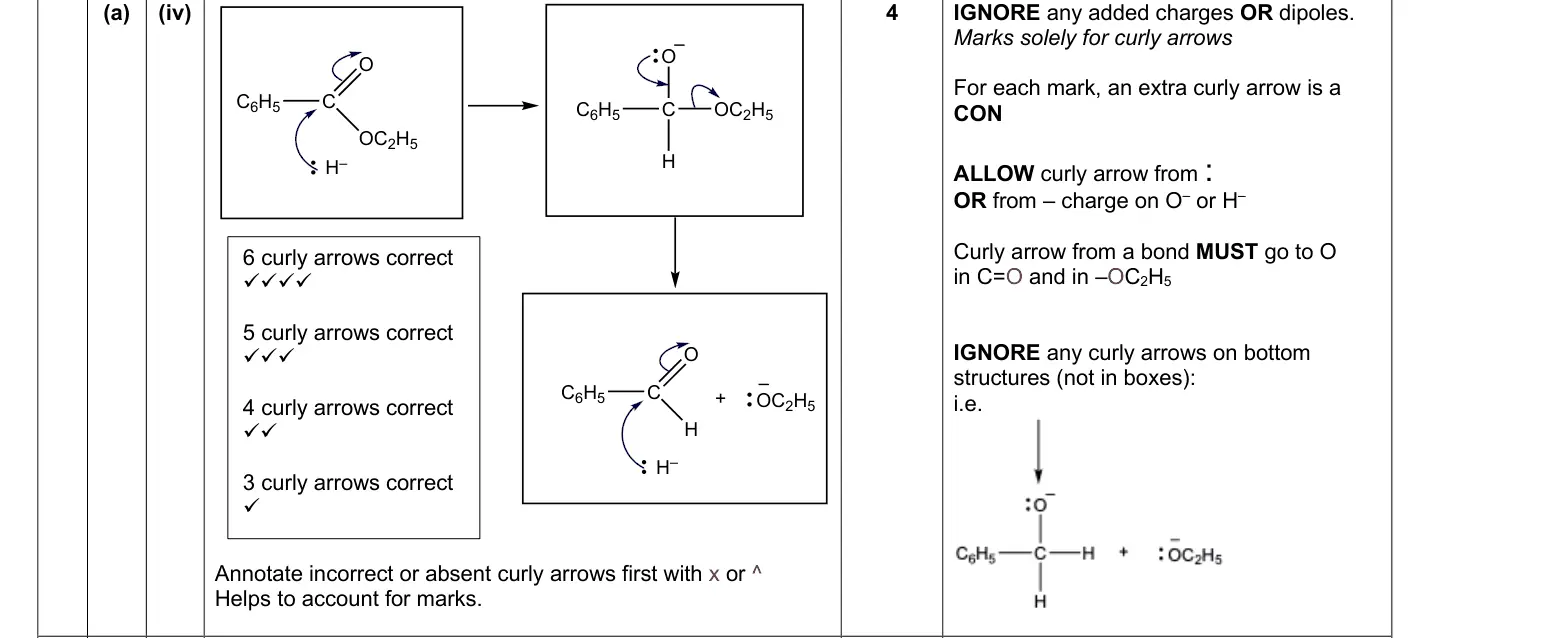
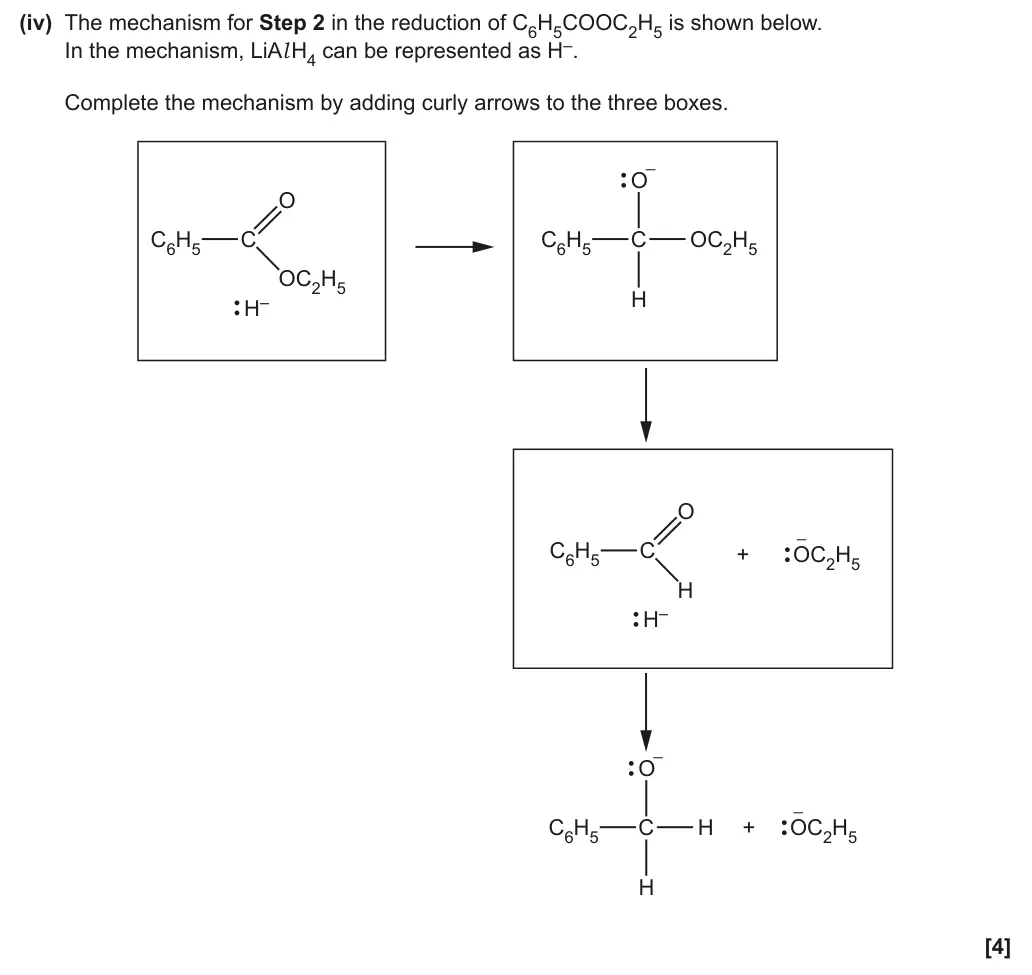
(iv) The mechanism for Step 2 in the reduction of C6H5COOC2H5 is shown below.
In the mechanism, LiAl H4 can be represented as H–.
Complete the mechanism by adding curly arrows to the three boxes.
_
O
O
C6H5 C C6H5 C OC2H5
OC2H5
H– H
O
_
C6H5 C + OC2H5
H
H–
_
O
_
C6H5 C H + OC2H5
H
[4]
June 2025 · Paper 3 · Q5(a)(v) 1 mark Short answer Hard carbonyl compoundsacids bases and buffers
Earlier parts of question 5 that this part usesEarlier part of June 2025 Paper 3 question 5Earlier part of June 2025 Paper 3 question 5
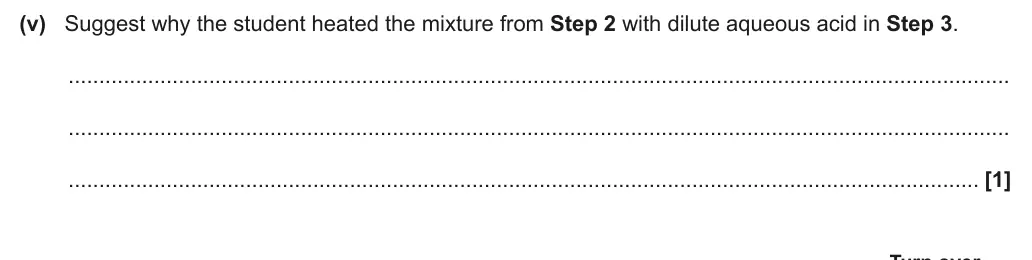
(v) Suggest why the student heated the mixture from Step 2 with dilute aqueous acid in Step 3.
..........................................................................................................................................................
..........................................................................................................................................................
..................................................................................................................................................... [1]
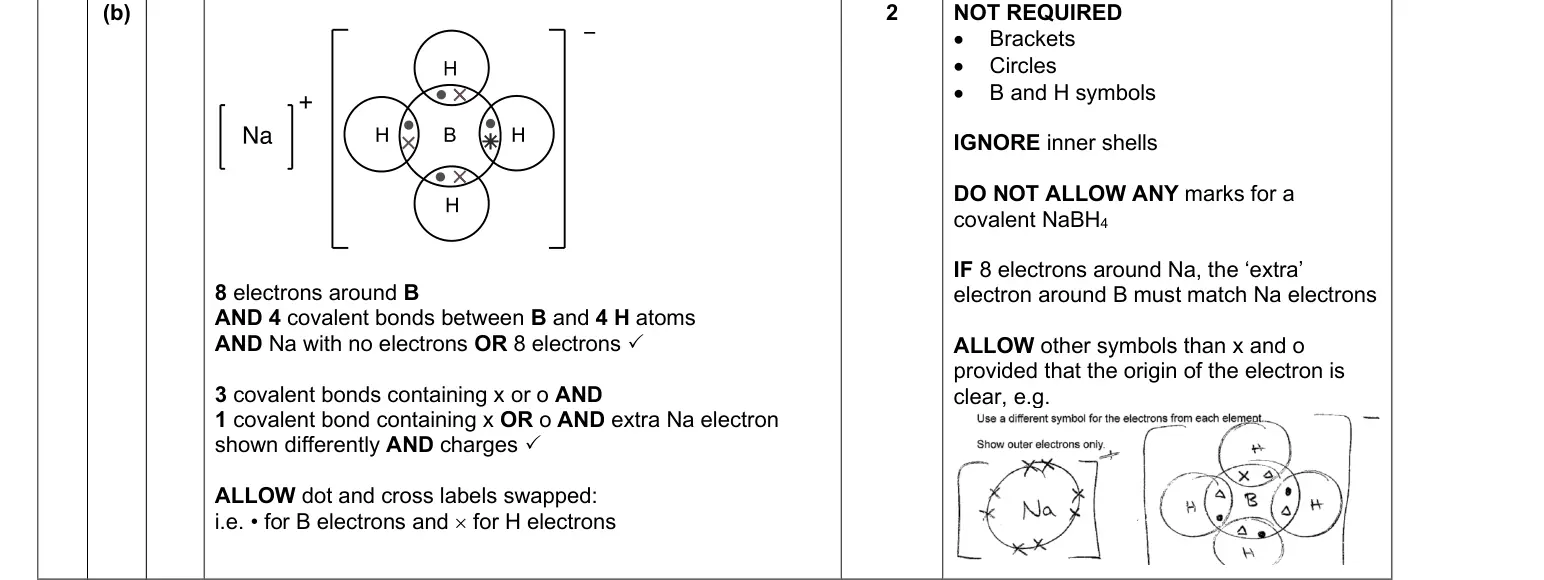
June 2025 · Paper 3 · Q5(b) 2 marks Drawing / labelling Medium bonding and structure
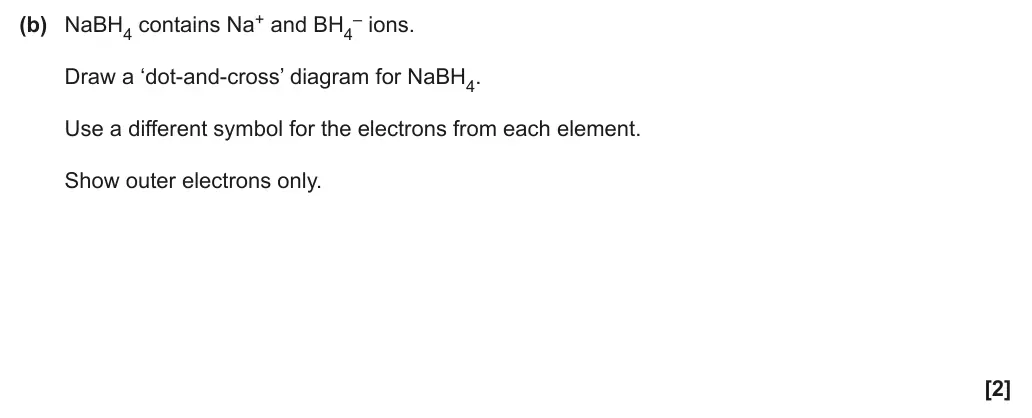
(b) NaBH4 contains Na+ and BH4 – ions.
Draw a ‘dot‑and‑cross’ diagram for NaBH4.
Use a different symbol for the electrons from each element.
Show outer electrons only.
[2]
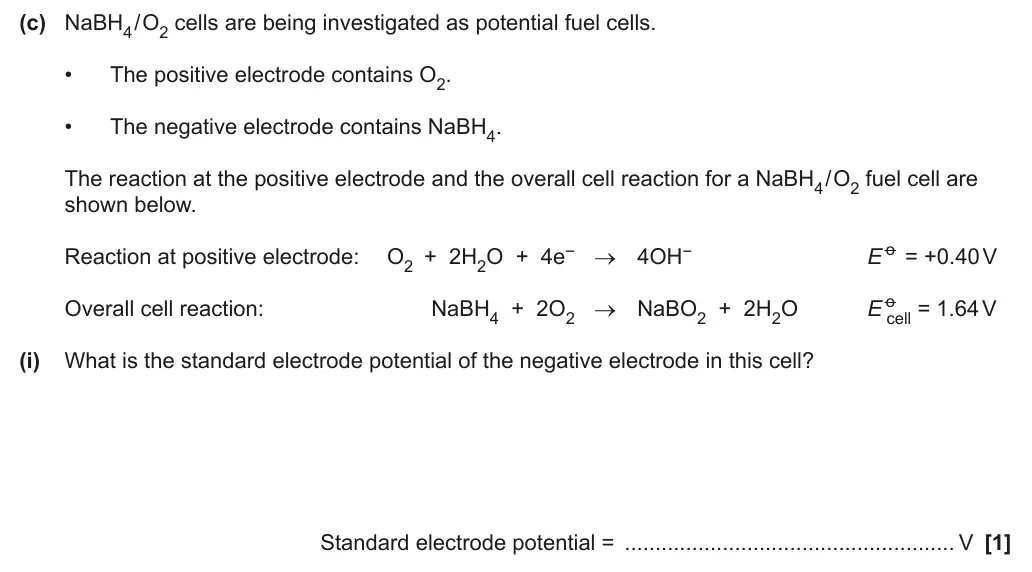
June 2025 · Paper 3 · Q5(c)(i) 1 mark Calculation Easy redox and electrode potentials
(c) NaBH4 / O2 cells are being investigated as potential fuel cells.
• The positive electrode contains O2.
• The negative electrode contains NaBH4.
The reaction at the positive electrode and the overall cell reaction for a NaBH4 / O2 fuel cell are
shown below.
Reaction at positive electrode: O2  +  2H2O  +  4e− 4OH− E o = +0.40 V
Overall cell reaction: NaBH4  +  2O2 NaBO2  +  2H2O E o cell = 1.64 V
(i) What is the standard electrode potential of the negative electrode in this cell?
Standard electrode potential =  ...................................................... V [1]
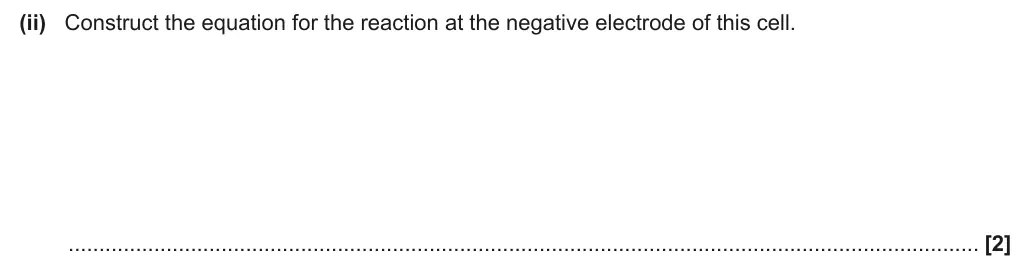
June 2025 · Paper 3 · Q5(c)(ii) 2 marks Equation writing Hard redox and electrode potentials
Earlier part of question 5 that this part usesEarlier part of June 2025 Paper 3 question 5
(ii) Construct the equation for the reaction at the negative electrode of this cell.
..................................................................................................................................................... [2]
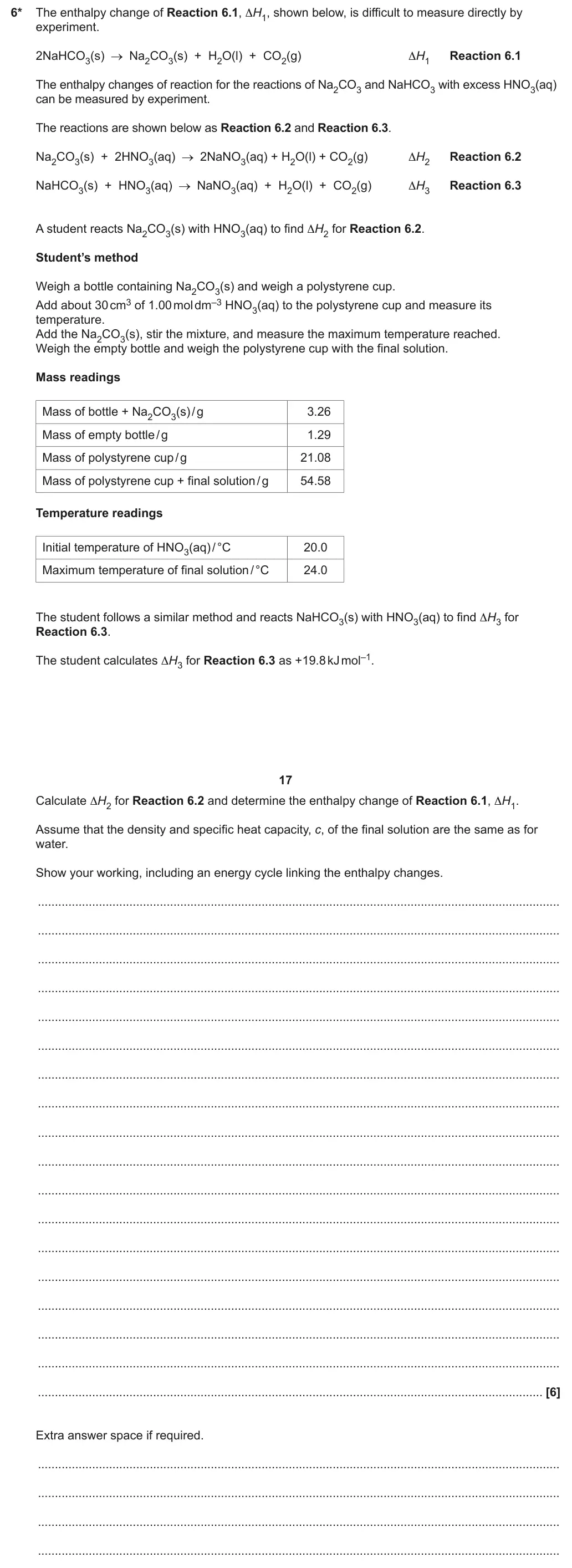
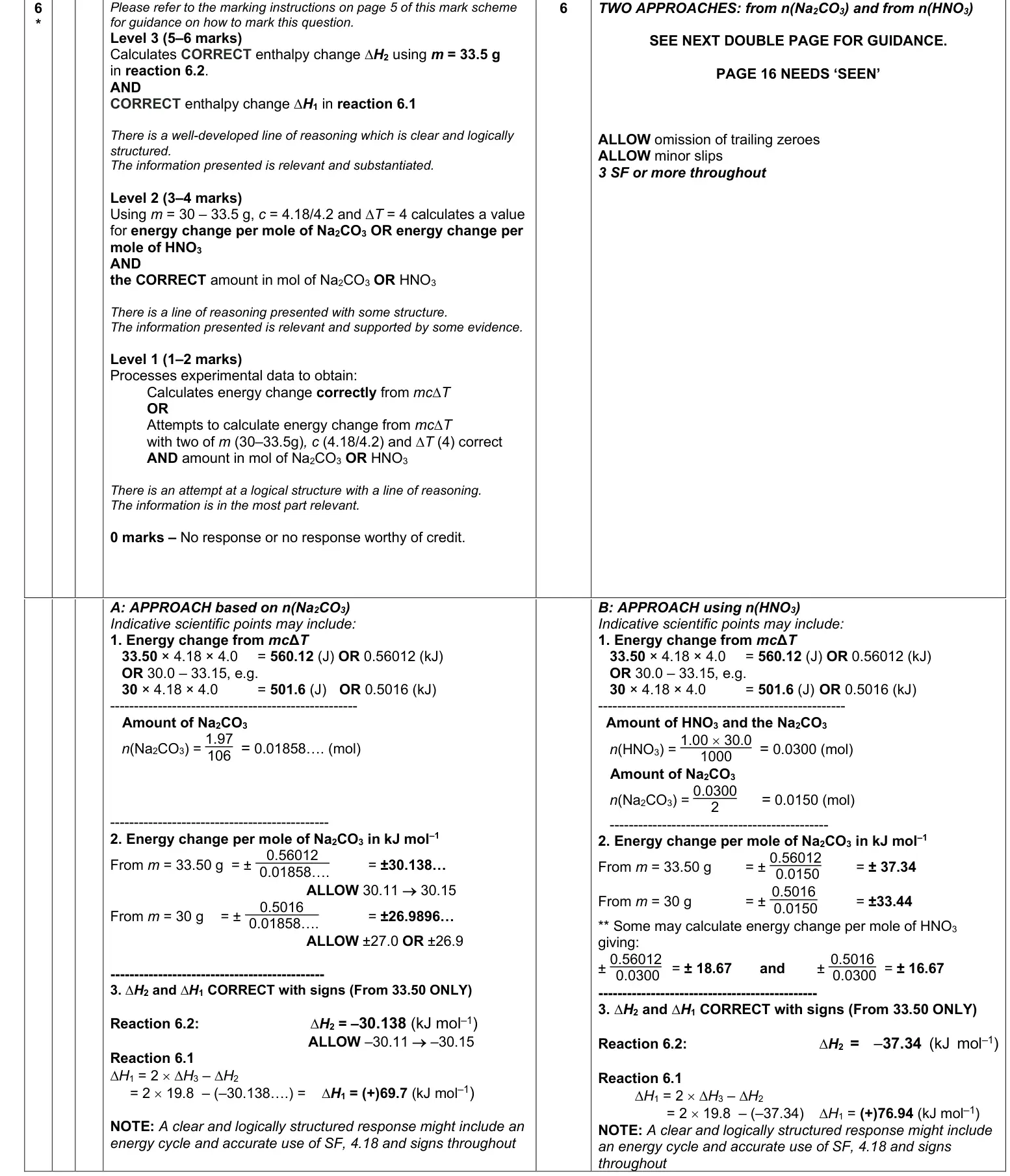
June 2025 · Paper 3 · Q6 6 marks 6-mark level of response Medium enthalpy changesamount of substance
6* The enthalpy change of Reaction 6.1, ∆H1, shown below, is difficult to measure directly by
experiment.
2NaHCO3(s) Na2CO3(s)  +  H2O(l)  +  CO2(g) ∆H1 Reaction 6.1
The enthalpy changes of reaction for the reactions of Na2CO3 and NaHCO3 with excess HNO3(aq)
can be measured by experiment.
The reactions are shown below as Reaction 6.2 and Reaction 6.3.
Na2CO3(s)  +  2HNO3(aq) 2NaNO3(aq) + H2O(l) + CO2(g) ∆H2 Reaction 6.2
NaHCO3(s)  +  HNO3(aq) NaNO3(aq)  +  H2O(l)  +  CO2(g) ∆H3 Reaction 6.3
A student reacts Na2CO3(s) with HNO3(aq) to find ∆H2 for Reaction 6.2.
Student’s method
Weigh a bottle containing Na2CO3(s) and weigh a polystyrene cup.
Add about 30 cm3 of 1.00 mol dm–3 HNO3(aq) to the polystyrene cup and measure its
temperature.
Add the Na2CO3(s), stir the mixture, and measure the maximum temperature reached.
Weigh the empty bottle and weigh the polystyrene cup with the final solution.
Mass readings
Mass of bottle + Na2CO3(s) / g 3.26
Mass of empty bottle / g 1.29
Mass of polystyrene cup / g 21.08
Mass of polystyrene cup + final solution / g 54.58
Temperature readings
Initial temperature of HNO3(aq) / °C 20.0
Maximum temperature of final solution / °C 24.0
The student follows a similar method and reacts NaHCO3(s) with HNO3(aq) to find ∆H3 for
Reaction 6.3.
The student calculates ∆H3 for Reaction 6.3 as +19.8 kJ mol–1.
Calculate ∆H2 for Reaction 6.2 and determine the enthalpy change of Reaction 6.1, ∆H1.
Assume that the density and specific heat capacity, c, of the final solution are the same as for
water.
Show your working, including an energy cycle linking the enthalpy changes.
..........................................................................................................................................................
..........................................................................................................................................................
..........................................................................................................................................................
..........................................................................................................................................................
..........................................................................................................................................................
..........................................................................................................................................................
..........................................................................................................................................................
..........................................................................................................................................................
..........................................................................................................................................................
..........................................................................................................................................................
..........................................................................................................................................................
..........................................................................................................................................................
..........................................................................................................................................................
..........................................................................................................................................................
..........................................................................................................................................................
..........................................................................................................................................................
..........................................................................................................................................................
..................................................................................................................................................... [6]
Extra answer space if required.
..........................................................................................................................................................
..........................................................................................................................................................
..........................................................................................................................................................
..........................................................................................................................................................

Work with an OCR chemistry tutor

Want a paper marked and gone through with you? Message us.

Prefer email? Send an enquiry

If you are under 18, please include a parent's contact details. Enquiries go to enquiries@chemistryaleveltutor.com and are deleted once handled. All tutoring is online.