November 2020: Paper 3, Unified chemistry

70 marks · 24 question parts · Paper, mark scheme and report on OCR's site · An autumn series, sat in place of the cancelled summer exams · Have OCR's Data Sheet beside you

Question by question

QTopicMarksAOType
1(a)(i) Organic synthesis and practical techniques (Module 4), Practical techniques and apparatus (PAGs), Organic synthesis (Module 6) 2AO1Complete table/diagram
1(a)(ii) Organic synthesis (Module 6), Practical techniques and apparatus (PAGs) 2AO2Drawing / labelling
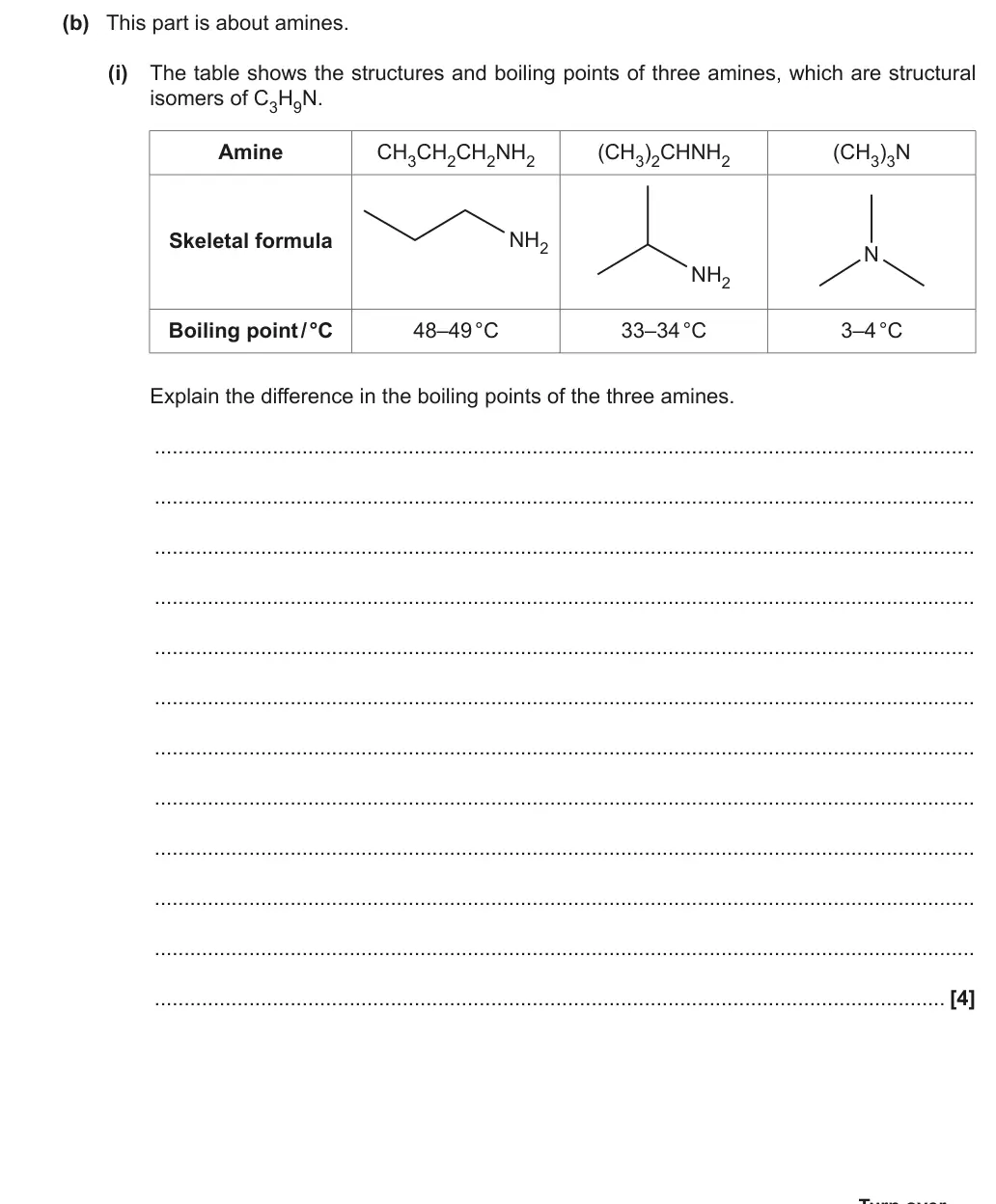
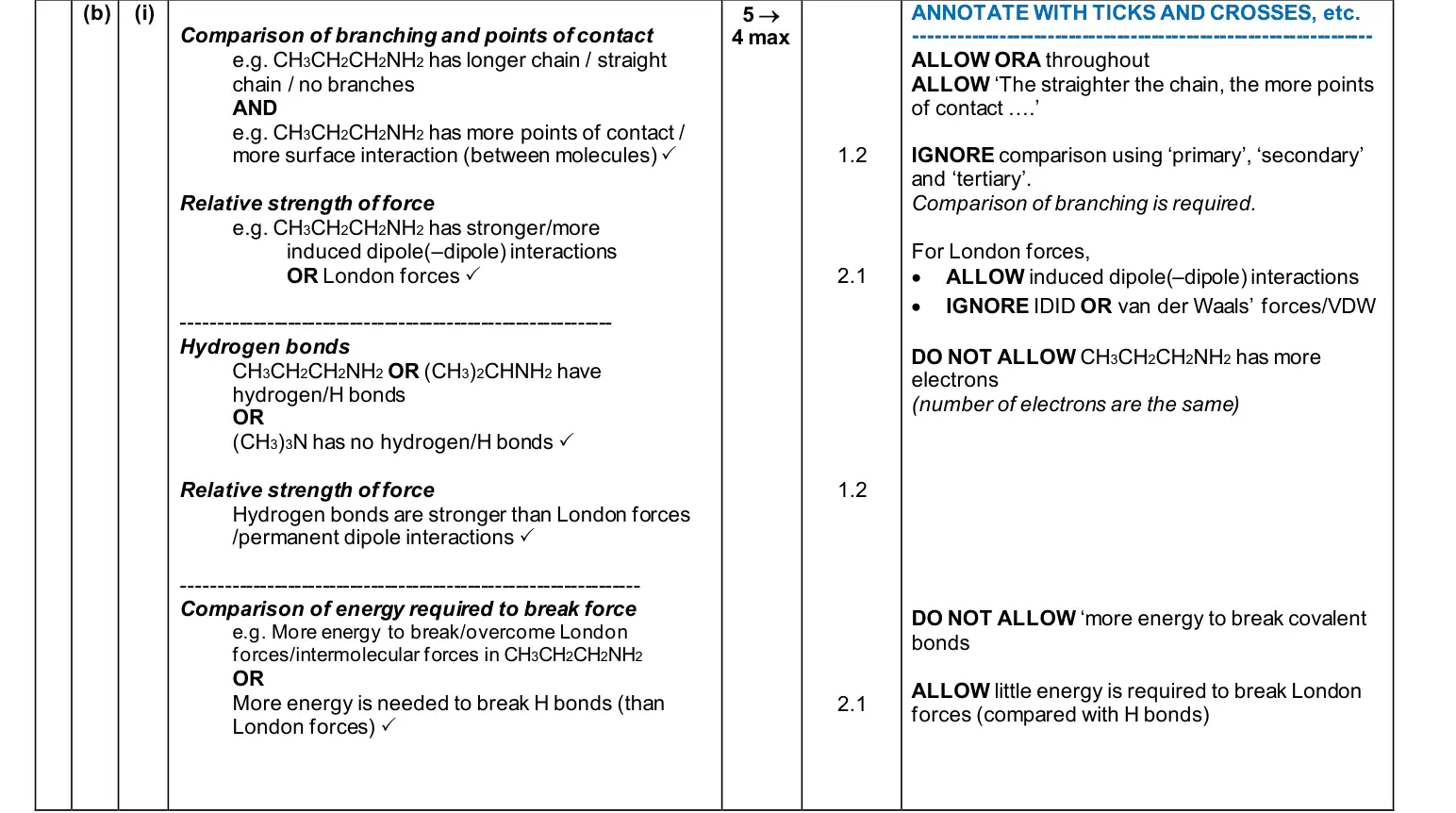
1(b)(i) Bonding, structure and shapes of molecules, Alkanes 4AO1, 2Short answer
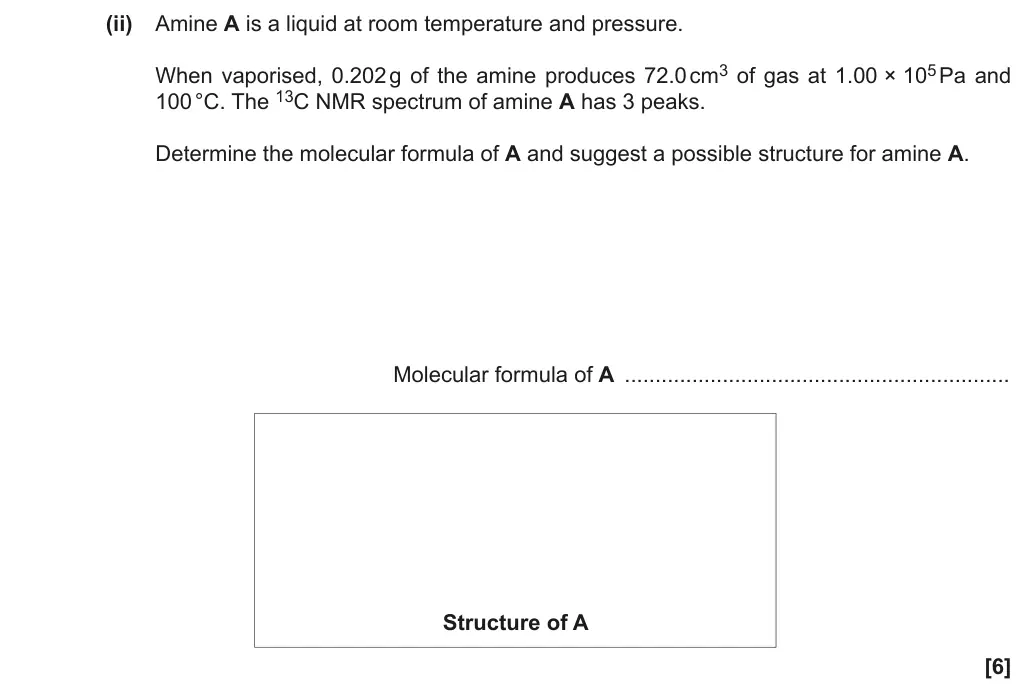
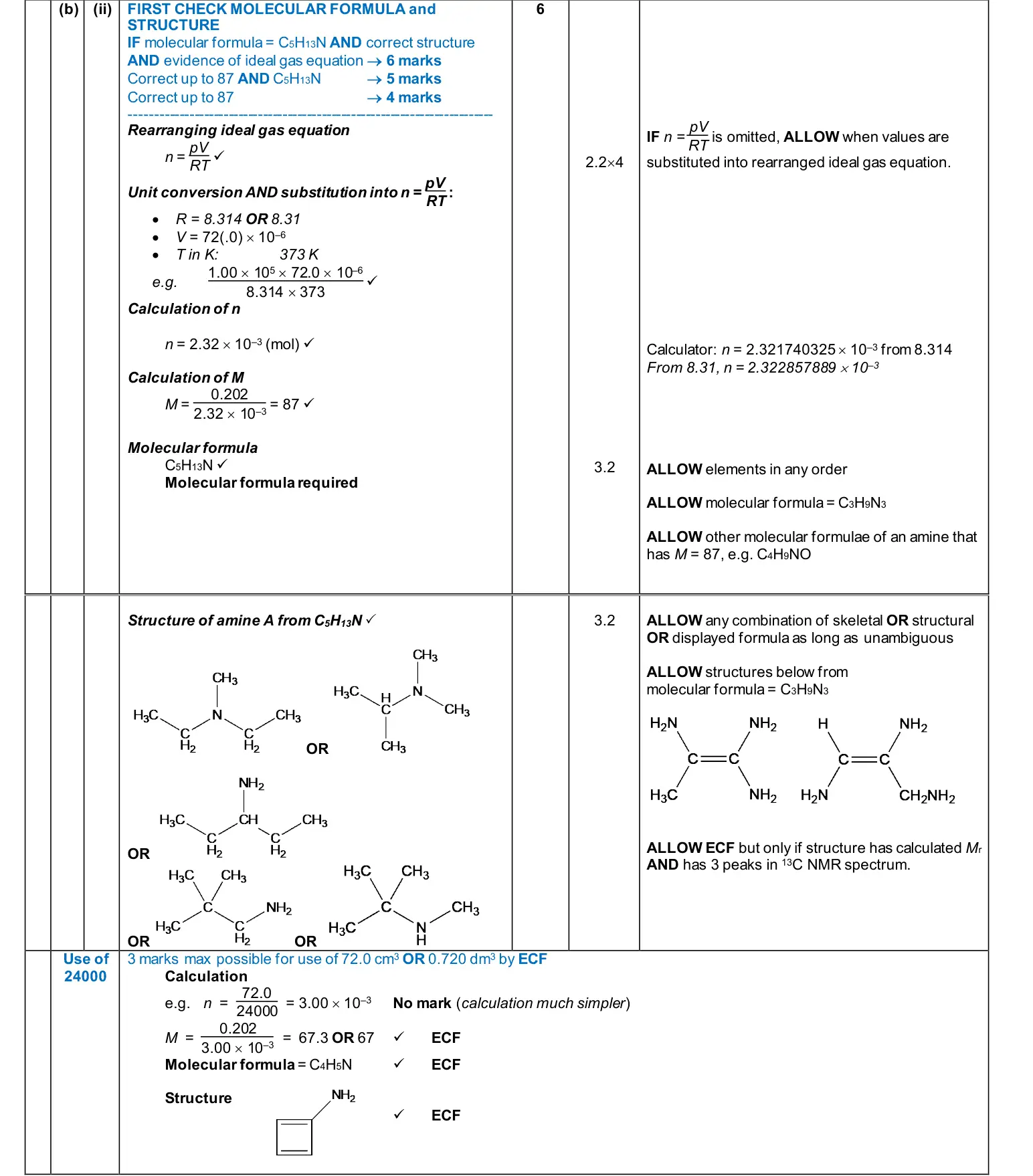
1(b)(ii) Amount of substance (moles), NMR spectroscopy and combined techniques 6AO2, 3Structure / isomer
1(c) Organic synthesis (Module 6), Amino acids, amides and chirality 2AO3Complete table/diagram
2 Transition elements 6AO1, 2Level of response
3(a)(i) Enthalpy changes and Hess’ law, Amount of substance (moles) 3AO2Calculation
3(a)(ii) Enthalpy changes and Hess’ law, Practical skills: planning, analysis and evaluation 1AO1Short answer
3(b) Enthalpy changes and Hess’ law 6AO2, 3Level of response
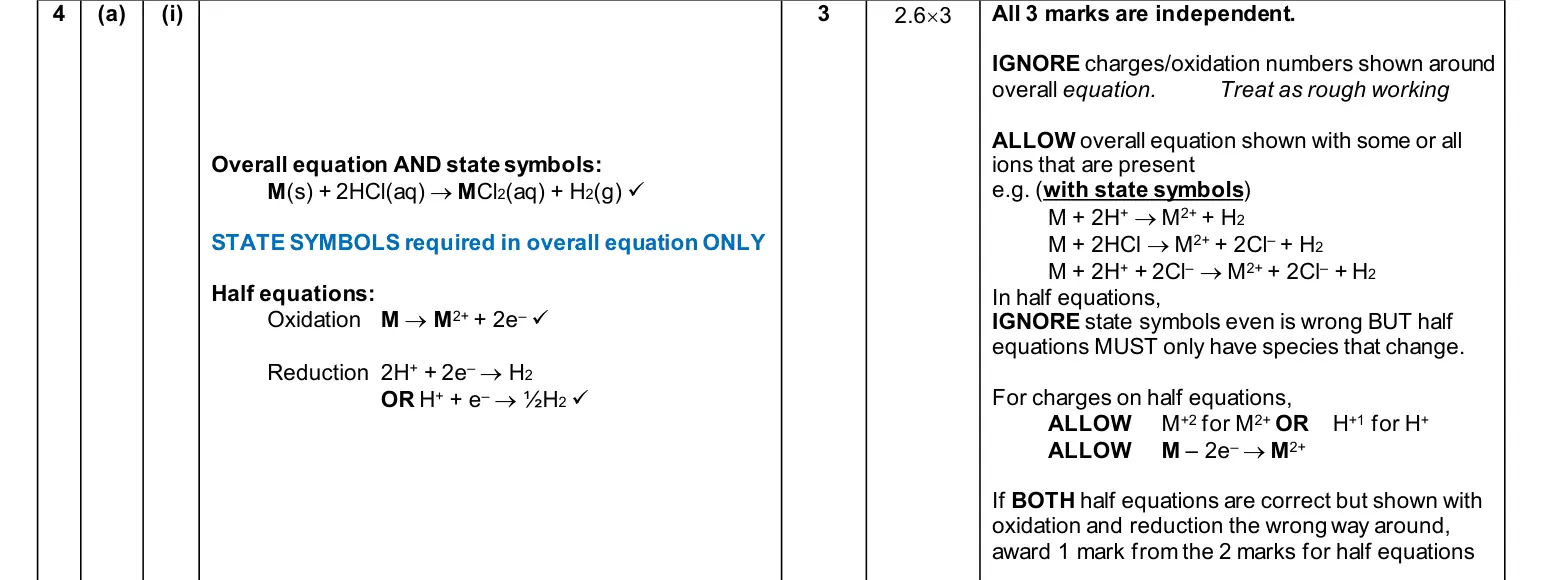
4(a)(i) Redox and oxidation numbers, Formulae and equations, Redox titrations and electrode potentials 3AO2Equation writing
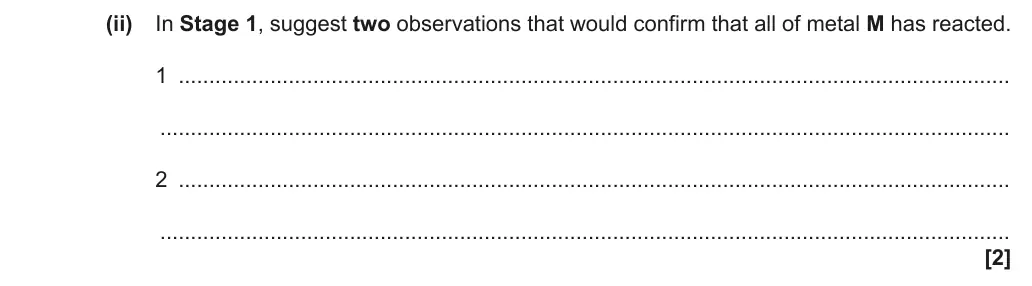
4(a)(ii) Redox and oxidation numbers, Practical techniques and apparatus (PAGs) 2AO3Short answer
4(a)(iii) Acids, bases and titrations 1AO2Equation writing
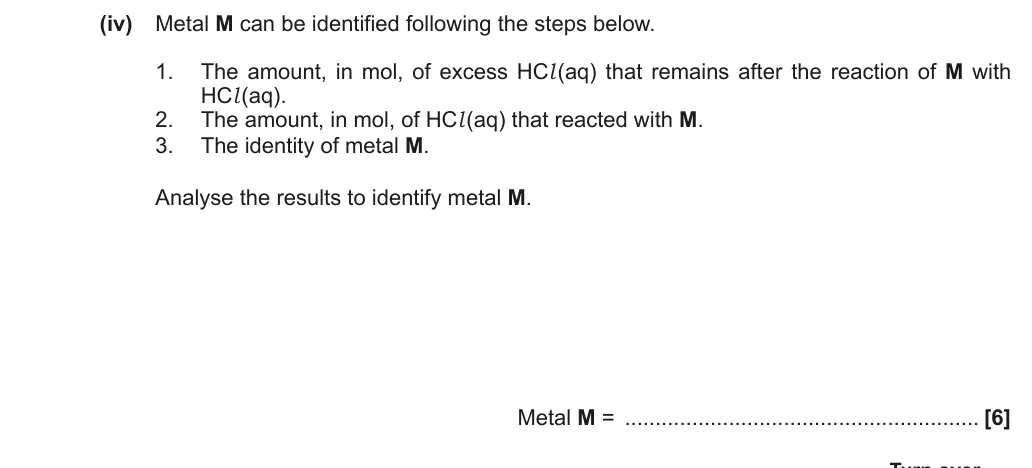
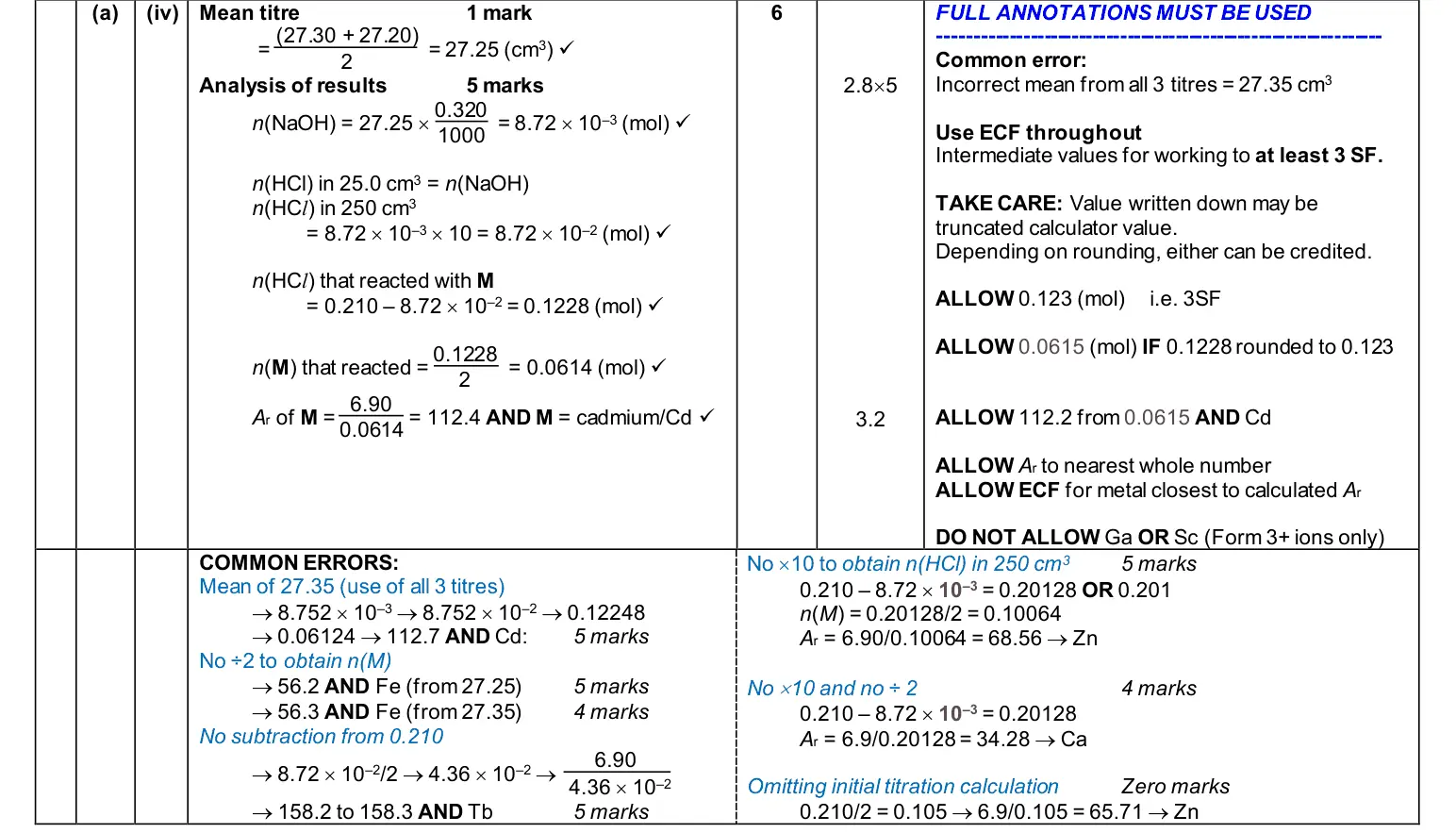
4(a)(iv) Acids, bases and titrations, Amount of substance (moles) 6AO2, 3Calculation
4(b)(i) Amount of substance (moles) 1AO2Calculation
4(b)(ii) Amount of substance (moles), Atomic structure and isotopes 3AO1, 2, 3Calculation
4(c)(i) Practical skills: planning, analysis and evaluation, Amount of substance (moles) 1AO3Short answer
4(c)(ii) Practical skills: planning, analysis and evaluation, Amount of substance (moles) 2AO3Short answer
5(a) Equilibrium constants Kc and Kp, Practical skills: planning, analysis and evaluation 2AO1Complete table/diagram
5(b) Equilibrium constants Kc and Kp, Chemical equilibrium and Kc 1AO2Short answer
5(c) Practical skills: planning, analysis and evaluation, Equilibrium constants Kc and Kp 4AO3Calculation
5(d) Practical skills: planning, analysis and evaluation 2AO3Short answer
6(a) Bonding, structure and shapes of molecules 2AO1Complete table/diagram
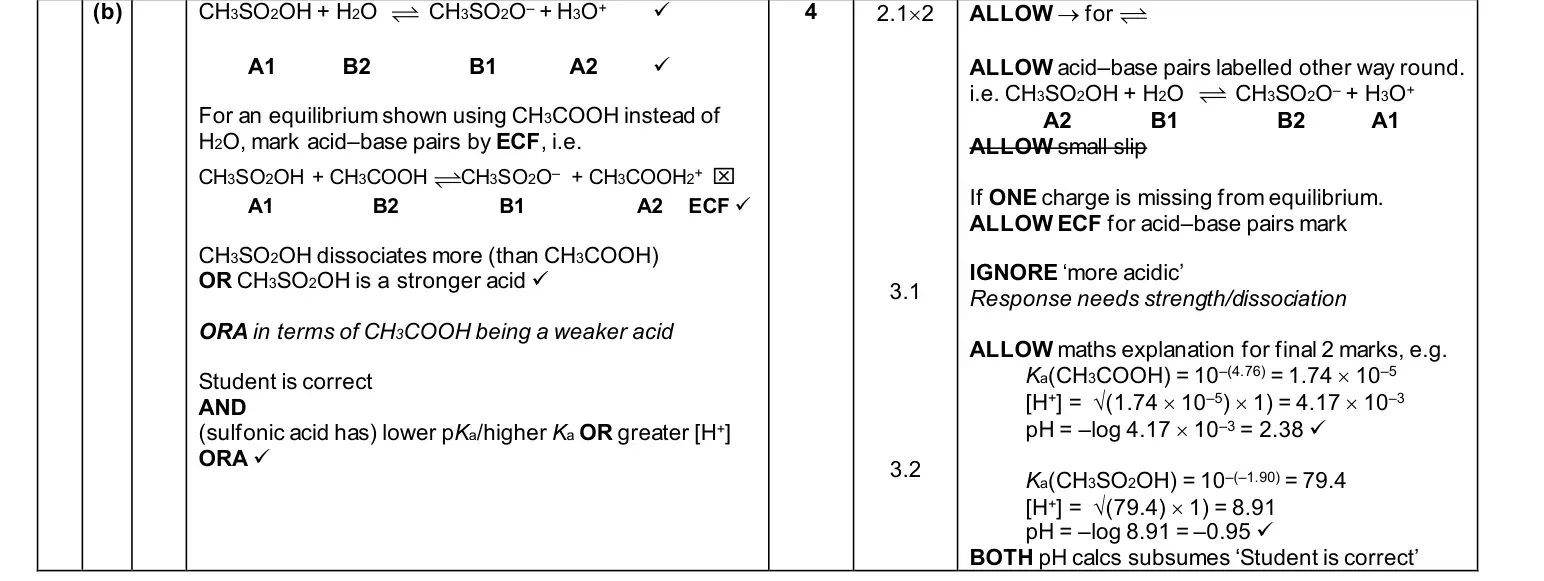
6(b) Acids, bases, pH and buffers, Acids, bases and titrations 4AO2, 3Equation writing
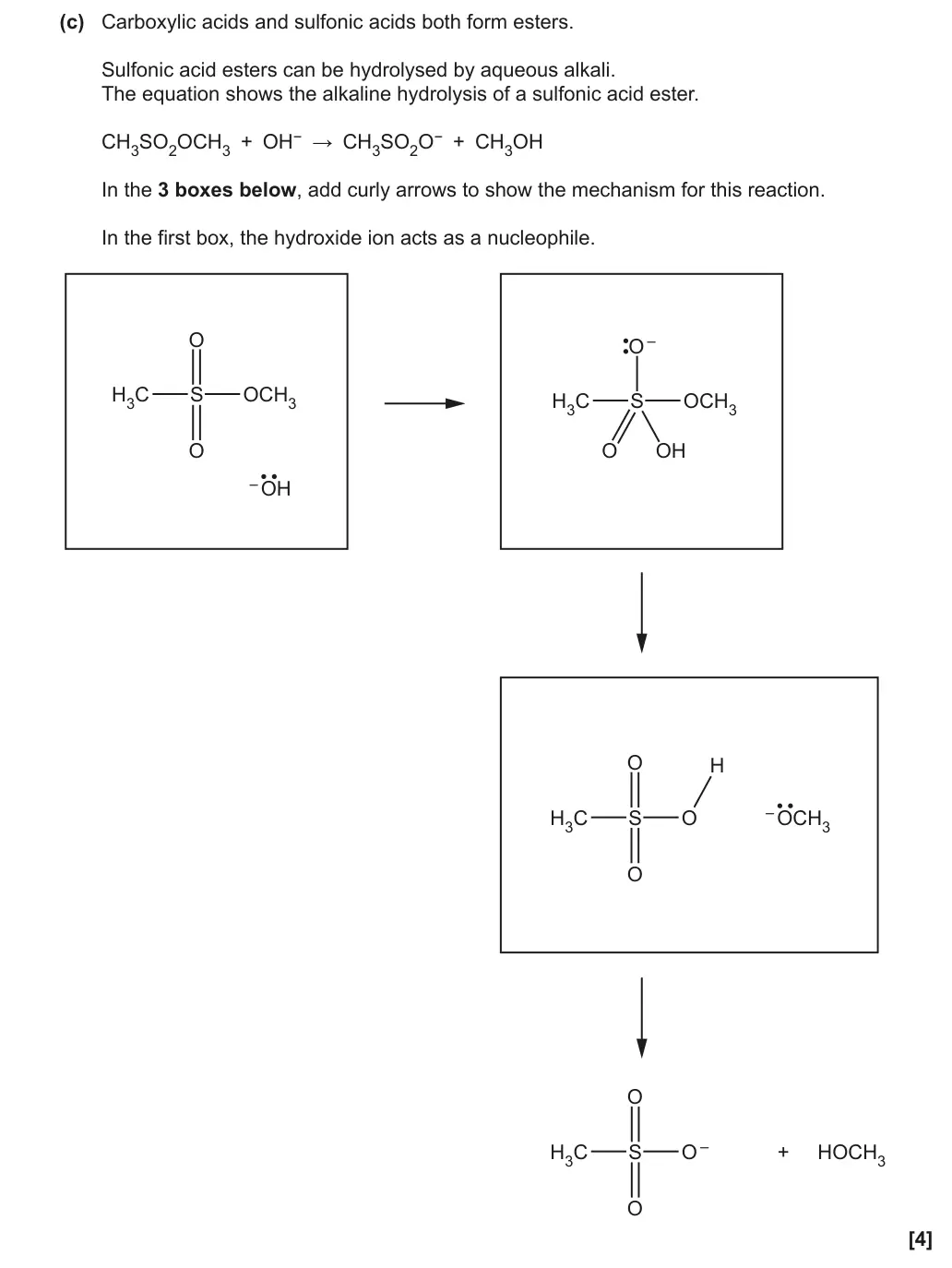
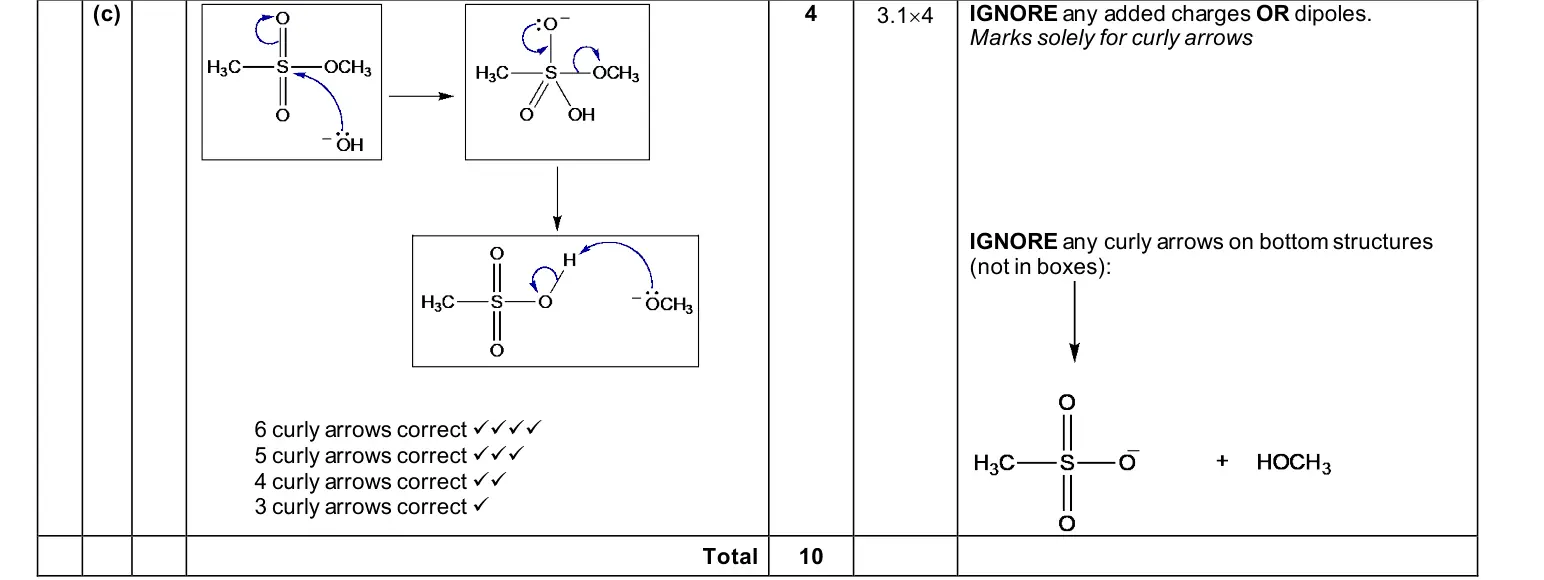
6(c) Organic basics: naming, formulae and isomerism, Carboxylic acids, esters and acyl chlorides 4AO3Mechanism

The questions

1(a)(i)1(a)(ii)1(b)(i)1(b)(ii)1(c)23(a)(i)3(a)(ii)3(b)4(a)(i)4(a)(ii)4(a)(iii)4(a)(iv)4(b)(i)4(b)(ii)4(c)(i)4(c)(ii)5(a)5(b)5(c)5(d)6(a)6(b)6(c)
November 2020 · Paper 3 · Q1(a)(i) 2 marks AO1 Complete table/diagram Hard organic synthesis aspractical techniquesorganic synthesis
1 This question is about organic chemistry.
(a) This part is about two practical techniques used in organic preparations.
(i) Complete the missing labels on the diagram and name the technique.
.........................................
......................................................
.........................................
......................................................
Heat
Name of technique:  ...................................................................................................... [2]
November 2020 · Paper 3 · Q1(a)(ii) 2 marks AO2 Drawing / labelling Hard organic synthesispractical techniques
Earlier part of question 1 that this part usesEarlier part of November 2020 Paper 3 question 1
(ii) Draw a labelled diagram to show apparatus set up for filtration under reduced pressure
(vacuum filtration).
[2]
November 2020 · Paper 3 · Q1(b)(i) 4 marks AO1, 2 Short answer Hard bonding and structurealkanes
(b) This part is about amines.
(i) The table shows the structures and boiling points of three amines, which are structural
isomers of C3H9N.
Amine CH3CH2CH2NH2 (CH3)2CHNH2 (CH3)3N
Skeletal formula NH2
N
NH2
Boiling point / °C 48–49 °C 33–34 °C 3–4 °C
Explain the difference in the boiling points of the three amines.
...........................................................................................................................................
...........................................................................................................................................
...........................................................................................................................................
...........................................................................................................................................
...........................................................................................................................................
...........................................................................................................................................
...........................................................................................................................................
...........................................................................................................................................
...........................................................................................................................................
...........................................................................................................................................
...........................................................................................................................................
...................................................................................................................................... [4]
November 2020 · Paper 3 · Q1(b)(ii) 6 marks AO2, 3 Structure / isomer Hard amount of substancenmr spectroscopy
(ii) Amine A is a liquid at room temperature and pressure.
When vaporised, 0.202 g of the amine produces 72.0 cm3 of gas at 1.00 × 10⁵ Pa and
100 °C. The 13C NMR spectrum of amine A has 3 peaks.
Determine the molecular formula of A and suggest a possible structure for amine A.
Molecular formula of A  ...............................................................
Structure of A
[6]
November 2020 · Paper 3 · Q1(c) 2 marks AO3 Complete table/diagram Hard organic synthesisamino acids amides and chirality
(c) The amino acid Z−H2NCH=CHCOOH can react to form a cyclic compound with the molecular
formula C3H3NO and one other product.
Complete the equation for this reaction.
H2N COOH
C C +
H H
[2]
November 2020 · Paper 3 · Q2 6 marks AO1, 2 6-mark level of response Hard transition elements
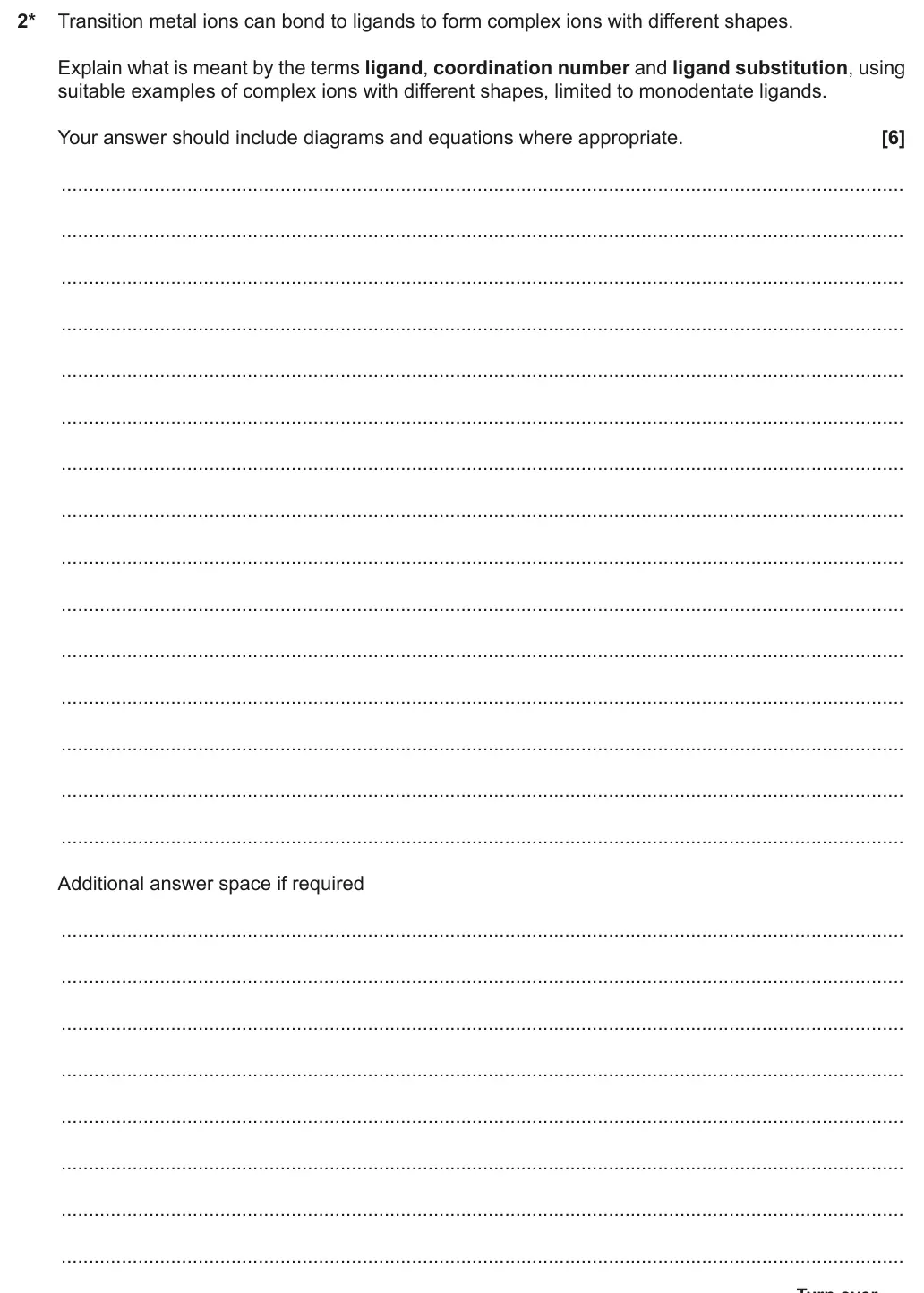
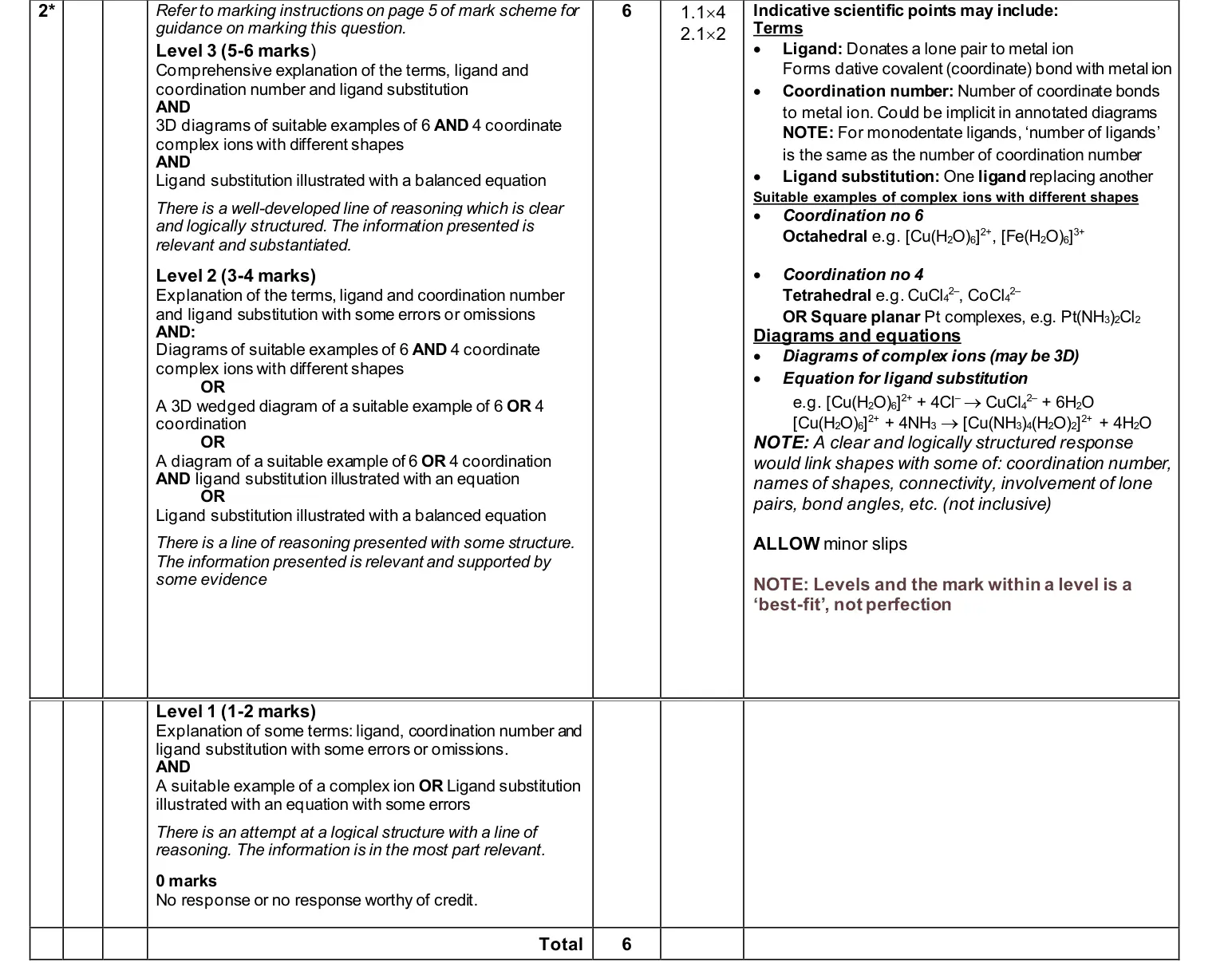
2* Transition metal ions can bond to ligands to form complex ions with different shapes.
Explain what is meant by the terms ligand, coordination number and ligand substitution, using
suitable examples of complex ions with different shapes, limited to monodentate ligands.
Your answer should include diagrams and equations where appropriate. [6]
..........................................................................................................................................................
..........................................................................................................................................................
..........................................................................................................................................................
..........................................................................................................................................................
..........................................................................................................................................................
..........................................................................................................................................................
..........................................................................................................................................................
..........................................................................................................................................................
..........................................................................................................................................................
..........................................................................................................................................................
..........................................................................................................................................................
..........................................................................................................................................................
..........................................................................................................................................................
..........................................................................................................................................................
..........................................................................................................................................................
Additional answer space if required
..........................................................................................................................................................
..........................................................................................................................................................
..........................................................................................................................................................
..........................................................................................................................................................
..........................................................................................................................................................
..........................................................................................................................................................
..........................................................................................................................................................
..........................................................................................................................................................
November 2020 · Paper 3 · Q3(a)(i) 3 marks AO2 Calculation Hard enthalpy changesamount of substance
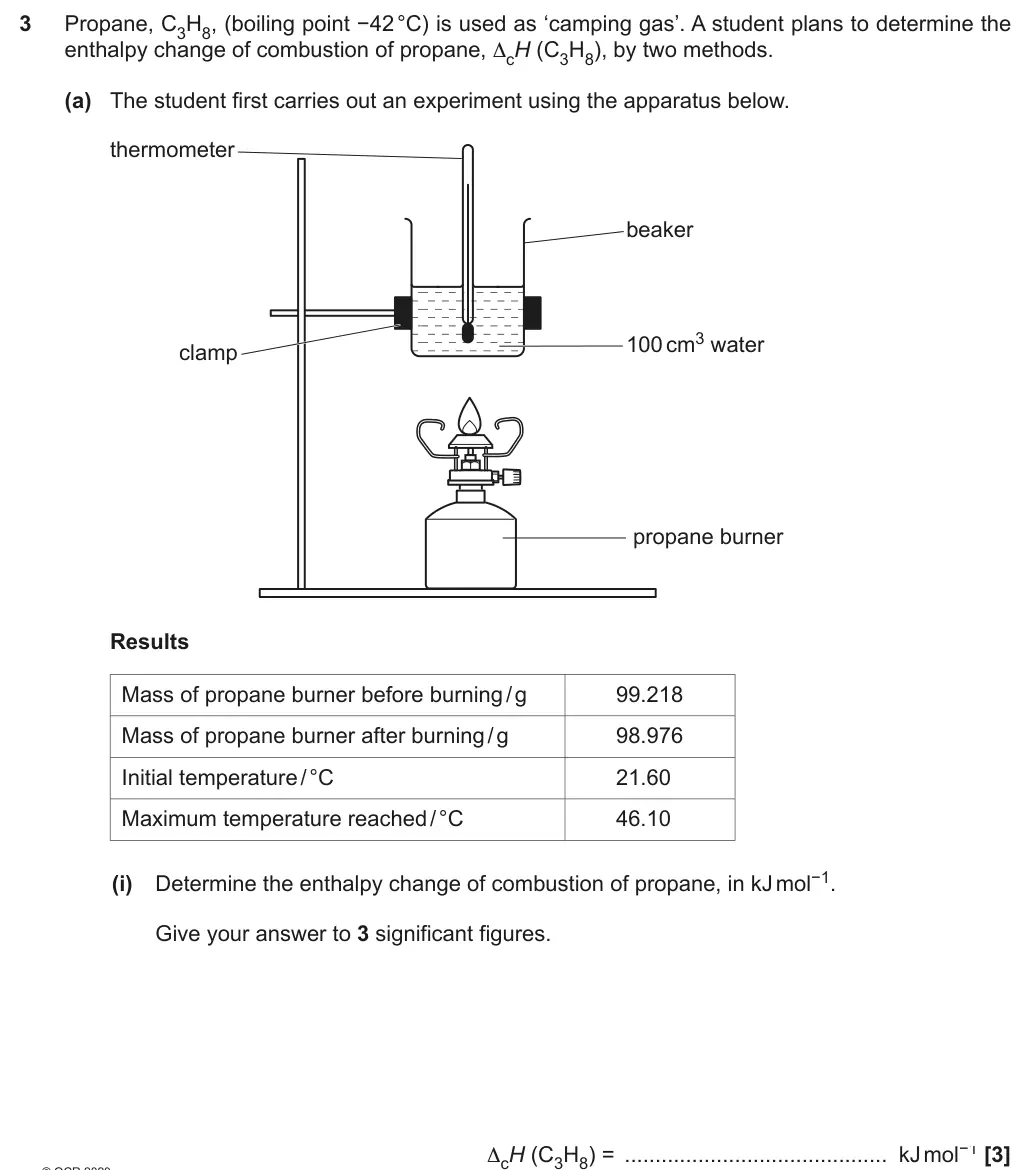
3 Propane, C3H8, (boiling point −42 °C) is used as ‘camping gas’. A student plans to determine the
enthalpy change of combustion of propane, ∆cH (C3H8), by two methods.
(a) The student first carries out an experiment using the apparatus below.
thermometer
beaker
100 cm3 water
clamp
propane burner
Results
Mass of propane burner before burning / g 99.218
Mass of propane burner after burning / g 98.976
Initial temperature / °C 21.60
Maximum temperature reached / °C 46.10
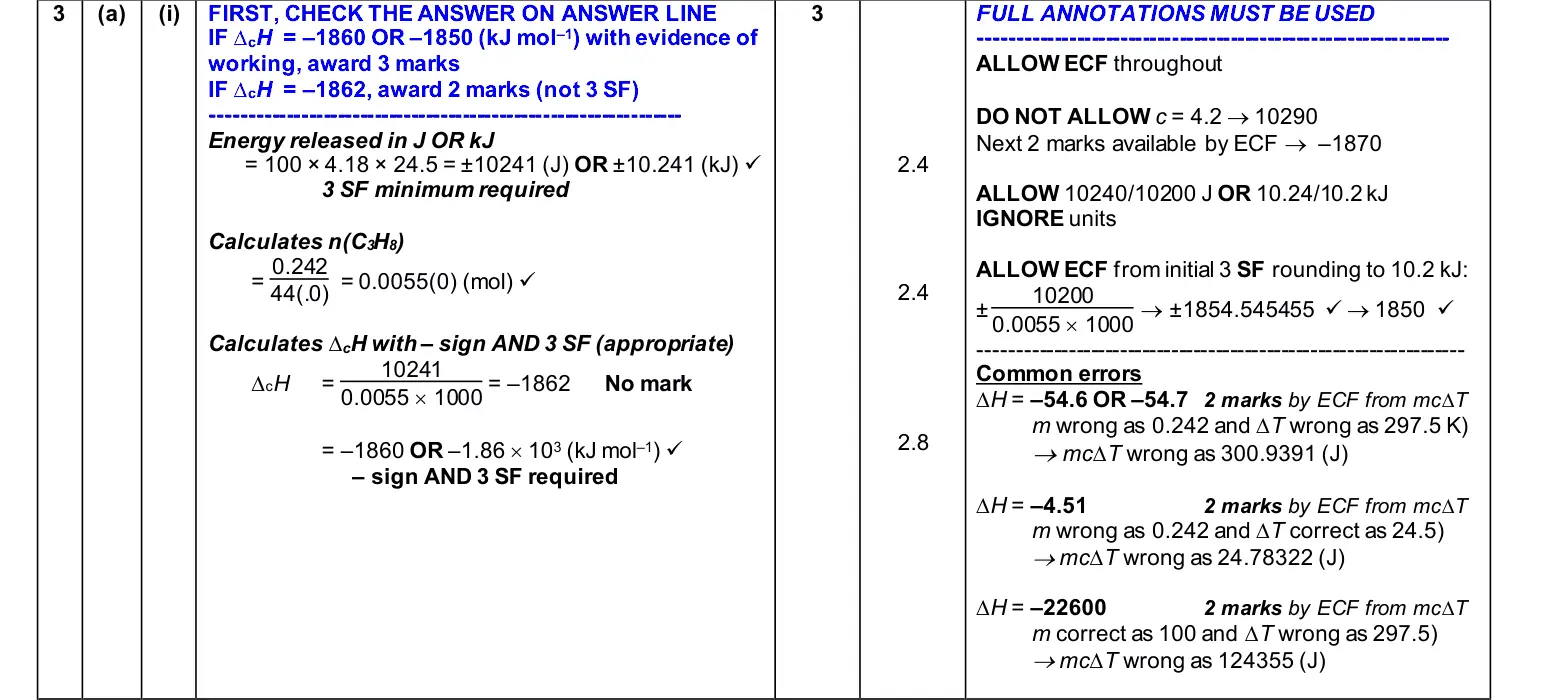
(i) Determine the enthalpy change of combustion of propane, in kJ mol−1.
Give your answer to 3 significant figures.
∆cH (C3H8) =  ........................................... kJ mol−1 [3]
November 2020 · Paper 3 · Q3(a)(ii) 1 mark AO1 Short answer Hard enthalpy changespractical skills
Earlier part of question 3 that this part usesEarlier part of November 2020 Paper 3 question 3
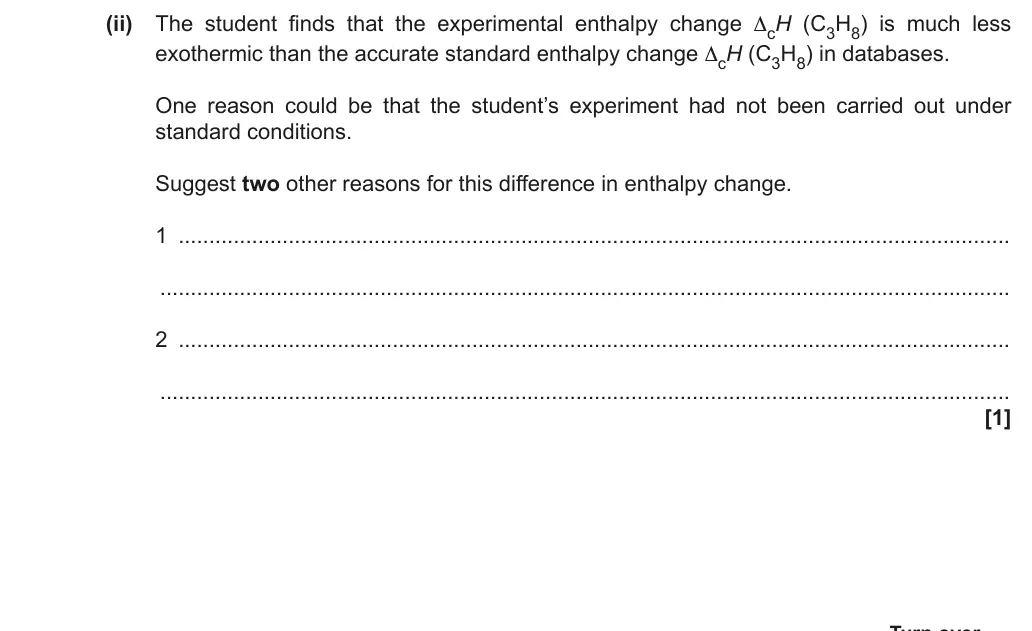
(ii) The student finds that the experimental enthalpy change ∆cH (C3H8) is much less
exothermic than the accurate standard enthalpy change ∆cH (C3H8) in databases.
One reason could be that the student’s experiment had not been carried out under
standard conditions.
Suggest two other reasons for this difference in enthalpy change.
1  ........................................................................................................................................
...........................................................................................................................................
2  ........................................................................................................................................
...........................................................................................................................................
[1]
November 2020 · Paper 3 · Q3(b) 6 marks AO2, 3 6-mark level of response Hard enthalpy changes
Earlier part of question 3 that this part usesEarlier part of November 2020 Paper 3 question 3
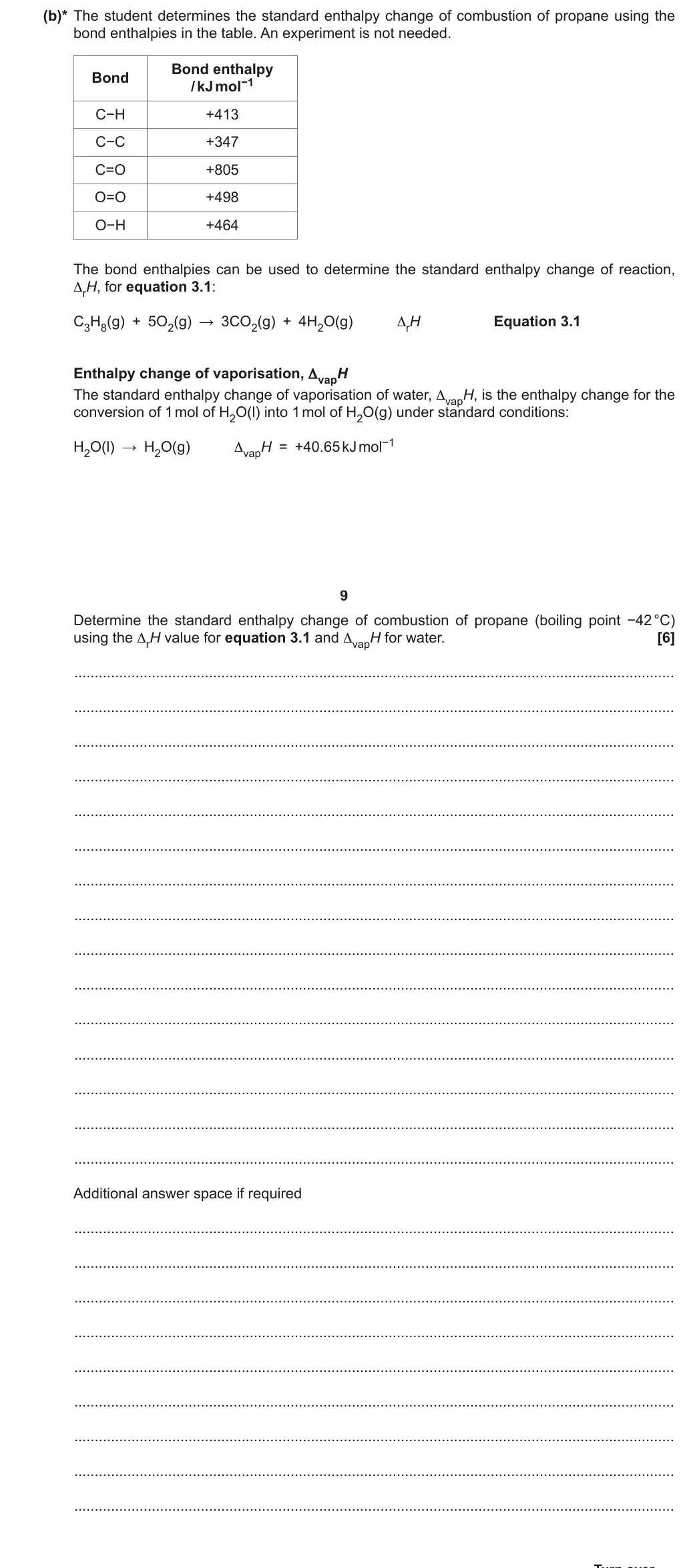
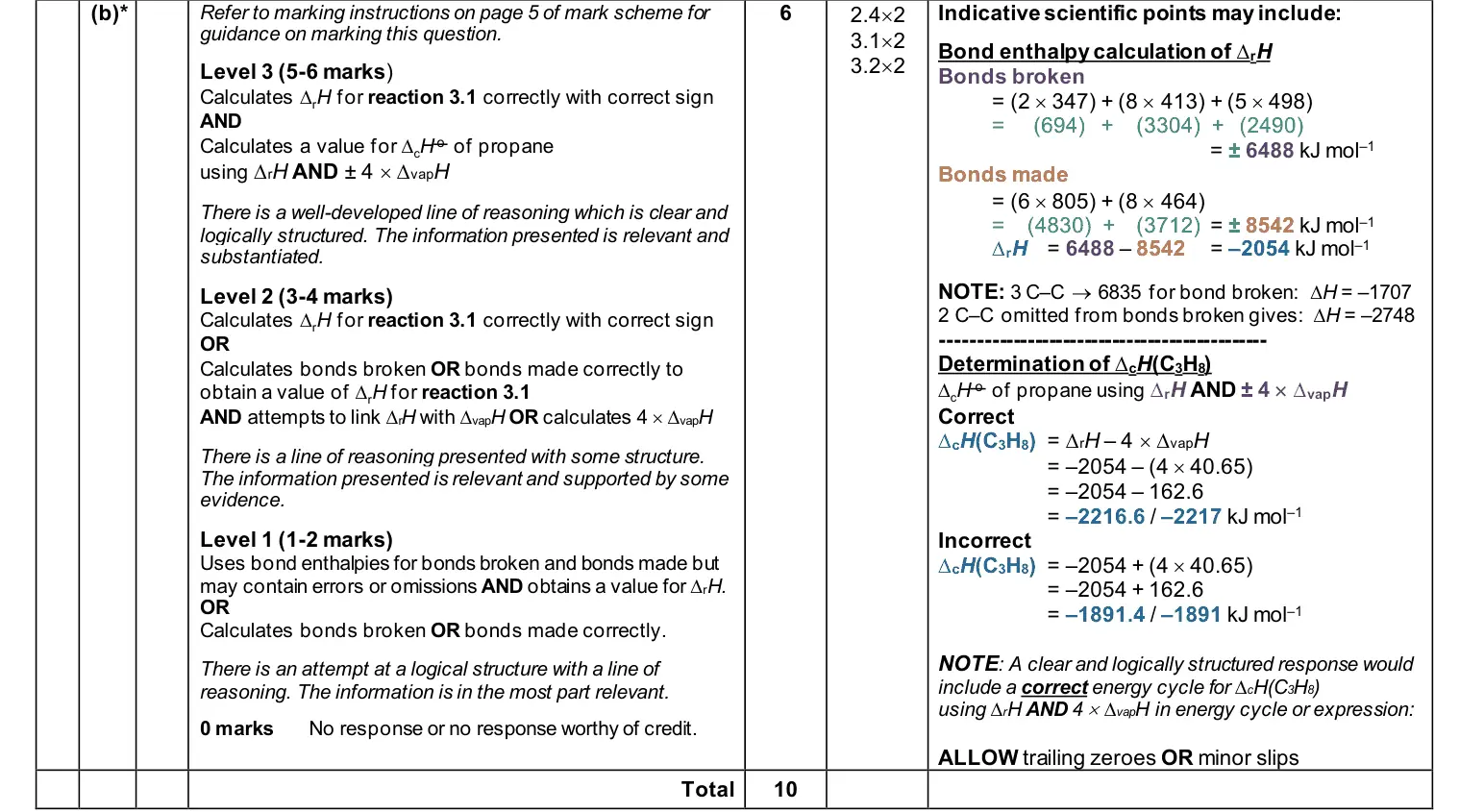
(b)* The student determines the standard enthalpy change of combustion of propane using the
bond enthalpies in the table. An experiment is not needed.
Bond enthalpy
Bond
/ kJ mol−1
C−H +413
C−C +347
C=O +805
O=O +498
O−H +464
The bond enthalpies can be used to determine the standard enthalpy change of reaction,
∆rH, for equation 3.1:
C3H8(g) + 5O2(g) → 3CO2(g) + 4H2O(g)   ∆rH     Equation 3.1
Enthalpy change of vaporisation, ∆ vapH
The standard enthalpy change of vaporisation of water, ∆vapH, is the enthalpy change for the
conversion of 1 mol of H2O(l) into 1 mol of H2O(g) under standard conditions:
H2O(l) → H2O(g)   ∆vapH = +40.65 kJ mol−1
Determine the standard enthalpy change of combustion of propane (boiling point −42 °C)
using the ∆rH value for equation 3.1 and ∆vapH for water. [6]
...................................................................................................................................................
...................................................................................................................................................
...................................................................................................................................................
...................................................................................................................................................
...................................................................................................................................................
...................................................................................................................................................
...................................................................................................................................................
...................................................................................................................................................
...................................................................................................................................................
...................................................................................................................................................
...................................................................................................................................................
...................................................................................................................................................
...................................................................................................................................................
...................................................................................................................................................
...................................................................................................................................................
Additional answer space if required
...................................................................................................................................................
...................................................................................................................................................
...................................................................................................................................................
...................................................................................................................................................
...................................................................................................................................................
...................................................................................................................................................
...................................................................................................................................................
...................................................................................................................................................
...................................................................................................................................................
November 2020 · Paper 3 · Q4(a)(i) 3 marks AO2 Equation writing Medium redoxformulae and equationsredox and electrode potentials
4 A student carries out an investigation to identify two metals, M and X, by two different methods.
(a) The student is provided with a sample of metal M.
The student analyses metal M using a ‘back-titration’ technique:
• The metal is reacted with excess acid.
• The resulting solution is titrated to determine the amount of acid remaining after the
reaction.
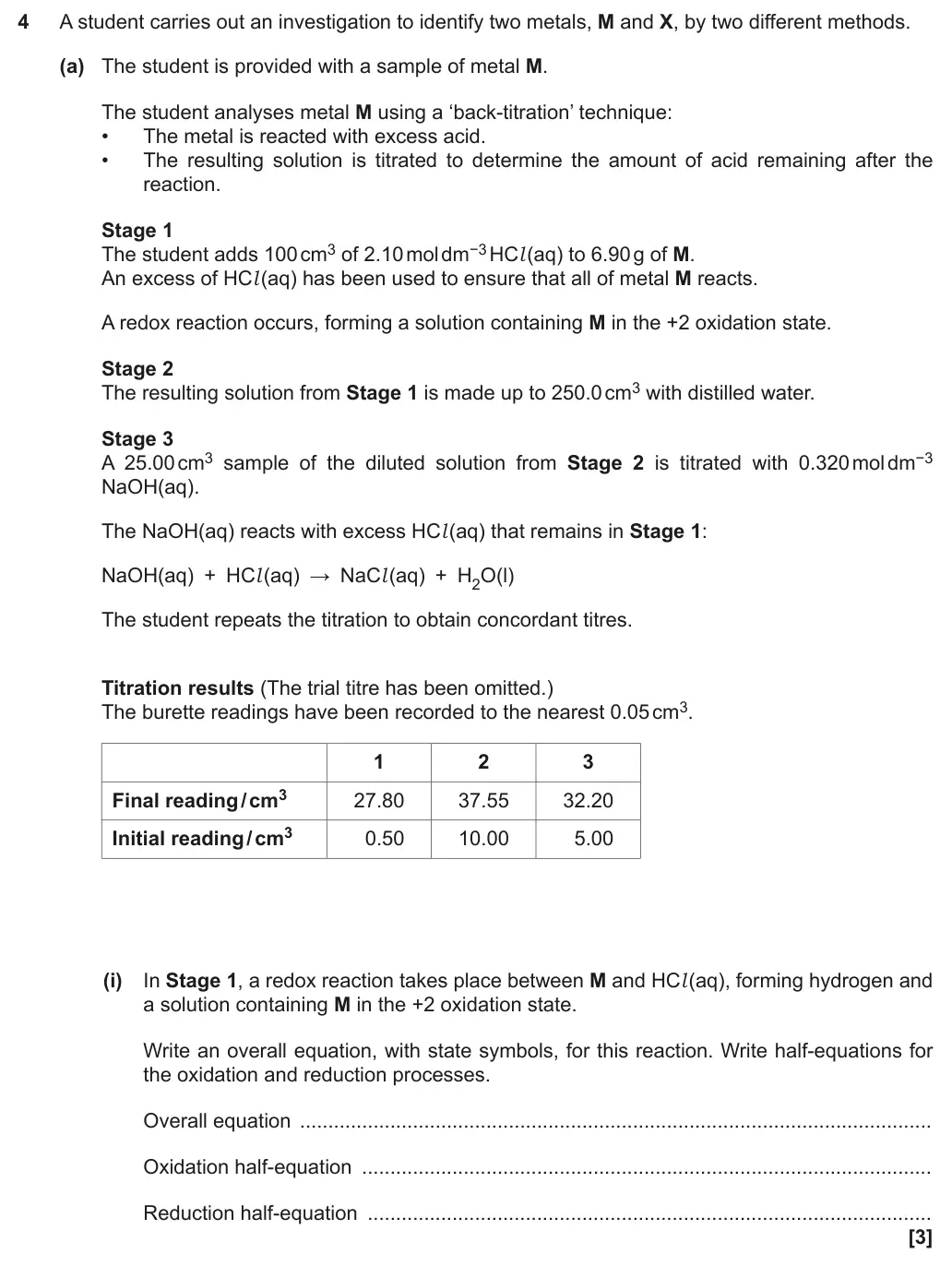
Stage 1
The student adds 100 cm3 of 2.10 mol dm−3 HCl (aq) to 6.90 g of M.
An excess of HCl (aq) has been used to ensure that all of metal M reacts.
A redox reaction occurs, forming a solution containing M in the +2 oxidation state.
Stage 2
The resulting solution from Stage 1 is made up to 250.0 cm3 with distilled water.
Stage 3
A 25.00 cm3 sample of the diluted solution from Stage 2 is titrated with 0.320 mol dm−3
NaOH(aq).
The NaOH(aq) reacts with excess HCl (aq) that remains in Stage 1:
NaOH(aq) + HCl (aq) → NaCl (aq) + H2O(l)
The student repeats the titration to obtain concordant titres.
Titration results (The trial titre has been omitted.)
The burette readings have been recorded to the nearest 0.05 cm3.
1 2 3
Final reading / cm3 27.80 37.55 32.20
Initial reading / cm3 0.50 10.00 5.00
(i) In Stage 1, a redox reaction takes place between M and HCl (aq), forming hydrogen and
a solution containing M in the +2 oxidation state.
Write an overall equation, with state symbols, for this reaction. Write half-equations for
the oxidation and reduction processes.
Overall equation  ................................................................................................................
Oxidation half-equation  .....................................................................................................
Reduction half-equation  ....................................................................................................
[3]
November 2020 · Paper 3 · Q4(a)(ii) 2 marks AO3 Short answer Medium redoxpractical techniques
Earlier part of question 4 that this part usesEarlier part of November 2020 Paper 3 question 4
(ii) In Stage 1, suggest two observations that would confirm that all of metal M has reacted.
1  ........................................................................................................................................
...........................................................................................................................................
2  ........................................................................................................................................
...........................................................................................................................................
[2]
November 2020 · Paper 3 · Q4(a)(iii) 1 mark AO2 Equation writing Medium acids and titrations
Earlier part of question 4 that this part usesEarlier part of November 2020 Paper 3 question 4
(iii) In Stage 3, write the ionic equation for the reaction taking place in the titration.
...................................................................................................................................... [1]
November 2020 · Paper 3 · Q4(a)(iv) 6 marks AO2, 3 Calculation Medium acids and titrationsamount of substance
Earlier part of question 4 that this part usesEarlier part of November 2020 Paper 3 question 4
(iv) Metal M can be identified following the steps below.
1. The amount, in mol, of excess HCl (aq) that remains after the reaction of M with
HCl (aq).
2. The amount, in mol, of HCl (aq) that reacted with M.
3. The identity of metal M.
Analyse the results to identify metal M.
Metal M =  .......................................................... [6]
November 2020 · Paper 3 · Q4(b)(i) 1 mark AO2 Calculation Medium amount of substance
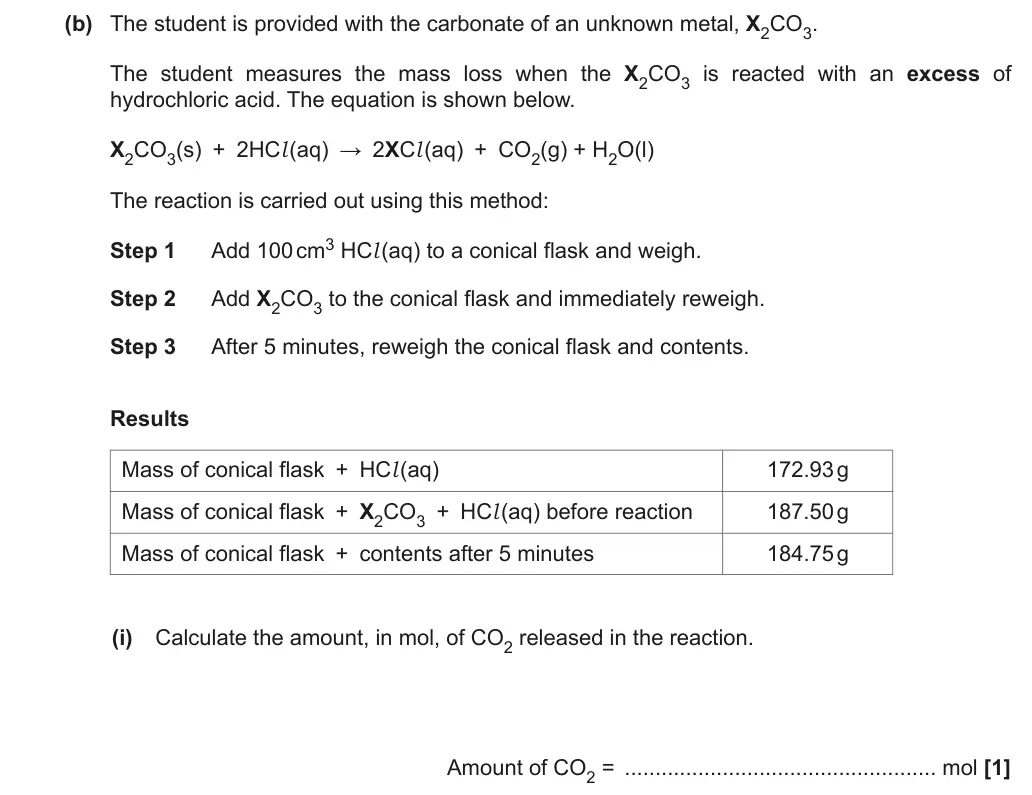
(b) The student is provided with the carbonate of an unknown metal, X2CO3.
The student measures the mass loss when the X2CO3 is reacted with an excess of
hydrochloric acid. The equation is shown below.
X2CO3(s) + 2HCl (aq) → 2XCl (aq) + CO2(g) + H2O(l)
The reaction is carried out using this method:
Step 1 Add 100 cm3 HCl (aq) to a conical flask and weigh.
Step 2 Add X2CO3 to the conical flask and immediately reweigh.
Step 3 After 5 minutes, reweigh the conical flask and contents.
Results
Mass of conical flask + HCl (aq) 172.93 g
Mass of conical flask + X2CO3 + HCl (aq) before reaction 187.50 g
Mass of conical flask + contents after 5 minutes 184.75 g
(i) Calculate the amount, in mol, of CO2 released in the reaction.
Amount of CO2 =  ................................................... mol [1]
November 2020 · Paper 3 · Q4(b)(ii) 3 marks AO1, 2, 3 Calculation Medium amount of substanceatomic structure and isotopes
Earlier part of question 4 that this part usesEarlier part of November 2020 Paper 3 question 4
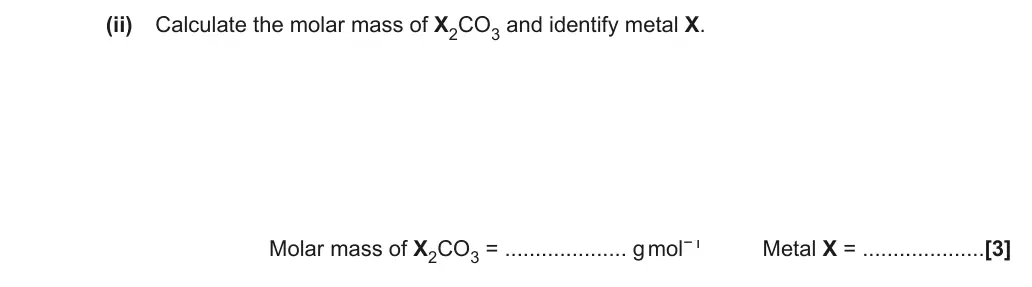
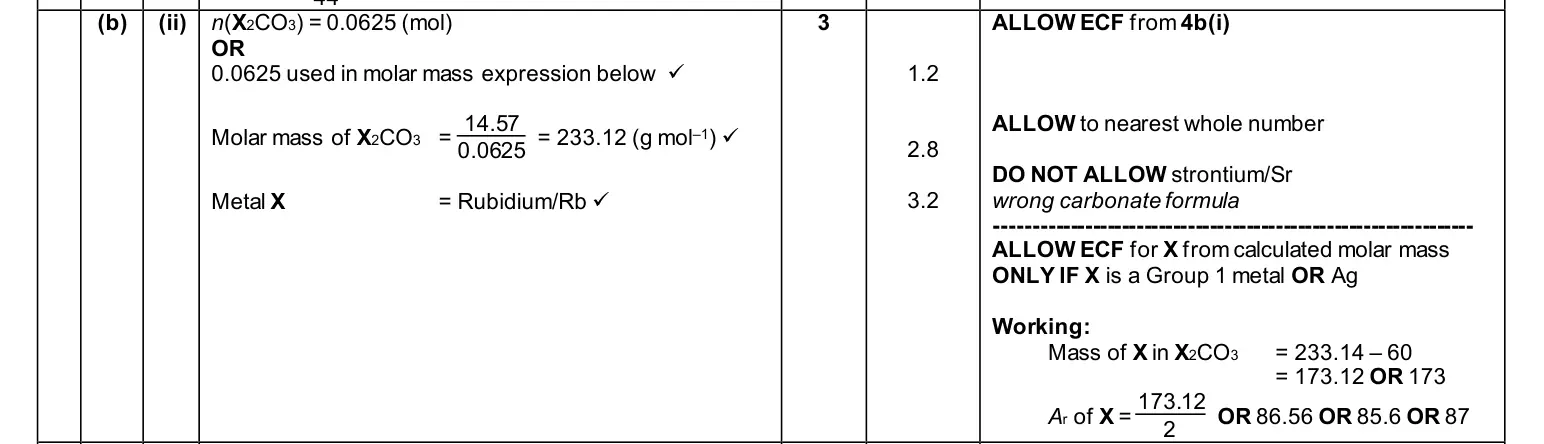
(ii) Calculate the molar mass of X2CO3 and identify metal X.
Molar mass of X2CO3 = .................... g mol−1    Metal X = ....................[3]
November 2020 · Paper 3 · Q4(c)(i) 1 mark AO3 Short answer Medium practical skillsamount of substance
Earlier part of question 4 that this part usesEarlier part of November 2020 Paper 3 question 4
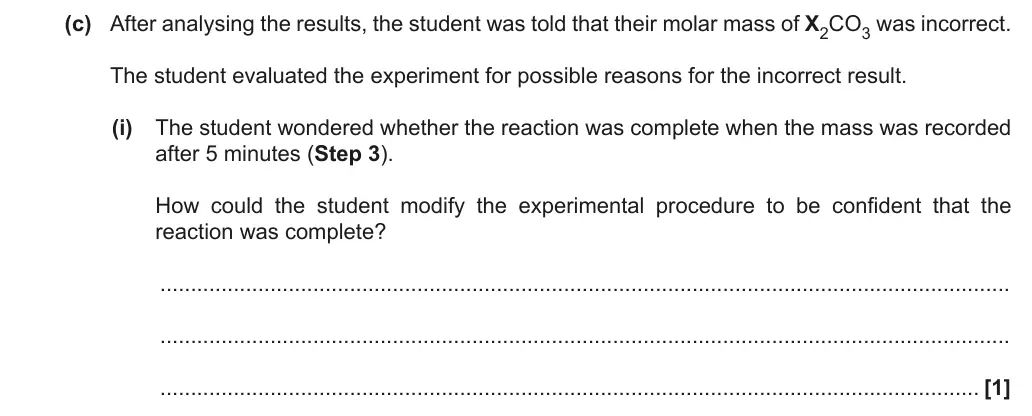
(c) After analysing the results, the student was told that their molar mass of X2CO3 was incorrect.
The student evaluated the experiment for possible reasons for the incorrect result.
(i) The student wondered whether the reaction was complete when the mass was recorded
after 5 minutes (Step 3).
How could the student modify the experimental procedure to be confident that the
reaction was complete?
...........................................................................................................................................
...........................................................................................................................................
...................................................................................................................................... [1]
November 2020 · Paper 3 · Q4(c)(ii) 2 marks AO3 Short answer Medium practical skillsamount of substance
Earlier parts of question 4 that this part usesEarlier part of November 2020 Paper 3 question 4Earlier part of November 2020 Paper 3 question 4
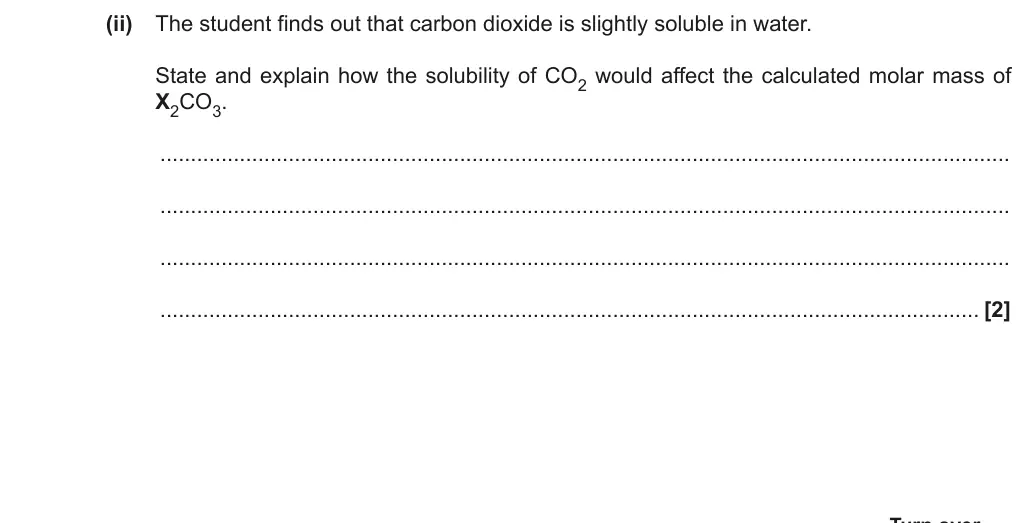
(ii) The student finds out that carbon dioxide is slightly soluble in water.
State and explain how the solubility of CO2 would affect the calculated molar mass of
X2CO3.
...........................................................................................................................................
...........................................................................................................................................
...........................................................................................................................................
...................................................................................................................................... [2]
November 2020 · Paper 3 · Q5(a) 2 marks AO1 Complete table/diagram Medium equilibrium constantspractical skills
5 The equilibrium constant Kp and temperature T (in K) are linked by the mathematical relationship
shown in equation 5.1 (R = Gas constant in J mol−1 K−1 and ∆H is enthalpy change in J mol−1).
ln Kp  =  – ∆H R × 1 T + ∆S
R     Equation 5.1
(a) The table shows the values of Kp at different temperatures for an equilibrium.
Complete the table by adding the missing values of 1
T and ln Kp.
Temperature, T / K 400 500 600 700 800
Kp 3.00 × 1058 5.86 × 1045 1.83 × 1037 1.46 × 1031 1.14 × 1026
1
T / K−1 2.50 × 10⁻³
...................... ...................... ...................... ......................
ln Kp 135
...................... ...................... ...................... ......................
[2]
November 2020 · Paper 3 · Q5(b) 1 mark AO2 Short answer Medium equilibrium constantschemical equilibrium
Earlier part of question 5 that this part usesEarlier part of November 2020 Paper 3 question 5
(b) State and explain how increasing the temperature affects the position of this equilibrium and
whether the forward reaction is exothermic or endothermic.
...................................................................................................................................................
...................................................................................................................................................
.............................................................................................................................................. [1]
November 2020 · Paper 3 · Q5(c) 4 marks AO3 Calculation Medium practical skillsequilibrium constants
Earlier parts of question 5 that this part usesEarlier part of November 2020 Paper 3 question 5Earlier part of November 2020 Paper 3 question 5
(c) Plot a graph of ln Kp against 1
T using the axes provided on the opposite page.
Use your graph and equation 5.1 to determine ∆H, in kJ mol−1, for this equilibrium.
Give your answer to 3 significant figures.
∆H =  ........................................... kJ mol−1 [4]
November 2020 · Paper 3 · Q5(d) 2 marks AO3 Short answer Medium practical skills
Earlier parts of question 5 that this part usesEarlier part of November 2020 Paper 3 question 5Earlier part of November 2020 Paper 3 question 5
(d) Explain how ∆S could be calculated from a graph of ln Kp against 1
T .
...................................................................................................................................................
...................................................................................................................................................
.............................................................................................................................................. [2]
November 2020 · Paper 3 · Q6(a) 2 marks AO1 Complete table/diagram Hard bonding and structure
140
130
120
110
100
90
In Kp
80
70
60
50
40
0 1.0 × 10⁻³ 2.0 × 10⁻³ 3.0 × 10⁻³ 4.0 × 10⁻³
1
T / K–1
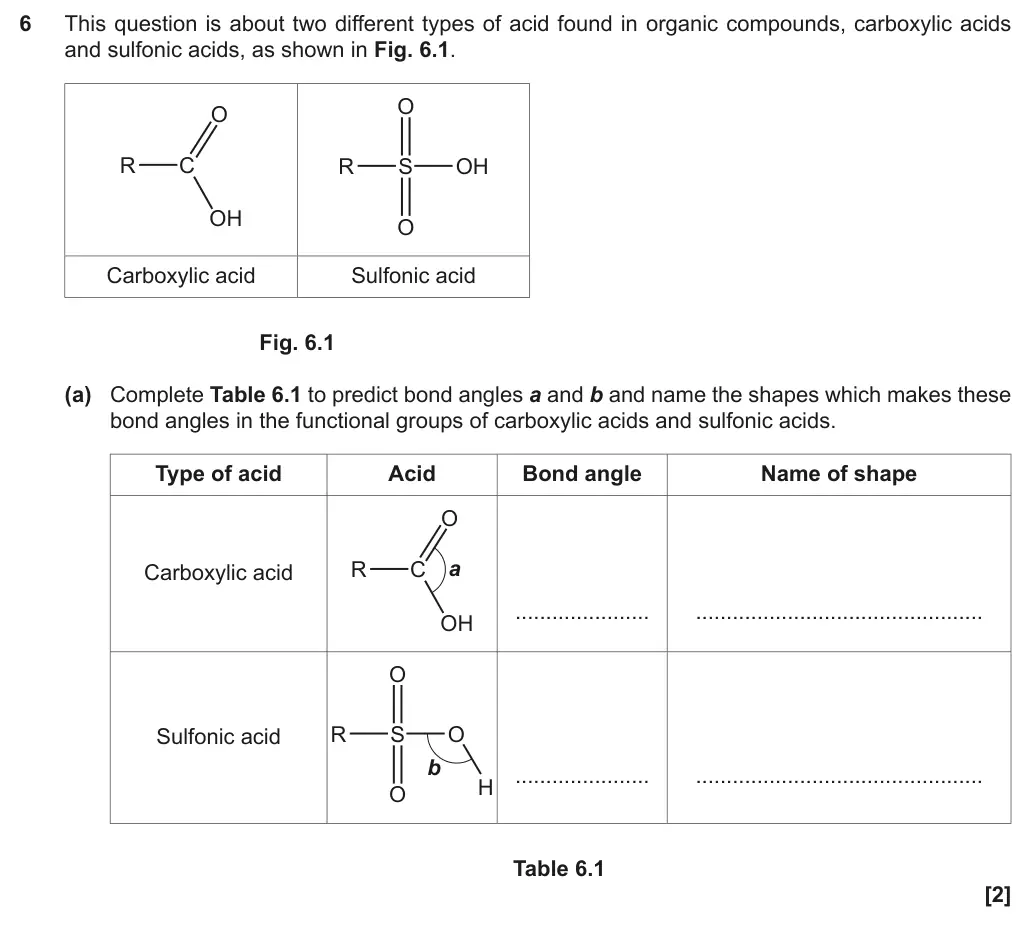
6 This question is about two different types of acid found in organic compounds, carboxylic acids
and sulfonic acids, as shown in Fig. 6.1.
O
O
R C R S OH
OH
O
Carboxylic acid Sulfonic acid
Fig. 6.1
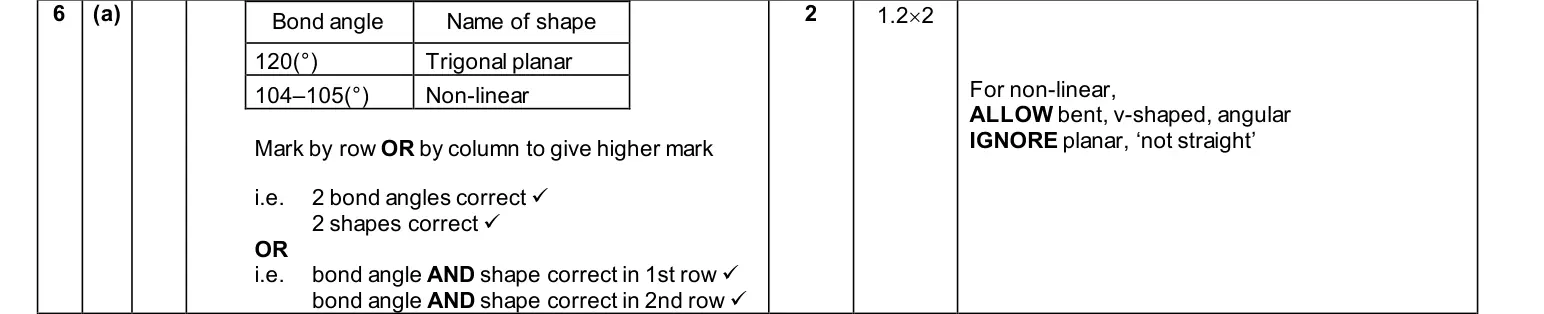
(a) Complete Table 6.1 to predict bond angles a and b and name the shapes which makes these
bond angles in the functional groups of carboxylic acids and sulfonic acids.
Type of acid Acid Bond angle Name of shape
O
Carboxylic acid R C a
...................... ...............................................
OH
O
Sulfonic acid R S O
b
...................... ...............................................
O H
Table 6.1
[2]
November 2020 · Paper 3 · Q6(b) 4 marks AO2, 3 Equation writing Hard acids bases and buffersacids and titrations
Earlier part of question 6 that this part usesEarlier part of November 2020 Paper 3 question 6
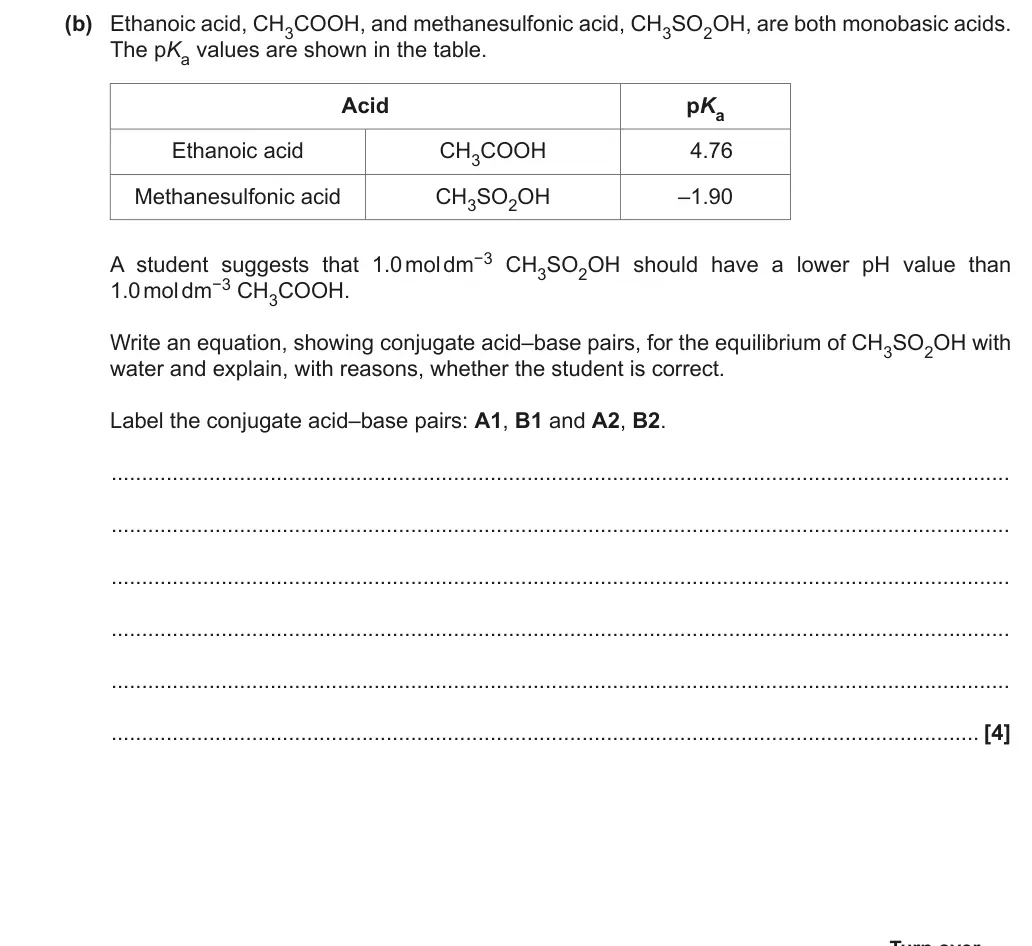
(b) Ethanoic acid, CH3COOH, and methanesulfonic acid, CH3SO2OH, are both monobasic acids.
The pKa values are shown in the table.
Acid pKa
Ethanoic acid CH3COOH 4.76
Methanesulfonic acid CH3SO2OH –1.90
A student suggests that 1.0 mol dm−3 CH3SO2OH should have a lower pH value than
1.0 mol dm−3 CH3COOH.
Write an equation, showing conjugate acid–base pairs, for the equilibrium of CH3SO2OH with
water and explain, with reasons, whether the student is correct.
Label the conjugate acid–base pairs: A1, B1 and A2, B2.
...................................................................................................................................................
...................................................................................................................................................
...................................................................................................................................................
...................................................................................................................................................
...................................................................................................................................................
.............................................................................................................................................. [4]
November 2020 · Paper 3 · Q6(c) 4 marks AO3 Mechanism Hard organic basicscarboxylic acids and esters
Earlier part of question 6 that this part usesEarlier part of November 2020 Paper 3 question 6
(c) Carboxylic acids and sulfonic acids both form esters.
Sulfonic acid esters can be hydrolysed by aqueous alkali.
The equation shows the alkaline hydrolysis of a sulfonic acid ester.
CH3SO2OCH3 + OH− → CH3SO2O− + CH3OH
In the 3 boxes below, add curly arrows to show the mechanism for this reaction.
In the first box, the hydroxide ion acts as a nucleophile.
O O –
H3C S OCH3
H3C S OCH3
O O OH
– OH
O H
H3C S O – OCH3
O
O
H3C S O – + HOCH3
O
[4]

Work with an OCR chemistry tutor

Want a paper marked and gone through with you? Message us.

Prefer email? Send an enquiry

If you are under 18, please include a parent's contact details. Enquiries go to enquiries@chemistryaleveltutor.com and are deleted once handled. All tutoring is online.