June 2017: Paper 2, Synthesis and analytical techniques

100 marks · 48 question parts · Paper, mark scheme and report on OCR's site · Have OCR's Data Sheet beside you

Question by question

QTopicMarksAOType
1 Haloalkanes 1Multiple choice
2 Organic basics: naming, formulae and isomerism 1Multiple choice
3 Amount of substance (moles) 1Multiple choice
4 Alkenes 1Multiple choice
5 Amount of substance (moles) 1Multiple choice
6 Bonding, structure and shapes of molecules 1Multiple choice
7 Organic synthesis (Module 6), Amino acids, amides and chirality 1Multiple choice
8 Amino acids, amides and chirality 1Multiple choice
9 Organic basics: naming, formulae and isomerism, Amount of substance (moles) 1Multiple choice
10 Carboxylic acids, esters and acyl chlorides, Acids, bases and titrations 1Multiple choice
11 NMR spectroscopy and combined techniques 1Multiple choice
12 Carboxylic acids, esters and acyl chlorides, Amount of substance (moles) 1Multiple choice
13 Carboxylic acids, esters and acyl chlorides, Amino acids, amides and chirality 1Multiple choice
14 Alkanes, Organic basics: naming, formulae and isomerism 1Multiple choice
15 Organic basics: naming, formulae and isomerism 1Multiple choice
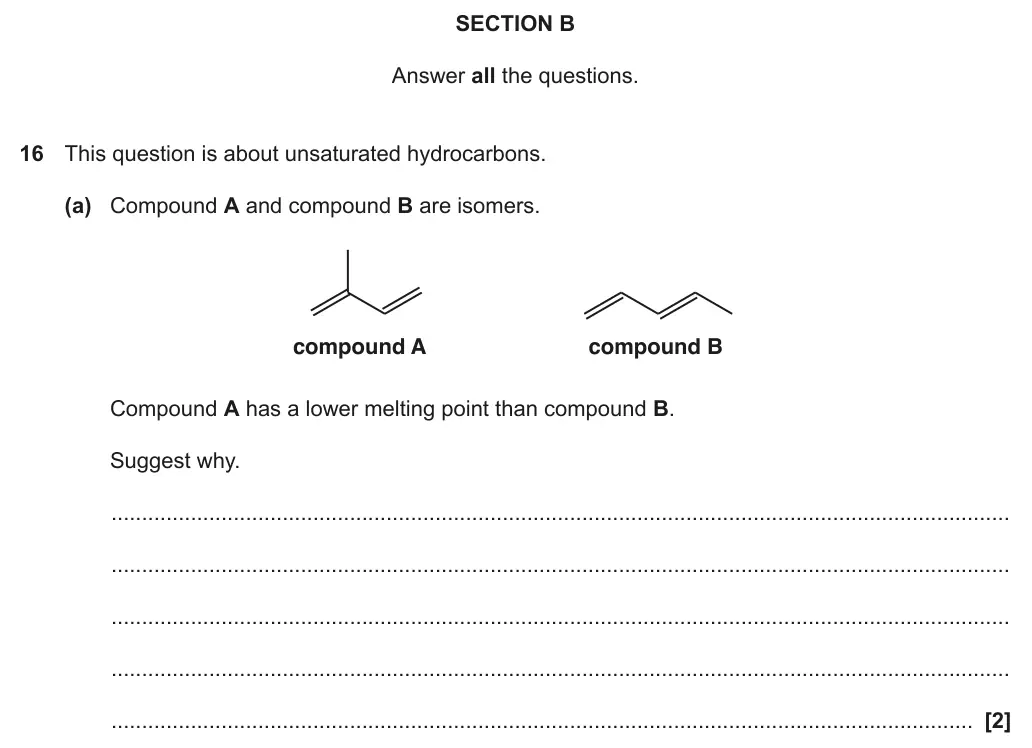
16(a) Alkanes, Bonding, structure and shapes of molecules 2Structure / isomer
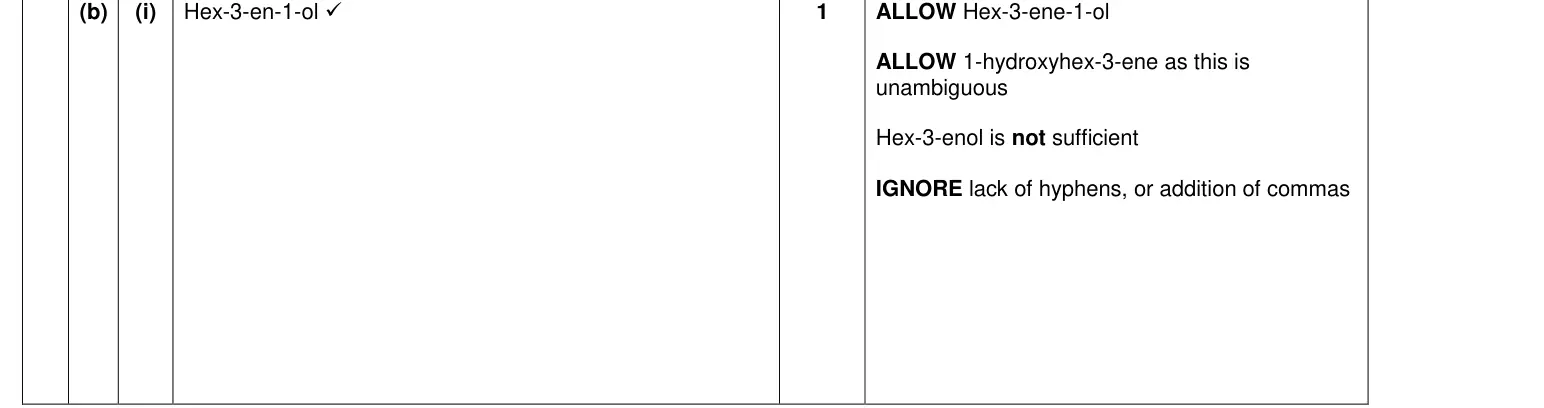
16(b)(i) Organic basics: naming, formulae and isomerism 1Short answer
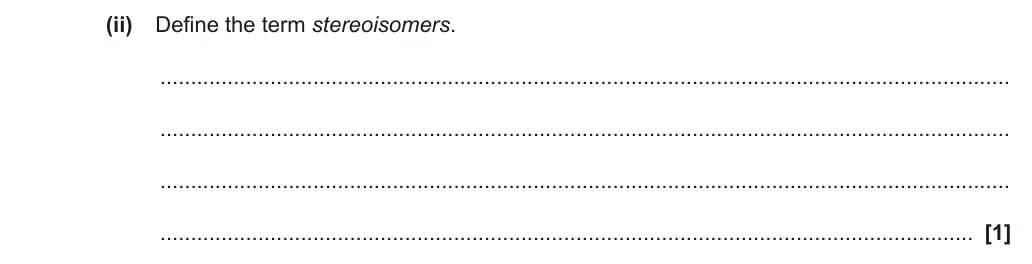
16(b)(ii) Alkenes 1Short answer
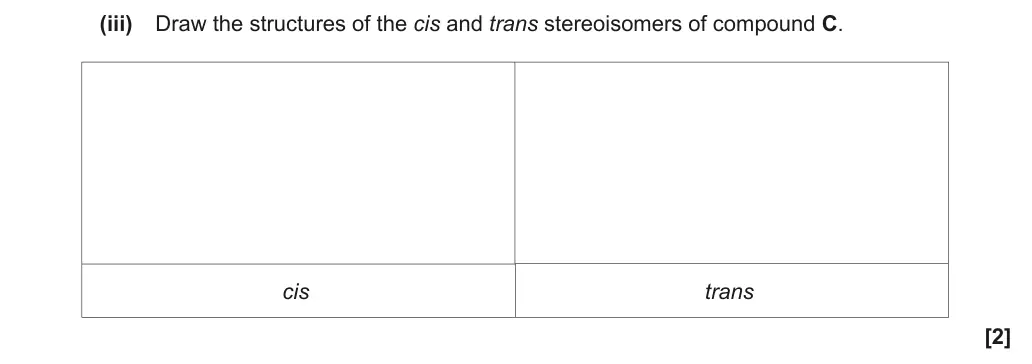
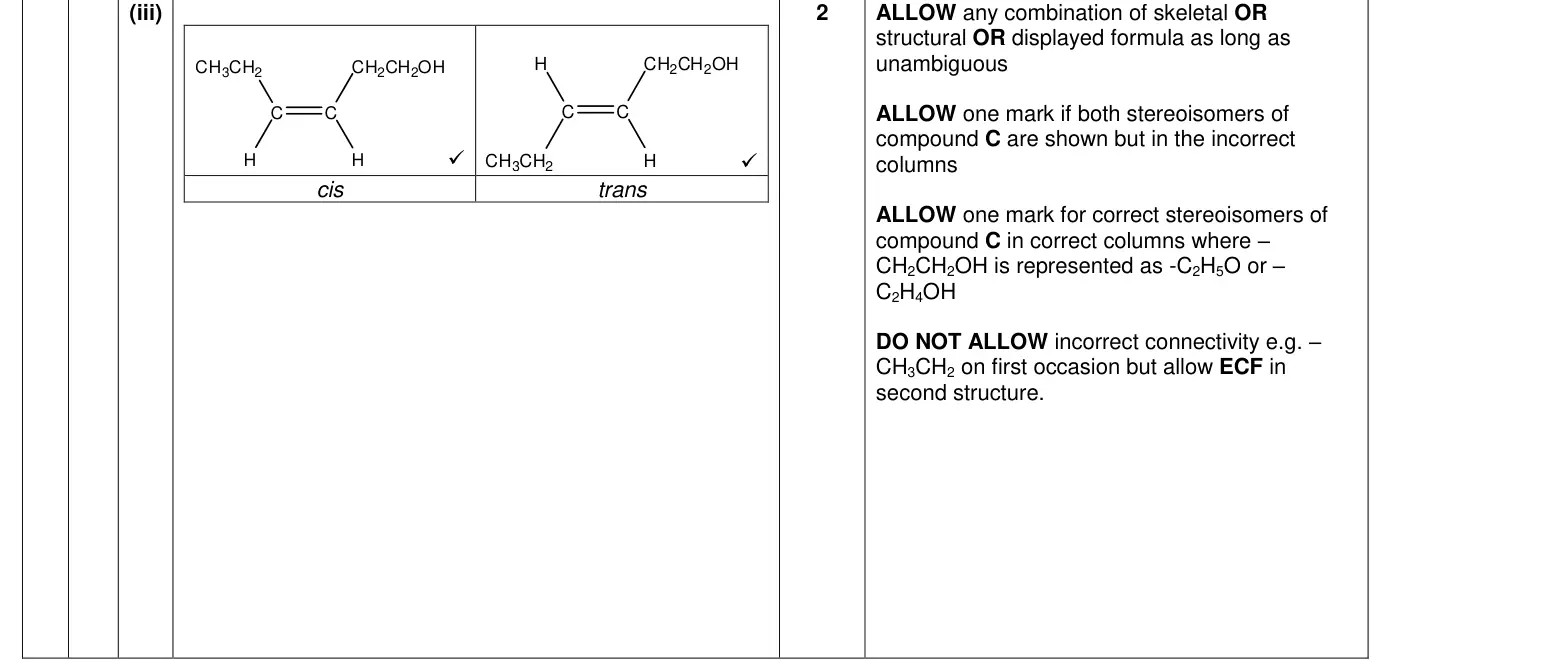
16(b)(iii) Alkenes 2Structure / isomer
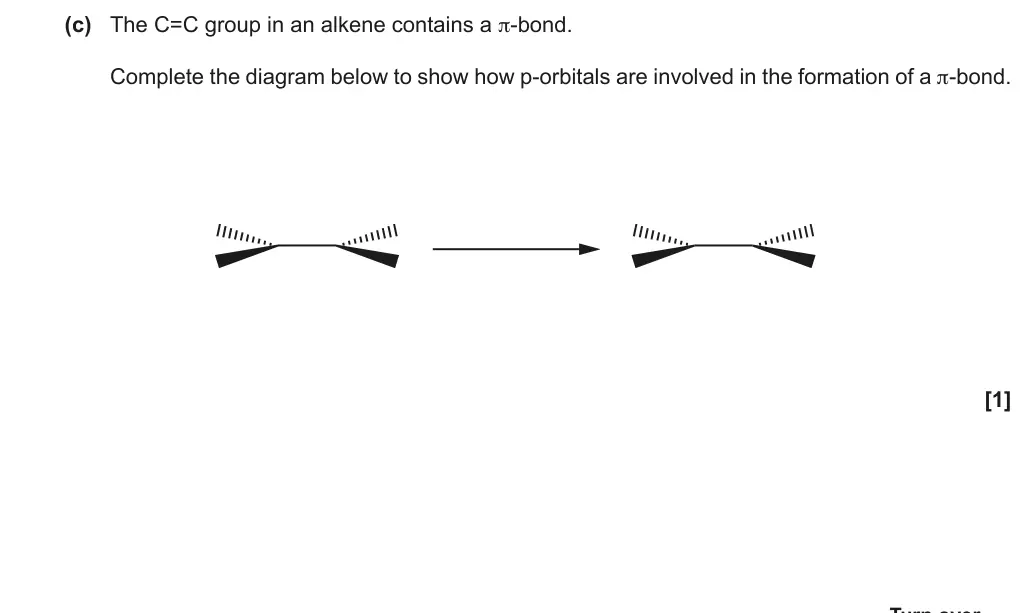
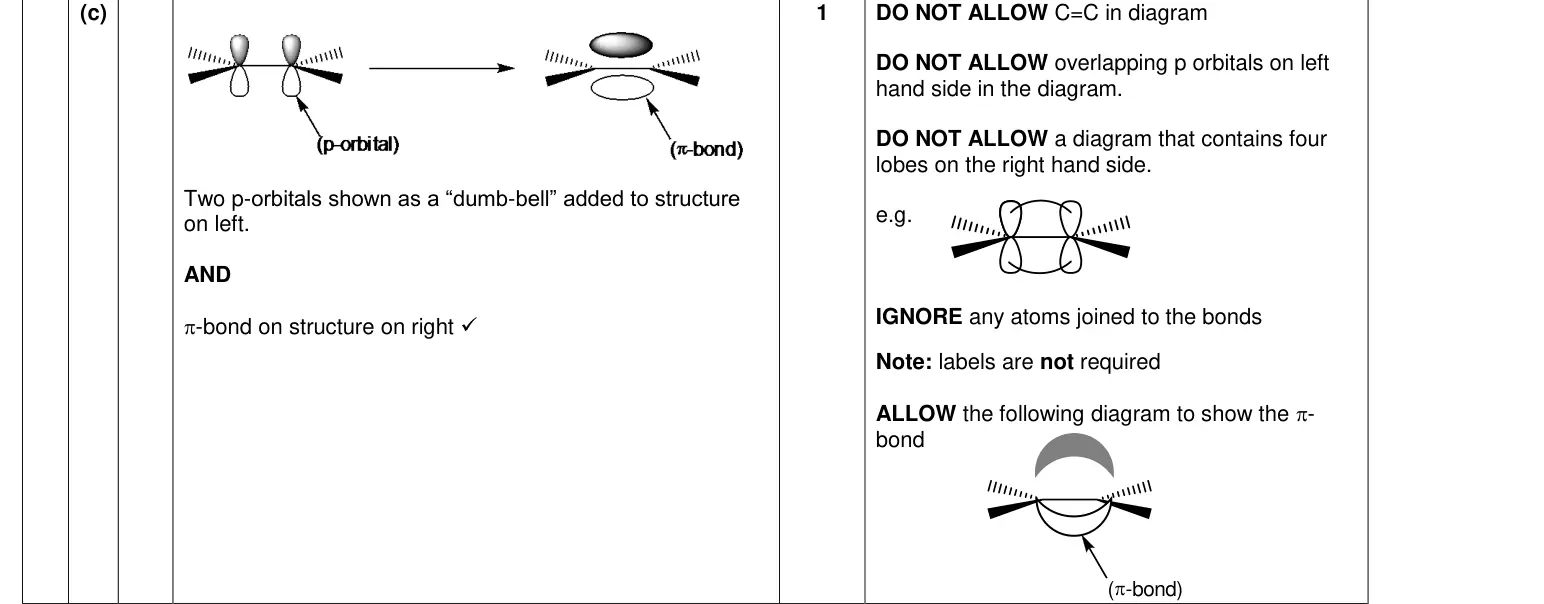
16(c) Alkenes 1Complete table/diagram
16(d)(i) Alkenes 1Short answer
16(d)(ii) Alkenes 2Structure / isomer
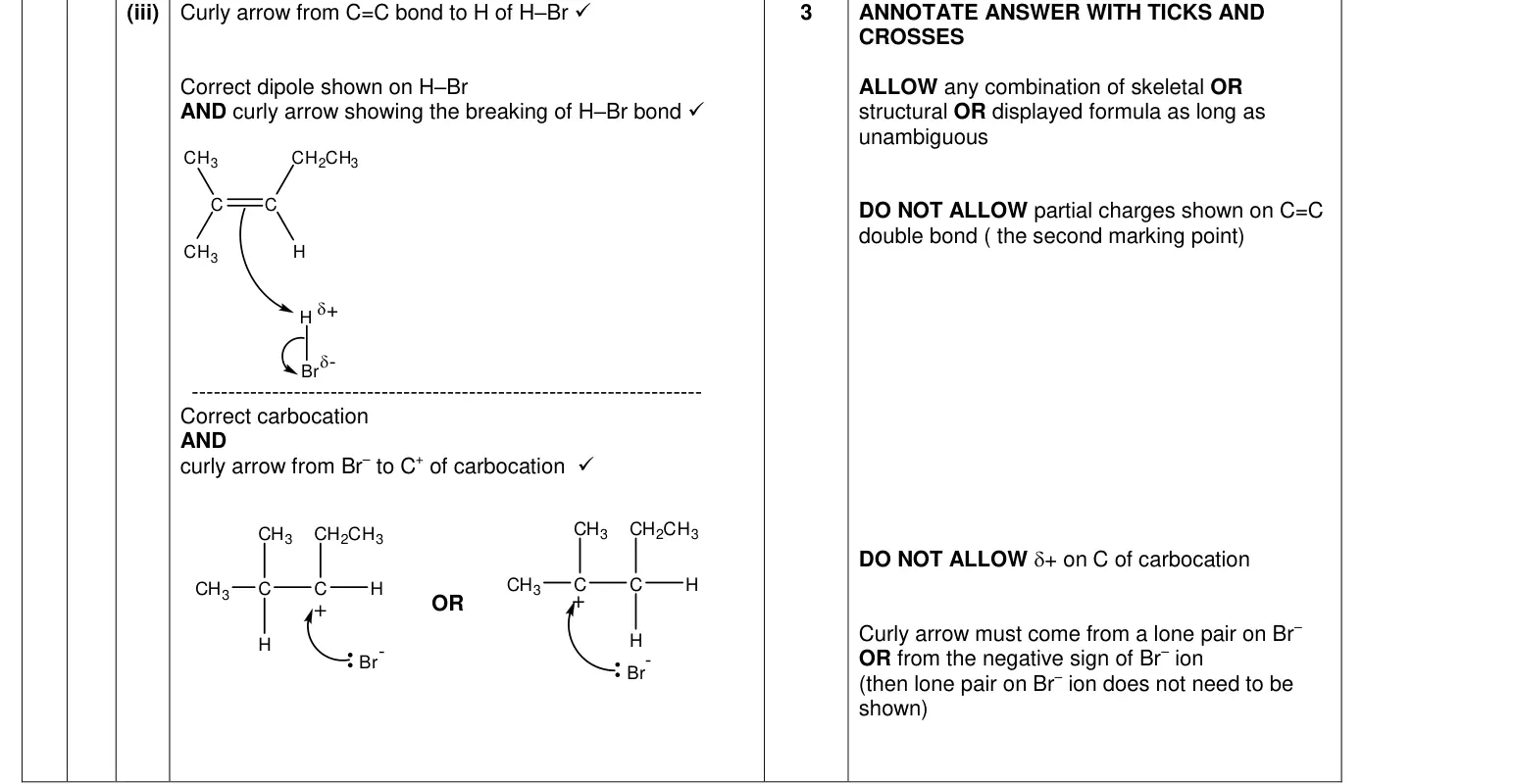
16(d)(iii) Alkenes, Organic basics: naming, formulae and isomerism 3Mechanism
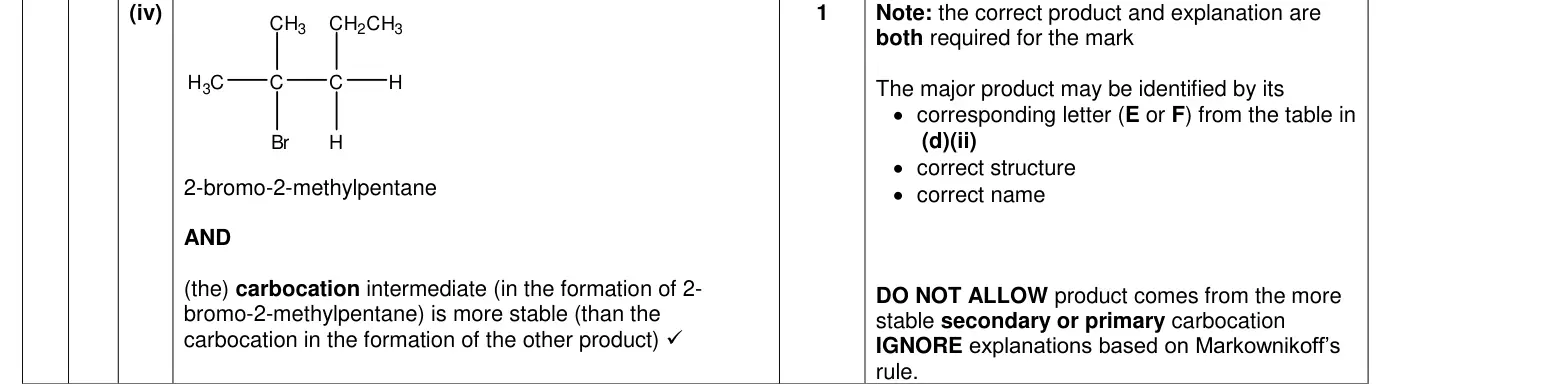
16(d)(iv) Alkenes 1Short answer
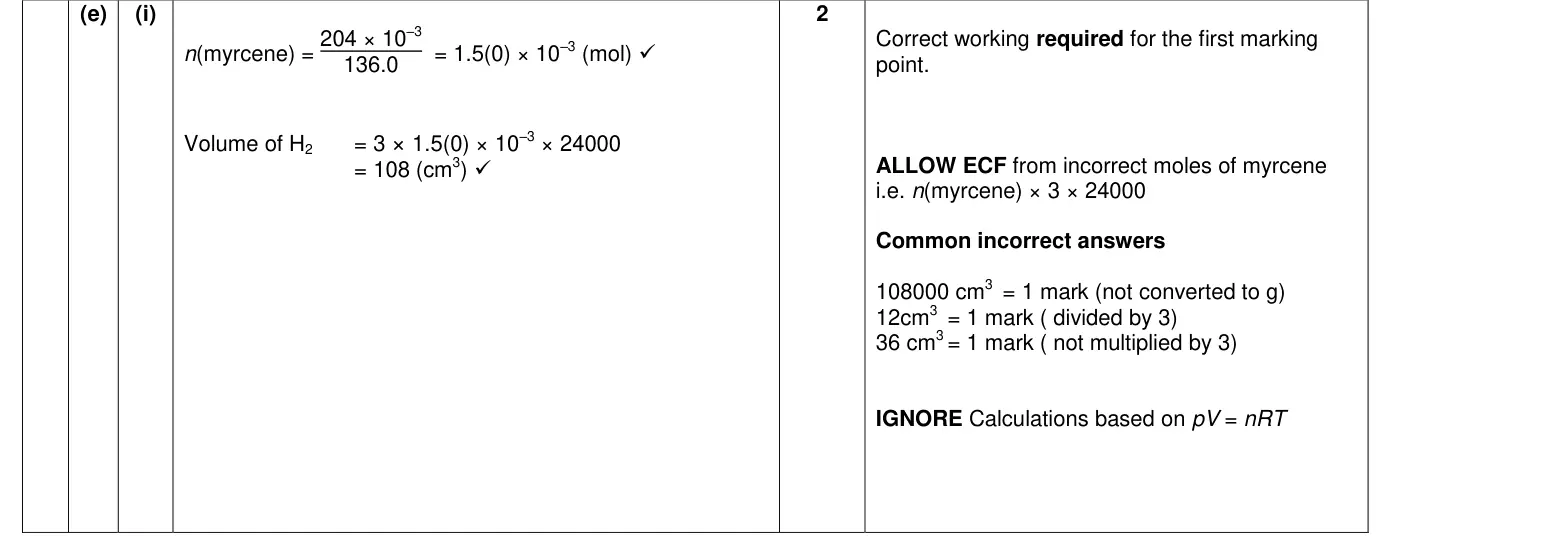
16(e)(i) Amount of substance (moles), Alkenes 2Calculation
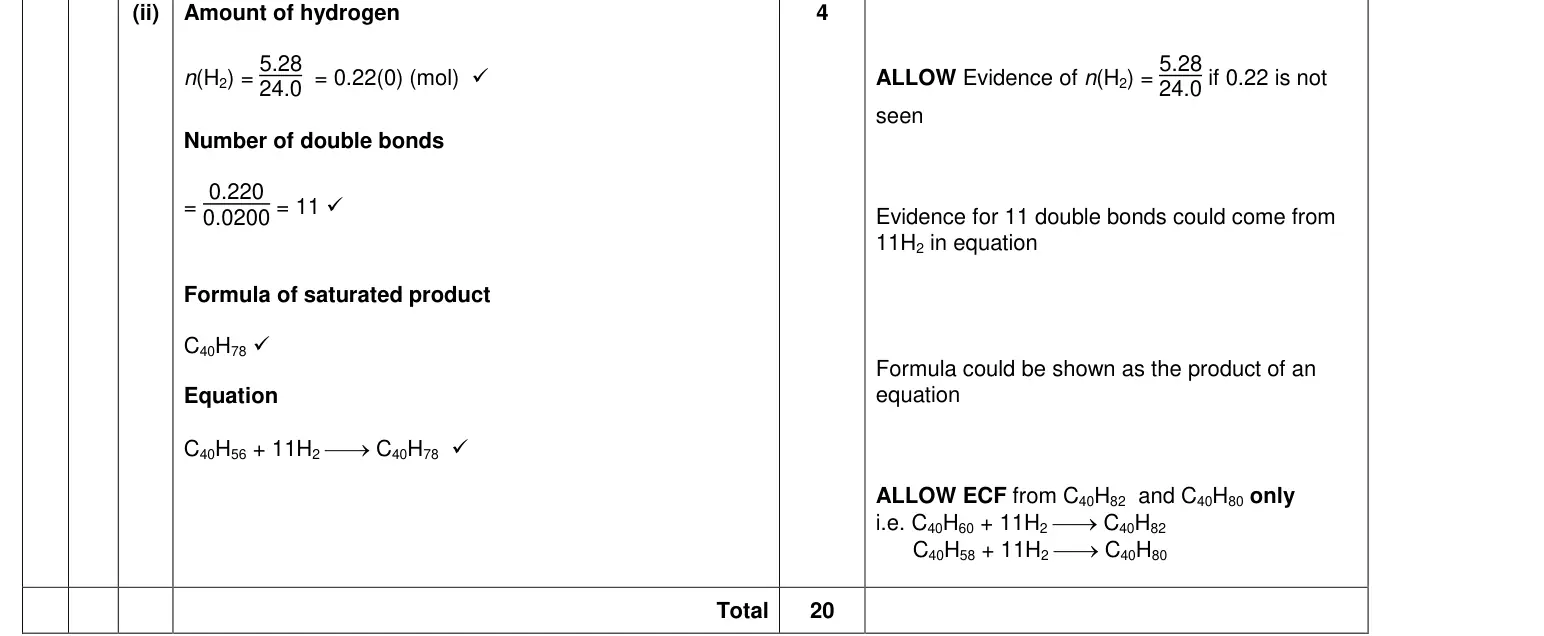
16(e)(ii) Amount of substance (moles), Formulae and equations, Organic basics: naming, formulae and isomerism, Alkenes 4Calculation
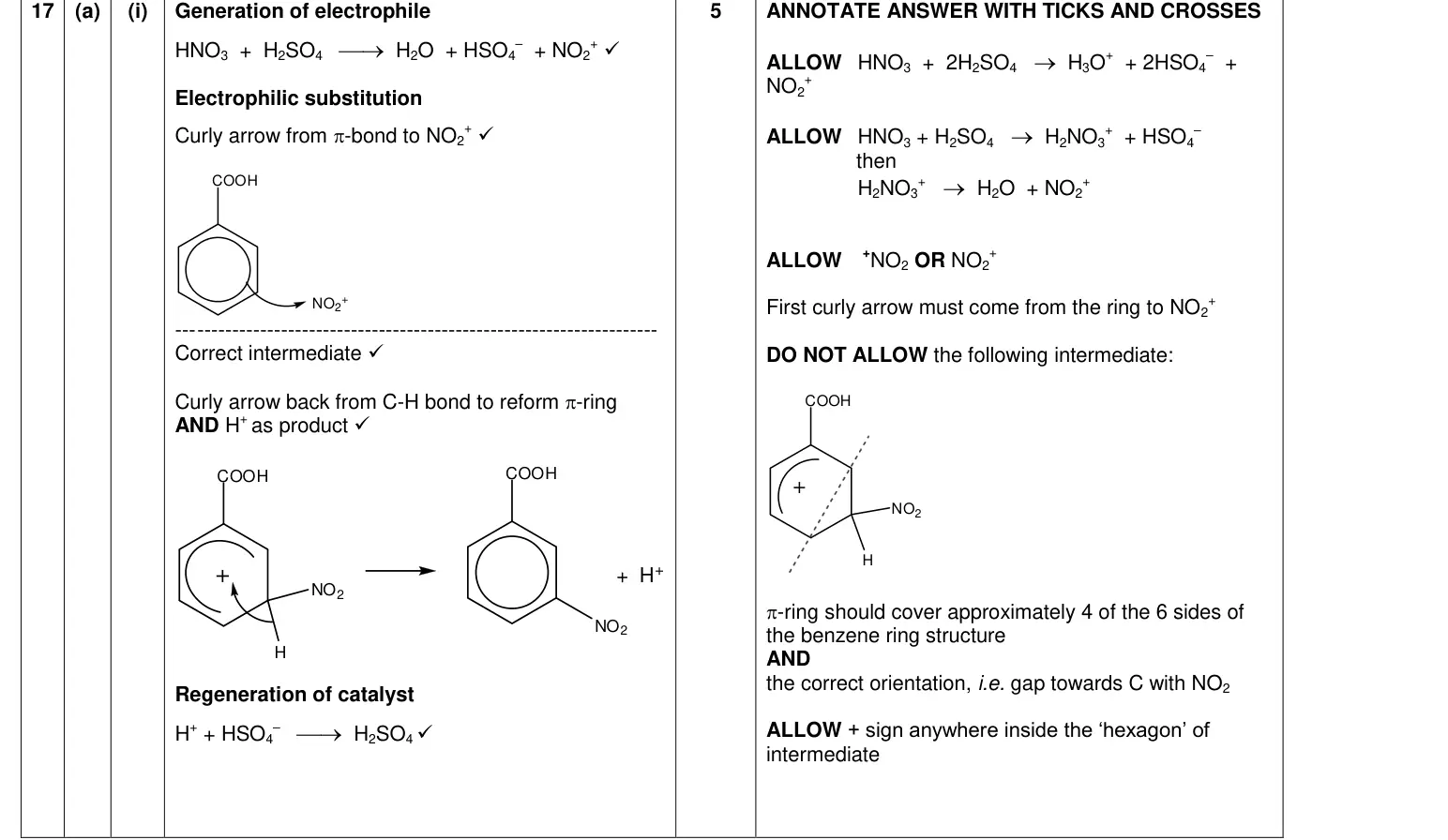
17(a)(i) Aromatic compounds: benzene and phenol 5Mechanism
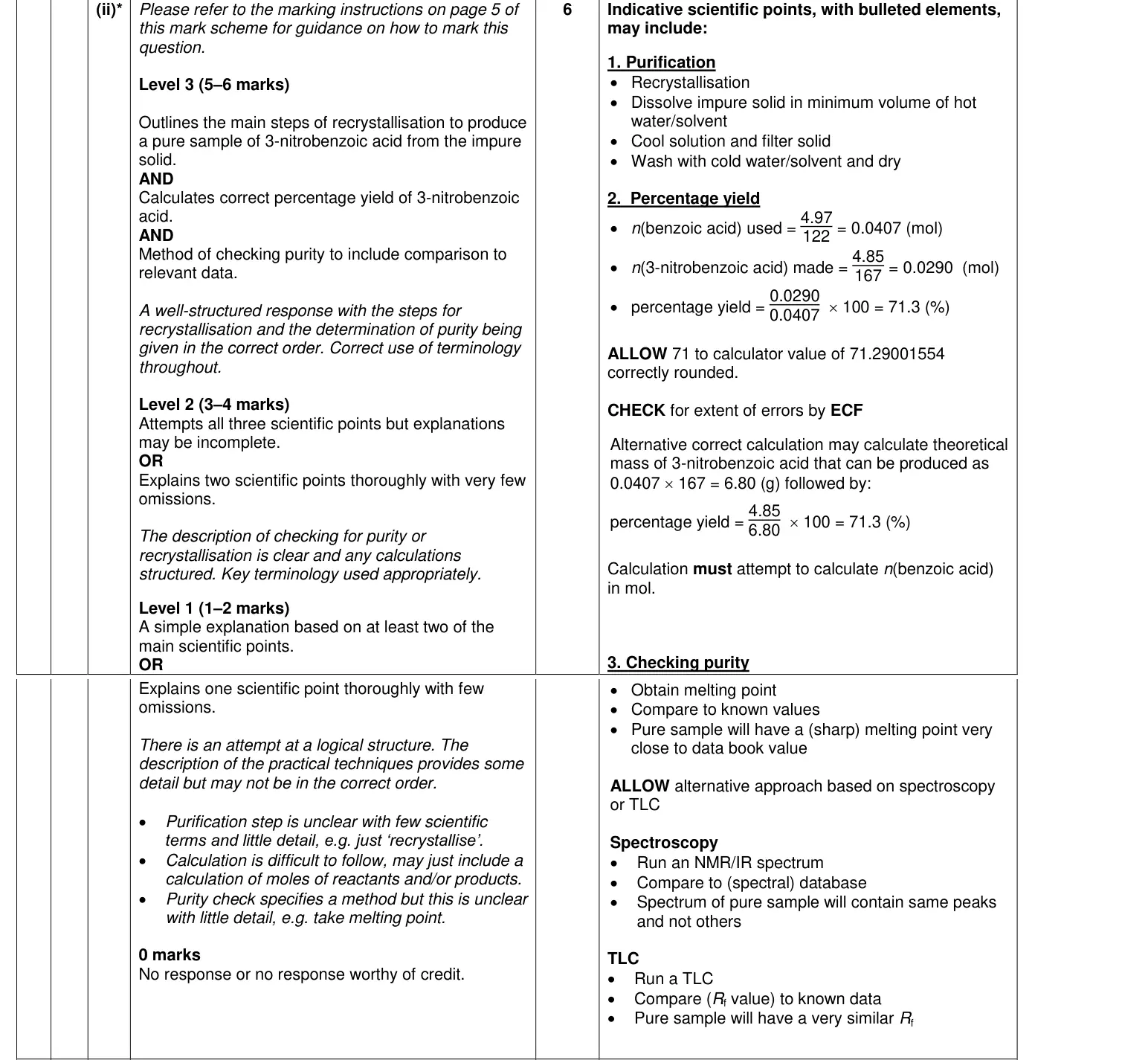
17(a)(ii) Organic synthesis (Module 6), Amount of substance (moles) 6Level of response
17(b)(i) Aromatic compounds: benzene and phenol, Practical skills: planning, analysis and evaluation 1Data interpretation
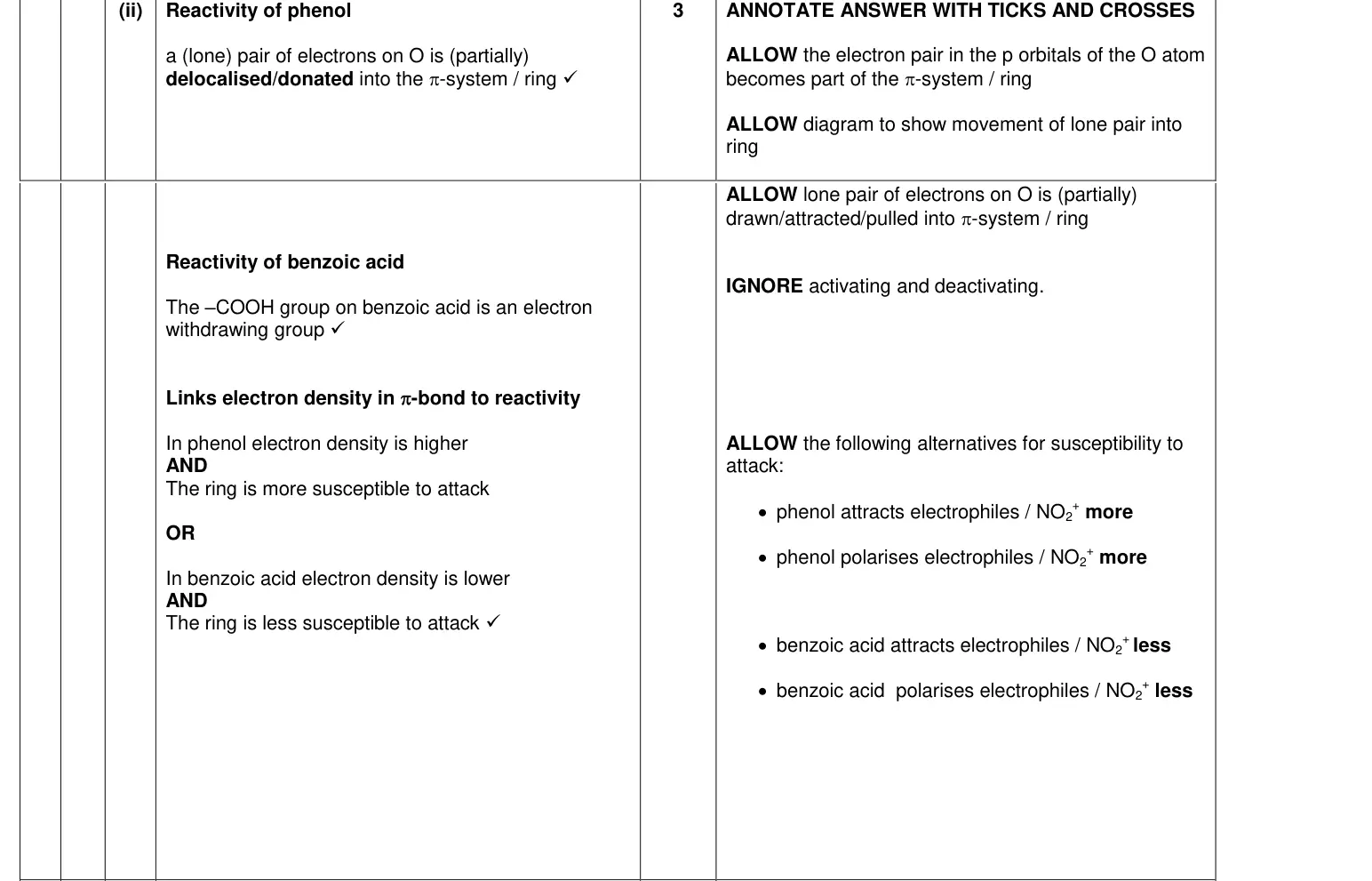
17(b)(ii) Aromatic compounds: benzene and phenol 3Short answer
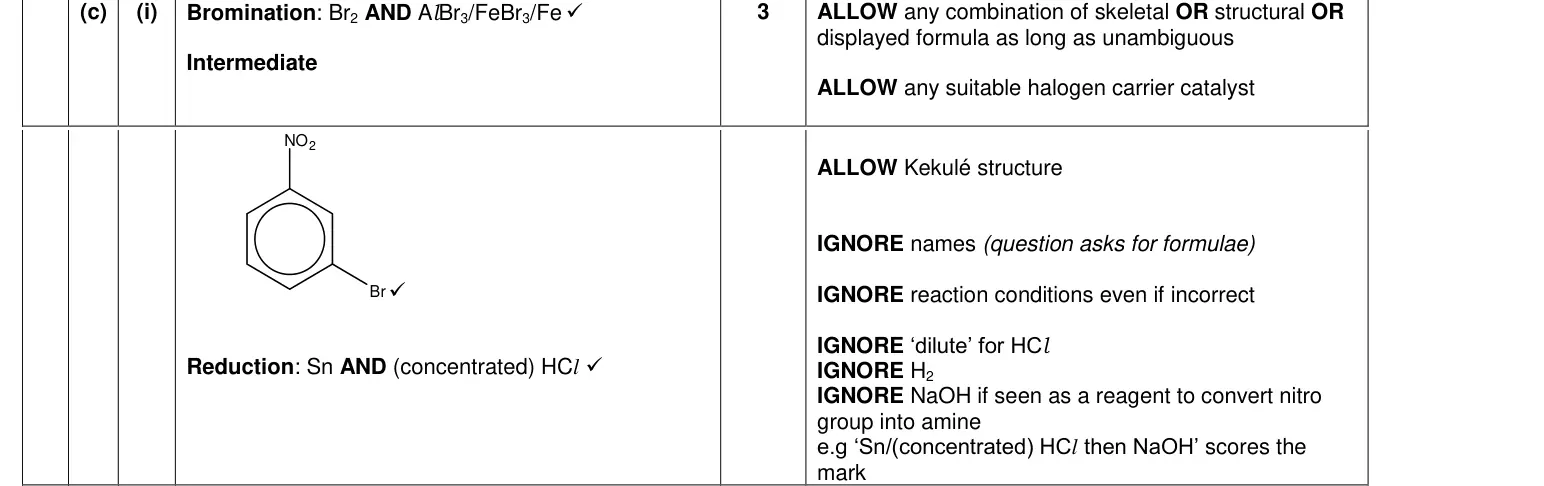
17(c)(i) Aromatic compounds: benzene and phenol, Amines, Organic synthesis (Module 6) 3Complete table/diagram
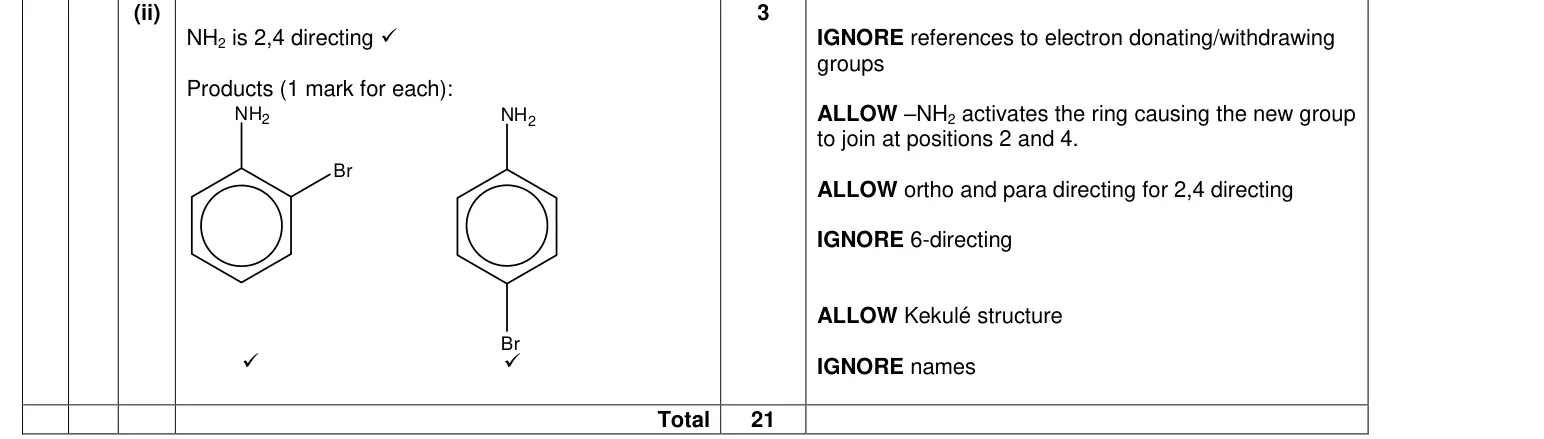
17(c)(ii) Aromatic compounds: benzene and phenol 3Structure / isomer
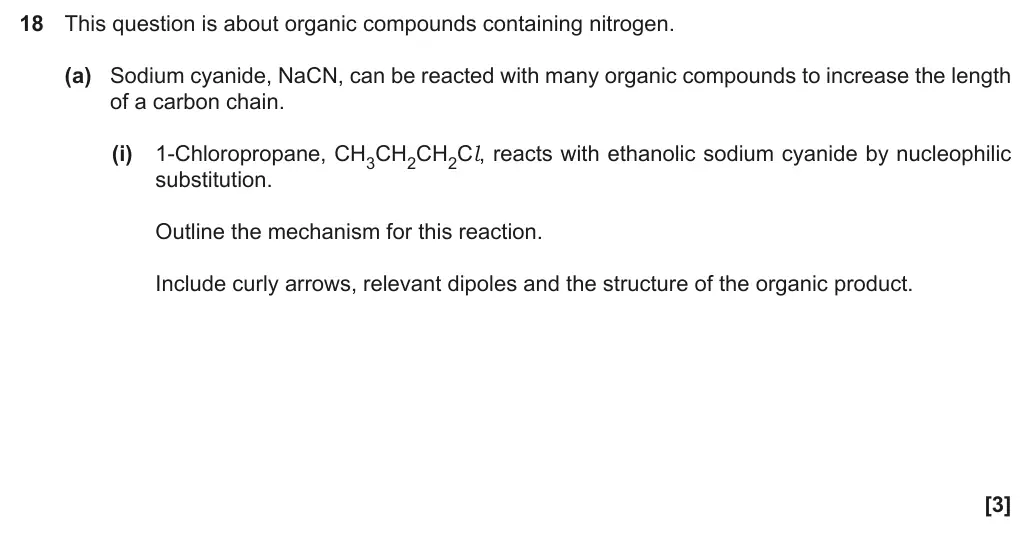
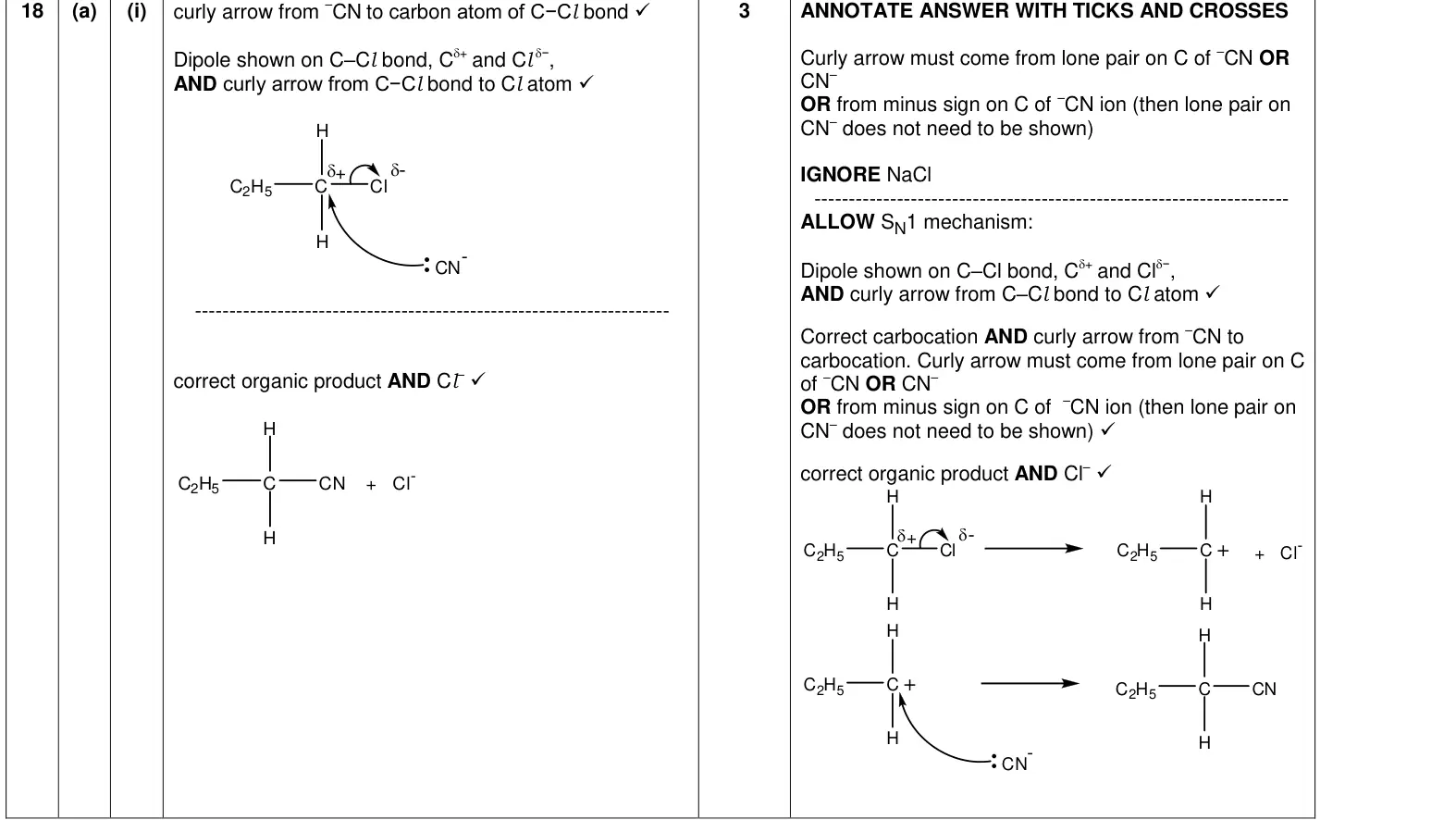
18(a)(i) Carbon–carbon bond formation, Organic basics: naming, formulae and isomerism 3Mechanism
18(a)(ii) Carbon–carbon bond formation, Organic synthesis (Module 6) 3Complete table/diagram
18(a)(iii) Amines 2Short answer
18(a)(iv) Polyesters and polyamides 3Drawing / labelling
18(b)(i) Polyesters and polyamides 2Structure / isomer
18(b)(ii) Atomic structure and isotopes 1Calculation
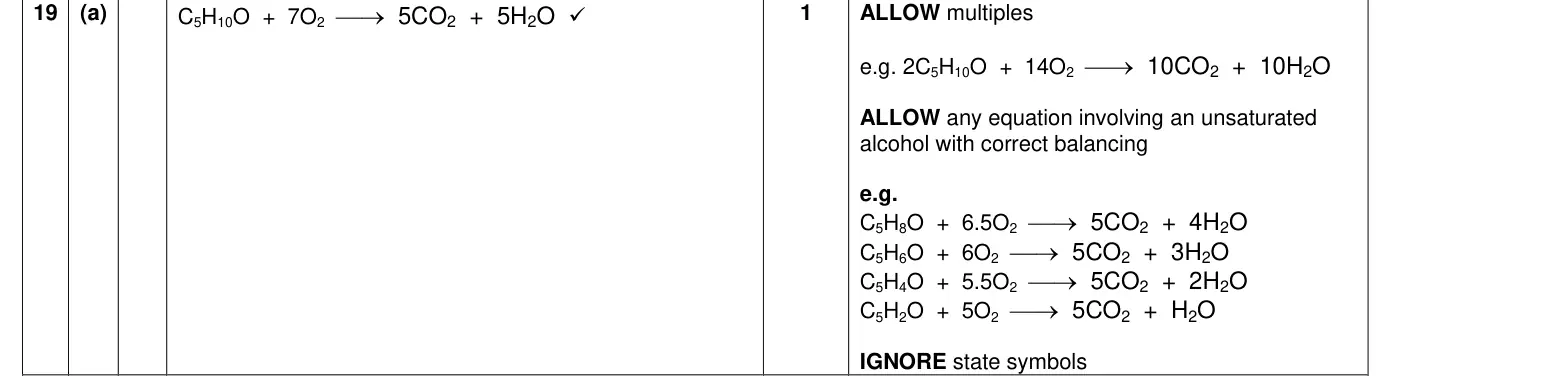
19(a) Alcohols, Formulae and equations, Organic basics: naming, formulae and isomerism 1Equation writing
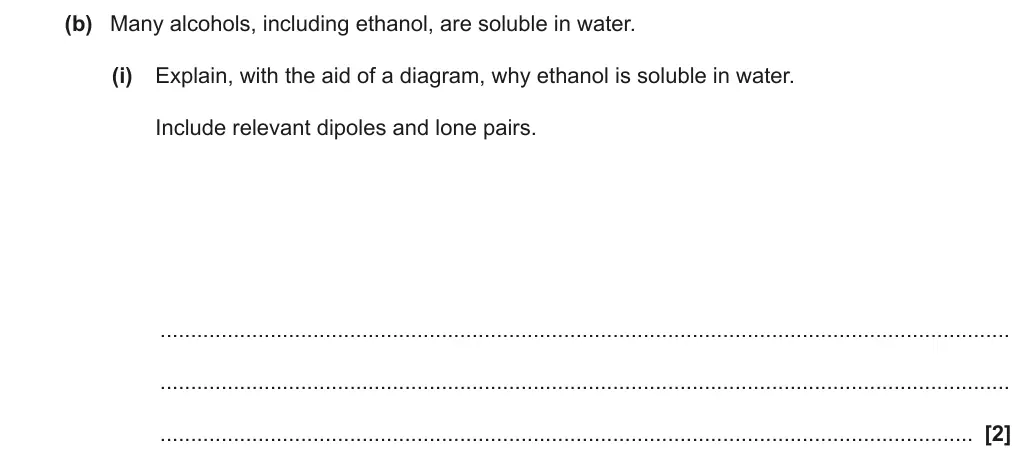
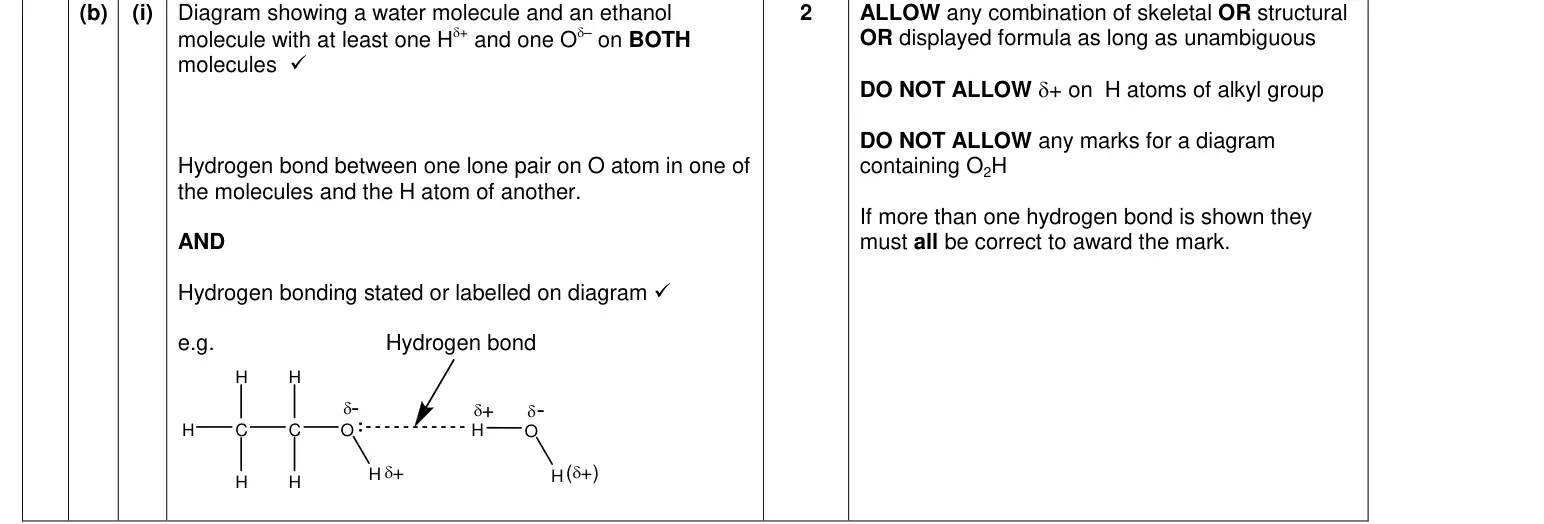
19(b)(i) Alcohols, Bonding, structure and shapes of molecules 2Drawing / labelling
19(b)(ii) Alcohols 1Data interpretation
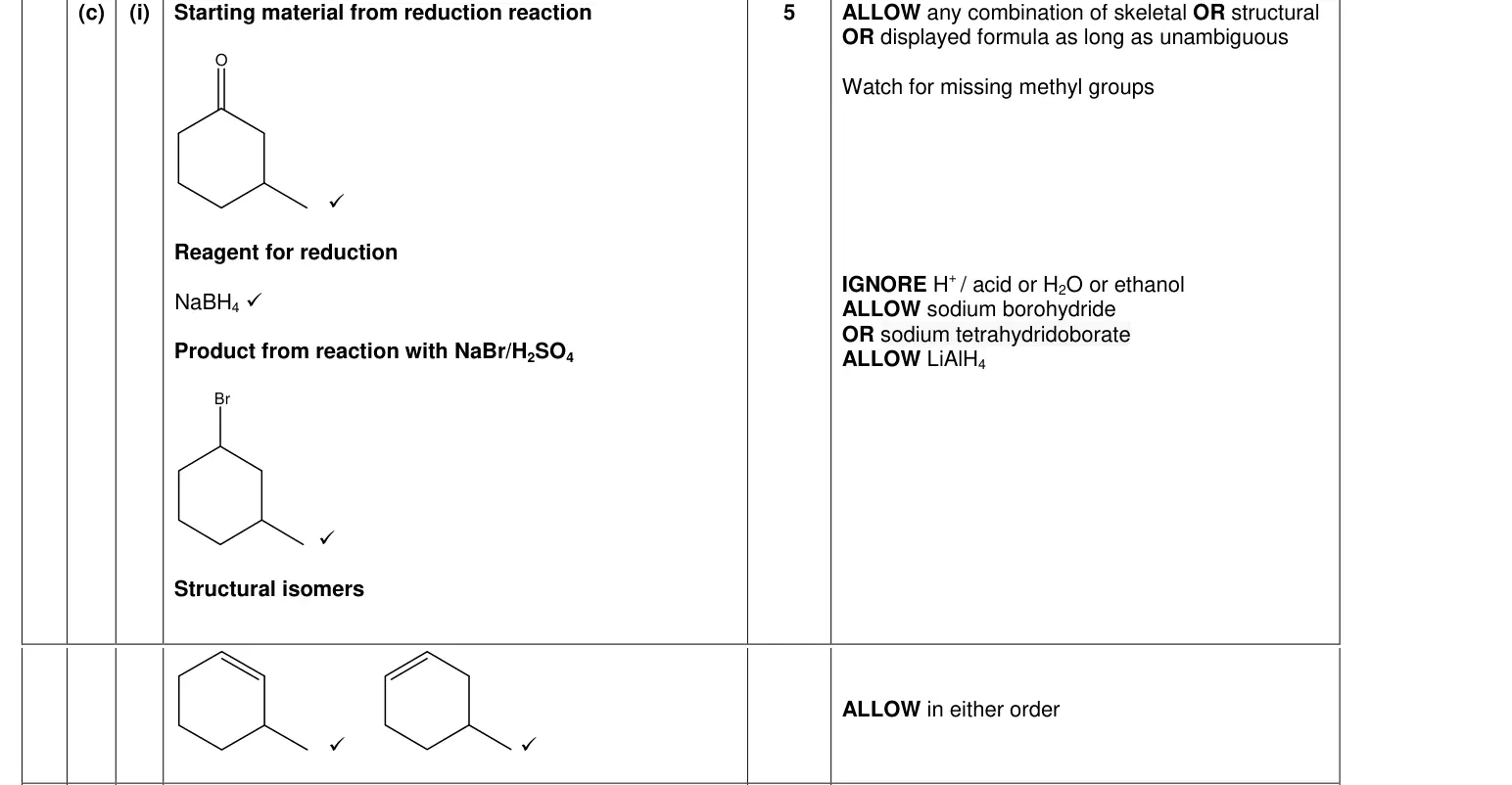
19(c)(i) Carbonyl compounds: aldehydes and ketones, Organic basics: naming, formulae and isomerism, Alcohols, Organic synthesis (Module 6) 5Short answer
19(c)(ii) Organic basics: naming, formulae and isomerism 1Short answer
19(d) Alcohols 5Equation writing
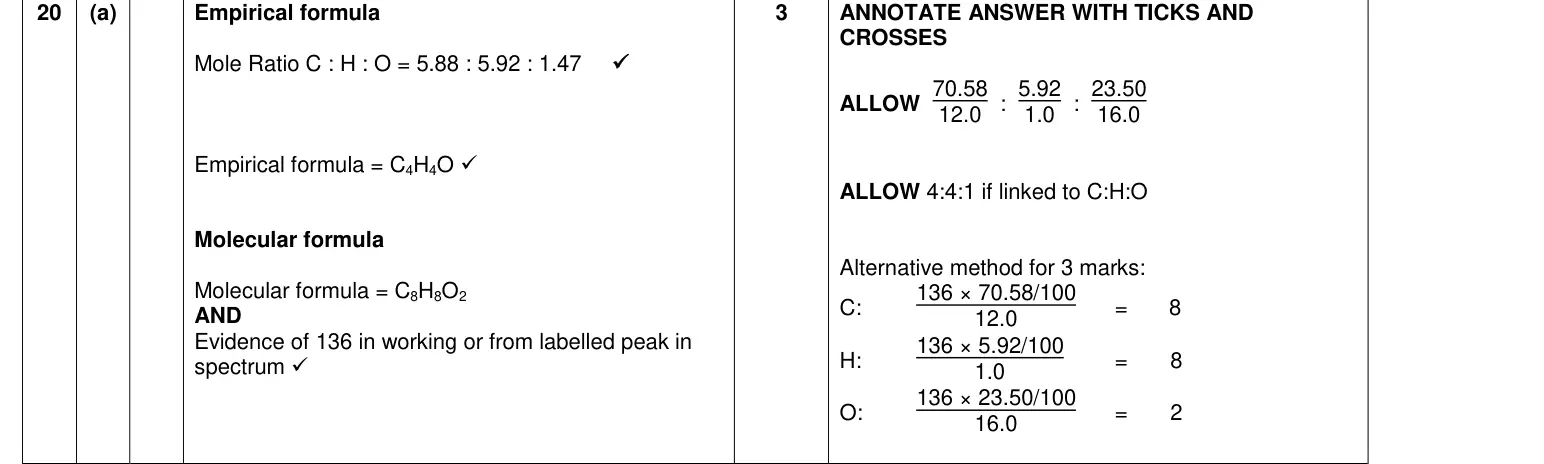
20(a) Amount of substance (moles), Infrared spectroscopy and mass spectrometry 3AO1Calculation
20(b) Chromatography and tests for functional groups 3Short answer
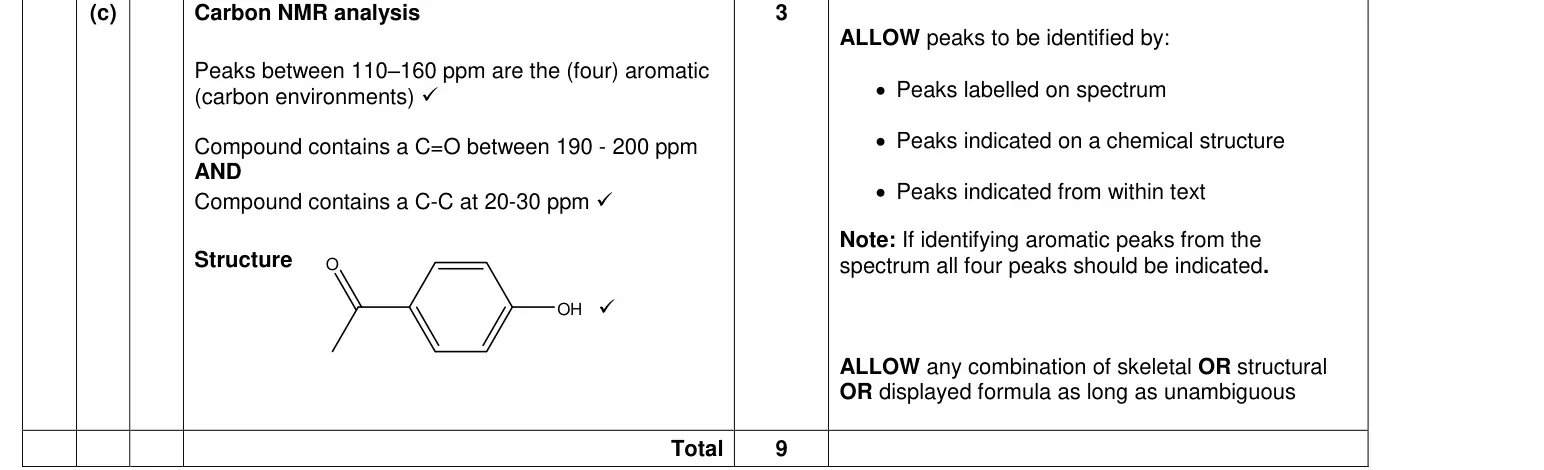
20(c) NMR spectroscopy and combined techniques 3Data interpretation
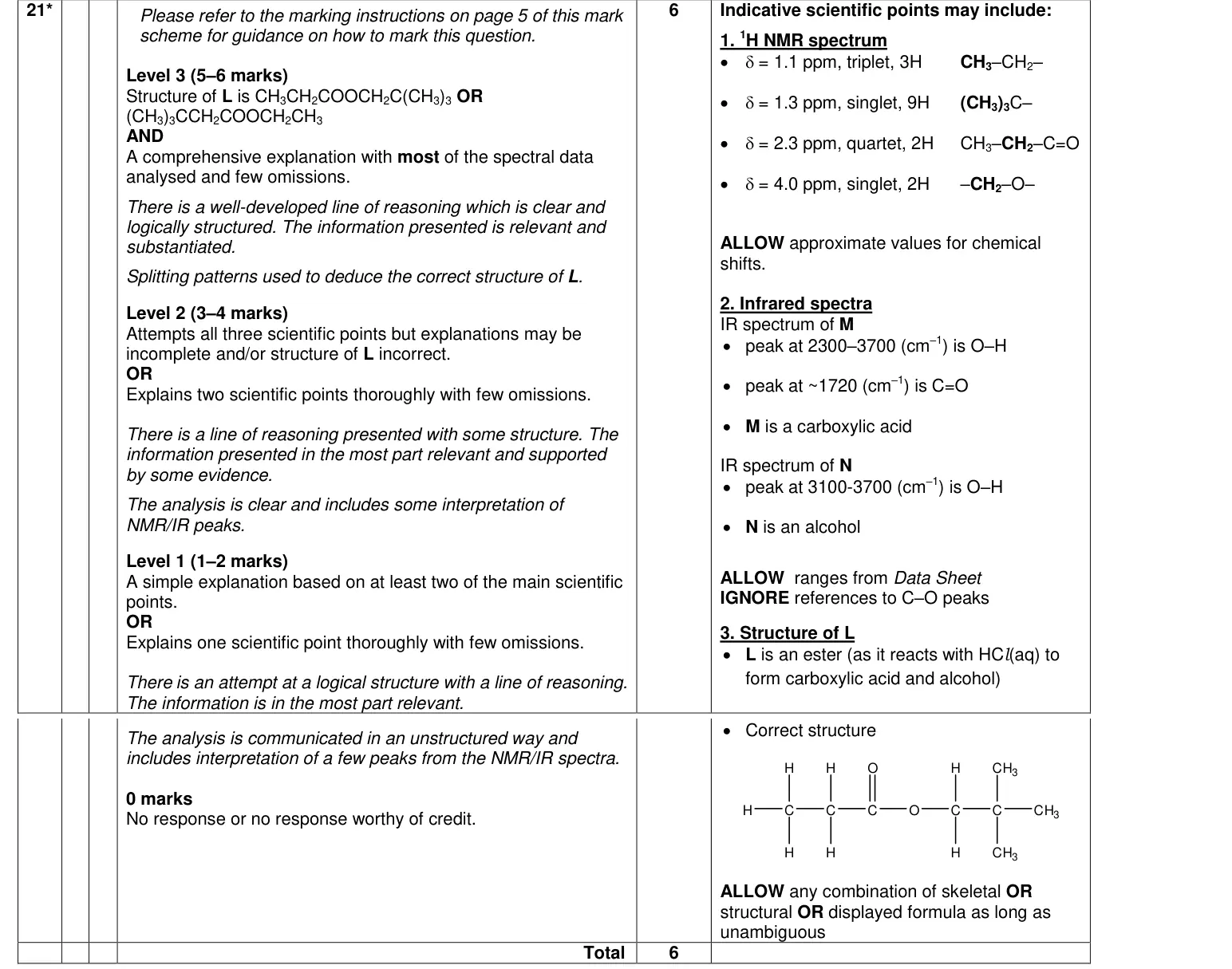
21 NMR spectroscopy and combined techniques, Infrared spectroscopy and mass spectrometry, Carboxylic acids, esters and acyl chlorides 6Level of response

The questions

12345678910111213141516(a)16(b)(i)16(b)(ii)16(b)(iii)16(c)16(d)(i)16(d)(ii)16(d)(iii)16(d)(iv)16(e)(i)16(e)(ii)17(a)(i)17(a)(ii)17(b)(i)17(b)(ii)17(c)(i)17(c)(ii)18(a)(i)18(a)(ii)18(a)(iii)18(a)(iv)18(b)(i)18(b)(ii)19(a)19(b)(i)19(b)(ii)19(c)(i)19(c)(ii)19(d)20(a)20(b)20(c)21
June 2017 · Paper 2 · Q1 1 mark Multiple choice haloalkanes
1 A chemist compares the rates of hydrolysis of 1-chloropropane and 1-bromopropane in ethanol.
Which reagent in aqueous solution should be used?
A Silver chloride
B Silver nitrate
C Potassium chloride
D Potassium nitrate
Your answer
[1]
June 2017 · Paper 2 · Q2 1 mark Multiple choice organic basics
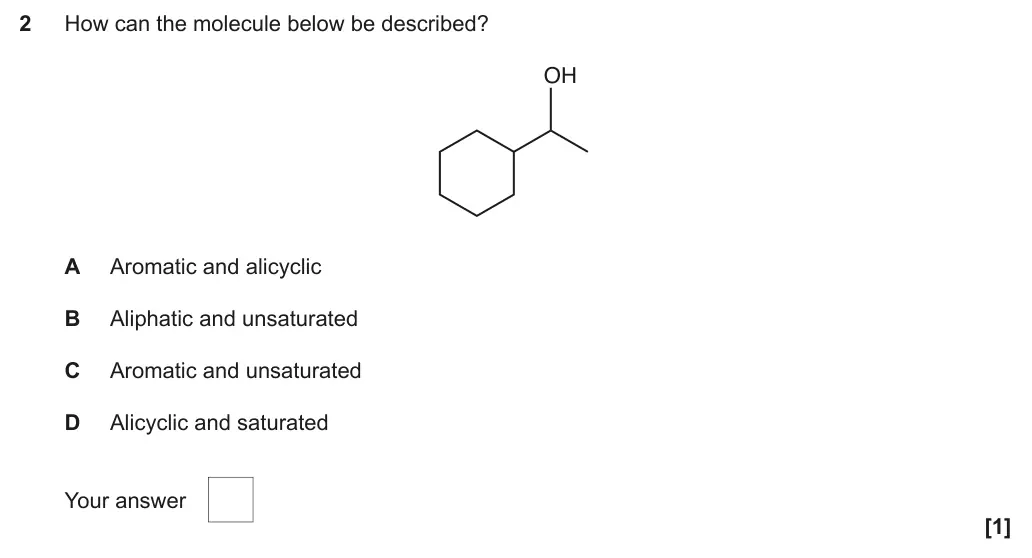
2 How can the molecule below be described?
OH
A Aromatic and alicyclic
B Aliphatic and unsaturated
C Aromatic and unsaturated
D Alicyclic and saturated
Your answer
[1]
June 2017 · Paper 2 · Q3 1 mark Multiple choice amount of substance
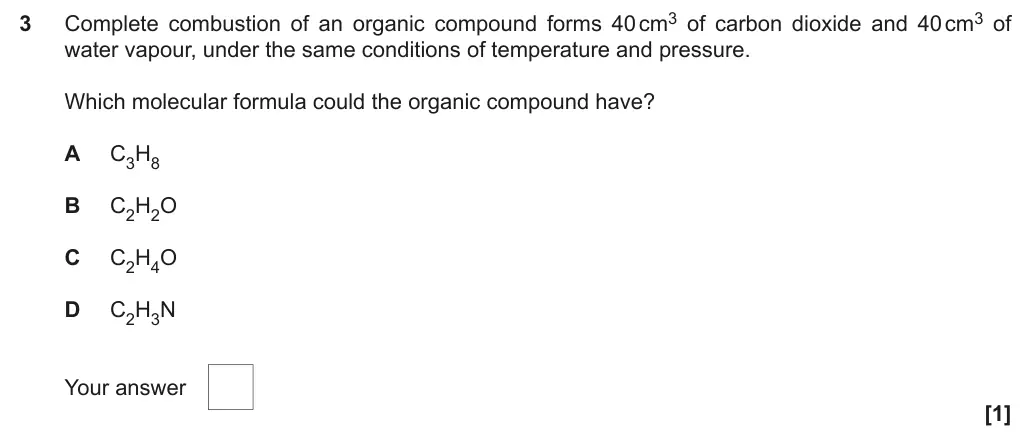
3 Complete combustion of an organic compound forms 40 cm3 of carbon dioxide and 40 cm3 of
water vapour, under the same conditions of temperature and pressure.
Which molecular formula could the organic compound have?
A C3H8
B C2H2O
C C2H4O
D C2H3N
Your answer
[1]
June 2017 · Paper 2 · Q4 1 mark Multiple choice alkenes
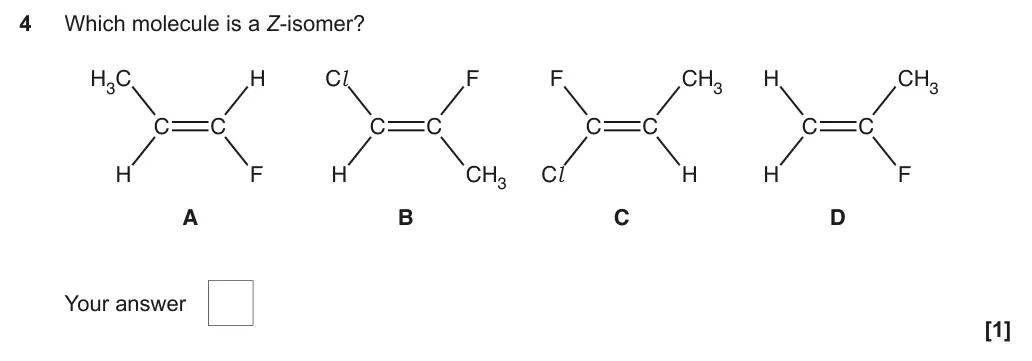
4 Which molecule is a Z-isomer?
H3C H Cl F F CH3 H CH3
C C C C C C C C
H F H CH3 Cl H H F
A B C D
Your answer
[1]
June 2017 · Paper 2 · Q5 1 mark Multiple choice amount of substance
5 Which type of reaction has the greatest atom economy?
A Substitution
B Hydrolysis
C Elimination
D Addition
Your answer
[1]
June 2017 · Paper 2 · Q6 1 mark Multiple choice bonding and structure
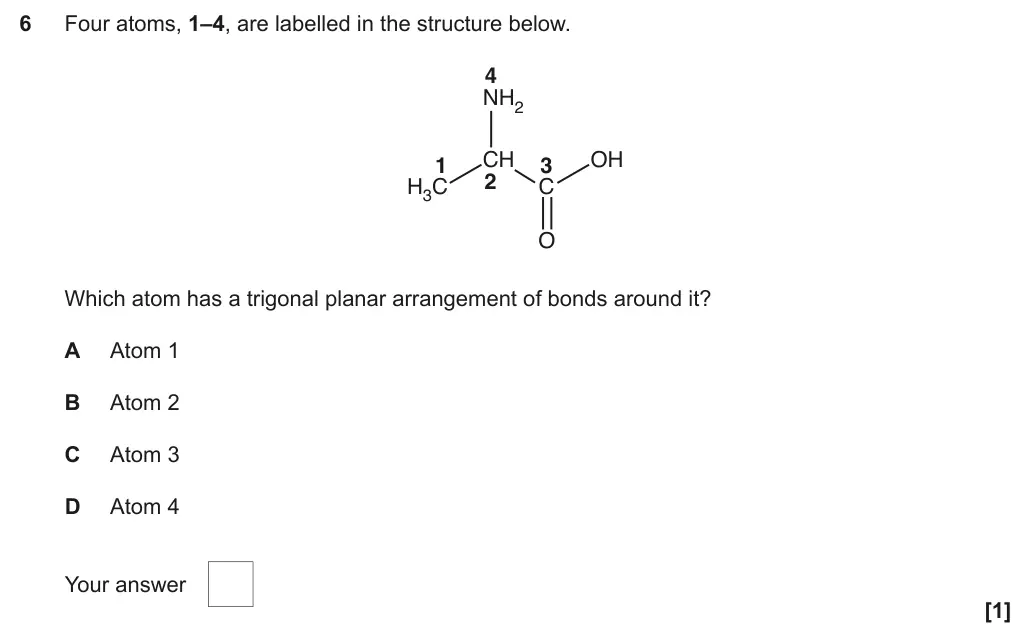
6 Four atoms, 1–4, are labelled in the structure below.
4
NH2
1 CH 3 OH
H3C 2 C
O
Which atom has a trigonal planar arrangement of bonds around it?
A  Atom 1
B Atom 2
C Atom 3
D Atom 4
Your answer
[1]
June 2017 · Paper 2 · Q7 1 mark Multiple choice organic synthesisamino acids amides and chirality
7 Which molecule is a secondary amine?
NH N
O O
NH N
O O
A B C D
Your answer
[1]
June 2017 · Paper 2 · Q8 1 mark Multiple choice amino acids amides and chirality
8 What is the number of chiral centres in the molecule below?
NH2
H
N
S
O
N
HO
O
OH
O
A 2
B 3
C 4
D 5
Your answer
[1]
June 2017 · Paper 2 · Q9 1 mark Multiple choice organic basicsamount of substance
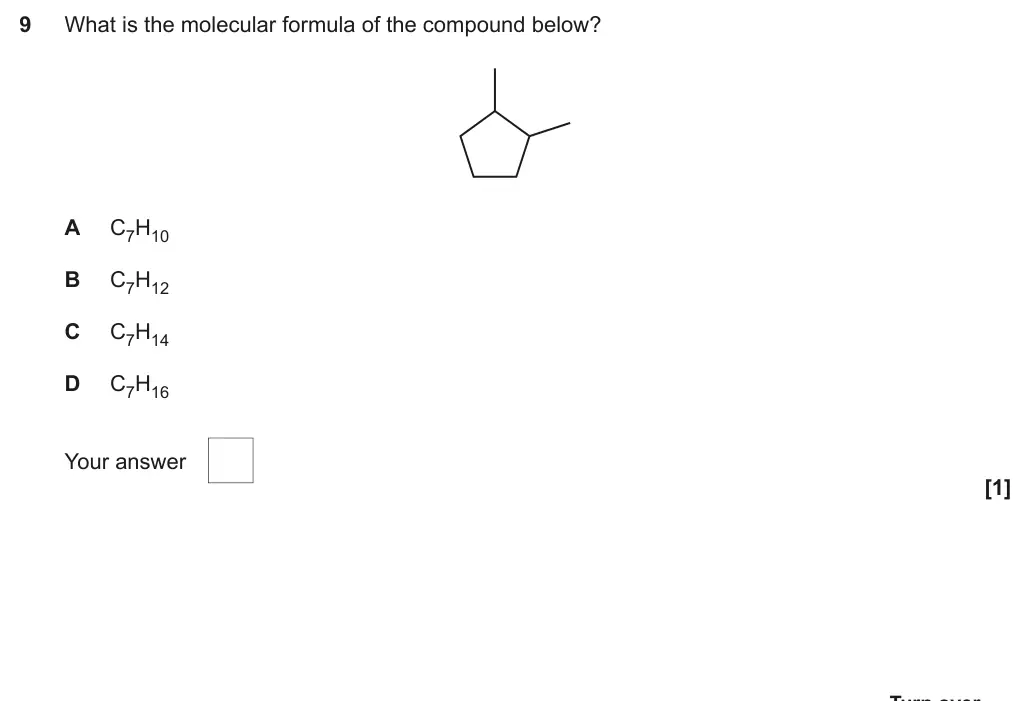
9 What is the molecular formula of the compound below?
A C7H10
B C7H12
C C7H14
D C7H16
Your answer
[1]
June 2017 · Paper 2 · Q10 1 mark Multiple choice carboxylic acids and estersacids and titrations
10 Equal amounts of the four compounds are added to the same volume of water.
Which compound would produce the most acidic solution?
A CH3CONH2
B CH3COOH
C CH3COOCH3
D CH3COCl
Your answer
[1]
June 2017 · Paper 2 · Q11 1 mark Multiple choice nmr spectroscopy
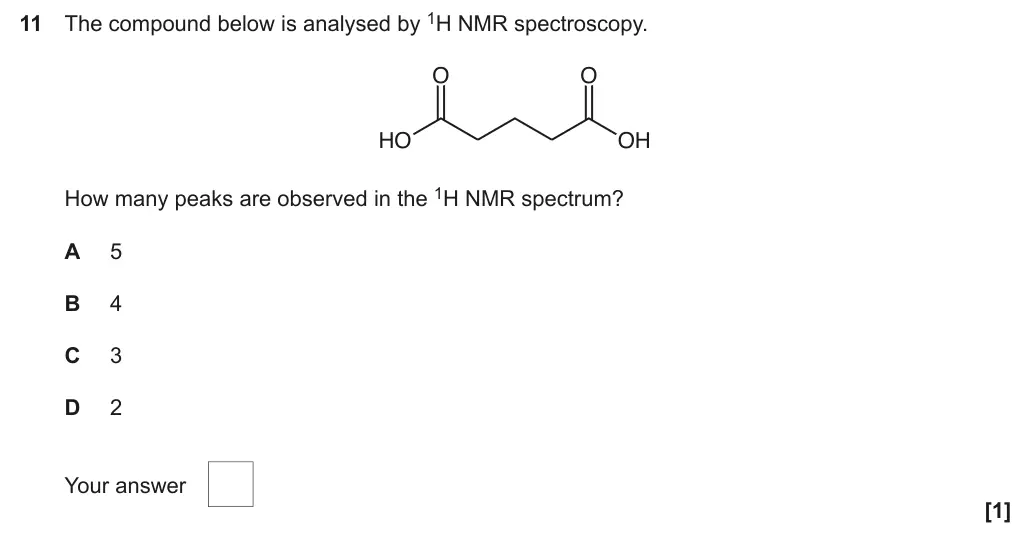
11 The compound below is analysed by 1H NMR spectroscopy.
O O
HO OH
How many peaks are observed in the 1H NMR spectrum?
A 5
B 4
C 3
D 2
Your answer
[1]
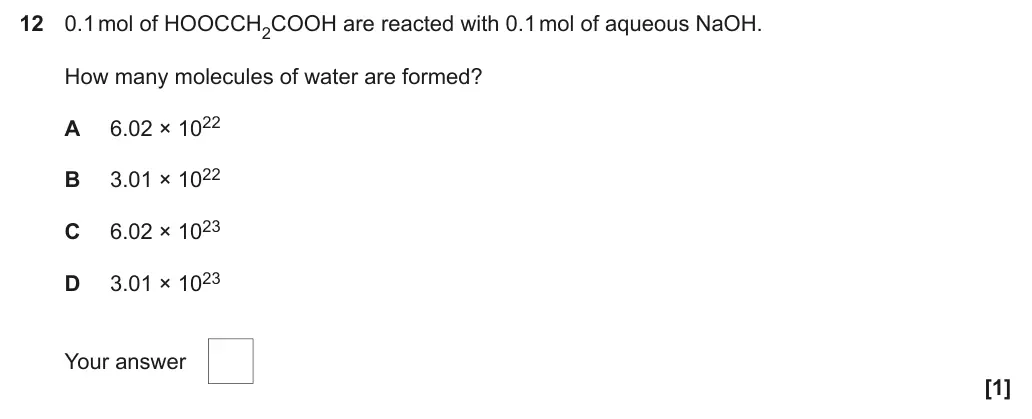
June 2017 · Paper 2 · Q12 1 mark Multiple choice carboxylic acids and estersamount of substance
12 0.1 mol of HOOCCH2COOH are reacted with 0.1 mol of aqueous NaOH.
How many molecules of water are formed?
A 6.02 × 10²²
B 3.01 × 10²²
C 6.02 × 10²³
D 3.01 × 10²³
Your answer
[1]
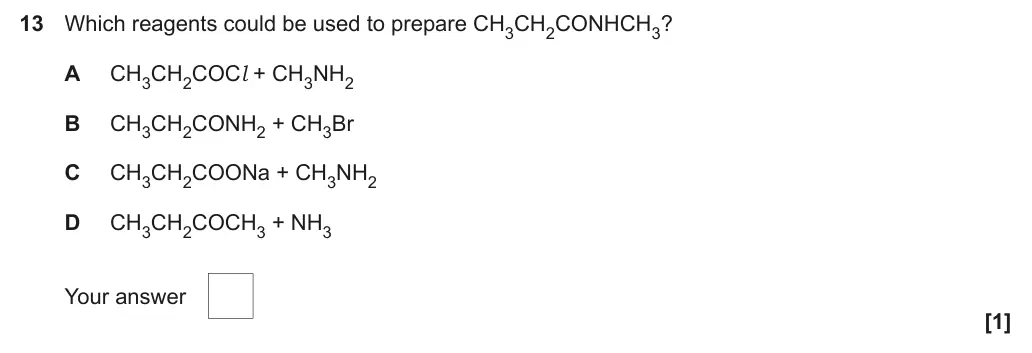
June 2017 · Paper 2 · Q13 1 mark Multiple choice carboxylic acids and estersamino acids amides and chirality
13 Which reagents could be used to prepare CH3CH2CONHCH3?
A CH3CH2COCl + CH3NH2
B CH3CH2CONH2 + CH3Br
C CH3CH2COONa + CH3NH2
D CH3CH2COCH3 + NH3
Your answer
[1]
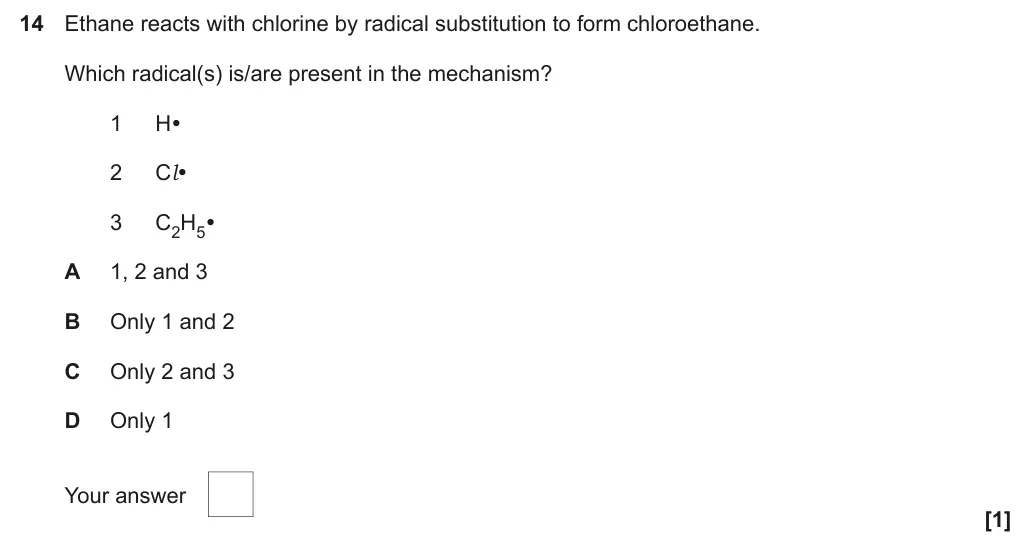
June 2017 · Paper 2 · Q14 1 mark Multiple choice alkanesorganic basics
14 Ethane reacts with chlorine by radical substitution to form chloroethane.
Which radical(s) is/are present in the mechanism?
1 H
2 Cl
3 C2H5
A 1, 2 and 3
B Only 1 and 2
C Only 2 and 3
D Only 1
Your answer
[1]
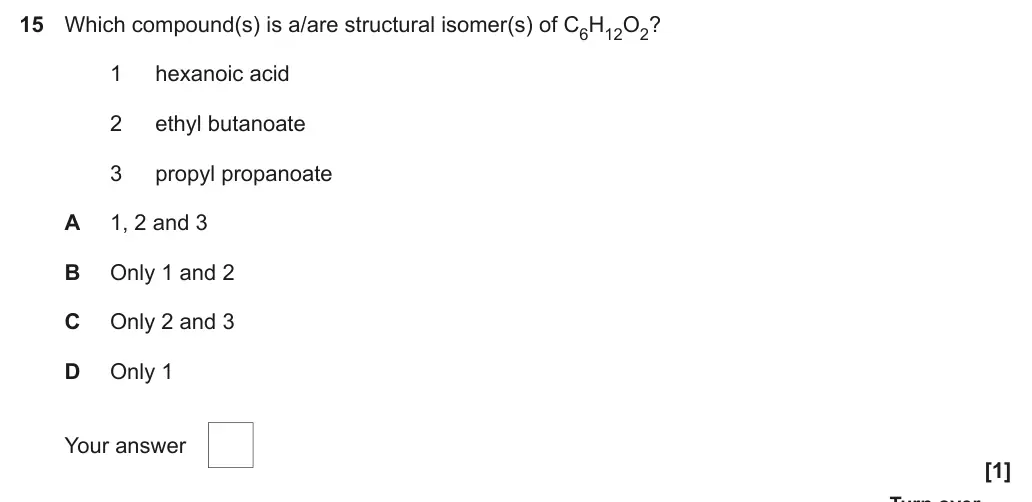
June 2017 · Paper 2 · Q15 1 mark Multiple choice organic basics
15 Which compound(s) is a/are structural isomer(s) of C6H12O2?
1 hexanoic acid
2 ethyl butanoate
3 propyl propanoate
A 1, 2 and 3
B Only 1 and 2
C Only 2 and 3
D Only 1
Your answer
[1]
June 2017 · Paper 2 · Q16(a) 2 marks Structure / isomer alkanesbonding and structure
SECTION B
Answer all the questions.
16 This question is about unsaturated hydrocarbons.
(a) Compound A and compound B are isomers.
compound A compound B
Compound A has a lower melting point than compound B.
Suggest why.
...................................................................................................................................................
...................................................................................................................................................
...................................................................................................................................................
...................................................................................................................................................
............................................................................................................................................. [2]
June 2017 · Paper 2 · Q16(b)(i) 1 mark Short answer organic basics
(b) Compound C, CH3CH2CH=CHCH2CH2OH, exists as cis and trans stereoisomers.
(i) Name compound C.
..................................................................................................................................... [1]
June 2017 · Paper 2 · Q16(b)(ii) 1 mark Short answer alkenes
Earlier part of question 16 that this part usesEarlier part of June 2017 Paper 2 question 16
(ii) Define the term stereoisomers.
...........................................................................................................................................
...........................................................................................................................................
...........................................................................................................................................
..................................................................................................................................... [1]
June 2017 · Paper 2 · Q16(b)(iii) 2 marks Structure / isomer alkenes
Earlier part of question 16 that this part usesEarlier part of June 2017 Paper 2 question 16
(iii) Draw the structures of the cis and trans stereoisomers of compound C.
cis trans
[2]
June 2017 · Paper 2 · Q16(c) 1 mark Complete table/diagram alkenes
(c) The C=C group in an alkene contains a π-bond.
Complete the diagram below to show how p-orbitals are involved in the formation of a π-bond.
[1]
June 2017 · Paper 2 · Q16(d)(i) 1 mark Short answer alkenes
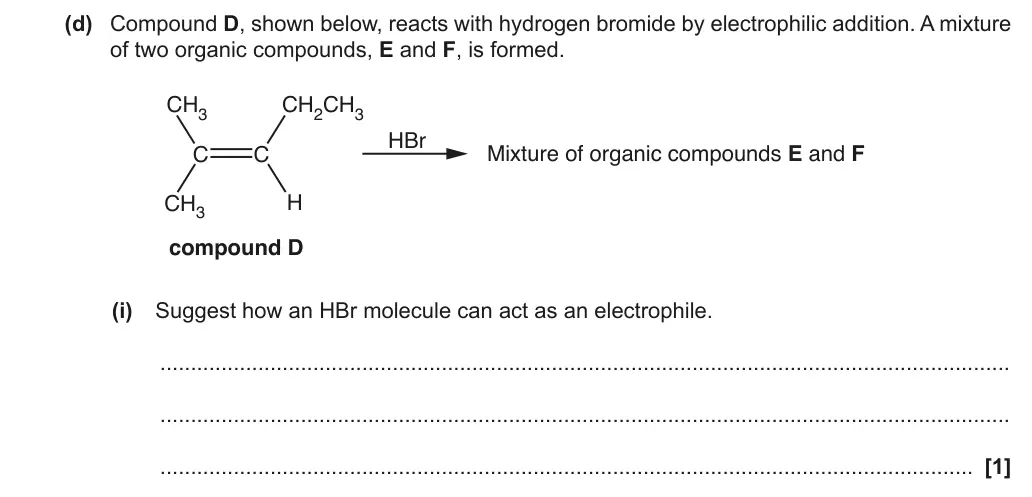
(d) Compound D, shown below, reacts with hydrogen bromide by electrophilic addition. A mixture
of two organic compounds, E and F, is formed.
CH3 CH2CH3
HBr
C C Mixture of organic compounds E and F
CH3 H
compound D
(i) Suggest how an HBr molecule can act as an electrophile.
...........................................................................................................................................
...........................................................................................................................................
..................................................................................................................................... [1]
June 2017 · Paper 2 · Q16(d)(ii) 2 marks Structure / isomer alkenes
Earlier part of question 16 that this part usesEarlier part of June 2017 Paper 2 question 16
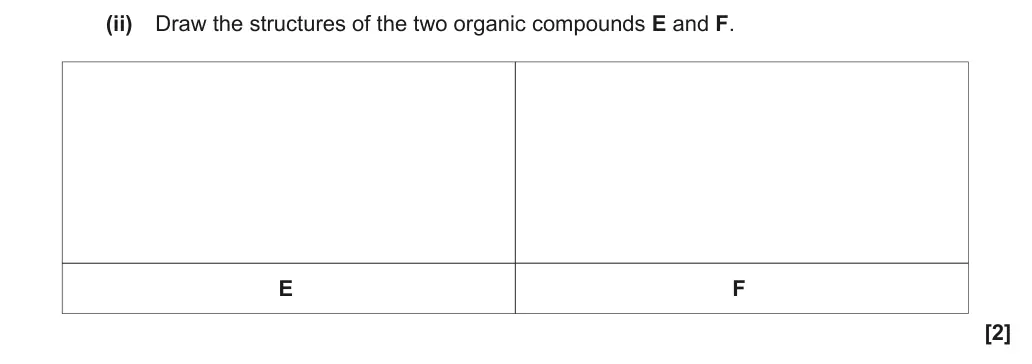
(ii) Draw the structures of the two organic compounds E and F.
E F
[2]
June 2017 · Paper 2 · Q16(d)(iii) 3 marks Mechanism alkenesorganic basics
Earlier parts of question 16 that this part usesEarlier part of June 2017 Paper 2 question 16Earlier part of June 2017 Paper 2 question 16
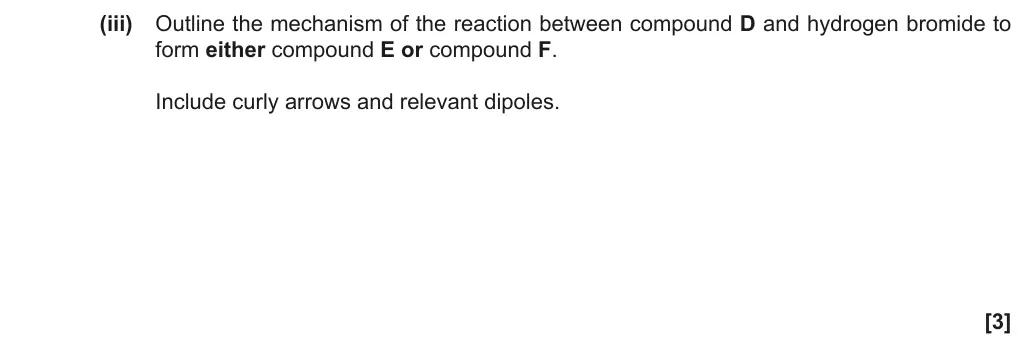
(iii) Outline the mechanism of the reaction between compound D and hydrogen bromide to
form either compound E or compound F.
Include curly arrows and relevant dipoles.
[3]
June 2017 · Paper 2 · Q16(d)(iv) 1 mark Short answer alkenes
Earlier parts of question 16 that this part usesEarlier part of June 2017 Paper 2 question 16Earlier part of June 2017 Paper 2 question 16
(iv) Which of E or F is the major organic product?
Explain your answer.
Major organic product  .......................................................................................................
Explanation  .......................................................................................................................
...........................................................................................................................................
...........................................................................................................................................
..................................................................................................................................... [1]
June 2017 · Paper 2 · Q16(e)(i) 2 marks Calculation amount of substancealkenes
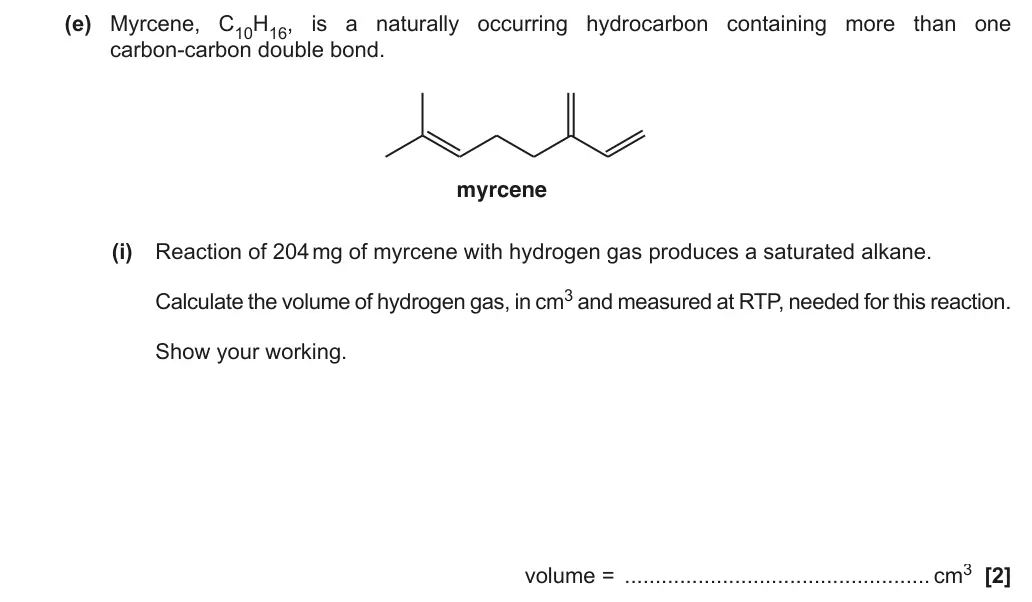
(e) Myrcene, C10H16, is a naturally occurring hydrocarbon containing more than one
carbon-carbon double bond.
myrcene
(i) Reaction of 204 mg of myrcene with hydrogen gas produces a saturated alkane.
Calculate the volume of hydrogen gas, in cm3 and measured at RTP, needed for this reaction.
Show your working.
volume =  .................................................. cm3  [2]
June 2017 · Paper 2 · Q16(e)(ii) 4 marks Calculation amount of substanceformulae and equationsorganic basicsalkenes
Earlier part of question 16 that this part usesEarlier part of June 2017 Paper 2 question 16
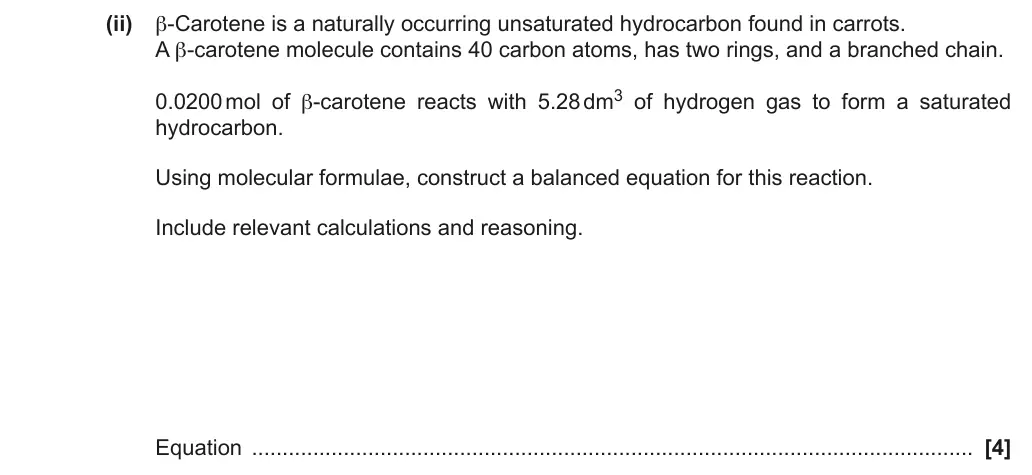
(ii) β-Carotene is a naturally occurring unsaturated hydrocarbon found in carrots.
A β-carotene molecule contains 40 carbon atoms, has two rings, and a branched chain.
0.0200 mol of β-carotene reacts with 5.28 dm3 of hydrogen gas to form a saturated
hydrocarbon.
Using molecular formulae, construct a balanced equation for this reaction.
Include relevant calculations and reasoning.
Equation  ...................................................................................................................... [4]
June 2017 · Paper 2 · Q17(a)(i) 5 marks Mechanism aromatic compounds
17 This question is about the chemistry of aromatic compounds.
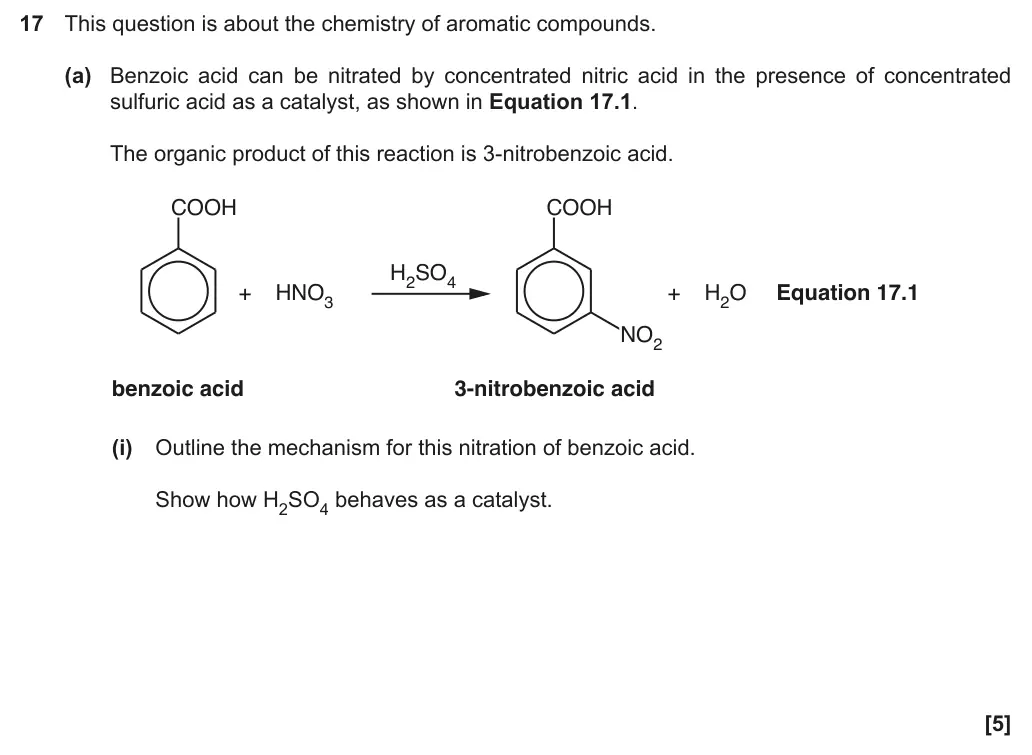
(a) Benzoic acid can be nitrated by concentrated nitric acid in the presence of concentrated
sulfuric acid as a catalyst, as shown in Equation 17.1.
The organic product of this reaction is 3-nitrobenzoic acid.
COOH COOH
H2SO4
+ HNO3 + H2O Equation 17.1
NO2
benzoic acid 3-nitrobenzoic acid
(i) Outline the mechanism for this nitration of benzoic acid.
Show how H2SO4 behaves as a catalyst.
[5]
June 2017 · Paper 2 · Q17(a)(ii) 6 marks 6-mark level of response organic synthesisamount of substance
Earlier part of question 17 that this part usesEarlier part of June 2017 Paper 2 question 17
(ii)* A chemist carries out the reaction in Equation 17.1 using 4.97 g of benzoic acid.
The chemist obtains 3-nitrobenzoic acid as an impure solid.
The chemist purifies the solid to obtain 4.85 g of 3-nitrobenzoic acid.
Describe a method to obtain a pure sample of 3-nitrobenzoic acid from the impure solid,
determine the percentage yield and check its purity.
...........................................................................................................................................
...........................................................................................................................................
...........................................................................................................................................
...........................................................................................................................................
...........................................................................................................................................
...........................................................................................................................................
...........................................................................................................................................
...........................................................................................................................................
...........................................................................................................................................
...........................................................................................................................................
...........................................................................................................................................
...........................................................................................................................................
...........................................................................................................................................
...........................................................................................................................................
...........................................................................................................................................
..................................................................................................................................... [6]
June 2017 · Paper 2 · Q17(b)(i) 1 mark Data interpretation aromatic compoundspractical skills
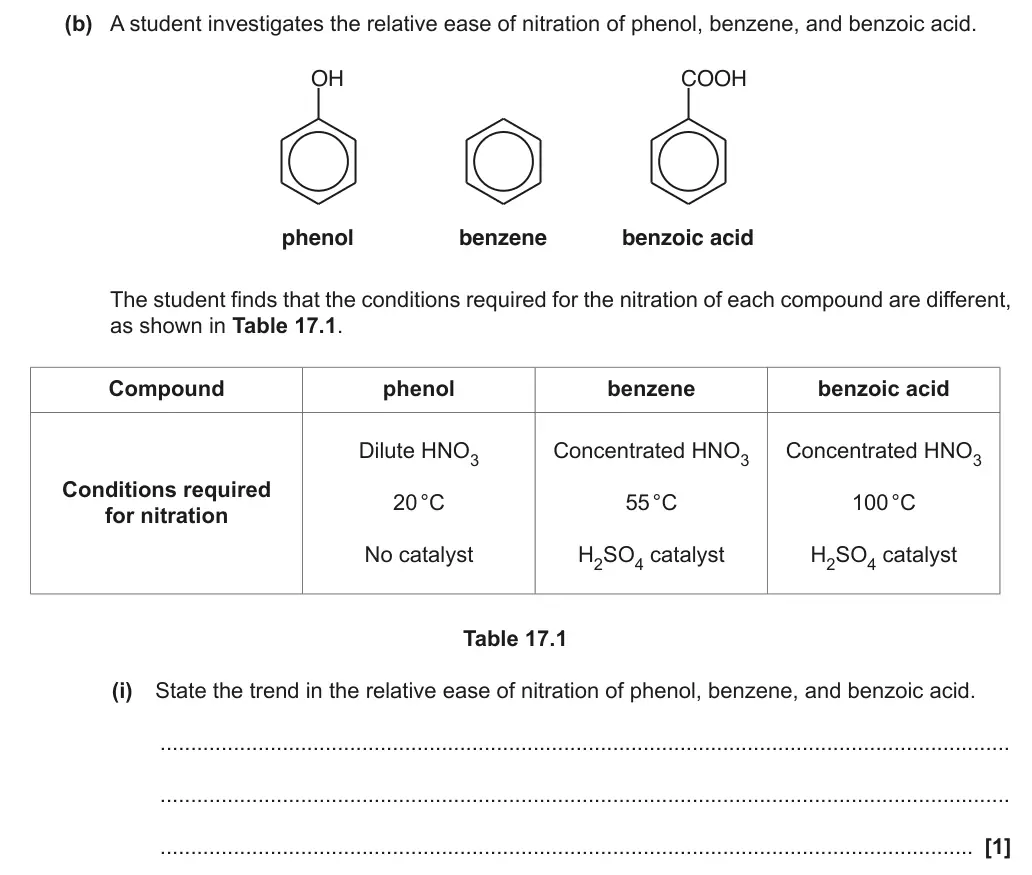
(b) A student investigates the relative ease of nitration of phenol, benzene, and benzoic acid.
OH COOH
phenol benzene benzoic acid
The student finds that the conditions required for the nitration of each compound are different,
as shown in Table 17.1.
Compound phenol benzene benzoic acid
Dilute HNO3 Concentrated HNO3 Concentrated HNO3
Conditions required
20 °C 55 °C 100 °C
for nitration
No catalyst H2SO4 catalyst H2SO4 catalyst
Table 17.1
(i) State the trend in the relative ease of nitration of phenol, benzene, and benzoic acid.
...........................................................................................................................................
...........................................................................................................................................
..................................................................................................................................... [1]
June 2017 · Paper 2 · Q17(b)(ii) 3 marks Short answer aromatic compounds
Earlier part of question 17 that this part usesEarlier part of June 2017 Paper 2 question 17
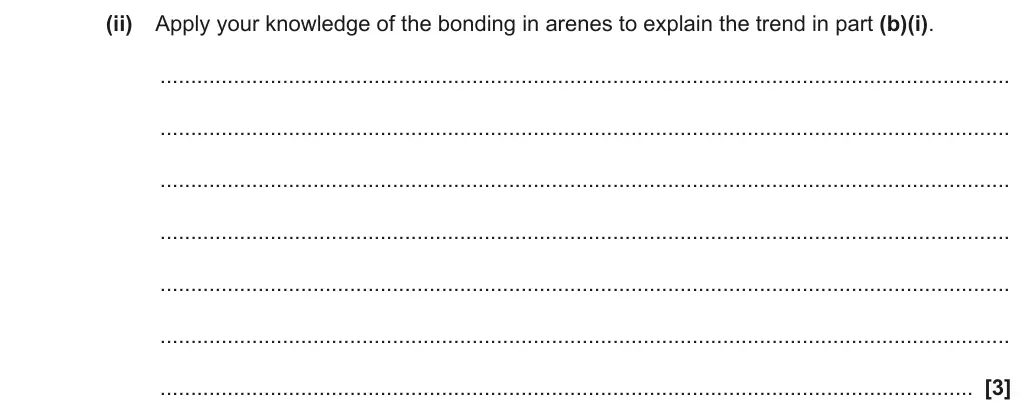
(ii) Apply your knowledge of the bonding in arenes to explain the trend in part (b)(i).
...........................................................................................................................................
...........................................................................................................................................
...........................................................................................................................................
...........................................................................................................................................
...........................................................................................................................................
...........................................................................................................................................
..................................................................................................................................... [3]
June 2017 · Paper 2 · Q17(c)(i) 3 marks Complete table/diagram aromatic compoundsaminesorganic synthesis
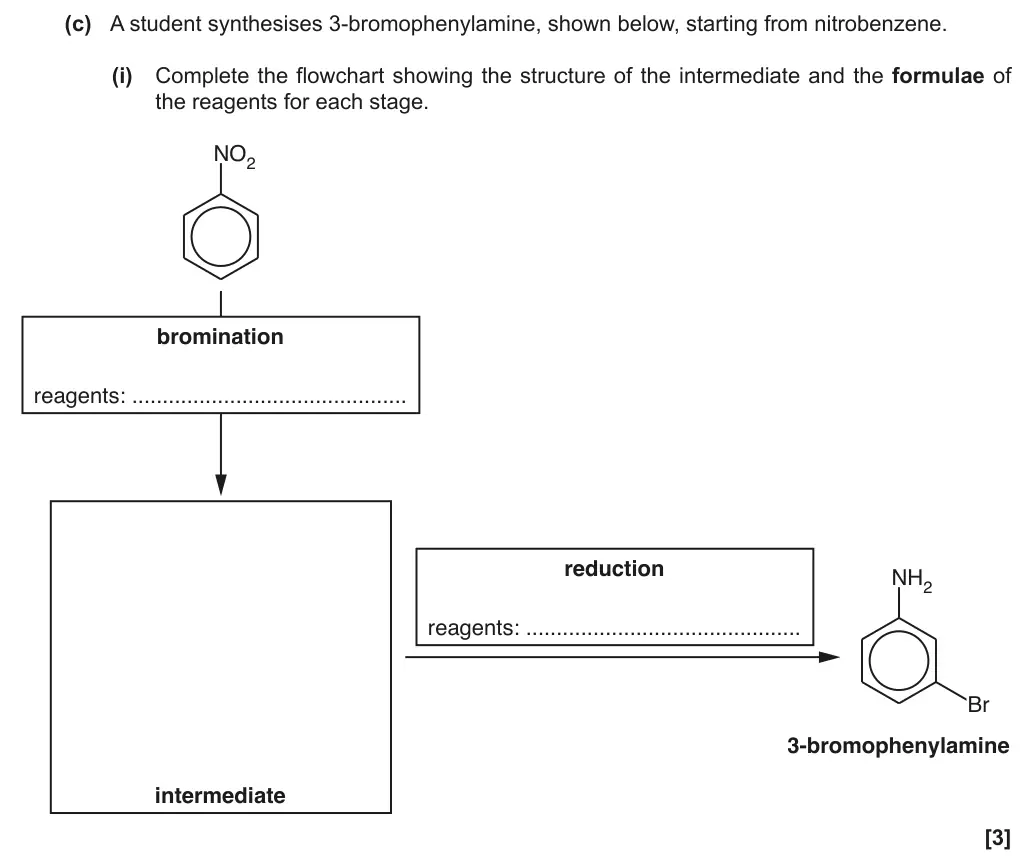
(c) A student synthesises 3-bromophenylamine, shown below, starting from nitrobenzene.
(i) Complete the flowchart showing the structure of the intermediate and the formulae of
the reagents for each stage.
NO2
bromination
reagents: .............................................
reduction
NH2
reagents: .............................................
Br
3-bromophenylamine
intermediate
[3]
June 2017 · Paper 2 · Q17(c)(ii) 3 marks Structure / isomer aromatic compounds
Earlier part of question 17 that this part usesEarlier part of June 2017 Paper 2 question 17
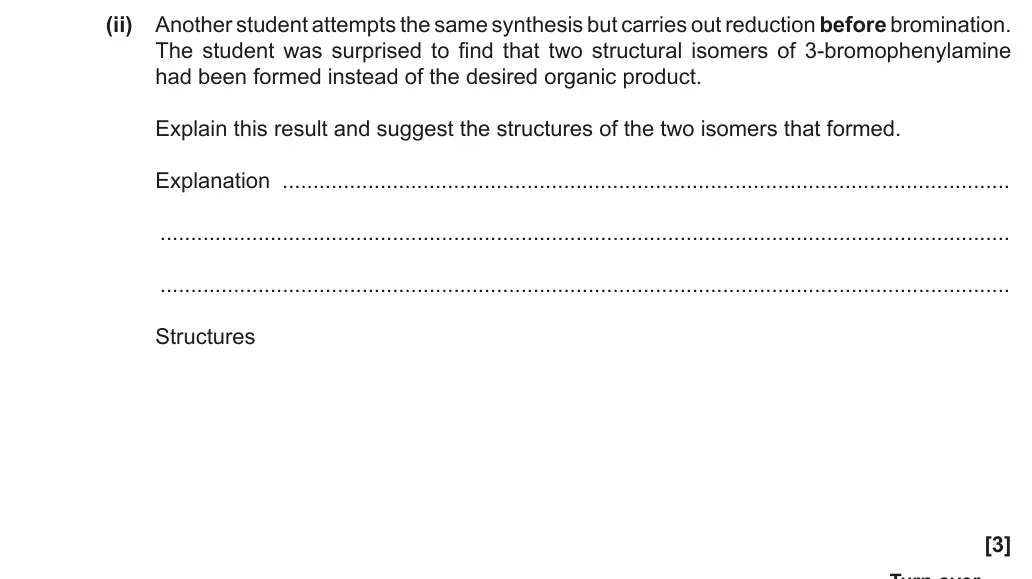
(ii) Another student attempts the same synthesis but carries out reduction before bromination.
The student was surprised to find that two structural isomers of 3-bromophenylamine
had been formed instead of the desired organic product.
Explain this result and suggest the structures of the two isomers that formed.
Explanation  .......................................................................................................................
...........................................................................................................................................
...........................................................................................................................................
Structures
[3]
June 2017 · Paper 2 · Q18(a)(i) 3 marks Mechanism carbon carbon bond formationorganic basics
18 This question is about organic compounds containing nitrogen.
(a) Sodium cyanide, NaCN, can be reacted with many organic compounds to increase the length
of a carbon chain.
(i) 1-Chloropropane, CH3CH2CH2Cl, reacts with ethanolic sodium cyanide by nucleophilic
substitution.
Outline the mechanism for this reaction.
Include curly arrows, relevant dipoles and the structure of the organic product.
[3]
June 2017 · Paper 2 · Q18(a)(ii) 3 marks Complete table/diagram carbon carbon bond formationorganic synthesis
Earlier part of question 18 that this part usesEarlier part of June 2017 Paper 2 question 18
(ii) Compound G is used to synthesise compounds H and I as shown in the flowchart below.
Complete the flowchart showing the structure of compound G and the formulae of the
reagents for Reaction 2 and Reaction 3.
OH
O
H C C
OH
H
compound I
Reaction 3
reagents: ..........................................
OH
Reaction 1
H C CN
NaCN/H+
H
compound G
Reaction 2
reagents: ..........................................
OH H
H C C NH2
H H
compound H
[3]
June 2017 · Paper 2 · Q18(a)(iii) 2 marks Short answer amines
Earlier part of question 18 that this part usesEarlier part of June 2017 Paper 2 question 18
(iii) Compound H reacts with dilute hydrochloric acid to form a salt.
Explain why compound H can react with dilute hydrochloric acid and suggest a structure
for the salt formed.
Explanation  .......................................................................................................................
...........................................................................................................................................
...........................................................................................................................................
...........................................................................................................................................
Structure
[2]
June 2017 · Paper 2 · Q18(a)(iv) 3 marks Drawing / labelling condensation polymers
Earlier part of question 18 that this part usesEarlier part of June 2017 Paper 2 question 18
(iv) Compound I is the monomer for the biodegradable polymer J.
Draw two repeat units of polymer J and suggest a reason why it is biodegradable.
...........................................................................................................................................
...........................................................................................................................................
...........................................................................................................................................
..................................................................................................................................... [3]
June 2017 · Paper 2 · Q18(b)(i) 2 marks Structure / isomer condensation polymers
(b) The repeat unit of Nylon 6,6 is shown below.
H
O
N
N
O H
Nylon 6,6
(i) Draw the structures of two monomers that can be used to form Nylon 6,6.
[2]
June 2017 · Paper 2 · Q18(b)(ii) 1 mark Calculation atomic structure and isotopes
Earlier part of question 18 that this part usesEarlier part of June 2017 Paper 2 question 18
(ii) A sample of Nylon 6,6 has a relative molecular mass of 21500.
Estimate the number of repeat units in the sample.
Give your answer as a whole number.
number of repeat units =  ......................................................... [1]
June 2017 · Paper 2 · Q19(a) 1 mark Equation writing alcoholsformulae and equationsorganic basics
19 This question is about alcohols.
(a) Construct an equation for the complete combustion of an unsaturated alcohol with 5 carbon
atoms.
............................................................................................................................................. [1]
June 2017 · Paper 2 · Q19(b)(i) 2 marks Drawing / labelling alcoholsbonding and structure
(b) Many alcohols, including ethanol, are soluble in water.
(i) Explain, with the aid of a diagram, why ethanol is soluble in water.
Include relevant dipoles and lone pairs.
...........................................................................................................................................
...........................................................................................................................................
..................................................................................................................................... [2]
June 2017 · Paper 2 · Q19(b)(ii) 1 mark Data interpretation alcohols
Earlier part of question 19 that this part usesEarlier part of June 2017 Paper 2 question 19
(ii) The solubility of hexan-1-ol and hexane-1,6-diol in water is shown below in Table 19.1.
Alcohol Solubility in water / g dm−3
hexan-1-ol 5.9
hexane-1,6-diol 500
Table 19.1
Explain the difference in solubility of hexan-1-ol and hexane-1,6-diol.
...........................................................................................................................................
...........................................................................................................................................
...........................................................................................................................................
...........................................................................................................................................
..................................................................................................................................... [1]
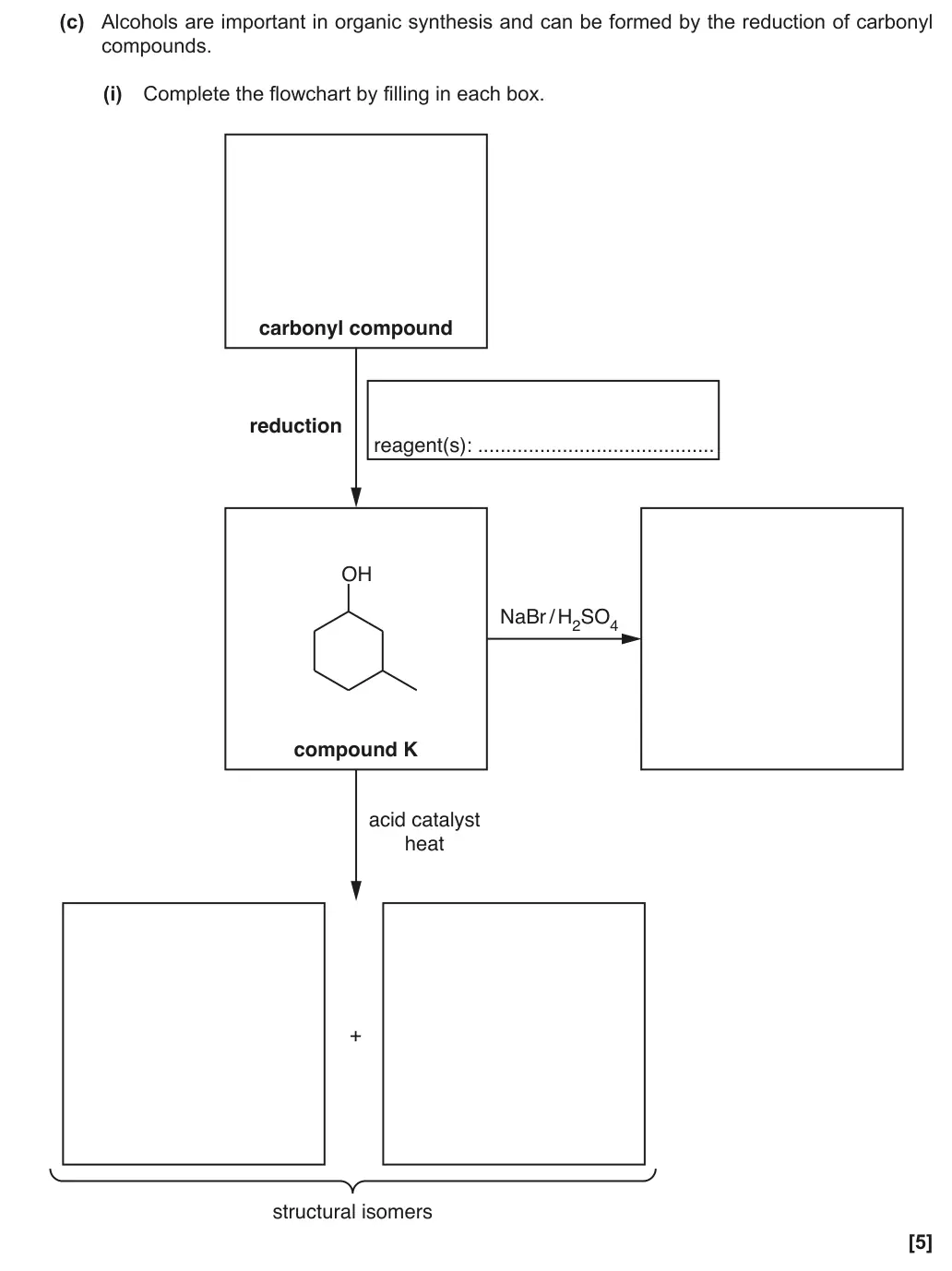
June 2017 · Paper 2 · Q19(c)(i) 5 marks Short answer carbonyl compoundsorganic basicsalcoholsorganic synthesis
(c) Alcohols are important in organic synthesis and can be formed by the reduction of carbonyl
compounds.
(i) Complete the flowchart by filling in each box.
carbonyl compound
reduction
reagent(s): ..........................................
OH
NaBr / H2SO4
compound K
acid catalyst
heat
+
structural isomers
[5]
June 2017 · Paper 2 · Q19(c)(ii) 1 mark Short answer organic basics
Earlier part of question 19 that this part usesEarlier part of June 2017 Paper 2 question 19
(ii) What is the name of compound K?
..................................................................................................................................... [1]
June 2017 · Paper 2 · Q19(d) 5 marks Equation writing alcohols
(d) Butan-1-ol can be oxidised to form two different organic products, depending on the reaction
conditions used.
Describe both oxidation reactions of butan-1-ol.
For each reaction include
• the structure of the organic product
• a balanced equation
• the essential reaction conditions.
In your equations you may use [O] to represent the oxidising agent.
...................................................................................................................................................
...................................................................................................................................................
...................................................................................................................................................
...................................................................................................................................................
...................................................................................................................................................
...................................................................................................................................................
...................................................................................................................................................
...................................................................................................................................................
...................................................................................................................................................
...................................................................................................................................................
...................................................................................................................................................
............................................................................................................................................. [5]
June 2017 · Paper 2 · Q20(a) 3 marks AO1 Calculation amount of substanceinfrared and mass spectrometry
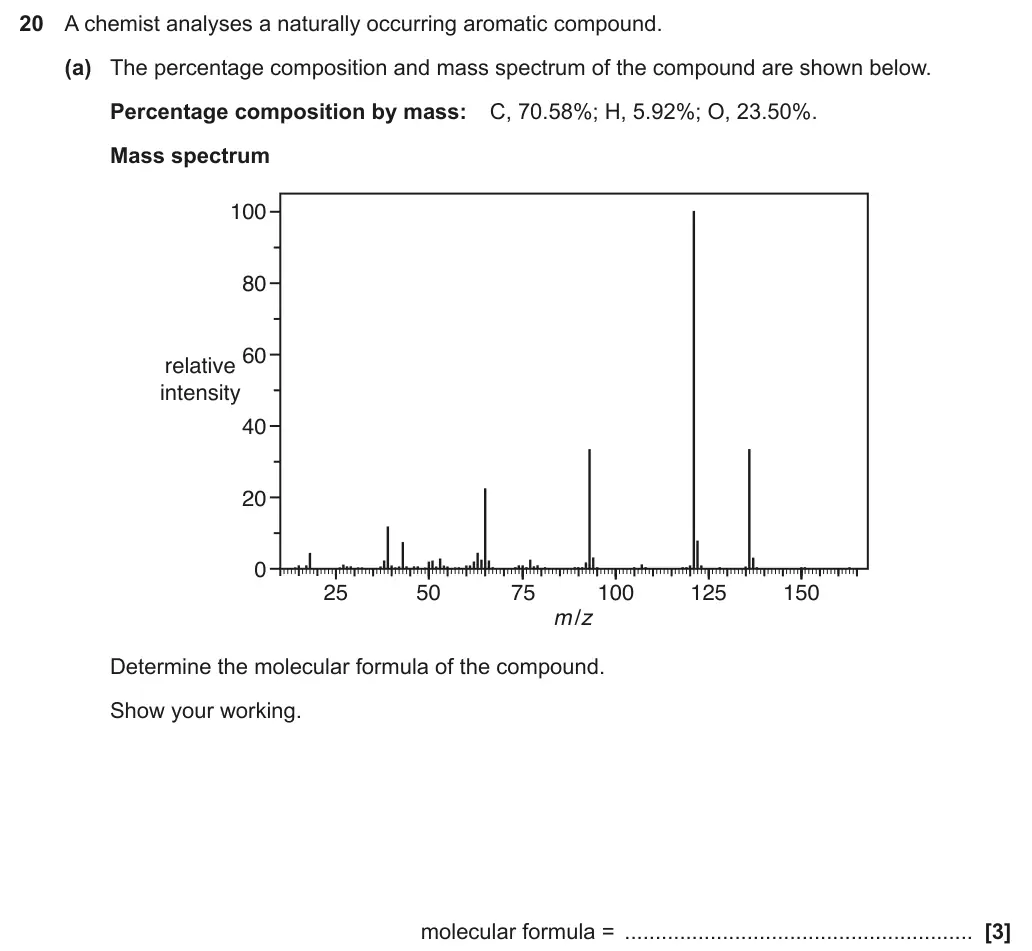
20 A chemist analyses a naturally occurring aromatic compound.
(a) The percentage composition and mass spectrum of the compound are shown below.
Percentage composition by mass: C, 70.58%; H, 5.92%; O, 23.50%.
Mass spectrum
100
80
60
relative
intensity
40
20
0
25 50 75 100 125 150
m /z
Determine the molecular formula of the compound.
Show your working.
molecular formula =  ......................................................... [3]
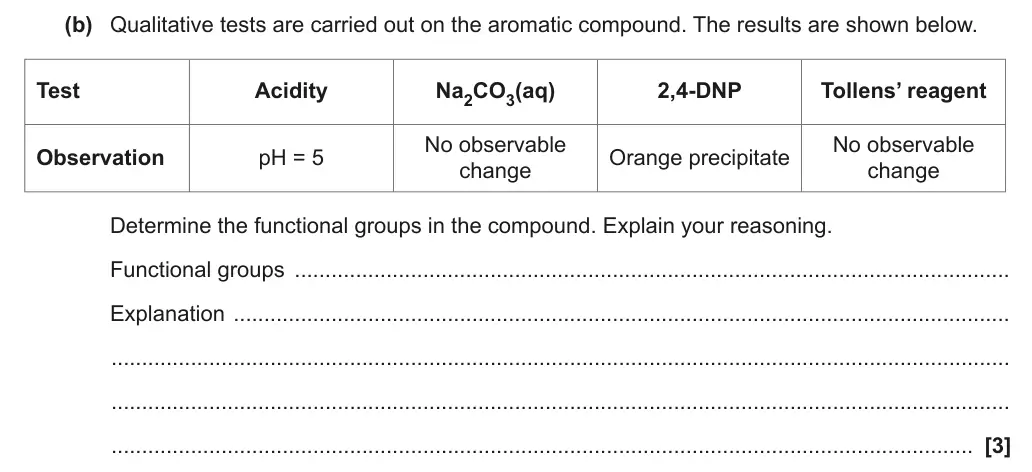
June 2017 · Paper 2 · Q20(b) 3 marks Short answer chromatography and functional group tests
Earlier part of question 20 that this part usesEarlier part of June 2017 Paper 2 question 20
(b) Qualitative tests are carried out on the aromatic compound. The results are shown below.
Test Acidity Na2CO3(aq) 2,4-DNP Tollens’ reagent
No observable No observable
Observation pH = 5 Orange precipitate
change change
Determine the functional groups in the compound. Explain your reasoning.
Functional groups  .....................................................................................................................
Explanation  ...............................................................................................................................
...................................................................................................................................................
...................................................................................................................................................
............................................................................................................................................. [3]
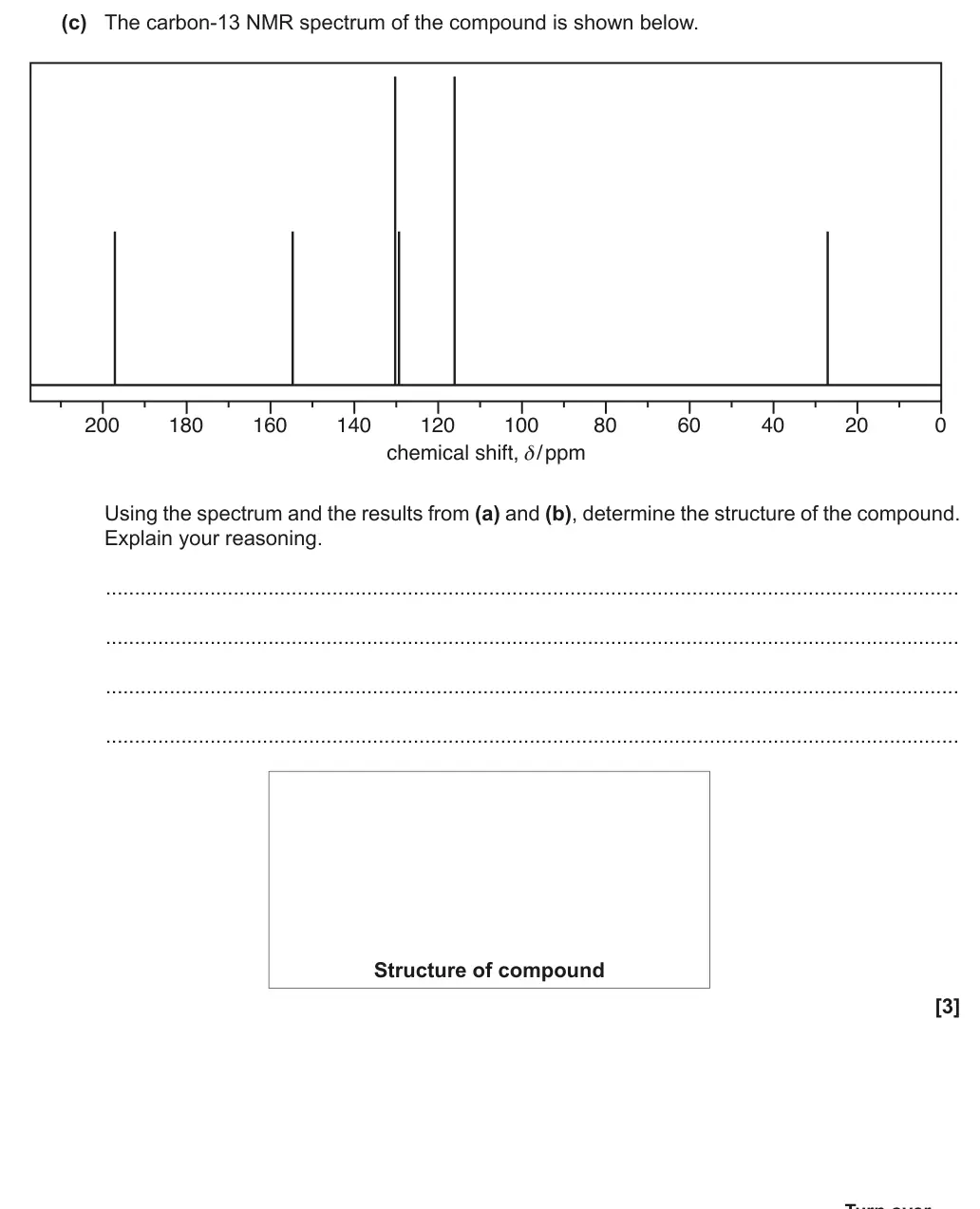
June 2017 · Paper 2 · Q20(c) 3 marks Data interpretation nmr spectroscopy
Earlier parts of question 20 that this part usesEarlier part of June 2017 Paper 2 question 20Earlier part of June 2017 Paper 2 question 20
(c) The carbon-13 NMR spectrum of the compound is shown below.
200 180 160 140 120 100 80 60 40 20 0
chemical shift,   / ppm δ
Using the spectrum and the results from (a) and (b), determine the structure of the compound.
Explain your reasoning.
...................................................................................................................................................
...................................................................................................................................................
...................................................................................................................................................
...................................................................................................................................................
Structure of compound
[3]
June 2017 · Paper 2 · Q21 6 marks 6-mark level of response nmr spectroscopyinfrared and mass spectrometrycarboxylic acids and esters
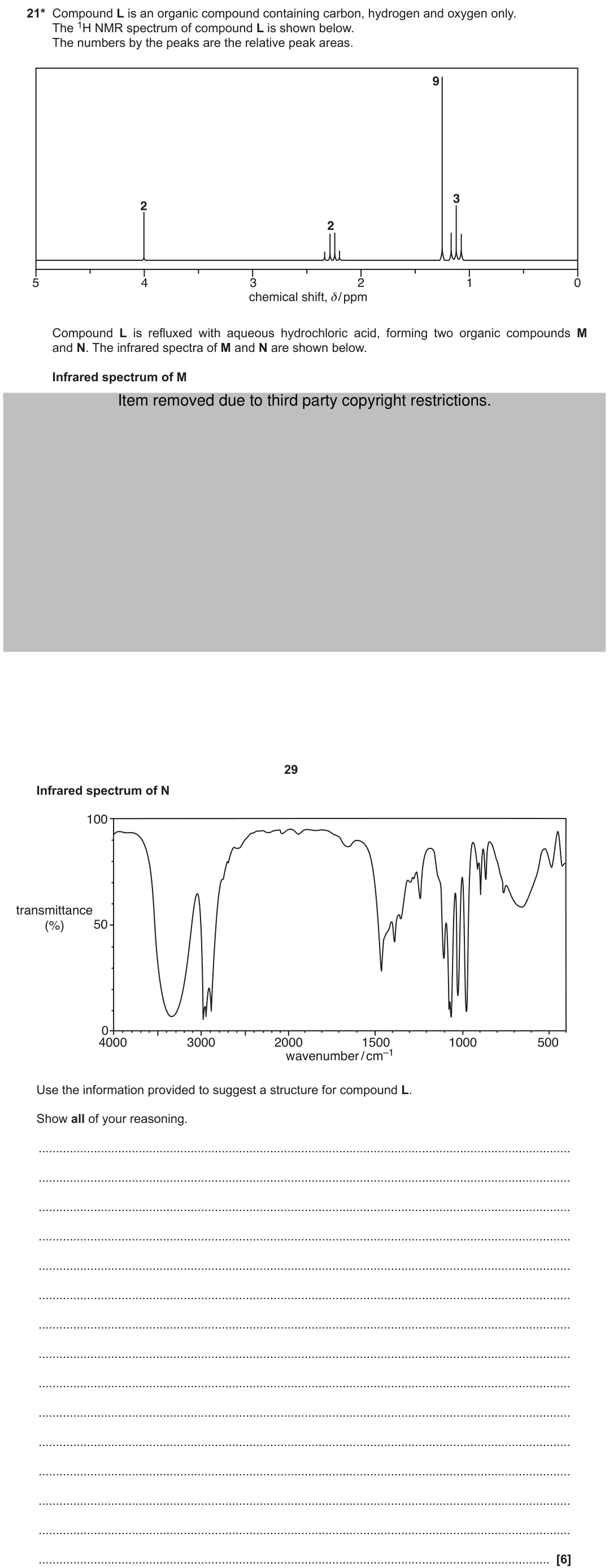
21* Compound L is an organic compound containing carbon, hydrogen and oxygen only.
The 1H NMR spectrum of compound L is shown below.
The numbers by the peaks are the relative peak areas.
9
3
2
2
5 4 3 2 1 0
chemical shift,   / ppm δ
Compound L is refluxed with aqueous hydrochloric acid, forming two organic compounds M
and N. The infrared spectra of M and N are shown below.
Infrared spectrum of M
Item removed due to third party copyright restrictions.
Infrared spectrum of N
100
transmittance
(%) 50
0
4000 3000 2000 1500 1000 500
wavenumber / cm–1
Use the information provided to suggest a structure for compound L.
Show all of your reasoning.
..........................................................................................................................................................
..........................................................................................................................................................
..........................................................................................................................................................
..........................................................................................................................................................
..........................................................................................................................................................
..........................................................................................................................................................
..........................................................................................................................................................
..........................................................................................................................................................
..........................................................................................................................................................
..........................................................................................................................................................
..........................................................................................................................................................
..........................................................................................................................................................
..........................................................................................................................................................
..........................................................................................................................................................
.................................................................................................................................................... [6]

Work with an OCR chemistry tutor

Want a paper marked and gone through with you? Message us.

Prefer email? Send an enquiry

If you are under 18, please include a parent's contact details. Enquiries go to enquiries@chemistryaleveltutor.com and are deleted once handled. All tutoring is online.