June 2017: Paper 3, Unified chemistry

70 marks · 27 question parts · Paper, mark scheme and report on OCR's site · Have OCR's Data Sheet beside you

Question by question

QTopicMarksAOType
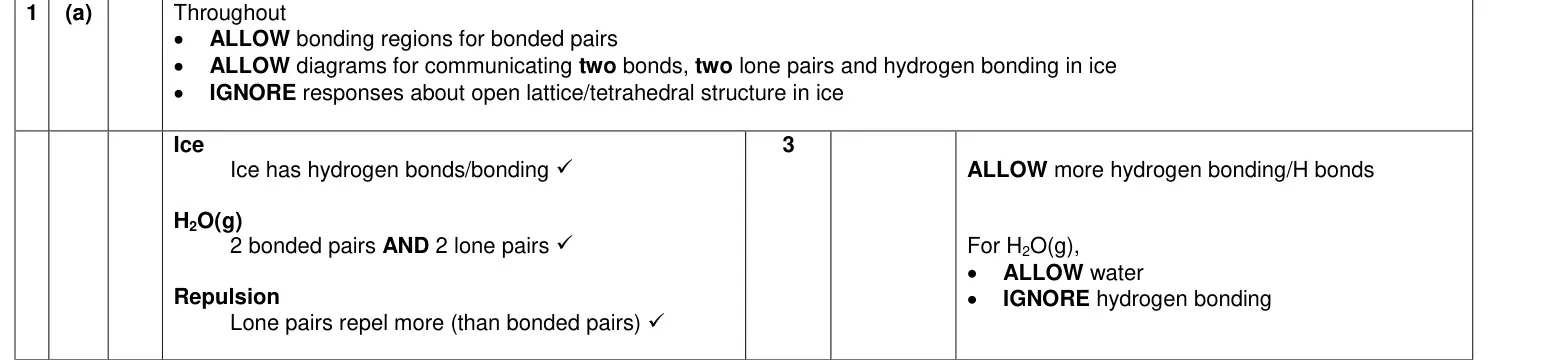
1(a) Bonding, structure and shapes of molecules 3Short answer
1(b) Infrared spectroscopy and mass spectrometry 1Short answer
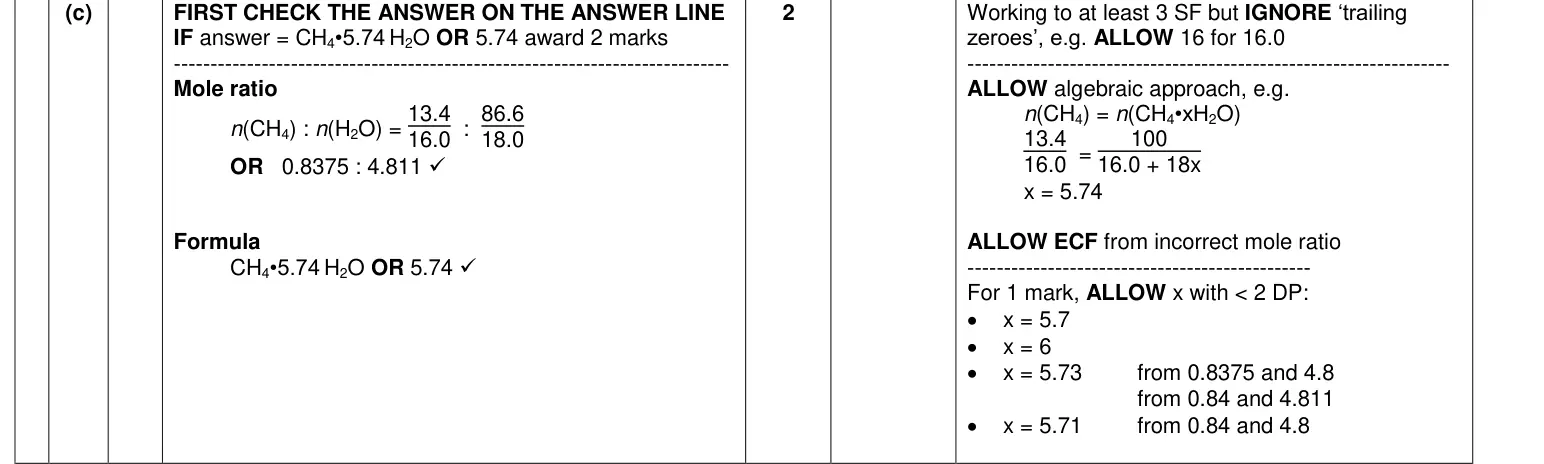
1(c) Amount of substance (moles) 2Calculation
1(d) Amount of substance (moles) 4Calculation
1(e) Alkanes 1Short answer
2(a) Enthalpy changes and Hess’ law, Amount of substance (moles) 6Level of response
2(b) Practical skills: planning, analysis and evaluation 2Short answer
2(c) Practical skills: planning, analysis and evaluation 2Short answer
2(d)(i) Redox and oxidation numbers 1Short answer
2(d)(ii) Redox and oxidation numbers 2Short answer
2(d)(iii) Formulae and equations, Redox and oxidation numbers 1Equation writing
3(a)(i) Rates: orders, rate equations and the Arrhenius equation 3Calculation
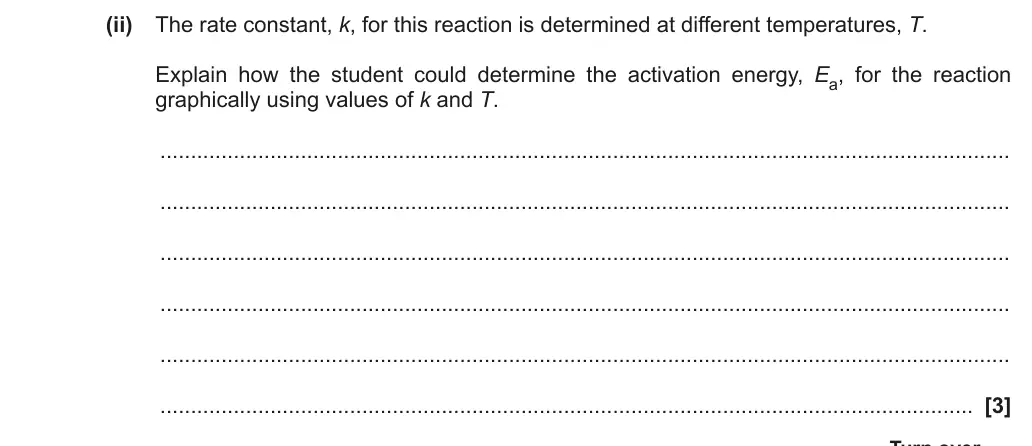
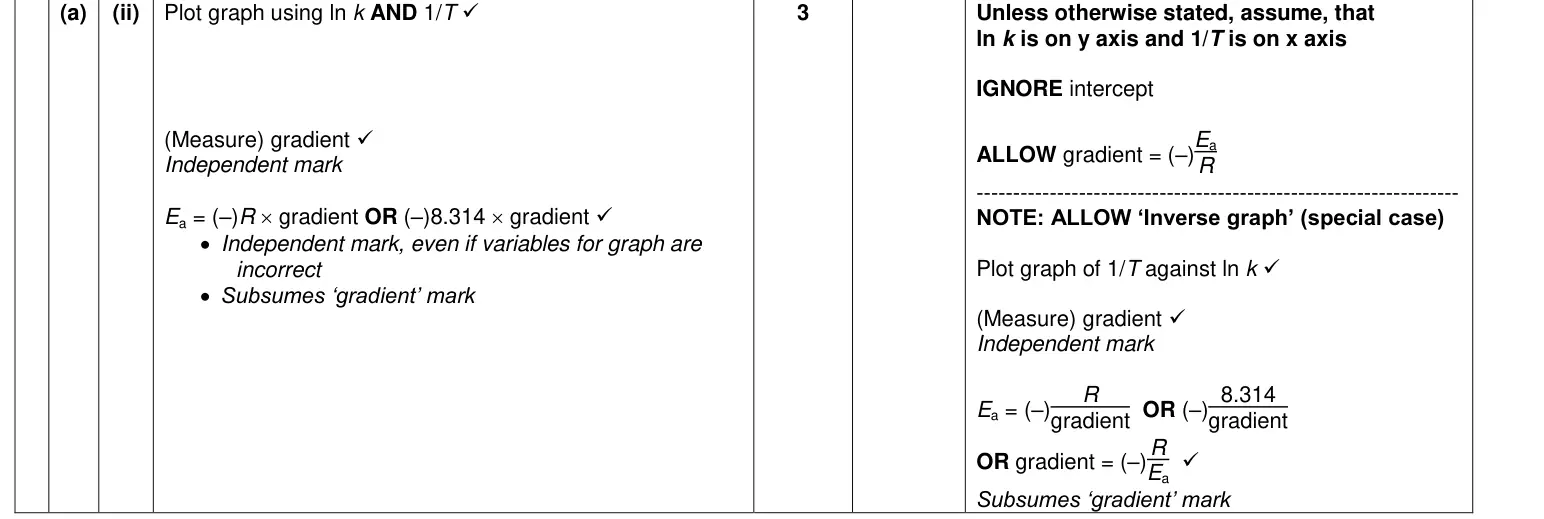
3(a)(ii) Rates: orders, rate equations and the Arrhenius equation 3Short answer
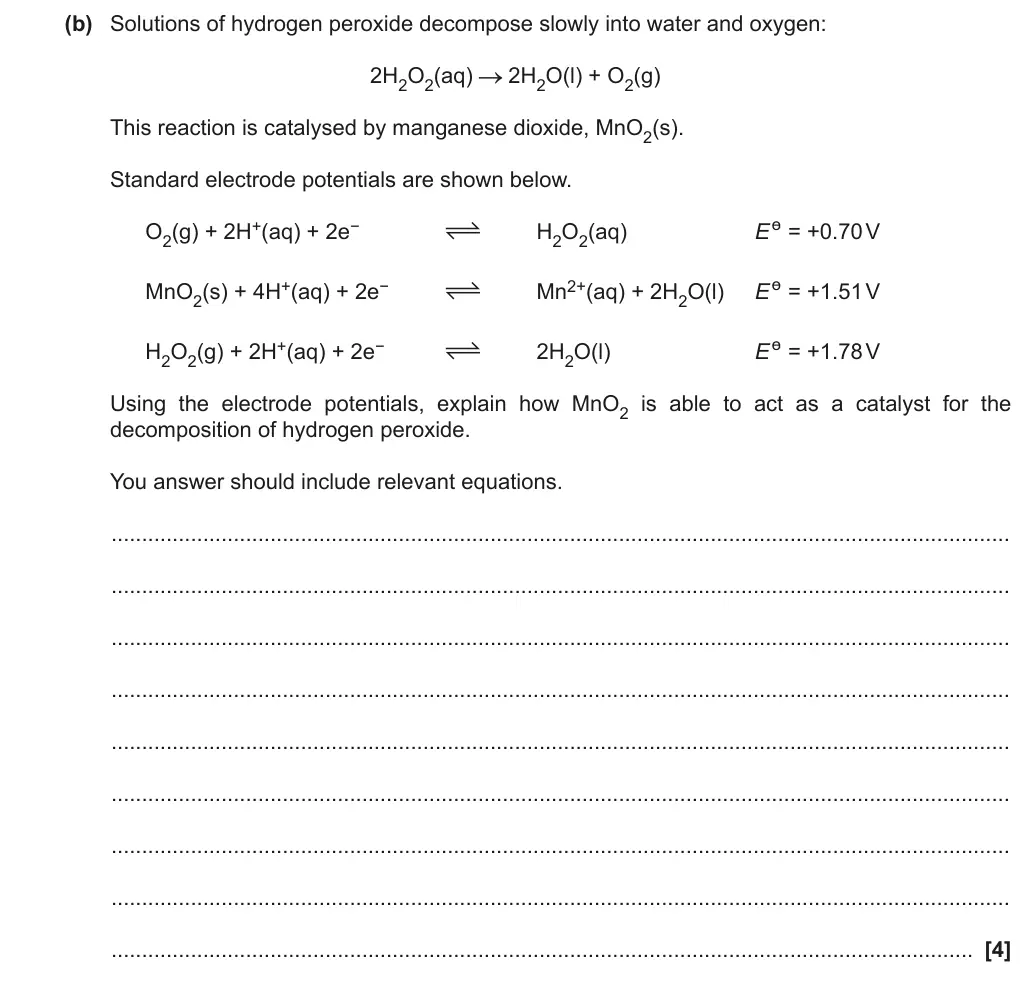
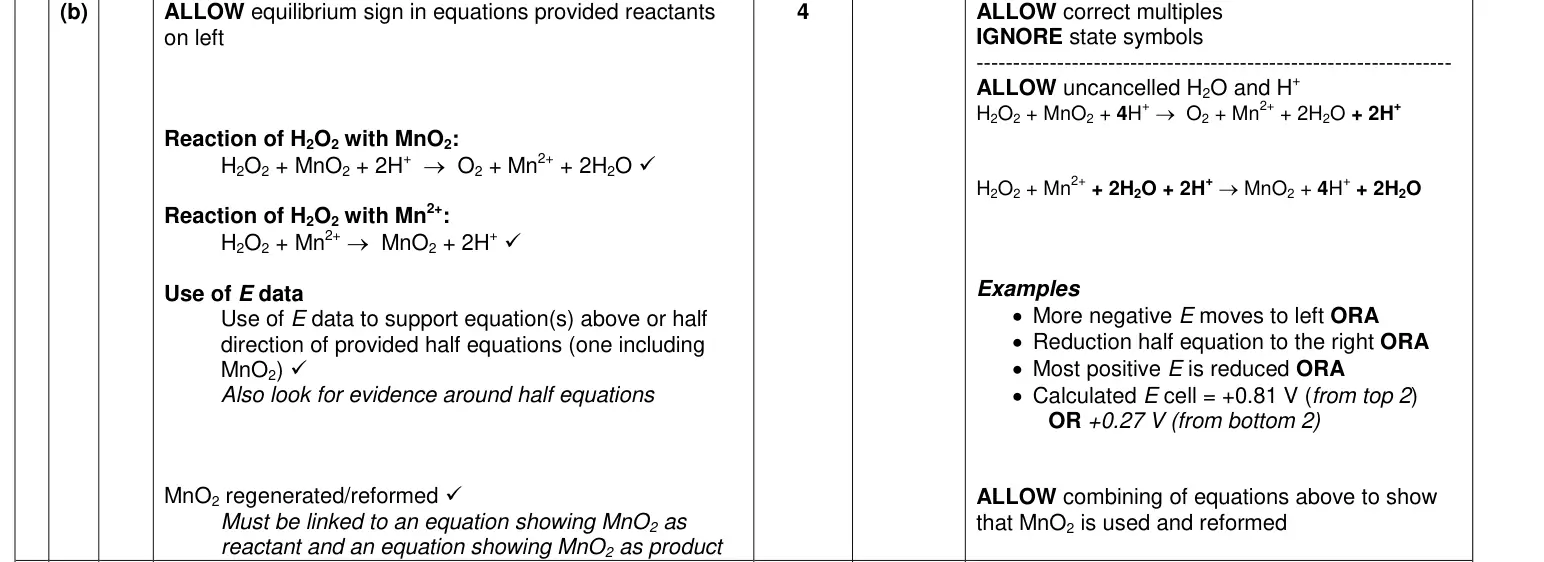
3(b) Redox titrations and electrode potentials, Transition elements 4Short answer
3(c)(i) Organic basics: naming, formulae and isomerism 1Structure / isomer
3(c)(ii) Equilibrium constants Kc and Kp, Amount of substance (moles) 3Calculation
4(a)(i) Acids, bases and titrations, Practical skills: planning, analysis and evaluation, Practical techniques and apparatus (PAGs) 4Calculation
4(a)(ii) Acids, bases and titrations, Amount of substance (moles), Amino acids, amides and chirality 6Structure / isomer
4(b)(i) Carboxylic acids, esters and acyl chlorides, Formulae and equations, Redox and oxidation numbers 3Structure / isomer
4(b)(ii) Carboxylic acids, esters and acyl chlorides, Organic synthesis (Module 6) 3Short answer
4(c)(i) Transition elements 1Structure / isomer
4(c)(ii) Amount of substance (moles), Atomic structure and isotopes 2Calculation
5(a)(i) Acids, bases, pH and buffers 1Short answer
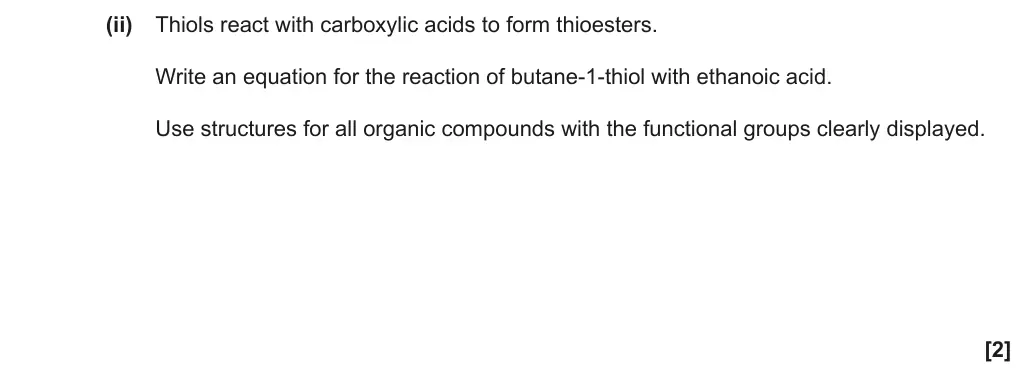
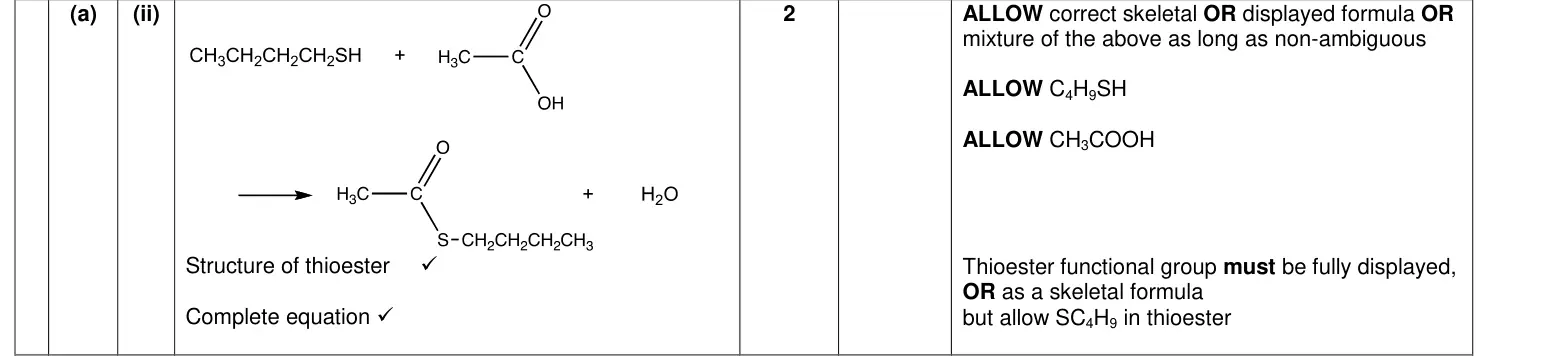
5(a)(ii) Carboxylic acids, esters and acyl chlorides, Organic synthesis (Module 6) 2Equation writing
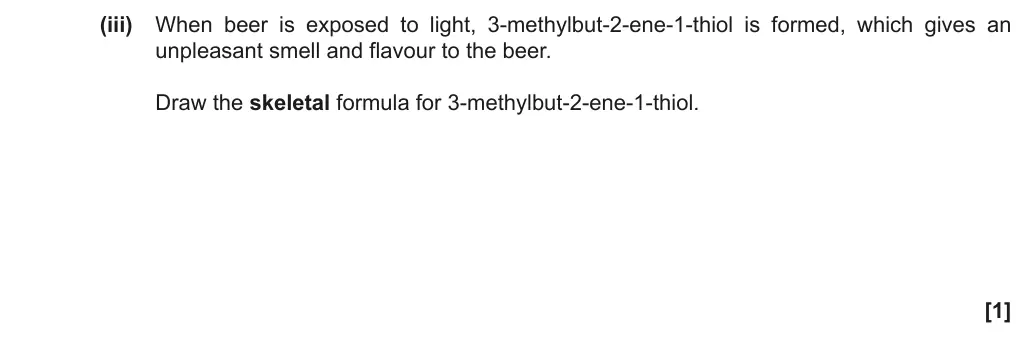
5(a)(iii) Organic basics: naming, formulae and isomerism 1Structure / isomer
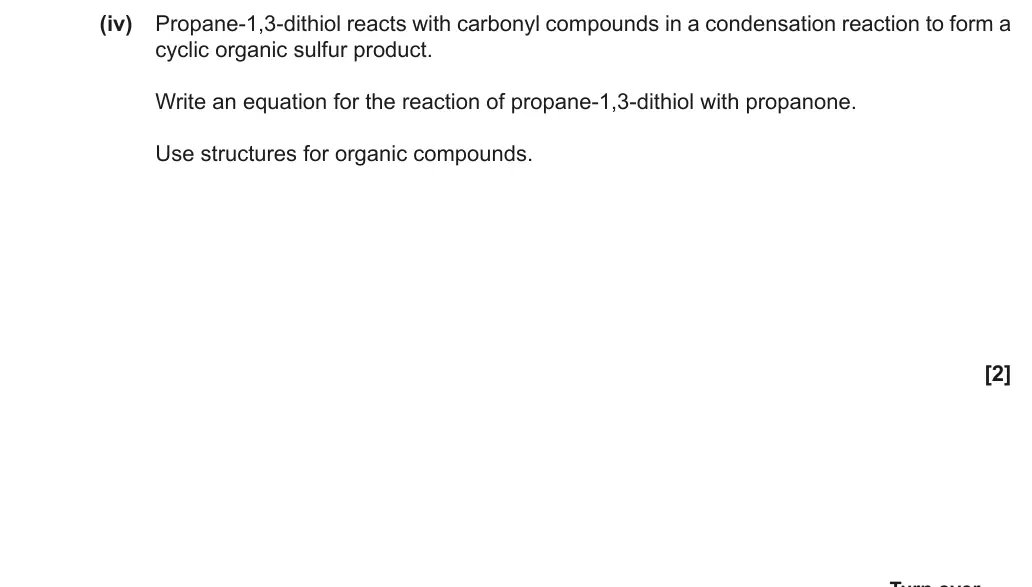
5(a)(iv) Organic synthesis (Module 6), Formulae and equations 2Equation writing
5(b) Chromatography and tests for functional groups, Organic synthesis (Module 6) 6Level of response

The questions

1(a)1(b)1(c)1(d)1(e)2(a)2(b)2(c)2(d)(i)2(d)(ii)2(d)(iii)3(a)(i)3(a)(ii)3(b)3(c)(i)3(c)(ii)4(a)(i)4(a)(ii)4(b)(i)4(b)(ii)4(c)(i)4(c)(ii)5(a)(i)5(a)(ii)5(a)(iii)5(a)(iv)5(b)
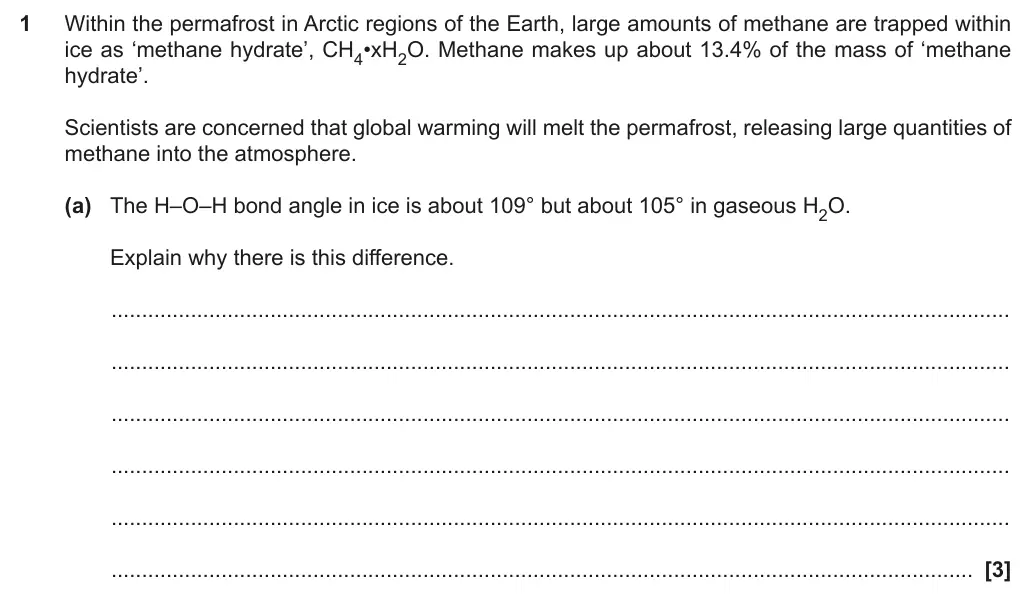
June 2017 · Paper 3 · Q1(a) 3 marks Short answer bonding and structure
1 Within the permafrost in Arctic regions of the Earth, large amounts of methane are trapped within
ice as ‘methane hydrate’, CH4•xH2O. Methane makes up about 13.4% of the mass of ‘methane
hydrate’.
Scientists are concerned that global warming will melt the permafrost, releasing large quantities of
methane into the atmosphere.
(a) The H–O–H bond angle in ice is about 109° but about 105° in gaseous H2O.
Explain why there is this difference.
...................................................................................................................................................
...................................................................................................................................................
...................................................................................................................................................
...................................................................................................................................................
...................................................................................................................................................
............................................................................................................................................. [3]
June 2017 · Paper 3 · Q1(b) 1 mark Short answer infrared and mass spectrometry
(b) Why are scientists concerned about the release of methane into the atmosphere?
...................................................................................................................................................
...................................................................................................................................................
............................................................................................................................................. [1]
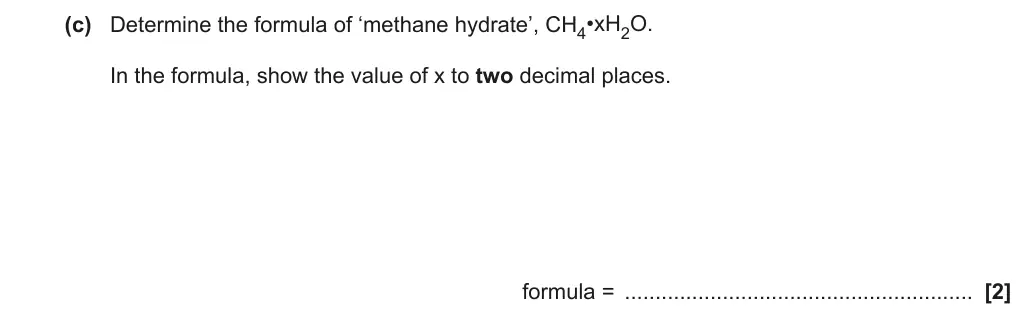
June 2017 · Paper 3 · Q1(c) 2 marks Calculation amount of substance
(c) Determine the formula of ‘methane hydrate’, CH4•xH2O.
In the formula, show the value of x to two decimal places.
formula =  ......................................................... [2]
June 2017 · Paper 3 · Q1(d) 4 marks Calculation amount of substance
Earlier part of question 1 that this part usesEarlier part of June 2017 Paper 3 question 1
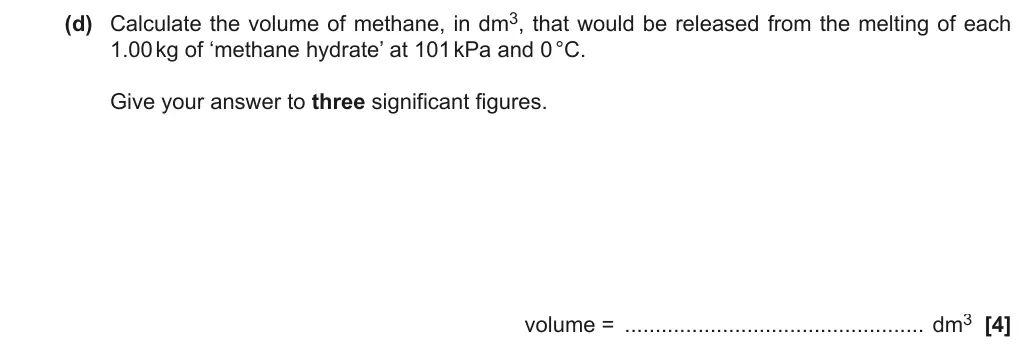
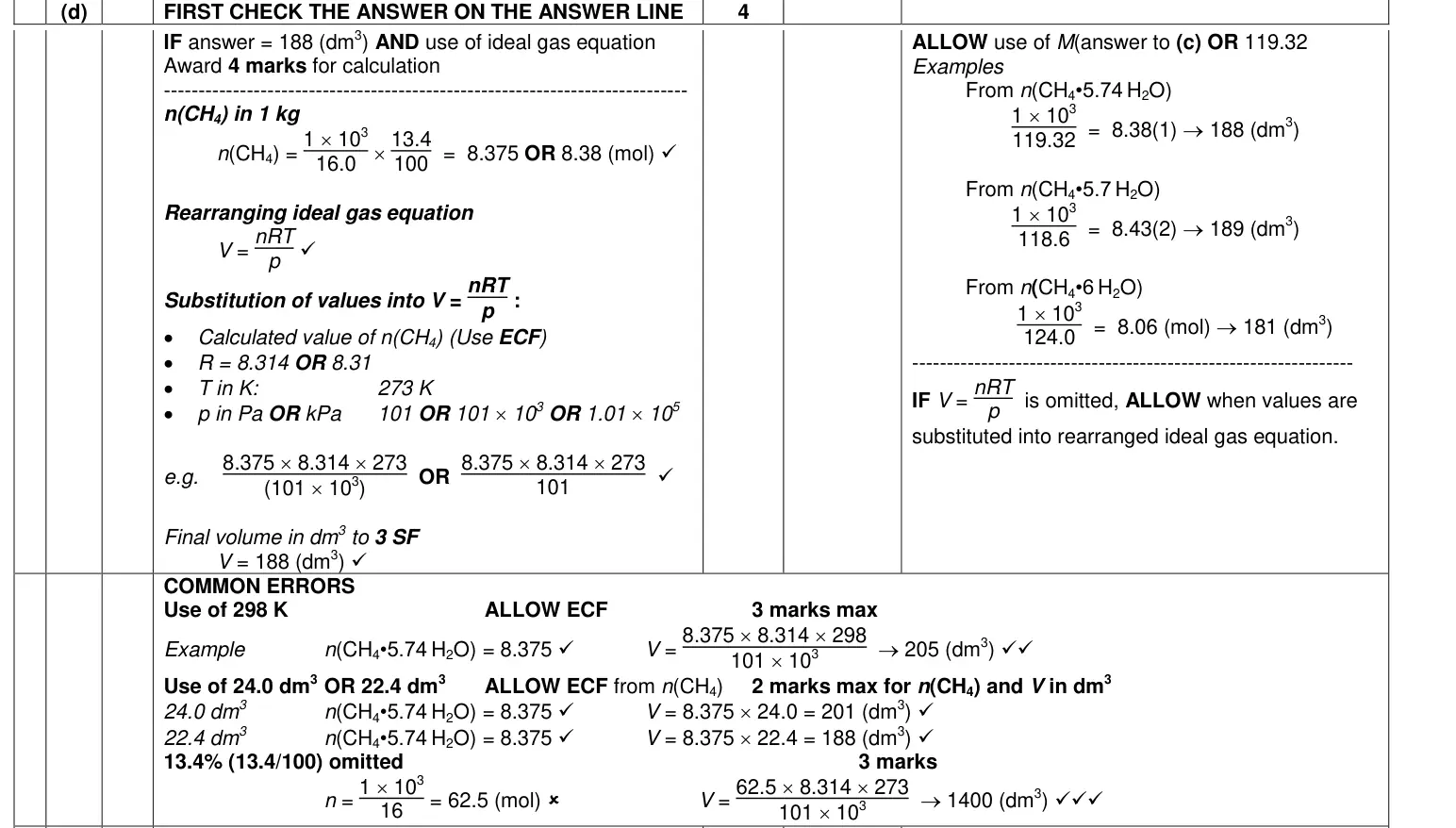
(d) Calculate the volume of methane, in dm3, that would be released from the melting of each
1.00 kg of ‘methane hydrate’ at 101 kPa and 0 °C.
Give your answer to three significant figures.
volume =  ................................................. dm3  [4]
June 2017 · Paper 3 · Q1(e) 1 mark Short answer alkanes
(e) Suggest why some industries are interested in the presence of ‘methane hydrate’ in regions
of the Earth.
...................................................................................................................................................
...................................................................................................................................................
............................................................................................................................................. [1]
June 2017 · Paper 3 · Q2(a) 6 marks 6-mark level of response enthalpy changesamount of substance
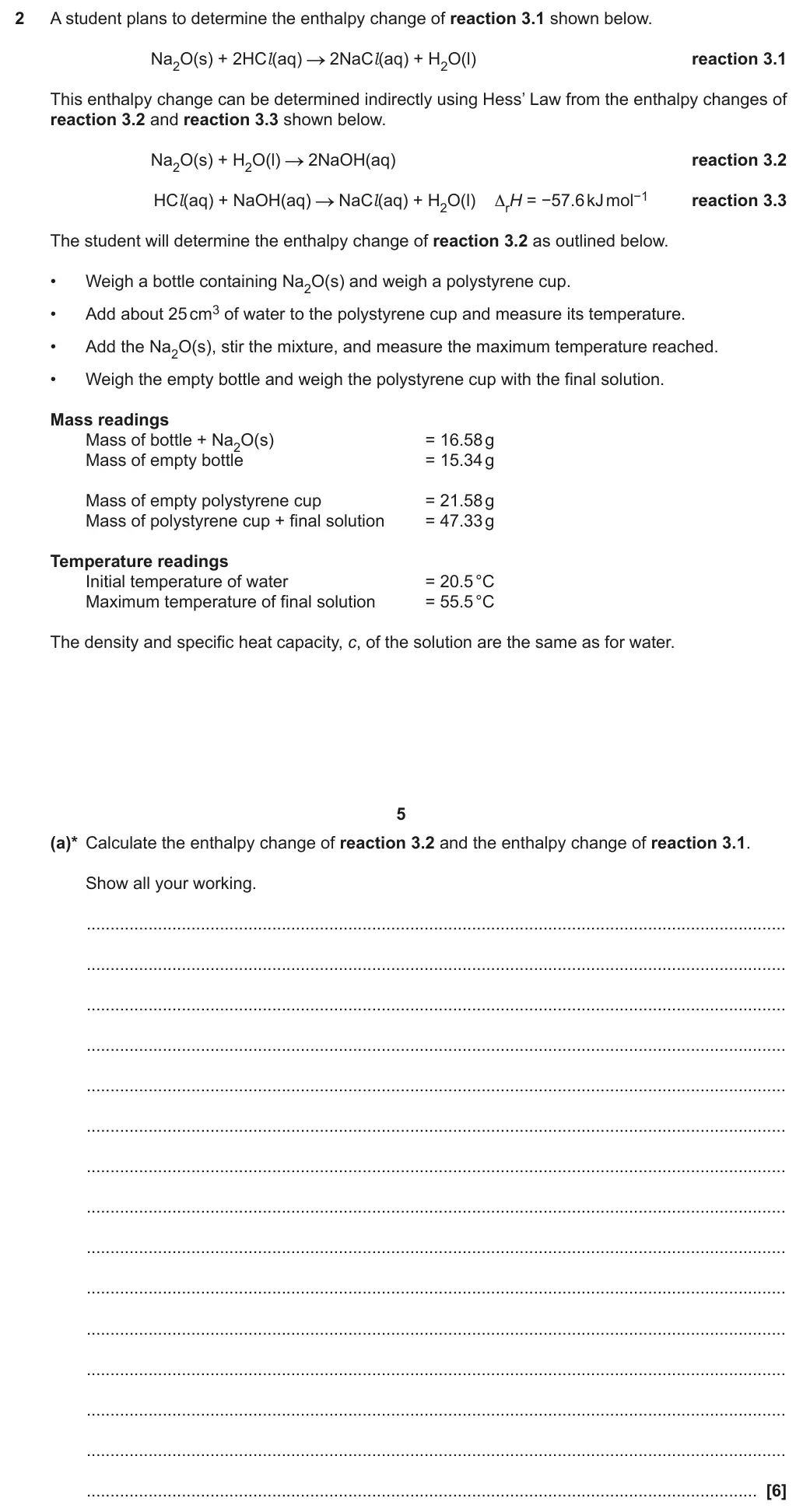
2 A student plans to determine the enthalpy change of reaction 3.1 shown below.
Na2O(s) + 2HCl(aq) 2NaCl(aq) + H2O(l) reaction 3.1
This enthalpy change can be determined indirectly using Hess’ Law from the enthalpy changes of
reaction 3.2 and reaction 3.3 shown below.
Na2O(s) + H2O(l) 2NaOH(aq) reaction 3.2
HCl(aq) + NaOH(aq) NaCl(aq) + H2O(l)    ∆rH = −57.6 kJ mol−1 reaction 3.3
The student will determine the enthalpy change of reaction 3.2 as outlined below.
• Weigh a bottle containing Na2O(s) and weigh a polystyrene cup.
• Add about 25 cm3 of water to the polystyrene cup and measure its temperature.
• Add the Na2O(s), stir the mixture, and measure the maximum temperature reached.
• Weigh the empty bottle and weigh the polystyrene cup with the final solution.
Mass readings
Mass of bottle + Na2O(s) = 16.58 g
Mass of empty bottle = 15.34 g
Mass of empty polystyrene cup = 21.58 g
Mass of polystyrene cup + final solution = 47.33 g
Temperature readings
Initial temperature of water = 20.5 °C
Maximum temperature of final solution = 55.5 °C
The density and specific heat capacity, c, of the solution are the same as for water.
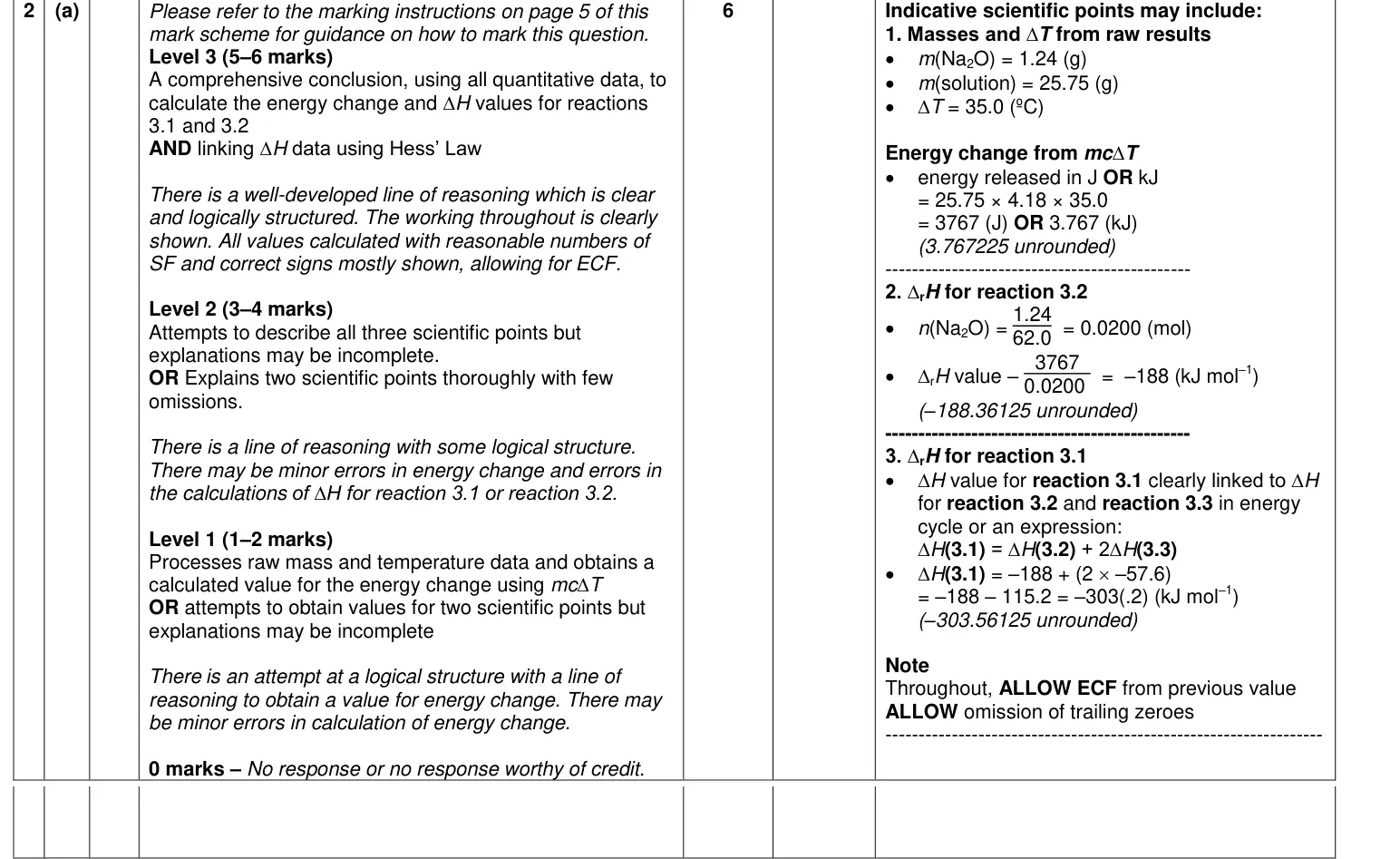
(a)* Calculate the enthalpy change of reaction 3.2 and the enthalpy change of reaction 3.1.
Show all your working.
...................................................................................................................................................
...................................................................................................................................................
...................................................................................................................................................
...................................................................................................................................................
...................................................................................................................................................
...................................................................................................................................................
...................................................................................................................................................
...................................................................................................................................................
...................................................................................................................................................
...................................................................................................................................................
...................................................................................................................................................
...................................................................................................................................................
...................................................................................................................................................
...................................................................................................................................................
............................................................................................................................................. [6]
June 2017 · Paper 3 · Q2(b) 2 marks Short answer practical skills
Earlier part of question 2 that this part usesEarlier part of June 2017 Paper 3 question 2
(b) The uncertainty in each temperature reading is ±0.1 °C.
The uncertainty in each mass reading is ±0.005 g.
Determine whether the mass of Na2O or the temperature change has the greater percentage
uncertainty.
Show all your working.
...................................................................................................................................................
...................................................................................................................................................
...................................................................................................................................................
...................................................................................................................................................
............................................................................................................................................. [2]
June 2017 · Paper 3 · Q2(c) 2 marks Short answer practical skills
Earlier parts of question 2 that this part usesEarlier part of June 2017 Paper 3 question 2Earlier part of June 2017 Paper 3 question 2
(c) Suggest a modification to this experiment, using the same apparatus, which would reduce
the percentage errors in the measurements.
Explain your reasoning.
...................................................................................................................................................
...................................................................................................................................................
...................................................................................................................................................
............................................................................................................................................. [2]
June 2017 · Paper 3 · Q2(d)(i) 1 mark Short answer redox
(d) Sodium oxide, Na2O, can be prepared by the redox reaction of NaNO2 and sodium metal.
Nitrogen gas is also formed.
(i) What is the systematic name for NaNO2?
..................................................................................................................................... [1]
June 2017 · Paper 3 · Q2(d)(ii) 2 marks Short answer redox
Earlier part of question 2 that this part usesEarlier part of June 2017 Paper 3 question 2
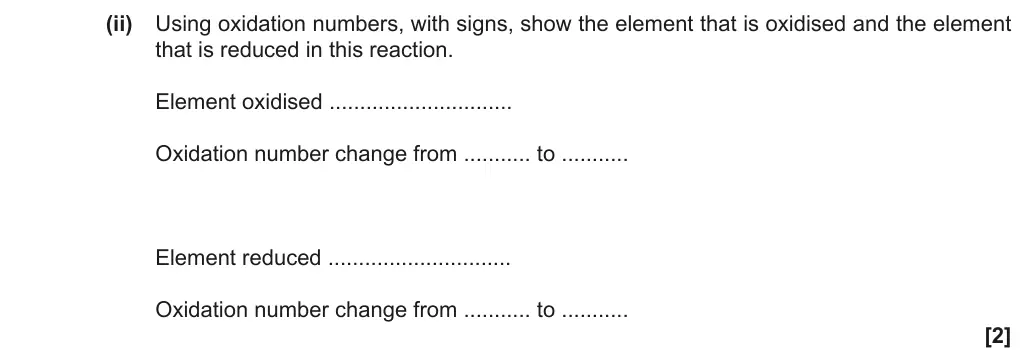
(ii) Using oxidation numbers, with signs, show the element that is oxidised and the element
that is reduced in this reaction.
Element oxidised ..............................
Oxidation number change  from ........... to ...........
Element reduced ..............................
Oxidation number change  from ........... to ...........
[2]
June 2017 · Paper 3 · Q2(d)(iii) 1 mark Equation writing formulae and equationsredox
Earlier parts of question 2 that this part usesEarlier part of June 2017 Paper 3 question 2Earlier part of June 2017 Paper 3 question 2
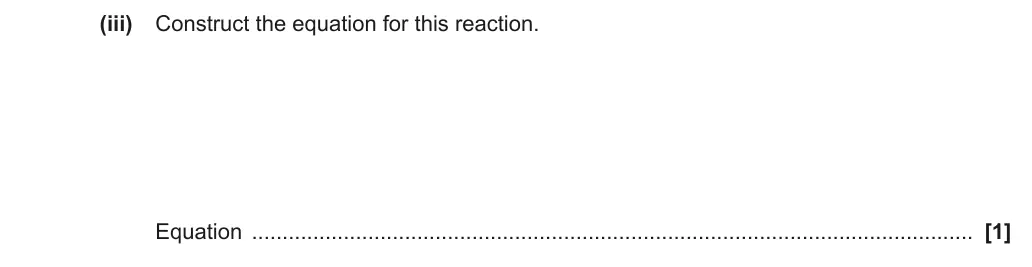
(iii) Construct the equation for this reaction.
Equation  ...................................................................................................................... [1]
June 2017 · Paper 3 · Q3(a)(i) 3 marks Calculation rate equations
3 This question is about reactions of hydrogen peroxide, H2O2.
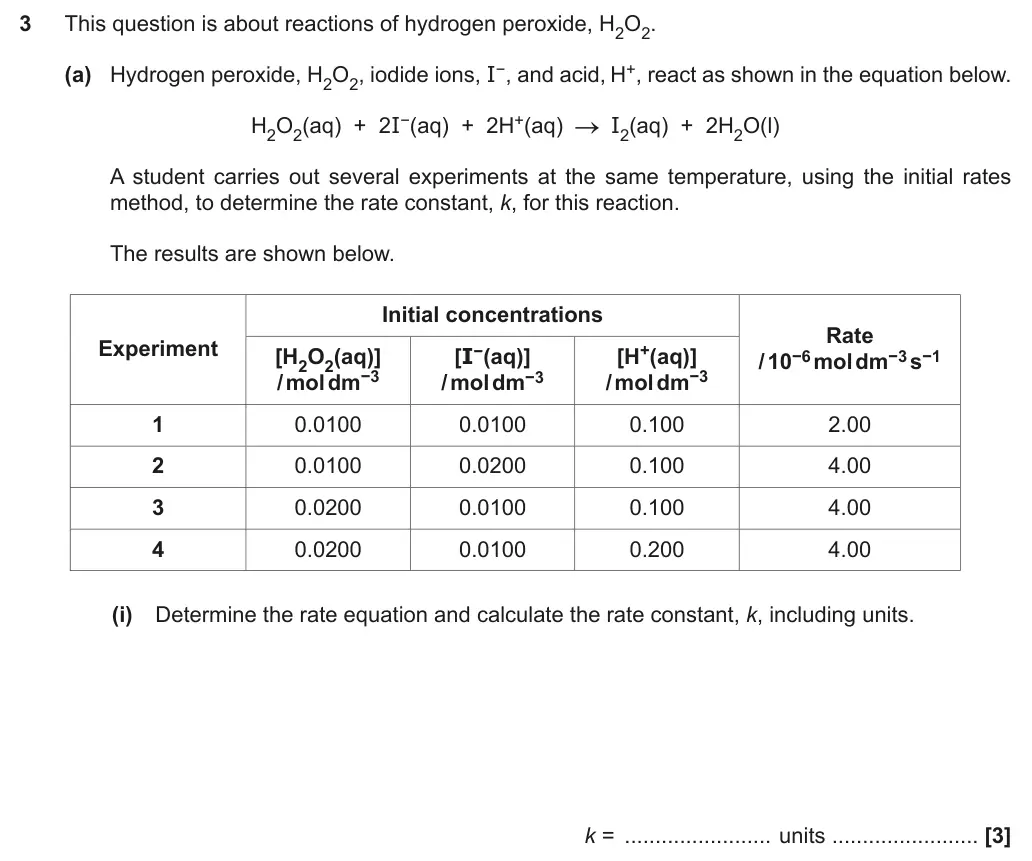
(a) Hydrogen peroxide, H2O2, iodide ions, I−, and acid, H+, react as shown in the equation below.
H2O2(aq)  +  2I−(aq)  +  2H+(aq) I2(aq)  +  2H2O(l)
A student carries out several experiments at the same temperature, using the initial rates
method, to determine the rate constant, k, for this reaction.
The results are shown below.
Initial concentrations
Rate
Experiment
[H2O2(aq)] [I−(aq)] [H+(aq)] / 10−6 mol dm−3 s−1
/ mol dm−3 / mol dm−3 / mol dm−3
1 0.0100 0.0100 0.100 2.00
2 0.0100 0.0200 0.100 4.00
3 0.0200 0.0100 0.100 4.00
4 0.0200 0.0100 0.200 4.00
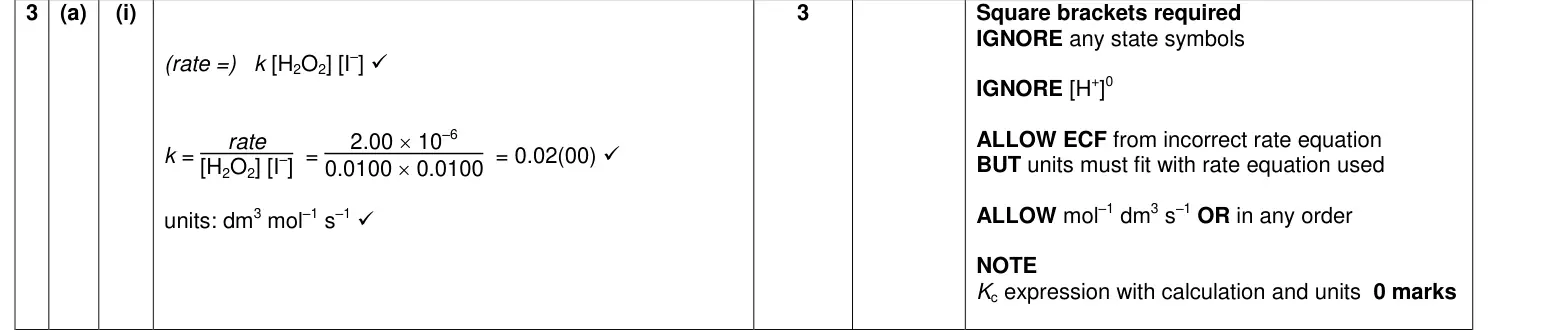
(i) Determine the rate equation and calculate the rate constant, k, including units.
k =  ........................ units ........................ [3]
June 2017 · Paper 3 · Q3(a)(ii) 3 marks Short answer rate equations
Earlier part of question 3 that this part usesEarlier part of June 2017 Paper 3 question 3
(ii) The rate constant, k, for this reaction is determined at different temperatures, T.
Explain how the student could determine the activation energy, Ea, for the reaction
graphically using values of k and T.
...........................................................................................................................................
...........................................................................................................................................
...........................................................................................................................................
...........................................................................................................................................
...........................................................................................................................................
..................................................................................................................................... [3]
June 2017 · Paper 3 · Q3(b) 4 marks Short answer redox and electrode potentialstransition elements
(b) Solutions of hydrogen peroxide decompose slowly into water and oxygen:
2H2O2(aq) 2H2O(l) + O2(g)
This reaction is catalysed by manganese dioxide, MnO2(s).
Standard electrode potentials are shown below.
O2(g) + 2H+(aq) + 2e− H2O2(aq) Eo = +0.70 V
MnO2(s) + 4H+(aq) + 2e− Mn2+(aq) + 2H2O(l) Eo = +1.51 V
H2O2(g) + 2H+(aq) + 2e− 2H2O(l) Eo = +1.78 V
Using the electrode potentials, explain how MnO2 is able to act as a catalyst for the
decomposition of hydrogen peroxide.
You answer should include relevant equations.
...................................................................................................................................................
...................................................................................................................................................
...................................................................................................................................................
...................................................................................................................................................
...................................................................................................................................................
...................................................................................................................................................
...................................................................................................................................................
...................................................................................................................................................
............................................................................................................................................. [4]
June 2017 · Paper 3 · Q3(c)(i) 1 mark Structure / isomer organic basics
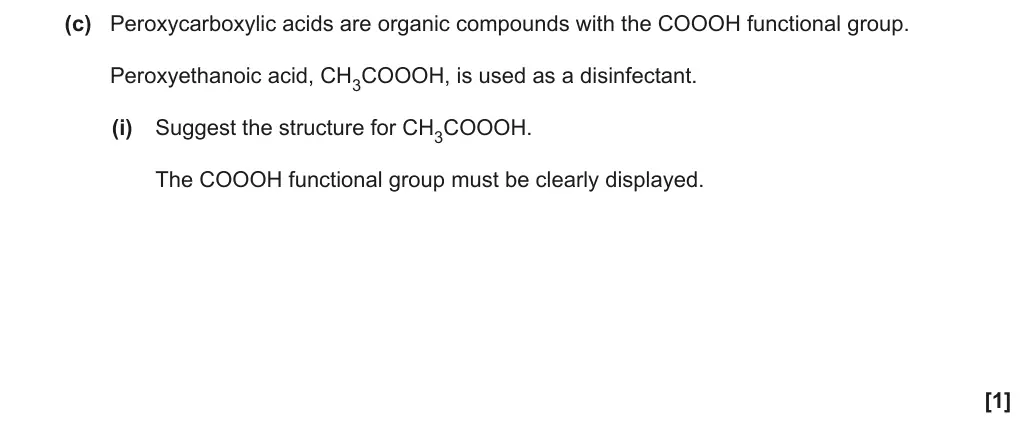
(c) Peroxycarboxylic acids are organic compounds with the COOOH functional group.
Peroxyethanoic acid, CH3COOOH, is used as a disinfectant.
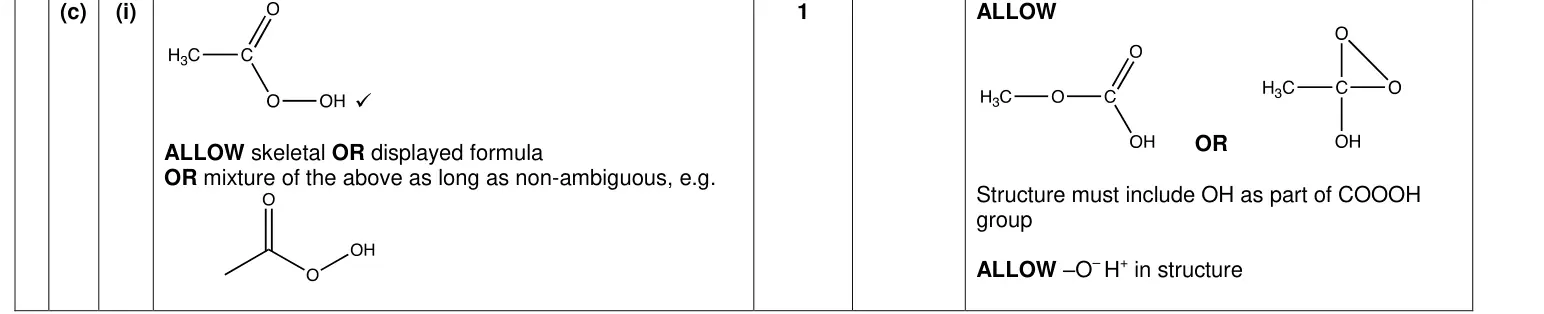
(i) Suggest the structure for CH3COOOH.
The COOOH functional group must be clearly displayed.
[1]
June 2017 · Paper 3 · Q3(c)(ii) 3 marks Calculation equilibrium constantsamount of substance
Earlier part of question 3 that this part usesEarlier part of June 2017 Paper 3 question 3
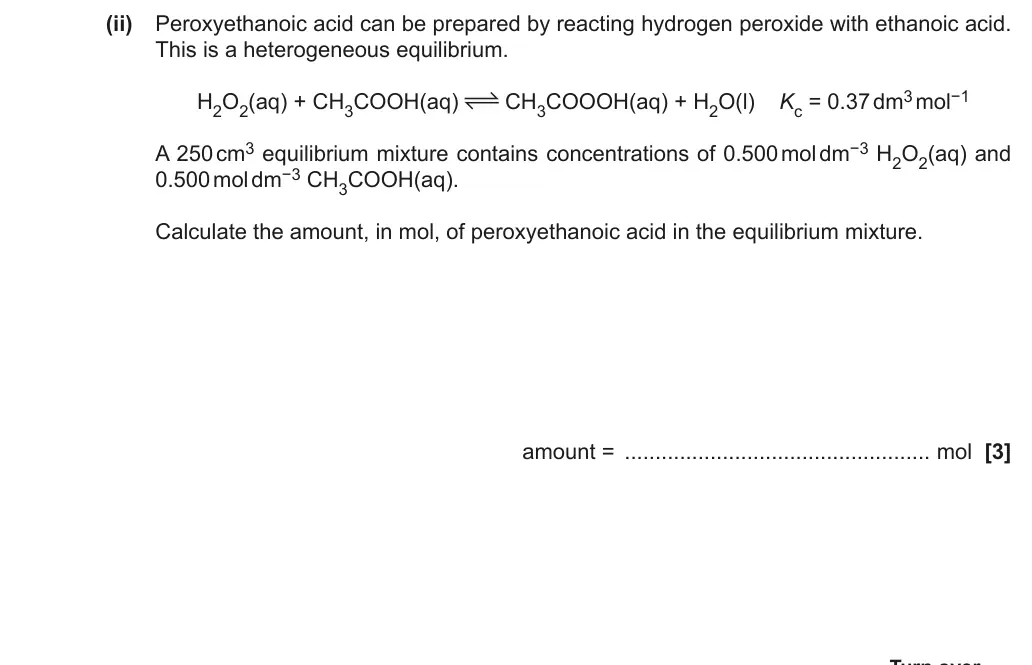
(ii) Peroxyethanoic acid can be prepared by reacting hydrogen peroxide with ethanoic acid.
This is a heterogeneous equilibrium.
H2O2(aq) + CH3COOH(aq) CH3COOOH(aq) + H2O(l)    Kc = 0.37 dm3 mol−1
A 250 cm3 equilibrium mixture contains concentrations of 0.500 mol dm−3 H2O2(aq) and
0.500 mol dm−3 CH3COOH(aq).
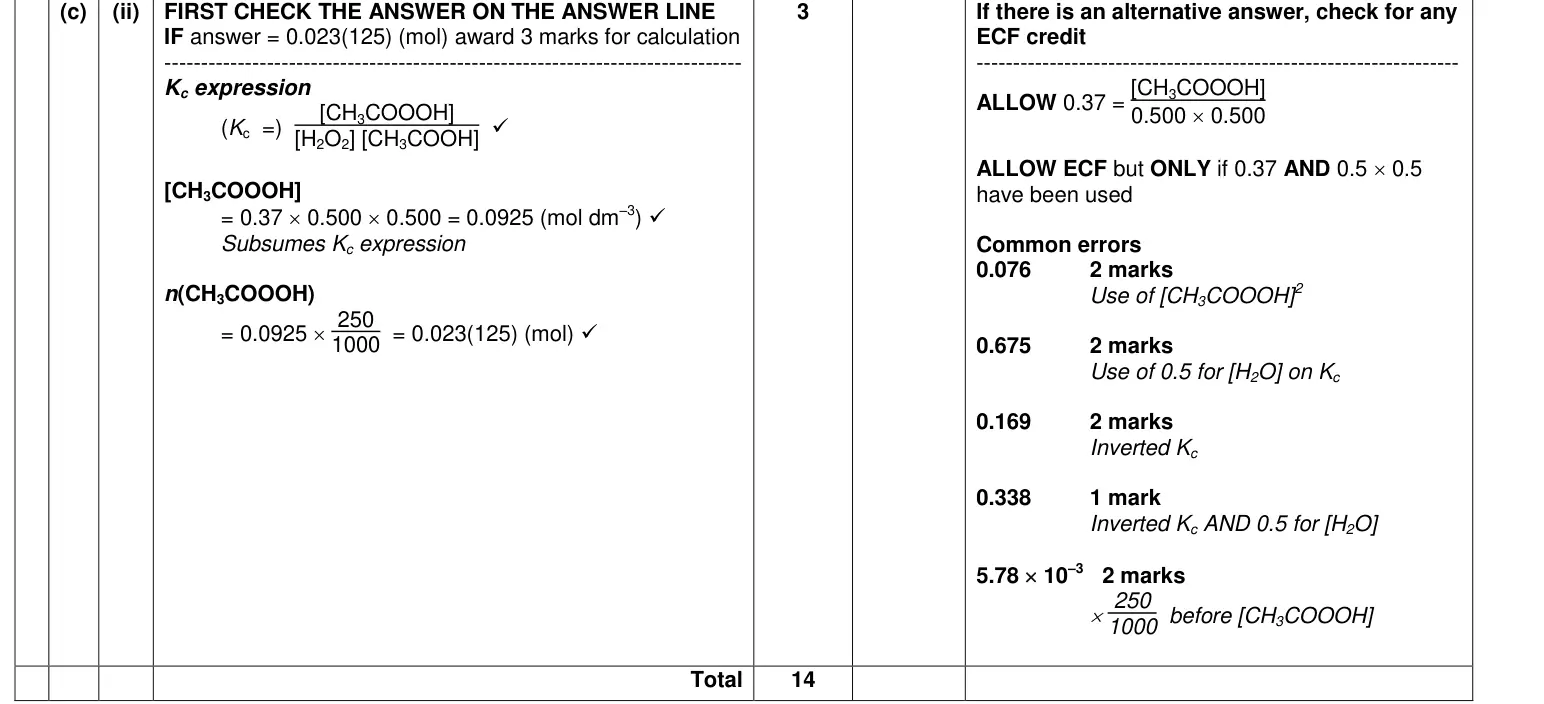
Calculate the amount, in mol, of peroxyethanoic acid in the equilibrium mixture.
amount =  .................................................. mol  [3]
June 2017 · Paper 3 · Q4(a)(i) 4 marks Calculation acids and titrationspractical skillspractical techniques
4 This question is about weak acids.
(a) Compound A is a weak monobasic acid.
A student is supplied with a 250.0 cm3 solution prepared from 2.495 g of A.
The student titrates 25.0 cm3 samples of this solution with 0.0840 mol dm−3 NaOH in the burette.
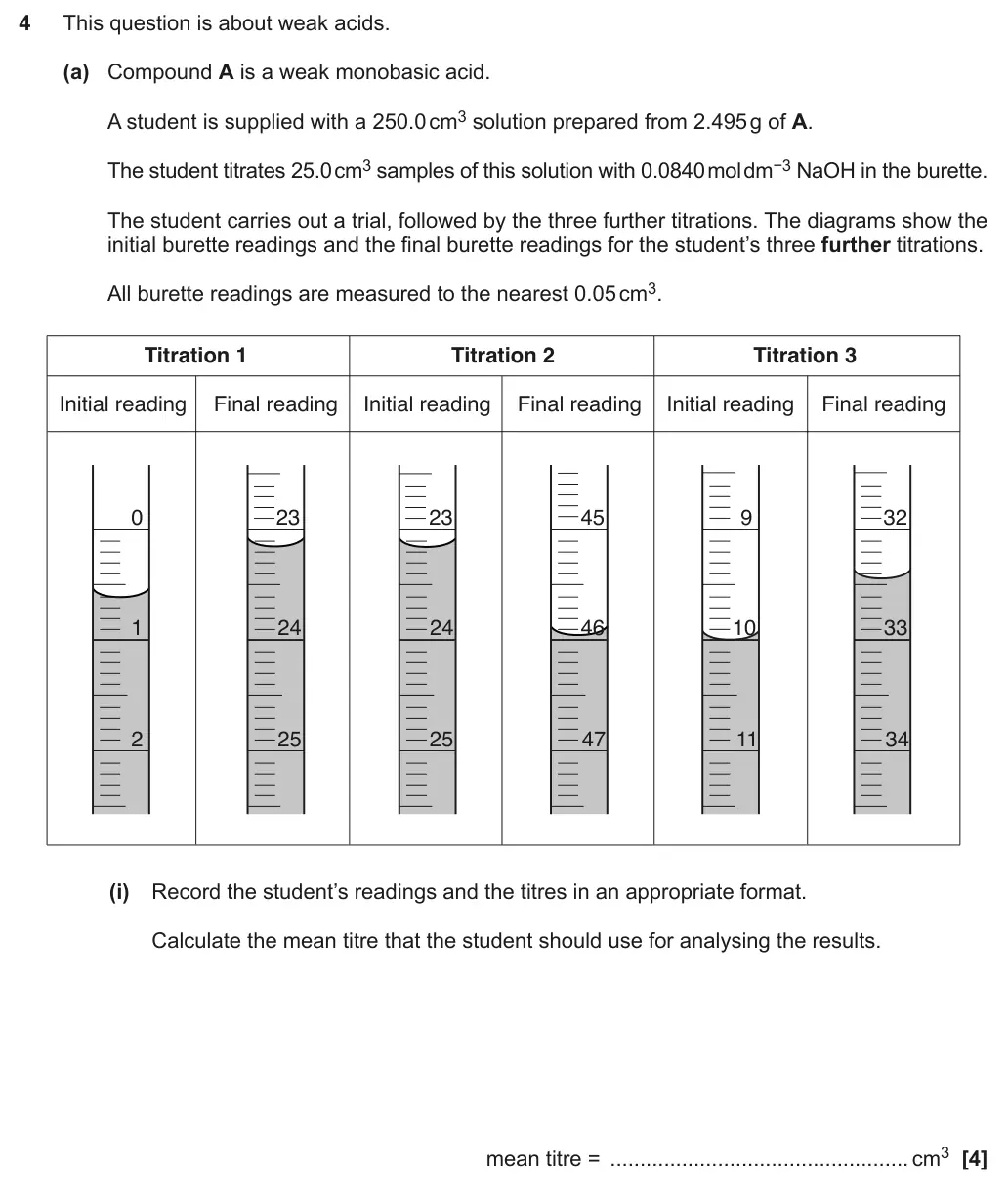
The student carries out a trial, followed by the three further titrations. The diagrams show the
initial burette readings and the final burette readings for the student’s three further titrations.
All burette readings are measured to the nearest 0.05 cm3.
Titration 1 Titration 2 Titration 3
Initial reading Final reading Initial reading Final reading Initial reading Final reading
0 23 23 45 9 32
1 24 24 46 10 33
2 25 25 47 11 34
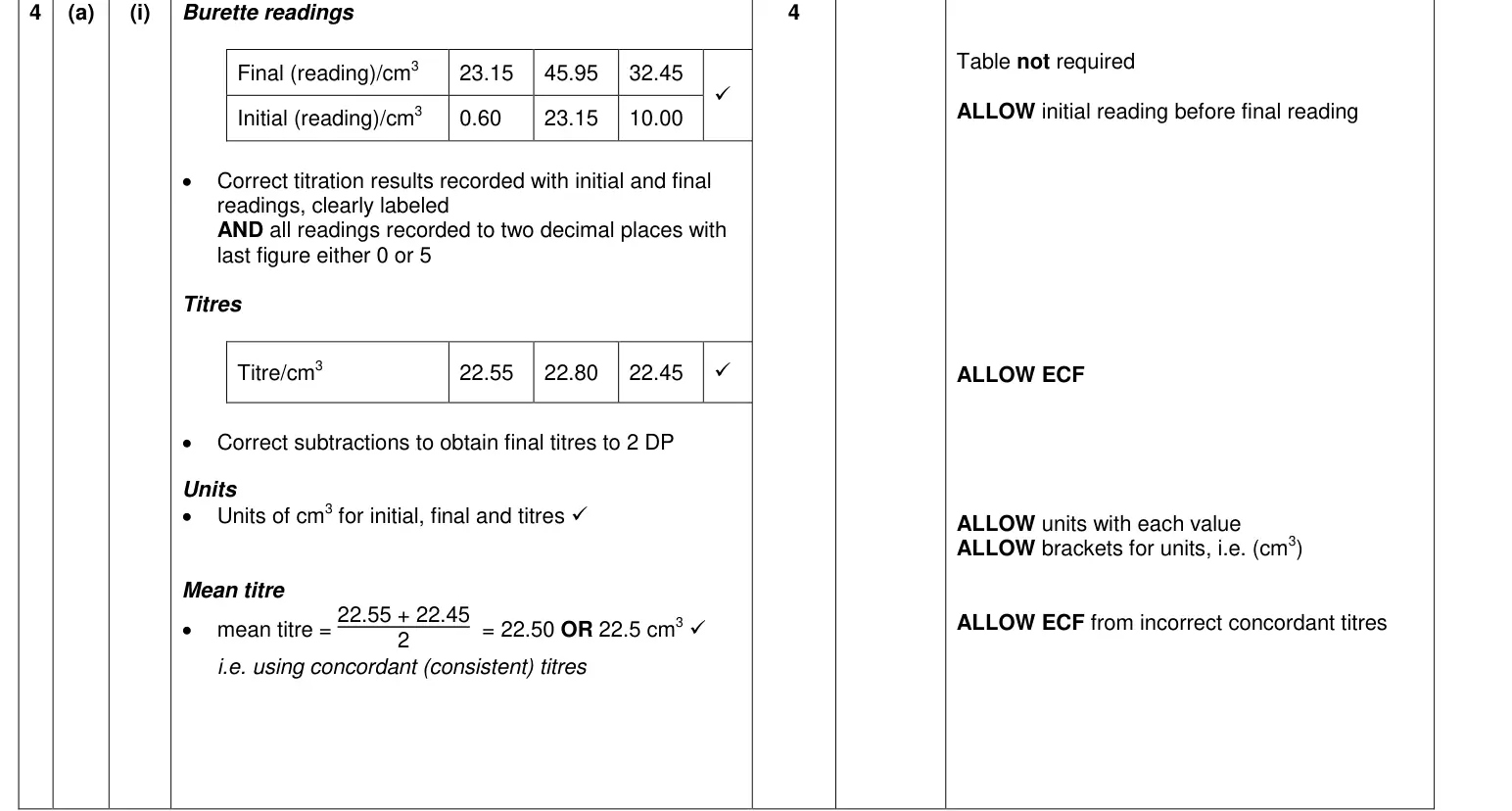
(i) Record the student’s readings and the titres in an appropriate format.
Calculate the mean titre that the student should use for analysing the results.
mean titre =  .................................................. cm3  [4]
June 2017 · Paper 3 · Q4(a)(ii) 6 marks Structure / isomer acids and titrationsamount of substanceamino acids amides and chirality
Earlier part of question 4 that this part usesEarlier part of June 2017 Paper 3 question 4
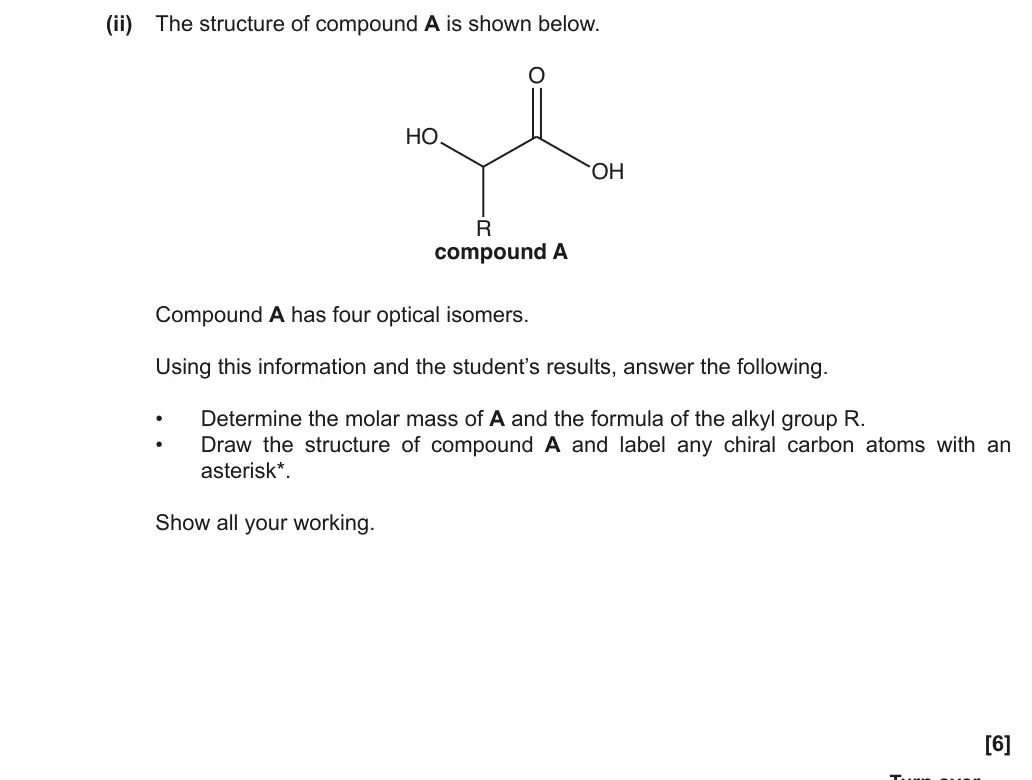
(ii) The structure of compound A is shown below.
O
HO
OH
R
compound A
Compound A has four optical isomers.
Using this information and the student’s results, answer the following.
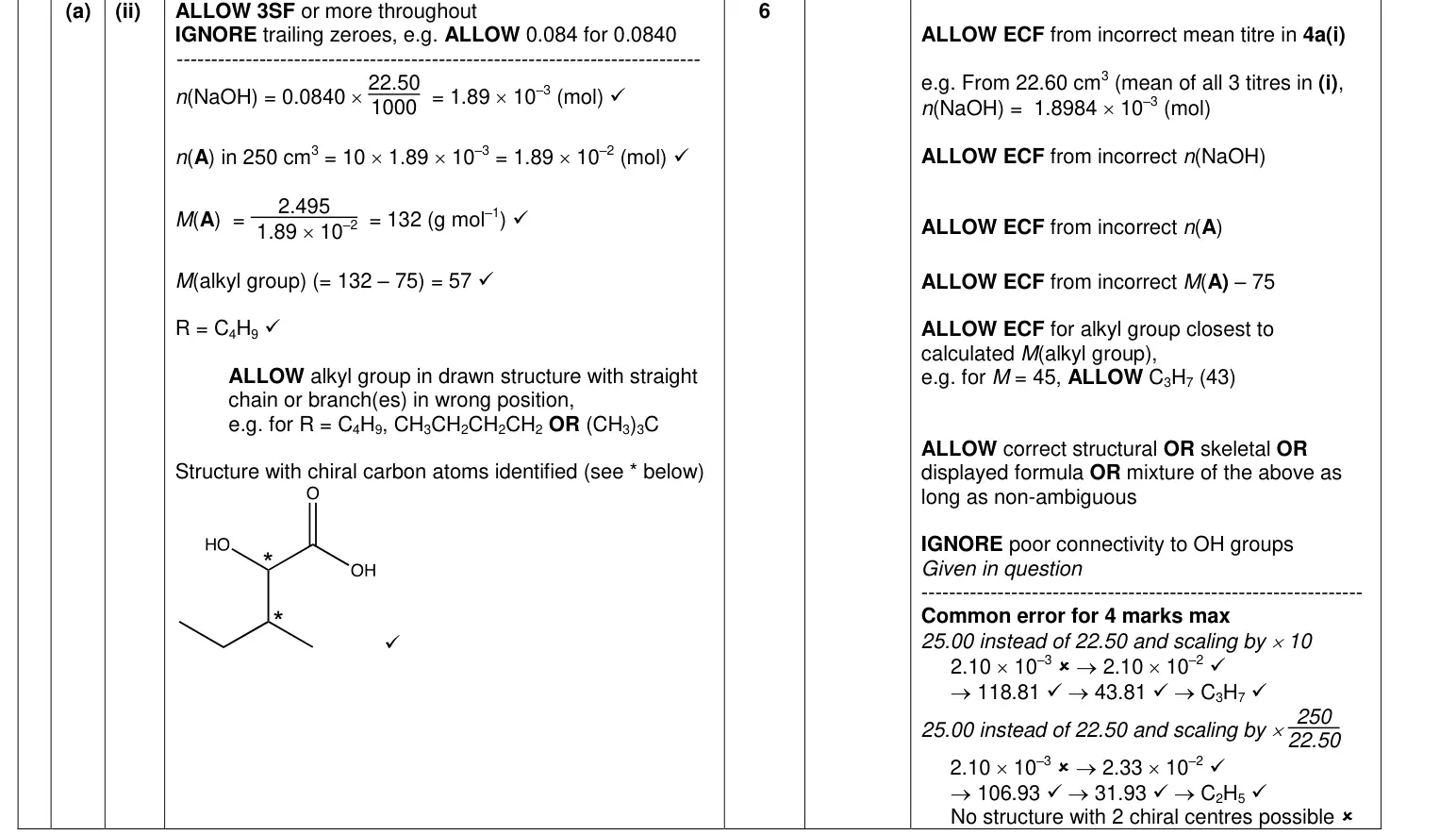
• Determine the molar mass of A and the formula of the alkyl group R.
• Draw the structure of compound A and label any chiral carbon atoms with an
asterisk*.
Show all your working.
[6]
June 2017 · Paper 3 · Q4(b)(i) 3 marks Structure / isomer carboxylic acids and estersformulae and equationsredox
Earlier part of question 4 that this part usesEarlier part of June 2017 Paper 3 question 4
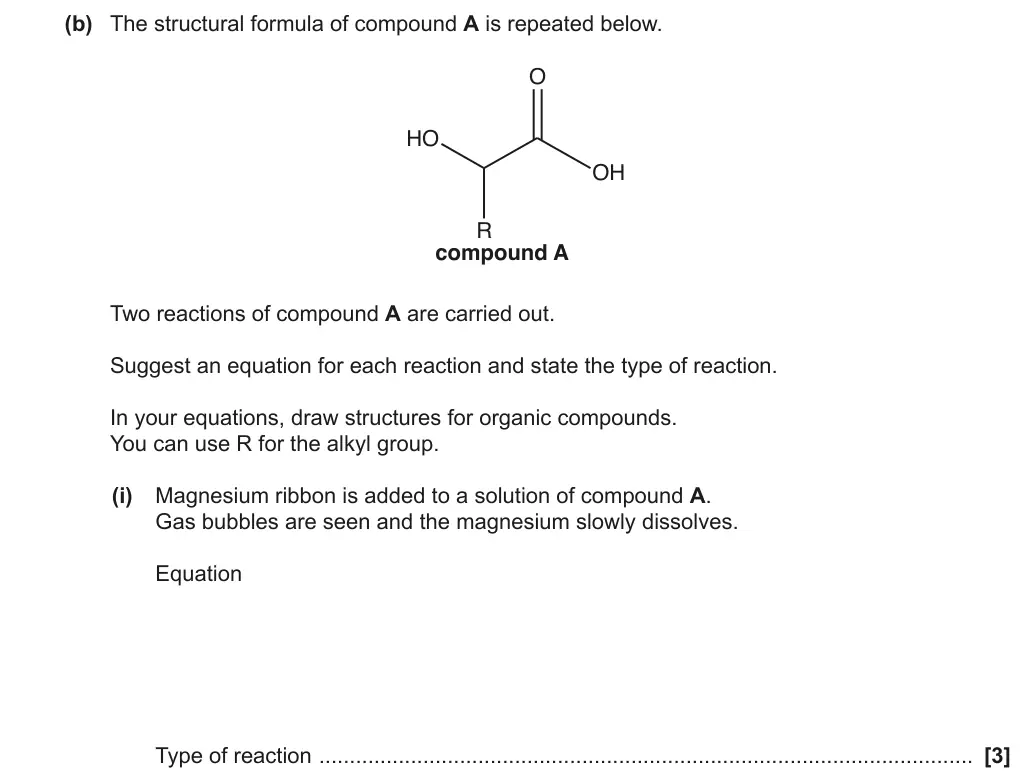
(b) The structural formula of compound A is repeated below.
O
HO
OH
R
compound A
Two reactions of compound A are carried out.
Suggest an equation for each reaction and state the type of reaction.
In your equations, draw structures for organic compounds.
You can use R for the alkyl group.
(i) Magnesium ribbon is added to a solution of compound A.
Gas bubbles are seen and the magnesium slowly dissolves.
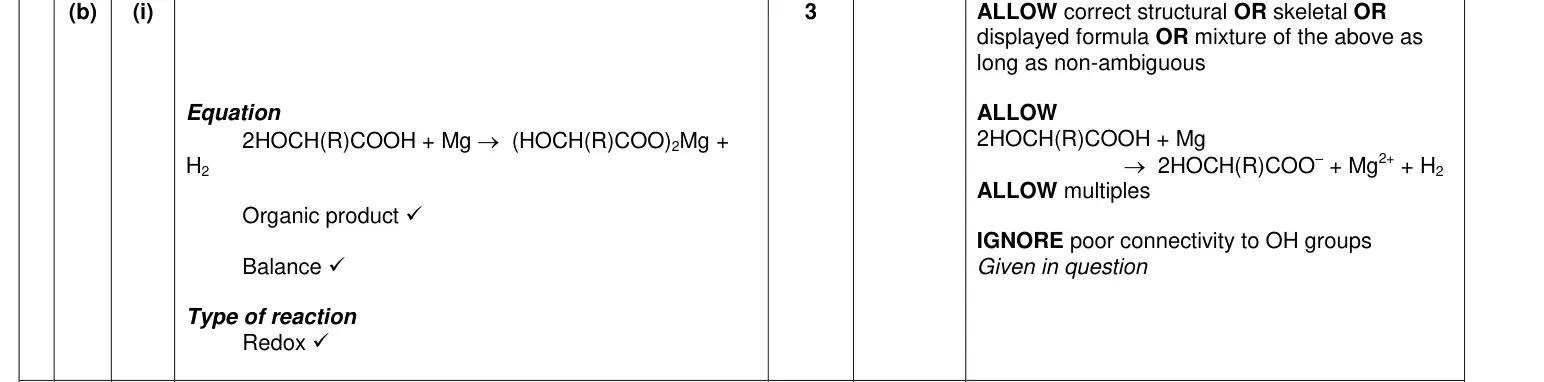
Equation
Type of reaction  ........................................................................................................... [3]
June 2017 · Paper 3 · Q4(b)(ii) 3 marks Short answer carboxylic acids and estersorganic synthesis
Earlier part of question 4 that this part usesEarlier part of June 2017 Paper 3 question 4
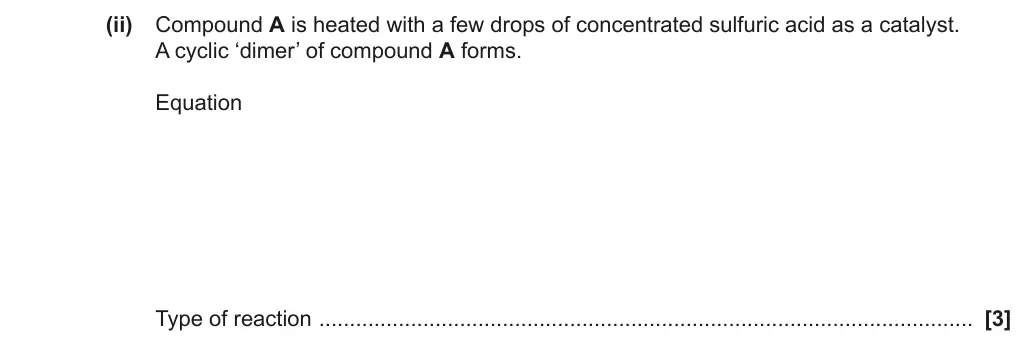
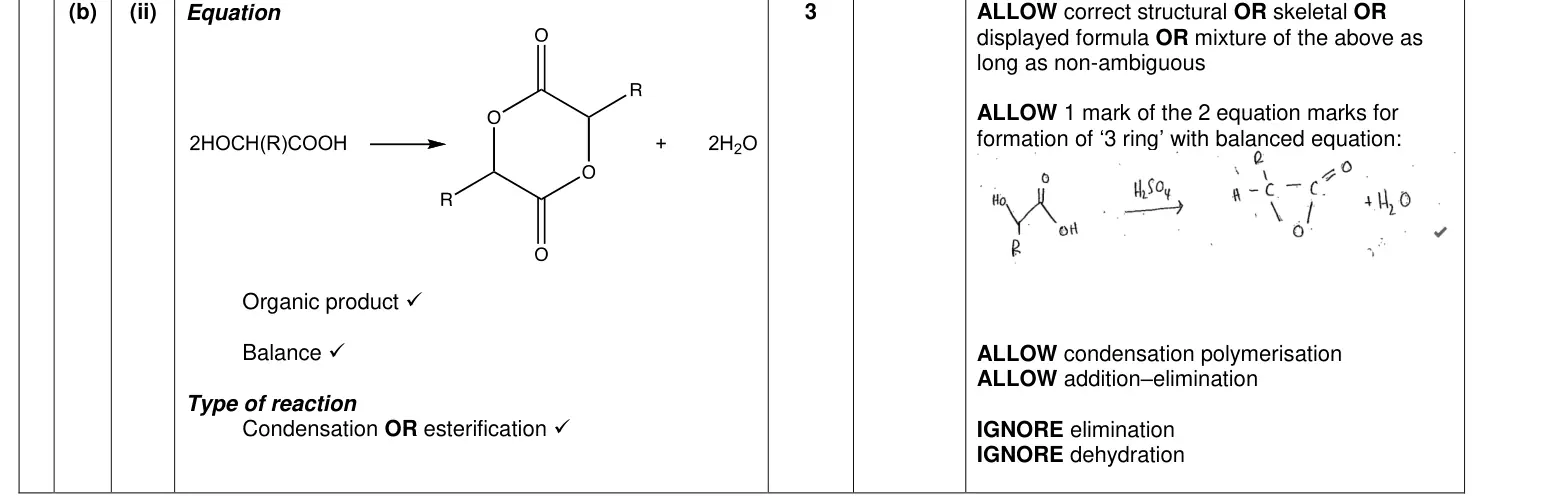
(ii) Compound A is heated with a few drops of concentrated sulfuric acid as a catalyst.
A cyclic ‘dimer’ of compound A forms.
Equation
Type of reaction  ........................................................................................................... [3]
June 2017 · Paper 3 · Q4(c)(i) 1 mark Structure / isomer transition elements
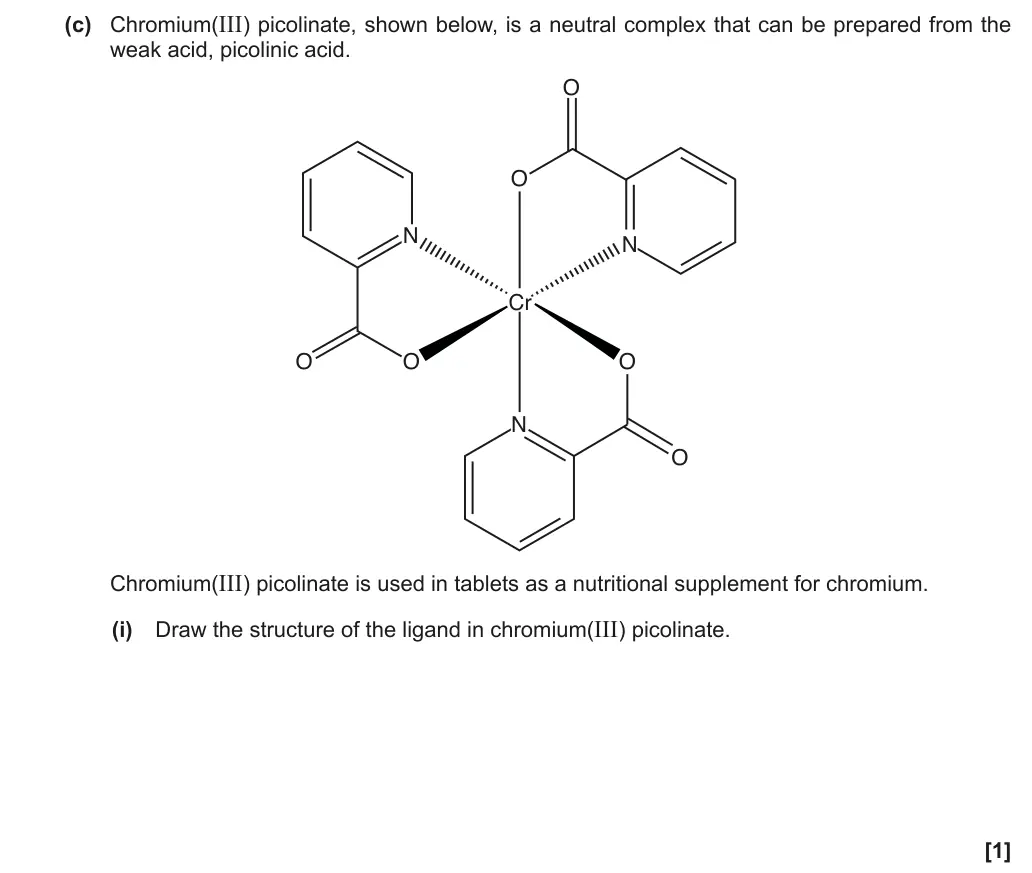
(c) Chromium(III) picolinate, shown below, is a neutral complex that can be prepared from the
weak acid, picolinic acid.
O
O
N
N
Cr
O O O
N
O
Chromium(III) picolinate is used in tablets as a nutritional supplement for chromium.
(i) Draw the structure of the ligand in chromium(III) picolinate.
[1]
June 2017 · Paper 3 · Q4(c)(ii) 2 marks Calculation amount of substanceatomic structure and isotopes
Earlier part of question 4 that this part usesEarlier part of June 2017 Paper 3 question 4
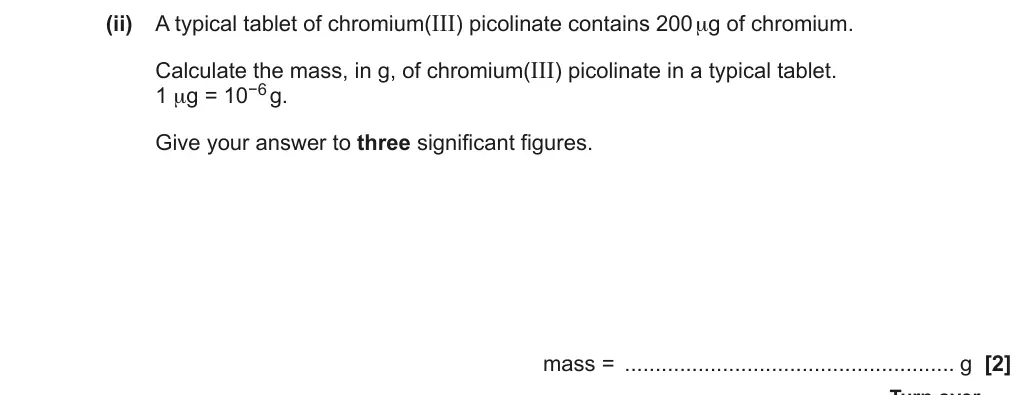
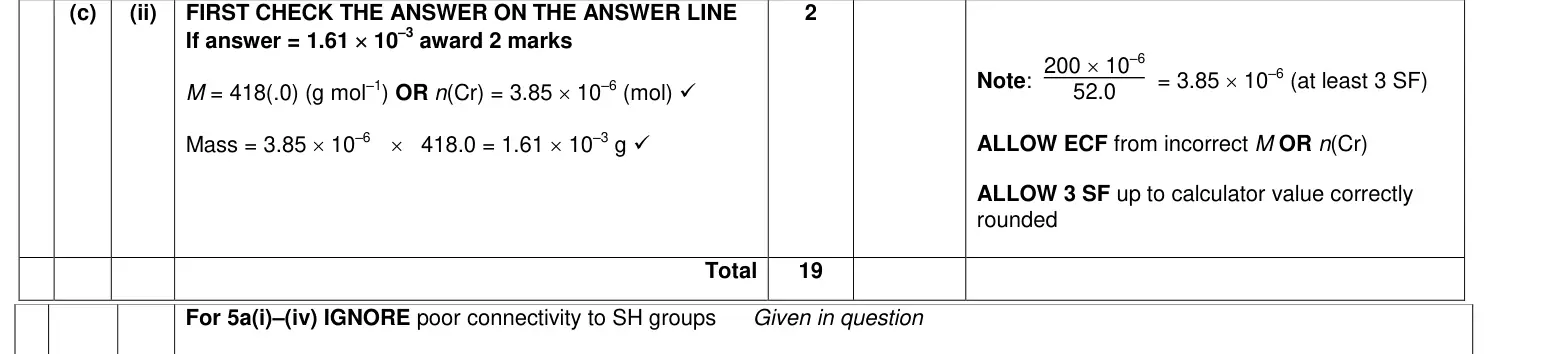
(ii) A typical tablet of chromium(III) picolinate contains 200 μg of chromium.
Calculate the mass, in g, of chromium(III) picolinate in a typical tablet.
1 μg = 10−6 g.
Give your answer to three significant figures.
mass =  ...................................................... g  [2]
June 2017 · Paper 3 · Q5(a)(i) 1 mark Short answer acids bases and buffers
5 This question is about organic molecules that have a strong smell.
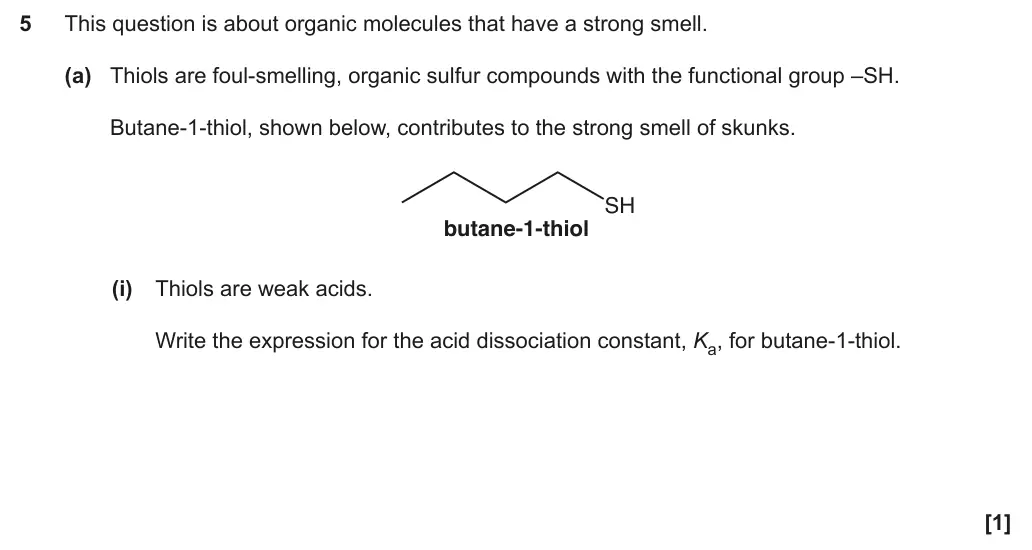
(a) Thiols are foul-smelling, organic sulfur compounds with the functional group –SH.
Butane-1-thiol, shown below, contributes to the strong smell of skunks.
SH
butane-1-thiol
(i) Thiols are weak acids.
Write the expression for the acid dissociation constant, Ka, for butane-1-thiol.
[1]
June 2017 · Paper 3 · Q5(a)(ii) 2 marks Equation writing carboxylic acids and estersorganic synthesis
Earlier part of question 5 that this part usesEarlier part of June 2017 Paper 3 question 5
(ii) Thiols react with carboxylic acids to form thioesters.
Write an equation for the reaction of butane-1-thiol with ethanoic acid.
Use structures for all organic compounds with the functional groups clearly displayed.
[2]
June 2017 · Paper 3 · Q5(a)(iii) 1 mark Structure / isomer organic basics
Earlier part of question 5 that this part usesEarlier part of June 2017 Paper 3 question 5
(iii) When beer is exposed to light, 3-methylbut-2-ene-1-thiol is formed, which gives an
unpleasant smell and flavour to the beer.
Draw the skeletal formula for 3-methylbut-2-ene-1-thiol.
[1]
June 2017 · Paper 3 · Q5(a)(iv) 2 marks Equation writing organic synthesisformulae and equations
Earlier part of question 5 that this part usesEarlier part of June 2017 Paper 3 question 5
(iv) Propane-1,3-dithiol reacts with carbonyl compounds in a condensation reaction to form a
cyclic organic sulfur product.
Write an equation for the reaction of propane-1,3-dithiol with propanone.
Use structures for organic compounds.
[2]
June 2017 · Paper 3 · Q5(b) 6 marks 6-mark level of response chromatography and functional group testsorganic synthesis
(b)* The structures for six naturally occurring organic compounds with pleasant smells, B–G, are
shown below. The common names in brackets relate to their source and smell.
OH
O
B C
(linalool) (citral)
O
OH
D
(geraniol)
E
(camphor)
O
OH
F G
(menthol) (ionone)
Explain how chemical tests would allow each compound to be distinguished from the other
compounds.
In your answer, include essential details for all test procedures and observations.
Details of apparatus and quantities are not required.
...................................................................................................................................................
...................................................................................................................................................
...................................................................................................................................................
...................................................................................................................................................
...................................................................................................................................................
...................................................................................................................................................
...................................................................................................................................................
...................................................................................................................................................
...................................................................................................................................................
...................................................................................................................................................
...................................................................................................................................................
...................................................................................................................................................
...................................................................................................................................................
...................................................................................................................................................
............................................................................................................................................. [6]

Work with an OCR chemistry tutor

Want a paper marked and gone through with you? Message us.

Prefer email? Send an enquiry

If you are under 18, please include a parent's contact details. Enquiries go to enquiries@chemistryaleveltutor.com and are deleted once handled. All tutoring is online.