Examiner's comment
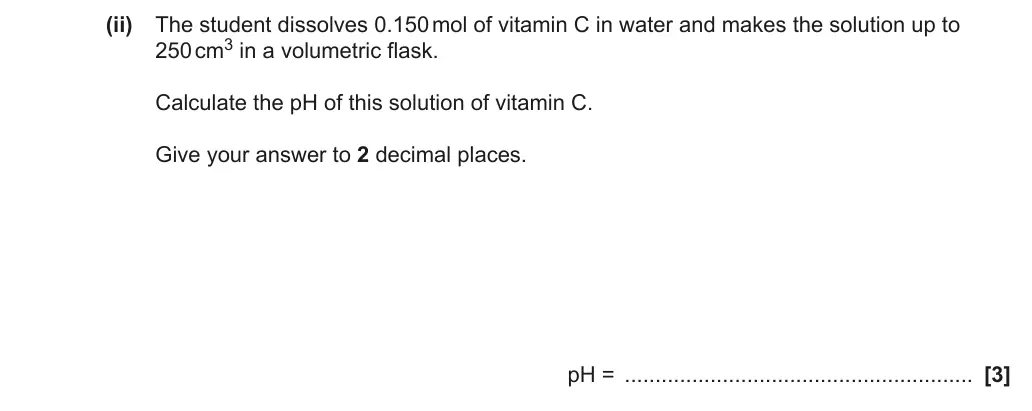
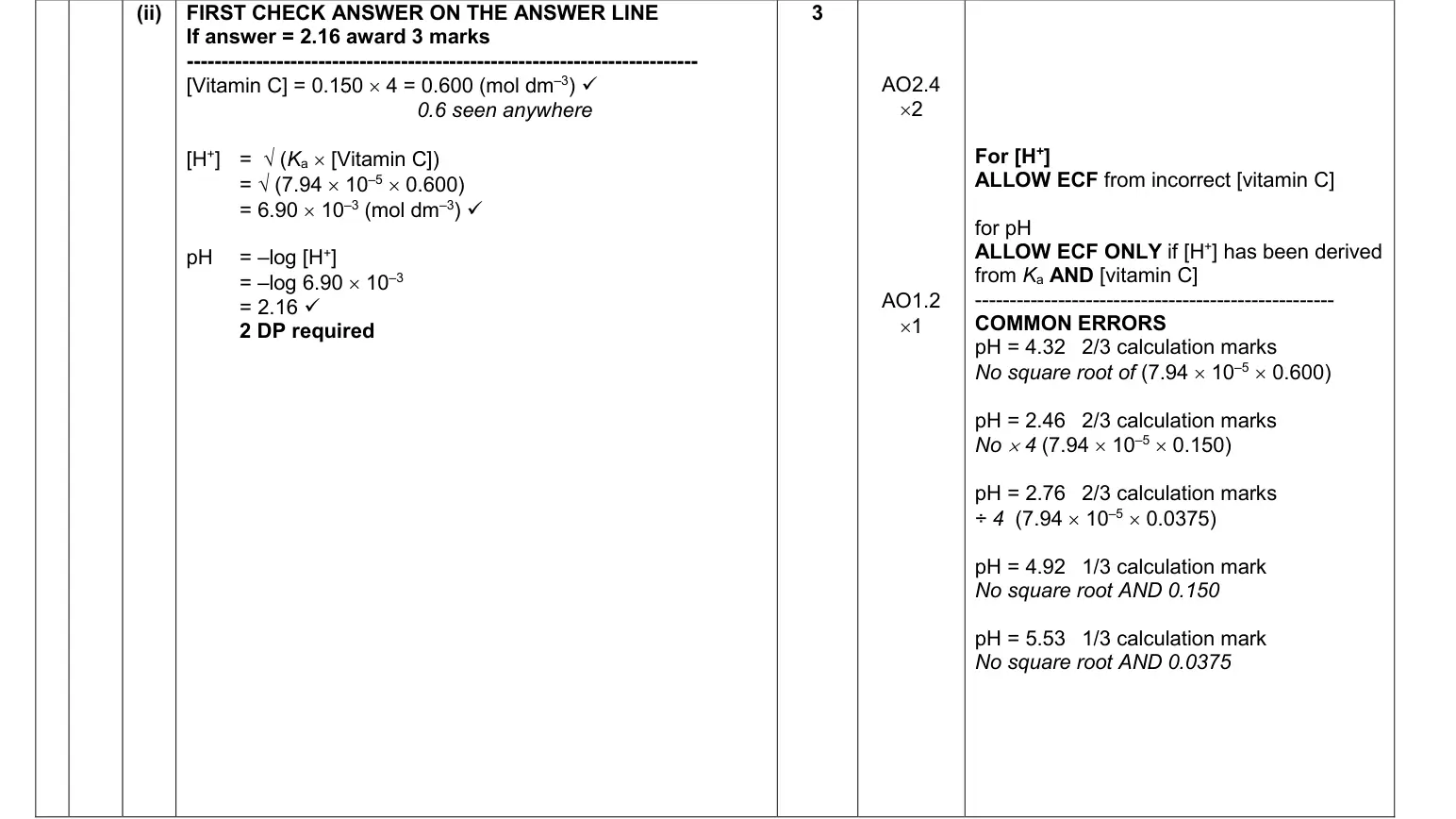
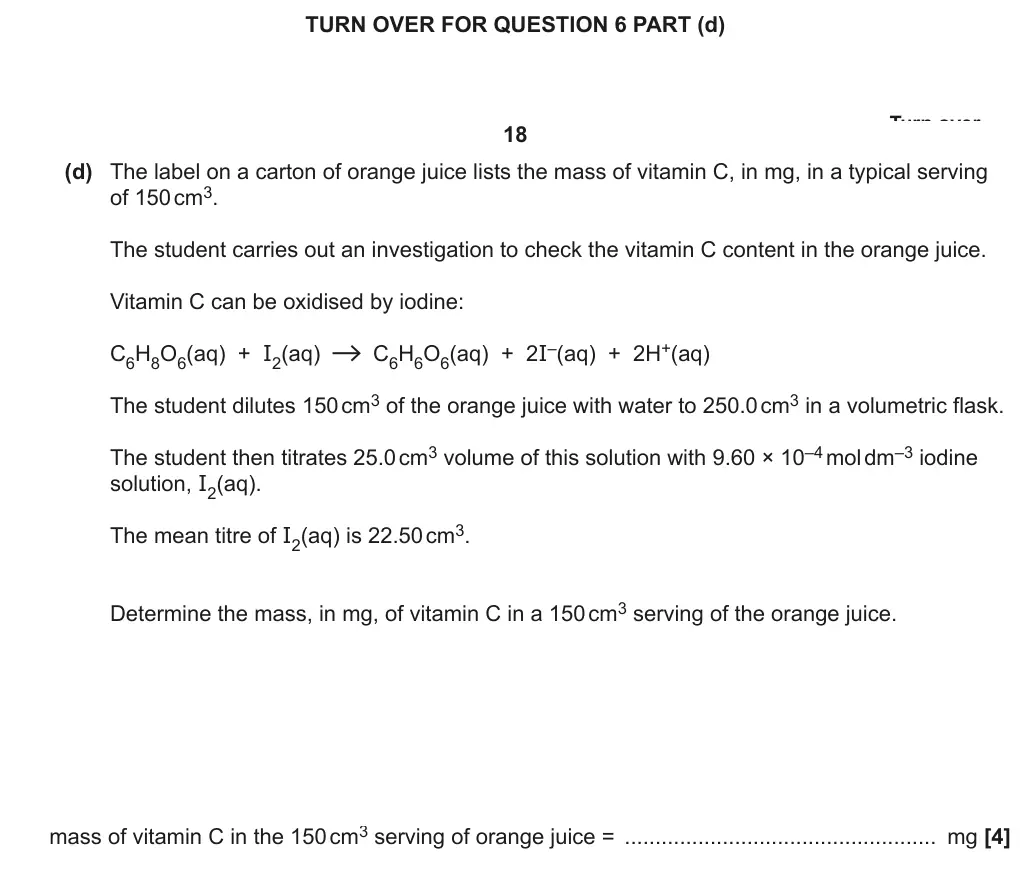
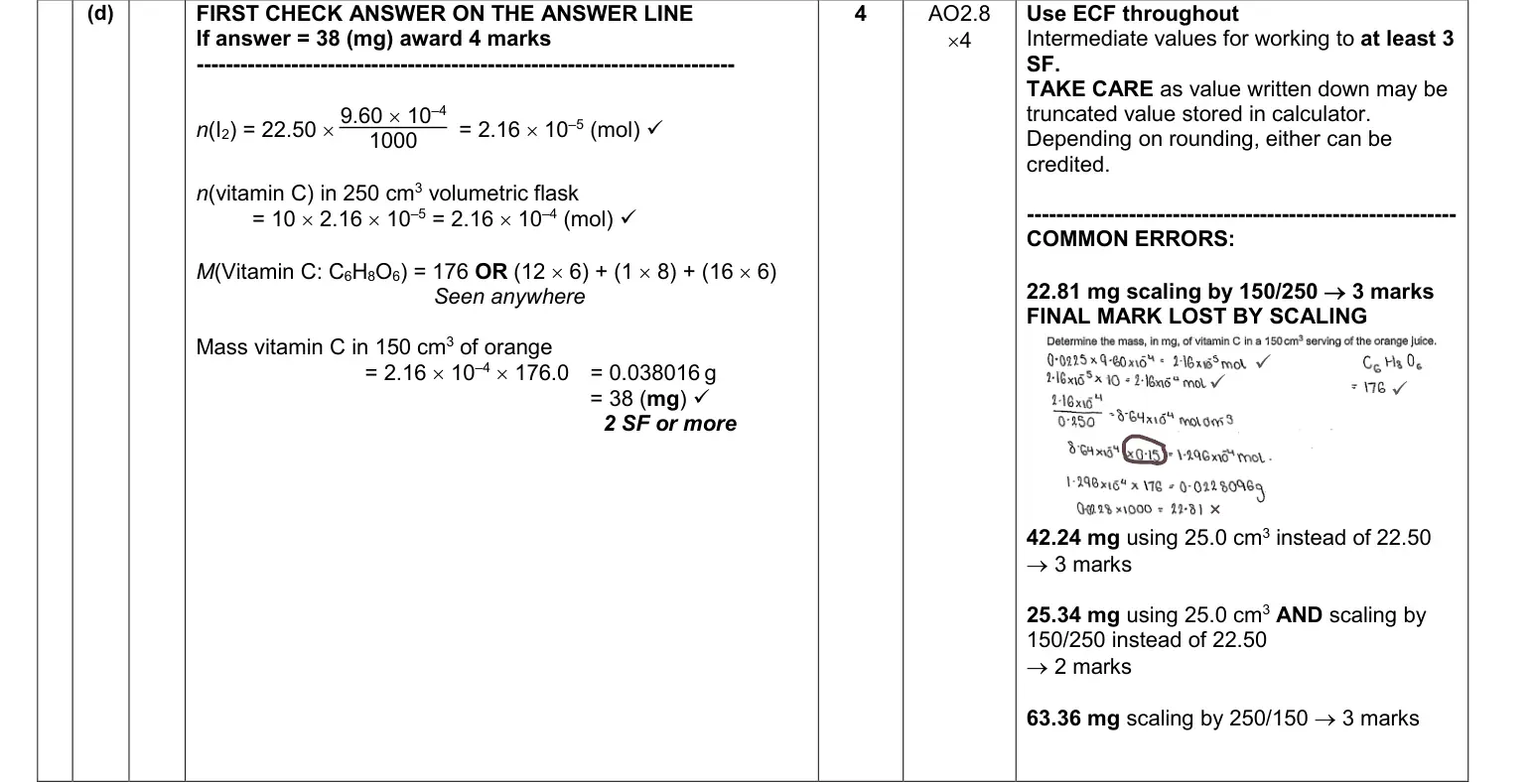
Most candidates had learnt a standard method for calculating the pH of a weak acid. with the correct answer of 2.16 being seen on very many scripts. Success required conversion of 0.150 moles of vitamin C in 250 cm3 to its concentration as 0.600 mol–3, calculation of [H+] using [H+] = (Ka [HA]) and determination of pH using –log[H+]. Common errors usually resulted from one mistake and could still be rewarded with 2 of the available 3 marks. Examples are shown below. • pH = 4.32 No square root of (7.94 10–5 0.600) • pH = 2.46 No conversion of 0.150 mol to 0.600 mol dm–3 (7.94 10–5 0.150) • pH = 2.76 ÷ 4 instead of 4 for concentration (7.94 10–5 0.0375) pH calculations are common in A Level Chemistry There are four different types, and it is essential that the standard methods for determination of [H+] in the calculations are learnt: • pH of strong acids • pH of weak acids, using Ka and [HA] • pH of strong bases, using Kw and [OH–] • pH of buffers, using Ka and [HA]/[A–] It is extremely likely that at least one of these types of pH calculation will feature in at least one of the A Level units. This question was a standard titration calculation, set in a practical context. As with Question 6 (c) (i), this assessed one of the important principles encountered in A Level Chemistry. Success required three main stages: • Calculation of the amount, in mol, of I2 used in the titration of 25.0 cm3 of the diluted orange juice. • Determination of the amount in mol of vitamin C in the 250 cm3 solution (effectively scaling by 10) • Use of this value with the molar mass of vitamin C to determination of the mass of vitamin C, in mg, in the 150 cm3 serving of the orange juice. Most candidates calculated the amount of I2 (and vitamin C) in the titre as 2.16 10–5 mol. The next scaling stage by 10 to 2.16 10–4 mol introduced a problem. Many candidates were distracted by the ‘150 cm3’ serving of orange juice and they scaled further by a factor of 150/250 to give 1.296 10–4 mol. Candidates scaling corrected by 10 usually used the vitamin C molar mass of 176 g mol–1 to determine the correct mass of 38 mg in the orange juice serving. The common incorrect mass of 22.8 mg resulted from the extra scaling by 150/250 described above. This could still be given 3 of the available 4 marks as only one error had been made. Some candidates worked out an incorrect molar mass for vitamin C, with 174 often seen. Provided that this value was used with a correct method, ECF could still be applied for the final mass. If any of your students’ results are not as expected, you may wish to consider one of our post-results services. For full information about the options available visit the OCR website. We send a weekly roundup to tell you about important updates. You can also sign up for your subject specific updates. If you haven’t already, sign up here. Attend one of our popular CPD courses to hear directly from a senior assessor or drop in to a Q&A session. Most of our courses are delivered live via an online platform, so you can attend from any location. Please find details for all our courses on the relevant subject page on our website or visit OCR professional development. ExamBuilder is the question builder platform for a range of our GCSE, A Level, Cambridge Nationals and Cambridge Technicals qualifications. Find out more. ExamBuilder is free for all OCR centres with an Interchange account and gives you unlimited users per centre. We need an Interchange username to validate the identity of your centre's first user account for ExamBuilder. If you do not have an Interchange account please contact your centre administrator (usually the Exams Officer) to request a username, or nominate an existing Interchange user in your department. Review students' exam performance with our free online results analysis tool. It is available for all GCSEs, AS and A Levels and Cambridge Nationals. It allows you to: • review and run analysis reports on exam performance • analyse results at question and/or topic level • compare your centre with OCR national averages • identify trends across the centre • facilitate effective planning and delivery of courses • identify areas of the curriculum where students excel or struggle • help pinpoint strengths and weaknesses of students and teaching departments. Find out more. Post-results services Keep up-to-date OCR Professional Development Signed up for ExamBuilder?
Notes from the mark scheme and report
- common errors: 4.32 no square root
- 2.46 no ×4 (0.150 used)
- 2.76 ÷4
- concentration 0.600 mol dm–3
- 2 d.p. required (2.16)
- pH ECF only if [H+] derived from Ka and concentration
Skills: M0.4 Use calculators to find and use power, exponential and logarithmic functions; M2.3 Substitute numerical values into algebraic equations using appropriate units for physical quantities; M2.5 Use logarithms in relation to quantities that range over several orders of magnitude