Answer
C
Mark scheme

Examiner's comment
Most candidates recognised C as a diagram for a p orbital.
70 marks · 40 question parts · Paper, mark scheme and report on OCR's site · Have OCR's Data Sheet beside you
C
Most candidates recognised C as a diagram for a p orbital.

C
Most candidates recognised the correct atomic structure, a basic chemical skill taken forward from GCSE.
D
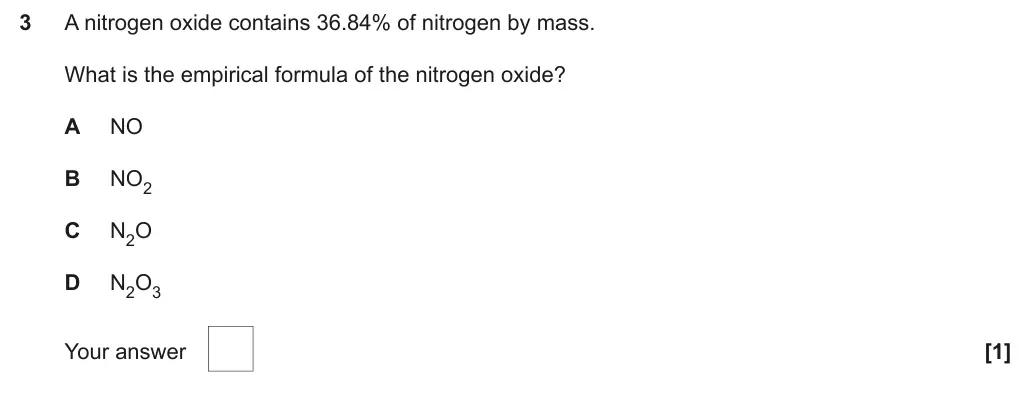
Most candidates selected D as the correct formula. They usually showed their working alongside the options which is good practice. B was the main distractor and working suggested that such candidates had over-rounded their ratio of 1:1.5 to 1:2.
C
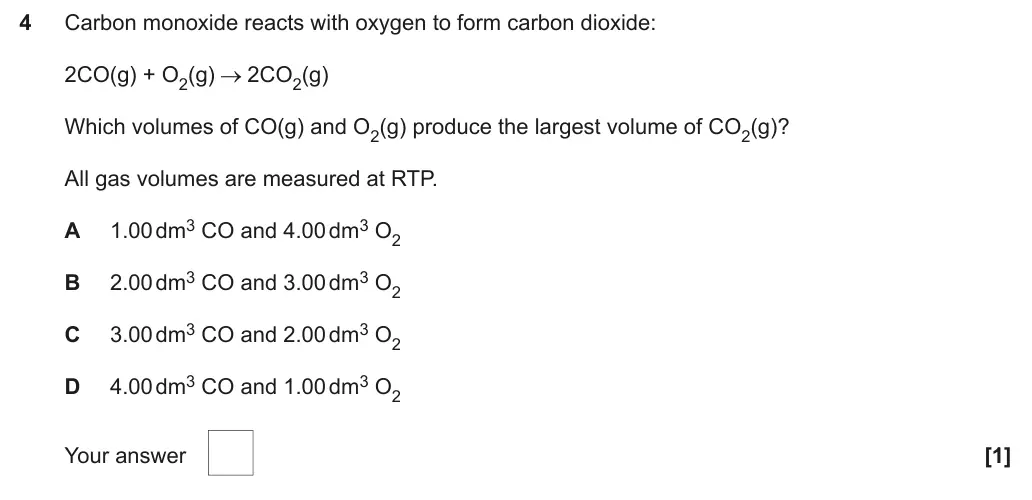
Candidates found this question very difficult. Scripts showed a general lack of working, suggesting that candidates did not know how to approach the problem. Candidates had to first work out which reactant was in excess and to use the limiting reagent to determine the volumes of CO2 formed. The question did not discriminate very well, suggesting that many candidates guessed. C was the correct response with A and D being the main distractors, presumably because these contained the largest volumes of O2 (in A) and of CO (in D). This would be a good question to use with high-attaining candidates.
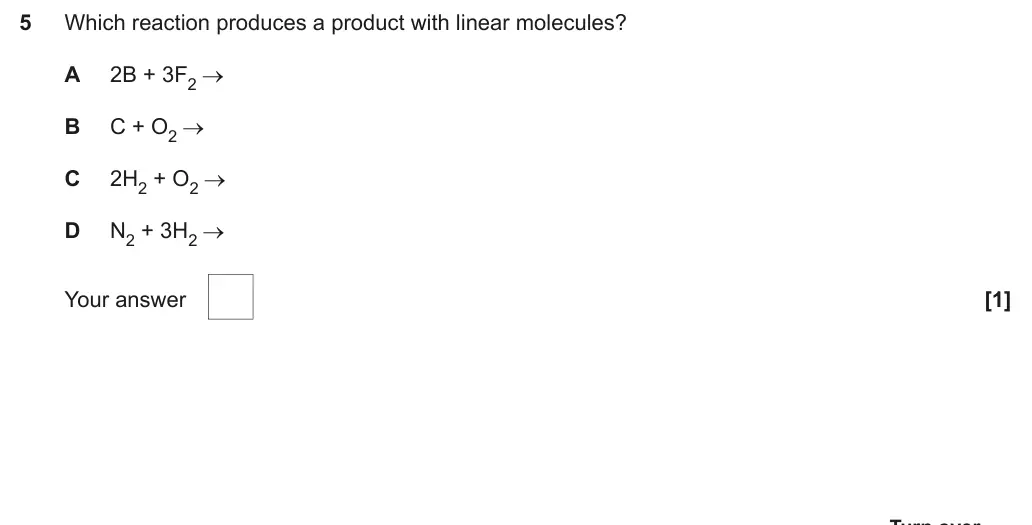
B
Most candidates identified CO2 as the product with linear molecules, suggesting that knowledge of bond shapes is good.
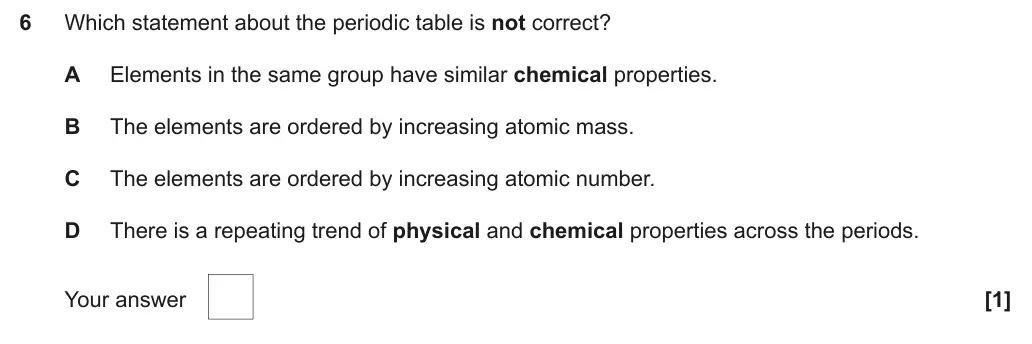
B
This question did discriminate, but the correct option of B was missed by many candidates. D was the main distractor, despite the question assessing basic chemical facts. This multiple-choice question required candidates to choose the option that is not correct, and some candidates may not have read the question closely enough. It is recommended that candidates underline the word not in such MCQs to highlight what is required.

B
Some candidates correctly chose MgSO4. No option showed up as a ‘main’ distractor and many candidates may have just guessed. As this question assesses recall of a specification learning outcome, this suggests that the content had not been learnt by many candidates. Note also the points made in Question 6 about underlining the word ‘not’.
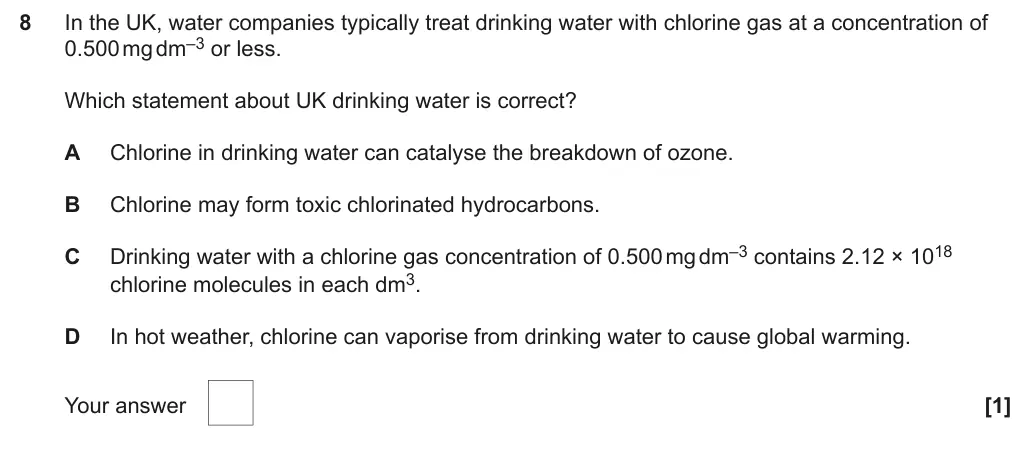
B
Overall, candidates had little difficulty with this question and most selected B. Options C and D were the main distractors, with few choosing option A. The question did not discriminate well across the ability range, suggesting that many candidates guessed.
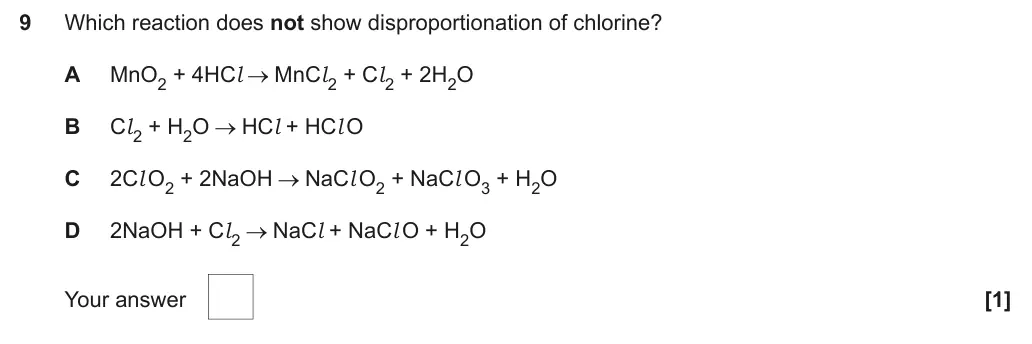
A
About half of the candidates chose A correctly. Most candidates wrote oxidation numbers below the chlorine in the equations, which is good practice, with C proving to be the main distractor. Note also the point made in Question 6 about underlining the word ‘not’.

B
This question was answered well with most candidates correctly selecting the sequence shown in B.
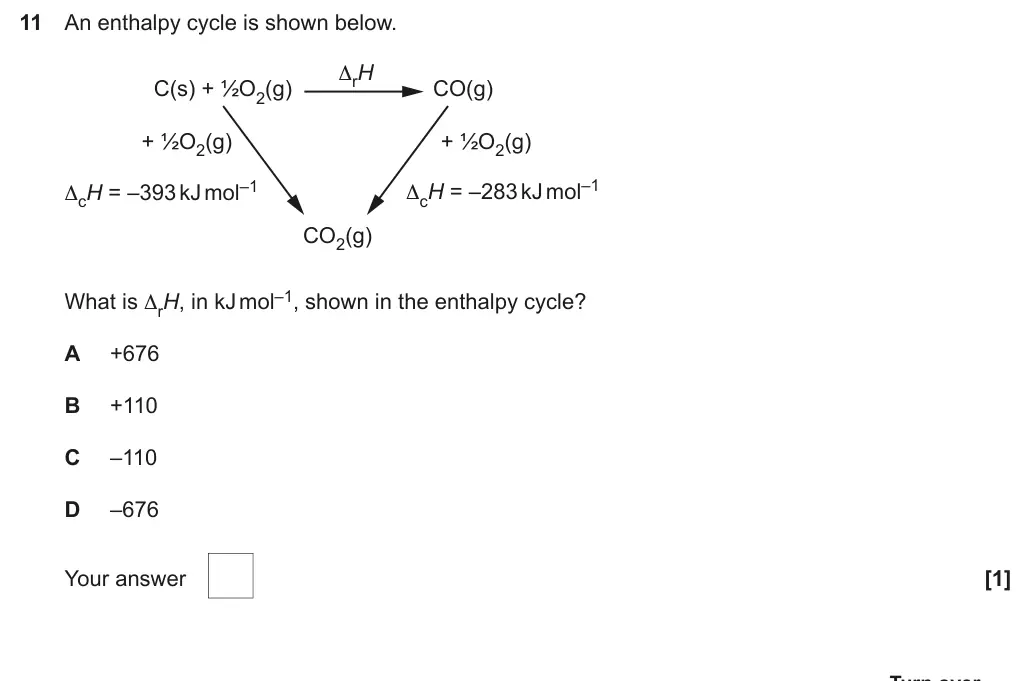
C
This question was answered well with most candidates correctly selecting C.

A
Most candidates were aware that heat increases the number of molecules that have energy greater than the activation energy (A).

B
Almost all candidates were aware of how to express the Kc expression for an equilibrium, choosing the correct option B.
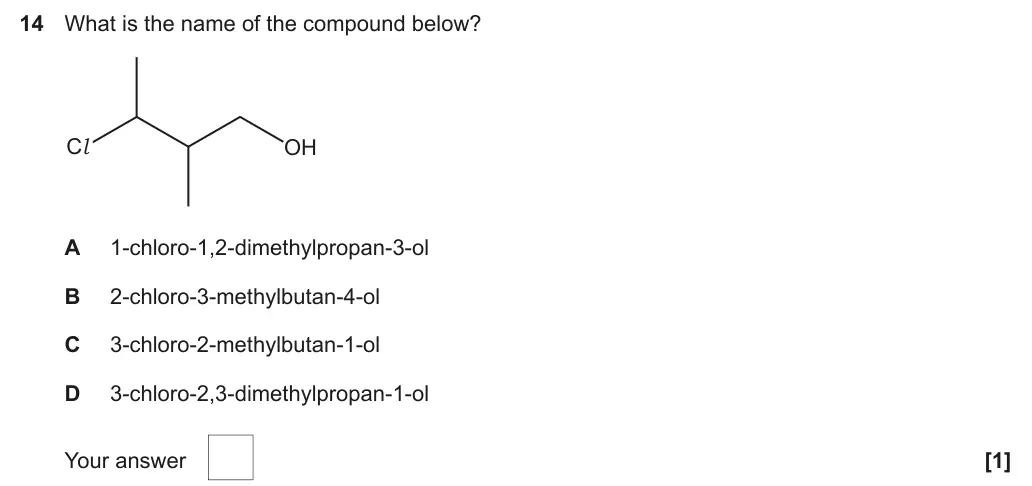
C
About half the candidates correctly chose C. Options A and B were incorrectly chosen by many candidates, presumably by counting from the left or not first identifying the longest carbon chain. This question proved to be an excellent discriminator.
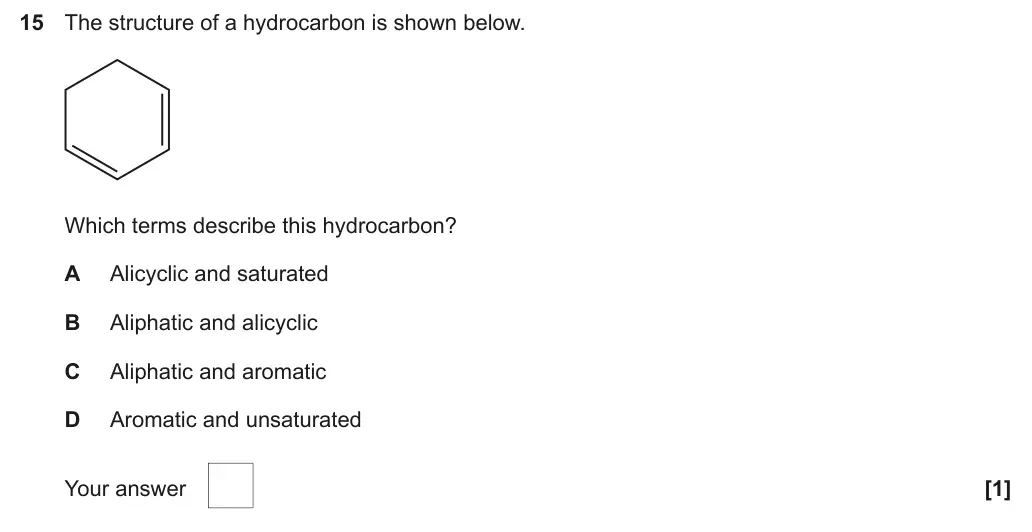
B
This question assessed understanding of important terms used in organic chemistry, with some candidates correctly choosing B as the correct option. The question discriminated well with less successful responses choosing D, presumably thinking that the two double bonds in a cyclic structure makes the compound aromatic.

C
Some candidates chose B as the correct option. The other options were chosen randomly, suggesting that many had not learnt this specification content and had guessed.
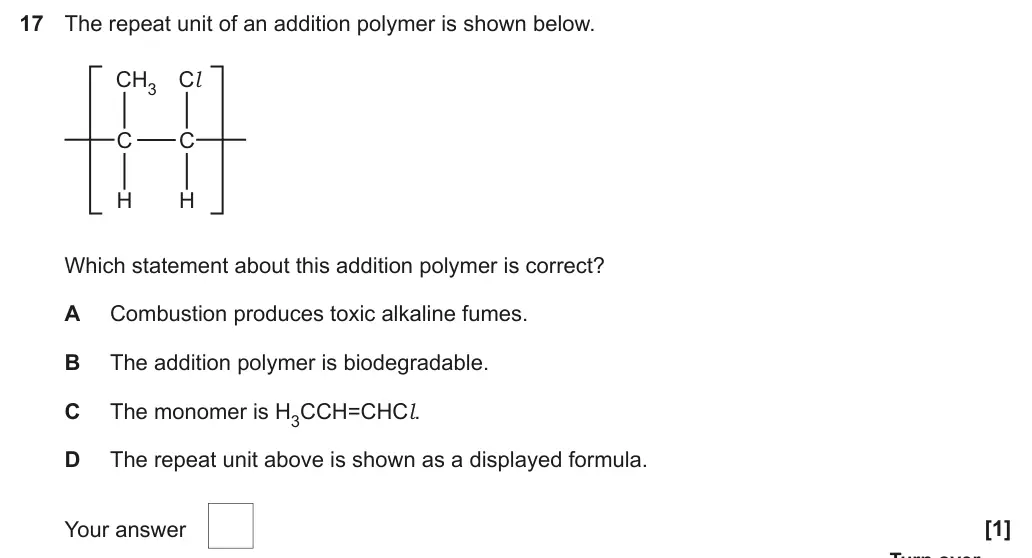
C
This question proved to be an excellent discriminator with most above average candidates choosing monomer (option C).

D
Many candidates wrote the functional groups on the structure shown on their scripts, which reflects good exam technique. Most correctly identified that the compound contains ketone and carboxylic acid functional groups (D). This was an excellent discriminator.

B
Some candidates correctly chose option B, with the other options being chosen randomly. From the importance placed on the causes of global warming, it was interesting to see that many incorrectly chose option A. Note also the points made in Question 6 about underlining the word ‘not’.

C
Most candidates first worked out the molecular mass of each fragment and annotated their scripts with this information, eliminating options A and C in the process. More successful responses than drew out the structure of the alcohol, to work out that only option C could have produced the fragment. This is evidence of good exam technique. Predictably, option B was the main distractor. This question discriminated well. Section B overview Section B includes short response question styles (structured questions, problem solving, calculations, practical) and extended response questions. This section of the paper is worth 50 marks.

Candidates answered this question very well. A few mis-wrote the numbers and even fewer gave responses to the incorrect number of decimal places. This type of question has featured on previous examinations, and it was encouraging to see how well it was answered, even with more isotopes being included than previously.
Skills: M0.2 Use ratios, fractions and percentages; M1.1 Use an appropriate number of significant figures

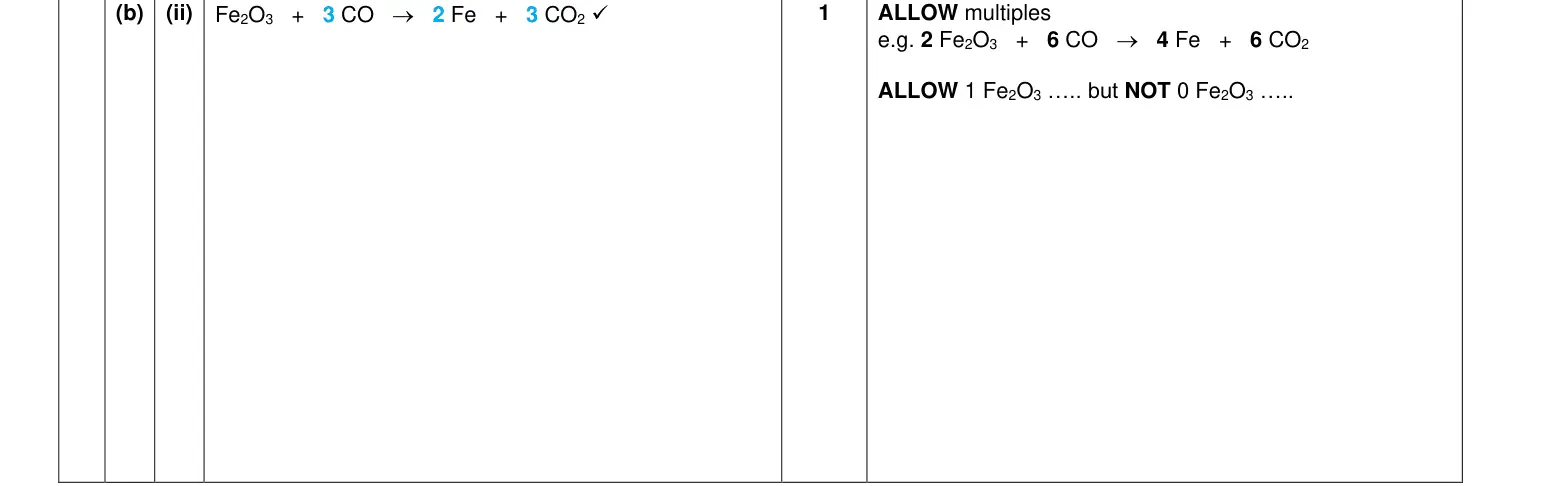
This question required candidates to work out a systematic name from a formula. Transition elements can have different oxidation numbers in their compounds and the systematic name needs to contain a Roman numeral. Approximately half the candidates were able to write the correct name as iron(III) oxide. An array of incorrect names were seen, commonly iron(II) oxide, presumably from the number of iron atoms in Fe2O3.

Most candidates were able to balance this straightforward equation.
Skills: M0.2 Use ratios, fractions and percentages
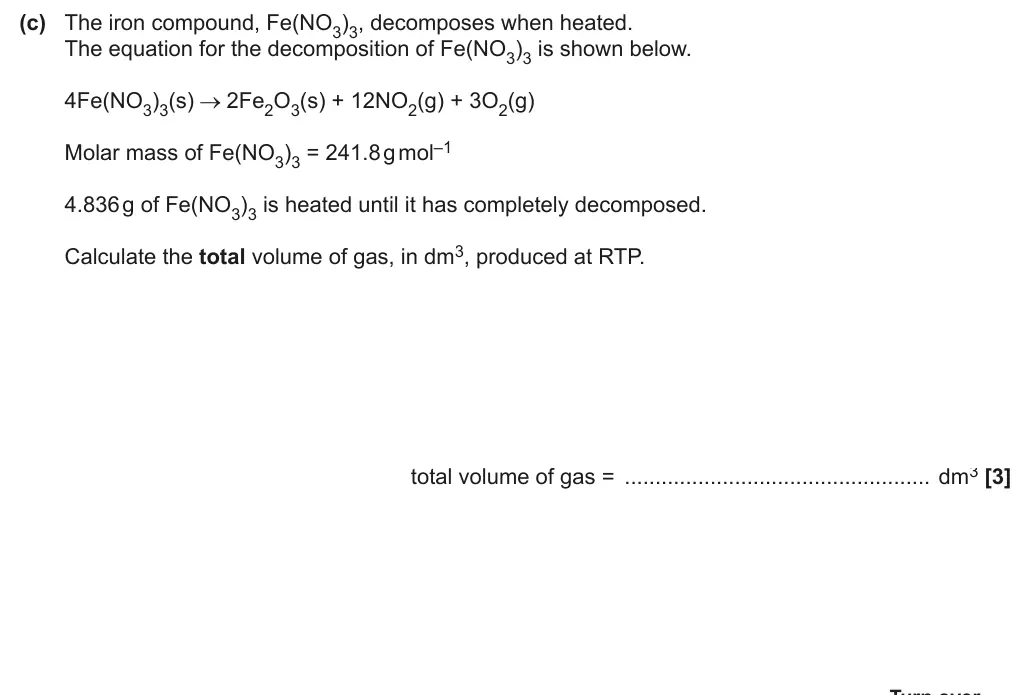
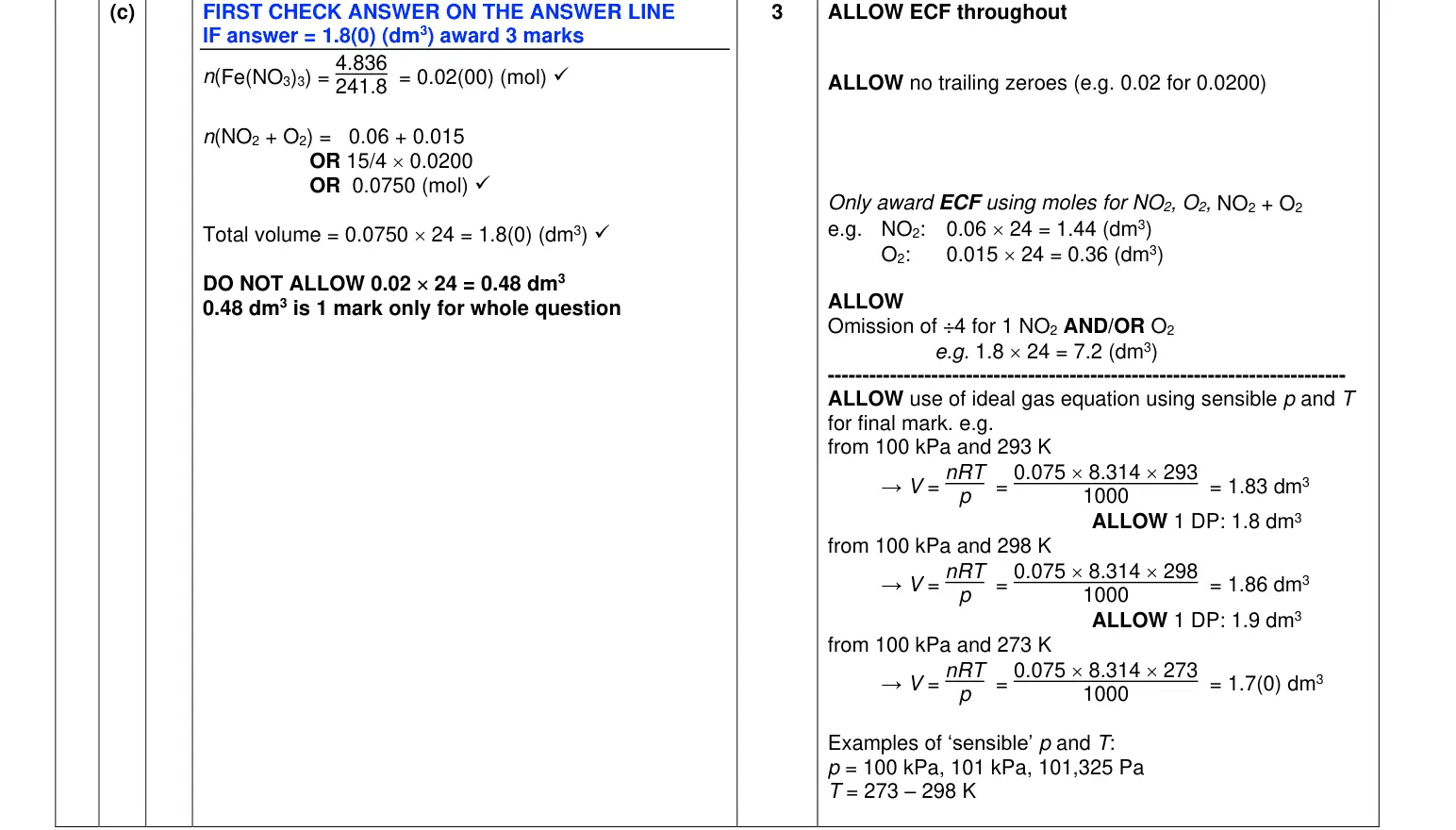
Most candidates were given at least one of the three available marks for calculating the amount of Fe(NO3)2 as 0.0200 mol. Candidates then needed to determine the moles of gas (NO2 + O2) as 0.0750 mol, which has a volume at RTP of 0.0750 24.0 = 1.80 dm3. The most common error was omission of ÷4 from the equation when working out the moles of gas and obtaining a total volume of 1.80 4 = 7.20 dm3. Such a response could still be given 2 marks by error carried forwards.
Skills: M0.0 Recognise and make use of appropriate units in calculations; M0.2 Use ratios, fractions and percentages; M2.3 Substitute numerical values into algebraic equations using appropriate units for physical quantities
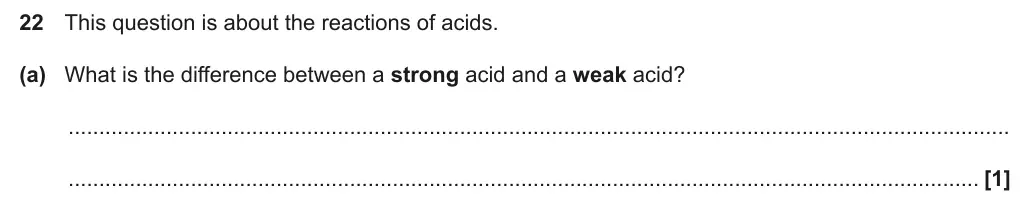
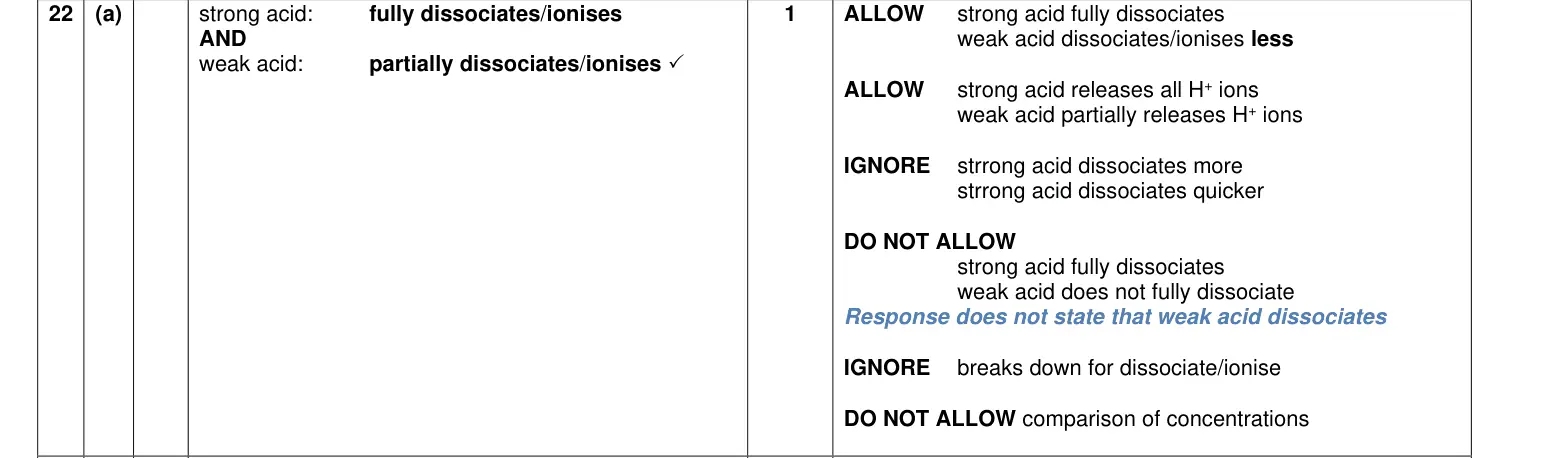
Most candidates described a strong and a weak acid in terms of dissociation or ionisation, with few just describing one of the two types of acid.
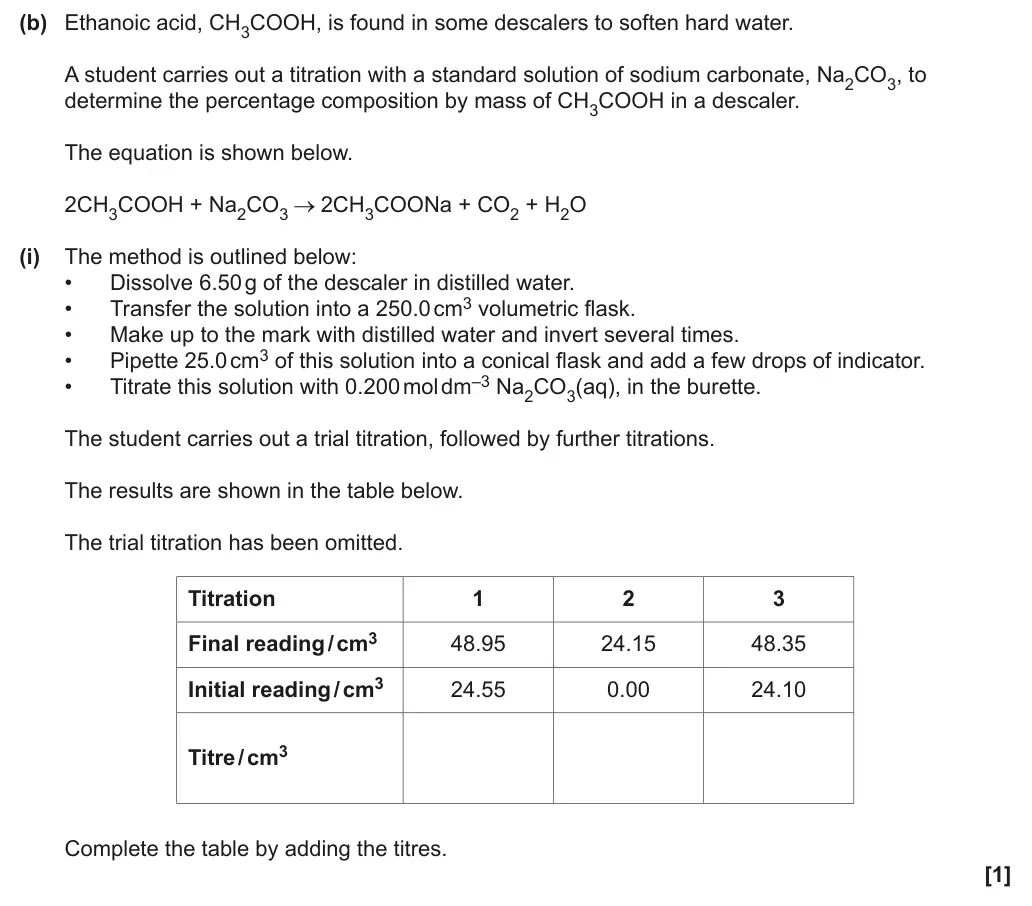
Most candidates were able to work out these simple subtractions. Candidates were told that the titration readings were read to the nearest 0.05 cm3, requiring volumes to be recorded to two decimal places, which may include a ‘0’. The right-hand initial reading is therefore 24.10 cm3 and not 24.1 cm3, which continues to be the commonest error seen.
Skills: PAG2 Acid–base titration
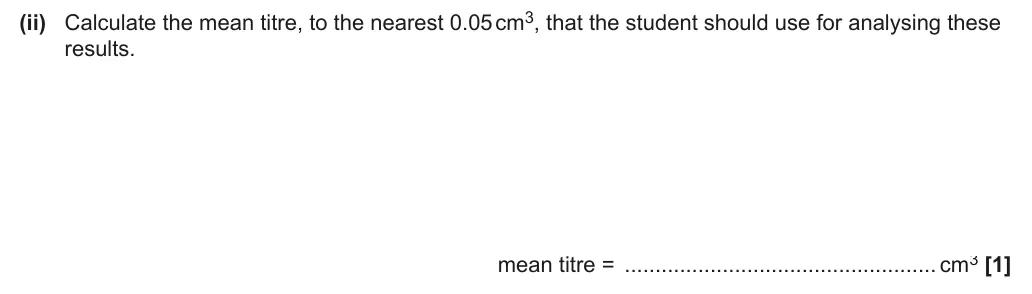
Candidates are expected to use only concordant titres when working out the mean titre and the left-hand titre of 24.40 cm3 should be rejected. Most candidates did this to produce 24.20 cm3 as their mean titre. Use of 24.2 was allowed because rounding of a ‘0’ as the second decimal place had already been penalised in Question 21 (b) (i). Predictably, the most common error was to use all three titres to produce the incorrect mean of 20.27 cm3.
Skills: M1.2 Find arithmetic means; PAG2 Acid–base titration
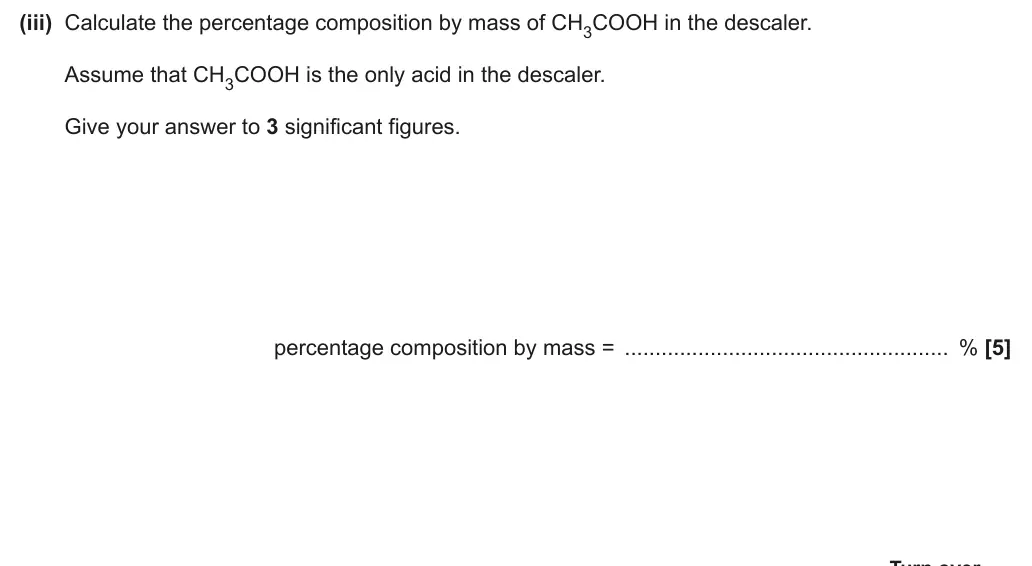
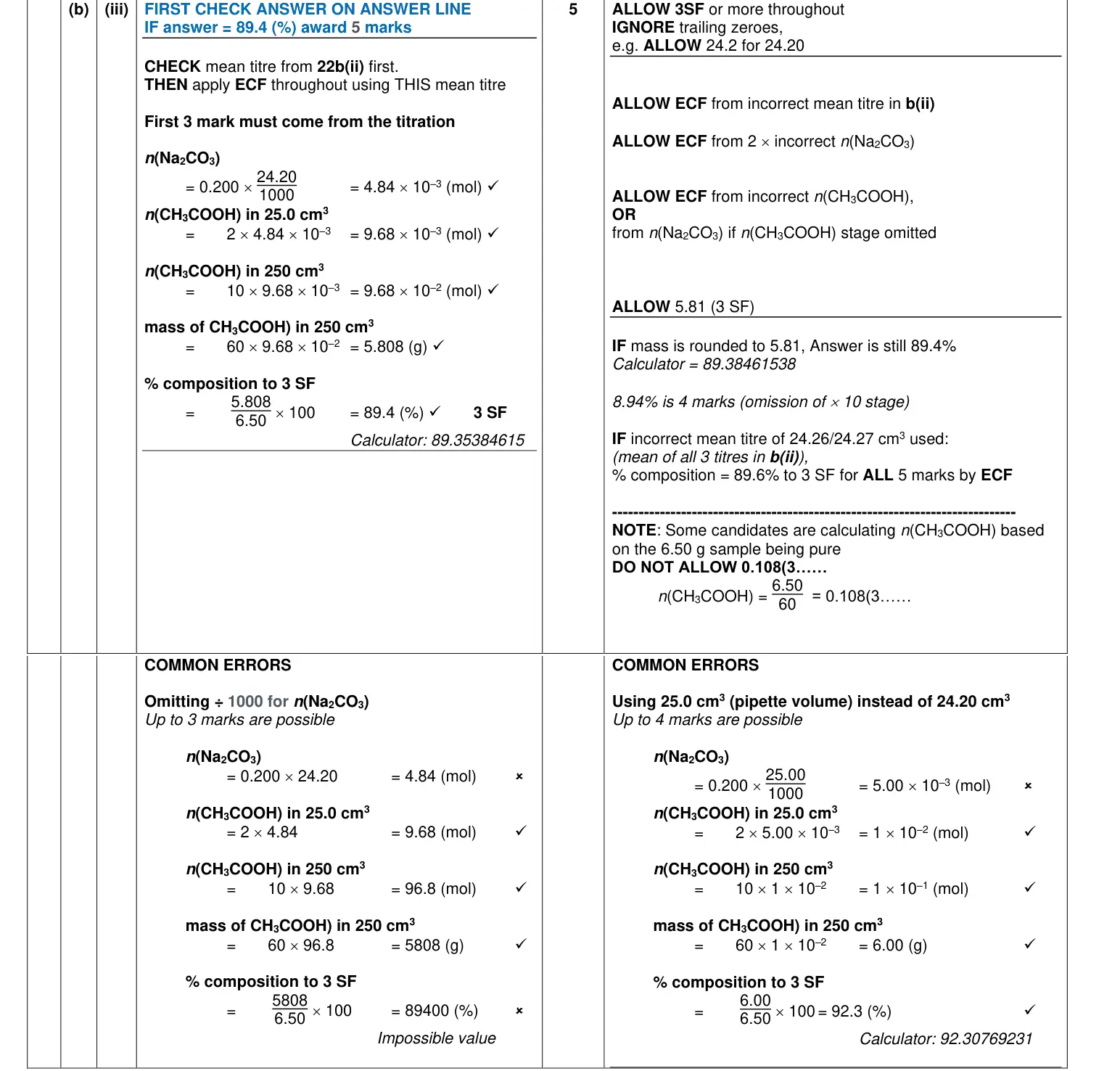
Many candidates followed a well drilled method to analyse their titration results: • Moles of Na2CO3 in the mean titre • Moles of CH3COOH in 25 cm3 • Scaling 10 for moles of CH3COOH in 250 cm3 Candidates then needed to process their titration results further to determine the percentage composition: • Mass of CH3COOH in 250 cm3 • Percentage composition of CH3COOH to 3 significant figures. Most candidates were able to make some progress through the analysis. Common errors included: • Not 2 to obtain the moles of CH3COOH • Omission of the scaling stage. Some candidates ignored the titration results entirely, instead calculating the number of moles of CH3COOH in 6.5 g of the descaler as 0.1083 mol by assuming that all of the descaler was CH3COOH. This approach was flawed and could not be given any marks. A final comment must be made about the presentation of many of the responses. Numbers had often been sprayed across the page and it could be difficult to see how these related to a cohesive solution. It was often impossible to give marks for such responses. The question discriminated extremely well with some candidates given all 5 marks. Less successful responses demonstrated problems with approaching this type of question and some were given no marks at all. CH3COOH from 25 to 250 cm3. The result is a percentage composition of 8.94 % instead of 89.4 %. The clear presentation allowed the examiner to follow how the incorrect response had been obtained. Error carried forward allowed marks can be given for a correct method, giving a total of 4 out of 5 marks.
Skills: M0.0 Recognise and make use of appropriate units in calculations; M0.2 Use ratios, fractions and percentages; M1.1 Use an appropriate number of significant figures; PAG2 Acid–base titration

Most candidates identified at least one feature of a dynamic equilibrium. ‘In a closed system’ was given marks most often, and other mark-worthy features were ‘the same rate for forward and reverse reactions’ and ‘concentrations do not change’. Less successful responses that were not given marks included ‘reversible reaction’ and ‘concentrations are the same’.

This long-response question was approached very well and there were some excellent and concise responses. Only the less successful responses did not identify the main trends. Candidates are well-versed with tackling this type of question and most were able to write sensible explanations. However, marks could not be given for insufficiently specific responses. For example, some candidates stated that increased pressure would shift the equilibrium in the direction with fewer moles, without stating what that direction was for this equilibrium. It was also common to see explanations that contradicted earlier statements. Responses could be improved if candidates read through what they write to see if it makes cohesive sense. Nearly half of the scripts were given the full 3 marks, the question proving to be a good discriminator.
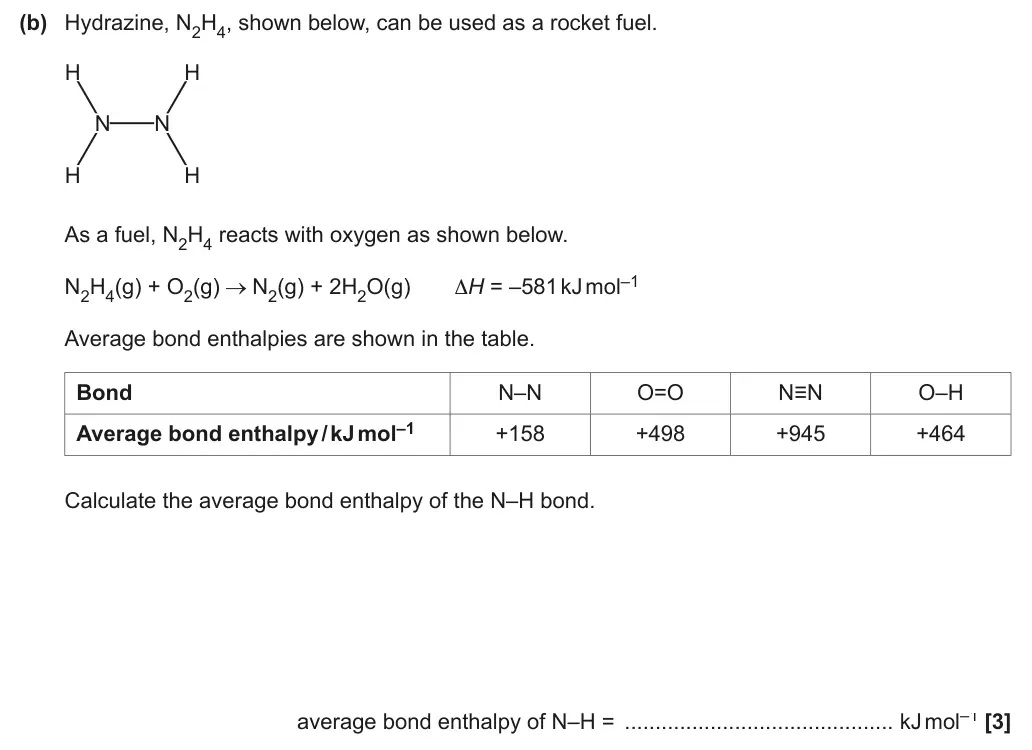
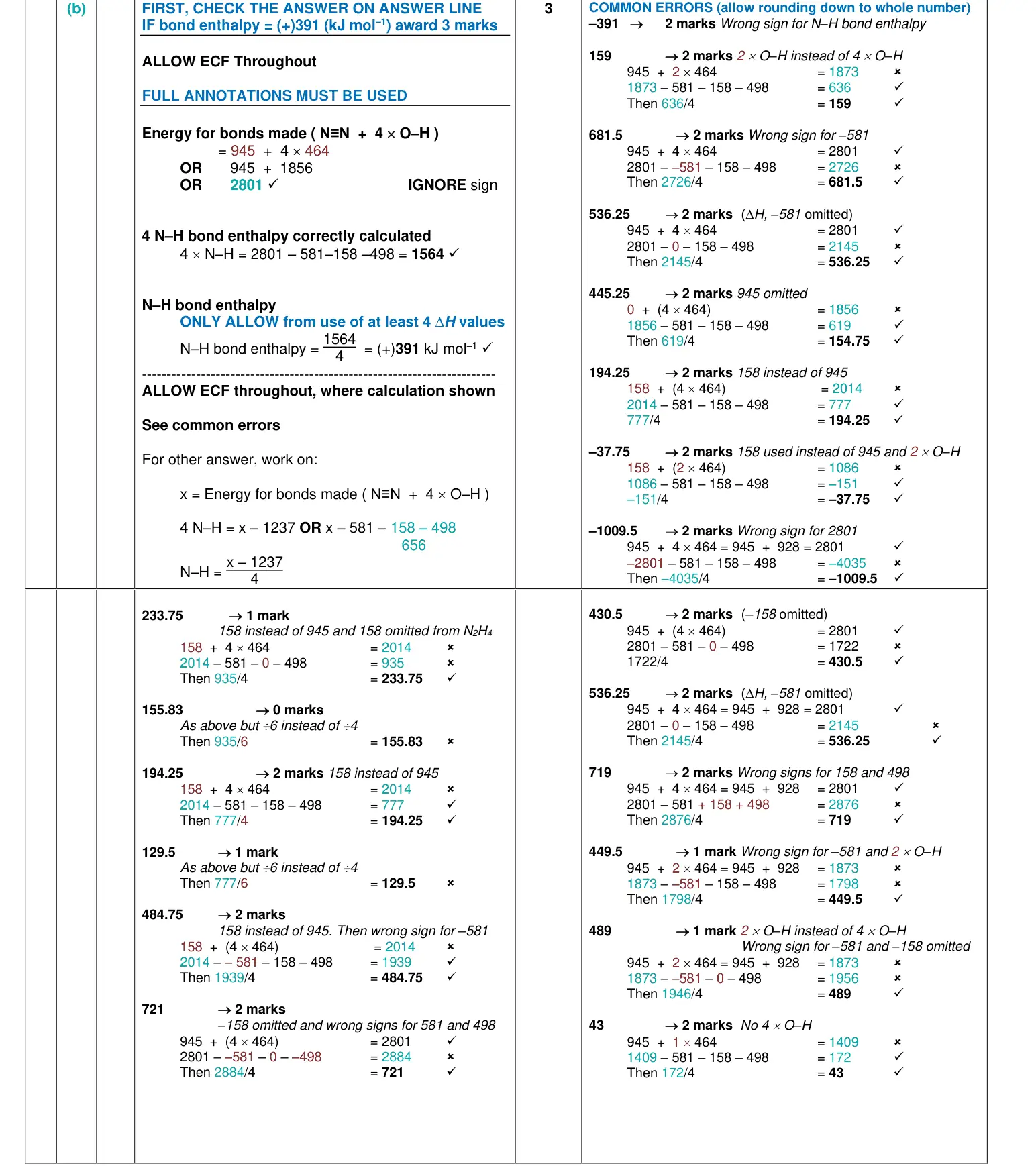
This bond energy calculation contained more values than in recent papers and many candidates found analysing the data difficult. Despite this, the question discriminated extremely well with about half the candidates obtaining the correct enthalpy change of 391 kJ mol–1 for all 3 marks, despite an incorrect final response. Successful responses showed that some candidates had clearly practised this type of problem and they recognised that there were going to be three stages to the calculation: • use of 945 and 4 ´ –464 to obtain 2801 • correct incorporation of the other ∆H values to obtain 1564 for 4 N–H • division by 4 for 1 N–H bond to obtain 391 kJ mol–1 As with all multi-stage calculations, error carried forward was applied, allowing credit to be given for a correct method. The commonest errors were: • use of 2 O–H instead of 4 O–H in the 1st step. • use of 158 for N–N in the 1st step instead of 945 for NN (Did these candidates not recall that N2 has a triple bond?) • omission of some data for the second step.
Skills: M2.2 Change the subject of an equation; M2.3 Substitute numerical values into algebraic equations using appropriate units for physical quantities; M2.4 Solve algebraic equations
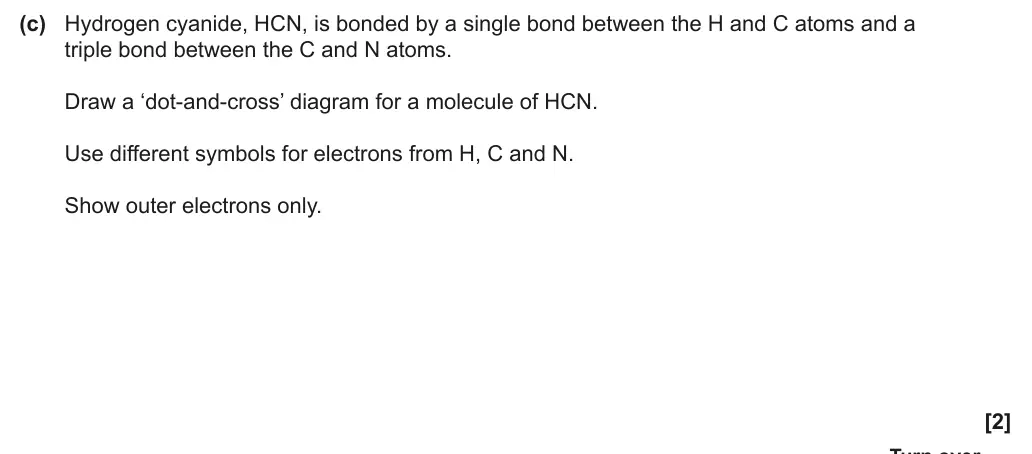
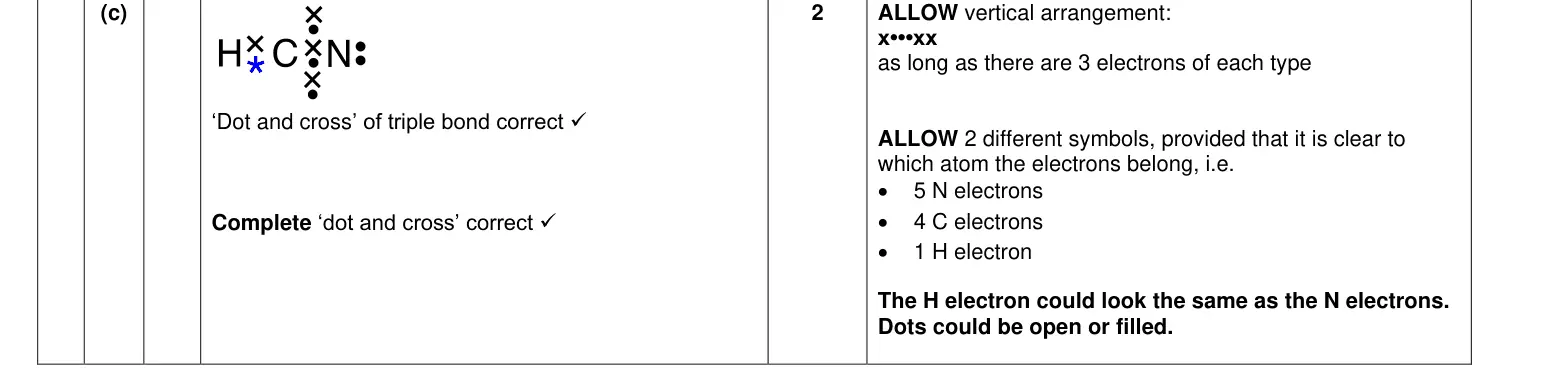
This question was well answered with ‘dot-and-cross’ diagrams usually correct. Most candidates obtained both marks. The most common error was omission of the nitrogen lone pair.

Most candidates were given 3 or 4 marks. The most common omission was the idea of surface contact. Most candidates identified London forces or induced dipole interactions as the relevant intermolecular force. A few candidates gave a general comment in terms of ‘intermolecular’ forces without specifying the type of intermolecular forces. There has been a general improvement in candidate responses to this type of question with fewer candidates than in previous exams suggesting the breaking of hydrogen bonds or covalent bonds. main factors responsible for the trend in boiling points. This response was given the full 4 marks.
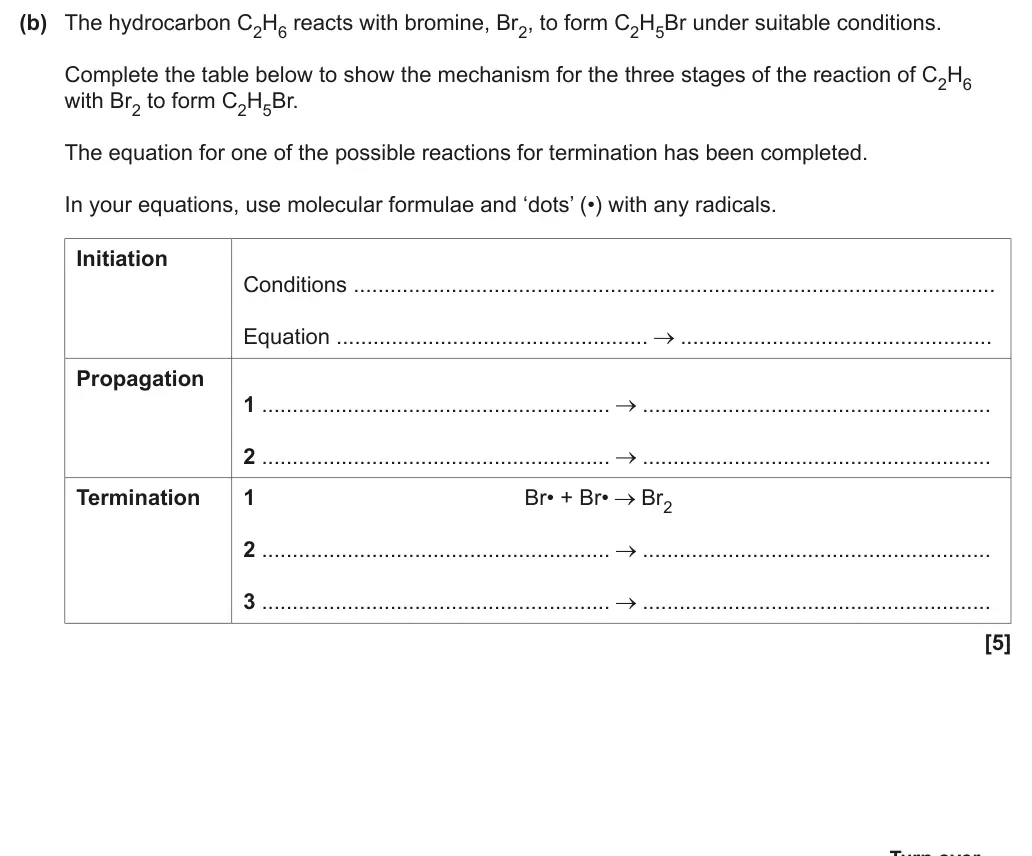
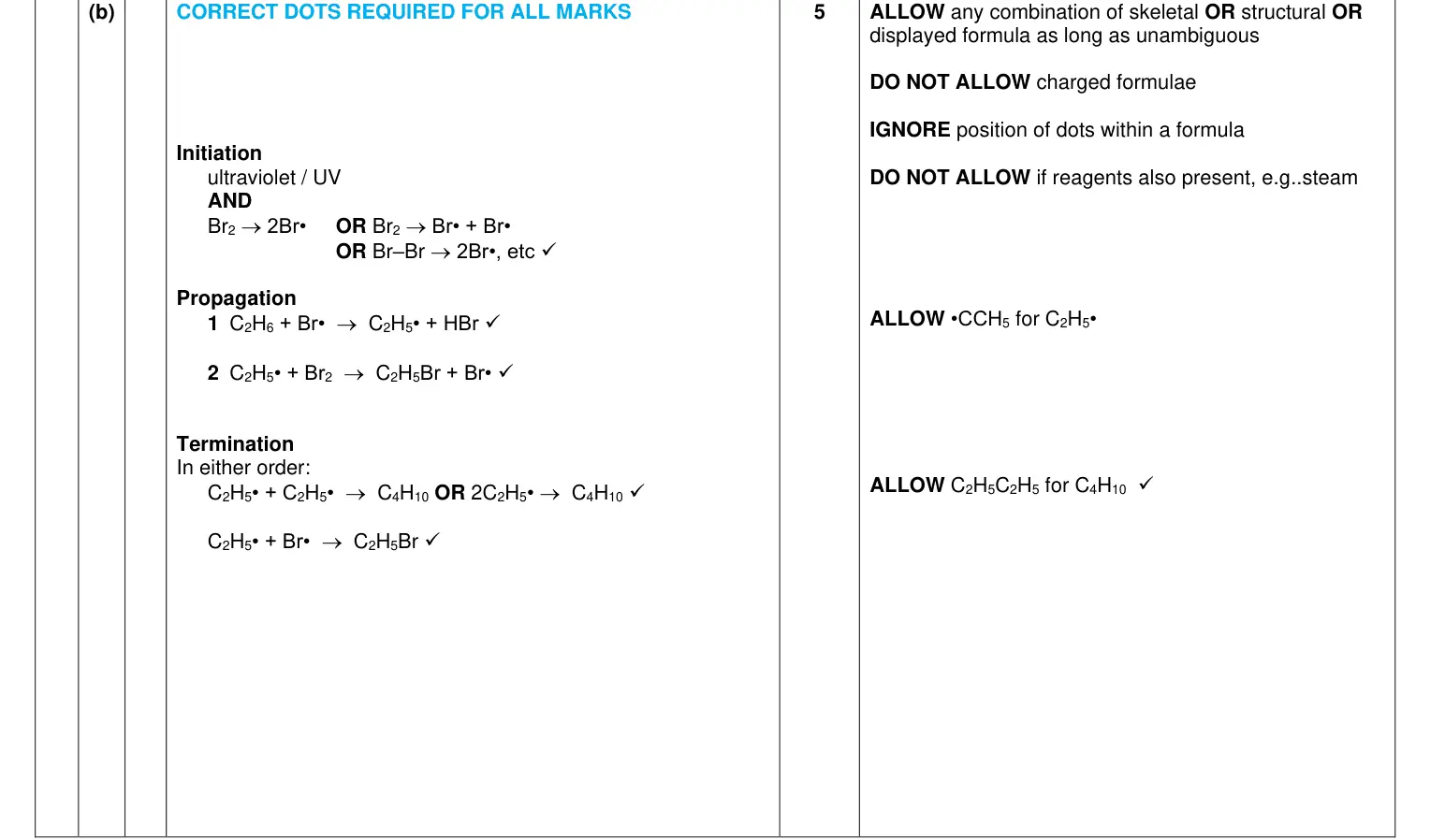
This question was answered extremely well with most candidates obtaining the full 5 marks. It was encouraging to see the widespread correct use of dots to indicate radicals, with relatively few omissions. Of the three steps, initiation and termination were answered better than the equations for propagation.
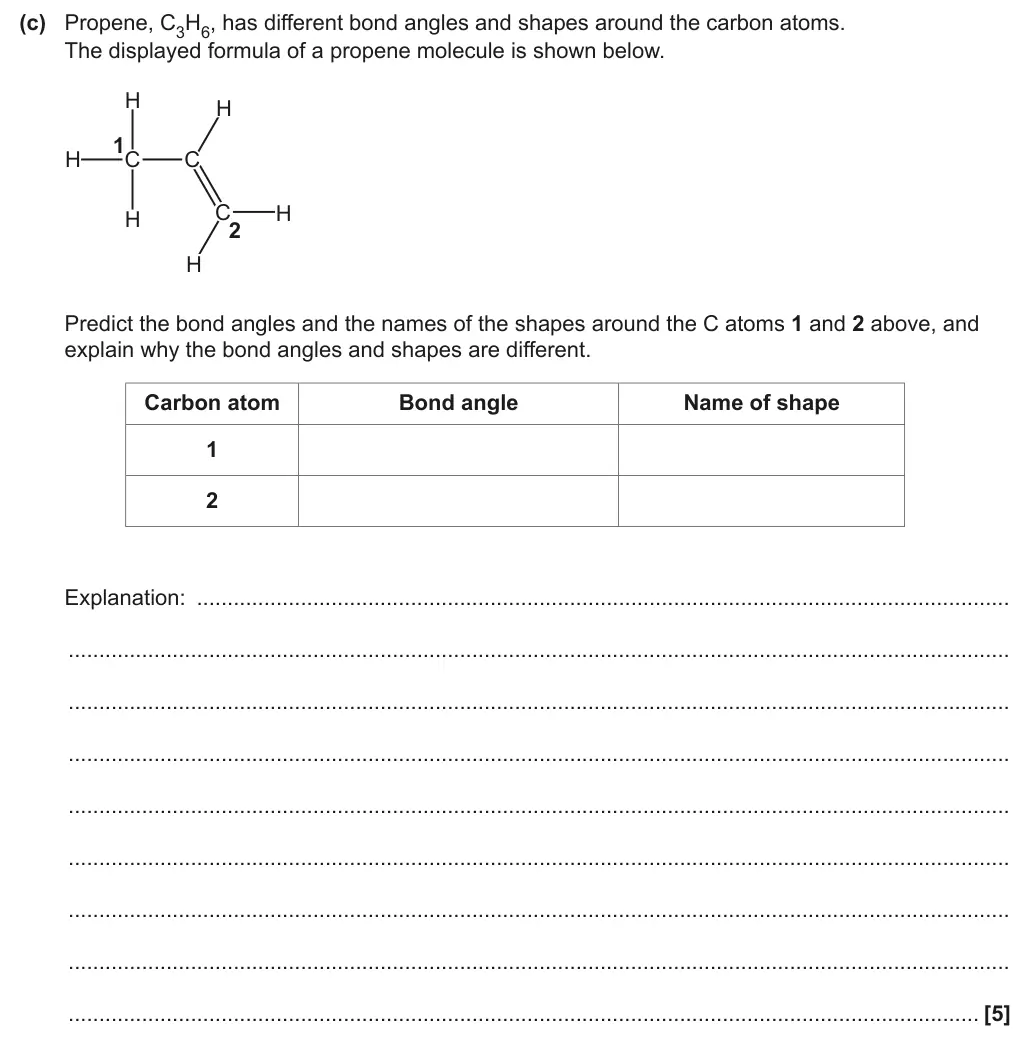
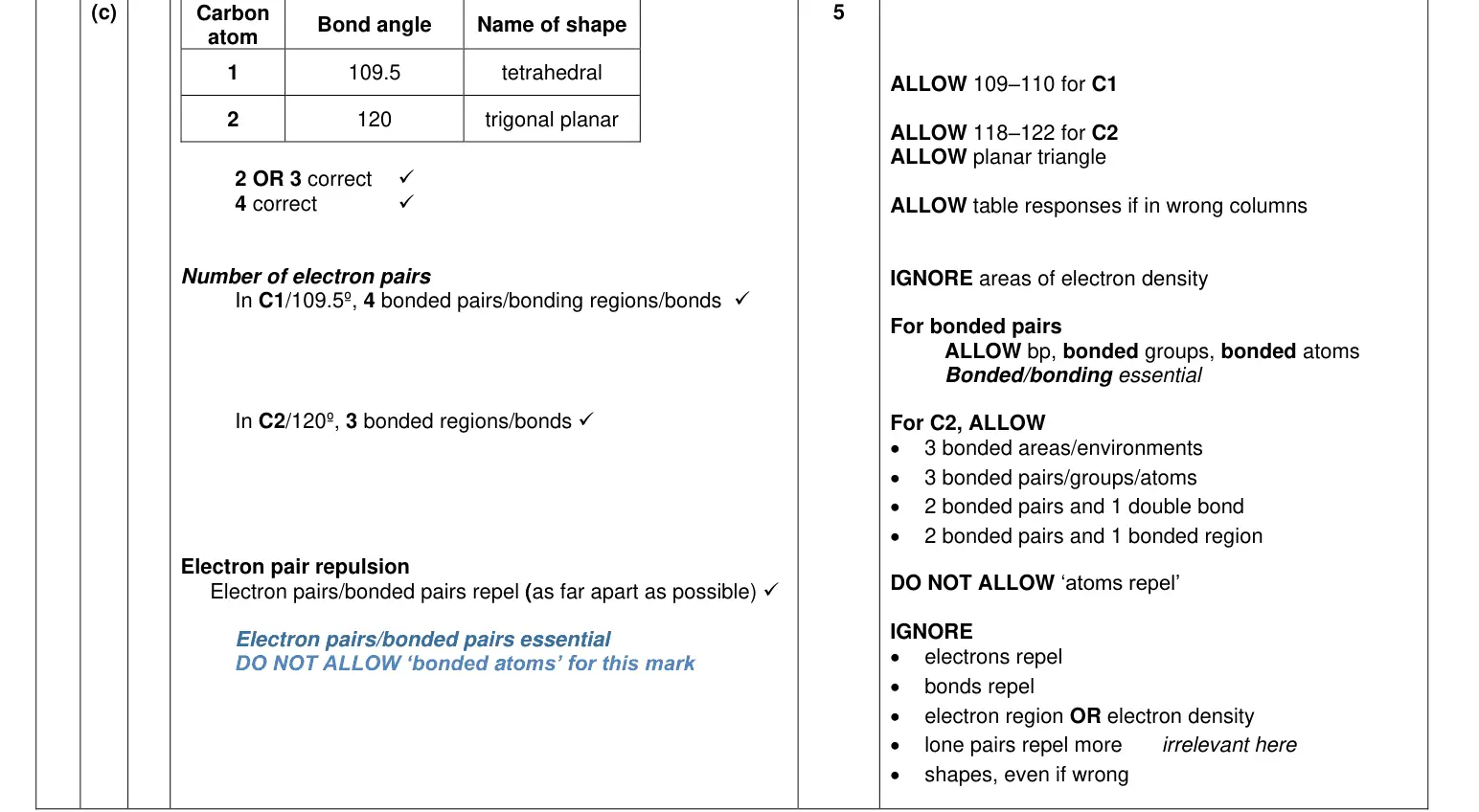
The bond angles and shapes rewarded the well-prepared candidates, with many being given both available marks for this part of the question. This part discriminated very well. For the explanation, most candidates identified 4 and 3 for C1 and C2, but candidates often linked 4 and 3 to atoms, rather than to electron pairs or bonded pairs for C1 and to bonding regions for C2. A mark was available for stating that ‘electron pairs repel’, but this important fact was often omitted despite being the main principle that determines molecular shapes. The question discriminated well, giving a good spread of marks across the five available.
Skills: M4.1 Use angles and shapes in regular 2-D and 3-D structures; M4.2 Visualise and represent 2-D and 3-D forms including 2-D representations of 3-D objects

Most candidates identified the correct products of this combustion as CO2 and H2O. The second mark was available for a balanced equation but many balanced O2 with an 8 rather than with 7½. Candidates need to be very careful when writing equations for the combustion of alcohols as it is easy to miss the O atom within the alcohol formula.
Skills: M0.2 Use ratios, fractions and percentages
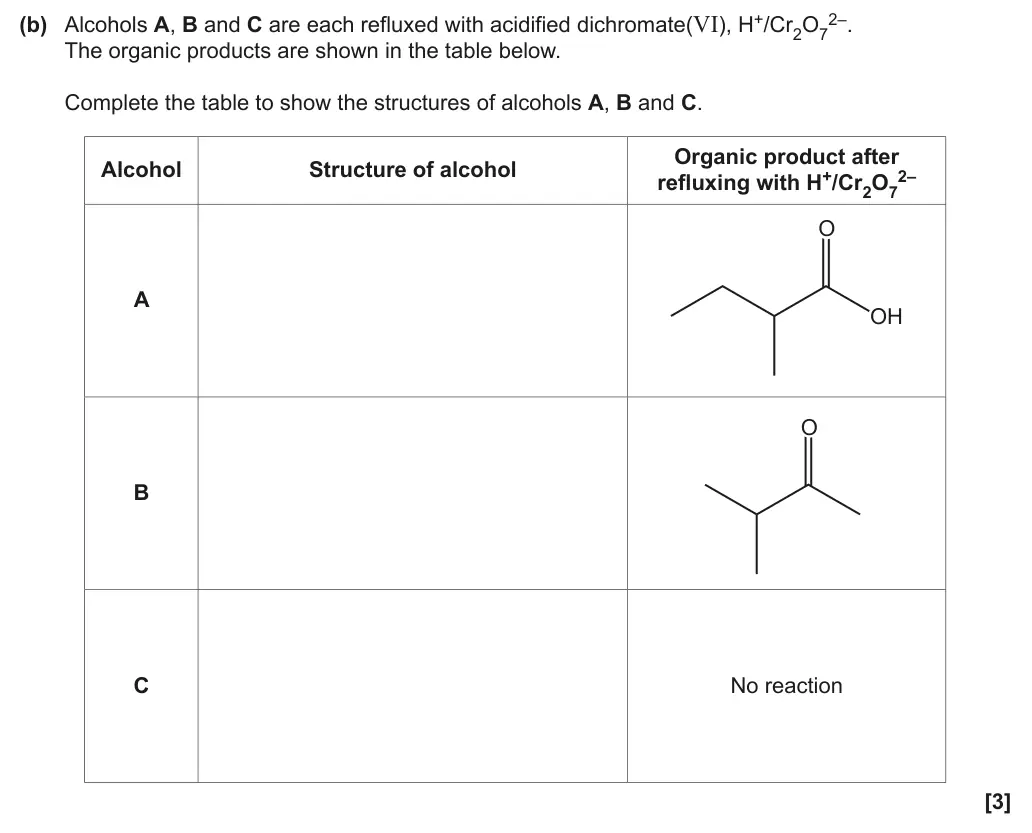
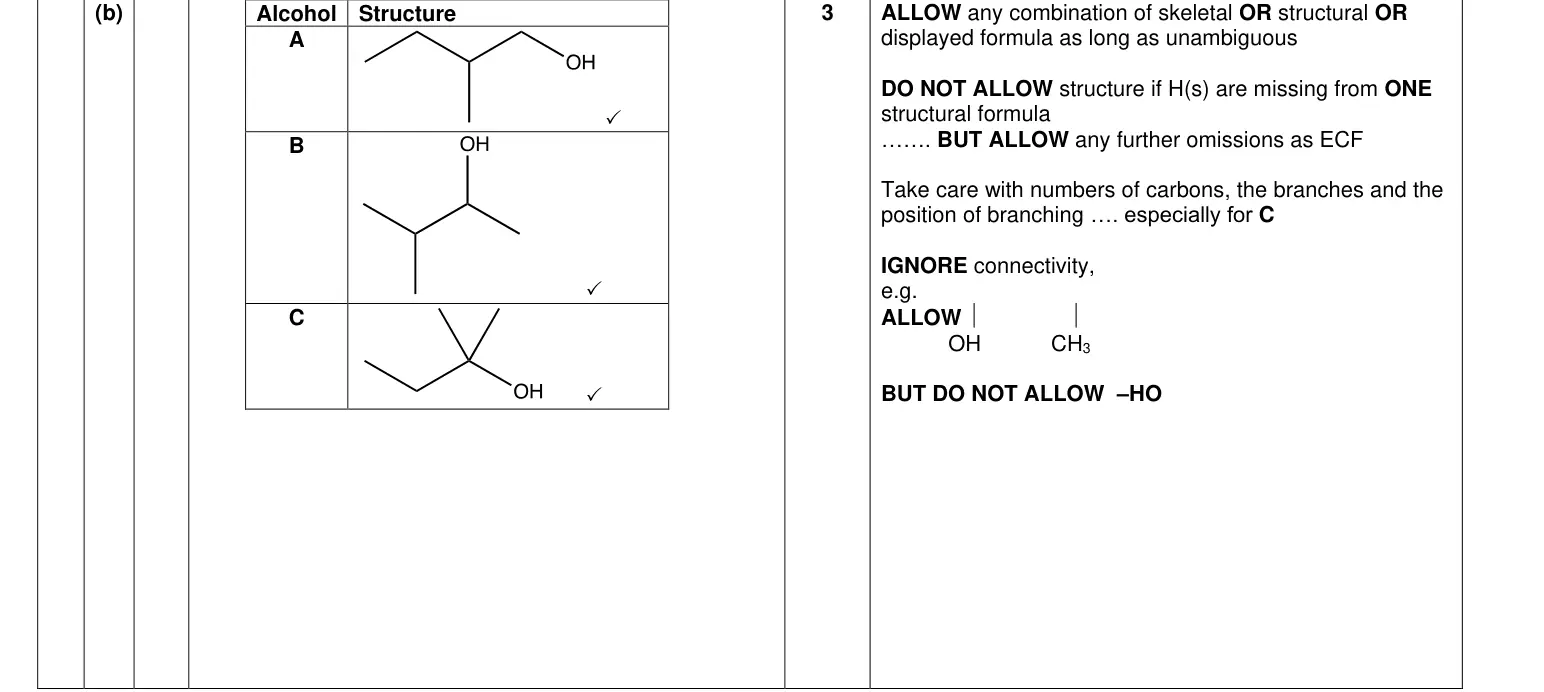
This question appeared to be straightforward, but many candidates got into a muddle when drawing the alcohol structures. The best tactic is to copy the carbon skeletal and to then add the functional group. Many candidates drew displayed formulae and these often contained too many carbon atoms or missing H atoms. Great care is needed in drawing organic structures. Structure C must be a tertiary alcohol, but the candidate has drawn the structure of a secondary alcohol. It should be noted that, even with a correct carbon skeleton, structure A would be rejected. Incorrect connectivity of the OH group is always penalised.
Skills: M4.2 Visualise and represent 2-D and 3-D forms including 2-D representations of 3-D objects

The presentation of many candidates’ diagrams in questions such as this one requires improvement. The mark scheme was generous, requiring to first see that a candidate knew what distillation is. A first mark was given for a set up comprising a flask connected to a roughly horizontal condenser. There had to be no gap above the condenser and the overall set up could not be a closed system. A second mark was given for minimal labels: condenser and correct direction of water flow. Nearly half the candidates received no marks for their diagram with only just over a quarter being given both marks. Typical errors included: • a reflux set up • open above the flask • a closed system • water flowing the wrong way • the condenser labelled as condensation tube, cooling tube, cooling funnel, distiller, etc. Less successful responses showed a conical flask, beaker or test tube being heated. The best advice is to spend some time instructing students how to draw diagrams and to label the apparatus using the accepted scientific names. Students increasingly appear to be finding these questions challenging.
Skills: PAG5 Synthesis of an organic liquid
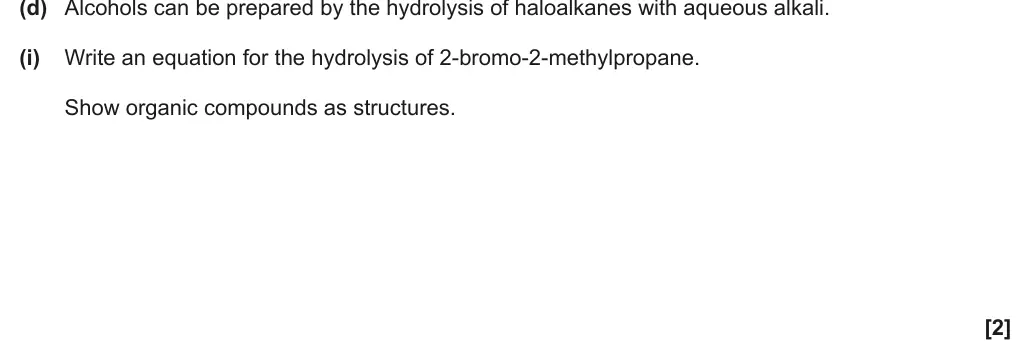
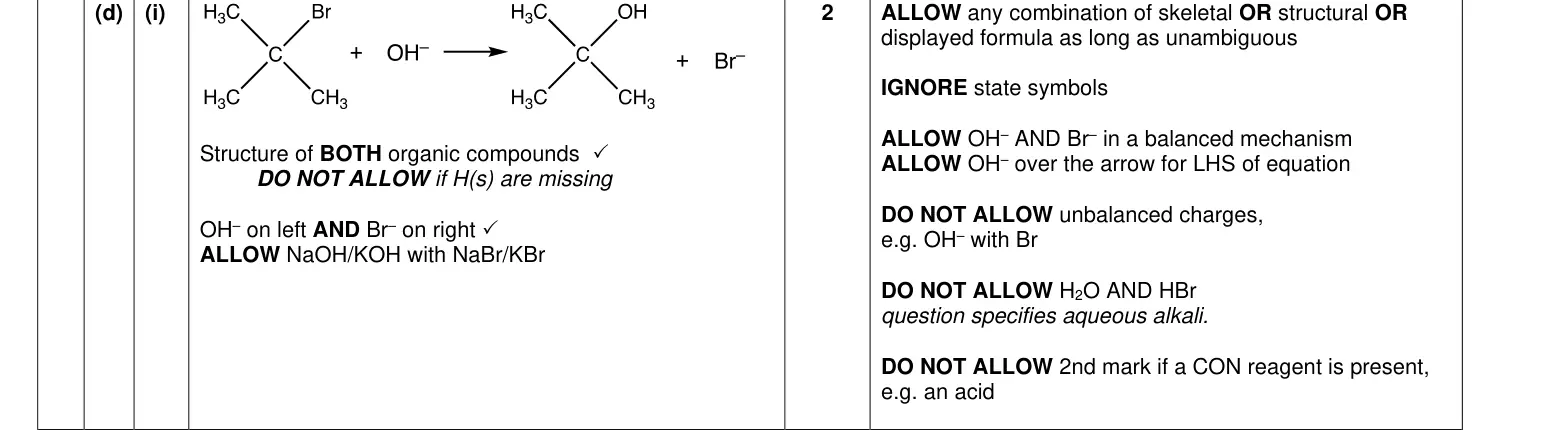
This question discriminated very well. Most candidates were given a first mark by showing correct structures for the organic reactant and its product, 2-methylpropan-2-ol. The question asked for an equation for alkaline hydrolysis and candidates were expected to use an alkali. Acceptable responses would include NaOH/KOH and NaBr/KBr, or OH– and Br–. Equations including H2O and HBr were not given marks, a common error for alkaline hydrolysis. Candidates are advised to carefully read the requirements in the question. For the most successful responses, candidates often underline these to draw their attention.

Candidates found this question difficult. Many fell into a trap of their own making by comparing the relative reactivities of the halogens chlorine, bromine and iodine and it was common to see responses claiming that a chloroalkane has the fastest rate and that an iodoalkane has the slowest rate. Only the most successful candidates related a correct order of reactivity to the different strengths of the carbon– halogen bond.
Want a paper marked and gone through with you? Message us.