November 2021: AS Paper 1, Breadth in chemistry

70 marks · 41 question parts · Paper, mark scheme and report on OCR's site · An autumn series, sat in place of the cancelled summer exams · Have OCR's Data Sheet beside you

Question by question

QTopicMarksAOType
1 Bonding, structure and shapes of molecules 1AO1Multiple choice
2 Bonding, structure and shapes of molecules 1AO2Multiple choice
3 Acids, bases and titrations 1AO1Multiple choice
4 Amount of substance (moles) 1AO1Multiple choice
5 Amount of substance (moles) 1AO2Multiple choice
6 Amount of substance (moles) 1AO2Multiple choice
7 Acids, bases and titrations, Practical techniques and apparatus (PAGs) 1AO2Multiple choice
8 Periodicity and ionisation energy 1AO1Multiple choice
9 Electron structure and orbitals 1AO1Multiple choice
10 Enthalpy changes and Hess’ law 1AO2Multiple choice
11 Reaction rates and the Boltzmann distribution 1AO1Multiple choice
12 Chemical equilibrium and Kc 1AO1Multiple choice
13 Organic basics: naming, formulae and isomerism, Alkenes 1AO2Multiple choice
14 Organic basics: naming, formulae and isomerism 1AO1Multiple choice
15 Alkanes 1AO2Multiple choice
16 Bonding, structure and shapes of molecules, Alkanes, Alkenes 1AO1Multiple choice
17 Organic basics: naming, formulae and isomerism 1AO1Multiple choice
18 Organic basics: naming, formulae and isomerism 1AO2Multiple choice
19 Infrared spectroscopy and mass spectrometry 1AO1Multiple choice
20 Alkenes 1AO2Multiple choice
21(a) Electron structure and orbitals 2AO1Complete table/diagram
21(b) Atomic structure and isotopes 1AO1Complete table/diagram
21(c) Atomic structure and isotopes 2AO1Calculation
21(d)(i) Organic basics: naming, formulae and isomerism 1AO2Structure / isomer
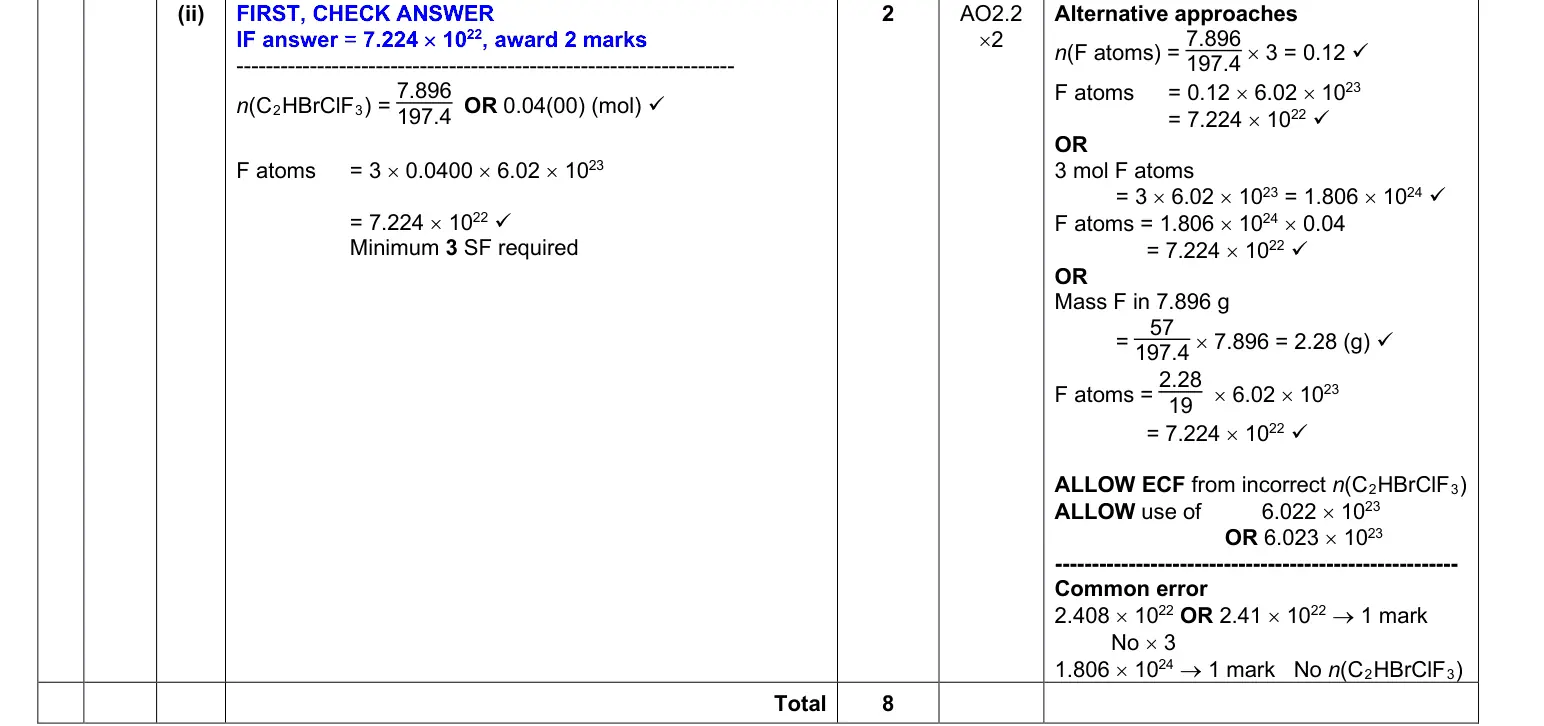
21(d)(ii) Amount of substance (moles) 2AO2Calculation
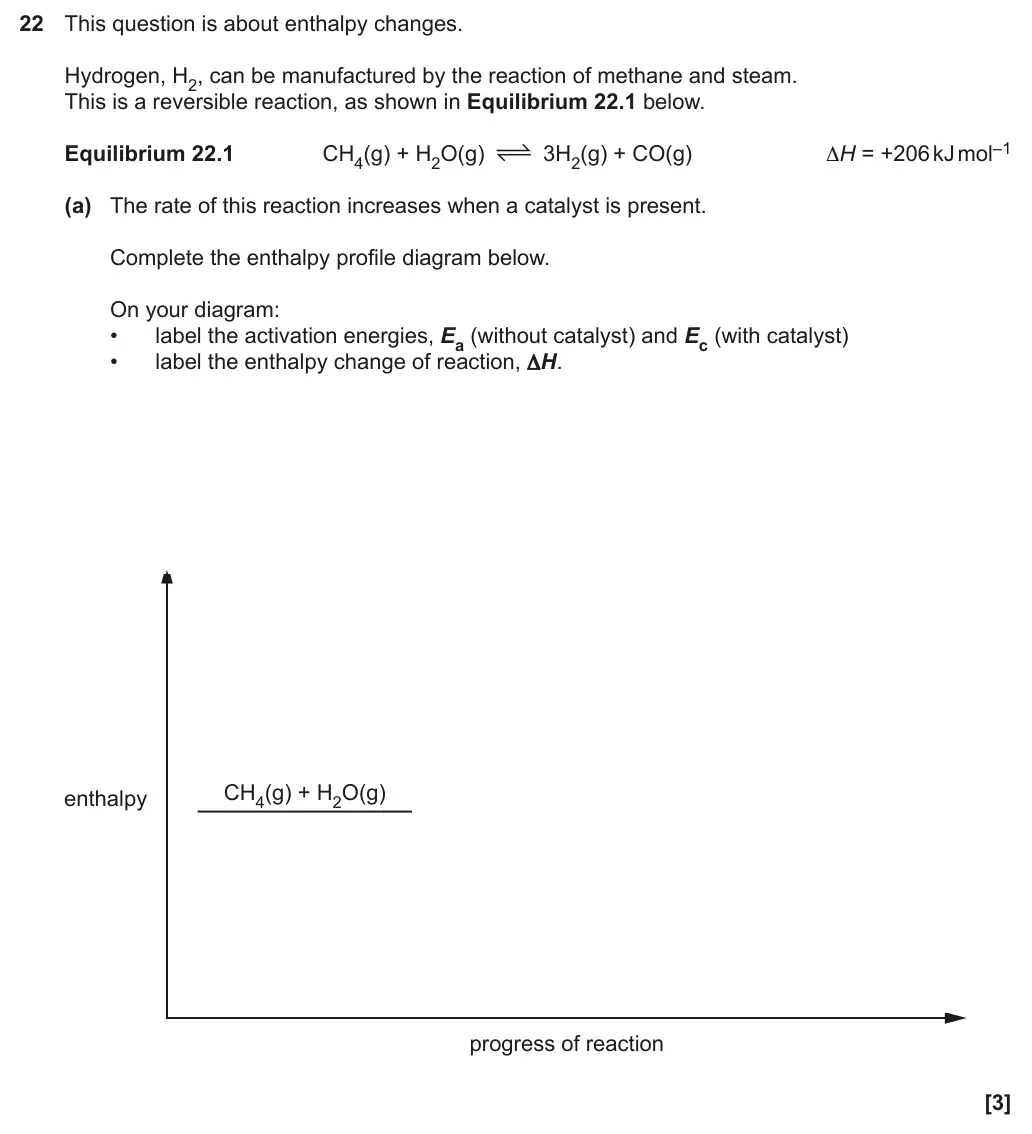
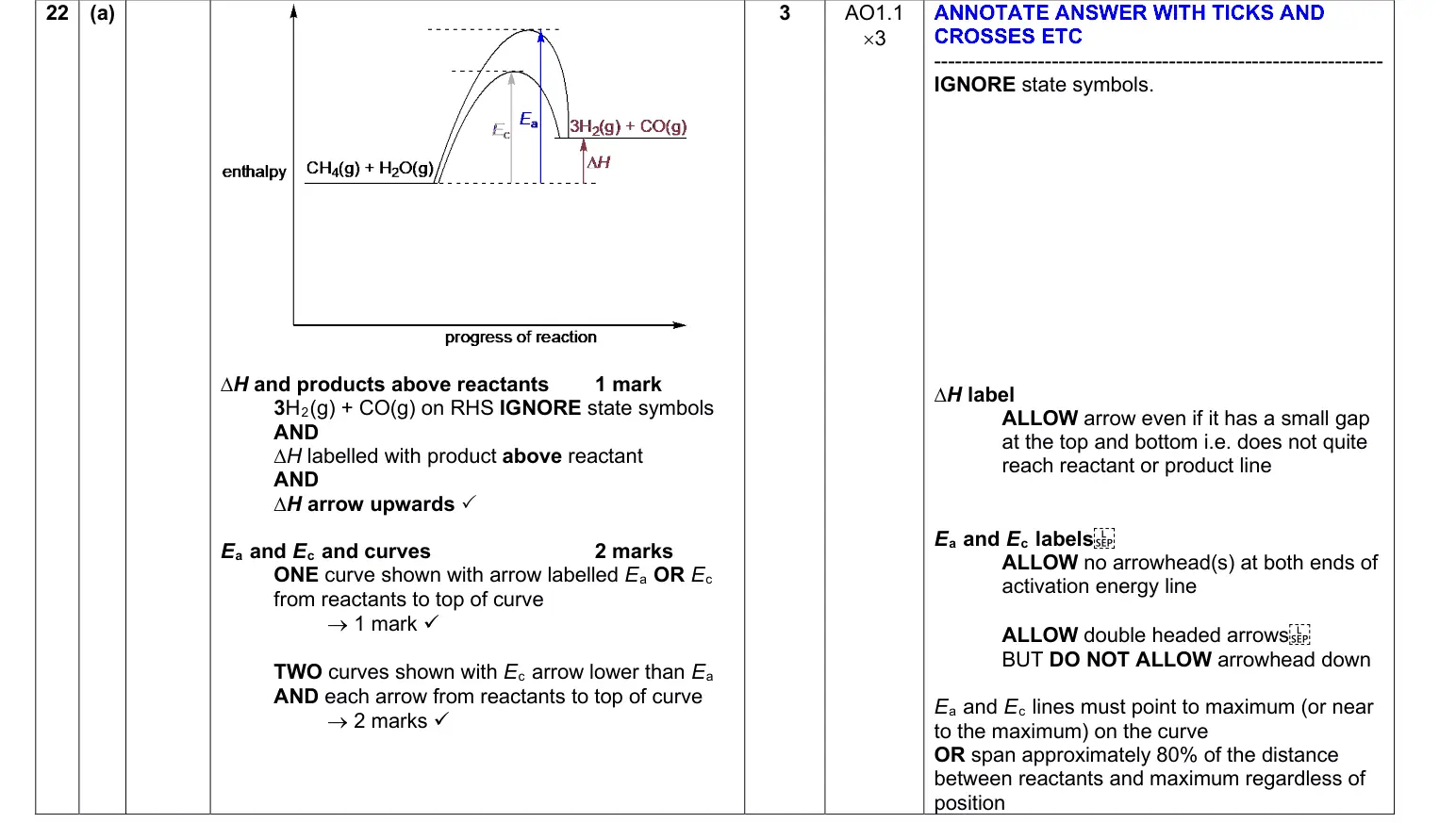
22(a) Enthalpy changes and Hess’ law, Reaction rates and the Boltzmann distribution 3AO1Complete table/diagram
22(b) Chemical equilibrium and Kc 4AO1, 2Short answer
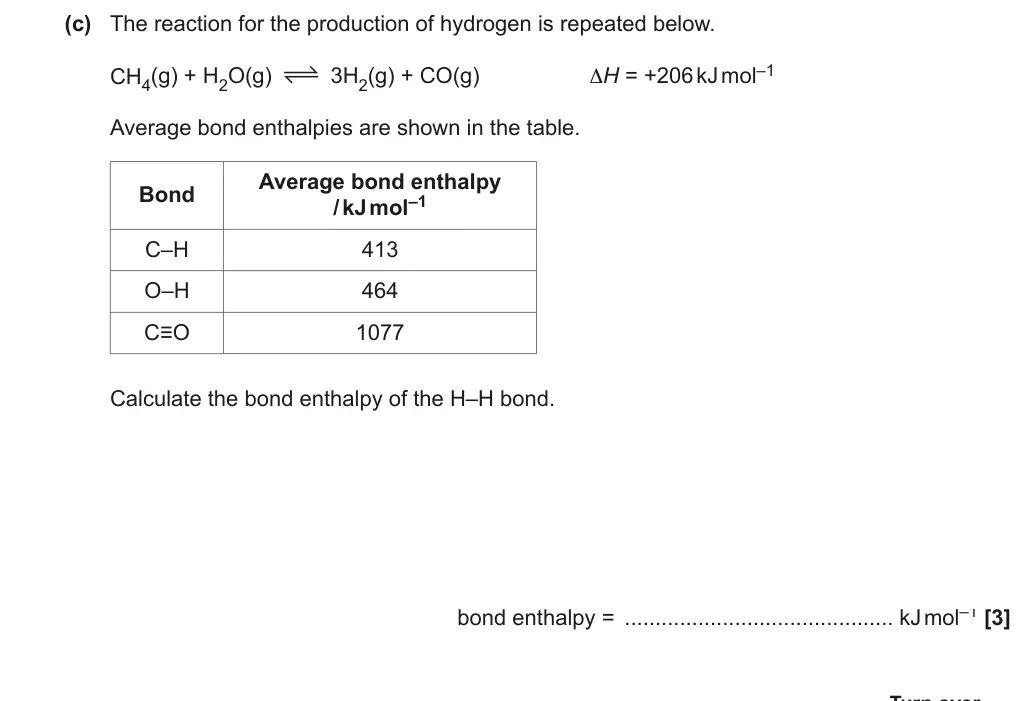
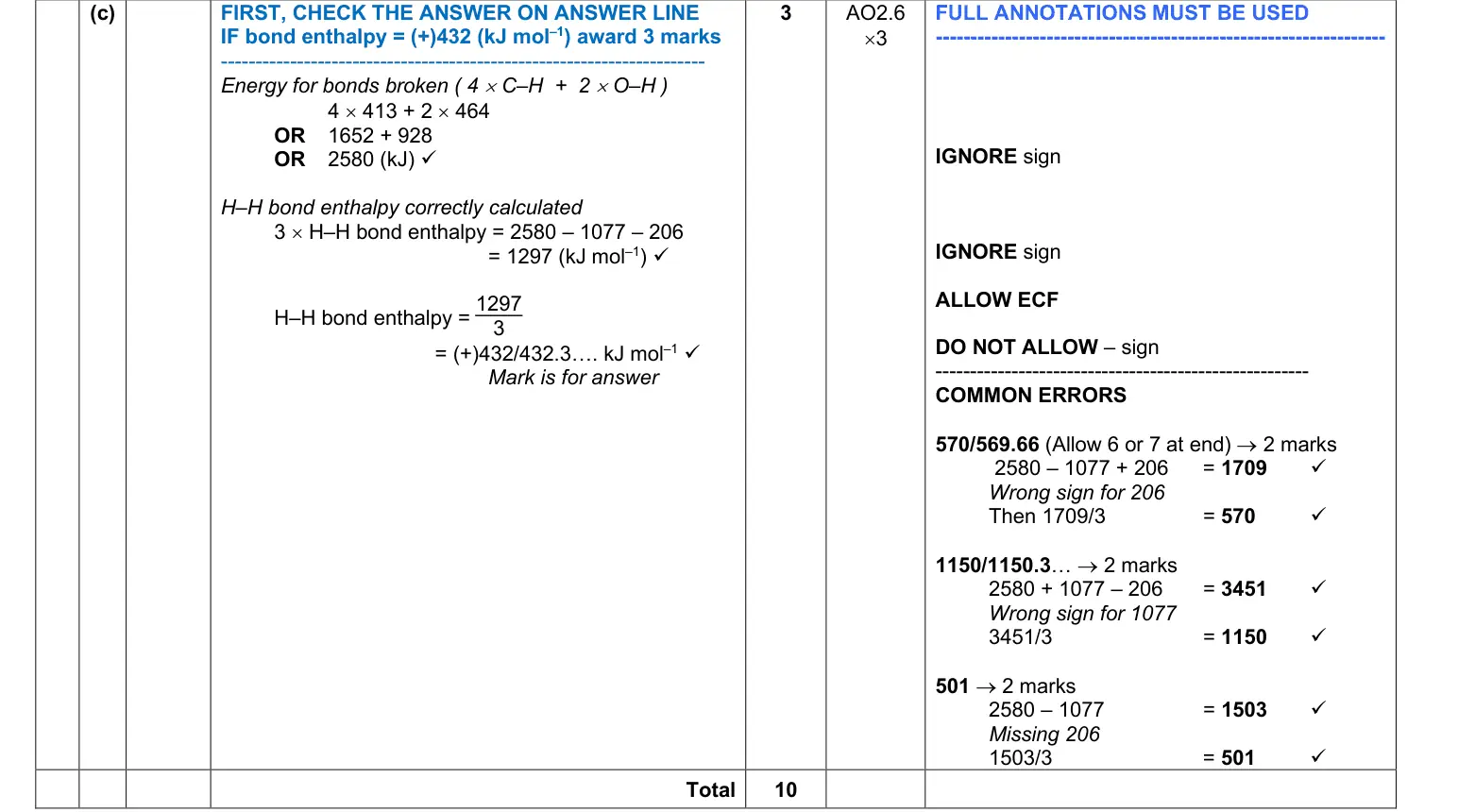
22(c) Enthalpy changes and Hess’ law 3AO2Calculation
23(a) The halogens 1AO1Short answer
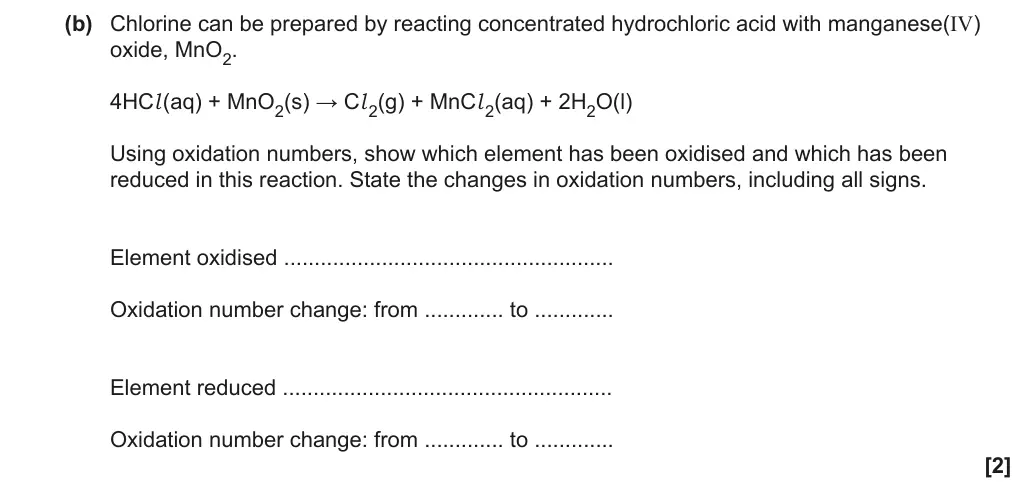
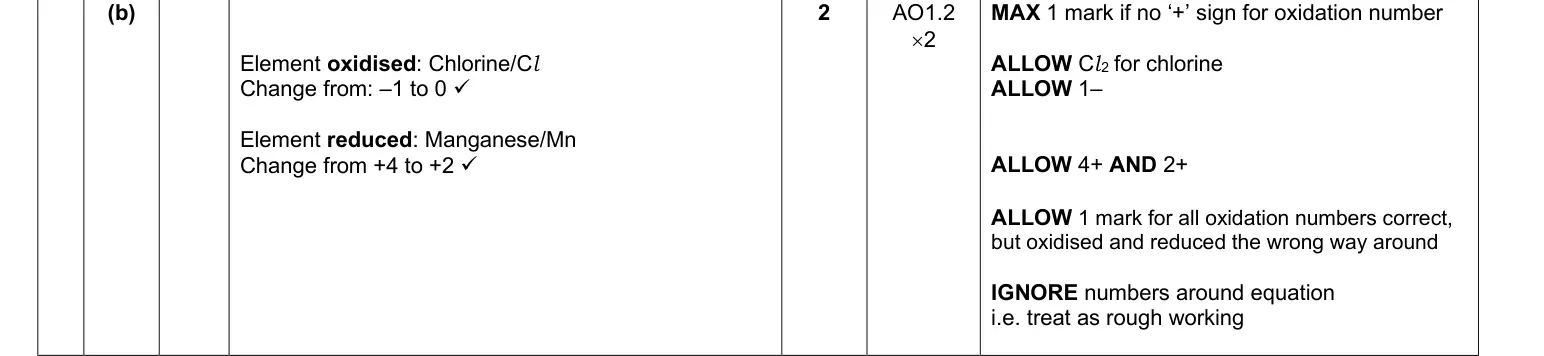
23(b) Redox and oxidation numbers 2AO1Data interpretation
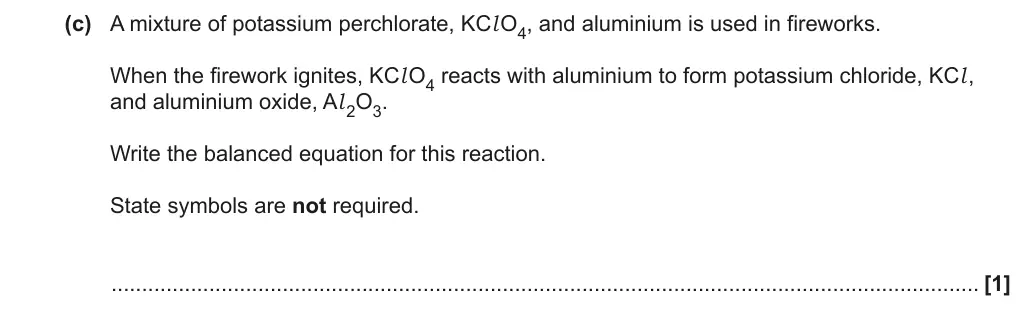
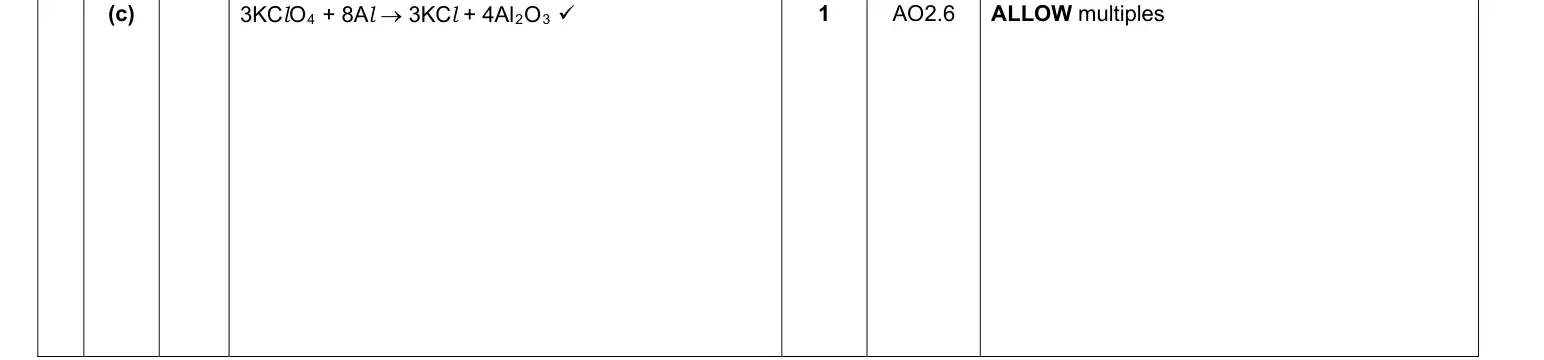
23(c) Formulae and equations 1AO2Equation writing
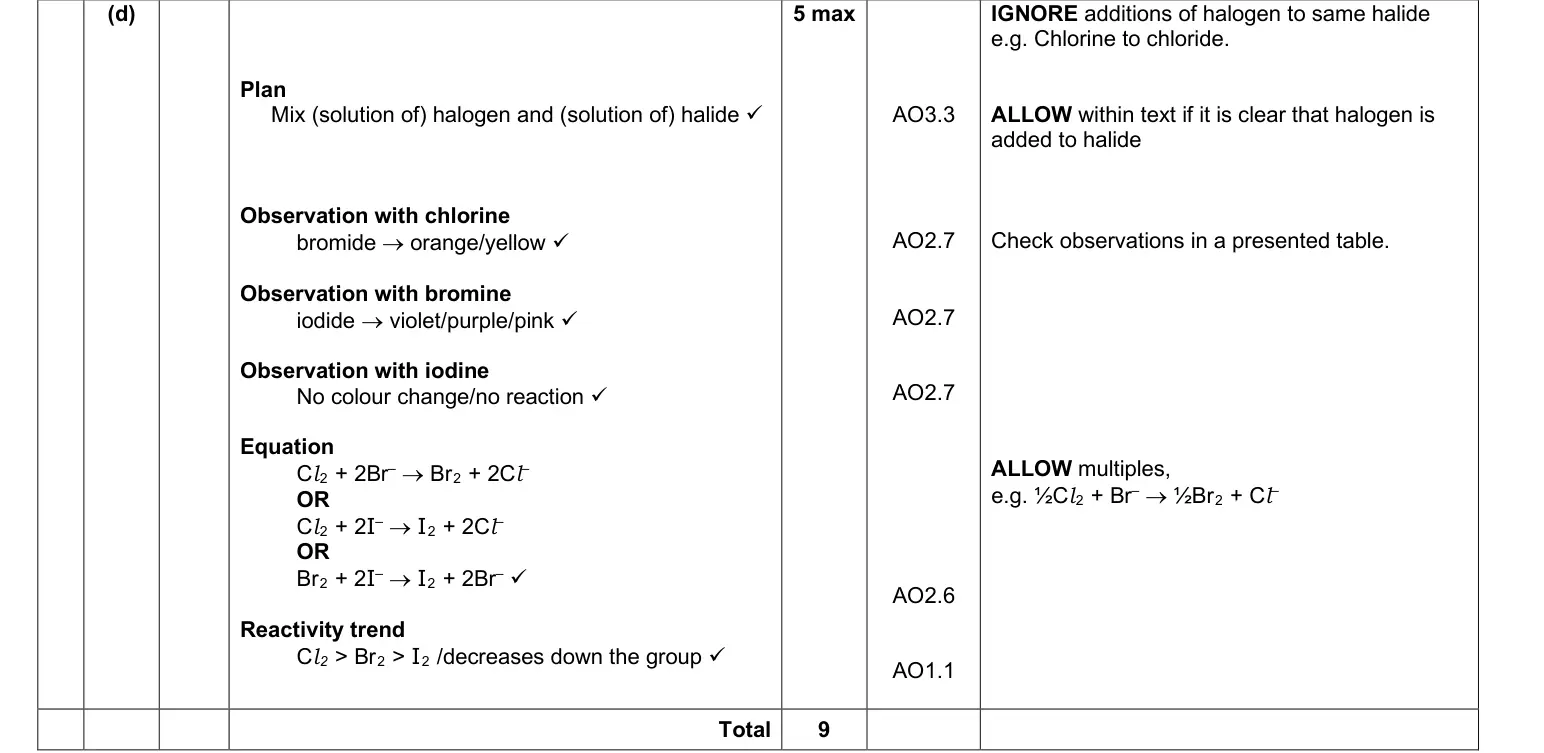
23(d) The halogens, Practical skills: planning, analysis and evaluation, Formulae and equations 5AO1, 2, 3Equation writing
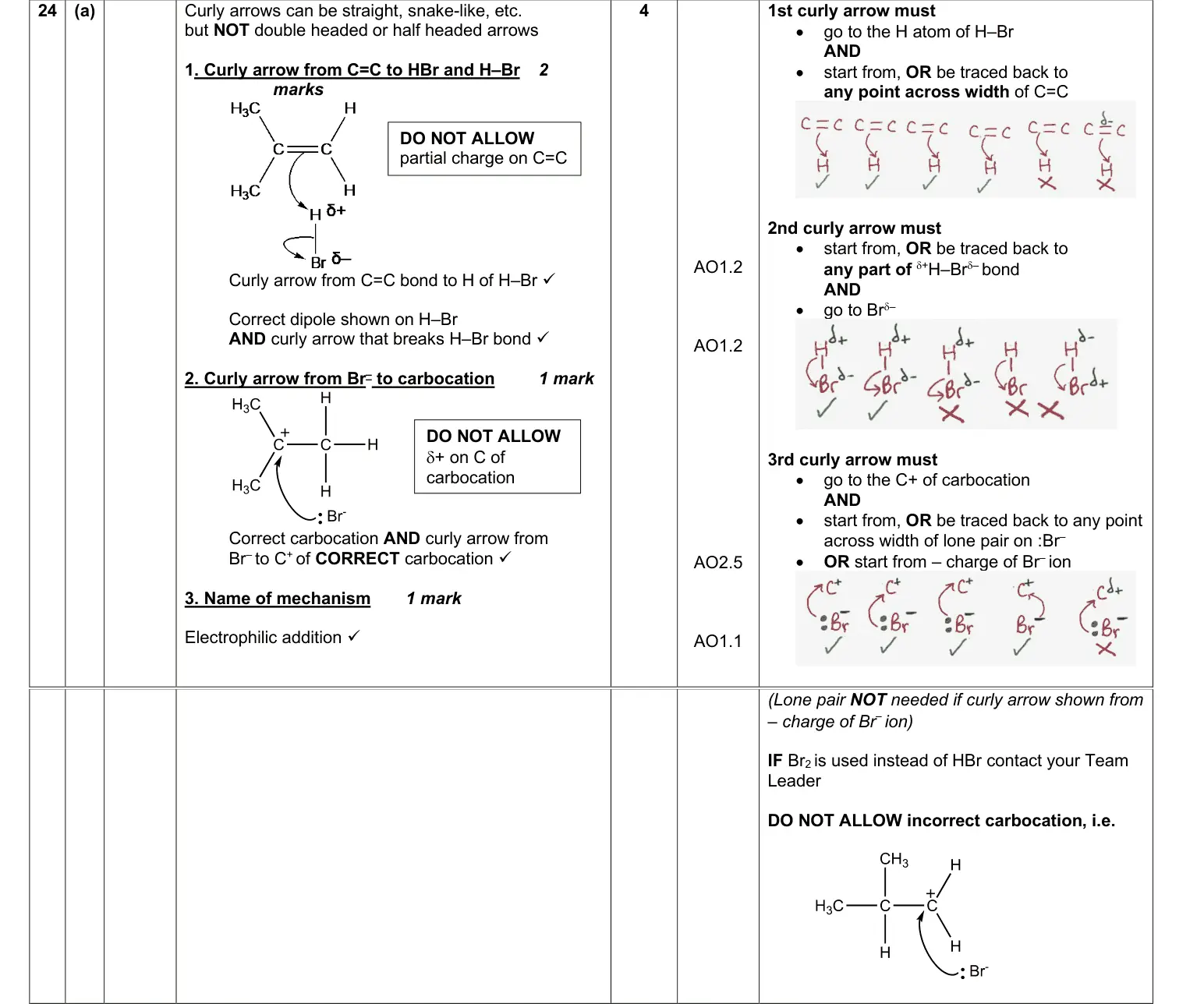
24(a) Alkenes, Organic basics: naming, formulae and isomerism 4AO1, 2Mechanism
24(b)(i) Organic basics: naming, formulae and isomerism 1AO1Short answer
24(b)(ii) Alkenes, Organic basics: naming, formulae and isomerism 1AO2Short answer
24(c)(i) Haloalkanes 2AO2Complete table/diagram
24(c)(ii) Organic synthesis and practical techniques (Module 4), Practical techniques and apparatus (PAGs) 2AO3Drawing / labelling
25(a)(i) Amount of substance (moles) 2AO2Calculation
25(a)(ii) Practical skills: planning, analysis and evaluation, Amount of substance (moles) 1AO3Short answer
25(b) Amount of substance (moles) 5AO1, 2, 3Calculation
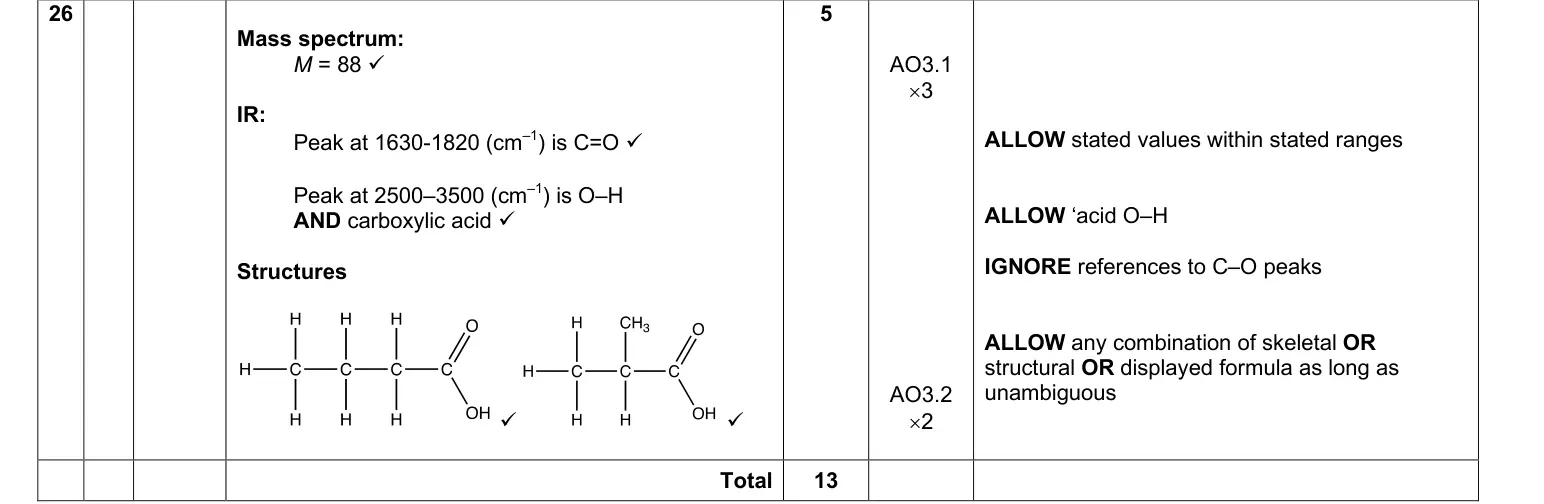
26 Infrared spectroscopy and mass spectrometry, Organic basics: naming, formulae and isomerism 5AO3Extended response

The questions

123456789101112131415161718192021(a)21(b)21(c)21(d)(i)21(d)(ii)22(a)22(b)22(c)23(a)23(b)23(c)23(d)24(a)24(b)(i)24(b)(ii)24(c)(i)24(c)(ii)25(a)(i)25(a)(ii)25(b)26
November 2021 · AS Paper 1 · Q1 1 mark AO1 Multiple choice bonding and structure
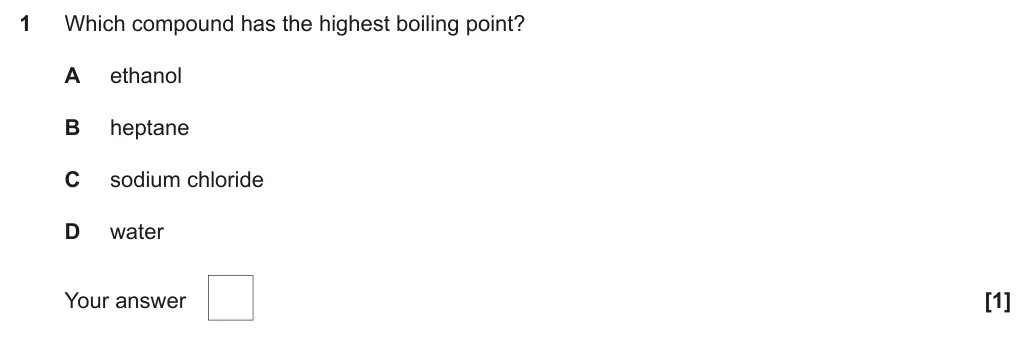
1 Which compound has the highest boiling point?
A ethanol
B heptane
C sodium chloride
D water
Your answer [1]
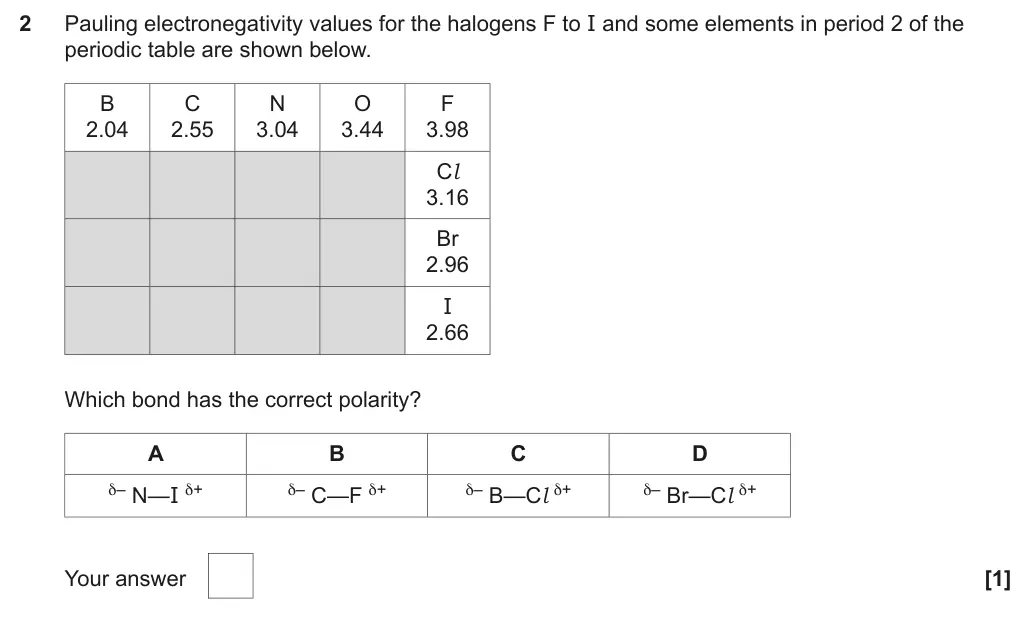
November 2021 · AS Paper 1 · Q2 1 mark AO2 Multiple choice bonding and structure
2 Pauling electronegativity values for the halogens F to I and some elements in period 2 of the
periodic table are shown below.
B C N O F
2.04 2.55 3.04 3.44 3.98
Cl
3.16
Br
2.96
I
2.66
Which bond has the correct polarity?
A B C D
δ– N—I δ+ δ– C—F δ+ δ– B—Cl δ+ δ– Br—Cl δ+
Your answer [1]
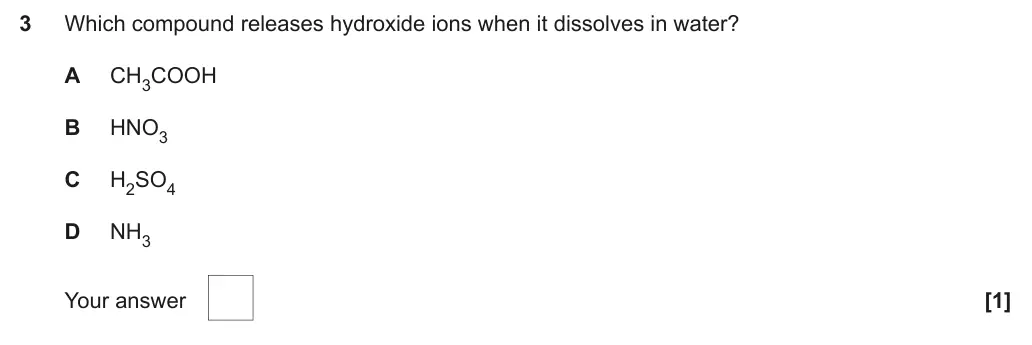
November 2021 · AS Paper 1 · Q3 1 mark AO1 Multiple choice acids and titrations
3 Which compound releases hydroxide ions when it dissolves in water?
A CH3COOH
B HNO3
C H2SO4
D NH3
Your answer [1]
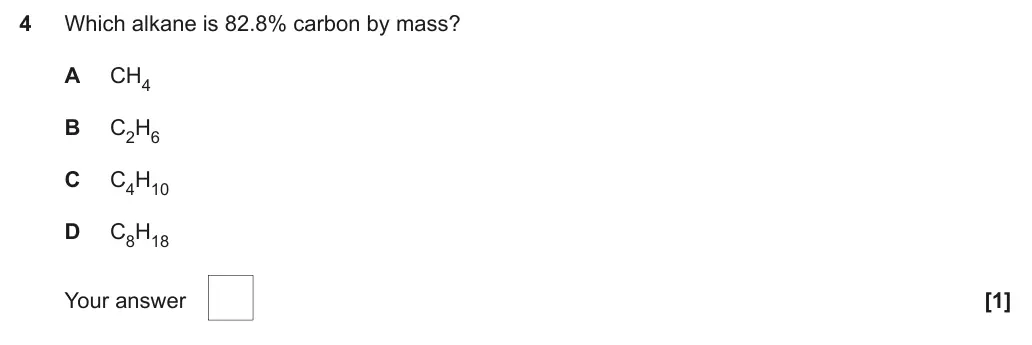
November 2021 · AS Paper 1 · Q4 1 mark AO1 Multiple choice amount of substance
4 Which alkane is 82.8% carbon by mass?
A CH4
B C2H6
C C4H10
D C8H18
Your answer [1]
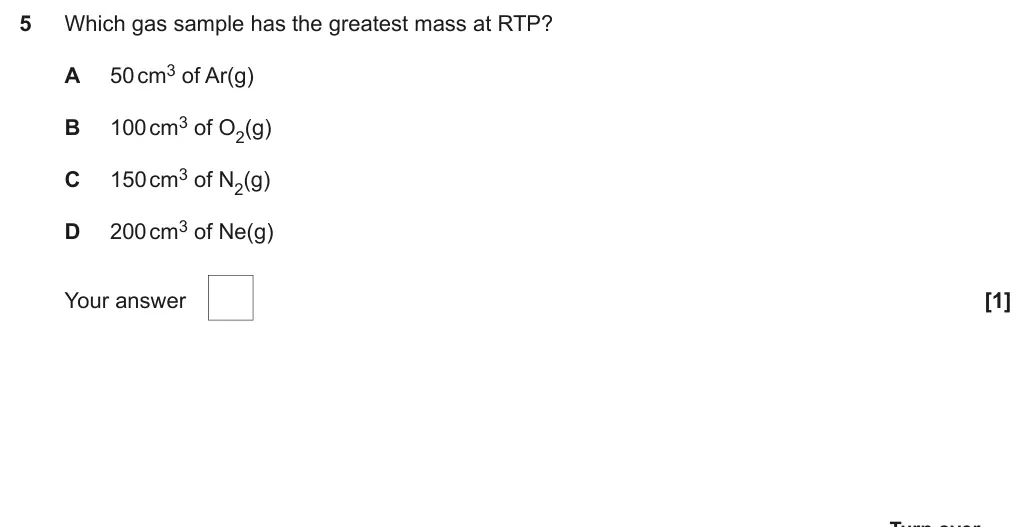
November 2021 · AS Paper 1 · Q5 1 mark AO2 Multiple choice amount of substance
5 Which gas sample has the greatest mass at RTP?
A 50 cm3 of Ar(g)
B 100 cm3 of O2(g)
C 150 cm3 of N2(g)
D 200 cm3 of Ne(g)
Your answer [1]
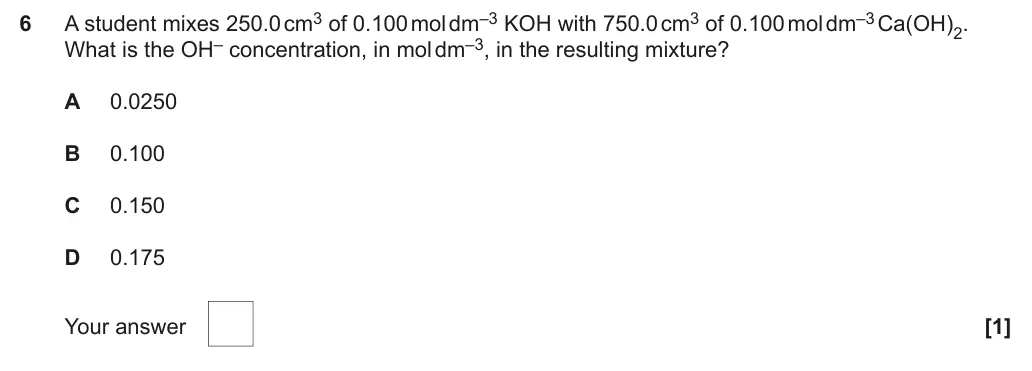
November 2021 · AS Paper 1 · Q6 1 mark AO2 Multiple choice amount of substance
6 A student mixes 250.0 cm3 of 0.100 mol dm–3 KOH with 750.0 cm3 of 0.100 mol dm–3 Ca(OH)2.
What is the OH– concentration, in mol dm–3, in the resulting mixture?
A 0.0250
B 0.100
C 0.150
D 0.175
Your answer [1]
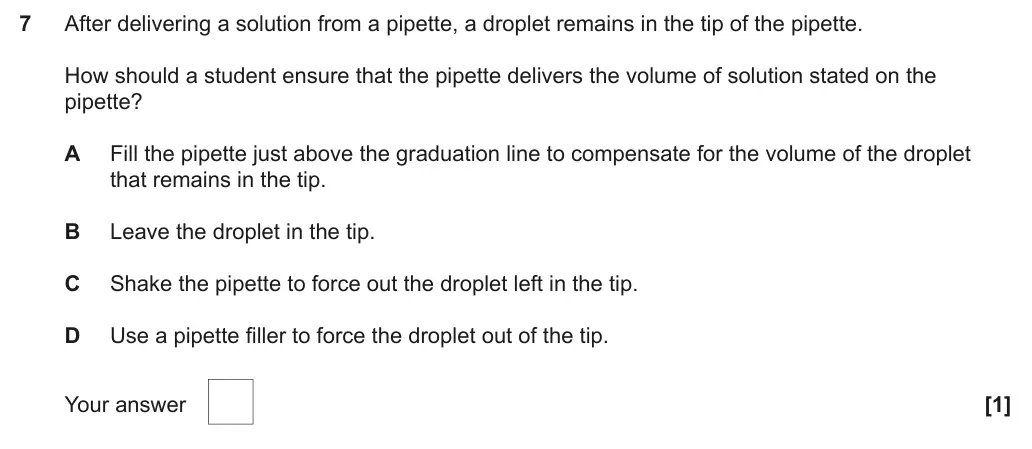
November 2021 · AS Paper 1 · Q7 1 mark AO2 Multiple choice acids and titrationspractical techniques
7 After delivering a solution from a pipette, a droplet remains in the tip of the pipette.
How should a student ensure that the pipette delivers the volume of solution stated on the
pipette?
A Fill the pipette just above the graduation line to compensate for the volume of the droplet
that remains in the tip.
B Leave the droplet in the tip.
C Shake the pipette to force out the droplet left in the tip.
D Use a pipette filler to force the droplet out of the tip.
Your answer [1]
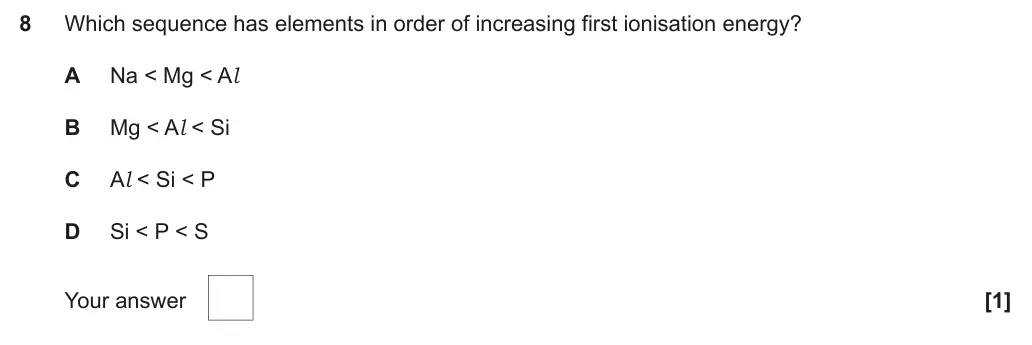
November 2021 · AS Paper 1 · Q8 1 mark AO1 Multiple choice periodicity
8 Which sequence has elements in order of increasing first ionisation energy?
A Na < Mg < Al
B Mg < Al < Si
C Al < Si < P
D Si < P < S
Your answer [1]
November 2021 · AS Paper 1 · Q9 1 mark AO1 Multiple choice electron structure
9 Which element has atoms with the largest number of unpaired p-electrons?
A aluminium
B oxygen
C chlorine
D phosphorus
Your answer [1]
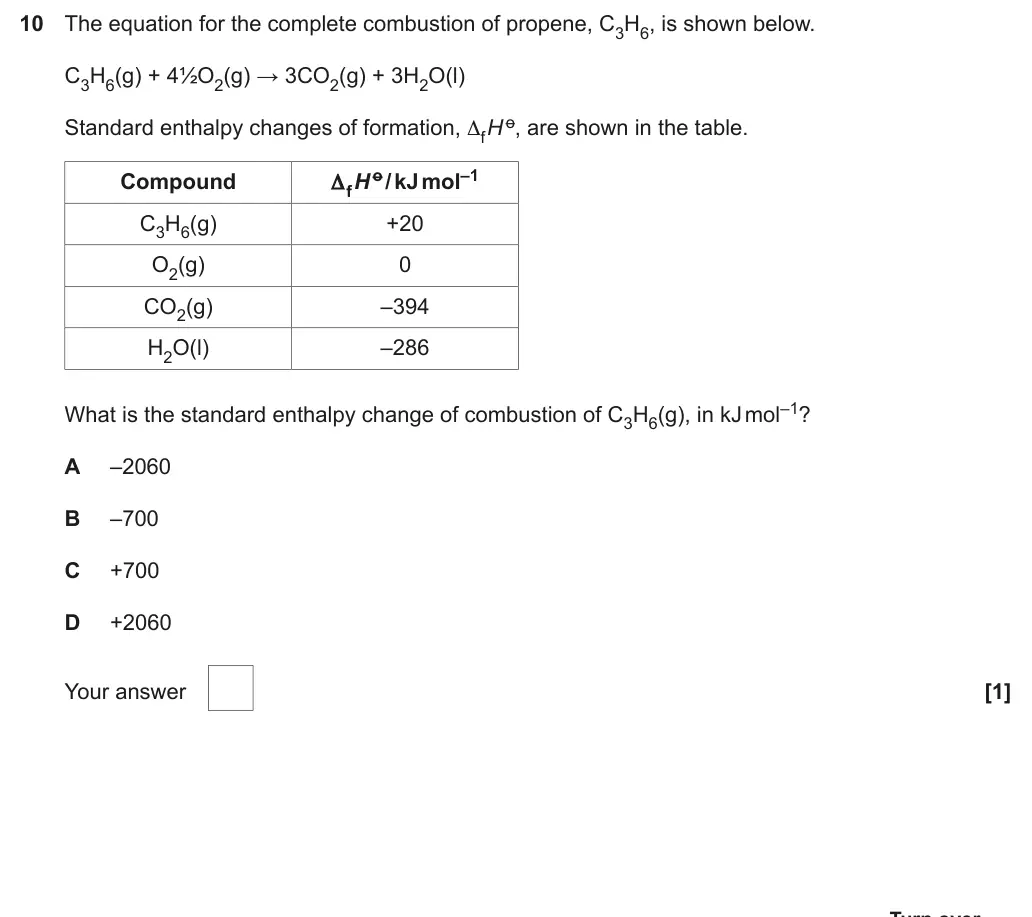
November 2021 · AS Paper 1 · Q10 1 mark AO2 Multiple choice enthalpy changes
10 The equation for the complete combustion of propene, C3H6, is shown below.
C3H6(g) + 4½O2(g) → 3CO2(g) + 3H2O(l)
Standard enthalpy changes of formation, ∆f H o, are shown in the table.
Compound ∆f H o / kJ mol–1
C3H6(g) +20
O2(g) 0
CO2(g) –394
H2O(l) –286
What is the standard enthalpy change of combustion of C3H6(g), in kJ mol–1?
A –2060
B –700
C +700
D +2060
Your answer [1]
November 2021 · AS Paper 1 · Q11 1 mark AO1 Multiple choice reaction rates
11 The Boltzmann distributions below show a gas at two different temperatures.
Which Boltzmann distribution shows the dotted curve at a higher temperature?
number of
A molecules
energy
number of
B molecules
energy
number of
C molecules
energy
number of
D molecules
energy
Your answer [1]
November 2021 · AS Paper 1 · Q12 1 mark AO1 Multiple choice chemical equilibrium
12 Which statement about dynamic equilibrium is not correct?
A A catalyst increases the rate of both forward and reverse reactions by the same amount.
B Dynamic equilibrium exists only in a closed system.
C The concentrations of the reactants and products are equal.
D The rate of the forward reaction is equal to the rate of the reverse reaction.
Your answer [1]
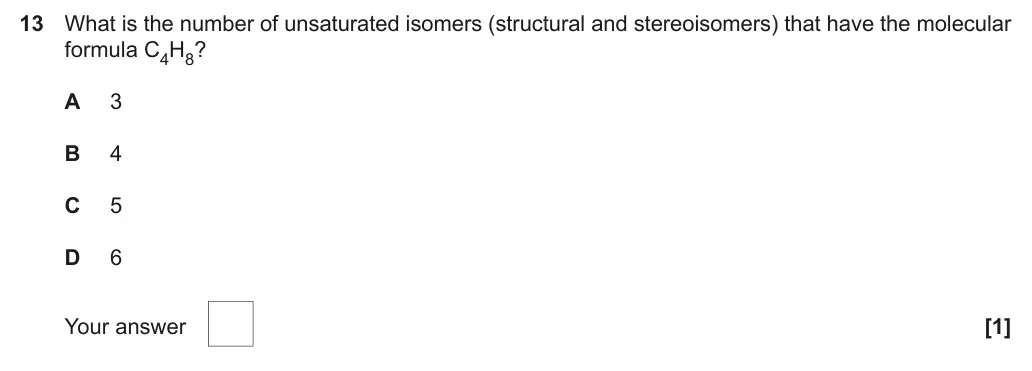
November 2021 · AS Paper 1 · Q13 1 mark AO2 Multiple choice organic basicsalkenes
13 What is the number of unsaturated isomers (structural and stereoisomers) that have the molecular
formula C4H8?
A 3
B 4
C 5
D 6
Your answer [1]
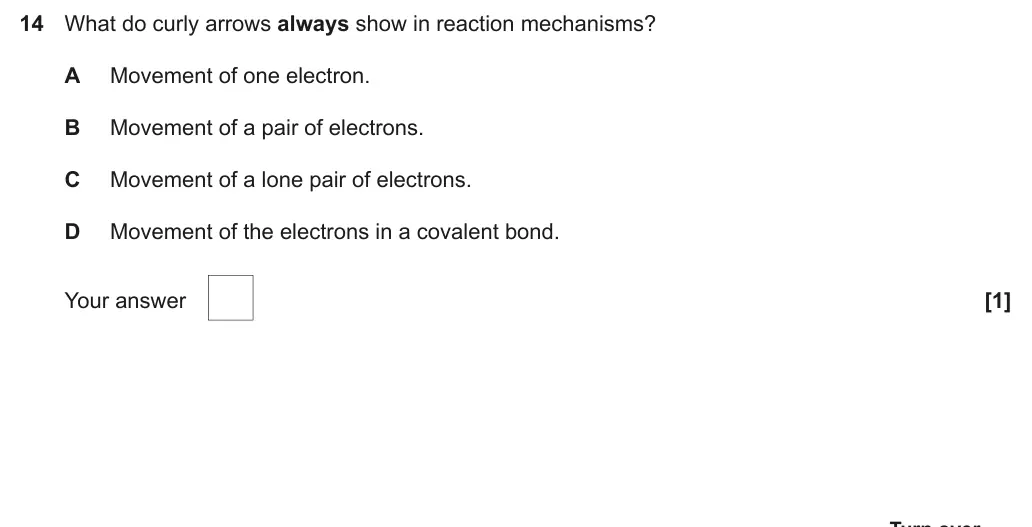
November 2021 · AS Paper 1 · Q14 1 mark AO1 Multiple choice organic basics
14 What do curly arrows always show in reaction mechanisms?
A Movement of one electron.
B Movement of a pair of electrons.
C Movement of a lone pair of electrons.
D Movement of the electrons in a covalent bond.
Your answer [1]
November 2021 · AS Paper 1 · Q15 1 mark AO2 Multiple choice alkanes
15 Which structural isomer of C7H16 has the weakest induced dipole–dipole interactions (London
forces)?
A 2,3-dimethylpentane
B 3-ethylpentane
C 2-methylhexane
D 2,2,3-trimethylbutane
Your answer [1]
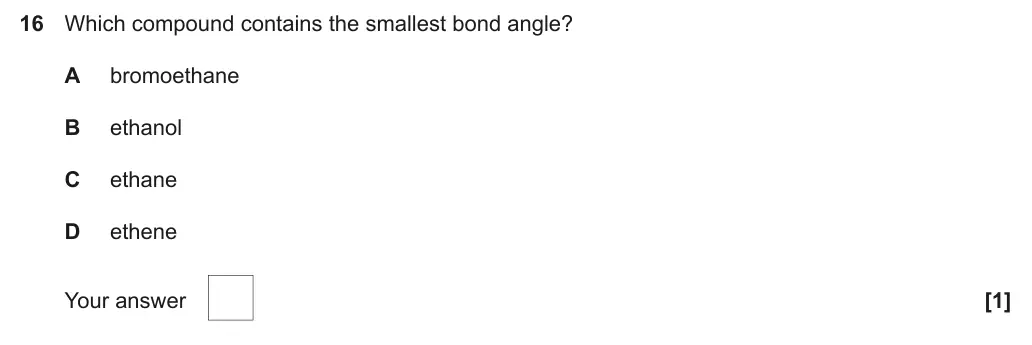
November 2021 · AS Paper 1 · Q16 1 mark AO1 Multiple choice bonding and structurealkanesalkenes
16 Which compound contains the smallest bond angle?
A bromoethane
B ethanol
C ethane
D ethene
Your answer [1]
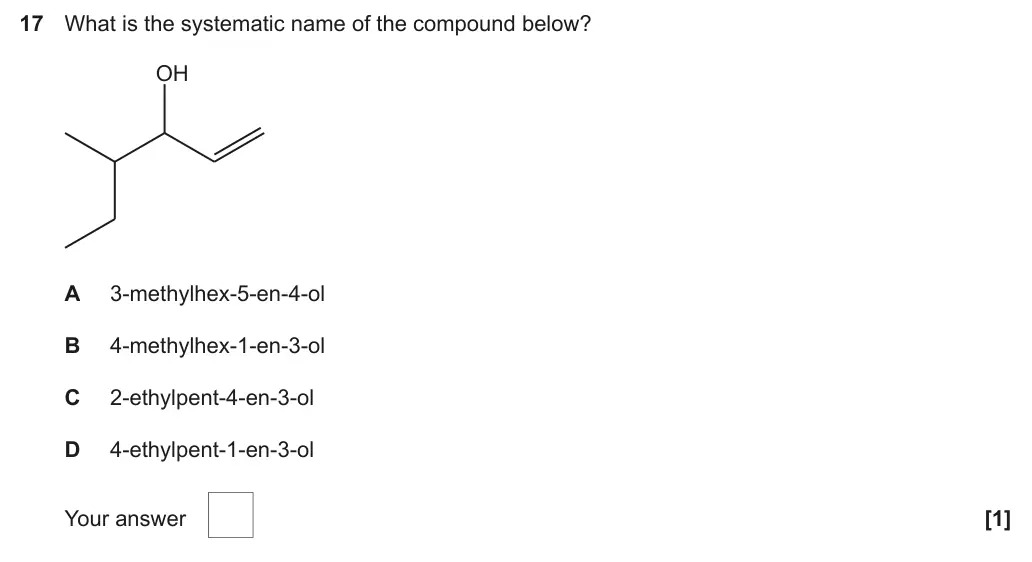
November 2021 · AS Paper 1 · Q17 1 mark AO1 Multiple choice organic basics
17 What is the systematic name of the compound below?
OH
A 3-methylhex-5-en-4-ol
B 4-methylhex-1-en-3-ol
C 2-ethylpent-4-en-3-ol
D 4-ethylpent-1-en-3-ol
Your answer [1]
November 2021 · AS Paper 1 · Q18 1 mark AO2 Multiple choice organic basics
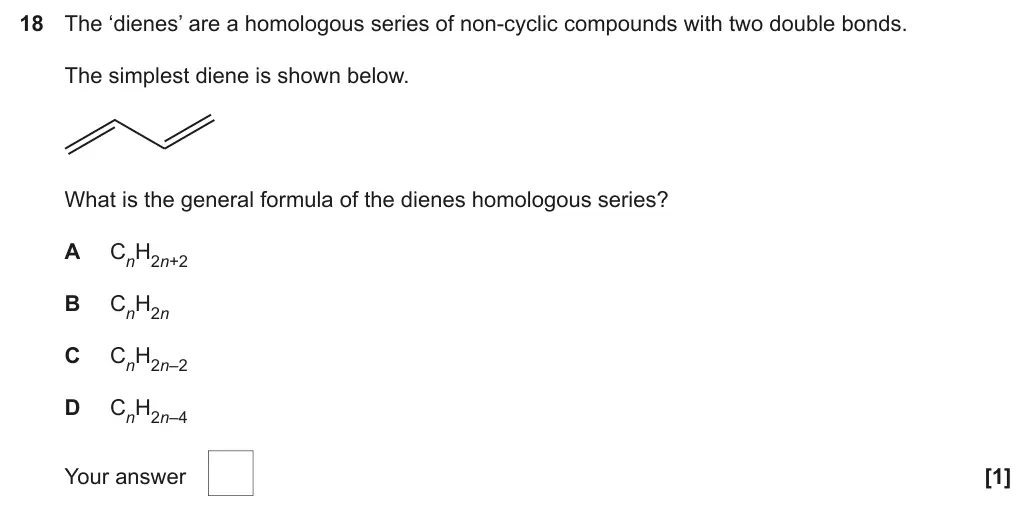
18 The ‘dienes’ are a homologous series of non-cyclic compounds with two double bonds.
The simplest diene is shown below.
What is the general formula of the dienes homologous series?
A CnH2n+2
B CnH2n
C CnH2n–2
D CnH2n–4
Your answer [1]
November 2021 · AS Paper 1 · Q19 1 mark AO1 Multiple choice infrared and mass spectrometry
19 Which statement about absorption of radiation is correct?
A Absorption of IR radiation can break covalent bonds, forming radicals.
B Absorption of IR radiation causes covalent bonds to vibrate more.
C Absorption of UV radiation is a major cause of global warming and climate change.
D Absorption of UV radiation is used in modern breathalysers to measure ethanol in the
breath.
Your answer [1]
November 2021 · AS Paper 1 · Q20 1 mark AO2 Multiple choice alkenes
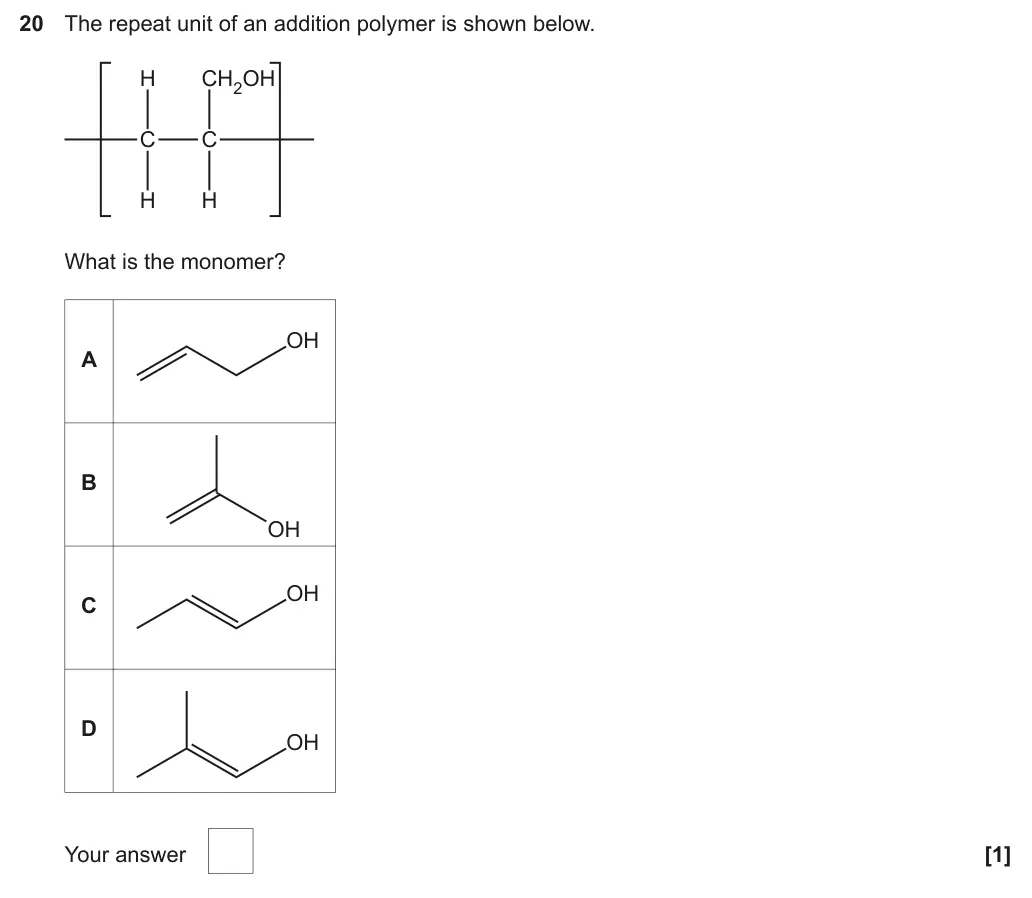
20 The repeat unit of an addition polymer is shown below.
H CH2OH
C C
H H
What is the monomer?
OH
A
B
OH
OH
C
D
OH
Your answer [1]
November 2021 · AS Paper 1 · Q21(a) 2 marks AO1 Complete table/diagram electron structure
SECTION B
Answer all the questions.
21 This question is about atomic structure.
(a) Complete the table to show the maximum number of electrons that can occupy each shell
and sub-shell. Some boxes may need to be left blank.
Sub-shell
Total number
Shell
of electrons
s p d
1st
2nd
3rd
[2]
November 2021 · AS Paper 1 · Q21(b) 1 mark AO1 Complete table/diagram atomic structure and isotopes
(b) Selenium, Se, has the atomic number 34.
76Se and 82Se are two isotopes of selenium.
Complete the table to show the numbers of protons, neutrons and electrons in these two
isotopes.
Protons Neutrons Electrons
76Se
................ ................ ................
82Se
................ ................ ................
[1]
November 2021 · AS Paper 1 · Q21(c) 2 marks AO1 Calculation atomic structure and isotopes
(c) The relative atomic mass of an element can be determined from its mass spectrum.
The table shows the results of a mass spectrum of a sample of sulfur, S.
Isotope Abundance (%)
32S 94.93
33S 0.78
34S 4.29
Calculate the relative atomic mass of the sample of sulfur.
Give your answer to 3 decimal places.
relative atomic mass =  ......................................................... [2]
November 2021 · AS Paper 1 · Q21(d)(i) 1 mark AO2 Structure / isomer organic basics
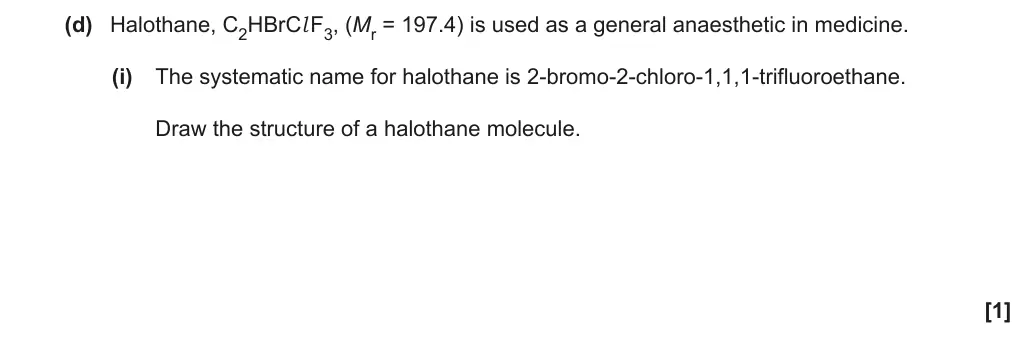
(d) Halothane, C2HBrCl F3, (Mr = 197.4) is used as a general anaesthetic in medicine.
(i) The systematic name for halothane is 2-bromo-2-chloro-1,1,1-trifluoroethane.
Draw the structure of a halothane molecule.
[1]
November 2021 · AS Paper 1 · Q21(d)(ii) 2 marks AO2 Calculation amount of substance
Earlier part of question 21 that this part usesEarlier part of November 2021 Paper 1 question 21
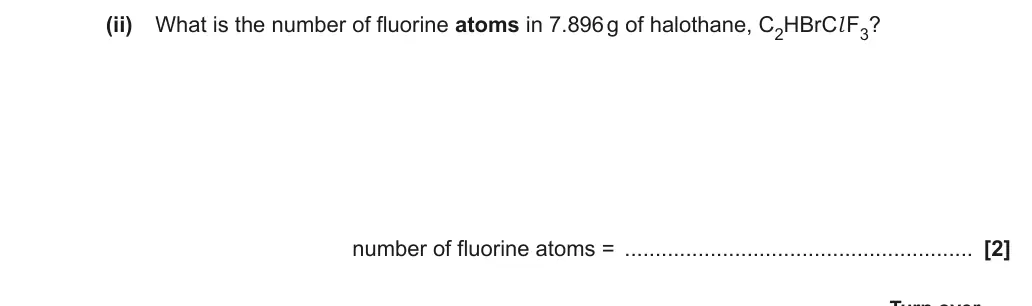
(ii) What is the number of fluorine atoms in 7.896 g of halothane, C2HBrCl F3?
number of fluorine atoms =  ......................................................... [2]
November 2021 · AS Paper 1 · Q22(a) 3 marks AO1 Complete table/diagram enthalpy changesreaction rates
22 This question is about enthalpy changes.
Hydrogen, H2, can be manufactured by the reaction of methane and steam.
This is a reversible reaction, as shown in Equilibrium 22.1 below.
Equilibrium 22.1    CH4(g) + H2O(g) 3H2(g) + CO(g) ∆H = +206 kJ mol–1
(a) The rate of this reaction increases when a catalyst is present.
Complete the enthalpy profile diagram below.
On your diagram:
• label the activation energies, Ea (without catalyst) and Ec (with catalyst)
• label the enthalpy change of reaction, ∆H.
enthalpy CH4(g) + H2O(g)
progress of reaction
[3]
November 2021 · AS Paper 1 · Q22(b) 4 marks AO1, 2 Short answer chemical equilibrium
Earlier part of question 22 that this part usesEarlier part of November 2021 Paper 1 question 22
(b) Explain how le Chatelier’s principle can be used to predict the conditions of pressure and
temperature for a maximum equilibrium yield of hydrogen in Equilibrium 22.1.
...................................................................................................................................................
...................................................................................................................................................
...................................................................................................................................................
...................................................................................................................................................
...................................................................................................................................................
...................................................................................................................................................
...................................................................................................................................................
...................................................................................................................................................
.............................................................................................................................................. [4]
November 2021 · AS Paper 1 · Q22(c) 3 marks AO2 Calculation enthalpy changes
Earlier part of question 22 that this part usesEarlier part of November 2021 Paper 1 question 22
(c) The reaction for the production of hydrogen is repeated below.
CH4(g) + H2O(g) 3H2(g) + CO(g)     ∆H = +206 kJ mol–1
Average bond enthalpies are shown in the table.
Average bond enthalpy
Bond
/ kJ mol–1
C–H 413
O–H 464
C≡O 1077
Calculate the bond enthalpy of the H–H bond.
bond enthalpy =  ............................................ kJ mol–1 [3]
November 2021 · AS Paper 1 · Q23(a) 1 mark AO1 Short answer halogens
23 This question is about halogens.
(a) Chlorine is used to kill bacteria in drinking water.
State one risk in using chlorine in drinking water.
...................................................................................................................................................
.............................................................................................................................................. [1]
November 2021 · AS Paper 1 · Q23(b) 2 marks AO1 Data interpretation redox
(b) Chlorine can be prepared by reacting concentrated hydrochloric acid with manganese(IV)
oxide, MnO2.
4HCl (aq) + MnO2(s) → Cl 2(g) + MnCl 2(aq) + 2H2O(l)
Using oxidation numbers, show which element has been oxidised and which has been
reduced in this reaction. State the changes in oxidation numbers, including all signs.
Element oxidised ......................................................
Oxidation number change: from ............. to .............
Element reduced ......................................................
Oxidation number change: from ............. to .............
[2]
November 2021 · AS Paper 1 · Q23(c) 1 mark AO2 Equation writing formulae and equations
(c) A mixture of potassium perchlorate, KCl O4, and aluminium is used in fireworks.
When the firework ignites, KCl O4 reacts with aluminium to form potassium chloride, KCl ,
and aluminium oxide, Al 2O3.
Write the balanced equation for this reaction.
State symbols are not required.
.............................................................................................................................................. [1]
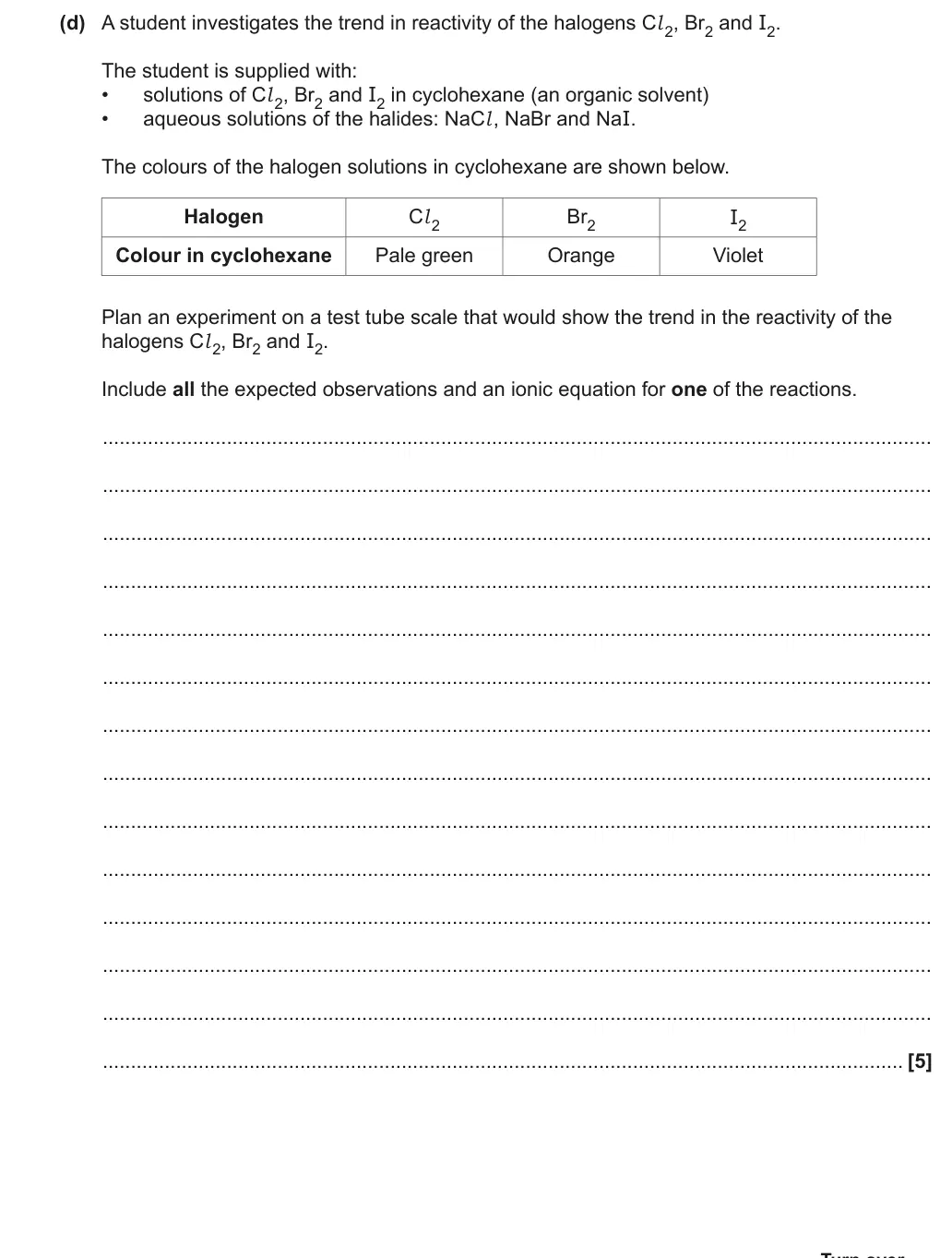
November 2021 · AS Paper 1 · Q23(d) 5 marks AO1, 2, 3 Equation writing halogenspractical skillsformulae and equations
(d) A student investigates the trend in reactivity of the halogens Cl 2, Br2 and I2.
The student is supplied with:
• solutions of Cl 2, Br2 and I2 in cyclohexane (an organic solvent)
• aqueous solutions of the halides: NaCl , NaBr and NaI.
The colours of the halogen solutions in cyclohexane are shown below.
Halogen Cl 2 Br2 I2
Colour in cyclohexane Pale green Orange Violet
Plan an experiment on a test tube scale that would show the trend in the reactivity of the
halogens Cl 2, Br2 and I2.
Include all the expected observations and an ionic equation for one of the reactions.
...................................................................................................................................................
...................................................................................................................................................
...................................................................................................................................................
...................................................................................................................................................
...................................................................................................................................................
...................................................................................................................................................
...................................................................................................................................................
...................................................................................................................................................
...................................................................................................................................................
...................................................................................................................................................
...................................................................................................................................................
...................................................................................................................................................
...................................................................................................................................................
.............................................................................................................................................. [5]
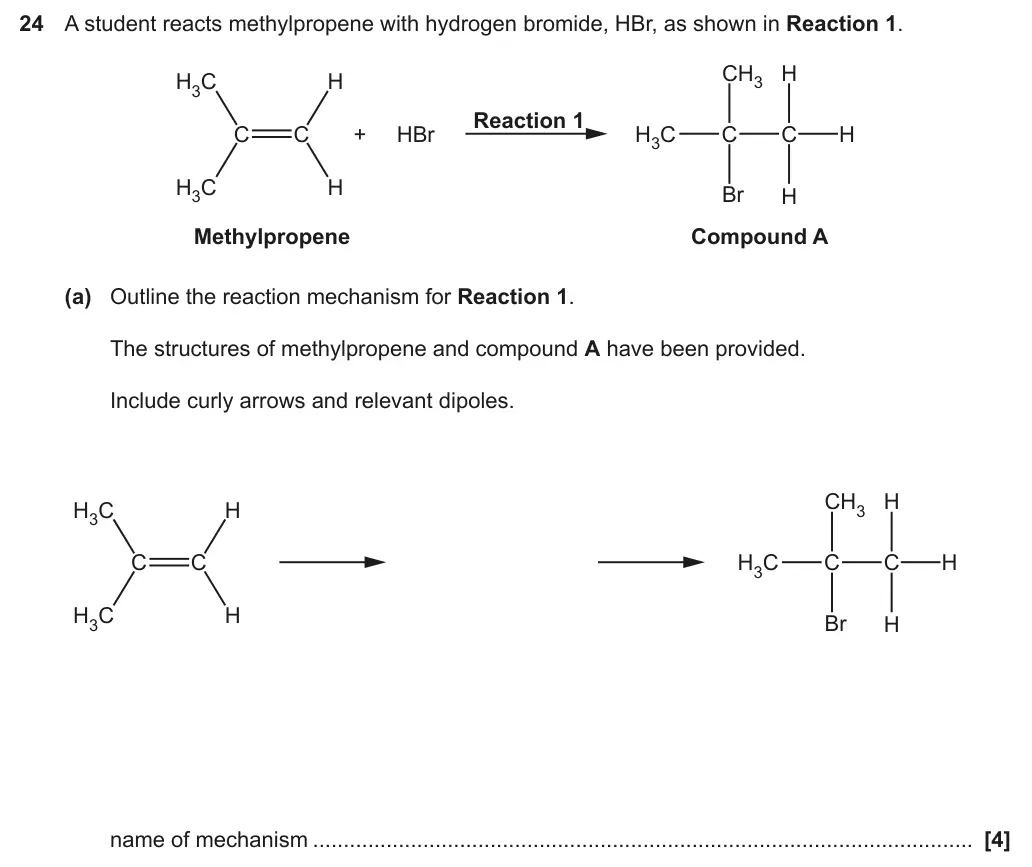
November 2021 · AS Paper 1 · Q24(a) 4 marks AO1, 2 Mechanism alkenesorganic basics
24 A student reacts methylpropene with hydrogen bromide, HBr, as shown in Reaction 1.
CH3 H
H3C H
Reaction 1
C C + HBr H3C C C H
H3C H
Br H
Methylpropene Compound A
(a) Outline the reaction mechanism for Reaction 1.
The structures of methylpropene and compound A have been provided.
Include curly arrows and relevant dipoles.
CH3 H
H3C H
C C H3C C C H
H3C H
Br H
name of mechanism ............................................................................................................ [4]
November 2021 · AS Paper 1 · Q24(b)(i) 1 mark AO1 Short answer organic basics
Earlier part of question 24 that this part usesEarlier part of November 2021 Paper 1 question 24
(b) When reacting methylpropene with HBr, a small amount of compound B also forms.
Compound B is a structural isomer of compound A.
(i) Explain the term structural isomer.
...........................................................................................................................................
...........................................................................................................................................
...................................................................................................................................... [1]
November 2021 · AS Paper 1 · Q24(b)(ii) 1 mark AO2 Short answer alkenesorganic basics
Earlier parts of question 24 that this part usesEarlier part of November 2021 Paper 1 question 24Earlier part of November 2021 Paper 1 question 24
(ii) Show the structure for compound B.
[1]
November 2021 · AS Paper 1 · Q24(c)(i) 2 marks AO2 Complete table/diagram haloalkanes
Earlier part of question 24 that this part usesEarlier part of November 2021 Paper 1 question 24
(c) Compound A can be refluxed with a reagent to make alcohol C.
(i) Choose a reagent for this reaction and complete the equation for this reaction.
Your equation should show the structure of alcohol C.
CH3 H
H3C C C H + ...................... + ......................
Reagent
Br H
Compound A Alcohol C
[2]
November 2021 · AS Paper 1 · Q24(c)(ii) 2 marks AO3 Drawing / labelling organic synthesis aspractical techniques
Earlier part of question 24 that this part usesEarlier part of November 2021 Paper 1 question 24
(ii) Draw a labelled diagram to show how you would set up apparatus for reflux.
[2]
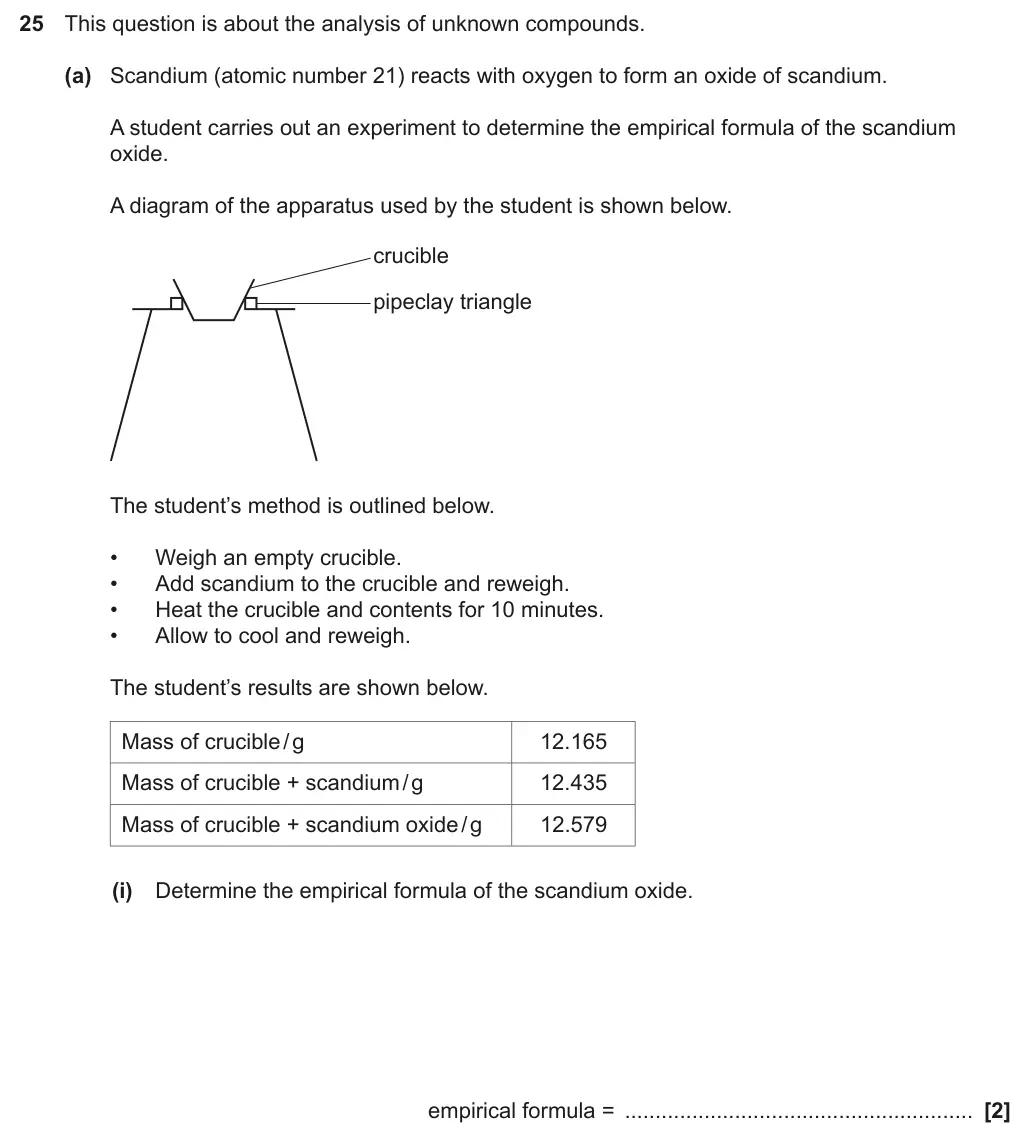
November 2021 · AS Paper 1 · Q25(a)(i) 2 marks AO2 Calculation amount of substance
25 This question is about the analysis of unknown compounds.
(a) Scandium (atomic number 21) reacts with oxygen to form an oxide of scandium.
A student carries out an experiment to determine the empirical formula of the scandium
oxide.
A diagram of the apparatus used by the student is shown below.
crucible
pipeclay triangle
The student’s method is outlined below.
• Weigh an empty crucible.
• Add scandium to the crucible and reweigh.
• Heat the crucible and contents for 10 minutes.
• Allow to cool and reweigh.
The student’s results are shown below.
Mass of crucible / g 12.165
Mass of crucible + scandium / g 12.435
Mass of crucible + scandium oxide / g 12.579
(i) Determine the empirical formula of the scandium oxide.
empirical formula =  ......................................................... [2]
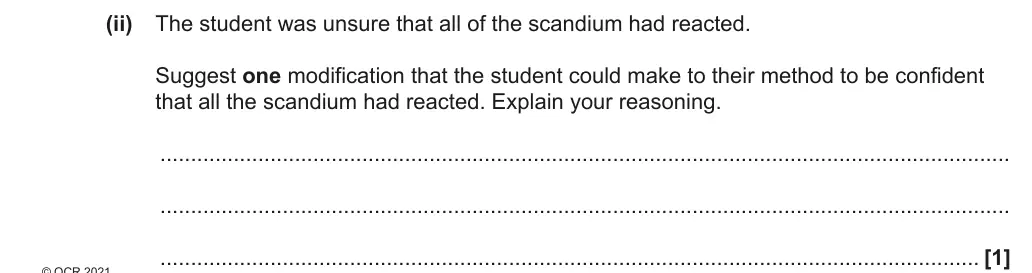
November 2021 · AS Paper 1 · Q25(a)(ii) 1 mark AO3 Short answer practical skillsamount of substance
Earlier part of question 25 that this part usesEarlier part of November 2021 Paper 1 question 25
(ii) The student was unsure that all of the scandium had reacted.
Suggest one modification that the student could make to their method to be confident
that all the scandium had reacted. Explain your reasoning.
...........................................................................................................................................
...........................................................................................................................................
...................................................................................................................................... [1]
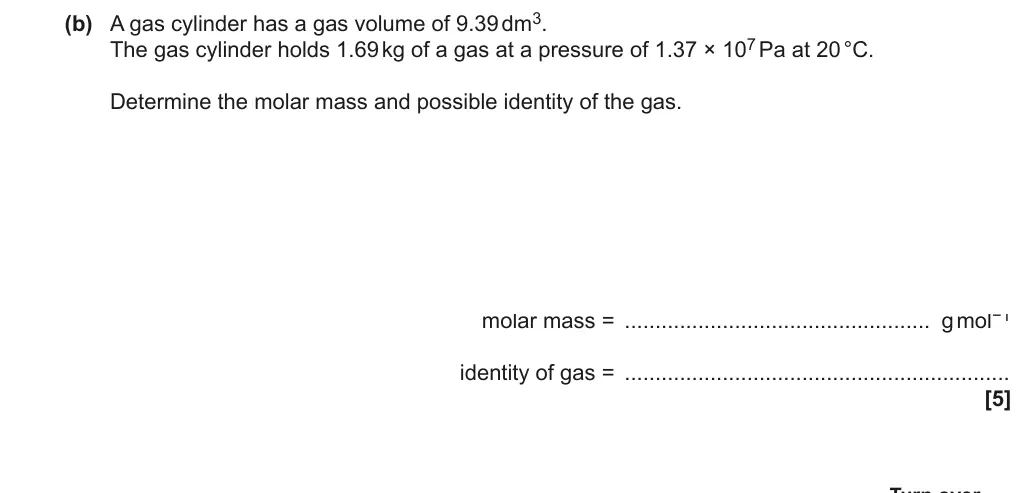
November 2021 · AS Paper 1 · Q25(b) 5 marks AO1, 2, 3 Calculation amount of substance
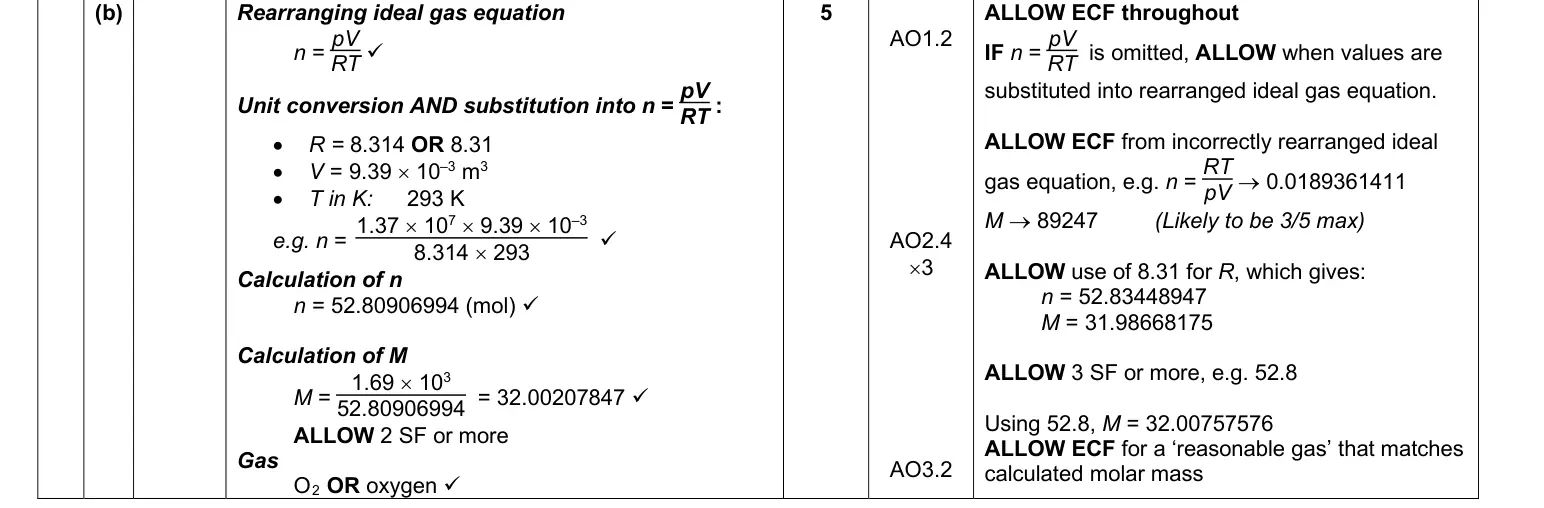
(b) A gas cylinder has a gas volume of 9.39 dm3.
The gas cylinder holds 1.69 kg of a gas at a pressure of 1.37 × 10⁷ Pa at 20 °C.
Determine the molar mass and possible identity of the gas.
molar mass =  .................................................. g mol−1
identity of gas =  ...............................................................
[5]
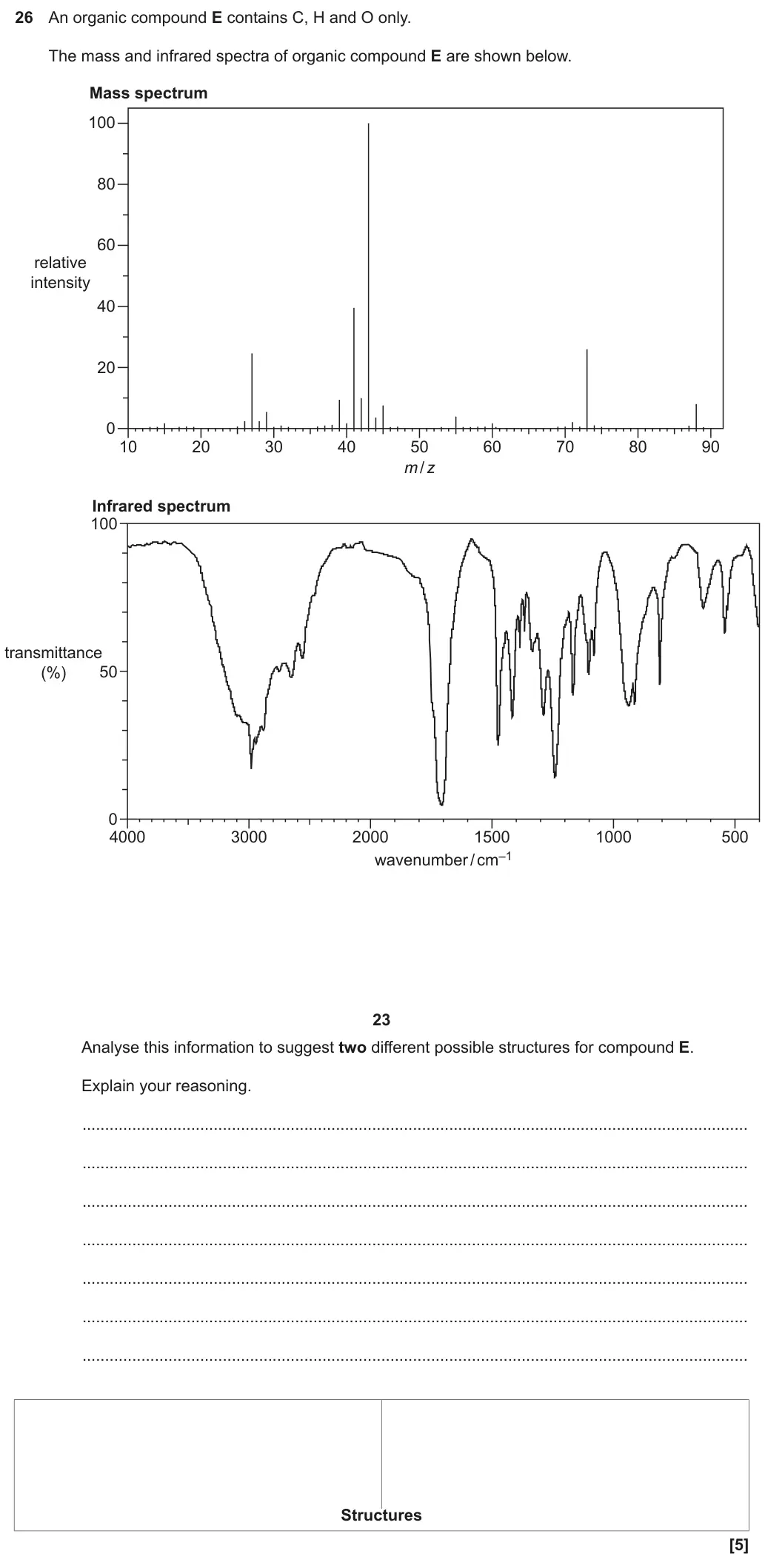
November 2021 · AS Paper 1 · Q26 5 marks AO3 Extended response infrared and mass spectrometryorganic basics
26 An organic compound E contains C, H and O only.
The mass and infrared spectra of organic compound E are shown below.
Mass spectrum
100
80
60
relative
intensity
40
20
0
10 20 30 40 50 60 70 80 90
m / z
Infrared spectrum
100
transmittance
(%) 50
0
4000 3000 2000 1500 1000 500
wavenumber / cm–1
Analyse this information to suggest two different possible structures for compound E.
Explain your reasoning.
...................................................................................................................................................
...................................................................................................................................................
...................................................................................................................................................
...................................................................................................................................................
...................................................................................................................................................
...................................................................................................................................................
...................................................................................................................................................
Structures
[5]

Work with an OCR chemistry tutor

Want a paper marked and gone through with you? Message us.

Prefer email? Send an enquiry

If you are under 18, please include a parent's contact details. Enquiries go to enquiries@chemistryaleveltutor.com and are deleted once handled. All tutoring is online.