November 2021: Paper 2, Synthesis and analytical techniques

100 marks · 45 question parts · Paper, mark scheme and report on OCR's site · An autumn series, sat in place of the cancelled summer exams · Have OCR's Data Sheet beside you

Question by question

QTopicMarksAOType
1 Alkanes, Organic basics: naming, formulae and isomerism 1Multiple choice
2 Amino acids, amides and chirality, Alkenes 1Multiple choice
3 Amount of substance (moles) 1Multiple choice
4 Alcohols, Formulae and equations, Alkanes 1Multiple choice
5 Carbonyl compounds: aldehydes and ketones, Amino acids, amides and chirality 1Multiple choice
6 Carboxylic acids, esters and acyl chlorides 1Multiple choice
7 Alcohols 1Multiple choice
8 Bonding, structure and shapes of molecules 1Multiple choice
9 Amines, Carbonyl compounds: aldehydes and ketones, Carbon–carbon bond formation 1Multiple choice
10 Chromatography and tests for functional groups 1Multiple choice
11 Infrared spectroscopy and mass spectrometry 1Multiple choice
12 Infrared spectroscopy and mass spectrometry 1Multiple choice
13 NMR spectroscopy and combined techniques 1Multiple choice
14 Aromatic compounds: benzene and phenol 1Multiple choice
15 Aromatic compounds: benzene and phenol, Haloalkanes, Carboxylic acids, esters and acyl chlorides 1Multiple choice
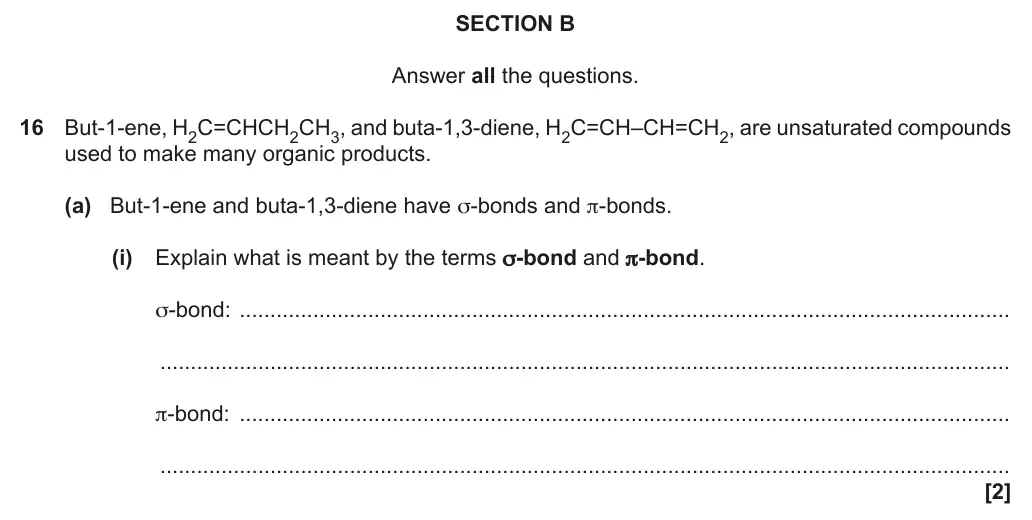
16(a)(i) Alkenes, Alkanes 2AO1Short answer
16(a)(ii) Alkenes, Alkanes 2AO1Short answer
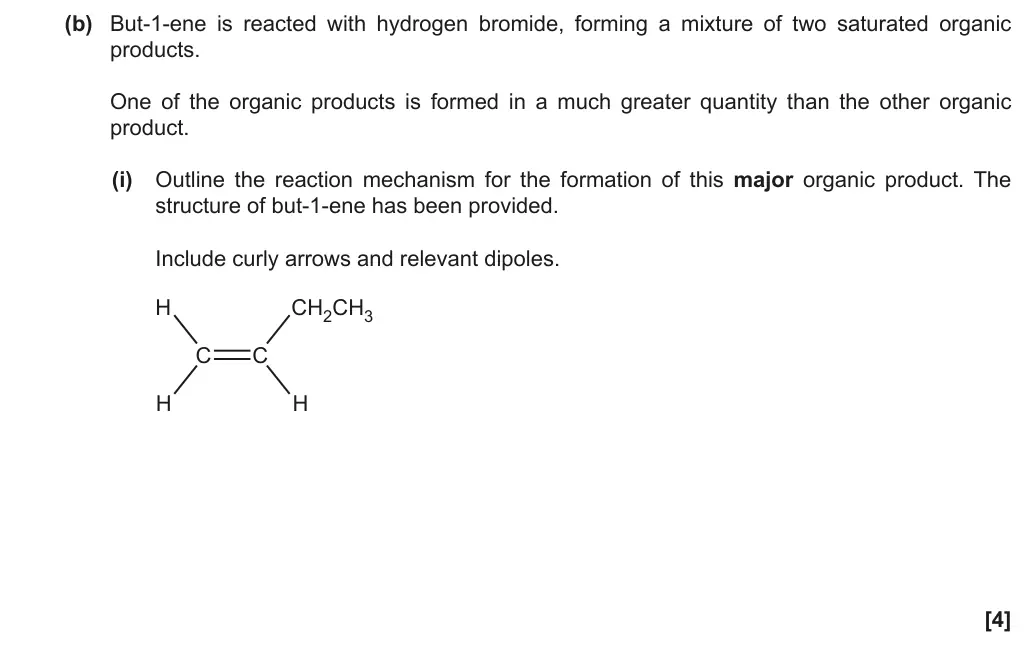
16(b)(i) Alkenes, Organic basics: naming, formulae and isomerism 4AO1, 2Mechanism
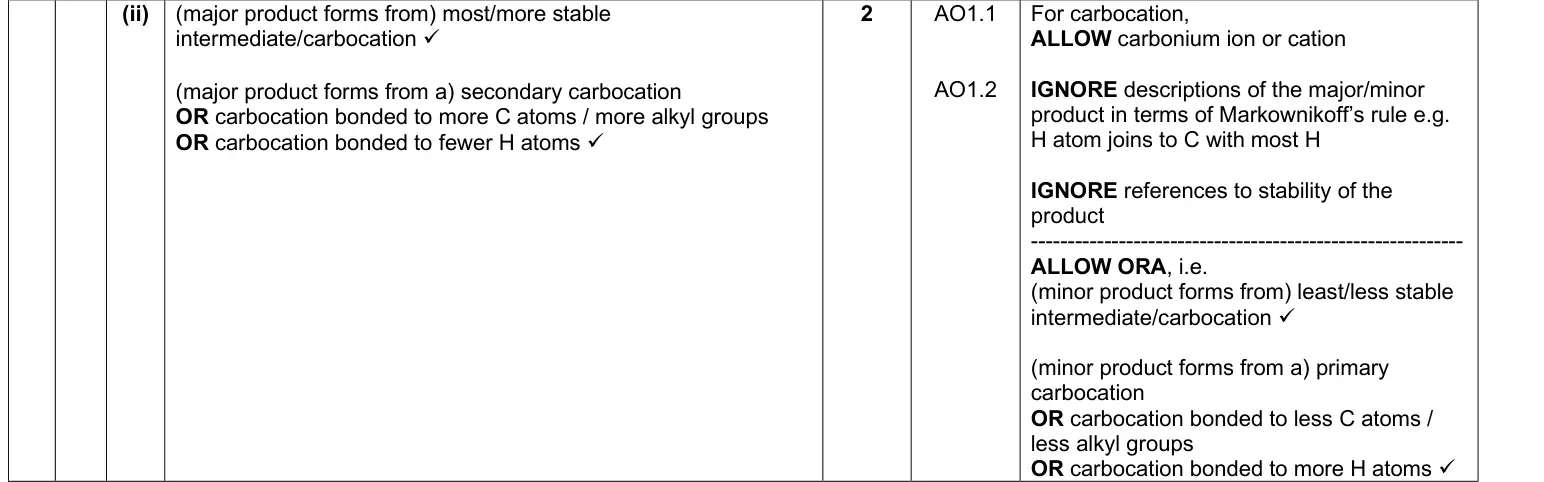
16(b)(ii) Alkenes 2AO1Short answer
16(b)(iii) Alkenes, Organic basics: naming, formulae and isomerism 1AO1Short answer
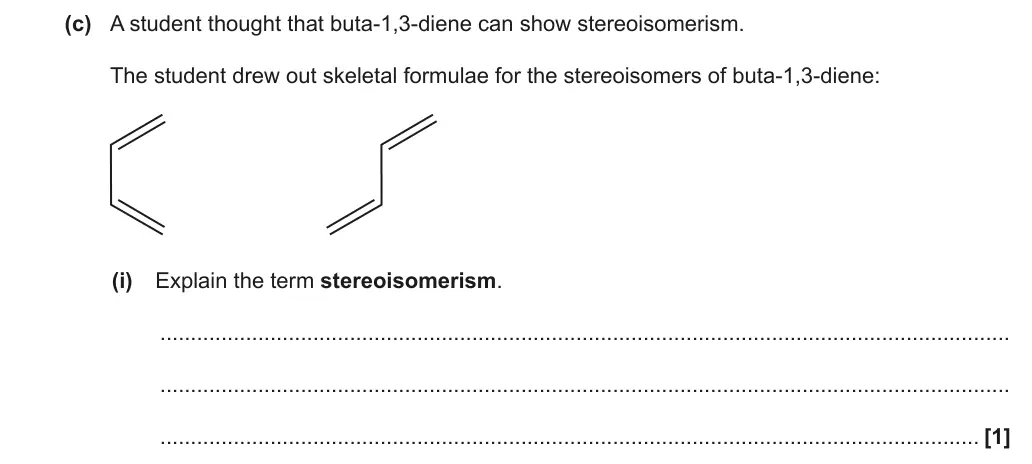
16(c)(i) Alkenes 1AO1Short answer
16(c)(ii) Alkenes 1AO3Short answer
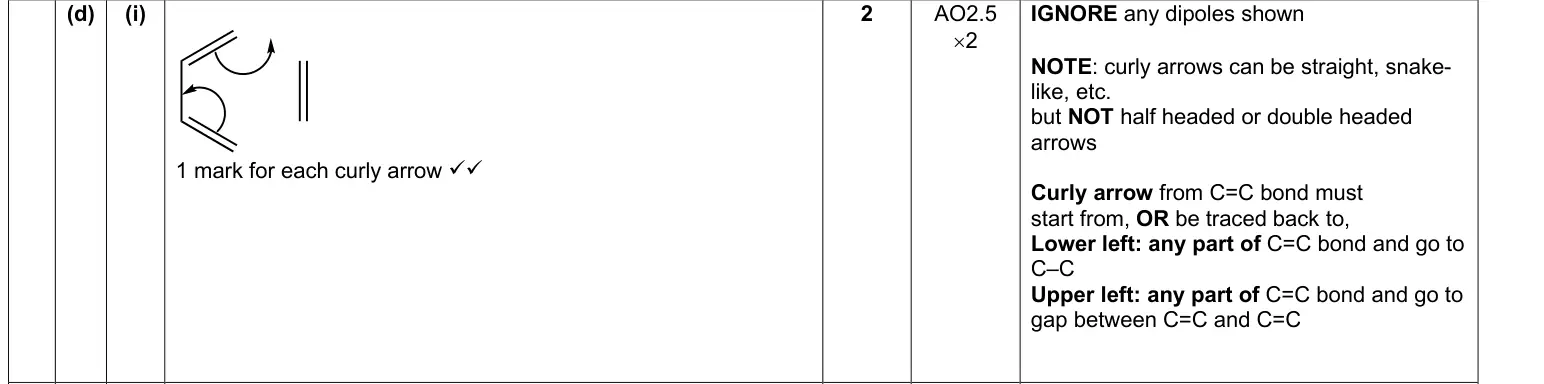
16(d)(i) Organic basics: naming, formulae and isomerism 2AO2Mechanism
16(d)(ii) Organic synthesis (Module 6), Carbon–carbon bond formation 2AO3Structure / isomer
17(a) Haloalkanes 3AO1, 2Short answer
17(b)(i) Alkenes 1AO2Drawing / labelling
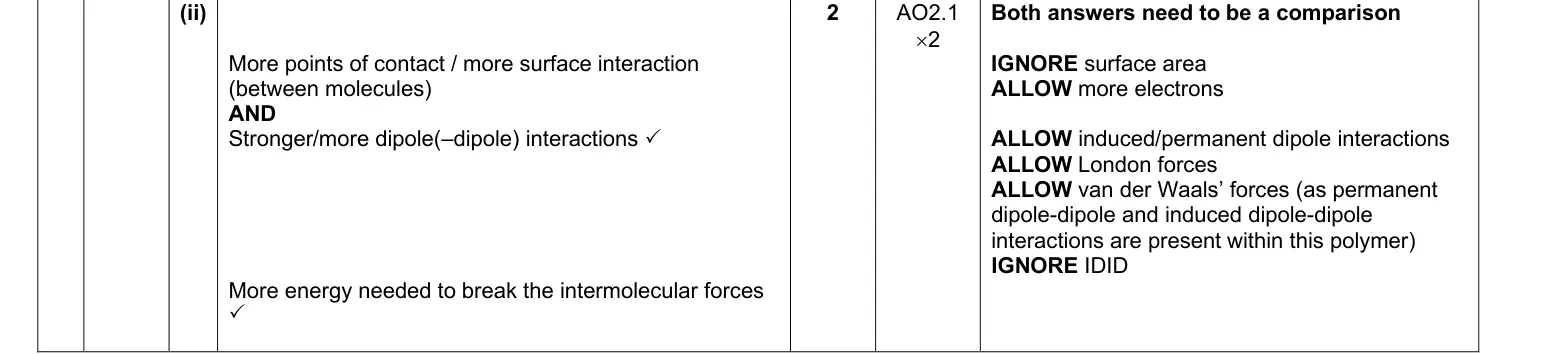
17(b)(ii) Bonding, structure and shapes of molecules 2AO2Short answer
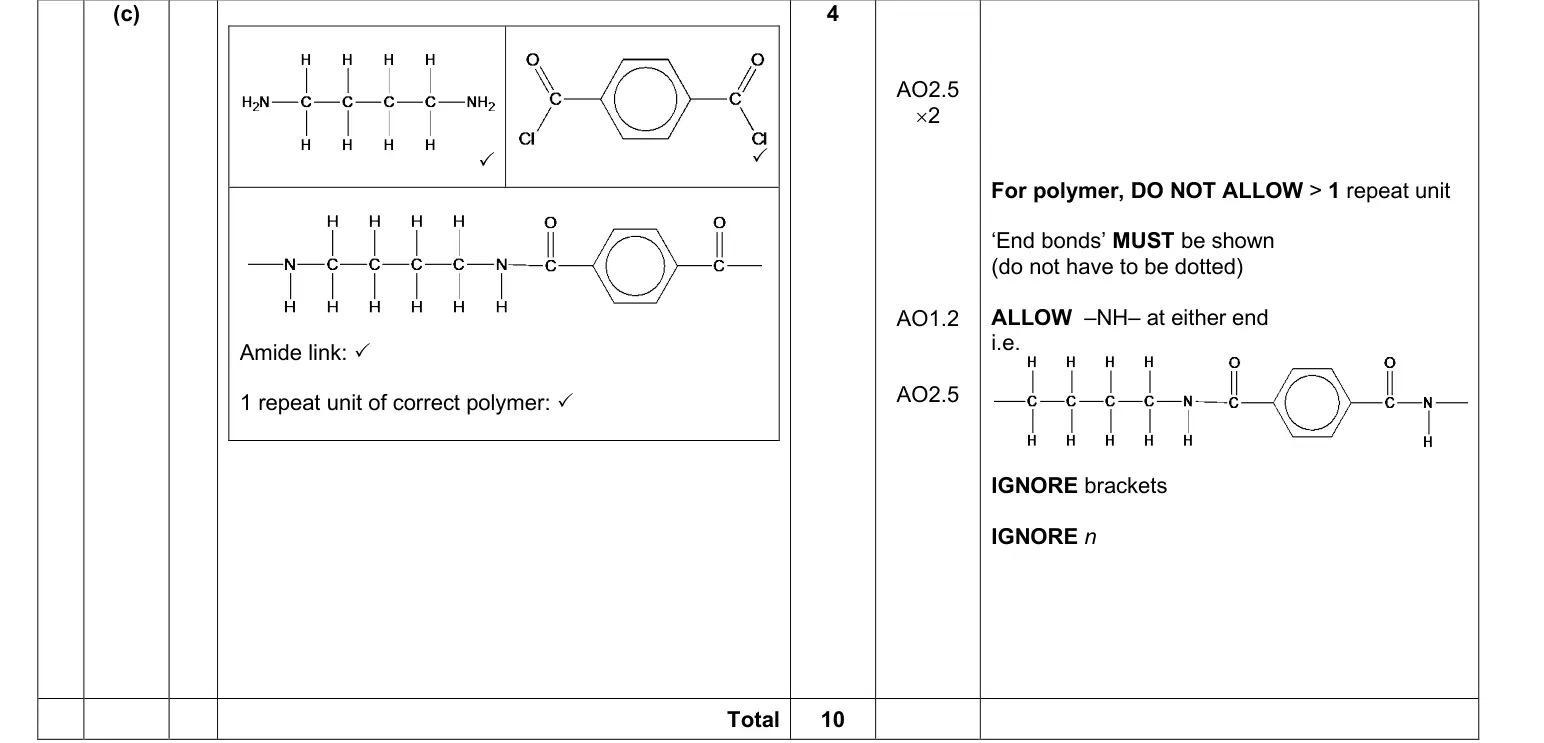
17(c) Polyesters and polyamides, Organic basics: naming, formulae and isomerism 4AO1, 2Structure / isomer
18(a)(i) Amino acids, amides and chirality 1AO1Data interpretation
18(a)(ii) Amino acids, amides and chirality 2AO2Structure / isomer
18(a)(iii) Amino acids, amides and chirality 1AO2Short answer
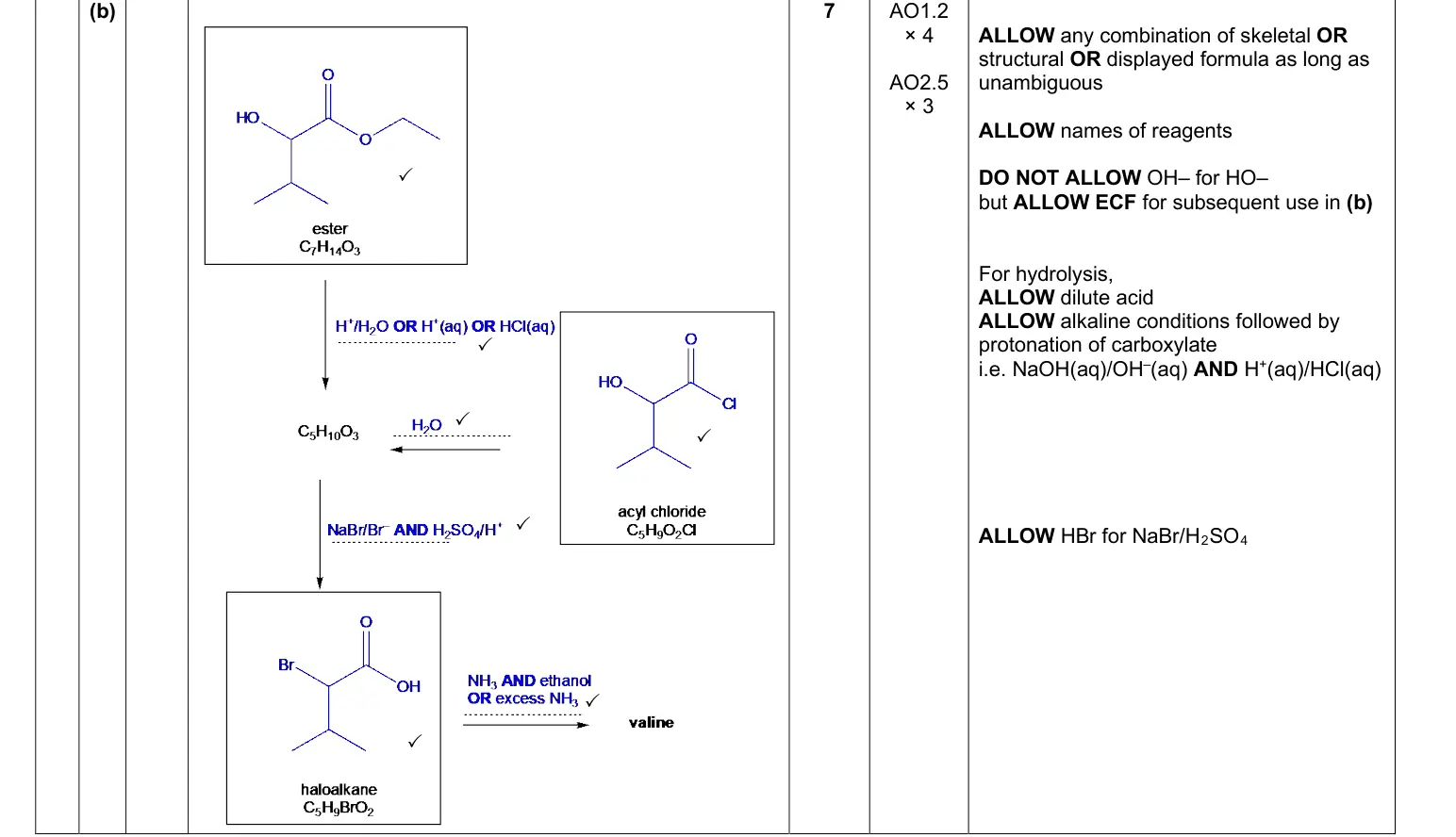
18(b) Organic synthesis (Module 6), Alcohols, Carboxylic acids, esters and acyl chlorides, Amines 7AO1, 2Short answer
18(c)(i) Amount of substance (moles), Organic basics: naming, formulae and isomerism 1AO2Short answer
18(c)(ii) Amount of substance (moles) 3AO2Calculation
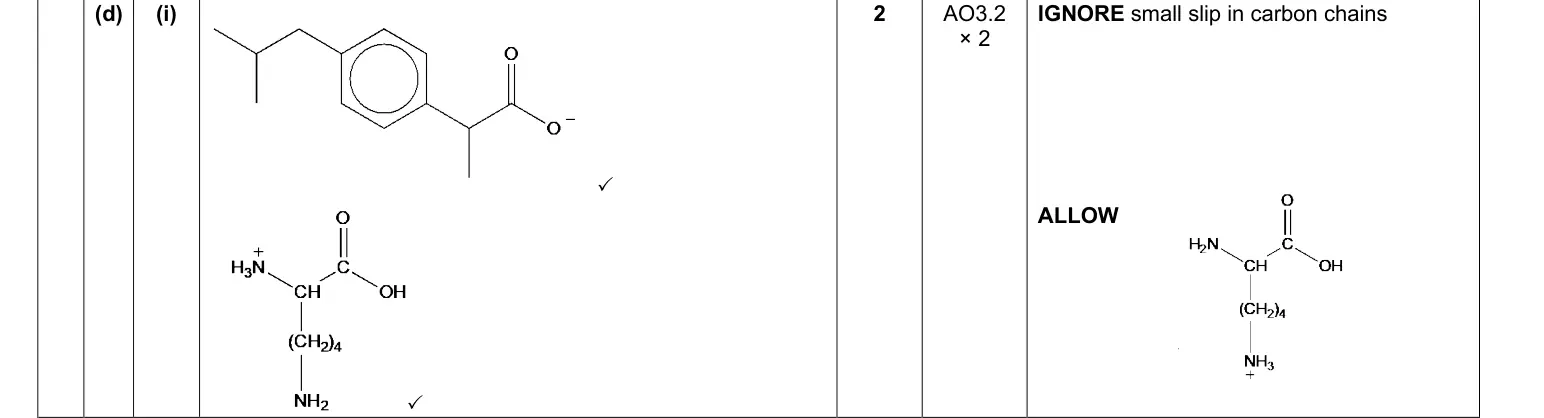
18(d)(i) Amines, Carboxylic acids, esters and acyl chlorides, Amino acids, amides and chirality 2AO3Structure / isomer
18(d)(ii) Bonding, structure and shapes of molecules 1AO3Short answer
19(a)(i) Organic basics: naming, formulae and isomerism 1AO1Short answer
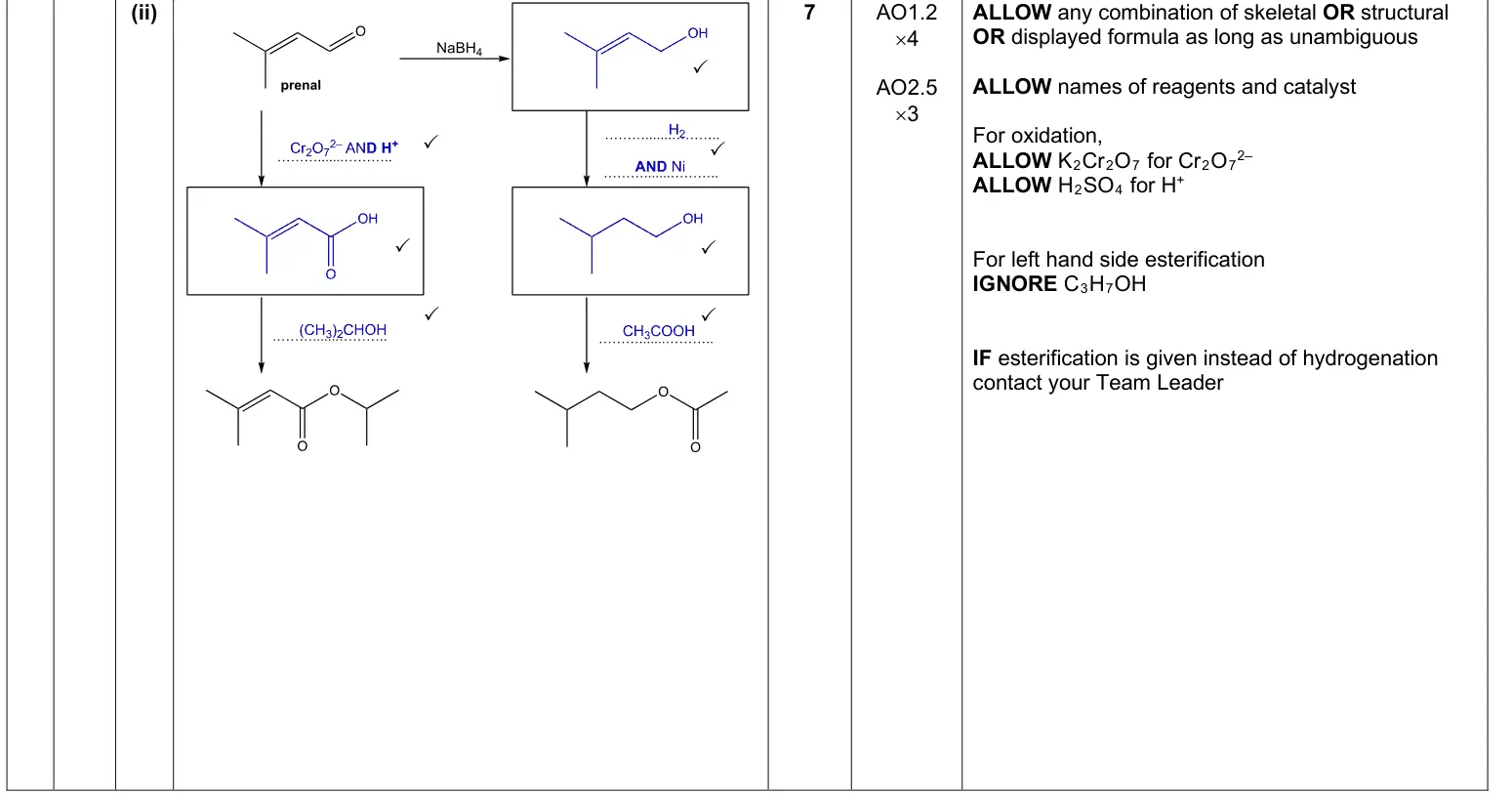
19(a)(ii) Organic synthesis (Module 6), Alkenes, Carbonyl compounds: aldehydes and ketones, Carboxylic acids, esters and acyl chlorides 7AO1, 2Short answer
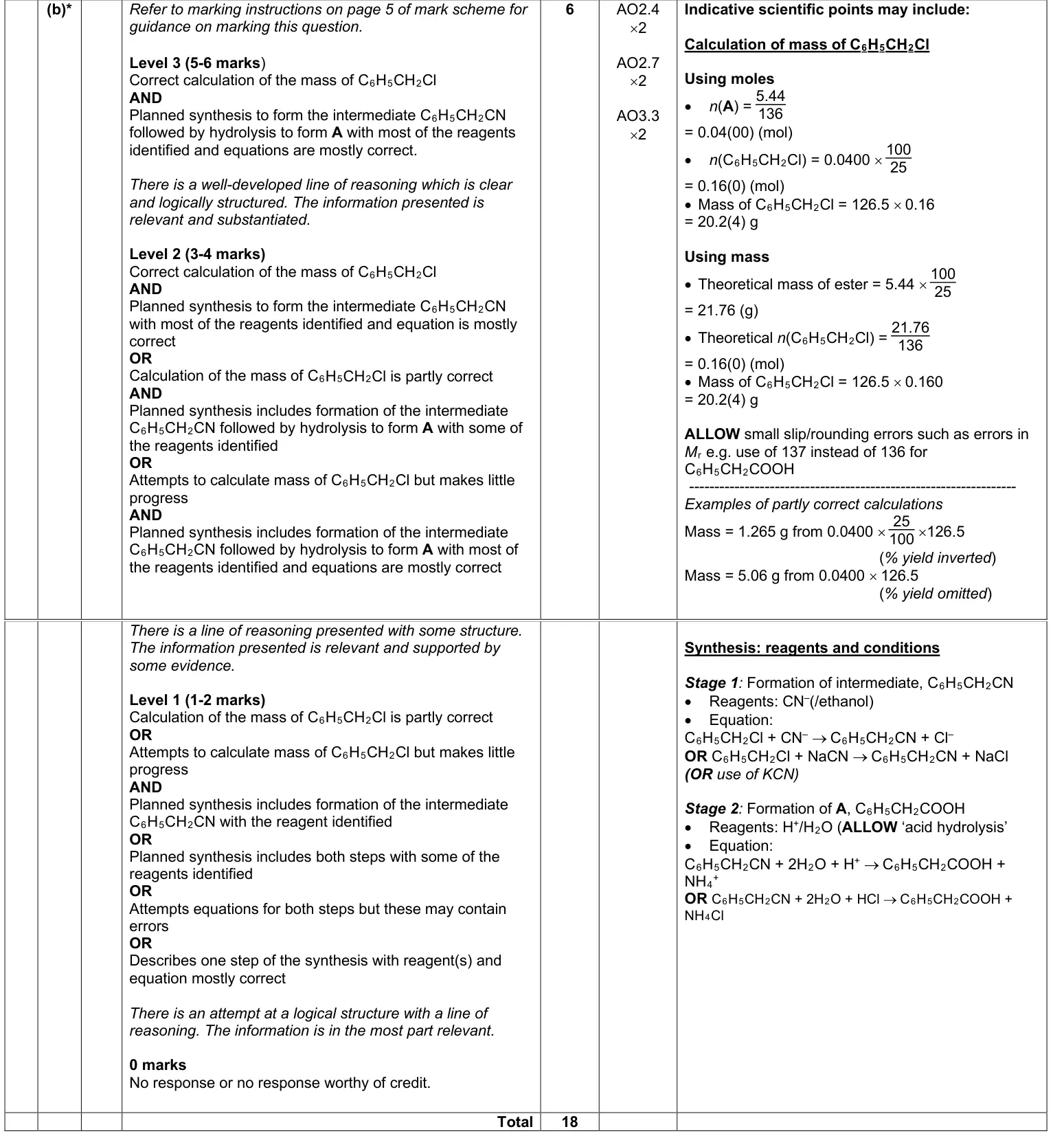
19(b) Organic synthesis (Module 6), Amount of substance (moles), Carbon–carbon bond formation 6AO2, 3Level of response
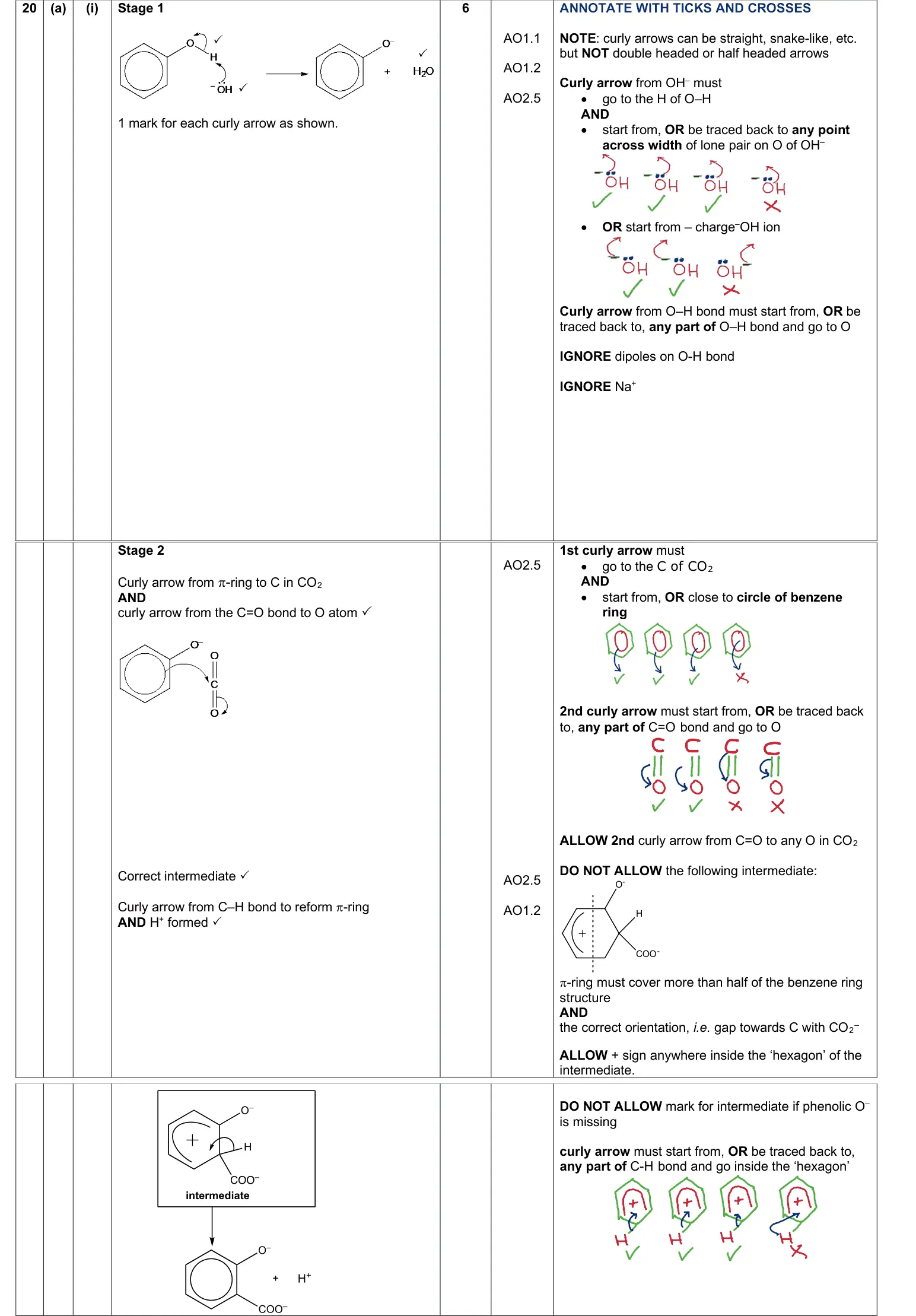
20(a)(i) Aromatic compounds: benzene and phenol, Organic basics: naming, formulae and isomerism 6AO1, 2Mechanism
20(a)(ii) Aromatic compounds: benzene and phenol, Alkenes 2AO2Short answer
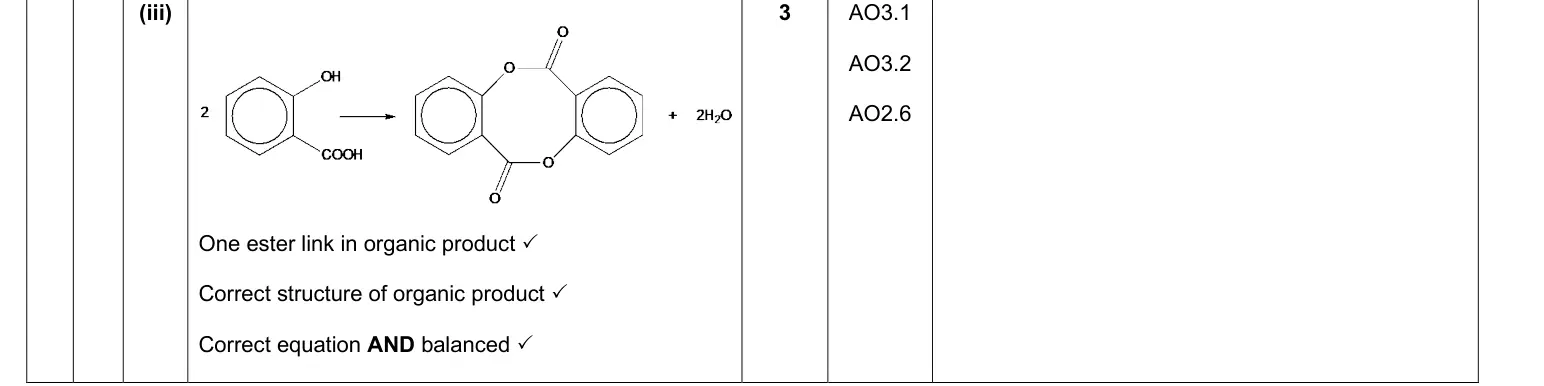
20(a)(iii) Carboxylic acids, esters and acyl chlorides, Formulae and equations, Organic synthesis (Module 6) 3AO2, 3Equation writing
20(b)(i) Organic synthesis (Module 6) 3AO3Short answer
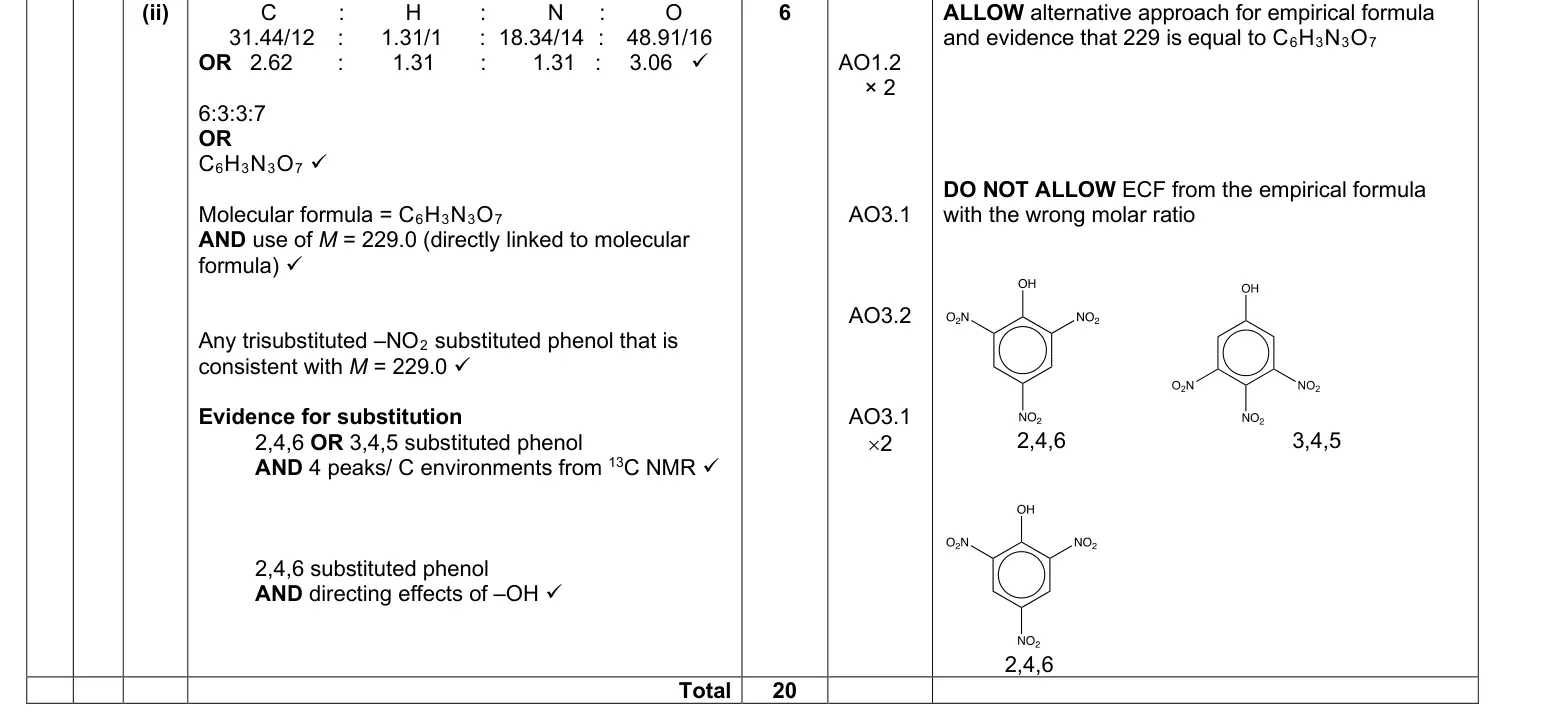
20(b)(ii) Amount of substance (moles), Infrared spectroscopy and mass spectrometry, Aromatic compounds: benzene and phenol, NMR spectroscopy and combined techniques 6AO1, 3Structure / isomer
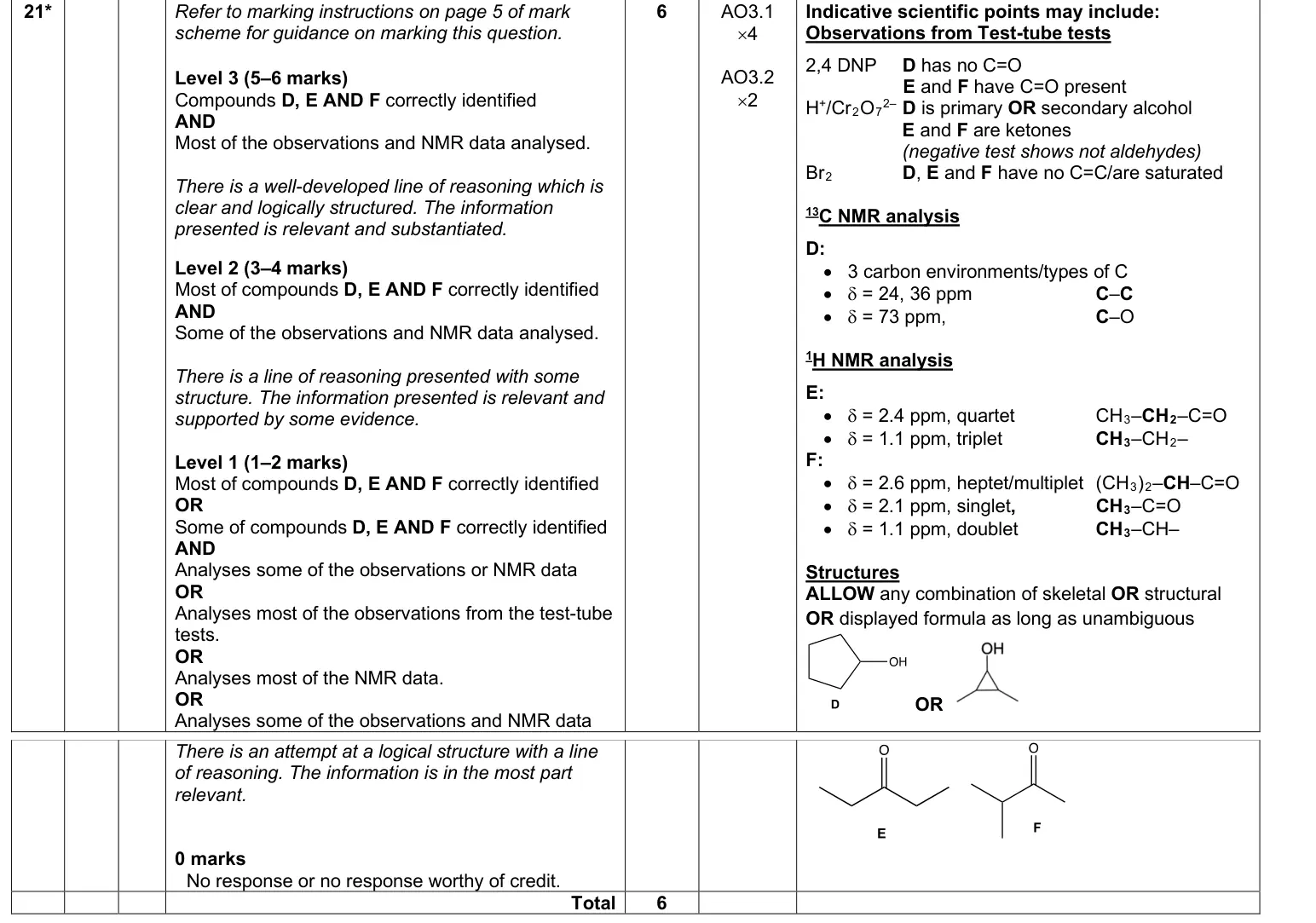
21 Chromatography and tests for functional groups, NMR spectroscopy and combined techniques 6AO3Level of response

The questions

12345678910111213141516(a)(i)16(a)(ii)16(b)(i)16(b)(ii)16(b)(iii)16(c)(i)16(c)(ii)16(d)(i)16(d)(ii)17(a)17(b)(i)17(b)(ii)17(c)18(a)(i)18(a)(ii)18(a)(iii)18(b)18(c)(i)18(c)(ii)18(d)(i)18(d)(ii)19(a)(i)19(a)(ii)19(b)20(a)(i)20(a)(ii)20(a)(iii)20(b)(i)20(b)(ii)21
November 2021 · Paper 2 · Q1 1 mark Multiple choice alkanesorganic basics
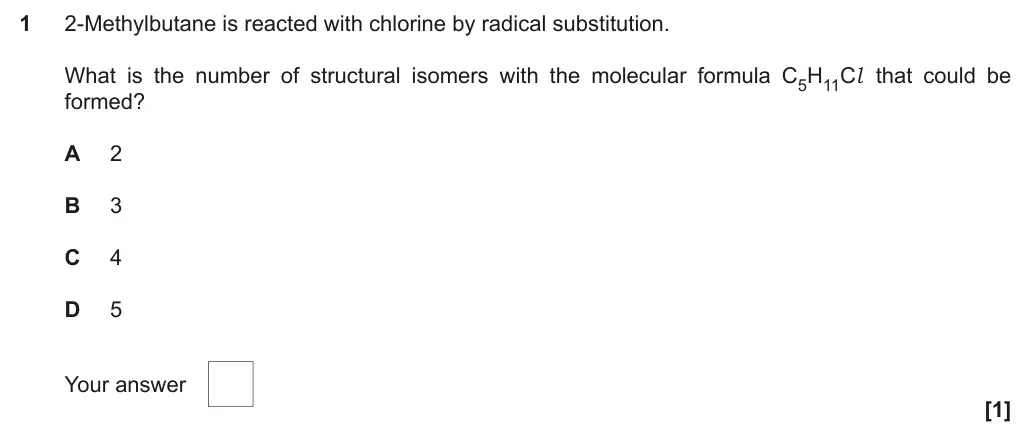
1 2-Methylbutane is reacted with chlorine by radical substitution.
What is the number of structural isomers with the molecular formula C5H11Cl  that could be
formed?
A 2
B 3
C 4
D 5
Your answer
[1]
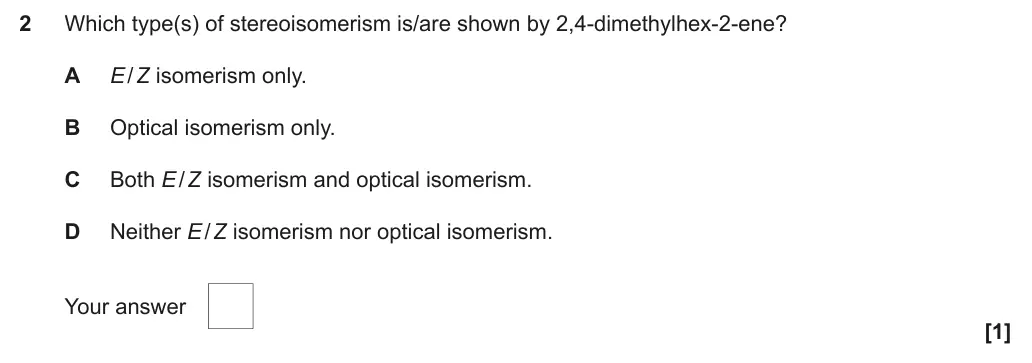
November 2021 · Paper 2 · Q2 1 mark Multiple choice amino acids amides and chiralityalkenes
2 Which type(s) of stereoisomerism is/are shown by 2,4-dimethylhex-2-ene?
A E / Z isomerism only.
B Optical isomerism only.
C Both E / Z isomerism and optical isomerism.
D Neither E / Z isomerism nor optical isomerism.
Your answer
[1]
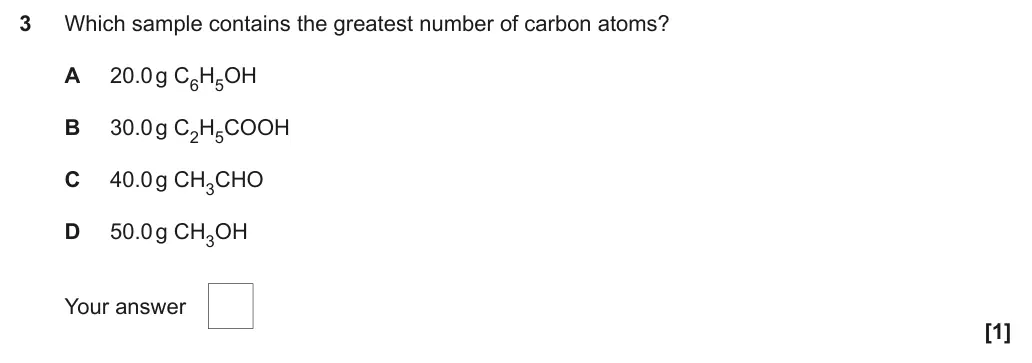
November 2021 · Paper 2 · Q3 1 mark Multiple choice amount of substance
3 Which sample contains the greatest number of carbon atoms?
A 20.0 g C6H5OH
B 30.0 g C2H5COOH
C 40.0 g CH3CHO
D 50.0 g CH3OH
Your answer
[1]
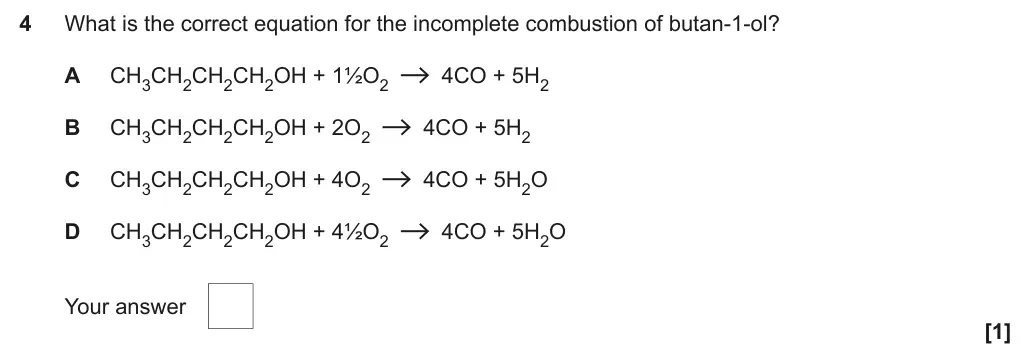
November 2021 · Paper 2 · Q4 1 mark Multiple choice alcoholsformulae and equationsalkanes
4 What is the correct equation for the incomplete combustion of butan-1-ol?
A CH3CH2CH2CH2OH + 1½O2 4CO + 5H2
B  CH3CH2CH2CH2OH + 2O2 4CO + 5H2
C CH3CH2CH2CH2OH + 4O2 4CO + 5H2O
D  CH3CH2CH2CH2OH + 4½O2 4CO + 5H2O
Your answer
[1]
November 2021 · Paper 2 · Q5 1 mark Multiple choice carbonyl compoundsamino acids amides and chirality
5 2-Methylcyclopentanone, shown below, is reacted with NaCN(aq)/H+(aq) to form an organic
product.
O
CH3
2-methylcyclopentanone
Which statement is correct?
A In the mechanism, a CN– ion accepts an electron pair.
B The mechanism is electrophilic addition.
C The organic product has one chiral centre.
D The organic product has the molecular formula C7H11NO.
Your answer
[1]
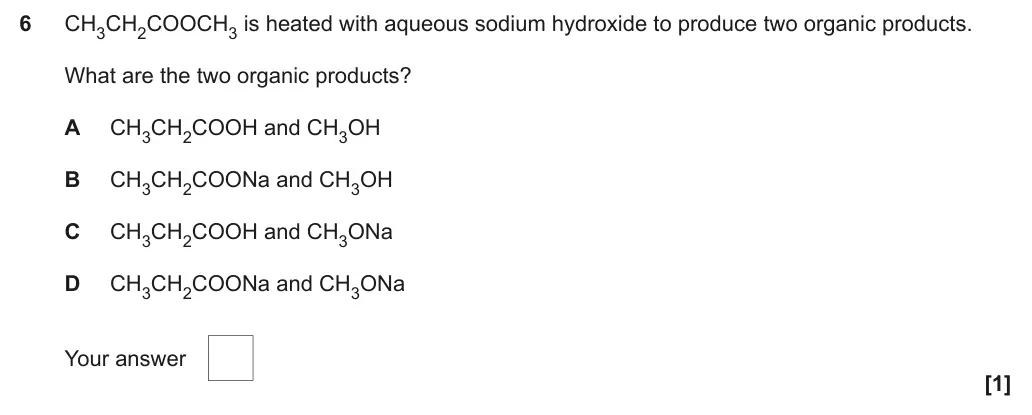
November 2021 · Paper 2 · Q6 1 mark Multiple choice carboxylic acids and esters
6 CH3CH2COOCH3 is heated with aqueous sodium hydroxide to produce two organic products.
What are the two organic products?
A CH3CH2COOH and CH3OH
B CH3CH2COONa and CH3OH
C CH3CH2COOH and CH3ONa
D CH3CH2COONa and CH3ONa
Your answer
[1]
November 2021 · Paper 2 · Q7 1 mark Multiple choice alcohols
7 Menthol, shown below, is heated with an acid catalyst.
OH
menthol
Which structure could be formed?
A B C D
Your answer
[1]
November 2021 · Paper 2 · Q8 1 mark Multiple choice bonding and structure
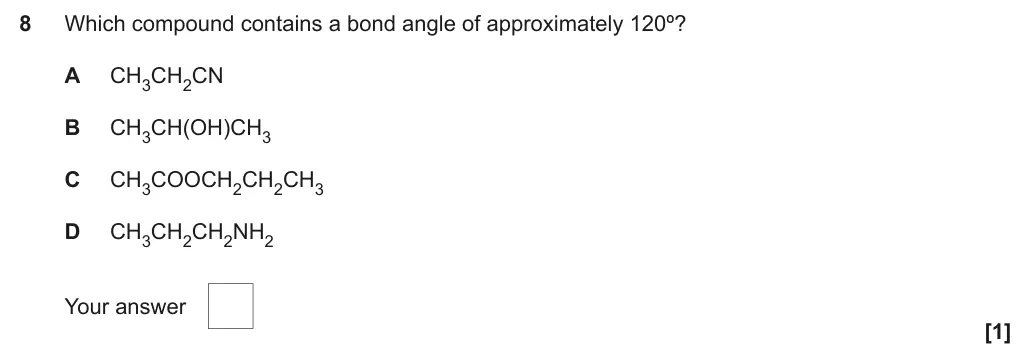
8 Which compound contains a bond angle of approximately 120º?
A CH3CH2CN
B CH3CH(OH)CH3
C CH3COOCH2CH2CH3
D CH3CH2CH2NH2
Your answer
[1]
November 2021 · Paper 2 · Q9 1 mark Multiple choice aminescarbonyl compoundscarbon carbon bond formation
9 Which reaction is not a reduction?
A C6H5NO2 C6H5NH2
B CH3CN CH3CH2NH2
C CH3CH2Cl CH3CH2NH2
D CH3COCH3 CH3CHOHCH3
Your answer
[1]
November 2021 · Paper 2 · Q10 1 mark Multiple choice chromatography and functional group tests
10 A TLC chromatogram for two compounds is shown below.
solvent front
origin
What is the Rf value for the compound that is most strongly adsorbed onto the stationary phase?
A 0.25
B 0.33
C 0.69
D 0.78
Your answer
[1]
November 2021 · Paper 2 · Q11 1 mark Multiple choice infrared and mass spectrometry
11 Which compound could have produced the IR spectrum below?
100
transmittance (%) 50
0
4000 3000 2000 1500 1000 500
wavenumber / cm–1
A (CH3)2CHCHO
B (CH3)2CHCOOH
C CH3CH(OH)CH=CH2
D CH3COCH(OH)CH3
Your answer
[1]
November 2021 · Paper 2 · Q12 1 mark Multiple choice infrared and mass spectrometry
12 Which peak would be in the mass spectrum of propanal, CH3CH2CHO, but not in the mass
spectrum of propanone, CH3COCH3?
A m /z = 15
B m /z = 29
C m /z = 43
D m /z = 58
Your answer
[1]
November 2021 · Paper 2 · Q13 1 mark Multiple choice nmr spectroscopy
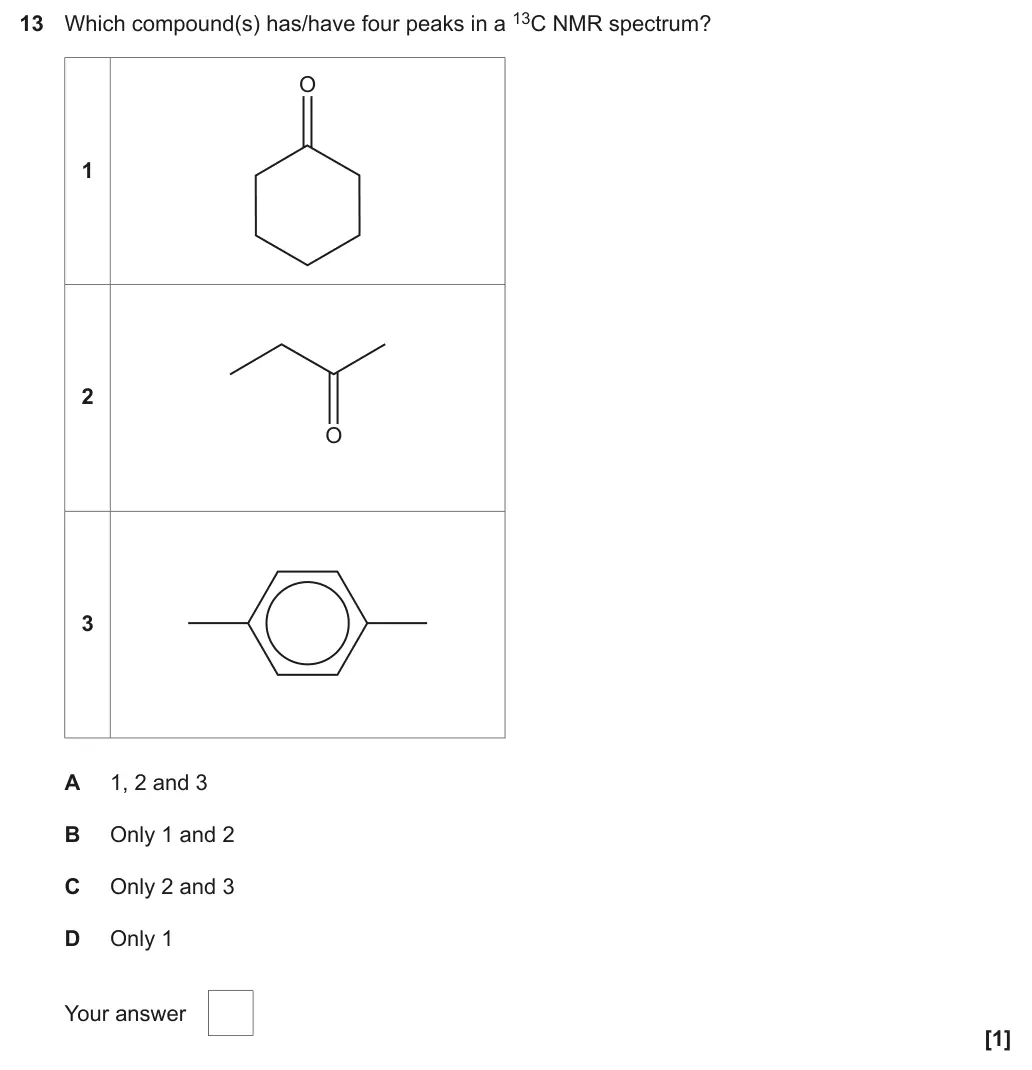
13 Which compound(s) has/have four peaks in a 13C NMR spectrum?
O
1
2
O
3
A 1, 2 and 3
B Only 1 and 2
C Only 2 and 3
D Only 1
Your answer
[1]
November 2021 · Paper 2 · Q14 1 mark Multiple choice aromatic compounds
14 Which of the following statement(s) provide(s) evidence for the delocalised model of benzene
rather than the Kekulé model?
1 The enthalpy change of hydrogenation is more exothermic than expected.
2 Benzene only reacts with bromine in the presence of a halogen carrier.
3 The carbon-carbon bonds all have the same length.
A 1, 2 and 3
B Only 1 and 2
C Only 2 and 3
D Only 1
Your answer
[1]
November 2021 · Paper 2 · Q15 1 mark Multiple choice aromatic compoundshaloalkanescarboxylic acids and esters
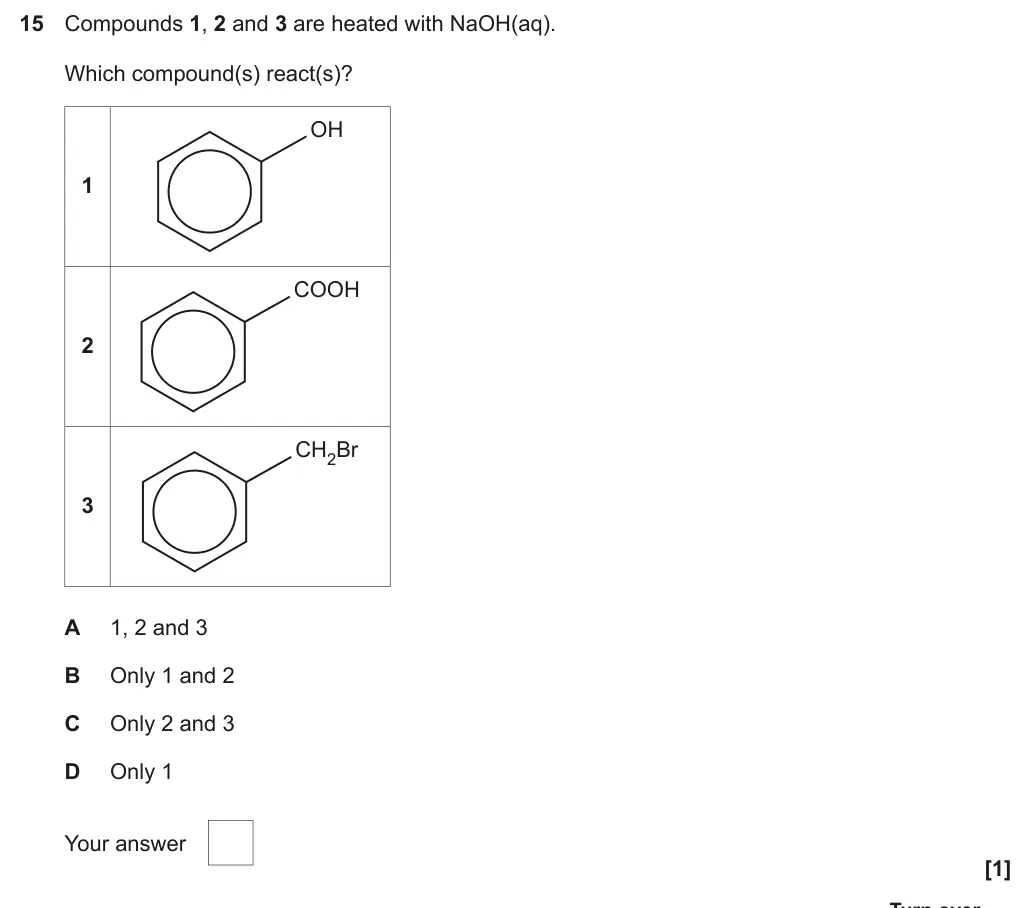
15 Compounds 1, 2 and 3 are heated with NaOH(aq).
Which compound(s) react(s)?
OH
1
COOH
2
CH2Br
3
A 1, 2 and 3
B Only 1 and 2
C Only 2 and 3
D Only 1
Your answer
[1]
November 2021 · Paper 2 · Q16(a)(i) 2 marks AO1 Short answer Hard alkenesalkanes
SECTION B
Answer all the questions.
16 But-1-ene, H2C=CHCH2CH3, and buta-1,3-diene, H2C=CH–CH=CH2, are unsaturated compounds
used to make many organic products.
(a) But-1-ene and buta-1,3-diene have σ-bonds and π-bonds.
(i) Explain what is meant by the terms σ-bond and π-bond.
σ-bond:  ..............................................................................................................................
...........................................................................................................................................
π-bond:  ..............................................................................................................................
...........................................................................................................................................
[2]
November 2021 · Paper 2 · Q16(a)(ii) 2 marks AO1 Short answer alkenesalkanes
Earlier part of question 16 that this part usesEarlier part of November 2021 Paper 2 question 16
(ii) How many σ- and π-bonds are in one molecule of buta-1,3-diene?
σ-bonds: .................................................. π-bonds: .................................................. [2]
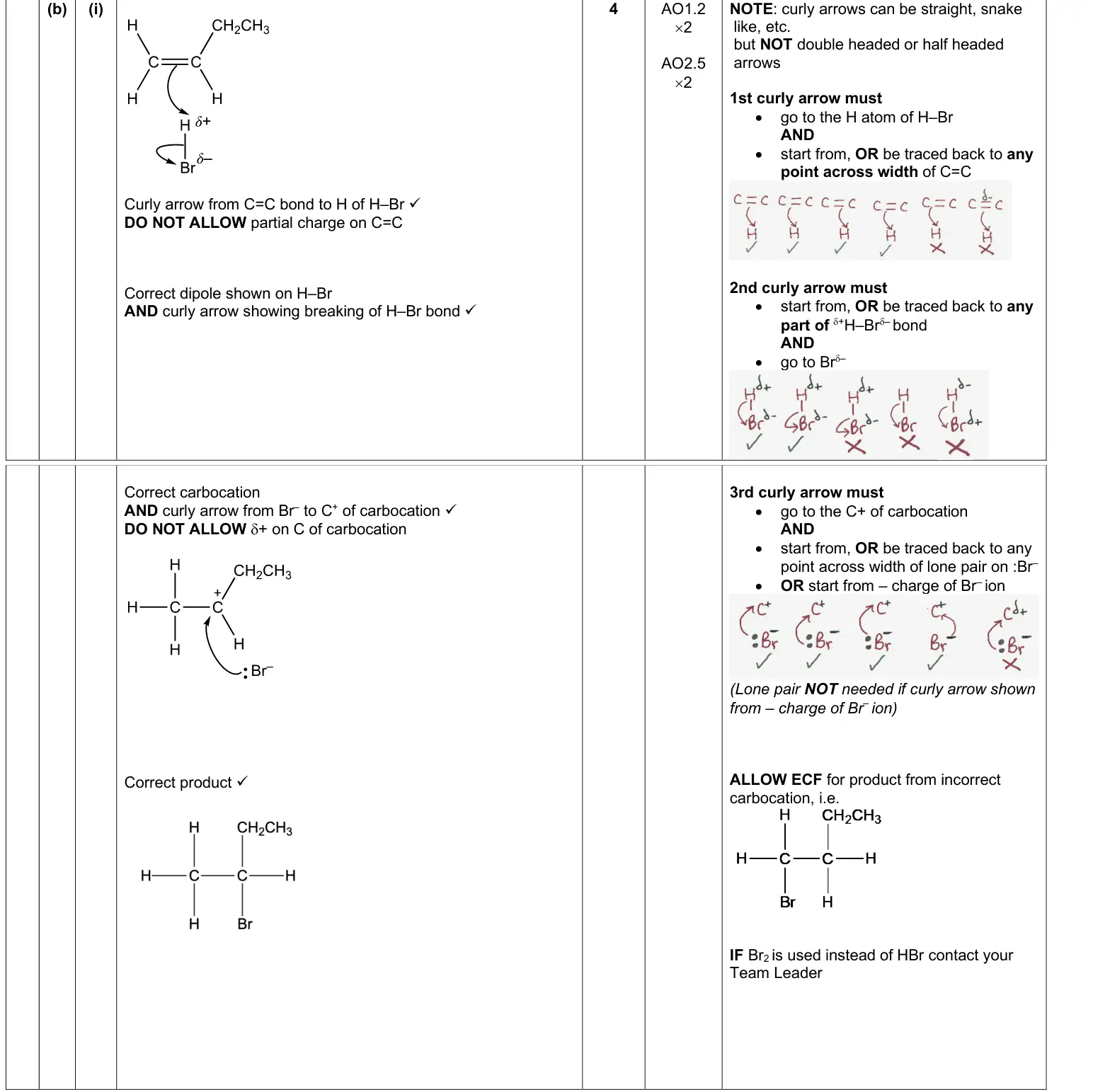
November 2021 · Paper 2 · Q16(b)(i) 4 marks AO1, 2 Mechanism Easy alkenesorganic basics
(b) But-1-ene is reacted with hydrogen bromide, forming a mixture of two saturated organic
products.
One of the organic products is formed in a much greater quantity than the other organic
product.
(i) Outline the reaction mechanism for the formation of this major organic product. The
structure of but-1-ene has been provided.
Include curly arrows and relevant dipoles.
H CH2CH3
C C
H H
[4]
November 2021 · Paper 2 · Q16(b)(ii) 2 marks AO1 Short answer alkenes
Earlier part of question 16 that this part usesEarlier part of November 2021 Paper 2 question 16
(ii) Explain why one organic product is formed in a much greater quantity than the other
organic product.
...........................................................................................................................................
...........................................................................................................................................
...........................................................................................................................................
...................................................................................................................................... [2]
November 2021 · Paper 2 · Q16(b)(iii) 1 mark AO1 Short answer alkenesorganic basics
Earlier part of question 16 that this part usesEarlier part of November 2021 Paper 2 question 16
(iii) Buta-1,3-diene is reacted with an excess of hydrogen bromide, forming a mixture of
saturated organic products.
How many saturated organic products could be present in this mixture?
...................................................................................................................................... [1]
November 2021 · Paper 2 · Q16(c)(i) 1 mark AO1 Short answer alkenes
(c) A student thought that buta-1,3-diene can show stereoisomerism.
The student drew out skeletal formulae for the stereoisomers of buta-1,3-diene:
(i) Explain the term stereoisomerism.
...........................................................................................................................................
...........................................................................................................................................
...................................................................................................................................... [1]
November 2021 · Paper 2 · Q16(c)(ii) 1 mark AO3 Short answer alkenes
Earlier part of question 16 that this part usesEarlier part of November 2021 Paper 2 question 16
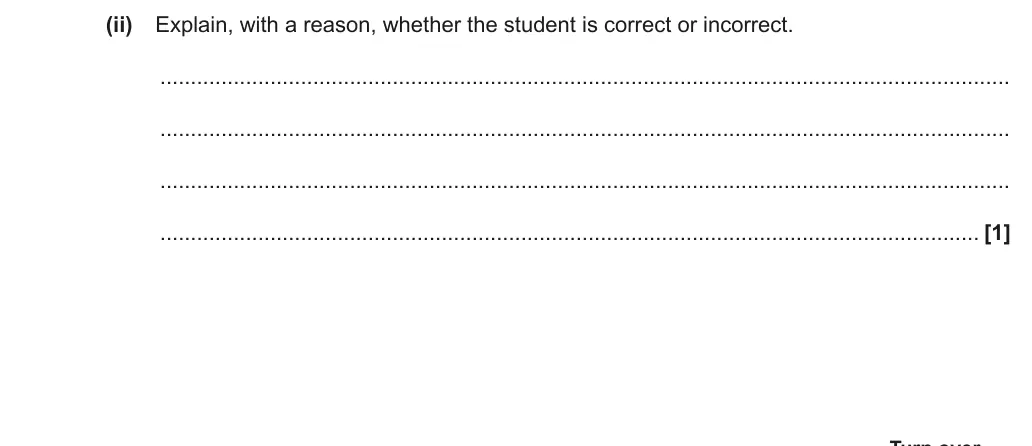
(ii) Explain, with a reason, whether the student is correct or incorrect.
...........................................................................................................................................
...........................................................................................................................................
...........................................................................................................................................
...................................................................................................................................... [1]
November 2021 · Paper 2 · Q16(d)(i) 2 marks AO2 Mechanism Medium organic basics
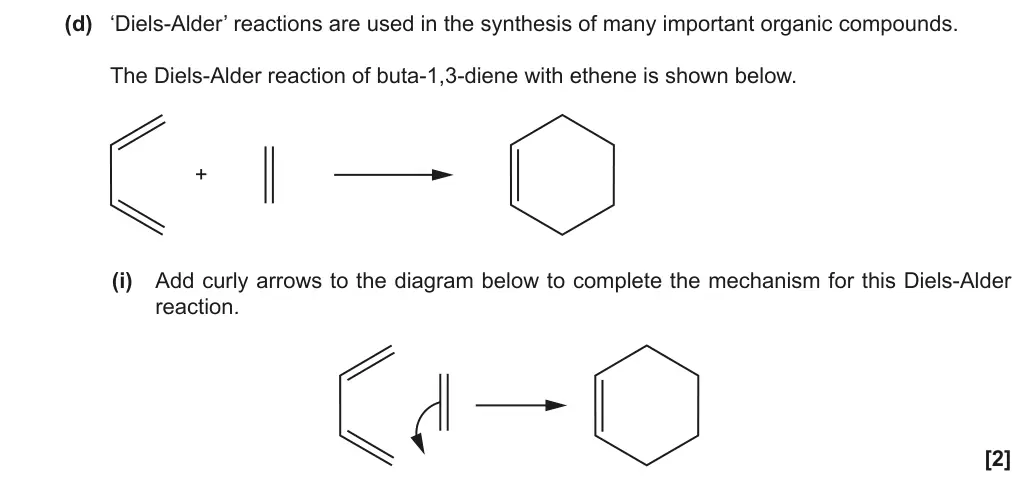
(d) ‘Diels-Alder’ reactions are used in the synthesis of many important organic compounds.
The Diels-Alder reaction of buta-1,3-diene with ethene is shown below.
+
(i) Add curly arrows to the diagram below to complete the mechanism for this Diels-Alder
reaction.
[2]
November 2021 · Paper 2 · Q16(d)(ii) 2 marks AO3 Structure / isomer Medium organic synthesiscarbon carbon bond formation
Earlier part of question 16 that this part usesEarlier part of November 2021 Paper 2 question 16
(ii) Two more Diels-Alder reactions of buta-1,3-diene are shown below.
In the boxes, draw the organic product of each reaction.
O
OCH3
+
OCH3
O
+
[2]
November 2021 · Paper 2 · Q17(a) 3 marks AO1, 2 Short answer haloalkanes
17 This question is about haloalkanes and polymers.
(a) Freon-13, is a CFC with the molecular formula CCl F3.
In the upper atmosphere, the presence of Freon-13 can lead to ozone depletion.
Explain, with the aid of equations, how Freon-13 can lead to this ozone depletion.
Use ‘dots’ (•) to show the position of unpaired electrons.
...................................................................................................................................................
...................................................................................................................................................
...................................................................................................................................................
.............................................................................................................................................. [3]
November 2021 · Paper 2 · Q17(b)(i) 1 mark AO2 Drawing / labelling alkenes
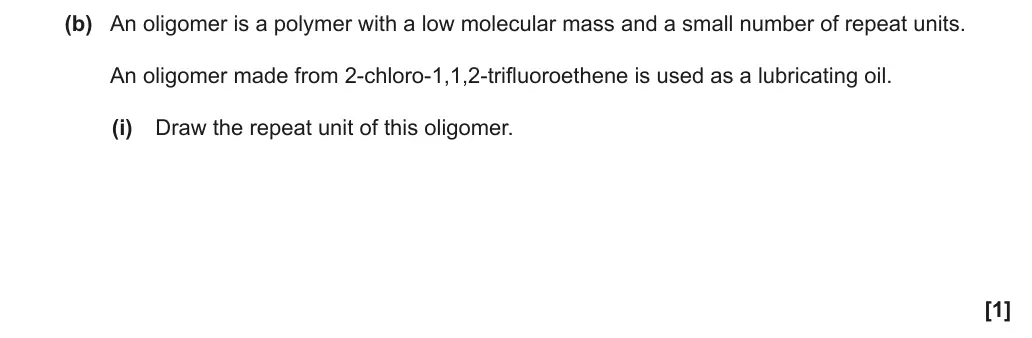
(b) An oligomer is a polymer with a low molecular mass and a small number of repeat units.
An oligomer made from 2-chloro-1,1,2-trifluoroethene is used as a lubricating oil.
(i) Draw the repeat unit of this oligomer.
[1]
November 2021 · Paper 2 · Q17(b)(ii) 2 marks AO2 Short answer bonding and structure
Earlier part of question 17 that this part usesEarlier part of November 2021 Paper 2 question 17
(ii) The boiling point of the lubricating oil can be increased by increasing the number of
repeat units.
Explain this statement.
...........................................................................................................................................
...........................................................................................................................................
...........................................................................................................................................
...................................................................................................................................... [2]
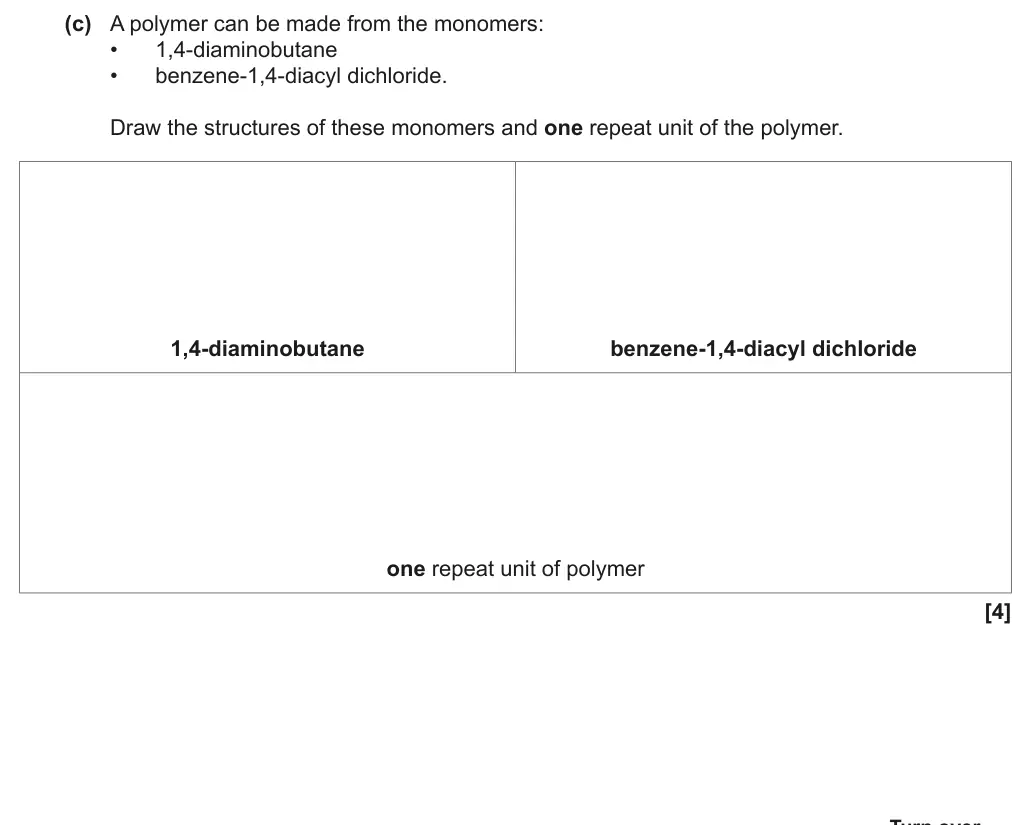
November 2021 · Paper 2 · Q17(c) 4 marks AO1, 2 Structure / isomer condensation polymersorganic basics
(c) A polymer can be made from the monomers:
• 1,4-diaminobutane
• benzene-1,4-diacyl dichloride.
Draw the structures of these monomers and one repeat unit of the polymer.
1,4-diaminobutane benzene-1,4-diacyl dichloride
one repeat unit of polymer
[4]
November 2021 · Paper 2 · Q18(a)(i) 1 mark AO1 Data interpretation amino acids amides and chirality
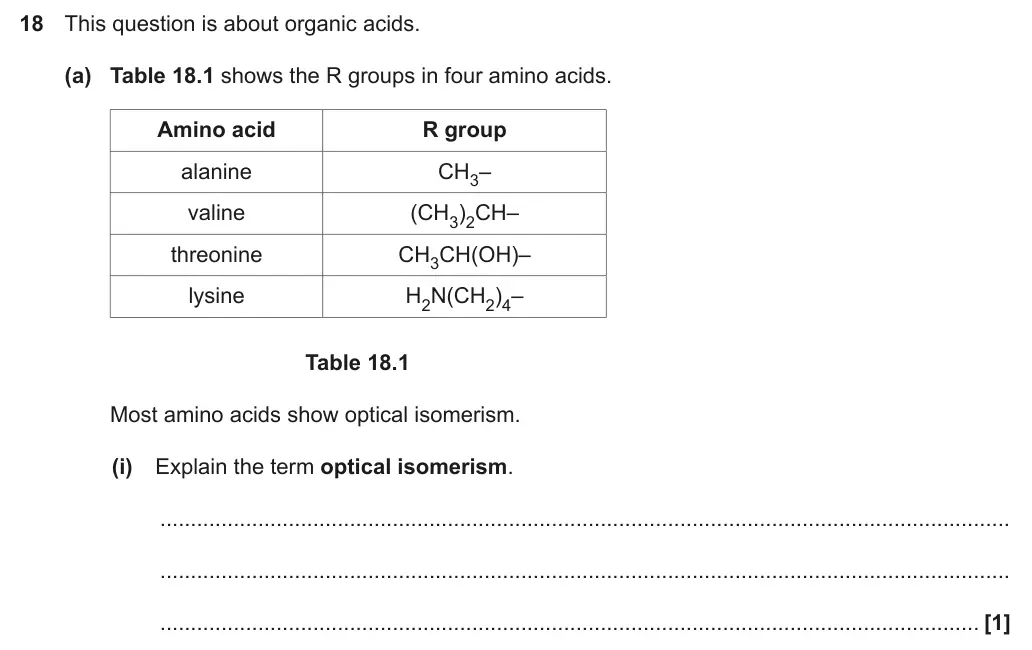
18 This question is about organic acids.
(a) Table 18.1 shows the R groups in four amino acids.
Amino acid R group
alanine CH3–
valine (CH3)2CH–
threonine CH3CH(OH)–
lysine H2N(CH2)4–
Table 18.1
Most amino acids show optical isomerism.
(i) Explain the term optical isomerism.
...........................................................................................................................................
...........................................................................................................................................
...................................................................................................................................... [1]
November 2021 · Paper 2 · Q18(a)(ii) 2 marks AO2 Structure / isomer amino acids amides and chirality
Earlier part of question 18 that this part usesEarlier part of November 2021 Paper 2 question 18
(ii) Draw 3-D diagrams to show the optical isomers of alanine.
[2]
November 2021 · Paper 2 · Q18(a)(iii) 1 mark AO2 Short answer amino acids amides and chirality
Earlier part of question 18 that this part usesEarlier part of November 2021 Paper 2 question 18
(iii) How many optical isomers does threonine have?
...................................................................................................................................... [1]
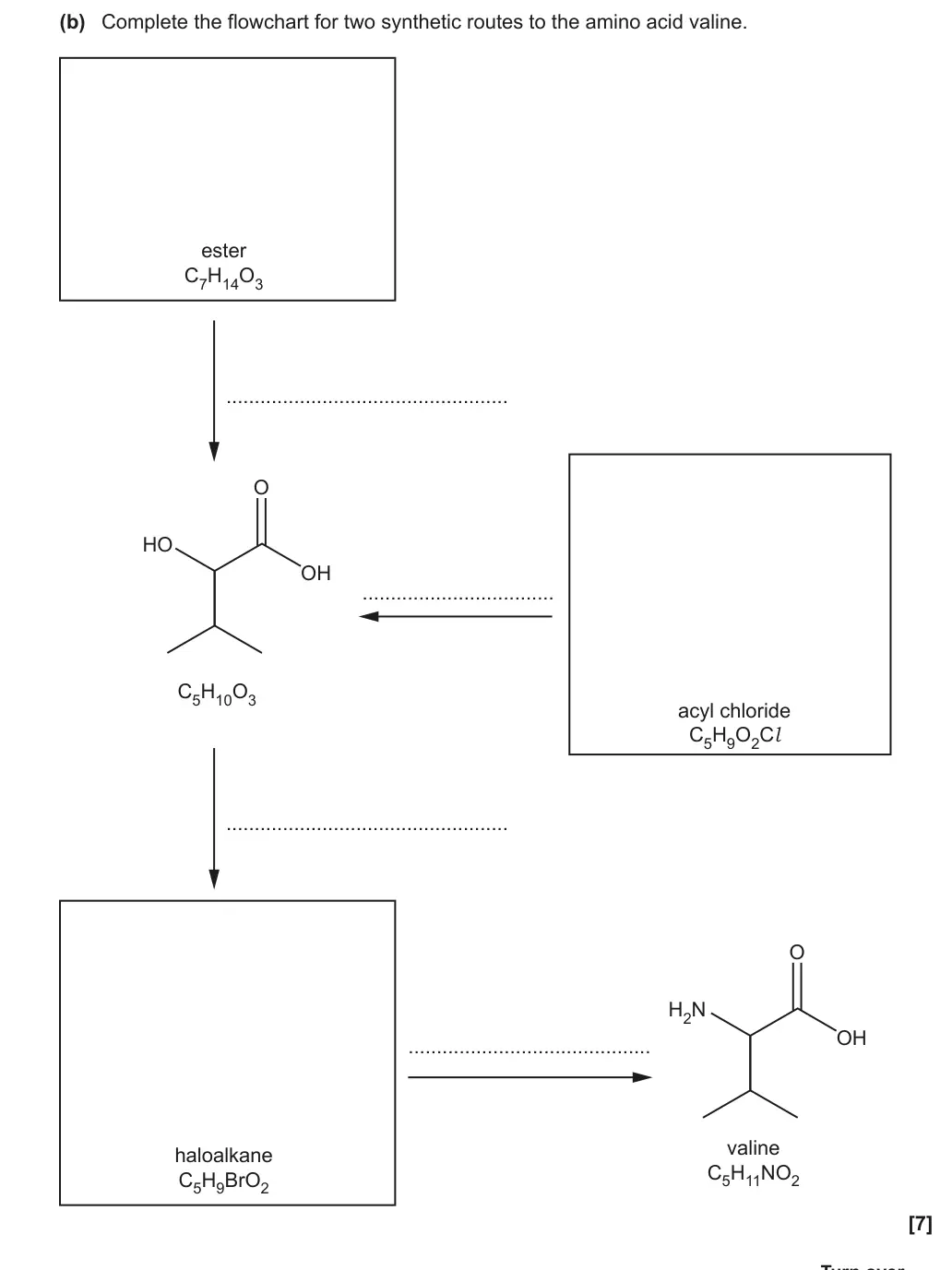
November 2021 · Paper 2 · Q18(b) 7 marks AO1, 2 Short answer organic synthesisalcoholscarboxylic acids and estersamines
Earlier part of question 18 that this part usesEarlier part of November 2021 Paper 2 question 18
(b) Complete the flowchart for two synthetic routes to the amino acid valine.
ester
C7H14O3
..................................................
O
HO
OH
..................................
C5H10O3
acyl chloride
C5H9O2Cl
..................................................
O
H2N
OH
...........................................
valine
haloalkane
C5H11NO2
C5H9BrO2
[7]
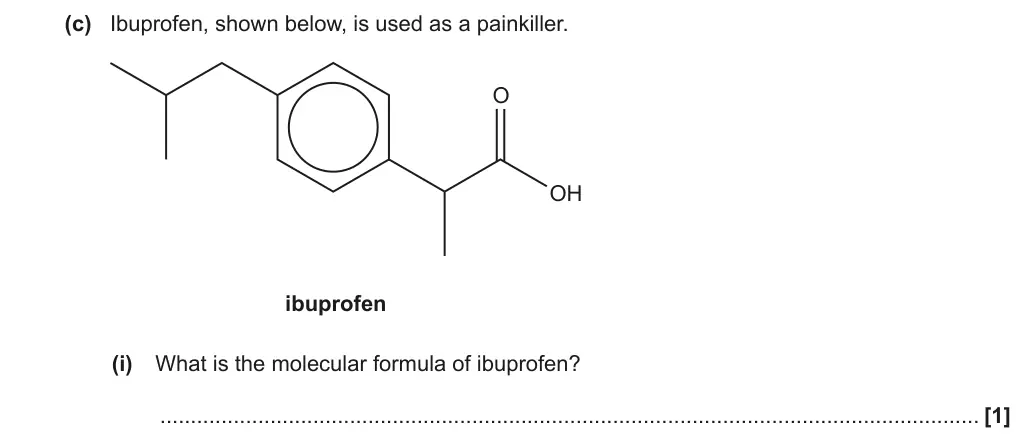
November 2021 · Paper 2 · Q18(c)(i) 1 mark AO2 Short answer amount of substanceorganic basics
(c) Ibuprofen, shown below, is used as a painkiller.
O
OH
ibuprofen
(i) What is the molecular formula of ibuprofen?
...................................................................................................................................... [1]
November 2021 · Paper 2 · Q18(c)(ii) 3 marks AO2 Calculation amount of substance
Earlier part of question 18 that this part usesEarlier part of November 2021 Paper 2 question 18
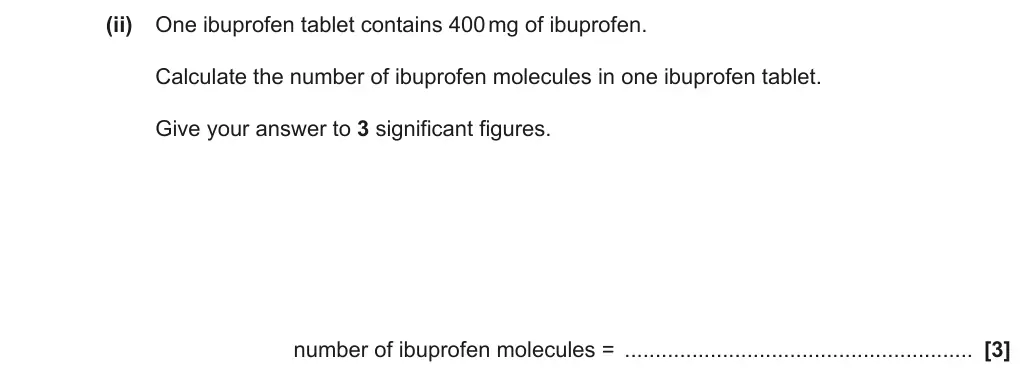
(ii) One ibuprofen tablet contains 400 mg of ibuprofen.
Calculate the number of ibuprofen molecules in one ibuprofen tablet.
Give your answer to 3 significant figures.
number of ibuprofen molecules =  ......................................................... [3]
November 2021 · Paper 2 · Q18(d)(i) 2 marks AO3 Structure / isomer aminescarboxylic acids and estersamino acids amides and chirality
Earlier parts of question 18 that this part usesEarlier part of November 2021 Paper 2 question 18Earlier part of November 2021 Paper 2 question 18
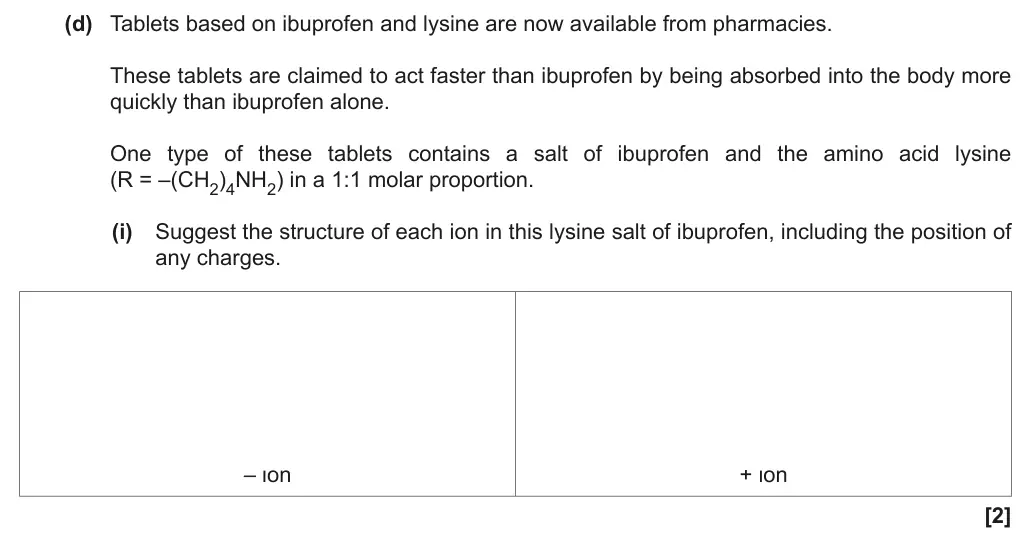
(d) Tablets based on ibuprofen and lysine are now available from pharmacies.
These tablets are claimed to act faster than ibuprofen by being absorbed into the body more
quickly than ibuprofen alone.
One type of these tablets contains a salt of ibuprofen and the amino acid lysine
(R = –(CH2)4NH2) in a 1:1 molar proportion.
(i) Suggest the structure of each ion in this lysine salt of ibuprofen, including the position of
any charges.
– ion + ion
[2]
November 2021 · Paper 2 · Q18(d)(ii) 1 mark AO3 Short answer bonding and structure
Earlier part of question 18 that this part usesEarlier part of November 2021 Paper 2 question 18
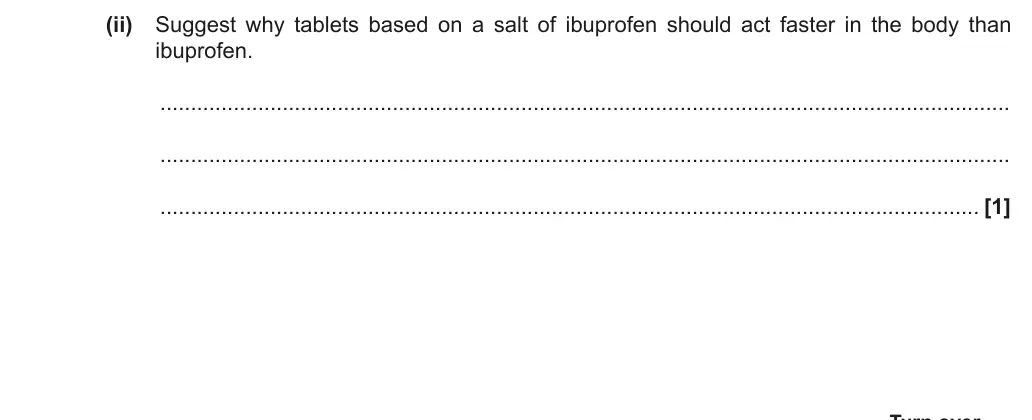
(ii) Suggest why tablets based on a salt of ibuprofen should act faster in the body than
ibuprofen.
...........................................................................................................................................
...........................................................................................................................................
...................................................................................................................................... [1]
November 2021 · Paper 2 · Q19(a)(i) 1 mark AO1 Short answer organic basics
19 This question is about organic synthesis.
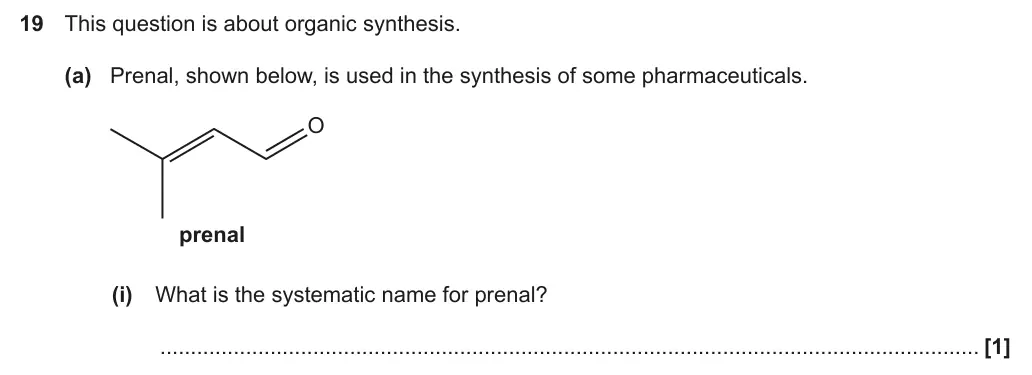
(a) Prenal, shown below, is used in the synthesis of some pharmaceuticals.
O
prenal
(i) What is the systematic name for prenal?
...................................................................................................................................... [1]
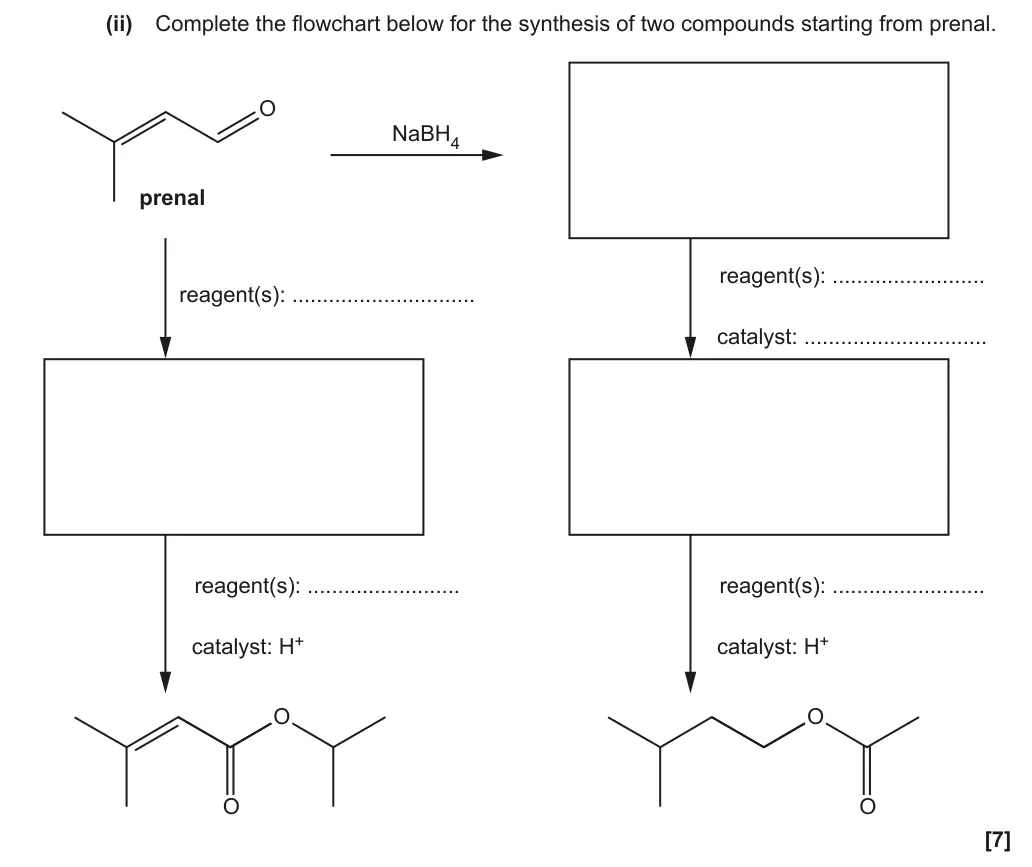
November 2021 · Paper 2 · Q19(a)(ii) 7 marks AO1, 2 Short answer organic synthesisalkenescarbonyl compoundscarboxylic acids and esters
Earlier part of question 19 that this part usesEarlier part of November 2021 Paper 2 question 19
(ii) Complete the flowchart below for the synthesis of two compounds starting from prenal.
O
NaBH4
prenal
reagent(s): .........................
reagent(s): ..............................
catalyst: ..............................
reagent(s): ......................... reagent(s): .........................
catalyst: H+ catalyst: H+
O O
O O
[7]
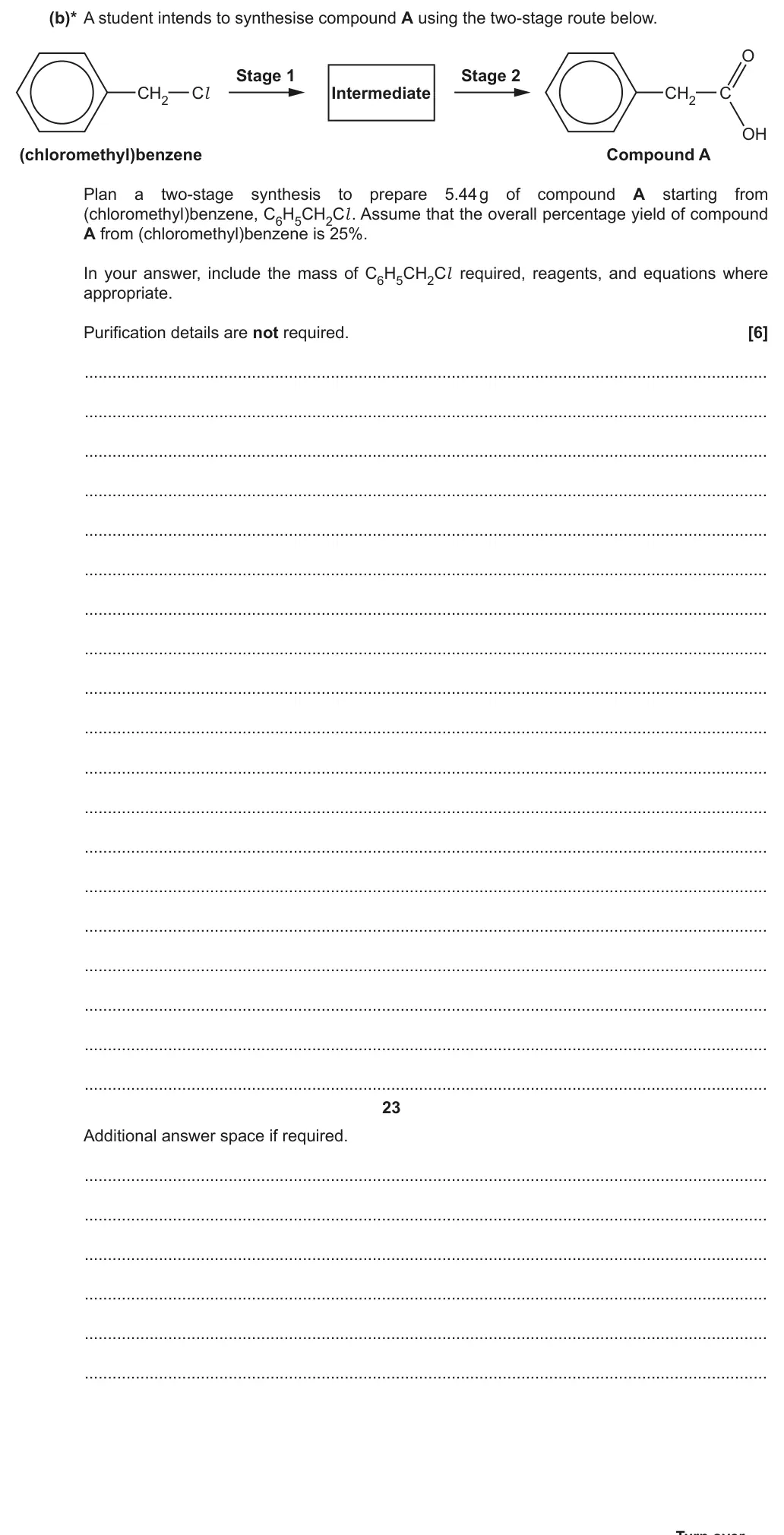
November 2021 · Paper 2 · Q19(b) 6 marks AO2, 3 6-mark level of response Medium organic synthesisamount of substancecarbon carbon bond formation
(b)* A student intends to synthesise compound A using the two-stage route below.
O
Stage 1 Stage 2
CH2 Cl Intermediate CH2 C
OH
(chloromethyl)benzene Compound A
Plan a two-stage synthesis to prepare 5.44 g of compound A starting from
(chloromethyl)benzene, C6H5CH2Cl . Assume that the overall percentage yield of compound
A from (chloromethyl)benzene is 25%.
In your answer, include the mass of C6H5CH2Cl  required, reagents, and equations where
appropriate.
Purification details are not required. [6]
...................................................................................................................................................
...................................................................................................................................................
...................................................................................................................................................
...................................................................................................................................................
...................................................................................................................................................
...................................................................................................................................................
...................................................................................................................................................
...................................................................................................................................................
...................................................................................................................................................
...................................................................................................................................................
...................................................................................................................................................
...................................................................................................................................................
...................................................................................................................................................
...................................................................................................................................................
...................................................................................................................................................
...................................................................................................................................................
...................................................................................................................................................
...................................................................................................................................................
...................................................................................................................................................
Additional answer space if required.
...................................................................................................................................................
...................................................................................................................................................
...................................................................................................................................................
...................................................................................................................................................
...................................................................................................................................................
...................................................................................................................................................
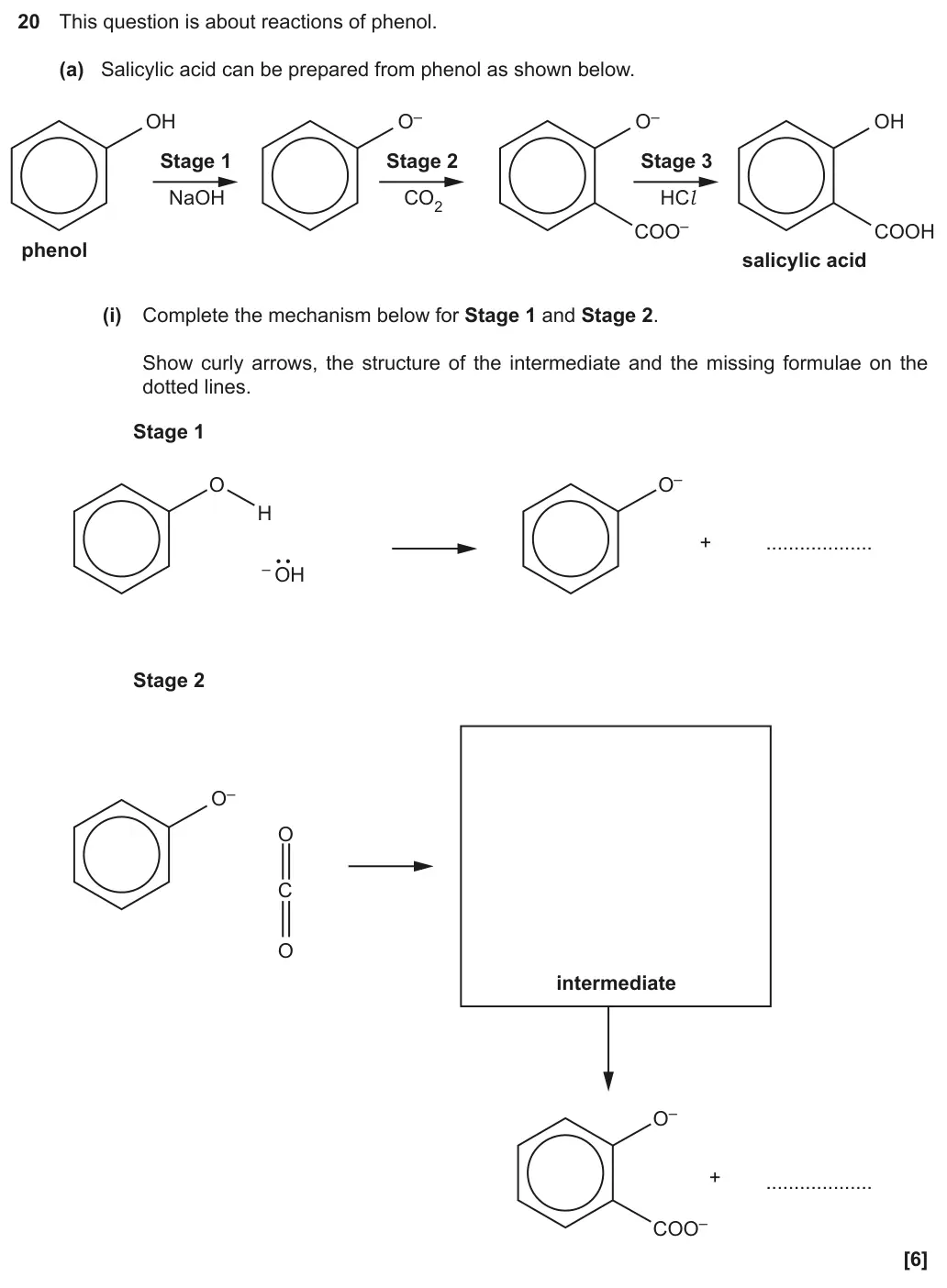
November 2021 · Paper 2 · Q20(a)(i) 6 marks AO1, 2 Mechanism Medium aromatic compoundsorganic basics
20 This question is about reactions of phenol.
(a) Salicylic acid can be prepared from phenol as shown below.
OH O– O– OH
Stage 1 Stage 2 Stage 3
NaOH CO2 HCl
COO– COOH
phenol
salicylic acid
(i) Complete the mechanism below for Stage 1 and Stage 2.
Show curly arrows, the structure of the intermediate and the missing formulae on the
dotted lines.
Stage 1
O O–
H
+ ...................
– OH
Stage 2
O–
O
C
O
intermediate
O–
+ ...................
COO–
[6]
November 2021 · Paper 2 · Q20(a)(ii) 2 marks AO2 Short answer aromatic compoundsalkenes
Earlier part of question 20 that this part usesEarlier part of November 2021 Paper 2 question 20
(ii) What are the roles of –OH and CO2 in the mechanism?
–OH  ...................................................................................................................................
CO2  ...................................................................................................................................
[2]
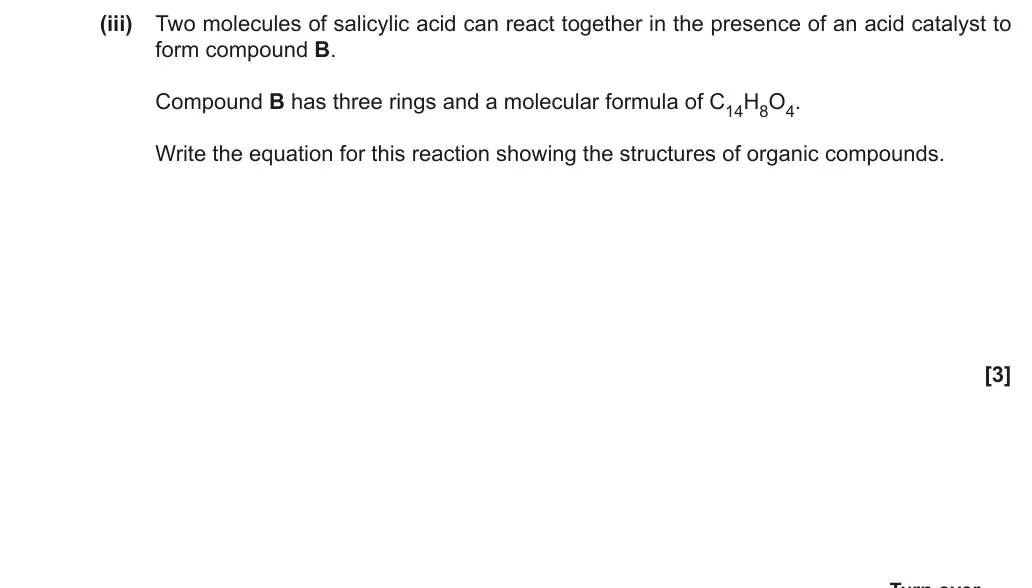
November 2021 · Paper 2 · Q20(a)(iii) 3 marks AO2, 3 Equation writing Hard carboxylic acids and estersformulae and equationsorganic synthesis
Earlier part of question 20 that this part usesEarlier part of November 2021 Paper 2 question 20
(iii) Two molecules of salicylic acid can react together in the presence of an acid catalyst to
form compound B.
Compound B has three rings and a molecular formula of C14H8O4.
Write the equation for this reaction showing the structures of organic compounds.
[3]
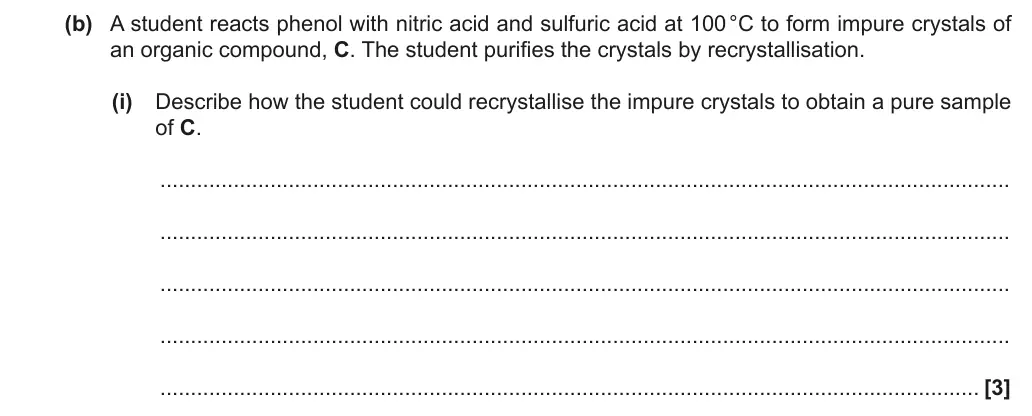
November 2021 · Paper 2 · Q20(b)(i) 3 marks AO3 Short answer organic synthesis
(b) A student reacts phenol with nitric acid and sulfuric acid at 100 °C to form impure crystals of
an organic compound, C. The student purifies the crystals by recrystallisation.
(i) Describe how the student could recrystallise the impure crystals to obtain a pure sample
of C.
...........................................................................................................................................
...........................................................................................................................................
...........................................................................................................................................
...........................................................................................................................................
...................................................................................................................................... [3]
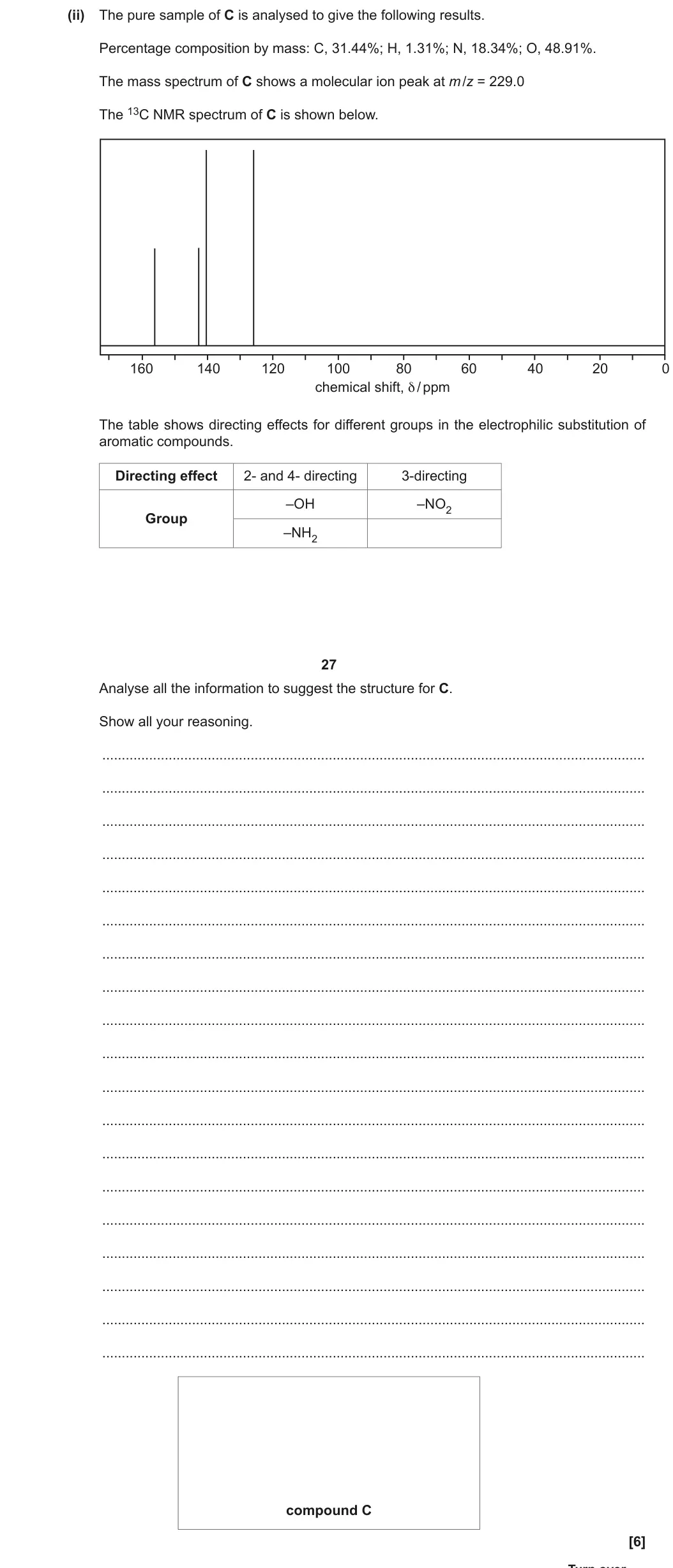
November 2021 · Paper 2 · Q20(b)(ii) 6 marks AO1, 3 Structure / isomer amount of substanceinfrared and mass spectrometryaromatic compoundsnmr spectroscopy
Earlier part of question 20 that this part usesEarlier part of November 2021 Paper 2 question 20
(ii) The pure sample of C is analysed to give the following results.
Percentage composition by mass: C, 31.44%; H, 1.31%; N, 18.34%; O, 48.91%.
The mass spectrum of C shows a molecular ion peak at m /z = 229.0
The 13C NMR spectrum of C is shown below.
160 140 120 100 80 60 40 20 0
chemical shift, δ / ppm
The table shows directing effects for different groups in the electrophilic substitution of
aromatic compounds.
Directing effect 2- and 4- directing 3-directing
–OH –NO2
Group
–NH2
Analyse all the information to suggest the structure for C.
Show all your reasoning.
...........................................................................................................................................
...........................................................................................................................................
...........................................................................................................................................
...........................................................................................................................................
...........................................................................................................................................
...........................................................................................................................................
...........................................................................................................................................
...........................................................................................................................................
...........................................................................................................................................
...........................................................................................................................................
...........................................................................................................................................
...........................................................................................................................................
...........................................................................................................................................
...........................................................................................................................................
...........................................................................................................................................
...........................................................................................................................................
...........................................................................................................................................
...........................................................................................................................................
...........................................................................................................................................
compound C
[6]
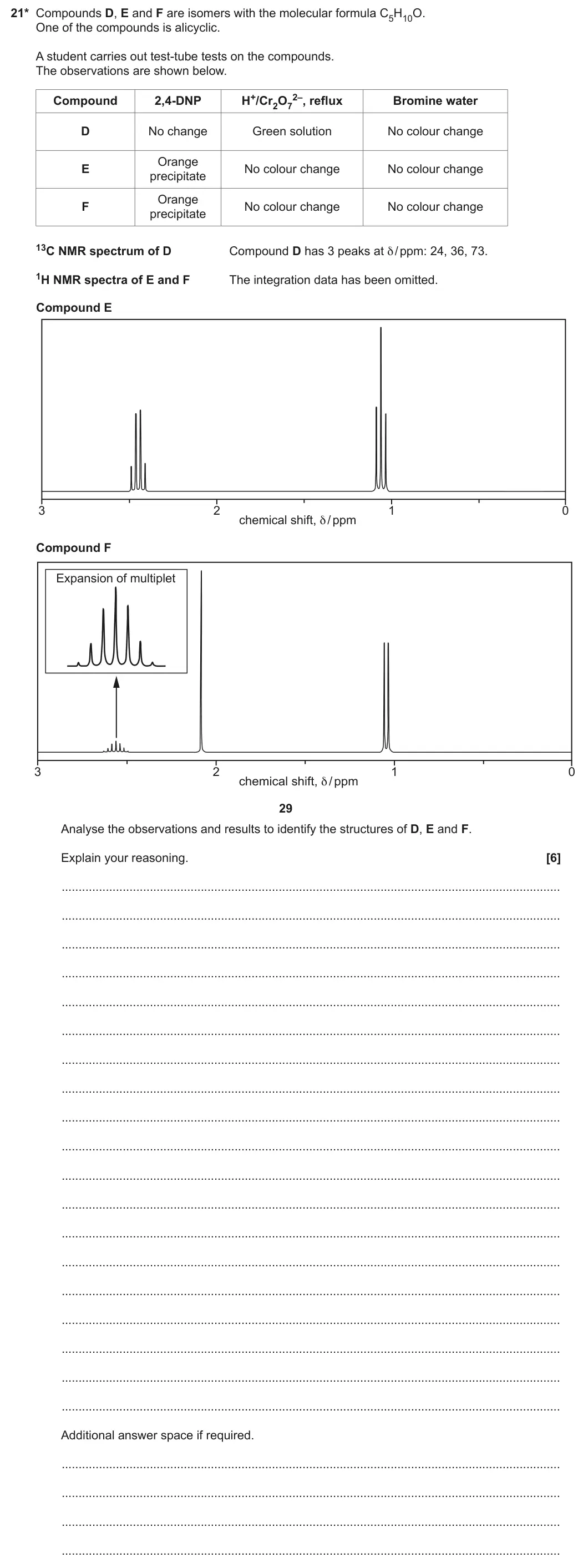
November 2021 · Paper 2 · Q21 6 marks AO3 6-mark level of response chromatography and functional group testsnmr spectroscopy
21* Compounds D, E and F are isomers with the molecular formula C5H10O.
One of the compounds is alicyclic.
A student carries out test-tube tests on the compounds.
The observations are shown below.
Compound 2,4-DNP H+/Cr2O7 2–, reflux Bromine water
D No change Green solution No colour change
Orange
E No colour change No colour change
precipitate
Orange
F No colour change No colour change
precipitate
13C NMR spectrum of D Compound D has 3 peaks at δ / ppm: 24, 36, 73.
1H NMR spectra of E and F The integration data has been omitted.
Compound E
3 2 1 0
chemical shift, δ / ppm
Compound F
Expansion of multiplet
3 2 1 0
chemical shift, δ / ppm
Analyse the observations and results to identify the structures of D, E and F.
Explain your reasoning. [6]
...................................................................................................................................................
...................................................................................................................................................
...................................................................................................................................................
...................................................................................................................................................
...................................................................................................................................................
...................................................................................................................................................
...................................................................................................................................................
...................................................................................................................................................
...................................................................................................................................................
...................................................................................................................................................
...................................................................................................................................................
...................................................................................................................................................
...................................................................................................................................................
...................................................................................................................................................
...................................................................................................................................................
...................................................................................................................................................
...................................................................................................................................................
...................................................................................................................................................
...................................................................................................................................................
Additional answer space if required.
...................................................................................................................................................
...................................................................................................................................................
...................................................................................................................................................
...................................................................................................................................................

Work with an OCR chemistry tutor

Want a paper marked and gone through with you? Message us.

Prefer email? Send an enquiry

If you are under 18, please include a parent's contact details. Enquiries go to enquiries@chemistryaleveltutor.com and are deleted once handled. All tutoring is online.