June 2018: Paper 3, Unified chemistry

70 marks · 32 question parts · Paper, mark scheme and report on OCR's site · Have OCR's Data Sheet beside you

Question by question

QTopicMarksAOType
1(a)(i) Electron structure and orbitals 1Short answer
1(a)(ii) Periodicity and ionisation energy 1Short answer
1(a)(iii) Periodicity and ionisation energy 1Short answer
1(a)(iv) Bonding, structure and shapes of molecules 1Short answer
1(a)(v) The halogens 1Short answer
1(a)(vi) Atomic structure and isotopes 1Short answer
1(a)(vii) Redox and oxidation numbers 1Short answer
1(a)(viii) Amount of substance (moles) 1Short answer
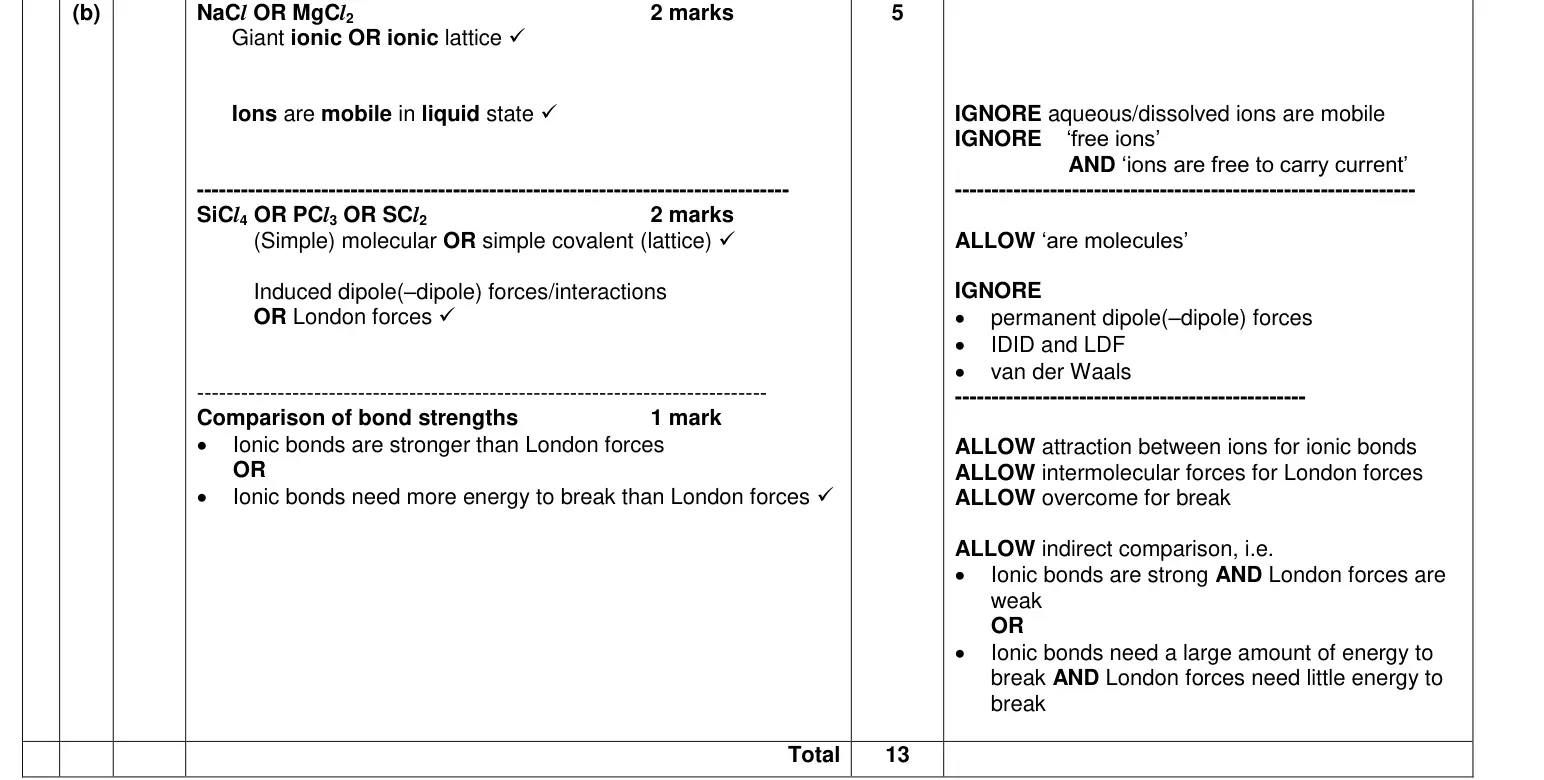
1(b) Bonding, structure and shapes of molecules, Periodicity and ionisation energy 5Extended response
2(a)(i) Reaction rates and the Boltzmann distribution, Practical skills: planning, analysis and evaluation, Rates: orders, rate equations and the Arrhenius equation 5Calculation
2(a)(ii) Amount of substance (moles) 3Calculation
2(b) Redox titrations and electrode potentials 2Equation writing
2(c)(i) Transition elements 1Equation writing
2(c)(ii) Chemical equilibrium and Kc 2Short answer
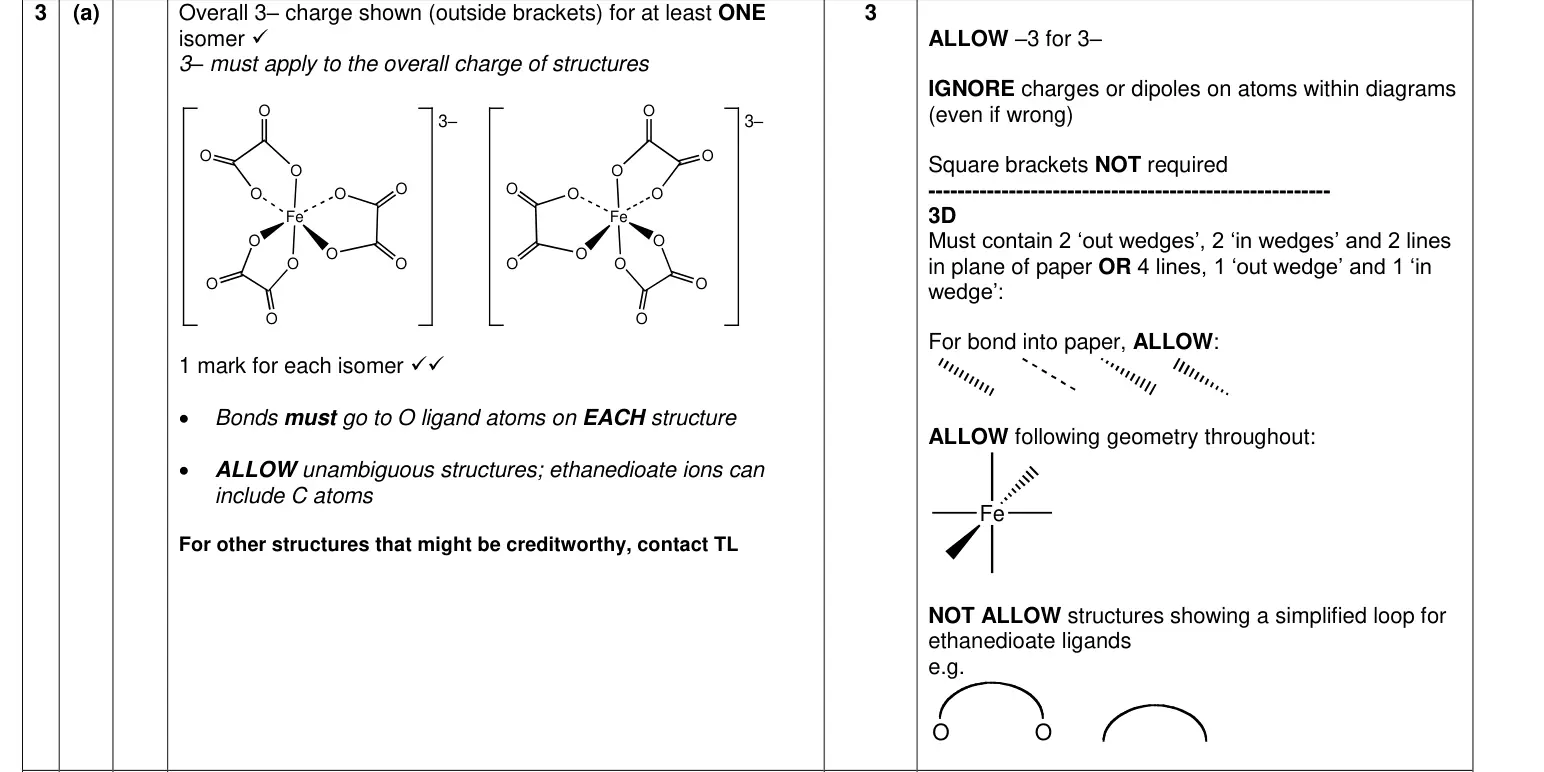
3(a) Transition elements 3Structure / isomer
3(b)(i) Redox titrations and electrode potentials 1Short answer
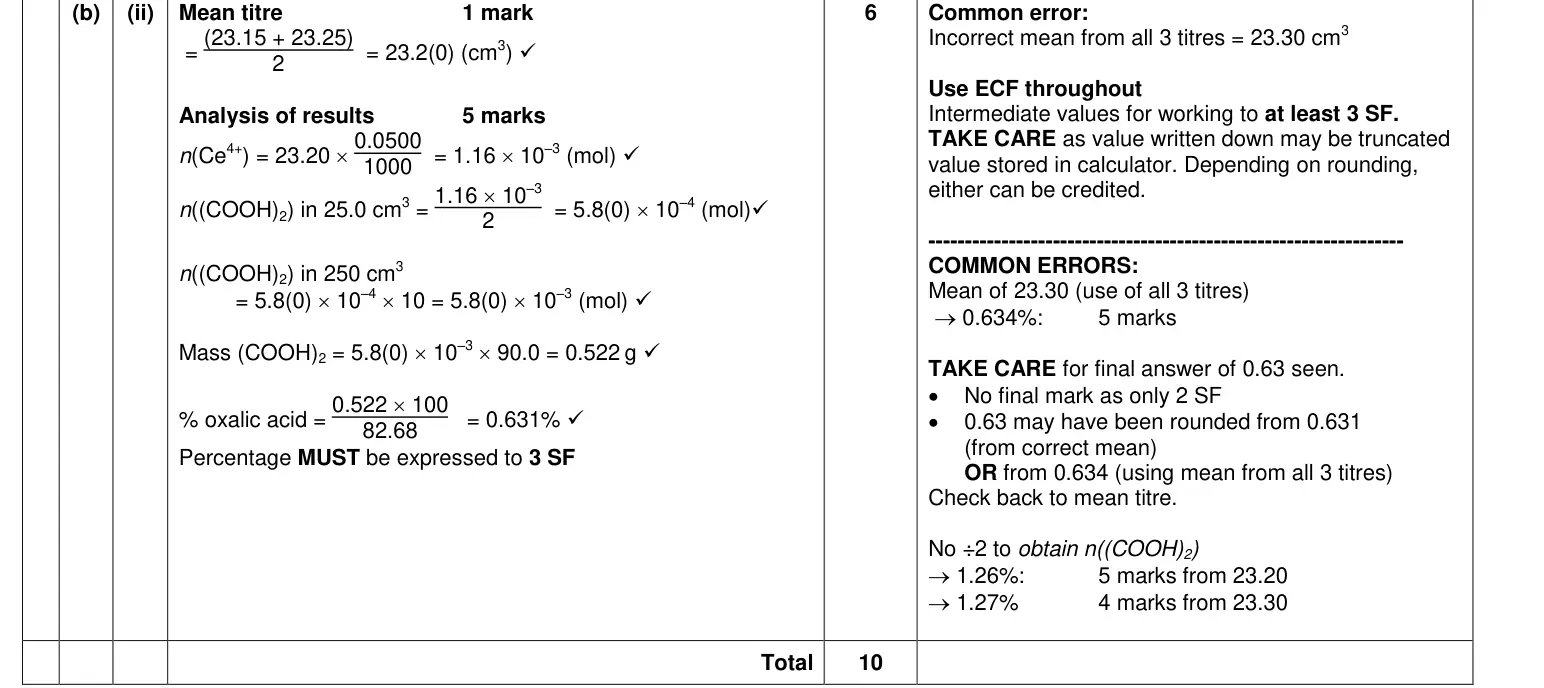
3(b)(ii) Redox titrations and electrode potentials, Amount of substance (moles) 6Calculation
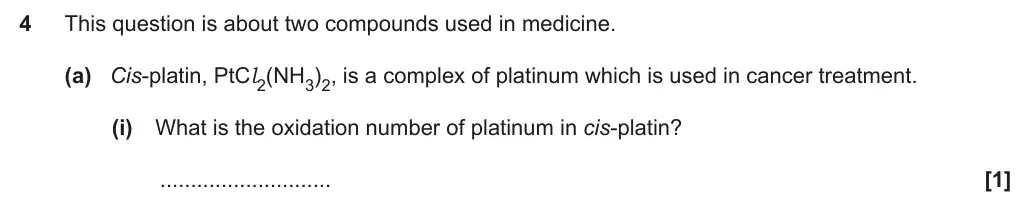
4(a)(i) Redox and oxidation numbers 1Short answer
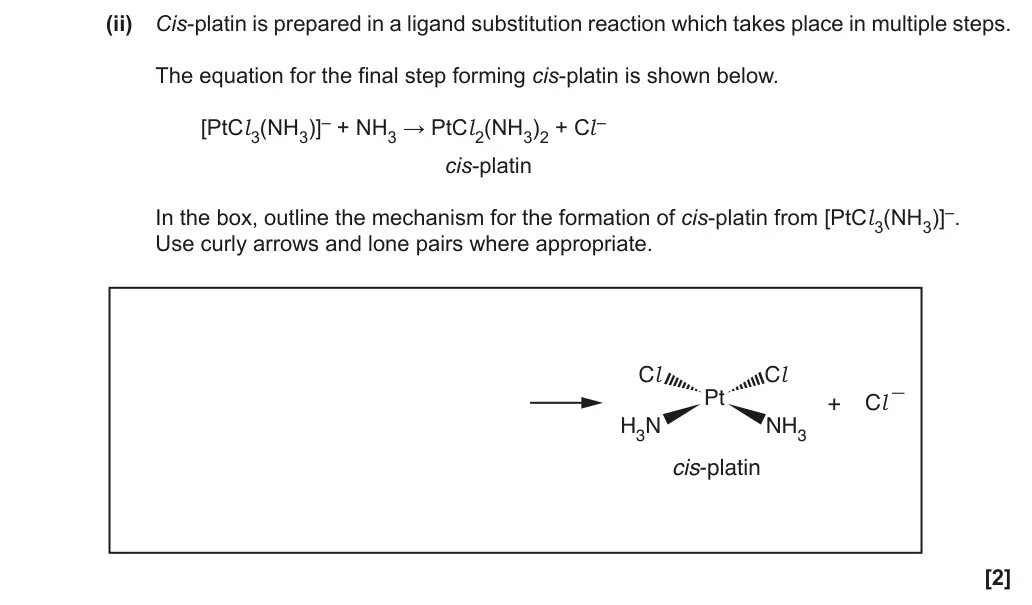
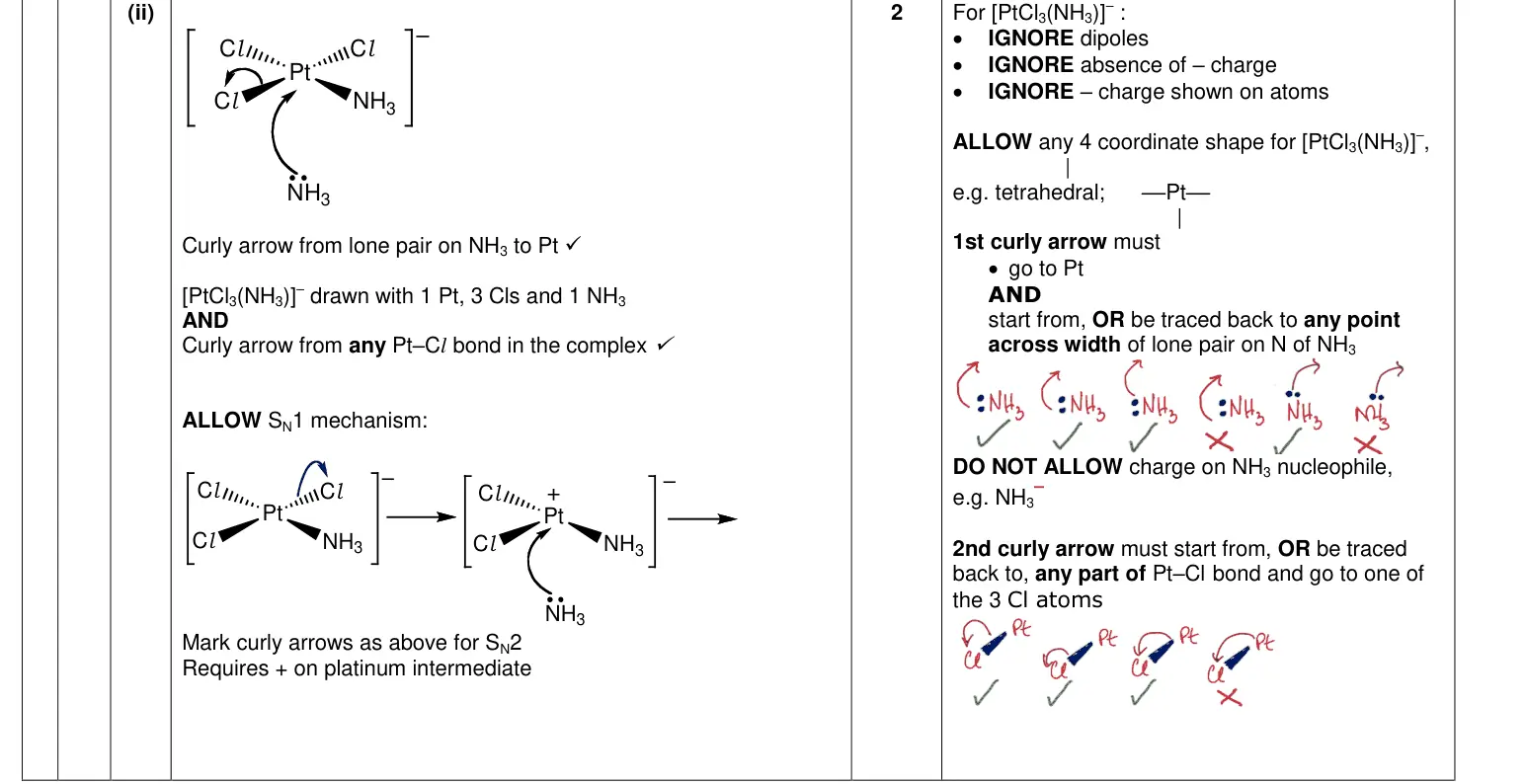
4(a)(ii) Transition elements, Organic basics: naming, formulae and isomerism 2Mechanism
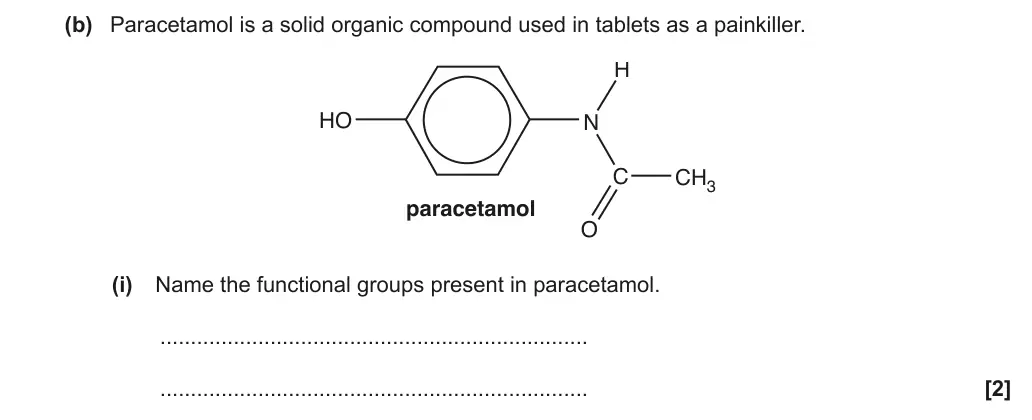
4(b)(i) Organic synthesis (Module 6), Amino acids, amides and chirality 2Short answer
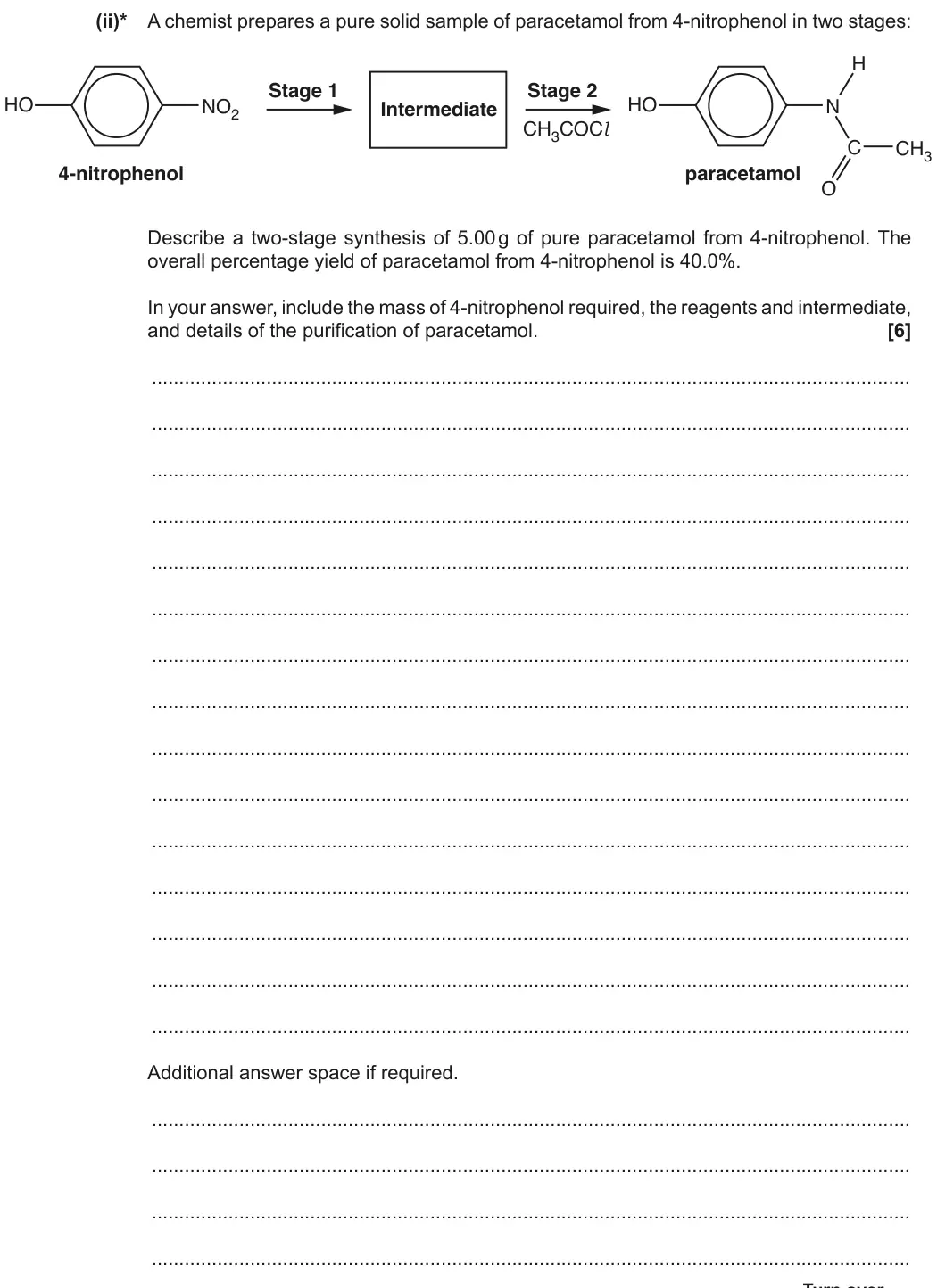
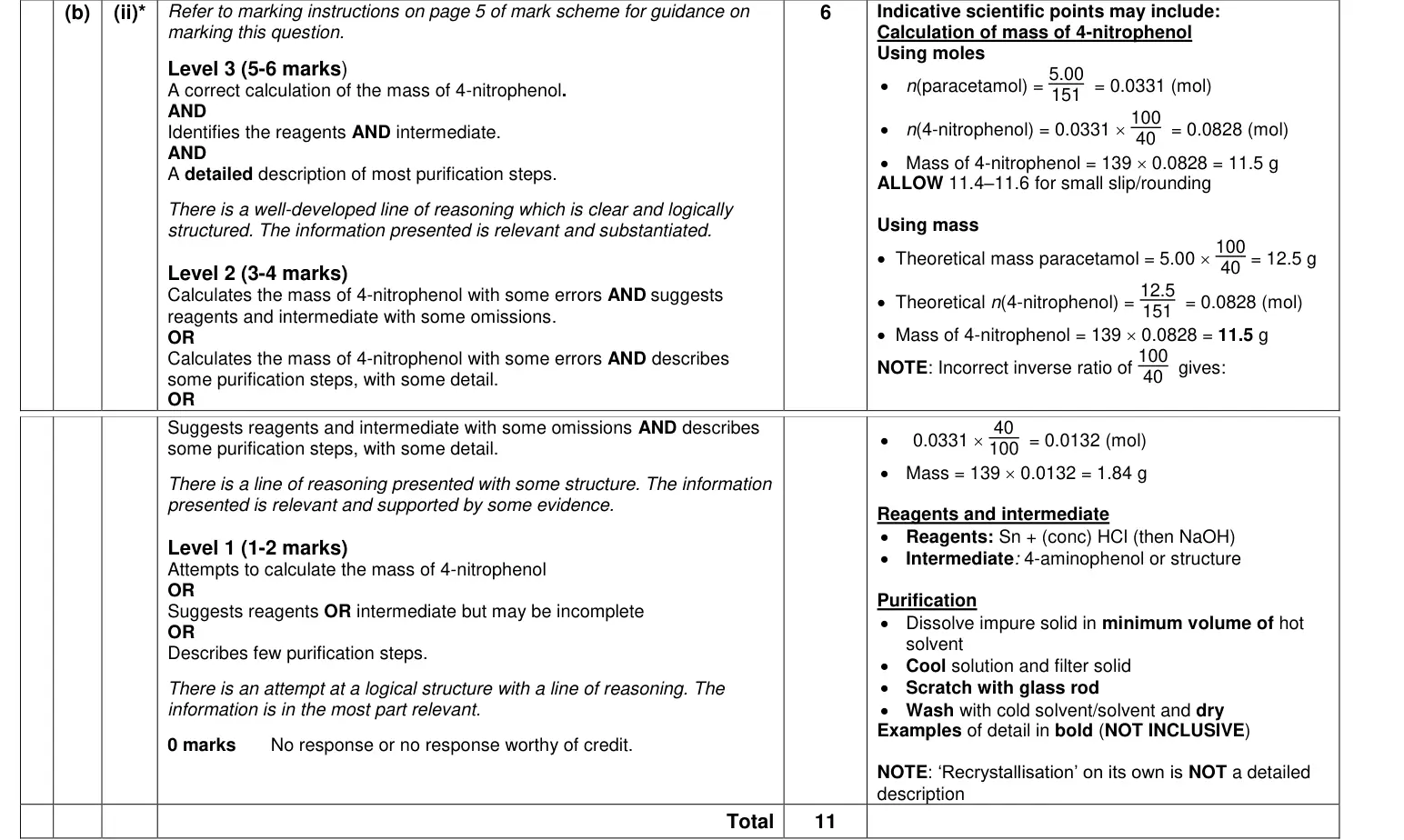
4(b)(ii) Organic synthesis (Module 6), Amount of substance (moles), Carboxylic acids, esters and acyl chlorides, Amines 6Level of response
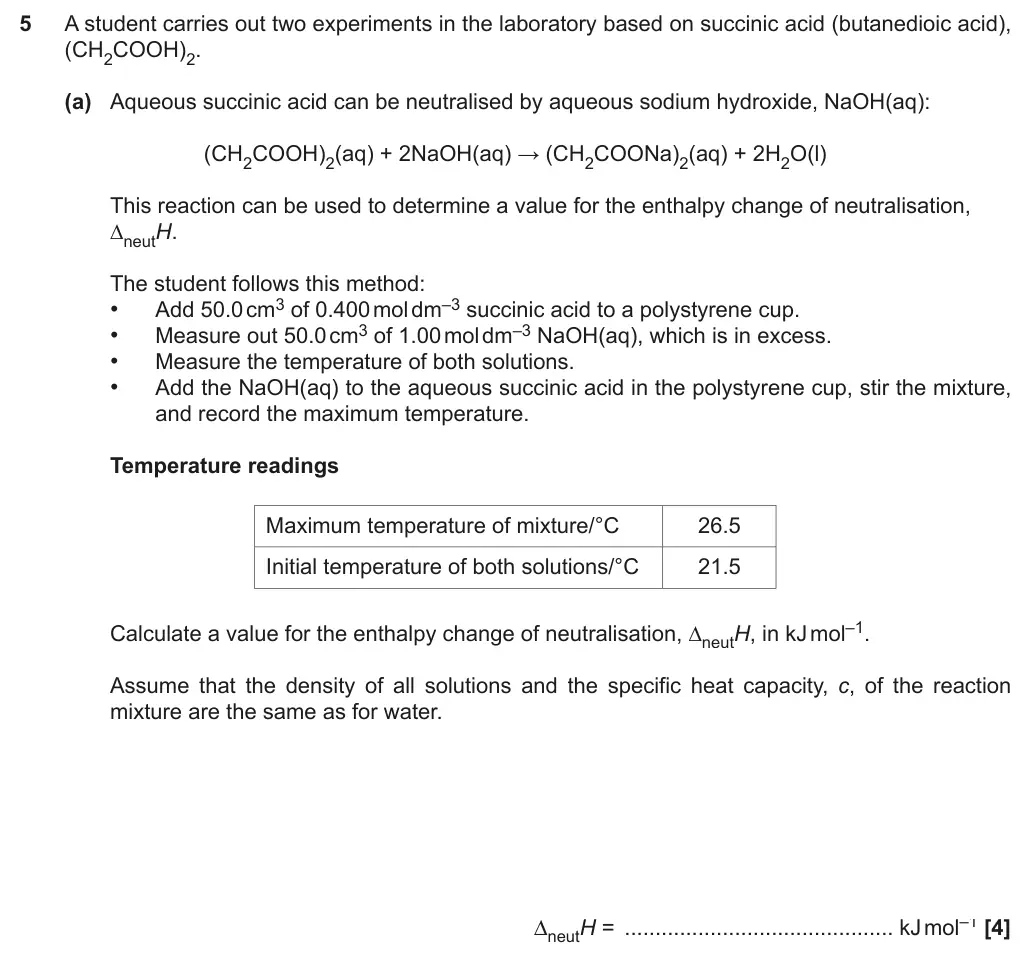
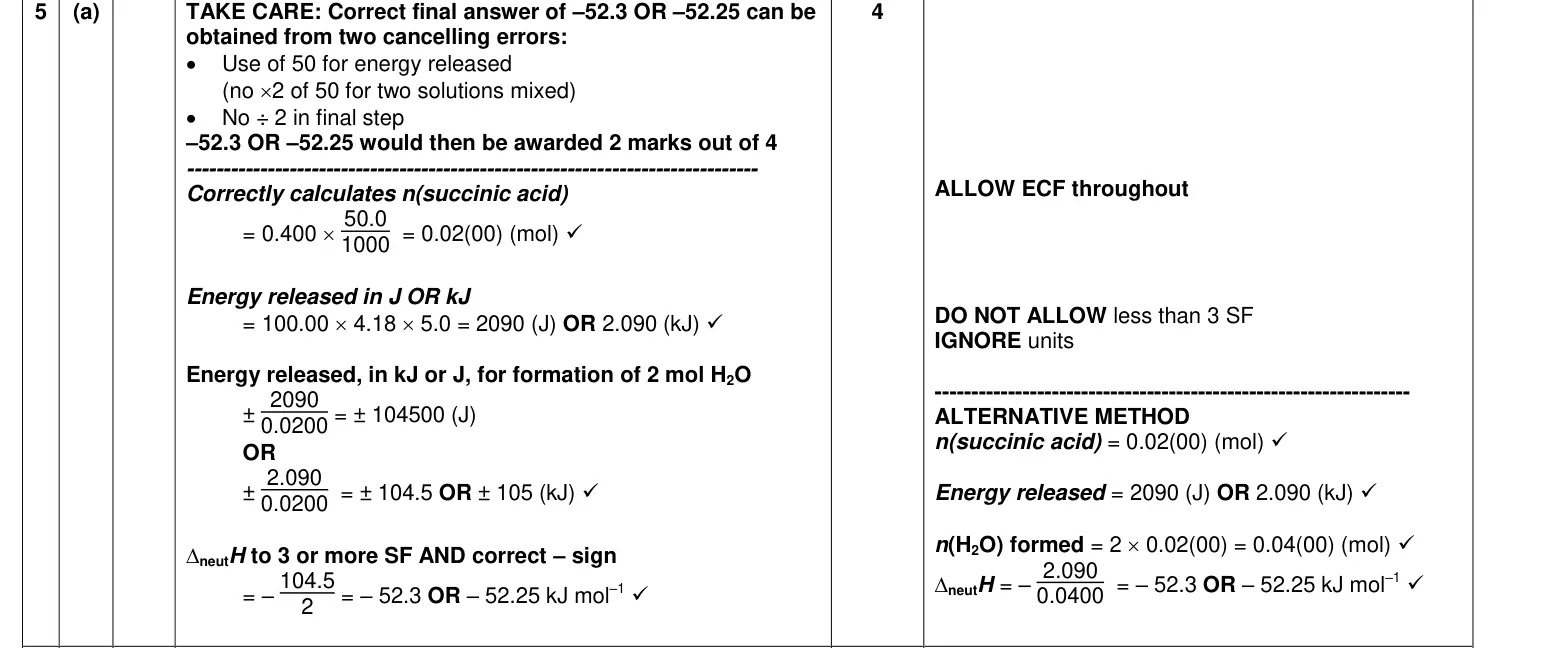
5(a) Enthalpy changes and Hess’ law, Amount of substance (moles) 4Calculation
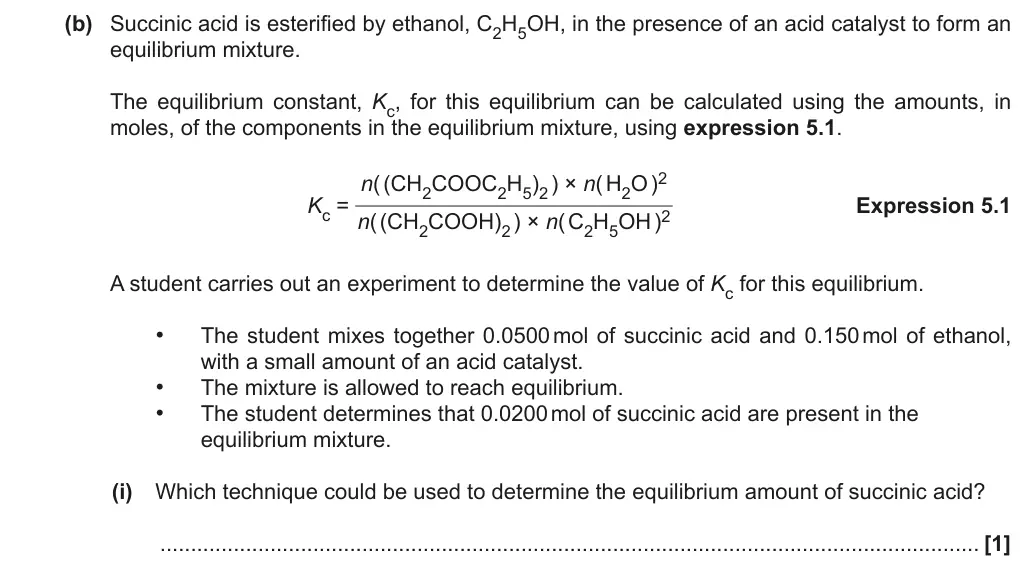
5(b)(i) Equilibrium constants Kc and Kp 1Short answer
5(b)(ii) Carboxylic acids, esters and acyl chlorides, Formulae and equations 1Equation writing
5(b)(iii) Carboxylic acids, esters and acyl chlorides, Organic basics: naming, formulae and isomerism 1Structure / isomer
5(b)(iv) Equilibrium constants Kc and Kp 1Short answer
5(b)(v) Equilibrium constants Kc and Kp 3Calculation
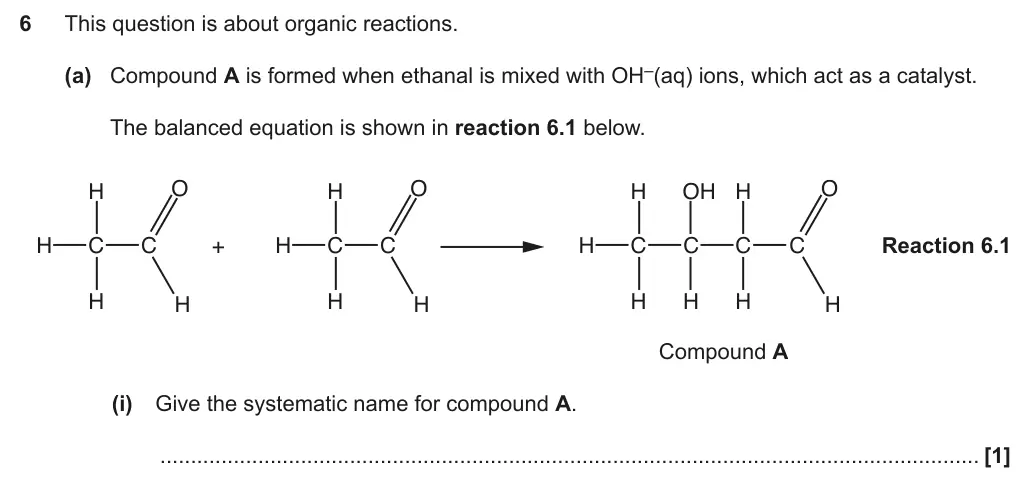
6(a)(i) Organic basics: naming, formulae and isomerism 1Short answer
6(a)(ii) Carbonyl compounds: aldehydes and ketones, Carbon–carbon bond formation 1Short answer
6(a)(iii) Acids, bases, pH and buffers, Formulae and equations, Rates: orders, rate equations and the Arrhenius equation 3Complete table/diagram
6(a)(iv) Organic synthesis (Module 6), Carbonyl compounds: aldehydes and ketones, Carbon–carbon bond formation 1Structure / isomer
6(b) Alkenes, Aromatic compounds: benzene and phenol 6Level of response

The questions

1(a)(i)1(a)(ii)1(a)(iii)1(a)(iv)1(a)(v)1(a)(vi)1(a)(vii)1(a)(viii)1(b)2(a)(i)2(a)(ii)2(b)2(c)(i)2(c)(ii)3(a)3(b)(i)3(b)(ii)4(a)(i)4(a)(ii)4(b)(i)4(b)(ii)5(a)5(b)(i)5(b)(ii)5(b)(iii)5(b)(iv)5(b)(v)6(a)(i)6(a)(ii)6(a)(iii)6(a)(iv)6(b)
June 2018 · Paper 3 · Q1(a)(i) 1 mark Short answer Easy electron structure
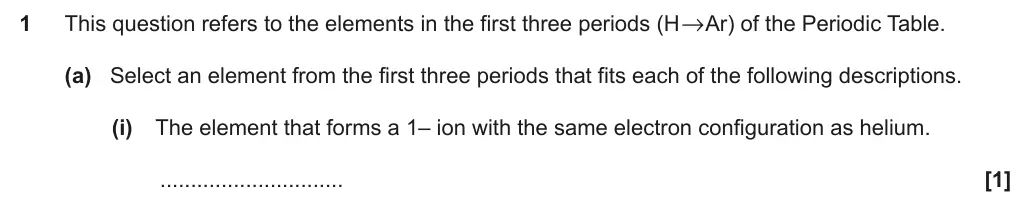
1 This question refers to the elements in the first three periods (H Ar) of the Periodic Table.
(a) Select an element from the first three periods that fits each of the following descriptions.
(i) The element that forms a 1– ion with the same electron configuration as helium.
.............................. [1]
June 2018 · Paper 3 · Q1(a)(ii) 1 mark Short answer Medium periodicity
Earlier part of question 1 that this part usesEarlier part of June 2018 Paper 3 question 1
(ii) The element with the highest first ionisation energy.
.............................. [1]
June 2018 · Paper 3 · Q1(a)(iii) 1 mark Short answer Medium periodicity
Earlier part of question 1 that this part usesEarlier part of June 2018 Paper 3 question 1
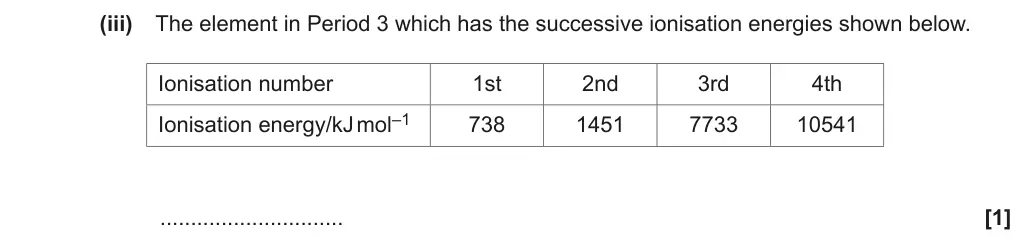
(iii) The element in Period 3 which has the successive ionisation energies shown below.
Ionisation number 1st 2nd 3rd 4th
Ionisation energy/kJ mol–1 738 1451 7733 10541
.............................. [1]
June 2018 · Paper 3 · Q1(a)(iv) 1 mark Short answer Medium bonding and structure
Earlier part of question 1 that this part usesEarlier part of June 2018 Paper 3 question 1
(iv) The element which forms a compound with fluorine that has octahedral molecules.
.............................. [1]
June 2018 · Paper 3 · Q1(a)(v) 1 mark Short answer Medium halogens
Earlier part of question 1 that this part usesEarlier part of June 2018 Paper 3 question 1
(v) An element which reacts with water to form an acidic solution.
.............................. [1]
June 2018 · Paper 3 · Q1(a)(vi) 1 mark Short answer Easy atomic structure and isotopes
Earlier part of question 1 that this part usesEarlier part of June 2018 Paper 3 question 1
(vi) The element X, which forms a compound with hydrogen, XH3, with a molar mass of
34.0 g mol–1.
.............................. [1]
June 2018 · Paper 3 · Q1(a)(vii) 1 mark Short answer Easy redox
Earlier part of question 1 that this part usesEarlier part of June 2018 Paper 3 question 1
(vii) An element which forms a compound with hydrogen in which the element has an
oxidation number of –4.
.............................. [1]
June 2018 · Paper 3 · Q1(a)(viii) 1 mark Short answer Medium amount of substance
Earlier part of question 1 that this part usesEarlier part of June 2018 Paper 3 question 1
(viii) The element which has a density of 1.33 × 10⁻³ g cm–3 at room temperature and pressure.
.............................. [1]
June 2018 · Paper 3 · Q1(b) 5 marks Extended response Medium bonding and structureperiodicity
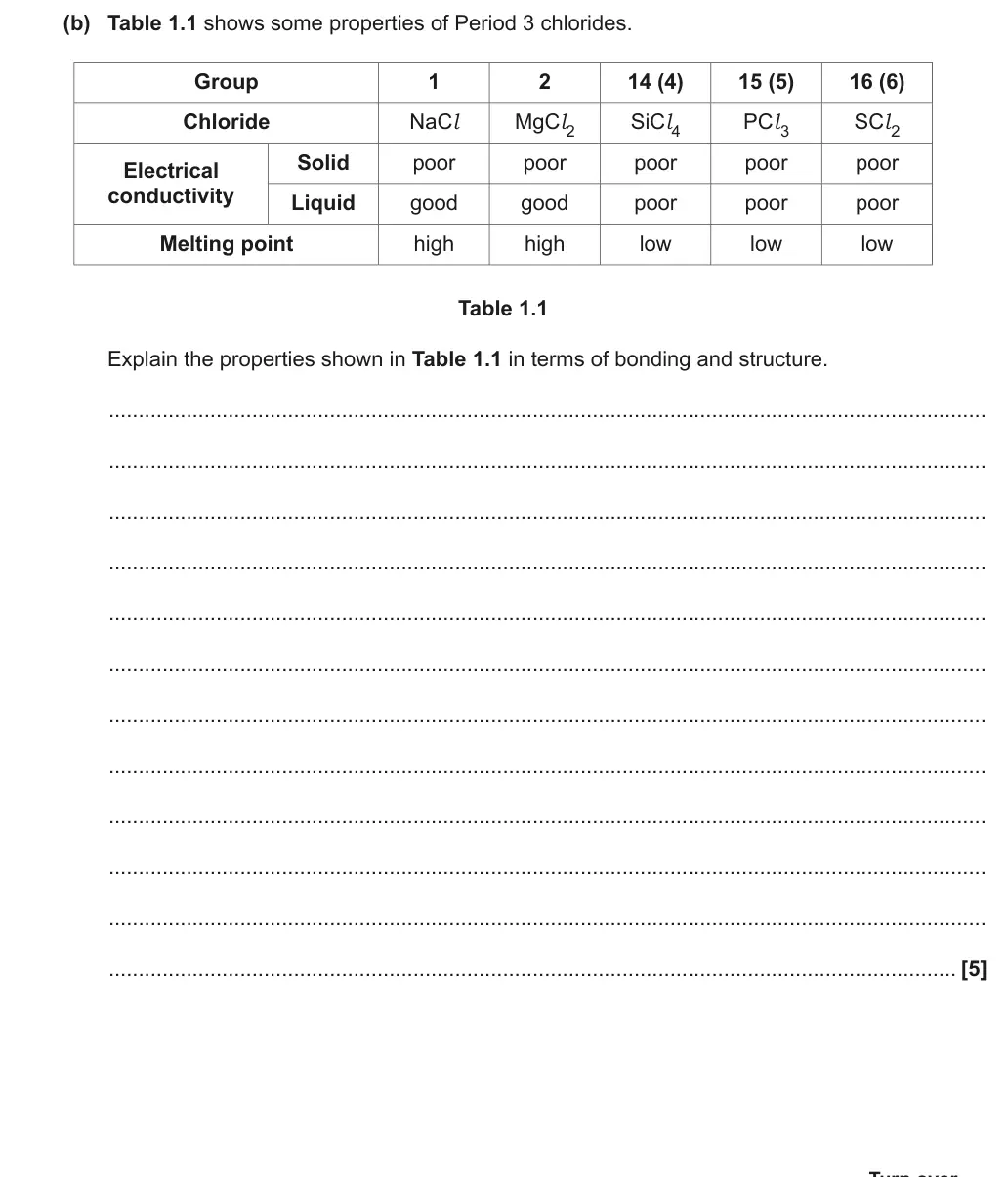
(b) Table 1.1 shows some properties of Period 3 chlorides.
Group 1 2 14 (4) 15 (5) 16 (6)
Chloride NaCl MgCl2 SiCl4 PCl3 SCl2
Solid poor poor poor poor poor
Electrical
conductivity
Liquid good good poor poor poor
Melting point high high low low low
Table 1.1
Explain the properties shown in Table 1.1 in terms of bonding and structure.
...................................................................................................................................................
...................................................................................................................................................
...................................................................................................................................................
...................................................................................................................................................
...................................................................................................................................................
...................................................................................................................................................
...................................................................................................................................................
...................................................................................................................................................
...................................................................................................................................................
...................................................................................................................................................
...................................................................................................................................................
.............................................................................................................................................. [5]
June 2018 · Paper 3 · Q2(a)(i) 5 marks Calculation Easy reaction ratespractical skillsrate equations
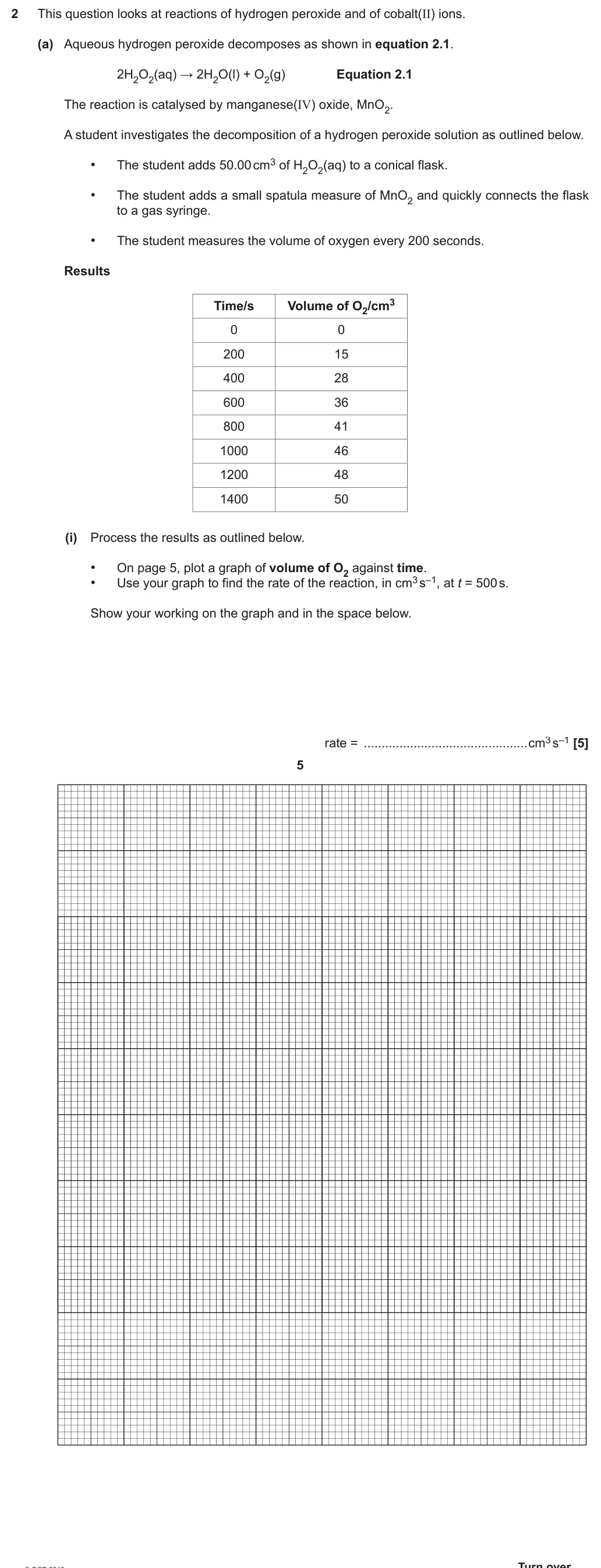
2 This question looks at reactions of hydrogen peroxide and of cobalt(II) ions.
(a) Aqueous hydrogen peroxide decomposes as shown in equation 2.1.
2H2O2(aq) → 2H2O(l) + O2(g)    Equation 2.1
The reaction is catalysed by manganese(IV) oxide, MnO2.
A student investigates the decomposition of a hydrogen peroxide solution as outlined below.
• The student adds 50.00 cm3 of H2O2(aq) to a conical flask.
• The student adds a small spatula measure of MnO2 and quickly connects the flask
to a gas syringe.
• The student measures the volume of oxygen every 200 seconds.
Results
Time/s Volume of O2/cm3
0 0
200 15
400 28
600 36
800 41
1000 46
1200 48
1400 50
(i) Process the results as outlined below.
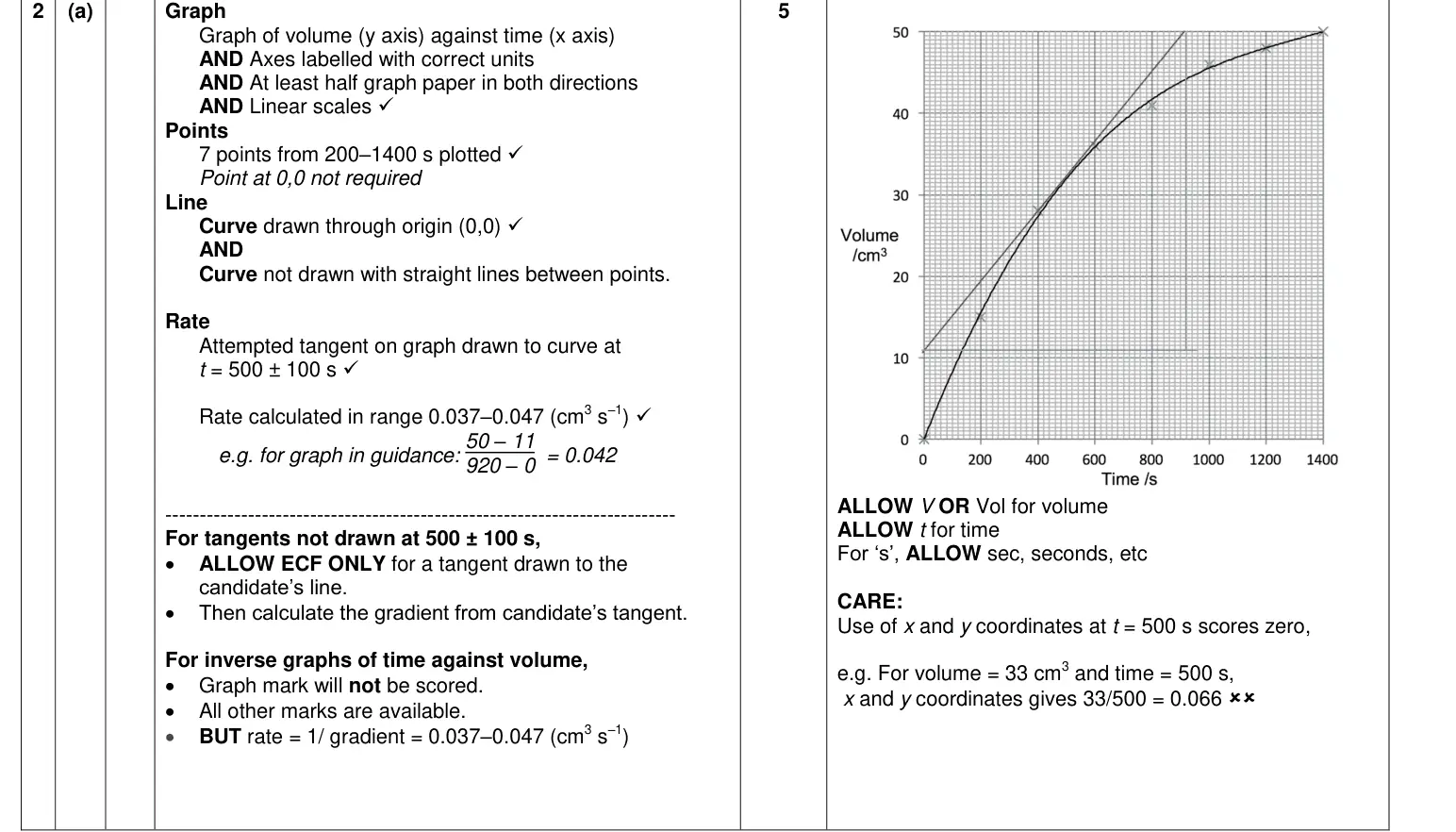
• On page 5, plot a graph of volume of O2 against time.
• Use your graph to find the rate of the reaction, in cm3 s–1, at t = 500 s.
Show your working on the graph and in the space below.
rate =  ..............................................cm3 s–1 [5]
June 2018 · Paper 3 · Q2(a)(ii) 3 marks Calculation Easy amount of substance
Earlier part of question 2 that this part usesEarlier part of June 2018 Paper 3 question 2
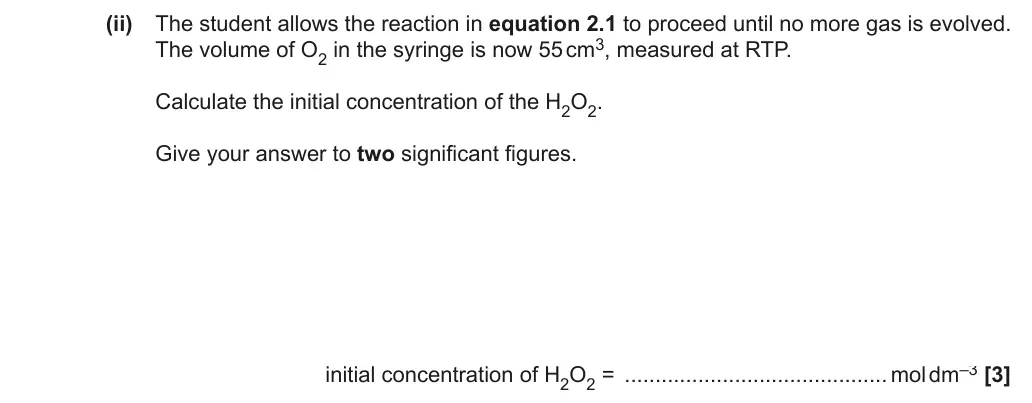
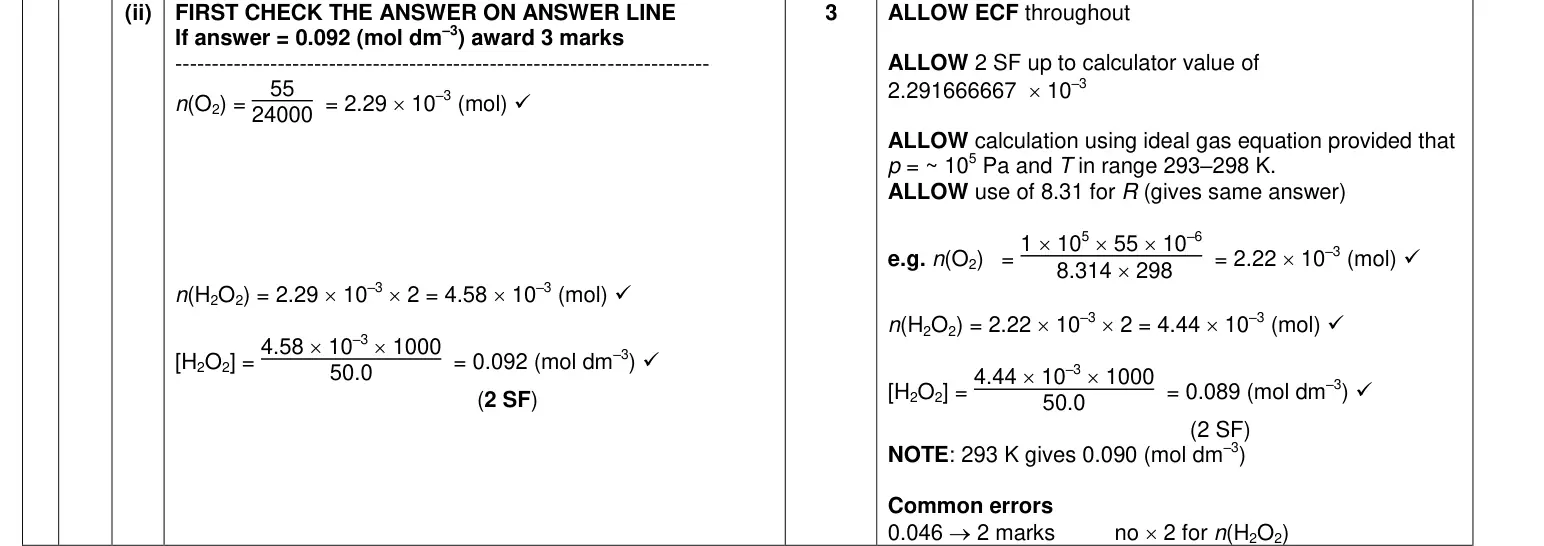
(ii) The student allows the reaction in equation 2.1 to proceed until no more gas is evolved.
The volume of O2 in the syringe is now 55 cm3, measured at RTP.
Calculate the initial concentration of the H2O2.
Give your answer to two significant figures.
initial concentration of H2O2 =  ........................................... mol dm–3 [3]
June 2018 · Paper 3 · Q2(b) 2 marks Equation writing Hard redox and electrode potentials
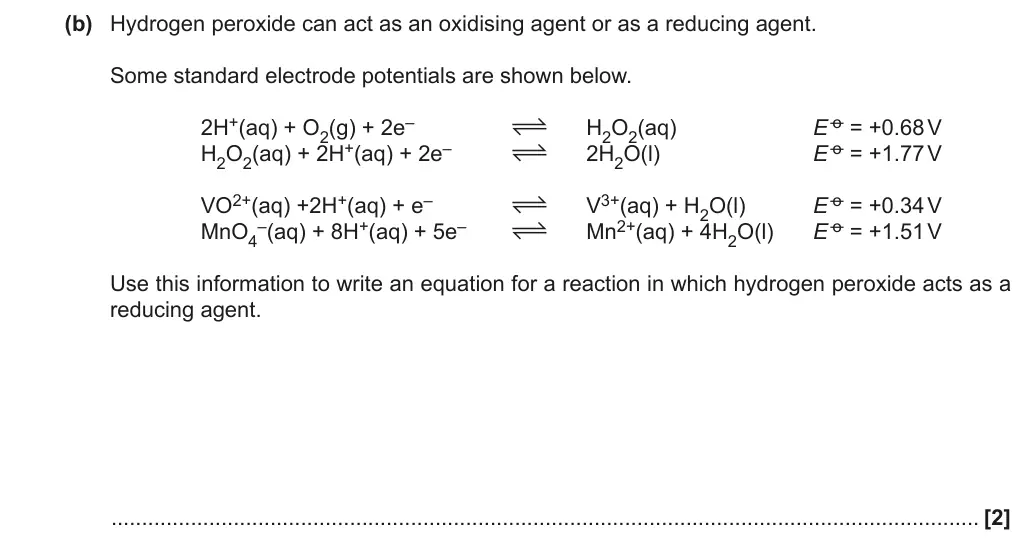
(b) Hydrogen peroxide can act as an oxidising agent or as a reducing agent.
Some standard electrode potentials are shown below.
2H+(aq) + O2(g) + 2e– H2O2(aq) E  o  = +0.68 V
H2O2(aq) + 2H+(aq) + 2e– 2H2O(l) E  o  = +1.77 V
VO2+(aq) +2H+(aq) + e– V3+(aq) + H2O(l) E  o  = +0.34 V
MnO4 –(aq) + 8H+(aq) + 5e– Mn2+(aq) + 4H2O(l) E  o  = +1.51 V
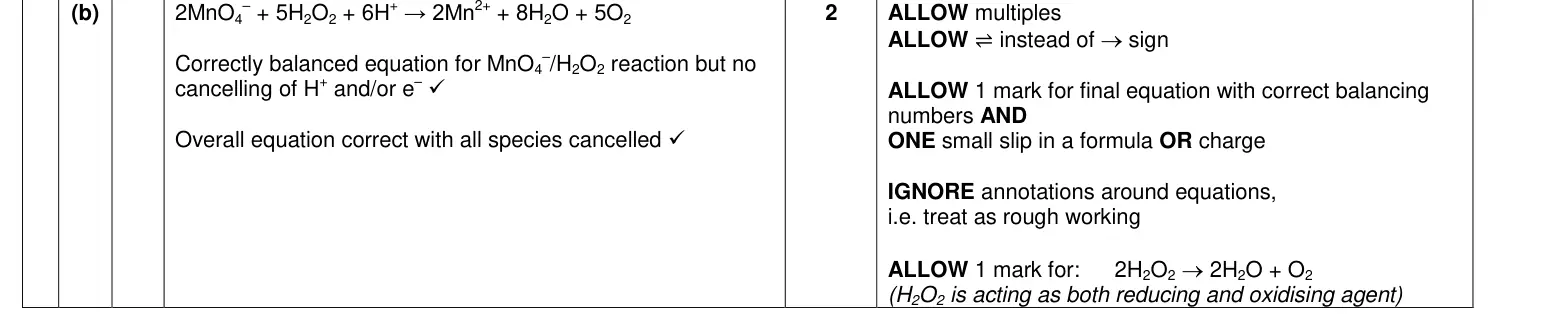
Use this information to write an equation for a reaction in which hydrogen peroxide acts as a
reducing agent.
.............................................................................................................................................. [2]
June 2018 · Paper 3 · Q2(c)(i) 1 mark Equation writing Medium transition elements
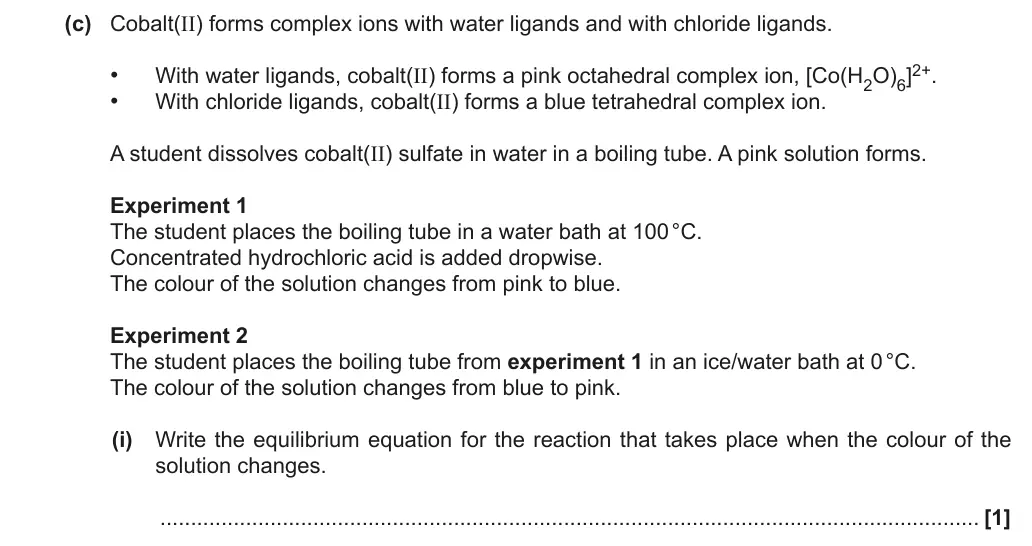
(c) Cobalt(II) forms complex ions with water ligands and with chloride ligands.
• With water ligands, cobalt(II) forms a pink octahedral complex ion, [Co(H2O)6]2+.
• With chloride ligands, cobalt(II) forms a blue tetrahedral complex ion.
A student dissolves cobalt(II) sulfate in water in a boiling tube. A pink solution forms.
Experiment 1
The student places the boiling tube in a water bath at 100 °C.
Concentrated hydrochloric acid is added dropwise.
The colour of the solution changes from pink to blue.
Experiment 2
The student places the boiling tube from experiment 1 in an ice/water bath at 0 °C.
The colour of the solution changes from blue to pink.
(i) Write the equilibrium equation for the reaction that takes place when the colour of the
solution changes.
...................................................................................................................................... [1]
June 2018 · Paper 3 · Q2(c)(ii) 2 marks Short answer Easy chemical equilibrium
Earlier part of question 2 that this part usesEarlier part of June 2018 Paper 3 question 2
(ii) Explain the observations and predict whether the formation of the blue colour is
exothermic or endothermic.
...........................................................................................................................................
...........................................................................................................................................
...........................................................................................................................................
...........................................................................................................................................
...................................................................................................................................... [2]
June 2018 · Paper 3 · Q3(a) 3 marks Structure / isomer Easy transition elements
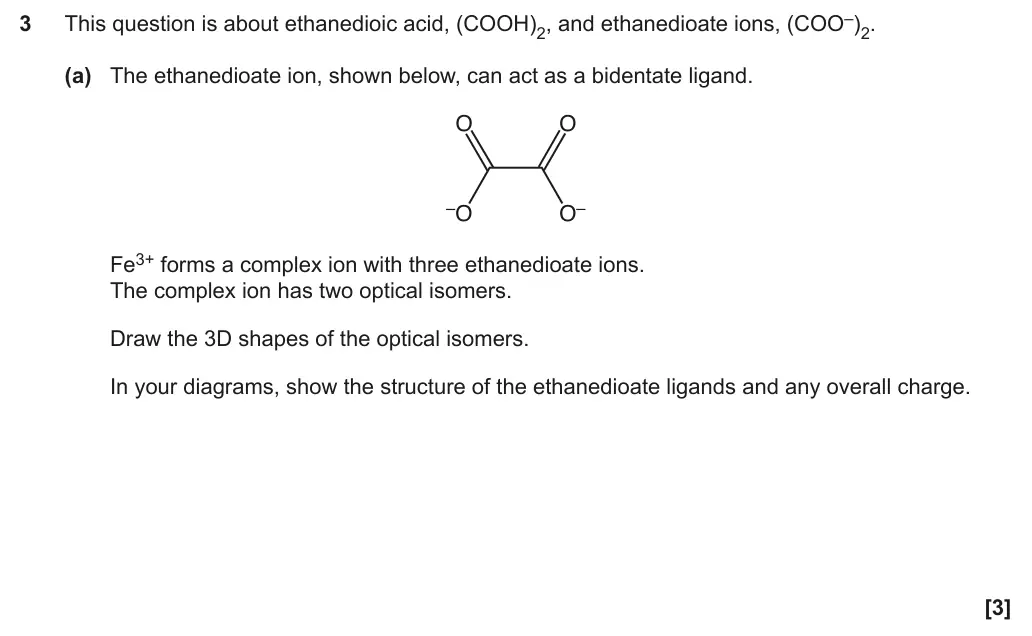
3 This question is about ethanedioic acid, (COOH)2, and ethanedioate ions, (COO–)2.
(a) The ethanedioate ion, shown below, can act as a bidentate ligand.
O O
–O O–
Fe3+ forms a complex ion with three ethanedioate ions.
The complex ion has two optical isomers.
Draw the 3D shapes of the optical isomers.
In your diagrams, show the structure of the ethanedioate ligands and any overall charge.
[3]
June 2018 · Paper 3 · Q3(b)(i) 1 mark Short answer Medium redox and electrode potentials
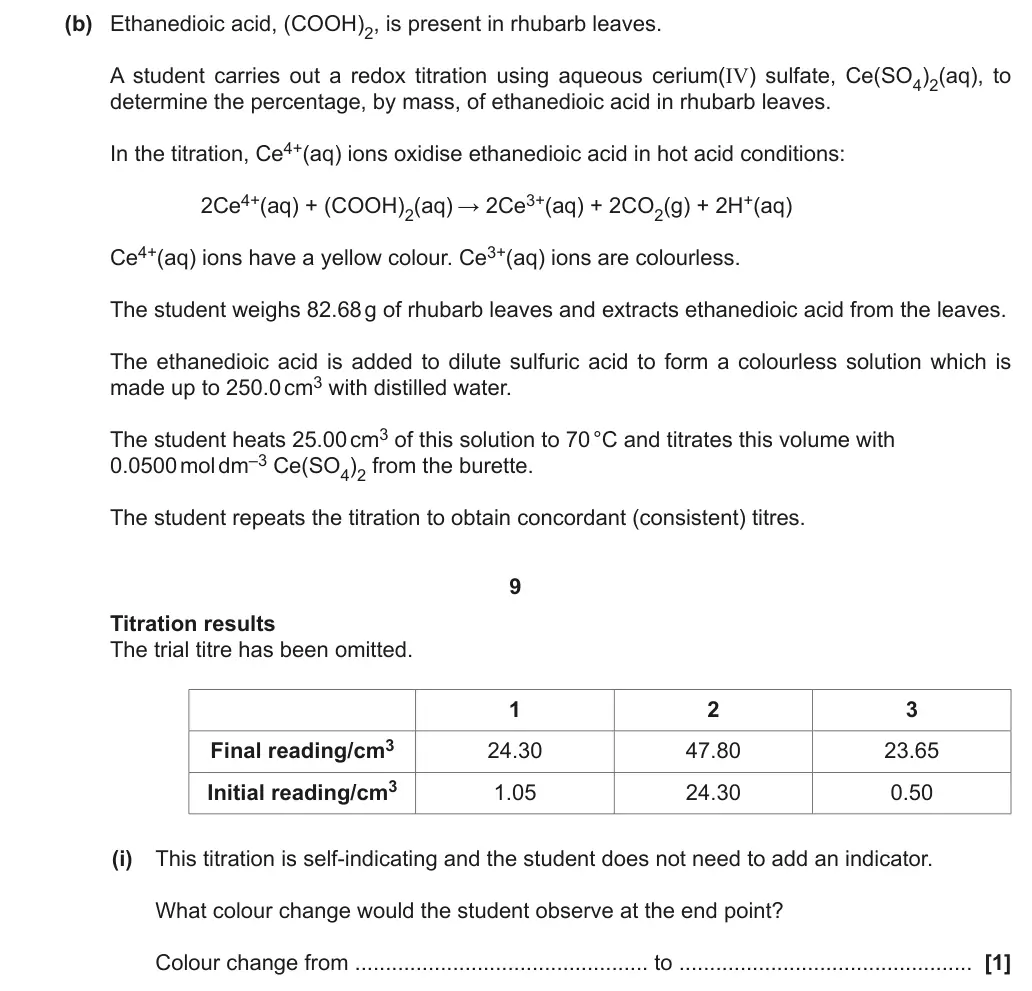
(b) Ethanedioic acid, (COOH)2, is present in rhubarb leaves.
A student carries out a redox titration using aqueous cerium(IV) sulfate, Ce(SO4)2(aq), to
determine the percentage, by mass, of ethanedioic acid in rhubarb leaves.
In the titration, Ce4+(aq) ions oxidise ethanedioic acid in hot acid conditions:
2Ce4+(aq) + (COOH)2(aq) → 2Ce3+(aq) + 2CO2(g) + 2H+(aq)
Ce4+(aq) ions have a yellow colour. Ce3+(aq) ions are colourless.
The student weighs 82.68 g of rhubarb leaves and extracts ethanedioic acid from the leaves.
The ethanedioic acid is added to dilute sulfuric acid to form a colourless solution which is
made up to 250.0 cm3 with distilled water.
The student heats 25.00 cm3 of this solution to 70 °C and titrates this volume with
0.0500 mol dm–3 Ce(SO4)2 from the burette.
The student repeats the titration to obtain concordant (consistent) titres.
Titration results
The trial titre has been omitted.
1 2 3
Final reading/cm3 24.30 47.80 23.65
Initial reading/cm3 1.05 24.30 0.50
(i) This titration is self-indicating and the student does not need to add an indicator.
What colour change would the student observe at the end point?
Colour change from ................................................ to ................................................ [1]
June 2018 · Paper 3 · Q3(b)(ii) 6 marks Calculation Easy redox and electrode potentialsamount of substance
Earlier part of question 3 that this part usesEarlier part of June 2018 Paper 3 question 3
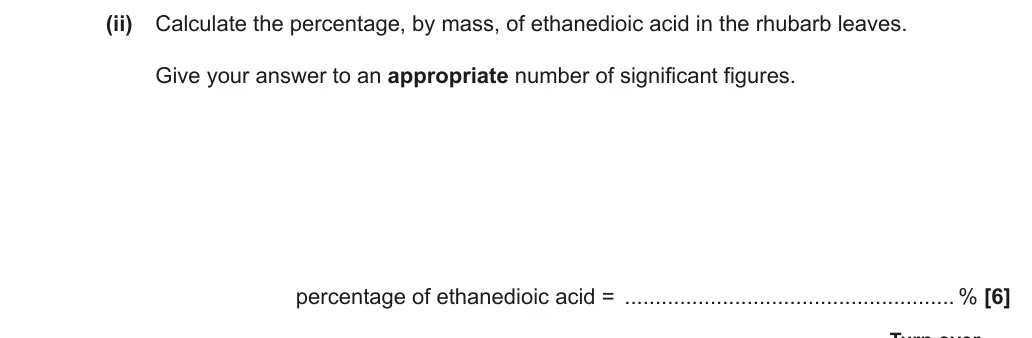
(ii) Calculate the percentage, by mass, of ethanedioic acid in the rhubarb leaves.
Give your answer to an appropriate number of significant figures.
percentage of ethanedioic acid =  ...................................................... % [6]
June 2018 · Paper 3 · Q4(a)(i) 1 mark Short answer Easy redox
4 This question is about two compounds used in medicine.
(a) Cis-platin, PtCl2(NH3)2, is a complex of platinum which is used in cancer treatment.
(i) What is the oxidation number of platinum in cis-platin?
............................ [1]
June 2018 · Paper 3 · Q4(a)(ii) 2 marks Mechanism Hard transition elementsorganic basics
Earlier part of question 4 that this part usesEarlier part of June 2018 Paper 3 question 4
(ii) Cis-platin is prepared in a ligand substitution reaction which takes place in multiple steps.
The equation for the final step forming cis-platin is shown below.
[PtCl3(NH3)]– + NH3 → PtCl2(NH3)2 + Cl–
cis-platin
In the box, outline the mechanism for the formation of cis-platin from [PtCl3(NH3)]–.
Use curly arrows and lone pairs where appropriate.
Cl Cl
_
Pt + Cl
H3N NH3
cis-platin
[2]
June 2018 · Paper 3 · Q4(b)(i) 2 marks Short answer Hard organic synthesisamino acids amides and chirality
(b) Paracetamol is a solid organic compound used in tablets as a painkiller.
H
HO N
C CH3
paracetamol
O
(i) Name the functional groups present in paracetamol.
......................................................................
...................................................................... [2]
June 2018 · Paper 3 · Q4(b)(ii) 6 marks 6-mark level of response Hard organic synthesisamount of substancecarboxylic acids and estersamines
Earlier part of question 4 that this part usesEarlier part of June 2018 Paper 3 question 4
(ii)* A chemist prepares a pure solid sample of paracetamol from 4-nitrophenol in two stages:
H
Stage 1 Stage 2
HO NO2 Intermediate HO N
CH3COCl
C CH3
4-nitrophenol paracetamol
O
Describe a two-stage synthesis of 5.00 g of pure paracetamol from 4-nitrophenol. The
overall percentage yield of paracetamol from 4-nitrophenol is 40.0%.
In your answer, include the mass of 4-nitrophenol required, the reagents and intermediate,
and details of the purification of paracetamol. [6]
...........................................................................................................................................
...........................................................................................................................................
...........................................................................................................................................
...........................................................................................................................................
...........................................................................................................................................
...........................................................................................................................................
...........................................................................................................................................
...........................................................................................................................................
...........................................................................................................................................
...........................................................................................................................................
...........................................................................................................................................
...........................................................................................................................................
...........................................................................................................................................
...........................................................................................................................................
...........................................................................................................................................
Additional answer space if required.
...........................................................................................................................................
...........................................................................................................................................
...........................................................................................................................................
...........................................................................................................................................
June 2018 · Paper 3 · Q5(a) 4 marks Calculation Medium enthalpy changesamount of substance
5 A student carries out two experiments in the laboratory based on succinic acid (butanedioic acid),
(CH2COOH)2.
(a) Aqueous succinic acid can be neutralised by aqueous sodium hydroxide, NaOH(aq):
(CH2COOH)2(aq) + 2NaOH(aq) → (CH2COONa)2(aq) + 2H2O(l)
This reaction can be used to determine a value for the enthalpy change of neutralisation,
∆neutH.
The student follows this method:
• Add 50.0 cm3 of 0.400 mol dm–3 succinic acid to a polystyrene cup.
• Measure out 50.0 cm3 of 1.00 mol dm–3 NaOH(aq), which is in excess.
• Measure the temperature of both solutions.
• Add the NaOH(aq) to the aqueous succinic acid in the polystyrene cup, stir the mixture,
and record the maximum temperature.
Temperature readings
Maximum temperature of mixture/°C 26.5
Initial temperature of both solutions/°C 21.5
Calculate a value for the enthalpy change of neutralisation, ∆neutH, in kJ mol–1.
Assume that the density of all solutions and the specific heat capacity, c, of the reaction
mixture are the same as for water.
ΔneutH =  ............................................ kJ mol–1 [4]
June 2018 · Paper 3 · Q5(b)(i) 1 mark Short answer Hard equilibrium constants
(b) Succinic acid is esterified by ethanol, C2H5OH, in the presence of an acid catalyst to form an
equilibrium mixture.
The equilibrium constant, Kc, for this equilibrium can be calculated using the amounts, in
moles, of the components in the equilibrium mixture, using expression 5.1.
n( (CH2COOC2H5)2 ) × n( H2O )2
Kc = n( (CH2COOH)2 ) × n( C2H5OH )2 Expression 5.1
A student carries out an experiment to determine the value of Kc for this equilibrium.
• The student mixes together 0.0500 mol of succinic acid and 0.150 mol of ethanol,
with a small amount of an acid catalyst.
• The mixture is allowed to reach equilibrium.
• The student determines that 0.0200 mol of succinic acid are present in the
equilibrium mixture.
(i) Which technique could be used to determine the equilibrium amount of succinic acid?
...................................................................................................................................... [1]
June 2018 · Paper 3 · Q5(b)(ii) 1 mark Equation writing Medium carboxylic acids and estersformulae and equations
Earlier part of question 5 that this part usesEarlier part of June 2018 Paper 3 question 5
(ii) Write the equation for the equilibrium reaction that takes place.
...................................................................................................................................... [1]
June 2018 · Paper 3 · Q5(b)(iii) 1 mark Structure / isomer Hard carboxylic acids and estersorganic basics
Earlier parts of question 5 that this part usesEarlier part of June 2018 Paper 3 question 5Earlier part of June 2018 Paper 3 question 5
(iii) Draw the skeletal formula of the ester present in the equilibrium mixture.
[1]
June 2018 · Paper 3 · Q5(b)(iv) 1 mark Short answer Medium equilibrium constants
Earlier part of question 5 that this part usesEarlier part of June 2018 Paper 3 question 5
(iv) Kc is the equilibrium constant in terms of equilibrium concentrations.
Why can expression 5.1 be used to calculate Kc for this equilibrium?
...........................................................................................................................................
...................................................................................................................................... [1]
June 2018 · Paper 3 · Q5(b)(v) 3 marks Calculation Hard equilibrium constants
Earlier parts of question 5 that this part usesEarlier part of June 2018 Paper 3 question 5Earlier part of June 2018 Paper 3 question 5
(v) Calculate the value of Kc for this reaction.
Show your working.
Kc =  ......................................................... [3]
June 2018 · Paper 3 · Q6(a)(i) 1 mark Short answer Medium organic basics
6 This question is about organic reactions.
(a) Compound A is formed when ethanal is mixed with OH–(aq) ions, which act as a catalyst.
The balanced equation is shown in reaction 6.1 below.
H O H O H OH H O
H C C + H C C H C C C C Reaction 6.1
H H H H H H H H
Compound A
(i) Give the systematic name for compound A.
...................................................................................................................................... [1]
June 2018 · Paper 3 · Q6(a)(ii) 1 mark Short answer Easy carbonyl compoundscarbon carbon bond formation
Earlier part of question 6 that this part usesEarlier part of June 2018 Paper 3 question 6
(ii) What type of reaction has taken place?
...................................................................................................................................... [1]
June 2018 · Paper 3 · Q6(a)(iii) 3 marks Complete table/diagram Hard acids bases and buffersformulae and equationsrate equations
Earlier part of question 6 that this part usesEarlier part of June 2018 Paper 3 question 6
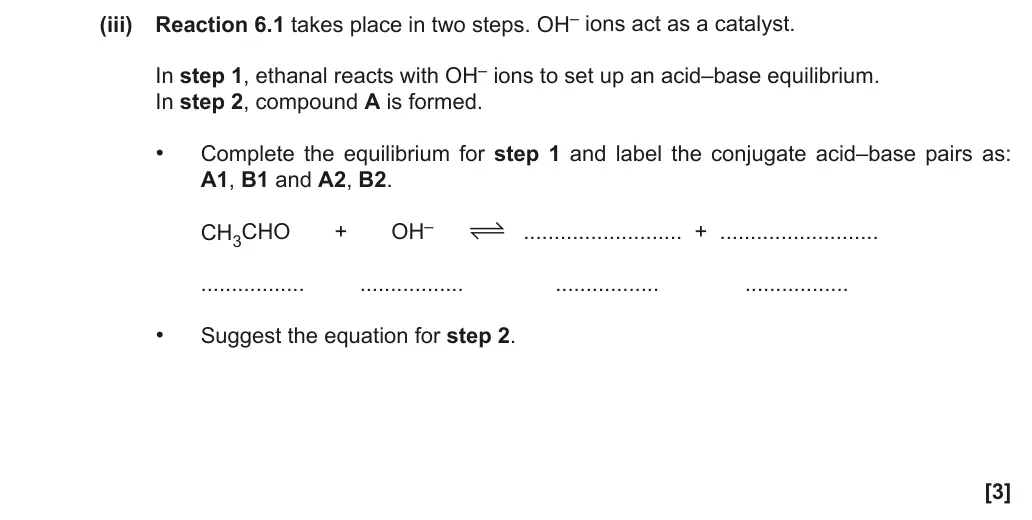
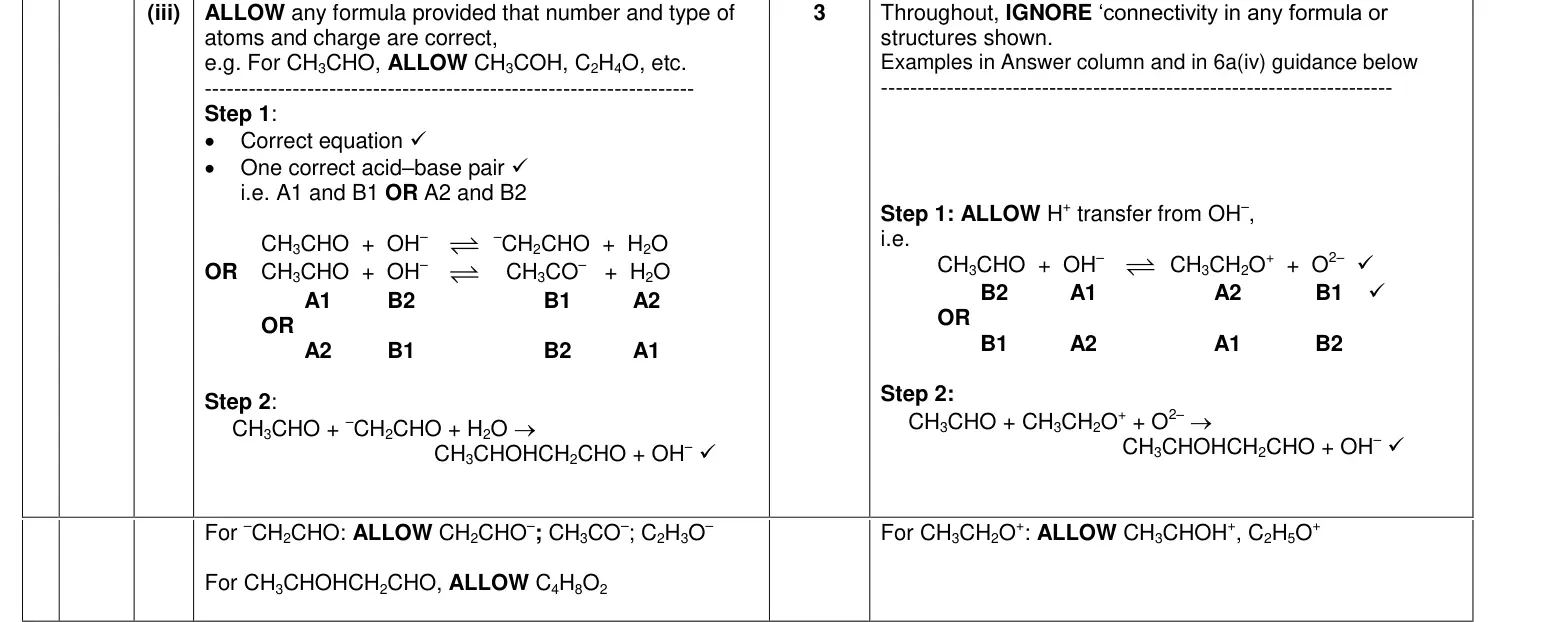
(iii) Reaction 6.1 takes place in two steps. OH– ions act as a catalyst.
In step 1, ethanal reacts with OH– ions to set up an acid–base equilibrium.
In step 2, compound A is formed.
• Complete the equilibrium for step 1 and label the conjugate acid–base pairs as:
A1, B1 and A2, B2.
CH3CHO  +  OH– ..........................  +  ..........................
.................         .................               .................              .................
• Suggest the equation for step 2.
[3]
June 2018 · Paper 3 · Q6(a)(iv) 1 mark Structure / isomer Hard organic synthesiscarbonyl compoundscarbon carbon bond formation
Earlier parts of question 6 that this part usesEarlier part of June 2018 Paper 3 question 6Earlier part of June 2018 Paper 3 question 6
(iv) A similar reaction takes place when propanone, (CH3)2CO, is mixed with OH–(aq) ions.
Draw the structure of the organic product of this reaction.
[1]
June 2018 · Paper 3 · Q6(b) 6 marks 6-mark level of response Medium alkenesaromatic compounds
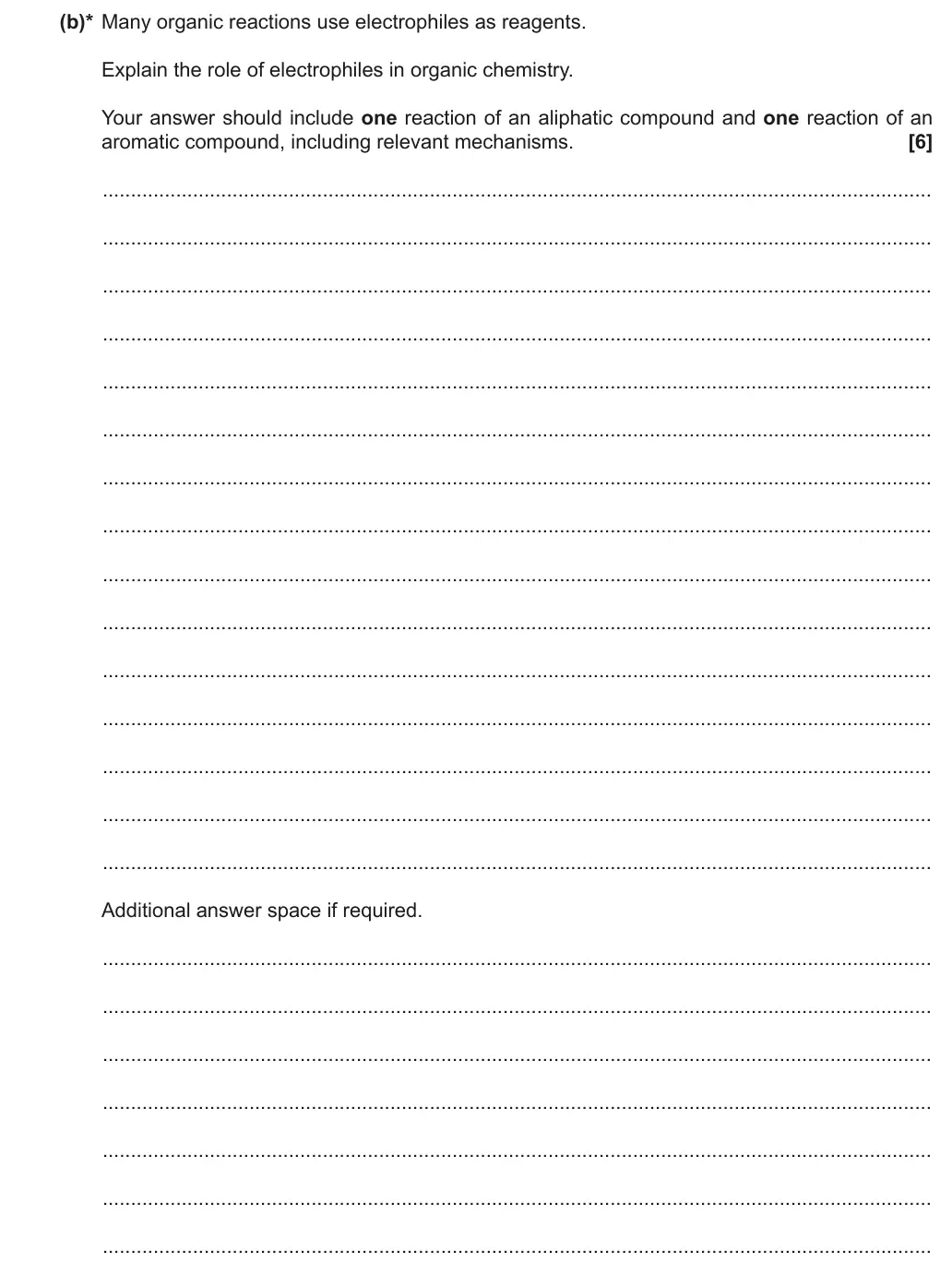
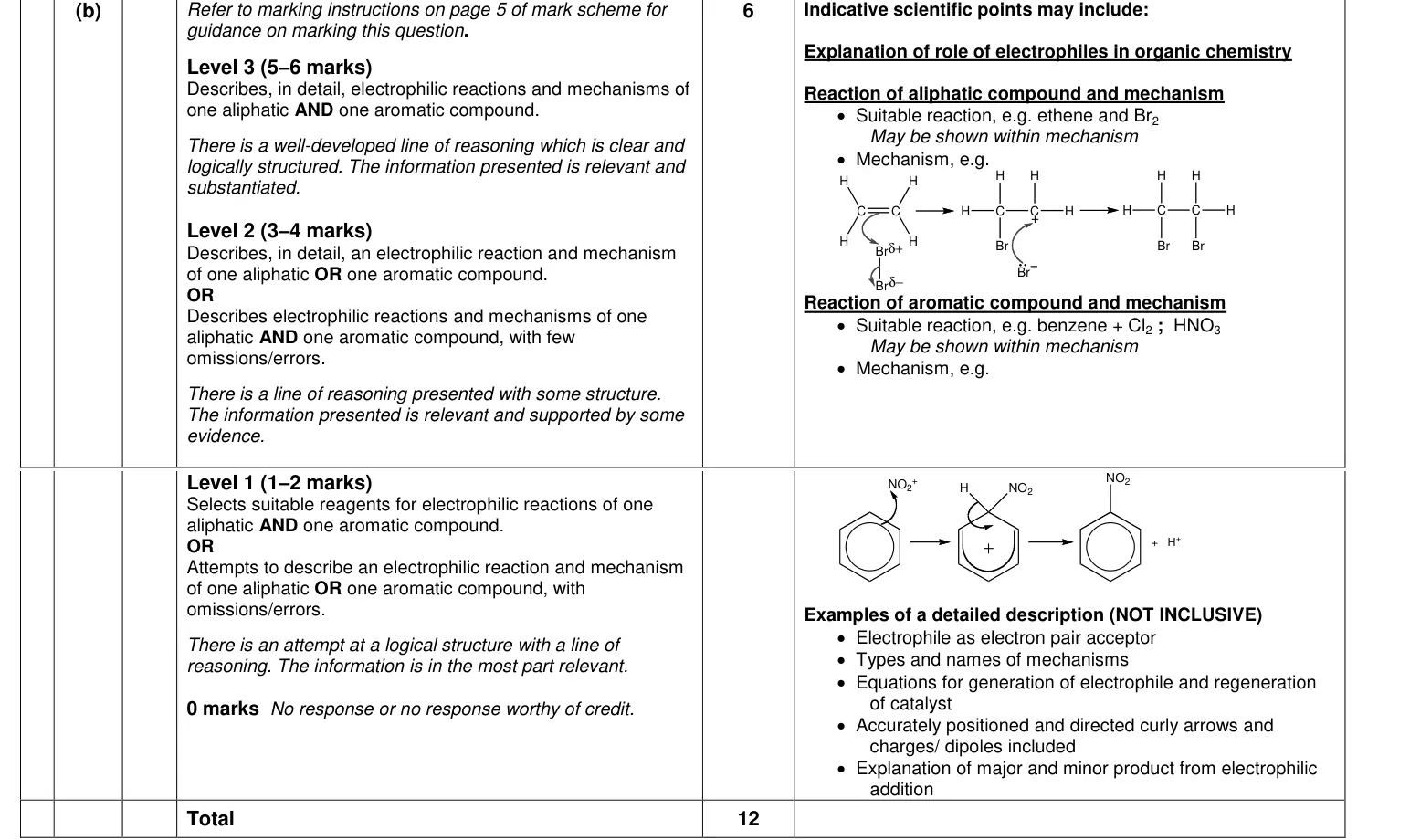
(b)* Many organic reactions use electrophiles as reagents.
Explain the role of electrophiles in organic chemistry.
Your answer should include one reaction of an aliphatic compound and one reaction of an
aromatic compound, including relevant mechanisms. [6]
...................................................................................................................................................
...................................................................................................................................................
...................................................................................................................................................
...................................................................................................................................................
...................................................................................................................................................
...................................................................................................................................................
...................................................................................................................................................
...................................................................................................................................................
...................................................................................................................................................
...................................................................................................................................................
...................................................................................................................................................
...................................................................................................................................................
...................................................................................................................................................
...................................................................................................................................................
...................................................................................................................................................
Additional answer space if required.
...................................................................................................................................................
...................................................................................................................................................
...................................................................................................................................................
...................................................................................................................................................
...................................................................................................................................................
...................................................................................................................................................
...................................................................................................................................................

Work with an OCR chemistry tutor

Want a paper marked and gone through with you? Message us.

Prefer email? Send an enquiry

If you are under 18, please include a parent's contact details. Enquiries go to enquiries@chemistryaleveltutor.com and are deleted once handled. All tutoring is online.