Mark scheme

Examiner's comment
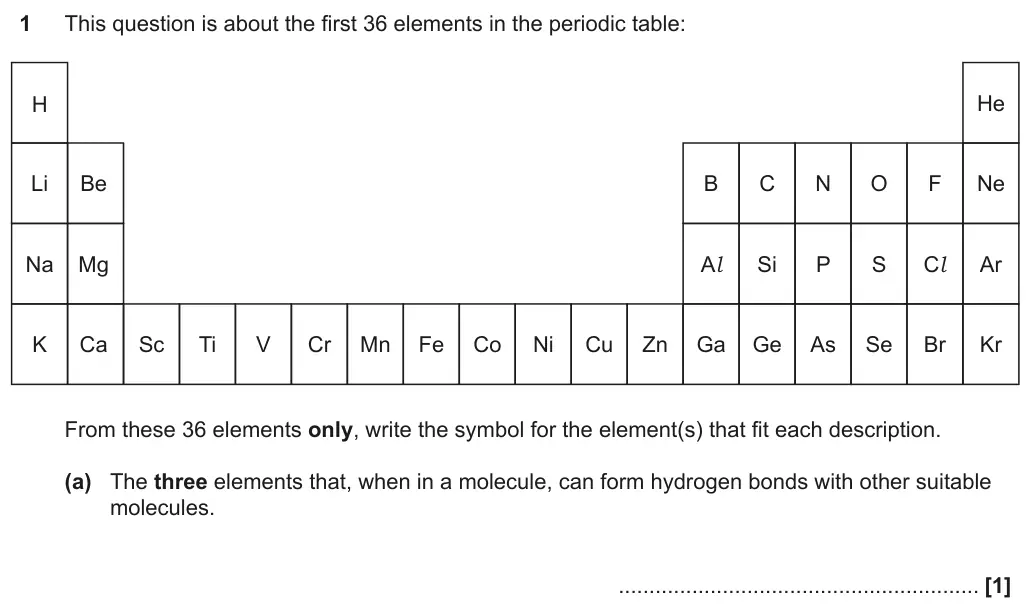
Most candidates selected N, O and F, with other responses choosing other elements seemingly at random.
Notes from the mark scheme and report
- three from N, O, F, H
- DO NOT ALLOW any other elements (CON)
70 marks · 29 question parts · Paper, mark scheme and report on OCR's site · Have OCR's Data Sheet beside you
Most candidates selected N, O and F, with other responses choosing other elements seemingly at random.
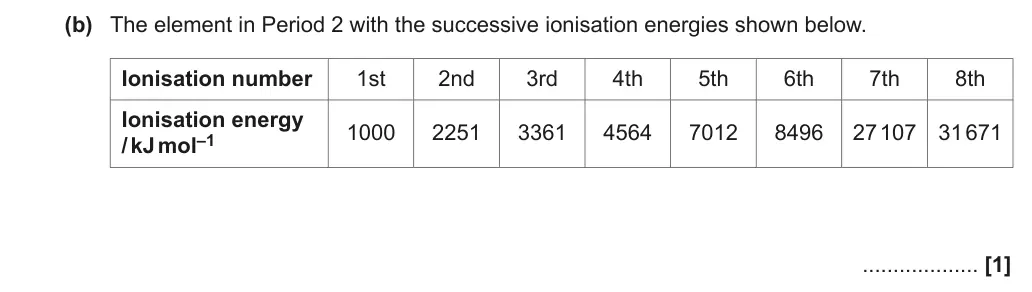
Most successful candidates looked for the large difference between successive ionisation, usually shown by annotations below the table. The commonest incorrect response was F, the element after the large difference. Other incorrect responses were random.
Skills: M3.1 Translate information between graphical, numerical and algebraic forms

Candidates found this question harder than Questions 1 (a) and (b) with S and P being the most common correct elements seen. As and Se were also allowed. Si was a common incorrect response.

Most candidates chose at least one of the two elements Cr and Mn, with Mn being the most common. Incorrect elements were usually other d block elements. Erratum

Most candidates correctly chose Si. As with earlier questions, there seemed to be little pattern with incorrect elements.

The answer S was well known, with SF6 being the specification example of a compound with octahedral molecules.
Skills: M4.1 Use angles and shapes in regular 2-D and 3-D structures

Although most candidates did choose F, a substantial number chose Br (most common), K and H, seemingly confused between gaining and losing electrons in forming ions.
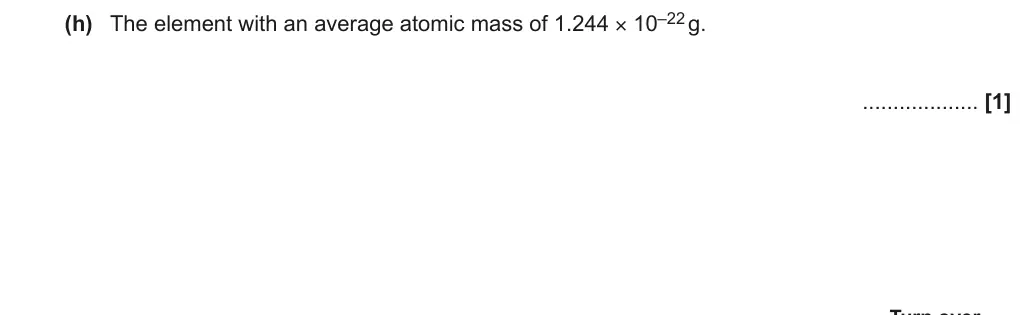
This question was a good discriminator. Candidates who scored the mark usually showed their mathematical working which led to As being chosen as the correct element. Other elements were seen randomly. More candidates omitted this part of Question 1 than other parts. With questions such as this, it is always better to guess as there is no penalty for an incorrect response.
Skills: M0.1 Recognise and use expressions in decimal and ordinary form; M0.2 Use ratios, fractions and percentages
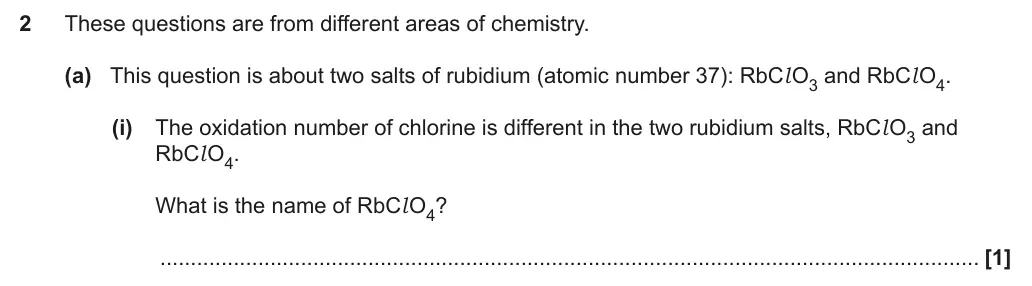
Candidates had difficulty in naming a compound using Roman numerals for an element which can have different oxidation numbers. For the name of RbClO4, many omitted the number entirely, showing just rubidium chlorate. Many inventive names such as rubidium chlorotetraoxide were seen. Some candidates wrote the correct VII before chlorate and many different Roman oxidation numbers were seen. Roman numerals’ use in naming compounds is part of chemical nomenclature, included in the specification.
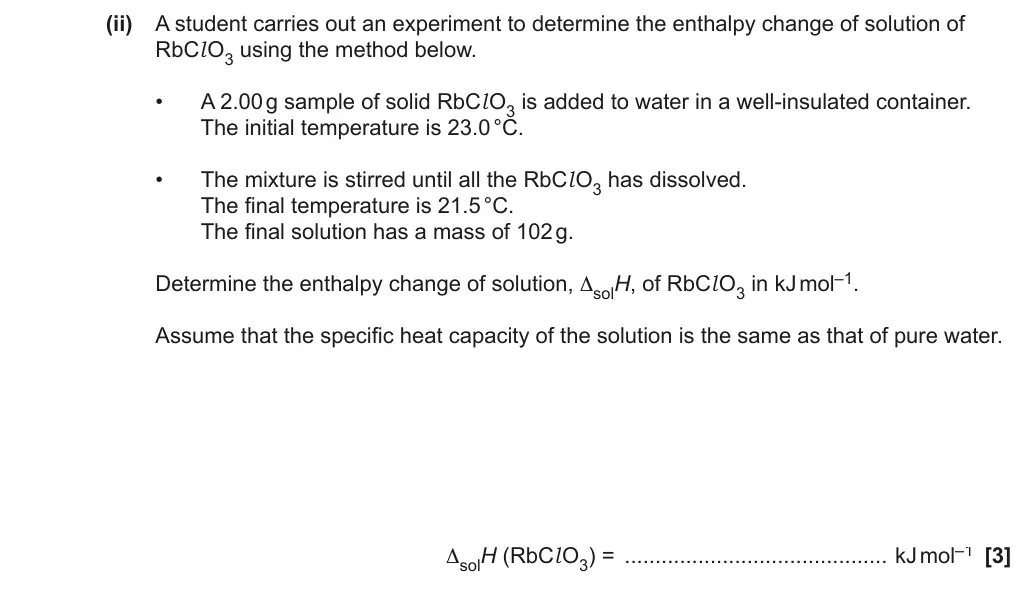
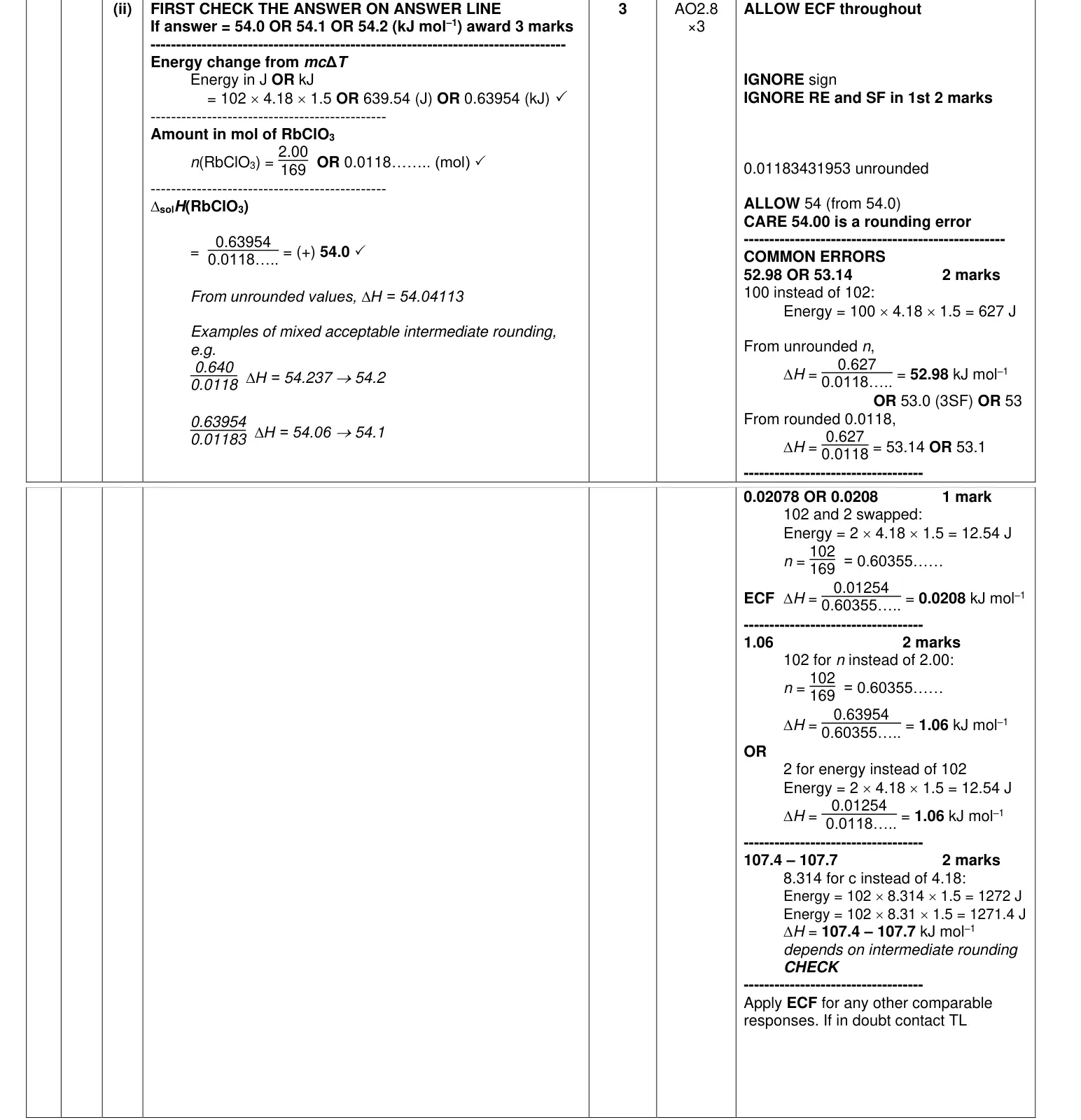
This question was a good discriminator, producing marks across the whole 3 mark range. More successful candidates correctly calculated the energy change, moles of RbClO3 and enthalpy change of solution. However, there were pitfalls for many including the following: • calculating the energy change using the mass of water rather than the mass of the solution. This was despite the suppled information that the specific heat capacity of the solution is the same as for water. Candidates should understand that m in mc∆T is the mass of the substance that produces ∆T • calculating an incorrect value for the molar mass of RbClO3. Instead of 169, this was often seen as 120.5 (using the atomic number of 37 for Rb, rather than the mass number of 85.5) and 185 (for RbClO4) • using values of m at the wrong stages in the calculation. e.g. 2 g with the energy change and 102 g or 100 g with the moles calculation • calculating the correct numerical value for the enthalpy change of solution, but then placing a ‘–‘ sign in front of the value, despite ∆T being for a decrease in temperature. Finally, as with all multi-step calculations, candidates are advised to use calculator values throughout. Any intermediate rounding introduces rounding errors in the final value. The final value can be rounded either to the significant figures demanded by the question or to the lowest number of significant figures used in the provided data.
Skills: M0.0 Recognise and make use of appropriate units in calculations; M0.2 Use ratios, fractions and percentages; M2.3 Substitute numerical values into algebraic equations using appropriate units for physical quantities; PAG3 Enthalpy determination
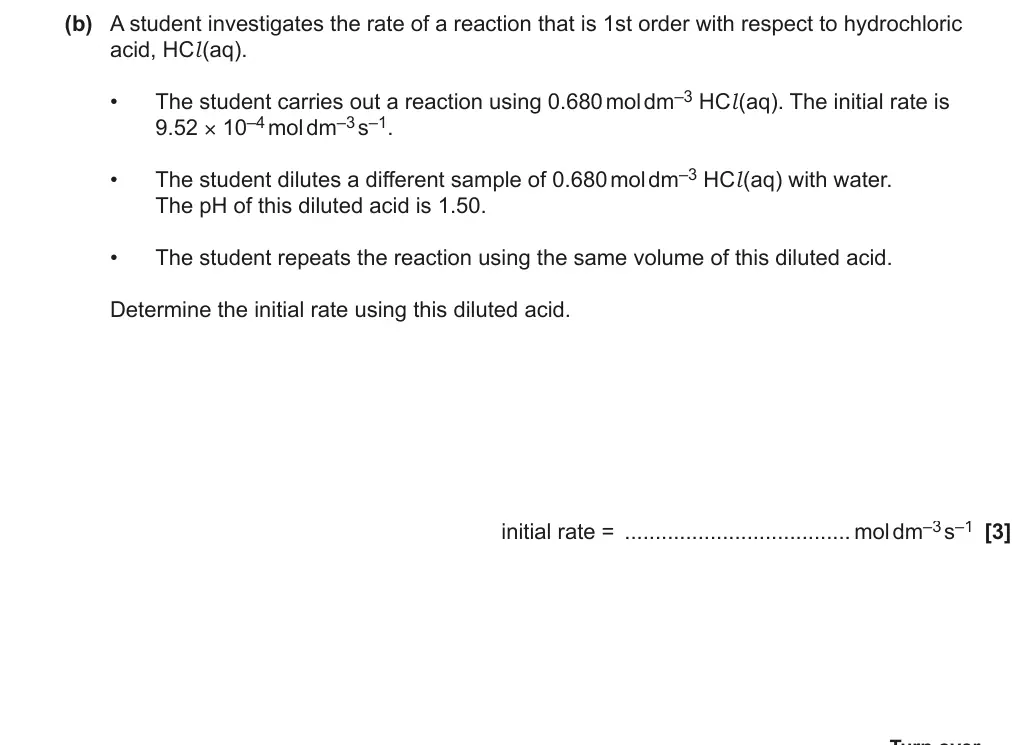
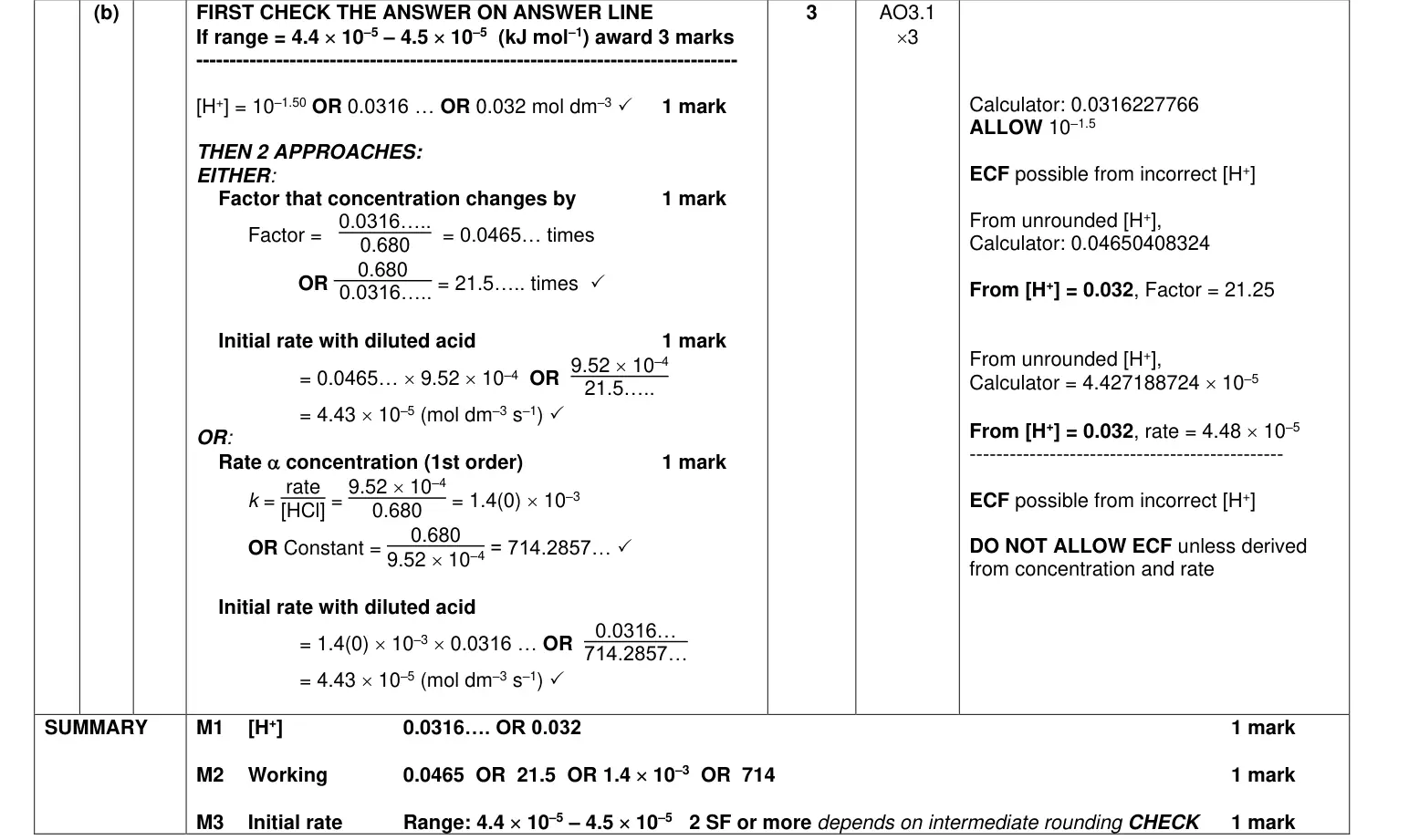
The marks for this calculation were much more polarised than the calculation in Question 2 (a). Many candidates worked through the problem methodically to get an answer for the initial rate between 4.4 10–5 and 4.5 10–5 mol dm–3 s–1. A substantial number of candidates worked out [H+] using 10–pH for 1 mark but were then unable to progress any further. This was a novel calculation, requiring candidates to develop their own strategy for its solution. Candidates who found this question difficult often attempted a solution based on stock weak acid calculation, using [H+]2/[HA].
Skills: M0.2 Use ratios, fractions and percentages; M0.4 Use calculators to find and use power, exponential and logarithmic functions; M2.5 Use logarithms in relation to quantities that range over several orders of magnitude
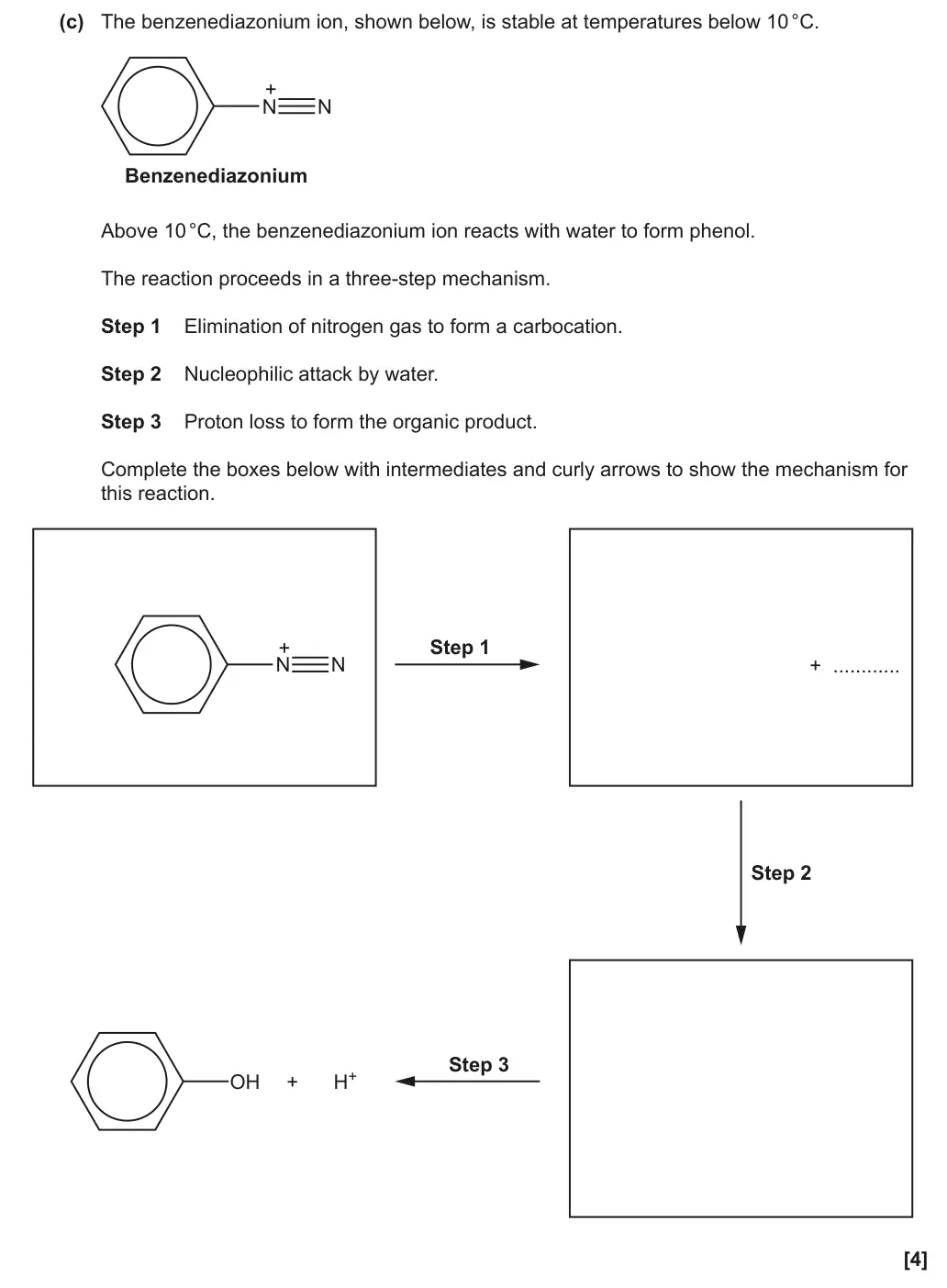
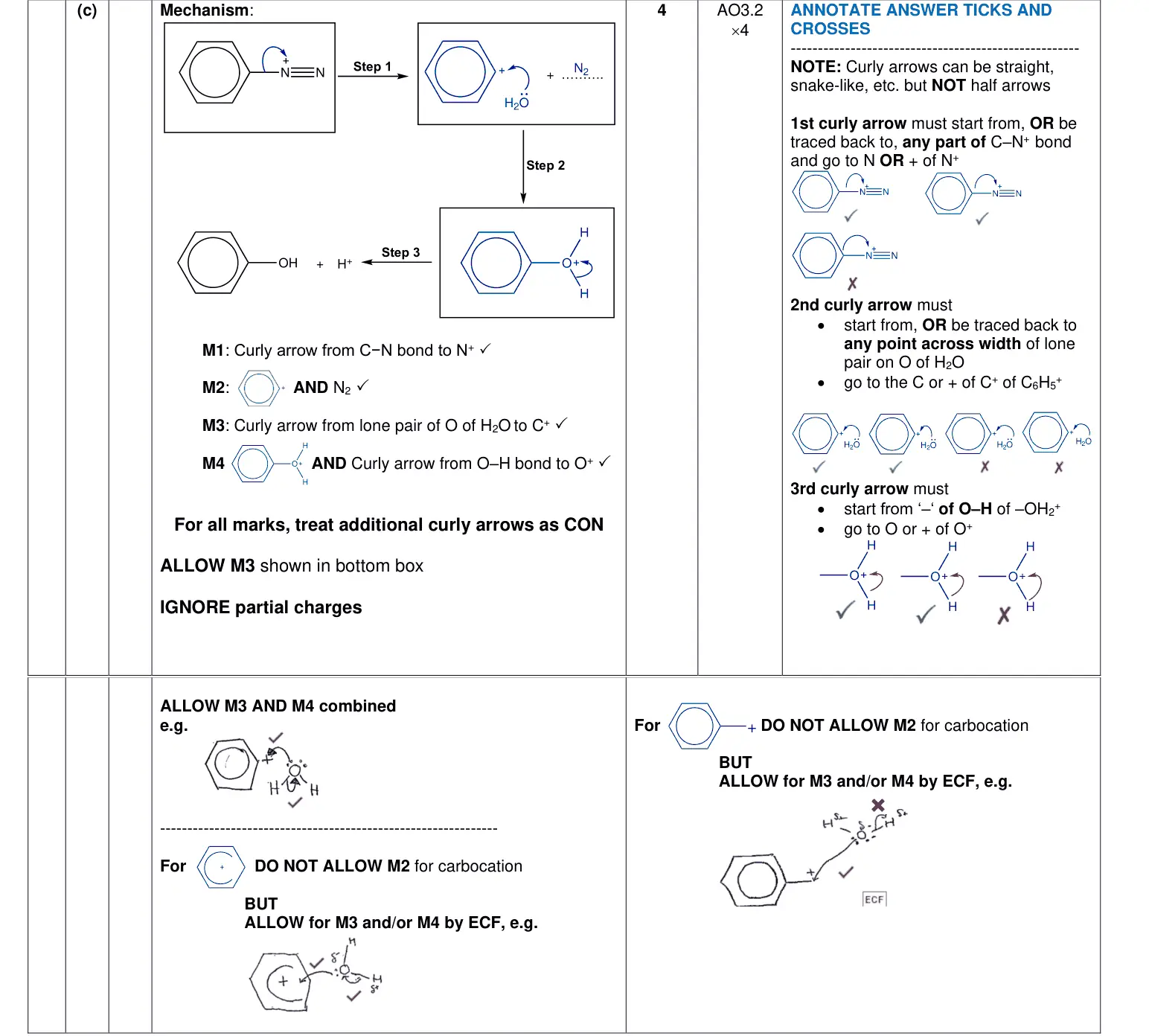
This question required candidates to apply their understanding of organic mechanisms to an unfamiliar reaction. The stem to the question includes important information and clues that should have guided candidates towards this unfamiliar mechanism, with the prompts for the three steps being critical. Many responses fell back to the familiar mechanism for electrophilic substitution, an approach that could not be credited. This question discriminated very well but many candidates scored few marks. This response has been included to show a candidate with an excellent understanding of the meaning of curly arrows and the importance of charges and dipoles. The prompts in the question are followed and the candidate has been given all four marks. Notice how the curly arrows start either from a bond or from a lone pair. The candidate has also realised that the addition of H2O produces a positively charged oxonium ion. Many candidates omitted the ‘+’ charge or showed the curly arrow for loss of a proton going to a H atom rather than the O atom of water.

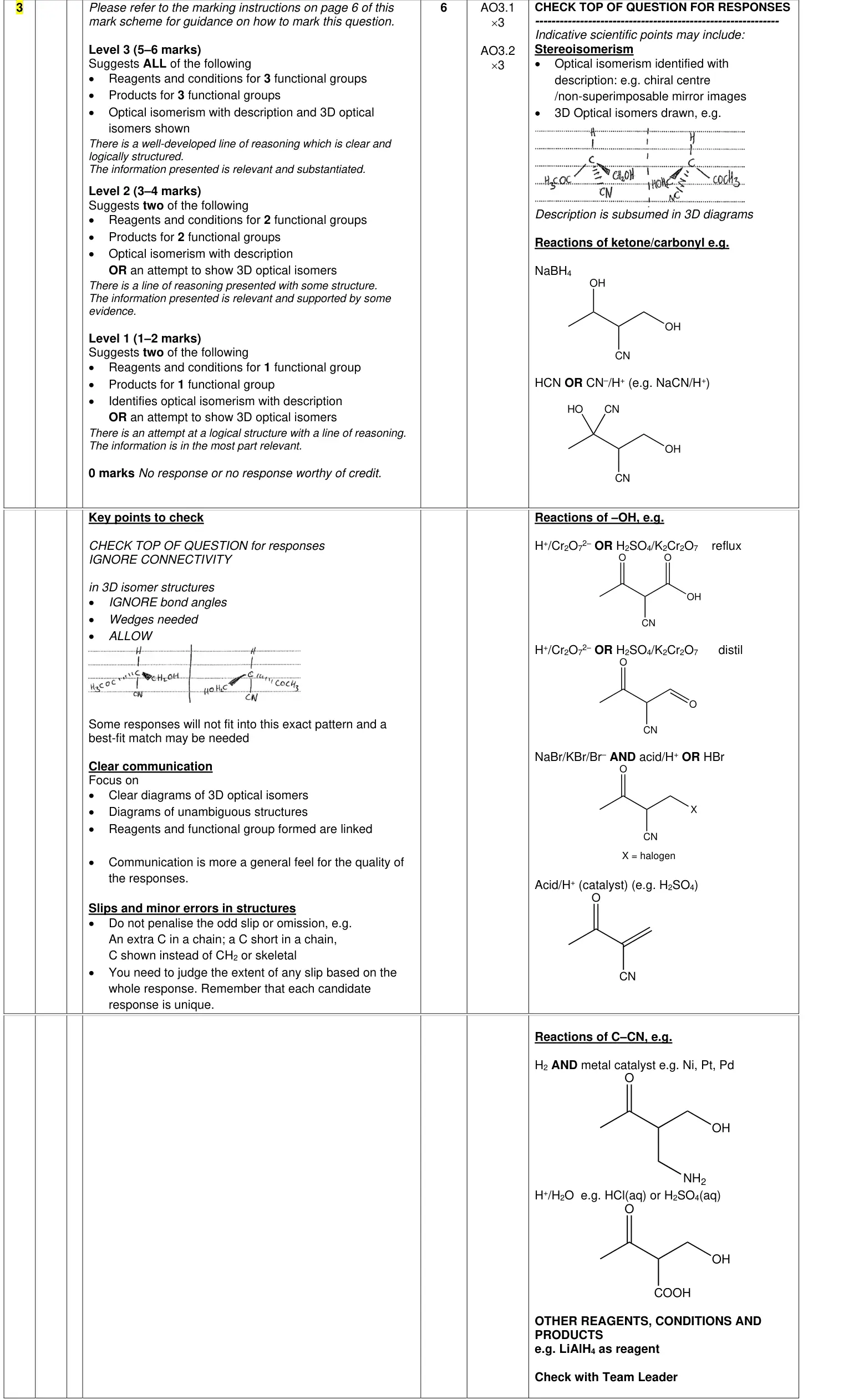
Overall, candidates performed well when answering this question. They were required to identify that compound A shows optical isomerism and to choose a reaction for each of the three functional groups. Candidates were also expected to use structures for the organic products. To achieve the highest level of response, a description of optical isomerism should be accompanied by 3D diagrams of the optical isomers. Optical isomerism was usually identified, with associated diagrams with almost all candidates identifying the chiral centre. Most attempted 3D diagrams but candidates do need to take care that the groups attached to the chiral C atom are those in compound A and that no parts of chains are omitted. Optical isomers do also require use bold and dashed wedges to be used. Most candidates showed good knowledge and understanding of reactions for the three functional groups. • For the primary alcohol, most chose H+/Cr2O72–, with distil (→ aldehyde) or reflux (→ carboxylic acid); a significant number chose a concentrated acid (→ alkene) or Br–-/H+ (→ haloalkane) • For the ketone, most chose NaBH4 (→ secondary alcohol) • For the nitrile, most chose either H2/Ni (→ amine) or H+(aq) (→ carboxylic acid). Clear diagrams of the products were usually seen although many omitted a CH2 from the amine branch for hydrolysis of the nitrile or an extra CH2 in the aldehyde or carboxylic acid branch from oxidation of the primary alcohol. Some candidates chose 2,4-DNP for a reaction of the ketone and treated the question as one requiring tests, and then proving that the compound was a ketone from no reaction with Tollens’ reagent. The question asked for the organic product and the 2,4- DNP product is beyond the demands of this specification (although this was seen very rarely). Candidates adopting this reaction were limiting the extent of their response and candidate should have considered this requirement before selecting 2.4- DNP. This exemplar shows a good response that lacks 3D diagrams for the optical isomers. The candidate has clearly given reagents and conditions and has shown the organic products. In the response, you can see that the candidate initially showed an extra CH2 in the –COOH branch, and a mistake in the amine branch. The absence of 3D structures limits the response to Level 2 and 4 marks have been awarded for choosing correct and relevant reagents and conditions, and for the clear communication of the structures.
Skills: M4.2 Visualise and represent 2-D and 3-D forms including 2-D representations of 3-D objects
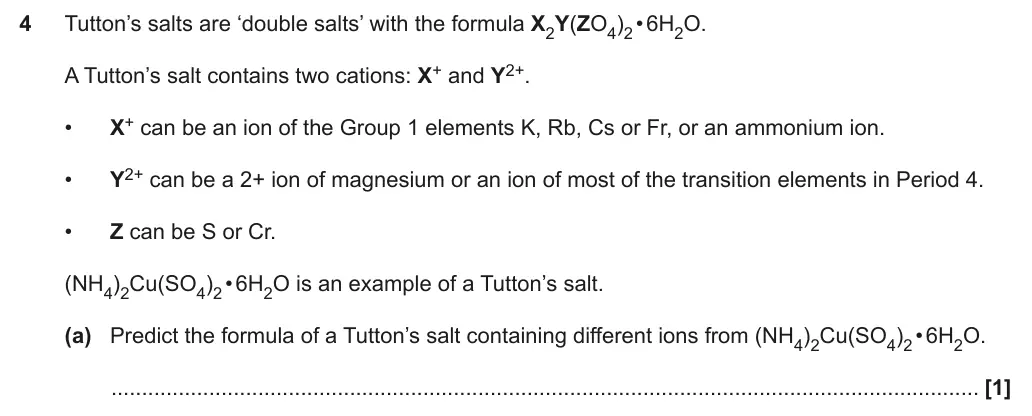
Question 4 assesses candidates’ ability to apply their chemical knowledge and understanding from different parts of the specification in a novel context. Information is supplied throughout the question, and clues are sometimes presented to candidates. In part (a), candidates are introduced to Tutton’s salts and are given an example of a Tutton’s salt that forms the context of the whole question. A candidate needs to apply the information in the bullet points to predict the formula of a different Tutton’s salt. This question discriminated extremely well across different abilities and highlighted that some candidates struggled to use supplied information. This was repeated in other parts of Question 4. Just over half the candidates gave a correct formula from the information. Some candidates did not choose one of the acceptable ions shown in the first and second bullet points, and many chose S rather than Cr, despite S being in the supplied Tutton’s salt; a significant number omitted the •6H2O.
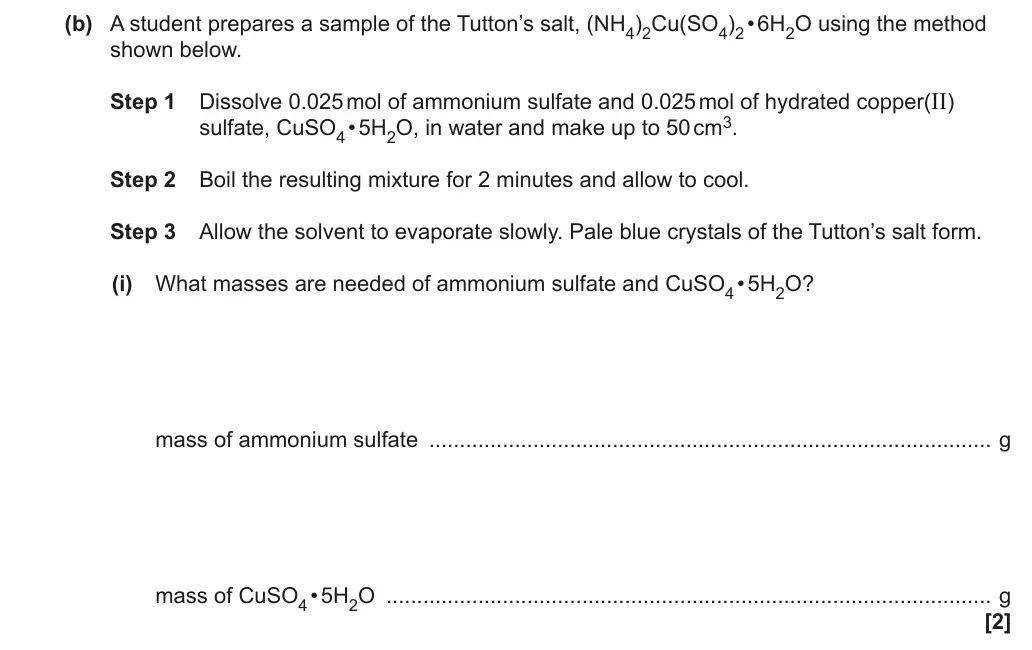
This question required candidates to calculate the masses of two reactants that could be used to prepare a sample of the Tutton’s salt. Candidates were supplied with the formula of hydrated copper(II) sulfate but not the formula of ammonium sulfate, so candidates needed to work out its formula from ions that candidates are expected to be able to recall from the specification. Just over half the candidates obtained both correct masses but many obtained just one correct mass, usually that of CuSO4•6H2O. This exemplar shows a typical response with the incorrect formula of ammonium sulfate clear shown by the candidate, resulting in the incorrect mass of 2.8525 g. This incorrect formula and mass were seen in many responses and, from the initial crossings out, this candidate is clearly confused about how to tackle this simple mole calculation. The incorrect answer of 2.85 g was seen on almost as many scripts as the correct answer of 3.30 g. The moral is that candidates need to learn the formula and charges of the common ions encountered in chemistry. The comments here apply also to Question 6 (b) (i), where formulae need to be written using ions listed in the specification.
Skills: M0.2 Use ratios, fractions and percentages; M2.3 Substitute numerical values into algebraic equations using appropriate units for physical quantities
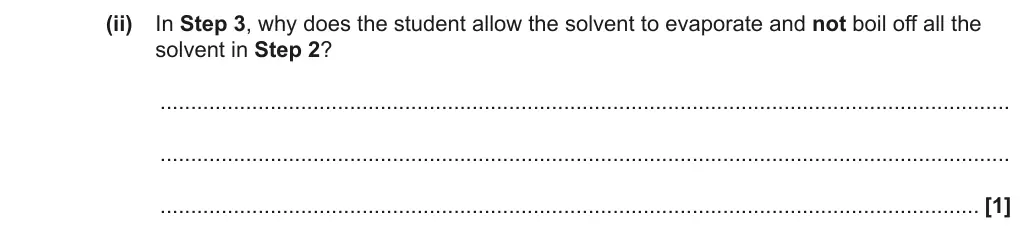
The majority of candidates did not answer this question correctly. Candidates were expected to refer back to the formula of the Tutton’s salt, spot that there was water of crystallisation present, and that this would be lost if all the solvent was boiled off. Many responded vaguely in terms of decomposition or formation of larger crystals but a mark was only awarded if there was a definite link to the water contained within the crystals.
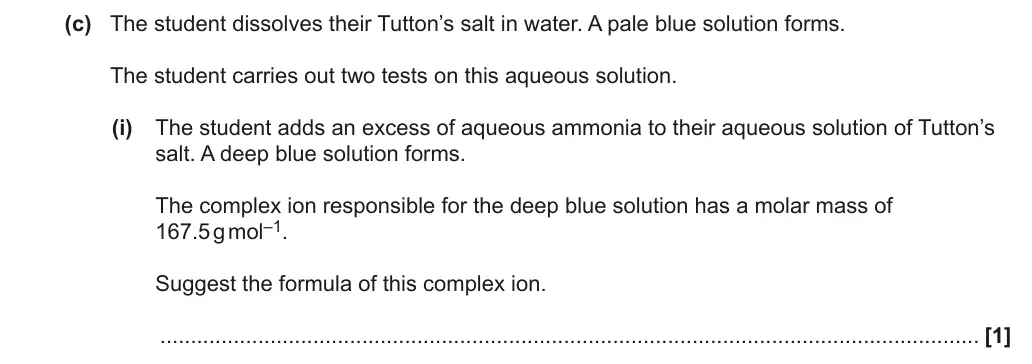
This reaction of copper(II) ions with aqueous ammonia and the formula of the complex ion formed are part of the specification. Within this novel context, the molar mass had been provided as a clue. Less than half the candidates correctly gave the correct formula and it was noticeable how well this part discriminated across abilities. This was another example of many candidates being unable to apply their knowledge and understanding to a novel context.
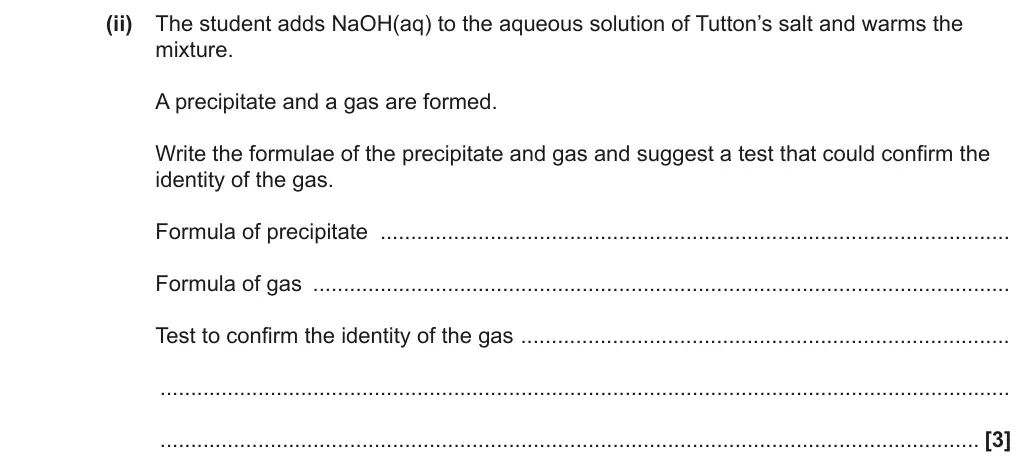
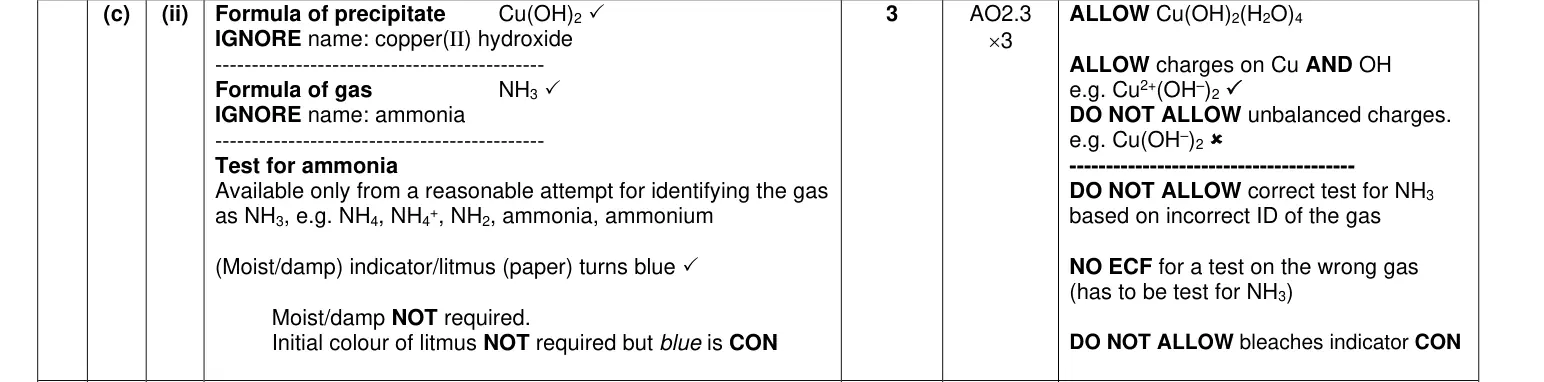
Addition of NaOH(aq) to the Tutton’s salt results in two reactions: precipitation of copper(II) hydroxide and a reaction of an ammonium ion, used to show its presence as a qualitative test. As with Question 4 (c) (i), this part discriminated very well with many candidates able to be rewarded with some of the marks. The formula of copper(II) hydroxide, as Cu(OH)2 or Cu(OH)2(H2O)2 were both acceptable. This was correct more often than the responses related to the ammonium ion. The formula of the gas formed in the reaction of NaOH(aq) with the ammonium ion caused problems, with NH3 and its subsequent test with moist indicator turning blue seen much less than the reaction of Cu2+(aq) ions. Hydrogen (the ‘squeaky pop test) and oxygen (relighting a glowing split) were common incorrect responses. This was another question in which referring back to the formula of the Tutton’s salt would have revealed important clues.
Skills: PAG4 Qualitative analysis of ions

Th final part of Question 4 required candidates to identify the anion in the Tutton’s salt as sulfate, and to recall that Ba2+ ions is used for the sulfate test to form a white precipitate. Any soluble barium compound was credited with barium chloride and nitrate being the commonest seen. As with earlier parts, this part discriminated very well. Most candidates who knew that barium ions were needed also collected the mark for the white precipitate observation. Over half the candidates did not score here, the most common errors being to repeat the test for the ammonium ion, or to use silver nitrate, clear confusion with the halide test.
Skills: PAG4 Qualitative analysis of ions
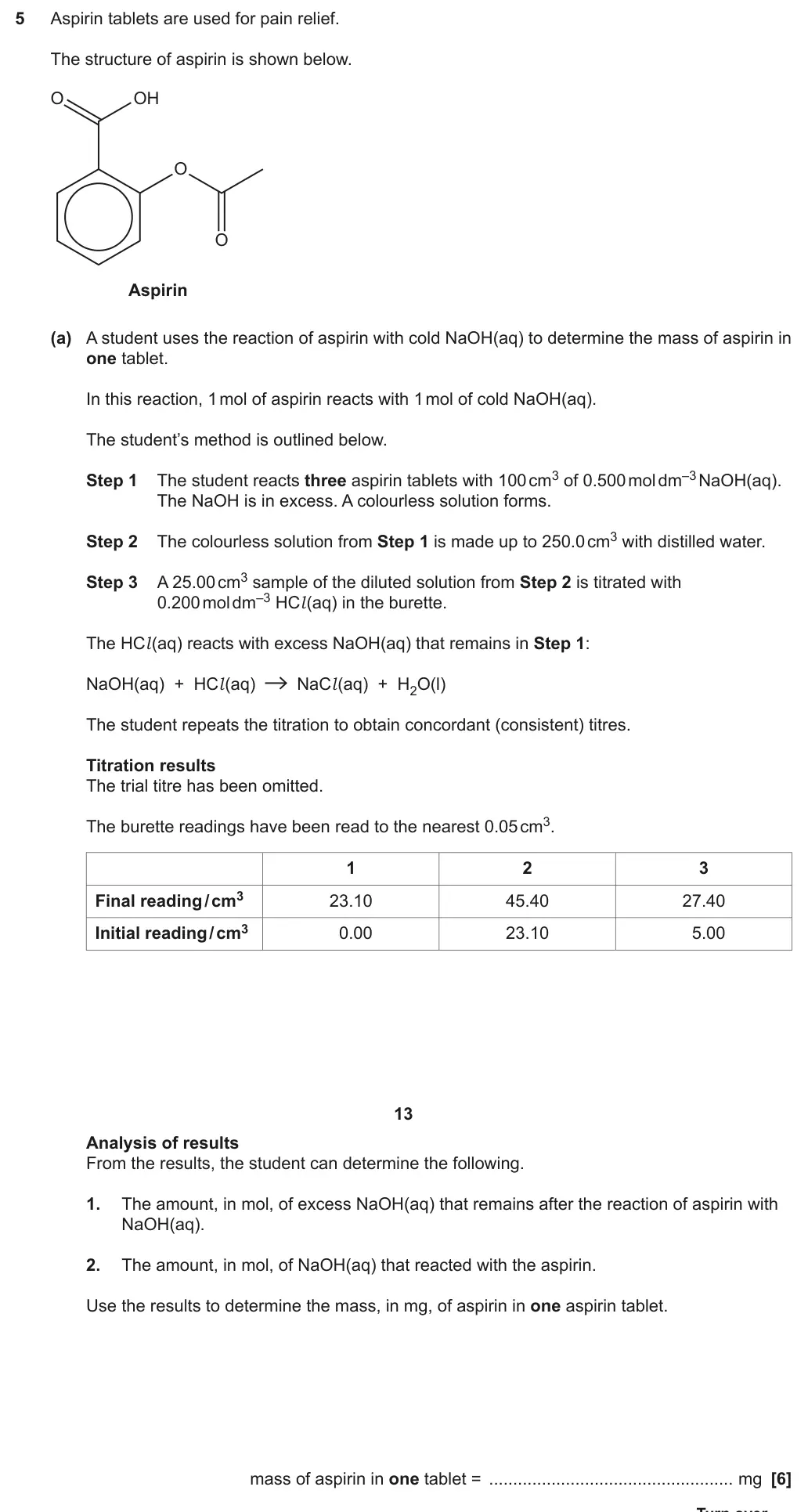
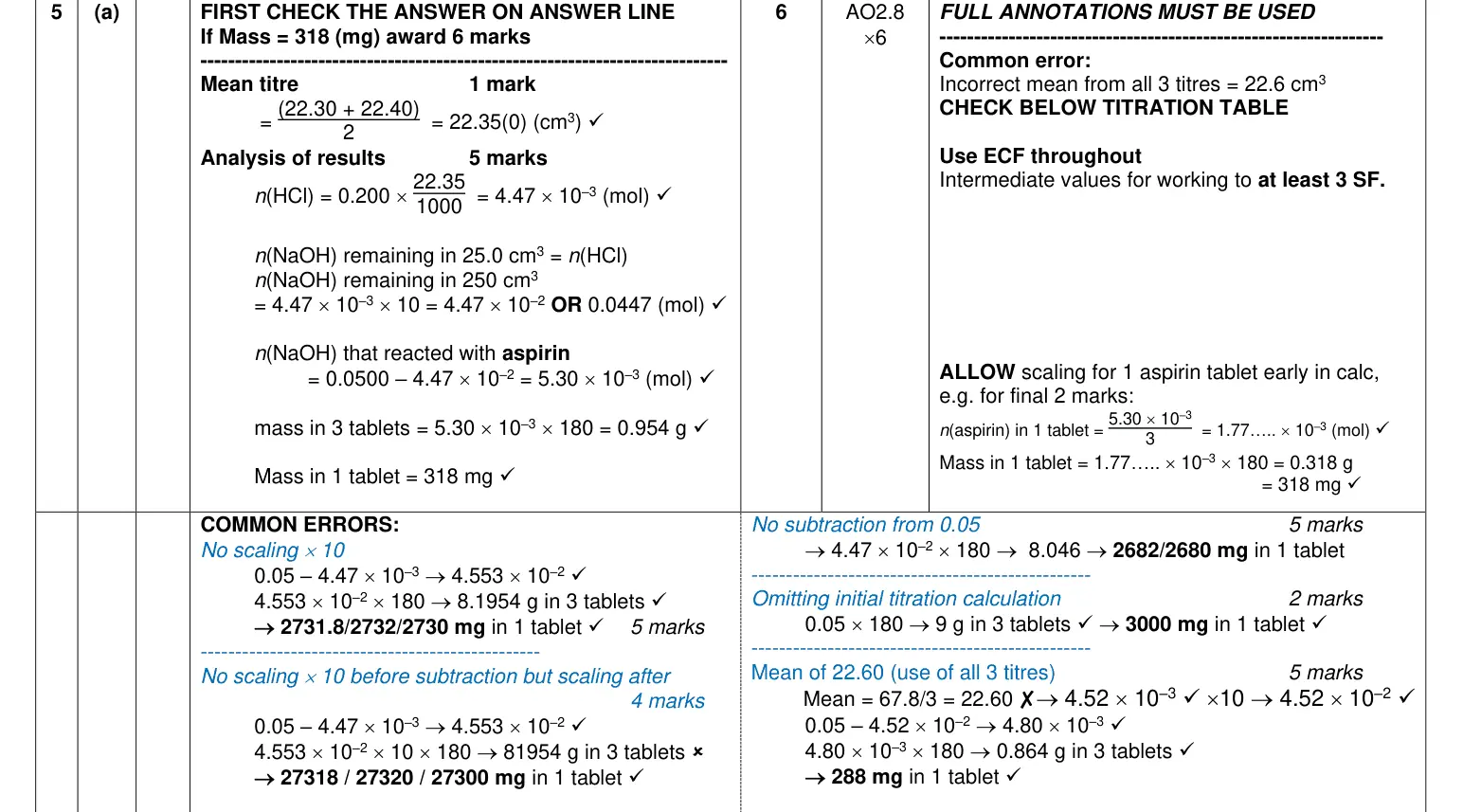
Compared with the application based Question 4, candidates answered this stock titration calculation well. Almost all candidates determined that the mean titre was 22.35 cm3 and went on to calculate the number of moles of HCl as 4.47 10–3 mol. Most scaled this value by 10 to determine the moles in 250 cm3. Most candidates then used the initial moles of HCl to determine the moles of aspirin in the 3 tablets as 5.30 10–3 moles. A significant number omitted this stage but they were able to be credited for the next stage of calculation using a correct method. Consequently over half the candidates were awarded 5 or 6 marks for this stock calculation.
Skills: M0.0 Recognise and make use of appropriate units in calculations; M0.2 Use ratios, fractions and percentages; M1.2 Find arithmetic means; M2.3 Substitute numerical values into algebraic equations using appropriate units for physical quantities; PAG2 Acid–base titration

Most candidates drew a diagram that looked like a vertical condenser above a flask. The quality of the diagrams was not very good. Candidates then needed to label their diagram. Errors included a bung or thermometer inserted at the top of the condenser and water flowing the wrong way in the condenser. For labelling, candidates were expected to use scientific terminology. Responses such as ‘condensation tube’ and vague terms such as ‘flask’ were not credited. These labels were often omitted. A significant number drew a set up for distillation instead of reflux.
Skills: PAG5 Synthesis of an organic liquid
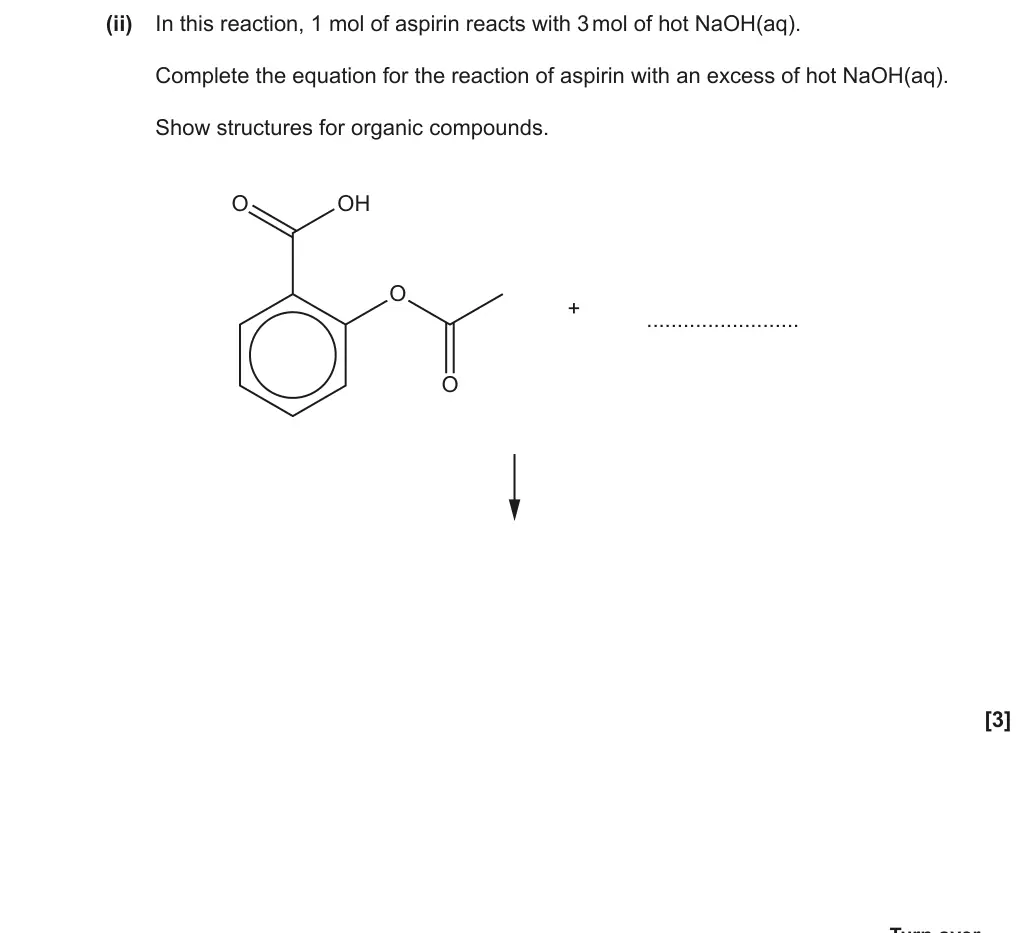
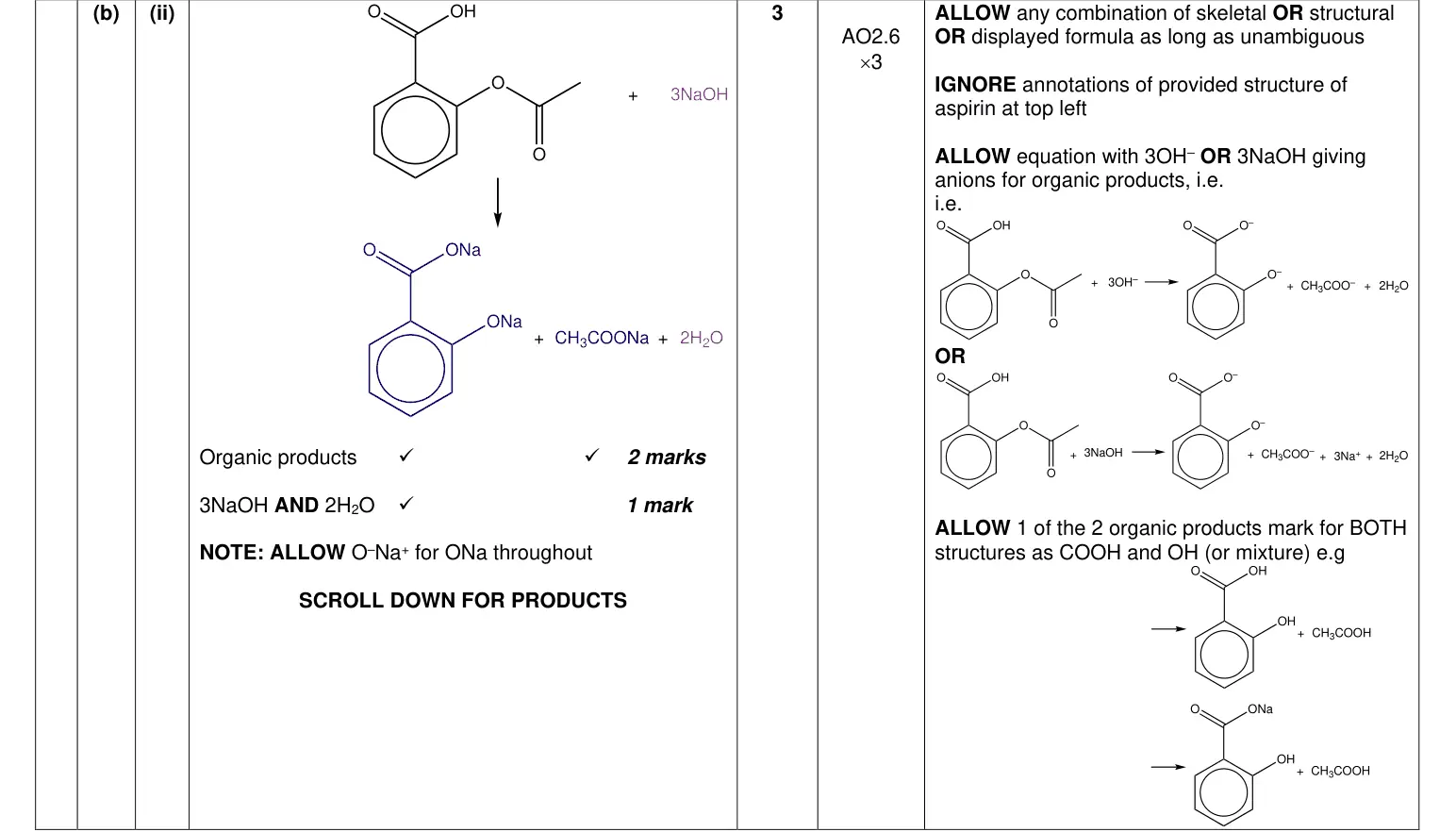
This question was the hardest part of Question 5 and about half the candidates were not given any marks. Some drew the sodium carboxylate salt of aspirin structure, leaving the ester link intact. A large number of candidates realised that the ester would be hydrolysed. Sometimes the sodium salts were often not shown and, even they were shown, the phenol group was often shown intact. The hardest mark was the formation of 2H2O and a large number of candidates showed the more intuitive but incorrect ‘3H2O’ instead.
Skills: M0.2 Use ratios, fractions and percentages
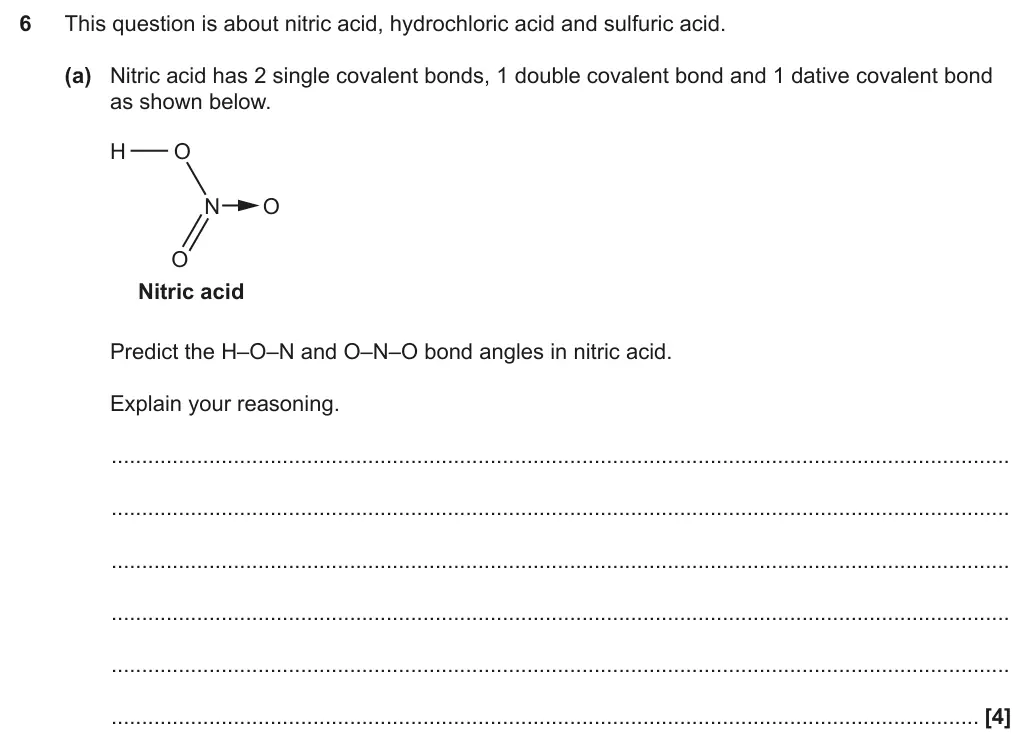
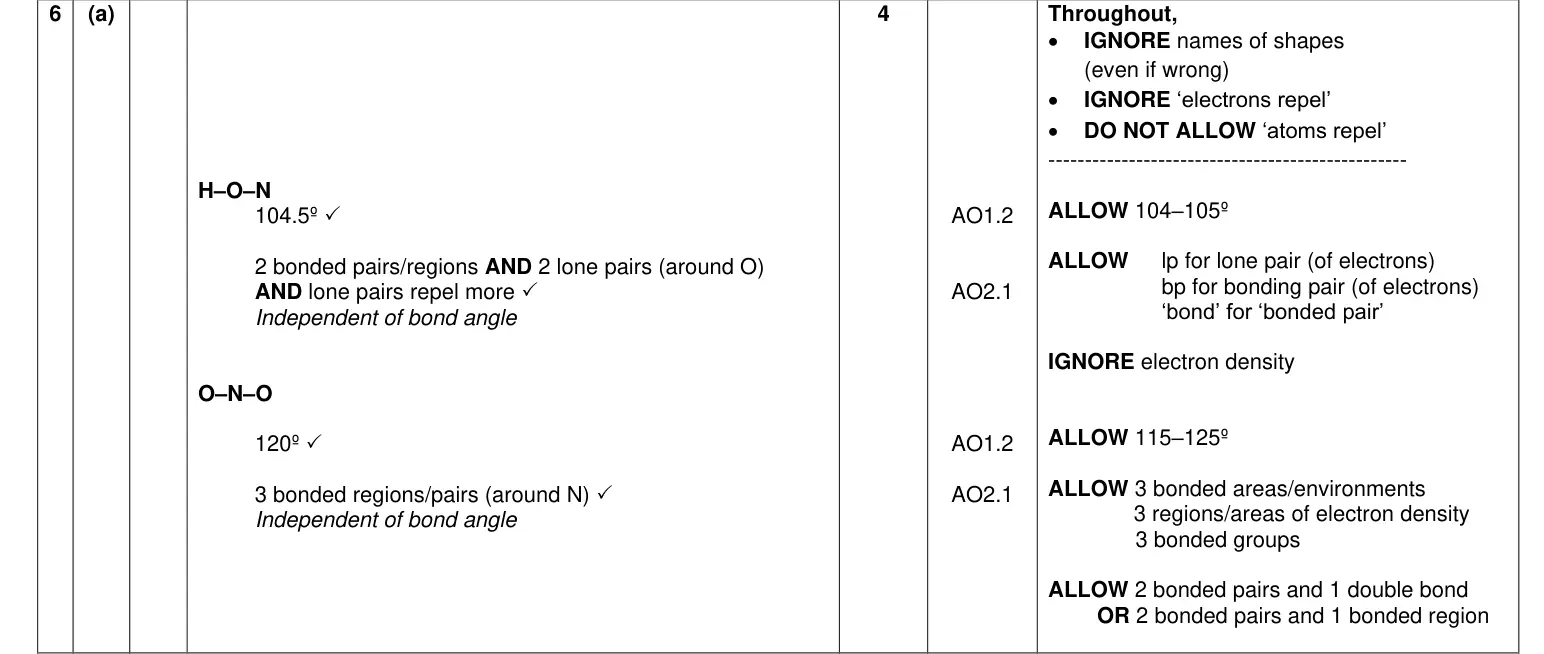
This question required candidates to apply their knowledge and understanding of bond angles and electron pair repulsion in a novel context. The best candidates rose to this challenge, securing all four marks for correct bond angles and explanations in terms of the numbers of bonded and lone pairs. The 104.5º and 120º were commonly seen and high scoring candidates provided excellent reasoning. The best explanation for 120º was in terms of three bonding regions and no lone pairs. Lower scoring responses often reasoned that bond angles are determined by lone pairs repelling the atoms, with the role of bonding pairs often being ignored.
Skills: M4.1 Use angles and shapes in regular 2-D and 3-D structures

Candidates were required to write a balanced equation for an acid–base reaction. As with Question 4 (b) (ii), candidates needed to write formulae from what should have been common ions, but the formulae for aluminium oxide and aluminium nitrate were often incorrect. In the equation, the reactants and products were sometimes unbalanced, or incorrectly balanced. A common error was H2 instead of H2O as the second product. The question was an excellent discriminator.
Skills: M0.2 Use ratios, fractions and percentages
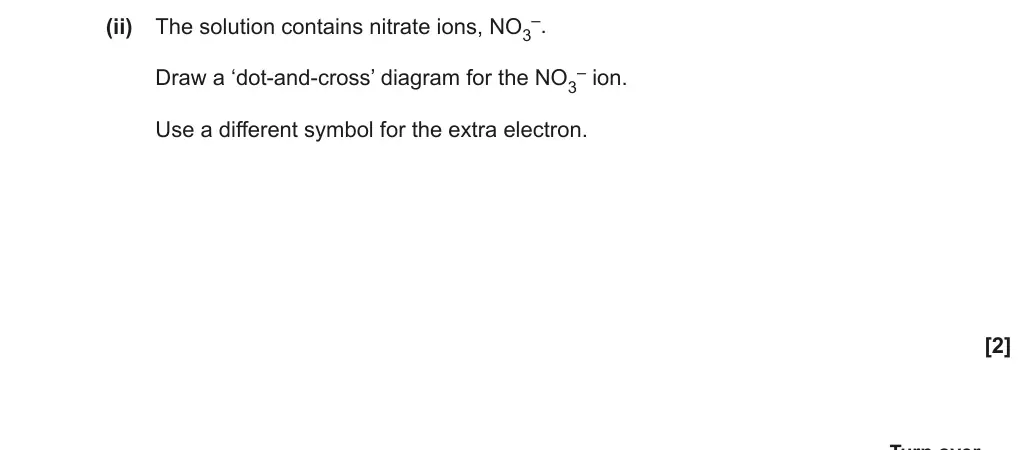
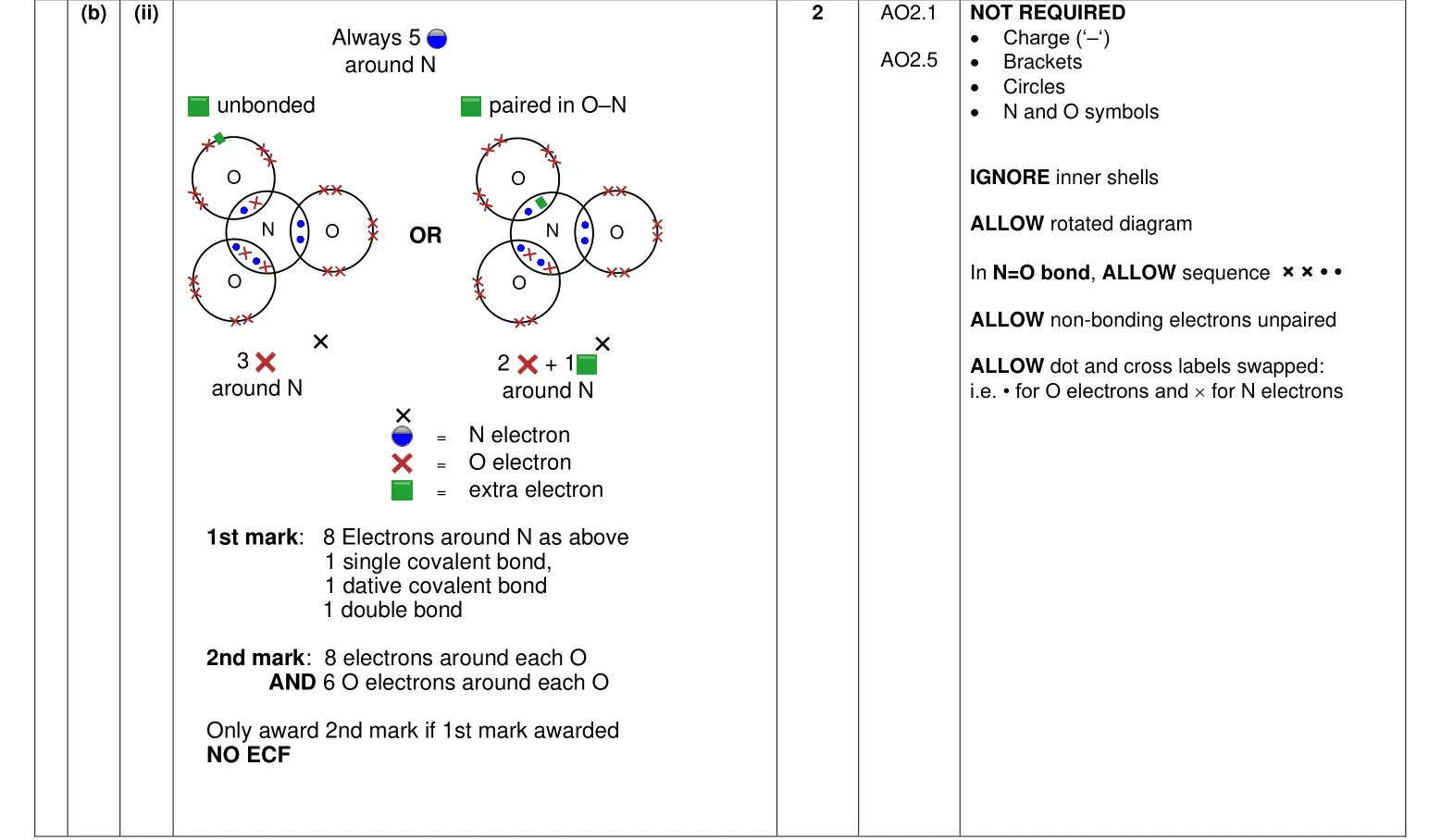
Candidates were expected to use the displayed formula of nitric acid to identify that the central N atom had one double bond, one covalent bond and one dative covalent bond. This information then gave the strategy for the dot and cross diagram. Although virtually all candidates attempted the dot and cross diagram, only about a quarter of candidates could be credited with a meaningful response. The key was to use nitrogen’s 5 outer shell electrons and to combine these with 3 oxygen electrons or 2 oxygen electrons and the extra electron. Then the remaining oxygen electrons could be added, taking care that there were 6 around out O atom. Finally the extra electron would need to be placed in an octet gap. Many candidates showed just 4 nitrogen electrons and this approach resulted in no marks. Other common errors included 3 double bonds around the N atom, and a lone pair on the N atom. This dot and cross diagram discriminated between higher scoring candidates extremely well.
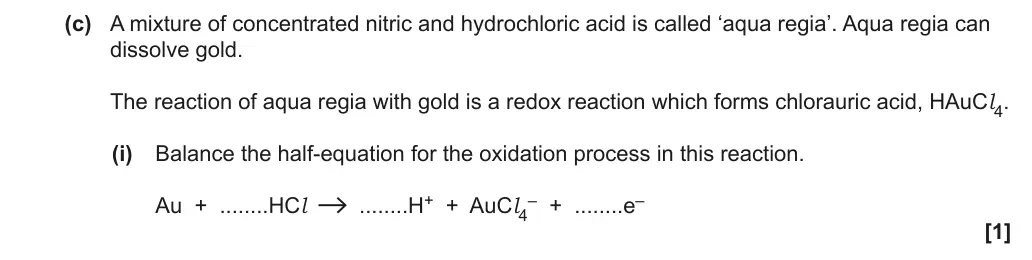
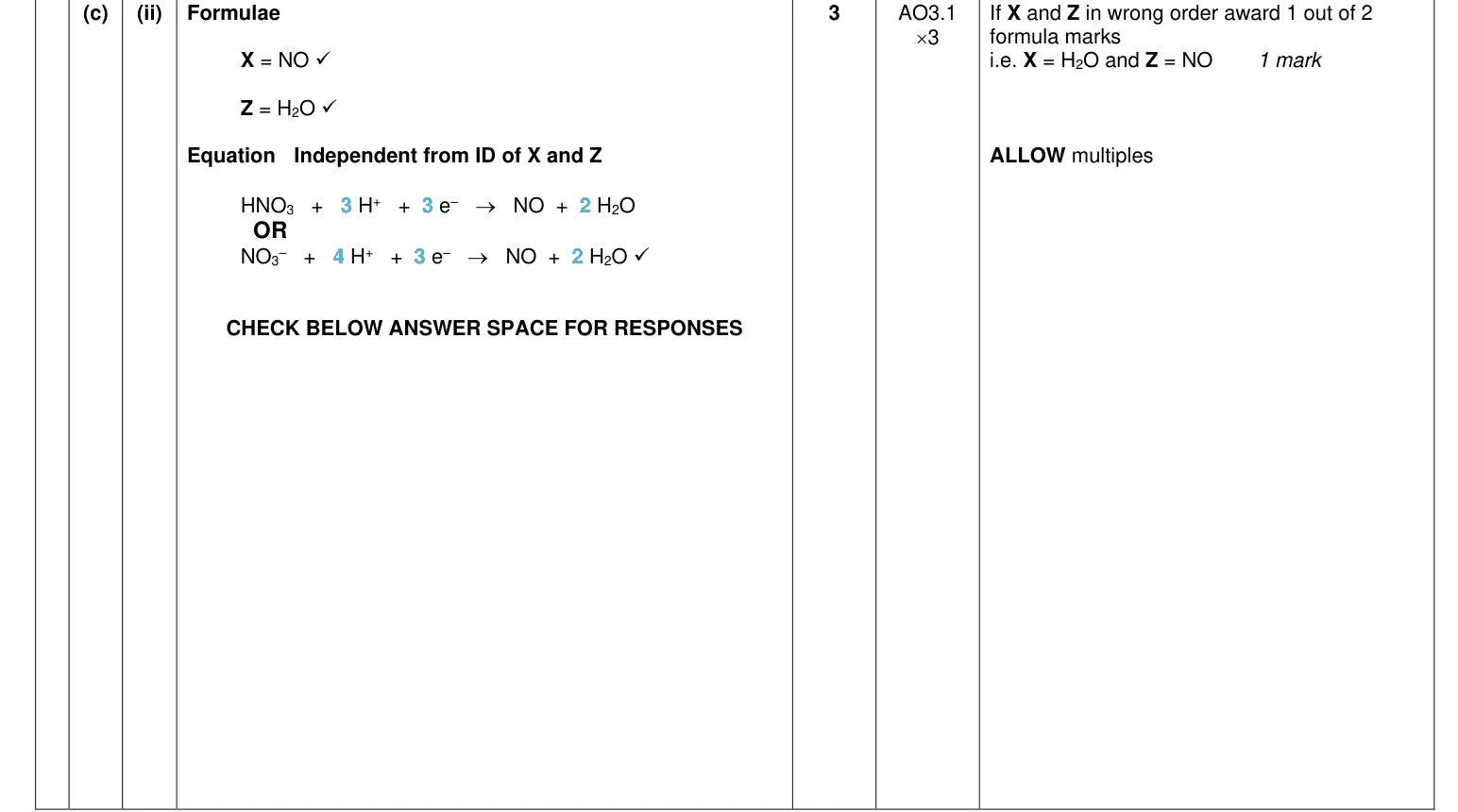
Most candidates added ‘4’ before HCl and H+, and 3 before e– to gain this mark. Where an error was made, it invariably was with the number of electrons, usually 4e–.
Skills: M0.2 Use ratios, fractions and percentages
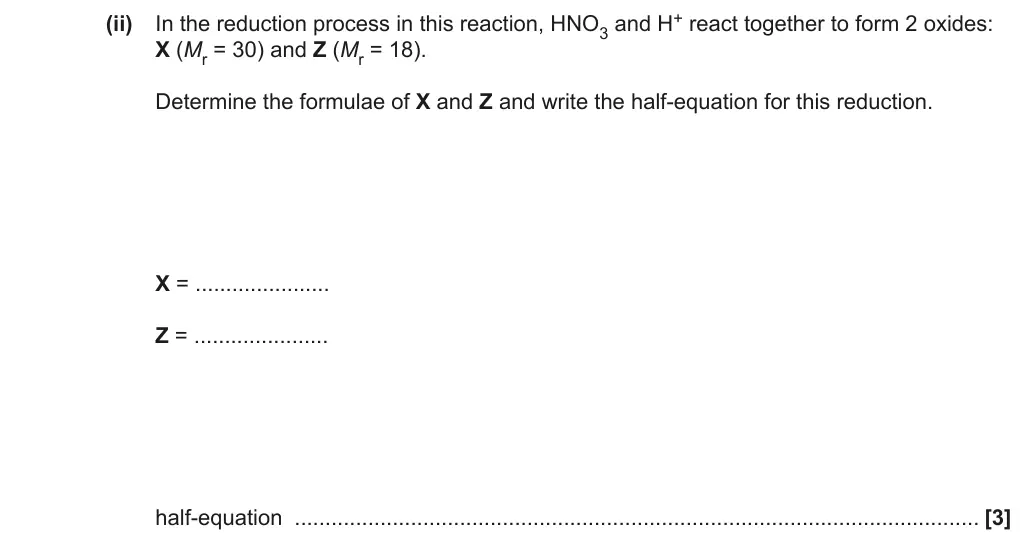
Almost all candidates identified X and Y as NO and H2O respectively, but the equation proved to be much more testing. Some candidates were careless, showing NO and H2O the wrong way round (credited with 1 out of these 2 marks) or with charges. For the equation, candidates needed to consider the oxidation number change of N from +5 to +2, This should have naturally led to 3e– being added on the left-hand side. Many candidates omitted the electrons entirely. Some did add 3e– but on the right. This suggests that candidates would benefit with practising the construction of half equations.

As with the stock titration calculation in Question 5 (a), candidates were much more comfortable in tackling a stock Kc calculation. These have been assessed in several previous H432/01 exams and many excellent responses were seen, gaining all 5 marks. Error carried forwards allowed for an early slip in the calculation to be credited subsequently for a correct method. The hardest part of the calculation was the initial determination of the equilibrium moles and concentrations. The equilibrium moles of O2 was the main error, presumably from the 2:1:2 stoichiometry. Some candidates multiplied by 2 instead of dividing by 2 for the concentration. A common error was for candidates to use a partial pressure approach. These errors lost intermediate marks by credit could then be awarded for using the correct Kc expression to generate a Kc value with correct units. Very few candidates did not gain any marks.
Skills: M0.0 Recognise and make use of appropriate units in calculations; M0.2 Use ratios, fractions and percentages; M1.1 Use an appropriate number of significant figures; M2.3 Substitute numerical values into algebraic equations using appropriate units for physical quantities
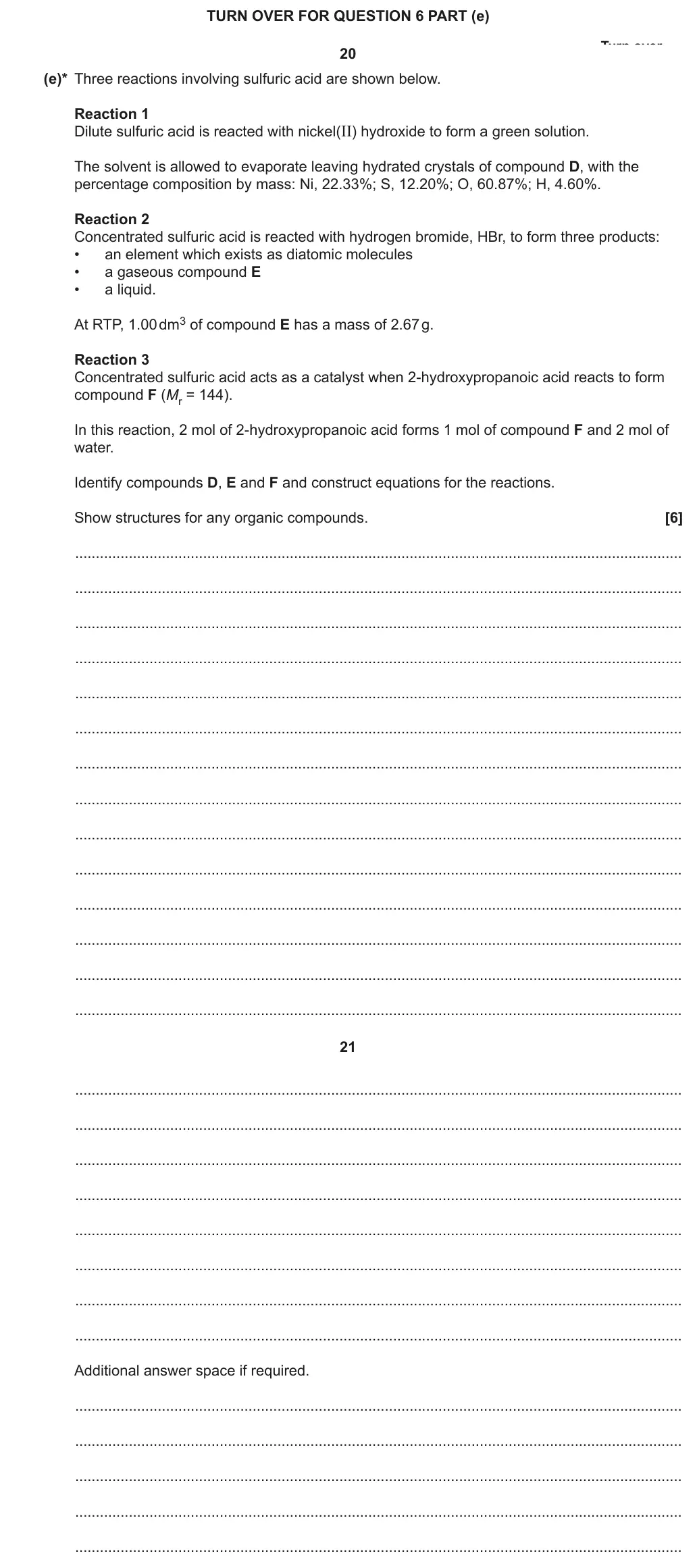
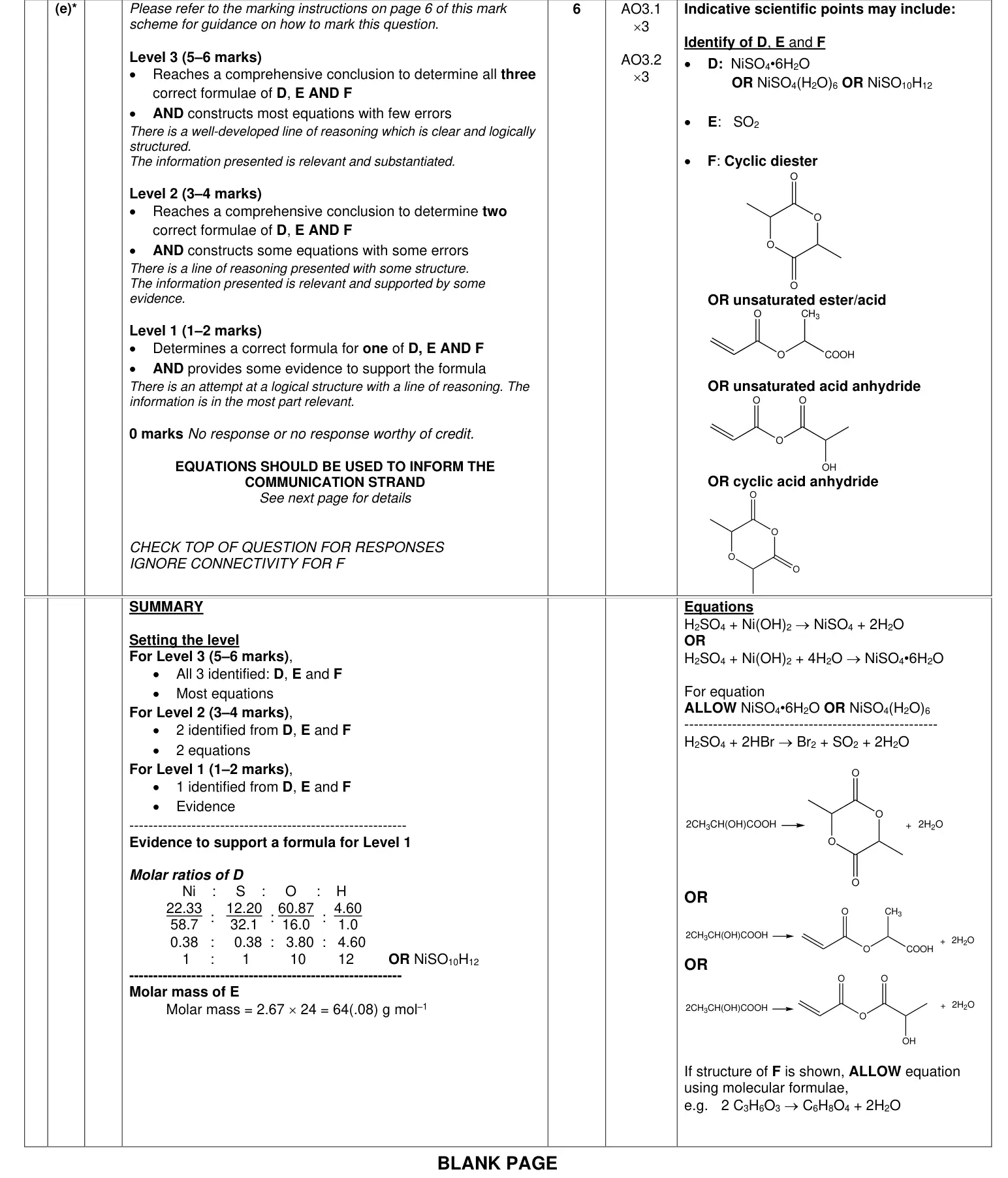
This level of response question required candidates to interpret three pieces of information to identify 3 unknown chemicals, linked by three reactions of sulfuric acid. Levels were assigned based on identifying the three unknowns and writing equations for the reactions. The 3 reactions were tiered in difficulty with the cyclic structure for compound F being the most difficult. The question discriminated extremely well, with comparatively few candidates not scoring any marks. This exemplar shows an excellent response which was awarded Level 3 and 6 marks. The crossing out shows how the candidate progressively solved the problem. Despite the crossing out, working is shown throughout, and the presentation of the response is very clear. For reaction 1, the candidate initially made an error in the stock formula determination calculation. Notice that the candidate crossed out their initial values and wrote them afresh. This approach is recommended. as changing incorrect numbers can lead to ambiguous numbers. In reaction 2, the candidate comfortably identified compound E from its molar mass and wrote a balanced equation for this reaction. For reaction 3, you can see how the candidate’s thought developed during the solve. They initially went for a straight chain structure and then worked out that there must be a cyclic structure. They finally show the cyclic diester as a conventional structural (based on glucose?), and with a balanced equation. This was an excellent response of a high-ability candidate and shows what a well-prepared candidate is capable of achieving.
Skills: M0.2 Use ratios, fractions and percentages; M2.3 Substitute numerical values into algebraic equations using appropriate units for physical quantities
Want a paper marked and gone through with you? Message us.