June 2024: Paper 2, Synthesis and analytical techniques

100 marks · 46 question parts · Paper, mark scheme and report on OCR's site · Have OCR's Data Sheet beside you

Question by question

QTopicMarksAOType
1 Bonding, structure and shapes of molecules 1Multiple choice
2 Alkenes 1Multiple choice
3 Haloalkanes, Chromatography and tests for functional groups 1Multiple choice
4 Alkenes, Alkanes 1Multiple choice
5 Chromatography and tests for functional groups, Organic synthesis and practical techniques (Module 4) 1Multiple choice
6 Amount of substance (moles) 1Multiple choice
7 Infrared spectroscopy and mass spectrometry 1Multiple choice
8 Haloalkanes 1Multiple choice
9 Amino acids, amides and chirality 1Multiple choice
10 Amount of substance (moles) 1Multiple choice
11 Infrared spectroscopy and mass spectrometry 1Multiple choice
12 Polyesters and polyamides 1Multiple choice
13 Chromatography and tests for functional groups 1Multiple choice
14 NMR spectroscopy and combined techniques 1Multiple choice
15 Alkenes 1Multiple choice
16(a) Organic basics: naming, formulae and isomerism 1Structure / isomer
16(b) Organic basics: naming, formulae and isomerism 1Short answer
16(c) Organic basics: naming, formulae and isomerism 1Short answer
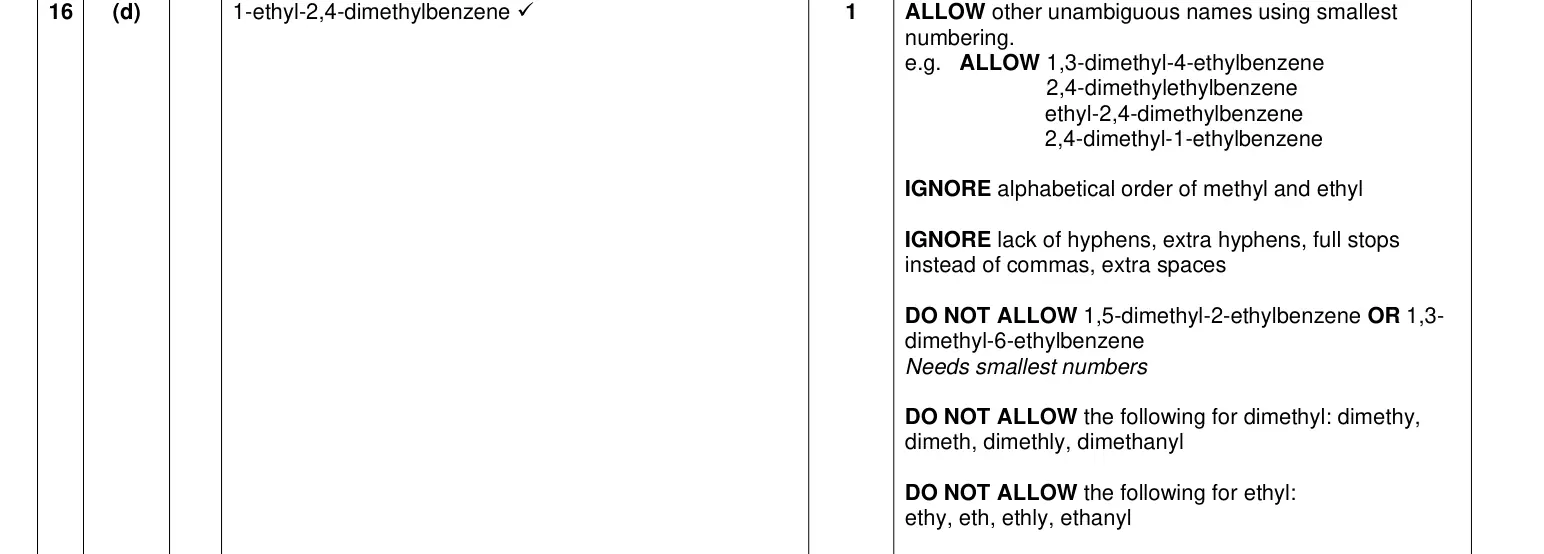
16(d) Aromatic compounds: benzene and phenol 1Short answer
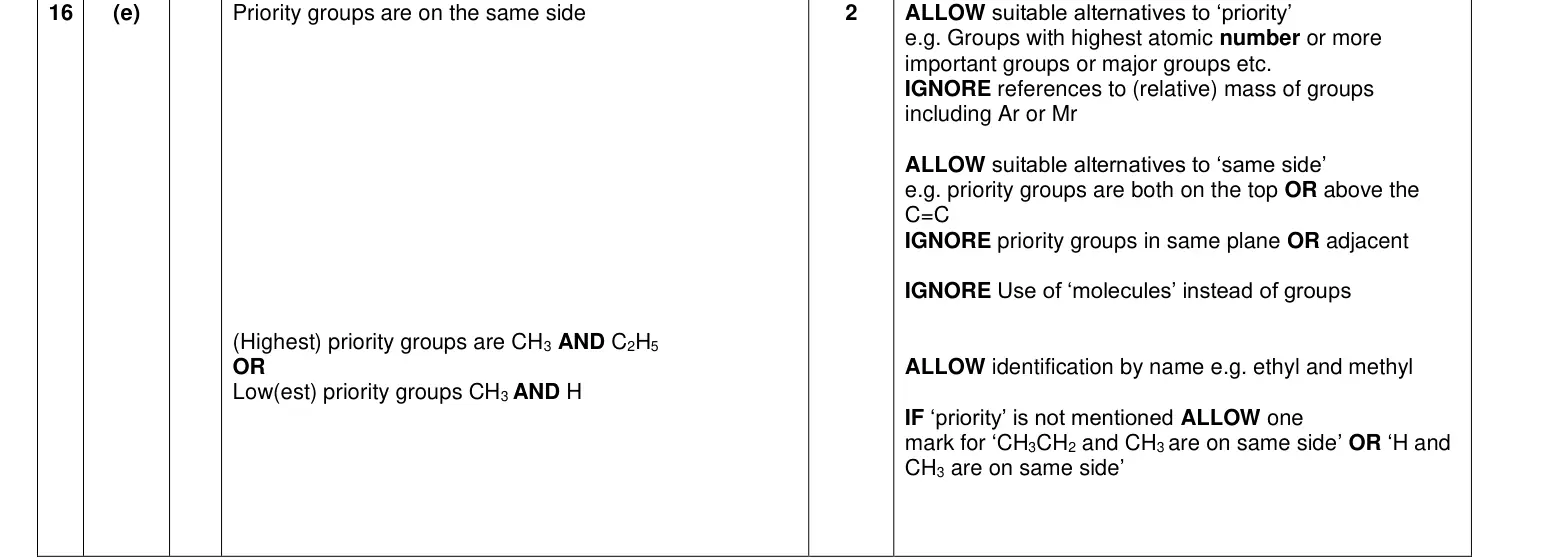
16(e) Alkenes 2Short answer
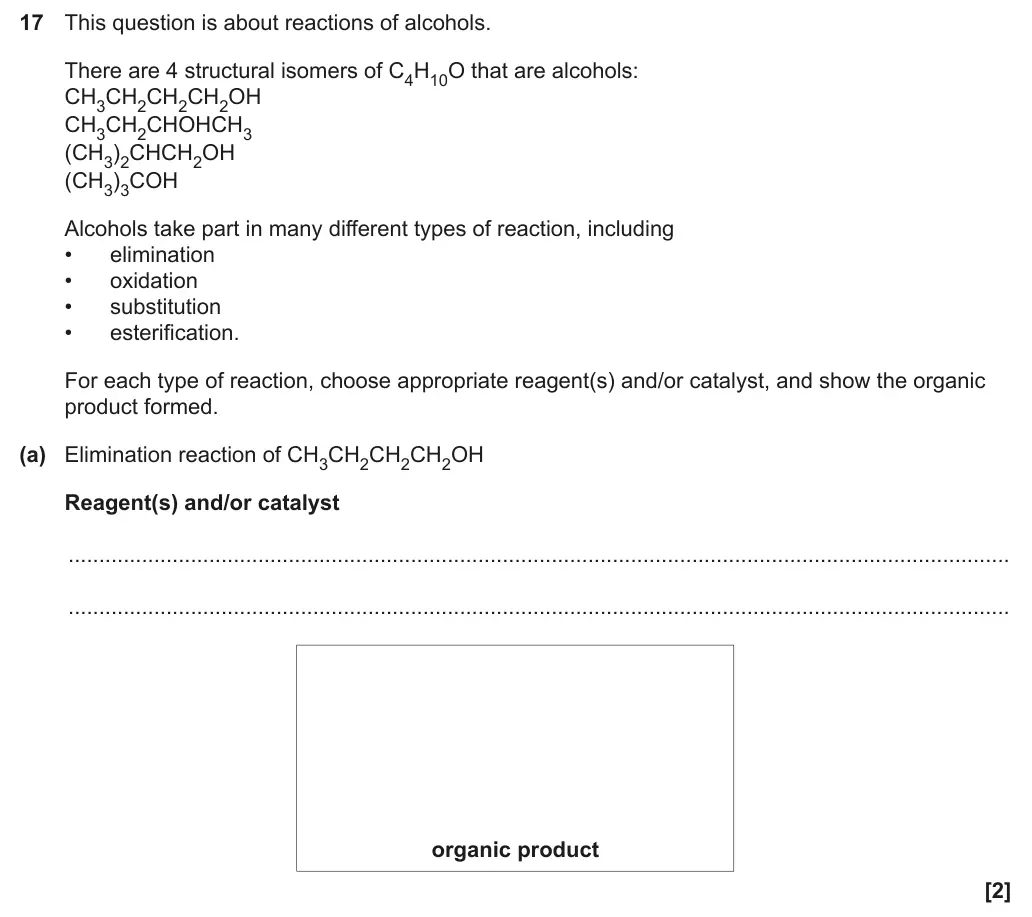
17(a) Alcohols 2Short answer
17(b) Alcohols 2Short answer
17(c) Alcohols 2Short answer
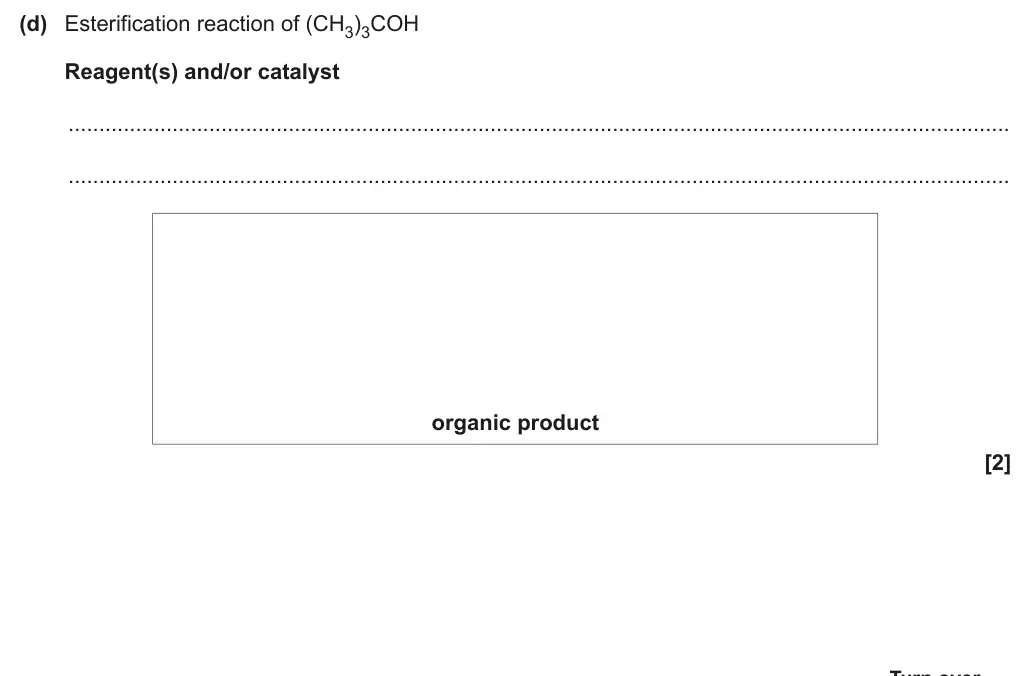
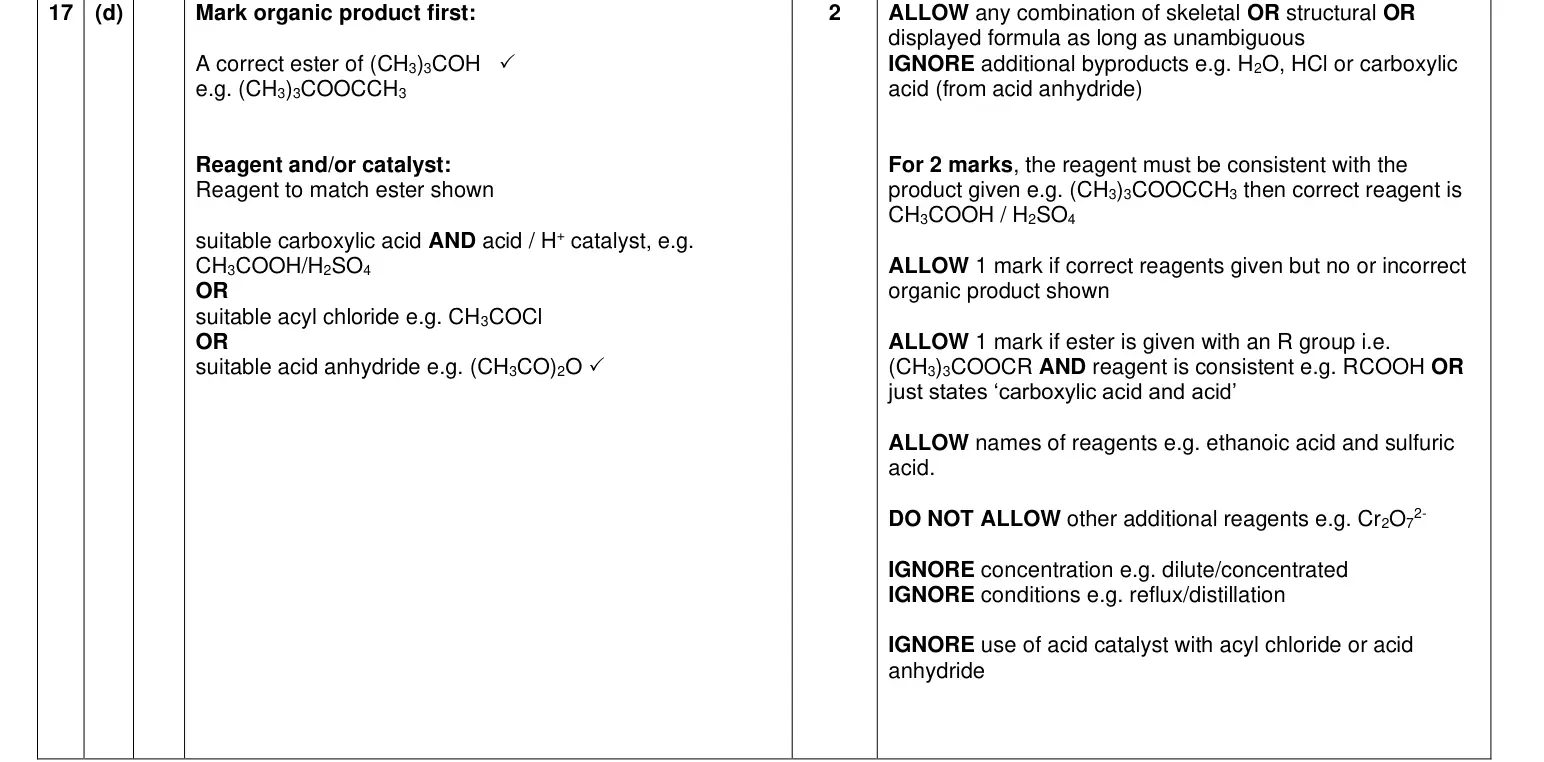
17(d) Carboxylic acids, esters and acyl chlorides 2Short answer
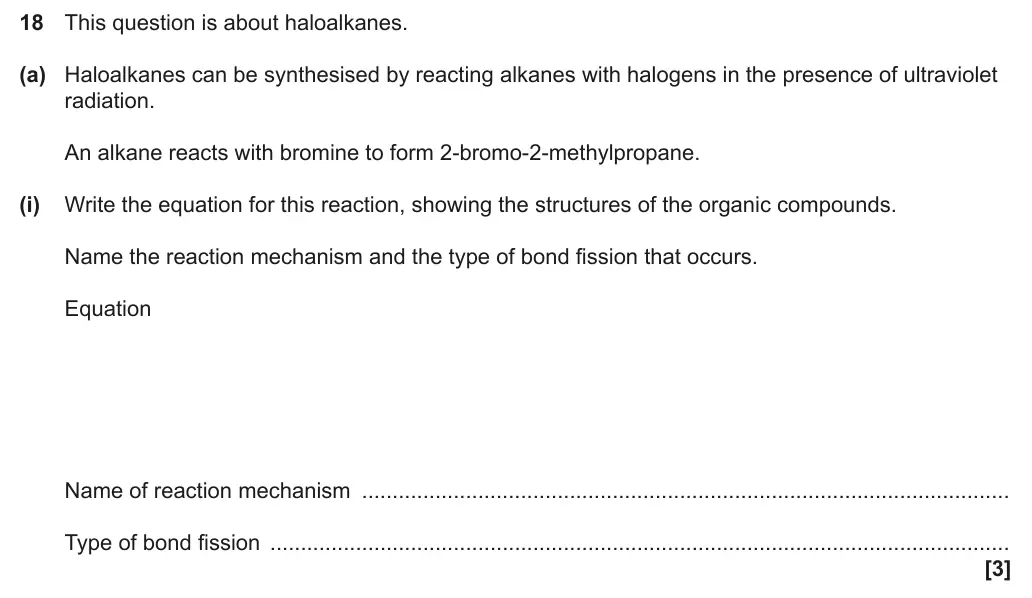
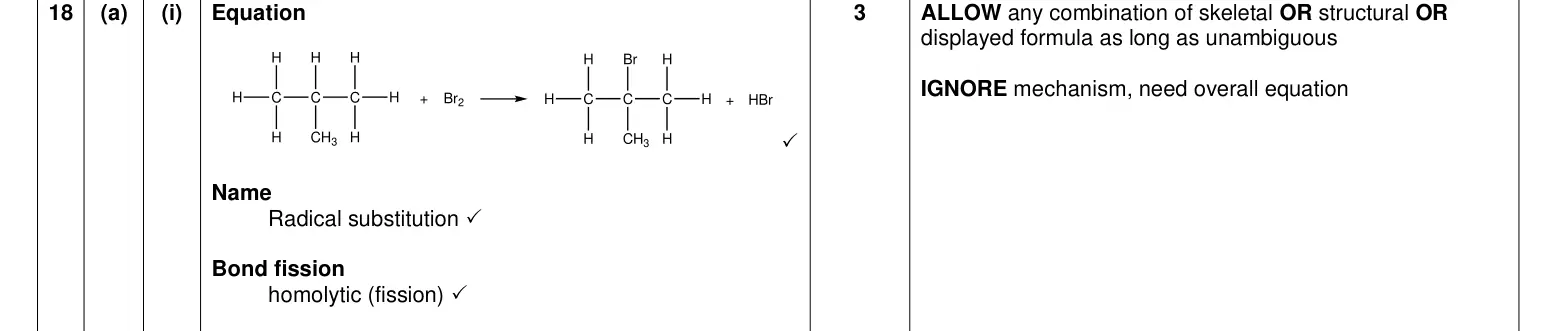
18(a)(i) Alkanes, Organic basics: naming, formulae and isomerism 3Equation writing
18(a)(ii) Alkanes 2Short answer
18(b) Amines, Haloalkanes, Carbon–carbon bond formation 9Short answer
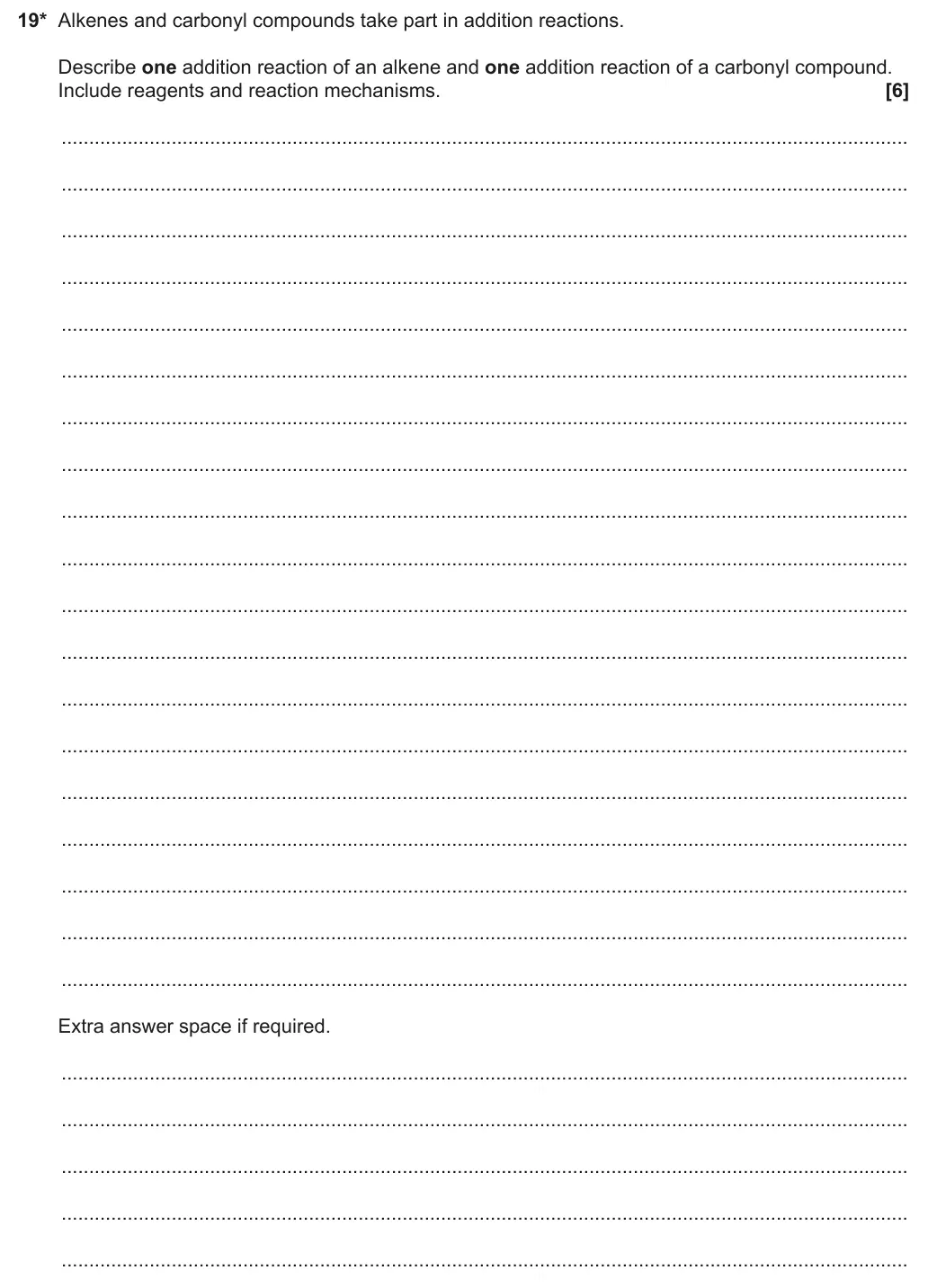
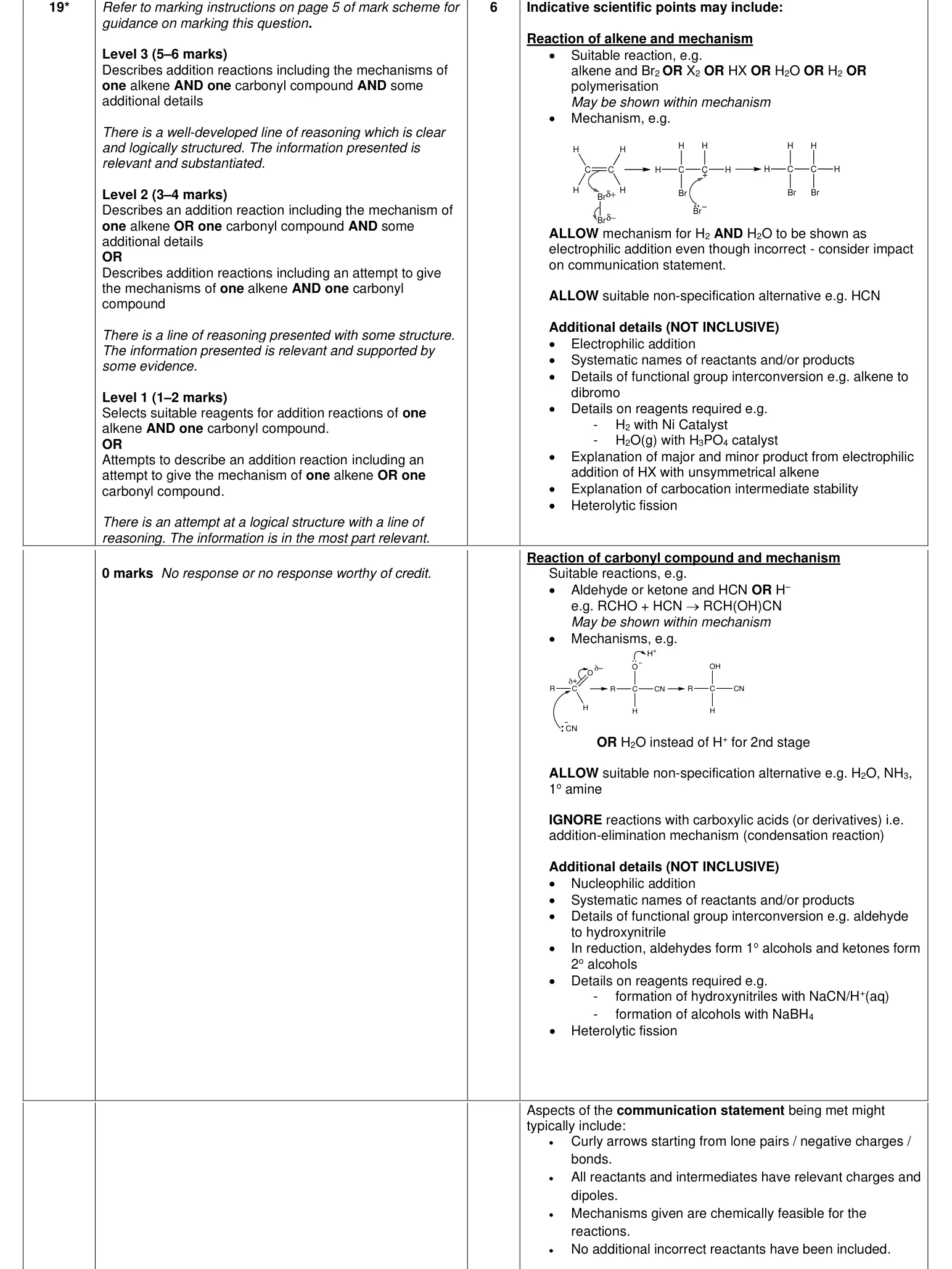
19 Alkenes, Organic basics: naming, formulae and isomerism, Carbonyl compounds: aldehydes and ketones 6Level of response
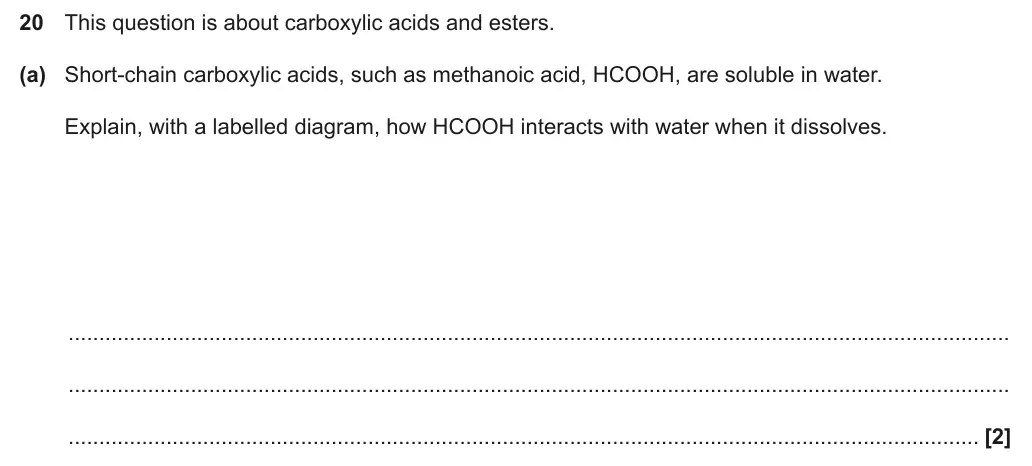
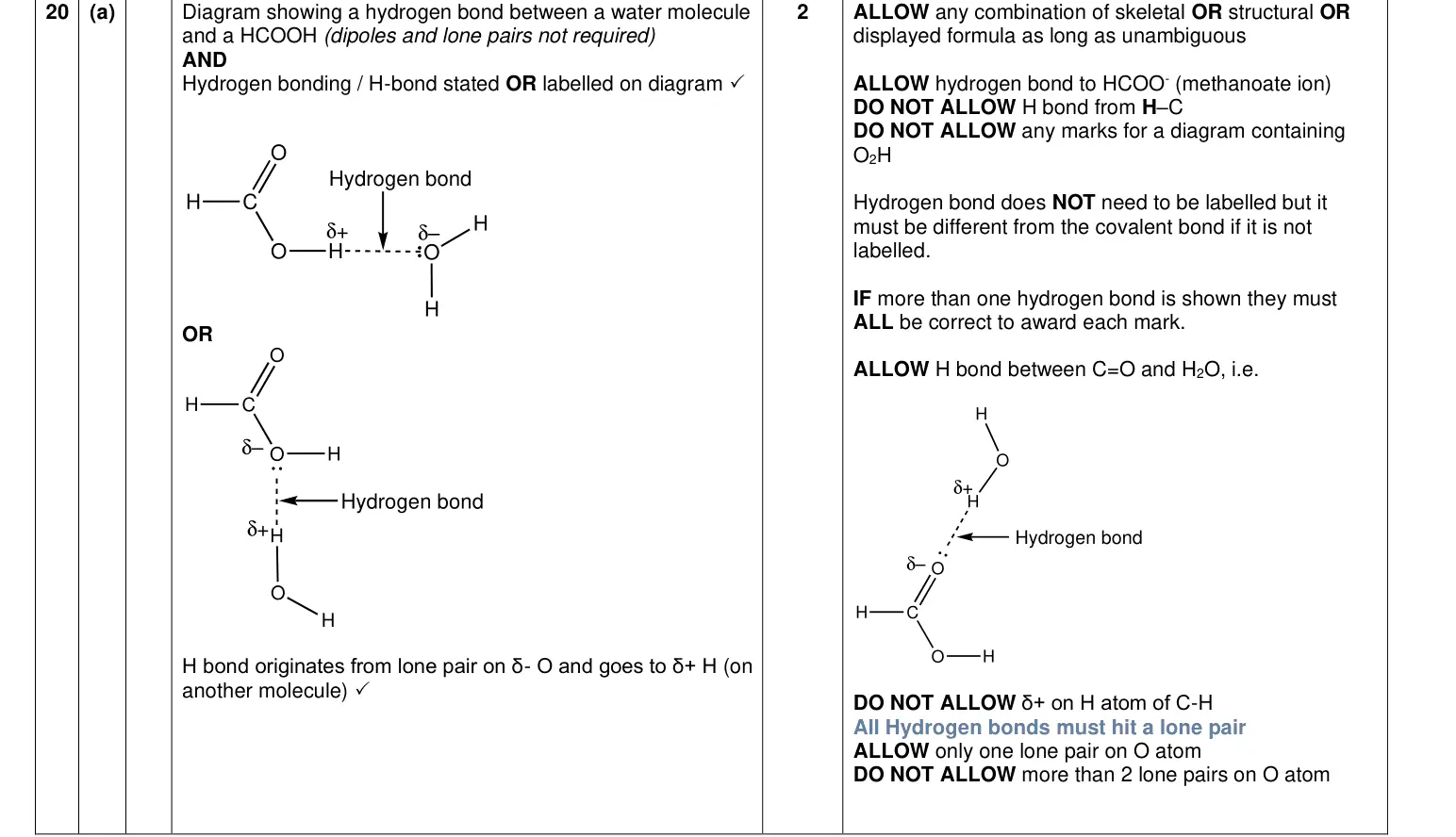
20(a) Carboxylic acids, esters and acyl chlorides, Bonding, structure and shapes of molecules 2Drawing / labelling
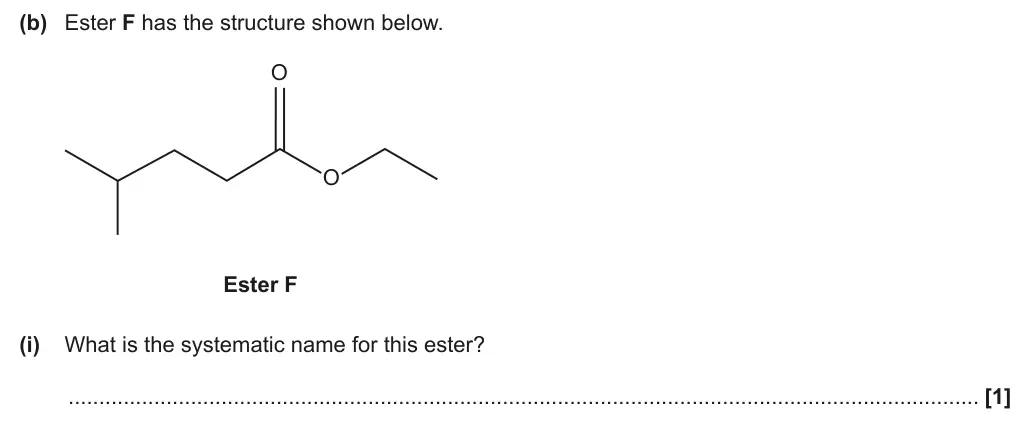
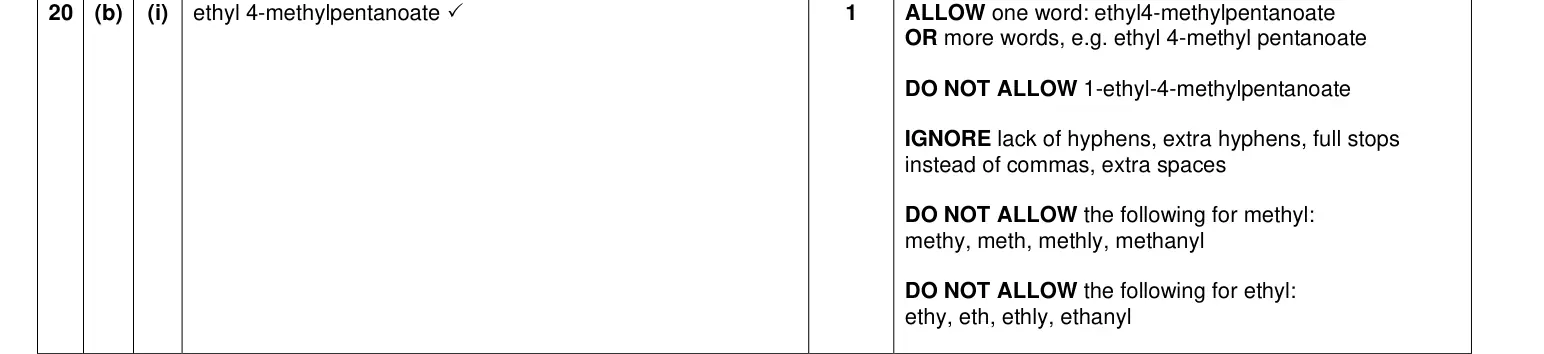
20(b)(i) Organic basics: naming, formulae and isomerism 1Short answer
20(b)(ii) Carboxylic acids, esters and acyl chlorides, Formulae and equations 4Equation writing
20(c) Polyesters and polyamides 2Structure / isomer
20(d) Carboxylic acids, esters and acyl chlorides, Polyesters and polyamides, Organic synthesis (Module 6) 4Structure / isomer
21(a)(i) Alkenes 1Short answer
21(a)(ii) Aromatic compounds: benzene and phenol, Organic basics: naming, formulae and isomerism, Carbon–carbon bond formation 5Mechanism
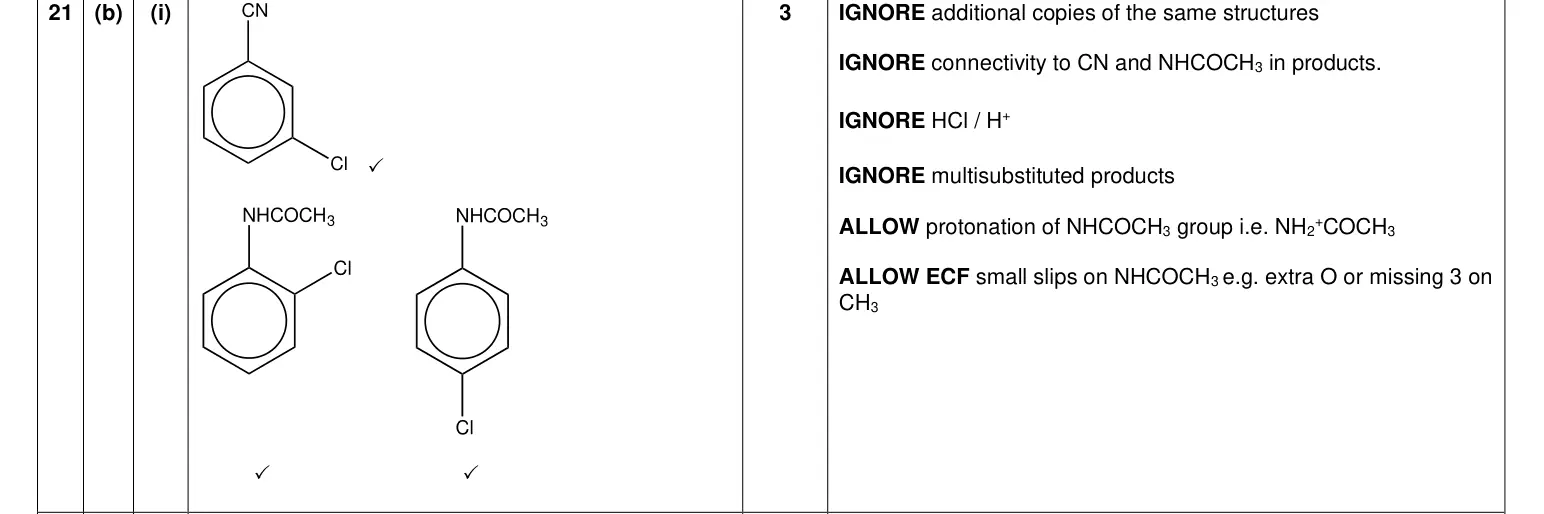
21(b)(i) Aromatic compounds: benzene and phenol 3Structure / isomer
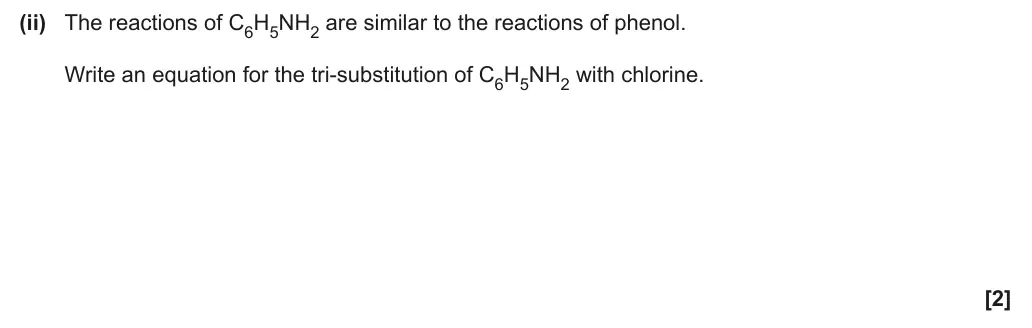
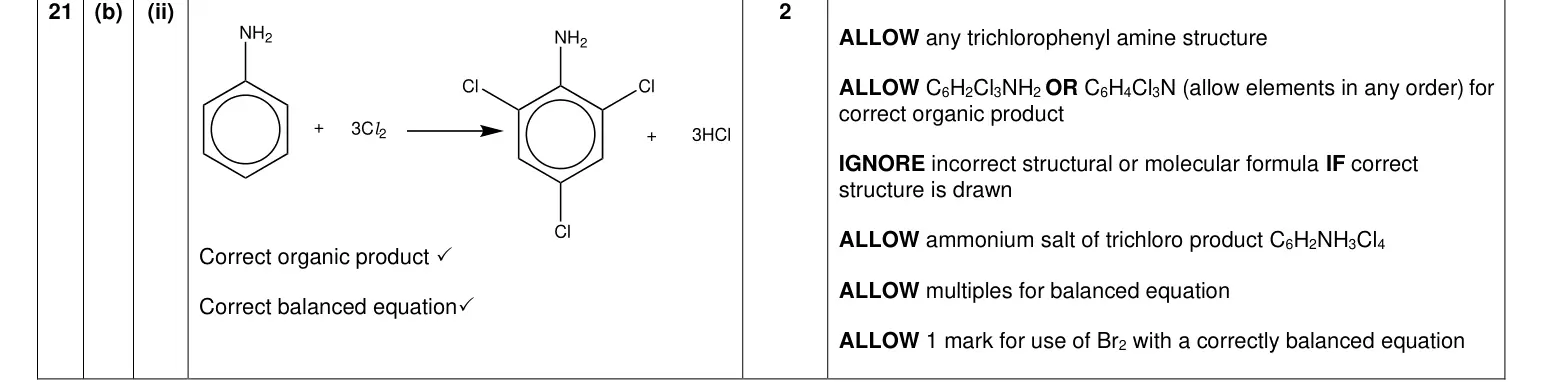
21(b)(ii) Aromatic compounds: benzene and phenol, Formulae and equations 2Equation writing
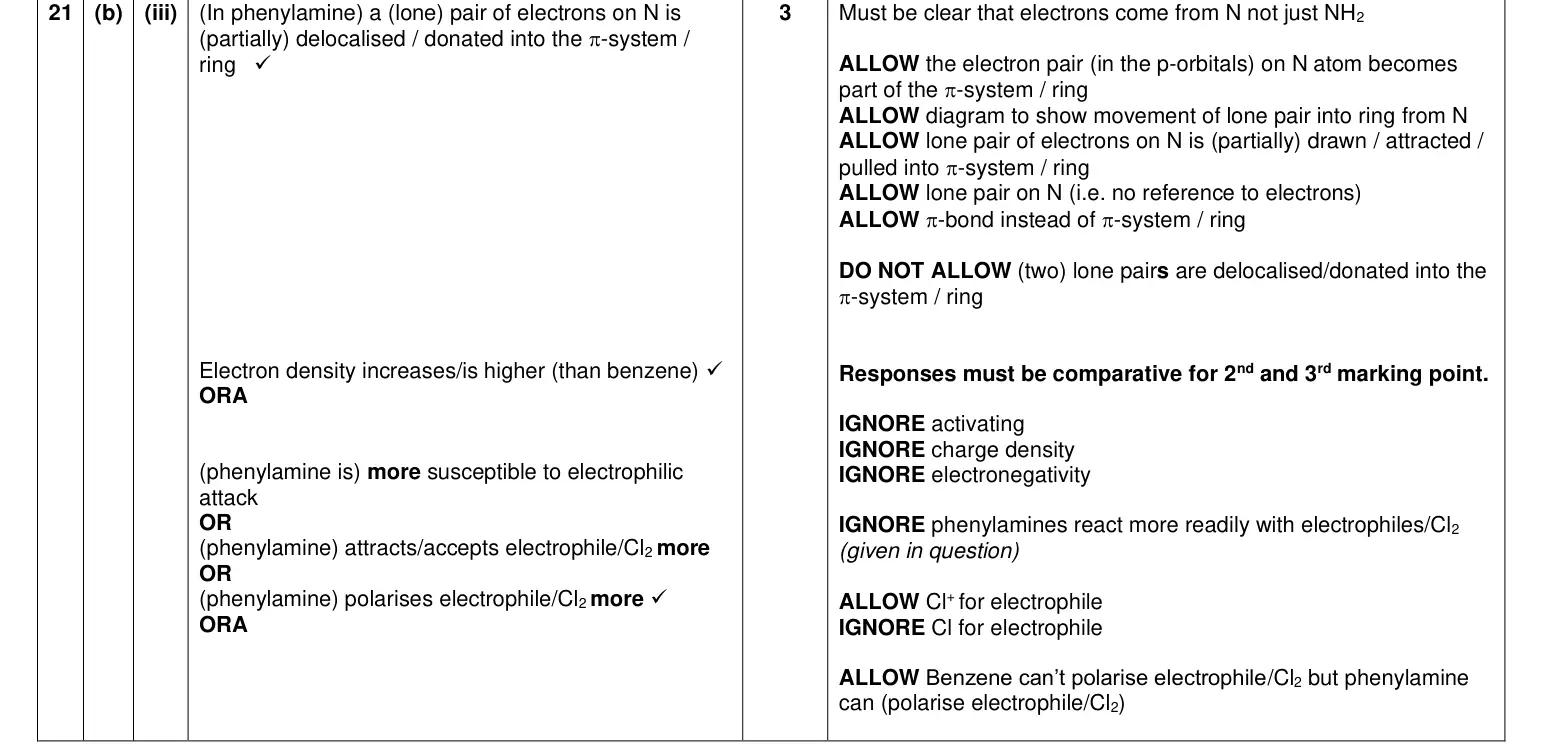
21(b)(iii) Aromatic compounds: benzene and phenol 3Short answer
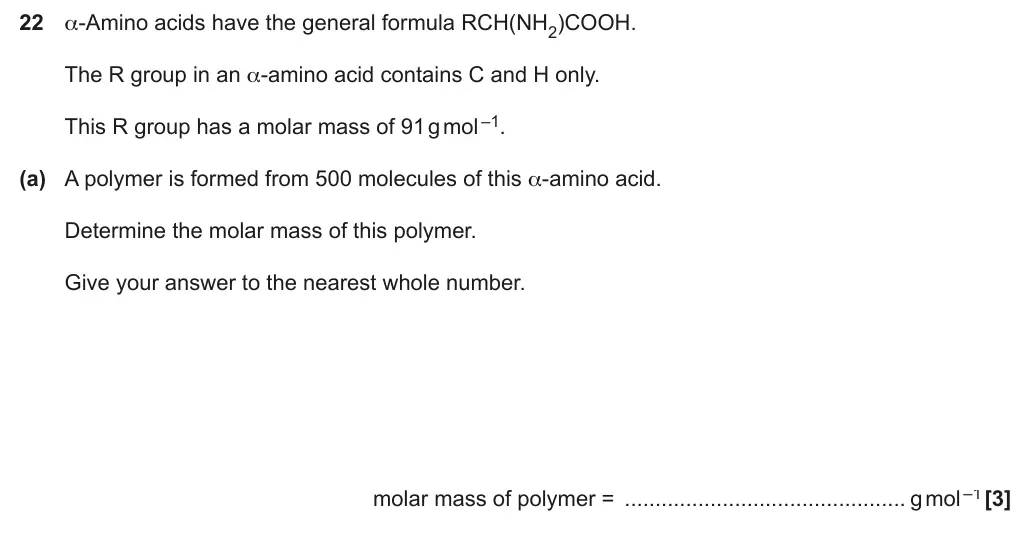
22(a) Polyesters and polyamides, Atomic structure and isotopes, Amino acids, amides and chirality 3Calculation
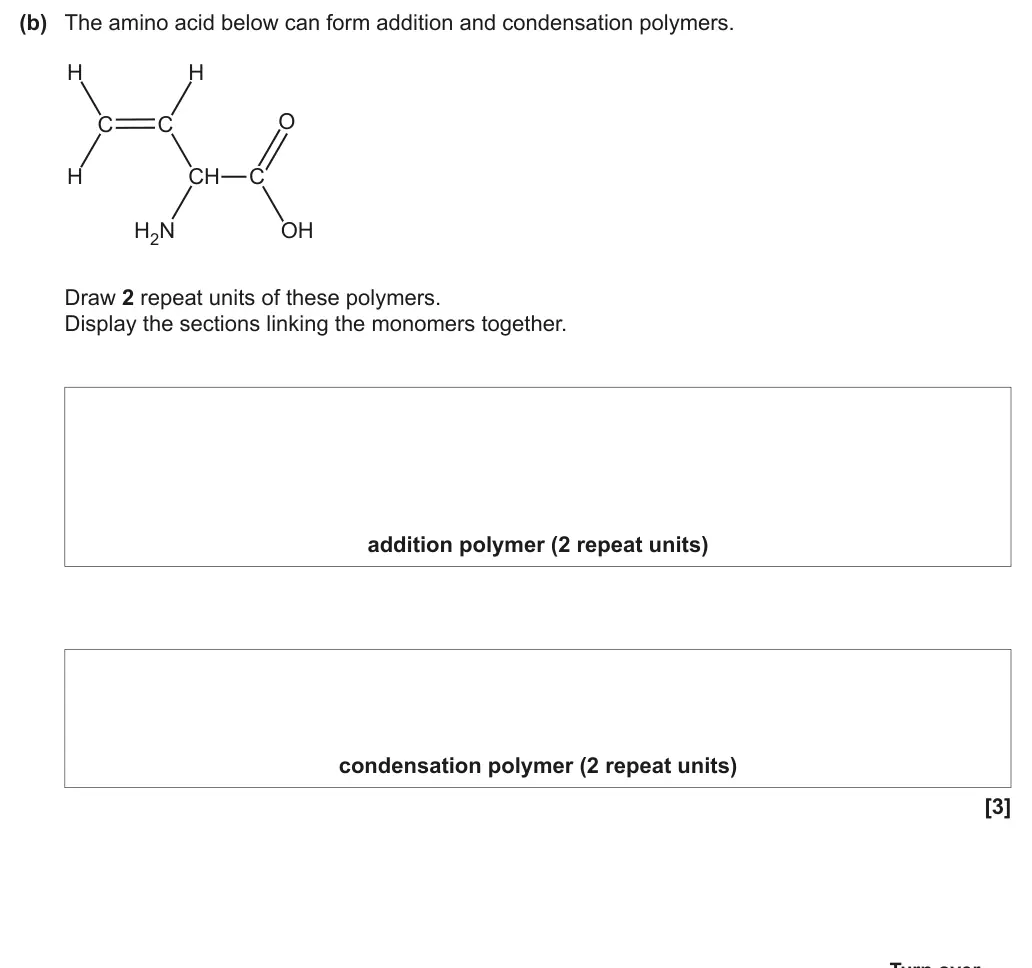
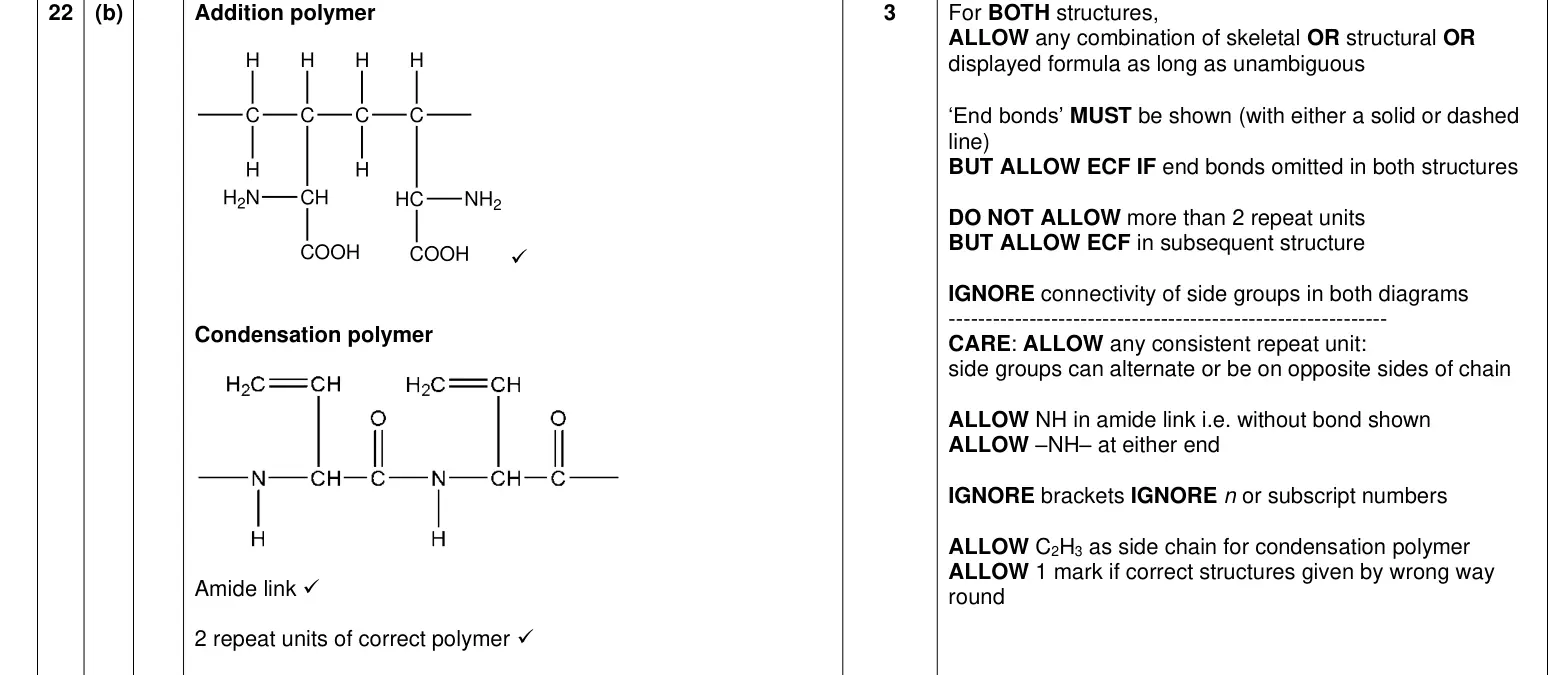
22(b) Polyesters and polyamides, Alkenes 3Drawing / labelling
23(a) Organic synthesis (Module 6), Practical techniques and apparatus (PAGs) 1Short answer
23(b)(i) Carboxylic acids, esters and acyl chlorides, Formulae and equations, Acids, bases and titrations, Aromatic compounds: benzene and phenol 3Equation writing
23(b)(ii) Aromatic compounds: benzene and phenol, Practical skills: planning, analysis and evaluation, Carboxylic acids, esters and acyl chlorides 1Short answer
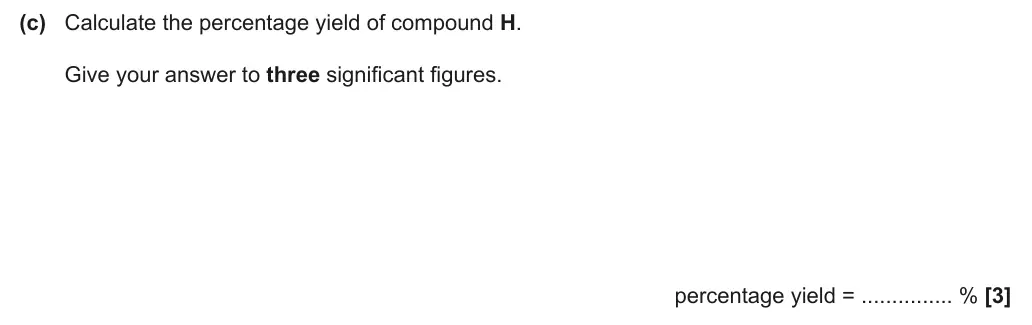
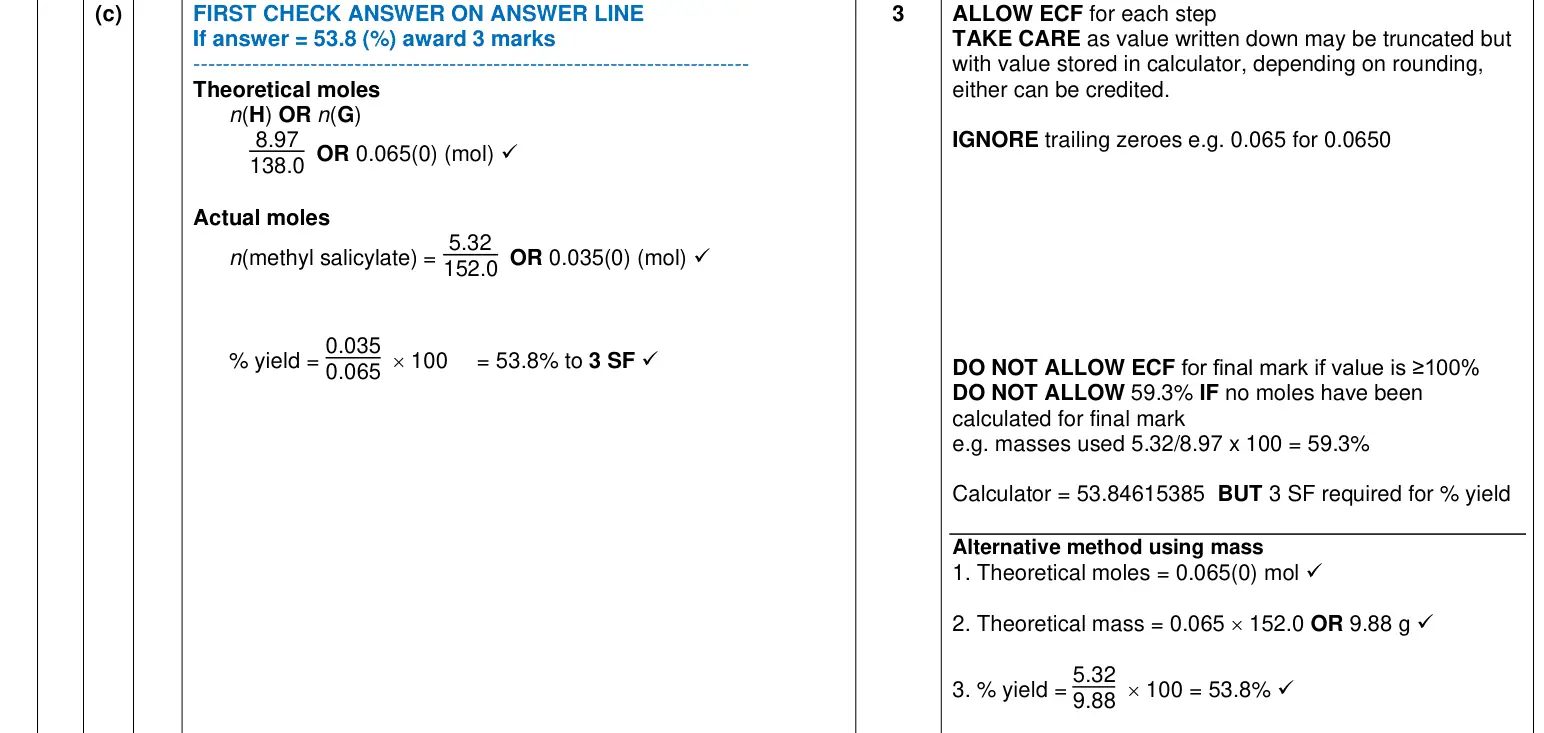
23(c) Amount of substance (moles) 3Calculation
23(d) Organic synthesis and practical techniques (Module 4), Practical techniques and apparatus (PAGs) 4Short answer
24 NMR spectroscopy and combined techniques, Infrared spectroscopy and mass spectrometry 6Level of response

The questions

12345678910111213141516(a)16(b)16(c)16(d)16(e)17(a)17(b)17(c)17(d)18(a)(i)18(a)(ii)18(b)1920(a)20(b)(i)20(b)(ii)20(c)20(d)21(a)(i)21(a)(ii)21(b)(i)21(b)(ii)21(b)(iii)22(a)22(b)23(a)23(b)(i)23(b)(ii)23(c)23(d)24
June 2024 · Paper 2 · Q1 1 mark Multiple choice Easy bonding and structure
1 All organic compounds have covalent bonds.
What is the electrostatic attraction in a covalent bond between?
A A shared pair of electrons and the nuclei of the bonded atoms
B Cations and delocalised electrons
C Oppositely charged ions
D Two molecules
Your answer
[1]
June 2024 · Paper 2 · Q2 1 mark Multiple choice Medium alkenes
2 Hydrogen reacts much more readily with alkenes than with alkanes.
Why is this?
A Alkenes are polar molecules whereas alkanes are not.
B All atoms in an alkane have a full outer shell of electrons.
C The bond enthalpy of C–C σ bonds is higher than that of π bonds.
D The bond enthalpy of C–C σ bonds is lower than that of π bonds.
Your answer
[1]
June 2024 · Paper 2 · Q3 1 mark Multiple choice Medium haloalkaneschromatography and functional group tests
3 A student investigates the rate of hydrolysis of different iodoalkanes using aqueous silver nitrate
in ethanol.
What colour of precipitate is seen?
A Brown
B Cream
C White
D Yellow
Your answer
[1]
June 2024 · Paper 2 · Q4 1 mark Multiple choice Medium alkenesalkanes
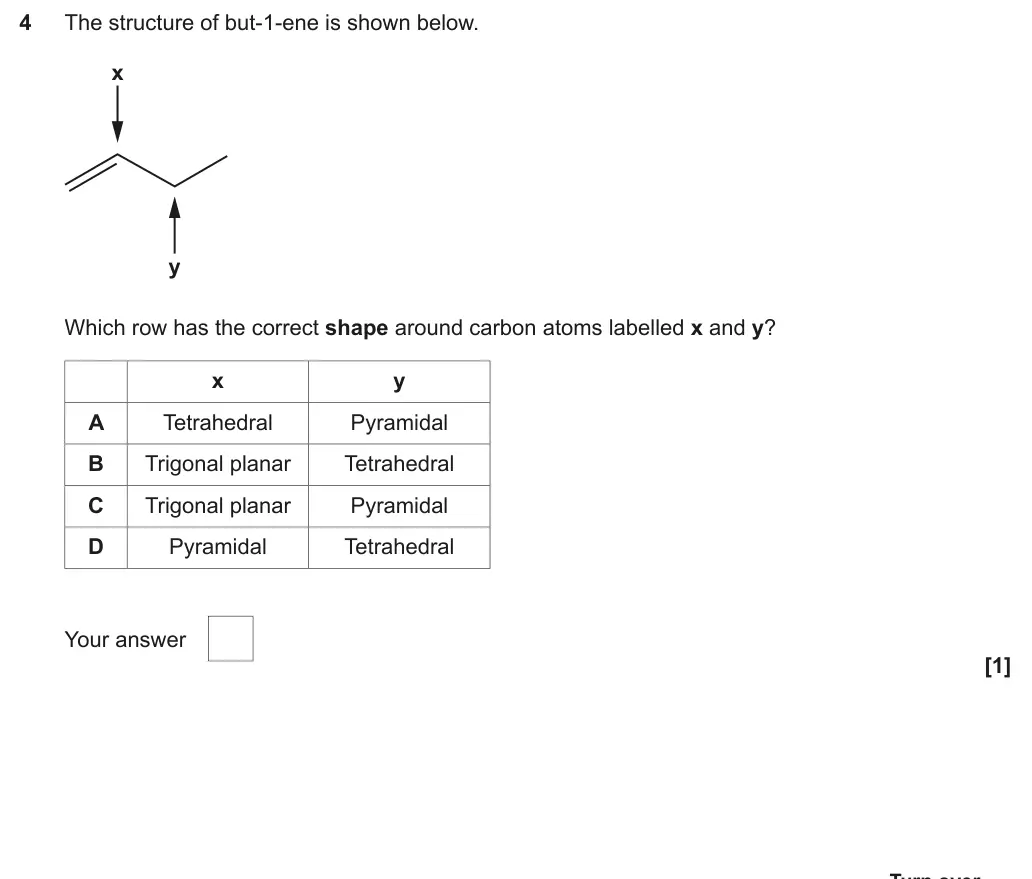
4 The structure of but-1-ene is shown below.
x
y
Which row has the correct shape around carbon atoms labelled x and y?
x y
A Tetrahedral Pyramidal
B Trigonal planar Tetrahedral
C Trigonal planar Pyramidal
D Pyramidal Tetrahedral
Your answer
[1]
June 2024 · Paper 2 · Q5 1 mark Multiple choice Medium chromatography and functional group testsorganic synthesis as
5 Geraniol, shown below, is a component in many natural oils.
OH
Geraniol
Which pair of reagents identifies both functional groups in geraniol?
A Acidified dichromate(VI) and 2,4-dinitrophenylhydrazine.
B Bromine water and 2,4-dinitrophenylhydrazine.
C Bromine water and acidified dichromate(VI).
D Tollens’ reagent and aqueous silver nitrate in ethanol.
Your answer
[1]
June 2024 · Paper 2 · Q6 1 mark Multiple choice Medium amount of substance
6 4.30 g of the alcohol C5H9OH, (Mr = 86.0), is burned in oxygen.
C5H9OH(l) + 7O2(g) 5CO2(g) + 5H2O(l)
Which volume of oxygen gas is needed, in dm3, for this complete combustion of C5H9OH,
at RTP?
A 1.2
B 2.4
C 5.8
D 8.4
Your answer
[1]
June 2024 · Paper 2 · Q7 1 mark Multiple choice Medium infrared and mass spectrometry
7 Which statement gives a valid scientific reason for global warming?
A Infrared radiation causes bonds in CH4 molecules to vibrate more.
B Infrared radiation causes O2 molecules to vibrate more.
C Ultraviolet radiation causes bonds in CO2 to vibrate more.
D Ultraviolet radiation causes bonds in CFC molecules to break.
Your answer
[1]
June 2024 · Paper 2 · Q8 1 mark Multiple choice Easy haloalkanes
8 The CFC CCl 2F2 can cause the breakdown of ozone in the upper atmosphere.
Which initiation step could occur with ultraviolet radiation to catalyse this breakdown?
A CCl 2F2 ●C + ●Cl 2F2
B CCl 2F2 ●F + ●CCl 2F
C CCl 2F2 ●Cl + ●CCl F2
D CCl 2F2 ●Cl 2 + ●CF2
Your answer
[1]
June 2024 · Paper 2 · Q9 1 mark Multiple choice Medium amino acids amides and chirality
9 Which compound is a secondary amide?
N
A
OH O
N C
B H
O
O
C
N
H
OH
NH2
D HO C
O
Your answer
[1]
June 2024 · Paper 2 · Q10 1 mark Multiple choice Hard amount of substance
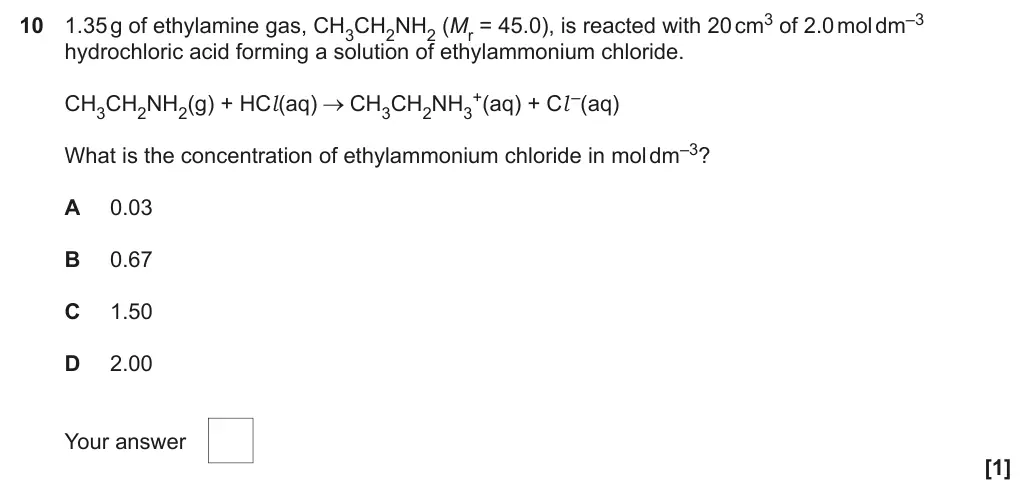
10 1.35 g of ethylamine gas, CH3CH2NH2 (Mr = 45.0), is reacted with 20 cm3 of 2.0 mol dm–3
hydrochloric acid forming a solution of ethylammonium chloride.
CH3CH2NH2(g) + HCl (aq) CH3CH2NH3 +(aq) + Cl –(aq)
What is the concentration of ethylammonium chloride in mol dm–3?
A 0.03
B 0.67
C 1.50
D 2.00
Your answer
[1]
June 2024 · Paper 2 · Q11 1 mark Multiple choice Medium infrared and mass spectrometry
11 Which compound could have produced the IR spectrum shown below?
100
Transmittance
(%) 50
0
4000 3000 2000 1500 1000 500
Wavenumber / cm–1
A HOCH2CHO
B CH3CH2COOH
C CH3CH2COOCH3
D (CH3)2C(OH)COOH
Your answer
[1]
June 2024 · Paper 2 · Q12 1 mark Multiple choice Easy condensation polymers
12 1,6-Diaminohexane, H2N(CH2)6NH2, reacts with hexanedioyl dichloride, Cl OC(CH2)4COCl to
form a polyamide and one other product.
What is the other product formed in this reaction?
A HCl
B H2O
C CO
D NH3
Your answer
[1]
June 2024 · Paper 2 · Q13 1 mark Multiple choice Medium chromatography and functional group tests
13 A sample containing a mixture of 3 components, X, Y and Z, is analysed using gas
chromatography.
The gas chromatogram below is obtained.
The relative peak areas of X, Y and Z are included.
Z
Relative peak areas
X = 1.0
1000 Y
Y = 3.5
Z = 5.5
X
Recorder response
500
0
0 5 10 15
Time / min
Which statement(s) is/are true?
1 The peak for component X shows the mass of one mole.
2 Component Y stays in the column for longer than component X.
3 Component Z consists of more than half of the sample.
A 1, 2 and 3
B Only 1 and 2
C Only 2 and 3
D Only 1
Your answer
[1]
June 2024 · Paper 2 · Q14 1 mark Multiple choice Hard nmr spectroscopy
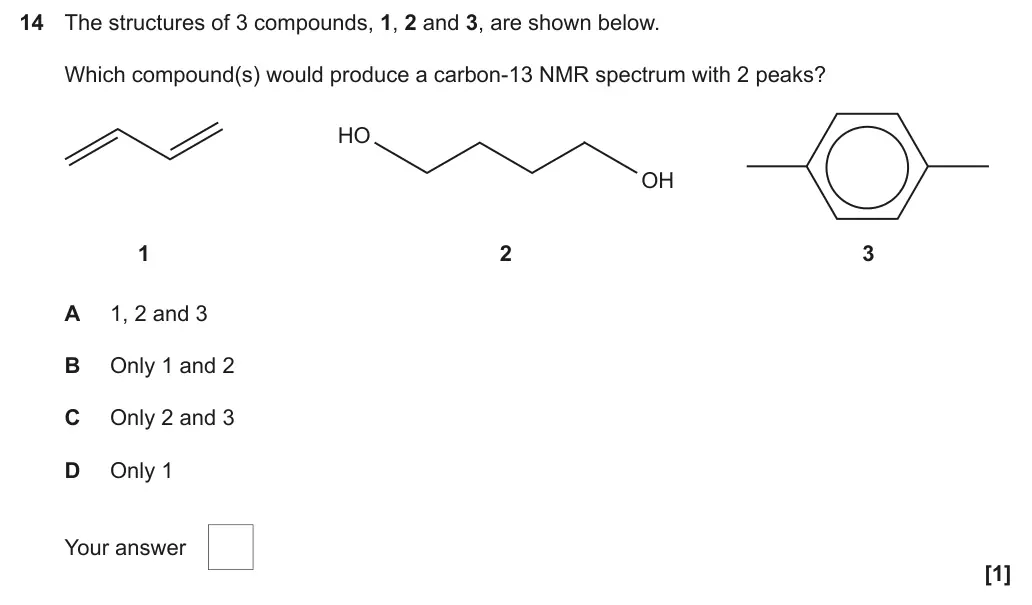
14 The structures of 3 compounds, 1, 2 and 3, are shown below.
Which compound(s) would produce a carbon-13 NMR spectrum with 2 peaks?
HO
OH
1 2 3
A 1, 2 and 3
B Only 1 and 2
C Only 2 and 3
D Only 1
Your answer
[1]
June 2024 · Paper 2 · Q15 1 mark Multiple choice Medium alkenes
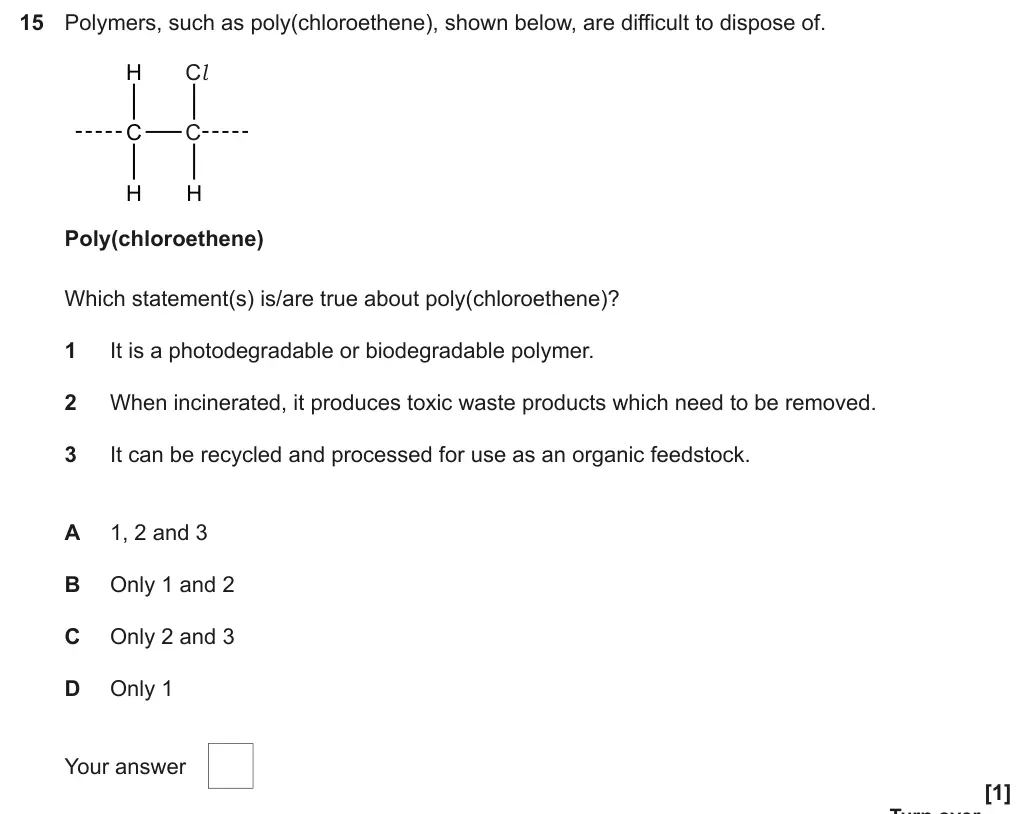
15 Polymers, such as poly(chloroethene), shown below, are difficult to dispose of.
H Cl
C C
H H
Poly(chloroethene)
Which statement(s) is/are true about poly(chloroethene)?
1 It is a photodegradable or biodegradable polymer.
2 When incinerated, it produces toxic waste products which need to be removed.
3 It can be recycled and processed for use as an organic feedstock.
A 1, 2 and 3
B Only 1 and 2
C Only 2 and 3
D Only 1
Your answer
[1]
June 2024 · Paper 2 · Q16(a) 1 mark Structure / isomer Hard organic basics
16 This question is about hydrocarbons.
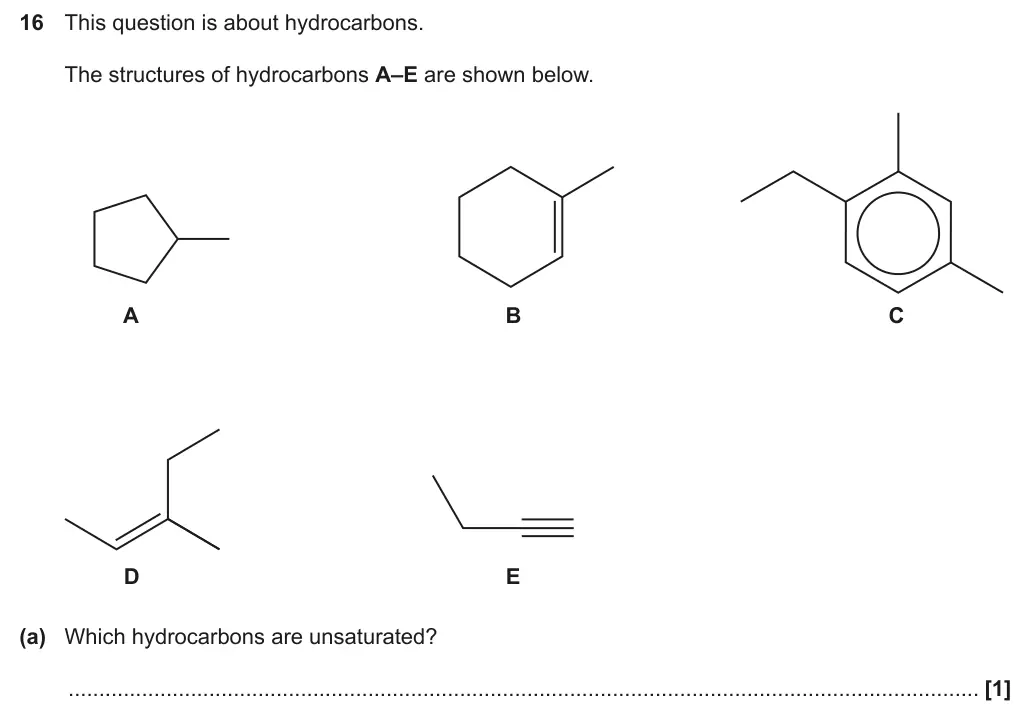
The structures of hydrocarbons A–E are shown below.
A B C
D E
(a) Which hydrocarbons are unsaturated?
..................................................................................................................................................... [1]
June 2024 · Paper 2 · Q16(b) 1 mark Short answer Easy organic basics
Earlier part of question 16 that this part usesEarlier part of June 2024 Paper 2 question 16
(b) Which hydrocarbons are alicyclic?
..................................................................................................................................................... [1]
June 2024 · Paper 2 · Q16(c) 1 mark Short answer Hard organic basics
Earlier part of question 16 that this part usesEarlier part of June 2024 Paper 2 question 16
(c) Which hydrocarbons have the general formula CnH2n?
..................................................................................................................................................... [1]
June 2024 · Paper 2 · Q16(d) 1 mark Short answer Hard aromatic compounds
Earlier part of question 16 that this part usesEarlier part of June 2024 Paper 2 question 16
(d) What is the systematic name of hydrocarbon C?
..................................................................................................................................................... [1]
June 2024 · Paper 2 · Q16(e) 2 marks Short answer Hard alkenes
Earlier part of question 16 that this part usesEarlier part of June 2024 Paper 2 question 16
(e) Explain why hydrocarbon D is a Z-stereoisomer.
..........................................................................................................................................................
..........................................................................................................................................................
..........................................................................................................................................................
..................................................................................................................................................... [2]
June 2024 · Paper 2 · Q17(a) 2 marks Short answer Medium alcohols
17 This question is about reactions of alcohols.
There are 4 structural isomers of C4H10O that are alcohols:
CH3CH2CH2CH2OH
CH3CH2CHOHCH3
(CH3)2CHCH2OH
(CH3)3COH
Alcohols take part in many different types of reaction, including
• elimination
• oxidation
• substitution
• esterification.
For each type of reaction, choose appropriate reagent(s) and/or catalyst, and show the organic
product formed.
(a) Elimination reaction of CH3CH2CH2CH2OH
Reagent(s) and/or catalyst
..........................................................................................................................................................
..........................................................................................................................................................
organic product
[2]
June 2024 · Paper 2 · Q17(b) 2 marks Short answer Medium alcohols
Earlier part of question 17 that this part usesEarlier part of June 2024 Paper 2 question 17
(b) Oxidation reaction of CH3CH2CHOHCH3
Reagent(s) and/or catalyst
..........................................................................................................................................................
..........................................................................................................................................................
organic product
[2]
June 2024 · Paper 2 · Q17(c) 2 marks Short answer Hard alcohols
Earlier part of question 17 that this part usesEarlier part of June 2024 Paper 2 question 17
(c) Substitution reaction of (CH3)2CHCH2OH
Reagent(s) and/or catalyst
..........................................................................................................................................................
..........................................................................................................................................................
organic product
[2]
June 2024 · Paper 2 · Q17(d) 2 marks Short answer Hard carboxylic acids and esters
Earlier part of question 17 that this part usesEarlier part of June 2024 Paper 2 question 17
(d) Esterification reaction of (CH3)3COH
Reagent(s) and/or catalyst
..........................................................................................................................................................
..........................................................................................................................................................
organic product
[2]
June 2024 · Paper 2 · Q18(a)(i) 3 marks Equation writing Hard alkanesorganic basics
18 This question is about haloalkanes.
(a) Haloalkanes can be synthesised by reacting alkanes with halogens in the presence of ultraviolet
radiation.
An alkane reacts with bromine to form 2-bromo-2-methylpropane.
(i) Write the equation for this reaction, showing the structures of the organic compounds.
Name the reaction mechanism and the type of bond fission that occurs.
Equation
Name of reaction mechanism  ..........................................................................................................
Type of bond fission  .........................................................................................................................
[3]
June 2024 · Paper 2 · Q18(a)(ii) 2 marks Short answer Easy alkanes
Earlier part of question 18 that this part usesEarlier part of June 2024 Paper 2 question 18
(ii) Describe two limitations of the synthesis of 2-bromo-2-methylpropane from an alkane and
bromine.
1  .......................................................................................................................................................
..........................................................................................................................................................
..........................................................................................................................................................
2  .......................................................................................................................................................
..........................................................................................................................................................
..........................................................................................................................................................
[2]
June 2024 · Paper 2 · Q18(b) 9 marks Short answer Medium amineshaloalkanescarbon carbon bond formation
(b) Complete the flowchart by filling in each box.
amine
reagent(s)
.............................................
reagent(s)
H
.............................................
H3C C Br
H
bromoethane alcohol
reagent(s)
..........................................................
H
H3C C C N
H
nitrile
reagent(s) reagent(s)
.......................................................... .............................................
carboxylic acid amine
[9]
June 2024 · Paper 2 · Q19 6 marks 6-mark level of response Hard alkenesorganic basicscarbonyl compounds
19* Alkenes and carbonyl compounds take part in addition reactions.
Describe one addition reaction of an alkene and one addition reaction of a carbonyl compound.
Include reagents and reaction mechanisms. [6]
..........................................................................................................................................................
..........................................................................................................................................................
..........................................................................................................................................................
..........................................................................................................................................................
..........................................................................................................................................................
..........................................................................................................................................................
..........................................................................................................................................................
..........................................................................................................................................................
..........................................................................................................................................................
..........................................................................................................................................................
..........................................................................................................................................................
..........................................................................................................................................................
..........................................................................................................................................................
..........................................................................................................................................................
..........................................................................................................................................................
..........................................................................................................................................................
..........................................................................................................................................................
..........................................................................................................................................................
..........................................................................................................................................................
Extra answer space if required.
..........................................................................................................................................................
..........................................................................................................................................................
..........................................................................................................................................................
..........................................................................................................................................................
..........................................................................................................................................................
June 2024 · Paper 2 · Q20(a) 2 marks Drawing / labelling Medium carboxylic acids and estersbonding and structure
20 This question is about carboxylic acids and esters.
(a) Short-chain carboxylic acids, such as methanoic acid, HCOOH, are soluble in water.
Explain, with a labelled diagram, how HCOOH interacts with water when it dissolves.
..........................................................................................................................................................
..........................................................................................................................................................
..................................................................................................................................................... [2]
June 2024 · Paper 2 · Q20(b)(i) 1 mark Short answer Hard organic basics
(b) Ester F has the structure shown below.
O
O
Ester F
(i) What is the systematic name for this ester?
..................................................................................................................................................... [1]
June 2024 · Paper 2 · Q20(b)(ii) 4 marks Equation writing Hard carboxylic acids and estersformulae and equations
Earlier part of question 20 that this part usesEarlier part of June 2024 Paper 2 question 20
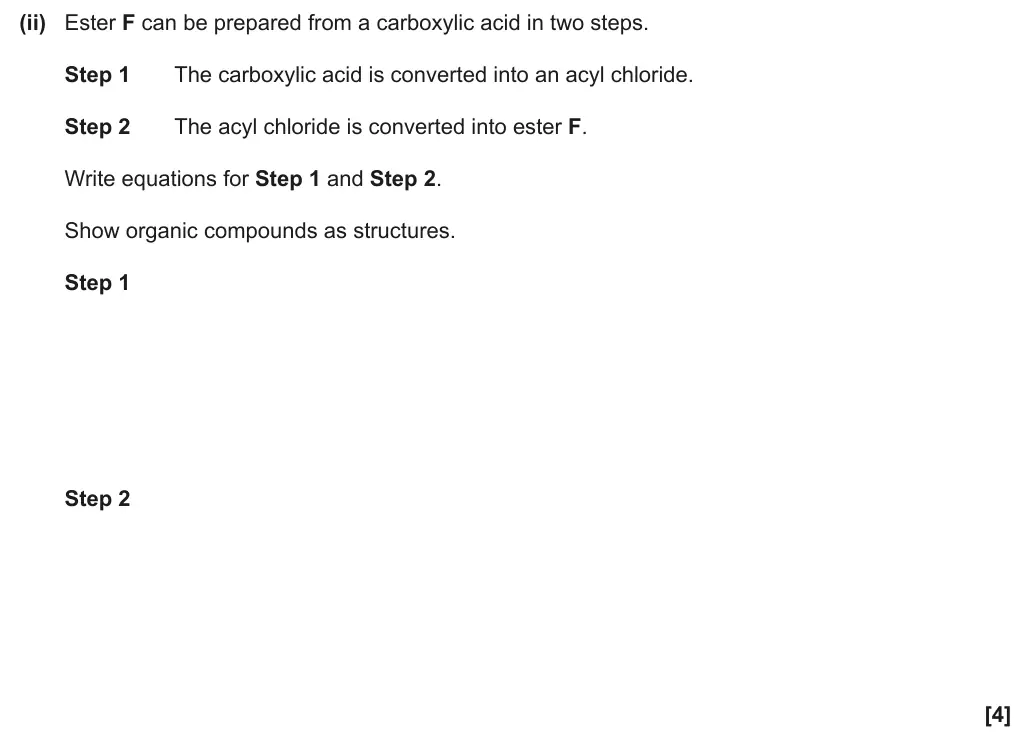
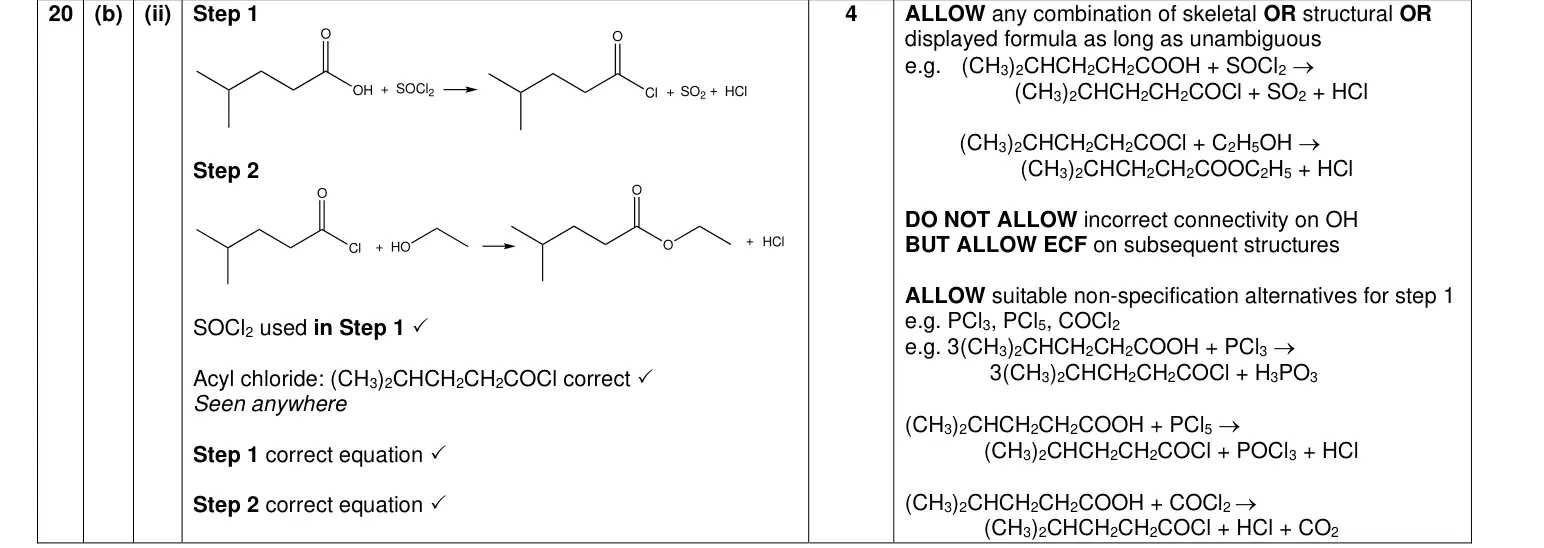
(ii) Ester F can be prepared from a carboxylic acid in two steps.
Step 1  The carboxylic acid is converted into an acyl chloride.
Step 2  The acyl chloride is converted into ester F.
Write equations for Step 1 and Step 2.
Show organic compounds as structures.
Step 1
Step 2
[4]
June 2024 · Paper 2 · Q20(c) 2 marks Structure / isomer Medium condensation polymers
(c) The repeat unit of a polyester is shown below.
O O
O O
Draw the structures of monomers required to form this polyester.
[2]
June 2024 · Paper 2 · Q20(d) 4 marks Structure / isomer Medium carboxylic acids and esterscondensation polymersorganic synthesis
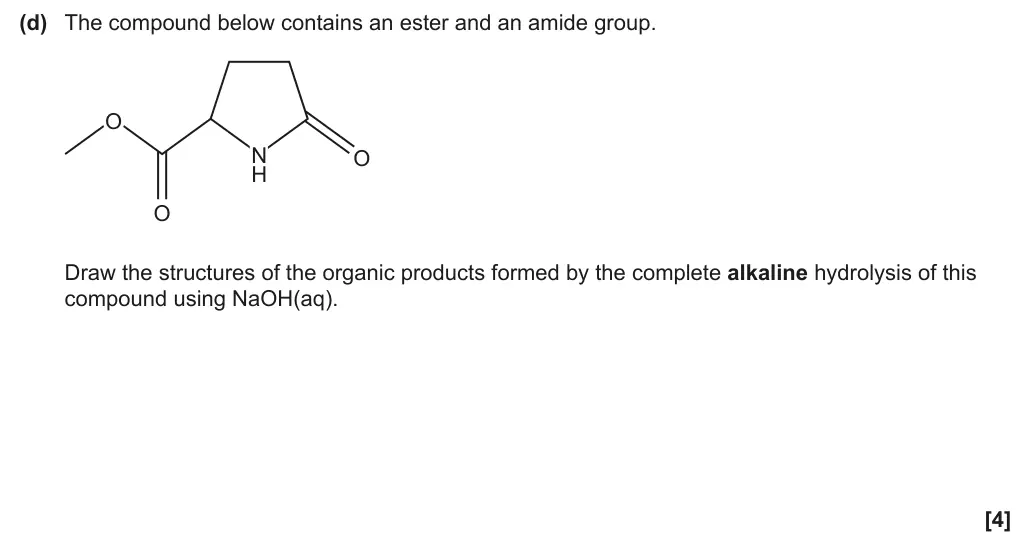
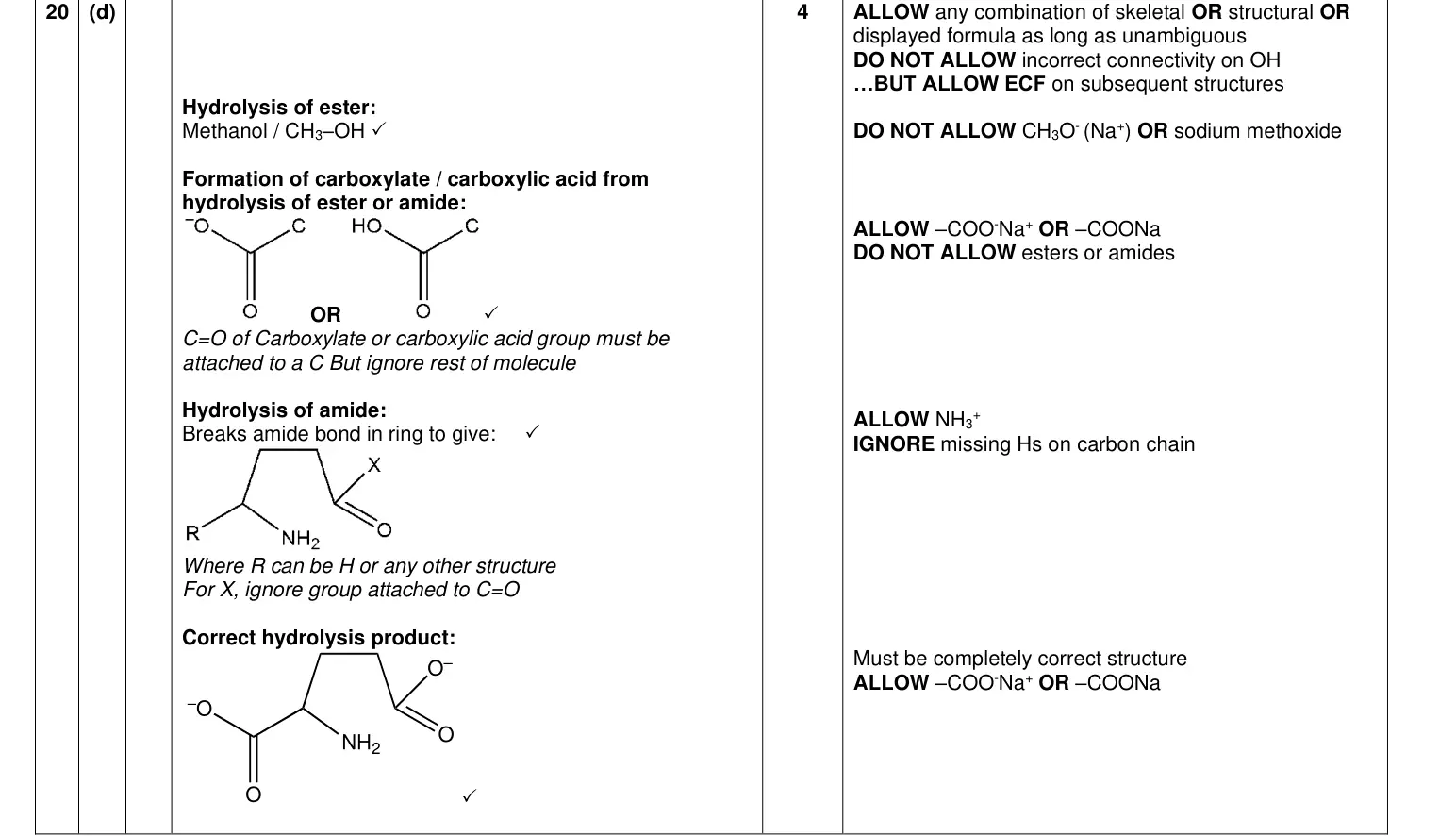
(d) The compound below contains an ester and an amide group.
O
N O
H
O
Draw the structures of the organic products formed by the complete alkaline hydrolysis of this
compound using NaOH(aq).
[4]
June 2024 · Paper 2 · Q21(a)(i) 1 mark Short answer Easy alkenes
21 This question is about aromatic compounds.
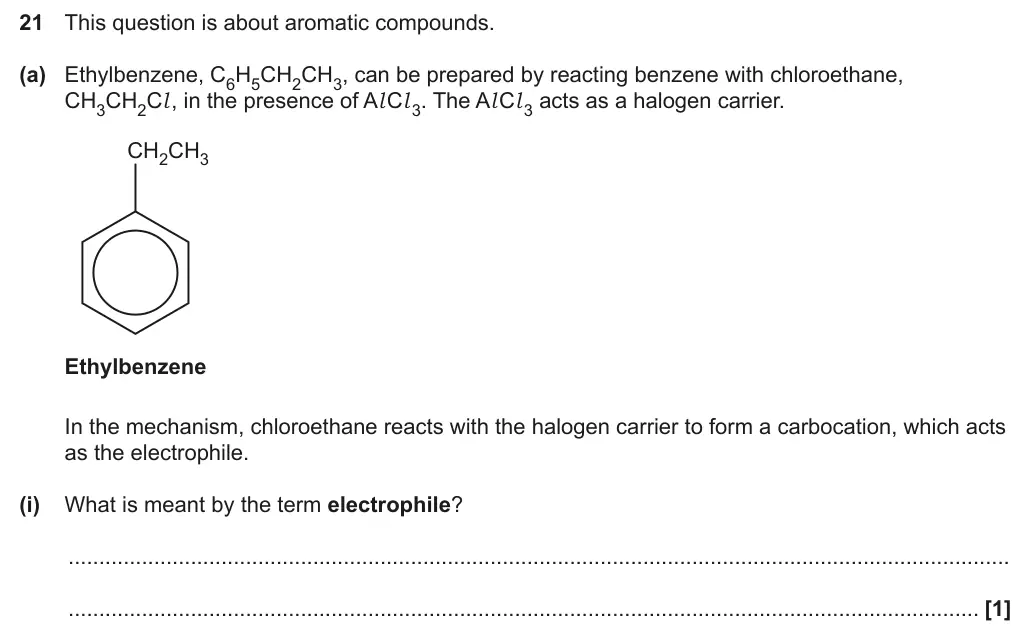
(a) Ethylbenzene, C6H5CH2CH3, can be prepared by reacting benzene with chloroethane,
CH3CH2Cl , in the presence of Al Cl 3. The Al Cl 3 acts as a halogen carrier.
CH2CH3
Ethylbenzene
In the mechanism, chloroethane reacts with the halogen carrier to form a carbocation, which acts
as the electrophile.
(i) What is meant by the term electrophile?
..........................................................................................................................................................
..................................................................................................................................................... [1]
June 2024 · Paper 2 · Q21(a)(ii) 5 marks Mechanism Medium aromatic compoundsorganic basicscarbon carbon bond formation
Earlier part of question 21 that this part usesEarlier part of June 2024 Paper 2 question 21
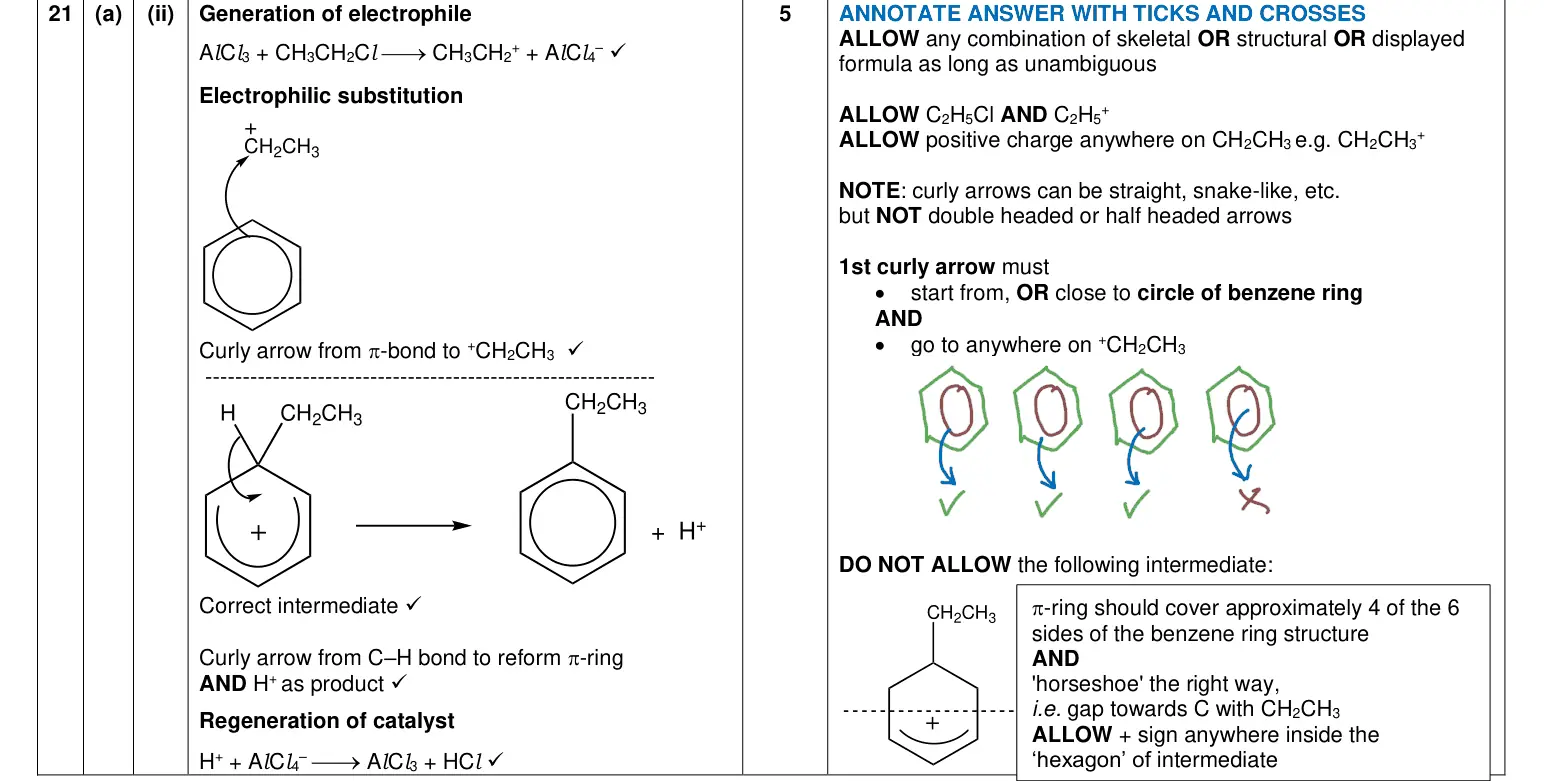
(ii) Outline the mechanism for this reaction, including the role of Al Cl 3 as a halogen carrier.
[5]
June 2024 · Paper 2 · Q21(b)(i) 3 marks Structure / isomer Easy aromatic compounds
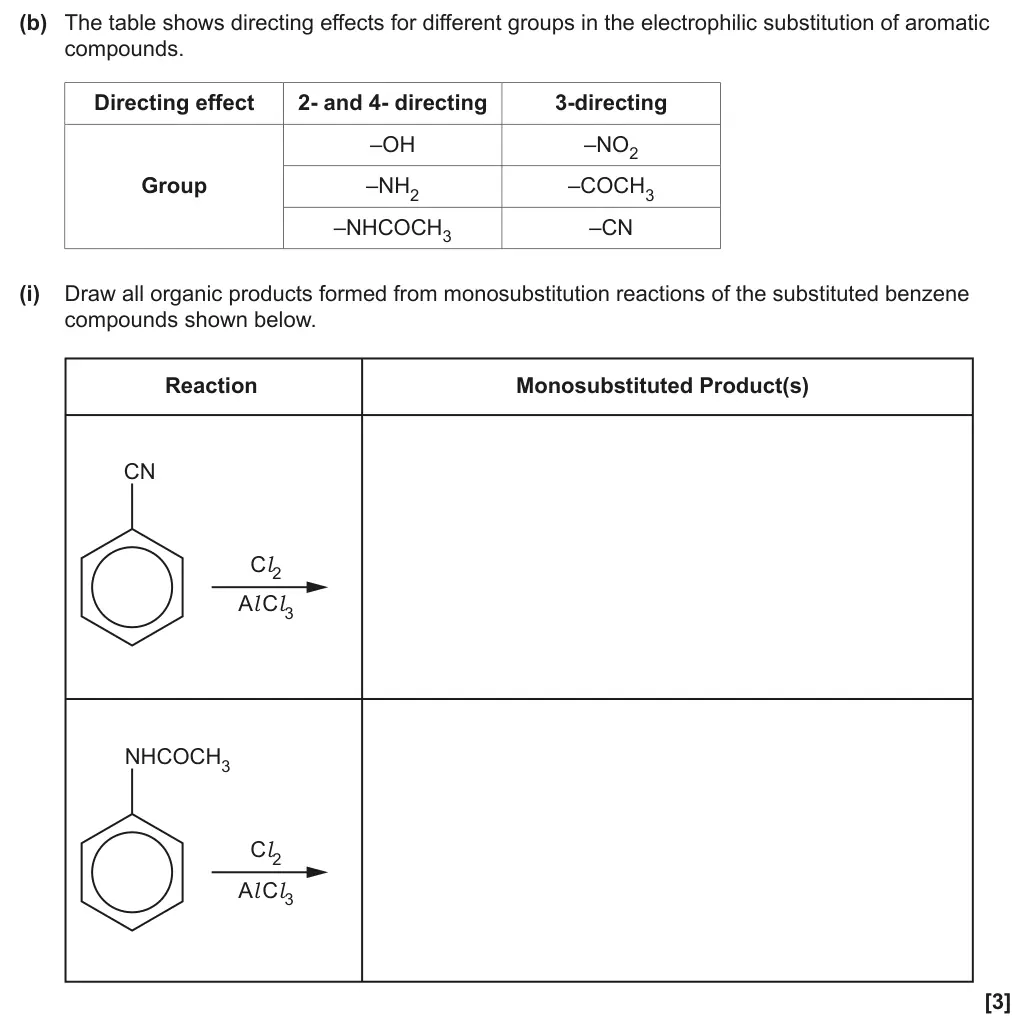
(b) The table shows directing effects for different groups in the electrophilic substitution of aromatic
compounds.
Directing effect 2- and 4- directing 3-directing
–OH –NO2
Group –NH2 –COCH3
–NHCOCH3 –CN
(i) Draw all organic products formed from monosubstitution reactions of the substituted benzene
compounds shown below.
Reaction Monosubstituted Product(s)
CN
Cl2
Al Cl3
NHCOCH3
Cl2
Al Cl3
[3]
June 2024 · Paper 2 · Q21(b)(ii) 2 marks Equation writing Medium aromatic compoundsformulae and equations
Earlier part of question 21 that this part usesEarlier part of June 2024 Paper 2 question 21
(ii) The reactions of C6H5NH2 are similar to the reactions of phenol.
Write an equation for the tri-substitution of C6H5NH2 with chlorine.
[2]
June 2024 · Paper 2 · Q21(b)(iii) 3 marks Short answer Medium aromatic compounds
Earlier part of question 21 that this part usesEarlier part of June 2024 Paper 2 question 21
(iii) Explain why chlorine reacts much more readily with C6H5NH2 than with benzene.
..........................................................................................................................................................
..........................................................................................................................................................
..........................................................................................................................................................
..........................................................................................................................................................
..........................................................................................................................................................
..........................................................................................................................................................
..........................................................................................................................................................
..........................................................................................................................................................
..........................................................................................................................................................
..................................................................................................................................................... [3]
June 2024 · Paper 2 · Q22(a) 3 marks Calculation Hard condensation polymersatomic structure and isotopesamino acids amides and chirality
22 α-Amino acids have the general formula RCH(NH2)COOH.
The R group in an α-amino acid contains C and H only.
This R group has a molar mass of 91 g mol –1.
(a) A polymer is formed from 500 molecules of this α-amino acid.
Determine the molar mass of this polymer.
Give your answer to the nearest whole number.
molar mass of polymer =  .............................................. g mol –1[3]
June 2024 · Paper 2 · Q22(b) 3 marks Drawing / labelling Medium condensation polymersalkenes
Earlier part of question 22 that this part usesEarlier part of June 2024 Paper 2 question 22
(b) The amino acid below can form addition and condensation polymers.
H H
C C O
H CH C
H2N OH
Draw 2 repeat units of these polymers.
Display the sections linking the monomers together.
addition polymer (2 repeat units)
condensation polymer (2 repeat units)
[3]
June 2024 · Paper 2 · Q23(a) 1 mark Short answer Hard organic synthesispractical techniques
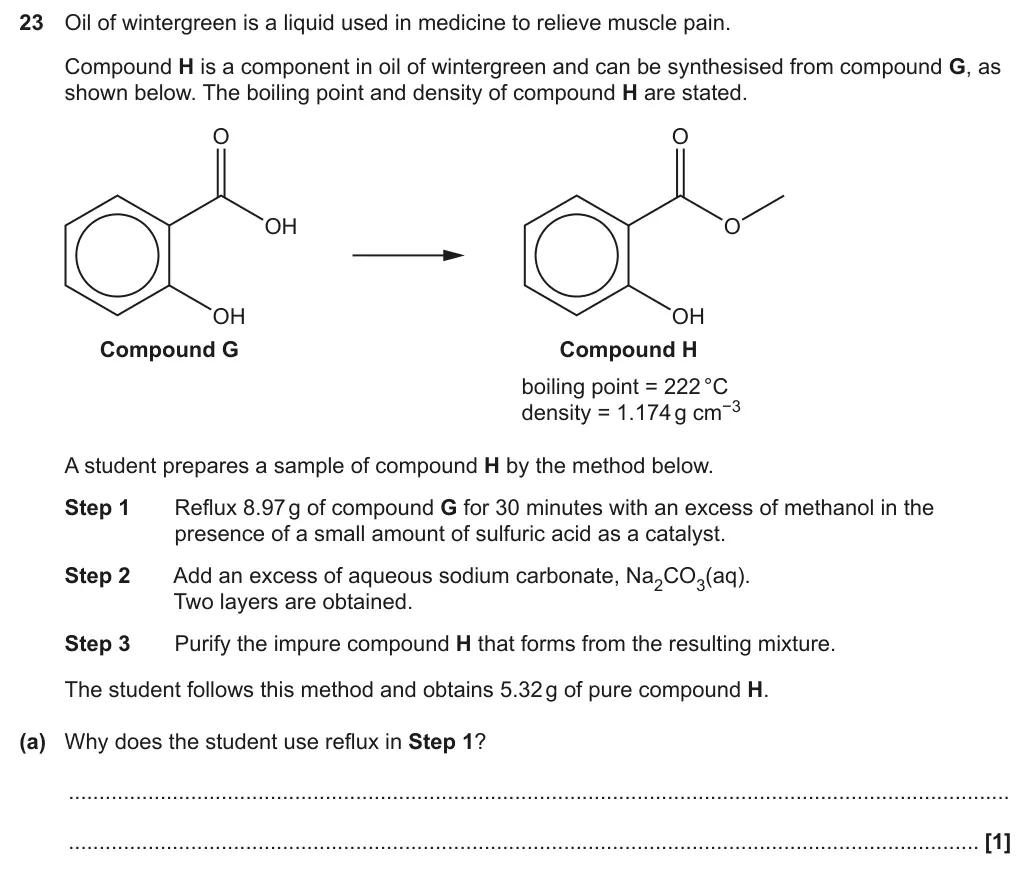
23  Oil of wintergreen is a liquid used in medicine to relieve muscle pain.
Compound H is a component in oil of wintergreen and can be synthesised from compound G, as
shown below. The boiling point and density of compound H are stated.
O O
OH O
OH OH
Compound G Compound H
boiling point = 222 °C
density = 1.174 g cm−3
A student prepares a sample of compound H by the method below.
Step 1   Reflux 8.97 g of compound G for 30 minutes with an excess of methanol in the
presence of a small amount of sulfuric acid as a catalyst.
Step 2   Add an excess of aqueous sodium carbonate, Na2CO3(aq).
Two layers are obtained.
Step 3  Purify the impure compound H that forms from the resulting mixture.
The student follows this method and obtains 5.32 g of pure compound H.
(a) Why does the student use reflux in Step 1?
..........................................................................................................................................................
..................................................................................................................................................... [1]
June 2024 · Paper 2 · Q23(b)(i) 3 marks Equation writing Hard carboxylic acids and estersformulae and equationsacids and titrationsaromatic compounds
Earlier part of question 23 that this part usesEarlier part of June 2024 Paper 2 question 23
(b)
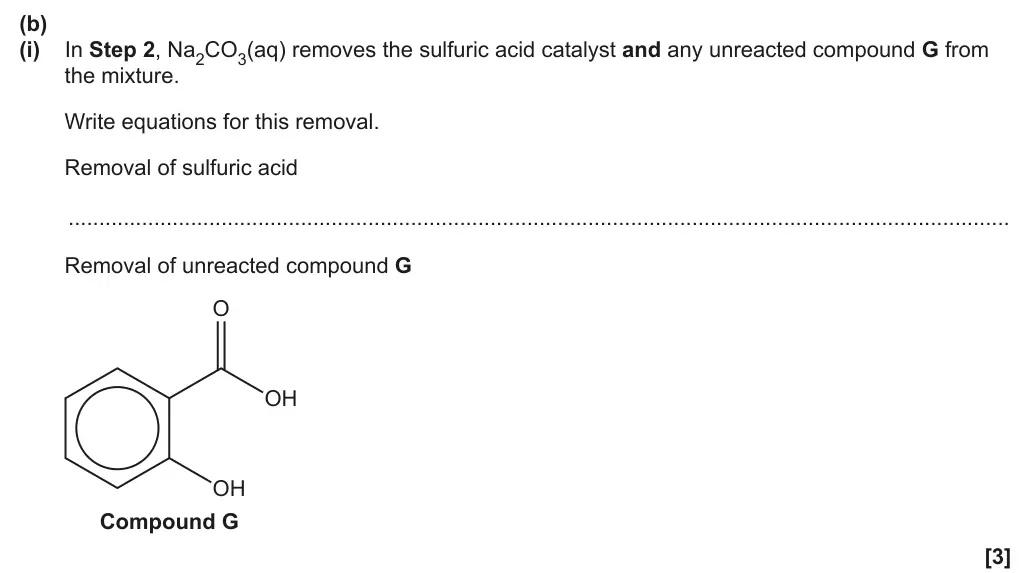
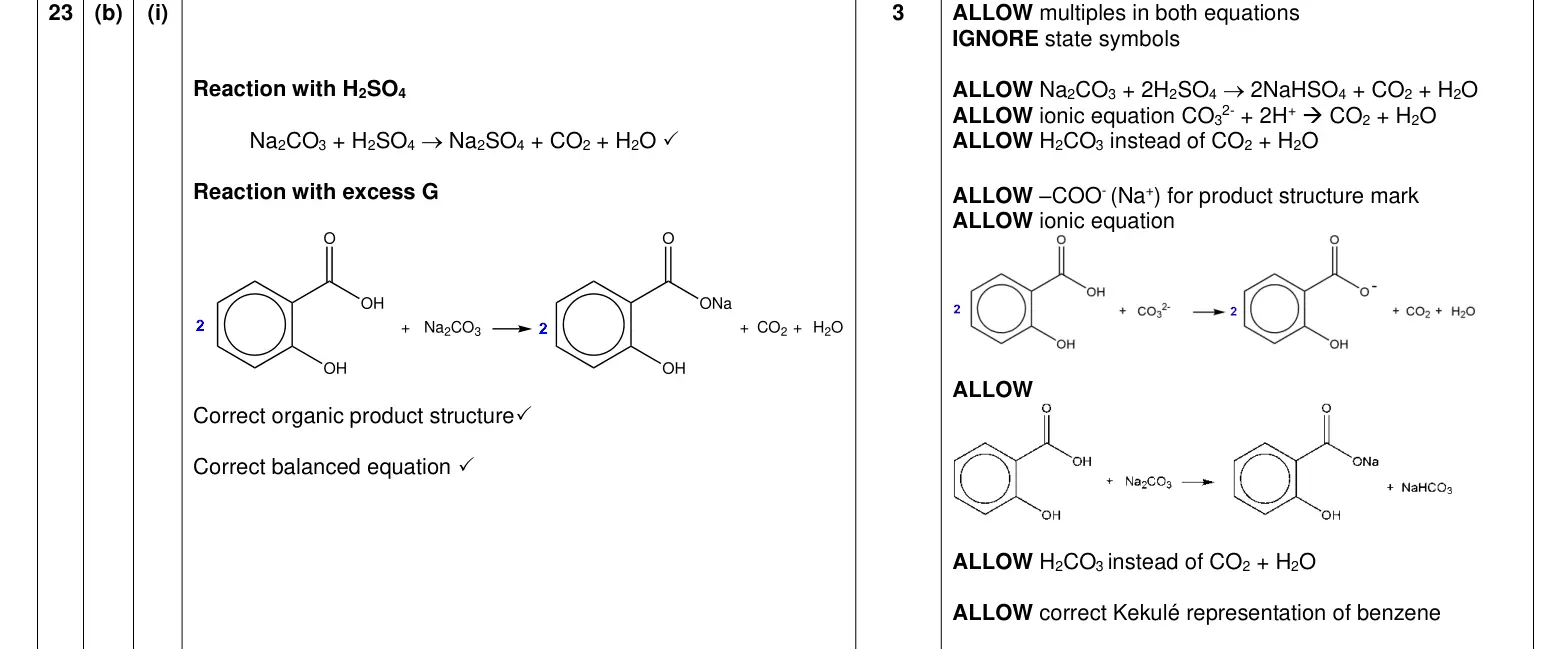
(i) In Step 2, Na2CO3(aq) removes the sulfuric acid catalyst and any unreacted compound G from
the mixture.
Write equations for this removal.
Removal of sulfuric acid
..........................................................................................................................................................
Removal of unreacted compound G
O
OH
OH
Compound G
[3]
June 2024 · Paper 2 · Q23(b)(ii) 1 mark Short answer Medium aromatic compoundspractical skillscarboxylic acids and esters
Earlier parts of question 23 that this part usesEarlier part of June 2024 Paper 2 question 23Earlier part of June 2024 Paper 2 question 23
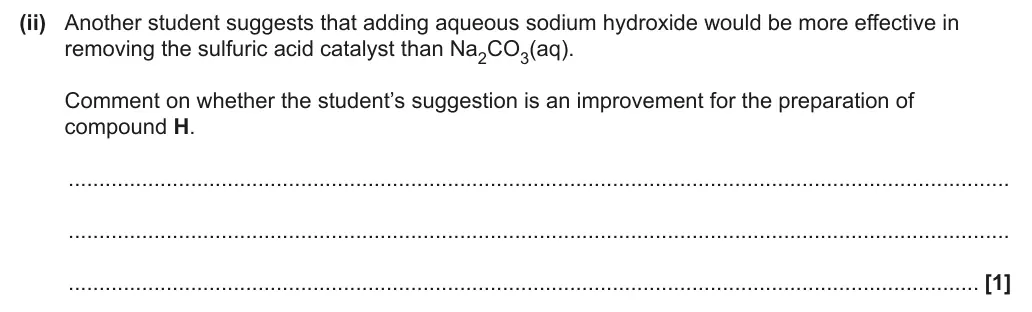
(ii) Another student suggests that adding aqueous sodium hydroxide would be more effective in
removing the sulfuric acid catalyst than Na2CO3(aq).
Comment on whether the student’s suggestion is an improvement for the preparation of
compound H.
..........................................................................................................................................................
..........................................................................................................................................................
..................................................................................................................................................... [1]
June 2024 · Paper 2 · Q23(c) 3 marks Calculation Hard amount of substance
Earlier part of question 23 that this part usesEarlier part of June 2024 Paper 2 question 23
(c) Calculate the percentage yield of compound H.
Give your answer to three significant figures.
percentage yield = ............... % [3]
June 2024 · Paper 2 · Q23(d) 4 marks Short answer Hard organic synthesis aspractical techniques
Earlier part of question 23 that this part usesEarlier part of June 2024 Paper 2 question 23
(d) Describe how to purify the impure compound H from the two layers in Step 2.
..........................................................................................................................................................
..........................................................................................................................................................
..........................................................................................................................................................
..........................................................................................................................................................
..........................................................................................................................................................
..........................................................................................................................................................
..........................................................................................................................................................
..........................................................................................................................................................
..................................................................................................................................................... [4]
June 2024 · Paper 2 · Q24 6 marks 6-mark level of response Hard nmr spectroscopyinfrared and mass spectrometry
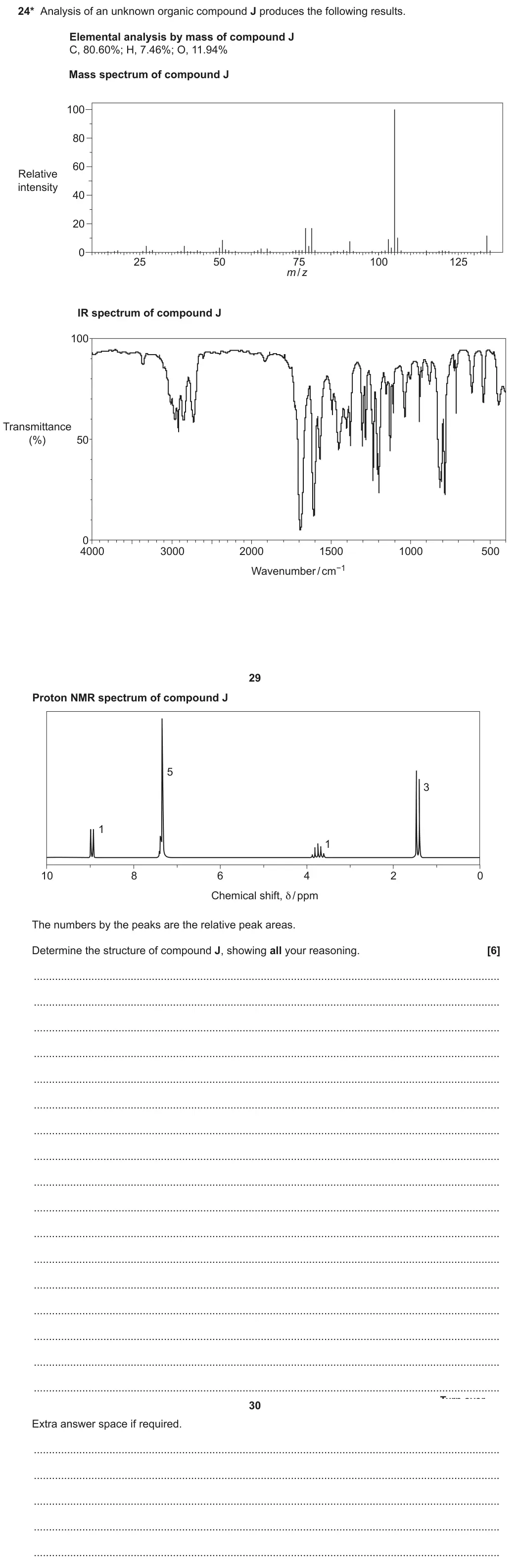
24* Analysis of an unknown organic compound J produces the following results.
Elemental analysis by mass of compound J
C, 80.60%; H, 7.46%; O, 11.94%
Mass spectrum of compound J
100
80
60
Relative
intensity
40
20
0
25 50 75 100 125
m / z
IR spectrum of compound J
100
Transmittance
(%) 50
0
4000 3000 2000 1500 1000 500
Wavenumber / cm−1
Proton NMR spectrum of compound J
5
3
1
1
10 8 6 4 2 0
Chemical shift, δ / ppm
The numbers by the peaks are the relative peak areas.
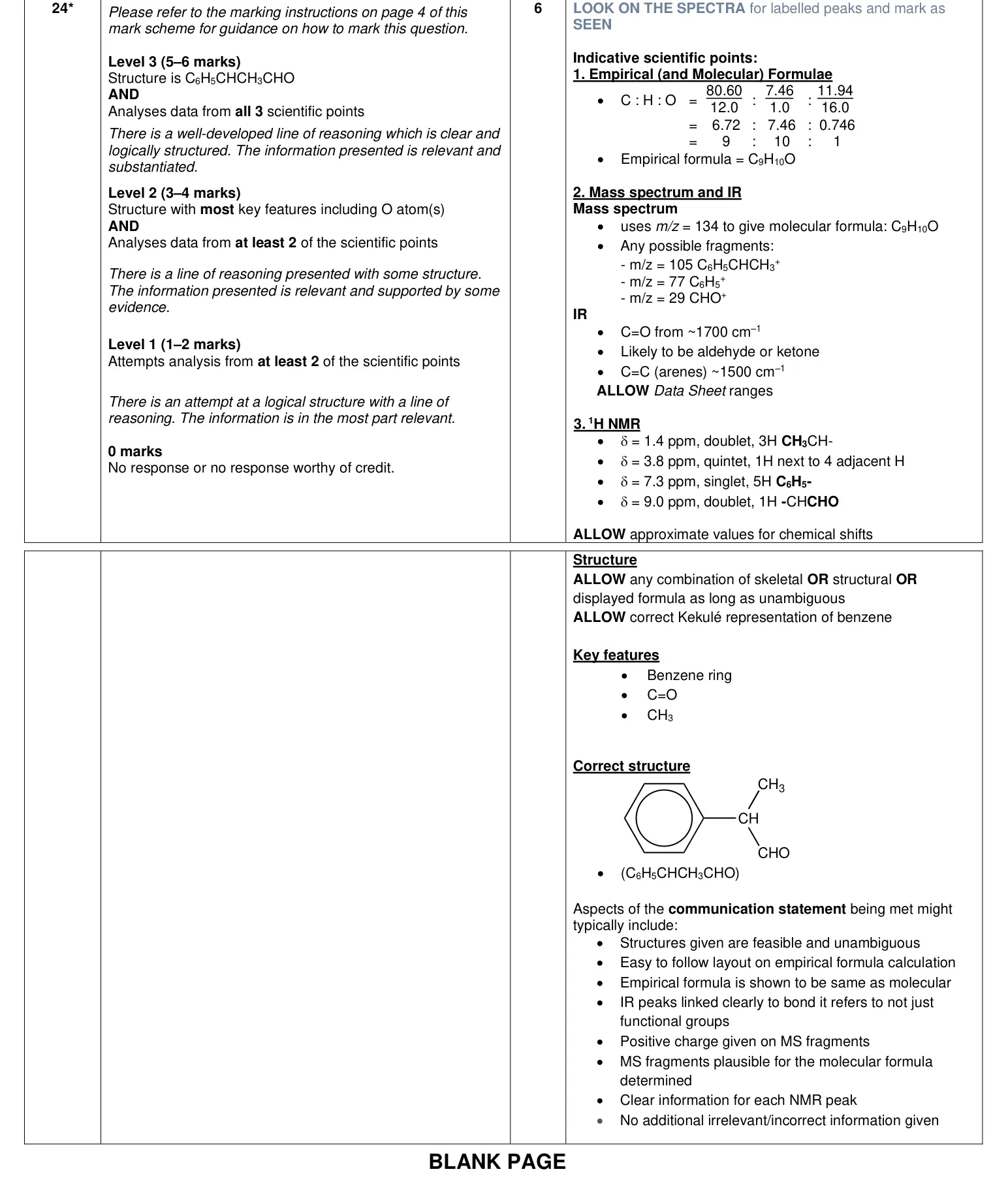
Determine the structure of compound J, showing all your reasoning. [6]
..........................................................................................................................................................
..........................................................................................................................................................
..........................................................................................................................................................
..........................................................................................................................................................
..........................................................................................................................................................
..........................................................................................................................................................
..........................................................................................................................................................
..........................................................................................................................................................
..........................................................................................................................................................
..........................................................................................................................................................
..........................................................................................................................................................
..........................................................................................................................................................
..........................................................................................................................................................
..........................................................................................................................................................
..........................................................................................................................................................
..........................................................................................................................................................
..........................................................................................................................................................
Extra answer space if required.
..........................................................................................................................................................
..........................................................................................................................................................
..........................................................................................................................................................
..........................................................................................................................................................
..........................................................................................................................................................

Work with an OCR chemistry tutor

Want a paper marked and gone through with you? Message us.

Prefer email? Send an enquiry

If you are under 18, please include a parent's contact details. Enquiries go to enquiries@chemistryaleveltutor.com and are deleted once handled. All tutoring is online.